Cells
All living things
are composed of
cells
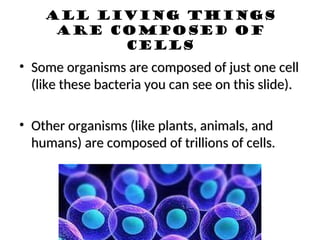
• Some organisms are composed of just one cell
Some organisms are composed of just one cell
(like these bacteria you can see on this slide).
• Other organisms (like plants, animals, and
Other organisms (like plants, animals, and
humans) are composed of trillions of cells.
2 major types
of cells
Prokaryotes Eukaryotes
Bacteria
Plants, Fungi
Animals,
Humans, etc.
Similarities
Similarities
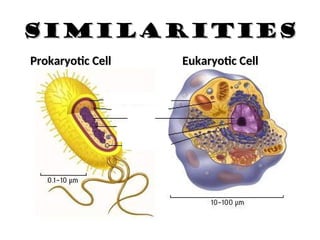
Prokaryotic Cell
Prokaryotic Cell Eukaryotic Cell
Eukaryotic Cell
• Both prokaryotes and eukaryotes have DNA
Both prokaryotes and eukaryotes have DNA
(
(D
Deoxyribo
eoxyribon
nucleic
ucleic A
Acid).
cid).
• Both have a cell membrane (a layer of lipid (fat))
Both have a cell membrane (a layer of lipid (fat))
surrounding it to protect it from the outside
environment and control what comes in and out
of the cell.
of the cell.
• Both have similar things in them: carbohydrates,
Both have similar things in them: carbohydrates,
proteins, nucleic acids, minerals, fats, and
vitamins.
vitamins.
Similarities
Similarities
Some
Some
Differences
Differences
• Prokaryotes are OLD!!
Prokaryotes are OLD!!
– Scientists think they have been around for 3.5
Scientists think they have been around for 3.5
BILLION years!
BILLION years!
– Scientists say eukaryotes have only been around
Scientists say eukaryotes have only been around
for 1.5 billion years.
• Eukaryotes are much BIGGER!!
Eukaryotes are much BIGGER!!
– In general, eukaryotes are about 10X bigger than
In general, eukaryotes are about 10X bigger than
prokaryotes.
prokaryotes.
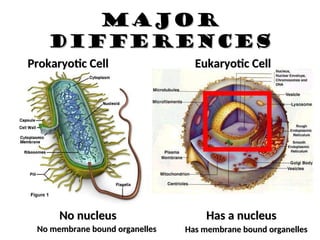
No membrane bound organelles
No membrane bound organelles Has membrane bound organelles
Has membrane bound organelles
Major
Major
DifferenceS
DifferenceS
Prokaryotic Cell
Prokaryotic Cell Eukaryotic Cell
Eukaryotic Cell
No nucleus
No nucleus Has a nucleus
Has a nucleus
Role of the
Role of the
nucleus
nucleus
• Almost all cells contain the genetic information
Almost all cells contain the genetic information
necessary for the cell (and entire organism—if it’s
composed of more than one cell) to survive. This
genetic information is DNA!
– Eukaryotes have separated this information from the
Eukaryotes have separated this information from the
rest of the cell with a special membrane bound
organelle called a nucleus. (Eukaryote means “having
a true nucleus”.)
a true nucleus”.)
– Prokaryotes do NOT have this nucleus and their
Prokaryotes do NOT have this nucleus and their
genetic material is not separated from the rest of the
cell. (Prokaryote means “before a nucleus”.)

Basic information and characteristics of cells

  • 1.
  • 2.
    All living things arecomposed of cells • Some organisms are composed of just one cell Some organisms are composed of just one cell (like these bacteria you can see on this slide). (like these bacteria you can see on this slide). • Other organisms (like plants, animals, and Other organisms (like plants, animals, and humans) are composed of trillions of cells. humans) are composed of trillions of cells.
  • 3.
    2 major types ofcells Prokaryotes Eukaryotes Bacteria Plants, Fungi Animals, Humans, etc.
  • 4.
  • 5.
    • Both prokaryotesand eukaryotes have DNA Both prokaryotes and eukaryotes have DNA ( (D Deoxyribo eoxyribon nucleic ucleic A Acid). cid). • Both have a cell membrane (a layer of lipid (fat)) Both have a cell membrane (a layer of lipid (fat)) surrounding it to protect it from the outside surrounding it to protect it from the outside environment and control what comes in and out environment and control what comes in and out of the cell. of the cell. • Both have similar things in them: carbohydrates, Both have similar things in them: carbohydrates, proteins, nucleic acids, minerals, fats, and proteins, nucleic acids, minerals, fats, and vitamins. vitamins. Similarities Similarities
  • 6.
    Some Some Differences Differences • Prokaryotes areOLD!! Prokaryotes are OLD!! – Scientists think they have been around for 3.5 Scientists think they have been around for 3.5 BILLION years! BILLION years! – Scientists say eukaryotes have only been around Scientists say eukaryotes have only been around for 1.5 billion years. for 1.5 billion years. • Eukaryotes are much BIGGER!! Eukaryotes are much BIGGER!! – In general, eukaryotes are about 10X bigger than In general, eukaryotes are about 10X bigger than prokaryotes. prokaryotes.
  • 7.
    No membrane boundorganelles No membrane bound organelles Has membrane bound organelles Has membrane bound organelles Major Major DifferenceS DifferenceS Prokaryotic Cell Prokaryotic Cell Eukaryotic Cell Eukaryotic Cell No nucleus No nucleus Has a nucleus Has a nucleus
  • 8.
    Role of the Roleof the nucleus nucleus • Almost all cells contain the genetic information Almost all cells contain the genetic information necessary for the cell (and entire organism—if it’s necessary for the cell (and entire organism—if it’s composed of more than one cell) to survive. This composed of more than one cell) to survive. This genetic information is DNA! genetic information is DNA! – Eukaryotes have separated this information from the Eukaryotes have separated this information from the rest of the cell with a special membrane bound rest of the cell with a special membrane bound organelle called a nucleus. (Eukaryote means “having organelle called a nucleus. (Eukaryote means “having a true nucleus”.) a true nucleus”.) – Prokaryotes do NOT have this nucleus and their Prokaryotes do NOT have this nucleus and their genetic material is not separated from the rest of the genetic material is not separated from the rest of the cell. (Prokaryote means “before a nucleus”.) cell. (Prokaryote means “before a nucleus”.)