GURU NANAK INSTITUTE OF PHARMACEUTICAL SCIENCE AND
TECHNOLOGY
TOPIC : Tools and Techniques of forensic lab
NAME OF THE STUDENT: Soumyajit Dey
UNIVERSITY ROLL NUMBER: 31308421028
ACADEMIC SESSION : 2022-2023
PAPER NAME: Basic of Forensic science
PAPER CODE: SECMC-404
Maulana Abul Kalam Azad University of Technology
INTRODUCTION
B. Sc./ SEM 4/2022-23/ /Basic Forensic Science/ SECMC-404/
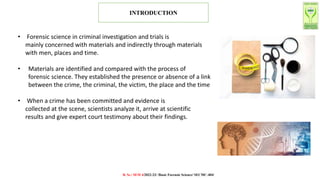
• Forensic science in criminal investigation and trials is
mainly concerned with materials and indirectly through materials
with men, places and time.
• Materials are identified and compared with the process of
forensic science. They established the presence or absence of a link
between the crime, the criminal, the victim, the place and the time
• When a crime has been committed and evidence is
collected at the scene, scientists analyze it, arrive at scientific
results and give expert court testimony about their findings.
B. Sc./ SEM 4/2022-23/ /Basic Forensic Science/ SECMC-404/
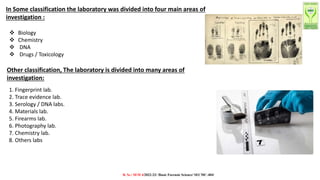
In Some classification the laboratory was divided into four main areas of
investigation :
 Biology
 Chemistry
 DNA
 Drugs / Toxicology
Other classification, The laboratory is divided into many areas of
investigation:
1. Fingerprint lab.
2. Trace evidence lab.
3. Serology / DNA labs.
4. Materials lab.
5. Firearms lab.
6. Photography lab.
7. Chemistry lab.
8. Others labs
B. Sc./ SEM 4/2022-23/ /Basic Forensic Science/ SECMC-404/
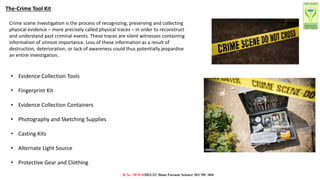
The-Crime Tool Kit
Crime scene investigation is the process of recognizing, preserving and collecting
physical evidence – more precisely called physical traces – in order to reconstruct
and understand past criminal events. These traces are silent witnesses containing
information of utmost importance. Loss of these information as a result of
destruction, deterioration, or lack of awareness could thus potentially jeopardise
an entire investigation.
• Evidence Collection Tools
• Fingerprint Kit
• Evidence Collection Containers
• Photography and Sketching Supplies
• Casting Kits
• Alternate Light Source
• Protective Gear and Clothing
CONCLUSION
B. Sc./ SEM 4/2022-23/ /Basic Forensic Science/ SECMC-404/
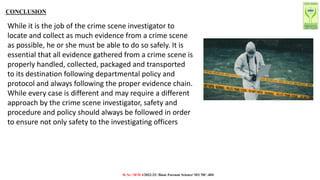
While it is the job of the crime scene investigator to
locate and collect as much evidence from a crime scene
as possible, he or she must be able to do so safely. It is
essential that all evidence gathered from a crime scene is
properly handled, collected, packaged and transported
to its destination following departmental policy and
protocol and always following the proper evidence chain.
While every case is different and may require a different
approach by the crime scene investigator, safety and
procedure and policy should always be followed in order
to ensure not only safety to the investigating officers
B. Sc./ SEM 4/2022-23/ /Basic Forensic Science/ SECMC-404/
REFERENCE
• Song, Ci, and Brian E. McKnight. The washing away of wrongs: forensic medicine in
thirteenth-century China. Ann Arbor: Center for Chinese Studies, U of Michigan,
1981. Print. p. 3.
• Song, Ci, and Brian E. McKnight. The washing away of wrongs: forensic medicine in
thirteenth-century China. Ann Arbor: Center for Chinese Studies, U of Michigan,
1981. Print. p. 161.
• Song, Ci, and Brian E. McKnight. The washing away of wrongs: forensic medicine in
thirteenth-century China. Ann Arbor: Center for Chinese Studies, U of Michigan,
1981. Print. pp. 76–82
• Song, Ci, and Brian E. McKnight. The washing away of wrongs: forensic medicine in
thirteenth-century China. Ann Arbor: Center for Chinese Studies, U of Michigan,
1981. Print. p. 95.
• Song, Ci, and Brian E. McKnight. The washing away of wrongs: forensic medicine in
thirteenth-century China. Ann Arbor: Center for Chinese Studies, U of Michigan,
1981. Print. p 86.

basic forensic science.pptx

  • 1.
    GURU NANAK INSTITUTEOF PHARMACEUTICAL SCIENCE AND TECHNOLOGY TOPIC : Tools and Techniques of forensic lab NAME OF THE STUDENT: Soumyajit Dey UNIVERSITY ROLL NUMBER: 31308421028 ACADEMIC SESSION : 2022-2023 PAPER NAME: Basic of Forensic science PAPER CODE: SECMC-404 Maulana Abul Kalam Azad University of Technology
  • 2.
    INTRODUCTION B. Sc./ SEM4/2022-23/ /Basic Forensic Science/ SECMC-404/ • Forensic science in criminal investigation and trials is mainly concerned with materials and indirectly through materials with men, places and time. • Materials are identified and compared with the process of forensic science. They established the presence or absence of a link between the crime, the criminal, the victim, the place and the time • When a crime has been committed and evidence is collected at the scene, scientists analyze it, arrive at scientific results and give expert court testimony about their findings.
  • 3.
    B. Sc./ SEM4/2022-23/ /Basic Forensic Science/ SECMC-404/ In Some classification the laboratory was divided into four main areas of investigation :  Biology  Chemistry  DNA  Drugs / Toxicology Other classification, The laboratory is divided into many areas of investigation: 1. Fingerprint lab. 2. Trace evidence lab. 3. Serology / DNA labs. 4. Materials lab. 5. Firearms lab. 6. Photography lab. 7. Chemistry lab. 8. Others labs
  • 4.
    B. Sc./ SEM4/2022-23/ /Basic Forensic Science/ SECMC-404/ The-Crime Tool Kit Crime scene investigation is the process of recognizing, preserving and collecting physical evidence – more precisely called physical traces – in order to reconstruct and understand past criminal events. These traces are silent witnesses containing information of utmost importance. Loss of these information as a result of destruction, deterioration, or lack of awareness could thus potentially jeopardise an entire investigation. • Evidence Collection Tools • Fingerprint Kit • Evidence Collection Containers • Photography and Sketching Supplies • Casting Kits • Alternate Light Source • Protective Gear and Clothing
  • 5.
    CONCLUSION B. Sc./ SEM4/2022-23/ /Basic Forensic Science/ SECMC-404/ While it is the job of the crime scene investigator to locate and collect as much evidence from a crime scene as possible, he or she must be able to do so safely. It is essential that all evidence gathered from a crime scene is properly handled, collected, packaged and transported to its destination following departmental policy and protocol and always following the proper evidence chain. While every case is different and may require a different approach by the crime scene investigator, safety and procedure and policy should always be followed in order to ensure not only safety to the investigating officers
  • 6.
    B. Sc./ SEM4/2022-23/ /Basic Forensic Science/ SECMC-404/ REFERENCE • Song, Ci, and Brian E. McKnight. The washing away of wrongs: forensic medicine in thirteenth-century China. Ann Arbor: Center for Chinese Studies, U of Michigan, 1981. Print. p. 3. • Song, Ci, and Brian E. McKnight. The washing away of wrongs: forensic medicine in thirteenth-century China. Ann Arbor: Center for Chinese Studies, U of Michigan, 1981. Print. p. 161. • Song, Ci, and Brian E. McKnight. The washing away of wrongs: forensic medicine in thirteenth-century China. Ann Arbor: Center for Chinese Studies, U of Michigan, 1981. Print. pp. 76–82 • Song, Ci, and Brian E. McKnight. The washing away of wrongs: forensic medicine in thirteenth-century China. Ann Arbor: Center for Chinese Studies, U of Michigan, 1981. Print. p. 95. • Song, Ci, and Brian E. McKnight. The washing away of wrongs: forensic medicine in thirteenth-century China. Ann Arbor: Center for Chinese Studies, U of Michigan, 1981. Print. p 86.