BASIC
ELECTRONICS
LECTURE 1
ELECTRONICS
• Electronics is the branch of engineering and technology that deals with the
emission, flow and control of electrons in vacuum and matter.
• Electron flow is controlled by active devices using the concept of
amplification and rectification.
• The basic electronic components for designing a circuit are:
Resistor, Capacitor, Inductor, Diode, LED, Transistor, IC, Relay,
Battery
Basic Electronic Components
HISTORY OF ELECTRONICS
• It all started with the discovery of Electrons by J. J. Thomson in 1897.
VACUUM TUBE ERA
 Thomas Alva Edison discovered that Electrons will flow from one metal conductor to
another (Anode and Cathode) through a vacuum (Edison Effect).
 John Fleming applied the Edison effect in inventing a two element electron Tube called
Diode in 1904. Diode’s are basically an electronic component which allows the flow of
current in only one direction. The major application of a diode is rectification.
 In 1907, American inventor Lee de Forest added a third electrode to the concept of
two electrode diodes, creating the first triode tube. This third electrode, called the
control grid, enabled the vacuum tube to be used not just as a rectifier, but as an
amplifier of electrical signals.
Transistor Era
• Transistor was invented in 1947 by John Bardeen, Walter H. Brattain and
William B. Shockley.
• Transistors are a three terminal device made up of semiconductor materials
with an ability to amplify or switch electronic signals and electrical power.
• Transistors are the atoms of modern-day computing, combining to create
the logic gates that enable computation.
Integrated Circuit Era
• The demand for compact, Lightweight & portable electronic systems led to the
invention of Integrated circuits during 1958-59, conceptualized by Jack Kilby.
• An integrated circuit is an electronic circuit manufactured by a process of patterned
diffusion of trace elements into the surface of a thin substrate of semiconductor
material. Additional materials are deposited and patterned to form interconnections
between semiconductor devices.
• The advent of the integrated circuit revolutionized the electronics industry and
paved the way for devices such as mobile phones, computers, CD players,
televisions, and many appliances found around the home.
Integrated Circuits Era
SEMICONDUCTORS
Definition
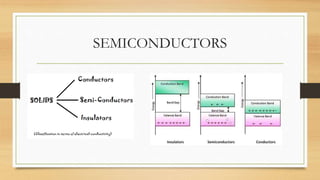
• Semiconductor are those crystalline solids whose conductivity lies in between that of
conductors and insulators. The conductivity of a semiconductor can be easily varied by:
Temperature Variation and Doping.
• Elemental Semiconductors: The elemental semiconductors are those composed of single
species of atoms, such as silicon (Si), germanium (Ge), and tin (Sn) in column IV and
selenium (Se) and tellurium (Te) in column VI of the periodic table.
• Compound Semiconductors: Compound semiconductors are composed of two or more
elements. Gallium arsenide (GaAs), for example, is a binary III-V compound, which is a
combination of gallium (Ga) from column III and arsenic (As) from column V. Ternary
compounds can be formed by elements from three different columns—for instance,
mercury indium telluride (HgIn2Te4), a II-III-VI compound.
Conduction and Valence Band
• The energy band that comprises of valence
electrons present in the outermost shell of
an atomic structure is termed as Valence
Band.
• These valence electrons, when provided
with sufficient energy, get changed into
free electrons and moves to conduction
band thereby causing conductivity.
• These two bands are separated by a certain
amount of energy known as the forbidden
energy gap. This energy gap depends on
the type of material i.e., either the material
is conductor, insulator or semiconductor.

BASIC ELECTRONICS_Lecture 1 (1).pptx

  • 1.
  • 2.
    ELECTRONICS • Electronics isthe branch of engineering and technology that deals with the emission, flow and control of electrons in vacuum and matter. • Electron flow is controlled by active devices using the concept of amplification and rectification. • The basic electronic components for designing a circuit are: Resistor, Capacitor, Inductor, Diode, LED, Transistor, IC, Relay, Battery
  • 3.
  • 4.
    HISTORY OF ELECTRONICS •It all started with the discovery of Electrons by J. J. Thomson in 1897.
  • 5.
    VACUUM TUBE ERA Thomas Alva Edison discovered that Electrons will flow from one metal conductor to another (Anode and Cathode) through a vacuum (Edison Effect).  John Fleming applied the Edison effect in inventing a two element electron Tube called Diode in 1904. Diode’s are basically an electronic component which allows the flow of current in only one direction. The major application of a diode is rectification.  In 1907, American inventor Lee de Forest added a third electrode to the concept of two electrode diodes, creating the first triode tube. This third electrode, called the control grid, enabled the vacuum tube to be used not just as a rectifier, but as an amplifier of electrical signals.
  • 6.
    Transistor Era • Transistorwas invented in 1947 by John Bardeen, Walter H. Brattain and William B. Shockley. • Transistors are a three terminal device made up of semiconductor materials with an ability to amplify or switch electronic signals and electrical power. • Transistors are the atoms of modern-day computing, combining to create the logic gates that enable computation.
  • 7.
    Integrated Circuit Era •The demand for compact, Lightweight & portable electronic systems led to the invention of Integrated circuits during 1958-59, conceptualized by Jack Kilby. • An integrated circuit is an electronic circuit manufactured by a process of patterned diffusion of trace elements into the surface of a thin substrate of semiconductor material. Additional materials are deposited and patterned to form interconnections between semiconductor devices. • The advent of the integrated circuit revolutionized the electronics industry and paved the way for devices such as mobile phones, computers, CD players, televisions, and many appliances found around the home.
  • 8.
  • 9.
  • 10.
    Definition • Semiconductor arethose crystalline solids whose conductivity lies in between that of conductors and insulators. The conductivity of a semiconductor can be easily varied by: Temperature Variation and Doping. • Elemental Semiconductors: The elemental semiconductors are those composed of single species of atoms, such as silicon (Si), germanium (Ge), and tin (Sn) in column IV and selenium (Se) and tellurium (Te) in column VI of the periodic table. • Compound Semiconductors: Compound semiconductors are composed of two or more elements. Gallium arsenide (GaAs), for example, is a binary III-V compound, which is a combination of gallium (Ga) from column III and arsenic (As) from column V. Ternary compounds can be formed by elements from three different columns—for instance, mercury indium telluride (HgIn2Te4), a II-III-VI compound.
  • 11.
    Conduction and ValenceBand • The energy band that comprises of valence electrons present in the outermost shell of an atomic structure is termed as Valence Band. • These valence electrons, when provided with sufficient energy, get changed into free electrons and moves to conduction band thereby causing conductivity. • These two bands are separated by a certain amount of energy known as the forbidden energy gap. This energy gap depends on the type of material i.e., either the material is conductor, insulator or semiconductor.