BASIC ELECTRONIC COMPONENTS
PASSIVEELECTRONIC COMPONENTS
These are components that consume energy. It does
not produce energy, and it is incapable of power gain and
requires no electrical power to operate. They simply
absorb energy. A typical example of passive electronic
components would be resistors and capacitors.
3.
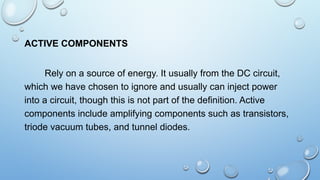
ACTIVE COMPONENTS
Rely ona source of energy. It usually from the DC circuit,
which we have chosen to ignore and usually can inject power
into a circuit, though this is not part of the definition. Active
components include amplifying components such as transistors,
triode vacuum tubes, and tunnel diodes.
4.
ELECTRICAL TEST ANDCONTROL EQUIPMENT
Electrical test and control equipment are devices for
measuring and testing of physical quantities or performance of
electrical equipment, circuits or components. They are also used
to monitor and control processes. They present information
analogically, digitally or printed.
5.
PASSIVE ELECTRONIC SYMBOLS
SymbolsComponents Description
Resistor
A resistor is a passive two
terminal electrical component
that implements electrical
resistance as a circuit's
elements. In electronic circuits,
resistors are used to reduce
current flow, adjust signal
levels, to divide voltages, bias
active elements, and terminate
transmission lines, among
others uses.
6.
Inductor/ Coil
An inductor,also called a
coil, chokes, or reactor, is a
passive two terminal
electrical component that
stores energy in a
magnetic field when
electric current flows
through it. An inductor
typically consists of an
insulated wire wound into a
coil around a core.
Switch
Use to control the flow of
electric current
7.
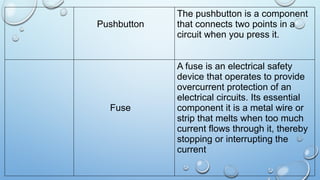
Pushbutton
The pushbutton isa component
that connects two points in a
circuit when you press it.
Fuse
A fuse is an electrical safety
device that operates to provide
overcurrent protection of an
electrical circuits. Its essential
component it is a metal wire or
strip that melts when too much
current flows through it, thereby
stopping or interrupting the
current
8.
Electric line/ wire
Awire is a single usually
cylindrical, flexible strand or
rod of metal. Wires are used to
bear mechanical loads or
electricity and
telecommunication signals.
Ground
Ground or earth is the
reference point in an electrical
circuit from which voltage are
measured, a common return
path for electric current, or a
direct physical connection to
the earth
9.
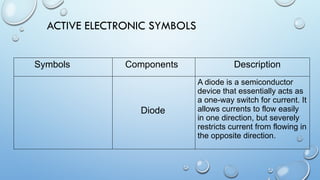
ACTIVE ELECTRONIC SYMBOLS
SymbolsComponents Description
Diode
A diode is a semiconductor
device that essentially acts as
a one-way switch for current. It
allows currents to flow easily
in one direction, but severely
restricts current from flowing in
the opposite direction.
10.
Thyristor
A thyristor isa four-layer device
with alternating P- type and N-
type semiconductors ( P-N-P-N ).
In its most basic form, a thyristor
has three terminals: anode
( positive terminal ), cathode
( negative terminal ), and gate
( control terminal ). The gate
controls the flow of current
between the anode and cathode
IC/ Chip
An integrated circuit or monolithic
integrated circuit. It is also
referred to as an IC, a chip, or a
microchip. It is also a set of
electronic circuits on one small
flat piece of semiconductor
material that is normally silicon.
11.
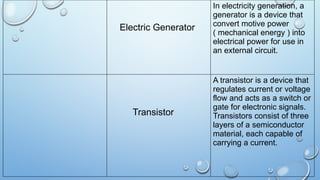
Electric Generator
In electricitygeneration, a
generator is a device that
convert motive power
( mechanical energy ) into
electrical power for use in
an external circuit.
Transistor
A transistor is a device that
regulates current or voltage
flow and acts as a switch or
gate for electronic signals.
Transistors consist of three
layers of a semiconductor
material, each capable of
carrying a current.
ELECTRICAL TEST ANDCONTROL EQUIPMENT
Symbols Components Description
Ammeter
Instrument used to
measure electric
current
Ohmmeter
Instrument used to
measure resistance
14.
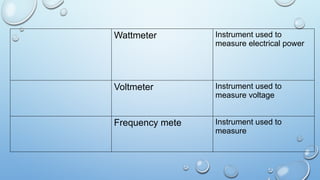
Wattmeter Instrument usedto
measure electrical power
Voltmeter Instrument used to
measure voltage
Frequency mete Instrument used to
measure
15.
OTHER BASIC ELECTRICALAND ELECTRONIC SYMBOLS
Symbols Components
Antenna/ Aerial
Speaker
Microphone
Lamp/ light bulb
Direct current, DC
16.
Alternating current, AC
Positivepolarity
Negative polarity
Relay ( Coil and switch )
Electric transformer
Electric motor
Capacitor