Computer architecture
Processing Unit
The central processing unit (CPU) of a computer is
the main unit that dictates the rest of the computer
organization
 Register set: Stores intermediate data during the
execution of instructions;
 Arithmetic logic unit (ALU): Performs the required
micro-operations for executing the instructions;
 Control unit: supervises the transfer of information
among the registers and instructs the ALU as to
which operation to perform by generating control
signals.
Processing Unit
Functions of CPU
 Central Processing Unit = “brain of computer”
 Executes programs by:
◦ Fetching and decoding the next instruction from memory
◦ Execute it
 Consists of:
◦ Control Unit
◦ Arithmetic Logic Unit (ALU)
◦ Registers (high-speed memory)
 Program Counter (PC)
 Instruction Register (IR)
Processing Unit
Functions of CPU
BUS connection with CPU
Processing Unit
General register organization
 CPU must have some working space (fast
access and close to CPU)
 This space is efficiently used to store
intermediate values
 The most convenient way to communicate
registers is trough common bus system
Processing Unit
Processing Unit
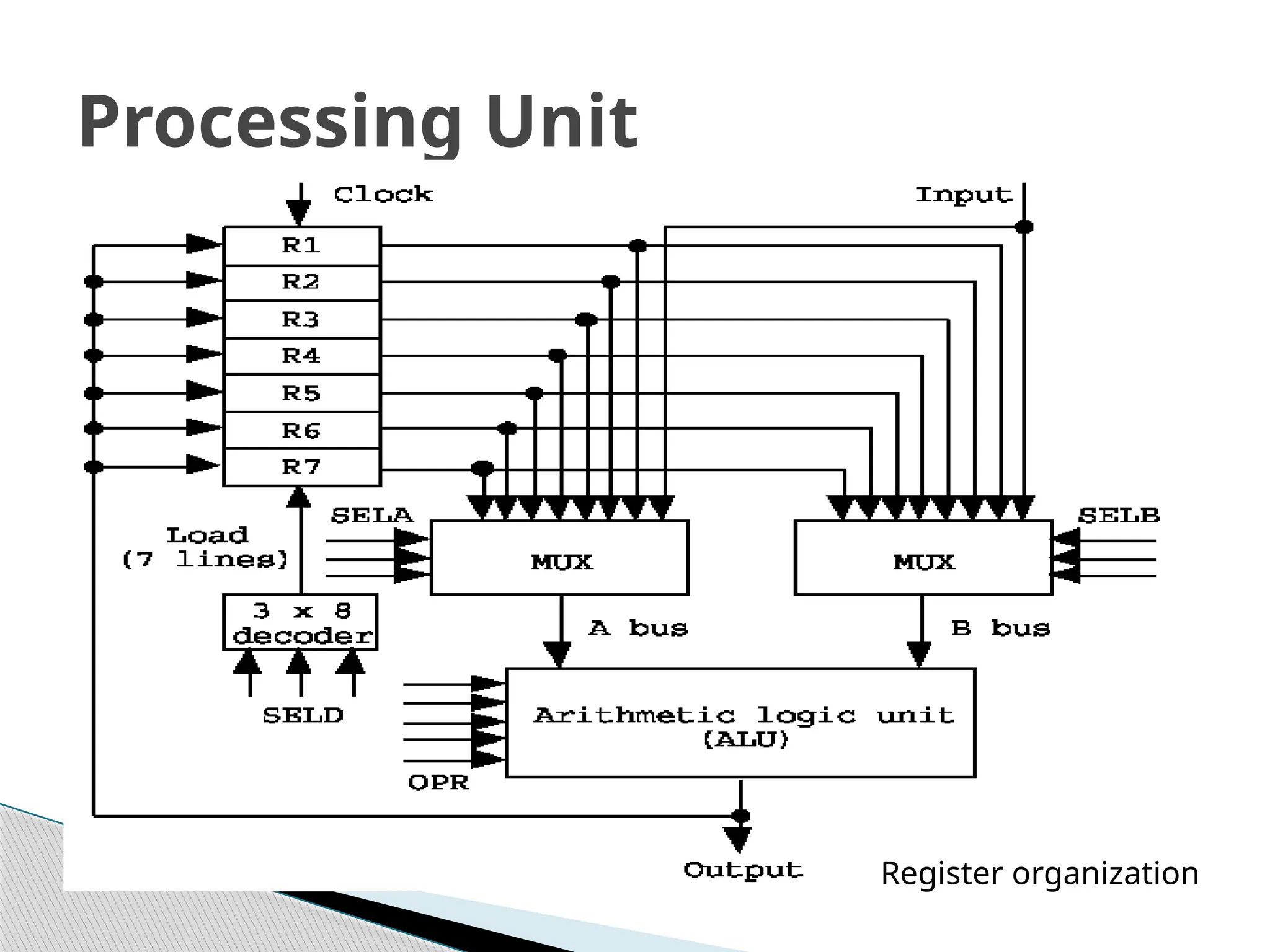
Register organization
Selection of operation
 An operation is selected by the ALU operation
selector (OPR).
 The result of a micro-operation is directed to
a destination register selected by a decoder
(SELD).
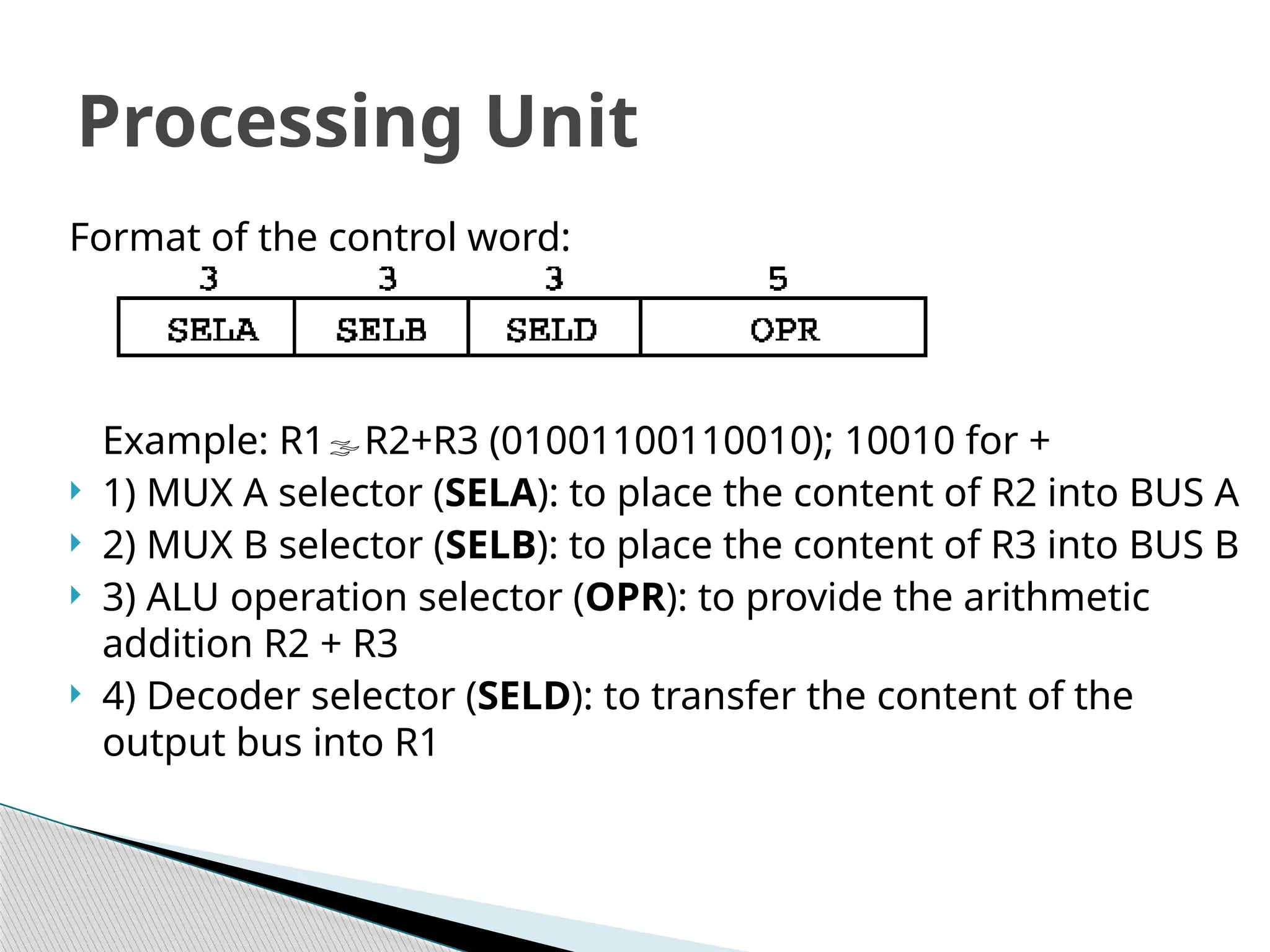
 Control word: The 14 binary selection inputs
(3 bits for SELA, 3 for SELB, 3 for SELD, and 5
for OPR)
Processing Unit
Format of the control word:
Example: R1R2+R3 (01001100110010); 10010 for +
 1) MUX A selector (SELA): to place the content of R2 into BUS A
 2) MUX B selector (SELB): to place the content of R3 into BUS B
 3) ALU operation selector (OPR): to provide the arithmetic
addition R2 + R3
 4) Decoder selector (SELD): to transfer the content of the
output bus into R1
Processing Unit
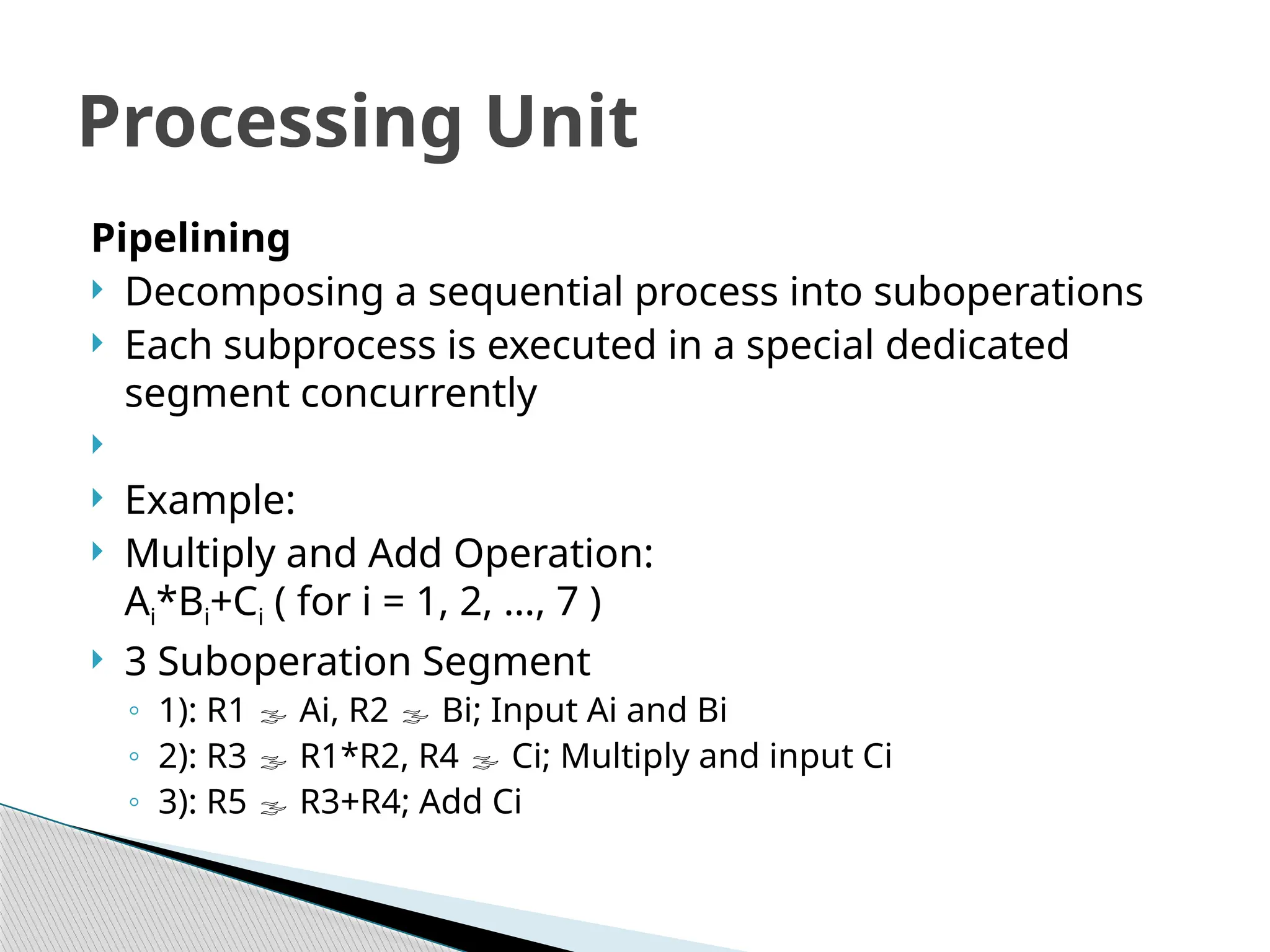
Pipelining
 Decomposing a sequential process into suboperations
 Each subprocess is executed in a special dedicated
segment concurrently

 Example:
 Multiply and Add Operation:
Ai*Bi+Ci ( for i = 1, 2, …, 7 )
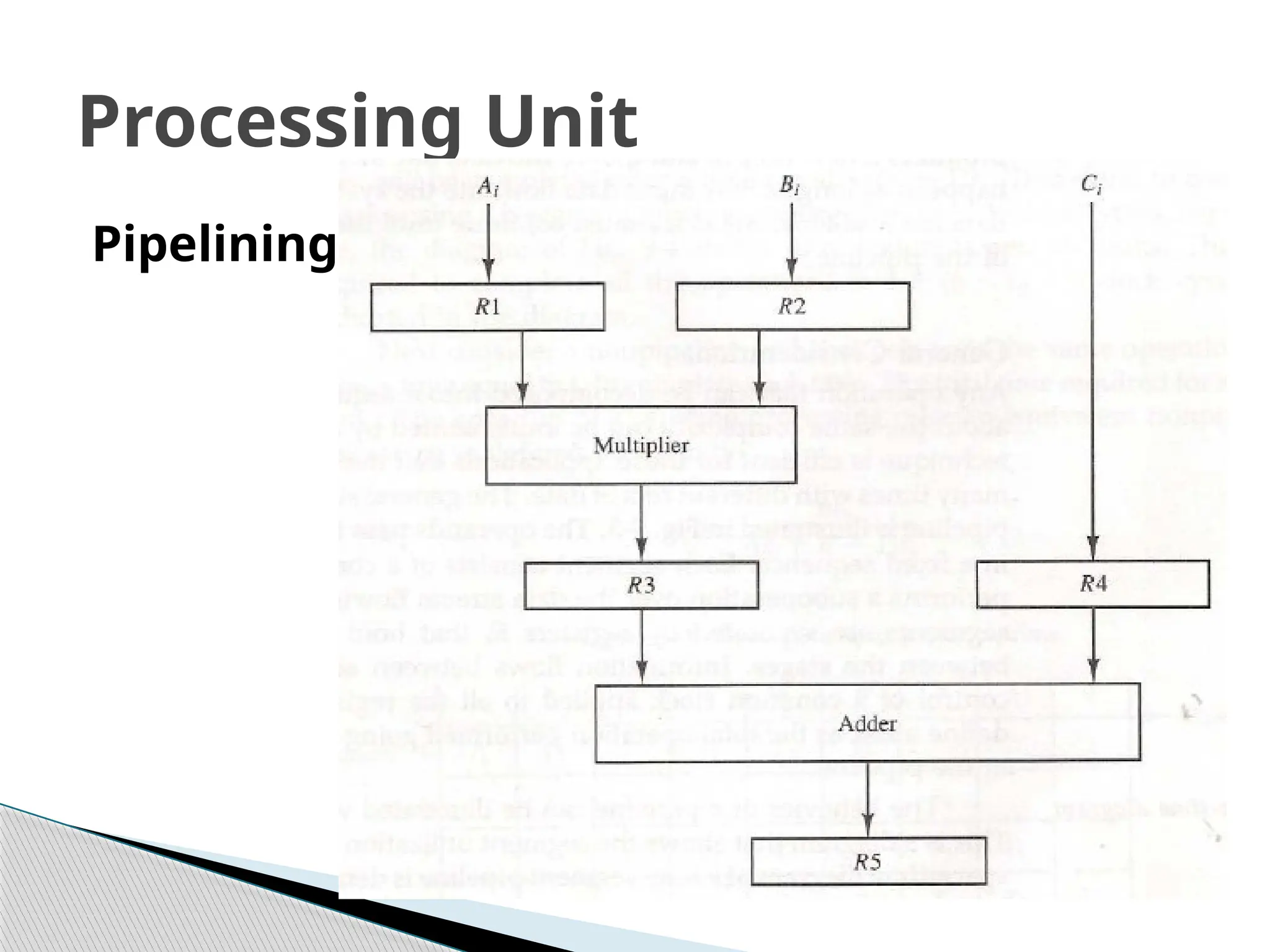
 3 Suboperation Segment
◦ 1): R1  Ai, R2  Bi; Input Ai and Bi
◦ 2): R3  R1*R2, R4  Ci; Multiply and input Ci
◦ 3): R5  R3+R4; Add Ci
Processing Unit
Pipelining
Processing Unit
General consideration of pipelining
◦ Operation is decomposed into a number of suboperations
◦ The technique is efficient when the same task is repeated for
different data sets
 The general structure of four-segment pipelining is
shown in following figure:
Processing Unit
General consideration of pipelining
 Each operation pass through all of four
segments
 Section Si performs the suboperation and Ri
holds the temporary results
 Common clock is used to transfer the data
from Ri
Processing Unit
Space-time representation
 Pipeline can be represented as space-time diagram
 Shows the segment utilization as a function of time
◦ The space-time representation of a four-segment pipelining
system:
Processing Unit
 The diagram shows six tasks T1 through T6 executed in four
segments
 The speedup of pipeline system over nonpipeline is defined as –
 where
 n : task number (6)
 tp : clock cycle time
 tn : time to complete each task in nonpipeline(4tp)
 k : segment number (4)
◦ hence, S = n•tn/( k + n - 1 )•tp = 6•4tp/(4+6-1)•tp
= 24 tp / 9 tp = 2.67
◦ If n  ; S=tn/tp
◦ So, Nonpipline (tn)=Pipeline (k.tp)  S=k.tp/tp=k
Processing Unit
Instruction Pipeline
 The computer needs to process each instruction with
the following sequence of steps:
◦ 1) Fetch the instruction from memory
◦ 2) Decode the instruction
◦ 3) Calculate the effective address
◦ 4) Fetch the operands from memory
◦ 5) Execute the instruction
◦ 6) Store the result in the proper place
Processing Unit
 Example: Four-segment Instruction Pipeline
 The above six steps can be performed with the following Four-
segment CPU pipeline:
 1) FI: Instruction Fetch
 2) DA: Decode Instruction & calculate EA
 3) FO: Operand Fetch
 4) EX: Execution
Processing Unit

Basic Computer Architecture slides num.3

  • 1.
  • 2.
    The central processingunit (CPU) of a computer is the main unit that dictates the rest of the computer organization  Register set: Stores intermediate data during the execution of instructions;  Arithmetic logic unit (ALU): Performs the required micro-operations for executing the instructions;  Control unit: supervises the transfer of information among the registers and instructs the ALU as to which operation to perform by generating control signals. Processing Unit
  • 3.
    Functions of CPU Central Processing Unit = “brain of computer”  Executes programs by: ◦ Fetching and decoding the next instruction from memory ◦ Execute it  Consists of: ◦ Control Unit ◦ Arithmetic Logic Unit (ALU) ◦ Registers (high-speed memory)  Program Counter (PC)  Instruction Register (IR) Processing Unit
  • 4.
    Functions of CPU BUSconnection with CPU Processing Unit
  • 5.
    General register organization CPU must have some working space (fast access and close to CPU)  This space is efficiently used to store intermediate values  The most convenient way to communicate registers is trough common bus system Processing Unit
  • 6.
  • 7.
    Selection of operation An operation is selected by the ALU operation selector (OPR).  The result of a micro-operation is directed to a destination register selected by a decoder (SELD).  Control word: The 14 binary selection inputs (3 bits for SELA, 3 for SELB, 3 for SELD, and 5 for OPR) Processing Unit
  • 8.
    Format of thecontrol word: Example: R1R2+R3 (01001100110010); 10010 for +  1) MUX A selector (SELA): to place the content of R2 into BUS A  2) MUX B selector (SELB): to place the content of R3 into BUS B  3) ALU operation selector (OPR): to provide the arithmetic addition R2 + R3  4) Decoder selector (SELD): to transfer the content of the output bus into R1 Processing Unit
  • 9.
    Pipelining  Decomposing asequential process into suboperations  Each subprocess is executed in a special dedicated segment concurrently   Example:  Multiply and Add Operation: Ai*Bi+Ci ( for i = 1, 2, …, 7 )  3 Suboperation Segment ◦ 1): R1  Ai, R2  Bi; Input Ai and Bi ◦ 2): R3  R1*R2, R4  Ci; Multiply and input Ci ◦ 3): R5  R3+R4; Add Ci Processing Unit
  • 10.
  • 11.
    General consideration ofpipelining ◦ Operation is decomposed into a number of suboperations ◦ The technique is efficient when the same task is repeated for different data sets  The general structure of four-segment pipelining is shown in following figure: Processing Unit
  • 12.
    General consideration ofpipelining  Each operation pass through all of four segments  Section Si performs the suboperation and Ri holds the temporary results  Common clock is used to transfer the data from Ri Processing Unit
  • 13.
    Space-time representation  Pipelinecan be represented as space-time diagram  Shows the segment utilization as a function of time ◦ The space-time representation of a four-segment pipelining system: Processing Unit
  • 14.
     The diagramshows six tasks T1 through T6 executed in four segments  The speedup of pipeline system over nonpipeline is defined as –  where  n : task number (6)  tp : clock cycle time  tn : time to complete each task in nonpipeline(4tp)  k : segment number (4) ◦ hence, S = n•tn/( k + n - 1 )•tp = 6•4tp/(4+6-1)•tp = 24 tp / 9 tp = 2.67 ◦ If n  ; S=tn/tp ◦ So, Nonpipline (tn)=Pipeline (k.tp)  S=k.tp/tp=k Processing Unit
  • 15.
    Instruction Pipeline  Thecomputer needs to process each instruction with the following sequence of steps: ◦ 1) Fetch the instruction from memory ◦ 2) Decode the instruction ◦ 3) Calculate the effective address ◦ 4) Fetch the operands from memory ◦ 5) Execute the instruction ◦ 6) Store the result in the proper place Processing Unit
  • 16.
     Example: Four-segmentInstruction Pipeline  The above six steps can be performed with the following Four- segment CPU pipeline:  1) FI: Instruction Fetch  2) DA: Decode Instruction & calculate EA  3) FO: Operand Fetch  4) EX: Execution Processing Unit