Youth Work,  Where do we come from,  where do we think we’re going?   Supported by
Quote “ With some important exceptions, most social science literature about youth continues to be produced according to white, Western perceptions of reality, and Western traditions of social and cultural analysis …”
Quote “ If the public schools produce gentlemen prepared to  lead , youth work must  produce  young men ready to  follow”
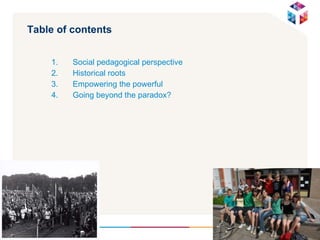
Table of contents Social pedagogical perspective  Historical roots Empowering the powerful Going beyond the paradox?
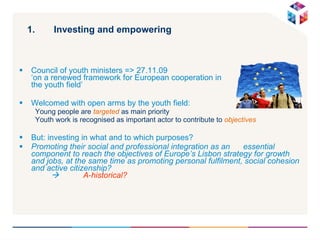
Investing and empowering Council of youth ministers => 27.11.09  ‘on a renewed framework for European cooperation in  the youth field’ Welcomed with open arms by the youth field:  Young people are  targeted  as main priority  Youth work is recognised as important actor to contribute to  objectives But: investing in what and to which purposes? Promoting their social and professional integration as an  essential component to reach the objectives of Europe’s Lisbon strategy for growth and jobs, at the same time as promoting personal fulfilment, social cohesion and active citizenship?     A-historical?
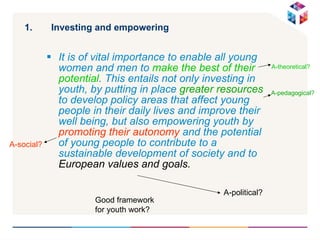
Investing and empowering It is of vital importance to enable all young women and men to   make the best of their potential . This entails not only investing in youth, by putting in place  greater resources  to develop policy areas that affect young people in their daily lives and improve their well being, but also empowering youth by  promoting their autonomy  and the potential of young people to contribute to a sustainable development of society and to  European values and goals.   A-political? A-pedagogical? A-theoretical? A-social? Good framework for youth work?
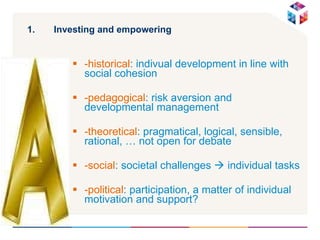
Investing and empowering -historical : indivual development in line with social cohesion  -pedagogical : risk aversion and developmental management -theoretical : pragmatical, logical, sensible, rational, … not open for debate -social : societal challenges    individual tasks -political : participation, a matter of individual motivation and support?
Investing and empowering A technical debate risking to strengthen existing situation Reinforced by policymakers, practitioners and researchers At the most: upwards mobility for individuals, societal status-quo Youth work as a methodical question of “incomes and outcomes” The  accessibility   of youth work The  efficiency  of youth work
Investing and empowering  Increasing two track policy Mainstream work: working with young people –  access is a problem Targeted work: working on young people –  efficiency is a problem The work that works is not accessible, the accessible work does not work Two strategies across Europe Upgrading young people  Upgrading youth work
Investing and empowering  Risk of decontextualisation cf. unstructured youth work has counterproductive effects Unorganised people should be organised, etc. Evidence based policy? Or  speculation? Magic triangle? Discovering or constructing?
 
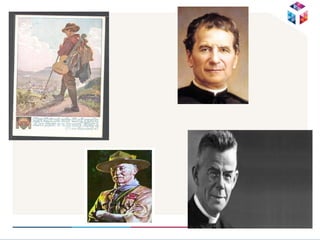
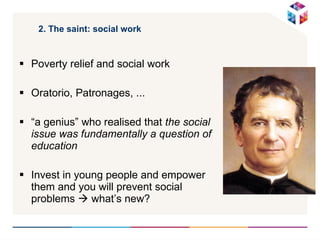
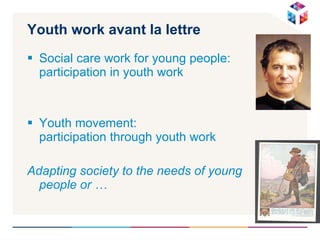
2. The saint: social work Poverty relief and social work Oratorio, Patronages, ... “ a genius” who realised that  the social issue was fundamentally a question of education   Invest in young people and empower them and you will prevent social problems    what’s new?
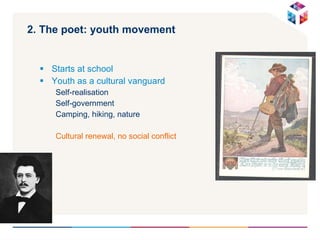
2. The poet: youth movement   Starts at school Youth as a cultural vanguard Self-realisation  Self-government Camping, hiking, nature  Cultural renewal, no social conflict
Youth work avant la lettre Social care work for young people: participation in youth work Youth movement: participation through youth work Adapting society to the needs of young  people or …
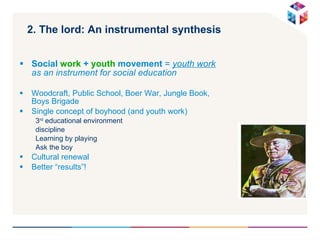
2. The lord: An instrumental synthesis Social  work  +  youth  movement  =  youth work  as an instrument for social education Woodcraft, Public School, Boer War, Jungle Book, Boys Brigade Single concept of boyhood (and youth work) 3 rd  educational environment discipline Learning by playing Ask the boy Cultural renewal  Better “results”!
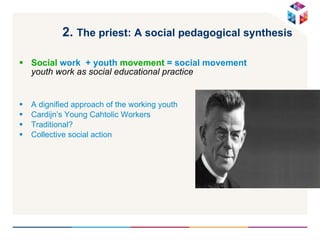
2.  The priest: A social pedagogical synthesis   Social  work  + youth  movement  = social movement  youth work as social educational practice A dignified approach of the working youth  Cardijn’s Young Cahtolic Workers Traditional? Collective social action
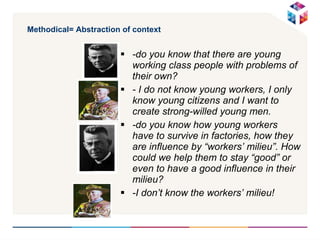
Methodical= Abstraction of context -do you know that there are young working class people with problems of their own? - I do not know young workers, I only know young citizens and I want to create strong-willed young men. -do you know how young workers have to survive in factories, how they are influence by “workers’ milieu”. How could we help them to stay “good” or even to have a good influence in their milieu?  -I don’t know the workers’ milieu!
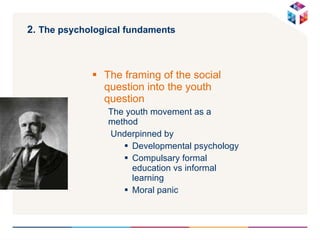
2.  The psychological fundaments   The framing of the social question into the youth question The youth movement as a method Underpinned by Developmental psychology Compulsary formal education vs informal learning Moral panic
2. Youth Workers upgrade themselves Scouting method as model: from action groups and study circles to  youth movement or (scouting)methodology AKVS    KSA Patronages    Chiro The Young Worker    YCW Socialist Young Guards    Red Falcons Emancipation is disconnected from social class. Where have all the working class kids gone?
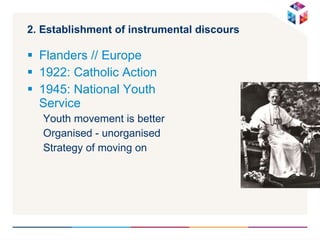
2. Establishment of instrumental discours Flanders // Europe 1922: Catholic Action  1945: National Youth Service Youth movement is better Organised - unorganised Strategy of moving on
2. The Youth Organisation The foreign observer is struck by  the great diversity  of youth movements in Belgium, and, if he has been in the country before, by their immensely increased importance in national life since the recent war. (Picalausa & Vanderbruggen 1946) Through governmental measures and through their own initiative , the leaders of the youth movements are now taking responsibility towards the needs of youth in this changed world: physical health and fitness, moral and character education, vocational guidance and apprenticeship, education toward family responsibility, an adequate civic education adapted to the technical and moral needs of democracy.
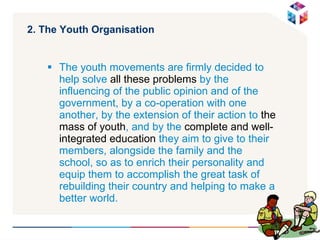
2. The Youth Organisation  The youth movements are firmly decided to help solve  all these problems  by the influencing of the public opinion and of the government, by a co-operation with one another, by the extension of their action to  the mass of youth , and by the  complete and well-integrated education  they aim to give to their members, alongside the family and the school, so as to enrich their personality and equip them to accomplish the great task of rebuilding their country and helping to make a better world.
 
 
2. Sociological fundaments   ‘ The most convincing reply to the charge that the youth organization is a redundant institution was that given by the boys and girls who were themselves members. Those adolescents who belonged to a society were definitely easier to come to terms with than the non-members. They were not only willing but able to talk, and they generally had something worth saying. And were not those youngsters who were active members a shade more reliable, a shade more open-handed than the rest?’  (Jephcott 1954, Smits & Elchardus 2004).
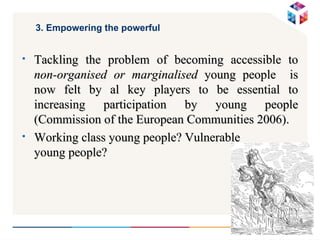
3. Empowering the powerful  Tackling the problem of becoming accessible to  non-organised or marginalised  young people  is now felt by al key players to be essential to increasing participation by young people (Commission of the European Communities 2006). Working class young people? Vulnerable  young people?
3. Empowering the powerful? New open forms of youth work: vulnerable young people, vulnerable youth work  (‘not yet people’, ‘not yet youth work’) Youth work is being redefined as a ‘method’ Youth workers exclude (themselves) from the social debate on the “pedagogical responsibility of society” Contextualization is re-introduced as a method, not as a principle (=> not emancipatory, but disempowering): No direct action: Employment     Employability Failure of school    Failure at school Youth work method works: motivation and access
3. The work that works is not accessible  Working with youth ? universal Needs-led Process ‘ holistic’ social education? Working at youth? Targeted  Budget-led  output en outcome focused ‘ taylorized’ prevention  Dividing lines between mainstream youth and deviant youth
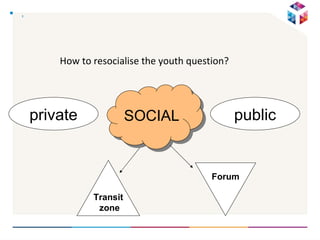
, private public SOCIAL How to resocialise the youth question? Transit zone Forum
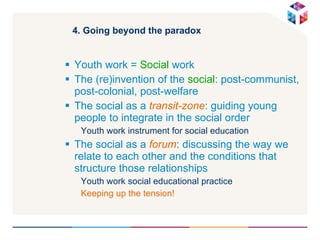
4. Going beyond the paradox Youth work =  Social  work The (re)invention of the  social : post-communist, post-colonial, post-welfare  The social as a  transit-zone : guiding young people to integrate in the social order  Youth work instrument for social education The social as a  forum : discussing the way we relate to each other and the conditions that structure those relationships Youth work social educational practice Keeping up the tension!
We make the road by walking Paolo Freire and Myles Horton