WELCOME
TO
OUR GROUP
PRESENTATION
CANON
Group
GROUP no: 10
WE ARE
LET’S INTRODUCE THE group MEMBER
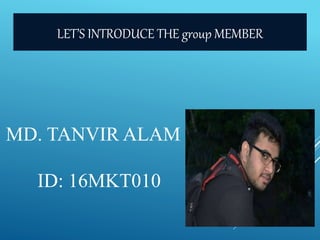
MD. TANVIR ALAM
ID: 16MKT010
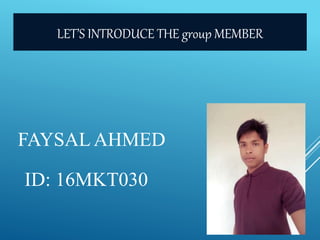
FAYSAL AHMED
ID: 16MKT030
LET’S INTRODUCE THE group MEMBER
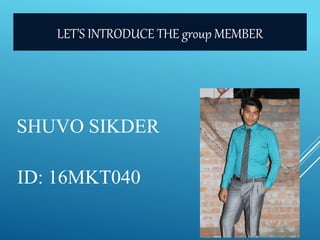
SHUVO SIKDER
ID: 16MKT040
LET’S INTRODUCE THE group MEMBER
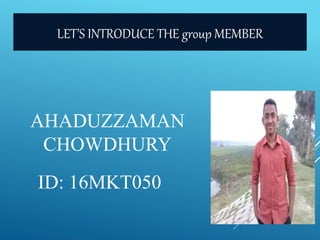
AHADUZZAMAN
CHOWDHURY
ID: 16MKT050
LET’S INTRODUCE THE group MEMBER
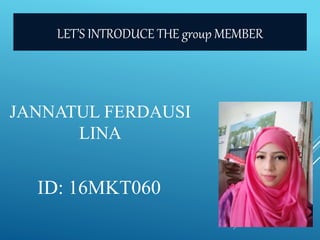
JANNATUL FERDAUSI
LINA
ID: 16MKT060
LET’S INTRODUCE THE group MEMBER
CHAMPA MONDAL
ID: 16MKT070
LET’S INTRODUCE THE group MEMBER
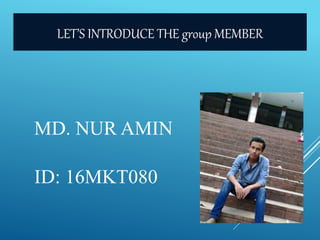
MD. NUR AMIN
ID: 16MKT080
LET’S INTRODUCE THE group MEMBER
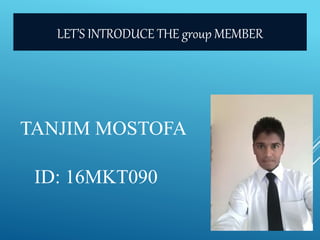
TANJIM MOSTOFA
ID: 16MKT090
LET’S INTRODUCE THE group MEMBER
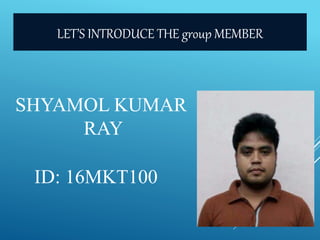
SHYAMOL KUMAR
RAY
ID: 16MKT100
LET’S INTRODUCE THE group MEMBER
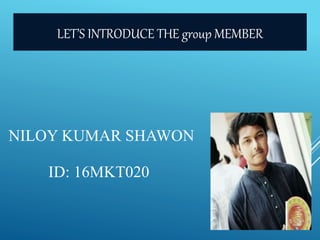
NILOY KUMAR SHAWON
ID: 16MKT020
LET’S INTRODUCE THE group MEMBER
BARRIERS TO COMMUNICATION
Barriers to communication can be defined as the aspects
or conditions that interfere with effective exchange of ideas
or thoughts.
There are five types of barriers to communicate.
These are: 1. Wrong choice of medium
2. Physical barriers
3. Semantic barriers
4. Different comprehensions of reality
5. Socio-physiological barriers
WRONG CHOICE OF MEDIUM
Whatever message we may want to convey, it
has to be transmitted through an appropriate
medium. If you choose the wrong channels
that is if the channels are not effective for the
type of message and meaning you want to
create --you are likely to create
misunderstanding.
PHYSICAL
BARRIERS
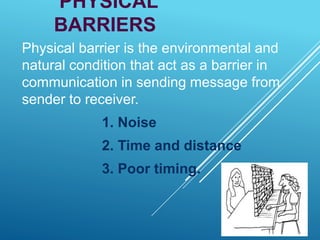
Physical barrier is the environmental and
natural condition that act as a barrier in
communication in sending message from
sender to receiver.
1. Noise
2. Time and distance
3. Poor timing.
SEMANTIC BARRIER
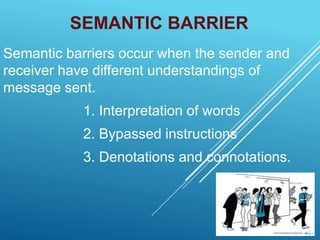
Semantic barriers occur when the sender and
receiver have different understandings of
message sent.
1. Interpretation of words
2. Bypassed instructions
3. Denotations and connotations.
DIFFERENT COMPREHENSION OF
REALITY
The reality of an objective, an event, or a
person is different to different people.
Reality is not a fixed concept, it is complex,
infinite and continually changing.
1. Abstracting
2. Slanting
3. Inferring.
SOCIO-PSYCHOLOGICAL
BARRIERS
Socio-psychological barriers play a major role in the
continuation of intractable conflicts.
1. Attitudes and opinions
2. Emotions
3. Cultural diversity
4. Frame of reference
5. Closed mind
6. Status-consciousness
7. The source of communication
8. Inattentiveness
THANKS FOR YOUR
KIND ATTENTION
ANY
QUESTION?

Barriers to communivationn