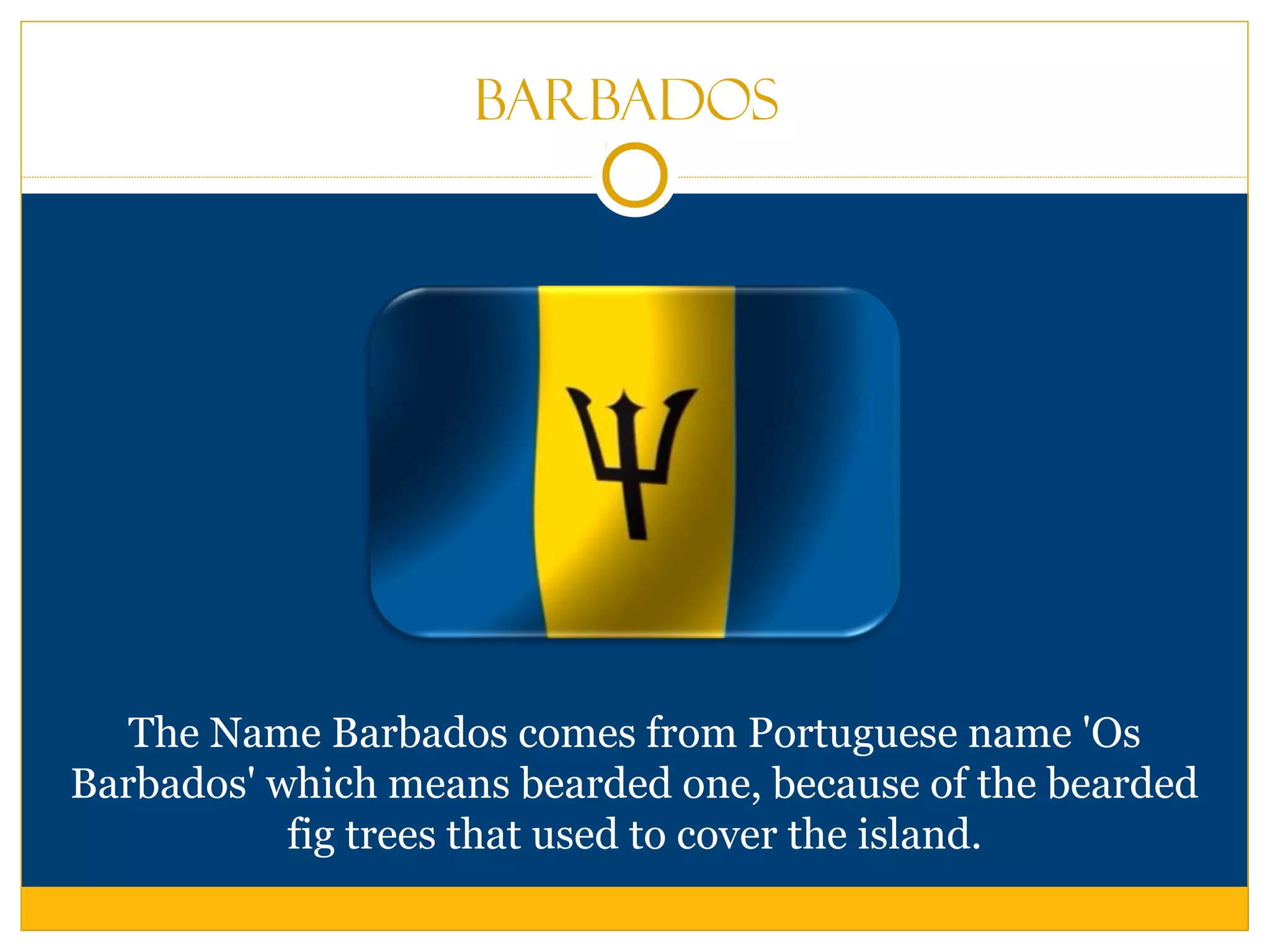
Barbados
The Name Barbados comes from Portuguese name 'Os
Barbados' which means bearded one, because of the bearded
fig trees that used to cover the island.
Historical Background of Barbados
In 1627, a small group of Englishmen arrived from
England, bringing a handful of African captures during the
sea voyage, where they formed England’s second colony in
the Caribbean Islands.
From 1651 to 1807, the last year of British slave trade,
according to book estimate that 352,884 slaves arrived at
the island; on the other land, Curtin estimates 368,200 for
the same period.
The main crop in Barbados was sugar cane which became a
huge commodity on the island.
Maroon Histories
Around the mid-1636, Barbados was
inhabited with about 6,000 English and
established slave trade bringing Africans to
Barbadian shores.
1643-45 estimate 5,680 to 6,400 slaves and
18,300 to 18,600 European males.
Barbados has a mixture of African, British
and other influences. According to Totally
Barbados, Barbados has 90% African
descent, 6% Indian, Asian and mixed races
and 4% European descent.
Slave Revolt
 The end of Napoleonic Wars in
1815 led to a drop in the sugar
market .
 Barbadians had debated and
pleaded with the imperial
government about registration
of colonial slaves.
 As a result a rebellion broke out
on Easter Sunday night April
14, 1816 at a time when the
slaves were free from work.
 Up to seventy estates were
affected and the residents’
whites fled to Oistin fort or
Bridgetown in panic.
 Two whites were killed. About
100 slaves were killed, 144
executed, 170 deported and
roaming slaves were shot on
the spot.
 Negro houses were burned and
captives were tortured .
Convicted rebels were executed
publicly in different parts of the
island .
 The slave revolt became known
as the Bussa Rebellion by
ordinary Barbadians after a
slave from bailey’s estate, St.
Philip.
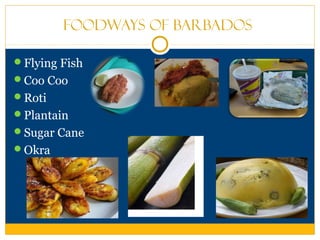
Foodways of Barbados
Flying Fish
Coo Coo
Roti
Plantain
Sugar Cane
Okra
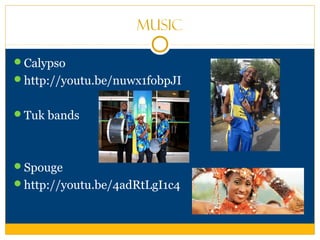
Music
Calypso
http://youtu.be/nuwx1fobpJI
Tuk bands
Spouge
http://youtu.be/4adRtLgI1c4
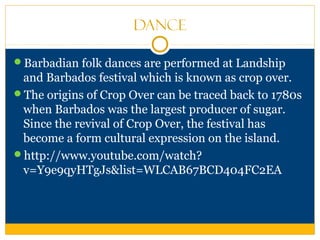
Dance
Barbadian folk dances are performed at Landship
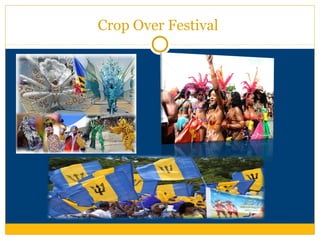
and Barbados festival which is known as crop over.
The origins of Crop Over can be traced back to 1780s
when Barbados was the largest producer of sugar.
Since the revival of Crop Over, the festival has
become a form cultural expression on the island.
http://www.youtube.com/watch?
v=Y9e9qyHTgJs&list=WLCAB67BCD404FC2EA
Crop Over Festival
Religious
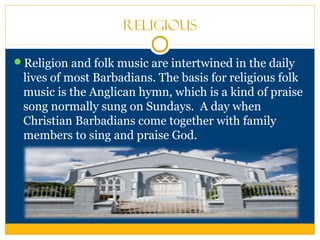
Religion and folk music are intertwined in the daily
lives of most Barbadians. The basis for religious folk
music is the Anglican hymn, which is a kind of praise
song normally sung on Sundays. A day when
Christian Barbadians come together with family
members to sing and praise God.
Present Day Issues
According to UN data, in 2010 unemployment went to
10.8% compared to 9.1 in 2005. Currently, there is no
statics on employment in the industrial sector for 2010
however, in 2005 the employment rate was 17.3%.
According to the Barbados Statistical Service (BSS), the
total value of imports fell by 10.8 per cent or $289.2
million to $2,393.6 million in 2010.
Due to the global recession, the fiscal deficit 2010/2011
was estimated at 8.8 per cent of GDP compared with 8.5
per cent for the period 2009/2010.
Barbadian communities living in the US
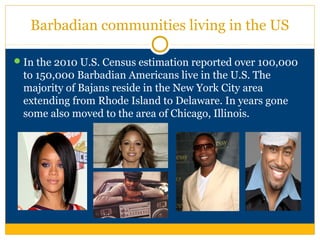
In the 2010 U.S. Census estimation reported over 100,000
to 150,000 Barbadian Americans live in the U.S. The
majority of Bajans reside in the New York City area
extending from Rhode Island to Delaware. In years gone
some also moved to the area of Chicago, Illinois.

Barbados Portfolio Project

  • 1.
    Barbados The Name Barbadoscomes from Portuguese name 'Os Barbados' which means bearded one, because of the bearded fig trees that used to cover the island.
  • 2.
    Historical Background ofBarbados In 1627, a small group of Englishmen arrived from England, bringing a handful of African captures during the sea voyage, where they formed England’s second colony in the Caribbean Islands. From 1651 to 1807, the last year of British slave trade, according to book estimate that 352,884 slaves arrived at the island; on the other land, Curtin estimates 368,200 for the same period. The main crop in Barbados was sugar cane which became a huge commodity on the island.
  • 3.
    Maroon Histories Around themid-1636, Barbados was inhabited with about 6,000 English and established slave trade bringing Africans to Barbadian shores. 1643-45 estimate 5,680 to 6,400 slaves and 18,300 to 18,600 European males. Barbados has a mixture of African, British and other influences. According to Totally Barbados, Barbados has 90% African descent, 6% Indian, Asian and mixed races and 4% European descent.
  • 4.
    Slave Revolt  Theend of Napoleonic Wars in 1815 led to a drop in the sugar market .  Barbadians had debated and pleaded with the imperial government about registration of colonial slaves.  As a result a rebellion broke out on Easter Sunday night April 14, 1816 at a time when the slaves were free from work.  Up to seventy estates were affected and the residents’ whites fled to Oistin fort or Bridgetown in panic.  Two whites were killed. About 100 slaves were killed, 144 executed, 170 deported and roaming slaves were shot on the spot.  Negro houses were burned and captives were tortured . Convicted rebels were executed publicly in different parts of the island .  The slave revolt became known as the Bussa Rebellion by ordinary Barbadians after a slave from bailey’s estate, St. Philip.
  • 5.
    Foodways of Barbados FlyingFish Coo Coo Roti Plantain Sugar Cane Okra
  • 6.
  • 7.
    Dance Barbadian folk dancesare performed at Landship and Barbados festival which is known as crop over. The origins of Crop Over can be traced back to 1780s when Barbados was the largest producer of sugar. Since the revival of Crop Over, the festival has become a form cultural expression on the island. http://www.youtube.com/watch? v=Y9e9qyHTgJs&list=WLCAB67BCD404FC2EA
  • 8.
  • 9.
    Religious Religion and folkmusic are intertwined in the daily lives of most Barbadians. The basis for religious folk music is the Anglican hymn, which is a kind of praise song normally sung on Sundays. A day when Christian Barbadians come together with family members to sing and praise God.
  • 10.
    Present Day Issues Accordingto UN data, in 2010 unemployment went to 10.8% compared to 9.1 in 2005. Currently, there is no statics on employment in the industrial sector for 2010 however, in 2005 the employment rate was 17.3%. According to the Barbados Statistical Service (BSS), the total value of imports fell by 10.8 per cent or $289.2 million to $2,393.6 million in 2010. Due to the global recession, the fiscal deficit 2010/2011 was estimated at 8.8 per cent of GDP compared with 8.5 per cent for the period 2009/2010.
  • 11.
    Barbadian communities livingin the US In the 2010 U.S. Census estimation reported over 100,000 to 150,000 Barbadian Americans live in the U.S. The majority of Bajans reside in the New York City area extending from Rhode Island to Delaware. In years gone some also moved to the area of Chicago, Illinois.