NAME- PAWAN J PATIL
SUB- INDIAN BANKING SECTOR
©PAWAN PATIL
HISTORY OF BANKING SECTOR
 DEVELOPED DURING THE BRITISH ERA.
 BRITISH EAST INDIA COMPANY ESTABLISHED THREE
BANKS.
 BANK OF BENGAL-1809.
 BANK OF BOMBAY-1840.
 BANK OF MADRAS-1843.
 THESE THREE BANK WHERE LATER AMAGALATED AND
CALLED IMPERIOR BANK.
 TAKEN OVER BY STATE OF INDIA IN 1955. ©PAWAN PATIL
BANKING SECTOR
 THE RESERVE BANK OF INDIA WAS ESTABLISHED IN
1935.
 FOLLOWED BY PUNJAB NATIONAL BANK, BANK OF
INDIA,CANARA BANK,INDIAN BANK.
 IN 1969,14 MAJOR BANK WERE NATIONALISED AND
IN 1980, 6 MAJOR PRIVATE SECTOR BANK WERE
TAKEN OVER BY THE GOVERNMENT.
©PAWAN PATIL
OBJECTIVE
 To act in accordance with the broad economic
policies of the government;
 To encourage and mobilise savings by opening
branches in rural and semi-urban areas and to
promote rural credit;
 To establish government partnership in the provision
of cooperative credit;
 To extend financial help for the establishment of
licensed warehouses and cooperative marketing
societies;
 To provide financial help to the small scale and
cottage industries;
 To provide remittance facilities to the banking
institutions. ©PAWAN PATIL
©PAWAN PATIL
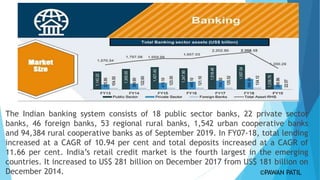
The Indian banking system consists of 18 public sector banks, 22 private sector
banks, 46 foreign banks, 53 regional rural banks, 1,542 urban cooperative banks
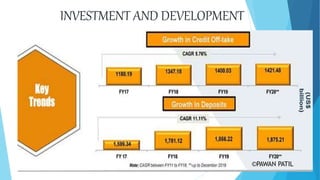
and 94,384 rural cooperative banks as of September 2019. In FY07-18, total lending
increased at a CAGR of 10.94 per cent and total deposits increased at a CAGR of
11.66 per cent. India’s retail credit market is the fourth largest in the emerging
countries. It increased to US$ 281 billion on December 2017 from US$ 181 billion on
December 2014. ©PAWAN PATIL
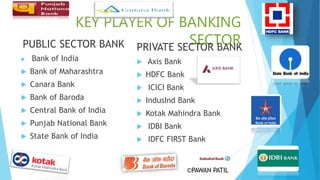
KEY PLAYER OF BANKING
SECTORPUBLIC SECTOR BANK
 Bank of India
 Bank of Maharashtra
 Canara Bank
 Bank of Baroda
 Central Bank of India
 Punjab National Bank
 State Bank of India
PRIVATE SECTOR BANK
 Axis Bank
 HDFC Bank
 ICICI Bank
 IndusInd Bank
 Kotak Mahindra Bank
 IDBI Bank
 IDFC FIRST Bank
©PAWAN PATIL
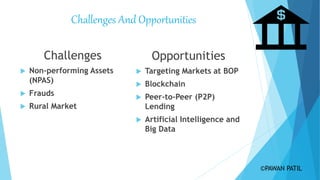
Challenges And Opportunities
Challenges
 Non-performing Assets
(NPAS)
 Frauds
 Rural Market
Opportunities
 Targeting Markets at BOP
 Blockchain
 Peer-to-Peer (P2P)
Lending
 Artificial Intelligence and
Big Data
©PAWAN PATIL
INVESTMENT AND DEVELOPMENT
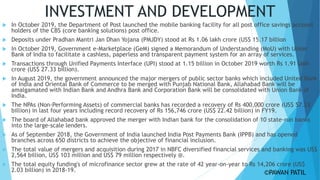
 In October 2019, the Department of Post launched the mobile banking facility for all post office savings account
holders of the CBS (core banking solutions) post office.
 Deposits under Pradhan Mantri Jan Dhan Yojana (PMJDY) stood at Rs 1.06 lakh crore (US$ 15.17 billion
 In October 2019, Government e-Marketplace (GeM) signed a Memorandum of Understanding (MoU) with Union
Bank of India to facilitate a cashless, paperless and transparent payment system for an array of services.
 Transactions through Unified Payments Interface (UPI) stood at 1.15 billion in October 2019 worth Rs 1.91 lakh
crore (US$ 27.33 billion).
 In August 2019, the government announced the major mergers of public sector banks which included United Bank
of India and Oriental Bank of Commerce to be merged with Punjab National Bank, Allahabad Bank will be
amalgamated with Indian Bank and Andhra Bank and Corporation Bank will be consolidated with Union Bank of
India.
 The NPAs (Non-Performing Assets) of commercial banks has recorded a recovery of Rs 400,000 crore (US$ 57.23
billion) in last four years including record recovery of Rs 156,746 crore (US$ 22.42 billion) in FY19.
 The board of Allahabad bank approved the merger with Indian bank for the consolidation of 10 state-run banks
into the large-scale lenders.
 As of September 2018, the Government of India launched India Post Payments Bank (IPPB) and has opened
branches across 650 districts to achieve the objective of financial inclusion.
 The total value of mergers and acquisition during 2017 in NBFC diversified financial services and banking was US$
2,564 billion, US$ 103 million and US$ 79 million respectively @.
 The total equity funding's of microfinance sector grew at the rate of 42 year-on-year to Rs 14,206 crore (US$
2.03 billion) in 2018-19. ©PAWAN PATIL
INVESTMENT AND DEVELOPMENT
©PAWAN PATIL
Government Initiatives
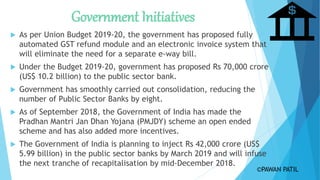
 As per Union Budget 2019-20, the government has proposed fully
automated GST refund module and an electronic invoice system that
will eliminate the need for a separate e-way bill.
 Under the Budget 2019-20, government has proposed Rs 70,000 crore
(US$ 10.2 billion) to the public sector bank.
 Government has smoothly carried out consolidation, reducing the
number of Public Sector Banks by eight.
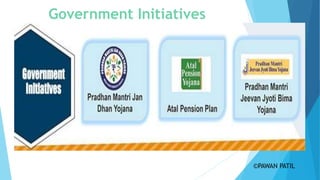
 As of September 2018, the Government of India has made the
Pradhan Mantri Jan Dhan Yojana (PMJDY) scheme an open ended
scheme and has also added more incentives.
 The Government of India is planning to inject Rs 42,000 crore (US$
5.99 billion) in the public sector banks by March 2019 and will infuse
the next tranche of recapitalisation by mid-December 2018.
©PAWAN PATIL
Government Initiatives
©PAWAN PATIL
©PAWAN PATIL

Banking sector

  • 1.
    NAME- PAWAN JPATIL SUB- INDIAN BANKING SECTOR ©PAWAN PATIL
  • 2.
    HISTORY OF BANKINGSECTOR  DEVELOPED DURING THE BRITISH ERA.  BRITISH EAST INDIA COMPANY ESTABLISHED THREE BANKS.  BANK OF BENGAL-1809.  BANK OF BOMBAY-1840.  BANK OF MADRAS-1843.  THESE THREE BANK WHERE LATER AMAGALATED AND CALLED IMPERIOR BANK.  TAKEN OVER BY STATE OF INDIA IN 1955. ©PAWAN PATIL
  • 3.
    BANKING SECTOR  THERESERVE BANK OF INDIA WAS ESTABLISHED IN 1935.  FOLLOWED BY PUNJAB NATIONAL BANK, BANK OF INDIA,CANARA BANK,INDIAN BANK.  IN 1969,14 MAJOR BANK WERE NATIONALISED AND IN 1980, 6 MAJOR PRIVATE SECTOR BANK WERE TAKEN OVER BY THE GOVERNMENT. ©PAWAN PATIL
  • 4.
    OBJECTIVE  To actin accordance with the broad economic policies of the government;  To encourage and mobilise savings by opening branches in rural and semi-urban areas and to promote rural credit;  To establish government partnership in the provision of cooperative credit;  To extend financial help for the establishment of licensed warehouses and cooperative marketing societies;  To provide financial help to the small scale and cottage industries;  To provide remittance facilities to the banking institutions. ©PAWAN PATIL
  • 5.
  • 6.
    The Indian bankingsystem consists of 18 public sector banks, 22 private sector banks, 46 foreign banks, 53 regional rural banks, 1,542 urban cooperative banks and 94,384 rural cooperative banks as of September 2019. In FY07-18, total lending increased at a CAGR of 10.94 per cent and total deposits increased at a CAGR of 11.66 per cent. India’s retail credit market is the fourth largest in the emerging countries. It increased to US$ 281 billion on December 2017 from US$ 181 billion on December 2014. ©PAWAN PATIL
  • 7.
    KEY PLAYER OFBANKING SECTORPUBLIC SECTOR BANK  Bank of India  Bank of Maharashtra  Canara Bank  Bank of Baroda  Central Bank of India  Punjab National Bank  State Bank of India PRIVATE SECTOR BANK  Axis Bank  HDFC Bank  ICICI Bank  IndusInd Bank  Kotak Mahindra Bank  IDBI Bank  IDFC FIRST Bank ©PAWAN PATIL
  • 8.
    Challenges And Opportunities Challenges Non-performing Assets (NPAS)  Frauds  Rural Market Opportunities  Targeting Markets at BOP  Blockchain  Peer-to-Peer (P2P) Lending  Artificial Intelligence and Big Data ©PAWAN PATIL
  • 9.
    INVESTMENT AND DEVELOPMENT In October 2019, the Department of Post launched the mobile banking facility for all post office savings account holders of the CBS (core banking solutions) post office.  Deposits under Pradhan Mantri Jan Dhan Yojana (PMJDY) stood at Rs 1.06 lakh crore (US$ 15.17 billion  In October 2019, Government e-Marketplace (GeM) signed a Memorandum of Understanding (MoU) with Union Bank of India to facilitate a cashless, paperless and transparent payment system for an array of services.  Transactions through Unified Payments Interface (UPI) stood at 1.15 billion in October 2019 worth Rs 1.91 lakh crore (US$ 27.33 billion).  In August 2019, the government announced the major mergers of public sector banks which included United Bank of India and Oriental Bank of Commerce to be merged with Punjab National Bank, Allahabad Bank will be amalgamated with Indian Bank and Andhra Bank and Corporation Bank will be consolidated with Union Bank of India.  The NPAs (Non-Performing Assets) of commercial banks has recorded a recovery of Rs 400,000 crore (US$ 57.23 billion) in last four years including record recovery of Rs 156,746 crore (US$ 22.42 billion) in FY19.  The board of Allahabad bank approved the merger with Indian bank for the consolidation of 10 state-run banks into the large-scale lenders.  As of September 2018, the Government of India launched India Post Payments Bank (IPPB) and has opened branches across 650 districts to achieve the objective of financial inclusion.  The total value of mergers and acquisition during 2017 in NBFC diversified financial services and banking was US$ 2,564 billion, US$ 103 million and US$ 79 million respectively @.  The total equity funding's of microfinance sector grew at the rate of 42 year-on-year to Rs 14,206 crore (US$ 2.03 billion) in 2018-19. ©PAWAN PATIL
  • 10.
  • 11.
    Government Initiatives  Asper Union Budget 2019-20, the government has proposed fully automated GST refund module and an electronic invoice system that will eliminate the need for a separate e-way bill.  Under the Budget 2019-20, government has proposed Rs 70,000 crore (US$ 10.2 billion) to the public sector bank.  Government has smoothly carried out consolidation, reducing the number of Public Sector Banks by eight.  As of September 2018, the Government of India has made the Pradhan Mantri Jan Dhan Yojana (PMJDY) scheme an open ended scheme and has also added more incentives.  The Government of India is planning to inject Rs 42,000 crore (US$ 5.99 billion) in the public sector banks by March 2019 and will infuse the next tranche of recapitalisation by mid-December 2018. ©PAWAN PATIL
  • 12.
  • 13.