NAAC ACCREDITED
Reference Material for Five Years
Bachelor of Law (Hons.)
Code: 038
Semester-VII
DISCLAIMER: FIMT, ND has exercised due care and caution in collecting the data before publishing this
Reference Material. In spite of this, if any omission, inaccuracy or any other error occurs with regards to the data
contained in this reference material, FIMT, ND will not be held responsible or liable. FIMT, ND will be grateful if you
could point out any such error or your suggestions which will be of great help for other readers.
‘A’ Grade Institute by DHE, Govt. of NCT Delhi and Approved by the Bar Council of India and NCTE
INDEX
Five Years Bachelor of Law (Hons.)
Code: 038
Semester – VII
S.NO. SUBJECTS CODE PG.NO.
1 LABOUR LAW-I 401 03-48
2 TAX LAWS 403 49-151
3
LAW & EMERGING
TECHNOLOGY
405 152-229
4 HUMAN RIGHTS LAW 407 229-392
5 BANKING & INSURANCE 409 392-464
LABOUR LAW-I (401)
Labour Law-I
Unit-1 Trade Unions and Collective Bargaining
Trade Unionism in India
Trade unions are organizations of workers formed to protect the rights and interests of workers
through collective action. In India, the first quarter of the 20th century gave the birth of the trade
union movement. A series of strikes were declared in India in the twenties. The success of most
of these strikes led to the organization of many unions. In 1920, the All India Trade Union
Congress (AITUC) was set up. In 1926, the Trade Unions Act was passed which gave a legal
status to the registered trade unions.
Subsequently many trade unions were formed such as:
 Indian National Trade Union Congress (INTUC),
 Centre of Indian Trade Unions (CITU),
 Hind Mazdoor Sabha (HMS),
 Bharatiya Mazdoor Sangha (BMS),
 United Trade Union Congress (UTUC), and
 National Federation of Independent Trade Unions (NFITU).
The trade union movement in India forms a study of the working class, their demands, response
of their owners and redressal measures of the government. In spite of the drain of wealth from
India and British apathetic attitude, the factories grew on this soil. The cotton mills in Bombay,
the jute mills and tea industry grew up. The poor Indian mass got employment in these factories
as workers.
 Low wages, long working hours, unhygienic conditions, exploitation at the hands of
native and foreign capitalists made their condition more miserable. The first Factory Act of 1881
and the Acts of 1891, 1909, 1911 etc. could not end the plights of the working class people.
 The Russian Revolution of 1917 exerted tremendous influence over the working class
people of the world. By the efforts of the leaders like N.M. Joshi, Lala Lajpat Rai and Joseph, the
All-India Trade Union Congress (AITUC) was established in 1920.
 Nationalist leaders like C.R. Das and V. V. Giri also joined their hands with this union.
With the emergence of socialistic and communist ideas, the left wing within the Indian National
Congress became active and leaders like Subhas Chandra Bose and Pandit Jawaharlal Nehru also
presided over the sessions of AITUC.
 With the recognition of the trade unions by the Trade Union Act of 1926, the trade union
movements in India gained momentum. The fourth Congress of the Communist International
sent a message to the AITUC to overthrow capitalism and imperialism. The left wing within the
AITUC also became very active. The revolutionary of Muscovite group wanted to affiliate the
AITUC with the Red Labour Union framed at Moscow.
 In the power struggle, the liberal leader N.M. Joshi left the AITUC and formed another
organization named' Indian Trade Union Federation.
 Under the Leftist direction, the AITUC launched vigorous programmes against the
capitalist class. It foreshadowed a socialist State in India with socialization and nationalization of
the means of production. It organized meetings for protecting the freedom of speech, association,
participation in national struggle etc. The Communist Party also flared up the flame. Though the
government passed several Acts to satisfy the workers, still they carried on their programmes of
strike and protest.
 The trade union activities were so rampant that in 1928 Viceroy Lord Irwin arrested the
prominent leaders and brought them to Meerut for trial. After trial, S.A. Dange, Muzaffar
Ahmed, Joglekar, Spratt etc. were given transportation or rigorous imprisonment. It aroused
worldwide sympathy for the union leaders. However, it hurled a terrible blow on the trade union
activities in India. Now the Leftists and Rightists joined their hands and defended the case.
 During the Non-Cooperation Movement, the British Government suppressed the trade
union leaders with iron hand. The Socialist Party formed in 1934 wanted to cement coherence
between the moderate and the radical trade unions. During the popular governments
between1937-38 the trade unions increased to 296. During Quit India Movement, the Trade
Union Movement went on as usual. The nationalist leaders failed to capture the AITUC but the
Communists had their hold over it. After independence, the trade unions are performing their
rule as usual.
Definition of Trade Union and Trade Dispute
Trade Union Section 2(h): Means any combination whether temporary or permanent, formed
primarily for the purpose of regulating the relation between workmen & employers or between
workmen & workmen or between employers & employers or for imposing restrictive conditions
on the conduct of any trade or business and includes any federation of 2 or more trade unions.
Provide this act shall not affect_
i) Any agreement between partners as to their own business
ii) Any agreement between an employer & those employed by him as to such employment.
iii) Any agreement in consideration of the sale of the goodwill of a business or of instruction in my
profession, trade or handicraft.
In common parlance, Trade Union means an association of workers in one or more occupations.
Its object is the protection and promotion of the interests of the working class. Trade Unions
have a home grown philosophy based on workers' experience and psychology. It grows out of
the workers' day-to-day experience.
Objectives:
Trade union is a voluntary organization of workers relating to a specific trade, industry or a
company and formed to help and protect their interests and welfare by collective action. Trade
unions are the most suitable organizations for balancing and improving the relations between the
employees and the employer. They are formed not only to cater to the workers' demand, but also
for imparting discipline and inculcating in them the sense of responsibility. They aim to:-
 Secure fair wages for workers and improve their opportunities for promotion and
training.
 Safeguard security of tenure and improve their conditions of service.
 Improve working and living conditions of workers.
 Provide them educational, cultural and recreational facilities.
 Facilitate technological advancement by broadening the understanding of the workers.
 Help them in improving levels of production, productivity, discipline and high standard
of living.
 Promote individual and collective welfare and thus correlate the workers' interests with
that of their industry.
 To take participation in management for decision-making in connection to workers and to
take disciplinary action against the worker who commits in-disciplinary action.
Registration of Trade Unions
Legal Status of Registered Trade Union: Upon the registration, a trade union assumes to a
corporate body by the name under which it is registered. A registered trade union shall have
perpetual succession and its common seal. A registered trade union is an entity distinct from the
members of which, the trade union is composed of It enjoys power to contract and to hold
property both moveable and immoveable and to sue and be sued by the name in which it is
registered.
Mode of Registration
The following steps are involved in the registration of trade union:
Section 3 (Appointment of the Registrar): The appropriate government appoints a person to be
the registrar or trade unions for each state.
(a) The appropriate government shall appoint a person to be the registrar of trade unions for each
state. The appropriate government may appoint as many additional and deputy registrars of trade
unions as it thinks fit for the purpose of exercising and discharging under the superintendence
and direction of the registrar.
Such powers and functions of the registrar under this Act as it may, by order, specify and define
the local limits within which any such additional or deputy registrar shall exercise and discharge
the powers and functions so specified.
Section 4 (Mode of registration) says that to register a Trade Union,
 an application must be sent to the Registrar of Trade Unions appointed by an appropriate
government.
 the application must be made by seven or more persons who are engaged in the trade or
industry in connection to which the Trade Union is to be formed.
 all the applicants must subscribe their names to the rules of the Trade Union and comply
with the provisions of this act regarding registration.
 there must be at least 10% or 100, whichever is less, members who are engaged or
employed in the establishment or industry to which it is connected.
 there must be not be less than seven members who are engaged or employed in the
establishment or industry to which it is connected.
If more that half of the persons who applied for the registration cease to be members of the union
or expressly disassociate themselves from the application, the application will be deemed to be
invalid.
Section 5 (Application of Registration) gives the details of the application. It says that the
application should be sent to the registrar along with the copy of the rules of the trade union and
statement of the following particulars.
 The name, occupation, and addresses of the applicants.
 The name of the trade union and the address of its head office.
 The titles, names, ages, addresses, and occupations of the office bearers of the trade
union.
 If the trade union has been in existence for more than 1 yr, a general statement of its
assets and liabilities.
Any seven or more persons who want to form trade union, can apply for its registration to the
Registration of Trade Unions under Section 4 (1) of the Trade Unions Act, 1926. These
applicants must be members of a trade union.
In order to check the multiplicity of trade unions, one school of thought has proposed the number
of persons farming a trade union for the purposes of registration be reasonably increased to 10
per cent of employees of the unit, subject to minimum of seven persons employed therein This is
expected to strengthen the trade union movement. The application for registration must be sent to
the Registrar of Trade Unions in Form “A” as required by the Trade Union Act, 1926 under
Section 5.
Powers and Duties of Registrar:
Section 7 of the Act empowers the Registrar of Trade Union to make, if required so, further
enquiries on receipt of an application for registration to fully satisfy himself that the application
complies with the provisions of section 5. However, such enquiries can be made only from the
application and not from any other source.
The duties of the Registrar of Trade Unions in matters of registration of trade union are laid
down under Section 8 of the Act. On having being satisfied with the requirements for the
registration of the union, the Registrar shall register the trade union by entering in a register. The
letter to this effect will be issued to the Trade Union. In case of non-satisfaction of registrar with
the compliance of requirements, the refusal for registration will be issued to the trade union.
No time limit for the grant or refusal of registration has been prescribed in the Trade Union Act,
1926. However, there are legal directives issued by the Court to the Registrar of Trade Unions to
perform me statutory duty imposed upon mm under sections 7 and 8 to deal with the application
of the Trade Union according to law at an early date
The National Commission on Labour has suggested 30 days excluding the time which the Union
takes in answering queries from the Registrar for the grant or refusal of registration by the
Registrar. The Trade Unions (Amendment) Bill, 1982 has provided for insertion of the words
“within a period of 60 days from the date of such compliance” after the words “Register the
Trade Unions” in Section 8 of the Trade Unions Act, 1926. Where, however, Registrar refuses to
grant registration to a trade union, he is under an obligation to state reasons for refusing to grant
registration.
The Societies of Registration Act, 1860, Co-operative Societies Act, 1912 and the Companies
Act, 1956 do not apply to trade unions and registration thereof under any of these Acts is void ab
initio.
Cancellation and Dissolution of Trade Union: A certificate of registration of a Trade Union
may be withdrawn or cancelled by the Registrar—
(a) on the application of the Trade Union to be verified in such manner as may be
prescribed;
(b) if the Registrar is satisfied that the certificate has been obtained by fraud or mistake or
(c) that the Trade Union has ceased to exist
(d) or has willfully and after notice from the Registrar contravened any provision of this
Act or allowed any rule to continue in force which is inconsistent with any such provision
(e) or has rescinded any rule providing for any of the compulsory matters
(f) where the primary objects of the union are no longer statutory objects
If the Registrar is satisfied that a registered Trade Union of workmen ceases to have the requisite
number of members:
Provided that not less than two months’ previous notice in writing specifying the ground on
which it is proposed to withdraw or cancel the certificate shall be given by the Registrar to the
Trade Union before the certificate is withdrawn or cancelled otherwise than on the application of
the Trade Union.
Change of name of registered trade union
If a registered trade union wants to change its name, the notice of change of name must be in
writing and signed by the 7 members and the Secretary of the union. The name can be changed
with consent of at least 2/3rd
of the total number of the members of the union. On getting the
notice, the Registrar shall register the change in name, if he is satisfied that the proposed name is
not identical with the name of the other existing union and all the requirements in respect of
change of name have been complied with.
Amalgamation and Dissolution of Trade Union:
Section 24 says that any two or more registered trade unions may become amalgamated together
into one trade union with or without dissolution or division of the funds of such trade unions or
either or any of them, provided that votes of at least one half of the members of each trade union
are recorded and at least 60% of the votes of each trade union are in favor of the proposal.
The notice of such amalgamation, signed by the secretary and seven members of each of the
trade unions, should be sent to the registrar of the state where the head office of the amalgamated
trade union is to be located. If the registrar is satisfied that all the provisions of this act have been
complied with and the trade union formed thereby is entitled to registration under section 6, he
will register the new trade union under section 8 and the amalgamation will take effect from the
date of registration.
Any registered trade union may be amalgamated with any other trade union provided at least
50% of the members of each such union record their votes and at least 60% of the votes so
recorded vote in favour of amalgamation. A notice of amalgamation, signed by at least 7
members and the secretary of each amalgamating union should be sent to the Registrar. After the
registration of the notice of amalgamation, the amalgamated trade union shall come in operation.
When a registered Trade Union is dissolved, notice of the dissolution signed by seven members
and by the Secretary of the Trade Union shall, within fourteen days of the dissolution be sent to
the Registrar, and shall be registered by him if he is satisfied that the dissolution has been
effected in accordance with the rules of the Trade Union, and the dissolution shall have effect
from the date of such registration.
Where the dissolution of a registered Trade Union has been registered and the rules of the Trade
Union do not provide for the distribution of funds of the Trade Union on dissolution, the
Registrar shall divide the funds amongst the members in such manner as may be prescribed.
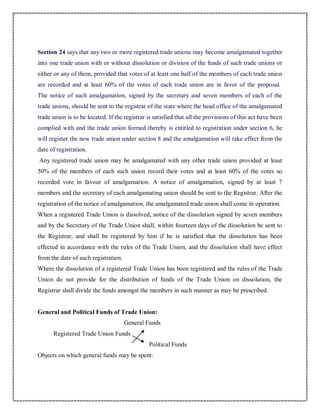
General and Political Funds of Trade Union:
General Funds
Registered Trade Union Funds
Political Funds
Objects on which general funds may be spent:
Section 15: The following are the purposes for which the general funds of the Union may be
spent:
1. Payment of salaries, allowances, etc., to the office bearers of the Union.
2. Payment of expenses for the administration of the Union including other expenses spent
on defending any legal proceedings by or against the Union.
3. Settlement of trade disputes.
4. Special allowances to the members (including dependants) of the Trade Union on account
of death, sickness or accidents, etc.
5. Compensation to members for loss arising out of trade disputes.
6. Providing educational, social and religious benefits to the members.
7. Issue of assurance policies on the lives of members and also against sickness, accidents,
unemployment, insurance, etc.
8. Providing for publication of periodicals for the use of which is intended for the members
benefit.
9. Any other object that may be notified by the appropriate Government in the Official
Gazette.
If funds are spent for any purposes other than the above, such expenditure is treated as unlawful
and the Trade Union can be restrained by the Court for applying its funds in any other purposes.
Section 16: Construction of separate fund for political purposes-
Apart from the primary objects, a Trade Union may have certain other political objects. As per
Sec. 16 a registered union may constitute a separate fund in addition to the general fund and the
payment of such a fund shall be utilized for serving civic and political interest of its members.
The fund can be utilized for the following purposes:
 Holding of any meeting or distribution of any literature or document in support of any
candidate for election as a member of legislative body constituted under the constitution or of
any local authority.
 For maintenance of any person who is a member of any legislative body constituted
under the constitution.
 For convening of political meeting of any kind or distribution of political literature or
documents of any kind.
 The registration of electors for selection of a candidate for legislative body.
The funds collected for political purposes shall not be clubbed with the general fund. No
workman is compelled to contribute in this fund and the nonpayment in this fund cannot be made
a condition for admission to the Trade Union.
Civil and Criminal Immunities of Registered Trade Unions
Section 17: Immunity from Punishment for Criminal Conspiracy
No office bearer or member of a registered Trade Union will not be punished under the Sec
.120B punishment of criminal conspiracy of the Indian Penal Code (Conspiracy cases are defined
as cases in which two or more persons agree to commit a crime or to commit an illegal act.)
regarding the matters of the spending the general funds for proper purpose.
Section 18: Immunity from civil suit to certain cases
No suit or other legal proceeding shall be maintainable in any Civil Court against any registered
Trade Union in the following activities and circumstances.
 Delay in the matters relating to the member of the Trade Union regarding the trade
disputes like ‘contract of employment’, (is an agreement between an employer and an employee
which sets out their employment rights, responsibilities and duties.)
 Trade Union or its members showing interest or interfering in matters of the trade or
business.
 Trade Union or its members showing interest or interfering in matters of the employment
of the persons.
 Trade Union or its members showing interest or interfering in matters of the removal of
labour.
 Trade Union or its members showing interest or interfering in matters of compensating or
remunerating the employees.
 Registered Trade Union shall not be liable in any suit or other legal proceeding in any
Civil Court for the tortious act (wrongful act) committed by the agent of the Trade Union.
 Registered Trade Union is not liable for the vicarious liability (if agent commits mistake
intentionally without the knowledge of the Trade Union, agent is liable but not the Trade Union)
Recognition of Trade Unions
A union must be recognized before it may effectively represent any employees. Once a union is
recognized it serves as the bargaining agent for the workers in a particular bargaining unit. An
employee may not circumvent the union, because recognition entails willingness ‘to negotiate
with a view to striking a bargain and this involves a positive mental decision.
Need For Recognition:
Recognition of trade union is the backbone of collective bargaining. It has been debated time and
again. But inspite of the government stated policy to encourage trade unions, there is no enforced
central legislation on this subject. There are however voluntary code of discipline and
legislations in some states.
Definition of Collective bargaining as the ‘performance of the mutual obligation of the employer
and the representative of the employees to meet at reasonable times and confer in good faith with
respect to wages, hours, and other terms and conditions of employment’. absence of any central
legislation, management in several states have refused to recognize a trade union mainly on five
grounds:
(1) most of the office bearers of the union were outsiders,
(2) and sometimes, those disapproved by management, particularly politicians and ex-
employees;
(3) the union consisted of only small number of employees;
(4) there were many rival unions in existence; and
(5) the trade union was not registered under the Trade Unions Act,
1926.
Collective Bargaining
The term “Collective Bargaining” was used by Beatrice Webb in 1897 for the first time in his
famous book “Industrial Democracy”. Collective Bargaining means negotiation between the
employer and workers to reach agreement on working conditions and other conflicting interests
of both sides (employer and workers).
In simple words, collective bargaining means bargaining between an employer or group of
employers and a bonafide labour union. There are few advantages and disadvantages of
collective bargaining.
Advantages:
1. Collective Bargaining imposes an obligation on both parties to the dispute and creates a
specific code of conduct for parties to the process.
2. The parties to the dispute undertake not to resort to strikes or lock-outs, and thus
collective bargaining ensures peace and industrial harmony.
Disadvantages:
1. Increase in wages, and extra expenses to provide other amenities to workmen and
improvement of working conditions can cause higher cost of production.
2. Political interference in the labour unions during the collective bargaining process
increases the chance for adverse effects.
Unit 2- Standing Orders
Introduction: The absence of Standing Orders in Industrial establishment was one of the most
frequent causes of friction between management and workers in industrial undertaking in India,
and discussions on the subject in the Tripartite Labour Conference in 1943, 1944 and 1945
revealed consensus of opinion in favour of a separate enactment making it obligatory on the part
of the employers in large industrial undertakings in the country to frame and enforce with the
approval of Government, standing orders defining precisely the conditions of employment under
them. The result was the enactment in 1946 of the Industrial Employment (Standing Orders) Act.
Before the passing of the Industrial Employment (Standing Orders) Act, 1946 conditions of the
employment obtaining in several industrial establishments were governed by contracts between
the employer and employees. Sometimes those conditions were reduced in writing and in many
cases they were not reduced to writing, but they were governed by oral agreements. Inevitably in
many cases conditions of services were not well defined and thus articulate. There were thus
complete ambiguity in regard to their nature and scope.
The Act aimed at achieving a transition from mere contract between unequal to the conferment
of ‘status’ on workmen through conditions statutorily imposed upon the employer by requiring
every industrial establishment to frame ‘Standing Orders’ in respect of matters enumerated in the
Schedule appended to the Act.
Concept and Nature of Standing Orders
Definition:
Section 2(g) defines “Standing Orders” to mean rules relating to matters set out in the Schedule.
Thus the items, which have to be covered by the Standing Orders in respect of which the
employer has to make a draft for submission to the certifying officer, are matters specified in the
schedule.
U.P State Sugar Corpn. V B.K Mishra1
, it has been held that since under the Act there is no
requirement to frame standing orders in respect of transfer, the employer cannot be denied the
normal right available to him to transfer an employee from one place to another. The employer
cannot also be denied the right to frame rules and regulations relating to transfer of employees.
However, this normal right can be curtailed by making a specific provision in the rules,
regulations or statute.
Content of the Schedule: The matter refer in the schedule are-
1. Classification of workmen, e.g., whether permanent, temporary, apprentices, probationers, or
badlis.
2. Manner of intimating to workmen periods and hours of work, holidays, pay-days and wage
rates.
3. Shift working.
4. Attendance and late coming.
5. Conditions of, procedure in applying for, and the authority which may grant leave and
holidays.
6. Requirement to enter premises by certain gates, an liability to search.
7. Closing and reporting of sections of the industrial establishment, temporary stoppages of
work and the rights and liabilities of he employer and workmen arising there from.
8. Termination of employment, and the notice thereof to be given by employer and workmen.
9. Suspension or dismissal for misconduct, and acts or omissions which constitute misconduct.
10. Means of redress for workmen against unfair treatment or wrongful exactions by the
employer or his agents or servants.
11. Any other matter which may be prescribed.
Scope and Coverage of the Industrial Employment (Standing Orders) Act, 1946
The Industrial Employment (Standing Orders) Act, 1946 came into force on April 23, 1946. The
Act applies to the whole of India. It was initially made applicable to only those industrial
units/undertakings/establishments wherein 100 or more workers were employed on any day of
the preceding 12 months. Subsequently, the Act was amended in 1961, 1963 and 1982. The Act
1
1994 I LLJ 1004 (All).
empowers the appropriate Governments to extend the provisions of this Act to establishments
employing less than 100 workers after giving not less than two months’ notice, of its intention to
do so, in the official gazette. The Act applies to all the Industrial Establishments as defined in
clause (II) of Section 2 of the Payment of Wages Act, 1936; Factories as defined in clause (II) of
Section 2 of the Factories Act, 1948; the Railways as defined in the Indian Railways Act, 1890
and Establishment of a contractor who employs workmen for the purpose of fulfilling the
contract with the owner of any Industrial Establishment. The Act does not, however, apply to
workmen who are governed by the Fundamental and Supplementary Rules, Civil Service
Temporary Service Regulations, Civilians in Defense Services (Classification, Control and
Appeal) Rules or the Indian Railways Establishments Code or any other rules or regulations that
may be notified in this behalf by the appropriate Government. The provisions of the Act also
apply to newspaper establishments wherein 20 or more employees are employed by virtue of the
enforcement of the Working Journalists (Conditions of Service and Miscellaneous Provisions)
Act, 1955.
The main objectives of the Act, besides maintaining harmonious relationship between the
employers and the employees, are to regulate the conditions of recruitment, discharge,
disciplinary action, leave, holidays, etc. of the workers employed in industrial establishments.
The Act amended in 1982 also provides for payment of subsistence allowance to the workmen
who are kept under suspension pending domestic enquiry. The rules regarding payment of
subsistence allowance to the suspended workmen were further amended by a notification in 1984
facilitating payment during the suspension period, the subsistence allowance at the rate of 50 per
cent of the wages, which he was entitled to, immediately preceding the date of 2 suspension, for
the first 90 days and 75 per cent of such wages for the remaining period of suspension, if the
delay in completion of the disciplinary proceedings is not directly attributable to his conduct.
The employer shall normally complete the enquiry within 10 days and the payment of
subsistence allowance shall also be subject to the workman not taking any employment
elsewhere during the period of suspension.
By virtue of the definition of “Appropriate Government” under Section 2 (b) of the Act, the
following categories of industrial establishments fall within the purview of the Central
Government for the purpose of the Act and the rest coming under the jurisdiction of the
respective State Governments:
(i) Railways
(ii) Mines and Quarries
(iii) Oil fields
(iv) Industrial Establishments in Major Ports.
(v) Establishments under the control of the Central Government such as Central Public Sector
Companies and Corporations.
(vi) Industrial Establishments run departmentally by the Central Government, e.g., Post and
Telegraph Workshops, Government of India Presses, Mints, Central Public Works Departments,
etc.
Certification Process
Section 2(c) Certifying Officer- It means a Labour Commissioner or a Regional Labour
Commissioner, and includes any other officer appointed by the appropriate Government, by
notification in the Official Gazette to perform all or any of the functions of a Certifying Officer
under this Act.
Power of Certifying Officers and Appellate Authority- Section 11(1) of the Act provides that
every certifying Officer and the Appellate Authority shall have all the powers of a Civil Court
for following purposes and shall be deemed to be a Civil Court within the meaning of section
345 and 346 of the Code of Criminal Procedure, 1973.
a) Receiving evidence
b) Administering oaths
c) Enforcing the attendance of witnesses
d) Compelling the discovery and production of documents
Section 3 of the Act provides that within 6 months from the date on which the Act becomes
applicable to an industrial establishment, the employer shall submit to 3 the Certifying Officer, 5
copies of the draft Standing Orders proposed by him for adoption in his industrial establishment.
It further provides that provision shall be made in such draft for every matter set out in the
Schedule applicable to the establishment and shall be, as far as practicable, in conformity with
the Model Standing Orders applicable to the establishment. Therefore, the draft Standing Orders
should normally provide for the following matters:
(i) Classification of Workmen, i.e., Permanent, Temporary, Apprentices, Probationers or Badlis;
(ii) Manner of intimating to workmen the periods and hours of work, holidays, pay days and wage
rates;
(iii) Shift working;
(iv) Attendance and late coming;
(v) Conditions of procedure in applying for and the authority, which may grant leave and holidays;
(vi) Requirement to enter premises by certain gates and liability to search;
(vii) Closing and re-opening of sections of the industrial establishment and temporary stoppages of
work, and the rights and liabilities of the employer and workmen arising there from;
(viii) Termination of employment and the notice thereof to be given by employer to workmen;
(ix) Suspension or dismissal for misconduct and acts of omission which constitute misconduct;
(x) Means of redressal for workmen against unfair treatment or wrongful action by the employer or
his agents or servants; and
(xi) Any other matter, which may be prescribed from time to time.
On receipt of the draft, the Certifying Officer shall initiate to certify the Standing Orders in
accordance with the procedure laid down in Section 5 of the Act which, inter-alia, provides that
all the registered trade unions, and in the absence of the registered trade unions, five elected
representatives of the workmen, shall be given an opportunity to raise objections to the proposed
draft Standing Orders. The Certifying Officer is also required to ensure that provision is made in
the Standing 4 Orders for every matter set out in the Schedule applicable to the industrial
establishment and the Standing Orders are in conformity with the provisions of the Act. For this
purpose, the Certifying Officer shall adjudicate upon the fairness or reasonableness of the
Standing Orders and shall then certify them and send, authenticated copies together with the
orders referred to above, to the parties within 7 days from the date of his orders. The Certified
Standing Orders become enforceable on the expiry of 30 days from the date on which the
authenticated copies of the same are sent to the parties provided no appeal has been preferred
against them. Certifying Officers and appellate authorities have been vested with powers of Civil
Courts for the purpose of receiving evidence, administering oath, enforcing the attendance of
witnesses and compelling the discovery and production of documents and are deemed to be civil
courts within the meaning of Sections 345 and 346 of the Code of Criminal Procedure, 1973 (2)
of 1974.
Appeals against Certification:
It sometime happen that one of the parties does not feel the order of the certifying Officer just
and proper, such a party has power to appeal against the order of the Certifying Officer, Section
6 names the following provision in respect of appeals.
1) 8[Any employer, workmen, trade union or other prescribed representatives of the workmen]
aggrieved by the order of the Certifying Officer under sub-section (2) of Section 5 may, within
19 [thirty days] from the date on which copies are sent under sub-section (3) of that section,
appeal to the appellate authority, and the appellate authority, whose decision shall be final, shall
by order in writing confirm the standing orders either in the form certified by the Certifying
Officer or after amending the said standing orders by making such modifications thereof or
additions there to as it thinks necessary to render the standing orders certifiable under this Act.
2) The appellate authority shall, within seven days of its order under sub-section (1) send copies
thereof to the Certifying Officer, to the employer and to the trade union or other prescribed
representatives of the workmen, accompanied, unless it has confirmed without amendment the
standing orders as certified by the Certifying Officer, by copies of the standing orders a certified
by it and authenticated in the prescribed manner.
Condition for Certification: The standing orders are to be certified by the certifying officer
under certain condition. Section 4 of the Act lays down that Standing Orders shall be certifiable
under this Act under the following condition:-
Section 4: (a) If provision is made therein for every matter set out in the Schedule which is
applicable to the industrial establishment
(b) If the standing orders are otherwise in conformity with the provisions of this Act and it shall
be the function of the Certifying Officer or appellate authority to adjudicate upon the fairness or
reasonableness of the provisions of any standing orders.
The provisions of the Industrial Employment (Standing Orders) Act read with the schedule
thereto show that once the standing orders are certified and come into operation become binding
on the employer and the employee. This view is also in consonance with the object of the Act to
have uniform standing orders for matters mentioned in the schedule to the Act, applicable to all
employees.
Date of Operation of Standing Orders: Standing orders shall, unless an appeal is preferred
under Section 6, come into operation on the expiry of thirty days from the date on which
authenticated copies thereof are sent under sub-section (3) of Section 5, or where an appeal as
aforesaid is preferred, on the expiry of seven days from the date on which copies of the order of
the appellate authority are sent under sub-section (2) of Section 6.
The Standing Orders become mandatory provisions thereafter and must be followed if an
industrial dispute arises.
Posting of Standing Orders: The Act imposes a duty upon the employer to put up the text of
certified standing orders in English language of the majority of workmen on special boards
maintained for the purpose, at or near the entrance through which the majority of workmen enter
the industrial establishment and in all departments thereof where the workmen are employed.
This section has been held to be merely directory but non-compliance with the direction may
result in the employer not succeeding in satisfying the industrial tribunal that there is proper case
for termination of service or other disciplinary action.
Modification Standing Orders
• Under Section 10 (1) Standing orders finally certified under this Act shall not be
modified until the expiry of six months from the date on which the standing order or the last
modifications thereof come into operation, unless the agreement provide otherwise.
• An employer or workmen may apply to the Certifying Officer to have the standing orders
modified. Such application must be accompanied by five copies of the modification proposed to
be made.
• However where such modifications are proposed to be made by agreement between the
employer and the workmen, a certified copy of that agreement shall be filed along with the
application.
• The Supreme Court in Shahadara Saharanpur Light Railway Co. Ltd v. S.S. Railway
Workers Union2
observed the object of providing the time limit was that the standing orders or
their modifications should be allowed to work for a sufficiently long time to see whether they
work properly or not. Even that time limit is not rigid because a modification even before six
months is permissible if there is an agreement between the parties.
Penalties and Procedure
Section 13 of the Act prescribes the penalties and procedure in case of violation of the provisions
of the Act. It contains the following provisions in this regard-
2
AIR (1969 SC 513
1) An employer who fails to submit draft Standing Orders as required by Section 3 or who
modifies his standing orders otherwise than in accordance with Section 10, shall be punishable
with fine which may extend to five thousand rupees, and in the case of a continuing offence with
a further fine which extend to two hundred rupees for every day after the first during which the
offence continues.
2) An employer who does any act in contravention of the standing orders finally certified under
this Act for his industrial establishment shall be punishable with fine which may extend to one
hundred rupees, and in the case of a continuing offence with a further fine which may extend to
twenty-five rupees for every day after the first during which the offence continues.
3) No prosecution for an offence punishable under this section shall be instituted except with
the previous sanction of the appropriate Government.
4) No court inferior to that of a Metropolitan Magistrate or Judicial Magistrate of the second
class shall try any offence under this section.
Unit 3- Resolution of Industrial Dispute
The Industrial Dispute Bill was introduced by the Government of India in the Legislative
Assembly on 28th
October, 1946. After the Select Committee’s Report on 3rd
February, 1947
with some amendments it was passed in March 1947 and became the law fro 1st
April, 1947
repealing the Trade Disputes Act 1929.
The purpose of the Industrial Disputes Act has been to harmonies the relations between the
employer and the employees and thereby to restore and maintain industrial peace. The object and
reason was to provide effective machinery for settlement of industrial disputes to prohibit and
restrict strikes and lock-outs, to provide retrenchment compensation to retrenched employees, to
provide certain rules regarding lay-off.
The Supreme Court has observed in Workmen of Dimakuchi Tea Estate v. The Management of
Dimakuchi Tea Estate3
that an examination of the salient provisions of the Industrial Disputes
Act shows that the principal objects of the Act are
1. The promotion of measures for securing and preserving amity and good relations between the
employer and workmen
2. An investigation and settlement of industrial disputes between employers and employers,
employers and workmen, or workmen and workmen, with a right of representation by a
3
(1958) SCR 1156.
registered trade union, or federation of trade unions or association of employers or a federation
of association of employers
3. Prevention of illegal strikes and lock-outs
4. Relief to workmen in the matter of lay-off and retrenchment
5. Collective bargaining
Industrial Dispute and Individual Disputes:
Section 2(K) Industrial Dispute is “any dispute of difference between employers and employers
or between employers and workmen; or between workmen and workmen, which is connected
with the employment or non-employment or the terms of employment or with the conditions of
labour of any person.”
Industrial dispute as defined under Sec. 2(k) exists between-
Parties to the dispute who may be
 Employers and workmen
 Employers and Employers
 Workmen and workmen
a) There should be a factum of dispute not merely a difference of opinion.
b) It has to be espoused by the union in writing at the commencement of the dispute. Subsequent
espousal will render the reference invalid. Therefore date when the dispute was espoused is very
important.
c) It affects the interests of not merely an individual workman but several workmen as a class
who are working in an industrial establishment.
d) The dispute may be in relation to any workman or workmen or any other person in whom they
are interested as a body.
The definition of “Industrial Dispute” under section 2(K) may include within its ambit a dispute
between a single workman and his employer, because the plural in the context, will include the
singular.
Before insertion of Section 2-A of the Act an individual dispute could not per se be an industrial
dispute, but it could become one if taken up by the Trade Union or a number of workmen. The
Supreme Court and indeed majority of Industrial Tribunals are inclined to take the view that a
dispute raised by a dismissed employee provided it is supported either by his Union or in the
absence of a Union, by a number of workmen can become an industrial dispute.
In order that the individual disputes may be held to be an industrial dispute it is necessary that it
must fulfill two conditions:
(i) That the workmen as a body or a considerable section of them must be found to have made
common cause with the individual workmen
(ii) That the dispute was taken up or sponsored by the workmen as a body or a considerable section
of them at a time before the date of reference
Section 2-A provides that “where any employer discharges, dismisses, retrenches or otherwise
terminated the services of any individual workman, any dispute or difference between that
workman and his employer connected with, or arising out of such discharge, dismissal,
retrenchment or termination shall be deemed to be an industrial dispute, notwithstanding that no
other workman nor any union of workmen, is a party to the dispute.”
 Any workman may make an application directly to the labour court or Industrial Tribunal
for adjudication of such dispute after the expiry of 3 months when an application was made
before the conciliation officer. This has been done to prevent inordinate delay.
 The said application however should be made within 3 years of the date of dismissal,
discharge, retrenchment or termination of service.
 The court shall proceed to hear the matter as if it was referred to it U/S 10 of the ID Act.
Arena of Interaction and Participants: Industry, Workman and Employer
Section 2(j) defines ‘industry’ to mean: any business, trade, undertaken, manufacture or calling
of employers and including any calling, service, employment, handicraft or industrial occupation
or avocation of workmen.
Section 2(s) ‘Workman’ means any person (including an apprentice employed in any industry to
do any manual, unskilled, skilled, technical, operational, clerical or supervisory work for hire or
reward, whether the terms of employment be express or implied, and for the purposes of any
proceeding under this Act in relation to an industrial dispute, includes any such person who has
been dismissed, discharged or retrenched in connection with, or as a consequence of, that
dispute, or whose dismissal, discharge or retrenchment has led to that dispute, but does not
include any such person-
(i) who is subject to the Air Force Act, 1950 (45 of 1950), or the Army Act, 1950 (46 of 1950),
or the Navy Act, 1957 (62 of 1957); or
(ii) who is employed in the police service or as an officer or other employee of a prison; or
(iii) who is employed mainly in a managerial or administrative capacity; or
(iv) who, being employed in a supervisory capacity, draws wages exceeding one thousand six
hundred rupees per mensem or exercises, either by the nature of the duties attached to the office
or by reason of the powers vested in him, function mainly of a managerial nature.
Section 2(g) "employer" means (i) in relation to an industry carried on by or under the authority
of any department of [the Central Government or a State Government,] the authority prescribed
in this behalf, or where no authority is prescribed, the head of the department
(ii) in relation to an industry carried on by or on behalf of a local authority, the chief executive
officer of that authority
The Supreme Court was called upom to interpret the word ‘industry’ for the first time in D.N
Banerji v. P.R Mukherjee4
also known as Budge Budge Municipality Case. In this case court
observed (with reference to Federated Municipal and shrie Council Employees’ Union of
Australia v. Lord Mayor, Alderman, Councilors and Citizen of the Melbourne Corporation5
) that
Industrial disputes occur when in relation to operations in which capital and labour are
contributed in corporation for the satisfaction of human wants and desires, those engaged in
cooperation dispute as to the basis to be observed, by the parties engaged, respecting either in
share of the product or any other terms and conditions of their cooperation. The Supreme Court
accordingly dismissed the appeal filed by the municipality.
The court also ruled that neither investment of capital nor profit motive was sine qua non for
determining whether an activity was an ‘industry’ or not. The court accordingly held that several
departments of municipal corporation, namely
i) Tax dept.
ii) Fire brigade dept.
iii) Public conveyance department
iv) Lighting department
v) Water works dept.
vi) City engineering dept.
vii) Enforcement dept.
viii) Sewerage dept.
ix) Estate dept.
4
(1953) 1LLJ 195
5
26 CLR, 5008, 554-555.
x) General administration dept.
were not discharging sovereign or regal function and were therefore included within the
definition of industry.
Settlement of Industrial Dispute
To protect the interest of the community as well as that of labour and management, legislature
has found it necessary to intervene in labour management relations. Thus, the Industrial Disputes
Act , 1947 provides for the constitution of various authorities to preserve industrial harmony. At
the lowest level is the works committee. The various machineries for investigation and
settlement of industrial disputes under the Act are:
i) Conciliation
ii) Court of Inquiry
iii) Adjudication
iv) Voluntary arbitration
Work Committee
The institution of work committee was introduced in 1947 under the Industrial Disputes Act
1947, to promote measures for securing and preserving amity and good relations between
employers and workmen. It was meant to create a sense of partnership or comradeship between
employers and workmen. It is concerned with problems arising in day to day working of the
establishment and to ascertain grievances of the workmen.
• In the case of any industrial establishment in which one hundred or more workmen are employed
or have been employed on any day in the preceding twelve months, the appropriate Government
may by general or special order require the employer to constitute in the prescribed manner a
Works Committee consisting of representatives of employers and workmen engaged in the
establishment so however, that the number of representatives of workmen on the Committee
shall not be less than the number of representatives of the employer.
• It shall be the duty of the Works Committee to promote measures for securing and preserving
amity and good relations between the employer and workmen and, to that end to comment upon
matters of their common interest or concern and endeavor to compose any material difference of
opinion in respect of such matters.
• There are Joint Committees of employers and employees for the purpose of promoting good
relations between the parties. The Committees attempt to remove causes of friction between
employers and workers in the day-to-day working of the factory. They provide a forum for
negotiations between employers and workers at the factory level. The Government may direct
industrial establishments with 100 or more workers to constitute such works committees.
Remedial Measures:
The National Commission on Labour suggested the following measures for the successful
functioning of a works committee:
a) A more responsive attitude on the part of management
b) Adequate support from unions
c) Proper appreciation of the scope and functions of the works committee
d) Proper coordination of the functions of the multiple bipartite institutions at the plant level now in
vogue.
Steps for success of a work committee
i) Trade unions should change their attitude towards the work committee.
ii) The management should also realize that some of their known prerogatives are meant to be
parted with.
iii) Recognition therefore should be incorporated in the Trade Union Act, 1926.
Conciliation Machinery
The appropriate Government has been authorized to appoint one or more Conciliation Officers
for mediating and promoting the settlement of industrial disputes. A Conciliation Officer can be
appointed either for a specified area or for a specified industry or industries. In order to bring
about a right settlement of a dispute, a Conciliation Officer is given wide desecration. Whereas,
it is obligatory on the parties involved in the dispute to appear before him, is summoned, but they
are not bound to accept his point of view.
Conciliation as a mode of settings industrial disputes has shown remarkable success in many
industrialized countries.
Conciliation Authorities:
a) Appointment of Conciliation Officer- under Section 4, the appropriate government is empowered
to appoint conciliation officers for promoting settlement of industrial disputes. These officers are
appointed for a specified area or for specified industries in a specified area or for one or more
specified industries, either permanently or for a limited period.
b) Constitution of Board of Conciliation- Where dispute is of complicated nature and requires
special handling, the appropriate government is empowered to constitute a board of conciliation.
The board is preferred to conciliation officers. The board is constituted on an ad hoc basis. It
consists of an independent persons as chairman and one or two nominees respectively of
employers and workmen as members. The chairman must be an independent person. A quorum
is also provided for conducting the proceedings.
Duties of Conciliation Authorities:
Duties of Conciliation Officers- A Conciliation Officer may take appropriate steps for inducing
the parties to a fair and amicable settlement of the dispute. If a settlement is arrived at during
conciliation proceedings, he must send a copy of the report and the memorandum of the
settlement signed by the parties to appropriate Government or an officer authorized by it. In case
no settlement is arrived at, he is required to send to appropriate Government, full report of the
steps taken by him to resolve the dispute, and the reasons on account of which a settlement could
not be arrived at.
The Conciliation Officer is required to submit his report within fourteen days of the
commencement of the conciliation proceedings, but the time for the submission of the report
may be extended further on the written request of the parties to the dispute. Where a settlement is
not reached, the appropriate Government, after considering the report of the conciliation officer,
may refer the dispute to a Board of Conciliation or Labour Court or Industrial Tribunal or
National Tribunal as the case may be.
Duties of Board of Conciliation: A board to which a dispute is referred must investigate the
dispute and all matters affecting the merits and the right settlement thereof and do all things for
purpose of inducing the parties to come to a fair and amicable settlement of the dispute without
delay.
If a settlement is arrived at, the board should send a report to the appropriate government
together with a memorandum of the settlement signed by the parties to the dispute. If no
settlement is reached, the board must send a full report together with its recommendation for the
determination of the dispute. Then ‘appropriate government’ may refer the dispute to a labour
court, tribunal or national tribunal.
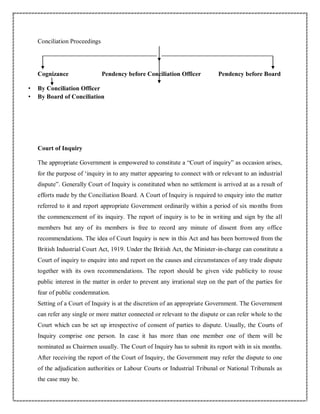
Conciliation Proceedings
Cognizance Pendency before Conciliation Officer Pendency before Board
• By Conciliation Officer
• By Board of Conciliation
Court of Inquiry
The appropriate Government is empowered to constitute a “Court of inquiry” as occasion arises,
for the purpose of ‘inquiry in to any matter appearing to connect with or relevant to an industrial
dispute”. Generally Court of Inquiry is constituted when no settlement is arrived at as a result of
efforts made by the Conciliation Board. A Court of Inquiry is required to enquiry into the matter
referred to it and report appropriate Government ordinarily within a period of six months from
the commencement of its inquiry. The report of inquiry is to be in writing and sign by the all
members but any of its members is free to record any minute of dissent from any office
recommendations. The idea of Court Inquiry is new in this Act and has been borrowed from the
British Industrial Court Act, 1919. Under the British Act, the Minister-in-charge can constitute a
Court of inquiry to enquire into and report on the causes and circumstances of any trade dispute
together with its own recommendations. The report should be given vide publicity to rouse
public interest in the matter in order to prevent any irrational step on the part of the parties for
fear of public condemnation.
Setting of a Court of Inquiry is at the discretion of an appropriate Government. The Government
can refer any single or more matter connected or relevant to the dispute or can refer whole to the
Court which can be set up irrespective of consent of parties to dispute. Usually, the Courts of
Inquiry comprise one person. In case it has more than one member one of them will be
nominated as Chairmen usually. The Court of Inquiry has to submit its report with in six months.
After receiving the report of the Court of Inquiry, the Government may refer the dispute to one
of the adjudication authorities or Labour Courts or Industrial Tribunal or National Tribunals as
the case may be.
Voluntary Arbitration: Voluntary arbitration is one of the effective modes of settlement of an
industrial dispute, it supplements collective bargaining. When negotiation fails, arbitration may
prove to be a satisfactory and most enlightened method or resolving an industrial dispute.
It is important because it is
i) Expected to take into consideration the realities of the situation
ii) Expected to meet the aspiration of the parties
iii) Based on voluntarism
iv) Does not compromise the fundamental position of the parties
v) Expected to promote mutual trust
Section 10A (1) of the Industrial Disputes Act, 1947 authorizes the parties to make reference to a
voluntary arbitrator. But before the reference may be made to the arbitrator, four conditions must
be satisfied:-
1. The Industrial Dispute must exist or be apprehended
2. Agreement must be in writing
3. The reference must be made before a dispute has been referred under Section 10
to a labour court, tribunal or national tribunal
4. The name of arbitrator must be specified
Adjudication: Labour Court, Tribunal and National Tribunal
The final stage in the settlement of industrial disputes is compulsory arbitration which envisages
governmental references to statutory bodies such as labour court, industrial tribunal or national
tribunal. Disputes are generally referred for adjudication on their recommendation of the
conciliation officer who had dealt with them earlier. When the dispute is referred to adjudication
with the consent of the disputing parties, it is called ‘voluntary adjudication.’ When the
government herself refers the dispute to adjudication without consulting the concerned parties, it
is known as ‘compulsory adjudication.
The Industrial Disputes (Amendment and Miscellaneous Provisions) Act, 1956 introduces three-
tier machinery for the adjudication of industrial disputes:
1. Labour Court
2. Industrial Tribunal
3. National Tribunal
The system of adjudication by labour court, tribunal, and national tribunal has perhaps been one
of the most important instruments of regulating the rights of the parties in general and wages,
allowances, bonus, working conditions, leave, holidays and social security provisions in
particular. The appropriate government is empowered under Section 7 and 7A to constitute one
or more labour courts and industrial tribunals with limited jurisdiction, to adjudicate ‘industrial
disputes’ and central government is authorized under Section 7B to constitute the national
tribunal.
Labour Court:
Under Section 7 of the Industrial Disputes Act, 1947, the appropriate Government by notifying
in the official Gazette, may constitute Labour Court for adjudication of the industrial disputes
The labour court consists of one independent person who is the presiding officer or has been a
judge of a High Court, or has been a district judge or additional district judge for not less than 3
years, or has been a presiding officer of a labour court for not less than 5 years. The labour court
deals with the matters specified in the second schedule of the Industrial Disputes Act, 1947.
These relate to:
1. The property or legality of an employer to pass an order under the standing orders.
2. The application and interpretation of standing orders.
3. Discharge or dismissal of workers including reinstatement or grant of relief to workmen
wrongfully dismissed.
4. Withdrawal of any statutory concession or privilege.
5. Illegality or otherwise of a strike or lockout.
6. All matters other than those reserved for industrial tribunals.
Industrial Tribunal:
Under Section 7A of the Act, the appropriate Government may constitute one or more Industrial
tribunals for the adjudication of industrial disputes. Compared to labour court, industrial
tribunals have a wider jurisdiction. An industrial tribunal is also constituted for a limited period
for a particular dispute on an ad hoc basis.
The matters that come within the jurisdiction of an industrial tribunal include the
following:
1. Wages, including the period and mode of payment.
2. Compensatory and other allowances.
3. Hours of work and rest periods.
4. Leave with wages and holidays.
5. Bonus, profit sharing, provident fund, and gratuity.
6. Classification by grades.
7. Rules of discipline.
8. Rationalization.
9. Retrenchment of employees and closure of an establishment or undertaking.
10. Any other matter that can be prescribed.
National Tribunal:
This is the third one man adjudicatory body appointed by the Central Government by notification
in the Official Gazette for the adjudication of industrial disputes of national importance. The
central Government may, if it thinks fit, appoint two persons as assessors to advise the National
Tribunal. When a national tribunal has been referred to, no labour court or industrial tribunal
shall have any jurisdiction to adjudicate upon such matter.
Powers of the Appropriate Government under the Industrial Disputes Act, 1947
Section 10 of the Industrial Disputes Act, 1947, empowers the appropriate government not only
to refer the industrial dispute but also to choose the disputes settlement process. Thus sub-section
(1) provides-
Where the appropriate government is of the opinion that any industrial dispute exists or is
apprehended, it may at any time, by order in writing-
(a) Refer the dispute to a Board for promoting a settlement thereof; or
(b) Refer any matter appearing to be connected with or relevant to the dispute to a Court for
inquiry; or
(c) Refer the dispute or any matter appearing to be connected with, or relevant to, the dispute, if
it relates to any matter specified in the Second Schedule, to a Labour Court for adjudication; or
(d) Refer the dispute or any matter appearing to be connected with, or relevant to, the dispute,
whether it relates to any matter specified in the Second Schedule or the Third Schedule, to a
Tribunal for adjudication:
Unfair Labour Practice
Unfair Labour Practice means any of the practices specified in fifth schedule. The definition of
this expression has been inserted for the first time by the amendment made in 1982 which has
come into force with effect from 1984. The fifth Schedule has been inserted by the same
amendment. It contains several practices. In category I it contains 16 practices which are said to
be unfair practices on the part of employers or their trade unions.
On the other hand Category II of the fifth Schedule contains eight practices which are said to be
unfair labour practices on the part of the workmen or their trade unions such as to advice or
actually support or instigate any strike deemed to be under the Act to stage demonstration at the
residence of the employers or the managerial staff members, to incite or indulge in willful
damage to employer’s property connected with the industry, to indulge in acts of force or
violence or to hold out threats of intimidation against any workmen with a view to prevent from
attending work etc.
Unfair conduct of an employer during the course of employment
1. refusal to promote or demotion
2. unfair conduct during the course of the probation period
3. refusal to provide benefits or training
4. unfair suspension
5. disciplinary action short of dismissal such as warnings or suspension without pay or transfers
Haryana State Electronics Development Corporation Ltd. v. Mamni6
Therein the action on the part of the employer to terminate the services of an employee on
regular basis and reappoint after a gap of one or two days was found to be infringing the
provisions of Section 25-F of the Industrial Disputes Act. This Court held: In this case the
services of the respondent had been terminated on a regular basis and she had been reappointed
after a gap of one or two days. Such a course of action was adopted by the Appellant with a view
to defeat the object of the Act.
6
MANU/SC/8137/2006 : (2006)IILLJ744SC
Unit 4 Instruments of Economic Coercion
a)Concept of strike
In general, labour’s instruments of economic coercion comprise such workers’ action or
omission in furtherance of an industrial dispute which threaten or inflict financial loss on the
management. They put management under economic pressure to accept the demand of workers.
The activities may assume various forms e.g. withdrawal of labour and quarantines of labour,
raw material, customer, dealer or any combination of these. Further, the withdrawal of labour or
the quarantine may be total or partial.
i) Gherao
The expression “Gherao" in its etymological sense means to encircle. It is comparatively a new
form of demonstration which is being largely resorted to by the lab our in this country. Gherao
is a physical blockade of a target, either by encirclement intended to block the exit or entry from
and to a particular office, of even residence or forcible occupation. The target may be a place or
person, usually the managerial or supervisory staff of an establishment. Some of the offences
under this category are cruel and inhuman, like confinement in a small place without lights, fans
and for long periods without food or communication with the outside world. The object of
“Gherao" is to compel those who control the establishment to submit to the demands of the
workers without recourse to machinery provided for by law and in wanton disregard of it. It is
more of a mechanism which uses violence as an approach to get their demands met.
The National Commission on Labour has refused to accept ‘gherao’ as a form of industrial
protest on the ground that it tends to inflict physical duress (as against economic press) on the
persons gheraoed and endangers not only industrial harmony but also creates problems of law
and order.
Workmen found guilty of wrongfully restraining any person or wrongfully confining him during
a gherao are guilty under Section 339 or 340 of the Indian Panel Code of having committed a
cognizable offence for which they would be liable to be arrested without warrant and punishable
with simple imprisonment for a term which may be extended to one month or with a fine up to
Rs. 500, or with both.
ii) Bandh and Lock-out
It is a Hindi word which means ‘closed’ or ‘locked’. The expression therefore conveys an idea
that everything is to be blocked or closed. Bandh is distinct and different from a general strike or
hartal.
Lock-out is the counter-part of strikes. While a ‘strike’ is an organized or concerted withdrawal
of the supply of labour, ‘lock-out’ is withholding demand for it. Lock-out is the weapon
available to the employer to shut-down the place of work till the workers agree to resume work
on the conditions laid down by the employer. The Industrial Disputes Act, 1947 defined lock-out
as “the temporary shutting down or closing of a place of business by the employer”.
The instrument of lock-out was resorted to by an employer or group of employers to ban union
membership.
Section 2(1) of the Industrial Disputes Act, 1947 defines ‘lockout’ to mean:
The temporary closing of a place of employment or the suspension of work, or the refusal by an
employer to continue to employ any number of persons employed by him.
The analysis of the definition would show that there are the following requirements of lockout:
a) Temporary closing of place of employment
b) The element of a demand for which the industrial establishment is locked out, must exist.
c) The intention to reopen or take the workers back if they accept the demand must exist.
d) The employer and the employees must be engaged in an industrial process carried on in an
institution falling within the meaning of institution falling within the meaning of industry as
defined in section 2(j).
A delineation of the nature of this weapon of industrial warfare requires description of
 the act which constitute it
 the party who uses it
 the party against whom it is directed
 the motive which prompts resort to it.
iii) Types of Strike
Classified from the measures and degree of withdrawal by the workmen the strike may take the
following forms:
i) Where services are withdrawal totally but on particular time, the strikes are known as Alternate
Day strikes.
ii) Where services are withdrawn partially the strikes are known as stay-in-strike, sit-down strike,
pen-down strike or tool down strike
iii) Where strikes remain on the job but adopt irrelative methods e.g., go-slow
Go- slow: Often workers deliberately slow down the pace of production. There is no cessation of
work or refusal to continue to work or refusal to accept employment. But nevertheless, the
economic implications are very serious as the cost of production goes up, delivery schedule gets
upset and very often, raw material and machinery are adversely affected.
Workers adopt this practice to circumvent the statuary restrictions. On go- slow, however, when
they are disciplined for misconduct, they assert that the practice amounts to a strike.
Hunger Strike: Hunger strike is a strike with fasting by some or all strikers or even outsiders
super added to exert moral force or perhaps what may be more aptly described as coercion, for
acceptance of the demands. Its usage, however, is complicated because, like the word strike, it is
describing all protest fasts; whether or not the particular protest activity is in furtherance of an
industrial dispute.
Lightning or Wildcat Strike: The characteristic features of this type of withdrawal of labour are
that the workmen suddenly withdraw their labour and bargain afterwards. Such strikes are
prohibited in public utility services under the Industrial Disputes Act, 1947 and all industrial
establishments in public utility services in U.P, Maharashtra, CP and Gujarat, where notice is
required to be given.
Work-to-Rule: In this form of concerted activity, employees, though remaining on job, do the
work literally in accordance with rules or procedure laid down for the purpose, decline to do
anything not mentioned therein, take all permissible time of the job, and do the work in such a
manner that it results in dislocation of the work. In other words, the workers literally work
according to rules but in spirit they work against them. Though they are called ‘work to rule’
tactics, in substance they amount to work against rule tactics.
iv) Rights to Strike and Lock-out
The right to strike is not fundamental right as such, it is open to a citizen to go on strike or
withhold his labour. The right to strike has been recognized under the Industrial Disputes Act,
1947 by defining the circumstances under strike is to be regarded as illegal.
Since 1950, the constitution guarantees the right to acquire hold and dispose of property. The
Constitution also guarantees the right to carry on any occupation, trade or business. Is the
employer’s right to lockout workmen guarantee under ay or both of these constitutional
provisions violative of the Constitution guarantee unless it imposes reasonable restrictions in the
interest of general public?
Right to strike and recourse to lock-out under Labour Relation Act
Section 64: (1) Every employee has the right to strike and every employer has recourse to lock-
out if-
(a) the issue in dispute has been referred to a council or to the Commission as required by this
Act, and-
(i) a certificate stating that the dispute remains unresolved has been issued; or
(ii) a period of 30 days, or any extension of that period agreed to between the parties to the
dispute, has elapsed since the referral was received by the council or the Commission; and after
that-
(b) in the case of a proposed strike, at least 48 hours' notice of the commencement of the strike,
in writing, has been given to the employer, unless-
(i) the issue in dispute relates to a collective agreement to be concluded in a council, in which
case, notice must have been given to that council;
(ii) the employer is a member of an employers' organization that is a party to the dispute, in
which case, notice must have been given to that employers' organization; or
(c) in the case of a proposed lock-out, at least 48 hours' notice of the commencement of the lock-
out, in writing, has been given to any trade union that is a party to the dispute, or, if there is no
such trade union, to the employees, unless the issue in dispute relates to a collective agreement to
be concluded in a council, in which case, notice must have been given to that council; or
(d) the case of a proposed strike or lock-out where the State is the employer, at least seven days'
notice of the commencement of the strike or lock-out has been given to the parties contemplated
in paragraphs (b) and (c).
v) Section 23: General prohibition of strikes and lock-outs
No workman who is employed in any industrial establishment shall go on strike in breach of
contract and no employer of any such workman shall declare a lock-out.
(a) During the pendency of conciliation proceedings before a Board and seven days after the
conclusion of such proceedings;
(b) During the pendency of proceedings before 1
[a Labour Court, Tribunal or National Tribunal]
and two months, after the conclusion of such proceedings; 2
[* * *]
(bb) During the pendency of arbitration proceedings before an arbitrator and two months after
the conclusion of such proceedings, where a notification has been issued under sub-section (3A)
of section 10A)
vi) Section 22: Prohibition of strikes and lock-outs
(1) No person employed in a public utility service shall go on strike, in breach of contract-
(a) Without giving to the employer notice of strike, as hereinafter provided, within six weeks
before striking; or
(b) Within fourteen days of giving such notice; or
(c) Before the expiry of the date of strike specified in any such notice as aforesaid; or
(d) During the pendency of any conciliation proceedings before a conciliation officer and seven
days after the conclusion of such proceedings.
(2) No employer carrying on any public utility service shall lock-out any of his workman-
(a) Without giving them notice of lock-out as hereinafter provided, within six weeks before
locking-out ; or
(b) Within fourteen days of giving such notice; or
(c) Before the expiry of the date of lock-out specified in any such notice as aforesaid ; or
(d) During the pendency of any conciliation proceedings before a conciliation officer and seven
days after the conclusion of such proceedings.
(3) The notice of lock-out or strike under this section shall not be necessary where there is
already in existence a strike or, as the case may be, lock-out in the public utility service, but the
employer shall send intimation of such lockout or strike on the day on which it is declared, to
such authority as may be specified by the appropriate Government either generally or for a
particular area or for a particular class of public utility services.
(4) The notice of strike referred to in sub-section (1) shall be given by such number of persons to
such person or persons and in such manner as may be prescribed.
(5) The notice of lock-out referred to in sub-section (2) shall be given in such manner as may be
prescribed.
(6) If on any day an employer receives from any person employed by him any such notices as are
referred to in sub-section (1) or gives to any persons employed by him any such notices as are
referred to in sub-section (2), he shall within five days, thereof report to the appropriate
Government or to such authority as that Government may prescribe the number of such notices
received or given on that day.
(c) During any period in which a settlement or award is in operation, in respect of any of the
matters covered by the settlement or award.
(ii) the employer is a member of an employers' organization that is a party to the dispute, in
which case, notice must have been given to that employers' organization; or
(c) in the case of a proposed lock-out, at least 48 hours' notice of the commencement of the lock-
out, in writing, has been given to any trade union that is a party to the dispute, or, if there is no
such trade union, to the employees, unless the issue in dispute relates to a collective agreement to
be concluded in a council, in which case, notice must have been given to that council; or
(d) the case of a proposed strike or lock-out where the State is the employer, at least seven days'
notice of the commencement of the strike or lock-out has been given to the parties contemplated
in paragraphs (b) and (c).
vii) Illegal Strikes and Lock-outs:
Section 24: defines ‘illegal strikes and lockouts’.
Sub- section (1) provides that a strike or a lock-out shall be illegal if-
(i) It is commenced or declared in contravention of section 22 or section 23; or
(ii) It is continued in contravention of an order made under sub-section (3) of section 10 1
[or sub-
section (4A) of section 10 A].
(2) Where a strike or lock-out in pursuance of an industrial dispute has already commenced and
is in existence at the time of the reference of the dispute to a Board, 1[an arbitrator, a] 2
[Labour
Court, Tribunal or national Tribunal], the continuance of such strike or lock-out shall not be
deemed to be illegal, provided that such strike or lock-out was not at its commencement in
contravention of the provisions of this Act or the continuance thereof was not prohibited under
sub-section (3) of section 10 1[or sub-section (4A) of section 10A].
(3) A lock-out declared in consequence of an illegal strike or a strike declared in consequence of
an illegal lock-out shall not be deemed to be illegal.
viii) Justification of Strikes and Lock-outs: In collective bargaining, the question of
employment of striking employees and wages for the strike or lockout period can form the
subject of negotiation in the settlement of a dispute. In adjudication system that possibility being
closed, refused to award wages for strike or lockout period might lead to further unrest. To avoid
this unhappy situation and at the same time to protect the interest of working class and industry,
tribunals and courts have evolved the concept of justified and unjustified strikes and logouts.
Justified Strike: A strike would be held to be justified, when it was resorted to:
i) After exhausting the remedies provided in the IDA and these being proved futile.
ii) Against an unfair labour practice or victimization on the part of the management.
iii) To press reasonable demands of workmen in a peaceful manner.
iv) Due to provocation of the other party.
v) As a measure of protest against retrenchment of workmen.
vi) As a measure of protest against suspension of fellow workmen.
vii) Against discharge of union officials.
viii) Against refusal to give advance for festival holidays.
ix) Against government’s refusal to refer the dispute for adjudication.
Justified Lockout:
A lockout is held to be justified if:
i) It was neither actuated nor occasioned by any unfair labour practice on the part of employer.
ii) It was adopted due to security measures.
iii) It was necessitated by the conduct of the workmen
iv) It was in consequences of a strike which was unreasonable
v) It was declared after a tool down strike was staged.
ix) Section 26: Penalty for illegal strikes and lock-outs
(1) Any workman who commences continues or otherwise acts in furtherance of, a strike which
is illegal under this Act, shall be punishable with imprisonment for a term which may extend to
one month, or with fine which may extend to fifty rupees, or with both.
(2) Any employer who commences continues, or otherwise acts in furtherance of a lock-out
which is illegal under this Act, shall be punishable with imprisonment for a term which may
extend to one month, or with fine which may extend to one thousand rupees, or with both.
x) Wages for Strikes and Lock-outs
There is no specific provision either in the Industrial Disputes Act, 1947 or in the other labour
legislation for determining the question of wages for the period of strike or lockout. In the
absence of such a provision, the judiciary has evolved certain norms to fill this gap.
Effect of illegality of Lockout on payment of wages:
Courts have held that, if the lockout is illegal, full wages for the period of lockout shall have to
be paid to workers
Effect of Justification of Strike on Wages:
No doubt strike is a legitimate weapon in the armoury of working class but it should be sparingly
used depending upon the exigencies of the case, particularly in the conditions prevailing in India.
With the view to discouraging the misuse of strike the concept of justified and unjustified strike
is given, where strike is justified wages for the period of strike shall have to be paid to workers
and in unjustified strike workmen are not entitled to wages.
b)Lay-off
i) Retrenchment
Retrenchment generally means ‘discharge of surplus labour or staff’ by the employer on account
of a long period of lay-off or rationalization or production processes or improved or automation
of machines or similar other reasons. It is adopted as an economy measure. The subsisting
employer-workmen relationship is, however, terminated in case of retrenchment.
Section 2(oo) of the Act states that "retrenchment means the termination by the employer of the
service of a workman for any reason whatsoever, otherwise than as a punishment inflicted by
way of disciplinary action, but does not include –
(a) Voluntary retirement of the workman or
(b) Retirement of the workmen on reaching the age of superannuation if the contract of
employment between the employer and the workman concerned contains a stipulation in that
behalf; or
(bb) termination of the service of the workman as a result of the non- renewal of the contract of
employment between the employer and the workman concerned on its expiry or of such contract
being terminated under a stipulation in that behalf contained therein;
(c) termination of the service of a workman on the ground of continued ill-health."
The definition however, excludes a workman who had:
a) Been dismissed as a measure of punishment inflicted by way of disciplinary action
b) Voluntarily retired
c) Retired on reaching the age of superannuation
d) Been discharged on the ground of continued ill-health
ii) Transfer and Closure: Definition of Lay-off and Retrenchment Compensation
Definition of Lay-off: Section 2(KKK) defines lay-off to mean the failure, refusal or inability of
an employer on account of shortage of coal, power or raw materials, or the accumulation of stock
or the breakdown of machinery or for any other reasons to give employment to a workman,
whose name is borne in the muster roll of his industrial establishment and who has not been
retrenched .The definition makes it clear that lay off is occasioned by the employer’s failure or
inability on account of economic reasons to give employment to the workman. The words “any
other reason” used in the definition mean reasons analogous to those enumerated in the
definition. The relation between the employer and employed during lay-off is only suspended
and employees continue to be on the muster roll of the employer and they have to be reinstated
as soon as normal work is resumed.
Right of workmen lay off for compensation.-Section 25-C of the Industrial Dispute Act lays
down the conditions and extent of compensation to workers who are laid off. The provision
which was introduced in 1953 underwent a recast in 1956 and in 1965. After the 1965
amendment to Section 25-C the conditions for lay-off compensation are the following:
i) The establishment must have employed fifty or more workmen in an average during the calendar
month preceding the lay-off;
ii) The industrial establishment in question must not be of a seasonal character or in which work is
performed intermittently;
iii) The claimant should come within the definition of workman;
iv) He should not be badli workman; or casual workman;
v) His name must be borne on the muster roll and he should not have been retrenched;
vi) He must have completed not less than one year of continuous service;
vii) Each one year continuous service must be under the same employer;
viii) Lay-off compensation must be half of basic wages and dearness allowance;
ix) Maximum period for entitlement of lay-off compensation is forty-five days during any period of
twelve months;
x) No right to lay off compensation for more than forty-five days during 12 months if there is an
agreement to that effect;
xi) In the absence of a contrary agreement, lay-off compensation is payable for subsequent periods
beyond 45 days during the same 12 months; if such subsequent period is/are not less than one
week or more at a time;
xii) Beyond 45 days the employer can escape liability of resorting to retrenchment after payment of
retrenchment compensation;
xiii) Finally, the lay off in question should not be by way of mala fide or victimization or with other
ulterior motives.
Amount of compensation- A workman with one year’s continuous service is entitled to lay-off
compensation for all days of lay-off except weekly holidays. The amount of compensation
payable to each workman shall be half the total of basic wages and dearness allowance. Lay-off
compensation payable under Section 25C is not wages within the meaning of the term ‘wages’ in
the Payment of Wages Act, 1936. This is by way of temporary relief to a workman who is forced
to undergo involuntary unemployment, of course for reasons stated in the definition clause of
“lay-off”. The employer, for reasons beyond his control, is unable to provide work and hence as
a social security measure and in the general social interest a duty is imposed upon the employer
to give compensation to the workman who is deprived of his opportunity to work and hence
forced to lose wages.
RETRENCHMENT COMPENSATION ON TRANSFER OF UNDERTAKING
Section 25-FF- Under Section 25-FF of the Industrial Disputes Act, 1947, where the ownership
or management of an undertaking is transferred by agreement or by operation of law to a new
employer, the workmen are entitled to notice and compensation as contemplated in Section 25-F,
as if they had been retrenched. But this is not applicable to such transfer if:-
(a) The service of the workmen has not been interrupted by such transfer;
(b) The terms and conditions of services of the workmen after such transfer are not less
favourable than those before the transfer;
(c) The new employer is legally liable to pay compensation in case of retrenchment on the basis
of continuous service as if there was no break in service by the transfer.
Conditions to be fulfilled to be entitled for compensation-
The notice and compensation as in retrenchment are available only on satisfaction of the
following conditions: -
(i) There should be a transfer of ownership or management of an undertaking from employment to
another by agreement or by operation law; and
(ii) Such undertaking must be an ‘industry’ within the meaning of Section 2(j); and
(iii) The workmen claiming the rights should be one coming within the definition of ‘workmen’
under Section 2(s); and
(iv) Such workmen should have put in a minimum one year’s continuous service immediately before
the transfer of management or ownership.
iii)Compensation to workmen in case oftransfer ofundertakings
Section 25 FF- Where the ownership or management of an undertaking is transferred, whether
by agreement or by operation of law, from the employer in relation to that undertaking to a new
employer, every workman who has been in continuous service for not less than one year in that
undertaking immediately before such transfer shall be entitled to notice and compensation in
accordance with the provisions of section 25F, as if the workman had been retrenched:
PROVIDED that nothing in this section shall apply to a workman in any case where there has
been a change of employers by reason of the transfer, if-
(a) the service of the workman has not been interrupted by such transfer;
(b) the terms and conditions of service applicable to the workman after such transfer are not in
any way less favorable to the workman than those applicable to him immediately before the
transfer; and
(c) the new employer is under the terms of such transfer or otherwise, legally liable to pay to the
workman, in the event of his retrenchment, compensation on the basis that his service has been
continuous and has not been interrupted by the transfer.
iv) Closure: Prevention and Regulation
Section 2(cc) -”closure" means ‘the permanent closing down of a place of employment or part
thereof’. Section 25-FFF imposes a liability on the employer, who closes down his business, to
give one month’s notice and pay compensation equal to 15 days average pay for every completed
year of continuous service or any part thereof in excess of 6 months. In case of closure on
account of unavoidable circumstances beyond the control of employer, the maximum
compensation payable to a workman in 3 months’ salary. However, unlike Section 25-F,
payment of compensation in lieu of notice are not conditions precedent to closure.
v) Conditions: Precedent for Retrenchment
Section 25F- Conditions precedent to retrenchment of workmen.- No workman employed
in any industry who has been in continuous service for not less than one year under an
employer shall be retrenched by that employer until–
(a) the workman has been given one month’ s notice in writing indicating the reasons for
retrenchment and the period of notice has expired, or the workman has been paid in lieu of
such notice, wages for the period of the notice:
(b) the workman has been paid, at the time of retrenchment, compensation which shall be
equivalent to fifteen days’ average pay for every completed year of continuous service or any
part thereof in excess of six months; and
(c) notice in the prescribed manner is served on the appropriate Government 3 or such
authority as may be specified by the appropriate Government by notification in the Official
Gazette.
In the case of SBI vs. N. Sundara Money 7
, the Supreme Court has elaborated the elements
which constitute retrenchment.
Also in case of L.Robert D’Souza vs. Executive Engineer, Southern Railway and Another8
,
the Supreme Court has held that even casual or seasonal workman who rendered service of
one year or more could not be retrenched in violation of provisions under Section 25-F of the
I.D.Act.
vii) Procedure for Retrenchment and Re-employment of Retrenched Workmen and
Penalty
Section 25G: Procedure for retrenchment
Where any workman in an industrial establishment who is a citizen of India, is to be retrenched and
he belongs to a particular category of workmen in that establishment, in the absence of any
agreement between the employer and the workman in this behalf, the employer shall ordinarily
7
(1976) 1 SCC 822.
8
1982 SCC L & S 124
retrench the workman who was the last person to be employed in that category, unless for reasons
to be recorded the employer retrenches any other workman.
Conditions for principle of re-employment
It is based on the known principle that when a workman has been retrenched by the employer on
the ground of surplus staff, such workman should first be given an opportunity to join service
whenever an occasion to employ another hand arises. This section imposes a statutory obligation
on the employer to give opportunity to the retrenched employees to offer themselves for re-
employment. However in order to claim preference in employment a workman must satisfy the
following conditions:
(1) he should have been retrenched prior to re- employment;
(2) he should be a citizen of India;
(3) he should offer himself for re-employment in response to the notice by the employer
(4) he should have been retrenched from the same category of service in the industrial
establishment in which the re- employment is proposed.
Penalty:
Section 25-Q: an employer who contravenes the provisions of s. 25 –N shall be penalized as
follows:
(1) Imprisonment up to one month or
(2) fine up to Rs. 1000
(3) With both.
C. Disciplinary Action and Domestic Enquiry
Objective: To highlight the procedure for a fair and proper domestic enquiry as per requirements
of law. In today’s context no employer can discharge or dismiss a delinquent workman even for
a serious misconduct without following an elaborate procedure for taking disciplinary action. It
is only when the workmen is found guilty of the charge in an enquiry conducted as per the
principal of natural justice, that the employer after following the procedure can punish him as per
the company’s standing orders.
Rules of natural justice:
• the employee proceeded against had been informed clearly of the charges leveled against
him.
• The witnesses are examined ordinarily in the presence of the employee in respect of the
charges
• The employee is given fair opportunity to cross-examine the witnesses
• The employee has been given reasonable opportunity to defend.
Steps Involved in the Procedure for Disciplinary Action
A. Issue of the Charge-sheet
1. It is advisable to obtain a written complaint before issuing a charge-sheet and as far a
possible conduct a preliminary enquiry.
2. The charge-sheet should be drafted in a clear and unambiguous language.
3. Wherever possible, the relevant clause of the company’s standing orders should be
mentioned.
4. If the charges are related to a incident, the date, time, place of occurrence should be
mentioned.
5. The charge sheet framed should be signed by the disciplinary authority.
6. If the charge sheet is vague, whole enquiry will be vitiated.
B. Suspension Pending Enquiry
This is required when management considers that his physical presence might endanger the
safety of other workman or if it is apprehended that he might intimidate (Scare) others or tamper
with the evidence. In such case subsistence allowance should be paid as per law.
C. Consideration of the Explanation
1. Admitting the charges and requesting for mercy
2. Denying the charges and requesting for an enquiry
3. Not submitting any explanation at all
• Requesting for more time to submit explanation.
• Giving an ambiguous or obscure reply.
D. Notice for the Enquiry
After consideration of the explanation of the charge-sheeted employee or when no reply
received with-in the specified time limit, the management should issue an office order appointing
an enquiry officer or an enquiry committee, to hold the enquiry of the charge-sheet.
e) Notice of change
Section 9A: Notice of change
No employer, who proposes to effect any change in the conditions of service applicable to any
workman in respect of any matter specified in the Fourth Schedule, shall effect such change,-
(a) without giving to the workmen likely to be affected by such change a notice in the prescribed
manner of the nature of the change proposed to be effected; or
(b) within twenty-one days of giving such notice:
PROVIDED that no notice shall be required for effecting any such change-
(a) where the change is effected in pursuance of any 61
[ settlement or award]; or
(b) where the workmen likely to be affected by the change are persons to whom the Fundamental
and Supplementary Rules, Civil Services (Classification, Control and Appeal) Rules, Civil
Services (Temporary Service) Rules, Revised Leave Rules, Civil Services Regulations, Civilians
in Defense Services (Classification, Control and Appeal) Rules or the Indian Railway
Establishment Code or any other rules or regulations that may be notified in this behalf by the
appropriate Government in the Official Gazette, apply.]
TAX LAWS (403)
Unit 1
Introduction:
The Indian Income Tax department is governed by the Central Board for Direct Taxes (CBDT)
and is part of the Department of Revenue under the Ministry of Finance. The government of
India imposes an income tax on taxable income of individuals, Hindu Undivided Families
(HUFs), companies, firms, co-operative societies and trusts (Identified as body of Individuals
and Association of Persons) and any other artificial person. Levy of tax is separate on each of the
persons. The levy is governed by the Indian Income Tax Act, 1961 and Rules framed there
under.
http://www.saraltaxoffice.com/resources/it.php
Section 1 of Income-Tax Act, 1961 [as amended by finance act, 2015] An Act to consolidate and
amend the law relating to income-tax and super-tax enacted by Parliament in the Twelfth Year
of the Republic of India as follows :—
(1) This Act may be called the Income-tax Act, 1961.
(2) It extends to the whole of India.
(3) Save as otherwise provided in this Act, it shall come into force on the 1st day of April, 1962.
Definitions: Income: Most systems define income subject to tax broadly for residents, but tax
nonresidents only on specific types of income. What is included in income for individuals may
differ from what is included for entities. The timing of recognizing income may differ by type of
taxpayer or type of income.
Income generally includes most types of receipts that enrich the taxpayer, including
compensation for services, gain from sale of goods or other property, interest, dividends, rents,
royalties, annuities, pensions, and all manner of other items. Many systems exclude from income
part or all of superannuation or other national retirement plan payments. Most tax systems
exclude from income health care benefits provided by employers or under national insurance
systems.(source: https://en.wikipedia.org/wiki/Income_tax accessed on 13-06-15)
Income" includes—
(i) Profits and gains;
(ii) Dividend;
(iia) voluntary contributions received by a trust created wholly or partly for charitable or
religious purposes or by an institution established wholly or partly for such
purposes or by an association or institution referred to in clause (21) or clause (23),
or by a fund or trust or institution referred to in sub-clause (iv) or sub-clause (v) or
by any university or other educational institution referred to in sub-clause (iiiad) or
sub-clause (vi) or by any hospital or other institution referred to in sub-clause (iiiae)
or sub-clause (via) of clause (23C) of section 10 or by an electoral trust.
Explanation.—For the purposes of this sub-clause, "trust" includes any other legal
obligation ;
(iii) the value of any perquisite or profit in lieu of salary taxable under clauses (2) and
(3) of section 17 ;
(iiia) any special allowance or benefit, other than perquisite included under sub-clause
(iii), specifically granted to the assessee to meet expenses wholly, necessarily and
exclusively for the performance of the duties of an office or employment of profit ;
(iiib) any allowance granted to the assessee either to meet his personal expenses at the
place where the duties of his office or employment of profit are ordinarily
performed by him or at a place where he ordinarily resides or to compensate him for
the increased cost of living ;
(iv) the value of any benefit or perquisite, whether convertible into money or not,
obtained from a company either by a director or by a person who has a substantial
interest in the company, or by a relative of the director or such person, and any sum
paid by any such company in respect of any obligation which, but for such payment,
would have been payable by the director or other person aforesaid ;
(iva) the value of any benefit or perquisite, whether convertible into money or not,
obtained by any representative assessee mentioned in clause (iii) or clause (iv) of
sub-section (1) of section 160 or by any person on whose behalf or for whose
benefit any income is receivable by the representative assessee (such person being
hereafter in this sub-clause referred to as the "beneficiary") and any sum paid by the
representative assessee in respect of any obligation which, but for such payment,
would have been payable by the beneficiary ;
(v) any sum chargeable to income-tax under clauses (ii) and (iii) of section 28 or section
41 or section 59 ;
(va) any sum chargeable to income-tax under clause (iiia) of section 28 ;
(vb) any sum chargeable to income-tax under clause (iiib) of section 28 ;
(vc) any sum chargeable to income-tax under clause (iiic) of section 28 ;
(vd) the value of any benefit or perquisite taxable under clause (iv) of section 28 ;
(ve) any sum chargeable to income-tax under clause (v) of section 28 ;
(vi) any capital gains chargeable under section 45 ;
(vii) the profits and gains of any business of insurance carried on by a mutual insurance
company or by a co-operative society, computed in accordance with section 44 or
any surplus taken to be such profits and gains by virtue of provisions contained in
the First Schedule ;
(viia) the profits and gains of any business of banking (including providing credit
facilities) carried on by a co-operative society with its members;
(viii) [Omitted by the Finance Act, 1988, w.e.f. 1-4-1988. Original sub-clause (viii) was
inserted by the Finance Act, 1964, w.e.f. 1-4-1964;]
(ix) any winnings from lotteries, crossword puzzles, races including horse races, card
games and other games of any sort or from gambling or betting of any form or
nature whatsoever.
Explanation.—For the purposes of this sub-clause,—
(i) "lottery" includes winnings from prizes awarded to any person by draw of lots
or by chance or in any other manner whatsoever, under any scheme or
arrangement by whatever name called;
(ii) "card game and other game of any sort" includes any game show, an
entertainment programme on television or electronic mode, in which people
compete to win prizes or any other similar game ;
(x) any sum received by the assessee from his employees as contributions to any
provident fund or superannuation fund or any fund set up under the provisions of
the Employees' State Insurance Act, 1948 (34 of 1948), or any other fund for the
welfare of such employees ;
(xi) any sum received under a Keyman insurance policy including the sum allocated by
way of bonus on such policy.
Explanation.—For the purposes of this clause the expression "Keyman insurance
policy" shall have the meaning assigned to it in the Explanation to clause (10D) of
section 10 ;
(xii) any sum referred to in clause (va) of section 28;
(xiii) any sum referred to in clause (v) of sub-section (2) of section 56;
(xiv) any sum referred to in clause (vi) of sub-section (2) of section 56;
(xv) any sum of money or value of property referred to in clause (vii) or clause (viia) of
sub-section (2) of section 56;
(xvi) any consideration received for issue of shares as exceeds the fair market value of the
shares referred to in clause (viib) of sub-section (2) of section 56;
[(xvii) any sum of money referred to in clause (ix) of sub-section (2) of section 56;]
Following sub-clause (xviii) shall be inserted after sub-clause (xvii) of clause (24) of
section 2 by the Finance Act, 2015, w.e.f. 1-4-2016 :
(xviii) assistance in the form of a subsidy or grant or cash incentive or duty drawback or
waiver or concession or reimbursement (by whatever name called) by the Central
Government or a State Government or any authority or body or agency in cash or
kind to the assessee other than the subsidy or grant or reimbursement which is
taken into account for determination of the actual cost of the asset in accordance
with the provisions of Explanation 10 to clause (1) of section 43;
Agricultural Income
It means: (a) any rent or revenue derived from land which is situated in India and is used for agricultural
purposes; (b) any income derived from such land by—
(i) Agriculture; or
(ii) the performance by a cultivator or receiver of rent-in-kind of any process ordinarily employed by a
cultivator or receiver of rent-in-kind to render the produce raised or received by him fit to be taken to
market; or
(iii) the sale by a cultivator or receiver of rent-in-kind of the produce raised or received by him, in respect
of which no process has been performed other than a process of the nature described in paragraph (ii) of
this sub-clause ;
(c) any income derived from any building owned and occupied by the receiver of the rent or revenue of
any such land, or occupied by the cultivator or the receiver of rent-in-kind, of any land with respect to
which, or the produce of which, any process mentioned in paragraphs (ii) and (iii) of sub-clause (b) is
carried on :
Provided that— (i) the building is on or in the immediate vicinity of the land, and is a building which the
receiver of the rent or revenue or the cultivator, or the receiver of rent-in-kind, by reason of his
connection with the land, requires as a dwelling house, or as a store-house, or other out-building, and
(ii) The land is either assessed to land revenue in India or is subject to a local rate assessed and collected
by officers of the Government as such or where the land is not so assessed to land revenue or subject to a
local rate, it is not situated—
(A) In any area which is comprised within the jurisdiction of a municipality (whether known as a
municipality, municipal corporation, notified area committee, town area committee, town committee or
by any other name) or a cantonment board and which has a population of not less than ten thousand
3
[***]; or
4
[(B) in any area within the distance, measured aerially,—
(I) not being more than two kilometers, from the local limits of any municipality or cantonment board
referred to in item (A) and which has a population of more than ten thousand but not exceeding one lakh;
or
(II) not being more than six kilometers, from the local limits of any municipality or cantonment board
referred to in item (A) and which has a population of more than one lakh but not exceeding ten lakh; or
(III) not being more than eight kilometers, from the local limits of any municipality or cantonment board
referred to in item (A) and which has a population of more than ten lakh.
Explanation 1.—For the removal of doubts, it is hereby declared that revenue derived from land shall not
include and shall be deemed never to have included any income arising from the transfer of any land
referred to in item (a) or item (b) of sub-clause (iii) of clause (14) of this section.
Explanation 2.—For the removal of doubts, it is hereby declared that income derived from any building or
land referred to in sub-clause (c) arising from the use of such building or land for any purpose (including
letting for residential purpose or for the purpose of any business or profession) other than agriculture
falling under sub-clause (a) or sub-clause (b) shall not be agricultural income.
Explanation 3.—For the purposes of this clause, any income derived from saplings or seedlings grown in
a nursery shall be deemed to be agricultural income.
5
[Explanation 4.—For the purposes of clause (ii) of the proviso to sub-clause (c), "population" means the
population according to the last preceding census of which the relevant figures have been published
before the first day of the previous year;]
Income partly agricultural and partly business activities
Income in respect of the below mentioned activities is initially computed as if it is business
income and after considering permissible deductions. Thereafter, 40,35 or 25 percent of the
income as the case may be, is treated as business income, and the rest is treated as agricultural
income.
Income
Business
income
Agricultural
income
Growing & manufacturing tea in India 40% 60%
Sale of latex or cenex or latex based crepes or brown crepes
manufactured from field latex or coalgum obtained from rubber
plants grown by a seller in India
35% 65%
Sale of coffee grown & cured by seller in India 25% 75%
Sale of coffee grown, cured, roasted & grounded by seller in India 40% 60%
For apportionment of a composite business-cum-agricultural income, other than the above-
mentioned, the market value of any agricultural produce, raised by the assessee or received by
him as rent-in-kind and utilized as raw material in his business, should be deducted. No further
deduction is permissible in respect of any expenditure incurred by the assessee as a cultivator or
receiver of rent-in-kind.
https://en.wikipedia.org/wiki/Income_tax_in_India
Person:
"Person" includes— (i) an individual, (ii) a Hindu undivided family, (iii) a company, (iv) a firm, v) an
association of persons or a body of individuals, whether incorporated or not, (vi) a local authority, and
(vii) every artificial juridical person, not falling within any of the preceding sub-clauses. Explanation.—
For the purposes of this clause, an association of persons or a body of individuals or a local authority or
an artificial juridical person shall be deemed to be a person, whether or not such person or body or
authority or juridical person was formed or established or incorporated with the object of deriving
income, profits or gains
Assessee:
means a person by whom any tax or any other sum of money is payable under this Act, and
includes—
(a) every person in respect of whom any proceeding under this Act has been taken for the
assessment of his income or assessment of fringe benefits or of the income of any other person in
respect of which he is assessable, or of the loss sustained by him or by such other person, or of
the amount of refund due to him or to such other person ;
(b) every person who is deemed to be an assessee under any provision of this Act ;
(c) every person who is deemed to be an assessee in default under any provision of this Act ;
Asessment year: assessment year" means the period of twelve months commencing on the 1st day of
April every year. It is the financial year in which income tax is calculated for the assessee. It is next year
to the previous year. For Example Sonali started a business on 31st
July 2014. Assessment year for
calculating tax will be 2015-16 as previous year will be 2014-15.
Previous year
Defined. Section 3. For the purposes of this Act, "previous year" means the financial year
immediately preceding the assessment year : Provided that, in the case of a business or
profession newly set up, or a source of income newly coming into existence, in the said financial
year, the previous year shall be the period beginning with the date of setting up of the business or
profession or, as the case may be, the date on which the source of income newly comes into
existence and ending with the said financial year. Normally income tax is charged on previous
year’s income. Previous year is the year in which assesses earn income. For example : Preya
started business on 7th
July 2014. Previous year for Income tax will be 7Th
July 2014 to 31st
March 2015.
Gross Total income:
The Gross Total income of a person is segregated into five heads:-
 Income from salaries
 Income from house property
 Profits and gains of business or profession
 Capital gains and
 Income from other sources
So Gross Total Income: Income is divided into 5 heads in income tax. 1. Salary 2. House
Property 3. Business and Profession 4. Capital Gains and 5. Other Sources. Aggregate income of
five heads is called Gross Total Income.
Total Income:
Gross total income minus following deductions of Section 80 is called Total income
Deductions allowed under Chapter VI-A i.e., sections 80C to 80U, cannot exceed gross total
income of an assessee excluding short term capital gains under section 111A and any long term
capital gains. Some deductions under sections 80C to 80DDB are listed below.
Section 80C deductions: Deduction under this section is available only to an individual or an
HUF. Section 80C of the Income Tax Act allows certain investments and expenditure to be
deducted from total income up to the maximum of Rs 1,50,000 from the Financial Year 2014-15.
Section 80CCC (pension) :Payments made to LIC or to any other approved insurer under an
approved pension plan is admissible for deduction under this section. Then pension plan policy
should be for individual himself out of his taxable income. The deduction is least of the amount
paid or Rs 1,50,000
Section 80CCD: Contribution made by the assessee and by employer to New Pension Scheme is
admissible for deduction under this section. The assessee should be an individual who is
employed on or after 1 January 2004. The deduction shall be equal to the amount contributed by
the assessee and/or by the employer, not exceeding 10% of his salary (basic+dearness
allowance). Even a self-employed person can claim this deduction which will be restricted to
10% of gross total income.
The total deduction available to an assessee under sections 80C, 80CCC & 80CCD is restricted
to 150,000 per annum. However, employer's contribution to Notified Pension Scheme under
section 80CCD is not a part of the limit of 150,000.
Sec 80D: (1) In computing the total income of an assessee, being an individual or a Hindu
undivided family, there shall be deducted such sum, as specified in sub-section (2) or sub-section
(3), payment of which is made by any mode 95[as specified in sub-section (2B),] in the previous
year out of his income chargeable to tax.
(2) Where the assessee is an individual, the sum referred to in sub-section (1) shall be the
aggregate of the following, namely:— (a) the whole of the amount paid to effect or to keep in
force an insurance on the health of the assessee or his family 96[or any contribution made to the
Central Government Health Scheme] 96a[or such other scheme as may be notified by the Central
Government in this behalf] 97[or any payment made on account of preventive health check-up of
the assessee or his family]as does not exceed in the aggregate fifteen thousand rupees; and (b)
the whole of the amount paid to effect or to keep in force an insurance on the health of the parent
or parents of the assessee 97[or any payment made on account of preventive health check-up of
the parent or parents of the assessee]as does not exceed in the aggregate fifteen thousand rupees.
Explanation.—For the purposes of clause (a), "family" means the spouse and dependent children
of the assessee. 97[(2A) Where the amounts referred to in clauses (a) and (b) of sub-section (2)
are paid on account of preventive health check-up, the deduction for such amounts shall be
allowed to the extent it does not exceed in the aggregate five thousand rupees.
(2B) For the purposes of deduction under sub-section (1), the payment shall be made by— (i)
any mode, including cash, in respect of any sum paid on account of preventive health check-up;
(ii) any mode other than cash in all other cases not falling under clause (i).]
(3) Where the assessee is a Hindu undivided family, the sum referred to in sub-section (1) shall
be the whole of the amount paid to effect or to keep in force an insurance on the health of any
member of that Hindu undivided family as does not exceed in the aggregate fifteen thousand
rupees.
(4) Where the sum specified in clause (a) or clause (b) of sub-section (2) or in sub-section (3) is
paid to effect or keep in force an insurance on the health of any person specified therein, and
who is a senior citizen, the provisions of this section shall have effect as if for the words "fifteen
thousand rupees", the words "twenty thousand rupees" had been substituted. Explanation.—For
the purposes of this sub-section, "senior citizen" means an individual resident in India who is of
the age of 60[sixty years] or more at any time during the relevant previous year.
(5) The insurance referred to in this section shall be in accordance with a scheme99 made in this
behalf by— (a) the General Insurance Corporation of India formed under section 9 of the
General Insurance Business (Nationalization) Act, 1972 (57 of 1972) and approved by the
Central Government in this behalf; or (b) any other insurer and approved by the Insurance
Regulatory and Development Authority established under sub-section (1) of section 3 of the
Insurance Regulatory and Development Authority Act, 1999 (41 of 1999).
Amount of Deduction U/Sec 80D
HUF Individual
On whose health
insurance policy can be
taken
Anymember
Individual himself,
spouse, Dependent
children
Parents whether
dependent or not
Total
General deduction 15000 15000 15000 30000
Additional deduction if
insured is a senior citizen
5000 5000 5000 10000
Total 20000 20000 20000 40000
Deduction under Section 80D is also available in respect of contribution to Central Government
Health Scheme. However this deduction is not available to HUF. Deduction is available to an
individual and only in respect of health insurance policy taken for Individual himself, spouse and
dependent children. If an individual takes an insurance policy on health of Parents whether
dependent or not, deduction under this Section will not be available. Deduction under this section
within the existing limit, in respect of any payment or contribution made by the assessee to such
other health scheme as may be notified by the Central Government.
Section 80DDB : Deduction in respect of medical treatment, etc
Deduction is allowed to resident individual or HUF(Hindu Undivided Family ) in respect of
expenditure actually during the PY incurred for the medical treatment of specified disease or
ailment as specified in the rules 11DD for himself or a dependent relative or a member of a HUF
Section 80E : Education loan interest
Interest payment on education loan for education in India gets deduction under this section.
Education loan should be for self, spouse, child or the legal guardian.
Section 80TTA : Interest on Savings Account Up to Rs 10,000 earned as interest from
savings account in bank, post office or a co-operative society can be claimed for deduction under
this section. This rebate is applicable for individuals and HUFs 
Section 80U : Disability: Disabled persons can get a flat deduction on Income Tax on
producing their disability certificate. If disability is severe Rs 1 lakh can be claimed else Rs
50,000.server here mean disability 80% or more as per this section
Maximum Marginal Rate of Tax
Maximum marginal rate - Section 164 is the charging section by itself and all that it says is that
the ‘maximum marginal rate’ of tax is to be applied on the computed income. “Maximum
marginal rate” is defined as the rate of tax applicable in relation to the highest slab of income
provided for association of persons in the relevant Finance Act. The definition is not capable of
any doubt, and the only meaning that it admits of is that the rate on the maximum slab of income
for AOP is to be treated as the maximum marginal rate of tax for the purposes of section 164.
When the statute says that the “maximum marginal rate” is the rate applicable on the highest slab
of income, there is no scope for enquiry on the meaning of “marginal” - CIT v. C.V. Divakaran
Family Trust [2002] 254 ITR 222/122 Taxman 405 (Ker.).Source:
Residential Status of an assessee
The determination of Residential Status of a person is very important for the purpose of levy of
income tax, as income tax is levied based on the residential status of a taxpayer. The Residential
Status of a taxpayer can be divided in the following categories
Determination of Residential Status of Individual
Basic Conditions
The Residential Status of an Individual is to be determined on the basis of period of stay of the
taxpayer in India and is computed separately for each year. If an individual satisfies any one of
the following conditions, he is said to be Resident in India for that financial year. The conditions
are:-
 He is in India for a period of 182 days or more in that financial year
OR
 He is in India for 60 days or more during that financial year and has been in India for 365 days or
more during 4 previous years immediately preceding the relevant financial year.
If any one of the above basic conditions is satisfied, the individual is said to be resident in India.
However, if none of the conditions is satisfied, he is said to be a Non Resident Indian (NRI)
Exceptions to Residential Status
There are 2 exceptions to the above rule of classification of Residential Status:-
1. In case of an individual, who is a citizen of India and who leaves India in any financial year for
the purpose of employment outside India, the 2nd
condition stated above shall not be applicable
and only the 1st
condition of 182 days or more would be applicable
2. In case of an individual who is a citizen of India or is a person of Indian origin and who being
outside India comes on a visit to India in any financial year, the 2nd
conditions stated above shall
not be applicable and only the 1st
condition of 182 days or more would be applicable.
Additional Conditions:
Classification of Ordinary Resident & Non Ordinary Resident: As per Section 6(6), a
person shall be not ordinary resident in India if he satisfies any one of the following
conditions:-
 He has been a non-resident (in the manner computed above) in 9 out of 10 years immediately
preceding the Financial Year
OR
 He has been in India for a period of 729 days or less in 7 previous years immediately preceding
the financial year.
If any 1 of the above additional conditions is satisfied, the person is said to be resident but not-
ordinary resident in India. However, if none of the above conditions is satisfied, the person is
said to be Resident and Ordinary Resident in India.
Relevant points regarding Residential Status
Receipt of Income: For the purpose of levy of income tax, what is important is the 1st
receipt. If
an amount is received outside India and then subsequently remitted to India, it shall be a receipt
outside India. Merely, because it has been remitted to India would not make it an income
received in India. For eg: A non-resident receives income equivalent to Rs. 80,000 in USA but
then remits it to India. This income would not be taxable in his hands in India because it is
neither earned in India nor received (1st
receipt) in India.
Citizenship of a Country and Residential Status: Citizenship of a country and residential status
are separate concepts. A person may be an Indian national/citizen but may not be a resident in
India. On the other hand, a person may be a foreign national/citizen but may be a resident in
India.
Computation of Period of Stay: In computing the period of stay for the purpose of residential
status, it is not necessary that the stay should be for a continuous period. What is to be seen is the
total number of days of stay in India during that financial year. It is also not necessary that the
stay should be only at 1 place and can be anywhere in India.
For the purpose of computing the period of 182 days for the determination of residential status,
the day he enters India and the day he leaves India should both be treated as stay in India.
However, in borderline cases where stay in India is very close to 182 days, his stay in India has
to be calculated on hourly basis and a total of 24 hours will be taken as 1 day.
Scope of total income on the basis of residential status
Determination of Residential Status of a taxpayer is very important at the time of filing of
income tax return as income tax is levied based on the Residential status of the taxpayer. The
following types of incomes are taxable in the hands of the different categories of taxpayers:-
Particulars Resident and
Ordinary Resident
Not ordinary
Resident
Non-Resident
Income received or deemed to be received in India
whether earned in India or elsewhere
Yes Yes Yes
Income which accrue or arise or is deemed to
accrue or arise in India during the previous year,
whether received in India or elsewhere
Yes Yes Yes
Income which accrue or arise outside India and
received outside India from a business controlled
from India
Yes Yes No
Income which accrue or arise outside India and
received outside India in the previous year from
any other source
Yes No No
Income which accrues or arises outside India and
received outside India during the year preceding
the year and remitted to India during the previous
year
Yes No No
From the above table, it is clearly visible that the maximum income tax is levied in case of an
Ordinary Resident, lesser in case of Not-Ordinary Resident and the least in the case of a Non
Resident Indian (NRI).
Dividend Income
At the time of filing of income tax returns, many taxpayers are confused regarding the fact
whether tax on dividends is payable or is tax free.
For all the investors, it is pertinent to note here that as per Section 10(34) of the Income Tax Act,
the dividends received from any Indian Company are tax free in the hands of the investors.
Moreover, as per Section 10(35) of the Income Tax Act, any income received in respect of
investment in any Mutual fund is also exempted from the levy of tax.
Thus, as per Sec 10(34) and Sec 10(35), dividends received from any Indian Company or any
Mutual Funds are tax free in the hands of all investors.
Reason for Zero Tax on Dividends
Earlier, tax on dividends was liable to be paid as per the Income Tax Slab Rates. However, there
were very few taxpayers who used to genuinely disclose the dividends received and pay taxes
thereon.
Therefore so as to ensure proper collection of taxes on dividends, the govt has changed the
manner of charging tax on dividends. They have now made dividends received from any
domestic company as tax free in the hands of the investors.
However to compensate the loss that would be arising from making such dividends as tax free,
they have enforced an extra tax on the companies at the time of announcing dividends. As per
Section 115-O, at the time of payment of dividend, they have to pay a dividend distribution tax
from the profits of the company.
Although the Indian Govt has exempted the dividends from the levy of tax in the hands of the
taxpayers, they have indirectly collected the tax on dividends from the companies by enforcing
Dividend Distribution Tax. This can be explained with the help of an example:-
For example, a company intends to declare a dividend of Rs. 100 to its shareholders and the rate
of Dividend Distribution Tax is 15%. Now, the company will first have to pay 15% of Rs. 100
i.e. Rs. 10 as Dividend Distribution Tax to the Govt. As the company has been made to pay Rs.
15 to the govt for declaring the dividend, effectively it is left with only Rs. 85 to pay as
dividends to the shareholders.
Thus, with the introduction of the dividend distribution tax, the govt has indirectly collected the
tax on dividends directly from the company at the time of declaration of dividends and the
investors have been paid dividend from the balance amount after payment of dividend
distribution tax.
Dividend Distribution Tax Rates
The Dividend Distribution Tax Rates are as follows
Particulars Rate of Tax
Domestic Companies 15% + 10% Surcharge + 3% Cess = 16.995%
Equity Mutual Funds NIL
Other Mutual Funds 25% + 10% Surcharge + 3% Cess = 28.325%
This Dividend Distribution Tax is only required to be paid by Indian Companies. In case of any
foreign company, dividend distribution tax won’t be payable and tax on dividends received
would be payable as per the normal Income Tax Slabs
http://www.caclubindia.com/articles/taxation-of-dividends-under-income-tax-act-1961--
15460.asp
Income deemed to accrue or arise in India
Section 5 of the Income Tax Act, 1961 (Act), both for residents in sub-section (1) and for non-
residents in sub-section (2), brings within the fold of chargeable total income, all income which
is received or is deemed to be received in India or which accrues or arises or is deemed to
accrue or arise in India to the assessee in a particular previous year. Section 9 of the Act defines
the term "Income deemed to accrue or arise in India". There are certain income, which
generally remains out side the scope of taxable income, by virtue of section 9 comes within
the ambit of taxation. As decided in case of CIT v R.D.Aggarwal & Co. and others 56 ITR
20 (SC), it must in all cases be remembered that the fiction embodied in section 9 does not
apply to the income which actually accrues or arises to the assessee in India. Similar views has
been expressed in case of Sakalchand Babulal v ITO 47 ITR 673 (Mad), Annamalais Timber
Trust & Co. v CIT 41 ITR 781 (Mad), Turner Morrison & Co. Ltd. v CIT 23 ITR 152 (SC),
Hira Mills Ltd. v ITO 14 ITR 417 (All) and Anglo-French Textile Company Ltd. v CIT 25 ITR
27 (SC). But the income accruing or arising outside India shall not be deemed to be received in
India by reason only of the fact that it is taken in to account in the balance sheet prepared in
India. Further, the income which has been included in the total income of a person on the basis
that it has accrued or arisen or deemed to have accrued or arisen shall not again be included on
the basis that it is received or deemed to be received by him in India.
It is important to know that in respect of a resident, his income, whether accruing or arising in
India or outside India is includible in his total income. It is only in respect of non resident that
his income accruing within India is subjected to tax. However, there are certain income which
accrue or arise outside India but are treated as deemed to accrue or arise in India. Hence the
importance of this basis of charge is mostly in respect of non-residents.
Section 9 enumerates various categories of income which shall be deemed to accrue or arise
in India under certain circumstances. The income dealt with in each clause is distinct and
independent of the other. It may be noted that in case of specific class of income one must
look at the specific clause and not to general provisions of clause (i). [Meteor Satellite Ltd. v
ITO 121 ITR 311 (Guj) and CIT v Copes Vulcan Inc. 167 ITR 884 (Mad)]
It may be noted that Rule 10 of Income Tax Rules provides that, in the case where the income
accruing or arising to a non resident can not be definitely ascertained, the Assessing officer can
determine the income either at such percentage of the turnover / profits and gains of the business
or such other manner as he may deem suitable.
BUSINESS CONNECTION AND OTHERS - SECTION 9(1)(i)
Section 9(1)(i) provides that income is deemed to accrue or arise in India if it accrues, directly
or indirectly
- through or from any business connection in India or
- through or from any property in India or
- through or from any asset or source of income in India or
- through the transfer of a capital asset situate in India
Explanation to section 9(1)(i) provides for following exemptions.
- In the case of business of which all the operations are not carried out in India, only such
part of the income as is reasonably attributable to the operations carried out in India would be
the income deemed to accrue or arise in India.
- No income shall be taxable in India if the operations of the non-resident is confined to the
purchase of goods in India for the purpose of export
- In case of non-resident engaged in the business of running a news agency or of publishing
newspapers, magazines or journals, no income shall be taxable in India if the activities
confined to the collection of news and views in India for transmission out of India
- In case of non-resident no income shall be taxable in India if the operations are confined to
the shooting of any cinematograph film in India.
The deeming provisions of section 9 is careful to describe the connection or the nexus
between such income and India. The nexus is either
- business connection in India or
- the property in India or
- asset or source in India or
- capital asset in India
Business Connection :
The expression "business" is defined in the Act as any trade, commerce, manufacture or
any adventure or concern in the nature of trade, commerce or manufacture, but the Act contains
no definition of the expression "business connection". The expression "business
connection" undoubtedly means something more than "business". A business connection in
section 9 involves a relation between a business carried on by a non-resident which yields
profits or gains and some activity in the taxable territories which contributes directly or
indirectly to the earning of those profits or gains. It predicates an element of continuity
between the business of the non resident and the activity in the taxable territories. An
isolated transaction is
normally not to be regarded as a business connection. A relation to be a "business connection"
must be real and intimate, and through or from which income must accrue or arise whether
directly or indirectly to the non resident. [CIT v R.D.Aggarwal & Co. and others 56 ITR
20 (SC) and Barendra Prasad Roy v ITO 129 ITR 295 (SC)]. Various courts have taken
different views in different cases where "business connection" was found to exit or otherwise.
CBDT vide its circular no. 23 dated 23/7/1969 have clarify by way of certain illustrations
where a non resident is said to have business connection in India. From the reading of all these
judgements and circular one could conclude that for a relation to be a business connection
following conditions are needs to be satisfied :
- a business in India
- a connection between non resident and that business
- a non resident has earned an income through such connection
- continuity about the business connection
However, in each case the question whether there is a business connection from or through
which income arises or accrues must be determined upon the facts and circumstances of that
case. [Blue Star Engg. Co. (Bom.) P. Ltd. v CIT 73 ITR 283 (Bom.)]
It may be noted that Supreme Court in case of Carborandum Co. v CIT reported in 108 ITR
335 has taken a view that in order to rope in the income of a non resident under the deeming
provision it must be shown by the department that some of the operations were carried out in
India in respect of which the income is sought to be assessed. Taking in to consideration the
decision of the apex court it can be said that onus of proof is on revenue to show that the
operations were carried out in India.
For income accruing or arising from any business connection in India even though the income
may accrue or arise outside India is deemed to be income accruing or arising in India
provided operations in connection with such business, either all or a part, are carried out in
India. Income attributable to all activities is not taxed in India. Only that income which is
attributable to activities in India will be taxable. If no operation are carried out in India, no
income can be deemed to accrue or arise in India even though there may be a "business
connection" in India [CIT v Toshoku Ltd. 125 ITR 525 (SC)].
Property in India :
Any income which arises from any property which is situated in India is deemed to accrue or
arise in India. The term property includes any tangible property both movable or immovable.
Intangible assets are covered within the term "asset".
Asset or source in India :
The term asset will include all intangible rights, unlike property which covers only tangible
properties. The term source means not a legal concept but something which a practical man
would regard as a real source of income. [CIT v Lady Kanchanbai 77 ITR 123 (SC)].
Bombay high court in case of Kusumben D. Mahadevia v CIT reported in 47 ITR 214 have
observed that the expression source in section 9(1)(i) and the expression "head of income" in
section 14 are used in one and the same sense and it means property, movable or immovable,
belonging to an assessee or activity of a assessee that yields or brings income to him within the
meaning of the Act. This clause is wide enough to cover the income accruing to non resident
from undisclosed sources. [Hazoora Singh v CIT 160 ITR 746 (Punj. & Har.)]
Capital Asset in India :
Income accruing or arising, directly or indirectly through the transfer of capital asset is
deemed to accrue or arise in India provided such capital asset is situated in India. The capital
asset may be movable or immovable, tangible or intangible. Such income should be
chargeable under the head "Capital Gain" under section 45 of the Act. The fact that the
documents of transfer are registered outside India or consideration for transfer is paid outside
India is irrelevant for income to be chargeable under this clause.
SALARIES - SECTION 9(1)(ii) and 9(1)(iii)
Section 9 (1)(ii) of the Act requires that salaries is to be considered as deemed to be
accrued or arise in India only if it is "earned in India". Further, to done away with the
decisions of Gujarat High Court in case of CIT v S.G.Pgnatale reported in 124 ITR 391, it has
been clarified by way of explanation to sub section that salary payable for "service rendered in
India" and the rest period or leave period which is preceded and succeeded by services
rendered in India and forms part of the service contract of employment shall be regarded as
income earned in India. Although this explanation has been inserted with retrospective effect
from 1/4/1979,it can be argued that as the Explanation specifically makes the aforesaid
provision "for the removal of doubts", it should be taken to reflect the true legislative intention
in regard to the relevant provisions from the commencement of the Income Tax Act, 1961. In
view of the above, salaries payable for services rendered in India shall be regarded as income
earned in India, though it may be paid in India or outside. i.e. the payment or receipt of salary is
immaterial. What is important is the place of rendering of services. Section 9(2) makes an
exception to the aforesaid rule in the case of certain retired civil servants and judges
permanently residing out side India.
Section 9(1)(iii) provides that the salaries are chargeable to tax if the same is payable by the
Government to a Indian Citizen for services rendered outside India. The residential status and
the place of receipt of salary are not relevant for the purpose of this sub section. For
income to be treated as deemed to accrue or arise in India following four conditions needs to be
satisfied :
- Income should be chargeable under the head "Salaries"
- Salary should be payable by Government of India
- The recipient should be an Indian Citizen, irrespective of their residential status
- The services should be rendered out side India
It is important to note that all allowances or perquisites paid out side India by the Government
to the Indian Citizens for their rendering services out side India are exempt under section 10(7).
Foreign income and its taxability
The scheme of advance rulings was introduced by the Finance Act, 1993. Chapter XIX-B of the
Income-tax Act, which deals with advance rulings, came into force with effect from 1-6-1993.
Under the scheme the power of giving advance rulings has been entrusted to an independent
adjudicatory body. Accordingly, a high level body headed by a retired judge of the Supreme
Court has been set-up. This is empowered to issue rulings, which are binding both on the
Income-tax Department and the applicant. The procedure prescribed is simple, inexpensive,
expeditious and authoritative.
Advance Ruling means written opinion or authoritative decision by an Authority empowered to
render it with regard to the tax consequences of a transaction or proposed transaction or an
assessment in regard thereto. It has been defined in section 245N(a) of the Income-tax Act, 1961
as amended from time-to-time.
Applicant —
Under section 245N an advance ruling can be obtained by the following persons:-
1. a non-resident
2. a resident-undertaking proposing to undertake a transaction with a non-resident can
obtain advance ruling in respect of any question of law or fact in relation to the tax
liability of the non-resident arising out of such transaction
3. a notified public sector company
4. any person, being a resident or non-resident, can obtain an advance ruling to decide
whether an arrangement proposed to be undertaken by him is an impermissible avoidance
arrangements and may be subjected to General Anti Avoidance Rules or not
Salient features: —
 a. Available only for Income-tax:—
 The procedure of advance ruling is available only under the Income-tax Act, 1961.
 b. relates to a transaction entered into or proposed to be entered into by the applicant: -
 The advance ruling is to be given on questions specified in relation to such a transaction
by the applicant.
 c. Questions on which ruling can be sought:—
1. Even though the word used in the definition is "question", it is clear that the non-
resident can raise more than one question in one application. This has been made
amply clear by Column No. 8 of the form of application for obtaining an advance
ruling (Form No. 34C)
2. Though the word "question" is unqualified, it is only proper to read it as a
reference to questions of law or fact, pertaining to the income tax liability of the
non-resident qua the transaction undertaken or proposed to be undertaken.
3. The question may be on points of law as well as on facts; therefore, mixed
questions of law and fact can also be included in the application. The questions
should be so drafted that each question can be replied in brief answer. This may
need breaking-up of complex questiona into two or more simple questions.
4. The questions should arise out of the statement of facts given with the application.
No ruling will be given on a purely hypothetical question. A question not
specified in the application cannot be urged. Normally a question is not allowed to
be amended but in deserving cases the Authority may allow amendment to one or
more questions.
5. Subject to the limitations, the question may relate to any aspect of the non-
resident's liability including international aspects and aspects governed by double
tax agreements. The questions may even cover aspects of allied laws that may
have a bearing on tax liability such as the law of contracts, the law of trusts and
the like, but the question must have a direct bearing on and nexus with the
interpretation of the Indian Income-tax Act.
6. Advance Rulings can be obtained to determine whether an arrangement, which is
proposed to be undertaken by any person being a resident or a non-resident, is an
impermissible avoidance arrangement as referred to in Chapter X-A or not
(General Anti Avoidance Rules).
 d. Time-limit for advance ruling:—
 The Authority shall pronounce it advance ruling within 6 months of receipt of the
application.
 e. Binding nature of advance ruling:—
The effect of the ruling is stated to be limited to the parties appearing before the authority and the
transaction in relation to which the ruling is given. This is because the ruling is rendered on a set
of facts before the Authority and cannot be for general application.
Question precluded: Under section 245R, certain restrictions have been imposed on the
admissibility of an application, if the question concerned is pending before other authorities.
According to it, the Authority shall not allow an application where the question raised by the
non-resident applicant (or a resident applicant having transaction with a non-resident) is already
pending before any income-tax authority or appellate Tribunal or any Court of law. Further, the
authority shall not allow the application where the question raised in it:—
1. involves determination of fair market value of any property; or
2. it relates to a transaction or issue which is designed, prima facie for the avoidance of
income-tax.
Procedure of application for advance ruling: An applicant desirous of obtaining an advance
ruling should apply to the Authority in the prescribed form stating the question on which the
ruling is sought. The application has to be made in quadruplicate in Form Nos:—
34C - applicable to a non-resident applicant
34D - applicable to a resident having transactions with a non-resident
34E - Applicable to Public Sector Company as notified by government via Notification
No.11456, dated 3/8/2000
34EA - for determining whether an arrangement is an impermissible avoidance arrangement as
referred to in Chapter X-A or not
The application is to be accompanied by an account-payee demand draft for 10,000 Indian
rupees drawn in favour of the Authority for Advance Ruling and made payable at New Delhi.
The application may be withdrawn within 30 days from the date of the application.
*If the beneficial owner is a company (other than a partnership) which holds directly at least 10
per cent of the capital of the company paying the dividends.
**5% if beneficial owner of shares is a company and it holds at least 10% of shares of the
company paying the dividends.
*** if the beneficial owner is a company that, for an uninterrupted period of two fiscal years
prior to the payment of the dividend, owns directly at least 25 per cent of the capital stock of the
company paying the dividends.
****5% if recipient company owns at least 25% share in the company paying the dividend.
1. Dividend/Interest earned by the Government and certain specified institutions, inter-alia,
Reserve Bank of India is exempt from taxation in the country of source.
2. Royalties and fees for technical services would be taxable in the country of source at the rates
prescribed for different categories of royalties and fees for technical services. These rates shall
be subject to various conditions and nature of services/royalty for which payment is made. For
detailed conditions refer to relevant Double Taxation Avoidance Agreements.
3. Royalties and fees for technical services would be taxable in the country of source at the
following rates:
a. 10 per cent in case of royalties relating to the payments for the use of, or the right to use,
industrial, commercial or scientific equipment;
b. 20 per cent in case of fees for technical services and other royalties.
4. From Assessment Year 2016-17, Royalty and fees for technical service received by a foreign
company or a non-resident non-corporate assessee from government or an Indian concern shall
be taxed at the rate of 10% if agreement is made at any time after 31 March 1976.
5. (a)15 per cent of the gross amount of the dividends where those dividends are paid out of
income (including gains) derived directly or indirectly from immovable property within the
meaning of Article 6 by an investment vehicle which distributes most of this income annually
and whose income from such immovable property is exempted from tax;
(b) 10 per cent of the gross amount of the dividends, in all other cases
6. Dividend:
a) Rate of tax shall be 10% on income from Global Depository Receipts under Section
115AC(1)(b) of Income-tax Act, 1961 (other than dividends referred to in section 115-O).
b) Rate of tax shall be 20% under Section 115A on dividend (other than dividends referred to
in section 115-O) received by a foreign company or a non-resident non-corporate assessee
c) Rate of tax shall be 20% under Section 115AD on dividend (other than dividends referred
to in section 115-O) received by a Foreign institutional investor.
7. Interest
a) Rate of tax shall be 20% under Section 115A on interest received by a foreign company or
a non-resident non-corporate assessee from Government or an Indian concern on moneys
borrowed or debt incurred by Government or the Indian concern in foreign currency.
b) Rate of tax shall be 10% under Section 115AC on income from bonds of an Indian
company issued in accordance with such scheme as the Central Government may, by
notification in the Official Gazette, specify in this behalf, or on bonds of a public sector
company sold by the Government, and purchased by non-resident in foreign currency
c) Rate of tax shall be 5% in following cases:
(i) Interest received from an infrastructure debt fund as referred to in section 10(47)
(ii) Interest received from an Indian company specified in section 194LC.
(iii) Interest of the nature and extent referred to in section 194LD (applicable from the
assessment year 2014-15).
(iv) Distributed income being interest referred to in section 194LBA(2) (section 194LBA
is inserted by the Finance (No. 2) Act, 2014 w.e.f. 01-10-2014)
8. The CBDT has clarified that DTAA signed with Government of the Czech Republic on the
27th January 1986 continues to be applicable to the residents of the Slovak Republic.
[Notification No. 25, dated 23-03-2015]
UNIT 2
Incomes which do not form part of total income or
Exempted income under section 10
Income tax act provides multiple tax exemptions to every individual. A lot of such exemptions
fall under section 10 of income tax act. Following are the tax exemptions provided under section
10: Agricultural Income: Income received from agriculture is totally exempt from tax if it is the
only source of income in the financial year. However, if it is accompanied by income from other
sources, it is taxable. Leave Travel Allowance (LTA):LTA is exempt to a certain extent for
domestic travel under section 10(5) of income tax. The exemption is subject to the LTA limit
specified in the individual’s salary. Life Insurance: The payment proceeds of a life insurance
policy are exempt under section 10(10D). This includes maturity amount as well as death claims.
Gratuity: Gratuity amount received by a government employee is totally exempt from tax. For
others covered under payment of gratuity act, it is exempt to the least of the following:
1) 15 days salary based on last drawn salary for each year of service.
2) Rs. 10,00,000
3) Gratuity received
For those not covered under gratuity act, it is exempt to the least of:
1) Half month average salary for each year of service completed.
2) Rs. 10,00,000
3) Gratuity received
Leave Encashment: For a government employee, leave encashment upon retirement or leaving
the job is tax free under section 10. For a non-government employee, it is exempt up to least of
the following:
1) Earned leave (no. of months) * Average monthly salary
2) 10 * Average monthly salary
3) Rs. 3,00,000
4) Actual leave encashment received
Commuted Pension
Commuted pension for govt. employees is fully exempt. For others, it is exempt to least of the
following:
1) If gratuity is received, up to 1/3rd
of the pension received.
2) If gratuity not received, ½ of the pension received.
Compensation under VRS: Compensation received under VRS scheme upon voluntary
retirement is exempt up to maximum of Rs. 5,00,000. Provident Fund: Payments received from
Provident Fund (PF) are exempt as part of section 10. However, PF withdrawal is taxable for less
than 5 years of service. Also, EPF balance can be withdrawn only subject to few conditions.
HRA: House Rent Allowance (HRA) for an employee is exempt to the least of the following:
1) HRA received
2) Rent paid – 10% of salary
3) 50% of salary for Delhi, Mumbai, Kolkata and Chennai and 40% elsewhere.
Dividends received: Dividends announced by any company in case of mutual funds or stocks
are exempt from tax in the hands of an individual, irrespective of the company paying tax on it.
Equities held for more than 1 year: Any equity instrument, share or mutual fund held for more
than 1 year is free from tax at the time of sale. This is also known as long term capital gains.
Superannuation fund: Any amount received from an approved superannuation fund is exempt
from tax in the hands of an individual.
Transport allowance: Transport allowance is exempt up to Rs. 800 per month i.e. Rs. 9,600 per
annum. Transport allowance here means expenditure incurred for travel between place of
residence and place of work.
Education and Hostel allowances for children: Education allowance is exempt up to Rs. 100
per month per child for a maximum of 2 children. Hostel allowance is exempt for hostel
expenditure up to Rs. 300 per month per child for a maximum of 2 children.
Interest on Securities: Income from securities in the form of interest, premium, etc from
certificates, bonds and deposits is exempt from tax.
special provision in respect of newly established industrial undertaking in free trade zones
Special provision in respect of newly established undertakings in free trade zone, etc.
Section 10A.
The benefit in respect of newly established Industrial Undertaking in FTZ, EHTP SEZ or STP is
Available to all Assessees on Export of Certain Articles or things or software
Subject to the following Conditions: –
(i) Should not be formed by splitting up or reconstruction of unit already in existence
(ii) Should not be formed by transferring machinery or plant previously used. In certain
conditions as specified in the Act second hand machinery is allowed.
(iii) Sale proceeds should be brought in convertible forex within 6 months from the end of P.Y.
(iv) Report in Form No.56F
(v) Filing of return within due date under Section 139(1)
(vi) Tax Holiday: – For units which have begun prior to AY 2003-04,100% profit from
export of such article, thing, software for 10 consecutive A.Y. from the A.Y. relevant to P.Y. in
which it begun to manufacture subject to some conditions and restrictions mentioned in the Act.
However for AY 2003-04 it is 90%. For units which have begun on or after AY 2003-04 the
deduction is 100% for first 5 years and 50% for next 2 years and next 3 years 50% subject to
creation of “Special Economic Zone Reinvestment Allowance Reserve Account” and fulfillment
of conditions relating thereto failing which the unutilized or wrongly utilised Reserve would be
deemed income as per the provisions of the Act and the Rules.
(vii) No deduction for A.Y.2012 – 13 or thereafter
(viii) The computation of profits is as per the following formula:-
Profit from Export Turnover
the business X —————–
of the under- Total Turnover
taking of Undertaking
(ix) No deduction shall be allowed under Section 80HH or Section 80HHA or Section 80-I or
Section 80-IA or Section 80-IB in relation to the profits and gains of the undertaking
(x) No loss referred to in sub-section (1) of Section 72 or subsection (1) or sub-section (3) of
Section 74, in so far as such loss relates to the business of the undertaking, shall be carried
forward or set off where such loss relates to any of the relevant assessment years [ending before
the 1st day of April, 2001]
(xi) In computing the depreciation allowance under Section 32, the written down value of any
asset used for the purposes of the business of the undertaking shall be computed as if the
assessee had claimed and been actually allowed the deduction in respect of depreciation for each
of the relevant assessment year.
(xii) Market value of goods to be transferred to be as per market rate on the date of transfer
and as per arms length price as per the provisions of sub-section (8) and sub-section (10) of
Section 80-IA.
(xiii) The provisions of this section does not apply to any undertaking, being a Unit referred to
in clause (zc) of section 2 of the Special Economic Zones Act, 2005, which has begun or begins
to manufacture or produce articles or things or computer software during the previous year
relevant to the assessment year commencing on or after AY 2006-07 in any Special Economic
Zone.
(xiv) Provisions related to amalgamation and demerger:- The benefit under this section is
not available to the amalgamating or the demerged company for the previous year in which the
amalgamation or the demerger takes place; and it is available to the the amalgamated or the
resulting company as it would have been available to the amalgamating or the demerged
company if the amalgamation or demerger had not taken place.
2. Definitions. – For the purposes of this section, –
1. “computer software” means –
(a) any computer programme recorded on any disc, tape, perforated media or other
information storage device; or
(b) any customized electronic data or any product or service of similar nature, as may be
notified by the Board,
which is transmitted or exported from India to any place outside India by any means;
2. “export turnover” means the consideration in respect of export [by the undertaking] of articles
or things or computer software received in, or brought into, India by the assessee in convertible
foreign exchange in accordance with sub-section (3), but does not include freight,
telecommunication charges or insurance attributable to the delivery of the articles or things or
computer software outside India or expenses, if any, incurred in foreign exchange in providing
the technical services outside India;
3. The Assessing Officer should look into the following important factual areas:
Section 10A:
i) The year in which the manufacture or production begins must be noted as this is very
crucial for the allowance of deduction.
ii) The undertaking must be a new undertaking and must not be formed by splitting or re-
construction or transfer of old machinery, plant etc.
iii) The undertaking must be in a Free Trade Zone, or Economic Trade Zone or Software
Technology Park or SEZ.
iv) The sale proceeds must be obtained in foreign exchange from export outside India within
6 months from the end of previous year.
v) There must be an audit report as prescribed along with the return of income.
vi) The assessee must not be claiming deduction under Sections 80HH, 80HHA, 80I, 80IA,
80IB with respect to the same undertaking.
vii) The assessee must be allowed, even if not claimed, depreciation under Section 32.
viii) The sale proceeds of the goods must be on market value and not understated.
ix) If the claim is made for the 8th, 9th
or 10th
year, then it isonly allowed on creation of reserved
account. This must be seen.
x) If reserved account is not utilized within the specified period, or utilized for some other
purpose, it would be a deemed income.
xi) Deduction is not available for A.Y.2012-13 and subsequent years.
xii)The export turnover does not include freight, telecommunication charges or insurance
attributable to the goods outside India or any expenses incurred in foreign exchange in rendering
of services outside India.
xiii) The deduction is not available on other income like interest etc.
4. Critical Areas in draft of assessment order:
 The date of issue and service of original and first notice under Section 143(2) must be
mentioned in the beginning of the assessment order.
 While drafting the assessment order, the Assessing Officers must bring out the facts very
clearly on the basis of which the deduction is being reduced or disallowed.
 If any inquiry has been made, then report of the inquiry or the statement recorded which
are being used against the assessee must be confronted to the assessee before making the
disallowance or reducing the claim. The fact of confronting the inquiry report to the
assessee must also be brought on record and mentioned in the assessment order.
 If statement of any third party is being relied upon against the assessee then cross-
examination opportunity must be provided to the assessee. These facts of providing
cross-
examination opportunity must be brought on record and mentioned in the assessment order.
• The reply of the assessee to the inquiry report or the statement recorded under cross-
examination must also be part of assessment order.
B Section 10AA.
Special provisions in respect of newly established Units in Special Economic Zones.
The benefit in respect of newly established Industrial Undertaking in SEZ is Available to all
Assessees on Export of Certain Articles or things or software
Subject tothe following Conditions: –
i. Begin its production, etc. on or after 01-04-2005 relevant to AY 2006-07.
ii. Should not be formed by splitting up or reconstruction of unit already in existence
iii. Should not be formed by transferring machinery or plant previously used. In certain
conditions as specified in the Act second hand machinery is allowed.
iv. Report in Form No.56Fv. Tax holiday:- 100% of the profits from the export for the first 5
years from the beginning and 50% for next 5 years and for further 5 Years 50% subject to
creation of “Special Economic Zone Reinvestment Allowance Reserve Account” and fulfillment
of conditions relating thereto failing which the unutilized or wrongly utilised Reserve would be
deemed income as per the provisions of the Act and the Rules.
vi. The computation of profits is as per the following formula:-Profit from Export
Turnover
the business X
of the under- Total Turnover
taking of Undertaking
vii. Loss referred to in sub-section (1) of Section 72 or subsection (1) or sub-section (3) of
Section 74, in so far as such loss relates to the business of the undertaking, being the Unit shall
be allowed to be carried forward or set off
viii. No deduction shall be allowed under Section 80HH or Section 80HHA or Section 80-I or
Section 80-IA or Section 80-IB in relation to the profits and gains of the undertaking
ix. No loss referred to in sub-section (1) of Section 72 or subsection (1) or sub-section (3) of
Section 74, in so far as such loss relates to the business of the undertaking, shall be carried
forward or set off where such loss relates to any of the relevant assessment years [ending before
the 1st day of April, 2006]
x. In computing the depreciation allowance under Section 32, the written down value of any
asset used for the purposes of the business of the undertaking shall be computed as if the
assessee had claimed and been actually allowed the deduction in respect of depreciation for each
of the relevant assessment year.
xi. The Market value of goods to be transferred to be as per market rate on the date of transfer
and as per arms length price as per the provisions of sub-section (8) and sub-section (10) of
Section 80-IA.
xii. The profits and gains derived from on site development of computer software (including
services for development of software) outside India shall be deemed to be the profits and gains
derived from the export of computer software outside India.
xiii. Subject to some conditions mentioned in the Act the Deduction is available only for
unexpired period if claim made under Section 10A
xiv. Provisions relating to amalgamation or demerger:- The benefit under this section is not
available to the amalgamating or the demerged company for the previous year in which the
amalgamation or the demerger takes place; and it is available to the the amalgamated or the
resulting company as it would have been available to the amalgamating or the demerged
company if the amalgamation or demerger had not taken place.
2. Definitions
a. “export turnover” means the consideration in respect of export by the undertaking, being the
Unit of articles or things or services received in, or brought into, India by the assessee but does
not include freight, telecommunication charges or insurance attributable to the delivery of the
articles or things outside India or expenses, if any, incurred in foreign exchange in rendering of
services (including computer software) outside India;
b. “export in relation to the Special Economic Zones” means taking goods or providing services
out of India from a Special Economic Zone by land, sea, air, or by any other mode, whether
physical or otherwise;
3. The Assessing Officer should look into the following important factual areas:
Section 10AA:
i) This is applicable to newly established units in SEZs and must have begun
manufacture or production or articles in A.Y.2006-07 onwards.
ii) The unit must not be formed by splitting or re-construction of an already existing
business and old machineries must not be used.
iii) The assessee must file audit report along with the Income-tax return.
iv) The assessee must not be claiming deduction under Sections 80HH, 80HHA, 80I,
80IA, 80IB with respect to the same undertaking.
v) The assessee must be allowed, even if not claimed, depreciation under Section 32.
vi) The sale proceeds of the goods must be on market value and not understated.
vii) If the unit/undertaking has already claimed benefit under Section 10A, then under this
section benefit is available only for unexpired period.
viii) The benefit is available for 6th
year onwards only on creation of SEZ re-investment
reserve account.
ix) If the amount credited to the reserve account is not utilized before the expiry of the
specified period or utilized for some other purpose, then it will be treated as deemed income.
x) The export turnover does not include freight, telecommunication charges or insurance
attributable to the goods outside India or any expenses incurred in foreign exchange in rendering
of services outside India.
xiv) The deduction is not available on other income like interest etc.
4. Critical Areas in draft of assessment order:
 The date of issue and service of original and first notice under Section 143(2) must be
mentioned in the beginning of the assessment order.
 While drafting the assessment order, the Assessing Officers must bring out the facts very
clearly on the basis of which the deduction is being reduced or disallowed.
 If any inquiry has been made, then report of the inquiry or the statement recorded which
are being used against the assessee must be confronted to the assessee before making the
disallowance or reducing the claim. The fact of confronting the inquiry report to the
assessee must also be brought on record and mentioned in the assessment order.
 If statement of any third party is being relied upon against the assessee then cross-
examination opportunity must be provided to the assessee. These facts of providing
cross-examination opportunity must be brought on record and mentioned in the
assessment order.
 The reply of the assessee to the inquiry report or the statement recorded under cross-
examination must also be part of assessment order.
Special provisions in respect of newly established hundred percent export-
oriented undertakings. Section 10B
The benefit in respect of newly established 100% Export Oriented Units is Available to all
Assessees on Export of Certain Articles or things or software
Subject to the following Conditions:
(i) Undertaking must be approved as a 100% EOU.
(ii) The Income Tax Return must be filed on or before the due date under Section139(1).
(iii) The assessee has a choice not to claim the deduction for any particular AY if he makes a
declaration before the AO, before the due date of filing of return for that AY.
(iv) Manufacture of any article thing or software
(v) Should not be formed by splitting up or reconstruction of unit already in existence
(vi) Should not be formed by transferring machinery or plant previously used. In certain
conditions as specified in the Act second hand machinery is allowed.
(vii) There must be repatriation of sale proceeds into India within 6 months.
(viii) Report in Form No.56G
(ix) Audit of Books of Accounts.
(x) Tax Holiday: – 100% profit from export of such article, thing, software for 10
consecutive A.Y. from the A.Y. relevant to P.Y. in which it begun to manufacture. The
deduction is 90% for AY 2003-04.
(xi) No deduction for A.Y.2012 – 13 or thereafter
(xii) The computation of profits is as per the following formula:-
Profit from Export Turnover
the business X ——————
of the under- Total Turnover
taking of Undertaking
(xiii) No loss referred to in sub-section (1) of Section 72 or subsection (1) or sub-section (3) of
Section 74, in so far as such loss relates to the business of the undertaking, shall be carried
forward or set-off where such loss relates to any of the relevant assessment years [ending before
the 1st day of April, 2001];
(xiv) No deduction shall be allowed under Section 80HH or Section 80HHA or Section 80-I or
Section 80-IA or Section 80-IB in relation to the profits and gains of the undertaking; and
(xv) In computing the depreciation allowance under section 32, the written down value of any
asset used for the purposes of the business of the undertaking shall be computed as if the
assessee had claimed and been actually allowed the deduction in respect of depreciation for each
of the relevant assessment year.
(xvi) The Market value of goods to be transferred to be as per market rate on the date of transfer
and as per arms length price as per the provisions of sub-section (8) and sub-section (10) of
section 80-IA.
(xvii) The profits and gains derived from on site development of computer software (including
services for development of software) outside India shall be deemed to be the profits and gains
derived from the export of computer software outside India
(xviii) For the purposes of this section, “manufacture or produce” shall include the cutting and
polishing of precious and semi-precious stones
(xix) Provisions relating to amalgamation or demerger:- The benefit under this section is not
available to the amalgamating or the demerged company for the previous year in which the
amalgamation or the demerger takes place; and it is available to the the amalgamated or the
resulting company as it would have been available to the amalgamating or the demerged
company if the amalgamation or demerger had not taken place.
2. Definitions
 “export turnover” means the consideration in respect of export [by the undertaking] of
articles or things or computer software received in, or brought into, India by the assessee
in convertible foreign exchange in accordance with sub-section (3), but does not include
freight, telecommunication charges or insurance attributable to the delivery of the articles
or things or computer software outside India or expenses, if any, incurred in foreign
exchange in providing the technical services outside India;
 “hundred per cent export-oriented undertaking” means an undertaking which has been
approved as a hundred per cent export-oriented undertaking by the Board appointed in
this behalf by the Central Government in exercise of the powers conferred by section 14
of the Industries (Development and Regulation) Act, 1951 (65 of 1951), and the rules
made under that Act;
3. The Assessing Officer should look into the following important factual areas:
Section 10B:
i) This is applicable to newly established 100% export oriented undertakings.
ii) No deduction is allowed under this section for any undertaking for A.Y.2012-13 and
subsequent years.
iii) For claiming the deduction return has to be furnished on or before due date of filing the
return.
iv) The undertaking must be a new undertaking and must not be formed by splitting or re-
construction or transfer of old machinery, plant etc.
v) The sale proceeds must be obtained in foreign exchange from export outside India within
6 months from the end of previous year.
vi) There must be an audit report as prescribed along with the return of income.
vii) The assessee must not be claiming deduction under Sections 80HH, 80HHA, 80I, 80IA,
80IB with respect to the same undertaking.
viii) The assessee must be allowed, even if not claimed, depreciation under Section 32.
ix) The sale proceeds of the goods must be on market value and not understated.
x) The export turnover does not include freight, telecommunication charges or insurance
attributable to the goods outside India or any expenses incurred in foreign exchange in rendering
of services outside India.
xi) The deduction is not available on other income like interest etc.
4. Critical Areas in draft of assessment order:
 The date of issue and service of original and first notice under Section 143(2) must be
mentioned in the beginning of the assessment order.
 While drafting the assessment order, the Assessing Officers must bring out the facts very
clearly on the basis of which the deduction is being reduced or disallowed.
 If any inquiry has been made, then report of the inquiry or the statement recorded which
are being used against the assessee must be confronted to the assessee before making the
disallowance or reducing the claim. The fact of confronting the inquiry report to the
assessee must also be brought on record and mentioned in the assessment order.
 If statement of any third party is being relied upon against the assessee then cross-
examination opportunity must be provided to the assessee. These facts of providing
cross-examination opportunity must be brought on record and mentioned in the
assessment order.
 The reply of the assessee to the inquiry report or the statement recorded under cross-
examination must also be part of assessment order.
D. CASE LAWS RELEVANT FOR Section 10A, 10AA &10B
1. Condition that return should be filed within due date is mandatory.
M/s. Saffire Garments vs. ITO (ITAT Special Bench) (Rajkot) 04.12.2012
S. 10A: Condition that ROI should be filed within due date is mandatory. For AY 2006-07, the
assessee filed a ROI on 31.1.2007 when the due date was 31.12.2006. The assessee claimed s.
10A deduction. The AO &CIT(A) rejected the claim by relying on the Proviso to s. 10A(1A).
The Special Bench had to consider whether the Proviso to s. 10A(1A) was mandatory or
directory and whether s. 10A deduction could be allowed even to a belated return. HELD by the
Special Bench: The Proviso to s. 10A(1A) provides that “no deduction under this section shall be
allowed to an assessee who does not furnish a return of his income on or before the due date
specified under Section 139(1)”. The assessee’s argument that the said Proviso is merely
directory and not mandatory is not acceptable. The Proviso is one of the several consequences
(such as interest under Section 234A) that befall an assessee if he fails to file a ROI on the due
date. As the other consequences for not filing the ROI on the due date are mandatory the
consequence in the Proviso cannot be held to be directory (Shivanand Electronics 209 ITR 63
(Bom) & other judgements distinguished).
2. Specific conditions of sections under which claim is made has to be followed.
Commissioner of Income tax VS. Regency Creations Ltd. [2012] 27 taxmann.com 322
(DELHI)Assessment years 2003-04, 2004-05, 2006-07 and 2007-08 – Whether though
considerations which apply for granting approval under Sections 10-A and 10-B may to an
extent, overlap, yet deliberate segregation of these two benefits by statute reflects
Parliamentary intention, that to qualify for benefit under either, specific procedure enacted
for that purpose has to be followed – Held, yes – Whether, therefore, approval granted to a
100 per cent EOU set up under Software Technology Park Scheme cannot be deemed to be
an approval under section 10-B – Held, yes [Para 14] [In favour of revenue] Circulars and
Notifications : Circular Nos. 1 of 2005, dated 6-1-2005, 149/194/2004/TPL, dated 6-1-2005,
200/20/2006, dated 31-3-2006 and 694, dated 23-11-1994; Instruction No. 1 of 2006, dated 6-1-
2005
3. Reopening under Section 147 justifiable even after 4 years under certain conditions.
Siemens Information Systems Ltd. VS. Assistant Commissioner of Income-tax[2012] 20
taxmann.com 666 (BOM.) / [2012] 207 TAXMAN 132 (BOM.) (MAG.) / [2012] 343 ITR 188
(BOM.) Assessment year 2004-05 – Assessee-company claimed deduction under section 10A
which was allowed by Assessing Officer without specifically dealing with eligibility of assessee
to said claim – During course of assessment proceedings for subsequent assessment year 2006-
07, materials on record revealed that units of assessee were not independent units; no
independent accounts were maintained and there was an overlapping of work and use of
resources amongst units and several non section 10A activities were being carried on in section
10A units – On basis of such disclosure Assessing Officer sought to reopen assessment –
Whether even if reopening of assessment had taken place beyond a period of four years of
end of relevant assessment year reopening assessment under section 147 was justified –
Held, yes [In favour of revenue]
4. Deduction is to be allowed only after allowing depreciation.Siemens Information
Systems Ltd. VS. Deputy Commissioner of Income-tax, Circle 7(2) [2012] 19 taxmann.com 6
(MUM.) / [2012] 135 ITD 196 (MUM.) / [2012] 146 TTJ 303 (MUM.) Assessment year 2006-07
– Whether deduction under section 10A/10B has to be allowed only after deducting
depreciation from profits of eligible business even though such a claim for depreciation has
not been raised by assessee – Held, yes [In favour of revenue]
5. Conditions for Adjustment of unabsorbed depreciation.
 Phoenix Lamps Ltd. VS. Additional Commissioner of Income-tax, Range, Noida
[2009] 29 SOT 378 (DELHI) / [2009] 126 TTJ 945 (DELHI) – Assessment year 2003-04
– Whether in view of Circular No. 7/2003, dated 5-9-2003 where unabsorbed
depreciation for assessment years 1993-94 to 1995-96 pertained to period ended
before 1-4- 2001, same could not be set off against income of assessment year 2003-
04 – Held, yes.CBDT’s Circular No. 7 of 2003, dated 5-9-2003
 Commissioner of Income-tax, Cochin VS. Patspin India Ltd. [2011] 15 taxmann.com
122 (KER.) / [2011] 203 TAXMAN 47 (KER.) / [2011] 245 CTR 97 (KER.)-
Assessment years 200 1-02 to 2005-06 – Whether deduction under Section 10B on
export profit of EOU has to be computed after setting off carried forward
unabsorbed depreciation as provided under Section 32(2) – Held, yes
 Commissioner of Income-tax, Karnataka I, Bangalore VS. HimatasingikeSeide Ltd.
[2006] 156 TAXMAN 151 (KAR.) / [2006] 206 CTR 106 (KAR.) / [2006] 286 ITR 255
(KAR.) Assessment year 1994-95 – Assessee was 100 per cent export oriented industrial
unit in terms of Section 10B – Assessee filed nil return claiming exemption under Section
10B and it also adjusted brought forward unabsorbed depreciation against income from
other sources – Assessing Officer, accepting assessee’s claim, assessed total income at nil
– Commissioner, in exercise of powers under Section 263, set aside assessment order
holding that exemption under Section 10B was allowed on an inflated amount without
deducting unabsorbed depreciation from export income – Whether since Section 10B
provides 100 per cent exemption for export income and not for other income,
assessee could not have adjusted unabsorbed depreciation against other income so
as to take exemption from payment of tax even for other income – Held, yes –
Whether, therefore, order of Commissioner was to be sustained – Held, yes
 Assistant Commissioner of Income-tax VS. Jewellery Solutions International (P.)
Ltd. [2009] 28 SOT 405 (MUM.) – Assessment year 2003-04 – Whether deduction
under Section 10B is to be allowed from total income of assessee after adjusting
unabsorbed depreciation – Held, yes
6. Carry forward of lossesSword Global (I) (P.) Ltd. VS. Income-tax Officer, Co.
Ward-II(1), Chennai [2010] 122 ITD 103 (CHENNAI) / [2008] 119 TTJ 427 (CHENNAI) –
Assessment year 2003-04- Whether carry forward losses of earlier assessment years have to
be set off first against total income of relevant assessment year and, it is out of balance
income only that deduction under Section 10B can be granted – Held, yes
7. Conversion of existing unit• Infrasoft Technologies Ltd. Vs. Deputy Commissioner
of Income-tax, Circle 11(1 )(, New Delhi [2012] 19 taxman.com 86 (DELHI)/[2012] 135 ITD
19 (DELHI)/[2012] 114 TTJ 622 (DELHI) – Assessment Year 2002-03 – Assessee-company set
up its industrial undertaking in assessment year 1996-97 in domestic tariff area – Assessee-
company received approval of STPI on 28/3/2000 – Thereupon, assessee claimed deduction
under Section 10A which was rejected on two grounds (i) there was conversion of undertaking
established in assessment year 1996-97 into STPI unit and (ii) ownership/beneficial interest had
been transferred in year under consideration in terms of Section 10A(9) read with Explanation 1
– On instant appeal, it was noted that there was neither any whisper of a word in STP registration
application suggesting that assessee had intended to set up a new unit nor such intention could be
gathered from conduct of assessee while seeking STP from competent authority – Rather,
assessee had categorically mentioned in application for conversion of existing unit – It was also
apparent that assessee had included infrastructure, staff and skilled labour etc. of existing unit in
STP registration application form – Whether on facts, finding of Commissioner (Appeals)
that it was a case of conversion of an existing software export unit to STP unit which would
connote conversion of a unit already set up, was to be upheld – Held, yes – Whether,
moreover, since it was apparent that share holding of five persons as on 31/3/2002 had
declined to 37.66 per cent from 100 per cent in the previous year when undertaking was set
up, assessee’s case was squarely covered by provisions of section 10A(9) – Held, yes –
Whether in view of aforesaid, revenue authorities were justified in rejecting assessee’s
claim – Held, yes.
• Chenab Information Technologies (P.) Ltd. VS. Income-tax Officer, Ward 8(1)2[2008] 25
SOT 432 (MUM.) – Assessment year 2001-02 – Assessee had established a software unit at
SEEPZ which was not eligible for exemption under Section 10A – In order to take benefit of
new policy of Government to exempt income from Software Technology Park Unit (STP Unit),
assessee set up a new unit which was approved as STP unit – However, assessee’s claim for
exemption under Section 10A for certain amount being income of new unit was rejected by
Assessing Officer holding that software development activity in new unit had been carried out
mainly by employees of existing unit and, thus, it was a mere case of splitting/reconstruction of
existing business – On appeal, Commissioner (Appeals) upheld order of Assessing Officer –
Whether since existing business of assessee was development of software and in new unit
also, assessee had done same business using same employees, it could not be a case of
different business requiring different specialization, being taken up for which setting up of
a new unit could be said to have become a business necessity – Held, yes – Whether,
moreover, merely because customers in new unit were different, it could not be a basis to
hold that new unit was separate and independent – Held, yes – Whether, therefore,
authorities below rightly concluded that new unit had been set up by splitting up of
business of old unit and was, thus, not eligible for deduction under Section 10A – Held, yes
• Income-tax Officer Ward-(1), Range-1, Trivandrum VS. Stabilix Solutions (P.) Ltd.
[2010] 8 taxmann.com 45 (COCH) – Assessment year 2004- 05 – Assessee-company set up a
100 per cent export oriented undertaking by taking on sub-lease 4000 sq.ft. built up area from
STPL which held leasehold rights in total area of 6000 sq.ft. – STPL also leased out plant and
machinery to assessee-company in excess of statutory limit of 20 per cent – Both companies
manufactured same product i.e., computer software and sold same to a particular company
abroad – Even employees of both companies, who represented human capital were headed by
same functional head – Whether, on facts, it could be concluded that assessee’s undertaking
stood formed almost wholly by transfer of resources, including plant and machinery, from
STPL, and, therefore, it was not entitled to deduction under Section 10B as it failed to
fulfill conditions stipulated under section 10B(2) – Held, yes
8. Sale proceeds must be brought in India in foreign exchange.
 Commissioner of Income-tax, Cochin VS. Electronic Controls & Discharge Systems
(P.) Ltd. [2011] 13 taxmann.com 193 (KER.) / [2011] 202 TAXMAN 33 (KER.) /
[2011] 245 CTR 465 (KER.) Assessment years 2003-04 and 2004-05 – Whether Section
1 0A provides for exemption only on profits derived on export proceeds received in
convertible foreign exchange – Held, yes – Whether, therefore, benefit of exemption
under section 1 0A cannot be extended to local sales made by units in Special
Economic Zone, whether as part of domestic tariff area sales or as inter-unit sales
within zone or units in other zones – Held, yes [In favour of revenue]
 Swayam Consultancy (P.) Ltd. VS. Income-tax Officer[2012] 20 taxmann.com 803
(AP.) / [2011] 336 ITR 189 (AP)- Assessment year 2007-08 – Delivery of goods to a
foreign buyer in India does not amount to export.
 Assistant Commissioner of Income-tax, Range 1, Hyderabad VS. Bodhtree
Consulting Ltd. [2010] 41 SOT 230 (HYD.) / [2010] 134 TTJ 214 (HYD.) – Assessment
year 2004-05 –Whether in order to avail deduction under section 1 0B sale proceeds
must be receivable in convertible foreign exchange – Held, yes – Whether sale
proceed received in convertible foreign exchange means ‘actual receipt’ and not
deemed receipt – Held, yes – Whether if that object is kept in mind, amount
received by an assessee in form of investment in equity shares in foreign exchange
cannot be considered to be received in form of convertible foreign exchange – Held,
yes – Whether merely because an assessee takes permission from RBI to receive
foreign exchange in form of equity investment it does not lead to conclusion that
assessee has received export proceeds in foreign exchange, as RBI has no role to
play to suggest whether any investment/income for capitalization of expenditure is
genuine or otherwise in terms of section 10B – Held, yes – Whether, therefore, an
assessee would not be eligible for benefit of section 10B on such investments – Held,
yes
9. Transactions must be at Arm’s Length pricing and the basis of calculation of export
turnover and total turnover should be same.
ADP (P.) Ltd. VS. Deputy Commissioner of Income-tax, Circle 1(1) [2011] 45 SOT 172
(HYD.) / [2011] 10 taxmann. com 160 (HYD.) / [2012] 144 TTJ 520 (HYD.) / [2012]15
ITR(TRIB.) 203 (HYD.) Assessment year 2004-05 –Whether in view of provisions of Rule
10B(4), data to be used in analyzing comparability of an uncontrolled transaction with an
international transaction shall be data relating to financial year in which international
transaction has been entered into, with only exception being that data of earlier two years
may also be considered, if such data reveals facts which could have an influence on
determination of transfer prices in relation to transactions being compared – Held, yes –
Whether in view of above, data of subsequent period cannot be considered for comparison
while determining arm’s length price – Held, yes. Section 10A of the Income-tax Act, 1961 –
Free trade zone – Assessment year 2004-05 – Whether while computing amount of exemption
under section 1 0A in respect of software development services, if data link charges are
reduced from export turnover, then same should also be reduced from total turnover –
Held, yes
10. What is manufacture
• Deputy Commissioner of Income-tax VS. Girnar Industries [2010] 35 SOT 11
(COCH)(URO)/[2009] 124 TTJ 517 (COCH) – Assessment year 2004-05 – Assessee-firm,
engaged in activities of blending and export of different grades of tea, claimed exemption under
section 10A – Whether since term ‘manufacture’ as mentioned in section 10A did not
include activity of ‘blending’ at relevant time, assessee’s claim could not be allowed – Held,
yes
• ToniraPharma Ltd. VS. Assistant Commissioner of Income-tax, Bharuch Circle, Bharuch
[2010] 39 SOT 28 (AHD.) – Assessment year 2002-03 – Whether in order to claim benefit of
section 10B, essence of determining whether new article or thing is manufactured or
produced lies in identity and use of commodity before undergoing processing and after
processing – Held, yes – Whether if identity and character of article remain same then
there is no manufacturing or production but where identity and character get transformed
then it would be a manufacturing or production of new article or thing – Held, yes –
Assesseecompany was engaged in business of manufacturing and export of bulk drugs, drugs
intermediates, fine chemicals (organic/inorganic), etc. – During relevant assessment year,
assessee purchased ascorbic acid FCC Grade IV and after processing, sold it as ascorbic acid IP
Grade – Assessee’s claim for exemption under section 10B was rejected –
Whether since there was no material on record to show that use of ascorbic acid FCC Grade IV
and ascorbic acid IP Grade was different, it was to be held that no manufacturing or production
of any new article or thing had taken place and, therefore, assessee’s claim was rightly rejected
by authorities below – Held, yes
11. Income having direct nexus with export only is eligible.
 Deputy Commissioner of Income-tax, Company Circle I(1), Chennai VS. Astron
Document Management (P.) Ltd. [2011] 16 taxmann.com 33 (CHENNAI) / [2012] 49
SOT 46 (CHENNAI)(URO) – Assessment year 2004-05 – Whether gains derived by an
assessee on conversions of funds from EEFC account into Indian rupee account,
does not have any proximate or direct nexus with export transaction and, therefore,
will not be eligible for deduction under section 1 0B – Held, yes – Section 10B of the
Income-tax Act, 1961 – Export oriented undertaking – Assessment year 2004-05 –
Whether telecommunication charges attributable to delivery of software outside India by
assesseeexporter had to be excluded from export turnover for working out deduction under
section 1 0B whether or not billings of assessee specifically included such
telecommunication expenses – Held, yes
 Orchid Chemicals & Pharmaceuticals Ltd. VS. Joint Commissioner of Income-tax,
Special Range-X[2005] 97 ITD 277 (CHENNAI) / [2005] 98 TTJ (CHENNAI) 32 –
Assessment year 1997-98 –Whether an assessee is entitled to claim deduction under
section 1 0B of amount which it derives as direct profit by export of goods
manufactured in its newly established hundred per cent export oriented unit [EOU]
and any indirect or incidental profit cannot be regarded as profit earned out of
main business activity – Held, yes – Whether deduction under section 10B can be
allowed on interest income earned by EOU from margin money deposited with
bankers for obtaining letter of credit for import of raw materials – Held, no
 Tocheunglee Stationery Mfg. Co. (P.) Ltd. VS. Income-tax Officer, Company Ward
III(1) [2006] 5 SOT 428 (CHENNAI) – Assessment years 2000-01 and 2001-02 –
Whether for purpose of claiming deduction under section 10B, income should be derived from
export business and form part of export turnover and assessee should show that profit was
received from export for assessment year under consideration – Held, yes – Whether interest
received by assessee on deposit made for purpose of getting bank guarantee in favour of
Government of India to import goods free of duty was eligible for deduction under section 10B –
Held, no
Whether excess provision towards incentives and bonus for earlier years written back in books of
account under section 41(1), refund of sales-tax, and resale value of special import licence, could
be construed as income from export or as forming part of export turnover so as to be eligible for
deduction under section 10B – Held, no
 Tricom India Ltd. VS. Assistant Commissioner of Income-tax, Central Circle 41,
Mumbai [2010] 36 SOT 302 (MUM.) – Assessment year 2005-06 – Assessee was
engaged in business of providing I.T. (Information Technology) enabled services and
BPO transactions – During relevant assessment year, it claimed deduction under section
10B – On examination of details of profits, Assessing Officer found that profit declared
by assessee included interest on fixed deposits, miscellaneous income, etc. – Assessing
Officer opined that under section 10B(1), deduction was allowable only on profits
derived from export of articles or things or computer software and, therefore, no
deduction was possible on interest income – Commissioner (Appeals) upheld order of
Assessing Officer –
Whether expression ‘derived from’ cannot be ignored in Section 10B(1) because said
expression involves only those items of profit eligible for deduction which are derived from
such undertaking – Held, yes – Whether since, in instant case, interest income was
generated from interest, on FDRs and surplus funds, same could not be held to have been
derived from export of I.T. Services – Held, yes – Whether, therefore, authorities below
rightly rejected assessee’s claim in respect of interest income – Held, yes. Words &Phrases :
Words ‘derived from’ as occurring in section 10B of the Income-tax Act, 1961
 Taj International Jewelers VS. Income-tax Officer, Ward 33(2), New Delhi [2008] 19
SOT 587 (DELHI) – A.Y.2004-05 – Assessee entered into agreement with export house
for export of its goods through them – In course of business assessee disclaimed certain
export benefits in favour of export house and in lieu thereof received commission as
reimbursement of expenses – Assessee claimed that said amount should have been treated
as its business income for purpose of deduction allowable under section 10B – Assessing
Officer did not accept assessee’s claim and held amount in question as income from other
sources; consequently, he denied exemption under section 10B – Commissioner
(Appeals) upheld order of Assessing Officer –
Whether since assessee had disclaimed export benefits in respect of certain goods and
incentive was received in lieu of said disclaimer, proximate source of receipt was disclaimer
of benefits and not export activities per se – Held, yes – Whether, therefore, while income
might be attributable to export oriented unit of assessee, it could not be said that same was
derived from unit – Held, yes – Whether, in such circumstances, authorities below rightly
rejected assessee’s claim – Held, yes
12. Interest Income.
 Cadila Exports (P.) Ltd. VS. Deputy Commissioner of Income-tax – [1994] 51 ITD
217 (AHD.) / [1994] 50 TTJ (AHD.) 603 Assessment year 1986-87 –
Whether income earned by way of interest on deposits of surplus funds could be regarded as
incidental to production of goods at industrial undertaking established in free trade zone and,
therefore, exemption under section 10A could be allowed on such income – Held, no.
 India Comnet International VS. Income-tax Officer[2009] 185 TAXMAN 51 (MAD.)
/ [2008] 304 ITR 322 (MAD.) – Assessment year 2002-03 –
Whether interest income earned by assessee-company, being a 100 per cent export-oriented unit,
on amount of export proceeds kept in foreign currency deposit account as permitted by FERA
under Banking Regulations, would qualify for exemption under section 10A – Held, no
 Commissioner of Income-tax VS. MenonImpex (P.) Ltd. [2003] 128 TAXMAN 11
(MAD.) / [2003] 180 CTR 40 (MAD.) / [2003] 259 ITR 403 (MAD.) – Assessment year
1985-86 – Assessee had set up a new industrial undertaking in free trade zone – In course
of business, assessee was required to open letters of credit with banks for which deposits
were made – Interest earned on such deposits was claimed to be exempt on ground that it
was derived from newly set up industrial undertaking – Such claim was negatived by
Assessing Officer but was allowed by Tribunal –
Whether mere fact that deposit made was for purpose of obtaining letters of credit which
letters of credit were, in turn, used for purpose of business of industrial undertaking did
not establish a direct nexus between interest and individual undertaking, and, therefore,
assessee was not entitled to get benefit under section 10A – Held, yes
 MKR Frozen Food Exports Ltd. VS. Income-tax Officer, Ward 6(1), New Delhi
[2010] 126 ITD 1 (DELHI) – Assessment year 1998-99 – Assessee was engaged in
business of export of frozen foods and meals – For this purpose, overdraft facilities were
taken from bank to meet liquidity requirements – Subsequently, when assessee earned
profit, money so generated was placed in fixed deposits with a bank – Assessee
contended that deposits were placed with a view to reduce interest liability, and,
therefore, interest income would partake character of profits and gains of business and
became eligible for deduction under section 10B – Whether since interest earned from
bank deposits did not have direct or proximate connection with business of export of
EOU, same would be taxable under residuary head, i.e., ‘Income from other
sources’ and was not eligible for deduction under section 1 0B – Held, yes
 Assistant Commissioner of Income-tax VS. Shiva Shankar Granites (P.) Ltd. [2004]
89 ITD 625 (HYD.) / [2004] 83 TTJ (HYD.) 802 – Assessment year 1993-94 –
Whether interest on deposit towards bank guarantee money in favour of Central Excise &
Customs Department as well as interest on deposit with State Electricity Board cannot be said to
have been derived from industrial undertaking, and as such, are not eligible for benefit of
exemption under section 10B – Held, yes
 CG International (P.) Ltd. VS. Assistant Commissioner of Income-tax, Cir. 10(3),
Mumbai [2007] 13 SOT 280 (MUM.)Assessment year 2001- 02 – Assessee-company, a
hundred per cent export oriented unit, was engaged in business of manufacturing of plain
and studded Jewellery and export thereof – Assessee claimed exemption qua interest
income on ground that interest was earned during ordinary course of export business as
same was earned by it from fixed deposits kept with bank for issue of bank guarantees for
business purposes and from EEFC account maintained with Bank of India – Assessing
Officer rejected assessee’s reply and assessed interest income as assessee’s income
from other sources and, accordingly, held same as not exempt under section 1 0B –
Whether Assessing Officer was justified – Held, yes
13. For computing the deduction all expenses relatable to that unit must be
deducted.Nahar Spinning Mills Ltd. VS. Joint Commissioner of Income-tax, Range VII,
Ludhiana[2012] 25 taxmann. com 342 (CHD.) / [2012] 54 SOT 134 (CHD.)(URO)- Assessment
year 2007-08 – Whether while computing profits and gains of eligible units under section
10B all expenditure relatable to such units are to be deducted for computing eligible profits
– Held, yes – Whether therefore, remuneration paid to managing director being common
expenditure between eligible units and non-eligible unit run by assessee-company it needed
to be allocated in order to determine eligible profits of business under section 10B – Held,
yes
14. Onus is on the successor company to prove that it is the successor.Synergies Casting
Ltd. VS. Dy. Commissioner of Income-tax, Circle 3(2)/ Assistant Commissioner of Income-
tax, Circle 3(3), Hyderabad[2011] 13 taxmann.com 17 (HYD.) / [2011] 139 TTJ 627 (HYD.) /
[2011] 47 SOT 82 (HYD.)(URO)- Assessment years 2006-07 and 2007-08 – Whether unless
assessee who claims benefit under section 1 0B for unexpired period, establishes that it is a
successor of a lessor and it fulfils all other necessary conditions in each year, it cannot
claim benefit under section 1 0B for balance unexpired period – Held, yes – ‘SDAL’ had an
industrial undertaking with facilities of manufacturing of aluminium alloy wheels and was
claiming relief under section 10B – Assessee-company took said unit on lease-license for
operating and maintaining same to carry on manufacturing activity – Assessee claimed
continuation of relief under section 10B for balance unexpired period, which was denied by
revenue –Whether since assessee-company had not proved that it was a successor to
predecessor who was enjoying benefit of Section 10B and it was found to be only a lessee,
having a right to use plant and machinery, claim of exemption under section 1 0B could not
be allowed – Held, yes Circulars and Notifications : CBDT Circular F. .No. 15/5/63-IT[A1]
15. First year of claim must be established.
• Sami Labs Ltd. VS. Assistant Commissioner of Income-tax[2012] 20 taxmann.com 785
(KAR.) /[2011] 239 CTR 510 (KAR.) / [2011] 334 ITR 157 (KAR.)- Assessment year 2002-03 –
Starting point of limitation for claiming benefit flowing from section 1 0B would commence
from year of manufacture or production of undertaking; assessee would not be able to
claim such deduction in subsequent years unless said initial test on date of starting point of
limitation has been satisfied
• Income-tax Officer, Ward 31(4), New Delhi VS. VinodChhabra[2008] 20 SOT 328
(DELHI) – Assessment year 200 1-02 – For relevant assessment year, assessee, a hundred per
cent export oriented undertaking (EOU), claimed exemption under section 10B – Assessing
Officer denied exemption under section 10B for certain reasons – He, however, allowed
deduction under section 80HHC to assessee in respect of profits and gains derived from export of
goods out of India – Commissioner (Appeals), on basis of exemption allowed under section 10B
to assessee for assessment year 1994-95, allowed assessee’s claim for exemption under section
10B – Whether since from assessment order for assessment year 1994-95 it was not clear as
to in which year assessee started hundred per cent EOU and further since neither Assessing
Officer nor Commissioner (Appeals) had examined matter in light of provisions of section
10B, issue was required to be remitted to file of Assessing Officer to examine claim of
assessee in light of provisions of section 1 0B – Held, yes – Whether if exemption under
section 10B would be allowed, assessee would not be eligible for deduction under section
80HHC – Held, yes. Assessment year 200 1-02 – Assessee was deriving income from a hundred
per cent EOU (Export Oriented Unit) and claimed deduction under section 10B in respect of
interest earned on FDRs – Whether since interest income earned by assessee on FDRs was
not derived from export of eligible goods of hundred per cent EOU, assessee would not be
eligible for exemption under section 10B in respect of interest income – Held, yes
16. Speculation profit not eligible.
Assistant Commissioner of Income-tax, Circle-11(5), Bangalore VS. K. Mohan & Co.
(Exports) (P.) Ltd. [2010] 126 ITD 59 (BANG.) / [2010] 130 TTJ 719 (BANG.) / [2011] 7
ITR(TRIB.) 507 (BANG.) – Assessment year 2005- 06 – Assessee was engaged in business of
manufacture and export of readymade garments – In order to avoid risk of loss due to foreign
exchange fluctuation, it entered into forward contracts in respect of foreign exchange to be
received as a result of export – During relevant assessment year, assessee claimed deduction
under section 10B in respect of its entire income including profits derived from forward contracts
– Whether since forward contracts had been taken in respect of 46 per cent of export
turnover and it was not an isolated transaction, in view of Explanation 2 to section 28,
profit from forward contracts was to be assessed as profit from speculation business –
Held, yes – Whether since for purpose of computing deduction under section 10B,
speculation business cannot be considered as business of undertaking, Assessing Officer
was justified in rejecting assessee’s claim for deduction in respect of profits derived from
forward contracts – Held, yes.
Income from property held for charitable or religious purpose
Income from property held for charitable or religious purposes
11. (1) Subject to the provisions of sections 60 to 63, the following income shall not be included
in the total income of the previous year of the person in receipt of the income.
(a) income derived from property held under trust wholly for charitable or religious purposes, to
the extent to which such income is applied to such purposes in India; and, where any such
income is accumulated for application to such purposes in India, to the extent to which the
income so accumulated is not excess of twenty-five per cent of the income from the property of
rupees ten thousand, whichever is higher;
(b) income derived from property held under trust in part only for such purposes, the trust having
been created before the commencement of this Act, to the extent to which such income is applied
to such purposes in India; and where such income is finally set apart for application to such
purposes in India, to the extent to which the income so set apart is not in excess of twenty-five
per cent of the income from the property held under trust in part;
(c) income from property held under trust—
(i) created on or after the 1st day of April, 1952 for a charitable purpose which tends to
promote international welfare in which India is interested, to the extent to which
such income is applied to such purposes outside India, and
(ii) for charitable or religious purposes, created before the 1st day of April, 1952 to the
extent to which such income is applied to such purposes outside India:
Provided that the Board, by general or special order, has directed in either case that it shall not
be included in the total income of the person in receipt of such income.
Explanation—For the purposes of clauses (a) and (b) in computing twenty-five per cent of the
income from any such property as is referred to in the said clauses for any previous year, the
income from such property for the year immediately preceding the previous year may be
adopted, if that income is higher than the income for the previous year.
(2) Where the persons in receipt of the income have complied with the following conditions, the
restriction specified in clause (a) or clause (b) of sub-section (1) as respects accumulation or
setting apart shall not apply for the period during which the said conditions remain complied
with—
(a) such persons have, by notice in writing given to the Income-tax Officer in the prescribed
manner, specified the purpose for which the income is being accumulated or set apart and the
period for which the income is to be accumulated or set apart, which shall in no case exceed ten
years ;
(b) the money so accumulated or set apart is invested in any Government security as defined in
clause (2) of section 2 of the Public Debt Act, 1944, or in any other security which may be
approved by the Central Government in this behalf.
(3) Any income referred to in sub-section (1) or sub-section (2) as is applied to purposes other
than charitable or religious purposes as aforesaid or ceases to be accumulated or set apart for
application thereto or is not utilised for the purpose for which it is so accumulated in the year
immediately following the expiry of the period allowed in this behalf shall be deemed to be the
income of such person of the previous year in which it is so applied, or ceases to be so
accumulated or so set apart or, as the case may be, of the previous year immediately following
the expiry of the period aforesaid.
(4) For the purposes of this section "property held under trust" includes a business undertaking
so held, and where a claim is made that the income of any such undertaking shall not be included
in the total income of the persons in receipt thereof, the Income-tax Officer shall have power to
determine the income of such undertaking in accordance with the provisions of this Act relating
to assessment ; and where any income so determined is in excess of the income as shown in the
account of the undertaking, such excess shall be deemed to be applied to purposes other than
charitable or religious purposes and accordingly chargeable to tax within the meaning of sub-
section (3).
Incomes of trusts or institutions from contributions
Income of trusts or institution from voluntary contributions
12. (1) Any income of a trust for charitable or religious purposes or of a charitable or religious
institution derived from voluntary contributions and applicable solely to charitable or religious
purposes shall not be included in the total income of the trustees or the institution, as the case
may be.
(2) Notwithstanding anything contained in sub-section (1), where any such contributions as are
referred to in sub-section (1) are made to a trust or a charitable or religious institution by a trust
or a charitable or religious institution to which the provisions of section 11 apply, such
contributions shall, in the hands of the trust or institution receiving the contributions, be deemed
to be income derived from property for the purposes of that section and the provisions of that
section shall apply accordingly
Conditions as to registration of trusts:
How to register a public charitable trust?
1. Trust registration is created with a document named Trust deed. ( Trust Deed which may be
shaped to registered with a stamp duty paper in the Registrar office as per the Registration Act.)
Model Trust deeds for Charitable Trust and several other types of trust are available here which
you can buy online
2. Trust is created by the Founder (author or settler) with the trust of Trustees (who are the body
of Trust)
3. Trust shall be created under irrevocable nature.
4. Trust deed consists of objects of the trust, Operation of Trust, Trustee information, Trustee
powers, rights, duties and liabilities.
5. There are some procedures in creation of a trust deed. Charted accountants (Auditors) and
Lawyers (Attorney) shall help you for creation of Trust deed. After creation of Trust deed, That
organization TRUST shall be registered with the Registrar or Sub-registrar office as per the laws
relevant to the specific states.
6. After the registration of trust, you shall get the copy of the registration from the Registrar and
you shall apply for PAN card, and you have to apply for proper Income tax registration with
Income tax department ( Here the 12 A plays the role). You shall buy the Income Tax for NGOs
book here.
7. After you have properly got the Income tax certificate for the Trust (12A), you can also apply
for tax exemption certificates like 80g, 35ac and so many other forms of income tax exemption
as per the objects of your trust and as per the applicable rules. You shall buy Tax related books in
below Links
8. A trust shall be a public charitable trust or Private trust. Public charitable trust is able to raise
funds from public to serve the social causes of the nation.
9. A trust must be registered whether with movable or immovable properties.
10. Trust should be registered with a "Registered office address of the trust" with proper
landmarks.
11. A Trust shall be registered by the founder only with the minimum of 2 members.
So in this way you can understand how to form a trust. If you like to know more details about the
Indian laws and regulations of Trust, you shall buy the book in any nearby law book stall in your
city or town, which is named " Formation & Management of a Trust along with Tax Planning
1996-97 ", which is a Practical Handbook for Private, Charitable & Religious Trust which was
published by A NABHI PUBLICATION. The another recent NGO book will also be most useful
to know more about trust, which is published by Universal Law Publishing Co. Pvt. Ltd, which
has the book name as " Formation and Management of NGOs " written by Anita Abraham,
Advocate. In all law book shops these above two books are available.
TRUST Registration Explained once more:
Trust are formed under a Trust deed and registered with Registrar office and Income Tax
Authority. In general a Trust deed will be created (Trust bye-law or instrument of trust) with the
objects of Trust.
Trust deeds are created and declared either by will or inter-vivos by agreement and as
testamentary instrument or a non testamentary instrument. Some type of trust may be created
even verbally. However, it's advisable to have written trust deed. The basic need of a trust deed
is must to be in writing and registered with the Registrar of the Trust ( In local Registrar office or
as per the law related to Trust), which is the only prima facie evidence for the existence of trust It
also simplifies devolution of trust property. The written trust and trust deed is the essential for
registration towards conveyance of Immovable property. It helps to claim income tax exemption
as per Income tax act. It is useful to control, regulate and manage the works and operations of the
trust. It spells several procedures for appointment and removal of the trustees, and their powers,
rights and duties. That is, a Trust is created in written by a will which is related to movable or
immovable property, whether it may be a public or private trust, duly registered with Registrar of
local office and Income tax department.
Section 11 not applies in certain cases:
13. Nothing contained in section 11 shall operate so as to exclude from the total income of the
previous year of the person in receipt thereof—
(a) any part of the income from the property held under a trust for private religious purposes
which does not ensure for the benefit of the public;
(b) in the case of a 1
[trust for charitable purposes or a charitable institution] created or
established after the commencement of this Act, any income thereof,
(i) if the trust or institution is created or established for benefit of any particular
religious community or caste ; or
1
[(ii) if under the terms of the trust or the rules governing the institution, any part of such income
enures, directly, or indirectly, or if any part of such income or any property of the trust or the
institution is during the previous year used or applied, directly or indirectly, for the benefit of the
author of the trust or the founder of the institution or any person who has made a substantial
contribution to such trust or institution or any relative of such author, founder or person and
where such author, founder or person is a Hindu undivided family, any part of such income
enures, or any part of such income or any such property is during the previous year used or
applied, directly, or indirectly, for the benefit of any member of the Hindu undivided family or
any relative of any member of the family :
Provided that in a case where this section applies by reason only that under the terms of the trust
or the rules governing the institution any part of such income enures directly or indirectly or that
any part of the income or any property of the trust or institution is, during the previous year, used
or applied directly or indirectly for the benefit of any relative of such author, founder, person or
member, and the amount of income so enuring or used or applied for the benefit of such relative,
together with the value of the benefit derived by him from the user or application of such
property, if any, during the previous year, does not exceed a sum calculated at the rate of twenty-
five per cent of the income of the trust or institution of the previous year, the provisions of this
section shall have effect only in respect of that part of the income of the trust or institution which
does not exceed the amount so enuring or used or applied together with the value of the benefit
aforesaid.]
Explanation 1—For the purposes of sections 11 and 12 and this section, "trust" includes any
other legal obligation and for the purposes of this section "relative" also includes a lineal
descendant of a brother or sister.
Explanation 2.—A trust or institution created or established for the benefit of scheduled castes,
backward classes scheduled tribes or women and children shall not be deemed to be a trust or
institution created or established for the benefit of a religious community or caste within the
meaning of sub-clause (i) of clause (b) of this section.
Special provision relating to incomes of political parties
Special provision relating to incomes of political parties.
13A. Any income of a political party which is chargeable under the head 42
[***] “Income from
house property” or “Income from other sources” or 43
[“Capital gains” or] any income by way of
voluntary contributions received by a political party from any person shall not be included in the
total income of the previous year of such political party :
Provided that—
(a) such political party keeps and maintains such books of account and other documents as
would enable the 44
[Assessing] Officer to properly deduce its income therefrom;
(b) in respect of each such voluntary contribution in excess of 45
[twenty] thousand rupees, such
political party keeps and maintains a record of such contribution and the name and address of the
person who has made such contribution; and
(c) the accounts of such political party are audited by an accountant as defined in the Explanation
below sub-section (2) of section 288 :
46
[Provided further that if the treasurer of such political party or any other person authorised by
that political party in this behalf fails to submit a report under sub-section (3) of section 29C of
the Representation of the People Act, 1951 (43 of 1951) for a financial year, no exemption under
this section shall be available for that political party for such financial year.]
47
[Explanation.—For the purposes of this section, “political party” means a political party
registered under section 29A of the Representation of the People Act, 1951 (43 of 1951).]
Unit 3
Heads of Income
Salaries
1. Relationship of employer and employee must exist to create salary income.
2. Only receipts from employer are taxable under this head. Receipts from a person other than
employer are taxable under “Other Source”.
3. In case Salary is received after deduction of following items... these are added back to get
fully Salary:
(i) Own Contribution to Provident Fund.
(ii) Tax Deducted at Source (TDS)
(iii) Repayment of Loan etc.
(iv) LIC Premium, if deducted from salary.
(v) Group Insurance Scheme.
(vi) Rent of house provided by employer.
Previous Year in case of Salaries is always Financial Year i.e. for the Assessment Year
2015-2016 it is 1-4-2014 to 31-3-2015.
Salary includes:
1.Wages. Fully Taxable.
2.Annuity or Pension. Fully Taxable
3.Gratuity. It has been treated separately.
4. (a) Any Fees -- Fully Taxable
(b) Commission -- Fully Taxable
(c) Bonus -- Fully Taxable
(d) Perquisites -- (Perks) These are treated separately u/s 17(2)
(e) Profit in lieu of Salary -- These are treated separately u/s17(3)
5.Salary in lieu of Leave / Leave Encashment. Fully Taxable.
6.Advance Salary. Fully Taxable
7.Arrears of Salary. Fully Taxable.
8.Refund of Provident Fund (PF)
(a) If SPF -- Fully exempted
(b) If RPF -- Fully exempted if service is more than 5 years.
(c) If URPF -- Taxable portion is added in salary income. Taxable portion is equal to
employer’s contribution + interest on this part. Interest on own contribution to URPF is taxable
under the head “ Income from Other Sources.”
III. Allowances:
A. Fully Exempted Allowances:
Foreign Allowance given by Govt. to its employees posted abroad. HRA given to Judges of High
Court & Supreme Court.
B. Fully Taxable Allowances:
(i) Dearness Allowance / Additional D.A. / High Cost of Living Allowance -- Fully Taxable.
(ii) City Compensation Allowances (CCA).
(iii) Capital Compensatory Allowance
(iv) Lunch Allowance
(v) Tiffin Allowance
(vi) Marriage / Family Allowance
(vii) Overtime Allowance
(viii) Fixed Medical Allowance.
(ix) Electricity and Water Allowance
(x) Entertainment Allowance. It is fully added in employee’s Salary.
In case of Government employees a deduction is allowed u/s 16(ii) at the rate of least of
following :
(a) Statutory Limit Rs. 5,000 p.a.
(b) 1/5 (20%) th of Basic Salary ; or
(c) Actual Entertainment Allowance received.
C. Partly Taxable Allowances:
1. House Rent Allowance ( HRA)
(a) Fully Exempted, if received by the Judges of High Court and Supreme Court.
(b) Fully Taxable, if received by an employee who is living in his own house or in a house
for which no rent is paid.
(c) Exempted upto least of following for those employees who are living in rented houses:
(i) Actual HRA received by the employee.
(ii) Rent paid - 10% of Salary ; or
(iii) 40% of Salary in ordinary town ; 50% of Salary in Mumbai, Kolkata, Chennai or
Delhi.
Taxable HRA = HRA Received - Least of Above.
Salary = Pay + D.A. which enters into Pay for Service or Retirement Benefits + Commission
on Turnover Achieved by Him.
Following Allowances are Exempted upto actual expenditure incurred for employment.
Excess, if any, shall be taxable...
2. Uniform Allowance
3. Conveyance Allowance
4. Traveling Allowance
Following Allowance are Exempted up to amount so notified..
5. Special Compensatory Allowance
6. Border Area Allowance
7. Tribal Area Allowance -- Exempted upto Rs. 200 p.m. if received in the States of M.P.,
Tamil Nadu, U.P., Karnataka, Tripura, Assam, West Bengal, Bihar, or Orissa.
8. Children’s Education Allowance -- Exempted up to Rs.100 p.m. per child for education in
India of own two children only.
9. Hostel Expenditure Allowance -- Exempted up to Rs. 300 p.m. per child for
Hostel expenditure on own two children only.
IA. Exempted Perquisites:
1. Leave Travel Concession subject to conditions & actual spent only for travels.
2. Computer/ Laptop provided for official / personal use.
3. Initial Fees paid for corporate membership of a club.
4. Refreshment provided by the Employer during working hours in office premises.
5. Payment of annual premium on Personal Accident Policy.
6. Subscription to periodicals and journal required for discharge of work.
7. Provision of Medical Facilities.
8. Gift not exceeding Rs. 5,000 p.a.
9. Use of Health Club, Sports facility.
10. Free telephones whether fixed or mobile phones.
11. Interest Free / concessional loan of an amount not exceeding Rs.20, 000 (limit not
application in the case of medical treatment)
12. Contribution to recognized Provident Fund / approved superannuation fund, pension or
deferred annuity scheme & staff group insurance scheme.
13. Free meal provided during working hours or through paid non transferable vouchers not
exceeding Rs. 50 per meal or free meal provided during working hours in a remote area.
The value of any benefit provided free or at a concessional rate (including goods sold at
concessional rate) by a company to the Employees by way of allotment of shares etc., under the
Employees stock option plan as per Central Government Guidelines.
B. Taxable Perquisites:
1. Rent Free Accommodation
2. Provision of Motor Car or any other Conveyance for personal use of Employee.
3. Provision of Free or Concessional Education Facilities.
4. Reimbursement of Medical Expenditure.
5. Expenditure on Foreign Travel and stay during medical expenditure.
6. Supply of Gas, Electricity & Water.
7. Sale of an Asset to the Employee at concessional price including sale of Share in the
Employer Company.
C. Perks Exempted for Employees but Taxable for Employer under Fringe Benefit
Tax.
Value of the following benefits is not taxable in the hands of an employee. The employer has to
pay tax on deemed income calculated as percentage of expenditure incurred.
1. Any free or concessional ticket provided by the employer for private journeys of his
employee or their family members
2. Any contribution by the employer to an approved superannuation fund for employees;
3.
1. Expenditure incurred on entertainment ;
2. Expenditure incurred on provision of hospitality of every kind by the employer to
any person.
3. Expenditure incurred on conference like conveyance, tour & travel (including
foreign travel) , on hotel, or boarding and lodging in connection with any
conference shall be deemed to be expenditure incurred for the purposes of
conference.
4. Expenditure incurred on sales promotions including publicity ;
5. Expenditure incurred on employee’s welfare ;
6. Expenditure incurred on conveyance
7. Expenditure incurred on Hotel, Boarding & Lodging facilities ;
8. Expenditure incurred on Repair, Maintenance of Motor Cars and the amount of
Depreciation there on.
9. Expenditure incurred on use of telephone and Mobile Phones.
10. Expenditure incurred on maintenance of any accommodation in the nature of
Guest House other than used for Training purpose.
11. Expenditure incurred on Festival Celebrations.
12. Expenditure incurred on use of Health Club and similar facilities.
13. Expenditure incurred on gifts ;
Fringe Benefit Tax (FBT) is not applicable in case of following type of employers.
1. An Individual or a sole Proprietor
2. A Hindu Undivided Family
3. Government
4. A Political Party
5. A person whose income is exempt u/s 10(23c)
6. A Charitable Institution registered u/s 12AA.
7. RBI
8. SEBI
Receipts which are included under the head ‘Salary’ but Exempted u/s 10.
1. Leave Travel Concession (LTC) - Exempt upto rules.
2. Any Foreign Allowance or perks - If given by Govt. to its employees posted abroad are
fully exempted.
3. Gratuity: A Govt. Employee or semi-Govt. employee where Govt. rules are applicable --
Fully Exempted.
A. For employees covered under Payment of Gratuity Act.--
Exempt up to least of following :
(a) Notified limit = Rs. 10,00,000
(b) 15 days Average Salary for every one completed year of
service (period exceeding 6 months =1 year)
1/2 month’s salary = (Average monthly salary or wages x 15/26
(c) Actual amount received.
B. Other Employees -- Exempted up to least of following provided service is more than 5
years or employee has not left service of his own :
(a) Notified limit = Rs. 10,00,000
(b) 1/2 month’s average salary for every one year of completed service (months to be
ignored.)
(c) Actual amount received
Average Salary = Salary for 10 months preceding the month of retirement divided by 10.
4. Commutation of Pension :
In case commuted value of pension is received --
(a) If Govt. employee -- is Fully Exempted.
(b) If other employee who receive gratuity also -Lump sum amount is exempted upto commuted
value of 1/3rd of Pension.
If other employee who does not get gratuity -- Lump sum amount is exempted upto commuted
value of 1/2 of pension.
5. Leave Encashment u/s 10(10AA)
(a) If received at the time of retirement by a Govt. employee---Fully Exempted
(b) If received during service---Fully taxable for all employees
(c) If received by a private sector employee at the time of retirement exempted upto :
(i) Notified limit Rs. 3,00,000
(ii) Average salary x 10 months
(iii) Actual amount received.
(iv) Average Salary x No. of months leave due.
6. Any Tax on perks paid by employer. It is fully Exempted.
7. Any payment received out of SPF . Any payment received out of SPF is Fully Exempted.
8. Any payment received out of RPF . Any payment received out of RPF is Fully Exempted, If
service exceeds 5 years.
9. Any payment received out of an approved superannuation fund . is Fully Exempted
Deductions from Salary:
Vi. Deduction Out Of Gross Salary [ Sec. 16]
1. Entertainment Allowance [ U/s 16(ii)]
Deduction u/s 16(ii) admission to govt. employee shall be an amount equal to least of following :
1. Statutory Limit of Rs.5,000 p.a.
2. 1/5 th of Basic Salary
3. Actual amount of entertainment allowance received during the previous year.
2. Tax on Employment u/s 16(iii
In case any amount of professional tax is paid by the employee or by his employer on his behalf
it is fully allowed as deduction.
Vii. Deduction U/S 80C Out Of Gross Total Income (GTI)
The following are the main provisions of the newly inserted Section 80C. :
1. Under Section 80C , deduction would be available from Gross Total Income.
2. Deduction under section 80C is available only to individual or HUF.
3. Deduction is available on the basis of specified qualifying investments / contributions /
deposits / payments made by the taxpayer during the previous year.
4. The maximum amount deduction under section 80C , 80CCC, and 80CCD can not
exceed Rs.1 lakh.
Deduction u/s 80C shall be allowed only to the following assessee :
1. An Individual
2. A Hindu Undivided Family (HUF)
http://incometaxmanagement.com/Pages/Gross-Total-Income/Salaries/Chat-Showing-
Computation-of-Salary-Income.html
Income from House property
Income from house property is one among the taxable heads of income as per the Income Tax
act. It constitutes the income earned from a property by his/her owner.
Property hereby refers to any building (house, office building, godown, factory, hall, shop,
auditorium, etc.) and/or any land attached to the building (e.g. Compound, garage, garden, car
parking space, playground, gymkhana, etc.).
This is the only head of income, which taxes notional income (except under some circumstances
under capital gains, income from other sources). The taxability may not necessarily be of actual
rent or income received but the potential income, which the property is capable of yielding.
While self-occupied and rental property is within the purview under this head, income from
vacant house is dealt with under the head ‘income from other sources’.
Taxable value
The annual value of property consisting of any building or land appurtenant (belonging) thereto,
except such property which is used by assessee for the purpose of business and profession, shall
be the taxable value.
How to determine Annual Value?
Gross Annual Value (GAV) of property will be required to determine the annual value, which

is higher of:
(a) The sum for which the property might reasonably be expected to let from year to year. In
cases of properties where Standard Rent has been fixed, such sum cannot exceed this value.
However, where property was vacant during the whole or part of the previous year and rent
actually received or receivable is less than expected rent, then rent actually received or
receivable is taken as GAV.
(b) Where property is actually let out and the rent received or receivable is more than the amount
determined in (a) above, the annual value would be the actual rent received.
Exclusions
Following amounts will be excluded while determining GAV:
 The amount of municipal tax realized from a tenant.
 Notional interest on the amount received towards ‘rent/security deposit’ from the
tenant
 Repairs carried out by the tenant.
When Annual Value is ‘NIL’?
The annual value of a property shall be considered ‘nil’ in following cases:-
(a) Self-occupied property, i.e. property which is in occupation of the owner for the purpose of
his own residence and he does not derive any other benefit out of it.
(b) Similarly, if the owner of only one residential house is unable to occupy it on account of his
employment, business or profession carried on in any other place and he is residing in a property
not owned by him.
Let’s illustrate this with an example. Mr. Piyush Arora, who bought a house in Mumbai had to
shift to a rental accommodation in Banglore due to his job. In this scenario, the annual value will
be nil and still Mr. Piyush will get a tax deduction up to Rs. 1,50,000 for interest paid on
borrowed capital.
Net Annual Value is arrived at after deducting the municipal taxes and the unrealized rent
(subject to certain conditions). However, receipt of any unrealized rent shall be chargeable to tax
in the year of receipt.
Deductions u/s 24
Serial No Particulars Amount or Percentage Deduction
1 Standard deduction 30% of Net Annual Value
2
Property acquired/constructed after 1st
April, 1999 with borrowed capital
(deduction is allowed only where such
acquisition or construction is completed
within 3 years from the end of the
financial year in which capital was
borrowed)
Rs. 1,50,000
3 In all other cases except in point 2. Rs. 30,000
4 In case of let out property
Full deduction of interest on
borrowed capital.
*Interest for the period prior to the acquisition or construction of the premises would be
deductible in five equal instalments starting from the year in which property is
acquired/constructed (possession).
Tax Planning for Income from House property
You can minimize your tax out go in the following cases:-
(1) Owing more than one property – If you own more than one property, then only one house
of your choice will be considered as self-occupied and others will be considered as let out or
Deemed to be let out (if not let out). Therefore, you should carefully evaluate and choose a
property with less tax liability.
Illustration:
If Shiva has two houses than he can choose one which will minimize his tax liability.
Particulars (If Deemed Let out) House 1 House 2
Annual Value 3,60,000 7,00,000
Less: (Municipal Taxes) (40,000) (54,000)
Net Annual Value (NAV) 3,20,000 6,46,000
Deductions u/s 24
(a)
30% of NAV
(96,000) (1,93,800)
(b)
Interest on borrowed capital
(1,75,000) (2,50,000)
Income from House Property 49000 2,02,200
If Shiva considers House 1 as Self-occupied and House 2 as deemed to be let-out then his
income from house property will be Rs. 52,200 and it will be negative Rs. (1,01,00) vice-versa.
Therefore, he should consider House 1 as deemed let out and House 2 as self –occupied.
(2) Joint Home Loan – If you are a Joint owner and also apply for a joint home loan then both
the co-borrowers can take a maximum deduction of 150000 each.
(3) First house is in a single name and planning a second home – If your first home is in
single name then you can buy a second home in your spouse’s name to help you avoid tax on
‘deemed to be let-out’ property.
(4) Joint Ownership – Income from house property can be divided between both the co-owners
which can reduce overall tax liability.
http://www.business-standard.com/article/pf/how-to-calculate-tax-on-house-property-income-
114031200127_1.html
Profits and Gains of Business and Profession
Meaning of Business and Profession
Business simply means any economic activity carried on for earning profits. According
to Sec 2(3) business is “any trade, commerce, manufacture or any adventure in the nature of
trade commerce and manufacture”. Any transaction with a motive of selling at profits included
under this concept. It is not necessary that there should be a series of transaction in a business
and it should be carried on permanently.
Profession is an occupation requiring purely intellectual skills or manual skills
controlled by the intellectual skill of the operator. e.g. Lawyer, doctor, engineer etc. So
profession refers to those activities where the livelihood is earned by the persons through their
intellectual or manual skill.
The following income shall be chargeable to income-tax under the head Profits and
gains of business or profession,
1) The profits and gains of any business or profession which was carried on by the assessee at
any time during the previous year
2) Any compensation or other payment due to or received by any person in connection with a
business or profession
3) Income derived by a trade, professional or similar association from specific services
performed for its members
4) Profits on sale of a license granted under the Imports (Control) Order, 1955, made under the
Imports and Exports (Control) Act, 1947 (18 of 1947) ;]
5) Cash assistance (by whatever name called) received or receivable by any person against
exports under any scheme of the Government of India ;]
6) Any duty of customs or excise re-paid or re-payable as drawback to any person against
exports under the Customs and Central Excise Duties Drawback Rules, 1971 ;]
7) Value of any benefit or perquisite, whether convertible into money or not, arising from
business or the exercise of a profession;
8) Any interest, salary, bonus, commission or remuneration, by whatever name called, due to,
or received by, a partner of a firm from such firm:
9) Any sum received under a Key man insurance policy including the sum allocated by way of
bonus on such policy.
10) Interest on securities held as stock in trade
Computation of income from business or profession
The following are the general principles to be followed while computing income of
business or profession.
1) Profit should be computed according to an accepted method of accounting regularly
employed by the assessee. E.g. cash system or mercantile system
2) Only expenses incurred in connection with the business or profession of the assessee will be
allowed.
3) Losses, if any should be incidental to the operation of the business
4) Profit and losses of speculation business should be kept separate.
5) If any sum is allowed as deduction in any previous year and subsequently recovered, it will
be taxable in the previous year in which it is received.
6) Any amount allowed as expenses in the earlier years if recovered during the current
Expenses expressly allowed
1. Rent, rates, taxes, repairs and insurance for buildings[Sec 30]
Rent, rates, taxes, repairs and insurance for premises, used for the purposes of the
business or profession is allowed as a deduction. If the business premises are owned by the
assessee, no notional rent will be allowed.
2. Repairs and insurance of machinery, plant and furniture[Sec 31]
The amount paid on account of current repairs and the amount of any premium paid in
respect of insurance against risk of damage or destruction of machinery, plant and furniture used
in business or profession will be allowed as deduction
3. Depreciation [Sec32]
Depreciation is allowed in respect of tangible assets like buildings, machinery, plant or
furniture and intangible assets acquired on or after the 1st day of April, 1998, like know-how,
patents, copyrights, trademarks, licenses, franchises or any other business or commercial rights
of similar nature, owned wholly or partly, by the assessee and used for the purposes of the
business or profession.
Depreciation is allowed on block of assets at the prescribed rates on the written down
value of such block of asset. Block of assets means the group of assets falling within a same
class of assets for which same rate of depreciation is prescribed.
Depreciation will be allowed only when the assets are owned wholly or partly by the
assessee. If an asset is used partly for business purpose and partly for personal purpose,
depreciation shall be allowed only for that part which is used in business or profession.
Calculation of WDV
Value of asset at the beginning of the previous year XXXX
Add: value of assets acquired during the previous year XXXX
XXXX
Less: scrap value received on the sale of assets in the PY XXXX
W.D.V of the asset XXXX
In the case of an asset acquired by the assessee during the previous year and is put
to use for the purpose of business or profession for a period less than 180 days in that previous
year , the depreciation of such asset shall be restricted to 50% of the amount calculated at the
prescribed rate.
Treatment of depreciation
a. If depreciation given P&L A/c and adjustment
i. Add depreciation given in the P&L a/c to Net profit
ii. Subtract depreciation given in the adjustment to net
profit
b. If depreciation is given only in P&L a/c[ and not in the adjustment
i. Ignore depreciation given in P&L a/c
c. If the depreciation is given only in the adjustment [ and not in the P&L a/c
i. Subtract depreciation from the net profit
Unabsorbed depreciation [Sec 32(2)]
If the full amount of depreciation cannot be charged due to absence or inadequacy of
profit, the balance amount of depreciation which cannot be so allowed is called unabsorbed
depreciation. Unabsorbed depreciation relating to the previous year can be set off against profit
of other business and balance, if any can be set off against his income chargeable under any other
head for that year. If still some part of such allowance remains unabsorbed, it can be carried
forward. No time limit is fixed for the purpose of carrying forward of unabsorbed depreciation. It
can beset off against any income. In the matter of set off, the order of priority is , first, current
depreciation, second brought forward business losses and last ,unabsorbed depreciation.
Additional depreciation
Additional depreciation is available from the assessment year 2003-04, subject to the
following conditions
1. It is available only in respect of plant and machinery acquired and installed after 31-3-
2005
2. Additional depreciation is available at the rate of 20% of the actual cost. If however, the
asset is put to use for less than 180 days in the year in which it is acquired, the rate of
depreciation will be 10%
4. Tea development account [Sec 33AB]
If an assessee , who carrying on the business of growing and manufacturing tea, coffee or rubber
, deposits an amount in the tea development account , he can avail this deduction . The amount
of deduction least of the following
(a) a sum equal to the amount or the aggregate of the amounts so deposited ; or
(b) a sum equal to 40% per cent of the profits of such business
Withdrawal from deposits will not be allowed except for the specified purposes specified below.
They are:
(a) Closure of business;
(b) Death of an assessee ;
(c) Partition of a Hindu undivided family;
(d) Dissolution of a firm;
(e) Liquidation of a company.
5. Expenditure on scientific Research[Sec 35]
The following deductions shall be allowed, in respect of expenditure on scientific
research
a) Any revenue expenditure lay out or expended on scientific research related to the business.
b) An amount equal to 125% of any sum paid to a scientific research association which has as
its object the undertaking of scientific research or to a university, college or other institution to
be used for scientific Research:
c) An amount equal to 125% of any sum paid] to a university, college or other institution to
be used for research in social science or statistical research :
d) Capital expenditure incurred, other than acquisition of a land, on scientific research related
to the business carried on by the assessee. Where any deduction is allowed in respect of any
capital expenditure represented by an asset, no depreciation will be provided on that asset under
[Sec 32]
e) Where the assessee pays any sum to a National Laboratory University or an Indian Institute
of Technology or a specified person with a specific direction that the said sum shall be used for
scientific research undertaken under a programme approved in this behalf by the prescribed
authority, then a deduction of a sum equal to one and one- fourth times the sum so paid is
allowable. No deduction in respect of such sum shall be allowed under any other provision of
this Act
f) Where a company engaged in the business of bio-technology or manufacture or production
of any drugs, pharmaceuticals, electronic equipments, computers, telecommunication
equipments, chemicals or any other article, incurs any expenditure on scientific research on in-
house research and development facility a sum equal to 150% of the expenditure is allowed as
deduction
6. Expenditure on know-how [Sec 35AB]
If the assessee has paid any lump sum amount for acquiring any know-how for the purposes of
his business, the amount shall be allowable as deduction in 6 equal installments commencing
from the year in which such an expenditure in incurred. If such know-how is developed in a
laboratory owned or financed by the government or university, deduction is allowable in 3 equal
installments
7. Amortization of certain preliminary expenses [Sec 35D]
Preliminary expenses incurred by an Indian company or a person (other than a
company) who is resident in India will be allowed as a deduction. If the expenses are incurred
before 1st
April 1998, it will be allowed in 10 equal installments and if such expenditure is
incurred on or after 1st
April 1998 the deduction will be allowable in 5 equal installments.
Maximum amount eligible for this deduction is an amount equal to 5% (if expenditure incurred
before 1st
April 1998, it is 2.5%) of the cost of the project or in the case of an Indian company, at
the option of the company, the amount of capital employed in the business.
Preliminary expenses includes the following
 expenditure in connection with preparation of feasibility report, preparation of project
report, conducting market survey or any other survey necessary for the business of the
assessee, engineering services relating to the business of the assessee
 legal charges for drafting any agreement between the assessee and any other person for
any purpose relating to the setting up or conduct of the business of the assessee;
 legal charges for drafting the Memorandum and Articles of Association of the company;
 printing charges of the Memorandum and Articles of Association
 Registration fee etc.
 shares and debentures issue expenses
 underwriting commission
 brokerage and charges for drafting, typing, printing and advertisement of the prospectus;
8. General Deduction [Sec 37]
The following general deductions are allowable from business or professional income;
 Legal expenses
 Customs duty, excise duty and sales tax paid
 Sales tax appeal expenses
 Day to day expenses to carry on the business
 Gift to employees
 Workmen compensation fund
EXPENSES EXPRESSLY ALLOWED
The following expenses are expressly disallowed from business or professional income.
1. Guest house expenses
2. Wealth tax
3. Income tax
4. Tax penalty
5. Advance income tax
6. Drawings
7. Salary to proprietor
8. Interest on capital
9. Life Insurance Premium
10. Expenses for family members
11. Provision like provision for bad debts, provision for taxation etc
12. Donations, gift and charity
13. Depreciation allowed above the prescribed limit
14. All expenses of capital nature
15. All expenses relating to other heads of income
16. Amount exceeding Rs.20,000 paid in cash
17. Medical insurance premium paid in cash
SCHEME OF TAXATION OF INCOME FROM BUSINESS
Particulars Amount
Net profit as per P&L A/c
Add: Non business expenses
Add: Business income not credited in P&L A/c
Less: Non-business Income credited in P&L A/c
Less: Business expenses not debited in P&L A/c
SCHEME OF TAXATION OF INCOME FROM BUSINESS
Particulars Amount
Professional receipts
Less: professional expenses
Income from profession
All rules of business income is applicable in the case of professional income
http://www.mbaknol.com/tax-management/profits-and-gains-of-business-or-profession/Source:
Scribd.com
1 Chargeability:
The following incomes are chargeable to tax under the head Profit and Gains from Business or
Profession:
S.
No.
Section Particulars
1. 28(i) Profit and gains from any business or profession carried on
by the assessee at any time during the previous year
2. 28(ii) Any compensation or other payment due to or received by
any specified person
3. 28(iii) Income derived by a trade, professional or similar
association from specific services performed for its
members
4. 28(iiia) Profit on sale of a license granted under the Imports
(Control) Order 1955, made under the Import Export
Control Act, 1947
5. 28(iiib) Cash assistance (by whatever name called) received or
receivable by any person against exports under any scheme
of Government of India
6. 28(iiic) Any duty of Customs or Excise repaid or repayable as
drawback to any person against exports under the Customs
and Central Excise Duties Drawback Rules, 1971.
7. 28(iiid) Profit on transfer of Duty Entitlement Pass Book Scheme,
under Section 5 of Foreign Trade (Development and
Regulation) Act, 1992
8. 28(iiie) Profit on transfer of Duty Free Replenishment Certificate,
under Section 5 of Foreign Trade (Development and
Regulation) Act 1992
9. 28(iv) Value of any benefits or perquisites arising from a business
or the exercise of a profession.
10. 28(v) Interest, salary, bonus, commission or remuneration due to
or received by a partner from partnership firm
11. 28(va) Any sum received for not carrying out any activity in
relation to any business or not to share any know-how,
patent, copyright, trademark, etc.
12. 28(vi) Any sum received under a Key man Insurance policy
including the sum of bonus on such policy
13. 28(vii) Any sum received ( or receivable) in cash or in kind, on
account of any capital assets (other than land or goodwill
or financial instrument) being demolished, destroyed,
discarded or transferred, if the whole of the expenditure on
such capital assets has been allowed as a deduction under
section 35AD
14. Explanation
to section 28
Income from speculative transactions. However, it shall be
deemed to be distinct and separate from any other business.
15. 41(1) • Remission or cessation of liability in respect of any loss,
expenditure or trading liability incurred by the taxpayers
• Recovery of trading liability by successor which was
allowed to the predecessor shall be chargeable to tax in the
hands of successor. Succession could be due to
amalgamation or demerger or succession of a firm
succeeded by another firm or company, etc.
• Any liability which is unilaterally written off by the
taxpayer from the books of accounts shall be deemed as
remission or cessation of such liability and shall be
chargeable to tax.
16. 41(2) Depreciable asset in case of power generating units, is sold,
discarded, demolished or destroyed, the amount by which
sale consideration and/ or insurance compensation together
with scrap value exceeds its WDV shall be chargeable to
tax.
17. 41(3) Where any capital asset used in scientific research is sold
without having been used for other purposes and the sale
proceeds together with the amount of deduction allowed
under section 35 exceed the amount of the capital
expenditure, such surplus or the amount of deduction
allowed, whichever is less, is chargeable to tax as business
income in the year in which the sale took place.
18. 41(4) Where bad debts have been allowed as deduction under
Section 36(1)(vii) in earlier years, any recovery of same
shall be chargeable to tax.
19. 41(4A) Amount withdrawn from special reserves created and
maintained under Section 36(1)(viii) shall be chargeable as
income in the previous year in which the amount is
withdrawn.
20. 41(5) Loss of a discontinued business or profession could be
adjusted from the deemed business income as referred to in
section 41(1), 41(3), (4) or (4A) without any time limit.
21. 43CA Where consideration for transfer of land or building or both
as stock-in-trade is less than the stamp duty value, the
value so adopted shall be deemed to be the full value of
consideration for the purpose of computing income under
this head.
22. 43D As per RBI Guidelines, Interest on bad and doubtful debts
of Public Financial Institution or Scheduled Bank or State
Financial Corporation or State Industrial Investment
Corporation, shall be chargeable to tax in the year in which
it is credited to Profit and Loss A/c or year in which it is
actually received, whichever happens earlier.
23. 43D Similarly as per NHB Guidelines, Interest on bad and
doubtful debts of housing finance company, shall be
chargeable to tax, in the year it is credited to P & L A/c or
year in which it is actually received by them, whichever is
earlier.
2 Deductions under Sections 30 to 37
Amount deductible, while computing, Profits and Gains of Business or Profession are:-
Section Nature of expenditure Quantum of
deduction
Assessee
30 Rent, rates, taxes, repairs
(excluding capital
expenditure) and
insurance for premises
Actual expenditure
incurred excluding
capital expenditure
All assessee
31 Repairs (excluding
capital expenditure) and
insurance of machinery,
plant and furniture
Actual expenditure
incurred excluding
capital expenditure
All assessee
32 Depreciation on
buildings, machinery,
plant or furniture, know-
how, patents, copyrights,
trademarks, licenses,
franchises, or any other
business or commercial
rights of similar nature,
being intangible assets
(Subject to certain
conditions)
Allowed at
prescribed percentage
on WDV method for
each block of assets
All assessee
32AC Deduction under section
32AC is available if
actual cost of new plant
and machinery acquired
15% of actual cost of
new asset acquired
and installed (if it
exceeds Rs. 25
Company engaged in
business or
manufacturing or
production of any
and installed by a
manufacturing company
during the previous year
exceeds Rs. 25/100
Crores, as the case may
be.(Subject to certain
conditions)
Crores/100 Crores, as
the case may be)
article or thing
33AB Amount deposited in
Tea/Coffee/Rubber
Development Account by
assessee engaged in
business of growing and
manufacturing
tea/Coffee/Rubber in
India
Deduction shall be
lower of following:
a) Amount deposited
in account with
National Bank for
Agricultural and
Rural Development
(NABARD) or in
Deposit Account of
Tea Board, Coffee
Board or Rubber
Board in accordance
with approved
scheme; or
b) 40% of profits
from such business
before making any
deduction under
section 33AB and
before adjusting any
brought forward loss.
(Subject to certain
conditions)
All assessee engaged
in business of
growing and
manufacturing
tea/Coffee/Rubber
33ABA Amount deposited in
Special Account with
SBI/Site Restoration
Account by assessee
carrying on business of
prospecting for, or
extraction or production
of, petroleum or natural
gas or both in India
Deduction shall be
lower of following:
a) Amount deposited
in Special Account
with SBI/Site
Restoration Account;
or
b) 20% of profits
from such business
before making any
deduction under
section 33ABA and
before adjusting any
brought forward loss.
(Subject to certain
All assessee engaged
in business of
prospecting for, or
extraction or
production of,
petroleum or natural
gas or both in India
conditions)
35(1)(i) Revenue expenditure on
scientific research
pertaining to business of
assessee is allowed as
deduction (Subject to
certain conditions).
Entire amount
incurred on scientific
research is allowed as
deduction.
Expenditure on
scientific research
within 3 years before
commencement of
business (in the
nature of purchase of
materials and salary
of employees other
than perquisite) is
allowed as deduction
in the year of
commencement of
business to the extent
certified by
prescribed authority.
All assessee
35(1)(ii) Contribution to approved
research association,
university, college or
other institution to be
used for scientific
research shall be allowed
as deduction (Subject to
certain conditions)
175% of sum paid to
such association,
university, college, or
other institution is
allowed as deduction.
All assessee
35(1)(iia) Contribution to an
approved company
registered in India to be
used for the purpose of
scientific research is
allowed as deduction
(Subject to certain
conditions)
125% of sum paid to
the company is
allowed as deduction
All assessee
35(1)(iii) Contribution to approved
research association,
university, college or
other institution with
objects of undertaking
statistical research or
research in social
125% of sum paid to
such association,
university, college, or
other institution is
allowed as deduction
All assessee
sciences shall be allowed
as deduction (Subject to
certain conditions)
35(1)(iv)
read with
35(2)
Capital expenditure
incurred during the year
on scientific research
relating to the business
carried on by the assessee
is allowed as deduction
(Subject to certain
conditions)
Entire capital
expenditure incurred
on scientific research
is allowed as
deduction.
Capital expenditure
incurred within 3
years before
commencement of
business is allowed as
deduction in the year
of commencement of
business.
Note:
i. Capital expenditure
excludes land and
any interest in land;
ii. No depreciation
shall be allowed on
such assets.
All assessee
35(2AA) Payment to a National
Laboratory or University
or an Indian Institute of
Technology or a
specified person is
allowed as deduction.
The payment should be
made with the specified
direction that the sum
shall be used in a
scientific research
undertaken under an
approved programme.
200% of payment is
allowed as deduction
(Subject to certain
conditions).
All assessee
35(2AB) Any expenditure incurred
by a company on
scientific research
(including capital
expenditure other than on
land and building) on in-
house scientific research
and development
200% of expenditure
so incurred shall be
as deduction.
Note:
i. Company should
enter into an
agreement with the
prescribed authority
Company engaged in
business of bio-
technology or in any
business of
manufacturing or
production of eligible
articles or things
facilities as approved by
the prescribed authorities
shall be allowed as
deduction (Subject to
certain conditions).
Expenditure on scientific
research in relation to
Drug and
Pharmaceuticals shall
include expenses
incurred on clinical trials,
obtaining approvals from
authorities and for filing
an application for patent.
for co-operation in
such research and
development and
audit of accounts
maintained for such
facilities;
ii. Deduction under
this provision would
be allowed only up to
31-3-2017.
35ABB Capital expenditure
incurred for acquiring
any license or right to
operate
telecommunication
services shall be allowed
as deduction over the
term of the license.
Deduction would be
allowed in equal
installments starting
from the year in
which such payment
has been made and
ending in the year in
which license comes
to an end.
All Assessee engaged
in telecommunication
services
35AC Expenditure by way of
payment of any sum to a
public sector
company/local
authority/approved
association or institution
for carrying out any
eligible scheme or project
(Subject to certain
conditions).
Actual payment made
to prescribed entities.
However, a company
can also claim
deduction for
expenditure incurred
by it directly on
eligible projects.
All assessee.
However, deduction
for direct expenditure
is allowed only to a
company
35AD Deduction in respect of
expenditure on specified
businesses, as under:
a) Setting up and
operating a cold chain
facility
b) Setting up and
operating a warehousing
facility for storage of
agricultural produce
c) Building and
150% of capital
expenditure incurred
for the purpose of
business is allowed as
deduction provided
the specified business
has commenced its
operation on or after
01-04-2012.
Note: If such
specified businesses
All assessee
operating, anywhere in
India, a hospital with at
least 100 beds for
patients
d) Developing and
building a housing
project under a notified
scheme for affordable
housing
e) Production of fertilizer
in India
(Subject to certain
conditions)
commence operations
on or before 31-03-
2012 but after
prescribed dates,
deduction shall be
limited to 100% of
capital expenditure.
35AD Deduction in respect of
expenditure on specified
businesses, as under:
a) Laying and operating a
cross-country natural gas
or crude or petroleum oil
pipeline network for
distribution, including
storage facilities being an
integral part of such
network;
b) Building and
operating, anywhere in
India, a hotel of two-star
or above category;
c) Developing and
building a housing
project under a scheme
for slum redevelopment
or rehabilitation
d) Setting up and
operating an inland
container depot or a
container freight station
e) Bee-keeping and
production of honey and
beeswax
f) Setting up and
operating a warehousing
facility for storage of
sugar
g) Laying and operating a
slurry pipeline for the
100% of capital
expenditure incurred
for the purpose of
business is allowed as
deduction provided
specified businesses
commence operations
on or after the
prescribed dates.
All assessee (Indian
company in case of
specified business of
laying and operating a
cross-country natural
gas or crude or
petroleum oil pipeline
network)
transportation of iron ore
h) Setting up and
operating a semi-
conductor wafer
fabrication
manufacturing unit
(Subject to certain
conditions)
35CCA Payment to following
Funds are allowed as
deduction:
a) National Fund for
Rural Development; and
b) Notified National
Urban Poverty
Eradication Fund
Actual payment to
specified funds
All assessee
35CCC Expenditure (not being
cost of land/building)
incurred on notified
agricultural extension
project for the purpose of
training, educating and
guiding the farmers shall
be allowed as deduction,
provided the expenditure
to be incurred is expected
to be more than Rs. 25
lakhs (Subject to certain
conditions).
150% of the
expenditure (Subject
to certain conditions)
All assessee
35CCD Expenditure incurred by
a company (not being
expenditure in the nature
of cost of any land or
building) on any notified
skill development project
is allowed as deduction
(Subject to certain
conditions).
150% of the
expenditure (Subject
to certain conditions)
Note: No deduction
shall be allowed to a
company engaged in
manufacturing
alcoholic spirits or
tobacco products.
Company engaged in
manufacturing of any
article or providing
specified services
35D An Indian company can
amortize certain
preliminary expenses (up
to maximum of 5% of
cost of the project or
capital employed,
whichever is more)
(Subject to certain
conditions and nature of
expenditures)
Qualifying
preliminary
expenditure is
allowable in each of
5 successive years
beginning with the
previous year in
which the extension
of undertaking is
completed or the new
unit commences
production or
operation.
Indian Company
35D Non-corporate taxpayers
can amortize certain
preliminary expenses (up
to maximum of 5% of
cost of the project)
(Subject to certain
conditions and nature of
expenditures)
Qualifying
preliminary
expenditure is
allowable in each of
5 successive years
beginning with the
previous year in
which the extension
of undertaking is
completed or the new
unit commences
production or
operation.
Resident Non-
corporate assessees
35DD Expenditure incurred
after 31-3-1999 in respect
of amalgamation or
demerger can be
amortized by an Indian
Company
Expenditure is
allowed as deduction
in five equal
installments in 5
previous years
starting with the year
in which
amalgamation or
demerger took place.
Indian Company
35DDA Expenditure incurred
under Voluntary
Retirement Scheme is
allowed as deduction.
Each payment under
VRS is allowed as
deduction in five
equal installments in
5 previous years.
All Assessee
35E Qualifying expenditure
incurred by resident
persons on prospecting
for the minerals or on the
development of mine or
other natural deposit of
such minerals shall be
allowed as deduction
(Subject to certain
conditions).
Eligible expenditure
is allowed as
deduction in ten
equal installments in
10 previous years.
Resident persons
36(1)(i) Insurance premium
covering risk of damage
or destruction of
stocks/stores
Actual expenditure
incurred
All Assessee
36(1)(ia) Insurance premium
covering life of cattle
owned by a member of
co-operative society
engaged in supplying
milk to federal milk co-
operative society
Actual expenditure
incurred
All Assessee
36(1)(ib) Medical insurance
premium paid by any
mode other than cash, to
insure employee’s health
under (a) scheme framed
by GIC of India and
approved by Central
Government; or (b)
scheme framed by any
other insurer and
approved by IRDA
Actual expenditure
incurred
All Assessee
36(1)(ii) Bonus or commission
paid to employees which
would not have been
payable as profit or
dividend if it had not
been paid as bonus or
commission
Actual expenditure
incurred
All Assessee
36(1)(iii) Interest on borrowed
capital (Subject to certain
conditions)
Actual interest
incurred, except
interest to be
All Assessee
capitalized with
actual cost of capital
asset, shall be
allowed as deduction
36(1)(iiia) Discount on Zero
Coupon Bonds (Subject
to certain conditions)
Pro-rata amount of
discount on zero
coupon bonds shall
be allowed as
deduction over the
life of such bond
Specified Assessee
36(1)(iv) Employer’s contributions
to recognized provident
fund and approved
superannuation fund
[subject to certain limits
and conditions]
Actual expenditure
incurred
All Assessee
36(1)(iva) Any sum paid by
assessee-employer by
way of contribution
towards a pension
scheme, as referred to in
section 80CCD, on
account of an employee.
Actual expenditure
not exceeding 10% of
the salary* of the
employee
*Salary = Basic Pay
+ Dearness
Allowance (to the
extent it forms part of
retirement benefits)+
turnover based
commission
All Assessee –
Employer
36(1)(v) Employer’s contribution
towards approved
gratuity fund created
exclusively for the
benefit of employees
under an irrevocable trust
shall be allowed as
deduction (Subject to
certain conditions).
Actual expenditure
not exceeding 8.33%
of salary of each
employee
All Assessee –
Employer
36(1)(va) Deposit of employee’s
contributions in their
respective provident fund
or superannuation fund
or any fund set up under
Employees’ State
Actual amount
received if credited to
the employee’s
account in relevant
fund on or before due
date specified under
All Assessee –
Employer
Insurance Act, 1948 relevant Act
36(1)(vi) Allowance in respect of
animals which have died
or become permanently
useless (Subject to
certain conditions)
Actual cost of
acquisition of such
animals less
realization on sale of
carcasses of animals
All Assessee
36(1)(vii) Bad debts which have
been written off as
irrecoverable (Subject to
certain conditions)
Actual bad debts
which have been
written off from
books of accounts
All Assessee
36(1)(viia) Deductions for provision
for bad and doubtful
debts created by certain
banks and financial
institutions (Subject to
certain conditions).
Note
Deduction in respect of
bad debts actually written
off under section
36(1)(vii) shall be limited
to that amount of bad
debts which exceed the
provision for bad and
doubtful debts created
under section 36(1)(viia).
Deductions for
provision for bad and
doubtful debts shall
be limited to
following:
a) In case of
scheduled and non-
scheduled banks:
Sum not exceeding
aggregate of 7.5% of
total income (before
any deductions under
this provision and
Chapter VI-A) and
10% of aggregate
average advances
made by rural
branches of such
bank;
b) In case of
Financial
Institutions: Up to
5% of total income
before any
deductions under this
provisions and
Chapter VI-A; and
c) In case of foreign
banks: Up to 5% of
total income before
any deductions under
this provisions and
Chapter VI-A
Banks, Public
Financial Institutions,
State Financial
Corporation, State
Industrial Investment
Corporations
36(1)(viii) Deduction under this
provisions is allowed to
following entities in
respect of amount
transferred to special
reserve account:
a) Financial Corporation
which is engaged in
providing long-term
finance for industrial or
agricultural development
or development of
infrastructure facility in
India; or
b) Public company
registered in India with
the main object of
carrying on the business
of providing long-term
finance for construction
or purchase of residential
houses in India.
[Subject to certain
conditions]
Deduction shall be
allowed to the extent
of lower of
following:
a) Amounts
transferred to special
reserve account
b) 20% of profits
derived from eligible
business
c) 200% of paid-up
capital and general
reserve (on last day
of previous year)
minus balance in
special reserve
account (on first day
of previous year)
Specified financial
corporations or public
company
36(1)(ix) Expenditure incurred by
a company on promotion
of family planning
amongst employees is
allowed as deduction
1) Entire revenue
expenditure is
allowed as deduction
2) Capital
expenditure shall be
allowed as deduction
in five equal
installment in five
years
Company
36(1)(xii) Any expenditure incurred
by a notified corporation
or body corporate
constituted or established
by a Central, State or
Provincial Act, for the
objects and purposes
authorized by the
respective Act is allowed
as deduction
Actual expenditure
incurred (not being in
the nature of capital
expenditure)
Notified corporations
36(1)(xiv) Contribution to Credit Actual expenditure Public Financial
Guarantee Trust Fund for
micro and small
industries is allowed as
deduction
incurred Institutions
36(1)(xv) Securities Transaction
Tax paid
Actual expenditure
incurred if
corresponding
income is included as
income under the
head profits and gains
of business or
profession
All Assessee
36(1)(xvi) Amount equal to
commodities transaction
tax paid by an assessee in
respect of taxable
commodities transactions
entered into in the course
of his business during the
previous year is allowed
as deduction
Actual expenditure
incurred if
corresponding
income is included as
income under the
head profits and gains
of business or
profession
All Assessee
37(1) Any other expenditure
[not being personal or
capital expenditure and
expenditure mentioned in
sections 30 to 36] laid
out wholly and
exclusively for purposes
of business or profession
Actual expenditure
incurred
All Assessee
37(2B) Expenditure on
advertisement in any
souvenir, brochure etc.
published by a political
party shall not be allowed
as deduction
Not Allowed All Assessee
3. Amount expressly disallowed under the Act
Section Description
40(a)(i) Any sum (other than salary) payable outside India or to a non-resident,
which is chargeable to tax in India in the hands of the recipient, shall not be
allowed to be deducted if it was paid without deduction of tax at source or if
tax was deducted but not deposited with the Central Government till the due
date of filing of return.
However, if tax is deducted or deposited in subsequent year, as the case may
be, the expenditure shall be allowed as deduction in that year.
40(a)(ia) Any sum payable to a resident, which is subject to deduction of tax at
source, would attract 30% disallowance if it was paid without deduction of
tax at source or if tax was deducted but not deposited with the Central
Government till the due date of filing of return.
However, where in respect of any such sum, tax is deducted or deposited in
subsequent year, as the case may be, the expenditure so disallowed shall be
allowed as deduction in that year.
40(a)(ii) Any sum paid on account of any rate or tax levied on the profits and gains of
business or profession is not deductible
40(a)(iia) Wealth-tax or any other tax of similar nature shall not be deductible
40(a)(iib) Amount paid by way of royalty, license fee, service fee, privilege fee,
service charge or any other fee or charge, by whatever name called, which is
levied exclusively on (or any amount appropriated) a State Government
undertaking by the State Government shall not be deductible.
40(a)(iii) Salaries payable outside India or in India to a non-resident, on which tax has
not been paid/deducted at source is not deductible.
40(a)(iv) Payments to provident fund or other funds for employees’ benefit shall not
be deductible if no effective arrangements have been made to ensure
deduction of at source from payments made from such funds to employees
which shall be chargeable to tax as ‘salaries’.
40(a)(v) Tax paid by the employer on non-monetary perquisites provided to
employees is not deductible if the tax so paid is not taxable in the hands of
employees by virtue of Section 10(10CC).
40(b) Following sum paid by a partnership firm to its partners shall not be allowed
to be deducted:
1) Salary, bonus, commission or remuneration paid to non-working partners;
2) Remuneration or interest paid to the partners is not in accordance with the
terms of the partnership deed;
3) Remuneration or interest to partners is in accordance with the terms of the
partnership deed but relates to any period prior to the date of the deed;
4) Interest to partners is in accordance with the terms of the partnership deed
but exceeds 12% per annum;
5) Remuneration to partners is in accordance with the terms of the
partnership deed but exceeds the following permissible limit:
a) On first Rs. 3 Lakhs of book profit or in case of loss – Rs. 1,50,000 or
90% of book profit, whichever is more;
b) On the balance of the book profit – 60% of book profit
40(ba) Interest, salary, bonus, commission or remuneration paid by Association of
Persons or Body of Individuals to its members shall not be allowed as
deduction (Subject to certain conditions).
40A(2) Any payment to related parties (relatives, directors, partner, member of
HUF/AOP, person who has substantial interest in business of the taxpayer,
etc.) in respect of any expenditure shall be disallowed to the extent such
expenditure is considered excessive or unreasonable by the Assessing
Officer having regard to its fair market value.
40A(3)/(3A) An expenditure, which is otherwise deductible under any provision of the
Act, shall be disallowed if payment thereof has been made otherwise than by
account payee cheque/bank draft and it exceeds Rs. 20,000 (Rs. 35,000 in
case of payment made for plying, hiring or leasing goods carriages) in a day
(Subject to certain conditions and exceptions).
40A(7) Provision for payment of gratuity to employees, other than a provision for
contribution to approved gratuity fund, shall not be allowed as deduction
(Subject to specified conditions).
Gratuity actually paid (or payable) during the year and contribution to
approved gratuity fund is allowed as deduction.
40A(9) Any sum paid as an employer for setting up or as contribution to any fund,
trust, company, AOP, BOI, Society or other institution (other than
recognized provident fund, approved superannuation fund, approved gratuity
fund or pension scheme referred to in section 80CCD) shall not be allowed
as deduction if such contribution or payment is not required by any law.
4. Expenses deductible on actual payment basis
The following expenses shall be allowed as deduction if such expenditure are actually paid on or
before the due date of filing of return of income:-
Section Particulars
43B(a) Any Tax, Duty, Cess or Fees under any Law
43B(b) Any contribution to Provident Fund/Superannuation Fund/Gratuity Fund/Welfare Fund
43B(c) Bonus or Commission paid to employees which would not have been payable as profit
or dividend
43B(d) Interest on Loan or Borrowings from Public Financial Institutions/State Financial
Institutions etc.
43B(e) Interest on loan or advance from bank
43B(f) Payment of Leave Encashment
5. Other provisions
Section Particulars Provision
42 Special allowance in case of
business of prospecting etc. for
mineral oil (including
petroleum and natural gas) in
relation to which the Central
Government has entered into an
agreement with the taxpayer for
the association or participation
(Subject to certain conditions).
Following deductions shall be
allowed as deductions:
a) Any infructuous exploration
expenditure
b) Expenditure on drilling or
exploration activities or services,
etc.
c) Allowance in relation to
depletion of mineral oil, etc.
43A Special provisions
consequential to changes in rate
of exchange of Currency
(Subject to certain conditions).
Any increase or decrease in the
liability incurred in foreign
currency (to acquire a capital
asset) pursuant to fluctuation in
the foreign exchange rates shall
be adjusted with the actual cost
of such asset only on actual
payment of the liability.
43C Acquisition of any asset (except
stock-in-trade) by the taxpayer
in the scheme of amalgamation
or by way of gift, will etc.
Cost of acquisition of any asset
(except stock-in-trade) acquired
by the taxpayer in the scheme of
amalgamation or by way of gift,
will etc. from the transferor (who
sold it as stock-in-trade) shall be
the cost of acquisition in the
hands of transferor as increased
by cost of any improvement
made
6. Provisions applicable to Non-Resident/Foreign Company
Section Particulars Limit of exemption or
Computation of
income/deduction
Available to
44B
read
with
172
Income from shipping
business shall be
computed on
presumptive basis
(Subject to certain
conditions).
7.5% of specified sum
shall be deemed to be
the presumptive
income
Non-resident
engaged in
shipping
business
44BB Income of a non-resident
engaged in the business
of providing services or
10% of specified sum
shall be deemed to be
the presumptive
Non-resident
engaged in
activities
facilities in connection
with, or supplying plant
and machinery on hire
used, or to be used, in
the prospecting for, or
extraction or production
of, mineral oils shall be
computed on
presumptive basis
(Subject to certain
conditions).
income connected
with
exploration
of mineral
oils
44BBA Income of a non-resident
engaged in the business
of operation of aircraft
shall be computed on
presumptive basis
(Subject to certain
conditions).
5% of specified sum
shall be deemed to be
the presumptive
income
Non-resident
engaged in
the business
of operating
of aircraft
44BBB Income of a foreign
company engaged in the
business of civil
construction or the
business of erection of
plant or machinery or
testing or commissioning
thereof, in connection
with turnkey power
projects shall be
computed on
presumptive basis
(Subject to certain
conditions).
10% of specified sum
shall be deemed to be
the presumptive
income
Foreign
Company
44C Deduction for Head
office Expenditure
(Subject to certain
conditions and limits)
Deduction for head-
office expenditure shall
be limited to lower of
following:
a) 5% of adjusted total
income*
b) Head office exp. as
attributable to business
or profession of
taxpayer in India
* In case adjusted total
income of the assessee
Non-resident
is a loss, adjusted total
income shall be
substituted by average
adjusted total income
** Adjusted total
income or average
adjusted total income
shall be computed after
prescribed adjustments
i.e. unabsorbed
depreciations, carry
forward losses, etc.
44DA Deduction of
expenditure from royalty
and FTS received under
an agreement made after
31-03-2003 which is
effectively connected to
the PE of non-resident in
India (Subject to certain
conditions)
Expenditure incurred
wholly and exclusively
for the business of PE
or fixed place of
profession in India
shall be allowed as
deduction.
Non-resident
7. Accounts and Audit
Section Particulars Threshold
44AA Compulsory maintenance of
prescribed books of account
– Specified Profession
(Subject to certain
conditions and
circumstances)
Persons carrying on specified
profession and their gross receipts
exceed Rs. 1,50,000 in all the three
years immediately preceding the
previous year
44AA Compulsory maintenance of
books of account – Other
business or profession
(Subject to certain
conditions and
circumstances)
1) If total sales, turnover or gross
receipts exceeds Rs. 10,00,000 in
any one of the three years
immediately preceding the previous
year; or
2) If income from business or
profession exceeds Rs. 1,20,000 in
any one of the three years
immediately preceding the previous
year
44AB Compulsory Audit of books
of accounts (Subject to
1) If total sales, turnover or gross
receipts exceeds Rs. 1 Crore in any
certain conditions and
circumstances)
previous year, in case of business; or
2) If gross receipts exceeds Rs. 25
Lakhs in any previous year, in case
of profession.
8. Presumptive Taxation
Section Nature of business Presumptive income
44AD Income from eligible business can
be computed on presumptive basis
under Section 44AD (Subject to
certain conditions).
Presumptive income of eligible
business shall be 8 % of gross
receipt or total turnover (if
turnover of eligible business does
not exceed Rs. 1 crore).
44AE Presumptive income of business of
plying, hiring or leasing of goods
carriage if taxpayer does not own
more than 10 goods carriage
(Subject to certain conditions)
Rs. 7,500 for every month during
which the goods carriage is
owned by the taxpayer
Capital Gains
Any Income derived from a Capital asset movable or immovable is taxable under the head
Capital Gains under Income Tax Act 1961. The Capital Gains have been divided in two parts
under Income Tax Act 1961. One is short term capital gain and other is long term capital gain.
1.Short Term Capital Gains : If any taxpayer has sold a Capital asset within 36 months and
Shares or securities within 12 months of its purchase then the gain arising out of its sales after
deducting therefrom the expenses of sale(Commission etc) and the cost of acquisition and
improvement is treated as short term capital gain and is included in the income of the taxpayer.
The deduction u/s 80C to 80U can be taken from the income from short term capital gain apart
from the short term capital gain u/s111A
Taxability of short term capital gains: Section 111A of the Income tax Act provides that those
equity shares or equity oriented funds which have been sold in a stock exchange and securities
transaction tax is chargeable on such transaction of sale then the short term capital gain arising
from such transaction will be chargeable to tax @10% upto assessment year 2008-09 and 15%
from assessment year 2009-10 onwards.
The short term capital gains other than those u/s 111A shall be added to the income of the
assessee and no such benefit is available on short term capital gains arising in other cases and
they will be taxed normally at slab rates applicable to the assessee.
If an assessee does the business of selling and purchasing shares he cannot take advantage of
section 111A or section 10(38). In this case income will be treated as business income.
Capital gains in case of depreciable assets : According to section 50 of Income tax act if an
assessee has sold a capital asset forming part of block of assets (building, machinery etc) on
which the depreciation has been allowed under Income Tax Act, the income arising from such
capital asset is treated as short term capital gain.
Where some assets are left in block of assets: If a part of such capital asset forming part of a
block of asset has been sold and after deducting the net consideration received from sale of such
asset from the written down value of the block of such asset the written down value comes to
NIL then the gain arising shall be treated as short term capital gain and in such case where
written down value has become NIL no depreciation shall be available on such block of asset
even if some assets are physically left in the block of assets.
When no assets are left in block of assets: If the whole of the capital assets forming part of a
block of assets have been sold during a year and the assessee has suffered a loss after deducting
the net sale consideration from the written down value of the block of assets then such loss shall
be treated as short term capital loss and no depreciation shall be allowed from such block of
assets.
It was decided by Chandigarh tribunal in (2004) 3 S.O.T. 521/ 83 T.T.J. 1057 if the whole of
capital assets in a block have been sold in a year and some gain arises after the sale such gain
shall not be treated as short term capital gain if some new asset has been purchased within the
same year in the same block of assets and the total value of new and old capital assets in the
same block is more than the sale consideration of the assets sold, since the block of asset does
not cease to exist in such case as is required u/s 50(2). This can be explained with an example as
below:
Written down value of 5 Machinery as on 01-04-2015 500000, 5 machinery sold on 01-05-2015
600000, New Machinery purchased on 01-06-2015 250000
now in above cases the difference between the w.d.v and sale value i.e Rs 100000 cannot be
treated as short term capital gain in the year 2008-09 since new machinery has been purchased in
the same block of asset afterwards in the same year and the total of new and old machinery is
more than the sale value of the machineries sold as a result the block of asset continue to exist.
Short term capital gain where land & building are sold together: Sometimes it happens that
in a block of assets namely land & building, the whole of land & building is sold together. In
such cases the capital gain on land and building should be calculated separately.
The Supreme Court has held in (1967) 65ITR 377 that depreciation is available on the value of
building and not on the value of plot. Considering the above decision of Supreme Court, the
Rajasthan High court in (1993)201 ITR 442 has held that Plot and building are different assets. If
the assessee has purchased plot more than 3 years back and constructed building on it less than 3
years back then the gain arising on sale of plot shall belong term capital gain and the benefit of
indexation shall be given on it whereas the gain arising on sale of building shall be short term
capital gain and will be added to the income of the assessee. Therefore both should be calculated
separately.
Where the plot has been purchased more than three years back and the building has been
constructed on it less than 3 years back, it is advisable that in the sale deed the sale value of plot
and building should be shown separately for more clarity and if the consolidated sale value of the
Plot and building has been written in the sale deed then the valuation of plot and building should
be done separately from a registered valuer.
Capital asset transferred by the partner to the partnership firm: As per section 45(3) of the
Income Tax Act 1961 if any partner in a firm transfers his asset to the firm then the capital gain
on such asset as arising to the partner shall be calculated by presuming the sale value of such
asset as is shown in the books of accounts of the firm and not the market value of the asset.
whether such gain is treated as long term or short term will be decided as below:
a) If the depreciation has been claimed on the asset transferred to the firm then in view of section
50(2) the gain arising there from will be treated as short term capital gain.
b) If the partner has been the owner of the asset for more than 36 months and no depreciation has
been claimed on it then the gain arising from such asset shall be treated as long term capital gain.
Capital gain in case of Dissolution of a Firm: As per section 45(4) of the Income Tax Act
where any partnership firm or AOP or BOI is dissolved and the Capital assets of the such firm or
AOP or BOI are transferred by way of distribution of assets to the partners at the time of
Dissolution in such case the gain arising from such transfer to the partners will be treated as
capital gain and the firm will be liable for paying tax on it in the year of distribution of the assets.
For the purpose of section 48 the fair market value of the asset on the date of such transfer shall
be deemed to be the full value of the consideration received or accruing as a result of the
transfer.
2. Long Term Capital Gain: A Capital Asset held for more than 36 months and 12 months in
case of shares or securities is a long term capital asset and the gain arising therefrom is a long
term capital gain. Long term capital gains are arrived at after deducting from the net sale
consideration of the long term capital asset the indexed cost of acquisition and the indexed cost
of improvement
of the asset.
The Central govt notifies cost inflation index for every year. The indexed cost of acquisition is
calculated by multiplying the actual cost of acquisition with C.I.I of the year in which the capital
asset is sold and divided by C.I.I of the year of purchase of capital asset. Similarly the indexed
cost of improvement can be calculated by using the C.I.I of the year in which the capital asset is
improved. Where the capital asset was acquired before the year 1981 then the cost of acquisition
shall be the fair market value or the actual cost of its acquisition which ever is higher. The Fair
market value of a capital asset can be known by the valuation of the registered valuer.
The cost inflation index table as notified is here below:
Financial
Year
Cost Inflation
Index
Financial
Year
Cost Inflation
Index
1981 – 82 100 1997 – 98 331
1982 – 83 109 1998 – 99 351
1983 – 84 116 1999 – 00 389
1984 – 85 125 2000 – 01 406
1985 – 86 133 2001 – 02 426
1986 – 87 140 2002 – 03 447
1987 – 88 150 2003 – 04 463
1988 – 89 161 2004 – 05 480
1989 – 90 172 2005 – 06 497
1990 – 91 182 2006 – 07 519
1991 – 92 199 2007 – 08 551
1992 – 93 223 2008 – 09 582
1993 – 94 244 2009 – 10 632
1994 – 95 259 2010 – 11 711
1995 – 96 281 2011 – 12 785
1996 – 97 305 2012-13 852
Financial
Year
Cost Inflation
Index
Financial
Year
Cost Inflation
Index
2013-2014 939 2014 – 2015 1024
If a capital asset has been subjected to depreciation then no indexation benefit is allowed on sale
of such capital asset in view of section 50(2) as discussed above.
Capital gain from Plot and building should be separately calculated: As discussed above plot
and building are separate assets and the capital gain on above should be calculated separately. If
the plot is purchased more than 3 years back and building has been constructed within 3 years
the capital gain on plot will be considered as long term and the capital gain on building will be
treated as short term capital gain.
Taxation of Long term capital gains: The long term capital gains are taxed @ 20% after the
benefit of indexation as discussed above. No deduction is allowed from the long term capital
gains from section 80C to 80U. But in case of individual and HUF where the income is below
the basic exempted limit the shortage in basic exemption limit is adjusted against the long term
capital gains.
Section 112(1) provides that any capital gain arising from a long term capital asset being the
listed securities which are sold outside the stock exchange the long term capital gain shall be
calculated on such securities as below:
a) Tax arrived at @ 20% on such long term capital gain after indexation u/s 48 or
b) Tax arrived at @ 10 % on such long term capital gain without indexation
Whichever is less.
The long term capital gain on equity shares or units of equity oriented mutual fund which are
sold in the stock exchange and on which securities transaction tax is paid, is exempt u/s 10(38).
Section 50C: Section 50C has been introduced with effect from 01-04-2003 and is a very
important section while calculating capital gain on land & building. Section 50C provides that
Where the consideration received or accruing as a result of the transfer by an assessee of a
capital asset, being land or building or both, is less than the value adopted or assessed or
assessable by stamp valuation authority) for the purpose of payment of stamp duty in respect of
such transfer, the value so adopted or assessed or assessable shall, for the purposes of section 48,
be deemed to be the full value of the consideration received or accruing as a result of such
transfer.
It means that the capital gain will be calculated by considering the sale value of the capital asset
as equal to the value adopted or assessed by the stamp valuation authority for that capital asset if
the actual sale value is less than the value assessed by stamp valuation authority.
If the assessee claims that the value adopted by the stamp valuation authority exceeds the fair
market value then the assessing officer may refer to the valuation officer for valuation of the fair
market value of the asset. If the fair market value declared by the valuer is more than the value
adopted or assessed or assessable by the stamp valuation authority, the value so adopted assessed
or assessable by the stamp valuation authority will be taken as full value of consideration of the
capital asset.
CBDT vide its circular No 8/2002 dt 27-08-2002 has declared that if the valuation officer has
declared the fair market value of the capital asset less than the value adopted, assessed or
assessable by the stamp valuation authority then the capital gain shall be calculated on the value
so declared by the valuer.
After the adding of word assessable u/s 50C in 2009 now it has become clear that even those
immovable properties in which no sale deed is entered into and which have been sold on a full
and final agreement will be within the ambit of section 50C.
http://taxbymanish.blogspot.in/2012/01/short-note-on-capital-gain.html
ttp://www.moneycontrol.com/news/tax-report/calculate-your-capital-gains-tax4-
steps_176908.html
Income from Other Sources
It is residuary head of Income which must satisfy the following conditions:-
1. There must be an income;
2. This income is NOT exempt under the IT Act 1961; and
3. This income is not chargeable to tax under the other heads of income viz. "Salary",
"House property", "Business or Profession" and "Capital Gains".
Example of Income from Other Sources
Some examples of certain incomes normally taxed under this head are given below:-
 Interest on bank deposits, loans or company deposits,
 Dividend;
 Family pension (received by legal heirs of an employee),
 Income from sub-letting of house property by a tenant,
 Agricultural income from agricultural land situated outside India,
 Interest received from IT Dept. on delayed refunds,
 Remuneration received by Members of Parliament,
 Casual receipts and receipts of non-recurring nature,
 Insurance commission,
 Examiner-ship fees received by a teacher (not from employer),
 Income from royalty,
 Director's commission for standing as guarantor to bankers,
 Winnings from Lotteries, Crossword Puzzles, Horse Races and Card Games,
 Interest on securities,
 Income from letting out of machinery, plant or furniture, etc.
 Any sum exceeding Rs. 50,000/- received without consideration shall be treated as
income provided that the sum of money is not received from any relative or on the occasion of
marriage of the individual or under a will or inheritance etc. http://finotax.com/income-
tax/info/income-os
Deductions allowed under 'income from other sources'
The income, chargeable under the head 'income from other sources,' shall be computed
after making the following deductions
•In the case of interest on securities, any reasonable sum, paid by way of commission or
remuneration to a banker or to any other person for the purpose of realizing such
dividend or interest on behalf of the assessee;
•In the case of income, received by the assessee from his employees as contributions to
any provident fund or Superannuation fund or any fund set up under the provisions of the
Employees'' State Insurance Act, 1948, or any other fund for the welfare of such
employees, which is chargeable to income tax under the head "Income from other
sources" deductions so far, as may be in accordance with provisions of S 36(1) (va).
•In the case of income from machinery, plant or furniture belonging to the assessee and
let on hire, if the income is not chargeable to income -- tax under the head "Profits and
gains of business or profession or where an assessee lets on hire machinery, plant or
furniture belonging to him and also buildings, and the letting of the buildings is
inseparable from the letting of the said machinery, plant or furniture, the income from
such letting, if it is not chargeable to income tax under the head "Profits and gains of
business or profession", deductions, so far as may, be in accordance with the provisions
of clause (a), clause (3)of Section 30, Section 31, and subsections (1) and (2) of Section
32 and subject to the provisions of S 38.
•In the case of income in the nature of family pension, a deduction of a sum equal to
thirty three and one third per cent of such income or fifteen thousand rupees, whichever is
less.
•Any other expenditure (not being capital expenditure) laid out or used wholly and
exclusively for the purpose of making or earning such income.
Unit 3
Total Income and Tax computation: Income from other person included in
assessee’s total income
Clubbing of income means Income of other person included in assessee’s total income, for
example: Income of husband which is shown to be the income of his wife is clubbed in the
income of Husband and is taxable in the hands of the husband. Under the Income Tax Act a
person has to pay taxes on his income. A person cannot transfer his income or an asset which is
his one of source of his income to some other person or in other words we can say that a person
cannot divert his income to any other person and says that it is not his income. If he do so the
income shown to be earned by any other person is included in the assessee’s total income and the
assessee has to pay tax on it.
SECTION
NATURE OF
TRANSACTION
CLUBBED IN
THE
HANDS OF
CONDITIONS/EXCEPTIONS
RELEVANT
REFERENCE
60
Transfer of
Income without
transfer of Assets.
Transferor who
transfers the
income.
Irrespective of:
1. Whether such transfer is
revocable or not. 2. Whether the
transfer is effected before or
after the commencement of IT
Act.
1. Income for the
purpose of Section 64
includes losses. [P.
Doriswamy Chetty 183
ITR 559 (SC)] [also
see Expl. (2) to Section
64] 2. Section 60 does
not apply
if corpus itself is
transferred.
[Grandhi Narayana
Rao 173
ITR 593 (AP)]
61
Revocable
transfer of Assets.
Transferor who
transfers the
Assets.
Clubbing not applicable if: 1.
Trust/transfer irrevocable during
the lifetime of
beneficiaries/transferee or2.
Transfer made prior to 1-4-1961
and not revocable for a period of
6 years.Provided the transferor
derives no direct or indirect
benefit from such income in
either case.
Transfer held as
revocable 1. If there is
provision to re-transfer
directly or indirectly
whole/part of
income/asset to
transferor; 2. If there is
a right to reassume
power, directly or
indirectly, the transfer
is held revocable and
actual exercise is not
necessary.
[S. Raghbir Singh 57
ITR 408 (SC)] 3.
Where no absolute
right is
given to transferee and
asset
can revert to transferor
in
prescribed
circumstances,
transfer is held
revocable.
[Jyotendrasinhji vs. S.
I.
Tripathi 201 ITR 611
(SC)]
64(1)(ii)
Salary,
Commission, Fees
or remuneration
paid to spouse
from a concern in
which an
individual has a
substantial*
interest.
Spouse whose
total income
(excluding
income to be
clubbed) is
greater.
Clubbing not applicable
if:Spouse possesses technical or
professional qualification and
remuneration is solely
attributable to application of that
knowledge/qualification.
1. The relationship of
husband and wife must
subsist at the time of
accrual of the income.
[Philip John Plasket
Thomas 49 ITR 97
(SC)] 2. Income other
than salary,
commission, fees or
remune-
ration is not clubbed
under
this clause
64(1)(iv)
Income from
assets transferred
directly or
indirectly to the
spouse without
adequate
consideration.
Individual
transferring the
asset.
Clubbing not applicable if:
The assets are transferred;
1. With an agreement to live
apart.2. Before marriage. 3.
Income earned when relation
does not exist.4. By Karta of
HUF gifting co-parcenary
property to his wife.
L. Hirday Narain vs. ITO 78
ITR 26 (SC)
5. Property acquired out of pin
money.
R.B.N.J. Naidu vs. CIT
29 ITR 194 (Nag.)
1. Income earned out
of Income arising from
transferred assets not
liable for clubbed.
[M.S.S. Rajan 252 ITR
126 (Mad)]2. Cash
gifted to spouse and
he/she invests to earn
interest. [Mohini
Thaper vs.
CIT 83 ITR 208 (SC)]
3. Capital gain on sale
of
property which was
received
without consideration
from
spouse [Sevential M.
Sheth
vs. CIT 68 ITR 503
(SC)] 4. Transaction
must be real.
[O.N. Mohindroo 99
ITR 583
(Delhi)]
64(1)(vi)
Income from the
assets transferred
to son’s wife.
Individual
transferring the
Asset.
Condition:
The transfer should be without
adequate consideration.
Cross transfers are also
covered
[C.M.Kothari 49 ITR
107 (SC)]
64(1)(vii),(viii)
Transfer of assets
by an individual
to a person or
AOP for the
immediate or
deferred benefit
of his:
(vii) – Spouse.
(viii) – Son’s
wife.
Individual
transferring the
Asset.
Condition: 1. The transfer
should be without adequate
consideration.
1. Transferor need not
necessarily have
taxable
income of his own. [P.
Murugesan 245 ITR
301
(Mad)] 2. Wife means
legally wedded
wife. [Executors of the
will of
T.V. Krishna Iyer 38
ITR 144
(Ker)]
64(1A)
Income of a
minor child
[Child includes
step child,
adopted child and
minor married
daughter].
1. If the
marriage
subsists, in the
hands of the
parent whose
total income is
greater; or;2. If
the marriage
does not subsist,
in the hands of
the person who
maintains the
minor child.3.
Income once
included in the
total income of
either of parents,
it shall continue
to be included in
the hands of
some parent in
the subsequent
year unless AO
is satisfied that it
is necessary to
do so (after
giving that
parent
opportunity of
being heard)
Clubbing not applicable for:—
1. Income of a minor child
suffering any disability specified
u/s. 80U.2. Income on account
of manual work done by the
minor child.3. Income on
account of any activity involving
application of skills, talent or
specialized knowledge and
experience.
1. Income out of
property transferred for
no consideration to a
minor
married daughter, shall
not
be clubbed in the
parents’
hands. [Section 27]2.
The parent in whose
hands
the minor’s income is
clubbed is entitled to
an
exemption up to Rs.
1,500
per child. [Section
10(32)]
64(2)
Income of HUF
from property
converted by the
individual into
HUF property.
Income is
included in the
hands of
individual & not
in the hands of
HUF.
Clubbing applicable even if:
The converted property is
subsequently partitioned;
income derived by the spouse
from such converted property
will be taxable in the hands
of individual.
Fiction under this
section must
be extended to
computation of
income also. [M.K.
Kuppuraj
127 ITR 447 (Mad)]
* An individual shall deemed to have substantial interest in a concern for the purpose of Section 64(1)(ii)
IF THE CONCERN IS A COMPANY
IF THE CONCERN IS OTHER THAN A
COMPANY
Person’s beneficial shareholding should not
be less than 20% of voting power either
individually or jointly with relatives at any
time during the Previous Year. (Shares with
fixed rate of dividend shall not be
considered)
Person either himself or jointly with his relatives
is entitled in aggregate to not less than 20% of
the profits of such concern, at any time during
the previous year.
Note :The clubbed income retains the same head under which it is earned.
Aggregation of Income
Aggregation of income under the class 'Income from Ordinary Sources'
 (1) Subject to other provisions of this section, the income from each source falling under
a head of income for a financial year shall be aggregated and the income so aggregated
shall be the income from that head for the financial year.
 (2) The income from the transfer of each investment asset during the financial year, as
computed under section 49, shall be aggregated and the net result of such aggregation
shall be the income from the capital gains, for the financial year.
 (3) The income from capital gains shall be aggregated with the unabsorbed preceding
year capital loss, if any, and the net result of such aggregation shall be the current income
under the head "Capital gains".
 (4) The income under the head "Capital gains" shall be treated as "nil" if the net result of
aggregation under sub-section (3) is negative and the absolute value of the net result shall
be the amount of "unabsorbed current capital loss", for the financial year.
 (5) The income from each business other than speculative business referred to in sub-
section (3) of section 31 shall be aggregated and the income so aggregated shall be the
income from the non-speculative business.
 (6) The income from each speculative business shall be aggregated and the income so
aggregated shall be the gross income from the speculative business.
 (7) The gross income from the speculative business shall be aggregated with unabsorbed
preceding year speculative loss, if any, and the net result of such aggregation shall be the
income from the speculative business.
 (8) The aggregate of from the speculative business shall be treated as nil, if the "nil"
result of aggregation in sub-section (7) is negative and the absolute value of the net result
of aggregation shall be the amount of unabsorbed current speculative loss for the
financial year.
 (9) The aggregate of income from the speculative business and income from the
nonspeculative business shall be the income under the head "income from business".
 (10) The income from the activity of owning and maintaining horses for the purpose of
horse race shall be aggregated with unabsorbed preceding year horse race loss, and the
net result of such aggregation shall be the income from activity of owning and
maintaining horse race and it shall be taken to be "nil", if the net result of such
aggregation is negative and the absolute value of net result shall be the amount of
unabsorbed current horse race loss for the financial year.
 (11) The income of every kind referred to in section 58, other than income from the
activity of owning and maintaining horses for the purpose of horse race, shall be
aggregated with income from the activity of owning and maintaining horse race and the
income so aggregated shall be the income under the head " income from residuary
sources".
Aggregation of income from Ordinary Sources
 (1) The current income from ordinary sources shall be the aggregate of
o (a) income under the head "income from employment";
o (b) income under the head "income from house property";
o (c) income under the head "income from bussiness";
o (d) income under the head "capital gains", and;
o (e) income under the head "income from residuary sources".
 (2) The current income from ordinary sources shall be aggregated with the unabsorbed
preceding year loss from the ordinary sources, if any; and the net result of the aggregation
shall be the gross total income from ordinary sources, for the financial year.
 (3) The gross total income from ordinary sources, for the financial year, shall be treated
as "nil" if the net result of the aggregation under sub-section (2) is negative; and the
absolute value of the net result shall be the amount of unabsorbed current loss from
ordinary sources, for the financial year.
Aggregation of income from special sources.
 (1) The income from a special source referred to in Part III of the First Schedule shall be
the current income from the special source for the financial year.
 (2) The current income from the special source referred to in sub-section (1) shall be
aggregated with the unabsorbed preceding year loss from the special source, if any; and
the income so aggregated shall be the gross total income from the special source, for the
financial year.
 (3) Where the gross total income from the special source referred to in sub-section (2) is
negative, such income shall be treated as "nil"and the absolute value of the net result shall
be the amount of unabsorbed current loss from the special sourcefor the financial year.
 (4) The gross total income from special source in respect of each special source computed
under sub-sections (2) and (3) shall be aggregated and the net result of the aggregation
shall be the total income from special sources for the financial year. Aggregation of
income from Special Sources.
1. Set Off of Loss from one Source against Income from another source under the same
head of income.[Sec.70]
2. Set Off of Loss from one Head against income from another. [Sec.71]
3. Carry forward and set off of Loss under the head ‘Income from House Property’. [Sec.71
B]
4. Carry Forward and Set Off of Business Losses [Sec.72]
5. Losses in Speculation Business [Sec.73]
6. Losses under the head “Capital Gains’. [Sec.74]
7. Losses from certain specified sources falling under the head ‘Income from Other
Sources’. [Sec.74 A]
8. Table showing Set Off and Carry Forward of Losses
INTRODUCTIONS: The process of setting off of losses and their carry forward may be covered
in the following Steps:
Step-1 : Inter-Source adjustment under the same head of income
Step-2 : Inter-head adjustment in the same assessment year and will be applied only if a
loss cannot be set off under Step-1.
Step-3 : Carry Forward of Loss is applied only if a loss cannot be set off under Step-1 &
Step-2
1. SET OFF OF LOSS FROM ONE SOURCE AGAINST INCOME FROM ANOTHER
SOURCE UNDER THE SAME HEAD OF INCOME [Sec. 70 ]
If the net result for any assessment year in respect of any source falling under any head of
income, other than “Capital gains”, is a loss, the assessee shall be entitled to have the amount of
such loss set off against his income from any other source under the same head. Exceptions :
1. Loss from speculation business ;
2. Long-Term Capital Loss ;
3. Loss from the activity of owning and maintaining race houses ;
4. Loss can not be set off against winnings from lotteries, crossword puzzles, etc. ;
5. Loss from sale of Securities.
2. SET OFF OF LOSS FROM ONE HEAD AGAINST INCOME FROM ANOTHER [Sec.
71]L If the Net Result of the computation under any head of income, other than “Capital gains”,
is a loss , the same can be set off against the income from other heads subject to the following
exceptions…
1. Loss from speculation business can not be set off against any other income
2. Long-Term Capital Loss ; which can only set off against “Capital Gain”.
3. Loss from the activity of owning and maintaining race houses ; which can not be
set off against any other income.
4. Loss can not be set off against winnings from lotteries, crossword puzzles, etc. ;
5. Loss from sale of Securities.
6. Business Loss can not be set off against Salary Income.
3. CARRY FORWARD AND SET OFF OF LOSS UNDER THE HEAD “INCOME FROM
HOUSE PROPERTY”. [ Sec. 71 B ]
Any Loss under the head “Income from house property” cannot be wholly set off against income
from any other head. If such Loss can not be set off, then the whole loss shall be carried forward
to the following assessment year and—
(i) be set off against the income from house property for that assessment year; and
(ii) the loss, if any, which has not been set off wholly shall be carried forward to the following
assessment year not more than (8) eight assessment years immediately succeeding the
assessment year for which the loss was first computed.
4. CARRY FORWARD AND SET OFF OF BUSINESS LOSSES. [ Sec. 72]
The right of carry forward and set off of loss arising in a business or profession is subject to the
following restrictions :
1. Loss can be set off only against Business Income : A loss to the assessee under the
head “Profits and gains of business or profession”, and such loss cannot be or is not wholly set
off against income under any head of income and he has no income under any other head, the
whole loss shall be carried forward to the following assessment year, and—
(i) it shall be set off against the profits and gains, if any, of any business or profession carried on
by him ;
(ii) if the loss cannot be wholly so set off, the amount of loss not so set off shall be carried
forward to the following assessment year and so on :
2. Loss can be carried forward for 8 Years : No loss shall be carried forward under
this section for more than eight assessment years immediately succeeding the assessment year
for which the loss was first computed.
3. Return of Loss should be submitted in Time : A Loss cannot be carried forward unless
it is determined in pursuance of a Return Filed within the time allowed.
5. LOSSES IN SPECULATION BUSINESS [ Sec. 73]
1. Any loss, computed in respect of a speculation business carried on by the assessee, shall not be
set off except against profits and gains of another speculation business.
2. Where for any assessment year any loss computed in respect of a speculation business has not
been wholly set off, the whole loss where the assessee had no income from any other speculation
business, shall be carried forward to the following assessment year, and—
(i) it shall be set off against the profits and gains of any speculation business and
(ii) The loss which cannot be wholly so set off shall be carried forward to the following
assessment year and so on.
3. No loss shall be carried forward under this section for more than 4 [four] assessment years
immediately succeeding the assessment year for which the loss was first computed.
4.Return of Loss should be submitted in Time : A Loss cannot be carried forward unless it is
determined in pursuance of a Return Filed within the time allowed.
6. LOSSES UNDER THE HEAD “CAPITAL GAINS” [ Sec. 74 ]
1. In case of any Loss under the head “Capital gains”, the whole loss shall be carried forward to
the following assessment year, and—
(a) Any loss relates to a short-term capital asset shall be set off against income, from “Capital
gains”.
(b) Any loss relates to a long-term capital asset shall be set off against income from “Capital
gains” assessable for that assessment year in respect of any other capital asset other than a short-
term capital asset;
(c) if the loss cannot be wholly so set off shall be carried forward to the following assessment
year and so on.]
2. No loss shall be carried forward for more than (8) eight assessment years immediately
succeeding the assessment year for which the loss was first computed.
7. LOSSES FROM CERTAIN SPECIFIED SOURCES FALLING UNDER THE HEAD
“INCOME FROM OTHER SOURCES” [ Sec. 74A ]
The amount of loss incurred by the assessee in the activity of owning and maintaining race
horses in any assessment year shall not be set off against income from any source other than the
activity of owning and maintaining race horses in that year and shall be carried forward to the
following assessment year and—
(a) it shall be set off against the income from the activity of owning and maintaining race horses
assessable for that assessment year :
(b) if the loss cannot be wholly so set off shall be carried forward to the following assessment
year and so on; so, however, that no portion of the loss shall be carried forward for more than 4
assessment years immediately succeeding the assessment year.
8. TABLE SHOWING SET OFF AND CARRY FORWARD OF LOSSES
Head of income under which
Loss is incurred
Whether loss can be
set off within the
Whether Losses can
be carried forward
Time limit for
carry forward
same year and set off in
subsequent years.
and set off of
losses
Under the
same head
Under any
other
Head
Under the
same head
Under any
other Head
1. Income from Salaries NA NA NA NA NA
2. Income from House Property Yes Yes Yes No 8 years
3. Profit and gain from Business
or Professions :
a. Non-speculation Business Yes Yes Yes No 8 years
b. Speculation Business Yes No Yes No 8 years
c. Unabsorbed Depreciation Yes Yes Yes No N.A.
d. Unabsorbed Investment
or Development
allowance.
Yes Yes Yes Yes 8 years
4. Capital Gain (Short-Term) Yes No Yes No 8 years
5. Capital Gain (Long -Term) Yes No Yes No 8 years
6. Income from Other Sources:
a. Lotteries, Crossword,
Puzzle, Card Games, Gambling,
or betting of any form.
Yes No No No NIL
b. Loss from activity of
owning and maintaining Race
Horses
Yes No Yes No 4 Years
c. Other Income Yes Yes No No NIL
http://incometaxmanagement.com/Pages/Gross-Total-Income/Set-Off-Carry-Forward-Losses/Set-
Off-and-Carry-Forward-of-Losses.html
Deductions from Total Income
Introductions
1. Deductions in respect of certain Payments.
1. Deduction in respect of Life Insurance Premia, Deferred Annuity, Contribution to PF, etc.
[ Sec. 80 C ]
2. Deduction in respect of Contribution to certain Pension Funds [Sec.80CCC]
3. Deduction in respect of Contribution to Pension Scheme of Central Government or any
other Employers [ Sec. 80 CCD]
4. Deduction in respect of Health or Medical Insurance Premia [ Sec.80D]
5. Deduction in respect of Maintenance Including Medical Treatment of a Dependent who is
a person with Disability [ Sec. 80 DD ]
6. Deduction in respect of Medical Treatment , etc. [ Sec. 80 DDB ]
7. Deduction in respect of Interest of Loan taken for Higher Education [Sec.80 E ]
8. Deduction in respect of Donations to certain Funds, Charitable Institutions , etc. [ Sec. 80
G ]
9. Deduction in respect of Rents Paid [ Sec. 80 GG ]
2. Deductions in respect of certain Incomes
1. Deduction in respect of Profit and Gains from Industrial Undertaking or Enterprises
engaged in infrastructure Development [ Sec. 80 IA ]
2. Deduction in respect of Profit and Gains from Industrial Undertakings or enterprises
engaged in development of Special Economic Zone. [Sec. 80 IAB ]
3. Deduction in respect of Profit & Gain from certain Industrial Undertaking other than
Infrastructure Development Undertaking [Sec.80-IB]
4. Special Provisions in respect of Certain Undertaking or Enterprises in certain special
category States. [ Sec. 80-IC]
5. Deduction in the case of Hotels and Convention center in NCR [Sec.80ID]
6. Deduction in respect of certain undertaking in North-Eastern States [Sec.80-IE].
7. Deduction In Respect Of Profit And Gains From Business Of Collecting And Processing
Of Bio-Degradable Waste. [ Sec. 80-JJA]
8. Deduction In Respect Of Employment Of New Workmen [ Sec. 80-JJAA]
9. Deduction In Respect Of Certain Income Of Offshore Banking Units And International
Financial Services Center. [ Sec. 80-LA]
10. Deduction In Respect Of Income Of Co-Operative Societies. [ Sec. 80P ]
11. Deduction In Respect Of Royalty Income, Etc., Of Authors Of Certain Books Other Than
Text-Books [ Sec. 80-QQB ]
12. Deduction In Respect Of Royalty On Patents [ Sec. 80-RRB ]
3. Other Deductions
1. Deduction In Case Of A Person With Disability [ Sec. 80 U ]
http://incometaxmanagement.com/Pages/Gross-Total-Income/Tax-Deductions/Deductions-from-
Total-Income.html
Rebates and Reliefs
Rebate of Income Tax for Resident Individuals [Sec. 87A]
1. Applicability: Resident Individual.
2. Income Limit: Total Income does not exceed ` 5,00,000 (i.e Assessees who are in 10% tax
slab).
3. Amount of Rebate: 100% of Tax Amount or ` 2,000, whichever is less.
Relief for Salaried Employees [Sec. 89]
1. Applicability for claiming Relief u/s 89:
(a) The Employee’s Salary is paid in arrears or in advance, and he receives Salary for more than
12 months in one financial year, or,
(b) He is in receipt of Profit in lieu of Salary u/s 17(3).
Due to the above reasons, his Income is assessed at a rate higher than that at which it would
otherwise have been assessed.
2. Eligible Receipts: The Assessee is entitled to claim Relief u/s 89 for the following receipts —
(a) Arrears of Salary.
(b) Advance Salary.
(c) Leave Encashment while in service. [Circular No.431/12–09–1985]
(d) Gratuity or Voluntary Retirement Compensation.
(e) Any other Profit in lieu of Salary.
(f) Family Pension specified in Sec.57, received in arrears.
3. Claim of Relief: The Relief should be claimed by the Employee by way of declaration in the
prescribed
Form 10E. Such claim can be made to the Employer at the time of making TDS. The Employer
is bound to consider the claim of relief u/s 192(2A).
4. VRS vs. Relief: When an Assessee claims exemption u/s 10(10C) for VRS Compensation, he
is not eligible for Relief u/s 89(1)
Tax Deduction at Source:
Tax deducted at source is one of the modes of collecting Income-tax from the assesses in India.
Such collection of tax is effected at the source when income arises or accrues. Hence where any
specified type of income arises or accrues to any one, the Income-tax Act enjoins on the payer of
such income to deduct a stipulated percentage of such income by way of Income-tax and pay
only the balance amount to the recipient of such income.
The tax so deducted at source by the payer has to be deposited in the Government treasury to the
credit of Central Govt. within the specified time. The tax so deducted from the income of the
recipient is deemed to be payment of Income-tax by the recipient at the time of his assessment.
Income from several sources is subjected to tax deduction at source. Presently this concept of
T.D.S. is also used as an instrument in enlarging the tax base. Some of such income subjected to
T.D.S. are salary, interest, dividend, interest on securities, winnings from lottery, horse races,
commission and brokerage, rent, fees for professional and technical services, payments to non-
residents etc. It is always considered as an Advance tax which is paid to the government when
we are being paid for provision made by us in the form of products or services.
http://www.saraltaxoffice.com/resources/tds.php
Definition of Firm, Partner [Section 2(23)]
The Income-tax Act, 1961, does not define the term "Firm". Section 2(23) which deals with
definition simply states that Firm, Partner and Partnership have the meanings respectively
assigned to them in the Indian Partnership Act, 1932, as a person9[2]
but the expression Partner
shall also include any person who being a minor, has been admitted to the benefits of
partnership.
Thus, under the scheme of income-tax, Firm has a distinct assessable personality. However, for a
definition of firm we have to refer back to the provisions of Indian Partnership Act, 1932. As per
Section 4 of The Indian Partnership Act, 1932, Partnership is the relationship between persons
who have agreed to share the profits of a business carried on by all or any of them. Persons who
have entered into partnership with one another are called partners individually and a firm
collectively. Section 5 states that the relation of partnership arises from contract and not from
status.10[3]
2. Firm cannot be a partner: The word person in section 4 of Partnership Act contemplates
only natural or artificial i.e., legal persons. Therefore only individuals or companies can be
9[2]
See Section 2(31) states: 'Person' includes: (i) an individual; (ii) HUF; (iii) a, company; (iv) a firm, etc.
10[3]
From the analysis of the above definition of the partnership it will be seen that it contains three
elements: (i) There must be at least two or more persons who must have entered into in agreement. (ii) The
agreement must be to carryon business and share profits. (iii) The business must be carried on by all or any of the
persons concerned, acting for all.
partners. A firm is not person and as such is not entitled to enter into partnership with another
firm or Hindu undivided family or an individual.11[4]
But, however, if on true reading of the instrument of partnership, it is found that the constituent
members of a firm and not the firm itself have entered into partnership and that fact is borne out
both by the recital and the fact that the partnership deed has been signed by the constituent
members of the two firms, the refusal to register the firm on the ground that there was no valid
partnership is erroneous.12[5]
3. HUF as a partner: Though Hindu undivided family is included in the definition of person in
section 2(31) of the Income-tax Act, 1961, but it is not a juristic person for all purpose. HUF is
not like a corporation or limited company, and it has, therefore, no legal entity different from,
and separate from the members who comprise the Hindu undivided family.13[6]
However, it was held that there is no legal bar in members of the HUF entering into
partnership.14[7]
Mere mention of a partner as representing as Karta of a family will not make a
HUF as a partner.15[8]
When a Karta or a Manager of HUF enters into a contract of partnership with a stranger, the
other members of the family do not ipso facto become partners in the firm. In such a case, family
as a unit does not become a partner. The other members of the family are not parties of the firm
so constituted and as such the other members cannot demand an inspection of the account books
of the firm nor bring about dissolution of the firm or winding up the business.16[9]
The Karta can
join others in partnership in dual capacity i.e. in his individual capacity as well as Karta of the
HUF.17[10]
4. Firm should carryon business and share profits: The next point that will be noticed is that
these persons must run a business. Then, the business must be run by them with the intention of
realizing profits. Then, it is not sufficient if the profits are intended to be taken' exclusively by
one of the partners. The agreement must be that everyone of the partners should share the profits.
Then, there must be an agreement between the parties that the business would be run by all or by
11[4]
Dulichand Laxminarayan v CIT (1956) 29 ITR 535 (SC)
12[5]
Chhotalal Devchand v CIT (1958) 34 ITR 219 (SC)
13[6]
Ram Laxman Sugar Mills v CIT (1967) 66 ITR 613 (SC)].
14[7]
CIT v Maskara Tea Estate (1977) 108 ITR 70 (Gau)
15[8]
CIT v R. S. Singh & Co (1979) 118 ITR 30 (Cal)
16[9]
CIT v Bagyalakshmi & Co (1956) 55 ITR 660 (SC).
17[10]
CIT v Raghavji Anandji & Co. (1975) 100 ITR 246 (Bom).
one of them acting for all. However in Mandsaur Starch and Chemicals v CIT18[11]
it was held
that if there is no intention to carryon business, then there is no partnership under section 4 of the
Partnership Act.
Other instances of carrying on of business:
(i) Financing others business was held as carrying on of business.19[12]
(ii) Activity of catering and providing facilities for indoor and outdoor games.20[13]
(iii) Sharing of profits by sub-partnership formed by divided members of the family through
Karta as partner in the main firm.21[14]
(iv) Taking coal mine on lease and then leasing it out to agent.22[15]
Instances where it was held that business was not carried on:
(i) Where entire business of the colliery was leased out.23[16]
5. Business Classification under the Income-tax Act not conclusive: The important thing to
be noted is that the activity must come within the purview of the term as used in the Partnership
Act. The term business is of wide import and represents some organized activity. Therefore, so
long there is some real, substantive, systematic and organized course of activity or conduct with
a set purpose, it would constitute business.
6. Co-ownership and partnership are different: Co-ownership should not be confused with
an agreement of partnership. There might be some common characteristics between both of
them, but basically both are quite different e.g., two co-owners may appoint a common manager
for facility of cultivation and management of their farms without entering into a partnership and
the fact that the profits or even the losses are distributed in accordance with the shares of the two
owners does not necessarily establish a partnership within the meaning of the Partnership Act.
7. Position of Firm under the Income-tax Act: Legally, a partnership firm does not have a
separate entity from that of the partners constituting the firm as the partners are the owners of
the firm. However, a firm is treated as a separate tax-entity under the Income-tax Act. Salient
features of the assessment of a firm are as under:
18[11]
(1981) 127 ITR 727 (MP)
19[12]
CIT v Degaon Gangareddy G Ramkishan & Co. (1978) 111 ITR 93 (AP)
20[13]
A.N. Rangappa & Sons v CIT(1984) 145 ITR 250 (Kar)
21[14]
Shiv Narain Agarwal v CfT, (1983) 139 ITR 999 (All)
22[15]
CIT v Pure Dhansar Coal Co., (1985) 154 ITR 857 (Pat)
23[16]
CIT v Koya & Khas Koya Colliery Co.,(1985) 156 ITR 206 (Pat)
(1) A firm is treated as a separate tax entity.
(2) While computing the income of the firm under the head 'Profits and gains of business or
profession', besides the deductions which are allowed u/S 30 to 37, special deduction is allowed
to the firm on account of remuneration to working partners and interest paid to the partners.
However, it is subject to certain limits laid down u/S 40(b).
(3) Share of profit which a partner receives from the firm (after deduction of remuneration
and interest allowable) shall be fully exempt in the hands of the partner. However, only that part
of the interest and remuneration which was allowed as a deduction to the firm shall be taxable in
the hands of the partners in their individual assessment under the head 'profits and gains of
business or profession’.
(4) The firm will be taxed at a flat rate of 35%24[17]
plus surcharge @ 2.5%25[18]
plus
education cess @ 2% after allowing deduction for interest on capital and loan of the partners and
remuneration to working partners.
(5) The firm will be assessed as a firm provided conditions mentioned under section 184 are
satisfied. In case these conditions are not satisfied in a particular assessment year, although the
firm will be assessed as firm, but no deduction by way of payment of interest, salary, bonus,
commission or remuneration, by whatever name called, made to the partner, shall be allowed in
computing the income chargeable under the head "profits and gains of business or profession"
and such interest, salary, bonus, commission or remuneration shall not be chargeable to income-
tax in the hands of the partner.
8. Assessment of firm: From point (5) above, it may be concluded that if the firm satisfies the
conditions laid down under Section 184, the firm shall be eligible for deduction on account of
interest, salary, etc. while computing its income under the head business and profession.
However, it will be subject to the maximum of the limit specified under Section 40(b). On the
other hand, if such conditions are not satisfied, no deduction shall be allowed to the firm on
account of such interest, salary, bonus, etc.
Besides the above, as per Section 184(5), if there is any such failure on the part of the firm as
mentioned in Section 144, the firm shall not be eligible for any deduction on account of any
interest to the partners or remuneration to the working partners.
24[17]
30% for assessment year 2006-07.
25[18]
10% for assessment year 2006-07.
9. Essential conditions to be satisfied by a firm to be assessed as firm and to be eligible for
deduction of interest, salary, etc. to the partners [Section 184]
(A) In the first assessment year the following conditions must be satisfied by the firm:
(1) Partnership is evidenced by an instrument i.e. there is a written document giving the
terms of partnership.
(2) The individual share of the partners are specified in that instrument
(3) Certified copy26[19]
of partnership deed must be filed
(B) In the subsequent assessment years: Once the firm is assessed as a firm for any assessment
year, it shall be ·assessed in the same capacity for every subsequent year if there is no change in
the constitution of the firm or the share of the partners.
Where any such change had taken place in the previous year, the firm shall furnish a certified
copy of the revised instrument of partnership along with the return of income for the assessment
year relevant to such previous year.
Circumstance where the firm will be assessed as a firm but shall not be eligible for
deduction on account of interest, salary, bonus, etc.:
In the following two cases, the firm shall be assessed as a firm but shall not eligible for any
deduction on account of interest to a partner and remuneration to a working partner although the
same are mentioned in the partnership deed:
(a) Where there is, on the part of the firm, any such failure as is mentioned in section 144
(relating to the best judgment assessment). [Section 184(5)]
(b) Where the firm does not comply with the conditions mentioned under section 184
discussed above. [Section 185]
10. Computation of Total Income of the firm
As discussed above, the total income of the partnership firm will be determined as a separate
entity and it will be computed under various heads of income. However, while computing
taxable profits under the head 'profits and gains of business or profession, a deduction is
allowable to the firm on account of interest and remuneration payable to the partners. Deduction
26[19]
What a certified copy means: The Explanation to Section 184(2) lays down the implication of the term
certified copy of the instrument which is to accompany the return. The certified copy means that the copy of the
instrument of partnership is to be certified in writing by all the partners except minors. It means that the copy of the
deed should carry the expression certified to be true copy and below that it should carry the signature with date of
all the major partners.
of interest to a partner is allowable u/S 36 and remuneration to a working partner will be allowed
u/S 37.
Section 40(b) deals with the amounts which are not deductible in case of a firm assessable as
such. Therefore, deductions on account of interest and remuneration to the partners can be
claimed under Sections 36 or 37, as the case may be, but it will be subject to the conditions
prescribed by Section 40(b), which are as under:
(1) Payment of salary, bonus, commission or remuneration by whatever name called, to a non-
working partner shall not be allowed as deduction.
(2) Payment of remuneration to working partners and interest to any partner will be allowed as
deduction only when it is authorised by and is in accordance with partnership deed.
(3) Payment of remuneration/interest, although authorised by the partnership deed but which
relates to a period prior to the date of such partnership deed, shall not be allowed.
(4) Interest payable to a partner, although authorised by the partnership deed shall be allowable
as a deduction subject to a maximum of 12% (18% up to 31-5-2002) simple interest per
annum. If the partnership deed provides for interest at less than 12% p.a., the deduction of
interest shall be allowed to the extent provided by the partnership deed.
(5) The payment of remuneration to working partner, although relates to a period after the date of
the partnership deed and authorised by the partnership deed, shall be allowed as a
deduction only to the extent of the following limits:
10A. Remuneration paid to individual who is a partner in representative capacity: In the
case of Rashik Lal & Co v CIT27[20]
the Supreme Court held that if commission is paid to a
member of HUF who is a partner in a firm representing his HUF, such commission paid cannot
be regarded as payment to HUF and such commission shall be in his individual capacity and will
thus be hit by the provisions of section 40(b). However, the Supreme Court in the case of K.S.
Subbaiah Pillai v CIT28[21]
(SC) held that where the remuneration is paid by a business, which is
financed by the joint family, the issue as to whether such amount should be considered in the
hands of the joint family or in the individual assessment has to be decided on the facts as to
whether such amount is payable because of the personal qualification and exercise of individual
exertion, or whether it is because of investment of family funds in the business of the company .
27[20]
(1998) 229 ITR 458 (SC)
28[21]
(1999) 237 ITR 11
10B.Clarification: In some cases, the partnership deed does not specify the amount of
remuneration payable to each individual working partner. It just mentions that the remuneration
to working partners will be the amount of remuneration allowable under the provisions of
Section 40(b). Similarly, some partnership deeds mention that the amount of remuneration to
working partners will be as mutually agreed between the partners at the end of the year.
In respect of the above, the CBDT has given a clarification that from assessment year
1997-98 no deduction u/s 40(b) will be admissible unless the partnership deed either specifies
the amount of remuneration payable to each individual working partner or lays down the
manner of quantifying such remuneration.
11. Computation of Book Profit [Explanation 3 to Section 40(b)]
Book-Profit, as stated above, will be computed as under:
Step 1: Compute the income of the firm under the head 'profit and gains of business or
profession' as per Sections 28 to 44D i.e. start with the net profit as per profit and loss account
and make additions and deductions as per Sections 28 to 44D already explained under the
chapter Business or Profession. Interest paid/payable to partners in excess of 12%/18% shall also
be disallowed as per section 40(b).
Step 2: Add aggregate amount of remuneration paid/payable to all the partners (whether
working or non-working) of the firm, if it has been debited to profit and loss account. The
aggregate of Step-l and Step-2 is Book Profit.
12. Provisions regarding set off and carry forward of losses of firms
There are no special provisions for set off and carry forward of losses of firms. These are the
same as applicable in case of other assesses.
12A. Carry forward and Set off of losses in case of change in constitution of firm [Section
78]: (1) Where a change has occurred in the constitution of a firm, due to retirement of a partner
or death of a partner, the firm shall not be entitled to carry forward and set off so much of the
loss proportionate to the share of a retired or deceased partner as exceeds his share of profits, if
any, in the firm in respect of the previous year. [Section 78(1)]
(2) Where any person carrying on any business or profession has been succeeded in such
capacity by another person otherwise than by inheritance, no person other than the person
incurring the loss shall be entitled to have it carried forward and set off against his income.
[Section 78(2)]
13. Treatment of share of profit, interest and remuneration received by a partner from a
firm
1. Share of profit in the hands of the partner shall be fully exempt under Section 10(2A).
2. Interest received/receivable by a partner shall be included in the Total Income of the partner
under the head 'Profits and gains of business or profession' to the extent deduction of interest
was allowed to the firm as per Section 40(b), which cannot exceed 12% per annum.
3. Remuneration to a working partner shall also be included in the Total Income of the partner
under the head 'profits and gains of business or profession' to the extent deduction of
remuneration was allowed to the firm as per Section 40(b)29[22]
.
14. Change in constitution of a firm [Section 187]
Where at the time of making an assessment under section 143 or section 144, it is found that a
change has occurred in the constitution of a firm, the assessment shall be made on the firm as
constituted at the time of making the assessment.
When is there a change in the constitution of the firm [Section 187(2)]: There is a change in the
constitution of the firm-
(a) if one or more of the partner cease to be partners or one or more new partners are admitted,
in such circumstances that one or more of the persons who were partners of the firm before the
change continue as partner or partners after the change; or
(b) where all the partners continue with a change in their respective shares or in the shares of
some of them.
Where a partnership deed provides that death shall not result into the dissolution of the firm,
such provision is lawful under section 42 of the Partnership Act; on the death of the partner, a
partnership is not dissolved and the business is continued by the reconstituted partnership, then
only one assessment is to made for the entire year.30[23]
15. A firm will not be deemed to be dissolved on retirement of a partner even if the
partnership deed says so: A perusal of section 187(2)(a) of the Income-tax Act, 1961, shows
that by legal fiction for the purposes of the Income-tax Act, if even one of the partners continues
29[22]
For example, if the partner was paid a remuneration of Rs. 60,000 by the firm, but as per section 40(b)
deduction was allowed to the firm on account of such remuneration to the extent of Rs. 50,000, Rs. 50,000 only will
be included in the Total Income of the partner. Balance Rs. 10,000 may be treated as share of profit which is
exempt.
30[23]
CIT v Empire Estate, (1996) 218 ITR 355 (SC)
to remain in the firm then the firm will not be deemed to be dissolved. Hence, even if the
partnership deed says that the firm will stand dissolved on the retirement of a partner, for the
purposes of the Income-tax Act, it will not be deemed to be dissolved in view of section
187(2)(a).31[24]
16. Dissolution of a firm due to death of any partner will not be considered as change in
the constitution of the firm [Proviso to section 187]
However, in the case of CIT v Jai Mewar Wine Contractors32[25]
it was held that even if the
partnership deed is silent on the contingency of death of a partner, it need not dissolve the firm
as it was pointed out that a clause for continuation of the partnership without dissolution may
not be express and it may be inferred from the conduct of the partners consequent on the death.
The only exception in this case shall be where there are only two partners so that death of one
cannot avoid dissolution.
17. Succession of one firm by another firm [Section 188]
Where a firm carrying on a business or profession is succeeded by another firm, and the case is
not one covered by section 187, separate assessments shall be made on the predecessor firm and
the successor firm in accordance with the provisions of section 170.
As per section 170 the predecessor firm shall be assessed in respect of the income of the
previous year in which succession took place up to the date of succession. The successor firm
shall be assessed in respect of the income of the previous year after the date of succession.
18. Final dissolved or business discontinued [Section 189]
Where any business or profession carried on by a firm has been discontinued or where a firm is
dissolved, the Assessing Officer shall make an assessment of the total income of the firm as if
no such discontinuance or dissolution had taken place, and all the provisions of this Act,
including the provisions relating to the levy of a penalty or any other sum chargeable under any
provision of this Act, shall apply, so far as may be, to such assessment.
Every person who was at the time of such discontinuance or dissolution a partner of the firm,
and the legal representative of any such person who is deceased, shall be jointly and severally
liable for the amount of tax, penalty or other sum payable, and all the provisions of this Act, so
far as may be, shall apply to any such assessment or imposition of penalty or other sum.
Where such discontinuance or dissolution takes place after any proceedings in respect of an
31[24]
CIT v Ratanlal Garib Das, (2003) 261 ITR 200 (All)
32[25]
(2001) 251 ITR 785 (Raj)
assessment year have commenced, the proceedings may be continued against the person referred
to above from the stage at which the proceedings stood at the time of such discontinuance or
dissolution, and all the provisions of this Act shall, so far as may be, apply accordingly.
19. Tax treatment of LLP
UK LLP Act, Section 10 lays down that a trade, profession or business carried on by an LLP,
with the view to profit, will be treated as carried on in partnership by its members and not by the
LLP itself. Thus, any asset held by an LLP, or any tax chargeable on gains made will be treated
as held by the partners, or gains made by the partners, and not by the LLP itself. In other words,
an LLP enjoys a pass through status and is not taxable as such; the taxation liability falls on the
partners in their individual capacity. In the USA, too, LLPs enjoy a pass through status for the
purposes of taxation. The profits or losses of the LLP pass through the business and are reported
on each partner’s personal returns.
The committee33[26]
recommended the same pass through status for LLPs in India. However, the
committee recognized that it has neither consulted, nor got the views of the Ministry of Finance
(Department of Revenue) in this regard. While recommending a taxation regime similar to that
obtaining in the USA and UK, the committee urged the Department of Company Affairs to
incorporate such a regime in consultation with the tax authorities concerned.
The partners of an LLP, which is carrying on a business in partnership with a view to profit, are
treated for the purpose of income tax and capital gains tax as if they were partners carrying on
business in partnership, despite the fact that an LLP is a body corporate. It also provides that
property of LLP will be treated for those purposes as property of its partners. This ensures that
the partners will be individually liable to tax on their share of the profits of the trade, profession
or business carried on by the LLP. Further, the assets of LLP will be treated as assets held by
partners for the purpose of taxing capital gains. This ensures that the partners of LLP, rather than
the LLP itself, will be liable to tax for capital gains on the disposal of LLP assets. This approach
brings LLPs in line with the approach adopted for partnerships, which similarly treats assets as
held by the partners rather than by the partnership.34[27]
20. Unlimited Liability Is Major Disadvantage - The major disadvantage of partnership is the
33[26]
Naresh Chandra Committee Report.
34[27]
http://news.indiamart.com/news-analysis/global-tax-norms-lik-15085.html
unlimited liability of partners for the debts and liabilities of the firm. Any partner can bind the
firm and the firm is liable for all liabilities incurred by any firm on behalf of the firm. If property
of partnership firm is insufficient to meet liabilities, personal property of any partner can be
attached to pay the debts of the firm.
20A. Partnership Firm is not a legal entity - It may be surprising but true that a Partnership
Firm is not a legal entity. It has limited identity for purpose of tax law. As per Section 4 of Indian
Partnership Act, 1932, 'partnership' is the relation between persons who have agreed to share the
profits of a business carried on by all or any one of them acting for all. Under partnership law, a
partnership firm is not a legal entity, but only consists of individual partners for the time being. It
is not a distinct legal entity apart from the partners constituting it.35[28]
20B. Firm Legal Entity For Purpose Of Taxation - For tax law, income-tax as well as sales tax,
partnership firm is a legal entity.36[29]
Though a partnership firm is not a juristic person, Civil
Procedure Code enables the partners of a partnership firm to sue or to be sued in the name of the
firm.37[30]
A partnership firm can sue only if it is registered
38[1]
Student – 4th
Year, Hidayatullah National Law University, Raipur, Email – mayank_hnlu@yahoo.co.in
http://www.taxmann.com/datafolder/Flash/Flashart22-9-09_6.htm
Unit IV
Tax Authorities
Powers:
Income Tax Authorities and their Powers
The Government of India has constituted a number of authorities to execute the Income Tax Act
and to control the Income Tax Department efficiently.
The Central Board of Direct Taxes is the supreme body in the direct tax set-up. It has to
preform several statutory functions under the various acts and it is responsible for the
35[28]
Malabar Fisheries Co. v. CIT (1979) 120 ITR 49
36[29]
State of Punjab v. Jullender Vegetables Syndicate - 1966 (17) STC 326 (SC), CIT v. A W Figgies - AIR 1953
SC 455, CIT v. G Parthasarthy Naidu (1999) 236 ITR 350
37[30]
Ashok Transport Agency v. Awadhesh Kumar 1998(5) SCALE
formulation and implementation of different policies relating to direct taxes administration. The
Board consists of a Chairman and six members.
Appointment of Income Tax Authorities in India
The Central Government can appoint those persons which it thinks are fit to become Income Tax
Authorities. The Central Government can authorize the Board or a Director-General, a Chief
Commissioner or a Commissioner or a Director to appoint income tax authorities below the
ranks of an Deputy Commissioner or Assistant Commissioner, According to the rules and
regulations of the Central Government controlling the conditions of such posts.
Powers of Income Tax Authorities
1) Power relating to Discovery, Production of evidence, etc: The Assessing Officer, The Joint
Commissioner, the Chief Commissioner or the Commissioner has the powers as are provided in
a court under the code of Civil Procedure, 1908, when trying to suit for the following matters:
(a) discovery and inspection;
(b) to enforce any person for attendance, and examining him on oath
(c) issuing commissions; and
(d) compelling the production of books of account and other document.
2) Power of Search and Seizure: Today it is not hidden from income tax authorities that people
evade tax and keep unaccounted assets. When the prosecution fails to prevent tax evasion, the
department has the to take actions like search and seizure.
3) Requisition of Books of account, etc: Where the Director or the Director-General or
Commissioner or the Chief Commissioner in consequence of information in his possession, has
reason to believe that (a), (b), or (c) as mentioned under section 132(1) and the book of accounts
or other documents or the assets have been taken under custody by any authority or officer under
any other law, then the Chief Commissioner or the Director General or Director or
Commissioner can authorize any Joint Director, Deputy Director, Joint Commissioner, Assistant
Commissioner, Assistant Director, or Income tax Officer to require the authority to provide sue
books of account, assets or any documents to the requisitioning officer, when such officer is of
the opinion that it is no longer necessary to retain the same in his custody.
4) Power to Call for Information: The Commission The Commissioner The Assessing Officer
or the Joint Commissioner may for the purpose of this Act:
(a) can call any firm to provide him with a return of the addresses and names of partners of the
firm and their shares;
(b) can ask any Hindu Undivided Family to provide him with return of the addresses and names
of members of the family and the manager;
(c) can ask any person who is a trustee, guardian or an agent to deliver him with return of the
names of persons for or of whom he is an agent, trustee or guardian and their addresses;
(d) can ask any person, dealer, agent or broker concerned in the management of stock or any
commodity exchange to provide a statement of the addresses and names of all the persons to
whom the Exchange or he has paid any sum related with the transfer of assets or the exchange
has received any such sum with the particulars of all such payments and receipts;
5) Power of Survey: The term 'survey' is not defined by the Income Tax Act. According to the
meaning of dictionary 'survey' means casting of eyes or mind over something, inspection of
something, etc. An Income Tax authority can have a survey for the purpose of this Act.
The objectives of conducting Income Tax surveys are:
• To discover new assessees;
• To collect useful information for the purpose of assessment;
• To verify that the assessee who claims not to maintain any books of accounts is in-fact
maintaining the books;
• To check whether the books are maintained, reflect the correct state of affairs.
6) Collection of Information: For the purpose of collection of information which may be useful
for any purpose, the Income tax authority can enter any building or place within the limits of the
area assigned to such authority, or any place or building occupied by any person in respect of
whom he exercises jurisdiction.
Procedure for Adjudication and Settlement
Introduction
The Settlement Commission was set up in 1976 on the recommendations of the Wanchoo
Committee to provide a high level machinery for settlement of individual cases of tax evasion.
The Commission was established as a forum for mediation and as a means to settle across the
board tax liabilities in complicated cases thereby avoiding endless and prolonged litigation and
consequential strain on the investigational resources of the Income Tax Department. It was
therefore intended to play a crucial role in settlement of cases with a resultant gain to revenue.
The main objectives for setting up of the Settlement Commission were:
 To provide a machinery for errant tax payers to make a clean breast of their
affairs through compromise and settlement.
 To ensure disclosure of modus operandi in tax evasion by errant tax payers
wishing to avail of the settlement machinery.
 To reduce litigation.
 To ensure speedy collection of taxes at low cost.
Organisational structure of the Commission
PRINCIPAL BENCH
Chairman
Member Member
Directors of investigation Secretary
Addl./Dy. Director of Investigation Administrative Officer
Enquiry Officers and other Complementary
Staff
Superintendent and other Complementary
staff
Additional bench
Chairman
Member Member
Directors of investigation Secretary
Addl./Dy. Director of Investigation Administrative Officer
Enquiry Officers and other Complementary
Staff
Superintendent and other Complementary
staff
Initially there was only one bench of Settlement Commission at Delhi. Three more benches, one
each at Mumbai, Kolkata and Chennai, have been set up in 1987. The bench at Delhi is known as
Principal bench. The other three benches are known as Additional benches.
Law and Procedure
Chapter XIX A of the Income Tax Act, 1961 (sections 245A to 245L) and Chapter VA of the
Wealth Tax Act, 1957 (sections 22A to 22L), containing the entire gamut of provisions and
procedures relating to the Settlement Commission, were introduced by the Taxation Laws
(Amendment) Act 1975 and became effective from 1.4.1976.
Brief description of the salient provisions of section 245 of Income Tax Act relating to the
Commission is as under:
Sub-Section Topic Brief description
245C (IT Act)
Application for
settlement of cases
Application for settlement can be filed at any stage of a
case containing true and full disclosure of income, not
disclosed before assessing officer, showing the manner in
which such income has been derived and additional tax
payable on such income Application can not be filed
unless: Return of income for the period has been furnished
Additional income tax payable exceeds Rs.1 lakh
Application filed once cannot be withdrawn.
245D (IT Act)
Procedure for receipt
of application
Settlement Commission, on receipt of application, shall
call for a report from Commissioner of Income Tax who
shall submit report within 45 days of the receipt of
communication from the Commission. If CIT fails to
furnish report within said period, the Commission can
make order without such report. On the basis of CIT’s
report the Settlement Commission may allow the
application to be proceeded with or refuse to do so. No
application shall be rejected unless an opportunity of being
heard is given to applicant. Where an order is passed by the
Commission allowing the settlement application to be
proceeded with, a copy of the order alongwith a copy of the
statements and other documents accompanying settlement
application shall be forwarded to the Commissioner of
Income Tax with the direction that the Commissioner shall
furnish further report on the matters covered by the
application and any other matter relating to the case within
45 days of the receipt of communication. If the report is not
received within the stipulated period Commission may pass
the appropriate order without such report.
245DD (IT Act)
Provisional
attachment to protect
revenue
Applicant’s property can be provisionally attached to
protect the interest of revenue for six months which can be
extended for a period not exceeding two years giving
reasons in writing.
245 E (IT Act)
Reopening of
completed
proceeding
Any proceeding connected with the case, but completed by
any income tax authority before the settlement application
was made, can be reopened. However, no proceeding shall
be reopened if period between end of assessment year to
which such proceeding relate and date of application for
settlement exceeds nine years.
245F (IT Act)
Exclusive jurisdiction
of the commission
over the admitted
application
After the application has been allowed to be proceeded
with, the Commission have exclusive jurisdiction over the
case till final orders are passed. During the period
Commission have all the powers vested in an income tax
authority.
245H (IT Act)
Immunity from
prosecution and
penalty
Commission can grant immunity from prosecution and
penalty if it is satisfied that the applicant has cooperated in
the proceedings and has made full and true disclosure of
his income. From 1 June 1987 no such immunity can be
granted where the proceedings for prosecution for any
offence has been instituted before the application was filed.
Immunity granted shall stand withdrawn if: Applicant fails
to pay sum, specified in the order of the Commission,
within specified period or fails to comply with any other
condition subject to which immunity was granted. The
Commission is satisfied that the applicant has concealed
any particular material or had given false evidence.
245HA (IT Act)
Power to send back
the case to assessing
officer if the assessee
does not cooperate
Commission can send back the case to assessing officer if
the applicant/assessee does not cooperate in the
proceedings. Assessing officer shall dispose of the case as
if no application was made to Settlement Commission and
shall be entitled to use all the materials provided to the
Settlement Commission by the assessee/results of enquiry
held and evidence recorded by Commission during
proceedings. For the purpose of time limit, period during
which case was pending before Commission will be
excluded.
245 I (IT Act)
Orders of the
Commission to be
conclusive
Every order of settlement passed shall be conclusive as to
the matters stated therein and no matter covered by such
order shall be reopened in any proceeding under this Act.
The order of Commission can only be challenged through a
writ petition under Article 226 of the Constitution of India
in High Court or through Special Leave Petition under
Article 136 in the Supreme Court on the ground that while
making such order, principles of natural justice has been
violated or mandatory procedural requirements of law were
not complied with or it is found that there is no nexus
between the reasons given and decision taken.
245 D (2C), (2D) &
245 J (IT Act)
Payment of the sums
due under order of
settlement
The applicant shall pay additional amount of income tax
within 35 days of receipt of order served by Commission
allowing application to be proceeded with or within such
further time as may be allowed by Commission. In case of
failure interest @15% on the amount remaining unpaid
shall be levied from the date of expiry of the period of 35
days. Similar provisions are applicable for recovery of
amount due after making final orders by the Commission
LAW & EMERGING TECHNOLOGY (405)
UNIT I: INTRODUCTION
 Technology in the Industrial Revolution Changes in the way people worked, the reformation of
social class structure, the concepts that people had about social classes, and the modified
international balance of political power were all attributes of the Industrial Revolution. The
Revolution's radical changes effected the human experience in both negative and positive means.
One aspect that had a positive significant impact on the Revolution was the advancement in
technology. Exactly when the development of industry began can be answered according to
different definitions of industry. Industry may be viewed in terms of energy use. The Industrial
Revolution may have begun when people stopped using human and animal power.
 As advances in law technology revolutionize today’s legal landscape, the role of the legal
professional has evolved. The automation of legal processes has prompted lawyers, paralegals,
legal secretaries, and other legal professionals to become proficient at an ever-increasing array of
word processing, spreadsheet, telecommunications, database, presentation, and legal research
software. Law technology has impacted every aspect of the legal field, from the law firm and
corporate practice to courtroom operation and document management.
Law Firm Technology
In law firms, electronic billing (“e-billing”) is gradually replacing traditional paper invoices.
Technology has also become an important legal marketing tool and new law firm websites, and
legal blogs spring up daily in cyberspace.
Electronic case management has also changed how documents are handled. Firms are now
storing voluminous case files electronically and employing databases to track, edit, search,
distribute, and archive documents.
Technology in the Courtroom
E-filing - filing documents electronically with the court - has become commonplace and Federal
and state courts are posting court filings on web-based databases, allowing counsel to access
court documents remotely. A growing number of courtrooms are now equipped with all the bells
and whistles of an electronic age. Built-in monitors and equipment facilitate the use of trial
presentation software and other technology in the courtroom.
Legal Professionals
Lawyers, paralegals, and other legal professionals are using technology more than ever before,
operating database applications specific to their practice area and using video conference tools
and other electronic devices to complete daily tasks.
While law libraries are not extinct, electronic legal research prevails as the most common
method of legal research. Legal professionals use a wide range of legal databases to perform
research, verify case law, and track data. Westlaw and Lexis/Nexis continue to be among the
most widely used legal research databases, although new software products are constantly
entering the market.
E-Discovery
Federal Rules of Civil Procedure enacted in late 2006 have further fueled the need for tech-savvy
legal professionals. The new Federal Rules require parties in litigation to preserve and produce
documents that exist only in electronic form (“e-documents”) such as e-mails, voicemails,
graphics, instant messages, e-calendars and data on handheld devices.
The time-intensive process of reviewing and producing millions of pages of electronic
information has spawned a new host of litigation database management tools. This database
technology allows legal professionals to image, code, analyze, review, and manage the massive
amounts of electronic evidence, a process called “electronic database discovery” (EDD).
E-discovery and the growing use of electronic litigation database tools have even given birth to a
brand new profession, the litigation supports professional, to implement and manage these new
technology tools.
 Technology and human life cannot be separated; society has a cyclical co-dependence on
technology. We use technology; depend on technology in our daily life and our needs and
demands for technology keep on rising. Humans use technology to travel, to communicate,
to learn, to do business and to live in comfort. However, technology has also caused us
concerns. Its poor application has resulted in the pollution of the environment and it has also
caused a serious threat to our lives and society. This calls for the proper use of technology. The
biggest challenge facing people is to determine the type of future we need to have and then
create relevant technologies which will simplify the way we do things.
It is impossible to explore how each new advanced technology has impacted our lives and how it
will impact the future. Technology impacts the environment, people and the society as a whole.
The way we use technology determines if its impacts are positive to the society or negative. For
example, (POSITIVE IMPACT) we can use corn to make ethanol and this ethanol can be used
as fuel. Fuel can be used to run machines and cars which will increase the output of
manufacturing industries at a lower cost. (NEGATIVE IMPACT) However, if we decide to
shift large quantities of corn to fuel production from food production, humans will be left with
no food and this will cause world hunger which even is a worse situation arising on the example
above, technology by its self is not harmful to the society, but the way society uses technology to
achieve specific goals is what results into negative impacts of technology on the society. Humans
need to use energy to process products in factories, to run cars, to light homes and also run
technological machines like computers, but the only way we can do this without affecting the
environment and society is by shifting from exhaustible energy sources to renewable and
inexhaustible sources like Solar / Wind energy. I have listed both positive and negative impacts
of technology on our society.
Positive Impacts Of Technology On Society
Technology Has Mechanized Agriculture
Technology has mechanized agriculture: Modern agricultural technology allows a small number
of people to grow vast quantities of food in a short period of time with less input which results
into high yields and RIO ”return on investment”. Through government subsidies, small and
medium-sized farmers have managed to acquire plowing, sowing, watering and harvesting
machines. The use of technology in agriculture has also resulted in the manufacturing of
genetic crops which can grow fast and they can be resistant to many pests and diseases. Also,
farmers have access to artificial fertilizers which add value to the soil and boost the growth of
their crops and enable them to produce high-quality yields.
Technology Has Improved Transportation
Technology has improved transportation: Transportation is one of the basic areas of
technological activity. Both society and businesses have benefited from the new transpiration
methods. Transportation provides mobility for people and goods. Transportation, like all other
technologies, can be viewed as a system. It is a series of parts that are interrelated. These parts all
work together to meet a certain goal. Transportation uses vehicles, trains, airplanes, motorbikes,
people, roads, energy, information, materials, finance and time
Technology Has Improved Communication
Technology has improved communication: Communication is used for a number of purposes.
Both society and organizations depend on communication to transfer information. People use
technology to communicate with each other. Electronic media like radios, televisions, internet,
social media have improved the way we exchange ideas which can develop our societies. In
many countries, radios and televisions are used to voice the concerns of the society, they
organize live forums where the community can contribute through mobile phones or text service
systems like tweeter. During political elections, leaders use radio, television and internet media
to reach the people they want to serve.
Technology Has Improved Education And Learning Process
Technology has improved education and learning process: Education is the backbone of every
economy. People need well and organized educational infrastructures so that they can learn how
to interpret information. Many schools have started integrating educational technologies in their
schools with a great aim of improving the way students learn. Technologies like smart
whiteboards, computers, mobile phones, iPads, projectors, and internet are being used
in classrooms to boost students moral to learn. Visual education is becoming more popular and it
has proved to be the best method of learning in many subjects like mathematics, physics,
biology, geography, economics and much more.
Negative Impacts Of Technology On Society
Resource Depletion
The more demand for new technologies and advancement of current technologies, the more
pressure we put on earth’s natural resources. Look at the total number of mobile phones and
computers being manufactured today, our population is increasing every day and all these billion
consumers demand either a mobile phone or a computer in their homes or offices.
Increased Population
Technology has helped us live longer by improving health facilities and aiding in the research
for solutions for most health problems which affect humans. This is good news for developed
countries but is bad news for developing countries which have not been in a position to access
these health care benefits brought by technology. In developed countries population growth is
controlled by advanced birth control methods, this has helped them balance their population in
relation to natural resources and other opportunities which come with a planned population. This
is different in developing countries, the rate at which people produce is very high, the mortality
rate is high, food is scarce and health care is poor.
Increased Pollution
Pollution affects the land we grow crops on, the water we drink and the air we breathe. The
increased demand for new technologies and advancement of technologies has resulted in many
manufacturing and processing factories. As they work so hard to create the best technologies for
both society and business, they release harmful chemicals and gasses which have polluted our
environment and this has resulted in climate changes (global warming). So the more technology
we enjoy, the more we harm our environment. Experts have tried to implement ways of reducing
this impact by encouraging factories to go green, to a small extent, this has been achieved
through the development of green technologies like; green cars, green computers, but a great
effort is still needed to reduce the pollution of the air and the earth.
 The continued growth of technology has had a significant impact on the political ratings
that candidates achieve. .
Political candidates use technology in many ways. Different communication channels provided
by the Internet have the power to influence the growth of different individuals in their respective
spheres. The likes of Twitter, Facebook, and YouTube are powerful communication media
platforms that can easily raise the ratings of political candidates.
One of the ways in which technology influences politics is the financial side. Raising funds
to use for campaigning is an important factor for political candidates. It comes with the need to
create a vertical response to the whole country or target region. This is a major hurdle
experienced by political candidates. The Internet aided Howard Dean to get donations that he
required to gain access to a large part of the campaign region. By broadcasting through
technological marketing, candidates get suitable donors to support different parts of their
campaigns. Publicity on the Internet is a cheap method, as they do not have to re-publish, unlike
what is provided by the print media. This is placed in various commonly-accessed
The Internet enables politicians to use podcasting. The act of podcasting can make anyone a
journalist. Through podcasting, politicians are able to portray a journalistic stature, thereby
ensuring that the information is considered credible. Self-proclamation of politicians through
pundits is easily spread through messages. It is, however, difficult for politicians to guarantee the
integrity of the information posted. The Internet can be accessed by anyone and podcasts can be
posted by anyone. The integrity of information is therefore difficult to preserve, hence, many
potential candidates may have to establish a verifiable connection with various achievements.
Another way to look at the matter is in relation to thinking about the Internet as a tool for
free advertising. It is no secret that presidential bids are the most expensive, as they are run to
cover the whole region. On the other hand, political videos easily generate online rating gains,
and such political Internet advertisement will reach the target audience if launched properly.
Individuals perform the needed publicity as each person shares the video, and so on. The extra
generated videos are not paid for, while on social networks even the original posting is free.
It is clear that gaining political publicity through the use of technology has become easier,
especially since technological devices are so accessible and widespread. The article analyzed is
prudent in arranging technological tools into separate groups that work as a effective means of
communicating between a political figure and the target audience. However, with the use of the
Internet, any political figure can become recognizable within just a few minutes. In only a few
hours, public opinion on a particular political figure is already formed within one of the social
groups of voters. Not just the good, but also a bad reputation can be formed in a blink of an eye
using modern technology. It often happens that the bad “gossip” spreads much faster. With the
huge impact that technology has on societies and public opinion in particular, it is crucial to be
cautious in the use of information about any political figure, or you risk making a positive
advertisement into a negative advertisement with just one click.
UNIT II: E-COMMERCE
A. ONLINE CONTRACTING
A "cyber” or electronic contract is a contract created wholly or in part through communications
over computer networks. A cyber-contract can be created entirely by the exchange of e-mails
where an offer and an acceptance are evident or they can be made by a combination of electronic
communications, paper documents, faxes and oral discussions.
Electronic contracts can add the element of speed and efficiency to the contracting process but
several legal issues must dealt with in the process, as follows:
WHAT ARE THE TERMS OF THE ELECTRONIC CONTRACT?
Frequently parties to a contract do not always clearly address all of the contract terms. Terms
may be missing or unclear, or the parties may have exchanged conflicting documents. In these
cases, how are the terms of the contract determined?
The general rules of contract law follow a hierarchy of evidence when determining the terms of a
vague or incomplete contract, as follows:
a) The terms stated in the discussions and writings exchanged by the parties that are not in
conflict;
b)Terms implied by the current and past conduct of the parties;
c)Terms implied by industry custom and practice; and
d) Terms implied by law, i.e., damages for breach, liability for negligence, jurisdiction andvenue,
etc.
If a planner and supplier exchange promises by e-mail the law will interpret this agreement the
same way it would interpret a more traditional contract written on paper. Parties to an electronic
contract should be just a careful in articulating the terms as they would be in traditional
contracts.
IMPOSTORS AND PERSONS WITHOUT AUTHORITY
The daily news is full of headlines detailing the latest computer scam causing someone to lose a
lot of money. The biggest concern in electronic communication is the identity and authority of
the person on the other side of the transaction. It is a simple matter for a person to adopt a
pseudonym on-line or to send an electronic message that appears to come from someone else.
This person could be anyone from a curious competitor to a dishonest person with too much time
on their hands. It could even be a disgruntled former employee.
For those who want to engage in on-line contracting, two major issues arise: (1) How can you be
sure that the person with whom you are communicating is the person he or she claims to be? and
(2) Can an impersonator bind you to an electronic contract?
Since electronic communications does not involve business cards, letterhead or corporate seals it
is impossible for one party to determine the other party's authority to book a meeting or sign a
contract. Just because someone has a corporate e-mail address and says they are the executive
director, vice-president of special events or director of meeting planning does not make it so.
Parties to an on-line contract must still exercise due diligence to ascertain who they are dealing
with on the other side. The development of digital signatures is helping to solve this problem.
Everyone is (or should be) concerned with someone else impersonating them and fraudulently
signing their name to contracts. The key issue of course is who, if anyone, is bound to these
contracts. Under current law a forged signature will only bind the forger, not the party being
impersonated. The other party to the transaction, however, may be left holding an empty bag if
the impostor can't be caught or identified or if the impostor is in no position to perform on the
fraudulent contract. The exception to this is if the real party ratifies the signature or was
somehow negligent and contributed to the forgery. This is just as true in on-line contracts as it is
in traditional paper contracts. Again, digital signatures (discussed below) are solving some of
these problems however new laws are being proposed that would hold business people liable for
not providing an adequate level of security for their digital signatures.
These issues are not unique to on-line communications. Impostors and persons without authority
operate in paper transactions as well. The difference is that in on-line communications there is
greater anonymity and greater ease in perpetrating fraud without a great deal of financial
investment. Technology companies and lawmakers are dealing with these issues daily and the
result is new techniques to combat the potential for fraud in on-line communications. As
mentioned above, one of these new techniques is the creation of digital signatures (discussed
below). A digital signature can provide assurance that the communication was sent by a known
party and not an impostor.
LEGAL REQUIREMENTS FOR ELECTRONIC CONTRACTS:
For the business world in general, and the meetings industry specifically, to embrace electronic
contracts the exchange and storage of these records must satisfy certain legal requirements.
These requirements generally include the following:
a) Authenticity
b) Integrity
c) Non repudiation
d) Writing and signature
e) Confidentiality
These requirements are not always present in every situation but they are applicable to most.
AUTHENTICITY
Authenticity is concerned with the source or origin of a communication. Who is the message
from? Is it genuine or a forgery? Every party to an electronic contract must have confidence in
the authenticity of the messages it receives. A party who fails to verify the other party's identity
in any transaction may have no recourse if a fraud is perpetrated. Communications that cannot be
authenticated in a tangible form may not be used as evidence in a court room.
INTEGRITY
Integrity is concerned with the accuracy and completeness of the communication. Both senders
and receivers of electronic communications must be able to tell: is the message sent identical to
the message received?, is the message complete or has something been lost in transmission?, has
the message been altered in any way either in transmission or in storage? Messages sent over the
Internet pass through many routing stations and packet-switching nodes. Hence, there are many
opportunities for messages to be altered along the way to their final destination.
For example, a meeting sponsor needs to know that a supplier's reply to a request for proposal is
accurate and can be relied on.
NON-REPUDIATION
Nonrepudiation is concerned with holding the sender to the communication he or she sent. The
sender should not be able to deny having sent the communication if he or she did, in fact, send it,
or to claim that the contents of the communication as received are not the same as what the
sender sent if, in fact, they are what was sent. When a contract is in dispute, the party relying on
it must be able to prove that the other side actually agreed to the deal.
WRITING AND SIGNATURE
As a general rule, contracts do not have to be in writing or even signed by either party to be
enforceable. Contracts may be formed by conduct of the parties and may be oral unless they fall
under the Statute of Frauds. The Statute of Frauds is a series of statutes that have been passed in
most states that require that certain types of contracts must be in writing to be enforceable. In the
meetings industry two of the types are prevalent:
A.Contracts that can't be performed in one year from the date they are made, and
B. Contracts for the sale of goods over $500.
When the statute of frauds applies, there must be a writing sufficient to indicate that a contract
has been made between the parties. The definition of a writing is not limited to ink on paper.
Rather, the essence of the requirement is that the communication be reduced to a tangible form.
Electronic transmissions recorded in a tangible form should meet the writing requirement. To
ensure this result it is probably necessary to preserve electronic communications, such as e-
mails, in printed form or in a computer log.
In many cases, the law requires that an agreement be both in writing and signed by the person
who is sought to be held bound in order for that agreement to be enforceable. If two parties are
entering into a contract on-line, these writing and signature requirements may apply.
Generally, a signature is "any symbol executed or adopted by a party with present intention to
authenticate a writing. Therefore, a signature need not be ink on paper -- rather, the issue is the
intent of the signer. A symbol or code on an electronic record, intended as a signature by the
signer, should meet the statute of frauds requirement. Digital signatures (discussed below) should
certainly do so.
CONFIDENTIALITY
Confidentiality is concerned with controlling the disclosure of information. Corporate meeting
planners for instance may not want the general public to know about the content of the upcoming
meeting that concerns a new product. Suppliers may not want everyone to know the special rates
being quoted to a particular group.
DIGITAL SIGNATURES
Most persons are comfortable with traditional contracts because of the security and familiarity
with paper documents and handwritten signatures. In on-line contracts the security factor has
been missing in the past and there is not much familiar with electronic lines of type. In other
words, it is easy to be a victim of fraud when conducting business entirely on-line.
The technology industry recognized early on the pitfalls inherent in on-line communications.
They have risen to the occasion by creating systems and procedures for satisfying the business
and legal requirements of authenticity, integrity, nonrepudiation, writing and signature, and
confidentiality. The primary tool in use is digital signatures.
A digital signature is an electronic substitute for a manual signature and is generated by a
computer rather than a pen. It serves the same functions as a manual signature, and a lot more.
A digital signature is not a replication of a manual or typed signature such as "signed, John
Smith". In technical terms, digital signatures are created and verified by a special application that
generates cryptographic messages. Cryptography is a branch of applied mathematics and
involves transforming clear messages into seemingly unintelligible forms and back again. For
digital signatures to work, two different translation keys are generally used. The first, called a
public key, creates the digital signature by transforming the data into an unintelligible code. The
second key, called a private key, verifies the digital signature and returns the message into its
original form.
A person's public key is distributed by the person to other's with whom they do business. One
way of accomplishing this is to post the public key on an organization's web page for anyone to
access. A public key can also be attached to the document being executed. Individual's using a
digital signature will also have a private key that is known only to that individual, or a limited
number of corporate officers. The private key is used to create the digital signature. The
document's recipient must have the corresponding public key in order to verify that the digital
signature is the signer's.
This system is totally secure as long as the private key is kept private. This is because a digital
signature is derived from the document itself. Any change to the document will produce a
different digital signature.
A digital signature has many advantages over a manual signature. Both are used to signify
authorship, acknowledgment and acceptance of terms. A digital signature, however, also serves
an important information security purpose that a manual signature cannot. Digital signatures
allow the recipient to determine if the digitally signed communication was changed or not after it
was digitally signed. This feature provides integrity and authenticity to a communication that a
manual signature does not. Additionally, a message sender can include information about the
sender's authority and job title as well as the sender's identity encrypted into their digital
signature.
HOW ARE DIGITAL SIGNATURES ACTUALLY SIGNED AND THEN VERIFIED?
A sender must first create a public-private key pair before an electronic communication can be
digitally signed. As mentioned above, the sender discloses his or her public key to the recipient.
The private key is kept confidential by the sender and is used for the purpose of creating a digital
signature.
The entire process is started by the sender who runs a computer program that creates a message
digest (technically known as a one-way hash value). The program then encrypts the message
digest using the sender's private key. The encrypted message digest is the digital signature. The
sender attaches the digital signature to the communication and sends both electronically to the
intended recipient.
When the digitally signed communication is received the recipient's computer runs a computer
program containing the same cryptographic mathematical formula that the sender used to create
the digital signature. The digital signature is automatically decrypted using the sender's public
key. If the recipient's program is able to decrypt the digital signature successfully, he or she
knows that the communication came from the purported sender. Further, the recipient can tell if a
communication has been altered or tampered with because the recipient's program will create a
second message digest of the communication. This second message digest is then compared to
the original message digest. If the two match the recipient has now verified the integrity of the
message. Messages, of course, can be a few sentences long or an entire facility contract.
This system is virtually foolproof as long as the public key used by a sender can be verified as
indeed belonging to that sender versus an impostor. This potential risk has been solved by the
use of third parties to verify an individual's public key. Such a third party is called a certification
authority. Several national companies serve in this capacity for individuals and organizations for
a nominal fee.
THE LEGAL EFFECT OF A DIGITAL SIGNATURE
Although the law is still evolving in this area, a number of states have passed statutes authorizing
the use of digital signatures and outlining details for their use. Most of the state laws are based
on the American Bar Association Guidelines for Digital Signatures.
If the proper guidelines are followed, digital signatures should meet all of the legal requirements
for electronic contracts. Digital signatures accomplish the following. They can : 1) provide a
means to verify the integrity of messages sent, 2) verify the source of an electronic message
because only a sender's public key will decrypt a digital signature encrypted with the sender's
private key, 3) prevent repudiation by the sender once the authenticity and integrity of a
communication have been established, and 4) satisfy the requirement for a writing and signature
required by the Statute of Frauds.
CONCLUSION
Although the meetings industry is still primarily dependent on the use of paper in creating
contracts, the full use of electronic or "cyber-contracts" is probably not far away. Such cyber-
contracts will not take the place of full scale negotiations but they will definitely speed up the
end game of signing contracts once the details are agreed to by the parties. As business and
technology race forward, the use of electronic contracts and digital signatures in the future will
probably seem as commonplace as sticking a piece of paper in a fax machine for someone far
away to sign does today.
B. ONLINE SECURITIES OFFERING
Copyright is automatically created on original works. You do not need to file to create a
copyright. But it may be a good idea to file a copyright to establish a public record of it and if
you ever want to pursue an infringement suit, it will need to have been filed. You can visit
copyright.gov/forms to download a copyright form. A common-law copyright is created
automatically on publication, so registration is not required to use the © symbol. The proper way
to state that something is copyrighted is to use the © symbol, the copyright or abbreviated
version (Copr.), the year of first publication, and the name of the copyright owner. For example:
© Copyright 2007 Off the Page Creations.
Copyrights that were created after January 1, 1978 have protection during the life of the author
plus 70 years. In the case of more than one author, the period of protection is the term of 70 years
after the death of the last surviving member. In a case of 'Work-Made-For-Hire', the protection
term is 95 years from first publication or 120 years from the year of creation (whichever comes
first). Once copyrights expire they become part of the public domain and are free to use by
anyone. But don't assume just because something doesn't have a copyright symbol, that it is free
to use.
In a 'Work-Made-For-Hire' the person that hires someone to create (design a logo for example)
something for them, the person hiring is the person who holds the copyright, not the designer or
author. If the work was prepared by an employee within his job duties as requested by his/her
boss and not for a customer, the employer holds the copyright because the employee was hired to
do it for the employer and it was part of his/her job duties.
An odd variation to the 'Work-Made-For-Hire' rule is websites (including the 'look & feel', the
software, scripts, graphics & the text). If someone hires a web designer to create their website,
the website designer holds the copyright, unless it is specified otherwise in the contract. Most
companies state that the hiring party holds the contract (as we state in our contract), but it's a
good idea to verify who will hold copyright to the website before signing anything.
Fair Use
'Fair Use' allows limited use of a copyrighted work. Some examples of what are considered 'fair
use' are: teaching, criticism, comment, news reporting, and research. Only a court can decide if a
copyrighted works use was considered 'fair use'.
What You Can't Do
Copy pictures to use on your brochure or website that you found on the internet (even if you put
up the copyright line of who holds the copyright, this is considered infringement)
Purchase a license to use a photo on your brochure, then continue to use it on your website,
flyers, and postcards unless it is stated in the license
Copy text out of a book or off from a website and use it verbatim
Put music on your website without permission
Post an article without permission, even if it's about you
Use an image by linking to it rather than copying it (This is still copyright infringement)
What You Should Do
Purchase photos to use that are 'copyright free' and follow the license for the uses
Or get permission from the copyright holder to use photos
Purchase 'copyright free' music and follow the license for the uses
Get permission to use articles from the writer & publisher
You should ask permission to link to someone's website
Copyright infringers may face civil liability and also criminal liability for felony copyright
infringement if it is willful, and for financial gain, or by reproducing and distributing a large
amount.
If you are looking for a Copyright Attorney, I recommend Lexero Law Firm.
Brief Overview About Trademarks
A trademark is a word, name, symbol, device, or combination of, used by someone to identify
his product. Trademarks arise from 'use' and do not have to be registered to be considered
trademarked. There are good reasons to register a trademark though. One reason, like copyrights,
it establishes a public record. The second reason is that it needs to be registered in order to file
for trademark infringement. It also helps to establish trademark in other countries and to stop
imports of infringing foreign goods from entering the country. A trademark is valid indefinitely,
but if not maintained it can be lost and fall into public domain. For instance, if a trademark
becomes a common phrase, then it will be deemed lost and the trademarked term considered
common usage (Aspirin, Allen Wrench, Granola, and Yo-Yo are just a few examples).
Trademark registration begins with the U.S. Patent and Trademark Office (P.T.O.). Registering a
trademark can take more than a year after the application is filed. There is an extensive research
involved to ensure that a similar trademark does not already exist.
Once the trademark goes through, the ® symbol identifies a trademark as registered with the
U.S. P.T.O. The proper way to write this is - "® Registered in the U.S. Patent and Trademark
Office", or the abbreviation - "Reg. U.S. Pat. and Tm. Off." If it is not yet officially registered
with the P.T.O., the ™ symbol should be used instead.
Trademarks are protected from infringement and also dilution. Infringement of a trademark
means that there is another that is too similar and it is confusing. Dilution of a mark would be
because the public has a strong association with the original trademark and the other would take
away from that association.
It is not considered infringement to make fun of a copyrighted or trademarked work as long as it
is apparent that it is not the original, but a parody. You can not create a domain name similar to
another and make fun of it, because it would not be evident that it was a joke until the user
actually reached the website.
Trademarks should not be used in meta-tags (the hidden keyword tags on a web page), or in a
pay-per click ad campaign. There have been cases where this was considered infringement.
If you are looking for a Trademark Attorney, I recommend Lexero Law Firm.
Domain Name Issues
Typosquatting - where a person registers a domain name similar to a real domain name, but
with a typo, in hopes that web surfers reach it by accident. These sites are usually filled with paid
advertising links that generate revenue for the typosquatter, not to mention the web surfer has
been tricked into believing he is on the correct site. This diverts traffic away from the intended
site. Sometimes they are routed to a competitors site or a pornographic site.
Cybersquatting - is when someone registers a domain name, in bad faith, violating the rights of
the trademark owner. They usually intend to extort payment from the trademark owner, and they
keep the names to sell later to the highest bidder. set up by the Internet Corporation for Assigned
Names and Numbers (ICANN), the group responsible for domain name registration.
If you are looking for a Domain Name Attorney, I recommend Lexero Law Firm.
SPAM - and how to avoid it
Spam is accounted for around 80% of all U.S. email. 20% of U.S. residents actually buy products
from spammers, and this makes it worthwhile for them to continue to harass us with unsolicited
emails. There are no laws to prohibit spamming, but there are laws to regulate spam. There are
also laws that prevent email harvesting (programs that read through websites looking for email
address to add to their database). Many states require opt-in or opt-out options in the email.
There are laws that prohibit false headings and laws against spammers that identify their message
as coming from someone else. Trademark and unfair competition laws have been used against a
spammer whos message reads that it is coming from someone else, and in one case a man was
sentenced to 3 years in prison and $16 million in fines. Unfortunately it is very difficult to
enforce the statewide spam laws because a sender really has no way of knowing all the states he
is sending his spam to by the list of email addresses he has.
There are some things you can do to limit the spam you are getting.
Do Not Reply to Spam! Most times it just confirms they have reached a valid email address and
they'll continue to send junk to you.
Do not post your email address on your website - use a form that doesn't display the email, or
turn the email address into an image rather then displayed as text.
Use a different email address if you must use one in news groups or forums
Read Terms of Use and Privacy Statements. Don't randomly give out your email address
unless you know how it will be used.
Use a spam filter
Never, ever buy from a spammer - this encourages them
Cyber Crimes
Email Spoofing is changing the email header so it looks like its coming from someone else. This
is sadly easy to do. This is also used to try to trick people into giving out personal information.
This is illegal under the CAN-SPAM Act.
Phishing is a scam where an official-looking email is sent to an unsuspecting user to try to trick
them out of their username, password, or other information. They are usually directed to click
Pagejacking is when the offender copies part of an existing website, and then puts it up on a
different website to make it look like the original. Pagejacking is used in phishing schemes,
where the fake page gathers account numbers, passwords, and personal information from the
unsuspecting user.
The Uniform Domain Name Dispute Resolution Policy (UDRP) is a cost-effective and faster
alternative to a lawsuit, when there is a domain name dispute that needs to be resolved. This was
onto a link that goes to a fake (spoofed) version of a real organizations website. This is called
Pagejacking. The address bar can even be altered so it appears to be the official website. If you
ever get an email requesting that you verify information by clicking on a link, you should instead
GO DIRECTLY TO THEIR WEBSITE WITHOUT CLICKING ON THE LINK, to verify
it. Lately phishing is even occurring in instant message programs that appear to be coming from
a friends IM signature. Always be cautious in this situation.
Vishing is short for 'Voice phishing' and is the latest scam. It may start with an email or it may
start with a phone call. These calls can be very believable because often the caller already has
your credit card number and just needs you to verify the 3 digit security code on the back of your
card. Or it could be an automated system asking you to type in your credit card or account
number to verify who you are, which sounds realistic enough.
Keystroke Phishing is when a Trojan program is unknowingly downloaded onto your computer
that tracks the keystrokes you enter into the computer, and sends it back to the scammer, who
hopes to get a username and password from it.
Identity Theft is where a person gathers your personal information and poses as you to get
credit, merchandise, services, or to use the identity to commit other crimes. They obtain this
personal information by phishing, database cracking, or survey. Survey is seemingly innocent
questions about mother's maiden name, children and pet names, and birth dates that can give
access to a surprising amount of passwords and usernames. Once a phisher has your credit card
number it can be sold to someone who then creates a credit card to use on an ATM machine.
Identity theft is spreading on the internet, but surprisingly it is still safer to give out your credit
card number on the internet then to give it to an unknown salesperson or waiter. 97% of all
identity theft crimes are caused from offline instances, not online. For instance, two places
that identity thieves get your information from are your mailbox, and your trash can.
Protect Yourself from Identity Theft
Cross-shed documents
Review your credit report twice a year
Be aware of billing cycles and put vacation holds on mail
Never reveal your Social Security number unless absolutely necessary
Don't carry seldom used credit cards or unnecessary id's
Be aware that identity stealers are not always strangers
Don't give out personal information over the phone, mail or posts on the internet
Take out the hard drive from a computer and destroy it before discarding.Even if deleted,
personal information can still be recovered from a computer's hard drive
Cookie Poisoning is the modification of cookies that are put on your computer by an attacker to
gain information about a user.
Spyware is software that is downloaded onto a user’s computer without his knowledge and used
for malevolent purposes. It can be downloaded simply by going to a website (called Drive-by
Downloads), or it can be downloaded unknowingly while installing another program. Spyware
can crash computers, slow performance, track emails and visited websites, and track keystrokes
that capture the users personal information. Programs such as Spybot, Spy Sweeper, and Ad-
Aware can be good for checking and removing these unwanted harmful programs from your
computer.
Malware is the malicious software that is developed for the purpose of doing harm. Malware
examples are Computer Viruses, Worms, and Trojan horses. A Worm is a self-replicating virus
that continues to duplicate itself taking up memory and resources. A Trojan horse is a hidden
program that later gains control and causes damage to your computer.
Wardriving is the practice of driving around in a vehicle with a Wi-Fi enabled laptop looking
for available signals to use. War driving steals internet access and is considered a crime of
telecommunications theft. Wireless signals can be transmitted 500 feet or more and should be
protected with passwords.
Pod Slurping is stealing data by use of iPods, or downloading malicious software via iPods.
Cyberstalking is a crime where the attacker harasses the victim using electronic communication
such as email, IM's, chat rooms, discussion groups. Cyber stalkers rely on the anonymity of the
Internet thinking they cannot be caught. This may continue to actual physical stalking. Federal
law imposes a $1,000 fine or 5 years imprisonment for anyone transmitting in interstate
commerce a threat to injure or kidnap someone.
If you are looking for a Cyber Crime Attorney, I recommend Lexero Law Firm.
Federal Statutes
Securities Fraud is where someone uses the internet message boards to hype up a stock to drive
up the market so he can then sell and make money. It's called the 'Pump and Dump' scheme and
is illegal under federal and state laws.
The Fair Housing Act states that you can not discriminate on the basis of race, gender, family
status, religion, and national origin. Now that there are many internet postings for rentals by third
parties, the question is being raised if the same rules apply to internet postings and who should
be held responsible. The safe harbor provisions of §230 have protected these types of websites
from libel or copyright infringement liability provided they remove offending posts when they
are notified of the posts. The few times it has been brought up, it was settled out of court and it
was agreed to comply with the Fair Housing Act Policy and remove the offending posts.
The USA PATRIOT Act was enacted in response to the September 11th attack in 2001. This
act allows electronic messages to be intercepted if it is believed to be of terrorist or criminal
activity. It also allows for the retrieval of Internet Service Providers information without going
through a court order.
Online Gambling is prohibited or regulated in most states. Many gambling websites originate
outside of the country though, and are impossible to shut down. The big worry with online
gambling is that minors have access and it enables the pathological gamblers. To try to control
this spreading problem, the Unlawful Internet Gambling Enforcement Act was signed into law
and makes it illegal for credit card companies, online payment systems, and banks to process
payment to online gambling companies. There have also been instances where online casinos and
gambling websites owners have been caught in the U.S. and charged with racketeering and mail
fraud.
Free Speech and the Internet
The first amendment to the U.S. Constitution guarantees the right to free speech. But there are
instances when that can provoke a lawsuit. The four main causes of action against speech on the
internet is:
Defamation: "A published intentional false communication that injures a person or company's
reputation"
Breach of Contract: If an employee signs a confidentiality agreement and then posts
information about products, sales, management, other employees, or rumors, than he may have
breached his confidence and trust to the company and be held in Breach of Contract.
Tortious Interference with Business: To file tortious interference there must be an existing
contract or business relationship, intentional interference between the company and the business
relationship, an effect caused by the action, and damage as a result to the action
Securities Fraud: Attempts to manipulate the price of stock by giving false information or
talking it up, so that the stock price goes up, and then selling it (Pump and Dump Schemes), is
illegal
If you are looking for a Free Speech Attorney, I recommend Lexero Law Firm.
Children and the Internet
The Child Online Protection Act (COPA) makes it a crime to publish "any communication for
commercial purposes that includes sexual material that is harmful to minors, without restricting
access to such material by minors."
Online Harrassment
When a harasser uses the internet to cause substantial emotional distress to his or her victim, this
is considered Online Harrassment. It can take the form of email, chat rooms, instant messaging,
newsgroup posts, or message board posts. The largest amount of online harrassment occurs by
teenagers who often do not yet understand the impact of their actions and are not yet able to
control their emotions.
Online harassment is a crime in some states. If you are harrassed online, you should archive the
conversation and report them to the ISP and local law enforcement.
Blogs
When writing in a blog or posting to a message board, keep in mind that you can not write things
about people that are not true. You can write something bad about a person, but you can't write
something that is untrue and may affect his or her reputation. Truth is a defense to a charge of
libel (written) or slander (spoken), if it can be proven true.
Blogs can feel like a personal diary, but one should keep in mind when writing in it, that it's not
just a way to vent feelings. The world can read it. There have been many instances of employees
getting fired because the boss didn't like being embarrassed in the blog, even if it is on the
employees personal computer in their own time. Courts weigh freedom of speech with the right
to protect the company's public image. Companies should add blogging policies to clarify this to
employees on hiring and avoid the confusion.
Hate Speech
Hate speech is protected under the first amendment in the U.S. except when hate speech crosses
into threats and intimidation, racial slurs, or racial hostility. Hate speech is prohibited in most
other countries. Unfortunately the U.S. has become a safe harbor for hate group websites. Civil
lawsuits are a powerful remedy that can financially cripple a hate group organization.
Communism and the Internet
Web speech under Communism is difficult to control. Communist China government has 11
agencies overseeing Internet use. They have taken actions to block certain keyword searches and
websites, they keep records of users and the web pages they visit. There is video cameras and
high tech software in the internet cafés and bars to prevent customers from viewing the
'forbidden' sites. A user must enter an id number in order to use an internet cafe computer. A
blogger is required to sign up under his or her real name, although they can write under a
pseudonym. Examples of banned websites are: a pornographic site, a superstitious site, or
websites that criticize government or the Communist Party. Dozens of people have been sent to
prison for posting or downloading from such sites.
1. E-BANKING DEFINITION OF E-BANKING
Electronic banking, also known as electronic funds transfer (EFT), is simply the use of electronic
means to transfer funds directly from one account to another, rather than by cheque or cash. You
can use electronic funds transfer to:
1. Have your paycheck deposited directly into your bank or credit union checking account.
2.Withdraw money from your checking account from an ATM machine with a personal
identification number (PIN), at your convenience, day or night.
3. Instruct your bank or credit union to automatically pay certain monthly bills from your
account, such as your auto loan or your mortgage payment.
4. Have the bank or credit union transfer funds each month from your checking account to
your mutual fund account.
5. Have your government social security benefits check or your tax refund deposited
directly into your checking account.
6. Buy groceries, gasoline and other purchases at the point-ofsale, using a check card rather
than cash, credit or a personal check.
7. Use a smart card with a prepaid amount of money embedded in it for use instead of cash
at a pay phone, expressway road toll, or on college campuses at the library's photocopy machine
or bookstores.
Use your computer and personal finance software to coordinate your total personal financial
management process, integrating data and activities related to your income, spending, saving,
investing, recordkeeping, bill-paying and taxes, along with basic financial analysis and decision
making.
VARIOUS FORMS OF E-BANKING:
INTERNET BANKING:
Internet Banking lets you handle many banking transactions via your personal computer. For
instance, you may use your computer to view your account balance, request transfers between
accounts, and pay bills electronically. Internet banking system and method in which a personal
computer is connected by a network service provider directly to a host computer system of a
bank such that customer service requests can be processed automatically without need for
intervention by customer service representatives. The system is capable of distinguishing
between those customer service requests which are capable of automated fulfillment and those
requests which require handling by a customer service representative. The system is integrated
with the host computer system of the bank so that the remote banking customer can access other
automated services of the bank. The method of the invention includes the steps of inputting a
customer banking request from among a menu of banking requests at a remote personnel
computer; transmitting the banking requests to a host computer over a network; receiving the
request at the host computer; identifying the type of customer banking request received;
automatic logging of the service request, comparing the received request to a stored table of
request types, each of the request types having an attribute to indicate whether the request type is
capable of being fulfilled by a customer service representative or by an automated system; and,
depending upon the attribute, directing the request either to a queue for handling by a customer
service representative or to a queue for processing by an automated system.
AUTOMATED TELLER MACHINES (ATM):
An unattended electronic machine in a public place, connected to a data system and related
equipment and activated by a bank customer to obtain cash withdrawals and other banking
services. Also called automatic teller machine, cash machine; Also called money machine. An
automated teller machine or automatic teller machine (ATM) is an electronic computerized
telecommunications device that allows a financial institution's customers to directly use a secure
method of communication to access their bank accounts, order or make cash withdrawals (or
cash advances using a credit card) and check their account balances without the need for a
human bank teller (or cashier in the UK). Many ATMs also allow people to deposit cash or
cheques, transfer money between their bank accounts, top up their mobile phones' pre-paid
accounts or even buy postage stamps. On most modern ATMs, the customer identifies him or
herself by inserting a plastic card with a magnetic stripe or a plastic smartcard with a chip, that
contains his or her account number.
The customer then verifies their identity by entering a passcode, often referred to as a PIN
(Personal Identification Number) of four or more digits. Upon successful entry of the PIN, the
customer may perform a transaction. If the number is entered incorrectly several times in a row
(usually three attempts per card insertion), some ATMs will attempt retain the card as a security
precaution to prevent an unauthorised user from discovering the PIN by guesswork. Captured
cards are often destroyed if the ATM owner is not the card issuing bank, as noncustomer's
identities cannot be reliably confirmed. The Indian market today has approximately more than
17,000 ATM’s.
TELE BANKING:
Undertaking a host of banking related services including financial transactions from the
convenience of customers chosen place anywhere across the GLOBE and any time of date and
night has now been made possible by introducing on-line Telebanking services. By dialing the
given Telebanking number through a landline or a mobile from anywhere, the customer can
access his account and by following the user-friendly menu, entire banking can be done through
Interactive Voice Response (IVR) system. With sufficient numbers of hunting lines made
available, customer call will hardly fail. The system is bi-lingual and has following facilities
offered
5. Automatic balance voice out for the default account.
6. Balance inquiry and transaction inquiry in all
7. Inquiry of all term deposit account
8. Statement of account by Fax, e-mail or ordinary mail.
9. Cheque book request
10. Stop payment which is on-line and instantaneous
11. Transfer of funds with CBS which is automatic and instantaneous
12. Utility Bill Payments
13. Renewal of term deposit which is automatic and instantaneous
14. Voice out of last five transactions.
SMART CARD:
A smart card usually contains an embedded 8-bit microprocessor (a kind of computer chip). The
microprocessor is under a contact pad on one side of the card. Think of the microprocessor
asreplacing the usual magnetic stripe present on a credit card or debit card. The microprocessor
on the smart card is there for security. The host computer and card reader actually "talk" to the
microprocessor. The microprocessor enforces access to the data on the card. The chips in these
cards are capable of many kinds of transactions. For example, a person could make purchases
from their credit account, debit account or from a stored account value that's reload able. The
enhanced memory and processing capacity of the smart card is many times that of traditional
magnetic-stripe cards and can accommodate several different applications on a single card. It can
also hold identification information, which means no more shuffling through cards in the wallet
to find the right one -- the Smart Card will be the only one needed. Smart cards can also be used
with a smart card reader attachment to a personal computer to authenticate a user. Smart cards
are much more popular in Europe than in the U.S. In Europe the health insurance and banking
industries use smart cards extensively. Every German citizen has a smart card for health
insurance. Even though smart cards have been around in their modern form for at least a decade,
they are just starting to take off in the U.S.
DEBIT CARD:
Debit cards are also known as check cards. Debit cards look like credit cards or ATM (automated
teller machine) cards, but operate like cash or a personal check. Debit cards are different from
credit cards.
While a credit card is a way to "pay later," a debit card is a way to "pay now." When you use a
debit card, your money is quickly deducted from your checking or savings account. Debit cards
are accepted at many locations, including grocery stores, retail stores, gasoline stations, and
restaurants. You can use your card anywhere merchants display your card's brand name or logo.
They offer an alternative to carrying a checkbook or cash.
E-CHEQUE:
1. An e-Cheque is the electronic version or representation of paper cheque.
2.The Information and Legal Framework on the E-Cheque is the same as that of the paper
cheques.
3. It can now be used in place of paper cheques to do any and all remote transactions.
4. An E-cheque work the same way a cheque does, the cheque writer "writes" the e-Cheque
using one of many types of electronic devices and "gives" the e-Cheque to the payee
electronically. The payee "deposits" the Electronic Cheque receives credit, and the payee's bank
"clears" the e-Cheque to the paying bank. The paying bank validates the e-Cheque and then
"charges" the check writer's account for the check.
OTHER FORMS OF ELECTRONIC BANKING
1. Direct Deposit
2. Electronic Bill Payment
3. Electronic Check Conversion
4. Cash Value Stored, Etc.
BENEFITS/CONCERNS OF E-BANKING BENEFITS OF E-BANKING
For Banks:
Price- In the long run a bank can save on money by not paying for tellers or for managing
branches. Plus, it's cheaper to make transactions over the Internet.
Customer Base- The Internet allows banks to reach a whole new market- and a well off one too,
because there are no geographic boundaries with the Internet. The Internet also provides a level
playing field for small banks who want to add to their customer base.
Efficiency- Banks can become more efficient than they already are by providing Internet access
for their customers. The Internet provides the bank with an almost paper less system.
Customer Service and Satisfaction- Banking on the Internet not only allow the customer to
have a full range of services available to them but it also allows them some services not offered
at any of the branches. The person does not have to go to a branch where that service may or
may not be offer. A person can print of information, forms, and applications via the Internet and
be able to search for information efficiently instead of waiting in line and asking a teller. With
more better and faster options a bank will surly be able to create better customer relations and
satisfaction.
Image- A bank seems more state of the art to a customer if they offer Internet access. A person
may not want to use Internet banking but having the service available gives a person the feeling
that their bank is on the cutting image.
For Customers:
Bill Pay: Bill Pay is a service offered through Internet banking that allows the customer to set up
bill payments to just about anyone. Customer can select the person or company whom he wants
to make a payment and Bill Pay will withdraw the money from his account and send the payee a
paper check or an electronic payment.
Other Important Facilities: E- banking gives customer the control over nearly every aspect of
managing his bank accounts. Besides the Customers can, Buy and Sell Securities, Check Stock
Market Information, Check Currency Rates, Check Balances, See which checks are cleared,
Transfer Money, View Transaction History and avoid going to an actual bank. The best benefit is
that Internet banking is free. At many banks the customer doesn't have to maintain a required
minimum balance. The second big benefit is better interest rates for the customer.
CONCERNS WITH E-BANKING
As with any new technology new problems are faced.
Customer support - banks will have to create a whole new customer relations department to
help customers. Banks have to make sure that the customers receive assistance quickly if they
need help. Any major problems or disastrous can destroy the banks reputation quickly an easily.
By showing the customer that the Internet is reliable you are able to get the customer to trust
online banking more and more.
Laws - While Internet banking does not have national or state boundaries, the law does.
Companies will have to make sure that they have software in place software market, creating a
monopoly.
Security: customer always worries about their protection and security or accuracy. There are
always question whether or not something took place. Other challenges: lack of knowledge from
customers end, sit changes by the banks, etc.
E-BANKING GLOBAL PERSPECTIVE
The advent of Internet has initiated an electronic revolution in the global banking sector. The
dynamic and flexible nature of this communication channel as well as its ubiquitous reach has
helped in leveraging a variety of banking activities. New banking intermediaries offering entirely
new types of banking services have emerged as a result of innovative e-business models. The
Internet has emerged as one of the major distribution channels of banking products and services,
for the banks in US and in the European countries.
Initially, banks promoted their core capabilities i.e., products, services and advice through
Internet. Then, they entered the ecommerce market as providers/distributors of their own
products and services. More recently, due to advances in Internet security and the advent of
relevant protocols, banks have discovered that they can play their primary role as financial
intermediates and facilitators of complete commercial transactions via electronic networks
especially through the Internet. Some banks have chosen a route of establishing a direct web
presence while others have opted for either being an owner of financial services centric
electronic marketplace or being participants of a non-financial services centric electronic
marketplace.
The trend towards electronic delivery of banking products and services is occurring partly as a
result of consumer demand and partly because of the increasing competitive environment in
theglobal banking industry. The Internet has changed the customers' behaviors who are
demanding more customized products/services at a lower price. Moreover, new competition
from pure online banks has put the profitability of even established brick and mortar banks under
pressure. However, very few banks have been successful in developing effective strategies for
fully exploiting the opportunities offered by the Internet. For traditional banks to define what
niche markets to serve and decide what products/services to offer there is a need for a clear and
concise Internet commerce strategy.
Banking transactions had already started taking place through the Internet way back in 1995. The
Internet promised an ideal platform for commercial exchange, helping banks to achieve new
levels of efficiency in financial transactions by strengthening customer relationship, promoting
price discovery and spend aggregation and increasing the reach. Electronic finance offered
considerable opportunities for banks to expand their client base and rationalize their business
while the customers received value in the form of savings in time and money.
Global E-banking industry is covered by the following four sections:
a) E-banking Scenario: It discusses the actual state, prospects, and issues related to E-
banking in Asia with a focus on India, US and Europe. It also deals with the impact of Ebanking
on the banking industry structure.
b) E-banking Strategies: It reveals the key strategies that banks must implement to derive
maximum value through the online channel. It also brings guidance for those banks, which are
planning to build online businesses.
c) E-banking Transactions: It discusses how Internet has radically transformed banking
transactions. The section focuses on cross border transactions, B2B transactions, electronic bill
payment and presentment and mobile payments. In spite of all the hype, E-banking has been a
non-starter in several countries.
d) E-banking Trends: It discusses the innovation of new technologies in banks.
THE INDIAN EXPERIENCE
India is still in the early stages of E-banking growth and development. Competition and changes
in technology and lifestyle in the last five years have changed the face of banking. The changes
that have taken place impose on banks tough standards of competition and compliance. The issue
here is – 'Where does India stand in the scheme of E-banking.' E-banking is likely to bring a host
of opportunities as well as unprecedented risks to the fundamental nature of banking in India.
The impact of E- Banking in India is not yet apparent. Many global research companies believe
that E-banking adoption in India in the near future would be slow compared to other major Asian
countries. Indian E-banking is still nascent, although it is fast becoming a strategic necessity for
most commercial banks, as competition increases from private banks and non-banking financial
institutions.
Despite the global economic challenges facing the IT software and services sector, the outlook
for the Indian industry remains optimistic.
The Reserve Bank of India has also set up a "Working Group on E-banking to examine different
aspects of E-banking. The group focused on three major areas of E-banking i.e. (1) Technology
and Security issues (2) Legal issues and (3) Regulatory and Supervisory issues. RBI has accepted
the guidelines of the group and they provide a good insight into the security requirements of E-
banking.
The importance of the impact of technology and information security cannot be doubted.
Technological developments have been one of the key drivers of the global economy and
represent an instrument that if exploited well can boost the efficiency and competitively of the
banking sector. However, the rapid growth of the Internet has introduced a completely new level
of security related problems. The problem here is that since the Internet is not a regulated
technology and it is readily accessible to millions of people, there will always be people who
want to use it to make illicit gains. The security issue can be addressed at three levels. The first is
the security of customer information as it is sent from the customer's PC to the Web server. The
second is the security of the environment in which the Internet banking server and customer
information database reside. Third, security measures must be in place to prevent unauthorized
users from attempting to long into the online banking section of the website.
From a legal perspective, security procedure adopted by banks for authenticating users needs to
be recognized by law as a substitute for signature. In India, the Information Technology Act,
2000, in section 3(2) provides for a particular technology (viz., the asymmetric crypto system
and hash function) as a means of authenticating electronic record. Any other method used by
banks for authentication should be recognized as a source of legal risk.. Regarding the regulatory
and supervisory issues, only such banks which are licensed and supervised and have a physical
presence in India will be permitted to offer E-banking products to residents of India. With
institutions becoming more and more global and complex, the nature of risks in the international
financial system has changed.
The Regulators themselves who will now be paying much more attention to the qualitative
aspects of risk management have recognized this.
Conclusion
From all of this, we have learnt that information technology has empowered customers and
businesses with information needed to make better investment decisions. At the same time,
technology is allowing banks to offer new products, operate more efficiently, raise productivity,
expand geographically and compete globally. A more efficient, productive banking industry is
providing services of greater quality and value.
E-banking has become a necessary survival weapon and is fundamentally changing the banking
industry worldwide. Today, the click of the mouse offers customers banking services at a much
lower cost and also empowers them with unprecedented freedom in choosing vendors for their
financial service needs. No country today has a choice whether to implement E-banking or not
given the global and competitive nature of the economy. The invasion of banking by technology
has created an information age and commoditization of banking services. Banks have come to
realize that survival in the new e-economy depends on delivering some or all of their banking
services on the Internet while continuing to support their traditional infrastructure.
The rise of E-banking is redefining business relationships and the most successful banks will be
those that can truly strengthen their relationship with their customers.
Without any doubt, the international scope of E-banking provides new growth perspectives and
Internet business is a catalyst for new technologies and new business processes. With rapid
advances in telecommunication systems and digital technology, Ebanking has become a strategic
weapon for banks to remain profitable. It has been transformed
beyond what anyone could have foreseen 25 years ago.
Two years ago, E-banking was a strategic advantage, nowadays; it is a business reality, if not a
necessity.
UNIT III: CYBER CRIMES
1. OBSCENITY
Pornography or obscenity is very sensitive issue all over the world yet there is no settled definition
of the word under any law. What is nude art or sexually explicit thing for one person may be obscene
or porn for another. Hence, it is very difficult to define “What is porn?”
There have been many attempts to limit the availability of pornographic content on the Internet by
governments and law enforcement bodies all around the world but with little effect. Classic example
is a website,www.incometaxpune.com, prima facie, it looks a website of Income tax department of
Pune City, but actually it’s a porn site. Though it was blocked many times by law enforcement
agencies in India, it is still available with obscene contains.
Pornography on the Internet is available in different formats. These range from pictures and short
animated movies, to sound files and stories (remember “Savitabhabhi”!!!). The Internet also makes it
possible to discuss sex, see live sex acts, and arrange sexual activities from computer screens.
Although the Indian Constitution guarantees the fundamental right of freedom of speech and
expression; it has been held that a law against obscenity is constitutional. The Supreme Court has
defined obscene as “offensive to modesty or decency; lewd, filthy, repulsive”.
Section 67 of the Information Technology Act, 2000 penalizes cyber pornography. Other Indian
laws that deal with pornography include the Indecent Representation of Women (Prohibition) Act
and the Indian Penal Code.
Section 67 reads as under:-
Whoever publishes or transmits or causes to be published or transmitted in the electronic form, any
material which is lascivious or appeals to the prurient interest or if its effect is such as to tend to
deprave and corrupt persons who are likely, having regard to all relevant circumstances, to read, see
or hear the matter contained or embodied in it, shall be punished on first conviction with
imprisonment of either description for a term which may extend to three years and with fine which
may extend to five lakh rupees and in the event of second or subsequent conviction with
imprisonment of either description for a term which may extend to five years and also with fine
which may extend to ten lakh rupees.
This section explains what is considered to be obscene and also lists the acts in relation to such
obscenity that are illegal.
Explanation
Any material in the context of this section would include video files, audio files, text files, images,
animations etc. These may be stored on CDs, websites, computers, cell phones etc.
Lascivious is something that tends to excite lust.
Appeals to, in this context, me
Prurient interest is characterized by lustful thoughts.
Effect means to produce or cause some change or event.
Tend to deprave and corrupt in the context of this section means “to lead someone to become
morally bad”.
Persons here refers to natural persons (men, women, children) and not artificial persons (such as
companies, societies etc).
To be considered obscene for the purpose of this section, the matter must satisfy at least one of the
following conditions:-
2. it must tend to excite lust, or
3. it must arouse interest in lustful thoughts, or
4. it must cause a person to become morally bad.
The above conditions must be satisfied in respect of a person who is the likely target of the material.
Illustration
Sameer launches a website that contains information on sex education. The website is targeted at
higher secondary school students. Pooja is one such student who is browsing the said website. Her
illiterate young maid servant happens to see some explicit photographs on the website and is filled
with lustful thoughts.
This website would not be considered obscene. This is because it is most likely to be seen by
educated youngsters who appreciate the knowledge sought to be imparted through the photographs.
It is under very rare circumstances that an illiterate person would see these explicit images.
Acts those are punishable in respect of obscenity:-
“Publishing” means “to make known to others”. It is essential that at least one natural person (man,
woman or child) becomes aware or understands the information that is published. Simply putting up
a website that is never visited by any person does not amount to publishing.
“Transmitting” means to pass along convey or spread. It is not necessary that the “transmitter”
actually understands the information being transmitted.
Information in the electronic form includes websites, songs on a CD, movies on a DVD, jokes on a
cell phone, photo sent as an email attachment etc.
The punishment provided under this section is as under:-
a. First offence: Simple or rigorous imprisonment up to 3 years and fine up to Rs 5 lakh.
b. Subsequent offence: Simple or rigorous imprisonment up to 5 years and fine up to Rs 10
lakh.
Amendments of 2008 introduced new Section on Cyber pornography i.e. Section 67A.
The Section makes publishing or transmitting of sexually explicit act or conduct illegal with a
punishment of imprisonment upto five years and with fine which may extend to ten lakh rupees for
first offence and seven years for subsequent offences.
Hence, the Section makes publishing or transmission of blue films, audio sex clips, pictures,
magazines and any other material in the electronic form involving sexually explicit acts illegal.
B. DEFAMATION
INTRODUCTION
Pornography or obscenity is very sensitive issue all over the world yet there is no settled definition
of the word under any law. What is nude art or sexually explicit thing for one person may be obscene
or porn for another. Hence, it is very difficult to define “What is porn?”
There have been many attempts to limit the availability of pornographic content on the Internet by
governments and law enforcement bodies all around the world but with little effect. Classic example
is a website,www.incometaxpune.com, prima facie, it looks a website of Income tax department of
Pune City, but actually it’s a porn site. Though it was blocked many times by law enforcement
agencies in India, it is still available with obscene contains.
Pornography on the Internet is available in different formats. These range from pictures and short
animated movies, to sound files and stories (remember “Savitabhabhi”!!!). The Internet also makes it
possible to discuss sex, see live sex acts, and arrange sexual activities from computer screens.
Although the Indian Constitution guarantees the fundamental right of freedom of speech and
expression; it has been held that a law against obscenity is constitutional. The Supreme Court has
defined obscene as “offensive to modesty or decency; lewd, filthy, repulsive”.
Section 67 of the Information Technology Act, 2000 penalizes cyber pornography. Other Indian
laws that deal with pornography include the Indecent Representation of Women (Prohibition) Act
and the Indian Penal Code.
Section 67 reads as under:-
Whoever publishes or transmits or causes to be published or transmitted in the electronic form, any
material which is lascivious or appeals to the prurient interest or if its effect is such as to tend to
deprave and corrupt persons who are likely, having regard to all relevant circumstances, to read, see
or hear the matter contained or embodied in it, shall be punished on first conviction with
imprisonment of either description for a term which may extend to three years and with fine which
may extend to five lakh rupees and in the event of second or subsequent conviction with
imprisonment of either description for a term which may extend to five years and also with fine
which may extend to ten lakh rupees.
This section explains what is considered to be obscene and also lists the acts in relation to such
obscenity that are illegal.
Explanation: Any material in the context of this section would include video files, audio files, text
files, images, animations etc. These may be stored on CDs, websites, computers, cell phones etc.
Lascivious is something that tends to excite lust.
Appeals to, in this context, means “arouses interest”.
Prurient interest is characterized by lustful thoughts.
Effect means to produce or cause some change or event.
Tend to deprave and corrupt in the context of this section means “to lead someone to become
morally bad”.
Persons here refers to natural persons (men, women, children) and not artificial persons (such as
companies, societies etc).
To be considered obscene for the purpose of this section, the matter must satisfy at least one of the
following conditions:-
• it must tend to excite lust, or
• it must arouse interest in lustful thoughts, or
• it must cause a person to become morally bad.
The above conditions must be satisfied in respect of a person who is the likely target of the material.
Illustration
Sameer launches a website that contains information on sex education. The website is targeted at
higher secondary school students. Pooja is one such student who is browsing the said website. Her
illiterate young maid servant happens to see some explicit photographs on the website and is filled
with lustful thoughts.
This website would not be considered obscene. This is because it is most likely to be seen by
educated youngsters who appreciate the knowledge sought to be imparted through the photographs.
It is under very rare circumstances that an illiterate person would see these explicit images.
Acts those are punishable in respect of obscenity:-
“Publishing” means “to make known to others”. It is essential that at least one natural person (man,
woman or child) becomes aware or understands the information that is published. Simply putting up
a website that is never visited by any person does not amount to publishing.
“Transmitting” means to pass along convey or spread. It is not necessary that the “transmitter”
actually understands the information being transmitted.
Information in the electronic form includes websites, songs on a CD, movies on a DVD, jokes on a
cell phone, photo sent as an email attachment etc.
The punishment provided under this section is as under:-
•First offence: Simple or rigorous imprisonment up to 3 years and fine up to Rs 5 lakh.
•Subsequent offence: Simple or rigorous imprisonment up to 5 years and fine up to Rs 10 lakh.
Amendments of 2008 introduced new Section on Cyber pornography i.e. Section 67A.
The Section makes publishing or transmitting of sexually explicit act or conduct illegal with a
punishment of imprisonment upto five years and with fine which may extend to ten lakh rupees for
first offence and seven years for subsequent offences.
Hence, the Section makes publishing or transmission of blue films, audio sex clips, pictures,
magazines and any other material in the electronic form involving sexually explicit acts illegal.
(a) DEFAMATION Introduction
The law of defamation protects the reputation of individuals and organisations by granting the
injured party the right to sue for damages. There is no specific legislation dealing with the issue of
defamation on the Internet, but the Defamation Acts cover the field. Each Australian state once took
a slightly different legislative approach to defamation. In NSW, the common law applies with
significant statutory modifications from the Defamation Act 2005 Unless otherwise noted, in this
document this is the Act we mean when we use ‘Defamation Act’.
There used to be a historical distinction, in the 1974 Act of the same name, between ‘libel’ and
‘slander’ (in writing cf. verbal) but this no longer exists due to s 7 of the Defamation Act 2005.
All Australian states and territories have enacted legislation based on the model uniform defamation
legislation, which came into force on 1 January 2006. This legislation aims to retain the existing
common law of defamation, except to the extent that it is specifically modified by that legislation.
In general terms the following must be present to establish defamation:
(d) defamatory statement (or material) or an imputation. Section 8 of the
Defamation Act 2005 (NSW) requires that imputation is the basis of the cause of action
(e) the statement (or material) identifies the plaintiff
(f) the statement (or material) is published to a third person, i.e. at least one person
other than the plaintiff. Section 8 requires that the imputation is made by means of its publication.
Defenses
A number of defences to defamation exist. These include:
(7) absolute privilege
(8) qualified privilege
Defamation with malice will defeat all defences other than truth of the defamatory material.
Defense of innocent publication
Anyone who posts anything on the Internet effectively publishes that material in every jurisdiction in
the world. Unwitting distributors of defamatory material may be absolved from liability through the
defense of innocent dissemination. While historically this defense applied to re-distributors such as
newsagents and book sellers, it is also a particularly appropriate defense for ISPs.
At common law, the defense of innocent dissemination requires that the defendant:
(b) Had no actual knowledge of the defamation
(c) Had no reason to believe the material carried was defamatory
(d) Was not negligent in that lack of knowledge (Emmens v. Pottle(1885) 16 QBD 354, 357,
358).
TheDefamation Act NSW), provided the defendant makes an offer of amends, including an offer to
publish a correction and an apology. Where the plaintiff does not accept an offer of amends, the
defendant escapes liability if he or she was not the author of the material and can prove ‘that the
author was not actuated by ill will’.
Reasonableness is a relevant factor in determining whether an ISP has been negligent in failing, for
example, to monitor material posted on its bulletin boards. Given the large volume of material on
bulletin boards and the speed with which such material is posted, ISP's may argue it is an
unreasonable burden to monitor all such material. The issue of what is reasonable in determining
negligence becomes more straightforward once an ISP becomes aware of defamatory material posted
on its bulletin boards and fails to remove such material within a reasonable time. Once an ISP
becomes aware of defamatory material, it is more likely to be held liable if the ISP fails to remove it.
Case Study: Thompson v Australian Capital Television Pty Ltd & Ors
In Thompson v Australian Capital Television (1996) 186 CLR 574, Channel 7 re-broadcast a live
relay of a program produced by Channel 9. The plaintiff subsequently sued the defendant as a re-
publisher of the defamatory material and the High Court had to consider whether the defendant
could use the defence of innocent dissemination for this television broadcast. The
defamation the plaintiff suffered occurred when his step-daughter claimed on The Today Show that
he had committed incest with her since she was seven years old, and that he had fathered the child
she had at fourteen. No evidence was ever produced to suggest there was any truth in this statement.
The High Court rejected Channel 7’s argument that it was an innocent disseminator of the program,
stating:
‘It is true that Channel 7 did not participate in the production of the original material constituting the
program. But Channel 7 had the ability to control and supervise the material it televised... it by no
means follows that Channel 7 was merely a conduit for the program and hence a subordinate
disseminator. It was Channel 7's decision that the telecast should be near instantaneous, a decision
which was understandable given the [current-affairs] nature and title [‘The Today Show’] of the
program but which was still its decision.’
The court held that a television station, republishing live by relay an interview originally broadcast
on another television station, was liable for defamation. The court reasoned that as the defendant
'had the ability to control and supervise the material' it had effectively authorized the publication,
and must thus be classified as an original publisher of the material. The Court held that the defense
of innocent dissemination was only available to a defendant who could prove that they were a 'mere
distributor'. Only then could the defendant argue that they were unaware of the defamatory material
and not negligent in that lack of knowledge. How is this relevant to ISP liability for material
published in the Internet? As a result of Thompson, ISPs who wish to rely on the defense of innocent
dissemination must first prove that they do not have the ability to control Internet content. In obiter
Brennan CJ, Dawson and Toomey at 10-11 stated "there is no reason in principle why a mere
distributor of electronic material should not be able to rely upon the defense of innocent
dissemination if the circumstances so permit”(at 589). However they did not expand further on this
point and it must be noted that it was made in the context of the controlled medium of television
broadcasting as opposed to interactive and comparatively unregulated and uncontrolled media of the
Internet (Doran Flaming Liability 2000). Currently there is no definitive Australian authority on
whether ISPs and ICHs rely on the defense of innocent dissemination and if so to what extent.
Case Study: Godfrey v Demon Internet Ltd
Godfrey v Demon Internet Limited [1999] 4 All ER 342 relates to a posting made on the newsgroup
‘soc.culture.thai’ contained on the Demon website. An unknown US resident posing as Dr. Godfrey
posted an offensive message, which Morland J described as “squalid, obscene and defamatory”. On
January 1997 Godfrey sent a fax to the defendant notifying them of the forged imputation and
requesting its removal from the Demon server. The defendant failed to do this and the plaintiff
subsequently sued for defamation.
(d) HACKING AND CRACKING
Computer hacking refers to the practice of modifying or altering computer software and hardware to
accomplish a goal that is considered to be outside of the creator’s original objective. Those
individuals who engage in computer hacking activities are typically referred to as “hackers.”
The majority of hackers possess an advanced understanding of computer technology. The typical
computer hacker will possess an expert level in a particular computer program and will have
advanced abilities in regards to computer programming.
Unlike the majority of computer crimes which are regarded as clear cut in terms of legality issues,
computer hacking is somewhat ambiguous and difficult to define. In all forms, however, computer
hacking will involve some degree of infringement on the privacy of others or the damaging of a
computer-based property such as web pages, software, or files.
As a result of this loaded definition, the impact of computer hacking will vary from a simple
invasive procedure to an illegal extraction of confidential or personal information.
Definitions of Hacking
The New Hacker’s Dictionary, a resource used to elucidate upon the art of computer hacking, has
defined the practice through an assortment of definitions:
A hacker may be defined as any person who enjoys exploring the intricacies of programmable
systems and how to stretch their capabilities. This definition is held in contrast to a generic computer
user, who prefers to access a computer’s minimal functions;
One who programs or who enjoys programming, as opposed to those individuals who simply
theorize about programming;
An individual who possesses exceptional skill regarding computer programming;
A malicious meddler who attempts to discover and subsequently tamper with sensitive information
through poking around computer-based technologies. These individuals are commonly referred to as
“network hackers” or “password hackers.”
Regardless of the definition, there are unwritten rules or principles that a hacker will ultimately live
by. The belief that information sharing is a powerful exercise and that is the ethical duty of hackers
to share their expertise through the creation of free software and through facilitating access to
information and to computing resources is a fundamental code for which the majority of hackers
follow. In addition, computer hacking as a practice revolves around the belief that system-cracking
as a hobby or for fun is ethically okay so long as the hacker commits no vandalism, theft, or a breach
of confidentiality.
Issues of Computer Hacking
Computer hacking possesses a mixed perception. Due to our reliance on computer technologies and
the critical information shared on networks, the art of computer hacking has been skeptically viewed.
That being said, there is also a “Robin Hood” mentality attached to the practice, where free programs
or facilitated measures have been awarded to the average computer user.
The primary issue attached to computer hacking stems from an individual’s ability to access crucial
or personal information that is found on a computer network. The ability to retrieve and
subsequently tamper with such information will give way to the potential to commit heinous
criminal acts.
Ways to Prevent Computer Hacking
Educational institutions must clearly establish use policies and delineate appropriate and
inappropriate actions to all individuals who access information via a computer. The use of filters or
firewalls may be considered to reduce access to unauthorized software serial numbers and other
hacking-related materials.
• CRIME THROUGH MOBILE PHONES: What is mobile technology and what are the
benefits?
Mobile technology is exactly what the name implies – technology that is portable. Mobile IT devices
include:
• Laptop computers.
• Palmtop computers or personal digital assistants.
• Mobile phones and ‘smart phones’ – high-end phones with more advanced capabilities.
• Global positioning system (GPS) devices.
• Wireless debit/credit card payment terminals.
• Mobile devices can be enabled to use a variety of communications technologies such as;
• Wireless fidelity (WiFi) – a type of wireless local area network technology.
• Bluetooth – connects mobile devices wirelessly
• ‘Third Generation’ (3G), global system for mobile communications (GSM) and general
packet radio service (GPRS0 data services – data networking services for mobile phones.
• Dial-up-service – data networking services using modems and telephone lines.
• Virtual private networks – secure access to a private network.
It is therefore possible to network the mobile device to a home office or the internet while travelling.
Benefits
(a) Mobile computing can improve the service you offer your customers. For example, you
could use your laptop computers to give a presentation. Or you could remotely to your diary
to arrange a follow-up appointment.
(b) More powerful solutions can link you directly into the office network while working off site,
for instance to access your company’s database or accounting systems.
• This leads to great flexibility in working – for example, enabling home working, or working
while travelling. Increasingly, networking ‘hot spots’ are being provided in public areas that
allow connection back to the office network or the internet.
Drawbacks
• Mobile IT devices can expose valuable data to unauthorized people if proper precautions are
not taken to ensure that the devices, and the data they can access, are kept safe.
ARE CYBER CRIME AND MOBILE CRIME SAME?
In today’s world with the advent of SMART PHONES there is virtually no difference between
COMPUTER and MOBILE phones, so whatever Cyber Crime we were aware of related to
Computers are also applicable to Mobile Crime.
What is Cyber Crime? – A definition.
Defining cyber-crimes, as “acts that are punishable by the Information technology Act” would be
unsuitable as the Indian Penal Code also covers many cyber-crimes, such as email spoofing and
cyber defamation, sending threatening emails etc. a simple yet sturdy definition of cyber-crime
would be “unlawful acts wherein computer is either a tool or a target or both. Criminals can operate
anonymously over the computer networks, hackers invade privacy, and hackers destroy “Property”
in the form of computer files or Records.
• Hackers Injure Other Computer Users by Destroying Information Syste
• Computer Pirates Steal Intellectual Property.
CRIME RALATED TO THE MOBILE TECHNOLOGY
As the new millennium dawned, the computer has gained popularity in every aspect of our lives.
This includes the use of computers by persons involved in the commission of crimes. Today,
computers play a major role in almost every crime that is committed. Every crime that is committed
is not nor necessarily a computer crime, but it does mean that law enforcement must become much
more computer literate just to be able to keep up with criminal element. According to Donn Parker,
“For the first time in human history, computers and automated processes make it possible to possess,
not just commit, a crime. Today, criminals can pass a complete crime in software from one to
another, each improving or adapting it to his or her own needs.”
The first recorded cyber-crime took place in the year 1820. The era of modern computers, however,
began with the analytical engine of Charles Babbage. Cyber-crime is an evil having its origin in the
growing dependence on computers in modern life. In a day and age when everything from
microwave
ovens and refrigerators to nuclear power plants is being run on computers, cyber-crime has assumed
rather threatening implications.
The majority of what are termed “cyber-crimes” is really violations of longstanding criminal law,
perpetrated through the use of computers or information networks. The problems of crime using
computers will rarely require the creation of new substantive criminal law; rather, they suggest need
for better and more effective means of international co-operation to enforce existing laws.
On the other hand, there are new and serious problems posed by attacks against computer and
information systems, such as malicious hacking, dissemination of viruses, and denial-of-service
attacks. Such attacks should be effectively prohibited, wherever they may originate. At the same
time, it is to be remembered that often the most effective way to counter such as attacks is to quickly
deploy technical countermeasures; therefore, to the extent that well-meaning but overbroad criminal
regulations diminish the technical edge of legitimate information security research and engineering,
they could have the unintended consequences of actually undermining information security.
Classification of Cyber Crimes
The Information Technology Act deals with the following cyber-crimes along with others
• Tampering with computer source documents
• Hacking
• Publishing of information, which is obscene in electronic form
• Child Pornography
• Accessing protected system
• Breach of confidentiality and privacy
TYPES OF CYBER/MOBILE CRIME
Cyber-crime other than those mentioned under the IT Act
1. Cyber Stalking
2. Cyber squatting
3. Data Diddling
4. Cyber Defamation
5. Trojan Attack
6. Forgery
7. Financial crimes
8. Internet time theft
9. Virus/worm attack
10. E-mail spoofing
11. E-mail bombing
12. Salami attack
13. Web jacking
Cyber/Mobile Criminals
Any person who commits an illegal act with a guilty intention or commits a crime is called an
offender or a criminal. In this context, any person who commits a Cyber Crime is known as a Cyber
Criminal. The Cyber Criminals may be children and adolescents aged between 6 to 18 years. They
may be organized hackers, may be professional hackers or crackers, discontented employees,
cheaters or even psychic person.
A. Kids & Teenagers (age group 9 – 16 etc)
This is really difficult to believe but it is true. Most amateur hackers and cyber-crime criminals are
teenagers. To them, who have just begun to understand what appears to be a lot about computers, it
is a matter of pride to have hacked into a computer system or a website. There is also that little issue
of appearing really among friends. These young rebels may also commit cyber-crimes without really
knowing that they are doing anything wrong.
According to the BBC, teen hackers have gone from simply trying to make a name for themselves to
actually working their way into a life of crime from the computer angle. According to Kevin Hogan,
one of the biggest changes of 2004 was the waning influence of the boy hackers play around with
malicious code, 2004 saw a significant rise in criminal use of malicious programs. The financial
incentives were driving criminal use of technology.
Another reason for the increase in number of teenage offenders in cyber-crimesare that many of
the offenders who are mainly young college students are unaware of its seriousness. Recently the
Chennai city police have arrested an engineering college student from Tamil Nadu for sending
unsolicited message to a chartered accountant. The boy is now released on bail. So counseling
session for college students has to be launched to educate them on the gravity and consequences
emanating from such
crimes.
In September, 2005, A Massachusetts teenager pleaded guilty in federal court in Boston for a string
of hacking crimes reported to include the February compromise of online information broker Lexis
Nexis and socialite Paris Hilton’s T-Mobile cellular phone account. The US Court noted that the
number of teenage hackers is on the rise and only the lowest 1 percent of hackers is caught.
B. Organized hacktivists
Hacktivists are hackers with a particular (mostly political) motive. In other cases this reason can be
social activism, religious activism, etc. The attacks on approximately 200 prominent Indian websites
by a group of hackers known as Paskistani Cyber Warriors are a good example of political hactivists
at work.
C. Disgruntled .employees
One can hardly believe how spiteful displeased employees can become. Till now they had the option
of going on strike against their bosses. Now, with the increase independence on computers and the
automation of processes, it is easier for disgruntled employees to do more harm to their employers
by committing computer related crimes, which can bring entire systems down.
D.Professional hackers (Corporate espionage)
Extensive computerization has resulted in business organizations storing all their information in
electronic form. Rival organizations employ hackers to steal industrial secrets and other information
that could be beneficial to them. The temptation to use professional hackers for industrial espionage
also stems from the fact that physical presence required to gain access to important documents is
rendered needles if hacking can retrieve those.
Criminal Law – General Principles
According to law, certain persons are excluded from criminal liability for their actions, if at the
relevant time; they had not reached an age of criminal responsibility. After reaching the initial age,
there may be levels of responsibility dictated by age and the type of offense allegedly committed.
Governments enact laws to label certain types of activity as wrongful or illegal. Behavior of a more
antisocial nature can be stigmatized in a more positive way to show society’s disapproval through
the use of the word criminal. In this context, laws tend to use the phrase, “age of criminal
responsibility” in two different ways:
As a definition of the process for dealing with alleged offenders, the range of ages specifies the
exemption of a child from the adult system of prosecution and punishment. Most states develop
special juvenile justice systems in parallel to the adult criminal justice system. Children are diverted
into this system when they have committed what would have been an offense in an adult.
1) As the physical capacity of the child to commit a crime. Hence, children are deemed incapable of
committing some sexual or other acts requiring abilities of a more mature quality.
The age of majority is the threshold of adulthood as it is conceptualized in the law. It is the
chronological moment when children legally assume majority control over their actions and
decisions, thereby terminating the legal control and legal responsibilities of their parents over and for
them. Bu in the cyber world it is not possible to follow these traditional principles of criminal law to
fix liability. Statistics reveal that in cyber-crime world, most of the offenders are those who are
under the age of majority. Therefore, some other mechanism has to be evolved to deal with cyber
criminals.
Ethics and morality in different circumstances connotes varied and complex meaning. Each and
everything which is opposed to public policy, against public welfare and which may disturb public
tranquility may be immoral and unethical.
In the past terms such as imperialism, colonialism, apartheid, which were burning issues have given
way to cyber-crime, hacking, ‘cyber-ethics’ etc. Today in the present there is a need to evolve a
‘cyber-jurisprudence’ based on which ‘cyber-ethics’ can be evaluated and criticized. Further there is
a dire need for evolving a code of Ethics on the Cyber-Space and discipline.
The Information Technology Act 2000 was passed when the country was facing problem of growing
cyber-crimes. Since the Internet is the medium for huge information and a large base of
communications around the world, it is necessary to take certain precautions while operating it.
Therefore, in order to prevent cyber-crime it is important to educate everyone and practice safe
computing.
IS INDIAN LAW SUFFICIENT TO HANDLE MOBILE CRIME?
The problem of data theft which has emerged as one of the major cyber-crimes worldwide has
attracted little attention of law makers in India. Unlike U.K which has The Data protection Act, 1984
there is no specific legislation in India to tackle this problem, though India boasts of its Information
Technology Act, 2000 to address the ever growing menace of cyber-crimes, including data theft. The
truth is that our IT Act, 2000 is not well equipped to tackle such crimes. The various provisions of
the IT Act, 2000 which deals with the problem to some extent are briefly discussed below.
Section 43:- This section provides protection against destruction and unauthorized access of the
computer system by imposing heavy penalty up to one crore. The unauthorized downloading
extraction and copying of data are also covered under this section. Clause ‘C’ of this section impose
penalty for unauthorized introduction of computer viruses of contaminants. Clause ‘G’ provides
penalties for assisting the unauthorized access.
Section 65:- This section provides for computer source code. If anyone knowingly or intentionally
conceals, destroys, alters or causes another to do as such shall have to suffer imprisonment of up to 3
years or fine up to 2 lakh rupee. Thus protection has been provided against tampering of computer
source documents.
Section 66:- Protection against hacking has been provided under this section. As per this section,
hacking is defined as any act with an intention to cause wrongful loss or damage to any person or
with the knowledge that wrongful loss or damage will be caused to any person an information
residing in a computer resource must be either destroyed, deleted, altered or its value and utility get
diminished. This section imposes the penalty of imprisonment of up to three years or fine up to 2
lakh rupee or both on the hacker.
Section 70:- This section provides protection of the data stored in the protected system. Protected
systems are those computers, computer system or computer network to which the appropriate
government, by issuing gazette information in the official gazette, declared it as protected system.
Any access or attempt to secure access of that system in contravention of the provision of this
section will make the person accessed liable for punishment of imprisonment which may extend to
ten years and shall also be liable to fine.
Section 72:- This section provides protection against breach of confidentiality and privacy of the
data. As per this, any person upon whom powers have been conferred under IT Act and allied rules
to secure access to any electronic record, book, register, correspondence, information document of
other material discloses it to any other person, shall be punished with imprisonment which may
extend to two years or with fine which may extend to one lakh rupee or both.
Can Data theft be covered under IPC?
Section 378 of the Indian Penal Code, 1860 defines ‘Theft’ as follows:-
Theft – Whoever, intending to take dishonestly any movable property out of the possession of any
person without that person’s consent, moves that property in order to such taking, is said to commit
theft.
Section 22 of IPC, 1860 defines “movable property” as follows
“The words “movable property” are intended to include corporeal property of every description,
except land and things attached to the earth or permanently fastened to anything which is attached to
the earth.”
Since section 378 IPC, only refers to “Movable Property” i.e. Corporeal Property, and Data by itself
is intangible, it is not covered under the definition “Theft”. However, if Data is stored in a medium
(CD, Floppy etc.) and such medium is stolen, it would be covered under the definition of ‘Theft’,
since the medium ids a movable property. But, if Data is transmitted electronically, i.e. in intangible
form, it would not specifically constitute theft under the IPC.
“Data”, in its intangible form, can at best be put at par with electricity. The question whether
electricity could be stolen, arose before Hon’ble Supreme Court in the case “Avtar Singh vs.
State of Punjab” (AIR 1965 SC 666). Answering the question, the Supreme Court held that
electricity is not a movable property, hence, is not covered under the definition of “Theft” under
section 378 IPC. However, since section 39 of the Electricity Act extended Section 378 IPC to apply
to electricity, so it became specifically covered within the meaning of “theft:. It is therefore
imperative that a provision like in the Electricity Act be inserted in the IT Act, 2000 to extend the
application of section 378 IPC to data theft specifically.
What do we need and why do we need?
It is imperative in today’s worlds that an emerging IT super power like India has a comprehensive
legislation to protect its booming IT and BPO Industries (worst affected industries) against such
crimes. Though the IT Act may appear sufficient in this regard but it is not comprehensive enough to
tackle the minute technological intricacies involves in such a crime which leaves loopholes in the
law and culprits get away easily. Since this problem is not confirmed to one nation and has
international dimensions, India must look forward to be a signatory to any international convention
or treaty in thisregard. Also if high time that our national police organizations are trained to deal
with such crimes.
UNIT-IV: GENETIC AND MEDICAL TECHNOLOGIES
(a) REGULATION OF GENETIC TECHNOLOGY
Just as the twentieth century was a golden age of computing, the twenty-first century is the DNA
age. The silicon age brought about dramatic changes in how we as species work, think, ommunicate,
and play. The innovations of the computer revolution helped bring about the current genetic
revolution, which promises to do for life what computing did for information. We are on the verge of
being able to transform, manipulate, and create organisms for any number of productive purposes.
From medicine, to agriculture, to construction and even computing, we are within reach of an age
when manipulating the genetic codes of various organisms, or engineering entirely new organisms,
promises to alter the way we relate to the natural world.
Biotechnology, specifically genetic engineering, is already a beneficial resource, employed in
medicine, manufacturing, and agriculture. We have begun reaping the practical rewards of genetic
engineering such as new medical therapies and increased crop yields and so far only a few instances
of measurable harm have resulted. Genetic engineering has the potential to improve our health and
well-being dramatically, revolutionize our manner of living, help us to conserve limited resources,
and produce new wealth. Provided that it is appropriately regulated, bearing in mind ethical concerns
relating to dignity, harmful consequences, and justice, its potential benefits outweigh its harms.
There is certainly no reason to reject it outright as “unnatural.” Biotechnology should be understood
as an extension of already accepted and well-established techniques, such as directed breeding,
combined with sophisticated understanding of evolution and genetic technologies.
As with any revolutionary technology, anxieties, fears, and moral objections to the promise of
genetic engineering abound. Some are well-grounded and suggest caution, while others are the
product of misinformation, religious prejudice, or hysteria. We should sort out those objections
based on sound science and reason from those that are unfounded. Given the relative youth of the
technology and the tremendous possibilities it offers for improvement of the human condition, as
well as the environment in general, careful consideration of ethical implications now can help inform
and ensure the future of the genetics era.
As indicated, some significant moral implications ought to be taken into account as we go forward
with genetic engineering. Some of the moral implications that we should consider carefully are
discussed below in three clusters: first, general ethical concerns, both religious and secular, about the
intrinsic immorality of genetic engineering; second, the potential beneficial and harmful
consequences of genetic engineering; and finally, issues of justice, especially fair access to genetic
therapies and enhancements. Note that given the scope of this paper there are many other ethical
issues that are not addressed, such as the ownership of genetic information.
The Basic Science
Deoxyribonucleic acid (DNA) is a remarkable molecule capable of directing the development and
propagation of organisms. The organizational component of every life form on Earth is wrapped up
in DNA’s double-stranded molecular structure. Each organism carries within its
DNA the instructions for that organism’s every ongoing function, folded tightly in the nucleus of
most of its cells. The same DNA exists in the organism’s “germline” cells, used for reproduction, as
in the organism’s other cells (referred to as somatic cells); however, germline DNA, as opposed to
somatic DNA, is used solely to create new offspring, forming a part of the set of instructions that are
combined (in the case of sexual reproduction) with DNA from the other parent.
The DNA molecule consists of four nitrogenous bases, adenine, thymine, guanine and cytosine, on a
phosphate-sugar “backbone,” twisting in a double helix like a spiral staircase. A subunit of DNA,
consisting of a base, a phosphate group, and a sugar, is referred to as a “nucleotide.” Each thymine
base is joined across the “rung” of the double helix ladder to an adenine base, and each cytosine base
is joined with a guanine base.
This structure is both elegant and remarkable. Because of the exclusive bonding of these base pairs,
replicating a strand of DNA, and thus the instructions for the organism’s development and each of its
cells’ ongoing metabolism, can be accomplished more or less by simply splitting the DNA strand in
two down the rungs of the ladder. Each half, split along the axis of its rungs, provides a template that
will recombine with loose nucleotides to form exact copies of the original strand, with the help of
special “proofreading” enzymes, and some other mechanisms of cellular reproduction.
The genetic code of organisms such as humans is complex, with nearly three billion base pairs.
Those three billion base pairs are arranged in different sequences, yielding approximately 25,000
genes, each of which is responsible for some trait or facet of each of us. When combined with
environmental factors, variations in the coding of those genes define our unique identities. Not every
trait is cosmetic. While genes convey information about features such as hair and eye color, height,
etc., they also convey information about important biological functions. Errors in the sequencing of
some genes can produce genetic disorders.
There are more than four thousand known genetic disorders. These conditions and diseases may be
chronic or degenerative or even latent and undiscovered for some time, but are ultimately harmful to
the organism. In some cases, genetic disorders are the result of errors which creep into germline cells
because of environmental factors; some errors creep into the genome as a result of copying errors
during replication. In other instances, defective genes may be passed on through generations of
parents where the trait has not been fatal. In many cases, genetic diseases remain as dormant,
recessive traits waiting to be passed on to offspring of parents who both happen to have the recessive
characteristic.
Over time, all of these means of genetic change have resulted in the current form of humans. The
process of mutation, responsible for the emergence of genetic diseases, is also the underlying
mechanism of evolution. Evolution is the process of genetic change over time, as some of these
changes result in a fitter version of the species more apt to survive than others, and these
advantageous traits are then passed on to succeeding generations. In some cases, the errors conferred
a survival advantage in some environments while subsequently conferring a condition classified as a
disease in other environments, as with the hemoglobin-s gene, responsible for the sickle-cell trait,
which confers some immunity to malaria but also results in anemia.
Most mistakes in DNA replication result in errors in the production of proteins. Somatic cell DNA is
essentially a protein-making code that directs cellular metabolism throughout an organism by
controlling the production of essential proteins that direct the ongoing survival and functioning of
discrete cells in every organ of the body. Because of tissue differentiation mechanisms, also part of
the instruction set of DNA, different types of cells in the body produce different types of proteins.
Certain genes in those organs are “turned on” and others are “turned off,” directing the tissues of
those organs to perform their own unique functions. Genetic diseases typically involve mistakes in
an organism’s DNA sequence that results in disruption in the normal production of a certain protein.
While the actual mechanisms of genetic diseases are complex, scientists are learning more about
their causes and how to detect them. Some of the relevant DNA changes occur in the gene causing
the disease; other changes, while not present in the directly relevant gene, alter the functioning of
that gene; a third type of change, while not causing a particular disease, indicates that the individual
with that particular sequence is more susceptible to developing the disease. Many of these changes
can now be detected and scientists continue to discover correlations between specific DNA
sequences and genetic diseases. By understanding these correlations, scientists could test for the
presence of a particular disease, or the susceptibility to that disease, and perhaps devise cures based
upon our knowledge of these relationships.
Besides the promise of treating or curing genetic diseases, manipulating DNA can enable scientists
to develop new strains of organisms, including mice that serve as models of human diseases useful
for pharmaceutical testing, or sheep that secrete medicines in their milk. New strains of agricultural
crops have been engineered, by inserting genes from animals or other plants, making them resistant
to cold, disease, or pesticides . In sum, as we learn about the specific functioning of genes in various
species, we are able to develop new, useful life forms; manufacture new medicines; and improve
human life, health and the environment.
But these medicines, therapies, and other products of genetic engineering present ethical challenges.
For purposes of understanding these challenges, it is useful to distinguish different categories of
genetic intervention. They are:
(a) Somatic gene therapy, which aims at the treatment or prevention of disease without affecting
future generations, and is the least morally objectionable; somatic genetic enhancement, which aims
to improve the functioning of the individual;
(b) germline gene therapy, which aims at preventing disease, but involves heritable genes; and
germline genetic enhancement, which aims to improve the functioning of future generations.
Ethical Concerns
1. Objections to Genetic Engineering as Inherently Wrong
Some people object to any tinkering with the genetic codes of humans, or even of any life form.
Some religious critics perceive genetic engineering as “playing God” and object to it on the grounds
that life is sacred and ought not to be altered by human intention. Other objectors argue from secular
principles, such as the outspoken and ardent Jeremy Rifkin, who claims that it
Most mistakes in DNA replication result in errors in the production of proteins. Somatic cell DNA is
essentially a protein-making code that directs cellular metabolism throughout an organism by
controlling the production of essential proteins that direct the ongoing survival and functioning of
discrete cells in every organ of the body. Because of tissue differentiation mechanisms, also part of
the instruction set of DNA, different types of cells in the body produce different types of proteins.
Certain genes in those organs are “turned on” and others are “turned off,” directing the tissues of
those organs to perform their own unique functions. Genetic diseases typically involve mistakes in
an organism’s DNA sequence that results in disruption in the normal production of a certain protein.
While the actual mechanisms of genetic diseases are complex, scientists are learning more about
their causes and how to detect them. Some of the relevant DNA changes occur in the gene causing
the disease; other changes, while not present in the directly relevant gene, alter the functioning of
that gene; a third type of change, while not causing a particular disease, indicates that the individual
with that particular sequence is more susceptible to developing the disease. Many of these changes
can now be detected and scientists continue to discover correlations between specific DNA
sequences and genetic diseases. By understanding these correlations, scientists could test for the
presence of a particular disease, or the susceptibility to that disease, and perhaps devise cures based
upon our knowledge of these relationships.
Besides the promise of treating or curing genetic diseases, manipulating DNA can enable scientists
to develop new strains of organisms, including mice that serve as models of human diseases useful
for pharmaceutical testing, or sheep that secrete medicines in their milk. New strains of agricultural
crops have been engineered, by inserting genes from animals or other plants, making them resistant
to cold, disease, or pesticides . In sum, as we learn about the specific functioning of genes in various
species, we are able to develop new, useful life forms; manufacture new medicines; and improve
human life, health and the environment.
But these medicines, therapies, and other products of genetic engineering present ethical challenges.
For purposes of understanding these challenges, it is useful to distinguish different categories of
genetic intervention. They are:
(c) Somatic gene therapy, which aims at the treatment or prevention of disease without affecting
future generations, and is the least morally objectionable; somatic genetic enhancement, which aims
to improve the functioning of the individual;
(d) germline gene therapy, which aims at preventing disease, but involves heritable genes; and
germline genetic enhancement, which aims to improve the functioning of future generations.
Ethical Concerns
1. Objections to Genetic Engineering as Inherently Wrong
Some people object to any tinkering with the genetic codes of humans, or even of any life form.
Some religious critics perceive genetic engineering as “playing God” and object to it on the grounds
that life is sacred and ought not to be altered by human intention. Other objectors argue from secular
principles, such as the outspoken and ardent Jeremy Rifkin, who claims that it
violates the inherent “dignity” of humans and other life-forms to alter their DNA under any
circumstances.
(d) Religious objections to genetic engineering
Arguments based upon life’s sacredness suggest that altering life forms violates the will of a creator
(Ramsey 1966, p.168), but they fail for want of internal theoretical consistency or because they rest
on question-begging assumptions. If a creator does exist, most philosophers and theologians agree
that either the creator’s will is expressed in every facet of its creation, or that consistent with the
creator’s will mankind has free will, which includes the ability to create technologies (for a contrary
view, see Prather 1988, pp.138–42). Thus, either genetic engineering can be seen as an expression of
the creator’s will—since it forms part of creation—or it is the result of our having been imbued with
free will.
Clothing, agriculture, and weaponry have existed since before the dawn of civilizations,and each
alters our relationship with nature. These technologies express a rejection of the“natural” order of
things, and result from human consciousness and intentionality. Infact, embracing these technologies
has altered human evolution, enabling us to ventureoutside of the savannah, and live in a variety of
climates, defending ourselves frominclement environments and dangerous predators. Without these
technologies, it is likelythat humans would look very different, with different strengths and
weaknesses fromthose we see now, and would have remained in relatively restricted environments
insteadof populating six out of the seven continents (and the seventh to a limited extent). Assuch, the
history of our tinkering with the natural is long, and its results generally laudedby religious and
secular alike.
Technologies such as antibiotics and contraceptives have interfered with thenatural order of
evolution, preventing the conception of millions of human beings, andenabling the survival of others
who might have died through exposure to diseases. Thesetechnologies have affected not only human
populations, but also numerous species wherehumans have interfered through medicines,
contraception, and selective breeding. Thosewho oppose the alteration of genomes of humans and
other species based upon somenotion of the inviolability of natural processes must provide an ethical
justification of theuse of medicines, contraception, and selective breeding which somehow sets them
apartfrom conscious, more targeted alterations at the genetic level. The technical differencebetween
genetic engineering and these other mechanisms of altering the natural evolutionof various species is
the difference between a blunderbuss and a rifle. The blunderbussapproach we have historically
taken, by the use of contraception, antibiotics, andselective breeding, results in unanticipated
consequences: medical and social problemsmay result from selecting for certain traits by breeding,
or by ensuring the survival ofpotentially unfit members of the species through the use of medicines,
or even bypreventing generations of potentially fit members of a species being born. Moreover,these
techniques are not always reliable in achieving their desired results. By contrast,genetic engineering
is a rifle that can be accurately focused on a desired target.Admittedly, genetic engineering may have
undesired side effects as well, but, asindicated, this does not distinguish this technique from
currently accepted methods.
b) Secular objections to genetic engineering
Secular objectors to genetic engineering must defend the claim that the dignity of an individual
member of a species, or of the species itself, is tied to its unhampered-with evolution to its present
state. This claim seems difficult to defend in light of the great infirmities—arguably indignities—
that occur because of evolution, which is utterly indifferent to the suffering that results from many
genetic disorders. Wholly innocent creatures lead lives of illness or degradation, or die prematurely
because of genetic diseases. Nature itself is indifferent to our dignity, and so altering nature cannot
violate our dignity. In fact, it dignifies us to use the talents we have to alter our environment and our
biology to improve our lives and those of the disabled. Technology in any form is an outgrowth of
our intellectual abilities: at its best, it allows us to overcome natural shortcomings. Home heating
and air conditioning violate the natural order, yet allow us to thrive in climates we otherwise could
not survive. Few would argue that overcoming that natural disadvantage violates our inherent
dignity.
Those who argue for drawing a line at altering the genome of humans or other organisms must give
reasons both for regarding DNA as somehow special and apart from the rest of the natural world and
for arguing that conscious manipulation of DNA is morally impermissible. There are some reasons
to support “genetic exceptionalism,” the point of view that DNA is unique, but those arguments do
not necessarily imply: a) that because of this uniqueness there are absolute bars to altering it; or b)
that if it is acceptable to alter the DNA of non-humans, it is nonetheless unacceptable to alter that of
humans. Uniqueness does not itself imply any moral duty. In fact, every human being is “unique” by
virtue of DNA, environment, and upbringing, but our moral duties toward each do not depend upon
that uniqueness. Neither of the assumptions above can be sustained by logic or empirical evidence,
and, as indicated previously, we have beentinkering with genes in plants, animals, and even human
beings, through selective breeding for millennia.
2. Benefits and Drawbacks of Genetic Engineering a) Benefits
Genetic engineering has already supplied us with products that alleviate illness,clean up the
environment, and increase crop yields, among other practical benefits tohumanity and the ecosystem.
For example, the first genetically engineered life form to begranted patent protection
was developed by AnandaChakrabarty, who genetically engineered a common bacterium into
Burkholderiacepacia, a variant that digests petroleum products. He obtained a patent for his new life
form, and helped establish theSupreme Court precedent that, to this day, enables inventors to patent
genetically engineered life forms (Diamond v. Chakrabarty 1980). The bacterium cleans up oil
spillsand has proven to be both safe and useful. Since this precedent, tens of thousands ofpatents
have issued for genetically engineered life forms.
Genetic engineering has also helped create thousands of organisms and processes useful in medicine,
research, and manufacturing. Genetically engineered bacteria churnout insulin for treating human
diabetes, production of which would be substantially #75797027) was the first genetically
engineered
mouse to be patented for use as a modelfor cancer research. Numerous other “knock-out” mice have
followed, each missing certain critical genes, or expressing certain genetic diseases, so that medical
researcher scan test drugs and other treatments for human genetic maladies without risking the
livesof human subjects, and reducing the numbers of experimental animals sacrificed forscience in
the process. Gene therapy, in which manufactured viruses can deliver repairsto somatic cells with
genetic defects, is making strides to correct genetic diseases ordefects in fully grown humans.
Genetically engineered foods produce pest-resistant and drought-resistant crops ,reducing the need
for pesticides and fertilizers, and increasing yields in a world with an ever-growing need for food.
Much of the so-called “green revolution” of the past few decades has been fueled by standard
chemical technologies. New pesticides and remote sensing have enabled reductions in the amount of
hazardous chemicals entering the ecosystem, and allowed farmers faced with an ever-expanding
human population to meetthe food needs of a planet. Nonetheless, insects and fungi, through
evolutionary dynamics, develop resistance to pesticides. Moreover, even the best modern pesticides
enter the food chain and the ecosystem, harming generations of humans and animals alike. Even in
European countries like The Netherlands, farmers have recently had to switch from soil-growing
plants to hydroponics due to the accumulation of toxic salts from fertilizers and pesticides (Levine
and Suzuki 1993, p.176). The promise of new genetic engineering technologies includes the
development of pest-resistant strains of crops that would require little-to-no pesticides, or robust
drought-resistant plants that can grow in harsh environments without irrigation (Levine and Suzuki
1993, pp.185–86).
Genetic engineering also holds the promise of creating new, more productive strains of farm animals
for meat and milk production. These new strains may be moreresistant to infections, reducing the
need for large, unhealthy doses of antibiotics (McCreath 2000, pp.1068–69). They may also be
engineered to produce more meat, sowe need not slaughter as many animals, or they may produce
milk or other products with vital nutrients otherwise not found in those products, ensuring a healthier
source of such nutrients. Eventually, as envisioned in Margaret Atwood’s Oryx and Crake
(2003),animal variants used as food sources might even be engineered without anything more
expensive without the use of genetic engineering. The OncoMouse (U.S. Patent than an autonomous
nervous system, arguably eradicating many of the ethical concerns involved with the wholesale
slaughter of large mammals for food.
b) Drawbacks
Of course, we need to assess our actions in light of both short and long-term consequences to the
biosphere. Although the scientific consensus is that genetic engineering poses few, if any, short-term
threats to the environment, long-term threats ,known and unknown, must be considered as we move
forward with research and genetic technologies.
As mentioned in the brief introduction to the science underlying geneticengineering, somatic-cell
and germline genetic engineering differ in important ways.Somatic cell therapy seeks to repair
damage to cells that are not gametes. A creature witha genetic disease could theoretically be cured
by somatic-cell
therapy, and some advanceshave recently been made. One of the principal disadvantages of this
process is itscomplexity. Repairing a fully grown organism means altering the genetic makeup
ofliving cells.
Genetic engineering has made the most progress in germline alterations where thegametes of the
organisms contain the altered DNA, and thus the organism’s offspringcarry the altered traits. This is
the sort of engineering which has resulted in nearly everymajor scientific breakthrough and
technological offshoot of genetic engineering. Altered bacteria, knock-out and other experimental
animal models, andcommercially available crops are among those that have resulted from germline
geneticengineering.
Altering germ cells is a process that requires caution. Fertile organisms withaltered germ cells may
propagate beyond our control. This has happened with somegenetically altered crops which have, in
some instances, cross-fertilized non-engineeredcrops and spread their altered genes. This happened
with Monsanto’s “Terminator” corn,which renders its offspring infertile: farmers who chose not to
use Monsanto’s seedsnevertheless suffered the effects of infertile crops and could not use a portion
of theircrops to reseed because they had interbred with “Terminator” corn. Seeds of neighboring
non-genetically modifiedcrops were “terminated” by cross-pollination, although the effects seem to
have beenlimited to the first generation (Ruiz-Marerro 2002).
Moreover, because of the complexity of most genomes, all the consequences of aparticular gene’s
alteration often cannot be predicted. In particular, how a geneticallymodified plant or animal might
interact with other living things cannot be known forcertain until it is placed in the wild, and, at that
point, effective control over theseinteractions may not be possible. The controversy surrounding Bt-
corn illustrates some ofthe possible dangers from genetically modified organisms. Bt-corn has genes
from thebacterium Bacillus thuringiensis (Bt) spliced into it. The alteration is effective against
theEuropean corn borer, thus eliminating the need for excessive use of pesticides. The cornwas
shown to be safe for human consumption, but had an unanticipated and unintendedconsequence. In
1999, a Cornell study showed that the corn produced a toxin fatal to thelarvae of monarch butterflies
and this toxin could be found in the corn’s pollen. Furthermore, as is often the case with plants in the
wild, pollen from Btcornspread to surrounding plants, including milkweed, which is a source of
nutrition forthe butterfly larvae. Fortunately, subsequent studies have shown that the toxin is
notsufficiently concentrated in field conditions to pose any significant harm to monarchbutterfly
populations (Sears et al. 2001). Nonetheless, no one had anticipated thisproblem, which illustrates
how difficult it is to rein in the spread of pollen and thereby, insome cases, the spread of altered
genes.
This dramatic incident underscores the potential for significant harm to the environment from
genetic engineering, especially in this nascent phase where we are often unable to predict the
consequences of germline genetic enchancement. Germline alterations, as opposed to somatic
alteration, affect the gametes and thus propagate alterations, in unpredictable ways, to future
generations of the altered species. Once agermline alteration is introduced into a species, evolution
takes over for successive generations. Evolution, as we know, is unpredictable. The complexity of
calculating potential successive generations exceeds our present knowledge about genes and the
interactions not only
epigenetically, with the environment, but also generationally, with other members of the species with
which the progeny may interbreed. It requires that scientists and commercial producers of
genetically altered life forms take particular care to explore all the possible effects of their products,
not just on humans, but upon the biosphere as whole. Currently, we have only educated guesses and
interpolation from past examples of genetically altered species, but over time, as computing
technology improves, those guesses will be refined. In the meantime, germline alterations should be
carefully introduced in isolated communities so that generational effects can be evaluated for the
dangers of a release of altered organisms in the wild.
Another dramatic example of specific harm from genetic engineering is the case of Jesse Gelsinger,
who died shortly after an experimental gene therapy treatment for agenetic liver disease (Corzin and
Kaiser 2005, p.1028). Although that case involved are search trial of an experimental protocol, it is
conceivable that future gene therapies might introduce harmful effects into the gene pool, not
necessarily resulting in death, but affecting future generations. The important lesson learned from
this and other actual harms caused by experimental and even commercial genetic engineering is that
the relationships between genes and phenotypes are far more complex than we currently understand.
It behooves us to do adequate research and risk calculus for germline alterations that may affect all
successive generations of a species.
New bioinformatics and modeling technologies should enable greater caution.Laboratory testing as
well as field experience should be employed to forestall furtherharm to the biosphere. Assessing the
actual risks of genetic technologies is fastbecoming a major concern for scientists working in this
area:
The basic features of general risk assessment of GMOs [geneticallymodified organisms] are
understandably different from those associatedwith chemicals. Genetically modified organisms are
living organisms andtherefore, unlike chemicals that may become diluted, GMOs have thepotential
to disperse to new habitats, colonize those sites, and multiply.
Their novel activities, including the production of metabolic products,enzymes and toxins will occur
as long as the GMOs remain metabolicallyactive. Once established, living organisms cannot be
recalled. One voluntary organization currently compiling and disseminating data for use inrisk
assessment is the International Centre for Genetic Engineering and Biotechnology(ICGEB)
(www.icgeb.org). The organization has 55 member countries, not including theUnited States, who
jointly fund research centers in India, South Africa and Italy, withheadquarters in Trieste. The
organization maintains databases of genetically modifiedproducts in use, adverse field reports, and
relevant statistics, as well as biosafety trainingand risk assessment tools for scientists engaging in
genetic engineering research andapplications.
As the tools for data gathering and modeling for genes, organisms andpopulations improve, so too
should the practical use of risk assessment. Appropriate riskassessment will help minimize adverse
consequences.
3. Justice and Equity
Ethical principles and concerns about justice should act as a check on technological advancement.
As distinct from science, which ought to be free to investigate any area of nature without restriction,
technology brings scientific advancements that impact both humanity and the planetary environment
for good or forill. Apart from direct benefits or harms that may result from genetic engineering,
which we have already considered, there is also the problem of how genetic engineering may affect
the distribution of social goods as well as political rights. Such issues are often referred to as
problems of distributive justice. This paper cannot take on the task ofdefining and defending a
comprehensive theory of justice; however, we will take as agiven that great disparities of wealth and
power are not, all other things being equal,desirable. They are especially undesirable if they result in
great disparities of politicalpower.
With the onset of genetic engineering, there is a concern that genetic interventions, especially
genetic enhancements —or the reverse, deliberate genetic disabling—may exacerbate already
existing inequities as well as creating new ones. In evaluating these concerns, we need to bear in
mind that genetic engineering is still young. Some of the possibilities discussed, such as creating
new species of supe rhumans orsub humans, seem highly unlikely, at least for the foreseeable future.
We are a long way from developing H.G. Wells-style Morlocks to serve as our slaves. Nonetheless,
although mad-scientist examples seem extreme, they are used by those whoargue against the
morality of using genetic engineering, and because many of these examples are within the range of
technical possibility, they serve as useful illustration sfor the underlying principles.
Beyond science-fiction examples, immediate issues involving access and social stratification impact
on current notions of justice and should be worked out in public debate, perhaps legislation. As with
any new and expensive medical technology, non-socialized medical regimes in which genetic
interventions become available will likely result in stratification of services and beneficiaries. There
will be the class of those who can afford access to new technologies, and those who cannot. This will
not be a unique situation, for already a number of elective and even necessary medical procedures
are unavailable to the segment of the population that cannot afford them, or has inadequate or no
health insurance. Inequality of access raises obvious social justice concerns where treatments or
services are medically necessary which might not be available to everyone because of cost.
As with cosmetic enhancements presently available, genetic enhancement sthreaten to create a class
division between the “haves” and “have-nots.” Even now, cosmetic surgery confers some tangible
economic and social benefits on those who can afford it. While a genetic underclass of slaves seems
far-fetched, consider, for instance, parents who decide they want their child to be a NBA (National
Basketball Association)player, so they select for traits conferring height, stamina and intense
athleticism. Such agenetically enhanced individual will enjoy benefits that no amount of training
could provide for the most motivated, unenhanced person. In such a possible future, one of the
means by which poor yet motivated people now move from an underclass position to one of
economic security may well
disappear, given unfair competition from players whose parents could afford genetic enhancement.
Similar scenarios can be envisioned for arange of abilities, including intelligence, musical ability,
physical attractiveness, etc. Although possession of these traits now confers some social and
economicadvantage, it is now the result of chance and evolution (which is largely unpredictable).
In a world where genetic enhancement is available but not readily affordable, only therich will be
able to stack the deck in favor of their children. Of course we face similar social-ethical issues with
other technologies, but in the realm of genetic modification, decisions are more complex. Cosmetic
enhancements are not hereditable, but the possibility of a new genetic aristocracy is both technically
feasible and troubling. However, we must also recognize that it will be difficult to coordinate and
establish rational oversight and regulation of germline modifications in humans while respecting
both autonomy and the need to guard against social injustice.
There is a presumption that self-improvement is permissible, if not laudable, even when itprovides
someone with a competitive advantage for herself and her offspring. We would regard as
unacceptable legislation prohibiting someone from going to law school or medical school merely
because she comes from a wealthy family and can easily afford the tuition. If use of one’s money for
a superior education is permissible, can we confidently say that use of one’s money to alter one’s
genes to obtain a higher IQ for oneself and one’s offspring is impermissible? For now, the
technology is nowhere near marketable, so we have time for a clearheaded dialogue about the social
justice issues associated with genetic modification by choice.
CONCLUSION:
Bioengineering has the potential to transform our lives in many positive ways.Rejection of this new
technology on the ground that it is unnatural or inherently immoralis unwarranted and seems to be
based on little more than an instinctive adverse reaction. Biotechnology is an extension of already
accepted and well-established techniques, suchas directed breeding, but with the distinct advantage
of producing more predictable andmore rapid results. There are risks involved with this new
technology, but provided that itis appropriately regulated, its potential benefits outweigh its harms.
Legislators and other responsible decision-makers should not implement regulations that unduly
restrict implementation of genetic engineering. In particular, existing mechanisms that ensure the
safety of testing protocols should be sufficient for somatic genetic therapies for humans. With
respect to germline enhancements for plant sand animals, we recommend a better coordinated effort
among relevant regulatory agencies, such as the Food and Drug Administration and the Department
of Agriculture, to ensure there are no gaps in the regulatory framework. Enhanced organisms should
berigorously evaluated and tested in isolated conditions prior to their release in the wild.
Germline alterations for humans should not be prohibited outright, certainly not in advance of their
availability. However, given the special risks posed by human germline alterations, each proposed
alteration needs to be carefully evaluated, not just with respect to immediate benefits and harms, but
also with respect to the effects that the proposed alteration may have on our social structure and the
distribution of social goods.
Some have compared genetic engineering to a Pandora’s box. If mythological analogies are
appropriate, the Center for Inquiry believes a better one would be a comparison to the gift of fire
from Prometheus: genetic engineering can provide immense benefits provided it is used prudently
and carefully regulated and controlled.
PLANT VARIETY ACT
INTRODUCTION
India has ratified the TRIPS agreement and to give effect to this agreement, The Protection of Plant
Varieties and Farmers Rights Act, 2001 (PPV&FRA) was enacted.
The main aim of this Act is to establish an effective system for the protection of plant varieties and,
the rights of the breeders and to encourage the development of new varieties of plants.
Any variety that fulfills the DUS criteria and that is "new" (in the market) is eligible for this kind of
protection, and there is no need to demonstrate an inventive step or industrial application, as required
under a patent regime.
A DUS examination involves growing the candidate variety together with the most similar varieties
of common knowledge, usually for at least two seasons, and recording a comprehensive set of
morphological (and in some cases agronomic) descriptors.
Plant varieties present in wilderness cannot be registered, under PPV&FR Authority. However, any
traditionally cultivated plant variety which has undergone the process of domestication /
improvement through human interventions can be registered and protected subjected to fulfillment of
the eligible criteria.
CRITERIA FOR REGISTRATION OF A VARIETY:
Novel: if at the date of filing an application for registration for protection, the propagating or
harvested material of such variety has not been sold or otherwise disposed of in India earlier than
one year or outside India, in the case of trees or vines earlier than six years, or in any other case
earlier than four years, before the date of filing such application.
Distinct: A variety is said to be distinct if it is clearly distinguishable by atleast one essential
characteristic from any other variety whose existence is a matter of common knowledge in any
country at the time of filing an application.
Uniform: A variety is said to be uniform, if subject to the variation that may be expected from the
particular features of its propagation it is sufficiently uniformin its essential characteristics.
Stable: A variety is said to be stable if its essential characteristics remain unchanged after repeated
propagation or, in the case of a particular cycle of propagation, at the end of each such cycle.
TYPES OF VARIETIES
New Variety: A new variety can be registered under the Act if it conforms to the criteria for novelty,
distinctiveness, uniformity and stability.
Extant variety: An extant variety can be registered under the Act if it conforms to the criteria for
distinctiveness, uniformity and stability. Thus novelty is not considered while going for the
protection of plant varieties.
The PPV&FRAu/s 2 (j) (iii) and (iv) defines extant variety as any variety "which is in public domain
or about which there is a common knowledge.
Farmers' Variety: Under section 2 (l) farmers variety means a variety "which has been traditionally
cultivated and evolved by the farmers in their fields".
PERSONS WHO CAN APPLY FOR THE REGISTRATION OF PLANT VARIETY
Application for registration of a variety can be made by:
1. any person claiming to be the breeder of the variety;
2. any successor of the breeder of the variety;
3. any person being the assignee or the breeder of the variety in respect of the right to make
such application;
4. any farmer or group of farmers or community of farmers claiming to be breeder of the
variety;
5. any person authorized to make application on behalf of farmers and
6. any University or publicly funded agricultural institution claiming to be breeder of the
variety.
Filing Requirements For The Registration Of A Plant Variety
 Name, address and Nationality of Applicants as well as the address of service of their agent.
 Denomination assigned to such variety.
 Accompanied by an affidavit that variety does not contain any gene or gene sequences
involving terminator technology.
 Complete passport data of parental lines with its geographical location in India And all such
information relating to the contribution if any, of any farmer (s), village, community, institution or
organization etc in breeding, evolving or developing the variety.
 Characteristics of variety with description for Novelty, Distinctiveness, Uniformity and
Stability.
 A declaration that the genetic material used for breeding of such variety has been lawfully
acquired.
CERTIFICATE OF REGISTRATION
The maximum time taken for issuing certificate of registration is three years from the date of filing
of the application for registration of a plant variety.
DURATION OF REGISTRATION
 For trees and vines (Perennials)- 18 years from the date of registration of the variety.
 For other crops (Annuals) – 15 years from the date of registration of the variety.
 For extant varieties – 15 years fromthe date of notification of that variety by the Central
Government under section 5 of the Seeds Act, 1966.
EXEMPTIONS PROVIDED BY THE ACT
 Farmers' Exemption: Farmer shall be entitled to produce, save, use, sow, resow, exchange,
share or sell his farm produce including seed of a variety protected under this Act.
 Researcher's Exemption: (i) the use of registered variety for conducting experiment. (ii) the
use of variety as an initial source of variety for the purpose of creating other varieties.
INFRINGEMENT
Following acts may be a case of infringement under the PPV&FRAct:
 If a person who is not a breeder of a variety registered under this act or a registered agent or a
registered licensee of that variety, sells, exports, imports or produces such variety without the
permission of its breeder or within the scope of a registered license or registered agency without
their permission of the registered license or registered agent.
 If a person uses, sells, exports, imports or produces any other variety giving such variety, the
denomination identical with or deceptively similar to the denomination of a variety already
registered under this act in such a way that it causes confusion in the mind of general people in
identifying the registered variety.
BIOLOGICAL DIVERSITY ACT, 2002
Objectives of the act:
1. To conserve the Biological Diversity.
2. Sustainable use of the components of biodiversity.
3. Fair and equitable sharing of benefits arising out of the use of the B.D.
Provisions of the Act:
1. Prohibition on transfer of Indian genetic material outside the country without specific approval of
the Indian Government.
2. Prohibition of anyone claiming an (IPR) such as a patent over biodiversity or related knowledge
without permission of Indian Government.
3. Regulation of collection and use of biodiversity by Indian national while exempting local
communities from such restrictions.
4. Measures from sharing of benefits from use of biodiversity including transfer of technology,
monitory returns, joint research and development, joint IPR ownership etc.
5. Measuring to conserve sustainable use of biological resources including habitat and species
protection (EIP) of projects, integration of biodiversity into the plans and policies of various
Departments and Sectors.
6. Provisions for local communities to have a say in the use of their resources and knowledge and to
charge fees for this.
7. Protection of indigenous or tradition laws such as registration of such knowledge.
8. Regulation of the use of the genetically modified organisms.
9. Setting up of National, state and local Biodiversity funds to be used to support conservation and
benefit sharing.
10. Setting up of Biodiversity Management committees (BMC) at local village levels. State
Biodiversity Boards at state level and National Biodiversity Authority.
Functions of Authority:
1. Advise the central Government on any matter concerning conservation of biodiversity sustainable
use of its components and fair and equitable sharing of benefits arising out of the use of biological
resource and knowledge.
2. Coordinate the activities of state biodiversity.
3. Provide the technical assistance and guidance to the state biodiversity boards.
4. Sponsor investigation and research.
5. Engage consultants for a specific period not exceeding 3 years for providing technical assistance
to the Authority in the effective discharges of its functions.
6. Collect, compile and publish technical and statistical data, manuals, codes or guides relating to
conservation of biodiversity, sustainable use of its components and fair and equitable sharing of
benefits arising out of the use of biological resource and knowledge’s.
7. Organize through mass media a comprehensive programme regarding conservation of
biodiversity, sustainable use of components and fair and equitable sharing of benefits arising out of
the use of biological resources and knowledge.
8. Plan and organize training of personal engaged or likely to be engaged in programmes for the
conservation of biodiversity and sustainable use of its components.
9. Prepare the annual budget of the authority including its own receipts as also the devaluation from
the central Government provided that the allocation by the central government shall be operated in
accordance with budget provisions approved by the central govt.
10. Recommend creation of posts to the central Government for effective discharge of the functions
by the authority.
11. Approve the method of recruitment to the officers and servants of the authority.
12. Take steps to build up data base and to create information and documentation system for
biological resources and associated traditional knowledge through biodiversity register and
electronic data bases to ensure effective management, promotion and sustainable uses.
13. Give directions to state Biodiversity Boards and the Biodiversity Management Committees in
writing for effective implementation of the act.
14. Report to the central Government about the functioning of the Authority and implementation of
the Act.
15. Sanction grants to the State Biodiversity Board and Biodiversity Management committees for
specific purposes.
16. Take necessary measures including appointment of legal experts to oppose grant of intellectual
property right in any country outside India on any biological outside India on any biological resource
and associated knowledge obtained from India and in an illegal manner.
17. Do such other functions as may be assigned to direct by the central government from time-to-
time.
PATENT PROTECTION
If you create any form of intellectual property, take advantage of India’s IP protection laws. This is
to make sure that your property isn’t stolen or misused by others. Trademark law protects the marks
uniquely associated with your company. For example your logo. The copyright law on the other
hand covers any literary or artistic work that you create. This includes films and software. Is your IP
taking the form of an invention or innovation? Understanding the ins and outs of India’s patent
protection laws is key. Equally important is to understand the patent registration process.
Only inventions are eligible for patent protection under the Indian law. Not every innovation
qualifies. The first key qualifying element is novelty. If your innovation or invention has existed or
been sold either within or outside India, it doesn’t qualify. Other obligatory elements are non-
obviousness and utility, or usefulness.
Within these general guidelines, several exceptions exist. Innovations that are not eligible for patent
protection include:
1. Agricultural methods
2. Medicinal processes
3. Discoveries of new uses for existing objects
4. Frivolous inventions.
Pharmaceutical products may be patented. However, any new plants and animals may not. Business
methods may be patented. But only if they meet the requirements of novelty, utility and non-
obviousness. Indian courts have yet to decide conclusively whether computer programs may be
patented.
GENERIC DRUGS AND LIFE SAVING DRUGS
A generic drug is a pharmaceutical drug that contains the same chemical substance as a drug that
was originally protected by chemical patents. Generic drugs are allowed for sale after the patents on
the original drugs expire. Because the active chemical substance is the same, the medical profile of
generics is believed to be equivalent in performance. A generic drug has the same active
pharmaceutical ingredient (API) as the original, but it may differ in some characteristics such as the
manufacturing process, formulation, excipients, color, taste, and packaging.
There have been wide-ranging debates about the introduction of patents on pharmaceuticals in
developing countries. On the one hand, it has been argued that it should give incentives to the
pharmaceutical industry to undertake more research and development on tropical diseases. On the
other hand, the patenting of pharmaceuticals has been criticised as raising human rights issues
regarding access to life-saving drugs. To others, patents have prevented access to cheap generic
versions of life-saving drugs which such countries badly need, such as for the HIV/AIDS pandemic.
Organ transplantation is a medical procedure in which an organ is removed from one body and
placed in the body of a recipient, to replace a damaged or missing organ. The donor and recipient
may be at the same location, or organs may be transported from a donor site to another
location. Organs and/or tissues that are transplanted within the same person's body are
called autografts. Transplants that are recently performed between two subjects of the same species
are called allografts. Allografts can either be from a living or cadaveric source.
Human subject research is systematic, scientific investigation that can be either interventional (a
"trial") or observational (no "test article") and involves human beings as research subjects. Human
subject research can be either medical (clinical) research or non-medical (e.g., social science)
research.Systematic investigation incorporates both the collection and analysis of data in order to
answer a specific question. Medical human subject research often involves analysis of biological
specimens, epidemiological and behavioral studies and medical chart review studies. (A specific,
and especially heavily regulated, type of medical human subject research is the "clinical trial", in
which drugs, vaccines and medical devices are evaluated.) On the other hand, human subject
research in the social sciences often involves surveys which consist of questions to a particular group
of people. Survey methodology includes questionnaires, interviews, and focus groups.
Sex determination test: In 1994, the Parliament of India enacted the Pre-Conception and Pre-Natal
Diagnostic Techniques (PCPNDT) Act also known as the Prohibition of Sex Selection Act. As per
the Act, it is illegal to use any technique to identify the sex of a foetus after conception. This came
into action to prevent the abortion of female fetuses, which is still a common practice in India.
Some of the rules of the act are as follows:
 Prohibition of sex determination and selection by any techniques like ultrasound and
amniocentesis
 Sex of the fetus cannot be communicated in any way by any parties
 Diagnostic techniques can be done only by qualified professionals
 All institutions carrying out tests must be registered under the act
 Institutions must display their approval certificate
 Prior to any tests, relevant forms must be filled and documented
 The patient and doctor must sign a declaration
 All institutions must display a notice indicating that sex determination or selection is
prohibited under the law
 Violation of the act by any party is punishable by imprisonment for a term and a fine.
A designer baby is a baby whose genetic makeup has been selected or altered, often to include a
particular gene or to remove genes associated with disease.[
This process usually involves analysing
human embryos to identify genes associated with disease, and selecting embryos which have the
desired genetic makeup - a process known as pre-implantation genetic diagnosis. Other potential
methods by which a baby's genetic information can be altered involve directly editing the genome - a
person's genetic code - before birth. This process is not routinely performed and only one instance of
this is known to have occurred as of 2019, where Chinese twins Lulu and Nana were edited as
embryos, causing widespread criticism.
Abortion in India is legal in certain circumstances. It can be performed on various grounds until 20
weeks of pregnancy. In exceptional cases, a court may allow a termination after 20 weeks.
When a woman gets a pregnancy terminated voluntarily from a service provider, it is called induced
abortion and Spontaneous abortion[2]
is when the process of abortion starts on its own without any
intervention. In common language, this is also known as miscarriage
Cloning is the process of producing genetically identical individuals of an organism either naturally
or artificially. In nature, many organisms produce clones through asexual reproduction. Cloning
in biotechnology refers to the process of creating clones of organisms or copies
of cells or DNA fragments (molecular cloning). Beyond biology, the term refers to the production of
multiple copies of digital media or software.
Artificial reproductive technology (ART) includes medical procedures used primarily to
address infertility. This subject involves procedures such as in vitro fertilization, intracytoplasmic
sperm injection (ICSI), cryopreservation of gametes or embryos, and/or the use of fertility
medication. When used to address infertility, ART may also be referred to as fertility
treatment. ART mainly belongs to the field of reproductive endocrinology and infertility. Some
forms of ART may be used with regard to fertile couples for genetic purpose . ART may also be
used in surrogacy arrangements, although not all surrogacy arrangements involve ART
DNA profiling (also called DNA fingerprinting) is the process of determining an
individual's DNA characteristics, which are as unique as fingerprints. DNA analysis intended to
identify a species, rather than an individual, is called DNA barcoding.
DNA profiling is a forensic technique in criminal investigations, comparing criminal suspects'
profiles to DNA evidence so as to assess the likelihood of their involvement in the crime. It is also
used in parentage testing,to establish immigration eligibility and in genealogical and medical
research.
What is the brain-mapping test?
It is a test that maps the brain to reveal 'guilty knowledge.'
The brain-mapping test is done to interpret the behaviour of the suspect and corroborate the
investigating officers' observation and the suspect's statements.
During the tests, forensic experts apply unique technologies to find out if a suspect's brain recognises
things from the crime scene that an innocent suspect would have no knowledge of.
In a nutshell, experts say the brain fingerprinting test -- as the brain-mapping test is also called --
matches information stored in the brain with information from the crime scene.
Studies have shown that an innocent suspect's brain would not have stored or recorded certain
information, which an actual perpetrator's brain would have stored
TheNarcoAnalysisTest:
A person is able to lie by using his imagination. In the Narco Analysis Test, the subject's imagination
is neutralised by making him semi-conscious. In this state, it becomes difficult for him to lie and his
answers would be restricted to facts he is already aware of.
Experts inject the subject with Sodium Pentothal or Sodium Amytal. The dose is dependent on the
person's sex, age, health and physical condition. A wrong dose can result in a person going into a
coma, or even death.
The subject is not in a position to speak up on his own but can answer specific but simple questions.
The answers are believed to be spontaneous as a semi-conscious person is unable to manipulate the
answers.
Handwriting analysis falls into the questioned documents section of forensic science. These
documents are examined by expert questioned documents examiners or QDEs. QDEs look for
forgeries and alterations and make comparisons if there is an original sample of handwriting
available.
Handwriting is an individual characteristic. This means that handwriting is unique for each person.
Each person has their own style. Handwriting analysts say that people could have a few writing
characteristics that are the same but the likelihood of having any more than that is impossible. The
similarity in handwriting would be due to the style characteristics that we were taught when we were
learning handwriting in school out of a book. Thus, handwriting is as unique as a fingerprint.
Handwriting analysis is looking for small differences between the writing of a sample where the
writer is known and a writing sample where the writer is unknown. Instead of beginning to look for
similarities in the handwriting a QDE begins to search for differences since it’s the differences that
determine if the document is a forgery. A QDE is looking at three things: letter form, line form and
formatting.
HUMAN RIGHTS LAW (407)
UNIT-I
NATURE OF HUMAN RIGHTS
Let us start with the basic question: what is meant by human rights? Human rights are those
rights that all human beings derive from the dignity and worth inherent in them and that the
human being is the central subject of human rights. Human rights are the rights a person has
simply because he or she is a human being. Human rights are held by all persons equally,
universally, and forever. “All human beings are born free and equal in dignity and rights. They
are endowed with reason and conscience and should act towards one another in a spirit of
brotherhood.” In a way: “human rights are those minimal rights which every individual must
have against the state or other public authority by virtue of his being a member of the human
family, irrespective of any other consideration.”1 Kant said that human beings have an intrinsic
value absent in inanimate objects. To violate a human right would therefore be a failure to
recognize the worth of human life.2
Thus, human rights are not dependent upon grant or permission of the state. Each and every state
has granted a limited number of rights to its citizens. They are known as fundamental rights. In a
way these rights can be equated with the doctrine of natural rights. Just as a written constitution
has evolved from the concept of natural law, so the fundamental rights may be said to have
sprung from the doctrine of natural rights. As the Indian Supreme Court has put it: “Fundamental
rights are the modem name for what have been traditionally known as natural rights.”3 These
rights would differ from country to country, but human rights are the rights that are common to
the people in general. In short, whatever the rights add to the dignified and free existence of a
human being should be regarded as human rights. These are the rights which serve as a necessary
prelude for the well-being of human beings for they are universally applicable to all human
beings irrespective of colour, race, religion, region, and so on. For example, right to fair trail is a
human right, and is equally applicable to the people of east or west.
Different counties ensure these rights in different way. In India they are contained in
the Constitution as fundamental rights, i.e. they are guaranteed statutorily. In the UK they are
1 D.D. Basu, Human Rights in Constitutional Law 5 (Prentice-Hall of India, New Delhi, 1994).
2 A. I. Melden, Rights and Persons 189 (University of California Press, Berkeley 1977).
3 Golak Nath v State of Punjab, AIR 1967, S.C 1643 para.16.
available through precedence, various elements having been laid down by the courts
through case law. In addition, international law and conventions also provide certain
safeguards.
Human rights refer to the ‘basic rights and freedoms to which all humans are entitled.’ Examples
of rights and freedoms which have come to be commonly thought of as human rights include
civil and political rights, such as the right to life and liberty, freedom of expression, and equality
before the law; and social, cultural and economic rights, including the right to participate in
culture, the right to food, the right to work, and the right to education. “A human right is a
universal moral right, something which all men, everywhere, at all times ought to have,
something of which no one may be deprived without a grave affront to justice, something which
is owing to every human simply because he is human.”4 Human rights are inalienable: you
cannot lose these rights any more than you can cease being a human being. Human rights are
indivisible: you cannot be denied a right because it is ‘less important’ or ‘non-essential.’ Human
rights are interdependent: all human rights are part of a complementary framework. For example,
your ability to participate in your government is directly affected by your right to express
yourself, to get an education, and even to obtain the necessities of life.
Meaning of Human Rights
Human beings are born equal in dignity and rights. These are moral claims which are inalienable
and inherent in all individuals by virtue of their humanity alone, irrespective of caste, colour,
creed, and place of birth, sex, cultural difference or any other consideration. These claims are
articulated and formulated in what is today known as human rights. Human rights are sometimes
referred to as fundamental rights, basic rights, inherent rights, natural rights and birth rights.
Definition of Human Rights
Dr. Durga Das Basu defines “Human rights are those minimal rights, which every individual
must have against the State, or other public authority, by virtue of his being a ‘member of human
family’ irrespective of any consideration. Durga Das Basu’s definition brings out the essence of
human rights.
The Universal Declaration of Human Rights (UDHR), 1948, defines human rights as “rights
derived from the inherent dignity of the human person.” Human rights when they are guaranteed
4 S. Augender, “Questioning the Universality of Human Rights”, 28 (1&2) ISLJ 80 (2002).
by a written constitution are known as “Fundamental Rights” because a written
constitution is the fundamental law of the state.
Classification Human rights
Human Right have been divided into three categories:
1. First generation rights which include civil and political rights.
Civil rights include freedom of speech, press, assembly, and worship. These rights are enforced
and protected through the procedural right of individual equality before law. Political rights are
the privileges that provide the citizens a share in the exercise of the sovereign power of the state.
Some of the political rights are rights to free elections, and also they permit the individuals to
represent certain social or secular institutions.
2. Second generation rights such as economic, social and cultural rights.
Socio-economic rights include the right to a standard of living adequate for the health and
wellbeing of oneself and his family. They include, food, clothing, housing and medical care and
necessary social services. They also provide the right to security in the event of unemployment,
sickness, disability, widowhood, old age or other lack of livelihood in circumstances beyond
one’s control. In other words, socio-economic rights are rights to education, to a decent standard
of living, to medical treatment, or to freedom from want and fear. Cultural rights include the
freedom of thought, the freedom of communication, and the freedom of aesthetic expression and
appreciation. Cultural rights include the rights, which gain strength against a threat of mass
manipulation from a monopoly of the public media by certain powerful private interests.
3. Third generation rights
These rights such as the right of self-determination and the right to participate in the benefits
from mankind’s common heritage.5
Human rights may be either positive or negative. An example of the former is the right to a fair
trial and an example of the latter is the right not to be tortured.6
5 P. L. Mehta and S. S. Jaswal, “Human Rights: Concept and Ideology”, 30 (1&2) ISLJ 83 (2004).
6 J. R. Pennock and J. W. Chapman, Human Rights 19-22 (New York University Press, New York
1981).
EVOLUTION OF HUMAN RIGHTS
The evolutions of human rights have taken place over centuries. Man had to struggle
hard in order to achieve the ultimate goal – living with dignity – which still has to be
realized in various societies. The idea of ‘rights’ and ‘duties’ of citizens is as old as the
concept of the State. One may find their origin in ancient Greek and Roman political
systems in Europe, Confucian system in China, the Islamic political system in the Muslim
world and the ‘Panchayat’ system in India. But the concept of rights in those systems was
not fully developed and understood in the sense we know it today. It suited those socio-
political milieus. However, it must be noted that this does not apply at least to Iranian and
Western cases (prior to the beginning of constitutional era, when human rights provisions
were articulated in such British constitutional documents as Magna Carta, 1215, the
Petition of Rights, 1628 and the Bill of Rights, 1689 as they were the forerunners of the
modern bills of rights), where obligations and responsibilities were more prevalent terms.
Many important events and revolutions also contributed towards the development of
human rights. It was in the late 17th and the 18th centuries that the necessity for a set of
written guarantees of human freedom was felt as a new philosophy of governance. The
dignity and rights of man was the dominant theme of political philosophy of the 18th
century. This theme flowered into practical significance with such historic documents as
the Virginia Declaration of Rights, 1776 the America Declaration of Independence, 1776,
the French Declaration of the Rights of Man and Citizen, 1789 and of more lasting
importance, the series of Amendments to the U.S. Constitution, adopted in 1791 as the
American Bill of Rights.7
The constitutional settlement in the U.S. and the attached Bill of Rights provided a model for the
protection of human rights. For many years this U.S. model stood almost alone till a more
detailed incorporation of rights was made in the Belgian constitution of 1831, followed by the
Italian constitution of 1848, the Greek constitution of 1864, the Danish constitution of 1866, the
Austrian constitution of 1867, the Spanish constitution of 1876, and also the Argentinean
constitution of 1893. This trend of incorporation continued in the 20th century also. Now the
7 A. P. Vijapur, “The Concept of Human Rights: National and International Perspectives”
Vol.2, No. IV, International Politics 11-12 (2009).
overwhelming majority of states in the world have a written constitution providing
checks and balances against the abuse of authority and enshrining in one form or
another fundamental rights and liberties of individuals.8
India itself is an example where women, children, dalits, bonded labourers, etc. is trying hard to
be a part of mainstream. In spite of all these, the world recognized the U.N. Charter of 1945
which states that human rights are inalienable aspect of mankind. The origin of human rights
may be traced to the theory of Natural Rights derived from the concept of Natural Law, as
propounded by ancient Greek Stoic Philosophers and further developed by Thomas Hobbes and
John Locke. The American and French Revolution gave further impetus to the struggle of human
rights.
The twentieth century witnessed the manifestation of the philosophy of Human Rights when the
United Nations adopted the UN Charter, 1945, The Universal Declaration of Human Rights,
1948 and the International Covenants on Human Rights with further emphasis to protection of
rights of Women, Abolition of Slavery, Racial Discrimination, Civil and Political Rights,
Economic, Social and Cultural Rights and most importantly the Rights of children. In India the
drafters of Constitution took care to incorporate Human Rights for its own citizens as well as for
the aliens.
Development of Human Rights Regime
Introduction
The term ‘Human Right’ is comparatively of recent origin. But the idea of human rights is as old
as the history of human civilization. Human rights are deeply rooted in the historical past. The
history of mankind has been firmly associated with the struggle of individuals against injustice,
exploitation and disdain. Justice V.R. Krishna lyer in his book, Human Rights and Inhuman
Wrongs remarks that, “ultimately humanity has a commitment to history to make human rights a
viable reality.”9
8 Ibid.
9 V.R. Krishna lyer, Human Rights and Inhuman Wrongs 36 (B.R Publishing Company, New
Delhi 1990).
The history of human rights covers thousands of years and draws upon religious,
cultural, philosophical and legal developments throughout the recorded history. It seems
that the concept of human rights is as old as the civilization. This is evident from the fact
that almost at all stages of mankind there have been a human rights documents in one
form or the other in existence. Several ancient documents and later religious and
philosophies included a variety of concepts that may be considered to be human rights.
Notable among such documents are the Edicts of Ashoka issued by Ashoka the Great of
India between 272-231 BC and the Constitution of Medina of 622 AD, drafted by
Mohammad to mark a formal agreement between all of the significant tribes and
families of Yathrib (later known as Medina). However, the idea for the protection of
human rights grew after the tragic experiences of the two world wars. Prior to the world
war, there was not much codification done either at the national or the international
levels for the protection and implementation of human rights.
The roots for the protection of the rights of man can be traced as far back as to the Babylonian
laws. The Babylonian King ‘Hammurabi’ issued a set of laws to his people called ‘Hammurabi’s
Codes.’ It established fair wages, offered protection of property and required charges to be
proved at trial. The Assyrian Laws, the Hittite laws and the Dharma of the Vedic period, in India
also devised different sets of standards by which rights of one was respected by another. All the
major religions of the world have a humanist perspective that supports human rights despite the
differences in their content.
Human rights are also rooted in ancient thought and in the philosophical concepts of ‘Natural
law and ‘Natural Rights.’ A few Greek and Roman philosophers recognised the idea of Natural
Rights. Plato (427-348 BC) was one of the earliest thinkers to advocate a universal standard of
ethical conduct. According to the Roman jurist Ulpian, natural law was that “which nature and
the State assures to all human being.” This meant that foreigners must be treated in the same
way as one deals with one’s compatriots. It also implied conducting of wars in a civilized
manner.
The Republic (400 BC) proposed the idea of universal truths that should be recognised by all.
Aristotle (384-322 B.C) wrote in Politics that justice, virtue and rights change in accordance with
different kinds of institutions and circumstances. Cicero (106-43 KC), a Roman statesman, laid
down the foundations of ‘Natural Law’ and ‘Human Rights’ in his work, The Laws (52 6. C).
Cicero believed that there should be universal human rights laws that transcend customary and
civil laws. Sophocles (495-406 B.C) was one of the first to promote the idea of freedom of
expression of opinion against the State. Stoics employed the ethical concept of natural law to
refer to a higher order of law which corresponded to nature and which was to serve as a standard
for the laws of civil society and Government. Later, Christianity, especially the writings of St.
Thomas Acquinas (1225-1274), based this ‘Natural Law’ in a divine law, which was revealed to
man in part discoverable by him through his God given right of reason. The City States of
Greece gave freedom of speech, equality before law, right to vote, right to be elected to public
office, right to trade and right to access to justice to their citizens. Similar rights were secured by
the Romans by the ‘Jus Civile’ of the Roman law. Thus, the origin of the concept of human
rights can be found in the Greco-Roman natural law doctrines of ‘Stoicism’ (the school of
philosophy founded by Zeno and Citium), which held that a universal force pervades all creation
and that human conduct should, therefore, be judged according to the laws of nature.
It seeks to analyse the concept and approaches of human rights and its development even before
the Greek times. In this regard, the period has been classified as pre world wars and post war
eras. The latter has been further divided into normative foundation, institution building and stage
of implementation. Several important documents like Magna Carta,10 French Declaration of the
Rights of Man,11 UDHR, ICCPR etc. and a brief discussion of various approaches to human
rights have been mentioned below:
Approaches to Human Rights
The Natural Law Approach: - This theory focuses on a natural law that is higher than positive
law (law created by man) and to which the latter must conform. Natural law is based on equality.
However since it employs means such as the revelation of divine will, transcendental cognition
and participation in natural reason, none of its claims can be conclusively confirmed or
rejected.12
10 The Magna Carta, also called ‘Magna Charta’ in Latin, consisted of 70 clauses.
11 It is a European States to include provisions in their laws for the protection of human rights.
12 M. S. McDougal, Human Rights and World Public Order 68-82 (Yale University Press,
London 1906).
The Historical Approach: – This approach views human rights as a function of culture
and environment and inculcates space and time factors as well. However, it has three
distinct drawbacks. Firstly, it sometimes does not consider the individual as an entity
outside of the community. Secondly, it gives more importance to language, religion etc.
than the actual views of people. Thirdly, by focusing on the differences between societies,
it undermines the universality of human rights.
The Positivist Approach: – This approach sees law was enacted by an authoritative sovereign
and deriving sanction from coercion. The main disadvantage here is laws would not stem from
the will of the people but from that of the sovereign. Obedience would be more easily obtained if
sanction came not from force but from laws being based in the values of society. Positivists also
see only nations and not individuals as subject to international law, a view that would render
ineffective a number of instruments available today.
The Marxist Approach: – This view comes from the writings of Karl Marx in the context of the
19th century industrial revolution. It posits that in capitalist societies, human rights do not exist.
They only come into being in a classless society where there is public ownership of the means of
production. This approach too suffers from defects one of which is that it views the development
of human rights in a communist society as inevitable and not problematic.
The Social Science Approach: – This approach locates human rights in the context of larger
social processes, dwelling on the community’s role in shaping principles. It uses scientific and
empirical methods, models and techniques to estimate the degree of success/failure of human
rights. It fails however, to provide a clear link between social processes and the law.
Human Rights in Pre-World War Era
The roots for the protection of the rights of a man may be traced as far back as in the Babylonian
Laws.13 The development of human rights may be divided into the following periods prior to the
two world wars:
13 Babylonian King Hammurabi issued a set of laws to his people which is called ‘Hammurabi
Code’, established fair wages, offered protection of property and required changes to be proven
at trial.
Prior to Greek Period – One of the first examples of a codification of laws that contain
references to individual rights is the tablet of Hammurabi. The tablet was created by the
Sumerian king Hammurabi about 4000 years ago. While considered barbaric by today’s
standards, the system of 282 laws created a precedent for a legal system. This kind of
precedent and legally binding document protects the people from arbitrary prosecution
and punishment. The problems with Hammurabi’s code were mostly due to its cause
and effect nature, it held no protection on more abstract ideas such as race, religion,
beliefs, and individual freedoms.
Greek Period – It was in ancient Greece where the concept of human rights began to take a
greater meaning than the prevention of arbitrary persecution. Greeks were the first profounder of
natural law principles. They gave a conception of universal law for all mankind under which all
men are equal and which is binding on all people. Human rights became synonymous with
natural rights, rights that spring from natural law. According to the Greek tradition of Socrates
and Plato, natural law is law that reflects the natural order of the universe, essentially the will of
the gods who control nature. A classic example of this occurs in Greek literature, when Creon
reproaches Antigone for defying his command to not bury her dead brother, and she replies that
she acted under the laws of the gods
Despite this principle, there are fundamental differences between human rights today and natural
rights of the past. For example, it was seen as perfectly natural to keep slaves, and such a
practice goes counter to the ideas of freedom and equality that we associate with human rights
today.
Roman Period – This idea of natural rights continued in ancient Rome, where the Roman jurist
Ulpian believed that natural rights belonged to every person, whether they were a Roman citizen
or not. They classified the law of Rome into three broad categories namely; Jus Civile,14 Jus
Genitum15 and Jus Naturale16. The first two were the law of the land based on the third concept
(Jus Naturale) which embody the principles of natural law, though not enforceable in the court
directly.
14 Jus Civile was the civil or the positive law enforceable by the court to regulate the
relationship between the Roman citizens themselves.
15 Jus Genitum was a part of the positive law of Rome, though much wider in scope than the Jus
Civile.
16 Jus Naturale was the law of nature. It had no legal validity in the court yet it formed the
foundation on which the other two laws (Jus Civile and Jus Genitum) were based.
The origin of the concept of human rights are usually agreed to be formed in the Greco-
Roman natural law doctrines of “Stoicism”17, which held that a universal force
pervades all creation and that human conduct should therefore be judged according to
the law of nature
Christian Period – The idea of natural law continue even after Roman period which forwarded
the cause of human rights. However, natural law, at this stage was considered as will of God
revealed to men by Holy Scriptures. According to Christian father all laws, government and
property were the product of sin and so human laws contrary to law of God were to be discarded
and ignored. Church as the exponent of divine law could override the State.
Medieval Age – Human Rights were further promoted in the form of natural law in the middle
ages. It was St. Thomas Aquinas who made a classic attempt to harmonise the teachings of the
Church with those of natural laws. He distinguished between four kinds of law in his “Summa
Theology”.18 He observed that the law of nature is the discovery of eternal law through reason
and reason is the manifestation of religion.
Social Contractualist- The next fundamental philosophy of human rights arose from the idea of
positive law. Thomas Hobbes (1588-1679) saw natural law as being very vague and hollow and
too open to vast differences of interpretation. John Locke has often been seen as the seminal
figure of the development of human rights thinking. He claimed that every man had a right to
life, liberty and property. These ideas were based on the idea of rational, equal men and the
natural rights provided by God. Governments that continuously violated these rights became
tyrannies and lost their legitimacy to rule.19 The Lockean principles became to fuel the
revolutions of the century to come. The concept of natural rights was pervasive in America. The
Americans saw the English rule as tyranny that had lost its legitimacy by violating their rights.
The American Declaration of Independence certainly reflects Lockean ideals, as it claims it is
self-evident that all men (sic) are created equal and thus have a right to life, liberty and the
17 The school of philosophy founded by Zeno and Citium.
18 He classified law in to 1) Eternal law, which is the law of the God 2) Natural Law, which is
eternal law through the exercise of his reason 3) Divine Law, which is eternal law revealed
through the scriptures and 4) Human law or man-made law which must be made to conform to
reason and thus to eternal law.
19 Freeman, M: Human Rights. An interdisciplinary approach. Cornwall: Polity Press,
(2002/2004), and In Dunne,
T. & Wheeler, N.J. (eds.): Human rights in global politics. Cambridge : Cambridge University
Press
pursuit of happiness. In the Bill of Rights, the set of amendments to the US constitution,
these rights are justified by appeal to natural rights grounded in the rights of God.
In the middle ages and later the renaissance, the decline in power of the church led society to
place more of an emphasis on the individual, which in turn caused the shift away from feudal and
monarchist societies, letting individual expression flourish.
Positivist – After the decline of natural law conception of human rights, positive law evolved
and legislation became the main source of human rights. The Prominent writers in this regard are
Austin and Bentham. Under positive law, instead of human rights being absolute, they can be
given, taken away, and modified by a society to suit its needs. Jeremy Bentham sums up the
essence of the positivist view as: Right is a child of law; from real laws come real rights, but
from imaginary law, from ‘laws of nature,’ come imaginary rights….Natural rights is simple
nonsense.20
This transfer of abstract ideas regarding human rights and their relation to the will of nature into
concrete laws is exemplified best by various legal documents that specifically described these
rights in detail:
British Magna Carta (1215) - The English Magna Carta of 1215 granted by King John is very
much significant in the development of human rights. The overreaching theme of Magna Carta
was protection against arbitrary acts by the King. Land and Property could no longer be seized,
judges had to know and respect laws, taxes could not be imposed without common council. The
Carta also introduced the concept of jury trial in Clause 39, which protect against arbitrary arrest
and imprisonment. Thus, Carta set forth the principle that the power of king was not absolute.
The Carta was later converted to Bill of Rights in 1689.
French Declaration of the Rights of Man (1789) - The representatives of the French people,
organized as a National Assembly, believing that the ignorance, neglect, or contempt of the
rights of man are the sole cause of public calamities and of the corruption of governments, have
determined to set forth in a solemn declaration the natural, unalienable, and sacred rights of man,
20 J.Bentham, Anarchichical Follies, quotes in N.Kinsella, “Tomorrow's Rights in the Mirror of
History” in G. Gall, ed., Civil Liberties in Canada 17 (Butterworths, Toronto 1982)..
in order that this declaration, being constantly before all the members of the Social body, shall
remind them continually of their rights and duties; in order that the acts of the legislative
power, as well as those of the executive power, may be compared at any moment with the
objects and purposes of all political institutions and may thus be more respected, and, lastly,
in order that the grievances of the citizens, based hereafter upon simple and incontestable
principles, shall tend to the maintenance of the constitution and redound to the happiness of
all. Therefore the National Assembly recognizes and proclaims, in the presence and under the
auspices of the Supreme Being. Under the Declaration,21 rights of men and citizens includes
guarantee of equality,22 liberty,23 free speech24 and laid down that law is the expression of
the general will.25
These apart, there are various other documents26 also reflected the ideas of human rights which
helps in its development. In fact, since the beginning of the 19th century it was recognised in the
constitutional law o many States that human beings possess certain rights. Worth of human
personality began to be realised.
Human Rights in Post-World Wars Era
Earlier, human beings as such had no rights under the traditional international law, which was
defined as the law which govern relations between States. This theory about the nature of
international law had a number of consequences as far as individual is concerned like treatment
of the individual was limited to the domestic jurisdiction of each State and Stateless person does
not enjoyed any protection under traditional international law. However, this theory had
21 See http://avalon.law.yale.edu/18th _century/rights of.asp.
22 Article 1 provides that men are born and remain free and equal in rights. Social distinctions
may be founded only upon the general good.
23 Article 4 provides that liberty consists in the freedom to do everything which injures no one
else; hence the exercise of the natural rights of each man has no limits except those which assure
to the other members of the society the enjoyment of the same rights. These limits can only be
determined by law.
24 Article 11 stated that the free communication of ideas and opinions is one of the most
precious of the rights of man. Every citizen may, accordingly, speak, write, and print with
freedom, but shall be responsible for such abuses of this freedom as shall be defined by law.
25 Law is the expression of the general will. Every citizen has a right to participate personally, or
through his representative, in its foundation. It must be the same for all, whether it protects or
punishes. All citizens, being equal in the eyes of the law, are equally eligible to all dignities and
to all public positions and occupations, according to their abilities, and without distinction except
that of their virtues and talents. (Article 6)
26 See Virginia Declaration of 1776, The Constitution of the US of 1787, American Bill of
Rights 1789, The Geneva Convention 1864,
exception like intervention of other State on humanitarian ground,27 limitation of
sovereignty by treaty28 and mandates system under the league of nation.29
The idea of human rights emerged stronger after World War II. The extermination by Nazi
Germany of over six million Jews, Sinti and Romani (gypsies), homosexuals, and persons with
disabilities horrified the world. Trials were held in Nuremberg and Tokyo after World War II,
and officials from the defeated countries were punished for committing war crimes, “crimes
against peace,” and “crimes against humanity.” Neither utilitarism nor scientific positivism, the
philosophies that had undermined the natural rights concept, could address the problems. The
dominant political paradigm, realism, could not find national interest violated. The language of
human rights seemed more appropriate. After the war, the Nuremberg War Crimes Tribunal
introduces the subject of gross human rights violations to the international relations. The
individual German soldiers were charged of crimes against humanity. The revival of the concept
of human rights can thus be seen as a reaction to the horrors of the War. During the next decades,
human right movement saw three waves of activism, which can be divided into three phases:
1. Normative Foundation – The first wave got its momentum from the horrors of the World
War II. In the aftermath of the war, the United Nations Charter included promotion of respect for
human rights and fundamental freedoms among the principal purposes of the organization. The
UN moved quickly to formulate international human rights norms.30 In 1948 the Assembly
adopted the Universal Declaration of Human Rights (UDHR).31
27 The use of force by one or more States to stop the maltreatment by a State of its own
nationals was deemed to be lawful when that conduct was so brutal and large scale as to shock
the conscience of mankind
28 The State by entering into a treaty may internationalize a subject which would otherwise not
be regulated by international law
29 The Covenant of the League of Nations was formed in 1920. Article 22 established the
mandates system by which the former colonies of the States which had lost the 1st World War
were transformed into so-called mandates of the league and place under the administration of
various victorious powers.
30 Member states of the United Nations pledged to promote respect for the human rights of all.
To advance this goal, the UN established a Commission on Human Rights and charged it with
the task of drafting a document spelling out the meaning of the fundamental rights and freedoms
proclaimed in the Charter. The Commission, guided by Eleanor Roosevelt’s forceful leadership,
captured the world’s attention. On December 10, 1948, the Universal Declaration of Human
Rights (UDHR) was adopted by the 56 members of the United Nations. The vote was
unanimous, although eight nations chose to abstain.
31 It contains 30 Articles. The rights enshrined under it includes equality for all (Art. 1), Life,
liberty and security (Art. 3), prohibition of inhuman treatment (Art. 5) and arbitrary arrest (Art.
9), fair and public hearing (Art. 10), right to privacy (Art. 12), asylum (Art. 14), marry (Art. 16),
own property (Art. 17), social security (Art. 22), rest and leisure (Art. 24), a standard of living
adequate for the health and well-being of himself and of his family (Art.
The UDHR, commonly referred to as the international Magna Carta, extended the
revolution in international law ushered in by the United Nations Charter – namely, that
how a government treats its own citizens is now a matter of legitimate international
concern, and not simply a domestic issue. It claims that all rights are interdependent and
indivisible. Its Preamble eloquently asserts that:
“WHEREAS recognition of the inherent dignity and of the equal and inalienable rights of all
members of the human family is the foundation of freedom, justice and peace in the world…..”
The influence of the UDHR has been substantial. Its principles have been incorporated into the
constitutions of most of the more than 185 nations now in the UN. Although a declaration is not
a legally binding document, the Universal Declaration has achieved the status of customary
international law because people regard it “as a common standard of achievement for all people
and all nations.”
During that time League of Nations existed but it was weak and lacked the power to deal with
human rights issues and therefore it was expected that the UN Charter shall provide an effective
international systems for the protection of human rights but this did not happen because of
opposition from the major problems as they had serious problems of their own at that time
whereas smaller countries favoured the inclusion of Bill of Rights in the Charter, lacked the
political influence. Consequently, the human rights provisions of the Charter as adopted in San
Francisco were weak and vague. However, despite the vagueness, the human rights provisions of
the Charter had a number of important consequences namely;
a. The Charter internationalized the concept of human rights, though all the matters did not
ipso facto come out of domestic jurisdiction.
b. Secondly, the obligation of the member States of the UN to cooperate with the
organization in the promotion of human rights provided the UN with the requisite legal
authority to undertake a massive effort to define and codify these rights.
25), education (Art. 26), participation in cultural life (Art. 27), and freedom of movement and
residence (Art. 13), thought, conscience and religion (Art. 18), opinion and expression (Art. 19),
peaceful assembly and association (Art.
20) and presumption of innocence until guilt is proved (Art. 11)
c. Further, the success of the UN effort is reflected with the adoption of the
International Bill of Rights and in the vast number of international human rights
instruments in existence today.
2. Institution Building – The 2nd stage in the evolution of international human rights law began
in the late 1960s and continued for 15 to 20 years. The second wave of activism was influenced
by the newly independent states of Africa and Asia. There were some important conventions32
and covenants33 established during the decade: Together with the Declaration the Covenants
form the essential written core of international human rights norms. These apart, during this
period, two distinct developments took place within the UNs framework. The first focused on the
nature of human rights obligation which article 55 and 56 created for the member States. The
phrase “to promote” was somewhat vague but the vagueness was removed by the adoption of
ECOSOC resolutions.34
With the goal of establishing mechanisms for enforcing the UDHR, the UN Commission on
Human Rights proceeded to draft two treaties: the International Covenant on Civil and Political
Rights (ICCPR) and its optional Protocol and the International Covenant on Economic, Social
and Cultural Rights (ICESCR). Together with the Universal Declaration, they are commonly
referred to as the International Bill of Human Rights. In addition to the covenants in the
International Bill of Human Rights, the United Nations has adopted more than 20 principal
treaties further elaborating human rights. These include conventions to prevent and prohibit
specific abuses like torture and genocide and to protect especially vulnerable populations, such
as refugees,35 women,36 and children.37 In Europe, the Americas, and Africa, regional
32 See generally International Convention on the Elimination of All Forms of Racial
Discrimination (1965)
33 International Covenant on Economic, Social and Cultural Rights (ICESCR) and the
International Covenant on Civil and Political Rights (ICCPR) (1966). The ICCPR focuses on
such issues as the right to life, freedom of speech, religion, and voting. The ICESCR focuses on
such issues as food, education, health, and shelter. Both covenants trumpet the extension of
rights to all persons and prohibit discrimination.
34 Resolution 1235 of 1967 authorized the UN Commission on Human Rights to make a
thorough study of situations which reveal a consistent pattern of violations of human rights as
exemplied by the policy of apartheid as practised in the Republic of South Africa and racial
discrimination as practised notably in Southern Rhodesia and Resolution 1503 of 1970
empowered the UN Sub-Commission on prevention of Discrimination and Protection of
Minorities
35 Convention Relating to the Status of Refugees, 1951
36 Convention on the Elimination of All Forms of Discrimination against Women, 1979
37 Convention on the Rights of the Child, 1989
documents38 for the protection and promotion of human rights extend the International
Bill of Human Rights. These documents have powerfully demonstrated a surge in demand
for respect of human rights. Popular movements in China, Korea, and other Asian
nations reveal a similar commitment to these principles.
3. Implementation and the Post-Cold War Period – Although the latter half of the 20th
century saw a rapid development of human rights norms-setting in international venues, the
political agenda of the Cold War did not favour the issue. The human rights issues remained
highly polarized and politicized, as the East and West had countering opinions and the South its
own views. The third wave was triggered by the revulsion against the overthrow of the Allende
government in Chile in 1973, the fact that Covenants of 1966 entered into force and the
beginning of the Carter presidency in the US. In the 1970’s the US foreign aid was linked to the
human rights performance of the recipients. The middle of the 1970’s saw also the rise of the
human rights non-governmental organizations such as Amnesty International. The end of Cold
War freed many nations in Europe from communist rule permitting them to embark on a process
of democratic transformation. The end of the Cold War and its effect on human rights is reflected
in part in the text of 1993 Vienna Declaration39 and Programme of Action adopted at the World
Conference on human rights held in Vienna in June, 1993.
The ending of the Cold War in the beginning of 1990’s has meant changes in the activity and
functioning of the human rights regime. Human rights have become more visible in the political
language and the institutions are now more active. It seems there is a new wave of human rights
activism going on. Both the General Assembly and Human Rights Commission have become
more active. Most importantly, the UN goals of peace-keeping and human-rights protection have
become increasingly combined. During the Cold War, genocide in places such as Burundi, East
Pakistan and Cambodia were met only by verbal expressions of concern. Now, peace-keepers in
El Salvador, Haiti, Guatemala and Rwanda have explicit mandates to investigate human rights
38 For example, African states have created their own Charter of Human and People’s Rights
(1981), and Muslim states have created the Cairo Declaration on Human Rights in Islam (1990).
39 Read together, paragraph 4 and 5 of the Declaration do away with two major impediments to
the implementation of human rights which prevented effective international action in the past:
the artificial distinctions between domestic and international human rights concerns on the one
hand and cultural relativism on the other. The Declaration also addressed a third obstacle: the
myth that all governments: whether democratic or not, can protect human rights and that a
State’s form of government could not be deemed to affect its compliance with international
human rights standard.
violations. Rwanda and Yugoslavia have international tribunals to handle the charges
against human rights criminals, first time after Nuremberg.40
International human rights commitments is still enmeshed with the complex patterns of
international politics, and it is easy to point out cases of Janus-faced will to act in some cases and
withdraw in some other. The war in Iraq, which was partly justified by human rights claims and
the international unwillingness to interfere in Sudan's genocidal civil war is a good example.
However, after the end of the Cold War the international willingness to use the human rights
language in international power politics has become larger. Even if this rhetoric hides the true
intentions, it tells something about the accepted values of our times.
Governments then committed themselves to establishing the United Nations, with the primary
goal of bolstering international peace and preventing conflict. People wanted to ensure that never
again would anyone be unjustly denied life, freedom, food, shelter, and nationality. The essence
of these emerging human rights principles was captured in President Franklin Delano
Roosevelt’s 1941 State of the Union Address when he spoke of a world founded on four essential
freedoms: freedom of speech and religion and freedom from want and fear. The calls came from
across the globe for human rights standards to protect citizens from abuses by their governments,
standards against which nations could be held accountable for the treatment of those living
within their borders. These voices played a critical role in the San Francisco meeting that drafted
the United Nations Charter in 1945.
These apart, the post-world war era witnessed a new form of human rights in which has been
termed as collective rights or group rights. These rights protect and promote the cause of the
vulnerable groups namely; women, children, disabled, minorities etc.
Conclusion
Human rights are fundamental to the stability and development of countries all around the world.
Great emphasis has been placed on international conventions and their implementation in order
40 Donnelly, J. Universal Human Rights in Theory and Practice. (Cornell University Press,
United States of America 2nd edn. 2003).
to ensure adherence to a universal standard of acceptability. With the advent of globalization
and the introduction of new technology, these principles gain importance not only in
protecting human beings from the ill-effects of change but also in ensuring that all are allowed
a share of the benefits. The impact of several changes in the world today on human rights has
been both negative and positive. In particular, the risks posed by advancements in science and
technology may severely hinder the implementation of human rights if not handled carefully.
In the field of biotechnology and medicine especially there is strong need for human rights to
be absorbed into ethical codes and for all professionals to ensure that basic human dignity is
protected under all circumstances. For instance, with the possibility of transplanting organs
from both the living and dead, a number of issues arise such as consent to donation, the
definition of death to prevent premature harvesting, an equal chance at transplantation etc.
Genetic engineering also brings with it the dangers of gene mutation and all the problems
associated with cloning. In order to deal with these issues, the Convention for the Protection
of Human Rights and Dignity of the Human Being with Regard to the Application and
Medicine puts the welfare of the human being above society or science.
However the efficacy of the mechanisms in place today has been questioned in the light of
blatant human rights violations and disregard for basic human dignity in nearly all countries in
one or more forms. In many cases, those who are to blame cannot be brought to book because of
political considerations, power equations etc. When such violations are allowed to go unchecked,
they often increase in frequency and intensity usually because perpetrators feel that they enjoy
immunity from punishment.
UNIVERSAL DECLARATION OF HUMAN RIGHTS
The Universal Declaration of Human Rights was adopted and proclaimed by the General
Assembly of the United Nations on 10 December 1948 by a vote of 48 to nil with eight
abstentions. It is a great landmark in the history of human rights movement, which drew the
attention of the global community. The main object of the declaration is to present the ideals of
Human Rights and fundamental freedoms and to inspire every individual to strive for their
progressive realisation.
Concept of UDHR
The concept of Human Rights was raised for the first time in the history of human civilization
and the Universal Declaration affirmed in its preamble, faith in the fundamental Human Rights,
dignity and worth
of human beings and the equal rights of men and women. Article 1(3) spelt out the main purpose
of the United Nations to achieve international co-operation and promote respect for Human
Rights and fundamental freedoms without any distinction as to race, religion, sex or language.
Article 55 deals to promote universal respect and protect Human Rights to create conditions of
security and stability, which are necessary for friendly and peaceful relations among the nations.
The General Assembly and the Economic and Social Council of the United Nations are entrusted
with the responsibility to discharge their duties in promoting universal respect and protect
Human Rights. While formulating the Universal Declaration, following problems were met with:
(i) Defining the various rights and selecting those which were fundamental.
(ii) Different states had different views in regard to various rights and different political
and legal systems were practiced by different states.
(iii) To strike a balance between international concern over Human Rights abuses of
Human Rights and reluctance of the States to surrender the traditional authority over
the issues concerning the abuses of Human Rights, to the International machinery.
After the United Nations Charter came into force, the most important task before the United
Nations was the implementation of the principles of the universal respect for and observance of
human rights and fundamental freedoms for all without distinction as to race, sex, language or
religion as laid down under Article 55 of the U.N. Charter.
Origin and Preparation of International Bill of Human Rights:
It was therefore decided to prepare an International Bill of Rights to achieve the end. The
General Assembly referred this matter to the Economic and Social Council for study by the
Commission Human Rights. The Commission on Human Rights in January 1947 appointed a
Committee known as ‘Drafting Committee for the preparation of the draft of the Bills of Rights.’
The drafting Committee prepared two set of documents: one, the draft articles in the form of
declaration setting forth general principles or standards of human rights and two, draft article in
the form of Convention defining specific rights and the limitation that may be imposed upon
those rights. The Committee transmitted these documents to the Commission on Human Rights
along with a memorandum on the question of implementation prepared by the Secretariat.
The Commission on Human Rights at its second session from 2 to 17 December 1947,
established three working groups, first on the declaration second on the covenant and third on the
implementation. With the help of these working groups the Commissions prepared draft
declaration, draft covenant and proposals on implementation.
The draft declaration was redrafted by the Commission on Human Rights at its third session
from 24 May to 16 June 1948 after considering observations, suggestions and proposals made by
Governments.
The General Assembly of the United Nations adopted the Universal Declaration of Human
Rights on l0 December 1948, by forty-eight votes with eight abstentions. It was proclaimed ‘as a
common standard of achievement for all peoples and all nations.
International Bill of Human Rights:
The Universal Declaration of Human Rights was adopted in 1948 and two International
Covenants were adopted in 1966 codifying the two sets of rights outlined in the Universal
Declaration. International Covenant on Civil and Political Rights and the International Covenant
on Economic, Social and Cultural Rights entered into force in 1976. Later, the General Assembly
also adopted two Optional Protocols to the International Covenant on Civil and Political Rights 1
one in 1966 which came into force on March 23, 1976, and another, on the Abolition of Death
Penalty in 1989 which came into force on July 11, 1991. The two International Covenants,
together with the Universal Declaration and the Optional Protocols, comprise the International
Bill of Human Rights.
Provisions of the Universal Declaration of Human Rights:
The Universal Declaration enumerated the basic postulates and principles of human rights in a
most comprehensive manner. It dealt not only with civil and political rights, but with social and
economic rights as well.
The declaration consists of a preamble and 30 Articles. The provisions of the declaration are
classified into four categories as follows:
1. General (Articles l and 2).
2. Civil and Political Rights (Articles 3 to 21).
3. Economic, Social and Cultural Rights (Articles 22 to 28);
4. Concluding Articles (29 and 30).
The preamble refers to the ‘faith in fundamental human rights, in the dignity and worth of the
human person and in the equal rights of men and women’ which the peoples of the UN have
reaffirmed in the Charter of the UN and their determination ‘to promote social progress and
better standards of life in larger freedom.
1. General:
Articles 1 and 2 of the declaration lay down the general provisions pertaining to spirit of
brotherhood and impartial treatment. The spirit of brotherhood is embodied in Article 1. Article 1
declares that all human beings are born free and equal in dignity and rights. According to Article
2 everyone is entitled to all the rights and freedoms set forth in the Declaration, without
distinction of any kind, such as race, colour, sex, language, religion, political or other opinion,
national or social original, property, birth or other status.
2. Civil and Political Rights:
Articles 3 to 21 deal with Civil and Political Rights, these are include:
(i) Right to life (Art.3): Everyone has the right to life, liberty and security of person.
(ii) Abolition of slavery (Art.4): No one shall be held in slavery or servitude; slavery
and the slave trade shall be prohibited in all their forms.
(iii) Abolition of torture, etc. (Art.5): No one shall be subjected to torture or to cruel,
inhuman or degrading treatment or punishment.
(iv) Right to recognition (Art.6): Everyone has the right to recognition everywhere as a
person before the law.
(v) Equality before the law (Art.7): All are equal before law and are entitled without
any discrimination to equal protection of the law. All are entitled to equal protection
against any discrimination in violation of this Declaration and against any incitement
to such discrimination.
(vi) Right to remedy (Art.8): Everyone has the right to an effective remedy by the
competent national tribunals for acts violating the fundamental rights granted him by
the constitution or by law.
(vii) No arbitrary arrest (Art.9): No one shall be subjected to arbitrary arrest, detention or
exile.
(viii) Right to fair hearing (Art.10): Everyone is entitled in full equality to a fair and
public hearing by an independent and impartial tribunal, in the determination of his
rights and obligations and of any criminal charge against him.
(ix) Presumption of innocence (Art.11): Every one charged with a penal offence has the
right to be presumed innocent until proved guilty according to law in a public trial at
which he has had all the guarantees necessary for his defence.
(x) (Art.11): No one shall be held guilty of any penal offence on account of any act or
omission which did not constitute a penal offence, under national or International law,
at the time when it was committed. Nor shall a heavier penalty be imposed than the
one that was applicable at the time the penal offence was committed.
(xi) Right to privacy (Art.12): No one shall be subjected to arbitrary interference with
his privacy, family, home or correspondence, nor to attack upon his honour and
reputation. Everyone has the right to the protection of the law against such
interference or attacks.
Constitutional Provisions
In Indra Sawhney v. Union of India,41
The theme of article 14 of Constitution provides security of justice before the Court without any
discrimination as to gender, caste, creed, religion etc.
As compare to Universal Declaration of Human Rights Article 1 All human beings are born free
and equal in dignity and rights. They are endowed with reason and conscience and should act
towards one another in a spirit of brotherhood.
41 AIR 1993 SC 477
This Article 1 of UDHR 1948 which is similar to Preamble of Indian Constitution We The
People of India having solemnly resolve to constitute India into a Sovereign, socialist, secular
Democratic Republic and to secure to all its citizens : Justice Liberty Equality and Fraternity.
Article 7 of UDHR All are equal before the Law are entitled without any discrimination to equal
protection of the Law. All are entitled to equal protection against any in incitement in such
discrimination. As compare with Article 14 of Indian Constitution Equality before Law and
Equal protection of Law: - The State shall not deny to any person equality before the Law or the
equal protection of Law within the territory of India.
Thus The “ Concept of Rule of Laws “ According to A.V. Dicey the absolute supremacy of legal
spirit, another significance which Dicey attributed to the Concept of Rule of Law was “ equality
before the Law or the equal subjection of all classes to the ordinary Law of the Land
administered by the ordinary Law courts.
In Maneka Gandhi v. Union of India.42 In this case it was held that the ‘procedure established
by Law’ should be just fair and reasonable In this case Article 14 which strike out the
arbitrariness of the state action in this case and ensure the principle of natural justice.
In Mithu v. State of Punjab,43 In this case the Court struck down Section 303 of Indian Penal
Code as unconstitutional on the ground that the classification between persons who commit
murders whilst under the sentence of imprisonment and those who commit murder whilst they
were not under the sentence of life imprisonment for the purpose making the Sentence death
mandatory in the case of the former class and optional in latter class was not based on any
rational principle. In this it is the discretion of the court which sentence to be awarded which will
determine the matter on the nature of offences committed by on accused this judicial discretion is
not available to a life convict under Section 303.
Article 2 UDHR: This article is in parallel to the provisions of Article 15 of the Indian
Constitution. This provision is as to treating its citizens and its subject equal in all spheres
without any discrimination based on any fact as to birth place, caste, gender and on the basis of
creed etc.
Article 21 (2) of UDHR and Article 16 of the Constitution
Article 21 (2) the provisions of Art. 21 gives equal opportunity in public services whereas in
Indian Constitution as per the provision of art.16 there is equal opportunity in service maters and
employment in the State. Article empowers everyone as to equal opportunity for their
employment. The citizens of India can’t be deprived of their right on any ground of birth place,
gender, religion etc. There are certain exception to his rule of equality For Example, the
Government can reasonable restrict this right by for framing rules regarding age, experience and
educational qualifications, which make it easier the members of the Schedule castes and Tribe to
secure jobs in government departments.
In Bennett Coleman & Co. v. Union of India,44 the validity of Newsprint Control Order which
fixed the maximum number of pages (10) which a newspaper could publish was challenged as
violative of
42 AIR 1978 SC 597
43 AIR 1983 SC 473
44 AIR 1973 SC 106
fundamental rights in Art. 19 (1) (a) and Art. 14 of the constitution. The court held that the
newsprint policy was not reasonable restriction within the ambit of Art. 19 2). The court further
held that fixation of page limit will not only deprived the petitioners of their economic viability
but also restrict the freedom of expression under Art. 19.
Article 9 of UDHR and Article 21 Indian Constitution Protection of life and personal Liberty:
Art. 9, No one shall be subjected to arbitrary arrest, detention or exile. Art. 21, No person shall
be deprived of his life and personal liberty except for the procedure established by Law.
Article 11 (2) of UDHR 1948 No. one shall be held guilty of any penal offence on account of
any act or omission which did not constitute a penal offence under national or international Law
at the time when it was committed nor shall a heavier penalty be imposed than the one that was
applicable at the time the penal offence was committed.
As compare to the Article 20 of the Indian Constitution which stated as protection in respect of
conviction for offences (1) No person shall be convicted of any offence except for the violation
of a law in force at the time of the commission of the act charged as an offence nor be subjected
to penalty greater than offence that which might have been inflicted under the Law. The law is
applicable which is in force of the time of incident.
In Kedar Nath Bajoria v. State of West Bengal,45 In this case, offence committed by the
accused in 1947 but in 1949 the punishment for the same offence was enhanced. The
Honour’able Apex Court ruled that the offence committed in the year 1947 is not liable for more
punishment or severe punishment.
Article 18 of UDHR 1948 and Article 25 of the Indian Constitution.
Article 18 Everyone has the right to freedom of thought conscience and religion, this right
includes freedom to change his religion or belief and freedom, either alone or in community with
others and in public or private to manifest his religion or belief in teaching practice, worship and
observance.
Article 25 of the Constitution of India Article 25 Freedom of Conscience and Free profession
practice and propagation of religion (1) subject to public order morality and health and to the
other provisions of this part (part iii) all persons are equally entitled to freedom of conscience
and the right freely to profess practice and propagate religion.
In Stanislaus v. State of Madhya Pradesh,46 this case propagate religion means to spread and
publicize religious view for edification of others. The right to propagate religion does not include
the right to convert and forceful conversion interferes with an individual’s ‘Freedom of
conscience.’
Article 22 of UDHR and Article 29 of the Constitutional Law of India
Article 22 – Everyone as member of society, has the right to social security and is entitled to
realization through national effort and international Co-operation and in accordance with the
economic, social and cultural rights in dispensable for dignity and the free development of his
personality.
45 AIR 1954 SC 660
46 AIR 1977 SC 908
Similar Provision reflects in Indian Constitution as Article 29 which is as Protection of Interest
of Minorities (1) any section of the citizens residing in the territory of India or any part there of
having a distinct language, script of culture of its own shall have the right to conserve the same.
In St. Xaviers College Society v. State of Gujarat, In this case the court observed that Article 30
(1) is the conscience of the nation that the minorities, religious as well as well as linguistic, are
not prohibited from establishing and administering educational institutions.
Article 26 (3) of the UDHR 1948 and Article 30 of the Indian Constitution
Article 26 (3) of UDHR: Parents have a prior right to choose the kind of education that shall be
given to their children. Article 30 of Indian Constitution – Right of minorities to establish and
administer educational institutions.
In D.A.V. College Bhatinda v. State of Punjab,47 the University declared that Punjabi would be
the sole medium of instruction in the affiliated colleges. The Court held that the right of the
minority to establish and administer educational institution of their choice includes the right to
have a choice of medium of instruction also and the University Circular was directly infringing
upon the rights of minorities to have instructions in Hindi as their own language and, therefore,
was violative of Articles 29 (1) and 30 (1).
Article 8 of the UDHR 1948 and Article 32 of the Constitution of India
Article 8 of UDHR: Everyone has the right to an effective remedy by the competent National
tribunals for acts violating the fundamental rights granted to him by the Constitution or by Law.
Article 32 of the Constitution of India Remedies for enforcement of rights conferred by this
part that is Part III (1) The right to move the supreme court by appropriate proceeding for the
enforcement of this rights conferred by this part is guaranteed.
In Case of Fertilizer Corporation Kamgar Union v. Union of India,48 The Supreme Court
declare that this article as an integral part of the basic structure of the Constitution and the court
further observed that the fundamental right could have been meaningless in absence of the
provisions of article 32 in the Constitution.
Other Important Articles of Universal Declaration of Human Right’ and Constitution of India:
S. No. Universal Declaration Of Human Rights Constitution of
India
1 Article 23 (1) Right to work , to free choice of an
employment, to just and favorable condition of work etc.
Article 41
2 Article 23 (2) Right to equal pay for equal work Article 39 (d)
47 AIR 1971 SC 1731
48 AIR 1981 SC 339
3 Article 23 (3) Right to just and favorable remuneration Article 43
4 Article 24 Right to rest to leisure Article 43
5 Article 25 (1) Right of everyone and a standard of living
adequate for his and her family
Article 39 (a)
6 Article 26 (1) Right to education and free education in
elementary and fundamental stages
Article 41 & 45
7 Article 28 Right to a proper Social order Article 38
Adoption of the two Covenants
On the recommendation of the Third Committee, the General Assembly on December 16, 1966
adopted the two Covenants”: International Covenant on Civil and Political Rights and
International Covenant on Economic, Social and Cultural Rights. It also adopted an Optional
Protocol to the International Covenant on Civil and Political Rights.” The General Assembly on
December 15, 1989 adopted the Second Optional Protocol to the International Covenant on Civil
and Political Rights Aiming at the Abolition of the Death Penalty.” The Second Optional
Protocol came into force on July 11, 1991 in accordance with Article 8, Para 1. With the
adoption of the two Covenants and two Optional Protocols, the United Nations completed the
task of formulating the international stand of human rights of the individuals. They together
along with the Universal Declaration of Human Right is regarded to have constituted
International Bill of Human Rights. Thus, the United Nations fulfilled one of the main objects
which it had cherished in 1947.
The Covenants and the Protocols embody legal, moral and political values. They are legal
because they involve the implementation of rights and obligations. They are moral because they
are a value-based system and preserve human dignity. They are political in the larger sense of the
word.
The two Covenants were open for signature on December 19, 1966. Each required 35
ratifications or accessions before coming into force. The First Optional Protocol, subject to entry
into force of the Covenant on Civil and Political Rights, required ten instruments of ratification
or accession. Accordingly, the Covenant on Economic, Social and, Cultural Rights, and the
Covenant on Civil and Political Rights came into force on January 3, 1976 and March 23, 1976
respectively. The First Optional Protocol came into force on March 23, 1976. By June 8, 2002
while the Covenant on Civil and Political Rights had 148 Parties, the Covenant on Economic,
Social and Cultural Rights had 145 parties. The First Optional Protocol had 102 States Parties as
on June 8, 2002.
Covenant on Civil and Political Rights
The Covenant on Civil and Political Rights consists of 53 Articles and is divided into six parts.
While in Parts I, II and III various rights and freedoms are enumerated, the other three parts are
devoted with implementation procedures for effective realisation of these rights along with the
final clauses.
Article 1 which refers to the right of peoples to self-determination states that all peoples have the
right freely to determine their political status and freely pursue their economic, social and
cultural development and may for their own ends, freely dispose of their natural wealth and
resource without prejudice to any obligations arising out of international economic co-operation,
based upon the principles of mutual benefit and international law. The Article further states that
in no case may a people be deprived of its own means of subsistence, and that the States Parties
shall promote the realisation of the right of self- determination and shall respect that right. The
Covenant on Economic, Social and Cultural Rights also stipulated the above provisions in toto
under Article 1.
Part II stipulated rights and obligations of the States Parties to the Covenant. It included the
obligations of the States to take necessary steps to incorporate the provisions of the Covenant in
the domestic laws and to adopt such legislative or other measures as may be necessary to give
effect to the rights recognised in the Covenant. The States Parties ensure the equal right of men
and women to the enjoyment of all civil and political rights.
Part III deals with the specific rights of the individuals and the obligations of the States Parties.
1. The right to life (Article 6),
2. Freedom from inhuman or degrading treatment (Article 7).
3. Freedom from slavery servitude and forced labour (Article 8).
4. Right to liberty and security (Article 9).
5. Right of detenu to be treated with humanity (Article 10).
6. Freedom from imprisonment for inability to fulfil a contractual obligation (Article 11).
7. Freedom of movement and to choose his residence (Article 12)
8. Freedom of aliens from arbitrary expulsion (Article 13)
9. Right to a fair trial (Article 14)
10. Non-retroactive application of criminal law (Article 15)
11. Right to recognition as a person before the law (Article 16)
12. Right to privacy, family home or correspondence (Article 17)
13. Freedom of thought, conscience and religion (Article 18)
14. Freedom of opinion and expression (Article 19)
15. Prohibition of propaganda of war (Article 20)
16. Right of peaceful assembly (Article 21)
17. Freedom of association (Article 22)
18. Right to marry and found a family (Article 23)
19. Rights of the child (Article 24)
20. Right to take part in the conduct of public affairs, to vote and be elected (Article 25)
21. Equality before the law (Article 26)
22. Rights of minorities (Article 27).
The above rights set forth in the Covenant are not absolute and are subject to certain limitations.
While the formulation of the limitations differed in so far as details are concerned from Article to
Article, it could be said that by and large the Covenant provided that rights should not be
subjected to any restrictions except those which were provided by law, were necessary to protect
national security public order, public health or morals or the rights and freedoms of others.
Civil and Political Rights in Emergency
The Covenant made provisions under Article 4 relating to public emergency which threatens the
life of the nation. Para 1 of the above Article lays down that the States Parties to the Covenant
may take measures derogating from their obligations under the Covenant to the extent strictly
required by the exigencies of the situations. Thus, the declaration of emergency permits a State
to suspend human rights. However, the restrictions must be provided by law and applied solely
for the purpose for which they have been provided. Further they should not give rise to any
discrimination on the grounds of race, sex, colour; language, religion or social conditions. The
scope and ambit of judicial review and judicial independence must be ensured at all times.
The Covenant under Para 2 of Article 4 provided that there are certain rights in respect of which
no derogation can be made. For instance, there cannot be any derogation in the;
(1) Right to life (Article 6);
(2) Freedom from inhuman or degrading treatment (Article 7);
(3) Freedom from slavery slave trade (Article 8, Para 1) and servitude (Article 8, Para 2);
(4) Freedom from imprisonment for inability to fulfil a contractual obligations (Article 11);
(5) Non-retroactive application of criminal law (Article 15);
(6) Right to recognition as a person before the law (Article 16); and
(7) The freedom of thought, conscience and religion (Article 18).
The above rights are non-suspendable rights as they have been identified as ‘Core of essential
human rights’. In this connection it may be stated that the concept of an essential core can never
be static. It is dynamic in nature and therefore, certain additional rights may be included with the
passage of time in the list of non-suspendable rights. Any State Party to the Covenant availing
itself of the right of derogation shall immediately inform the other States parties to the Covenant
through the intermediary of the
Secretary-General of the United Nations, of the provisions from which it has derogated and ‘of
the reasons by which it was actuated. A further communication shall be made, through the same
intermediary, on the date on which it terminates such derogation.
Implementation Procedure
Part IV of the Covenant laid down the procedure for the implementation. A provision was made
for the establishment of the Human Rights Committee which was the monitoring body under the
Covenant.
Covenant on Economic, Social and Cultural Rights
The International Covenant on Economic, Social and Cultural Rights is consisted of 31 Articles
which are divided in five parts. Part I deals with the rights of peoples to self-determination as
provided in Article I of the Covenant on Civil and Political Rights. Other rights of the
individuals are enumerated in Part III of the Covenant which included the following rights.
1. Right to work (Article 6)
2. Right to just and favourable conditions of work (Article 7)
3. Right to form and join trade unions (Article 8)
4. Right to social security (Article 9)
5. Right relating to motherhood and childhood, marriage and the family (Article 10)
6. Right to adequate food, clothing, housing and standard of living and freedom from
hunger (Article 11)
7. Right to physical and mental health (Article 12)
8. Right to education including compulsory primary education (Article 13)
9. Undertaking to implementation the principle of compulsory education free of charge.
(Article14)
10. Right relating to science and culture. (15)
Part II of the Covenant laid down the undertakings of the States Parties to the Covenant. Article
2 provided that each States Party undertakes to take steps, individually and through international
assistance and co-operation, especially economic and technical, to the maximum of its available
resources, with a view to achieving progressively the full realization of the rights recognised in
the Covenant by all appropriate means including particularly the adoption of legislative
measures. It appears from the above provision that the States are not under an obligation to abide
by the provisions of the Covenant immediately, i.e., from the date of ratification of the Covenant.
Thus, the Covenant has set the standard which the States Parties are required to achieve in future.
Its provisions shall be implemented progressively by the States depending on the resources
available to them. Thus, the Covenant is essentially a ‘promotional convention’ stipulating
objectives more than standards and requiring implementation over time-rather than all at once.
The importance of the Covenants lies in the fact that they recognised the inherent dignity and of
the equal and inalienable rights of all members of the human family which is the foundation of
freedom, justice and peace in the World. It is an obligation of the States to provide these rights to
the individuals as they derive from the inherent dignity of the human person; and also because
they are essential for the development of one’s personality.
HUMAN RIGHTS AND THE INDIAN CONSTITUTION
Human rights refer to the basic rights and freedoms to which all humans are entitled. Examples
of rights and freedoms which are often thought of as human rights include civil and political
rights, such as the right to life and liberty, freedom of expression, and equality before the law;
and social, cultural and economic rights, including the right to participate in culture, the right to
work, and the right to education.
India after independence also provides fundamental rights to its citizens including some
Directive Principles of State Policy for their development and to lead a civilized life. The
preamble of the Constitution clearly describes the values of justice, equality, secularism and
cultural pluralism to make a stable democratic society and polity.
Human Rights and the Constitution of India
The constitution of India is known as one of the most right-based constitutions in the world. It
was drafted around the same time when the Universal Declaration of Human Rights by the
United Nations came into force (1948). Indian constitution provides the spirit of human rights in
its preamble and the sections on Fundamental rights and Directive Principle of State Policy.
The Indian constitution is based on the theory that guided India’s struggle against British
colonialism, which was marked by the violation of civil, political, social, economic and cultural
rights of the people. Therefore, after independence the framers of the constitution provided some
fundamental rights to the citizens which are enshrined in the part III of the constitution. These
fundamental rights are defined as basic human freedom for a proper and harmonious
development of personality of every Indian citizen. These fundamental rights apply to all
Indian citizens, irrespective of caste, creed, colour, sex, race or place of birth. They are also
enforceable by the courts, subject to certain restrictions. The rights have their origins in many
sources including England’s Bill of Rights, the United States Bill of Rights and France’s
declaration of the Rights of Man.
India’s Independence Movements, Human Rights and the Constituent Assembly
The development of constitutionally guaranteed fundamental human rights in India was inspired
by England’s Bill of Rights (1689), the United States Bill of Rights (approved on September 17,
1787, final approval on December 15, 1791) and France’s Declaration of the Rights of Man
(created during the revolution of 1789, and ratified on August 26, 1789).
Mahatma Gandhi organized the people of India under his leadership and launched his non-
violent struggle to achieve self-government and fundamental rights for themselves. Lokmanya
Tilak advocated that freedom was the birth right of Indians for which. They will have to right. It
was because of the stiff opposition from the people of India that the Charter Act of 1813 was
enacted to promote the interest and happiness of the native inhabitants of India. Similarly, the
Government of India Act, 1833 was passed to
allow the Indians to enjoy some political rights. The proclamation of Queen Victoria on 1st
November 1858 contained some principles of state policy, which were similar to fundamental
rights in nature.
The Government of India Act, 1915, in pursuance of the demands for fundamental rights,
guaranteed equality of opportunity in public services. A series of resolutions adopted by the
National Congress between 1917 and 1919 repeated the demand for civil rights and equality of
status with the English.
The Rowlatt Act of 1919 provided extensive powers to the British government. It allowed the
officials to indefinite arrest, detention of individuals and armed them with warrant-less searches
and seizures. It also restricted people for public gathering and censored the media. Therefore, the
extensive powers given to the officials resulted into the gross violation of Human rights of
masses. In response to this the public opposition grew and there was a widespread demand of
guaranteed civil liberties and limitations on the powers of government. Prior to this Act, there
were Vernacular Press Act of 1878, Indian Council Act, 1892, Indian Council Act 1909 etc.
which faced political and public opposition. The regime of Lord Curzen (1892-1909) was
marked by the violation of basic human rights of individuals. Thus it can be said that the leaders
of freedom movement were not only fighting for the independence but they were also fighting
for the basic human rights of Indian masses.
Another major development during that period was the Nehru Commission Report of 1928 (with
Motilal Nehru as its Chairman). It proposed constitutional reforms for India. The rights
emphasized by the Motilal Nehru Committee Report were:
1. Personal liberty, inviolability of dwelling place and property
2. Freedom of conscience, and of profession and practice of religion
3. Expression of opinion and the right to assemble peaceably without arms and to form
associations
4. Free elementary education
5. Equality for all before the law and rights
6. Right to the writ of Habeas Corpus
7. Protection from punishment under ex-post facto laws
8. Non-discrimination against any person on grounds of religion, caste or creed in the matter of
public employment
9. Equality of right in the matter of access to and use of public roads, wells etc.
10. Freedom of combination and association for the maintenance and implementation of labor
and economic factors
11. Right to keep and bear arms
12. Equality of rights to man and woman
In 1931, the Indian National Congress approved several resolutions committing itself to the
protection of fundamental civil rights and economic-social rights for example, the minimum
wage and the abolition of untouchability and serfdom. The Karachi Resolution adopted by
Congress was also a landmark as it demanded to include the economic freedom with political
freedom to end the exploitation of the people and lastly the Sapru Committee recommended the
political and civil rights, equality of liberty and security, freedom to practice a religion, worship
etc. to the people. When India achieved independence on 15 August 1947, the task of framing a
constitution was undertaken by the Constituent Assembly. It consisted of elected representatives
with Rajendra Prasad as its President. While members of Congress composed of a large majority,
some persons from diverse political backgrounds were appointed with a responsibility to frame
the constitution and national laws. Dr. Bhimrao Ambedkar became the chairperson of the
drafting committee, while Jawaharlal Nehru and Sardar Vallabhbhai Patel became chairpersons
of committees and sub-committees responsible for different subjects. A notable development
during that period took place on 10 December 1948 when the United Nations General Assembly
adopted the Universal Declaration of Human Rights and called upon all member states to adopt
these rights in their respective constitutions, this development has a significant impact on the
Constitution of India.
The Fundamental Rights were included in the 1st Draft Constitution (February 1948), the 2nd
Draft Constitution (17 October 1948) and the 3rd and final Draft Constitution (26 November
1949), being prepared by the Drafting Committee.
Human Rights and the Constitution of India
The Indian Constitution was framed by the Constituent Assembly of India, which met for the
first time on December 9, 1946. The Constitution of India gave primary importance to human
rights. To quote Guha, “The demand for a declaration of fundamental rights arose from four
factors.”
1. Lack of civil liberty in India during the British rule
2. Deplorable social conditions, particularly affecting the untouchables and women
3. Existence of different religious, linguistic, and ethnic groups encouraged and exploited by the
Britishers
4. Exploitation of the tenants by the landlords
The Constitution as said above provides some Fundamental Rights to its citizens. The
Fundamental Rights are included in Part III of the Constitution (Articles 12-35), these rights
were finalized by a committee of the Constituent Assembly headed by Sardar Vallabhbhai Patel.
Nature of Rights
These rights have not been defined in the Constitution. But it is agreed that they are described as
fundamental because they are superior to ordinary laws; they can be altered only through
constitutional amendment. Furthermore they are vital for the full development of the human
personality, promoting an individual’s dignity and welfare. These rights unlike other
justifiable rights are protected by the constitutional remedy by way of an application direct
to the Supreme Court under Article 32, which is itself included in Part III. The Fundamental
Rights are not absolute; they can be subject to certain
restrictions. While some of these restrictions are spelt out by the Constitution, other restrictions
may be imposed by the government. However, the reasonableness of such restrictions is to be
decided upon by the courts. Thus a balance is stuck between individual liberty and social control.
The Fundamental Rights can be suspended during emergency. The rights are available against
the State and not against private parties.
Fundamental Rights in India
The Fundamental Rights included in the Indian constitution are guaranteed to all Indian citizens.
These civil liberties take primacy over any other law of the land. They include individual rights
common to most liberal democracies, such as equality before the law, freedom of speech and
expression, freedom of association and peaceful assembly, freedom of religion, and the right to
constitutional remedies for the protection of civil rights such as habeas corpus. In addition, the
Fundamental Rights for Indians are aimed to topple the inequities of past social practices. They
abolish the practice of untouchability; prohibit discrimination on the grounds of religion, race,
caste, sex, or place of birth; and prohibit traffic in human beings and forced labor. They even
protect cultural and educational rights of minorities by ensuring them to preserve their distinctive
languages and establish and administer their own education institutions.
There are six fundamental rights enshrined in the Indian Constitution. Right to equality is
included in Articles 14. 15, 16, 17 and 18 of the constitution. It is the principal foundation of all
other rights and liberties. Article 14 describes that all citizens of India shall be equally protected
by the laws of the country. Article 15 of the constitution provides that no individual shall be
discriminated on the basis of caste, colour, language etc. However, the State may make any
special provision for women, children, and for socially or educationally backward class or
scheduled castes or scheduled tribes. Article 16 of the constitution defines that the State cannot
discriminate against anyone in the matters of employment However, there are some exceptions,
the parliament has the right to enact law/s describing that certain jobs can only be filled by the
applicant/s who are domiciled in the area for the post that require knowledge and the language
of the locality or the area. The state may also reserve posts for members of educationally and
economically backward classes, scheduled castes and tribes for their adequate representation in
the jobs. Article 17 abolishes the practice of untouchability. Article 18 of the constitution
prohibits state from conferring any titles. This means that the citizen of India cannot accept titles
from a foreign state.
HUMAN RIGHTS LAW IN INDIA
1 Introduction
India is one of the few countries that protect Human Rights through its Constitution. The civil
and political rights guaranteed as Fundamental Rights are enforceable through the Courts of law.
The economic, social and cultural rights, though not enforceable, under Directive Principles,
the States are mandated to promote them for equitable social order and betterment of quality of
life for all sections of society. In addition, we have a strong and independent judiciary, which
zealously protect the rights, an active Parliamentary system and a vigilant press.
India, being aware of the growing need to protect Human Rights, to join the international
community in its effort to protect Human Rights , has acceded to various international
instruments, chief among them are the International Covenant on Civil and Political Rights and
the International Covenant on Economic and Social Rights, 1966. The Human Rights Law in
India can be categorized into the following three heads:
(i) Human Rights and the Indian Constitution.
(ii) Human Rights under the protection of Human Rights Act 1993.
(iii) Other Measures for the protection of the Human Rights.
2. Human Rights and the Indian Constitution
The Constituent Assembly drafted the Indian Constitution and was adopted on 26th November
1949 and came into force on 26th January 1950. It is an elaborate document comprising 450
Articles divided into
22 parts and 12 Schedules.49 No Constitution of the world is so wide and comprehensive as
Indian Constitution. It has made elaborate provisions relating to Human Rights and Fundamental
Freedoms in the chapters of Preamble, Fundamental Rights, Directive Principle of State Policy
and Fundamental Duties. These provisions of the Constitution contain most of the important
aspects of Human Rights and Fundamental Freedoms provided in the Charter of the United
Nations and Universal Declaration of Human Rights 1948.
3. Preamble
The provisions of the preamble to the Constitution have been taken from clauses 1, 5 and 6 of the
Objectives Resolution. The preamble states the aims and objectives laid down in the
Constitution.50 The expression “we, the people of India‟ denotes that it is the Constitution of the
people, for the people and by the people of India.
The Preamble proclaims India as an independent sovereign Republic. It lays down that
sovereignty of the people. The government and its organs will get power from the people of
India. The Preamble declares to secure to the people justice social, economic and political;
liberty of thought, expression, belief, faith and worship; equality of status and opportunity; and to
promote among the people of India fraternity, assuring the dignity of the individual and the unity
and integrity of the nation.51 R.C. Lahoti C.J in P.A. Inamdar
49 V.N. Shukla’s Constitution of India, revised by D.K. Singh 7th edition (Eastern Book
Company Lucknow, 1982) at p. A-17.
50 The preamble as amended by 42nd Amendment is as follows;
We, the people of India, having solemnly, resolved to constitute into SOVEREGIN SOCIALIST
SECULAR DEMOCRATIC REPUBLIC and to secure to all its citizens:
Justice Social, economic and political;
Liberty of thought, expression, belief faith and worship;
Equality of status and of opportunity and to promote among them all;
Fraternity assuring the dignity of the individual and unity and integrity of the nation.
In our CONSTITUENT ASSEMBLY this twenty-sixty day of November, 1949 do HEREBY
ADOPT, ENACT AND GIVE TO OURSELVES THIS CONSTTUTION.
51 Prof. V.N. Sukla has highlighted the incorporation of Human Rights Jurisprudence in the
Preamble in very beautiful words as follows “The fundamentals of the Indian Constitution are
contained in its preamble which secures to its citizens justice, Social, Economic and Political;
Liberty of thought, Expression, Belief, Faith, and Worship;
v. State of Maharashtra,52 has highlighted the preamble in the following words. “It is well
accepted by thinkers, philosophers and academicians that if Justice, Liberty, Equality and
Fraternity, including Social, Economic and Political Justice, the golden goals set out in the
preamble to the Constitution, are to be achieved; the Indian society has to be educated and
educated with excellence. Education is a national wealth which must be distributed equally and
widely, as far as possible, in the interest of creating an egalitarian society, to enable the country
to rise high and face global competition”. The preamble of our Constitution is of extreme
importance and the Constitution should be read and interpreted in the light of the grand and
noble vision expressed in the preamble.53 The objectives specified in the preamble contain the
basic structure of our Constitution which cannot be amended in exercise of the power under
Article 368 of the Constitution.54 The preamble may be invoked to determine the ambit of
Fundamental Rights55 and Directive Principles of State Policy.56 The expression social Justice
used in the preamble enable the courts to uphold legislation.57
a) To remove economic inequalities
b) To provide a decent standard of living to the working people
c) To protect the interests of the weaker sections of the society
The philosophy of the UDHR finds a proud place in the preamble of the Constitution. From the
preamble it is quite clear that the two primary objectives before the Constituent Assembly were:
(1) to constitute India into a Sovereign Democratic Republic and (2) to secure to its citizens the
rights mentioned therein.
4. Fundamental Rights (Articles 12 – 35 of the Constitution of India)
The Constitution makers have laid down an elaborate list of Human Rights in the name of
Fundamental Rights under part-III of the Constitution of India. The Fundamental Rights
guaranteed in part-III of the Constitution of India are designed to ensure Human Rights and
Article 13 of the Constitution of India declares that any attempt by the State to curtail or to
infringe them as unconstitutional and void.58 An eminent scholar V.G. Ramachandran has called
these provisions of the Constitution as the Magna Carta of India.59
Equality of Status and Opportunity; and to promote among them all fraternity assuring the
dignity of the individual and the unity and integrity of the nation. The theme of these objectives
permeates throughout the entire Constitution. It was to give effect to these objectives that
Fundamental Rights and Directive Principles of State Policy were enacted in Part-III and Part –
IV of the Constitution and through them it was sought to achieve and maintain the dignity of the
individual (V.N. Sukla, “Constitution of India” revised by D.K. Singh, 7th Edition, Eastern Book
Co., Luknow, 1982 at p. a-31)
52 (2005) 6 SCC 537
53 Kesavananda Bharati v. state of Kerala AIR 1973 SC 1416
54 ibid
55 Kesavananda Bharati v. state of Kerala AIR 1973 SC 1416 paragraphs 292, 599 682, 1164,
1437
56 Chandra Bhavan v. State of Mysore AIR 1970 SC 2042
57 Nakara v. Union of India AIR 1983 SC 130 paragraphs 33-34.
58 Kesavan v. State of Bombay AIR 1951 SC 128.
59 V.G. Ramachandran – Fundamental Rights and Constitutional Remedies vol. 1 (1964) p.1.
The Fundamental Rights guaranteed and enumerated in part-III are mostly in consonance with
Human Rights enumerated in the Universal Declaration of Human Rights, 1948 and International
Covenant on Civil and Political Rights, 1966 and provide inter alia, for the following.
1. Right to Equality (Articles 14 to 18)
2. Right to Freedom (Articles 19 to 22)
3. Right against Exploitation (Articles 23 and 24)
4. Right to Freedom of Religion (Articles 25 to 28)
5. Cultural and Educational Rights (Articles 29 and 30)
6. Right to Constitutional Remedies (Articles 32 to 35)
The Constitution (forty-fourth amendment) Act 1978 has abolished the right to property as a
fundamental right as guaranteed by Article 19 (1) (f) and Article 31 of the Constitution and
hence, Article 19 (1) (f) and Article 31 have been omitted.
(1) Right to Equality (Articles 14 to 18)
Article 14 declares that “the state shall not deny to any person equality before the law or the
equal protection of the laws within the territory of India. The first expression “Equality before
the law” is of English origin and the second expression “Equal protection of laws” has been
taken from the American Constitution. Both these expressions aim to establishing what is called
equality of status as enshrined in the preamble of the Constitution.
Articles 14, 19 and 21 of the Constitution of India are described as “Golden Triangle”. Article 14
is based upon the principles of Natural Justice and also Dicey’s Rule of Law. The protection of
Article 14 extends to both citizens and non-citizens and to natural persons as well as legal
persons. In Indira Nehru Gandhi
v. Raj Narain,60 case Supreme Court held that the Rule of Law incorporate in Article 14 is the
basic feature of the Indian Constitution and hence it can not be destroyed even by any
Constitutional amendment. This Article prohibits unreasonable discrimination between persons.
The succeeding Articles 15, 16, 17 and 18 lay down specific application of the general rules laid
down in Article 14.
Article 15 prohibits discrimination on the grounds of religion, race, caste, sex or place of birth or
any of them. This Article further empowers the state to make any special provisions for women,
children and for the advancement of any socially and educationally Backward Classes of citizens
or for Scheduled Castes and Scheduled Tribes. Article 16 guarantees to the citizen’s equality of
opportunity in public employment. Article 17 abolishes Untouchability and Article 18 abolishes
all titles other than military and academic distinctions.
4.2.2 (b) Right to Freedom (Articles 19 to 22)
Article 19 guarantees 1. Freedom of speech and expression. 2. Freedom to assemble peacefully
and without arms. 3. Freedom to form associations or unions. 4. Freedom to move freely
throughout the
60 AIR 1975 SC 2299.
territory of India. 5. Freedom to practice any profession or to carry on any occupation, trade or
business. These six fundamental freedoms are however not absolute, but are subject to
restrictions under clauses (2) to (6) of Article 19.
Article 20 prohibits the legislature to make retrospective criminal laws.61 This Article further
contemplates that no person shall be prosecuted and punished for the same offence more than
once.62 Article 20 (3) provides that no person accused of any offence shall be compelled to be a
witness against himself.
Article 21 guarantees protection of life and personal liberty. This Article is contemplated among
all Human Rights, the most cherished right is the Right to Life and Personal Liberty protected by
Article 21 of the Constitution.63 Initially the Right to Life under Article 21 of the Constitution of
India was restricted to the protection against any arbitrary arrest or to protection of life and
liberty. But, now due to the new dimensions given by the judicial activism the right to Life
includes a variety of rights which are very essential to live with human dignity. Article 21 (A)
provides that the state shall provide free and compulsory education to all children of the age of
six to fourteen years in such manner as the State may, by law determine.64
Article 22 of Constitution of India provides certain safeguards against arbitrary arrest and
detention. This Article deals with two separate matters (1) Persons arrested under ordinary laws
of crime65 and (2) Persons detained under the law of preventive detention.66 According to
Article 22 (1) and (2) a person who is arrested and detained by police have the following rights:
a. Right to be informed of the grounds of his arrest and detention as possible.
b. Right to consult and to be represented by a lawyer of his own choice
c. Right to be produced before a Magistrate within 24 hours.
d. Right to be detained beyond 24 hours only under an order of a Magistrate.
The protection under Article 22 (1) and (2) is available to both citizens and non-citizens and not
available to alien enemy and a person detained under a preventive detention law.67 According to
22 (5) and (7) a person who is detained under preventive detention law is entitled to the
following rights:
a. Authority making the order of preventive detention must communicate to the detenu the
grounds of detention as soon as possible.
b. The detaining authority must afford to the detenu the earliest opportunity of making a
representation against the order of detention.
61 Article 20 (1) of the Constitution ofIndia
62 Article 20 (2) of the Constitution ofIndia
63 Articles 21 provides that no person shall be deprived of his life or personal liberty except
according to procedure established by the law.
64 Inserted by the Constitution (eighty sixth amendment) Act 2002, Sec. 2.
65 Article 22 (1) and (2) of the Constitution of India
66 Articles 22 (3), (4), (5) and (6) of the Constitution of India.
67 Article 22 (3) of the Constitution of India
4.2.2 (c) Right against Exploitation (Articles 23 and 24)
Article 23 of the Constitution of India prohibits trafficking in human beings and begar and other
similar forms of forced labour and any contravention of this provision shall be an offence in
accordance with the law.68 Article 24 of the Constitution of India, prohibits the employment of
the Children below 14 years of age in factories and hazardous employment. This provision is
certainly in the interests of public health and safety of life of children.69
4.2.2 (d) Right to freedom of Religion (Articles 25 to 28)
The concept of secularism is implicit in the preamble of the Constitution of India. Articles 25 to
28 emphasis the concept of secularism. In a land mark judgement in S.R. Bommai v. Union of
India,70 the Supreme Court held that secularism is a basic feature of the Constitution and it can
not be amended even by Constitutional amendment. In Aruna Roy v. Union of India,71 the
Supreme Court has said that secularism has a positive meaning that is developing, understanding
and respect towards different religions.
Article 25 of the Constitution guarantees to every person freedom of Conscience and Right to
Profess, Practice and Propagate Religion. However this Right to Religious Freedom is subject to
public order, morality and health. Article 26 of the Constitution provides that subject to public
order, morality and health every religious denomination or any section thereof shall have the
right a). To establish and maintain institutions for religions and charitable purposes b) To
manage its own affairs in matters of religion c) To own and acquire movable and immovable
property d) To administer such property in accordance with law.
Article 27 provides no person shall be compelled to pay any tax for the promotion or
maintenance of any particular religion or religious denomination. Article 28 contemplates that no
religious instruction shall be imparted in any educational institution wholly maintained out of
state funds. But this restriction will not apply to any educational institution which is administered
by state but has been established under endowment or trust which requires religious instruction
to be imparted. In case of other institutions recognised and aided by the State religious
instructions may be imparted only with the consent of the individuals.
4.2.2 (e) Cultural and Educational Rights (Articles 29 and 30)
Article 29 guarantees that any section of the citizens residing in the territory of India or any part
thereof having a distinct language, script or culture of its own shall have the right to conserve the
same.72 This Article further says that no citizen shall be denied admission into any educational
institution maintained
68 For the purpose of enforcement of rights under Article 23 the parliament has enacted the
following legislations.
(1) The Bonded Labour System (Abolition) Act 1976 (2) The Equal Remuneration Act 1976 (3)
The Minimum Wages Act 1948, (4) The Payment of Wages Act 1936 (5) The Immoral Traffic
(Prevention) Act 1956
69 For the enforcement of this right the Government has enacted The Child Labour (Prohibition
and Regulation) Act 1986.
70 AIR 1994 SC 1918.
71 AIR 2003 SC 3176.
72 Article 29 (1) of the Constitution of India.
by the State or receiving aid out of State funds on grounds only of religion, race, caste, language
or any of them.73
Article 30 contemplates that all minorities whether based on religion or language shall have the
right to establish and administer educational institutions of their choice.74 Article 30 (1A)75
provides that if the property of a minority educational institution is acquired, the compensation
paid would be proper and adequate. This Article further contemplates that the State shall not, in
granting aid to the educational institutions, discriminate against any educational institution on the
ground that it is under management of a minority, whether based on religion or language.
(f) Right to Constitutional Remedies (Articles 32 to 35)
Mere declarations of the Fundamental Rights are meaningless unless there is effective machinery
for the enforcement of these rights. The framers of the Indian Constitution have provided for an
effective remedy for the enforcement of the rights under Article 32 of the Constitution. Article
32 is itself a Fundamental Right. It is the very soul of the Constitution without which the
Constitution would be a nullity. Article 32(1) guarantees the right to move the Supreme Court by
appropriate proceedings for the enforcement of the Fundamental Rights conferred by part-III of
the Constitution. Article 32 (2) confers power on the Supreme Court to issue directions or orders
or writs, including writs in the nature of Habeas Corpus, Mandamus, Prohibition, Quo-warranto
and Certiorari for the enforcement of any of the rights conferred by part-III of the Constitution.
As per Article 32 (3) Parliament may by law empower any other court to exercise with in the
local limits of its jurisdiction all or any of the powers exercisable by the Supreme Court under
clause (2). Article 32 (4) further guarantees that the right guaranteed by Article 32 shall not be
suspended except as otherwise provided for by the Constitution. The above stated powers are
also granted to High Courts under Article 226 of the Constitution of India. The difference
between Article 32 and Article 226 is, Article 32 itself is a Fundamental Right while Article 226
is not. The power of High Courts, under Article 226 to issue writs can not be in derogation of
Supreme Courts. In other words an order under Article 32 will supersede the order of High Court
previously passed.
Justice Gajendragadkar assessed Article 32 as “To move this court can be appropriately
described as the corner-stone of the democratic edifice raised by the Constitution”.76 Article 32
is considered as the expeditious and inexpensive remedy for the protection of Fundamental
Rights from legislative and executive interference.
The following table will show the comparative position of Civil and Political Rights with
reference to Constitutional Law of India, Universal Declaration of Human Rights and
International Covenant on Civil and Political Rights.
Comparative Position of Civil and Political Rights
The Constitution of India Universal Declaration of Covenant on Civil and
73 Article 29 (2) of the Constitution of India
74 Article 30 (1) of the Constitution of India.
75 Which was added by the forty fourth Constitution Amendment Act 1978.
76 Kesavananda Bharathi v. State of Kerala (1973) 4 SCC 225.
Human Rights Political Rights
Article 14 Article 7 Article 14
Article 15 Article 2 Article 26
Article 16 (1) Article 21 (2) Article 25 (c)
Article 19 (1) (a) Article 19 Article 19 (1) (2)
Article 19 (1) (b) Article 20 (1) Article 21
Article 19 (1) (c) Article 23 (4) Article 21 (1)
Article 19 (1) (d) Article 13 (1) Article 12 (1)
Article 19 (1) (e) Article 13 Article 12
Article 19 (1) (g Article 23(1) -
Article 20 (1) Article 11 (2) Article 15 (1)
Article 20 (2) - Article 14 (7)
Article 20 (3) - Article 14 (3) (g)
Article 21 Article 3 Article 6 (1) 9 (1)
Article 22 Article 9 Article 9 (2), (3) and (4)
Article 23 and 24 Article 4 Article 8
Article 25 – 28 Article 18 Article 18 (1)
Article 29 (1) Article 27 (1), (2) Article 27 (1)
Article 32 Article 10 Article 14 (1)
Directive Principle of State Policy (Articles 36-51of the Constitution)
The Directive Principles of State Policy have been laid down in part IV of the Constitution from
Articles 36-51 of the Constitution. They specify the aims and objectives to be taken up by the
State in the Governance of the country.77 They are guidelines for the state in the realization of
civil and political rights and providing for social, economic and political justice to the people.
They state the idea of economic democracy. These provisions have been laid down in the
Constitution to provide Economic, Social and
77 Article 37 of the Constitution of India.
Political Human Rights to the people. The object of Directive Principles of State Policy is to
embody the concept of a welfare state.78
The provisions of part-IV of the Constitution have two basic characteristics :(A) They are not
enforceable in any court. If the state is not implementing any directive, no action can be
instituted for it.79 (B) They are fundamental in the governance of the country and it shall be the
duty of the state to apply these principles in making laws.80
Classification of the Directives:
The Directives may be classified into the following groups.
(A) Social and Economic Charter [Articles 38 and 39 of the Constitution]
(B) Social Security Charter [Articles 39 A, 41, 42, 43, 43A, 45, 46 & 47 of the Constitution]
(C) Community Welfare Charter [Articles 40, 44, 48, 48A, 49, 50 & 51 of the Constitution]
4.2.3(a) Social and Economic Charter (Articles 38 and 39 of the Constitution)
The essence of the Directive Principles of State Policy lies in Article 38(1) which provides that
the State shall strive to promote the welfare of the people by securing and protecting as
effectively as it may, a social order in which justice – social, economic and political shall include
all the institutions of national life. This Directive only reaffirms what has been already said in the
preamble according to which the function of the Republic is to secure to all its citizens social,
economic, and political justice. Further, Article 38(2)81 directs the State shall strive to minimise
the inequalities in income and endeavour to eliminate inequalities in status, facilities and
opportunities not only amongst individuals but also amongst groups of people residing in
different areas or engaged in different vocations. This provision aims at equality in all spheres of
life.
It is pertinent to mention that the Article 39 is said to be the character of Economic democracy
which specifically requires the State to direct its policy towards securing the following
principles.
(a) Equal rights of men and women to adequate means livelihood.
(b) Distribution of ownership and control of the material resources of the community to the
common good.
(c) To ensure that the economic system should not result in concentration of wealth and means
of production to the common detriment.
(d) Equal pay for equal work for both men and women.82
78 Keshavananda Bharthi v. State of Kerala (1973) 4SCC 225
79 Article 37 of the Constitution of India.
80 V.N. Shukla‟s Constitution of India (1982) at p. 212
81 It was inserted by the Constitution (Forty Fourth Amendment) Act, 1978,
82 Pursuant to Article 39(d), Parliament has enacted the Equal Remuneration Act, 1976
(e) To protect health and strength of workers and children in their tender age and to ensure that
they are not forced by economic necessity to enter vocations unsuited to their age or strength.
(f) That children are given opportunities and facilities to develop in a healthy manner and in
conditions of freedom and dignity and childhood and youth are protected against exploitation
and against moral and material abandonment.
Articles 38 and 39 of the Constitution of India embody the jurisprudential doctrine of
“distributive justice”. The Constitution permits and even direct the state to administer what may
be termed as distributive justice. The concept of distributive Justice in the sphere of law-making
connote, interalia the removal of economic inequalities rectifying the injustice resulting from
dealings and transactions between unequals in society.83 Articles 38 and 39 are based on the
concept of socio-economic justice which is enshrined in the preamble of the Constitution aims at
protecting the socio-economic Human Rights.
4.2.3(b) Social Security Charter (Articles 39A, 41, 42, 43, 43A, 45, 46 & 47 of the
Constitution)
Article 39A84 mandates the state shall provide Equal Justice and Free Legal Aid by suitable
legislation or schemes or in any other way.85 Legal Aid is needed for the purpose of reaching
social justice to the people.86 Article 41 directs the state to ensure the people within the limits of
its economic capacity and development (a) Employment, (b) Education (c) Public Assistance, in
cases of unemployment, old age, sickness and disablement and in other cases of undeserved
want.
As per Article 42 State shall make provision for securing just and humane conditions of work
and for maternity relief. Article 43 provides that the state shall provide living wage, conditions of
work ensuring the decent standard of life and full enjoyment of leisure and social and cultural
opportunities. The state shall endeavour to promote cottage industries on an individual or co-
operative basis in rural areas.
Article 43A87 requires the state shall take steps by suitable legislation or in any other way to
secure the participation of workers in the management of undertakings, establishments or other
organisations engaged in any industry. Article 4588 provides the State shall provide early
childhood care and education for all children until they completed the age of 6 years.
Article 46 enjoins the state to promote with special care the educational and economic interests
of the weaker sections of the people and in particular scheduled castes and scheduled tribes and
shall protect them from social injustice and all forms of exploitation. Article 47 contemplates
that the state shall raise the level of nutrition and standard of living and to improve public health.
The state shall prohibit the consumption of intoxicated drugs and drinks which are injurious to
health except for medical purposes.
4.2.3(c) Community Welfare Charter (Articles 40, 44, 48, 48A, 49, 50 & 51 of the
Constitution).
83 Central Inland Water Transport Corporation v. Brohonath Ganguly (1986) 3 SCC 156
84 It was inserted by the Constitution (Forty Second Amendment) Act, 1978,
85 For the implementation of this provision parliament had enacted the Legal Services
Authority Act, 1987, to provide Legal Aid to the poor and needy persons.
86 Centre of Legal Research v. State of Kerala AIR, 1986 SC 2195
87 It was inserted by Constitution (Forty-Second Amendment) Act, 1976.
88 It was substituted by the Constitution (Eighty Sixth Amendment) Act, 2002
Article 40 directs the state shall take steps to organise village Panchayats and endow them with
such powers and authority as may be necessary to enable them to function as units of self-
government.89 Article 44 requires the state to secure for the citizens a uniform civil code
throughout the Territory of India. Article 48 provides the state shall endeavour to organise
agriculture and animal husbandry on modern and scientific lines and shall in particular take steps
for preserving and improving the breeds and prohibiting the slaughter of cows and calves and
other milk and draught cattle.
Article 48A90 requires the state to take steps to protect and improve the environment and to
safeguard the forests and wildlife of the country. Article 49 contemplates it shall be the
obligation of the State to protect every monument or place or object of artistic or historic interest,
declared by or under law made by parliament to be of national importance, from spoliation,
disfigurement, destruction, removal, disposal or export, as the case may be.91
Article 50 mandates that the state shall take steps to separate the judiciary from the executive in
the public services of the state. To promote the Rule of Law this is very essential. Article 51
provides that the State shall endeavour to
(a) Promote International Peace and Security.
(b) Maintain just and honourable relations between nations
(c) Foster respect for International law and treaty obligations in the dealings of organized peoples
with one another and
(d) Encourage settlement of international disputes by arbitration.
The following table shows the comparative position of Economic, Social and Cultural Rights
with reference to the Constitution of India, Universal Declaration of Human Rights and
International Covenant on Economic, Social and Cultural Rights:-
Comparative Position of Economic, Social and Cultural Rights
The Constitution of India Universal Declaration of
Human Rights
Covenant on Civil
and Political
Rights
Article 39 (d) Article 23 (2) and (3) Article 7 (a) (i)
Article 39 (f) Article 25 (2) Article 10 (2) and (3)
Article 41 Article 23 (1) Article 6 (1)
Article 41 and 47 Article 25 (1) Article 12 (2) (d)
89 Pursuant to Article 40 parliament enacted the Constitution 73rd and 74th amendment Acts,
1992. The Constitution 73rd and 74th amendments Acts, 1992 provide Constitutional sanction to
democracy at the grass root level by incorporating in the Constitution new parts – part IX and
part IXA relating to panchayats and urban local bodies.
90 It was added by the Constitution (Forty-Second Amendment) Act, 1976
91 Pursuant to Article 49, Parliament has enacted the Ancient and Historical Monuments and
Archaeological Sites and Remains (Declaration of National Importance) Act, 1951.
Article 41 Article 25 (1) Article 9
Article 42 Article 23 (1) Article 7 (b)
Article 42 - Article 10 (2)
Article 43 Article 25 (1) Article 7 (a) (ii)
Article 43 Article 24 Article 7 (d)
Article 45 Article 26 (1) Article 13 (2) (a)
Article 47 Article 25 (1) Article 11 (1) and 11 (2) (a)
Article 300A Article 17 (1) and (2) -
4.2.3(d) Relationship between Fundamental Rights and Directive Principles of State Policy
The Fundamental Rights and Directive Principles of State Policy together constituted the soul of
the Constitution. Fundamental Rights are justifiable. While Directive Principles of State Policy
are non- justifiable. According to Article 37 of the Constitution Directive Principles of the State
Policy are not enforceable by the court on the other hand as per Article 32 Fundamental Rights
are enforceable by the courts. Directive Principles of the State Policy are based on the concept of
socio-economic justice.
Many Supreme Court verdicts like Kesavananda Bharati v. State of Kerala,92 and Unni
Krishnan v. State of Kerala.93 It is a decided fact now that both Fundamental Rights and
Directive Principles of State Policy are supplementary and complementary to each other and
there is no antithesis between two. Fundamental Rights are a means to achieve the goals
indicated in Directive principles of State Policy. The need is that both Fundamental Rights and
Directive Principles of State Policy should be harmoniously interpreted. It is also held that the
Fundamental Rights must be construed in the light of directive principles of state policy.
In number of decisions the Supreme Court has given many Directive Principles of State Policy
the status of Fundamental Rights. In Minerva Mills Ltd v. Union of India94 the Constitution
Bench held that the Fundamental Rights and Directive Principles of State Policy are two wheels
of the chariot in establishing the egalitarian social order. In fact these do constitute the
conscience and true core of the Indian Constitution.
Fundamental Duties (Article 51-A)
Part IV-A which consists of only one Article 51-A was added to the Constitution by the 42nd
Amendment, 1976. This Article for the first time specifies a code of Fundamental Duties for
citizens. Article 51-A says that it shall be the duty of every citizen of India –
92 AIR 1978 SC 1461
93 (1993) 1 SCC 645
94 AIR 1980 SC 1789
(a) To abide by Constitution and respect its ideals and institutions, the National flag and
National Anthem;
(b) To cherish and follow the noble ideals which inspired our national struggle for freedom;
(c) To uphold and protect the sovereignty, unity and integrity of India;
(d) To defend the country and render national service when called upon to do so;
(e) To promote harmony and the spirit of common brotherhood amongst all the people of India
transcending religious, linguistic and regional or sectional diversities, to renounce practices
derogatory to the dignity of the women;
(f) To value and preserve the rich heritage of our composite culture;
(g) To protect and improve the natural environment including forests, lakes, rivers and wild life
and to have compassion for living creatures;
(h) To develop the scientific temper, humanism, and the spirit of inquiry and reform;
(i) To safeguard public property and to abjure violence;
(j) To strive towards excellence in all spheres of the individual and collective activity so that the
nation constantly rises to a higher level of endeavour and achievement;
(k) To provide opportunities for education of the children between the age of 6 and 14 years.95
The Fundamental Duties are intended to serve as a constant reminder to every citizen that while
the Constitution specifically conferred on them certain Fundamental Rights, it also requires
citizens to observe certain basic norms of democratic conduct and democratic behaviour. On
behalf of the Government it is contended that what the framers of the constitution failed to do is
being done now. The omission is being rectified by providing a chapter on citizens‟ duties.
The provisions of the Fundamental Duties represent the basic principles of ancient Indian Human
Rights jurisprudence. The ancient Human Rights jurisprudence was duty oriented and not right
oriented. The basic principles of Indian culture and civilization have been represented in part-IV-
A of the Constitution. Fundamental Duties though not enforceable by a writ of the court, yet
provide a valuable guide and aid to the interpretation of the Constitutional and legal issues.96
It is submitted that in developing a suitable Human Rights and fundamental model for modern
India, the Constitution makers did not ignore the basic principles of ancient Human Rights
jurisprudence as is very often contended by certain jurists, but rather carried those principles and
forward and presented a unique model in which Fundamental Rights, states duties and
Fundamental Duties co-exist side by side in perfect harmony.
Other Rights not specifically Enumerated but Recognised
95 This fundamental duty inserted by the Constitution (Eighty-Sixth Amendment) Act, 2002
96 AIIMS Students Union v. AIIMS AIR 2001 SC 3262.
‘Other right’ are those rights which have not been specifically enumerated but they have been
recognized by the Supreme Court as part of the existing Fundamental Rights such as Article 21,
14 and 19. These rights are either subsumed under the existing Fundamental Rights or have been
held to be part of or to emanate from the existing rights under the theory of emanation. For
example, it has been held that right to life and personal liberty enshrined in Article 21 of the
Constitution is of widest amplitude and several un- enumerated rights fall within Article 21.
These rights include the following:
(i) Right to go abroad;
(ii) Right to privacy;
(iii) Right against solitary confinement;
(iv) Right against bar fetters;
(v) Right to legal aid;
(vi) Right to speedy trial;
(vii) Right against handcuffing;
(viii) Right against delayed execution;
(ix) Right against custodial violence;
(x) Right against public hanging;
(xi) Right to health care or doctor’s assistance;
(xii) Right to shelter;
Right to Life and Personal Liberty
INTRODUCTION
Article 21 of the Constitution of India reads as:
“No person shall be deprived of his life or personal liberty except according to a procedure
established by law.”
Article 3 of UDHR
“Everyone has the right to life, liberty and security of person.”
Article 6 (1) of ICCPR
“Every human being has the inherent right to life. This right shall be protected by law. No one
shall be arbitrarily deprived of his life.”
Article 9 (1) of ICCPR
“Everyone has the right to liberty and security of person. No one shall be subjected to arbitrary
arrest or detention. No one shall be deprived of his liberty except on such grounds and in
accordance with such procedure as are established by law.”
According to Bhagwati, J., Article 21 “embodies a constitutional value of supreme importance in
a democratic society.” Iyer, J., has characterized Article 21 as “the procedural magna carta
protective of life and liberty.
This right has been held to be the heart of the Constitution, the most organic and progressive
provision in our living constitution, the foundation of our laws.
Article 21 can only be claimed when a person is deprived of his “life” or “personal liberty” by
the “State” as defined in Article 12. Violation of the right by private individuals is not within the
preview of Article 21.
Article 21 secures two rights:
1) Right to life
2) Right to personal liberty
The Article prohibits the deprivation of the above rights except according to a procedure
established by law. Article 21 corresponds to the Magna Carta of 1215, the Fifth Amendment to
the American Constitution, Article 40(4) of the Constitution of Eire 1937, and Article XXXI of
the Constitution of Japan, 1946.
Article 21 applies to natural persons. The right is available to every person, citizen or alien.
Thus, even a foreigner can claim this right. It, however, does not entitle a foreigner the right
to reside and settle in India, as mentioned in Article 19 (1) (e).
MEANING AND CONCEPT OF ‘RIGHT TO LIFE’
‘Everyone has the right to life, liberty and the security of person.’ The right to life is undoubtedly
the most fundamental of all rights. All other rights add quality to the life in question and depend
on the pre- existence of life itself for their operation. As human rights can only attach to living
beings, one might expect the right to life itself to be in some sense primary, since none of the
other rights would have any value or utility without it. There would have been no Fundamental
Rights worth mentioning if Article 21 had been interpreted in its original sense. This Section will
examine the right to life as interpreted and applied by the Supreme Court of India.
Article 21 of the Constitution of India, 1950 provides that, “No person shall be deprived of his
life or personal liberty except according to procedure established by law.” ‘Life’ in Article 21 of
the Constitution is not merely the physical act of breathing. It does not connote mere animal
existence or continued
drudgery through life. It has a much wider meaning which includes right to live with human
dignity, right to livelihood, right to health, right to pollution free air, etc. Right to life is
fundamental to our very existence without which we cannot live as human being and includes all
those aspects of life, which go to make a man’s life meaningful, complete, and worth living. It is
the only article in the Constitution that has received the widest possible interpretation. Under the
canopy of Article 21 so many rights have found shelter, growth and nourishment. Thus, the bare
necessities, minimum and basic requirements that is essential and unavoidable for a person is the
core concept of right to life.
In the case of Kharak Singh v. State of Uttar Pradesh,97 the Supreme Court quoted and held that:
By the term “life” as here used something more is meant than mere animal existence. The
inhibition against its deprivation extends to all those limbs and faculties by which life is enjoyed.
The provision equally prohibits the mutilation of the body by amputation of an armour leg or the
pulling out of an eye, or the destruction of any other organ of the body through which the soul
communicates with the outer world.
In Sunil Batra v. Delhi Administration,98 the Supreme Court reiterated with the approval the
above observations and held that the “right to life” included the right to lead a healthy life so as
to enjoy all faculties of the human body in their prime conditions. It would even include the right
to protection of a person’s tradition, culture, heritage and all that gives meaning to a man’s life. It
includes the right to live in peace, to sleep in peace and the right to repose and health.
Right to Live with Human Dignity
In Maneka Gandhi v. Union of India,99 the Supreme Court gave a new dimension to Art. 21
and held that the right to live the right to live is not merely a physical right but includes within
its ambit the right to live with human dignity. Elaborating the same view, the Court in Francis
Coralie v. Union Territory of Delhi,100 observed that:
“The right to live includes the right to live with human dignity and all that goes along with it,
viz., the bare necessities of life such as adequate nutrition, clothing and shelter over the head
and facilities for reading writing and expressing oneself in diverse forms, freely moving about
and mixing and mingling with fellow human beings and must include the right to basic
necessities the basic necessities of life and also the right to carry on functions and activities as
constitute the bare minimum expression of human self.”
Another broad formulation of the theme of life to dignity is to be found in Bandhua Mukti
Morcha v. Union of India.101 Characterizing Art. 21 as the heart of fundamental rights, the
Court gave it an expanded interpretation. Bhagwati J. observed:
“It is the fundamental right of everyone in this country… to live with human dignity free from
exploitation. This right to live with human dignity enshrined in Article 21 derives its life breath
from the
97 AIR 1963 SC 1295
98 AIR 1978 SC 1675
99 AIR 1978 SC 597
100 AIR 1981 SC 746
101 AIR 1984 SC 802
Directive Principles of State Policy and particularly clauses (e) and (f) of Article 39 and Articles
41 and 42 and at the least, therefore, it must include protection of the health and strength of
workers, men and women, and of the tender age of children against abuse, opportunities and
facilities for children to develop in a healthy manner and in conditions of freedom and dignity,
educational facilities, just and humane conditions of work and maternity relief. These are the
minimum requirements which must exist in order to enable a person to live with human dignity
and no State neither the Central Government nor any State Government-has the right to take any
action which will deprive a person of the enjoyment of these basic essentials.”
Following the above stated cases, the Supreme Court in Peoples Union for Democratic Rights v.
Union of India,102 held that non-payment of minimum wages to the workers employed in
various Asiad Projects in Delhi was a denial to them of their right to live with basic human
dignity and violative of Article 21 of the Constitution. Bhagwati J. held that, rights and benefits
conferred on workmen employed by a contractor under various labour laws are clearly intended
to ensure basic human dignity to workmen. He held that the non-implementation by the private
contractors engaged for constructing building for holding Asian Games in Delhi, and non-
enforcement of these laws by the State Authorities of the provisions of these laws was held to be
violative of fundamental right of workers to live with human dignity contained in Art. 21.
In Chandra Raja Kumar v. Police Commissioner Hyderabad,103 it has been held that the right
to life includes right to life with human dignity and decency and, therefore, holding of beauty
contest is repugnant to dignity or decency of women and offends Article 21 of the Constitution
only if the same is grossly indecent, insulting, obscene or intended for blackmailing. The
government is empowered to prohibit the contest as objectionable performance under Section 3
of the Andhra Pradesh Objectionable Performances Prohibition Act, 1956.
In State of Maharashtra v. Chandrabhan,104 the Court struck down a provision of Bombay
Civil Service Rules, 1959, which provided for payment of only a nominal subsistence allowance
of Re. 1 per month to a suspended Government Servant upon his conviction during the pendency
of his appeal as unconstitutional on the ground that it was violative of Article 21 of the
Constitution.
Right against Sexual Harassment at Workplace
Art. 21 guarantees right to life with dignity. The court in this context has observed that:
102 AIR 1982 SC 1473
103 AIR 1998 AP 302
104 AIR 1983 SC 803
“The meaning and content of fundamental right guaranteed in the constitution of India are of
sufficient amplitude to encompass all facets of gender equality including prevention of sexual
harassment or abuse.”
Sexual Harassment of women has been held by the Supreme Court to be violative of the most
cherished of the fundamental rights, namely, the Right to Life contained in Art. 21.
In Vishakha v. State of Rajasthan,105 the Supreme Court has declared sexual harassment of a
working woman at her work as amounting to violation of rights of gender equality and rights to
life and liberty which is clearly violation of Articles 14, 15 and 21 of the Constitution. In the
landmark judgment, Supreme Court in the absence of enacted law to provide for effective
enforcement of basic human rights of gender equality and guarantee against sexual harassment
laid down the following guidelines:
1. All employers or persons in charge of work place whether in the public or private sector
should take appropriate steps to prevent sexual harassment. Without prejudice to the
generality of this obligation they should take the following steps:
1. Express prohibition of sexual harassment as defined above at the work place
should be notified, published and circulated in appropriate ways.
2. The Rules/Regulations of Government and Public Sector bodies relating to
conduct and discipline should include rules/regulations prohibiting sexual
harassment and provide for appropriate penalties in such rules against the
offender.
3. As regards private employers steps should be taken to include the aforesaid
prohibitions in the standing orders under the Industrial Employment (Standing
Orders) Act, 1946.
4. Appropriate work conditions should be provided in respect of work, leisure,
health and hygiene to further ensure that there is no hostile environment towards
women at work places and no employee woman should have reasonable grounds
to believe that she is disadvantaged in connection with her employment.
2. Where such conduct amounts to specific offences under I, P, C, or under any other law,
the employer shall initiate appropriate action in accordance with law by making a
complaint with appropriate authority.
3. The victims of Sexual harassment should have the option to seek transfer of perpetrator
or their own transfer.
In Apparel Export Promotion Council v. A.K. Chopra,106 the Supreme Court reiterated the
Vishakha ruling and observed that:
“There is no contradicting that each incident of sexual harassment, at the place of work, results
in violation of the Fundamental Right to Gender Equality and the Right to Life and Liberty the
two most precious Fundamental Rights guaranteed by the Constitution of India…. In our
opinion, the contents of the fundamental rights guaranteed in our Constitution are of sufficient
amplitude to encompass all facets
105 AIR 1997 SC 3014
106 AIR 1999 SC 625
of gender equality, including prevention of sexual harassment and abuse and the courts are
under a constitutional obligation to protect and preserve those fundamental rights. That sexual
harassment of a female at the place of work is incompatible with the dignity and honour of a
female and needs to be eliminated….”
Right against Rape
Rape has been held to a violation of a person’s fundamental life guaranteed under Art. 21. Right
to life right to live with human dignity. Right to life, would, therefore, include all those aspects
of life that go on to make life meaningful, complete and worth living.
In Bodhisattwa Gautam v. Subhra Chakraborty,107 the Supreme Court held that
“Rape is thus not only a crime against the person of a woman (victim), it is a crime against the
entire society. It destroys the entire psychology of a woman and pushed her into deep emotional
crises. It is only by her absolute will power that she rehabilitates herself in the society, which, on
coming to know of the rape, looks down upon her in derision and contempt. Rape is, therefore,
the most hated crime. It is a crime against basic human rights and is also violative of the victim’s
most cherished of the fundamental rights, namely, the right to life with human dignity contained
in Art 21”.
Right to Reputation
Reputation is an important part of one’s life. It is one of the finer graces of human civilization
that makes life worth living. The Supreme Court referring to D.F. Marion v. Minnie Davis, in
Smt. Kiran Bedi v. Committee of Inquiry,108 held that “good reputation was an element of
personal security and was protective by the Constitution, equally with the right to the enjoyment
of life, liberty and property. The court affirmed that the right to enjoyment of private reputation
was of ancient origin and was necessary to human society.”
The same American Decision has also been referred to in the case of State of Maharashtra v.
Public Concern of Governance Trust,109 where the Court held that good reputation was an
element of personal security and was protected by the constitution, equally with the right to the
enjoyment of life, liberty and property.
It has been held that the right equally covers the reputation of a person during and after his death.
Thus, any wrong action of the state or agencies that sullies the reputation of a virtuous person
would certainly come under the scope of Art. 21.
In State of U.P. v. Mohammad Naim,110 briefly laid down the following tests while dealing the
question of expunction of disgracing remarks against a person or authority whose conduct comes
in consideration before a court of law:
107 AIR 1996 SC 922
108 AIR 1989 SC 714
109 AIR 2007 SC 777.
110 AIR 1964 SC 703
 whether the party whose conduct is in question is before the court or has an opportunity
of explaining or defending himself
 whether there is evidence on record bearing on that conduct justifying the remarks
 Whether it is necessary for the decision of the case, as an integral part thereof, to
animadvert on that conduct. It has also been recognized that judicial pronouncements
must be judicial in nature, and should not normally depart from sobriety, moderation and
reserve
In State of Bihar v. Lal Krishna Advani,111 a two-member commission of inquiry appointed to
inquire into the communal disturbances in Bhagalpur district on 24th October, 1989, made some
remarks in their report, which imposed upon the reputation of the respondent as a public man,
without affording him an opportunity of being heard. The Apex Court ruled that it was amply
clear that one was entitled to have and preserve one’s reputation and one also had the right to
protect it. The court further said that in case any authority , in discharge of its duties fastened
upon it under the law, transverse into the realm of personal reputation adversely affecting him, it
must provide a chance to him to have his say in the matter. The court observed that the principle
of natural justice made it incumbent upon the authority to give an opportunity to the person,
before any comment was made or opinion was expressed which was likely to prejudicially affect
that person.
Right to Livelihood
To begin with, the Supreme Court took the view that the right to life in Art. 21 would not include
right to livelihood. In Re Sant Ram,112 a case which arose before Maneka Gandhi case, where
the Supreme Court ruled that the right to livelihood would not fall within the expression “life” in
Article 21.The court said curtly:
“The right to livelihood would be included in the freedoms enumerated in Art.19, or even in
Art.16, in a limited sense. But the language of Art.21 cannot be pressed into aid of argument that
the word ‘life’ in Art. 21 includes ‘livelihood’ also.”
But then the view underwent a change. With the defining of the word “life” in Article 21 in
broad and expansive manner, the court in Board of Trustees of the Port of Bombay v.
Dilipkumar Raghavendranath Nandkarni,113 came to hold that “the right to life” guaranteed
by Article 21 includes “the right to livelihood”. The Supreme Court in Olga Tellis v. Bombay
Municipal Corporation,114 popularly known as the “Pavement Dwellers Case” a five judge
bench of the Court now implied that ‘right to livelihood’ is borne out of the ‘right to life’, as no
person can live without the means of living, that is, the means of Livelihood. That the court in
this case observed that:
“The sweep of right to life conferred by Art.21 is wide and far reaching. It does not mean,
merely that life cannot be extinguished or taken away as, for example, by the imposition and
execution of death sentence, except according to procedure established by law. That is but one
aspect if the right to life. An equally
111 AIR 2003 SC 3357
112 AIR 1960 SC 932
113 AIR 1983 SC 109, (1983) 1 SCC 124
114 AIR 1986 SC 180
important facet of the right to life is the right to livelihood because no person can live without
the means of livelihood.”
If the right to livelihood is not treated as a part and parcel of the constitutional right to life, the
easiest way of depriving a person of his right to life would be to deprive him of his means of
livelihood to the point of abrogation.
In the instant case, the court further opined:
“The state may not by affirmative action, be compelled to provide adequate means of livelihood
or work to the citizens. But, any person who is deprived of his right to livelihood except
according to just and fair procedure established by law can challenge the deprivation as
offending the right to life conferred in Article 21.”
Emphasizing upon the close relationship of life and livelihood, the court Stated: “That, which
alone makes it impossible to live, leave aside what makes life liveable, must be deemed to be an
integral part of right to life. Deprive a person from his right to livelihood and you shall have
deprived him of his life.”
Art. 21 does not place an absolute embargo on the deprivation of life or personal liberty and for
that matter on right to livelihood. What Art. 21 insists is that such deprivation ought to be
according to procedure established by law which must be fair, just and reasonable. Therefore
anyone who is deprived of right to livelihood without a just and fair procedure established by law
can challenge such deprivation as being against Art. 21 and get it declared void.
In D.T.C. v. D.T.C. Mazdoor Congress,115 a regulation conferring power on the authority to
terminate the services of a permanent and confirm employee by issuing a noticing without
assigning him any reasons and without giving him a hearing has been held to be a wholly
arbitrary and violative of Art. 21.
In M. Paul Anthony v. Bihar Gold Mines Ltd,116 it was held that when a government servant or
one in a public undertaking is suspended pending a departmental disciplinary inquiry against
him, subsistence allowance must be paid to him. The Court has emphasized that a government
servant does not his right to life and other fundamental rights.
However, if a person is deprived of such a right according to procedure established by law which
must be fair, just and reasonable and which is in the larger interest of people, the plea of
deprivation of right to livelihood under Art. 21 is unsustainable. In, Chameli Singh v. State of
Uttar Pradesh,117 it was held by the Hon’ble Supreme Court that when the land of a landowner
was acquired by state in accordance with the procedure laid down in the relevant law of
acquisition the right to livelihood of such a landowner even though adversely affected, his right
to livelihood is not violated. The Court opined that, the state acquires land in exercise of its
power of eminent domain for a public purpose. The landowner is paid compensation in lieu of
land, and therefore, the plea of deprivation of right to livelihood under Art. 21 is unsustainable.
115 AIR 1991 SC 101
116 AIR 1999 SC 1416: (1999) 3 SCC 679
117 Air 1996 SC 1051: (1996) 2 SCC 549
In M. J. Sivani v. State of Karnataka & Ors.,118 the Supreme Court held that right to life under
Article 21 does protect livelihood but added a rider that its deprivation cannot be extended too
far or projected or stretched to the avocation, business or trade injurious to public interest or has
insidious effect on public moral or public order. It was, therefore, held that regulation of video
games or prohibition of some video games of pure chance or mixed chance and skill are not
violative of Article 21 nor is the procedure unreasonable, unfair, or unjust.
HIV Not a Sound ground for Termination
In MX of Bombay Indian Inhabitants v. M/s. ZY,119 it was held that a person tested positive
for HIV could not be rendered “medically unfit” solely on that ground so as to deny him the
employment. The right to life includes the right to livelihood. Therefore, right to livelihood
cannot hang on to the fancies of the individuals in authority. Even though the petitioner might
have been a nuisance to others and conducted themselves either in a disorderly way or
unbecoming on their profession but, that in itself, it is not sufficient for the executive to take
away their source of livelihood by an executive fiat.
Right to Work Not a Fundamental Right under Art. 21
In Sodan Singh v. New Delhi Municipal Committee,120 the five judge bench of the Supreme
Court distinguished the concept of life and liberty within Art. 21 from the right to carry on any
trade or business, a fundamental right conferred by Art. 19 (1) (g) and held the right to carry on
trade or business is not included in the concept of life and personal liberty. Article 21 is not
attracted in case of trade and business. The petitioners, hawkers doing business off the pavement
roads in Delhi, had claimed that the refusal by the Municipal authorities to them to carry on
business of their livelihood amounted to violation of their right under Article 21 of the
Constitution. The court opined that while hawkers have a fundamental right under Article 19(1)
(g) to carry on trade or business of their choice; they have no right to do so in a particular place.
They cannot be permitted to carry on their trade on every road in the city. If the road is not wide
enough to be conveniently accommodating the traffic on it, no hawking may be permitted at all,
or may be permitted once a week. Footpaths, streets or roads are public property and are intended
to several general public and are not meant for private use. However, the court said that the
affected persons could apply for relocation and the concerned authorities were to consider the
representation and pass orders thereon. The two rights were too remote to be connected together.
The court distinguished the ruling in in Olga Tellis v. Bombay Municipal Corporation121 and
held that “in that case the petitioners were very poor persons who had made pavements their
homes existing in the midst of filth and squalor and that they had to stay on the pavements so
that they could get odd jobs in city. It was not the case of a business of selling articles after
investing some capital.”
In Secretary, State of Karnataka v. Umadevi,122 the Court rejected that right to employment at
the present point of time can be included as a fundamental right under Right to Life under Art.
21.
Right to Shelter
118 AIR 1995 SC 1770
119 AIR 1997 Bom. 406
120 AIR 1989 SC 1988
121 AIR 1986 SC 180
122 (2006) 4 SCC 1
In U.P. Avas Vikas Parishad v. Friends Coop. Housing Society Limited,123 the right to shelter
has been held to be a fundamental right which springs from the right to residence secured in
article 19(1)(e) and the right to life guaranteed by article 21. To make the right meaningful to the
poor, the state has to provide facilities and opportunities to build houses.
Upholding the importance of the right to a decent environment and a reasonable
accommodation, in Shantistar Builders v. Narayan Khimalal Totame,124 the Court held that
“The right to life would take within its sweep the right to food, the right to clothing, the right to
decent environment and a reasonable accommodation to live in. The difference between the need
of an animal and a human being for shelter has to be kept in view. For the animal it is the bare
protection of the body, for a human being it has to be a suitable accommodation, which would
allow him to grow in every aspect
– physical, mental and intellectual. The Constitution aims at ensuring fuller development of
every child. That would be possible only if the child is in a proper home. It is not necessary that
every citizen must be ensured of living in a well-built comfortable house but a reasonable home
particularly for people in India can even be mud-built thatched house or a mud-built fireproof
accommodation.”
In Chameli Singh v. State of U.P,125 a Bench of three Judges of Supreme Court had considered
and held that the right to shelter is a fundamental right available to every citizen and it was read
into Article 21 of the Constitution of India as encompassing within its ambit, the right to shelter
to make the right to life more meaningful. The Court observed that:
“Shelter for a human being, therefore, is not a mere protection of his life and limb. It is however
where he has opportunities to grow physically, mentally, intellectually and spiritually. Right to
shelter, therefore, includes adequate living space, safe and decent structure, clean and decent
surroundings, sufficient light, pure air and water, electricity, sanitation and other civic amenities
like roads etc. so as to have easy access to his daily avocation. The right to shelter, therefore,
does not mean a mere right to a roof over one’s head but right to all the infrastructure necessary
to enable them to live and develop as a human being.”
Right to Social Security and Protection of Family
Right to life covers within its ambit the right to social security and protection of family .K.
Ramaswamy J., in Calcutta Electricity Supply Corporation (India) Ltd. v. Subhash Chandra
Bose,126 held that right to social and economic justice is a fundamental right under Art. 21. The
learned judge explained that right to life and dignity of a person and status without means, were
cosmetic rights. Socio-economic rights were, therefore, basic aspirations for meaning right to
life and that Right to Social Security and Protection of Family were integral part of right to life.
In N.H.R.C. v. State of Arunachal Pradesh,127 (Chakmas Case), the supreme court said that
the State is bound to protect the life and liberty of every human-being, be he a citizen or
otherwise, and it cannot
123 AIR 1996 SC 114
124 AIR (1990) SC 630
125 (1996) 2 SCC 549
126 AIR (1992)573
127 AIR (1996) 1234
permit anybody or group of persons to threaten other person or group of persons. No State
Government worth the name can tolerate such threats by one group of persons to another group
of persons; it is duty bound to protect the threatened group from such assaults and if it fails to do
so, it will fail to perform its Constitutional as well as statutory obligations.
Murlidhar Dayandeo Kesekar v. Vishwanath Pande Barde,128 it was held that right to
economic empowerment of poor, disadvantaged and oppressed dalits was a fundamental right to
make their right of life and dignity of person meaningful.
In Regional Director, ESI Corporation v. Francis De Costa,129 the Supreme held that security
against sickness and disablement was a fundamental right under Art. 21 read with Sec. 39 (e) of
the Constitution of India.
In L.I.C. of India v. Consumer Education and Research Centre,130 it was further held that
right to life and livelihood included right to life insurance policies of LIC of India, but that it
must be within the paying capacity and means of the insured.
Right against Honour Killing
A division bench of Allahabad high court, In Surjit Kumar v. State of U.P.,131 took serious note
on harassment, in ill treatment and killing of a person who was a major, for wanting to get
married to a person of another caste or community, for bringing dishonor to family since inter
caste or inter community marriage was not prohibited in law, the court said that such practice of
“honour killing” was a blot on society. The court, therefore, directed the police to take strong
measures, against those who committed such ‘honour killing’.
Right to Health
In State of Punjab v. M.S. Chawla,132 it has been held that- the right to life guaranteed under
Article 21 includes within its ambit the right to health and medical care.
The Supreme Court in Vincent v. Union of India,133 emphasized that a healthy body is the very
foundation of all human activities.Art.47, a directive Principle of State Policy in this regard lays
stress note on improvement of public health and prohibition of drugs injurious to health as one of
primary duties of the state.
In Consumer Education and Research Centre v. Union of India,134 The Supreme Court laid
down that:
“Social justice which is device to ensure life to be meaningful and livable with human dignity
requires the State to provide to workmen facilities and opportunities to reach at least minimum
standard of health, economic security and civilized living. The health and strength of worker, the
court said, was an
128 (1995) 2 SCC 549
129 AIR 1995 SC 1811
130 (1995) 5 SCC 482
131 AIR 2002 NOC 265
132 AIR 1997 SC 1225
133 AIR 1987 SC 990
134 AIR 1995 SC 922
important facet of right to life. Denial thereof denudes the workmen the finer facets of life
violating Art. 21.”
Right to Medical Care
In Parmananda Katara v. Union of India,135 the Supreme Court has very specifically clarified
that preservation of life is of paramount importance. The Apex Court stated that ‘once life is lost,
status quo ante cannot be restored.’ It was held that it is the professional obligation of all doctors
(government or private) to extent medical aid to the injured immediately to preserve life without
legal formalities to be complied with the police. Article 21 casts the obligation on the state to
preserve life. It is the obligation of those who are in charge of the health of the community to
preserve life so that the innocent may be protected and the guilty may be punished. No law or
state action can intervene to delay and discharge this paramount obligation of the members of the
medical profession. No law or State action can intervene to avoid/delay the discharge of the
paramount obligation cast upon members of the medical profession. The obligation being total,
absolute and paramount, laws of procedure whether in statute or otherwise which would interfere
with the discharge of this obligation cannot be sustained and must, therefore, give way. The court
also observed:
“Art. 21 of the Constitution cast the obligation on the State to preserve life. The patient whether
he be an innocent person or a criminal liable to punishment under the laws of the society, it is
the obligation of those who are in charge of the health of the community to preserve life so that
the innocent may be protected and the guilty may be punished. Social laws do not contemplate
death by negligence to tantamount to legal punishment…. Every doctor whether at a Government
hospital or otherwise has the professional obligation to extend his services with due expertise for
protecting life.”
In another case Paschim Banga Khet Mazdoor Samity v. State of West Bengal,136 a person
suffering from serious head injuries from a train accident was refused treatment at various
hospitals on the excuse that they lacked the adequate facilities and infrastructure to provide
treatment. In this case, the Supreme Court further developed the right to emergency treatment,
and went on to state that the failure on the part of the Government hospital to provide timely
medical treatment to a person in need of such treatment results in violation of his right to life
guaranteed under Article 21. It acknowledged the limitation of financial resources to give effect
to such a right, but maintained that it was necessary for the State to provide for the resources to
give effect to the entitlement of the people of receiving emergency medical treatment.
It has been reiterated, time and again, that there should be no impediment to providing
emergency medical care. In Pravat Kumar Mukherjee v. Ruby General Hospital & Others,137
it was held that a hospital is duty bound to accept accident victims and patients who are in
critical condition and that it cannot refuse treatment on the ground that the victim is not in a
position to pay the fee or meet the expenses or on the ground that there is no close relation of the
victim available who can give consent for medical treatment.
135 AIR 1989 SC 2039
136 (1996) 4 SCC 37
137 (2005) CPJ 35 NC
The court has laid stress on a very crucial point, viz., state cannot plead lack of financial
resources to carry out these directions meant to provide adequate medical services to the people.
The state cannot avoid its constitutional obligation to provide adequate medical services to
people on account of financial constraints.
But, in State of Punjab v. Ram Lubhaya Bagga,138 the Supreme Court has recognized that
provision of health facilities cannot be unlimited. The court held that it has to be to the extent
finance permits. No country gas unlimited resources to spend on any of its projects.
In Confederation of Ex-servicemen Association v. Union of India,139 right to get free and
timely legal aid or facilities has been held to be not a fundamental right of ex-servicemen. A
policy decision in formulating contributory scheme for ex-servicemen and asking them to pay
one time contribution does not violate Art. 21 nor is it inconsistent with Part IV of the
constitution.
No Right to die
Art. 21 confers a person the right to live a dignified life. Does, it also confers a right not to live
or a right to die if a person chooses to end his life? If so, what is the fate of Sec. 309, I.P.C.,
1860, which punishes a person convicted of attempting to commit suicide? There has been
difference of opinion on the justification of this provision to continue on the statute book.
This question came for consideration for first time before the High Court of Bombay in State of
Maharashtra v. Maruti Sripati Dubal,140 In this case the Bombay High Court held that the
right to life guaranteed under Article 21 includes right to die, and the hon’ble High Court struck
down Section 309 of the IPC that provides punishment for attempt to commit suicide by a person
as unconstitutional.
In P. Rathinam v. Union of India,141 a two judge Division Bench of the Supreme Court, took
cognizance of the relationship/contradiction between Sec. 309, I.P.C., and Art. 21. The Court
supporting the decision of the High Court of Bombay in Maruti Sripati Dubal’s Case held that
the right to life embodies in Art. 21 also embodied in it a right not to live a forced life, to his
detriment disadvantage or disliking. The court argued that the word life in Art. 21 means right to
live with human dignity and the same does not merely connote continued drudgery. Thus the
court concluded that the right to live of which Art. 21 speaks of can be said to bring in its trail
the right not to live a forced life. The court further emphasized that “attempt to commit suicide is
in realty a cry for held and not for punishment.”
The Rathinam ruling came to be reviewed by a full Bench of the Court in Gian Kaur v. State of
Punjab,142 The question before the court was that if the principal offence of attempting to
commit suicide is void as being unconstitutional vis-à-vis Art.21, then how abetment can thereof
be punishable under Sec. 306, I.P.C., 1860. It was argued that ‘the right to die’ having been
included in Art.21 (Rathinam ruling), and Sec. 309 having been declared unconstitutional, any
person abetting the commission of suicide by another is merely assisting in the enforcement of
his fundamental right under Art. 21.
138 AIR 1998 SC 1703
139 AIR 2006 SC 2945
140 1987 Cr LJ 594
141 (1994) 3 SCC 394
142 AIR 1996 SC 946
The Court overruled the decision of the Division Bench in the above stated case and has put an
end to the controversy and ruled that Art.21 is a provision guaranteeing protection of life and
personal liberty and by no stretch of imagination can extinction of life’ be read to be included in
protection of life. The court observed further:
“……’Right to life’ is a natural right embodied in Article 21 but suicide is an unnatural
termination or extinction of life and, therefore, incompatible and inconsistent with the concept of
right to life”
Sentence of death –Rarest of rare cases
The issue of abolition or retention of capital punishment was dealt with by the law commission
of India. After collecting as much available material as possible and assessing the views
expressed by western scholars, the commission recommended the retention of the capital
punishment in the present state of the country. The commission held the opinion that having
regard to the conditions of India, to the variety of the social upbringing of its inhabitants, to the
disparity in the level of morality and education in the country, to the vastness of its area, to the
diversity of its population and to the paramount need for maintaining law and order in the
country, India could not risk the experiment of abolition of capital punishment.
In Jagmohan v. State of U.P,143 the Supreme Court had held that death penalty was not
violative of articles 14, 19 and 21.it was said that the judge was to make the choice between
death penalty and imprisonment for life on the basis of circumstances, facts and nature of crime
brought on record during trail. Therefore, the choice of awarding death sentence was done in
accordance with the procedure established by law as required under article 21
But, in Rajindera Parsad v. State of U.P.,144 Krishna Iyer J., speaking for the majority, held
that capital punishment would not be justified unless it was shown that the criminal was
dangerous to the society. The learned judge plead for the abolition of death penalty and said that
it should retained only for “white collar crimes”
However, in Bachan Singh v. State of Punjab,145 the leading case of on the question, a
constitution bench of the supreme court explained that article 21 recognized the right of the state
to deprive a person of his life in accordance with just, fair and reasonable procedure established
by a valid law .It was further held that death penalty for the offence of murder awarded under
section 302 of I.P.C did not violate the basic feature of the constitution.
Right to get Pollution Free Water and Air
In Subhas Kumar v. State of Bihar,146 it has held that a Public Interest Litigation is
maintainable for insuring enjoyment of pollution free water and air which is included in ‘right to
live’ under Art.21 of the constitution. The court observed:
143 AIR 1973 SC 947
144 AIR 1979 SC 916
145 AIR 1980 SC 898
146 AIR 1991 SC 420
“Right to live is a fundamental right under Art 21 of the Constitution and it includes the right of
enjoyment of pollution free water and air for full enjoyment of life. If anything endangers or
impairs that quality of life in derogation of laws, a citizen has right to have recourse to Art.32 of
the Constitution for removing the pollution of water or air which may be detrimental to the
quality of life.”
Right to Clean Environment
The “Right to Life” under Article 21 means a life of dignity to live in a proper environment free
from the dangers of diseases and infection. Maintenance of health, preservation of the sanitation
and environment have been held to fall within the purview of Article 21 as it adversely affects
the life of the citizens and it amounts to slow poisoning and reducing the life of the citizens
because of the hazards created if not checked.
The following are some of the well-known cases on environment under Article 21:
In M.C. Mehta v. Union of India,147 the Supreme Court ordered closure of tanneries that were
polluting water.
In M.C. Mehta v. Union of India,148 the Supreme Court issued several guideline and directions
for the protection of the Taj Mahal, an ancient monument, from environmental degradation.
In Vellore Citizens Welfare Forum v. Union of India,149 the Court took cognizance of the
environmental problems being caused by tanneries that were polluting the water resources,
rivers, canals, underground water and agricultural land. The Court issued several directions to
deal with the problem.
In Milk Men Colony Vikas Samiti v. State Of Rajasthan,150 the Supreme Court held that the
„right to life‟ means clean surrounding which lead to healthy body and mind. It includes right to
freedom from stray cattle and animals in urban areas.
In M.C. Mehta v. Union of India,151 the Court held that the blatant and large-scale misuse of
residential premises for commercial use in Delhi, violated the right to salubrious sand decent
environment. Taking note of the problem the Court issued directives to the Government on the
same.
Ban on Smoking in Public Place
In Murli S. Deora v. Union of India,152 the persons not indulging in smoking cannot be
compelled to or subjected to passive smoking on account of act of smokers. Right to Life under
Article 21 is affected as a non-smoker may become a victim of someone smoking in a public
place.
Right against Noise Pollution
147 AIR 1988 SC 1037
148 AIR 1997 SC 734
149 AIR 1996 SC 2721
150 (2007) 2 SCC 413
151 (2006) 3 SCC 399
152 AIR 2002 SC 40
In Re: Noise Pollution,153 the case was regarding noise pollution caused by obnoxious levels of
noise due to bursting of crackers during Diwali. The Apex Court suggested to desist from
bursting and making use of such noise making crackers and observed that:
“Article 21 of the Constitution guarantees life and personal liberty to all persons. It guarantees a
right of persons to life with human dignity. Therein are included, all the aspects of life which go
to make a person’s life meaningful, complete and worth living. The human life has its charm and
there is no reason why the life should not be enjoyed along with all permissible pleasures.
Anyone who wishes to live in peace, comfort and quiet within his house has a right to prevent the
noise as pollutant reaching him. No one can claim a right to create noise even in his own
premises that would travel beyond his precincts and cause nuisance to neighbors or others. Any
noise, which has the effect of materially interfering with the ordinary comforts of life judged by
the standard of a reasonable man, is nuisance…. While one has a right to speech, others have a
right to listen or decline to listen. Nobody can be compelled to listen and nobody can claim that
he has a right to make his voice trespass into the ears or mind of others. Nobody can indulge into
aural aggression. If anyone increases his volume of speech and that too with the assistance of
artificial devices so as to compulsorily expose unwilling persons to hear a noise raised to
unpleasant or obnoxious levels then the person speaking is violating the right of others to a
peaceful, comfortable and pollution-free life guaranteed by Article 21. Article 19(1)(a) cannot be
pressed into service for defeating the fundamental right guaranteed by Article 21”.
Right to Know or Right to Be Informed
Holding that the right to life has reached new dimensions and urgency the Supreme Court in R.P.
Ltd. v. Proprietors Indian Express Newspapers, Bombay Pvt. Ltd.,154 observed that if
democracy had to function effectively, people must have the right to know and to obtain the
conduct of affairs of the State.
In Essar Oil Ltd. v. Halar Utkarsh Samiti,155 the Supreme Court said that there was a strong
link between Art.21 and Right to know, particularly where “secret government decisions may
affect health, life and livelihood.
Reiterating the above observations made in the instant case, the Apex Court in Reliance
Petrochemicals Ltd. v. Proprietors of Indian Express Newspapers, ruled that the citizens who
had been made responsible to protect the environment had a right to know the government
proposal.
PERSONAL LIBERTY
Liberty of the person is one of the oldest concepts to be protected by national courts. As long as
1215, the English Magna Carta provided that,
No freeman shall be taken or imprisoned… but… by the law of the land.
The smallest Article of eighteen words has the greatest significance for those who cherish the
ideals of liberty. What can be more important than liberty? In India the concept of ‘liberty’ has
received a far more expansive interpretation. The Supreme Court of India has rejected the view
that liberty denotes merely
153 (2005) 5 SCC 733
154 AIR 1989 SC 190
155 (2004) 2 SCC 392
freedom from bodily restraint; and has held that it encompasses those rights and privileges that
have long been recognized as being essential to the orderly pursuit of happiness by free men. The
meaning of the term ‘personal liberty’ was considered by the Supreme Court in the Kharak
Singh’s case, which arose out of the challenge to Constitutional validity of the U. P. Police
Regulations that provided for surveillance by way of domiciliary visits and secret picketing.
Oddly enough both the majority and minority on the bench relied on the meaning given to the
term “personal liberty” by an American judgment (per Field, J.,) in Munn v Illinois, which held
the term ‘life’ meant something more than mere animal existence. The prohibition against its
deprivation extended to all those limits and faculties by which the life was enjoyed. This
provision equally prohibited the mutilation of the body or the amputation of an arm or leg or the
putting of an eye or the destruction of any other organ of the body through which the soul
communicated with the outer world. The majority held that the U. P. Police Regulations
authorizing domiciliary visits [at night by police officers as a form of surveillance, constituted a
deprivation of liberty and thus] unconstitutional. The Court observed that the right to personal
liberty in the Indian Constitution is the right of an individual to be free from restrictions or
encroachments on his person, whether they are directly imposed or indirectly brought about by
calculated measures.
The Supreme Court has held that even lawful imprisonment does not spell farewell to all
fundamental rights. A prisoner retains all the rights enjoyed by a free citizen except only those
‘necessarily’ lost as an incident of imprisonment
Right to Privacy
As per Black’s Law Dictionary, privacy means“right to be let alone; the right of a person to be
free from unwarranted publicity; and the right to live without unwarranted interference by the
public in matters with which the public is not necessarily concerned”
Although not specifically referenced in the Constitution, the right to privacy is considered a
‘penumbral right’ under the Constitution, i.e. a right that has been declared by the Supreme Court
as integral to the fundamental right to life and liberty. Right to privacy has been culled by
Supreme Court from Art. 21 and several other provisions of the constitution read with the
Directive Principles of State Policy. Although no single statute confers a crosscutting
‘horizontal’ right to privacy; various statutes contain provisions that either implicitly or explicitly
preserve this right.
For the first time in Kharak Singh v. State of U.P.156 question whether the right to privacy
could be implied from the existing fundamental rights such as Art. 19(1) (d), 19(1)(e) and 21,
came before the court. “Surveillance” under Chapter XX of the U.P. Police Regulations
constituted an infringement of any of the fundamental rights guaranteed by Part III of the
Constitution. Regulation 236(b), which permitted surveillance by “domiciliary visits at night”,
was held to be in violation of Article 21. A seven-judge bench held that:
“the meanings of the expressions “life” and “personal liberty” in Article 21 were considered by
this court in Kharak Singh’s case. Although the majority found that the Constitution contained
no explicit guarantee of a “right to privacy”, it read the right to personal liberty expansively to
include a right to dignity. It held that “an unauthorized intrusion into a person’s home and the
disturbance caused to him
156 AIR 1963 SC 1295
thereby, is as it were the violation of a common law right of a man -an ultimate essential of
ordered liberty, if not of the very concept of civilization”
In a minority judgment in this case, Justice Subba Rao held that:
“the right to personal liberty takes in not only a right to be free from restrictions placed on his
movements, but also free from encroachments on his private life. It is true our Constitution does
not expressly declare a right to privacy as a fundamental right but the said right is an essential
ingredient of personal liberty. Every democratic country sanctifies domestic life; it is expected to
give him rest, physical happiness, peace of mind and security. In the last resort, a person’s
house, where he lives with his family, is his ‘castle’; it is his rampart against encroachment on
his personal liberty”.
This case, especially Justice Subba Rao’s observations, paved the way for later elaborations on
the right to privacy using Article 21.
In Govind v. State of Madhya Pradesh,157 The Supreme Court took a more elaborate appraisal
of the right to privacy. In this case, the court was evaluating the constitutional validity of
Regulations 855 and 856 of the Madhya Pradesh Police Regulations, which provided for police
surveillance of habitual offenders including domiciliary visits and picketing of the suspects. The
Supreme Court desisted from striking down these invasive provisions holding that:
“It cannot be said that surveillance by domiciliary visit would always be an unreasonable
restriction upon the right of privacy. It is only persons who are suspected to be habitual criminals
and those who are determined to lead a criminal life that are subjected to surveillance.”
The court accepted a limited fundamental right to privacy as an emanation from Arts.19 (a), (d)
and 21. Mathew J. observed in the instant case,
“The right to privacy will, therefore, necessarily, have to go through a process of case by case
development. Hence, assuming that the right to personal liberty. the right to move freely
throughout India and the freedom of speech create an independent fundamental right of privacy
as an emanation from them that one can characterize as a fundamental right, we do not think
that the right is absolute…..
…… Assuming that the fundamental rights explicitly guaranteed to a citizen have penumbral
zones and that the right to privacy is itself a fundamental right that fundamental right must be
subject to restrictions on the basis of compelling public interest”
In R. Rajagopalan v. State of Tamil Nadu,158 The right to privacy of citizens was dealt with by
the Supreme Court in the following terms:
“(1) the right to privacy is implicit in the right to life and liberty guaranteed to the citizens of this
country by Article 21. It is a ‘right to be let alone’. A citizen has a right to safeguard the privacy
of his own, his family, marriage, procreation, motherhood, childbearing and education among
other matters. None can publish anything concerning the above matters without his consent –
whether truthful or otherwise and whether laudatory or critical. If he does so, he would be
violating the right to privacy of the person
157 AIR 1975 SC 1378
158 (1994) 6 SCC 623
concerned and would be liable in an action for damages. Position may, however, be different, if a
person voluntarily thrusts himself into controversy or voluntarily invites or raises a controversy.
(2) The rule aforesaid is subject to the exception that any publication concerning the aforesaid
aspects becomes unobjectionable if such publication is based upon public records including court
records. This is for the reason that once a matter becomes a matter of public record, the right to
privacy no longer subsists and it becomes a legitimate subject for comment by press and media
among others. We are, however, of the opinion that in the interests of decency [Article 19(2)] an
exception must be carved out to this rule, viz., a female who is the victim of a sexual assault,
kidnap, abduction or a like offence should not further be subjected to the indignity of her name
and the incident being publicized in press/media.”
The final case that makes up the ‘privacy quintet’ in India was the case of PUCL v. Union of
India,159 the Supreme Court observed that:
We have; therefore, no hesitation in holding that right to privacy is a part of the right to “life”
and “personal liberty” enshrined under Article 21 of the Constitution. Once the facts in a given
case constitute a right to privacy; Article 21 is attracted. The said right cannot be curtailed
“except according to procedure established by law”.
Scope and Content of Right to Privacy:
Tapping of Telephone
Emanating from the right to privacy is the question of tapping of telephone.
In R.M. Malkani v. State of Maharashtra,160 the Supreme Court held that, the telephonic
conversation of an innocent citizen will be protected by Courts against wrongful or high handed’
interference by tapping the conversation. The protection is not for the guilty citizen against the
efforts of the police to vindicate the law and prevent corruption of public servants.
Telephone tapping is permissible in India under Section 5(2) of the Telegraph Act, 1885. The
Section lays down the circumstances and grounds when an order for tapping of a telephone may
be passed, but no procedure for making the odder is laid down therein.
The Supreme Court in PUCL v. Union of India,161 held that in the absence of just and fair
procedure for regulating the exercise of power under Section 5(2) of the Act, it is not possible to
safeguard the fundamental rights of citizens under Section 19 and 21. Accordingly, the court
issued procedural safeguards to be observed before restoring to telephone tapping under Section
5(2) of the Act.
The Court further ruled that “right to privacy is a part of the right to “life” and “personal liberty”
enshrined under Article 21 of the Constitution. Once the facts in a given case constitute a right to
privacy; Article 21 is attracted. The said right cannot be curtailed “except according to procedure
established by law”. The court has further ruled that Telephone conversation is an important
facet of a man’s private life. Right to privacy would certainly include telephone conversation in
the privacy of one’s home or office.
159 AIR 1997 SC 568
160 AIR 1973 SC 157
161 AIR 1997 SC 568
Telephone tapping would, thus, infract Article 21 of the Constitution of India unless it is
permitted under the procedure established by law. The procedure has to be just, fair and
reasonable.”
Disclosure of Dreadful Diseases
In Mr. X v. Hospital Z,162 the question before the Supreme Court was whether the disclosure by
the doctor that his patient, who was to get married had tested HIV positive, would be violative
of the patient’s right to privacy. The Supreme Court ruled that the right to privacy was not
absolute and might be lawfully restricted for the prevention of crime, disorder or protection of
health or morals or protection of rights and freedom of others. The court explained that the right
to life of a lady with whom the patient was to marry would positively include the right to be told
that a person, with whom she was proposed to be married, was the victim of a deadly disease,
which was sexually communicable. Since the right to life included right to healthy life so as to
enjoy all the facilities of the human body in the prime condition it was held that the doctors had
not violated the right to privacy.
Right to privacy and subjecting a person to medical tests
It is well settled that the right to privacy is not treated as absolute and is subject to such action as
may be lawfully taken for the preventive of crimes or disorder or protection of health or morals
or protections of rights and freedom of others. In case there is conflict between fundamental
rights of two parties that which advances public morality would prevail.
A three-judge bench in case of Sharda v. Dharmpal,163 ruled that a matrimonial court had the
power to direct the parties to divorce proceedings, to undergo a medical examination. a direction
issued for this could not be held to the violative of one’s right to privacy but court however said
that for this there must be a sufficient material .
Right to Privacy-Woman’s Right to Make Reproductive Choices
A woman’s right to make reproductive choices includes the woman’s right to refuse participation
in sexual activity or alternatively the insistence on use of contraceptive methods such as
undergoing sterilization procedures woman’s entitlement to carry a pregnancy to its full term, to
give birth and subsequently raise children.
Right to go abroad
In Satwant Singh Sawhney v. Assistant Passport Officer, New Delhi,164 the Supreme Court
has included Right to travel abroad contained in by the expression “personal liberty” within the
meaning of Article 21.
In Maneka Gandhi v. Union of India,165 validity of Sec. 10(3) (c) of the passport Act 1967,
which empowered government to impound the passport of a person, in the interest of general
public was challenged before the seven-judge Bench of the Supreme Court.
162 AIR 1995 SC 495
163 AIR 2003 SC 3450
164 AIR 1967 SC 1836
165 AIR 1978 SC 597
It was contended that, right to travel abroad being a part of right to “personal liberty” the
impugned section didn’t prescribe any procedure to deprive her of her liberty and hence it was
violative of Art. 21.
The court held that the procedure contemplated must stand the test of reasonableness in order to
conform to Art.21 other fundamental rights. It was further held that as the right to travel abroad
falls under Art. 21, natural justice must be applied while exercising the power of impounding
passport under the Passport Act. BHAGWATI, J., observed:
The principle of reasonableness, which legally as well as philosophically, is an essential element
of equality or non-arbitrariness pervades Article 14 like a brooding omnipresence and that It
must be “‘right and just and fair” and not arbitrary, fanciful or oppressive; otherwise, it would be
no procedure at all and the requirement of Article 21 would not be satisfied.
Right against Illegal Detention
In Joginder Kumar v. State of Uttar Pradesh,166 the petitioner was detained by the police
officers and his whereabouts were not told to his family members for a period of five days.
Taking the serous note of the police high headedness and illegal detention of a free citizen, the
Supreme Court laid down the guidelines governing arrest of a person during investigation:
An arrested person being held in custody is entitled, if he so requests to have a friend, relative or
other person told as far as is practicable that he has been arrested and where he is being detained.
The police officer shall inform the arrested person when he is brought to the police station of this
right. An entry shall be required to be made in the diary as to who was informed of the arrest.
In the case of D.K. Basu v. State of West Bengal,167 the Supreme Court laid down detailed
guidelines to be followed by the central and state investigating agencies in all cases of arrest and
detention till legal provisions are made in that behalf as preventive measures and held that any
form of torture or cruel inhuman or degrading treatment, whether it occurs during interrogation,
investigation or otherwise, falls within the ambit of Article 21.
Article 21 & Prisoner’s Rights
The protection of Article 21 is available even to convicts in jail. The convicts are not by mere
reason of their conviction deprived of all their fundamental rights that they otherwise possess.
Following the conviction of a convict is put into a jail he may be deprived of fundamental
freedoms like the right to move freely throughout the territory of India. But a convict is entitled
to the precious right guaranteed under Article 21 and he shall not be deprived of his life and
personal liberty except by a procedure established by law.
In Maneka Gandhi v. Union of India, the Supreme Court gave a new dimension to Article 21.
The Court has interpreted Article 21 so as to have widest possible amplitude. On being convicted
of crime and deprived of their liberty in accordance with the procedure established by law.
Article 21, has laid down a
166 AIR 1994 SC 1349
167 AIR 1997 SC 610
new constitutional and prison jurisprudence. The rights and protections recognized to be given in
the topics to follow:
Right to Free Legal Aid & Right to Appeal
In M.H. Hoskot v. State of Maharashtra,168 the Supreme Court said while holding free legal
aid as an integral part of fair procedure the Court explained that “the two important ingredients
of the right of appeal are; firstly, service of a copy of a judgement to the prisoner in time to
enable him to file an appeal and secondly, provision of free legal service to the prisoner who is
indigent or otherwise disabled from securing legal assistance. This right to free legal aid is the
duty of the government and is an implicit aspect of Article 21 in ensuring fairness and
reasonableness; this cannot be termed as government charity.”
In other words, an accused person at lease where the charge is of an offence punishable with
imprisonment is entitled to be offered legal aid, if he is too poor to afford counsel. Counsel for
the accused must be given sufficient time and facility for preparing his defence. Breach of these
safeguards of fair trial would invalidate the trial and conviction.
Right to Speedy Trial
In Hussainara Khatoon v. Home Secretary, State of Bihar,169 it was brought to the notice of
the Supreme Court that an alarming number of men, women and children were kept in prisons
for years awaiting trial in courts of law. The Court took a serious note of the situation and
observed that it was carrying a shame on the judicial system that permitted incarceration of men
and women for such long periods of time without trials.
The Court held that detention of under-trial prisoners, in jail for period longer than what they
would have been sentenced if convicted, was illegal as being in violation of Article of 21. The
Court, thus, ordered the release from jail of all those under-trial prisoners, who had been in jail
for longer period than what they could have been sentenced had they been convicted
In A.R. Antulay v. R.S. Nayak,170 a Constitution Bench of five judges of the Supreme Court
dealt with the question and laid down certain guidelines for ensuring speedy trial of offences
some of them have been listed below:
Fair, just and reasonable procedure implicit in Article 21 creates a right in the accused to be tried
speedily.
Right to speedy trial flowing from Article 21 encompasses all the stages, namely the stage of
investigation, inquiry, appeal, revision and retrial.
The concerns underlying the right of speedy trial from the point of view of the accused are:
 The period of remand and pre-conviction detention should be as short as possible.
168 AIR 1978 SC 1548
169 AIR 1979 SC 1360
170 AIR 1992 SC 170
 The worry, anxiety, expense and disturbance to his vocation and peace, resulting from an
unduly prolonged investigation, enquiry or trial should be minimal; and
 Undue delay may well result in impairment of the ability of the accused to defend him.
While determining whether undue delay has occurred, one must have regard to all the attendant
circumstances, including nature of offence, number of accused and witnesses, and the workload
of the court concerned. Each and every delay does not necessarily prejudice the accused. An
accuser’s plea of denial of speedy trial cannot be defeated by saying that the accused did at no
time demand a speedy trial
In the case of Anil Rai v. State of Bihar,171 the Supreme Court directed the Judges of the High
Courts to give quick judgements and in certain circumstances the parties are to submit
application to the Chief Justice to move case to other bench or to do the needful at his discretion.
Right to Fair Trial
Free and fair trial has been said to be the sine qua non of Article 21. The Supreme Court in
Zahira Habibullah Sheikh v. State of Gujarat,172 said that right to free and fair trial not only to
the accused but also to the victims, their family members and relatives, and society at large.
In Nirmal Singh Kahlon v. State of Punjab,173 the Court has held that fair trial includes fair
investigation. Fair investigation and fair trial are concomitant to preservation of fundamental
right of an accused under Article 21 of the Constitution. But the State has a larger obligation, i.e.,
to maintain law and order, public order and preservation of peace and harmony in the society. A
victim of a crime, thus, is equally entitled to a fair investigation.
In Nandini Sundar v. State of Chhattisgarh174 the allegation was that the State of Chhattisgarh
by actively promoting the activities of a group called “Salva Judum”, an armed civilian vigilante
group was exacerbating the ongoing struggle leading to further violation of human rights in the
Maoist insurgency area and counter insurgency offensive launched by the Government. It
appeared to the Court that there were about 3000 local youth as Special Police Officers (SPOs).
The Court expressed its deepest dismay at the role of the Union of India which said, that its role
was limited to the approval of total number of SPOs. and extent of honorarium paid to them, The
Court referred to Article 355 of the Constitution and held that this was erroneous interpretation
of the constitutional responsibilities of the Union without issuing directions regarding the mode
and purposes of recruitment, training and deployment. The S.P.Os., were involved in front-line
battle with Maoist and their death rate was much higher than the security forces. They were
being placed in much more dangerous circumstances without adequate safety of numbers and
strength that formal security forces possessed. They had literally become cannon fodder in the
killing fields. The training provided to these youth within a span of two months was held to be
insufficient and many of the recruits had not passed even the standard.
171 AIR 2001 SC 3173
172 AIR 2006 SC 1367
173 AIR 2009 SC 984
174 AIR 2011 SC 2839
The State claimed that the youngsters were being provided arms only for self- defence but the
Court held that due to their levels of education and training, they would not possess the analytical
and cognitive skills to read and understand the complex socio-legal dimensions that inform
concept of self-defence and the potential legal liabilities, including serious criminal charges.
Regarding the claim of the State that only those tribals were being employed who volunteered
for such responsibilities and many of them were coming forward being motivated due to their
families having fallen victims of Naxal violence and wanted to defend their hearth and home
from attacks by Naxals, the Court held that these factors would not lessen the moral
responsibilities of the State in terms of human rights violations of the youngesters being so
appointed as SPOs. Many of the tribal younger’s on account of violence perpetrated against them
or kith and kin and others in the society in which they live have already been humanized. To
have feelings of deep rage and hatred and to suffer from the same is a continuation of the
condition of dehumanization. To use such feelings and to direct them into counter-insurgency
activities, in which these youngesters are placed in grave dangers of their lives, runs contrary to
the norms of a nurturing society and ought to be a matter of gravest constitutional concerns and
deserving of the severest constitutional opprobrium. The court did not accept the claim of the
State that by providing such employment, it was creating livelihoods and promoting the values
enshrined in Article 21 of the Constitution since these youngsters were ill- equipped, barely
literate involved in counter-insurgency activities wherein their lives were in danger which
necessarily revealed disrespect or the lives of the local youth defiling their human dignity. The
payment of honorarium could not be said to 1pxromote livelihood as their duties and
responsibilities include to put their life on line, ere was also violation of Article 14 since they
were subject to same liabilities and discipline as members of the regular security forces but they
were paid only honorarium. After serving their term, they being required to return their fire-arms
to the police would become sitting ducks to be picked off by Maoists or whoever finding them
inconvenient. Such act by the State is treating unequals as equals. The policy of employing the
local youth as S.P.Os, to be engaged in counter insurgency activities is irrational, arbitrary and
capricious. The direction was issued to make the appointments of S.P.Os in accordance with law.
The Court held that the genesis of unlawful activities of extremists is in social disaffection.
Therefore, the response of law has to be rational within the constitutional borders which
necessarily implies a two-fold path-(i) undertaking all those necessary socially, economically and
politically remedial policies that lessen social disaffection giving rise to extremist violence, and
(ii) developing a well trained professional law enforcement capacities and forces to function
within the constitutional limits.
In case of S.P.Os, it was held to be an extreme form of constitutional transgression and the
appointment of S.P.Os for any of the duties of regular police officers other than those specified
in Section 23 (1) (h) and (i) of Chhattisgarh Police Act was held to be unconstitutional. The
Court issued necessary directions in this regard.
Right to Bail
The Supreme Court has diagnosed the root cause for long pre-trial incarceration to bathe present-
day unsatisfactory and irrational rules for bail, which insists merely on financial security from
the accused and their sureties. Many of the under trials being poor and indigent are unable to
provide any financial security. Consequently they have to languish in prisons awaiting their
trials.
But incarceration of persons charged with non-bailable offences during pendency of trial cannot
be questioned as violative of Article 21 since the same is authorised by law. In the case of Babu
Singh v. State of Uttar Pradesh,175 the Court held that right to bail was included in the
personal liberty under Article 21 and its refusal would be deprivation of that liberty which could
be authorised in accordance with the procedure established by law.
No right to Anticipatory Bail
Anticipatory bail is a statutory right and it does not arise out of Article 21. Anticipatory bail
cannot be granted as a matter of right as it cannot be considered as an essential ingredient of
Article 21.
Right against Handcuffing
Handcuffing has been held to be prima facie inhuman and therefore unreasonable, over-harsh
and at first flush, arbitrary. It has been held to be unwarranted and violative of Article 21.
In Prem Shankar v. Delhi Administration176 the Supreme Court struck down the Rules that
provided that every under-trial who was accused of a non-bailable offence punishable with more
than three years prison term would be routinely handcuffed. The Court ruled that handcuffing
should be resorted to only when there was “clear and present danger of escape” of the accused
under -trial, breaking out of police control.
Right against Solitary Confinement
It has been held that a convict is not wholly denuded of his fundamental rights and his conviction
does not reduce to him into a non – person whose rights are subjected to the whims of the prison
administration. Therefore, the imposition of any major punishment within the prison system is
conditional upon the observance of procedural safeguard.
In Sunil Batra v. Delhi Administration,177 the petitioner was sentenced to death by the Delhi
session court and his appeal against the decision was pending before the high court. He was
detained in Tihar Jail during the pendency of the appeal. He complained that since the date of
conviction by the session court, he was kept in solitary confinement. It was contended that
Section 30 of Prisoners Act does not authorize jail authorities to send him to solitary
confinement, which by itself was a substantive punishment under Sections 73 and 74 of the
Indian Penal Code, 1860 and could be imposed by a court of law and it could not be left to the
whim and caprice of the prison authorities. The Supreme Court accepted the argument of the
petitioner and held that imposition of solitary confinement on the petitioner was violative of
Article 21.
Right against Custodial Violence
The incidents of brutal police behaviour towards persons detained on suspicion of having
committed crimes are a routine matter. There has been a lot of public outcry from time to time
against custodial deaths.
175 AIR 1978 SC 527
176 AIR 1980 SC 1535
177 AIR 1978 SC 1675
The Supreme Court has taken a very positive stand against the atrocities, intimidation,
harassment and use of third-degree methods to extort confessions. The Court has classified these
as being against human dignity. The rights under Article 21 secure life with human dignity and
the same are available against torture.
Death by hanging not Violative of Article 21
In Deena v. Union of India,178 the constitutional validity of the death sentence by hanging was
challenged as being “barbarous, inhuman, and degrading” and therefore violative of Article 21.
Referring to the Report of the UK Royal Commission, 1949; the opinion of the Director General
of Health Services of India, the 35th Report of the Law Commission; and the opinion of the
Prison Advisers and Forensic Medicine Experts, the Court held that death by hanging was the
best and least painful method of carrying out the death penalty, and thus not violative of Article
21.
Right against Public Hanging
The Rajasthan High Court, by an order directed the execution of the death sentence of an accused
by hanging at the Stadium Ground of Jaipur. It was also directed that the execution should be
done after giving widespread publicity through the media.
On receipt of the above order, the Supreme Court in Attorney General of India v. Lachma
Devi179 held that the direction for execution of the death sentence was unconstitutional and
violative of Article 21. It was further made clear that death by public hanging would be a
barbaric practice. Although the crime for which the accused has been found guilty was barbaric it
would be a shame on the civilised society to reciprocate the same. The Court said, “a barbaric
crime should not have to be visited with a barbaric penalty.”
Right against Delayed Execution
In T.V. Vatheeswaram v. State of Tamil Nadu,180 the Supreme Court held that delay in
execution of death sentence exceeding 2 years would be sufficient ground to invoke protection
under Article 21 and the death sentence would be commuted to life imprisonment. The cause of
the delay is immaterial, the accused himself may be the cause of the delay.
In Sher Singh v. State of Punjab,181 the Supreme Court said that prolonged wait for execution
of a sentence of death is an unjust, unfair and unreasonable procedure and the only way to undo
that is through Article 21. But the Court held that this cannot be taken as the rule of law and
applied to each case and each case should be decided upon its own faces.
ARTICLE 21 AND THE EMERGENCY
178 AIR 1983 SC 1155
179 AIR 1986 SC 467
180 AIR 1983 SC 1155
181 AIR 1981 SC 643
1
In A.D.M. Jabalpur v. S. Shukla,182 Popularly known as habeas corpus case, the
supreme court held that article 21 was the sole repository of the right to life and
personal liberty and therefore, if the right to move any court for the enforcement of
that right was suspended by the presidential order under article 359, the detune would
have no locus standi to a writ petition for challenging the legality of his detention.
Such a wider connotation given to article 359, resulted in the denial of the cherished
right to personal liberty guaranteed to the citizens. Experience established that during
emergence of 1975, the fundamental freedom of the people had lost all meanings.
In order that it must not occur again, the constitution act, 1978, amended article 359 to
the effect that during the operation of proclamation of emergency, the remedy for the
enforcement of the fundamental right guaranteed by article 21 would not be suspended
under a presidential order.
In view of the 44th amendment, 1978, the observation made in the above cited
judgments are left merely of academic importance.
Origin of UN Charter
2
The world witnessed two devastating wars in the 20th century. The First World War broke out in
1914 and continued till 1918. Millions of people were killed, hurt, injured, crippled and rendered
homeless.
The horror and tragedy of the First World War led to a universal desire for peace.
It was felt that some international organization should be created to prevent future wars. Out of
this desire the League of Nations was born in 1919. The primary aim of the League of Nations
was to preserve peace and promote international cooperation.
The League of Nations failed to maintain peace and the Second World War broke out in 1939.
The outbreak of the Second World War revealed to the world the weaknesses of the League of
Nations. It was felt that a much stronger international organisation should be created, if the world
was to have peace. The Second World War which broke out in 1939 came to an end in 1945.
The Atlantic charter:
Even before the end of the war, in 14th August 1941, the U.S. President, Franklin Roosevelt, and
the British Prime Minister, Winston Churchill, met on a battleship, ‘the Cruiser’, in the mid-
Atlantic and drew up the Atlantic Charter which was released on 14 August, 1941.
(1) To maintain international peace and security;
(2) To encourage international cooperation in the spheres of social, economic and cultural
developments;
(3) To develop friendly relations among nations on principles of equal rights and self-
determination;
(4) To recognise the fundamental rights of all people.
United Nations declaration or the Washington declaration:
On 1 January, 1942, representatives of 26 Allied countries met in Washington and signed a
Declaration of United Nations. The signatories endorsed the principles of the Atlantic Charter.
This was the first time that the term ‘United Nations’ was usedby Franklin and D. Roosevelt.
The UN Charter finally emerged after some major conferences:
Moscow Conference:
The Moscow Conference was held on 30 October 1943 in which representatives of the USA.
UK, USSR and China signed the Moscow Declaration pledging that the United Nations shall be
open to all nations who would be treated as equals.
Tehran Conference:
On 1st December 1943, Prime Minister Churchill, Roosevelt and Stalin met in Teheran and
signed the Teheran Declaration which was considered to be an important step in the formation of
the United Nations.
Dumbarton Oaks Conference:
The real work of founding the United Nations began at the Dumbarton Oaks Conference in
Washington DC. The Conference took place from 21st August to 7th October 1944 and was
ttended by representatives of UK, USA. USSR and China. They endorsed the name of the new
organization of their vision as The United Nations.
Yalta Conference:
3
On 11th February 1945, Prime Minister Churchill, President Roosevelt and Stalin again met at
Yalta along with their Foreign Ministers and military chiefs to finally decide on the creation of
the world organization.
San Francisco Conference:
At the next meeting in San Francisco from 25th April to 26th June 1945, the United Nations
Charter (description of functions) was drawn up. The UN Charter was approved and signed by
delegates of 51 countries representing 80 per cent of the world population on 26 June 1945.
Membership of the United Nations was to be opened to all peace- loving states. Representatives
of fifty nations met at San Francisco to sign the Atlantic Charter. Poland signed it later and
became one of the original 51 member states.
The United Nations officially came into existence on 24 October, 1945. The Charter had been
ratified by the five big powers Britain, China, France, the Soviet Union, and the United States
and by a majority of the other signatories.
The 24th of October is celebrated as United Nations Day. Today, the organization has 193
members.
The headquarters of the United Nations is located in New York, USA. The organization has six
official languages- English, French, Spanish, Russian, Chinese and Arabic. Its flag bears its
emblem, a map of the world encircled by two bent olive branches.
Aims of the United Nations:
The objectives of the United Nations, according to its Charter, are:
(1) To maintain international peace and security.
(2) To develop friendly relations among nations on the basis of equality and the principle of self-
determination.
(3) To foster worldwide cooperation in solving economic, social, cultural and humanitarian
problems.
(4) To promote human rights and fundamental freedom for the people of the world.
(5) To serve as a centre where various nations can coordinate their activities towards the
attainment of the objectives of the United Nations.
(6) To save succeeding generations from the scourge of war.
Provisions relating to Human Rights under the UN Charter:
The UN Charter provides for certain provisions for protection of human rights as stated below:
The preamble of the Charter in its first substantive paragraph laid down that….. “We the peoples
of the United Nations determined to reaffirm faith in fundamental human rights, in the dignity
and worth of the human person, in the equal rights of men and women and of nations large and
small ”
4
Article 1(3) of the UN Charter envisages that international problems economic, social and
cultural can be solved by promoting and encouraging the respect for human rights and
fundamental freedoms without any discrimination on the ground of race, sex, language or
religion.
Article 55 of the UN Charter imposes duty to promote ‘universal respect for observance of
human rights and fundamental freedoms.
Under Art.56, all member states have agreed to pledge themselves to take joint and separate
action in co-operation. With the organisation to achieve the provisions enshrined in Art.55.
The General Assembly and the Economic and Social Council were given the task for the
realisation of the promotion of human rights and fundamental freedoms. By the terms of Article
13, the General Assembly was empowered to initiate studies and make recommendations for the
purpose of assisting in the realisation of human rights and fundamental freedoms for all without
distinction as to race, sex, language or religion.
Article 62 of the Charter authorized the Economic and Social Council to make recommendations
for the purpose of promoting respect for, and observance of, human rights and fundamental
freedoms for all.
Article 68 directed the Council to set up commissions in economic and social fields and for the
promotion of human rights, and such other commissions as may be required for the performance
of its functions. The Commission on Human Rights and the Commission on the Status of
Women are the subsidiary bodies of the Economic and Social Council.
Para (c) of Article 76 stipulated that one of the basic objectives of the trusteeship system is to
encourage respect for human rights and for fundamental freedoms for all without distinction as to
race, sex, language or religion, and to encourage recognition of the interdependence of the
peoples of the World.
In addition to the above provisions, the Charter has referred’ repeatedly the concept of
‘fundamental human rights’, ‘the dignity and worth of the human person’, ‘equal rights’,
‘justice’, ‘social progress’ and fundamental freedoms. The Charter devoted' three Chapters to the
self-determination of peoples.
The organs of the United Nations:
The UN has six principal organs to carry out its functions:
1. The General Assembly,
2. The Security Council,
3. The Economic and Social Council,
4. The Trusteeship Council,
5. The International Court of Justice and
6. The Secretariat.
5
1. The General Assembly:
The General Assembly is the largest organ of the UN. All members of the UN are members of
the General Assembly. Each state can send up to five representatives but is entitled to one vote in
the Assembly. This ensures that all the member states have equal status.
The General Assembly meets once a year for three months. But special sessions may be held
during times of crisis. At the beginning of every session, the Assembly elects a new President.
The functions of the General Assembly are as follows:
1. It can discuss any matter affecting international peace and security.
2. It makes recommendations for peaceful settlements of disputes.
3. It passes the budget of the UN.
4. It elects the non-permanent members of the Security Council.
5. It also elects the members of the Economic and Social Council and the Trusteeship Council.
6. It admits new members to the UN on the recommendation of the Security Council.
7. The Security Council and the General Assembly elect the members of the International Court
of Justice.
8. In recent years the General Assembly has increased its power through a resolution called
Uniting for Peace Resolution. The General Assembly can make recommendations for “collective
measures, including the use of armed forces”, in case the Security Council is unable to take a
decision during a crisis.
Decisions are taken in the General Assembly by a simple majority vote. In some important cases
a two-thirds majority vote is required for taking a decision.
2. The Security Council:
The Security Council is the most important and effective organ of the UN. It is the executive
wing of the UN. The Security Council consists of 15 members. Five of them are permanent
members, namely Britain, China, France, Russia and the USA. The ten non-permanent members
are elected by the General Assembly for a term of two years.
Each member has one vote. Decisions are taken by a majority vote of at least nine members
including the five permanent members. Each permanent member has the power to reject or veto a
decision. This means a negative vote by any one of the permanent members would lead to a
cancellation of the resolution. The Council is powerless to act if there is such a veto by any
permanent member although it may be supported by all other permanent members.
The Security Council has the basic responsibility of maintaining peace and security in the world.
The Security Council meets once a month but in the event of an emergency, a meeting may be
held whenever required.
Functions of the Security Council:
1. To maintain international peace and security in the world.
2. To investigate international disputes and recommend appropriate methods of settling them.
3. To call on member states to apply economic sanctions against the aggressor and thus to put
pressure on the guilty state to stop aggression.
4. The Security Council may take military action against the aggressor, if required.
6
3. The International Court of Justice:
The International Court of Justice, located in The Hague, Netherlands, is the principal judicial
organ of the United Nations.
The Court consists of 15 Judges from different countries elected by the General Assembly and
the Security Council. They are elected for a nine-year term. No two judges can be citizens of the
same country.
Functions of the International Court of Justice:
(1) To settle disputes brought to it by member nations.
(2) To provide legal advice to any organ of the UN on request.
4. The Trusteeship Council:
The Trusteeship Council was set up immediately after the Second World War. It was set up to
ensure the proper administration and development of those areas of the world that were under
foreign rule. The Council was also to take steps to help them attain self- government. By 1994,
all Trust Territories had attained self-government. The Council will now meet only if required to
do so.
5. The Economic and Social Council:
The Economic and Social Council consists of 54 members elected by the General Assembly for a
three-year term.
The ECOSOC discusses major economic and social issues. It is mainly concerned with the
management of the UN’s social, economic, cultural and humanitarian activities.
Its main functions are as follows:
1. To promote economic and social progress.
2. To solve problems relating to health, illiteracy, unemployment, etc.
3. To coordinate the functions of the agencies of the UN like the International Monetary Fund
(IMF), the International Labour Organization (ILO), the Food and Agricultural Organization
(FAO), the World Health Organization (WHO), the United Nations Educational Scientific and
Cultural Organization (UNESCO), the United Nations International Children’s Fund (UNICEF),
etc.
6. The Secretariat:
The Secretariat is the principal administrative department of the UN. It is headed by the
Secretary-General appointed by the General Assembly on the recommendation of the Security
Council for a term of five years. He can be re-elected.
The staff of the Secretariat is appointed by the Secretary-General. They are chosen from among
the 193 member countries. The Secretary- General holds a key position in the administration of
the affairs of the UN. He organises conferences, oversees peacekeeping operations, drafts reports
on economic and social trends, prepares studies on human rights, mediates in international
disputes and prepares budget estimates.
It is to be noted that the United Nations can achieve success only if the member states cooperate
with it. All member countries must abide by the policies and programs of the United Nations, if
the latter is to succeed as a peace-keeping organisation.
7
International Covenant on Civil and Political Rights
The U.S. Government was reviewed on March 13-14, 2014 in Geneva, on its compliance with
the International Covenant on Civil and Political Rights (ICCPR, or the Covenant). Social justice
groups and activists had an opportunity to be a part of this review process. The USHRN
delegation was in Geneva and conducted many activities over the course of the week to make
sure UN and USG officials learned the human rights realities of communities across the country.
The USHRN is working to promote full implementation of the International Covenant on Civil
and Political Rights (ICCPR, or the Covenant) by educating the public about U.S. Government
obligations under the treaty and by engaging our membership in the effective use of the treaty to
promote human rights at home.
On March 26, 2014, the UN Human Rights Committee, which monitors compliance with the
ICCPR, recommended that the U.S. make changes in four critical areas within one year:
1. Accountability for past human rights violations;
2. Gun violence;
3. Detainees at Guantanamo Bay; and
4. National Security Agency Surveillance
The Government has to report on its progress by March 26, 2015 (the USG report was submitted
late on April 1, 2015). This means civil society also has the opportunity to use the same grading
system provided by the UN to report on the Government. Learn more and check out our follow-
up shadow reports and report card templates here. We also want to use this opportunity
to advocate on the other twenty-plus recommendations that the Committee made to the
Government.
The report of the ICCPR Special Rapporteur on Follow-up to Concluding Observations is
presented its initial US grade on July 13, 2015 at the Human Rights Committee in Geneva
Switzerland. The official follow-up report was released on July 29, 2015. Read the USHRN
press statement on the report here and the letter from the UN Human Rights Committee to the
U.S. Government here.
The next periodic report from the U.S. government is due March 28, 2019.
USHRN ICCPR Taskforce follow-up letter to the U.S. Department of State with suggestions for
improved consultations with civil society and a request for a meeting to discuss implementation
of the concluding observations.
8
The fifth edition of the ICCPR newsletter! In this edition, we feature updates on 14 shadow
reports that the Network submitted to the UN Human Rights Committee on behalf of our
members and partners.
The ICCPR is a human rights treaty adopted by the United Nations General Assembly on
December 16, 1966, and put into force on March 23, 1976. This important treaty outlines some
broad and fundamental civil and political rights that we should all enjoy, including the rights to
self-determination, to life, to found a family, to participate in the electoral process, and to due
process and a fair trial. It also provides freedoms from torture, slavery, genocide, and freedoms
of movement, speech, expression, conscience, and religion. In addition to many more rights and
freedoms, it provides for equal protection and enjoyment of these rights by women, men,
children, and minorities. The United States signed the Covenant on October 5, 1977, and ratified
it on June 8, 1992. Based on the Supremacy Clause of the U.S. Constitution, the ICCPR has the
status of federal law, and the United States is, therefore, obligated to adhere to this treaty.
The ICCPR, and its two Optional Protocols, is part of the International Bill of Human Rights,
along with the International Covenant on Economic, Social and Cultural Rights (ICESCR) and
the Universal Declaration of Human Rights (UDHR). Note that the United States has not ratified
these two Optional Protocols; the first Protocol establishes an individual complaints mechanism,
and the second abolishes the death penalty.
How does the ICCPR Review Process Work?
The ICCPR is monitored by a United Nations' committee known as the Human Rights
Committee, or the Committee for short. (Note that the Human Rights Committee is different
from the Human Rights Council.) The Committee is composed of 18 independent members
experienced in the areas of human rights covered under the ICCPR (check out the
ACLU's Human Rights Committee Member Booklet). Although nominated by their country,
Committee members serve in their individual capacities, not as representatives of their countries.
The Committee meets three (3) times per year to review periodic reports from countries that have
ratified the ICCPR. In these meetings, governments must provide an accounting of how they are
implementing human rights standards under the treaty. Governments must report initially one
year after acceding to the Covenant and then whenever the Committee requests, which is usually
every four (4) years. The Committee meets in Geneva and New York.
The review is a multi-stage process that begins with the country submitting its periodic report.
Based on that report and input from social justice groups and other NGOs, the Committee comes
up with a series of questions that the country must respond to in writing. These questions are
known as the List of Issues, and it establishes the agenda for the upcoming country dialog. If
social justice groups wish to influence the agenda, they must provide short written reports
called “List of Issues Submissions” to the Committee before it comes up with the List.
9
In the next stage of the process, the country provides written replies to the List, which is then
used as the basis to begin the dialog during the in-person review. For the dialog, the Committee
solicits and incorporates “shadow reports” from groups working on the ground with people and
communities directly impacted by human rights violations. After the dialog, the Committee
issues its recommendations to the country; these are called Concluding Observations. Social
justice groups' participation is essential here as well, as they begin or continue lobbying and
advocacy efforts to get these and past recommendations implemented at home.
For a more detailed account of the review process, see our ICCPR Fact Sheet as well as the
Centre for Civil and Political Rights ‘Guidelines for NGOs.’ Both documents are also available
in our Resources and Media section.
#HouRs365 is a national human rights campaign, which uses social media on national and
international days of action to shed light on human rights violations around the United States. All
year, we are dominating social media, tweeting and posting, on the human rights issues around
us and the power of the United Nations human rights mechanisms. Together we are weaving our
work toward justice, dignity and rights for all in the United States.
The 2014 ICCPR Day of Action took place on Wednesday, February 26th, 2014 Stay tuned
and join the ICCPR listserv for ways to get involved in future ICCPR reviews of the US.
In preparation for the review of the U.S. on its compliance with the ICCPR, the USHRN ICCPR
Taskforce coordinated the submission of shadow reports to the UN Human Rights Committee.
All social justice groups, especially those who submitted issues for the review in October 2013
(then rescheduled for March 13-14, 2014), were invited to participate. In this effort, we
leveraged the review process to gain concrete human rights wins in our communities. The
ICCPR Taskforce has developed a work plan to engage groups in the process. We encouraged
groups to work together to submit joint shadow reports.
On December 30, 2011, the U.S. submitted its fourth periodic report. The US Human Rights
Network has created a task force to assist groups in the different stages of the review process.
The USHRN ICCPR Taskforce is an all-volunteer team of people well-versed in the issue areas
covered by the ICCPR treaty and the ICCPR review process. They are eager to assist groups, and
have been working hard to provide all the resources needed to participate in the review process.
These materials and more are also available in our Resources and Media section.
In December of 2012, social justice groups wrote and submitted short reports to the Human
Rights Committee to influence the questions it will ask the U.S. Government to respond to in
writing and in-person. The Human Rights Committee met in Geneva in March 2013 and has
released its official List of Issues. In June 2013, the U.S. Government issued its response to the
Committee’s list of questions, and social justice groups in turn responded with alternative
10
reports (aslo called shadow reports) in September 2013. Originally planned for October 2013, the
in-person review of the U.S. Government's human rights record was postponed because of the
Government Shutdown.
From March 13-14, 2014, the U.S. Government responded to questions before the Committee.
The Taskforce worked with social justice groups and activists to influence and attend this
review. On March 27, 2014 the Committee issued its concluding observations.
Adoption of the two Covenants
On the recommendation of the Third Committee, the General Assembly on December 16, 1966
adopted the two Covenants”: International Covenant on Civil and Political Rights and
International Covenant on Economic, Social and Cultural Rights. It also adopted an Optional
Protocol to the International Covenant on Civil and Political Rights.” The General Assembly on
December 15, 1989 adopted the Second Optional Protocol to the International Covenant on Civil
and Political Rights Aiming at the Abolition of the Death Penalty.” The Second Optional
Protocol came into force on July 11, 1991 in accordance with Article 8, Para 1. With the
adoption of the two Covenants and two Optional Protocols, the United Nations completed the
task of formulating the international stand of human rights of the individuals. They together
along with the Universal Declaration of Human Right is regarded to have constituted
International Bill of Human Rights. Thus, the United Nations fulfilled one of the main objects
which it had cherished in 1947.
The Covenants and the Protocols embody legal, moral and political values. They are legal
because they involve the implementation of rights and obligations. They are moral because they
are a value-based system and preserve human dignity. They are political in the larger sense of the
word.
The two Covenants were open for signature on December 19, 1966. Each required 35
ratifications or accessions before coming into force. The First Optional Protocol, subject to entry
into force of the Covenant on Civil and Political Rights, required ten instruments of ratification
or accession. Accordingly, the Covenant on Economic, Social and, Cultural Rights, and the
Covenant on Civil and Political Rights came into force on January 3, 1976 and March 23, 1976
respectively. The First Optional Protocol came into force on March 23, 1976. By June 8, 2002
while the Covenant on Civil and Political Rights had 148 Parties, the Covenant on Economic,
Social and Cultural Rights had 145 parties. The First Optional Protocol had 102 States Parties as
on June 8, 2002.
11
Covenant on Civil and Political Rights
The Covenant on Civil and Political Rights consists of 53 Articles and is divided into six parts.
While in Parts I, II and III various rights and freedoms are enumerated, the other three parts are
devoted with implementation procedures for effective realisation of these rights along with the
final clauses.
Article 1 which refers to the right of peoples to self-determination states that all peoples have the
right freely to determine their political status and freely pursue their economic, social and
cultural development and may for their own ends, freely dispose of their natural wealth and
resource without prejudice to any obligations arising out of international economic co-operation,
based upon the principles of mutual benefit and international law. The Article further states that
in no case may a people be deprived of its own means of subsistence, and that the States Parties
shall promote the realisation of the right of self-determination and shall respect that right. The
Covenant on Economic, Social and Cultural Rights also stipulated the above provisions in toto
under Article 1.
Part II stipulated rights and obligations of the States Parties to the Covenant. It included the
obligations of the States to take necessary steps to incorporate the provisions of the Covenant in
the domestic laws and to adopt such legislative or other measures as may be necessary to give
effect to the rights recognised in the Covenant. The States Parties ensure the equal right of men
and women to the enjoyment of all civil and political rights.
Part III deals with the specific rights of the individuals and the obligations of the States Parties.
1. The right to life (Article 6),
2. Freedom from inhuman or degrading treatment (Article 7).
3. Freedom from slavery servitude and forced labour (Article 8).
4. Right to liberty and security (Article 9).
5. Right of detenu to be treated with humanity (Article 10).
6. Freedom from imprisonment for inability to fulfil a contractual obligation (Article 11).
7. Freedom of movement and to choose his residence (Article 12)
8. Freedom of aliens from arbitrary expulsion (Article 13)
9. Right to a fair trial (Article 14)
10. Non-retroactive application of criminal law (Article 15)
11. Right to recognition as a person before the law (Article 16)
12. Right to privacy, family home or correspondence (Article 17)
13. Freedom of thought, conscience and religion (Article 18)
14. Freedom of opinion and expression (Article 19)
15. Prohibition of propaganda of war (Article 20)
16. Right of peaceful assembly (Article 21)
12
17. Freedom of association (Article 22)
18. Right to marry and found a family (Article 23)
19. Rights of the child (Article 24)
20. Right to take part in the conduct of public affairs, to vote and be elected (Article 25)
21. Equality before the law (Article 26)
22. Rights of minorities (Article 27).
The above rights set forth in the Covenant are not absolute and are subject to certain limitations.
While the formulation of the limitations differed in so far as details are concerned from Article to
Article, it could be said that by and large the Covenant provided that rights should not be
subjected to any restrictions except those which were provided by law, were necessary to protect
national security public order, public health or morals or the rights and freedoms of others.
Civil and Political Rights in Emergency
The Covenant made provisions under Article 4 relating to public emergency which threatens the
life of the nation. Para 1 of the above Article lays down that the States Parties to the Covenant
may take measures derogating from their obligations under the Covenant to the extent strictly
required by the exigencies of the situations. Thus, the declaration of emergency permits a State
to suspend human rights. However, the restrictions must be provided by law and applied solely
for the purpose for which they have been provided. Further they should not give rise to any
discrimination on the grounds of race, sex, colour; language, religion or social conditions. The
scope and ambit of judicial review and judicial independence must be ensured at all times.
The Covenant under Para 2 of Article 4 provided that there are certain rights in respect of which
no derogation can be made. For instance, there cannot be any derogation in the;
(1) Right to life (Article 6);
(2) Freedom from inhuman or degrading treatment (Article 7);
(3) Freedom from slavery slave trade (Article 8, Para 1) and servitude (Article 8, Para 2);
(4) Freedom from imprisonment for inability to fulfil a contractual obligations (Article 11);
(5) Non-retroactive application of criminal law (Article 15);
(6) Right to recognition as a person before the law (Article 16); and
(7) The freedom of thought, conscience and religion (Article 18).
13
The above rights are non-suspendable rights as they have been identified as ‘Core of essential
human rights’. In this connection it may be stated that the concept of an essential core can never
be static. It is dynamic in nature and therefore, certain additional rights may be included with the
passage of time in the list of non-suspendable rights. Any State Party to the Covenant availing
itself of the right of derogation shall immediately inform the other States parties to the Covenant
through the intermediary of the Secretary-General of the United Nations, of the provisions from
which it has derogated and ‘of the reasons by which it was actuated. A further communication
shall be made, through the same intermediary, on the date on which it terminates such
derogation.
Implementation Procedure
Part IV of the Covenant laid down the procedure for the implementation. A provision was made
for the establishment of the Human Rights Committee which was the monitoring body under the
Covenant.
Covenant on Economic, Social and Cultural Rights
The International Covenant on Economic, Social and Cultural Rights is consisted of 31 Articles
which are divided in five parts. Part I deals with the rights of peoples to self-determination as
provided in Article I of the Covenant on Civil and Political Rights. Other rights of the
individuals are enumerated in Part III of the Covenant which included the following rights.
1. Right to work (Article 6)
2. Right to just and favourable conditions of work (Article 7)
3. Right to form and join trade unions (Article 8)
4. Right to social security (Article 9)
5. Right relating to motherhood and childhood, marriage and the family (Article 10)
6. Right to adequate food, clothing, housing and standard of living and freedom from
hunger (Article 11)
7. Right to physical and mental health (Article 12)
8. Right to education including compulsory primary education (Article 13)
9. Undertaking to implementation the principle of compulsory education free of charge.
(Article 14)
10. Right relating to science and culture. (15)
Part II of the Covenant laid down the undertakings of the States Parties to the Covenant. Article
2 provided that each States Party undertakes to take steps, individually and through international
assistance and co-operation, especially economic and technical, to the maximum of its available
resources, with a view to achieving progressively the full realization of the rights recognised in
the Covenant by all appropriate means including particularly the adoption of legislative
14
measures. It appears from the above provision that the States are not under an obligation to abide
by the provisions of the Covenant immediately, i.e., from the date of ratification of the Covenant.
Thus, the Covenant has set the standard which the States Parties are required to achieve in future.
Its provisions shall be implemented progressively by the States depending on the resources
available to them. Thus, the Covenant is essentially a ‘promotional convention’ stipulating
objectives more than standards and requiring implementation over time-rather than all at once.
The importance of the Covenants lies in the fact that they recognised the inherent dignity and of
the equal and inalienable rights of all members of the human family which is the foundation of
freedom, justice and peace in the World. It is an obligation of the States to provide these rights to
the individuals as they derive from the inherent dignity of the human person; and also because
they are essential for the development of one’s personality.
National Human Right Commission 1993
The objectives are to study the role of human rights to improve the criminal justice system in
India. And to ascertain the actual position of human rights in criminal justice system of India and
the various practical problem regarding the implementation of human rights in the criminal
justice system of India. This also summarises positive study of various acts passed by the Indian
Legislator, to achieve the goal of protecting human rights and to impress upon the powers that it
is high time that legislation is made which guarantees speedy trail of offences because delay in
disposal of cases hampers the cause of justice.
INTRODUCTION
A human being is a living creature, and in the same manner, humanity is a living and constantly
evolving concept. They by virtue of their being human possess certain basic and inalienable
rights which are commonly known as human rights. The most important development in India is
the creation of the National Human Rights Commission on 29th September 1993 as the result of
an ordinance promulgated by the President. Subsequently in the following year, the act of the
Parliament provided this body a statutory status.
Composition: (Section 3)
The National Human Rights Commission (NHRC) is consisting of a chairperson and seven other
members. Out of the seven members, three are ex-officio members and four others are appointed
by the President on the recommendation of a Selection Committee. The Committee is consisting
of the Prime Minister who is the chairman of this Committee, Union Home Minister, Deputy
Chairman of the Rajya Sabha, Speaker of the Lok Sabha and the Leaders of the Opposition in
both the Houses of Parliament.
15
The members of the NHRC are as follows:
1. The Chairperson is a retired Chief Justice of the Supreme Court.
2. One member is either a working or a retired judge of the Supreme Court.
3. One member is either a working or a retired Chief Justice or a judge of a High Court.
4. Two persons having knowledge or practical experience in matters relating to Human Rights.
Besides them, the Chairpersons of the National Commission for Scheduled Castes and Scheduled
Tribes, National Commission for Minorities and National Commission for Women shall be its
ex-officio members.
Tenure (Section 6)
The Chairperson and the members of the NHRC have a tenure of five years. But if any member
attains the age of 70 years before the completion of his tenure, he or she has to retire from the
membership.
Removal: (Section 5)
The Chairperson or any other member of this commission can be removed by the President even
before the expiry of their full term. They can be removed only on the charge of proved
misbehavior or incapacity or both, if it is proved by an inquiry conducted by a judge of the
Supreme Court. The headquarters of the commission is at New Delhi. However, with the
permission from the government, it can establish offices at other places in India.
On 10th Dec. 1948, UN adopted the Universal Declaration of Human Rights and subsequently
adopted two more covenants (one on Economic, Social and Cultural Rights and Other on Civil
and Political Rights) on 16th Dec 1966 and they came into force on 3rd Jan 1976 and 23rd march
1976 respectively.
On 3rd March, 1978 heinous crime happened in Patna, the Patna police brutally lathi-charged a
demonstration of backward classes in front of the Assembly House. On 31st March 1978, police
opened fire without warning in Raghunathpur Bazaar, Bhojpur District, killing four persons on
the spot. On July 13, 1991 in Pilibhit District of U.P. 10 Sikh pilgrims were killed by U.P. police
in false encounters.
In the context of violence in Punjab, Jammu & Kashmir, North-East and Andhra Pradesh, the
pressure from the foreign countries and the awareness among the people for protection of human
16
rights led to the creation of a National Human Rights Commission. All these factors made the
government to decide and to enact a law on human rights.
The world conference on Human Right in1993 realizing the importance of such an institution or
commission stated that, “the world conference on Human Right urges Government to strengthen
national structure, institutions and organs of society which play a role in protecting and
safeguarding Human Rights.”
On May 14th 1992, the Human Right Commission Bill was introduced in the Lok Sabha and the
bill will refers to the standing Committee of the Parliament on Home Affairs. The pressure from
the foreign countries and the domestic front created and urgency for the commission. On Sep.
27th 1993 the president of India promulgated and ordinance for the creation of the National
Commission on Human Rights (NCHR) and commissions a state level. After certain
amendments, the protection of Human Rights Bill was passed by both the houses of the
Parliament to replace the ordinance. On January 8th, 1994 the bill became an Act after receiving
the assent of the President, which is known as the Protection of Human Right Act.
Sec 2(d) of the Act defined the expression human rights by stating that “human right means the
rights relating to life, liberty, equality and dignity of the individuals guaranteed by the
Constitution or embodied in the International Covenants and enforceable by courts in India”.
The above definition limits the scope of the functioning of NHRC and the act set up a National
Human Rights Commission and the state Human Rights Commission in the state and the Human
Rights Courts in the districts.
FUNCTIONS OF NHRC (Section 12 & 13)
The National Human Rights Commission in its 15 annual reports has shown deep concern over
the increasing incidents of custodial deaths and torture in the criminal administration. The
commission has continued to act with determination to end the terrible occurrences of custodial
death, rape and torture that has hampered the order apparatus of our country. The commission
has suggested several measures. The commission supported the insertion of section 114 B in
Evidence Acts, as recommended by the Law Commission in its 113th report. Also, in section 197
of Code of Criminal Procedure, 1973, to relate the necessity of governmental sanction for the
prosecution of a police officer where prima facie case has been established in an enquiry
conducted by a Sessions Judge.
The various functions performed by NHRC are to:
(a) Inquire, suomotu or on a petition presented to it by a victim or any person on his behalf, into
complaint of (i) violation of human rights or abetment thereof or (ii) negligence in the prevention
of such violation, by a public servant;
17
(b) Intervene in any proceeding involving any allegation of violation of human rights pending
before a court with the approval of such court;
(c) Visit, under intimation to the State Government, any jail or any other institution under the
control of the State Government, where persons are detained or lodged for purposes of treatment,
reformation or protection to study the living conditions of the inmates and make
recommendations thereon;
(d) Review the safeguards provided by or under the Constitution or any law for the time being in
force for the protection of human rights and recommend measures for their effective
implementation;
(e) Review the factors, including acts of terrorism that inhibit the enjoyment of human rights and
recommend appropriate remedial measures;
(f) Study treaties and other international instruments on human rights and make
recommendations for their effective implementation;
(g) Undertake and promote research in the field of human rights;
(h) Spread human rights literacy among various sections of society and promote awareness of the
safeguards available for the protection of these rights through publications, the media, seminars
and other available means;
(i) encourage the efforts of non-governmental organizations and institutions working in the field
of human rights;
(j) Such other functions as it may consider necessary for the protection of human rights.
ROLE OF NHRC
The National Human Rights Commission of India has played a very vital and important role in
up keeping the faith of a common man in the criminal justice system of India.
1. Death in police custody- The commission observed that death in police custody is one of the
worst kinds of crimes in a civilized society governed by the rule of law and poses a serious threat
to an orderly civilized society.
Torture in custody flouts the basic rights of the citizens and is an affront to human dignity. The
National Police Commission in its 4th Report of June, 1980, noticed the prevalence of custodial
torture and observed that nothing is “ so dehumanizing” as the conduct of the police in practicing
torture of any kind on the person in their custody, based on the following cases : Death of Sher
18
Mohammad in police custody by torture: Uttar Pradesh Custodial death of Haji Mohammad Tent
wala in police custody: Ahmadabad, Gujarat Illegal detention, torture and death of Shah
Mohammad in police custody and negligence on the part of doctors for not conducting a
thorough post mortem: Madhya Pradesh
The National Human Rights Commission having been constituted under the 1993 Act for better
protection of Human Rights and civil liberties of the citizen has not only the jurisdiction but also
an obligation to grant relief in appropriate cases to the victims or the heirs, whose Right to Life
under Article 21 of the Constitution has been flagrantly infringed by the State functionaries by
calling upon the State to repair the damage done by its officers to the Human Rights of the
citizens.
The Hon’ble Supreme Court in the case of- Neelbati Behra v. State of Orissa,1 observed and
ordered as under:
a) The commission has taken a consistent stand that the obligation of the State to ensure safety of
persons while in its custody is strict and absolute and admits no exception. The infeasible Right
to Life of every citizen, including convicts, prisoners or under trials cannot be taken away except
in accordance with the procedure established by law, while the citizen is in the custody of the
State.
b) It is now an established law that the failure of the State to take all possible steps to protect the
life of the citizens while in its custody makes the state vicariously liable for its action or
omission.
c) “Immediate interim relief” envisaged in section 18(3) of the Act has to be correlated to the
injury or loss which the victim or members of his family have suffered owing to the violation of
Human Rights by public servants.
A meaningful and harmonious construction of this clause would leave no doubt that the
Commission is entitled to invoke its benevolent sweep on prima-facie view of the matter
irrespective of whether there is any litigation- civil or criminal relating to the matter.
d) The idea of immediate interim relief does not therefore, presuppose the establishment of
criminal liability of the offender in a court of law as a precondition for the grant of the relief nor
does it depend on whether any civil litigation is either pending or prospective.
2. Torture- The term torture with reference to police custody implies infliction of severe pain or
suffering whether physical or mental torture. Custodial torture became a common phenomenon
and routine police practice of interrogation these days. It causes momentary public uproar but
1 (1993) SCC 746,
19
once the incident fades away from the public everything is forgotten. The magnitude of police
custodial torture in India is indicated by the Report of Amnesty International (1992) which says
that “415 persons died in the custody of police and security forces due to torture during 1985-
91”.
The Government itself admitted in Rajya Sabha that 46 persons died in police custody due to
torture within three months that is January to march 1993 in Delhi alone. These figure point at
the alarming dimensions of the problem.
As per the crime statistics of the year 2002 published by NCRB, 84 custodial deaths were
reported, 34 cases were registered, 32 policeman were charge-sheeted but none was convicted
during that year.
The Supreme Court in case of Raghubir Sing v. State of Haryana, emphasized the need to
organize special strategies “to prevent and punish brutality of police methodology otherwise the
credibility of rule of law would deteriorate”.
Third degree methods of torture and custodial deaths have become an intrinsic part of the police
investigation. In fact section 23 of the Indian Police Act, 1861 envisages the duties of police
officer which should be carried out and enforced with purity, vigilance and discretion.
The word torture today has become synonymous with the darker side of human civilization and
custodial violence including torture and death in the lock-up strikes a blow at the rule of law.
The court noticed that these directives would help curb, if not totally eliminate, the use of
questionable methods during interrogational an investigation leading to custodial violence.
3. Death in judicial custody- When the death of the deceased takes place in the police custody,
Commission issues a show-cause notice to the State government as to why an immediate interim
relief under section 18 (3) of The Protection of Human Rights Act, 1993 be not granted to the
next of the kin of the deceased. The Commission held that the State is vicariously liable for the
death of the under trial prisoner and if the death of the deceased was due to the negligence on the
part of the jail authorities, State had to pay a sum reasonable to the next of the kin of the
deceased under section 18(3) of the Act.
The following cases has been reported: Death of an under trial prisoner, Tachi Kaki: Arunachal
Pradesh Custodial death of under trial prisoner, Harjinder, due to negligence: Uttar radish Death
of Sanjay Sharma in District jail, Mathura: Uttar Pradesh Death of Jasveer Singh in judicial
custody due to negligence in providing timely medical aid: Uttar Pradesh
4. Police harassment: Law enforcement agents are hired to serve the public. It is their duty to
enforce the law, but that does not give them the authority to act lawlessly. They must also abide
20
by the regulation outlined by the government and accord people certain rights. When officers act
contrary to law and abuse their powers, they are often guilty of police harassment.
The Commission on 9 May 2001, reiterated the underlying principle and object of enacting
section 18 (3) in The Protection of Human Rights Act 1993. The Commission observed that-
(i) The object of section 18(3) of the Act is to provide immediate interim relief in a case where
strong prima facie case of violation of Human Rights, has been made out, so that the complainant
is provided immediate relief which need not avail determination in another proceeding of the full
compensation awardable or identification of the particular public servant guilty of the violation
and determination of his liability in another proceeding.
(ii) A welfare state recognising its obligation to afford “relief” to its citizens in distress,
particularly those who are victims of violation of their Human Rights by public servants, has
made this law under which government seeks advice from the National Human Rights
Commission as to what in this view, is reasonable “immediate interim relief”, so that the State
can act on the recommendation.
(iii) The meaning to be given to the section 18(3) by any State professing to be welfare state
should ensure a liberal construction to promote the philosophy of the statute and to advance its
beneficent and benevolent purposes. The view implies that administration of such “immediate
interim relief” could only be at the end of the day, after the guilt of the offending public servant
is established in a criminal trial on the standards of criminal evidence would nullify the great
humanism which the statute seeks to enshrine in the following cases:
Suicide by Vinod Kumar due to police harassment: Madhya Pradesh False implication of
Rajinder Singh: Haryana Suicide by Vinod Kumar Rajput due to police harassment: Madhya
Pradesh
5. Illegal detention and torture- Illegal Detention and Torture in Police Station, Shikarpur:
Uttar Pradesh (Case No.17171/24/1999-2000) The Commission received a complaint from
Ganga Prasad a resident of District Bulandshahar, Uttar Pradesh alleging illegal detention and
torture of his son PrahladSwaroop and one Satish, son of Chiranjilal by Police personnel
belonging to police Station, Shikarpur at the instance of Zamindars in the village.
It directed the State Government of Uttar Pradesh to show cause as to why an immediate interim
Relief under section 18(3) of the Act be not awarded to the victims in this case.
The Commission did not receive any response from the Chief Secretary, Government of Uttar
Pradesh. However, the Senior Superintendent of Police, Bulandshahar forwarded an inquiry
report submitted by Additional Superintendent of Police of District, Khurja. Keeping in view the
findings recorded by the Additional Superintendent of Police, District Khurja and taking note of
the fact that the chief Secretary, Government of Uttar Pradesh had not shown any cause against
21
the grant of immediate interim relief, the Commission vide its proceedings dated 23 July 2003
directed that a sum of Rs. 10,000/- be awarded to each of the two victims viz. Prahlad Swaroop
and Satish by the State of Uttar Pradesh. The case is being monitored by the Commission.
SAFEGUARD AVAILABLE AGAINST THE ILLEGAL ARREST AND DETENTION
The constitution contains some minimum procedural requirements which must be complied by
procedure established by law Article-22 provides procedural safeguards against arrest or
detention.
The safeguard contained under this article is available for every person that is citizen or non-
citizen. The main object to provide these safeguard are available only for a criminal or quasi-
criminal offences. Therefore, it does not apply when arrest is made under civil matters. Article
22 guaranteed the following safeguard against arrest or detention made under the Right to be
informed as soon as possible of the grounds of arrest or detention.
a. Right to consult and to be defended by a legal practitioner of his choice.
b. Right to be produced before the nearest magistrate within 24 hours of arrest.
c. Right not be detained in custody beyond- 24 hours without the authority of the
magistrate.
6. Violation of rights of SC/ST- The National Human Rights Commission is expanding in the
field of violation of rights of the Scheduled Castes and the Scheduled Tribes.
In case- Death of workers in silicon factories of Madhya Pradesh:
The report indicated that there were 134 slate factories which were set up in Mandsaur District of
Madhya Pradesh. The health of the majority of the workers employed in these factories was
affected due to inhalation of silicon dust. The Government had taken steps to provide medical
facilities and ensure that all these workers were covered under the Employees State Insurance
(ESI) scheme. The district administration had advised owners of these factories to install BHEL
machinery to minimise dust particles. However, many of the owners of these factories were
unable to meet the cost of the sophisticated machinery; this resulted in the spread of silicosis dust
and affected the workers’ health.
Having regard to the provisions of the Indian Constitution as well as to the International Human
Rights instruments with regard to the right to life, the Commission gave the following directions
to the State for compliance in future:-
1. To ensure the establishing of BHEL machinery in the factories to prevent dust pollution and to
ensure that pollution free air is provided to workers.
22
2. Periodic inspection, on a monthly basis, by the Labour Department and reports made to the
State Human Rights Commission for monitoring.
3. Widows and children of deceased workers to be taken care of by the factory owner by
providing assistance.
4. To ensure that child labour is prevented by the following methods:
(a) Establishing schools at the cost of factory owners, with assistance from the State for the
education of workers’ children.
(b) The provision of periodic payments for their education and insurance coverage at the cost of
factory owners.
(c) The position of mid-day meals and clothing to dependent children or children of deceased
workers.
In examining this matter, the Commission observed that the Right to Health and Medical Care is
a fundamental right under Article 21, read with Articles 39(e), 41 and 43 of the Constitution. The
Right to Life includes protection of the health and strength of workers and is a minimum
requirement to enable a person to live with human dignity. The Universal Declaration of Human
Rights as well as other International Instruments also speak of this right. Continuous exposure to
the corroding effect of silicon dust can result in the silent killing of those who work in such an
environment. The duty of the State, under the Directive Principles of the Constitution, is to
ensure the protection of the health of workers employed in such Slate factories in Mandsaur and
elsewhere in the State.
Atrocities on Scheduled Castes/Scheduled Tribes – killing of five Dalits: Haryana (Cases
No.1485/7/2002-2003)
The Commission took suomotu cognizance of a newspaper report entitled “five dalits lynched in
Haryana” published in The Indian Express of 17th October 2002. The report stated that five
dalits, all in their twenties, were beaten to death on 15th October 2002 in Jhajjar District,
Haryana and that two of them had been torched.
The victims were reported to have been dragged by a mob out of a police post where they had
taken refuge and lynched in the presence of the City Magistrate, the Deputy Superintendent of
Police of Jhajjar and Bahadurgarh, the Block Development Officer and at least 50 Policemen.
7. Juvenile Justice: The Juvenile Justice towards the prevention and treatment of juvenile
delinquency and provides a framework for the protection, treatment and rehabilitation of children
in the purview of the juvenile justice system.
23
Rights of Juveniles:
Condition of Child inmates in Juvenile Home, Meerut: Uttar Pradesh-
The commission on 26th Sep. 2005 took suo-motu cognizance of a news item published in
“Amar Ujala” on 21st September 2005, captioned “Massoomo ke Liye Kale se Kam Nahi Hai
Jail”. According to the news item, 59 child accused were taken to the Meerut court for
appearances before the magistrate on 20 September 2005. The van carrying 59 children was
parked in an open area outside the court premises under direct sun for five hours and the inmates
were not given food and water.
It is a serious issue about violation of Child Rights the Commission directed its investigation
team to visit Govind Ashram located at Juvenile court Saket. The team inquired about the factual
allegations contained in newspaper within two weeks.
The commission considered the report with a further spot investigation report in the light of
assurance before the enquiry team. Action taken report called from the chief Secretary,
Government of U.P. is awaited.
The Former Chairman of the National Human Rights Commission (NHRC) Chairman Justice
A.S. Anand stated, “Overcrowding throws every system out of gear and is found to be the root
cause of the deplorable conditions in our jails”
Justice Anand has written letters to the chief justices of all high courts suggesting regular holding
of special courts in jails and their monitoring by either the chief justices themselves or a senior
judge.
Asking the Judiciary to address this problem, Justice Anand has proposed fast track courts to be
held inside the prisons for the benefit of the under trails, which alone will help decongest the
prisons.
The survey mentioned that “Slow progress of the cases and operation of the bail system to the
disadvantage of the poor and illiterate is responsible for the plight of others who continue to
suffer all the hardships of incarceration although their guilt is yet to be established”.
The Commission chairman has proposed a four-track strategy to deal with the situation. Beside
special courts to be held inside jails, and also wants the courts to release under trail on the
personal surety bonds, in case of self-confessed first timers and petty offenders.
24
CONCLUSION
After going through the whole study in this segment we find that the structure of the commission
shows, it is a fully independent body and based on two conceptual pillars, i.e., autonomy and
transparency. From the establishment of the NHRC, it played very important role to protect the
Human Rights in the functions of Criminal Administration of Justice. After going through the
cases decided by the NHRC mentioned in this segment we find that the commission many times
took action on the various complaints by the affected person, on the information received from
the state mechanism, took action on the demand of NGO’s, conduct investigation on the
direction of the Supreme Court and many a times took suo moto action on the News published in
the various Newspapers.
Therefore being a recommendatory and investigatory body, the recommendation of the
commission are of great importance to the Government in order to make up its mind as to what
legislative or administrative measures should be adopted to eradicate the evil found or to
implement the beneficial object it has in view.
The creation of NHRC in India can be an important mechanism to strengthen Human Rights
protection but can never replace nor should it in any way diminish the safeguards inherent in
comprehensive and effective legal structure enforced by an independent, impartial and accessible
judiciary.
State Human Rights Commission
The Protection of Human Rights Act of 1993 provides for the creation of State Human Rights
Commission at the state level. A State Human Rights Commission can inquire into violation of
human rights related to subjects covered under state list and concurrent list in the seventh
schedule of the Indian constitution
Composition: (Section 21)
Human Rights (Amendment) Act, 2006 consists of three members including a chairperson. The
chairperson should be a retired Chief Justice of a High Court.
The other members should be:
(i) A serving or retired judge of a High Court or a District Judge in the state with a minimum of
seven years’ experience as District judge.
(ii) A person having practical experience or knowledge related to human rights.
25
The Governor of the state appoints the chairperson and other members on the recommendations
of a committee consisting of the Chief Minister as its head, the speaker of the Legislative
Assembly, the state home minister and the leader of the opposition in the Legislative Assembly.
The chairman and the leader of the opposition of legislative council would also be the members
of the committee, in case the state has legislative council.
The tenure of the chairperson and members is five years or until they attain the age of 70 years,
whichever is earlier. After the completion of their tenure, they are not eligible for any further
employment under the state government or the central government. However, chairman or a
member is eligible for another term in the commission subject to the age limit.
Functions of the Commission: (Section 12)
According to the protection of Human Rights Act, 1993; below are the functions of State Human
Rights Commission:
(a) Inquire suo motu or on a petition presented to it, by a victim, or any person on his be into
complaint of violation of human rights or negligence in the prevention of such violation by a
public servant.
(b) Intervene in any proceeding involving any allegation of violation of human rights before a
Court with the approval of such Court.
(c) Visit any jail or any other institution under the control of the State Government where
persons are detained to study the living conditions of the inmates and make recommendations
thereon
(d) Review the safeguards provided by or under the constitution of any law for the time being in
force for the protection of human rights and recommend measures for their effective
implementation.
(e) Review the factors, including acts of terrorism that inhibit the enjoyment of human rights and
recommend appropriate remedial measures.
(f) Undertake and promote research in the field of human rights.
(g) Spread human rights literacy among various sections of society and promote awareness of the
safeguards available for the protection of these rights.
(h) Encourage the efforts of Non-Governmental organizations and institutions working in the
field of human rights.
26
(j) Undertake such other functions as it may consider necessary for the promotion of human
rights.
Working of the Commission
• The commission is vested with the power to regulate its own procedure.
• It has all the powers of a civil court and its proceedings have a judicial character.
• It may call for information or report from the state government or any other authority
subordinate thereto.
It has the power to require any person subject to any privilege which may be claimed under any
law for the time being in force, to furnish information on points or matters useful for, or relevant
to the subject matter of inquiry. The commission can look into a matter within one year of its
occurrence.
Criticism:
State Human Rights Commission has limited powers and its functions are just advisory in nature.
The commission does not have power to punish the violators of human rights. It cannot even
award any relief including monetary relief to the victim.
The recommendations of State Human Rights Commission are not binding on the state
government or authority, but it should be informed about the action taken on its recommendation
within one month.
Conclusion
There is a requirement to increase the powers of the State Human Rights Commission. This
could be increased in various ways in delivering justice to the victims. The commission should
be empowered to provide interim and immediate relief including monetary relief to the victim.
The commission should also be authorized to punish the violators of the human rights, which
may act as deterrent to such acts in the future. The interference of state government in the
working of commission should be minimum, as it may influence the working of commission.
NATIONAL COMMISSION FOR MINORITIES
It is a forum for appeal, set up to safeguard the rights and interests of India’s minority.
Government has appointed Syed Ghayorul Hasan Rizvi as the Chairman of National
Commission for Minorities (NCM). Apart from him 5 other members were appointed to NCM.
27
Type of body
Unlike the National Commission for SCs and for STs, it is not a constitutional body. It was set
up by an Act of Parliament in 1992. The Constitution (One Hundred and Third Amendment)
Bill, 2004, proposed to establish a new Commission, with constitutional status. But due to debate
over who is a ‘minority’, the Bill lapsed.
What is the composition of the commission? (Section 3)
The Commission shall consist of a Chairperson, a Vice Chairperson and five Members to be
nominated by the Central Government.
All members shall be from amongst the minority communities.
What are its functions? (Section 9)
The NCM Act lists 9 functions of the Commission:
a) To evaluate the progress of the development of minorities under the Union and states;
b) To monitor the working of safeguards provided in the Constitution and in union and state
laws;
c) To make recommendations for effective implementation of safeguards for the protection of
minority interests;
d) To look into, and take up, specific complaints regarding deprivation of rights and
safeguards of minorities;
e) To get problems of discrimination against minorities studied, and recommend ways to
remove them;
f) To conduct studies, research, analysis on socioeconomic and educational development of
minorities;
g) To suggest appropriate measures in respect of any minority to be undertaken by central or
state governments;
h) To make periodic or special reports to the Centre on any matter concerning minorities;
especially their difficulties;
i) To take up any other matter which may be referred to it by the centralgovernment.
28
What are its powers?
The Commission has the following powers:
a) Summoning and enforcing the attendance of any person from any part of India and
examining him on oath.
b) Requiring the discovery and production of any document.
c) Receiving evidence on affidavit.
d) Requisitioning any public record or copy thereof from any court or office.
e) Issuing commissions for the examination of witnesses and documents.
Is it a powerful body?
 Constitutional bodies have greater autonomy, they can take up and inquire into many
matters suo motu, and have powers of a civil court. Thus NCM lacks these powers.
 Why is NCM still relevant? While the NCM’s recommendations are often ignored, the
Centre is required to present its reports, along with an action taken report, to Parliament.
 In cases involving states, the NCM is obliged to advise or act in some way.
 Also in the current atmosphere of insecurity among many sections of the minority
population, NCM provides a platform for articulation of their grievances.
Constitutional rights and safeguards provided to the minorities in India
1. Constitutional safeguards for religious and linguistic minorities of India
Though the Constitution of India does not define the word ‘Minority’ and only refers to
‘Minorities’ and speaks of those ‘based on religion or language’, the rights of the minorities
have been spelt out in the Constitution in detail.
I. ‘Common Domain’ and ‘Separate Domain’ of rights of minorities provided in the
Constitution
The Constitution provides two sets of rights of minorities which can be placed in ‘common
domain’ and ‘separate domain’. The rights which fall in the ‘common domain’ are those which
are applicable to all the citizens of our country. The rights which fall in the ‘separate domain’
are those which are applicable to the minorities only and these are reserved to protect their
identity. The distinction between ‘common domain’ and ‘separate domain’ and their
combination have been well kept and protected in the Constitution. The Preamble to the
29
Constitution declares the State to be ‘Secular’ and this is a special relevance for the Religious
Minorities. Equally relevant for them, especially, is the declaration of the Constitution in its
Preamble that all citizens of India are to be secured ‘liberty of thought, expression, belief, faith
and worship and ‘equality of status and of opportunity.’
II. ‘Common Domain’, the Directive Principles of State Policy – Part IV of the
Constitution
The Constitution has made provisions for the Fundamental Rights in Part III, which the State
has to comply with and these are also judicially enforceable. There is another set of non-
justiciable rights stated in Part IV, which are connected with social and economic rights of the
people. These rights are known as ‘Directive Principles of State Policy’, which legally are not
binding upon the State, but are “fundamental in the governance of the country and it shall be the
duty of the State to apply these principles in making laws”. (Article 37). Part IV of the
Constitution of India, containing non-justiciable Directive Principles of State Policy, includes
the following provisions having significant implications for the Minorities :-
i. obligation of the State ‘to endeavour to eliminate inequalities in status, facilities and
opportunities’ amongst individuals and groups of people residing in different areas or
engaged in different vocations;[Article 38 (2) ]
ii. obligation of State ‘to promote with special care’ the educational and economic interests
of ‘the weaker sections of the people’ (besides Scheduled Castes and Scheduled Tribes);
[Article 46] and
III. ‘Common Domain’, the Fundamental Duties – Part IVA of the Constitution
Part IVA of the Constitution, relating to Fundamental Duties as provided in Article 51 A applies
in full to all citizens, including those belonging to Minorities. Article 51A which is of special
relevance for the Minorities stipulates as under :-
i. citizens’ duty to promote harmony and the spirit of common brotherhood amongst all the
people of India ‘transcending religious, linguistic and regional or sectional diversities;
and
ii. citizens’ duty to value and preserve the rich heritage of our composite culture.’
IV. ‘Common Domain’, the Fundamental Rights – Part III of the Constitution
The Constitution has provided a definite space for both the ‘domains’ i.e. ‘common’ as well as
‘separate’. In Part III of the Constitution, which deals with the Fundamental Rights is divided
into two parts viz. (a) the rights which fall in the ‘common domain’ and (b) the rights which go
to the ‘separate domain’. In the ‘common domain’, the following fundamental rights and
30
freedoms are covered:
i. people’s right to ‘equality before the law’ and ‘equal protection of the laws’; [Article 14]
ii. prohibition of discrimination against citizens on grounds of religion, race, caste, sex or
place of birth; [Article 15 (1) & (2)]
iii. authority of State to make ‘any special provision for the advancement of any socially and
educationally backward classes of citizens’ (besides the Scheduled Castes and Scheduled
Tribes); [Article 15 (4)]
iv. citizens’ right to ‘equality of opportunity’ in matters relating to employment or
appointment to any office under the State – and prohibition in this regard of
discrimination on grounds of religion, race, caste, sex or place of birth; [Article
16(1)&(2)]
v. authority of State to make ‘any provision for the reservation of appointments or posts in
favour of any backward class of citizens which, in the opinion of the State, is not
adequately represented in the services under the State; [Article 16(4)]
vi. people’s freedom of conscience and right to freely profess, practice and propagate
religion – subject to public order, morality and other Fundamental Rights; [Article 25(1)]
vii. right of ‘every religious denomination or any section thereof – subject to public order,
morality and health – to establish and maintain institutions for religious and charitable
purposes, ‘manage its own affairs in matters of religion’, and own and acquire movable
immovable property and administer it ‘in accordance with law’; [Article 26]
viii. prohibition against compelling any person to pay taxes for promotion of any particular
religion’; [Article 27]
ix. people’s ‘freedom as to attendance at religious instruction or religious worship in
educational institutions’ wholly maintained, recognized, or aided by the State.[Article
28]
V. ‘Separate Domain’ of Minority Rights
The Minority Rights provided in the Constitution which fall in the category of ‘Separate
Domain’ are as under:-
i. right of ‘any section of the citizens’ to ‘conserve’ its ‘distinct language, script or
culture’; [Article 29(1)]
ii. restriction on denial of admission to any citizen, to any educational institution
maintained or aided by the State, ‘on grounds only of religion, race, caste, language or
any of them’; [Article 29(2)]
iii. right of all Religious and Linguistic Minorities to establish and administer educational
institutions of their choice;[Article 30(1)]
iv. freedom of Minority-managed educational institutions from discrimination in the matter
of receiving aid from the State;[Article30(2)]
31
v. special provision relating to the language spoken by a section of the population of any
State;[Article 347]
vi. provision for facilities for instruction in mother-tongue at primary stage;[Article 350 A]
vii. provision for a Special Officer for Linguistic Minorities and his duties; and [Article 350
B]
viii. Sikh community’s right of ‘wearing and carrying of kirpans.
3. India’s multi-culturalism interwoven in the Constitution
The various Articles of the Constitution providing rights to the minorities, clearly and firmly
point out to only one direction: that of a multi-religious, multi-cultural, multi-lingual and multi-
racial Indian society, interwoven into an innate unity by the common thread of national
integration and communal harmony. By the yardstick adopted by the framers of the Constitution
and crystallized into its provisions the Indian Nation is not just a conglomeration of individual
inhabitants of this State; it comprises of two distinct categories of constituents. The two-tier
commonwealth of Indian Nation includes, on one hand, every citizen of India individually and,
on the other hand, the multitude of religious, linguistic, cultural and ethnic groups among its
citizens. The Indian Nation is an enormous coparcenary in which the individual citizens are also
members of their own respective branches taking the form of religious, cultural, linguistic and
ethnic groups. And all these groups, like all individuals, have the same Fundamental Rights to
enjoy and the same Fundamental Duties to discharge.
4. Protection of weaker sections in Indian pluralistic society
The social pluralism of India, as fortified by the unique Constitutional concept of secularism,
raises the need for the protection and development of all sorts of weaker sections of the Indian
citizenry – whether this ‘weakness’ is based on numbers or on social, economic or educational
status of any particular group. The Constitution, therefore, speaks of Religious and Linguistic
Minorities, Scheduled Castes, Scheduled Tribes and Backward Classes and makes – or leaves
room for making – for them special provisions of various nature and varying import.
National Commission for Women
Introduction
It is said that the best way to know about society, a civilization and a culture, try to know as
much possible about the women. In India, women have come a long way from the rare women
scholars and sages of the Vedic age to the women in different sectors of society and civilization
today, such as the armed forces, arts, information technology, politics and a number of similar
sectors which have traditionally been male dominated, while simultaneously balancing the roles
of wife, mother and daughter. While Indian women have fought against the patriarchal Indian
society and triumphed at many levels, cases of rape, dowry deaths, female infanticide, sexual
32
harassment at workplaces, female illiteracy, and similar problems are still rampant in Indian
society. It was in this backdrop that the Committee on the Status of Women in India (CSWI) the
establishment of the National Commission for Women to fulfill the surveillance functions and to
facilitate redressal of grievances and to accelerate the socio-economic development of women.
The principle of gender equality is enshrined in the Indian Constitution. The Preamble,
promotes “Equality of status and of opportunity”; the Fundamental Rights enshrined in Part III
of the Indian Constitution and Directive Principles enshrined in Part IV of the Constitution all
promote gender equality. The Constitution not only grants equality to women but has also made
special provisions for ensuring equality Thus, as per the recommendations of the CSWI and in
order to uphold the mandate of the Constitution, in January 1992, the National Commission for
Women (NCW), was set up as a statutory body under the National Commission for Women Act,
1990 (Act No. 20 of 1990 of Government of India) to carry out the mandate set by the Act as
well as CSWI. About The Commission
This chapter aims at informing the reader of the need for a commission such as the National
Commission for Women and the impetus for its establishment in 1992. The chapter further
examines the relationship between the constitution and the commission, the mandate given by
the constitution as well as the basic administrative set up of the commission as per the
constitution.
Importance of the Commission:
Women as a class neither belong to a minority group nor are they regarded as a backward class.
India has traditionally been a patriarchal society and therefore women have always suffered
from social handicaps and disabilities. It thus became necessary to take certain ameliorative
steps in order to improve the condition of women in the traditionally male dominated society.
The Constitution does not contain any provision specifically made to favor women as such.
Though Arts. 15 (3), 21 and 14 are in favor of women; they are more general in nature and
provide for making any special provisions for women, while they are not in themselves such
provisions. The Supreme Court through interpretive processes has tried to extend some
safeguards to women. Through judgments in cases such as Bodhisattwa Gautam v. Subra
Chakraborty (AIR 1996 SC 922) and the Chairman Rly Board v. Chandrima Das ( AIR 2000
SC 988), case, where rape was declared a heinous crime, as well as the landmark judgment in
Visakha v. State of Rajasthan, (AIR 1997 SC 3011). The courts have tried to improve the
social conditions of Indian women. But these have hardly sufficed to improve the position of
women in India. Thus, in light of these conditions, the Committee on the Status of Woman
(India) as well as a number of NGOs, social workers and experts, who were consulted by the
Government in 1990, recommended the establishment of an apex body for woman.
The lack of constitutional machinery, judicial ability and social interest formed the impetus and
need for the formation of the National Commission for Women. It is apparent from the prior
mentioned conditions and problems that women in India, though in a better position than their
ancestors, were handicapped to a great extent in the early 1990s and these handicaps and
injustices against Indian women prompted the Indian Government to constitute the first National
Commission for Women in 1992.
33
The Constitution of the Commission:
The National Commission for Women Act, 1990 (Act No. 20 of 1990 of Government of India)
constituted the National Commission for Women as a statutory body. The first commission was
constituted on 31st January 1992 with Mrs. Jayanti Patnaik as the Chairperson.
The Act of 1990 under Section 3 provides for the constitution of the commission. This section
lays down that the commission will consist of one Chairperson, who is committed to the cause
of women, five members from various fields and a member secretary who shall be an expert in
the fields of management, organizational structure, sociological movement or a, member of the
civil service of the Union. All the members of the commission are nominated by the Central
Government.
Each person holds office for a period of five years or till he attains the age of seventy. At least
one member each of the Commission must belong to a Scheduled Caste or Scheduled Tribe. In
addition to the abovementioned members of the Commission, the Commission has the power to
set up committees with members from outside the Commission.
The Mandate of the Commission:
Section 10(1) of the Act of 1990 provides a fourteen-point mandate for the National
Commission for Women. A general overview of the mandate has been provided and a few
significant clauses have been discussed.
Broadly speaking the Commission’s mandate can be divided under four heads – (a) safeguard of
rights of women granted by the constitution and laws, (b) study problems faced by women in the
current day and make recommendations to eradicate these problems, (c) evaluating the status of
Indian women from time to time and (d) funding and fighting cases related to women’s rights
violations.
(a) Safeguard Rights of Women:
These are enshrined in sub clauses (a) – (e) of Section 10 (1) of the Act. They expect the
Commission to examine the safeguards for women provided by the law and the Constitution.
The Commission is to submit reports about these safeguards and make recommendations about
the implementation of the same. The Commission is also expected to review these safeguards
periodically to identify and remedy any lacunae and inadequacies. The Commission is also
empowered to take up cases involving the violation of the cases.
(b) Study of problems faced by women:
These are mainly enshrined in sub clauses (g) – (i) of Section 10 (1) of the Act. According to
these sub clauses, the Commission is to carry out studies involving the problems arising out of
discrimination against woman and provide remedies for these problems. As per this part of the
mandate, the Commission is also expected to advise the government about the socio – economic
development of women based on these studies.
34
(c) Evaluating status of Indian women
Sub clauses (j) – (n) of the aforementioned section of the Act deals with these responsibilities of
the Commission.
The Commission, according to these guidelines, has the responsibilities of the evaluating the
status of Indian women under the Union Government and State Governments. It is to inspect
and evaluate the conditions of detention homes and other such facilities in which women may be
detained and deal with the appropriate authorities in order to improve the condition of such
places. These evaluations are to be submitted to the Government through periodic reports and
recommendations. Fighting cases related to women’s rights violation: certain clauses in the
mandate also empower the Commission to take up cases related to discrimination against
women, women’s right violation and fund cases which involve the rights of a large number of
women. Sub clause (f) of Section 3 of the Act of 1990 empowers the Commission to take suo
moto notice of matters relating to women’s right deprivation, non – implementation of laws
enacted to protect women and non – compliance of policies and guidelines for mitigating
hardships of women, in such matters the Commission is empowered to approach the appropriate
authorities and seek remedies.
Functions of the Commission (Section 10)
Through this chapter the researcher will briefly outline the methods adopted by the Commission
in order to carry out the mandate discussed in 2.3. As violence and discrimination against
women is multi – faceted in nature, the Commission has adopted a multi – pronged strategy to
combat the problem. This strategy is broadly divided into three categories – the counseling, the
legal and the research functions of the Commission.
Complaint and Counseling Functions:
The “core” unit of the Commission is considered to be the Complaint and Counseling Cell and it
processes the complaints received oral, written or suo moto under Section 10 of the NCW Act.
The complaints received relate to domestic violence, harassment, dowry, torture, desertion,
bigamy, rape and refusal to register FIR, cruelty by husband, derivation, gender discrimination
and sexual harassment at work place. During 1999, the Commission received 4329 complaints
related to the above types of crimes against women.
This cell adopts a three-point method to deal with the mentioned problems:
• Investigations by the police are expedited and monitored.
• Family disputes are resolved or compromised through counseling.
• In case of serious crimes, the Commission constitutes an Inquiry Committee, which makes
spot enquiries, examines various witnesses, collects evidence and submits the report with
recommendations. Such investigations help in providing immediate relief and justice to the
victims of violence and atrocities. The implementation of the report is monitored by the NCW.
35
There is a provision for having experts/lawyers on these committees.
A number of such inquiry committees have been set up over fourteen years in order to combat
many serious problems. Committees were set up to investigate the alleged police atrocities and
misbehavior with girl students of Kurukshetra University the case of rape of a 30 year old
woman in Safdarjung Hospital, the case of a gang rape of 15 years old girl at Lucknow and
other such serious and heinous crimes against women.
The number of complaints registered with this cell has increased from a total of 4293 in 1999 –
2000 to a total of 5462 in 2003 – 04. This increase may be interpreted as a positive sign and one
signaling the success of this wing of the Commission. It also indicates the increasing trust that
women are investing in the Commission as a whole.
Legal Functions:
As mentioned in 2.3, a large part of the Commission’s mandate is related to legal research for
safeguards of women, legal interventions, recommendations on bills and similar matters relating
to the legal system of India. The legal cell of the Commission was set up in order to deal with
these functions. The activities of this cell can be divided into three categories: (a) legal
amendments proposed (b) new laws and bills proposed and (c) court interventions.
(a) Legal Amendments: the Commission’s mandate requires that it analyze and improve existing
laws from time to time. The Commission has proposed sixteen amendments till date The
commission has sought to amend the Indian Penal Code, 1860 in order to curb the sale of minor
girls; the Hindu Marriage Act, 1955, in order to omit epilepsy as grounds for divorce; the Dowry
Prohibition Act of 1961, in order to bring the problems of Dowry deaths in to the lime light and
deal with them appropriately and the NCW Act, 1990, in order to gain greater autonomy and
jurisdiction within the country. In addition to these there are a number of other Acts and Bills,
which the Commission has sought to, amend but due to the paucity of space the researcher is
unable to discuss them here.
(b) News Bills Proposed: in the course of fourteen years the Commission has proposed a total of
seven bills and has drafted one convention for SAARC relating to trafficking of women and
children. Amongst other bills the Commission proposed the Marriage Bill, 1994; the Criminal
Laws (Amendment) Bill, 1994 (with reference to child rape); the Criminal Laws (Amendment)
Ordinance, 1996 and the Domestic Violence to Women (Prevention) bill, 1994. The Protection
of Women from Domestic Violence Bill was passed in 2005.
(c) Court Intervention: the Commission has intervened in numerous court cases, in order help
women whose rights have been violated, of these cases the researcher will only be able to
mention few of the more prominent ones. The Commission intervened in Bhateri gang rape case
and supported the victim and provided for her protection. In the Maimon Baskari's Nuh case the
Commission fought for the right of the victim to marry a person of her own choice and against
out dated customs. In the matter of Fakhruddin Mubarak Shaik v. Jaitunbi Mubarak Shaik the
Commission intervened to seek maintenance beyond the iddat period for Muslim women. The
Commission was also partly responsible the actions taken in the Imrana and Marine Drive rape
36
cases.
Research Functions:
The research cell of the Commission is that organ of the Commission that looks into the
emerging problems of Indian women due to discrimination and gender bias. This cell is also
responsible for educating women about their rights through a variety of seminars, workshops,
conferences and public hearings. This cell has also organized various special studies and set up
expert committees to look into and suggest remedies for problems, which have evolved recently.
Currently the cell is dealing with issues related to Gender and Law Enforcement, Impact of
Displacement of Women, Sexual Harassment at Workplace, Issues concerning Prostitution and
Political Empowerment of Women.
The three aforementioned organs of the Commission have been quite successful in carrying out
the mandate which the Commission was given by the Act of 1990. Amongst the three cells, it is
perhaps the Counseling cell which has been most successful because it is that cell of the
Commission which is in direct contact with the people. The other cells, while equally
successful, deal more with the different agencies of the Government and are thus not so widely
acclaimed.
Achievements of the Commission
The following chapter will, very briefly, summarize the achievement, highlights and successes
of the Commission since its inception in 1992.
The complaints and counseling cell of the Commission is perhaps the most successful organ of
the organization, in illustration:
Ms. Rupali Jain was reinstated as a teacher, due to the actions of the Commission, after her
services were terminated at a school run by a non – governmental organization, without any
substantial reasons. In another matter, Smt. Savitri, approached the Commission regarding
exploitation of her deaf and dumb daughter, who, along with her child, has been deserted by her
husband and in laws, allegedly due to her disabilities. The Commission took up the matter and
the husband was located, counseled and is currently agreed to rehabilitate with his wife and
daughter. The Commission was also successful in securing the release of Mrs. Sudha Bala
(name changed) who was allegedly gang-raped by BSF personnel in early 2002. The victim
along with her young daughter was wrongly detained in Presidency Jail in Kolkata, after the
alleged rape. The matter was taken up by the Commission for the release of rape victim from the
jail. The Commission’s actions resulted in the release of Mrs. Das from jail, who was given into
safe custody to her brother.
Besides these achievements, the Legal Cell of the Commission has proposed amendments to a
number of Acts and has proposed a number of new bills. The Commission has proposed
amendments to the Hindu Marriage Act, 1955, Medical Termination of Pregnancy Act, 1971
and the Indian Penal Code, 1960. The Commission has also proposed bills such as the Marriage
Bill of 1994, the Domestic Violence to Women (Prevention) Bill of 1994 and the Prevention of
37
Barbarous and Beastly cruelty against Women Bill, 1995 amongst others.
Some of these bills, such as the Domestic Violence to Women (Prevention) Bill, have recently
been passed. The Commission has also intervened in a number of court cases and these have
been mentioned in the chapter dealing with the functions of the Commission. The Research Cell
of the Commission has carried out a number of studies pertaining to topics such as social
mobilisation, maintenance and divorcee women, women labour under contract, gender bias in
judicial decisions, family courts, violence against women, and women access to health and
education in slums and similar topics.
A number of inquiry commissions have also been established by the Commission, under Section
8 (1) of the Act of 1990, to look into matters such as Law and legislation, Political
empowerment, Custodial justice for women, Social security, Panchayati Raj, Women and
media, Development of Scheduled Tribe Women, Development of women of weaker sections,
Development of women of minority communities, Transfer of technology in agriculture for
development of women. Among other highlights are included the anti child marriage agitations
in Rajasthan, Madhya Pradesh, Andhra Pradesh and Uttar Pradesh. Public hearings on problems
of Muslim women, impact of globalization on women, on land related problems, economic
empowerment of tribal women have been successfully organized by the have been organized by
the Commission all over the country.
Within the short span of fourteen years, the Commission has fulfilled managed to fulfill most of
the responsibilities laid down in its mandate. The different public hearings, outreach programs,
counseling and legal function have definitely improved conditions of the Indian woman.
Conclusion:
Analysis and Shortcomings:
Analysis: From the previous chapters, it may be said that in the short period of fourteen years
the Commission has managed to fulfill the mandate, if not completely then to a great extent. The
achievements mentioned in the prior chapter are only a few of many similar achievements and
they are proof of the popularity and support the Commission is gaining from the Indian woman.
There is no doubt about the effectiveness of the Commission and about the good work which it
is doing for the women of India, however, there are certain shortcomings in the working of the
Commission, which, if rectified, would lead to a more efficient and productive Commission.
The following are the shortcomings
Shortcomings:
• The Commission has no concrete legislative powers. It only has the powers to recommend
amendments and submit reports which are not binding on state or Union Governments.
• The Commission does not have the power to select its own members. This power is vested
with the Union Government and in India’s volatile political scenario the Commission may be
politicized.
38
• The Commission is dependent on grants from the Union Government for its financial
functioning and this could compromise the independence of the Commission.
• The Commission’s jurisdiction is not operative in Jammu and Kashmir and considering the
present political unrest and human rights violations in the region, the Commission’s presence
there is vital.
Suggestions and Concluding Statements:
The above mentioned causes have its both positives and negatives but every shortcoming has its
own way out. To overcome the aforementioned shortcomings, it may be useful to incorporate
the following suggestion:
• The Commission suggested that the chairperson of NCW be given the status of the Union
Cabinet Minister and the Members that of Minister of State. This will put more power in the
Commission’s hands and thus its recommendations will have a greater degree of force.
• The Commission must be granted the power to select its own members. If needed a separate
body, selected from within the Commission, should be constituted in order to carry these
functions.
• The Commission must be given allocated funds in the Union as well as the State Budgets in
order facilitate smooth functioning. Currently funds are only allocated at the Central level and
not the state level.
• The atrocities in Jammu and Kashmir are common knowledge. Taking these acts into account
the Commission’s presence in the region is quite vital and should be allowed.
On this context we also have to see that how much the government implements the above
mentioned clauses and suggestions. More over its not only the duty of the state but also it’s the
duty of the citizens as a whole to look into if such miss conducts in our society is taking place or
not. There should me more public awareness and participation for the women oppression so as
make the work of the National Commission for Women more justifiable.
39
Unit IV
Group Rights
There are certain groups of human beings which either by nature or because of deep-rooted
custom are weak and vulnerable, such as, a child, women, disabled persons, aged persons,
migrant, workers or persons belonging to a particular race. However, they being human beings
do possess human rights and fundamental freedoms. But their rights have been violated very
frequently by the dominant section of the society. The movement of the under privileged and
deprived sections for securing a place for themselves under the auspices of the United Nations
has contributed a great deal in spreading the message of human rights. A number of conventions
have been concluded under the auspices of the United Nations to protect their rights which are
as follows:
(1) PRISONERS
What are Human Rights?
All human beings are born independent, free and equal in dignity and rights. They are endowed
with reason and conscience and should act accordingly, living in a high spirit of love and
brotherhood.
Human rights are rights inherent to all human beings, irrelevant to our nationality, place of
residence, sex, national or ethnic origin, color, religion, language, or any other status. We are all
equally entitled to our human rights without discrimination as these rights are fundamental to us
because we are human. These rights are all interrelated, interdependent and indivisible.
Universal human rights are often expressed and guaranteed by law, in the forms of treaties,
statutes, customary international law, general principles and other sources of international law
for example ‘The Universal Declaration of Human Rights’. International human rights law lays
down obligations of Governments to act in certain ways or to refrain from certain acts, in order
to promote and protect human rights and fundamental freedoms of individuals or groups.
Non-discrimination is a sine-qua-non principle in international human rights law. The principle
is present in all the major human rights treaties and provides the central and particular theme of
some of the international human rights conventions such as the Convention on the Elimination
40
of All Forms of Discrimination against Women.
The principle applies to everyone in relation to all human rights and freedoms and it prohibits
discrimination on the basis of a list of never-ending categories such as sex, race, color and so on.
The principle of non-discrimination is complemented by the principle of equality, “All human
beings are born free and equal in dignity and rights.” Also, at the individual level, while we are
entitled our human rights, we should also respect the human rights of others.
Human Rights of Prisoners: World perspective
The principle of universality of human rights is the cornerstone of international human rights
law. This principle, as first emphasized in the Universal Declaration of Human Rights in 1948,
has been reiterated in numerous international human rights conventions, declarations, and
resolutions. The 1993 Vienna World Conference on Human Rights, for example, noted that it is
the duty of States to promote and protect all human rights and fundamental freedoms, regardless
of their political, economic and cultural systems.
Who are Prisoners?
“In our world prisons are still laboratories of torture, warehouses in which human commodities
are sadistically kept and where spectrums of inmates range from driftwood juveniles to heroic
dissenters”
“Convicts are not by mere reason of the conviction denuded of all the fundamental rights which
they otherwise possess.”
The word ‘prisoner’ means any person who is kept under custody in jail or prison because
he/she committed an act prohibited by law of the land. A prisoner also known as an inmate is
anyone who, against their will, is deprived of liberty. This liberty can be deprived by forceful
restrain or confinement.
The Indian socio-legal is based on non-violence, mutual respect and human dignity of the
individual. By committing a crime, a person does not change from being human and still is
endowed with all the aspects which demand him to be treated with human dignity and respect
that a human being deserves.
41
Human rights are necessitated because of the reason of human life. Being in civilized society
organized with law and a system as such, it is essential to ensure for every citizen a reasonably
dignified life. Even if the person is confined or imprisoned because of his wrong, he is entitled
to their rights unaffected by the punishment for wrongs, simply because if a person under trial or
a convict, his rights cannot be denuded.
“No one shall be subject to torture or cruel, inhuman or degrading treatment of punishment”
Prisoners have basic legal rights that can’t be taken away from them. These include:
 The right to food and water.
 Protection from torture, violence and racial harassment.
 Being able to get in touch with an attorney to defend himself.
Human Rights in India
Human rights are those rights that are fundamental to the human life. Human rights are rights to
certain claims and freedoms for all human beings all over the world. These rights, besides being
fundamental and universal in character, assumed international dimension. These rights ensure to
make man free. Universalization of Rights without any distinction of any kind is a feature of
human rights. These rights recognize the basic human needs and demands. Every country should
ensure human rights to its citizens. The Human rights should find its place in the Constitution of
every country.
Human rights in India is an issue complicated by the country’s large size, its tremendous
diversity, its status as a developing country and a sovereign, secular, democratic republic.
The Constitution of India provides for Fundamental rights, which include freedom of religion.
Clauses also provide for freedom of speech, as well as separation of executive and judiciary and
freedom of movement within the country and abroad. The country also has an independent
judiciary and well as bodies to look into issues of human rights.
The 2016 report of Human Rights Watch accepts the above-mentioned faculties but goes to state
that India has “serious human rights concerns”. Civil society groups face harassment and
government critics face intimidation and lawsuits. Free speech has come under attack both from
the state and by interest groups.
42
The problem about human rights varies from society to society in India. The entitlement of civil,
political, economic, and social right of individuals varies from country to country according to
the laws governing these rights of the citizens of that country.
It is the duty of every nation to create such laws and conditions that protect the basic Human
rights of its citizens. India being a democratic country provides such rights to its citizens and
allows them certain rights including the freedom of expression. These rights, which are called
‘Fundamental Rights’ form an important part of the Constitution of India.
These rights are fundamental in three different ways, first, these are basic human rights as
human beings and secondly, our Constitution gives us these fundamental rights and guarantees
because these rights are necessary for the citizens of our country to act properly and live in a
democratic manner and thirdly, the procedure for the effective enforcement of these guaranteed
Fundamental Rights has been mentioned in the constitution itself. Every citizen of India has the
right to move to a court of law if he/she is denied these rights. The Constitution is there to
safeguard her/his rights.
The Constitution guarantees to us six Fundamental Rights. The six Fundamental Rights as
mentioned in our Constitution are, The Right to Equality, The Right to freedom, The Right
against Exploitation, The Right to Freedom of Religion, The Cultural and Educational
Rights and The Right to Constitutional Remedies.
Human Rights of Prisoners in India: Current Scenario and Violation
The practice of torture in prison has been widespread and predominant in India since time
immemorial. Unchallenged and unrestricted, it has become a ‘normal’ and ‘legitimate’ practice
all over. In the name of investigating crimes, extracting confessions and punishing individuals
by the law enforcement agencies, torture is inflicted not only upon the accused but also on bona
fide petitioners, complainants or informants amounting to cruel, inhuman, barbaric and
degrading treatment, grossly derogatory to the individual dignity of the human person. Torture
is also inflicted on women in the form of custodial rape, molestation and other forms of sexual
torture.
43
The Hon’ble Supreme Court of India in the case of Joginder Kumar v. State of UP and Ors.2
said that the “the quality of a nation’s civilization can be largely measured by the methods it
uses in the enforcement of criminal law. The horizon of human rights is expanding. At the same
the time, the crime rate is also increasing, the court has been receiving complaints about
violation of human rights because of indiscriminate arrests. A realistic approach should be made
in this direction. The law of arrest is one of balancing individual rights, liberties and privileges,
on one hand and individual duties obligations and responsibilities on the other; of weighing and
balancing the rights, liberties and privileges of the single individual and those of individuals
collectively; of simply deciding what is wanted and where to put the weight and the emphasis;
of deciding which comes first – the criminal or society, the law violator or the law abider.”
Article 21 of the Constitution guarantees the right of personal liberty and thereby prohibits any
inhuman, cruel or degrading treatment to any person whether he is a national or foreigner. No
person shall be deprived of his or personal liberty except according to procedure established by
law. This Article also protects people for being retrospectively punished for activities which
were given a status of crime after they committed the act.3
The Hon’ble Supreme Court of India had occasion to deal with the rights of prisoners in the case
of Sunil Batra v. Delhi Administration.4 In that decision, this Court gave a very obvious
answer to the question whether prisoners are persons and whether they are entitled to
fundamental rights while in custody, although there may be a shrinkage in the fundamental
rights. This is what this Court had to say in this regard:
“Are ‘prisoners’ persons? Yes, of course. To answer in the negative is to convict the nation and
the Constitution of dehumanization and to repudiate the world legal order, which now
recognizes rights of prisoners in the International Covenant on Prisoners’ Rights to which India
has signed assent. In Batra case, the Hon’ble Court has rejected the hands-off doctrine and it has
been ruled that fundamental rights do not flee the person as he enters the prison although they
may suffer shrinkage necessitated by incarceration.
To handcuff is to hoop harshly and to punish humiliatingly. The minimum freedom of
2 AIR 1994 SC 1349
3 Selvi v. State of Karnataka; (2010) 7 SCC 263
4 (1980) 3 SCC 488
44
movement, under which a detainee is entitled to under Article 19, cannot be cut down by the
application of handcuffs. Handcuffs must be the last resort as there are other ways for ensuring
security.
Article 14; gives the right to equality and equal protection also to the prisoners. If any excesses
committed on a prisoner, by the police is considered as a violation of rights and it warrants the
attention of the legislature and judiciary. The right to meet friends, relatives and lawyers are
provided under article 14 and article 21. Such rights are pretty reasonable and non-arbitrary.
Even prison regulations recognize the right of prisoners to have interview with a legal adviser
necessary, in a reasonable manner. Right to free legal aid is also provided under this article 14
and 21.
Role Played By the Indian Judiciary
The Indian Supreme Court has been active in responding to human right violations in Indian
jails and has, in the process, recognized a number of rights of prisoners by interpreting Articles
21, 19, 22, 32, 37 and 39-A of the Constitution in a positive and humane way.
Justice V.R. Krishna Iyer in the case of State of M.P. v. Shyamsundar Trivedi5 said that
“Convicts are not by mere reason of the conviction denuded of all the fundamental rights which
they otherwise possess”
“Like you and me, prisoners are also human beings. Hence, all such rights except those that are
taken away in the legitimate process of incarceration still remain with the prisoner. These
include rights that are related to the protection of basic human dignity as well as those for the
development of the prisoner into a better human being.”6
If a person commits any crime, it does not mean that by committing a crime, he/she ceases to be
a human being and that he/she can be deprived of those aspects of life which constitute human
dignity.
Disturbing conditions of the prison and violation of the basic human rights such as custodial
deaths, physical violence/torture, police excess, degrading treatment, custodial rape, poor
quality of food, lack of water supply, poor health system support, not producing the prisoners to
5 (1994) 4 SCC 395
6 Charles Shobraj v. Superintendent, 1978
45
the court, unjustified prolonged incarceration, forced labor and other problems observed by the
apex court have led to judicial activism. Overcrowded prisons, prolonged detention of under
trial prisoners, unsatisfactory living condition and allegations of indifferent and even inhuman
behavior by prison staff has repeatedly attracted the attention of critics over the years.
Unfortunately, little has changed. There have been no worthwhile reforms affecting the basic
issues of relevance to prison administration in India.
Isuues of concern regarding prisoners in India
The Hon’ble Supreme Court of India in the case of Rama Murthy v. state of
Karnataka7 specified 9 problems that the Indian Prisons are afflicted with. Those being: –
 80% prisoners are under trials
 Delay in trial.
 Even though bail is granted, prisoners are not released.
 Lack or insufficient provision of medical aid to prisoners
 Callous and insensitive attitude of jail authorities
 Punishment carried out by jail authorities not coherent with punishment given by court.
 Harsh mental and physical torture
 Lack of proper legal aid
 Corruption and other malpractices.
Solution to those problems. Worldwide and in India
A sentence of imprisonment constitutes only a deprivation of the basic right to liberty. It does
not entail the restriction of other human rights, with the exception of those which are naturally
restricted by the very fact of being in prison. Prison reforms are necessary to ensure that this
principle is respected, the human rights of prisoners protected and their prospects for social
reintegration increased, in compliance with relevant international standards and norms.
In order for a prison system to be managed in a fair and humane manner, national legislation,
policies, and practices must be guided by the international standards developed to protect the
7 (1997) 2 SCC 642
46
human rights of prisoners. Prison torture in all forms is banned by the 1948 Universal
Declaration of Human Rights (UDHR), the 1949 Geneva Conventions (signed 1949),
the American Convention on Human Rights (signed 1977), the International Covenant on Civil
and Political Rights (signed 1977), and the United Nations Convention against Torture and
Other Cruel, Inhuman or Degrading Treatment or Punishment (signed 1988).
Prison authorities have a responsibility to ensure that the supervision and treatment of prisoners
is in line with the rule of law, with respect to individuals’ human rights, and that the period of
imprisonment is used to prepare individuals for life outside the prison following release. But
often national legislation and rules relating to the management of prisons are outdated and in
need of reform
Human rights of prisoners can be enforced through various methods some of which are listed
below,
Prison Welfare Schemes
Prison welfare schemes should be introduced in prisons all around the world so that some
productive work is done by the prisoners so that they do not indulge in other nefarious activities
while they are in jail and utilize their time in doing some erstwhile activity. The jail authorities
help the prisoners or inmates, as referred by jail authorities, to conduct themselves in a better
way which helps them lead a better life after their release. The atmosphere provided by the jail
authorities compels the prisoners to work which diverts their mind from other mischievous
things.
 The prisoners can also participate in games and sports activities within the. For example,
sports fest is organized during winter sports festivals, which are popularly known in the
jail as “Tihar Olympics”. Drug de-addiction centers can be opened up in every prison so
that the drug abuse and drug addiction of the inmates can be curbed so that they can live
a better life after prison.
 Prisoners can be made to work in various factories so they understand the importance of
work and inculcate these principles in their life outside prison too.
 Recreational facilities can be given to the inmates such as vocational training, education
47
both for adults and formal education, computer courses, games and competitions are held
every now and then, also yoga and meditation, creative art therapy, painting etc. These
recreational facilities help the inmates to change their behavior and become good
citizens.
 Job Placement should be provided to the prisoners so that they can earn their dignity
back in the society which they lost when they were arrested.
 The inmates can not only prepare eatable goods but also shirts, carpets, khadi clothes,
etc. Other than this a few inmates can be allocated creative work like making furniture,
showpieces like small temples, flower vases, braille books for the blind, wooden chairs,
tables etc. These goods can not only be sold but can also be used by the inmates.
 Such types of programs should not be optional and this should be strictly enforced by the
jail authorities. Every inmate has to be involved in it. This motivates the inmates to live
a better life after the end of their term and also these programs help in bringing out gems
from people who had sunk into the deep coal mine of crime.
Healthcare
 Equivalence of healthcare and the right to health is a principle that applies to all
prisoners, who are entitled to receive the same quality of medical care that is available in
the community. However, this right is rarely realized in prisons, where usually
healthcare services are extremely inadequate. Prison health services are almost always
severely under-funded and understaffed and sometimes non-existent.
 The right to health includes not only the access to preventive, curative, reproductive,
palliative and supportive health care but also the access to the underlying determinants
of health, which include: safe drinking water and adequate sanitation; safe food;
adequate nutrition and housing; safe health and dental services; healthy working and
environmental conditions; health-related education and information and gender equality.
 Improved prison management and prison conditions are fundamental to developing a
sustainable health strategy in prisons. In addition, prison health is an integral part of
public health, and improving prison health is crucial for the success of public health
48
policies.
 Thus, we should, in confluence with advocates and social activists working all across
India aim at getting prisoners released, especially indigent ones, who are or have been
undergoing trials and have been languishing in the prison for a long period of time. For
this purpose, we can help the poor prisoners in economic and social ways by filing bail
applications, filing for surety bonds and in cases where the indigent prisoners are unable
to pay for the same, by providing for monetary assistance in collaboration with NGO
initiatives all over India.
The prisoners who are in prison for long periods of time need constant care and support because
they do not lose their humanity by committing a crime. They are endowed with and deserve an
equivalent amount of human dignity and respect. The prisoners need to be visited regularly to
ease them of their rigorous prison life and need to be talked to about the problems that they are
facing. Also educational, rehabilitation and mental health counselling can be provided to the
prisoners.
The prison is supposed to be for a reformatory purpose. However, the entire purpose fails when
the prisoners are denied the very rights that are fundamental to their being a human being. Thus,
we should take steps to ensure that their basic human rights are not infringed and that they live
with dignity, because, after-all, they are humans too.
(2) WOMEN
The advancement of women has been a focus of the work of the United Nations since its
creation. The Preamble of the Charter of the United Nations sets as a basic goal to reaffirm faith
in fundamental human rights, in the dignity and worth of the human person, in the equal rights
of men and women. Furthermore, Article 1 of the Charter proclaims that one of the purposes of
the United Nations is to achieve international cooperation in promoting and encouraging respect
for human rights and fundamental freedoms for the people without distinction as to race, sex,
language or religion.
As early as in 1946 the Commission on the Status of Women, was established to deal with
women’s ‘issues. The Universal Declaration of Human Rights had affirmed the principle of the
inadmissibility of discrimination and proclaimed that all human beings are born free and equal
49
in dignity and rights and that everyone is entitled to all the rights and freedoms set forth therein,
without distinction of any kind, including distinction based on sex. However, there continued to
exist considerable discrimination against women primarily because women and girls face a
multitude of constraints imposed by society not by law. It violated the principle of equality of
rights and respect for human rights.
The General Assembly on November 7, 1967 adopted a Declaration on the Elimination of
Discrimination Against Women, and in order to implement the principle set forth in the
Declaration, a Convention on the Elimination of All Forms of Discrimination Against Women
was adopted by the General Assembly on December 18, 1979. The Convention came into force
in 1981. As on June 12, 2002, the Convention had 169 States Parties.
Definition of Discrimination Against Women
Although the International Bill of Human Rights laid down a comprehensive set of rights to
which all persons, including women are entitled, additional means for protecting the human
rights of women were seen as necessary because the mere fact of their ‘humanity’ has not been
sufficient to guarantee women the protection of their rights. The Preamble to the Convention on
the Elimination Against Women explains that, despite the existence of other instruments,
women still do not have equal rights with men. Discrimination Against Women continues to
exist in every society.
The Convention under Article 1 defines the term discrimination against women as any
distinction, exclusion or restriction made on the basis of sex which has the effect or purpose of
impairing or nullifying the recognition, enjoyment or exercise by women, irrespective of their
marital status, on a basis of equality of men and women, of human rights and fundamental
freedoms in the political, economic, social, cultural, civil or any other field.
States Parties to the Convention condemned discrimination against women in all its forms and
agreed to pursue by all appropriate means to eliminate discrimination against women and, to this
end they undertook:
(a) To embody the principle of the equality of men and women in their national constitutions or
other appropriate legislation if not yet incorporated therein;
50
(b) To adopt appropriate legislative and other measures prohibiting all discrimination against
women;
(c) To establish legal protection of the rights of women on an equal basis with men;
(d) To refrain from .engaging in any act or practice of discrimination against women;
(e) To take all appropriate measures to eliminate discrimination against women by any person,
organisation or enterprise;
(f) To take all appropriate measures against women by any person, organisation to or eliminate
discrimination enterprise;
(g) To repeal all national panel provisions which contribute discrimination against women.
Implementation Procedure
The Convention under Article 17 made a provision for the establishment of a Committee on the
Elimination of Discrimination Against Women for the purpose of considering the progress made
in the implementation of the provisions of the Convention. The Committee shall consist of
eighteen members (at the time of entry into force of the Convention) and twenty-three members
(after ratification or accession to the Convention by thirty-five States). The members shall be
experts of high moral standing and shall possess competence in the field covered by the
Convention. The experts shall be elected by States Parties from among their nationals and shall
serve in their personal capacity.
The States Parties shall report periodically to the Committee a report on the legislative, judicial,
administrative or other measures which they have adopted to give effect to the provisions of the
Convention. The Committee in 1995. The Special Session, also known as Beijing + 5 renewed
the Beijing Declaration and Platform for Action adopted at the Beijing Conference on Women
in 1995. Delegates agreed that, while progress had been made towards the full implementation
of the goals set out in Beijing, barriers still remained. Further actions and initiating to implement
in Beijing Declaration and Platform for Action, was adapted by the Conference.
These conferences and the Convention on Elimination of All Forms of Discrimination Against
Women could not achieve the desired effect in view of the fact that women's human rights are
still disregarded and violated worldwide, in different ways and to varying degrees mainly
51
because inequalities between men and women have roots in societal norms and values. They
cannot change overnight as a result of international agreements or even by legislation.
(3) CHILD
The Universal Declaration of Human Rights had stipulated under Para 2 of Article 25 that
childhood is entitled to special care and assistance. The above principle along with other
principles of the Universal Declaration concerning the child were incorporated in the
Declaration of the Rights of the Child adopted by the General Assembly on November 20, 1959.
The International Covenant on Civil and Political Rights under Articles 23 and 24 and the
International Covenant on Economic, Social and Cultural Rights under Article 10 made
provisions for the care of the child. In a number of other international documents it was stated
that the child should grow up in a family environment, in an atmosphere of happiness, love and
understanding. Although principles were proclaimed for the care and development of the child,
these principles were not binding on the States. It was therefore realized that a Convention is
prepared which should be legally binding on States.
The Convention on the Rights of the Child was adopted by the General Assembly by consensus,
on the 30th Anniversary of the Declaration on November 20, 1989 which came into force on
September 2, 1990. As on June 8, 2002, the Convention had 191 States Parties. The Convention
has 54 articles and is divided into three Parts. The Convention under Article 1 states that a child
means every human being below the age of eighteen years unless under the law applicable to the
child, majority is attained earlier. Rights of the Child 4 - A number of rights have been
stipulated in the Convention which includes the following:
1. Right to life (Article 6, Para 1);
2. Right to acquire nationality (Article 7);
3. Right to freedom of expression (Article 13, Para 1);
4. Right to freedom of thought, conscience and religion (Article 14, Para 1);
5. Right to freedom of association and to freedom of peaceful assembly (Article 15, Para 1);
6. Right to education (Article 28, Para 1);
7. Right to benefit from social security (Article 26, Para 1);
8. Right to a standard of living adequate for the child’s physical, mental, spiritual and social
development (Article 22 Para 1);
52
9. Right to the enjoyment of the highest attainable standard of health and to facilities for the
treatment of illness and rehabilitation of health (Article 24, Para 1);
10. Right to the protection of the law against arbitrary or unlawful interference with his or her
privacy family, home or correspondence (Article 16, Para 1).
Implementation Procedure
A Committee on the Rights of the Child (CRC) has been monitoring the Convention since 1991.
The-Committee in accordance with Article 43 of the Convention, is composed of ten experts of
high moral standing and recognized competence. The members of the Committee are elected for
a term of four; year and are eligible for re-election. The Conference of States Parties to the
Convention on December 12, 1995 adopted an amendment to Article 43 increasing the
membership of the Committees to 18 experts. The amendment was approved by the General
Assembly on December 21, 1995. The members of the Committee shall be elected by secret
ballot from a list of persons nominated by States Parties. Each State Party may nominate one
person from among its own nationals.
States Parties undertake to submit to the Committee, through the Secretary-General of the
United Nations, reports on the measures they have adopted which give effect to the rights
recognised therein and on the progress made on the enjoyment of those rights. Reports of the
States shall also indicate factors and difficulties, if any, affecting the degree of fulfilment of the
obligations. Reports shall also contain sufficient information to provide the Committee with a
comprehensive understanding of the implementation of the Convention in the country
concerned. The Committee may request from States Parties further information relevant to the
implementation. The Committee is required to submit reports on its activities every two years to
the General Assembly through the Economic and Social Council. The Committee may
recommend to the General Assembly that the Secretary-General be requested to undertake on its
behalf studies on specific issues relating to the rights of the child and may make suggestions and
general recommendations.
The Convention on the Rights of the Child does not lay down any procedure for individual
complaints from children or their representatives. However, it has merely achieved the universal
ratification. The Convention provided an international standard against which the behaviour of
nations can be measured and improved. Notable measures taken since ratification by member
53
States are: reformation in juvenile justice system in Vietnam; prohibition of `the execution of
minors in Barbados and the inclusion of a portion of the Convention in the Constitution of
Namibia. India in December 2000 passed the juvenile Justice (Care and Protection of Children)
Act 2000 to protect and safeguard the interests and welfare of children and to give effect to the
minimum standards prescribed by the Convention on the Rights of Child. The Act prescribed
the age of juvenile as of both the sexes as 18 years. In order to bring the Indian law in
conformity with the Convention, the Act also provided for the various alternatives that are to be
made available to a child for his rehabilitation and reintegration and provides for adoption,
foster care, sponsorship as one of the methods for rehabilitating the orphaned, abandoned,
neglected and exploited child.
The rights of the child are inalienable and the State which neglects their rights is indeed guilty
of lack of humanism. Presently millions of victims of human rights are children. They continue
to be the most vulnerable sector of the society particularly in situation of conflicts or in other
emergencies. A concerted effort is required to be taken among States, civil society and inter-
governmental institutions in order to further initiatives that focus attention on children’s issues.
Optional Protocols to the Convention on the Rights of the Child
Two Optional Protocols to the Convention on the Rights of the Child were adopted on May 25,
2000 in New York which are as follows:
(i) Optional Protocol on the Involvement of Children in Armed Conflict.
The Geneva Convention of 1949 did not lay down provisions for the involvement of children in
armed conflicts. Additional Protocol I to Geneva Conventions adopted in 1977 provided under
Article 77 Para 1 that the Parties to the conflict shall take all feasible measures in order that
children who have not attained the age of fifteen years do not take a direct part in hostilities and,
in particular, they shall refrain from recruiting them into their armed forces. In recruiting among
those persons who have attained the age of fifteen years but who have not attained the age of
eighteen years, the Parties to e conflict shall endeavour to give priority to those who are oldest.
It has been estimated by the United Nations that over 300000 boys and girls are serving in
government or rebel forces in over 30 armed conflicts in the World-as soldiers, runner guards,
sex slaves, cooks or spies. Frequently; abducted from their homes, Schools 'or refugee camps
54
and forced into combat, these children are beaten or killed if they attempt to escape. Girls are
especially vulnerable, because they are often sexually exploited.
In order to prevent children from being targets in armed conflicts an optional Protocol to the
Convention on the Rights of the Child was adopted on May 25, 2000 which came into force in
February 12, 2002. As on June 12, 2000, the Optional Protocol had 33 States Parties.
The Protocol established that no person under the age of 18 shall be subject to' compulsory
recruitment into regular armed forces, and imposes an obligation on States to raise the minimum
age for voluntary recruitment to at least 16 years. States Parties to the Protocol shall also ensure
that members of their armed forces under 18 years of age do not take a direct part in hostilities.
In additions, armed groups distinct from the armed forces of a State should not, under any
circumstances, recruit or use in hostilities persons under 18 years. The Protocol sets forth an
obligation upon States to report to e Committee on the Rights of Child (CRC) on its
implementation.
(ii) Optional Protocol on the Sale of Children, Child Prostitution and Child Pornography
The Optional Protocol supplements the provisions of the Convention on the Rights of the Child
by providing detailed requirements for the criminalization of violations of the rights of children
in the context of the sale of children, child prostitution and child pornography. The Protocol
came into force on January 18, 2002. As on June 12, 2002, the Optional Protocol had 32 States
Parties. The Protocol provides definition for the offences of sale of children, child prostitution
and child pornography. It sets standards for the treatment of violations under domestic law,
including with regard to offenders, protection of victims and preventive efforts. It also provides
a framework for the increased international cooperation in these areas, in particular for the
prosecution of offenders.
Child Labour
Child Labour is one of the most social problems which the international community has been
facing. According to the International Labour Organisation (ILO) estimates, some 250 million
children between 5 to 14 years of age work in developing countries, with about half working full
time. Another ILO survey shows that some179 million children between the ages of 5 to 17
worldwide are working in worst forms of exploitive jobs which endanger their physical, mental
55
or moral well-being. The goals of the United Nations, in terms of child labour; are to protect
working children from exploitation and hazardous conditions that endanger their physical and
mental developments, to ensure children’s access to at least minimum levels of education,
nutrition and health care, and to achieve the progressive elimination of child labour. In order to
achieve the above goals different bodies of the United Nations have made certain advancements
which include the following:
(1) International Labour Organisation (ILO) since its inception has been committed to the
protection of the rights of children and young persons as an essential prerequisite for social
justice. Over the years, the ILO has adopted 12 major Conventions, which either prohibit the
employment of children or set basic conditions above a certain age may be permitted to work in
different sectors of employment International Labour Organisation in 1990 launched a major
global offensive by establishing the International Programme on the Elimination of Child
Labour (IPEC). The Programme provides, upon the request of individuals, technical advisory
services focusing on the worst abuses; hazardous work, forced labour, street children, girls and
the employment of children who are less than 13 years old.
(2) The most effective step was taken by the International Labour Organisation when it adopted
on June 17, 1999 in Geneva, a landmark Convention on Worst Forms of Child Labour
Convention (ILO Convention No. 182). The Convention came into force on November 19,
2000. By the end of May 2002, the Convention had 115 States Parties. The Convention applies
to all children under the age of 18, called for countries to prohibit and eliminate the worst forms
of child labour as a matter of urgency The Convention provided for the prohibition on
exploitative practices such as slavery or practices similar to slavery such as sale and trafficking
of children, debt bondage and child prostitution and also on forced recruitment of children in
armed conflict. The Convention also required ratifying countries to provide support for
removing children from dangerous labour and ensure access to education or vocational training.
(3) The General Assembly in 1992 urged governments and the Commission on Human Rights to
take action on the problems of street children, who are increasingly involved in and affected by
serious crime, drug abuse, violence and prostitution.
(4) The Sub-Commission on Prevention of Discrimination and Protection of Minorities has
called for steps to halt the recruitment of conscription of children into armed forces.
56
(5) The Commission on Human Right has appointed a Special Rapporteur on the sale of
children, child prostitution and child pornography and the use of adoption for commercial
purposes.
Although the above steps have not been able to abolish the child labour altogether it is indeed
commendable that there has been a substantial awareness towards the prevention of child labour
especially in the worst forms of exploitative jobs.
World Summit for Children (1990)
The World Summit for Children was held on September 29 and 30, 1990 in New York to bring
attention and promote commitment, at the highest political level, to goals and strategies for
ensuring the survival, protection and development of children as key elements in the socio-
economic development of all countries and human society The Summit adopted the World
Declaration on the survival, protection and development of children and the Plan of Action for
implementing the World Declaration.
While the Declaration is a moral and joint commitment, the Plan of Action is a practical guide
for national governments international and non-governmental organisations to ensure the
implementation of the Declaration’s specific principles. The Action Plan sets specific goals for
children and development in the neut decate (1990-2000). Some of the goals are as follows:
(1) Reduction of under-five child) mortality rate by one-third or 70 per 1000 live-births,
whichever is less.
(2) Reduction of maternal mortality rate by half;
(3) Reduction of severe and moderate malnutrition among under-five children by half;
(4) Universal access to safe drinking water and to sanitary means of excrete disposal;
(5) Universal access to basic education and completion of primary education by at least 80 per
cent of primary school age children;
(6) Improved protection of children in especially difficult circumstances. Since the historic
World Summit the World has achieved by the .year 2000 significant progress in meeting goals
in established for helping children. For instances, (a) there has been a one~ third cut in mortality
among children under the age of five in 63 countries; (b) deaths of young children from
diarrhoea] diseases were cut in half; (c) there were 3,000,000 fever child deaths per year at the
57
end of the decade than at the beginning; (d) there has been a 99 per cent reduction in the number
of reported polio cases in the world; (e) More children’s than ever before go to school; (f) an
estimated 90,000,000 new-borns are protected every year from iodine deficiency the major
cause of mental retardation; and (g) violations of children’s rights are being more systematically
exposed and action is being taken to overcome them.
However, children continue to pose a threat to the principles laid down in World Summit. For
instances, (a) more than one crore children under the age of five still die each year mostly from
readily preventable causes; (b) Armed conflicts killed more than 20 lakh children in last 10
years and left many other millions psychologically traumatized, disabled and even mutilated; (c)
an estimated three crore children are victimized by traffickers, who almost invariably go
unpunished; (d) an estimated fifteen crore children are malnourished; (e) an estimated one child
in three fail to complete five years of basic schooling; (f) over ten crore are still out of school,
60 per cent of them girls; (g) over six crore children work in the worst forms of child labour.
Although these facts show a gloomy picture, the achievements emphasize that overall a
beneficial foundation has been laid to reach the Summit’s objectives.
Special Session on Children
The General Assembly for the first time decided to hold special session on issue relating to
children from September 19 to 21, 2001 in New York. The Conference was to m review of
progress made since World Summit for Children where governments committed to specific, and
time bound goals on child survival, protection and development. However, the Conference was
postponed due to terrorist attacks in the United States on September 11, 2001.
The Special Session on Children, later on was held in May 2002 in New York. The three day
session starting from May 6, 2002 was the review progress made for children since the 1990
World Summit for Children. After deliberation, the Assembly adopted “A World Fit for
Children’ setting out goals and a specific plan of Action to help millions of young people across
the globe to, receive adequate education, health services and standards of living. The text
confronts pressing issues of child mortality AIDS, exploitation and poverty. The document’s
goals aim to pull hundreds of millions out of poverty within a generation, while including new
targets in the areas of HIV/AIDS and child protection, reflecting the changing nature of the
58
challenges facing the World’s children. The text's Plan of Action established new goals for
children and set out specific targets in the fields of health, education, protection against abuse,
exploitation and violence, as well as the struggle against HIV/AIDS.
(4) INDIGENOUS PEOPLES:
Definition-Indigenous peoples or aboriginal peoples are those who were living on their lands
before settlers came from elsewhere. They, are the descendants of those who inhabited a country
or a geographical region at the time where peoples of different cultures or ethnic origin arrived,
the new arrivals latter becoming dominant through conquest, occupation, settlement or other
means. Thus, they are the people who belong to .pre-invasion and pre-colonial societies and
they consider themselves distinct from other sections of the societies prevailing in those
territories or part of them. Indigenous peoples are also called “first peoples,” tribal peoples,
aboriginals and autochthons. Indigenous and tribal peoples in many parts of the World do not
enjoy their fundamental rights in the State in which they live to the same degree as the rest of
the population. Presently they are non-dominant sections of the society because of their poverty
and illiteracy.
It has been estimated that the number of indigenous person are approximately 300 million and
they are spread in 70 countries from Australia to the Artic. More than half of them live in China
and India, some 10 million in Myanmar (Burma) and 30 million in South America. While the
situation and histories of, these peoples vary considerably, their common problems include the
loss of degradation of native lands due to the decolonization or development and the threat of
involuntary assimilation into the dominant cultures that surround them. They are required to be
provided their cultural protection on land and human rights by their respective States. Vienna
Declaration recognised the importance of the promotion and protection of the rights of
indigenous peoples and stated that States should, in accordance with international law, take
concerted positive steps to ensure respect for all human rights and fundamental freedoms of
indigenous people on the basis of and non-discrimination, and recognized the value and
diversity of their distinct identities cultures and social organisation.
International action to protect the human rights of the indigenous peoples has been limited,
International labour Organisation (ILO) for the first time in 1953 completed a study that led to
the adoption of a Convention in 1953 on the rights of Indigenous and Tribal Populations
59
Convention (No. 107). The Convention was least effective to provide rights to the indigenous
peoples and therefore the ILO in 1989 adopted another Convention which is known as the
Convention (No.169) concerning Indigenous and Tribal Peoples in Independent Countries. The
Convention came into force on September 5, 1991.
The Convention applies to tribal peoples in independent countries who’s social, cultural and
economic conditions distinguish than from other sections, of the national community; and
whose status is regulated wholly or partially by their own customs or traditions or by special
laws or regulations. The Convention also applies to peoples in independent countries who are
regarded as indigenous on account of their descent from the populations which inhabited the
country, or a geographical region to which the country belongs, at the time of conquest or
colonisation or the establishment of present State boundaries and who, irrespective of their legal
status, retain some or all of their own social, economic, cultural and political institutions. The
Convention stated, inter alia the collective and individual land rights and ownership of natural
resources in these people’s traditional habitats.
Draft Declaration on the Rights of Indigenous Peoples.
The Sub-Commission on Prevention of Discrimination and Protection of Minorities in 1982
initiated a study of discrimination against indigenous peoples and established a Working Group,
on, indigenous Populations. The Working Group was intended to review the policies of
Governments and to prepare the draft a universal declaration on the rights of indigenous
peoples. The Sub-Commission on Prevention of and Protection of Minorities after having
considered the Draft Declaration prepared by the Working Group adopted in 1994 the Draft
Declaration on the Rights of Indigenous Peoples Main provisions of the Declaration are as
follows:
1. Indigenous peoples have the right to the full and effective enjoyment of all human rights and
fundamental freedoms recognized in the Charter of the United Nations, the Universal
Declaration of Human Rights and International Human Rights Law. (Article 1).
2. Indigenous individuals and peoples are free and equal to all other individuals and peoples in
dignity and rights, and have the right to be free from any kind of adverse discrimination, in
particular that based on their indigenous origin or identity. (Article 2).
60
3. Indigenous peoples have the right of self-determination. By virtue of that right they freely
determine their political status and freely pursue their economic, social and cultural
development. (Article 3).
4. Indigenous peoples have the right to maintain and strengthen their distinct political,
economic, social and cultural characteristics, as well as their legal systems. (Article 4).
5. Every indigenous individual has the right to a nationality. (Article 5).
6. Indigenous peoples have the collective right to live in freedom, peace and security as distinct
peoples. (Article 6).
7. Indigenous peoples have the collective and individual right to maintain and develop their
distinct identities and characteristics. (Article 8).
8. Indigenous peoples and individuals have the right to belong to an indigenous community or
nation, in accordance with the traditions and customs of the community or nation concerned.
(Article 9).
9. Indigenous peoples shall not be forcibly removed from their lands and territories. (Article 10).
10. Indigenous peoples have the right to special protection and security in periods of armed
conflict. (Article 11).
11. Indigenous peoples have the right to practice and revitalize their cultural traditions and
customs. (Article 12).
12. Indigenous peoples have the right to have the dignity and diversity of their cultures,
traditions, histories and aspirations. (Article 16).
13. Indigenous peoples have the right to enjoy frilly all rights established under international
labour law and international labour legislation. (Article 18).
14. Indigenous peoples have the right to determine and develop priorities and strategies for
exercising their right to development. (Article 23).
15. Indigenous, peoples have the right to the conservation, restoration and protection of the total
environment and the productive capacity of their lands, territories and resources. (Article 28).
16. Indigenous peoples have the collective right to determine the responsibilities of individuals
to their communities. (Article 34).
The Draft Declaration also stated under Article 37 that States shall take effective and
appropriate measures, in consultation with the indigenous peoples concerned, to give full effect
to the above rights. The rights recognised in the draft 'declaration shall be adopted by the States
61
and shall be included in national legislation in such a manner that indigenous peoples can avail
themselves of such rights in practice. It was also stated under Article 40 that the organs of the
United’ Nations and the specialised agencies and other inter-governmental organisations shall
contribute to the full realisation of the rights provided in this Declaration through the
mobilization, inter alia of financial cooperation and technical assistance. Article 41 provided
that the United Nations shall take necessary steps to ensure the implementation of rights stated
in the Declaration including the creation of a body at the highest level with special competence
in this field and with the direct participation of indigenous peoples.
The Working Group completed its work on the Draft Declaration in 1994, however it has been
meeting, since then to review the human rights development in this regard. In Seventeenth
session held in July 1999 it discussed the relationship of indigenous peoples and their
relationship to land. The Working Group also considered a report on treaties and other
agreements between States and indigenous population. It also debated for the establishment of a
permanent forum for indigenous peoples within the United Nations system and the drafting of a
Declaration on the rights of indigenous populations.
In July 2000, Economic and Social Council established the Permanent Forum on Indigenous
Issues as at subsidiary organ, consisting of sixteen members, eight of whom are to be nominated
by governments and elected by the Council, and other eight members are to be appointed by the
Council President. The Permanent Forum will have the greatest -impact on the issues of human
rights, environment and development. Indigenous people will be able to make proposals-very
radical and meaningful-concerning socio-economic and sustainable development. They will be
able to make concrete proposals based on experience and knowledge and will have an impact on
the whole of the United Nations system.
The first Session of the Permanent Forum was held in May 2002 wherein representatives of 172
indigenous nations, organisations, groups and other entities from around the World
(participated. The forum discussed indigenous issues relating to economic and social
development, culture, the environment, education, health and human rights As to the
Declaration on the rights of Indigenous population no progress has been made.
62
(5) DISABLED PERSONS
More than 500 million persons-10 per cent of the World’s population, an estimated 80 per cent
of them living in the developing World,-suffer from either mental or physical disability. They
are often denied basic educational opportunities and often given menial or poorly paid jobs.
Social attitudes exclude them from cultural life and normal social relationship. Rights of
disabled persons have been proclaimed in different instruments which are as follows:
(1) Declaration on the Rights of Mentally Retarded Persons (1971):
After recalling the principles of the Universal Declaration of Human Rights, the General
Assembly on December 20, 1971 proclaimed the Declaration on the Rights of Mentally
Retarded Persons and called for national and international action to ensure that it will be used as
a common basis and frame of reference for the protection of these rights. The Declaration
affirmed that the mentally retarded persons shall have the rights as other human beings and
wherever possible, should live with his or her family Rights provided to such persons included a
right to proper medical care and physical therapy and to education, training, rehabilitation and
guidance; a right to economic security and a decent standard of living; a right to a qualified
guardian to protect his personal well-being and interests and a right to protection from
exploitation, abuse and degrading treatment. If prosecuted for any offence, he shall have a right
to due process of law with full recognition being given to his degree of mental responsibility.
The General Assembly on December 17, 1991 laid down the Principles for the Protection of
Persons with Mental Illness and the Improvement of Mental Health Care. The Principles laid
down shall be applied without discrimination of any kind, such as, on grounds of race, colour;
sex, language; political or other opinion, national, ethnic or social origin, legal or social status,
age, property or birth The principles included the fundamental freedoms, basic rights and a wide
range of issues and stated, among other things, that:
(1) Physical restraint or involuntary seculation of a patient shall not be employed, except when it
the only means available to prevent immediate harm to the patient or others;
(2) Sterilization shall never be a treatment for mental illness;
(3) Psychosurgery and other intrusive and irreversible treatments shall not be carried out
involuntarily;
63
(4) Every effort shall be made to avoid involuntary hospitalization.
(2) Declaration on the Rights of Disabled Persons (1975):
Declaration on the Rights of Disabled Persons was adopted by the General Assembly on
December 9, 1975. The term disabled person was defined in the Declaration as any person
unable to ensure by himself or herself, wholly or partly, the necessities of a normal individual
and or social life. The Declaration asserted that disabled persons shall have the same
fundamental rights as their fellow citizens and are entitled to measures designed to enable them
to become as self-reliant as possible. They have the inherent right to respect for their human
dignity; right to economic and social security and to a decent level of living; right to live with
their families or with foster parents and shall, be protected against all exploitation, all
regulations and all treatments of a discriminatory abusive or degrading nature.
The General Assembly designated 1981 as the International Year of Disabled Persons. The
theme of the International Year was full participation and equality The period 1983-1992 was
designated as the Decade of Disabled Persons to encourage member States to promote me
realization of the rights of the disabled to participate fully in the social life and development of
their societies and to enjoy living conditions equal to other citizens, in 1994 the General
Assembly endorsed a long-term strategy to further the implementation of the World Programme
of Action Concerning Disabled Persons. The objectives of the World Programme of Action
were to promote effective measures form prevention of disability rehabilitation and the
realization of the goals of “full participation of disabled persons in social life and development.”
The Programme of Action is based on extensive consultations with governments, organs and'
bodies within the United Nations system and inter-governmental and non-governmental
organisations. Progress in reaching the goals of the programme could be achieved more quickly
efficiently and economically if close cooperation are maintained at every level. The strategy set
as it ultimate goal ‘a society for all, in compassing human diversity and the development of the
human potential of each person’.
(6) The Rights of Senior Citizens
The United Nations is concerned not only with the quality of the life of human beings, but it is
also equally concerned with the longevity of the human beings. As a result of the gradual
64
decline in death rates and rising life expectancy it is expected that all countries of the world
during the next two decades will witness an increase in the proportion of their population aged
60 or over. By the year 2020 more than 1000 million people aged 60 years and above will be
living in the World. The United Nations is committed to help those countries which are facing
the challenge for the needs of elderly persons and using effectively their contribution to
development.
Aging is a natural process, which leads to weakening of the body and the mind. The productivity
and the working ability also decreases of a person. It is the duty of the state as well as the family
of a person to take care of him in his old age. However, due to rampant illiteracy and lack of
awareness, many senior citizens are not aware of their rights. This article seeks to discuss the
rights and facilities available to the elderly. It also discusses the policies and initiatives taken by
various ministries.
Provisions in the Constitution
Constitution of India envisages protecting the rights of the citizens of India, which include
senior citizens as well. Under Part IV (Directive Principles of State Policy), provisions are
Article 41 which directs the state to make effective provisions for securing Right to work and
public assistance in certain cases which includes old age and Article 46 which directs the state to
protect the economic interests of the weaker sections. The DPSP are fundamental in the
governance of the country, but they are not enforceable in the Court of Law.
Legislations
The legal right to claim maintenance is given under personal laws, Code of Criminal Procedure
and Maintenance and Welfare of Parents and Senior Citizens Act, 2007. There are certain
provisions relating to concessions under Income Tax Act from which senior citizens are
benefitted.
Personal Laws
Hindu Adoption and Maintenance Act, 1956
Under Section 20 of Hindu Adoption and Maintenance Act, 1956 parents are entitled to claim
maintenance from their son as well as their daughter if they are unable to maintain themselves.
65
This right extends to both natural and adoptive parents. However step parents having their own
children cannot claim maintenance from their step-children.
Muslim Personal Law
Under the Muslim personal law, both son and daughter are bound to maintain their parents who
are poor if they have means to do so. Since the concept of adoption does not exist in the Muslim
community, the personal law is silent on the right to maintenance of adoptive parents.
Christian and Parsi Law
No provisions for maintenance are mentioned under Christian and Parsi personal laws regarding
parents. The Christian and Parsi parents who wish to seek maintenance from their children need
to claim it under Code of Criminal Procedure.
Code of Criminal Procedure
Parents irrespective of the community they belong to can claim maintenance from their children
(son and daughter including married daughter) under section 125 of Cr. PC. The children must
have sufficient means to maintain their parents and the parents must lack means to maintain
themselves.
Maintenance and Welfare of Parents and Senior Citizens Act, 2007
The Act aims at providing maintenance to senior citizens in order to prevent their destitution. It
also seeks to protect the life and property of the senior citizens. It envisages setting up Old Age
Homes in every district. The definition of maintenance covers basic necessities of life. This Act
applies to all the citizens of India, who have crossed the age of 60 years. Some of the important
provisions of the Act are discussed herein.
 A childless senior citizen can claim maintenance from any relative who possess his
property or who would inherit it.
 The state government is directed to constitute a tribunal which would hear the cases
regarding maintenance.
 The maximum maintenance allowance is to be specified by the state government which
should not exceed 10,000 per month.
66
 There is the provision of imprisonment if a person defaults in the payment of
maintenance as per the order of the tribunal.
 The appeal against the order of the tribunal can be made to the appellate tribunal within a
period of 60 days.
 The tribunal may conduct a summary
 The parties cannot engage a legal practitioner for the proceedings to cut the cost of the
proceedings.
 The Act provides for establishment of at least one old-age home in each district with a
capacity to shelter 150 senior citizens.
 A senior citizen can also cancel the transfer of his property by will or gift by applying to
the tribunal.
 The Act prescribes punishment for the abandonment of parents or senior citizens by a
person who is liable to take care of them.
Benefits under Tax Laws
Senior citizens are entitled to certain tax benefits also. Some of the beneficial provisions of
discussed herein.
 The income tax slabs are different for senior citizens and super senior citizens. Income
up to 3 lakhs for senior citizens and 5 lakhs for super-senior citizens is tax-free while
10% of income tax is levied on the income of 3-5 lakhs in case of senior citizens. (senior
citizens: above 60 years of age, super seniors citizens: above 80 years of age)
 The deduction allowed for payment of medical insurance premium is 20,000 for senior
citizens under Section 80D of Income Tax Act, 1961.
 In case the senior citizen does not have business income, they are exempted from paying
Advance tax. They are only required to pay self-assessment tax.
 Deduction under section 80D as to deduction for the treatment of specified ailment is
60,000 for senior citizens.
67
 The amount received by a senior citizen under reserve mortgage scheme is exempted
from income tax.
Other Schemes for senior citizens
 Under the National Old-age Pension Scheme Central Government is to pay a pension of
INR 200 to senior citizens belonging to the BPL household. Another INR 200 is
provided by the State Government.
 The railway ministry provides a concession of 30% and 50% in railway fare to male and
female senior citizen respectively above the age of 60 years.
 The Civil Aviation Ministry provides a concession up to 50% for male senior citizen
above 65 years of age and female senior citizen above 63 years of age through the
National Carrier and Air India.
 A public portal has been set up by the department of pensions and pensioner grievances
which aims at providing all the information regarding the status, procedure, documents
required, as to the application for pension. Complaints can also be lodged through the
portal. The portal:
Apart from all these schemes and facilities, there are certain measures taken by the government
under National Policy on Older Persons, 1999 whereby a separate bureau in the ministry of
Social Justice & Empowerment for the senior citizens was set up. It also aimed at setting up of
councils of older persons in the states, National Council for older persons and an autonomous
National Association of Older Persons. These bodies are established to look into the problems
of the elderly and work towards their solution.
(7) Human Rights and Refugees
“Human rights violations are a major factor in causing the flight of refugees as well as an
obstacle to their safety and voluntary return home. Safeguarding human rights in countries of
origin is therefore critical both for the prevention and for the solution of refugee problems.
Respect for human rights is also essential for the protection of refugees in countries of
68
asylum.”8
United Nations High Commissioner for Refugees
INTRODUCTION
As many as 50 million refugees have been resettled or repatriated since the end of World War II,
but nearly an equal number of uprooted people are struggling hard to regain their basic human
rights. Currently, the Office of the UN High Commissioner for Refugees (UNHCR) is assisting
more than 22 million people worldwide.9 Mass human rights abuses, civil wars, internal strife,
communal violence, forced relocation and natural disasters lead to the creation of refugees.
While national governments are responsible for the protection of the basic human rights of their
nationals, “refugees” find themselves without the protection of a national state. There is thus
greater need for according international protection and assistance to these persons than in the
case of people living in their home states.
Refugees by definition are victims of human rights violations. According to Article 1(a) (2) of
the United Nations Convention Relating to the Status of Refugees 1951 (hereinafter referred to
as Refugee Convention) the term ‘refugee’ shall apply to “any persons who, owing to a well-
founded fear of being persecuted for reasons of race, religion, nationality, membership of a
particular social group or political opinion, is outside the country of his nationality and is unable
or, owing to such fear, is unwilling to avail himself of the protection of that country”. Although
‘persecution’ is not defined in the Refugee Convention, Professor James Hathaway defined it in
terms of ‘the sustained or systematic violation of basic human rights demonstrative of a failure
of state protection’. ‘A well-founded fear of persecution’, according to him, exists when one
reasonably anticipates that the failure to leave the country may result in a form of serious harm
8 Statement made at the 50th session of the UN Commission on Human Rights (1994) Quoted in
UNHCR, Human Rights and Refugee Protection, Part I: General Introduction p.4 (October,
1995).
9 Some of the standard works on the refugee problem include, Atle Grahl-Madsen, The Status of
Refugees in International Law vols, 1&2, (1966 - 1972); Guy Goodwin-Gill, The Refugee in
69
International Law ( Oxford, 1983); Gilbert Jaeger, Status and International Protection of
Refugee (Leiden, 1978); Peter Macalister-Smith, International Humanitarian Assistance :
Disaster Relief Actions in International Law and Organization(Oxford,1985); Gill Loescher and
Laila Monahan, Refugees and International Relations( Oxford,1989).
which the government cannot or will not prevent.10 Persecution encompasses harassment from
state actors as well as non-state actors.
The Annexe to the Statute of the Office of the United Nations High Commissioner for Refugees
1950, extends the competence of the High Commissioner for the protection of refugees defined
in Article 6 (a) (1) in terms similar to Article 1(a) (2) of the 1951 Refugee Convention.
The OAU Convention Governing the Specific Aspects of Refugee Problems in Africa, 1969,
extended the definition in the 1951 Refugee Convention to include in the term ‘refugee’ also
every person who, owing to external aggression, occupation, foreign domination, or events
seriously disturbing public order in either part or the whole of his country of origin or
nationality, is compelled to leave his place of habitual residence in order to seek refuge in
another place outside his country of origin or nationality. The Cartagena Declaration on
Refugees of November, 1984 laid down that the definition of refugee could not only incorporate
the elements contained in 1951 Convention and the 1967 Protocol (or the 1969 OAU
Convention and General Assembly resolutions), but also cover persons who have fled their
country because their lives, their safety or their liberty were threatened by a massive violation of
human rights.
It is clear from the foregoing discussion that it is the risk of human rights violations in their
home country which compels the refugees to cross international borders and seek protection
abroad. Consequently, safeguarding human rights in countries of origin is of critical importance
not only to the prevention of refugee problems but also for their solutions. “If conditions have
fundamentally changed in the country of origin promoting and monitoring the safety of their
voluntary return allows refugees to re-establish themselves in their own community and to enjoy
their basic human rights.”11 Respect for human rights is also essential for the protection of
refugees in countries where they are integrated locally or re-settled.
Although in the past human rights issues were virtually not allowed to enter the global discourse
on refugees under the erroneous assumption that the refugee problem, as a humanitarian
problem is quite distinct from a human rights problem, the current trend is towards integration
70
10 James Hathaway, “Fear of Persecution and the Law of Human Rights”, Bulletin of Human
Rights, 91/1, United Nations, (New York, 1992), p.99, quoted in Brian Gorlick, ‘Refugees and
Human Rights’, Seminar P.23 (March 1998).
11 UNHCR, Human Rights and Refugee Protection, note 1, P.3.
71
of the human rights law and humanitarian law with refugee law. The growing realisation that
given the number, size and complexity of the problem of refugees the limited approach to the
problem which was devised in the context of the post-second world war refugees and which
placed greater reliance on safety and welfare, rather than solutions to the problem and virtually
relieved the refugee-producing countries from their responsibilities towards their nationals
living in asylum countries. Today, the discourse has turned the attention of the UNHCR and
other U.N. bodies to the intrinsic merits and strengths of the human rights approach to the
problem. It is now increasingly recognised that such an approach is not only useful in
reinforcing and supplementing the existing refugee law and securing the compliance with its
provisions through quasi-judicial human rights implementing bodies, but can also make it more
humane and effective. Since today’s refugee problem is global in nature and concerns not only
individuals in their relations with states but also states in their relations with one another, we
need a law which is not only a law relating to the legal status and protection of refugees but also
encompasses the refugee problem as a whole, a law which is solution oriented and imposes
collectivised responsibility on all states. It is believed that a human rights perspective of the
refugee problem will be helpful in restructuring the present mechanisms of refugee law on these
lines. In addition to this, human rights oriented approach may be helpful in providing the
necessary legal basis for the protection of refugees in states which have not acceded to the 1951
Refugee Convention and or the 1967 Protocol.
Thus viewing the refugee problem in the context of human rights has assumed unprecedented
importance today. Against this background, the present article considers some of the basic
human rights of refugees and their implications in the area of refugee protection. It also surveys
the human rights of refugees in India and gives a brief account of the impact which human
rights principles have made on the current programs and policies of UNHCR and the increasing
involvement of human rights bodies in matters relating to refugees.
BASIC HUMAN RIGHTS OF REFUGEES
I. Right to Protection against Refoulement
When a person is compelled to flee his country of origin or nationality his immediate concern is
protection against refoulement. Such protection is necessary and at times, the only means of
preventing further human rights violations. As his forcible return to a country where he or she
72
has reason to fear persecution may endanger his life, security and integrity, the international
community has recognised the principle of non-refoulement,12 which prohibits both rejection of
a refugee at the frontier and expulsion after entry. This rule derives its existence and validity
from the twin concepts of ‘international community’ and ‘common humanity’ and must be seen
as an integral part of that foundation of freedom, justice and peace in the world which is human
rights.
Legal basis for protection against forced return of refugees to countries where they apprehend
danger to their lives, safety, security and dignity can also be found in the law relating to the
prohibition of torture and cruel or inhuman treatment.13 Thus Article 7 of the ICCPR which
prohibits torture and cruel, inhuman or degrading treatment casts a duty on state parties not to
expose individuals to the danger of torture or cruel, inhuman or degrading treatment or
punishment upon return ‘to another country by way of their extradition, expulsion or
refoulement’. Forcible return of an individual to a country where he or she runs the risk of
violation of the right to life is prohibited by international human rights law. Indeed, as the
European Court of Human Rights has held, the decision of a state to extradite, expel or deport a
person “may give rise to an issue under Article 3 (European Convention of Human Rights), and
hence engage the responsibility of that state under the Convention, where substantial grounds
have been shown for believing that the person concerned, if extradited, faces a real risk of being
subjected to torture or to inhuman or degrading treatment or punishment in the requesting
country”.14 This observation is also valid for forcible return of refugees to territories where
there is a real risk of their being subjected to torture, or to inhuman or degrading treatment or
punishment or to killing. The act of handing an individual over to his torturers, murderers or
executioners constitutes a violation of the obligation to protect individuals against torture and
unlawful deprivation of life. In this regard it is the liability of the state which handed over
persons to the actual perpetrators of torture or prescribed ill treatment, and not of the receiving
state.
12 The 1951 Refugee Convention (Art. 33(1)), UNHCR, Basic Legal Documents on Refugees
(1999), 8-37; Article 3, United Nations Declaration on Territorial Asylum, Art. VIII of the
Asian- African Legal Consultative Committee, Bangkok Principles, Art.II (3), OAU Convention
1969, Article 22(8), American Convention on Human Rights Convention, 1969.
13 Universal Declaration of Human Rights, Article 5; UNHCR, Basic Legal documents,
pp.43-47; See also Convention Against Torture, Articles 2 and 6. Article 7 of the ICCPR
73
(1966).
14 Cruz Varas Case, Judgment of 20 March 1991; Quoted in UNHCR, International Legal
Standards Applicable to the Protection of Internally Displaced Persons: A Reference Manual for
UNHCR Staff, p.65 (Geneva, 1996).
Thus the principle of non-refoulement is well entrenched in conventional and customary
international law. Despite this, of late governments everywhere are adopting unilateral
restrictive practices to prevent the entry of refugees and other forcibly displaced persons into
their territories. Refugees are interdicted on the High Seas.15 Penalties have been imposed
against airlines or shipping companies carrying suspected passengers. New concepts such as
‘temporary protection’ and the ‘safe third country rule’ which allow officials to eject people on
flight who have already transited another state have been introduced. Hundreds of thousands of
refugees seeking shelter in the refugee camps have been demarcated in airports where physical
presence does not amount to legal presence and from where summary and arbitrary removal is
permissible. Besides, safety zones have been created inside countries as in Northern Iraq and
former Yugoslavia to stop asylum seekers moving out and seeking refuge. Asylum seekers have
been held in offshore camps which have been effectively declared rights free zones.16 Not
content with these measures Europe and North America have codified the so called ‘country of
first arrival’ principle which purports to ‘assign’ refugees to be the responsibility of a single
asylum state, without regard for the quality of protection offered there. The ‘safe third country’
concept (which purports to deny asylum seekers access to a comprehensive asylum
determination procedure because they could have sought protection in countries they passed
through to reach their ultimate) has come into force in Europe and the United States. The Dublin
and Schengen Conventions which lay down new criteria for determining claims of asylum
seekers have also complicated the problem. Ironically, these unethical and illegal practices are
being resorted to by those countries which were instrumental in the initial drafting and adoption
of the 1951 Refugee Convention and have the economic ability and indeed, the duty to give
them both asylum and protection. As refugee protection is an important dimension of human
rights protection, unilateral restrictive practices adopted by both the developed and developing
countries are inconsistent with their obligations under international refugee law and
humanitarian law and constitute a serious violation of human rights.
74
15 In an unfortunate decision Sale v. Haitian Centres Council C1/3 Set 2549 (1993), the U.S.
Supreme Court decided that such action is not violative of Art. 33 of the Refugee Convention.
16 When the U.S. started holding Haitian and Cuban refugees at Guantanamo Bay, a territory
leased out from Cuba, a U.S. Court of Appeals ruled in Cuban American Bar Association
(Cuba) v. Christopher [43 F. 3 A. 1412 (11th Cir. 1995) that refugee in ‘Safe haven’ camps
outside the U.S. did not have the constitutional rights of due process or equal protection and were
not protected against forced return. Also See, Chimni, note14, p.22.
(II) Right to Seek Asylum
Once a person fleeing persecution enters a state other than that of his origin or nationality, what
he needs most is asylum. “Asylum is the protection which a State grants on its territory or in
some other place under the control of certain of its organs, to a person who comes to seek
it.” Asylum is necessary not only for safeguarding his right to life, security and integrity but also
for preventing other human rights violations. Thus the grant of asylum in the case of refugees
who constitute a unique category of human rights victims is an important aspect of human rights
protection and hence should be considered in the light of the U.N. Charter as a general principle
of international law and an elementary consideration of humanity. No wonder then, not only the
right of a person to leave the other or his country is recognized in several human rights
instruments but even his right to seek and to enjoy in other countries asylum from persecution
has been proclaimed as a human right.17 And, if a state grants asylum to persons entitled to
invoke Article 14 of the Universal Declaration of Human Rights, it cannot be regarded as an
unfriendly act by any other state (including the state of origin or nationality of asylum seekers).
Under traditional law, asylum is the right of the state, not of the individual who can only seek it
and if granted enjoy it. Unfortunately, all attempts to provide that everyone has the right of
asylum from persecution have been frustrated by states. As refugees need at least temporary
refuge pending durable solutions either in the form of resettlement in a third state or repatriation
to refugee’s own country, a denial of asylum in the case of genuine refugees is nothing but a
denial of the existence of any international community as well as a denial of the existence of a
common humanity. It is also repugnant to the principle of common concern for the basic welfare
of each human being which forms the basis of the current refugee regime and furthermore runs
counter to the oft-repeated assertion at the global level that the promotion and protection of all
human rights is a legitimate concern of the international community and accordingly
humanitarian intervention in certain circumstances is permissible and justified. Denial of asylum
to genuine refugees is also against UNHCR policies. In this context, it may be noted that the
75
underlying principle for the UNHCR is that “In cases of large-scale influx, persons seeking
asylum should always receive at least temporary refuge”. Therefore, it is no longer sufficient for
17 Article 14 (1), Universal Declaration of Human Rights (G.A. Resolution 217 (III); Art.
XXVII, American Declaration, Art. 22 (7), American Convention on Human Rights, ILM, vol. 9
(1970), p 673, Vienna Declaration, part I (1993), para 23.
76
industrialised countries to make refugee assistance available to developing countries. “The
industrialised countries must also share the burden of accepting those ... who seek asylum
outside their regions. In 1986 the UNHCR had taken the position that “Refugees and asylum
seekers who are the concern of ...office should not be the victims of measures taken by
Governments against illegal immigration or threats to their national security, however justifiable
these may be in themselves”.
Ironically, it is the so-called champions of human rights and humanitarian intervention which in
the name of security of the state are putting all kinds of barriers to prevent the entry of the
hapless victims of human rights abuses into their territories and thereby exposing them to
further human rights violations. The deflection of responsibility by the North towards refugees,
exacerbating the economic burdens of the South, which today hosts 90 percent of the total
refugee problem has also compelled many Southern States to emulate Northern non-
entree practices.
(III) Right to Equality and Non-Discrimination
A refugee is entitled to be treated with humanity by the state of asylum. The obligations of the
State of refuge on this count are derived from the rules and principles, which enjoin respect and
protection of fundamental human rights, general international law and elementary
considerations of humanity and are founded on the international community’s interest in and
concern for refugees. Refugees under the Refugee Convention are entitled to relatively higher
standards of treatment than those belonging to B status category or mandate refugees. Since as a
general rule, the rights and freedoms recognised by international human rights law apply to
everyone, including refugees, the latter are also entitled to respect for, and protection of their
basic human rights like nationals of the state of refuge. Of crucial importance to the protection
of human rights and fundamental freedoms of refugees is the rule of non-discrimination laid
down in several global and regional human rights instruments, because being foreigners in the
asylum country they are most vulnerable to discrimination. It must be recognised that refugees
often lack proper identification and official documents and as such might encounter problems
with the authorities. Their presence in a foreign country might be resented or they might be
received with suspicion because of their religion or ethnicity. They might also counter
difficulties due to absence of sufficient provisions in the national laws of the country of asylum
77
for refugees or because of uncertainty about the extension of the benefits of the laws to refugees.
However, even though refugees are foreigners in the asylum country, by virtue of Article 2 of
ICCPR they enjoy the same fundamental rights and freedoms as nationals. The right to equality
before the law, equal protection of the law and non-discrimination which form a cornerstone of
international human rights law appear to ban discrimination against refugees based on their
status as such. In addition, such provisions would prohibit discriminatory conduct based on
grounds commonly related to situations of refugees, such as race, religion, national or social
origin, and lack of property. In addition, all guarantees providing protection against specific
categories of discrimination such as race and gender specific discrimination are also applicable
to refugees.
(IV) Right to Life and Personal Security
Refugees as a group are the most endangered people in the world. Most of their basic human
rights are threatened during flight and upon their relocation in camps in the sanctuary state and
finally during their return to their countries of origin or nationality. In the initial and most
desperate phase they often lose all their belongings, their basic security, family and often their
own lives. For majority of refugees, life in exile is as bad as or worse than the conditions in their
own country which compelled them to flee. Gil Loescher describes vividly the plight of refugees
in the sanctuary states in these words:
“Many are confined to camps or ramshackle settlements close to the borders of their home
countries where, deprived of opportunities to work or farm their own land, they depend on
international charity for survival. Refugees are often separated from members of their families,
exposed to the danger of armed attack, subjected to many forms of exploitation and degradation,
and haunted by the constant fear of expulsion and the forced return to their countries of origin.
Vast numbers of children have spent all their lives in refugee camps. The longer they live there,
the less chance they have of ever experiencing some semblance of a normal life”.
Refugees frequently are at risk of various acts of violence which may include killings, torture,
rape, genocide, extra-judicial executions, forcible disappearances etc. They are also vulnerable
to direct and indiscriminate attacks during hostilities, acts of terrorism, and the use of dangerous
weapons and land mines.
78
Many states in the South make it impossible for refugees to remain there by cutting food rations,
by imprisoning them behind barbed wires, and otherwise making their lives impossible. And,
when refugees return their home they are often not able, as in Bosnia, to reclaim their old homes
or political rights.
Women have always been vulnerable and easy victims in the so-called refugee cycle, but over
the years violence against them have been manifested in the ugliest forms creating a blot on the
human conscience. In the context of his encounter in Tanzania, what a Burundi refugee said is
an eye opener for all of us:
“They took the children and my wife away into a neighbouring house. So I remained with my
eldest daughter whom they began to undress before my very eyes. They raped her for over an
hour and when they had finished, they forced me to mount my child who lay there like a
corpse.”
In view of the foregoing the provisions of human rights law guaranteeing the right to life18 and
protection against genocide, which is a grave form of violation of the right to life, are of direct
relevance and far-reaching importance to refugees. It is true that most of the human rights
treaties do allow for certain forms of taking of life (e.g. in the form of the death penalty or in
defence of unlawful violence), but arbitrary deprivation of the right to life is prohibited in all
circumstances. In protecting against ‘arbitrary deprivation of life’, State Parties should take
measures not only to prevent and punish deprivation of life by criminal acts, but also to prevent
arbitrary killing by their own security forces. In the context of loss of life from war and other
acts of violence it has been stated that “States have the supreme duty to prevent wars, acts of
genocide and other acts of mass violence causing arbitrary loss of life.” Since the right to life is
a non-derogable universal right, refugees are protected from arbitrary deprivation of life. The
Vienna Declaration and Programme of Action, (1993) recognised the linkage between massive
violations of human rights especially in the form of genocide, ‘ethnic cleansing’ and systematic
rape of women in war situations and mass exodus of refugees and displaced persons and
reiterated the call that “perpetrators of such crimes be punished.” The Declaration also
reaffirmed that “it is the duty of all states, under any circumstances, to make investigations
18 Universal Declaration of Human Rights, Article 3; ICCPR, Article 6(1), American Declaration,
Art. 1; American Convention, Art. 4 (1); European Convention, Art. 2 (1); African Charter,
79
Article 4; CRC. Articles 6 (1) and 19.
whenever there is reason to believe that enforced disappearances has taken place on territory
under their jurisdiction and, if allegations are confirmed, to prosecute its perpetrators”.
The human rights regime guaranteeing freedom from torture and cruel, inhuman or degrading
treatment or punishment19 is of paramount importance to refugees, particularly women and
girls who may be compelled to suffer violence or ill treatment during flight and upon their
relocation in camps. Refugees like other persons are entitled to be treated with humanity and
respect for the inherent dignity of the human person, when they are held in prisons, hospitals,
detention camps or correctional institutions or elsewhere. It is the duty of the State “to afford
every one protection through legislative and other measures as may be necessary against torture
and cruel, inhuman or degrading treatment or punishment, whether inflicted by people acting in
their official capacity or in a private capacity.” Therefore, refugees might be entitled to request
positive measures by authorities against unlawful acts by non-state actors.
With regard to rape, sexual attack and general physical attacks, states have been urged under
several human rights instruments to adopt measures directed towards the elimination of violence
against vulnerable women, a category that encompasses refugee women. It has been recognized
both at the global and the regional levels that violence against women prevents and nullifies the
exercise of civil, political, economic, social and cultural rights. The failure to protect them from
the above kinds of violence not only impairs or nullifies the enjoyment of the right to liberty,
security and integrity of persons but in some instances the right to life also. Therefore, human
rights norms addressing the problem of violence against women might prove to be of great
assistance to refugee women who at times are coerced into providing sexual acts in return for
essential food, shelter, security, documentation or other forms of assistance. It should be
recognised that as a result of such acts many victims not only suffer physical and psychological
trauma but also run the risk of being inflicted with sexually transmitted diseases, including
HIV/AIDS.
Amongst the many dangers which refugee may face in the asylum/refuge country are hostage
taking, forcible recruitment,20 and abdication into slavery like practices.21 Provisions of human
19 Universal Declaration, Article 5; ICCPR, Art. 7; CRC, Art. 37 (a); American Convention, Art.
5 (2); European Convention, Art. 3; African Charter, Art. 5.
80
20 See UN Declaration on the Elimination of Violence Against Women; Article 9 of the Inter-
American Convention on Violence Against Women. See also Article 25 of Universal
Declaration; ICESCR, Article 12; American
rights law proscribing these acts will provide safeguards to all persons, including refugees.
Besides, it can be argued that refugees cannot be deprived of their liberty except on such
grounds and in accordance with such procedure as are established by law.22 They might also be
entitled to claim legal safeguards listed in Article 9(2) of the ICCPR and also to challenge their
detention. Since holding refugees in closed camps will also constitute ‘detention’ under Article
9 (1) of the ICCPR, states should refrain from such practice. In no case is arbitrary detention
allowed. But when their detention is in the interest of their security or is dictated by public
necessities, doing so will be permissible.
(V) Right to Return
Refugees need to be guaranteed the right to return voluntarily and in safety to their countries of
origin or nationality. They also need protection against forced return to territories in which their
lives, safety and dignity would be endangered. Human rights law recognises the right of an
individual, outside of national territory, to return to his or her country.23 The U.N. Security
Council has also affirmed “the right of refugees and displaced persons to return to their
homes.” In a similar vein, the Sub-Commission on Prevention of Discrimination and Protection
of Minorities has affirmed “the right of refugees and displaced persons to return, in safety and
dignity, to their country of origin and or within it, to their place of origin or choice.” The right
of a refugee to return to his country of origin also arises from the rules of traditional
international law which stress the duty of the State of origin to receive back its citizen when the
latter is expelled by the admitting state and to extend its diplomatic protection to him. Besides,
the social fact of attachment, together with the genuine connection between a national and his
Declaration of Rights and Duties of Man 1948, Article XI; European Social Charter, Article 11.
States may be held responsible for private acts if they fail to act with due diligence to prevent
violations of rights or to investigate and punish acts of violence and for providing compensation.
CEDAW General Recommendations, No.10, U.N.Doc. HRI /General /1/Rev.2 (29 March 1996),
para 9.
21 See Universal Declaration, Article 4; ICCPR, Article 8(1) (2); African Charter, Art. 5. See
also 1926 Slavery Convention 60 UNTS25/3, CEDAW, Article 6; Supplementary Slavery
Convention, Article 1 (C). Marriage against consent is prohibited, see Universal Declaration,
Article 16 (2) 266 UNTS 3; ICCPR, Article 23 (3), Women’s Convention, Article 16 (1) (b);
81
American Convention, Article 17.
22 Universal Declaration, Article 9; ICCPR, Article 9(1); CRC; Article 37 (b); American
Convention, Article 7(1); American Declaration, Art. 1; European Convention, Article 5(1);
African Charter, Article 6.
23 Universal Declaration, Article 13 (2); African Charter, Article 12 (2); CERD, Art. 5d (ii). Art.
12 (4) of the ICCPR, Art. 22 (5) of the American Convention; Art. 3 (2) of the Fourth Protocol to
the European Convention prohibits the deprivation of the right to enter the territory of the state
of which a person is a national. The African Charter limits restrictions to those provided for by
law for the protection of national security, law and order, public health or morality. Article 12
(2).
state, his sentiments, and emotional ties with his motherland give rise to the above mentioned
obligations of the State of origin. Therefore, if a state of origin chooses to ignore the link of
nationality and to ‘write off those who have fled, it may involve a breach of obligation to the
state of refuge and perhaps also to the international community. This is the case, even though,
given the conditions prevailing in the country of origin, the actual return of refugees may be
barred by that complex of duties ergo omnes which derives from the principle of non-
refoulement.”
Thus a refugee has the right to return to his or her country and enjoy his or her basic human
rights. It in turn casts an obligation on the state of origin, the state of refuge and also the
international community to create conditions conducive to his voluntary and safe return to the
country of origin since refugee status is a temporary state of affairs and its only objective is to
deliver human rights protection for the duration of risk, it should extinguish as soon as that risk
comes to an end by reason of a fundamental change of circumstances.
It is now increasingly recognised that voluntary repatriation will provide both effective and
durable solutions to the refugee problem and allow the returnees to re-establish themselves in
their own community and to enjoy their basic human rights. Despite this, due to political reasons
in the not too distant past refugee status was equated with permanent immigration and ‘external
settlement,’ return was not seen as the normal solution of the problem of refugees. It is true that
the UNHCR Statute mentioned voluntary repatriation as one of the durable solutions, but it was
included, as the first High Commissioner Van Heuven Goedhart admitted, as ‘the somewhat
hypocritical compromise to which the interminable discussions in the United Nations had led.’
It is therefore not surprising that in the Western-inspired international instrument and documents
on refugees and asylum, the emphasis has been mainly, if not exclusively, on exile.
For long the UNHCR, a non-partisan, non-political humanitarian organisation responsible for
82
the implementation of the 1951 Refugee Convention, consistently refused to accept the human
right to return as the starting point for a consideration of voluntary repatriation. However, since
1980’s the focus of international attention is mainly on voluntary repatriation and prevention of
the mass exodus of refugees and the linkage between the two has been asserted in the
international debates on the refugee problem. Pursuing this line of approach Dr. Ghassan
Arnaout said as early as 1989 that “in a proper and normal scale of concerns, prevention should
83
have its pre-eminence by virtue of the principle that prevention is better than cure. Voluntary
return, of course, is closely linked with the aspect of prevention. In the context of a broad
approach to the refugee problem, therefore, the notion of solution must be seen today in a
comprehensive and balanced manner which gives due value to the concerns of prevention and of
voluntary return.” The concerns for prevention and voluntary return, he stressed, “must relate
only to the rights and freedoms of the individual and not to the desire to prevent trans-frontier
movement or to compel a return movement regardless of circumstances in the country of
nationality.”
Thus the recent trend is towards facilitating the voluntary repatriation of the refugees by
involving both the country of refuge and the country of origin and also the UNHCR. So far as
preconditions for organised voluntary repatriation are concerned, Article V of the 1969 OAU
Convention stressed the essentially voluntary character of repatriation, the importance of
collaboration by country of origin and country of asylum, of amnesties and non-penalization, as
well as assistance to those returning. The 1979 Arusha Conference, on the situation of Refugees
in Africa, went a step further and recommended that appeals for repatriation and related
guarantees should be made known by every possible means.
The “Conclusions” adopted by the Executive Committee of the High Commissioner’s
Programme (1980)24 recognised that voluntary repatriation is generally the most appropriate
solution for refugee problems, particularly when a country accedes to independence. The other
conclusion stressed that the essentially voluntary character of repatriation should always be
respected, and that appropriate arrangements should be made to establish this, both in the
individual cases and in large scale repatriation movements, and that UNHCR should be involved
‘whenever necessary’. The Executive Committee noted the joint responsibilities of country of
origin and country of asylum. The importance of refugees being provided with the necessary
information regarding existing conditions and visits by individual refugee or refugee
representatives to the country of origin for this purpose was recognized. Governments of
countries of origin were called upon to provide formal guarantees for the safety of returning
refugees. Arrangements must be made in countries of asylum to ensure that the terms of such
24 1980 (Executive Committee-31st Session) No. 18 (XXXI) Voluntary Repatriation,
Conclusion endorsed by the Executive Committee of the High Commissioner’s programme upon
the recommendation of the Sub-Committee of the Whole on International Protection of
84
Refugees.
guarantees and other relevant information regarding conditions prevailing there were duly
communicated to refugees. The UNHCR could appropriately be called upon with the agreement
of the parties concerned to monitor the situation of returning refugees with particular regard to
any guarantees provided by the governments of the countries of origin. The Governments
concerned were requested to provide repatriating refugees with the necessary travel documents,
visa, entry permits and transportation facilities and to arrange for the re-acquisition of
nationality where it had been lost. Finally, the Executive Committee noted that reception
arrangements and re-integration projects might be necessary.
The UNHCR Executive Committee re-examined the subject of voluntary repatriation at its 1985
session. The “Conclusions” adopted at that session25 reaffirmed the right of refugees to return,
conditional upon their truly expressed wishes, stressed the voluntary and individual character of
repatriation and the necessity for it to be carried out in conditions of safety, preferably to the
refugee’s former place of residence. The other conclusion emphasised the inseparability of
causes and solutions, and the primary responsibility of states to create conditions conductive to
the return. The Executive Committee noted that “the existing mandate of the High
Commissioner is sufficient to allow him to promote voluntary repatriation by taking initiatives
to this end”. These include promoting dialogue between all the main parties, facilitating
communication between them, and by acting as an intermediary or channel of communication
from the outset of a refugee situation, the High Commissioner should at all times keep the
possibility of voluntary repatriation for all or for part of a group under active review. Whenever
the High Commissioner deems that the prevailing circumstances are appropriate, he should
actively pursue the promotion of this solution. The other conclusions dealt with the establishing
of a tripartite commission, assistance for the re-integration of returnees in the country of origin
to be provided by the international community and the involvement of the UNHCR in assessing
the feasibility, planning, and implementation. Of particular significance was the recognition of
the importance of spontaneous return of refugees to their countries of origin.
The above principles emphasise the voluntary character of repatriation and lay stress on the
physical safety and social reintegration of the returnees. But in practice “a somewhat less
25 1985 (Executive Committee-36th Sesssion) No.40 (XXXVI) Voluntary Repatriation,
85
Conclusion endorsed by the Executive Committee of the High Commissioners Programme upon
the recommendation of the Sub-Committee of the Whole on International Protection of
Refugees.
individual and less voluntary standard has been accepted and applauded.” Besides, in the last
few years the consensus contained in the above mentioned texts is being increasingly
questioned.26
(VI) The Right to Remain
Recently, U.N. Sub-Commission on Prevention of Discrimination and Protection of Minorities
has affirmed “the right of persons to remain in peace in their own homes, on their own lands and
in their own countries.” The Turku/Abo Declaration on Minimum Humanitarian Standards also
provides in Article 7: 1 “All persons have right to remain in peace in their homes and their
places of residence.” Article 7 runs: “No person shall be compelled to leave their own country”.
This right which is also known as ‘the right not to be refugees’ has provided the jurisprudential
basis for the concept of ‘preventive protection’. Articulating the concept the U.N. High
Commissioner for Refugees, Sadako Ogata has urged the international community to address
and remedy the root causes of displacement. Failing this, it must assist and protect people in
their own countries. At the same time she has cautioned that “the notion of prevention. can
only be effective if backed by political action for a peaceful settlement.”27
The concept of ‘preventive protection’ is postulated on the following premise. ‘Recognition of
the relevance of root as well as of immediate causes can lead to a beneficial consideration of the
whole range of human rights applicable to the refugee problem including ‘collective’ rights as
well as the rights of “individuals” and economic, social and cultural rights as well as civil and
political rights. In practical terms, it can entail acknowledging the fundamental importance of
international solidarity in economic and social development.”
Although developed countries and the UNHCR have come openly in support of fixing the
problems, where refugees originate, rather than worrying so much about the legal rights of
involuntary migrants this strategy has several pitfalls and limitations. While the need to address
the causes of trans-boundary movements can hardly be questioned it would be wrong to see it as
an alternative to the duty to protect whichever persons are able to leave situations of danger,
26 For an interesting account of the current critical legal issues relating to voluntary repatriation,
86
see Jens Vedsted- Hansen, ‘An Analysis of the Requirements for Voluntary Repatriation’,
International Journal of Refugee Law, vol.9 p. 559 (1997).
27 Statement of the UNHCR in the International Meeting on Humanitarian Aid for Victims of
the Conflict in Former Yugoslavia (Geneva, 29 July 1992).
until and unless the ‘root causes’ of the problem there are in fact eradicated. Indeed, both are
parallel projects which must be simultaneously pursued. While the humanitarian aspects of the
problem of refugees should continue to be addressed by UNHCR, the U.N. Security Council and
the human rights infrastructure are the most effective organs to address the causes of
flight. Appropriate lessons should be taken from the failures of the so-called ‘Fly Zones’ or
‘Safe Havens’ in recent years, leading to the slaughter of thousands’ of innocent civilians.
In a very forceful critique of ‘the right to remain’ strategy Professor James Hathaway draws our
attention to the un-workability of the system and regrets that in championing ‘preventive
protection’ the UNHCR has forgotten its institutional responsibility to affirm the critical
importance of a legal regime to ensure the welfare of involuntary migrants. In his view ‘if states
are failing to abide by their truly assumed duties towards refugees, the answer is not to
accommodate their breaches’, but in being creative about protection.
However, it should be recognised that solution oriented and human rights informed appropriate
responses to the refugee problem are the need of the hour. In the context of this broad approach
prevention will become a part of the solution. But such an approach demands the abolition of
those measures which are designed to make trans-boundary movement difficult or even
impossible for those who because of adverse and unfavourable circumstances in their countries
of origin or nationality might seek leave.
IMPACT OF HUMAN RIGHTS PRINCIPLES ON REFUGEE PROTECTION
MECHANISMS
It emerges from the foregoing discussion that like anybody else refugees are also entitled to
human rights and fundamental freedoms set forth in human rights treaties, covenants and
declarations. Looked at from this perspective, the restrictive practices adopted by the
countries vis-a-vis asylum seekers are legally unjustified, morally reprehensible and strategically
counter-productive. The international community must therefore take initiatives to address the
human rights concerns of refugees in a positive and constructive way. A victim oriented
approach needs to be adopted.
87
There is need for better cooperation between the UNHCR and the U.N. High Commissioner for
Human Rights. NGOs should also be knit together more closely than in the past. In recent years
85
UNHCR has incorporated a number of human rights principles in its working e.g., legal
rehabilitation, institution building, law reform and enforcement of the rule of law, humanitarian
assistance to internally displaced persons and given due importance to the establishment of
increased cooperation with international and regional human rights mechanisms.
Another important positive development has been the concerns expressed by the Human Rights
Committee, the Committee on the Rights of the Child, and the Committee Against Torture over
the treatment of refugees by state parties to the respective conventions.28 For example, in 1997,
the Human Rights Committee recommended that the definition of ‘persecution’ be broadened to
include not only state harassment but also persecution by non-state actors. It further said that a
country ignored its obligations by detaining a refugee and without allowing for a regular review
of the detention. The Committee against Torture reviewed the situation of many asylum seekers
and concluded that several states had threatened to return those people to their home country in
violation of their international obligations.
As part of the efforts to prevent refugee flows, the U.N. and others, especially NGOs are
engaged in providing technical assistance to states within a general human rights framework.
Since refugee protection has now come to be recognised as a part of the U.N. agenda for human
rights, the possibility of the use of the current structure of international human rights treaty
obligations and the mechanisms established by the Commission on Human Rights for analysing
the problems and proposing remedial action have greatly increased.
HUMAN RIGHTS OF REFUGEES IN INDIA
Turning to human rights of refugees in India one is wonderstruck by the fact that India has
neither acceded to the 1951 Refugee Convention nor enacted any legislation for the protection
of refugees, although it has always been willing to host the forcibly displaced persons from
other countries without adopting legalistic approaches to the refugees issues. All persons who
flee their homelands have invariably been provided refuge, irrespective of the reasons of their
flight.29 Taking a broader view of the concept of ‘refugees’ which somewhat resembles the
one
28 See generally, Gil Loescher, “Refugees, A Global Human Rights and Security Crises’
in Dunne and Wheel, Human Rights in Global Politics, p. 245. (1999)
86
29 See generally, J.N. Saxena, “Legal Status of Refugees: Indian Position”, Indian Journal of
International Law, vol. 26 p. 501 (1986).
found in the 1969 OAU Convention, rather than the narrow definition provided in 1951 Refugee
Convention, the Government of India recognises Tibetans, Chakmas, Sri Lankan Tamils and
Afghans and thousands of people of other nationalities from Iran, Iraq, Somalia, Sudan and
Myanmar as refugees. However 20,000 refugees are not recognised as refugees but foreign
nationals temporarily residing in India. These persons are assisted by the UNHCR and provided
international protection and assistance under its mandate. Its policies are discriminatory and
inequitable, even to members of the same group. Thus it granted substantially less assistance to
the Tibetan refugees arriving after 1980 than to the Tibetans who arrived here prior to 1980.30
In the absence of accession to the Refugee Convention by India and any national legislation on
protection of refugee the legal status of individuals recognised as refugees by the Government of
India is not clear. Also not clear is the relationship between refugee status granted by the
Government and corresponding laws governing the entry and stay of foreigners (i.e. Foreigners
Act, 1946).
As Justice J.S. Verma, Chairman of the National Human Rights Commission recently observed,
“the provisions of the (1951) Refugee Convention and its Protocol can be relied on when there
is no conflict with any provisions in the municipal laws.”31 Fortunately, the judiciary has
sought to fulfil the void created by the absence of domestic legislation by its landmark
judgments in the area of refugee protection. It extended the guarantee of Article 14 (right to
equality) and Article 21 (right to life and liberty) to non-citizens including refugees. The Madras
High Court in P. Neduraman and Dr. S. Ramadoss v. Union of India and the State of Tamil
Nadu (1992) emphasized the need to guarantee the voluntary character of repatriation. The
National Human Rights Commission has also come to the rescue of refugees ‘approaching it
with their complaints of violations of human rights.’
While India’s record with respect to protection of human rights of refugees has been generally
satisfactory, the Human Rights Committee recently expressed concern at reports of forcible
repatriation of asylum seekers including those from Myanmar (Chins), the Chittagong Hills and
the Chakmas. It recommended that in the process of repatriation of asylum seekers or refugees,
30 See H. Knox Thames, “India’s Failure to Adequately Protect Refugees”, Human Rights Brief,
(Issue I, 1999), p.7; (Centre for Human Rights and Humanitarian Law, Washington College of
87
Law), p.20.
31 Mr. Verma made this observation at the SAARCLAW and UNHCR Seminar on Refugees in
the SAARC Region held in New Delhi on 2 May 1997. This reasoning has been recognized in
Visakha v. State of Rajasthan, AIR 13 August 1997.
due attention be paid to the provisions of the Covenant and other applicable norms.32 The
Committee also recognised that India, notwithstanding all its historic generosity to refugees, has
recently engaged in certain practices vis-a-vis less favoured refugee populations. In this context
it needs to be recognised that India is not the only country which resorting to such practices.
Indeed, as already noted there are many states in the South which starve refugees out, imprison
them behind barbed wire, and otherwise make their lives miserable. At a time when the West is
willing to undermine even the most basic premises of international refugee law in the name of
‘compassion fatigue’, ‘saturation of absorbing capacity’ or religious intolerance and xenophobia
of a section of the local population towards refugees, and already has ignored its commitments
flowing from the concepts of ‘international solidarity’ and ‘burden sharing’, developing
countries alone cannot be singled out for condemnation. Use of these practices or schemes by
them are legally and ethically repugnant but unless the refugee regime is rejuvenated and
revitalised and the interests of the receiving state and refugees find proper accommodation
therein, such practices, are likely to continue even in future. Be that as it may, India should
reconsider its refugee policy and enact a separate national legislation on the treatment of
refugees considering that India presently shelters one of the largest refugee populations in the
world, its refusal to accede to the Refugee Convention or its Protocol is not only beyond
comprehension but unnecessarily tarnishes its image at the international level.
CONCLUSION
Now is the time for a progressive development of a global approach to the refugee problem, an
approach which takes due cognizance of the basic human rights of refugees and interests of the
asylum countries and the international community, and secures the cooperation of all parties in
seeking a solution to the problem. Given the close link between refugees and human rights,
international human rights standards are powerful ammunitions for enhancing and
complementing the existing refugee protection regime and giving it proper orientation and
direction.
88
BANKING AND INSURANCE LAWS (409)
UNIT I
BANKING SYSTEM IN INDIA
1. KINDS OF BANK & THEIR FUNCTIONS
Central Bank
Every country has a Central Bank of its own generally regulated by a special act. Central banks
are bankers’ banks, and these banks trace their history from the Bank of England. It is called a
Central Bank because it occupies a central position in the banking system and acts as the highest
financial authority. The main function of this bank is to regulate and supervise the whole banking
system in the country. It is a banker's bank and controller of credit in the country. They guarantee
stable monetary and financial policy from country to country and play an important role in the
economy of the country. Typical functions include implementing monetary policy, managing
foreign exchange and gold reserves, making decisions regarding official interest rates, acting as
banker to the government and other banks, and regulating and supervising the banking industry.
These banks buy government debt, have a monopoly on the issuance of paper money, and often
act as a lender of last resort to commercial banks. The Central bank of any country supervises
controls and regulates the activities of all the commercial banks of that country. It also acts as a
government banker. It controls and coordinates currency and credit policies of any country. In
India, Reserve Bank of India is the central bank. It is the apex bank and the statutory institution
in the money market of the country.
Scheduled & Non-Scheduled Banks
Banking Scheduled Banks - Scheduled Banks in India are those banks which have been included
in the Second Schedule of Reserve Bank of India (RBI) Act, 1934. RBI in turn includes only
those banks in this schedule which satisfy the criteria laid down vide section 42 (6) (a) of the
Act. As on 30 June 1999, there were 300 scheduled banks in India having a total network of
64,918 branches. Scheduled commercial banks in India include State Bank of India and its
associates (5), nationalized banks (20), foreign banks (45), private sector banks (32), co-
operative banks and regional rural banks. "Scheduled banks in India" means the State Bank of
India constituted under the State Bank of India Act, 1955 (23 of 1955), a subsidiary bank as
89
defined in the State Bank of India (Subsidiary Banks) Act, 1959 (38 of 1959), a corresponding
new bank constituted under section 3 of the Banking Companies (Acquisition and Transfer of
Undertakings) Act, 1970 (5 of 1970), or under section 3 of the Banking Companies (Acquisition
and Transfer of Undertakings) Act, 1980 (40 of 1980), or any other bank being a bank included
in the Second Schedule to the Reserve Bank of India Act, 1934 (2 of 1934), but does not include
a co-operative bank". Scheduled banks have paid up capital and reserves of value of not less than
Rs 5 lakhs and are eligible for loans and other privileges from the central bank like membership
to clearing house. RBI has no specific control over non-scheduled banks as they are not included
in the second schedule of RBI Act, 1934. Scheduled banks can be further classified as:
Public Sector
Private Sector
Foreign Banks
Regional Rural Banks
Co-operative Banks
Commercial Banks
Banking Commercial Banks Map - Banking means accepting deposits of money from the public
for the purpose of lending or investment. Deposit-taking institutions take the form of commercial
banks, when they use the deposits for making commercial, real estate, and other loans.
Commercial banks in modern capitalist societies act as financial intermediaries, raising funds
from depositors and lending the same funds to borrowers. The commercial bank serves the
interests of its depositors by utilizing the funds collected in profitable ventures and in-return
offers variety of services to its customers. Services provided by commercial banks include, credit
and debit cards, bank accounts, deposits and loans, and deposit mobilization. They also provide
secured and unsecured loans. These commercial banks are the oldest institutions in banking
history and generally have a wide network of branches spread throughout the area of their
operations. Commercial banks may either be owned by the government or may be run in the
private sector. Based on their ownership structure they can be classified as:
90
Public Sector
Private Sector
Foreign Banks
Regional Rural Banks
Public Sector Banks
Banking Public Sector Banks Map - Public sectors banks are those in which the government has
a major stake and they usually need to emphasize on social objectives than on profitability. The
main objectives of public sector banks is to ensure there is no monopoly and control of banking
and financial services by few individuals or business houses and to ensure compliance with
regulations and promote the needs of the underprivileged and weaker sections of society, cater to
the needs of agriculture and other priority sectors and prevent concentration of wealth and
economic power. These banks play a revolutionary role in lending, particularly to the priority
sector, constituting of agriculture, small scale industries and small businesses. In India, there are
27 public sector banks that have been nationalized by the government to protect the interests of
majority of the citizens. Some examples are State Bank of India, Union Bank of India etc.
Public Sector banks can be further classified as:
SBI & Associates:
Other Nationalized Banks:
Other Public Sector Banks
SBI & Associates
Banking SBI Associate Banks -State Bank of India is the oldest and the largest bank of India.
State Bank of India (SBI) is a multinational banking and financial services company based in
India. It is a government-owned Bank with its headquarters in Mumbai, Maharashtra. As of
December 2012, it had 15,003 branches, including 157 foreign offices, making it the largest
banking and financial services company in India by assets.
Associates of State Bank of India:
91
SBI has five associate banks, which all use State Bank of India logo and "State Bank of" name,
followed by the regional headquarters' name. There has been a proposal to merge all the
associate banks into SBI to create a "mega bank" and streamline the group's operations which
has not taken shape till date. The current five associates are:
State Bank of Bikaner & Jaipur
State Bank of Hyderabad
State Bank of Mysore
State Bank of Patiala
State Bank of Travancore
Nationalized Banks
Banking Nationalized Banks - Even after Independence, there were many banks which were held
privately. At that point of time, these private banks mostly concentrated on providing financial
services. By the 1960s, the Indian banking industry has become an important tool to facilitate the
development of the Indian economy. At the same time, it has emerged as a large employer, and a
debate has ensured about the possibility to nationalize the banking industry. Government of India
issued an ordinance and nationalized the 14 largest commercial banks with effect from the
midnight of July 19, 1969. Within two weeks of the issue of the ordinance, the Parliament passed
the Banking Companies (Acquisition and Transfer of Undertaking) Bill, and it received the
presidential approval on 9 August, 1969. Second step of nationalization of 6 more commercial
banks followed in 1980. The stated reason for the nationalization was to give the government
more control of credit delivery. With the second step of nationalization, the GOI controlled
around 91% of the banking business in India. Later on, in the year 1993, the government merged
New Bank of India with Punjab National Bank. It was the only merger between nationalized
banks and resulted in the reduction of the number of nationalized banks from 20 to 19.
Other Public Sector Banks
There are a total of 27 Public Sector Banks in India. The can be further classified as nationalized
92
banks(19) + SBI(1) & SBI Associates(5)+ Other Public Sector Banks (2). The rest two are IDBI
Bank and Bharatiya Mahila Bank, which are categorized as other public sector banks.
Private Sector Banks
Private Sector Banking - The private-sector banks are banks where majority of their ownership is
held by private shareholders and not by the government. Private sector banks are owned,
managed and controlled by private promoters and they are free to operate as per market forces.
To ensure their safety and smooth functioning there are generally entry barriers and regulatory
criteria set like the minimum net worth etc. This ensures safety of public deposits entrusted with
such institutions and they are also regulated by guidelines issued by Central Banks from time to
time. Some examples of private sector banks in India are ICICI Bank, Yes Bank and Axis Bank.
Private sector banks in India can be classified as Private Indian Banks & Private Foreign Banks.
Private Indian banks can be further classified as old and new private sector banks. They are
defined below:
Old Private Sector Banks:
Not all private sector banks were nationalized in 1969, and 1980. The private banks which were
not nationalized are collectively known as the old private sector banks and include banks such as
The Jammu and Kashmir Bank Ltd., Lord Krishna Bank Ltd etc.
New Private Sector Banks:
Entry of private sector banks was however prohibited during the post-nationalization period. In
July 1993, as part of the banking reform process and as a measure to induce competition in the
banking sector, RBI permitted the private sector to enter into the banking system. This resulted
in the creation of a new set of private sector banks, which are collectively known as the new
private sector banks. As at end March, 2009 there were 7 new private sector banks and 15 old
private sector banks operating in India.
Foreign Banks
Banking Foreign Banks banks have their registered and head offices in a foreign country but
93
operate their branches in India. The RBI permits these banks to operate either through branches;
or through wholly-owned subsidiaries. The primary activity of most foreign banks in India has
been in the corporate segment. However, some of the larger foreign banks have also made
consumer financing a significant part of their portfolios. These banks offer products such as
automobile finance, home loans, credit cards, household consumer finance etc. Foreign banks in
India are required to adhere to all banking regulations, including priority-sector lending norms as
applicable to domestic banks. In addition to the entry of the new private banks in the mid-90s,
the increased presence of foreign banks in India has also contributed to boosting competition in
the banking sector.
Regional Rural Banks
Regional Rural Banking -The government of India set up Regional Rural Banks (RRBs) on
October 2, 1975. These are the banking organizations being operated in different states of India.
They have been created to serve the rural areas with banking and financial services. These banks
support small and marginal farmers by extending credit to them in rural areas. They cater to the
credit needs of small and marginal farmers, agricultural laborers, artisans and small
entrepreneurs. The RRB's are sponsored by scheduled banks, usually a nationalized commercial
bank. Each RRB is owned jointly by the Central Government, concerned State Government and
a sponsoring public sector commercial bank. However, RRB's may have branches set up for
urban operations and their area of operation may include urban areas too. They are also referred
to as Grameen Banks/ Gramin Banks. Over the years, the Government has introduced a number
of measures of improve viability and profitability of RRBs, one of them being the amalgamation
of the RRBs of the same sponsored bank within a State. This process of consolidation has
resulted in a steep decline in the total number of RRBs to 56, as compared to 196 at the end of
March 2005.
Cooperative Banks
Banking Co operative Banks -Cooperative banks are private sector banks. Co-operative banks
are also mutual savings banks meant essentially for providing cheap credit to their members. A
cooperative bank is a voluntary association of members for self-help and caters to their financial
needs on a mutual basis. They accept deposits and make mortgage and other types of loans to its
94
members. These banks are also subject to control and inspection by the Reserve Bank of India
but they are generally governed by a different statue, which is more flexible and easy to comply
with compared to central bank acts. In India, they are governed by the provisions of State
Cooperative Societies Act. Another type is credit unions, which are cooperative organizations
that issue share certificates and make member (consumer) and other loans. These institutions are
an important source of rural credit i.e., agricultural financing in India. Co-operative banks get
their resources from issuance of their shares, accepting public deposits and also taking loans
from the state cooperative banks. They also get short and medium term loans from the Reserve
Bank of India. To enhance safety and public confidence in cooperative banks, the Reserve Bank
of India has extended the Credit Guarantee Scheme to cooperative banks. Cooperative banks can
be further classified as:
State Co-operative Banks
Central Co-operative Banks
Primary Agricultural Credit Societies
State Co-operative Banks
At present, there are 31 state co-operative banks in India. State co-operative banks are part of the
short-term cooperative credit structure. These are registered and governed by state governments
under the respective co-operative societies acts of the concerned states. Since they are also
covered by the provisions of the Banking Regulation Act, 1949, they come under the control of
the RBI as well. These banks are also included in the Second Schedule of the RBI Act 1934.
Central Co-operative Banks
These banks are located at district headquarters or prominent towns. The accept deposits from
public, have a share capital and can take loans and advances from state co-operative banks. They
perform banking functions and fulfill the credit requirements of member societies.
Primary Agricultural Credit Societies
This is the smallest unit in the entire co-operative credit structure prevalent in India. It works at
95
village level and depends on central co-operative and state co-operative banks for its funding
requirements. We currently have more than 90000 credit society’s operative in India.
Specialized Banks:
Specialized banks are dedicated banks that excel in a particular product, service or sector and
provide mission-based services to a section of society. Some examples of specialized banks are
industrial banks, land development banks, regional rural banks, foreign exchange banks, and
export-import banks etc. addressing specific needs of these unique areas. These banks provide
distinctive services or products like financial aid to industries, heavy turnkey projects and foreign
trade. Some specialized banks are discussed below:
Investment Banks:
Investment Banking -An investment bank is a financial institution that assists individuals,
corporations and governments in raising capital by underwriting and/or acting as the client's
agent in the issuance of securities. An investment bank may also assist companies involved in
mergers and acquisitions, and provide ancillary services such as market making, trading of
derivatives, fixed income instruments, foreign exchange, commodities, and equity securities.
Investment banks aid companies in acquiring funds and they provide advice for a wide range of
transactions. These banks also offer financial consulting services to companies and give advice
on mergers and acquisitions and management of public assets.
Industrial Banks:
Industrial Bank Banking-Industrial banks target to promote rapid industrial development. They
provide specialized medium and long term loans to industrial sector backed by consultancy,
supervision and expertise. They support industrial growth by rendering other services like project
identification, preparation of project reports, providing technical advice and managerial services
etc. They also do underwriting of public issues by corporate sector or help industrial units get
finance through consortium or provide guarantee to other financial institutions. We have a
number of such banks in India like Industrial Development Bank of India (IDB), Industrial
Finance Corporation of India (IFCI), Industrial Credit and Investment Corporation of India Ltd.
(ICICI), Industrial Reconstruction Bank of India (IRBI), etc.
96
Retail Banks:
Banking Retail Banks -Retail banks provide basic banking services to individual consumers.
Examples include savings accounts, recurring and fixed deposits and secured and unsecured
loans. Products and services offered by retail banks include safe deposit boxes, checks and
savings accounting, certificates of deposit (CDs), mortgages, consumer and car loans, personal
credit cards etc. Retail Banks can be further classified as:
Community Development Banks:
Provide services to underserved markets or populations, example Rural Banks in India, generally
incentivized and regulated by the government.
Private Banks:
Some private retail banks manage the assets of high-net-worth individuals and provide
specialized services like wealth management.
Savings Banks:
These are deposit oriented branches, also could be an extension counter of an existing bank
branch that accept savings deposits and provide basic banking.
Postal savings Banks:
Postal banks are the banks operated and controlled by National Postal Departments and provide
basic banking services to retail customers. These banks are very effective in small towns and
villages and provide financial inclusion to a section of society which otherwise would not have
been catered by other banks.
Land Development Banks:
Land Development Banking -These banks support the development of agriculture and land. They
provide long-term credit to agriculture for purposes such as pump sets, tractors, digging up wells,
land improvement, etc. These banks get funding by issuing debentures, which are generally
subscribed by the State Bank Group, other commercial banks, LIC and Reserve Bank of India.
97
These banks grant loans to farmers against the security of their land.
Import – Export Banks:
EXIM Banking -Import-Export banks are generally setup by government like central banks to
promote trade activities in import and export. They support exporters and importers by providing
financial assistance, acting as principal financial institution, coordinating working of other
institutions engaged in export and import to facilitate the growth of international trade. They
provide traditional export finance and also do financing of export oriented units. The bank
finances and insures foreign purchases of goods for customers unable or unwilling to accept
credit risk. Some examples are Export-Import Bank of India (Exim Bank), Export–Import Bank
of the United States etc.
2. BANKER CUSTOMER RELATIONSHIP
The banker-customer relationship is that of a:
Debtor and Creditor,
Pledger and Pledgee,
Licensor and Licensee,
Bailor and Bailee,
Hypothecator and Hypothecatee,
Trustee and Beneficiary,
Agent and Principal,
Advisor and Client, and
Other miscellaneous relationships.
Discussed below are important banker-customer relationships.
1. Relationship of Debtor and Creditor
98
When a customer opens an account with a bank and if the account has a credit balance, then the
relationship is that of debtor (banker / bank) and creditor (customer). In case of savings / fixed
deposit / current account (with credit balance), the banker is the debtor, and the customer is the
creditor. This is because the banker owes money to the customer. The customer has the right to
demand back his money whenever he wants it from the banker, and the banker must repay the
balance to the customer. In case of loan / advance accounts, banker is the creditor, and the
customer is the debtor because the customer owes money to the banker. The banker can demand
the repayment of loan / advance on the due date, and the customer has to repay the debt.
A customer remains a creditor until there is credit balance in his account with the banker. A
customer (creditor) does not get any charge over the assets of the banker (debtor). The customer's
status is that of an unsecured creditor of the banker. The debtor-creditor relationship of banker
and customer differs from other commercial debts in the following ways:
The creditor (the customer) must demand payment. On his own, the debtor (banker) will not
repay the debt. However, in case of fixed deposits, the bank must inform a customer about
maturity. The creditor must demand the payment at the right time and place. The depositor or
creditor must demand the payment at the branch of the bank, where he has opened the account.
However, today, some banks allow payment at all their branches and ATM centres. The
depositor must demand the payment at the right time (during the working hours) and on the date
of maturity in the case of fixed deposits. Today, banks also allow pre-mature withdrawals.
The creditor must make the demand for payment in a proper manner. The demand must be in
form of cheques; withdrawal slips, or pay order. Now-a-days, banks allow e-banking, ATM,
mobile-banking, etc.
2. Relationship of Pledger and Pledgee
The relationship between customer and banker can be that of Pledger and Pledgee. This happens
when customer pledges (promises) certain assets or security with the bank in order to get a loan.
In this case, the customer becomes the Pledger, and the bank becomes the Pledgee. Under this
agreement, the assets or security will remain with the bank until a customer repays the loan.
99
3. Relationship of Licensor and Licensee
The relationship between banker and customer can be that of a Licensor and Licensee. This
happens when the banker gives a sale deposit locker to the customer. So, the banker will become
the Licensor, and the customer will become the Licensee.
4. Relationship of Bailor and Bailee
The relationship between banker and customer can be that of Bailor and Bailee.
Bailment is a contract for delivering goods by one party to another to be held in trust for a
specific period and returned when the purpose is ended.
Bailor is the party that delivers property to another.
Bailee is the party to whom the property is delivered.
So, when a customer gives a sealed box to the bank for safe keeping, the customer became the
bailor, and the bank became the bailee.
5. Relationship of Hypothecator and Hypothecated
The relationship between customer and banker can be that of Hypothecator and Hypotheatee.
This happens when the customer hypothecates (pledges) certain movable or non-movable
property or assets with the banker in order to get a loan. In this case, the customer became the
Hypothecator, and the Banker became the Hypothecatee.
6. Relationship of Trustee and Beneficiary
A trustee holds property for the beneficiary, and the profit earned from this property belongs to
the beneficiary. If the customer deposits securities or valuables with the banker for safe custody,
banker becomes a trustee of his customer. The customer is the beneficiary so the ownership
remains with the customer.
7. Relationship of Agent and Principal
The banker acts as an agent of the customer (principal) by providing the following agency
services:
10
0
Buying and selling securities on his behalf,
Collection of cheques, dividends, bills or promissory notes on his behalf, and
Acting as a trustee, attorney, executor, correspondent or representative of a customer.
Banker as an agent performs many other functions such as payment of insurance premium,
electricity and gas bills, handling tax problems, etc.
8. Relationship of Advisor and Client
When a customer invests in securities, the banker acts as an advisor. The advice can be given
officially or unofficially. While giving advice the banker has to take maximum care and caution.
Here, the banker is an Advisor, and the customer is a Client.
9. Other Relationships
Other miscellaneous banker-customer relationships are as follows:
Obligation to honour cheques : As long as there is sufficient balance in the account of the
customer, the banker must honor all his cheques. The cheques must be complete and in proper
order. They must be presented within six months from the date of issue. However, the banker can
refuse to honour the cheques only in certain cases.
Secrecy of customer's account : When a customer opens an account in a bank, the banker must
not give information about the customer's account to others.
Banker's right to claim incidental charges : A banker has a right to charge a commission, interest
or other charges for the various services given by him to the customer. For e.g. an overdraft
facility.
Law of limitation on bank deposits : Under the law of limitation, generally, a customer gives up
the right to recover the amount due at a banker if he has not operated his account since last 10
years.
3. HISTORY OF BANKING SYSTEM IN INDIA
Banking in India, in the modern sense, originated in the last decade of the 18th century. Among
the first banks were the Bank of Hindustan, which was established in 1770 and liquidated in
10
1
1829–32; and the General Bank of India, established in 1786 but failed in 1791
The largest bank, and the oldest still in existence, is the State Bank of India (S.B.I). It originated
and started working as the Bank of Calcutta in mid-June 1806. In 1809, it was renamed as the
Bank of Bengal. This was one of the three banks founded by a presidency government, the other
two were the Bank of Bombay in 1840 and the Bank of Madras in 1843. The three banks were
merged in 1921 to form the Imperial Bank of India, which upon India's independence, became
the State Bank of India in 1955. For many years the presidency banks had acted as quasi-central
banks, as did their successors, until the Reserve Bank of India was established in 1935, under the
Reserve Bank of India Act, 1934
In 1960, the State Banks of India was given control of eight state-associated banks under the
State Bank of India (Subsidiary Banks) Act, 1959. These are now called its associate banks.[6] In
1969 the Indian government nationalised 14 major private banks, one of the big bank was Bank
of India. In 1980, 6 more private banks were nationalised. These nationalised banks are the
majority of lenders in the Indian economy. They dominate the banking sector because of their
large size and widespread networks.
The Indian banking sector is broadly classified into scheduled and non-scheduled banks. The
scheduled banks are those included under the 2nd Schedule of the Reserve Bank of India Act,
1934. The scheduled banks are further classified into: nationalised banks; State Bank of India
and its associates; Regional Rural Banks (RRBs); foreign banks; and other Indian private sector
banks. The term commercial banks refers to both scheduled and non-scheduled commercial
banks regulated under the Banking Regulation Act, 1949.
Generally the supply, product range and reach of banking in India is fairly mature-even though
reach in rural India and to the poor still remains a challenge. The government has developed
initiatives to address this through the State Bank of India expanding its branch network and
through the National Bank for Agriculture and Rural Development (NABARD) with facilities
like microfinance.
10
2
History
Ancient India
The Vedas (2000–1400 BCE) are earliest Indian texts to mention the concept of usury. The word
kusidin is translated as usurer. The Sutras (700–100 BCE) and the Jatakas (600–400 BCE) also
mention usury. Also, during this period, texts began to condemn usury. Vasishtha forbade
Brahmin and Kshatriya varnas from participating in usury. By the 2nd century CE, usury seems
to have become more acceptable. The Manusmriti considers usury an acceptable means of
acquiring wealth or leading a livelihood. It also considers money lending above a certain rate,
different ceiling rates for different caste, a grave sin.
The Jatakas also mention the existence of loan deeds. These were called rnapatra or rnapanna.
The Dharmashastras also supported the use of loan deeds. Kautilya has also mentioned the usage
of loan deeds. Loans deeds were also called rnalekhaya.
Later during the Mauryan period (321–185 BCE), an instrument called adesha was in use, which
was an order on a banker directing him to pay the sum on the note to a third person, which
corresponds to the definition of a modern bill of exchange. The considerable use of these
instruments has been recorded[citation needed]. In large towns, merchants also gave letters of
credit to one another.
Medieval era
The uses of loan deeds continued into the Mughal era and were called dastawez. Two types of
loans deeds have been recorded. The dastawez-e-indultalab was payable on demand and
dastawez-e-miadi was payable after a stipulated time. The use of payment orders by royal
treasuries, called barattes, have been also recorded. There are also records of Indian bankers
using issuing bills of exchange on foreign countries. The evolutions of hundis, a type of credit
instrument, also occurred during this period and remain in use.
9, first as a private joint stock association, then partnership. Its proprietors were the owners of
the earlier Commercial Bank and the Calcutta Bank, who by mutual consent created Union Bank
to replace these two banks. In 1840 it established an agency at Singapore, and closed the one at
10
3
Mirzapore that it had opened in the previous year. Also in 1840 the Bank revealed that it had
been the subject of a fraud by the bank's accountant. Union Bank was incorporated in 1845 but
failed in 1848, having been insolvent for some time and having used new money from depositors
to pay its dividends.
The Allahabad Bank, established in 1865 and still functioning today, is the oldest Joint Stock
bank in India, it was not the first though. That honour belongs to the Bank of Upper India, which
was established in 1863 and survived until 1913, when it failed, with some of its assets and
liabilities being transferred to the Alliance Bank of Simla.
Foreign banks too started to appear, particularly in Calcutta, in the 1860s. Grindlays Bank
opened its first branch in Calcutta in 1864. The Comptoird 'Escompte de Paris opened a branch
in Calcutta in 1860, and another in Bombay in 1862; branches followed in Madras and
Pondicherry, then a French possession. HSBC established itself in Bengal in 1869. Calcutta was
the most active trading port in India, mainly due to the trade of the British Empire, and so
became a banking centre. The first entirely Indian joint stock bank was the Oudh Commercial
Bank, established in 1881 in Faizabad. It failed in 1958. The next was the Punjab National Bank,
established in Lahore in 1894, which has survived to the present and is now one of the largest
banks in India.
Around the turn of the 20th Century, the Indian economy was passing through a relative period
of stability. Around five decades had elapsed since the Indian rebellion, and the social, industrial
and other infrastructure had improved. Indians had established small banks, most of which
served particular ethnic and religious communities. The presidency banks dominated banking in
India but there were also some exchange banks and a number of Indian joint stock banks. All
these banks operated in different segments of the economy. The exchange banks, mostly owned
by Europeans, concentrated on financing foreign trade. Indian joint stock banks were generally
under capitalised and lacked the experience and maturity to compete with the presidency and
exchange banks. This segmentation let Lord Curzon to observe, "In respect of banking it seems
we are behind the times. We are like some old fashioned sailing ship, divided by solid wooden
bulkheads into separate and cumbersome compartments." The period between 1906 and 1911
10
4
saw the establishment of banks inspired by the Swadeshi movement. The Swadeshi movement
inspired local businessmen and political figures to found banks of and for the Indian community.
A number of banks established then have survived to the present such as Catholic Syrian Bank,
The South Indian Bank, Bank of India, Corporation Bank, Indian Bank, Bank of Baroda, Canara
Bank and Central Bank of India.
The fervour of Swadeshi movement led to the establishment of many private banks in Dakshina
Kannada and Udupi district, which were unified earlier and known by the name South Canara
(South Kanara) district. Four nationalised banks started in this district and also a leading private
sector bank. Hence undivided Dakshina Kannada district is known as "Cradle of Indian
Banking". The inaugural officeholder was the Britisher Sir Osborne Smith(1 April 1935), while
C. D. Deshmukh(11 August 1943) was the first Indian governor.On September 4, 2016, Urjit R
Patel begins his journey as the new RBI Governor, taking charge from RaghuramRajan. During
the First World War (1914–1918) through the end of the Second World War (1939–1945), and
two years thereafter until the independence of India were challenging for Indian banking. The
years of the First World War were turbulent, and it took its toll with banks simply collapsing
despite the Indian economy gaining indirect boost due to war-related economic activities
Post-Independence
During 1938-46, bank branch offices trebled to 3,469[19] and deposits quadrupled to ₹962 crore.
Nevertheless, the partition of India in 1947 adversely impacted the economies of Punjab and
West Bengal, paralysing banking activities for months. India's independence marked the end of a
regime of the Laissez-faire for the Indian banking. The Government of India initiated measures
to play an active role in the economic life of the nation, and the Industrial Policy Resolution
adopted by the government in 1948 envisaged a mixed economy. This resulted in greater
involvement of the state in different segments of the economy including banking and finance.
The major steps to regulate banking included:
The Reserve Bank of India, India's central banking authority, was established in April 1935, but
was nationalized on 1 January 1949 under the terms of the Reserve Bank of India (Transfer to
Public Ownership) Act, 1948 (RBI, 2005b).[20]
10
5
In 1949, the Banking Regulation Act was enacted, which empowered the Reserve Bank of India
(RBI) to regulate, control, and inspect the banks in India. The Banking Regulation Act also
provided that no new bank or branch of an existing bank could be opened without a license from
the RBI, and no two banks could have common directors.
Nationalisation in the 1960s
Despite the provisions, control and regulations of the Reserve Bank of India, banks in India
except the State Bank of India (SBI), remain owned and operated by private persons. By the
1960s, the Indian banking industry had become an important tool to facilitate the development of
the Indian economy. At the same time, it had emerged as a large employer, and a debate had
ensued about the nationalisation of the banking industry. Indira Gandhi, the then Prime Minister
of India, expressed the intention of the Government of India in the annual conference of the All
India Congress Meeting in a paper entitled "Stray thoughts on Bank Nationalization."[21] The
meeting received the paper with enthusiasm.
Thereafter, her move was swift and sudden. The Government of India issued an ordinance
('Banking Companies (Acquisition and Transfer of Undertakings) Ordinance, 1969') and
nationalised the 14 largest commercial banks with effect from the midnight of 19 July 1969.
These banks contained 85 percent of bank deposits in the country.[ Jayaprakash Narayan, a
national leader of India, described the step as a "masterstroke of political sagacity." Within two
weeks of the issue of the ordinance, the Parliament passed the Banking Companies (Acquisition
and Transfer of Undertaking) Bill, and it received the presidential approval on 9 August 1969.
A second dose of nationalisation of 6 more commercial banks followed in 1980. The stated
reason for the nationalisation was to give the government more control of credit delivery. With
the second dose of nationalisation, the Government of India controlled around 91% of the
banking business of India. Later on, in the year 1993, the government merged New Bank of India
with Punjab National Bank. It was the only merger between nationalised banks and resulted in
the reduction of the number of nationalised banks from 20 to 19. Until the 1990s, the
nationalised banks grew at a pace of around 4%, closer to the average growth rate of the Indian
10
6
economy.
Liberalisation in the 1990s
In the early 1990s, the then government embarked on a policy of liberalisation, licensing a small
number of private banks. These came to be known as New Generation tech-savvy banks, and
included Global Trust Bank (the first of such new generation banks to be set up), which later
amalgamated with Oriental Bank of Commerce, UTI Bank (since renamed Axis Bank), ICICI
Bank and HDFC Bank. This move, along with the rapid growth in the economy of India,
revitalised the banking sector in India, which has seen rapid growth with strong contribution
from all the three sectors of banks, namely, government banks, private banks and foreign banks.
The next stage for the Indian banking has been set up, with proposed relaxation of norms for
foreign direct investment. All foreign investors in banks may be given voting rights that could
exceed the present cap of 10% at present. It has gone up to 74% with some restrictions.[citation
needed]
The new policy shook the Banking sector in India completely. Bankers, till this time, were used
to the 4–6–4 method (borrow at 4%; lend at 6%; go home at 4) of functioning. The new wave
ushered in a modern outlook and tech-savvy methods of working for traditional banks. All this
led to the retail boom in India. People demanded more from their banks and received more.
Current period
Main article: List of Banks in India
The Indian banking sector is broadly classified into scheduled banks and non-scheduled
banks.All banks included in the Second Schedule to the Reserve Bank of India Act, 1934 are
Scheduled Banks. These banks comprise Scheduled Commercial Banks and Scheduled Co-
operative Banks. Scheduled Co-operative Banks consist of Scheduled State Co-operative Banks
and Scheduled Urban Cooperative Banks.
In the bank group-wise classification, IDBI Bank Ltd. is included in the category of other public
sector bank. By 2010, the supply, product range and reach of banking in India was generally
fairly mature-even though reach in rural India still remains a challenge for the private sector and
10
7
foreign banks. In quality of assets and capital adequacy, Indian banks are considered to have
clean, strong and transparent balance sheets relative to other banks in comparable economies in
its region. The Reserve Bank of India is an autonomous body, with minimal pressure from the
government.
With the growth in the Indian economy expected to be strong for quite some time-especially in
its services sector-the demand for banking services, especially retail banking, mortgages and
investment services are expected to be strong. One may also expect M&As, takeovers, and asset
sales. In March 2006, the Reserve Bank of India allowed Warburg Pincus to increase its stake in
Kotak Mahindra Bank (a private sector bank) to 10%. This is the first time an investor has been
allowed to hold more than 5% in a private sector bank since the RBI announced norms in 2005
that any stake exceeding 5% in the private sector banks would need to be vetted by them.
In recent years critics have charged that the non-government owned banks are too aggressive in
their loan recovery efforts in connexion with housing, vehicle and personal loans. There are press
reports that the banks' loan recovery efforts have driven defaulting borrowers to suicide.
By 2013 the Indian Banking Industry employed 1,175,149 employees and had a total of 109,811
branches in India and 171 branches abroad and manages an aggregate deposit of ₹67,504.54
billion (US$940 billion or €800 billion) and bank credit of ₹52,604.59 billion (US$730 billion or
€630 billion). The net profit of the banks operating in India was ₹1,027.51 billion (US$14 billion
or €12 billion) against a turnover of ₹9,148.59 billion (US$130 billion or €110 billion) for the
financial year 2012–13.[23]
Payments Bank
Payments bank is a new model of banks conceptualized by the Reserve Bank of India (RBI).
These banks can accept a restricted deposit, which is currently limited to ₹1 lakh per customer.
These banks may not issue loans or credit cards, but may offer both current and savings
accounts. Payments banks may issue ATM and debit cards, and offer net-banking and mobile-
banking. The banks will be licensed as payments banks under Section 22 of the Banking
Regulation Act, 1949, and will be registered as public limited company under the Companies
10
8
Act, 2013.
There are six payments banks
Aditya Birla Idea Payments Bank Ltd.
Airtel Payments Banks Ltd.
Fino Payments Bank Ltd.
India Post Payments Bank Ltd.
Jio Payments Bank Ltd.
PayTm Payments Bank Ltd.
Small finance banks
To further the objective of financial inclusion, the RBI granted approval in 2016 to ten entities to
set up small finance banks. Since then, all ten have received the necessary licenses. A small
finance bank is a niche type of bank to cater to the needs of people who traditionally have not
used scheduled banks. Each of these banks is to open at least 25% of its branches in areas that do
not have any other bank branches (unbanked regions). A small finance bank should hold 75% of
its net credits in loans to firms in priority sector lending, and 50% of the loans in its portfolio
must be less than ₹25 lakh (US$38,000).
There are ten small finance banks
AU Small Finance Bank Ltd.
Capital Small Finance Bank Ltd.
Equitas Small Finance Bank Ltd.
ESAF Small Finance Bank Ltd.
Fincare Small Finance Bank Ltd.
Jana Small Finance Bank Ltd.
North East Small Finance Bank Ltd.
Suryoday Small Finance Bank Ltd.
Ujjivan Small Finance Bank Ltd.
Utkarsh Small Finance Bank Ltd.
Banking codes and standards
10
9
The Banking Codes and standards Board of India is an independent and autonomous banking
industry body that monitors banks in India.To improve the quality of banking services in India S
STarapore (former deputy governor of RBI) had the idea to form this committee.
Adoption of banking technology
The IT[clarification needed] revolution has had a great impact on the Indian banking system. The
use of computers has led to the introduction of online banking in India. The use of computers in
the banking sector in India has increased many fold after the economic liberalisation of 1991 as
the country's banking sector has been exposed to the world's market. Indian banks were finding it
difficult to compete with the international banks in customer service, without the use of
information technology.
The RBI set up a number of committees to define and co-ordinate banking technology. These
have included:
In 1984 was formed the Committee on Mechanisation in the Banking Industry (1984)[34] whose
chairman was Dr. C Rangarajan, Deputy Governor, Reserve Bank of India. The major
recommendations of this committee were introducing MICR technology in all the banks in the
metropolises in India.[35] This provided for the use of standardized cheque forms and encoders.
In 1988, the RBI set up the Committee on Computerisation in Banks (1988)[36] headed by Dr. C
Rangarajan. It emphasised that settlement operation must be computerised in the clearing houses
of RBI in Bhubaneshwar, Guwahati, Jaipur, Patna and Thiruvananthapuram. It further stated that
there should be National Clearing of inter-city cheques at Kolkata, Mumbai, Delhi, Chennai and
MICR should be made operational. It also focused on computerisation of branches and
increasing connectivity among branches through computers. It also suggested modalities for
implementing on-line banking. The committee submitted its reports in 1989 and computerisation
began from 1993 with the settlement between IBA and bank employees' associations.[37]
In 1994, the Committee on Technology Issues relating to Payment systems, Cheque Clearing and
Securities Settlement in the Banking Industry (1994)[38] was set up under Chairman W S Saraf.
It emphasised Electronic Funds Transfer (EFT) system, with the BANKNET communications
11
0
network as its carrier. It also said that MICR clearing should be set up in all branches of all those
banks with more than 100 branches.
In 1995, the Committee for proposing Legislation on Electronic Funds Transfer and other
Electronic Payments (1995)[39] again emphasised EFT system.[37]
In July 2016, Deputy Governor Rama Gandhi of the Central Bank of India "urged banks to work
to develop applications for digital currencies and distributed ledgers."[40]
Automated teller machine growth
The total number of automated teller machines (ATMs) installed in India by various banks as of
end June 2012 was 99,218.[41] The new private sector banks in India have the most ATMs,
followed by off-site ATMs belonging to SBI and its subsidiaries and then by nationalised banks
and foreign banks, while on-site is highest for the nationalised banks of India.[37]
Cheque truncation initiative
In 2008 the Reserve Bank of India introduced a system to allow cheque truncation—the
conversion of checks from physical form to electronic form when sending to the paying bank—
in India, the cheque truncation system as it was known was first rolled out in the National Capital
Region and then rolled out nationally.
Expansion of banking infrastructure
Physical as well as virtual expansion of banking through mobile banking, internet banking, tele
banking, bio-metric and mobile ATMs etc. is taking place [42] since last decade and has gained
momentum in last few years.
Data Breaches
2016 Indian Banks data breach
Main article: 2016 Indian Banks data breach
A huge data breach of data of debit cards issued by various Indian banks was reported in October
2016. It was estimated 3.2 million debit cards were compromised. Major Indian banks- SBI,
HDFC Bank, ICICI, YES Bank and Axis Bank were among the worst hit.[43] Many users
reported unauthorized use of their cards in locations in China. This resulted in one of the India's
biggest card replacement drive in banking history. The biggest Indian bank State Bank of India
11
1
announced the blocking and replacement of almost 600,000 debit cards
4. NATIONALISATION AND SOCIAL CONTROL OVER BANKING
Nationalisation of Banks in India - Meaning, Objectives, Pros and Cons Indian Banking System
Nationalization is a process whereby a national government or State takes over the private
industry, organisation or assets into public ownership by an Act or ordinance or some other kind
of orders. This strategy has been frequently adopted by socialist governments for transition from
capitalism to socialism.
The banking sector in India has been facing extreme changes with the economic growth of the
country. In 1948, RBI (Transfer of public ownership) Act was passed to nationalised the Reserve
Bank. On Jan 1, 1949, RBI was nationalised. In 1955, the Imperial Bank of India was
nationalized and was given the name “State Bank of India”, to act as the principal agent of RBI
and to handle banking transactions all over the country. It was established under State Bank of
India Act, 1955.
On 19th July, 1969, 14 major Indian commercial banks of the country were nationalized. In
1980, another six banks were nationalized, and thus raising the number of nationalized banks
to20. Seven more banks were nationalized with deposits over 200 Crores. Later on, in the year
1993, the government merged New Bank of India with Punjab National Bank. It was the only
merger between nationalized banks and resulted in the reduction of the number of nationalized
banks from 20 to 19. Till the year1980 approximately 80% of the banking segment in India was
under government’s ownership. On the suggestions of Narsimhan Committee, the Banking
Regulation Act was amended in 1993 and hence, the gateways for the new private sector banks
were opened.
Objectives (Reasons) Behind Nationalisation of Banks in India
1. To reduce monopoly practices: Initially, a few leading industrial and "business houses had
close association with commercial banks. They exploited the bank resources in such a way that
the new business units cannot enter in any line of business in competition with these business
houses. Nationalisation of banks, thus, prevents the spread of the monopoly enterprise.
11
2
2. Social control was not adequate: The 'social control' measures of the government did not work
well. Some banks did not follow the regulations given under social control. Thus, the
nationalisation was necessitated by the failure of social control.
3. To reduce misuse of savings of general public: Banks collect savings from the gen-eral public.
If it is in the hand of private sector, the national interests may be neglected, besides, in Five-Year
Plans, the government gives priority to some specified sectors like agriculture, small-industries
etc. Thus, nationalisation of banks ensures the availability of resources to the plan-priority
sectors.
4. Greater mobilisation of deposits: The public sector banks open branches in rural areas where
the private sector has failed. Because of such rapid branch expansion there is possi-bility to
mobilise rural savings
5. Advance loan to agriculture sector: If banks fail to assist the agriculture in many ways,
agriculture cannot prosper, that too, a country like India where more than 70% of the population
de-pends upon agriculture. Thus, for providing increased finance to agriculture banks have to be
nationalised.
6. Balanced Regional development: In a country, certain areas remained backward for lack of
financial resource and credit facilities. Private Banks neglected the backward areas because of
poor business potential and profit opportunities. Nationalisation helps to pro-vide bank finance in
such a way as to achieve balanced inter-regional development and remove regional disparities.
7. Greater control by the Reserve Bank: In a developing country like India there is need for
exercising strict control over credit created by banks. If banks are under the control of the Govt.,
it becomes easy for the Central Bank to bring about co-ordinated credit control. This necessitated
the nationalisation of banks.
8. Greater Stability of banking structure: Nationalised banks are sure to command more
confidence with the customers about the safety of their deposits. Besides this, the planned
development of nationalised banks will impart greater stability for the banking structure.
11
3
Arguments in favour and against nationalisation of banks
Arguments in favour of nationalisation
1. It would enable the government to obtain all the large profits of the banks as its revenue
2. Nationalization would safeguard interests of public and increase their confidence thereby
bringing about a rapid increase in deposits. Thus preventing bank failures
3. It would remove the concentration of economic power in the hands of a few industrialists
4. It would help in stabilizing the price levels by eliminating artificial scarcity of essential goods
5. It would enable the baking sector to diversify its resources for the benefit of the priority sector.
6. Eliminates wasteful competition and raises the efficiency of the working of banks
7. Enables rapid increase in the number of banking offices in rural & semi-urban areas & helped
considerably in deposit mobilization to a great extent
8. necessary for the furtherance of socialism and in the interest of community
9. Enables the Reserve Bank to implement its monetary policy more effectively.
10. It would replace the profit motive with service motive
11. It would secure standardization of banking services in the country
12. Would check the incidence of tax evasion and black money
13. Through pubic ownership and control, banks function like other public utility services by
catering to the financial need of the common man.
14. Like other countries, India should also get profit by nationalizing her banking industry.
15. Essential for successful planning and all-round progress of the national economy, community
development and for the welfare of the people.
Arguments against nationalisation (Criticism)
1. Political purpose rather than for Productive purpose: The government has acquired the
strength of a giant and there is the danger of using the financial resources for political pur-poses
rather than for productive purpose.
2. Beginning of state capitalism: Such a drastic step of nationalisation of about 90% of the
banking resources is wholly unnecessary, especially if we take into consideration the enormous
powers vested in the Reserve Bank of India for controlling banks' resources. It is considered as
11
4
the beginning of state capitalism and not socialism in India.
3. Scope for inefficiency: Some are of the opinion that after nationalisation banks will degenerate
to the level of agricultural co-operatives, which are known for their inefficiency and corrupt
practices.
4.Less attractive customer's service: Inefficiency, indeci-sion, corruption, and lack of
responsibility are the evils with which the government under-takings are suffering. A
government bank may not care to attach importance to the cus-tomer service.
5. Secrecy of customer's accounts: In spite of the assurances given and provisions made in the
Act, businessmen still fear about the maintenance of the secrecy of the customer's accounts. As
such, they may be forced to withdraw their deposits and go to some bank in the private sector
and foreign banks. Thus nationalisation of big Indian banks .will diverts some of the deposits of
Indian banks to the foreign banks which is not at all desirable.
6. Branch expansion: To argue that nationalisation will help to facilitate branch expan-sion to
rural areas much more rapidly than the private banks cannot be supported by facts. Weather it is
private bank or nationalised bank; it has to go by business principles and satisfy itself that the
new branch is economically viable. In other words, branch expansion can be achieved by private
banks as well, without nationalisation.
7. Burden of compensation: Nationalisation leads to the payment of heavy compensa-tion to the
shareholders. This gives additional financial burden on the government. More-over, it is also
argued that nationalisation will not bring much income to the government.
In spite of these criticisms, we cannot ignore the fact that at present, nationalisation of banks is
an accomplished fact. By and large this measure received support from almost all sections of the
public. It was welcomed by the middle class people and small industrialists and small traders.
Achievements of Nationalized Banks
A banking revolution occurred in the country during the post-nationalization era. There has been
11
5
a great change in the thinking and outlook of commercial banks after nationalization. There has
been a fundamental change in the lending policies of the nationalized banks. Indian banking has
become development-oriented. It has changed from class banking to mass-banking or social
banking. This system has improved and progressed appreciably.
Various achievements of banks in the post-nationalization period are explained below:
1.Branch Expansion: Initially, the banks were conservative and opened branches mainly in cities
and big towns. Branch expansion gained momentum after nationalization of top commercial
banks. This expansion was not only in urban areas but also in rural and village areas.
2. Expansion of Bank Deposits: Since nationalization of banks, there has been a substantial
growth in the deposits of commercial banks. Thus bank deposits had increased by 200 times.
Development of banking habit among people through publicity led to increase in bank deposits.
3. Credit Expansion: The expansion of bank credit has also been more spectacular in the post-
bank nationalization period. At present, banks are also meeting the credit requirements of
industry, trade and agriculture on a much larger scale than before.
4. Investment in Government Securities: The nationalized banks are expected to provide finance
for economic plans of the country through the purchase of government securities. There has been
a significant increase in the investment of the banks in government and other approved securities
in recent years.
5. Advances to Priority Sectors: An important change after the nationalization of banks is the
expansion of advances to the priority sectors. One of the main objectives of nationalization of
banks to extend credit facilities to the borrowers in the so far neglected sectors of the economy.
To achieve this, the banks formulated various schemes to provide credit to the small borrowers in
the priority sectors, like agriculture, small-scale industry, road and water transport, retail trade
and small business. The bank lending to priority sector was, however, not uniform in all states.
6. Social Banking - Poverty Alleviation Program: Commercial banks, especially the nationalized
11
6
banks have been participating in the poverty alleviation Program launched by the government.
7. Differential Interest Scheme: With a view to provide bank credit to the weaker sections of the
society at a concessional rate the government introduced the “Differential interest rates scheme”
from April 1972. Under this scheme, the public sector banks have been providing loans at 4%
rate of interest to the weaker sections of the society.
8. Growing Importance of Small Customers: The importance of small customers to banks has
been growing. Most of the deposits in recent years have come from people with small income.
Similarly, commercial banks lending to small customers has assumed greater importance.
9. Diversification in Banking: The changes which have been taking place in India since 1969
have necessitated banking companies to give up their conservative and traditional system of
banking and take to new and progressive functions.
10. Globalization: The liberalization of the economy, inflow of considerable foreign investments,
frequency in exports etc., have introduced an element of globalization in the Indian banking
system.
11. Profit making: After nationalization, banks are making profits in addition to achieving
economic and social objectives.
12. Safety: The government has given importance to safety of the banks. The RBI exercises tight
control over banks and safeguards depositors interest
13. Advances under self-employment scheme: Public sector banks play a significant role in
promoting self employment through advances to unemployed through various schemes of the
government like IRDP,JGSY, etc.
UNIT II.
LENDING, SECURITIES AND RECOVERY BY BANKS
11
7
1. PRINCIPLES OF LENDING
Banks follow the following principles of lending:
1. Liquidity:
Liquidity is an important principle of bank lending. Bank lend for short periods only because
they lend public money which can be withdrawn at any time by depositors. They, therefore,
advance loans on the security of such assets which are easily marketable and convertible into
cash at a short notice.
A bank chooses such securities in its investment portfolio which possess sufficient liquidity. It is
essential because if the bank needs cash to meet the urgent requirements of its customers, it
should be in a position to sell some of the securities at a very short notice without disturbing their
market prices much. There are certain securities such as central, state and local government
bonds which are easily saleable without affecting their market prices.
The shares and debentures of large industrial concerns also fall in this category. But the shares
and debentures of ordinary firms are not easily marketable without bringing down their market
prices. So the banks should make investments in government securities and shares and
debentures of reputed industrial houses.
2. Safety:
The safety of funds lent is another principle of lending. Safety means that the borrower should be
able to repay the loan and interest in time at regular intervals without default. The repayment of
the loan depends upon the nature of security, the character of the borrower, his capacity to repay
and his financial standing.
Like other investments, bank investments involve risk. But the degree of risk varies with the type
of security. Securities of the central government are safer than those of the state governments and
local bodies. And the securities of state government and local bodies are safer than those of the
industrial concerns. This is because the resources of the central government are much higher than
the state and local governments and of the latter higher than the industrial concerns.
In fact, the share and debentures of industrial concerns are tied to their earnings which may
fluctuate with the business activity in the country. The bank should also take into consideration
11
8
the debt repaying ability of the governments while investing in their securities. Political stability
and peace and security are the prerequisites for this.
It is very safe to invest in the securities of a government having large tax revenue and high
borrowing capacity. The same is the case with the securities of a rich municipality or local body
and state government of a prosperous region. So in making investments the bank should choose
securities, shares and debentures of such governments, local bodies and industrial concerns
which satisfy the principle of safety.
Thus from the bank’s viewpoint, the nature of security is the most important consideration while
giving a loan. Even then, it has to take into consideration the creditworthiness of the borrower
which is governed by his character, capacity to repay, and his financial standing. Above all, the
safety of bank funds depends upon the technical feasibility and economic viability of the project
for which the loan is advanced.
3. Diversity:
In choosing its investment portfolio, a commercial bank should follow the principle of diversity.
It should not invest its surplus funds in a particular type of security but in different types of
securities. It should choose the shares and debentures of different types of industries situated in
different regions of the country. The same principle should be followed in the case of state
governments and local bodies. Diversification aims at minimising risk of the investment
portfolio of a bank. The principle of diversity also applies to the advancing of loans to varied
types of firms, industries, businesses and trades. A bank should follow the maxim: “Do not keep
all eggs in one basket.” It should spread it risks by giving loans to various trades and industries
in different parts of the country
4. Stability:
Another important principle of a bank’s investment policy should be to invest in those stocks and
securities which possess a high degree of stability in their prices. The bank cannot afford any
loss on the value of its securities. It should, therefore, invest it funds in the shares of reputed
companies where the possibility of decline in their prices is remote. Government bonds and
debentures of companies carry fixed rates of interest. Their value changes with changes in the
market rate of interest. But the bank is forced to liquidate a portion of them to meet its
11
9
requirements of cash in cash of financial crisis. Otherwise, they run to their full term of 10 years
or more and changes in the market rate of interest do not affect them much. Thus bank
investments in debentures and bonds are more stable than in the shares of companies.
5. Profitability:
This is the cardinal principle for making investment by a bank. It must earn sufficient profits. It
should, therefore, invest in such securities which was sure a fair and stable return on the funds
invested. The earning capacity of securities and shares depends upon the interest rate and the
dividend rate and the tax benefits they carry.
It is largely the government securities of the centre, state and local bodies that largely carry the
exemption of their interest from taxes. The bank should invest more in such securities rather than
in the shares of new companies which also carry tax exemption. This is because shares of new
companies are not safe investments.
2. POSITION OF WEEKER SECTIONS.
Weaker section in india from a broader constitutional point of view, consists of scheduled
castes, scheduled tribes and other educationally and socially backward communities. Minorities
(linguistic and religious) can also be called weaker sections from acertain view. This view is held
based on the natural tendency of majority to homogenise social milieu, english language though
today not a majority language but it is very dominant. This right is not protectionist as anti to
what is dominant but from a view which helds diversity as an end in itself.
Other weaker sections can be rights of women, disables, old people, widows, children,
homosexuals, transgenders etc. All these sections have different kind of argumentology behind
it. Emerging of issues these sections have in social life is result of post- marxists. This school has
as its job, finding out major forms of discrimination and vulnerabilities that exist in society.
Everybody is vulnerable one way or other and for different reasons. So there is much
incoherence in the literature concerning these. Much of the work is irrational and biased. Women
studies for example will be biased towards the women and would not study man or study that
much which will allow them to further cause of women. This way women studies risks being
confrontational and may hamper cause of women. In US feminism has taken this wrong turn.
Eventually india will import it but it will be dissociated from the issues of women at the bottom.
12
0
Rights of weaker sections- there are two sides to the right of weaker sections. One is political,
other is economical. Political rights are abundant and can be fully implemented by government.
While economical rights are basically entitlements dubbed as rights or affirmative action.
affirmative action as it is india, allows state to discrimination on behalf of certain castes or
religion on the basis that they have been historically faced injustice because of their low ritual
status in society or basis of purity, or other prejudices such as regarding role of women in
society. Because only certain castes deserve such treatment, caste can not be a reason alone. In
other words society can not be compartmentalised on the basis of their share in population.
State can define educationally and socially backward sections of the society, section invariably
meaning castes, and favor them in some manner. It shall be noted that it is part of dpsp’s and
such definition helds merit when tested against affirmative action permissible under fundamental
rights. Needless to say all these processes take a communal view of an individual rather than
taking him as individual when affirmative action is concerned. Affirmative action is based on
providing basic goods and services, so inefficiency is in built in the system and injustice too, as
resources of state available are very less and economic deprivation is huge. When social politics
is concerned it takes an individual view of individual rather than a group. Meaning a person
being deprived because of his social identity (race, religion, class, domicile) despite having
individual qualifications is immoral
There are many provisions in constitution which protect their political rights, social rights,
cultural and economic rights.
political rights- reservations in legislature. Not available in executive and judiciary.
social rights- abolishing untouchability, freedom of occupation, prioritising persecution in hate
crimes (scst atrocities act), some times to the extent to committing excess on people outside their
community, as recent sc order showed. It is universal in indian policy making, that need for more
resources is compensated by corrupting that criminal justice system (cjs). Cjs exists for the rights
of criminal too, not just of victims.
economic rights- some economic rights are universally given as social goods such as cheap
education, medication. Some not universal are such as exemptions from taxation on certain
goods (no gst), certain incomes (farmers incomes, untaxable income) or certain sections
(subsidies, tax benefits etc.), mandatory procurement by psu’s from scst enterprises etc.
12
1
cultural rights- they mainly concern with educational rights, as far as the state is concerned. This
give them rights to preserve separateness of their cultures, from homogenisation. Such as
protecting language, or religious world view as long as it does not propagate incongruous values.
So religious education is to some extant liberalized and not narrow and chavinistic. State needs
citizenship values among people, which means a sense of common belonging.
3. DEFAULT AND RECOVERY
Banking Law and Debt Recovery
The social construct of earlier times ensured that borrowing was an act which was frowned upon.
In fact, stringent measures were often taken if the person failed to honour his debt, often
resulting in imprisonment, and at times, physical punishment. [1] In the times that followed, the
zamindari system reared its ugly head. One needs to look merely at the fairy tales and popular
stories, all of which had one character which was a poor person who was unable to pay off his
debts. With rising interest rates, often generations of one family were deemed to be forever in
servitude to the landlord or the money lender.
Then, the Industrial Revolution took place. This period in history came with the realisation that
often business ventures needed greater capital than that that could be put together by merely the
proprietors. It dawned upon enterprising businessmen that the only way to raise such vast
amounts of money was to involve every day parties and use their money and if need be, make
them part owners and then reward them for the permission to use the money in achieving the
ends of their organisations. This mentality, along with the limited liability regime and the final
cog, of altering the penal provisions in case of non - repayment, finally changed the debtor –
creditor relationship for once and for all.
Unfortunately, with the dawn of this new relationship, along came the problem of debt recovery.
With lax laws regarding non–repayment, it got tougher and tougher for the creditor to ensure
timely repayment. The increase in non-performing assets rendered this relationship tumultuous.
It basically boiled down to the health of public banks and extending credit to nascent industries
of free India. Often loans were applied for one purpose, but then diverted for another. Loans
extended towards infrastructure projects were never paid back on time because invariably, the
12
2
budget would be exceeded, inordinate delays would occur and the banks’ inability to enforce
securities ensured further delays which would reduce the sale prices of collaterals. In 2001-02,
the gross non- performing assets of the Indian banking sector were to the tune of Rs. 70,905
crores which in effect means, that on advances to the tune of the mentioned amount, the banking
sector makes no money whatsoever.
Even the Narasimhan Committee on the Financial System warned that unless and until positive
steps were taken, the entire financial health of the country could be affected. The Reserve Bank
of India responded with the implementation of stricter accounting standards, greater reporting
requirements and asked banks to hold a higher proportion of outstanding loans so as to guard
themselves from possible default. While this can be done through loan restructuring or writing
off these loans, the real improvement in the balance sheet of the bank will occur only when the
loan amount is recovered.
Obviously there have been attempts. Some banks offered concessions and rescheduled the
repayment of debts. After this method was met with limited success, there was an attempt to
ensure that all relevant financial information was to be presented before a loan could be granted.
This moved on to the practice of lending only if one had an asset which could be used as
collateral. However, this has not turned into an effective and efficacious remedy as one might
have hoped. Unfortunately for India, the judiciary is something which it cannot be proud of.
Some academicians have even gone on to say that “the most effective method of dispute
resolution in these courts may well be the out of court settlements, withdrawals and compromises
by litigants attempting to avoid the inefficiencies in processing legal suits." Procedural loopholes
in the Civil Procedure Code, which is an antique piece of legislation allows for numerous
applications, counter applications, special leaves by both parties etc. [10] Evidence rules allow
for further delays. Numerous attempts have been made to rectify this but to no avail.
To recover a loan, the creditor needs a money decree i.e. a decree by a court relating to money
matters. A suit needs to be filed in a civil court requesting the court to direct the debtor to pay
back the money borrowed. If the loan is secured, then the court will need to enforce the security
and sell the collateral to realise the money and return the amount owed. If the loan is unsecured,
then the court will have to liquidate the firm’s assets and wind up the company and distribute
12
3
according to the priority of the claim. The Indian judiciary has taken its own sweet time and thus,
the success rate of such an attempt by the creditor has been low and cost has been high.
II
The Recovery of Debts due to Banks and Financial Institutions Act (hereinafter referred to as the
‘DRT Act’) was the result of the findings of the Tiwari Committee of 1981 and the Narasimhan
Committee of 1991, both of which endorsed the idea that since banks faced numerous legal
difficulties in recovering their money, a special tribunal should be established for the recovery of
debt and these tribunals shall be governed by the principles of natural justice. This Act allows for
the establishment of Debt Recovery Tribunals (DRTs). The Act itself in its Statement of Objects
and Reasons mentions the fact that as of 1990, there were around fifteen lakh cases pending
which had been filed by public banks and a further 304 cases which had been filed by different
financial institutions. These cases put together had resulted in the locking up of Rs. 6013 crores
which could have been otherwise utilised for other purposes.
Debt Recovery Tribunals are quasi legal in nature. They do nothing but deal with the recovery of
debt as the name of the Act suggests. The presiding officer of the DRT is one who is the
qualified to be a district judge and lawyers qualified to appear in civil courts are the ones who
can appear here as well. Well, the aim of the DRT was to provide for an alternate forum in which
the recovery of debts could be expedited and this would be rendered in fructuous if the procedure
followed was the same as the normal courts. Hence, in order to avoid this obstacle, a procedure
was developed which sought to ensure that the parties were acting quickly along with greater
accountability and there was no need to restrict the working of the Tribunal by applying the Civil
Procedure Code of 1904.
This summary procedure included a thirty day period in which the defendant had to respond to
the summons, counter claims had to be raised at the first hearing itself and also, the verdict
would be carried out as soon as possible by the recovery officer since he had the power to attach
and sell any property, appoint a receiver who would be the guardian of the defendant’s property
and even at times, arrest and detain the non- complying defendant. The DRT also had the powers
to issue interim measures to ensure that the parties do not dispose the impugned asset and render
12
4
the proceedings in fructuous. Appeals could be made to the Debt Recovery Appellate Tribunal
(DRAT). However, before one sought to exercise this option, 75% of the amount was to be
deposited with the DRAT as a security.
While this Act was a welcome step in the area of debt recovery, it was not long before it met its
first hurdle. The Delhi Bar Association challenged the constitutionality of this Act on several
grounds. It was argued, inter alia, that since the Ministry of Finance appointed the presiding
officer, such a procedure was in violation of ‘separation of powers’ which was part of the Basic
Structure Doctrine. While the Delhi High Court passed an interlocutory measure asking for the
DRT to cease from operating, the special leave petition filed by Central Government was
decided in the favour of the government by the Supreme Court. Along with certain amendments,
notably one of which ensured that the Chief Justice of India would be the ex- officio Chair of the
selection committee for the presiding officer post, the Act would side step the alleged violation
of the separation of powers, and the executive would not be unduly interfering with the workings
of the judiciary.
III
While one cannot argue that the DRT Act was not beneficial, it did not achieve its full potential.
Undoubtedly, the DRT Act showed that the legislature was heading in the right direction, but a
little more was demanded. This need heralded in the Ordinance which was later made into an
Act, called the Securitisation, Asset Reconstruction and Enforcement of Security Interests Act
(hereinafter referred to as the ‘SARFESI Act’). As mentioned earlier, the rapid rise in non-
performing assets was a situation to worry about. This Act marked a new turning point for the
recovery of debt.
So what exactly is securitisation? It is a process which involves the pooling and repackaging of
homogenous but non- liquid assets into securities which can be marketed and have a claim over
the incoming cash inflows. The basic process of securitisation has been clearly laid down in
Vinod Kothari’s book on the SARFESI on page 27 as follows:
The originator (creditor) selects the receivables it wants to be securitised.
12
5
A special purpose vehicle (SPV) is formed for this purpose to which the receivable are
transferred to at their discounted value.
This SPV will issue securities to the investors, either publicly or through private placement.
A servicer is appointed (usually the originator) who collects the receivables and pays the
collection to the SPV. It also takes action against the debtor in case of default as an agent of the
SPV.
The SPV may both choose to pay off the investors or reinvest the same and pay off the investors
when it becomes due.
Usually at the end when only a few receivables are left outstanding, the originator buys back the
leftovers to clean up the transaction.
Now arises the question why would anyone resort to securitization? There are several reasons
which back this process. A company may want to raise finance when other avenues of financing
are shut, improve the return on their assets, reduce credit exposure, reduce risk and even achieve
a regulatory advantage.
To determine whether an account is a non- performing asset or not, the Reserve Bank of India
(RBI) issues guidelines on the same. Thus, the Securitisation Companies and Reconstruction
Companies (Reserve Bank) Guidelines and Directions, 2003 classifies an account as a non-
performing one if a default has been made on the repayment of a debt (whether on the principal
amount, interest or even any portion of the two) for a period of 180 days or more.
The SARFESI Act in its aim to achieve “expedient and efficacious legal means of enforcing the
security with the least possible judicial interference" [26] dictates that once a notice has been
issued to the defaulter, and a waiting period of sixty days elapses, the creditor can without even
approaching a court, take physical possession of the security and then take steps which allow for
12
6
the recovery of debt.
While the Indian scenario is ideal for securitisationt since there is a huge potential for this
process, major investors are actually willing to invest in the same, there exists a large debt
market and data exists on economic cycles, there are also certain cons for the same like the fact
that the legal system is still oblivious to this process, the stamp duty remains high and the tax
inefficiency of the SPV remains a matter of concern holding back securitisation.
Though this Act is often termed as revolutionary for providing a cheaper alternative to debt
recovery, it has its own share of criticisms. First, it is believed that one single act cannot and has
not done justice to securitisation, asset reconstruction and enforcement of security interests. All
the three are vastly different from each other in several aspects and expecting one act to cover all
the three cannot be termed as prudent. Secondly, the Act fails to provide for a mechanism in
which the defaulter can challenge the sale of the asset in cases where the creditor might have
sold the asset at a price below the true market value causing a loss to the defaulter. Thirdly, there
is no distinction between wilful and non- wilful defaults. It is often argued that the two should be
treated differently. Fourthly, there is no guarantee that once the creditor takes over the business
of the defaulter, the creditor may actually be qualified to do the same. On the contrary, the
creditor might cause irreparable damage to the business.
It was also felt at a certain level that political pressure hinders the application this Act to large
defaulters and hence, it is only the small debtors who seem to be caught consistently in the net of
the SARFESI Act. And finally, this Act while promoting debt recovery, fails to address the root
of the issue which is to prevent and reduce industrial sickness and non- performing assets. This
short sighted vision might cause India dear, especially in light of the economic meltdown.
The abject lack of provisions of appeal was the ground on which the SARFESI Act was
challenged in Mardia Chemicals v. Union of India. While the defaulter is entitled to repossession
as well as compensation in cases in which the creditor has wrongfully exercised his rights under
this Act, the Supreme Court ruled that it was mandatory for allowing a fair hearing to the
defaulter. Thus, physical possession of the assets can be undertaken only after the defaulter has
12
7
received a notice and has been given a fair opportunity to be heard and then the defaulter has to
be intimated that his representation has been rejected. It is only then that the creditor can take
physical possession.
It is believed that such a judgment along with the requirements of certain amendments to the
SARFESI Act will severely weaken and curtail the rights the banks and financial institutions
which they enjoyed earlier.
IV
The SARFESI Act was a positive move undoubtedly. It attempts to create a stronger legal regime
for creditors along with the fact; it reduces interference by the judiciary. However one needs to
note that the Act is not meant to merely allow creditors to walk in and take over the management
or the assets. It has even at times been referred to as the “POTA of Indian Banking" which may
be a tad too harsh a label. One should realise that the Act attempts to promote recovery of debts
rather than penalise the defaulters.
After the amnesty scheme in which creditors allowed for large discounts so atleast a part of the
debt could be recovered, and the attempt to create alternate forum in the form of the DRT, the
SARFESI Act was the third trial and error method opted for, by the Government. The SARFESI
Act sought to radically change the relationship between the debtors and creditors and did have an
effect in its early years. The percentage of NPAs in overall assets came down from 14% in 1999-
2000 to 9% in 2002-2003.
While the ruling of the Supreme Court in the Mardia Chemicals Case has diluted its affect to a
certain level, it is imperative that the government while amending the Act does not change the
structure of the Act but merely ensures it removes the flaws which as enumerated above, seem
quite a few.
However, as mentioned earlier, one needs to note the fact that debt recovery is still the second
stage in improving the financial conditions of the Indian economy. The primary still remains in
ensuring that NPAs itself are not encouraged and this can be done solely by ensuring there exists
greater transparency and accountability. It remains to be seen what the government has in store
12
8
in that aspect of policy making, especially after taking into consideration the N. L. Mitra
Committee Report which discussed overhauling the bankruptcy code.
UNIT III.
BANKING FRAUDS
1. NATURE OF BANKING FRAUDS
Bank fraud is the use of potentially illegal means to obtain money, assets, or other property
owned or held by a financial institution, or to obtain money from depositors by fraudulently
posing as a bank or other financial institution. In many instances, bank fraud is a criminal
offence. While the specific elements of particular banking fraud laws vary depending on
jurisdictions, the term bank fraud applies to actions that employ a scheme or artifice, as opposed
to bank robbery or theft. For this reason, bank fraud is sometimes considered a white-collar
crime.
Types of bank fraud
Accounting fraud
In order to hide serious financial problems, some businesses have been known to use fraudulent
bookkeeping to overstate sales and income, inflate the worth of the company's assets, or state a
profit when the company is operating at a loss. These tampered records are then used to seek
investment in the company's bond or security issues or to make fraudulent loan applications in a
final attempt to obtain more money to delay the inevitable collapse of an unprofitable or
mismanaged firm. Examples of accounting frauds: Enron and WorldCom and Ocala Funding.
These companies "cooked the books" in order to appear as though they had profits each quarter,
when in fact they were deeply in debt.
Demand draft fraud
Demand draft (DD) fraud typically involves one or more corrupt bank employees. Firstly, such
employees remove a few DD leaves or DD books from stock and write them like a regular DD.
Since they are insiders, they know the coding and punching of a demand draft. Such fraudulent
demand drafts are usually drawn payable at a distant city without debiting an account. The draft
12
9
is cashed at the payable branch. The fraud is discovered only when the bank's head office does
the branch-wise reconciliation, which normally take six months, by which time the money is
gone.
Remotely created check fraud
Main article: Remotely created check § Fraud and regulation
Remotely created checks are orders of payment created by the payee and authorized by the
customer remotely, using a telephone or the internet by providing the required information
including the MICR code from a valid check. They do not bear the signatures of the customers
like ordinary cheques. Instead, they bear a legend statement "Authorized by Drawer". This type
of instrument is usually used by credit card companies, utility companies, or telemarketers. The
lack of signature makes them susceptible to fraud. The fraud is considered DD fraud in the US.
Uninsured deposits
A bank soliciting public deposits may be uninsured or not licensed to operate at all. The
objective is usually to solicit for deposits to this uninsured "bank", although some may also sell
stock representing ownership of the "bank". Sometimes the names appear very official or very
similar to those of legitimate banks. For instance, the unlicensed "Chase Trust Bank" of
Washington D.C. appeared in 2002, bearing no affiliation to its seemingly apparent namesake;
the real Chase Manhattan Bank is based in New York. Accounting fraud has also been used to
conceal other theft taking place within a company.
Bill discounting fraud
Essentially a confidence trick, a fraudster uses a company at their disposal to gain the bank's
confidence, by posing as a genuine, profitable customer. To give the illusion of being a desired
customer, the company regularly and repeatedly uses the bank to get payment from one or more
of its customers. These payments are always made, as the customers in question are part of the
fraud, actively paying any and all bills the bank attempts to collect. After the fraudster has gained
the bank's trust, the company requests that the bank begin paying the company up front for bills
it will collect from the customers later. Many banks will agree, but are not likely to go whole hog
right away. So again, business continues as normal for the fraudulent company, its fraudulent
13
0
customers, and the unwitting bank. As the bank grows more comfortable with the arrangement, it
will trust the company more and more and be willing to give it larger and larger sums of money
up front. Eventually, when the outstanding balance between the bank and the company is
sufficiently large, the company and its customers disappear, taking the money the bank paid up
front and leaving no-one to pay the bills issued by the bank.
Duplication or skimming of card information
This takes a number of forms, ranging from merchants copying clients' credit card numbers for
use in later illegal activities or criminals using carbon copies from old mechanical card imprint
machines to steal the info, to the use of tampered credit or debit card readers to copy the
magnetic stripe from a payment card while a hidden camera captures the numbers on the face of
the card.
Some fraudsters have attached fraudulent card stripe readers to publicly accessible ATMs, to
gain unauthorized access to the contents of the magnetic stripe, as well as hidden cameras to
illegally record users' authorization codes. The data recorded by the cameras and fraudulent card
stripe readers are subsequently used to produce duplicate cards that could then be used to make
ATM withdrawals from the victims' accounts.
Cheque kiting
Cheque kiting exploits a banking system known as "the float" wherein money is temporarily
counted twice. When a cheque is deposited to an account at Bank X, the money is made
available immediately in that account even though the corresponding amount of money is not
immediately removed from the account at Bank Y at which the cheque is drawn. Thus both
banks temporarily count the cheque amount as an asset until the cheque formally clears at Bank
Y. The float serves a legitimate purpose in banking, but intentionally exploiting the float when
funds at Bank Y are insufficient to cover the amount withdrawn from Bank X is a form of fraud.
Forged or fraudulent documents
Forged documents are often used to conceal other thefts; banks tend to count their money
meticulously so every penny must be accounted for. A document claiming that a sum of money
13
1
has been borrowed as a loan, withdrawn by an individual depositor or transferred or invested can
therefore be valuable to someone who wishes to conceal the fact that the bank's money has in
fact been stolen and is now gone.
Forgery and altered cheques
Main article: Forgery
Fraudsters have altered cheques to change the name (in order to deposit cheques intended for
payment to someone else) or the amount on the face of cheques, simple altering can change
$100.00 into $100,000.00. (However, transactions for such large values are routinely
investigated as a matter of policy to prevent fraud.)
Instead of tampering with a real cheque, fraudsters may alternatively attempt to forge a
depositor's signature on a blank cheque or even print their own cheques drawn on accounts
owned by others, non-existent accounts, etc. They would subsequently cash the fraudulent
cheque through another bank and withdraw the money before the banks realise that the cheque
was a fraud.
Fraudulent loan applications
These take a number of forms varying from individuals using false information to hide a credit
history filled with financial problems and unpaid loans to corporations using accounting fraud to
overstate profits in order to make a risky loan appear to be a sound investment for the bank.
Fraudulent loans
One way to remove money from a bank is to take out a loan, which bankers are more than
willing to encourage if they have good reason to believe that the money will be repaid in full
with interest. A fraudulent loan, however, is one in which the borrower is a business entity
controlled by a dishonest bank officer or an accomplice; the "borrower" then declares bankruptcy
or vanishes and the money is gone. The borrower may even be a non-existent entity and the loan
merely an artifice to conceal a theft of a large sum of money from the bank. This can also seen as
a component within mortgage fraud (Bell, 2010).
13
2
Empty ATM envelope deposits
A criminal overdraft can result due to the account holder making a worthless or misrepresented
deposit at an automated teller machine in order to obtain more cash than present in the account or
to prevent a check from being returned due to non-sufficient funds. United States banking law
makes the first $100 immediately available and it may be possible for much more uncollected
funds to be lost by the bank the following business day before this type of fraud is discovered.
The crime could also be perpetrated against another person's account in an "account takeover" or
with a counterfeit ATM card, or an account opened in another person's name as part of an
identity theft scam. The emergence of ATM deposit technology that scans currency and checks
without using an envelope may prevent this type of fraud in the future.
The fictitious 'bank inspector'
This is an old scam with a number of variants; the original scheme involved claiming to be a
bank inspector, claiming that the bank suspects that one of its employees is stealing money and
that to help catch the culprit the "bank inspector" needs the depositor to withdraw all of his or her
money. At this point, the victim would be carrying a large amount of cash and can be targeted for
the theft of these funds.
Other variants included claiming to be a prospective business partner with "the opportunity of a
lifetime" then asking for access to cash "to prove that you trust me" or even claiming to be a new
immigrant who carries all their money in cash for fear that the banks will steal it from them – if
told by others that they keep their money in banks, they then ask the depositor to withdraw it to
prove the bank hasn't stolen it.
Impersonation of officials has more recently become a way of stealing personal information for
use in theft of identity frauds.
Identity theft or Impersonation
Identity theft has become an increasing problem; the scam operates by obtaining information
about an individual, then using the information to apply for identity cards, accounts and credit in
that person's name. Often little more than name, parents' name, date and place of birth are
sufficient to obtain a birth certificate; each document obtained then is used as identification in
order to obtain more identity documents. Government-issued standard identification numbers
13
3
such as "social security numbers" are also valuable to the fraudster.
Information may be obtained from insiders (such as dishonest bank or government employees),
by fraudulent offers for employment or investments (in which the victim is asked for a long list
of personal information) or by sending forged bank or taxation correspondence. Some fictitious
tax forms which purported to have been sent by banks to clients in 2002 were:
W-9095 Application Form for Certificate Status/Ownership for Withholding Tax
W-8BEN Certificate of Foreign Status of Beneficial Owner for United States Tax Withholding
W-8888
The actual origin of these forms is neither the bank nor the taxman – they are sent by potential
identity thieves and W-8888 doesn't exist, W-9095 is also fictitious (the real W-9 asks much less
info) and W-8BEN is real but may have been tampered to add intrusive additional questions. The
original forms on which these fakes were based are intended to collect information for income
tax on income from deposits and investment.
In some cases, a name/SIN pair is needed to impersonate a citizen while working as an illegal
immigrant but often the identity thieves are using the bogus identity documents in the
commission of other crimes or even to hide from prosecution for past crimes. The use of a stolen
identity for other frauds such as gaining access to bank accounts, credit cards, loans and
fraudulent social benefit or tax refund claims is not uncommon.
Unsurprisingly, the perpetrators of such fraud have been known to take out loans and disappear
with the cash.
Money laundering
Main article: Money laundering
The term "money laundering" dates back to the days of Al Capone; Money laundering has since
been used to describe any scheme by which the true origin of funds is hidden or concealed.
Money laundering is the process by which large amounts of illegally obtained money (from drug
13
4
trafficking, terrorist activity or other serious crimes) is given the appearance of having originated
from a legitimate source.
Payment card fraud
Main article: Carding (fraud)
Credit card fraud is widespread as a means of stealing from banks, merchants and clients.
Booster cheques
A booster cheque is a fraudulent or bad cheque used to make a payment to a credit card account
in order to "bust out" or raise the amount of available credit on otherwise-legitimate credit cards.
The amount of the cheque is credited to the card account by the bank as soon as the payment is
made, even though the cheque has not yet cleared. Before the bad cheque is discovered, the
perpetrator goes on a spending spree or obtains cash advances until the newly-"raised" available
limit on the card is reached. The original cheque then bounces, but by then it is already too late.
Stolen payment cards
Often, the first indication that a victim's wallet has been stolen is a phone call from a credit card
issuer asking if the person has gone on a spending spree; the simplest form of this theft involves
stealing the card itself and charging a number of high-ticket items to it in the first few minutes or
hours before it is reported as stolen.
A variant of this is to copy just the credit card numbers (instead of drawing attention by stealing
the card itself) in order to use the numbers in online frauds.
Phishing and Internet fraud
Main article: Phishing
Phishing, also known as Internet fraud, operates by sending forged e-mail, impersonating an
online bank, auction or payment site; the e-mail directs the user to a forged web site which is
designed to look like the login to the legitimate site but which claims that the user must update
personal info. The information thus stolen is then used in other frauds, such as theft of identity or
online auction fraud.
13
5
A number of malicious "Trojan horse" programmes have also been used to snoop on Internet
users while online, capturing keystrokes or confidential data in order to send it to outside sites.
Fake websites can trick you into downloading computer viruses that steal your personal
information. Security messages are shown that tell you that you have viruses and need to
download new software, by doing this you are tricked into downloading an actual virus.
Prime bank fraud
The "prime bank" operation which claims to offer an urgent, exclusive opportunity to cash in on
the best-kept secret in the banking industry, guaranteed deposits in "prime banks", "constitutional
banks", "bank notes and bank-issued debentures from top 500 world banks", "bank guarantees
and standby letters of credit" which generate spectacular returns at no risk and are "endorsed by
the World Bank" or various national governments and central bankers. However, these official-
sounding phrases and more are the hallmark of the so-called "prime bank" fraud; they may sound
great on paper, but the guaranteed offshore investment with the vague claims of an easy 100%
monthly return are all fictitious financial instruments intended to defraud individuals.
Rogue traders
A rogue trader is a trader at a financial institution who engages in unauthorized trading to recoup
the loss he incurred in earlier trades. Out of fear and desperation, he manipulates the internal
controls to circumvent detection to buy more time.
Unfortunately, unauthorized trading activities invariably produce more losses due to time
constraints; most rogue traders are discovered at an early stage with losses ranging from $1
million to $100 million, but a very few working out of institutions with extremely lax controls
were not discovered until the loss had reached well over a billion dollars. The size of the loss is a
reflection of the laxity in controls instituted at the firm and not the trader's greed. Contrary to the
public perception, rogue traders do not have criminal intent to defraud his employer to enrich
himself; he is merely trying to recoup the loss to make his firm whole and salvage his
employment.
Some of the largest unauthorized trading losses were discovered at Barings Bank (Nick Leeson),
13
6
Daiwa Bank (Toshihide Iguchi), Sumitomo Corporation (Yasuo Hamanaka), Allfirst Bank (John
Rusnak), Société Générale (Jérôme Kerviel), UBS (Kweku Adoboli), and JPMorgan Chase
(Bruno Iksil).
Stolen checks
A scan of a counterfeit cashier's check that is made to appear to be issued by Wells Fargo Bank.
Fraudsters may seek access to facilities such as mailrooms, post offices, offices of a tax
authority, a corporate payroll or a social or veterans' benefit office, which process cheques in
large numbers. The fraudsters then may open bank accounts under assumed names and deposit
the cheques, which they may first alter in order to appear legitimate, so that they can
subsequently withdraw unauthorized funds.
Alternatively, forgers gain unauthorized access to blank cheque books, and forge seemingly
legitimate signatures on the cheques, also in order to illegally gain access to unauthorized funds.
Wire transfer fraud
Wire transfer networks such as the international SWIFT interbank fund transfer system are
tempting as targets as a transfer, once made, is difficult or impossible to reverse. As these
networks are used by banks to settle accounts with each other, rapid or overnight wire transfer of
large amounts of money are commonplace; while banks have put checks and balances in place,
there is the risk that insiders may attempt to use fraudulent or forged documents which claim to
request a bank depositor's money be wired to another bank, often an offshore account in some
distant foreign country.
There is a very high risk of fraud when dealing with unknown or uninsured institutions.
The risk is greatest when dealing with offshore or Internet banks (as this allows selection of
countries with lax banking regulations), but not by any means limited to these institutions. There
is an annual list of unlicensed banks on the US Treasury Department web site which currently is
fifteen pages in length.
Also, a person may send a wire transfer from country to country. Since this takes a few days for
13
7
the transfer to "clear" and be available to withdraw, the other person may still be able to
withdraw the money from the other bank. A new teller or corrupt officer may approve the
withdrawal since it is in pending status which then the other person cancels the wire transfer and
the bank institution takes a monetary loss.
2.LE
ballb-7thsem (1).pdf

ballb-7thsem (1).pdf

  • 1.
    NAAC ACCREDITED Reference Materialfor Five Years Bachelor of Law (Hons.) Code: 038 Semester-VII DISCLAIMER: FIMT, ND has exercised due care and caution in collecting the data before publishing this Reference Material. In spite of this, if any omission, inaccuracy or any other error occurs with regards to the data contained in this reference material, FIMT, ND will not be held responsible or liable. FIMT, ND will be grateful if you could point out any such error or your suggestions which will be of great help for other readers. ‘A’ Grade Institute by DHE, Govt. of NCT Delhi and Approved by the Bar Council of India and NCTE
  • 2.
    INDEX Five Years Bachelorof Law (Hons.) Code: 038 Semester – VII S.NO. SUBJECTS CODE PG.NO. 1 LABOUR LAW-I 401 03-48 2 TAX LAWS 403 49-151 3 LAW & EMERGING TECHNOLOGY 405 152-229 4 HUMAN RIGHTS LAW 407 229-392 5 BANKING & INSURANCE 409 392-464
  • 3.
    LABOUR LAW-I (401) LabourLaw-I Unit-1 Trade Unions and Collective Bargaining Trade Unionism in India Trade unions are organizations of workers formed to protect the rights and interests of workers through collective action. In India, the first quarter of the 20th century gave the birth of the trade union movement. A series of strikes were declared in India in the twenties. The success of most of these strikes led to the organization of many unions. In 1920, the All India Trade Union Congress (AITUC) was set up. In 1926, the Trade Unions Act was passed which gave a legal status to the registered trade unions. Subsequently many trade unions were formed such as:  Indian National Trade Union Congress (INTUC),  Centre of Indian Trade Unions (CITU),  Hind Mazdoor Sabha (HMS),  Bharatiya Mazdoor Sangha (BMS),  United Trade Union Congress (UTUC), and  National Federation of Independent Trade Unions (NFITU). The trade union movement in India forms a study of the working class, their demands, response of their owners and redressal measures of the government. In spite of the drain of wealth from India and British apathetic attitude, the factories grew on this soil. The cotton mills in Bombay, the jute mills and tea industry grew up. The poor Indian mass got employment in these factories as workers.  Low wages, long working hours, unhygienic conditions, exploitation at the hands of native and foreign capitalists made their condition more miserable. The first Factory Act of 1881 and the Acts of 1891, 1909, 1911 etc. could not end the plights of the working class people.  The Russian Revolution of 1917 exerted tremendous influence over the working class people of the world. By the efforts of the leaders like N.M. Joshi, Lala Lajpat Rai and Joseph, the All-India Trade Union Congress (AITUC) was established in 1920.  Nationalist leaders like C.R. Das and V. V. Giri also joined their hands with this union. With the emergence of socialistic and communist ideas, the left wing within the Indian National Congress became active and leaders like Subhas Chandra Bose and Pandit Jawaharlal Nehru also presided over the sessions of AITUC.
  • 4.
     With therecognition of the trade unions by the Trade Union Act of 1926, the trade union movements in India gained momentum. The fourth Congress of the Communist International sent a message to the AITUC to overthrow capitalism and imperialism. The left wing within the AITUC also became very active. The revolutionary of Muscovite group wanted to affiliate the AITUC with the Red Labour Union framed at Moscow.  In the power struggle, the liberal leader N.M. Joshi left the AITUC and formed another organization named' Indian Trade Union Federation.  Under the Leftist direction, the AITUC launched vigorous programmes against the capitalist class. It foreshadowed a socialist State in India with socialization and nationalization of the means of production. It organized meetings for protecting the freedom of speech, association, participation in national struggle etc. The Communist Party also flared up the flame. Though the government passed several Acts to satisfy the workers, still they carried on their programmes of strike and protest.  The trade union activities were so rampant that in 1928 Viceroy Lord Irwin arrested the prominent leaders and brought them to Meerut for trial. After trial, S.A. Dange, Muzaffar Ahmed, Joglekar, Spratt etc. were given transportation or rigorous imprisonment. It aroused worldwide sympathy for the union leaders. However, it hurled a terrible blow on the trade union activities in India. Now the Leftists and Rightists joined their hands and defended the case.  During the Non-Cooperation Movement, the British Government suppressed the trade union leaders with iron hand. The Socialist Party formed in 1934 wanted to cement coherence between the moderate and the radical trade unions. During the popular governments between1937-38 the trade unions increased to 296. During Quit India Movement, the Trade Union Movement went on as usual. The nationalist leaders failed to capture the AITUC but the Communists had their hold over it. After independence, the trade unions are performing their rule as usual. Definition of Trade Union and Trade Dispute Trade Union Section 2(h): Means any combination whether temporary or permanent, formed primarily for the purpose of regulating the relation between workmen & employers or between workmen & workmen or between employers & employers or for imposing restrictive conditions on the conduct of any trade or business and includes any federation of 2 or more trade unions. Provide this act shall not affect_ i) Any agreement between partners as to their own business
  • 5.
    ii) Any agreementbetween an employer & those employed by him as to such employment. iii) Any agreement in consideration of the sale of the goodwill of a business or of instruction in my profession, trade or handicraft. In common parlance, Trade Union means an association of workers in one or more occupations. Its object is the protection and promotion of the interests of the working class. Trade Unions have a home grown philosophy based on workers' experience and psychology. It grows out of the workers' day-to-day experience. Objectives: Trade union is a voluntary organization of workers relating to a specific trade, industry or a company and formed to help and protect their interests and welfare by collective action. Trade unions are the most suitable organizations for balancing and improving the relations between the employees and the employer. They are formed not only to cater to the workers' demand, but also for imparting discipline and inculcating in them the sense of responsibility. They aim to:-  Secure fair wages for workers and improve their opportunities for promotion and training.  Safeguard security of tenure and improve their conditions of service.  Improve working and living conditions of workers.  Provide them educational, cultural and recreational facilities.  Facilitate technological advancement by broadening the understanding of the workers.  Help them in improving levels of production, productivity, discipline and high standard of living.  Promote individual and collective welfare and thus correlate the workers' interests with that of their industry.  To take participation in management for decision-making in connection to workers and to take disciplinary action against the worker who commits in-disciplinary action. Registration of Trade Unions Legal Status of Registered Trade Union: Upon the registration, a trade union assumes to a corporate body by the name under which it is registered. A registered trade union shall have perpetual succession and its common seal. A registered trade union is an entity distinct from the
  • 6.
    members of which,the trade union is composed of It enjoys power to contract and to hold property both moveable and immoveable and to sue and be sued by the name in which it is registered. Mode of Registration The following steps are involved in the registration of trade union: Section 3 (Appointment of the Registrar): The appropriate government appoints a person to be the registrar or trade unions for each state. (a) The appropriate government shall appoint a person to be the registrar of trade unions for each state. The appropriate government may appoint as many additional and deputy registrars of trade unions as it thinks fit for the purpose of exercising and discharging under the superintendence and direction of the registrar. Such powers and functions of the registrar under this Act as it may, by order, specify and define the local limits within which any such additional or deputy registrar shall exercise and discharge the powers and functions so specified. Section 4 (Mode of registration) says that to register a Trade Union,  an application must be sent to the Registrar of Trade Unions appointed by an appropriate government.  the application must be made by seven or more persons who are engaged in the trade or industry in connection to which the Trade Union is to be formed.  all the applicants must subscribe their names to the rules of the Trade Union and comply with the provisions of this act regarding registration.  there must be at least 10% or 100, whichever is less, members who are engaged or employed in the establishment or industry to which it is connected.  there must be not be less than seven members who are engaged or employed in the establishment or industry to which it is connected. If more that half of the persons who applied for the registration cease to be members of the union or expressly disassociate themselves from the application, the application will be deemed to be invalid. Section 5 (Application of Registration) gives the details of the application. It says that the application should be sent to the registrar along with the copy of the rules of the trade union and statement of the following particulars.
  • 7.
     The name,occupation, and addresses of the applicants.  The name of the trade union and the address of its head office.  The titles, names, ages, addresses, and occupations of the office bearers of the trade union.  If the trade union has been in existence for more than 1 yr, a general statement of its assets and liabilities. Any seven or more persons who want to form trade union, can apply for its registration to the Registration of Trade Unions under Section 4 (1) of the Trade Unions Act, 1926. These applicants must be members of a trade union. In order to check the multiplicity of trade unions, one school of thought has proposed the number of persons farming a trade union for the purposes of registration be reasonably increased to 10 per cent of employees of the unit, subject to minimum of seven persons employed therein This is expected to strengthen the trade union movement. The application for registration must be sent to the Registrar of Trade Unions in Form “A” as required by the Trade Union Act, 1926 under Section 5. Powers and Duties of Registrar: Section 7 of the Act empowers the Registrar of Trade Union to make, if required so, further enquiries on receipt of an application for registration to fully satisfy himself that the application complies with the provisions of section 5. However, such enquiries can be made only from the application and not from any other source. The duties of the Registrar of Trade Unions in matters of registration of trade union are laid down under Section 8 of the Act. On having being satisfied with the requirements for the registration of the union, the Registrar shall register the trade union by entering in a register. The letter to this effect will be issued to the Trade Union. In case of non-satisfaction of registrar with the compliance of requirements, the refusal for registration will be issued to the trade union. No time limit for the grant or refusal of registration has been prescribed in the Trade Union Act, 1926. However, there are legal directives issued by the Court to the Registrar of Trade Unions to perform me statutory duty imposed upon mm under sections 7 and 8 to deal with the application of the Trade Union according to law at an early date The National Commission on Labour has suggested 30 days excluding the time which the Union takes in answering queries from the Registrar for the grant or refusal of registration by the Registrar. The Trade Unions (Amendment) Bill, 1982 has provided for insertion of the words
  • 8.
    “within a periodof 60 days from the date of such compliance” after the words “Register the Trade Unions” in Section 8 of the Trade Unions Act, 1926. Where, however, Registrar refuses to grant registration to a trade union, he is under an obligation to state reasons for refusing to grant registration. The Societies of Registration Act, 1860, Co-operative Societies Act, 1912 and the Companies Act, 1956 do not apply to trade unions and registration thereof under any of these Acts is void ab initio. Cancellation and Dissolution of Trade Union: A certificate of registration of a Trade Union may be withdrawn or cancelled by the Registrar— (a) on the application of the Trade Union to be verified in such manner as may be prescribed; (b) if the Registrar is satisfied that the certificate has been obtained by fraud or mistake or (c) that the Trade Union has ceased to exist (d) or has willfully and after notice from the Registrar contravened any provision of this Act or allowed any rule to continue in force which is inconsistent with any such provision (e) or has rescinded any rule providing for any of the compulsory matters (f) where the primary objects of the union are no longer statutory objects If the Registrar is satisfied that a registered Trade Union of workmen ceases to have the requisite number of members: Provided that not less than two months’ previous notice in writing specifying the ground on which it is proposed to withdraw or cancel the certificate shall be given by the Registrar to the Trade Union before the certificate is withdrawn or cancelled otherwise than on the application of the Trade Union. Change of name of registered trade union If a registered trade union wants to change its name, the notice of change of name must be in writing and signed by the 7 members and the Secretary of the union. The name can be changed with consent of at least 2/3rd of the total number of the members of the union. On getting the notice, the Registrar shall register the change in name, if he is satisfied that the proposed name is not identical with the name of the other existing union and all the requirements in respect of change of name have been complied with. Amalgamation and Dissolution of Trade Union:
  • 9.
    Section 24 saysthat any two or more registered trade unions may become amalgamated together into one trade union with or without dissolution or division of the funds of such trade unions or either or any of them, provided that votes of at least one half of the members of each trade union are recorded and at least 60% of the votes of each trade union are in favor of the proposal. The notice of such amalgamation, signed by the secretary and seven members of each of the trade unions, should be sent to the registrar of the state where the head office of the amalgamated trade union is to be located. If the registrar is satisfied that all the provisions of this act have been complied with and the trade union formed thereby is entitled to registration under section 6, he will register the new trade union under section 8 and the amalgamation will take effect from the date of registration. Any registered trade union may be amalgamated with any other trade union provided at least 50% of the members of each such union record their votes and at least 60% of the votes so recorded vote in favour of amalgamation. A notice of amalgamation, signed by at least 7 members and the secretary of each amalgamating union should be sent to the Registrar. After the registration of the notice of amalgamation, the amalgamated trade union shall come in operation. When a registered Trade Union is dissolved, notice of the dissolution signed by seven members and by the Secretary of the Trade Union shall, within fourteen days of the dissolution be sent to the Registrar, and shall be registered by him if he is satisfied that the dissolution has been effected in accordance with the rules of the Trade Union, and the dissolution shall have effect from the date of such registration. Where the dissolution of a registered Trade Union has been registered and the rules of the Trade Union do not provide for the distribution of funds of the Trade Union on dissolution, the Registrar shall divide the funds amongst the members in such manner as may be prescribed. General and Political Funds of Trade Union: General Funds Registered Trade Union Funds Political Funds Objects on which general funds may be spent:
  • 10.
    Section 15: Thefollowing are the purposes for which the general funds of the Union may be spent: 1. Payment of salaries, allowances, etc., to the office bearers of the Union. 2. Payment of expenses for the administration of the Union including other expenses spent on defending any legal proceedings by or against the Union. 3. Settlement of trade disputes. 4. Special allowances to the members (including dependants) of the Trade Union on account of death, sickness or accidents, etc. 5. Compensation to members for loss arising out of trade disputes. 6. Providing educational, social and religious benefits to the members. 7. Issue of assurance policies on the lives of members and also against sickness, accidents, unemployment, insurance, etc. 8. Providing for publication of periodicals for the use of which is intended for the members benefit. 9. Any other object that may be notified by the appropriate Government in the Official Gazette. If funds are spent for any purposes other than the above, such expenditure is treated as unlawful and the Trade Union can be restrained by the Court for applying its funds in any other purposes. Section 16: Construction of separate fund for political purposes- Apart from the primary objects, a Trade Union may have certain other political objects. As per Sec. 16 a registered union may constitute a separate fund in addition to the general fund and the payment of such a fund shall be utilized for serving civic and political interest of its members. The fund can be utilized for the following purposes:  Holding of any meeting or distribution of any literature or document in support of any candidate for election as a member of legislative body constituted under the constitution or of any local authority.  For maintenance of any person who is a member of any legislative body constituted under the constitution.  For convening of political meeting of any kind or distribution of political literature or documents of any kind.  The registration of electors for selection of a candidate for legislative body.
  • 11.
    The funds collectedfor political purposes shall not be clubbed with the general fund. No workman is compelled to contribute in this fund and the nonpayment in this fund cannot be made a condition for admission to the Trade Union. Civil and Criminal Immunities of Registered Trade Unions Section 17: Immunity from Punishment for Criminal Conspiracy No office bearer or member of a registered Trade Union will not be punished under the Sec .120B punishment of criminal conspiracy of the Indian Penal Code (Conspiracy cases are defined as cases in which two or more persons agree to commit a crime or to commit an illegal act.) regarding the matters of the spending the general funds for proper purpose. Section 18: Immunity from civil suit to certain cases No suit or other legal proceeding shall be maintainable in any Civil Court against any registered Trade Union in the following activities and circumstances.  Delay in the matters relating to the member of the Trade Union regarding the trade disputes like ‘contract of employment’, (is an agreement between an employer and an employee which sets out their employment rights, responsibilities and duties.)  Trade Union or its members showing interest or interfering in matters of the trade or business.  Trade Union or its members showing interest or interfering in matters of the employment of the persons.  Trade Union or its members showing interest or interfering in matters of the removal of labour.  Trade Union or its members showing interest or interfering in matters of compensating or remunerating the employees.  Registered Trade Union shall not be liable in any suit or other legal proceeding in any Civil Court for the tortious act (wrongful act) committed by the agent of the Trade Union.  Registered Trade Union is not liable for the vicarious liability (if agent commits mistake intentionally without the knowledge of the Trade Union, agent is liable but not the Trade Union) Recognition of Trade Unions
  • 12.
    A union mustbe recognized before it may effectively represent any employees. Once a union is recognized it serves as the bargaining agent for the workers in a particular bargaining unit. An employee may not circumvent the union, because recognition entails willingness ‘to negotiate with a view to striking a bargain and this involves a positive mental decision. Need For Recognition: Recognition of trade union is the backbone of collective bargaining. It has been debated time and again. But inspite of the government stated policy to encourage trade unions, there is no enforced central legislation on this subject. There are however voluntary code of discipline and legislations in some states. Definition of Collective bargaining as the ‘performance of the mutual obligation of the employer and the representative of the employees to meet at reasonable times and confer in good faith with respect to wages, hours, and other terms and conditions of employment’. absence of any central legislation, management in several states have refused to recognize a trade union mainly on five grounds: (1) most of the office bearers of the union were outsiders, (2) and sometimes, those disapproved by management, particularly politicians and ex- employees; (3) the union consisted of only small number of employees; (4) there were many rival unions in existence; and (5) the trade union was not registered under the Trade Unions Act, 1926. Collective Bargaining The term “Collective Bargaining” was used by Beatrice Webb in 1897 for the first time in his famous book “Industrial Democracy”. Collective Bargaining means negotiation between the employer and workers to reach agreement on working conditions and other conflicting interests of both sides (employer and workers). In simple words, collective bargaining means bargaining between an employer or group of employers and a bonafide labour union. There are few advantages and disadvantages of collective bargaining. Advantages: 1. Collective Bargaining imposes an obligation on both parties to the dispute and creates a specific code of conduct for parties to the process.
  • 13.
    2. The partiesto the dispute undertake not to resort to strikes or lock-outs, and thus collective bargaining ensures peace and industrial harmony. Disadvantages: 1. Increase in wages, and extra expenses to provide other amenities to workmen and improvement of working conditions can cause higher cost of production. 2. Political interference in the labour unions during the collective bargaining process increases the chance for adverse effects. Unit 2- Standing Orders Introduction: The absence of Standing Orders in Industrial establishment was one of the most frequent causes of friction between management and workers in industrial undertaking in India, and discussions on the subject in the Tripartite Labour Conference in 1943, 1944 and 1945 revealed consensus of opinion in favour of a separate enactment making it obligatory on the part of the employers in large industrial undertakings in the country to frame and enforce with the approval of Government, standing orders defining precisely the conditions of employment under them. The result was the enactment in 1946 of the Industrial Employment (Standing Orders) Act. Before the passing of the Industrial Employment (Standing Orders) Act, 1946 conditions of the employment obtaining in several industrial establishments were governed by contracts between the employer and employees. Sometimes those conditions were reduced in writing and in many cases they were not reduced to writing, but they were governed by oral agreements. Inevitably in many cases conditions of services were not well defined and thus articulate. There were thus complete ambiguity in regard to their nature and scope. The Act aimed at achieving a transition from mere contract between unequal to the conferment of ‘status’ on workmen through conditions statutorily imposed upon the employer by requiring every industrial establishment to frame ‘Standing Orders’ in respect of matters enumerated in the Schedule appended to the Act. Concept and Nature of Standing Orders Definition: Section 2(g) defines “Standing Orders” to mean rules relating to matters set out in the Schedule.
  • 14.
    Thus the items,which have to be covered by the Standing Orders in respect of which the employer has to make a draft for submission to the certifying officer, are matters specified in the schedule. U.P State Sugar Corpn. V B.K Mishra1 , it has been held that since under the Act there is no requirement to frame standing orders in respect of transfer, the employer cannot be denied the normal right available to him to transfer an employee from one place to another. The employer cannot also be denied the right to frame rules and regulations relating to transfer of employees. However, this normal right can be curtailed by making a specific provision in the rules, regulations or statute. Content of the Schedule: The matter refer in the schedule are- 1. Classification of workmen, e.g., whether permanent, temporary, apprentices, probationers, or badlis. 2. Manner of intimating to workmen periods and hours of work, holidays, pay-days and wage rates. 3. Shift working. 4. Attendance and late coming. 5. Conditions of, procedure in applying for, and the authority which may grant leave and holidays. 6. Requirement to enter premises by certain gates, an liability to search. 7. Closing and reporting of sections of the industrial establishment, temporary stoppages of work and the rights and liabilities of he employer and workmen arising there from. 8. Termination of employment, and the notice thereof to be given by employer and workmen. 9. Suspension or dismissal for misconduct, and acts or omissions which constitute misconduct. 10. Means of redress for workmen against unfair treatment or wrongful exactions by the employer or his agents or servants. 11. Any other matter which may be prescribed. Scope and Coverage of the Industrial Employment (Standing Orders) Act, 1946 The Industrial Employment (Standing Orders) Act, 1946 came into force on April 23, 1946. The Act applies to the whole of India. It was initially made applicable to only those industrial units/undertakings/establishments wherein 100 or more workers were employed on any day of the preceding 12 months. Subsequently, the Act was amended in 1961, 1963 and 1982. The Act 1 1994 I LLJ 1004 (All).
  • 15.
    empowers the appropriateGovernments to extend the provisions of this Act to establishments employing less than 100 workers after giving not less than two months’ notice, of its intention to do so, in the official gazette. The Act applies to all the Industrial Establishments as defined in clause (II) of Section 2 of the Payment of Wages Act, 1936; Factories as defined in clause (II) of Section 2 of the Factories Act, 1948; the Railways as defined in the Indian Railways Act, 1890 and Establishment of a contractor who employs workmen for the purpose of fulfilling the contract with the owner of any Industrial Establishment. The Act does not, however, apply to workmen who are governed by the Fundamental and Supplementary Rules, Civil Service Temporary Service Regulations, Civilians in Defense Services (Classification, Control and Appeal) Rules or the Indian Railways Establishments Code or any other rules or regulations that may be notified in this behalf by the appropriate Government. The provisions of the Act also apply to newspaper establishments wherein 20 or more employees are employed by virtue of the enforcement of the Working Journalists (Conditions of Service and Miscellaneous Provisions) Act, 1955. The main objectives of the Act, besides maintaining harmonious relationship between the employers and the employees, are to regulate the conditions of recruitment, discharge, disciplinary action, leave, holidays, etc. of the workers employed in industrial establishments. The Act amended in 1982 also provides for payment of subsistence allowance to the workmen who are kept under suspension pending domestic enquiry. The rules regarding payment of subsistence allowance to the suspended workmen were further amended by a notification in 1984 facilitating payment during the suspension period, the subsistence allowance at the rate of 50 per cent of the wages, which he was entitled to, immediately preceding the date of 2 suspension, for the first 90 days and 75 per cent of such wages for the remaining period of suspension, if the delay in completion of the disciplinary proceedings is not directly attributable to his conduct. The employer shall normally complete the enquiry within 10 days and the payment of subsistence allowance shall also be subject to the workman not taking any employment elsewhere during the period of suspension. By virtue of the definition of “Appropriate Government” under Section 2 (b) of the Act, the following categories of industrial establishments fall within the purview of the Central Government for the purpose of the Act and the rest coming under the jurisdiction of the respective State Governments: (i) Railways
  • 16.
    (ii) Mines andQuarries (iii) Oil fields (iv) Industrial Establishments in Major Ports. (v) Establishments under the control of the Central Government such as Central Public Sector Companies and Corporations. (vi) Industrial Establishments run departmentally by the Central Government, e.g., Post and Telegraph Workshops, Government of India Presses, Mints, Central Public Works Departments, etc. Certification Process Section 2(c) Certifying Officer- It means a Labour Commissioner or a Regional Labour Commissioner, and includes any other officer appointed by the appropriate Government, by notification in the Official Gazette to perform all or any of the functions of a Certifying Officer under this Act. Power of Certifying Officers and Appellate Authority- Section 11(1) of the Act provides that every certifying Officer and the Appellate Authority shall have all the powers of a Civil Court for following purposes and shall be deemed to be a Civil Court within the meaning of section 345 and 346 of the Code of Criminal Procedure, 1973. a) Receiving evidence b) Administering oaths c) Enforcing the attendance of witnesses d) Compelling the discovery and production of documents Section 3 of the Act provides that within 6 months from the date on which the Act becomes applicable to an industrial establishment, the employer shall submit to 3 the Certifying Officer, 5 copies of the draft Standing Orders proposed by him for adoption in his industrial establishment. It further provides that provision shall be made in such draft for every matter set out in the Schedule applicable to the establishment and shall be, as far as practicable, in conformity with the Model Standing Orders applicable to the establishment. Therefore, the draft Standing Orders should normally provide for the following matters: (i) Classification of Workmen, i.e., Permanent, Temporary, Apprentices, Probationers or Badlis;
  • 17.
    (ii) Manner ofintimating to workmen the periods and hours of work, holidays, pay days and wage rates; (iii) Shift working; (iv) Attendance and late coming; (v) Conditions of procedure in applying for and the authority, which may grant leave and holidays; (vi) Requirement to enter premises by certain gates and liability to search; (vii) Closing and re-opening of sections of the industrial establishment and temporary stoppages of work, and the rights and liabilities of the employer and workmen arising there from; (viii) Termination of employment and the notice thereof to be given by employer to workmen; (ix) Suspension or dismissal for misconduct and acts of omission which constitute misconduct; (x) Means of redressal for workmen against unfair treatment or wrongful action by the employer or his agents or servants; and (xi) Any other matter, which may be prescribed from time to time. On receipt of the draft, the Certifying Officer shall initiate to certify the Standing Orders in accordance with the procedure laid down in Section 5 of the Act which, inter-alia, provides that all the registered trade unions, and in the absence of the registered trade unions, five elected representatives of the workmen, shall be given an opportunity to raise objections to the proposed draft Standing Orders. The Certifying Officer is also required to ensure that provision is made in the Standing 4 Orders for every matter set out in the Schedule applicable to the industrial establishment and the Standing Orders are in conformity with the provisions of the Act. For this purpose, the Certifying Officer shall adjudicate upon the fairness or reasonableness of the Standing Orders and shall then certify them and send, authenticated copies together with the orders referred to above, to the parties within 7 days from the date of his orders. The Certified Standing Orders become enforceable on the expiry of 30 days from the date on which the authenticated copies of the same are sent to the parties provided no appeal has been preferred against them. Certifying Officers and appellate authorities have been vested with powers of Civil Courts for the purpose of receiving evidence, administering oath, enforcing the attendance of witnesses and compelling the discovery and production of documents and are deemed to be civil courts within the meaning of Sections 345 and 346 of the Code of Criminal Procedure, 1973 (2) of 1974. Appeals against Certification:
  • 18.
    It sometime happenthat one of the parties does not feel the order of the certifying Officer just and proper, such a party has power to appeal against the order of the Certifying Officer, Section 6 names the following provision in respect of appeals. 1) 8[Any employer, workmen, trade union or other prescribed representatives of the workmen] aggrieved by the order of the Certifying Officer under sub-section (2) of Section 5 may, within 19 [thirty days] from the date on which copies are sent under sub-section (3) of that section, appeal to the appellate authority, and the appellate authority, whose decision shall be final, shall by order in writing confirm the standing orders either in the form certified by the Certifying Officer or after amending the said standing orders by making such modifications thereof or additions there to as it thinks necessary to render the standing orders certifiable under this Act. 2) The appellate authority shall, within seven days of its order under sub-section (1) send copies thereof to the Certifying Officer, to the employer and to the trade union or other prescribed representatives of the workmen, accompanied, unless it has confirmed without amendment the standing orders as certified by the Certifying Officer, by copies of the standing orders a certified by it and authenticated in the prescribed manner. Condition for Certification: The standing orders are to be certified by the certifying officer under certain condition. Section 4 of the Act lays down that Standing Orders shall be certifiable under this Act under the following condition:- Section 4: (a) If provision is made therein for every matter set out in the Schedule which is applicable to the industrial establishment (b) If the standing orders are otherwise in conformity with the provisions of this Act and it shall be the function of the Certifying Officer or appellate authority to adjudicate upon the fairness or reasonableness of the provisions of any standing orders. The provisions of the Industrial Employment (Standing Orders) Act read with the schedule thereto show that once the standing orders are certified and come into operation become binding on the employer and the employee. This view is also in consonance with the object of the Act to have uniform standing orders for matters mentioned in the schedule to the Act, applicable to all employees. Date of Operation of Standing Orders: Standing orders shall, unless an appeal is preferred under Section 6, come into operation on the expiry of thirty days from the date on which authenticated copies thereof are sent under sub-section (3) of Section 5, or where an appeal as
  • 19.
    aforesaid is preferred,on the expiry of seven days from the date on which copies of the order of the appellate authority are sent under sub-section (2) of Section 6. The Standing Orders become mandatory provisions thereafter and must be followed if an industrial dispute arises. Posting of Standing Orders: The Act imposes a duty upon the employer to put up the text of certified standing orders in English language of the majority of workmen on special boards maintained for the purpose, at or near the entrance through which the majority of workmen enter the industrial establishment and in all departments thereof where the workmen are employed. This section has been held to be merely directory but non-compliance with the direction may result in the employer not succeeding in satisfying the industrial tribunal that there is proper case for termination of service or other disciplinary action. Modification Standing Orders • Under Section 10 (1) Standing orders finally certified under this Act shall not be modified until the expiry of six months from the date on which the standing order or the last modifications thereof come into operation, unless the agreement provide otherwise. • An employer or workmen may apply to the Certifying Officer to have the standing orders modified. Such application must be accompanied by five copies of the modification proposed to be made. • However where such modifications are proposed to be made by agreement between the employer and the workmen, a certified copy of that agreement shall be filed along with the application. • The Supreme Court in Shahadara Saharanpur Light Railway Co. Ltd v. S.S. Railway Workers Union2 observed the object of providing the time limit was that the standing orders or their modifications should be allowed to work for a sufficiently long time to see whether they work properly or not. Even that time limit is not rigid because a modification even before six months is permissible if there is an agreement between the parties. Penalties and Procedure Section 13 of the Act prescribes the penalties and procedure in case of violation of the provisions of the Act. It contains the following provisions in this regard- 2 AIR (1969 SC 513
  • 20.
    1) An employerwho fails to submit draft Standing Orders as required by Section 3 or who modifies his standing orders otherwise than in accordance with Section 10, shall be punishable with fine which may extend to five thousand rupees, and in the case of a continuing offence with a further fine which extend to two hundred rupees for every day after the first during which the offence continues. 2) An employer who does any act in contravention of the standing orders finally certified under this Act for his industrial establishment shall be punishable with fine which may extend to one hundred rupees, and in the case of a continuing offence with a further fine which may extend to twenty-five rupees for every day after the first during which the offence continues. 3) No prosecution for an offence punishable under this section shall be instituted except with the previous sanction of the appropriate Government. 4) No court inferior to that of a Metropolitan Magistrate or Judicial Magistrate of the second class shall try any offence under this section. Unit 3- Resolution of Industrial Dispute The Industrial Dispute Bill was introduced by the Government of India in the Legislative Assembly on 28th October, 1946. After the Select Committee’s Report on 3rd February, 1947 with some amendments it was passed in March 1947 and became the law fro 1st April, 1947 repealing the Trade Disputes Act 1929. The purpose of the Industrial Disputes Act has been to harmonies the relations between the employer and the employees and thereby to restore and maintain industrial peace. The object and reason was to provide effective machinery for settlement of industrial disputes to prohibit and restrict strikes and lock-outs, to provide retrenchment compensation to retrenched employees, to provide certain rules regarding lay-off. The Supreme Court has observed in Workmen of Dimakuchi Tea Estate v. The Management of Dimakuchi Tea Estate3 that an examination of the salient provisions of the Industrial Disputes Act shows that the principal objects of the Act are 1. The promotion of measures for securing and preserving amity and good relations between the employer and workmen 2. An investigation and settlement of industrial disputes between employers and employers, employers and workmen, or workmen and workmen, with a right of representation by a 3 (1958) SCR 1156.
  • 21.
    registered trade union,or federation of trade unions or association of employers or a federation of association of employers 3. Prevention of illegal strikes and lock-outs 4. Relief to workmen in the matter of lay-off and retrenchment 5. Collective bargaining Industrial Dispute and Individual Disputes: Section 2(K) Industrial Dispute is “any dispute of difference between employers and employers or between employers and workmen; or between workmen and workmen, which is connected with the employment or non-employment or the terms of employment or with the conditions of labour of any person.” Industrial dispute as defined under Sec. 2(k) exists between- Parties to the dispute who may be  Employers and workmen  Employers and Employers  Workmen and workmen a) There should be a factum of dispute not merely a difference of opinion. b) It has to be espoused by the union in writing at the commencement of the dispute. Subsequent espousal will render the reference invalid. Therefore date when the dispute was espoused is very important. c) It affects the interests of not merely an individual workman but several workmen as a class who are working in an industrial establishment. d) The dispute may be in relation to any workman or workmen or any other person in whom they are interested as a body. The definition of “Industrial Dispute” under section 2(K) may include within its ambit a dispute between a single workman and his employer, because the plural in the context, will include the singular. Before insertion of Section 2-A of the Act an individual dispute could not per se be an industrial dispute, but it could become one if taken up by the Trade Union or a number of workmen. The Supreme Court and indeed majority of Industrial Tribunals are inclined to take the view that a dispute raised by a dismissed employee provided it is supported either by his Union or in the absence of a Union, by a number of workmen can become an industrial dispute. In order that the individual disputes may be held to be an industrial dispute it is necessary that it
  • 22.
    must fulfill twoconditions: (i) That the workmen as a body or a considerable section of them must be found to have made common cause with the individual workmen (ii) That the dispute was taken up or sponsored by the workmen as a body or a considerable section of them at a time before the date of reference Section 2-A provides that “where any employer discharges, dismisses, retrenches or otherwise terminated the services of any individual workman, any dispute or difference between that workman and his employer connected with, or arising out of such discharge, dismissal, retrenchment or termination shall be deemed to be an industrial dispute, notwithstanding that no other workman nor any union of workmen, is a party to the dispute.”  Any workman may make an application directly to the labour court or Industrial Tribunal for adjudication of such dispute after the expiry of 3 months when an application was made before the conciliation officer. This has been done to prevent inordinate delay.  The said application however should be made within 3 years of the date of dismissal, discharge, retrenchment or termination of service.  The court shall proceed to hear the matter as if it was referred to it U/S 10 of the ID Act. Arena of Interaction and Participants: Industry, Workman and Employer Section 2(j) defines ‘industry’ to mean: any business, trade, undertaken, manufacture or calling of employers and including any calling, service, employment, handicraft or industrial occupation or avocation of workmen. Section 2(s) ‘Workman’ means any person (including an apprentice employed in any industry to do any manual, unskilled, skilled, technical, operational, clerical or supervisory work for hire or reward, whether the terms of employment be express or implied, and for the purposes of any proceeding under this Act in relation to an industrial dispute, includes any such person who has been dismissed, discharged or retrenched in connection with, or as a consequence of, that dispute, or whose dismissal, discharge or retrenchment has led to that dispute, but does not include any such person- (i) who is subject to the Air Force Act, 1950 (45 of 1950), or the Army Act, 1950 (46 of 1950), or the Navy Act, 1957 (62 of 1957); or (ii) who is employed in the police service or as an officer or other employee of a prison; or (iii) who is employed mainly in a managerial or administrative capacity; or
  • 23.
    (iv) who, beingemployed in a supervisory capacity, draws wages exceeding one thousand six hundred rupees per mensem or exercises, either by the nature of the duties attached to the office or by reason of the powers vested in him, function mainly of a managerial nature. Section 2(g) "employer" means (i) in relation to an industry carried on by or under the authority of any department of [the Central Government or a State Government,] the authority prescribed in this behalf, or where no authority is prescribed, the head of the department (ii) in relation to an industry carried on by or on behalf of a local authority, the chief executive officer of that authority The Supreme Court was called upom to interpret the word ‘industry’ for the first time in D.N Banerji v. P.R Mukherjee4 also known as Budge Budge Municipality Case. In this case court observed (with reference to Federated Municipal and shrie Council Employees’ Union of Australia v. Lord Mayor, Alderman, Councilors and Citizen of the Melbourne Corporation5 ) that Industrial disputes occur when in relation to operations in which capital and labour are contributed in corporation for the satisfaction of human wants and desires, those engaged in cooperation dispute as to the basis to be observed, by the parties engaged, respecting either in share of the product or any other terms and conditions of their cooperation. The Supreme Court accordingly dismissed the appeal filed by the municipality. The court also ruled that neither investment of capital nor profit motive was sine qua non for determining whether an activity was an ‘industry’ or not. The court accordingly held that several departments of municipal corporation, namely i) Tax dept. ii) Fire brigade dept. iii) Public conveyance department iv) Lighting department v) Water works dept. vi) City engineering dept. vii) Enforcement dept. viii) Sewerage dept. ix) Estate dept. 4 (1953) 1LLJ 195 5 26 CLR, 5008, 554-555.
  • 24.
    x) General administrationdept. were not discharging sovereign or regal function and were therefore included within the definition of industry. Settlement of Industrial Dispute To protect the interest of the community as well as that of labour and management, legislature has found it necessary to intervene in labour management relations. Thus, the Industrial Disputes Act , 1947 provides for the constitution of various authorities to preserve industrial harmony. At the lowest level is the works committee. The various machineries for investigation and settlement of industrial disputes under the Act are: i) Conciliation ii) Court of Inquiry iii) Adjudication iv) Voluntary arbitration Work Committee The institution of work committee was introduced in 1947 under the Industrial Disputes Act 1947, to promote measures for securing and preserving amity and good relations between employers and workmen. It was meant to create a sense of partnership or comradeship between employers and workmen. It is concerned with problems arising in day to day working of the establishment and to ascertain grievances of the workmen. • In the case of any industrial establishment in which one hundred or more workmen are employed or have been employed on any day in the preceding twelve months, the appropriate Government may by general or special order require the employer to constitute in the prescribed manner a Works Committee consisting of representatives of employers and workmen engaged in the establishment so however, that the number of representatives of workmen on the Committee shall not be less than the number of representatives of the employer. • It shall be the duty of the Works Committee to promote measures for securing and preserving amity and good relations between the employer and workmen and, to that end to comment upon matters of their common interest or concern and endeavor to compose any material difference of opinion in respect of such matters. • There are Joint Committees of employers and employees for the purpose of promoting good relations between the parties. The Committees attempt to remove causes of friction between
  • 25.
    employers and workersin the day-to-day working of the factory. They provide a forum for negotiations between employers and workers at the factory level. The Government may direct industrial establishments with 100 or more workers to constitute such works committees. Remedial Measures: The National Commission on Labour suggested the following measures for the successful functioning of a works committee: a) A more responsive attitude on the part of management b) Adequate support from unions c) Proper appreciation of the scope and functions of the works committee d) Proper coordination of the functions of the multiple bipartite institutions at the plant level now in vogue. Steps for success of a work committee i) Trade unions should change their attitude towards the work committee. ii) The management should also realize that some of their known prerogatives are meant to be parted with. iii) Recognition therefore should be incorporated in the Trade Union Act, 1926. Conciliation Machinery The appropriate Government has been authorized to appoint one or more Conciliation Officers for mediating and promoting the settlement of industrial disputes. A Conciliation Officer can be appointed either for a specified area or for a specified industry or industries. In order to bring about a right settlement of a dispute, a Conciliation Officer is given wide desecration. Whereas, it is obligatory on the parties involved in the dispute to appear before him, is summoned, but they are not bound to accept his point of view. Conciliation as a mode of settings industrial disputes has shown remarkable success in many industrialized countries. Conciliation Authorities: a) Appointment of Conciliation Officer- under Section 4, the appropriate government is empowered to appoint conciliation officers for promoting settlement of industrial disputes. These officers are appointed for a specified area or for specified industries in a specified area or for one or more specified industries, either permanently or for a limited period.
  • 26.
    b) Constitution ofBoard of Conciliation- Where dispute is of complicated nature and requires special handling, the appropriate government is empowered to constitute a board of conciliation. The board is preferred to conciliation officers. The board is constituted on an ad hoc basis. It consists of an independent persons as chairman and one or two nominees respectively of employers and workmen as members. The chairman must be an independent person. A quorum is also provided for conducting the proceedings. Duties of Conciliation Authorities: Duties of Conciliation Officers- A Conciliation Officer may take appropriate steps for inducing the parties to a fair and amicable settlement of the dispute. If a settlement is arrived at during conciliation proceedings, he must send a copy of the report and the memorandum of the settlement signed by the parties to appropriate Government or an officer authorized by it. In case no settlement is arrived at, he is required to send to appropriate Government, full report of the steps taken by him to resolve the dispute, and the reasons on account of which a settlement could not be arrived at. The Conciliation Officer is required to submit his report within fourteen days of the commencement of the conciliation proceedings, but the time for the submission of the report may be extended further on the written request of the parties to the dispute. Where a settlement is not reached, the appropriate Government, after considering the report of the conciliation officer, may refer the dispute to a Board of Conciliation or Labour Court or Industrial Tribunal or National Tribunal as the case may be. Duties of Board of Conciliation: A board to which a dispute is referred must investigate the dispute and all matters affecting the merits and the right settlement thereof and do all things for purpose of inducing the parties to come to a fair and amicable settlement of the dispute without delay. If a settlement is arrived at, the board should send a report to the appropriate government together with a memorandum of the settlement signed by the parties to the dispute. If no settlement is reached, the board must send a full report together with its recommendation for the determination of the dispute. Then ‘appropriate government’ may refer the dispute to a labour court, tribunal or national tribunal.
  • 27.
    Conciliation Proceedings Cognizance Pendencybefore Conciliation Officer Pendency before Board • By Conciliation Officer • By Board of Conciliation Court of Inquiry The appropriate Government is empowered to constitute a “Court of inquiry” as occasion arises, for the purpose of ‘inquiry in to any matter appearing to connect with or relevant to an industrial dispute”. Generally Court of Inquiry is constituted when no settlement is arrived at as a result of efforts made by the Conciliation Board. A Court of Inquiry is required to enquiry into the matter referred to it and report appropriate Government ordinarily within a period of six months from the commencement of its inquiry. The report of inquiry is to be in writing and sign by the all members but any of its members is free to record any minute of dissent from any office recommendations. The idea of Court Inquiry is new in this Act and has been borrowed from the British Industrial Court Act, 1919. Under the British Act, the Minister-in-charge can constitute a Court of inquiry to enquire into and report on the causes and circumstances of any trade dispute together with its own recommendations. The report should be given vide publicity to rouse public interest in the matter in order to prevent any irrational step on the part of the parties for fear of public condemnation. Setting of a Court of Inquiry is at the discretion of an appropriate Government. The Government can refer any single or more matter connected or relevant to the dispute or can refer whole to the Court which can be set up irrespective of consent of parties to dispute. Usually, the Courts of Inquiry comprise one person. In case it has more than one member one of them will be nominated as Chairmen usually. The Court of Inquiry has to submit its report with in six months. After receiving the report of the Court of Inquiry, the Government may refer the dispute to one of the adjudication authorities or Labour Courts or Industrial Tribunal or National Tribunals as the case may be.
  • 28.
    Voluntary Arbitration: Voluntaryarbitration is one of the effective modes of settlement of an industrial dispute, it supplements collective bargaining. When negotiation fails, arbitration may prove to be a satisfactory and most enlightened method or resolving an industrial dispute. It is important because it is i) Expected to take into consideration the realities of the situation ii) Expected to meet the aspiration of the parties iii) Based on voluntarism iv) Does not compromise the fundamental position of the parties v) Expected to promote mutual trust Section 10A (1) of the Industrial Disputes Act, 1947 authorizes the parties to make reference to a voluntary arbitrator. But before the reference may be made to the arbitrator, four conditions must be satisfied:- 1. The Industrial Dispute must exist or be apprehended 2. Agreement must be in writing 3. The reference must be made before a dispute has been referred under Section 10 to a labour court, tribunal or national tribunal 4. The name of arbitrator must be specified Adjudication: Labour Court, Tribunal and National Tribunal The final stage in the settlement of industrial disputes is compulsory arbitration which envisages governmental references to statutory bodies such as labour court, industrial tribunal or national tribunal. Disputes are generally referred for adjudication on their recommendation of the conciliation officer who had dealt with them earlier. When the dispute is referred to adjudication with the consent of the disputing parties, it is called ‘voluntary adjudication.’ When the government herself refers the dispute to adjudication without consulting the concerned parties, it is known as ‘compulsory adjudication. The Industrial Disputes (Amendment and Miscellaneous Provisions) Act, 1956 introduces three- tier machinery for the adjudication of industrial disputes: 1. Labour Court 2. Industrial Tribunal 3. National Tribunal The system of adjudication by labour court, tribunal, and national tribunal has perhaps been one
  • 29.
    of the mostimportant instruments of regulating the rights of the parties in general and wages, allowances, bonus, working conditions, leave, holidays and social security provisions in particular. The appropriate government is empowered under Section 7 and 7A to constitute one or more labour courts and industrial tribunals with limited jurisdiction, to adjudicate ‘industrial disputes’ and central government is authorized under Section 7B to constitute the national tribunal. Labour Court: Under Section 7 of the Industrial Disputes Act, 1947, the appropriate Government by notifying in the official Gazette, may constitute Labour Court for adjudication of the industrial disputes The labour court consists of one independent person who is the presiding officer or has been a judge of a High Court, or has been a district judge or additional district judge for not less than 3 years, or has been a presiding officer of a labour court for not less than 5 years. The labour court deals with the matters specified in the second schedule of the Industrial Disputes Act, 1947. These relate to: 1. The property or legality of an employer to pass an order under the standing orders. 2. The application and interpretation of standing orders. 3. Discharge or dismissal of workers including reinstatement or grant of relief to workmen wrongfully dismissed. 4. Withdrawal of any statutory concession or privilege. 5. Illegality or otherwise of a strike or lockout. 6. All matters other than those reserved for industrial tribunals. Industrial Tribunal: Under Section 7A of the Act, the appropriate Government may constitute one or more Industrial tribunals for the adjudication of industrial disputes. Compared to labour court, industrial tribunals have a wider jurisdiction. An industrial tribunal is also constituted for a limited period for a particular dispute on an ad hoc basis. The matters that come within the jurisdiction of an industrial tribunal include the following: 1. Wages, including the period and mode of payment. 2. Compensatory and other allowances. 3. Hours of work and rest periods. 4. Leave with wages and holidays.
  • 30.
    5. Bonus, profitsharing, provident fund, and gratuity. 6. Classification by grades. 7. Rules of discipline. 8. Rationalization. 9. Retrenchment of employees and closure of an establishment or undertaking. 10. Any other matter that can be prescribed. National Tribunal: This is the third one man adjudicatory body appointed by the Central Government by notification in the Official Gazette for the adjudication of industrial disputes of national importance. The central Government may, if it thinks fit, appoint two persons as assessors to advise the National Tribunal. When a national tribunal has been referred to, no labour court or industrial tribunal shall have any jurisdiction to adjudicate upon such matter. Powers of the Appropriate Government under the Industrial Disputes Act, 1947 Section 10 of the Industrial Disputes Act, 1947, empowers the appropriate government not only to refer the industrial dispute but also to choose the disputes settlement process. Thus sub-section (1) provides- Where the appropriate government is of the opinion that any industrial dispute exists or is apprehended, it may at any time, by order in writing- (a) Refer the dispute to a Board for promoting a settlement thereof; or (b) Refer any matter appearing to be connected with or relevant to the dispute to a Court for inquiry; or (c) Refer the dispute or any matter appearing to be connected with, or relevant to, the dispute, if it relates to any matter specified in the Second Schedule, to a Labour Court for adjudication; or (d) Refer the dispute or any matter appearing to be connected with, or relevant to, the dispute, whether it relates to any matter specified in the Second Schedule or the Third Schedule, to a Tribunal for adjudication: Unfair Labour Practice Unfair Labour Practice means any of the practices specified in fifth schedule. The definition of this expression has been inserted for the first time by the amendment made in 1982 which has
  • 31.
    come into forcewith effect from 1984. The fifth Schedule has been inserted by the same amendment. It contains several practices. In category I it contains 16 practices which are said to be unfair practices on the part of employers or their trade unions. On the other hand Category II of the fifth Schedule contains eight practices which are said to be unfair labour practices on the part of the workmen or their trade unions such as to advice or actually support or instigate any strike deemed to be under the Act to stage demonstration at the residence of the employers or the managerial staff members, to incite or indulge in willful damage to employer’s property connected with the industry, to indulge in acts of force or violence or to hold out threats of intimidation against any workmen with a view to prevent from attending work etc. Unfair conduct of an employer during the course of employment 1. refusal to promote or demotion 2. unfair conduct during the course of the probation period 3. refusal to provide benefits or training 4. unfair suspension 5. disciplinary action short of dismissal such as warnings or suspension without pay or transfers Haryana State Electronics Development Corporation Ltd. v. Mamni6 Therein the action on the part of the employer to terminate the services of an employee on regular basis and reappoint after a gap of one or two days was found to be infringing the provisions of Section 25-F of the Industrial Disputes Act. This Court held: In this case the services of the respondent had been terminated on a regular basis and she had been reappointed after a gap of one or two days. Such a course of action was adopted by the Appellant with a view to defeat the object of the Act. 6 MANU/SC/8137/2006 : (2006)IILLJ744SC
  • 32.
    Unit 4 Instrumentsof Economic Coercion a)Concept of strike In general, labour’s instruments of economic coercion comprise such workers’ action or omission in furtherance of an industrial dispute which threaten or inflict financial loss on the management. They put management under economic pressure to accept the demand of workers. The activities may assume various forms e.g. withdrawal of labour and quarantines of labour, raw material, customer, dealer or any combination of these. Further, the withdrawal of labour or the quarantine may be total or partial. i) Gherao The expression “Gherao" in its etymological sense means to encircle. It is comparatively a new form of demonstration which is being largely resorted to by the lab our in this country. Gherao is a physical blockade of a target, either by encirclement intended to block the exit or entry from and to a particular office, of even residence or forcible occupation. The target may be a place or person, usually the managerial or supervisory staff of an establishment. Some of the offences under this category are cruel and inhuman, like confinement in a small place without lights, fans and for long periods without food or communication with the outside world. The object of “Gherao" is to compel those who control the establishment to submit to the demands of the workers without recourse to machinery provided for by law and in wanton disregard of it. It is more of a mechanism which uses violence as an approach to get their demands met. The National Commission on Labour has refused to accept ‘gherao’ as a form of industrial protest on the ground that it tends to inflict physical duress (as against economic press) on the persons gheraoed and endangers not only industrial harmony but also creates problems of law and order. Workmen found guilty of wrongfully restraining any person or wrongfully confining him during a gherao are guilty under Section 339 or 340 of the Indian Panel Code of having committed a cognizable offence for which they would be liable to be arrested without warrant and punishable with simple imprisonment for a term which may be extended to one month or with a fine up to Rs. 500, or with both. ii) Bandh and Lock-out It is a Hindi word which means ‘closed’ or ‘locked’. The expression therefore conveys an idea that everything is to be blocked or closed. Bandh is distinct and different from a general strike or
  • 33.
    hartal. Lock-out is thecounter-part of strikes. While a ‘strike’ is an organized or concerted withdrawal of the supply of labour, ‘lock-out’ is withholding demand for it. Lock-out is the weapon available to the employer to shut-down the place of work till the workers agree to resume work on the conditions laid down by the employer. The Industrial Disputes Act, 1947 defined lock-out as “the temporary shutting down or closing of a place of business by the employer”. The instrument of lock-out was resorted to by an employer or group of employers to ban union membership. Section 2(1) of the Industrial Disputes Act, 1947 defines ‘lockout’ to mean: The temporary closing of a place of employment or the suspension of work, or the refusal by an employer to continue to employ any number of persons employed by him. The analysis of the definition would show that there are the following requirements of lockout: a) Temporary closing of place of employment b) The element of a demand for which the industrial establishment is locked out, must exist. c) The intention to reopen or take the workers back if they accept the demand must exist. d) The employer and the employees must be engaged in an industrial process carried on in an institution falling within the meaning of institution falling within the meaning of industry as defined in section 2(j). A delineation of the nature of this weapon of industrial warfare requires description of  the act which constitute it  the party who uses it  the party against whom it is directed  the motive which prompts resort to it. iii) Types of Strike Classified from the measures and degree of withdrawal by the workmen the strike may take the following forms: i) Where services are withdrawal totally but on particular time, the strikes are known as Alternate Day strikes. ii) Where services are withdrawn partially the strikes are known as stay-in-strike, sit-down strike, pen-down strike or tool down strike iii) Where strikes remain on the job but adopt irrelative methods e.g., go-slow Go- slow: Often workers deliberately slow down the pace of production. There is no cessation of
  • 34.
    work or refusalto continue to work or refusal to accept employment. But nevertheless, the economic implications are very serious as the cost of production goes up, delivery schedule gets upset and very often, raw material and machinery are adversely affected. Workers adopt this practice to circumvent the statuary restrictions. On go- slow, however, when they are disciplined for misconduct, they assert that the practice amounts to a strike. Hunger Strike: Hunger strike is a strike with fasting by some or all strikers or even outsiders super added to exert moral force or perhaps what may be more aptly described as coercion, for acceptance of the demands. Its usage, however, is complicated because, like the word strike, it is describing all protest fasts; whether or not the particular protest activity is in furtherance of an industrial dispute. Lightning or Wildcat Strike: The characteristic features of this type of withdrawal of labour are that the workmen suddenly withdraw their labour and bargain afterwards. Such strikes are prohibited in public utility services under the Industrial Disputes Act, 1947 and all industrial establishments in public utility services in U.P, Maharashtra, CP and Gujarat, where notice is required to be given. Work-to-Rule: In this form of concerted activity, employees, though remaining on job, do the work literally in accordance with rules or procedure laid down for the purpose, decline to do anything not mentioned therein, take all permissible time of the job, and do the work in such a manner that it results in dislocation of the work. In other words, the workers literally work according to rules but in spirit they work against them. Though they are called ‘work to rule’ tactics, in substance they amount to work against rule tactics. iv) Rights to Strike and Lock-out The right to strike is not fundamental right as such, it is open to a citizen to go on strike or withhold his labour. The right to strike has been recognized under the Industrial Disputes Act, 1947 by defining the circumstances under strike is to be regarded as illegal. Since 1950, the constitution guarantees the right to acquire hold and dispose of property. The Constitution also guarantees the right to carry on any occupation, trade or business. Is the employer’s right to lockout workmen guarantee under ay or both of these constitutional provisions violative of the Constitution guarantee unless it imposes reasonable restrictions in the interest of general public? Right to strike and recourse to lock-out under Labour Relation Act
  • 35.
    Section 64: (1)Every employee has the right to strike and every employer has recourse to lock- out if- (a) the issue in dispute has been referred to a council or to the Commission as required by this Act, and- (i) a certificate stating that the dispute remains unresolved has been issued; or (ii) a period of 30 days, or any extension of that period agreed to between the parties to the dispute, has elapsed since the referral was received by the council or the Commission; and after that- (b) in the case of a proposed strike, at least 48 hours' notice of the commencement of the strike, in writing, has been given to the employer, unless- (i) the issue in dispute relates to a collective agreement to be concluded in a council, in which case, notice must have been given to that council; (ii) the employer is a member of an employers' organization that is a party to the dispute, in which case, notice must have been given to that employers' organization; or (c) in the case of a proposed lock-out, at least 48 hours' notice of the commencement of the lock- out, in writing, has been given to any trade union that is a party to the dispute, or, if there is no such trade union, to the employees, unless the issue in dispute relates to a collective agreement to be concluded in a council, in which case, notice must have been given to that council; or (d) the case of a proposed strike or lock-out where the State is the employer, at least seven days' notice of the commencement of the strike or lock-out has been given to the parties contemplated in paragraphs (b) and (c). v) Section 23: General prohibition of strikes and lock-outs No workman who is employed in any industrial establishment shall go on strike in breach of contract and no employer of any such workman shall declare a lock-out. (a) During the pendency of conciliation proceedings before a Board and seven days after the conclusion of such proceedings; (b) During the pendency of proceedings before 1 [a Labour Court, Tribunal or National Tribunal] and two months, after the conclusion of such proceedings; 2 [* * *] (bb) During the pendency of arbitration proceedings before an arbitrator and two months after the conclusion of such proceedings, where a notification has been issued under sub-section (3A) of section 10A)
  • 36.
    vi) Section 22:Prohibition of strikes and lock-outs (1) No person employed in a public utility service shall go on strike, in breach of contract- (a) Without giving to the employer notice of strike, as hereinafter provided, within six weeks before striking; or (b) Within fourteen days of giving such notice; or (c) Before the expiry of the date of strike specified in any such notice as aforesaid; or (d) During the pendency of any conciliation proceedings before a conciliation officer and seven days after the conclusion of such proceedings. (2) No employer carrying on any public utility service shall lock-out any of his workman- (a) Without giving them notice of lock-out as hereinafter provided, within six weeks before locking-out ; or (b) Within fourteen days of giving such notice; or (c) Before the expiry of the date of lock-out specified in any such notice as aforesaid ; or (d) During the pendency of any conciliation proceedings before a conciliation officer and seven days after the conclusion of such proceedings. (3) The notice of lock-out or strike under this section shall not be necessary where there is already in existence a strike or, as the case may be, lock-out in the public utility service, but the employer shall send intimation of such lockout or strike on the day on which it is declared, to such authority as may be specified by the appropriate Government either generally or for a particular area or for a particular class of public utility services. (4) The notice of strike referred to in sub-section (1) shall be given by such number of persons to such person or persons and in such manner as may be prescribed. (5) The notice of lock-out referred to in sub-section (2) shall be given in such manner as may be prescribed. (6) If on any day an employer receives from any person employed by him any such notices as are referred to in sub-section (1) or gives to any persons employed by him any such notices as are referred to in sub-section (2), he shall within five days, thereof report to the appropriate Government or to such authority as that Government may prescribe the number of such notices received or given on that day.
  • 37.
    (c) During anyperiod in which a settlement or award is in operation, in respect of any of the matters covered by the settlement or award. (ii) the employer is a member of an employers' organization that is a party to the dispute, in which case, notice must have been given to that employers' organization; or (c) in the case of a proposed lock-out, at least 48 hours' notice of the commencement of the lock- out, in writing, has been given to any trade union that is a party to the dispute, or, if there is no such trade union, to the employees, unless the issue in dispute relates to a collective agreement to be concluded in a council, in which case, notice must have been given to that council; or (d) the case of a proposed strike or lock-out where the State is the employer, at least seven days' notice of the commencement of the strike or lock-out has been given to the parties contemplated in paragraphs (b) and (c). vii) Illegal Strikes and Lock-outs: Section 24: defines ‘illegal strikes and lockouts’. Sub- section (1) provides that a strike or a lock-out shall be illegal if- (i) It is commenced or declared in contravention of section 22 or section 23; or (ii) It is continued in contravention of an order made under sub-section (3) of section 10 1 [or sub- section (4A) of section 10 A]. (2) Where a strike or lock-out in pursuance of an industrial dispute has already commenced and is in existence at the time of the reference of the dispute to a Board, 1[an arbitrator, a] 2 [Labour Court, Tribunal or national Tribunal], the continuance of such strike or lock-out shall not be deemed to be illegal, provided that such strike or lock-out was not at its commencement in contravention of the provisions of this Act or the continuance thereof was not prohibited under sub-section (3) of section 10 1[or sub-section (4A) of section 10A]. (3) A lock-out declared in consequence of an illegal strike or a strike declared in consequence of an illegal lock-out shall not be deemed to be illegal. viii) Justification of Strikes and Lock-outs: In collective bargaining, the question of employment of striking employees and wages for the strike or lockout period can form the
  • 38.
    subject of negotiationin the settlement of a dispute. In adjudication system that possibility being closed, refused to award wages for strike or lockout period might lead to further unrest. To avoid this unhappy situation and at the same time to protect the interest of working class and industry, tribunals and courts have evolved the concept of justified and unjustified strikes and logouts. Justified Strike: A strike would be held to be justified, when it was resorted to: i) After exhausting the remedies provided in the IDA and these being proved futile. ii) Against an unfair labour practice or victimization on the part of the management. iii) To press reasonable demands of workmen in a peaceful manner. iv) Due to provocation of the other party. v) As a measure of protest against retrenchment of workmen. vi) As a measure of protest against suspension of fellow workmen. vii) Against discharge of union officials. viii) Against refusal to give advance for festival holidays. ix) Against government’s refusal to refer the dispute for adjudication. Justified Lockout: A lockout is held to be justified if: i) It was neither actuated nor occasioned by any unfair labour practice on the part of employer. ii) It was adopted due to security measures. iii) It was necessitated by the conduct of the workmen iv) It was in consequences of a strike which was unreasonable v) It was declared after a tool down strike was staged. ix) Section 26: Penalty for illegal strikes and lock-outs (1) Any workman who commences continues or otherwise acts in furtherance of, a strike which is illegal under this Act, shall be punishable with imprisonment for a term which may extend to one month, or with fine which may extend to fifty rupees, or with both. (2) Any employer who commences continues, or otherwise acts in furtherance of a lock-out which is illegal under this Act, shall be punishable with imprisonment for a term which may extend to one month, or with fine which may extend to one thousand rupees, or with both.
  • 39.
    x) Wages forStrikes and Lock-outs There is no specific provision either in the Industrial Disputes Act, 1947 or in the other labour legislation for determining the question of wages for the period of strike or lockout. In the absence of such a provision, the judiciary has evolved certain norms to fill this gap. Effect of illegality of Lockout on payment of wages: Courts have held that, if the lockout is illegal, full wages for the period of lockout shall have to be paid to workers Effect of Justification of Strike on Wages: No doubt strike is a legitimate weapon in the armoury of working class but it should be sparingly used depending upon the exigencies of the case, particularly in the conditions prevailing in India. With the view to discouraging the misuse of strike the concept of justified and unjustified strike is given, where strike is justified wages for the period of strike shall have to be paid to workers and in unjustified strike workmen are not entitled to wages. b)Lay-off i) Retrenchment Retrenchment generally means ‘discharge of surplus labour or staff’ by the employer on account of a long period of lay-off or rationalization or production processes or improved or automation of machines or similar other reasons. It is adopted as an economy measure. The subsisting employer-workmen relationship is, however, terminated in case of retrenchment. Section 2(oo) of the Act states that "retrenchment means the termination by the employer of the service of a workman for any reason whatsoever, otherwise than as a punishment inflicted by way of disciplinary action, but does not include – (a) Voluntary retirement of the workman or (b) Retirement of the workmen on reaching the age of superannuation if the contract of employment between the employer and the workman concerned contains a stipulation in that behalf; or (bb) termination of the service of the workman as a result of the non- renewal of the contract of employment between the employer and the workman concerned on its expiry or of such contract being terminated under a stipulation in that behalf contained therein; (c) termination of the service of a workman on the ground of continued ill-health."
  • 40.
    The definition however,excludes a workman who had: a) Been dismissed as a measure of punishment inflicted by way of disciplinary action b) Voluntarily retired c) Retired on reaching the age of superannuation d) Been discharged on the ground of continued ill-health ii) Transfer and Closure: Definition of Lay-off and Retrenchment Compensation Definition of Lay-off: Section 2(KKK) defines lay-off to mean the failure, refusal or inability of an employer on account of shortage of coal, power or raw materials, or the accumulation of stock or the breakdown of machinery or for any other reasons to give employment to a workman, whose name is borne in the muster roll of his industrial establishment and who has not been retrenched .The definition makes it clear that lay off is occasioned by the employer’s failure or inability on account of economic reasons to give employment to the workman. The words “any other reason” used in the definition mean reasons analogous to those enumerated in the definition. The relation between the employer and employed during lay-off is only suspended and employees continue to be on the muster roll of the employer and they have to be reinstated as soon as normal work is resumed. Right of workmen lay off for compensation.-Section 25-C of the Industrial Dispute Act lays down the conditions and extent of compensation to workers who are laid off. The provision which was introduced in 1953 underwent a recast in 1956 and in 1965. After the 1965 amendment to Section 25-C the conditions for lay-off compensation are the following: i) The establishment must have employed fifty or more workmen in an average during the calendar month preceding the lay-off; ii) The industrial establishment in question must not be of a seasonal character or in which work is performed intermittently; iii) The claimant should come within the definition of workman; iv) He should not be badli workman; or casual workman; v) His name must be borne on the muster roll and he should not have been retrenched; vi) He must have completed not less than one year of continuous service; vii) Each one year continuous service must be under the same employer; viii) Lay-off compensation must be half of basic wages and dearness allowance;
  • 41.
    ix) Maximum periodfor entitlement of lay-off compensation is forty-five days during any period of twelve months; x) No right to lay off compensation for more than forty-five days during 12 months if there is an agreement to that effect; xi) In the absence of a contrary agreement, lay-off compensation is payable for subsequent periods beyond 45 days during the same 12 months; if such subsequent period is/are not less than one week or more at a time; xii) Beyond 45 days the employer can escape liability of resorting to retrenchment after payment of retrenchment compensation; xiii) Finally, the lay off in question should not be by way of mala fide or victimization or with other ulterior motives. Amount of compensation- A workman with one year’s continuous service is entitled to lay-off compensation for all days of lay-off except weekly holidays. The amount of compensation payable to each workman shall be half the total of basic wages and dearness allowance. Lay-off compensation payable under Section 25C is not wages within the meaning of the term ‘wages’ in the Payment of Wages Act, 1936. This is by way of temporary relief to a workman who is forced to undergo involuntary unemployment, of course for reasons stated in the definition clause of “lay-off”. The employer, for reasons beyond his control, is unable to provide work and hence as a social security measure and in the general social interest a duty is imposed upon the employer to give compensation to the workman who is deprived of his opportunity to work and hence forced to lose wages. RETRENCHMENT COMPENSATION ON TRANSFER OF UNDERTAKING Section 25-FF- Under Section 25-FF of the Industrial Disputes Act, 1947, where the ownership or management of an undertaking is transferred by agreement or by operation of law to a new employer, the workmen are entitled to notice and compensation as contemplated in Section 25-F, as if they had been retrenched. But this is not applicable to such transfer if:- (a) The service of the workmen has not been interrupted by such transfer; (b) The terms and conditions of services of the workmen after such transfer are not less favourable than those before the transfer; (c) The new employer is legally liable to pay compensation in case of retrenchment on the basis
  • 42.
    of continuous serviceas if there was no break in service by the transfer. Conditions to be fulfilled to be entitled for compensation- The notice and compensation as in retrenchment are available only on satisfaction of the following conditions: - (i) There should be a transfer of ownership or management of an undertaking from employment to another by agreement or by operation law; and (ii) Such undertaking must be an ‘industry’ within the meaning of Section 2(j); and (iii) The workmen claiming the rights should be one coming within the definition of ‘workmen’ under Section 2(s); and (iv) Such workmen should have put in a minimum one year’s continuous service immediately before the transfer of management or ownership. iii)Compensation to workmen in case oftransfer ofundertakings Section 25 FF- Where the ownership or management of an undertaking is transferred, whether by agreement or by operation of law, from the employer in relation to that undertaking to a new employer, every workman who has been in continuous service for not less than one year in that undertaking immediately before such transfer shall be entitled to notice and compensation in accordance with the provisions of section 25F, as if the workman had been retrenched: PROVIDED that nothing in this section shall apply to a workman in any case where there has been a change of employers by reason of the transfer, if- (a) the service of the workman has not been interrupted by such transfer; (b) the terms and conditions of service applicable to the workman after such transfer are not in any way less favorable to the workman than those applicable to him immediately before the transfer; and (c) the new employer is under the terms of such transfer or otherwise, legally liable to pay to the workman, in the event of his retrenchment, compensation on the basis that his service has been continuous and has not been interrupted by the transfer. iv) Closure: Prevention and Regulation Section 2(cc) -”closure" means ‘the permanent closing down of a place of employment or part thereof’. Section 25-FFF imposes a liability on the employer, who closes down his business, to give one month’s notice and pay compensation equal to 15 days average pay for every completed
  • 43.
    year of continuousservice or any part thereof in excess of 6 months. In case of closure on account of unavoidable circumstances beyond the control of employer, the maximum compensation payable to a workman in 3 months’ salary. However, unlike Section 25-F, payment of compensation in lieu of notice are not conditions precedent to closure. v) Conditions: Precedent for Retrenchment Section 25F- Conditions precedent to retrenchment of workmen.- No workman employed in any industry who has been in continuous service for not less than one year under an employer shall be retrenched by that employer until– (a) the workman has been given one month’ s notice in writing indicating the reasons for retrenchment and the period of notice has expired, or the workman has been paid in lieu of such notice, wages for the period of the notice: (b) the workman has been paid, at the time of retrenchment, compensation which shall be equivalent to fifteen days’ average pay for every completed year of continuous service or any part thereof in excess of six months; and (c) notice in the prescribed manner is served on the appropriate Government 3 or such authority as may be specified by the appropriate Government by notification in the Official Gazette. In the case of SBI vs. N. Sundara Money 7 , the Supreme Court has elaborated the elements which constitute retrenchment. Also in case of L.Robert D’Souza vs. Executive Engineer, Southern Railway and Another8 , the Supreme Court has held that even casual or seasonal workman who rendered service of one year or more could not be retrenched in violation of provisions under Section 25-F of the I.D.Act. vii) Procedure for Retrenchment and Re-employment of Retrenched Workmen and Penalty Section 25G: Procedure for retrenchment Where any workman in an industrial establishment who is a citizen of India, is to be retrenched and he belongs to a particular category of workmen in that establishment, in the absence of any agreement between the employer and the workman in this behalf, the employer shall ordinarily 7 (1976) 1 SCC 822. 8 1982 SCC L & S 124
  • 44.
    retrench the workmanwho was the last person to be employed in that category, unless for reasons to be recorded the employer retrenches any other workman. Conditions for principle of re-employment It is based on the known principle that when a workman has been retrenched by the employer on the ground of surplus staff, such workman should first be given an opportunity to join service whenever an occasion to employ another hand arises. This section imposes a statutory obligation on the employer to give opportunity to the retrenched employees to offer themselves for re- employment. However in order to claim preference in employment a workman must satisfy the following conditions: (1) he should have been retrenched prior to re- employment; (2) he should be a citizen of India; (3) he should offer himself for re-employment in response to the notice by the employer (4) he should have been retrenched from the same category of service in the industrial establishment in which the re- employment is proposed. Penalty: Section 25-Q: an employer who contravenes the provisions of s. 25 –N shall be penalized as follows: (1) Imprisonment up to one month or (2) fine up to Rs. 1000 (3) With both. C. Disciplinary Action and Domestic Enquiry Objective: To highlight the procedure for a fair and proper domestic enquiry as per requirements of law. In today’s context no employer can discharge or dismiss a delinquent workman even for a serious misconduct without following an elaborate procedure for taking disciplinary action. It is only when the workmen is found guilty of the charge in an enquiry conducted as per the principal of natural justice, that the employer after following the procedure can punish him as per the company’s standing orders. Rules of natural justice: • the employee proceeded against had been informed clearly of the charges leveled against him.
  • 45.
    • The witnessesare examined ordinarily in the presence of the employee in respect of the charges • The employee is given fair opportunity to cross-examine the witnesses • The employee has been given reasonable opportunity to defend. Steps Involved in the Procedure for Disciplinary Action A. Issue of the Charge-sheet 1. It is advisable to obtain a written complaint before issuing a charge-sheet and as far a possible conduct a preliminary enquiry. 2. The charge-sheet should be drafted in a clear and unambiguous language. 3. Wherever possible, the relevant clause of the company’s standing orders should be mentioned. 4. If the charges are related to a incident, the date, time, place of occurrence should be mentioned. 5. The charge sheet framed should be signed by the disciplinary authority. 6. If the charge sheet is vague, whole enquiry will be vitiated. B. Suspension Pending Enquiry This is required when management considers that his physical presence might endanger the safety of other workman or if it is apprehended that he might intimidate (Scare) others or tamper with the evidence. In such case subsistence allowance should be paid as per law. C. Consideration of the Explanation 1. Admitting the charges and requesting for mercy 2. Denying the charges and requesting for an enquiry 3. Not submitting any explanation at all • Requesting for more time to submit explanation. • Giving an ambiguous or obscure reply. D. Notice for the Enquiry After consideration of the explanation of the charge-sheeted employee or when no reply received with-in the specified time limit, the management should issue an office order appointing an enquiry officer or an enquiry committee, to hold the enquiry of the charge-sheet.
  • 46.
    e) Notice ofchange Section 9A: Notice of change No employer, who proposes to effect any change in the conditions of service applicable to any workman in respect of any matter specified in the Fourth Schedule, shall effect such change,- (a) without giving to the workmen likely to be affected by such change a notice in the prescribed manner of the nature of the change proposed to be effected; or (b) within twenty-one days of giving such notice: PROVIDED that no notice shall be required for effecting any such change- (a) where the change is effected in pursuance of any 61 [ settlement or award]; or (b) where the workmen likely to be affected by the change are persons to whom the Fundamental and Supplementary Rules, Civil Services (Classification, Control and Appeal) Rules, Civil Services (Temporary Service) Rules, Revised Leave Rules, Civil Services Regulations, Civilians in Defense Services (Classification, Control and Appeal) Rules or the Indian Railway Establishment Code or any other rules or regulations that may be notified in this behalf by the appropriate Government in the Official Gazette, apply.]
  • 47.
    TAX LAWS (403) Unit1 Introduction: The Indian Income Tax department is governed by the Central Board for Direct Taxes (CBDT) and is part of the Department of Revenue under the Ministry of Finance. The government of India imposes an income tax on taxable income of individuals, Hindu Undivided Families (HUFs), companies, firms, co-operative societies and trusts (Identified as body of Individuals and Association of Persons) and any other artificial person. Levy of tax is separate on each of the persons. The levy is governed by the Indian Income Tax Act, 1961 and Rules framed there under. http://www.saraltaxoffice.com/resources/it.php Section 1 of Income-Tax Act, 1961 [as amended by finance act, 2015] An Act to consolidate and amend the law relating to income-tax and super-tax enacted by Parliament in the Twelfth Year of the Republic of India as follows :— (1) This Act may be called the Income-tax Act, 1961. (2) It extends to the whole of India. (3) Save as otherwise provided in this Act, it shall come into force on the 1st day of April, 1962. Definitions: Income: Most systems define income subject to tax broadly for residents, but tax nonresidents only on specific types of income. What is included in income for individuals may differ from what is included for entities. The timing of recognizing income may differ by type of taxpayer or type of income. Income generally includes most types of receipts that enrich the taxpayer, including compensation for services, gain from sale of goods or other property, interest, dividends, rents, royalties, annuities, pensions, and all manner of other items. Many systems exclude from income part or all of superannuation or other national retirement plan payments. Most tax systems exclude from income health care benefits provided by employers or under national insurance systems.(source: https://en.wikipedia.org/wiki/Income_tax accessed on 13-06-15) Income" includes— (i) Profits and gains; (ii) Dividend; (iia) voluntary contributions received by a trust created wholly or partly for charitable or religious purposes or by an institution established wholly or partly for such purposes or by an association or institution referred to in clause (21) or clause (23), or by a fund or trust or institution referred to in sub-clause (iv) or sub-clause (v) or by any university or other educational institution referred to in sub-clause (iiiad) or
  • 48.
    sub-clause (vi) orby any hospital or other institution referred to in sub-clause (iiiae) or sub-clause (via) of clause (23C) of section 10 or by an electoral trust. Explanation.—For the purposes of this sub-clause, "trust" includes any other legal obligation ; (iii) the value of any perquisite or profit in lieu of salary taxable under clauses (2) and (3) of section 17 ; (iiia) any special allowance or benefit, other than perquisite included under sub-clause (iii), specifically granted to the assessee to meet expenses wholly, necessarily and exclusively for the performance of the duties of an office or employment of profit ; (iiib) any allowance granted to the assessee either to meet his personal expenses at the place where the duties of his office or employment of profit are ordinarily performed by him or at a place where he ordinarily resides or to compensate him for the increased cost of living ; (iv) the value of any benefit or perquisite, whether convertible into money or not, obtained from a company either by a director or by a person who has a substantial interest in the company, or by a relative of the director or such person, and any sum paid by any such company in respect of any obligation which, but for such payment, would have been payable by the director or other person aforesaid ; (iva) the value of any benefit or perquisite, whether convertible into money or not, obtained by any representative assessee mentioned in clause (iii) or clause (iv) of sub-section (1) of section 160 or by any person on whose behalf or for whose benefit any income is receivable by the representative assessee (such person being hereafter in this sub-clause referred to as the "beneficiary") and any sum paid by the representative assessee in respect of any obligation which, but for such payment, would have been payable by the beneficiary ; (v) any sum chargeable to income-tax under clauses (ii) and (iii) of section 28 or section 41 or section 59 ; (va) any sum chargeable to income-tax under clause (iiia) of section 28 ; (vb) any sum chargeable to income-tax under clause (iiib) of section 28 ; (vc) any sum chargeable to income-tax under clause (iiic) of section 28 ; (vd) the value of any benefit or perquisite taxable under clause (iv) of section 28 ; (ve) any sum chargeable to income-tax under clause (v) of section 28 ; (vi) any capital gains chargeable under section 45 ; (vii) the profits and gains of any business of insurance carried on by a mutual insurance company or by a co-operative society, computed in accordance with section 44 or any surplus taken to be such profits and gains by virtue of provisions contained in the First Schedule ; (viia) the profits and gains of any business of banking (including providing credit facilities) carried on by a co-operative society with its members; (viii) [Omitted by the Finance Act, 1988, w.e.f. 1-4-1988. Original sub-clause (viii) was inserted by the Finance Act, 1964, w.e.f. 1-4-1964;] (ix) any winnings from lotteries, crossword puzzles, races including horse races, card games and other games of any sort or from gambling or betting of any form or nature whatsoever. Explanation.—For the purposes of this sub-clause,— (i) "lottery" includes winnings from prizes awarded to any person by draw of lots or by chance or in any other manner whatsoever, under any scheme or arrangement by whatever name called;
  • 49.
    (ii) "card gameand other game of any sort" includes any game show, an entertainment programme on television or electronic mode, in which people compete to win prizes or any other similar game ; (x) any sum received by the assessee from his employees as contributions to any provident fund or superannuation fund or any fund set up under the provisions of the Employees' State Insurance Act, 1948 (34 of 1948), or any other fund for the welfare of such employees ; (xi) any sum received under a Keyman insurance policy including the sum allocated by way of bonus on such policy. Explanation.—For the purposes of this clause the expression "Keyman insurance policy" shall have the meaning assigned to it in the Explanation to clause (10D) of section 10 ; (xii) any sum referred to in clause (va) of section 28; (xiii) any sum referred to in clause (v) of sub-section (2) of section 56; (xiv) any sum referred to in clause (vi) of sub-section (2) of section 56; (xv) any sum of money or value of property referred to in clause (vii) or clause (viia) of sub-section (2) of section 56; (xvi) any consideration received for issue of shares as exceeds the fair market value of the shares referred to in clause (viib) of sub-section (2) of section 56; [(xvii) any sum of money referred to in clause (ix) of sub-section (2) of section 56;] Following sub-clause (xviii) shall be inserted after sub-clause (xvii) of clause (24) of section 2 by the Finance Act, 2015, w.e.f. 1-4-2016 : (xviii) assistance in the form of a subsidy or grant or cash incentive or duty drawback or waiver or concession or reimbursement (by whatever name called) by the Central Government or a State Government or any authority or body or agency in cash or kind to the assessee other than the subsidy or grant or reimbursement which is taken into account for determination of the actual cost of the asset in accordance with the provisions of Explanation 10 to clause (1) of section 43; Agricultural Income It means: (a) any rent or revenue derived from land which is situated in India and is used for agricultural purposes; (b) any income derived from such land by— (i) Agriculture; or (ii) the performance by a cultivator or receiver of rent-in-kind of any process ordinarily employed by a cultivator or receiver of rent-in-kind to render the produce raised or received by him fit to be taken to market; or (iii) the sale by a cultivator or receiver of rent-in-kind of the produce raised or received by him, in respect of which no process has been performed other than a process of the nature described in paragraph (ii) of this sub-clause ; (c) any income derived from any building owned and occupied by the receiver of the rent or revenue of any such land, or occupied by the cultivator or the receiver of rent-in-kind, of any land with respect to which, or the produce of which, any process mentioned in paragraphs (ii) and (iii) of sub-clause (b) is carried on : Provided that— (i) the building is on or in the immediate vicinity of the land, and is a building which the receiver of the rent or revenue or the cultivator, or the receiver of rent-in-kind, by reason of his connection with the land, requires as a dwelling house, or as a store-house, or other out-building, and (ii) The land is either assessed to land revenue in India or is subject to a local rate assessed and collected by officers of the Government as such or where the land is not so assessed to land revenue or subject to a local rate, it is not situated— (A) In any area which is comprised within the jurisdiction of a municipality (whether known as a municipality, municipal corporation, notified area committee, town area committee, town committee or
  • 50.
    by any othername) or a cantonment board and which has a population of not less than ten thousand 3 [***]; or 4 [(B) in any area within the distance, measured aerially,— (I) not being more than two kilometers, from the local limits of any municipality or cantonment board referred to in item (A) and which has a population of more than ten thousand but not exceeding one lakh; or (II) not being more than six kilometers, from the local limits of any municipality or cantonment board referred to in item (A) and which has a population of more than one lakh but not exceeding ten lakh; or (III) not being more than eight kilometers, from the local limits of any municipality or cantonment board referred to in item (A) and which has a population of more than ten lakh. Explanation 1.—For the removal of doubts, it is hereby declared that revenue derived from land shall not include and shall be deemed never to have included any income arising from the transfer of any land referred to in item (a) or item (b) of sub-clause (iii) of clause (14) of this section. Explanation 2.—For the removal of doubts, it is hereby declared that income derived from any building or land referred to in sub-clause (c) arising from the use of such building or land for any purpose (including letting for residential purpose or for the purpose of any business or profession) other than agriculture falling under sub-clause (a) or sub-clause (b) shall not be agricultural income. Explanation 3.—For the purposes of this clause, any income derived from saplings or seedlings grown in a nursery shall be deemed to be agricultural income. 5 [Explanation 4.—For the purposes of clause (ii) of the proviso to sub-clause (c), "population" means the population according to the last preceding census of which the relevant figures have been published before the first day of the previous year;] Income partly agricultural and partly business activities Income in respect of the below mentioned activities is initially computed as if it is business income and after considering permissible deductions. Thereafter, 40,35 or 25 percent of the income as the case may be, is treated as business income, and the rest is treated as agricultural income. Income Business income Agricultural income Growing & manufacturing tea in India 40% 60% Sale of latex or cenex or latex based crepes or brown crepes manufactured from field latex or coalgum obtained from rubber plants grown by a seller in India 35% 65% Sale of coffee grown & cured by seller in India 25% 75% Sale of coffee grown, cured, roasted & grounded by seller in India 40% 60% For apportionment of a composite business-cum-agricultural income, other than the above- mentioned, the market value of any agricultural produce, raised by the assessee or received by him as rent-in-kind and utilized as raw material in his business, should be deducted. No further deduction is permissible in respect of any expenditure incurred by the assessee as a cultivator or receiver of rent-in-kind. https://en.wikipedia.org/wiki/Income_tax_in_India Person: "Person" includes— (i) an individual, (ii) a Hindu undivided family, (iii) a company, (iv) a firm, v) an association of persons or a body of individuals, whether incorporated or not, (vi) a local authority, and (vii) every artificial juridical person, not falling within any of the preceding sub-clauses. Explanation.— For the purposes of this clause, an association of persons or a body of individuals or a local authority or an artificial juridical person shall be deemed to be a person, whether or not such person or body or authority or juridical person was formed or established or incorporated with the object of deriving
  • 51.
    income, profits orgains Assessee: means a person by whom any tax or any other sum of money is payable under this Act, and includes— (a) every person in respect of whom any proceeding under this Act has been taken for the assessment of his income or assessment of fringe benefits or of the income of any other person in respect of which he is assessable, or of the loss sustained by him or by such other person, or of the amount of refund due to him or to such other person ; (b) every person who is deemed to be an assessee under any provision of this Act ; (c) every person who is deemed to be an assessee in default under any provision of this Act ; Asessment year: assessment year" means the period of twelve months commencing on the 1st day of April every year. It is the financial year in which income tax is calculated for the assessee. It is next year to the previous year. For Example Sonali started a business on 31st July 2014. Assessment year for calculating tax will be 2015-16 as previous year will be 2014-15. Previous year Defined. Section 3. For the purposes of this Act, "previous year" means the financial year immediately preceding the assessment year : Provided that, in the case of a business or profession newly set up, or a source of income newly coming into existence, in the said financial year, the previous year shall be the period beginning with the date of setting up of the business or profession or, as the case may be, the date on which the source of income newly comes into existence and ending with the said financial year. Normally income tax is charged on previous year’s income. Previous year is the year in which assesses earn income. For example : Preya started business on 7th July 2014. Previous year for Income tax will be 7Th July 2014 to 31st March 2015. Gross Total income: The Gross Total income of a person is segregated into five heads:-  Income from salaries  Income from house property  Profits and gains of business or profession  Capital gains and  Income from other sources So Gross Total Income: Income is divided into 5 heads in income tax. 1. Salary 2. House Property 3. Business and Profession 4. Capital Gains and 5. Other Sources. Aggregate income of five heads is called Gross Total Income. Total Income: Gross total income minus following deductions of Section 80 is called Total income Deductions allowed under Chapter VI-A i.e., sections 80C to 80U, cannot exceed gross total income of an assessee excluding short term capital gains under section 111A and any long term capital gains. Some deductions under sections 80C to 80DDB are listed below. Section 80C deductions: Deduction under this section is available only to an individual or an HUF. Section 80C of the Income Tax Act allows certain investments and expenditure to be deducted from total income up to the maximum of Rs 1,50,000 from the Financial Year 2014-15. Section 80CCC (pension) :Payments made to LIC or to any other approved insurer under an approved pension plan is admissible for deduction under this section. Then pension plan policy should be for individual himself out of his taxable income. The deduction is least of the amount paid or Rs 1,50,000 Section 80CCD: Contribution made by the assessee and by employer to New Pension Scheme is
  • 52.
    admissible for deductionunder this section. The assessee should be an individual who is employed on or after 1 January 2004. The deduction shall be equal to the amount contributed by the assessee and/or by the employer, not exceeding 10% of his salary (basic+dearness allowance). Even a self-employed person can claim this deduction which will be restricted to 10% of gross total income. The total deduction available to an assessee under sections 80C, 80CCC & 80CCD is restricted to 150,000 per annum. However, employer's contribution to Notified Pension Scheme under section 80CCD is not a part of the limit of 150,000. Sec 80D: (1) In computing the total income of an assessee, being an individual or a Hindu undivided family, there shall be deducted such sum, as specified in sub-section (2) or sub-section (3), payment of which is made by any mode 95[as specified in sub-section (2B),] in the previous year out of his income chargeable to tax. (2) Where the assessee is an individual, the sum referred to in sub-section (1) shall be the aggregate of the following, namely:— (a) the whole of the amount paid to effect or to keep in force an insurance on the health of the assessee or his family 96[or any contribution made to the Central Government Health Scheme] 96a[or such other scheme as may be notified by the Central Government in this behalf] 97[or any payment made on account of preventive health check-up of the assessee or his family]as does not exceed in the aggregate fifteen thousand rupees; and (b) the whole of the amount paid to effect or to keep in force an insurance on the health of the parent or parents of the assessee 97[or any payment made on account of preventive health check-up of the parent or parents of the assessee]as does not exceed in the aggregate fifteen thousand rupees. Explanation.—For the purposes of clause (a), "family" means the spouse and dependent children of the assessee. 97[(2A) Where the amounts referred to in clauses (a) and (b) of sub-section (2) are paid on account of preventive health check-up, the deduction for such amounts shall be allowed to the extent it does not exceed in the aggregate five thousand rupees. (2B) For the purposes of deduction under sub-section (1), the payment shall be made by— (i) any mode, including cash, in respect of any sum paid on account of preventive health check-up; (ii) any mode other than cash in all other cases not falling under clause (i).] (3) Where the assessee is a Hindu undivided family, the sum referred to in sub-section (1) shall be the whole of the amount paid to effect or to keep in force an insurance on the health of any member of that Hindu undivided family as does not exceed in the aggregate fifteen thousand rupees. (4) Where the sum specified in clause (a) or clause (b) of sub-section (2) or in sub-section (3) is paid to effect or keep in force an insurance on the health of any person specified therein, and who is a senior citizen, the provisions of this section shall have effect as if for the words "fifteen thousand rupees", the words "twenty thousand rupees" had been substituted. Explanation.—For the purposes of this sub-section, "senior citizen" means an individual resident in India who is of the age of 60[sixty years] or more at any time during the relevant previous year. (5) The insurance referred to in this section shall be in accordance with a scheme99 made in this behalf by— (a) the General Insurance Corporation of India formed under section 9 of the General Insurance Business (Nationalization) Act, 1972 (57 of 1972) and approved by the Central Government in this behalf; or (b) any other insurer and approved by the Insurance Regulatory and Development Authority established under sub-section (1) of section 3 of the Insurance Regulatory and Development Authority Act, 1999 (41 of 1999). Amount of Deduction U/Sec 80D HUF Individual
  • 53.
    On whose health insurancepolicy can be taken Anymember Individual himself, spouse, Dependent children Parents whether dependent or not Total General deduction 15000 15000 15000 30000 Additional deduction if insured is a senior citizen 5000 5000 5000 10000 Total 20000 20000 20000 40000 Deduction under Section 80D is also available in respect of contribution to Central Government Health Scheme. However this deduction is not available to HUF. Deduction is available to an individual and only in respect of health insurance policy taken for Individual himself, spouse and dependent children. If an individual takes an insurance policy on health of Parents whether dependent or not, deduction under this Section will not be available. Deduction under this section within the existing limit, in respect of any payment or contribution made by the assessee to such other health scheme as may be notified by the Central Government. Section 80DDB : Deduction in respect of medical treatment, etc Deduction is allowed to resident individual or HUF(Hindu Undivided Family ) in respect of expenditure actually during the PY incurred for the medical treatment of specified disease or ailment as specified in the rules 11DD for himself or a dependent relative or a member of a HUF Section 80E : Education loan interest Interest payment on education loan for education in India gets deduction under this section. Education loan should be for self, spouse, child or the legal guardian. Section 80TTA : Interest on Savings Account Up to Rs 10,000 earned as interest from savings account in bank, post office or a co-operative society can be claimed for deduction under this section. This rebate is applicable for individuals and HUFs Section 80U : Disability: Disabled persons can get a flat deduction on Income Tax on producing their disability certificate. If disability is severe Rs 1 lakh can be claimed else Rs 50,000.server here mean disability 80% or more as per this section Maximum Marginal Rate of Tax Maximum marginal rate - Section 164 is the charging section by itself and all that it says is that the ‘maximum marginal rate’ of tax is to be applied on the computed income. “Maximum marginal rate” is defined as the rate of tax applicable in relation to the highest slab of income provided for association of persons in the relevant Finance Act. The definition is not capable of any doubt, and the only meaning that it admits of is that the rate on the maximum slab of income for AOP is to be treated as the maximum marginal rate of tax for the purposes of section 164. When the statute says that the “maximum marginal rate” is the rate applicable on the highest slab of income, there is no scope for enquiry on the meaning of “marginal” - CIT v. C.V. Divakaran Family Trust [2002] 254 ITR 222/122 Taxman 405 (Ker.).Source: Residential Status of an assessee The determination of Residential Status of a person is very important for the purpose of levy of income tax, as income tax is levied based on the residential status of a taxpayer. The Residential Status of a taxpayer can be divided in the following categories
  • 54.
    Determination of ResidentialStatus of Individual Basic Conditions The Residential Status of an Individual is to be determined on the basis of period of stay of the taxpayer in India and is computed separately for each year. If an individual satisfies any one of the following conditions, he is said to be Resident in India for that financial year. The conditions are:-  He is in India for a period of 182 days or more in that financial year OR  He is in India for 60 days or more during that financial year and has been in India for 365 days or more during 4 previous years immediately preceding the relevant financial year. If any one of the above basic conditions is satisfied, the individual is said to be resident in India. However, if none of the conditions is satisfied, he is said to be a Non Resident Indian (NRI) Exceptions to Residential Status There are 2 exceptions to the above rule of classification of Residential Status:- 1. In case of an individual, who is a citizen of India and who leaves India in any financial year for the purpose of employment outside India, the 2nd condition stated above shall not be applicable and only the 1st condition of 182 days or more would be applicable 2. In case of an individual who is a citizen of India or is a person of Indian origin and who being outside India comes on a visit to India in any financial year, the 2nd conditions stated above shall not be applicable and only the 1st condition of 182 days or more would be applicable. Additional Conditions: Classification of Ordinary Resident & Non Ordinary Resident: As per Section 6(6), a person shall be not ordinary resident in India if he satisfies any one of the following conditions:-  He has been a non-resident (in the manner computed above) in 9 out of 10 years immediately preceding the Financial Year OR  He has been in India for a period of 729 days or less in 7 previous years immediately preceding the financial year. If any 1 of the above additional conditions is satisfied, the person is said to be resident but not- ordinary resident in India. However, if none of the above conditions is satisfied, the person is said to be Resident and Ordinary Resident in India. Relevant points regarding Residential Status Receipt of Income: For the purpose of levy of income tax, what is important is the 1st receipt. If an amount is received outside India and then subsequently remitted to India, it shall be a receipt outside India. Merely, because it has been remitted to India would not make it an income received in India. For eg: A non-resident receives income equivalent to Rs. 80,000 in USA but
  • 55.
    then remits itto India. This income would not be taxable in his hands in India because it is neither earned in India nor received (1st receipt) in India. Citizenship of a Country and Residential Status: Citizenship of a country and residential status are separate concepts. A person may be an Indian national/citizen but may not be a resident in India. On the other hand, a person may be a foreign national/citizen but may be a resident in India. Computation of Period of Stay: In computing the period of stay for the purpose of residential status, it is not necessary that the stay should be for a continuous period. What is to be seen is the total number of days of stay in India during that financial year. It is also not necessary that the stay should be only at 1 place and can be anywhere in India. For the purpose of computing the period of 182 days for the determination of residential status, the day he enters India and the day he leaves India should both be treated as stay in India. However, in borderline cases where stay in India is very close to 182 days, his stay in India has to be calculated on hourly basis and a total of 24 hours will be taken as 1 day. Scope of total income on the basis of residential status Determination of Residential Status of a taxpayer is very important at the time of filing of income tax return as income tax is levied based on the Residential status of the taxpayer. The following types of incomes are taxable in the hands of the different categories of taxpayers:- Particulars Resident and Ordinary Resident Not ordinary Resident Non-Resident Income received or deemed to be received in India whether earned in India or elsewhere Yes Yes Yes Income which accrue or arise or is deemed to accrue or arise in India during the previous year, whether received in India or elsewhere Yes Yes Yes Income which accrue or arise outside India and received outside India from a business controlled from India Yes Yes No Income which accrue or arise outside India and received outside India in the previous year from any other source Yes No No Income which accrues or arises outside India and received outside India during the year preceding the year and remitted to India during the previous year Yes No No From the above table, it is clearly visible that the maximum income tax is levied in case of an Ordinary Resident, lesser in case of Not-Ordinary Resident and the least in the case of a Non Resident Indian (NRI). Dividend Income At the time of filing of income tax returns, many taxpayers are confused regarding the fact whether tax on dividends is payable or is tax free. For all the investors, it is pertinent to note here that as per Section 10(34) of the Income Tax Act, the dividends received from any Indian Company are tax free in the hands of the investors. Moreover, as per Section 10(35) of the Income Tax Act, any income received in respect of investment in any Mutual fund is also exempted from the levy of tax.
  • 56.
    Thus, as perSec 10(34) and Sec 10(35), dividends received from any Indian Company or any Mutual Funds are tax free in the hands of all investors. Reason for Zero Tax on Dividends Earlier, tax on dividends was liable to be paid as per the Income Tax Slab Rates. However, there were very few taxpayers who used to genuinely disclose the dividends received and pay taxes thereon. Therefore so as to ensure proper collection of taxes on dividends, the govt has changed the manner of charging tax on dividends. They have now made dividends received from any domestic company as tax free in the hands of the investors. However to compensate the loss that would be arising from making such dividends as tax free, they have enforced an extra tax on the companies at the time of announcing dividends. As per Section 115-O, at the time of payment of dividend, they have to pay a dividend distribution tax from the profits of the company. Although the Indian Govt has exempted the dividends from the levy of tax in the hands of the taxpayers, they have indirectly collected the tax on dividends from the companies by enforcing Dividend Distribution Tax. This can be explained with the help of an example:- For example, a company intends to declare a dividend of Rs. 100 to its shareholders and the rate of Dividend Distribution Tax is 15%. Now, the company will first have to pay 15% of Rs. 100 i.e. Rs. 10 as Dividend Distribution Tax to the Govt. As the company has been made to pay Rs. 15 to the govt for declaring the dividend, effectively it is left with only Rs. 85 to pay as dividends to the shareholders. Thus, with the introduction of the dividend distribution tax, the govt has indirectly collected the tax on dividends directly from the company at the time of declaration of dividends and the investors have been paid dividend from the balance amount after payment of dividend distribution tax. Dividend Distribution Tax Rates The Dividend Distribution Tax Rates are as follows Particulars Rate of Tax Domestic Companies 15% + 10% Surcharge + 3% Cess = 16.995% Equity Mutual Funds NIL Other Mutual Funds 25% + 10% Surcharge + 3% Cess = 28.325% This Dividend Distribution Tax is only required to be paid by Indian Companies. In case of any foreign company, dividend distribution tax won’t be payable and tax on dividends received would be payable as per the normal Income Tax Slabs http://www.caclubindia.com/articles/taxation-of-dividends-under-income-tax-act-1961-- 15460.asp Income deemed to accrue or arise in India Section 5 of the Income Tax Act, 1961 (Act), both for residents in sub-section (1) and for non- residents in sub-section (2), brings within the fold of chargeable total income, all income which
  • 57.
    is received oris deemed to be received in India or which accrues or arises or is deemed to accrue or arise in India to the assessee in a particular previous year. Section 9 of the Act defines the term "Income deemed to accrue or arise in India". There are certain income, which generally remains out side the scope of taxable income, by virtue of section 9 comes within the ambit of taxation. As decided in case of CIT v R.D.Aggarwal & Co. and others 56 ITR 20 (SC), it must in all cases be remembered that the fiction embodied in section 9 does not apply to the income which actually accrues or arises to the assessee in India. Similar views has been expressed in case of Sakalchand Babulal v ITO 47 ITR 673 (Mad), Annamalais Timber Trust & Co. v CIT 41 ITR 781 (Mad), Turner Morrison & Co. Ltd. v CIT 23 ITR 152 (SC), Hira Mills Ltd. v ITO 14 ITR 417 (All) and Anglo-French Textile Company Ltd. v CIT 25 ITR 27 (SC). But the income accruing or arising outside India shall not be deemed to be received in India by reason only of the fact that it is taken in to account in the balance sheet prepared in India. Further, the income which has been included in the total income of a person on the basis that it has accrued or arisen or deemed to have accrued or arisen shall not again be included on the basis that it is received or deemed to be received by him in India. It is important to know that in respect of a resident, his income, whether accruing or arising in India or outside India is includible in his total income. It is only in respect of non resident that his income accruing within India is subjected to tax. However, there are certain income which accrue or arise outside India but are treated as deemed to accrue or arise in India. Hence the importance of this basis of charge is mostly in respect of non-residents. Section 9 enumerates various categories of income which shall be deemed to accrue or arise in India under certain circumstances. The income dealt with in each clause is distinct and independent of the other. It may be noted that in case of specific class of income one must look at the specific clause and not to general provisions of clause (i). [Meteor Satellite Ltd. v ITO 121 ITR 311 (Guj) and CIT v Copes Vulcan Inc. 167 ITR 884 (Mad)] It may be noted that Rule 10 of Income Tax Rules provides that, in the case where the income accruing or arising to a non resident can not be definitely ascertained, the Assessing officer can determine the income either at such percentage of the turnover / profits and gains of the business or such other manner as he may deem suitable. BUSINESS CONNECTION AND OTHERS - SECTION 9(1)(i) Section 9(1)(i) provides that income is deemed to accrue or arise in India if it accrues, directly or indirectly - through or from any business connection in India or - through or from any property in India or - through or from any asset or source of income in India or - through the transfer of a capital asset situate in India Explanation to section 9(1)(i) provides for following exemptions.
  • 58.
    - In thecase of business of which all the operations are not carried out in India, only such part of the income as is reasonably attributable to the operations carried out in India would be the income deemed to accrue or arise in India. - No income shall be taxable in India if the operations of the non-resident is confined to the purchase of goods in India for the purpose of export - In case of non-resident engaged in the business of running a news agency or of publishing newspapers, magazines or journals, no income shall be taxable in India if the activities confined to the collection of news and views in India for transmission out of India - In case of non-resident no income shall be taxable in India if the operations are confined to the shooting of any cinematograph film in India. The deeming provisions of section 9 is careful to describe the connection or the nexus between such income and India. The nexus is either - business connection in India or - the property in India or - asset or source in India or - capital asset in India Business Connection : The expression "business" is defined in the Act as any trade, commerce, manufacture or any adventure or concern in the nature of trade, commerce or manufacture, but the Act contains no definition of the expression "business connection". The expression "business connection" undoubtedly means something more than "business". A business connection in section 9 involves a relation between a business carried on by a non-resident which yields profits or gains and some activity in the taxable territories which contributes directly or indirectly to the earning of those profits or gains. It predicates an element of continuity between the business of the non resident and the activity in the taxable territories. An isolated transaction is normally not to be regarded as a business connection. A relation to be a "business connection" must be real and intimate, and through or from which income must accrue or arise whether directly or indirectly to the non resident. [CIT v R.D.Aggarwal & Co. and others 56 ITR 20 (SC) and Barendra Prasad Roy v ITO 129 ITR 295 (SC)]. Various courts have taken different views in different cases where "business connection" was found to exit or otherwise. CBDT vide its circular no. 23 dated 23/7/1969 have clarify by way of certain illustrations where a non resident is said to have business connection in India. From the reading of all these judgements and circular one could conclude that for a relation to be a business connection following conditions are needs to be satisfied : - a business in India
  • 59.
    - a connectionbetween non resident and that business - a non resident has earned an income through such connection - continuity about the business connection However, in each case the question whether there is a business connection from or through which income arises or accrues must be determined upon the facts and circumstances of that case. [Blue Star Engg. Co. (Bom.) P. Ltd. v CIT 73 ITR 283 (Bom.)] It may be noted that Supreme Court in case of Carborandum Co. v CIT reported in 108 ITR 335 has taken a view that in order to rope in the income of a non resident under the deeming provision it must be shown by the department that some of the operations were carried out in India in respect of which the income is sought to be assessed. Taking in to consideration the decision of the apex court it can be said that onus of proof is on revenue to show that the operations were carried out in India. For income accruing or arising from any business connection in India even though the income may accrue or arise outside India is deemed to be income accruing or arising in India provided operations in connection with such business, either all or a part, are carried out in India. Income attributable to all activities is not taxed in India. Only that income which is attributable to activities in India will be taxable. If no operation are carried out in India, no income can be deemed to accrue or arise in India even though there may be a "business connection" in India [CIT v Toshoku Ltd. 125 ITR 525 (SC)]. Property in India : Any income which arises from any property which is situated in India is deemed to accrue or arise in India. The term property includes any tangible property both movable or immovable. Intangible assets are covered within the term "asset". Asset or source in India : The term asset will include all intangible rights, unlike property which covers only tangible properties. The term source means not a legal concept but something which a practical man would regard as a real source of income. [CIT v Lady Kanchanbai 77 ITR 123 (SC)]. Bombay high court in case of Kusumben D. Mahadevia v CIT reported in 47 ITR 214 have observed that the expression source in section 9(1)(i) and the expression "head of income" in section 14 are used in one and the same sense and it means property, movable or immovable, belonging to an assessee or activity of a assessee that yields or brings income to him within the meaning of the Act. This clause is wide enough to cover the income accruing to non resident from undisclosed sources. [Hazoora Singh v CIT 160 ITR 746 (Punj. & Har.)] Capital Asset in India : Income accruing or arising, directly or indirectly through the transfer of capital asset is deemed to accrue or arise in India provided such capital asset is situated in India. The capital asset may be movable or immovable, tangible or intangible. Such income should be
  • 60.
    chargeable under thehead "Capital Gain" under section 45 of the Act. The fact that the documents of transfer are registered outside India or consideration for transfer is paid outside India is irrelevant for income to be chargeable under this clause. SALARIES - SECTION 9(1)(ii) and 9(1)(iii) Section 9 (1)(ii) of the Act requires that salaries is to be considered as deemed to be accrued or arise in India only if it is "earned in India". Further, to done away with the decisions of Gujarat High Court in case of CIT v S.G.Pgnatale reported in 124 ITR 391, it has been clarified by way of explanation to sub section that salary payable for "service rendered in India" and the rest period or leave period which is preceded and succeeded by services rendered in India and forms part of the service contract of employment shall be regarded as income earned in India. Although this explanation has been inserted with retrospective effect from 1/4/1979,it can be argued that as the Explanation specifically makes the aforesaid provision "for the removal of doubts", it should be taken to reflect the true legislative intention in regard to the relevant provisions from the commencement of the Income Tax Act, 1961. In view of the above, salaries payable for services rendered in India shall be regarded as income earned in India, though it may be paid in India or outside. i.e. the payment or receipt of salary is immaterial. What is important is the place of rendering of services. Section 9(2) makes an exception to the aforesaid rule in the case of certain retired civil servants and judges permanently residing out side India. Section 9(1)(iii) provides that the salaries are chargeable to tax if the same is payable by the Government to a Indian Citizen for services rendered outside India. The residential status and the place of receipt of salary are not relevant for the purpose of this sub section. For income to be treated as deemed to accrue or arise in India following four conditions needs to be satisfied : - Income should be chargeable under the head "Salaries" - Salary should be payable by Government of India - The recipient should be an Indian Citizen, irrespective of their residential status - The services should be rendered out side India It is important to note that all allowances or perquisites paid out side India by the Government to the Indian Citizens for their rendering services out side India are exempt under section 10(7). Foreign income and its taxability The scheme of advance rulings was introduced by the Finance Act, 1993. Chapter XIX-B of the Income-tax Act, which deals with advance rulings, came into force with effect from 1-6-1993. Under the scheme the power of giving advance rulings has been entrusted to an independent adjudicatory body. Accordingly, a high level body headed by a retired judge of the Supreme Court has been set-up. This is empowered to issue rulings, which are binding both on the Income-tax Department and the applicant. The procedure prescribed is simple, inexpensive, expeditious and authoritative.
  • 61.
    Advance Ruling meanswritten opinion or authoritative decision by an Authority empowered to render it with regard to the tax consequences of a transaction or proposed transaction or an assessment in regard thereto. It has been defined in section 245N(a) of the Income-tax Act, 1961 as amended from time-to-time. Applicant — Under section 245N an advance ruling can be obtained by the following persons:- 1. a non-resident 2. a resident-undertaking proposing to undertake a transaction with a non-resident can obtain advance ruling in respect of any question of law or fact in relation to the tax liability of the non-resident arising out of such transaction 3. a notified public sector company 4. any person, being a resident or non-resident, can obtain an advance ruling to decide whether an arrangement proposed to be undertaken by him is an impermissible avoidance arrangements and may be subjected to General Anti Avoidance Rules or not Salient features: —  a. Available only for Income-tax:—  The procedure of advance ruling is available only under the Income-tax Act, 1961.  b. relates to a transaction entered into or proposed to be entered into by the applicant: -  The advance ruling is to be given on questions specified in relation to such a transaction by the applicant.  c. Questions on which ruling can be sought:— 1. Even though the word used in the definition is "question", it is clear that the non- resident can raise more than one question in one application. This has been made amply clear by Column No. 8 of the form of application for obtaining an advance ruling (Form No. 34C) 2. Though the word "question" is unqualified, it is only proper to read it as a reference to questions of law or fact, pertaining to the income tax liability of the non-resident qua the transaction undertaken or proposed to be undertaken. 3. The question may be on points of law as well as on facts; therefore, mixed questions of law and fact can also be included in the application. The questions should be so drafted that each question can be replied in brief answer. This may need breaking-up of complex questiona into two or more simple questions. 4. The questions should arise out of the statement of facts given with the application. No ruling will be given on a purely hypothetical question. A question not specified in the application cannot be urged. Normally a question is not allowed to be amended but in deserving cases the Authority may allow amendment to one or more questions. 5. Subject to the limitations, the question may relate to any aspect of the non- resident's liability including international aspects and aspects governed by double tax agreements. The questions may even cover aspects of allied laws that may have a bearing on tax liability such as the law of contracts, the law of trusts and the like, but the question must have a direct bearing on and nexus with the interpretation of the Indian Income-tax Act. 6. Advance Rulings can be obtained to determine whether an arrangement, which is proposed to be undertaken by any person being a resident or a non-resident, is an
  • 62.
    impermissible avoidance arrangementas referred to in Chapter X-A or not (General Anti Avoidance Rules).  d. Time-limit for advance ruling:—  The Authority shall pronounce it advance ruling within 6 months of receipt of the application.  e. Binding nature of advance ruling:— The effect of the ruling is stated to be limited to the parties appearing before the authority and the transaction in relation to which the ruling is given. This is because the ruling is rendered on a set of facts before the Authority and cannot be for general application. Question precluded: Under section 245R, certain restrictions have been imposed on the admissibility of an application, if the question concerned is pending before other authorities. According to it, the Authority shall not allow an application where the question raised by the non-resident applicant (or a resident applicant having transaction with a non-resident) is already pending before any income-tax authority or appellate Tribunal or any Court of law. Further, the authority shall not allow the application where the question raised in it:— 1. involves determination of fair market value of any property; or 2. it relates to a transaction or issue which is designed, prima facie for the avoidance of income-tax. Procedure of application for advance ruling: An applicant desirous of obtaining an advance ruling should apply to the Authority in the prescribed form stating the question on which the ruling is sought. The application has to be made in quadruplicate in Form Nos:— 34C - applicable to a non-resident applicant 34D - applicable to a resident having transactions with a non-resident 34E - Applicable to Public Sector Company as notified by government via Notification No.11456, dated 3/8/2000 34EA - for determining whether an arrangement is an impermissible avoidance arrangement as referred to in Chapter X-A or not The application is to be accompanied by an account-payee demand draft for 10,000 Indian rupees drawn in favour of the Authority for Advance Ruling and made payable at New Delhi. The application may be withdrawn within 30 days from the date of the application. *If the beneficial owner is a company (other than a partnership) which holds directly at least 10 per cent of the capital of the company paying the dividends. **5% if beneficial owner of shares is a company and it holds at least 10% of shares of the company paying the dividends. *** if the beneficial owner is a company that, for an uninterrupted period of two fiscal years prior to the payment of the dividend, owns directly at least 25 per cent of the capital stock of the company paying the dividends. ****5% if recipient company owns at least 25% share in the company paying the dividend.
  • 63.
    1. Dividend/Interest earnedby the Government and certain specified institutions, inter-alia, Reserve Bank of India is exempt from taxation in the country of source. 2. Royalties and fees for technical services would be taxable in the country of source at the rates prescribed for different categories of royalties and fees for technical services. These rates shall be subject to various conditions and nature of services/royalty for which payment is made. For detailed conditions refer to relevant Double Taxation Avoidance Agreements. 3. Royalties and fees for technical services would be taxable in the country of source at the following rates: a. 10 per cent in case of royalties relating to the payments for the use of, or the right to use, industrial, commercial or scientific equipment; b. 20 per cent in case of fees for technical services and other royalties. 4. From Assessment Year 2016-17, Royalty and fees for technical service received by a foreign company or a non-resident non-corporate assessee from government or an Indian concern shall be taxed at the rate of 10% if agreement is made at any time after 31 March 1976. 5. (a)15 per cent of the gross amount of the dividends where those dividends are paid out of income (including gains) derived directly or indirectly from immovable property within the meaning of Article 6 by an investment vehicle which distributes most of this income annually and whose income from such immovable property is exempted from tax; (b) 10 per cent of the gross amount of the dividends, in all other cases 6. Dividend: a) Rate of tax shall be 10% on income from Global Depository Receipts under Section 115AC(1)(b) of Income-tax Act, 1961 (other than dividends referred to in section 115-O). b) Rate of tax shall be 20% under Section 115A on dividend (other than dividends referred to in section 115-O) received by a foreign company or a non-resident non-corporate assessee c) Rate of tax shall be 20% under Section 115AD on dividend (other than dividends referred to in section 115-O) received by a Foreign institutional investor. 7. Interest a) Rate of tax shall be 20% under Section 115A on interest received by a foreign company or a non-resident non-corporate assessee from Government or an Indian concern on moneys borrowed or debt incurred by Government or the Indian concern in foreign currency. b) Rate of tax shall be 10% under Section 115AC on income from bonds of an Indian company issued in accordance with such scheme as the Central Government may, by notification in the Official Gazette, specify in this behalf, or on bonds of a public sector company sold by the Government, and purchased by non-resident in foreign currency c) Rate of tax shall be 5% in following cases: (i) Interest received from an infrastructure debt fund as referred to in section 10(47) (ii) Interest received from an Indian company specified in section 194LC. (iii) Interest of the nature and extent referred to in section 194LD (applicable from the assessment year 2014-15). (iv) Distributed income being interest referred to in section 194LBA(2) (section 194LBA is inserted by the Finance (No. 2) Act, 2014 w.e.f. 01-10-2014) 8. The CBDT has clarified that DTAA signed with Government of the Czech Republic on the 27th January 1986 continues to be applicable to the residents of the Slovak Republic. [Notification No. 25, dated 23-03-2015] UNIT 2 Incomes which do not form part of total income or Exempted income under section 10
  • 64.
    Income tax actprovides multiple tax exemptions to every individual. A lot of such exemptions fall under section 10 of income tax act. Following are the tax exemptions provided under section 10: Agricultural Income: Income received from agriculture is totally exempt from tax if it is the only source of income in the financial year. However, if it is accompanied by income from other sources, it is taxable. Leave Travel Allowance (LTA):LTA is exempt to a certain extent for domestic travel under section 10(5) of income tax. The exemption is subject to the LTA limit specified in the individual’s salary. Life Insurance: The payment proceeds of a life insurance policy are exempt under section 10(10D). This includes maturity amount as well as death claims. Gratuity: Gratuity amount received by a government employee is totally exempt from tax. For others covered under payment of gratuity act, it is exempt to the least of the following: 1) 15 days salary based on last drawn salary for each year of service. 2) Rs. 10,00,000 3) Gratuity received For those not covered under gratuity act, it is exempt to the least of: 1) Half month average salary for each year of service completed. 2) Rs. 10,00,000 3) Gratuity received Leave Encashment: For a government employee, leave encashment upon retirement or leaving the job is tax free under section 10. For a non-government employee, it is exempt up to least of the following: 1) Earned leave (no. of months) * Average monthly salary 2) 10 * Average monthly salary 3) Rs. 3,00,000 4) Actual leave encashment received Commuted Pension Commuted pension for govt. employees is fully exempt. For others, it is exempt to least of the following: 1) If gratuity is received, up to 1/3rd of the pension received. 2) If gratuity not received, ½ of the pension received. Compensation under VRS: Compensation received under VRS scheme upon voluntary retirement is exempt up to maximum of Rs. 5,00,000. Provident Fund: Payments received from Provident Fund (PF) are exempt as part of section 10. However, PF withdrawal is taxable for less than 5 years of service. Also, EPF balance can be withdrawn only subject to few conditions. HRA: House Rent Allowance (HRA) for an employee is exempt to the least of the following: 1) HRA received 2) Rent paid – 10% of salary 3) 50% of salary for Delhi, Mumbai, Kolkata and Chennai and 40% elsewhere. Dividends received: Dividends announced by any company in case of mutual funds or stocks are exempt from tax in the hands of an individual, irrespective of the company paying tax on it. Equities held for more than 1 year: Any equity instrument, share or mutual fund held for more than 1 year is free from tax at the time of sale. This is also known as long term capital gains. Superannuation fund: Any amount received from an approved superannuation fund is exempt from tax in the hands of an individual. Transport allowance: Transport allowance is exempt up to Rs. 800 per month i.e. Rs. 9,600 per annum. Transport allowance here means expenditure incurred for travel between place of residence and place of work.
  • 65.
    Education and Hostelallowances for children: Education allowance is exempt up to Rs. 100 per month per child for a maximum of 2 children. Hostel allowance is exempt for hostel expenditure up to Rs. 300 per month per child for a maximum of 2 children. Interest on Securities: Income from securities in the form of interest, premium, etc from certificates, bonds and deposits is exempt from tax. special provision in respect of newly established industrial undertaking in free trade zones Special provision in respect of newly established undertakings in free trade zone, etc. Section 10A. The benefit in respect of newly established Industrial Undertaking in FTZ, EHTP SEZ or STP is Available to all Assessees on Export of Certain Articles or things or software Subject to the following Conditions: – (i) Should not be formed by splitting up or reconstruction of unit already in existence (ii) Should not be formed by transferring machinery or plant previously used. In certain conditions as specified in the Act second hand machinery is allowed. (iii) Sale proceeds should be brought in convertible forex within 6 months from the end of P.Y. (iv) Report in Form No.56F (v) Filing of return within due date under Section 139(1) (vi) Tax Holiday: – For units which have begun prior to AY 2003-04,100% profit from export of such article, thing, software for 10 consecutive A.Y. from the A.Y. relevant to P.Y. in which it begun to manufacture subject to some conditions and restrictions mentioned in the Act. However for AY 2003-04 it is 90%. For units which have begun on or after AY 2003-04 the deduction is 100% for first 5 years and 50% for next 2 years and next 3 years 50% subject to creation of “Special Economic Zone Reinvestment Allowance Reserve Account” and fulfillment of conditions relating thereto failing which the unutilized or wrongly utilised Reserve would be deemed income as per the provisions of the Act and the Rules. (vii) No deduction for A.Y.2012 – 13 or thereafter (viii) The computation of profits is as per the following formula:- Profit from Export Turnover the business X —————– of the under- Total Turnover taking of Undertaking (ix) No deduction shall be allowed under Section 80HH or Section 80HHA or Section 80-I or Section 80-IA or Section 80-IB in relation to the profits and gains of the undertaking (x) No loss referred to in sub-section (1) of Section 72 or subsection (1) or sub-section (3) of Section 74, in so far as such loss relates to the business of the undertaking, shall be carried forward or set off where such loss relates to any of the relevant assessment years [ending before the 1st day of April, 2001] (xi) In computing the depreciation allowance under Section 32, the written down value of any asset used for the purposes of the business of the undertaking shall be computed as if the assessee had claimed and been actually allowed the deduction in respect of depreciation for each of the relevant assessment year. (xii) Market value of goods to be transferred to be as per market rate on the date of transfer and as per arms length price as per the provisions of sub-section (8) and sub-section (10) of Section 80-IA. (xiii) The provisions of this section does not apply to any undertaking, being a Unit referred to in clause (zc) of section 2 of the Special Economic Zones Act, 2005, which has begun or begins to manufacture or produce articles or things or computer software during the previous year relevant to the assessment year commencing on or after AY 2006-07 in any Special Economic
  • 66.
    Zone. (xiv) Provisions relatedto amalgamation and demerger:- The benefit under this section is not available to the amalgamating or the demerged company for the previous year in which the amalgamation or the demerger takes place; and it is available to the the amalgamated or the resulting company as it would have been available to the amalgamating or the demerged company if the amalgamation or demerger had not taken place. 2. Definitions. – For the purposes of this section, – 1. “computer software” means – (a) any computer programme recorded on any disc, tape, perforated media or other information storage device; or (b) any customized electronic data or any product or service of similar nature, as may be notified by the Board, which is transmitted or exported from India to any place outside India by any means; 2. “export turnover” means the consideration in respect of export [by the undertaking] of articles or things or computer software received in, or brought into, India by the assessee in convertible foreign exchange in accordance with sub-section (3), but does not include freight, telecommunication charges or insurance attributable to the delivery of the articles or things or computer software outside India or expenses, if any, incurred in foreign exchange in providing the technical services outside India; 3. The Assessing Officer should look into the following important factual areas: Section 10A: i) The year in which the manufacture or production begins must be noted as this is very crucial for the allowance of deduction. ii) The undertaking must be a new undertaking and must not be formed by splitting or re- construction or transfer of old machinery, plant etc. iii) The undertaking must be in a Free Trade Zone, or Economic Trade Zone or Software Technology Park or SEZ. iv) The sale proceeds must be obtained in foreign exchange from export outside India within 6 months from the end of previous year. v) There must be an audit report as prescribed along with the return of income. vi) The assessee must not be claiming deduction under Sections 80HH, 80HHA, 80I, 80IA, 80IB with respect to the same undertaking. vii) The assessee must be allowed, even if not claimed, depreciation under Section 32. viii) The sale proceeds of the goods must be on market value and not understated. ix) If the claim is made for the 8th, 9th or 10th year, then it isonly allowed on creation of reserved account. This must be seen. x) If reserved account is not utilized within the specified period, or utilized for some other purpose, it would be a deemed income. xi) Deduction is not available for A.Y.2012-13 and subsequent years. xii)The export turnover does not include freight, telecommunication charges or insurance attributable to the goods outside India or any expenses incurred in foreign exchange in rendering of services outside India. xiii) The deduction is not available on other income like interest etc. 4. Critical Areas in draft of assessment order:  The date of issue and service of original and first notice under Section 143(2) must be mentioned in the beginning of the assessment order.  While drafting the assessment order, the Assessing Officers must bring out the facts very clearly on the basis of which the deduction is being reduced or disallowed.
  • 67.
     If anyinquiry has been made, then report of the inquiry or the statement recorded which are being used against the assessee must be confronted to the assessee before making the disallowance or reducing the claim. The fact of confronting the inquiry report to the assessee must also be brought on record and mentioned in the assessment order.  If statement of any third party is being relied upon against the assessee then cross- examination opportunity must be provided to the assessee. These facts of providing cross- examination opportunity must be brought on record and mentioned in the assessment order. • The reply of the assessee to the inquiry report or the statement recorded under cross- examination must also be part of assessment order. B Section 10AA. Special provisions in respect of newly established Units in Special Economic Zones. The benefit in respect of newly established Industrial Undertaking in SEZ is Available to all Assessees on Export of Certain Articles or things or software Subject tothe following Conditions: – i. Begin its production, etc. on or after 01-04-2005 relevant to AY 2006-07. ii. Should not be formed by splitting up or reconstruction of unit already in existence iii. Should not be formed by transferring machinery or plant previously used. In certain conditions as specified in the Act second hand machinery is allowed. iv. Report in Form No.56Fv. Tax holiday:- 100% of the profits from the export for the first 5 years from the beginning and 50% for next 5 years and for further 5 Years 50% subject to creation of “Special Economic Zone Reinvestment Allowance Reserve Account” and fulfillment of conditions relating thereto failing which the unutilized or wrongly utilised Reserve would be deemed income as per the provisions of the Act and the Rules. vi. The computation of profits is as per the following formula:-Profit from Export Turnover the business X of the under- Total Turnover taking of Undertaking vii. Loss referred to in sub-section (1) of Section 72 or subsection (1) or sub-section (3) of Section 74, in so far as such loss relates to the business of the undertaking, being the Unit shall be allowed to be carried forward or set off viii. No deduction shall be allowed under Section 80HH or Section 80HHA or Section 80-I or Section 80-IA or Section 80-IB in relation to the profits and gains of the undertaking ix. No loss referred to in sub-section (1) of Section 72 or subsection (1) or sub-section (3) of Section 74, in so far as such loss relates to the business of the undertaking, shall be carried forward or set off where such loss relates to any of the relevant assessment years [ending before the 1st day of April, 2006] x. In computing the depreciation allowance under Section 32, the written down value of any asset used for the purposes of the business of the undertaking shall be computed as if the assessee had claimed and been actually allowed the deduction in respect of depreciation for each of the relevant assessment year. xi. The Market value of goods to be transferred to be as per market rate on the date of transfer and as per arms length price as per the provisions of sub-section (8) and sub-section (10) of Section 80-IA. xii. The profits and gains derived from on site development of computer software (including services for development of software) outside India shall be deemed to be the profits and gains derived from the export of computer software outside India.
  • 68.
    xiii. Subject tosome conditions mentioned in the Act the Deduction is available only for unexpired period if claim made under Section 10A xiv. Provisions relating to amalgamation or demerger:- The benefit under this section is not available to the amalgamating or the demerged company for the previous year in which the amalgamation or the demerger takes place; and it is available to the the amalgamated or the resulting company as it would have been available to the amalgamating or the demerged company if the amalgamation or demerger had not taken place. 2. Definitions a. “export turnover” means the consideration in respect of export by the undertaking, being the Unit of articles or things or services received in, or brought into, India by the assessee but does not include freight, telecommunication charges or insurance attributable to the delivery of the articles or things outside India or expenses, if any, incurred in foreign exchange in rendering of services (including computer software) outside India; b. “export in relation to the Special Economic Zones” means taking goods or providing services out of India from a Special Economic Zone by land, sea, air, or by any other mode, whether physical or otherwise; 3. The Assessing Officer should look into the following important factual areas: Section 10AA: i) This is applicable to newly established units in SEZs and must have begun manufacture or production or articles in A.Y.2006-07 onwards. ii) The unit must not be formed by splitting or re-construction of an already existing business and old machineries must not be used. iii) The assessee must file audit report along with the Income-tax return. iv) The assessee must not be claiming deduction under Sections 80HH, 80HHA, 80I, 80IA, 80IB with respect to the same undertaking. v) The assessee must be allowed, even if not claimed, depreciation under Section 32. vi) The sale proceeds of the goods must be on market value and not understated. vii) If the unit/undertaking has already claimed benefit under Section 10A, then under this section benefit is available only for unexpired period. viii) The benefit is available for 6th year onwards only on creation of SEZ re-investment reserve account. ix) If the amount credited to the reserve account is not utilized before the expiry of the specified period or utilized for some other purpose, then it will be treated as deemed income. x) The export turnover does not include freight, telecommunication charges or insurance attributable to the goods outside India or any expenses incurred in foreign exchange in rendering of services outside India. xiv) The deduction is not available on other income like interest etc. 4. Critical Areas in draft of assessment order:  The date of issue and service of original and first notice under Section 143(2) must be mentioned in the beginning of the assessment order.  While drafting the assessment order, the Assessing Officers must bring out the facts very clearly on the basis of which the deduction is being reduced or disallowed.  If any inquiry has been made, then report of the inquiry or the statement recorded which are being used against the assessee must be confronted to the assessee before making the disallowance or reducing the claim. The fact of confronting the inquiry report to the assessee must also be brought on record and mentioned in the assessment order.  If statement of any third party is being relied upon against the assessee then cross- examination opportunity must be provided to the assessee. These facts of providing
  • 69.
    cross-examination opportunity mustbe brought on record and mentioned in the assessment order.  The reply of the assessee to the inquiry report or the statement recorded under cross- examination must also be part of assessment order. Special provisions in respect of newly established hundred percent export- oriented undertakings. Section 10B The benefit in respect of newly established 100% Export Oriented Units is Available to all Assessees on Export of Certain Articles or things or software Subject to the following Conditions: (i) Undertaking must be approved as a 100% EOU. (ii) The Income Tax Return must be filed on or before the due date under Section139(1). (iii) The assessee has a choice not to claim the deduction for any particular AY if he makes a declaration before the AO, before the due date of filing of return for that AY. (iv) Manufacture of any article thing or software (v) Should not be formed by splitting up or reconstruction of unit already in existence (vi) Should not be formed by transferring machinery or plant previously used. In certain conditions as specified in the Act second hand machinery is allowed. (vii) There must be repatriation of sale proceeds into India within 6 months. (viii) Report in Form No.56G (ix) Audit of Books of Accounts. (x) Tax Holiday: – 100% profit from export of such article, thing, software for 10 consecutive A.Y. from the A.Y. relevant to P.Y. in which it begun to manufacture. The deduction is 90% for AY 2003-04. (xi) No deduction for A.Y.2012 – 13 or thereafter (xii) The computation of profits is as per the following formula:- Profit from Export Turnover the business X —————— of the under- Total Turnover taking of Undertaking (xiii) No loss referred to in sub-section (1) of Section 72 or subsection (1) or sub-section (3) of Section 74, in so far as such loss relates to the business of the undertaking, shall be carried forward or set-off where such loss relates to any of the relevant assessment years [ending before the 1st day of April, 2001]; (xiv) No deduction shall be allowed under Section 80HH or Section 80HHA or Section 80-I or Section 80-IA or Section 80-IB in relation to the profits and gains of the undertaking; and (xv) In computing the depreciation allowance under section 32, the written down value of any asset used for the purposes of the business of the undertaking shall be computed as if the assessee had claimed and been actually allowed the deduction in respect of depreciation for each of the relevant assessment year. (xvi) The Market value of goods to be transferred to be as per market rate on the date of transfer and as per arms length price as per the provisions of sub-section (8) and sub-section (10) of section 80-IA. (xvii) The profits and gains derived from on site development of computer software (including services for development of software) outside India shall be deemed to be the profits and gains derived from the export of computer software outside India (xviii) For the purposes of this section, “manufacture or produce” shall include the cutting and polishing of precious and semi-precious stones (xix) Provisions relating to amalgamation or demerger:- The benefit under this section is not
  • 70.
    available to theamalgamating or the demerged company for the previous year in which the amalgamation or the demerger takes place; and it is available to the the amalgamated or the resulting company as it would have been available to the amalgamating or the demerged company if the amalgamation or demerger had not taken place. 2. Definitions  “export turnover” means the consideration in respect of export [by the undertaking] of articles or things or computer software received in, or brought into, India by the assessee in convertible foreign exchange in accordance with sub-section (3), but does not include freight, telecommunication charges or insurance attributable to the delivery of the articles or things or computer software outside India or expenses, if any, incurred in foreign exchange in providing the technical services outside India;  “hundred per cent export-oriented undertaking” means an undertaking which has been approved as a hundred per cent export-oriented undertaking by the Board appointed in this behalf by the Central Government in exercise of the powers conferred by section 14 of the Industries (Development and Regulation) Act, 1951 (65 of 1951), and the rules made under that Act; 3. The Assessing Officer should look into the following important factual areas: Section 10B: i) This is applicable to newly established 100% export oriented undertakings. ii) No deduction is allowed under this section for any undertaking for A.Y.2012-13 and subsequent years. iii) For claiming the deduction return has to be furnished on or before due date of filing the return. iv) The undertaking must be a new undertaking and must not be formed by splitting or re- construction or transfer of old machinery, plant etc. v) The sale proceeds must be obtained in foreign exchange from export outside India within 6 months from the end of previous year. vi) There must be an audit report as prescribed along with the return of income. vii) The assessee must not be claiming deduction under Sections 80HH, 80HHA, 80I, 80IA, 80IB with respect to the same undertaking. viii) The assessee must be allowed, even if not claimed, depreciation under Section 32. ix) The sale proceeds of the goods must be on market value and not understated. x) The export turnover does not include freight, telecommunication charges or insurance attributable to the goods outside India or any expenses incurred in foreign exchange in rendering of services outside India. xi) The deduction is not available on other income like interest etc. 4. Critical Areas in draft of assessment order:  The date of issue and service of original and first notice under Section 143(2) must be mentioned in the beginning of the assessment order.  While drafting the assessment order, the Assessing Officers must bring out the facts very clearly on the basis of which the deduction is being reduced or disallowed.  If any inquiry has been made, then report of the inquiry or the statement recorded which are being used against the assessee must be confronted to the assessee before making the disallowance or reducing the claim. The fact of confronting the inquiry report to the assessee must also be brought on record and mentioned in the assessment order.  If statement of any third party is being relied upon against the assessee then cross- examination opportunity must be provided to the assessee. These facts of providing
  • 71.
    cross-examination opportunity mustbe brought on record and mentioned in the assessment order.  The reply of the assessee to the inquiry report or the statement recorded under cross- examination must also be part of assessment order. D. CASE LAWS RELEVANT FOR Section 10A, 10AA &10B 1. Condition that return should be filed within due date is mandatory. M/s. Saffire Garments vs. ITO (ITAT Special Bench) (Rajkot) 04.12.2012 S. 10A: Condition that ROI should be filed within due date is mandatory. For AY 2006-07, the assessee filed a ROI on 31.1.2007 when the due date was 31.12.2006. The assessee claimed s. 10A deduction. The AO &CIT(A) rejected the claim by relying on the Proviso to s. 10A(1A). The Special Bench had to consider whether the Proviso to s. 10A(1A) was mandatory or directory and whether s. 10A deduction could be allowed even to a belated return. HELD by the Special Bench: The Proviso to s. 10A(1A) provides that “no deduction under this section shall be allowed to an assessee who does not furnish a return of his income on or before the due date specified under Section 139(1)”. The assessee’s argument that the said Proviso is merely directory and not mandatory is not acceptable. The Proviso is one of the several consequences (such as interest under Section 234A) that befall an assessee if he fails to file a ROI on the due date. As the other consequences for not filing the ROI on the due date are mandatory the consequence in the Proviso cannot be held to be directory (Shivanand Electronics 209 ITR 63 (Bom) & other judgements distinguished). 2. Specific conditions of sections under which claim is made has to be followed. Commissioner of Income tax VS. Regency Creations Ltd. [2012] 27 taxmann.com 322 (DELHI)Assessment years 2003-04, 2004-05, 2006-07 and 2007-08 – Whether though considerations which apply for granting approval under Sections 10-A and 10-B may to an extent, overlap, yet deliberate segregation of these two benefits by statute reflects Parliamentary intention, that to qualify for benefit under either, specific procedure enacted for that purpose has to be followed – Held, yes – Whether, therefore, approval granted to a 100 per cent EOU set up under Software Technology Park Scheme cannot be deemed to be an approval under section 10-B – Held, yes [Para 14] [In favour of revenue] Circulars and Notifications : Circular Nos. 1 of 2005, dated 6-1-2005, 149/194/2004/TPL, dated 6-1-2005, 200/20/2006, dated 31-3-2006 and 694, dated 23-11-1994; Instruction No. 1 of 2006, dated 6-1- 2005 3. Reopening under Section 147 justifiable even after 4 years under certain conditions. Siemens Information Systems Ltd. VS. Assistant Commissioner of Income-tax[2012] 20 taxmann.com 666 (BOM.) / [2012] 207 TAXMAN 132 (BOM.) (MAG.) / [2012] 343 ITR 188 (BOM.) Assessment year 2004-05 – Assessee-company claimed deduction under section 10A which was allowed by Assessing Officer without specifically dealing with eligibility of assessee to said claim – During course of assessment proceedings for subsequent assessment year 2006- 07, materials on record revealed that units of assessee were not independent units; no independent accounts were maintained and there was an overlapping of work and use of resources amongst units and several non section 10A activities were being carried on in section 10A units – On basis of such disclosure Assessing Officer sought to reopen assessment – Whether even if reopening of assessment had taken place beyond a period of four years of end of relevant assessment year reopening assessment under section 147 was justified – Held, yes [In favour of revenue] 4. Deduction is to be allowed only after allowing depreciation.Siemens Information Systems Ltd. VS. Deputy Commissioner of Income-tax, Circle 7(2) [2012] 19 taxmann.com 6 (MUM.) / [2012] 135 ITD 196 (MUM.) / [2012] 146 TTJ 303 (MUM.) Assessment year 2006-07
  • 72.
    – Whether deductionunder section 10A/10B has to be allowed only after deducting depreciation from profits of eligible business even though such a claim for depreciation has not been raised by assessee – Held, yes [In favour of revenue] 5. Conditions for Adjustment of unabsorbed depreciation.  Phoenix Lamps Ltd. VS. Additional Commissioner of Income-tax, Range, Noida [2009] 29 SOT 378 (DELHI) / [2009] 126 TTJ 945 (DELHI) – Assessment year 2003-04 – Whether in view of Circular No. 7/2003, dated 5-9-2003 where unabsorbed depreciation for assessment years 1993-94 to 1995-96 pertained to period ended before 1-4- 2001, same could not be set off against income of assessment year 2003- 04 – Held, yes.CBDT’s Circular No. 7 of 2003, dated 5-9-2003  Commissioner of Income-tax, Cochin VS. Patspin India Ltd. [2011] 15 taxmann.com 122 (KER.) / [2011] 203 TAXMAN 47 (KER.) / [2011] 245 CTR 97 (KER.)- Assessment years 200 1-02 to 2005-06 – Whether deduction under Section 10B on export profit of EOU has to be computed after setting off carried forward unabsorbed depreciation as provided under Section 32(2) – Held, yes  Commissioner of Income-tax, Karnataka I, Bangalore VS. HimatasingikeSeide Ltd. [2006] 156 TAXMAN 151 (KAR.) / [2006] 206 CTR 106 (KAR.) / [2006] 286 ITR 255 (KAR.) Assessment year 1994-95 – Assessee was 100 per cent export oriented industrial unit in terms of Section 10B – Assessee filed nil return claiming exemption under Section 10B and it also adjusted brought forward unabsorbed depreciation against income from other sources – Assessing Officer, accepting assessee’s claim, assessed total income at nil – Commissioner, in exercise of powers under Section 263, set aside assessment order holding that exemption under Section 10B was allowed on an inflated amount without deducting unabsorbed depreciation from export income – Whether since Section 10B provides 100 per cent exemption for export income and not for other income, assessee could not have adjusted unabsorbed depreciation against other income so as to take exemption from payment of tax even for other income – Held, yes – Whether, therefore, order of Commissioner was to be sustained – Held, yes  Assistant Commissioner of Income-tax VS. Jewellery Solutions International (P.) Ltd. [2009] 28 SOT 405 (MUM.) – Assessment year 2003-04 – Whether deduction under Section 10B is to be allowed from total income of assessee after adjusting unabsorbed depreciation – Held, yes 6. Carry forward of lossesSword Global (I) (P.) Ltd. VS. Income-tax Officer, Co. Ward-II(1), Chennai [2010] 122 ITD 103 (CHENNAI) / [2008] 119 TTJ 427 (CHENNAI) – Assessment year 2003-04- Whether carry forward losses of earlier assessment years have to be set off first against total income of relevant assessment year and, it is out of balance income only that deduction under Section 10B can be granted – Held, yes 7. Conversion of existing unit• Infrasoft Technologies Ltd. Vs. Deputy Commissioner of Income-tax, Circle 11(1 )(, New Delhi [2012] 19 taxman.com 86 (DELHI)/[2012] 135 ITD 19 (DELHI)/[2012] 114 TTJ 622 (DELHI) – Assessment Year 2002-03 – Assessee-company set up its industrial undertaking in assessment year 1996-97 in domestic tariff area – Assessee- company received approval of STPI on 28/3/2000 – Thereupon, assessee claimed deduction under Section 10A which was rejected on two grounds (i) there was conversion of undertaking established in assessment year 1996-97 into STPI unit and (ii) ownership/beneficial interest had been transferred in year under consideration in terms of Section 10A(9) read with Explanation 1 – On instant appeal, it was noted that there was neither any whisper of a word in STP registration application suggesting that assessee had intended to set up a new unit nor such intention could be gathered from conduct of assessee while seeking STP from competent authority – Rather,
  • 73.
    assessee had categoricallymentioned in application for conversion of existing unit – It was also apparent that assessee had included infrastructure, staff and skilled labour etc. of existing unit in STP registration application form – Whether on facts, finding of Commissioner (Appeals) that it was a case of conversion of an existing software export unit to STP unit which would connote conversion of a unit already set up, was to be upheld – Held, yes – Whether, moreover, since it was apparent that share holding of five persons as on 31/3/2002 had declined to 37.66 per cent from 100 per cent in the previous year when undertaking was set up, assessee’s case was squarely covered by provisions of section 10A(9) – Held, yes – Whether in view of aforesaid, revenue authorities were justified in rejecting assessee’s claim – Held, yes. • Chenab Information Technologies (P.) Ltd. VS. Income-tax Officer, Ward 8(1)2[2008] 25 SOT 432 (MUM.) – Assessment year 2001-02 – Assessee had established a software unit at SEEPZ which was not eligible for exemption under Section 10A – In order to take benefit of new policy of Government to exempt income from Software Technology Park Unit (STP Unit), assessee set up a new unit which was approved as STP unit – However, assessee’s claim for exemption under Section 10A for certain amount being income of new unit was rejected by Assessing Officer holding that software development activity in new unit had been carried out mainly by employees of existing unit and, thus, it was a mere case of splitting/reconstruction of existing business – On appeal, Commissioner (Appeals) upheld order of Assessing Officer – Whether since existing business of assessee was development of software and in new unit also, assessee had done same business using same employees, it could not be a case of different business requiring different specialization, being taken up for which setting up of a new unit could be said to have become a business necessity – Held, yes – Whether, moreover, merely because customers in new unit were different, it could not be a basis to hold that new unit was separate and independent – Held, yes – Whether, therefore, authorities below rightly concluded that new unit had been set up by splitting up of business of old unit and was, thus, not eligible for deduction under Section 10A – Held, yes • Income-tax Officer Ward-(1), Range-1, Trivandrum VS. Stabilix Solutions (P.) Ltd. [2010] 8 taxmann.com 45 (COCH) – Assessment year 2004- 05 – Assessee-company set up a 100 per cent export oriented undertaking by taking on sub-lease 4000 sq.ft. built up area from STPL which held leasehold rights in total area of 6000 sq.ft. – STPL also leased out plant and machinery to assessee-company in excess of statutory limit of 20 per cent – Both companies manufactured same product i.e., computer software and sold same to a particular company abroad – Even employees of both companies, who represented human capital were headed by same functional head – Whether, on facts, it could be concluded that assessee’s undertaking stood formed almost wholly by transfer of resources, including plant and machinery, from STPL, and, therefore, it was not entitled to deduction under Section 10B as it failed to fulfill conditions stipulated under section 10B(2) – Held, yes 8. Sale proceeds must be brought in India in foreign exchange.  Commissioner of Income-tax, Cochin VS. Electronic Controls & Discharge Systems (P.) Ltd. [2011] 13 taxmann.com 193 (KER.) / [2011] 202 TAXMAN 33 (KER.) / [2011] 245 CTR 465 (KER.) Assessment years 2003-04 and 2004-05 – Whether Section 1 0A provides for exemption only on profits derived on export proceeds received in convertible foreign exchange – Held, yes – Whether, therefore, benefit of exemption under section 1 0A cannot be extended to local sales made by units in Special Economic Zone, whether as part of domestic tariff area sales or as inter-unit sales within zone or units in other zones – Held, yes [In favour of revenue]
  • 74.
     Swayam Consultancy(P.) Ltd. VS. Income-tax Officer[2012] 20 taxmann.com 803 (AP.) / [2011] 336 ITR 189 (AP)- Assessment year 2007-08 – Delivery of goods to a foreign buyer in India does not amount to export.  Assistant Commissioner of Income-tax, Range 1, Hyderabad VS. Bodhtree Consulting Ltd. [2010] 41 SOT 230 (HYD.) / [2010] 134 TTJ 214 (HYD.) – Assessment year 2004-05 –Whether in order to avail deduction under section 1 0B sale proceeds must be receivable in convertible foreign exchange – Held, yes – Whether sale proceed received in convertible foreign exchange means ‘actual receipt’ and not deemed receipt – Held, yes – Whether if that object is kept in mind, amount received by an assessee in form of investment in equity shares in foreign exchange cannot be considered to be received in form of convertible foreign exchange – Held, yes – Whether merely because an assessee takes permission from RBI to receive foreign exchange in form of equity investment it does not lead to conclusion that assessee has received export proceeds in foreign exchange, as RBI has no role to play to suggest whether any investment/income for capitalization of expenditure is genuine or otherwise in terms of section 10B – Held, yes – Whether, therefore, an assessee would not be eligible for benefit of section 10B on such investments – Held, yes 9. Transactions must be at Arm’s Length pricing and the basis of calculation of export turnover and total turnover should be same. ADP (P.) Ltd. VS. Deputy Commissioner of Income-tax, Circle 1(1) [2011] 45 SOT 172 (HYD.) / [2011] 10 taxmann. com 160 (HYD.) / [2012] 144 TTJ 520 (HYD.) / [2012]15 ITR(TRIB.) 203 (HYD.) Assessment year 2004-05 –Whether in view of provisions of Rule 10B(4), data to be used in analyzing comparability of an uncontrolled transaction with an international transaction shall be data relating to financial year in which international transaction has been entered into, with only exception being that data of earlier two years may also be considered, if such data reveals facts which could have an influence on determination of transfer prices in relation to transactions being compared – Held, yes – Whether in view of above, data of subsequent period cannot be considered for comparison while determining arm’s length price – Held, yes. Section 10A of the Income-tax Act, 1961 – Free trade zone – Assessment year 2004-05 – Whether while computing amount of exemption under section 1 0A in respect of software development services, if data link charges are reduced from export turnover, then same should also be reduced from total turnover – Held, yes 10. What is manufacture • Deputy Commissioner of Income-tax VS. Girnar Industries [2010] 35 SOT 11 (COCH)(URO)/[2009] 124 TTJ 517 (COCH) – Assessment year 2004-05 – Assessee-firm, engaged in activities of blending and export of different grades of tea, claimed exemption under section 10A – Whether since term ‘manufacture’ as mentioned in section 10A did not include activity of ‘blending’ at relevant time, assessee’s claim could not be allowed – Held, yes • ToniraPharma Ltd. VS. Assistant Commissioner of Income-tax, Bharuch Circle, Bharuch [2010] 39 SOT 28 (AHD.) – Assessment year 2002-03 – Whether in order to claim benefit of section 10B, essence of determining whether new article or thing is manufactured or produced lies in identity and use of commodity before undergoing processing and after processing – Held, yes – Whether if identity and character of article remain same then there is no manufacturing or production but where identity and character get transformed then it would be a manufacturing or production of new article or thing – Held, yes –
  • 75.
    Assesseecompany was engagedin business of manufacturing and export of bulk drugs, drugs intermediates, fine chemicals (organic/inorganic), etc. – During relevant assessment year, assessee purchased ascorbic acid FCC Grade IV and after processing, sold it as ascorbic acid IP Grade – Assessee’s claim for exemption under section 10B was rejected – Whether since there was no material on record to show that use of ascorbic acid FCC Grade IV and ascorbic acid IP Grade was different, it was to be held that no manufacturing or production of any new article or thing had taken place and, therefore, assessee’s claim was rightly rejected by authorities below – Held, yes 11. Income having direct nexus with export only is eligible.  Deputy Commissioner of Income-tax, Company Circle I(1), Chennai VS. Astron Document Management (P.) Ltd. [2011] 16 taxmann.com 33 (CHENNAI) / [2012] 49 SOT 46 (CHENNAI)(URO) – Assessment year 2004-05 – Whether gains derived by an assessee on conversions of funds from EEFC account into Indian rupee account, does not have any proximate or direct nexus with export transaction and, therefore, will not be eligible for deduction under section 1 0B – Held, yes – Section 10B of the Income-tax Act, 1961 – Export oriented undertaking – Assessment year 2004-05 – Whether telecommunication charges attributable to delivery of software outside India by assesseeexporter had to be excluded from export turnover for working out deduction under section 1 0B whether or not billings of assessee specifically included such telecommunication expenses – Held, yes  Orchid Chemicals & Pharmaceuticals Ltd. VS. Joint Commissioner of Income-tax, Special Range-X[2005] 97 ITD 277 (CHENNAI) / [2005] 98 TTJ (CHENNAI) 32 – Assessment year 1997-98 –Whether an assessee is entitled to claim deduction under section 1 0B of amount which it derives as direct profit by export of goods manufactured in its newly established hundred per cent export oriented unit [EOU] and any indirect or incidental profit cannot be regarded as profit earned out of main business activity – Held, yes – Whether deduction under section 10B can be allowed on interest income earned by EOU from margin money deposited with bankers for obtaining letter of credit for import of raw materials – Held, no  Tocheunglee Stationery Mfg. Co. (P.) Ltd. VS. Income-tax Officer, Company Ward III(1) [2006] 5 SOT 428 (CHENNAI) – Assessment years 2000-01 and 2001-02 – Whether for purpose of claiming deduction under section 10B, income should be derived from export business and form part of export turnover and assessee should show that profit was received from export for assessment year under consideration – Held, yes – Whether interest received by assessee on deposit made for purpose of getting bank guarantee in favour of Government of India to import goods free of duty was eligible for deduction under section 10B – Held, no Whether excess provision towards incentives and bonus for earlier years written back in books of account under section 41(1), refund of sales-tax, and resale value of special import licence, could be construed as income from export or as forming part of export turnover so as to be eligible for deduction under section 10B – Held, no  Tricom India Ltd. VS. Assistant Commissioner of Income-tax, Central Circle 41, Mumbai [2010] 36 SOT 302 (MUM.) – Assessment year 2005-06 – Assessee was engaged in business of providing I.T. (Information Technology) enabled services and BPO transactions – During relevant assessment year, it claimed deduction under section 10B – On examination of details of profits, Assessing Officer found that profit declared by assessee included interest on fixed deposits, miscellaneous income, etc. – Assessing Officer opined that under section 10B(1), deduction was allowable only on profits
  • 76.
    derived from exportof articles or things or computer software and, therefore, no deduction was possible on interest income – Commissioner (Appeals) upheld order of Assessing Officer – Whether expression ‘derived from’ cannot be ignored in Section 10B(1) because said expression involves only those items of profit eligible for deduction which are derived from such undertaking – Held, yes – Whether since, in instant case, interest income was generated from interest, on FDRs and surplus funds, same could not be held to have been derived from export of I.T. Services – Held, yes – Whether, therefore, authorities below rightly rejected assessee’s claim in respect of interest income – Held, yes. Words &Phrases : Words ‘derived from’ as occurring in section 10B of the Income-tax Act, 1961  Taj International Jewelers VS. Income-tax Officer, Ward 33(2), New Delhi [2008] 19 SOT 587 (DELHI) – A.Y.2004-05 – Assessee entered into agreement with export house for export of its goods through them – In course of business assessee disclaimed certain export benefits in favour of export house and in lieu thereof received commission as reimbursement of expenses – Assessee claimed that said amount should have been treated as its business income for purpose of deduction allowable under section 10B – Assessing Officer did not accept assessee’s claim and held amount in question as income from other sources; consequently, he denied exemption under section 10B – Commissioner (Appeals) upheld order of Assessing Officer – Whether since assessee had disclaimed export benefits in respect of certain goods and incentive was received in lieu of said disclaimer, proximate source of receipt was disclaimer of benefits and not export activities per se – Held, yes – Whether, therefore, while income might be attributable to export oriented unit of assessee, it could not be said that same was derived from unit – Held, yes – Whether, in such circumstances, authorities below rightly rejected assessee’s claim – Held, yes 12. Interest Income.  Cadila Exports (P.) Ltd. VS. Deputy Commissioner of Income-tax – [1994] 51 ITD 217 (AHD.) / [1994] 50 TTJ (AHD.) 603 Assessment year 1986-87 – Whether income earned by way of interest on deposits of surplus funds could be regarded as incidental to production of goods at industrial undertaking established in free trade zone and, therefore, exemption under section 10A could be allowed on such income – Held, no.  India Comnet International VS. Income-tax Officer[2009] 185 TAXMAN 51 (MAD.) / [2008] 304 ITR 322 (MAD.) – Assessment year 2002-03 – Whether interest income earned by assessee-company, being a 100 per cent export-oriented unit, on amount of export proceeds kept in foreign currency deposit account as permitted by FERA under Banking Regulations, would qualify for exemption under section 10A – Held, no  Commissioner of Income-tax VS. MenonImpex (P.) Ltd. [2003] 128 TAXMAN 11 (MAD.) / [2003] 180 CTR 40 (MAD.) / [2003] 259 ITR 403 (MAD.) – Assessment year 1985-86 – Assessee had set up a new industrial undertaking in free trade zone – In course of business, assessee was required to open letters of credit with banks for which deposits were made – Interest earned on such deposits was claimed to be exempt on ground that it was derived from newly set up industrial undertaking – Such claim was negatived by Assessing Officer but was allowed by Tribunal – Whether mere fact that deposit made was for purpose of obtaining letters of credit which letters of credit were, in turn, used for purpose of business of industrial undertaking did not establish a direct nexus between interest and individual undertaking, and, therefore, assessee was not entitled to get benefit under section 10A – Held, yes
  • 77.
     MKR FrozenFood Exports Ltd. VS. Income-tax Officer, Ward 6(1), New Delhi [2010] 126 ITD 1 (DELHI) – Assessment year 1998-99 – Assessee was engaged in business of export of frozen foods and meals – For this purpose, overdraft facilities were taken from bank to meet liquidity requirements – Subsequently, when assessee earned profit, money so generated was placed in fixed deposits with a bank – Assessee contended that deposits were placed with a view to reduce interest liability, and, therefore, interest income would partake character of profits and gains of business and became eligible for deduction under section 10B – Whether since interest earned from bank deposits did not have direct or proximate connection with business of export of EOU, same would be taxable under residuary head, i.e., ‘Income from other sources’ and was not eligible for deduction under section 1 0B – Held, yes  Assistant Commissioner of Income-tax VS. Shiva Shankar Granites (P.) Ltd. [2004] 89 ITD 625 (HYD.) / [2004] 83 TTJ (HYD.) 802 – Assessment year 1993-94 – Whether interest on deposit towards bank guarantee money in favour of Central Excise & Customs Department as well as interest on deposit with State Electricity Board cannot be said to have been derived from industrial undertaking, and as such, are not eligible for benefit of exemption under section 10B – Held, yes  CG International (P.) Ltd. VS. Assistant Commissioner of Income-tax, Cir. 10(3), Mumbai [2007] 13 SOT 280 (MUM.)Assessment year 2001- 02 – Assessee-company, a hundred per cent export oriented unit, was engaged in business of manufacturing of plain and studded Jewellery and export thereof – Assessee claimed exemption qua interest income on ground that interest was earned during ordinary course of export business as same was earned by it from fixed deposits kept with bank for issue of bank guarantees for business purposes and from EEFC account maintained with Bank of India – Assessing Officer rejected assessee’s reply and assessed interest income as assessee’s income from other sources and, accordingly, held same as not exempt under section 1 0B – Whether Assessing Officer was justified – Held, yes 13. For computing the deduction all expenses relatable to that unit must be deducted.Nahar Spinning Mills Ltd. VS. Joint Commissioner of Income-tax, Range VII, Ludhiana[2012] 25 taxmann. com 342 (CHD.) / [2012] 54 SOT 134 (CHD.)(URO)- Assessment year 2007-08 – Whether while computing profits and gains of eligible units under section 10B all expenditure relatable to such units are to be deducted for computing eligible profits – Held, yes – Whether therefore, remuneration paid to managing director being common expenditure between eligible units and non-eligible unit run by assessee-company it needed to be allocated in order to determine eligible profits of business under section 10B – Held, yes 14. Onus is on the successor company to prove that it is the successor.Synergies Casting Ltd. VS. Dy. Commissioner of Income-tax, Circle 3(2)/ Assistant Commissioner of Income- tax, Circle 3(3), Hyderabad[2011] 13 taxmann.com 17 (HYD.) / [2011] 139 TTJ 627 (HYD.) / [2011] 47 SOT 82 (HYD.)(URO)- Assessment years 2006-07 and 2007-08 – Whether unless assessee who claims benefit under section 1 0B for unexpired period, establishes that it is a successor of a lessor and it fulfils all other necessary conditions in each year, it cannot claim benefit under section 1 0B for balance unexpired period – Held, yes – ‘SDAL’ had an industrial undertaking with facilities of manufacturing of aluminium alloy wheels and was claiming relief under section 10B – Assessee-company took said unit on lease-license for operating and maintaining same to carry on manufacturing activity – Assessee claimed continuation of relief under section 10B for balance unexpired period, which was denied by revenue –Whether since assessee-company had not proved that it was a successor to
  • 78.
    predecessor who wasenjoying benefit of Section 10B and it was found to be only a lessee, having a right to use plant and machinery, claim of exemption under section 1 0B could not be allowed – Held, yes Circulars and Notifications : CBDT Circular F. .No. 15/5/63-IT[A1] 15. First year of claim must be established. • Sami Labs Ltd. VS. Assistant Commissioner of Income-tax[2012] 20 taxmann.com 785 (KAR.) /[2011] 239 CTR 510 (KAR.) / [2011] 334 ITR 157 (KAR.)- Assessment year 2002-03 – Starting point of limitation for claiming benefit flowing from section 1 0B would commence from year of manufacture or production of undertaking; assessee would not be able to claim such deduction in subsequent years unless said initial test on date of starting point of limitation has been satisfied • Income-tax Officer, Ward 31(4), New Delhi VS. VinodChhabra[2008] 20 SOT 328 (DELHI) – Assessment year 200 1-02 – For relevant assessment year, assessee, a hundred per cent export oriented undertaking (EOU), claimed exemption under section 10B – Assessing Officer denied exemption under section 10B for certain reasons – He, however, allowed deduction under section 80HHC to assessee in respect of profits and gains derived from export of goods out of India – Commissioner (Appeals), on basis of exemption allowed under section 10B to assessee for assessment year 1994-95, allowed assessee’s claim for exemption under section 10B – Whether since from assessment order for assessment year 1994-95 it was not clear as to in which year assessee started hundred per cent EOU and further since neither Assessing Officer nor Commissioner (Appeals) had examined matter in light of provisions of section 10B, issue was required to be remitted to file of Assessing Officer to examine claim of assessee in light of provisions of section 1 0B – Held, yes – Whether if exemption under section 10B would be allowed, assessee would not be eligible for deduction under section 80HHC – Held, yes. Assessment year 200 1-02 – Assessee was deriving income from a hundred per cent EOU (Export Oriented Unit) and claimed deduction under section 10B in respect of interest earned on FDRs – Whether since interest income earned by assessee on FDRs was not derived from export of eligible goods of hundred per cent EOU, assessee would not be eligible for exemption under section 10B in respect of interest income – Held, yes 16. Speculation profit not eligible. Assistant Commissioner of Income-tax, Circle-11(5), Bangalore VS. K. Mohan & Co. (Exports) (P.) Ltd. [2010] 126 ITD 59 (BANG.) / [2010] 130 TTJ 719 (BANG.) / [2011] 7 ITR(TRIB.) 507 (BANG.) – Assessment year 2005- 06 – Assessee was engaged in business of manufacture and export of readymade garments – In order to avoid risk of loss due to foreign exchange fluctuation, it entered into forward contracts in respect of foreign exchange to be received as a result of export – During relevant assessment year, assessee claimed deduction under section 10B in respect of its entire income including profits derived from forward contracts – Whether since forward contracts had been taken in respect of 46 per cent of export turnover and it was not an isolated transaction, in view of Explanation 2 to section 28, profit from forward contracts was to be assessed as profit from speculation business – Held, yes – Whether since for purpose of computing deduction under section 10B, speculation business cannot be considered as business of undertaking, Assessing Officer was justified in rejecting assessee’s claim for deduction in respect of profits derived from forward contracts – Held, yes. Income from property held for charitable or religious purpose Income from property held for charitable or religious purposes 11. (1) Subject to the provisions of sections 60 to 63, the following income shall not be included in the total income of the previous year of the person in receipt of the income.
  • 79.
    (a) income derivedfrom property held under trust wholly for charitable or religious purposes, to the extent to which such income is applied to such purposes in India; and, where any such income is accumulated for application to such purposes in India, to the extent to which the income so accumulated is not excess of twenty-five per cent of the income from the property of rupees ten thousand, whichever is higher; (b) income derived from property held under trust in part only for such purposes, the trust having been created before the commencement of this Act, to the extent to which such income is applied to such purposes in India; and where such income is finally set apart for application to such purposes in India, to the extent to which the income so set apart is not in excess of twenty-five per cent of the income from the property held under trust in part; (c) income from property held under trust— (i) created on or after the 1st day of April, 1952 for a charitable purpose which tends to promote international welfare in which India is interested, to the extent to which such income is applied to such purposes outside India, and (ii) for charitable or religious purposes, created before the 1st day of April, 1952 to the extent to which such income is applied to such purposes outside India: Provided that the Board, by general or special order, has directed in either case that it shall not be included in the total income of the person in receipt of such income. Explanation—For the purposes of clauses (a) and (b) in computing twenty-five per cent of the income from any such property as is referred to in the said clauses for any previous year, the income from such property for the year immediately preceding the previous year may be adopted, if that income is higher than the income for the previous year. (2) Where the persons in receipt of the income have complied with the following conditions, the restriction specified in clause (a) or clause (b) of sub-section (1) as respects accumulation or setting apart shall not apply for the period during which the said conditions remain complied with— (a) such persons have, by notice in writing given to the Income-tax Officer in the prescribed manner, specified the purpose for which the income is being accumulated or set apart and the period for which the income is to be accumulated or set apart, which shall in no case exceed ten years ; (b) the money so accumulated or set apart is invested in any Government security as defined in clause (2) of section 2 of the Public Debt Act, 1944, or in any other security which may be approved by the Central Government in this behalf. (3) Any income referred to in sub-section (1) or sub-section (2) as is applied to purposes other than charitable or religious purposes as aforesaid or ceases to be accumulated or set apart for application thereto or is not utilised for the purpose for which it is so accumulated in the year immediately following the expiry of the period allowed in this behalf shall be deemed to be the income of such person of the previous year in which it is so applied, or ceases to be so accumulated or so set apart or, as the case may be, of the previous year immediately following the expiry of the period aforesaid. (4) For the purposes of this section "property held under trust" includes a business undertaking so held, and where a claim is made that the income of any such undertaking shall not be included in the total income of the persons in receipt thereof, the Income-tax Officer shall have power to determine the income of such undertaking in accordance with the provisions of this Act relating to assessment ; and where any income so determined is in excess of the income as shown in the account of the undertaking, such excess shall be deemed to be applied to purposes other than charitable or religious purposes and accordingly chargeable to tax within the meaning of sub- section (3).
  • 80.
    Incomes of trustsor institutions from contributions Income of trusts or institution from voluntary contributions 12. (1) Any income of a trust for charitable or religious purposes or of a charitable or religious institution derived from voluntary contributions and applicable solely to charitable or religious purposes shall not be included in the total income of the trustees or the institution, as the case may be. (2) Notwithstanding anything contained in sub-section (1), where any such contributions as are referred to in sub-section (1) are made to a trust or a charitable or religious institution by a trust or a charitable or religious institution to which the provisions of section 11 apply, such contributions shall, in the hands of the trust or institution receiving the contributions, be deemed to be income derived from property for the purposes of that section and the provisions of that section shall apply accordingly Conditions as to registration of trusts: How to register a public charitable trust? 1. Trust registration is created with a document named Trust deed. ( Trust Deed which may be shaped to registered with a stamp duty paper in the Registrar office as per the Registration Act.) Model Trust deeds for Charitable Trust and several other types of trust are available here which you can buy online 2. Trust is created by the Founder (author or settler) with the trust of Trustees (who are the body of Trust) 3. Trust shall be created under irrevocable nature. 4. Trust deed consists of objects of the trust, Operation of Trust, Trustee information, Trustee powers, rights, duties and liabilities. 5. There are some procedures in creation of a trust deed. Charted accountants (Auditors) and Lawyers (Attorney) shall help you for creation of Trust deed. After creation of Trust deed, That organization TRUST shall be registered with the Registrar or Sub-registrar office as per the laws relevant to the specific states. 6. After the registration of trust, you shall get the copy of the registration from the Registrar and you shall apply for PAN card, and you have to apply for proper Income tax registration with Income tax department ( Here the 12 A plays the role). You shall buy the Income Tax for NGOs book here. 7. After you have properly got the Income tax certificate for the Trust (12A), you can also apply for tax exemption certificates like 80g, 35ac and so many other forms of income tax exemption as per the objects of your trust and as per the applicable rules. You shall buy Tax related books in below Links 8. A trust shall be a public charitable trust or Private trust. Public charitable trust is able to raise funds from public to serve the social causes of the nation. 9. A trust must be registered whether with movable or immovable properties. 10. Trust should be registered with a "Registered office address of the trust" with proper landmarks. 11. A Trust shall be registered by the founder only with the minimum of 2 members. So in this way you can understand how to form a trust. If you like to know more details about the Indian laws and regulations of Trust, you shall buy the book in any nearby law book stall in your city or town, which is named " Formation & Management of a Trust along with Tax Planning 1996-97 ", which is a Practical Handbook for Private, Charitable & Religious Trust which was published by A NABHI PUBLICATION. The another recent NGO book will also be most useful to know more about trust, which is published by Universal Law Publishing Co. Pvt. Ltd, which
  • 81.
    has the bookname as " Formation and Management of NGOs " written by Anita Abraham, Advocate. In all law book shops these above two books are available. TRUST Registration Explained once more: Trust are formed under a Trust deed and registered with Registrar office and Income Tax Authority. In general a Trust deed will be created (Trust bye-law or instrument of trust) with the objects of Trust. Trust deeds are created and declared either by will or inter-vivos by agreement and as testamentary instrument or a non testamentary instrument. Some type of trust may be created even verbally. However, it's advisable to have written trust deed. The basic need of a trust deed is must to be in writing and registered with the Registrar of the Trust ( In local Registrar office or as per the law related to Trust), which is the only prima facie evidence for the existence of trust It also simplifies devolution of trust property. The written trust and trust deed is the essential for registration towards conveyance of Immovable property. It helps to claim income tax exemption as per Income tax act. It is useful to control, regulate and manage the works and operations of the trust. It spells several procedures for appointment and removal of the trustees, and their powers, rights and duties. That is, a Trust is created in written by a will which is related to movable or immovable property, whether it may be a public or private trust, duly registered with Registrar of local office and Income tax department. Section 11 not applies in certain cases: 13. Nothing contained in section 11 shall operate so as to exclude from the total income of the previous year of the person in receipt thereof— (a) any part of the income from the property held under a trust for private religious purposes which does not ensure for the benefit of the public; (b) in the case of a 1 [trust for charitable purposes or a charitable institution] created or established after the commencement of this Act, any income thereof, (i) if the trust or institution is created or established for benefit of any particular religious community or caste ; or 1 [(ii) if under the terms of the trust or the rules governing the institution, any part of such income enures, directly, or indirectly, or if any part of such income or any property of the trust or the institution is during the previous year used or applied, directly or indirectly, for the benefit of the author of the trust or the founder of the institution or any person who has made a substantial contribution to such trust or institution or any relative of such author, founder or person and where such author, founder or person is a Hindu undivided family, any part of such income enures, or any part of such income or any such property is during the previous year used or applied, directly, or indirectly, for the benefit of any member of the Hindu undivided family or any relative of any member of the family : Provided that in a case where this section applies by reason only that under the terms of the trust or the rules governing the institution any part of such income enures directly or indirectly or that any part of the income or any property of the trust or institution is, during the previous year, used or applied directly or indirectly for the benefit of any relative of such author, founder, person or member, and the amount of income so enuring or used or applied for the benefit of such relative, together with the value of the benefit derived by him from the user or application of such property, if any, during the previous year, does not exceed a sum calculated at the rate of twenty- five per cent of the income of the trust or institution of the previous year, the provisions of this section shall have effect only in respect of that part of the income of the trust or institution which does not exceed the amount so enuring or used or applied together with the value of the benefit aforesaid.]
  • 82.
    Explanation 1—For thepurposes of sections 11 and 12 and this section, "trust" includes any other legal obligation and for the purposes of this section "relative" also includes a lineal descendant of a brother or sister. Explanation 2.—A trust or institution created or established for the benefit of scheduled castes, backward classes scheduled tribes or women and children shall not be deemed to be a trust or institution created or established for the benefit of a religious community or caste within the meaning of sub-clause (i) of clause (b) of this section. Special provision relating to incomes of political parties Special provision relating to incomes of political parties. 13A. Any income of a political party which is chargeable under the head 42 [***] “Income from house property” or “Income from other sources” or 43 [“Capital gains” or] any income by way of voluntary contributions received by a political party from any person shall not be included in the total income of the previous year of such political party : Provided that— (a) such political party keeps and maintains such books of account and other documents as would enable the 44 [Assessing] Officer to properly deduce its income therefrom; (b) in respect of each such voluntary contribution in excess of 45 [twenty] thousand rupees, such political party keeps and maintains a record of such contribution and the name and address of the person who has made such contribution; and (c) the accounts of such political party are audited by an accountant as defined in the Explanation below sub-section (2) of section 288 : 46 [Provided further that if the treasurer of such political party or any other person authorised by that political party in this behalf fails to submit a report under sub-section (3) of section 29C of the Representation of the People Act, 1951 (43 of 1951) for a financial year, no exemption under this section shall be available for that political party for such financial year.] 47 [Explanation.—For the purposes of this section, “political party” means a political party registered under section 29A of the Representation of the People Act, 1951 (43 of 1951).] Unit 3 Heads of Income Salaries 1. Relationship of employer and employee must exist to create salary income. 2. Only receipts from employer are taxable under this head. Receipts from a person other than employer are taxable under “Other Source”. 3. In case Salary is received after deduction of following items... these are added back to get fully Salary: (i) Own Contribution to Provident Fund. (ii) Tax Deducted at Source (TDS) (iii) Repayment of Loan etc. (iv) LIC Premium, if deducted from salary. (v) Group Insurance Scheme. (vi) Rent of house provided by employer. Previous Year in case of Salaries is always Financial Year i.e. for the Assessment Year 2015-2016 it is 1-4-2014 to 31-3-2015.
  • 83.
    Salary includes: 1.Wages. FullyTaxable. 2.Annuity or Pension. Fully Taxable 3.Gratuity. It has been treated separately. 4. (a) Any Fees -- Fully Taxable (b) Commission -- Fully Taxable (c) Bonus -- Fully Taxable (d) Perquisites -- (Perks) These are treated separately u/s 17(2) (e) Profit in lieu of Salary -- These are treated separately u/s17(3) 5.Salary in lieu of Leave / Leave Encashment. Fully Taxable. 6.Advance Salary. Fully Taxable 7.Arrears of Salary. Fully Taxable. 8.Refund of Provident Fund (PF) (a) If SPF -- Fully exempted (b) If RPF -- Fully exempted if service is more than 5 years. (c) If URPF -- Taxable portion is added in salary income. Taxable portion is equal to employer’s contribution + interest on this part. Interest on own contribution to URPF is taxable under the head “ Income from Other Sources.” III. Allowances: A. Fully Exempted Allowances: Foreign Allowance given by Govt. to its employees posted abroad. HRA given to Judges of High Court & Supreme Court. B. Fully Taxable Allowances: (i) Dearness Allowance / Additional D.A. / High Cost of Living Allowance -- Fully Taxable. (ii) City Compensation Allowances (CCA). (iii) Capital Compensatory Allowance (iv) Lunch Allowance (v) Tiffin Allowance (vi) Marriage / Family Allowance (vii) Overtime Allowance (viii) Fixed Medical Allowance. (ix) Electricity and Water Allowance (x) Entertainment Allowance. It is fully added in employee’s Salary. In case of Government employees a deduction is allowed u/s 16(ii) at the rate of least of following : (a) Statutory Limit Rs. 5,000 p.a. (b) 1/5 (20%) th of Basic Salary ; or (c) Actual Entertainment Allowance received. C. Partly Taxable Allowances: 1. House Rent Allowance ( HRA) (a) Fully Exempted, if received by the Judges of High Court and Supreme Court. (b) Fully Taxable, if received by an employee who is living in his own house or in a house
  • 84.
    for which norent is paid. (c) Exempted upto least of following for those employees who are living in rented houses: (i) Actual HRA received by the employee. (ii) Rent paid - 10% of Salary ; or (iii) 40% of Salary in ordinary town ; 50% of Salary in Mumbai, Kolkata, Chennai or Delhi. Taxable HRA = HRA Received - Least of Above. Salary = Pay + D.A. which enters into Pay for Service or Retirement Benefits + Commission on Turnover Achieved by Him. Following Allowances are Exempted upto actual expenditure incurred for employment. Excess, if any, shall be taxable... 2. Uniform Allowance 3. Conveyance Allowance 4. Traveling Allowance Following Allowance are Exempted up to amount so notified.. 5. Special Compensatory Allowance 6. Border Area Allowance 7. Tribal Area Allowance -- Exempted upto Rs. 200 p.m. if received in the States of M.P., Tamil Nadu, U.P., Karnataka, Tripura, Assam, West Bengal, Bihar, or Orissa. 8. Children’s Education Allowance -- Exempted up to Rs.100 p.m. per child for education in India of own two children only. 9. Hostel Expenditure Allowance -- Exempted up to Rs. 300 p.m. per child for Hostel expenditure on own two children only. IA. Exempted Perquisites: 1. Leave Travel Concession subject to conditions & actual spent only for travels. 2. Computer/ Laptop provided for official / personal use. 3. Initial Fees paid for corporate membership of a club. 4. Refreshment provided by the Employer during working hours in office premises. 5. Payment of annual premium on Personal Accident Policy. 6. Subscription to periodicals and journal required for discharge of work. 7. Provision of Medical Facilities. 8. Gift not exceeding Rs. 5,000 p.a. 9. Use of Health Club, Sports facility. 10. Free telephones whether fixed or mobile phones. 11. Interest Free / concessional loan of an amount not exceeding Rs.20, 000 (limit not application in the case of medical treatment) 12. Contribution to recognized Provident Fund / approved superannuation fund, pension or deferred annuity scheme & staff group insurance scheme. 13. Free meal provided during working hours or through paid non transferable vouchers not exceeding Rs. 50 per meal or free meal provided during working hours in a remote area. The value of any benefit provided free or at a concessional rate (including goods sold at concessional rate) by a company to the Employees by way of allotment of shares etc., under the Employees stock option plan as per Central Government Guidelines. B. Taxable Perquisites: 1. Rent Free Accommodation 2. Provision of Motor Car or any other Conveyance for personal use of Employee. 3. Provision of Free or Concessional Education Facilities. 4. Reimbursement of Medical Expenditure.
  • 85.
    5. Expenditure onForeign Travel and stay during medical expenditure. 6. Supply of Gas, Electricity & Water. 7. Sale of an Asset to the Employee at concessional price including sale of Share in the Employer Company. C. Perks Exempted for Employees but Taxable for Employer under Fringe Benefit Tax. Value of the following benefits is not taxable in the hands of an employee. The employer has to pay tax on deemed income calculated as percentage of expenditure incurred. 1. Any free or concessional ticket provided by the employer for private journeys of his employee or their family members 2. Any contribution by the employer to an approved superannuation fund for employees; 3. 1. Expenditure incurred on entertainment ; 2. Expenditure incurred on provision of hospitality of every kind by the employer to any person. 3. Expenditure incurred on conference like conveyance, tour & travel (including foreign travel) , on hotel, or boarding and lodging in connection with any conference shall be deemed to be expenditure incurred for the purposes of conference. 4. Expenditure incurred on sales promotions including publicity ; 5. Expenditure incurred on employee’s welfare ; 6. Expenditure incurred on conveyance 7. Expenditure incurred on Hotel, Boarding & Lodging facilities ; 8. Expenditure incurred on Repair, Maintenance of Motor Cars and the amount of Depreciation there on. 9. Expenditure incurred on use of telephone and Mobile Phones. 10. Expenditure incurred on maintenance of any accommodation in the nature of Guest House other than used for Training purpose. 11. Expenditure incurred on Festival Celebrations. 12. Expenditure incurred on use of Health Club and similar facilities. 13. Expenditure incurred on gifts ; Fringe Benefit Tax (FBT) is not applicable in case of following type of employers. 1. An Individual or a sole Proprietor 2. A Hindu Undivided Family 3. Government 4. A Political Party 5. A person whose income is exempt u/s 10(23c) 6. A Charitable Institution registered u/s 12AA. 7. RBI 8. SEBI Receipts which are included under the head ‘Salary’ but Exempted u/s 10. 1. Leave Travel Concession (LTC) - Exempt upto rules. 2. Any Foreign Allowance or perks - If given by Govt. to its employees posted abroad are fully exempted. 3. Gratuity: A Govt. Employee or semi-Govt. employee where Govt. rules are applicable -- Fully Exempted. A. For employees covered under Payment of Gratuity Act.-- Exempt up to least of following :
  • 86.
    (a) Notified limit= Rs. 10,00,000 (b) 15 days Average Salary for every one completed year of service (period exceeding 6 months =1 year) 1/2 month’s salary = (Average monthly salary or wages x 15/26 (c) Actual amount received. B. Other Employees -- Exempted up to least of following provided service is more than 5 years or employee has not left service of his own : (a) Notified limit = Rs. 10,00,000 (b) 1/2 month’s average salary for every one year of completed service (months to be ignored.) (c) Actual amount received Average Salary = Salary for 10 months preceding the month of retirement divided by 10. 4. Commutation of Pension : In case commuted value of pension is received -- (a) If Govt. employee -- is Fully Exempted. (b) If other employee who receive gratuity also -Lump sum amount is exempted upto commuted value of 1/3rd of Pension. If other employee who does not get gratuity -- Lump sum amount is exempted upto commuted value of 1/2 of pension. 5. Leave Encashment u/s 10(10AA) (a) If received at the time of retirement by a Govt. employee---Fully Exempted (b) If received during service---Fully taxable for all employees (c) If received by a private sector employee at the time of retirement exempted upto : (i) Notified limit Rs. 3,00,000 (ii) Average salary x 10 months (iii) Actual amount received. (iv) Average Salary x No. of months leave due. 6. Any Tax on perks paid by employer. It is fully Exempted. 7. Any payment received out of SPF . Any payment received out of SPF is Fully Exempted. 8. Any payment received out of RPF . Any payment received out of RPF is Fully Exempted, If service exceeds 5 years. 9. Any payment received out of an approved superannuation fund . is Fully Exempted Deductions from Salary: Vi. Deduction Out Of Gross Salary [ Sec. 16] 1. Entertainment Allowance [ U/s 16(ii)] Deduction u/s 16(ii) admission to govt. employee shall be an amount equal to least of following : 1. Statutory Limit of Rs.5,000 p.a. 2. 1/5 th of Basic Salary 3. Actual amount of entertainment allowance received during the previous year. 2. Tax on Employment u/s 16(iii In case any amount of professional tax is paid by the employee or by his employer on his behalf it is fully allowed as deduction. Vii. Deduction U/S 80C Out Of Gross Total Income (GTI) The following are the main provisions of the newly inserted Section 80C. : 1. Under Section 80C , deduction would be available from Gross Total Income. 2. Deduction under section 80C is available only to individual or HUF. 3. Deduction is available on the basis of specified qualifying investments / contributions / deposits / payments made by the taxpayer during the previous year.
  • 87.
    4. The maximumamount deduction under section 80C , 80CCC, and 80CCD can not exceed Rs.1 lakh. Deduction u/s 80C shall be allowed only to the following assessee : 1. An Individual 2. A Hindu Undivided Family (HUF) http://incometaxmanagement.com/Pages/Gross-Total-Income/Salaries/Chat-Showing- Computation-of-Salary-Income.html Income from House property Income from house property is one among the taxable heads of income as per the Income Tax act. It constitutes the income earned from a property by his/her owner. Property hereby refers to any building (house, office building, godown, factory, hall, shop, auditorium, etc.) and/or any land attached to the building (e.g. Compound, garage, garden, car parking space, playground, gymkhana, etc.). This is the only head of income, which taxes notional income (except under some circumstances under capital gains, income from other sources). The taxability may not necessarily be of actual rent or income received but the potential income, which the property is capable of yielding. While self-occupied and rental property is within the purview under this head, income from vacant house is dealt with under the head ‘income from other sources’. Taxable value The annual value of property consisting of any building or land appurtenant (belonging) thereto, except such property which is used by assessee for the purpose of business and profession, shall be the taxable value. How to determine Annual Value? Gross Annual Value (GAV) of property will be required to determine the annual value, which is higher of: (a) The sum for which the property might reasonably be expected to let from year to year. In cases of properties where Standard Rent has been fixed, such sum cannot exceed this value. However, where property was vacant during the whole or part of the previous year and rent actually received or receivable is less than expected rent, then rent actually received or receivable is taken as GAV. (b) Where property is actually let out and the rent received or receivable is more than the amount determined in (a) above, the annual value would be the actual rent received. Exclusions Following amounts will be excluded while determining GAV:  The amount of municipal tax realized from a tenant.  Notional interest on the amount received towards ‘rent/security deposit’ from the tenant  Repairs carried out by the tenant. When Annual Value is ‘NIL’? The annual value of a property shall be considered ‘nil’ in following cases:- (a) Self-occupied property, i.e. property which is in occupation of the owner for the purpose of his own residence and he does not derive any other benefit out of it. (b) Similarly, if the owner of only one residential house is unable to occupy it on account of his
  • 88.
    employment, business orprofession carried on in any other place and he is residing in a property not owned by him. Let’s illustrate this with an example. Mr. Piyush Arora, who bought a house in Mumbai had to shift to a rental accommodation in Banglore due to his job. In this scenario, the annual value will be nil and still Mr. Piyush will get a tax deduction up to Rs. 1,50,000 for interest paid on borrowed capital. Net Annual Value is arrived at after deducting the municipal taxes and the unrealized rent (subject to certain conditions). However, receipt of any unrealized rent shall be chargeable to tax in the year of receipt. Deductions u/s 24 Serial No Particulars Amount or Percentage Deduction 1 Standard deduction 30% of Net Annual Value 2 Property acquired/constructed after 1st April, 1999 with borrowed capital (deduction is allowed only where such acquisition or construction is completed within 3 years from the end of the financial year in which capital was borrowed) Rs. 1,50,000 3 In all other cases except in point 2. Rs. 30,000 4 In case of let out property Full deduction of interest on borrowed capital. *Interest for the period prior to the acquisition or construction of the premises would be deductible in five equal instalments starting from the year in which property is acquired/constructed (possession). Tax Planning for Income from House property You can minimize your tax out go in the following cases:- (1) Owing more than one property – If you own more than one property, then only one house of your choice will be considered as self-occupied and others will be considered as let out or
  • 89.
    Deemed to belet out (if not let out). Therefore, you should carefully evaluate and choose a property with less tax liability. Illustration: If Shiva has two houses than he can choose one which will minimize his tax liability. Particulars (If Deemed Let out) House 1 House 2 Annual Value 3,60,000 7,00,000 Less: (Municipal Taxes) (40,000) (54,000) Net Annual Value (NAV) 3,20,000 6,46,000 Deductions u/s 24 (a) 30% of NAV (96,000) (1,93,800) (b) Interest on borrowed capital (1,75,000) (2,50,000) Income from House Property 49000 2,02,200 If Shiva considers House 1 as Self-occupied and House 2 as deemed to be let-out then his income from house property will be Rs. 52,200 and it will be negative Rs. (1,01,00) vice-versa. Therefore, he should consider House 1 as deemed let out and House 2 as self –occupied. (2) Joint Home Loan – If you are a Joint owner and also apply for a joint home loan then both the co-borrowers can take a maximum deduction of 150000 each. (3) First house is in a single name and planning a second home – If your first home is in single name then you can buy a second home in your spouse’s name to help you avoid tax on ‘deemed to be let-out’ property. (4) Joint Ownership – Income from house property can be divided between both the co-owners which can reduce overall tax liability. http://www.business-standard.com/article/pf/how-to-calculate-tax-on-house-property-income- 114031200127_1.html Profits and Gains of Business and Profession Meaning of Business and Profession Business simply means any economic activity carried on for earning profits. According to Sec 2(3) business is “any trade, commerce, manufacture or any adventure in the nature of trade commerce and manufacture”. Any transaction with a motive of selling at profits included under this concept. It is not necessary that there should be a series of transaction in a business and it should be carried on permanently. Profession is an occupation requiring purely intellectual skills or manual skills controlled by the intellectual skill of the operator. e.g. Lawyer, doctor, engineer etc. So profession refers to those activities where the livelihood is earned by the persons through their intellectual or manual skill. The following income shall be chargeable to income-tax under the head Profits and gains of business or profession, 1) The profits and gains of any business or profession which was carried on by the assessee at any time during the previous year 2) Any compensation or other payment due to or received by any person in connection with a business or profession 3) Income derived by a trade, professional or similar association from specific services
  • 90.
    performed for itsmembers 4) Profits on sale of a license granted under the Imports (Control) Order, 1955, made under the Imports and Exports (Control) Act, 1947 (18 of 1947) ;] 5) Cash assistance (by whatever name called) received or receivable by any person against exports under any scheme of the Government of India ;] 6) Any duty of customs or excise re-paid or re-payable as drawback to any person against exports under the Customs and Central Excise Duties Drawback Rules, 1971 ;] 7) Value of any benefit or perquisite, whether convertible into money or not, arising from business or the exercise of a profession; 8) Any interest, salary, bonus, commission or remuneration, by whatever name called, due to, or received by, a partner of a firm from such firm: 9) Any sum received under a Key man insurance policy including the sum allocated by way of bonus on such policy. 10) Interest on securities held as stock in trade Computation of income from business or profession The following are the general principles to be followed while computing income of business or profession. 1) Profit should be computed according to an accepted method of accounting regularly employed by the assessee. E.g. cash system or mercantile system 2) Only expenses incurred in connection with the business or profession of the assessee will be allowed. 3) Losses, if any should be incidental to the operation of the business 4) Profit and losses of speculation business should be kept separate. 5) If any sum is allowed as deduction in any previous year and subsequently recovered, it will be taxable in the previous year in which it is received. 6) Any amount allowed as expenses in the earlier years if recovered during the current Expenses expressly allowed 1. Rent, rates, taxes, repairs and insurance for buildings[Sec 30] Rent, rates, taxes, repairs and insurance for premises, used for the purposes of the business or profession is allowed as a deduction. If the business premises are owned by the assessee, no notional rent will be allowed. 2. Repairs and insurance of machinery, plant and furniture[Sec 31] The amount paid on account of current repairs and the amount of any premium paid in respect of insurance against risk of damage or destruction of machinery, plant and furniture used in business or profession will be allowed as deduction 3. Depreciation [Sec32] Depreciation is allowed in respect of tangible assets like buildings, machinery, plant or furniture and intangible assets acquired on or after the 1st day of April, 1998, like know-how, patents, copyrights, trademarks, licenses, franchises or any other business or commercial rights of similar nature, owned wholly or partly, by the assessee and used for the purposes of the business or profession. Depreciation is allowed on block of assets at the prescribed rates on the written down value of such block of asset. Block of assets means the group of assets falling within a same class of assets for which same rate of depreciation is prescribed. Depreciation will be allowed only when the assets are owned wholly or partly by the assessee. If an asset is used partly for business purpose and partly for personal purpose, depreciation shall be allowed only for that part which is used in business or profession.
  • 91.
    Calculation of WDV Valueof asset at the beginning of the previous year XXXX Add: value of assets acquired during the previous year XXXX XXXX Less: scrap value received on the sale of assets in the PY XXXX W.D.V of the asset XXXX In the case of an asset acquired by the assessee during the previous year and is put to use for the purpose of business or profession for a period less than 180 days in that previous year , the depreciation of such asset shall be restricted to 50% of the amount calculated at the prescribed rate. Treatment of depreciation a. If depreciation given P&L A/c and adjustment i. Add depreciation given in the P&L a/c to Net profit ii. Subtract depreciation given in the adjustment to net profit b. If depreciation is given only in P&L a/c[ and not in the adjustment i. Ignore depreciation given in P&L a/c c. If the depreciation is given only in the adjustment [ and not in the P&L a/c i. Subtract depreciation from the net profit Unabsorbed depreciation [Sec 32(2)] If the full amount of depreciation cannot be charged due to absence or inadequacy of profit, the balance amount of depreciation which cannot be so allowed is called unabsorbed depreciation. Unabsorbed depreciation relating to the previous year can be set off against profit of other business and balance, if any can be set off against his income chargeable under any other head for that year. If still some part of such allowance remains unabsorbed, it can be carried forward. No time limit is fixed for the purpose of carrying forward of unabsorbed depreciation. It can beset off against any income. In the matter of set off, the order of priority is , first, current depreciation, second brought forward business losses and last ,unabsorbed depreciation. Additional depreciation Additional depreciation is available from the assessment year 2003-04, subject to the following conditions 1. It is available only in respect of plant and machinery acquired and installed after 31-3- 2005 2. Additional depreciation is available at the rate of 20% of the actual cost. If however, the asset is put to use for less than 180 days in the year in which it is acquired, the rate of depreciation will be 10% 4. Tea development account [Sec 33AB] If an assessee , who carrying on the business of growing and manufacturing tea, coffee or rubber , deposits an amount in the tea development account , he can avail this deduction . The amount of deduction least of the following (a) a sum equal to the amount or the aggregate of the amounts so deposited ; or (b) a sum equal to 40% per cent of the profits of such business Withdrawal from deposits will not be allowed except for the specified purposes specified below. They are:
  • 92.
    (a) Closure ofbusiness; (b) Death of an assessee ; (c) Partition of a Hindu undivided family; (d) Dissolution of a firm; (e) Liquidation of a company. 5. Expenditure on scientific Research[Sec 35] The following deductions shall be allowed, in respect of expenditure on scientific research a) Any revenue expenditure lay out or expended on scientific research related to the business. b) An amount equal to 125% of any sum paid to a scientific research association which has as its object the undertaking of scientific research or to a university, college or other institution to be used for scientific Research: c) An amount equal to 125% of any sum paid] to a university, college or other institution to be used for research in social science or statistical research : d) Capital expenditure incurred, other than acquisition of a land, on scientific research related to the business carried on by the assessee. Where any deduction is allowed in respect of any capital expenditure represented by an asset, no depreciation will be provided on that asset under [Sec 32] e) Where the assessee pays any sum to a National Laboratory University or an Indian Institute of Technology or a specified person with a specific direction that the said sum shall be used for scientific research undertaken under a programme approved in this behalf by the prescribed authority, then a deduction of a sum equal to one and one- fourth times the sum so paid is allowable. No deduction in respect of such sum shall be allowed under any other provision of this Act f) Where a company engaged in the business of bio-technology or manufacture or production of any drugs, pharmaceuticals, electronic equipments, computers, telecommunication equipments, chemicals or any other article, incurs any expenditure on scientific research on in- house research and development facility a sum equal to 150% of the expenditure is allowed as deduction 6. Expenditure on know-how [Sec 35AB] If the assessee has paid any lump sum amount for acquiring any know-how for the purposes of his business, the amount shall be allowable as deduction in 6 equal installments commencing from the year in which such an expenditure in incurred. If such know-how is developed in a laboratory owned or financed by the government or university, deduction is allowable in 3 equal installments 7. Amortization of certain preliminary expenses [Sec 35D] Preliminary expenses incurred by an Indian company or a person (other than a company) who is resident in India will be allowed as a deduction. If the expenses are incurred before 1st April 1998, it will be allowed in 10 equal installments and if such expenditure is incurred on or after 1st April 1998 the deduction will be allowable in 5 equal installments. Maximum amount eligible for this deduction is an amount equal to 5% (if expenditure incurred before 1st April 1998, it is 2.5%) of the cost of the project or in the case of an Indian company, at the option of the company, the amount of capital employed in the business. Preliminary expenses includes the following  expenditure in connection with preparation of feasibility report, preparation of project report, conducting market survey or any other survey necessary for the business of the assessee, engineering services relating to the business of the assessee
  • 93.
     legal chargesfor drafting any agreement between the assessee and any other person for any purpose relating to the setting up or conduct of the business of the assessee;  legal charges for drafting the Memorandum and Articles of Association of the company;  printing charges of the Memorandum and Articles of Association  Registration fee etc.  shares and debentures issue expenses  underwriting commission  brokerage and charges for drafting, typing, printing and advertisement of the prospectus; 8. General Deduction [Sec 37] The following general deductions are allowable from business or professional income;  Legal expenses  Customs duty, excise duty and sales tax paid  Sales tax appeal expenses  Day to day expenses to carry on the business  Gift to employees  Workmen compensation fund EXPENSES EXPRESSLY ALLOWED The following expenses are expressly disallowed from business or professional income. 1. Guest house expenses 2. Wealth tax 3. Income tax 4. Tax penalty 5. Advance income tax 6. Drawings 7. Salary to proprietor 8. Interest on capital 9. Life Insurance Premium 10. Expenses for family members 11. Provision like provision for bad debts, provision for taxation etc 12. Donations, gift and charity 13. Depreciation allowed above the prescribed limit 14. All expenses of capital nature 15. All expenses relating to other heads of income 16. Amount exceeding Rs.20,000 paid in cash 17. Medical insurance premium paid in cash SCHEME OF TAXATION OF INCOME FROM BUSINESS Particulars Amount Net profit as per P&L A/c Add: Non business expenses Add: Business income not credited in P&L A/c Less: Non-business Income credited in P&L A/c Less: Business expenses not debited in P&L A/c SCHEME OF TAXATION OF INCOME FROM BUSINESS Particulars Amount Professional receipts
  • 94.
    Less: professional expenses Incomefrom profession All rules of business income is applicable in the case of professional income http://www.mbaknol.com/tax-management/profits-and-gains-of-business-or-profession/Source: Scribd.com 1 Chargeability: The following incomes are chargeable to tax under the head Profit and Gains from Business or Profession: S. No. Section Particulars 1. 28(i) Profit and gains from any business or profession carried on by the assessee at any time during the previous year 2. 28(ii) Any compensation or other payment due to or received by any specified person 3. 28(iii) Income derived by a trade, professional or similar association from specific services performed for its members 4. 28(iiia) Profit on sale of a license granted under the Imports (Control) Order 1955, made under the Import Export Control Act, 1947 5. 28(iiib) Cash assistance (by whatever name called) received or receivable by any person against exports under any scheme of Government of India 6. 28(iiic) Any duty of Customs or Excise repaid or repayable as drawback to any person against exports under the Customs and Central Excise Duties Drawback Rules, 1971. 7. 28(iiid) Profit on transfer of Duty Entitlement Pass Book Scheme, under Section 5 of Foreign Trade (Development and Regulation) Act, 1992 8. 28(iiie) Profit on transfer of Duty Free Replenishment Certificate, under Section 5 of Foreign Trade (Development and Regulation) Act 1992 9. 28(iv) Value of any benefits or perquisites arising from a business or the exercise of a profession. 10. 28(v) Interest, salary, bonus, commission or remuneration due to or received by a partner from partnership firm 11. 28(va) Any sum received for not carrying out any activity in relation to any business or not to share any know-how, patent, copyright, trademark, etc. 12. 28(vi) Any sum received under a Key man Insurance policy including the sum of bonus on such policy
  • 95.
    13. 28(vii) Anysum received ( or receivable) in cash or in kind, on account of any capital assets (other than land or goodwill or financial instrument) being demolished, destroyed, discarded or transferred, if the whole of the expenditure on such capital assets has been allowed as a deduction under section 35AD 14. Explanation to section 28 Income from speculative transactions. However, it shall be deemed to be distinct and separate from any other business. 15. 41(1) • Remission or cessation of liability in respect of any loss, expenditure or trading liability incurred by the taxpayers • Recovery of trading liability by successor which was allowed to the predecessor shall be chargeable to tax in the hands of successor. Succession could be due to amalgamation or demerger or succession of a firm succeeded by another firm or company, etc. • Any liability which is unilaterally written off by the taxpayer from the books of accounts shall be deemed as remission or cessation of such liability and shall be chargeable to tax. 16. 41(2) Depreciable asset in case of power generating units, is sold, discarded, demolished or destroyed, the amount by which sale consideration and/ or insurance compensation together with scrap value exceeds its WDV shall be chargeable to tax. 17. 41(3) Where any capital asset used in scientific research is sold without having been used for other purposes and the sale proceeds together with the amount of deduction allowed under section 35 exceed the amount of the capital expenditure, such surplus or the amount of deduction allowed, whichever is less, is chargeable to tax as business income in the year in which the sale took place. 18. 41(4) Where bad debts have been allowed as deduction under Section 36(1)(vii) in earlier years, any recovery of same shall be chargeable to tax. 19. 41(4A) Amount withdrawn from special reserves created and maintained under Section 36(1)(viii) shall be chargeable as income in the previous year in which the amount is withdrawn. 20. 41(5) Loss of a discontinued business or profession could be adjusted from the deemed business income as referred to in section 41(1), 41(3), (4) or (4A) without any time limit. 21. 43CA Where consideration for transfer of land or building or both as stock-in-trade is less than the stamp duty value, the
  • 96.
    value so adoptedshall be deemed to be the full value of consideration for the purpose of computing income under this head. 22. 43D As per RBI Guidelines, Interest on bad and doubtful debts of Public Financial Institution or Scheduled Bank or State Financial Corporation or State Industrial Investment Corporation, shall be chargeable to tax in the year in which it is credited to Profit and Loss A/c or year in which it is actually received, whichever happens earlier. 23. 43D Similarly as per NHB Guidelines, Interest on bad and doubtful debts of housing finance company, shall be chargeable to tax, in the year it is credited to P & L A/c or year in which it is actually received by them, whichever is earlier. 2 Deductions under Sections 30 to 37 Amount deductible, while computing, Profits and Gains of Business or Profession are:- Section Nature of expenditure Quantum of deduction Assessee 30 Rent, rates, taxes, repairs (excluding capital expenditure) and insurance for premises Actual expenditure incurred excluding capital expenditure All assessee 31 Repairs (excluding capital expenditure) and insurance of machinery, plant and furniture Actual expenditure incurred excluding capital expenditure All assessee 32 Depreciation on buildings, machinery, plant or furniture, know- how, patents, copyrights, trademarks, licenses, franchises, or any other business or commercial rights of similar nature, being intangible assets (Subject to certain conditions) Allowed at prescribed percentage on WDV method for each block of assets All assessee 32AC Deduction under section 32AC is available if actual cost of new plant and machinery acquired 15% of actual cost of new asset acquired and installed (if it exceeds Rs. 25 Company engaged in business or manufacturing or production of any
  • 97.
    and installed bya manufacturing company during the previous year exceeds Rs. 25/100 Crores, as the case may be.(Subject to certain conditions) Crores/100 Crores, as the case may be) article or thing 33AB Amount deposited in Tea/Coffee/Rubber Development Account by assessee engaged in business of growing and manufacturing tea/Coffee/Rubber in India Deduction shall be lower of following: a) Amount deposited in account with National Bank for Agricultural and Rural Development (NABARD) or in Deposit Account of Tea Board, Coffee Board or Rubber Board in accordance with approved scheme; or b) 40% of profits from such business before making any deduction under section 33AB and before adjusting any brought forward loss. (Subject to certain conditions) All assessee engaged in business of growing and manufacturing tea/Coffee/Rubber 33ABA Amount deposited in Special Account with SBI/Site Restoration Account by assessee carrying on business of prospecting for, or extraction or production of, petroleum or natural gas or both in India Deduction shall be lower of following: a) Amount deposited in Special Account with SBI/Site Restoration Account; or b) 20% of profits from such business before making any deduction under section 33ABA and before adjusting any brought forward loss. (Subject to certain All assessee engaged in business of prospecting for, or extraction or production of, petroleum or natural gas or both in India
  • 98.
    conditions) 35(1)(i) Revenue expenditureon scientific research pertaining to business of assessee is allowed as deduction (Subject to certain conditions). Entire amount incurred on scientific research is allowed as deduction. Expenditure on scientific research within 3 years before commencement of business (in the nature of purchase of materials and salary of employees other than perquisite) is allowed as deduction in the year of commencement of business to the extent certified by prescribed authority. All assessee 35(1)(ii) Contribution to approved research association, university, college or other institution to be used for scientific research shall be allowed as deduction (Subject to certain conditions) 175% of sum paid to such association, university, college, or other institution is allowed as deduction. All assessee 35(1)(iia) Contribution to an approved company registered in India to be used for the purpose of scientific research is allowed as deduction (Subject to certain conditions) 125% of sum paid to the company is allowed as deduction All assessee 35(1)(iii) Contribution to approved research association, university, college or other institution with objects of undertaking statistical research or research in social 125% of sum paid to such association, university, college, or other institution is allowed as deduction All assessee
  • 99.
    sciences shall beallowed as deduction (Subject to certain conditions) 35(1)(iv) read with 35(2) Capital expenditure incurred during the year on scientific research relating to the business carried on by the assessee is allowed as deduction (Subject to certain conditions) Entire capital expenditure incurred on scientific research is allowed as deduction. Capital expenditure incurred within 3 years before commencement of business is allowed as deduction in the year of commencement of business. Note: i. Capital expenditure excludes land and any interest in land; ii. No depreciation shall be allowed on such assets. All assessee 35(2AA) Payment to a National Laboratory or University or an Indian Institute of Technology or a specified person is allowed as deduction. The payment should be made with the specified direction that the sum shall be used in a scientific research undertaken under an approved programme. 200% of payment is allowed as deduction (Subject to certain conditions). All assessee 35(2AB) Any expenditure incurred by a company on scientific research (including capital expenditure other than on land and building) on in- house scientific research and development 200% of expenditure so incurred shall be as deduction. Note: i. Company should enter into an agreement with the prescribed authority Company engaged in business of bio- technology or in any business of manufacturing or production of eligible articles or things
  • 100.
    facilities as approvedby the prescribed authorities shall be allowed as deduction (Subject to certain conditions). Expenditure on scientific research in relation to Drug and Pharmaceuticals shall include expenses incurred on clinical trials, obtaining approvals from authorities and for filing an application for patent. for co-operation in such research and development and audit of accounts maintained for such facilities; ii. Deduction under this provision would be allowed only up to 31-3-2017. 35ABB Capital expenditure incurred for acquiring any license or right to operate telecommunication services shall be allowed as deduction over the term of the license. Deduction would be allowed in equal installments starting from the year in which such payment has been made and ending in the year in which license comes to an end. All Assessee engaged in telecommunication services 35AC Expenditure by way of payment of any sum to a public sector company/local authority/approved association or institution for carrying out any eligible scheme or project (Subject to certain conditions). Actual payment made to prescribed entities. However, a company can also claim deduction for expenditure incurred by it directly on eligible projects. All assessee. However, deduction for direct expenditure is allowed only to a company 35AD Deduction in respect of expenditure on specified businesses, as under: a) Setting up and operating a cold chain facility b) Setting up and operating a warehousing facility for storage of agricultural produce c) Building and 150% of capital expenditure incurred for the purpose of business is allowed as deduction provided the specified business has commenced its operation on or after 01-04-2012. Note: If such specified businesses All assessee
  • 101.
    operating, anywhere in India,a hospital with at least 100 beds for patients d) Developing and building a housing project under a notified scheme for affordable housing e) Production of fertilizer in India (Subject to certain conditions) commence operations on or before 31-03- 2012 but after prescribed dates, deduction shall be limited to 100% of capital expenditure. 35AD Deduction in respect of expenditure on specified businesses, as under: a) Laying and operating a cross-country natural gas or crude or petroleum oil pipeline network for distribution, including storage facilities being an integral part of such network; b) Building and operating, anywhere in India, a hotel of two-star or above category; c) Developing and building a housing project under a scheme for slum redevelopment or rehabilitation d) Setting up and operating an inland container depot or a container freight station e) Bee-keeping and production of honey and beeswax f) Setting up and operating a warehousing facility for storage of sugar g) Laying and operating a slurry pipeline for the 100% of capital expenditure incurred for the purpose of business is allowed as deduction provided specified businesses commence operations on or after the prescribed dates. All assessee (Indian company in case of specified business of laying and operating a cross-country natural gas or crude or petroleum oil pipeline network)
  • 102.
    transportation of ironore h) Setting up and operating a semi- conductor wafer fabrication manufacturing unit (Subject to certain conditions) 35CCA Payment to following Funds are allowed as deduction: a) National Fund for Rural Development; and b) Notified National Urban Poverty Eradication Fund Actual payment to specified funds All assessee 35CCC Expenditure (not being cost of land/building) incurred on notified agricultural extension project for the purpose of training, educating and guiding the farmers shall be allowed as deduction, provided the expenditure to be incurred is expected to be more than Rs. 25 lakhs (Subject to certain conditions). 150% of the expenditure (Subject to certain conditions) All assessee 35CCD Expenditure incurred by a company (not being expenditure in the nature of cost of any land or building) on any notified skill development project is allowed as deduction (Subject to certain conditions). 150% of the expenditure (Subject to certain conditions) Note: No deduction shall be allowed to a company engaged in manufacturing alcoholic spirits or tobacco products. Company engaged in manufacturing of any article or providing specified services
  • 103.
    35D An Indiancompany can amortize certain preliminary expenses (up to maximum of 5% of cost of the project or capital employed, whichever is more) (Subject to certain conditions and nature of expenditures) Qualifying preliminary expenditure is allowable in each of 5 successive years beginning with the previous year in which the extension of undertaking is completed or the new unit commences production or operation. Indian Company 35D Non-corporate taxpayers can amortize certain preliminary expenses (up to maximum of 5% of cost of the project) (Subject to certain conditions and nature of expenditures) Qualifying preliminary expenditure is allowable in each of 5 successive years beginning with the previous year in which the extension of undertaking is completed or the new unit commences production or operation. Resident Non- corporate assessees 35DD Expenditure incurred after 31-3-1999 in respect of amalgamation or demerger can be amortized by an Indian Company Expenditure is allowed as deduction in five equal installments in 5 previous years starting with the year in which amalgamation or demerger took place. Indian Company 35DDA Expenditure incurred under Voluntary Retirement Scheme is allowed as deduction. Each payment under VRS is allowed as deduction in five equal installments in 5 previous years. All Assessee
  • 104.
    35E Qualifying expenditure incurredby resident persons on prospecting for the minerals or on the development of mine or other natural deposit of such minerals shall be allowed as deduction (Subject to certain conditions). Eligible expenditure is allowed as deduction in ten equal installments in 10 previous years. Resident persons 36(1)(i) Insurance premium covering risk of damage or destruction of stocks/stores Actual expenditure incurred All Assessee 36(1)(ia) Insurance premium covering life of cattle owned by a member of co-operative society engaged in supplying milk to federal milk co- operative society Actual expenditure incurred All Assessee 36(1)(ib) Medical insurance premium paid by any mode other than cash, to insure employee’s health under (a) scheme framed by GIC of India and approved by Central Government; or (b) scheme framed by any other insurer and approved by IRDA Actual expenditure incurred All Assessee 36(1)(ii) Bonus or commission paid to employees which would not have been payable as profit or dividend if it had not been paid as bonus or commission Actual expenditure incurred All Assessee 36(1)(iii) Interest on borrowed capital (Subject to certain conditions) Actual interest incurred, except interest to be All Assessee
  • 105.
    capitalized with actual costof capital asset, shall be allowed as deduction 36(1)(iiia) Discount on Zero Coupon Bonds (Subject to certain conditions) Pro-rata amount of discount on zero coupon bonds shall be allowed as deduction over the life of such bond Specified Assessee 36(1)(iv) Employer’s contributions to recognized provident fund and approved superannuation fund [subject to certain limits and conditions] Actual expenditure incurred All Assessee 36(1)(iva) Any sum paid by assessee-employer by way of contribution towards a pension scheme, as referred to in section 80CCD, on account of an employee. Actual expenditure not exceeding 10% of the salary* of the employee *Salary = Basic Pay + Dearness Allowance (to the extent it forms part of retirement benefits)+ turnover based commission All Assessee – Employer 36(1)(v) Employer’s contribution towards approved gratuity fund created exclusively for the benefit of employees under an irrevocable trust shall be allowed as deduction (Subject to certain conditions). Actual expenditure not exceeding 8.33% of salary of each employee All Assessee – Employer 36(1)(va) Deposit of employee’s contributions in their respective provident fund or superannuation fund or any fund set up under Employees’ State Actual amount received if credited to the employee’s account in relevant fund on or before due date specified under All Assessee – Employer
  • 106.
    Insurance Act, 1948relevant Act 36(1)(vi) Allowance in respect of animals which have died or become permanently useless (Subject to certain conditions) Actual cost of acquisition of such animals less realization on sale of carcasses of animals All Assessee 36(1)(vii) Bad debts which have been written off as irrecoverable (Subject to certain conditions) Actual bad debts which have been written off from books of accounts All Assessee 36(1)(viia) Deductions for provision for bad and doubtful debts created by certain banks and financial institutions (Subject to certain conditions). Note Deduction in respect of bad debts actually written off under section 36(1)(vii) shall be limited to that amount of bad debts which exceed the provision for bad and doubtful debts created under section 36(1)(viia). Deductions for provision for bad and doubtful debts shall be limited to following: a) In case of scheduled and non- scheduled banks: Sum not exceeding aggregate of 7.5% of total income (before any deductions under this provision and Chapter VI-A) and 10% of aggregate average advances made by rural branches of such bank; b) In case of Financial Institutions: Up to 5% of total income before any deductions under this provisions and Chapter VI-A; and c) In case of foreign banks: Up to 5% of total income before any deductions under this provisions and Chapter VI-A Banks, Public Financial Institutions, State Financial Corporation, State Industrial Investment Corporations
  • 107.
    36(1)(viii) Deduction underthis provisions is allowed to following entities in respect of amount transferred to special reserve account: a) Financial Corporation which is engaged in providing long-term finance for industrial or agricultural development or development of infrastructure facility in India; or b) Public company registered in India with the main object of carrying on the business of providing long-term finance for construction or purchase of residential houses in India. [Subject to certain conditions] Deduction shall be allowed to the extent of lower of following: a) Amounts transferred to special reserve account b) 20% of profits derived from eligible business c) 200% of paid-up capital and general reserve (on last day of previous year) minus balance in special reserve account (on first day of previous year) Specified financial corporations or public company 36(1)(ix) Expenditure incurred by a company on promotion of family planning amongst employees is allowed as deduction 1) Entire revenue expenditure is allowed as deduction 2) Capital expenditure shall be allowed as deduction in five equal installment in five years Company 36(1)(xii) Any expenditure incurred by a notified corporation or body corporate constituted or established by a Central, State or Provincial Act, for the objects and purposes authorized by the respective Act is allowed as deduction Actual expenditure incurred (not being in the nature of capital expenditure) Notified corporations 36(1)(xiv) Contribution to Credit Actual expenditure Public Financial
  • 108.
    Guarantee Trust Fundfor micro and small industries is allowed as deduction incurred Institutions 36(1)(xv) Securities Transaction Tax paid Actual expenditure incurred if corresponding income is included as income under the head profits and gains of business or profession All Assessee 36(1)(xvi) Amount equal to commodities transaction tax paid by an assessee in respect of taxable commodities transactions entered into in the course of his business during the previous year is allowed as deduction Actual expenditure incurred if corresponding income is included as income under the head profits and gains of business or profession All Assessee 37(1) Any other expenditure [not being personal or capital expenditure and expenditure mentioned in sections 30 to 36] laid out wholly and exclusively for purposes of business or profession Actual expenditure incurred All Assessee 37(2B) Expenditure on advertisement in any souvenir, brochure etc. published by a political party shall not be allowed as deduction Not Allowed All Assessee 3. Amount expressly disallowed under the Act Section Description 40(a)(i) Any sum (other than salary) payable outside India or to a non-resident, which is chargeable to tax in India in the hands of the recipient, shall not be allowed to be deducted if it was paid without deduction of tax at source or if tax was deducted but not deposited with the Central Government till the due date of filing of return.
  • 109.
    However, if taxis deducted or deposited in subsequent year, as the case may be, the expenditure shall be allowed as deduction in that year. 40(a)(ia) Any sum payable to a resident, which is subject to deduction of tax at source, would attract 30% disallowance if it was paid without deduction of tax at source or if tax was deducted but not deposited with the Central Government till the due date of filing of return. However, where in respect of any such sum, tax is deducted or deposited in subsequent year, as the case may be, the expenditure so disallowed shall be allowed as deduction in that year. 40(a)(ii) Any sum paid on account of any rate or tax levied on the profits and gains of business or profession is not deductible 40(a)(iia) Wealth-tax or any other tax of similar nature shall not be deductible 40(a)(iib) Amount paid by way of royalty, license fee, service fee, privilege fee, service charge or any other fee or charge, by whatever name called, which is levied exclusively on (or any amount appropriated) a State Government undertaking by the State Government shall not be deductible. 40(a)(iii) Salaries payable outside India or in India to a non-resident, on which tax has not been paid/deducted at source is not deductible. 40(a)(iv) Payments to provident fund or other funds for employees’ benefit shall not be deductible if no effective arrangements have been made to ensure deduction of at source from payments made from such funds to employees which shall be chargeable to tax as ‘salaries’. 40(a)(v) Tax paid by the employer on non-monetary perquisites provided to employees is not deductible if the tax so paid is not taxable in the hands of employees by virtue of Section 10(10CC). 40(b) Following sum paid by a partnership firm to its partners shall not be allowed to be deducted: 1) Salary, bonus, commission or remuneration paid to non-working partners; 2) Remuneration or interest paid to the partners is not in accordance with the terms of the partnership deed; 3) Remuneration or interest to partners is in accordance with the terms of the partnership deed but relates to any period prior to the date of the deed; 4) Interest to partners is in accordance with the terms of the partnership deed but exceeds 12% per annum; 5) Remuneration to partners is in accordance with the terms of the partnership deed but exceeds the following permissible limit: a) On first Rs. 3 Lakhs of book profit or in case of loss – Rs. 1,50,000 or 90% of book profit, whichever is more; b) On the balance of the book profit – 60% of book profit
  • 110.
    40(ba) Interest, salary,bonus, commission or remuneration paid by Association of Persons or Body of Individuals to its members shall not be allowed as deduction (Subject to certain conditions). 40A(2) Any payment to related parties (relatives, directors, partner, member of HUF/AOP, person who has substantial interest in business of the taxpayer, etc.) in respect of any expenditure shall be disallowed to the extent such expenditure is considered excessive or unreasonable by the Assessing Officer having regard to its fair market value. 40A(3)/(3A) An expenditure, which is otherwise deductible under any provision of the Act, shall be disallowed if payment thereof has been made otherwise than by account payee cheque/bank draft and it exceeds Rs. 20,000 (Rs. 35,000 in case of payment made for plying, hiring or leasing goods carriages) in a day (Subject to certain conditions and exceptions). 40A(7) Provision for payment of gratuity to employees, other than a provision for contribution to approved gratuity fund, shall not be allowed as deduction (Subject to specified conditions). Gratuity actually paid (or payable) during the year and contribution to approved gratuity fund is allowed as deduction. 40A(9) Any sum paid as an employer for setting up or as contribution to any fund, trust, company, AOP, BOI, Society or other institution (other than recognized provident fund, approved superannuation fund, approved gratuity fund or pension scheme referred to in section 80CCD) shall not be allowed as deduction if such contribution or payment is not required by any law. 4. Expenses deductible on actual payment basis The following expenses shall be allowed as deduction if such expenditure are actually paid on or before the due date of filing of return of income:- Section Particulars 43B(a) Any Tax, Duty, Cess or Fees under any Law 43B(b) Any contribution to Provident Fund/Superannuation Fund/Gratuity Fund/Welfare Fund 43B(c) Bonus or Commission paid to employees which would not have been payable as profit or dividend 43B(d) Interest on Loan or Borrowings from Public Financial Institutions/State Financial Institutions etc. 43B(e) Interest on loan or advance from bank 43B(f) Payment of Leave Encashment 5. Other provisions Section Particulars Provision
  • 111.
    42 Special allowancein case of business of prospecting etc. for mineral oil (including petroleum and natural gas) in relation to which the Central Government has entered into an agreement with the taxpayer for the association or participation (Subject to certain conditions). Following deductions shall be allowed as deductions: a) Any infructuous exploration expenditure b) Expenditure on drilling or exploration activities or services, etc. c) Allowance in relation to depletion of mineral oil, etc. 43A Special provisions consequential to changes in rate of exchange of Currency (Subject to certain conditions). Any increase or decrease in the liability incurred in foreign currency (to acquire a capital asset) pursuant to fluctuation in the foreign exchange rates shall be adjusted with the actual cost of such asset only on actual payment of the liability. 43C Acquisition of any asset (except stock-in-trade) by the taxpayer in the scheme of amalgamation or by way of gift, will etc. Cost of acquisition of any asset (except stock-in-trade) acquired by the taxpayer in the scheme of amalgamation or by way of gift, will etc. from the transferor (who sold it as stock-in-trade) shall be the cost of acquisition in the hands of transferor as increased by cost of any improvement made 6. Provisions applicable to Non-Resident/Foreign Company Section Particulars Limit of exemption or Computation of income/deduction Available to 44B read with 172 Income from shipping business shall be computed on presumptive basis (Subject to certain conditions). 7.5% of specified sum shall be deemed to be the presumptive income Non-resident engaged in shipping business 44BB Income of a non-resident engaged in the business of providing services or 10% of specified sum shall be deemed to be the presumptive Non-resident engaged in activities
  • 112.
    facilities in connection with,or supplying plant and machinery on hire used, or to be used, in the prospecting for, or extraction or production of, mineral oils shall be computed on presumptive basis (Subject to certain conditions). income connected with exploration of mineral oils 44BBA Income of a non-resident engaged in the business of operation of aircraft shall be computed on presumptive basis (Subject to certain conditions). 5% of specified sum shall be deemed to be the presumptive income Non-resident engaged in the business of operating of aircraft 44BBB Income of a foreign company engaged in the business of civil construction or the business of erection of plant or machinery or testing or commissioning thereof, in connection with turnkey power projects shall be computed on presumptive basis (Subject to certain conditions). 10% of specified sum shall be deemed to be the presumptive income Foreign Company 44C Deduction for Head office Expenditure (Subject to certain conditions and limits) Deduction for head- office expenditure shall be limited to lower of following: a) 5% of adjusted total income* b) Head office exp. as attributable to business or profession of taxpayer in India * In case adjusted total income of the assessee Non-resident
  • 113.
    is a loss,adjusted total income shall be substituted by average adjusted total income ** Adjusted total income or average adjusted total income shall be computed after prescribed adjustments i.e. unabsorbed depreciations, carry forward losses, etc. 44DA Deduction of expenditure from royalty and FTS received under an agreement made after 31-03-2003 which is effectively connected to the PE of non-resident in India (Subject to certain conditions) Expenditure incurred wholly and exclusively for the business of PE or fixed place of profession in India shall be allowed as deduction. Non-resident 7. Accounts and Audit Section Particulars Threshold 44AA Compulsory maintenance of prescribed books of account – Specified Profession (Subject to certain conditions and circumstances) Persons carrying on specified profession and their gross receipts exceed Rs. 1,50,000 in all the three years immediately preceding the previous year 44AA Compulsory maintenance of books of account – Other business or profession (Subject to certain conditions and circumstances) 1) If total sales, turnover or gross receipts exceeds Rs. 10,00,000 in any one of the three years immediately preceding the previous year; or 2) If income from business or profession exceeds Rs. 1,20,000 in any one of the three years immediately preceding the previous year 44AB Compulsory Audit of books of accounts (Subject to 1) If total sales, turnover or gross receipts exceeds Rs. 1 Crore in any
  • 114.
    certain conditions and circumstances) previousyear, in case of business; or 2) If gross receipts exceeds Rs. 25 Lakhs in any previous year, in case of profession. 8. Presumptive Taxation Section Nature of business Presumptive income 44AD Income from eligible business can be computed on presumptive basis under Section 44AD (Subject to certain conditions). Presumptive income of eligible business shall be 8 % of gross receipt or total turnover (if turnover of eligible business does not exceed Rs. 1 crore). 44AE Presumptive income of business of plying, hiring or leasing of goods carriage if taxpayer does not own more than 10 goods carriage (Subject to certain conditions) Rs. 7,500 for every month during which the goods carriage is owned by the taxpayer Capital Gains Any Income derived from a Capital asset movable or immovable is taxable under the head Capital Gains under Income Tax Act 1961. The Capital Gains have been divided in two parts under Income Tax Act 1961. One is short term capital gain and other is long term capital gain. 1.Short Term Capital Gains : If any taxpayer has sold a Capital asset within 36 months and Shares or securities within 12 months of its purchase then the gain arising out of its sales after deducting therefrom the expenses of sale(Commission etc) and the cost of acquisition and improvement is treated as short term capital gain and is included in the income of the taxpayer. The deduction u/s 80C to 80U can be taken from the income from short term capital gain apart from the short term capital gain u/s111A Taxability of short term capital gains: Section 111A of the Income tax Act provides that those equity shares or equity oriented funds which have been sold in a stock exchange and securities transaction tax is chargeable on such transaction of sale then the short term capital gain arising from such transaction will be chargeable to tax @10% upto assessment year 2008-09 and 15% from assessment year 2009-10 onwards. The short term capital gains other than those u/s 111A shall be added to the income of the assessee and no such benefit is available on short term capital gains arising in other cases and they will be taxed normally at slab rates applicable to the assessee. If an assessee does the business of selling and purchasing shares he cannot take advantage of section 111A or section 10(38). In this case income will be treated as business income. Capital gains in case of depreciable assets : According to section 50 of Income tax act if an assessee has sold a capital asset forming part of block of assets (building, machinery etc) on which the depreciation has been allowed under Income Tax Act, the income arising from such capital asset is treated as short term capital gain. Where some assets are left in block of assets: If a part of such capital asset forming part of a block of asset has been sold and after deducting the net consideration received from sale of such asset from the written down value of the block of such asset the written down value comes to
  • 115.
    NIL then thegain arising shall be treated as short term capital gain and in such case where written down value has become NIL no depreciation shall be available on such block of asset even if some assets are physically left in the block of assets. When no assets are left in block of assets: If the whole of the capital assets forming part of a block of assets have been sold during a year and the assessee has suffered a loss after deducting the net sale consideration from the written down value of the block of assets then such loss shall be treated as short term capital loss and no depreciation shall be allowed from such block of assets. It was decided by Chandigarh tribunal in (2004) 3 S.O.T. 521/ 83 T.T.J. 1057 if the whole of capital assets in a block have been sold in a year and some gain arises after the sale such gain shall not be treated as short term capital gain if some new asset has been purchased within the same year in the same block of assets and the total value of new and old capital assets in the same block is more than the sale consideration of the assets sold, since the block of asset does not cease to exist in such case as is required u/s 50(2). This can be explained with an example as below: Written down value of 5 Machinery as on 01-04-2015 500000, 5 machinery sold on 01-05-2015 600000, New Machinery purchased on 01-06-2015 250000 now in above cases the difference between the w.d.v and sale value i.e Rs 100000 cannot be treated as short term capital gain in the year 2008-09 since new machinery has been purchased in the same block of asset afterwards in the same year and the total of new and old machinery is more than the sale value of the machineries sold as a result the block of asset continue to exist. Short term capital gain where land & building are sold together: Sometimes it happens that in a block of assets namely land & building, the whole of land & building is sold together. In such cases the capital gain on land and building should be calculated separately. The Supreme Court has held in (1967) 65ITR 377 that depreciation is available on the value of building and not on the value of plot. Considering the above decision of Supreme Court, the Rajasthan High court in (1993)201 ITR 442 has held that Plot and building are different assets. If the assessee has purchased plot more than 3 years back and constructed building on it less than 3 years back then the gain arising on sale of plot shall belong term capital gain and the benefit of indexation shall be given on it whereas the gain arising on sale of building shall be short term capital gain and will be added to the income of the assessee. Therefore both should be calculated separately. Where the plot has been purchased more than three years back and the building has been constructed on it less than 3 years back, it is advisable that in the sale deed the sale value of plot and building should be shown separately for more clarity and if the consolidated sale value of the Plot and building has been written in the sale deed then the valuation of plot and building should be done separately from a registered valuer. Capital asset transferred by the partner to the partnership firm: As per section 45(3) of the Income Tax Act 1961 if any partner in a firm transfers his asset to the firm then the capital gain on such asset as arising to the partner shall be calculated by presuming the sale value of such asset as is shown in the books of accounts of the firm and not the market value of the asset. whether such gain is treated as long term or short term will be decided as below: a) If the depreciation has been claimed on the asset transferred to the firm then in view of section 50(2) the gain arising there from will be treated as short term capital gain. b) If the partner has been the owner of the asset for more than 36 months and no depreciation has been claimed on it then the gain arising from such asset shall be treated as long term capital gain.
  • 116.
    Capital gain incase of Dissolution of a Firm: As per section 45(4) of the Income Tax Act where any partnership firm or AOP or BOI is dissolved and the Capital assets of the such firm or AOP or BOI are transferred by way of distribution of assets to the partners at the time of Dissolution in such case the gain arising from such transfer to the partners will be treated as capital gain and the firm will be liable for paying tax on it in the year of distribution of the assets. For the purpose of section 48 the fair market value of the asset on the date of such transfer shall be deemed to be the full value of the consideration received or accruing as a result of the transfer. 2. Long Term Capital Gain: A Capital Asset held for more than 36 months and 12 months in case of shares or securities is a long term capital asset and the gain arising therefrom is a long term capital gain. Long term capital gains are arrived at after deducting from the net sale consideration of the long term capital asset the indexed cost of acquisition and the indexed cost of improvement of the asset. The Central govt notifies cost inflation index for every year. The indexed cost of acquisition is calculated by multiplying the actual cost of acquisition with C.I.I of the year in which the capital asset is sold and divided by C.I.I of the year of purchase of capital asset. Similarly the indexed cost of improvement can be calculated by using the C.I.I of the year in which the capital asset is improved. Where the capital asset was acquired before the year 1981 then the cost of acquisition shall be the fair market value or the actual cost of its acquisition which ever is higher. The Fair market value of a capital asset can be known by the valuation of the registered valuer. The cost inflation index table as notified is here below: Financial Year Cost Inflation Index Financial Year Cost Inflation Index 1981 – 82 100 1997 – 98 331 1982 – 83 109 1998 – 99 351 1983 – 84 116 1999 – 00 389 1984 – 85 125 2000 – 01 406 1985 – 86 133 2001 – 02 426 1986 – 87 140 2002 – 03 447 1987 – 88 150 2003 – 04 463 1988 – 89 161 2004 – 05 480 1989 – 90 172 2005 – 06 497 1990 – 91 182 2006 – 07 519 1991 – 92 199 2007 – 08 551 1992 – 93 223 2008 – 09 582 1993 – 94 244 2009 – 10 632 1994 – 95 259 2010 – 11 711 1995 – 96 281 2011 – 12 785 1996 – 97 305 2012-13 852
  • 117.
    Financial Year Cost Inflation Index Financial Year Cost Inflation Index 2013-2014939 2014 – 2015 1024 If a capital asset has been subjected to depreciation then no indexation benefit is allowed on sale of such capital asset in view of section 50(2) as discussed above. Capital gain from Plot and building should be separately calculated: As discussed above plot and building are separate assets and the capital gain on above should be calculated separately. If the plot is purchased more than 3 years back and building has been constructed within 3 years the capital gain on plot will be considered as long term and the capital gain on building will be treated as short term capital gain. Taxation of Long term capital gains: The long term capital gains are taxed @ 20% after the benefit of indexation as discussed above. No deduction is allowed from the long term capital gains from section 80C to 80U. But in case of individual and HUF where the income is below the basic exempted limit the shortage in basic exemption limit is adjusted against the long term capital gains. Section 112(1) provides that any capital gain arising from a long term capital asset being the listed securities which are sold outside the stock exchange the long term capital gain shall be calculated on such securities as below: a) Tax arrived at @ 20% on such long term capital gain after indexation u/s 48 or b) Tax arrived at @ 10 % on such long term capital gain without indexation Whichever is less. The long term capital gain on equity shares or units of equity oriented mutual fund which are sold in the stock exchange and on which securities transaction tax is paid, is exempt u/s 10(38). Section 50C: Section 50C has been introduced with effect from 01-04-2003 and is a very important section while calculating capital gain on land & building. Section 50C provides that Where the consideration received or accruing as a result of the transfer by an assessee of a capital asset, being land or building or both, is less than the value adopted or assessed or assessable by stamp valuation authority) for the purpose of payment of stamp duty in respect of such transfer, the value so adopted or assessed or assessable shall, for the purposes of section 48, be deemed to be the full value of the consideration received or accruing as a result of such transfer. It means that the capital gain will be calculated by considering the sale value of the capital asset as equal to the value adopted or assessed by the stamp valuation authority for that capital asset if the actual sale value is less than the value assessed by stamp valuation authority. If the assessee claims that the value adopted by the stamp valuation authority exceeds the fair market value then the assessing officer may refer to the valuation officer for valuation of the fair market value of the asset. If the fair market value declared by the valuer is more than the value adopted or assessed or assessable by the stamp valuation authority, the value so adopted assessed or assessable by the stamp valuation authority will be taken as full value of consideration of the capital asset. CBDT vide its circular No 8/2002 dt 27-08-2002 has declared that if the valuation officer has declared the fair market value of the capital asset less than the value adopted, assessed or assessable by the stamp valuation authority then the capital gain shall be calculated on the value so declared by the valuer. After the adding of word assessable u/s 50C in 2009 now it has become clear that even those immovable properties in which no sale deed is entered into and which have been sold on a full and final agreement will be within the ambit of section 50C.
  • 118.
    http://taxbymanish.blogspot.in/2012/01/short-note-on-capital-gain.html ttp://www.moneycontrol.com/news/tax-report/calculate-your-capital-gains-tax4- steps_176908.html Income from OtherSources It is residuary head of Income which must satisfy the following conditions:- 1. There must be an income; 2. This income is NOT exempt under the IT Act 1961; and 3. This income is not chargeable to tax under the other heads of income viz. "Salary", "House property", "Business or Profession" and "Capital Gains". Example of Income from Other Sources Some examples of certain incomes normally taxed under this head are given below:-  Interest on bank deposits, loans or company deposits,  Dividend;  Family pension (received by legal heirs of an employee),  Income from sub-letting of house property by a tenant,  Agricultural income from agricultural land situated outside India,  Interest received from IT Dept. on delayed refunds,  Remuneration received by Members of Parliament,  Casual receipts and receipts of non-recurring nature,  Insurance commission,  Examiner-ship fees received by a teacher (not from employer),  Income from royalty,  Director's commission for standing as guarantor to bankers,  Winnings from Lotteries, Crossword Puzzles, Horse Races and Card Games,  Interest on securities,  Income from letting out of machinery, plant or furniture, etc.  Any sum exceeding Rs. 50,000/- received without consideration shall be treated as income provided that the sum of money is not received from any relative or on the occasion of marriage of the individual or under a will or inheritance etc. http://finotax.com/income- tax/info/income-os Deductions allowed under 'income from other sources' The income, chargeable under the head 'income from other sources,' shall be computed after making the following deductions •In the case of interest on securities, any reasonable sum, paid by way of commission or remuneration to a banker or to any other person for the purpose of realizing such dividend or interest on behalf of the assessee; •In the case of income, received by the assessee from his employees as contributions to any provident fund or Superannuation fund or any fund set up under the provisions of the Employees'' State Insurance Act, 1948, or any other fund for the welfare of such employees, which is chargeable to income tax under the head "Income from other sources" deductions so far, as may be in accordance with provisions of S 36(1) (va). •In the case of income from machinery, plant or furniture belonging to the assessee and let on hire, if the income is not chargeable to income -- tax under the head "Profits and gains of business or profession or where an assessee lets on hire machinery, plant or furniture belonging to him and also buildings, and the letting of the buildings is inseparable from the letting of the said machinery, plant or furniture, the income from such letting, if it is not chargeable to income tax under the head "Profits and gains of business or profession", deductions, so far as may, be in accordance with the provisions
  • 119.
    of clause (a),clause (3)of Section 30, Section 31, and subsections (1) and (2) of Section 32 and subject to the provisions of S 38. •In the case of income in the nature of family pension, a deduction of a sum equal to thirty three and one third per cent of such income or fifteen thousand rupees, whichever is less. •Any other expenditure (not being capital expenditure) laid out or used wholly and exclusively for the purpose of making or earning such income. Unit 3 Total Income and Tax computation: Income from other person included in assessee’s total income Clubbing of income means Income of other person included in assessee’s total income, for example: Income of husband which is shown to be the income of his wife is clubbed in the income of Husband and is taxable in the hands of the husband. Under the Income Tax Act a person has to pay taxes on his income. A person cannot transfer his income or an asset which is his one of source of his income to some other person or in other words we can say that a person cannot divert his income to any other person and says that it is not his income. If he do so the income shown to be earned by any other person is included in the assessee’s total income and the assessee has to pay tax on it. SECTION NATURE OF TRANSACTION CLUBBED IN THE HANDS OF CONDITIONS/EXCEPTIONS RELEVANT REFERENCE 60 Transfer of Income without transfer of Assets. Transferor who transfers the income. Irrespective of: 1. Whether such transfer is revocable or not. 2. Whether the transfer is effected before or after the commencement of IT Act. 1. Income for the purpose of Section 64 includes losses. [P. Doriswamy Chetty 183 ITR 559 (SC)] [also see Expl. (2) to Section 64] 2. Section 60 does not apply if corpus itself is transferred. [Grandhi Narayana Rao 173 ITR 593 (AP)] 61 Revocable transfer of Assets. Transferor who transfers the Assets. Clubbing not applicable if: 1. Trust/transfer irrevocable during the lifetime of beneficiaries/transferee or2. Transfer made prior to 1-4-1961 and not revocable for a period of 6 years.Provided the transferor derives no direct or indirect benefit from such income in either case. Transfer held as revocable 1. If there is provision to re-transfer directly or indirectly whole/part of income/asset to transferor; 2. If there is a right to reassume power, directly or indirectly, the transfer is held revocable and actual exercise is not necessary. [S. Raghbir Singh 57
  • 120.
    ITR 408 (SC)]3. Where no absolute right is given to transferee and asset can revert to transferor in prescribed circumstances, transfer is held revocable. [Jyotendrasinhji vs. S. I. Tripathi 201 ITR 611 (SC)] 64(1)(ii) Salary, Commission, Fees or remuneration paid to spouse from a concern in which an individual has a substantial* interest. Spouse whose total income (excluding income to be clubbed) is greater. Clubbing not applicable if:Spouse possesses technical or professional qualification and remuneration is solely attributable to application of that knowledge/qualification. 1. The relationship of husband and wife must subsist at the time of accrual of the income. [Philip John Plasket Thomas 49 ITR 97 (SC)] 2. Income other than salary, commission, fees or remune- ration is not clubbed under this clause 64(1)(iv) Income from assets transferred directly or indirectly to the spouse without adequate consideration. Individual transferring the asset. Clubbing not applicable if: The assets are transferred; 1. With an agreement to live apart.2. Before marriage. 3. Income earned when relation does not exist.4. By Karta of HUF gifting co-parcenary property to his wife. L. Hirday Narain vs. ITO 78 ITR 26 (SC) 5. Property acquired out of pin money. R.B.N.J. Naidu vs. CIT 29 ITR 194 (Nag.) 1. Income earned out of Income arising from transferred assets not liable for clubbed. [M.S.S. Rajan 252 ITR 126 (Mad)]2. Cash gifted to spouse and he/she invests to earn interest. [Mohini Thaper vs. CIT 83 ITR 208 (SC)] 3. Capital gain on sale of property which was received without consideration from spouse [Sevential M. Sheth vs. CIT 68 ITR 503 (SC)] 4. Transaction must be real. [O.N. Mohindroo 99 ITR 583 (Delhi)] 64(1)(vi) Income from the assets transferred to son’s wife. Individual transferring the Asset. Condition: The transfer should be without adequate consideration. Cross transfers are also covered [C.M.Kothari 49 ITR
  • 121.
    107 (SC)] 64(1)(vii),(viii) Transfer ofassets by an individual to a person or AOP for the immediate or deferred benefit of his: (vii) – Spouse. (viii) – Son’s wife. Individual transferring the Asset. Condition: 1. The transfer should be without adequate consideration. 1. Transferor need not necessarily have taxable income of his own. [P. Murugesan 245 ITR 301 (Mad)] 2. Wife means legally wedded wife. [Executors of the will of T.V. Krishna Iyer 38 ITR 144 (Ker)] 64(1A) Income of a minor child [Child includes step child, adopted child and minor married daughter]. 1. If the marriage subsists, in the hands of the parent whose total income is greater; or;2. If the marriage does not subsist, in the hands of the person who maintains the minor child.3. Income once included in the total income of either of parents, it shall continue to be included in the hands of some parent in the subsequent year unless AO is satisfied that it is necessary to do so (after giving that parent opportunity of being heard) Clubbing not applicable for:— 1. Income of a minor child suffering any disability specified u/s. 80U.2. Income on account of manual work done by the minor child.3. Income on account of any activity involving application of skills, talent or specialized knowledge and experience. 1. Income out of property transferred for no consideration to a minor married daughter, shall not be clubbed in the parents’ hands. [Section 27]2. The parent in whose hands the minor’s income is clubbed is entitled to an exemption up to Rs. 1,500 per child. [Section 10(32)] 64(2) Income of HUF from property converted by the individual into HUF property. Income is included in the hands of individual & not in the hands of HUF. Clubbing applicable even if: The converted property is subsequently partitioned; income derived by the spouse from such converted property will be taxable in the hands of individual. Fiction under this section must be extended to computation of income also. [M.K. Kuppuraj 127 ITR 447 (Mad)] * An individual shall deemed to have substantial interest in a concern for the purpose of Section 64(1)(ii) IF THE CONCERN IS A COMPANY IF THE CONCERN IS OTHER THAN A COMPANY
  • 122.
    Person’s beneficial shareholdingshould not be less than 20% of voting power either individually or jointly with relatives at any time during the Previous Year. (Shares with fixed rate of dividend shall not be considered) Person either himself or jointly with his relatives is entitled in aggregate to not less than 20% of the profits of such concern, at any time during the previous year. Note :The clubbed income retains the same head under which it is earned. Aggregation of Income Aggregation of income under the class 'Income from Ordinary Sources'  (1) Subject to other provisions of this section, the income from each source falling under a head of income for a financial year shall be aggregated and the income so aggregated shall be the income from that head for the financial year.  (2) The income from the transfer of each investment asset during the financial year, as computed under section 49, shall be aggregated and the net result of such aggregation shall be the income from the capital gains, for the financial year.  (3) The income from capital gains shall be aggregated with the unabsorbed preceding year capital loss, if any, and the net result of such aggregation shall be the current income under the head "Capital gains".  (4) The income under the head "Capital gains" shall be treated as "nil" if the net result of aggregation under sub-section (3) is negative and the absolute value of the net result shall be the amount of "unabsorbed current capital loss", for the financial year.  (5) The income from each business other than speculative business referred to in sub- section (3) of section 31 shall be aggregated and the income so aggregated shall be the income from the non-speculative business.  (6) The income from each speculative business shall be aggregated and the income so aggregated shall be the gross income from the speculative business.  (7) The gross income from the speculative business shall be aggregated with unabsorbed preceding year speculative loss, if any, and the net result of such aggregation shall be the income from the speculative business.  (8) The aggregate of from the speculative business shall be treated as nil, if the "nil" result of aggregation in sub-section (7) is negative and the absolute value of the net result of aggregation shall be the amount of unabsorbed current speculative loss for the financial year.  (9) The aggregate of income from the speculative business and income from the nonspeculative business shall be the income under the head "income from business".  (10) The income from the activity of owning and maintaining horses for the purpose of horse race shall be aggregated with unabsorbed preceding year horse race loss, and the net result of such aggregation shall be the income from activity of owning and maintaining horse race and it shall be taken to be "nil", if the net result of such aggregation is negative and the absolute value of net result shall be the amount of unabsorbed current horse race loss for the financial year.  (11) The income of every kind referred to in section 58, other than income from the activity of owning and maintaining horses for the purpose of horse race, shall be aggregated with income from the activity of owning and maintaining horse race and the income so aggregated shall be the income under the head " income from residuary sources".
  • 123.
    Aggregation of incomefrom Ordinary Sources  (1) The current income from ordinary sources shall be the aggregate of o (a) income under the head "income from employment"; o (b) income under the head "income from house property"; o (c) income under the head "income from bussiness"; o (d) income under the head "capital gains", and; o (e) income under the head "income from residuary sources".  (2) The current income from ordinary sources shall be aggregated with the unabsorbed preceding year loss from the ordinary sources, if any; and the net result of the aggregation shall be the gross total income from ordinary sources, for the financial year.  (3) The gross total income from ordinary sources, for the financial year, shall be treated as "nil" if the net result of the aggregation under sub-section (2) is negative; and the absolute value of the net result shall be the amount of unabsorbed current loss from ordinary sources, for the financial year. Aggregation of income from special sources.  (1) The income from a special source referred to in Part III of the First Schedule shall be the current income from the special source for the financial year.  (2) The current income from the special source referred to in sub-section (1) shall be aggregated with the unabsorbed preceding year loss from the special source, if any; and the income so aggregated shall be the gross total income from the special source, for the financial year.  (3) Where the gross total income from the special source referred to in sub-section (2) is negative, such income shall be treated as "nil"and the absolute value of the net result shall be the amount of unabsorbed current loss from the special sourcefor the financial year.  (4) The gross total income from special source in respect of each special source computed under sub-sections (2) and (3) shall be aggregated and the net result of the aggregation shall be the total income from special sources for the financial year. Aggregation of income from Special Sources. 1. Set Off of Loss from one Source against Income from another source under the same head of income.[Sec.70] 2. Set Off of Loss from one Head against income from another. [Sec.71] 3. Carry forward and set off of Loss under the head ‘Income from House Property’. [Sec.71 B] 4. Carry Forward and Set Off of Business Losses [Sec.72] 5. Losses in Speculation Business [Sec.73] 6. Losses under the head “Capital Gains’. [Sec.74] 7. Losses from certain specified sources falling under the head ‘Income from Other Sources’. [Sec.74 A] 8. Table showing Set Off and Carry Forward of Losses INTRODUCTIONS: The process of setting off of losses and their carry forward may be covered in the following Steps: Step-1 : Inter-Source adjustment under the same head of income Step-2 : Inter-head adjustment in the same assessment year and will be applied only if a loss cannot be set off under Step-1.
  • 124.
    Step-3 : CarryForward of Loss is applied only if a loss cannot be set off under Step-1 & Step-2 1. SET OFF OF LOSS FROM ONE SOURCE AGAINST INCOME FROM ANOTHER SOURCE UNDER THE SAME HEAD OF INCOME [Sec. 70 ] If the net result for any assessment year in respect of any source falling under any head of income, other than “Capital gains”, is a loss, the assessee shall be entitled to have the amount of such loss set off against his income from any other source under the same head. Exceptions : 1. Loss from speculation business ; 2. Long-Term Capital Loss ; 3. Loss from the activity of owning and maintaining race houses ; 4. Loss can not be set off against winnings from lotteries, crossword puzzles, etc. ; 5. Loss from sale of Securities. 2. SET OFF OF LOSS FROM ONE HEAD AGAINST INCOME FROM ANOTHER [Sec. 71]L If the Net Result of the computation under any head of income, other than “Capital gains”, is a loss , the same can be set off against the income from other heads subject to the following exceptions… 1. Loss from speculation business can not be set off against any other income 2. Long-Term Capital Loss ; which can only set off against “Capital Gain”. 3. Loss from the activity of owning and maintaining race houses ; which can not be set off against any other income. 4. Loss can not be set off against winnings from lotteries, crossword puzzles, etc. ; 5. Loss from sale of Securities. 6. Business Loss can not be set off against Salary Income. 3. CARRY FORWARD AND SET OFF OF LOSS UNDER THE HEAD “INCOME FROM HOUSE PROPERTY”. [ Sec. 71 B ] Any Loss under the head “Income from house property” cannot be wholly set off against income from any other head. If such Loss can not be set off, then the whole loss shall be carried forward to the following assessment year and— (i) be set off against the income from house property for that assessment year; and (ii) the loss, if any, which has not been set off wholly shall be carried forward to the following assessment year not more than (8) eight assessment years immediately succeeding the assessment year for which the loss was first computed. 4. CARRY FORWARD AND SET OFF OF BUSINESS LOSSES. [ Sec. 72] The right of carry forward and set off of loss arising in a business or profession is subject to the following restrictions : 1. Loss can be set off only against Business Income : A loss to the assessee under the head “Profits and gains of business or profession”, and such loss cannot be or is not wholly set off against income under any head of income and he has no income under any other head, the whole loss shall be carried forward to the following assessment year, and— (i) it shall be set off against the profits and gains, if any, of any business or profession carried on by him ; (ii) if the loss cannot be wholly so set off, the amount of loss not so set off shall be carried forward to the following assessment year and so on : 2. Loss can be carried forward for 8 Years : No loss shall be carried forward under this section for more than eight assessment years immediately succeeding the assessment year
  • 125.
    for which theloss was first computed. 3. Return of Loss should be submitted in Time : A Loss cannot be carried forward unless it is determined in pursuance of a Return Filed within the time allowed. 5. LOSSES IN SPECULATION BUSINESS [ Sec. 73] 1. Any loss, computed in respect of a speculation business carried on by the assessee, shall not be set off except against profits and gains of another speculation business. 2. Where for any assessment year any loss computed in respect of a speculation business has not been wholly set off, the whole loss where the assessee had no income from any other speculation business, shall be carried forward to the following assessment year, and— (i) it shall be set off against the profits and gains of any speculation business and (ii) The loss which cannot be wholly so set off shall be carried forward to the following assessment year and so on. 3. No loss shall be carried forward under this section for more than 4 [four] assessment years immediately succeeding the assessment year for which the loss was first computed. 4.Return of Loss should be submitted in Time : A Loss cannot be carried forward unless it is determined in pursuance of a Return Filed within the time allowed. 6. LOSSES UNDER THE HEAD “CAPITAL GAINS” [ Sec. 74 ] 1. In case of any Loss under the head “Capital gains”, the whole loss shall be carried forward to the following assessment year, and— (a) Any loss relates to a short-term capital asset shall be set off against income, from “Capital gains”. (b) Any loss relates to a long-term capital asset shall be set off against income from “Capital gains” assessable for that assessment year in respect of any other capital asset other than a short- term capital asset; (c) if the loss cannot be wholly so set off shall be carried forward to the following assessment year and so on.] 2. No loss shall be carried forward for more than (8) eight assessment years immediately succeeding the assessment year for which the loss was first computed. 7. LOSSES FROM CERTAIN SPECIFIED SOURCES FALLING UNDER THE HEAD “INCOME FROM OTHER SOURCES” [ Sec. 74A ] The amount of loss incurred by the assessee in the activity of owning and maintaining race horses in any assessment year shall not be set off against income from any source other than the activity of owning and maintaining race horses in that year and shall be carried forward to the following assessment year and— (a) it shall be set off against the income from the activity of owning and maintaining race horses assessable for that assessment year : (b) if the loss cannot be wholly so set off shall be carried forward to the following assessment year and so on; so, however, that no portion of the loss shall be carried forward for more than 4 assessment years immediately succeeding the assessment year. 8. TABLE SHOWING SET OFF AND CARRY FORWARD OF LOSSES Head of income under which Loss is incurred Whether loss can be set off within the Whether Losses can be carried forward Time limit for carry forward
  • 126.
    same year andset off in subsequent years. and set off of losses Under the same head Under any other Head Under the same head Under any other Head 1. Income from Salaries NA NA NA NA NA 2. Income from House Property Yes Yes Yes No 8 years 3. Profit and gain from Business or Professions : a. Non-speculation Business Yes Yes Yes No 8 years b. Speculation Business Yes No Yes No 8 years c. Unabsorbed Depreciation Yes Yes Yes No N.A. d. Unabsorbed Investment or Development allowance. Yes Yes Yes Yes 8 years 4. Capital Gain (Short-Term) Yes No Yes No 8 years 5. Capital Gain (Long -Term) Yes No Yes No 8 years 6. Income from Other Sources: a. Lotteries, Crossword, Puzzle, Card Games, Gambling, or betting of any form. Yes No No No NIL b. Loss from activity of owning and maintaining Race Horses Yes No Yes No 4 Years c. Other Income Yes Yes No No NIL http://incometaxmanagement.com/Pages/Gross-Total-Income/Set-Off-Carry-Forward-Losses/Set- Off-and-Carry-Forward-of-Losses.html Deductions from Total Income Introductions 1. Deductions in respect of certain Payments. 1. Deduction in respect of Life Insurance Premia, Deferred Annuity, Contribution to PF, etc. [ Sec. 80 C ] 2. Deduction in respect of Contribution to certain Pension Funds [Sec.80CCC] 3. Deduction in respect of Contribution to Pension Scheme of Central Government or any other Employers [ Sec. 80 CCD] 4. Deduction in respect of Health or Medical Insurance Premia [ Sec.80D] 5. Deduction in respect of Maintenance Including Medical Treatment of a Dependent who is a person with Disability [ Sec. 80 DD ] 6. Deduction in respect of Medical Treatment , etc. [ Sec. 80 DDB ] 7. Deduction in respect of Interest of Loan taken for Higher Education [Sec.80 E ] 8. Deduction in respect of Donations to certain Funds, Charitable Institutions , etc. [ Sec. 80 G ] 9. Deduction in respect of Rents Paid [ Sec. 80 GG ] 2. Deductions in respect of certain Incomes
  • 127.
    1. Deduction inrespect of Profit and Gains from Industrial Undertaking or Enterprises engaged in infrastructure Development [ Sec. 80 IA ] 2. Deduction in respect of Profit and Gains from Industrial Undertakings or enterprises engaged in development of Special Economic Zone. [Sec. 80 IAB ] 3. Deduction in respect of Profit & Gain from certain Industrial Undertaking other than Infrastructure Development Undertaking [Sec.80-IB] 4. Special Provisions in respect of Certain Undertaking or Enterprises in certain special category States. [ Sec. 80-IC] 5. Deduction in the case of Hotels and Convention center in NCR [Sec.80ID] 6. Deduction in respect of certain undertaking in North-Eastern States [Sec.80-IE]. 7. Deduction In Respect Of Profit And Gains From Business Of Collecting And Processing Of Bio-Degradable Waste. [ Sec. 80-JJA] 8. Deduction In Respect Of Employment Of New Workmen [ Sec. 80-JJAA] 9. Deduction In Respect Of Certain Income Of Offshore Banking Units And International Financial Services Center. [ Sec. 80-LA] 10. Deduction In Respect Of Income Of Co-Operative Societies. [ Sec. 80P ] 11. Deduction In Respect Of Royalty Income, Etc., Of Authors Of Certain Books Other Than Text-Books [ Sec. 80-QQB ] 12. Deduction In Respect Of Royalty On Patents [ Sec. 80-RRB ] 3. Other Deductions 1. Deduction In Case Of A Person With Disability [ Sec. 80 U ] http://incometaxmanagement.com/Pages/Gross-Total-Income/Tax-Deductions/Deductions-from- Total-Income.html Rebates and Reliefs Rebate of Income Tax for Resident Individuals [Sec. 87A] 1. Applicability: Resident Individual. 2. Income Limit: Total Income does not exceed ` 5,00,000 (i.e Assessees who are in 10% tax slab). 3. Amount of Rebate: 100% of Tax Amount or ` 2,000, whichever is less. Relief for Salaried Employees [Sec. 89] 1. Applicability for claiming Relief u/s 89: (a) The Employee’s Salary is paid in arrears or in advance, and he receives Salary for more than 12 months in one financial year, or, (b) He is in receipt of Profit in lieu of Salary u/s 17(3). Due to the above reasons, his Income is assessed at a rate higher than that at which it would otherwise have been assessed. 2. Eligible Receipts: The Assessee is entitled to claim Relief u/s 89 for the following receipts — (a) Arrears of Salary. (b) Advance Salary. (c) Leave Encashment while in service. [Circular No.431/12–09–1985] (d) Gratuity or Voluntary Retirement Compensation. (e) Any other Profit in lieu of Salary. (f) Family Pension specified in Sec.57, received in arrears. 3. Claim of Relief: The Relief should be claimed by the Employee by way of declaration in the prescribed Form 10E. Such claim can be made to the Employer at the time of making TDS. The Employer
  • 128.
    is bound toconsider the claim of relief u/s 192(2A). 4. VRS vs. Relief: When an Assessee claims exemption u/s 10(10C) for VRS Compensation, he is not eligible for Relief u/s 89(1) Tax Deduction at Source: Tax deducted at source is one of the modes of collecting Income-tax from the assesses in India. Such collection of tax is effected at the source when income arises or accrues. Hence where any specified type of income arises or accrues to any one, the Income-tax Act enjoins on the payer of such income to deduct a stipulated percentage of such income by way of Income-tax and pay only the balance amount to the recipient of such income. The tax so deducted at source by the payer has to be deposited in the Government treasury to the credit of Central Govt. within the specified time. The tax so deducted from the income of the recipient is deemed to be payment of Income-tax by the recipient at the time of his assessment. Income from several sources is subjected to tax deduction at source. Presently this concept of T.D.S. is also used as an instrument in enlarging the tax base. Some of such income subjected to T.D.S. are salary, interest, dividend, interest on securities, winnings from lottery, horse races, commission and brokerage, rent, fees for professional and technical services, payments to non- residents etc. It is always considered as an Advance tax which is paid to the government when we are being paid for provision made by us in the form of products or services. http://www.saraltaxoffice.com/resources/tds.php Definition of Firm, Partner [Section 2(23)] The Income-tax Act, 1961, does not define the term "Firm". Section 2(23) which deals with definition simply states that Firm, Partner and Partnership have the meanings respectively assigned to them in the Indian Partnership Act, 1932, as a person9[2] but the expression Partner shall also include any person who being a minor, has been admitted to the benefits of partnership. Thus, under the scheme of income-tax, Firm has a distinct assessable personality. However, for a definition of firm we have to refer back to the provisions of Indian Partnership Act, 1932. As per Section 4 of The Indian Partnership Act, 1932, Partnership is the relationship between persons who have agreed to share the profits of a business carried on by all or any of them. Persons who have entered into partnership with one another are called partners individually and a firm collectively. Section 5 states that the relation of partnership arises from contract and not from status.10[3] 2. Firm cannot be a partner: The word person in section 4 of Partnership Act contemplates only natural or artificial i.e., legal persons. Therefore only individuals or companies can be 9[2] See Section 2(31) states: 'Person' includes: (i) an individual; (ii) HUF; (iii) a, company; (iv) a firm, etc. 10[3] From the analysis of the above definition of the partnership it will be seen that it contains three elements: (i) There must be at least two or more persons who must have entered into in agreement. (ii) The agreement must be to carryon business and share profits. (iii) The business must be carried on by all or any of the persons concerned, acting for all.
  • 129.
    partners. A firmis not person and as such is not entitled to enter into partnership with another firm or Hindu undivided family or an individual.11[4] But, however, if on true reading of the instrument of partnership, it is found that the constituent members of a firm and not the firm itself have entered into partnership and that fact is borne out both by the recital and the fact that the partnership deed has been signed by the constituent members of the two firms, the refusal to register the firm on the ground that there was no valid partnership is erroneous.12[5] 3. HUF as a partner: Though Hindu undivided family is included in the definition of person in section 2(31) of the Income-tax Act, 1961, but it is not a juristic person for all purpose. HUF is not like a corporation or limited company, and it has, therefore, no legal entity different from, and separate from the members who comprise the Hindu undivided family.13[6] However, it was held that there is no legal bar in members of the HUF entering into partnership.14[7] Mere mention of a partner as representing as Karta of a family will not make a HUF as a partner.15[8] When a Karta or a Manager of HUF enters into a contract of partnership with a stranger, the other members of the family do not ipso facto become partners in the firm. In such a case, family as a unit does not become a partner. The other members of the family are not parties of the firm so constituted and as such the other members cannot demand an inspection of the account books of the firm nor bring about dissolution of the firm or winding up the business.16[9] The Karta can join others in partnership in dual capacity i.e. in his individual capacity as well as Karta of the HUF.17[10] 4. Firm should carryon business and share profits: The next point that will be noticed is that these persons must run a business. Then, the business must be run by them with the intention of realizing profits. Then, it is not sufficient if the profits are intended to be taken' exclusively by one of the partners. The agreement must be that everyone of the partners should share the profits. Then, there must be an agreement between the parties that the business would be run by all or by 11[4] Dulichand Laxminarayan v CIT (1956) 29 ITR 535 (SC) 12[5] Chhotalal Devchand v CIT (1958) 34 ITR 219 (SC) 13[6] Ram Laxman Sugar Mills v CIT (1967) 66 ITR 613 (SC)]. 14[7] CIT v Maskara Tea Estate (1977) 108 ITR 70 (Gau) 15[8] CIT v R. S. Singh & Co (1979) 118 ITR 30 (Cal) 16[9] CIT v Bagyalakshmi & Co (1956) 55 ITR 660 (SC). 17[10] CIT v Raghavji Anandji & Co. (1975) 100 ITR 246 (Bom).
  • 130.
    one of themacting for all. However in Mandsaur Starch and Chemicals v CIT18[11] it was held that if there is no intention to carryon business, then there is no partnership under section 4 of the Partnership Act. Other instances of carrying on of business: (i) Financing others business was held as carrying on of business.19[12] (ii) Activity of catering and providing facilities for indoor and outdoor games.20[13] (iii) Sharing of profits by sub-partnership formed by divided members of the family through Karta as partner in the main firm.21[14] (iv) Taking coal mine on lease and then leasing it out to agent.22[15] Instances where it was held that business was not carried on: (i) Where entire business of the colliery was leased out.23[16] 5. Business Classification under the Income-tax Act not conclusive: The important thing to be noted is that the activity must come within the purview of the term as used in the Partnership Act. The term business is of wide import and represents some organized activity. Therefore, so long there is some real, substantive, systematic and organized course of activity or conduct with a set purpose, it would constitute business. 6. Co-ownership and partnership are different: Co-ownership should not be confused with an agreement of partnership. There might be some common characteristics between both of them, but basically both are quite different e.g., two co-owners may appoint a common manager for facility of cultivation and management of their farms without entering into a partnership and the fact that the profits or even the losses are distributed in accordance with the shares of the two owners does not necessarily establish a partnership within the meaning of the Partnership Act. 7. Position of Firm under the Income-tax Act: Legally, a partnership firm does not have a separate entity from that of the partners constituting the firm as the partners are the owners of the firm. However, a firm is treated as a separate tax-entity under the Income-tax Act. Salient features of the assessment of a firm are as under: 18[11] (1981) 127 ITR 727 (MP) 19[12] CIT v Degaon Gangareddy G Ramkishan & Co. (1978) 111 ITR 93 (AP) 20[13] A.N. Rangappa & Sons v CIT(1984) 145 ITR 250 (Kar) 21[14] Shiv Narain Agarwal v CfT, (1983) 139 ITR 999 (All) 22[15] CIT v Pure Dhansar Coal Co., (1985) 154 ITR 857 (Pat) 23[16] CIT v Koya & Khas Koya Colliery Co.,(1985) 156 ITR 206 (Pat)
  • 131.
    (1) A firmis treated as a separate tax entity. (2) While computing the income of the firm under the head 'Profits and gains of business or profession', besides the deductions which are allowed u/S 30 to 37, special deduction is allowed to the firm on account of remuneration to working partners and interest paid to the partners. However, it is subject to certain limits laid down u/S 40(b). (3) Share of profit which a partner receives from the firm (after deduction of remuneration and interest allowable) shall be fully exempt in the hands of the partner. However, only that part of the interest and remuneration which was allowed as a deduction to the firm shall be taxable in the hands of the partners in their individual assessment under the head 'profits and gains of business or profession’. (4) The firm will be taxed at a flat rate of 35%24[17] plus surcharge @ 2.5%25[18] plus education cess @ 2% after allowing deduction for interest on capital and loan of the partners and remuneration to working partners. (5) The firm will be assessed as a firm provided conditions mentioned under section 184 are satisfied. In case these conditions are not satisfied in a particular assessment year, although the firm will be assessed as firm, but no deduction by way of payment of interest, salary, bonus, commission or remuneration, by whatever name called, made to the partner, shall be allowed in computing the income chargeable under the head "profits and gains of business or profession" and such interest, salary, bonus, commission or remuneration shall not be chargeable to income- tax in the hands of the partner. 8. Assessment of firm: From point (5) above, it may be concluded that if the firm satisfies the conditions laid down under Section 184, the firm shall be eligible for deduction on account of interest, salary, etc. while computing its income under the head business and profession. However, it will be subject to the maximum of the limit specified under Section 40(b). On the other hand, if such conditions are not satisfied, no deduction shall be allowed to the firm on account of such interest, salary, bonus, etc. Besides the above, as per Section 184(5), if there is any such failure on the part of the firm as mentioned in Section 144, the firm shall not be eligible for any deduction on account of any interest to the partners or remuneration to the working partners. 24[17] 30% for assessment year 2006-07. 25[18] 10% for assessment year 2006-07.
  • 132.
    9. Essential conditionsto be satisfied by a firm to be assessed as firm and to be eligible for deduction of interest, salary, etc. to the partners [Section 184] (A) In the first assessment year the following conditions must be satisfied by the firm: (1) Partnership is evidenced by an instrument i.e. there is a written document giving the terms of partnership. (2) The individual share of the partners are specified in that instrument (3) Certified copy26[19] of partnership deed must be filed (B) In the subsequent assessment years: Once the firm is assessed as a firm for any assessment year, it shall be ·assessed in the same capacity for every subsequent year if there is no change in the constitution of the firm or the share of the partners. Where any such change had taken place in the previous year, the firm shall furnish a certified copy of the revised instrument of partnership along with the return of income for the assessment year relevant to such previous year. Circumstance where the firm will be assessed as a firm but shall not be eligible for deduction on account of interest, salary, bonus, etc.: In the following two cases, the firm shall be assessed as a firm but shall not eligible for any deduction on account of interest to a partner and remuneration to a working partner although the same are mentioned in the partnership deed: (a) Where there is, on the part of the firm, any such failure as is mentioned in section 144 (relating to the best judgment assessment). [Section 184(5)] (b) Where the firm does not comply with the conditions mentioned under section 184 discussed above. [Section 185] 10. Computation of Total Income of the firm As discussed above, the total income of the partnership firm will be determined as a separate entity and it will be computed under various heads of income. However, while computing taxable profits under the head 'profits and gains of business or profession, a deduction is allowable to the firm on account of interest and remuneration payable to the partners. Deduction 26[19] What a certified copy means: The Explanation to Section 184(2) lays down the implication of the term certified copy of the instrument which is to accompany the return. The certified copy means that the copy of the instrument of partnership is to be certified in writing by all the partners except minors. It means that the copy of the deed should carry the expression certified to be true copy and below that it should carry the signature with date of all the major partners.
  • 133.
    of interest toa partner is allowable u/S 36 and remuneration to a working partner will be allowed u/S 37. Section 40(b) deals with the amounts which are not deductible in case of a firm assessable as such. Therefore, deductions on account of interest and remuneration to the partners can be claimed under Sections 36 or 37, as the case may be, but it will be subject to the conditions prescribed by Section 40(b), which are as under: (1) Payment of salary, bonus, commission or remuneration by whatever name called, to a non- working partner shall not be allowed as deduction. (2) Payment of remuneration to working partners and interest to any partner will be allowed as deduction only when it is authorised by and is in accordance with partnership deed. (3) Payment of remuneration/interest, although authorised by the partnership deed but which relates to a period prior to the date of such partnership deed, shall not be allowed. (4) Interest payable to a partner, although authorised by the partnership deed shall be allowable as a deduction subject to a maximum of 12% (18% up to 31-5-2002) simple interest per annum. If the partnership deed provides for interest at less than 12% p.a., the deduction of interest shall be allowed to the extent provided by the partnership deed. (5) The payment of remuneration to working partner, although relates to a period after the date of the partnership deed and authorised by the partnership deed, shall be allowed as a deduction only to the extent of the following limits: 10A. Remuneration paid to individual who is a partner in representative capacity: In the case of Rashik Lal & Co v CIT27[20] the Supreme Court held that if commission is paid to a member of HUF who is a partner in a firm representing his HUF, such commission paid cannot be regarded as payment to HUF and such commission shall be in his individual capacity and will thus be hit by the provisions of section 40(b). However, the Supreme Court in the case of K.S. Subbaiah Pillai v CIT28[21] (SC) held that where the remuneration is paid by a business, which is financed by the joint family, the issue as to whether such amount should be considered in the hands of the joint family or in the individual assessment has to be decided on the facts as to whether such amount is payable because of the personal qualification and exercise of individual exertion, or whether it is because of investment of family funds in the business of the company . 27[20] (1998) 229 ITR 458 (SC) 28[21] (1999) 237 ITR 11
  • 134.
    10B.Clarification: In somecases, the partnership deed does not specify the amount of remuneration payable to each individual working partner. It just mentions that the remuneration to working partners will be the amount of remuneration allowable under the provisions of Section 40(b). Similarly, some partnership deeds mention that the amount of remuneration to working partners will be as mutually agreed between the partners at the end of the year. In respect of the above, the CBDT has given a clarification that from assessment year 1997-98 no deduction u/s 40(b) will be admissible unless the partnership deed either specifies the amount of remuneration payable to each individual working partner or lays down the manner of quantifying such remuneration. 11. Computation of Book Profit [Explanation 3 to Section 40(b)] Book-Profit, as stated above, will be computed as under: Step 1: Compute the income of the firm under the head 'profit and gains of business or profession' as per Sections 28 to 44D i.e. start with the net profit as per profit and loss account and make additions and deductions as per Sections 28 to 44D already explained under the chapter Business or Profession. Interest paid/payable to partners in excess of 12%/18% shall also be disallowed as per section 40(b). Step 2: Add aggregate amount of remuneration paid/payable to all the partners (whether working or non-working) of the firm, if it has been debited to profit and loss account. The aggregate of Step-l and Step-2 is Book Profit. 12. Provisions regarding set off and carry forward of losses of firms There are no special provisions for set off and carry forward of losses of firms. These are the same as applicable in case of other assesses. 12A. Carry forward and Set off of losses in case of change in constitution of firm [Section 78]: (1) Where a change has occurred in the constitution of a firm, due to retirement of a partner or death of a partner, the firm shall not be entitled to carry forward and set off so much of the loss proportionate to the share of a retired or deceased partner as exceeds his share of profits, if any, in the firm in respect of the previous year. [Section 78(1)] (2) Where any person carrying on any business or profession has been succeeded in such capacity by another person otherwise than by inheritance, no person other than the person incurring the loss shall be entitled to have it carried forward and set off against his income. [Section 78(2)] 13. Treatment of share of profit, interest and remuneration received by a partner from a
  • 135.
    firm 1. Share ofprofit in the hands of the partner shall be fully exempt under Section 10(2A). 2. Interest received/receivable by a partner shall be included in the Total Income of the partner under the head 'Profits and gains of business or profession' to the extent deduction of interest was allowed to the firm as per Section 40(b), which cannot exceed 12% per annum. 3. Remuneration to a working partner shall also be included in the Total Income of the partner under the head 'profits and gains of business or profession' to the extent deduction of remuneration was allowed to the firm as per Section 40(b)29[22] . 14. Change in constitution of a firm [Section 187] Where at the time of making an assessment under section 143 or section 144, it is found that a change has occurred in the constitution of a firm, the assessment shall be made on the firm as constituted at the time of making the assessment. When is there a change in the constitution of the firm [Section 187(2)]: There is a change in the constitution of the firm- (a) if one or more of the partner cease to be partners or one or more new partners are admitted, in such circumstances that one or more of the persons who were partners of the firm before the change continue as partner or partners after the change; or (b) where all the partners continue with a change in their respective shares or in the shares of some of them. Where a partnership deed provides that death shall not result into the dissolution of the firm, such provision is lawful under section 42 of the Partnership Act; on the death of the partner, a partnership is not dissolved and the business is continued by the reconstituted partnership, then only one assessment is to made for the entire year.30[23] 15. A firm will not be deemed to be dissolved on retirement of a partner even if the partnership deed says so: A perusal of section 187(2)(a) of the Income-tax Act, 1961, shows that by legal fiction for the purposes of the Income-tax Act, if even one of the partners continues 29[22] For example, if the partner was paid a remuneration of Rs. 60,000 by the firm, but as per section 40(b) deduction was allowed to the firm on account of such remuneration to the extent of Rs. 50,000, Rs. 50,000 only will be included in the Total Income of the partner. Balance Rs. 10,000 may be treated as share of profit which is exempt. 30[23] CIT v Empire Estate, (1996) 218 ITR 355 (SC)
  • 136.
    to remain inthe firm then the firm will not be deemed to be dissolved. Hence, even if the partnership deed says that the firm will stand dissolved on the retirement of a partner, for the purposes of the Income-tax Act, it will not be deemed to be dissolved in view of section 187(2)(a).31[24] 16. Dissolution of a firm due to death of any partner will not be considered as change in the constitution of the firm [Proviso to section 187] However, in the case of CIT v Jai Mewar Wine Contractors32[25] it was held that even if the partnership deed is silent on the contingency of death of a partner, it need not dissolve the firm as it was pointed out that a clause for continuation of the partnership without dissolution may not be express and it may be inferred from the conduct of the partners consequent on the death. The only exception in this case shall be where there are only two partners so that death of one cannot avoid dissolution. 17. Succession of one firm by another firm [Section 188] Where a firm carrying on a business or profession is succeeded by another firm, and the case is not one covered by section 187, separate assessments shall be made on the predecessor firm and the successor firm in accordance with the provisions of section 170. As per section 170 the predecessor firm shall be assessed in respect of the income of the previous year in which succession took place up to the date of succession. The successor firm shall be assessed in respect of the income of the previous year after the date of succession. 18. Final dissolved or business discontinued [Section 189] Where any business or profession carried on by a firm has been discontinued or where a firm is dissolved, the Assessing Officer shall make an assessment of the total income of the firm as if no such discontinuance or dissolution had taken place, and all the provisions of this Act, including the provisions relating to the levy of a penalty or any other sum chargeable under any provision of this Act, shall apply, so far as may be, to such assessment. Every person who was at the time of such discontinuance or dissolution a partner of the firm, and the legal representative of any such person who is deceased, shall be jointly and severally liable for the amount of tax, penalty or other sum payable, and all the provisions of this Act, so far as may be, shall apply to any such assessment or imposition of penalty or other sum. Where such discontinuance or dissolution takes place after any proceedings in respect of an 31[24] CIT v Ratanlal Garib Das, (2003) 261 ITR 200 (All) 32[25] (2001) 251 ITR 785 (Raj)
  • 137.
    assessment year havecommenced, the proceedings may be continued against the person referred to above from the stage at which the proceedings stood at the time of such discontinuance or dissolution, and all the provisions of this Act shall, so far as may be, apply accordingly. 19. Tax treatment of LLP UK LLP Act, Section 10 lays down that a trade, profession or business carried on by an LLP, with the view to profit, will be treated as carried on in partnership by its members and not by the LLP itself. Thus, any asset held by an LLP, or any tax chargeable on gains made will be treated as held by the partners, or gains made by the partners, and not by the LLP itself. In other words, an LLP enjoys a pass through status and is not taxable as such; the taxation liability falls on the partners in their individual capacity. In the USA, too, LLPs enjoy a pass through status for the purposes of taxation. The profits or losses of the LLP pass through the business and are reported on each partner’s personal returns. The committee33[26] recommended the same pass through status for LLPs in India. However, the committee recognized that it has neither consulted, nor got the views of the Ministry of Finance (Department of Revenue) in this regard. While recommending a taxation regime similar to that obtaining in the USA and UK, the committee urged the Department of Company Affairs to incorporate such a regime in consultation with the tax authorities concerned. The partners of an LLP, which is carrying on a business in partnership with a view to profit, are treated for the purpose of income tax and capital gains tax as if they were partners carrying on business in partnership, despite the fact that an LLP is a body corporate. It also provides that property of LLP will be treated for those purposes as property of its partners. This ensures that the partners will be individually liable to tax on their share of the profits of the trade, profession or business carried on by the LLP. Further, the assets of LLP will be treated as assets held by partners for the purpose of taxing capital gains. This ensures that the partners of LLP, rather than the LLP itself, will be liable to tax for capital gains on the disposal of LLP assets. This approach brings LLPs in line with the approach adopted for partnerships, which similarly treats assets as held by the partners rather than by the partnership.34[27] 20. Unlimited Liability Is Major Disadvantage - The major disadvantage of partnership is the 33[26] Naresh Chandra Committee Report. 34[27] http://news.indiamart.com/news-analysis/global-tax-norms-lik-15085.html
  • 138.
    unlimited liability ofpartners for the debts and liabilities of the firm. Any partner can bind the firm and the firm is liable for all liabilities incurred by any firm on behalf of the firm. If property of partnership firm is insufficient to meet liabilities, personal property of any partner can be attached to pay the debts of the firm. 20A. Partnership Firm is not a legal entity - It may be surprising but true that a Partnership Firm is not a legal entity. It has limited identity for purpose of tax law. As per Section 4 of Indian Partnership Act, 1932, 'partnership' is the relation between persons who have agreed to share the profits of a business carried on by all or any one of them acting for all. Under partnership law, a partnership firm is not a legal entity, but only consists of individual partners for the time being. It is not a distinct legal entity apart from the partners constituting it.35[28] 20B. Firm Legal Entity For Purpose Of Taxation - For tax law, income-tax as well as sales tax, partnership firm is a legal entity.36[29] Though a partnership firm is not a juristic person, Civil Procedure Code enables the partners of a partnership firm to sue or to be sued in the name of the firm.37[30] A partnership firm can sue only if it is registered 38[1] Student – 4th Year, Hidayatullah National Law University, Raipur, Email – mayank_hnlu@yahoo.co.in http://www.taxmann.com/datafolder/Flash/Flashart22-9-09_6.htm Unit IV Tax Authorities Powers: Income Tax Authorities and their Powers The Government of India has constituted a number of authorities to execute the Income Tax Act and to control the Income Tax Department efficiently. The Central Board of Direct Taxes is the supreme body in the direct tax set-up. It has to preform several statutory functions under the various acts and it is responsible for the 35[28] Malabar Fisheries Co. v. CIT (1979) 120 ITR 49 36[29] State of Punjab v. Jullender Vegetables Syndicate - 1966 (17) STC 326 (SC), CIT v. A W Figgies - AIR 1953 SC 455, CIT v. G Parthasarthy Naidu (1999) 236 ITR 350 37[30] Ashok Transport Agency v. Awadhesh Kumar 1998(5) SCALE
  • 139.
    formulation and implementationof different policies relating to direct taxes administration. The Board consists of a Chairman and six members. Appointment of Income Tax Authorities in India The Central Government can appoint those persons which it thinks are fit to become Income Tax Authorities. The Central Government can authorize the Board or a Director-General, a Chief Commissioner or a Commissioner or a Director to appoint income tax authorities below the ranks of an Deputy Commissioner or Assistant Commissioner, According to the rules and regulations of the Central Government controlling the conditions of such posts. Powers of Income Tax Authorities 1) Power relating to Discovery, Production of evidence, etc: The Assessing Officer, The Joint Commissioner, the Chief Commissioner or the Commissioner has the powers as are provided in a court under the code of Civil Procedure, 1908, when trying to suit for the following matters: (a) discovery and inspection; (b) to enforce any person for attendance, and examining him on oath (c) issuing commissions; and (d) compelling the production of books of account and other document. 2) Power of Search and Seizure: Today it is not hidden from income tax authorities that people evade tax and keep unaccounted assets. When the prosecution fails to prevent tax evasion, the department has the to take actions like search and seizure. 3) Requisition of Books of account, etc: Where the Director or the Director-General or Commissioner or the Chief Commissioner in consequence of information in his possession, has reason to believe that (a), (b), or (c) as mentioned under section 132(1) and the book of accounts or other documents or the assets have been taken under custody by any authority or officer under any other law, then the Chief Commissioner or the Director General or Director or Commissioner can authorize any Joint Director, Deputy Director, Joint Commissioner, Assistant Commissioner, Assistant Director, or Income tax Officer to require the authority to provide sue books of account, assets or any documents to the requisitioning officer, when such officer is of the opinion that it is no longer necessary to retain the same in his custody. 4) Power to Call for Information: The Commission The Commissioner The Assessing Officer
  • 140.
    or the JointCommissioner may for the purpose of this Act: (a) can call any firm to provide him with a return of the addresses and names of partners of the firm and their shares; (b) can ask any Hindu Undivided Family to provide him with return of the addresses and names of members of the family and the manager; (c) can ask any person who is a trustee, guardian or an agent to deliver him with return of the names of persons for or of whom he is an agent, trustee or guardian and their addresses; (d) can ask any person, dealer, agent or broker concerned in the management of stock or any commodity exchange to provide a statement of the addresses and names of all the persons to whom the Exchange or he has paid any sum related with the transfer of assets or the exchange has received any such sum with the particulars of all such payments and receipts; 5) Power of Survey: The term 'survey' is not defined by the Income Tax Act. According to the meaning of dictionary 'survey' means casting of eyes or mind over something, inspection of something, etc. An Income Tax authority can have a survey for the purpose of this Act. The objectives of conducting Income Tax surveys are: • To discover new assessees; • To collect useful information for the purpose of assessment; • To verify that the assessee who claims not to maintain any books of accounts is in-fact maintaining the books; • To check whether the books are maintained, reflect the correct state of affairs. 6) Collection of Information: For the purpose of collection of information which may be useful for any purpose, the Income tax authority can enter any building or place within the limits of the area assigned to such authority, or any place or building occupied by any person in respect of whom he exercises jurisdiction. Procedure for Adjudication and Settlement Introduction The Settlement Commission was set up in 1976 on the recommendations of the Wanchoo Committee to provide a high level machinery for settlement of individual cases of tax evasion. The Commission was established as a forum for mediation and as a means to settle across the board tax liabilities in complicated cases thereby avoiding endless and prolonged litigation and consequential strain on the investigational resources of the Income Tax Department. It was therefore intended to play a crucial role in settlement of cases with a resultant gain to revenue. The main objectives for setting up of the Settlement Commission were:
  • 141.
     To providea machinery for errant tax payers to make a clean breast of their affairs through compromise and settlement.  To ensure disclosure of modus operandi in tax evasion by errant tax payers wishing to avail of the settlement machinery.  To reduce litigation.  To ensure speedy collection of taxes at low cost. Organisational structure of the Commission PRINCIPAL BENCH Chairman Member Member Directors of investigation Secretary Addl./Dy. Director of Investigation Administrative Officer Enquiry Officers and other Complementary Staff Superintendent and other Complementary staff Additional bench Chairman Member Member Directors of investigation Secretary Addl./Dy. Director of Investigation Administrative Officer Enquiry Officers and other Complementary Staff Superintendent and other Complementary staff Initially there was only one bench of Settlement Commission at Delhi. Three more benches, one each at Mumbai, Kolkata and Chennai, have been set up in 1987. The bench at Delhi is known as Principal bench. The other three benches are known as Additional benches. Law and Procedure Chapter XIX A of the Income Tax Act, 1961 (sections 245A to 245L) and Chapter VA of the Wealth Tax Act, 1957 (sections 22A to 22L), containing the entire gamut of provisions and procedures relating to the Settlement Commission, were introduced by the Taxation Laws (Amendment) Act 1975 and became effective from 1.4.1976.
  • 142.
    Brief description ofthe salient provisions of section 245 of Income Tax Act relating to the Commission is as under: Sub-Section Topic Brief description 245C (IT Act) Application for settlement of cases Application for settlement can be filed at any stage of a case containing true and full disclosure of income, not disclosed before assessing officer, showing the manner in which such income has been derived and additional tax payable on such income Application can not be filed unless: Return of income for the period has been furnished
  • 143.
    Additional income taxpayable exceeds Rs.1 lakh Application filed once cannot be withdrawn. 245D (IT Act) Procedure for receipt of application Settlement Commission, on receipt of application, shall call for a report from Commissioner of Income Tax who shall submit report within 45 days of the receipt of communication from the Commission. If CIT fails to furnish report within said period, the Commission can make order without such report. On the basis of CIT’s report the Settlement Commission may allow the application to be proceeded with or refuse to do so. No application shall be rejected unless an opportunity of being heard is given to applicant. Where an order is passed by the Commission allowing the settlement application to be proceeded with, a copy of the order alongwith a copy of the statements and other documents accompanying settlement application shall be forwarded to the Commissioner of Income Tax with the direction that the Commissioner shall furnish further report on the matters covered by the application and any other matter relating to the case within 45 days of the receipt of communication. If the report is not received within the stipulated period Commission may pass the appropriate order without such report. 245DD (IT Act) Provisional attachment to protect revenue Applicant’s property can be provisionally attached to protect the interest of revenue for six months which can be extended for a period not exceeding two years giving reasons in writing. 245 E (IT Act) Reopening of completed proceeding Any proceeding connected with the case, but completed by any income tax authority before the settlement application was made, can be reopened. However, no proceeding shall be reopened if period between end of assessment year to which such proceeding relate and date of application for settlement exceeds nine years. 245F (IT Act) Exclusive jurisdiction of the commission over the admitted application After the application has been allowed to be proceeded with, the Commission have exclusive jurisdiction over the case till final orders are passed. During the period Commission have all the powers vested in an income tax authority. 245H (IT Act) Immunity from prosecution and penalty Commission can grant immunity from prosecution and penalty if it is satisfied that the applicant has cooperated in the proceedings and has made full and true disclosure of his income. From 1 June 1987 no such immunity can be granted where the proceedings for prosecution for any offence has been instituted before the application was filed. Immunity granted shall stand withdrawn if: Applicant fails
  • 144.
    to pay sum,specified in the order of the Commission, within specified period or fails to comply with any other condition subject to which immunity was granted. The Commission is satisfied that the applicant has concealed any particular material or had given false evidence. 245HA (IT Act) Power to send back the case to assessing officer if the assessee does not cooperate Commission can send back the case to assessing officer if the applicant/assessee does not cooperate in the proceedings. Assessing officer shall dispose of the case as if no application was made to Settlement Commission and shall be entitled to use all the materials provided to the Settlement Commission by the assessee/results of enquiry held and evidence recorded by Commission during proceedings. For the purpose of time limit, period during which case was pending before Commission will be excluded. 245 I (IT Act) Orders of the Commission to be conclusive Every order of settlement passed shall be conclusive as to the matters stated therein and no matter covered by such order shall be reopened in any proceeding under this Act. The order of Commission can only be challenged through a writ petition under Article 226 of the Constitution of India in High Court or through Special Leave Petition under Article 136 in the Supreme Court on the ground that while making such order, principles of natural justice has been violated or mandatory procedural requirements of law were not complied with or it is found that there is no nexus between the reasons given and decision taken. 245 D (2C), (2D) & 245 J (IT Act) Payment of the sums due under order of settlement The applicant shall pay additional amount of income tax within 35 days of receipt of order served by Commission allowing application to be proceeded with or within such further time as may be allowed by Commission. In case of failure interest @15% on the amount remaining unpaid shall be levied from the date of expiry of the period of 35 days. Similar provisions are applicable for recovery of amount due after making final orders by the Commission LAW & EMERGING TECHNOLOGY (405) UNIT I: INTRODUCTION  Technology in the Industrial Revolution Changes in the way people worked, the reformation of social class structure, the concepts that people had about social classes, and the modified
  • 145.
    international balance ofpolitical power were all attributes of the Industrial Revolution. The Revolution's radical changes effected the human experience in both negative and positive means. One aspect that had a positive significant impact on the Revolution was the advancement in technology. Exactly when the development of industry began can be answered according to different definitions of industry. Industry may be viewed in terms of energy use. The Industrial Revolution may have begun when people stopped using human and animal power.  As advances in law technology revolutionize today’s legal landscape, the role of the legal professional has evolved. The automation of legal processes has prompted lawyers, paralegals, legal secretaries, and other legal professionals to become proficient at an ever-increasing array of word processing, spreadsheet, telecommunications, database, presentation, and legal research software. Law technology has impacted every aspect of the legal field, from the law firm and corporate practice to courtroom operation and document management. Law Firm Technology In law firms, electronic billing (“e-billing”) is gradually replacing traditional paper invoices. Technology has also become an important legal marketing tool and new law firm websites, and legal blogs spring up daily in cyberspace. Electronic case management has also changed how documents are handled. Firms are now storing voluminous case files electronically and employing databases to track, edit, search, distribute, and archive documents. Technology in the Courtroom E-filing - filing documents electronically with the court - has become commonplace and Federal and state courts are posting court filings on web-based databases, allowing counsel to access court documents remotely. A growing number of courtrooms are now equipped with all the bells and whistles of an electronic age. Built-in monitors and equipment facilitate the use of trial presentation software and other technology in the courtroom. Legal Professionals Lawyers, paralegals, and other legal professionals are using technology more than ever before, operating database applications specific to their practice area and using video conference tools and other electronic devices to complete daily tasks. While law libraries are not extinct, electronic legal research prevails as the most common method of legal research. Legal professionals use a wide range of legal databases to perform research, verify case law, and track data. Westlaw and Lexis/Nexis continue to be among the
  • 146.
    most widely usedlegal research databases, although new software products are constantly entering the market. E-Discovery Federal Rules of Civil Procedure enacted in late 2006 have further fueled the need for tech-savvy legal professionals. The new Federal Rules require parties in litigation to preserve and produce documents that exist only in electronic form (“e-documents”) such as e-mails, voicemails, graphics, instant messages, e-calendars and data on handheld devices. The time-intensive process of reviewing and producing millions of pages of electronic information has spawned a new host of litigation database management tools. This database technology allows legal professionals to image, code, analyze, review, and manage the massive amounts of electronic evidence, a process called “electronic database discovery” (EDD). E-discovery and the growing use of electronic litigation database tools have even given birth to a brand new profession, the litigation supports professional, to implement and manage these new technology tools.  Technology and human life cannot be separated; society has a cyclical co-dependence on technology. We use technology; depend on technology in our daily life and our needs and demands for technology keep on rising. Humans use technology to travel, to communicate, to learn, to do business and to live in comfort. However, technology has also caused us concerns. Its poor application has resulted in the pollution of the environment and it has also caused a serious threat to our lives and society. This calls for the proper use of technology. The biggest challenge facing people is to determine the type of future we need to have and then create relevant technologies which will simplify the way we do things. It is impossible to explore how each new advanced technology has impacted our lives and how it will impact the future. Technology impacts the environment, people and the society as a whole. The way we use technology determines if its impacts are positive to the society or negative. For example, (POSITIVE IMPACT) we can use corn to make ethanol and this ethanol can be used as fuel. Fuel can be used to run machines and cars which will increase the output of manufacturing industries at a lower cost. (NEGATIVE IMPACT) However, if we decide to shift large quantities of corn to fuel production from food production, humans will be left with no food and this will cause world hunger which even is a worse situation arising on the example above, technology by its self is not harmful to the society, but the way society uses technology to
  • 147.
    achieve specific goalsis what results into negative impacts of technology on the society. Humans need to use energy to process products in factories, to run cars, to light homes and also run technological machines like computers, but the only way we can do this without affecting the environment and society is by shifting from exhaustible energy sources to renewable and inexhaustible sources like Solar / Wind energy. I have listed both positive and negative impacts of technology on our society. Positive Impacts Of Technology On Society Technology Has Mechanized Agriculture Technology has mechanized agriculture: Modern agricultural technology allows a small number of people to grow vast quantities of food in a short period of time with less input which results into high yields and RIO ”return on investment”. Through government subsidies, small and medium-sized farmers have managed to acquire plowing, sowing, watering and harvesting machines. The use of technology in agriculture has also resulted in the manufacturing of genetic crops which can grow fast and they can be resistant to many pests and diseases. Also, farmers have access to artificial fertilizers which add value to the soil and boost the growth of their crops and enable them to produce high-quality yields. Technology Has Improved Transportation Technology has improved transportation: Transportation is one of the basic areas of technological activity. Both society and businesses have benefited from the new transpiration methods. Transportation provides mobility for people and goods. Transportation, like all other technologies, can be viewed as a system. It is a series of parts that are interrelated. These parts all work together to meet a certain goal. Transportation uses vehicles, trains, airplanes, motorbikes, people, roads, energy, information, materials, finance and time Technology Has Improved Communication Technology has improved communication: Communication is used for a number of purposes. Both society and organizations depend on communication to transfer information. People use technology to communicate with each other. Electronic media like radios, televisions, internet, social media have improved the way we exchange ideas which can develop our societies. In many countries, radios and televisions are used to voice the concerns of the society, they organize live forums where the community can contribute through mobile phones or text service systems like tweeter. During political elections, leaders use radio, television and internet media to reach the people they want to serve.
  • 148.
    Technology Has ImprovedEducation And Learning Process Technology has improved education and learning process: Education is the backbone of every economy. People need well and organized educational infrastructures so that they can learn how to interpret information. Many schools have started integrating educational technologies in their schools with a great aim of improving the way students learn. Technologies like smart whiteboards, computers, mobile phones, iPads, projectors, and internet are being used in classrooms to boost students moral to learn. Visual education is becoming more popular and it has proved to be the best method of learning in many subjects like mathematics, physics, biology, geography, economics and much more. Negative Impacts Of Technology On Society Resource Depletion The more demand for new technologies and advancement of current technologies, the more pressure we put on earth’s natural resources. Look at the total number of mobile phones and computers being manufactured today, our population is increasing every day and all these billion consumers demand either a mobile phone or a computer in their homes or offices. Increased Population Technology has helped us live longer by improving health facilities and aiding in the research for solutions for most health problems which affect humans. This is good news for developed countries but is bad news for developing countries which have not been in a position to access these health care benefits brought by technology. In developed countries population growth is controlled by advanced birth control methods, this has helped them balance their population in relation to natural resources and other opportunities which come with a planned population. This is different in developing countries, the rate at which people produce is very high, the mortality rate is high, food is scarce and health care is poor. Increased Pollution Pollution affects the land we grow crops on, the water we drink and the air we breathe. The increased demand for new technologies and advancement of technologies has resulted in many manufacturing and processing factories. As they work so hard to create the best technologies for both society and business, they release harmful chemicals and gasses which have polluted our environment and this has resulted in climate changes (global warming). So the more technology we enjoy, the more we harm our environment. Experts have tried to implement ways of reducing this impact by encouraging factories to go green, to a small extent, this has been achieved
  • 149.
    through the developmentof green technologies like; green cars, green computers, but a great effort is still needed to reduce the pollution of the air and the earth.  The continued growth of technology has had a significant impact on the political ratings that candidates achieve. . Political candidates use technology in many ways. Different communication channels provided by the Internet have the power to influence the growth of different individuals in their respective spheres. The likes of Twitter, Facebook, and YouTube are powerful communication media platforms that can easily raise the ratings of political candidates. One of the ways in which technology influences politics is the financial side. Raising funds to use for campaigning is an important factor for political candidates. It comes with the need to create a vertical response to the whole country or target region. This is a major hurdle experienced by political candidates. The Internet aided Howard Dean to get donations that he required to gain access to a large part of the campaign region. By broadcasting through technological marketing, candidates get suitable donors to support different parts of their campaigns. Publicity on the Internet is a cheap method, as they do not have to re-publish, unlike what is provided by the print media. This is placed in various commonly-accessed The Internet enables politicians to use podcasting. The act of podcasting can make anyone a journalist. Through podcasting, politicians are able to portray a journalistic stature, thereby ensuring that the information is considered credible. Self-proclamation of politicians through pundits is easily spread through messages. It is, however, difficult for politicians to guarantee the integrity of the information posted. The Internet can be accessed by anyone and podcasts can be posted by anyone. The integrity of information is therefore difficult to preserve, hence, many potential candidates may have to establish a verifiable connection with various achievements. Another way to look at the matter is in relation to thinking about the Internet as a tool for free advertising. It is no secret that presidential bids are the most expensive, as they are run to cover the whole region. On the other hand, political videos easily generate online rating gains, and such political Internet advertisement will reach the target audience if launched properly. Individuals perform the needed publicity as each person shares the video, and so on. The extra generated videos are not paid for, while on social networks even the original posting is free. It is clear that gaining political publicity through the use of technology has become easier, especially since technological devices are so accessible and widespread. The article analyzed is prudent in arranging technological tools into separate groups that work as a effective means of
  • 150.
    communicating between apolitical figure and the target audience. However, with the use of the Internet, any political figure can become recognizable within just a few minutes. In only a few hours, public opinion on a particular political figure is already formed within one of the social groups of voters. Not just the good, but also a bad reputation can be formed in a blink of an eye using modern technology. It often happens that the bad “gossip” spreads much faster. With the huge impact that technology has on societies and public opinion in particular, it is crucial to be cautious in the use of information about any political figure, or you risk making a positive advertisement into a negative advertisement with just one click. UNIT II: E-COMMERCE A. ONLINE CONTRACTING A "cyber” or electronic contract is a contract created wholly or in part through communications over computer networks. A cyber-contract can be created entirely by the exchange of e-mails where an offer and an acceptance are evident or they can be made by a combination of electronic communications, paper documents, faxes and oral discussions. Electronic contracts can add the element of speed and efficiency to the contracting process but several legal issues must dealt with in the process, as follows: WHAT ARE THE TERMS OF THE ELECTRONIC CONTRACT? Frequently parties to a contract do not always clearly address all of the contract terms. Terms may be missing or unclear, or the parties may have exchanged conflicting documents. In these cases, how are the terms of the contract determined? The general rules of contract law follow a hierarchy of evidence when determining the terms of a vague or incomplete contract, as follows:
  • 151.
    a) The termsstated in the discussions and writings exchanged by the parties that are not in conflict; b)Terms implied by the current and past conduct of the parties; c)Terms implied by industry custom and practice; and d) Terms implied by law, i.e., damages for breach, liability for negligence, jurisdiction andvenue, etc. If a planner and supplier exchange promises by e-mail the law will interpret this agreement the same way it would interpret a more traditional contract written on paper. Parties to an electronic contract should be just a careful in articulating the terms as they would be in traditional contracts. IMPOSTORS AND PERSONS WITHOUT AUTHORITY The daily news is full of headlines detailing the latest computer scam causing someone to lose a lot of money. The biggest concern in electronic communication is the identity and authority of the person on the other side of the transaction. It is a simple matter for a person to adopt a pseudonym on-line or to send an electronic message that appears to come from someone else. This person could be anyone from a curious competitor to a dishonest person with too much time on their hands. It could even be a disgruntled former employee. For those who want to engage in on-line contracting, two major issues arise: (1) How can you be sure that the person with whom you are communicating is the person he or she claims to be? and (2) Can an impersonator bind you to an electronic contract? Since electronic communications does not involve business cards, letterhead or corporate seals it is impossible for one party to determine the other party's authority to book a meeting or sign a contract. Just because someone has a corporate e-mail address and says they are the executive director, vice-president of special events or director of meeting planning does not make it so.
  • 152.
    Parties to anon-line contract must still exercise due diligence to ascertain who they are dealing with on the other side. The development of digital signatures is helping to solve this problem. Everyone is (or should be) concerned with someone else impersonating them and fraudulently signing their name to contracts. The key issue of course is who, if anyone, is bound to these contracts. Under current law a forged signature will only bind the forger, not the party being impersonated. The other party to the transaction, however, may be left holding an empty bag if the impostor can't be caught or identified or if the impostor is in no position to perform on the fraudulent contract. The exception to this is if the real party ratifies the signature or was somehow negligent and contributed to the forgery. This is just as true in on-line contracts as it is in traditional paper contracts. Again, digital signatures (discussed below) are solving some of these problems however new laws are being proposed that would hold business people liable for not providing an adequate level of security for their digital signatures. These issues are not unique to on-line communications. Impostors and persons without authority operate in paper transactions as well. The difference is that in on-line communications there is greater anonymity and greater ease in perpetrating fraud without a great deal of financial investment. Technology companies and lawmakers are dealing with these issues daily and the result is new techniques to combat the potential for fraud in on-line communications. As mentioned above, one of these new techniques is the creation of digital signatures (discussed below). A digital signature can provide assurance that the communication was sent by a known party and not an impostor. LEGAL REQUIREMENTS FOR ELECTRONIC CONTRACTS: For the business world in general, and the meetings industry specifically, to embrace electronic contracts the exchange and storage of these records must satisfy certain legal requirements. These requirements generally include the following: a) Authenticity b) Integrity
  • 153.
    c) Non repudiation d)Writing and signature e) Confidentiality These requirements are not always present in every situation but they are applicable to most. AUTHENTICITY Authenticity is concerned with the source or origin of a communication. Who is the message from? Is it genuine or a forgery? Every party to an electronic contract must have confidence in the authenticity of the messages it receives. A party who fails to verify the other party's identity in any transaction may have no recourse if a fraud is perpetrated. Communications that cannot be authenticated in a tangible form may not be used as evidence in a court room. INTEGRITY Integrity is concerned with the accuracy and completeness of the communication. Both senders and receivers of electronic communications must be able to tell: is the message sent identical to the message received?, is the message complete or has something been lost in transmission?, has the message been altered in any way either in transmission or in storage? Messages sent over the Internet pass through many routing stations and packet-switching nodes. Hence, there are many opportunities for messages to be altered along the way to their final destination. For example, a meeting sponsor needs to know that a supplier's reply to a request for proposal is accurate and can be relied on. NON-REPUDIATION Nonrepudiation is concerned with holding the sender to the communication he or she sent. The sender should not be able to deny having sent the communication if he or she did, in fact, send it, or to claim that the contents of the communication as received are not the same as what the sender sent if, in fact, they are what was sent. When a contract is in dispute, the party relying on it must be able to prove that the other side actually agreed to the deal.
  • 154.
    WRITING AND SIGNATURE Asa general rule, contracts do not have to be in writing or even signed by either party to be enforceable. Contracts may be formed by conduct of the parties and may be oral unless they fall under the Statute of Frauds. The Statute of Frauds is a series of statutes that have been passed in most states that require that certain types of contracts must be in writing to be enforceable. In the meetings industry two of the types are prevalent: A.Contracts that can't be performed in one year from the date they are made, and B. Contracts for the sale of goods over $500. When the statute of frauds applies, there must be a writing sufficient to indicate that a contract has been made between the parties. The definition of a writing is not limited to ink on paper. Rather, the essence of the requirement is that the communication be reduced to a tangible form. Electronic transmissions recorded in a tangible form should meet the writing requirement. To ensure this result it is probably necessary to preserve electronic communications, such as e- mails, in printed form or in a computer log. In many cases, the law requires that an agreement be both in writing and signed by the person who is sought to be held bound in order for that agreement to be enforceable. If two parties are entering into a contract on-line, these writing and signature requirements may apply. Generally, a signature is "any symbol executed or adopted by a party with present intention to authenticate a writing. Therefore, a signature need not be ink on paper -- rather, the issue is the intent of the signer. A symbol or code on an electronic record, intended as a signature by the signer, should meet the statute of frauds requirement. Digital signatures (discussed below) should certainly do so. CONFIDENTIALITY Confidentiality is concerned with controlling the disclosure of information. Corporate meeting planners for instance may not want the general public to know about the content of the upcoming meeting that concerns a new product. Suppliers may not want everyone to know the special rates
  • 155.
    being quoted toa particular group. DIGITAL SIGNATURES Most persons are comfortable with traditional contracts because of the security and familiarity with paper documents and handwritten signatures. In on-line contracts the security factor has been missing in the past and there is not much familiar with electronic lines of type. In other words, it is easy to be a victim of fraud when conducting business entirely on-line. The technology industry recognized early on the pitfalls inherent in on-line communications. They have risen to the occasion by creating systems and procedures for satisfying the business and legal requirements of authenticity, integrity, nonrepudiation, writing and signature, and confidentiality. The primary tool in use is digital signatures. A digital signature is an electronic substitute for a manual signature and is generated by a computer rather than a pen. It serves the same functions as a manual signature, and a lot more. A digital signature is not a replication of a manual or typed signature such as "signed, John Smith". In technical terms, digital signatures are created and verified by a special application that generates cryptographic messages. Cryptography is a branch of applied mathematics and involves transforming clear messages into seemingly unintelligible forms and back again. For digital signatures to work, two different translation keys are generally used. The first, called a public key, creates the digital signature by transforming the data into an unintelligible code. The second key, called a private key, verifies the digital signature and returns the message into its original form. A person's public key is distributed by the person to other's with whom they do business. One way of accomplishing this is to post the public key on an organization's web page for anyone to access. A public key can also be attached to the document being executed. Individual's using a digital signature will also have a private key that is known only to that individual, or a limited number of corporate officers. The private key is used to create the digital signature. The document's recipient must have the corresponding public key in order to verify that the digital signature is the signer's.
  • 156.
    This system istotally secure as long as the private key is kept private. This is because a digital signature is derived from the document itself. Any change to the document will produce a different digital signature. A digital signature has many advantages over a manual signature. Both are used to signify authorship, acknowledgment and acceptance of terms. A digital signature, however, also serves an important information security purpose that a manual signature cannot. Digital signatures allow the recipient to determine if the digitally signed communication was changed or not after it was digitally signed. This feature provides integrity and authenticity to a communication that a manual signature does not. Additionally, a message sender can include information about the sender's authority and job title as well as the sender's identity encrypted into their digital signature. HOW ARE DIGITAL SIGNATURES ACTUALLY SIGNED AND THEN VERIFIED? A sender must first create a public-private key pair before an electronic communication can be digitally signed. As mentioned above, the sender discloses his or her public key to the recipient. The private key is kept confidential by the sender and is used for the purpose of creating a digital signature. The entire process is started by the sender who runs a computer program that creates a message digest (technically known as a one-way hash value). The program then encrypts the message digest using the sender's private key. The encrypted message digest is the digital signature. The sender attaches the digital signature to the communication and sends both electronically to the intended recipient. When the digitally signed communication is received the recipient's computer runs a computer program containing the same cryptographic mathematical formula that the sender used to create the digital signature. The digital signature is automatically decrypted using the sender's public key. If the recipient's program is able to decrypt the digital signature successfully, he or she knows that the communication came from the purported sender. Further, the recipient can tell if a communication has been altered or tampered with because the recipient's program will create a second message digest of the communication. This second message digest is then compared to
  • 157.
    the original messagedigest. If the two match the recipient has now verified the integrity of the message. Messages, of course, can be a few sentences long or an entire facility contract. This system is virtually foolproof as long as the public key used by a sender can be verified as indeed belonging to that sender versus an impostor. This potential risk has been solved by the use of third parties to verify an individual's public key. Such a third party is called a certification authority. Several national companies serve in this capacity for individuals and organizations for a nominal fee. THE LEGAL EFFECT OF A DIGITAL SIGNATURE Although the law is still evolving in this area, a number of states have passed statutes authorizing the use of digital signatures and outlining details for their use. Most of the state laws are based on the American Bar Association Guidelines for Digital Signatures. If the proper guidelines are followed, digital signatures should meet all of the legal requirements for electronic contracts. Digital signatures accomplish the following. They can : 1) provide a means to verify the integrity of messages sent, 2) verify the source of an electronic message because only a sender's public key will decrypt a digital signature encrypted with the sender's private key, 3) prevent repudiation by the sender once the authenticity and integrity of a communication have been established, and 4) satisfy the requirement for a writing and signature required by the Statute of Frauds. CONCLUSION Although the meetings industry is still primarily dependent on the use of paper in creating contracts, the full use of electronic or "cyber-contracts" is probably not far away. Such cyber- contracts will not take the place of full scale negotiations but they will definitely speed up the end game of signing contracts once the details are agreed to by the parties. As business and technology race forward, the use of electronic contracts and digital signatures in the future will probably seem as commonplace as sticking a piece of paper in a fax machine for someone far away to sign does today.
  • 158.
    B. ONLINE SECURITIESOFFERING Copyright is automatically created on original works. You do not need to file to create a copyright. But it may be a good idea to file a copyright to establish a public record of it and if you ever want to pursue an infringement suit, it will need to have been filed. You can visit copyright.gov/forms to download a copyright form. A common-law copyright is created automatically on publication, so registration is not required to use the © symbol. The proper way to state that something is copyrighted is to use the © symbol, the copyright or abbreviated version (Copr.), the year of first publication, and the name of the copyright owner. For example: © Copyright 2007 Off the Page Creations. Copyrights that were created after January 1, 1978 have protection during the life of the author plus 70 years. In the case of more than one author, the period of protection is the term of 70 years after the death of the last surviving member. In a case of 'Work-Made-For-Hire', the protection term is 95 years from first publication or 120 years from the year of creation (whichever comes first). Once copyrights expire they become part of the public domain and are free to use by anyone. But don't assume just because something doesn't have a copyright symbol, that it is free to use. In a 'Work-Made-For-Hire' the person that hires someone to create (design a logo for example) something for them, the person hiring is the person who holds the copyright, not the designer or author. If the work was prepared by an employee within his job duties as requested by his/her boss and not for a customer, the employer holds the copyright because the employee was hired to do it for the employer and it was part of his/her job duties. An odd variation to the 'Work-Made-For-Hire' rule is websites (including the 'look & feel', the software, scripts, graphics & the text). If someone hires a web designer to create their website, the website designer holds the copyright, unless it is specified otherwise in the contract. Most companies state that the hiring party holds the contract (as we state in our contract), but it's a
  • 159.
    good idea toverify who will hold copyright to the website before signing anything. Fair Use 'Fair Use' allows limited use of a copyrighted work. Some examples of what are considered 'fair use' are: teaching, criticism, comment, news reporting, and research. Only a court can decide if a copyrighted works use was considered 'fair use'. What You Can't Do Copy pictures to use on your brochure or website that you found on the internet (even if you put up the copyright line of who holds the copyright, this is considered infringement) Purchase a license to use a photo on your brochure, then continue to use it on your website, flyers, and postcards unless it is stated in the license Copy text out of a book or off from a website and use it verbatim Put music on your website without permission Post an article without permission, even if it's about you Use an image by linking to it rather than copying it (This is still copyright infringement) What You Should Do Purchase photos to use that are 'copyright free' and follow the license for the uses Or get permission from the copyright holder to use photos Purchase 'copyright free' music and follow the license for the uses Get permission to use articles from the writer & publisher
  • 160.
    You should askpermission to link to someone's website Copyright infringers may face civil liability and also criminal liability for felony copyright infringement if it is willful, and for financial gain, or by reproducing and distributing a large amount. If you are looking for a Copyright Attorney, I recommend Lexero Law Firm. Brief Overview About Trademarks A trademark is a word, name, symbol, device, or combination of, used by someone to identify his product. Trademarks arise from 'use' and do not have to be registered to be considered trademarked. There are good reasons to register a trademark though. One reason, like copyrights, it establishes a public record. The second reason is that it needs to be registered in order to file for trademark infringement. It also helps to establish trademark in other countries and to stop imports of infringing foreign goods from entering the country. A trademark is valid indefinitely, but if not maintained it can be lost and fall into public domain. For instance, if a trademark becomes a common phrase, then it will be deemed lost and the trademarked term considered common usage (Aspirin, Allen Wrench, Granola, and Yo-Yo are just a few examples). Trademark registration begins with the U.S. Patent and Trademark Office (P.T.O.). Registering a trademark can take more than a year after the application is filed. There is an extensive research involved to ensure that a similar trademark does not already exist. Once the trademark goes through, the ® symbol identifies a trademark as registered with the U.S. P.T.O. The proper way to write this is - "® Registered in the U.S. Patent and Trademark Office", or the abbreviation - "Reg. U.S. Pat. and Tm. Off." If it is not yet officially registered with the P.T.O., the ™ symbol should be used instead. Trademarks are protected from infringement and also dilution. Infringement of a trademark means that there is another that is too similar and it is confusing. Dilution of a mark would be because the public has a strong association with the original trademark and the other would take
  • 161.
    away from thatassociation. It is not considered infringement to make fun of a copyrighted or trademarked work as long as it is apparent that it is not the original, but a parody. You can not create a domain name similar to another and make fun of it, because it would not be evident that it was a joke until the user actually reached the website. Trademarks should not be used in meta-tags (the hidden keyword tags on a web page), or in a pay-per click ad campaign. There have been cases where this was considered infringement. If you are looking for a Trademark Attorney, I recommend Lexero Law Firm. Domain Name Issues Typosquatting - where a person registers a domain name similar to a real domain name, but with a typo, in hopes that web surfers reach it by accident. These sites are usually filled with paid advertising links that generate revenue for the typosquatter, not to mention the web surfer has been tricked into believing he is on the correct site. This diverts traffic away from the intended site. Sometimes they are routed to a competitors site or a pornographic site. Cybersquatting - is when someone registers a domain name, in bad faith, violating the rights of the trademark owner. They usually intend to extort payment from the trademark owner, and they keep the names to sell later to the highest bidder. set up by the Internet Corporation for Assigned Names and Numbers (ICANN), the group responsible for domain name registration. If you are looking for a Domain Name Attorney, I recommend Lexero Law Firm. SPAM - and how to avoid it Spam is accounted for around 80% of all U.S. email. 20% of U.S. residents actually buy products from spammers, and this makes it worthwhile for them to continue to harass us with unsolicited emails. There are no laws to prohibit spamming, but there are laws to regulate spam. There are
  • 162.
    also laws thatprevent email harvesting (programs that read through websites looking for email address to add to their database). Many states require opt-in or opt-out options in the email. There are laws that prohibit false headings and laws against spammers that identify their message as coming from someone else. Trademark and unfair competition laws have been used against a spammer whos message reads that it is coming from someone else, and in one case a man was sentenced to 3 years in prison and $16 million in fines. Unfortunately it is very difficult to enforce the statewide spam laws because a sender really has no way of knowing all the states he is sending his spam to by the list of email addresses he has. There are some things you can do to limit the spam you are getting. Do Not Reply to Spam! Most times it just confirms they have reached a valid email address and they'll continue to send junk to you. Do not post your email address on your website - use a form that doesn't display the email, or turn the email address into an image rather then displayed as text. Use a different email address if you must use one in news groups or forums Read Terms of Use and Privacy Statements. Don't randomly give out your email address unless you know how it will be used. Use a spam filter Never, ever buy from a spammer - this encourages them Cyber Crimes Email Spoofing is changing the email header so it looks like its coming from someone else. This is sadly easy to do. This is also used to try to trick people into giving out personal information. This is illegal under the CAN-SPAM Act.
  • 163.
    Phishing is ascam where an official-looking email is sent to an unsuspecting user to try to trick them out of their username, password, or other information. They are usually directed to click Pagejacking is when the offender copies part of an existing website, and then puts it up on a different website to make it look like the original. Pagejacking is used in phishing schemes, where the fake page gathers account numbers, passwords, and personal information from the unsuspecting user. The Uniform Domain Name Dispute Resolution Policy (UDRP) is a cost-effective and faster alternative to a lawsuit, when there is a domain name dispute that needs to be resolved. This was onto a link that goes to a fake (spoofed) version of a real organizations website. This is called Pagejacking. The address bar can even be altered so it appears to be the official website. If you ever get an email requesting that you verify information by clicking on a link, you should instead GO DIRECTLY TO THEIR WEBSITE WITHOUT CLICKING ON THE LINK, to verify it. Lately phishing is even occurring in instant message programs that appear to be coming from a friends IM signature. Always be cautious in this situation. Vishing is short for 'Voice phishing' and is the latest scam. It may start with an email or it may start with a phone call. These calls can be very believable because often the caller already has your credit card number and just needs you to verify the 3 digit security code on the back of your card. Or it could be an automated system asking you to type in your credit card or account number to verify who you are, which sounds realistic enough. Keystroke Phishing is when a Trojan program is unknowingly downloaded onto your computer that tracks the keystrokes you enter into the computer, and sends it back to the scammer, who hopes to get a username and password from it. Identity Theft is where a person gathers your personal information and poses as you to get credit, merchandise, services, or to use the identity to commit other crimes. They obtain this personal information by phishing, database cracking, or survey. Survey is seemingly innocent questions about mother's maiden name, children and pet names, and birth dates that can give
  • 164.
    access to asurprising amount of passwords and usernames. Once a phisher has your credit card number it can be sold to someone who then creates a credit card to use on an ATM machine. Identity theft is spreading on the internet, but surprisingly it is still safer to give out your credit card number on the internet then to give it to an unknown salesperson or waiter. 97% of all identity theft crimes are caused from offline instances, not online. For instance, two places that identity thieves get your information from are your mailbox, and your trash can. Protect Yourself from Identity Theft Cross-shed documents Review your credit report twice a year Be aware of billing cycles and put vacation holds on mail Never reveal your Social Security number unless absolutely necessary Don't carry seldom used credit cards or unnecessary id's Be aware that identity stealers are not always strangers Don't give out personal information over the phone, mail or posts on the internet Take out the hard drive from a computer and destroy it before discarding.Even if deleted, personal information can still be recovered from a computer's hard drive Cookie Poisoning is the modification of cookies that are put on your computer by an attacker to gain information about a user. Spyware is software that is downloaded onto a user’s computer without his knowledge and used
  • 165.
    for malevolent purposes.It can be downloaded simply by going to a website (called Drive-by Downloads), or it can be downloaded unknowingly while installing another program. Spyware can crash computers, slow performance, track emails and visited websites, and track keystrokes that capture the users personal information. Programs such as Spybot, Spy Sweeper, and Ad- Aware can be good for checking and removing these unwanted harmful programs from your computer. Malware is the malicious software that is developed for the purpose of doing harm. Malware examples are Computer Viruses, Worms, and Trojan horses. A Worm is a self-replicating virus that continues to duplicate itself taking up memory and resources. A Trojan horse is a hidden program that later gains control and causes damage to your computer. Wardriving is the practice of driving around in a vehicle with a Wi-Fi enabled laptop looking for available signals to use. War driving steals internet access and is considered a crime of telecommunications theft. Wireless signals can be transmitted 500 feet or more and should be protected with passwords. Pod Slurping is stealing data by use of iPods, or downloading malicious software via iPods. Cyberstalking is a crime where the attacker harasses the victim using electronic communication such as email, IM's, chat rooms, discussion groups. Cyber stalkers rely on the anonymity of the Internet thinking they cannot be caught. This may continue to actual physical stalking. Federal law imposes a $1,000 fine or 5 years imprisonment for anyone transmitting in interstate commerce a threat to injure or kidnap someone. If you are looking for a Cyber Crime Attorney, I recommend Lexero Law Firm. Federal Statutes Securities Fraud is where someone uses the internet message boards to hype up a stock to drive up the market so he can then sell and make money. It's called the 'Pump and Dump' scheme and is illegal under federal and state laws.
  • 166.
    The Fair HousingAct states that you can not discriminate on the basis of race, gender, family status, religion, and national origin. Now that there are many internet postings for rentals by third parties, the question is being raised if the same rules apply to internet postings and who should be held responsible. The safe harbor provisions of §230 have protected these types of websites from libel or copyright infringement liability provided they remove offending posts when they are notified of the posts. The few times it has been brought up, it was settled out of court and it was agreed to comply with the Fair Housing Act Policy and remove the offending posts. The USA PATRIOT Act was enacted in response to the September 11th attack in 2001. This act allows electronic messages to be intercepted if it is believed to be of terrorist or criminal activity. It also allows for the retrieval of Internet Service Providers information without going through a court order. Online Gambling is prohibited or regulated in most states. Many gambling websites originate outside of the country though, and are impossible to shut down. The big worry with online gambling is that minors have access and it enables the pathological gamblers. To try to control this spreading problem, the Unlawful Internet Gambling Enforcement Act was signed into law and makes it illegal for credit card companies, online payment systems, and banks to process payment to online gambling companies. There have also been instances where online casinos and gambling websites owners have been caught in the U.S. and charged with racketeering and mail fraud. Free Speech and the Internet The first amendment to the U.S. Constitution guarantees the right to free speech. But there are instances when that can provoke a lawsuit. The four main causes of action against speech on the internet is: Defamation: "A published intentional false communication that injures a person or company's reputation"
  • 167.
    Breach of Contract:If an employee signs a confidentiality agreement and then posts information about products, sales, management, other employees, or rumors, than he may have breached his confidence and trust to the company and be held in Breach of Contract. Tortious Interference with Business: To file tortious interference there must be an existing contract or business relationship, intentional interference between the company and the business relationship, an effect caused by the action, and damage as a result to the action Securities Fraud: Attempts to manipulate the price of stock by giving false information or talking it up, so that the stock price goes up, and then selling it (Pump and Dump Schemes), is illegal If you are looking for a Free Speech Attorney, I recommend Lexero Law Firm. Children and the Internet The Child Online Protection Act (COPA) makes it a crime to publish "any communication for commercial purposes that includes sexual material that is harmful to minors, without restricting access to such material by minors." Online Harrassment When a harasser uses the internet to cause substantial emotional distress to his or her victim, this is considered Online Harrassment. It can take the form of email, chat rooms, instant messaging, newsgroup posts, or message board posts. The largest amount of online harrassment occurs by teenagers who often do not yet understand the impact of their actions and are not yet able to control their emotions. Online harassment is a crime in some states. If you are harrassed online, you should archive the conversation and report them to the ISP and local law enforcement. Blogs
  • 168.
    When writing ina blog or posting to a message board, keep in mind that you can not write things about people that are not true. You can write something bad about a person, but you can't write something that is untrue and may affect his or her reputation. Truth is a defense to a charge of libel (written) or slander (spoken), if it can be proven true. Blogs can feel like a personal diary, but one should keep in mind when writing in it, that it's not just a way to vent feelings. The world can read it. There have been many instances of employees getting fired because the boss didn't like being embarrassed in the blog, even if it is on the employees personal computer in their own time. Courts weigh freedom of speech with the right to protect the company's public image. Companies should add blogging policies to clarify this to employees on hiring and avoid the confusion. Hate Speech Hate speech is protected under the first amendment in the U.S. except when hate speech crosses into threats and intimidation, racial slurs, or racial hostility. Hate speech is prohibited in most other countries. Unfortunately the U.S. has become a safe harbor for hate group websites. Civil lawsuits are a powerful remedy that can financially cripple a hate group organization. Communism and the Internet Web speech under Communism is difficult to control. Communist China government has 11 agencies overseeing Internet use. They have taken actions to block certain keyword searches and websites, they keep records of users and the web pages they visit. There is video cameras and high tech software in the internet cafés and bars to prevent customers from viewing the 'forbidden' sites. A user must enter an id number in order to use an internet cafe computer. A blogger is required to sign up under his or her real name, although they can write under a pseudonym. Examples of banned websites are: a pornographic site, a superstitious site, or websites that criticize government or the Communist Party. Dozens of people have been sent to prison for posting or downloading from such sites.
  • 169.
    1. E-BANKING DEFINITIONOF E-BANKING Electronic banking, also known as electronic funds transfer (EFT), is simply the use of electronic means to transfer funds directly from one account to another, rather than by cheque or cash. You can use electronic funds transfer to: 1. Have your paycheck deposited directly into your bank or credit union checking account. 2.Withdraw money from your checking account from an ATM machine with a personal identification number (PIN), at your convenience, day or night. 3. Instruct your bank or credit union to automatically pay certain monthly bills from your account, such as your auto loan or your mortgage payment. 4. Have the bank or credit union transfer funds each month from your checking account to your mutual fund account. 5. Have your government social security benefits check or your tax refund deposited directly into your checking account. 6. Buy groceries, gasoline and other purchases at the point-ofsale, using a check card rather than cash, credit or a personal check. 7. Use a smart card with a prepaid amount of money embedded in it for use instead of cash at a pay phone, expressway road toll, or on college campuses at the library's photocopy machine or bookstores. Use your computer and personal finance software to coordinate your total personal financial management process, integrating data and activities related to your income, spending, saving, investing, recordkeeping, bill-paying and taxes, along with basic financial analysis and decision making.
  • 170.
    VARIOUS FORMS OFE-BANKING: INTERNET BANKING: Internet Banking lets you handle many banking transactions via your personal computer. For instance, you may use your computer to view your account balance, request transfers between accounts, and pay bills electronically. Internet banking system and method in which a personal computer is connected by a network service provider directly to a host computer system of a bank such that customer service requests can be processed automatically without need for intervention by customer service representatives. The system is capable of distinguishing between those customer service requests which are capable of automated fulfillment and those requests which require handling by a customer service representative. The system is integrated with the host computer system of the bank so that the remote banking customer can access other automated services of the bank. The method of the invention includes the steps of inputting a customer banking request from among a menu of banking requests at a remote personnel computer; transmitting the banking requests to a host computer over a network; receiving the request at the host computer; identifying the type of customer banking request received; automatic logging of the service request, comparing the received request to a stored table of request types, each of the request types having an attribute to indicate whether the request type is capable of being fulfilled by a customer service representative or by an automated system; and, depending upon the attribute, directing the request either to a queue for handling by a customer service representative or to a queue for processing by an automated system. AUTOMATED TELLER MACHINES (ATM): An unattended electronic machine in a public place, connected to a data system and related equipment and activated by a bank customer to obtain cash withdrawals and other banking services. Also called automatic teller machine, cash machine; Also called money machine. An automated teller machine or automatic teller machine (ATM) is an electronic computerized telecommunications device that allows a financial institution's customers to directly use a secure method of communication to access their bank accounts, order or make cash withdrawals (or
  • 171.
    cash advances usinga credit card) and check their account balances without the need for a human bank teller (or cashier in the UK). Many ATMs also allow people to deposit cash or cheques, transfer money between their bank accounts, top up their mobile phones' pre-paid accounts or even buy postage stamps. On most modern ATMs, the customer identifies him or herself by inserting a plastic card with a magnetic stripe or a plastic smartcard with a chip, that contains his or her account number. The customer then verifies their identity by entering a passcode, often referred to as a PIN (Personal Identification Number) of four or more digits. Upon successful entry of the PIN, the customer may perform a transaction. If the number is entered incorrectly several times in a row (usually three attempts per card insertion), some ATMs will attempt retain the card as a security precaution to prevent an unauthorised user from discovering the PIN by guesswork. Captured cards are often destroyed if the ATM owner is not the card issuing bank, as noncustomer's identities cannot be reliably confirmed. The Indian market today has approximately more than 17,000 ATM’s. TELE BANKING: Undertaking a host of banking related services including financial transactions from the convenience of customers chosen place anywhere across the GLOBE and any time of date and night has now been made possible by introducing on-line Telebanking services. By dialing the given Telebanking number through a landline or a mobile from anywhere, the customer can access his account and by following the user-friendly menu, entire banking can be done through Interactive Voice Response (IVR) system. With sufficient numbers of hunting lines made available, customer call will hardly fail. The system is bi-lingual and has following facilities offered 5. Automatic balance voice out for the default account. 6. Balance inquiry and transaction inquiry in all 7. Inquiry of all term deposit account
  • 172.
    8. Statement ofaccount by Fax, e-mail or ordinary mail. 9. Cheque book request 10. Stop payment which is on-line and instantaneous 11. Transfer of funds with CBS which is automatic and instantaneous 12. Utility Bill Payments 13. Renewal of term deposit which is automatic and instantaneous 14. Voice out of last five transactions. SMART CARD: A smart card usually contains an embedded 8-bit microprocessor (a kind of computer chip). The microprocessor is under a contact pad on one side of the card. Think of the microprocessor asreplacing the usual magnetic stripe present on a credit card or debit card. The microprocessor on the smart card is there for security. The host computer and card reader actually "talk" to the microprocessor. The microprocessor enforces access to the data on the card. The chips in these cards are capable of many kinds of transactions. For example, a person could make purchases from their credit account, debit account or from a stored account value that's reload able. The enhanced memory and processing capacity of the smart card is many times that of traditional magnetic-stripe cards and can accommodate several different applications on a single card. It can also hold identification information, which means no more shuffling through cards in the wallet to find the right one -- the Smart Card will be the only one needed. Smart cards can also be used with a smart card reader attachment to a personal computer to authenticate a user. Smart cards are much more popular in Europe than in the U.S. In Europe the health insurance and banking industries use smart cards extensively. Every German citizen has a smart card for health
  • 173.
    insurance. Even thoughsmart cards have been around in their modern form for at least a decade, they are just starting to take off in the U.S. DEBIT CARD: Debit cards are also known as check cards. Debit cards look like credit cards or ATM (automated teller machine) cards, but operate like cash or a personal check. Debit cards are different from credit cards. While a credit card is a way to "pay later," a debit card is a way to "pay now." When you use a debit card, your money is quickly deducted from your checking or savings account. Debit cards are accepted at many locations, including grocery stores, retail stores, gasoline stations, and restaurants. You can use your card anywhere merchants display your card's brand name or logo. They offer an alternative to carrying a checkbook or cash. E-CHEQUE: 1. An e-Cheque is the electronic version or representation of paper cheque. 2.The Information and Legal Framework on the E-Cheque is the same as that of the paper cheques. 3. It can now be used in place of paper cheques to do any and all remote transactions. 4. An E-cheque work the same way a cheque does, the cheque writer "writes" the e-Cheque using one of many types of electronic devices and "gives" the e-Cheque to the payee electronically. The payee "deposits" the Electronic Cheque receives credit, and the payee's bank "clears" the e-Cheque to the paying bank. The paying bank validates the e-Cheque and then "charges" the check writer's account for the check. OTHER FORMS OF ELECTRONIC BANKING
  • 174.
    1. Direct Deposit 2.Electronic Bill Payment 3. Electronic Check Conversion 4. Cash Value Stored, Etc. BENEFITS/CONCERNS OF E-BANKING BENEFITS OF E-BANKING For Banks: Price- In the long run a bank can save on money by not paying for tellers or for managing branches. Plus, it's cheaper to make transactions over the Internet. Customer Base- The Internet allows banks to reach a whole new market- and a well off one too, because there are no geographic boundaries with the Internet. The Internet also provides a level playing field for small banks who want to add to their customer base. Efficiency- Banks can become more efficient than they already are by providing Internet access for their customers. The Internet provides the bank with an almost paper less system. Customer Service and Satisfaction- Banking on the Internet not only allow the customer to have a full range of services available to them but it also allows them some services not offered at any of the branches. The person does not have to go to a branch where that service may or may not be offer. A person can print of information, forms, and applications via the Internet and be able to search for information efficiently instead of waiting in line and asking a teller. With more better and faster options a bank will surly be able to create better customer relations and satisfaction.
  • 175.
    Image- A bankseems more state of the art to a customer if they offer Internet access. A person may not want to use Internet banking but having the service available gives a person the feeling that their bank is on the cutting image. For Customers: Bill Pay: Bill Pay is a service offered through Internet banking that allows the customer to set up bill payments to just about anyone. Customer can select the person or company whom he wants to make a payment and Bill Pay will withdraw the money from his account and send the payee a paper check or an electronic payment. Other Important Facilities: E- banking gives customer the control over nearly every aspect of managing his bank accounts. Besides the Customers can, Buy and Sell Securities, Check Stock Market Information, Check Currency Rates, Check Balances, See which checks are cleared, Transfer Money, View Transaction History and avoid going to an actual bank. The best benefit is that Internet banking is free. At many banks the customer doesn't have to maintain a required minimum balance. The second big benefit is better interest rates for the customer. CONCERNS WITH E-BANKING As with any new technology new problems are faced. Customer support - banks will have to create a whole new customer relations department to help customers. Banks have to make sure that the customers receive assistance quickly if they need help. Any major problems or disastrous can destroy the banks reputation quickly an easily. By showing the customer that the Internet is reliable you are able to get the customer to trust online banking more and more.
  • 176.
    Laws - WhileInternet banking does not have national or state boundaries, the law does. Companies will have to make sure that they have software in place software market, creating a monopoly. Security: customer always worries about their protection and security or accuracy. There are always question whether or not something took place. Other challenges: lack of knowledge from customers end, sit changes by the banks, etc. E-BANKING GLOBAL PERSPECTIVE The advent of Internet has initiated an electronic revolution in the global banking sector. The dynamic and flexible nature of this communication channel as well as its ubiquitous reach has helped in leveraging a variety of banking activities. New banking intermediaries offering entirely new types of banking services have emerged as a result of innovative e-business models. The Internet has emerged as one of the major distribution channels of banking products and services, for the banks in US and in the European countries. Initially, banks promoted their core capabilities i.e., products, services and advice through Internet. Then, they entered the ecommerce market as providers/distributors of their own products and services. More recently, due to advances in Internet security and the advent of relevant protocols, banks have discovered that they can play their primary role as financial intermediates and facilitators of complete commercial transactions via electronic networks especially through the Internet. Some banks have chosen a route of establishing a direct web presence while others have opted for either being an owner of financial services centric electronic marketplace or being participants of a non-financial services centric electronic marketplace. The trend towards electronic delivery of banking products and services is occurring partly as a result of consumer demand and partly because of the increasing competitive environment in theglobal banking industry. The Internet has changed the customers' behaviors who are demanding more customized products/services at a lower price. Moreover, new competition
  • 177.
    from pure onlinebanks has put the profitability of even established brick and mortar banks under pressure. However, very few banks have been successful in developing effective strategies for fully exploiting the opportunities offered by the Internet. For traditional banks to define what niche markets to serve and decide what products/services to offer there is a need for a clear and concise Internet commerce strategy. Banking transactions had already started taking place through the Internet way back in 1995. The Internet promised an ideal platform for commercial exchange, helping banks to achieve new levels of efficiency in financial transactions by strengthening customer relationship, promoting price discovery and spend aggregation and increasing the reach. Electronic finance offered considerable opportunities for banks to expand their client base and rationalize their business while the customers received value in the form of savings in time and money. Global E-banking industry is covered by the following four sections: a) E-banking Scenario: It discusses the actual state, prospects, and issues related to E- banking in Asia with a focus on India, US and Europe. It also deals with the impact of Ebanking on the banking industry structure. b) E-banking Strategies: It reveals the key strategies that banks must implement to derive maximum value through the online channel. It also brings guidance for those banks, which are planning to build online businesses. c) E-banking Transactions: It discusses how Internet has radically transformed banking transactions. The section focuses on cross border transactions, B2B transactions, electronic bill payment and presentment and mobile payments. In spite of all the hype, E-banking has been a non-starter in several countries. d) E-banking Trends: It discusses the innovation of new technologies in banks.
  • 178.
    THE INDIAN EXPERIENCE Indiais still in the early stages of E-banking growth and development. Competition and changes in technology and lifestyle in the last five years have changed the face of banking. The changes that have taken place impose on banks tough standards of competition and compliance. The issue here is – 'Where does India stand in the scheme of E-banking.' E-banking is likely to bring a host of opportunities as well as unprecedented risks to the fundamental nature of banking in India. The impact of E- Banking in India is not yet apparent. Many global research companies believe that E-banking adoption in India in the near future would be slow compared to other major Asian countries. Indian E-banking is still nascent, although it is fast becoming a strategic necessity for most commercial banks, as competition increases from private banks and non-banking financial institutions. Despite the global economic challenges facing the IT software and services sector, the outlook for the Indian industry remains optimistic. The Reserve Bank of India has also set up a "Working Group on E-banking to examine different aspects of E-banking. The group focused on three major areas of E-banking i.e. (1) Technology and Security issues (2) Legal issues and (3) Regulatory and Supervisory issues. RBI has accepted the guidelines of the group and they provide a good insight into the security requirements of E- banking. The importance of the impact of technology and information security cannot be doubted. Technological developments have been one of the key drivers of the global economy and represent an instrument that if exploited well can boost the efficiency and competitively of the banking sector. However, the rapid growth of the Internet has introduced a completely new level of security related problems. The problem here is that since the Internet is not a regulated technology and it is readily accessible to millions of people, there will always be people who want to use it to make illicit gains. The security issue can be addressed at three levels. The first is the security of customer information as it is sent from the customer's PC to the Web server. The second is the security of the environment in which the Internet banking server and customer
  • 179.
    information database reside.Third, security measures must be in place to prevent unauthorized users from attempting to long into the online banking section of the website. From a legal perspective, security procedure adopted by banks for authenticating users needs to be recognized by law as a substitute for signature. In India, the Information Technology Act, 2000, in section 3(2) provides for a particular technology (viz., the asymmetric crypto system and hash function) as a means of authenticating electronic record. Any other method used by banks for authentication should be recognized as a source of legal risk.. Regarding the regulatory and supervisory issues, only such banks which are licensed and supervised and have a physical presence in India will be permitted to offer E-banking products to residents of India. With institutions becoming more and more global and complex, the nature of risks in the international financial system has changed. The Regulators themselves who will now be paying much more attention to the qualitative aspects of risk management have recognized this. Conclusion From all of this, we have learnt that information technology has empowered customers and businesses with information needed to make better investment decisions. At the same time, technology is allowing banks to offer new products, operate more efficiently, raise productivity, expand geographically and compete globally. A more efficient, productive banking industry is providing services of greater quality and value. E-banking has become a necessary survival weapon and is fundamentally changing the banking industry worldwide. Today, the click of the mouse offers customers banking services at a much lower cost and also empowers them with unprecedented freedom in choosing vendors for their financial service needs. No country today has a choice whether to implement E-banking or not given the global and competitive nature of the economy. The invasion of banking by technology has created an information age and commoditization of banking services. Banks have come to realize that survival in the new e-economy depends on delivering some or all of their banking services on the Internet while continuing to support their traditional infrastructure.
  • 180.
    The rise ofE-banking is redefining business relationships and the most successful banks will be those that can truly strengthen their relationship with their customers. Without any doubt, the international scope of E-banking provides new growth perspectives and Internet business is a catalyst for new technologies and new business processes. With rapid advances in telecommunication systems and digital technology, Ebanking has become a strategic weapon for banks to remain profitable. It has been transformed beyond what anyone could have foreseen 25 years ago. Two years ago, E-banking was a strategic advantage, nowadays; it is a business reality, if not a necessity.
  • 181.
    UNIT III: CYBERCRIMES 1. OBSCENITY Pornography or obscenity is very sensitive issue all over the world yet there is no settled definition of the word under any law. What is nude art or sexually explicit thing for one person may be obscene or porn for another. Hence, it is very difficult to define “What is porn?” There have been many attempts to limit the availability of pornographic content on the Internet by governments and law enforcement bodies all around the world but with little effect. Classic example is a website,www.incometaxpune.com, prima facie, it looks a website of Income tax department of Pune City, but actually it’s a porn site. Though it was blocked many times by law enforcement agencies in India, it is still available with obscene contains. Pornography on the Internet is available in different formats. These range from pictures and short animated movies, to sound files and stories (remember “Savitabhabhi”!!!). The Internet also makes it possible to discuss sex, see live sex acts, and arrange sexual activities from computer screens. Although the Indian Constitution guarantees the fundamental right of freedom of speech and expression; it has been held that a law against obscenity is constitutional. The Supreme Court has defined obscene as “offensive to modesty or decency; lewd, filthy, repulsive”. Section 67 of the Information Technology Act, 2000 penalizes cyber pornography. Other Indian laws that deal with pornography include the Indecent Representation of Women (Prohibition) Act and the Indian Penal Code. Section 67 reads as under:- Whoever publishes or transmits or causes to be published or transmitted in the electronic form, any material which is lascivious or appeals to the prurient interest or if its effect is such as to tend to deprave and corrupt persons who are likely, having regard to all relevant circumstances, to read, see or hear the matter contained or embodied in it, shall be punished on first conviction with imprisonment of either description for a term which may extend to three years and with fine which may extend to five lakh rupees and in the event of second or subsequent conviction with imprisonment of either description for a term which may extend to five years and also with fine which may extend to ten lakh rupees.
  • 182.
    This section explainswhat is considered to be obscene and also lists the acts in relation to such obscenity that are illegal. Explanation Any material in the context of this section would include video files, audio files, text files, images, animations etc. These may be stored on CDs, websites, computers, cell phones etc. Lascivious is something that tends to excite lust. Appeals to, in this context, me Prurient interest is characterized by lustful thoughts. Effect means to produce or cause some change or event. Tend to deprave and corrupt in the context of this section means “to lead someone to become morally bad”. Persons here refers to natural persons (men, women, children) and not artificial persons (such as companies, societies etc). To be considered obscene for the purpose of this section, the matter must satisfy at least one of the following conditions:- 2. it must tend to excite lust, or 3. it must arouse interest in lustful thoughts, or 4. it must cause a person to become morally bad. The above conditions must be satisfied in respect of a person who is the likely target of the material. Illustration Sameer launches a website that contains information on sex education. The website is targeted at
  • 183.
    higher secondary schoolstudents. Pooja is one such student who is browsing the said website. Her illiterate young maid servant happens to see some explicit photographs on the website and is filled with lustful thoughts. This website would not be considered obscene. This is because it is most likely to be seen by educated youngsters who appreciate the knowledge sought to be imparted through the photographs. It is under very rare circumstances that an illiterate person would see these explicit images. Acts those are punishable in respect of obscenity:- “Publishing” means “to make known to others”. It is essential that at least one natural person (man, woman or child) becomes aware or understands the information that is published. Simply putting up a website that is never visited by any person does not amount to publishing. “Transmitting” means to pass along convey or spread. It is not necessary that the “transmitter” actually understands the information being transmitted. Information in the electronic form includes websites, songs on a CD, movies on a DVD, jokes on a cell phone, photo sent as an email attachment etc. The punishment provided under this section is as under:- a. First offence: Simple or rigorous imprisonment up to 3 years and fine up to Rs 5 lakh. b. Subsequent offence: Simple or rigorous imprisonment up to 5 years and fine up to Rs 10 lakh. Amendments of 2008 introduced new Section on Cyber pornography i.e. Section 67A. The Section makes publishing or transmitting of sexually explicit act or conduct illegal with a punishment of imprisonment upto five years and with fine which may extend to ten lakh rupees for first offence and seven years for subsequent offences. Hence, the Section makes publishing or transmission of blue films, audio sex clips, pictures, magazines and any other material in the electronic form involving sexually explicit acts illegal.
  • 184.
    B. DEFAMATION INTRODUCTION Pornography orobscenity is very sensitive issue all over the world yet there is no settled definition of the word under any law. What is nude art or sexually explicit thing for one person may be obscene or porn for another. Hence, it is very difficult to define “What is porn?” There have been many attempts to limit the availability of pornographic content on the Internet by governments and law enforcement bodies all around the world but with little effect. Classic example is a website,www.incometaxpune.com, prima facie, it looks a website of Income tax department of Pune City, but actually it’s a porn site. Though it was blocked many times by law enforcement agencies in India, it is still available with obscene contains. Pornography on the Internet is available in different formats. These range from pictures and short animated movies, to sound files and stories (remember “Savitabhabhi”!!!). The Internet also makes it possible to discuss sex, see live sex acts, and arrange sexual activities from computer screens. Although the Indian Constitution guarantees the fundamental right of freedom of speech and expression; it has been held that a law against obscenity is constitutional. The Supreme Court has defined obscene as “offensive to modesty or decency; lewd, filthy, repulsive”. Section 67 of the Information Technology Act, 2000 penalizes cyber pornography. Other Indian laws that deal with pornography include the Indecent Representation of Women (Prohibition) Act and the Indian Penal Code. Section 67 reads as under:- Whoever publishes or transmits or causes to be published or transmitted in the electronic form, any material which is lascivious or appeals to the prurient interest or if its effect is such as to tend to deprave and corrupt persons who are likely, having regard to all relevant circumstances, to read, see or hear the matter contained or embodied in it, shall be punished on first conviction with imprisonment of either description for a term which may extend to three years and with fine which may extend to five lakh rupees and in the event of second or subsequent conviction with
  • 185.
    imprisonment of eitherdescription for a term which may extend to five years and also with fine which may extend to ten lakh rupees. This section explains what is considered to be obscene and also lists the acts in relation to such obscenity that are illegal. Explanation: Any material in the context of this section would include video files, audio files, text files, images, animations etc. These may be stored on CDs, websites, computers, cell phones etc. Lascivious is something that tends to excite lust. Appeals to, in this context, means “arouses interest”. Prurient interest is characterized by lustful thoughts. Effect means to produce or cause some change or event. Tend to deprave and corrupt in the context of this section means “to lead someone to become morally bad”. Persons here refers to natural persons (men, women, children) and not artificial persons (such as companies, societies etc). To be considered obscene for the purpose of this section, the matter must satisfy at least one of the following conditions:- • it must tend to excite lust, or • it must arouse interest in lustful thoughts, or • it must cause a person to become morally bad. The above conditions must be satisfied in respect of a person who is the likely target of the material. Illustration Sameer launches a website that contains information on sex education. The website is targeted at higher secondary school students. Pooja is one such student who is browsing the said website. Her
  • 186.
    illiterate young maidservant happens to see some explicit photographs on the website and is filled with lustful thoughts. This website would not be considered obscene. This is because it is most likely to be seen by educated youngsters who appreciate the knowledge sought to be imparted through the photographs. It is under very rare circumstances that an illiterate person would see these explicit images. Acts those are punishable in respect of obscenity:- “Publishing” means “to make known to others”. It is essential that at least one natural person (man, woman or child) becomes aware or understands the information that is published. Simply putting up a website that is never visited by any person does not amount to publishing. “Transmitting” means to pass along convey or spread. It is not necessary that the “transmitter” actually understands the information being transmitted. Information in the electronic form includes websites, songs on a CD, movies on a DVD, jokes on a cell phone, photo sent as an email attachment etc. The punishment provided under this section is as under:- •First offence: Simple or rigorous imprisonment up to 3 years and fine up to Rs 5 lakh. •Subsequent offence: Simple or rigorous imprisonment up to 5 years and fine up to Rs 10 lakh. Amendments of 2008 introduced new Section on Cyber pornography i.e. Section 67A. The Section makes publishing or transmitting of sexually explicit act or conduct illegal with a punishment of imprisonment upto five years and with fine which may extend to ten lakh rupees for first offence and seven years for subsequent offences. Hence, the Section makes publishing or transmission of blue films, audio sex clips, pictures, magazines and any other material in the electronic form involving sexually explicit acts illegal.
  • 187.
    (a) DEFAMATION Introduction Thelaw of defamation protects the reputation of individuals and organisations by granting the injured party the right to sue for damages. There is no specific legislation dealing with the issue of defamation on the Internet, but the Defamation Acts cover the field. Each Australian state once took a slightly different legislative approach to defamation. In NSW, the common law applies with significant statutory modifications from the Defamation Act 2005 Unless otherwise noted, in this document this is the Act we mean when we use ‘Defamation Act’. There used to be a historical distinction, in the 1974 Act of the same name, between ‘libel’ and ‘slander’ (in writing cf. verbal) but this no longer exists due to s 7 of the Defamation Act 2005. All Australian states and territories have enacted legislation based on the model uniform defamation legislation, which came into force on 1 January 2006. This legislation aims to retain the existing common law of defamation, except to the extent that it is specifically modified by that legislation. In general terms the following must be present to establish defamation: (d) defamatory statement (or material) or an imputation. Section 8 of the Defamation Act 2005 (NSW) requires that imputation is the basis of the cause of action (e) the statement (or material) identifies the plaintiff (f) the statement (or material) is published to a third person, i.e. at least one person other than the plaintiff. Section 8 requires that the imputation is made by means of its publication. Defenses A number of defences to defamation exist. These include: (7) absolute privilege (8) qualified privilege
  • 188.
    Defamation with malicewill defeat all defences other than truth of the defamatory material. Defense of innocent publication Anyone who posts anything on the Internet effectively publishes that material in every jurisdiction in the world. Unwitting distributors of defamatory material may be absolved from liability through the defense of innocent dissemination. While historically this defense applied to re-distributors such as newsagents and book sellers, it is also a particularly appropriate defense for ISPs. At common law, the defense of innocent dissemination requires that the defendant: (b) Had no actual knowledge of the defamation (c) Had no reason to believe the material carried was defamatory (d) Was not negligent in that lack of knowledge (Emmens v. Pottle(1885) 16 QBD 354, 357, 358). TheDefamation Act NSW), provided the defendant makes an offer of amends, including an offer to publish a correction and an apology. Where the plaintiff does not accept an offer of amends, the defendant escapes liability if he or she was not the author of the material and can prove ‘that the author was not actuated by ill will’. Reasonableness is a relevant factor in determining whether an ISP has been negligent in failing, for example, to monitor material posted on its bulletin boards. Given the large volume of material on bulletin boards and the speed with which such material is posted, ISP's may argue it is an unreasonable burden to monitor all such material. The issue of what is reasonable in determining negligence becomes more straightforward once an ISP becomes aware of defamatory material posted on its bulletin boards and fails to remove such material within a reasonable time. Once an ISP becomes aware of defamatory material, it is more likely to be held liable if the ISP fails to remove it.
  • 189.
    Case Study: Thompsonv Australian Capital Television Pty Ltd & Ors In Thompson v Australian Capital Television (1996) 186 CLR 574, Channel 7 re-broadcast a live relay of a program produced by Channel 9. The plaintiff subsequently sued the defendant as a re- publisher of the defamatory material and the High Court had to consider whether the defendant could use the defence of innocent dissemination for this television broadcast. The defamation the plaintiff suffered occurred when his step-daughter claimed on The Today Show that he had committed incest with her since she was seven years old, and that he had fathered the child she had at fourteen. No evidence was ever produced to suggest there was any truth in this statement. The High Court rejected Channel 7’s argument that it was an innocent disseminator of the program, stating: ‘It is true that Channel 7 did not participate in the production of the original material constituting the program. But Channel 7 had the ability to control and supervise the material it televised... it by no means follows that Channel 7 was merely a conduit for the program and hence a subordinate disseminator. It was Channel 7's decision that the telecast should be near instantaneous, a decision which was understandable given the [current-affairs] nature and title [‘The Today Show’] of the program but which was still its decision.’ The court held that a television station, republishing live by relay an interview originally broadcast on another television station, was liable for defamation. The court reasoned that as the defendant 'had the ability to control and supervise the material' it had effectively authorized the publication, and must thus be classified as an original publisher of the material. The Court held that the defense of innocent dissemination was only available to a defendant who could prove that they were a 'mere distributor'. Only then could the defendant argue that they were unaware of the defamatory material and not negligent in that lack of knowledge. How is this relevant to ISP liability for material published in the Internet? As a result of Thompson, ISPs who wish to rely on the defense of innocent dissemination must first prove that they do not have the ability to control Internet content. In obiter Brennan CJ, Dawson and Toomey at 10-11 stated "there is no reason in principle why a mere distributor of electronic material should not be able to rely upon the defense of innocent
  • 190.
    dissemination if thecircumstances so permit”(at 589). However they did not expand further on this point and it must be noted that it was made in the context of the controlled medium of television broadcasting as opposed to interactive and comparatively unregulated and uncontrolled media of the Internet (Doran Flaming Liability 2000). Currently there is no definitive Australian authority on whether ISPs and ICHs rely on the defense of innocent dissemination and if so to what extent. Case Study: Godfrey v Demon Internet Ltd Godfrey v Demon Internet Limited [1999] 4 All ER 342 relates to a posting made on the newsgroup ‘soc.culture.thai’ contained on the Demon website. An unknown US resident posing as Dr. Godfrey posted an offensive message, which Morland J described as “squalid, obscene and defamatory”. On January 1997 Godfrey sent a fax to the defendant notifying them of the forged imputation and requesting its removal from the Demon server. The defendant failed to do this and the plaintiff subsequently sued for defamation. (d) HACKING AND CRACKING Computer hacking refers to the practice of modifying or altering computer software and hardware to accomplish a goal that is considered to be outside of the creator’s original objective. Those individuals who engage in computer hacking activities are typically referred to as “hackers.” The majority of hackers possess an advanced understanding of computer technology. The typical computer hacker will possess an expert level in a particular computer program and will have advanced abilities in regards to computer programming. Unlike the majority of computer crimes which are regarded as clear cut in terms of legality issues, computer hacking is somewhat ambiguous and difficult to define. In all forms, however, computer hacking will involve some degree of infringement on the privacy of others or the damaging of a computer-based property such as web pages, software, or files. As a result of this loaded definition, the impact of computer hacking will vary from a simple invasive procedure to an illegal extraction of confidential or personal information. Definitions of Hacking
  • 191.
    The New Hacker’sDictionary, a resource used to elucidate upon the art of computer hacking, has defined the practice through an assortment of definitions: A hacker may be defined as any person who enjoys exploring the intricacies of programmable systems and how to stretch their capabilities. This definition is held in contrast to a generic computer user, who prefers to access a computer’s minimal functions; One who programs or who enjoys programming, as opposed to those individuals who simply theorize about programming; An individual who possesses exceptional skill regarding computer programming; A malicious meddler who attempts to discover and subsequently tamper with sensitive information through poking around computer-based technologies. These individuals are commonly referred to as “network hackers” or “password hackers.” Regardless of the definition, there are unwritten rules or principles that a hacker will ultimately live by. The belief that information sharing is a powerful exercise and that is the ethical duty of hackers to share their expertise through the creation of free software and through facilitating access to information and to computing resources is a fundamental code for which the majority of hackers follow. In addition, computer hacking as a practice revolves around the belief that system-cracking as a hobby or for fun is ethically okay so long as the hacker commits no vandalism, theft, or a breach of confidentiality. Issues of Computer Hacking Computer hacking possesses a mixed perception. Due to our reliance on computer technologies and the critical information shared on networks, the art of computer hacking has been skeptically viewed. That being said, there is also a “Robin Hood” mentality attached to the practice, where free programs or facilitated measures have been awarded to the average computer user. The primary issue attached to computer hacking stems from an individual’s ability to access crucial
  • 192.
    or personal informationthat is found on a computer network. The ability to retrieve and subsequently tamper with such information will give way to the potential to commit heinous criminal acts. Ways to Prevent Computer Hacking Educational institutions must clearly establish use policies and delineate appropriate and inappropriate actions to all individuals who access information via a computer. The use of filters or firewalls may be considered to reduce access to unauthorized software serial numbers and other hacking-related materials. • CRIME THROUGH MOBILE PHONES: What is mobile technology and what are the benefits? Mobile technology is exactly what the name implies – technology that is portable. Mobile IT devices include: • Laptop computers. • Palmtop computers or personal digital assistants. • Mobile phones and ‘smart phones’ – high-end phones with more advanced capabilities. • Global positioning system (GPS) devices. • Wireless debit/credit card payment terminals. • Mobile devices can be enabled to use a variety of communications technologies such as; • Wireless fidelity (WiFi) – a type of wireless local area network technology. • Bluetooth – connects mobile devices wirelessly • ‘Third Generation’ (3G), global system for mobile communications (GSM) and general packet radio service (GPRS0 data services – data networking services for mobile phones. • Dial-up-service – data networking services using modems and telephone lines. • Virtual private networks – secure access to a private network.
  • 193.
    It is thereforepossible to network the mobile device to a home office or the internet while travelling. Benefits (a) Mobile computing can improve the service you offer your customers. For example, you could use your laptop computers to give a presentation. Or you could remotely to your diary to arrange a follow-up appointment. (b) More powerful solutions can link you directly into the office network while working off site, for instance to access your company’s database or accounting systems. • This leads to great flexibility in working – for example, enabling home working, or working while travelling. Increasingly, networking ‘hot spots’ are being provided in public areas that allow connection back to the office network or the internet. Drawbacks • Mobile IT devices can expose valuable data to unauthorized people if proper precautions are not taken to ensure that the devices, and the data they can access, are kept safe. ARE CYBER CRIME AND MOBILE CRIME SAME? In today’s world with the advent of SMART PHONES there is virtually no difference between COMPUTER and MOBILE phones, so whatever Cyber Crime we were aware of related to Computers are also applicable to Mobile Crime. What is Cyber Crime? – A definition. Defining cyber-crimes, as “acts that are punishable by the Information technology Act” would be unsuitable as the Indian Penal Code also covers many cyber-crimes, such as email spoofing and cyber defamation, sending threatening emails etc. a simple yet sturdy definition of cyber-crime would be “unlawful acts wherein computer is either a tool or a target or both. Criminals can operate anonymously over the computer networks, hackers invade privacy, and hackers destroy “Property”
  • 194.
    in the formof computer files or Records. • Hackers Injure Other Computer Users by Destroying Information Syste • Computer Pirates Steal Intellectual Property. CRIME RALATED TO THE MOBILE TECHNOLOGY As the new millennium dawned, the computer has gained popularity in every aspect of our lives. This includes the use of computers by persons involved in the commission of crimes. Today, computers play a major role in almost every crime that is committed. Every crime that is committed is not nor necessarily a computer crime, but it does mean that law enforcement must become much more computer literate just to be able to keep up with criminal element. According to Donn Parker, “For the first time in human history, computers and automated processes make it possible to possess, not just commit, a crime. Today, criminals can pass a complete crime in software from one to another, each improving or adapting it to his or her own needs.” The first recorded cyber-crime took place in the year 1820. The era of modern computers, however, began with the analytical engine of Charles Babbage. Cyber-crime is an evil having its origin in the growing dependence on computers in modern life. In a day and age when everything from microwave ovens and refrigerators to nuclear power plants is being run on computers, cyber-crime has assumed rather threatening implications. The majority of what are termed “cyber-crimes” is really violations of longstanding criminal law, perpetrated through the use of computers or information networks. The problems of crime using computers will rarely require the creation of new substantive criminal law; rather, they suggest need for better and more effective means of international co-operation to enforce existing laws. On the other hand, there are new and serious problems posed by attacks against computer and information systems, such as malicious hacking, dissemination of viruses, and denial-of-service attacks. Such attacks should be effectively prohibited, wherever they may originate. At the same time, it is to be remembered that often the most effective way to counter such as attacks is to quickly deploy technical countermeasures; therefore, to the extent that well-meaning but overbroad criminal regulations diminish the technical edge of legitimate information security research and engineering,
  • 195.
    they could havethe unintended consequences of actually undermining information security. Classification of Cyber Crimes The Information Technology Act deals with the following cyber-crimes along with others • Tampering with computer source documents • Hacking • Publishing of information, which is obscene in electronic form • Child Pornography • Accessing protected system • Breach of confidentiality and privacy TYPES OF CYBER/MOBILE CRIME Cyber-crime other than those mentioned under the IT Act 1. Cyber Stalking 2. Cyber squatting 3. Data Diddling 4. Cyber Defamation 5. Trojan Attack 6. Forgery 7. Financial crimes 8. Internet time theft 9. Virus/worm attack 10. E-mail spoofing 11. E-mail bombing 12. Salami attack 13. Web jacking
  • 196.
    Cyber/Mobile Criminals Any personwho commits an illegal act with a guilty intention or commits a crime is called an offender or a criminal. In this context, any person who commits a Cyber Crime is known as a Cyber Criminal. The Cyber Criminals may be children and adolescents aged between 6 to 18 years. They may be organized hackers, may be professional hackers or crackers, discontented employees, cheaters or even psychic person. A. Kids & Teenagers (age group 9 – 16 etc) This is really difficult to believe but it is true. Most amateur hackers and cyber-crime criminals are teenagers. To them, who have just begun to understand what appears to be a lot about computers, it is a matter of pride to have hacked into a computer system or a website. There is also that little issue of appearing really among friends. These young rebels may also commit cyber-crimes without really knowing that they are doing anything wrong. According to the BBC, teen hackers have gone from simply trying to make a name for themselves to actually working their way into a life of crime from the computer angle. According to Kevin Hogan, one of the biggest changes of 2004 was the waning influence of the boy hackers play around with malicious code, 2004 saw a significant rise in criminal use of malicious programs. The financial incentives were driving criminal use of technology. Another reason for the increase in number of teenage offenders in cyber-crimesare that many of the offenders who are mainly young college students are unaware of its seriousness. Recently the Chennai city police have arrested an engineering college student from Tamil Nadu for sending unsolicited message to a chartered accountant. The boy is now released on bail. So counseling session for college students has to be launched to educate them on the gravity and consequences emanating from such crimes. In September, 2005, A Massachusetts teenager pleaded guilty in federal court in Boston for a string of hacking crimes reported to include the February compromise of online information broker Lexis Nexis and socialite Paris Hilton’s T-Mobile cellular phone account. The US Court noted that the number of teenage hackers is on the rise and only the lowest 1 percent of hackers is caught.
  • 197.
    B. Organized hacktivists Hacktivistsare hackers with a particular (mostly political) motive. In other cases this reason can be social activism, religious activism, etc. The attacks on approximately 200 prominent Indian websites by a group of hackers known as Paskistani Cyber Warriors are a good example of political hactivists at work. C. Disgruntled .employees One can hardly believe how spiteful displeased employees can become. Till now they had the option of going on strike against their bosses. Now, with the increase independence on computers and the automation of processes, it is easier for disgruntled employees to do more harm to their employers by committing computer related crimes, which can bring entire systems down. D.Professional hackers (Corporate espionage) Extensive computerization has resulted in business organizations storing all their information in electronic form. Rival organizations employ hackers to steal industrial secrets and other information that could be beneficial to them. The temptation to use professional hackers for industrial espionage also stems from the fact that physical presence required to gain access to important documents is rendered needles if hacking can retrieve those. Criminal Law – General Principles According to law, certain persons are excluded from criminal liability for their actions, if at the relevant time; they had not reached an age of criminal responsibility. After reaching the initial age, there may be levels of responsibility dictated by age and the type of offense allegedly committed. Governments enact laws to label certain types of activity as wrongful or illegal. Behavior of a more antisocial nature can be stigmatized in a more positive way to show society’s disapproval through the use of the word criminal. In this context, laws tend to use the phrase, “age of criminal responsibility” in two different ways: As a definition of the process for dealing with alleged offenders, the range of ages specifies the
  • 198.
    exemption of achild from the adult system of prosecution and punishment. Most states develop special juvenile justice systems in parallel to the adult criminal justice system. Children are diverted into this system when they have committed what would have been an offense in an adult. 1) As the physical capacity of the child to commit a crime. Hence, children are deemed incapable of committing some sexual or other acts requiring abilities of a more mature quality. The age of majority is the threshold of adulthood as it is conceptualized in the law. It is the chronological moment when children legally assume majority control over their actions and decisions, thereby terminating the legal control and legal responsibilities of their parents over and for them. Bu in the cyber world it is not possible to follow these traditional principles of criminal law to fix liability. Statistics reveal that in cyber-crime world, most of the offenders are those who are under the age of majority. Therefore, some other mechanism has to be evolved to deal with cyber criminals. Ethics and morality in different circumstances connotes varied and complex meaning. Each and everything which is opposed to public policy, against public welfare and which may disturb public tranquility may be immoral and unethical. In the past terms such as imperialism, colonialism, apartheid, which were burning issues have given way to cyber-crime, hacking, ‘cyber-ethics’ etc. Today in the present there is a need to evolve a ‘cyber-jurisprudence’ based on which ‘cyber-ethics’ can be evaluated and criticized. Further there is a dire need for evolving a code of Ethics on the Cyber-Space and discipline. The Information Technology Act 2000 was passed when the country was facing problem of growing cyber-crimes. Since the Internet is the medium for huge information and a large base of communications around the world, it is necessary to take certain precautions while operating it. Therefore, in order to prevent cyber-crime it is important to educate everyone and practice safe computing. IS INDIAN LAW SUFFICIENT TO HANDLE MOBILE CRIME? The problem of data theft which has emerged as one of the major cyber-crimes worldwide has
  • 199.
    attracted little attentionof law makers in India. Unlike U.K which has The Data protection Act, 1984 there is no specific legislation in India to tackle this problem, though India boasts of its Information Technology Act, 2000 to address the ever growing menace of cyber-crimes, including data theft. The truth is that our IT Act, 2000 is not well equipped to tackle such crimes. The various provisions of the IT Act, 2000 which deals with the problem to some extent are briefly discussed below. Section 43:- This section provides protection against destruction and unauthorized access of the computer system by imposing heavy penalty up to one crore. The unauthorized downloading extraction and copying of data are also covered under this section. Clause ‘C’ of this section impose penalty for unauthorized introduction of computer viruses of contaminants. Clause ‘G’ provides penalties for assisting the unauthorized access. Section 65:- This section provides for computer source code. If anyone knowingly or intentionally conceals, destroys, alters or causes another to do as such shall have to suffer imprisonment of up to 3 years or fine up to 2 lakh rupee. Thus protection has been provided against tampering of computer source documents. Section 66:- Protection against hacking has been provided under this section. As per this section, hacking is defined as any act with an intention to cause wrongful loss or damage to any person or with the knowledge that wrongful loss or damage will be caused to any person an information residing in a computer resource must be either destroyed, deleted, altered or its value and utility get diminished. This section imposes the penalty of imprisonment of up to three years or fine up to 2 lakh rupee or both on the hacker. Section 70:- This section provides protection of the data stored in the protected system. Protected systems are those computers, computer system or computer network to which the appropriate government, by issuing gazette information in the official gazette, declared it as protected system. Any access or attempt to secure access of that system in contravention of the provision of this section will make the person accessed liable for punishment of imprisonment which may extend to ten years and shall also be liable to fine. Section 72:- This section provides protection against breach of confidentiality and privacy of the data. As per this, any person upon whom powers have been conferred under IT Act and allied rules to secure access to any electronic record, book, register, correspondence, information document of
  • 200.
    other material disclosesit to any other person, shall be punished with imprisonment which may extend to two years or with fine which may extend to one lakh rupee or both. Can Data theft be covered under IPC? Section 378 of the Indian Penal Code, 1860 defines ‘Theft’ as follows:- Theft – Whoever, intending to take dishonestly any movable property out of the possession of any person without that person’s consent, moves that property in order to such taking, is said to commit theft. Section 22 of IPC, 1860 defines “movable property” as follows “The words “movable property” are intended to include corporeal property of every description, except land and things attached to the earth or permanently fastened to anything which is attached to the earth.” Since section 378 IPC, only refers to “Movable Property” i.e. Corporeal Property, and Data by itself is intangible, it is not covered under the definition “Theft”. However, if Data is stored in a medium (CD, Floppy etc.) and such medium is stolen, it would be covered under the definition of ‘Theft’, since the medium ids a movable property. But, if Data is transmitted electronically, i.e. in intangible form, it would not specifically constitute theft under the IPC. “Data”, in its intangible form, can at best be put at par with electricity. The question whether electricity could be stolen, arose before Hon’ble Supreme Court in the case “Avtar Singh vs. State of Punjab” (AIR 1965 SC 666). Answering the question, the Supreme Court held that electricity is not a movable property, hence, is not covered under the definition of “Theft” under section 378 IPC. However, since section 39 of the Electricity Act extended Section 378 IPC to apply to electricity, so it became specifically covered within the meaning of “theft:. It is therefore imperative that a provision like in the Electricity Act be inserted in the IT Act, 2000 to extend the application of section 378 IPC to data theft specifically. What do we need and why do we need?
  • 201.
    It is imperativein today’s worlds that an emerging IT super power like India has a comprehensive legislation to protect its booming IT and BPO Industries (worst affected industries) against such crimes. Though the IT Act may appear sufficient in this regard but it is not comprehensive enough to tackle the minute technological intricacies involves in such a crime which leaves loopholes in the law and culprits get away easily. Since this problem is not confirmed to one nation and has international dimensions, India must look forward to be a signatory to any international convention or treaty in thisregard. Also if high time that our national police organizations are trained to deal with such crimes. UNIT-IV: GENETIC AND MEDICAL TECHNOLOGIES (a) REGULATION OF GENETIC TECHNOLOGY Just as the twentieth century was a golden age of computing, the twenty-first century is the DNA age. The silicon age brought about dramatic changes in how we as species work, think, ommunicate, and play. The innovations of the computer revolution helped bring about the current genetic revolution, which promises to do for life what computing did for information. We are on the verge of being able to transform, manipulate, and create organisms for any number of productive purposes. From medicine, to agriculture, to construction and even computing, we are within reach of an age when manipulating the genetic codes of various organisms, or engineering entirely new organisms, promises to alter the way we relate to the natural world. Biotechnology, specifically genetic engineering, is already a beneficial resource, employed in medicine, manufacturing, and agriculture. We have begun reaping the practical rewards of genetic engineering such as new medical therapies and increased crop yields and so far only a few instances of measurable harm have resulted. Genetic engineering has the potential to improve our health and well-being dramatically, revolutionize our manner of living, help us to conserve limited resources, and produce new wealth. Provided that it is appropriately regulated, bearing in mind ethical concerns relating to dignity, harmful consequences, and justice, its potential benefits outweigh its harms. There is certainly no reason to reject it outright as “unnatural.” Biotechnology should be understood as an extension of already accepted and well-established techniques, such as directed breeding, combined with sophisticated understanding of evolution and genetic technologies. As with any revolutionary technology, anxieties, fears, and moral objections to the promise of
  • 202.
    genetic engineering abound.Some are well-grounded and suggest caution, while others are the product of misinformation, religious prejudice, or hysteria. We should sort out those objections based on sound science and reason from those that are unfounded. Given the relative youth of the technology and the tremendous possibilities it offers for improvement of the human condition, as well as the environment in general, careful consideration of ethical implications now can help inform and ensure the future of the genetics era. As indicated, some significant moral implications ought to be taken into account as we go forward with genetic engineering. Some of the moral implications that we should consider carefully are discussed below in three clusters: first, general ethical concerns, both religious and secular, about the intrinsic immorality of genetic engineering; second, the potential beneficial and harmful consequences of genetic engineering; and finally, issues of justice, especially fair access to genetic therapies and enhancements. Note that given the scope of this paper there are many other ethical issues that are not addressed, such as the ownership of genetic information. The Basic Science Deoxyribonucleic acid (DNA) is a remarkable molecule capable of directing the development and propagation of organisms. The organizational component of every life form on Earth is wrapped up in DNA’s double-stranded molecular structure. Each organism carries within its DNA the instructions for that organism’s every ongoing function, folded tightly in the nucleus of most of its cells. The same DNA exists in the organism’s “germline” cells, used for reproduction, as in the organism’s other cells (referred to as somatic cells); however, germline DNA, as opposed to somatic DNA, is used solely to create new offspring, forming a part of the set of instructions that are combined (in the case of sexual reproduction) with DNA from the other parent. The DNA molecule consists of four nitrogenous bases, adenine, thymine, guanine and cytosine, on a phosphate-sugar “backbone,” twisting in a double helix like a spiral staircase. A subunit of DNA, consisting of a base, a phosphate group, and a sugar, is referred to as a “nucleotide.” Each thymine base is joined across the “rung” of the double helix ladder to an adenine base, and each cytosine base is joined with a guanine base. This structure is both elegant and remarkable. Because of the exclusive bonding of these base pairs, replicating a strand of DNA, and thus the instructions for the organism’s development and each of its
  • 203.
    cells’ ongoing metabolism,can be accomplished more or less by simply splitting the DNA strand in two down the rungs of the ladder. Each half, split along the axis of its rungs, provides a template that will recombine with loose nucleotides to form exact copies of the original strand, with the help of special “proofreading” enzymes, and some other mechanisms of cellular reproduction. The genetic code of organisms such as humans is complex, with nearly three billion base pairs. Those three billion base pairs are arranged in different sequences, yielding approximately 25,000 genes, each of which is responsible for some trait or facet of each of us. When combined with environmental factors, variations in the coding of those genes define our unique identities. Not every trait is cosmetic. While genes convey information about features such as hair and eye color, height, etc., they also convey information about important biological functions. Errors in the sequencing of some genes can produce genetic disorders. There are more than four thousand known genetic disorders. These conditions and diseases may be chronic or degenerative or even latent and undiscovered for some time, but are ultimately harmful to the organism. In some cases, genetic disorders are the result of errors which creep into germline cells because of environmental factors; some errors creep into the genome as a result of copying errors during replication. In other instances, defective genes may be passed on through generations of parents where the trait has not been fatal. In many cases, genetic diseases remain as dormant, recessive traits waiting to be passed on to offspring of parents who both happen to have the recessive characteristic. Over time, all of these means of genetic change have resulted in the current form of humans. The process of mutation, responsible for the emergence of genetic diseases, is also the underlying mechanism of evolution. Evolution is the process of genetic change over time, as some of these changes result in a fitter version of the species more apt to survive than others, and these advantageous traits are then passed on to succeeding generations. In some cases, the errors conferred a survival advantage in some environments while subsequently conferring a condition classified as a disease in other environments, as with the hemoglobin-s gene, responsible for the sickle-cell trait, which confers some immunity to malaria but also results in anemia. Most mistakes in DNA replication result in errors in the production of proteins. Somatic cell DNA is essentially a protein-making code that directs cellular metabolism throughout an organism by controlling the production of essential proteins that direct the ongoing survival and functioning of
  • 204.
    discrete cells inevery organ of the body. Because of tissue differentiation mechanisms, also part of the instruction set of DNA, different types of cells in the body produce different types of proteins. Certain genes in those organs are “turned on” and others are “turned off,” directing the tissues of those organs to perform their own unique functions. Genetic diseases typically involve mistakes in an organism’s DNA sequence that results in disruption in the normal production of a certain protein. While the actual mechanisms of genetic diseases are complex, scientists are learning more about their causes and how to detect them. Some of the relevant DNA changes occur in the gene causing the disease; other changes, while not present in the directly relevant gene, alter the functioning of that gene; a third type of change, while not causing a particular disease, indicates that the individual with that particular sequence is more susceptible to developing the disease. Many of these changes can now be detected and scientists continue to discover correlations between specific DNA sequences and genetic diseases. By understanding these correlations, scientists could test for the presence of a particular disease, or the susceptibility to that disease, and perhaps devise cures based upon our knowledge of these relationships. Besides the promise of treating or curing genetic diseases, manipulating DNA can enable scientists to develop new strains of organisms, including mice that serve as models of human diseases useful for pharmaceutical testing, or sheep that secrete medicines in their milk. New strains of agricultural crops have been engineered, by inserting genes from animals or other plants, making them resistant to cold, disease, or pesticides . In sum, as we learn about the specific functioning of genes in various species, we are able to develop new, useful life forms; manufacture new medicines; and improve human life, health and the environment. But these medicines, therapies, and other products of genetic engineering present ethical challenges. For purposes of understanding these challenges, it is useful to distinguish different categories of genetic intervention. They are: (a) Somatic gene therapy, which aims at the treatment or prevention of disease without affecting future generations, and is the least morally objectionable; somatic genetic enhancement, which aims to improve the functioning of the individual; (b) germline gene therapy, which aims at preventing disease, but involves heritable genes; and germline genetic enhancement, which aims to improve the functioning of future generations.
  • 205.
    Ethical Concerns 1. Objectionsto Genetic Engineering as Inherently Wrong Some people object to any tinkering with the genetic codes of humans, or even of any life form. Some religious critics perceive genetic engineering as “playing God” and object to it on the grounds that life is sacred and ought not to be altered by human intention. Other objectors argue from secular principles, such as the outspoken and ardent Jeremy Rifkin, who claims that it Most mistakes in DNA replication result in errors in the production of proteins. Somatic cell DNA is essentially a protein-making code that directs cellular metabolism throughout an organism by controlling the production of essential proteins that direct the ongoing survival and functioning of discrete cells in every organ of the body. Because of tissue differentiation mechanisms, also part of the instruction set of DNA, different types of cells in the body produce different types of proteins. Certain genes in those organs are “turned on” and others are “turned off,” directing the tissues of those organs to perform their own unique functions. Genetic diseases typically involve mistakes in an organism’s DNA sequence that results in disruption in the normal production of a certain protein. While the actual mechanisms of genetic diseases are complex, scientists are learning more about their causes and how to detect them. Some of the relevant DNA changes occur in the gene causing the disease; other changes, while not present in the directly relevant gene, alter the functioning of that gene; a third type of change, while not causing a particular disease, indicates that the individual with that particular sequence is more susceptible to developing the disease. Many of these changes can now be detected and scientists continue to discover correlations between specific DNA sequences and genetic diseases. By understanding these correlations, scientists could test for the presence of a particular disease, or the susceptibility to that disease, and perhaps devise cures based upon our knowledge of these relationships. Besides the promise of treating or curing genetic diseases, manipulating DNA can enable scientists to develop new strains of organisms, including mice that serve as models of human diseases useful for pharmaceutical testing, or sheep that secrete medicines in their milk. New strains of agricultural crops have been engineered, by inserting genes from animals or other plants, making them resistant to cold, disease, or pesticides . In sum, as we learn about the specific functioning of genes in various species, we are able to develop new, useful life forms; manufacture new medicines; and improve
  • 206.
    human life, healthand the environment. But these medicines, therapies, and other products of genetic engineering present ethical challenges. For purposes of understanding these challenges, it is useful to distinguish different categories of genetic intervention. They are: (c) Somatic gene therapy, which aims at the treatment or prevention of disease without affecting future generations, and is the least morally objectionable; somatic genetic enhancement, which aims to improve the functioning of the individual; (d) germline gene therapy, which aims at preventing disease, but involves heritable genes; and germline genetic enhancement, which aims to improve the functioning of future generations. Ethical Concerns 1. Objections to Genetic Engineering as Inherently Wrong Some people object to any tinkering with the genetic codes of humans, or even of any life form. Some religious critics perceive genetic engineering as “playing God” and object to it on the grounds that life is sacred and ought not to be altered by human intention. Other objectors argue from secular principles, such as the outspoken and ardent Jeremy Rifkin, who claims that it violates the inherent “dignity” of humans and other life-forms to alter their DNA under any circumstances. (d) Religious objections to genetic engineering Arguments based upon life’s sacredness suggest that altering life forms violates the will of a creator (Ramsey 1966, p.168), but they fail for want of internal theoretical consistency or because they rest on question-begging assumptions. If a creator does exist, most philosophers and theologians agree that either the creator’s will is expressed in every facet of its creation, or that consistent with the creator’s will mankind has free will, which includes the ability to create technologies (for a contrary view, see Prather 1988, pp.138–42). Thus, either genetic engineering can be seen as an expression of the creator’s will—since it forms part of creation—or it is the result of our having been imbued with free will.
  • 207.
    Clothing, agriculture, andweaponry have existed since before the dawn of civilizations,and each alters our relationship with nature. These technologies express a rejection of the“natural” order of things, and result from human consciousness and intentionality. Infact, embracing these technologies has altered human evolution, enabling us to ventureoutside of the savannah, and live in a variety of climates, defending ourselves frominclement environments and dangerous predators. Without these technologies, it is likelythat humans would look very different, with different strengths and weaknesses fromthose we see now, and would have remained in relatively restricted environments insteadof populating six out of the seven continents (and the seventh to a limited extent). Assuch, the history of our tinkering with the natural is long, and its results generally laudedby religious and secular alike. Technologies such as antibiotics and contraceptives have interfered with thenatural order of evolution, preventing the conception of millions of human beings, andenabling the survival of others who might have died through exposure to diseases. Thesetechnologies have affected not only human populations, but also numerous species wherehumans have interfered through medicines, contraception, and selective breeding. Thosewho oppose the alteration of genomes of humans and other species based upon somenotion of the inviolability of natural processes must provide an ethical justification of theuse of medicines, contraception, and selective breeding which somehow sets them apartfrom conscious, more targeted alterations at the genetic level. The technical differencebetween genetic engineering and these other mechanisms of altering the natural evolutionof various species is the difference between a blunderbuss and a rifle. The blunderbussapproach we have historically taken, by the use of contraception, antibiotics, andselective breeding, results in unanticipated consequences: medical and social problemsmay result from selecting for certain traits by breeding, or by ensuring the survival ofpotentially unfit members of the species through the use of medicines, or even bypreventing generations of potentially fit members of a species being born. Moreover,these techniques are not always reliable in achieving their desired results. By contrast,genetic engineering is a rifle that can be accurately focused on a desired target.Admittedly, genetic engineering may have undesired side effects as well, but, asindicated, this does not distinguish this technique from currently accepted methods. b) Secular objections to genetic engineering Secular objectors to genetic engineering must defend the claim that the dignity of an individual
  • 208.
    member of aspecies, or of the species itself, is tied to its unhampered-with evolution to its present state. This claim seems difficult to defend in light of the great infirmities—arguably indignities— that occur because of evolution, which is utterly indifferent to the suffering that results from many genetic disorders. Wholly innocent creatures lead lives of illness or degradation, or die prematurely because of genetic diseases. Nature itself is indifferent to our dignity, and so altering nature cannot violate our dignity. In fact, it dignifies us to use the talents we have to alter our environment and our biology to improve our lives and those of the disabled. Technology in any form is an outgrowth of our intellectual abilities: at its best, it allows us to overcome natural shortcomings. Home heating and air conditioning violate the natural order, yet allow us to thrive in climates we otherwise could not survive. Few would argue that overcoming that natural disadvantage violates our inherent dignity. Those who argue for drawing a line at altering the genome of humans or other organisms must give reasons both for regarding DNA as somehow special and apart from the rest of the natural world and for arguing that conscious manipulation of DNA is morally impermissible. There are some reasons to support “genetic exceptionalism,” the point of view that DNA is unique, but those arguments do not necessarily imply: a) that because of this uniqueness there are absolute bars to altering it; or b) that if it is acceptable to alter the DNA of non-humans, it is nonetheless unacceptable to alter that of humans. Uniqueness does not itself imply any moral duty. In fact, every human being is “unique” by virtue of DNA, environment, and upbringing, but our moral duties toward each do not depend upon that uniqueness. Neither of the assumptions above can be sustained by logic or empirical evidence, and, as indicated previously, we have beentinkering with genes in plants, animals, and even human beings, through selective breeding for millennia. 2. Benefits and Drawbacks of Genetic Engineering a) Benefits Genetic engineering has already supplied us with products that alleviate illness,clean up the environment, and increase crop yields, among other practical benefits tohumanity and the ecosystem. For example, the first genetically engineered life form to begranted patent protection was developed by AnandaChakrabarty, who genetically engineered a common bacterium into Burkholderiacepacia, a variant that digests petroleum products. He obtained a patent for his new life form, and helped establish theSupreme Court precedent that, to this day, enables inventors to patent genetically engineered life forms (Diamond v. Chakrabarty 1980). The bacterium cleans up oil
  • 209.
    spillsand has provento be both safe and useful. Since this precedent, tens of thousands ofpatents have issued for genetically engineered life forms. Genetic engineering has also helped create thousands of organisms and processes useful in medicine, research, and manufacturing. Genetically engineered bacteria churnout insulin for treating human diabetes, production of which would be substantially #75797027) was the first genetically engineered mouse to be patented for use as a modelfor cancer research. Numerous other “knock-out” mice have followed, each missing certain critical genes, or expressing certain genetic diseases, so that medical researcher scan test drugs and other treatments for human genetic maladies without risking the livesof human subjects, and reducing the numbers of experimental animals sacrificed forscience in the process. Gene therapy, in which manufactured viruses can deliver repairsto somatic cells with genetic defects, is making strides to correct genetic diseases ordefects in fully grown humans. Genetically engineered foods produce pest-resistant and drought-resistant crops ,reducing the need for pesticides and fertilizers, and increasing yields in a world with an ever-growing need for food. Much of the so-called “green revolution” of the past few decades has been fueled by standard chemical technologies. New pesticides and remote sensing have enabled reductions in the amount of hazardous chemicals entering the ecosystem, and allowed farmers faced with an ever-expanding human population to meetthe food needs of a planet. Nonetheless, insects and fungi, through evolutionary dynamics, develop resistance to pesticides. Moreover, even the best modern pesticides enter the food chain and the ecosystem, harming generations of humans and animals alike. Even in European countries like The Netherlands, farmers have recently had to switch from soil-growing plants to hydroponics due to the accumulation of toxic salts from fertilizers and pesticides (Levine and Suzuki 1993, p.176). The promise of new genetic engineering technologies includes the development of pest-resistant strains of crops that would require little-to-no pesticides, or robust drought-resistant plants that can grow in harsh environments without irrigation (Levine and Suzuki 1993, pp.185–86). Genetic engineering also holds the promise of creating new, more productive strains of farm animals for meat and milk production. These new strains may be moreresistant to infections, reducing the need for large, unhealthy doses of antibiotics (McCreath 2000, pp.1068–69). They may also be engineered to produce more meat, sowe need not slaughter as many animals, or they may produce milk or other products with vital nutrients otherwise not found in those products, ensuring a healthier
  • 210.
    source of suchnutrients. Eventually, as envisioned in Margaret Atwood’s Oryx and Crake (2003),animal variants used as food sources might even be engineered without anything more expensive without the use of genetic engineering. The OncoMouse (U.S. Patent than an autonomous nervous system, arguably eradicating many of the ethical concerns involved with the wholesale slaughter of large mammals for food. b) Drawbacks Of course, we need to assess our actions in light of both short and long-term consequences to the biosphere. Although the scientific consensus is that genetic engineering poses few, if any, short-term threats to the environment, long-term threats ,known and unknown, must be considered as we move forward with research and genetic technologies. As mentioned in the brief introduction to the science underlying geneticengineering, somatic-cell and germline genetic engineering differ in important ways.Somatic cell therapy seeks to repair damage to cells that are not gametes. A creature witha genetic disease could theoretically be cured by somatic-cell therapy, and some advanceshave recently been made. One of the principal disadvantages of this process is itscomplexity. Repairing a fully grown organism means altering the genetic makeup ofliving cells. Genetic engineering has made the most progress in germline alterations where thegametes of the organisms contain the altered DNA, and thus the organism’s offspringcarry the altered traits. This is the sort of engineering which has resulted in nearly everymajor scientific breakthrough and technological offshoot of genetic engineering. Altered bacteria, knock-out and other experimental animal models, andcommercially available crops are among those that have resulted from germline geneticengineering. Altering germ cells is a process that requires caution. Fertile organisms withaltered germ cells may propagate beyond our control. This has happened with somegenetically altered crops which have, in some instances, cross-fertilized non-engineeredcrops and spread their altered genes. This happened with Monsanto’s “Terminator” corn,which renders its offspring infertile: farmers who chose not to use Monsanto’s seedsnevertheless suffered the effects of infertile crops and could not use a portion
  • 211.
    of theircrops toreseed because they had interbred with “Terminator” corn. Seeds of neighboring non-genetically modifiedcrops were “terminated” by cross-pollination, although the effects seem to have beenlimited to the first generation (Ruiz-Marerro 2002). Moreover, because of the complexity of most genomes, all the consequences of aparticular gene’s alteration often cannot be predicted. In particular, how a geneticallymodified plant or animal might interact with other living things cannot be known forcertain until it is placed in the wild, and, at that point, effective control over theseinteractions may not be possible. The controversy surrounding Bt- corn illustrates some ofthe possible dangers from genetically modified organisms. Bt-corn has genes from thebacterium Bacillus thuringiensis (Bt) spliced into it. The alteration is effective against theEuropean corn borer, thus eliminating the need for excessive use of pesticides. The cornwas shown to be safe for human consumption, but had an unanticipated and unintendedconsequence. In 1999, a Cornell study showed that the corn produced a toxin fatal to thelarvae of monarch butterflies and this toxin could be found in the corn’s pollen. Furthermore, as is often the case with plants in the wild, pollen from Btcornspread to surrounding plants, including milkweed, which is a source of nutrition forthe butterfly larvae. Fortunately, subsequent studies have shown that the toxin is notsufficiently concentrated in field conditions to pose any significant harm to monarchbutterfly populations (Sears et al. 2001). Nonetheless, no one had anticipated thisproblem, which illustrates how difficult it is to rein in the spread of pollen and thereby, insome cases, the spread of altered genes. This dramatic incident underscores the potential for significant harm to the environment from genetic engineering, especially in this nascent phase where we are often unable to predict the consequences of germline genetic enchancement. Germline alterations, as opposed to somatic alteration, affect the gametes and thus propagate alterations, in unpredictable ways, to future generations of the altered species. Once agermline alteration is introduced into a species, evolution takes over for successive generations. Evolution, as we know, is unpredictable. The complexity of calculating potential successive generations exceeds our present knowledge about genes and the interactions not only epigenetically, with the environment, but also generationally, with other members of the species with which the progeny may interbreed. It requires that scientists and commercial producers of genetically altered life forms take particular care to explore all the possible effects of their products, not just on humans, but upon the biosphere as whole. Currently, we have only educated guesses and interpolation from past examples of genetically altered species, but over time, as computing
  • 212.
    technology improves, thoseguesses will be refined. In the meantime, germline alterations should be carefully introduced in isolated communities so that generational effects can be evaluated for the dangers of a release of altered organisms in the wild. Another dramatic example of specific harm from genetic engineering is the case of Jesse Gelsinger, who died shortly after an experimental gene therapy treatment for agenetic liver disease (Corzin and Kaiser 2005, p.1028). Although that case involved are search trial of an experimental protocol, it is conceivable that future gene therapies might introduce harmful effects into the gene pool, not necessarily resulting in death, but affecting future generations. The important lesson learned from this and other actual harms caused by experimental and even commercial genetic engineering is that the relationships between genes and phenotypes are far more complex than we currently understand. It behooves us to do adequate research and risk calculus for germline alterations that may affect all successive generations of a species. New bioinformatics and modeling technologies should enable greater caution.Laboratory testing as well as field experience should be employed to forestall furtherharm to the biosphere. Assessing the actual risks of genetic technologies is fastbecoming a major concern for scientists working in this area: The basic features of general risk assessment of GMOs [geneticallymodified organisms] are understandably different from those associatedwith chemicals. Genetically modified organisms are living organisms andtherefore, unlike chemicals that may become diluted, GMOs have thepotential to disperse to new habitats, colonize those sites, and multiply. Their novel activities, including the production of metabolic products,enzymes and toxins will occur as long as the GMOs remain metabolicallyactive. Once established, living organisms cannot be recalled. One voluntary organization currently compiling and disseminating data for use inrisk assessment is the International Centre for Genetic Engineering and Biotechnology(ICGEB) (www.icgeb.org). The organization has 55 member countries, not including theUnited States, who jointly fund research centers in India, South Africa and Italy, withheadquarters in Trieste. The organization maintains databases of genetically modifiedproducts in use, adverse field reports, and relevant statistics, as well as biosafety trainingand risk assessment tools for scientists engaging in genetic engineering research andapplications.
  • 213.
    As the toolsfor data gathering and modeling for genes, organisms andpopulations improve, so too should the practical use of risk assessment. Appropriate riskassessment will help minimize adverse consequences. 3. Justice and Equity Ethical principles and concerns about justice should act as a check on technological advancement. As distinct from science, which ought to be free to investigate any area of nature without restriction, technology brings scientific advancements that impact both humanity and the planetary environment for good or forill. Apart from direct benefits or harms that may result from genetic engineering, which we have already considered, there is also the problem of how genetic engineering may affect the distribution of social goods as well as political rights. Such issues are often referred to as problems of distributive justice. This paper cannot take on the task ofdefining and defending a comprehensive theory of justice; however, we will take as agiven that great disparities of wealth and power are not, all other things being equal,desirable. They are especially undesirable if they result in great disparities of politicalpower. With the onset of genetic engineering, there is a concern that genetic interventions, especially genetic enhancements —or the reverse, deliberate genetic disabling—may exacerbate already existing inequities as well as creating new ones. In evaluating these concerns, we need to bear in mind that genetic engineering is still young. Some of the possibilities discussed, such as creating new species of supe rhumans orsub humans, seem highly unlikely, at least for the foreseeable future. We are a long way from developing H.G. Wells-style Morlocks to serve as our slaves. Nonetheless, although mad-scientist examples seem extreme, they are used by those whoargue against the morality of using genetic engineering, and because many of these examples are within the range of technical possibility, they serve as useful illustration sfor the underlying principles. Beyond science-fiction examples, immediate issues involving access and social stratification impact on current notions of justice and should be worked out in public debate, perhaps legislation. As with any new and expensive medical technology, non-socialized medical regimes in which genetic interventions become available will likely result in stratification of services and beneficiaries. There will be the class of those who can afford access to new technologies, and those who cannot. This will not be a unique situation, for already a number of elective and even necessary medical procedures are unavailable to the segment of the population that cannot afford them, or has inadequate or no
  • 214.
    health insurance. Inequalityof access raises obvious social justice concerns where treatments or services are medically necessary which might not be available to everyone because of cost. As with cosmetic enhancements presently available, genetic enhancement sthreaten to create a class division between the “haves” and “have-nots.” Even now, cosmetic surgery confers some tangible economic and social benefits on those who can afford it. While a genetic underclass of slaves seems far-fetched, consider, for instance, parents who decide they want their child to be a NBA (National Basketball Association)player, so they select for traits conferring height, stamina and intense athleticism. Such agenetically enhanced individual will enjoy benefits that no amount of training could provide for the most motivated, unenhanced person. In such a possible future, one of the means by which poor yet motivated people now move from an underclass position to one of economic security may well disappear, given unfair competition from players whose parents could afford genetic enhancement. Similar scenarios can be envisioned for arange of abilities, including intelligence, musical ability, physical attractiveness, etc. Although possession of these traits now confers some social and economicadvantage, it is now the result of chance and evolution (which is largely unpredictable). In a world where genetic enhancement is available but not readily affordable, only therich will be able to stack the deck in favor of their children. Of course we face similar social-ethical issues with other technologies, but in the realm of genetic modification, decisions are more complex. Cosmetic enhancements are not hereditable, but the possibility of a new genetic aristocracy is both technically feasible and troubling. However, we must also recognize that it will be difficult to coordinate and establish rational oversight and regulation of germline modifications in humans while respecting both autonomy and the need to guard against social injustice. There is a presumption that self-improvement is permissible, if not laudable, even when itprovides someone with a competitive advantage for herself and her offspring. We would regard as unacceptable legislation prohibiting someone from going to law school or medical school merely because she comes from a wealthy family and can easily afford the tuition. If use of one’s money for a superior education is permissible, can we confidently say that use of one’s money to alter one’s genes to obtain a higher IQ for oneself and one’s offspring is impermissible? For now, the technology is nowhere near marketable, so we have time for a clearheaded dialogue about the social justice issues associated with genetic modification by choice.
  • 215.
    CONCLUSION: Bioengineering has thepotential to transform our lives in many positive ways.Rejection of this new technology on the ground that it is unnatural or inherently immoralis unwarranted and seems to be based on little more than an instinctive adverse reaction. Biotechnology is an extension of already accepted and well-established techniques, suchas directed breeding, but with the distinct advantage of producing more predictable andmore rapid results. There are risks involved with this new technology, but provided that itis appropriately regulated, its potential benefits outweigh its harms. Legislators and other responsible decision-makers should not implement regulations that unduly restrict implementation of genetic engineering. In particular, existing mechanisms that ensure the safety of testing protocols should be sufficient for somatic genetic therapies for humans. With respect to germline enhancements for plant sand animals, we recommend a better coordinated effort among relevant regulatory agencies, such as the Food and Drug Administration and the Department of Agriculture, to ensure there are no gaps in the regulatory framework. Enhanced organisms should berigorously evaluated and tested in isolated conditions prior to their release in the wild. Germline alterations for humans should not be prohibited outright, certainly not in advance of their availability. However, given the special risks posed by human germline alterations, each proposed alteration needs to be carefully evaluated, not just with respect to immediate benefits and harms, but also with respect to the effects that the proposed alteration may have on our social structure and the distribution of social goods. Some have compared genetic engineering to a Pandora’s box. If mythological analogies are appropriate, the Center for Inquiry believes a better one would be a comparison to the gift of fire from Prometheus: genetic engineering can provide immense benefits provided it is used prudently and carefully regulated and controlled. PLANT VARIETY ACT INTRODUCTION India has ratified the TRIPS agreement and to give effect to this agreement, The Protection of Plant Varieties and Farmers Rights Act, 2001 (PPV&FRA) was enacted. The main aim of this Act is to establish an effective system for the protection of plant varieties and, the rights of the breeders and to encourage the development of new varieties of plants.
  • 216.
    Any variety thatfulfills the DUS criteria and that is "new" (in the market) is eligible for this kind of protection, and there is no need to demonstrate an inventive step or industrial application, as required under a patent regime. A DUS examination involves growing the candidate variety together with the most similar varieties of common knowledge, usually for at least two seasons, and recording a comprehensive set of morphological (and in some cases agronomic) descriptors. Plant varieties present in wilderness cannot be registered, under PPV&FR Authority. However, any traditionally cultivated plant variety which has undergone the process of domestication / improvement through human interventions can be registered and protected subjected to fulfillment of the eligible criteria. CRITERIA FOR REGISTRATION OF A VARIETY: Novel: if at the date of filing an application for registration for protection, the propagating or harvested material of such variety has not been sold or otherwise disposed of in India earlier than one year or outside India, in the case of trees or vines earlier than six years, or in any other case earlier than four years, before the date of filing such application. Distinct: A variety is said to be distinct if it is clearly distinguishable by atleast one essential characteristic from any other variety whose existence is a matter of common knowledge in any country at the time of filing an application. Uniform: A variety is said to be uniform, if subject to the variation that may be expected from the particular features of its propagation it is sufficiently uniformin its essential characteristics. Stable: A variety is said to be stable if its essential characteristics remain unchanged after repeated propagation or, in the case of a particular cycle of propagation, at the end of each such cycle. TYPES OF VARIETIES New Variety: A new variety can be registered under the Act if it conforms to the criteria for novelty, distinctiveness, uniformity and stability. Extant variety: An extant variety can be registered under the Act if it conforms to the criteria for distinctiveness, uniformity and stability. Thus novelty is not considered while going for the protection of plant varieties. The PPV&FRAu/s 2 (j) (iii) and (iv) defines extant variety as any variety "which is in public domain or about which there is a common knowledge. Farmers' Variety: Under section 2 (l) farmers variety means a variety "which has been traditionally cultivated and evolved by the farmers in their fields". PERSONS WHO CAN APPLY FOR THE REGISTRATION OF PLANT VARIETY Application for registration of a variety can be made by:
  • 217.
    1. any personclaiming to be the breeder of the variety; 2. any successor of the breeder of the variety; 3. any person being the assignee or the breeder of the variety in respect of the right to make such application; 4. any farmer or group of farmers or community of farmers claiming to be breeder of the variety; 5. any person authorized to make application on behalf of farmers and 6. any University or publicly funded agricultural institution claiming to be breeder of the variety. Filing Requirements For The Registration Of A Plant Variety  Name, address and Nationality of Applicants as well as the address of service of their agent.  Denomination assigned to such variety.  Accompanied by an affidavit that variety does not contain any gene or gene sequences involving terminator technology.  Complete passport data of parental lines with its geographical location in India And all such information relating to the contribution if any, of any farmer (s), village, community, institution or organization etc in breeding, evolving or developing the variety.  Characteristics of variety with description for Novelty, Distinctiveness, Uniformity and Stability.  A declaration that the genetic material used for breeding of such variety has been lawfully acquired. CERTIFICATE OF REGISTRATION The maximum time taken for issuing certificate of registration is three years from the date of filing of the application for registration of a plant variety. DURATION OF REGISTRATION  For trees and vines (Perennials)- 18 years from the date of registration of the variety.  For other crops (Annuals) – 15 years from the date of registration of the variety.  For extant varieties – 15 years fromthe date of notification of that variety by the Central Government under section 5 of the Seeds Act, 1966. EXEMPTIONS PROVIDED BY THE ACT  Farmers' Exemption: Farmer shall be entitled to produce, save, use, sow, resow, exchange, share or sell his farm produce including seed of a variety protected under this Act.  Researcher's Exemption: (i) the use of registered variety for conducting experiment. (ii) the use of variety as an initial source of variety for the purpose of creating other varieties.
  • 218.
    INFRINGEMENT Following acts maybe a case of infringement under the PPV&FRAct:  If a person who is not a breeder of a variety registered under this act or a registered agent or a registered licensee of that variety, sells, exports, imports or produces such variety without the permission of its breeder or within the scope of a registered license or registered agency without their permission of the registered license or registered agent.  If a person uses, sells, exports, imports or produces any other variety giving such variety, the denomination identical with or deceptively similar to the denomination of a variety already registered under this act in such a way that it causes confusion in the mind of general people in identifying the registered variety. BIOLOGICAL DIVERSITY ACT, 2002 Objectives of the act: 1. To conserve the Biological Diversity. 2. Sustainable use of the components of biodiversity. 3. Fair and equitable sharing of benefits arising out of the use of the B.D. Provisions of the Act: 1. Prohibition on transfer of Indian genetic material outside the country without specific approval of the Indian Government. 2. Prohibition of anyone claiming an (IPR) such as a patent over biodiversity or related knowledge without permission of Indian Government. 3. Regulation of collection and use of biodiversity by Indian national while exempting local communities from such restrictions. 4. Measures from sharing of benefits from use of biodiversity including transfer of technology, monitory returns, joint research and development, joint IPR ownership etc. 5. Measuring to conserve sustainable use of biological resources including habitat and species protection (EIP) of projects, integration of biodiversity into the plans and policies of various Departments and Sectors. 6. Provisions for local communities to have a say in the use of their resources and knowledge and to charge fees for this. 7. Protection of indigenous or tradition laws such as registration of such knowledge. 8. Regulation of the use of the genetically modified organisms. 9. Setting up of National, state and local Biodiversity funds to be used to support conservation and benefit sharing.
  • 219.
    10. Setting upof Biodiversity Management committees (BMC) at local village levels. State Biodiversity Boards at state level and National Biodiversity Authority. Functions of Authority: 1. Advise the central Government on any matter concerning conservation of biodiversity sustainable use of its components and fair and equitable sharing of benefits arising out of the use of biological resource and knowledge. 2. Coordinate the activities of state biodiversity. 3. Provide the technical assistance and guidance to the state biodiversity boards. 4. Sponsor investigation and research. 5. Engage consultants for a specific period not exceeding 3 years for providing technical assistance to the Authority in the effective discharges of its functions. 6. Collect, compile and publish technical and statistical data, manuals, codes or guides relating to conservation of biodiversity, sustainable use of its components and fair and equitable sharing of benefits arising out of the use of biological resource and knowledge’s. 7. Organize through mass media a comprehensive programme regarding conservation of biodiversity, sustainable use of components and fair and equitable sharing of benefits arising out of the use of biological resources and knowledge. 8. Plan and organize training of personal engaged or likely to be engaged in programmes for the conservation of biodiversity and sustainable use of its components. 9. Prepare the annual budget of the authority including its own receipts as also the devaluation from the central Government provided that the allocation by the central government shall be operated in accordance with budget provisions approved by the central govt. 10. Recommend creation of posts to the central Government for effective discharge of the functions by the authority. 11. Approve the method of recruitment to the officers and servants of the authority. 12. Take steps to build up data base and to create information and documentation system for biological resources and associated traditional knowledge through biodiversity register and electronic data bases to ensure effective management, promotion and sustainable uses. 13. Give directions to state Biodiversity Boards and the Biodiversity Management Committees in writing for effective implementation of the act. 14. Report to the central Government about the functioning of the Authority and implementation of the Act. 15. Sanction grants to the State Biodiversity Board and Biodiversity Management committees for specific purposes.
  • 220.
    16. Take necessarymeasures including appointment of legal experts to oppose grant of intellectual property right in any country outside India on any biological outside India on any biological resource and associated knowledge obtained from India and in an illegal manner. 17. Do such other functions as may be assigned to direct by the central government from time-to- time. PATENT PROTECTION If you create any form of intellectual property, take advantage of India’s IP protection laws. This is to make sure that your property isn’t stolen or misused by others. Trademark law protects the marks uniquely associated with your company. For example your logo. The copyright law on the other hand covers any literary or artistic work that you create. This includes films and software. Is your IP taking the form of an invention or innovation? Understanding the ins and outs of India’s patent protection laws is key. Equally important is to understand the patent registration process. Only inventions are eligible for patent protection under the Indian law. Not every innovation qualifies. The first key qualifying element is novelty. If your innovation or invention has existed or been sold either within or outside India, it doesn’t qualify. Other obligatory elements are non- obviousness and utility, or usefulness. Within these general guidelines, several exceptions exist. Innovations that are not eligible for patent protection include: 1. Agricultural methods 2. Medicinal processes 3. Discoveries of new uses for existing objects 4. Frivolous inventions. Pharmaceutical products may be patented. However, any new plants and animals may not. Business methods may be patented. But only if they meet the requirements of novelty, utility and non- obviousness. Indian courts have yet to decide conclusively whether computer programs may be patented. GENERIC DRUGS AND LIFE SAVING DRUGS A generic drug is a pharmaceutical drug that contains the same chemical substance as a drug that was originally protected by chemical patents. Generic drugs are allowed for sale after the patents on the original drugs expire. Because the active chemical substance is the same, the medical profile of generics is believed to be equivalent in performance. A generic drug has the same active pharmaceutical ingredient (API) as the original, but it may differ in some characteristics such as the manufacturing process, formulation, excipients, color, taste, and packaging.
  • 221.
    There have beenwide-ranging debates about the introduction of patents on pharmaceuticals in developing countries. On the one hand, it has been argued that it should give incentives to the pharmaceutical industry to undertake more research and development on tropical diseases. On the other hand, the patenting of pharmaceuticals has been criticised as raising human rights issues regarding access to life-saving drugs. To others, patents have prevented access to cheap generic versions of life-saving drugs which such countries badly need, such as for the HIV/AIDS pandemic. Organ transplantation is a medical procedure in which an organ is removed from one body and placed in the body of a recipient, to replace a damaged or missing organ. The donor and recipient may be at the same location, or organs may be transported from a donor site to another location. Organs and/or tissues that are transplanted within the same person's body are called autografts. Transplants that are recently performed between two subjects of the same species are called allografts. Allografts can either be from a living or cadaveric source. Human subject research is systematic, scientific investigation that can be either interventional (a "trial") or observational (no "test article") and involves human beings as research subjects. Human subject research can be either medical (clinical) research or non-medical (e.g., social science) research.Systematic investigation incorporates both the collection and analysis of data in order to answer a specific question. Medical human subject research often involves analysis of biological specimens, epidemiological and behavioral studies and medical chart review studies. (A specific, and especially heavily regulated, type of medical human subject research is the "clinical trial", in which drugs, vaccines and medical devices are evaluated.) On the other hand, human subject research in the social sciences often involves surveys which consist of questions to a particular group of people. Survey methodology includes questionnaires, interviews, and focus groups. Sex determination test: In 1994, the Parliament of India enacted the Pre-Conception and Pre-Natal Diagnostic Techniques (PCPNDT) Act also known as the Prohibition of Sex Selection Act. As per the Act, it is illegal to use any technique to identify the sex of a foetus after conception. This came into action to prevent the abortion of female fetuses, which is still a common practice in India. Some of the rules of the act are as follows:
  • 222.
     Prohibition ofsex determination and selection by any techniques like ultrasound and amniocentesis  Sex of the fetus cannot be communicated in any way by any parties  Diagnostic techniques can be done only by qualified professionals  All institutions carrying out tests must be registered under the act  Institutions must display their approval certificate  Prior to any tests, relevant forms must be filled and documented  The patient and doctor must sign a declaration  All institutions must display a notice indicating that sex determination or selection is prohibited under the law  Violation of the act by any party is punishable by imprisonment for a term and a fine. A designer baby is a baby whose genetic makeup has been selected or altered, often to include a particular gene or to remove genes associated with disease.[ This process usually involves analysing human embryos to identify genes associated with disease, and selecting embryos which have the desired genetic makeup - a process known as pre-implantation genetic diagnosis. Other potential methods by which a baby's genetic information can be altered involve directly editing the genome - a person's genetic code - before birth. This process is not routinely performed and only one instance of this is known to have occurred as of 2019, where Chinese twins Lulu and Nana were edited as embryos, causing widespread criticism. Abortion in India is legal in certain circumstances. It can be performed on various grounds until 20 weeks of pregnancy. In exceptional cases, a court may allow a termination after 20 weeks. When a woman gets a pregnancy terminated voluntarily from a service provider, it is called induced abortion and Spontaneous abortion[2] is when the process of abortion starts on its own without any intervention. In common language, this is also known as miscarriage Cloning is the process of producing genetically identical individuals of an organism either naturally or artificially. In nature, many organisms produce clones through asexual reproduction. Cloning in biotechnology refers to the process of creating clones of organisms or copies of cells or DNA fragments (molecular cloning). Beyond biology, the term refers to the production of multiple copies of digital media or software. Artificial reproductive technology (ART) includes medical procedures used primarily to address infertility. This subject involves procedures such as in vitro fertilization, intracytoplasmic sperm injection (ICSI), cryopreservation of gametes or embryos, and/or the use of fertility medication. When used to address infertility, ART may also be referred to as fertility
  • 223.
    treatment. ART mainlybelongs to the field of reproductive endocrinology and infertility. Some forms of ART may be used with regard to fertile couples for genetic purpose . ART may also be used in surrogacy arrangements, although not all surrogacy arrangements involve ART DNA profiling (also called DNA fingerprinting) is the process of determining an individual's DNA characteristics, which are as unique as fingerprints. DNA analysis intended to identify a species, rather than an individual, is called DNA barcoding. DNA profiling is a forensic technique in criminal investigations, comparing criminal suspects' profiles to DNA evidence so as to assess the likelihood of their involvement in the crime. It is also used in parentage testing,to establish immigration eligibility and in genealogical and medical research. What is the brain-mapping test? It is a test that maps the brain to reveal 'guilty knowledge.' The brain-mapping test is done to interpret the behaviour of the suspect and corroborate the investigating officers' observation and the suspect's statements. During the tests, forensic experts apply unique technologies to find out if a suspect's brain recognises things from the crime scene that an innocent suspect would have no knowledge of. In a nutshell, experts say the brain fingerprinting test -- as the brain-mapping test is also called -- matches information stored in the brain with information from the crime scene. Studies have shown that an innocent suspect's brain would not have stored or recorded certain information, which an actual perpetrator's brain would have stored TheNarcoAnalysisTest: A person is able to lie by using his imagination. In the Narco Analysis Test, the subject's imagination is neutralised by making him semi-conscious. In this state, it becomes difficult for him to lie and his answers would be restricted to facts he is already aware of. Experts inject the subject with Sodium Pentothal or Sodium Amytal. The dose is dependent on the person's sex, age, health and physical condition. A wrong dose can result in a person going into a coma, or even death. The subject is not in a position to speak up on his own but can answer specific but simple questions. The answers are believed to be spontaneous as a semi-conscious person is unable to manipulate the answers. Handwriting analysis falls into the questioned documents section of forensic science. These documents are examined by expert questioned documents examiners or QDEs. QDEs look for forgeries and alterations and make comparisons if there is an original sample of handwriting available.
  • 224.
    Handwriting is anindividual characteristic. This means that handwriting is unique for each person. Each person has their own style. Handwriting analysts say that people could have a few writing characteristics that are the same but the likelihood of having any more than that is impossible. The similarity in handwriting would be due to the style characteristics that we were taught when we were learning handwriting in school out of a book. Thus, handwriting is as unique as a fingerprint. Handwriting analysis is looking for small differences between the writing of a sample where the writer is known and a writing sample where the writer is unknown. Instead of beginning to look for similarities in the handwriting a QDE begins to search for differences since it’s the differences that determine if the document is a forgery. A QDE is looking at three things: letter form, line form and formatting.
  • 225.
    HUMAN RIGHTS LAW(407) UNIT-I NATURE OF HUMAN RIGHTS Let us start with the basic question: what is meant by human rights? Human rights are those rights that all human beings derive from the dignity and worth inherent in them and that the human being is the central subject of human rights. Human rights are the rights a person has simply because he or she is a human being. Human rights are held by all persons equally, universally, and forever. “All human beings are born free and equal in dignity and rights. They are endowed with reason and conscience and should act towards one another in a spirit of brotherhood.” In a way: “human rights are those minimal rights which every individual must have against the state or other public authority by virtue of his being a member of the human family, irrespective of any other consideration.”1 Kant said that human beings have an intrinsic value absent in inanimate objects. To violate a human right would therefore be a failure to recognize the worth of human life.2 Thus, human rights are not dependent upon grant or permission of the state. Each and every state has granted a limited number of rights to its citizens. They are known as fundamental rights. In a way these rights can be equated with the doctrine of natural rights. Just as a written constitution has evolved from the concept of natural law, so the fundamental rights may be said to have sprung from the doctrine of natural rights. As the Indian Supreme Court has put it: “Fundamental rights are the modem name for what have been traditionally known as natural rights.”3 These rights would differ from country to country, but human rights are the rights that are common to the people in general. In short, whatever the rights add to the dignified and free existence of a human being should be regarded as human rights. These are the rights which serve as a necessary prelude for the well-being of human beings for they are universally applicable to all human beings irrespective of colour, race, religion, region, and so on. For example, right to fair trail is a human right, and is equally applicable to the people of east or west. Different counties ensure these rights in different way. In India they are contained in the Constitution as fundamental rights, i.e. they are guaranteed statutorily. In the UK they are 1 D.D. Basu, Human Rights in Constitutional Law 5 (Prentice-Hall of India, New Delhi, 1994). 2 A. I. Melden, Rights and Persons 189 (University of California Press, Berkeley 1977). 3 Golak Nath v State of Punjab, AIR 1967, S.C 1643 para.16. available through precedence, various elements having been laid down by the courts through case law. In addition, international law and conventions also provide certain
  • 226.
    safeguards. Human rights referto the ‘basic rights and freedoms to which all humans are entitled.’ Examples of rights and freedoms which have come to be commonly thought of as human rights include civil and political rights, such as the right to life and liberty, freedom of expression, and equality before the law; and social, cultural and economic rights, including the right to participate in culture, the right to food, the right to work, and the right to education. “A human right is a universal moral right, something which all men, everywhere, at all times ought to have, something of which no one may be deprived without a grave affront to justice, something which is owing to every human simply because he is human.”4 Human rights are inalienable: you cannot lose these rights any more than you can cease being a human being. Human rights are indivisible: you cannot be denied a right because it is ‘less important’ or ‘non-essential.’ Human rights are interdependent: all human rights are part of a complementary framework. For example, your ability to participate in your government is directly affected by your right to express yourself, to get an education, and even to obtain the necessities of life. Meaning of Human Rights Human beings are born equal in dignity and rights. These are moral claims which are inalienable and inherent in all individuals by virtue of their humanity alone, irrespective of caste, colour, creed, and place of birth, sex, cultural difference or any other consideration. These claims are articulated and formulated in what is today known as human rights. Human rights are sometimes referred to as fundamental rights, basic rights, inherent rights, natural rights and birth rights. Definition of Human Rights Dr. Durga Das Basu defines “Human rights are those minimal rights, which every individual must have against the State, or other public authority, by virtue of his being a ‘member of human family’ irrespective of any consideration. Durga Das Basu’s definition brings out the essence of human rights. The Universal Declaration of Human Rights (UDHR), 1948, defines human rights as “rights derived from the inherent dignity of the human person.” Human rights when they are guaranteed 4 S. Augender, “Questioning the Universality of Human Rights”, 28 (1&2) ISLJ 80 (2002).
  • 227.
    by a writtenconstitution are known as “Fundamental Rights” because a written constitution is the fundamental law of the state. Classification Human rights Human Right have been divided into three categories: 1. First generation rights which include civil and political rights. Civil rights include freedom of speech, press, assembly, and worship. These rights are enforced and protected through the procedural right of individual equality before law. Political rights are the privileges that provide the citizens a share in the exercise of the sovereign power of the state. Some of the political rights are rights to free elections, and also they permit the individuals to represent certain social or secular institutions. 2. Second generation rights such as economic, social and cultural rights. Socio-economic rights include the right to a standard of living adequate for the health and wellbeing of oneself and his family. They include, food, clothing, housing and medical care and necessary social services. They also provide the right to security in the event of unemployment, sickness, disability, widowhood, old age or other lack of livelihood in circumstances beyond one’s control. In other words, socio-economic rights are rights to education, to a decent standard of living, to medical treatment, or to freedom from want and fear. Cultural rights include the freedom of thought, the freedom of communication, and the freedom of aesthetic expression and appreciation. Cultural rights include the rights, which gain strength against a threat of mass manipulation from a monopoly of the public media by certain powerful private interests. 3. Third generation rights These rights such as the right of self-determination and the right to participate in the benefits from mankind’s common heritage.5 Human rights may be either positive or negative. An example of the former is the right to a fair trial and an example of the latter is the right not to be tortured.6 5 P. L. Mehta and S. S. Jaswal, “Human Rights: Concept and Ideology”, 30 (1&2) ISLJ 83 (2004). 6 J. R. Pennock and J. W. Chapman, Human Rights 19-22 (New York University Press, New York 1981).
  • 228.
    EVOLUTION OF HUMANRIGHTS The evolutions of human rights have taken place over centuries. Man had to struggle hard in order to achieve the ultimate goal – living with dignity – which still has to be realized in various societies. The idea of ‘rights’ and ‘duties’ of citizens is as old as the concept of the State. One may find their origin in ancient Greek and Roman political systems in Europe, Confucian system in China, the Islamic political system in the Muslim world and the ‘Panchayat’ system in India. But the concept of rights in those systems was not fully developed and understood in the sense we know it today. It suited those socio- political milieus. However, it must be noted that this does not apply at least to Iranian and Western cases (prior to the beginning of constitutional era, when human rights provisions were articulated in such British constitutional documents as Magna Carta, 1215, the Petition of Rights, 1628 and the Bill of Rights, 1689 as they were the forerunners of the modern bills of rights), where obligations and responsibilities were more prevalent terms. Many important events and revolutions also contributed towards the development of human rights. It was in the late 17th and the 18th centuries that the necessity for a set of written guarantees of human freedom was felt as a new philosophy of governance. The dignity and rights of man was the dominant theme of political philosophy of the 18th century. This theme flowered into practical significance with such historic documents as the Virginia Declaration of Rights, 1776 the America Declaration of Independence, 1776, the French Declaration of the Rights of Man and Citizen, 1789 and of more lasting importance, the series of Amendments to the U.S. Constitution, adopted in 1791 as the American Bill of Rights.7 The constitutional settlement in the U.S. and the attached Bill of Rights provided a model for the protection of human rights. For many years this U.S. model stood almost alone till a more detailed incorporation of rights was made in the Belgian constitution of 1831, followed by the Italian constitution of 1848, the Greek constitution of 1864, the Danish constitution of 1866, the Austrian constitution of 1867, the Spanish constitution of 1876, and also the Argentinean constitution of 1893. This trend of incorporation continued in the 20th century also. Now the 7 A. P. Vijapur, “The Concept of Human Rights: National and International Perspectives” Vol.2, No. IV, International Politics 11-12 (2009). overwhelming majority of states in the world have a written constitution providing checks and balances against the abuse of authority and enshrining in one form or
  • 229.
    another fundamental rightsand liberties of individuals.8 India itself is an example where women, children, dalits, bonded labourers, etc. is trying hard to be a part of mainstream. In spite of all these, the world recognized the U.N. Charter of 1945 which states that human rights are inalienable aspect of mankind. The origin of human rights may be traced to the theory of Natural Rights derived from the concept of Natural Law, as propounded by ancient Greek Stoic Philosophers and further developed by Thomas Hobbes and John Locke. The American and French Revolution gave further impetus to the struggle of human rights. The twentieth century witnessed the manifestation of the philosophy of Human Rights when the United Nations adopted the UN Charter, 1945, The Universal Declaration of Human Rights, 1948 and the International Covenants on Human Rights with further emphasis to protection of rights of Women, Abolition of Slavery, Racial Discrimination, Civil and Political Rights, Economic, Social and Cultural Rights and most importantly the Rights of children. In India the drafters of Constitution took care to incorporate Human Rights for its own citizens as well as for the aliens. Development of Human Rights Regime Introduction The term ‘Human Right’ is comparatively of recent origin. But the idea of human rights is as old as the history of human civilization. Human rights are deeply rooted in the historical past. The history of mankind has been firmly associated with the struggle of individuals against injustice, exploitation and disdain. Justice V.R. Krishna lyer in his book, Human Rights and Inhuman Wrongs remarks that, “ultimately humanity has a commitment to history to make human rights a viable reality.”9 8 Ibid. 9 V.R. Krishna lyer, Human Rights and Inhuman Wrongs 36 (B.R Publishing Company, New Delhi 1990).
  • 230.
    The history ofhuman rights covers thousands of years and draws upon religious, cultural, philosophical and legal developments throughout the recorded history. It seems that the concept of human rights is as old as the civilization. This is evident from the fact that almost at all stages of mankind there have been a human rights documents in one form or the other in existence. Several ancient documents and later religious and philosophies included a variety of concepts that may be considered to be human rights. Notable among such documents are the Edicts of Ashoka issued by Ashoka the Great of India between 272-231 BC and the Constitution of Medina of 622 AD, drafted by Mohammad to mark a formal agreement between all of the significant tribes and families of Yathrib (later known as Medina). However, the idea for the protection of human rights grew after the tragic experiences of the two world wars. Prior to the world war, there was not much codification done either at the national or the international levels for the protection and implementation of human rights. The roots for the protection of the rights of man can be traced as far back as to the Babylonian laws. The Babylonian King ‘Hammurabi’ issued a set of laws to his people called ‘Hammurabi’s Codes.’ It established fair wages, offered protection of property and required charges to be proved at trial. The Assyrian Laws, the Hittite laws and the Dharma of the Vedic period, in India also devised different sets of standards by which rights of one was respected by another. All the major religions of the world have a humanist perspective that supports human rights despite the differences in their content. Human rights are also rooted in ancient thought and in the philosophical concepts of ‘Natural law and ‘Natural Rights.’ A few Greek and Roman philosophers recognised the idea of Natural Rights. Plato (427-348 BC) was one of the earliest thinkers to advocate a universal standard of ethical conduct. According to the Roman jurist Ulpian, natural law was that “which nature and the State assures to all human being.” This meant that foreigners must be treated in the same way as one deals with one’s compatriots. It also implied conducting of wars in a civilized manner. The Republic (400 BC) proposed the idea of universal truths that should be recognised by all. Aristotle (384-322 B.C) wrote in Politics that justice, virtue and rights change in accordance with different kinds of institutions and circumstances. Cicero (106-43 KC), a Roman statesman, laid
  • 231.
    down the foundationsof ‘Natural Law’ and ‘Human Rights’ in his work, The Laws (52 6. C). Cicero believed that there should be universal human rights laws that transcend customary and civil laws. Sophocles (495-406 B.C) was one of the first to promote the idea of freedom of expression of opinion against the State. Stoics employed the ethical concept of natural law to refer to a higher order of law which corresponded to nature and which was to serve as a standard for the laws of civil society and Government. Later, Christianity, especially the writings of St. Thomas Acquinas (1225-1274), based this ‘Natural Law’ in a divine law, which was revealed to man in part discoverable by him through his God given right of reason. The City States of Greece gave freedom of speech, equality before law, right to vote, right to be elected to public office, right to trade and right to access to justice to their citizens. Similar rights were secured by the Romans by the ‘Jus Civile’ of the Roman law. Thus, the origin of the concept of human rights can be found in the Greco-Roman natural law doctrines of ‘Stoicism’ (the school of philosophy founded by Zeno and Citium), which held that a universal force pervades all creation and that human conduct should, therefore, be judged according to the laws of nature. It seeks to analyse the concept and approaches of human rights and its development even before the Greek times. In this regard, the period has been classified as pre world wars and post war eras. The latter has been further divided into normative foundation, institution building and stage of implementation. Several important documents like Magna Carta,10 French Declaration of the Rights of Man,11 UDHR, ICCPR etc. and a brief discussion of various approaches to human rights have been mentioned below: Approaches to Human Rights The Natural Law Approach: - This theory focuses on a natural law that is higher than positive law (law created by man) and to which the latter must conform. Natural law is based on equality. However since it employs means such as the revelation of divine will, transcendental cognition and participation in natural reason, none of its claims can be conclusively confirmed or rejected.12 10 The Magna Carta, also called ‘Magna Charta’ in Latin, consisted of 70 clauses. 11 It is a European States to include provisions in their laws for the protection of human rights. 12 M. S. McDougal, Human Rights and World Public Order 68-82 (Yale University Press, London 1906).
  • 232.
    The Historical Approach:– This approach views human rights as a function of culture and environment and inculcates space and time factors as well. However, it has three distinct drawbacks. Firstly, it sometimes does not consider the individual as an entity outside of the community. Secondly, it gives more importance to language, religion etc. than the actual views of people. Thirdly, by focusing on the differences between societies, it undermines the universality of human rights. The Positivist Approach: – This approach sees law was enacted by an authoritative sovereign and deriving sanction from coercion. The main disadvantage here is laws would not stem from the will of the people but from that of the sovereign. Obedience would be more easily obtained if sanction came not from force but from laws being based in the values of society. Positivists also see only nations and not individuals as subject to international law, a view that would render ineffective a number of instruments available today. The Marxist Approach: – This view comes from the writings of Karl Marx in the context of the 19th century industrial revolution. It posits that in capitalist societies, human rights do not exist. They only come into being in a classless society where there is public ownership of the means of production. This approach too suffers from defects one of which is that it views the development of human rights in a communist society as inevitable and not problematic. The Social Science Approach: – This approach locates human rights in the context of larger social processes, dwelling on the community’s role in shaping principles. It uses scientific and empirical methods, models and techniques to estimate the degree of success/failure of human rights. It fails however, to provide a clear link between social processes and the law. Human Rights in Pre-World War Era The roots for the protection of the rights of a man may be traced as far back as in the Babylonian Laws.13 The development of human rights may be divided into the following periods prior to the two world wars: 13 Babylonian King Hammurabi issued a set of laws to his people which is called ‘Hammurabi Code’, established fair wages, offered protection of property and required changes to be proven at trial.
  • 233.
    Prior to GreekPeriod – One of the first examples of a codification of laws that contain references to individual rights is the tablet of Hammurabi. The tablet was created by the Sumerian king Hammurabi about 4000 years ago. While considered barbaric by today’s standards, the system of 282 laws created a precedent for a legal system. This kind of precedent and legally binding document protects the people from arbitrary prosecution and punishment. The problems with Hammurabi’s code were mostly due to its cause and effect nature, it held no protection on more abstract ideas such as race, religion, beliefs, and individual freedoms. Greek Period – It was in ancient Greece where the concept of human rights began to take a greater meaning than the prevention of arbitrary persecution. Greeks were the first profounder of natural law principles. They gave a conception of universal law for all mankind under which all men are equal and which is binding on all people. Human rights became synonymous with natural rights, rights that spring from natural law. According to the Greek tradition of Socrates and Plato, natural law is law that reflects the natural order of the universe, essentially the will of the gods who control nature. A classic example of this occurs in Greek literature, when Creon reproaches Antigone for defying his command to not bury her dead brother, and she replies that she acted under the laws of the gods Despite this principle, there are fundamental differences between human rights today and natural rights of the past. For example, it was seen as perfectly natural to keep slaves, and such a practice goes counter to the ideas of freedom and equality that we associate with human rights today. Roman Period – This idea of natural rights continued in ancient Rome, where the Roman jurist Ulpian believed that natural rights belonged to every person, whether they were a Roman citizen or not. They classified the law of Rome into three broad categories namely; Jus Civile,14 Jus Genitum15 and Jus Naturale16. The first two were the law of the land based on the third concept (Jus Naturale) which embody the principles of natural law, though not enforceable in the court directly. 14 Jus Civile was the civil or the positive law enforceable by the court to regulate the relationship between the Roman citizens themselves. 15 Jus Genitum was a part of the positive law of Rome, though much wider in scope than the Jus Civile. 16 Jus Naturale was the law of nature. It had no legal validity in the court yet it formed the foundation on which the other two laws (Jus Civile and Jus Genitum) were based.
  • 234.
    The origin ofthe concept of human rights are usually agreed to be formed in the Greco- Roman natural law doctrines of “Stoicism”17, which held that a universal force pervades all creation and that human conduct should therefore be judged according to the law of nature Christian Period – The idea of natural law continue even after Roman period which forwarded the cause of human rights. However, natural law, at this stage was considered as will of God revealed to men by Holy Scriptures. According to Christian father all laws, government and property were the product of sin and so human laws contrary to law of God were to be discarded and ignored. Church as the exponent of divine law could override the State. Medieval Age – Human Rights were further promoted in the form of natural law in the middle ages. It was St. Thomas Aquinas who made a classic attempt to harmonise the teachings of the Church with those of natural laws. He distinguished between four kinds of law in his “Summa Theology”.18 He observed that the law of nature is the discovery of eternal law through reason and reason is the manifestation of religion. Social Contractualist- The next fundamental philosophy of human rights arose from the idea of positive law. Thomas Hobbes (1588-1679) saw natural law as being very vague and hollow and too open to vast differences of interpretation. John Locke has often been seen as the seminal figure of the development of human rights thinking. He claimed that every man had a right to life, liberty and property. These ideas were based on the idea of rational, equal men and the natural rights provided by God. Governments that continuously violated these rights became tyrannies and lost their legitimacy to rule.19 The Lockean principles became to fuel the revolutions of the century to come. The concept of natural rights was pervasive in America. The Americans saw the English rule as tyranny that had lost its legitimacy by violating their rights. The American Declaration of Independence certainly reflects Lockean ideals, as it claims it is self-evident that all men (sic) are created equal and thus have a right to life, liberty and the 17 The school of philosophy founded by Zeno and Citium. 18 He classified law in to 1) Eternal law, which is the law of the God 2) Natural Law, which is eternal law through the exercise of his reason 3) Divine Law, which is eternal law revealed through the scriptures and 4) Human law or man-made law which must be made to conform to reason and thus to eternal law. 19 Freeman, M: Human Rights. An interdisciplinary approach. Cornwall: Polity Press, (2002/2004), and In Dunne,
  • 235.
    T. & Wheeler,N.J. (eds.): Human rights in global politics. Cambridge : Cambridge University Press pursuit of happiness. In the Bill of Rights, the set of amendments to the US constitution, these rights are justified by appeal to natural rights grounded in the rights of God. In the middle ages and later the renaissance, the decline in power of the church led society to place more of an emphasis on the individual, which in turn caused the shift away from feudal and monarchist societies, letting individual expression flourish. Positivist – After the decline of natural law conception of human rights, positive law evolved and legislation became the main source of human rights. The Prominent writers in this regard are Austin and Bentham. Under positive law, instead of human rights being absolute, they can be given, taken away, and modified by a society to suit its needs. Jeremy Bentham sums up the essence of the positivist view as: Right is a child of law; from real laws come real rights, but from imaginary law, from ‘laws of nature,’ come imaginary rights….Natural rights is simple nonsense.20 This transfer of abstract ideas regarding human rights and their relation to the will of nature into concrete laws is exemplified best by various legal documents that specifically described these rights in detail: British Magna Carta (1215) - The English Magna Carta of 1215 granted by King John is very much significant in the development of human rights. The overreaching theme of Magna Carta was protection against arbitrary acts by the King. Land and Property could no longer be seized, judges had to know and respect laws, taxes could not be imposed without common council. The Carta also introduced the concept of jury trial in Clause 39, which protect against arbitrary arrest and imprisonment. Thus, Carta set forth the principle that the power of king was not absolute. The Carta was later converted to Bill of Rights in 1689. French Declaration of the Rights of Man (1789) - The representatives of the French people, organized as a National Assembly, believing that the ignorance, neglect, or contempt of the rights of man are the sole cause of public calamities and of the corruption of governments, have determined to set forth in a solemn declaration the natural, unalienable, and sacred rights of man, 20 J.Bentham, Anarchichical Follies, quotes in N.Kinsella, “Tomorrow's Rights in the Mirror of History” in G. Gall, ed., Civil Liberties in Canada 17 (Butterworths, Toronto 1982)..
  • 236.
    in order thatthis declaration, being constantly before all the members of the Social body, shall remind them continually of their rights and duties; in order that the acts of the legislative power, as well as those of the executive power, may be compared at any moment with the objects and purposes of all political institutions and may thus be more respected, and, lastly, in order that the grievances of the citizens, based hereafter upon simple and incontestable principles, shall tend to the maintenance of the constitution and redound to the happiness of all. Therefore the National Assembly recognizes and proclaims, in the presence and under the auspices of the Supreme Being. Under the Declaration,21 rights of men and citizens includes guarantee of equality,22 liberty,23 free speech24 and laid down that law is the expression of the general will.25 These apart, there are various other documents26 also reflected the ideas of human rights which helps in its development. In fact, since the beginning of the 19th century it was recognised in the constitutional law o many States that human beings possess certain rights. Worth of human personality began to be realised. Human Rights in Post-World Wars Era Earlier, human beings as such had no rights under the traditional international law, which was defined as the law which govern relations between States. This theory about the nature of international law had a number of consequences as far as individual is concerned like treatment of the individual was limited to the domestic jurisdiction of each State and Stateless person does not enjoyed any protection under traditional international law. However, this theory had 21 See http://avalon.law.yale.edu/18th _century/rights of.asp. 22 Article 1 provides that men are born and remain free and equal in rights. Social distinctions may be founded only upon the general good. 23 Article 4 provides that liberty consists in the freedom to do everything which injures no one else; hence the exercise of the natural rights of each man has no limits except those which assure to the other members of the society the enjoyment of the same rights. These limits can only be determined by law. 24 Article 11 stated that the free communication of ideas and opinions is one of the most precious of the rights of man. Every citizen may, accordingly, speak, write, and print with freedom, but shall be responsible for such abuses of this freedom as shall be defined by law. 25 Law is the expression of the general will. Every citizen has a right to participate personally, or through his representative, in its foundation. It must be the same for all, whether it protects or punishes. All citizens, being equal in the eyes of the law, are equally eligible to all dignities and
  • 237.
    to all publicpositions and occupations, according to their abilities, and without distinction except that of their virtues and talents. (Article 6) 26 See Virginia Declaration of 1776, The Constitution of the US of 1787, American Bill of Rights 1789, The Geneva Convention 1864, exception like intervention of other State on humanitarian ground,27 limitation of sovereignty by treaty28 and mandates system under the league of nation.29 The idea of human rights emerged stronger after World War II. The extermination by Nazi Germany of over six million Jews, Sinti and Romani (gypsies), homosexuals, and persons with disabilities horrified the world. Trials were held in Nuremberg and Tokyo after World War II, and officials from the defeated countries were punished for committing war crimes, “crimes against peace,” and “crimes against humanity.” Neither utilitarism nor scientific positivism, the philosophies that had undermined the natural rights concept, could address the problems. The dominant political paradigm, realism, could not find national interest violated. The language of human rights seemed more appropriate. After the war, the Nuremberg War Crimes Tribunal introduces the subject of gross human rights violations to the international relations. The individual German soldiers were charged of crimes against humanity. The revival of the concept of human rights can thus be seen as a reaction to the horrors of the War. During the next decades, human right movement saw three waves of activism, which can be divided into three phases: 1. Normative Foundation – The first wave got its momentum from the horrors of the World War II. In the aftermath of the war, the United Nations Charter included promotion of respect for human rights and fundamental freedoms among the principal purposes of the organization. The UN moved quickly to formulate international human rights norms.30 In 1948 the Assembly adopted the Universal Declaration of Human Rights (UDHR).31 27 The use of force by one or more States to stop the maltreatment by a State of its own nationals was deemed to be lawful when that conduct was so brutal and large scale as to shock the conscience of mankind 28 The State by entering into a treaty may internationalize a subject which would otherwise not be regulated by international law 29 The Covenant of the League of Nations was formed in 1920. Article 22 established the mandates system by which the former colonies of the States which had lost the 1st World War were transformed into so-called mandates of the league and place under the administration of various victorious powers. 30 Member states of the United Nations pledged to promote respect for the human rights of all. To advance this goal, the UN established a Commission on Human Rights and charged it with the task of drafting a document spelling out the meaning of the fundamental rights and freedoms
  • 238.
    proclaimed in theCharter. The Commission, guided by Eleanor Roosevelt’s forceful leadership, captured the world’s attention. On December 10, 1948, the Universal Declaration of Human Rights (UDHR) was adopted by the 56 members of the United Nations. The vote was unanimous, although eight nations chose to abstain. 31 It contains 30 Articles. The rights enshrined under it includes equality for all (Art. 1), Life, liberty and security (Art. 3), prohibition of inhuman treatment (Art. 5) and arbitrary arrest (Art. 9), fair and public hearing (Art. 10), right to privacy (Art. 12), asylum (Art. 14), marry (Art. 16), own property (Art. 17), social security (Art. 22), rest and leisure (Art. 24), a standard of living adequate for the health and well-being of himself and of his family (Art. The UDHR, commonly referred to as the international Magna Carta, extended the revolution in international law ushered in by the United Nations Charter – namely, that how a government treats its own citizens is now a matter of legitimate international concern, and not simply a domestic issue. It claims that all rights are interdependent and indivisible. Its Preamble eloquently asserts that: “WHEREAS recognition of the inherent dignity and of the equal and inalienable rights of all members of the human family is the foundation of freedom, justice and peace in the world…..” The influence of the UDHR has been substantial. Its principles have been incorporated into the constitutions of most of the more than 185 nations now in the UN. Although a declaration is not a legally binding document, the Universal Declaration has achieved the status of customary international law because people regard it “as a common standard of achievement for all people and all nations.” During that time League of Nations existed but it was weak and lacked the power to deal with human rights issues and therefore it was expected that the UN Charter shall provide an effective international systems for the protection of human rights but this did not happen because of opposition from the major problems as they had serious problems of their own at that time whereas smaller countries favoured the inclusion of Bill of Rights in the Charter, lacked the political influence. Consequently, the human rights provisions of the Charter as adopted in San Francisco were weak and vague. However, despite the vagueness, the human rights provisions of the Charter had a number of important consequences namely; a. The Charter internationalized the concept of human rights, though all the matters did not ipso facto come out of domestic jurisdiction. b. Secondly, the obligation of the member States of the UN to cooperate with the organization in the promotion of human rights provided the UN with the requisite legal authority to undertake a massive effort to define and codify these rights.
  • 239.
    25), education (Art.26), participation in cultural life (Art. 27), and freedom of movement and residence (Art. 13), thought, conscience and religion (Art. 18), opinion and expression (Art. 19), peaceful assembly and association (Art. 20) and presumption of innocence until guilt is proved (Art. 11)
  • 240.
    c. Further, thesuccess of the UN effort is reflected with the adoption of the International Bill of Rights and in the vast number of international human rights instruments in existence today. 2. Institution Building – The 2nd stage in the evolution of international human rights law began in the late 1960s and continued for 15 to 20 years. The second wave of activism was influenced by the newly independent states of Africa and Asia. There were some important conventions32 and covenants33 established during the decade: Together with the Declaration the Covenants form the essential written core of international human rights norms. These apart, during this period, two distinct developments took place within the UNs framework. The first focused on the nature of human rights obligation which article 55 and 56 created for the member States. The phrase “to promote” was somewhat vague but the vagueness was removed by the adoption of ECOSOC resolutions.34 With the goal of establishing mechanisms for enforcing the UDHR, the UN Commission on Human Rights proceeded to draft two treaties: the International Covenant on Civil and Political Rights (ICCPR) and its optional Protocol and the International Covenant on Economic, Social and Cultural Rights (ICESCR). Together with the Universal Declaration, they are commonly referred to as the International Bill of Human Rights. In addition to the covenants in the International Bill of Human Rights, the United Nations has adopted more than 20 principal treaties further elaborating human rights. These include conventions to prevent and prohibit specific abuses like torture and genocide and to protect especially vulnerable populations, such as refugees,35 women,36 and children.37 In Europe, the Americas, and Africa, regional 32 See generally International Convention on the Elimination of All Forms of Racial Discrimination (1965) 33 International Covenant on Economic, Social and Cultural Rights (ICESCR) and the International Covenant on Civil and Political Rights (ICCPR) (1966). The ICCPR focuses on such issues as the right to life, freedom of speech, religion, and voting. The ICESCR focuses on such issues as food, education, health, and shelter. Both covenants trumpet the extension of rights to all persons and prohibit discrimination. 34 Resolution 1235 of 1967 authorized the UN Commission on Human Rights to make a thorough study of situations which reveal a consistent pattern of violations of human rights as exemplied by the policy of apartheid as practised in the Republic of South Africa and racial discrimination as practised notably in Southern Rhodesia and Resolution 1503 of 1970 empowered the UN Sub-Commission on prevention of Discrimination and Protection of
  • 241.
    Minorities 35 Convention Relatingto the Status of Refugees, 1951 36 Convention on the Elimination of All Forms of Discrimination against Women, 1979 37 Convention on the Rights of the Child, 1989 documents38 for the protection and promotion of human rights extend the International Bill of Human Rights. These documents have powerfully demonstrated a surge in demand for respect of human rights. Popular movements in China, Korea, and other Asian nations reveal a similar commitment to these principles. 3. Implementation and the Post-Cold War Period – Although the latter half of the 20th century saw a rapid development of human rights norms-setting in international venues, the political agenda of the Cold War did not favour the issue. The human rights issues remained highly polarized and politicized, as the East and West had countering opinions and the South its own views. The third wave was triggered by the revulsion against the overthrow of the Allende government in Chile in 1973, the fact that Covenants of 1966 entered into force and the beginning of the Carter presidency in the US. In the 1970’s the US foreign aid was linked to the human rights performance of the recipients. The middle of the 1970’s saw also the rise of the human rights non-governmental organizations such as Amnesty International. The end of Cold War freed many nations in Europe from communist rule permitting them to embark on a process of democratic transformation. The end of the Cold War and its effect on human rights is reflected in part in the text of 1993 Vienna Declaration39 and Programme of Action adopted at the World Conference on human rights held in Vienna in June, 1993. The ending of the Cold War in the beginning of 1990’s has meant changes in the activity and functioning of the human rights regime. Human rights have become more visible in the political language and the institutions are now more active. It seems there is a new wave of human rights activism going on. Both the General Assembly and Human Rights Commission have become more active. Most importantly, the UN goals of peace-keeping and human-rights protection have become increasingly combined. During the Cold War, genocide in places such as Burundi, East Pakistan and Cambodia were met only by verbal expressions of concern. Now, peace-keepers in El Salvador, Haiti, Guatemala and Rwanda have explicit mandates to investigate human rights 38 For example, African states have created their own Charter of Human and People’s Rights (1981), and Muslim states have created the Cairo Declaration on Human Rights in Islam (1990). 39 Read together, paragraph 4 and 5 of the Declaration do away with two major impediments to the implementation of human rights which prevented effective international action in the past: the artificial distinctions between domestic and international human rights concerns on the one hand and cultural relativism on the other. The Declaration also addressed a third obstacle: the myth that all governments: whether democratic or not, can protect human rights and that a
  • 242.
    State’s form ofgovernment could not be deemed to affect its compliance with international human rights standard.
  • 243.
    violations. Rwanda andYugoslavia have international tribunals to handle the charges against human rights criminals, first time after Nuremberg.40 International human rights commitments is still enmeshed with the complex patterns of international politics, and it is easy to point out cases of Janus-faced will to act in some cases and withdraw in some other. The war in Iraq, which was partly justified by human rights claims and the international unwillingness to interfere in Sudan's genocidal civil war is a good example. However, after the end of the Cold War the international willingness to use the human rights language in international power politics has become larger. Even if this rhetoric hides the true intentions, it tells something about the accepted values of our times. Governments then committed themselves to establishing the United Nations, with the primary goal of bolstering international peace and preventing conflict. People wanted to ensure that never again would anyone be unjustly denied life, freedom, food, shelter, and nationality. The essence of these emerging human rights principles was captured in President Franklin Delano Roosevelt’s 1941 State of the Union Address when he spoke of a world founded on four essential freedoms: freedom of speech and religion and freedom from want and fear. The calls came from across the globe for human rights standards to protect citizens from abuses by their governments, standards against which nations could be held accountable for the treatment of those living within their borders. These voices played a critical role in the San Francisco meeting that drafted the United Nations Charter in 1945. These apart, the post-world war era witnessed a new form of human rights in which has been termed as collective rights or group rights. These rights protect and promote the cause of the vulnerable groups namely; women, children, disabled, minorities etc. Conclusion Human rights are fundamental to the stability and development of countries all around the world. Great emphasis has been placed on international conventions and their implementation in order 40 Donnelly, J. Universal Human Rights in Theory and Practice. (Cornell University Press, United States of America 2nd edn. 2003).
  • 244.
    to ensure adherenceto a universal standard of acceptability. With the advent of globalization and the introduction of new technology, these principles gain importance not only in protecting human beings from the ill-effects of change but also in ensuring that all are allowed a share of the benefits. The impact of several changes in the world today on human rights has been both negative and positive. In particular, the risks posed by advancements in science and technology may severely hinder the implementation of human rights if not handled carefully. In the field of biotechnology and medicine especially there is strong need for human rights to be absorbed into ethical codes and for all professionals to ensure that basic human dignity is protected under all circumstances. For instance, with the possibility of transplanting organs from both the living and dead, a number of issues arise such as consent to donation, the definition of death to prevent premature harvesting, an equal chance at transplantation etc. Genetic engineering also brings with it the dangers of gene mutation and all the problems associated with cloning. In order to deal with these issues, the Convention for the Protection of Human Rights and Dignity of the Human Being with Regard to the Application and Medicine puts the welfare of the human being above society or science. However the efficacy of the mechanisms in place today has been questioned in the light of blatant human rights violations and disregard for basic human dignity in nearly all countries in one or more forms. In many cases, those who are to blame cannot be brought to book because of political considerations, power equations etc. When such violations are allowed to go unchecked, they often increase in frequency and intensity usually because perpetrators feel that they enjoy immunity from punishment. UNIVERSAL DECLARATION OF HUMAN RIGHTS The Universal Declaration of Human Rights was adopted and proclaimed by the General Assembly of the United Nations on 10 December 1948 by a vote of 48 to nil with eight abstentions. It is a great landmark in the history of human rights movement, which drew the attention of the global community. The main object of the declaration is to present the ideals of Human Rights and fundamental freedoms and to inspire every individual to strive for their progressive realisation. Concept of UDHR The concept of Human Rights was raised for the first time in the history of human civilization and the Universal Declaration affirmed in its preamble, faith in the fundamental Human Rights, dignity and worth
  • 245.
    of human beingsand the equal rights of men and women. Article 1(3) spelt out the main purpose of the United Nations to achieve international co-operation and promote respect for Human Rights and fundamental freedoms without any distinction as to race, religion, sex or language. Article 55 deals to promote universal respect and protect Human Rights to create conditions of security and stability, which are necessary for friendly and peaceful relations among the nations. The General Assembly and the Economic and Social Council of the United Nations are entrusted with the responsibility to discharge their duties in promoting universal respect and protect Human Rights. While formulating the Universal Declaration, following problems were met with: (i) Defining the various rights and selecting those which were fundamental. (ii) Different states had different views in regard to various rights and different political and legal systems were practiced by different states. (iii) To strike a balance between international concern over Human Rights abuses of Human Rights and reluctance of the States to surrender the traditional authority over the issues concerning the abuses of Human Rights, to the International machinery. After the United Nations Charter came into force, the most important task before the United Nations was the implementation of the principles of the universal respect for and observance of human rights and fundamental freedoms for all without distinction as to race, sex, language or religion as laid down under Article 55 of the U.N. Charter. Origin and Preparation of International Bill of Human Rights: It was therefore decided to prepare an International Bill of Rights to achieve the end. The General Assembly referred this matter to the Economic and Social Council for study by the Commission Human Rights. The Commission on Human Rights in January 1947 appointed a Committee known as ‘Drafting Committee for the preparation of the draft of the Bills of Rights.’ The drafting Committee prepared two set of documents: one, the draft articles in the form of declaration setting forth general principles or standards of human rights and two, draft article in the form of Convention defining specific rights and the limitation that may be imposed upon those rights. The Committee transmitted these documents to the Commission on Human Rights along with a memorandum on the question of implementation prepared by the Secretariat. The Commission on Human Rights at its second session from 2 to 17 December 1947, established three working groups, first on the declaration second on the covenant and third on the implementation. With the help of these working groups the Commissions prepared draft declaration, draft covenant and proposals on implementation. The draft declaration was redrafted by the Commission on Human Rights at its third session from 24 May to 16 June 1948 after considering observations, suggestions and proposals made by Governments. The General Assembly of the United Nations adopted the Universal Declaration of Human Rights on l0 December 1948, by forty-eight votes with eight abstentions. It was proclaimed ‘as a common standard of achievement for all peoples and all nations.
  • 246.
    International Bill ofHuman Rights: The Universal Declaration of Human Rights was adopted in 1948 and two International Covenants were adopted in 1966 codifying the two sets of rights outlined in the Universal Declaration. International Covenant on Civil and Political Rights and the International Covenant on Economic, Social and Cultural Rights entered into force in 1976. Later, the General Assembly also adopted two Optional Protocols to the International Covenant on Civil and Political Rights 1 one in 1966 which came into force on March 23, 1976, and another, on the Abolition of Death Penalty in 1989 which came into force on July 11, 1991. The two International Covenants, together with the Universal Declaration and the Optional Protocols, comprise the International Bill of Human Rights. Provisions of the Universal Declaration of Human Rights: The Universal Declaration enumerated the basic postulates and principles of human rights in a most comprehensive manner. It dealt not only with civil and political rights, but with social and economic rights as well. The declaration consists of a preamble and 30 Articles. The provisions of the declaration are classified into four categories as follows: 1. General (Articles l and 2). 2. Civil and Political Rights (Articles 3 to 21). 3. Economic, Social and Cultural Rights (Articles 22 to 28); 4. Concluding Articles (29 and 30). The preamble refers to the ‘faith in fundamental human rights, in the dignity and worth of the human person and in the equal rights of men and women’ which the peoples of the UN have reaffirmed in the Charter of the UN and their determination ‘to promote social progress and better standards of life in larger freedom. 1. General: Articles 1 and 2 of the declaration lay down the general provisions pertaining to spirit of brotherhood and impartial treatment. The spirit of brotherhood is embodied in Article 1. Article 1 declares that all human beings are born free and equal in dignity and rights. According to Article 2 everyone is entitled to all the rights and freedoms set forth in the Declaration, without distinction of any kind, such as race, colour, sex, language, religion, political or other opinion, national or social original, property, birth or other status. 2. Civil and Political Rights: Articles 3 to 21 deal with Civil and Political Rights, these are include: (i) Right to life (Art.3): Everyone has the right to life, liberty and security of person. (ii) Abolition of slavery (Art.4): No one shall be held in slavery or servitude; slavery and the slave trade shall be prohibited in all their forms.
  • 247.
    (iii) Abolition oftorture, etc. (Art.5): No one shall be subjected to torture or to cruel, inhuman or degrading treatment or punishment. (iv) Right to recognition (Art.6): Everyone has the right to recognition everywhere as a person before the law. (v) Equality before the law (Art.7): All are equal before law and are entitled without any discrimination to equal protection of the law. All are entitled to equal protection against any discrimination in violation of this Declaration and against any incitement to such discrimination. (vi) Right to remedy (Art.8): Everyone has the right to an effective remedy by the competent national tribunals for acts violating the fundamental rights granted him by the constitution or by law. (vii) No arbitrary arrest (Art.9): No one shall be subjected to arbitrary arrest, detention or exile. (viii) Right to fair hearing (Art.10): Everyone is entitled in full equality to a fair and public hearing by an independent and impartial tribunal, in the determination of his rights and obligations and of any criminal charge against him. (ix) Presumption of innocence (Art.11): Every one charged with a penal offence has the right to be presumed innocent until proved guilty according to law in a public trial at which he has had all the guarantees necessary for his defence. (x) (Art.11): No one shall be held guilty of any penal offence on account of any act or omission which did not constitute a penal offence, under national or International law, at the time when it was committed. Nor shall a heavier penalty be imposed than the one that was applicable at the time the penal offence was committed. (xi) Right to privacy (Art.12): No one shall be subjected to arbitrary interference with his privacy, family, home or correspondence, nor to attack upon his honour and reputation. Everyone has the right to the protection of the law against such interference or attacks. Constitutional Provisions In Indra Sawhney v. Union of India,41 The theme of article 14 of Constitution provides security of justice before the Court without any discrimination as to gender, caste, creed, religion etc. As compare to Universal Declaration of Human Rights Article 1 All human beings are born free and equal in dignity and rights. They are endowed with reason and conscience and should act towards one another in a spirit of brotherhood. 41 AIR 1993 SC 477
  • 248.
    This Article 1of UDHR 1948 which is similar to Preamble of Indian Constitution We The People of India having solemnly resolve to constitute India into a Sovereign, socialist, secular Democratic Republic and to secure to all its citizens : Justice Liberty Equality and Fraternity. Article 7 of UDHR All are equal before the Law are entitled without any discrimination to equal protection of the Law. All are entitled to equal protection against any in incitement in such discrimination. As compare with Article 14 of Indian Constitution Equality before Law and Equal protection of Law: - The State shall not deny to any person equality before the Law or the equal protection of Law within the territory of India. Thus The “ Concept of Rule of Laws “ According to A.V. Dicey the absolute supremacy of legal spirit, another significance which Dicey attributed to the Concept of Rule of Law was “ equality before the Law or the equal subjection of all classes to the ordinary Law of the Land administered by the ordinary Law courts. In Maneka Gandhi v. Union of India.42 In this case it was held that the ‘procedure established by Law’ should be just fair and reasonable In this case Article 14 which strike out the arbitrariness of the state action in this case and ensure the principle of natural justice. In Mithu v. State of Punjab,43 In this case the Court struck down Section 303 of Indian Penal Code as unconstitutional on the ground that the classification between persons who commit murders whilst under the sentence of imprisonment and those who commit murder whilst they were not under the sentence of life imprisonment for the purpose making the Sentence death mandatory in the case of the former class and optional in latter class was not based on any rational principle. In this it is the discretion of the court which sentence to be awarded which will determine the matter on the nature of offences committed by on accused this judicial discretion is not available to a life convict under Section 303. Article 2 UDHR: This article is in parallel to the provisions of Article 15 of the Indian Constitution. This provision is as to treating its citizens and its subject equal in all spheres without any discrimination based on any fact as to birth place, caste, gender and on the basis of creed etc. Article 21 (2) of UDHR and Article 16 of the Constitution Article 21 (2) the provisions of Art. 21 gives equal opportunity in public services whereas in Indian Constitution as per the provision of art.16 there is equal opportunity in service maters and employment in the State. Article empowers everyone as to equal opportunity for their employment. The citizens of India can’t be deprived of their right on any ground of birth place, gender, religion etc. There are certain exception to his rule of equality For Example, the Government can reasonable restrict this right by for framing rules regarding age, experience and educational qualifications, which make it easier the members of the Schedule castes and Tribe to secure jobs in government departments. In Bennett Coleman & Co. v. Union of India,44 the validity of Newsprint Control Order which fixed the maximum number of pages (10) which a newspaper could publish was challenged as violative of 42 AIR 1978 SC 597 43 AIR 1983 SC 473 44 AIR 1973 SC 106
  • 249.
    fundamental rights inArt. 19 (1) (a) and Art. 14 of the constitution. The court held that the newsprint policy was not reasonable restriction within the ambit of Art. 19 2). The court further held that fixation of page limit will not only deprived the petitioners of their economic viability but also restrict the freedom of expression under Art. 19. Article 9 of UDHR and Article 21 Indian Constitution Protection of life and personal Liberty: Art. 9, No one shall be subjected to arbitrary arrest, detention or exile. Art. 21, No person shall be deprived of his life and personal liberty except for the procedure established by Law. Article 11 (2) of UDHR 1948 No. one shall be held guilty of any penal offence on account of any act or omission which did not constitute a penal offence under national or international Law at the time when it was committed nor shall a heavier penalty be imposed than the one that was applicable at the time the penal offence was committed. As compare to the Article 20 of the Indian Constitution which stated as protection in respect of conviction for offences (1) No person shall be convicted of any offence except for the violation of a law in force at the time of the commission of the act charged as an offence nor be subjected to penalty greater than offence that which might have been inflicted under the Law. The law is applicable which is in force of the time of incident. In Kedar Nath Bajoria v. State of West Bengal,45 In this case, offence committed by the accused in 1947 but in 1949 the punishment for the same offence was enhanced. The Honour’able Apex Court ruled that the offence committed in the year 1947 is not liable for more punishment or severe punishment. Article 18 of UDHR 1948 and Article 25 of the Indian Constitution. Article 18 Everyone has the right to freedom of thought conscience and religion, this right includes freedom to change his religion or belief and freedom, either alone or in community with others and in public or private to manifest his religion or belief in teaching practice, worship and observance. Article 25 of the Constitution of India Article 25 Freedom of Conscience and Free profession practice and propagation of religion (1) subject to public order morality and health and to the other provisions of this part (part iii) all persons are equally entitled to freedom of conscience and the right freely to profess practice and propagate religion. In Stanislaus v. State of Madhya Pradesh,46 this case propagate religion means to spread and publicize religious view for edification of others. The right to propagate religion does not include the right to convert and forceful conversion interferes with an individual’s ‘Freedom of conscience.’ Article 22 of UDHR and Article 29 of the Constitutional Law of India Article 22 – Everyone as member of society, has the right to social security and is entitled to realization through national effort and international Co-operation and in accordance with the economic, social and cultural rights in dispensable for dignity and the free development of his personality. 45 AIR 1954 SC 660 46 AIR 1977 SC 908
  • 250.
    Similar Provision reflectsin Indian Constitution as Article 29 which is as Protection of Interest of Minorities (1) any section of the citizens residing in the territory of India or any part there of having a distinct language, script of culture of its own shall have the right to conserve the same. In St. Xaviers College Society v. State of Gujarat, In this case the court observed that Article 30 (1) is the conscience of the nation that the minorities, religious as well as well as linguistic, are not prohibited from establishing and administering educational institutions. Article 26 (3) of the UDHR 1948 and Article 30 of the Indian Constitution Article 26 (3) of UDHR: Parents have a prior right to choose the kind of education that shall be given to their children. Article 30 of Indian Constitution – Right of minorities to establish and administer educational institutions. In D.A.V. College Bhatinda v. State of Punjab,47 the University declared that Punjabi would be the sole medium of instruction in the affiliated colleges. The Court held that the right of the minority to establish and administer educational institution of their choice includes the right to have a choice of medium of instruction also and the University Circular was directly infringing upon the rights of minorities to have instructions in Hindi as their own language and, therefore, was violative of Articles 29 (1) and 30 (1). Article 8 of the UDHR 1948 and Article 32 of the Constitution of India Article 8 of UDHR: Everyone has the right to an effective remedy by the competent National tribunals for acts violating the fundamental rights granted to him by the Constitution or by Law. Article 32 of the Constitution of India Remedies for enforcement of rights conferred by this part that is Part III (1) The right to move the supreme court by appropriate proceeding for the enforcement of this rights conferred by this part is guaranteed. In Case of Fertilizer Corporation Kamgar Union v. Union of India,48 The Supreme Court declare that this article as an integral part of the basic structure of the Constitution and the court further observed that the fundamental right could have been meaningless in absence of the provisions of article 32 in the Constitution. Other Important Articles of Universal Declaration of Human Right’ and Constitution of India: S. No. Universal Declaration Of Human Rights Constitution of India 1 Article 23 (1) Right to work , to free choice of an employment, to just and favorable condition of work etc. Article 41 2 Article 23 (2) Right to equal pay for equal work Article 39 (d) 47 AIR 1971 SC 1731 48 AIR 1981 SC 339
  • 251.
    3 Article 23(3) Right to just and favorable remuneration Article 43 4 Article 24 Right to rest to leisure Article 43 5 Article 25 (1) Right of everyone and a standard of living adequate for his and her family Article 39 (a) 6 Article 26 (1) Right to education and free education in elementary and fundamental stages Article 41 & 45 7 Article 28 Right to a proper Social order Article 38 Adoption of the two Covenants On the recommendation of the Third Committee, the General Assembly on December 16, 1966 adopted the two Covenants”: International Covenant on Civil and Political Rights and International Covenant on Economic, Social and Cultural Rights. It also adopted an Optional Protocol to the International Covenant on Civil and Political Rights.” The General Assembly on December 15, 1989 adopted the Second Optional Protocol to the International Covenant on Civil and Political Rights Aiming at the Abolition of the Death Penalty.” The Second Optional Protocol came into force on July 11, 1991 in accordance with Article 8, Para 1. With the adoption of the two Covenants and two Optional Protocols, the United Nations completed the task of formulating the international stand of human rights of the individuals. They together along with the Universal Declaration of Human Right is regarded to have constituted International Bill of Human Rights. Thus, the United Nations fulfilled one of the main objects which it had cherished in 1947. The Covenants and the Protocols embody legal, moral and political values. They are legal because they involve the implementation of rights and obligations. They are moral because they are a value-based system and preserve human dignity. They are political in the larger sense of the word. The two Covenants were open for signature on December 19, 1966. Each required 35 ratifications or accessions before coming into force. The First Optional Protocol, subject to entry into force of the Covenant on Civil and Political Rights, required ten instruments of ratification or accession. Accordingly, the Covenant on Economic, Social and, Cultural Rights, and the Covenant on Civil and Political Rights came into force on January 3, 1976 and March 23, 1976 respectively. The First Optional Protocol came into force on March 23, 1976. By June 8, 2002 while the Covenant on Civil and Political Rights had 148 Parties, the Covenant on Economic, Social and Cultural Rights had 145 parties. The First Optional Protocol had 102 States Parties as on June 8, 2002. Covenant on Civil and Political Rights The Covenant on Civil and Political Rights consists of 53 Articles and is divided into six parts. While in Parts I, II and III various rights and freedoms are enumerated, the other three parts are devoted with implementation procedures for effective realisation of these rights along with the final clauses.
  • 252.
    Article 1 whichrefers to the right of peoples to self-determination states that all peoples have the right freely to determine their political status and freely pursue their economic, social and cultural development and may for their own ends, freely dispose of their natural wealth and resource without prejudice to any obligations arising out of international economic co-operation, based upon the principles of mutual benefit and international law. The Article further states that in no case may a people be deprived of its own means of subsistence, and that the States Parties shall promote the realisation of the right of self- determination and shall respect that right. The Covenant on Economic, Social and Cultural Rights also stipulated the above provisions in toto under Article 1. Part II stipulated rights and obligations of the States Parties to the Covenant. It included the obligations of the States to take necessary steps to incorporate the provisions of the Covenant in the domestic laws and to adopt such legislative or other measures as may be necessary to give effect to the rights recognised in the Covenant. The States Parties ensure the equal right of men and women to the enjoyment of all civil and political rights. Part III deals with the specific rights of the individuals and the obligations of the States Parties. 1. The right to life (Article 6), 2. Freedom from inhuman or degrading treatment (Article 7). 3. Freedom from slavery servitude and forced labour (Article 8). 4. Right to liberty and security (Article 9). 5. Right of detenu to be treated with humanity (Article 10). 6. Freedom from imprisonment for inability to fulfil a contractual obligation (Article 11). 7. Freedom of movement and to choose his residence (Article 12) 8. Freedom of aliens from arbitrary expulsion (Article 13) 9. Right to a fair trial (Article 14) 10. Non-retroactive application of criminal law (Article 15) 11. Right to recognition as a person before the law (Article 16) 12. Right to privacy, family home or correspondence (Article 17) 13. Freedom of thought, conscience and religion (Article 18) 14. Freedom of opinion and expression (Article 19) 15. Prohibition of propaganda of war (Article 20) 16. Right of peaceful assembly (Article 21) 17. Freedom of association (Article 22)
  • 253.
    18. Right tomarry and found a family (Article 23) 19. Rights of the child (Article 24) 20. Right to take part in the conduct of public affairs, to vote and be elected (Article 25) 21. Equality before the law (Article 26) 22. Rights of minorities (Article 27). The above rights set forth in the Covenant are not absolute and are subject to certain limitations. While the formulation of the limitations differed in so far as details are concerned from Article to Article, it could be said that by and large the Covenant provided that rights should not be subjected to any restrictions except those which were provided by law, were necessary to protect national security public order, public health or morals or the rights and freedoms of others. Civil and Political Rights in Emergency The Covenant made provisions under Article 4 relating to public emergency which threatens the life of the nation. Para 1 of the above Article lays down that the States Parties to the Covenant may take measures derogating from their obligations under the Covenant to the extent strictly required by the exigencies of the situations. Thus, the declaration of emergency permits a State to suspend human rights. However, the restrictions must be provided by law and applied solely for the purpose for which they have been provided. Further they should not give rise to any discrimination on the grounds of race, sex, colour; language, religion or social conditions. The scope and ambit of judicial review and judicial independence must be ensured at all times. The Covenant under Para 2 of Article 4 provided that there are certain rights in respect of which no derogation can be made. For instance, there cannot be any derogation in the; (1) Right to life (Article 6); (2) Freedom from inhuman or degrading treatment (Article 7); (3) Freedom from slavery slave trade (Article 8, Para 1) and servitude (Article 8, Para 2); (4) Freedom from imprisonment for inability to fulfil a contractual obligations (Article 11); (5) Non-retroactive application of criminal law (Article 15); (6) Right to recognition as a person before the law (Article 16); and (7) The freedom of thought, conscience and religion (Article 18). The above rights are non-suspendable rights as they have been identified as ‘Core of essential human rights’. In this connection it may be stated that the concept of an essential core can never be static. It is dynamic in nature and therefore, certain additional rights may be included with the passage of time in the list of non-suspendable rights. Any State Party to the Covenant availing itself of the right of derogation shall immediately inform the other States parties to the Covenant through the intermediary of the
  • 254.
    Secretary-General of theUnited Nations, of the provisions from which it has derogated and ‘of the reasons by which it was actuated. A further communication shall be made, through the same intermediary, on the date on which it terminates such derogation. Implementation Procedure Part IV of the Covenant laid down the procedure for the implementation. A provision was made for the establishment of the Human Rights Committee which was the monitoring body under the Covenant. Covenant on Economic, Social and Cultural Rights The International Covenant on Economic, Social and Cultural Rights is consisted of 31 Articles which are divided in five parts. Part I deals with the rights of peoples to self-determination as provided in Article I of the Covenant on Civil and Political Rights. Other rights of the individuals are enumerated in Part III of the Covenant which included the following rights. 1. Right to work (Article 6) 2. Right to just and favourable conditions of work (Article 7) 3. Right to form and join trade unions (Article 8) 4. Right to social security (Article 9) 5. Right relating to motherhood and childhood, marriage and the family (Article 10) 6. Right to adequate food, clothing, housing and standard of living and freedom from hunger (Article 11) 7. Right to physical and mental health (Article 12) 8. Right to education including compulsory primary education (Article 13) 9. Undertaking to implementation the principle of compulsory education free of charge. (Article14) 10. Right relating to science and culture. (15) Part II of the Covenant laid down the undertakings of the States Parties to the Covenant. Article 2 provided that each States Party undertakes to take steps, individually and through international assistance and co-operation, especially economic and technical, to the maximum of its available resources, with a view to achieving progressively the full realization of the rights recognised in the Covenant by all appropriate means including particularly the adoption of legislative measures. It appears from the above provision that the States are not under an obligation to abide by the provisions of the Covenant immediately, i.e., from the date of ratification of the Covenant. Thus, the Covenant has set the standard which the States Parties are required to achieve in future. Its provisions shall be implemented progressively by the States depending on the resources available to them. Thus, the Covenant is essentially a ‘promotional convention’ stipulating objectives more than standards and requiring implementation over time-rather than all at once.
  • 255.
    The importance ofthe Covenants lies in the fact that they recognised the inherent dignity and of the equal and inalienable rights of all members of the human family which is the foundation of freedom, justice and peace in the World. It is an obligation of the States to provide these rights to the individuals as they derive from the inherent dignity of the human person; and also because they are essential for the development of one’s personality. HUMAN RIGHTS AND THE INDIAN CONSTITUTION Human rights refer to the basic rights and freedoms to which all humans are entitled. Examples of rights and freedoms which are often thought of as human rights include civil and political rights, such as the right to life and liberty, freedom of expression, and equality before the law; and social, cultural and economic rights, including the right to participate in culture, the right to work, and the right to education. India after independence also provides fundamental rights to its citizens including some Directive Principles of State Policy for their development and to lead a civilized life. The preamble of the Constitution clearly describes the values of justice, equality, secularism and cultural pluralism to make a stable democratic society and polity. Human Rights and the Constitution of India The constitution of India is known as one of the most right-based constitutions in the world. It was drafted around the same time when the Universal Declaration of Human Rights by the United Nations came into force (1948). Indian constitution provides the spirit of human rights in its preamble and the sections on Fundamental rights and Directive Principle of State Policy. The Indian constitution is based on the theory that guided India’s struggle against British colonialism, which was marked by the violation of civil, political, social, economic and cultural rights of the people. Therefore, after independence the framers of the constitution provided some fundamental rights to the citizens which are enshrined in the part III of the constitution. These fundamental rights are defined as basic human freedom for a proper and harmonious development of personality of every Indian citizen. These fundamental rights apply to all Indian citizens, irrespective of caste, creed, colour, sex, race or place of birth. They are also enforceable by the courts, subject to certain restrictions. The rights have their origins in many sources including England’s Bill of Rights, the United States Bill of Rights and France’s declaration of the Rights of Man. India’s Independence Movements, Human Rights and the Constituent Assembly The development of constitutionally guaranteed fundamental human rights in India was inspired by England’s Bill of Rights (1689), the United States Bill of Rights (approved on September 17, 1787, final approval on December 15, 1791) and France’s Declaration of the Rights of Man (created during the revolution of 1789, and ratified on August 26, 1789). Mahatma Gandhi organized the people of India under his leadership and launched his non- violent struggle to achieve self-government and fundamental rights for themselves. Lokmanya Tilak advocated that freedom was the birth right of Indians for which. They will have to right. It was because of the stiff opposition from the people of India that the Charter Act of 1813 was enacted to promote the interest and happiness of the native inhabitants of India. Similarly, the Government of India Act, 1833 was passed to
  • 256.
    allow the Indiansto enjoy some political rights. The proclamation of Queen Victoria on 1st November 1858 contained some principles of state policy, which were similar to fundamental rights in nature. The Government of India Act, 1915, in pursuance of the demands for fundamental rights, guaranteed equality of opportunity in public services. A series of resolutions adopted by the National Congress between 1917 and 1919 repeated the demand for civil rights and equality of status with the English. The Rowlatt Act of 1919 provided extensive powers to the British government. It allowed the officials to indefinite arrest, detention of individuals and armed them with warrant-less searches and seizures. It also restricted people for public gathering and censored the media. Therefore, the extensive powers given to the officials resulted into the gross violation of Human rights of masses. In response to this the public opposition grew and there was a widespread demand of guaranteed civil liberties and limitations on the powers of government. Prior to this Act, there were Vernacular Press Act of 1878, Indian Council Act, 1892, Indian Council Act 1909 etc. which faced political and public opposition. The regime of Lord Curzen (1892-1909) was marked by the violation of basic human rights of individuals. Thus it can be said that the leaders of freedom movement were not only fighting for the independence but they were also fighting for the basic human rights of Indian masses. Another major development during that period was the Nehru Commission Report of 1928 (with Motilal Nehru as its Chairman). It proposed constitutional reforms for India. The rights emphasized by the Motilal Nehru Committee Report were: 1. Personal liberty, inviolability of dwelling place and property 2. Freedom of conscience, and of profession and practice of religion 3. Expression of opinion and the right to assemble peaceably without arms and to form associations 4. Free elementary education 5. Equality for all before the law and rights 6. Right to the writ of Habeas Corpus 7. Protection from punishment under ex-post facto laws 8. Non-discrimination against any person on grounds of religion, caste or creed in the matter of public employment 9. Equality of right in the matter of access to and use of public roads, wells etc. 10. Freedom of combination and association for the maintenance and implementation of labor and economic factors 11. Right to keep and bear arms 12. Equality of rights to man and woman
  • 257.
    In 1931, theIndian National Congress approved several resolutions committing itself to the protection of fundamental civil rights and economic-social rights for example, the minimum wage and the abolition of untouchability and serfdom. The Karachi Resolution adopted by Congress was also a landmark as it demanded to include the economic freedom with political freedom to end the exploitation of the people and lastly the Sapru Committee recommended the political and civil rights, equality of liberty and security, freedom to practice a religion, worship etc. to the people. When India achieved independence on 15 August 1947, the task of framing a constitution was undertaken by the Constituent Assembly. It consisted of elected representatives with Rajendra Prasad as its President. While members of Congress composed of a large majority, some persons from diverse political backgrounds were appointed with a responsibility to frame the constitution and national laws. Dr. Bhimrao Ambedkar became the chairperson of the drafting committee, while Jawaharlal Nehru and Sardar Vallabhbhai Patel became chairpersons of committees and sub-committees responsible for different subjects. A notable development during that period took place on 10 December 1948 when the United Nations General Assembly adopted the Universal Declaration of Human Rights and called upon all member states to adopt these rights in their respective constitutions, this development has a significant impact on the Constitution of India. The Fundamental Rights were included in the 1st Draft Constitution (February 1948), the 2nd Draft Constitution (17 October 1948) and the 3rd and final Draft Constitution (26 November 1949), being prepared by the Drafting Committee. Human Rights and the Constitution of India The Indian Constitution was framed by the Constituent Assembly of India, which met for the first time on December 9, 1946. The Constitution of India gave primary importance to human rights. To quote Guha, “The demand for a declaration of fundamental rights arose from four factors.” 1. Lack of civil liberty in India during the British rule 2. Deplorable social conditions, particularly affecting the untouchables and women 3. Existence of different religious, linguistic, and ethnic groups encouraged and exploited by the Britishers 4. Exploitation of the tenants by the landlords The Constitution as said above provides some Fundamental Rights to its citizens. The Fundamental Rights are included in Part III of the Constitution (Articles 12-35), these rights were finalized by a committee of the Constituent Assembly headed by Sardar Vallabhbhai Patel. Nature of Rights These rights have not been defined in the Constitution. But it is agreed that they are described as fundamental because they are superior to ordinary laws; they can be altered only through constitutional amendment. Furthermore they are vital for the full development of the human personality, promoting an individual’s dignity and welfare. These rights unlike other justifiable rights are protected by the constitutional remedy by way of an application direct to the Supreme Court under Article 32, which is itself included in Part III. The Fundamental
  • 258.
    Rights are notabsolute; they can be subject to certain restrictions. While some of these restrictions are spelt out by the Constitution, other restrictions may be imposed by the government. However, the reasonableness of such restrictions is to be decided upon by the courts. Thus a balance is stuck between individual liberty and social control. The Fundamental Rights can be suspended during emergency. The rights are available against the State and not against private parties. Fundamental Rights in India The Fundamental Rights included in the Indian constitution are guaranteed to all Indian citizens. These civil liberties take primacy over any other law of the land. They include individual rights common to most liberal democracies, such as equality before the law, freedom of speech and expression, freedom of association and peaceful assembly, freedom of religion, and the right to constitutional remedies for the protection of civil rights such as habeas corpus. In addition, the Fundamental Rights for Indians are aimed to topple the inequities of past social practices. They abolish the practice of untouchability; prohibit discrimination on the grounds of religion, race, caste, sex, or place of birth; and prohibit traffic in human beings and forced labor. They even protect cultural and educational rights of minorities by ensuring them to preserve their distinctive languages and establish and administer their own education institutions. There are six fundamental rights enshrined in the Indian Constitution. Right to equality is included in Articles 14. 15, 16, 17 and 18 of the constitution. It is the principal foundation of all other rights and liberties. Article 14 describes that all citizens of India shall be equally protected by the laws of the country. Article 15 of the constitution provides that no individual shall be discriminated on the basis of caste, colour, language etc. However, the State may make any special provision for women, children, and for socially or educationally backward class or scheduled castes or scheduled tribes. Article 16 of the constitution defines that the State cannot discriminate against anyone in the matters of employment However, there are some exceptions, the parliament has the right to enact law/s describing that certain jobs can only be filled by the applicant/s who are domiciled in the area for the post that require knowledge and the language of the locality or the area. The state may also reserve posts for members of educationally and economically backward classes, scheduled castes and tribes for their adequate representation in the jobs. Article 17 abolishes the practice of untouchability. Article 18 of the constitution prohibits state from conferring any titles. This means that the citizen of India cannot accept titles from a foreign state. HUMAN RIGHTS LAW IN INDIA 1 Introduction India is one of the few countries that protect Human Rights through its Constitution. The civil and political rights guaranteed as Fundamental Rights are enforceable through the Courts of law. The economic, social and cultural rights, though not enforceable, under Directive Principles, the States are mandated to promote them for equitable social order and betterment of quality of life for all sections of society. In addition, we have a strong and independent judiciary, which zealously protect the rights, an active Parliamentary system and a vigilant press.
  • 259.
    India, being awareof the growing need to protect Human Rights, to join the international community in its effort to protect Human Rights , has acceded to various international instruments, chief among them are the International Covenant on Civil and Political Rights and the International Covenant on Economic and Social Rights, 1966. The Human Rights Law in India can be categorized into the following three heads: (i) Human Rights and the Indian Constitution. (ii) Human Rights under the protection of Human Rights Act 1993. (iii) Other Measures for the protection of the Human Rights. 2. Human Rights and the Indian Constitution The Constituent Assembly drafted the Indian Constitution and was adopted on 26th November 1949 and came into force on 26th January 1950. It is an elaborate document comprising 450 Articles divided into 22 parts and 12 Schedules.49 No Constitution of the world is so wide and comprehensive as Indian Constitution. It has made elaborate provisions relating to Human Rights and Fundamental Freedoms in the chapters of Preamble, Fundamental Rights, Directive Principle of State Policy and Fundamental Duties. These provisions of the Constitution contain most of the important aspects of Human Rights and Fundamental Freedoms provided in the Charter of the United Nations and Universal Declaration of Human Rights 1948. 3. Preamble The provisions of the preamble to the Constitution have been taken from clauses 1, 5 and 6 of the Objectives Resolution. The preamble states the aims and objectives laid down in the Constitution.50 The expression “we, the people of India‟ denotes that it is the Constitution of the people, for the people and by the people of India. The Preamble proclaims India as an independent sovereign Republic. It lays down that sovereignty of the people. The government and its organs will get power from the people of India. The Preamble declares to secure to the people justice social, economic and political; liberty of thought, expression, belief, faith and worship; equality of status and opportunity; and to promote among the people of India fraternity, assuring the dignity of the individual and the unity and integrity of the nation.51 R.C. Lahoti C.J in P.A. Inamdar 49 V.N. Shukla’s Constitution of India, revised by D.K. Singh 7th edition (Eastern Book Company Lucknow, 1982) at p. A-17. 50 The preamble as amended by 42nd Amendment is as follows; We, the people of India, having solemnly, resolved to constitute into SOVEREGIN SOCIALIST SECULAR DEMOCRATIC REPUBLIC and to secure to all its citizens: Justice Social, economic and political; Liberty of thought, expression, belief faith and worship; Equality of status and of opportunity and to promote among them all; Fraternity assuring the dignity of the individual and unity and integrity of the nation. In our CONSTITUENT ASSEMBLY this twenty-sixty day of November, 1949 do HEREBY ADOPT, ENACT AND GIVE TO OURSELVES THIS CONSTTUTION.
  • 260.
    51 Prof. V.N.Sukla has highlighted the incorporation of Human Rights Jurisprudence in the Preamble in very beautiful words as follows “The fundamentals of the Indian Constitution are contained in its preamble which secures to its citizens justice, Social, Economic and Political; Liberty of thought, Expression, Belief, Faith, and Worship; v. State of Maharashtra,52 has highlighted the preamble in the following words. “It is well accepted by thinkers, philosophers and academicians that if Justice, Liberty, Equality and Fraternity, including Social, Economic and Political Justice, the golden goals set out in the preamble to the Constitution, are to be achieved; the Indian society has to be educated and educated with excellence. Education is a national wealth which must be distributed equally and widely, as far as possible, in the interest of creating an egalitarian society, to enable the country to rise high and face global competition”. The preamble of our Constitution is of extreme importance and the Constitution should be read and interpreted in the light of the grand and noble vision expressed in the preamble.53 The objectives specified in the preamble contain the basic structure of our Constitution which cannot be amended in exercise of the power under Article 368 of the Constitution.54 The preamble may be invoked to determine the ambit of Fundamental Rights55 and Directive Principles of State Policy.56 The expression social Justice used in the preamble enable the courts to uphold legislation.57 a) To remove economic inequalities b) To provide a decent standard of living to the working people c) To protect the interests of the weaker sections of the society The philosophy of the UDHR finds a proud place in the preamble of the Constitution. From the preamble it is quite clear that the two primary objectives before the Constituent Assembly were: (1) to constitute India into a Sovereign Democratic Republic and (2) to secure to its citizens the rights mentioned therein. 4. Fundamental Rights (Articles 12 – 35 of the Constitution of India) The Constitution makers have laid down an elaborate list of Human Rights in the name of Fundamental Rights under part-III of the Constitution of India. The Fundamental Rights guaranteed in part-III of the Constitution of India are designed to ensure Human Rights and Article 13 of the Constitution of India declares that any attempt by the State to curtail or to infringe them as unconstitutional and void.58 An eminent scholar V.G. Ramachandran has called these provisions of the Constitution as the Magna Carta of India.59 Equality of Status and Opportunity; and to promote among them all fraternity assuring the dignity of the individual and the unity and integrity of the nation. The theme of these objectives permeates throughout the entire Constitution. It was to give effect to these objectives that Fundamental Rights and Directive Principles of State Policy were enacted in Part-III and Part – IV of the Constitution and through them it was sought to achieve and maintain the dignity of the
  • 261.
    individual (V.N. Sukla,“Constitution of India” revised by D.K. Singh, 7th Edition, Eastern Book Co., Luknow, 1982 at p. a-31) 52 (2005) 6 SCC 537 53 Kesavananda Bharati v. state of Kerala AIR 1973 SC 1416 54 ibid 55 Kesavananda Bharati v. state of Kerala AIR 1973 SC 1416 paragraphs 292, 599 682, 1164, 1437 56 Chandra Bhavan v. State of Mysore AIR 1970 SC 2042 57 Nakara v. Union of India AIR 1983 SC 130 paragraphs 33-34. 58 Kesavan v. State of Bombay AIR 1951 SC 128. 59 V.G. Ramachandran – Fundamental Rights and Constitutional Remedies vol. 1 (1964) p.1. The Fundamental Rights guaranteed and enumerated in part-III are mostly in consonance with Human Rights enumerated in the Universal Declaration of Human Rights, 1948 and International Covenant on Civil and Political Rights, 1966 and provide inter alia, for the following. 1. Right to Equality (Articles 14 to 18) 2. Right to Freedom (Articles 19 to 22) 3. Right against Exploitation (Articles 23 and 24) 4. Right to Freedom of Religion (Articles 25 to 28) 5. Cultural and Educational Rights (Articles 29 and 30) 6. Right to Constitutional Remedies (Articles 32 to 35) The Constitution (forty-fourth amendment) Act 1978 has abolished the right to property as a fundamental right as guaranteed by Article 19 (1) (f) and Article 31 of the Constitution and hence, Article 19 (1) (f) and Article 31 have been omitted. (1) Right to Equality (Articles 14 to 18) Article 14 declares that “the state shall not deny to any person equality before the law or the equal protection of the laws within the territory of India. The first expression “Equality before the law” is of English origin and the second expression “Equal protection of laws” has been taken from the American Constitution. Both these expressions aim to establishing what is called equality of status as enshrined in the preamble of the Constitution. Articles 14, 19 and 21 of the Constitution of India are described as “Golden Triangle”. Article 14 is based upon the principles of Natural Justice and also Dicey’s Rule of Law. The protection of Article 14 extends to both citizens and non-citizens and to natural persons as well as legal persons. In Indira Nehru Gandhi v. Raj Narain,60 case Supreme Court held that the Rule of Law incorporate in Article 14 is the basic feature of the Indian Constitution and hence it can not be destroyed even by any Constitutional amendment. This Article prohibits unreasonable discrimination between persons. The succeeding Articles 15, 16, 17 and 18 lay down specific application of the general rules laid down in Article 14. Article 15 prohibits discrimination on the grounds of religion, race, caste, sex or place of birth or any of them. This Article further empowers the state to make any special provisions for women, children and for the advancement of any socially and educationally Backward Classes of citizens or for Scheduled Castes and Scheduled Tribes. Article 16 guarantees to the citizen’s equality of
  • 262.
    opportunity in publicemployment. Article 17 abolishes Untouchability and Article 18 abolishes all titles other than military and academic distinctions. 4.2.2 (b) Right to Freedom (Articles 19 to 22) Article 19 guarantees 1. Freedom of speech and expression. 2. Freedom to assemble peacefully and without arms. 3. Freedom to form associations or unions. 4. Freedom to move freely throughout the 60 AIR 1975 SC 2299.
  • 263.
    territory of India.5. Freedom to practice any profession or to carry on any occupation, trade or business. These six fundamental freedoms are however not absolute, but are subject to restrictions under clauses (2) to (6) of Article 19. Article 20 prohibits the legislature to make retrospective criminal laws.61 This Article further contemplates that no person shall be prosecuted and punished for the same offence more than once.62 Article 20 (3) provides that no person accused of any offence shall be compelled to be a witness against himself. Article 21 guarantees protection of life and personal liberty. This Article is contemplated among all Human Rights, the most cherished right is the Right to Life and Personal Liberty protected by Article 21 of the Constitution.63 Initially the Right to Life under Article 21 of the Constitution of India was restricted to the protection against any arbitrary arrest or to protection of life and liberty. But, now due to the new dimensions given by the judicial activism the right to Life includes a variety of rights which are very essential to live with human dignity. Article 21 (A) provides that the state shall provide free and compulsory education to all children of the age of six to fourteen years in such manner as the State may, by law determine.64 Article 22 of Constitution of India provides certain safeguards against arbitrary arrest and detention. This Article deals with two separate matters (1) Persons arrested under ordinary laws of crime65 and (2) Persons detained under the law of preventive detention.66 According to Article 22 (1) and (2) a person who is arrested and detained by police have the following rights: a. Right to be informed of the grounds of his arrest and detention as possible. b. Right to consult and to be represented by a lawyer of his own choice c. Right to be produced before a Magistrate within 24 hours. d. Right to be detained beyond 24 hours only under an order of a Magistrate. The protection under Article 22 (1) and (2) is available to both citizens and non-citizens and not available to alien enemy and a person detained under a preventive detention law.67 According to 22 (5) and (7) a person who is detained under preventive detention law is entitled to the following rights: a. Authority making the order of preventive detention must communicate to the detenu the grounds of detention as soon as possible. b. The detaining authority must afford to the detenu the earliest opportunity of making a representation against the order of detention. 61 Article 20 (1) of the Constitution ofIndia 62 Article 20 (2) of the Constitution ofIndia 63 Articles 21 provides that no person shall be deprived of his life or personal liberty except according to procedure established by the law. 64 Inserted by the Constitution (eighty sixth amendment) Act 2002, Sec. 2. 65 Article 22 (1) and (2) of the Constitution of India 66 Articles 22 (3), (4), (5) and (6) of the Constitution of India. 67 Article 22 (3) of the Constitution of India
  • 264.
    4.2.2 (c) Rightagainst Exploitation (Articles 23 and 24) Article 23 of the Constitution of India prohibits trafficking in human beings and begar and other similar forms of forced labour and any contravention of this provision shall be an offence in accordance with the law.68 Article 24 of the Constitution of India, prohibits the employment of the Children below 14 years of age in factories and hazardous employment. This provision is certainly in the interests of public health and safety of life of children.69 4.2.2 (d) Right to freedom of Religion (Articles 25 to 28) The concept of secularism is implicit in the preamble of the Constitution of India. Articles 25 to 28 emphasis the concept of secularism. In a land mark judgement in S.R. Bommai v. Union of India,70 the Supreme Court held that secularism is a basic feature of the Constitution and it can not be amended even by Constitutional amendment. In Aruna Roy v. Union of India,71 the Supreme Court has said that secularism has a positive meaning that is developing, understanding and respect towards different religions. Article 25 of the Constitution guarantees to every person freedom of Conscience and Right to Profess, Practice and Propagate Religion. However this Right to Religious Freedom is subject to public order, morality and health. Article 26 of the Constitution provides that subject to public order, morality and health every religious denomination or any section thereof shall have the right a). To establish and maintain institutions for religions and charitable purposes b) To manage its own affairs in matters of religion c) To own and acquire movable and immovable property d) To administer such property in accordance with law. Article 27 provides no person shall be compelled to pay any tax for the promotion or maintenance of any particular religion or religious denomination. Article 28 contemplates that no religious instruction shall be imparted in any educational institution wholly maintained out of state funds. But this restriction will not apply to any educational institution which is administered by state but has been established under endowment or trust which requires religious instruction to be imparted. In case of other institutions recognised and aided by the State religious instructions may be imparted only with the consent of the individuals. 4.2.2 (e) Cultural and Educational Rights (Articles 29 and 30) Article 29 guarantees that any section of the citizens residing in the territory of India or any part thereof having a distinct language, script or culture of its own shall have the right to conserve the same.72 This Article further says that no citizen shall be denied admission into any educational institution maintained 68 For the purpose of enforcement of rights under Article 23 the parliament has enacted the following legislations. (1) The Bonded Labour System (Abolition) Act 1976 (2) The Equal Remuneration Act 1976 (3) The Minimum Wages Act 1948, (4) The Payment of Wages Act 1936 (5) The Immoral Traffic (Prevention) Act 1956 69 For the enforcement of this right the Government has enacted The Child Labour (Prohibition and Regulation) Act 1986. 70 AIR 1994 SC 1918.
  • 265.
    71 AIR 2003SC 3176. 72 Article 29 (1) of the Constitution of India. by the State or receiving aid out of State funds on grounds only of religion, race, caste, language or any of them.73 Article 30 contemplates that all minorities whether based on religion or language shall have the right to establish and administer educational institutions of their choice.74 Article 30 (1A)75 provides that if the property of a minority educational institution is acquired, the compensation paid would be proper and adequate. This Article further contemplates that the State shall not, in granting aid to the educational institutions, discriminate against any educational institution on the ground that it is under management of a minority, whether based on religion or language. (f) Right to Constitutional Remedies (Articles 32 to 35) Mere declarations of the Fundamental Rights are meaningless unless there is effective machinery for the enforcement of these rights. The framers of the Indian Constitution have provided for an effective remedy for the enforcement of the rights under Article 32 of the Constitution. Article 32 is itself a Fundamental Right. It is the very soul of the Constitution without which the Constitution would be a nullity. Article 32(1) guarantees the right to move the Supreme Court by appropriate proceedings for the enforcement of the Fundamental Rights conferred by part-III of the Constitution. Article 32 (2) confers power on the Supreme Court to issue directions or orders or writs, including writs in the nature of Habeas Corpus, Mandamus, Prohibition, Quo-warranto and Certiorari for the enforcement of any of the rights conferred by part-III of the Constitution. As per Article 32 (3) Parliament may by law empower any other court to exercise with in the local limits of its jurisdiction all or any of the powers exercisable by the Supreme Court under clause (2). Article 32 (4) further guarantees that the right guaranteed by Article 32 shall not be suspended except as otherwise provided for by the Constitution. The above stated powers are also granted to High Courts under Article 226 of the Constitution of India. The difference between Article 32 and Article 226 is, Article 32 itself is a Fundamental Right while Article 226 is not. The power of High Courts, under Article 226 to issue writs can not be in derogation of Supreme Courts. In other words an order under Article 32 will supersede the order of High Court previously passed. Justice Gajendragadkar assessed Article 32 as “To move this court can be appropriately described as the corner-stone of the democratic edifice raised by the Constitution”.76 Article 32 is considered as the expeditious and inexpensive remedy for the protection of Fundamental Rights from legislative and executive interference. The following table will show the comparative position of Civil and Political Rights with reference to Constitutional Law of India, Universal Declaration of Human Rights and International Covenant on Civil and Political Rights. Comparative Position of Civil and Political Rights The Constitution of India Universal Declaration of Covenant on Civil and 73 Article 29 (2) of the Constitution of India 74 Article 30 (1) of the Constitution of India. 75 Which was added by the forty fourth Constitution Amendment Act 1978.
  • 266.
    76 Kesavananda Bharathiv. State of Kerala (1973) 4 SCC 225.
  • 267.
    Human Rights PoliticalRights Article 14 Article 7 Article 14 Article 15 Article 2 Article 26 Article 16 (1) Article 21 (2) Article 25 (c) Article 19 (1) (a) Article 19 Article 19 (1) (2) Article 19 (1) (b) Article 20 (1) Article 21 Article 19 (1) (c) Article 23 (4) Article 21 (1) Article 19 (1) (d) Article 13 (1) Article 12 (1) Article 19 (1) (e) Article 13 Article 12 Article 19 (1) (g Article 23(1) - Article 20 (1) Article 11 (2) Article 15 (1) Article 20 (2) - Article 14 (7) Article 20 (3) - Article 14 (3) (g) Article 21 Article 3 Article 6 (1) 9 (1) Article 22 Article 9 Article 9 (2), (3) and (4) Article 23 and 24 Article 4 Article 8 Article 25 – 28 Article 18 Article 18 (1) Article 29 (1) Article 27 (1), (2) Article 27 (1) Article 32 Article 10 Article 14 (1) Directive Principle of State Policy (Articles 36-51of the Constitution) The Directive Principles of State Policy have been laid down in part IV of the Constitution from Articles 36-51 of the Constitution. They specify the aims and objectives to be taken up by the State in the Governance of the country.77 They are guidelines for the state in the realization of civil and political rights and providing for social, economic and political justice to the people. They state the idea of economic democracy. These provisions have been laid down in the Constitution to provide Economic, Social and 77 Article 37 of the Constitution of India.
  • 268.
    Political Human Rightsto the people. The object of Directive Principles of State Policy is to embody the concept of a welfare state.78 The provisions of part-IV of the Constitution have two basic characteristics :(A) They are not enforceable in any court. If the state is not implementing any directive, no action can be instituted for it.79 (B) They are fundamental in the governance of the country and it shall be the duty of the state to apply these principles in making laws.80 Classification of the Directives: The Directives may be classified into the following groups. (A) Social and Economic Charter [Articles 38 and 39 of the Constitution] (B) Social Security Charter [Articles 39 A, 41, 42, 43, 43A, 45, 46 & 47 of the Constitution] (C) Community Welfare Charter [Articles 40, 44, 48, 48A, 49, 50 & 51 of the Constitution] 4.2.3(a) Social and Economic Charter (Articles 38 and 39 of the Constitution) The essence of the Directive Principles of State Policy lies in Article 38(1) which provides that the State shall strive to promote the welfare of the people by securing and protecting as effectively as it may, a social order in which justice – social, economic and political shall include all the institutions of national life. This Directive only reaffirms what has been already said in the preamble according to which the function of the Republic is to secure to all its citizens social, economic, and political justice. Further, Article 38(2)81 directs the State shall strive to minimise the inequalities in income and endeavour to eliminate inequalities in status, facilities and opportunities not only amongst individuals but also amongst groups of people residing in different areas or engaged in different vocations. This provision aims at equality in all spheres of life. It is pertinent to mention that the Article 39 is said to be the character of Economic democracy which specifically requires the State to direct its policy towards securing the following principles. (a) Equal rights of men and women to adequate means livelihood. (b) Distribution of ownership and control of the material resources of the community to the common good. (c) To ensure that the economic system should not result in concentration of wealth and means of production to the common detriment. (d) Equal pay for equal work for both men and women.82 78 Keshavananda Bharthi v. State of Kerala (1973) 4SCC 225 79 Article 37 of the Constitution of India. 80 V.N. Shukla‟s Constitution of India (1982) at p. 212 81 It was inserted by the Constitution (Forty Fourth Amendment) Act, 1978, 82 Pursuant to Article 39(d), Parliament has enacted the Equal Remuneration Act, 1976
  • 269.
    (e) To protecthealth and strength of workers and children in their tender age and to ensure that they are not forced by economic necessity to enter vocations unsuited to their age or strength. (f) That children are given opportunities and facilities to develop in a healthy manner and in conditions of freedom and dignity and childhood and youth are protected against exploitation and against moral and material abandonment. Articles 38 and 39 of the Constitution of India embody the jurisprudential doctrine of “distributive justice”. The Constitution permits and even direct the state to administer what may be termed as distributive justice. The concept of distributive Justice in the sphere of law-making connote, interalia the removal of economic inequalities rectifying the injustice resulting from dealings and transactions between unequals in society.83 Articles 38 and 39 are based on the concept of socio-economic justice which is enshrined in the preamble of the Constitution aims at protecting the socio-economic Human Rights. 4.2.3(b) Social Security Charter (Articles 39A, 41, 42, 43, 43A, 45, 46 & 47 of the Constitution) Article 39A84 mandates the state shall provide Equal Justice and Free Legal Aid by suitable legislation or schemes or in any other way.85 Legal Aid is needed for the purpose of reaching social justice to the people.86 Article 41 directs the state to ensure the people within the limits of its economic capacity and development (a) Employment, (b) Education (c) Public Assistance, in cases of unemployment, old age, sickness and disablement and in other cases of undeserved want. As per Article 42 State shall make provision for securing just and humane conditions of work and for maternity relief. Article 43 provides that the state shall provide living wage, conditions of work ensuring the decent standard of life and full enjoyment of leisure and social and cultural opportunities. The state shall endeavour to promote cottage industries on an individual or co- operative basis in rural areas. Article 43A87 requires the state shall take steps by suitable legislation or in any other way to secure the participation of workers in the management of undertakings, establishments or other organisations engaged in any industry. Article 4588 provides the State shall provide early childhood care and education for all children until they completed the age of 6 years. Article 46 enjoins the state to promote with special care the educational and economic interests of the weaker sections of the people and in particular scheduled castes and scheduled tribes and shall protect them from social injustice and all forms of exploitation. Article 47 contemplates that the state shall raise the level of nutrition and standard of living and to improve public health. The state shall prohibit the consumption of intoxicated drugs and drinks which are injurious to health except for medical purposes. 4.2.3(c) Community Welfare Charter (Articles 40, 44, 48, 48A, 49, 50 & 51 of the Constitution). 83 Central Inland Water Transport Corporation v. Brohonath Ganguly (1986) 3 SCC 156 84 It was inserted by the Constitution (Forty Second Amendment) Act, 1978, 85 For the implementation of this provision parliament had enacted the Legal Services
  • 270.
    Authority Act, 1987,to provide Legal Aid to the poor and needy persons. 86 Centre of Legal Research v. State of Kerala AIR, 1986 SC 2195 87 It was inserted by Constitution (Forty-Second Amendment) Act, 1976. 88 It was substituted by the Constitution (Eighty Sixth Amendment) Act, 2002 Article 40 directs the state shall take steps to organise village Panchayats and endow them with such powers and authority as may be necessary to enable them to function as units of self- government.89 Article 44 requires the state to secure for the citizens a uniform civil code throughout the Territory of India. Article 48 provides the state shall endeavour to organise agriculture and animal husbandry on modern and scientific lines and shall in particular take steps for preserving and improving the breeds and prohibiting the slaughter of cows and calves and other milk and draught cattle. Article 48A90 requires the state to take steps to protect and improve the environment and to safeguard the forests and wildlife of the country. Article 49 contemplates it shall be the obligation of the State to protect every monument or place or object of artistic or historic interest, declared by or under law made by parliament to be of national importance, from spoliation, disfigurement, destruction, removal, disposal or export, as the case may be.91 Article 50 mandates that the state shall take steps to separate the judiciary from the executive in the public services of the state. To promote the Rule of Law this is very essential. Article 51 provides that the State shall endeavour to (a) Promote International Peace and Security. (b) Maintain just and honourable relations between nations (c) Foster respect for International law and treaty obligations in the dealings of organized peoples with one another and (d) Encourage settlement of international disputes by arbitration. The following table shows the comparative position of Economic, Social and Cultural Rights with reference to the Constitution of India, Universal Declaration of Human Rights and International Covenant on Economic, Social and Cultural Rights:- Comparative Position of Economic, Social and Cultural Rights The Constitution of India Universal Declaration of Human Rights Covenant on Civil and Political Rights Article 39 (d) Article 23 (2) and (3) Article 7 (a) (i) Article 39 (f) Article 25 (2) Article 10 (2) and (3) Article 41 Article 23 (1) Article 6 (1) Article 41 and 47 Article 25 (1) Article 12 (2) (d) 89 Pursuant to Article 40 parliament enacted the Constitution 73rd and 74th amendment Acts, 1992. The Constitution 73rd and 74th amendments Acts, 1992 provide Constitutional sanction to democracy at the grass root level by incorporating in the Constitution new parts – part IX and part IXA relating to panchayats and urban local bodies.
  • 271.
    90 It wasadded by the Constitution (Forty-Second Amendment) Act, 1976 91 Pursuant to Article 49, Parliament has enacted the Ancient and Historical Monuments and Archaeological Sites and Remains (Declaration of National Importance) Act, 1951.
  • 272.
    Article 41 Article25 (1) Article 9 Article 42 Article 23 (1) Article 7 (b) Article 42 - Article 10 (2) Article 43 Article 25 (1) Article 7 (a) (ii) Article 43 Article 24 Article 7 (d) Article 45 Article 26 (1) Article 13 (2) (a) Article 47 Article 25 (1) Article 11 (1) and 11 (2) (a) Article 300A Article 17 (1) and (2) - 4.2.3(d) Relationship between Fundamental Rights and Directive Principles of State Policy The Fundamental Rights and Directive Principles of State Policy together constituted the soul of the Constitution. Fundamental Rights are justifiable. While Directive Principles of State Policy are non- justifiable. According to Article 37 of the Constitution Directive Principles of the State Policy are not enforceable by the court on the other hand as per Article 32 Fundamental Rights are enforceable by the courts. Directive Principles of the State Policy are based on the concept of socio-economic justice. Many Supreme Court verdicts like Kesavananda Bharati v. State of Kerala,92 and Unni Krishnan v. State of Kerala.93 It is a decided fact now that both Fundamental Rights and Directive Principles of State Policy are supplementary and complementary to each other and there is no antithesis between two. Fundamental Rights are a means to achieve the goals indicated in Directive principles of State Policy. The need is that both Fundamental Rights and Directive Principles of State Policy should be harmoniously interpreted. It is also held that the Fundamental Rights must be construed in the light of directive principles of state policy. In number of decisions the Supreme Court has given many Directive Principles of State Policy the status of Fundamental Rights. In Minerva Mills Ltd v. Union of India94 the Constitution Bench held that the Fundamental Rights and Directive Principles of State Policy are two wheels of the chariot in establishing the egalitarian social order. In fact these do constitute the conscience and true core of the Indian Constitution. Fundamental Duties (Article 51-A) Part IV-A which consists of only one Article 51-A was added to the Constitution by the 42nd Amendment, 1976. This Article for the first time specifies a code of Fundamental Duties for citizens. Article 51-A says that it shall be the duty of every citizen of India – 92 AIR 1978 SC 1461 93 (1993) 1 SCC 645 94 AIR 1980 SC 1789
  • 273.
    (a) To abideby Constitution and respect its ideals and institutions, the National flag and National Anthem; (b) To cherish and follow the noble ideals which inspired our national struggle for freedom; (c) To uphold and protect the sovereignty, unity and integrity of India; (d) To defend the country and render national service when called upon to do so; (e) To promote harmony and the spirit of common brotherhood amongst all the people of India transcending religious, linguistic and regional or sectional diversities, to renounce practices derogatory to the dignity of the women; (f) To value and preserve the rich heritage of our composite culture; (g) To protect and improve the natural environment including forests, lakes, rivers and wild life and to have compassion for living creatures; (h) To develop the scientific temper, humanism, and the spirit of inquiry and reform; (i) To safeguard public property and to abjure violence; (j) To strive towards excellence in all spheres of the individual and collective activity so that the nation constantly rises to a higher level of endeavour and achievement; (k) To provide opportunities for education of the children between the age of 6 and 14 years.95 The Fundamental Duties are intended to serve as a constant reminder to every citizen that while the Constitution specifically conferred on them certain Fundamental Rights, it also requires citizens to observe certain basic norms of democratic conduct and democratic behaviour. On behalf of the Government it is contended that what the framers of the constitution failed to do is being done now. The omission is being rectified by providing a chapter on citizens‟ duties. The provisions of the Fundamental Duties represent the basic principles of ancient Indian Human Rights jurisprudence. The ancient Human Rights jurisprudence was duty oriented and not right oriented. The basic principles of Indian culture and civilization have been represented in part-IV- A of the Constitution. Fundamental Duties though not enforceable by a writ of the court, yet provide a valuable guide and aid to the interpretation of the Constitutional and legal issues.96 It is submitted that in developing a suitable Human Rights and fundamental model for modern India, the Constitution makers did not ignore the basic principles of ancient Human Rights jurisprudence as is very often contended by certain jurists, but rather carried those principles and forward and presented a unique model in which Fundamental Rights, states duties and Fundamental Duties co-exist side by side in perfect harmony. Other Rights not specifically Enumerated but Recognised 95 This fundamental duty inserted by the Constitution (Eighty-Sixth Amendment) Act, 2002 96 AIIMS Students Union v. AIIMS AIR 2001 SC 3262.
  • 274.
    ‘Other right’ arethose rights which have not been specifically enumerated but they have been recognized by the Supreme Court as part of the existing Fundamental Rights such as Article 21, 14 and 19. These rights are either subsumed under the existing Fundamental Rights or have been held to be part of or to emanate from the existing rights under the theory of emanation. For example, it has been held that right to life and personal liberty enshrined in Article 21 of the Constitution is of widest amplitude and several un- enumerated rights fall within Article 21. These rights include the following: (i) Right to go abroad; (ii) Right to privacy; (iii) Right against solitary confinement; (iv) Right against bar fetters; (v) Right to legal aid; (vi) Right to speedy trial; (vii) Right against handcuffing; (viii) Right against delayed execution; (ix) Right against custodial violence; (x) Right against public hanging; (xi) Right to health care or doctor’s assistance; (xii) Right to shelter; Right to Life and Personal Liberty INTRODUCTION Article 21 of the Constitution of India reads as: “No person shall be deprived of his life or personal liberty except according to a procedure established by law.” Article 3 of UDHR “Everyone has the right to life, liberty and security of person.” Article 6 (1) of ICCPR
  • 275.
    “Every human beinghas the inherent right to life. This right shall be protected by law. No one shall be arbitrarily deprived of his life.” Article 9 (1) of ICCPR “Everyone has the right to liberty and security of person. No one shall be subjected to arbitrary arrest or detention. No one shall be deprived of his liberty except on such grounds and in accordance with such procedure as are established by law.” According to Bhagwati, J., Article 21 “embodies a constitutional value of supreme importance in a democratic society.” Iyer, J., has characterized Article 21 as “the procedural magna carta protective of life and liberty. This right has been held to be the heart of the Constitution, the most organic and progressive provision in our living constitution, the foundation of our laws. Article 21 can only be claimed when a person is deprived of his “life” or “personal liberty” by the “State” as defined in Article 12. Violation of the right by private individuals is not within the preview of Article 21. Article 21 secures two rights: 1) Right to life 2) Right to personal liberty The Article prohibits the deprivation of the above rights except according to a procedure established by law. Article 21 corresponds to the Magna Carta of 1215, the Fifth Amendment to the American Constitution, Article 40(4) of the Constitution of Eire 1937, and Article XXXI of the Constitution of Japan, 1946. Article 21 applies to natural persons. The right is available to every person, citizen or alien. Thus, even a foreigner can claim this right. It, however, does not entitle a foreigner the right to reside and settle in India, as mentioned in Article 19 (1) (e). MEANING AND CONCEPT OF ‘RIGHT TO LIFE’ ‘Everyone has the right to life, liberty and the security of person.’ The right to life is undoubtedly the most fundamental of all rights. All other rights add quality to the life in question and depend on the pre- existence of life itself for their operation. As human rights can only attach to living beings, one might expect the right to life itself to be in some sense primary, since none of the other rights would have any value or utility without it. There would have been no Fundamental Rights worth mentioning if Article 21 had been interpreted in its original sense. This Section will examine the right to life as interpreted and applied by the Supreme Court of India. Article 21 of the Constitution of India, 1950 provides that, “No person shall be deprived of his life or personal liberty except according to procedure established by law.” ‘Life’ in Article 21 of the Constitution is not merely the physical act of breathing. It does not connote mere animal existence or continued
  • 276.
    drudgery through life.It has a much wider meaning which includes right to live with human dignity, right to livelihood, right to health, right to pollution free air, etc. Right to life is fundamental to our very existence without which we cannot live as human being and includes all those aspects of life, which go to make a man’s life meaningful, complete, and worth living. It is the only article in the Constitution that has received the widest possible interpretation. Under the canopy of Article 21 so many rights have found shelter, growth and nourishment. Thus, the bare necessities, minimum and basic requirements that is essential and unavoidable for a person is the core concept of right to life. In the case of Kharak Singh v. State of Uttar Pradesh,97 the Supreme Court quoted and held that: By the term “life” as here used something more is meant than mere animal existence. The inhibition against its deprivation extends to all those limbs and faculties by which life is enjoyed. The provision equally prohibits the mutilation of the body by amputation of an armour leg or the pulling out of an eye, or the destruction of any other organ of the body through which the soul communicates with the outer world. In Sunil Batra v. Delhi Administration,98 the Supreme Court reiterated with the approval the above observations and held that the “right to life” included the right to lead a healthy life so as to enjoy all faculties of the human body in their prime conditions. It would even include the right to protection of a person’s tradition, culture, heritage and all that gives meaning to a man’s life. It includes the right to live in peace, to sleep in peace and the right to repose and health. Right to Live with Human Dignity In Maneka Gandhi v. Union of India,99 the Supreme Court gave a new dimension to Art. 21 and held that the right to live the right to live is not merely a physical right but includes within its ambit the right to live with human dignity. Elaborating the same view, the Court in Francis Coralie v. Union Territory of Delhi,100 observed that: “The right to live includes the right to live with human dignity and all that goes along with it, viz., the bare necessities of life such as adequate nutrition, clothing and shelter over the head and facilities for reading writing and expressing oneself in diverse forms, freely moving about and mixing and mingling with fellow human beings and must include the right to basic necessities the basic necessities of life and also the right to carry on functions and activities as constitute the bare minimum expression of human self.” Another broad formulation of the theme of life to dignity is to be found in Bandhua Mukti Morcha v. Union of India.101 Characterizing Art. 21 as the heart of fundamental rights, the Court gave it an expanded interpretation. Bhagwati J. observed: “It is the fundamental right of everyone in this country… to live with human dignity free from exploitation. This right to live with human dignity enshrined in Article 21 derives its life breath from the 97 AIR 1963 SC 1295 98 AIR 1978 SC 1675 99 AIR 1978 SC 597 100 AIR 1981 SC 746 101 AIR 1984 SC 802
  • 277.
    Directive Principles ofState Policy and particularly clauses (e) and (f) of Article 39 and Articles 41 and 42 and at the least, therefore, it must include protection of the health and strength of workers, men and women, and of the tender age of children against abuse, opportunities and facilities for children to develop in a healthy manner and in conditions of freedom and dignity, educational facilities, just and humane conditions of work and maternity relief. These are the minimum requirements which must exist in order to enable a person to live with human dignity and no State neither the Central Government nor any State Government-has the right to take any action which will deprive a person of the enjoyment of these basic essentials.” Following the above stated cases, the Supreme Court in Peoples Union for Democratic Rights v. Union of India,102 held that non-payment of minimum wages to the workers employed in various Asiad Projects in Delhi was a denial to them of their right to live with basic human dignity and violative of Article 21 of the Constitution. Bhagwati J. held that, rights and benefits conferred on workmen employed by a contractor under various labour laws are clearly intended to ensure basic human dignity to workmen. He held that the non-implementation by the private contractors engaged for constructing building for holding Asian Games in Delhi, and non- enforcement of these laws by the State Authorities of the provisions of these laws was held to be violative of fundamental right of workers to live with human dignity contained in Art. 21. In Chandra Raja Kumar v. Police Commissioner Hyderabad,103 it has been held that the right to life includes right to life with human dignity and decency and, therefore, holding of beauty contest is repugnant to dignity or decency of women and offends Article 21 of the Constitution only if the same is grossly indecent, insulting, obscene or intended for blackmailing. The government is empowered to prohibit the contest as objectionable performance under Section 3 of the Andhra Pradesh Objectionable Performances Prohibition Act, 1956. In State of Maharashtra v. Chandrabhan,104 the Court struck down a provision of Bombay Civil Service Rules, 1959, which provided for payment of only a nominal subsistence allowance of Re. 1 per month to a suspended Government Servant upon his conviction during the pendency of his appeal as unconstitutional on the ground that it was violative of Article 21 of the Constitution. Right against Sexual Harassment at Workplace Art. 21 guarantees right to life with dignity. The court in this context has observed that: 102 AIR 1982 SC 1473 103 AIR 1998 AP 302 104 AIR 1983 SC 803
  • 278.
    “The meaning andcontent of fundamental right guaranteed in the constitution of India are of sufficient amplitude to encompass all facets of gender equality including prevention of sexual harassment or abuse.” Sexual Harassment of women has been held by the Supreme Court to be violative of the most cherished of the fundamental rights, namely, the Right to Life contained in Art. 21. In Vishakha v. State of Rajasthan,105 the Supreme Court has declared sexual harassment of a working woman at her work as amounting to violation of rights of gender equality and rights to life and liberty which is clearly violation of Articles 14, 15 and 21 of the Constitution. In the landmark judgment, Supreme Court in the absence of enacted law to provide for effective enforcement of basic human rights of gender equality and guarantee against sexual harassment laid down the following guidelines: 1. All employers or persons in charge of work place whether in the public or private sector should take appropriate steps to prevent sexual harassment. Without prejudice to the generality of this obligation they should take the following steps: 1. Express prohibition of sexual harassment as defined above at the work place should be notified, published and circulated in appropriate ways. 2. The Rules/Regulations of Government and Public Sector bodies relating to conduct and discipline should include rules/regulations prohibiting sexual harassment and provide for appropriate penalties in such rules against the offender. 3. As regards private employers steps should be taken to include the aforesaid prohibitions in the standing orders under the Industrial Employment (Standing Orders) Act, 1946. 4. Appropriate work conditions should be provided in respect of work, leisure, health and hygiene to further ensure that there is no hostile environment towards women at work places and no employee woman should have reasonable grounds to believe that she is disadvantaged in connection with her employment. 2. Where such conduct amounts to specific offences under I, P, C, or under any other law, the employer shall initiate appropriate action in accordance with law by making a complaint with appropriate authority. 3. The victims of Sexual harassment should have the option to seek transfer of perpetrator or their own transfer. In Apparel Export Promotion Council v. A.K. Chopra,106 the Supreme Court reiterated the Vishakha ruling and observed that: “There is no contradicting that each incident of sexual harassment, at the place of work, results in violation of the Fundamental Right to Gender Equality and the Right to Life and Liberty the two most precious Fundamental Rights guaranteed by the Constitution of India…. In our opinion, the contents of the fundamental rights guaranteed in our Constitution are of sufficient amplitude to encompass all facets 105 AIR 1997 SC 3014 106 AIR 1999 SC 625
  • 279.
    of gender equality,including prevention of sexual harassment and abuse and the courts are under a constitutional obligation to protect and preserve those fundamental rights. That sexual harassment of a female at the place of work is incompatible with the dignity and honour of a female and needs to be eliminated….” Right against Rape Rape has been held to a violation of a person’s fundamental life guaranteed under Art. 21. Right to life right to live with human dignity. Right to life, would, therefore, include all those aspects of life that go on to make life meaningful, complete and worth living. In Bodhisattwa Gautam v. Subhra Chakraborty,107 the Supreme Court held that “Rape is thus not only a crime against the person of a woman (victim), it is a crime against the entire society. It destroys the entire psychology of a woman and pushed her into deep emotional crises. It is only by her absolute will power that she rehabilitates herself in the society, which, on coming to know of the rape, looks down upon her in derision and contempt. Rape is, therefore, the most hated crime. It is a crime against basic human rights and is also violative of the victim’s most cherished of the fundamental rights, namely, the right to life with human dignity contained in Art 21”. Right to Reputation Reputation is an important part of one’s life. It is one of the finer graces of human civilization that makes life worth living. The Supreme Court referring to D.F. Marion v. Minnie Davis, in Smt. Kiran Bedi v. Committee of Inquiry,108 held that “good reputation was an element of personal security and was protective by the Constitution, equally with the right to the enjoyment of life, liberty and property. The court affirmed that the right to enjoyment of private reputation was of ancient origin and was necessary to human society.” The same American Decision has also been referred to in the case of State of Maharashtra v. Public Concern of Governance Trust,109 where the Court held that good reputation was an element of personal security and was protected by the constitution, equally with the right to the enjoyment of life, liberty and property. It has been held that the right equally covers the reputation of a person during and after his death. Thus, any wrong action of the state or agencies that sullies the reputation of a virtuous person would certainly come under the scope of Art. 21. In State of U.P. v. Mohammad Naim,110 briefly laid down the following tests while dealing the question of expunction of disgracing remarks against a person or authority whose conduct comes in consideration before a court of law: 107 AIR 1996 SC 922 108 AIR 1989 SC 714 109 AIR 2007 SC 777. 110 AIR 1964 SC 703
  • 280.
     whether theparty whose conduct is in question is before the court or has an opportunity of explaining or defending himself  whether there is evidence on record bearing on that conduct justifying the remarks  Whether it is necessary for the decision of the case, as an integral part thereof, to animadvert on that conduct. It has also been recognized that judicial pronouncements must be judicial in nature, and should not normally depart from sobriety, moderation and reserve In State of Bihar v. Lal Krishna Advani,111 a two-member commission of inquiry appointed to inquire into the communal disturbances in Bhagalpur district on 24th October, 1989, made some remarks in their report, which imposed upon the reputation of the respondent as a public man, without affording him an opportunity of being heard. The Apex Court ruled that it was amply clear that one was entitled to have and preserve one’s reputation and one also had the right to protect it. The court further said that in case any authority , in discharge of its duties fastened upon it under the law, transverse into the realm of personal reputation adversely affecting him, it must provide a chance to him to have his say in the matter. The court observed that the principle of natural justice made it incumbent upon the authority to give an opportunity to the person, before any comment was made or opinion was expressed which was likely to prejudicially affect that person. Right to Livelihood To begin with, the Supreme Court took the view that the right to life in Art. 21 would not include right to livelihood. In Re Sant Ram,112 a case which arose before Maneka Gandhi case, where the Supreme Court ruled that the right to livelihood would not fall within the expression “life” in Article 21.The court said curtly: “The right to livelihood would be included in the freedoms enumerated in Art.19, or even in Art.16, in a limited sense. But the language of Art.21 cannot be pressed into aid of argument that the word ‘life’ in Art. 21 includes ‘livelihood’ also.” But then the view underwent a change. With the defining of the word “life” in Article 21 in broad and expansive manner, the court in Board of Trustees of the Port of Bombay v. Dilipkumar Raghavendranath Nandkarni,113 came to hold that “the right to life” guaranteed by Article 21 includes “the right to livelihood”. The Supreme Court in Olga Tellis v. Bombay Municipal Corporation,114 popularly known as the “Pavement Dwellers Case” a five judge bench of the Court now implied that ‘right to livelihood’ is borne out of the ‘right to life’, as no person can live without the means of living, that is, the means of Livelihood. That the court in this case observed that: “The sweep of right to life conferred by Art.21 is wide and far reaching. It does not mean, merely that life cannot be extinguished or taken away as, for example, by the imposition and execution of death sentence, except according to procedure established by law. That is but one aspect if the right to life. An equally 111 AIR 2003 SC 3357 112 AIR 1960 SC 932 113 AIR 1983 SC 109, (1983) 1 SCC 124
  • 281.
    114 AIR 1986SC 180 important facet of the right to life is the right to livelihood because no person can live without the means of livelihood.” If the right to livelihood is not treated as a part and parcel of the constitutional right to life, the easiest way of depriving a person of his right to life would be to deprive him of his means of livelihood to the point of abrogation. In the instant case, the court further opined: “The state may not by affirmative action, be compelled to provide adequate means of livelihood or work to the citizens. But, any person who is deprived of his right to livelihood except according to just and fair procedure established by law can challenge the deprivation as offending the right to life conferred in Article 21.” Emphasizing upon the close relationship of life and livelihood, the court Stated: “That, which alone makes it impossible to live, leave aside what makes life liveable, must be deemed to be an integral part of right to life. Deprive a person from his right to livelihood and you shall have deprived him of his life.” Art. 21 does not place an absolute embargo on the deprivation of life or personal liberty and for that matter on right to livelihood. What Art. 21 insists is that such deprivation ought to be according to procedure established by law which must be fair, just and reasonable. Therefore anyone who is deprived of right to livelihood without a just and fair procedure established by law can challenge such deprivation as being against Art. 21 and get it declared void. In D.T.C. v. D.T.C. Mazdoor Congress,115 a regulation conferring power on the authority to terminate the services of a permanent and confirm employee by issuing a noticing without assigning him any reasons and without giving him a hearing has been held to be a wholly arbitrary and violative of Art. 21. In M. Paul Anthony v. Bihar Gold Mines Ltd,116 it was held that when a government servant or one in a public undertaking is suspended pending a departmental disciplinary inquiry against him, subsistence allowance must be paid to him. The Court has emphasized that a government servant does not his right to life and other fundamental rights. However, if a person is deprived of such a right according to procedure established by law which must be fair, just and reasonable and which is in the larger interest of people, the plea of deprivation of right to livelihood under Art. 21 is unsustainable. In, Chameli Singh v. State of Uttar Pradesh,117 it was held by the Hon’ble Supreme Court that when the land of a landowner was acquired by state in accordance with the procedure laid down in the relevant law of acquisition the right to livelihood of such a landowner even though adversely affected, his right to livelihood is not violated. The Court opined that, the state acquires land in exercise of its power of eminent domain for a public purpose. The landowner is paid compensation in lieu of land, and therefore, the plea of deprivation of right to livelihood under Art. 21 is unsustainable. 115 AIR 1991 SC 101 116 AIR 1999 SC 1416: (1999) 3 SCC 679 117 Air 1996 SC 1051: (1996) 2 SCC 549
  • 282.
    In M. J.Sivani v. State of Karnataka & Ors.,118 the Supreme Court held that right to life under Article 21 does protect livelihood but added a rider that its deprivation cannot be extended too far or projected or stretched to the avocation, business or trade injurious to public interest or has insidious effect on public moral or public order. It was, therefore, held that regulation of video games or prohibition of some video games of pure chance or mixed chance and skill are not violative of Article 21 nor is the procedure unreasonable, unfair, or unjust. HIV Not a Sound ground for Termination In MX of Bombay Indian Inhabitants v. M/s. ZY,119 it was held that a person tested positive for HIV could not be rendered “medically unfit” solely on that ground so as to deny him the employment. The right to life includes the right to livelihood. Therefore, right to livelihood cannot hang on to the fancies of the individuals in authority. Even though the petitioner might have been a nuisance to others and conducted themselves either in a disorderly way or unbecoming on their profession but, that in itself, it is not sufficient for the executive to take away their source of livelihood by an executive fiat. Right to Work Not a Fundamental Right under Art. 21 In Sodan Singh v. New Delhi Municipal Committee,120 the five judge bench of the Supreme Court distinguished the concept of life and liberty within Art. 21 from the right to carry on any trade or business, a fundamental right conferred by Art. 19 (1) (g) and held the right to carry on trade or business is not included in the concept of life and personal liberty. Article 21 is not attracted in case of trade and business. The petitioners, hawkers doing business off the pavement roads in Delhi, had claimed that the refusal by the Municipal authorities to them to carry on business of their livelihood amounted to violation of their right under Article 21 of the Constitution. The court opined that while hawkers have a fundamental right under Article 19(1) (g) to carry on trade or business of their choice; they have no right to do so in a particular place. They cannot be permitted to carry on their trade on every road in the city. If the road is not wide enough to be conveniently accommodating the traffic on it, no hawking may be permitted at all, or may be permitted once a week. Footpaths, streets or roads are public property and are intended to several general public and are not meant for private use. However, the court said that the affected persons could apply for relocation and the concerned authorities were to consider the representation and pass orders thereon. The two rights were too remote to be connected together. The court distinguished the ruling in in Olga Tellis v. Bombay Municipal Corporation121 and held that “in that case the petitioners were very poor persons who had made pavements their homes existing in the midst of filth and squalor and that they had to stay on the pavements so that they could get odd jobs in city. It was not the case of a business of selling articles after investing some capital.” In Secretary, State of Karnataka v. Umadevi,122 the Court rejected that right to employment at the present point of time can be included as a fundamental right under Right to Life under Art. 21. Right to Shelter 118 AIR 1995 SC 1770 119 AIR 1997 Bom. 406 120 AIR 1989 SC 1988
  • 283.
    121 AIR 1986SC 180 122 (2006) 4 SCC 1 In U.P. Avas Vikas Parishad v. Friends Coop. Housing Society Limited,123 the right to shelter has been held to be a fundamental right which springs from the right to residence secured in article 19(1)(e) and the right to life guaranteed by article 21. To make the right meaningful to the poor, the state has to provide facilities and opportunities to build houses. Upholding the importance of the right to a decent environment and a reasonable accommodation, in Shantistar Builders v. Narayan Khimalal Totame,124 the Court held that “The right to life would take within its sweep the right to food, the right to clothing, the right to decent environment and a reasonable accommodation to live in. The difference between the need of an animal and a human being for shelter has to be kept in view. For the animal it is the bare protection of the body, for a human being it has to be a suitable accommodation, which would allow him to grow in every aspect – physical, mental and intellectual. The Constitution aims at ensuring fuller development of every child. That would be possible only if the child is in a proper home. It is not necessary that every citizen must be ensured of living in a well-built comfortable house but a reasonable home particularly for people in India can even be mud-built thatched house or a mud-built fireproof accommodation.” In Chameli Singh v. State of U.P,125 a Bench of three Judges of Supreme Court had considered and held that the right to shelter is a fundamental right available to every citizen and it was read into Article 21 of the Constitution of India as encompassing within its ambit, the right to shelter to make the right to life more meaningful. The Court observed that: “Shelter for a human being, therefore, is not a mere protection of his life and limb. It is however where he has opportunities to grow physically, mentally, intellectually and spiritually. Right to shelter, therefore, includes adequate living space, safe and decent structure, clean and decent surroundings, sufficient light, pure air and water, electricity, sanitation and other civic amenities like roads etc. so as to have easy access to his daily avocation. The right to shelter, therefore, does not mean a mere right to a roof over one’s head but right to all the infrastructure necessary to enable them to live and develop as a human being.” Right to Social Security and Protection of Family Right to life covers within its ambit the right to social security and protection of family .K. Ramaswamy J., in Calcutta Electricity Supply Corporation (India) Ltd. v. Subhash Chandra Bose,126 held that right to social and economic justice is a fundamental right under Art. 21. The learned judge explained that right to life and dignity of a person and status without means, were cosmetic rights. Socio-economic rights were, therefore, basic aspirations for meaning right to life and that Right to Social Security and Protection of Family were integral part of right to life. In N.H.R.C. v. State of Arunachal Pradesh,127 (Chakmas Case), the supreme court said that the State is bound to protect the life and liberty of every human-being, be he a citizen or otherwise, and it cannot 123 AIR 1996 SC 114 124 AIR (1990) SC 630 125 (1996) 2 SCC 549
  • 284.
    126 AIR (1992)573 127AIR (1996) 1234
  • 285.
    permit anybody orgroup of persons to threaten other person or group of persons. No State Government worth the name can tolerate such threats by one group of persons to another group of persons; it is duty bound to protect the threatened group from such assaults and if it fails to do so, it will fail to perform its Constitutional as well as statutory obligations. Murlidhar Dayandeo Kesekar v. Vishwanath Pande Barde,128 it was held that right to economic empowerment of poor, disadvantaged and oppressed dalits was a fundamental right to make their right of life and dignity of person meaningful. In Regional Director, ESI Corporation v. Francis De Costa,129 the Supreme held that security against sickness and disablement was a fundamental right under Art. 21 read with Sec. 39 (e) of the Constitution of India. In L.I.C. of India v. Consumer Education and Research Centre,130 it was further held that right to life and livelihood included right to life insurance policies of LIC of India, but that it must be within the paying capacity and means of the insured. Right against Honour Killing A division bench of Allahabad high court, In Surjit Kumar v. State of U.P.,131 took serious note on harassment, in ill treatment and killing of a person who was a major, for wanting to get married to a person of another caste or community, for bringing dishonor to family since inter caste or inter community marriage was not prohibited in law, the court said that such practice of “honour killing” was a blot on society. The court, therefore, directed the police to take strong measures, against those who committed such ‘honour killing’. Right to Health In State of Punjab v. M.S. Chawla,132 it has been held that- the right to life guaranteed under Article 21 includes within its ambit the right to health and medical care. The Supreme Court in Vincent v. Union of India,133 emphasized that a healthy body is the very foundation of all human activities.Art.47, a directive Principle of State Policy in this regard lays stress note on improvement of public health and prohibition of drugs injurious to health as one of primary duties of the state. In Consumer Education and Research Centre v. Union of India,134 The Supreme Court laid down that: “Social justice which is device to ensure life to be meaningful and livable with human dignity requires the State to provide to workmen facilities and opportunities to reach at least minimum standard of health, economic security and civilized living. The health and strength of worker, the court said, was an 128 (1995) 2 SCC 549 129 AIR 1995 SC 1811 130 (1995) 5 SCC 482 131 AIR 2002 NOC 265 132 AIR 1997 SC 1225 133 AIR 1987 SC 990 134 AIR 1995 SC 922
  • 286.
    important facet ofright to life. Denial thereof denudes the workmen the finer facets of life violating Art. 21.” Right to Medical Care In Parmananda Katara v. Union of India,135 the Supreme Court has very specifically clarified that preservation of life is of paramount importance. The Apex Court stated that ‘once life is lost, status quo ante cannot be restored.’ It was held that it is the professional obligation of all doctors (government or private) to extent medical aid to the injured immediately to preserve life without legal formalities to be complied with the police. Article 21 casts the obligation on the state to preserve life. It is the obligation of those who are in charge of the health of the community to preserve life so that the innocent may be protected and the guilty may be punished. No law or state action can intervene to delay and discharge this paramount obligation of the members of the medical profession. No law or State action can intervene to avoid/delay the discharge of the paramount obligation cast upon members of the medical profession. The obligation being total, absolute and paramount, laws of procedure whether in statute or otherwise which would interfere with the discharge of this obligation cannot be sustained and must, therefore, give way. The court also observed: “Art. 21 of the Constitution cast the obligation on the State to preserve life. The patient whether he be an innocent person or a criminal liable to punishment under the laws of the society, it is the obligation of those who are in charge of the health of the community to preserve life so that the innocent may be protected and the guilty may be punished. Social laws do not contemplate death by negligence to tantamount to legal punishment…. Every doctor whether at a Government hospital or otherwise has the professional obligation to extend his services with due expertise for protecting life.” In another case Paschim Banga Khet Mazdoor Samity v. State of West Bengal,136 a person suffering from serious head injuries from a train accident was refused treatment at various hospitals on the excuse that they lacked the adequate facilities and infrastructure to provide treatment. In this case, the Supreme Court further developed the right to emergency treatment, and went on to state that the failure on the part of the Government hospital to provide timely medical treatment to a person in need of such treatment results in violation of his right to life guaranteed under Article 21. It acknowledged the limitation of financial resources to give effect to such a right, but maintained that it was necessary for the State to provide for the resources to give effect to the entitlement of the people of receiving emergency medical treatment. It has been reiterated, time and again, that there should be no impediment to providing emergency medical care. In Pravat Kumar Mukherjee v. Ruby General Hospital & Others,137 it was held that a hospital is duty bound to accept accident victims and patients who are in critical condition and that it cannot refuse treatment on the ground that the victim is not in a position to pay the fee or meet the expenses or on the ground that there is no close relation of the victim available who can give consent for medical treatment. 135 AIR 1989 SC 2039 136 (1996) 4 SCC 37 137 (2005) CPJ 35 NC
  • 287.
    The court haslaid stress on a very crucial point, viz., state cannot plead lack of financial resources to carry out these directions meant to provide adequate medical services to the people. The state cannot avoid its constitutional obligation to provide adequate medical services to people on account of financial constraints. But, in State of Punjab v. Ram Lubhaya Bagga,138 the Supreme Court has recognized that provision of health facilities cannot be unlimited. The court held that it has to be to the extent finance permits. No country gas unlimited resources to spend on any of its projects. In Confederation of Ex-servicemen Association v. Union of India,139 right to get free and timely legal aid or facilities has been held to be not a fundamental right of ex-servicemen. A policy decision in formulating contributory scheme for ex-servicemen and asking them to pay one time contribution does not violate Art. 21 nor is it inconsistent with Part IV of the constitution. No Right to die Art. 21 confers a person the right to live a dignified life. Does, it also confers a right not to live or a right to die if a person chooses to end his life? If so, what is the fate of Sec. 309, I.P.C., 1860, which punishes a person convicted of attempting to commit suicide? There has been difference of opinion on the justification of this provision to continue on the statute book. This question came for consideration for first time before the High Court of Bombay in State of Maharashtra v. Maruti Sripati Dubal,140 In this case the Bombay High Court held that the right to life guaranteed under Article 21 includes right to die, and the hon’ble High Court struck down Section 309 of the IPC that provides punishment for attempt to commit suicide by a person as unconstitutional. In P. Rathinam v. Union of India,141 a two judge Division Bench of the Supreme Court, took cognizance of the relationship/contradiction between Sec. 309, I.P.C., and Art. 21. The Court supporting the decision of the High Court of Bombay in Maruti Sripati Dubal’s Case held that the right to life embodies in Art. 21 also embodied in it a right not to live a forced life, to his detriment disadvantage or disliking. The court argued that the word life in Art. 21 means right to live with human dignity and the same does not merely connote continued drudgery. Thus the court concluded that the right to live of which Art. 21 speaks of can be said to bring in its trail the right not to live a forced life. The court further emphasized that “attempt to commit suicide is in realty a cry for held and not for punishment.” The Rathinam ruling came to be reviewed by a full Bench of the Court in Gian Kaur v. State of Punjab,142 The question before the court was that if the principal offence of attempting to commit suicide is void as being unconstitutional vis-à-vis Art.21, then how abetment can thereof be punishable under Sec. 306, I.P.C., 1860. It was argued that ‘the right to die’ having been included in Art.21 (Rathinam ruling), and Sec. 309 having been declared unconstitutional, any person abetting the commission of suicide by another is merely assisting in the enforcement of his fundamental right under Art. 21. 138 AIR 1998 SC 1703 139 AIR 2006 SC 2945 140 1987 Cr LJ 594 141 (1994) 3 SCC 394
  • 288.
    142 AIR 1996SC 946 The Court overruled the decision of the Division Bench in the above stated case and has put an end to the controversy and ruled that Art.21 is a provision guaranteeing protection of life and personal liberty and by no stretch of imagination can extinction of life’ be read to be included in protection of life. The court observed further: “……’Right to life’ is a natural right embodied in Article 21 but suicide is an unnatural termination or extinction of life and, therefore, incompatible and inconsistent with the concept of right to life” Sentence of death –Rarest of rare cases The issue of abolition or retention of capital punishment was dealt with by the law commission of India. After collecting as much available material as possible and assessing the views expressed by western scholars, the commission recommended the retention of the capital punishment in the present state of the country. The commission held the opinion that having regard to the conditions of India, to the variety of the social upbringing of its inhabitants, to the disparity in the level of morality and education in the country, to the vastness of its area, to the diversity of its population and to the paramount need for maintaining law and order in the country, India could not risk the experiment of abolition of capital punishment. In Jagmohan v. State of U.P,143 the Supreme Court had held that death penalty was not violative of articles 14, 19 and 21.it was said that the judge was to make the choice between death penalty and imprisonment for life on the basis of circumstances, facts and nature of crime brought on record during trail. Therefore, the choice of awarding death sentence was done in accordance with the procedure established by law as required under article 21 But, in Rajindera Parsad v. State of U.P.,144 Krishna Iyer J., speaking for the majority, held that capital punishment would not be justified unless it was shown that the criminal was dangerous to the society. The learned judge plead for the abolition of death penalty and said that it should retained only for “white collar crimes” However, in Bachan Singh v. State of Punjab,145 the leading case of on the question, a constitution bench of the supreme court explained that article 21 recognized the right of the state to deprive a person of his life in accordance with just, fair and reasonable procedure established by a valid law .It was further held that death penalty for the offence of murder awarded under section 302 of I.P.C did not violate the basic feature of the constitution. Right to get Pollution Free Water and Air In Subhas Kumar v. State of Bihar,146 it has held that a Public Interest Litigation is maintainable for insuring enjoyment of pollution free water and air which is included in ‘right to live’ under Art.21 of the constitution. The court observed: 143 AIR 1973 SC 947 144 AIR 1979 SC 916 145 AIR 1980 SC 898 146 AIR 1991 SC 420
  • 289.
    “Right to liveis a fundamental right under Art 21 of the Constitution and it includes the right of enjoyment of pollution free water and air for full enjoyment of life. If anything endangers or impairs that quality of life in derogation of laws, a citizen has right to have recourse to Art.32 of the Constitution for removing the pollution of water or air which may be detrimental to the quality of life.” Right to Clean Environment The “Right to Life” under Article 21 means a life of dignity to live in a proper environment free from the dangers of diseases and infection. Maintenance of health, preservation of the sanitation and environment have been held to fall within the purview of Article 21 as it adversely affects the life of the citizens and it amounts to slow poisoning and reducing the life of the citizens because of the hazards created if not checked. The following are some of the well-known cases on environment under Article 21: In M.C. Mehta v. Union of India,147 the Supreme Court ordered closure of tanneries that were polluting water. In M.C. Mehta v. Union of India,148 the Supreme Court issued several guideline and directions for the protection of the Taj Mahal, an ancient monument, from environmental degradation. In Vellore Citizens Welfare Forum v. Union of India,149 the Court took cognizance of the environmental problems being caused by tanneries that were polluting the water resources, rivers, canals, underground water and agricultural land. The Court issued several directions to deal with the problem. In Milk Men Colony Vikas Samiti v. State Of Rajasthan,150 the Supreme Court held that the „right to life‟ means clean surrounding which lead to healthy body and mind. It includes right to freedom from stray cattle and animals in urban areas. In M.C. Mehta v. Union of India,151 the Court held that the blatant and large-scale misuse of residential premises for commercial use in Delhi, violated the right to salubrious sand decent environment. Taking note of the problem the Court issued directives to the Government on the same. Ban on Smoking in Public Place In Murli S. Deora v. Union of India,152 the persons not indulging in smoking cannot be compelled to or subjected to passive smoking on account of act of smokers. Right to Life under Article 21 is affected as a non-smoker may become a victim of someone smoking in a public place. Right against Noise Pollution 147 AIR 1988 SC 1037 148 AIR 1997 SC 734 149 AIR 1996 SC 2721 150 (2007) 2 SCC 413 151 (2006) 3 SCC 399 152 AIR 2002 SC 40
  • 290.
    In Re: NoisePollution,153 the case was regarding noise pollution caused by obnoxious levels of noise due to bursting of crackers during Diwali. The Apex Court suggested to desist from bursting and making use of such noise making crackers and observed that: “Article 21 of the Constitution guarantees life and personal liberty to all persons. It guarantees a right of persons to life with human dignity. Therein are included, all the aspects of life which go to make a person’s life meaningful, complete and worth living. The human life has its charm and there is no reason why the life should not be enjoyed along with all permissible pleasures. Anyone who wishes to live in peace, comfort and quiet within his house has a right to prevent the noise as pollutant reaching him. No one can claim a right to create noise even in his own premises that would travel beyond his precincts and cause nuisance to neighbors or others. Any noise, which has the effect of materially interfering with the ordinary comforts of life judged by the standard of a reasonable man, is nuisance…. While one has a right to speech, others have a right to listen or decline to listen. Nobody can be compelled to listen and nobody can claim that he has a right to make his voice trespass into the ears or mind of others. Nobody can indulge into aural aggression. If anyone increases his volume of speech and that too with the assistance of artificial devices so as to compulsorily expose unwilling persons to hear a noise raised to unpleasant or obnoxious levels then the person speaking is violating the right of others to a peaceful, comfortable and pollution-free life guaranteed by Article 21. Article 19(1)(a) cannot be pressed into service for defeating the fundamental right guaranteed by Article 21”. Right to Know or Right to Be Informed Holding that the right to life has reached new dimensions and urgency the Supreme Court in R.P. Ltd. v. Proprietors Indian Express Newspapers, Bombay Pvt. Ltd.,154 observed that if democracy had to function effectively, people must have the right to know and to obtain the conduct of affairs of the State. In Essar Oil Ltd. v. Halar Utkarsh Samiti,155 the Supreme Court said that there was a strong link between Art.21 and Right to know, particularly where “secret government decisions may affect health, life and livelihood. Reiterating the above observations made in the instant case, the Apex Court in Reliance Petrochemicals Ltd. v. Proprietors of Indian Express Newspapers, ruled that the citizens who had been made responsible to protect the environment had a right to know the government proposal. PERSONAL LIBERTY Liberty of the person is one of the oldest concepts to be protected by national courts. As long as 1215, the English Magna Carta provided that, No freeman shall be taken or imprisoned… but… by the law of the land. The smallest Article of eighteen words has the greatest significance for those who cherish the ideals of liberty. What can be more important than liberty? In India the concept of ‘liberty’ has received a far more expansive interpretation. The Supreme Court of India has rejected the view that liberty denotes merely 153 (2005) 5 SCC 733 154 AIR 1989 SC 190
  • 291.
    155 (2004) 2SCC 392 freedom from bodily restraint; and has held that it encompasses those rights and privileges that have long been recognized as being essential to the orderly pursuit of happiness by free men. The meaning of the term ‘personal liberty’ was considered by the Supreme Court in the Kharak Singh’s case, which arose out of the challenge to Constitutional validity of the U. P. Police Regulations that provided for surveillance by way of domiciliary visits and secret picketing. Oddly enough both the majority and minority on the bench relied on the meaning given to the term “personal liberty” by an American judgment (per Field, J.,) in Munn v Illinois, which held the term ‘life’ meant something more than mere animal existence. The prohibition against its deprivation extended to all those limits and faculties by which the life was enjoyed. This provision equally prohibited the mutilation of the body or the amputation of an arm or leg or the putting of an eye or the destruction of any other organ of the body through which the soul communicated with the outer world. The majority held that the U. P. Police Regulations authorizing domiciliary visits [at night by police officers as a form of surveillance, constituted a deprivation of liberty and thus] unconstitutional. The Court observed that the right to personal liberty in the Indian Constitution is the right of an individual to be free from restrictions or encroachments on his person, whether they are directly imposed or indirectly brought about by calculated measures. The Supreme Court has held that even lawful imprisonment does not spell farewell to all fundamental rights. A prisoner retains all the rights enjoyed by a free citizen except only those ‘necessarily’ lost as an incident of imprisonment Right to Privacy As per Black’s Law Dictionary, privacy means“right to be let alone; the right of a person to be free from unwarranted publicity; and the right to live without unwarranted interference by the public in matters with which the public is not necessarily concerned” Although not specifically referenced in the Constitution, the right to privacy is considered a ‘penumbral right’ under the Constitution, i.e. a right that has been declared by the Supreme Court as integral to the fundamental right to life and liberty. Right to privacy has been culled by Supreme Court from Art. 21 and several other provisions of the constitution read with the Directive Principles of State Policy. Although no single statute confers a crosscutting ‘horizontal’ right to privacy; various statutes contain provisions that either implicitly or explicitly preserve this right. For the first time in Kharak Singh v. State of U.P.156 question whether the right to privacy could be implied from the existing fundamental rights such as Art. 19(1) (d), 19(1)(e) and 21, came before the court. “Surveillance” under Chapter XX of the U.P. Police Regulations constituted an infringement of any of the fundamental rights guaranteed by Part III of the Constitution. Regulation 236(b), which permitted surveillance by “domiciliary visits at night”, was held to be in violation of Article 21. A seven-judge bench held that: “the meanings of the expressions “life” and “personal liberty” in Article 21 were considered by this court in Kharak Singh’s case. Although the majority found that the Constitution contained no explicit guarantee of a “right to privacy”, it read the right to personal liberty expansively to include a right to dignity. It held that “an unauthorized intrusion into a person’s home and the disturbance caused to him
  • 292.
    156 AIR 1963SC 1295 thereby, is as it were the violation of a common law right of a man -an ultimate essential of ordered liberty, if not of the very concept of civilization” In a minority judgment in this case, Justice Subba Rao held that: “the right to personal liberty takes in not only a right to be free from restrictions placed on his movements, but also free from encroachments on his private life. It is true our Constitution does not expressly declare a right to privacy as a fundamental right but the said right is an essential ingredient of personal liberty. Every democratic country sanctifies domestic life; it is expected to give him rest, physical happiness, peace of mind and security. In the last resort, a person’s house, where he lives with his family, is his ‘castle’; it is his rampart against encroachment on his personal liberty”. This case, especially Justice Subba Rao’s observations, paved the way for later elaborations on the right to privacy using Article 21. In Govind v. State of Madhya Pradesh,157 The Supreme Court took a more elaborate appraisal of the right to privacy. In this case, the court was evaluating the constitutional validity of Regulations 855 and 856 of the Madhya Pradesh Police Regulations, which provided for police surveillance of habitual offenders including domiciliary visits and picketing of the suspects. The Supreme Court desisted from striking down these invasive provisions holding that: “It cannot be said that surveillance by domiciliary visit would always be an unreasonable restriction upon the right of privacy. It is only persons who are suspected to be habitual criminals and those who are determined to lead a criminal life that are subjected to surveillance.” The court accepted a limited fundamental right to privacy as an emanation from Arts.19 (a), (d) and 21. Mathew J. observed in the instant case, “The right to privacy will, therefore, necessarily, have to go through a process of case by case development. Hence, assuming that the right to personal liberty. the right to move freely throughout India and the freedom of speech create an independent fundamental right of privacy as an emanation from them that one can characterize as a fundamental right, we do not think that the right is absolute….. …… Assuming that the fundamental rights explicitly guaranteed to a citizen have penumbral zones and that the right to privacy is itself a fundamental right that fundamental right must be subject to restrictions on the basis of compelling public interest” In R. Rajagopalan v. State of Tamil Nadu,158 The right to privacy of citizens was dealt with by the Supreme Court in the following terms: “(1) the right to privacy is implicit in the right to life and liberty guaranteed to the citizens of this country by Article 21. It is a ‘right to be let alone’. A citizen has a right to safeguard the privacy of his own, his family, marriage, procreation, motherhood, childbearing and education among other matters. None can publish anything concerning the above matters without his consent – whether truthful or otherwise and whether laudatory or critical. If he does so, he would be violating the right to privacy of the person 157 AIR 1975 SC 1378 158 (1994) 6 SCC 623
  • 293.
    concerned and wouldbe liable in an action for damages. Position may, however, be different, if a person voluntarily thrusts himself into controversy or voluntarily invites or raises a controversy. (2) The rule aforesaid is subject to the exception that any publication concerning the aforesaid aspects becomes unobjectionable if such publication is based upon public records including court records. This is for the reason that once a matter becomes a matter of public record, the right to privacy no longer subsists and it becomes a legitimate subject for comment by press and media among others. We are, however, of the opinion that in the interests of decency [Article 19(2)] an exception must be carved out to this rule, viz., a female who is the victim of a sexual assault, kidnap, abduction or a like offence should not further be subjected to the indignity of her name and the incident being publicized in press/media.” The final case that makes up the ‘privacy quintet’ in India was the case of PUCL v. Union of India,159 the Supreme Court observed that: We have; therefore, no hesitation in holding that right to privacy is a part of the right to “life” and “personal liberty” enshrined under Article 21 of the Constitution. Once the facts in a given case constitute a right to privacy; Article 21 is attracted. The said right cannot be curtailed “except according to procedure established by law”. Scope and Content of Right to Privacy: Tapping of Telephone Emanating from the right to privacy is the question of tapping of telephone. In R.M. Malkani v. State of Maharashtra,160 the Supreme Court held that, the telephonic conversation of an innocent citizen will be protected by Courts against wrongful or high handed’ interference by tapping the conversation. The protection is not for the guilty citizen against the efforts of the police to vindicate the law and prevent corruption of public servants. Telephone tapping is permissible in India under Section 5(2) of the Telegraph Act, 1885. The Section lays down the circumstances and grounds when an order for tapping of a telephone may be passed, but no procedure for making the odder is laid down therein. The Supreme Court in PUCL v. Union of India,161 held that in the absence of just and fair procedure for regulating the exercise of power under Section 5(2) of the Act, it is not possible to safeguard the fundamental rights of citizens under Section 19 and 21. Accordingly, the court issued procedural safeguards to be observed before restoring to telephone tapping under Section 5(2) of the Act. The Court further ruled that “right to privacy is a part of the right to “life” and “personal liberty” enshrined under Article 21 of the Constitution. Once the facts in a given case constitute a right to privacy; Article 21 is attracted. The said right cannot be curtailed “except according to procedure established by law”. The court has further ruled that Telephone conversation is an important facet of a man’s private life. Right to privacy would certainly include telephone conversation in the privacy of one’s home or office. 159 AIR 1997 SC 568 160 AIR 1973 SC 157 161 AIR 1997 SC 568
  • 294.
    Telephone tapping would,thus, infract Article 21 of the Constitution of India unless it is permitted under the procedure established by law. The procedure has to be just, fair and reasonable.” Disclosure of Dreadful Diseases In Mr. X v. Hospital Z,162 the question before the Supreme Court was whether the disclosure by the doctor that his patient, who was to get married had tested HIV positive, would be violative of the patient’s right to privacy. The Supreme Court ruled that the right to privacy was not absolute and might be lawfully restricted for the prevention of crime, disorder or protection of health or morals or protection of rights and freedom of others. The court explained that the right to life of a lady with whom the patient was to marry would positively include the right to be told that a person, with whom she was proposed to be married, was the victim of a deadly disease, which was sexually communicable. Since the right to life included right to healthy life so as to enjoy all the facilities of the human body in the prime condition it was held that the doctors had not violated the right to privacy. Right to privacy and subjecting a person to medical tests It is well settled that the right to privacy is not treated as absolute and is subject to such action as may be lawfully taken for the preventive of crimes or disorder or protection of health or morals or protections of rights and freedom of others. In case there is conflict between fundamental rights of two parties that which advances public morality would prevail. A three-judge bench in case of Sharda v. Dharmpal,163 ruled that a matrimonial court had the power to direct the parties to divorce proceedings, to undergo a medical examination. a direction issued for this could not be held to the violative of one’s right to privacy but court however said that for this there must be a sufficient material . Right to Privacy-Woman’s Right to Make Reproductive Choices A woman’s right to make reproductive choices includes the woman’s right to refuse participation in sexual activity or alternatively the insistence on use of contraceptive methods such as undergoing sterilization procedures woman’s entitlement to carry a pregnancy to its full term, to give birth and subsequently raise children. Right to go abroad In Satwant Singh Sawhney v. Assistant Passport Officer, New Delhi,164 the Supreme Court has included Right to travel abroad contained in by the expression “personal liberty” within the meaning of Article 21. In Maneka Gandhi v. Union of India,165 validity of Sec. 10(3) (c) of the passport Act 1967, which empowered government to impound the passport of a person, in the interest of general public was challenged before the seven-judge Bench of the Supreme Court. 162 AIR 1995 SC 495 163 AIR 2003 SC 3450 164 AIR 1967 SC 1836 165 AIR 1978 SC 597
  • 295.
    It was contendedthat, right to travel abroad being a part of right to “personal liberty” the impugned section didn’t prescribe any procedure to deprive her of her liberty and hence it was violative of Art. 21. The court held that the procedure contemplated must stand the test of reasonableness in order to conform to Art.21 other fundamental rights. It was further held that as the right to travel abroad falls under Art. 21, natural justice must be applied while exercising the power of impounding passport under the Passport Act. BHAGWATI, J., observed: The principle of reasonableness, which legally as well as philosophically, is an essential element of equality or non-arbitrariness pervades Article 14 like a brooding omnipresence and that It must be “‘right and just and fair” and not arbitrary, fanciful or oppressive; otherwise, it would be no procedure at all and the requirement of Article 21 would not be satisfied. Right against Illegal Detention In Joginder Kumar v. State of Uttar Pradesh,166 the petitioner was detained by the police officers and his whereabouts were not told to his family members for a period of five days. Taking the serous note of the police high headedness and illegal detention of a free citizen, the Supreme Court laid down the guidelines governing arrest of a person during investigation: An arrested person being held in custody is entitled, if he so requests to have a friend, relative or other person told as far as is practicable that he has been arrested and where he is being detained. The police officer shall inform the arrested person when he is brought to the police station of this right. An entry shall be required to be made in the diary as to who was informed of the arrest. In the case of D.K. Basu v. State of West Bengal,167 the Supreme Court laid down detailed guidelines to be followed by the central and state investigating agencies in all cases of arrest and detention till legal provisions are made in that behalf as preventive measures and held that any form of torture or cruel inhuman or degrading treatment, whether it occurs during interrogation, investigation or otherwise, falls within the ambit of Article 21. Article 21 & Prisoner’s Rights The protection of Article 21 is available even to convicts in jail. The convicts are not by mere reason of their conviction deprived of all their fundamental rights that they otherwise possess. Following the conviction of a convict is put into a jail he may be deprived of fundamental freedoms like the right to move freely throughout the territory of India. But a convict is entitled to the precious right guaranteed under Article 21 and he shall not be deprived of his life and personal liberty except by a procedure established by law. In Maneka Gandhi v. Union of India, the Supreme Court gave a new dimension to Article 21. The Court has interpreted Article 21 so as to have widest possible amplitude. On being convicted of crime and deprived of their liberty in accordance with the procedure established by law. Article 21, has laid down a 166 AIR 1994 SC 1349 167 AIR 1997 SC 610
  • 296.
    new constitutional andprison jurisprudence. The rights and protections recognized to be given in the topics to follow: Right to Free Legal Aid & Right to Appeal In M.H. Hoskot v. State of Maharashtra,168 the Supreme Court said while holding free legal aid as an integral part of fair procedure the Court explained that “the two important ingredients of the right of appeal are; firstly, service of a copy of a judgement to the prisoner in time to enable him to file an appeal and secondly, provision of free legal service to the prisoner who is indigent or otherwise disabled from securing legal assistance. This right to free legal aid is the duty of the government and is an implicit aspect of Article 21 in ensuring fairness and reasonableness; this cannot be termed as government charity.” In other words, an accused person at lease where the charge is of an offence punishable with imprisonment is entitled to be offered legal aid, if he is too poor to afford counsel. Counsel for the accused must be given sufficient time and facility for preparing his defence. Breach of these safeguards of fair trial would invalidate the trial and conviction. Right to Speedy Trial In Hussainara Khatoon v. Home Secretary, State of Bihar,169 it was brought to the notice of the Supreme Court that an alarming number of men, women and children were kept in prisons for years awaiting trial in courts of law. The Court took a serious note of the situation and observed that it was carrying a shame on the judicial system that permitted incarceration of men and women for such long periods of time without trials. The Court held that detention of under-trial prisoners, in jail for period longer than what they would have been sentenced if convicted, was illegal as being in violation of Article of 21. The Court, thus, ordered the release from jail of all those under-trial prisoners, who had been in jail for longer period than what they could have been sentenced had they been convicted In A.R. Antulay v. R.S. Nayak,170 a Constitution Bench of five judges of the Supreme Court dealt with the question and laid down certain guidelines for ensuring speedy trial of offences some of them have been listed below: Fair, just and reasonable procedure implicit in Article 21 creates a right in the accused to be tried speedily. Right to speedy trial flowing from Article 21 encompasses all the stages, namely the stage of investigation, inquiry, appeal, revision and retrial. The concerns underlying the right of speedy trial from the point of view of the accused are:  The period of remand and pre-conviction detention should be as short as possible. 168 AIR 1978 SC 1548 169 AIR 1979 SC 1360 170 AIR 1992 SC 170
  • 297.
     The worry,anxiety, expense and disturbance to his vocation and peace, resulting from an unduly prolonged investigation, enquiry or trial should be minimal; and  Undue delay may well result in impairment of the ability of the accused to defend him. While determining whether undue delay has occurred, one must have regard to all the attendant circumstances, including nature of offence, number of accused and witnesses, and the workload of the court concerned. Each and every delay does not necessarily prejudice the accused. An accuser’s plea of denial of speedy trial cannot be defeated by saying that the accused did at no time demand a speedy trial In the case of Anil Rai v. State of Bihar,171 the Supreme Court directed the Judges of the High Courts to give quick judgements and in certain circumstances the parties are to submit application to the Chief Justice to move case to other bench or to do the needful at his discretion. Right to Fair Trial Free and fair trial has been said to be the sine qua non of Article 21. The Supreme Court in Zahira Habibullah Sheikh v. State of Gujarat,172 said that right to free and fair trial not only to the accused but also to the victims, their family members and relatives, and society at large. In Nirmal Singh Kahlon v. State of Punjab,173 the Court has held that fair trial includes fair investigation. Fair investigation and fair trial are concomitant to preservation of fundamental right of an accused under Article 21 of the Constitution. But the State has a larger obligation, i.e., to maintain law and order, public order and preservation of peace and harmony in the society. A victim of a crime, thus, is equally entitled to a fair investigation. In Nandini Sundar v. State of Chhattisgarh174 the allegation was that the State of Chhattisgarh by actively promoting the activities of a group called “Salva Judum”, an armed civilian vigilante group was exacerbating the ongoing struggle leading to further violation of human rights in the Maoist insurgency area and counter insurgency offensive launched by the Government. It appeared to the Court that there were about 3000 local youth as Special Police Officers (SPOs). The Court expressed its deepest dismay at the role of the Union of India which said, that its role was limited to the approval of total number of SPOs. and extent of honorarium paid to them, The Court referred to Article 355 of the Constitution and held that this was erroneous interpretation of the constitutional responsibilities of the Union without issuing directions regarding the mode and purposes of recruitment, training and deployment. The S.P.Os., were involved in front-line battle with Maoist and their death rate was much higher than the security forces. They were being placed in much more dangerous circumstances without adequate safety of numbers and strength that formal security forces possessed. They had literally become cannon fodder in the killing fields. The training provided to these youth within a span of two months was held to be insufficient and many of the recruits had not passed even the standard. 171 AIR 2001 SC 3173 172 AIR 2006 SC 1367 173 AIR 2009 SC 984 174 AIR 2011 SC 2839
  • 298.
    The State claimedthat the youngsters were being provided arms only for self- defence but the Court held that due to their levels of education and training, they would not possess the analytical and cognitive skills to read and understand the complex socio-legal dimensions that inform concept of self-defence and the potential legal liabilities, including serious criminal charges. Regarding the claim of the State that only those tribals were being employed who volunteered for such responsibilities and many of them were coming forward being motivated due to their families having fallen victims of Naxal violence and wanted to defend their hearth and home from attacks by Naxals, the Court held that these factors would not lessen the moral responsibilities of the State in terms of human rights violations of the youngesters being so appointed as SPOs. Many of the tribal younger’s on account of violence perpetrated against them or kith and kin and others in the society in which they live have already been humanized. To have feelings of deep rage and hatred and to suffer from the same is a continuation of the condition of dehumanization. To use such feelings and to direct them into counter-insurgency activities, in which these youngesters are placed in grave dangers of their lives, runs contrary to the norms of a nurturing society and ought to be a matter of gravest constitutional concerns and deserving of the severest constitutional opprobrium. The court did not accept the claim of the State that by providing such employment, it was creating livelihoods and promoting the values enshrined in Article 21 of the Constitution since these youngsters were ill- equipped, barely literate involved in counter-insurgency activities wherein their lives were in danger which necessarily revealed disrespect or the lives of the local youth defiling their human dignity. The payment of honorarium could not be said to 1pxromote livelihood as their duties and responsibilities include to put their life on line, ere was also violation of Article 14 since they were subject to same liabilities and discipline as members of the regular security forces but they were paid only honorarium. After serving their term, they being required to return their fire-arms to the police would become sitting ducks to be picked off by Maoists or whoever finding them inconvenient. Such act by the State is treating unequals as equals. The policy of employing the local youth as S.P.Os, to be engaged in counter insurgency activities is irrational, arbitrary and capricious. The direction was issued to make the appointments of S.P.Os in accordance with law. The Court held that the genesis of unlawful activities of extremists is in social disaffection. Therefore, the response of law has to be rational within the constitutional borders which necessarily implies a two-fold path-(i) undertaking all those necessary socially, economically and politically remedial policies that lessen social disaffection giving rise to extremist violence, and (ii) developing a well trained professional law enforcement capacities and forces to function within the constitutional limits. In case of S.P.Os, it was held to be an extreme form of constitutional transgression and the appointment of S.P.Os for any of the duties of regular police officers other than those specified in Section 23 (1) (h) and (i) of Chhattisgarh Police Act was held to be unconstitutional. The Court issued necessary directions in this regard. Right to Bail The Supreme Court has diagnosed the root cause for long pre-trial incarceration to bathe present- day unsatisfactory and irrational rules for bail, which insists merely on financial security from the accused and their sureties. Many of the under trials being poor and indigent are unable to provide any financial security. Consequently they have to languish in prisons awaiting their trials.
  • 299.
    But incarceration ofpersons charged with non-bailable offences during pendency of trial cannot be questioned as violative of Article 21 since the same is authorised by law. In the case of Babu Singh v. State of Uttar Pradesh,175 the Court held that right to bail was included in the personal liberty under Article 21 and its refusal would be deprivation of that liberty which could be authorised in accordance with the procedure established by law. No right to Anticipatory Bail Anticipatory bail is a statutory right and it does not arise out of Article 21. Anticipatory bail cannot be granted as a matter of right as it cannot be considered as an essential ingredient of Article 21. Right against Handcuffing Handcuffing has been held to be prima facie inhuman and therefore unreasonable, over-harsh and at first flush, arbitrary. It has been held to be unwarranted and violative of Article 21. In Prem Shankar v. Delhi Administration176 the Supreme Court struck down the Rules that provided that every under-trial who was accused of a non-bailable offence punishable with more than three years prison term would be routinely handcuffed. The Court ruled that handcuffing should be resorted to only when there was “clear and present danger of escape” of the accused under -trial, breaking out of police control. Right against Solitary Confinement It has been held that a convict is not wholly denuded of his fundamental rights and his conviction does not reduce to him into a non – person whose rights are subjected to the whims of the prison administration. Therefore, the imposition of any major punishment within the prison system is conditional upon the observance of procedural safeguard. In Sunil Batra v. Delhi Administration,177 the petitioner was sentenced to death by the Delhi session court and his appeal against the decision was pending before the high court. He was detained in Tihar Jail during the pendency of the appeal. He complained that since the date of conviction by the session court, he was kept in solitary confinement. It was contended that Section 30 of Prisoners Act does not authorize jail authorities to send him to solitary confinement, which by itself was a substantive punishment under Sections 73 and 74 of the Indian Penal Code, 1860 and could be imposed by a court of law and it could not be left to the whim and caprice of the prison authorities. The Supreme Court accepted the argument of the petitioner and held that imposition of solitary confinement on the petitioner was violative of Article 21. Right against Custodial Violence The incidents of brutal police behaviour towards persons detained on suspicion of having committed crimes are a routine matter. There has been a lot of public outcry from time to time against custodial deaths. 175 AIR 1978 SC 527 176 AIR 1980 SC 1535 177 AIR 1978 SC 1675
  • 300.
    The Supreme Courthas taken a very positive stand against the atrocities, intimidation, harassment and use of third-degree methods to extort confessions. The Court has classified these as being against human dignity. The rights under Article 21 secure life with human dignity and the same are available against torture. Death by hanging not Violative of Article 21 In Deena v. Union of India,178 the constitutional validity of the death sentence by hanging was challenged as being “barbarous, inhuman, and degrading” and therefore violative of Article 21. Referring to the Report of the UK Royal Commission, 1949; the opinion of the Director General of Health Services of India, the 35th Report of the Law Commission; and the opinion of the Prison Advisers and Forensic Medicine Experts, the Court held that death by hanging was the best and least painful method of carrying out the death penalty, and thus not violative of Article 21. Right against Public Hanging The Rajasthan High Court, by an order directed the execution of the death sentence of an accused by hanging at the Stadium Ground of Jaipur. It was also directed that the execution should be done after giving widespread publicity through the media. On receipt of the above order, the Supreme Court in Attorney General of India v. Lachma Devi179 held that the direction for execution of the death sentence was unconstitutional and violative of Article 21. It was further made clear that death by public hanging would be a barbaric practice. Although the crime for which the accused has been found guilty was barbaric it would be a shame on the civilised society to reciprocate the same. The Court said, “a barbaric crime should not have to be visited with a barbaric penalty.” Right against Delayed Execution In T.V. Vatheeswaram v. State of Tamil Nadu,180 the Supreme Court held that delay in execution of death sentence exceeding 2 years would be sufficient ground to invoke protection under Article 21 and the death sentence would be commuted to life imprisonment. The cause of the delay is immaterial, the accused himself may be the cause of the delay. In Sher Singh v. State of Punjab,181 the Supreme Court said that prolonged wait for execution of a sentence of death is an unjust, unfair and unreasonable procedure and the only way to undo that is through Article 21. But the Court held that this cannot be taken as the rule of law and applied to each case and each case should be decided upon its own faces. ARTICLE 21 AND THE EMERGENCY 178 AIR 1983 SC 1155 179 AIR 1986 SC 467 180 AIR 1983 SC 1155 181 AIR 1981 SC 643
  • 301.
    1 In A.D.M. Jabalpurv. S. Shukla,182 Popularly known as habeas corpus case, the supreme court held that article 21 was the sole repository of the right to life and personal liberty and therefore, if the right to move any court for the enforcement of that right was suspended by the presidential order under article 359, the detune would have no locus standi to a writ petition for challenging the legality of his detention. Such a wider connotation given to article 359, resulted in the denial of the cherished right to personal liberty guaranteed to the citizens. Experience established that during emergence of 1975, the fundamental freedom of the people had lost all meanings. In order that it must not occur again, the constitution act, 1978, amended article 359 to the effect that during the operation of proclamation of emergency, the remedy for the enforcement of the fundamental right guaranteed by article 21 would not be suspended under a presidential order. In view of the 44th amendment, 1978, the observation made in the above cited judgments are left merely of academic importance. Origin of UN Charter
  • 302.
    2 The world witnessedtwo devastating wars in the 20th century. The First World War broke out in 1914 and continued till 1918. Millions of people were killed, hurt, injured, crippled and rendered homeless. The horror and tragedy of the First World War led to a universal desire for peace. It was felt that some international organization should be created to prevent future wars. Out of this desire the League of Nations was born in 1919. The primary aim of the League of Nations was to preserve peace and promote international cooperation. The League of Nations failed to maintain peace and the Second World War broke out in 1939. The outbreak of the Second World War revealed to the world the weaknesses of the League of Nations. It was felt that a much stronger international organisation should be created, if the world was to have peace. The Second World War which broke out in 1939 came to an end in 1945. The Atlantic charter: Even before the end of the war, in 14th August 1941, the U.S. President, Franklin Roosevelt, and the British Prime Minister, Winston Churchill, met on a battleship, ‘the Cruiser’, in the mid- Atlantic and drew up the Atlantic Charter which was released on 14 August, 1941. (1) To maintain international peace and security; (2) To encourage international cooperation in the spheres of social, economic and cultural developments; (3) To develop friendly relations among nations on principles of equal rights and self- determination; (4) To recognise the fundamental rights of all people. United Nations declaration or the Washington declaration: On 1 January, 1942, representatives of 26 Allied countries met in Washington and signed a Declaration of United Nations. The signatories endorsed the principles of the Atlantic Charter. This was the first time that the term ‘United Nations’ was usedby Franklin and D. Roosevelt. The UN Charter finally emerged after some major conferences: Moscow Conference: The Moscow Conference was held on 30 October 1943 in which representatives of the USA. UK, USSR and China signed the Moscow Declaration pledging that the United Nations shall be open to all nations who would be treated as equals. Tehran Conference: On 1st December 1943, Prime Minister Churchill, Roosevelt and Stalin met in Teheran and signed the Teheran Declaration which was considered to be an important step in the formation of the United Nations. Dumbarton Oaks Conference: The real work of founding the United Nations began at the Dumbarton Oaks Conference in Washington DC. The Conference took place from 21st August to 7th October 1944 and was ttended by representatives of UK, USA. USSR and China. They endorsed the name of the new organization of their vision as The United Nations. Yalta Conference:
  • 303.
    3 On 11th February1945, Prime Minister Churchill, President Roosevelt and Stalin again met at Yalta along with their Foreign Ministers and military chiefs to finally decide on the creation of the world organization. San Francisco Conference: At the next meeting in San Francisco from 25th April to 26th June 1945, the United Nations Charter (description of functions) was drawn up. The UN Charter was approved and signed by delegates of 51 countries representing 80 per cent of the world population on 26 June 1945. Membership of the United Nations was to be opened to all peace- loving states. Representatives of fifty nations met at San Francisco to sign the Atlantic Charter. Poland signed it later and became one of the original 51 member states. The United Nations officially came into existence on 24 October, 1945. The Charter had been ratified by the five big powers Britain, China, France, the Soviet Union, and the United States and by a majority of the other signatories. The 24th of October is celebrated as United Nations Day. Today, the organization has 193 members. The headquarters of the United Nations is located in New York, USA. The organization has six official languages- English, French, Spanish, Russian, Chinese and Arabic. Its flag bears its emblem, a map of the world encircled by two bent olive branches. Aims of the United Nations: The objectives of the United Nations, according to its Charter, are: (1) To maintain international peace and security. (2) To develop friendly relations among nations on the basis of equality and the principle of self- determination. (3) To foster worldwide cooperation in solving economic, social, cultural and humanitarian problems. (4) To promote human rights and fundamental freedom for the people of the world. (5) To serve as a centre where various nations can coordinate their activities towards the attainment of the objectives of the United Nations. (6) To save succeeding generations from the scourge of war. Provisions relating to Human Rights under the UN Charter: The UN Charter provides for certain provisions for protection of human rights as stated below: The preamble of the Charter in its first substantive paragraph laid down that….. “We the peoples of the United Nations determined to reaffirm faith in fundamental human rights, in the dignity and worth of the human person, in the equal rights of men and women and of nations large and small ”
  • 304.
    4 Article 1(3) ofthe UN Charter envisages that international problems economic, social and cultural can be solved by promoting and encouraging the respect for human rights and fundamental freedoms without any discrimination on the ground of race, sex, language or religion. Article 55 of the UN Charter imposes duty to promote ‘universal respect for observance of human rights and fundamental freedoms. Under Art.56, all member states have agreed to pledge themselves to take joint and separate action in co-operation. With the organisation to achieve the provisions enshrined in Art.55. The General Assembly and the Economic and Social Council were given the task for the realisation of the promotion of human rights and fundamental freedoms. By the terms of Article 13, the General Assembly was empowered to initiate studies and make recommendations for the purpose of assisting in the realisation of human rights and fundamental freedoms for all without distinction as to race, sex, language or religion. Article 62 of the Charter authorized the Economic and Social Council to make recommendations for the purpose of promoting respect for, and observance of, human rights and fundamental freedoms for all. Article 68 directed the Council to set up commissions in economic and social fields and for the promotion of human rights, and such other commissions as may be required for the performance of its functions. The Commission on Human Rights and the Commission on the Status of Women are the subsidiary bodies of the Economic and Social Council. Para (c) of Article 76 stipulated that one of the basic objectives of the trusteeship system is to encourage respect for human rights and for fundamental freedoms for all without distinction as to race, sex, language or religion, and to encourage recognition of the interdependence of the peoples of the World. In addition to the above provisions, the Charter has referred’ repeatedly the concept of ‘fundamental human rights’, ‘the dignity and worth of the human person’, ‘equal rights’, ‘justice’, ‘social progress’ and fundamental freedoms. The Charter devoted' three Chapters to the self-determination of peoples. The organs of the United Nations: The UN has six principal organs to carry out its functions: 1. The General Assembly, 2. The Security Council, 3. The Economic and Social Council, 4. The Trusteeship Council, 5. The International Court of Justice and 6. The Secretariat.
  • 305.
    5 1. The GeneralAssembly: The General Assembly is the largest organ of the UN. All members of the UN are members of the General Assembly. Each state can send up to five representatives but is entitled to one vote in the Assembly. This ensures that all the member states have equal status. The General Assembly meets once a year for three months. But special sessions may be held during times of crisis. At the beginning of every session, the Assembly elects a new President. The functions of the General Assembly are as follows: 1. It can discuss any matter affecting international peace and security. 2. It makes recommendations for peaceful settlements of disputes. 3. It passes the budget of the UN. 4. It elects the non-permanent members of the Security Council. 5. It also elects the members of the Economic and Social Council and the Trusteeship Council. 6. It admits new members to the UN on the recommendation of the Security Council. 7. The Security Council and the General Assembly elect the members of the International Court of Justice. 8. In recent years the General Assembly has increased its power through a resolution called Uniting for Peace Resolution. The General Assembly can make recommendations for “collective measures, including the use of armed forces”, in case the Security Council is unable to take a decision during a crisis. Decisions are taken in the General Assembly by a simple majority vote. In some important cases a two-thirds majority vote is required for taking a decision. 2. The Security Council: The Security Council is the most important and effective organ of the UN. It is the executive wing of the UN. The Security Council consists of 15 members. Five of them are permanent members, namely Britain, China, France, Russia and the USA. The ten non-permanent members are elected by the General Assembly for a term of two years. Each member has one vote. Decisions are taken by a majority vote of at least nine members including the five permanent members. Each permanent member has the power to reject or veto a decision. This means a negative vote by any one of the permanent members would lead to a cancellation of the resolution. The Council is powerless to act if there is such a veto by any permanent member although it may be supported by all other permanent members. The Security Council has the basic responsibility of maintaining peace and security in the world. The Security Council meets once a month but in the event of an emergency, a meeting may be held whenever required. Functions of the Security Council: 1. To maintain international peace and security in the world. 2. To investigate international disputes and recommend appropriate methods of settling them. 3. To call on member states to apply economic sanctions against the aggressor and thus to put pressure on the guilty state to stop aggression. 4. The Security Council may take military action against the aggressor, if required.
  • 306.
    6 3. The InternationalCourt of Justice: The International Court of Justice, located in The Hague, Netherlands, is the principal judicial organ of the United Nations. The Court consists of 15 Judges from different countries elected by the General Assembly and the Security Council. They are elected for a nine-year term. No two judges can be citizens of the same country. Functions of the International Court of Justice: (1) To settle disputes brought to it by member nations. (2) To provide legal advice to any organ of the UN on request. 4. The Trusteeship Council: The Trusteeship Council was set up immediately after the Second World War. It was set up to ensure the proper administration and development of those areas of the world that were under foreign rule. The Council was also to take steps to help them attain self- government. By 1994, all Trust Territories had attained self-government. The Council will now meet only if required to do so. 5. The Economic and Social Council: The Economic and Social Council consists of 54 members elected by the General Assembly for a three-year term. The ECOSOC discusses major economic and social issues. It is mainly concerned with the management of the UN’s social, economic, cultural and humanitarian activities. Its main functions are as follows: 1. To promote economic and social progress. 2. To solve problems relating to health, illiteracy, unemployment, etc. 3. To coordinate the functions of the agencies of the UN like the International Monetary Fund (IMF), the International Labour Organization (ILO), the Food and Agricultural Organization (FAO), the World Health Organization (WHO), the United Nations Educational Scientific and Cultural Organization (UNESCO), the United Nations International Children’s Fund (UNICEF), etc. 6. The Secretariat: The Secretariat is the principal administrative department of the UN. It is headed by the Secretary-General appointed by the General Assembly on the recommendation of the Security Council for a term of five years. He can be re-elected. The staff of the Secretariat is appointed by the Secretary-General. They are chosen from among the 193 member countries. The Secretary- General holds a key position in the administration of the affairs of the UN. He organises conferences, oversees peacekeeping operations, drafts reports on economic and social trends, prepares studies on human rights, mediates in international disputes and prepares budget estimates. It is to be noted that the United Nations can achieve success only if the member states cooperate with it. All member countries must abide by the policies and programs of the United Nations, if the latter is to succeed as a peace-keeping organisation.
  • 307.
    7 International Covenant onCivil and Political Rights The U.S. Government was reviewed on March 13-14, 2014 in Geneva, on its compliance with the International Covenant on Civil and Political Rights (ICCPR, or the Covenant). Social justice groups and activists had an opportunity to be a part of this review process. The USHRN delegation was in Geneva and conducted many activities over the course of the week to make sure UN and USG officials learned the human rights realities of communities across the country. The USHRN is working to promote full implementation of the International Covenant on Civil and Political Rights (ICCPR, or the Covenant) by educating the public about U.S. Government obligations under the treaty and by engaging our membership in the effective use of the treaty to promote human rights at home. On March 26, 2014, the UN Human Rights Committee, which monitors compliance with the ICCPR, recommended that the U.S. make changes in four critical areas within one year: 1. Accountability for past human rights violations; 2. Gun violence; 3. Detainees at Guantanamo Bay; and 4. National Security Agency Surveillance The Government has to report on its progress by March 26, 2015 (the USG report was submitted late on April 1, 2015). This means civil society also has the opportunity to use the same grading system provided by the UN to report on the Government. Learn more and check out our follow- up shadow reports and report card templates here. We also want to use this opportunity to advocate on the other twenty-plus recommendations that the Committee made to the Government. The report of the ICCPR Special Rapporteur on Follow-up to Concluding Observations is presented its initial US grade on July 13, 2015 at the Human Rights Committee in Geneva Switzerland. The official follow-up report was released on July 29, 2015. Read the USHRN press statement on the report here and the letter from the UN Human Rights Committee to the U.S. Government here. The next periodic report from the U.S. government is due March 28, 2019. USHRN ICCPR Taskforce follow-up letter to the U.S. Department of State with suggestions for improved consultations with civil society and a request for a meeting to discuss implementation of the concluding observations.
  • 308.
    8 The fifth editionof the ICCPR newsletter! In this edition, we feature updates on 14 shadow reports that the Network submitted to the UN Human Rights Committee on behalf of our members and partners. The ICCPR is a human rights treaty adopted by the United Nations General Assembly on December 16, 1966, and put into force on March 23, 1976. This important treaty outlines some broad and fundamental civil and political rights that we should all enjoy, including the rights to self-determination, to life, to found a family, to participate in the electoral process, and to due process and a fair trial. It also provides freedoms from torture, slavery, genocide, and freedoms of movement, speech, expression, conscience, and religion. In addition to many more rights and freedoms, it provides for equal protection and enjoyment of these rights by women, men, children, and minorities. The United States signed the Covenant on October 5, 1977, and ratified it on June 8, 1992. Based on the Supremacy Clause of the U.S. Constitution, the ICCPR has the status of federal law, and the United States is, therefore, obligated to adhere to this treaty. The ICCPR, and its two Optional Protocols, is part of the International Bill of Human Rights, along with the International Covenant on Economic, Social and Cultural Rights (ICESCR) and the Universal Declaration of Human Rights (UDHR). Note that the United States has not ratified these two Optional Protocols; the first Protocol establishes an individual complaints mechanism, and the second abolishes the death penalty. How does the ICCPR Review Process Work? The ICCPR is monitored by a United Nations' committee known as the Human Rights Committee, or the Committee for short. (Note that the Human Rights Committee is different from the Human Rights Council.) The Committee is composed of 18 independent members experienced in the areas of human rights covered under the ICCPR (check out the ACLU's Human Rights Committee Member Booklet). Although nominated by their country, Committee members serve in their individual capacities, not as representatives of their countries. The Committee meets three (3) times per year to review periodic reports from countries that have ratified the ICCPR. In these meetings, governments must provide an accounting of how they are implementing human rights standards under the treaty. Governments must report initially one year after acceding to the Covenant and then whenever the Committee requests, which is usually every four (4) years. The Committee meets in Geneva and New York. The review is a multi-stage process that begins with the country submitting its periodic report. Based on that report and input from social justice groups and other NGOs, the Committee comes up with a series of questions that the country must respond to in writing. These questions are known as the List of Issues, and it establishes the agenda for the upcoming country dialog. If social justice groups wish to influence the agenda, they must provide short written reports called “List of Issues Submissions” to the Committee before it comes up with the List.
  • 309.
    9 In the nextstage of the process, the country provides written replies to the List, which is then used as the basis to begin the dialog during the in-person review. For the dialog, the Committee solicits and incorporates “shadow reports” from groups working on the ground with people and communities directly impacted by human rights violations. After the dialog, the Committee issues its recommendations to the country; these are called Concluding Observations. Social justice groups' participation is essential here as well, as they begin or continue lobbying and advocacy efforts to get these and past recommendations implemented at home. For a more detailed account of the review process, see our ICCPR Fact Sheet as well as the Centre for Civil and Political Rights ‘Guidelines for NGOs.’ Both documents are also available in our Resources and Media section. #HouRs365 is a national human rights campaign, which uses social media on national and international days of action to shed light on human rights violations around the United States. All year, we are dominating social media, tweeting and posting, on the human rights issues around us and the power of the United Nations human rights mechanisms. Together we are weaving our work toward justice, dignity and rights for all in the United States. The 2014 ICCPR Day of Action took place on Wednesday, February 26th, 2014 Stay tuned and join the ICCPR listserv for ways to get involved in future ICCPR reviews of the US. In preparation for the review of the U.S. on its compliance with the ICCPR, the USHRN ICCPR Taskforce coordinated the submission of shadow reports to the UN Human Rights Committee. All social justice groups, especially those who submitted issues for the review in October 2013 (then rescheduled for March 13-14, 2014), were invited to participate. In this effort, we leveraged the review process to gain concrete human rights wins in our communities. The ICCPR Taskforce has developed a work plan to engage groups in the process. We encouraged groups to work together to submit joint shadow reports. On December 30, 2011, the U.S. submitted its fourth periodic report. The US Human Rights Network has created a task force to assist groups in the different stages of the review process. The USHRN ICCPR Taskforce is an all-volunteer team of people well-versed in the issue areas covered by the ICCPR treaty and the ICCPR review process. They are eager to assist groups, and have been working hard to provide all the resources needed to participate in the review process. These materials and more are also available in our Resources and Media section. In December of 2012, social justice groups wrote and submitted short reports to the Human Rights Committee to influence the questions it will ask the U.S. Government to respond to in writing and in-person. The Human Rights Committee met in Geneva in March 2013 and has released its official List of Issues. In June 2013, the U.S. Government issued its response to the Committee’s list of questions, and social justice groups in turn responded with alternative
  • 310.
    10 reports (aslo calledshadow reports) in September 2013. Originally planned for October 2013, the in-person review of the U.S. Government's human rights record was postponed because of the Government Shutdown. From March 13-14, 2014, the U.S. Government responded to questions before the Committee. The Taskforce worked with social justice groups and activists to influence and attend this review. On March 27, 2014 the Committee issued its concluding observations. Adoption of the two Covenants On the recommendation of the Third Committee, the General Assembly on December 16, 1966 adopted the two Covenants”: International Covenant on Civil and Political Rights and International Covenant on Economic, Social and Cultural Rights. It also adopted an Optional Protocol to the International Covenant on Civil and Political Rights.” The General Assembly on December 15, 1989 adopted the Second Optional Protocol to the International Covenant on Civil and Political Rights Aiming at the Abolition of the Death Penalty.” The Second Optional Protocol came into force on July 11, 1991 in accordance with Article 8, Para 1. With the adoption of the two Covenants and two Optional Protocols, the United Nations completed the task of formulating the international stand of human rights of the individuals. They together along with the Universal Declaration of Human Right is regarded to have constituted International Bill of Human Rights. Thus, the United Nations fulfilled one of the main objects which it had cherished in 1947. The Covenants and the Protocols embody legal, moral and political values. They are legal because they involve the implementation of rights and obligations. They are moral because they are a value-based system and preserve human dignity. They are political in the larger sense of the word. The two Covenants were open for signature on December 19, 1966. Each required 35 ratifications or accessions before coming into force. The First Optional Protocol, subject to entry into force of the Covenant on Civil and Political Rights, required ten instruments of ratification or accession. Accordingly, the Covenant on Economic, Social and, Cultural Rights, and the Covenant on Civil and Political Rights came into force on January 3, 1976 and March 23, 1976 respectively. The First Optional Protocol came into force on March 23, 1976. By June 8, 2002 while the Covenant on Civil and Political Rights had 148 Parties, the Covenant on Economic, Social and Cultural Rights had 145 parties. The First Optional Protocol had 102 States Parties as on June 8, 2002.
  • 311.
    11 Covenant on Civiland Political Rights The Covenant on Civil and Political Rights consists of 53 Articles and is divided into six parts. While in Parts I, II and III various rights and freedoms are enumerated, the other three parts are devoted with implementation procedures for effective realisation of these rights along with the final clauses. Article 1 which refers to the right of peoples to self-determination states that all peoples have the right freely to determine their political status and freely pursue their economic, social and cultural development and may for their own ends, freely dispose of their natural wealth and resource without prejudice to any obligations arising out of international economic co-operation, based upon the principles of mutual benefit and international law. The Article further states that in no case may a people be deprived of its own means of subsistence, and that the States Parties shall promote the realisation of the right of self-determination and shall respect that right. The Covenant on Economic, Social and Cultural Rights also stipulated the above provisions in toto under Article 1. Part II stipulated rights and obligations of the States Parties to the Covenant. It included the obligations of the States to take necessary steps to incorporate the provisions of the Covenant in the domestic laws and to adopt such legislative or other measures as may be necessary to give effect to the rights recognised in the Covenant. The States Parties ensure the equal right of men and women to the enjoyment of all civil and political rights. Part III deals with the specific rights of the individuals and the obligations of the States Parties. 1. The right to life (Article 6), 2. Freedom from inhuman or degrading treatment (Article 7). 3. Freedom from slavery servitude and forced labour (Article 8). 4. Right to liberty and security (Article 9). 5. Right of detenu to be treated with humanity (Article 10). 6. Freedom from imprisonment for inability to fulfil a contractual obligation (Article 11). 7. Freedom of movement and to choose his residence (Article 12) 8. Freedom of aliens from arbitrary expulsion (Article 13) 9. Right to a fair trial (Article 14) 10. Non-retroactive application of criminal law (Article 15) 11. Right to recognition as a person before the law (Article 16) 12. Right to privacy, family home or correspondence (Article 17) 13. Freedom of thought, conscience and religion (Article 18) 14. Freedom of opinion and expression (Article 19) 15. Prohibition of propaganda of war (Article 20) 16. Right of peaceful assembly (Article 21)
  • 312.
    12 17. Freedom ofassociation (Article 22) 18. Right to marry and found a family (Article 23) 19. Rights of the child (Article 24) 20. Right to take part in the conduct of public affairs, to vote and be elected (Article 25) 21. Equality before the law (Article 26) 22. Rights of minorities (Article 27). The above rights set forth in the Covenant are not absolute and are subject to certain limitations. While the formulation of the limitations differed in so far as details are concerned from Article to Article, it could be said that by and large the Covenant provided that rights should not be subjected to any restrictions except those which were provided by law, were necessary to protect national security public order, public health or morals or the rights and freedoms of others. Civil and Political Rights in Emergency The Covenant made provisions under Article 4 relating to public emergency which threatens the life of the nation. Para 1 of the above Article lays down that the States Parties to the Covenant may take measures derogating from their obligations under the Covenant to the extent strictly required by the exigencies of the situations. Thus, the declaration of emergency permits a State to suspend human rights. However, the restrictions must be provided by law and applied solely for the purpose for which they have been provided. Further they should not give rise to any discrimination on the grounds of race, sex, colour; language, religion or social conditions. The scope and ambit of judicial review and judicial independence must be ensured at all times. The Covenant under Para 2 of Article 4 provided that there are certain rights in respect of which no derogation can be made. For instance, there cannot be any derogation in the; (1) Right to life (Article 6); (2) Freedom from inhuman or degrading treatment (Article 7); (3) Freedom from slavery slave trade (Article 8, Para 1) and servitude (Article 8, Para 2); (4) Freedom from imprisonment for inability to fulfil a contractual obligations (Article 11); (5) Non-retroactive application of criminal law (Article 15); (6) Right to recognition as a person before the law (Article 16); and (7) The freedom of thought, conscience and religion (Article 18).
  • 313.
    13 The above rightsare non-suspendable rights as they have been identified as ‘Core of essential human rights’. In this connection it may be stated that the concept of an essential core can never be static. It is dynamic in nature and therefore, certain additional rights may be included with the passage of time in the list of non-suspendable rights. Any State Party to the Covenant availing itself of the right of derogation shall immediately inform the other States parties to the Covenant through the intermediary of the Secretary-General of the United Nations, of the provisions from which it has derogated and ‘of the reasons by which it was actuated. A further communication shall be made, through the same intermediary, on the date on which it terminates such derogation. Implementation Procedure Part IV of the Covenant laid down the procedure for the implementation. A provision was made for the establishment of the Human Rights Committee which was the monitoring body under the Covenant. Covenant on Economic, Social and Cultural Rights The International Covenant on Economic, Social and Cultural Rights is consisted of 31 Articles which are divided in five parts. Part I deals with the rights of peoples to self-determination as provided in Article I of the Covenant on Civil and Political Rights. Other rights of the individuals are enumerated in Part III of the Covenant which included the following rights. 1. Right to work (Article 6) 2. Right to just and favourable conditions of work (Article 7) 3. Right to form and join trade unions (Article 8) 4. Right to social security (Article 9) 5. Right relating to motherhood and childhood, marriage and the family (Article 10) 6. Right to adequate food, clothing, housing and standard of living and freedom from hunger (Article 11) 7. Right to physical and mental health (Article 12) 8. Right to education including compulsory primary education (Article 13) 9. Undertaking to implementation the principle of compulsory education free of charge. (Article 14) 10. Right relating to science and culture. (15) Part II of the Covenant laid down the undertakings of the States Parties to the Covenant. Article 2 provided that each States Party undertakes to take steps, individually and through international assistance and co-operation, especially economic and technical, to the maximum of its available resources, with a view to achieving progressively the full realization of the rights recognised in the Covenant by all appropriate means including particularly the adoption of legislative
  • 314.
    14 measures. It appearsfrom the above provision that the States are not under an obligation to abide by the provisions of the Covenant immediately, i.e., from the date of ratification of the Covenant. Thus, the Covenant has set the standard which the States Parties are required to achieve in future. Its provisions shall be implemented progressively by the States depending on the resources available to them. Thus, the Covenant is essentially a ‘promotional convention’ stipulating objectives more than standards and requiring implementation over time-rather than all at once. The importance of the Covenants lies in the fact that they recognised the inherent dignity and of the equal and inalienable rights of all members of the human family which is the foundation of freedom, justice and peace in the World. It is an obligation of the States to provide these rights to the individuals as they derive from the inherent dignity of the human person; and also because they are essential for the development of one’s personality. National Human Right Commission 1993 The objectives are to study the role of human rights to improve the criminal justice system in India. And to ascertain the actual position of human rights in criminal justice system of India and the various practical problem regarding the implementation of human rights in the criminal justice system of India. This also summarises positive study of various acts passed by the Indian Legislator, to achieve the goal of protecting human rights and to impress upon the powers that it is high time that legislation is made which guarantees speedy trail of offences because delay in disposal of cases hampers the cause of justice. INTRODUCTION A human being is a living creature, and in the same manner, humanity is a living and constantly evolving concept. They by virtue of their being human possess certain basic and inalienable rights which are commonly known as human rights. The most important development in India is the creation of the National Human Rights Commission on 29th September 1993 as the result of an ordinance promulgated by the President. Subsequently in the following year, the act of the Parliament provided this body a statutory status. Composition: (Section 3) The National Human Rights Commission (NHRC) is consisting of a chairperson and seven other members. Out of the seven members, three are ex-officio members and four others are appointed by the President on the recommendation of a Selection Committee. The Committee is consisting of the Prime Minister who is the chairman of this Committee, Union Home Minister, Deputy Chairman of the Rajya Sabha, Speaker of the Lok Sabha and the Leaders of the Opposition in both the Houses of Parliament.
  • 315.
    15 The members ofthe NHRC are as follows: 1. The Chairperson is a retired Chief Justice of the Supreme Court. 2. One member is either a working or a retired judge of the Supreme Court. 3. One member is either a working or a retired Chief Justice or a judge of a High Court. 4. Two persons having knowledge or practical experience in matters relating to Human Rights. Besides them, the Chairpersons of the National Commission for Scheduled Castes and Scheduled Tribes, National Commission for Minorities and National Commission for Women shall be its ex-officio members. Tenure (Section 6) The Chairperson and the members of the NHRC have a tenure of five years. But if any member attains the age of 70 years before the completion of his tenure, he or she has to retire from the membership. Removal: (Section 5) The Chairperson or any other member of this commission can be removed by the President even before the expiry of their full term. They can be removed only on the charge of proved misbehavior or incapacity or both, if it is proved by an inquiry conducted by a judge of the Supreme Court. The headquarters of the commission is at New Delhi. However, with the permission from the government, it can establish offices at other places in India. On 10th Dec. 1948, UN adopted the Universal Declaration of Human Rights and subsequently adopted two more covenants (one on Economic, Social and Cultural Rights and Other on Civil and Political Rights) on 16th Dec 1966 and they came into force on 3rd Jan 1976 and 23rd march 1976 respectively. On 3rd March, 1978 heinous crime happened in Patna, the Patna police brutally lathi-charged a demonstration of backward classes in front of the Assembly House. On 31st March 1978, police opened fire without warning in Raghunathpur Bazaar, Bhojpur District, killing four persons on the spot. On July 13, 1991 in Pilibhit District of U.P. 10 Sikh pilgrims were killed by U.P. police in false encounters. In the context of violence in Punjab, Jammu & Kashmir, North-East and Andhra Pradesh, the pressure from the foreign countries and the awareness among the people for protection of human
  • 316.
    16 rights led tothe creation of a National Human Rights Commission. All these factors made the government to decide and to enact a law on human rights. The world conference on Human Right in1993 realizing the importance of such an institution or commission stated that, “the world conference on Human Right urges Government to strengthen national structure, institutions and organs of society which play a role in protecting and safeguarding Human Rights.” On May 14th 1992, the Human Right Commission Bill was introduced in the Lok Sabha and the bill will refers to the standing Committee of the Parliament on Home Affairs. The pressure from the foreign countries and the domestic front created and urgency for the commission. On Sep. 27th 1993 the president of India promulgated and ordinance for the creation of the National Commission on Human Rights (NCHR) and commissions a state level. After certain amendments, the protection of Human Rights Bill was passed by both the houses of the Parliament to replace the ordinance. On January 8th, 1994 the bill became an Act after receiving the assent of the President, which is known as the Protection of Human Right Act. Sec 2(d) of the Act defined the expression human rights by stating that “human right means the rights relating to life, liberty, equality and dignity of the individuals guaranteed by the Constitution or embodied in the International Covenants and enforceable by courts in India”. The above definition limits the scope of the functioning of NHRC and the act set up a National Human Rights Commission and the state Human Rights Commission in the state and the Human Rights Courts in the districts. FUNCTIONS OF NHRC (Section 12 & 13) The National Human Rights Commission in its 15 annual reports has shown deep concern over the increasing incidents of custodial deaths and torture in the criminal administration. The commission has continued to act with determination to end the terrible occurrences of custodial death, rape and torture that has hampered the order apparatus of our country. The commission has suggested several measures. The commission supported the insertion of section 114 B in Evidence Acts, as recommended by the Law Commission in its 113th report. Also, in section 197 of Code of Criminal Procedure, 1973, to relate the necessity of governmental sanction for the prosecution of a police officer where prima facie case has been established in an enquiry conducted by a Sessions Judge. The various functions performed by NHRC are to: (a) Inquire, suomotu or on a petition presented to it by a victim or any person on his behalf, into complaint of (i) violation of human rights or abetment thereof or (ii) negligence in the prevention of such violation, by a public servant;
  • 317.
    17 (b) Intervene inany proceeding involving any allegation of violation of human rights pending before a court with the approval of such court; (c) Visit, under intimation to the State Government, any jail or any other institution under the control of the State Government, where persons are detained or lodged for purposes of treatment, reformation or protection to study the living conditions of the inmates and make recommendations thereon; (d) Review the safeguards provided by or under the Constitution or any law for the time being in force for the protection of human rights and recommend measures for their effective implementation; (e) Review the factors, including acts of terrorism that inhibit the enjoyment of human rights and recommend appropriate remedial measures; (f) Study treaties and other international instruments on human rights and make recommendations for their effective implementation; (g) Undertake and promote research in the field of human rights; (h) Spread human rights literacy among various sections of society and promote awareness of the safeguards available for the protection of these rights through publications, the media, seminars and other available means; (i) encourage the efforts of non-governmental organizations and institutions working in the field of human rights; (j) Such other functions as it may consider necessary for the protection of human rights. ROLE OF NHRC The National Human Rights Commission of India has played a very vital and important role in up keeping the faith of a common man in the criminal justice system of India. 1. Death in police custody- The commission observed that death in police custody is one of the worst kinds of crimes in a civilized society governed by the rule of law and poses a serious threat to an orderly civilized society. Torture in custody flouts the basic rights of the citizens and is an affront to human dignity. The National Police Commission in its 4th Report of June, 1980, noticed the prevalence of custodial torture and observed that nothing is “ so dehumanizing” as the conduct of the police in practicing torture of any kind on the person in their custody, based on the following cases : Death of Sher
  • 318.
    18 Mohammad in policecustody by torture: Uttar Pradesh Custodial death of Haji Mohammad Tent wala in police custody: Ahmadabad, Gujarat Illegal detention, torture and death of Shah Mohammad in police custody and negligence on the part of doctors for not conducting a thorough post mortem: Madhya Pradesh The National Human Rights Commission having been constituted under the 1993 Act for better protection of Human Rights and civil liberties of the citizen has not only the jurisdiction but also an obligation to grant relief in appropriate cases to the victims or the heirs, whose Right to Life under Article 21 of the Constitution has been flagrantly infringed by the State functionaries by calling upon the State to repair the damage done by its officers to the Human Rights of the citizens. The Hon’ble Supreme Court in the case of- Neelbati Behra v. State of Orissa,1 observed and ordered as under: a) The commission has taken a consistent stand that the obligation of the State to ensure safety of persons while in its custody is strict and absolute and admits no exception. The infeasible Right to Life of every citizen, including convicts, prisoners or under trials cannot be taken away except in accordance with the procedure established by law, while the citizen is in the custody of the State. b) It is now an established law that the failure of the State to take all possible steps to protect the life of the citizens while in its custody makes the state vicariously liable for its action or omission. c) “Immediate interim relief” envisaged in section 18(3) of the Act has to be correlated to the injury or loss which the victim or members of his family have suffered owing to the violation of Human Rights by public servants. A meaningful and harmonious construction of this clause would leave no doubt that the Commission is entitled to invoke its benevolent sweep on prima-facie view of the matter irrespective of whether there is any litigation- civil or criminal relating to the matter. d) The idea of immediate interim relief does not therefore, presuppose the establishment of criminal liability of the offender in a court of law as a precondition for the grant of the relief nor does it depend on whether any civil litigation is either pending or prospective. 2. Torture- The term torture with reference to police custody implies infliction of severe pain or suffering whether physical or mental torture. Custodial torture became a common phenomenon and routine police practice of interrogation these days. It causes momentary public uproar but 1 (1993) SCC 746,
  • 319.
    19 once the incidentfades away from the public everything is forgotten. The magnitude of police custodial torture in India is indicated by the Report of Amnesty International (1992) which says that “415 persons died in the custody of police and security forces due to torture during 1985- 91”. The Government itself admitted in Rajya Sabha that 46 persons died in police custody due to torture within three months that is January to march 1993 in Delhi alone. These figure point at the alarming dimensions of the problem. As per the crime statistics of the year 2002 published by NCRB, 84 custodial deaths were reported, 34 cases were registered, 32 policeman were charge-sheeted but none was convicted during that year. The Supreme Court in case of Raghubir Sing v. State of Haryana, emphasized the need to organize special strategies “to prevent and punish brutality of police methodology otherwise the credibility of rule of law would deteriorate”. Third degree methods of torture and custodial deaths have become an intrinsic part of the police investigation. In fact section 23 of the Indian Police Act, 1861 envisages the duties of police officer which should be carried out and enforced with purity, vigilance and discretion. The word torture today has become synonymous with the darker side of human civilization and custodial violence including torture and death in the lock-up strikes a blow at the rule of law. The court noticed that these directives would help curb, if not totally eliminate, the use of questionable methods during interrogational an investigation leading to custodial violence. 3. Death in judicial custody- When the death of the deceased takes place in the police custody, Commission issues a show-cause notice to the State government as to why an immediate interim relief under section 18 (3) of The Protection of Human Rights Act, 1993 be not granted to the next of the kin of the deceased. The Commission held that the State is vicariously liable for the death of the under trial prisoner and if the death of the deceased was due to the negligence on the part of the jail authorities, State had to pay a sum reasonable to the next of the kin of the deceased under section 18(3) of the Act. The following cases has been reported: Death of an under trial prisoner, Tachi Kaki: Arunachal Pradesh Custodial death of under trial prisoner, Harjinder, due to negligence: Uttar radish Death of Sanjay Sharma in District jail, Mathura: Uttar Pradesh Death of Jasveer Singh in judicial custody due to negligence in providing timely medical aid: Uttar Pradesh 4. Police harassment: Law enforcement agents are hired to serve the public. It is their duty to enforce the law, but that does not give them the authority to act lawlessly. They must also abide
  • 320.
    20 by the regulationoutlined by the government and accord people certain rights. When officers act contrary to law and abuse their powers, they are often guilty of police harassment. The Commission on 9 May 2001, reiterated the underlying principle and object of enacting section 18 (3) in The Protection of Human Rights Act 1993. The Commission observed that- (i) The object of section 18(3) of the Act is to provide immediate interim relief in a case where strong prima facie case of violation of Human Rights, has been made out, so that the complainant is provided immediate relief which need not avail determination in another proceeding of the full compensation awardable or identification of the particular public servant guilty of the violation and determination of his liability in another proceeding. (ii) A welfare state recognising its obligation to afford “relief” to its citizens in distress, particularly those who are victims of violation of their Human Rights by public servants, has made this law under which government seeks advice from the National Human Rights Commission as to what in this view, is reasonable “immediate interim relief”, so that the State can act on the recommendation. (iii) The meaning to be given to the section 18(3) by any State professing to be welfare state should ensure a liberal construction to promote the philosophy of the statute and to advance its beneficent and benevolent purposes. The view implies that administration of such “immediate interim relief” could only be at the end of the day, after the guilt of the offending public servant is established in a criminal trial on the standards of criminal evidence would nullify the great humanism which the statute seeks to enshrine in the following cases: Suicide by Vinod Kumar due to police harassment: Madhya Pradesh False implication of Rajinder Singh: Haryana Suicide by Vinod Kumar Rajput due to police harassment: Madhya Pradesh 5. Illegal detention and torture- Illegal Detention and Torture in Police Station, Shikarpur: Uttar Pradesh (Case No.17171/24/1999-2000) The Commission received a complaint from Ganga Prasad a resident of District Bulandshahar, Uttar Pradesh alleging illegal detention and torture of his son PrahladSwaroop and one Satish, son of Chiranjilal by Police personnel belonging to police Station, Shikarpur at the instance of Zamindars in the village. It directed the State Government of Uttar Pradesh to show cause as to why an immediate interim Relief under section 18(3) of the Act be not awarded to the victims in this case. The Commission did not receive any response from the Chief Secretary, Government of Uttar Pradesh. However, the Senior Superintendent of Police, Bulandshahar forwarded an inquiry report submitted by Additional Superintendent of Police of District, Khurja. Keeping in view the findings recorded by the Additional Superintendent of Police, District Khurja and taking note of the fact that the chief Secretary, Government of Uttar Pradesh had not shown any cause against
  • 321.
    21 the grant ofimmediate interim relief, the Commission vide its proceedings dated 23 July 2003 directed that a sum of Rs. 10,000/- be awarded to each of the two victims viz. Prahlad Swaroop and Satish by the State of Uttar Pradesh. The case is being monitored by the Commission. SAFEGUARD AVAILABLE AGAINST THE ILLEGAL ARREST AND DETENTION The constitution contains some minimum procedural requirements which must be complied by procedure established by law Article-22 provides procedural safeguards against arrest or detention. The safeguard contained under this article is available for every person that is citizen or non- citizen. The main object to provide these safeguard are available only for a criminal or quasi- criminal offences. Therefore, it does not apply when arrest is made under civil matters. Article 22 guaranteed the following safeguard against arrest or detention made under the Right to be informed as soon as possible of the grounds of arrest or detention. a. Right to consult and to be defended by a legal practitioner of his choice. b. Right to be produced before the nearest magistrate within 24 hours of arrest. c. Right not be detained in custody beyond- 24 hours without the authority of the magistrate. 6. Violation of rights of SC/ST- The National Human Rights Commission is expanding in the field of violation of rights of the Scheduled Castes and the Scheduled Tribes. In case- Death of workers in silicon factories of Madhya Pradesh: The report indicated that there were 134 slate factories which were set up in Mandsaur District of Madhya Pradesh. The health of the majority of the workers employed in these factories was affected due to inhalation of silicon dust. The Government had taken steps to provide medical facilities and ensure that all these workers were covered under the Employees State Insurance (ESI) scheme. The district administration had advised owners of these factories to install BHEL machinery to minimise dust particles. However, many of the owners of these factories were unable to meet the cost of the sophisticated machinery; this resulted in the spread of silicosis dust and affected the workers’ health. Having regard to the provisions of the Indian Constitution as well as to the International Human Rights instruments with regard to the right to life, the Commission gave the following directions to the State for compliance in future:- 1. To ensure the establishing of BHEL machinery in the factories to prevent dust pollution and to ensure that pollution free air is provided to workers.
  • 322.
    22 2. Periodic inspection,on a monthly basis, by the Labour Department and reports made to the State Human Rights Commission for monitoring. 3. Widows and children of deceased workers to be taken care of by the factory owner by providing assistance. 4. To ensure that child labour is prevented by the following methods: (a) Establishing schools at the cost of factory owners, with assistance from the State for the education of workers’ children. (b) The provision of periodic payments for their education and insurance coverage at the cost of factory owners. (c) The position of mid-day meals and clothing to dependent children or children of deceased workers. In examining this matter, the Commission observed that the Right to Health and Medical Care is a fundamental right under Article 21, read with Articles 39(e), 41 and 43 of the Constitution. The Right to Life includes protection of the health and strength of workers and is a minimum requirement to enable a person to live with human dignity. The Universal Declaration of Human Rights as well as other International Instruments also speak of this right. Continuous exposure to the corroding effect of silicon dust can result in the silent killing of those who work in such an environment. The duty of the State, under the Directive Principles of the Constitution, is to ensure the protection of the health of workers employed in such Slate factories in Mandsaur and elsewhere in the State. Atrocities on Scheduled Castes/Scheduled Tribes – killing of five Dalits: Haryana (Cases No.1485/7/2002-2003) The Commission took suomotu cognizance of a newspaper report entitled “five dalits lynched in Haryana” published in The Indian Express of 17th October 2002. The report stated that five dalits, all in their twenties, were beaten to death on 15th October 2002 in Jhajjar District, Haryana and that two of them had been torched. The victims were reported to have been dragged by a mob out of a police post where they had taken refuge and lynched in the presence of the City Magistrate, the Deputy Superintendent of Police of Jhajjar and Bahadurgarh, the Block Development Officer and at least 50 Policemen. 7. Juvenile Justice: The Juvenile Justice towards the prevention and treatment of juvenile delinquency and provides a framework for the protection, treatment and rehabilitation of children in the purview of the juvenile justice system.
  • 323.
    23 Rights of Juveniles: Conditionof Child inmates in Juvenile Home, Meerut: Uttar Pradesh- The commission on 26th Sep. 2005 took suo-motu cognizance of a news item published in “Amar Ujala” on 21st September 2005, captioned “Massoomo ke Liye Kale se Kam Nahi Hai Jail”. According to the news item, 59 child accused were taken to the Meerut court for appearances before the magistrate on 20 September 2005. The van carrying 59 children was parked in an open area outside the court premises under direct sun for five hours and the inmates were not given food and water. It is a serious issue about violation of Child Rights the Commission directed its investigation team to visit Govind Ashram located at Juvenile court Saket. The team inquired about the factual allegations contained in newspaper within two weeks. The commission considered the report with a further spot investigation report in the light of assurance before the enquiry team. Action taken report called from the chief Secretary, Government of U.P. is awaited. The Former Chairman of the National Human Rights Commission (NHRC) Chairman Justice A.S. Anand stated, “Overcrowding throws every system out of gear and is found to be the root cause of the deplorable conditions in our jails” Justice Anand has written letters to the chief justices of all high courts suggesting regular holding of special courts in jails and their monitoring by either the chief justices themselves or a senior judge. Asking the Judiciary to address this problem, Justice Anand has proposed fast track courts to be held inside the prisons for the benefit of the under trails, which alone will help decongest the prisons. The survey mentioned that “Slow progress of the cases and operation of the bail system to the disadvantage of the poor and illiterate is responsible for the plight of others who continue to suffer all the hardships of incarceration although their guilt is yet to be established”. The Commission chairman has proposed a four-track strategy to deal with the situation. Beside special courts to be held inside jails, and also wants the courts to release under trail on the personal surety bonds, in case of self-confessed first timers and petty offenders.
  • 324.
    24 CONCLUSION After going throughthe whole study in this segment we find that the structure of the commission shows, it is a fully independent body and based on two conceptual pillars, i.e., autonomy and transparency. From the establishment of the NHRC, it played very important role to protect the Human Rights in the functions of Criminal Administration of Justice. After going through the cases decided by the NHRC mentioned in this segment we find that the commission many times took action on the various complaints by the affected person, on the information received from the state mechanism, took action on the demand of NGO’s, conduct investigation on the direction of the Supreme Court and many a times took suo moto action on the News published in the various Newspapers. Therefore being a recommendatory and investigatory body, the recommendation of the commission are of great importance to the Government in order to make up its mind as to what legislative or administrative measures should be adopted to eradicate the evil found or to implement the beneficial object it has in view. The creation of NHRC in India can be an important mechanism to strengthen Human Rights protection but can never replace nor should it in any way diminish the safeguards inherent in comprehensive and effective legal structure enforced by an independent, impartial and accessible judiciary. State Human Rights Commission The Protection of Human Rights Act of 1993 provides for the creation of State Human Rights Commission at the state level. A State Human Rights Commission can inquire into violation of human rights related to subjects covered under state list and concurrent list in the seventh schedule of the Indian constitution Composition: (Section 21) Human Rights (Amendment) Act, 2006 consists of three members including a chairperson. The chairperson should be a retired Chief Justice of a High Court. The other members should be: (i) A serving or retired judge of a High Court or a District Judge in the state with a minimum of seven years’ experience as District judge. (ii) A person having practical experience or knowledge related to human rights.
  • 325.
    25 The Governor ofthe state appoints the chairperson and other members on the recommendations of a committee consisting of the Chief Minister as its head, the speaker of the Legislative Assembly, the state home minister and the leader of the opposition in the Legislative Assembly. The chairman and the leader of the opposition of legislative council would also be the members of the committee, in case the state has legislative council. The tenure of the chairperson and members is five years or until they attain the age of 70 years, whichever is earlier. After the completion of their tenure, they are not eligible for any further employment under the state government or the central government. However, chairman or a member is eligible for another term in the commission subject to the age limit. Functions of the Commission: (Section 12) According to the protection of Human Rights Act, 1993; below are the functions of State Human Rights Commission: (a) Inquire suo motu or on a petition presented to it, by a victim, or any person on his be into complaint of violation of human rights or negligence in the prevention of such violation by a public servant. (b) Intervene in any proceeding involving any allegation of violation of human rights before a Court with the approval of such Court. (c) Visit any jail or any other institution under the control of the State Government where persons are detained to study the living conditions of the inmates and make recommendations thereon (d) Review the safeguards provided by or under the constitution of any law for the time being in force for the protection of human rights and recommend measures for their effective implementation. (e) Review the factors, including acts of terrorism that inhibit the enjoyment of human rights and recommend appropriate remedial measures. (f) Undertake and promote research in the field of human rights. (g) Spread human rights literacy among various sections of society and promote awareness of the safeguards available for the protection of these rights. (h) Encourage the efforts of Non-Governmental organizations and institutions working in the field of human rights.
  • 326.
    26 (j) Undertake suchother functions as it may consider necessary for the promotion of human rights. Working of the Commission • The commission is vested with the power to regulate its own procedure. • It has all the powers of a civil court and its proceedings have a judicial character. • It may call for information or report from the state government or any other authority subordinate thereto. It has the power to require any person subject to any privilege which may be claimed under any law for the time being in force, to furnish information on points or matters useful for, or relevant to the subject matter of inquiry. The commission can look into a matter within one year of its occurrence. Criticism: State Human Rights Commission has limited powers and its functions are just advisory in nature. The commission does not have power to punish the violators of human rights. It cannot even award any relief including monetary relief to the victim. The recommendations of State Human Rights Commission are not binding on the state government or authority, but it should be informed about the action taken on its recommendation within one month. Conclusion There is a requirement to increase the powers of the State Human Rights Commission. This could be increased in various ways in delivering justice to the victims. The commission should be empowered to provide interim and immediate relief including monetary relief to the victim. The commission should also be authorized to punish the violators of the human rights, which may act as deterrent to such acts in the future. The interference of state government in the working of commission should be minimum, as it may influence the working of commission. NATIONAL COMMISSION FOR MINORITIES It is a forum for appeal, set up to safeguard the rights and interests of India’s minority. Government has appointed Syed Ghayorul Hasan Rizvi as the Chairman of National Commission for Minorities (NCM). Apart from him 5 other members were appointed to NCM.
  • 327.
    27 Type of body Unlikethe National Commission for SCs and for STs, it is not a constitutional body. It was set up by an Act of Parliament in 1992. The Constitution (One Hundred and Third Amendment) Bill, 2004, proposed to establish a new Commission, with constitutional status. But due to debate over who is a ‘minority’, the Bill lapsed. What is the composition of the commission? (Section 3) The Commission shall consist of a Chairperson, a Vice Chairperson and five Members to be nominated by the Central Government. All members shall be from amongst the minority communities. What are its functions? (Section 9) The NCM Act lists 9 functions of the Commission: a) To evaluate the progress of the development of minorities under the Union and states; b) To monitor the working of safeguards provided in the Constitution and in union and state laws; c) To make recommendations for effective implementation of safeguards for the protection of minority interests; d) To look into, and take up, specific complaints regarding deprivation of rights and safeguards of minorities; e) To get problems of discrimination against minorities studied, and recommend ways to remove them; f) To conduct studies, research, analysis on socioeconomic and educational development of minorities; g) To suggest appropriate measures in respect of any minority to be undertaken by central or state governments; h) To make periodic or special reports to the Centre on any matter concerning minorities; especially their difficulties; i) To take up any other matter which may be referred to it by the centralgovernment.
  • 328.
    28 What are itspowers? The Commission has the following powers: a) Summoning and enforcing the attendance of any person from any part of India and examining him on oath. b) Requiring the discovery and production of any document. c) Receiving evidence on affidavit. d) Requisitioning any public record or copy thereof from any court or office. e) Issuing commissions for the examination of witnesses and documents. Is it a powerful body?  Constitutional bodies have greater autonomy, they can take up and inquire into many matters suo motu, and have powers of a civil court. Thus NCM lacks these powers.  Why is NCM still relevant? While the NCM’s recommendations are often ignored, the Centre is required to present its reports, along with an action taken report, to Parliament.  In cases involving states, the NCM is obliged to advise or act in some way.  Also in the current atmosphere of insecurity among many sections of the minority population, NCM provides a platform for articulation of their grievances. Constitutional rights and safeguards provided to the minorities in India 1. Constitutional safeguards for religious and linguistic minorities of India Though the Constitution of India does not define the word ‘Minority’ and only refers to ‘Minorities’ and speaks of those ‘based on religion or language’, the rights of the minorities have been spelt out in the Constitution in detail. I. ‘Common Domain’ and ‘Separate Domain’ of rights of minorities provided in the Constitution The Constitution provides two sets of rights of minorities which can be placed in ‘common domain’ and ‘separate domain’. The rights which fall in the ‘common domain’ are those which are applicable to all the citizens of our country. The rights which fall in the ‘separate domain’ are those which are applicable to the minorities only and these are reserved to protect their identity. The distinction between ‘common domain’ and ‘separate domain’ and their combination have been well kept and protected in the Constitution. The Preamble to the
  • 329.
    29 Constitution declares theState to be ‘Secular’ and this is a special relevance for the Religious Minorities. Equally relevant for them, especially, is the declaration of the Constitution in its Preamble that all citizens of India are to be secured ‘liberty of thought, expression, belief, faith and worship and ‘equality of status and of opportunity.’ II. ‘Common Domain’, the Directive Principles of State Policy – Part IV of the Constitution The Constitution has made provisions for the Fundamental Rights in Part III, which the State has to comply with and these are also judicially enforceable. There is another set of non- justiciable rights stated in Part IV, which are connected with social and economic rights of the people. These rights are known as ‘Directive Principles of State Policy’, which legally are not binding upon the State, but are “fundamental in the governance of the country and it shall be the duty of the State to apply these principles in making laws”. (Article 37). Part IV of the Constitution of India, containing non-justiciable Directive Principles of State Policy, includes the following provisions having significant implications for the Minorities :- i. obligation of the State ‘to endeavour to eliminate inequalities in status, facilities and opportunities’ amongst individuals and groups of people residing in different areas or engaged in different vocations;[Article 38 (2) ] ii. obligation of State ‘to promote with special care’ the educational and economic interests of ‘the weaker sections of the people’ (besides Scheduled Castes and Scheduled Tribes); [Article 46] and III. ‘Common Domain’, the Fundamental Duties – Part IVA of the Constitution Part IVA of the Constitution, relating to Fundamental Duties as provided in Article 51 A applies in full to all citizens, including those belonging to Minorities. Article 51A which is of special relevance for the Minorities stipulates as under :- i. citizens’ duty to promote harmony and the spirit of common brotherhood amongst all the people of India ‘transcending religious, linguistic and regional or sectional diversities; and ii. citizens’ duty to value and preserve the rich heritage of our composite culture.’ IV. ‘Common Domain’, the Fundamental Rights – Part III of the Constitution The Constitution has provided a definite space for both the ‘domains’ i.e. ‘common’ as well as ‘separate’. In Part III of the Constitution, which deals with the Fundamental Rights is divided into two parts viz. (a) the rights which fall in the ‘common domain’ and (b) the rights which go to the ‘separate domain’. In the ‘common domain’, the following fundamental rights and
  • 330.
    30 freedoms are covered: i.people’s right to ‘equality before the law’ and ‘equal protection of the laws’; [Article 14] ii. prohibition of discrimination against citizens on grounds of religion, race, caste, sex or place of birth; [Article 15 (1) & (2)] iii. authority of State to make ‘any special provision for the advancement of any socially and educationally backward classes of citizens’ (besides the Scheduled Castes and Scheduled Tribes); [Article 15 (4)] iv. citizens’ right to ‘equality of opportunity’ in matters relating to employment or appointment to any office under the State – and prohibition in this regard of discrimination on grounds of religion, race, caste, sex or place of birth; [Article 16(1)&(2)] v. authority of State to make ‘any provision for the reservation of appointments or posts in favour of any backward class of citizens which, in the opinion of the State, is not adequately represented in the services under the State; [Article 16(4)] vi. people’s freedom of conscience and right to freely profess, practice and propagate religion – subject to public order, morality and other Fundamental Rights; [Article 25(1)] vii. right of ‘every religious denomination or any section thereof – subject to public order, morality and health – to establish and maintain institutions for religious and charitable purposes, ‘manage its own affairs in matters of religion’, and own and acquire movable immovable property and administer it ‘in accordance with law’; [Article 26] viii. prohibition against compelling any person to pay taxes for promotion of any particular religion’; [Article 27] ix. people’s ‘freedom as to attendance at religious instruction or religious worship in educational institutions’ wholly maintained, recognized, or aided by the State.[Article 28] V. ‘Separate Domain’ of Minority Rights The Minority Rights provided in the Constitution which fall in the category of ‘Separate Domain’ are as under:- i. right of ‘any section of the citizens’ to ‘conserve’ its ‘distinct language, script or culture’; [Article 29(1)] ii. restriction on denial of admission to any citizen, to any educational institution maintained or aided by the State, ‘on grounds only of religion, race, caste, language or any of them’; [Article 29(2)] iii. right of all Religious and Linguistic Minorities to establish and administer educational institutions of their choice;[Article 30(1)] iv. freedom of Minority-managed educational institutions from discrimination in the matter of receiving aid from the State;[Article30(2)]
  • 331.
    31 v. special provisionrelating to the language spoken by a section of the population of any State;[Article 347] vi. provision for facilities for instruction in mother-tongue at primary stage;[Article 350 A] vii. provision for a Special Officer for Linguistic Minorities and his duties; and [Article 350 B] viii. Sikh community’s right of ‘wearing and carrying of kirpans. 3. India’s multi-culturalism interwoven in the Constitution The various Articles of the Constitution providing rights to the minorities, clearly and firmly point out to only one direction: that of a multi-religious, multi-cultural, multi-lingual and multi- racial Indian society, interwoven into an innate unity by the common thread of national integration and communal harmony. By the yardstick adopted by the framers of the Constitution and crystallized into its provisions the Indian Nation is not just a conglomeration of individual inhabitants of this State; it comprises of two distinct categories of constituents. The two-tier commonwealth of Indian Nation includes, on one hand, every citizen of India individually and, on the other hand, the multitude of religious, linguistic, cultural and ethnic groups among its citizens. The Indian Nation is an enormous coparcenary in which the individual citizens are also members of their own respective branches taking the form of religious, cultural, linguistic and ethnic groups. And all these groups, like all individuals, have the same Fundamental Rights to enjoy and the same Fundamental Duties to discharge. 4. Protection of weaker sections in Indian pluralistic society The social pluralism of India, as fortified by the unique Constitutional concept of secularism, raises the need for the protection and development of all sorts of weaker sections of the Indian citizenry – whether this ‘weakness’ is based on numbers or on social, economic or educational status of any particular group. The Constitution, therefore, speaks of Religious and Linguistic Minorities, Scheduled Castes, Scheduled Tribes and Backward Classes and makes – or leaves room for making – for them special provisions of various nature and varying import. National Commission for Women Introduction It is said that the best way to know about society, a civilization and a culture, try to know as much possible about the women. In India, women have come a long way from the rare women scholars and sages of the Vedic age to the women in different sectors of society and civilization today, such as the armed forces, arts, information technology, politics and a number of similar sectors which have traditionally been male dominated, while simultaneously balancing the roles of wife, mother and daughter. While Indian women have fought against the patriarchal Indian society and triumphed at many levels, cases of rape, dowry deaths, female infanticide, sexual
  • 332.
    32 harassment at workplaces,female illiteracy, and similar problems are still rampant in Indian society. It was in this backdrop that the Committee on the Status of Women in India (CSWI) the establishment of the National Commission for Women to fulfill the surveillance functions and to facilitate redressal of grievances and to accelerate the socio-economic development of women. The principle of gender equality is enshrined in the Indian Constitution. The Preamble, promotes “Equality of status and of opportunity”; the Fundamental Rights enshrined in Part III of the Indian Constitution and Directive Principles enshrined in Part IV of the Constitution all promote gender equality. The Constitution not only grants equality to women but has also made special provisions for ensuring equality Thus, as per the recommendations of the CSWI and in order to uphold the mandate of the Constitution, in January 1992, the National Commission for Women (NCW), was set up as a statutory body under the National Commission for Women Act, 1990 (Act No. 20 of 1990 of Government of India) to carry out the mandate set by the Act as well as CSWI. About The Commission This chapter aims at informing the reader of the need for a commission such as the National Commission for Women and the impetus for its establishment in 1992. The chapter further examines the relationship between the constitution and the commission, the mandate given by the constitution as well as the basic administrative set up of the commission as per the constitution. Importance of the Commission: Women as a class neither belong to a minority group nor are they regarded as a backward class. India has traditionally been a patriarchal society and therefore women have always suffered from social handicaps and disabilities. It thus became necessary to take certain ameliorative steps in order to improve the condition of women in the traditionally male dominated society. The Constitution does not contain any provision specifically made to favor women as such. Though Arts. 15 (3), 21 and 14 are in favor of women; they are more general in nature and provide for making any special provisions for women, while they are not in themselves such provisions. The Supreme Court through interpretive processes has tried to extend some safeguards to women. Through judgments in cases such as Bodhisattwa Gautam v. Subra Chakraborty (AIR 1996 SC 922) and the Chairman Rly Board v. Chandrima Das ( AIR 2000 SC 988), case, where rape was declared a heinous crime, as well as the landmark judgment in Visakha v. State of Rajasthan, (AIR 1997 SC 3011). The courts have tried to improve the social conditions of Indian women. But these have hardly sufficed to improve the position of women in India. Thus, in light of these conditions, the Committee on the Status of Woman (India) as well as a number of NGOs, social workers and experts, who were consulted by the Government in 1990, recommended the establishment of an apex body for woman. The lack of constitutional machinery, judicial ability and social interest formed the impetus and need for the formation of the National Commission for Women. It is apparent from the prior mentioned conditions and problems that women in India, though in a better position than their ancestors, were handicapped to a great extent in the early 1990s and these handicaps and injustices against Indian women prompted the Indian Government to constitute the first National Commission for Women in 1992.
  • 333.
    33 The Constitution ofthe Commission: The National Commission for Women Act, 1990 (Act No. 20 of 1990 of Government of India) constituted the National Commission for Women as a statutory body. The first commission was constituted on 31st January 1992 with Mrs. Jayanti Patnaik as the Chairperson. The Act of 1990 under Section 3 provides for the constitution of the commission. This section lays down that the commission will consist of one Chairperson, who is committed to the cause of women, five members from various fields and a member secretary who shall be an expert in the fields of management, organizational structure, sociological movement or a, member of the civil service of the Union. All the members of the commission are nominated by the Central Government. Each person holds office for a period of five years or till he attains the age of seventy. At least one member each of the Commission must belong to a Scheduled Caste or Scheduled Tribe. In addition to the abovementioned members of the Commission, the Commission has the power to set up committees with members from outside the Commission. The Mandate of the Commission: Section 10(1) of the Act of 1990 provides a fourteen-point mandate for the National Commission for Women. A general overview of the mandate has been provided and a few significant clauses have been discussed. Broadly speaking the Commission’s mandate can be divided under four heads – (a) safeguard of rights of women granted by the constitution and laws, (b) study problems faced by women in the current day and make recommendations to eradicate these problems, (c) evaluating the status of Indian women from time to time and (d) funding and fighting cases related to women’s rights violations. (a) Safeguard Rights of Women: These are enshrined in sub clauses (a) – (e) of Section 10 (1) of the Act. They expect the Commission to examine the safeguards for women provided by the law and the Constitution. The Commission is to submit reports about these safeguards and make recommendations about the implementation of the same. The Commission is also expected to review these safeguards periodically to identify and remedy any lacunae and inadequacies. The Commission is also empowered to take up cases involving the violation of the cases. (b) Study of problems faced by women: These are mainly enshrined in sub clauses (g) – (i) of Section 10 (1) of the Act. According to these sub clauses, the Commission is to carry out studies involving the problems arising out of discrimination against woman and provide remedies for these problems. As per this part of the mandate, the Commission is also expected to advise the government about the socio – economic development of women based on these studies.
  • 334.
    34 (c) Evaluating statusof Indian women Sub clauses (j) – (n) of the aforementioned section of the Act deals with these responsibilities of the Commission. The Commission, according to these guidelines, has the responsibilities of the evaluating the status of Indian women under the Union Government and State Governments. It is to inspect and evaluate the conditions of detention homes and other such facilities in which women may be detained and deal with the appropriate authorities in order to improve the condition of such places. These evaluations are to be submitted to the Government through periodic reports and recommendations. Fighting cases related to women’s rights violation: certain clauses in the mandate also empower the Commission to take up cases related to discrimination against women, women’s right violation and fund cases which involve the rights of a large number of women. Sub clause (f) of Section 3 of the Act of 1990 empowers the Commission to take suo moto notice of matters relating to women’s right deprivation, non – implementation of laws enacted to protect women and non – compliance of policies and guidelines for mitigating hardships of women, in such matters the Commission is empowered to approach the appropriate authorities and seek remedies. Functions of the Commission (Section 10) Through this chapter the researcher will briefly outline the methods adopted by the Commission in order to carry out the mandate discussed in 2.3. As violence and discrimination against women is multi – faceted in nature, the Commission has adopted a multi – pronged strategy to combat the problem. This strategy is broadly divided into three categories – the counseling, the legal and the research functions of the Commission. Complaint and Counseling Functions: The “core” unit of the Commission is considered to be the Complaint and Counseling Cell and it processes the complaints received oral, written or suo moto under Section 10 of the NCW Act. The complaints received relate to domestic violence, harassment, dowry, torture, desertion, bigamy, rape and refusal to register FIR, cruelty by husband, derivation, gender discrimination and sexual harassment at work place. During 1999, the Commission received 4329 complaints related to the above types of crimes against women. This cell adopts a three-point method to deal with the mentioned problems: • Investigations by the police are expedited and monitored. • Family disputes are resolved or compromised through counseling. • In case of serious crimes, the Commission constitutes an Inquiry Committee, which makes spot enquiries, examines various witnesses, collects evidence and submits the report with recommendations. Such investigations help in providing immediate relief and justice to the victims of violence and atrocities. The implementation of the report is monitored by the NCW.
  • 335.
    35 There is aprovision for having experts/lawyers on these committees. A number of such inquiry committees have been set up over fourteen years in order to combat many serious problems. Committees were set up to investigate the alleged police atrocities and misbehavior with girl students of Kurukshetra University the case of rape of a 30 year old woman in Safdarjung Hospital, the case of a gang rape of 15 years old girl at Lucknow and other such serious and heinous crimes against women. The number of complaints registered with this cell has increased from a total of 4293 in 1999 – 2000 to a total of 5462 in 2003 – 04. This increase may be interpreted as a positive sign and one signaling the success of this wing of the Commission. It also indicates the increasing trust that women are investing in the Commission as a whole. Legal Functions: As mentioned in 2.3, a large part of the Commission’s mandate is related to legal research for safeguards of women, legal interventions, recommendations on bills and similar matters relating to the legal system of India. The legal cell of the Commission was set up in order to deal with these functions. The activities of this cell can be divided into three categories: (a) legal amendments proposed (b) new laws and bills proposed and (c) court interventions. (a) Legal Amendments: the Commission’s mandate requires that it analyze and improve existing laws from time to time. The Commission has proposed sixteen amendments till date The commission has sought to amend the Indian Penal Code, 1860 in order to curb the sale of minor girls; the Hindu Marriage Act, 1955, in order to omit epilepsy as grounds for divorce; the Dowry Prohibition Act of 1961, in order to bring the problems of Dowry deaths in to the lime light and deal with them appropriately and the NCW Act, 1990, in order to gain greater autonomy and jurisdiction within the country. In addition to these there are a number of other Acts and Bills, which the Commission has sought to, amend but due to the paucity of space the researcher is unable to discuss them here. (b) News Bills Proposed: in the course of fourteen years the Commission has proposed a total of seven bills and has drafted one convention for SAARC relating to trafficking of women and children. Amongst other bills the Commission proposed the Marriage Bill, 1994; the Criminal Laws (Amendment) Bill, 1994 (with reference to child rape); the Criminal Laws (Amendment) Ordinance, 1996 and the Domestic Violence to Women (Prevention) bill, 1994. The Protection of Women from Domestic Violence Bill was passed in 2005. (c) Court Intervention: the Commission has intervened in numerous court cases, in order help women whose rights have been violated, of these cases the researcher will only be able to mention few of the more prominent ones. The Commission intervened in Bhateri gang rape case and supported the victim and provided for her protection. In the Maimon Baskari's Nuh case the Commission fought for the right of the victim to marry a person of her own choice and against out dated customs. In the matter of Fakhruddin Mubarak Shaik v. Jaitunbi Mubarak Shaik the Commission intervened to seek maintenance beyond the iddat period for Muslim women. The Commission was also partly responsible the actions taken in the Imrana and Marine Drive rape
  • 336.
    36 cases. Research Functions: The researchcell of the Commission is that organ of the Commission that looks into the emerging problems of Indian women due to discrimination and gender bias. This cell is also responsible for educating women about their rights through a variety of seminars, workshops, conferences and public hearings. This cell has also organized various special studies and set up expert committees to look into and suggest remedies for problems, which have evolved recently. Currently the cell is dealing with issues related to Gender and Law Enforcement, Impact of Displacement of Women, Sexual Harassment at Workplace, Issues concerning Prostitution and Political Empowerment of Women. The three aforementioned organs of the Commission have been quite successful in carrying out the mandate which the Commission was given by the Act of 1990. Amongst the three cells, it is perhaps the Counseling cell which has been most successful because it is that cell of the Commission which is in direct contact with the people. The other cells, while equally successful, deal more with the different agencies of the Government and are thus not so widely acclaimed. Achievements of the Commission The following chapter will, very briefly, summarize the achievement, highlights and successes of the Commission since its inception in 1992. The complaints and counseling cell of the Commission is perhaps the most successful organ of the organization, in illustration: Ms. Rupali Jain was reinstated as a teacher, due to the actions of the Commission, after her services were terminated at a school run by a non – governmental organization, without any substantial reasons. In another matter, Smt. Savitri, approached the Commission regarding exploitation of her deaf and dumb daughter, who, along with her child, has been deserted by her husband and in laws, allegedly due to her disabilities. The Commission took up the matter and the husband was located, counseled and is currently agreed to rehabilitate with his wife and daughter. The Commission was also successful in securing the release of Mrs. Sudha Bala (name changed) who was allegedly gang-raped by BSF personnel in early 2002. The victim along with her young daughter was wrongly detained in Presidency Jail in Kolkata, after the alleged rape. The matter was taken up by the Commission for the release of rape victim from the jail. The Commission’s actions resulted in the release of Mrs. Das from jail, who was given into safe custody to her brother. Besides these achievements, the Legal Cell of the Commission has proposed amendments to a number of Acts and has proposed a number of new bills. The Commission has proposed amendments to the Hindu Marriage Act, 1955, Medical Termination of Pregnancy Act, 1971 and the Indian Penal Code, 1960. The Commission has also proposed bills such as the Marriage Bill of 1994, the Domestic Violence to Women (Prevention) Bill of 1994 and the Prevention of
  • 337.
    37 Barbarous and Beastlycruelty against Women Bill, 1995 amongst others. Some of these bills, such as the Domestic Violence to Women (Prevention) Bill, have recently been passed. The Commission has also intervened in a number of court cases and these have been mentioned in the chapter dealing with the functions of the Commission. The Research Cell of the Commission has carried out a number of studies pertaining to topics such as social mobilisation, maintenance and divorcee women, women labour under contract, gender bias in judicial decisions, family courts, violence against women, and women access to health and education in slums and similar topics. A number of inquiry commissions have also been established by the Commission, under Section 8 (1) of the Act of 1990, to look into matters such as Law and legislation, Political empowerment, Custodial justice for women, Social security, Panchayati Raj, Women and media, Development of Scheduled Tribe Women, Development of women of weaker sections, Development of women of minority communities, Transfer of technology in agriculture for development of women. Among other highlights are included the anti child marriage agitations in Rajasthan, Madhya Pradesh, Andhra Pradesh and Uttar Pradesh. Public hearings on problems of Muslim women, impact of globalization on women, on land related problems, economic empowerment of tribal women have been successfully organized by the have been organized by the Commission all over the country. Within the short span of fourteen years, the Commission has fulfilled managed to fulfill most of the responsibilities laid down in its mandate. The different public hearings, outreach programs, counseling and legal function have definitely improved conditions of the Indian woman. Conclusion: Analysis and Shortcomings: Analysis: From the previous chapters, it may be said that in the short period of fourteen years the Commission has managed to fulfill the mandate, if not completely then to a great extent. The achievements mentioned in the prior chapter are only a few of many similar achievements and they are proof of the popularity and support the Commission is gaining from the Indian woman. There is no doubt about the effectiveness of the Commission and about the good work which it is doing for the women of India, however, there are certain shortcomings in the working of the Commission, which, if rectified, would lead to a more efficient and productive Commission. The following are the shortcomings Shortcomings: • The Commission has no concrete legislative powers. It only has the powers to recommend amendments and submit reports which are not binding on state or Union Governments. • The Commission does not have the power to select its own members. This power is vested with the Union Government and in India’s volatile political scenario the Commission may be politicized.
  • 338.
    38 • The Commissionis dependent on grants from the Union Government for its financial functioning and this could compromise the independence of the Commission. • The Commission’s jurisdiction is not operative in Jammu and Kashmir and considering the present political unrest and human rights violations in the region, the Commission’s presence there is vital. Suggestions and Concluding Statements: The above mentioned causes have its both positives and negatives but every shortcoming has its own way out. To overcome the aforementioned shortcomings, it may be useful to incorporate the following suggestion: • The Commission suggested that the chairperson of NCW be given the status of the Union Cabinet Minister and the Members that of Minister of State. This will put more power in the Commission’s hands and thus its recommendations will have a greater degree of force. • The Commission must be granted the power to select its own members. If needed a separate body, selected from within the Commission, should be constituted in order to carry these functions. • The Commission must be given allocated funds in the Union as well as the State Budgets in order facilitate smooth functioning. Currently funds are only allocated at the Central level and not the state level. • The atrocities in Jammu and Kashmir are common knowledge. Taking these acts into account the Commission’s presence in the region is quite vital and should be allowed. On this context we also have to see that how much the government implements the above mentioned clauses and suggestions. More over its not only the duty of the state but also it’s the duty of the citizens as a whole to look into if such miss conducts in our society is taking place or not. There should me more public awareness and participation for the women oppression so as make the work of the National Commission for Women more justifiable.
  • 339.
    39 Unit IV Group Rights Thereare certain groups of human beings which either by nature or because of deep-rooted custom are weak and vulnerable, such as, a child, women, disabled persons, aged persons, migrant, workers or persons belonging to a particular race. However, they being human beings do possess human rights and fundamental freedoms. But their rights have been violated very frequently by the dominant section of the society. The movement of the under privileged and deprived sections for securing a place for themselves under the auspices of the United Nations has contributed a great deal in spreading the message of human rights. A number of conventions have been concluded under the auspices of the United Nations to protect their rights which are as follows: (1) PRISONERS What are Human Rights? All human beings are born independent, free and equal in dignity and rights. They are endowed with reason and conscience and should act accordingly, living in a high spirit of love and brotherhood. Human rights are rights inherent to all human beings, irrelevant to our nationality, place of residence, sex, national or ethnic origin, color, religion, language, or any other status. We are all equally entitled to our human rights without discrimination as these rights are fundamental to us because we are human. These rights are all interrelated, interdependent and indivisible. Universal human rights are often expressed and guaranteed by law, in the forms of treaties, statutes, customary international law, general principles and other sources of international law for example ‘The Universal Declaration of Human Rights’. International human rights law lays down obligations of Governments to act in certain ways or to refrain from certain acts, in order to promote and protect human rights and fundamental freedoms of individuals or groups. Non-discrimination is a sine-qua-non principle in international human rights law. The principle is present in all the major human rights treaties and provides the central and particular theme of some of the international human rights conventions such as the Convention on the Elimination
  • 340.
    40 of All Formsof Discrimination against Women. The principle applies to everyone in relation to all human rights and freedoms and it prohibits discrimination on the basis of a list of never-ending categories such as sex, race, color and so on. The principle of non-discrimination is complemented by the principle of equality, “All human beings are born free and equal in dignity and rights.” Also, at the individual level, while we are entitled our human rights, we should also respect the human rights of others. Human Rights of Prisoners: World perspective The principle of universality of human rights is the cornerstone of international human rights law. This principle, as first emphasized in the Universal Declaration of Human Rights in 1948, has been reiterated in numerous international human rights conventions, declarations, and resolutions. The 1993 Vienna World Conference on Human Rights, for example, noted that it is the duty of States to promote and protect all human rights and fundamental freedoms, regardless of their political, economic and cultural systems. Who are Prisoners? “In our world prisons are still laboratories of torture, warehouses in which human commodities are sadistically kept and where spectrums of inmates range from driftwood juveniles to heroic dissenters” “Convicts are not by mere reason of the conviction denuded of all the fundamental rights which they otherwise possess.” The word ‘prisoner’ means any person who is kept under custody in jail or prison because he/she committed an act prohibited by law of the land. A prisoner also known as an inmate is anyone who, against their will, is deprived of liberty. This liberty can be deprived by forceful restrain or confinement. The Indian socio-legal is based on non-violence, mutual respect and human dignity of the individual. By committing a crime, a person does not change from being human and still is endowed with all the aspects which demand him to be treated with human dignity and respect that a human being deserves.
  • 341.
    41 Human rights arenecessitated because of the reason of human life. Being in civilized society organized with law and a system as such, it is essential to ensure for every citizen a reasonably dignified life. Even if the person is confined or imprisoned because of his wrong, he is entitled to their rights unaffected by the punishment for wrongs, simply because if a person under trial or a convict, his rights cannot be denuded. “No one shall be subject to torture or cruel, inhuman or degrading treatment of punishment” Prisoners have basic legal rights that can’t be taken away from them. These include:  The right to food and water.  Protection from torture, violence and racial harassment.  Being able to get in touch with an attorney to defend himself. Human Rights in India Human rights are those rights that are fundamental to the human life. Human rights are rights to certain claims and freedoms for all human beings all over the world. These rights, besides being fundamental and universal in character, assumed international dimension. These rights ensure to make man free. Universalization of Rights without any distinction of any kind is a feature of human rights. These rights recognize the basic human needs and demands. Every country should ensure human rights to its citizens. The Human rights should find its place in the Constitution of every country. Human rights in India is an issue complicated by the country’s large size, its tremendous diversity, its status as a developing country and a sovereign, secular, democratic republic. The Constitution of India provides for Fundamental rights, which include freedom of religion. Clauses also provide for freedom of speech, as well as separation of executive and judiciary and freedom of movement within the country and abroad. The country also has an independent judiciary and well as bodies to look into issues of human rights. The 2016 report of Human Rights Watch accepts the above-mentioned faculties but goes to state that India has “serious human rights concerns”. Civil society groups face harassment and government critics face intimidation and lawsuits. Free speech has come under attack both from the state and by interest groups.
  • 342.
    42 The problem abouthuman rights varies from society to society in India. The entitlement of civil, political, economic, and social right of individuals varies from country to country according to the laws governing these rights of the citizens of that country. It is the duty of every nation to create such laws and conditions that protect the basic Human rights of its citizens. India being a democratic country provides such rights to its citizens and allows them certain rights including the freedom of expression. These rights, which are called ‘Fundamental Rights’ form an important part of the Constitution of India. These rights are fundamental in three different ways, first, these are basic human rights as human beings and secondly, our Constitution gives us these fundamental rights and guarantees because these rights are necessary for the citizens of our country to act properly and live in a democratic manner and thirdly, the procedure for the effective enforcement of these guaranteed Fundamental Rights has been mentioned in the constitution itself. Every citizen of India has the right to move to a court of law if he/she is denied these rights. The Constitution is there to safeguard her/his rights. The Constitution guarantees to us six Fundamental Rights. The six Fundamental Rights as mentioned in our Constitution are, The Right to Equality, The Right to freedom, The Right against Exploitation, The Right to Freedom of Religion, The Cultural and Educational Rights and The Right to Constitutional Remedies. Human Rights of Prisoners in India: Current Scenario and Violation The practice of torture in prison has been widespread and predominant in India since time immemorial. Unchallenged and unrestricted, it has become a ‘normal’ and ‘legitimate’ practice all over. In the name of investigating crimes, extracting confessions and punishing individuals by the law enforcement agencies, torture is inflicted not only upon the accused but also on bona fide petitioners, complainants or informants amounting to cruel, inhuman, barbaric and degrading treatment, grossly derogatory to the individual dignity of the human person. Torture is also inflicted on women in the form of custodial rape, molestation and other forms of sexual torture.
  • 343.
    43 The Hon’ble SupremeCourt of India in the case of Joginder Kumar v. State of UP and Ors.2 said that the “the quality of a nation’s civilization can be largely measured by the methods it uses in the enforcement of criminal law. The horizon of human rights is expanding. At the same the time, the crime rate is also increasing, the court has been receiving complaints about violation of human rights because of indiscriminate arrests. A realistic approach should be made in this direction. The law of arrest is one of balancing individual rights, liberties and privileges, on one hand and individual duties obligations and responsibilities on the other; of weighing and balancing the rights, liberties and privileges of the single individual and those of individuals collectively; of simply deciding what is wanted and where to put the weight and the emphasis; of deciding which comes first – the criminal or society, the law violator or the law abider.” Article 21 of the Constitution guarantees the right of personal liberty and thereby prohibits any inhuman, cruel or degrading treatment to any person whether he is a national or foreigner. No person shall be deprived of his or personal liberty except according to procedure established by law. This Article also protects people for being retrospectively punished for activities which were given a status of crime after they committed the act.3 The Hon’ble Supreme Court of India had occasion to deal with the rights of prisoners in the case of Sunil Batra v. Delhi Administration.4 In that decision, this Court gave a very obvious answer to the question whether prisoners are persons and whether they are entitled to fundamental rights while in custody, although there may be a shrinkage in the fundamental rights. This is what this Court had to say in this regard: “Are ‘prisoners’ persons? Yes, of course. To answer in the negative is to convict the nation and the Constitution of dehumanization and to repudiate the world legal order, which now recognizes rights of prisoners in the International Covenant on Prisoners’ Rights to which India has signed assent. In Batra case, the Hon’ble Court has rejected the hands-off doctrine and it has been ruled that fundamental rights do not flee the person as he enters the prison although they may suffer shrinkage necessitated by incarceration. To handcuff is to hoop harshly and to punish humiliatingly. The minimum freedom of 2 AIR 1994 SC 1349 3 Selvi v. State of Karnataka; (2010) 7 SCC 263 4 (1980) 3 SCC 488
  • 344.
    44 movement, under whicha detainee is entitled to under Article 19, cannot be cut down by the application of handcuffs. Handcuffs must be the last resort as there are other ways for ensuring security. Article 14; gives the right to equality and equal protection also to the prisoners. If any excesses committed on a prisoner, by the police is considered as a violation of rights and it warrants the attention of the legislature and judiciary. The right to meet friends, relatives and lawyers are provided under article 14 and article 21. Such rights are pretty reasonable and non-arbitrary. Even prison regulations recognize the right of prisoners to have interview with a legal adviser necessary, in a reasonable manner. Right to free legal aid is also provided under this article 14 and 21. Role Played By the Indian Judiciary The Indian Supreme Court has been active in responding to human right violations in Indian jails and has, in the process, recognized a number of rights of prisoners by interpreting Articles 21, 19, 22, 32, 37 and 39-A of the Constitution in a positive and humane way. Justice V.R. Krishna Iyer in the case of State of M.P. v. Shyamsundar Trivedi5 said that “Convicts are not by mere reason of the conviction denuded of all the fundamental rights which they otherwise possess” “Like you and me, prisoners are also human beings. Hence, all such rights except those that are taken away in the legitimate process of incarceration still remain with the prisoner. These include rights that are related to the protection of basic human dignity as well as those for the development of the prisoner into a better human being.”6 If a person commits any crime, it does not mean that by committing a crime, he/she ceases to be a human being and that he/she can be deprived of those aspects of life which constitute human dignity. Disturbing conditions of the prison and violation of the basic human rights such as custodial deaths, physical violence/torture, police excess, degrading treatment, custodial rape, poor quality of food, lack of water supply, poor health system support, not producing the prisoners to 5 (1994) 4 SCC 395 6 Charles Shobraj v. Superintendent, 1978
  • 345.
    45 the court, unjustifiedprolonged incarceration, forced labor and other problems observed by the apex court have led to judicial activism. Overcrowded prisons, prolonged detention of under trial prisoners, unsatisfactory living condition and allegations of indifferent and even inhuman behavior by prison staff has repeatedly attracted the attention of critics over the years. Unfortunately, little has changed. There have been no worthwhile reforms affecting the basic issues of relevance to prison administration in India. Isuues of concern regarding prisoners in India The Hon’ble Supreme Court of India in the case of Rama Murthy v. state of Karnataka7 specified 9 problems that the Indian Prisons are afflicted with. Those being: –  80% prisoners are under trials  Delay in trial.  Even though bail is granted, prisoners are not released.  Lack or insufficient provision of medical aid to prisoners  Callous and insensitive attitude of jail authorities  Punishment carried out by jail authorities not coherent with punishment given by court.  Harsh mental and physical torture  Lack of proper legal aid  Corruption and other malpractices. Solution to those problems. Worldwide and in India A sentence of imprisonment constitutes only a deprivation of the basic right to liberty. It does not entail the restriction of other human rights, with the exception of those which are naturally restricted by the very fact of being in prison. Prison reforms are necessary to ensure that this principle is respected, the human rights of prisoners protected and their prospects for social reintegration increased, in compliance with relevant international standards and norms. In order for a prison system to be managed in a fair and humane manner, national legislation, policies, and practices must be guided by the international standards developed to protect the 7 (1997) 2 SCC 642
  • 346.
    46 human rights ofprisoners. Prison torture in all forms is banned by the 1948 Universal Declaration of Human Rights (UDHR), the 1949 Geneva Conventions (signed 1949), the American Convention on Human Rights (signed 1977), the International Covenant on Civil and Political Rights (signed 1977), and the United Nations Convention against Torture and Other Cruel, Inhuman or Degrading Treatment or Punishment (signed 1988). Prison authorities have a responsibility to ensure that the supervision and treatment of prisoners is in line with the rule of law, with respect to individuals’ human rights, and that the period of imprisonment is used to prepare individuals for life outside the prison following release. But often national legislation and rules relating to the management of prisons are outdated and in need of reform Human rights of prisoners can be enforced through various methods some of which are listed below, Prison Welfare Schemes Prison welfare schemes should be introduced in prisons all around the world so that some productive work is done by the prisoners so that they do not indulge in other nefarious activities while they are in jail and utilize their time in doing some erstwhile activity. The jail authorities help the prisoners or inmates, as referred by jail authorities, to conduct themselves in a better way which helps them lead a better life after their release. The atmosphere provided by the jail authorities compels the prisoners to work which diverts their mind from other mischievous things.  The prisoners can also participate in games and sports activities within the. For example, sports fest is organized during winter sports festivals, which are popularly known in the jail as “Tihar Olympics”. Drug de-addiction centers can be opened up in every prison so that the drug abuse and drug addiction of the inmates can be curbed so that they can live a better life after prison.  Prisoners can be made to work in various factories so they understand the importance of work and inculcate these principles in their life outside prison too.  Recreational facilities can be given to the inmates such as vocational training, education
  • 347.
    47 both for adultsand formal education, computer courses, games and competitions are held every now and then, also yoga and meditation, creative art therapy, painting etc. These recreational facilities help the inmates to change their behavior and become good citizens.  Job Placement should be provided to the prisoners so that they can earn their dignity back in the society which they lost when they were arrested.  The inmates can not only prepare eatable goods but also shirts, carpets, khadi clothes, etc. Other than this a few inmates can be allocated creative work like making furniture, showpieces like small temples, flower vases, braille books for the blind, wooden chairs, tables etc. These goods can not only be sold but can also be used by the inmates.  Such types of programs should not be optional and this should be strictly enforced by the jail authorities. Every inmate has to be involved in it. This motivates the inmates to live a better life after the end of their term and also these programs help in bringing out gems from people who had sunk into the deep coal mine of crime. Healthcare  Equivalence of healthcare and the right to health is a principle that applies to all prisoners, who are entitled to receive the same quality of medical care that is available in the community. However, this right is rarely realized in prisons, where usually healthcare services are extremely inadequate. Prison health services are almost always severely under-funded and understaffed and sometimes non-existent.  The right to health includes not only the access to preventive, curative, reproductive, palliative and supportive health care but also the access to the underlying determinants of health, which include: safe drinking water and adequate sanitation; safe food; adequate nutrition and housing; safe health and dental services; healthy working and environmental conditions; health-related education and information and gender equality.  Improved prison management and prison conditions are fundamental to developing a sustainable health strategy in prisons. In addition, prison health is an integral part of public health, and improving prison health is crucial for the success of public health
  • 348.
    48 policies.  Thus, weshould, in confluence with advocates and social activists working all across India aim at getting prisoners released, especially indigent ones, who are or have been undergoing trials and have been languishing in the prison for a long period of time. For this purpose, we can help the poor prisoners in economic and social ways by filing bail applications, filing for surety bonds and in cases where the indigent prisoners are unable to pay for the same, by providing for monetary assistance in collaboration with NGO initiatives all over India. The prisoners who are in prison for long periods of time need constant care and support because they do not lose their humanity by committing a crime. They are endowed with and deserve an equivalent amount of human dignity and respect. The prisoners need to be visited regularly to ease them of their rigorous prison life and need to be talked to about the problems that they are facing. Also educational, rehabilitation and mental health counselling can be provided to the prisoners. The prison is supposed to be for a reformatory purpose. However, the entire purpose fails when the prisoners are denied the very rights that are fundamental to their being a human being. Thus, we should take steps to ensure that their basic human rights are not infringed and that they live with dignity, because, after-all, they are humans too. (2) WOMEN The advancement of women has been a focus of the work of the United Nations since its creation. The Preamble of the Charter of the United Nations sets as a basic goal to reaffirm faith in fundamental human rights, in the dignity and worth of the human person, in the equal rights of men and women. Furthermore, Article 1 of the Charter proclaims that one of the purposes of the United Nations is to achieve international cooperation in promoting and encouraging respect for human rights and fundamental freedoms for the people without distinction as to race, sex, language or religion. As early as in 1946 the Commission on the Status of Women, was established to deal with women’s ‘issues. The Universal Declaration of Human Rights had affirmed the principle of the inadmissibility of discrimination and proclaimed that all human beings are born free and equal
  • 349.
    49 in dignity andrights and that everyone is entitled to all the rights and freedoms set forth therein, without distinction of any kind, including distinction based on sex. However, there continued to exist considerable discrimination against women primarily because women and girls face a multitude of constraints imposed by society not by law. It violated the principle of equality of rights and respect for human rights. The General Assembly on November 7, 1967 adopted a Declaration on the Elimination of Discrimination Against Women, and in order to implement the principle set forth in the Declaration, a Convention on the Elimination of All Forms of Discrimination Against Women was adopted by the General Assembly on December 18, 1979. The Convention came into force in 1981. As on June 12, 2002, the Convention had 169 States Parties. Definition of Discrimination Against Women Although the International Bill of Human Rights laid down a comprehensive set of rights to which all persons, including women are entitled, additional means for protecting the human rights of women were seen as necessary because the mere fact of their ‘humanity’ has not been sufficient to guarantee women the protection of their rights. The Preamble to the Convention on the Elimination Against Women explains that, despite the existence of other instruments, women still do not have equal rights with men. Discrimination Against Women continues to exist in every society. The Convention under Article 1 defines the term discrimination against women as any distinction, exclusion or restriction made on the basis of sex which has the effect or purpose of impairing or nullifying the recognition, enjoyment or exercise by women, irrespective of their marital status, on a basis of equality of men and women, of human rights and fundamental freedoms in the political, economic, social, cultural, civil or any other field. States Parties to the Convention condemned discrimination against women in all its forms and agreed to pursue by all appropriate means to eliminate discrimination against women and, to this end they undertook: (a) To embody the principle of the equality of men and women in their national constitutions or other appropriate legislation if not yet incorporated therein;
  • 350.
    50 (b) To adoptappropriate legislative and other measures prohibiting all discrimination against women; (c) To establish legal protection of the rights of women on an equal basis with men; (d) To refrain from .engaging in any act or practice of discrimination against women; (e) To take all appropriate measures to eliminate discrimination against women by any person, organisation or enterprise; (f) To take all appropriate measures against women by any person, organisation to or eliminate discrimination enterprise; (g) To repeal all national panel provisions which contribute discrimination against women. Implementation Procedure The Convention under Article 17 made a provision for the establishment of a Committee on the Elimination of Discrimination Against Women for the purpose of considering the progress made in the implementation of the provisions of the Convention. The Committee shall consist of eighteen members (at the time of entry into force of the Convention) and twenty-three members (after ratification or accession to the Convention by thirty-five States). The members shall be experts of high moral standing and shall possess competence in the field covered by the Convention. The experts shall be elected by States Parties from among their nationals and shall serve in their personal capacity. The States Parties shall report periodically to the Committee a report on the legislative, judicial, administrative or other measures which they have adopted to give effect to the provisions of the Convention. The Committee in 1995. The Special Session, also known as Beijing + 5 renewed the Beijing Declaration and Platform for Action adopted at the Beijing Conference on Women in 1995. Delegates agreed that, while progress had been made towards the full implementation of the goals set out in Beijing, barriers still remained. Further actions and initiating to implement in Beijing Declaration and Platform for Action, was adapted by the Conference. These conferences and the Convention on Elimination of All Forms of Discrimination Against Women could not achieve the desired effect in view of the fact that women's human rights are still disregarded and violated worldwide, in different ways and to varying degrees mainly
  • 351.
    51 because inequalities betweenmen and women have roots in societal norms and values. They cannot change overnight as a result of international agreements or even by legislation. (3) CHILD The Universal Declaration of Human Rights had stipulated under Para 2 of Article 25 that childhood is entitled to special care and assistance. The above principle along with other principles of the Universal Declaration concerning the child were incorporated in the Declaration of the Rights of the Child adopted by the General Assembly on November 20, 1959. The International Covenant on Civil and Political Rights under Articles 23 and 24 and the International Covenant on Economic, Social and Cultural Rights under Article 10 made provisions for the care of the child. In a number of other international documents it was stated that the child should grow up in a family environment, in an atmosphere of happiness, love and understanding. Although principles were proclaimed for the care and development of the child, these principles were not binding on the States. It was therefore realized that a Convention is prepared which should be legally binding on States. The Convention on the Rights of the Child was adopted by the General Assembly by consensus, on the 30th Anniversary of the Declaration on November 20, 1989 which came into force on September 2, 1990. As on June 8, 2002, the Convention had 191 States Parties. The Convention has 54 articles and is divided into three Parts. The Convention under Article 1 states that a child means every human being below the age of eighteen years unless under the law applicable to the child, majority is attained earlier. Rights of the Child 4 - A number of rights have been stipulated in the Convention which includes the following: 1. Right to life (Article 6, Para 1); 2. Right to acquire nationality (Article 7); 3. Right to freedom of expression (Article 13, Para 1); 4. Right to freedom of thought, conscience and religion (Article 14, Para 1); 5. Right to freedom of association and to freedom of peaceful assembly (Article 15, Para 1); 6. Right to education (Article 28, Para 1); 7. Right to benefit from social security (Article 26, Para 1); 8. Right to a standard of living adequate for the child’s physical, mental, spiritual and social development (Article 22 Para 1);
  • 352.
    52 9. Right tothe enjoyment of the highest attainable standard of health and to facilities for the treatment of illness and rehabilitation of health (Article 24, Para 1); 10. Right to the protection of the law against arbitrary or unlawful interference with his or her privacy family, home or correspondence (Article 16, Para 1). Implementation Procedure A Committee on the Rights of the Child (CRC) has been monitoring the Convention since 1991. The-Committee in accordance with Article 43 of the Convention, is composed of ten experts of high moral standing and recognized competence. The members of the Committee are elected for a term of four; year and are eligible for re-election. The Conference of States Parties to the Convention on December 12, 1995 adopted an amendment to Article 43 increasing the membership of the Committees to 18 experts. The amendment was approved by the General Assembly on December 21, 1995. The members of the Committee shall be elected by secret ballot from a list of persons nominated by States Parties. Each State Party may nominate one person from among its own nationals. States Parties undertake to submit to the Committee, through the Secretary-General of the United Nations, reports on the measures they have adopted which give effect to the rights recognised therein and on the progress made on the enjoyment of those rights. Reports of the States shall also indicate factors and difficulties, if any, affecting the degree of fulfilment of the obligations. Reports shall also contain sufficient information to provide the Committee with a comprehensive understanding of the implementation of the Convention in the country concerned. The Committee may request from States Parties further information relevant to the implementation. The Committee is required to submit reports on its activities every two years to the General Assembly through the Economic and Social Council. The Committee may recommend to the General Assembly that the Secretary-General be requested to undertake on its behalf studies on specific issues relating to the rights of the child and may make suggestions and general recommendations. The Convention on the Rights of the Child does not lay down any procedure for individual complaints from children or their representatives. However, it has merely achieved the universal ratification. The Convention provided an international standard against which the behaviour of nations can be measured and improved. Notable measures taken since ratification by member
  • 353.
    53 States are: reformationin juvenile justice system in Vietnam; prohibition of `the execution of minors in Barbados and the inclusion of a portion of the Convention in the Constitution of Namibia. India in December 2000 passed the juvenile Justice (Care and Protection of Children) Act 2000 to protect and safeguard the interests and welfare of children and to give effect to the minimum standards prescribed by the Convention on the Rights of Child. The Act prescribed the age of juvenile as of both the sexes as 18 years. In order to bring the Indian law in conformity with the Convention, the Act also provided for the various alternatives that are to be made available to a child for his rehabilitation and reintegration and provides for adoption, foster care, sponsorship as one of the methods for rehabilitating the orphaned, abandoned, neglected and exploited child. The rights of the child are inalienable and the State which neglects their rights is indeed guilty of lack of humanism. Presently millions of victims of human rights are children. They continue to be the most vulnerable sector of the society particularly in situation of conflicts or in other emergencies. A concerted effort is required to be taken among States, civil society and inter- governmental institutions in order to further initiatives that focus attention on children’s issues. Optional Protocols to the Convention on the Rights of the Child Two Optional Protocols to the Convention on the Rights of the Child were adopted on May 25, 2000 in New York which are as follows: (i) Optional Protocol on the Involvement of Children in Armed Conflict. The Geneva Convention of 1949 did not lay down provisions for the involvement of children in armed conflicts. Additional Protocol I to Geneva Conventions adopted in 1977 provided under Article 77 Para 1 that the Parties to the conflict shall take all feasible measures in order that children who have not attained the age of fifteen years do not take a direct part in hostilities and, in particular, they shall refrain from recruiting them into their armed forces. In recruiting among those persons who have attained the age of fifteen years but who have not attained the age of eighteen years, the Parties to e conflict shall endeavour to give priority to those who are oldest. It has been estimated by the United Nations that over 300000 boys and girls are serving in government or rebel forces in over 30 armed conflicts in the World-as soldiers, runner guards, sex slaves, cooks or spies. Frequently; abducted from their homes, Schools 'or refugee camps
  • 354.
    54 and forced intocombat, these children are beaten or killed if they attempt to escape. Girls are especially vulnerable, because they are often sexually exploited. In order to prevent children from being targets in armed conflicts an optional Protocol to the Convention on the Rights of the Child was adopted on May 25, 2000 which came into force in February 12, 2002. As on June 12, 2000, the Optional Protocol had 33 States Parties. The Protocol established that no person under the age of 18 shall be subject to' compulsory recruitment into regular armed forces, and imposes an obligation on States to raise the minimum age for voluntary recruitment to at least 16 years. States Parties to the Protocol shall also ensure that members of their armed forces under 18 years of age do not take a direct part in hostilities. In additions, armed groups distinct from the armed forces of a State should not, under any circumstances, recruit or use in hostilities persons under 18 years. The Protocol sets forth an obligation upon States to report to e Committee on the Rights of Child (CRC) on its implementation. (ii) Optional Protocol on the Sale of Children, Child Prostitution and Child Pornography The Optional Protocol supplements the provisions of the Convention on the Rights of the Child by providing detailed requirements for the criminalization of violations of the rights of children in the context of the sale of children, child prostitution and child pornography. The Protocol came into force on January 18, 2002. As on June 12, 2002, the Optional Protocol had 32 States Parties. The Protocol provides definition for the offences of sale of children, child prostitution and child pornography. It sets standards for the treatment of violations under domestic law, including with regard to offenders, protection of victims and preventive efforts. It also provides a framework for the increased international cooperation in these areas, in particular for the prosecution of offenders. Child Labour Child Labour is one of the most social problems which the international community has been facing. According to the International Labour Organisation (ILO) estimates, some 250 million children between 5 to 14 years of age work in developing countries, with about half working full time. Another ILO survey shows that some179 million children between the ages of 5 to 17 worldwide are working in worst forms of exploitive jobs which endanger their physical, mental
  • 355.
    55 or moral well-being.The goals of the United Nations, in terms of child labour; are to protect working children from exploitation and hazardous conditions that endanger their physical and mental developments, to ensure children’s access to at least minimum levels of education, nutrition and health care, and to achieve the progressive elimination of child labour. In order to achieve the above goals different bodies of the United Nations have made certain advancements which include the following: (1) International Labour Organisation (ILO) since its inception has been committed to the protection of the rights of children and young persons as an essential prerequisite for social justice. Over the years, the ILO has adopted 12 major Conventions, which either prohibit the employment of children or set basic conditions above a certain age may be permitted to work in different sectors of employment International Labour Organisation in 1990 launched a major global offensive by establishing the International Programme on the Elimination of Child Labour (IPEC). The Programme provides, upon the request of individuals, technical advisory services focusing on the worst abuses; hazardous work, forced labour, street children, girls and the employment of children who are less than 13 years old. (2) The most effective step was taken by the International Labour Organisation when it adopted on June 17, 1999 in Geneva, a landmark Convention on Worst Forms of Child Labour Convention (ILO Convention No. 182). The Convention came into force on November 19, 2000. By the end of May 2002, the Convention had 115 States Parties. The Convention applies to all children under the age of 18, called for countries to prohibit and eliminate the worst forms of child labour as a matter of urgency The Convention provided for the prohibition on exploitative practices such as slavery or practices similar to slavery such as sale and trafficking of children, debt bondage and child prostitution and also on forced recruitment of children in armed conflict. The Convention also required ratifying countries to provide support for removing children from dangerous labour and ensure access to education or vocational training. (3) The General Assembly in 1992 urged governments and the Commission on Human Rights to take action on the problems of street children, who are increasingly involved in and affected by serious crime, drug abuse, violence and prostitution. (4) The Sub-Commission on Prevention of Discrimination and Protection of Minorities has called for steps to halt the recruitment of conscription of children into armed forces.
  • 356.
    56 (5) The Commissionon Human Right has appointed a Special Rapporteur on the sale of children, child prostitution and child pornography and the use of adoption for commercial purposes. Although the above steps have not been able to abolish the child labour altogether it is indeed commendable that there has been a substantial awareness towards the prevention of child labour especially in the worst forms of exploitative jobs. World Summit for Children (1990) The World Summit for Children was held on September 29 and 30, 1990 in New York to bring attention and promote commitment, at the highest political level, to goals and strategies for ensuring the survival, protection and development of children as key elements in the socio- economic development of all countries and human society The Summit adopted the World Declaration on the survival, protection and development of children and the Plan of Action for implementing the World Declaration. While the Declaration is a moral and joint commitment, the Plan of Action is a practical guide for national governments international and non-governmental organisations to ensure the implementation of the Declaration’s specific principles. The Action Plan sets specific goals for children and development in the neut decate (1990-2000). Some of the goals are as follows: (1) Reduction of under-five child) mortality rate by one-third or 70 per 1000 live-births, whichever is less. (2) Reduction of maternal mortality rate by half; (3) Reduction of severe and moderate malnutrition among under-five children by half; (4) Universal access to safe drinking water and to sanitary means of excrete disposal; (5) Universal access to basic education and completion of primary education by at least 80 per cent of primary school age children; (6) Improved protection of children in especially difficult circumstances. Since the historic World Summit the World has achieved by the .year 2000 significant progress in meeting goals in established for helping children. For instances, (a) there has been a one~ third cut in mortality among children under the age of five in 63 countries; (b) deaths of young children from diarrhoea] diseases were cut in half; (c) there were 3,000,000 fever child deaths per year at the
  • 357.
    57 end of thedecade than at the beginning; (d) there has been a 99 per cent reduction in the number of reported polio cases in the world; (e) More children’s than ever before go to school; (f) an estimated 90,000,000 new-borns are protected every year from iodine deficiency the major cause of mental retardation; and (g) violations of children’s rights are being more systematically exposed and action is being taken to overcome them. However, children continue to pose a threat to the principles laid down in World Summit. For instances, (a) more than one crore children under the age of five still die each year mostly from readily preventable causes; (b) Armed conflicts killed more than 20 lakh children in last 10 years and left many other millions psychologically traumatized, disabled and even mutilated; (c) an estimated three crore children are victimized by traffickers, who almost invariably go unpunished; (d) an estimated fifteen crore children are malnourished; (e) an estimated one child in three fail to complete five years of basic schooling; (f) over ten crore are still out of school, 60 per cent of them girls; (g) over six crore children work in the worst forms of child labour. Although these facts show a gloomy picture, the achievements emphasize that overall a beneficial foundation has been laid to reach the Summit’s objectives. Special Session on Children The General Assembly for the first time decided to hold special session on issue relating to children from September 19 to 21, 2001 in New York. The Conference was to m review of progress made since World Summit for Children where governments committed to specific, and time bound goals on child survival, protection and development. However, the Conference was postponed due to terrorist attacks in the United States on September 11, 2001. The Special Session on Children, later on was held in May 2002 in New York. The three day session starting from May 6, 2002 was the review progress made for children since the 1990 World Summit for Children. After deliberation, the Assembly adopted “A World Fit for Children’ setting out goals and a specific plan of Action to help millions of young people across the globe to, receive adequate education, health services and standards of living. The text confronts pressing issues of child mortality AIDS, exploitation and poverty. The document’s goals aim to pull hundreds of millions out of poverty within a generation, while including new targets in the areas of HIV/AIDS and child protection, reflecting the changing nature of the
  • 358.
    58 challenges facing theWorld’s children. The text's Plan of Action established new goals for children and set out specific targets in the fields of health, education, protection against abuse, exploitation and violence, as well as the struggle against HIV/AIDS. (4) INDIGENOUS PEOPLES: Definition-Indigenous peoples or aboriginal peoples are those who were living on their lands before settlers came from elsewhere. They, are the descendants of those who inhabited a country or a geographical region at the time where peoples of different cultures or ethnic origin arrived, the new arrivals latter becoming dominant through conquest, occupation, settlement or other means. Thus, they are the people who belong to .pre-invasion and pre-colonial societies and they consider themselves distinct from other sections of the societies prevailing in those territories or part of them. Indigenous peoples are also called “first peoples,” tribal peoples, aboriginals and autochthons. Indigenous and tribal peoples in many parts of the World do not enjoy their fundamental rights in the State in which they live to the same degree as the rest of the population. Presently they are non-dominant sections of the society because of their poverty and illiteracy. It has been estimated that the number of indigenous person are approximately 300 million and they are spread in 70 countries from Australia to the Artic. More than half of them live in China and India, some 10 million in Myanmar (Burma) and 30 million in South America. While the situation and histories of, these peoples vary considerably, their common problems include the loss of degradation of native lands due to the decolonization or development and the threat of involuntary assimilation into the dominant cultures that surround them. They are required to be provided their cultural protection on land and human rights by their respective States. Vienna Declaration recognised the importance of the promotion and protection of the rights of indigenous peoples and stated that States should, in accordance with international law, take concerted positive steps to ensure respect for all human rights and fundamental freedoms of indigenous people on the basis of and non-discrimination, and recognized the value and diversity of their distinct identities cultures and social organisation. International action to protect the human rights of the indigenous peoples has been limited, International labour Organisation (ILO) for the first time in 1953 completed a study that led to the adoption of a Convention in 1953 on the rights of Indigenous and Tribal Populations
  • 359.
    59 Convention (No. 107).The Convention was least effective to provide rights to the indigenous peoples and therefore the ILO in 1989 adopted another Convention which is known as the Convention (No.169) concerning Indigenous and Tribal Peoples in Independent Countries. The Convention came into force on September 5, 1991. The Convention applies to tribal peoples in independent countries who’s social, cultural and economic conditions distinguish than from other sections, of the national community; and whose status is regulated wholly or partially by their own customs or traditions or by special laws or regulations. The Convention also applies to peoples in independent countries who are regarded as indigenous on account of their descent from the populations which inhabited the country, or a geographical region to which the country belongs, at the time of conquest or colonisation or the establishment of present State boundaries and who, irrespective of their legal status, retain some or all of their own social, economic, cultural and political institutions. The Convention stated, inter alia the collective and individual land rights and ownership of natural resources in these people’s traditional habitats. Draft Declaration on the Rights of Indigenous Peoples. The Sub-Commission on Prevention of Discrimination and Protection of Minorities in 1982 initiated a study of discrimination against indigenous peoples and established a Working Group, on, indigenous Populations. The Working Group was intended to review the policies of Governments and to prepare the draft a universal declaration on the rights of indigenous peoples. The Sub-Commission on Prevention of and Protection of Minorities after having considered the Draft Declaration prepared by the Working Group adopted in 1994 the Draft Declaration on the Rights of Indigenous Peoples Main provisions of the Declaration are as follows: 1. Indigenous peoples have the right to the full and effective enjoyment of all human rights and fundamental freedoms recognized in the Charter of the United Nations, the Universal Declaration of Human Rights and International Human Rights Law. (Article 1). 2. Indigenous individuals and peoples are free and equal to all other individuals and peoples in dignity and rights, and have the right to be free from any kind of adverse discrimination, in particular that based on their indigenous origin or identity. (Article 2).
  • 360.
    60 3. Indigenous peopleshave the right of self-determination. By virtue of that right they freely determine their political status and freely pursue their economic, social and cultural development. (Article 3). 4. Indigenous peoples have the right to maintain and strengthen their distinct political, economic, social and cultural characteristics, as well as their legal systems. (Article 4). 5. Every indigenous individual has the right to a nationality. (Article 5). 6. Indigenous peoples have the collective right to live in freedom, peace and security as distinct peoples. (Article 6). 7. Indigenous peoples have the collective and individual right to maintain and develop their distinct identities and characteristics. (Article 8). 8. Indigenous peoples and individuals have the right to belong to an indigenous community or nation, in accordance with the traditions and customs of the community or nation concerned. (Article 9). 9. Indigenous peoples shall not be forcibly removed from their lands and territories. (Article 10). 10. Indigenous peoples have the right to special protection and security in periods of armed conflict. (Article 11). 11. Indigenous peoples have the right to practice and revitalize their cultural traditions and customs. (Article 12). 12. Indigenous peoples have the right to have the dignity and diversity of their cultures, traditions, histories and aspirations. (Article 16). 13. Indigenous peoples have the right to enjoy frilly all rights established under international labour law and international labour legislation. (Article 18). 14. Indigenous peoples have the right to determine and develop priorities and strategies for exercising their right to development. (Article 23). 15. Indigenous, peoples have the right to the conservation, restoration and protection of the total environment and the productive capacity of their lands, territories and resources. (Article 28). 16. Indigenous peoples have the collective right to determine the responsibilities of individuals to their communities. (Article 34). The Draft Declaration also stated under Article 37 that States shall take effective and appropriate measures, in consultation with the indigenous peoples concerned, to give full effect to the above rights. The rights recognised in the draft 'declaration shall be adopted by the States
  • 361.
    61 and shall beincluded in national legislation in such a manner that indigenous peoples can avail themselves of such rights in practice. It was also stated under Article 40 that the organs of the United’ Nations and the specialised agencies and other inter-governmental organisations shall contribute to the full realisation of the rights provided in this Declaration through the mobilization, inter alia of financial cooperation and technical assistance. Article 41 provided that the United Nations shall take necessary steps to ensure the implementation of rights stated in the Declaration including the creation of a body at the highest level with special competence in this field and with the direct participation of indigenous peoples. The Working Group completed its work on the Draft Declaration in 1994, however it has been meeting, since then to review the human rights development in this regard. In Seventeenth session held in July 1999 it discussed the relationship of indigenous peoples and their relationship to land. The Working Group also considered a report on treaties and other agreements between States and indigenous population. It also debated for the establishment of a permanent forum for indigenous peoples within the United Nations system and the drafting of a Declaration on the rights of indigenous populations. In July 2000, Economic and Social Council established the Permanent Forum on Indigenous Issues as at subsidiary organ, consisting of sixteen members, eight of whom are to be nominated by governments and elected by the Council, and other eight members are to be appointed by the Council President. The Permanent Forum will have the greatest -impact on the issues of human rights, environment and development. Indigenous people will be able to make proposals-very radical and meaningful-concerning socio-economic and sustainable development. They will be able to make concrete proposals based on experience and knowledge and will have an impact on the whole of the United Nations system. The first Session of the Permanent Forum was held in May 2002 wherein representatives of 172 indigenous nations, organisations, groups and other entities from around the World (participated. The forum discussed indigenous issues relating to economic and social development, culture, the environment, education, health and human rights As to the Declaration on the rights of Indigenous population no progress has been made.
  • 362.
    62 (5) DISABLED PERSONS Morethan 500 million persons-10 per cent of the World’s population, an estimated 80 per cent of them living in the developing World,-suffer from either mental or physical disability. They are often denied basic educational opportunities and often given menial or poorly paid jobs. Social attitudes exclude them from cultural life and normal social relationship. Rights of disabled persons have been proclaimed in different instruments which are as follows: (1) Declaration on the Rights of Mentally Retarded Persons (1971): After recalling the principles of the Universal Declaration of Human Rights, the General Assembly on December 20, 1971 proclaimed the Declaration on the Rights of Mentally Retarded Persons and called for national and international action to ensure that it will be used as a common basis and frame of reference for the protection of these rights. The Declaration affirmed that the mentally retarded persons shall have the rights as other human beings and wherever possible, should live with his or her family Rights provided to such persons included a right to proper medical care and physical therapy and to education, training, rehabilitation and guidance; a right to economic security and a decent standard of living; a right to a qualified guardian to protect his personal well-being and interests and a right to protection from exploitation, abuse and degrading treatment. If prosecuted for any offence, he shall have a right to due process of law with full recognition being given to his degree of mental responsibility. The General Assembly on December 17, 1991 laid down the Principles for the Protection of Persons with Mental Illness and the Improvement of Mental Health Care. The Principles laid down shall be applied without discrimination of any kind, such as, on grounds of race, colour; sex, language; political or other opinion, national, ethnic or social origin, legal or social status, age, property or birth The principles included the fundamental freedoms, basic rights and a wide range of issues and stated, among other things, that: (1) Physical restraint or involuntary seculation of a patient shall not be employed, except when it the only means available to prevent immediate harm to the patient or others; (2) Sterilization shall never be a treatment for mental illness; (3) Psychosurgery and other intrusive and irreversible treatments shall not be carried out involuntarily;
  • 363.
    63 (4) Every effortshall be made to avoid involuntary hospitalization. (2) Declaration on the Rights of Disabled Persons (1975): Declaration on the Rights of Disabled Persons was adopted by the General Assembly on December 9, 1975. The term disabled person was defined in the Declaration as any person unable to ensure by himself or herself, wholly or partly, the necessities of a normal individual and or social life. The Declaration asserted that disabled persons shall have the same fundamental rights as their fellow citizens and are entitled to measures designed to enable them to become as self-reliant as possible. They have the inherent right to respect for their human dignity; right to economic and social security and to a decent level of living; right to live with their families or with foster parents and shall, be protected against all exploitation, all regulations and all treatments of a discriminatory abusive or degrading nature. The General Assembly designated 1981 as the International Year of Disabled Persons. The theme of the International Year was full participation and equality The period 1983-1992 was designated as the Decade of Disabled Persons to encourage member States to promote me realization of the rights of the disabled to participate fully in the social life and development of their societies and to enjoy living conditions equal to other citizens, in 1994 the General Assembly endorsed a long-term strategy to further the implementation of the World Programme of Action Concerning Disabled Persons. The objectives of the World Programme of Action were to promote effective measures form prevention of disability rehabilitation and the realization of the goals of “full participation of disabled persons in social life and development.” The Programme of Action is based on extensive consultations with governments, organs and' bodies within the United Nations system and inter-governmental and non-governmental organisations. Progress in reaching the goals of the programme could be achieved more quickly efficiently and economically if close cooperation are maintained at every level. The strategy set as it ultimate goal ‘a society for all, in compassing human diversity and the development of the human potential of each person’. (6) The Rights of Senior Citizens The United Nations is concerned not only with the quality of the life of human beings, but it is also equally concerned with the longevity of the human beings. As a result of the gradual
  • 364.
    64 decline in deathrates and rising life expectancy it is expected that all countries of the world during the next two decades will witness an increase in the proportion of their population aged 60 or over. By the year 2020 more than 1000 million people aged 60 years and above will be living in the World. The United Nations is committed to help those countries which are facing the challenge for the needs of elderly persons and using effectively their contribution to development. Aging is a natural process, which leads to weakening of the body and the mind. The productivity and the working ability also decreases of a person. It is the duty of the state as well as the family of a person to take care of him in his old age. However, due to rampant illiteracy and lack of awareness, many senior citizens are not aware of their rights. This article seeks to discuss the rights and facilities available to the elderly. It also discusses the policies and initiatives taken by various ministries. Provisions in the Constitution Constitution of India envisages protecting the rights of the citizens of India, which include senior citizens as well. Under Part IV (Directive Principles of State Policy), provisions are Article 41 which directs the state to make effective provisions for securing Right to work and public assistance in certain cases which includes old age and Article 46 which directs the state to protect the economic interests of the weaker sections. The DPSP are fundamental in the governance of the country, but they are not enforceable in the Court of Law. Legislations The legal right to claim maintenance is given under personal laws, Code of Criminal Procedure and Maintenance and Welfare of Parents and Senior Citizens Act, 2007. There are certain provisions relating to concessions under Income Tax Act from which senior citizens are benefitted. Personal Laws Hindu Adoption and Maintenance Act, 1956 Under Section 20 of Hindu Adoption and Maintenance Act, 1956 parents are entitled to claim maintenance from their son as well as their daughter if they are unable to maintain themselves.
  • 365.
    65 This right extendsto both natural and adoptive parents. However step parents having their own children cannot claim maintenance from their step-children. Muslim Personal Law Under the Muslim personal law, both son and daughter are bound to maintain their parents who are poor if they have means to do so. Since the concept of adoption does not exist in the Muslim community, the personal law is silent on the right to maintenance of adoptive parents. Christian and Parsi Law No provisions for maintenance are mentioned under Christian and Parsi personal laws regarding parents. The Christian and Parsi parents who wish to seek maintenance from their children need to claim it under Code of Criminal Procedure. Code of Criminal Procedure Parents irrespective of the community they belong to can claim maintenance from their children (son and daughter including married daughter) under section 125 of Cr. PC. The children must have sufficient means to maintain their parents and the parents must lack means to maintain themselves. Maintenance and Welfare of Parents and Senior Citizens Act, 2007 The Act aims at providing maintenance to senior citizens in order to prevent their destitution. It also seeks to protect the life and property of the senior citizens. It envisages setting up Old Age Homes in every district. The definition of maintenance covers basic necessities of life. This Act applies to all the citizens of India, who have crossed the age of 60 years. Some of the important provisions of the Act are discussed herein.  A childless senior citizen can claim maintenance from any relative who possess his property or who would inherit it.  The state government is directed to constitute a tribunal which would hear the cases regarding maintenance.  The maximum maintenance allowance is to be specified by the state government which should not exceed 10,000 per month.
  • 366.
    66  There isthe provision of imprisonment if a person defaults in the payment of maintenance as per the order of the tribunal.  The appeal against the order of the tribunal can be made to the appellate tribunal within a period of 60 days.  The tribunal may conduct a summary  The parties cannot engage a legal practitioner for the proceedings to cut the cost of the proceedings.  The Act provides for establishment of at least one old-age home in each district with a capacity to shelter 150 senior citizens.  A senior citizen can also cancel the transfer of his property by will or gift by applying to the tribunal.  The Act prescribes punishment for the abandonment of parents or senior citizens by a person who is liable to take care of them. Benefits under Tax Laws Senior citizens are entitled to certain tax benefits also. Some of the beneficial provisions of discussed herein.  The income tax slabs are different for senior citizens and super senior citizens. Income up to 3 lakhs for senior citizens and 5 lakhs for super-senior citizens is tax-free while 10% of income tax is levied on the income of 3-5 lakhs in case of senior citizens. (senior citizens: above 60 years of age, super seniors citizens: above 80 years of age)  The deduction allowed for payment of medical insurance premium is 20,000 for senior citizens under Section 80D of Income Tax Act, 1961.  In case the senior citizen does not have business income, they are exempted from paying Advance tax. They are only required to pay self-assessment tax.  Deduction under section 80D as to deduction for the treatment of specified ailment is 60,000 for senior citizens.
  • 367.
    67  The amountreceived by a senior citizen under reserve mortgage scheme is exempted from income tax. Other Schemes for senior citizens  Under the National Old-age Pension Scheme Central Government is to pay a pension of INR 200 to senior citizens belonging to the BPL household. Another INR 200 is provided by the State Government.  The railway ministry provides a concession of 30% and 50% in railway fare to male and female senior citizen respectively above the age of 60 years.  The Civil Aviation Ministry provides a concession up to 50% for male senior citizen above 65 years of age and female senior citizen above 63 years of age through the National Carrier and Air India.  A public portal has been set up by the department of pensions and pensioner grievances which aims at providing all the information regarding the status, procedure, documents required, as to the application for pension. Complaints can also be lodged through the portal. The portal: Apart from all these schemes and facilities, there are certain measures taken by the government under National Policy on Older Persons, 1999 whereby a separate bureau in the ministry of Social Justice & Empowerment for the senior citizens was set up. It also aimed at setting up of councils of older persons in the states, National Council for older persons and an autonomous National Association of Older Persons. These bodies are established to look into the problems of the elderly and work towards their solution. (7) Human Rights and Refugees “Human rights violations are a major factor in causing the flight of refugees as well as an obstacle to their safety and voluntary return home. Safeguarding human rights in countries of origin is therefore critical both for the prevention and for the solution of refugee problems. Respect for human rights is also essential for the protection of refugees in countries of
  • 368.
    68 asylum.”8 United Nations HighCommissioner for Refugees INTRODUCTION As many as 50 million refugees have been resettled or repatriated since the end of World War II, but nearly an equal number of uprooted people are struggling hard to regain their basic human rights. Currently, the Office of the UN High Commissioner for Refugees (UNHCR) is assisting more than 22 million people worldwide.9 Mass human rights abuses, civil wars, internal strife, communal violence, forced relocation and natural disasters lead to the creation of refugees. While national governments are responsible for the protection of the basic human rights of their nationals, “refugees” find themselves without the protection of a national state. There is thus greater need for according international protection and assistance to these persons than in the case of people living in their home states. Refugees by definition are victims of human rights violations. According to Article 1(a) (2) of the United Nations Convention Relating to the Status of Refugees 1951 (hereinafter referred to as Refugee Convention) the term ‘refugee’ shall apply to “any persons who, owing to a well- founded fear of being persecuted for reasons of race, religion, nationality, membership of a particular social group or political opinion, is outside the country of his nationality and is unable or, owing to such fear, is unwilling to avail himself of the protection of that country”. Although ‘persecution’ is not defined in the Refugee Convention, Professor James Hathaway defined it in terms of ‘the sustained or systematic violation of basic human rights demonstrative of a failure of state protection’. ‘A well-founded fear of persecution’, according to him, exists when one reasonably anticipates that the failure to leave the country may result in a form of serious harm 8 Statement made at the 50th session of the UN Commission on Human Rights (1994) Quoted in UNHCR, Human Rights and Refugee Protection, Part I: General Introduction p.4 (October, 1995). 9 Some of the standard works on the refugee problem include, Atle Grahl-Madsen, The Status of Refugees in International Law vols, 1&2, (1966 - 1972); Guy Goodwin-Gill, The Refugee in
  • 369.
    69 International Law (Oxford, 1983); Gilbert Jaeger, Status and International Protection of Refugee (Leiden, 1978); Peter Macalister-Smith, International Humanitarian Assistance : Disaster Relief Actions in International Law and Organization(Oxford,1985); Gill Loescher and Laila Monahan, Refugees and International Relations( Oxford,1989). which the government cannot or will not prevent.10 Persecution encompasses harassment from state actors as well as non-state actors. The Annexe to the Statute of the Office of the United Nations High Commissioner for Refugees 1950, extends the competence of the High Commissioner for the protection of refugees defined in Article 6 (a) (1) in terms similar to Article 1(a) (2) of the 1951 Refugee Convention. The OAU Convention Governing the Specific Aspects of Refugee Problems in Africa, 1969, extended the definition in the 1951 Refugee Convention to include in the term ‘refugee’ also every person who, owing to external aggression, occupation, foreign domination, or events seriously disturbing public order in either part or the whole of his country of origin or nationality, is compelled to leave his place of habitual residence in order to seek refuge in another place outside his country of origin or nationality. The Cartagena Declaration on Refugees of November, 1984 laid down that the definition of refugee could not only incorporate the elements contained in 1951 Convention and the 1967 Protocol (or the 1969 OAU Convention and General Assembly resolutions), but also cover persons who have fled their country because their lives, their safety or their liberty were threatened by a massive violation of human rights. It is clear from the foregoing discussion that it is the risk of human rights violations in their home country which compels the refugees to cross international borders and seek protection abroad. Consequently, safeguarding human rights in countries of origin is of critical importance not only to the prevention of refugee problems but also for their solutions. “If conditions have fundamentally changed in the country of origin promoting and monitoring the safety of their voluntary return allows refugees to re-establish themselves in their own community and to enjoy their basic human rights.”11 Respect for human rights is also essential for the protection of refugees in countries where they are integrated locally or re-settled. Although in the past human rights issues were virtually not allowed to enter the global discourse on refugees under the erroneous assumption that the refugee problem, as a humanitarian problem is quite distinct from a human rights problem, the current trend is towards integration
  • 370.
    70 10 James Hathaway,“Fear of Persecution and the Law of Human Rights”, Bulletin of Human Rights, 91/1, United Nations, (New York, 1992), p.99, quoted in Brian Gorlick, ‘Refugees and Human Rights’, Seminar P.23 (March 1998). 11 UNHCR, Human Rights and Refugee Protection, note 1, P.3.
  • 371.
    71 of the humanrights law and humanitarian law with refugee law. The growing realisation that given the number, size and complexity of the problem of refugees the limited approach to the problem which was devised in the context of the post-second world war refugees and which placed greater reliance on safety and welfare, rather than solutions to the problem and virtually relieved the refugee-producing countries from their responsibilities towards their nationals living in asylum countries. Today, the discourse has turned the attention of the UNHCR and other U.N. bodies to the intrinsic merits and strengths of the human rights approach to the problem. It is now increasingly recognised that such an approach is not only useful in reinforcing and supplementing the existing refugee law and securing the compliance with its provisions through quasi-judicial human rights implementing bodies, but can also make it more humane and effective. Since today’s refugee problem is global in nature and concerns not only individuals in their relations with states but also states in their relations with one another, we need a law which is not only a law relating to the legal status and protection of refugees but also encompasses the refugee problem as a whole, a law which is solution oriented and imposes collectivised responsibility on all states. It is believed that a human rights perspective of the refugee problem will be helpful in restructuring the present mechanisms of refugee law on these lines. In addition to this, human rights oriented approach may be helpful in providing the necessary legal basis for the protection of refugees in states which have not acceded to the 1951 Refugee Convention and or the 1967 Protocol. Thus viewing the refugee problem in the context of human rights has assumed unprecedented importance today. Against this background, the present article considers some of the basic human rights of refugees and their implications in the area of refugee protection. It also surveys the human rights of refugees in India and gives a brief account of the impact which human rights principles have made on the current programs and policies of UNHCR and the increasing involvement of human rights bodies in matters relating to refugees. BASIC HUMAN RIGHTS OF REFUGEES I. Right to Protection against Refoulement When a person is compelled to flee his country of origin or nationality his immediate concern is protection against refoulement. Such protection is necessary and at times, the only means of preventing further human rights violations. As his forcible return to a country where he or she
  • 372.
    72 has reason tofear persecution may endanger his life, security and integrity, the international community has recognised the principle of non-refoulement,12 which prohibits both rejection of a refugee at the frontier and expulsion after entry. This rule derives its existence and validity from the twin concepts of ‘international community’ and ‘common humanity’ and must be seen as an integral part of that foundation of freedom, justice and peace in the world which is human rights. Legal basis for protection against forced return of refugees to countries where they apprehend danger to their lives, safety, security and dignity can also be found in the law relating to the prohibition of torture and cruel or inhuman treatment.13 Thus Article 7 of the ICCPR which prohibits torture and cruel, inhuman or degrading treatment casts a duty on state parties not to expose individuals to the danger of torture or cruel, inhuman or degrading treatment or punishment upon return ‘to another country by way of their extradition, expulsion or refoulement’. Forcible return of an individual to a country where he or she runs the risk of violation of the right to life is prohibited by international human rights law. Indeed, as the European Court of Human Rights has held, the decision of a state to extradite, expel or deport a person “may give rise to an issue under Article 3 (European Convention of Human Rights), and hence engage the responsibility of that state under the Convention, where substantial grounds have been shown for believing that the person concerned, if extradited, faces a real risk of being subjected to torture or to inhuman or degrading treatment or punishment in the requesting country”.14 This observation is also valid for forcible return of refugees to territories where there is a real risk of their being subjected to torture, or to inhuman or degrading treatment or punishment or to killing. The act of handing an individual over to his torturers, murderers or executioners constitutes a violation of the obligation to protect individuals against torture and unlawful deprivation of life. In this regard it is the liability of the state which handed over persons to the actual perpetrators of torture or prescribed ill treatment, and not of the receiving state. 12 The 1951 Refugee Convention (Art. 33(1)), UNHCR, Basic Legal Documents on Refugees (1999), 8-37; Article 3, United Nations Declaration on Territorial Asylum, Art. VIII of the Asian- African Legal Consultative Committee, Bangkok Principles, Art.II (3), OAU Convention 1969, Article 22(8), American Convention on Human Rights Convention, 1969. 13 Universal Declaration of Human Rights, Article 5; UNHCR, Basic Legal documents, pp.43-47; See also Convention Against Torture, Articles 2 and 6. Article 7 of the ICCPR
  • 373.
    73 (1966). 14 Cruz VarasCase, Judgment of 20 March 1991; Quoted in UNHCR, International Legal Standards Applicable to the Protection of Internally Displaced Persons: A Reference Manual for UNHCR Staff, p.65 (Geneva, 1996). Thus the principle of non-refoulement is well entrenched in conventional and customary international law. Despite this, of late governments everywhere are adopting unilateral restrictive practices to prevent the entry of refugees and other forcibly displaced persons into their territories. Refugees are interdicted on the High Seas.15 Penalties have been imposed against airlines or shipping companies carrying suspected passengers. New concepts such as ‘temporary protection’ and the ‘safe third country rule’ which allow officials to eject people on flight who have already transited another state have been introduced. Hundreds of thousands of refugees seeking shelter in the refugee camps have been demarcated in airports where physical presence does not amount to legal presence and from where summary and arbitrary removal is permissible. Besides, safety zones have been created inside countries as in Northern Iraq and former Yugoslavia to stop asylum seekers moving out and seeking refuge. Asylum seekers have been held in offshore camps which have been effectively declared rights free zones.16 Not content with these measures Europe and North America have codified the so called ‘country of first arrival’ principle which purports to ‘assign’ refugees to be the responsibility of a single asylum state, without regard for the quality of protection offered there. The ‘safe third country’ concept (which purports to deny asylum seekers access to a comprehensive asylum determination procedure because they could have sought protection in countries they passed through to reach their ultimate) has come into force in Europe and the United States. The Dublin and Schengen Conventions which lay down new criteria for determining claims of asylum seekers have also complicated the problem. Ironically, these unethical and illegal practices are being resorted to by those countries which were instrumental in the initial drafting and adoption of the 1951 Refugee Convention and have the economic ability and indeed, the duty to give them both asylum and protection. As refugee protection is an important dimension of human rights protection, unilateral restrictive practices adopted by both the developed and developing countries are inconsistent with their obligations under international refugee law and humanitarian law and constitute a serious violation of human rights.
  • 374.
    74 15 In anunfortunate decision Sale v. Haitian Centres Council C1/3 Set 2549 (1993), the U.S. Supreme Court decided that such action is not violative of Art. 33 of the Refugee Convention. 16 When the U.S. started holding Haitian and Cuban refugees at Guantanamo Bay, a territory leased out from Cuba, a U.S. Court of Appeals ruled in Cuban American Bar Association (Cuba) v. Christopher [43 F. 3 A. 1412 (11th Cir. 1995) that refugee in ‘Safe haven’ camps outside the U.S. did not have the constitutional rights of due process or equal protection and were not protected against forced return. Also See, Chimni, note14, p.22. (II) Right to Seek Asylum Once a person fleeing persecution enters a state other than that of his origin or nationality, what he needs most is asylum. “Asylum is the protection which a State grants on its territory or in some other place under the control of certain of its organs, to a person who comes to seek it.” Asylum is necessary not only for safeguarding his right to life, security and integrity but also for preventing other human rights violations. Thus the grant of asylum in the case of refugees who constitute a unique category of human rights victims is an important aspect of human rights protection and hence should be considered in the light of the U.N. Charter as a general principle of international law and an elementary consideration of humanity. No wonder then, not only the right of a person to leave the other or his country is recognized in several human rights instruments but even his right to seek and to enjoy in other countries asylum from persecution has been proclaimed as a human right.17 And, if a state grants asylum to persons entitled to invoke Article 14 of the Universal Declaration of Human Rights, it cannot be regarded as an unfriendly act by any other state (including the state of origin or nationality of asylum seekers). Under traditional law, asylum is the right of the state, not of the individual who can only seek it and if granted enjoy it. Unfortunately, all attempts to provide that everyone has the right of asylum from persecution have been frustrated by states. As refugees need at least temporary refuge pending durable solutions either in the form of resettlement in a third state or repatriation to refugee’s own country, a denial of asylum in the case of genuine refugees is nothing but a denial of the existence of any international community as well as a denial of the existence of a common humanity. It is also repugnant to the principle of common concern for the basic welfare of each human being which forms the basis of the current refugee regime and furthermore runs counter to the oft-repeated assertion at the global level that the promotion and protection of all human rights is a legitimate concern of the international community and accordingly humanitarian intervention in certain circumstances is permissible and justified. Denial of asylum to genuine refugees is also against UNHCR policies. In this context, it may be noted that the
  • 375.
    75 underlying principle forthe UNHCR is that “In cases of large-scale influx, persons seeking asylum should always receive at least temporary refuge”. Therefore, it is no longer sufficient for 17 Article 14 (1), Universal Declaration of Human Rights (G.A. Resolution 217 (III); Art. XXVII, American Declaration, Art. 22 (7), American Convention on Human Rights, ILM, vol. 9 (1970), p 673, Vienna Declaration, part I (1993), para 23.
  • 376.
    76 industrialised countries tomake refugee assistance available to developing countries. “The industrialised countries must also share the burden of accepting those ... who seek asylum outside their regions. In 1986 the UNHCR had taken the position that “Refugees and asylum seekers who are the concern of ...office should not be the victims of measures taken by Governments against illegal immigration or threats to their national security, however justifiable these may be in themselves”. Ironically, it is the so-called champions of human rights and humanitarian intervention which in the name of security of the state are putting all kinds of barriers to prevent the entry of the hapless victims of human rights abuses into their territories and thereby exposing them to further human rights violations. The deflection of responsibility by the North towards refugees, exacerbating the economic burdens of the South, which today hosts 90 percent of the total refugee problem has also compelled many Southern States to emulate Northern non- entree practices. (III) Right to Equality and Non-Discrimination A refugee is entitled to be treated with humanity by the state of asylum. The obligations of the State of refuge on this count are derived from the rules and principles, which enjoin respect and protection of fundamental human rights, general international law and elementary considerations of humanity and are founded on the international community’s interest in and concern for refugees. Refugees under the Refugee Convention are entitled to relatively higher standards of treatment than those belonging to B status category or mandate refugees. Since as a general rule, the rights and freedoms recognised by international human rights law apply to everyone, including refugees, the latter are also entitled to respect for, and protection of their basic human rights like nationals of the state of refuge. Of crucial importance to the protection of human rights and fundamental freedoms of refugees is the rule of non-discrimination laid down in several global and regional human rights instruments, because being foreigners in the asylum country they are most vulnerable to discrimination. It must be recognised that refugees often lack proper identification and official documents and as such might encounter problems with the authorities. Their presence in a foreign country might be resented or they might be received with suspicion because of their religion or ethnicity. They might also counter difficulties due to absence of sufficient provisions in the national laws of the country of asylum
  • 377.
    77 for refugees orbecause of uncertainty about the extension of the benefits of the laws to refugees. However, even though refugees are foreigners in the asylum country, by virtue of Article 2 of ICCPR they enjoy the same fundamental rights and freedoms as nationals. The right to equality before the law, equal protection of the law and non-discrimination which form a cornerstone of international human rights law appear to ban discrimination against refugees based on their status as such. In addition, such provisions would prohibit discriminatory conduct based on grounds commonly related to situations of refugees, such as race, religion, national or social origin, and lack of property. In addition, all guarantees providing protection against specific categories of discrimination such as race and gender specific discrimination are also applicable to refugees. (IV) Right to Life and Personal Security Refugees as a group are the most endangered people in the world. Most of their basic human rights are threatened during flight and upon their relocation in camps in the sanctuary state and finally during their return to their countries of origin or nationality. In the initial and most desperate phase they often lose all their belongings, their basic security, family and often their own lives. For majority of refugees, life in exile is as bad as or worse than the conditions in their own country which compelled them to flee. Gil Loescher describes vividly the plight of refugees in the sanctuary states in these words: “Many are confined to camps or ramshackle settlements close to the borders of their home countries where, deprived of opportunities to work or farm their own land, they depend on international charity for survival. Refugees are often separated from members of their families, exposed to the danger of armed attack, subjected to many forms of exploitation and degradation, and haunted by the constant fear of expulsion and the forced return to their countries of origin. Vast numbers of children have spent all their lives in refugee camps. The longer they live there, the less chance they have of ever experiencing some semblance of a normal life”. Refugees frequently are at risk of various acts of violence which may include killings, torture, rape, genocide, extra-judicial executions, forcible disappearances etc. They are also vulnerable to direct and indiscriminate attacks during hostilities, acts of terrorism, and the use of dangerous weapons and land mines.
  • 378.
    78 Many states inthe South make it impossible for refugees to remain there by cutting food rations, by imprisoning them behind barbed wires, and otherwise making their lives impossible. And, when refugees return their home they are often not able, as in Bosnia, to reclaim their old homes or political rights. Women have always been vulnerable and easy victims in the so-called refugee cycle, but over the years violence against them have been manifested in the ugliest forms creating a blot on the human conscience. In the context of his encounter in Tanzania, what a Burundi refugee said is an eye opener for all of us: “They took the children and my wife away into a neighbouring house. So I remained with my eldest daughter whom they began to undress before my very eyes. They raped her for over an hour and when they had finished, they forced me to mount my child who lay there like a corpse.” In view of the foregoing the provisions of human rights law guaranteeing the right to life18 and protection against genocide, which is a grave form of violation of the right to life, are of direct relevance and far-reaching importance to refugees. It is true that most of the human rights treaties do allow for certain forms of taking of life (e.g. in the form of the death penalty or in defence of unlawful violence), but arbitrary deprivation of the right to life is prohibited in all circumstances. In protecting against ‘arbitrary deprivation of life’, State Parties should take measures not only to prevent and punish deprivation of life by criminal acts, but also to prevent arbitrary killing by their own security forces. In the context of loss of life from war and other acts of violence it has been stated that “States have the supreme duty to prevent wars, acts of genocide and other acts of mass violence causing arbitrary loss of life.” Since the right to life is a non-derogable universal right, refugees are protected from arbitrary deprivation of life. The Vienna Declaration and Programme of Action, (1993) recognised the linkage between massive violations of human rights especially in the form of genocide, ‘ethnic cleansing’ and systematic rape of women in war situations and mass exodus of refugees and displaced persons and reiterated the call that “perpetrators of such crimes be punished.” The Declaration also reaffirmed that “it is the duty of all states, under any circumstances, to make investigations 18 Universal Declaration of Human Rights, Article 3; ICCPR, Article 6(1), American Declaration, Art. 1; American Convention, Art. 4 (1); European Convention, Art. 2 (1); African Charter,
  • 379.
    79 Article 4; CRC.Articles 6 (1) and 19. whenever there is reason to believe that enforced disappearances has taken place on territory under their jurisdiction and, if allegations are confirmed, to prosecute its perpetrators”. The human rights regime guaranteeing freedom from torture and cruel, inhuman or degrading treatment or punishment19 is of paramount importance to refugees, particularly women and girls who may be compelled to suffer violence or ill treatment during flight and upon their relocation in camps. Refugees like other persons are entitled to be treated with humanity and respect for the inherent dignity of the human person, when they are held in prisons, hospitals, detention camps or correctional institutions or elsewhere. It is the duty of the State “to afford every one protection through legislative and other measures as may be necessary against torture and cruel, inhuman or degrading treatment or punishment, whether inflicted by people acting in their official capacity or in a private capacity.” Therefore, refugees might be entitled to request positive measures by authorities against unlawful acts by non-state actors. With regard to rape, sexual attack and general physical attacks, states have been urged under several human rights instruments to adopt measures directed towards the elimination of violence against vulnerable women, a category that encompasses refugee women. It has been recognized both at the global and the regional levels that violence against women prevents and nullifies the exercise of civil, political, economic, social and cultural rights. The failure to protect them from the above kinds of violence not only impairs or nullifies the enjoyment of the right to liberty, security and integrity of persons but in some instances the right to life also. Therefore, human rights norms addressing the problem of violence against women might prove to be of great assistance to refugee women who at times are coerced into providing sexual acts in return for essential food, shelter, security, documentation or other forms of assistance. It should be recognised that as a result of such acts many victims not only suffer physical and psychological trauma but also run the risk of being inflicted with sexually transmitted diseases, including HIV/AIDS. Amongst the many dangers which refugee may face in the asylum/refuge country are hostage taking, forcible recruitment,20 and abdication into slavery like practices.21 Provisions of human 19 Universal Declaration, Article 5; ICCPR, Art. 7; CRC, Art. 37 (a); American Convention, Art. 5 (2); European Convention, Art. 3; African Charter, Art. 5.
  • 380.
    80 20 See UNDeclaration on the Elimination of Violence Against Women; Article 9 of the Inter- American Convention on Violence Against Women. See also Article 25 of Universal Declaration; ICESCR, Article 12; American rights law proscribing these acts will provide safeguards to all persons, including refugees. Besides, it can be argued that refugees cannot be deprived of their liberty except on such grounds and in accordance with such procedure as are established by law.22 They might also be entitled to claim legal safeguards listed in Article 9(2) of the ICCPR and also to challenge their detention. Since holding refugees in closed camps will also constitute ‘detention’ under Article 9 (1) of the ICCPR, states should refrain from such practice. In no case is arbitrary detention allowed. But when their detention is in the interest of their security or is dictated by public necessities, doing so will be permissible. (V) Right to Return Refugees need to be guaranteed the right to return voluntarily and in safety to their countries of origin or nationality. They also need protection against forced return to territories in which their lives, safety and dignity would be endangered. Human rights law recognises the right of an individual, outside of national territory, to return to his or her country.23 The U.N. Security Council has also affirmed “the right of refugees and displaced persons to return to their homes.” In a similar vein, the Sub-Commission on Prevention of Discrimination and Protection of Minorities has affirmed “the right of refugees and displaced persons to return, in safety and dignity, to their country of origin and or within it, to their place of origin or choice.” The right of a refugee to return to his country of origin also arises from the rules of traditional international law which stress the duty of the State of origin to receive back its citizen when the latter is expelled by the admitting state and to extend its diplomatic protection to him. Besides, the social fact of attachment, together with the genuine connection between a national and his Declaration of Rights and Duties of Man 1948, Article XI; European Social Charter, Article 11. States may be held responsible for private acts if they fail to act with due diligence to prevent violations of rights or to investigate and punish acts of violence and for providing compensation. CEDAW General Recommendations, No.10, U.N.Doc. HRI /General /1/Rev.2 (29 March 1996), para 9. 21 See Universal Declaration, Article 4; ICCPR, Article 8(1) (2); African Charter, Art. 5. See also 1926 Slavery Convention 60 UNTS25/3, CEDAW, Article 6; Supplementary Slavery Convention, Article 1 (C). Marriage against consent is prohibited, see Universal Declaration, Article 16 (2) 266 UNTS 3; ICCPR, Article 23 (3), Women’s Convention, Article 16 (1) (b);
  • 381.
    81 American Convention, Article17. 22 Universal Declaration, Article 9; ICCPR, Article 9(1); CRC; Article 37 (b); American Convention, Article 7(1); American Declaration, Art. 1; European Convention, Article 5(1); African Charter, Article 6. 23 Universal Declaration, Article 13 (2); African Charter, Article 12 (2); CERD, Art. 5d (ii). Art. 12 (4) of the ICCPR, Art. 22 (5) of the American Convention; Art. 3 (2) of the Fourth Protocol to the European Convention prohibits the deprivation of the right to enter the territory of the state of which a person is a national. The African Charter limits restrictions to those provided for by law for the protection of national security, law and order, public health or morality. Article 12 (2). state, his sentiments, and emotional ties with his motherland give rise to the above mentioned obligations of the State of origin. Therefore, if a state of origin chooses to ignore the link of nationality and to ‘write off those who have fled, it may involve a breach of obligation to the state of refuge and perhaps also to the international community. This is the case, even though, given the conditions prevailing in the country of origin, the actual return of refugees may be barred by that complex of duties ergo omnes which derives from the principle of non- refoulement.” Thus a refugee has the right to return to his or her country and enjoy his or her basic human rights. It in turn casts an obligation on the state of origin, the state of refuge and also the international community to create conditions conducive to his voluntary and safe return to the country of origin since refugee status is a temporary state of affairs and its only objective is to deliver human rights protection for the duration of risk, it should extinguish as soon as that risk comes to an end by reason of a fundamental change of circumstances. It is now increasingly recognised that voluntary repatriation will provide both effective and durable solutions to the refugee problem and allow the returnees to re-establish themselves in their own community and to enjoy their basic human rights. Despite this, due to political reasons in the not too distant past refugee status was equated with permanent immigration and ‘external settlement,’ return was not seen as the normal solution of the problem of refugees. It is true that the UNHCR Statute mentioned voluntary repatriation as one of the durable solutions, but it was included, as the first High Commissioner Van Heuven Goedhart admitted, as ‘the somewhat hypocritical compromise to which the interminable discussions in the United Nations had led.’ It is therefore not surprising that in the Western-inspired international instrument and documents on refugees and asylum, the emphasis has been mainly, if not exclusively, on exile. For long the UNHCR, a non-partisan, non-political humanitarian organisation responsible for
  • 382.
    82 the implementation ofthe 1951 Refugee Convention, consistently refused to accept the human right to return as the starting point for a consideration of voluntary repatriation. However, since 1980’s the focus of international attention is mainly on voluntary repatriation and prevention of the mass exodus of refugees and the linkage between the two has been asserted in the international debates on the refugee problem. Pursuing this line of approach Dr. Ghassan Arnaout said as early as 1989 that “in a proper and normal scale of concerns, prevention should
  • 383.
    83 have its pre-eminenceby virtue of the principle that prevention is better than cure. Voluntary return, of course, is closely linked with the aspect of prevention. In the context of a broad approach to the refugee problem, therefore, the notion of solution must be seen today in a comprehensive and balanced manner which gives due value to the concerns of prevention and of voluntary return.” The concerns for prevention and voluntary return, he stressed, “must relate only to the rights and freedoms of the individual and not to the desire to prevent trans-frontier movement or to compel a return movement regardless of circumstances in the country of nationality.” Thus the recent trend is towards facilitating the voluntary repatriation of the refugees by involving both the country of refuge and the country of origin and also the UNHCR. So far as preconditions for organised voluntary repatriation are concerned, Article V of the 1969 OAU Convention stressed the essentially voluntary character of repatriation, the importance of collaboration by country of origin and country of asylum, of amnesties and non-penalization, as well as assistance to those returning. The 1979 Arusha Conference, on the situation of Refugees in Africa, went a step further and recommended that appeals for repatriation and related guarantees should be made known by every possible means. The “Conclusions” adopted by the Executive Committee of the High Commissioner’s Programme (1980)24 recognised that voluntary repatriation is generally the most appropriate solution for refugee problems, particularly when a country accedes to independence. The other conclusion stressed that the essentially voluntary character of repatriation should always be respected, and that appropriate arrangements should be made to establish this, both in the individual cases and in large scale repatriation movements, and that UNHCR should be involved ‘whenever necessary’. The Executive Committee noted the joint responsibilities of country of origin and country of asylum. The importance of refugees being provided with the necessary information regarding existing conditions and visits by individual refugee or refugee representatives to the country of origin for this purpose was recognized. Governments of countries of origin were called upon to provide formal guarantees for the safety of returning refugees. Arrangements must be made in countries of asylum to ensure that the terms of such 24 1980 (Executive Committee-31st Session) No. 18 (XXXI) Voluntary Repatriation, Conclusion endorsed by the Executive Committee of the High Commissioner’s programme upon the recommendation of the Sub-Committee of the Whole on International Protection of
  • 384.
    84 Refugees. guarantees and otherrelevant information regarding conditions prevailing there were duly communicated to refugees. The UNHCR could appropriately be called upon with the agreement of the parties concerned to monitor the situation of returning refugees with particular regard to any guarantees provided by the governments of the countries of origin. The Governments concerned were requested to provide repatriating refugees with the necessary travel documents, visa, entry permits and transportation facilities and to arrange for the re-acquisition of nationality where it had been lost. Finally, the Executive Committee noted that reception arrangements and re-integration projects might be necessary. The UNHCR Executive Committee re-examined the subject of voluntary repatriation at its 1985 session. The “Conclusions” adopted at that session25 reaffirmed the right of refugees to return, conditional upon their truly expressed wishes, stressed the voluntary and individual character of repatriation and the necessity for it to be carried out in conditions of safety, preferably to the refugee’s former place of residence. The other conclusion emphasised the inseparability of causes and solutions, and the primary responsibility of states to create conditions conductive to the return. The Executive Committee noted that “the existing mandate of the High Commissioner is sufficient to allow him to promote voluntary repatriation by taking initiatives to this end”. These include promoting dialogue between all the main parties, facilitating communication between them, and by acting as an intermediary or channel of communication from the outset of a refugee situation, the High Commissioner should at all times keep the possibility of voluntary repatriation for all or for part of a group under active review. Whenever the High Commissioner deems that the prevailing circumstances are appropriate, he should actively pursue the promotion of this solution. The other conclusions dealt with the establishing of a tripartite commission, assistance for the re-integration of returnees in the country of origin to be provided by the international community and the involvement of the UNHCR in assessing the feasibility, planning, and implementation. Of particular significance was the recognition of the importance of spontaneous return of refugees to their countries of origin. The above principles emphasise the voluntary character of repatriation and lay stress on the physical safety and social reintegration of the returnees. But in practice “a somewhat less 25 1985 (Executive Committee-36th Sesssion) No.40 (XXXVI) Voluntary Repatriation,
  • 385.
    85 Conclusion endorsed bythe Executive Committee of the High Commissioners Programme upon the recommendation of the Sub-Committee of the Whole on International Protection of Refugees. individual and less voluntary standard has been accepted and applauded.” Besides, in the last few years the consensus contained in the above mentioned texts is being increasingly questioned.26 (VI) The Right to Remain Recently, U.N. Sub-Commission on Prevention of Discrimination and Protection of Minorities has affirmed “the right of persons to remain in peace in their own homes, on their own lands and in their own countries.” The Turku/Abo Declaration on Minimum Humanitarian Standards also provides in Article 7: 1 “All persons have right to remain in peace in their homes and their places of residence.” Article 7 runs: “No person shall be compelled to leave their own country”. This right which is also known as ‘the right not to be refugees’ has provided the jurisprudential basis for the concept of ‘preventive protection’. Articulating the concept the U.N. High Commissioner for Refugees, Sadako Ogata has urged the international community to address and remedy the root causes of displacement. Failing this, it must assist and protect people in their own countries. At the same time she has cautioned that “the notion of prevention. can only be effective if backed by political action for a peaceful settlement.”27 The concept of ‘preventive protection’ is postulated on the following premise. ‘Recognition of the relevance of root as well as of immediate causes can lead to a beneficial consideration of the whole range of human rights applicable to the refugee problem including ‘collective’ rights as well as the rights of “individuals” and economic, social and cultural rights as well as civil and political rights. In practical terms, it can entail acknowledging the fundamental importance of international solidarity in economic and social development.” Although developed countries and the UNHCR have come openly in support of fixing the problems, where refugees originate, rather than worrying so much about the legal rights of involuntary migrants this strategy has several pitfalls and limitations. While the need to address the causes of trans-boundary movements can hardly be questioned it would be wrong to see it as an alternative to the duty to protect whichever persons are able to leave situations of danger, 26 For an interesting account of the current critical legal issues relating to voluntary repatriation,
  • 386.
    86 see Jens Vedsted-Hansen, ‘An Analysis of the Requirements for Voluntary Repatriation’, International Journal of Refugee Law, vol.9 p. 559 (1997). 27 Statement of the UNHCR in the International Meeting on Humanitarian Aid for Victims of the Conflict in Former Yugoslavia (Geneva, 29 July 1992). until and unless the ‘root causes’ of the problem there are in fact eradicated. Indeed, both are parallel projects which must be simultaneously pursued. While the humanitarian aspects of the problem of refugees should continue to be addressed by UNHCR, the U.N. Security Council and the human rights infrastructure are the most effective organs to address the causes of flight. Appropriate lessons should be taken from the failures of the so-called ‘Fly Zones’ or ‘Safe Havens’ in recent years, leading to the slaughter of thousands’ of innocent civilians. In a very forceful critique of ‘the right to remain’ strategy Professor James Hathaway draws our attention to the un-workability of the system and regrets that in championing ‘preventive protection’ the UNHCR has forgotten its institutional responsibility to affirm the critical importance of a legal regime to ensure the welfare of involuntary migrants. In his view ‘if states are failing to abide by their truly assumed duties towards refugees, the answer is not to accommodate their breaches’, but in being creative about protection. However, it should be recognised that solution oriented and human rights informed appropriate responses to the refugee problem are the need of the hour. In the context of this broad approach prevention will become a part of the solution. But such an approach demands the abolition of those measures which are designed to make trans-boundary movement difficult or even impossible for those who because of adverse and unfavourable circumstances in their countries of origin or nationality might seek leave. IMPACT OF HUMAN RIGHTS PRINCIPLES ON REFUGEE PROTECTION MECHANISMS It emerges from the foregoing discussion that like anybody else refugees are also entitled to human rights and fundamental freedoms set forth in human rights treaties, covenants and declarations. Looked at from this perspective, the restrictive practices adopted by the countries vis-a-vis asylum seekers are legally unjustified, morally reprehensible and strategically counter-productive. The international community must therefore take initiatives to address the human rights concerns of refugees in a positive and constructive way. A victim oriented approach needs to be adopted.
  • 387.
    87 There is needfor better cooperation between the UNHCR and the U.N. High Commissioner for Human Rights. NGOs should also be knit together more closely than in the past. In recent years
  • 388.
    85 UNHCR has incorporateda number of human rights principles in its working e.g., legal rehabilitation, institution building, law reform and enforcement of the rule of law, humanitarian assistance to internally displaced persons and given due importance to the establishment of increased cooperation with international and regional human rights mechanisms. Another important positive development has been the concerns expressed by the Human Rights Committee, the Committee on the Rights of the Child, and the Committee Against Torture over the treatment of refugees by state parties to the respective conventions.28 For example, in 1997, the Human Rights Committee recommended that the definition of ‘persecution’ be broadened to include not only state harassment but also persecution by non-state actors. It further said that a country ignored its obligations by detaining a refugee and without allowing for a regular review of the detention. The Committee against Torture reviewed the situation of many asylum seekers and concluded that several states had threatened to return those people to their home country in violation of their international obligations. As part of the efforts to prevent refugee flows, the U.N. and others, especially NGOs are engaged in providing technical assistance to states within a general human rights framework. Since refugee protection has now come to be recognised as a part of the U.N. agenda for human rights, the possibility of the use of the current structure of international human rights treaty obligations and the mechanisms established by the Commission on Human Rights for analysing the problems and proposing remedial action have greatly increased. HUMAN RIGHTS OF REFUGEES IN INDIA Turning to human rights of refugees in India one is wonderstruck by the fact that India has neither acceded to the 1951 Refugee Convention nor enacted any legislation for the protection of refugees, although it has always been willing to host the forcibly displaced persons from other countries without adopting legalistic approaches to the refugees issues. All persons who flee their homelands have invariably been provided refuge, irrespective of the reasons of their flight.29 Taking a broader view of the concept of ‘refugees’ which somewhat resembles the one 28 See generally, Gil Loescher, “Refugees, A Global Human Rights and Security Crises’ in Dunne and Wheel, Human Rights in Global Politics, p. 245. (1999)
  • 389.
    86 29 See generally,J.N. Saxena, “Legal Status of Refugees: Indian Position”, Indian Journal of International Law, vol. 26 p. 501 (1986). found in the 1969 OAU Convention, rather than the narrow definition provided in 1951 Refugee Convention, the Government of India recognises Tibetans, Chakmas, Sri Lankan Tamils and Afghans and thousands of people of other nationalities from Iran, Iraq, Somalia, Sudan and Myanmar as refugees. However 20,000 refugees are not recognised as refugees but foreign nationals temporarily residing in India. These persons are assisted by the UNHCR and provided international protection and assistance under its mandate. Its policies are discriminatory and inequitable, even to members of the same group. Thus it granted substantially less assistance to the Tibetan refugees arriving after 1980 than to the Tibetans who arrived here prior to 1980.30 In the absence of accession to the Refugee Convention by India and any national legislation on protection of refugee the legal status of individuals recognised as refugees by the Government of India is not clear. Also not clear is the relationship between refugee status granted by the Government and corresponding laws governing the entry and stay of foreigners (i.e. Foreigners Act, 1946). As Justice J.S. Verma, Chairman of the National Human Rights Commission recently observed, “the provisions of the (1951) Refugee Convention and its Protocol can be relied on when there is no conflict with any provisions in the municipal laws.”31 Fortunately, the judiciary has sought to fulfil the void created by the absence of domestic legislation by its landmark judgments in the area of refugee protection. It extended the guarantee of Article 14 (right to equality) and Article 21 (right to life and liberty) to non-citizens including refugees. The Madras High Court in P. Neduraman and Dr. S. Ramadoss v. Union of India and the State of Tamil Nadu (1992) emphasized the need to guarantee the voluntary character of repatriation. The National Human Rights Commission has also come to the rescue of refugees ‘approaching it with their complaints of violations of human rights.’ While India’s record with respect to protection of human rights of refugees has been generally satisfactory, the Human Rights Committee recently expressed concern at reports of forcible repatriation of asylum seekers including those from Myanmar (Chins), the Chittagong Hills and the Chakmas. It recommended that in the process of repatriation of asylum seekers or refugees, 30 See H. Knox Thames, “India’s Failure to Adequately Protect Refugees”, Human Rights Brief, (Issue I, 1999), p.7; (Centre for Human Rights and Humanitarian Law, Washington College of
  • 390.
    87 Law), p.20. 31 Mr.Verma made this observation at the SAARCLAW and UNHCR Seminar on Refugees in the SAARC Region held in New Delhi on 2 May 1997. This reasoning has been recognized in Visakha v. State of Rajasthan, AIR 13 August 1997. due attention be paid to the provisions of the Covenant and other applicable norms.32 The Committee also recognised that India, notwithstanding all its historic generosity to refugees, has recently engaged in certain practices vis-a-vis less favoured refugee populations. In this context it needs to be recognised that India is not the only country which resorting to such practices. Indeed, as already noted there are many states in the South which starve refugees out, imprison them behind barbed wire, and otherwise make their lives miserable. At a time when the West is willing to undermine even the most basic premises of international refugee law in the name of ‘compassion fatigue’, ‘saturation of absorbing capacity’ or religious intolerance and xenophobia of a section of the local population towards refugees, and already has ignored its commitments flowing from the concepts of ‘international solidarity’ and ‘burden sharing’, developing countries alone cannot be singled out for condemnation. Use of these practices or schemes by them are legally and ethically repugnant but unless the refugee regime is rejuvenated and revitalised and the interests of the receiving state and refugees find proper accommodation therein, such practices, are likely to continue even in future. Be that as it may, India should reconsider its refugee policy and enact a separate national legislation on the treatment of refugees considering that India presently shelters one of the largest refugee populations in the world, its refusal to accede to the Refugee Convention or its Protocol is not only beyond comprehension but unnecessarily tarnishes its image at the international level. CONCLUSION Now is the time for a progressive development of a global approach to the refugee problem, an approach which takes due cognizance of the basic human rights of refugees and interests of the asylum countries and the international community, and secures the cooperation of all parties in seeking a solution to the problem. Given the close link between refugees and human rights, international human rights standards are powerful ammunitions for enhancing and complementing the existing refugee protection regime and giving it proper orientation and direction.
  • 391.
    88 BANKING AND INSURANCELAWS (409) UNIT I BANKING SYSTEM IN INDIA 1. KINDS OF BANK & THEIR FUNCTIONS Central Bank Every country has a Central Bank of its own generally regulated by a special act. Central banks are bankers’ banks, and these banks trace their history from the Bank of England. It is called a Central Bank because it occupies a central position in the banking system and acts as the highest financial authority. The main function of this bank is to regulate and supervise the whole banking system in the country. It is a banker's bank and controller of credit in the country. They guarantee stable monetary and financial policy from country to country and play an important role in the economy of the country. Typical functions include implementing monetary policy, managing foreign exchange and gold reserves, making decisions regarding official interest rates, acting as banker to the government and other banks, and regulating and supervising the banking industry. These banks buy government debt, have a monopoly on the issuance of paper money, and often act as a lender of last resort to commercial banks. The Central bank of any country supervises controls and regulates the activities of all the commercial banks of that country. It also acts as a government banker. It controls and coordinates currency and credit policies of any country. In India, Reserve Bank of India is the central bank. It is the apex bank and the statutory institution in the money market of the country. Scheduled & Non-Scheduled Banks Banking Scheduled Banks - Scheduled Banks in India are those banks which have been included in the Second Schedule of Reserve Bank of India (RBI) Act, 1934. RBI in turn includes only those banks in this schedule which satisfy the criteria laid down vide section 42 (6) (a) of the Act. As on 30 June 1999, there were 300 scheduled banks in India having a total network of 64,918 branches. Scheduled commercial banks in India include State Bank of India and its associates (5), nationalized banks (20), foreign banks (45), private sector banks (32), co- operative banks and regional rural banks. "Scheduled banks in India" means the State Bank of India constituted under the State Bank of India Act, 1955 (23 of 1955), a subsidiary bank as
  • 392.
    89 defined in theState Bank of India (Subsidiary Banks) Act, 1959 (38 of 1959), a corresponding new bank constituted under section 3 of the Banking Companies (Acquisition and Transfer of Undertakings) Act, 1970 (5 of 1970), or under section 3 of the Banking Companies (Acquisition and Transfer of Undertakings) Act, 1980 (40 of 1980), or any other bank being a bank included in the Second Schedule to the Reserve Bank of India Act, 1934 (2 of 1934), but does not include a co-operative bank". Scheduled banks have paid up capital and reserves of value of not less than Rs 5 lakhs and are eligible for loans and other privileges from the central bank like membership to clearing house. RBI has no specific control over non-scheduled banks as they are not included in the second schedule of RBI Act, 1934. Scheduled banks can be further classified as: Public Sector Private Sector Foreign Banks Regional Rural Banks Co-operative Banks Commercial Banks Banking Commercial Banks Map - Banking means accepting deposits of money from the public for the purpose of lending or investment. Deposit-taking institutions take the form of commercial banks, when they use the deposits for making commercial, real estate, and other loans. Commercial banks in modern capitalist societies act as financial intermediaries, raising funds from depositors and lending the same funds to borrowers. The commercial bank serves the interests of its depositors by utilizing the funds collected in profitable ventures and in-return offers variety of services to its customers. Services provided by commercial banks include, credit and debit cards, bank accounts, deposits and loans, and deposit mobilization. They also provide secured and unsecured loans. These commercial banks are the oldest institutions in banking history and generally have a wide network of branches spread throughout the area of their operations. Commercial banks may either be owned by the government or may be run in the private sector. Based on their ownership structure they can be classified as:
  • 393.
    90 Public Sector Private Sector ForeignBanks Regional Rural Banks Public Sector Banks Banking Public Sector Banks Map - Public sectors banks are those in which the government has a major stake and they usually need to emphasize on social objectives than on profitability. The main objectives of public sector banks is to ensure there is no monopoly and control of banking and financial services by few individuals or business houses and to ensure compliance with regulations and promote the needs of the underprivileged and weaker sections of society, cater to the needs of agriculture and other priority sectors and prevent concentration of wealth and economic power. These banks play a revolutionary role in lending, particularly to the priority sector, constituting of agriculture, small scale industries and small businesses. In India, there are 27 public sector banks that have been nationalized by the government to protect the interests of majority of the citizens. Some examples are State Bank of India, Union Bank of India etc. Public Sector banks can be further classified as: SBI & Associates: Other Nationalized Banks: Other Public Sector Banks SBI & Associates Banking SBI Associate Banks -State Bank of India is the oldest and the largest bank of India. State Bank of India (SBI) is a multinational banking and financial services company based in India. It is a government-owned Bank with its headquarters in Mumbai, Maharashtra. As of December 2012, it had 15,003 branches, including 157 foreign offices, making it the largest banking and financial services company in India by assets. Associates of State Bank of India:
  • 394.
    91 SBI has fiveassociate banks, which all use State Bank of India logo and "State Bank of" name, followed by the regional headquarters' name. There has been a proposal to merge all the associate banks into SBI to create a "mega bank" and streamline the group's operations which has not taken shape till date. The current five associates are: State Bank of Bikaner & Jaipur State Bank of Hyderabad State Bank of Mysore State Bank of Patiala State Bank of Travancore Nationalized Banks Banking Nationalized Banks - Even after Independence, there were many banks which were held privately. At that point of time, these private banks mostly concentrated on providing financial services. By the 1960s, the Indian banking industry has become an important tool to facilitate the development of the Indian economy. At the same time, it has emerged as a large employer, and a debate has ensured about the possibility to nationalize the banking industry. Government of India issued an ordinance and nationalized the 14 largest commercial banks with effect from the midnight of July 19, 1969. Within two weeks of the issue of the ordinance, the Parliament passed the Banking Companies (Acquisition and Transfer of Undertaking) Bill, and it received the presidential approval on 9 August, 1969. Second step of nationalization of 6 more commercial banks followed in 1980. The stated reason for the nationalization was to give the government more control of credit delivery. With the second step of nationalization, the GOI controlled around 91% of the banking business in India. Later on, in the year 1993, the government merged New Bank of India with Punjab National Bank. It was the only merger between nationalized banks and resulted in the reduction of the number of nationalized banks from 20 to 19. Other Public Sector Banks There are a total of 27 Public Sector Banks in India. The can be further classified as nationalized
  • 395.
    92 banks(19) + SBI(1)& SBI Associates(5)+ Other Public Sector Banks (2). The rest two are IDBI Bank and Bharatiya Mahila Bank, which are categorized as other public sector banks. Private Sector Banks Private Sector Banking - The private-sector banks are banks where majority of their ownership is held by private shareholders and not by the government. Private sector banks are owned, managed and controlled by private promoters and they are free to operate as per market forces. To ensure their safety and smooth functioning there are generally entry barriers and regulatory criteria set like the minimum net worth etc. This ensures safety of public deposits entrusted with such institutions and they are also regulated by guidelines issued by Central Banks from time to time. Some examples of private sector banks in India are ICICI Bank, Yes Bank and Axis Bank. Private sector banks in India can be classified as Private Indian Banks & Private Foreign Banks. Private Indian banks can be further classified as old and new private sector banks. They are defined below: Old Private Sector Banks: Not all private sector banks were nationalized in 1969, and 1980. The private banks which were not nationalized are collectively known as the old private sector banks and include banks such as The Jammu and Kashmir Bank Ltd., Lord Krishna Bank Ltd etc. New Private Sector Banks: Entry of private sector banks was however prohibited during the post-nationalization period. In July 1993, as part of the banking reform process and as a measure to induce competition in the banking sector, RBI permitted the private sector to enter into the banking system. This resulted in the creation of a new set of private sector banks, which are collectively known as the new private sector banks. As at end March, 2009 there were 7 new private sector banks and 15 old private sector banks operating in India. Foreign Banks Banking Foreign Banks banks have their registered and head offices in a foreign country but
  • 396.
    93 operate their branchesin India. The RBI permits these banks to operate either through branches; or through wholly-owned subsidiaries. The primary activity of most foreign banks in India has been in the corporate segment. However, some of the larger foreign banks have also made consumer financing a significant part of their portfolios. These banks offer products such as automobile finance, home loans, credit cards, household consumer finance etc. Foreign banks in India are required to adhere to all banking regulations, including priority-sector lending norms as applicable to domestic banks. In addition to the entry of the new private banks in the mid-90s, the increased presence of foreign banks in India has also contributed to boosting competition in the banking sector. Regional Rural Banks Regional Rural Banking -The government of India set up Regional Rural Banks (RRBs) on October 2, 1975. These are the banking organizations being operated in different states of India. They have been created to serve the rural areas with banking and financial services. These banks support small and marginal farmers by extending credit to them in rural areas. They cater to the credit needs of small and marginal farmers, agricultural laborers, artisans and small entrepreneurs. The RRB's are sponsored by scheduled banks, usually a nationalized commercial bank. Each RRB is owned jointly by the Central Government, concerned State Government and a sponsoring public sector commercial bank. However, RRB's may have branches set up for urban operations and their area of operation may include urban areas too. They are also referred to as Grameen Banks/ Gramin Banks. Over the years, the Government has introduced a number of measures of improve viability and profitability of RRBs, one of them being the amalgamation of the RRBs of the same sponsored bank within a State. This process of consolidation has resulted in a steep decline in the total number of RRBs to 56, as compared to 196 at the end of March 2005. Cooperative Banks Banking Co operative Banks -Cooperative banks are private sector banks. Co-operative banks are also mutual savings banks meant essentially for providing cheap credit to their members. A cooperative bank is a voluntary association of members for self-help and caters to their financial needs on a mutual basis. They accept deposits and make mortgage and other types of loans to its
  • 397.
    94 members. These banksare also subject to control and inspection by the Reserve Bank of India but they are generally governed by a different statue, which is more flexible and easy to comply with compared to central bank acts. In India, they are governed by the provisions of State Cooperative Societies Act. Another type is credit unions, which are cooperative organizations that issue share certificates and make member (consumer) and other loans. These institutions are an important source of rural credit i.e., agricultural financing in India. Co-operative banks get their resources from issuance of their shares, accepting public deposits and also taking loans from the state cooperative banks. They also get short and medium term loans from the Reserve Bank of India. To enhance safety and public confidence in cooperative banks, the Reserve Bank of India has extended the Credit Guarantee Scheme to cooperative banks. Cooperative banks can be further classified as: State Co-operative Banks Central Co-operative Banks Primary Agricultural Credit Societies State Co-operative Banks At present, there are 31 state co-operative banks in India. State co-operative banks are part of the short-term cooperative credit structure. These are registered and governed by state governments under the respective co-operative societies acts of the concerned states. Since they are also covered by the provisions of the Banking Regulation Act, 1949, they come under the control of the RBI as well. These banks are also included in the Second Schedule of the RBI Act 1934. Central Co-operative Banks These banks are located at district headquarters or prominent towns. The accept deposits from public, have a share capital and can take loans and advances from state co-operative banks. They perform banking functions and fulfill the credit requirements of member societies. Primary Agricultural Credit Societies This is the smallest unit in the entire co-operative credit structure prevalent in India. It works at
  • 398.
    95 village level anddepends on central co-operative and state co-operative banks for its funding requirements. We currently have more than 90000 credit society’s operative in India. Specialized Banks: Specialized banks are dedicated banks that excel in a particular product, service or sector and provide mission-based services to a section of society. Some examples of specialized banks are industrial banks, land development banks, regional rural banks, foreign exchange banks, and export-import banks etc. addressing specific needs of these unique areas. These banks provide distinctive services or products like financial aid to industries, heavy turnkey projects and foreign trade. Some specialized banks are discussed below: Investment Banks: Investment Banking -An investment bank is a financial institution that assists individuals, corporations and governments in raising capital by underwriting and/or acting as the client's agent in the issuance of securities. An investment bank may also assist companies involved in mergers and acquisitions, and provide ancillary services such as market making, trading of derivatives, fixed income instruments, foreign exchange, commodities, and equity securities. Investment banks aid companies in acquiring funds and they provide advice for a wide range of transactions. These banks also offer financial consulting services to companies and give advice on mergers and acquisitions and management of public assets. Industrial Banks: Industrial Bank Banking-Industrial banks target to promote rapid industrial development. They provide specialized medium and long term loans to industrial sector backed by consultancy, supervision and expertise. They support industrial growth by rendering other services like project identification, preparation of project reports, providing technical advice and managerial services etc. They also do underwriting of public issues by corporate sector or help industrial units get finance through consortium or provide guarantee to other financial institutions. We have a number of such banks in India like Industrial Development Bank of India (IDB), Industrial Finance Corporation of India (IFCI), Industrial Credit and Investment Corporation of India Ltd. (ICICI), Industrial Reconstruction Bank of India (IRBI), etc.
  • 399.
    96 Retail Banks: Banking RetailBanks -Retail banks provide basic banking services to individual consumers. Examples include savings accounts, recurring and fixed deposits and secured and unsecured loans. Products and services offered by retail banks include safe deposit boxes, checks and savings accounting, certificates of deposit (CDs), mortgages, consumer and car loans, personal credit cards etc. Retail Banks can be further classified as: Community Development Banks: Provide services to underserved markets or populations, example Rural Banks in India, generally incentivized and regulated by the government. Private Banks: Some private retail banks manage the assets of high-net-worth individuals and provide specialized services like wealth management. Savings Banks: These are deposit oriented branches, also could be an extension counter of an existing bank branch that accept savings deposits and provide basic banking. Postal savings Banks: Postal banks are the banks operated and controlled by National Postal Departments and provide basic banking services to retail customers. These banks are very effective in small towns and villages and provide financial inclusion to a section of society which otherwise would not have been catered by other banks. Land Development Banks: Land Development Banking -These banks support the development of agriculture and land. They provide long-term credit to agriculture for purposes such as pump sets, tractors, digging up wells, land improvement, etc. These banks get funding by issuing debentures, which are generally subscribed by the State Bank Group, other commercial banks, LIC and Reserve Bank of India.
  • 400.
    97 These banks grantloans to farmers against the security of their land. Import – Export Banks: EXIM Banking -Import-Export banks are generally setup by government like central banks to promote trade activities in import and export. They support exporters and importers by providing financial assistance, acting as principal financial institution, coordinating working of other institutions engaged in export and import to facilitate the growth of international trade. They provide traditional export finance and also do financing of export oriented units. The bank finances and insures foreign purchases of goods for customers unable or unwilling to accept credit risk. Some examples are Export-Import Bank of India (Exim Bank), Export–Import Bank of the United States etc. 2. BANKER CUSTOMER RELATIONSHIP The banker-customer relationship is that of a: Debtor and Creditor, Pledger and Pledgee, Licensor and Licensee, Bailor and Bailee, Hypothecator and Hypothecatee, Trustee and Beneficiary, Agent and Principal, Advisor and Client, and Other miscellaneous relationships. Discussed below are important banker-customer relationships. 1. Relationship of Debtor and Creditor
  • 401.
    98 When a customeropens an account with a bank and if the account has a credit balance, then the relationship is that of debtor (banker / bank) and creditor (customer). In case of savings / fixed deposit / current account (with credit balance), the banker is the debtor, and the customer is the creditor. This is because the banker owes money to the customer. The customer has the right to demand back his money whenever he wants it from the banker, and the banker must repay the balance to the customer. In case of loan / advance accounts, banker is the creditor, and the customer is the debtor because the customer owes money to the banker. The banker can demand the repayment of loan / advance on the due date, and the customer has to repay the debt. A customer remains a creditor until there is credit balance in his account with the banker. A customer (creditor) does not get any charge over the assets of the banker (debtor). The customer's status is that of an unsecured creditor of the banker. The debtor-creditor relationship of banker and customer differs from other commercial debts in the following ways: The creditor (the customer) must demand payment. On his own, the debtor (banker) will not repay the debt. However, in case of fixed deposits, the bank must inform a customer about maturity. The creditor must demand the payment at the right time and place. The depositor or creditor must demand the payment at the branch of the bank, where he has opened the account. However, today, some banks allow payment at all their branches and ATM centres. The depositor must demand the payment at the right time (during the working hours) and on the date of maturity in the case of fixed deposits. Today, banks also allow pre-mature withdrawals. The creditor must make the demand for payment in a proper manner. The demand must be in form of cheques; withdrawal slips, or pay order. Now-a-days, banks allow e-banking, ATM, mobile-banking, etc. 2. Relationship of Pledger and Pledgee The relationship between customer and banker can be that of Pledger and Pledgee. This happens when customer pledges (promises) certain assets or security with the bank in order to get a loan. In this case, the customer becomes the Pledger, and the bank becomes the Pledgee. Under this agreement, the assets or security will remain with the bank until a customer repays the loan.
  • 402.
    99 3. Relationship ofLicensor and Licensee The relationship between banker and customer can be that of a Licensor and Licensee. This happens when the banker gives a sale deposit locker to the customer. So, the banker will become the Licensor, and the customer will become the Licensee. 4. Relationship of Bailor and Bailee The relationship between banker and customer can be that of Bailor and Bailee. Bailment is a contract for delivering goods by one party to another to be held in trust for a specific period and returned when the purpose is ended. Bailor is the party that delivers property to another. Bailee is the party to whom the property is delivered. So, when a customer gives a sealed box to the bank for safe keeping, the customer became the bailor, and the bank became the bailee. 5. Relationship of Hypothecator and Hypothecated The relationship between customer and banker can be that of Hypothecator and Hypotheatee. This happens when the customer hypothecates (pledges) certain movable or non-movable property or assets with the banker in order to get a loan. In this case, the customer became the Hypothecator, and the Banker became the Hypothecatee. 6. Relationship of Trustee and Beneficiary A trustee holds property for the beneficiary, and the profit earned from this property belongs to the beneficiary. If the customer deposits securities or valuables with the banker for safe custody, banker becomes a trustee of his customer. The customer is the beneficiary so the ownership remains with the customer. 7. Relationship of Agent and Principal The banker acts as an agent of the customer (principal) by providing the following agency services:
  • 403.
    10 0 Buying and sellingsecurities on his behalf, Collection of cheques, dividends, bills or promissory notes on his behalf, and Acting as a trustee, attorney, executor, correspondent or representative of a customer. Banker as an agent performs many other functions such as payment of insurance premium, electricity and gas bills, handling tax problems, etc. 8. Relationship of Advisor and Client When a customer invests in securities, the banker acts as an advisor. The advice can be given officially or unofficially. While giving advice the banker has to take maximum care and caution. Here, the banker is an Advisor, and the customer is a Client. 9. Other Relationships Other miscellaneous banker-customer relationships are as follows: Obligation to honour cheques : As long as there is sufficient balance in the account of the customer, the banker must honor all his cheques. The cheques must be complete and in proper order. They must be presented within six months from the date of issue. However, the banker can refuse to honour the cheques only in certain cases. Secrecy of customer's account : When a customer opens an account in a bank, the banker must not give information about the customer's account to others. Banker's right to claim incidental charges : A banker has a right to charge a commission, interest or other charges for the various services given by him to the customer. For e.g. an overdraft facility. Law of limitation on bank deposits : Under the law of limitation, generally, a customer gives up the right to recover the amount due at a banker if he has not operated his account since last 10 years. 3. HISTORY OF BANKING SYSTEM IN INDIA Banking in India, in the modern sense, originated in the last decade of the 18th century. Among the first banks were the Bank of Hindustan, which was established in 1770 and liquidated in
  • 404.
    10 1 1829–32; and theGeneral Bank of India, established in 1786 but failed in 1791 The largest bank, and the oldest still in existence, is the State Bank of India (S.B.I). It originated and started working as the Bank of Calcutta in mid-June 1806. In 1809, it was renamed as the Bank of Bengal. This was one of the three banks founded by a presidency government, the other two were the Bank of Bombay in 1840 and the Bank of Madras in 1843. The three banks were merged in 1921 to form the Imperial Bank of India, which upon India's independence, became the State Bank of India in 1955. For many years the presidency banks had acted as quasi-central banks, as did their successors, until the Reserve Bank of India was established in 1935, under the Reserve Bank of India Act, 1934 In 1960, the State Banks of India was given control of eight state-associated banks under the State Bank of India (Subsidiary Banks) Act, 1959. These are now called its associate banks.[6] In 1969 the Indian government nationalised 14 major private banks, one of the big bank was Bank of India. In 1980, 6 more private banks were nationalised. These nationalised banks are the majority of lenders in the Indian economy. They dominate the banking sector because of their large size and widespread networks. The Indian banking sector is broadly classified into scheduled and non-scheduled banks. The scheduled banks are those included under the 2nd Schedule of the Reserve Bank of India Act, 1934. The scheduled banks are further classified into: nationalised banks; State Bank of India and its associates; Regional Rural Banks (RRBs); foreign banks; and other Indian private sector banks. The term commercial banks refers to both scheduled and non-scheduled commercial banks regulated under the Banking Regulation Act, 1949. Generally the supply, product range and reach of banking in India is fairly mature-even though reach in rural India and to the poor still remains a challenge. The government has developed initiatives to address this through the State Bank of India expanding its branch network and through the National Bank for Agriculture and Rural Development (NABARD) with facilities like microfinance.
  • 405.
    10 2 History Ancient India The Vedas(2000–1400 BCE) are earliest Indian texts to mention the concept of usury. The word kusidin is translated as usurer. The Sutras (700–100 BCE) and the Jatakas (600–400 BCE) also mention usury. Also, during this period, texts began to condemn usury. Vasishtha forbade Brahmin and Kshatriya varnas from participating in usury. By the 2nd century CE, usury seems to have become more acceptable. The Manusmriti considers usury an acceptable means of acquiring wealth or leading a livelihood. It also considers money lending above a certain rate, different ceiling rates for different caste, a grave sin. The Jatakas also mention the existence of loan deeds. These were called rnapatra or rnapanna. The Dharmashastras also supported the use of loan deeds. Kautilya has also mentioned the usage of loan deeds. Loans deeds were also called rnalekhaya. Later during the Mauryan period (321–185 BCE), an instrument called adesha was in use, which was an order on a banker directing him to pay the sum on the note to a third person, which corresponds to the definition of a modern bill of exchange. The considerable use of these instruments has been recorded[citation needed]. In large towns, merchants also gave letters of credit to one another. Medieval era The uses of loan deeds continued into the Mughal era and were called dastawez. Two types of loans deeds have been recorded. The dastawez-e-indultalab was payable on demand and dastawez-e-miadi was payable after a stipulated time. The use of payment orders by royal treasuries, called barattes, have been also recorded. There are also records of Indian bankers using issuing bills of exchange on foreign countries. The evolutions of hundis, a type of credit instrument, also occurred during this period and remain in use. 9, first as a private joint stock association, then partnership. Its proprietors were the owners of the earlier Commercial Bank and the Calcutta Bank, who by mutual consent created Union Bank to replace these two banks. In 1840 it established an agency at Singapore, and closed the one at
  • 406.
    10 3 Mirzapore that ithad opened in the previous year. Also in 1840 the Bank revealed that it had been the subject of a fraud by the bank's accountant. Union Bank was incorporated in 1845 but failed in 1848, having been insolvent for some time and having used new money from depositors to pay its dividends. The Allahabad Bank, established in 1865 and still functioning today, is the oldest Joint Stock bank in India, it was not the first though. That honour belongs to the Bank of Upper India, which was established in 1863 and survived until 1913, when it failed, with some of its assets and liabilities being transferred to the Alliance Bank of Simla. Foreign banks too started to appear, particularly in Calcutta, in the 1860s. Grindlays Bank opened its first branch in Calcutta in 1864. The Comptoird 'Escompte de Paris opened a branch in Calcutta in 1860, and another in Bombay in 1862; branches followed in Madras and Pondicherry, then a French possession. HSBC established itself in Bengal in 1869. Calcutta was the most active trading port in India, mainly due to the trade of the British Empire, and so became a banking centre. The first entirely Indian joint stock bank was the Oudh Commercial Bank, established in 1881 in Faizabad. It failed in 1958. The next was the Punjab National Bank, established in Lahore in 1894, which has survived to the present and is now one of the largest banks in India. Around the turn of the 20th Century, the Indian economy was passing through a relative period of stability. Around five decades had elapsed since the Indian rebellion, and the social, industrial and other infrastructure had improved. Indians had established small banks, most of which served particular ethnic and religious communities. The presidency banks dominated banking in India but there were also some exchange banks and a number of Indian joint stock banks. All these banks operated in different segments of the economy. The exchange banks, mostly owned by Europeans, concentrated on financing foreign trade. Indian joint stock banks were generally under capitalised and lacked the experience and maturity to compete with the presidency and exchange banks. This segmentation let Lord Curzon to observe, "In respect of banking it seems we are behind the times. We are like some old fashioned sailing ship, divided by solid wooden bulkheads into separate and cumbersome compartments." The period between 1906 and 1911
  • 407.
    10 4 saw the establishmentof banks inspired by the Swadeshi movement. The Swadeshi movement inspired local businessmen and political figures to found banks of and for the Indian community. A number of banks established then have survived to the present such as Catholic Syrian Bank, The South Indian Bank, Bank of India, Corporation Bank, Indian Bank, Bank of Baroda, Canara Bank and Central Bank of India. The fervour of Swadeshi movement led to the establishment of many private banks in Dakshina Kannada and Udupi district, which were unified earlier and known by the name South Canara (South Kanara) district. Four nationalised banks started in this district and also a leading private sector bank. Hence undivided Dakshina Kannada district is known as "Cradle of Indian Banking". The inaugural officeholder was the Britisher Sir Osborne Smith(1 April 1935), while C. D. Deshmukh(11 August 1943) was the first Indian governor.On September 4, 2016, Urjit R Patel begins his journey as the new RBI Governor, taking charge from RaghuramRajan. During the First World War (1914–1918) through the end of the Second World War (1939–1945), and two years thereafter until the independence of India were challenging for Indian banking. The years of the First World War were turbulent, and it took its toll with banks simply collapsing despite the Indian economy gaining indirect boost due to war-related economic activities Post-Independence During 1938-46, bank branch offices trebled to 3,469[19] and deposits quadrupled to ₹962 crore. Nevertheless, the partition of India in 1947 adversely impacted the economies of Punjab and West Bengal, paralysing banking activities for months. India's independence marked the end of a regime of the Laissez-faire for the Indian banking. The Government of India initiated measures to play an active role in the economic life of the nation, and the Industrial Policy Resolution adopted by the government in 1948 envisaged a mixed economy. This resulted in greater involvement of the state in different segments of the economy including banking and finance. The major steps to regulate banking included: The Reserve Bank of India, India's central banking authority, was established in April 1935, but was nationalized on 1 January 1949 under the terms of the Reserve Bank of India (Transfer to Public Ownership) Act, 1948 (RBI, 2005b).[20]
  • 408.
    10 5 In 1949, theBanking Regulation Act was enacted, which empowered the Reserve Bank of India (RBI) to regulate, control, and inspect the banks in India. The Banking Regulation Act also provided that no new bank or branch of an existing bank could be opened without a license from the RBI, and no two banks could have common directors. Nationalisation in the 1960s Despite the provisions, control and regulations of the Reserve Bank of India, banks in India except the State Bank of India (SBI), remain owned and operated by private persons. By the 1960s, the Indian banking industry had become an important tool to facilitate the development of the Indian economy. At the same time, it had emerged as a large employer, and a debate had ensued about the nationalisation of the banking industry. Indira Gandhi, the then Prime Minister of India, expressed the intention of the Government of India in the annual conference of the All India Congress Meeting in a paper entitled "Stray thoughts on Bank Nationalization."[21] The meeting received the paper with enthusiasm. Thereafter, her move was swift and sudden. The Government of India issued an ordinance ('Banking Companies (Acquisition and Transfer of Undertakings) Ordinance, 1969') and nationalised the 14 largest commercial banks with effect from the midnight of 19 July 1969. These banks contained 85 percent of bank deposits in the country.[ Jayaprakash Narayan, a national leader of India, described the step as a "masterstroke of political sagacity." Within two weeks of the issue of the ordinance, the Parliament passed the Banking Companies (Acquisition and Transfer of Undertaking) Bill, and it received the presidential approval on 9 August 1969. A second dose of nationalisation of 6 more commercial banks followed in 1980. The stated reason for the nationalisation was to give the government more control of credit delivery. With the second dose of nationalisation, the Government of India controlled around 91% of the banking business of India. Later on, in the year 1993, the government merged New Bank of India with Punjab National Bank. It was the only merger between nationalised banks and resulted in the reduction of the number of nationalised banks from 20 to 19. Until the 1990s, the nationalised banks grew at a pace of around 4%, closer to the average growth rate of the Indian
  • 409.
    10 6 economy. Liberalisation in the1990s In the early 1990s, the then government embarked on a policy of liberalisation, licensing a small number of private banks. These came to be known as New Generation tech-savvy banks, and included Global Trust Bank (the first of such new generation banks to be set up), which later amalgamated with Oriental Bank of Commerce, UTI Bank (since renamed Axis Bank), ICICI Bank and HDFC Bank. This move, along with the rapid growth in the economy of India, revitalised the banking sector in India, which has seen rapid growth with strong contribution from all the three sectors of banks, namely, government banks, private banks and foreign banks. The next stage for the Indian banking has been set up, with proposed relaxation of norms for foreign direct investment. All foreign investors in banks may be given voting rights that could exceed the present cap of 10% at present. It has gone up to 74% with some restrictions.[citation needed] The new policy shook the Banking sector in India completely. Bankers, till this time, were used to the 4–6–4 method (borrow at 4%; lend at 6%; go home at 4) of functioning. The new wave ushered in a modern outlook and tech-savvy methods of working for traditional banks. All this led to the retail boom in India. People demanded more from their banks and received more. Current period Main article: List of Banks in India The Indian banking sector is broadly classified into scheduled banks and non-scheduled banks.All banks included in the Second Schedule to the Reserve Bank of India Act, 1934 are Scheduled Banks. These banks comprise Scheduled Commercial Banks and Scheduled Co- operative Banks. Scheduled Co-operative Banks consist of Scheduled State Co-operative Banks and Scheduled Urban Cooperative Banks. In the bank group-wise classification, IDBI Bank Ltd. is included in the category of other public sector bank. By 2010, the supply, product range and reach of banking in India was generally fairly mature-even though reach in rural India still remains a challenge for the private sector and
  • 410.
    10 7 foreign banks. Inquality of assets and capital adequacy, Indian banks are considered to have clean, strong and transparent balance sheets relative to other banks in comparable economies in its region. The Reserve Bank of India is an autonomous body, with minimal pressure from the government. With the growth in the Indian economy expected to be strong for quite some time-especially in its services sector-the demand for banking services, especially retail banking, mortgages and investment services are expected to be strong. One may also expect M&As, takeovers, and asset sales. In March 2006, the Reserve Bank of India allowed Warburg Pincus to increase its stake in Kotak Mahindra Bank (a private sector bank) to 10%. This is the first time an investor has been allowed to hold more than 5% in a private sector bank since the RBI announced norms in 2005 that any stake exceeding 5% in the private sector banks would need to be vetted by them. In recent years critics have charged that the non-government owned banks are too aggressive in their loan recovery efforts in connexion with housing, vehicle and personal loans. There are press reports that the banks' loan recovery efforts have driven defaulting borrowers to suicide. By 2013 the Indian Banking Industry employed 1,175,149 employees and had a total of 109,811 branches in India and 171 branches abroad and manages an aggregate deposit of ₹67,504.54 billion (US$940 billion or €800 billion) and bank credit of ₹52,604.59 billion (US$730 billion or €630 billion). The net profit of the banks operating in India was ₹1,027.51 billion (US$14 billion or €12 billion) against a turnover of ₹9,148.59 billion (US$130 billion or €110 billion) for the financial year 2012–13.[23] Payments Bank Payments bank is a new model of banks conceptualized by the Reserve Bank of India (RBI). These banks can accept a restricted deposit, which is currently limited to ₹1 lakh per customer. These banks may not issue loans or credit cards, but may offer both current and savings accounts. Payments banks may issue ATM and debit cards, and offer net-banking and mobile- banking. The banks will be licensed as payments banks under Section 22 of the Banking Regulation Act, 1949, and will be registered as public limited company under the Companies
  • 411.
    10 8 Act, 2013. There aresix payments banks Aditya Birla Idea Payments Bank Ltd. Airtel Payments Banks Ltd. Fino Payments Bank Ltd. India Post Payments Bank Ltd. Jio Payments Bank Ltd. PayTm Payments Bank Ltd. Small finance banks To further the objective of financial inclusion, the RBI granted approval in 2016 to ten entities to set up small finance banks. Since then, all ten have received the necessary licenses. A small finance bank is a niche type of bank to cater to the needs of people who traditionally have not used scheduled banks. Each of these banks is to open at least 25% of its branches in areas that do not have any other bank branches (unbanked regions). A small finance bank should hold 75% of its net credits in loans to firms in priority sector lending, and 50% of the loans in its portfolio must be less than ₹25 lakh (US$38,000). There are ten small finance banks AU Small Finance Bank Ltd. Capital Small Finance Bank Ltd. Equitas Small Finance Bank Ltd. ESAF Small Finance Bank Ltd. Fincare Small Finance Bank Ltd. Jana Small Finance Bank Ltd. North East Small Finance Bank Ltd. Suryoday Small Finance Bank Ltd. Ujjivan Small Finance Bank Ltd. Utkarsh Small Finance Bank Ltd. Banking codes and standards
  • 412.
    10 9 The Banking Codesand standards Board of India is an independent and autonomous banking industry body that monitors banks in India.To improve the quality of banking services in India S STarapore (former deputy governor of RBI) had the idea to form this committee. Adoption of banking technology The IT[clarification needed] revolution has had a great impact on the Indian banking system. The use of computers has led to the introduction of online banking in India. The use of computers in the banking sector in India has increased many fold after the economic liberalisation of 1991 as the country's banking sector has been exposed to the world's market. Indian banks were finding it difficult to compete with the international banks in customer service, without the use of information technology. The RBI set up a number of committees to define and co-ordinate banking technology. These have included: In 1984 was formed the Committee on Mechanisation in the Banking Industry (1984)[34] whose chairman was Dr. C Rangarajan, Deputy Governor, Reserve Bank of India. The major recommendations of this committee were introducing MICR technology in all the banks in the metropolises in India.[35] This provided for the use of standardized cheque forms and encoders. In 1988, the RBI set up the Committee on Computerisation in Banks (1988)[36] headed by Dr. C Rangarajan. It emphasised that settlement operation must be computerised in the clearing houses of RBI in Bhubaneshwar, Guwahati, Jaipur, Patna and Thiruvananthapuram. It further stated that there should be National Clearing of inter-city cheques at Kolkata, Mumbai, Delhi, Chennai and MICR should be made operational. It also focused on computerisation of branches and increasing connectivity among branches through computers. It also suggested modalities for implementing on-line banking. The committee submitted its reports in 1989 and computerisation began from 1993 with the settlement between IBA and bank employees' associations.[37] In 1994, the Committee on Technology Issues relating to Payment systems, Cheque Clearing and Securities Settlement in the Banking Industry (1994)[38] was set up under Chairman W S Saraf. It emphasised Electronic Funds Transfer (EFT) system, with the BANKNET communications
  • 413.
    11 0 network as itscarrier. It also said that MICR clearing should be set up in all branches of all those banks with more than 100 branches. In 1995, the Committee for proposing Legislation on Electronic Funds Transfer and other Electronic Payments (1995)[39] again emphasised EFT system.[37] In July 2016, Deputy Governor Rama Gandhi of the Central Bank of India "urged banks to work to develop applications for digital currencies and distributed ledgers."[40] Automated teller machine growth The total number of automated teller machines (ATMs) installed in India by various banks as of end June 2012 was 99,218.[41] The new private sector banks in India have the most ATMs, followed by off-site ATMs belonging to SBI and its subsidiaries and then by nationalised banks and foreign banks, while on-site is highest for the nationalised banks of India.[37] Cheque truncation initiative In 2008 the Reserve Bank of India introduced a system to allow cheque truncation—the conversion of checks from physical form to electronic form when sending to the paying bank— in India, the cheque truncation system as it was known was first rolled out in the National Capital Region and then rolled out nationally. Expansion of banking infrastructure Physical as well as virtual expansion of banking through mobile banking, internet banking, tele banking, bio-metric and mobile ATMs etc. is taking place [42] since last decade and has gained momentum in last few years. Data Breaches 2016 Indian Banks data breach Main article: 2016 Indian Banks data breach A huge data breach of data of debit cards issued by various Indian banks was reported in October 2016. It was estimated 3.2 million debit cards were compromised. Major Indian banks- SBI, HDFC Bank, ICICI, YES Bank and Axis Bank were among the worst hit.[43] Many users reported unauthorized use of their cards in locations in China. This resulted in one of the India's biggest card replacement drive in banking history. The biggest Indian bank State Bank of India
  • 414.
    11 1 announced the blockingand replacement of almost 600,000 debit cards 4. NATIONALISATION AND SOCIAL CONTROL OVER BANKING Nationalisation of Banks in India - Meaning, Objectives, Pros and Cons Indian Banking System Nationalization is a process whereby a national government or State takes over the private industry, organisation or assets into public ownership by an Act or ordinance or some other kind of orders. This strategy has been frequently adopted by socialist governments for transition from capitalism to socialism. The banking sector in India has been facing extreme changes with the economic growth of the country. In 1948, RBI (Transfer of public ownership) Act was passed to nationalised the Reserve Bank. On Jan 1, 1949, RBI was nationalised. In 1955, the Imperial Bank of India was nationalized and was given the name “State Bank of India”, to act as the principal agent of RBI and to handle banking transactions all over the country. It was established under State Bank of India Act, 1955. On 19th July, 1969, 14 major Indian commercial banks of the country were nationalized. In 1980, another six banks were nationalized, and thus raising the number of nationalized banks to20. Seven more banks were nationalized with deposits over 200 Crores. Later on, in the year 1993, the government merged New Bank of India with Punjab National Bank. It was the only merger between nationalized banks and resulted in the reduction of the number of nationalized banks from 20 to 19. Till the year1980 approximately 80% of the banking segment in India was under government’s ownership. On the suggestions of Narsimhan Committee, the Banking Regulation Act was amended in 1993 and hence, the gateways for the new private sector banks were opened. Objectives (Reasons) Behind Nationalisation of Banks in India 1. To reduce monopoly practices: Initially, a few leading industrial and "business houses had close association with commercial banks. They exploited the bank resources in such a way that the new business units cannot enter in any line of business in competition with these business houses. Nationalisation of banks, thus, prevents the spread of the monopoly enterprise.
  • 415.
    11 2 2. Social controlwas not adequate: The 'social control' measures of the government did not work well. Some banks did not follow the regulations given under social control. Thus, the nationalisation was necessitated by the failure of social control. 3. To reduce misuse of savings of general public: Banks collect savings from the gen-eral public. If it is in the hand of private sector, the national interests may be neglected, besides, in Five-Year Plans, the government gives priority to some specified sectors like agriculture, small-industries etc. Thus, nationalisation of banks ensures the availability of resources to the plan-priority sectors. 4. Greater mobilisation of deposits: The public sector banks open branches in rural areas where the private sector has failed. Because of such rapid branch expansion there is possi-bility to mobilise rural savings 5. Advance loan to agriculture sector: If banks fail to assist the agriculture in many ways, agriculture cannot prosper, that too, a country like India where more than 70% of the population de-pends upon agriculture. Thus, for providing increased finance to agriculture banks have to be nationalised. 6. Balanced Regional development: In a country, certain areas remained backward for lack of financial resource and credit facilities. Private Banks neglected the backward areas because of poor business potential and profit opportunities. Nationalisation helps to pro-vide bank finance in such a way as to achieve balanced inter-regional development and remove regional disparities. 7. Greater control by the Reserve Bank: In a developing country like India there is need for exercising strict control over credit created by banks. If banks are under the control of the Govt., it becomes easy for the Central Bank to bring about co-ordinated credit control. This necessitated the nationalisation of banks. 8. Greater Stability of banking structure: Nationalised banks are sure to command more confidence with the customers about the safety of their deposits. Besides this, the planned development of nationalised banks will impart greater stability for the banking structure.
  • 416.
    11 3 Arguments in favourand against nationalisation of banks Arguments in favour of nationalisation 1. It would enable the government to obtain all the large profits of the banks as its revenue 2. Nationalization would safeguard interests of public and increase their confidence thereby bringing about a rapid increase in deposits. Thus preventing bank failures 3. It would remove the concentration of economic power in the hands of a few industrialists 4. It would help in stabilizing the price levels by eliminating artificial scarcity of essential goods 5. It would enable the baking sector to diversify its resources for the benefit of the priority sector. 6. Eliminates wasteful competition and raises the efficiency of the working of banks 7. Enables rapid increase in the number of banking offices in rural & semi-urban areas & helped considerably in deposit mobilization to a great extent 8. necessary for the furtherance of socialism and in the interest of community 9. Enables the Reserve Bank to implement its monetary policy more effectively. 10. It would replace the profit motive with service motive 11. It would secure standardization of banking services in the country 12. Would check the incidence of tax evasion and black money 13. Through pubic ownership and control, banks function like other public utility services by catering to the financial need of the common man. 14. Like other countries, India should also get profit by nationalizing her banking industry. 15. Essential for successful planning and all-round progress of the national economy, community development and for the welfare of the people. Arguments against nationalisation (Criticism) 1. Political purpose rather than for Productive purpose: The government has acquired the strength of a giant and there is the danger of using the financial resources for political pur-poses rather than for productive purpose. 2. Beginning of state capitalism: Such a drastic step of nationalisation of about 90% of the banking resources is wholly unnecessary, especially if we take into consideration the enormous powers vested in the Reserve Bank of India for controlling banks' resources. It is considered as
  • 417.
    11 4 the beginning ofstate capitalism and not socialism in India. 3. Scope for inefficiency: Some are of the opinion that after nationalisation banks will degenerate to the level of agricultural co-operatives, which are known for their inefficiency and corrupt practices. 4.Less attractive customer's service: Inefficiency, indeci-sion, corruption, and lack of responsibility are the evils with which the government under-takings are suffering. A government bank may not care to attach importance to the cus-tomer service. 5. Secrecy of customer's accounts: In spite of the assurances given and provisions made in the Act, businessmen still fear about the maintenance of the secrecy of the customer's accounts. As such, they may be forced to withdraw their deposits and go to some bank in the private sector and foreign banks. Thus nationalisation of big Indian banks .will diverts some of the deposits of Indian banks to the foreign banks which is not at all desirable. 6. Branch expansion: To argue that nationalisation will help to facilitate branch expan-sion to rural areas much more rapidly than the private banks cannot be supported by facts. Weather it is private bank or nationalised bank; it has to go by business principles and satisfy itself that the new branch is economically viable. In other words, branch expansion can be achieved by private banks as well, without nationalisation. 7. Burden of compensation: Nationalisation leads to the payment of heavy compensa-tion to the shareholders. This gives additional financial burden on the government. More-over, it is also argued that nationalisation will not bring much income to the government. In spite of these criticisms, we cannot ignore the fact that at present, nationalisation of banks is an accomplished fact. By and large this measure received support from almost all sections of the public. It was welcomed by the middle class people and small industrialists and small traders. Achievements of Nationalized Banks A banking revolution occurred in the country during the post-nationalization era. There has been
  • 418.
    11 5 a great changein the thinking and outlook of commercial banks after nationalization. There has been a fundamental change in the lending policies of the nationalized banks. Indian banking has become development-oriented. It has changed from class banking to mass-banking or social banking. This system has improved and progressed appreciably. Various achievements of banks in the post-nationalization period are explained below: 1.Branch Expansion: Initially, the banks were conservative and opened branches mainly in cities and big towns. Branch expansion gained momentum after nationalization of top commercial banks. This expansion was not only in urban areas but also in rural and village areas. 2. Expansion of Bank Deposits: Since nationalization of banks, there has been a substantial growth in the deposits of commercial banks. Thus bank deposits had increased by 200 times. Development of banking habit among people through publicity led to increase in bank deposits. 3. Credit Expansion: The expansion of bank credit has also been more spectacular in the post- bank nationalization period. At present, banks are also meeting the credit requirements of industry, trade and agriculture on a much larger scale than before. 4. Investment in Government Securities: The nationalized banks are expected to provide finance for economic plans of the country through the purchase of government securities. There has been a significant increase in the investment of the banks in government and other approved securities in recent years. 5. Advances to Priority Sectors: An important change after the nationalization of banks is the expansion of advances to the priority sectors. One of the main objectives of nationalization of banks to extend credit facilities to the borrowers in the so far neglected sectors of the economy. To achieve this, the banks formulated various schemes to provide credit to the small borrowers in the priority sectors, like agriculture, small-scale industry, road and water transport, retail trade and small business. The bank lending to priority sector was, however, not uniform in all states. 6. Social Banking - Poverty Alleviation Program: Commercial banks, especially the nationalized
  • 419.
    11 6 banks have beenparticipating in the poverty alleviation Program launched by the government. 7. Differential Interest Scheme: With a view to provide bank credit to the weaker sections of the society at a concessional rate the government introduced the “Differential interest rates scheme” from April 1972. Under this scheme, the public sector banks have been providing loans at 4% rate of interest to the weaker sections of the society. 8. Growing Importance of Small Customers: The importance of small customers to banks has been growing. Most of the deposits in recent years have come from people with small income. Similarly, commercial banks lending to small customers has assumed greater importance. 9. Diversification in Banking: The changes which have been taking place in India since 1969 have necessitated banking companies to give up their conservative and traditional system of banking and take to new and progressive functions. 10. Globalization: The liberalization of the economy, inflow of considerable foreign investments, frequency in exports etc., have introduced an element of globalization in the Indian banking system. 11. Profit making: After nationalization, banks are making profits in addition to achieving economic and social objectives. 12. Safety: The government has given importance to safety of the banks. The RBI exercises tight control over banks and safeguards depositors interest 13. Advances under self-employment scheme: Public sector banks play a significant role in promoting self employment through advances to unemployed through various schemes of the government like IRDP,JGSY, etc. UNIT II. LENDING, SECURITIES AND RECOVERY BY BANKS
  • 420.
    11 7 1. PRINCIPLES OFLENDING Banks follow the following principles of lending: 1. Liquidity: Liquidity is an important principle of bank lending. Bank lend for short periods only because they lend public money which can be withdrawn at any time by depositors. They, therefore, advance loans on the security of such assets which are easily marketable and convertible into cash at a short notice. A bank chooses such securities in its investment portfolio which possess sufficient liquidity. It is essential because if the bank needs cash to meet the urgent requirements of its customers, it should be in a position to sell some of the securities at a very short notice without disturbing their market prices much. There are certain securities such as central, state and local government bonds which are easily saleable without affecting their market prices. The shares and debentures of large industrial concerns also fall in this category. But the shares and debentures of ordinary firms are not easily marketable without bringing down their market prices. So the banks should make investments in government securities and shares and debentures of reputed industrial houses. 2. Safety: The safety of funds lent is another principle of lending. Safety means that the borrower should be able to repay the loan and interest in time at regular intervals without default. The repayment of the loan depends upon the nature of security, the character of the borrower, his capacity to repay and his financial standing. Like other investments, bank investments involve risk. But the degree of risk varies with the type of security. Securities of the central government are safer than those of the state governments and local bodies. And the securities of state government and local bodies are safer than those of the industrial concerns. This is because the resources of the central government are much higher than the state and local governments and of the latter higher than the industrial concerns. In fact, the share and debentures of industrial concerns are tied to their earnings which may fluctuate with the business activity in the country. The bank should also take into consideration
  • 421.
    11 8 the debt repayingability of the governments while investing in their securities. Political stability and peace and security are the prerequisites for this. It is very safe to invest in the securities of a government having large tax revenue and high borrowing capacity. The same is the case with the securities of a rich municipality or local body and state government of a prosperous region. So in making investments the bank should choose securities, shares and debentures of such governments, local bodies and industrial concerns which satisfy the principle of safety. Thus from the bank’s viewpoint, the nature of security is the most important consideration while giving a loan. Even then, it has to take into consideration the creditworthiness of the borrower which is governed by his character, capacity to repay, and his financial standing. Above all, the safety of bank funds depends upon the technical feasibility and economic viability of the project for which the loan is advanced. 3. Diversity: In choosing its investment portfolio, a commercial bank should follow the principle of diversity. It should not invest its surplus funds in a particular type of security but in different types of securities. It should choose the shares and debentures of different types of industries situated in different regions of the country. The same principle should be followed in the case of state governments and local bodies. Diversification aims at minimising risk of the investment portfolio of a bank. The principle of diversity also applies to the advancing of loans to varied types of firms, industries, businesses and trades. A bank should follow the maxim: “Do not keep all eggs in one basket.” It should spread it risks by giving loans to various trades and industries in different parts of the country 4. Stability: Another important principle of a bank’s investment policy should be to invest in those stocks and securities which possess a high degree of stability in their prices. The bank cannot afford any loss on the value of its securities. It should, therefore, invest it funds in the shares of reputed companies where the possibility of decline in their prices is remote. Government bonds and debentures of companies carry fixed rates of interest. Their value changes with changes in the market rate of interest. But the bank is forced to liquidate a portion of them to meet its
  • 422.
    11 9 requirements of cashin cash of financial crisis. Otherwise, they run to their full term of 10 years or more and changes in the market rate of interest do not affect them much. Thus bank investments in debentures and bonds are more stable than in the shares of companies. 5. Profitability: This is the cardinal principle for making investment by a bank. It must earn sufficient profits. It should, therefore, invest in such securities which was sure a fair and stable return on the funds invested. The earning capacity of securities and shares depends upon the interest rate and the dividend rate and the tax benefits they carry. It is largely the government securities of the centre, state and local bodies that largely carry the exemption of their interest from taxes. The bank should invest more in such securities rather than in the shares of new companies which also carry tax exemption. This is because shares of new companies are not safe investments. 2. POSITION OF WEEKER SECTIONS. Weaker section in india from a broader constitutional point of view, consists of scheduled castes, scheduled tribes and other educationally and socially backward communities. Minorities (linguistic and religious) can also be called weaker sections from acertain view. This view is held based on the natural tendency of majority to homogenise social milieu, english language though today not a majority language but it is very dominant. This right is not protectionist as anti to what is dominant but from a view which helds diversity as an end in itself. Other weaker sections can be rights of women, disables, old people, widows, children, homosexuals, transgenders etc. All these sections have different kind of argumentology behind it. Emerging of issues these sections have in social life is result of post- marxists. This school has as its job, finding out major forms of discrimination and vulnerabilities that exist in society. Everybody is vulnerable one way or other and for different reasons. So there is much incoherence in the literature concerning these. Much of the work is irrational and biased. Women studies for example will be biased towards the women and would not study man or study that much which will allow them to further cause of women. This way women studies risks being confrontational and may hamper cause of women. In US feminism has taken this wrong turn. Eventually india will import it but it will be dissociated from the issues of women at the bottom.
  • 423.
    12 0 Rights of weakersections- there are two sides to the right of weaker sections. One is political, other is economical. Political rights are abundant and can be fully implemented by government. While economical rights are basically entitlements dubbed as rights or affirmative action. affirmative action as it is india, allows state to discrimination on behalf of certain castes or religion on the basis that they have been historically faced injustice because of their low ritual status in society or basis of purity, or other prejudices such as regarding role of women in society. Because only certain castes deserve such treatment, caste can not be a reason alone. In other words society can not be compartmentalised on the basis of their share in population. State can define educationally and socially backward sections of the society, section invariably meaning castes, and favor them in some manner. It shall be noted that it is part of dpsp’s and such definition helds merit when tested against affirmative action permissible under fundamental rights. Needless to say all these processes take a communal view of an individual rather than taking him as individual when affirmative action is concerned. Affirmative action is based on providing basic goods and services, so inefficiency is in built in the system and injustice too, as resources of state available are very less and economic deprivation is huge. When social politics is concerned it takes an individual view of individual rather than a group. Meaning a person being deprived because of his social identity (race, religion, class, domicile) despite having individual qualifications is immoral There are many provisions in constitution which protect their political rights, social rights, cultural and economic rights. political rights- reservations in legislature. Not available in executive and judiciary. social rights- abolishing untouchability, freedom of occupation, prioritising persecution in hate crimes (scst atrocities act), some times to the extent to committing excess on people outside their community, as recent sc order showed. It is universal in indian policy making, that need for more resources is compensated by corrupting that criminal justice system (cjs). Cjs exists for the rights of criminal too, not just of victims. economic rights- some economic rights are universally given as social goods such as cheap education, medication. Some not universal are such as exemptions from taxation on certain goods (no gst), certain incomes (farmers incomes, untaxable income) or certain sections (subsidies, tax benefits etc.), mandatory procurement by psu’s from scst enterprises etc.
  • 424.
    12 1 cultural rights- theymainly concern with educational rights, as far as the state is concerned. This give them rights to preserve separateness of their cultures, from homogenisation. Such as protecting language, or religious world view as long as it does not propagate incongruous values. So religious education is to some extant liberalized and not narrow and chavinistic. State needs citizenship values among people, which means a sense of common belonging. 3. DEFAULT AND RECOVERY Banking Law and Debt Recovery The social construct of earlier times ensured that borrowing was an act which was frowned upon. In fact, stringent measures were often taken if the person failed to honour his debt, often resulting in imprisonment, and at times, physical punishment. [1] In the times that followed, the zamindari system reared its ugly head. One needs to look merely at the fairy tales and popular stories, all of which had one character which was a poor person who was unable to pay off his debts. With rising interest rates, often generations of one family were deemed to be forever in servitude to the landlord or the money lender. Then, the Industrial Revolution took place. This period in history came with the realisation that often business ventures needed greater capital than that that could be put together by merely the proprietors. It dawned upon enterprising businessmen that the only way to raise such vast amounts of money was to involve every day parties and use their money and if need be, make them part owners and then reward them for the permission to use the money in achieving the ends of their organisations. This mentality, along with the limited liability regime and the final cog, of altering the penal provisions in case of non - repayment, finally changed the debtor – creditor relationship for once and for all. Unfortunately, with the dawn of this new relationship, along came the problem of debt recovery. With lax laws regarding non–repayment, it got tougher and tougher for the creditor to ensure timely repayment. The increase in non-performing assets rendered this relationship tumultuous. It basically boiled down to the health of public banks and extending credit to nascent industries of free India. Often loans were applied for one purpose, but then diverted for another. Loans extended towards infrastructure projects were never paid back on time because invariably, the
  • 425.
    12 2 budget would beexceeded, inordinate delays would occur and the banks’ inability to enforce securities ensured further delays which would reduce the sale prices of collaterals. In 2001-02, the gross non- performing assets of the Indian banking sector were to the tune of Rs. 70,905 crores which in effect means, that on advances to the tune of the mentioned amount, the banking sector makes no money whatsoever. Even the Narasimhan Committee on the Financial System warned that unless and until positive steps were taken, the entire financial health of the country could be affected. The Reserve Bank of India responded with the implementation of stricter accounting standards, greater reporting requirements and asked banks to hold a higher proportion of outstanding loans so as to guard themselves from possible default. While this can be done through loan restructuring or writing off these loans, the real improvement in the balance sheet of the bank will occur only when the loan amount is recovered. Obviously there have been attempts. Some banks offered concessions and rescheduled the repayment of debts. After this method was met with limited success, there was an attempt to ensure that all relevant financial information was to be presented before a loan could be granted. This moved on to the practice of lending only if one had an asset which could be used as collateral. However, this has not turned into an effective and efficacious remedy as one might have hoped. Unfortunately for India, the judiciary is something which it cannot be proud of. Some academicians have even gone on to say that “the most effective method of dispute resolution in these courts may well be the out of court settlements, withdrawals and compromises by litigants attempting to avoid the inefficiencies in processing legal suits." Procedural loopholes in the Civil Procedure Code, which is an antique piece of legislation allows for numerous applications, counter applications, special leaves by both parties etc. [10] Evidence rules allow for further delays. Numerous attempts have been made to rectify this but to no avail. To recover a loan, the creditor needs a money decree i.e. a decree by a court relating to money matters. A suit needs to be filed in a civil court requesting the court to direct the debtor to pay back the money borrowed. If the loan is secured, then the court will need to enforce the security and sell the collateral to realise the money and return the amount owed. If the loan is unsecured, then the court will have to liquidate the firm’s assets and wind up the company and distribute
  • 426.
    12 3 according to thepriority of the claim. The Indian judiciary has taken its own sweet time and thus, the success rate of such an attempt by the creditor has been low and cost has been high. II The Recovery of Debts due to Banks and Financial Institutions Act (hereinafter referred to as the ‘DRT Act’) was the result of the findings of the Tiwari Committee of 1981 and the Narasimhan Committee of 1991, both of which endorsed the idea that since banks faced numerous legal difficulties in recovering their money, a special tribunal should be established for the recovery of debt and these tribunals shall be governed by the principles of natural justice. This Act allows for the establishment of Debt Recovery Tribunals (DRTs). The Act itself in its Statement of Objects and Reasons mentions the fact that as of 1990, there were around fifteen lakh cases pending which had been filed by public banks and a further 304 cases which had been filed by different financial institutions. These cases put together had resulted in the locking up of Rs. 6013 crores which could have been otherwise utilised for other purposes. Debt Recovery Tribunals are quasi legal in nature. They do nothing but deal with the recovery of debt as the name of the Act suggests. The presiding officer of the DRT is one who is the qualified to be a district judge and lawyers qualified to appear in civil courts are the ones who can appear here as well. Well, the aim of the DRT was to provide for an alternate forum in which the recovery of debts could be expedited and this would be rendered in fructuous if the procedure followed was the same as the normal courts. Hence, in order to avoid this obstacle, a procedure was developed which sought to ensure that the parties were acting quickly along with greater accountability and there was no need to restrict the working of the Tribunal by applying the Civil Procedure Code of 1904. This summary procedure included a thirty day period in which the defendant had to respond to the summons, counter claims had to be raised at the first hearing itself and also, the verdict would be carried out as soon as possible by the recovery officer since he had the power to attach and sell any property, appoint a receiver who would be the guardian of the defendant’s property and even at times, arrest and detain the non- complying defendant. The DRT also had the powers to issue interim measures to ensure that the parties do not dispose the impugned asset and render
  • 427.
    12 4 the proceedings infructuous. Appeals could be made to the Debt Recovery Appellate Tribunal (DRAT). However, before one sought to exercise this option, 75% of the amount was to be deposited with the DRAT as a security. While this Act was a welcome step in the area of debt recovery, it was not long before it met its first hurdle. The Delhi Bar Association challenged the constitutionality of this Act on several grounds. It was argued, inter alia, that since the Ministry of Finance appointed the presiding officer, such a procedure was in violation of ‘separation of powers’ which was part of the Basic Structure Doctrine. While the Delhi High Court passed an interlocutory measure asking for the DRT to cease from operating, the special leave petition filed by Central Government was decided in the favour of the government by the Supreme Court. Along with certain amendments, notably one of which ensured that the Chief Justice of India would be the ex- officio Chair of the selection committee for the presiding officer post, the Act would side step the alleged violation of the separation of powers, and the executive would not be unduly interfering with the workings of the judiciary. III While one cannot argue that the DRT Act was not beneficial, it did not achieve its full potential. Undoubtedly, the DRT Act showed that the legislature was heading in the right direction, but a little more was demanded. This need heralded in the Ordinance which was later made into an Act, called the Securitisation, Asset Reconstruction and Enforcement of Security Interests Act (hereinafter referred to as the ‘SARFESI Act’). As mentioned earlier, the rapid rise in non- performing assets was a situation to worry about. This Act marked a new turning point for the recovery of debt. So what exactly is securitisation? It is a process which involves the pooling and repackaging of homogenous but non- liquid assets into securities which can be marketed and have a claim over the incoming cash inflows. The basic process of securitisation has been clearly laid down in Vinod Kothari’s book on the SARFESI on page 27 as follows: The originator (creditor) selects the receivables it wants to be securitised.
  • 428.
    12 5 A special purposevehicle (SPV) is formed for this purpose to which the receivable are transferred to at their discounted value. This SPV will issue securities to the investors, either publicly or through private placement. A servicer is appointed (usually the originator) who collects the receivables and pays the collection to the SPV. It also takes action against the debtor in case of default as an agent of the SPV. The SPV may both choose to pay off the investors or reinvest the same and pay off the investors when it becomes due. Usually at the end when only a few receivables are left outstanding, the originator buys back the leftovers to clean up the transaction. Now arises the question why would anyone resort to securitization? There are several reasons which back this process. A company may want to raise finance when other avenues of financing are shut, improve the return on their assets, reduce credit exposure, reduce risk and even achieve a regulatory advantage. To determine whether an account is a non- performing asset or not, the Reserve Bank of India (RBI) issues guidelines on the same. Thus, the Securitisation Companies and Reconstruction Companies (Reserve Bank) Guidelines and Directions, 2003 classifies an account as a non- performing one if a default has been made on the repayment of a debt (whether on the principal amount, interest or even any portion of the two) for a period of 180 days or more. The SARFESI Act in its aim to achieve “expedient and efficacious legal means of enforcing the security with the least possible judicial interference" [26] dictates that once a notice has been issued to the defaulter, and a waiting period of sixty days elapses, the creditor can without even approaching a court, take physical possession of the security and then take steps which allow for
  • 429.
    12 6 the recovery ofdebt. While the Indian scenario is ideal for securitisationt since there is a huge potential for this process, major investors are actually willing to invest in the same, there exists a large debt market and data exists on economic cycles, there are also certain cons for the same like the fact that the legal system is still oblivious to this process, the stamp duty remains high and the tax inefficiency of the SPV remains a matter of concern holding back securitisation. Though this Act is often termed as revolutionary for providing a cheaper alternative to debt recovery, it has its own share of criticisms. First, it is believed that one single act cannot and has not done justice to securitisation, asset reconstruction and enforcement of security interests. All the three are vastly different from each other in several aspects and expecting one act to cover all the three cannot be termed as prudent. Secondly, the Act fails to provide for a mechanism in which the defaulter can challenge the sale of the asset in cases where the creditor might have sold the asset at a price below the true market value causing a loss to the defaulter. Thirdly, there is no distinction between wilful and non- wilful defaults. It is often argued that the two should be treated differently. Fourthly, there is no guarantee that once the creditor takes over the business of the defaulter, the creditor may actually be qualified to do the same. On the contrary, the creditor might cause irreparable damage to the business. It was also felt at a certain level that political pressure hinders the application this Act to large defaulters and hence, it is only the small debtors who seem to be caught consistently in the net of the SARFESI Act. And finally, this Act while promoting debt recovery, fails to address the root of the issue which is to prevent and reduce industrial sickness and non- performing assets. This short sighted vision might cause India dear, especially in light of the economic meltdown. The abject lack of provisions of appeal was the ground on which the SARFESI Act was challenged in Mardia Chemicals v. Union of India. While the defaulter is entitled to repossession as well as compensation in cases in which the creditor has wrongfully exercised his rights under this Act, the Supreme Court ruled that it was mandatory for allowing a fair hearing to the defaulter. Thus, physical possession of the assets can be undertaken only after the defaulter has
  • 430.
    12 7 received a noticeand has been given a fair opportunity to be heard and then the defaulter has to be intimated that his representation has been rejected. It is only then that the creditor can take physical possession. It is believed that such a judgment along with the requirements of certain amendments to the SARFESI Act will severely weaken and curtail the rights the banks and financial institutions which they enjoyed earlier. IV The SARFESI Act was a positive move undoubtedly. It attempts to create a stronger legal regime for creditors along with the fact; it reduces interference by the judiciary. However one needs to note that the Act is not meant to merely allow creditors to walk in and take over the management or the assets. It has even at times been referred to as the “POTA of Indian Banking" which may be a tad too harsh a label. One should realise that the Act attempts to promote recovery of debts rather than penalise the defaulters. After the amnesty scheme in which creditors allowed for large discounts so atleast a part of the debt could be recovered, and the attempt to create alternate forum in the form of the DRT, the SARFESI Act was the third trial and error method opted for, by the Government. The SARFESI Act sought to radically change the relationship between the debtors and creditors and did have an effect in its early years. The percentage of NPAs in overall assets came down from 14% in 1999- 2000 to 9% in 2002-2003. While the ruling of the Supreme Court in the Mardia Chemicals Case has diluted its affect to a certain level, it is imperative that the government while amending the Act does not change the structure of the Act but merely ensures it removes the flaws which as enumerated above, seem quite a few. However, as mentioned earlier, one needs to note the fact that debt recovery is still the second stage in improving the financial conditions of the Indian economy. The primary still remains in ensuring that NPAs itself are not encouraged and this can be done solely by ensuring there exists greater transparency and accountability. It remains to be seen what the government has in store
  • 431.
    12 8 in that aspectof policy making, especially after taking into consideration the N. L. Mitra Committee Report which discussed overhauling the bankruptcy code. UNIT III. BANKING FRAUDS 1. NATURE OF BANKING FRAUDS Bank fraud is the use of potentially illegal means to obtain money, assets, or other property owned or held by a financial institution, or to obtain money from depositors by fraudulently posing as a bank or other financial institution. In many instances, bank fraud is a criminal offence. While the specific elements of particular banking fraud laws vary depending on jurisdictions, the term bank fraud applies to actions that employ a scheme or artifice, as opposed to bank robbery or theft. For this reason, bank fraud is sometimes considered a white-collar crime. Types of bank fraud Accounting fraud In order to hide serious financial problems, some businesses have been known to use fraudulent bookkeeping to overstate sales and income, inflate the worth of the company's assets, or state a profit when the company is operating at a loss. These tampered records are then used to seek investment in the company's bond or security issues or to make fraudulent loan applications in a final attempt to obtain more money to delay the inevitable collapse of an unprofitable or mismanaged firm. Examples of accounting frauds: Enron and WorldCom and Ocala Funding. These companies "cooked the books" in order to appear as though they had profits each quarter, when in fact they were deeply in debt. Demand draft fraud Demand draft (DD) fraud typically involves one or more corrupt bank employees. Firstly, such employees remove a few DD leaves or DD books from stock and write them like a regular DD. Since they are insiders, they know the coding and punching of a demand draft. Such fraudulent demand drafts are usually drawn payable at a distant city without debiting an account. The draft
  • 432.
    12 9 is cashed atthe payable branch. The fraud is discovered only when the bank's head office does the branch-wise reconciliation, which normally take six months, by which time the money is gone. Remotely created check fraud Main article: Remotely created check § Fraud and regulation Remotely created checks are orders of payment created by the payee and authorized by the customer remotely, using a telephone or the internet by providing the required information including the MICR code from a valid check. They do not bear the signatures of the customers like ordinary cheques. Instead, they bear a legend statement "Authorized by Drawer". This type of instrument is usually used by credit card companies, utility companies, or telemarketers. The lack of signature makes them susceptible to fraud. The fraud is considered DD fraud in the US. Uninsured deposits A bank soliciting public deposits may be uninsured or not licensed to operate at all. The objective is usually to solicit for deposits to this uninsured "bank", although some may also sell stock representing ownership of the "bank". Sometimes the names appear very official or very similar to those of legitimate banks. For instance, the unlicensed "Chase Trust Bank" of Washington D.C. appeared in 2002, bearing no affiliation to its seemingly apparent namesake; the real Chase Manhattan Bank is based in New York. Accounting fraud has also been used to conceal other theft taking place within a company. Bill discounting fraud Essentially a confidence trick, a fraudster uses a company at their disposal to gain the bank's confidence, by posing as a genuine, profitable customer. To give the illusion of being a desired customer, the company regularly and repeatedly uses the bank to get payment from one or more of its customers. These payments are always made, as the customers in question are part of the fraud, actively paying any and all bills the bank attempts to collect. After the fraudster has gained the bank's trust, the company requests that the bank begin paying the company up front for bills it will collect from the customers later. Many banks will agree, but are not likely to go whole hog right away. So again, business continues as normal for the fraudulent company, its fraudulent
  • 433.
    13 0 customers, and theunwitting bank. As the bank grows more comfortable with the arrangement, it will trust the company more and more and be willing to give it larger and larger sums of money up front. Eventually, when the outstanding balance between the bank and the company is sufficiently large, the company and its customers disappear, taking the money the bank paid up front and leaving no-one to pay the bills issued by the bank. Duplication or skimming of card information This takes a number of forms, ranging from merchants copying clients' credit card numbers for use in later illegal activities or criminals using carbon copies from old mechanical card imprint machines to steal the info, to the use of tampered credit or debit card readers to copy the magnetic stripe from a payment card while a hidden camera captures the numbers on the face of the card. Some fraudsters have attached fraudulent card stripe readers to publicly accessible ATMs, to gain unauthorized access to the contents of the magnetic stripe, as well as hidden cameras to illegally record users' authorization codes. The data recorded by the cameras and fraudulent card stripe readers are subsequently used to produce duplicate cards that could then be used to make ATM withdrawals from the victims' accounts. Cheque kiting Cheque kiting exploits a banking system known as "the float" wherein money is temporarily counted twice. When a cheque is deposited to an account at Bank X, the money is made available immediately in that account even though the corresponding amount of money is not immediately removed from the account at Bank Y at which the cheque is drawn. Thus both banks temporarily count the cheque amount as an asset until the cheque formally clears at Bank Y. The float serves a legitimate purpose in banking, but intentionally exploiting the float when funds at Bank Y are insufficient to cover the amount withdrawn from Bank X is a form of fraud. Forged or fraudulent documents Forged documents are often used to conceal other thefts; banks tend to count their money meticulously so every penny must be accounted for. A document claiming that a sum of money
  • 434.
    13 1 has been borrowedas a loan, withdrawn by an individual depositor or transferred or invested can therefore be valuable to someone who wishes to conceal the fact that the bank's money has in fact been stolen and is now gone. Forgery and altered cheques Main article: Forgery Fraudsters have altered cheques to change the name (in order to deposit cheques intended for payment to someone else) or the amount on the face of cheques, simple altering can change $100.00 into $100,000.00. (However, transactions for such large values are routinely investigated as a matter of policy to prevent fraud.) Instead of tampering with a real cheque, fraudsters may alternatively attempt to forge a depositor's signature on a blank cheque or even print their own cheques drawn on accounts owned by others, non-existent accounts, etc. They would subsequently cash the fraudulent cheque through another bank and withdraw the money before the banks realise that the cheque was a fraud. Fraudulent loan applications These take a number of forms varying from individuals using false information to hide a credit history filled with financial problems and unpaid loans to corporations using accounting fraud to overstate profits in order to make a risky loan appear to be a sound investment for the bank. Fraudulent loans One way to remove money from a bank is to take out a loan, which bankers are more than willing to encourage if they have good reason to believe that the money will be repaid in full with interest. A fraudulent loan, however, is one in which the borrower is a business entity controlled by a dishonest bank officer or an accomplice; the "borrower" then declares bankruptcy or vanishes and the money is gone. The borrower may even be a non-existent entity and the loan merely an artifice to conceal a theft of a large sum of money from the bank. This can also seen as a component within mortgage fraud (Bell, 2010).
  • 435.
    13 2 Empty ATM envelopedeposits A criminal overdraft can result due to the account holder making a worthless or misrepresented deposit at an automated teller machine in order to obtain more cash than present in the account or to prevent a check from being returned due to non-sufficient funds. United States banking law makes the first $100 immediately available and it may be possible for much more uncollected funds to be lost by the bank the following business day before this type of fraud is discovered. The crime could also be perpetrated against another person's account in an "account takeover" or with a counterfeit ATM card, or an account opened in another person's name as part of an identity theft scam. The emergence of ATM deposit technology that scans currency and checks without using an envelope may prevent this type of fraud in the future. The fictitious 'bank inspector' This is an old scam with a number of variants; the original scheme involved claiming to be a bank inspector, claiming that the bank suspects that one of its employees is stealing money and that to help catch the culprit the "bank inspector" needs the depositor to withdraw all of his or her money. At this point, the victim would be carrying a large amount of cash and can be targeted for the theft of these funds. Other variants included claiming to be a prospective business partner with "the opportunity of a lifetime" then asking for access to cash "to prove that you trust me" or even claiming to be a new immigrant who carries all their money in cash for fear that the banks will steal it from them – if told by others that they keep their money in banks, they then ask the depositor to withdraw it to prove the bank hasn't stolen it. Impersonation of officials has more recently become a way of stealing personal information for use in theft of identity frauds. Identity theft or Impersonation Identity theft has become an increasing problem; the scam operates by obtaining information about an individual, then using the information to apply for identity cards, accounts and credit in that person's name. Often little more than name, parents' name, date and place of birth are sufficient to obtain a birth certificate; each document obtained then is used as identification in order to obtain more identity documents. Government-issued standard identification numbers
  • 436.
    13 3 such as "socialsecurity numbers" are also valuable to the fraudster. Information may be obtained from insiders (such as dishonest bank or government employees), by fraudulent offers for employment or investments (in which the victim is asked for a long list of personal information) or by sending forged bank or taxation correspondence. Some fictitious tax forms which purported to have been sent by banks to clients in 2002 were: W-9095 Application Form for Certificate Status/Ownership for Withholding Tax W-8BEN Certificate of Foreign Status of Beneficial Owner for United States Tax Withholding W-8888 The actual origin of these forms is neither the bank nor the taxman – they are sent by potential identity thieves and W-8888 doesn't exist, W-9095 is also fictitious (the real W-9 asks much less info) and W-8BEN is real but may have been tampered to add intrusive additional questions. The original forms on which these fakes were based are intended to collect information for income tax on income from deposits and investment. In some cases, a name/SIN pair is needed to impersonate a citizen while working as an illegal immigrant but often the identity thieves are using the bogus identity documents in the commission of other crimes or even to hide from prosecution for past crimes. The use of a stolen identity for other frauds such as gaining access to bank accounts, credit cards, loans and fraudulent social benefit or tax refund claims is not uncommon. Unsurprisingly, the perpetrators of such fraud have been known to take out loans and disappear with the cash. Money laundering Main article: Money laundering The term "money laundering" dates back to the days of Al Capone; Money laundering has since been used to describe any scheme by which the true origin of funds is hidden or concealed. Money laundering is the process by which large amounts of illegally obtained money (from drug
  • 437.
    13 4 trafficking, terrorist activityor other serious crimes) is given the appearance of having originated from a legitimate source. Payment card fraud Main article: Carding (fraud) Credit card fraud is widespread as a means of stealing from banks, merchants and clients. Booster cheques A booster cheque is a fraudulent or bad cheque used to make a payment to a credit card account in order to "bust out" or raise the amount of available credit on otherwise-legitimate credit cards. The amount of the cheque is credited to the card account by the bank as soon as the payment is made, even though the cheque has not yet cleared. Before the bad cheque is discovered, the perpetrator goes on a spending spree or obtains cash advances until the newly-"raised" available limit on the card is reached. The original cheque then bounces, but by then it is already too late. Stolen payment cards Often, the first indication that a victim's wallet has been stolen is a phone call from a credit card issuer asking if the person has gone on a spending spree; the simplest form of this theft involves stealing the card itself and charging a number of high-ticket items to it in the first few minutes or hours before it is reported as stolen. A variant of this is to copy just the credit card numbers (instead of drawing attention by stealing the card itself) in order to use the numbers in online frauds. Phishing and Internet fraud Main article: Phishing Phishing, also known as Internet fraud, operates by sending forged e-mail, impersonating an online bank, auction or payment site; the e-mail directs the user to a forged web site which is designed to look like the login to the legitimate site but which claims that the user must update personal info. The information thus stolen is then used in other frauds, such as theft of identity or online auction fraud.
  • 438.
    13 5 A number ofmalicious "Trojan horse" programmes have also been used to snoop on Internet users while online, capturing keystrokes or confidential data in order to send it to outside sites. Fake websites can trick you into downloading computer viruses that steal your personal information. Security messages are shown that tell you that you have viruses and need to download new software, by doing this you are tricked into downloading an actual virus. Prime bank fraud The "prime bank" operation which claims to offer an urgent, exclusive opportunity to cash in on the best-kept secret in the banking industry, guaranteed deposits in "prime banks", "constitutional banks", "bank notes and bank-issued debentures from top 500 world banks", "bank guarantees and standby letters of credit" which generate spectacular returns at no risk and are "endorsed by the World Bank" or various national governments and central bankers. However, these official- sounding phrases and more are the hallmark of the so-called "prime bank" fraud; they may sound great on paper, but the guaranteed offshore investment with the vague claims of an easy 100% monthly return are all fictitious financial instruments intended to defraud individuals. Rogue traders A rogue trader is a trader at a financial institution who engages in unauthorized trading to recoup the loss he incurred in earlier trades. Out of fear and desperation, he manipulates the internal controls to circumvent detection to buy more time. Unfortunately, unauthorized trading activities invariably produce more losses due to time constraints; most rogue traders are discovered at an early stage with losses ranging from $1 million to $100 million, but a very few working out of institutions with extremely lax controls were not discovered until the loss had reached well over a billion dollars. The size of the loss is a reflection of the laxity in controls instituted at the firm and not the trader's greed. Contrary to the public perception, rogue traders do not have criminal intent to defraud his employer to enrich himself; he is merely trying to recoup the loss to make his firm whole and salvage his employment. Some of the largest unauthorized trading losses were discovered at Barings Bank (Nick Leeson),
  • 439.
    13 6 Daiwa Bank (ToshihideIguchi), Sumitomo Corporation (Yasuo Hamanaka), Allfirst Bank (John Rusnak), Société Générale (Jérôme Kerviel), UBS (Kweku Adoboli), and JPMorgan Chase (Bruno Iksil). Stolen checks A scan of a counterfeit cashier's check that is made to appear to be issued by Wells Fargo Bank. Fraudsters may seek access to facilities such as mailrooms, post offices, offices of a tax authority, a corporate payroll or a social or veterans' benefit office, which process cheques in large numbers. The fraudsters then may open bank accounts under assumed names and deposit the cheques, which they may first alter in order to appear legitimate, so that they can subsequently withdraw unauthorized funds. Alternatively, forgers gain unauthorized access to blank cheque books, and forge seemingly legitimate signatures on the cheques, also in order to illegally gain access to unauthorized funds. Wire transfer fraud Wire transfer networks such as the international SWIFT interbank fund transfer system are tempting as targets as a transfer, once made, is difficult or impossible to reverse. As these networks are used by banks to settle accounts with each other, rapid or overnight wire transfer of large amounts of money are commonplace; while banks have put checks and balances in place, there is the risk that insiders may attempt to use fraudulent or forged documents which claim to request a bank depositor's money be wired to another bank, often an offshore account in some distant foreign country. There is a very high risk of fraud when dealing with unknown or uninsured institutions. The risk is greatest when dealing with offshore or Internet banks (as this allows selection of countries with lax banking regulations), but not by any means limited to these institutions. There is an annual list of unlicensed banks on the US Treasury Department web site which currently is fifteen pages in length. Also, a person may send a wire transfer from country to country. Since this takes a few days for
  • 440.
    13 7 the transfer to"clear" and be available to withdraw, the other person may still be able to withdraw the money from the other bank. A new teller or corrupt officer may approve the withdrawal since it is in pending status which then the other person cancels the wire transfer and the bank institution takes a monetary loss. 2.LE