BA-LLB
IV SEM
PRESS COUNCIL OF INDIA ACT ,1978


PRESS COMMISSION OF INDIA
UNIT V
On the recommendation of First Press Commission to establish a statutory press
council . An act was passed to establish Press Council for the purpose of
preserving the freedom of press & of maintaining and improving standard of
newspapers & news agencies in India . The press council established in 1966 &
The Press Council Act 1967 & repeal act 1976 During emergency
PRESS COUNCIL ACT 1978
PRESS COUNCIL OF INDIA
ACT 1978
It is considered as the most important body that sustains democracy and
to ensure that freedom of speech is protected
The press council bill 1977 was passedby both the houses of
parliament and it came into the statue book as the press council of
india act 1978 after receiving the assent of the president of india on
7th september 1987
COMPOSITION OF THE PRESS COUNCIL
The council shall consist of a chairman & 28 other
members . the chairman shall nominated by a
commitee consisting chairman of Rajya sabha ,the
speaker of lok sabha and a member elected by
member of council under sub section (6)
An Act to establish a Press Council for the purpose of preserving the
freedom of the Press and of maintaining and improving the standards
of newspapers and news agencies in India.
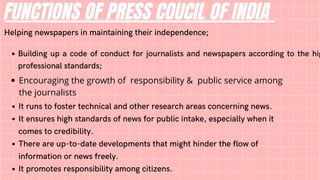
FUNCTIONS OF PRESS COUCIL OF INDIA
Helping newspapers in maintaining their independence;
Building up a code of conduct for journalists and newspapers according to the hig
professional standards;
Encouraging the growth of responsibility & public service among
the journalists
It runs to foster technical and other research areas concerning news.
It ensures high standards of news for public intake, especially when it
comes to credibility.
There are up-to-date developments that might hinder the flow of
information or news freely.
It promotes responsibility among citizens.
Provide training to new journalists.
Powers of the Press Council of India
Powers of the Press Council is given in section 14 and 15 of the Press
Council Act, 1965. Powers to censure are given in section 14 and some
general powers are described in section15.
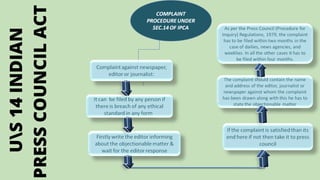
Section provide that if a complaint made the the newspaper
,news agency, editor & journalist to hold opportunity to
concerned the inquiry as the process laid under the act


SECTION 14
POWER TO CENSURE
The decision of the council shall be final and shall not be
questioned in any court of law.
SECTION 15
GENERAL POWER OF COUNCIL
This section provides that for performing its function or
for the purpose of inquiry, the council shall have the
same powers throughout India as are vested in a Civil
court while trying a suit under the Code of Civil
Procedure,
every inquiry held by the council shall be deemed to be a
judicial proceeding under sections 193 and 228 of the
Indian Penal Code.
US
14
INDIAN
PRESS
COUNCIL
ACT
Safeguarding the freedom of the press was the forst objective of the act but it was
failed to achieve it .
,
INDIAN PRESS COUNCIL ACT SAFEGUARD OF
PRESS FREDOM


According to the report of the Committee to Protect Journalism on ‘The global
impunity index’, India has been ranked 14th on the list with 18 murders of journalists
with impunity from 2008 to 2018.
Reporters Without Borders (RSF) has listed India at 138th on its World Press
Freedom Index in 2018,
The shooting of Gauri Lankesh: veteran journalist and editor, renowned for her
criticism of right-wing extremism and communal violence was killed because of
her Anti-Hindutva Stand.
Navin Nischal of Dainik Bhaskar for reporting on child marriage.
Sandeep Sharma for publishing stories on illegal sand mining and police
corruption.
Shujaat Bukhari for his reporting on the situation in Kashmir.
These are the few cases of ruthless murders indicating the problem of silencing the
journalists:
In order to protect the Democracy there a need to protect the independence of the
press and furthermore serious actions are required to be taken in such cases.
PRESS COMMISSION OF INDIA
FIRST PRESS COMMISSION :-It was constituted in 1954
under the chairmanship of justice B.G.Rajadhyaksha . it
was look the factor to maintenance the high standard of
journalism in India .The First Press Commission for the first
time defined the what a RESPONSIBLE PRESS should be an
important recommendation of the commission is to setting
up satutory press council at national level consisting of
press people & other member
The control, management, and ownership of newspapers, magazines,
newsagencies, and feature syndicates, as well as their financial structure.
The impact of holding businesses, advertising distribution, and other
externalfactors on healthy journalism
The effects of monopolies and chains on the presentation of truthful news
andbalanced viewpoints
The process of journalist recruitment and training.
Equipment for maintaining a high standard of journalism and liaising
betweenthe government and the media
Press freedom, as well as the repeal or amendment of laws that
areincompatible with it.
- The Press Advisory Committee's and editors' and working journalists'orga
ASPECTS OF IPC
*to curb-yellow journalism, sensationalism, malicious attacks on public men, indecency
and vulgarity,
SECOND PRESS COMMISSION
After the emergency was lifted, the new government of India constituted the
Second Press Commission on May 29, 1978. The Commission was set up
under the chairmanship of Justice P.C. Goswami but he and his colleagues
resigned in January 1980, with the formation of new government.
1 )The Press Council Act has been amended to allow the council to assess
thequality and adequacy of journalist training facilities as well as
monitornewspaper performance.
2).The Press Council Act of 1978 included the phrase "respect for privacy."
.3)That the editor is responsible for everything that appears in his publication,even
advertisements.
4.The infringement of the advertising code of ethics should be investigated
bythe Council.
5.The creation of a Commission to encourage the development of the press
inways that facilitate its growth, particularly for Indian-language newspapers
withlow readership and small and medium-sized periodicals with high
circulation.
On the recommendation of second commission Indian Press Council Act
1978 was established
YELLOW JOURNALISM
Newspaper reports that are written in an exaggerated way in order to
shock the readers
Yellow journalism and yellow press are American terms for journalism and
associated newspapers that present little or no legitimate, well-researched
news while instead using eye-catching headlines for increased sales.
Techniques may include exaggerations of news events, scandal-mongering,
or sensationalism.
Headlines are huge even for minor news
Gracious use of pictures or imaginary drawings
use of misleading headlines fake interviews false
learning from so called experts
Dramatic sympathy against system
CHARACTERSTICS
IMPORTANT QUESTION
Yellow journalism cannot pass muster under the guise of
freedom of press " justify the statement .
write a short note on Press Commission of India.
write the complaining procedure of the Press Council Of
India Act.
Describe the functions of the press Council Of India act .
THANK
THANK
YOU
YOU

BA-LLB IV SEM5.pdf

  • 1.
    BA-LLB IV SEM PRESS COUNCILOF INDIA ACT ,1978 PRESS COMMISSION OF INDIA UNIT V
  • 2.
    On the recommendationof First Press Commission to establish a statutory press council . An act was passed to establish Press Council for the purpose of preserving the freedom of press & of maintaining and improving standard of newspapers & news agencies in India . The press council established in 1966 & The Press Council Act 1967 & repeal act 1976 During emergency PRESS COUNCIL ACT 1978
  • 3.
    PRESS COUNCIL OFINDIA ACT 1978 It is considered as the most important body that sustains democracy and to ensure that freedom of speech is protected The press council bill 1977 was passedby both the houses of parliament and it came into the statue book as the press council of india act 1978 after receiving the assent of the president of india on 7th september 1987
  • 4.
    COMPOSITION OF THEPRESS COUNCIL The council shall consist of a chairman & 28 other members . the chairman shall nominated by a commitee consisting chairman of Rajya sabha ,the speaker of lok sabha and a member elected by member of council under sub section (6) An Act to establish a Press Council for the purpose of preserving the freedom of the Press and of maintaining and improving the standards of newspapers and news agencies in India.
  • 6.
    FUNCTIONS OF PRESSCOUCIL OF INDIA Helping newspapers in maintaining their independence; Building up a code of conduct for journalists and newspapers according to the hig professional standards; Encouraging the growth of responsibility & public service among the journalists It runs to foster technical and other research areas concerning news. It ensures high standards of news for public intake, especially when it comes to credibility. There are up-to-date developments that might hinder the flow of information or news freely. It promotes responsibility among citizens.
  • 7.
    Provide training tonew journalists. Powers of the Press Council of India Powers of the Press Council is given in section 14 and 15 of the Press Council Act, 1965. Powers to censure are given in section 14 and some general powers are described in section15.
  • 8.
    Section provide thatif a complaint made the the newspaper ,news agency, editor & journalist to hold opportunity to concerned the inquiry as the process laid under the act SECTION 14 POWER TO CENSURE The decision of the council shall be final and shall not be questioned in any court of law. SECTION 15 GENERAL POWER OF COUNCIL This section provides that for performing its function or for the purpose of inquiry, the council shall have the same powers throughout India as are vested in a Civil court while trying a suit under the Code of Civil Procedure, every inquiry held by the council shall be deemed to be a judicial proceeding under sections 193 and 228 of the Indian Penal Code.
  • 9.
  • 10.
    Safeguarding the freedomof the press was the forst objective of the act but it was failed to achieve it . , INDIAN PRESS COUNCIL ACT SAFEGUARD OF PRESS FREDOM According to the report of the Committee to Protect Journalism on ‘The global impunity index’, India has been ranked 14th on the list with 18 murders of journalists with impunity from 2008 to 2018. Reporters Without Borders (RSF) has listed India at 138th on its World Press Freedom Index in 2018,
  • 11.
    The shooting ofGauri Lankesh: veteran journalist and editor, renowned for her criticism of right-wing extremism and communal violence was killed because of her Anti-Hindutva Stand. Navin Nischal of Dainik Bhaskar for reporting on child marriage. Sandeep Sharma for publishing stories on illegal sand mining and police corruption. Shujaat Bukhari for his reporting on the situation in Kashmir. These are the few cases of ruthless murders indicating the problem of silencing the journalists: In order to protect the Democracy there a need to protect the independence of the press and furthermore serious actions are required to be taken in such cases.
  • 12.
    PRESS COMMISSION OFINDIA FIRST PRESS COMMISSION :-It was constituted in 1954 under the chairmanship of justice B.G.Rajadhyaksha . it was look the factor to maintenance the high standard of journalism in India .The First Press Commission for the first time defined the what a RESPONSIBLE PRESS should be an important recommendation of the commission is to setting up satutory press council at national level consisting of press people & other member
  • 13.
    The control, management,and ownership of newspapers, magazines, newsagencies, and feature syndicates, as well as their financial structure. The impact of holding businesses, advertising distribution, and other externalfactors on healthy journalism The effects of monopolies and chains on the presentation of truthful news andbalanced viewpoints The process of journalist recruitment and training. Equipment for maintaining a high standard of journalism and liaising betweenthe government and the media Press freedom, as well as the repeal or amendment of laws that areincompatible with it. - The Press Advisory Committee's and editors' and working journalists'orga ASPECTS OF IPC *to curb-yellow journalism, sensationalism, malicious attacks on public men, indecency and vulgarity,
  • 14.
    SECOND PRESS COMMISSION Afterthe emergency was lifted, the new government of India constituted the Second Press Commission on May 29, 1978. The Commission was set up under the chairmanship of Justice P.C. Goswami but he and his colleagues resigned in January 1980, with the formation of new government. 1 )The Press Council Act has been amended to allow the council to assess thequality and adequacy of journalist training facilities as well as monitornewspaper performance. 2).The Press Council Act of 1978 included the phrase "respect for privacy." .3)That the editor is responsible for everything that appears in his publication,even advertisements.
  • 15.
    4.The infringement ofthe advertising code of ethics should be investigated bythe Council. 5.The creation of a Commission to encourage the development of the press inways that facilitate its growth, particularly for Indian-language newspapers withlow readership and small and medium-sized periodicals with high circulation. On the recommendation of second commission Indian Press Council Act 1978 was established
  • 16.
    YELLOW JOURNALISM Newspaper reportsthat are written in an exaggerated way in order to shock the readers Yellow journalism and yellow press are American terms for journalism and associated newspapers that present little or no legitimate, well-researched news while instead using eye-catching headlines for increased sales. Techniques may include exaggerations of news events, scandal-mongering, or sensationalism.
  • 17.
    Headlines are hugeeven for minor news Gracious use of pictures or imaginary drawings use of misleading headlines fake interviews false learning from so called experts Dramatic sympathy against system CHARACTERSTICS
  • 18.
    IMPORTANT QUESTION Yellow journalismcannot pass muster under the guise of freedom of press " justify the statement . write a short note on Press Commission of India. write the complaining procedure of the Press Council Of India Act. Describe the functions of the press Council Of India act .
  • 19.