CONTINUING 
PROFESSIONAL 
DEVELOPMENT 
Govind bakutra 
En nb. 110210111092
POWERTONI 
‘I realized what the word was: a contraction of p o we r o f a tto rne y , the 
awesome ability to act on someone else’s behalf or to have others do 
your bidding, to sign documents, release wanted criminals , cure 
illnesses, get people killed. Powertoni: a power that does not originate 
in yourself; a power that you are holding on somebody else’s behalf. It 
is the only kind of power that a politician has; a power of attorney ceded 
to him by the voter.’ (p . 5 9 ) 
‘[…] the man with the greatest powertoni in Mumbai is the 
leader of Shiv Sena himself, Bal Keshav Thackeray.’ (p . 5 9 ) 
‘Thackeray, like anybody else in the underworld, is 
called by many names: the Saheb, the Supremo, the 
Remote Control, and, most of all, the Tiger – after 
the symbol of the Shiv Sena.’ (p . 6 0 ) 
Maximum city. Bombay lost and found. 
By Suketu Mehta
The Shiv Sena Party 
‘I wanted to speak to the rioters themselves, to the followers of Bal Thackeray. 
It was he who had formed, in 1966, a nativist political party called Shiv Sena – 
Shivaji’s Army – after the seventeenth-century Maharashtrian warrior king who 
organized a ragtag band of guerrilla fighters into a fighting force that would 
humble the Mughal emperor Aurangzeb and, in time, hold sway over most of 
central India.’ (p . 40 -41 ) 
‘IN MARCH 1995, the Shiv Sena, the majority partner 
in a coalition with the BJP, came into power in 
Maharashtra state […]. The government took a look at 
the awesome urban problems plaguing the city, the 
infestation of corruption at all levels of bureaucracy 
and the government, the abysmal state of Hindu- 
Muslim relations, and took decisive action. They 
changed the name of capital city to Mumbai.’ (p . 6 1 ) 
‘Once in power, the Sena 
decided to go after artists, 
especially Muslim artists. […]The 
Shiv Sena’s notion of what is 
culturally acceptable in India 
show a distinct bias toward 
kitsch: Michael Jackson, for 
example. […] Thos may or may 
not have had to do with the fact 
that the singer had promised to 
donate the profits from his 
concert – which eventually ran to 
more than a million dollars – to a 
Shiv Sena - run youth 
employment project.’ (p . 6 1 ) 
‘The other kind of values Thackeray likes are 
those of the country’s industrial dynasties. 
Thackeray loves big business, and big business 
loves him.’ (p. 6 2 )
SUNIL A man from the Hindu nationalist Shiv Sena 
party 
“Powermoni” 
‘Bombayities understand that business 
comes first. They are individually multiple. 
[...] He wanted the na tio n to be great. He 
bemoaned the fact that not even the Shiv 
Sena was beyond corruption. “In Bombay, 
money is God,” he said in English.’ (p . 43 - 
44) 
‘“Girish is a big man now,” I say. 
“He has the power of athanni 
now,” Sunil agrees. He has 
powermoni. [...] 
“Money is God,” says Sunil.’ 
(p. 70) 
Sunil was only a little kid, without money. [...] “I didn’t have ten or twenty 
rupees, so I sat there thinking: If I can’t do this, take my father his tiffin, then I 
can’t live. If one has to live, one should live in a proper way. Then realized that 
a man has to make money anyhow in Bombay – through the underworld or 
anything – and that even murder is all right.”’ (p . 7 1 ) 
These days, his position has changed [...]. Sunil has a stack of business cards in his 
front pocket; prominent among them is a card issued by the Government of Maharashtra 
which confers on him the title Special Executive Officer. “With this card I can do anything 
in Bombay. I have the power of a judge,” says Sunil proudly, although he is just a 
glorified notary. [...] But the card gives him status, legitimacy; [...]. (p . 7 3 )
SUNIL A man from the Hindu nationalist Shiv Sena 
party 
“Powermoni” – Politics: Elections (1995-98) and votes. 
‘Sunil knows firsthand about the virtues of political participation. [...] 
He makes 50,000 rupees a month from his cable business, and another 
25,000 or so from his other activities, legal and illegal. 
“Seventy-five thousand,” I calculate. “That’s more than what some 
executives make.” 
“That’s why I independent like myself so India 
much,” he ‘The responds.’ (p . 7 4-7 5 ) ‘In fifty years, what five thousand years 
done 1998, general election has could not do: It gave the 
live, when is I a return of February 
of history are in the majority a 
ghost to Bombay people who the country.’ 
election.’ running of (to 
p . the 6 5 voice in - 6 6 ) 
(p . 6 4) 
‘“The rich don’t come down from their buildings to vote,” he responds.’ 
(p . 6 8 ) 
‘The campaign workers at the booths outside the polling station, who look up people’s 
identification numbers for them and give them the registration chits, are paid by the 
political parties: 50 rupees if they are with the Sena-BJP and 100 rupees if they are 
with the Congress, plus puris, vegetables, and sheera, a sweet. Right then I know the 
Sena-BJP will win; you have to be paid more to support a loser.’ (p . 7 0 )
SUNIL A man from the Hindu nationalist Shiv Sena 
party 
Muslims and Hindus. – The 1992-93 Riots… 
‘What sat on Sunil’s mind was the thought that the handicapped girl was raped, 
repeatedly and in the open. There is no evidence of it; the police report makes no 
mention of it. Sixteen to twenty Hindu women were raped in Jogeshwari alone, said 
Sunil. [...] It was a powerful image, a catalytic image: a handicapped Hindu girl on the 
ground with a line of leering Muslim men waiting their turn at her while her parents 
matched her screams with their own as their bodies caught the flame. Many wars begin 
with an act of rape, real or imagined. It is always the men who are disturbed enough by 
the rape to go to war. 
Sunil didn’t use the term “riot”. He used “war” instead, the English word.’ (p . 42 ) 
‘Muslims engaged in underworld activities […] and they had no compunctions about killing 
people, while a Hindu would pause before killing and ask himself why he was doing it.’ (p . 
43 ) 
‘The riots were a tragedy in three acts. First, there was a spontaneous upheaval between 
the largely Hindu police and Muslims. This was followed, in January 1993, by a second 
wave of more serious rioting – instigated by the Shiv Sena leader Bal Thackeray – in 
which Muslims were systematically identified and massacred, their houses and shops 
burnt and looted. The third stage was the revenge of the Muslims: on Friday, March 12, 
when every good Muslim was reading his namaaz prayers, ten powerful bombs planted 
by the Muslim underworld went off all over the city.’ (The 1992-93 Riots, p. 40 )
Bombay: the multiple-personality disordered 
Megalopolis 
‘Go ba c k to Pa kis ta n, ’ s a id the Shiv Se na to the Mus lim s . ’ (p . 46 ) 
‘India has no need 
to look outside for 
its models of 
tolerance. Bombay 
has hundreds of 
very different 
ethnic 
communities, most 
of whom heartily 
dislike each other. 
They have been 
tolerating one 
another for 
centuries, until 
now. Each 
community has an 
intimate 
knowledge of the 
codes of the 
others.’ ‘How did I have this hatred in me? And I realized I had 
been taught it since childhood. Maybe it was 
Partition, maybe it was their food habits – Muslims kill 
animals – but our parents taught us we couldn’t trust 
them. [...] The events of Partition washed away the 
teachings of Gandhiji.’ (p . 5 7 ) 
‘The Bombay Police see Muslims as criminals, much 
as some American police view African Americans. [...] 
Muslims, who comprise just under a fifth of the 
population of the city, were responsible for a third of 
the crimes.’ (p . 49 ) 
‘Maybe this ability to live together is possible 
precisely because of these carefully demarcated 
boundaries, these notions of rituals pollution. There is 
no possibility of a dangerous miscegenation.’ (p . 6 3 )
Bombay: the multiple-personality 
disordered 
Megalopolis 
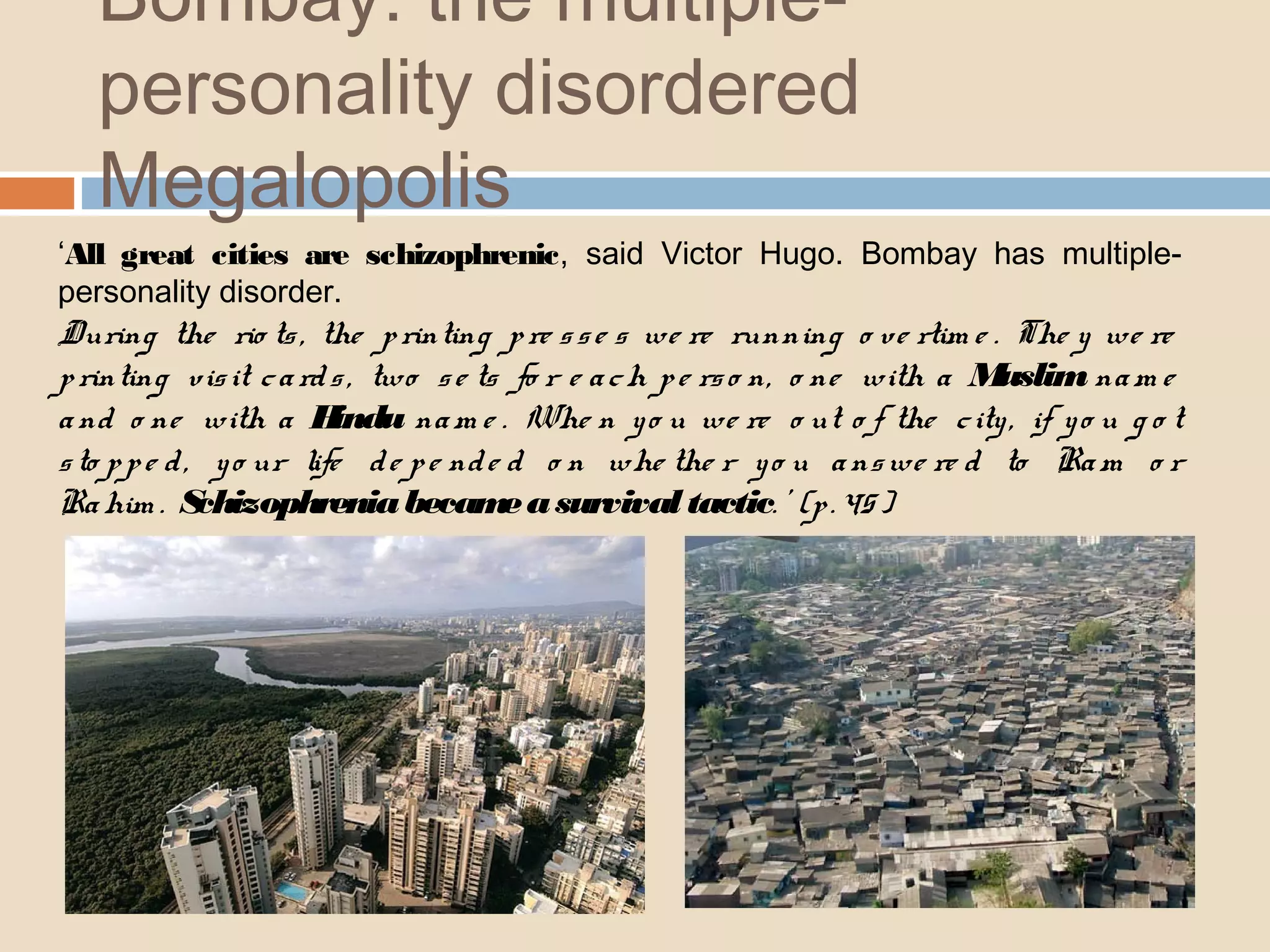
‘All great cities are schizophrenic, said Victor Hugo. Bombay has multiple-personality 
disorder. 
During the rio ts , the p rinting p re s s e s we re running o ve rtim e . The y we re 
p rinting vis it c a rd s , two s e ts fo r e a ch p e rs o n, o ne with a Muslim nam e 
a nd o ne with a Hindu nam e . Whe n y o u we re o ut o f the c ity , if y o u g o t 
s to p p e d , y o ur life d e p e nd e d o n whe the r y o u a nswe re d to Ram o r 
Rahim . Schizophrenia became a survival tactic. ’ (p . 45 )
Bombay: the multiple-personality disordered 
Megalopolis 
‘His big g e s t c rim e wa s tha t he wa s Mus lim . ’ (p . 45 ) 
‘The taxi driver carrying me home has a little shrine 
of Sibaba of Shridi enclosed in an illuminated arch, 
next to a verse of the Koran in Arabic script. 
“What is that?” I ask, pointing, as I’m about to leave 
the cab. 
“This?” he asks, touching the arch. He thinks I want 
to ask about the colored lights. 
“That.” I point to the Arabic text. 
“This is Muslim.” 
“And you have Saibaba also?” 
“Yes.” He has turned around. He is smiling. I am 
joyous. There is still hope.’ (p . 8 5 )
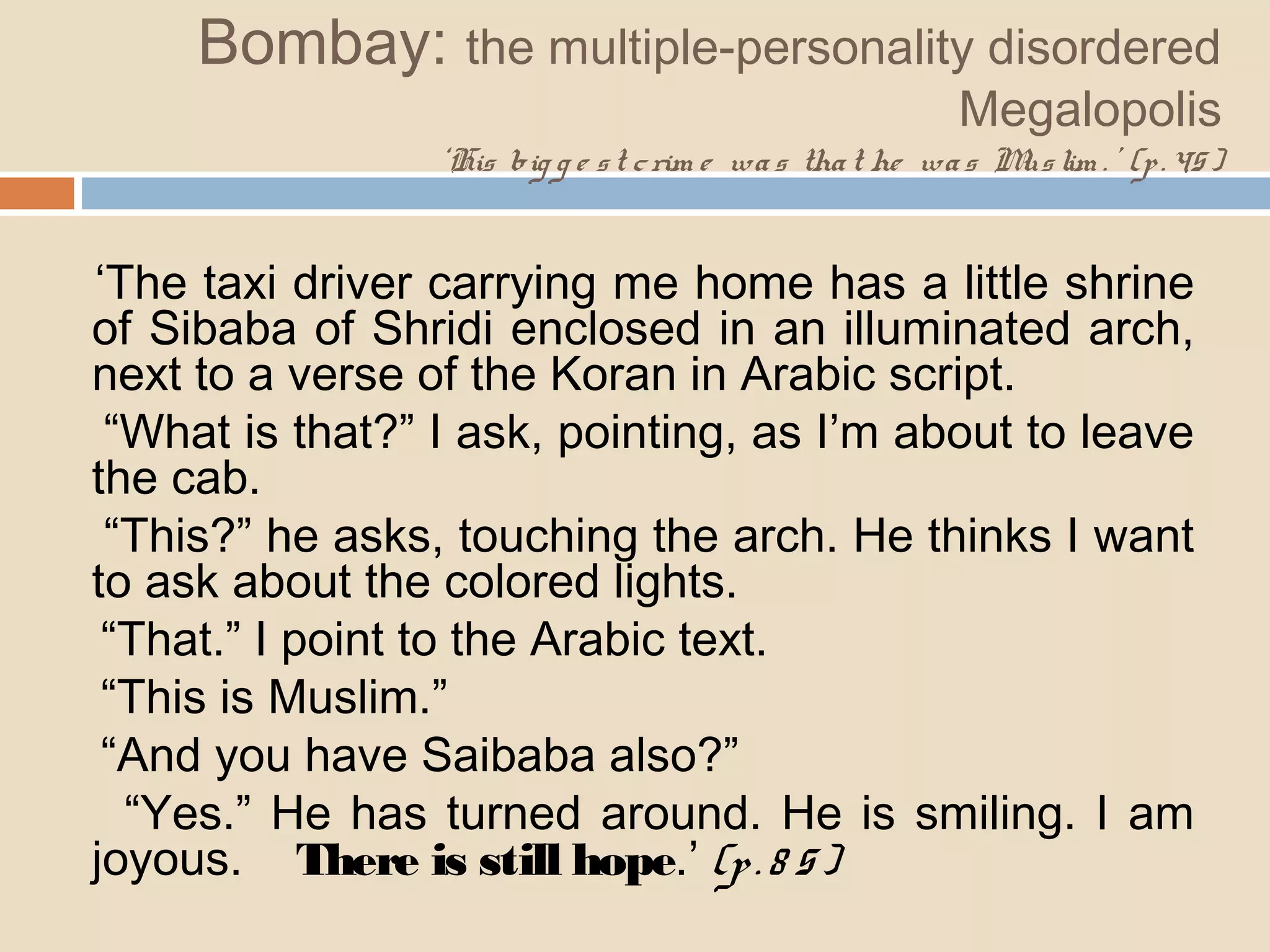
Slums vs the Megalopolis 
‘Much of the 
slum is a 
garbage dump. 
The sewers, 
which are open, 
run right 
between the 
houses, and 
children play 
and 
occasionally fall 
into them. [...] 
Masses of shit, 
overflowing out 
of the toilets 
and spread 
liberally around 
the cubicle. [...] 
Typhoid runs 
rampant [...] 
Pools of 
stagnant water, 
which are 
everywhere, 
breed malaria.’ 
(p . 5 3 ) 
‘Se ttle m e nt c o lo nie s c a nno t re a lly be d e s tro y e d . The y will re a p p e a r. (p . 7 9 ) 
‘We tend to think of a slum as an excrescence, a community 
of people living in perpetual misery. What we forget is that out 
of inhospitable surroundings, the people have formed a 
community, and they are as attached to its spatial geography, 
the social networks they have built for themselves, the village 
they have recreated in the midst of the city. [...] Any urban 
redevelopment plan has to take into account the curious 
desire of slum dwellers to live closely together. A greater 
horror than the open gutters and filthy toilets, to people of 
Jogeshwari, is the empty room in the big city.’ (p . 5 5 ) 
‘There was a building planned nearby to resettle the slum 
dwellers. But people from her neighborhood wouldn’t move 
there. “There is too much aloneness. A person can die behind 
the closed doors of a flat and no one will know.’ (p . 5 5 )
Slums vs the 
Megalopolis 
‘I no tic e his s e ns e o f we ll-be ing whe ne ve r I ta ke him to a hig h flo o r build ing . 
Mo s t p e o p le fro m his chawl ne ve r g o a bo ve the s e c o nd flo o r. ’ (p . 8 9 ) 
‘”Our minds are like children,” Sunil 
explains. “Our minds won’t accept living 
anywhere else, just like your children 
won’t accept living in a slum. My 
children can knock on the neighbor’s 
house at 1 a.m. and get food. If they 
don’t like their mother’s rice and dal they 
can go to the neighbors; a child come to 
your house to eat is like God come to 
eat. They can eat anywhere in the 
chawl. But if your children were to knock 
on the neighbor’s flat at 1 a.m. you 
would give them two slaps.[...] You don’t 
want your neighbor to think you can’t 
afford food for your children.’(p . 9 2 ) 
‘I ask them why there is more unity, more fellow feeling in the chawl. 
Common toilets, explains Sunil. “When you go to the toilet, you have 
to see everyone’s face. [...] The women fill buckets with water 
together at the tap and they converse. [...] In a block of flats the 
toilets are all separate. [...] The talk is on a high level.’ (p . 9 3 )
RAHE-HAQ A meeting with a women’s group 
‘Arifa Khan, along with about twenty other 
Muslim women, was now sitting in the room, 
which also functions as a day-care center. 
[…] the women started telling me about the 
troubles: their men shot and stabbed, by the 
police or the Hindus. The azaan rang out 
from a nearby mosque; the women covered 
their heads. The Hindus and Muslims now 
lived apart in the slum, out of choice.’ (p . 5 1 ) 
‘“This is our watan” – homeland. 
“Whatever it is, it’s our India.” One of 
the women claimed the right to live 
here by virtue of the fact that she 
votes.’ (p . 5 1 ) 
‘Rahe-haq – The Right Path – is an organization 
of around fifteen women, most but not all of them 
Muslim. They started with nine members in 1988 
in response to the toilet problem. [...] Every 
election, various leaders would come around to 
the slum and promise to do something about the 
toilets. The group of women got together and went 
to the municipal office. “We did bhagdaud,” 
explained the women. This term, familiar to 
anybody dealing with Indian bureaucracy, means 
to run around, to go from one office to the next 
with your petition till you get what you’re looking 
for. The women did bhagdaud, and finally some of 
the toilets were cleaned.’ (p . 5 3 -5 4)
RAHE-HAQ A meeting with a women’s group 
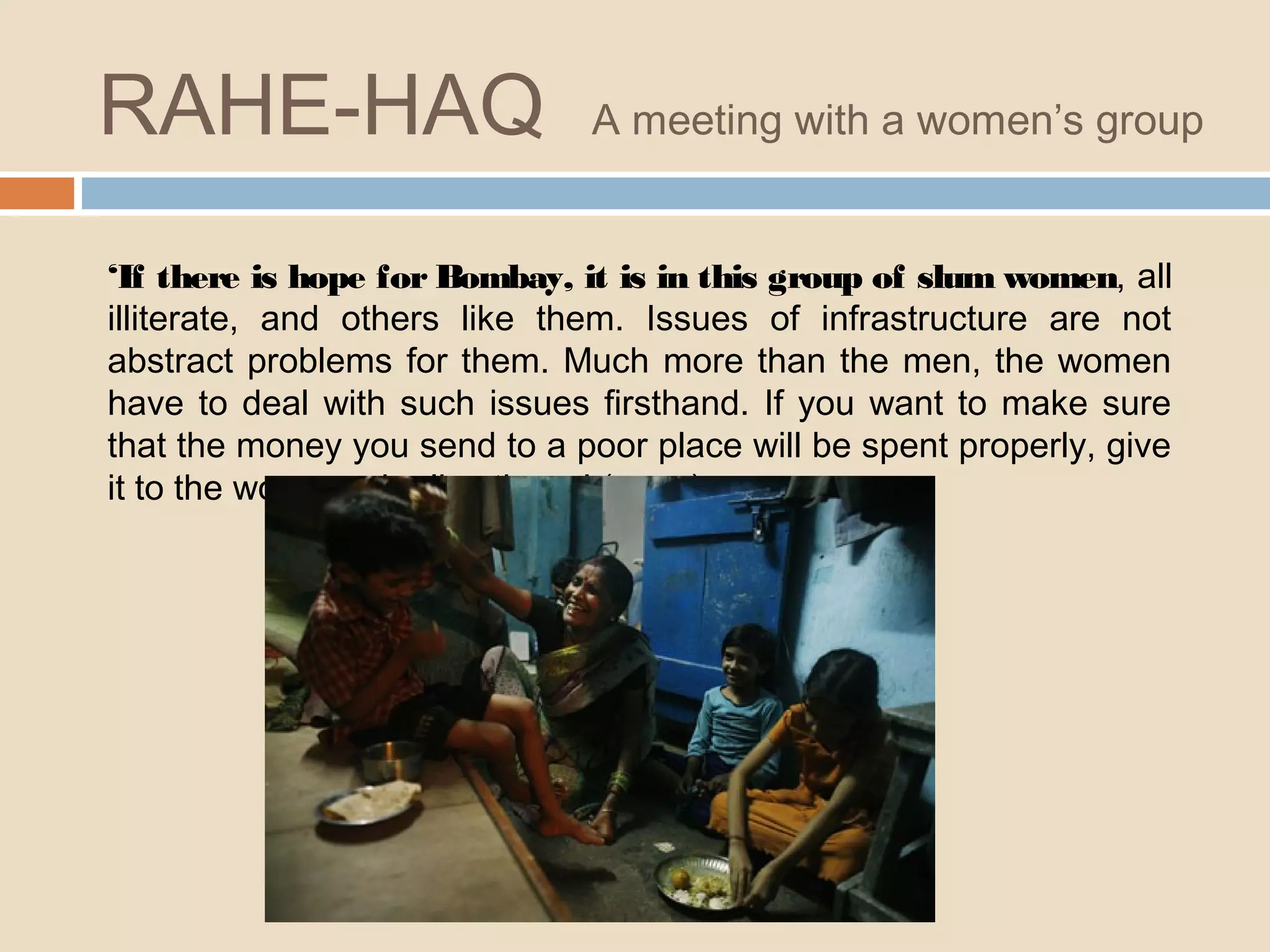
‘If there is hope for Bombay, it is in this group of slum women, all 
illiterate, and others like them. Issues of infrastructure are not 
abstract problems for them. Much more than the men, the women 
have to deal with such issues firsthand. If you want to make sure 
that the money you send to a poor place will be spent properly, give 
it to the women who live there.’ (p . 5 5 )
VIOLENCE AND JUSTICE 
‘When the bombs went off, killing and 
maiming people indiscriminately, the 
Hindus were reminded that the 
Muslims weren’t helpless. On the 
trains, proving ground of dignity, they 
could hold their heads high again.’ 
(p . 48 ) 
‘Very few issues affect the urban 
voter as much as crime. In the 
anonymous city, in the close 
quarters of the slum, the 
overriding interest is law and 
order, stability. More than water, 
more than housing, more than 
jobs, the Bombayite wants 
personal safety. [...] The violence 
had been driven under the 
surface, controlled as deliberately 
as it was deliberately organized 
during the riots.’ (p . 6 4) 
‘All the accumulated insults, rebukes, and 
disappointments of life in a decaying 
megalopolis come out in a cathartic release 
of anger. It’s okay to be angry in a crowd; 
the crowd feeds on your anger, digests it, 
nourishes your rage as your rage nourishes 
it. All of a sudden you feel powerful. You 
can take on anybody. It is not their city 
anymore, it is your city. 
You own this city by right of your anger.’ 
(p . 8 8 )
THE GHOST DEMOCRACY 
‘“If you elect me, you’ll be free from goondas.” As the boss of the 
thugs, he is running a sort of protection racket for the entire 
constituency. Since the police have failed so miserably at curbing 
extortion, the public might as well elect the extortionist himself to 
guarantee protection. It is the same survival tactic that led 5 
percent of the city’s Muslims to vote for their blood enemy, the 
Sena, in the 1995 election.’ (p . 9 5 ) 
The country has gone through three 
general elections in as many years. It 
is an agonized, continuous 
reaffirmation of loyalty to the 
democratic process; again and again, 
the country has to prove itself a 
democracy. The patience of the 
people amazes me. Year after year, 
with no real choices ahead of them, 
the country still trudges dutifully to 
the polls.’ (p . 9 5 -9 6 )
Grazie per l’attenzione... 
Arpaia Giuseppina 
Maisto Anna

bal thakare

  • 1.
    CONTINUING PROFESSIONAL DEVELOPMENT Govind bakutra En nb. 110210111092
  • 2.
    POWERTONI ‘I realizedwhat the word was: a contraction of p o we r o f a tto rne y , the awesome ability to act on someone else’s behalf or to have others do your bidding, to sign documents, release wanted criminals , cure illnesses, get people killed. Powertoni: a power that does not originate in yourself; a power that you are holding on somebody else’s behalf. It is the only kind of power that a politician has; a power of attorney ceded to him by the voter.’ (p . 5 9 ) ‘[…] the man with the greatest powertoni in Mumbai is the leader of Shiv Sena himself, Bal Keshav Thackeray.’ (p . 5 9 ) ‘Thackeray, like anybody else in the underworld, is called by many names: the Saheb, the Supremo, the Remote Control, and, most of all, the Tiger – after the symbol of the Shiv Sena.’ (p . 6 0 ) Maximum city. Bombay lost and found. By Suketu Mehta
  • 3.
    The Shiv SenaParty ‘I wanted to speak to the rioters themselves, to the followers of Bal Thackeray. It was he who had formed, in 1966, a nativist political party called Shiv Sena – Shivaji’s Army – after the seventeenth-century Maharashtrian warrior king who organized a ragtag band of guerrilla fighters into a fighting force that would humble the Mughal emperor Aurangzeb and, in time, hold sway over most of central India.’ (p . 40 -41 ) ‘IN MARCH 1995, the Shiv Sena, the majority partner in a coalition with the BJP, came into power in Maharashtra state […]. The government took a look at the awesome urban problems plaguing the city, the infestation of corruption at all levels of bureaucracy and the government, the abysmal state of Hindu- Muslim relations, and took decisive action. They changed the name of capital city to Mumbai.’ (p . 6 1 ) ‘Once in power, the Sena decided to go after artists, especially Muslim artists. […]The Shiv Sena’s notion of what is culturally acceptable in India show a distinct bias toward kitsch: Michael Jackson, for example. […] Thos may or may not have had to do with the fact that the singer had promised to donate the profits from his concert – which eventually ran to more than a million dollars – to a Shiv Sena - run youth employment project.’ (p . 6 1 ) ‘The other kind of values Thackeray likes are those of the country’s industrial dynasties. Thackeray loves big business, and big business loves him.’ (p. 6 2 )
  • 4.
    SUNIL A manfrom the Hindu nationalist Shiv Sena party “Powermoni” ‘Bombayities understand that business comes first. They are individually multiple. [...] He wanted the na tio n to be great. He bemoaned the fact that not even the Shiv Sena was beyond corruption. “In Bombay, money is God,” he said in English.’ (p . 43 - 44) ‘“Girish is a big man now,” I say. “He has the power of athanni now,” Sunil agrees. He has powermoni. [...] “Money is God,” says Sunil.’ (p. 70) Sunil was only a little kid, without money. [...] “I didn’t have ten or twenty rupees, so I sat there thinking: If I can’t do this, take my father his tiffin, then I can’t live. If one has to live, one should live in a proper way. Then realized that a man has to make money anyhow in Bombay – through the underworld or anything – and that even murder is all right.”’ (p . 7 1 ) These days, his position has changed [...]. Sunil has a stack of business cards in his front pocket; prominent among them is a card issued by the Government of Maharashtra which confers on him the title Special Executive Officer. “With this card I can do anything in Bombay. I have the power of a judge,” says Sunil proudly, although he is just a glorified notary. [...] But the card gives him status, legitimacy; [...]. (p . 7 3 )
  • 5.
    SUNIL A manfrom the Hindu nationalist Shiv Sena party “Powermoni” – Politics: Elections (1995-98) and votes. ‘Sunil knows firsthand about the virtues of political participation. [...] He makes 50,000 rupees a month from his cable business, and another 25,000 or so from his other activities, legal and illegal. “Seventy-five thousand,” I calculate. “That’s more than what some executives make.” “That’s why I independent like myself so India much,” he ‘The responds.’ (p . 7 4-7 5 ) ‘In fifty years, what five thousand years done 1998, general election has could not do: It gave the live, when is I a return of February of history are in the majority a ghost to Bombay people who the country.’ election.’ running of (to p . the 6 5 voice in - 6 6 ) (p . 6 4) ‘“The rich don’t come down from their buildings to vote,” he responds.’ (p . 6 8 ) ‘The campaign workers at the booths outside the polling station, who look up people’s identification numbers for them and give them the registration chits, are paid by the political parties: 50 rupees if they are with the Sena-BJP and 100 rupees if they are with the Congress, plus puris, vegetables, and sheera, a sweet. Right then I know the Sena-BJP will win; you have to be paid more to support a loser.’ (p . 7 0 )
  • 6.
    SUNIL A manfrom the Hindu nationalist Shiv Sena party Muslims and Hindus. – The 1992-93 Riots… ‘What sat on Sunil’s mind was the thought that the handicapped girl was raped, repeatedly and in the open. There is no evidence of it; the police report makes no mention of it. Sixteen to twenty Hindu women were raped in Jogeshwari alone, said Sunil. [...] It was a powerful image, a catalytic image: a handicapped Hindu girl on the ground with a line of leering Muslim men waiting their turn at her while her parents matched her screams with their own as their bodies caught the flame. Many wars begin with an act of rape, real or imagined. It is always the men who are disturbed enough by the rape to go to war. Sunil didn’t use the term “riot”. He used “war” instead, the English word.’ (p . 42 ) ‘Muslims engaged in underworld activities […] and they had no compunctions about killing people, while a Hindu would pause before killing and ask himself why he was doing it.’ (p . 43 ) ‘The riots were a tragedy in three acts. First, there was a spontaneous upheaval between the largely Hindu police and Muslims. This was followed, in January 1993, by a second wave of more serious rioting – instigated by the Shiv Sena leader Bal Thackeray – in which Muslims were systematically identified and massacred, their houses and shops burnt and looted. The third stage was the revenge of the Muslims: on Friday, March 12, when every good Muslim was reading his namaaz prayers, ten powerful bombs planted by the Muslim underworld went off all over the city.’ (The 1992-93 Riots, p. 40 )
  • 7.
    Bombay: the multiple-personalitydisordered Megalopolis ‘Go ba c k to Pa kis ta n, ’ s a id the Shiv Se na to the Mus lim s . ’ (p . 46 ) ‘India has no need to look outside for its models of tolerance. Bombay has hundreds of very different ethnic communities, most of whom heartily dislike each other. They have been tolerating one another for centuries, until now. Each community has an intimate knowledge of the codes of the others.’ ‘How did I have this hatred in me? And I realized I had been taught it since childhood. Maybe it was Partition, maybe it was their food habits – Muslims kill animals – but our parents taught us we couldn’t trust them. [...] The events of Partition washed away the teachings of Gandhiji.’ (p . 5 7 ) ‘The Bombay Police see Muslims as criminals, much as some American police view African Americans. [...] Muslims, who comprise just under a fifth of the population of the city, were responsible for a third of the crimes.’ (p . 49 ) ‘Maybe this ability to live together is possible precisely because of these carefully demarcated boundaries, these notions of rituals pollution. There is no possibility of a dangerous miscegenation.’ (p . 6 3 )
  • 8.
    Bombay: the multiple-personality disordered Megalopolis ‘All great cities are schizophrenic, said Victor Hugo. Bombay has multiple-personality disorder. During the rio ts , the p rinting p re s s e s we re running o ve rtim e . The y we re p rinting vis it c a rd s , two s e ts fo r e a ch p e rs o n, o ne with a Muslim nam e a nd o ne with a Hindu nam e . Whe n y o u we re o ut o f the c ity , if y o u g o t s to p p e d , y o ur life d e p e nd e d o n whe the r y o u a nswe re d to Ram o r Rahim . Schizophrenia became a survival tactic. ’ (p . 45 )
  • 9.
    Bombay: the multiple-personalitydisordered Megalopolis ‘His big g e s t c rim e wa s tha t he wa s Mus lim . ’ (p . 45 ) ‘The taxi driver carrying me home has a little shrine of Sibaba of Shridi enclosed in an illuminated arch, next to a verse of the Koran in Arabic script. “What is that?” I ask, pointing, as I’m about to leave the cab. “This?” he asks, touching the arch. He thinks I want to ask about the colored lights. “That.” I point to the Arabic text. “This is Muslim.” “And you have Saibaba also?” “Yes.” He has turned around. He is smiling. I am joyous. There is still hope.’ (p . 8 5 )
  • 10.
    Slums vs theMegalopolis ‘Much of the slum is a garbage dump. The sewers, which are open, run right between the houses, and children play and occasionally fall into them. [...] Masses of shit, overflowing out of the toilets and spread liberally around the cubicle. [...] Typhoid runs rampant [...] Pools of stagnant water, which are everywhere, breed malaria.’ (p . 5 3 ) ‘Se ttle m e nt c o lo nie s c a nno t re a lly be d e s tro y e d . The y will re a p p e a r. (p . 7 9 ) ‘We tend to think of a slum as an excrescence, a community of people living in perpetual misery. What we forget is that out of inhospitable surroundings, the people have formed a community, and they are as attached to its spatial geography, the social networks they have built for themselves, the village they have recreated in the midst of the city. [...] Any urban redevelopment plan has to take into account the curious desire of slum dwellers to live closely together. A greater horror than the open gutters and filthy toilets, to people of Jogeshwari, is the empty room in the big city.’ (p . 5 5 ) ‘There was a building planned nearby to resettle the slum dwellers. But people from her neighborhood wouldn’t move there. “There is too much aloneness. A person can die behind the closed doors of a flat and no one will know.’ (p . 5 5 )
  • 11.
    Slums vs the Megalopolis ‘I no tic e his s e ns e o f we ll-be ing whe ne ve r I ta ke him to a hig h flo o r build ing . Mo s t p e o p le fro m his chawl ne ve r g o a bo ve the s e c o nd flo o r. ’ (p . 8 9 ) ‘”Our minds are like children,” Sunil explains. “Our minds won’t accept living anywhere else, just like your children won’t accept living in a slum. My children can knock on the neighbor’s house at 1 a.m. and get food. If they don’t like their mother’s rice and dal they can go to the neighbors; a child come to your house to eat is like God come to eat. They can eat anywhere in the chawl. But if your children were to knock on the neighbor’s flat at 1 a.m. you would give them two slaps.[...] You don’t want your neighbor to think you can’t afford food for your children.’(p . 9 2 ) ‘I ask them why there is more unity, more fellow feeling in the chawl. Common toilets, explains Sunil. “When you go to the toilet, you have to see everyone’s face. [...] The women fill buckets with water together at the tap and they converse. [...] In a block of flats the toilets are all separate. [...] The talk is on a high level.’ (p . 9 3 )
  • 12.
    RAHE-HAQ A meetingwith a women’s group ‘Arifa Khan, along with about twenty other Muslim women, was now sitting in the room, which also functions as a day-care center. […] the women started telling me about the troubles: their men shot and stabbed, by the police or the Hindus. The azaan rang out from a nearby mosque; the women covered their heads. The Hindus and Muslims now lived apart in the slum, out of choice.’ (p . 5 1 ) ‘“This is our watan” – homeland. “Whatever it is, it’s our India.” One of the women claimed the right to live here by virtue of the fact that she votes.’ (p . 5 1 ) ‘Rahe-haq – The Right Path – is an organization of around fifteen women, most but not all of them Muslim. They started with nine members in 1988 in response to the toilet problem. [...] Every election, various leaders would come around to the slum and promise to do something about the toilets. The group of women got together and went to the municipal office. “We did bhagdaud,” explained the women. This term, familiar to anybody dealing with Indian bureaucracy, means to run around, to go from one office to the next with your petition till you get what you’re looking for. The women did bhagdaud, and finally some of the toilets were cleaned.’ (p . 5 3 -5 4)
  • 13.
    RAHE-HAQ A meetingwith a women’s group ‘If there is hope for Bombay, it is in this group of slum women, all illiterate, and others like them. Issues of infrastructure are not abstract problems for them. Much more than the men, the women have to deal with such issues firsthand. If you want to make sure that the money you send to a poor place will be spent properly, give it to the women who live there.’ (p . 5 5 )
  • 14.
    VIOLENCE AND JUSTICE ‘When the bombs went off, killing and maiming people indiscriminately, the Hindus were reminded that the Muslims weren’t helpless. On the trains, proving ground of dignity, they could hold their heads high again.’ (p . 48 ) ‘Very few issues affect the urban voter as much as crime. In the anonymous city, in the close quarters of the slum, the overriding interest is law and order, stability. More than water, more than housing, more than jobs, the Bombayite wants personal safety. [...] The violence had been driven under the surface, controlled as deliberately as it was deliberately organized during the riots.’ (p . 6 4) ‘All the accumulated insults, rebukes, and disappointments of life in a decaying megalopolis come out in a cathartic release of anger. It’s okay to be angry in a crowd; the crowd feeds on your anger, digests it, nourishes your rage as your rage nourishes it. All of a sudden you feel powerful. You can take on anybody. It is not their city anymore, it is your city. You own this city by right of your anger.’ (p . 8 8 )
  • 15.
    THE GHOST DEMOCRACY ‘“If you elect me, you’ll be free from goondas.” As the boss of the thugs, he is running a sort of protection racket for the entire constituency. Since the police have failed so miserably at curbing extortion, the public might as well elect the extortionist himself to guarantee protection. It is the same survival tactic that led 5 percent of the city’s Muslims to vote for their blood enemy, the Sena, in the 1995 election.’ (p . 9 5 ) The country has gone through three general elections in as many years. It is an agonized, continuous reaffirmation of loyalty to the democratic process; again and again, the country has to prove itself a democracy. The patience of the people amazes me. Year after year, with no real choices ahead of them, the country still trudges dutifully to the polls.’ (p . 9 5 -9 6 )
  • 16.
    Grazie per l’attenzione... Arpaia Giuseppina Maisto Anna