2
(Quick scan retake with changes to the content)
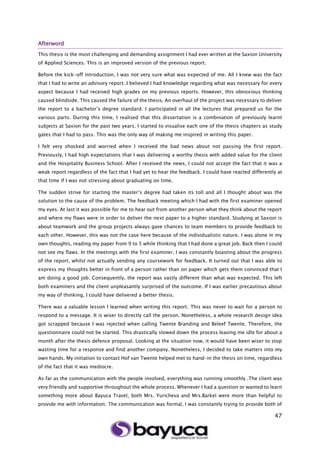
Author: Emil Dimov
Student number: 322132
Class: ATH4IP01
Place of publication: Handelskade 75 7417 DH Deventer
Year: 2016
Client: Bayuca Travel
Module: T.HBS.37179: Thesis W
1st examiner: Gijs Theunissen
2nd examiner: Ekaterina Pushkarskaya
Research counsellor: Joris Verwijmeren
Place and date of distribution: Deventer, 7th September 2016
3
Preface
This exhaustive thesis has been written for the duration of seven months. This report is considered an
“overhaul” version of the one which was previously which was handed-in. The majority of the information
drastically changed. I would like to express my token of gratitude and appreciation to Mr. Theunissen
for being there and helping me find my previous flaws, in order to improve on my mistakes. He was not
only an examiner but was also involved in providing me throughout the process with valuable tips, hints
and acting as a mentor. Without his support, most probably the final result of this research would have
been vastly different. I would personally like to thank Mr. Verwijmeren as well, for being the research
counsellor and helping me out with the research design formulation and suggesting some valuable tips
on the survey distributed to the Russian travel market.
Next to this, I personally would like to thank Mrs. Yuricheva and Mrs. Barkel – my clients for devoting
their time to reviewing how my progress with the report was going. Second to that, I would like to express
my gratitude towards Mrs. Anna Yuricheva and my dear friend Mila Karamanova for taking the time to
translate the questionnaire to Russian and both of them helping out with spreading it to the Russian
tourists. Without their support, the distribution of the survey would not have been this successful as I
would have only been able to distribute it in English. I would also like to thank all those people that
helped me out in spreading the survey on Facebook to their Russian friends and acquaintances.
Furthermore, sincere acknowledgments to the respondents that had taken part in this survey and devoted
valuable time.
Other very important and supportive people were my parents and friends who pushed me to move
forward and focus on my goal to deliver advice suitable for the client. Mrs.Bosch, who was my study
career counsellor, was also very cooperative in actually helping me out to find this thesis topic in the
first place via Mrs. Barkel.
Thank you all!
Emil Dimov
Sofia, August 3, 2016
4
Summary
Russian travel market inbound
The Russian travel market is increasingly growing. For this reason, the tour operator Bayuca Travel sees
this as a potential opportunity and would like to attract the aforementioned market to the region of
Twente, the Netherlands. Bayuca Travel seeks advice on the ways to achieve this. The research objective
of the report was to find out the existence of a match between the Russian traveller’s needs and wants
and what the region of Twente currently offers as a destination. Hence, two central research questions
were formulated in order to gain insight on both parties:
 What does the region of Twente currently offer in terms of destination branding?
 What are the current Russian tourist’s characteristics regarding destination preferences?
In order to begin answering these questions, four relevant core concepts were derived from a literature
review. The core concepts are as follow: destination branding, destination identity, destination image,
Russian traveller characteristics. Furthermore, the core concept marketing plan was included in order to
bring the advisory part of the report to a strategic level.
Two research designs were utilized throughout this report in order to answer the two central questions.
Firstly, it was important to gain an insight into the Russian tourist’s characteristics regarding their
destination preferences. For this questionnaire to be conducted, secondary desk research was applied
on the destination branding efforts, destination identity, and destination features of the region of
Twente. The researcher corresponded via email with the marketing manager of Hof van Twente which is
one of the tourism offices responsible for promoting the destination.
A web-based questionnaire was successfully distributed to 142 Russians in Russian. Numerical data was
collected regarding their relationship status, gender, age, income, and level of education. Furthermore,
the survey addressed questions about their traveling motivations, accommodation preferences, and the
reason for visiting a destination.
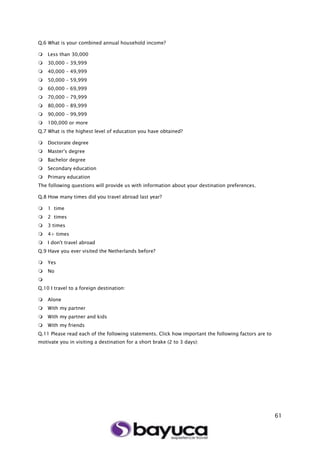
The questionnaire included all Twente features from which the respondents were able to rate. The results
showcased that there is a partial match between the destination and the Russian tourists. The majority
of respondents, who are interested in the destination’s features are in the age range of 16 – 26. They
prefer to travel with their partner, friends, and family with children. All the travel groups have an
affiliation to the historical attributes of the destination. The advisory objective was to contribute Bayuca
Travel with recommendations on various options to lure the Russian travel market to Twente. Three
advice possibilities were looked upon and later on evaluated. This was done in order to choose the one
which was most feasible and provided return on investment.
The option for answering the management question for Bayuca Travel is to create a historical themed
dynamic package labelled as the “Historical Avenue of Twente” for couples without children. Travelers
can create their own package tour going through a list of activities taken from the highest rated
destination features. By having the option of adding new activities, added value is generated for the
tourist’s experience.
5
Table of Contents
1 Introduction 8
1.1 Background description of Bayuca Travel 8
1.1.1Mission 8
1.2 Reasoning for the research 8
1.3 Objectives of the advisory part 9
1.4 Objectives of the research part 9
1.5 Central research questions 9
1.5.1 What does the region of Twente offer? 9
1.5.2 What are the current Russian tourist’s characteristics? 9
1.6 Reading guide 10
2 Theoretical framework 11
2.1 Search methods 11
2.2 Results from the literature research 11
2.2.1 Destination branding 11
2.2.2 Destination image 12
2.2.3 Destination identity 12
2.2.4 Russian tourist characteristics 13
2.2.5 Marketing plan 14
2.3 Operationalisation 15
3 Methodology 16
3.1 Research strategy 16
3.2 Research designs 16
3.2.1 Desk research 16
3.2.2 Survey design 17
3.3 Data collection method 18
3.3.1 Web-based questionnaire 18
3.4 Sampling plan 19
3.5 Data analysis plan 19
3.5.1 Survey data analysis plan 20
4 Results 21
4.1 Desk research on the region of Twente 21
4.1.1 Twente offering in terms of promotional material 21
4.1.2 Destination identity of the region of Twente 21
4.1.3 The most highlighted tourist activities in Twente 22
4.2 Wishes and demands of the Russian travellers 22
4.2.1 Demographic profile of the Russian traveller 22
4.2.2 Accommodation preference of the Russian traveller 23
4.2.3 Russian traveller motives to visit a destination 24
4.2.4 Reason of visiting a particular destination 24
4.2.5 The tourist interest regarding Twente’s features 25
4.2.6 Tourist recreational requirements 27
6
5 Conclusions 28
5.1 The destination branding of the region of Twente 28
5.2 The Russian tourist characteristics 28
6 Discussion 29
6.1 Reliability 29
6.2 Validity 30
7 Advice 31
7.1 Advice objective and questions 31
7.1.1 Advisory questions 31
7.2 Management case approach 31
7.3 Description of alternatives 32
7.3.1 Alternative 1: Historical Avenue of Twente 32
7.3.2 Alternative 2: Experience Twente 33
7.3.3 Alternative 3: Getaway from the crowd 34
7.4 Identification of criteria 34
7.4.1 Prerequisite criteria 34
7.4.2 Evaluation criteria 34
8 Strategic marketing plan 36
8.1 Knowledge on the Russian traveller 36
8.2 Objective setup 37
8.3 Business environment scan 37
8.3.1 DESTEP analysis on the Russian travel market 37
8.3.2 SWOT analysis on Bayuca Travel 38
8.4 Marketing tactic 38
8.5 Strategic planning 40
8.6 Control of the marketing plan 41
8.7 Implementation plan 41
8.7.1 Plan: Identify and establish objectives 41
8.7.2 Do: Developing and measuring 43
8.7.3 Check: Evaluation and constant reviewing 43
8.7.4 Act: Documentation of the result 44
8.8 Budgeting (Financial implications) 44
8.8.1 Tour package price 44
8.8.2 Investment plan 45
8.8.3 Profit and loss statement 46
9 Advisory conclusions 46
Afterword 47
References 49
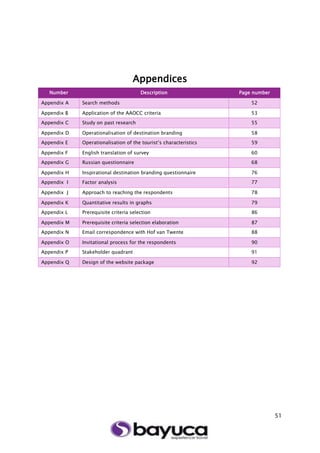
Appendices 51
7
Overview of tables and figures
Number Description Page
number
Figure 4.1 Traveling times abroad between travel groups 23
Figure 4.2 Accommodation preferences of travel groups 23
Figure 4.3 Motives to visit a destination 24
Figure 4.4 Reason of visiting a particular place 24
Figure 4.5 Cultural category 25
Figure 4.6 Historical category 25
Figure 4.7 Natural category 25
Figure 4.8 Inhabitant category 25
Figure 4.9 Tourist activities category 26
Figure 4.10 Accommodation category 26
Figure 4.11 Most important features 26
Figure 4.12 Respondent thoughts on Twente 27
Figure 4.13 Tourist recreational requirements 27
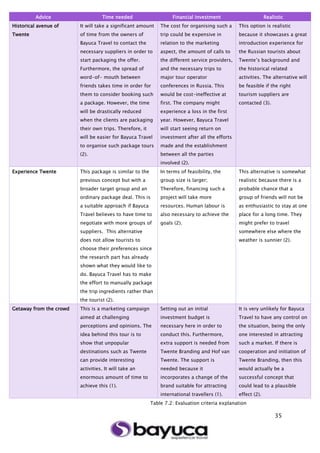
Figure 7.1 Alternative options 32
Table 7.1 Evaluation criteria 34
Table 7.2 Evaluation criteria explanation 35
Table 8.1 SWOT analysis of Bayuca Travel 38
Table 8.2 Balanced Scorecard 41
Table 8.3 Price cost per trip 45
Table 8.4 Initial investment plan 45
Table 8.5 Profit and loss statement 46
Figure K.1; K.2 Gender, Age 79
Figure K.3; K.4; K.5 Marital status, Children status, Level of education 79
Figure K.6; K.7 Fun factor, Relaxing factor 80
Figure K.8; K.9 Urban factor, Quiet factor 80
Figure K.10; K.11 Unspoilt factor, Hospitable factor 81
Figure K.12; K.13 Spacious factor, Historical factor 81
Figure K.14; K.15 Educational factor, Romantic factor 82
Figure K.16; K.17 Agricultural factor, Comfortable factor 82
Figure K.18; K.19 Destination preferences of travel groups, Motivational factors 83
Figure K.20; K.21 Reasons of visiting a destination, Interesting destination features 84
Figure K.22; K.23 Travel abroad times, Reason of choice 85
8
1. Introduction
1.1 Background description of the organisation
Bayuca Travel is a specialist in organising unique travel experiences for its clients. The tour
operator/consultancy foundation was founded in 2009 by tourism entrepreneurs Anna Yuricheva and
Christa Barkel. Their intention is to spread knowledge and professionalism to the Eastern European
hospitality industry. The foundation is specialised in arranging unique travel trips for Dutch tourists to
the former Eastern European bloc countries such as Russia, Latvia, Bulgaria, Slovenia and others. Bayuca
Travel has a diversified product portfolio ranging from the arrangement of study trips, training session
trips, cruises, and wellness. Furthermore, the company designs concepts which boost the tourism
mobility between Eastern and Western Europe (A.Yuricheva, personal communication, February 20,
2016). The overall objective of the foundation is to develop, support and promote its expertise and
consulting services to tourism related companies. The foundation annually participates in major projects
aimed at improving the social and economic advantages of the Eastern European travel market by
encouraging Dutch travellers to visit Eastern Europe. Sustainability is one of the core values of the tour
operator. Therefore, Bayuca Travel promotes its tourism products in a sustainable manner striving to
find the balance between people, planet, and profit. When taking this into account, the travel organiser
focuses on minimising the negative consequences of its activities on the environment. Furthermore,
Bayuca Travel’s core values emphasise on selling unique propositions to its clients. This focus enables
the foundation to boost the economic benefits of Eastern European destinations while taking care of
sustainability.
1.1.1 Mission
Bayuca Travel aims to offer unique touristic products and services to experienced travellers throughout
destinations situated in Eastern Europe. The tour operator always takes the environment into account
and operates with respect to the local character of a destination. By adding ‘colour’ to the products and
services, the travellers are able to contribute to the local economy while enjoying a memorable
experience.
1.2 Reasoning for the research
According to a market scan conducted by the NBTC (Holland Marketing, 2015), inbound tourism in the
Netherlands has been steadily increasing over the last decades. In the year 2012, there were over 12.2
million tourists visiting the destination for holiday or business reasons. Out of these, 160, 000 travellers
were from Russia (NBTC, 2015). This PAX number is forecasted to be 240, 000 by the year 2020, with an
8% yearly growth rate.
The client is especially interested in learning if there is a match between the Russian travel market’s
needs and wants, and what the region of Twente currently offers as a tourism destination. Twente is a
non-administrative region in the eastern Netherlands (Wikipedia, 2011). The destination attracts many
tourists from other parts of the country for its landscape which reminds of forests and pastures. The
destination does not rely on tourism but instead it focuses on agriculture. The reason why this region is
the central research topic is because of a request made by Bayuca Travel. The client wishes to gain insight
on whether the place is suitable for a Russian tourist. The tour operator is keen on obtaining figures and
statistics about the possible match between the destination’s offerings and the Russian traveller’s wants
9
and needs. Bayuca Travel hopes to achieve a higher level of market share and be the first tour operator
to attract at least an appropriate segment of the Russian travel market showing interest to the region of
Twente. The way of attracting the travel market is to advise the travel organiser with a suitable strategic
marketing of a product. The tour operator is particularly interested in understanding the ways of
attracting the aforementioned Russian travel market to the region of Twente. With this information in
mind, the management question is formulated:
1.3 Objectives of the advisory part
The objective for the advisory part is to find a suitable option on the way of attracting this travel market
to destination Twente. A prerequisite for coming up with options is to obtain facts about the Russian
tourists in the research part. This information is used throughout the advisory part. A step-by-step
marketing plan will be provided to Bayuca Travel in order to attract this market. Bayuca Travel does not
seek advice for coming up with a solution to a bottleneck, due to the reason that there is no issue that
needs to be dealt with. This advisory part consists of two advice questions:
 What are the possible options that would lure the Russian travel market to the region of Twente?
 Which one of the options is most suitable for Bayuca Travel in order to attract the Russian travel
market to the region of Twente?
1.4 Objectives of the research part
The objective of the research is to gain an insight whether there is a match between the demands of the
Russian travel market and what the region of Twente currently offers. This is a crucial step to acquire
information from both parties in order to transition to the advisory part of the report. Without this insight,
it would not be possible to answer the advice questions. Two central research questions are formulated.
1.5 Central research questions and sub-questions
1.5.1 CQ: What does the region of Twente currently offer in terms of destination branding?
Both the central research question and the sub-questions are formulated with the help of the literature
review about destination branding and destination identity. Destination branding and destination
identity are two interchangeable core concepts dealt with when a tour operator is interested in
attracting a new travel market to a destination. The aspects of the sub-questions mentioned below
help to answer the central question:
Sub-questions
 What does the region of Twente currently offer in terms of promotional material for its tourism
products?
 What does the region of Twente currently offer in terms of destination identity?
 What does the region of Twente currently offer in terms of the most highlighted tourist
recreational activities?
1.5.2 CQ: What are the current Russian tourist’s characteristics regarding destination preferences?
Both the central research question and sub-questions were formulated based on the literature review
regarding the core concepts - Russian tourist characteristics, destination image, and destination
branding. Those were the chosen concepts because they provide extensive source of information. The
10
information is necessary for developing a survey, able to trigger results about the requirements of the
travel market. The insight is used to compare the results gathered from the previous central research
question. These sub-questions were answered by distributing questionnaires to the Russian tourists
and ultimately, the central question was as well answered.
Sub-questions
 What are the characteristics of the Russian traveller profile?
 What are the current Russian tourist’s characteristics regarding their accommodation preferences
for tourism purposes?
 What are the current Russian tourist’s characteristics regarding their motivation to visit a particular
destination for tourism purposes?
 What are the current Russian tourist’s characteristics regarding their most frequent reason of
visiting a particular destination for tourism purposes?
 What are the current Russian tourist’s characteristics regarding their interest in a destination’s
features?
 What are the current Russian tourist’s characteristics regarding their tourism recreational
requirement?
Motivation for choosing the questions - Establishing two central questions made the strategy of the
dissertation clearer by targeting two valuable stakeholders with a different research design method.
The questions were all related to each other because each answer of the questions brought the report a
step closer to answering the management question.
1.6 Reading guide
The following study consists of eight chapters.
Chapter 1 introduces the reader to the organisation, the reasoning behind the study carried out and how
the project is structured. The research questions and objectives are stated in this chapter.
Chapter 2 is labelled as the theoretical framework and includes a literature review of all core concepts
that were applicable in this study. Moreover, the search methods are elaborated and utilized in finding
the right information.
Chapter 3 consists of a methodological section explaining how the data was acquired, who the targeted
population was, and which research design was used to reach this sample.
Chapter 4 contains the execution of the field research, the gathering of all necessary data and the
analysis of the results.
Chapter 5 provides conclusions to the research part as well as answering all the research questions.
Chapter 6 provides a discussion on the reliability and validity of the data results.
Chapter 7 is labelled as advice recommendations and compares three options. The most appropriate one
is chosen.
Chapter 8 provides a strategic marketing plan on the chosen option. Furthermore, the PDCA cycle is
utilised in order to implement the advice. Moreover, the financial implications are elaborated.
11
2. Theoretical framework
The following chapter deals with the theoretical framework. A literature review was necessary in order
to fully grasp the knowledge necessary for the researcher to provide a coherent answer to the
management problem. Relevant information over available theoretical concepts regarding destination
branding, destination image, and destination identity were looked upon. These core concepts
destination image and Russian tourist characteristics were applied in the survey design, whilst
destination branding and destination identity were utilised in the secondary desk research. Those core
concepts are very similar to each other and used interchangeably as a tool when trying to attract
travellers to a destination. The core concept marketing plan was introduced in the theoretical
framework in order to formulate the advisory part on a strategic level.
The objective of the research was to gain an insight whether there is a match between the demands of
the Russian travel market and the offerings of the region of Twente. The research part aimed at
answering the following research questions:
 What does the region of Twente currently offer in terms of destination branding?
 What are the current Russian tourist’s characteristics regarding destination preferences?
2.1 Search Methods and AAOCC application
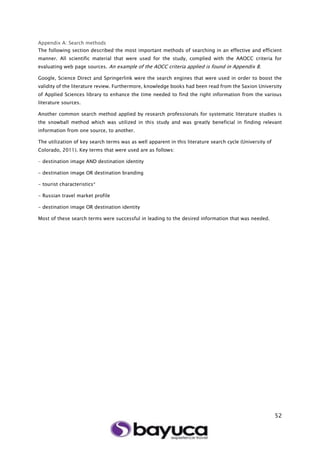
Please refer to Appendix A and Appendix B.
2.2 Results from the literature research
2.2.1 Destination branding
Ritchie and Ritchie (1998) point out that destination branding is “a name, symbol, logo, word mark or
other graphic that both identifies and differentiates the destination. Furthermore, it conveys the promise
of a memorable travel experience that is uniquely associated with the destination. It also serves to
consolidate and reinforce the recollection of pleasurable memories of the destination experience” (as
cited in Blein, Levy & Ritchie, 2005, p.329).
Tourism destinations consist of interchangeable services and products bound together under a brand
name within the same geographical area. Kerr (2006) points out that destination branding had
previously focused on tourism products and calls for a “more holistic perspective, location or place
brand, taking into account all aspects of a location” (as cited in Kozak & Baloglu, 2011, p.154). The
geographical boundaries of a destination can range from small towns to nations. Another common
definition is that travellers perceive the destination as a whole entity under a brand name. An example
of such misconception is Istanbul or Amsterdam being destinations for Europeans. For the Russian
market, Europe is seen as the destination. A destination brand represents the core essence and
enduring characteristics of a destination. Usakli and Baloglu (2011) state that destination branding is a
relevant concept, due to the fact that travellers would opt for recommended brands that match their
own self-actualization. The above-mentioned occurrence is named the self-congruity theory. For
secondary information on destination branding, please refer to Appendix C.
12
2.2.2 Destination image
The destination image is the sum of beliefs, ideas and impressions that people have of a place (Kotler,
et al., 1993).
Past studies on destination image lead to an indication that there is a level of influence on the tourism
behaviour. The destination image is an important part of the customer-based brand equity models and
plays a catalytic role in the tourist demand management (Konecnik & Gartner 2007, Boo, Busser &
Baloglu 2009).
Milman and Pizam (1995) state that if a destination desires to be potentially successful, first of all, it is
necessary for the tourist to have a positive image and awareness of the place. In relation to the hospitality
industry, a destination brand image consists of cognitive (perceptual) and affective (emotional)
components (Baloglu & Mccleary, 1999). The cognitive evaluation refers to beliefs and knowledge of a
place or object, whilst affective evaluation is about feelings and emotions about a place or an object. Um
and Crompton (1990) claim that travellers who have not previously visited a place are more likely to be
critical about their choice selection. Kotler, Haider and Rein (1993) state that it is possible for a
destination to have either a positive, negative, weak, or an unclear image. Sirgy and Su (2000) introduced
the self-congruity theory to the tourism field, in order to formulate an explanation regarding the
relationships between the self-concept and destination image. Their theory suggests that self-congruity
is the match between the destination’s image and the traveller’s perception regarding the actual and
ideal self-image.
Furthermore, Sirgy and Su (2000) gave the proposition that tourists not only base their evaluation on the
symbolic features of a destination but additionally, they look at characteristics such as price, the level of
service quality, and the variation of activities within the destination. Beerli and Martín (2007) conducted
a study that led to the insight that the stronger the match between a person’s self-concept and the
destination image, the more likely the tourist would like to visit the destination. However, there is a loss
of power on the actual and ideal self-congruity. The reason is the fact that there is less influence when
a tourist has already visited the destination. For secondary information on destination image, please
refer to appendix C.
2.2.3 Destination identity
Brand literature makes a clear distinction between brand identity and brand image. Research points out
that the destination identity is how the brand strategists would like the brand to be perceived. In other
words, this is how the supplier’s (destination) version of the brand personality looks like. Aaker (1996)
defines brand identity as “a unique set of brand associations that the brand strategist aspires to create
or maintain” (p.68).
Aaker (1996) further elaborates that:
Brand identity should help establish a relationship between the brand and the customer by generating a
value proposition involving functional, emotional or self-expressive benefits. (p.68)
Brand identity consists of core and extended identity (Aaker, 1996).The core identity is constantly
remaining as the brand is trying to attract new markets and products. The key components of it are that
it contributes to the brand uniqueness and value proposition of a destination. The core destination
identity should clearly incorporate the characteristics of the destination. It is not possible for the core
identity to be changed immediately. However, the extended identity helps the core identity to be
13
strengthened by implementing various communication strategies. For secondary information on
destination identity, please refer to Appendix C.
2.2.4 Russian tourist characteristics
The Russian tourist’s characteristics are defined as the cultural and social blueprint of a certain
population. This includes age, educational background, income, the reason for visit, destination
preferences, and size of the travel group. This statement serves as a representation of them. There are
many motives for travellers expressing the need of visiting a destination.
In a case study conducted by Lehtinen (2014), the goal was to improve the knowledge of the Russian
travel market. In the study, the tourists were approached via interview and email questionnaires
concerning their wants and needs regarding a destination. As it turned out, the Russian tourists are no
exception in the self-cognitive matter. When they plan on going to a vacation, they seek destinations
that offer multiple activities and experiences. The experiences lived are most commonly shared with
family and friends after the trip in order to realise the self-actualization. If the services and activities in
the travel destination do not meet the Russian consumers’ expectations, they feel the trip has not
succeeded. Furthermore, the research revealed that there is a relationship between a bigger group of
passengers and longer vacations. Concerning the choice of accommodation, large Russian groups are in
favour of choosing spacious living places such as cottages, apartments and bigger hotel rooms. Their
tendency is to utilise as much as possible from the offerings of the accommodation sites such as on-
sight activities. This leads to the insight that they prefer to spend more time with each other at their
accommodation place.
Lehtinen (2014) claims that the Russian tourists, coming from the high class, have higher service quality
expectations and prefer to enjoy all-inclusive tourism offers. They are willing to pay more for an
exceptional service. The rating of a destination is highly important in their minds, not only for
accommodation purposes but for the destination as a whole entity. This is directly in-line with the
destination image which plays an important role in the critical success factor of a destination. Even
though it is of upmost importance for all Russian tourists to share their travel experiences with their
friends, the higher class tends to have the need of feeling appreciated and to boost its personal status.
Lehtinen (2014) points out that the Russian travel market is very price sensitive and, even though they
might have a higher income, they are in favour of finding out the best offers available. From her interview
analysis, Lehtinen (2014) found out that word-of-mouth and recommendations are very important
factors for the final decision making. The opinion of friends and family is highly favourable whenever
somebody is looking for a reference on possible destinations. Following her interview sessions, Lehtinen
(2014) found out that there are three types of Russian travellers that can be distinguished - couples,
families with children, and a group of friends.
For secondary information on the Russian travel characteristics and tourists characteristics in general,
please refer to Appendix C.
14
2.2.5 Marketing plan
A marketing plan is a coordinated process that establishes a link between the organisation’s goals and
resources and its marketing opportunities. In other words, the organisation strives in making the best
use of its resources. Holloway (2004) elaborates that the first important step to be undertaken is to
have knowledge of the goals and resources which are available, as well as to keep an eye on the
opportunities that can be exploited by the organisation. For secondary information on marketing,
please refer to Appendix C.
 Previous knowledge on the customer
The first part of a marketing plan is to clarify who are the consumers of the tourist package and what
are their characteristics. Time is necessary to be spent in describing the target audience. This
information leads to an insight on the ways of reaching those potential customers and how to
maximise profit.
Setting objectives
The second step of a marketing plan is to set up objectives. Typical objectives sought by travel companies
are:
 Achieving sales growth within a given period of time
 Increasing the income of the organization by a given percentage within the period
 Increasing the current market share by x per cent within a period of time
 Measureable increase on Return on Investment by the company
The objectives are the backbone of decision-making and need to be formulated SMART.
Holloway (2004) advises that it is not suitable to work on many objectives at once, due to the danger of
creating conflict between the strategies.
Scan the business environment
It is important to know how easy it is for a new target market to be allowed to visit a particular
destination. Holloway (2004) states that in some countries, the entry of the market is controlled by the
government legislation. A suitable model that deals with a marketing scan of the environment is the
DESTEP analysis. It can be applied by any tourism company wishing to learn more about the
competitive environment, consumer demand, the economic influences, and the changing cultural
factors.
 SWOT analysis
After concluding the broad analysis of the business environment, it is important to evaluate the present
position of the company. The review is undertaken by using a technique labelled as the SWOT analysis.
For this reason, any internal processes are left out. In terms of weaknesses, tour operators should be
conscious about their competitive position and mention the disadvantages of their pricing, promotional
terms or scope of destinations.
15
 Choice of a marketing tactic
The marketing mix is one of the most important elements of a marketing plan. Kotler (2013) defines it
as “the set of controllable tactical marketing tools that the firm blends to produce the response it wants
in the target market” (p.76). The tools consist of four variables, commonly referred to as the four P’s:
product, price, place, promotion.
The product consists of tangible and intangible elements. Holloway (2004) points out that the intangible
products could add value to the overall experience for the customer. Price refers to the money paid for
the service by the consumer. Moreover, the price is the numerical figure of the willingness to provide the
service to the traveller when taking into account various elements such as cost and sales volume. The
place variable is controversial because it is defined as the place where the purchase had taken place and
the means on how the product has been delivered. However, in the hospitality sector, this becomes
confusing because some theorists argue that place refers to the destination of the tourists. In order to
make it clear, place will be defined in terms of the distribution channels. Promotion is the technique used
to communicate the prices and products to the marketplace. Examples of this are advertising, sales
promotion strategies, public relation activities, and the use of ICT (information and communication
technologies) to reach the target market.
 Strategic planning
When a company is done with evaluating its marketing position, there are three directions that can be
undertaken:
1) Low price leadership – The price is reduced in favour of selling more.
2) Product differentiation – Products are specialised and not offered by any competitors. Holloway (2004)
states that the focus is on quality. This justifies the higher pricing for the tourism package.
3) Market focus – In this case, the idea is to concentrate solely on one specific market. This is referred
to as market segmentation. The advantages of using such an approach, are that the company vastly
reduces the competition. By reducing competition, the market becomes less price-sensitive, which in
turn boosts profit. Holloway (2014) recommends small travel agents to develop their marketing
strategies based on specific specialisation such as a geographical region, type of activity or the market
which is served.
 Controlling the market plan - Constant monitoring is crucial for the success of a marketing plan,
as in any other project. A tool for doing this is the Balanced Scorecard which deals with the
financial, the internal, customer and learning perspective (Mackay 2004).
It is very critical to be decisive when thinking about the initial investment budget. It is important to
consider how much money will be allocated to the marketing and promotional material, as well as staff
costs.
2.3 Operationalisation
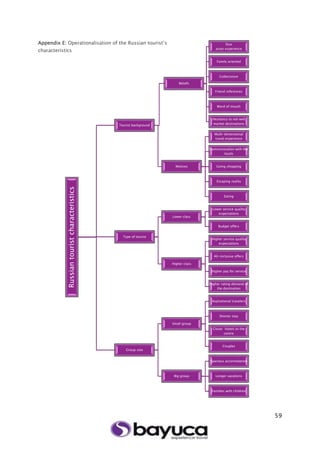
The destination branding and the Russian tourist characteristics were operationalised in Appendix D
and E respectively and are in-line with the gathered information from the literature review. It should be
important to note that identity and image have been included as components of destination branding.
16
3. Research Methodology
This chapter deals with the data collection methods which were based on the two types of central
research questions asked. The research strategy, as well as the research designs were elaborated.
These methods were in favour of the empirical research. The first central question was answered by
means of desk research and an email interview. The second central question was answered by means
of a survey design. The survey design was the dominant research data collection method. Each one of
the designs consisted of sampling units; therefore, a sampling plan was proposed and the methods of
data analysis were extensively elaborated.
3.1 The research strategy
The following composed strategy for the empirical research evolved around a survey design and a desk
research with an email interview. This study was in favour of both techniques of acquiring knowledge,
due to the complexity of the original central question and the population which was targeted. The
empirical study originally had only one central question:
To what extent is there a match between the demands of the Russian travel market regarding the
region of Twente and what the destination currently offers?
As seen in the central question, it was not possible to use only one research design, because conducting
qualitative research to the tourists would have taken an enormous amount of time to generalize their
requirements. On the other hand, conducting a survey to the region of Twente will not give a deeper
insight into the core essence of the destination and its offerings; therefore, it cannot be determined
whether there is a match between the two parties or not. This leads to an impact on the management
question. In such case, it cannot be answered fully and accurately.
The first step of the strategy was to conduct the desk research regarding the destination identity of the
region of Twente. It was important to find relevant sources on the various destination features which
are offered in the aforementioned region. Secondly, a short email correspondence with a destination
branding tourism office for the region of Twente was required in order to gain more insight into the
branding and the core essence of the destination. After acquiring the necessary information regarding
the destination, it was then possible to proceed with the survey design. The combination of the
quantified data gathered by the sample and the qualitative opinion of Hof van Twente served as the
answer whether there was a match between the requirements of the Russian travel market and the
offerings of the region of Twente as a tourist destination.
3.2 Research designs
3.2.1 Desk research
The desk research was chosen as the secondary research design. It is often considered as a low-cost
alternative to a field research. The main motivation behind this choice of opting for a desk research is
the holistic approach that needs to be taken into account in order to learn all about the branding efforts
of the destination. This design is appropriate for the exploratory phase of the study and is used to answer
the central question: What does the region of Twente currently offer in terms of destination branding?
The only way to truly gain an insight into the destination characteristics of the region of Twente was to
gather website information on what the various destination branding organisations highlight and say
about the place. Furthermore, the official tourism websites of Twente were looked at to find an insight
17
into the destination’s core attractions which are promoted. This was done in order to learn about the
DNA of the destination. Conducting the desk research enabled the researcher to gain an insight into the
identity of the destination, the brand positioning, reasoning behind the slogan, the current branding
efforts, and other elements forming the destination. Destination branding as a core concept was
operationalized earlier and served as the central topic for an email interview. The topics within
destination branding were as follows: destination identity, the most highlighted tourist activities and the
promotional material.
The purposive sampling method was selected, in regard to provide a pre-selection criterion which is
relevant to the central research question.
The sampling selection of the research units was based on the following criteria:
 The person working interviewed should be the branding manager.
 The organisation is in charge of promoting and branding the region of Twente.
By using the abovementioned criteria, three organisations were selected. The companies were Twente
Branding, Beleef Twente, and Hof van Twente, each having a branding manager. Numerous attempts
were made to arrange a qualitative interview with Beleef Twente and Twente Branding. However, none of
the organisations responded; therefore, only the information from the marketing manager of Hof van
Twente was primary used.
Hof van Twente was the only one that was willing to cooperate because the others did not respond either
through mail or on the phone. Therefore, it was seen as that they are not interested. The contact person’s
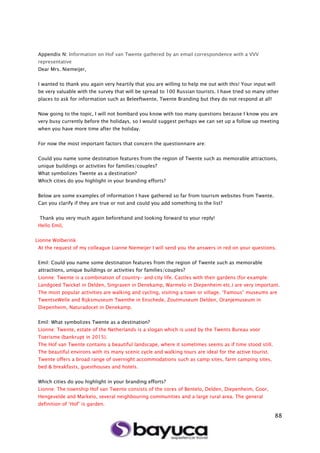
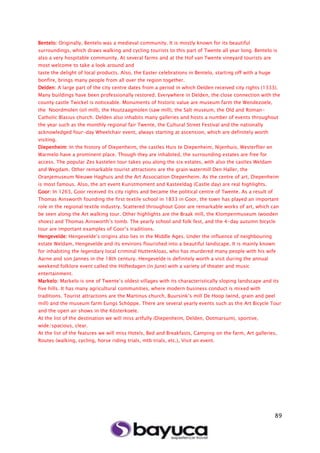
name was Lianne Niemeyer, who was very enthusiastic and proposed to correspond via email about the
destination branding and identity of Twente. The email correspondence can be found in Appendix N.
Most of the information regarding the destination features had been gathered by conducting the desk
research. Nevertheless, clarification and approval of the marketing director was vital. The contact person
suggested specific destination attributes, not found on the tourism websites of Beleef Twente and Hof
van Twente. The information gathered from interviewing the tourism marketing manager of Hof van
Twente served as a basis on the way to approach the Russian travel market population, not only in the
questionnaire, but as well in the advisory part. By building up the brand essence of the destination, it
was possible to include the destination features of the region of Twente into the questionnaire. All these
destination characteristics were labelled as motivational factors for tourists visiting a particular place.
3.2.2 Survey design
Brotheron (2011) expresses that the survey design is used to collect information from a “representative
sample” of individuals using the technique “Asking questions”. This study was in favour of conducting
a survey design due to the desire of gathering numerical information regarding the requirements and
opinions of the Russian traveller and to compare if they are interested in Twente’s offerings. Verhoeven
(2015) refers to the data collected as cross-sectional. The population was Russian tourists who have had
no previous experience or expectation about the region of Twente, but the questions asked in the
questionnaire included aspects of the DNA of the destination. Another reason for choosing a survey
design is that it is a standardized procedure with less room for systematic error with the ability of
quantifying the data collected from the respondents.
18
Furthermore, according to Brotherton (2011), it is easier to design a survey and implement it rather than
other empirical studies. The objective comparisons are then easier to be attained. The survey was
distributed to the potential respondents by electronic means due to the geographical boundaries and
difficulty in reaching the population directly. Brotherton (2011) states that this is a very popular type of
survey because an enormous amount of people are surfing the web every day. By distributing the survey
digitally, it diminishes the necessity of travelling to Amsterdam or any other major Dutch city where there
is a probability of finding the Russian travellers. This reduced the time spent on distributing the
questionnaires. Furthermore, it would be easier to reach immediately the desired sample. A postal survey
would be cost-ineffective, i.e. sending the questionnaire to Russian residents. Telephone surveys were
out of the question, due to the lack of ability to acquire a sample frame from a telephone book and
speaking the native Russian language. Face to face surveys were impractical in this matter because it
was already very difficult to find Russian tourists in the geographical region where the study had taken
place.
It should be noted that there are disadvantages when applying a survey design. Brotherton (2011) points
out that, although a survey design is applicable in this circumstance, it is not necessarily the best way of
gathering information, because other research designs are more accurate. Furthermore, due to the fixed
nature of the questions, there is no room for flexibility, whilst with a qualitative analysis it is possible.
Another major disadvantage, pointed out by Brotherton (2011), is that is it not possible to explore the
motivation behind a certain answer of a question.
3.3 Data collection method
3.3.1 Web-based questionnaire method
The chosen method of collection is a web-based questionnaire. The reason behind this strategic decision
is that the possible sample is most active, and is more likely to fill out the questionnaire. Brotherton
(2015) states that, in terms of designing the questions, they need to be unambiguous, comprehensive
and contain the measurements that the researcher wants to measure.
The questionnaire design of the web-based survey is straight-forward. The data gathered by the
Russian travellers served as a comparison tool about the match between the offerings of the region of
Twente as a destination and the tourist preferences. It was designed to assess the destination image,
as well as the traveller perceptions of the region of Twente. Furthermore, it assessed the traveller’s
possible interest in traveling for vacation purposes.
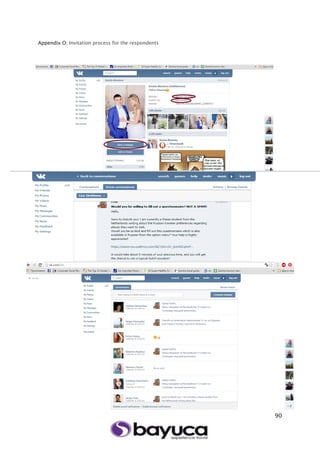
A sample size of 142 people received an online invitation questionnaire from the Russian multi-sided
platform vkontakte.com including Facebook. The software program which was used to design the web-
based survey is called Qualtrics. Qualtrics comes packed with the possibility of designing the
questionnaire and the option of exporting the acquired data into SPSS (Statistical Package for the Social
Sciences). Qualtrics was chosen, due to the possibility of digitally receiving back the questionnaire
once it has been filled out by the respondent. Another advantage of using Qualtrics, is that it
automatically creates charts and statistics based on the questions asked, so the work and time to send
the data to SPSS is diminished.
The degree of anonymity of the respondent was high. There were many people who opted to fill out the
questionnaire. The questionnaire was distributed to the Russian population using the most popular social
media portal by Russians - vkontakte.com. Sangeet (2013) states that a multi-sided social platform is
19
an organisation that enables a direct interaction between customers. The questionnaire was available in
the mother tongue of the respondents as well as in English. The questionnaire was first written in English
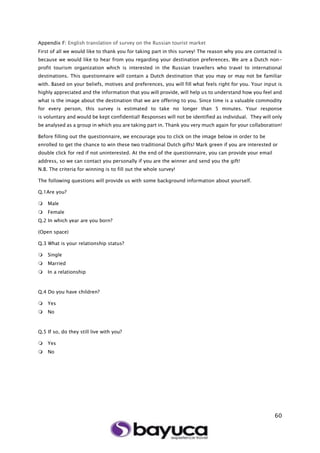
due to the inability to remove this option in Qualtrics. The English translation can be found in Appendix
F and the Russian version in Appendix G. The idea behind spreading a web-based survey in Russian was
that more people would be willing to fill it out. However, this effort did not make much of a difference
in terms of reachability.
3.4 Sampling plan
The population of this study was Russians travellers. No sampling frame existed, due to the fact that it
was difficult to acquire any administrative record of all the Russian users from the websites. Therefore,
the only alternative was to opt for a non-probability based strategy having its weak points. This is
elaborated later on in the reliability section 6.1. Convenience based sampling was chosen as the
desired strategy. Persons were deliberately selected for the sake of providing information that cannot
be obtained in a probability based way. What this means is that a specific number of the population
was chosen based on who is most easily available and willing to fill out the questionnaire while at the
same time, complying with predetermined criteria.
The respondents were approached with an inviting message. The message encouraged them to fill out
the questionnaire in a hospitable manner. The respondents were addressed either in Russian or English,
depending on their preference. However, the criteria for selecting certain people had to comply with the
following rules:
 The respondent is Russian, speaks Russian and is able to fill out the questionnaire in Russian. It
is accepted to be with a mixed nationality.
 The Russian respondent is interested in filling out the questionnaire and successfully completing
it.
 Gender and age do not matter.
 The Russian respondent is part of a travel community page.
 The respondent appears to be interested in travelling, judging by his/her pictures posted.
The size of the realised research sample (142) comprising of a 143,441,282 population, was not very
valid. There was an overrepresentation of the adults between the ages of 21 – 29. However, the given
sample is still representative to some degree for the younger group. In a correspondence with the
research counsellor for the questionnaire, 100 respondents were proven to be enough for such a thesis
project. “The outcome of the sample is generalised back to the population as a whole” (Brotherton, 2011).
The way the generalisation had taken place was that all respondents received questions about certain
aspects that they enjoy or dislike from the region of Twente. The choices that they made from the
questionnaire provided truthful generalisation of the younger part.
Invitation to fill out the questionnaire
Please refer to Appendix O.
3.5 Data analysis plan
The data analysis utilisation opted for two different techniques based on quantitative and qualitative
information measurements.
20
3.5.1 Survey data analysis plan
The survey analysis plan was necessary to answer the second central research question: “What are the
current Russian tourist characteristics regarding destination preferences”? The question consisted of
both an independent and dependent variable. The characteristics are classified as an independent and
preferences are regarded as the dependent variable. All sub-questions are answered by means of a
univariate analysis. Frequency distribution was applied in this case. The mean score was calculated as a
measure of central tendency with regards to the rating of the destination features.
The general background information of the respondents was obtained via a univariate analysis. A
frequency distribution table was applied. The survey consisted of questions regarding the age, gender,
relationship status, and income of the respondents. The variables were nominal, ordinal, and scale. The
first part of the questionnaire solely focused on nominal level-based questions in order to determine the
adequate demographic profile of the sample. Secondly, there were questions consisting of one more
variable, prompting for a bivariate analysis. The different travel group preferences were compared via
cross-tabulation.
The analysis for the qualitative aspect which answered the first central research question “What does
the region of Twente currently offer in terms of destination branding?” relied on using the information
from the desk research and the email correspondence. Both sources of knowledge helped out to
provide an answer to the sub-questions.
21
4. Results
The following chapter discusses the most important results gathered from the research. There were two
analysis techniques involved in this section. The first part comprised of the desk research regarding the
destination branding and identity of the region of Twente. An email correspondence analysis with Hof
van Twente has been included in this chapter. The second part was a survey analysis of the respondents
that had taken part in the survey. Statistical information and figures were included to provide an accurate
portrayal of the demographic characteristics of the respondents.
4.1 Desk research on the region of Twente
The following desk research aims at answering the first central research question which is “What does
the region of Twente currently offer in terms of destination branding”? The sub-questions were answered
with the help of the desk research and the correspondence of the marketing director of Hof van Twente.
4.1.1 Twente offering in terms of promotional material for its tourism products
Twente is a non-administrative region in the eastern part of the Netherlands. The region comprises of
fourteen municipalities. The five most well-known are Almelo, Hengelo, Enschede and Hof van Twente.
The destination is considered to be the most urban part of Overijssel (Wikipedia, 2011).
Every municipality is promoted by a different tourism organisation. The destination identity is divided
between the various parts of the region. Each municipality promotes its part in a different manner. There
is a lack of a primary promotional tourism office dealing with the branding of the destination; therefore,
the exact extended identity is difficult to be pointed out because of the various communication strategies
utilised by the organisations. Furthermore, the recent bankruptcy of the Twente Tourism Bureau had an
impact on the division of the DMO’s in charge of promoting the destination (L.Wolbering, personal
communication, April 22nd, 2016).
They all take part in the marketing and promotional efforts for Twente, having various roles for the
different geographical regions that form Twente as a destination. The communication channels used by
most of these organisations to promote the different parts of Twente, are via their websites. On the
websites, the branding organisations showcase destination features, activities and accommodation
options that the traveller might be interested in visiting. Most of the websites do not contain information
in English, except the one from the Twente Tourism Bureau, which is still active but not updated anymore.
4.1.2 Destination identity
Even though there is a difference in the communication strategy for the extended identity, the core
identity for the region of Twente remains the same. The core identity of the destination is a combination
between countryside and city life, branded as the “estate of the Netherlands” (L.Wolbering, personal
communication, April 22nd, 2016).
The destination is identified as a place full of pure serenity, beautiful landscapes, meadows, and forests
(Visit Twente, 2016). The destination is considered to be the garden of the Netherlands. Furthermore,
Wolbering (2016) points out that Twente contains beautiful environments using the metaphor “as time
stood still”. Twente is a cultural destination combined with historical elements.
The Twente Tourism Bureau identifies it as “an ideal place for an enrichment in life” (Visit Twente, 2016).
Wolbering (2016) identifies Twente as a destination which is “comfortable, sportive, artfully, hospitable,
romantic, historical, educational, agricultural, unspoiled, safe, quiet, relaxing, fun and urban”.
22
4.1.3 The most highlighted tourist activities
The region of Twente offers many forms of tourism activities ranging from cycling, walking tours,
museum watching and visiting historical areas. This information was gathered from the tourism websites
of Hof van Twente, Beleef Twente and the Twente Tourism Bureau.
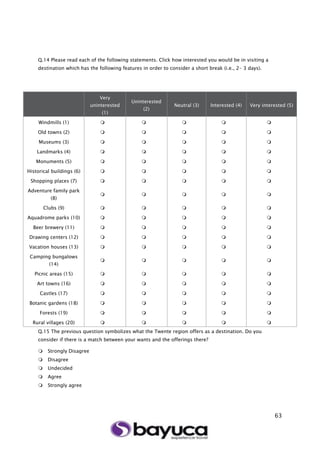
The destination features are: windmills, old towns, landmarks, monuments, historical buildings,
shopping places, adventure family parks, clubs, beer brewery, drawing centers, picnic areas, art galleries,
castles, forests, and horse riding routes. All of these were mentioned by the marketing director of Hof
van Twente (L.Wolbering, personal communication, April 22nd, 2016).
Hof van Twente highlights the six castles scattered throughout the destination. The three are Huis te
Diepenheim, Nijenhuis, and Westerflier en Warmeloare. All of the above-mentioned attractions are
names historical buildings.
Furthermore, another prominent castle, which is frequently highlighted on both the websites and the
email correspondence, is castle Twickel. The castle is famous for its beautiful botanic gardens and
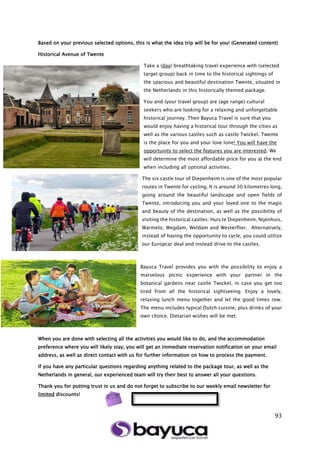
spacious surroundings. As deducted from the desk research, the historical attractions are the unique
selling destination attributes. For the full email correspondence, please refer to Appendix N. This
information is reoccurring on the websites of the various destination organizations.
4.2 Wishes and demands of the Russian travellers
The quantitative findings aim to answer the second central question: What are the current Russian
tourist’s characteristics regarding destination preferences?
4.2.1 Demographic profile and characteristics of the Russian traveller
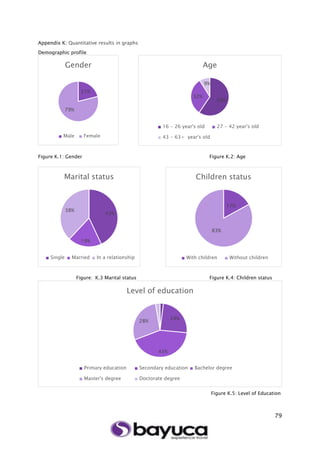
The general profile of the respondents is a mixture of 112 female (79%) and 30 male (21.13%) across
all age groups (Figure K.1).
The respondent’s age ranged from 16 up to 64. The majority of the respondents are between the age
range from 16 to 26 year’s old (Figure K.2). The marital status is as follows: 43% single, 19% married,
and 38% in a relationship (Figure K.3). Verhoeven (2015) refers to this as a bimodal distribution because
it has two peaks as seen in Figure K.3 in Appendix K.
The majority of the respondents are without children (Figure K.4). 25% of the respondents earn more
than 100, 000 rubles monthly which is equivalent to 1,330 euro on a monthly basis. 25% have acquired
Secondary Education, 43% of the population have obtained a bachelor’s degree and 28% have obtained
a master’s degree (Figure K.5).
23
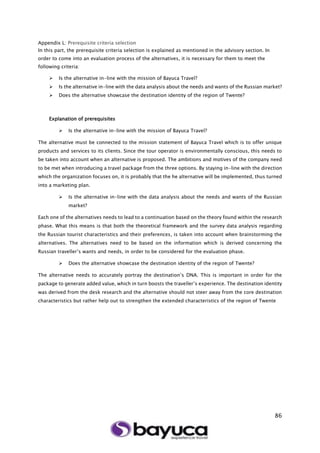
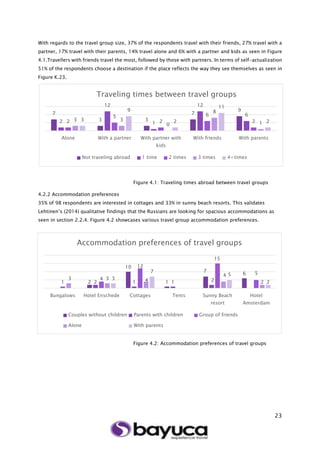
With regards to the travel group size, 37% of the respondents travel with their friends, 27% travel with a
partner, 17% travel with their parents, 14% travel alone and 6% with a partner and kids as seen in Figure
4.1.Travellers with friends travel the most, followed by those with partners. In terms of self-actualization
51% of the respondents choose a destination if the place reflects the way they see themselves as seen in
Figure K.23.
Figure 4.1: Traveling times abroad between travel groups
4.2.2 Accommodation preferences
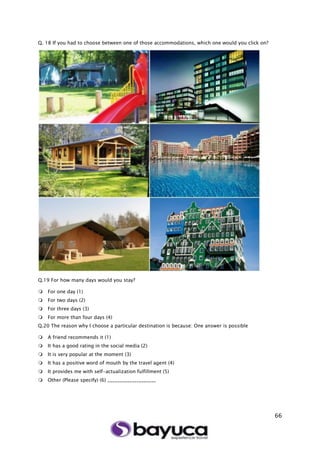
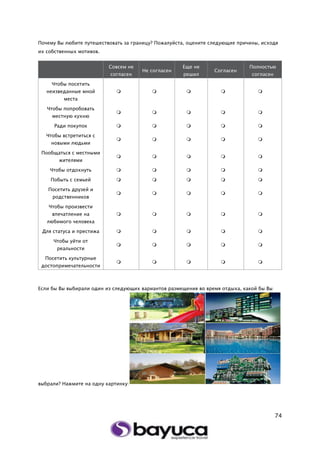
35% of 98 respondents are interested in cottages and 33% in sunny beach resorts. This validates
Lehtinen’s (2014) qualitative findings that the Russians are looking for spacious accommodations as
seen in section 2.2.4. Figure 4.2 showcases various travel group accommodation preferences.
Figure 4.2: Accommodation preferences of travel groups
7
3 3
7
9
2
12
1
12
6
2
5
2
6
23 3
0
8
1
3
9
2
11
2
Alone With a partner With partner with
kids
With friends With parents
Traveling times between travel groups
Not traveling abroad 1 time 2 times 3 times 4+times
2
10
1
7
6
2 1 1 21
4
12
15
5
3 3 4
4
2
3
7
5
2
Bungalows Hotel Enschede Cottages Tents Sunny Beach
resort
Hotel
Amsterdam
Accommodation preferences of travel groups
Couples without children Parents with children Group of friends
Alone With parents
24
4.2.3 Motives to visit a particular destination for tourism purposes
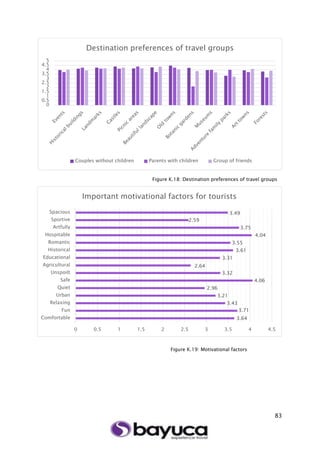
The Russian respondents are motivated to visit destinations which are safe, hospitable, artfully, fun, and
historical. 81% of the 120 respondents consider safety very important, 79% find hospitality important,
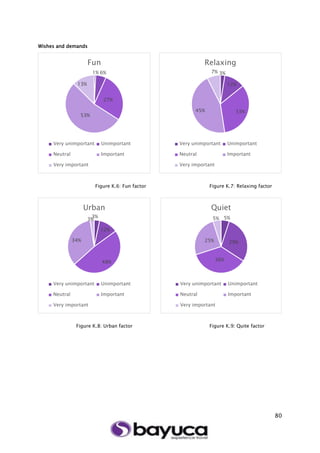
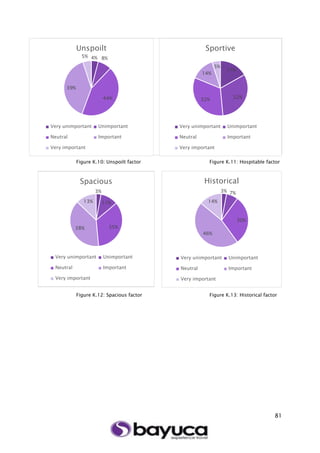
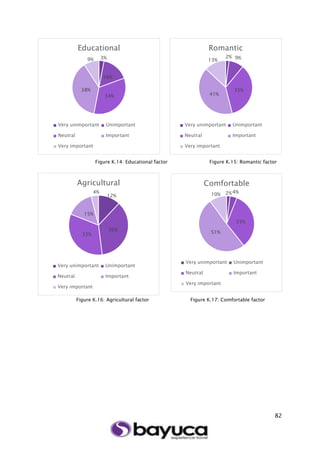
and 65% find artful destinations important. They are demotivated in visiting destinations which are quiet
and sportive as seen in Figure 4.3. For a full list of the variables, please refer to Figure K.19.
Legend: 1= Very unimportant 2= Unimportant 3=Neutral 4=Important 5=Very important
Figure 4.3: Motives to visit a destination
4.2.4 Reason for visiting a particular destination for tourism purposes
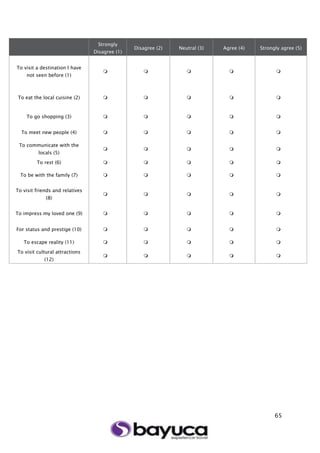
The most frequent reason for visiting a destination for a Russian tourist is the fulfilment of the self-
actualization of the respondents through a certain place (Figure K.23). For more variables, please refer
to Figure K.20 in Appendix K. This is directly in-line with Morgan, Pritchard and Piggott’s (2002) theory
about aspirational travellers seeking self-actualization. 41% of the N=110 had given this answer. Various
reasons of visiting variables were explored in the next question which provides an in-depth insight on
the reason of visiting as seen in Figure 4.4. For a full list of all variables, please refer to Figure K.20.
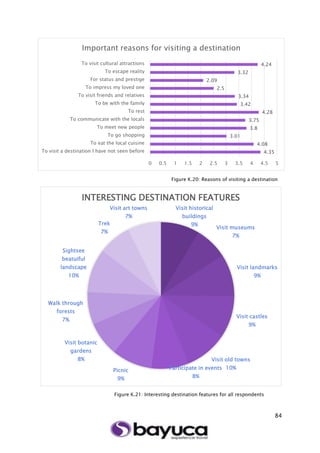
94% of the participants agree that they want to travel to a destination they have not seen before. The
mean score is 4.35. This study validates the theory of Morgan, Pritchard and Piggot (2002) that tourists
are interested in discovering new places rather than escaping reality during their vacations as seen in
section 2.2.3
Legend: 1= Strongly disagree 2= Disagree 3=Neutral 4=Agree 5=Strongly agree
Figure 4.4: Reason for visiting a particular place
0 0.5 1 1.5 2 2.5 3 3.5 4 4.5
25
4.2.5 The tourist interest in the region of Twente destination features
The destination features are broken down into six categories. The categories are labelled as; cultural
attractions, tourist activities, nature, historical attractions, inhabitant areas, and accommodation.
As seen in Figure 4.5, the most interesting cultural attractions are events participation, and second to
that, art galleries. Drawing centres score as low as 2.7 which means that the respondents are
uninterested. The respondents are interested in history as seen in Figure 4.6. This category scores the
highest rating. 88% of the respondents find castles interesting and 81% historical buildings.
Figure 4.5: Cultural category Figure 4.6: Historical category
In terms of geographical characteristics the respondents are very interested in picnic areas and a
beautiful landscape as seen in Figure 4.7 and Figure 4.8. Furthermore, they are interested in botanic
gardens and trekking paths. Regarding the category “inhabitant places”, the respondents are mostly
interested in visiting old towns.
Figure 4.7: Natural category Figure 4.8: Inhabitant category
3.41
2.7
3.61
3.97
Cultural attractions
4.25 3.88
3.86
4.33 3.83
3.21
Nature
4.03 3.82 3.47
4.22 4.31
Historical attractions
4.25
3.78
3.38
Old towns Art towns Rural villages
Inhabitant places
26
In terms of tourist activities which are provided throughout the region of Twente, the results showcase
a neutral feeling by the respondents. The only positive score is cycling as seen in Figure 4.9. In terms
of accommodation features, the respondents showcase mixed feelings. The highest score in this
category are hotels with a mean score of 3.63. The respondents find camping farms uninteresting as
seen in Figure 4.10.
Figure 4.9: Tourist activities category Figure 4.10: Accommodation category
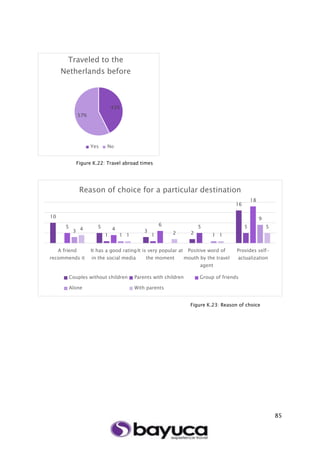
To summarize, there are in total 7 features which fall into a positive category: landmarks (4.23), picnic
areas (4.25), old towns (4.25), a hospitable community (4.14), beautiful landscape (4.34), castles (4.31),
and historical buildings (4.03). Neutral features are referred to as non-significant destination attributes
which fall down with a mean score of above 3. These are pointed out as neutral feelings or indifferent
for the respondent whether the features are available or not. Please refer to Figure 4.11 for the most
important features to be kept in mind. Various group travel preferences regarding the region of Twente
are showed in Figure K.18 and Figure K.21 in Appendix K. In terms of negative features, these are referred
to as those destination attributes which fall within the category of a mean score less than 3.
The following are not interesting for the respondents and should be avoided when the destination is
marketed towards the Russian travellers: clubs (2.96), drawing centres (2.70), and camping farms (2.96).
Figure 4.11: Most important features
2.96
3.17
3.28 3.63 3.48 3.41
Accommodation
3.02
3.333.63 3.48
2.96
3.3
Tourist activities
4.23 4.25 4.25 4.34 4.31 4.03
2.96 2.7 2.96
0
1
2
3
4
5
Most important features
27
Out of 120 respondents, 52% agree that there is a match between their wants and what the destination
of Twente offers as features, as seen in Figure 12. However, not far behind are 43% of the travellers who
have not yet decided whether there is a match or not. Only 2% disagree that there is a match and 3%
completely disagree that there is a match. The mean score is 3.45 and is situated in the neutral zone.
Figure 4.12: Responde`nts thoughts on Twente
4.2.6 Tourist recreational requirements
As seen in the previous categories, the most interesting recreational activities for the Russian tourists
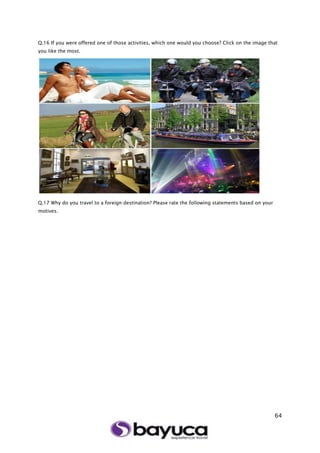
are: events, picnicking, and trekking. Furthermore, a heat map of suitable activities for the Russian
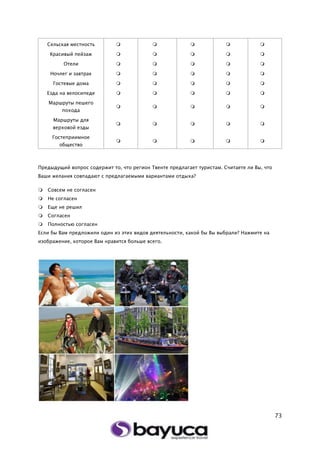
tourists was provided. The respondents were able to click on one of the images. As it turned out, 39% of
105 respondents are interested in tanning, 20% in cycling and 25% are interested in boat rides as seen
in Figure 4.13.
Figure 4.13: Tourist recreational requirements
2
60
52
2 4
Strongly agree Agree Undecided Disagree Strongly
disagree
Respondent thoughts on Twente
12
4
2 3
9
2
1 1
3
14
12
2
8
2
1
3
1
3 3
6
2
1
3
2
4
Tanning Motorbiking Cycling Visiting
museums
Clubbing Boat rides
Recreational requirements for travel groups
Couples without children Parents with children Group of friends
Alone With parents
28
5. Conclusions
In this chapter, the central research questions are answered with the help of the gathered information.
The questions were as follow: “What does the region of Twente currently offer in terms of destination
branding”? and “What are the current Russian tourist’s characteristics regarding destination
preferences”? The following section serves as a conclusion to the research part of the report and
accomplishes the objective of the research. The objective was to gain an insight where there is a match
between the requirements of the Russian tourists and the offerings by the region of Twente. The
information which was gathered is used in the advisory part.
5.1 The destination branding of the region of Twente
Twente is branded as the estate of the Netherlands. The slogan was used by the Twente Bureau for
Tourism which bankrupted in 2015. The destination is promoted by organisations such as Twente
Branding, Hof van Twente, and Beleef Twente. They all take part in the marketing and promotional efforts
for Twente. Each one has various roles for the different geographical regions that form Twente as a
destination. The destination identity is presented to be a combination of country and city life. There is a
division between the various parts of the region and each municipality promotes its fragment differently.
There is a lack of a primary promotional tourism office dealing with branding the destination as a whole.
The reason is that there are various communication strategies used by the organisations. Hof van Twente
showcases Twente as an artful, sportive, wide, spacious and clear destination. Beleef Twente presents it
as an educationally and historically-centred destination. Furthermore, it appears to be relatively safe.
The most popular activities are walking, cycling, and visiting towns. Twente offers a broad range of
overnight accommodations such as camp sites, bed & breakfasts, guesthouses, and hotels. It is
important to note that a large part of the advertisement campaigns goes to castles.
5.2 The Russian tourist characteristics
Statistical data was digitally collected from 142 Russian tourists. The majority of the respondents
consisted of Russians between the ages of 16 to 26 who are either in a relationship or single. 32%
consisted of 27 to 42-year-olds. The rest is split into small percentages. The population either travels
with a partner, a group of friends or with their family. 43% of the respondents hold a bachelor’s degree
or are about to receive one. 28% of the respondents hold a master’s degree. In terms of income, there is
a clear separation between those earning less than 30,000 Rubles monthly and those who earn more
than 100,000 Rubles. These are two major variations. The population travels from one time all the way
to more than four times per year. Large Russian groups are in favour of choosing spacious living spaces
such as cottages, apartments and larger hotels, as found from the theoretical framework. There are three
types of Russian travellers that can be distinguished: couples without children, families with children,
and group of friends.
Tourists are influenced by the rating of a destination. This has an impact on the tourist’s image on the
whole destination entity. In terms of destination features, the Russian tourists are interested in exploring
the historical attractions of the destination and firstly, the natural attributes.
There is a partial match between the Russian travel market requirement of a destination and the
tourism offerings of the region of Twente but awareness needs to be spread in order to attract the
aforementioned travellers. The advice needs to be based on highlighting the most interesting features
of Twente for the Russian tourists and marketing them towards the travellers.
29
6. Discussion
The following chapter elaborates on the validity and reliability of the research paper in order to provide
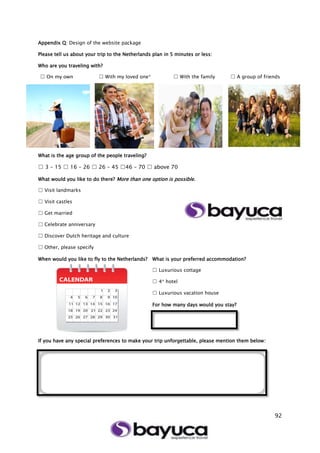
a truthful measurement on the quality of it. Validity and reliability are two important aspects in all studies
in order to portray the accuracy, dependability, and credibility of the information. The goal of this chapter
is to assess the quality of both those aspects in relation to the measurement procedure used to generate
the results. In order for the study to be considered valid, it also needs to be reliable.
6.1 Reliability
The research was transparent and included all the elements necessary for a research paper. It took into
account all important steps from the methodology section in order to analyse the data. The reliability of
the research paper was on a high level. However, numerous sampling frame errors occurred such as
when there was a lack of equal division between genders or the fact that there were more young people
than old. The female population was more than the male; therefore, it has a direct consequence on the
reliability of the study (Brotherton, 2008). The reason for this occurrence was an error made by the
researcher, who contacted more females, as he saw that they were willing to fill out the questionnaire
more than the male population. Secondly, due to time constraints, it was not possible to wait for an
answer or approval of all. However, volume was more important than control of the ones who fill out the
questionnaire. In order to reach the desired sample size, the quality of finding the candidates to fill out
the questionnaires drastically decreased. Thirdly, there was an evident bias on who was approached due
to the non-probability based strategy which was to use the convenience based sampling. This severely
hindered the reliability of the study as there was not an available administrative record of all users in
vkontakt.com of Russian background.
The measurement instrument, being a questionnaire, was clear of random errors as a consequence of
being checked and approved by two research experts. Not all questions were filled out by the
respondents, regardless of the safety measurement system implemented by Qualtrics to not allow users
to continue to the next question without filling out all aspects. Verhoeven (2014) states that there are
times when random errors can occur in a research project. Such case was when respondents had filled
out a city name rather than their year of birth due to getting lost in the translation from English to
Russian.
Due to the fact that this is a web-based questionnaire designed with Qualtrics, it was possible to retest
the reliability of it each time the survey was filled out by a person. A window would open in Qualtrics
that provided information on the location of the questionnaire being filled out. If the questionnaire was
conducted by a different person with the exact same formulation of neutral questions, the same
conclusions would have occurred. According to Brotherton (2008), this measurement instrument is
reliable. Moreover, peer examination had taken place and the questionnaire was tested numerous times
by the client before being distributed. However, it came as a challenge when the questionnaire was
translated to a different language because there was a possibility that some questions were interpreted
differently.
30
6.2 Validity
Brotherton (2008) states that evidence-based information is crucial to rightfully represent whether a
research data analysis is valid or not. According to Verhoeven (2015), research should be clear of
systematic errors. Moreover, Brotherton (2008) further elaborates that a research design needs to be
adequate and appropriate. In order to validate whether this was the case in this research project,
convergent validity took place. What this meant was that different theories were compared when
developing the theoretical framework, which in turn formed the operationalisation. The
operationalisation for destination branding was used as a measurement instrument for the questions
sent to Hof van Twente and the design of the survey. Furthermore, the results which were gathered from
the questionnaire were very similar to those results gathered by Lehtinen (2014), who used a qualitative
research design presented in the literature review. This would mean that triangulation actually had taken
place by generating findings on two data collection methods providing similar results which boosts the
construct validity. Furthermore, in order to establish construct validity, a statistical factor analysis test
was utilised to be able to “claim” discriminant validity. The independent variables of the core concept
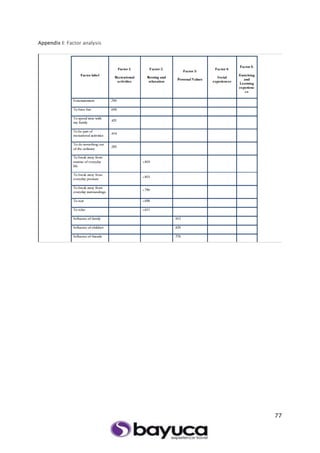
“tourism characteristics” were reproduced to check a correlation pattern. As it turned out, there are 49
(62%) non-redundant residuals with absolute values greater than 0.05. Moreover, the use of current
literature further supported the construct and internal validity. In order to improve it even more, the
email interview conducted with the marketing director of Hof van Twente was analysed.
Verhoeven (2014) states that the sample must resemble the population in terms of characteristics that
are relevant to the research. Furthermore, external validity is related to the truthfulness. It can be argued
that the external validity of the research is limited. Furthermore, the quality of the sampling method is
limited. A sample size of 142 people, out of the total Russian population 143,441,282 was too low to be
able to generalise the whole population. The respondents were not representative enough. It was very
difficult in generalising the total population due to the lack of older respondents that filled out the
questionnaire including a lack of respondents below the ages of 16. However, the results can be
generalised, to the very least, for the young adults between the ages of 21 to 29 having been the majority
that had filled out the questionnaire. This means that some of the results gathered were actually valuable
and extremely useful for Bayuca travel because they provided a general ground base for future studies.
In order to improve the internal validity, research design and statistical analysis were primary utilised to
achieve this. Brotherton (2008) states that internal validity showcases the truthfulness of the research
results from the carried out field research. The conclusions which were found from the quantitative
analysis could be traced back to the theoretical framework leading to a contribution in boosting the
internal validity. Therefore, this increased the confidence and dependability of the results (Brotherton,
2008).
31
7. Advice
The following advisory section has been written for Bayuca Travel. In the previous chapters, insight was
gathered regarding the destination identity, the branding of the region of Twente, and the Russian
traveller characteristics. The conclusion was that there is a partial match between the Russian
requirements and Twente’s offerings. The following chapter aims at providing various recommendation
options based on the research results. Each alternative goes through a certain criteria-based selection
and the most feasible, financial, and realistic solution is going to be later implemented via a PDCA
planning cycle with the help of a strategic marketing plan.
Over the past months, the research part of the report was conducted. The question that the management
team of Bayuca Travel is facing is:
How can Bayuca Travel attract the Russian tourists to the region of Twente?
The management question is answered with the help of the theoretical framework, the desk research on
the destination identity of Twente, and the market data acquired from the Russian tourists regarding
their needs and wants. With all the information at hand, it is now possible to formulate a suitable advice
that could be implemented by Bayuca Travel as a marketing strategy.
7.1 Advice objective and questions
The advice objective is to assist Bayuca Travel with recommendations on the various options available to
luring the Russian travel market to Twente. The most plausible option will be elaborated with the help
of a strategic marketing plan. In order to achieve the managerial ambitions, the tour operator needs to
offer a travel package which is feasible, provides return on investment, is able to spark interest, and
captures the attention of the consumer.
7.1.1 Advice questions
Advice question 1: What are the possible options that would lure the Russian travel market to the region
of Twente?
Advice question 2: Which one of the options is most suitable for Bayuca Travel in order to attract the
Russian travel market to the region of Twente?
7.2 Management case approach
Three alternatives will be described and later on compared via a criteria-based selection method. The
evaluation criteria will comprise of three elements: time needed, financial investment needed, and
whether it is realistic or not. This criteria based selection is also used as a benchmarking tool with the
intention of determining the most convenient and plausible alternative for Bayuca Travel which delivers
the highest added value.
There are three dominant travel groups found in section 2.2.4 and in the survey design: travellers with
their friends, couples without children, and families with children. There are certain destination features
in Twente which are interesting to some of the travel groups as seen in Figure K.21 in Appendix K. Each
one of those travel groups has different preferences regarding the region of Twente. Consequently, a
different packaged trip catering their different interests could be designed. The goals are long-term,
and it is important for them to be realistic, attainable, and to meet the self-actualization requirements
32
of the tourists. They also have to provide an accurate reflection on the wants and desires of the Russian
travel market.
Gap between the SOLL and IST situation
The current situation is the existence of a significant match between the Russian travel market and the
offerings of Twente. However, there is hardly any intention from the region of Twente to attract this
market. This is either because the destination is unaware of the possibility of such a potential market or
simply because they are not interested in attracting it. At its current state, Bayuca Travel is focusing on
the Dutch travel market to travel to Russia. The tour operator is run by two people who respectfully
design themed tours for their clients such as “Feel the past”, which can be found on their official website
as well as on their Facebook profile.
However, the desired situation comes from the fact that Bayuca Travel is ready to invest up to €25,000
for a marketing plan, specifically based on the thesis outcome, which they had been able to save from
selling their trips without taking a loan. It was not possible to acquire information regarding the annual
trips sold by Bayuca Travel; however, the tour operator is ambitious and ready to be the first tour operator
to attract the aforementioned BRIC country to the region of Twente. The reason is the fact that the thesis
client is able communicate in the traveller’s native language and possesses valuable insight on the
market through the researcher’s survey results.
7.3 Description of alternatives
Figure 7.1: Alternative options
7.3.1 Alternative 1: Historical avenue of Twente
A connection was made between couples without children and the desire to visit historical attractions as
seen in section 4.1.3 and Figure 4.6. Therefore, “The historical avenue of Twente” package is proposed
to be developed. This is a dynamic travel package which is targeted towards wealthy young Russian
couples who travel with their partner. The idea behind this concept is to showcase the historical sightings
of Twente to the young culturally interested Russians. This target group is called “culture seekers” formed
of people who would like to get immersed in a completely different travel experience. As seen from the
data analysis, the respondents had given the highest scores in the historical attractions category.
Consequently, the idea is to create a travel package which incorporates the historical features for this
target group. Special events should be considered within a cultural or historical spectre since most of
the Russian respondents seek self-actualization. A limited availability historical tour of Twente featuring
a tour guide will be included in the program. NBTC (2015) states that Russian travellers speak English
Option 1:
•Historical avenue of Twente - tour dynamic package (4 days)
•Target group: Couples without children
Option 2:
•Experience Twente (4 days) - normal package
•Target group: Group of friends
Option 3:
•Getaway from the crowd (2 days) - tourism campaign
•Target group: Parents with children
33
fluently; therefore, it would not be a problem for them to have an English-speaking tour guide. This was
also acknowledged by the sample approached in the survey.
As requested from the client, the offer will be a “land package”. This means that the travellers will choose
the airline company they would like to travel with by themselves. The client has no responsibility on the
decision making of the traveller regarding this aspect. However, Bayuca Travel becomes responsible for
all land tourism related activities that incorporate the traveller’s experience.
The promotional message for this is: A visit to the past is close!
There will be three categories which form a travel package: accommodation, activities, and features. The
traveller gets to choose between predetermined traveling components which in its very core is called
dynamic packaging.
Luxurious cottages will be available to accommodate up to two people. The anticipated target group will
be joined by their partner. Furthermore, they are interested in staying in an open space location. The
core product of this travel package is to visit the historic castles. Huis te Diepenheim, Nijenhuis,
Westerflier, and Warmelo make a very important part in highlighting the main features of Twente, since
they are renovated castles that portray the historical element of the region of Hof van Twente (Appendix
N). Furthermore, castle Twickel will also be included due to its unique culture-historical background and
the spacious botanic gardens surrounding the place. At these botanic gardens, it might be possible to
create a picnic activity where couples could gather and spend time together. Although the results
showcase no interest in cycling in terms of this target group, there will be a cycling tour throughout the
visit of the various castles. It should be important to note that this is an optional activity when selected
by the client. All these leisure activities could be done during the summer when the Russian population
is having their vacation through July – August. At this time, the weather in the Netherlands is also suitable
for tanning activities as seen in the results section.
7.3.2 Experience Twente
The core concept behind this travel package is centred on the segmented travel profile “group of friends”.
Twente is branded as a destination which is open, spacious, and with beautiful landscapes. Therefore, it
is an invitation for friends to spend a relaxing time together in the luxurious cottages of the Hessenheem
outdoor centre. With reference to the results, groups of friends are interested in activity-based tourism.
This travel group would like to go picnicking, trekking, cycling, and going around the old towns of the
region of Twente as seen in Figure 4.13 in the analysis chapter. The central focus for this travel trip is to
create an unforgettable experience for the tourists. The research results show that cottages and other
spacious accommodations are suitable for this travel group. Therefore, there will be a limited amount of
accommodation options that the travellers are able to choose from. However, these options need to be
with a high-star rating. The rating of a place is very important in the Russian tourist’s mind as seen in
section 2.2.4. Shopping possibilities are integrated to provide a pleasant weekend experience. Since they
are very much interested in the safety of a destination, a non-urban place is suitable for them to enjoy
their vacation. This package does not include plane tickets.
34
7.3.3 Getaway from the crowd
The third strategic marketing concept is named “Getaway from the crowd” based on the fact that some
of the research results showed that popular destinations are mostly chosen for tourism purposes. This
concept is more competitive than the previous two because a large chunk of the Russian travel market
is attracted to Amsterdam without being aware that other cities bear similar core features. Competition
plays an important role here. That is why a marketing campaign is set out to attract tourists staying in
Amsterdam to visit for one or two days the region of Twente. Those tourists travel with their families
and children. Just like the previous alternatives, this is a package tour including the most well-known
historical sights of the region of Twente. Travel trips to the old towns are also included. The family option
will also include a discount for kids. Here, family-friendly accommodations along with family activities
will be proposed.
7.4 Identification of the criteria
It is important to identify the criteria based-selection procedure which evaluates the alternatives. The
researcher will not favour one alternative over another in order to deliver judgement on the matter.
This advice will opt for a quantitative evaluation in which weighted averages will be applied.
7.4.1 Prerequisite criteria
A prerequisite for an alternative to be accepted for evaluation is to meet the following requirements:
 Is the alternative in-line with the mission of Bayuca Travel?
 Is the alternative in-line with the data analysis about the needs and wants of the Russian market?
 Does the alternative showcase the destination identity of the region of Twente?
Explanations about the three prerequisites can be found in Appendix L, as well as a description as to
why the alternatives were selected in Appendix M.
7.4.2 Evaluation criteria
After obtaining the necessary information to accept an alternative for evaluation, the criterion for picking
the most suitable option is based on the following factors:
 Time needed
 Financial investment needed
 Realistic
Table 7.1: Evaluation criteria
Please refer to Table 7.2 for the explanation of the evaluation criteria
Time Needed Financial investment needed Realistic
1= Long-term 1= High 1= Unrealistic
2= Mid-term 2= Medium 2= Somewhat realistic
3= Short-term 3= Low 3= Realistic
35
Table 7.2: Evaluation criteria explanation
Advice Time needed Financial investment Realistic
Historical avenue of
Twente
It will take a significant amount
of time from the owners of
Bayuca Travel to contact the
necessary suppliers in order to
start packaging the offer.
Furthermore, the spread of
word-of- mouth between
friends takes time in order for
them to consider booking such
a package. However, the time
will be drastically reduced
when the clients are packaging
their own trips. Therefore, it
will be easier for Bayuca Travel
to organise such package tours
(2).
The cost for organising such a
trip could be expensive in
relation to the marketing
aspect, the amount of calls to
the different service providers,
and the necessary trips to
major tour operator
conferences in Russia. This
would be cost-ineffective at
first. The company might
experience a loss in the first
year. However, Bayuca Travel
will start seeing return on
investment after all the efforts
made and the establishment
between all the parties
involved (2).
This option is realistic
because it showcases a great
introduction experience for
the Russian tourists about
Twente’s background and
the historical related
activities. The alternative will
be feasible if the right
tourism suppliers are
contacted (3).
Experience Twente This package is similar to the
previous concept but with a
broader target group and an
ordinary package deal. This is
a suitable approach if Bayuca
Travel believes to have time to
negotiate with more groups of
suppliers. This alternative
does not allow tourists to
choose their preferences since
the research part has already
shown what they would like to
do. Bayuca Travel has to make
the effort to manually package
the trip ingredients rather than
the tourist (2).
In terms of feasibility, the
group size is larger;
Therefore, financing such a
project will take more
resources. Human labour is
also necessary to achieve the
goals (2).
This alternative is somewhat
realistic because there is a
probable chance that a
group of friends will not be
as enthusiastic to stay at one
place for a long time. They
might prefer to travel
somewhere else where the
weather is sunnier (2).
Getaway from the crowd This is a marketing campaign
aimed at challenging
perceptions and opinions. The
idea behind this tour is to
show that unpopular
destinations such as Twente
can provide interesting
activities. It will take an
enormous amount of time to
achieve this (1).
Setting out an initial
investment budget is
necessary here in order to
conduct this. Furthermore,
extra support is needed from
Twente Branding and Hof van
Twente. The support is
needed because it
incorporates a change of the
brand suitable for attracting
international travellers (1).
It is very unlikely for Bayuca
Travel to have any control on
the situation, being the only
one interested in attracting
such a market. If there is
cooperation and initiation of
Twente Branding, then this
would actually be a
successful concept that
could lead to a plausible
effect (2).
36
8. Strategic marketing plan
Quantitative research was conducted on the Russian traveller’s wants and needs along with desk research
on the destination identity, and branding of the region of Twente. Consequently, various alternatives
were evaluated and measured. However, the most plausible one is the travel package “Historical Avenue
of Twente” which will be written down in the form of a strategic marketing plan.
8.1 Previous knowledge on the Russian traveller
There are three prominent travel groups which were discovered during the literature review and the data
analysis: couples without children, families with children, and a group of friends.
The travel group within this marketing plan are “wealthy couples without children between the ages of
16 to 26”. This target group is interested in visiting new destinations. They are interested in destinations
which are safe and historical. In terms of accommodation, couples prefer to stay in cottages. This group
seeks self-actualization fulfilment as seen in Figure K.23.
Why is the following target group important?
 Out of the results, 38% of the respondents have a partner with whom they love sharing the passion
for traveling to a new destination (Figure 4.4).
 The historical category of the region of Twente is one of the most interesting destination features
for young couples since they had given the highest mean scores for the following destination
features as seen in Figure 4.6: historical buildings (4.13), landmarks (4.25), and castles (4.38).
 Couples choose their next destination based on the spiritual connection they have with it and
on word-of-mouth from friends (Figure K.23).
 Couples are interested in participating in historical or cultural events (Figure 4.5).
 The results showcase that the majority of respondents who travel with their partner and without
children prefer staying in cottages (Figure 4.2). This is because tourists are looking for spacious
accommodations.
 The results highlight that these young travellers save money for traveling abroad one time per
year for their summer vacation (Figure 4.1). They are the most common travel group engaging in
outbound travel. People who travel alone or travel with a partner and kids prefer staying inbound
for their holidays as seen in the data analysis.
 Young Russian travellers are fluent in English (NBTC, 2015).
 Couples without children are mostly interested in tanning. If the weather is suitable for such
leisure activity during the summer holidays the destination, Bayuca Travel could attract them to
visit the destination (Figure 4.13).
 Couples are willing to stay more in a destination if the place offers couple benefits similar to
discounts or unique experiences.
37
8.2 Setting up objectives
Objectives are the backbone for the success of this project. Bayuca Travel wants to realise the following
key objectives from the “Historical Avenue of Twente”.
- By the end of the first year of the implementation, at least 45% of the people that have booked
a trip should be couples without children.
- By the end of the year 2017, Bayuca Travel needs to have sold 40 package deals with the
theme “Historical Avenue of Twente” to its interested clients.
- By the year 2018 Bayuca Travel seeks to witness profitability (return on investment) from the
selling of travel packages labelled as “Historical Avenue of Twente”.
8.3 Scan the business environment
8.3.1 DESTEP analysis on Russian travel market
Every organisation is influenced by the macro environment. This means that Bayuca Travel does not
have control over the factors which can occur. Having said that, it is recommended for the tour
operator to pinpoint those factors. Therefore, a DESTEP analysis is implemented regarding the current
state of Russia, in order to use the information for strengthening the marketing concept.
Demographic profile – The Russian population has seen a decline in population from 149 to 142
million. 73% of the population is living in urban areas such as Moscow. 27% is under the age of 25 and
28% of the population is older than 55 years (NTBC, 2015).
Economic – A decline in the economic status of Russia was reported in 2015 falling to -3.50%. This
caused a decrease in outbound trips in favour of inbound tourism. The reason for this was the tension
between Russia and Ukraine. The Russian ruble lost value against the euro causing a number of local
tour operators to shut down their businesses. However, in 2016, the figure has lowered to a negative
1.1% which comes as good news as the economy is slowly stabilising (NBTC, 2015).
Social - Ullrich and Nufferova (2007) state that the Russian middle-class is becoming very individualistic.
What this means is that there is an emergence of target groups requiring different needs and wants.
People value novelty and well-known brands. This has a direct effect on the current strategies regarding
product development initiatives in order to keep up with this new demand. Specifically in the tourism
sector, there is a growing diversity pattern of needs because of the various lifestyles which are emerging.
These styles need to be accurately met with an introduction to a travel product such as target group
oriented tourism.
Technological – The internet usage of the Russian population is constantly growing. There is an
estimation of 93 million Russians with access to the World Wide Web, which make up around 65% of the
population. The majority of users are younger Russians living in the bigger cities (NTBC, 2015). Online
booking is expected to increase significantly in the upcoming years as Russians are still relying on tour
operators to offer them travel packages.
Ecological – Ecological factors are not crucial to be looked upon for this case.
Political – When the conflict between Russia and Ukraine started in 2014, the EU and USA prohibited
some categories of professionals to travel abroad. Many people were not allowed to travel. Therefore,
the government offered an alternative focusing on investing in domestic tourism.
38
8.3.2 SWOT analysis of Bayuca Travel
8.4 Marketing tactic Table 8.1: SWOT analysis of Bayuca Travel
A proper marketing tactic is crucial for delivering successful results when selling the travel packages.
The 4 P’s of the marketing mix will be involved in this process in order to bring the advice to a strategic
level. This will assist Bayuca Travel with expanding their business operations, which in turn leads to
growth in revenue.
Product – The product which is recommended for Bayuca Travel to introduce to the market segment
“Russian couples without children” is a theme tourism package labelled as the “Historical Avenue of
Twente”. As the name reveals, the concept of the package tour is a tailor-made travel experience
containing the historical aspects of the region of Twente. Customers will have the option to design their
own travel package within a variety of available options. Such options are accommodations, historical
activities, and other tourist activities. The above-mentioned services offered by Bayuca Travel are taken
from the data analysis results. This is in relation to the most appealing destination features for couples.
This form of packaging system is often referred to as dynamic packaging. The package tour will be
introduced to the market throughout 2017 after being successfully well-promoted and positioned. The
marketing campaign will start in March 2017 utilising all the distribution channels to brand the product.
Place - Bayuca Travel will utilise multiple distribution channels catering the needs and wants of their
clients. First of all, the distribution will be direct. The reason for this strategic decision is the fact that
Russian travellers need to consult with the travel agents regarding their trips. The nature of the buying
behaviour is straightforward; therefore, a web design for the tourism package “Historical Avenue of
Twente” is highly recommended to sell the services directly to the consumer. When Bayuca Travel directly
reaches the target group, the market will value the recommendations of this tour operator. The target of
booking via the website is set out to be 20%, for the upcoming summer 2017.
The second appropriate distribution channel is via a wholesaler such as Booking.com. Approaching such
a partner is highly necessary because the above-mentioned platform has already established contact
with the desired travel market. The Russian market browses the Internet for their next holiday. This is
an opportunity to include the package deal “Historical Avenue of Twente” to Booking.com’s system.
Couples could gain an interest in this offering by reading the offer. The best-case scenario is that the
target group actually books and select their own dynamic packaging through the internet web page of
Bayuca Travel. Nevertheless, having more than one distribution channel is crucial in acquiring market
share; therefore, more packages could be sold to accomplish the objectives of Bayuca Travel.
Strengths Weaknesses
Expertise on the Russian travel market Targets currently the Dutch travel market
Able to offer packages in the customer’s language Not well-known brand positioning on the Russian market
Combination of leisure and knowledge Limited publicity
Opportunities Threats
Growing internet use of the Russian population A decrease in the economic status of Russia
Online booking is expected to increase Domestic tourism in favour of outbound travel
Russian market relies on tour operators Political tensions between Russia and the Netherlands
39
Price - Bayuca Travel will not compete on pricing with other travel agents within the region of Twente
as it is the first tour operator interested in bringing the Russian travel market to the aforementioned
destination. However, the Russian market is very price sensitive as seen in section 2.2.5, searching for
good deals regardless of the fact that the target group is made out of wealthy couples. Therefore, it is
recommended to offer limited special offers for this target group at the beginning of April 2017. Up to
30% discount rate of the whole price is advised to be implemented in order to ensure attracting the
right market at the beginning of April 2017. Moreover, the pricing needs to correspond to the high
quality service standard provided by Bayuca Travel and is dependent on the choices that travellers have
selected their package tour.
Promotion - Sending out the right message is crucial in reaching the market the proper way. Therefore,
it is advised that Bayuca Travel invests in a website to promote the theme package “Historical Avenue of
Twente”. It is not difficult to set up a website because there are platforms that do this allowing the tour
operator to design the interface based on their preferences. Moreover, the membership fee is not very
expensive.
Moreover, Bayuca Travel already has a running website regarding the travel tour “Feel the past” which
aims at targeting the Dutch market to travel to Russia. It is possible to stick to the above-mentioned
formula and create a website which serves the Russian market (the information would be in Russian).
There will be a difference between the two websites especially when the respondent clicks on the
“Historical Avenue of Twente”. They will see the core product and the pricing of it but will have the option
of clicking on different images of bonus offerings in order to build up their travel package, according to
their wishes. Please refer to Appendix Q for a showcase of the website. This builds a new customer type
of experience. Furthermore, collection of emails is crucial in order to build a solid customer relationship;
therefore, at the bottom of the web-page users will have an option of signing-up for newsletters/Bayuca
Travel’s marketing communication instrument. This would help to distribute suitable offers for them for
later products.
The second communication channel is via the social media websites: Vkontakte and Facebook. Both,
Facebook and Vkontakte, have an advertising feature which enables the company to either target their
ads towards specific characteristics of the users or advertise in tourism community pages. Subscribers
could see the offer as a normal post. The bigger the targeted audience, the higher the click price will
get. The desired clicks/views will be achieved faster. The reason for this decision is that the Russian
customers use Vkontake daily for networking purposes and for looking at tourism offers. They do this
when they plan their next trip as seen in section 2.2.4.
Running an own page is helpful to make the people interested visiting the web page in order to learn
more about the product. Furthermore, those social media platforms provide the possibility of advertising
the offers to specific customers set out in a geographical area based on certain characteristics, which
Bayuca Travel could greatly benefit from when targeting couples.
Another recommended distribution channel, although time-consuming is video-creation. Video
publishing is a remarkable tool in spreading awareness of Bayuca Travel’s offers throughout the digital
world. The addition of interactive videos on the website is recommended for getting the customers
excited about the package tour. It is possible to publish videos which can be tagged by exactly
anticipating the key-words that the target group might use when searching for such information. The
40
video will appear higher in the search engine. Moreover, the person watching the video might consider
checking the website of Bayuca Travel. There will be a reference link at the bottom of the video for direct
access to the website. This sums up the overall goal for this promotional campaign. All promotional
activities need to be linked in order to emphasize on trust as well as to improve the market positioning.
Last but not least, the participation in the international tourism fares in Russia for networking. Otdykh
Leisure is one of those fares that brings international travel companies, hotels, and resorts together;
therefore, it provides the highest chance of market penetration. It is held annually from the 21st of
September until the 24th of September. The fare is organised in Moscow.
8.5 Strategic planning
In terms of planning, Bayuca Travel will opt for a market focus direction. The marketing decision is to
target Russian couples without children. Bayuca Travel will position itself as a premier, high-end
historical themed package tour provider tailoring the wealthy Russian traveller who travels abroad with
a partner.
The strategy aims at raising awareness amongst the crowd about the services offered, which in turn
would beneficially establish a loyalty fan-base. This fan-base will spread the word-of-mouth to their
friends. The following message will be sent to the target group: “A visit to the past is close”. When the
message is integrated throughout all distribution channels, it reinforces both the brand name and the
brand identity. The distribution and promotion needs to be in-line with the value proposition. The
value proposition is the option of the tourists to select their preferred activities from a list available on
Bayuca Travel’s website. This strategy makes the trips feel more exclusive and tailor-made.
Tourists will be able to select luxurious cottages or hotels based on the wishes of the clients. The meal
plan will include a buffet and gourmet cuisine for two. The idea is to showcase typical Dutch food from
the region of Twente. The Russian travel market is interested in eating the local cuisine as pointed out
in the field research.
The activities will be based on the destination identity of the region of Twente. There will be historical
activities incorporating walking tours. A tour guide will be hired to show around old towns such Delden,
Diepenheim, and Hengevelde. When tourists select a town to visit he/she will get the opportunity to
experience history. If a client wishes to visit Delden he/she will have the option of hearing about the
history of the infamous local murderer Huttenkloas.
Furthermore, the client will have the option of participating at the annual Hoftedagen which is a folklore
event where Russian couples will be able to enjoy theatre performances and listen to music. Additional
offerings will be romantic picnicking activities for two. Tourists will have the opportunity to get tanned
during the nicer weather. A predetermined activity which is the highlight of the historical theme is the
visit to the six Twente castles. Bayuca Travel will conceptualise on the fact that they are the first tour
operator to promote an unpopular Dutch destination to the Russian travel; therefore, the tour operator
needs to brand the destination as an exciting and buzzing place. This brings a competitive edge over
other tour package providers solely focusing on the bigger cities such as Amsterdam, The Hague, and
Rotterdam.
41
8.6 Control of the marketing plan
It is recommended for Bayuca Travel to look into the proposed financial plan for the year in order to
evaluate the outcome of the marketing instruments. Furthermore, an included activity is to check the
estimated forecasted sales with the actual ones. If a certain marketing activity does not contribute to
attracting customers, it should be eliminated or improved in such a way that it will be improved for the
upcoming year. The goal is to invest the money wisely on the advertising activity in order to bring the
appropriate travel market. Another way of controlling the marketing plan’s success is to actually
distribute surveys conducted with the current customers. The Balanced Scorecard is introduced to
determine the effectiveness of the marketing activity as seen in Figure 8.2.
Table 8.2: Balanced Score Card
8.7 Historical Avenue of Hof van Twente implementation plan
The product alone is a travel package which contains the core product (visiting the six
castles) while also including additional services desired by the young Russian adults
such as visiting botanic gardens, and picnicking. However, the meaning behind it
is to offer of a historically accurate experience of the region of Twente
conceptualising on the destination’s core strengths and features. As seen in the
theoretical framework, a service is an intangible product. This calls for an accurate
portrayal of the region of Twente to the Russian travel market. In order to come in
terms with a successful product delivery, the PDCA-cycle will be utilised to help break-down the steps
that need to be undertaken for the next 3 years (Mutinga, 1998).There are four different phases that are
used to carefully implement the marketing strategy: Plan, Do, Check, and Act.
8.7.1 Plan: Identifying and establishing the objectives
An operational plan of such a marketing plan is fundamental for the product to be successful. A
strategically well-written plan enables the founders of Bayuca Travel to keep track and to accomplish the
given objectives and goals.
Critical success
factor
Objective Key performance
indicator
Desired outcome in 2018
Financial
perspective Break-even
Successfully manage to break-even in
the second year after the introduction
of the product
Positive selling
numbers after a after
a year
Earning more than the
initial investment
Customer
perspective
Consistent package
quality and theme
Consistent momentum on high-
quality travel packages to the clients
Positive review
remarks from the
customers of Bayuca
Travel
More than 10 positive
testimonials on Bayuca
Travel’s website and the
social media platforms
Internal
process
perspective
Customer
management
The clients booking through Bayuca
Travel’s website 20% booking in 2017 100% booking via website
Learning
perspective
Employee
capabilities
Successful raise of knowledge
understanding of the Russian market Skills obtained
New travel package
introduced and market
intelligence
42
The following elements are necessary to be utilised in the plan:
 Value proposition – It is highly important to send out a clear message to the tourism content is
about, what the offering behind it is, and what are the tourist’s expectations.
 Objectives – Objectives possess a clear explanation; therefore, it is feasible to be known whether
they could be met or not. Such an example could be “By x date, Company X will attract at least
20 people to book a dynamic package to the historical sights of Twente”.
 Timeline – It is highly important to keep track of the important vacation days of the Russian
tourists. As seen in the theoretical framework findings, the Russian tourists tend to travel for
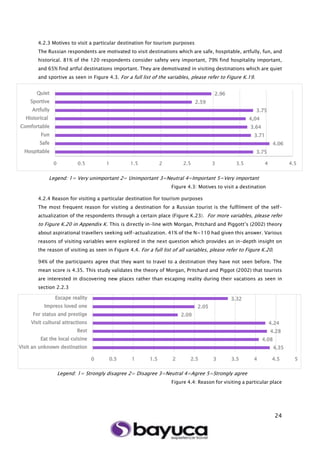
many days and are excessive spenders. The weather and conditions are better in the region of
Twente during the summer; therefore, this advice is suitable for a July – August offering. The
data results showcased that Russians are enthusiastic tanners and seek warmer destinations;
therefore, it is an appropriate time to introduce such a package to them. This has to be marketed
adequately because the competitiveness level is the highest at this time between various
destinations (countries).
In order for this travel package to work and stand out as something unique, it is necessary for Bayuca
Travel to undertake a certain amount of steps in order to make the Russian travel market interested in
purchasing this product. Collaboration with various stakeholders plays a vital role. There are certain
stakeholders which take part in this as seen in Appendix P.
Firstly, it is important to create a brainstorm session on how to negotiate with the lodging providers, the
travel companies, and other tourism suppliers. This helps to formulate a strategy on attracting the
tourists to the accommodations and the other service related suppliers. It is important to work with the
cultural organisations that run the historical attractions because the market’s needs have to be met. With
the implication of a dynamic packaging travel tour, Bayuca travel is responsible for making the calls to
these suppliers, convincing them about the benefits of attracting such a foreign travel market.
Furthermore, it is advisable to negotiate on the commission rate and the deals about dynamic packaging.
The various stakeholders require a different kind of treatment; therefore, the stakeholder quadrant is
utilised in order to visualize what to do with each tourism supplier. It is estimated that at least 2 hours
need to be devoted for establishing network connections with each supplier. In this process Christa
Barkel and Anna Yuricheva will act as negotiators finding the best deals that work for both parties. The
planning phase takes the most amount of time. However, the invested time is worthwhile when they start
selling the packages.
Bayuca Travel is playing the role of a wholesaler being in-charge of providing its customers with various
package options. This is solely based on the idea that the customer has the freedom to select whatever
suits him as an activity.
An interaction website needs to be developed that does not reveal the pricing of the separate
components. The final price is revealed when the components are bulked together. The combination of
packages is not limitless; therefore, only a certain amount of options are available. This will be closely
consulted with the suppliers. Please find an example of a promotional package in Appendix Q.
Furthermore, planning needs to be established in order to reach the consumers online about their needs.
It is recommended for Bayuca Travel to create an account on the most popular Russian social networks.
The deals which are showcased will attract the younger population. The most popular distribution tool
43
for promoting services for Russians is social media as seen in section 2.2.4. It is possible for Bayuca
Travel to provide help in Russian to the suppliers dealing with the accommodation since they do not
have any information available in English. With this in mind, there are more possibilities to reach the
travel market and to sell more packages. Engaging posts need to be considered in order to promote the
destination attributes of Twente in an accurate manner. This contributes to a positive destination identity
and image. This leads to an increase in the awareness level of the Russian market and in the interest in
visiting such a destination.
8.7.2 Do: Developing and measure
The second phase is to implement the plan. The following marketing activities need to be utilised:
 The launch of the new website – The website needs to be created by the end of February.
 The official Bayuca Channel Social media profile – The official social media profiles need to be
developed in order to start writing engaging posts regarding the “Historical Avenue of Twente”.
Special offers and deals for couples will be published on the website in April.
 The fare visits and the brochure designs for the packages – A visit to the Otdykh Leisure fare is
planned at the end of September. The In Tour travel fare will be visited in March 2017. The
exhibitor will get a chance to appear on the Russian television to promote its products. However,
costs are high for such fare. This is one of the most effective ways of positioning the tours. It
is necessary to network with the customers at these conventions.
 The setup of the official YouTube account – The account needs to be created by the end of
February. Video promotional content will be published from March regarding theme tour.
 The collaboration with Booking.com (optional) – Collaboration could be established with the
travel platform in order to easier reach the customers only if desired by the client. However,
commission will be charged on each sold package.
This phase requires the highest attention and time due to the necessity of market exposure. People need
to start buying the packages. It is crucial in this phase to measure the distribution channel’s effectiveness
in reaching the desired segment. This helps to understand whether the direction which is undertaken is
delivering the forecasted results. Furthermore, the Balanced Scorecard will be applied as a model in order
to measure the effectiveness of the project. Measuring the success of the strategy is very crucial, provides
a clear framework, and overall blueprint of the progress. The critical success factors, objectives, and
key-performance indicators are elaborated in section 8.6.
8.7.3 Check: Evaluation and constant reviewing
As mentioned in the “do” phase, a criterion needs to be met for understanding whether the proposed
recommendation is beneficial or not. After every tour has been completed, a performance review will
immediately take place. In this phase, a brainstorm session will occur between the founders of Bayuca
Travel. The topic will be about certain issues or bottlenecks that have occurred throughout the traveller’s
experience. Customer satisfaction needs to be regularly reviewed before providing another client with a
package tour. This can be either checked in the testimonials section, the Facebook posts, or the rating
which is calculated by Booking.com. After the customer experience has ended after the tour, it is
important to know how the people feel about the destination image. Such a decisive factor will have an
effect on the want to return again to the region of Twente or to stop using the services provided Bayuca
Travel.
44
The above-mentioned actions help to provide a higher service quality. Moreover, this helps to determine
whether the process goes smoothly and problems which have occurred, are fixed. An annual monthly
check-up on the Balanced Score Card is vital to keep track whether the goals are close to be achieved.
8.7.4 Act: Documentation of the results, information on the process changes
The final phase of the cycle is to improve the bottlenecks that could emerge throughout the check-up
phase. Corrective and preventive actions are taken into account in order to fully take control and prevent
the bottleneck from appearing. Staying updated with the Russian youth travel trends is necessary so that
new products could be created.
8.8 Budgeting (Financial implications)
The following section will provide financial insight on the costs that will occur for Bayuca Travel in order
to implement the historical themed package tour. The cost of the initial investment will be €5,618. The
rest of the investment is based on the purchase from the supplier side which will not be included in the
initial investment. The requirement for Bayuca Travel is profitability. A very important aspect that needs
to be taken into account, as requested by the tour operator, is the working hour invested.
8.8.1 Tour package price
The projected income will be estimated by selling 40 package tour trips in 2017. Therefore, one package
trip for 2 PAX will be looked upon as an example of a dynamic package in order to later calculate the
payback period. Figure 8.3 shows how much a trip would cost a customer with such options.
Table 8.3: Price cost of a trip
Accommodation
Luxurious lodge Buitencentrum Hessenheem + incl service cost for 2PAX €338
Tourist tax €1.05 per day x 2 persons x 4 nights €8.40
Total: 15% commission of accommodation = €50.70 €346
Activities
Orange Museum €4x2 persons €8
Twickel castle tour+ walkthrough garden €4 x 2 persons €8
Bicycle tour (Six castles cycling tour) €9.50 x 2 persons €19
Luxurious Picnic €10 x 2 persons €20
Goor’s historic museum €0
Swimming pool de Mors €3.60 x 2 persons €7.20
Total: 15% commission excl. picnic = 6.33 €62.20
Transportation
Europcar Auto hire 10% commission rate of transport=44.9 €449
Bayuca Travel Service fee charge €90
Total price €947.20
45
Bayuca Travel will earn from commissions of accommodation, transportation, and activities an amount
of €197.09 for one package. The desired gross profit margin is 25%. It is important to keep in mind
that this is just an example of a dynamic package that the customers design themselves. The addition
of more package options leads to higher revenue margin, added value, and responsibility for Bayuca
Travel.
8.8.2 Investment plan
Each employee hourly cost for Bayuca Travel is €50. This covers salary and insurance. The tour
operator consists of two people; therefore, the mean cost is 50+50/2=€50. Any additional marketing
person in charge is €45 per hour. The tour guide cost is set out to €35. The online marketer is in
charge of optimising the website, posting content on Vkontakte and Facebook for Bayuca Travel, and
responding to questions regarding the package offerings. Table 8.4 provides an insight on the
investment plan.
Table 8.4 Investment plan
Type of activity Amount Person in-charge Cost
Moscow travel fare (2016) Reservation for 2 days Anna Yuricheva Needs to be determined
Hotel stay 3 nights booking Anna Yuricheva €159
Flight ticket 20th of Sept – 23th of
Sept
Anna Yuricheva €415
Personnel costs 8 hour shift for 3 days Anna Yuricheva €1,200
Website Yearly registration fee Christa Barkel €200
Website package tour design 3 hour shift (one time) Website designer €135
Online presence 3 hour daily shift Online marketer expert €135
You Tube video 6 hour shift (One time) Video editor €270
Facebook advertising Pay per click – 2500
clicks
Christa Barkel €220
Vkontakte targeted advertising Pay per click – 2500
views
Christa Barkel €260
In tour market travel fare (2017) Registration fee Anna Yuricheva €400
Hotel booking 4 nights booking Anna Yuricheva €68
Flight icket 10th of Sept – 14th of Sept Anna Yuricheva €286
Personnel costs 8 hour shift for 4 days Anna Yuricheva €1,600
Supplier networking 2 hourly supplier contact Christa Barkel €100
Tour guide per package 2 hour shift per tour Tour guide €70
Package set-up 1 hour per package Anna Yuricheva/Christa
Barkel
€50
Auto hire Yearly cooperation fee Christa Barkel €50
Total: €5,618
46
8.8.3 Profit and loss statement
An estimation is set for the number of packages that will be sold. In 2017, there will be 40 tour packages
sold to 2 PAX per group in order to reach payback in 2018. If Bayuca Travel sells 40 tour packages, they
will have a return on the investment. Figure 8.5 will elaborate more on the profit and loss statement.
Table 8.5: Profit and loss
9 Advisory conclusions
This chapter includes the concerns of Bayuca Travel regarding the management question and the
advice questions.
The management question was as follows: “How can Bayuca Travel attract the Russian travel market to
visit the region of Twente”?
With the establishment that there is a likely match between the offerings of the region of Twente and the
Russian tourist’s wants and needs, it was important to think of alternatives that would successfully attract
subgroups. In order to consider any of the options, a prerequisite criterion was necessary in order to
check whether the option was: in-line with the mission of Bayuca Travel, in-line with the results found
from the survey design, and last but not least, does the option accurately portray the destination identity.
Furthermore, it was important to compare the options based on certain criteria: Time needed, financial
investment needed, and level of feasibility.
This benchmark revealed that creating a dynamic package labelled “Historical Avenue of Twente” targeted
for wealthy couples without children, is the most suitable solution in attracting the Russian market. In
order to deliver the project to a strategic level, a marketing plan was utilized to showcase each one of
the steps necessary for Bayuca Travel to deliver a successful campaign. The financial implications could
be found within the marketing plan. Consequently after the marketing plan was outlined, the PDCA cycle
was introduced in order to put the steps into action.
+Revenue
Accommodation €50.70x40 €2,028
Service fee charge: €90x40=€3,600
Picnic activity €13x40=€520
Other activities €6.33x40=€253.2
Auto hire: €44.9x40=€1,796
+Gross profit: €8,197.20
- Operational costs
Fixed costs:
Travel guide: €70x40=€2,800
Vacation house Hessenhem: 40 cottages booked in advanced: €70
Package setup: €50x40=€2,225
-Total: €2,870
-Variable costs:
Picnic: €7x40 = €280
-Total: €2,505
Net profit: €2,822.20 Payback will be €5,644.4 at the end of 2018.
47
Afterword
This thesis is the most challenging and demanding assignment I had ever written at the Saxion University
of Applied Sciences. This is an improved version of the previous report.
Before the kick-off introduction, I was not very sure what was expected of me. All I knew was the fact
that I had to write an advisory report. I believed I had knowledge regarding what was necessary for every
aspect because I had received high grades on my previous reports. However, this obnoxious thinking
caused blindside. This caused the failure of the thesis. An overhaul of the project was necessary to deliver
the report to a bachelor’s degree standard. I participated in all the lectures that prepared us for the
various parts. During this time, I realised that this dissertation is a combination of previously learnt
subjects at Saxion for the past two years. I started to visualise each one of the thesis chapters as study
gates that I had to pass. This was the only way of making me inspired in writing this paper.
I felt very shocked and worried when I received the bad news about not passing the first report.
Previously, I had high expectations that I was delivering a worthy thesis with added value for the client
and the Hospitality Business School. After I received the news, I could not accept the fact that it was a
weak report regardless of the fact that I had yet to hear the feedback. I could have reacted differently at
that time if I was not stressing about graduating on time.
The sudden strive for starting the master’s degree had taken its toll and all I thought about was the
solution to the cause of the problem. The feedback meeting which I had with the first examiner opened
my eyes. At last it was possible for me to hear out from another person what they think about the report
and where my flaws were in order to deliver the next paper to a higher standard. Studying at Saxion is
about teamwork and the group projects always gave chances to team members to provide feedback to
each other. However, this was not the case here because of the individualistic nature. I was alone in my
own thoughts, reading my paper from 9 to 5 while thinking that I had done a great job. Back then I could
not see my flaws. In the meetings with the first examiner, I was constantly boasting about the progress
of the report, whilst not actually sending any coursework for feedback. It turned out that I was able to
express my thoughts better in front of a person rather than on paper which gets them convinced that I
am doing a good job. Consequently, the report was vastly different than what was expected. This left
both examiners and the client unpleasantly surprised of the outcome. If I was earlier precautious about
my way of thinking, I could have delivered a better thesis.
There was a valuable lesson I learned when writing this report. This was never to wait for a person to
respond to a message. It is wiser to directly call the person. Nonetheless, a whole research design idea
got scrapped because I was rejected when calling Twente Branding and Beleef Twente. Therefore, the
questionnaire could not be started. This drastically slowed down the process leaving me idle for about a
month after the thesis defence proposal. Looking at the situation now, it would have been wiser to stop
wasting time for a response and find another company. Nonetheless, I decided to take matters into my
own hands. My initiation to contact Hof van Twente helped met to hand-in the thesis on time, regardless
of the fact that it was mediocre.
As far as the communication with the people involved, everything was running smoothly .The client was
very friendly and supportive throughout the whole process. Whenever I had a question or wanted to learn
something more about Bayuca Travel, both Mrs. Yuricheva and Mrs.Barkel were more than helpful to
provide me with information. The communication was formal, I was constantly trying to provide both of
48
them with an update on how the report was going. I am not really sure if this engagement of mine
bothered them at some point but I was really eager to deliver a proper insight for them, instead of not
involving them at all.
The same goes towards my first examiner who was more than helpful and supportive throughout the
whole thesis. His guidance and feedback helped me to improve so much and he always steered me to
the right direction. Almost every week we held appointments together to discuss the progress on the
various chapters. His arguments were constructive and straight to the point. It should be important to
note that when he told me about the failure of the thesis, he immediately wanted to set up a meeting
together about the feedback. I highly appreciate the fact that he was willing to leave a gap in the weekend
to discuss about the report. He knew that at this point, I was struggling with what needed to be changed
but as soon as he provided me with an extensive one hour feedback, the weak points of the report,
started to appear in my head. He devoted time and effort and served as a mentor throughout this
process. In the initial thesis proposal I wrote that my wish was to have an examiner who is supportive
and motivating. Mr. Theunissen fulfilled this criteria perfectly. Although I did not have that much contact
with my second examiner, Ms.Pushkarskaya as well provided me with highly valuable feedback and
support after the thesis defence proposal examination. I learned important aspects about the Russian
characteristics from her which I included in the questionnaire.
Even though, at times there were bottlenecks and it seemed as there was no way to continue writing, I
still tried to push forward to deliver a quality advice for Bayuca Travel. Challenges tend to appear every
day and without having the will to face those obstacles, it would not be possible to close this study
chapter. I had learnt about my previous mistakes and set out a learning point for next time which is not
to be as obnoxious and overconfident of my performance and always seek feedback.
It is very important to evaluate the relevance for the tourism industry with this project. There is indeed
a connection because there are not that many available research projects or insights available regarding
the travel motivations and characteristics of the Russian travellers. From what has been found in the
theoretical framework, it is concerning more about the general traveller profile. Up until now, only
Lehtinen (2014), provided a qualitative insight on the Russian tourist’s preference. Furthermore, there
was not an available project that deals with figuring out whether there is a match between the Russian
travel market and the offerings of a destination, such as the region of Twente. Information is power and
the destination of Twente could benefit economically when the tour operator brings international
tourists. Another relationship with the tourism industry, is that the company is working in the tourism
sector.
The advice which is provided for Bayuca Travel, helps to strengthen the tourism sector, as well as to
increase outbound tourism from Russia to the Netherlands. This project contributes to building up a
general profile of the Russian traveller by means of statistical facts and figures. The insight gathered is
not particularly theory breaking or phenomenal but indirectly delivers knowledge to the tourism industry.
The results highlight the Russian traveller preference to travel to destinations not because they want to
escape reality or to achieve status and prestige but rather for eating the local cuisine or visiting a
destination they not seen before. Furthermore, the core concepts are relevant for every organisation
wishing to attract a new market. The marketing plan is a universal approach, and each one of the steps
could be undertaken by every company. The survey could be used for every project dealing with obtaining
information about a new market, therefore DMO’s could greatly benefit from it.
49
References
Aaker, D. (1996). Building strong brands. New York: The Free Press.
Aaker, D. & Joachimsthaler, L. (1997). Dimensions of brand personality. Journal of Marketing Research,
34, 347-356.
Andre, M. (2011). Tourism and identity. Brussels. Retrieved from http://www.ideasforeurope.eu/wp-
content/uploads/2013/02/2011_06_CMC-paper_tourism-and-identity_all_spread.pdf
Anhold, S. (2009). Handbook on tourism destination branding. UNWTO. Retrieved from
http://www.imagian.fi/kuvat/etc_unwto_handbook_tourism_destination_branding.pdf
Baloglu, S. & McCleary, K.W. (1999). U.S. International pleasure traveller’s image of four Mediterranean
destinations: A comparison of visitors and non-visitors. Journal of Travel Research, 38 (2), 144 – 152.
Beerli, A. & Martín, J.D. (2004). Tourists’ characteristics and the perceived image of tourist
destinations: A quantitative analysis – A case study of Lanzarote, Spain. Tourism Management, 25,
623-636.
Blain, C., Levy, E. S. & Brent, R. (2005). Destination branding: Insights and practices from Destination
Management Organizations. Retrieved from http://www.pikslar.com/temp/Bisi/dmc/328.pdf
Boo, S., Busser, J. & Baloglu, S. (2009). A model of customer-based brand equity and its application to
multiple destinations. Tourism management, 30, 219 – 231.
Brotherton, B. (2010). Researching hospitality and tourism: A student guide. London, England: Sage.
Crompton, J. (1992). Structure of vacation destination choice sets. Annals of Tourism Research, 19:
420-434.
Ertörün, E. & Suma, S. (2011). Strategic brand analysis in destination identity context - A Case Study of
Albania. Retrieved from http://www.diva-portal.org/smash/get/diva2:428481/fulltext02
Eun, J.L. (D.A.). Theoretical foundation of brand personality for postmodern branding dynamics: A
critical review and research agenda. Kent, Ohio.
Eventica (2009). The Russian outbound travel market. Retrieved from
http://www.eventica.co.uk/files/the_russian_outbound_travel_market.pdf
Fakaye, P.C. & Crompton, J.L. (1991) Image differences between prospective, first-time and repeat
visitors to the lower Rio Grande valley. Journal of Travel Research, 30 (2), 10-16.
Gilmore, F. (2002). A country - can it repositioned? Spain- the success story of country branding.
Brand Management, 9 (April), 281-293.
Holloway, C. (2004). Marketing for tourism. Pearson Education.
Kotler, P. (2002). Marketing in the twenty first century. Pearson Custom Publishing.
Kozak, M. & Baloglu, S. (2011). Managing and marketing tourist destinations. Strategies to gain a
competitive edge.
Kerr, G. (2006). From destination brand to location brand. Journal of brand management, 13, 276 –
283.
Konecnik, M. & Gartner, W. (2007). Customer-based brand equity for a destination: Annals of tourism
research, 34 (2), 400 – 421.
50
Mackay, A. (2004). A Practitioner’s Guide to the Balanced Scorecard. Shareholder and Stakeholder
Approaches to Strategic Performance Measurement Using the Balanced Scorecard.
Morgan, N., Pritchard, A. & Piggott, R. (2002). New Zealand, 100% pure. The creation of a powerful
niche destination brand. New Zealand, 9 (April), 335-354.
Morgan, N., Pritchard, A. & Pride, R. (2004). Destination branding: Creating the unique destination
proposition. Oxford: Elsevier.
Nandan, S. (2004). An exploration of the brand identity-brand image linkage: A communications
perspective. Brand Management, 12 (4), 264 -278.
NBTC (2015). Market scan Russia 2015. The Hague.
Lehtinen, E. (2014). Russian consumer behaviour and factors influencing the purchase decision.
Lappeenranta.
Lopes, S. (2011). Destination image: Origins, developments and implications. Retrieved from
http://www.pasosonline.org/Publicados/9211/PS0211_07.pdf
Pike, S. (2008). Destination branding: Analysing brand equity for Queensland’s coral coast. Retrieved
from http://eprints.qut.edu.au/20917/1/c20917.pdf
Pyo, S., Mihalik, B.J. & Uysal, M. (1989). Attraction attributes and motivations: A canonical correlation
analysis. Annals of Tourism Research.
Qu, H., & Hyunjung, L. (2011). A model of destination branding: Integrating the concepts of the
branding and destination Image: Tourism Management, 32, 465-476.
Sangeet P. C. (2013). Platform thinking: A comprehensive guide to platform business models.
Schaar, R. (2013). Destination branding: A snapshot. Retrieved from https://www.uwlax.edu/urc/JUR-
online/PDF/2013/Schaar.Rebecca.Marketing.pdf
Stylos, N., Vassiliadis C.A., Bellou, V. & Andronikidis, A. (2016). Destination images, holistic images
and personal normative beliefs: Predictors of intention to revisit a destination. Tourism Management,
40 – 60.
Twente. (2011). In Wikipedia. Retrieved from https://en.wikipedia.org/wiki/Twente
Ullrich, K., Nufferova, T. (2007). Rising values and lifestyle patterns in Russia. New Horizons for
Marketing. Retrieved from http://www.g-
im.com/fileadmin/templates/pdf/2007_Rising_Values_and_Lifestyle_Patterns_in_Russia.pdf
Usakli, A. & Baloglu, S. (2011). Brand personality of tourist destinations: An application of self-
congruity theory. Tourism Management, 32, 114-127.
Van Vliet, V.(2010).DESTEP Analysis. Retrieved from http://www.toolshero.com/marketing/destep-
analysis
Verhoeven, N. (2015). The hows and whys of applied research: Doing reseach. Amsterdam.
Verschuren, P. & Dooreward, H. (2010). Designing a research project (2nd edition). The Hague. Eleven
International Publishing.
Yin, R.K. (1994). Case study research: Design and methods. Thousand Oaks, CA: Sage.
51
Appendices
Number Description Page number
Appendix A Search methods 52
Appendix B Application of the AAOCC criteria 53
Appendix C Study on past research 55
Appendix D Operationalisation of destination branding 58
Appendix E Operationalisation of the tourist’s characteristics 59
Appendix F English translation of survey 60
Appendix G Russian questionnaire 68
Appendix H Inspirational destination branding questionnaire 76
Appendix I Factor analysis 77
Appendix J Approach to reaching the respondents 78
Appendix K Quantitative results in graphs 79
Appendix L Prerequisite criteria selection 86
Appendix M Prerequisite criteria selection elaboration 87
Appendix N Email correspondence with Hof van Twente 88
Appendix O Invitational process for the respondents 90
Appendix P Stakeholder quadrant 91
Appendix Q Design of the website package 92
52
Appendix A: Search methods
The following section described the most important methods of searching in an effective and efficient
manner. All scientific material that were used for the study, complied with the AAOCC criteria for
evaluating web page sources. An example of the AOCC criteria applied is found in Appendix B.
Google, Science Direct and Springerlink were the search engines that were used in order to boost the
validity of the literature review. Furthermore, knowledge books had been read from the Saxion University
of Applied Sciences library to enhance the time needed to find the right information from the various
literature sources.
Another common search method applied by research professionals for systematic literature studies is
the snowball method which was utilized in this study and was greatly beneficial in finding relevant
information from one source, to another.
The utilization of key search terms was as well apparent in this literature search cycle (University of
Colorado, 2011). Key terms that were used are as follows:
- destination image AND destination identity
- destination image OR destination branding
- tourist characteristics*
- Russian travel market profile
- destination image OR destination identity
Most of these search terms were successful in leading to the desired information that was needed.
53
Appendix B: Application of the AAOCC criteria
Step 1: Check-up on the most important parts of the scientific article for evaluation
54
Step 2: Checklist of AAOCC
Accuracy and Authority of the website
 Who is the author? – Carmen Blain, Stuart E. Levy and Brent Ritchie.
 Who publishes the website? - Pikslar.com – An online community that brings together the same minded,
creative people.
 What is the URL and what does this tell you about the publisher of the site? - .com which means that this
is a top level domain of commerce that publishes scientific materials or articles to inspire its audience.
 What qualifications does the author have? - Carmen Blain, MBA, is a consultant with Praxis Group in Calgary,
Canada. Stuart E. Levy is a doctoral candidate in marketing and tourism management at the Haskayne School
of Business, University of Calgary. J.R. Brent Ritchie is a professor of tourism management at the Haskayne
School of Business and is the chair of the World Tourism Education and Research Centre, University of
Calgary.
 Is the information verifiable? – Yes, it was originally published by Sage Publications.
 Is the text free of errors, well written and cited properly? – Yes
Objectivity of the web document
 Is the page a mask for advertising; if so, how might the information be biased? - No
 Why was the page written (motives)? – To examine DMOs, whose major purpose is to market their
destination to potential visitors, both individuals and groups, to provide economic benefit to the
community and its members. The concepts of destination branding are explored.
 Who is the intended audience? – Destination Management Organizations and other hospitality-related
entities.
 Are opinions backed by accurate facts and information? – Yes
Currency of the web document
 When was it produced? - 2005
 How many dead links are there? - None
 Is the information outdated? – No, many researches still refer to this information.
Coverage of the web document
 Is there breadth and/or depth to the topics covered? – Yes, all parts of a study are included.
 Is the information free or is there a fee to obtain information? – There is no fee to obtain this information.
 Are you able to view the page or is software missing? Is that software free? - There is no software.
55
Appendix C: Study on past research
Destination branding
Gilmore (2002) points that the brand must “capture the spirit of its people”. The brand essence is the
DNA of a destination. It includes 3 to 4 core values which form the so-called DNA. They are normally
single words which are always mentioned in destination marketing communications.
A brand includes both rational and emotional elements. The rational attributes define and explain the
enduring characteristics of the destination. On the other hand, the emotional factors give the feeling of
the brand. This is all based on the tourist’s perspective
Gilmore further states that brands need to be “aspirational, inspirational, challenging, differentiated, and
translatable to different audiences.” This is of upmost importance, due to the fact that there are a vast
majority of stakeholders involved in a brand with their own objectives and visions.
Research points out that while it is possible to alter the perception of a destination, it is impossible to
change the core characteristics of it, such as climate and the geographical region. These intangible
characteristics are deeply ingrained in the tourist’s preference of a destination. Usakli & Baloglu (2011)
state that destination branding is a relevant concept due to the fact that travelers would opt for
recommended brands that match their own self-actualization. The above mentioned occurrence is
named the self-congruity theory. According to Morgan and Pritchard (2004), most scholars prefer the
brand-building process for destination development. Hudson and Ritchie (2009) further made a
proposition of a four step process of creating a “destination brand experience” (as cited in Kozak &
Baloglu, 2011, p.158). The process consists of an assessment of the destination’s current situation, the
development of a brand identity and brand promise, the communication of the brand promise and the
measurement tools for determining the effectiveness of the brand-building implementation.
Destination image
Destination image is considered to be in close proximity to brand image. Brand image is how the
clientele perceives the brand (Nandan, 2004). In economic terms, brand image is formed out of three
types of interconnected associations that consumers hold perceptions on: product attributes, benefits,
and attitudes (Keller, 1993). Low and Lamb (2000) refer to brand image as the symbolic and functional
gains of a brand. Current research showcases that the image of a destination can vastly affect its
success. If there is a comparison of destinations in a similar level of attractiveness, then the decision
factor of the choice of a destination would go to the one which has the least negative perception.
However, Selby and Morgan (1996) argue that the comprehensive destination image tools are an
effective way of showcasing the strengths and weaknesses of a destination. Due to this reason,
travellers want to have more than one experience, and therefore it can be stated that there is a close
relationship between the tourism related facilities contributing to the formation of the overall image of
the destination. According to Fakery and Crompton (1991), the image of a place can be affected by the
familiarity of the tourists within the destination and the information provided by the media and travel
journals.
The research investigation points out that destinations are constantly compared, and in order to have a
competitive position, it is necessary to have a positive and favourable image of the destination because
it is one of the “pull” factors for tourists.
56
Destination identity
Aaker (1996) further states that brand personality is part of extended identity, not core identity. The
most successful brands are in-line and linked to the core and extended identities.
Joachimsthaler and Akker (1997) suggested that in order to adequately give a description of the
ambitions of a brand, at least six to twelve dimensions of a destination need to be included. It is highly
recommended by the authors that one of these dimensions, differentiates the tourism destination from
another one. In some circumstances, it is possible for a destination to have several brand identities which
helps a destination to be branded across many markets. Even though if there are multiple identities,
research theorists are convinced that the core identity stays in-line, in favour of consistency.
Russian tourist characteristics
Morgan, Pritchard and Piggot (2002) discuss that consumers make use of brands in order to showcases
lifestyle statements. This is in-line with the self-cognitive theory. The people opt to make a purchase
based on their personal believes of who they are and what they would like to be. It is important to note
that the tourism destinations are formed by tangible and intangible assets. (Qu, 2011). Tangible assets
are the geographical features, attractions and historical places. The intangible assets consist of the
culture and history (Kozak and Baloglu 2011). There are many motives for travellers expressing the need
of visiting a destination.
According to Pyo, Mihalik and Uysal (1989), the tourist motivation is multidimensional. The journey of
the tourist involves eating, staying at a hotel, going shopping, communicating with the locals. In other
words, it does not compromise of one single product but rather there is a vast amount of components
each provided by different companies to make the experience of the tourist memorable.
Tourists are interested in discovering new places rather than escaping reality during their vacations
(Morgan, Pritchard & Piggot, 2002). This is a vastly changing pattern than how it was viewed two decades
ago. Coltman (1989) presents the elements of a destination such as natural attributes or attractions that
make a contribution on the tourist’s experiences. Morgan, Pritchard and Piggot (2002) as well point out
that tourists are “aspirational” and that they are constantly seeking self-actualization” throughout the
means of their travel choices.
Consumers tend not to choose a place to stay, whenever they do not feel sure about it or the service
provided. However, destinations that have been good for the tourists, are highly likely to be visited again
by them later. Eventica (2009) states that the Russian travel market values novelty. If a destination is
correctly marketed to the correct audience as the new holiday buzz destination, it will succeed in the
Russian marketplace. The Russian travellers look on the internet, listen to word of mouth and consult
travel agents when planning their trip. However, according to a survey carried out by Global Market
Institute (2005), it has been found that the internet users opt for personal recommendations even though
travel agents have bargaining power with their brochures. Over 300,000 Russian luxury travellers travel
abroad yearly and spend with their friends on average €1,500 per day on accommodation.
57
Marketing plan
The Chartered Institute of Marketing (2001) defines marketing as the management function which
organizes and directs all those business activities involved in assessing customer needs and converting
customer purchasing power into effective demand for a specific product or service, and in moving that
product or service to the final consumer or user so as to achieve the profit target or other objective set
by the company or other organization. Kotler (2002) defines marketing as a social and managerial
process by which individuals and groups obtain what they need and want by creating and exchanging
products and values with others. According to Holloway (2004), all tourism organisations, no matter the
size, endeavour in marketing activities.
58
Appendix D: Operationalisation of destination brandingDestinationbranding
Destination
core essence
Destination
characteristics
Geography
Climate
Infrastructure
Services
Local attitude
Safety
Destination
competitiveness
Destination brand
knowledge
Destination
image
Affective image
Cognitive image
Destination brand identity
Slogan
Value proposition
Core identity
Extended identity
59
Appendix E: Operationalisation of the Russian tourist’s
characteristics
Russiantouristcharacteristics
Tourist background
Beliefs
Duo
asset experience
Family oriented
Collectivism
Friend references
Word of mouth
Hesitancy to not well
market destinations
Motives
Multi-dimensional
travel experience
Communication with the
locals
Going shopping
Escaping reality
Eating
Type of tourist
Lower class
Lower service quality
expectations
Budget offers
Higher class
Higher service quality
expectations
All-inclusive offers
Higher pay for service
Higher rating demand of
the destination
Group size
Small group
Aspirational travelers
Shorter stay
Closer hotels to the
centre
Couples
Big group
Spacious accomodation
Longer vacations
Families with children
60
Appendix F: English translation of survey on the Russian tourist market
First of all we would like to thank you for taking part in this survey! The reason why you are contacted is
because we would like to hear from you regarding your destination preferences. We are a Dutch non-
profit tourism organization which is interested in the Russian travellers who travel to international
destinations. This questionnaire will contain a Dutch destination that you may or may not be familiar
with. Based on your beliefs, motives and preferences, you will fill what feels right for you. Your input is
highly appreciated and the information that you will provide, will help us to understand how you feel and
what is the image about the destination that we are offering to you. Since time is a valuable commodity
for every person, this survey is estimated to take no longer than 5 minutes. Your response
is voluntary and would be kept confidential! Responses will not be identified as individual. They will only
be analysed as a group in which you are taking part in. Thank you very much again for your collaboration!
Before filling out the questionnaire, we encourage you to click on the image below in order to be
enrolled to get the chance to win these two traditional Dutch gifts! Mark green if you are interested or
double click for red if not uninterested. At the end of the questionnaire, you can provide your email
address, so we can contact you personally if you are the winner and send you the gift!
N.B. The criteria for winning is to fill out the whole survey!
The following questions will provide us with some background information about yourself.
Q.1Are you?
 Male
 Female
Q.2 In which year are you born?
(Open space)
Q.3 What is your relationship status?
 Single
 Married
 In a relationship
Q.4 Do you have children?
 Yes
 No
Q.5 If so, do they still live with you?
 Yes
 No
61
Q.6 What is your combined annual household income?
 Less than 30,000
 30,000 – 39,999
 40,000 – 49,999
 50,000 – 59,999
 60,000 – 69,999
 70,000 – 79,999
 80,000 – 89,999
 90,000 – 99,999
 100,000 or more
Q.7 What is the highest level of education you have obtained?
 Doctorate degree
 Master's degree
 Bachelor degree
 Secondary education
 Primary education
The following questions will provide us with information about your destination preferences.
Q.8 How many times did you travel abroad last year?
 1 time
 2 times
 3 times
 4+ times
 I don't travel abroad
Q.9 Have you ever visited the Netherlands before?
 Yes
 No

Q.10 I travel to a foreign destination:
 Alone
 With my partner
 With my partner and kids
 With my friends
Q.11 Please read each of the following statements. Click how important the following factors are to
motivate you in visiting a destination for a short brake (2 to 3 days):
62
Very
unimportant
Unimportant Neutral Important
Very
important
Comfortable     
Fun     
Relaxing     
Urban     
Quiet     
Safe     
Unspoilt     
Agricultural     
Educational     
Historical     
Romantic     
Q.12 If you were offered one of those Dutch tourism cities to visit, which one would you choose?
Deventer, Amsterdam, the Hague, Hengelo, Enschede or Almelo. Please click on the one you are
interested in.
Q.13 What was the reason for picking a particular choice? One answer possible
 The popularity of the destination
 The city has a good reputation as a destination
 The image that the destination showcases
 The city satisfies my wants as a destination
 There is something special about the city as a destination
 I can trust the city as a holiday destination
63
Q.14 Please read each of the following statements. Click how interested you would be in visiting a
destination which has the following features in order to consider a short break (i.e., 2– 3 days).
Q.15 The previous question symbolizes what the Twente region offers as a destination. Do you
consider if there is a match between your wants and the offerings there?
 Strongly Disagree
 Disagree
 Undecided
 Agree
 Strongly agree
Very
uninterested
(1)
Uninterested
(2)
Neutral (3) Interested (4) Very interested (5)
Windmills (1)     
Old towns (2)     
Museums (3)     
Landmarks (4)     
Monuments (5)     
Historical buildings (6)     
Shopping places (7)     
Adventure family park
(8)
    
Clubs (9)     
Aquadrome parks (10)     
Beer brewery (11)     
Drawing centers (12)     
Vacation houses (13)     
Camping bungalows
(14)
    
Picnic areas (15)     
Art towns (16)     
Castles (17)     
Botanic gardens (18)     
Forests (19)     
Rural villages (20)     
64
Q.16 If you were offered one of those activities, which one would you choose? Click on the image that
you like the most.
Q.17 Why do you travel to a foreign destination? Please rate the following statements based on your
motives.
65
Strongly
Disagree (1)
Disagree (2) Neutral (3) Agree (4) Strongly agree (5)
To visit a destination I have
not seen before (1)
    
To eat the local cuisine (2)     
To go shopping (3)     
To meet new people (4)     
To communicate with the
locals (5)
    
To rest (6)     
To be with the family (7)     
To visit friends and relatives
(8)
    
To impress my loved one (9)     
For status and prestige (10)     
To escape reality (11)     
To visit cultural attractions
(12)
    
66
Q. 18 If you had to choose between one of those accommodations, which one would you click on?
Q.19 For how many days would you stay?
 For one day (1)
 For two days (2)
 For three days (3)
 For more than four days (4)
Q.20 The reason why I choose a particular destination is because: One answer is possible
 A friend recommends it (1)
 It has a good rating in the social media (2)
 It is very popular at the moment (3)
 It has a positive word of mouth by the travel agent (4)
 It provides me with self-actualization fulfillment (5)
 Other (Please specify) (6) ____________________
67
The following questions will provide us with information about your travel behavior
Q. 21I prefer to choose a certain destination that:
Strongly
disagree (1)
Disagree (2)
Neither agree
or disagree (3)
Agree (4)
Strongly agree
(5)
Reflects the
way I see
myself (1)
    
Reflects the
way I think
others see me
(2)
    
Reflects the
way I would
like to be seen
by others (3)
    
Reflects the
ideal way I
would like to
see myself (4)
    
Q. 22 How can a destination persuade you to stay for more than one night?
Strongly
disagree (1)
Disagree (2)
Neither agree
nor disagree
(3)
Agree (4)
Strongly agree
(5)
Broaden range
of activities
(1)
    
Family friendly
resorts (2)
    
Couple deals
(3)
    
Be exciting (4)     
Offer deals (5)     
Thank you very much for taking the time to answer this survey! Your input was highly appreciated and
now we are giving you the chance to win the price! Please leave your email address below:
68
Appendix G: Russian questionnaire translation
Здравствуйте,
Благодарим Вас, что решили пройти наш опрос. Данное исследование направлено на
рассмотрение предпочтений туристов в выборе места туристического пребывания. Bayuca travel,
голландская некоммерческая туристическая организация, интересуется русскими туристами,
путешествующими по Европе. В этом опросе упоминаются Голландские города, которые возможно
Вам известны.
Ответьте на вопросы в соответствие со своими убеждениями, мотивами и предпочтениями. Ваши
ответы очень важны для нас и помогут нам понять, что Вы думаете о предлагаемых городах. Этот
опрос займёт не более 5 минут, поскольку мы ценим Ваше время.
Также, Ваши ответы будут абсолютно конфиденциальны и останутся анонимными при анализе
результатов. Ещё раз благодарим Вас за участие!
Прежде, чем приступить к заполнению опроса, предлагаем Вам нажать на картинку снизу. Тем
самым Вы можете выиграть два традиционно голландских подарка! Пометьте зелёным, если Вы
заинтересованы, или нажмите два раза на картинку до красного, если Вас это не интересует. В
конце опроса Вы можете оставить Вашу электронную почту, чтобы мы смогли связаться с Вами и
прислать Вам подарок, если Вы окажетесь победителем.
Примечание: для того, чтобы выиграть подарок, Вам необходимо заполнить ВЕСЬ опрос.
Следующие вопросы направлены на общие сведения о Вас
Вы? Мужчина Женщина
В каком году Вы родились?
Ваше семейное положение?
 Не в отношениях
 Женат / Замужем
 Встречаюсь
Есть ли у Вас дети?
 Да
 Нет
69
Если есть, живут ли они ещё с Вами?
 Да
 Нет
Каков месячный доход Вашей семьи (в рублях)?
 Меньше 30,000
 30,000 – 39,999
 40,000 – 49,999
 50,000 – 59,999
 60,000 – 69,999
 70,000 – 79,999
 80,000 – 89,999
 90,000 – 99,999
 100,000 и больше
Какой у Вас уровень образования?
 Докторская степень
 Степень магистра
 Степень бакалавра
 Среднее образование
 Начальное образование
Следующие вопросы предоставят информацию о Ваших туристических предпочтениях.
Сколько раз Вы были за границей в прошлом году?
 1 раз
 2 раза
 3 раза
 4+ раз
 Я не был(а) за границей
70
Вы когда-либо были в Нидерландах?
 Да
 Нет
Я путешествую за границей в основном:
 Один / Одна
 С супругом / супругой
 С супругом / супругой и детьми
 С друзьями
Пожалуйста, ознакомьтесь с каждым из следующих утверждений. Укажите, насколько следующие
факторы важны для Вас при посещении туристических городов в течение короткого времени (от 2
до 3 дней):
Совсем не
важно
Не важно Нейтрально Важно
Очень
важно
Комфортный     
Весёлый     
Расслабляющий     
Городской     
Тихий     
Безопасный     
Естественный     
Сельскохозяйственный
    
Познавательный     
Исторический     
Романтический     
Гостеприимный     
Художественный     
Спортивный     
Просторный     
71
Если бы Вам предложили посетить один из этих голландских туристических городов, какой бы Вы
выбрали? Девентер, Амстердам, Гаага, Хенгело, Энсхеде или Алмело. Пожалуйста, выберите один
вариант:
Почему Вы выбрали именно этот город? Возможен один вариант ответа:
 Популярность этого направления
 Город имеет хорошую репутацию
 Впечатляет фотография
 Город удовлетворяет мои потребности
 В городе есть что-то особенное, что привлекает меня
 Я верю, что город может быть хорошим местом отдыха
72
Пожалуйста, ознакомьтесь с каждым из следующих утверждений. Укажите, насколько Вы
заинтересованы в посещении туристического направления, имеющего следующие особенности, на
короткий срок пребывания (т.е. 2- 3 дня):
Совсем не
интересно
Неинтересно Нейтрально Интересно
Очень
интересно
Ветряные мельницы     
Города с богатой
историей и
средневековой
архитектурой
    
Музеи     
Достопримечательности     
Памятники     
Исторические здания     
Торговые точки     
Семейный парк
развлечений
    
Клубы     
Аквапарки     
Пивоварня     
Центры творчества     
Дома отдыха     
Бунгало     
Места для кемпинга     
Площадки для
пикников
    
Галереи искусства     
Мероприятия     
Живописные города     
Замки     
Ботанические сады     
Леса     
73
Сельская местность     
Красивый пейзаж     
Отели     
Ночлег и завтрак     
Гостевые дома     
Езда на велосипеде     
Маршруты пешего
похода
    
Маршруты для
верховой езды
    
Гостеприимное
общество
    
Предыдущий вопрос содержит то, что регион Твенте предлагает туристам. Считаете ли Вы, что
Ваши желания совпадают с предлагаемыми вариантами отдыха?
 Совсем не согласен
 Не согласен
 Еще не решил
 Согласен
 Полностью согласен
Если бы Вам предложили один из этих видов деятельности, какой бы Вы выбрали? Нажмите на
изображение, которое Вам нравится больше всего.
74
Почему Вы любите путешествовать за границу? Пожалуйста, оцените следующие причины, исходя
их собственных мотивов.
Совсем не
согласен
Не согласен
Еще не
решил
Согласен
Полностью
согласен
Чтобы посетить
неизведанные мной
места
    
Чтобы попробовать
местную кухню
    
Ради покупок     
Чтобы встретиться с
новыми людьми
    
Пообщаться с местными
жителями
    
Чтобы отдохнуть     
Побыть с семьей     
Посетить друзей и
родственников
    
Чтобы произвести
впечатление на
любимого человека
    
Для статуса и престижа     
Чтобы уйти от
реальности
    
Посетить культурные
достопримечательности
    
Если бы Вы выбирали один из следующих вариантов размещения во время отдыха, какой бы Вы
выбрали? Нажмите на одну картинку:
75
Сколько дней Вы бы провели в этом месте?
 Один день
 Два дня
 Три дня
 Больше трех дней
Почему Вы выбрали именно этот вариант? Возможен один вариант ответа:
 Друг рекомендовал
 Данный вариант имеет высокий рейтинг в социальных сетях
 Данный вариант очень популярен на данный момент
 Туристическое агентство рекомендовало
 Помогает мне актуализировать себя
 Другое (Пожалуйста, укажите что) ____________________
Следующие вопросы предоставят нам информацию о Вашем туристическом поведении
Я предпочитаю выбирать туристическое место, которое:
Совсем не
согласен
Не согласен
Затрудняюсь
ответить
Согласен Полностью согласен
Отражает то, каким я
себя считаю
    
Отражает то, каким, на
мой взгляд, видят меня
другие
    
Отражает то, каким мне
хочется, чтобы считали
меня другие
    
Отражает то, каким я
хочу себя видеть
    
Что в туристическом городе заставило бы Вас остаться дольше одной ночи?
Совсем не
согласен
Не согласен
Затрудняюсь
ответить
Согласен
Полностью
согласен
Широкий выбор вида
отдыха/развлечений
    
Семейные курорты     
Акции для влюбленных пар     
Захватывающие места     
Другие скидки     
76
Appendix H: Inspirational destination branding questionnaire:
77
Appendix I: Factor analysis
78
Appendix J: Approach to reaching the respondents
79
Appendix K: Quantitative results in graphs
Demographic profile
Figure K.1: Gender Figure K.2: Age
Figure: K.3 Marital status Figure K.4: Children status
Figure K.5: Level of Education
21%
79%
Gender
Male Female
59%
32%
9%
Age
16 - 26 year's old 27 - 42 year's old
43 - 63+ year's old
43%
19%
38%
Marital status
Single Married In a relationship
24%
43%
28%
Level of education
Primary education Secondary education Bachelor degree
Master's degree Doctorate degree
17%
83%
Children status
With children Without children
80
Wishes and demands
Figure K.6: Fun factor Figure K.7: Relaxing factor
Figure K.8: Urban factor Figure K.9: Quite factor
1% 6%
27%
53%
13%
Fun
Very unimportant Unimportant
Neutral Important
Very important
3%
12%
33%45%
7%
Relaxing
Very unimportant Unimportant
Neutral Important
Very important
3%
12%
48%
34%
3%
Urban
Very unimportant Unimportant
Neutral Important
Very important
5%
29%
36%
25%
5%
Quiet
Very unimportant Unimportant
Neutral Important
Very important
81
Figure K.10: Unspoilt factor Figure K.11: Hospitable factor
Figure K.12: Spacious factor Figure K.13: Historical factor
2%3%
14%
49%
32%
Safe
Very unimportant Unimportant
Neutral Important
Very important
Agricultural
Very unimportant Unimportant
Neutral Important
Very important
4% 8%
44%
39%
5%
Unspoilt
Very unimportant Unimportant
Neutral Important
Very important
Educational
3% 7%
30%
46%
14%
Historical
Very unimportant Unimportant
Neutral Important
Very important
Hospitable
Very unimportant Unimportant
Neutral Important
Very important
17%
32%32%
14%
5%
Sportive
Very unimportant Unimportant
Neutral Important
Very important
3%
11%
35%38%
13%
Spacious
Very unimportant Unimportant
Neutral Important
Very important
82
Figure K.14: Educational factor Figure K.15: Romantic factor
Figure K.16: Agricultural factor Figure K.17: Comfortable factor
3%
16%
34%
38%
9%
Educational
Very unimportant Unimportant
Neutral Important
Very important
2% 9%
35%
41%
13%
Romantic
Very unimportant Unimportant
Neutral Important
Very important
12%
36%
33%
15%
4%
Agricultural
Very unimportant Unimportant
Neutral Important
Very important
2%4%
33%
51%
10%
Comfortable
Very unimportant Unimportant
Neutral Important
Very important
83
Figure K.18: Destination preferences of travel groups
Figure K.19: Motivational factors
0
0.5
1
1.5
2
2.5
3
3.5
4
4.5
5
Destination preferences of travel groups
Couples without children Parents with children Group of friends
3.64
3.71
3.43
3.21
2.96
4.06
3.32
2.64
3.31
3.61
3.55
4.04
3.75
2.59
3.49
0 0.5 1 1.5 2 2.5 3 3.5 4 4.5
Comfortable
Fun
Relaxing
Urban
Quiet
Safe
Unspoilt
Agricultural
Educational
Historical
Romantic
Hospitable
Artfully
Sportive
Spacious
Important motivational factors for tourists
84
Figure K.20: Reasons of visiting a destination
Figure K.21: Interesting destination features for all respondents
4.35
4.08
3.01
3.8
3.75
4.28
3.42
3.34
2.5
2.09
3.32
4.24
0 0.5 1 1.5 2 2.5 3 3.5 4 4.5 5
To visit a destination I have not seen before
To eat the local cuisine
To go shopping
To meet new people
To communicate with the locals
To rest
To be with the family
To visit friends and relatives
To impress my loved one
For status and prestige
To escape reality
To visit cultural attractions
Important reasons for visiting a destination
Visit historical
buildings
9%
Visit museums
7%
Visit landmarks
9%
Visit castles
9%
Visit old towns
10%Participate in events
8%
Picnic
9%
Visit botanic
gardens
8%
Walk through
forests
7%
Sightsee
beatuiful
landscape
10%
Trek
7%
Visit art towns
7%
INTERESTING DESTINATION FEATURES
85
Figure K.22: Travel abroad times
Figure K.23: Reason of choice
43%
57%
Traveled to the
Netherlands before
Yes No
10
5
3 2
16
1 1
5 55 4
6
18
3
1 1
9
4
1 2 1
5
A friend
recommends it
It has a good rating
in the social media
It is very popular at
the moment
Positive word of
mouth by the travel
agent
Provides self-
actualization
Reason of choice for a particular destination
Couples without children Parents with children Group of friends
Alone With parents
86
Appendix L: Prerequisite criteria selection
In this part, the prerequisite criteria selection is explained as mentioned in the advisory section. In
order to come into an evaluation process of the alternatives, it is necessary for them to meet the
following criteria:
 Is the alternative in-line with the mission of Bayuca Travel?
 Is the alternative in-line with the data analysis about the needs and wants of the Russian market?
 Does the alternative showcase the destination identity of the region of Twente?
Explanation of prerequisites
 Is the alternative in-line with the mission of Bayuca Travel?
The alternative must be connected to the mission statement of Bayuca Travel which is to offer unique
products and services to its clients. Since the tour operator is environmentally conscious, this needs to
be taken into account when an alternative is proposed. The ambitions and motives of the company need
to be met when introducing a travel package from the three options. By staying in-line with the direction
which the organization focuses on, it is probably that the he alternative will be implemented, thus turned
into a marketing plan.
 Is the alternative in-line with the data analysis about the needs and wants of the Russian
market?
Each one of the alternatives needs to lead to a continuation based on the theory found within the research
phase. What this means is that both the theoretical framework and the survey data analysis regarding
the Russian tourist characteristics and their preferences, is taken into account when brainstorming the
alternatives. The alternatives need to be based on the information which is derived concerning the
Russian traveller’s wants and needs, in order to be considered for the evaluation phase.
 Does the alternative showcase the destination identity of the region of Twente?
The alternative needs to accurately portray the destination’s DNA. This is important in order for the
package to generate added value, which in turn boosts the traveller’s experience. The destination identity
was derived from the desk research and the alternative should not steer away from the core destination
characteristics but rather help out to strengthen the extended characteristics of the region of Twente
87
Appendix M: Prerequisite criteria selection
Alternative 1: Historical avenue of Twente
The alternative is correctly in-line with the mission statement and ambitions of Bayuca Travel because it
manages to capture the sense of creating a unique themed travel experience for the tour operator’s
clients. Furthermore, it encourages international tourism development when a new travel market is
introduced, which boost the economical state of the destination.
The alternative is correctly in-line with both the theoretical framework and data analysis because both
research sources showcase that the Russian travellers prefer to travel as a couple when traveling abroad.
Furthermore, as seen from the various figures found in the data analysis, this particular travel group is
particularly interested in the historical aspect and from the cultural category: art galleries and events
participation. The alternative offers the chance for this travel group to get in touch with the natural
destination features of Twente.
The alternative shows promise to be able to link itself to the destination identity of destination Twente,
when incorporating a historical theme for the destination. The package tries to highlight the main
historical attractions which the group of friends will be interested in visiting.
Alternative 2: Experience Twente
The second alternative is as well in-line with the mission of the tour operator for the reason that it
tries to deliver a high-class experience for a group of friends. The product is tailor-made to cater the
wishes of the above mentioned target group. Since Bayuca Travel is ambitious in delivering unique
experiences, this package combines the fun and safe characteristics of Twente into an enjoyable
friend’s trip. Furthermore, this package deal is able to showcase the destination identity of the region
of Twente highlighting the most interested destination features which the target group has selected
from the survey.
Alternative 3: Getaway from Amsterdam
The following alternative is in-line with the mission statement of Bayuca Travel due to the fact that it
tries to encourage the development of one area. The client has stated that currently Amsterdam is
overcrowded with international tourists and that the carrying capacity is at its peak. Therefore, what this
travel package offers, is the chance for an internationally unknown destination such as Twente, to be
able to flourish from the Russian travel market.
The alternative is linked with the requirements of the parents with children target group because Bayuca
Travel, in this case will act as a mentor and recommend a particular destination. This information was
found from the survey design that the above-mentioned target group values the tour operator’s opinion
about where to travel next
The alternative will again be linked to the historical aspects of the destination but in a more family
friendly way.
88
Appendix N: Information on Hof van Twente gathered by an email correspondence with a VVV
representative
Dear Mrs. Niemeijer,
I wanted to thank you again very heartily that you are willing to help me out with this! Your input will
be very valuable with the survey that will be spread to 100 Russian tourists. I have tried so many other
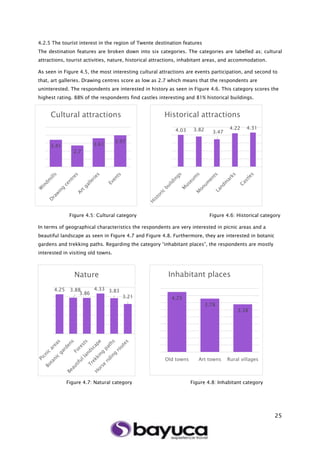
places to ask for information such as Beleeftwente, Twente Branding but they do not respond at all!
Now going to the topic, I will not bombard you know with too many questions because I know you are
very busy currently before the holidays, so I would suggest perhaps we can set up a follow up meeting
when you have more time after the holiday.
For now the most important factors that concern the questionnaire are:
Could you name some destination features from the region of Twente such as memorable attractions,
unique buildings or activities for families/couples?
What symbolizes Twente as a destination?
Which cities do you highlight in your branding efforts?
Below are some examples of information I have gathered so far from tourism websites from Twente.
Can you clarify if they are true or not and could you add something to the list?
Thank you very much again beforehand and looking forward to your reply!
Hello Emil,
Lionne Wolberink
At the request of my colleague Lianne Niemeijer I will send you the answers in red on your questions.
Emil: Could you name some destination features from the region of Twente such as memorable
attractions, unique buildings or activities for families/couples?
Lionne: Twente is a combination of country- and city life. Castles with their gardens (for example:
Landgoed Twickel in Delden, Singraven in Denekamp, Warmelo in Diepenheim etc.) are very important.
The most popular activities are walking and cycling, visiting a town or village. “Famous” museums are
TwentseWelle and Rijksmuseum Twenthe in Enschede, Zoutmuseum Delden, Oranjemuseum in
Diepenheim, Naturadocet in Denekamp.
Emil: What symbolizes Twente as a destination?
Lionne: Twente, estate of the Netherlands is a slogan which is used by the Twents Bureau voor
Toerisme (bankrupt in 2015).
The Hof van Twente contains a beautiful landscape, where it sometimes seems as if time stood still.
The beautiful environs with its many scenic cycle and walking tours are ideal for the active tourist.
Twente offers a broad range of overnight accommodations such as camp sites, farm camping sites,
bed & breakfasts, guesthouses and hotels.
Which cities do you highlight in your branding efforts?
Lionne: The township Hof van Twente consists of the cores of Bentelo, Delden, Diepenheim, Goor,
Hengevelde and Markelo, several neighbouring communities and a large rural area. The general
definition of ‘Hof’ is garden.
89
Bentelo: Originally, Bentelo was a medieval community. It is mostly known for its beautiful
surroundings, which draws walking and cycling tourists to this part of Twente all year long. Bentelo is
also a very hospitable community. At several farms and at the Hof van Twente vineyard tourists are
most welcome to take a look around and
taste the delight of local products. Also, the Easter celebrations in Bentelo, starting off with a huge
bonfire, brings many people from all over the region together.
Delden: A large part of the city centre dates from a period in which Delden received city rights (1333).
Many buildings have been professionally restored. Everywhere in Delden, the close connection with the
county castle Twickel is noticeable. Monuments of historic value are museum farm the Wendezoele,
the Noordmolen (oil mill), the Houtzaagmolen (saw mill), the Salt museum, the Old and Roman-
Catholic Blasius church. Delden also inhabits many galleries and hosts a number of events throughout
the year such as the monthly regional fair Twente, the Cultural Street Festival and the nationally
acknowledged four-day Wheelchair event, always starting at ascension, which are definitely worth
visiting.
Diepenheim: In the history of Diepenheim, the castles Huis te Diepenheim, Nijenhuis, Westerflier en
Warmelo have a prominent place. Though they are inhabited, the surrounding estates are free for
access. The popular Zes kastelen tour takes you along the six estates, with also the castles Weldam
and Wegdam. Other remarkable tourist attractions are the grain watermill Den Haller, the
Oranjemuseum Nieuwe Haghuis and the Art Association Diepenheim. As the centre of art, Diepenheim
is most famous. Also, the art event Kunstmoment and Kasteeldag (Castle day) are real highlights.
Goor: In 1263, Goor received its city rights and became the political centre of Twente. As a result of
Thomas Ainsworth founding the first textile school in 1833 in Goor, the town has played an important
role in the regional textile industry. Scattered throughout Goor are remarkable works of art, which can
be seen along the Art walking tour. Other highlights are the Braak mill, the Klompenmuseum (wooden
shoes) and Thomas Ainsworth’s tomb. The yearly school and folk fest, and the 4-day autumn bicycle
tour are important examples of Goor’s traditions.
Hengevelde: Hengevelde’s origins also lies in the Middle Ages. Under the influence of neighbouring
estate Weldam, Hengevelde and its environs flourished into a beautiful landscape. It is mainly known
for inhabiting the legendary local criminal Huttenkloas, who has murdered many people with his wife
Aarne and son Jannes in the 18th century. Hengevelde is definitely worth a visit during the annual
weekend folklore event called the Höftedagen (in June) with a variety of theater and music
entertainment.
Markelo: Markelo is one of Twente’s oldest villages with its characteristically sloping landscape and its
five hills. It has many agricultural communities, where modern business conduct is mixed with
traditions. Tourist attractions are the Martinus church, Buursink’s mill De Hoop (wind, grain and peel
mill) and the museum farm Eungs Schöppe. There are several yearly events such as the Art Bicycle Tour
and the open air shows in the Kösterkoele.
At the list of the destination we will miss artfully (Diepenheim, Delden, Ootmarsum), sportive,
wide/spacious, clear.
At the list of the features we will miss Hotels, Bed and Breakfasts, Camping on the farm, Art galleries,
Routes (walking, cycling, horse riding trials, mtb trials, etc.), Visit an event.
90
Appendix O: Invitation process for the respondents
91
Appendix P: Stakeholder matrix
Influential parties Role in applying the project The benefit of a project Level of influence
Buitencentrum
Hessenheem
De Langenberg
Accommodation
providers
The accommodation providers
have a very important role here
because one of the core
elements of the tourist’s
experience, is the place where
they are going to stay in at.
Without such a stakeholder
involved, the project would
simply not be possible.
The benefit for the
accommodation provider
to work in cooperation
with Bayuca Travel is that
the tour operator
introduces a new source
market which is
international and for now
this is not a common
practice in the region of
Twente. Both parties will
economically benefit from
this.
Collaboration is
important here and the
accommodation
provider sets out the
commission rate.
Fiets City
Activity providers
Activity providers are important
partners which provide the
thrill and excitement of the
travellers. Without their
cooperation, it is not possible
to create a tailor-made tourist
package catering for the needs
and wants.
The benefit for the
activity provider is more
customers to rent bikes
from the shop when
Bayuca Travel brings
groups of people
together. Awareness will
be raised in such a case.
There will be low level
of resistance due to
the fact that these kind
of activity providers do
not play such a vital
role as the
accommodation type.
Europcar
Rental car providers
Transportation helps the
travellers to reach from place A
to B. By renting cars, this
eases the traveller’s
experience.
Cooperation is necessary
with such providers and
both sides will get
revenue benefits for
working together.
As in the case of the
other influential
parties, here the
commission rate plays
a vital role and the
resistance level is
expected to be high.
92
Appendix Q: Design of the website package
Please tell us about your trip to the Netherlands plan in 5 minutes or less:
Who are you traveling with?
☐ On my own ☐ With my loved one* ☐ With the family ☐ A group of friends
What is the age group of the people traveling?
☐ 3 – 15 ☐ 16 – 26 ☐ 26 – 45 ☐46 – 70 ☐ above 70
What would you like to do there? More than one option is possible.
☐ Visit landmarks
☐ Visit castles
☐ Get married
☐ Celebrate anniversary
☐ Discover Dutch heritage and culture
☐ Other, please specify
When would you like to fly to the Netherlands? What is your preferred accommodation?
☐ Luxurious cottage
☐ 4* hotel
☐ Luxurious vacation house
For how many days would you stay?
If you have any special preferences to make your trip unforgettable, please mention them below:
93
Based on your previous selected options, this is what the idea trip will be for you! (Generated content)
Historical Avenue of Twente
Take a (day) breathtaking travel experience with (selected
target group) back in time to the historical sightings of
the spacious and beautiful destination Twente, situated in
the Netherlands in this historically themed package.
You and (your travel group) are (age range) cultural
seekers who are looking for a relaxing and unforgettable
historical journey. Then Bayuca Travel is sure that you
would enjoy having a historical tour through the cities as
well as the various castles such as castle Twickel. Twente
is the place for you and your love lone! You will have the
opportunity to select the features you are interested. We
will determine the most affordable price for you at the end
when including all optional activities.
The six castle tour of Diepenheim is one of the most popular
routes in Twente for cycling. It is around 30 kilometres long,
going around the beautiful landscape and open fields of
Twente, introducing you and your loved one to the magic
and beauty of the destination, as well as the possibility of
visiting the historical castles: Huis te Diepenheim, Nijenhuis,
Warmelo, Wegdam, Weldam and Westerflier. Alternatively,
instead of having the opportunity to cycle, you could utilize
our Europcar deal and instead drive to the castles.
Bayuca Travel provides you with the possibility to enjoy a
marvelous picnic experience with your partner in the
botanical gardens near castle Twickel, in case you get too
tired from all the historical sightseeing. Enjoy a lovely,
relaxing lunch menu together and let the good times row.
The menu includes typical Dutch cuisine, plus drinks of your
own choice. Dietarian wishes will be met.
When you are done with selecting all the activities you would like to do, and the accommodation
preference where you will likely stay, you will get an immediate reservation notification on your email
address, as well as direct contact with us for further information on how to process the payment.
If you have any particular questions regarding anything related to the package tour, as well as the
Netherlands in general, our experienced team will try their best to answer all your questions.
Thank you for putting trust in us and do not forget to subscribe to our weekly email newsletter for
limited discounts!

Bachelor Thesis - Emil Dimov

  • 2.
    2 (Quick scan retakewith changes to the content) Author: Emil Dimov Student number: 322132 Class: ATH4IP01 Place of publication: Handelskade 75 7417 DH Deventer Year: 2016 Client: Bayuca Travel Module: T.HBS.37179: Thesis W 1st examiner: Gijs Theunissen 2nd examiner: Ekaterina Pushkarskaya Research counsellor: Joris Verwijmeren Place and date of distribution: Deventer, 7th September 2016
  • 3.
    3 Preface This exhaustive thesishas been written for the duration of seven months. This report is considered an “overhaul” version of the one which was previously which was handed-in. The majority of the information drastically changed. I would like to express my token of gratitude and appreciation to Mr. Theunissen for being there and helping me find my previous flaws, in order to improve on my mistakes. He was not only an examiner but was also involved in providing me throughout the process with valuable tips, hints and acting as a mentor. Without his support, most probably the final result of this research would have been vastly different. I would personally like to thank Mr. Verwijmeren as well, for being the research counsellor and helping me out with the research design formulation and suggesting some valuable tips on the survey distributed to the Russian travel market. Next to this, I personally would like to thank Mrs. Yuricheva and Mrs. Barkel – my clients for devoting their time to reviewing how my progress with the report was going. Second to that, I would like to express my gratitude towards Mrs. Anna Yuricheva and my dear friend Mila Karamanova for taking the time to translate the questionnaire to Russian and both of them helping out with spreading it to the Russian tourists. Without their support, the distribution of the survey would not have been this successful as I would have only been able to distribute it in English. I would also like to thank all those people that helped me out in spreading the survey on Facebook to their Russian friends and acquaintances. Furthermore, sincere acknowledgments to the respondents that had taken part in this survey and devoted valuable time. Other very important and supportive people were my parents and friends who pushed me to move forward and focus on my goal to deliver advice suitable for the client. Mrs.Bosch, who was my study career counsellor, was also very cooperative in actually helping me out to find this thesis topic in the first place via Mrs. Barkel. Thank you all! Emil Dimov Sofia, August 3, 2016
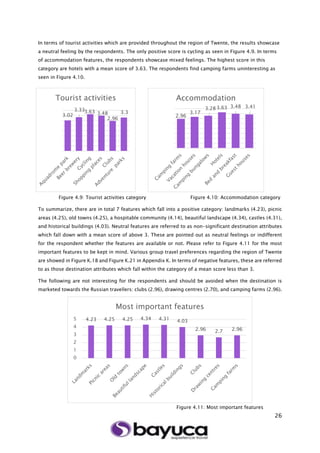
  • 4.
    4 Summary Russian travel marketinbound The Russian travel market is increasingly growing. For this reason, the tour operator Bayuca Travel sees this as a potential opportunity and would like to attract the aforementioned market to the region of Twente, the Netherlands. Bayuca Travel seeks advice on the ways to achieve this. The research objective of the report was to find out the existence of a match between the Russian traveller’s needs and wants and what the region of Twente currently offers as a destination. Hence, two central research questions were formulated in order to gain insight on both parties:  What does the region of Twente currently offer in terms of destination branding?  What are the current Russian tourist’s characteristics regarding destination preferences? In order to begin answering these questions, four relevant core concepts were derived from a literature review. The core concepts are as follow: destination branding, destination identity, destination image, Russian traveller characteristics. Furthermore, the core concept marketing plan was included in order to bring the advisory part of the report to a strategic level. Two research designs were utilized throughout this report in order to answer the two central questions. Firstly, it was important to gain an insight into the Russian tourist’s characteristics regarding their destination preferences. For this questionnaire to be conducted, secondary desk research was applied on the destination branding efforts, destination identity, and destination features of the region of Twente. The researcher corresponded via email with the marketing manager of Hof van Twente which is one of the tourism offices responsible for promoting the destination. A web-based questionnaire was successfully distributed to 142 Russians in Russian. Numerical data was collected regarding their relationship status, gender, age, income, and level of education. Furthermore, the survey addressed questions about their traveling motivations, accommodation preferences, and the reason for visiting a destination. The questionnaire included all Twente features from which the respondents were able to rate. The results showcased that there is a partial match between the destination and the Russian tourists. The majority of respondents, who are interested in the destination’s features are in the age range of 16 – 26. They prefer to travel with their partner, friends, and family with children. All the travel groups have an affiliation to the historical attributes of the destination. The advisory objective was to contribute Bayuca Travel with recommendations on various options to lure the Russian travel market to Twente. Three advice possibilities were looked upon and later on evaluated. This was done in order to choose the one which was most feasible and provided return on investment. The option for answering the management question for Bayuca Travel is to create a historical themed dynamic package labelled as the “Historical Avenue of Twente” for couples without children. Travelers can create their own package tour going through a list of activities taken from the highest rated destination features. By having the option of adding new activities, added value is generated for the tourist’s experience.
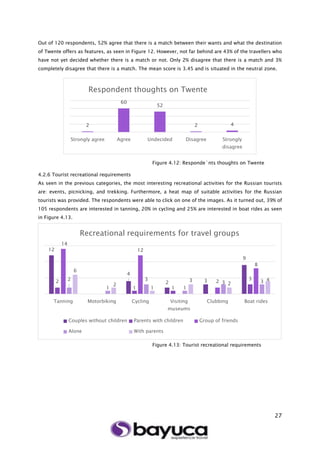
  • 5.
    5 Table of Contents 1Introduction 8 1.1 Background description of Bayuca Travel 8 1.1.1Mission 8 1.2 Reasoning for the research 8 1.3 Objectives of the advisory part 9 1.4 Objectives of the research part 9 1.5 Central research questions 9 1.5.1 What does the region of Twente offer? 9 1.5.2 What are the current Russian tourist’s characteristics? 9 1.6 Reading guide 10 2 Theoretical framework 11 2.1 Search methods 11 2.2 Results from the literature research 11 2.2.1 Destination branding 11 2.2.2 Destination image 12 2.2.3 Destination identity 12 2.2.4 Russian tourist characteristics 13 2.2.5 Marketing plan 14 2.3 Operationalisation 15 3 Methodology 16 3.1 Research strategy 16 3.2 Research designs 16 3.2.1 Desk research 16 3.2.2 Survey design 17 3.3 Data collection method 18 3.3.1 Web-based questionnaire 18 3.4 Sampling plan 19 3.5 Data analysis plan 19 3.5.1 Survey data analysis plan 20 4 Results 21 4.1 Desk research on the region of Twente 21 4.1.1 Twente offering in terms of promotional material 21 4.1.2 Destination identity of the region of Twente 21 4.1.3 The most highlighted tourist activities in Twente 22 4.2 Wishes and demands of the Russian travellers 22 4.2.1 Demographic profile of the Russian traveller 22 4.2.2 Accommodation preference of the Russian traveller 23 4.2.3 Russian traveller motives to visit a destination 24 4.2.4 Reason of visiting a particular destination 24 4.2.5 The tourist interest regarding Twente’s features 25 4.2.6 Tourist recreational requirements 27
  • 6.
    6 5 Conclusions 28 5.1The destination branding of the region of Twente 28 5.2 The Russian tourist characteristics 28 6 Discussion 29 6.1 Reliability 29 6.2 Validity 30 7 Advice 31 7.1 Advice objective and questions 31 7.1.1 Advisory questions 31 7.2 Management case approach 31 7.3 Description of alternatives 32 7.3.1 Alternative 1: Historical Avenue of Twente 32 7.3.2 Alternative 2: Experience Twente 33 7.3.3 Alternative 3: Getaway from the crowd 34 7.4 Identification of criteria 34 7.4.1 Prerequisite criteria 34 7.4.2 Evaluation criteria 34 8 Strategic marketing plan 36 8.1 Knowledge on the Russian traveller 36 8.2 Objective setup 37 8.3 Business environment scan 37 8.3.1 DESTEP analysis on the Russian travel market 37 8.3.2 SWOT analysis on Bayuca Travel 38 8.4 Marketing tactic 38 8.5 Strategic planning 40 8.6 Control of the marketing plan 41 8.7 Implementation plan 41 8.7.1 Plan: Identify and establish objectives 41 8.7.2 Do: Developing and measuring 43 8.7.3 Check: Evaluation and constant reviewing 43 8.7.4 Act: Documentation of the result 44 8.8 Budgeting (Financial implications) 44 8.8.1 Tour package price 44 8.8.2 Investment plan 45 8.8.3 Profit and loss statement 46 9 Advisory conclusions 46 Afterword 47 References 49 Appendices 51
  • 7.
    7 Overview of tablesand figures Number Description Page number Figure 4.1 Traveling times abroad between travel groups 23 Figure 4.2 Accommodation preferences of travel groups 23 Figure 4.3 Motives to visit a destination 24 Figure 4.4 Reason of visiting a particular place 24 Figure 4.5 Cultural category 25 Figure 4.6 Historical category 25 Figure 4.7 Natural category 25 Figure 4.8 Inhabitant category 25 Figure 4.9 Tourist activities category 26 Figure 4.10 Accommodation category 26 Figure 4.11 Most important features 26 Figure 4.12 Respondent thoughts on Twente 27 Figure 4.13 Tourist recreational requirements 27 Figure 7.1 Alternative options 32 Table 7.1 Evaluation criteria 34 Table 7.2 Evaluation criteria explanation 35 Table 8.1 SWOT analysis of Bayuca Travel 38 Table 8.2 Balanced Scorecard 41 Table 8.3 Price cost per trip 45 Table 8.4 Initial investment plan 45 Table 8.5 Profit and loss statement 46 Figure K.1; K.2 Gender, Age 79 Figure K.3; K.4; K.5 Marital status, Children status, Level of education 79 Figure K.6; K.7 Fun factor, Relaxing factor 80 Figure K.8; K.9 Urban factor, Quiet factor 80 Figure K.10; K.11 Unspoilt factor, Hospitable factor 81 Figure K.12; K.13 Spacious factor, Historical factor 81 Figure K.14; K.15 Educational factor, Romantic factor 82 Figure K.16; K.17 Agricultural factor, Comfortable factor 82 Figure K.18; K.19 Destination preferences of travel groups, Motivational factors 83 Figure K.20; K.21 Reasons of visiting a destination, Interesting destination features 84 Figure K.22; K.23 Travel abroad times, Reason of choice 85
  • 8.
    8 1. Introduction 1.1 Backgrounddescription of the organisation Bayuca Travel is a specialist in organising unique travel experiences for its clients. The tour operator/consultancy foundation was founded in 2009 by tourism entrepreneurs Anna Yuricheva and Christa Barkel. Their intention is to spread knowledge and professionalism to the Eastern European hospitality industry. The foundation is specialised in arranging unique travel trips for Dutch tourists to the former Eastern European bloc countries such as Russia, Latvia, Bulgaria, Slovenia and others. Bayuca Travel has a diversified product portfolio ranging from the arrangement of study trips, training session trips, cruises, and wellness. Furthermore, the company designs concepts which boost the tourism mobility between Eastern and Western Europe (A.Yuricheva, personal communication, February 20, 2016). The overall objective of the foundation is to develop, support and promote its expertise and consulting services to tourism related companies. The foundation annually participates in major projects aimed at improving the social and economic advantages of the Eastern European travel market by encouraging Dutch travellers to visit Eastern Europe. Sustainability is one of the core values of the tour operator. Therefore, Bayuca Travel promotes its tourism products in a sustainable manner striving to find the balance between people, planet, and profit. When taking this into account, the travel organiser focuses on minimising the negative consequences of its activities on the environment. Furthermore, Bayuca Travel’s core values emphasise on selling unique propositions to its clients. This focus enables the foundation to boost the economic benefits of Eastern European destinations while taking care of sustainability. 1.1.1 Mission Bayuca Travel aims to offer unique touristic products and services to experienced travellers throughout destinations situated in Eastern Europe. The tour operator always takes the environment into account and operates with respect to the local character of a destination. By adding ‘colour’ to the products and services, the travellers are able to contribute to the local economy while enjoying a memorable experience. 1.2 Reasoning for the research According to a market scan conducted by the NBTC (Holland Marketing, 2015), inbound tourism in the Netherlands has been steadily increasing over the last decades. In the year 2012, there were over 12.2 million tourists visiting the destination for holiday or business reasons. Out of these, 160, 000 travellers were from Russia (NBTC, 2015). This PAX number is forecasted to be 240, 000 by the year 2020, with an 8% yearly growth rate. The client is especially interested in learning if there is a match between the Russian travel market’s needs and wants, and what the region of Twente currently offers as a tourism destination. Twente is a non-administrative region in the eastern Netherlands (Wikipedia, 2011). The destination attracts many tourists from other parts of the country for its landscape which reminds of forests and pastures. The destination does not rely on tourism but instead it focuses on agriculture. The reason why this region is the central research topic is because of a request made by Bayuca Travel. The client wishes to gain insight on whether the place is suitable for a Russian tourist. The tour operator is keen on obtaining figures and statistics about the possible match between the destination’s offerings and the Russian traveller’s wants
  • 9.
    9 and needs. BayucaTravel hopes to achieve a higher level of market share and be the first tour operator to attract at least an appropriate segment of the Russian travel market showing interest to the region of Twente. The way of attracting the travel market is to advise the travel organiser with a suitable strategic marketing of a product. The tour operator is particularly interested in understanding the ways of attracting the aforementioned Russian travel market to the region of Twente. With this information in mind, the management question is formulated: 1.3 Objectives of the advisory part The objective for the advisory part is to find a suitable option on the way of attracting this travel market to destination Twente. A prerequisite for coming up with options is to obtain facts about the Russian tourists in the research part. This information is used throughout the advisory part. A step-by-step marketing plan will be provided to Bayuca Travel in order to attract this market. Bayuca Travel does not seek advice for coming up with a solution to a bottleneck, due to the reason that there is no issue that needs to be dealt with. This advisory part consists of two advice questions:  What are the possible options that would lure the Russian travel market to the region of Twente?  Which one of the options is most suitable for Bayuca Travel in order to attract the Russian travel market to the region of Twente? 1.4 Objectives of the research part The objective of the research is to gain an insight whether there is a match between the demands of the Russian travel market and what the region of Twente currently offers. This is a crucial step to acquire information from both parties in order to transition to the advisory part of the report. Without this insight, it would not be possible to answer the advice questions. Two central research questions are formulated. 1.5 Central research questions and sub-questions 1.5.1 CQ: What does the region of Twente currently offer in terms of destination branding? Both the central research question and the sub-questions are formulated with the help of the literature review about destination branding and destination identity. Destination branding and destination identity are two interchangeable core concepts dealt with when a tour operator is interested in attracting a new travel market to a destination. The aspects of the sub-questions mentioned below help to answer the central question: Sub-questions  What does the region of Twente currently offer in terms of promotional material for its tourism products?  What does the region of Twente currently offer in terms of destination identity?  What does the region of Twente currently offer in terms of the most highlighted tourist recreational activities? 1.5.2 CQ: What are the current Russian tourist’s characteristics regarding destination preferences? Both the central research question and sub-questions were formulated based on the literature review regarding the core concepts - Russian tourist characteristics, destination image, and destination branding. Those were the chosen concepts because they provide extensive source of information. The
  • 10.
    10 information is necessaryfor developing a survey, able to trigger results about the requirements of the travel market. The insight is used to compare the results gathered from the previous central research question. These sub-questions were answered by distributing questionnaires to the Russian tourists and ultimately, the central question was as well answered. Sub-questions  What are the characteristics of the Russian traveller profile?  What are the current Russian tourist’s characteristics regarding their accommodation preferences for tourism purposes?  What are the current Russian tourist’s characteristics regarding their motivation to visit a particular destination for tourism purposes?  What are the current Russian tourist’s characteristics regarding their most frequent reason of visiting a particular destination for tourism purposes?  What are the current Russian tourist’s characteristics regarding their interest in a destination’s features?  What are the current Russian tourist’s characteristics regarding their tourism recreational requirement? Motivation for choosing the questions - Establishing two central questions made the strategy of the dissertation clearer by targeting two valuable stakeholders with a different research design method. The questions were all related to each other because each answer of the questions brought the report a step closer to answering the management question. 1.6 Reading guide The following study consists of eight chapters. Chapter 1 introduces the reader to the organisation, the reasoning behind the study carried out and how the project is structured. The research questions and objectives are stated in this chapter. Chapter 2 is labelled as the theoretical framework and includes a literature review of all core concepts that were applicable in this study. Moreover, the search methods are elaborated and utilized in finding the right information. Chapter 3 consists of a methodological section explaining how the data was acquired, who the targeted population was, and which research design was used to reach this sample. Chapter 4 contains the execution of the field research, the gathering of all necessary data and the analysis of the results. Chapter 5 provides conclusions to the research part as well as answering all the research questions. Chapter 6 provides a discussion on the reliability and validity of the data results. Chapter 7 is labelled as advice recommendations and compares three options. The most appropriate one is chosen. Chapter 8 provides a strategic marketing plan on the chosen option. Furthermore, the PDCA cycle is utilised in order to implement the advice. Moreover, the financial implications are elaborated.
  • 11.
    11 2. Theoretical framework Thefollowing chapter deals with the theoretical framework. A literature review was necessary in order to fully grasp the knowledge necessary for the researcher to provide a coherent answer to the management problem. Relevant information over available theoretical concepts regarding destination branding, destination image, and destination identity were looked upon. These core concepts destination image and Russian tourist characteristics were applied in the survey design, whilst destination branding and destination identity were utilised in the secondary desk research. Those core concepts are very similar to each other and used interchangeably as a tool when trying to attract travellers to a destination. The core concept marketing plan was introduced in the theoretical framework in order to formulate the advisory part on a strategic level. The objective of the research was to gain an insight whether there is a match between the demands of the Russian travel market and the offerings of the region of Twente. The research part aimed at answering the following research questions:  What does the region of Twente currently offer in terms of destination branding?  What are the current Russian tourist’s characteristics regarding destination preferences? 2.1 Search Methods and AAOCC application Please refer to Appendix A and Appendix B. 2.2 Results from the literature research 2.2.1 Destination branding Ritchie and Ritchie (1998) point out that destination branding is “a name, symbol, logo, word mark or other graphic that both identifies and differentiates the destination. Furthermore, it conveys the promise of a memorable travel experience that is uniquely associated with the destination. It also serves to consolidate and reinforce the recollection of pleasurable memories of the destination experience” (as cited in Blein, Levy & Ritchie, 2005, p.329). Tourism destinations consist of interchangeable services and products bound together under a brand name within the same geographical area. Kerr (2006) points out that destination branding had previously focused on tourism products and calls for a “more holistic perspective, location or place brand, taking into account all aspects of a location” (as cited in Kozak & Baloglu, 2011, p.154). The geographical boundaries of a destination can range from small towns to nations. Another common definition is that travellers perceive the destination as a whole entity under a brand name. An example of such misconception is Istanbul or Amsterdam being destinations for Europeans. For the Russian market, Europe is seen as the destination. A destination brand represents the core essence and enduring characteristics of a destination. Usakli and Baloglu (2011) state that destination branding is a relevant concept, due to the fact that travellers would opt for recommended brands that match their own self-actualization. The above-mentioned occurrence is named the self-congruity theory. For secondary information on destination branding, please refer to Appendix C.
  • 12.
    12 2.2.2 Destination image Thedestination image is the sum of beliefs, ideas and impressions that people have of a place (Kotler, et al., 1993). Past studies on destination image lead to an indication that there is a level of influence on the tourism behaviour. The destination image is an important part of the customer-based brand equity models and plays a catalytic role in the tourist demand management (Konecnik & Gartner 2007, Boo, Busser & Baloglu 2009). Milman and Pizam (1995) state that if a destination desires to be potentially successful, first of all, it is necessary for the tourist to have a positive image and awareness of the place. In relation to the hospitality industry, a destination brand image consists of cognitive (perceptual) and affective (emotional) components (Baloglu & Mccleary, 1999). The cognitive evaluation refers to beliefs and knowledge of a place or object, whilst affective evaluation is about feelings and emotions about a place or an object. Um and Crompton (1990) claim that travellers who have not previously visited a place are more likely to be critical about their choice selection. Kotler, Haider and Rein (1993) state that it is possible for a destination to have either a positive, negative, weak, or an unclear image. Sirgy and Su (2000) introduced the self-congruity theory to the tourism field, in order to formulate an explanation regarding the relationships between the self-concept and destination image. Their theory suggests that self-congruity is the match between the destination’s image and the traveller’s perception regarding the actual and ideal self-image. Furthermore, Sirgy and Su (2000) gave the proposition that tourists not only base their evaluation on the symbolic features of a destination but additionally, they look at characteristics such as price, the level of service quality, and the variation of activities within the destination. Beerli and Martín (2007) conducted a study that led to the insight that the stronger the match between a person’s self-concept and the destination image, the more likely the tourist would like to visit the destination. However, there is a loss of power on the actual and ideal self-congruity. The reason is the fact that there is less influence when a tourist has already visited the destination. For secondary information on destination image, please refer to appendix C. 2.2.3 Destination identity Brand literature makes a clear distinction between brand identity and brand image. Research points out that the destination identity is how the brand strategists would like the brand to be perceived. In other words, this is how the supplier’s (destination) version of the brand personality looks like. Aaker (1996) defines brand identity as “a unique set of brand associations that the brand strategist aspires to create or maintain” (p.68). Aaker (1996) further elaborates that: Brand identity should help establish a relationship between the brand and the customer by generating a value proposition involving functional, emotional or self-expressive benefits. (p.68) Brand identity consists of core and extended identity (Aaker, 1996).The core identity is constantly remaining as the brand is trying to attract new markets and products. The key components of it are that it contributes to the brand uniqueness and value proposition of a destination. The core destination identity should clearly incorporate the characteristics of the destination. It is not possible for the core identity to be changed immediately. However, the extended identity helps the core identity to be
  • 13.
    13 strengthened by implementingvarious communication strategies. For secondary information on destination identity, please refer to Appendix C. 2.2.4 Russian tourist characteristics The Russian tourist’s characteristics are defined as the cultural and social blueprint of a certain population. This includes age, educational background, income, the reason for visit, destination preferences, and size of the travel group. This statement serves as a representation of them. There are many motives for travellers expressing the need of visiting a destination. In a case study conducted by Lehtinen (2014), the goal was to improve the knowledge of the Russian travel market. In the study, the tourists were approached via interview and email questionnaires concerning their wants and needs regarding a destination. As it turned out, the Russian tourists are no exception in the self-cognitive matter. When they plan on going to a vacation, they seek destinations that offer multiple activities and experiences. The experiences lived are most commonly shared with family and friends after the trip in order to realise the self-actualization. If the services and activities in the travel destination do not meet the Russian consumers’ expectations, they feel the trip has not succeeded. Furthermore, the research revealed that there is a relationship between a bigger group of passengers and longer vacations. Concerning the choice of accommodation, large Russian groups are in favour of choosing spacious living places such as cottages, apartments and bigger hotel rooms. Their tendency is to utilise as much as possible from the offerings of the accommodation sites such as on- sight activities. This leads to the insight that they prefer to spend more time with each other at their accommodation place. Lehtinen (2014) claims that the Russian tourists, coming from the high class, have higher service quality expectations and prefer to enjoy all-inclusive tourism offers. They are willing to pay more for an exceptional service. The rating of a destination is highly important in their minds, not only for accommodation purposes but for the destination as a whole entity. This is directly in-line with the destination image which plays an important role in the critical success factor of a destination. Even though it is of upmost importance for all Russian tourists to share their travel experiences with their friends, the higher class tends to have the need of feeling appreciated and to boost its personal status. Lehtinen (2014) points out that the Russian travel market is very price sensitive and, even though they might have a higher income, they are in favour of finding out the best offers available. From her interview analysis, Lehtinen (2014) found out that word-of-mouth and recommendations are very important factors for the final decision making. The opinion of friends and family is highly favourable whenever somebody is looking for a reference on possible destinations. Following her interview sessions, Lehtinen (2014) found out that there are three types of Russian travellers that can be distinguished - couples, families with children, and a group of friends. For secondary information on the Russian travel characteristics and tourists characteristics in general, please refer to Appendix C.
  • 14.
    14 2.2.5 Marketing plan Amarketing plan is a coordinated process that establishes a link between the organisation’s goals and resources and its marketing opportunities. In other words, the organisation strives in making the best use of its resources. Holloway (2004) elaborates that the first important step to be undertaken is to have knowledge of the goals and resources which are available, as well as to keep an eye on the opportunities that can be exploited by the organisation. For secondary information on marketing, please refer to Appendix C.  Previous knowledge on the customer The first part of a marketing plan is to clarify who are the consumers of the tourist package and what are their characteristics. Time is necessary to be spent in describing the target audience. This information leads to an insight on the ways of reaching those potential customers and how to maximise profit. Setting objectives The second step of a marketing plan is to set up objectives. Typical objectives sought by travel companies are:  Achieving sales growth within a given period of time  Increasing the income of the organization by a given percentage within the period  Increasing the current market share by x per cent within a period of time  Measureable increase on Return on Investment by the company The objectives are the backbone of decision-making and need to be formulated SMART. Holloway (2004) advises that it is not suitable to work on many objectives at once, due to the danger of creating conflict between the strategies. Scan the business environment It is important to know how easy it is for a new target market to be allowed to visit a particular destination. Holloway (2004) states that in some countries, the entry of the market is controlled by the government legislation. A suitable model that deals with a marketing scan of the environment is the DESTEP analysis. It can be applied by any tourism company wishing to learn more about the competitive environment, consumer demand, the economic influences, and the changing cultural factors.  SWOT analysis After concluding the broad analysis of the business environment, it is important to evaluate the present position of the company. The review is undertaken by using a technique labelled as the SWOT analysis. For this reason, any internal processes are left out. In terms of weaknesses, tour operators should be conscious about their competitive position and mention the disadvantages of their pricing, promotional terms or scope of destinations.
  • 15.
    15  Choice ofa marketing tactic The marketing mix is one of the most important elements of a marketing plan. Kotler (2013) defines it as “the set of controllable tactical marketing tools that the firm blends to produce the response it wants in the target market” (p.76). The tools consist of four variables, commonly referred to as the four P’s: product, price, place, promotion. The product consists of tangible and intangible elements. Holloway (2004) points out that the intangible products could add value to the overall experience for the customer. Price refers to the money paid for the service by the consumer. Moreover, the price is the numerical figure of the willingness to provide the service to the traveller when taking into account various elements such as cost and sales volume. The place variable is controversial because it is defined as the place where the purchase had taken place and the means on how the product has been delivered. However, in the hospitality sector, this becomes confusing because some theorists argue that place refers to the destination of the tourists. In order to make it clear, place will be defined in terms of the distribution channels. Promotion is the technique used to communicate the prices and products to the marketplace. Examples of this are advertising, sales promotion strategies, public relation activities, and the use of ICT (information and communication technologies) to reach the target market.  Strategic planning When a company is done with evaluating its marketing position, there are three directions that can be undertaken: 1) Low price leadership – The price is reduced in favour of selling more. 2) Product differentiation – Products are specialised and not offered by any competitors. Holloway (2004) states that the focus is on quality. This justifies the higher pricing for the tourism package. 3) Market focus – In this case, the idea is to concentrate solely on one specific market. This is referred to as market segmentation. The advantages of using such an approach, are that the company vastly reduces the competition. By reducing competition, the market becomes less price-sensitive, which in turn boosts profit. Holloway (2014) recommends small travel agents to develop their marketing strategies based on specific specialisation such as a geographical region, type of activity or the market which is served.  Controlling the market plan - Constant monitoring is crucial for the success of a marketing plan, as in any other project. A tool for doing this is the Balanced Scorecard which deals with the financial, the internal, customer and learning perspective (Mackay 2004). It is very critical to be decisive when thinking about the initial investment budget. It is important to consider how much money will be allocated to the marketing and promotional material, as well as staff costs. 2.3 Operationalisation The destination branding and the Russian tourist characteristics were operationalised in Appendix D and E respectively and are in-line with the gathered information from the literature review. It should be important to note that identity and image have been included as components of destination branding.
  • 16.
    16 3. Research Methodology Thischapter deals with the data collection methods which were based on the two types of central research questions asked. The research strategy, as well as the research designs were elaborated. These methods were in favour of the empirical research. The first central question was answered by means of desk research and an email interview. The second central question was answered by means of a survey design. The survey design was the dominant research data collection method. Each one of the designs consisted of sampling units; therefore, a sampling plan was proposed and the methods of data analysis were extensively elaborated. 3.1 The research strategy The following composed strategy for the empirical research evolved around a survey design and a desk research with an email interview. This study was in favour of both techniques of acquiring knowledge, due to the complexity of the original central question and the population which was targeted. The empirical study originally had only one central question: To what extent is there a match between the demands of the Russian travel market regarding the region of Twente and what the destination currently offers? As seen in the central question, it was not possible to use only one research design, because conducting qualitative research to the tourists would have taken an enormous amount of time to generalize their requirements. On the other hand, conducting a survey to the region of Twente will not give a deeper insight into the core essence of the destination and its offerings; therefore, it cannot be determined whether there is a match between the two parties or not. This leads to an impact on the management question. In such case, it cannot be answered fully and accurately. The first step of the strategy was to conduct the desk research regarding the destination identity of the region of Twente. It was important to find relevant sources on the various destination features which are offered in the aforementioned region. Secondly, a short email correspondence with a destination branding tourism office for the region of Twente was required in order to gain more insight into the branding and the core essence of the destination. After acquiring the necessary information regarding the destination, it was then possible to proceed with the survey design. The combination of the quantified data gathered by the sample and the qualitative opinion of Hof van Twente served as the answer whether there was a match between the requirements of the Russian travel market and the offerings of the region of Twente as a tourist destination. 3.2 Research designs 3.2.1 Desk research The desk research was chosen as the secondary research design. It is often considered as a low-cost alternative to a field research. The main motivation behind this choice of opting for a desk research is the holistic approach that needs to be taken into account in order to learn all about the branding efforts of the destination. This design is appropriate for the exploratory phase of the study and is used to answer the central question: What does the region of Twente currently offer in terms of destination branding? The only way to truly gain an insight into the destination characteristics of the region of Twente was to gather website information on what the various destination branding organisations highlight and say about the place. Furthermore, the official tourism websites of Twente were looked at to find an insight
  • 17.
    17 into the destination’score attractions which are promoted. This was done in order to learn about the DNA of the destination. Conducting the desk research enabled the researcher to gain an insight into the identity of the destination, the brand positioning, reasoning behind the slogan, the current branding efforts, and other elements forming the destination. Destination branding as a core concept was operationalized earlier and served as the central topic for an email interview. The topics within destination branding were as follows: destination identity, the most highlighted tourist activities and the promotional material. The purposive sampling method was selected, in regard to provide a pre-selection criterion which is relevant to the central research question. The sampling selection of the research units was based on the following criteria:  The person working interviewed should be the branding manager.  The organisation is in charge of promoting and branding the region of Twente. By using the abovementioned criteria, three organisations were selected. The companies were Twente Branding, Beleef Twente, and Hof van Twente, each having a branding manager. Numerous attempts were made to arrange a qualitative interview with Beleef Twente and Twente Branding. However, none of the organisations responded; therefore, only the information from the marketing manager of Hof van Twente was primary used. Hof van Twente was the only one that was willing to cooperate because the others did not respond either through mail or on the phone. Therefore, it was seen as that they are not interested. The contact person’s name was Lianne Niemeyer, who was very enthusiastic and proposed to correspond via email about the destination branding and identity of Twente. The email correspondence can be found in Appendix N. Most of the information regarding the destination features had been gathered by conducting the desk research. Nevertheless, clarification and approval of the marketing director was vital. The contact person suggested specific destination attributes, not found on the tourism websites of Beleef Twente and Hof van Twente. The information gathered from interviewing the tourism marketing manager of Hof van Twente served as a basis on the way to approach the Russian travel market population, not only in the questionnaire, but as well in the advisory part. By building up the brand essence of the destination, it was possible to include the destination features of the region of Twente into the questionnaire. All these destination characteristics were labelled as motivational factors for tourists visiting a particular place. 3.2.2 Survey design Brotheron (2011) expresses that the survey design is used to collect information from a “representative sample” of individuals using the technique “Asking questions”. This study was in favour of conducting a survey design due to the desire of gathering numerical information regarding the requirements and opinions of the Russian traveller and to compare if they are interested in Twente’s offerings. Verhoeven (2015) refers to the data collected as cross-sectional. The population was Russian tourists who have had no previous experience or expectation about the region of Twente, but the questions asked in the questionnaire included aspects of the DNA of the destination. Another reason for choosing a survey design is that it is a standardized procedure with less room for systematic error with the ability of quantifying the data collected from the respondents.
  • 18.
    18 Furthermore, according toBrotherton (2011), it is easier to design a survey and implement it rather than other empirical studies. The objective comparisons are then easier to be attained. The survey was distributed to the potential respondents by electronic means due to the geographical boundaries and difficulty in reaching the population directly. Brotherton (2011) states that this is a very popular type of survey because an enormous amount of people are surfing the web every day. By distributing the survey digitally, it diminishes the necessity of travelling to Amsterdam or any other major Dutch city where there is a probability of finding the Russian travellers. This reduced the time spent on distributing the questionnaires. Furthermore, it would be easier to reach immediately the desired sample. A postal survey would be cost-ineffective, i.e. sending the questionnaire to Russian residents. Telephone surveys were out of the question, due to the lack of ability to acquire a sample frame from a telephone book and speaking the native Russian language. Face to face surveys were impractical in this matter because it was already very difficult to find Russian tourists in the geographical region where the study had taken place. It should be noted that there are disadvantages when applying a survey design. Brotherton (2011) points out that, although a survey design is applicable in this circumstance, it is not necessarily the best way of gathering information, because other research designs are more accurate. Furthermore, due to the fixed nature of the questions, there is no room for flexibility, whilst with a qualitative analysis it is possible. Another major disadvantage, pointed out by Brotherton (2011), is that is it not possible to explore the motivation behind a certain answer of a question. 3.3 Data collection method 3.3.1 Web-based questionnaire method The chosen method of collection is a web-based questionnaire. The reason behind this strategic decision is that the possible sample is most active, and is more likely to fill out the questionnaire. Brotherton (2015) states that, in terms of designing the questions, they need to be unambiguous, comprehensive and contain the measurements that the researcher wants to measure. The questionnaire design of the web-based survey is straight-forward. The data gathered by the Russian travellers served as a comparison tool about the match between the offerings of the region of Twente as a destination and the tourist preferences. It was designed to assess the destination image, as well as the traveller perceptions of the region of Twente. Furthermore, it assessed the traveller’s possible interest in traveling for vacation purposes. A sample size of 142 people received an online invitation questionnaire from the Russian multi-sided platform vkontakte.com including Facebook. The software program which was used to design the web- based survey is called Qualtrics. Qualtrics comes packed with the possibility of designing the questionnaire and the option of exporting the acquired data into SPSS (Statistical Package for the Social Sciences). Qualtrics was chosen, due to the possibility of digitally receiving back the questionnaire once it has been filled out by the respondent. Another advantage of using Qualtrics, is that it automatically creates charts and statistics based on the questions asked, so the work and time to send the data to SPSS is diminished. The degree of anonymity of the respondent was high. There were many people who opted to fill out the questionnaire. The questionnaire was distributed to the Russian population using the most popular social media portal by Russians - vkontakte.com. Sangeet (2013) states that a multi-sided social platform is
  • 19.
    19 an organisation thatenables a direct interaction between customers. The questionnaire was available in the mother tongue of the respondents as well as in English. The questionnaire was first written in English due to the inability to remove this option in Qualtrics. The English translation can be found in Appendix F and the Russian version in Appendix G. The idea behind spreading a web-based survey in Russian was that more people would be willing to fill it out. However, this effort did not make much of a difference in terms of reachability. 3.4 Sampling plan The population of this study was Russians travellers. No sampling frame existed, due to the fact that it was difficult to acquire any administrative record of all the Russian users from the websites. Therefore, the only alternative was to opt for a non-probability based strategy having its weak points. This is elaborated later on in the reliability section 6.1. Convenience based sampling was chosen as the desired strategy. Persons were deliberately selected for the sake of providing information that cannot be obtained in a probability based way. What this means is that a specific number of the population was chosen based on who is most easily available and willing to fill out the questionnaire while at the same time, complying with predetermined criteria. The respondents were approached with an inviting message. The message encouraged them to fill out the questionnaire in a hospitable manner. The respondents were addressed either in Russian or English, depending on their preference. However, the criteria for selecting certain people had to comply with the following rules:  The respondent is Russian, speaks Russian and is able to fill out the questionnaire in Russian. It is accepted to be with a mixed nationality.  The Russian respondent is interested in filling out the questionnaire and successfully completing it.  Gender and age do not matter.  The Russian respondent is part of a travel community page.  The respondent appears to be interested in travelling, judging by his/her pictures posted. The size of the realised research sample (142) comprising of a 143,441,282 population, was not very valid. There was an overrepresentation of the adults between the ages of 21 – 29. However, the given sample is still representative to some degree for the younger group. In a correspondence with the research counsellor for the questionnaire, 100 respondents were proven to be enough for such a thesis project. “The outcome of the sample is generalised back to the population as a whole” (Brotherton, 2011). The way the generalisation had taken place was that all respondents received questions about certain aspects that they enjoy or dislike from the region of Twente. The choices that they made from the questionnaire provided truthful generalisation of the younger part. Invitation to fill out the questionnaire Please refer to Appendix O. 3.5 Data analysis plan The data analysis utilisation opted for two different techniques based on quantitative and qualitative information measurements.
  • 20.
    20 3.5.1 Survey dataanalysis plan The survey analysis plan was necessary to answer the second central research question: “What are the current Russian tourist characteristics regarding destination preferences”? The question consisted of both an independent and dependent variable. The characteristics are classified as an independent and preferences are regarded as the dependent variable. All sub-questions are answered by means of a univariate analysis. Frequency distribution was applied in this case. The mean score was calculated as a measure of central tendency with regards to the rating of the destination features. The general background information of the respondents was obtained via a univariate analysis. A frequency distribution table was applied. The survey consisted of questions regarding the age, gender, relationship status, and income of the respondents. The variables were nominal, ordinal, and scale. The first part of the questionnaire solely focused on nominal level-based questions in order to determine the adequate demographic profile of the sample. Secondly, there were questions consisting of one more variable, prompting for a bivariate analysis. The different travel group preferences were compared via cross-tabulation. The analysis for the qualitative aspect which answered the first central research question “What does the region of Twente currently offer in terms of destination branding?” relied on using the information from the desk research and the email correspondence. Both sources of knowledge helped out to provide an answer to the sub-questions.
  • 21.
    21 4. Results The followingchapter discusses the most important results gathered from the research. There were two analysis techniques involved in this section. The first part comprised of the desk research regarding the destination branding and identity of the region of Twente. An email correspondence analysis with Hof van Twente has been included in this chapter. The second part was a survey analysis of the respondents that had taken part in the survey. Statistical information and figures were included to provide an accurate portrayal of the demographic characteristics of the respondents. 4.1 Desk research on the region of Twente The following desk research aims at answering the first central research question which is “What does the region of Twente currently offer in terms of destination branding”? The sub-questions were answered with the help of the desk research and the correspondence of the marketing director of Hof van Twente. 4.1.1 Twente offering in terms of promotional material for its tourism products Twente is a non-administrative region in the eastern part of the Netherlands. The region comprises of fourteen municipalities. The five most well-known are Almelo, Hengelo, Enschede and Hof van Twente. The destination is considered to be the most urban part of Overijssel (Wikipedia, 2011). Every municipality is promoted by a different tourism organisation. The destination identity is divided between the various parts of the region. Each municipality promotes its part in a different manner. There is a lack of a primary promotional tourism office dealing with the branding of the destination; therefore, the exact extended identity is difficult to be pointed out because of the various communication strategies utilised by the organisations. Furthermore, the recent bankruptcy of the Twente Tourism Bureau had an impact on the division of the DMO’s in charge of promoting the destination (L.Wolbering, personal communication, April 22nd, 2016). They all take part in the marketing and promotional efforts for Twente, having various roles for the different geographical regions that form Twente as a destination. The communication channels used by most of these organisations to promote the different parts of Twente, are via their websites. On the websites, the branding organisations showcase destination features, activities and accommodation options that the traveller might be interested in visiting. Most of the websites do not contain information in English, except the one from the Twente Tourism Bureau, which is still active but not updated anymore. 4.1.2 Destination identity Even though there is a difference in the communication strategy for the extended identity, the core identity for the region of Twente remains the same. The core identity of the destination is a combination between countryside and city life, branded as the “estate of the Netherlands” (L.Wolbering, personal communication, April 22nd, 2016). The destination is identified as a place full of pure serenity, beautiful landscapes, meadows, and forests (Visit Twente, 2016). The destination is considered to be the garden of the Netherlands. Furthermore, Wolbering (2016) points out that Twente contains beautiful environments using the metaphor “as time stood still”. Twente is a cultural destination combined with historical elements. The Twente Tourism Bureau identifies it as “an ideal place for an enrichment in life” (Visit Twente, 2016). Wolbering (2016) identifies Twente as a destination which is “comfortable, sportive, artfully, hospitable, romantic, historical, educational, agricultural, unspoiled, safe, quiet, relaxing, fun and urban”.
  • 22.
    22 4.1.3 The mosthighlighted tourist activities The region of Twente offers many forms of tourism activities ranging from cycling, walking tours, museum watching and visiting historical areas. This information was gathered from the tourism websites of Hof van Twente, Beleef Twente and the Twente Tourism Bureau. The destination features are: windmills, old towns, landmarks, monuments, historical buildings, shopping places, adventure family parks, clubs, beer brewery, drawing centers, picnic areas, art galleries, castles, forests, and horse riding routes. All of these were mentioned by the marketing director of Hof van Twente (L.Wolbering, personal communication, April 22nd, 2016). Hof van Twente highlights the six castles scattered throughout the destination. The three are Huis te Diepenheim, Nijenhuis, and Westerflier en Warmeloare. All of the above-mentioned attractions are names historical buildings. Furthermore, another prominent castle, which is frequently highlighted on both the websites and the email correspondence, is castle Twickel. The castle is famous for its beautiful botanic gardens and spacious surroundings. As deducted from the desk research, the historical attractions are the unique selling destination attributes. For the full email correspondence, please refer to Appendix N. This information is reoccurring on the websites of the various destination organizations. 4.2 Wishes and demands of the Russian travellers The quantitative findings aim to answer the second central question: What are the current Russian tourist’s characteristics regarding destination preferences? 4.2.1 Demographic profile and characteristics of the Russian traveller The general profile of the respondents is a mixture of 112 female (79%) and 30 male (21.13%) across all age groups (Figure K.1). The respondent’s age ranged from 16 up to 64. The majority of the respondents are between the age range from 16 to 26 year’s old (Figure K.2). The marital status is as follows: 43% single, 19% married, and 38% in a relationship (Figure K.3). Verhoeven (2015) refers to this as a bimodal distribution because it has two peaks as seen in Figure K.3 in Appendix K. The majority of the respondents are without children (Figure K.4). 25% of the respondents earn more than 100, 000 rubles monthly which is equivalent to 1,330 euro on a monthly basis. 25% have acquired Secondary Education, 43% of the population have obtained a bachelor’s degree and 28% have obtained a master’s degree (Figure K.5).
  • 23.
    23 With regards tothe travel group size, 37% of the respondents travel with their friends, 27% travel with a partner, 17% travel with their parents, 14% travel alone and 6% with a partner and kids as seen in Figure 4.1.Travellers with friends travel the most, followed by those with partners. In terms of self-actualization 51% of the respondents choose a destination if the place reflects the way they see themselves as seen in Figure K.23. Figure 4.1: Traveling times abroad between travel groups 4.2.2 Accommodation preferences 35% of 98 respondents are interested in cottages and 33% in sunny beach resorts. This validates Lehtinen’s (2014) qualitative findings that the Russians are looking for spacious accommodations as seen in section 2.2.4. Figure 4.2 showcases various travel group accommodation preferences. Figure 4.2: Accommodation preferences of travel groups 7 3 3 7 9 2 12 1 12 6 2 5 2 6 23 3 0 8 1 3 9 2 11 2 Alone With a partner With partner with kids With friends With parents Traveling times between travel groups Not traveling abroad 1 time 2 times 3 times 4+times 2 10 1 7 6 2 1 1 21 4 12 15 5 3 3 4 4 2 3 7 5 2 Bungalows Hotel Enschede Cottages Tents Sunny Beach resort Hotel Amsterdam Accommodation preferences of travel groups Couples without children Parents with children Group of friends Alone With parents
  • 24.
    24 4.2.3 Motives tovisit a particular destination for tourism purposes The Russian respondents are motivated to visit destinations which are safe, hospitable, artfully, fun, and historical. 81% of the 120 respondents consider safety very important, 79% find hospitality important, and 65% find artful destinations important. They are demotivated in visiting destinations which are quiet and sportive as seen in Figure 4.3. For a full list of the variables, please refer to Figure K.19. Legend: 1= Very unimportant 2= Unimportant 3=Neutral 4=Important 5=Very important Figure 4.3: Motives to visit a destination 4.2.4 Reason for visiting a particular destination for tourism purposes The most frequent reason for visiting a destination for a Russian tourist is the fulfilment of the self- actualization of the respondents through a certain place (Figure K.23). For more variables, please refer to Figure K.20 in Appendix K. This is directly in-line with Morgan, Pritchard and Piggott’s (2002) theory about aspirational travellers seeking self-actualization. 41% of the N=110 had given this answer. Various reasons of visiting variables were explored in the next question which provides an in-depth insight on the reason of visiting as seen in Figure 4.4. For a full list of all variables, please refer to Figure K.20. 94% of the participants agree that they want to travel to a destination they have not seen before. The mean score is 4.35. This study validates the theory of Morgan, Pritchard and Piggot (2002) that tourists are interested in discovering new places rather than escaping reality during their vacations as seen in section 2.2.3 Legend: 1= Strongly disagree 2= Disagree 3=Neutral 4=Agree 5=Strongly agree Figure 4.4: Reason for visiting a particular place 0 0.5 1 1.5 2 2.5 3 3.5 4 4.5
  • 25.
    25 4.2.5 The touristinterest in the region of Twente destination features The destination features are broken down into six categories. The categories are labelled as; cultural attractions, tourist activities, nature, historical attractions, inhabitant areas, and accommodation. As seen in Figure 4.5, the most interesting cultural attractions are events participation, and second to that, art galleries. Drawing centres score as low as 2.7 which means that the respondents are uninterested. The respondents are interested in history as seen in Figure 4.6. This category scores the highest rating. 88% of the respondents find castles interesting and 81% historical buildings. Figure 4.5: Cultural category Figure 4.6: Historical category In terms of geographical characteristics the respondents are very interested in picnic areas and a beautiful landscape as seen in Figure 4.7 and Figure 4.8. Furthermore, they are interested in botanic gardens and trekking paths. Regarding the category “inhabitant places”, the respondents are mostly interested in visiting old towns. Figure 4.7: Natural category Figure 4.8: Inhabitant category 3.41 2.7 3.61 3.97 Cultural attractions 4.25 3.88 3.86 4.33 3.83 3.21 Nature 4.03 3.82 3.47 4.22 4.31 Historical attractions 4.25 3.78 3.38 Old towns Art towns Rural villages Inhabitant places
  • 26.
    26 In terms oftourist activities which are provided throughout the region of Twente, the results showcase a neutral feeling by the respondents. The only positive score is cycling as seen in Figure 4.9. In terms of accommodation features, the respondents showcase mixed feelings. The highest score in this category are hotels with a mean score of 3.63. The respondents find camping farms uninteresting as seen in Figure 4.10. Figure 4.9: Tourist activities category Figure 4.10: Accommodation category To summarize, there are in total 7 features which fall into a positive category: landmarks (4.23), picnic areas (4.25), old towns (4.25), a hospitable community (4.14), beautiful landscape (4.34), castles (4.31), and historical buildings (4.03). Neutral features are referred to as non-significant destination attributes which fall down with a mean score of above 3. These are pointed out as neutral feelings or indifferent for the respondent whether the features are available or not. Please refer to Figure 4.11 for the most important features to be kept in mind. Various group travel preferences regarding the region of Twente are showed in Figure K.18 and Figure K.21 in Appendix K. In terms of negative features, these are referred to as those destination attributes which fall within the category of a mean score less than 3. The following are not interesting for the respondents and should be avoided when the destination is marketed towards the Russian travellers: clubs (2.96), drawing centres (2.70), and camping farms (2.96). Figure 4.11: Most important features 2.96 3.17 3.28 3.63 3.48 3.41 Accommodation 3.02 3.333.63 3.48 2.96 3.3 Tourist activities 4.23 4.25 4.25 4.34 4.31 4.03 2.96 2.7 2.96 0 1 2 3 4 5 Most important features
  • 27.
    27 Out of 120respondents, 52% agree that there is a match between their wants and what the destination of Twente offers as features, as seen in Figure 12. However, not far behind are 43% of the travellers who have not yet decided whether there is a match or not. Only 2% disagree that there is a match and 3% completely disagree that there is a match. The mean score is 3.45 and is situated in the neutral zone. Figure 4.12: Responde`nts thoughts on Twente 4.2.6 Tourist recreational requirements As seen in the previous categories, the most interesting recreational activities for the Russian tourists are: events, picnicking, and trekking. Furthermore, a heat map of suitable activities for the Russian tourists was provided. The respondents were able to click on one of the images. As it turned out, 39% of 105 respondents are interested in tanning, 20% in cycling and 25% are interested in boat rides as seen in Figure 4.13. Figure 4.13: Tourist recreational requirements 2 60 52 2 4 Strongly agree Agree Undecided Disagree Strongly disagree Respondent thoughts on Twente 12 4 2 3 9 2 1 1 3 14 12 2 8 2 1 3 1 3 3 6 2 1 3 2 4 Tanning Motorbiking Cycling Visiting museums Clubbing Boat rides Recreational requirements for travel groups Couples without children Parents with children Group of friends Alone With parents
  • 28.
    28 5. Conclusions In thischapter, the central research questions are answered with the help of the gathered information. The questions were as follow: “What does the region of Twente currently offer in terms of destination branding”? and “What are the current Russian tourist’s characteristics regarding destination preferences”? The following section serves as a conclusion to the research part of the report and accomplishes the objective of the research. The objective was to gain an insight where there is a match between the requirements of the Russian tourists and the offerings by the region of Twente. The information which was gathered is used in the advisory part. 5.1 The destination branding of the region of Twente Twente is branded as the estate of the Netherlands. The slogan was used by the Twente Bureau for Tourism which bankrupted in 2015. The destination is promoted by organisations such as Twente Branding, Hof van Twente, and Beleef Twente. They all take part in the marketing and promotional efforts for Twente. Each one has various roles for the different geographical regions that form Twente as a destination. The destination identity is presented to be a combination of country and city life. There is a division between the various parts of the region and each municipality promotes its fragment differently. There is a lack of a primary promotional tourism office dealing with branding the destination as a whole. The reason is that there are various communication strategies used by the organisations. Hof van Twente showcases Twente as an artful, sportive, wide, spacious and clear destination. Beleef Twente presents it as an educationally and historically-centred destination. Furthermore, it appears to be relatively safe. The most popular activities are walking, cycling, and visiting towns. Twente offers a broad range of overnight accommodations such as camp sites, bed & breakfasts, guesthouses, and hotels. It is important to note that a large part of the advertisement campaigns goes to castles. 5.2 The Russian tourist characteristics Statistical data was digitally collected from 142 Russian tourists. The majority of the respondents consisted of Russians between the ages of 16 to 26 who are either in a relationship or single. 32% consisted of 27 to 42-year-olds. The rest is split into small percentages. The population either travels with a partner, a group of friends or with their family. 43% of the respondents hold a bachelor’s degree or are about to receive one. 28% of the respondents hold a master’s degree. In terms of income, there is a clear separation between those earning less than 30,000 Rubles monthly and those who earn more than 100,000 Rubles. These are two major variations. The population travels from one time all the way to more than four times per year. Large Russian groups are in favour of choosing spacious living spaces such as cottages, apartments and larger hotels, as found from the theoretical framework. There are three types of Russian travellers that can be distinguished: couples without children, families with children, and group of friends. Tourists are influenced by the rating of a destination. This has an impact on the tourist’s image on the whole destination entity. In terms of destination features, the Russian tourists are interested in exploring the historical attractions of the destination and firstly, the natural attributes. There is a partial match between the Russian travel market requirement of a destination and the tourism offerings of the region of Twente but awareness needs to be spread in order to attract the aforementioned travellers. The advice needs to be based on highlighting the most interesting features of Twente for the Russian tourists and marketing them towards the travellers.
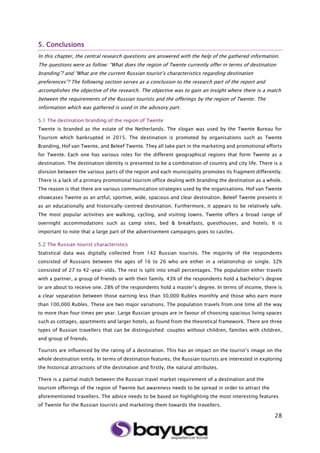
  • 29.
    29 6. Discussion The followingchapter elaborates on the validity and reliability of the research paper in order to provide a truthful measurement on the quality of it. Validity and reliability are two important aspects in all studies in order to portray the accuracy, dependability, and credibility of the information. The goal of this chapter is to assess the quality of both those aspects in relation to the measurement procedure used to generate the results. In order for the study to be considered valid, it also needs to be reliable. 6.1 Reliability The research was transparent and included all the elements necessary for a research paper. It took into account all important steps from the methodology section in order to analyse the data. The reliability of the research paper was on a high level. However, numerous sampling frame errors occurred such as when there was a lack of equal division between genders or the fact that there were more young people than old. The female population was more than the male; therefore, it has a direct consequence on the reliability of the study (Brotherton, 2008). The reason for this occurrence was an error made by the researcher, who contacted more females, as he saw that they were willing to fill out the questionnaire more than the male population. Secondly, due to time constraints, it was not possible to wait for an answer or approval of all. However, volume was more important than control of the ones who fill out the questionnaire. In order to reach the desired sample size, the quality of finding the candidates to fill out the questionnaires drastically decreased. Thirdly, there was an evident bias on who was approached due to the non-probability based strategy which was to use the convenience based sampling. This severely hindered the reliability of the study as there was not an available administrative record of all users in vkontakt.com of Russian background. The measurement instrument, being a questionnaire, was clear of random errors as a consequence of being checked and approved by two research experts. Not all questions were filled out by the respondents, regardless of the safety measurement system implemented by Qualtrics to not allow users to continue to the next question without filling out all aspects. Verhoeven (2014) states that there are times when random errors can occur in a research project. Such case was when respondents had filled out a city name rather than their year of birth due to getting lost in the translation from English to Russian. Due to the fact that this is a web-based questionnaire designed with Qualtrics, it was possible to retest the reliability of it each time the survey was filled out by a person. A window would open in Qualtrics that provided information on the location of the questionnaire being filled out. If the questionnaire was conducted by a different person with the exact same formulation of neutral questions, the same conclusions would have occurred. According to Brotherton (2008), this measurement instrument is reliable. Moreover, peer examination had taken place and the questionnaire was tested numerous times by the client before being distributed. However, it came as a challenge when the questionnaire was translated to a different language because there was a possibility that some questions were interpreted differently.
  • 30.
    30 6.2 Validity Brotherton (2008)states that evidence-based information is crucial to rightfully represent whether a research data analysis is valid or not. According to Verhoeven (2015), research should be clear of systematic errors. Moreover, Brotherton (2008) further elaborates that a research design needs to be adequate and appropriate. In order to validate whether this was the case in this research project, convergent validity took place. What this meant was that different theories were compared when developing the theoretical framework, which in turn formed the operationalisation. The operationalisation for destination branding was used as a measurement instrument for the questions sent to Hof van Twente and the design of the survey. Furthermore, the results which were gathered from the questionnaire were very similar to those results gathered by Lehtinen (2014), who used a qualitative research design presented in the literature review. This would mean that triangulation actually had taken place by generating findings on two data collection methods providing similar results which boosts the construct validity. Furthermore, in order to establish construct validity, a statistical factor analysis test was utilised to be able to “claim” discriminant validity. The independent variables of the core concept “tourism characteristics” were reproduced to check a correlation pattern. As it turned out, there are 49 (62%) non-redundant residuals with absolute values greater than 0.05. Moreover, the use of current literature further supported the construct and internal validity. In order to improve it even more, the email interview conducted with the marketing director of Hof van Twente was analysed. Verhoeven (2014) states that the sample must resemble the population in terms of characteristics that are relevant to the research. Furthermore, external validity is related to the truthfulness. It can be argued that the external validity of the research is limited. Furthermore, the quality of the sampling method is limited. A sample size of 142 people, out of the total Russian population 143,441,282 was too low to be able to generalise the whole population. The respondents were not representative enough. It was very difficult in generalising the total population due to the lack of older respondents that filled out the questionnaire including a lack of respondents below the ages of 16. However, the results can be generalised, to the very least, for the young adults between the ages of 21 to 29 having been the majority that had filled out the questionnaire. This means that some of the results gathered were actually valuable and extremely useful for Bayuca travel because they provided a general ground base for future studies. In order to improve the internal validity, research design and statistical analysis were primary utilised to achieve this. Brotherton (2008) states that internal validity showcases the truthfulness of the research results from the carried out field research. The conclusions which were found from the quantitative analysis could be traced back to the theoretical framework leading to a contribution in boosting the internal validity. Therefore, this increased the confidence and dependability of the results (Brotherton, 2008).
  • 31.
    31 7. Advice The followingadvisory section has been written for Bayuca Travel. In the previous chapters, insight was gathered regarding the destination identity, the branding of the region of Twente, and the Russian traveller characteristics. The conclusion was that there is a partial match between the Russian requirements and Twente’s offerings. The following chapter aims at providing various recommendation options based on the research results. Each alternative goes through a certain criteria-based selection and the most feasible, financial, and realistic solution is going to be later implemented via a PDCA planning cycle with the help of a strategic marketing plan. Over the past months, the research part of the report was conducted. The question that the management team of Bayuca Travel is facing is: How can Bayuca Travel attract the Russian tourists to the region of Twente? The management question is answered with the help of the theoretical framework, the desk research on the destination identity of Twente, and the market data acquired from the Russian tourists regarding their needs and wants. With all the information at hand, it is now possible to formulate a suitable advice that could be implemented by Bayuca Travel as a marketing strategy. 7.1 Advice objective and questions The advice objective is to assist Bayuca Travel with recommendations on the various options available to luring the Russian travel market to Twente. The most plausible option will be elaborated with the help of a strategic marketing plan. In order to achieve the managerial ambitions, the tour operator needs to offer a travel package which is feasible, provides return on investment, is able to spark interest, and captures the attention of the consumer. 7.1.1 Advice questions Advice question 1: What are the possible options that would lure the Russian travel market to the region of Twente? Advice question 2: Which one of the options is most suitable for Bayuca Travel in order to attract the Russian travel market to the region of Twente? 7.2 Management case approach Three alternatives will be described and later on compared via a criteria-based selection method. The evaluation criteria will comprise of three elements: time needed, financial investment needed, and whether it is realistic or not. This criteria based selection is also used as a benchmarking tool with the intention of determining the most convenient and plausible alternative for Bayuca Travel which delivers the highest added value. There are three dominant travel groups found in section 2.2.4 and in the survey design: travellers with their friends, couples without children, and families with children. There are certain destination features in Twente which are interesting to some of the travel groups as seen in Figure K.21 in Appendix K. Each one of those travel groups has different preferences regarding the region of Twente. Consequently, a different packaged trip catering their different interests could be designed. The goals are long-term, and it is important for them to be realistic, attainable, and to meet the self-actualization requirements
  • 32.
    32 of the tourists.They also have to provide an accurate reflection on the wants and desires of the Russian travel market. Gap between the SOLL and IST situation The current situation is the existence of a significant match between the Russian travel market and the offerings of Twente. However, there is hardly any intention from the region of Twente to attract this market. This is either because the destination is unaware of the possibility of such a potential market or simply because they are not interested in attracting it. At its current state, Bayuca Travel is focusing on the Dutch travel market to travel to Russia. The tour operator is run by two people who respectfully design themed tours for their clients such as “Feel the past”, which can be found on their official website as well as on their Facebook profile. However, the desired situation comes from the fact that Bayuca Travel is ready to invest up to €25,000 for a marketing plan, specifically based on the thesis outcome, which they had been able to save from selling their trips without taking a loan. It was not possible to acquire information regarding the annual trips sold by Bayuca Travel; however, the tour operator is ambitious and ready to be the first tour operator to attract the aforementioned BRIC country to the region of Twente. The reason is the fact that the thesis client is able communicate in the traveller’s native language and possesses valuable insight on the market through the researcher’s survey results. 7.3 Description of alternatives Figure 7.1: Alternative options 7.3.1 Alternative 1: Historical avenue of Twente A connection was made between couples without children and the desire to visit historical attractions as seen in section 4.1.3 and Figure 4.6. Therefore, “The historical avenue of Twente” package is proposed to be developed. This is a dynamic travel package which is targeted towards wealthy young Russian couples who travel with their partner. The idea behind this concept is to showcase the historical sightings of Twente to the young culturally interested Russians. This target group is called “culture seekers” formed of people who would like to get immersed in a completely different travel experience. As seen from the data analysis, the respondents had given the highest scores in the historical attractions category. Consequently, the idea is to create a travel package which incorporates the historical features for this target group. Special events should be considered within a cultural or historical spectre since most of the Russian respondents seek self-actualization. A limited availability historical tour of Twente featuring a tour guide will be included in the program. NBTC (2015) states that Russian travellers speak English Option 1: •Historical avenue of Twente - tour dynamic package (4 days) •Target group: Couples without children Option 2: •Experience Twente (4 days) - normal package •Target group: Group of friends Option 3: •Getaway from the crowd (2 days) - tourism campaign •Target group: Parents with children
  • 33.
    33 fluently; therefore, itwould not be a problem for them to have an English-speaking tour guide. This was also acknowledged by the sample approached in the survey. As requested from the client, the offer will be a “land package”. This means that the travellers will choose the airline company they would like to travel with by themselves. The client has no responsibility on the decision making of the traveller regarding this aspect. However, Bayuca Travel becomes responsible for all land tourism related activities that incorporate the traveller’s experience. The promotional message for this is: A visit to the past is close! There will be three categories which form a travel package: accommodation, activities, and features. The traveller gets to choose between predetermined traveling components which in its very core is called dynamic packaging. Luxurious cottages will be available to accommodate up to two people. The anticipated target group will be joined by their partner. Furthermore, they are interested in staying in an open space location. The core product of this travel package is to visit the historic castles. Huis te Diepenheim, Nijenhuis, Westerflier, and Warmelo make a very important part in highlighting the main features of Twente, since they are renovated castles that portray the historical element of the region of Hof van Twente (Appendix N). Furthermore, castle Twickel will also be included due to its unique culture-historical background and the spacious botanic gardens surrounding the place. At these botanic gardens, it might be possible to create a picnic activity where couples could gather and spend time together. Although the results showcase no interest in cycling in terms of this target group, there will be a cycling tour throughout the visit of the various castles. It should be important to note that this is an optional activity when selected by the client. All these leisure activities could be done during the summer when the Russian population is having their vacation through July – August. At this time, the weather in the Netherlands is also suitable for tanning activities as seen in the results section. 7.3.2 Experience Twente The core concept behind this travel package is centred on the segmented travel profile “group of friends”. Twente is branded as a destination which is open, spacious, and with beautiful landscapes. Therefore, it is an invitation for friends to spend a relaxing time together in the luxurious cottages of the Hessenheem outdoor centre. With reference to the results, groups of friends are interested in activity-based tourism. This travel group would like to go picnicking, trekking, cycling, and going around the old towns of the region of Twente as seen in Figure 4.13 in the analysis chapter. The central focus for this travel trip is to create an unforgettable experience for the tourists. The research results show that cottages and other spacious accommodations are suitable for this travel group. Therefore, there will be a limited amount of accommodation options that the travellers are able to choose from. However, these options need to be with a high-star rating. The rating of a place is very important in the Russian tourist’s mind as seen in section 2.2.4. Shopping possibilities are integrated to provide a pleasant weekend experience. Since they are very much interested in the safety of a destination, a non-urban place is suitable for them to enjoy their vacation. This package does not include plane tickets.
  • 34.
    34 7.3.3 Getaway fromthe crowd The third strategic marketing concept is named “Getaway from the crowd” based on the fact that some of the research results showed that popular destinations are mostly chosen for tourism purposes. This concept is more competitive than the previous two because a large chunk of the Russian travel market is attracted to Amsterdam without being aware that other cities bear similar core features. Competition plays an important role here. That is why a marketing campaign is set out to attract tourists staying in Amsterdam to visit for one or two days the region of Twente. Those tourists travel with their families and children. Just like the previous alternatives, this is a package tour including the most well-known historical sights of the region of Twente. Travel trips to the old towns are also included. The family option will also include a discount for kids. Here, family-friendly accommodations along with family activities will be proposed. 7.4 Identification of the criteria It is important to identify the criteria based-selection procedure which evaluates the alternatives. The researcher will not favour one alternative over another in order to deliver judgement on the matter. This advice will opt for a quantitative evaluation in which weighted averages will be applied. 7.4.1 Prerequisite criteria A prerequisite for an alternative to be accepted for evaluation is to meet the following requirements:  Is the alternative in-line with the mission of Bayuca Travel?  Is the alternative in-line with the data analysis about the needs and wants of the Russian market?  Does the alternative showcase the destination identity of the region of Twente? Explanations about the three prerequisites can be found in Appendix L, as well as a description as to why the alternatives were selected in Appendix M. 7.4.2 Evaluation criteria After obtaining the necessary information to accept an alternative for evaluation, the criterion for picking the most suitable option is based on the following factors:  Time needed  Financial investment needed  Realistic Table 7.1: Evaluation criteria Please refer to Table 7.2 for the explanation of the evaluation criteria Time Needed Financial investment needed Realistic 1= Long-term 1= High 1= Unrealistic 2= Mid-term 2= Medium 2= Somewhat realistic 3= Short-term 3= Low 3= Realistic
  • 35.
    35 Table 7.2: Evaluationcriteria explanation Advice Time needed Financial investment Realistic Historical avenue of Twente It will take a significant amount of time from the owners of Bayuca Travel to contact the necessary suppliers in order to start packaging the offer. Furthermore, the spread of word-of- mouth between friends takes time in order for them to consider booking such a package. However, the time will be drastically reduced when the clients are packaging their own trips. Therefore, it will be easier for Bayuca Travel to organise such package tours (2). The cost for organising such a trip could be expensive in relation to the marketing aspect, the amount of calls to the different service providers, and the necessary trips to major tour operator conferences in Russia. This would be cost-ineffective at first. The company might experience a loss in the first year. However, Bayuca Travel will start seeing return on investment after all the efforts made and the establishment between all the parties involved (2). This option is realistic because it showcases a great introduction experience for the Russian tourists about Twente’s background and the historical related activities. The alternative will be feasible if the right tourism suppliers are contacted (3). Experience Twente This package is similar to the previous concept but with a broader target group and an ordinary package deal. This is a suitable approach if Bayuca Travel believes to have time to negotiate with more groups of suppliers. This alternative does not allow tourists to choose their preferences since the research part has already shown what they would like to do. Bayuca Travel has to make the effort to manually package the trip ingredients rather than the tourist (2). In terms of feasibility, the group size is larger; Therefore, financing such a project will take more resources. Human labour is also necessary to achieve the goals (2). This alternative is somewhat realistic because there is a probable chance that a group of friends will not be as enthusiastic to stay at one place for a long time. They might prefer to travel somewhere else where the weather is sunnier (2). Getaway from the crowd This is a marketing campaign aimed at challenging perceptions and opinions. The idea behind this tour is to show that unpopular destinations such as Twente can provide interesting activities. It will take an enormous amount of time to achieve this (1). Setting out an initial investment budget is necessary here in order to conduct this. Furthermore, extra support is needed from Twente Branding and Hof van Twente. The support is needed because it incorporates a change of the brand suitable for attracting international travellers (1). It is very unlikely for Bayuca Travel to have any control on the situation, being the only one interested in attracting such a market. If there is cooperation and initiation of Twente Branding, then this would actually be a successful concept that could lead to a plausible effect (2).
  • 36.
    36 8. Strategic marketingplan Quantitative research was conducted on the Russian traveller’s wants and needs along with desk research on the destination identity, and branding of the region of Twente. Consequently, various alternatives were evaluated and measured. However, the most plausible one is the travel package “Historical Avenue of Twente” which will be written down in the form of a strategic marketing plan. 8.1 Previous knowledge on the Russian traveller There are three prominent travel groups which were discovered during the literature review and the data analysis: couples without children, families with children, and a group of friends. The travel group within this marketing plan are “wealthy couples without children between the ages of 16 to 26”. This target group is interested in visiting new destinations. They are interested in destinations which are safe and historical. In terms of accommodation, couples prefer to stay in cottages. This group seeks self-actualization fulfilment as seen in Figure K.23. Why is the following target group important?  Out of the results, 38% of the respondents have a partner with whom they love sharing the passion for traveling to a new destination (Figure 4.4).  The historical category of the region of Twente is one of the most interesting destination features for young couples since they had given the highest mean scores for the following destination features as seen in Figure 4.6: historical buildings (4.13), landmarks (4.25), and castles (4.38).  Couples choose their next destination based on the spiritual connection they have with it and on word-of-mouth from friends (Figure K.23).  Couples are interested in participating in historical or cultural events (Figure 4.5).  The results showcase that the majority of respondents who travel with their partner and without children prefer staying in cottages (Figure 4.2). This is because tourists are looking for spacious accommodations.  The results highlight that these young travellers save money for traveling abroad one time per year for their summer vacation (Figure 4.1). They are the most common travel group engaging in outbound travel. People who travel alone or travel with a partner and kids prefer staying inbound for their holidays as seen in the data analysis.  Young Russian travellers are fluent in English (NBTC, 2015).  Couples without children are mostly interested in tanning. If the weather is suitable for such leisure activity during the summer holidays the destination, Bayuca Travel could attract them to visit the destination (Figure 4.13).  Couples are willing to stay more in a destination if the place offers couple benefits similar to discounts or unique experiences.
  • 37.
    37 8.2 Setting upobjectives Objectives are the backbone for the success of this project. Bayuca Travel wants to realise the following key objectives from the “Historical Avenue of Twente”. - By the end of the first year of the implementation, at least 45% of the people that have booked a trip should be couples without children. - By the end of the year 2017, Bayuca Travel needs to have sold 40 package deals with the theme “Historical Avenue of Twente” to its interested clients. - By the year 2018 Bayuca Travel seeks to witness profitability (return on investment) from the selling of travel packages labelled as “Historical Avenue of Twente”. 8.3 Scan the business environment 8.3.1 DESTEP analysis on Russian travel market Every organisation is influenced by the macro environment. This means that Bayuca Travel does not have control over the factors which can occur. Having said that, it is recommended for the tour operator to pinpoint those factors. Therefore, a DESTEP analysis is implemented regarding the current state of Russia, in order to use the information for strengthening the marketing concept. Demographic profile – The Russian population has seen a decline in population from 149 to 142 million. 73% of the population is living in urban areas such as Moscow. 27% is under the age of 25 and 28% of the population is older than 55 years (NTBC, 2015). Economic – A decline in the economic status of Russia was reported in 2015 falling to -3.50%. This caused a decrease in outbound trips in favour of inbound tourism. The reason for this was the tension between Russia and Ukraine. The Russian ruble lost value against the euro causing a number of local tour operators to shut down their businesses. However, in 2016, the figure has lowered to a negative 1.1% which comes as good news as the economy is slowly stabilising (NBTC, 2015). Social - Ullrich and Nufferova (2007) state that the Russian middle-class is becoming very individualistic. What this means is that there is an emergence of target groups requiring different needs and wants. People value novelty and well-known brands. This has a direct effect on the current strategies regarding product development initiatives in order to keep up with this new demand. Specifically in the tourism sector, there is a growing diversity pattern of needs because of the various lifestyles which are emerging. These styles need to be accurately met with an introduction to a travel product such as target group oriented tourism. Technological – The internet usage of the Russian population is constantly growing. There is an estimation of 93 million Russians with access to the World Wide Web, which make up around 65% of the population. The majority of users are younger Russians living in the bigger cities (NTBC, 2015). Online booking is expected to increase significantly in the upcoming years as Russians are still relying on tour operators to offer them travel packages. Ecological – Ecological factors are not crucial to be looked upon for this case. Political – When the conflict between Russia and Ukraine started in 2014, the EU and USA prohibited some categories of professionals to travel abroad. Many people were not allowed to travel. Therefore, the government offered an alternative focusing on investing in domestic tourism.
  • 38.
    38 8.3.2 SWOT analysisof Bayuca Travel 8.4 Marketing tactic Table 8.1: SWOT analysis of Bayuca Travel A proper marketing tactic is crucial for delivering successful results when selling the travel packages. The 4 P’s of the marketing mix will be involved in this process in order to bring the advice to a strategic level. This will assist Bayuca Travel with expanding their business operations, which in turn leads to growth in revenue. Product – The product which is recommended for Bayuca Travel to introduce to the market segment “Russian couples without children” is a theme tourism package labelled as the “Historical Avenue of Twente”. As the name reveals, the concept of the package tour is a tailor-made travel experience containing the historical aspects of the region of Twente. Customers will have the option to design their own travel package within a variety of available options. Such options are accommodations, historical activities, and other tourist activities. The above-mentioned services offered by Bayuca Travel are taken from the data analysis results. This is in relation to the most appealing destination features for couples. This form of packaging system is often referred to as dynamic packaging. The package tour will be introduced to the market throughout 2017 after being successfully well-promoted and positioned. The marketing campaign will start in March 2017 utilising all the distribution channels to brand the product. Place - Bayuca Travel will utilise multiple distribution channels catering the needs and wants of their clients. First of all, the distribution will be direct. The reason for this strategic decision is the fact that Russian travellers need to consult with the travel agents regarding their trips. The nature of the buying behaviour is straightforward; therefore, a web design for the tourism package “Historical Avenue of Twente” is highly recommended to sell the services directly to the consumer. When Bayuca Travel directly reaches the target group, the market will value the recommendations of this tour operator. The target of booking via the website is set out to be 20%, for the upcoming summer 2017. The second appropriate distribution channel is via a wholesaler such as Booking.com. Approaching such a partner is highly necessary because the above-mentioned platform has already established contact with the desired travel market. The Russian market browses the Internet for their next holiday. This is an opportunity to include the package deal “Historical Avenue of Twente” to Booking.com’s system. Couples could gain an interest in this offering by reading the offer. The best-case scenario is that the target group actually books and select their own dynamic packaging through the internet web page of Bayuca Travel. Nevertheless, having more than one distribution channel is crucial in acquiring market share; therefore, more packages could be sold to accomplish the objectives of Bayuca Travel. Strengths Weaknesses Expertise on the Russian travel market Targets currently the Dutch travel market Able to offer packages in the customer’s language Not well-known brand positioning on the Russian market Combination of leisure and knowledge Limited publicity Opportunities Threats Growing internet use of the Russian population A decrease in the economic status of Russia Online booking is expected to increase Domestic tourism in favour of outbound travel Russian market relies on tour operators Political tensions between Russia and the Netherlands
  • 39.
    39 Price - BayucaTravel will not compete on pricing with other travel agents within the region of Twente as it is the first tour operator interested in bringing the Russian travel market to the aforementioned destination. However, the Russian market is very price sensitive as seen in section 2.2.5, searching for good deals regardless of the fact that the target group is made out of wealthy couples. Therefore, it is recommended to offer limited special offers for this target group at the beginning of April 2017. Up to 30% discount rate of the whole price is advised to be implemented in order to ensure attracting the right market at the beginning of April 2017. Moreover, the pricing needs to correspond to the high quality service standard provided by Bayuca Travel and is dependent on the choices that travellers have selected their package tour. Promotion - Sending out the right message is crucial in reaching the market the proper way. Therefore, it is advised that Bayuca Travel invests in a website to promote the theme package “Historical Avenue of Twente”. It is not difficult to set up a website because there are platforms that do this allowing the tour operator to design the interface based on their preferences. Moreover, the membership fee is not very expensive. Moreover, Bayuca Travel already has a running website regarding the travel tour “Feel the past” which aims at targeting the Dutch market to travel to Russia. It is possible to stick to the above-mentioned formula and create a website which serves the Russian market (the information would be in Russian). There will be a difference between the two websites especially when the respondent clicks on the “Historical Avenue of Twente”. They will see the core product and the pricing of it but will have the option of clicking on different images of bonus offerings in order to build up their travel package, according to their wishes. Please refer to Appendix Q for a showcase of the website. This builds a new customer type of experience. Furthermore, collection of emails is crucial in order to build a solid customer relationship; therefore, at the bottom of the web-page users will have an option of signing-up for newsletters/Bayuca Travel’s marketing communication instrument. This would help to distribute suitable offers for them for later products. The second communication channel is via the social media websites: Vkontakte and Facebook. Both, Facebook and Vkontakte, have an advertising feature which enables the company to either target their ads towards specific characteristics of the users or advertise in tourism community pages. Subscribers could see the offer as a normal post. The bigger the targeted audience, the higher the click price will get. The desired clicks/views will be achieved faster. The reason for this decision is that the Russian customers use Vkontake daily for networking purposes and for looking at tourism offers. They do this when they plan their next trip as seen in section 2.2.4. Running an own page is helpful to make the people interested visiting the web page in order to learn more about the product. Furthermore, those social media platforms provide the possibility of advertising the offers to specific customers set out in a geographical area based on certain characteristics, which Bayuca Travel could greatly benefit from when targeting couples. Another recommended distribution channel, although time-consuming is video-creation. Video publishing is a remarkable tool in spreading awareness of Bayuca Travel’s offers throughout the digital world. The addition of interactive videos on the website is recommended for getting the customers excited about the package tour. It is possible to publish videos which can be tagged by exactly anticipating the key-words that the target group might use when searching for such information. The
  • 40.
    40 video will appearhigher in the search engine. Moreover, the person watching the video might consider checking the website of Bayuca Travel. There will be a reference link at the bottom of the video for direct access to the website. This sums up the overall goal for this promotional campaign. All promotional activities need to be linked in order to emphasize on trust as well as to improve the market positioning. Last but not least, the participation in the international tourism fares in Russia for networking. Otdykh Leisure is one of those fares that brings international travel companies, hotels, and resorts together; therefore, it provides the highest chance of market penetration. It is held annually from the 21st of September until the 24th of September. The fare is organised in Moscow. 8.5 Strategic planning In terms of planning, Bayuca Travel will opt for a market focus direction. The marketing decision is to target Russian couples without children. Bayuca Travel will position itself as a premier, high-end historical themed package tour provider tailoring the wealthy Russian traveller who travels abroad with a partner. The strategy aims at raising awareness amongst the crowd about the services offered, which in turn would beneficially establish a loyalty fan-base. This fan-base will spread the word-of-mouth to their friends. The following message will be sent to the target group: “A visit to the past is close”. When the message is integrated throughout all distribution channels, it reinforces both the brand name and the brand identity. The distribution and promotion needs to be in-line with the value proposition. The value proposition is the option of the tourists to select their preferred activities from a list available on Bayuca Travel’s website. This strategy makes the trips feel more exclusive and tailor-made. Tourists will be able to select luxurious cottages or hotels based on the wishes of the clients. The meal plan will include a buffet and gourmet cuisine for two. The idea is to showcase typical Dutch food from the region of Twente. The Russian travel market is interested in eating the local cuisine as pointed out in the field research. The activities will be based on the destination identity of the region of Twente. There will be historical activities incorporating walking tours. A tour guide will be hired to show around old towns such Delden, Diepenheim, and Hengevelde. When tourists select a town to visit he/she will get the opportunity to experience history. If a client wishes to visit Delden he/she will have the option of hearing about the history of the infamous local murderer Huttenkloas. Furthermore, the client will have the option of participating at the annual Hoftedagen which is a folklore event where Russian couples will be able to enjoy theatre performances and listen to music. Additional offerings will be romantic picnicking activities for two. Tourists will have the opportunity to get tanned during the nicer weather. A predetermined activity which is the highlight of the historical theme is the visit to the six Twente castles. Bayuca Travel will conceptualise on the fact that they are the first tour operator to promote an unpopular Dutch destination to the Russian travel; therefore, the tour operator needs to brand the destination as an exciting and buzzing place. This brings a competitive edge over other tour package providers solely focusing on the bigger cities such as Amsterdam, The Hague, and Rotterdam.
  • 41.
    41 8.6 Control ofthe marketing plan It is recommended for Bayuca Travel to look into the proposed financial plan for the year in order to evaluate the outcome of the marketing instruments. Furthermore, an included activity is to check the estimated forecasted sales with the actual ones. If a certain marketing activity does not contribute to attracting customers, it should be eliminated or improved in such a way that it will be improved for the upcoming year. The goal is to invest the money wisely on the advertising activity in order to bring the appropriate travel market. Another way of controlling the marketing plan’s success is to actually distribute surveys conducted with the current customers. The Balanced Scorecard is introduced to determine the effectiveness of the marketing activity as seen in Figure 8.2. Table 8.2: Balanced Score Card 8.7 Historical Avenue of Hof van Twente implementation plan The product alone is a travel package which contains the core product (visiting the six castles) while also including additional services desired by the young Russian adults such as visiting botanic gardens, and picnicking. However, the meaning behind it is to offer of a historically accurate experience of the region of Twente conceptualising on the destination’s core strengths and features. As seen in the theoretical framework, a service is an intangible product. This calls for an accurate portrayal of the region of Twente to the Russian travel market. In order to come in terms with a successful product delivery, the PDCA-cycle will be utilised to help break-down the steps that need to be undertaken for the next 3 years (Mutinga, 1998).There are four different phases that are used to carefully implement the marketing strategy: Plan, Do, Check, and Act. 8.7.1 Plan: Identifying and establishing the objectives An operational plan of such a marketing plan is fundamental for the product to be successful. A strategically well-written plan enables the founders of Bayuca Travel to keep track and to accomplish the given objectives and goals. Critical success factor Objective Key performance indicator Desired outcome in 2018 Financial perspective Break-even Successfully manage to break-even in the second year after the introduction of the product Positive selling numbers after a after a year Earning more than the initial investment Customer perspective Consistent package quality and theme Consistent momentum on high- quality travel packages to the clients Positive review remarks from the customers of Bayuca Travel More than 10 positive testimonials on Bayuca Travel’s website and the social media platforms Internal process perspective Customer management The clients booking through Bayuca Travel’s website 20% booking in 2017 100% booking via website Learning perspective Employee capabilities Successful raise of knowledge understanding of the Russian market Skills obtained New travel package introduced and market intelligence
  • 42.
    42 The following elementsare necessary to be utilised in the plan:  Value proposition – It is highly important to send out a clear message to the tourism content is about, what the offering behind it is, and what are the tourist’s expectations.  Objectives – Objectives possess a clear explanation; therefore, it is feasible to be known whether they could be met or not. Such an example could be “By x date, Company X will attract at least 20 people to book a dynamic package to the historical sights of Twente”.  Timeline – It is highly important to keep track of the important vacation days of the Russian tourists. As seen in the theoretical framework findings, the Russian tourists tend to travel for many days and are excessive spenders. The weather and conditions are better in the region of Twente during the summer; therefore, this advice is suitable for a July – August offering. The data results showcased that Russians are enthusiastic tanners and seek warmer destinations; therefore, it is an appropriate time to introduce such a package to them. This has to be marketed adequately because the competitiveness level is the highest at this time between various destinations (countries). In order for this travel package to work and stand out as something unique, it is necessary for Bayuca Travel to undertake a certain amount of steps in order to make the Russian travel market interested in purchasing this product. Collaboration with various stakeholders plays a vital role. There are certain stakeholders which take part in this as seen in Appendix P. Firstly, it is important to create a brainstorm session on how to negotiate with the lodging providers, the travel companies, and other tourism suppliers. This helps to formulate a strategy on attracting the tourists to the accommodations and the other service related suppliers. It is important to work with the cultural organisations that run the historical attractions because the market’s needs have to be met. With the implication of a dynamic packaging travel tour, Bayuca travel is responsible for making the calls to these suppliers, convincing them about the benefits of attracting such a foreign travel market. Furthermore, it is advisable to negotiate on the commission rate and the deals about dynamic packaging. The various stakeholders require a different kind of treatment; therefore, the stakeholder quadrant is utilised in order to visualize what to do with each tourism supplier. It is estimated that at least 2 hours need to be devoted for establishing network connections with each supplier. In this process Christa Barkel and Anna Yuricheva will act as negotiators finding the best deals that work for both parties. The planning phase takes the most amount of time. However, the invested time is worthwhile when they start selling the packages. Bayuca Travel is playing the role of a wholesaler being in-charge of providing its customers with various package options. This is solely based on the idea that the customer has the freedom to select whatever suits him as an activity. An interaction website needs to be developed that does not reveal the pricing of the separate components. The final price is revealed when the components are bulked together. The combination of packages is not limitless; therefore, only a certain amount of options are available. This will be closely consulted with the suppliers. Please find an example of a promotional package in Appendix Q. Furthermore, planning needs to be established in order to reach the consumers online about their needs. It is recommended for Bayuca Travel to create an account on the most popular Russian social networks. The deals which are showcased will attract the younger population. The most popular distribution tool
  • 43.
    43 for promoting servicesfor Russians is social media as seen in section 2.2.4. It is possible for Bayuca Travel to provide help in Russian to the suppliers dealing with the accommodation since they do not have any information available in English. With this in mind, there are more possibilities to reach the travel market and to sell more packages. Engaging posts need to be considered in order to promote the destination attributes of Twente in an accurate manner. This contributes to a positive destination identity and image. This leads to an increase in the awareness level of the Russian market and in the interest in visiting such a destination. 8.7.2 Do: Developing and measure The second phase is to implement the plan. The following marketing activities need to be utilised:  The launch of the new website – The website needs to be created by the end of February.  The official Bayuca Channel Social media profile – The official social media profiles need to be developed in order to start writing engaging posts regarding the “Historical Avenue of Twente”. Special offers and deals for couples will be published on the website in April.  The fare visits and the brochure designs for the packages – A visit to the Otdykh Leisure fare is planned at the end of September. The In Tour travel fare will be visited in March 2017. The exhibitor will get a chance to appear on the Russian television to promote its products. However, costs are high for such fare. This is one of the most effective ways of positioning the tours. It is necessary to network with the customers at these conventions.  The setup of the official YouTube account – The account needs to be created by the end of February. Video promotional content will be published from March regarding theme tour.  The collaboration with Booking.com (optional) – Collaboration could be established with the travel platform in order to easier reach the customers only if desired by the client. However, commission will be charged on each sold package. This phase requires the highest attention and time due to the necessity of market exposure. People need to start buying the packages. It is crucial in this phase to measure the distribution channel’s effectiveness in reaching the desired segment. This helps to understand whether the direction which is undertaken is delivering the forecasted results. Furthermore, the Balanced Scorecard will be applied as a model in order to measure the effectiveness of the project. Measuring the success of the strategy is very crucial, provides a clear framework, and overall blueprint of the progress. The critical success factors, objectives, and key-performance indicators are elaborated in section 8.6. 8.7.3 Check: Evaluation and constant reviewing As mentioned in the “do” phase, a criterion needs to be met for understanding whether the proposed recommendation is beneficial or not. After every tour has been completed, a performance review will immediately take place. In this phase, a brainstorm session will occur between the founders of Bayuca Travel. The topic will be about certain issues or bottlenecks that have occurred throughout the traveller’s experience. Customer satisfaction needs to be regularly reviewed before providing another client with a package tour. This can be either checked in the testimonials section, the Facebook posts, or the rating which is calculated by Booking.com. After the customer experience has ended after the tour, it is important to know how the people feel about the destination image. Such a decisive factor will have an effect on the want to return again to the region of Twente or to stop using the services provided Bayuca Travel.
  • 44.
    44 The above-mentioned actionshelp to provide a higher service quality. Moreover, this helps to determine whether the process goes smoothly and problems which have occurred, are fixed. An annual monthly check-up on the Balanced Score Card is vital to keep track whether the goals are close to be achieved. 8.7.4 Act: Documentation of the results, information on the process changes The final phase of the cycle is to improve the bottlenecks that could emerge throughout the check-up phase. Corrective and preventive actions are taken into account in order to fully take control and prevent the bottleneck from appearing. Staying updated with the Russian youth travel trends is necessary so that new products could be created. 8.8 Budgeting (Financial implications) The following section will provide financial insight on the costs that will occur for Bayuca Travel in order to implement the historical themed package tour. The cost of the initial investment will be €5,618. The rest of the investment is based on the purchase from the supplier side which will not be included in the initial investment. The requirement for Bayuca Travel is profitability. A very important aspect that needs to be taken into account, as requested by the tour operator, is the working hour invested. 8.8.1 Tour package price The projected income will be estimated by selling 40 package tour trips in 2017. Therefore, one package trip for 2 PAX will be looked upon as an example of a dynamic package in order to later calculate the payback period. Figure 8.3 shows how much a trip would cost a customer with such options. Table 8.3: Price cost of a trip Accommodation Luxurious lodge Buitencentrum Hessenheem + incl service cost for 2PAX €338 Tourist tax €1.05 per day x 2 persons x 4 nights €8.40 Total: 15% commission of accommodation = €50.70 €346 Activities Orange Museum €4x2 persons €8 Twickel castle tour+ walkthrough garden €4 x 2 persons €8 Bicycle tour (Six castles cycling tour) €9.50 x 2 persons €19 Luxurious Picnic €10 x 2 persons €20 Goor’s historic museum €0 Swimming pool de Mors €3.60 x 2 persons €7.20 Total: 15% commission excl. picnic = 6.33 €62.20 Transportation Europcar Auto hire 10% commission rate of transport=44.9 €449 Bayuca Travel Service fee charge €90 Total price €947.20
  • 45.
    45 Bayuca Travel willearn from commissions of accommodation, transportation, and activities an amount of €197.09 for one package. The desired gross profit margin is 25%. It is important to keep in mind that this is just an example of a dynamic package that the customers design themselves. The addition of more package options leads to higher revenue margin, added value, and responsibility for Bayuca Travel. 8.8.2 Investment plan Each employee hourly cost for Bayuca Travel is €50. This covers salary and insurance. The tour operator consists of two people; therefore, the mean cost is 50+50/2=€50. Any additional marketing person in charge is €45 per hour. The tour guide cost is set out to €35. The online marketer is in charge of optimising the website, posting content on Vkontakte and Facebook for Bayuca Travel, and responding to questions regarding the package offerings. Table 8.4 provides an insight on the investment plan. Table 8.4 Investment plan Type of activity Amount Person in-charge Cost Moscow travel fare (2016) Reservation for 2 days Anna Yuricheva Needs to be determined Hotel stay 3 nights booking Anna Yuricheva €159 Flight ticket 20th of Sept – 23th of Sept Anna Yuricheva €415 Personnel costs 8 hour shift for 3 days Anna Yuricheva €1,200 Website Yearly registration fee Christa Barkel €200 Website package tour design 3 hour shift (one time) Website designer €135 Online presence 3 hour daily shift Online marketer expert €135 You Tube video 6 hour shift (One time) Video editor €270 Facebook advertising Pay per click – 2500 clicks Christa Barkel €220 Vkontakte targeted advertising Pay per click – 2500 views Christa Barkel €260 In tour market travel fare (2017) Registration fee Anna Yuricheva €400 Hotel booking 4 nights booking Anna Yuricheva €68 Flight icket 10th of Sept – 14th of Sept Anna Yuricheva €286 Personnel costs 8 hour shift for 4 days Anna Yuricheva €1,600 Supplier networking 2 hourly supplier contact Christa Barkel €100 Tour guide per package 2 hour shift per tour Tour guide €70 Package set-up 1 hour per package Anna Yuricheva/Christa Barkel €50 Auto hire Yearly cooperation fee Christa Barkel €50 Total: €5,618
  • 46.
    46 8.8.3 Profit andloss statement An estimation is set for the number of packages that will be sold. In 2017, there will be 40 tour packages sold to 2 PAX per group in order to reach payback in 2018. If Bayuca Travel sells 40 tour packages, they will have a return on the investment. Figure 8.5 will elaborate more on the profit and loss statement. Table 8.5: Profit and loss 9 Advisory conclusions This chapter includes the concerns of Bayuca Travel regarding the management question and the advice questions. The management question was as follows: “How can Bayuca Travel attract the Russian travel market to visit the region of Twente”? With the establishment that there is a likely match between the offerings of the region of Twente and the Russian tourist’s wants and needs, it was important to think of alternatives that would successfully attract subgroups. In order to consider any of the options, a prerequisite criterion was necessary in order to check whether the option was: in-line with the mission of Bayuca Travel, in-line with the results found from the survey design, and last but not least, does the option accurately portray the destination identity. Furthermore, it was important to compare the options based on certain criteria: Time needed, financial investment needed, and level of feasibility. This benchmark revealed that creating a dynamic package labelled “Historical Avenue of Twente” targeted for wealthy couples without children, is the most suitable solution in attracting the Russian market. In order to deliver the project to a strategic level, a marketing plan was utilized to showcase each one of the steps necessary for Bayuca Travel to deliver a successful campaign. The financial implications could be found within the marketing plan. Consequently after the marketing plan was outlined, the PDCA cycle was introduced in order to put the steps into action. +Revenue Accommodation €50.70x40 €2,028 Service fee charge: €90x40=€3,600 Picnic activity €13x40=€520 Other activities €6.33x40=€253.2 Auto hire: €44.9x40=€1,796 +Gross profit: €8,197.20 - Operational costs Fixed costs: Travel guide: €70x40=€2,800 Vacation house Hessenhem: 40 cottages booked in advanced: €70 Package setup: €50x40=€2,225 -Total: €2,870 -Variable costs: Picnic: €7x40 = €280 -Total: €2,505 Net profit: €2,822.20 Payback will be €5,644.4 at the end of 2018.
  • 47.
    47 Afterword This thesis isthe most challenging and demanding assignment I had ever written at the Saxion University of Applied Sciences. This is an improved version of the previous report. Before the kick-off introduction, I was not very sure what was expected of me. All I knew was the fact that I had to write an advisory report. I believed I had knowledge regarding what was necessary for every aspect because I had received high grades on my previous reports. However, this obnoxious thinking caused blindside. This caused the failure of the thesis. An overhaul of the project was necessary to deliver the report to a bachelor’s degree standard. I participated in all the lectures that prepared us for the various parts. During this time, I realised that this dissertation is a combination of previously learnt subjects at Saxion for the past two years. I started to visualise each one of the thesis chapters as study gates that I had to pass. This was the only way of making me inspired in writing this paper. I felt very shocked and worried when I received the bad news about not passing the first report. Previously, I had high expectations that I was delivering a worthy thesis with added value for the client and the Hospitality Business School. After I received the news, I could not accept the fact that it was a weak report regardless of the fact that I had yet to hear the feedback. I could have reacted differently at that time if I was not stressing about graduating on time. The sudden strive for starting the master’s degree had taken its toll and all I thought about was the solution to the cause of the problem. The feedback meeting which I had with the first examiner opened my eyes. At last it was possible for me to hear out from another person what they think about the report and where my flaws were in order to deliver the next paper to a higher standard. Studying at Saxion is about teamwork and the group projects always gave chances to team members to provide feedback to each other. However, this was not the case here because of the individualistic nature. I was alone in my own thoughts, reading my paper from 9 to 5 while thinking that I had done a great job. Back then I could not see my flaws. In the meetings with the first examiner, I was constantly boasting about the progress of the report, whilst not actually sending any coursework for feedback. It turned out that I was able to express my thoughts better in front of a person rather than on paper which gets them convinced that I am doing a good job. Consequently, the report was vastly different than what was expected. This left both examiners and the client unpleasantly surprised of the outcome. If I was earlier precautious about my way of thinking, I could have delivered a better thesis. There was a valuable lesson I learned when writing this report. This was never to wait for a person to respond to a message. It is wiser to directly call the person. Nonetheless, a whole research design idea got scrapped because I was rejected when calling Twente Branding and Beleef Twente. Therefore, the questionnaire could not be started. This drastically slowed down the process leaving me idle for about a month after the thesis defence proposal. Looking at the situation now, it would have been wiser to stop wasting time for a response and find another company. Nonetheless, I decided to take matters into my own hands. My initiation to contact Hof van Twente helped met to hand-in the thesis on time, regardless of the fact that it was mediocre. As far as the communication with the people involved, everything was running smoothly .The client was very friendly and supportive throughout the whole process. Whenever I had a question or wanted to learn something more about Bayuca Travel, both Mrs. Yuricheva and Mrs.Barkel were more than helpful to provide me with information. The communication was formal, I was constantly trying to provide both of
  • 48.
    48 them with anupdate on how the report was going. I am not really sure if this engagement of mine bothered them at some point but I was really eager to deliver a proper insight for them, instead of not involving them at all. The same goes towards my first examiner who was more than helpful and supportive throughout the whole thesis. His guidance and feedback helped me to improve so much and he always steered me to the right direction. Almost every week we held appointments together to discuss the progress on the various chapters. His arguments were constructive and straight to the point. It should be important to note that when he told me about the failure of the thesis, he immediately wanted to set up a meeting together about the feedback. I highly appreciate the fact that he was willing to leave a gap in the weekend to discuss about the report. He knew that at this point, I was struggling with what needed to be changed but as soon as he provided me with an extensive one hour feedback, the weak points of the report, started to appear in my head. He devoted time and effort and served as a mentor throughout this process. In the initial thesis proposal I wrote that my wish was to have an examiner who is supportive and motivating. Mr. Theunissen fulfilled this criteria perfectly. Although I did not have that much contact with my second examiner, Ms.Pushkarskaya as well provided me with highly valuable feedback and support after the thesis defence proposal examination. I learned important aspects about the Russian characteristics from her which I included in the questionnaire. Even though, at times there were bottlenecks and it seemed as there was no way to continue writing, I still tried to push forward to deliver a quality advice for Bayuca Travel. Challenges tend to appear every day and without having the will to face those obstacles, it would not be possible to close this study chapter. I had learnt about my previous mistakes and set out a learning point for next time which is not to be as obnoxious and overconfident of my performance and always seek feedback. It is very important to evaluate the relevance for the tourism industry with this project. There is indeed a connection because there are not that many available research projects or insights available regarding the travel motivations and characteristics of the Russian travellers. From what has been found in the theoretical framework, it is concerning more about the general traveller profile. Up until now, only Lehtinen (2014), provided a qualitative insight on the Russian tourist’s preference. Furthermore, there was not an available project that deals with figuring out whether there is a match between the Russian travel market and the offerings of a destination, such as the region of Twente. Information is power and the destination of Twente could benefit economically when the tour operator brings international tourists. Another relationship with the tourism industry, is that the company is working in the tourism sector. The advice which is provided for Bayuca Travel, helps to strengthen the tourism sector, as well as to increase outbound tourism from Russia to the Netherlands. This project contributes to building up a general profile of the Russian traveller by means of statistical facts and figures. The insight gathered is not particularly theory breaking or phenomenal but indirectly delivers knowledge to the tourism industry. The results highlight the Russian traveller preference to travel to destinations not because they want to escape reality or to achieve status and prestige but rather for eating the local cuisine or visiting a destination they not seen before. Furthermore, the core concepts are relevant for every organisation wishing to attract a new market. The marketing plan is a universal approach, and each one of the steps could be undertaken by every company. The survey could be used for every project dealing with obtaining information about a new market, therefore DMO’s could greatly benefit from it.
  • 49.
    49 References Aaker, D. (1996).Building strong brands. New York: The Free Press. Aaker, D. & Joachimsthaler, L. (1997). Dimensions of brand personality. Journal of Marketing Research, 34, 347-356. Andre, M. (2011). Tourism and identity. Brussels. Retrieved from http://www.ideasforeurope.eu/wp- content/uploads/2013/02/2011_06_CMC-paper_tourism-and-identity_all_spread.pdf Anhold, S. (2009). Handbook on tourism destination branding. UNWTO. Retrieved from http://www.imagian.fi/kuvat/etc_unwto_handbook_tourism_destination_branding.pdf Baloglu, S. & McCleary, K.W. (1999). U.S. International pleasure traveller’s image of four Mediterranean destinations: A comparison of visitors and non-visitors. Journal of Travel Research, 38 (2), 144 – 152. Beerli, A. & Martín, J.D. (2004). Tourists’ characteristics and the perceived image of tourist destinations: A quantitative analysis – A case study of Lanzarote, Spain. Tourism Management, 25, 623-636. Blain, C., Levy, E. S. & Brent, R. (2005). Destination branding: Insights and practices from Destination Management Organizations. Retrieved from http://www.pikslar.com/temp/Bisi/dmc/328.pdf Boo, S., Busser, J. & Baloglu, S. (2009). A model of customer-based brand equity and its application to multiple destinations. Tourism management, 30, 219 – 231. Brotherton, B. (2010). Researching hospitality and tourism: A student guide. London, England: Sage. Crompton, J. (1992). Structure of vacation destination choice sets. Annals of Tourism Research, 19: 420-434. Ertörün, E. & Suma, S. (2011). Strategic brand analysis in destination identity context - A Case Study of Albania. Retrieved from http://www.diva-portal.org/smash/get/diva2:428481/fulltext02 Eun, J.L. (D.A.). Theoretical foundation of brand personality for postmodern branding dynamics: A critical review and research agenda. Kent, Ohio. Eventica (2009). The Russian outbound travel market. Retrieved from http://www.eventica.co.uk/files/the_russian_outbound_travel_market.pdf Fakaye, P.C. & Crompton, J.L. (1991) Image differences between prospective, first-time and repeat visitors to the lower Rio Grande valley. Journal of Travel Research, 30 (2), 10-16. Gilmore, F. (2002). A country - can it repositioned? Spain- the success story of country branding. Brand Management, 9 (April), 281-293. Holloway, C. (2004). Marketing for tourism. Pearson Education. Kotler, P. (2002). Marketing in the twenty first century. Pearson Custom Publishing. Kozak, M. & Baloglu, S. (2011). Managing and marketing tourist destinations. Strategies to gain a competitive edge. Kerr, G. (2006). From destination brand to location brand. Journal of brand management, 13, 276 – 283. Konecnik, M. & Gartner, W. (2007). Customer-based brand equity for a destination: Annals of tourism research, 34 (2), 400 – 421.
  • 50.
    50 Mackay, A. (2004).A Practitioner’s Guide to the Balanced Scorecard. Shareholder and Stakeholder Approaches to Strategic Performance Measurement Using the Balanced Scorecard. Morgan, N., Pritchard, A. & Piggott, R. (2002). New Zealand, 100% pure. The creation of a powerful niche destination brand. New Zealand, 9 (April), 335-354. Morgan, N., Pritchard, A. & Pride, R. (2004). Destination branding: Creating the unique destination proposition. Oxford: Elsevier. Nandan, S. (2004). An exploration of the brand identity-brand image linkage: A communications perspective. Brand Management, 12 (4), 264 -278. NBTC (2015). Market scan Russia 2015. The Hague. Lehtinen, E. (2014). Russian consumer behaviour and factors influencing the purchase decision. Lappeenranta. Lopes, S. (2011). Destination image: Origins, developments and implications. Retrieved from http://www.pasosonline.org/Publicados/9211/PS0211_07.pdf Pike, S. (2008). Destination branding: Analysing brand equity for Queensland’s coral coast. Retrieved from http://eprints.qut.edu.au/20917/1/c20917.pdf Pyo, S., Mihalik, B.J. & Uysal, M. (1989). Attraction attributes and motivations: A canonical correlation analysis. Annals of Tourism Research. Qu, H., & Hyunjung, L. (2011). A model of destination branding: Integrating the concepts of the branding and destination Image: Tourism Management, 32, 465-476. Sangeet P. C. (2013). Platform thinking: A comprehensive guide to platform business models. Schaar, R. (2013). Destination branding: A snapshot. Retrieved from https://www.uwlax.edu/urc/JUR- online/PDF/2013/Schaar.Rebecca.Marketing.pdf Stylos, N., Vassiliadis C.A., Bellou, V. & Andronikidis, A. (2016). Destination images, holistic images and personal normative beliefs: Predictors of intention to revisit a destination. Tourism Management, 40 – 60. Twente. (2011). In Wikipedia. Retrieved from https://en.wikipedia.org/wiki/Twente Ullrich, K., Nufferova, T. (2007). Rising values and lifestyle patterns in Russia. New Horizons for Marketing. Retrieved from http://www.g- im.com/fileadmin/templates/pdf/2007_Rising_Values_and_Lifestyle_Patterns_in_Russia.pdf Usakli, A. & Baloglu, S. (2011). Brand personality of tourist destinations: An application of self- congruity theory. Tourism Management, 32, 114-127. Van Vliet, V.(2010).DESTEP Analysis. Retrieved from http://www.toolshero.com/marketing/destep- analysis Verhoeven, N. (2015). The hows and whys of applied research: Doing reseach. Amsterdam. Verschuren, P. & Dooreward, H. (2010). Designing a research project (2nd edition). The Hague. Eleven International Publishing. Yin, R.K. (1994). Case study research: Design and methods. Thousand Oaks, CA: Sage.
  • 51.
    51 Appendices Number Description Pagenumber Appendix A Search methods 52 Appendix B Application of the AAOCC criteria 53 Appendix C Study on past research 55 Appendix D Operationalisation of destination branding 58 Appendix E Operationalisation of the tourist’s characteristics 59 Appendix F English translation of survey 60 Appendix G Russian questionnaire 68 Appendix H Inspirational destination branding questionnaire 76 Appendix I Factor analysis 77 Appendix J Approach to reaching the respondents 78 Appendix K Quantitative results in graphs 79 Appendix L Prerequisite criteria selection 86 Appendix M Prerequisite criteria selection elaboration 87 Appendix N Email correspondence with Hof van Twente 88 Appendix O Invitational process for the respondents 90 Appendix P Stakeholder quadrant 91 Appendix Q Design of the website package 92
  • 52.
    52 Appendix A: Searchmethods The following section described the most important methods of searching in an effective and efficient manner. All scientific material that were used for the study, complied with the AAOCC criteria for evaluating web page sources. An example of the AOCC criteria applied is found in Appendix B. Google, Science Direct and Springerlink were the search engines that were used in order to boost the validity of the literature review. Furthermore, knowledge books had been read from the Saxion University of Applied Sciences library to enhance the time needed to find the right information from the various literature sources. Another common search method applied by research professionals for systematic literature studies is the snowball method which was utilized in this study and was greatly beneficial in finding relevant information from one source, to another. The utilization of key search terms was as well apparent in this literature search cycle (University of Colorado, 2011). Key terms that were used are as follows: - destination image AND destination identity - destination image OR destination branding - tourist characteristics* - Russian travel market profile - destination image OR destination identity Most of these search terms were successful in leading to the desired information that was needed.
  • 53.
    53 Appendix B: Applicationof the AAOCC criteria Step 1: Check-up on the most important parts of the scientific article for evaluation
  • 54.
    54 Step 2: Checklistof AAOCC Accuracy and Authority of the website  Who is the author? – Carmen Blain, Stuart E. Levy and Brent Ritchie.  Who publishes the website? - Pikslar.com – An online community that brings together the same minded, creative people.  What is the URL and what does this tell you about the publisher of the site? - .com which means that this is a top level domain of commerce that publishes scientific materials or articles to inspire its audience.  What qualifications does the author have? - Carmen Blain, MBA, is a consultant with Praxis Group in Calgary, Canada. Stuart E. Levy is a doctoral candidate in marketing and tourism management at the Haskayne School of Business, University of Calgary. J.R. Brent Ritchie is a professor of tourism management at the Haskayne School of Business and is the chair of the World Tourism Education and Research Centre, University of Calgary.  Is the information verifiable? – Yes, it was originally published by Sage Publications.  Is the text free of errors, well written and cited properly? – Yes Objectivity of the web document  Is the page a mask for advertising; if so, how might the information be biased? - No  Why was the page written (motives)? – To examine DMOs, whose major purpose is to market their destination to potential visitors, both individuals and groups, to provide economic benefit to the community and its members. The concepts of destination branding are explored.  Who is the intended audience? – Destination Management Organizations and other hospitality-related entities.  Are opinions backed by accurate facts and information? – Yes Currency of the web document  When was it produced? - 2005  How many dead links are there? - None  Is the information outdated? – No, many researches still refer to this information. Coverage of the web document  Is there breadth and/or depth to the topics covered? – Yes, all parts of a study are included.  Is the information free or is there a fee to obtain information? – There is no fee to obtain this information.  Are you able to view the page or is software missing? Is that software free? - There is no software.
  • 55.
    55 Appendix C: Studyon past research Destination branding Gilmore (2002) points that the brand must “capture the spirit of its people”. The brand essence is the DNA of a destination. It includes 3 to 4 core values which form the so-called DNA. They are normally single words which are always mentioned in destination marketing communications. A brand includes both rational and emotional elements. The rational attributes define and explain the enduring characteristics of the destination. On the other hand, the emotional factors give the feeling of the brand. This is all based on the tourist’s perspective Gilmore further states that brands need to be “aspirational, inspirational, challenging, differentiated, and translatable to different audiences.” This is of upmost importance, due to the fact that there are a vast majority of stakeholders involved in a brand with their own objectives and visions. Research points out that while it is possible to alter the perception of a destination, it is impossible to change the core characteristics of it, such as climate and the geographical region. These intangible characteristics are deeply ingrained in the tourist’s preference of a destination. Usakli & Baloglu (2011) state that destination branding is a relevant concept due to the fact that travelers would opt for recommended brands that match their own self-actualization. The above mentioned occurrence is named the self-congruity theory. According to Morgan and Pritchard (2004), most scholars prefer the brand-building process for destination development. Hudson and Ritchie (2009) further made a proposition of a four step process of creating a “destination brand experience” (as cited in Kozak & Baloglu, 2011, p.158). The process consists of an assessment of the destination’s current situation, the development of a brand identity and brand promise, the communication of the brand promise and the measurement tools for determining the effectiveness of the brand-building implementation. Destination image Destination image is considered to be in close proximity to brand image. Brand image is how the clientele perceives the brand (Nandan, 2004). In economic terms, brand image is formed out of three types of interconnected associations that consumers hold perceptions on: product attributes, benefits, and attitudes (Keller, 1993). Low and Lamb (2000) refer to brand image as the symbolic and functional gains of a brand. Current research showcases that the image of a destination can vastly affect its success. If there is a comparison of destinations in a similar level of attractiveness, then the decision factor of the choice of a destination would go to the one which has the least negative perception. However, Selby and Morgan (1996) argue that the comprehensive destination image tools are an effective way of showcasing the strengths and weaknesses of a destination. Due to this reason, travellers want to have more than one experience, and therefore it can be stated that there is a close relationship between the tourism related facilities contributing to the formation of the overall image of the destination. According to Fakery and Crompton (1991), the image of a place can be affected by the familiarity of the tourists within the destination and the information provided by the media and travel journals. The research investigation points out that destinations are constantly compared, and in order to have a competitive position, it is necessary to have a positive and favourable image of the destination because it is one of the “pull” factors for tourists.
  • 56.
    56 Destination identity Aaker (1996)further states that brand personality is part of extended identity, not core identity. The most successful brands are in-line and linked to the core and extended identities. Joachimsthaler and Akker (1997) suggested that in order to adequately give a description of the ambitions of a brand, at least six to twelve dimensions of a destination need to be included. It is highly recommended by the authors that one of these dimensions, differentiates the tourism destination from another one. In some circumstances, it is possible for a destination to have several brand identities which helps a destination to be branded across many markets. Even though if there are multiple identities, research theorists are convinced that the core identity stays in-line, in favour of consistency. Russian tourist characteristics Morgan, Pritchard and Piggot (2002) discuss that consumers make use of brands in order to showcases lifestyle statements. This is in-line with the self-cognitive theory. The people opt to make a purchase based on their personal believes of who they are and what they would like to be. It is important to note that the tourism destinations are formed by tangible and intangible assets. (Qu, 2011). Tangible assets are the geographical features, attractions and historical places. The intangible assets consist of the culture and history (Kozak and Baloglu 2011). There are many motives for travellers expressing the need of visiting a destination. According to Pyo, Mihalik and Uysal (1989), the tourist motivation is multidimensional. The journey of the tourist involves eating, staying at a hotel, going shopping, communicating with the locals. In other words, it does not compromise of one single product but rather there is a vast amount of components each provided by different companies to make the experience of the tourist memorable. Tourists are interested in discovering new places rather than escaping reality during their vacations (Morgan, Pritchard & Piggot, 2002). This is a vastly changing pattern than how it was viewed two decades ago. Coltman (1989) presents the elements of a destination such as natural attributes or attractions that make a contribution on the tourist’s experiences. Morgan, Pritchard and Piggot (2002) as well point out that tourists are “aspirational” and that they are constantly seeking self-actualization” throughout the means of their travel choices. Consumers tend not to choose a place to stay, whenever they do not feel sure about it or the service provided. However, destinations that have been good for the tourists, are highly likely to be visited again by them later. Eventica (2009) states that the Russian travel market values novelty. If a destination is correctly marketed to the correct audience as the new holiday buzz destination, it will succeed in the Russian marketplace. The Russian travellers look on the internet, listen to word of mouth and consult travel agents when planning their trip. However, according to a survey carried out by Global Market Institute (2005), it has been found that the internet users opt for personal recommendations even though travel agents have bargaining power with their brochures. Over 300,000 Russian luxury travellers travel abroad yearly and spend with their friends on average €1,500 per day on accommodation.
  • 57.
    57 Marketing plan The CharteredInstitute of Marketing (2001) defines marketing as the management function which organizes and directs all those business activities involved in assessing customer needs and converting customer purchasing power into effective demand for a specific product or service, and in moving that product or service to the final consumer or user so as to achieve the profit target or other objective set by the company or other organization. Kotler (2002) defines marketing as a social and managerial process by which individuals and groups obtain what they need and want by creating and exchanging products and values with others. According to Holloway (2004), all tourism organisations, no matter the size, endeavour in marketing activities.
  • 58.
    58 Appendix D: Operationalisationof destination brandingDestinationbranding Destination core essence Destination characteristics Geography Climate Infrastructure Services Local attitude Safety Destination competitiveness Destination brand knowledge Destination image Affective image Cognitive image Destination brand identity Slogan Value proposition Core identity Extended identity
  • 59.
    59 Appendix E: Operationalisationof the Russian tourist’s characteristics Russiantouristcharacteristics Tourist background Beliefs Duo asset experience Family oriented Collectivism Friend references Word of mouth Hesitancy to not well market destinations Motives Multi-dimensional travel experience Communication with the locals Going shopping Escaping reality Eating Type of tourist Lower class Lower service quality expectations Budget offers Higher class Higher service quality expectations All-inclusive offers Higher pay for service Higher rating demand of the destination Group size Small group Aspirational travelers Shorter stay Closer hotels to the centre Couples Big group Spacious accomodation Longer vacations Families with children
  • 60.
    60 Appendix F: Englishtranslation of survey on the Russian tourist market First of all we would like to thank you for taking part in this survey! The reason why you are contacted is because we would like to hear from you regarding your destination preferences. We are a Dutch non- profit tourism organization which is interested in the Russian travellers who travel to international destinations. This questionnaire will contain a Dutch destination that you may or may not be familiar with. Based on your beliefs, motives and preferences, you will fill what feels right for you. Your input is highly appreciated and the information that you will provide, will help us to understand how you feel and what is the image about the destination that we are offering to you. Since time is a valuable commodity for every person, this survey is estimated to take no longer than 5 minutes. Your response is voluntary and would be kept confidential! Responses will not be identified as individual. They will only be analysed as a group in which you are taking part in. Thank you very much again for your collaboration! Before filling out the questionnaire, we encourage you to click on the image below in order to be enrolled to get the chance to win these two traditional Dutch gifts! Mark green if you are interested or double click for red if not uninterested. At the end of the questionnaire, you can provide your email address, so we can contact you personally if you are the winner and send you the gift! N.B. The criteria for winning is to fill out the whole survey! The following questions will provide us with some background information about yourself. Q.1Are you?  Male  Female Q.2 In which year are you born? (Open space) Q.3 What is your relationship status?  Single  Married  In a relationship Q.4 Do you have children?  Yes  No Q.5 If so, do they still live with you?  Yes  No
  • 61.
    61 Q.6 What isyour combined annual household income?  Less than 30,000  30,000 – 39,999  40,000 – 49,999  50,000 – 59,999  60,000 – 69,999  70,000 – 79,999  80,000 – 89,999  90,000 – 99,999  100,000 or more Q.7 What is the highest level of education you have obtained?  Doctorate degree  Master's degree  Bachelor degree  Secondary education  Primary education The following questions will provide us with information about your destination preferences. Q.8 How many times did you travel abroad last year?  1 time  2 times  3 times  4+ times  I don't travel abroad Q.9 Have you ever visited the Netherlands before?  Yes  No  Q.10 I travel to a foreign destination:  Alone  With my partner  With my partner and kids  With my friends Q.11 Please read each of the following statements. Click how important the following factors are to motivate you in visiting a destination for a short brake (2 to 3 days):
  • 62.
    62 Very unimportant Unimportant Neutral Important Very important Comfortable     Fun      Relaxing      Urban      Quiet      Safe      Unspoilt      Agricultural      Educational      Historical      Romantic      Q.12 If you were offered one of those Dutch tourism cities to visit, which one would you choose? Deventer, Amsterdam, the Hague, Hengelo, Enschede or Almelo. Please click on the one you are interested in. Q.13 What was the reason for picking a particular choice? One answer possible  The popularity of the destination  The city has a good reputation as a destination  The image that the destination showcases  The city satisfies my wants as a destination  There is something special about the city as a destination  I can trust the city as a holiday destination
  • 63.
    63 Q.14 Please readeach of the following statements. Click how interested you would be in visiting a destination which has the following features in order to consider a short break (i.e., 2– 3 days). Q.15 The previous question symbolizes what the Twente region offers as a destination. Do you consider if there is a match between your wants and the offerings there?  Strongly Disagree  Disagree  Undecided  Agree  Strongly agree Very uninterested (1) Uninterested (2) Neutral (3) Interested (4) Very interested (5) Windmills (1)      Old towns (2)      Museums (3)      Landmarks (4)      Monuments (5)      Historical buildings (6)      Shopping places (7)      Adventure family park (8)      Clubs (9)      Aquadrome parks (10)      Beer brewery (11)      Drawing centers (12)      Vacation houses (13)      Camping bungalows (14)      Picnic areas (15)      Art towns (16)      Castles (17)      Botanic gardens (18)      Forests (19)      Rural villages (20)     
  • 64.
    64 Q.16 If youwere offered one of those activities, which one would you choose? Click on the image that you like the most. Q.17 Why do you travel to a foreign destination? Please rate the following statements based on your motives.
  • 65.
    65 Strongly Disagree (1) Disagree (2)Neutral (3) Agree (4) Strongly agree (5) To visit a destination I have not seen before (1)      To eat the local cuisine (2)      To go shopping (3)      To meet new people (4)      To communicate with the locals (5)      To rest (6)      To be with the family (7)      To visit friends and relatives (8)      To impress my loved one (9)      For status and prestige (10)      To escape reality (11)      To visit cultural attractions (12)     
  • 66.
    66 Q. 18 Ifyou had to choose between one of those accommodations, which one would you click on? Q.19 For how many days would you stay?  For one day (1)  For two days (2)  For three days (3)  For more than four days (4) Q.20 The reason why I choose a particular destination is because: One answer is possible  A friend recommends it (1)  It has a good rating in the social media (2)  It is very popular at the moment (3)  It has a positive word of mouth by the travel agent (4)  It provides me with self-actualization fulfillment (5)  Other (Please specify) (6) ____________________
  • 67.
    67 The following questionswill provide us with information about your travel behavior Q. 21I prefer to choose a certain destination that: Strongly disagree (1) Disagree (2) Neither agree or disagree (3) Agree (4) Strongly agree (5) Reflects the way I see myself (1)      Reflects the way I think others see me (2)      Reflects the way I would like to be seen by others (3)      Reflects the ideal way I would like to see myself (4)      Q. 22 How can a destination persuade you to stay for more than one night? Strongly disagree (1) Disagree (2) Neither agree nor disagree (3) Agree (4) Strongly agree (5) Broaden range of activities (1)      Family friendly resorts (2)      Couple deals (3)      Be exciting (4)      Offer deals (5)      Thank you very much for taking the time to answer this survey! Your input was highly appreciated and now we are giving you the chance to win the price! Please leave your email address below:
  • 68.
    68 Appendix G: Russianquestionnaire translation Здравствуйте, Благодарим Вас, что решили пройти наш опрос. Данное исследование направлено на рассмотрение предпочтений туристов в выборе места туристического пребывания. Bayuca travel, голландская некоммерческая туристическая организация, интересуется русскими туристами, путешествующими по Европе. В этом опросе упоминаются Голландские города, которые возможно Вам известны. Ответьте на вопросы в соответствие со своими убеждениями, мотивами и предпочтениями. Ваши ответы очень важны для нас и помогут нам понять, что Вы думаете о предлагаемых городах. Этот опрос займёт не более 5 минут, поскольку мы ценим Ваше время. Также, Ваши ответы будут абсолютно конфиденциальны и останутся анонимными при анализе результатов. Ещё раз благодарим Вас за участие! Прежде, чем приступить к заполнению опроса, предлагаем Вам нажать на картинку снизу. Тем самым Вы можете выиграть два традиционно голландских подарка! Пометьте зелёным, если Вы заинтересованы, или нажмите два раза на картинку до красного, если Вас это не интересует. В конце опроса Вы можете оставить Вашу электронную почту, чтобы мы смогли связаться с Вами и прислать Вам подарок, если Вы окажетесь победителем. Примечание: для того, чтобы выиграть подарок, Вам необходимо заполнить ВЕСЬ опрос. Следующие вопросы направлены на общие сведения о Вас Вы? Мужчина Женщина В каком году Вы родились? Ваше семейное положение?  Не в отношениях  Женат / Замужем  Встречаюсь Есть ли у Вас дети?  Да  Нет
  • 69.
    69 Если есть, живутли они ещё с Вами?  Да  Нет Каков месячный доход Вашей семьи (в рублях)?  Меньше 30,000  30,000 – 39,999  40,000 – 49,999  50,000 – 59,999  60,000 – 69,999  70,000 – 79,999  80,000 – 89,999  90,000 – 99,999  100,000 и больше Какой у Вас уровень образования?  Докторская степень  Степень магистра  Степень бакалавра  Среднее образование  Начальное образование Следующие вопросы предоставят информацию о Ваших туристических предпочтениях. Сколько раз Вы были за границей в прошлом году?  1 раз  2 раза  3 раза  4+ раз  Я не был(а) за границей
  • 70.
    70 Вы когда-либо былив Нидерландах?  Да  Нет Я путешествую за границей в основном:  Один / Одна  С супругом / супругой  С супругом / супругой и детьми  С друзьями Пожалуйста, ознакомьтесь с каждым из следующих утверждений. Укажите, насколько следующие факторы важны для Вас при посещении туристических городов в течение короткого времени (от 2 до 3 дней): Совсем не важно Не важно Нейтрально Важно Очень важно Комфортный      Весёлый      Расслабляющий      Городской      Тихий      Безопасный      Естественный      Сельскохозяйственный      Познавательный      Исторический      Романтический      Гостеприимный      Художественный      Спортивный      Просторный     
  • 71.
    71 Если бы Вампредложили посетить один из этих голландских туристических городов, какой бы Вы выбрали? Девентер, Амстердам, Гаага, Хенгело, Энсхеде или Алмело. Пожалуйста, выберите один вариант: Почему Вы выбрали именно этот город? Возможен один вариант ответа:  Популярность этого направления  Город имеет хорошую репутацию  Впечатляет фотография  Город удовлетворяет мои потребности  В городе есть что-то особенное, что привлекает меня  Я верю, что город может быть хорошим местом отдыха
  • 72.
    72 Пожалуйста, ознакомьтесь скаждым из следующих утверждений. Укажите, насколько Вы заинтересованы в посещении туристического направления, имеющего следующие особенности, на короткий срок пребывания (т.е. 2- 3 дня): Совсем не интересно Неинтересно Нейтрально Интересно Очень интересно Ветряные мельницы      Города с богатой историей и средневековой архитектурой      Музеи      Достопримечательности      Памятники      Исторические здания      Торговые точки      Семейный парк развлечений      Клубы      Аквапарки      Пивоварня      Центры творчества      Дома отдыха      Бунгало      Места для кемпинга      Площадки для пикников      Галереи искусства      Мероприятия      Живописные города      Замки      Ботанические сады      Леса     
  • 73.
    73 Сельская местность     Красивый пейзаж      Отели      Ночлег и завтрак      Гостевые дома      Езда на велосипеде      Маршруты пешего похода      Маршруты для верховой езды      Гостеприимное общество      Предыдущий вопрос содержит то, что регион Твенте предлагает туристам. Считаете ли Вы, что Ваши желания совпадают с предлагаемыми вариантами отдыха?  Совсем не согласен  Не согласен  Еще не решил  Согласен  Полностью согласен Если бы Вам предложили один из этих видов деятельности, какой бы Вы выбрали? Нажмите на изображение, которое Вам нравится больше всего.
  • 74.
    74 Почему Вы любитепутешествовать за границу? Пожалуйста, оцените следующие причины, исходя их собственных мотивов. Совсем не согласен Не согласен Еще не решил Согласен Полностью согласен Чтобы посетить неизведанные мной места      Чтобы попробовать местную кухню      Ради покупок      Чтобы встретиться с новыми людьми      Пообщаться с местными жителями      Чтобы отдохнуть      Побыть с семьей      Посетить друзей и родственников      Чтобы произвести впечатление на любимого человека      Для статуса и престижа      Чтобы уйти от реальности      Посетить культурные достопримечательности      Если бы Вы выбирали один из следующих вариантов размещения во время отдыха, какой бы Вы выбрали? Нажмите на одну картинку:
  • 75.
    75 Сколько дней Выбы провели в этом месте?  Один день  Два дня  Три дня  Больше трех дней Почему Вы выбрали именно этот вариант? Возможен один вариант ответа:  Друг рекомендовал  Данный вариант имеет высокий рейтинг в социальных сетях  Данный вариант очень популярен на данный момент  Туристическое агентство рекомендовало  Помогает мне актуализировать себя  Другое (Пожалуйста, укажите что) ____________________ Следующие вопросы предоставят нам информацию о Вашем туристическом поведении Я предпочитаю выбирать туристическое место, которое: Совсем не согласен Не согласен Затрудняюсь ответить Согласен Полностью согласен Отражает то, каким я себя считаю      Отражает то, каким, на мой взгляд, видят меня другие      Отражает то, каким мне хочется, чтобы считали меня другие      Отражает то, каким я хочу себя видеть      Что в туристическом городе заставило бы Вас остаться дольше одной ночи? Совсем не согласен Не согласен Затрудняюсь ответить Согласен Полностью согласен Широкий выбор вида отдыха/развлечений      Семейные курорты      Акции для влюбленных пар      Захватывающие места      Другие скидки     
  • 76.
    76 Appendix H: Inspirationaldestination branding questionnaire:
  • 77.
  • 78.
    78 Appendix J: Approachto reaching the respondents
  • 79.
    79 Appendix K: Quantitativeresults in graphs Demographic profile Figure K.1: Gender Figure K.2: Age Figure: K.3 Marital status Figure K.4: Children status Figure K.5: Level of Education 21% 79% Gender Male Female 59% 32% 9% Age 16 - 26 year's old 27 - 42 year's old 43 - 63+ year's old 43% 19% 38% Marital status Single Married In a relationship 24% 43% 28% Level of education Primary education Secondary education Bachelor degree Master's degree Doctorate degree 17% 83% Children status With children Without children
  • 80.
    80 Wishes and demands FigureK.6: Fun factor Figure K.7: Relaxing factor Figure K.8: Urban factor Figure K.9: Quite factor 1% 6% 27% 53% 13% Fun Very unimportant Unimportant Neutral Important Very important 3% 12% 33%45% 7% Relaxing Very unimportant Unimportant Neutral Important Very important 3% 12% 48% 34% 3% Urban Very unimportant Unimportant Neutral Important Very important 5% 29% 36% 25% 5% Quiet Very unimportant Unimportant Neutral Important Very important
  • 81.
    81 Figure K.10: Unspoiltfactor Figure K.11: Hospitable factor Figure K.12: Spacious factor Figure K.13: Historical factor 2%3% 14% 49% 32% Safe Very unimportant Unimportant Neutral Important Very important Agricultural Very unimportant Unimportant Neutral Important Very important 4% 8% 44% 39% 5% Unspoilt Very unimportant Unimportant Neutral Important Very important Educational 3% 7% 30% 46% 14% Historical Very unimportant Unimportant Neutral Important Very important Hospitable Very unimportant Unimportant Neutral Important Very important 17% 32%32% 14% 5% Sportive Very unimportant Unimportant Neutral Important Very important 3% 11% 35%38% 13% Spacious Very unimportant Unimportant Neutral Important Very important
  • 82.
    82 Figure K.14: Educationalfactor Figure K.15: Romantic factor Figure K.16: Agricultural factor Figure K.17: Comfortable factor 3% 16% 34% 38% 9% Educational Very unimportant Unimportant Neutral Important Very important 2% 9% 35% 41% 13% Romantic Very unimportant Unimportant Neutral Important Very important 12% 36% 33% 15% 4% Agricultural Very unimportant Unimportant Neutral Important Very important 2%4% 33% 51% 10% Comfortable Very unimportant Unimportant Neutral Important Very important
  • 83.
    83 Figure K.18: Destinationpreferences of travel groups Figure K.19: Motivational factors 0 0.5 1 1.5 2 2.5 3 3.5 4 4.5 5 Destination preferences of travel groups Couples without children Parents with children Group of friends 3.64 3.71 3.43 3.21 2.96 4.06 3.32 2.64 3.31 3.61 3.55 4.04 3.75 2.59 3.49 0 0.5 1 1.5 2 2.5 3 3.5 4 4.5 Comfortable Fun Relaxing Urban Quiet Safe Unspoilt Agricultural Educational Historical Romantic Hospitable Artfully Sportive Spacious Important motivational factors for tourists
  • 84.
    84 Figure K.20: Reasonsof visiting a destination Figure K.21: Interesting destination features for all respondents 4.35 4.08 3.01 3.8 3.75 4.28 3.42 3.34 2.5 2.09 3.32 4.24 0 0.5 1 1.5 2 2.5 3 3.5 4 4.5 5 To visit a destination I have not seen before To eat the local cuisine To go shopping To meet new people To communicate with the locals To rest To be with the family To visit friends and relatives To impress my loved one For status and prestige To escape reality To visit cultural attractions Important reasons for visiting a destination Visit historical buildings 9% Visit museums 7% Visit landmarks 9% Visit castles 9% Visit old towns 10%Participate in events 8% Picnic 9% Visit botanic gardens 8% Walk through forests 7% Sightsee beatuiful landscape 10% Trek 7% Visit art towns 7% INTERESTING DESTINATION FEATURES
  • 85.
    85 Figure K.22: Travelabroad times Figure K.23: Reason of choice 43% 57% Traveled to the Netherlands before Yes No 10 5 3 2 16 1 1 5 55 4 6 18 3 1 1 9 4 1 2 1 5 A friend recommends it It has a good rating in the social media It is very popular at the moment Positive word of mouth by the travel agent Provides self- actualization Reason of choice for a particular destination Couples without children Parents with children Group of friends Alone With parents
  • 86.
    86 Appendix L: Prerequisitecriteria selection In this part, the prerequisite criteria selection is explained as mentioned in the advisory section. In order to come into an evaluation process of the alternatives, it is necessary for them to meet the following criteria:  Is the alternative in-line with the mission of Bayuca Travel?  Is the alternative in-line with the data analysis about the needs and wants of the Russian market?  Does the alternative showcase the destination identity of the region of Twente? Explanation of prerequisites  Is the alternative in-line with the mission of Bayuca Travel? The alternative must be connected to the mission statement of Bayuca Travel which is to offer unique products and services to its clients. Since the tour operator is environmentally conscious, this needs to be taken into account when an alternative is proposed. The ambitions and motives of the company need to be met when introducing a travel package from the three options. By staying in-line with the direction which the organization focuses on, it is probably that the he alternative will be implemented, thus turned into a marketing plan.  Is the alternative in-line with the data analysis about the needs and wants of the Russian market? Each one of the alternatives needs to lead to a continuation based on the theory found within the research phase. What this means is that both the theoretical framework and the survey data analysis regarding the Russian tourist characteristics and their preferences, is taken into account when brainstorming the alternatives. The alternatives need to be based on the information which is derived concerning the Russian traveller’s wants and needs, in order to be considered for the evaluation phase.  Does the alternative showcase the destination identity of the region of Twente? The alternative needs to accurately portray the destination’s DNA. This is important in order for the package to generate added value, which in turn boosts the traveller’s experience. The destination identity was derived from the desk research and the alternative should not steer away from the core destination characteristics but rather help out to strengthen the extended characteristics of the region of Twente
  • 87.
    87 Appendix M: Prerequisitecriteria selection Alternative 1: Historical avenue of Twente The alternative is correctly in-line with the mission statement and ambitions of Bayuca Travel because it manages to capture the sense of creating a unique themed travel experience for the tour operator’s clients. Furthermore, it encourages international tourism development when a new travel market is introduced, which boost the economical state of the destination. The alternative is correctly in-line with both the theoretical framework and data analysis because both research sources showcase that the Russian travellers prefer to travel as a couple when traveling abroad. Furthermore, as seen from the various figures found in the data analysis, this particular travel group is particularly interested in the historical aspect and from the cultural category: art galleries and events participation. The alternative offers the chance for this travel group to get in touch with the natural destination features of Twente. The alternative shows promise to be able to link itself to the destination identity of destination Twente, when incorporating a historical theme for the destination. The package tries to highlight the main historical attractions which the group of friends will be interested in visiting. Alternative 2: Experience Twente The second alternative is as well in-line with the mission of the tour operator for the reason that it tries to deliver a high-class experience for a group of friends. The product is tailor-made to cater the wishes of the above mentioned target group. Since Bayuca Travel is ambitious in delivering unique experiences, this package combines the fun and safe characteristics of Twente into an enjoyable friend’s trip. Furthermore, this package deal is able to showcase the destination identity of the region of Twente highlighting the most interested destination features which the target group has selected from the survey. Alternative 3: Getaway from Amsterdam The following alternative is in-line with the mission statement of Bayuca Travel due to the fact that it tries to encourage the development of one area. The client has stated that currently Amsterdam is overcrowded with international tourists and that the carrying capacity is at its peak. Therefore, what this travel package offers, is the chance for an internationally unknown destination such as Twente, to be able to flourish from the Russian travel market. The alternative is linked with the requirements of the parents with children target group because Bayuca Travel, in this case will act as a mentor and recommend a particular destination. This information was found from the survey design that the above-mentioned target group values the tour operator’s opinion about where to travel next The alternative will again be linked to the historical aspects of the destination but in a more family friendly way.
  • 88.
    88 Appendix N: Informationon Hof van Twente gathered by an email correspondence with a VVV representative Dear Mrs. Niemeijer, I wanted to thank you again very heartily that you are willing to help me out with this! Your input will be very valuable with the survey that will be spread to 100 Russian tourists. I have tried so many other places to ask for information such as Beleeftwente, Twente Branding but they do not respond at all! Now going to the topic, I will not bombard you know with too many questions because I know you are very busy currently before the holidays, so I would suggest perhaps we can set up a follow up meeting when you have more time after the holiday. For now the most important factors that concern the questionnaire are: Could you name some destination features from the region of Twente such as memorable attractions, unique buildings or activities for families/couples? What symbolizes Twente as a destination? Which cities do you highlight in your branding efforts? Below are some examples of information I have gathered so far from tourism websites from Twente. Can you clarify if they are true or not and could you add something to the list? Thank you very much again beforehand and looking forward to your reply! Hello Emil, Lionne Wolberink At the request of my colleague Lianne Niemeijer I will send you the answers in red on your questions. Emil: Could you name some destination features from the region of Twente such as memorable attractions, unique buildings or activities for families/couples? Lionne: Twente is a combination of country- and city life. Castles with their gardens (for example: Landgoed Twickel in Delden, Singraven in Denekamp, Warmelo in Diepenheim etc.) are very important. The most popular activities are walking and cycling, visiting a town or village. “Famous” museums are TwentseWelle and Rijksmuseum Twenthe in Enschede, Zoutmuseum Delden, Oranjemuseum in Diepenheim, Naturadocet in Denekamp. Emil: What symbolizes Twente as a destination? Lionne: Twente, estate of the Netherlands is a slogan which is used by the Twents Bureau voor Toerisme (bankrupt in 2015). The Hof van Twente contains a beautiful landscape, where it sometimes seems as if time stood still. The beautiful environs with its many scenic cycle and walking tours are ideal for the active tourist. Twente offers a broad range of overnight accommodations such as camp sites, farm camping sites, bed & breakfasts, guesthouses and hotels. Which cities do you highlight in your branding efforts? Lionne: The township Hof van Twente consists of the cores of Bentelo, Delden, Diepenheim, Goor, Hengevelde and Markelo, several neighbouring communities and a large rural area. The general definition of ‘Hof’ is garden.
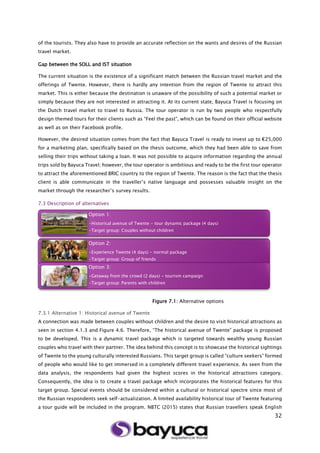
  • 89.
    89 Bentelo: Originally, Bentelowas a medieval community. It is mostly known for its beautiful surroundings, which draws walking and cycling tourists to this part of Twente all year long. Bentelo is also a very hospitable community. At several farms and at the Hof van Twente vineyard tourists are most welcome to take a look around and taste the delight of local products. Also, the Easter celebrations in Bentelo, starting off with a huge bonfire, brings many people from all over the region together. Delden: A large part of the city centre dates from a period in which Delden received city rights (1333). Many buildings have been professionally restored. Everywhere in Delden, the close connection with the county castle Twickel is noticeable. Monuments of historic value are museum farm the Wendezoele, the Noordmolen (oil mill), the Houtzaagmolen (saw mill), the Salt museum, the Old and Roman- Catholic Blasius church. Delden also inhabits many galleries and hosts a number of events throughout the year such as the monthly regional fair Twente, the Cultural Street Festival and the nationally acknowledged four-day Wheelchair event, always starting at ascension, which are definitely worth visiting. Diepenheim: In the history of Diepenheim, the castles Huis te Diepenheim, Nijenhuis, Westerflier en Warmelo have a prominent place. Though they are inhabited, the surrounding estates are free for access. The popular Zes kastelen tour takes you along the six estates, with also the castles Weldam and Wegdam. Other remarkable tourist attractions are the grain watermill Den Haller, the Oranjemuseum Nieuwe Haghuis and the Art Association Diepenheim. As the centre of art, Diepenheim is most famous. Also, the art event Kunstmoment and Kasteeldag (Castle day) are real highlights. Goor: In 1263, Goor received its city rights and became the political centre of Twente. As a result of Thomas Ainsworth founding the first textile school in 1833 in Goor, the town has played an important role in the regional textile industry. Scattered throughout Goor are remarkable works of art, which can be seen along the Art walking tour. Other highlights are the Braak mill, the Klompenmuseum (wooden shoes) and Thomas Ainsworth’s tomb. The yearly school and folk fest, and the 4-day autumn bicycle tour are important examples of Goor’s traditions. Hengevelde: Hengevelde’s origins also lies in the Middle Ages. Under the influence of neighbouring estate Weldam, Hengevelde and its environs flourished into a beautiful landscape. It is mainly known for inhabiting the legendary local criminal Huttenkloas, who has murdered many people with his wife Aarne and son Jannes in the 18th century. Hengevelde is definitely worth a visit during the annual weekend folklore event called the Höftedagen (in June) with a variety of theater and music entertainment. Markelo: Markelo is one of Twente’s oldest villages with its characteristically sloping landscape and its five hills. It has many agricultural communities, where modern business conduct is mixed with traditions. Tourist attractions are the Martinus church, Buursink’s mill De Hoop (wind, grain and peel mill) and the museum farm Eungs Schöppe. There are several yearly events such as the Art Bicycle Tour and the open air shows in the Kösterkoele. At the list of the destination we will miss artfully (Diepenheim, Delden, Ootmarsum), sportive, wide/spacious, clear. At the list of the features we will miss Hotels, Bed and Breakfasts, Camping on the farm, Art galleries, Routes (walking, cycling, horse riding trials, mtb trials, etc.), Visit an event.
  • 90.
    90 Appendix O: Invitationprocess for the respondents
  • 91.
    91 Appendix P: Stakeholdermatrix Influential parties Role in applying the project The benefit of a project Level of influence Buitencentrum Hessenheem De Langenberg Accommodation providers The accommodation providers have a very important role here because one of the core elements of the tourist’s experience, is the place where they are going to stay in at. Without such a stakeholder involved, the project would simply not be possible. The benefit for the accommodation provider to work in cooperation with Bayuca Travel is that the tour operator introduces a new source market which is international and for now this is not a common practice in the region of Twente. Both parties will economically benefit from this. Collaboration is important here and the accommodation provider sets out the commission rate. Fiets City Activity providers Activity providers are important partners which provide the thrill and excitement of the travellers. Without their cooperation, it is not possible to create a tailor-made tourist package catering for the needs and wants. The benefit for the activity provider is more customers to rent bikes from the shop when Bayuca Travel brings groups of people together. Awareness will be raised in such a case. There will be low level of resistance due to the fact that these kind of activity providers do not play such a vital role as the accommodation type. Europcar Rental car providers Transportation helps the travellers to reach from place A to B. By renting cars, this eases the traveller’s experience. Cooperation is necessary with such providers and both sides will get revenue benefits for working together. As in the case of the other influential parties, here the commission rate plays a vital role and the resistance level is expected to be high.
  • 92.
    92 Appendix Q: Designof the website package Please tell us about your trip to the Netherlands plan in 5 minutes or less: Who are you traveling with? ☐ On my own ☐ With my loved one* ☐ With the family ☐ A group of friends What is the age group of the people traveling? ☐ 3 – 15 ☐ 16 – 26 ☐ 26 – 45 ☐46 – 70 ☐ above 70 What would you like to do there? More than one option is possible. ☐ Visit landmarks ☐ Visit castles ☐ Get married ☐ Celebrate anniversary ☐ Discover Dutch heritage and culture ☐ Other, please specify When would you like to fly to the Netherlands? What is your preferred accommodation? ☐ Luxurious cottage ☐ 4* hotel ☐ Luxurious vacation house For how many days would you stay? If you have any special preferences to make your trip unforgettable, please mention them below:
  • 93.
    93 Based on yourprevious selected options, this is what the idea trip will be for you! (Generated content) Historical Avenue of Twente Take a (day) breathtaking travel experience with (selected target group) back in time to the historical sightings of the spacious and beautiful destination Twente, situated in the Netherlands in this historically themed package. You and (your travel group) are (age range) cultural seekers who are looking for a relaxing and unforgettable historical journey. Then Bayuca Travel is sure that you would enjoy having a historical tour through the cities as well as the various castles such as castle Twickel. Twente is the place for you and your love lone! You will have the opportunity to select the features you are interested. We will determine the most affordable price for you at the end when including all optional activities. The six castle tour of Diepenheim is one of the most popular routes in Twente for cycling. It is around 30 kilometres long, going around the beautiful landscape and open fields of Twente, introducing you and your loved one to the magic and beauty of the destination, as well as the possibility of visiting the historical castles: Huis te Diepenheim, Nijenhuis, Warmelo, Wegdam, Weldam and Westerflier. Alternatively, instead of having the opportunity to cycle, you could utilize our Europcar deal and instead drive to the castles. Bayuca Travel provides you with the possibility to enjoy a marvelous picnic experience with your partner in the botanical gardens near castle Twickel, in case you get too tired from all the historical sightseeing. Enjoy a lovely, relaxing lunch menu together and let the good times row. The menu includes typical Dutch cuisine, plus drinks of your own choice. Dietarian wishes will be met. When you are done with selecting all the activities you would like to do, and the accommodation preference where you will likely stay, you will get an immediate reservation notification on your email address, as well as direct contact with us for further information on how to process the payment. If you have any particular questions regarding anything related to the package tour, as well as the Netherlands in general, our experienced team will try their best to answer all your questions. Thank you for putting trust in us and do not forget to subscribe to our weekly email newsletter for limited discounts!