Family and Consumer Sciences
                                                                                                                         MOB-4-09


                  Food for Baby’s First Year
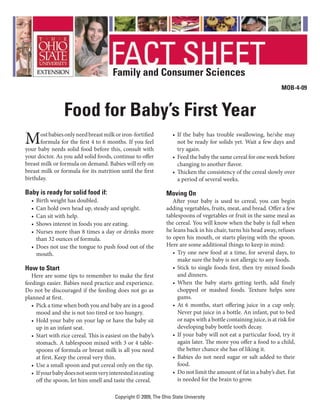
M      ost babies only need breast milk or iron-fortified
       formula for the first 4 to 6 months. If you feel
your baby needs solid food before this, consult with
                                                                    •	 If	 the	 baby	 has	 trouble	 swallowing,	 he/she	 may	
                                                                       not be ready for solids yet. Wait a few days and
                                                                       try	again.	
your doctor. As you add solid foods, continue to offer              •	 Feed	the	baby	the	same	cereal	for	one	week	before	
breast milk or formula on demand. Babies will rely on                  changing	to	another	flavor.
breast milk or formula for its nutrition until the first            •	 Thicken	the	consistency	of	the	cereal	slowly	over	
birthday.                                                              a	period	of	several	weeks.	

Baby is ready for solid food if:                                 Moving On
  •	 Birth	weight	has	doubled.	                                     After	 your	 baby	 is	 used	 to	 cereal,	 you	 can	 begin	
  •	 Can	hold	own	head	up,	steady	and	upright.	                  adding	vegetables,	fruits,	meat,	and	bread.	Offer	a	few	
  •	 Can	sit	with	help.	                                         tablespoons	of	vegetables	or	fruit	in	the	same	meal	as	
  •	 Shows	interest	in	foods	you	are	eating.	                    the cereal. You will know when the baby is full when
  •	 Nurses	more	than	8	times	a	day	or	drinks	more	              he leans back in his chair, turns his head away, refuses
     than 32 ounces of formula.                                  to	open	his	mouth,	or	starts	playing	with	the	spoon.	
  •	 Does	not	use	the	tongue	to	push	food	out	of	the	            Here	are	some	additional	things	to	keep	in	mind:
     mouth.                                                         •	 Try	one	new	food	at	a	time,	for	several	days,	to	
                                                                       make	sure	the	baby	is	not	allergic	to	any	foods.
How to Start                                                        •	 Stick	to	single	foods	first,	then	try	mixed	foods	
   Here	are	some	tips	to	remember	to	make	the	first	                   and dinners.
feedings	easier.	Babies	need	practice	and	experience.	              •	 When	 the	 baby	 starts	 getting	 teeth,	 add	 finely	
Do	not	be	discouraged	if	the	feeding	does	not	go	as	                   chopped	 or	 mashed	 foods.	 Texture	 helps	 sore	
planned	at	first.                                                      gums.	
   •	 Pick	a	time	when	both	you	and	baby	are	in	a	good	             •	 At	 6	 months,	 start	 offering	 juice	 in	 a	 cup	 only.	
      mood	and	she	is	not	too	tired	or	too	hungry.	                    Never	put	juice	in	a	bottle.	An	infant,	put	to	bed	
   •	 Hold	your	baby	on	your	lap	or	have	the	baby	sit	                 or	naps	with	a	bottle	containing	juice,	is	at	risk	for	
      up	in	an	infant	seat.	                                           developing	baby	bottle	tooth	decay.	
   •	 Start	with	rice	cereal.	This	is	easiest	on	the	baby’s	        •	 If	your	baby	will	not	eat	a	particular	food,	try	it	
      stomach.	A	tablespoon	mixed	with	3	or	4	table-                   again	later.	The	more	you	offer	a	food	to	a	child,	
      spoons	of	formula	or	breast	milk	is	all	you	need	                the	better	chance	she	has	of	liking	it.	
      at	first.	Keep	the	cereal	very	thin.	                         •	 Babies	 do	not	need	sugar	or	salt	added	to	their	
   •	 Use	a	small	spoon	and	put	cereal	only	on	the	tip.                food.
   •	 If	your	baby	does	not	seem	very	interested	in	eating	         •	 Do	not	limit	the	amount	of	fat	in	a	baby’s	diet.	Fat	
      off	the	spoon,	let	him	smell	and	taste	the	cereal.               is	needed	for	the	brain	to	grow.	

                                         Copyright © 2009, The Ohio State University
Food for Baby’s First Year—page 2


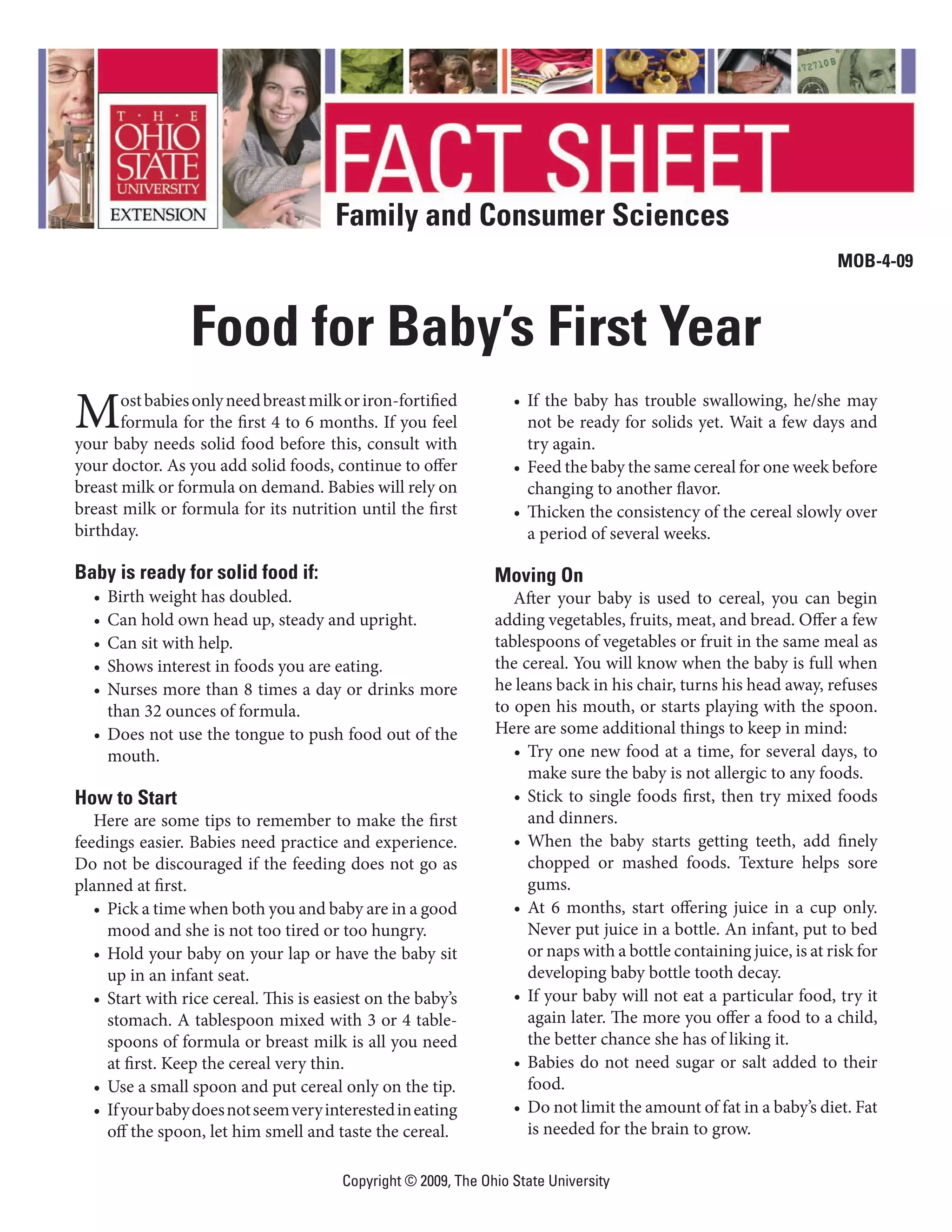
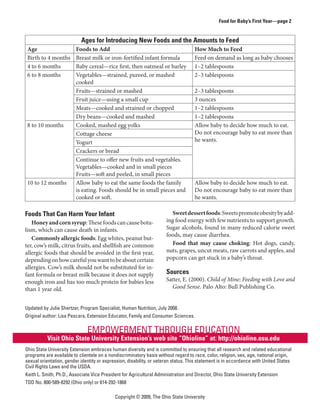
                           Ages for Introducing New Foods and the Amounts to Feed
 Age                     Foods to Add                                              How Much to Feed
 Birth to 4 months       Breast milk or iron-fortified infant formula              Feed	on	demand	as	long	as	baby	chooses
 4 to 6 months           Baby cereal—rice first, then oatmeal or barley            1–2	tablespoons
 6	to	8	months           Vegetables—strained,	pureed,	or	mashed	                   2–3	tablespoons
                         cooked
                         Fruits—strained	or	mashed                                 2–3	tablespoons
                         Fruit	juice—using	a	small	cup                             3 ounces
                         Meats—cooked	and	strained	or	chopped                      1–2	tablespoons
                         Dry	beans—cooked	and	mashed                               1–2	tablespoons
 8	to	10	months          Cooked,	mashed	egg	yolks                                  Allow baby to decide how much to eat.
                         Cottage	cheese                                            Do	not	encourage	baby	to	eat	more	than	
                         Yogurt                                                    he wants.
                         Crackers	or	bread
                         Continue	to	offer	new	fruits	and	vegetables.
                         Vegetables—cooked	and	in	small	pieces
                         Fruits—soft	and	peeled,	in	small	pieces
 10	to	12	months         Allow baby to eat the same foods the family               Allow baby to decide how much to eat.
                         is	eating.	Foods	should	be	in	small	pieces	and	           Do	not	encourage	baby	to	eat	more	than	
                         cooked or soft.                                           he wants.

Foods That Can Harm Your Infant                                        Sweet dessert foods:	Sweets	promote	obesity	by	add-
   Honey and corn syrup:	These	foods	can	cause	botu-                 ing	food	energy	with	few	nutrients	to	support	growth.	
lism, which can cause death in infants.                              Sugar	alcohols,	found	in	many	reduced	calorie	sweet	
                                                                     foods, may cause diarrhea.
   Commonly allergic foods:	Egg	whites,	peanut	but-
ter,	cow’s	milk,	citrus	fruits,	and	shellfish	are	common	              Food that may cause choking:	 Hot	 dogs,	 candy,	
allergic	foods	that	should	be	avoided	in	the	first	year,	            nuts,	grapes,	uncut	meats,	raw	carrots	and	apples,	and	
depending	on	how	careful	you	want	to	be	about	certain	               popcorn	can	get	stuck	in	a	baby’s	throat.
allergies.	Cow’s	milk	should	not	be	substituted	for	in-
fant	formula	or	breast	milk	because	it	does	not	supply	              Sources
enough	iron	and	has	too	much	protein	for	babies	less	                Satter,	E.	(2000).	Child of Mine: Feeding with Love and
than 1 year old.                                                       Good Sense.	Palo	Alto:	Bull	Publishing	Co.


Updated by Julie Shertzer, Program Specialist, Human Nutrition, July 2008.
Original author: Lisa Pescara, Extension Educator, Family and Consumer Sciences.


          Visit Ohio State University Extension’s web site “Ohioline” at: http://ohioline.osu.edu
Ohio State University Extension embraces human diversity and is committed to ensuring that all research and related educational
programs are available to clientele on a nondiscriminatory basis without regard to race, color, religion, sex, age, national origin,
sexual orientation, gender identity or expression, disability, or veteran status. This statement is in accordance with United States
Civil Rights Laws and the USDA.
Keith L. Smith, Ph.D., Associate Vice President for Agricultural Administration and Director, Ohio State University Extension
TDD No. 800-589-8292 (Ohio only) or 614-292-1868

                                            Copyright © 2009, The Ohio State University

Babys1st

  • 1.
    Family and ConsumerSciences MOB-4-09 Food for Baby’s First Year M ost babies only need breast milk or iron-fortified formula for the first 4 to 6 months. If you feel your baby needs solid food before this, consult with • If the baby has trouble swallowing, he/she may not be ready for solids yet. Wait a few days and try again. your doctor. As you add solid foods, continue to offer • Feed the baby the same cereal for one week before breast milk or formula on demand. Babies will rely on changing to another flavor. breast milk or formula for its nutrition until the first • Thicken the consistency of the cereal slowly over birthday. a period of several weeks. Baby is ready for solid food if: Moving On • Birth weight has doubled. After your baby is used to cereal, you can begin • Can hold own head up, steady and upright. adding vegetables, fruits, meat, and bread. Offer a few • Can sit with help. tablespoons of vegetables or fruit in the same meal as • Shows interest in foods you are eating. the cereal. You will know when the baby is full when • Nurses more than 8 times a day or drinks more he leans back in his chair, turns his head away, refuses than 32 ounces of formula. to open his mouth, or starts playing with the spoon. • Does not use the tongue to push food out of the Here are some additional things to keep in mind: mouth. • Try one new food at a time, for several days, to make sure the baby is not allergic to any foods. How to Start • Stick to single foods first, then try mixed foods Here are some tips to remember to make the first and dinners. feedings easier. Babies need practice and experience. • When the baby starts getting teeth, add finely Do not be discouraged if the feeding does not go as chopped or mashed foods. Texture helps sore planned at first. gums. • Pick a time when both you and baby are in a good • At 6 months, start offering juice in a cup only. mood and she is not too tired or too hungry. Never put juice in a bottle. An infant, put to bed • Hold your baby on your lap or have the baby sit or naps with a bottle containing juice, is at risk for up in an infant seat. developing baby bottle tooth decay. • Start with rice cereal. This is easiest on the baby’s • If your baby will not eat a particular food, try it stomach. A tablespoon mixed with 3 or 4 table- again later. The more you offer a food to a child, spoons of formula or breast milk is all you need the better chance she has of liking it. at first. Keep the cereal very thin. • Babies do not need sugar or salt added to their • Use a small spoon and put cereal only on the tip. food. • If your baby does not seem very interested in eating • Do not limit the amount of fat in a baby’s diet. Fat off the spoon, let him smell and taste the cereal. is needed for the brain to grow. Copyright © 2009, The Ohio State University
  • 2.
    Food for Baby’sFirst Year—page 2 Ages for Introducing New Foods and the Amounts to Feed Age Foods to Add How Much to Feed Birth to 4 months Breast milk or iron-fortified infant formula Feed on demand as long as baby chooses 4 to 6 months Baby cereal—rice first, then oatmeal or barley 1–2 tablespoons 6 to 8 months Vegetables—strained, pureed, or mashed 2–3 tablespoons cooked Fruits—strained or mashed 2–3 tablespoons Fruit juice—using a small cup 3 ounces Meats—cooked and strained or chopped 1–2 tablespoons Dry beans—cooked and mashed 1–2 tablespoons 8 to 10 months Cooked, mashed egg yolks Allow baby to decide how much to eat. Cottage cheese Do not encourage baby to eat more than Yogurt he wants. Crackers or bread Continue to offer new fruits and vegetables. Vegetables—cooked and in small pieces Fruits—soft and peeled, in small pieces 10 to 12 months Allow baby to eat the same foods the family Allow baby to decide how much to eat. is eating. Foods should be in small pieces and Do not encourage baby to eat more than cooked or soft. he wants. Foods That Can Harm Your Infant Sweet dessert foods: Sweets promote obesity by add- Honey and corn syrup: These foods can cause botu- ing food energy with few nutrients to support growth. lism, which can cause death in infants. Sugar alcohols, found in many reduced calorie sweet foods, may cause diarrhea. Commonly allergic foods: Egg whites, peanut but- ter, cow’s milk, citrus fruits, and shellfish are common Food that may cause choking: Hot dogs, candy, allergic foods that should be avoided in the first year, nuts, grapes, uncut meats, raw carrots and apples, and depending on how careful you want to be about certain popcorn can get stuck in a baby’s throat. allergies. Cow’s milk should not be substituted for in- fant formula or breast milk because it does not supply Sources enough iron and has too much protein for babies less Satter, E. (2000). Child of Mine: Feeding with Love and than 1 year old. Good Sense. Palo Alto: Bull Publishing Co. Updated by Julie Shertzer, Program Specialist, Human Nutrition, July 2008. Original author: Lisa Pescara, Extension Educator, Family and Consumer Sciences. Visit Ohio State University Extension’s web site “Ohioline” at: http://ohioline.osu.edu Ohio State University Extension embraces human diversity and is committed to ensuring that all research and related educational programs are available to clientele on a nondiscriminatory basis without regard to race, color, religion, sex, age, national origin, sexual orientation, gender identity or expression, disability, or veteran status. This statement is in accordance with United States Civil Rights Laws and the USDA. Keith L. Smith, Ph.D., Associate Vice President for Agricultural Administration and Director, Ohio State University Extension TDD No. 800-589-8292 (Ohio only) or 614-292-1868 Copyright © 2009, The Ohio State University