The U.S. TelecommunicationsIndustry : 1996-1999Case :   II-4Group:  BT2C
OutlineThe Telecommunications Act 1996
RBOCs
AT&T
MCI WorldCom
Qwest
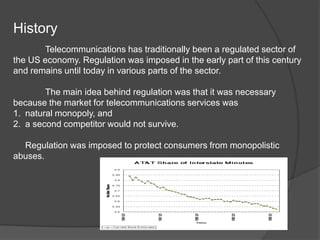
Technological DevelopmentsHistory 	Telecommunications has traditionally been a regulated sector of the US economy. Regulation was imposed in the early part of this century and remains until today in various parts of the sector. 	The main idea behind regulation was that it was necessary because the market for telecommunications services was natural monopoly, anda second competitor would not survive. 	Regulation was imposed to protect consumers from monopolistic abuses.
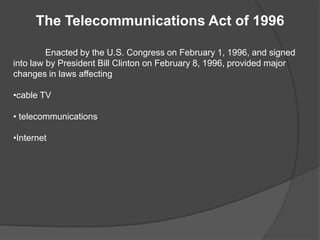
The Telecommunications Act of 1996	Enacted by the U.S. Congress on February 1, 1996, and signed into law by President Bill Clinton on February 8, 1996, provided major changes in laws affecting cable TV
 telecommunications
InternetThe Telecommunications Act of 1996
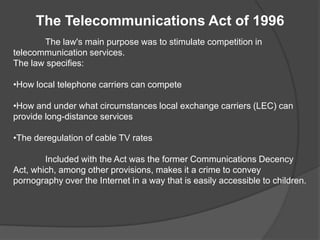
The Telecommunications Act of 1996 	The law's main purpose was to stimulate competition in telecommunication services. The law specifies: How local telephone carriers can compete
How and under what circumstances local exchange carriers (LEC) can provide long-distance services
The deregulation of cable TV ratesIncluded with the Act was the former Communications Decency Act, which, among other provisions, makes it a crime to convey pornography over the Internet in a way that is easily accessible to children.
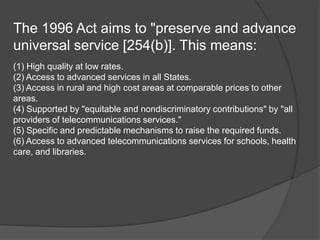
The 1996 Act aims to "preserve and advance universal service [254(b)]. This means:(1) High quality at low rates.(2) Access to advanced services in all States.(3) Access in rural and high cost areas at comparable prices to other areas.(4) Supported by "equitable and nondiscriminatory contributions" by "all providers of telecommunications services."(5) Specific and predictable mechanisms to raise the required funds. (6) Access to advanced telecommunications services for schools, health care, and libraries.
Who are the Regional Bell Operating Companies (RBOCs)?	The original 7 RBOCs were formed from the 1984 breakup of AT&T.  AT&T originally consisted of 22 Bell Operating Companies (BOCs).  The 1984 Divestiture merged the 22 BOCs into 7 RBOCs:Ameritech
Bell Atlantic
Bell South
Nynex
Pacific Telesis
Southwestern Bell Communications (SBC Communications)
US West There were originally 7 RBOCs.  Today there are only 3:Qwest- created by the merger of US West and Qwest Communications International, Inc.
at&t - created by the merger of SBC, Ameritech, and Pacific Telesis, AT&T, and Bell South..
Verizon - created by the merger of Bell Atlantic, Nynex, and GTE. The largest provider of local, long distance telephone services in the United States, and also serves digital subscriber line Internet access and digital television. AT&T is the second largest provider of wireless service in the United States, with over 81.6 million wireless customers, and more than 150 million total customers
TimelinesJanuary 31, 2005,SBC announced that it would purchase at&t Corp
November 18, 2005,The merger was finalized
December 29, 2006, twenty-two Bell Operating Companies are become a part of the new AT&T Inc
June 2007,wireless services are the core of "The New AT&T".
June 29, 2007 , AT&T had reached an agreement to purchase Dobson Cellular
June 27, 2008 move its corporate headquarters from San Antonio to Dallas
December 12,2008, AT&T acquired Wayports Inc, a major provider of Internet Hotspots in the United StatesMCI, Inc. was an American Telecommunications subsidiary of Verizon Communications that is headquartered in Virginia. The corporation was originally formed as a result of the merger of WorldCom (formerly known as LDDS followed by LDDS WorldCom) and MCI Communications, and used the name MCI WorldCom followed by WorldCom before taking its final name on April 12, 2003 as part of the corporation's emergence from bankruptcy. The company formerly traded on NASDAQ under the symbols "WCOM" (pre-bankruptcy) and "MCIP" (post-bankruptcy). The corporation was purchased by Verizon Communications with the deal closing on July 7, 2006, and is now identified as that company's Verizon Business division with the local residential divisions slowly integrated into local Verizon subsidiaries.
TimelinesIn 1989, The company went public through a merger with Advantage Companies Inc
In 1995 The company name was changed to LDDS WorldCom, and later just WorldCom
November 10, 1997, WorldCom and MCI Communications announced merger to form MCI WorldCom, making it the largest merger in US history.
September 15, 1998 the new company, MCI WorldCom, opened for business

Ba401 Case II-4 The U.S.Telecommunications

  • 1.
    The U.S. TelecommunicationsIndustry: 1996-1999Case : II-4Group: BT2C
  • 2.
  • 3.
  • 4.
  • 5.
  • 6.
  • 7.
    Technological DevelopmentsHistory Telecommunicationshas traditionally been a regulated sector of the US economy. Regulation was imposed in the early part of this century and remains until today in various parts of the sector. The main idea behind regulation was that it was necessary because the market for telecommunications services was natural monopoly, anda second competitor would not survive. Regulation was imposed to protect consumers from monopolistic abuses.
  • 8.
    The Telecommunications Actof 1996 Enacted by the U.S. Congress on February 1, 1996, and signed into law by President Bill Clinton on February 8, 1996, provided major changes in laws affecting cable TV
  • 9.
  • 10.
  • 11.
    The Telecommunications Actof 1996 The law's main purpose was to stimulate competition in telecommunication services. The law specifies: How local telephone carriers can compete
  • 12.
    How and underwhat circumstances local exchange carriers (LEC) can provide long-distance services
  • 13.
    The deregulation ofcable TV ratesIncluded with the Act was the former Communications Decency Act, which, among other provisions, makes it a crime to convey pornography over the Internet in a way that is easily accessible to children.
  • 14.
    The 1996 Actaims to "preserve and advance universal service [254(b)]. This means:(1) High quality at low rates.(2) Access to advanced services in all States.(3) Access in rural and high cost areas at comparable prices to other areas.(4) Supported by "equitable and nondiscriminatory contributions" by "all providers of telecommunications services."(5) Specific and predictable mechanisms to raise the required funds. (6) Access to advanced telecommunications services for schools, health care, and libraries.
  • 15.
    Who are theRegional Bell Operating Companies (RBOCs)? The original 7 RBOCs were formed from the 1984 breakup of AT&T.  AT&T originally consisted of 22 Bell Operating Companies (BOCs).  The 1984 Divestiture merged the 22 BOCs into 7 RBOCs:Ameritech
  • 16.
  • 17.
  • 18.
  • 19.
  • 20.
  • 21.
    US West Therewere originally 7 RBOCs.  Today there are only 3:Qwest- created by the merger of US West and Qwest Communications International, Inc.
  • 22.
    at&t - createdby the merger of SBC, Ameritech, and Pacific Telesis, AT&T, and Bell South..
  • 23.
    Verizon - createdby the merger of Bell Atlantic, Nynex, and GTE. The largest provider of local, long distance telephone services in the United States, and also serves digital subscriber line Internet access and digital television. AT&T is the second largest provider of wireless service in the United States, with over 81.6 million wireless customers, and more than 150 million total customers
  • 24.
    TimelinesJanuary 31, 2005,SBCannounced that it would purchase at&t Corp
  • 25.
    November 18, 2005,Themerger was finalized
  • 26.
    December 29, 2006,twenty-two Bell Operating Companies are become a part of the new AT&T Inc
  • 27.
    June 2007,wireless servicesare the core of "The New AT&T".
  • 28.
    June 29, 2007, AT&T had reached an agreement to purchase Dobson Cellular
  • 29.
    June 27, 2008move its corporate headquarters from San Antonio to Dallas
  • 30.
    December 12,2008, AT&Tacquired Wayports Inc, a major provider of Internet Hotspots in the United StatesMCI, Inc. was an American Telecommunications subsidiary of Verizon Communications that is headquartered in Virginia. The corporation was originally formed as a result of the merger of WorldCom (formerly known as LDDS followed by LDDS WorldCom) and MCI Communications, and used the name MCI WorldCom followed by WorldCom before taking its final name on April 12, 2003 as part of the corporation's emergence from bankruptcy. The company formerly traded on NASDAQ under the symbols "WCOM" (pre-bankruptcy) and "MCIP" (post-bankruptcy). The corporation was purchased by Verizon Communications with the deal closing on July 7, 2006, and is now identified as that company's Verizon Business division with the local residential divisions slowly integrated into local Verizon subsidiaries.
  • 31.
    TimelinesIn 1989, Thecompany went public through a merger with Advantage Companies Inc
  • 32.
    In 1995 Thecompany name was changed to LDDS WorldCom, and later just WorldCom
  • 33.
    November 10, 1997,WorldCom and MCI Communications announced merger to form MCI WorldCom, making it the largest merger in US history.
  • 34.
    September 15, 1998the new company, MCI WorldCom, opened for business