B Tech Civil Engineering
Syllabus - MITAOE
COMPUTER ENGINEERING
• CURRICULUM FRAMEWORK
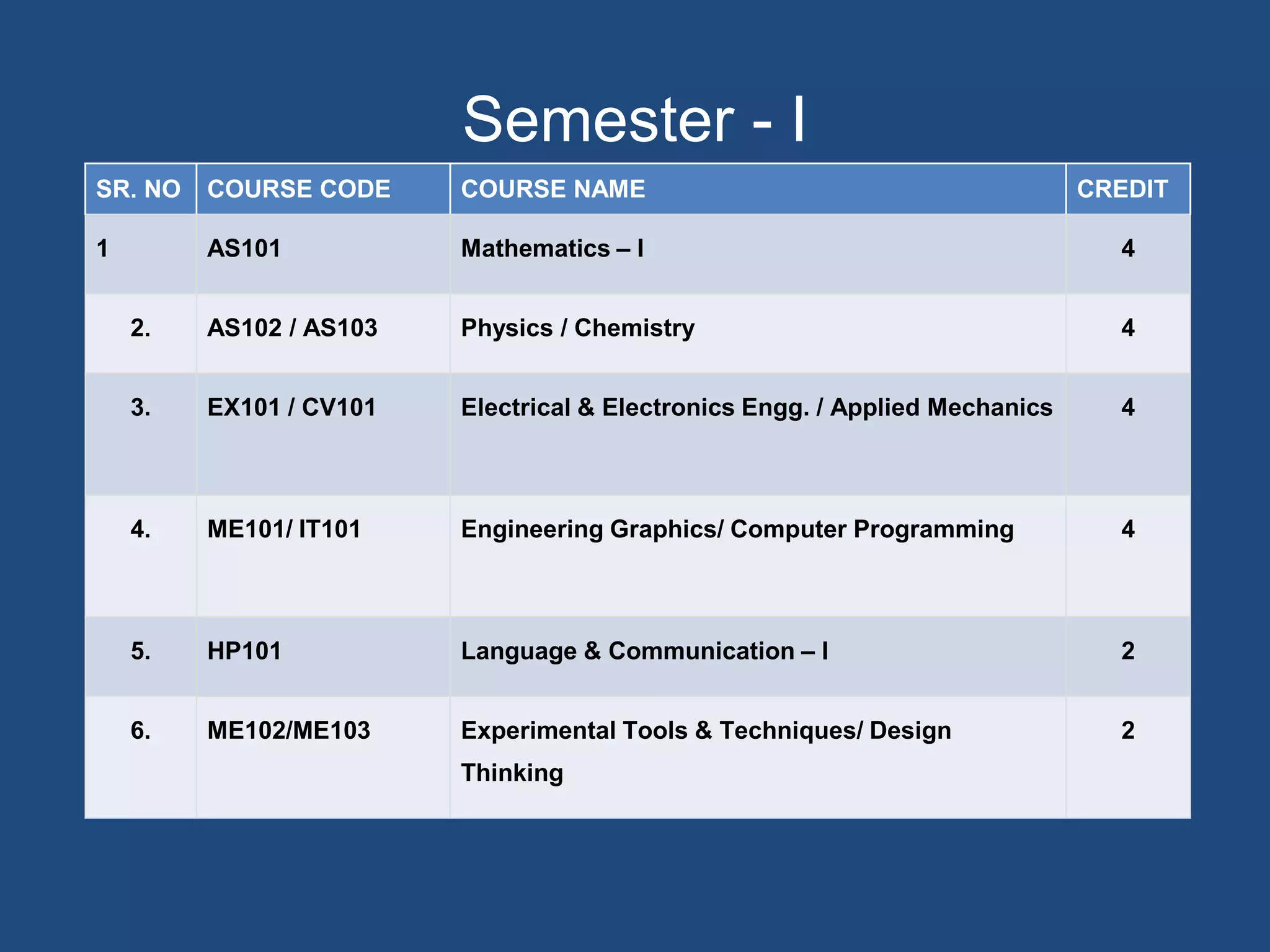
Semester - I
SR. NO COURSE CODE COURSE NAME CREDIT
1 AS101 Mathematics – I 4
2. AS102 / AS103 Physics / Chemistry 4
3. EX101 / CV101 Electrical & Electronics Engg. / Applied Mechanics 4
4. ME101/ IT101 Engineering Graphics/ Computer Programming 4
5. HP101 Language & Communication – I 2
6. ME102/ME103 Experimental Tools & Techniques/ Design
Thinking
2
Semester -II
•
SR. NO COURSE CODE COURSE NAME CREDI
T
1. AS101 Mathematics – II 5
2. AS103 / AS102 Chemistry / Physics 4
3. CV101/ EX101 Applied Mechanics/ Electrical & Electronics
Engg
4
4. IT101/ ME101 Computer Programming/ Engineering
Graphics
4
5. HP101 Language & Communication – II 2
6. ME103/ ME102 Design Thinking/ Experimental Tools &
Techniques
2
Semester-III
SR. NO COURSE CODE COURSE NAME CREDIT
1. CH201 Environmental
Science
3
2. AS201 Applied Mathematics 4
3. ET201 System Engineering 4
4. ME202 Thermal Engineering 4
5. ME203 Geospatial
Engineering
4
6. ET206 Prototyping 2
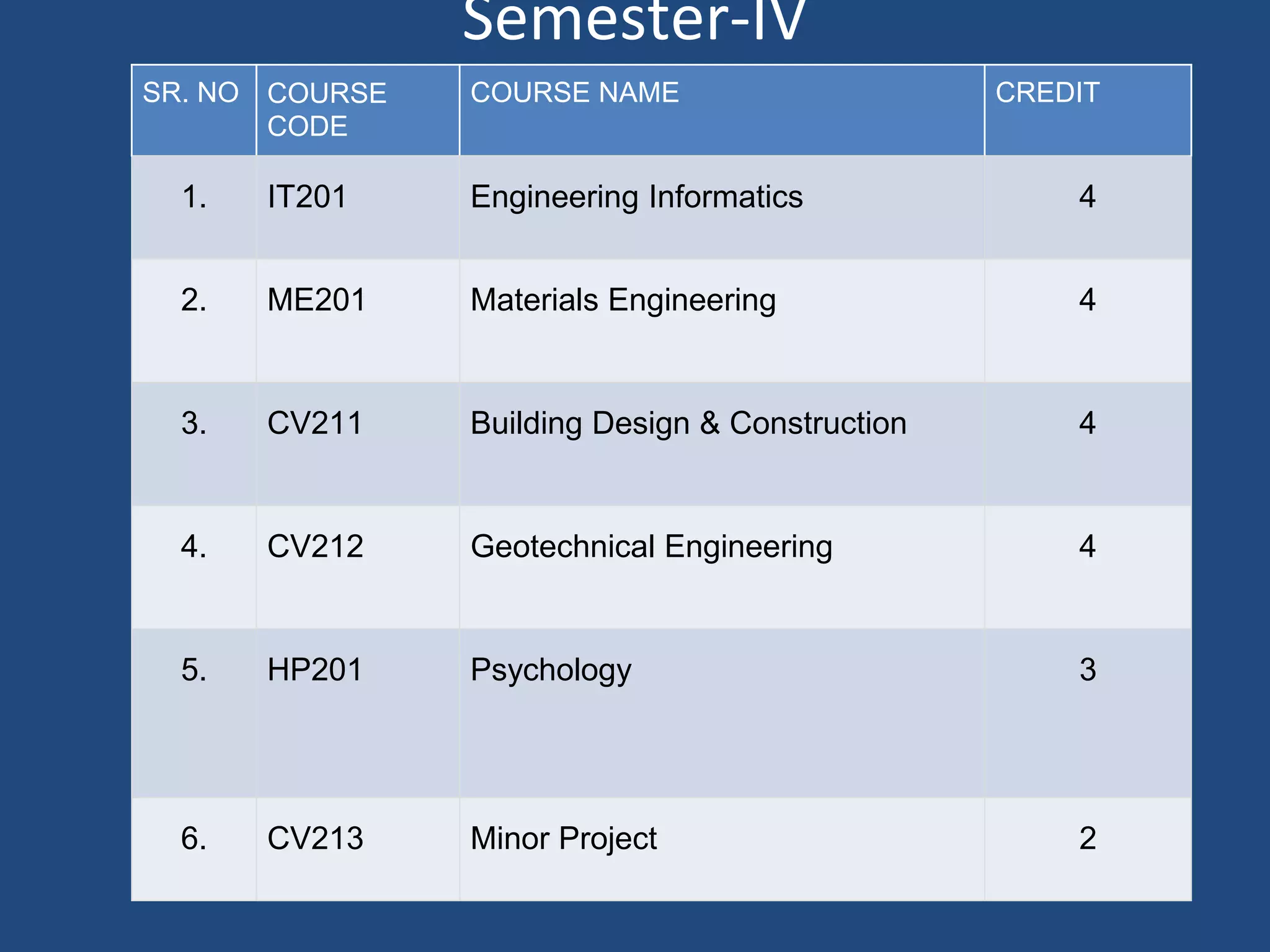
Semester-IV
SR. NO COURSE
CODE
COURSE NAME CREDIT
1. IT201 Engineering Informatics 4
2. ME201 Materials Engineering 4
3. CV211 Building Design & Construction 4
4. CV212 Geotechnical Engineering 4
5. HP201 Psychology 3
6. CV213 Minor Project 2
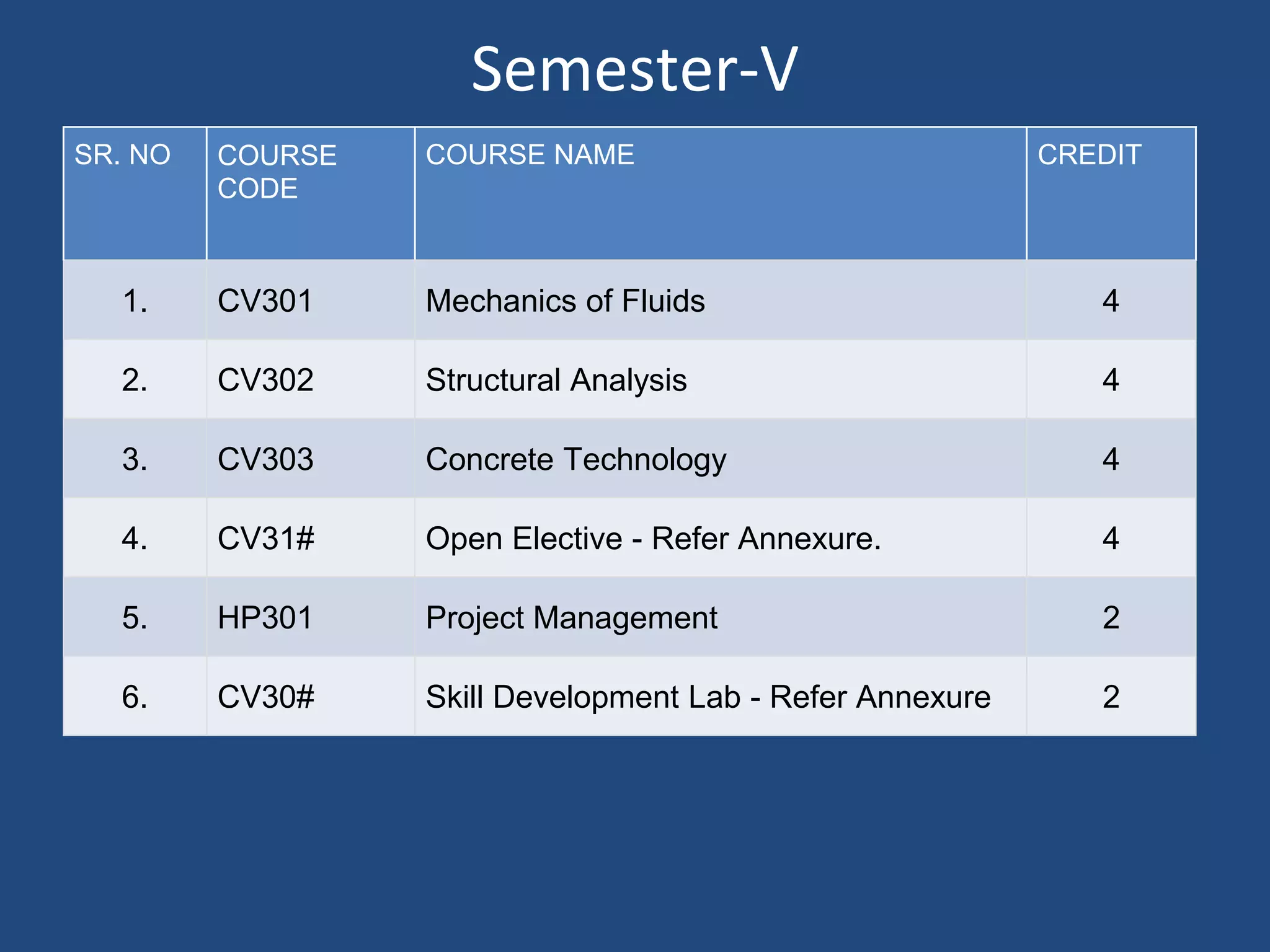
Semester-V
SR. NO COURSE
CODE
COURSE NAME CREDIT
1. CV301 Mechanics of Fluids 4
2. CV302 Structural Analysis 4
3. CV303 Concrete Technology 4
4. CV31# Open Elective - Refer Annexure. 4
5. HP301 Project Management 2
6. CV30# Skill Development Lab - Refer Annexure 2
Semester-VI
SR. NO COURSE CODE COURSE NAME CREDIT
1. CV321 Design of Structures 4
2. CV322 Transportation Engineering 4
3. CV323 Water Resources Engineering 4
4. CV33# Open Elective - Refer Annexure. 4
5. HP302 Professional Skills 2
6. HP303 Basics of Entrepreneurship 1
7. CV324 Mini Project 2
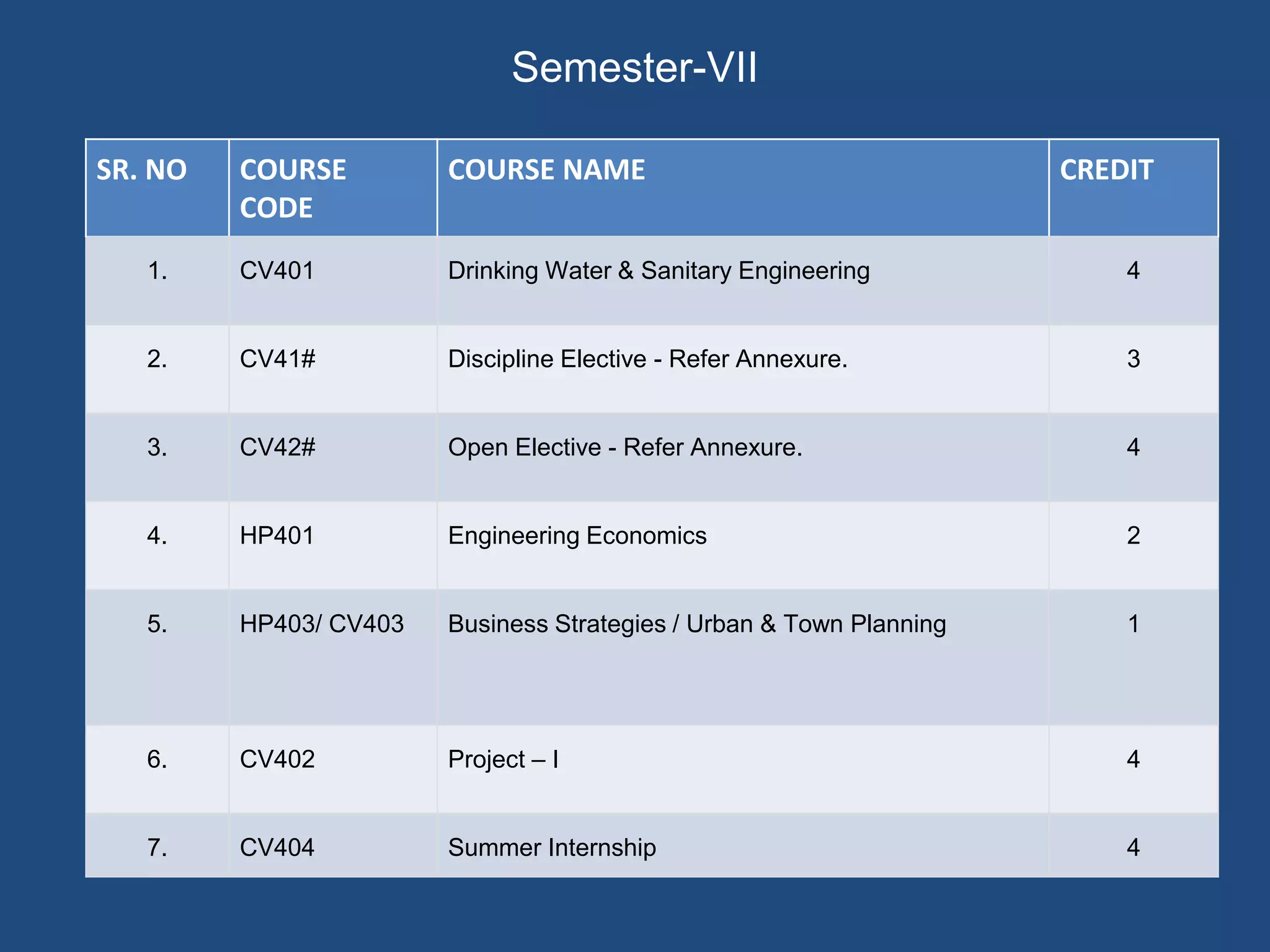
Semester-VII
SR. NO COURSE
CODE
COURSE NAME CREDIT
1. CV401 Drinking Water & Sanitary Engineering 4
2. CV41# Discipline Elective - Refer Annexure. 3
3. CV42# Open Elective - Refer Annexure. 4
4. HP401 Engineering Economics 2
5. HP403/ CV403 Business Strategies / Urban & Town Planning 1
6. CV402 Project – I 4
7. CV404 Summer Internship 4
Semester-VIII
SR. NO COURSE CODE COURSE NAME CREDIT
1. CV431 Estimation & Costing 4
2. CV44# Discipline Elective - Refer Annexure 3
3. CV45# Open Elective – Refer Annexure 4
4. HP402 Engineering Economics 2
5. CV432 Project – II 4
PROGRAMME EDUCATIONAL
OBJECTIVES (PEOS)
SR.NO. PROGRAMME EDUCATIONAL OBJECTIVES
PEO 1 Graduates in Civil Engineering will acquire skills required for
successful entrepreneurs .
PEO 2 Graduates in Civil Engineering will be competent to pursuehigher
education in technical or management field.
PEO 3 Graduates in Civil Engineering will engage themselves in lifelong
learning and research
SR.NO. PROGRAMME EDUCATIONAL OBJECTIVES
PEO 4 Graduates in Civil Engineering would know and
practice professional ethics throughouttheir life.
PROGRAMME OUTCOMES :
SR.NO. PROGRAMME OUTCOMES (POS)
POs 1 Engineering Knowledge: Apply the knowledge of mathematics, science,
and engineering fundamentals and an engineering specialization to the
solution of complex engineering problems.
POs 2 Problem analysis: Identify, formulate, research literature, and analyze
complex engineering problems reaching substantiated conclusions using
first principles of mathematics, natural sciences, and engineering
sciences.PROBLEM ANALYSIS: Identify, formulate, research literature, and
analyze complex engineering problems reaching substantiated
conclusions using first principles of mathematics, natural sciences, and
engineering sciences.
POs 3 Design/development of solutions: Design solutions for complex
engineering problems and design system components or processes that
meet the specified needs with appropriate consideration for the public
health and safety, and the cultural, societal, and environmental
considerations.
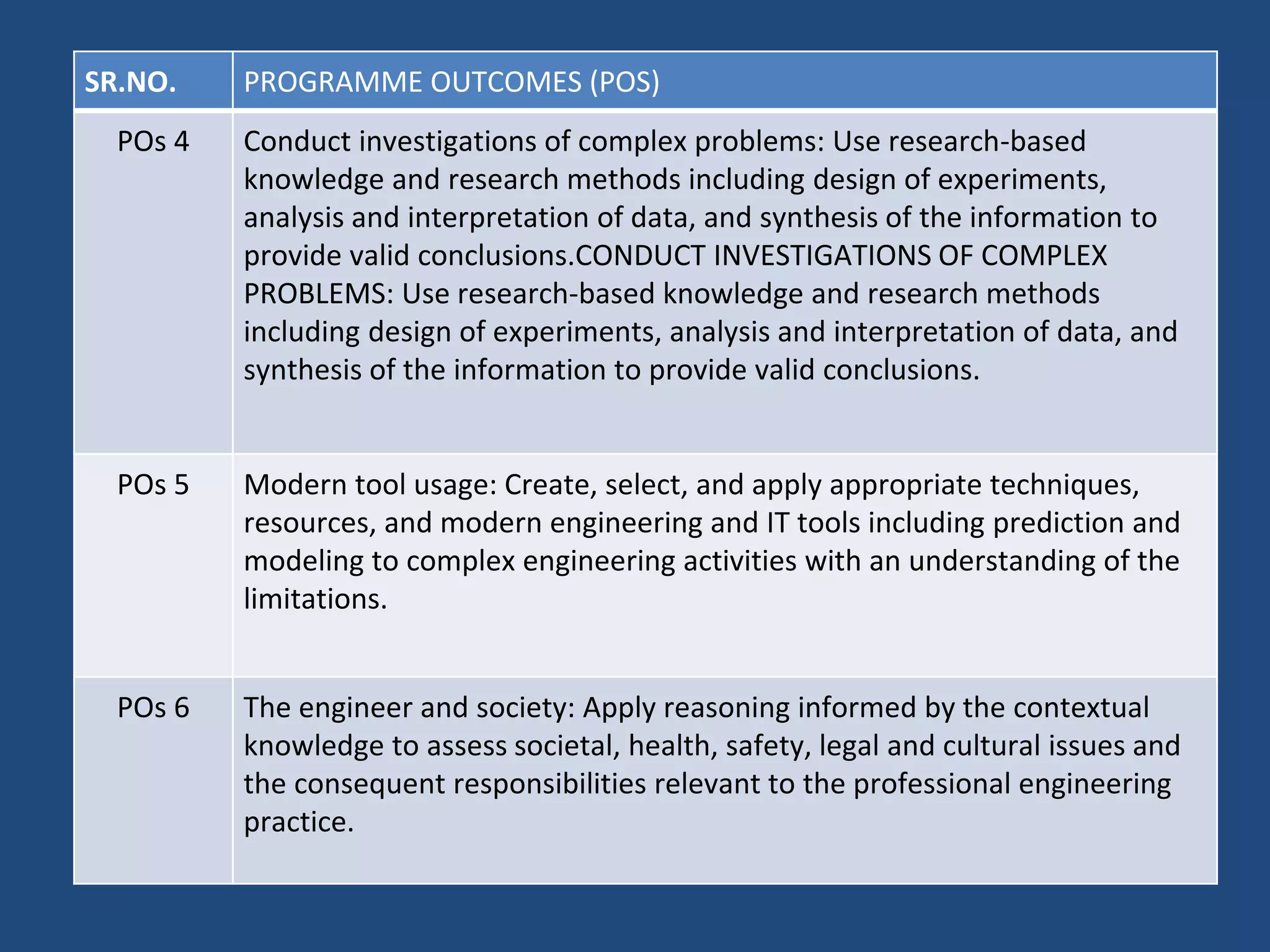
SR.NO. PROGRAMME OUTCOMES (POS)
POs 4 Conduct investigations of complex problems: Use research-based
knowledge and research methods including design of experiments,
analysis and interpretation of data, and synthesis of the information to
provide valid conclusions.CONDUCT INVESTIGATIONS OF COMPLEX
PROBLEMS: Use research-based knowledge and research methods
including design of experiments, analysis and interpretation of data, and
synthesis of the information to provide valid conclusions.
POs 5 Modern tool usage: Create, select, and apply appropriate techniques,
resources, and modern engineering and IT tools including prediction and
modeling to complex engineering activities with an understanding of the
limitations.
POs 6 The engineer and society: Apply reasoning informed by the contextual
knowledge to assess societal, health, safety, legal and cultural issues and
the consequent responsibilities relevant to the professional engineering
practice.
SR.NO. PROGRAMME OUTCOMES (POS)
POs 7 Environment and sustainability: Understand the impact of the
professional engineering solutions in societal and environmental contexts,
and demonstrate the knowledge of, and need for sustainable
development.
POs 8 Ethics: Apply ethical principles and commit to professional ethics and
responsibilities and norms of the engineering practice.
POs 9 Individual and team work: Function effectively as an individual, and as a
member or leader in diverse teams, and in multidisciplinary settings.
SR.NO. PROGRAMME OUTCOMES (POS)
POs 10 Communication: Communicate effectively on complex engineering
activities with the engineering community and with society at large, such
as, being able to comprehend and write effective reports and design
documentation, make effective presentations, and give and receive clear
instructions.
POs 11 Project management and finance: Demonstrate knowledge and
understanding of the engineering and management principles and apply
these to one’s own work, as a member and leader in a team, to manage
projects and in multidisciplinary environments.PROJECT MANAGEMENT
AND FINANCE: Demonstrate knowledge and understanding of the
engineering and management principles and apply these to one’s own
work, as a member and leader in a team, to manage projects and in
multidisciplinary environments.
POs 12 Life-long learning: Recognize the need for, and have the preparation and
ability to engage in independent and life-long learning in the broadest
context of technological change.
PROGRAM SPECIFIC OUTCOMES
SR.NO. PROGRAM SPECIFIC OUTCOMES (PSO)
PSO 1 Analyze, Design, Construct, Maintain and Operate infrastructural
projects
PSO 2 Assess the environmental impact of various projects and take
required measures to curb environmental deterioration
PSO 3 Able to use latest software's pertaining to various streams of Civil
Engineering.
• This is the B Tech Civil Engineering Syllabus at
MITAOE, Pune. MITAOE, is the one of the best
engineering colleges for B tech Civil Engineering.
• The MITAOE institute endeavors to impart holistic
education to its students by engineering courses. It is the
fragment of reputed MIT Pune Group.
Conclusion
• Maharashtra Institute of Technology (MIT) is the
first private Engineering Institute to be
established in the city of Pune, Maharashtra. It is
one of the premier institutes for Indian and
international students offering Undergraduate
and Postgraduate courses in Engineering,
Management, Medicine, Pharmacy, Design, and
so on.
• MIT Academy of Engineering (MITAOE), Alandi,
Pune, was established in 1999 under MAEER by
the honorable Prof. Dr. Vishwanath D. Karad,
Founder and Executive President of MIT Group..
THANK YOU

B Tech Civil Engineering Syllabus at MITAOE

  • 1.
    B Tech CivilEngineering Syllabus - MITAOE
  • 2.
  • 3.
    Semester - I SR.NO COURSE CODE COURSE NAME CREDIT 1 AS101 Mathematics – I 4 2. AS102 / AS103 Physics / Chemistry 4 3. EX101 / CV101 Electrical & Electronics Engg. / Applied Mechanics 4 4. ME101/ IT101 Engineering Graphics/ Computer Programming 4 5. HP101 Language & Communication – I 2 6. ME102/ME103 Experimental Tools & Techniques/ Design Thinking 2
  • 4.
    Semester -II • SR. NOCOURSE CODE COURSE NAME CREDI T 1. AS101 Mathematics – II 5 2. AS103 / AS102 Chemistry / Physics 4 3. CV101/ EX101 Applied Mechanics/ Electrical & Electronics Engg 4 4. IT101/ ME101 Computer Programming/ Engineering Graphics 4 5. HP101 Language & Communication – II 2 6. ME103/ ME102 Design Thinking/ Experimental Tools & Techniques 2
  • 5.
    Semester-III SR. NO COURSECODE COURSE NAME CREDIT 1. CH201 Environmental Science 3 2. AS201 Applied Mathematics 4 3. ET201 System Engineering 4 4. ME202 Thermal Engineering 4 5. ME203 Geospatial Engineering 4 6. ET206 Prototyping 2
  • 6.
    Semester-IV SR. NO COURSE CODE COURSENAME CREDIT 1. IT201 Engineering Informatics 4 2. ME201 Materials Engineering 4 3. CV211 Building Design & Construction 4 4. CV212 Geotechnical Engineering 4 5. HP201 Psychology 3 6. CV213 Minor Project 2
  • 7.
    Semester-V SR. NO COURSE CODE COURSENAME CREDIT 1. CV301 Mechanics of Fluids 4 2. CV302 Structural Analysis 4 3. CV303 Concrete Technology 4 4. CV31# Open Elective - Refer Annexure. 4 5. HP301 Project Management 2 6. CV30# Skill Development Lab - Refer Annexure 2
  • 8.
    Semester-VI SR. NO COURSECODE COURSE NAME CREDIT 1. CV321 Design of Structures 4 2. CV322 Transportation Engineering 4 3. CV323 Water Resources Engineering 4 4. CV33# Open Elective - Refer Annexure. 4 5. HP302 Professional Skills 2 6. HP303 Basics of Entrepreneurship 1 7. CV324 Mini Project 2
  • 9.
    Semester-VII SR. NO COURSE CODE COURSENAME CREDIT 1. CV401 Drinking Water & Sanitary Engineering 4 2. CV41# Discipline Elective - Refer Annexure. 3 3. CV42# Open Elective - Refer Annexure. 4 4. HP401 Engineering Economics 2 5. HP403/ CV403 Business Strategies / Urban & Town Planning 1 6. CV402 Project – I 4 7. CV404 Summer Internship 4
  • 10.
    Semester-VIII SR. NO COURSECODE COURSE NAME CREDIT 1. CV431 Estimation & Costing 4 2. CV44# Discipline Elective - Refer Annexure 3 3. CV45# Open Elective – Refer Annexure 4 4. HP402 Engineering Economics 2 5. CV432 Project – II 4
  • 11.
    PROGRAMME EDUCATIONAL OBJECTIVES (PEOS) SR.NO.PROGRAMME EDUCATIONAL OBJECTIVES PEO 1 Graduates in Civil Engineering will acquire skills required for successful entrepreneurs . PEO 2 Graduates in Civil Engineering will be competent to pursuehigher education in technical or management field. PEO 3 Graduates in Civil Engineering will engage themselves in lifelong learning and research
  • 12.
    SR.NO. PROGRAMME EDUCATIONALOBJECTIVES PEO 4 Graduates in Civil Engineering would know and practice professional ethics throughouttheir life.
  • 13.
    PROGRAMME OUTCOMES : SR.NO.PROGRAMME OUTCOMES (POS) POs 1 Engineering Knowledge: Apply the knowledge of mathematics, science, and engineering fundamentals and an engineering specialization to the solution of complex engineering problems. POs 2 Problem analysis: Identify, formulate, research literature, and analyze complex engineering problems reaching substantiated conclusions using first principles of mathematics, natural sciences, and engineering sciences.PROBLEM ANALYSIS: Identify, formulate, research literature, and analyze complex engineering problems reaching substantiated conclusions using first principles of mathematics, natural sciences, and engineering sciences. POs 3 Design/development of solutions: Design solutions for complex engineering problems and design system components or processes that meet the specified needs with appropriate consideration for the public health and safety, and the cultural, societal, and environmental considerations.
  • 14.
    SR.NO. PROGRAMME OUTCOMES(POS) POs 4 Conduct investigations of complex problems: Use research-based knowledge and research methods including design of experiments, analysis and interpretation of data, and synthesis of the information to provide valid conclusions.CONDUCT INVESTIGATIONS OF COMPLEX PROBLEMS: Use research-based knowledge and research methods including design of experiments, analysis and interpretation of data, and synthesis of the information to provide valid conclusions. POs 5 Modern tool usage: Create, select, and apply appropriate techniques, resources, and modern engineering and IT tools including prediction and modeling to complex engineering activities with an understanding of the limitations. POs 6 The engineer and society: Apply reasoning informed by the contextual knowledge to assess societal, health, safety, legal and cultural issues and the consequent responsibilities relevant to the professional engineering practice.
  • 15.
    SR.NO. PROGRAMME OUTCOMES(POS) POs 7 Environment and sustainability: Understand the impact of the professional engineering solutions in societal and environmental contexts, and demonstrate the knowledge of, and need for sustainable development. POs 8 Ethics: Apply ethical principles and commit to professional ethics and responsibilities and norms of the engineering practice. POs 9 Individual and team work: Function effectively as an individual, and as a member or leader in diverse teams, and in multidisciplinary settings.
  • 16.
    SR.NO. PROGRAMME OUTCOMES(POS) POs 10 Communication: Communicate effectively on complex engineering activities with the engineering community and with society at large, such as, being able to comprehend and write effective reports and design documentation, make effective presentations, and give and receive clear instructions. POs 11 Project management and finance: Demonstrate knowledge and understanding of the engineering and management principles and apply these to one’s own work, as a member and leader in a team, to manage projects and in multidisciplinary environments.PROJECT MANAGEMENT AND FINANCE: Demonstrate knowledge and understanding of the engineering and management principles and apply these to one’s own work, as a member and leader in a team, to manage projects and in multidisciplinary environments. POs 12 Life-long learning: Recognize the need for, and have the preparation and ability to engage in independent and life-long learning in the broadest context of technological change.
  • 17.
    PROGRAM SPECIFIC OUTCOMES SR.NO.PROGRAM SPECIFIC OUTCOMES (PSO) PSO 1 Analyze, Design, Construct, Maintain and Operate infrastructural projects PSO 2 Assess the environmental impact of various projects and take required measures to curb environmental deterioration PSO 3 Able to use latest software's pertaining to various streams of Civil Engineering.
  • 18.
    • This isthe B Tech Civil Engineering Syllabus at MITAOE, Pune. MITAOE, is the one of the best engineering colleges for B tech Civil Engineering. • The MITAOE institute endeavors to impart holistic education to its students by engineering courses. It is the fragment of reputed MIT Pune Group.
  • 19.
    Conclusion • Maharashtra Instituteof Technology (MIT) is the first private Engineering Institute to be established in the city of Pune, Maharashtra. It is one of the premier institutes for Indian and international students offering Undergraduate and Postgraduate courses in Engineering, Management, Medicine, Pharmacy, Design, and so on. • MIT Academy of Engineering (MITAOE), Alandi, Pune, was established in 1999 under MAEER by the honorable Prof. Dr. Vishwanath D. Karad, Founder and Executive President of MIT Group..
  • 20.