Azure Enterprise Data Analyst (DP-500) Exam Dumps 2023
Azure Enterprise Data Analyst (DP-500) Practice Tests 2023. Contains 340+ exam
questions to pass the exam in first attempt.
SkillCertPro offers real exam questions for practice for all major IT certifications.
 For a full set of 340+ questions. Go to
https://skillcertpro.com/product/azure-enterprise-data-analyst-dp-500-exam-
questions/
 SkillCertPro offers detailed explanations to each question which helps to
understand the concepts better.
 It is recommended to score above 85% in SkillCertPro exams before attempting
a real exam.
 SkillCertPro updates exam questions every 2 weeks.
 You will get life time access and life time free updates
 SkillCertPro assures 100% pass guarantee in first attempt.
Below are the free 10 sample questions.
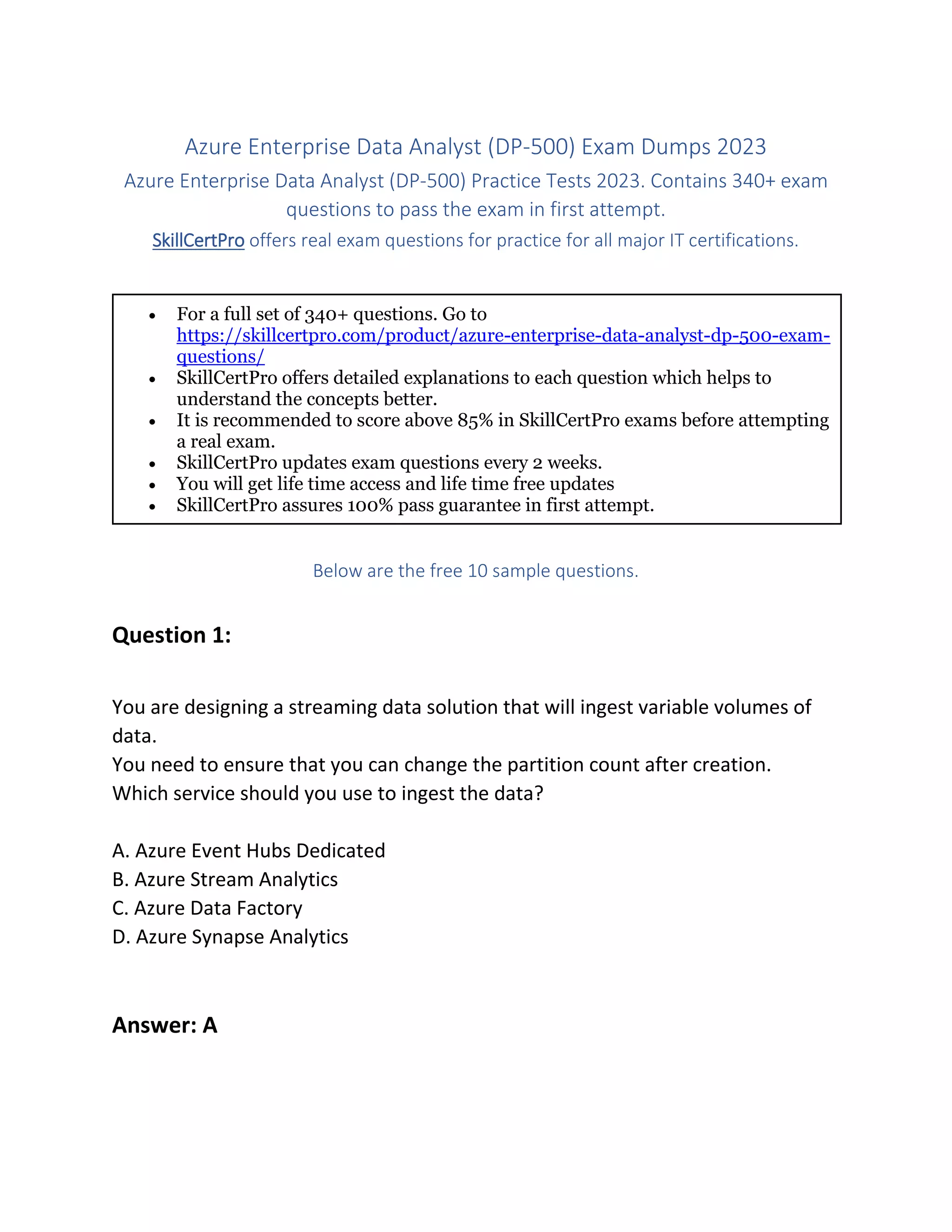
Question 1:
You are designing a streaming data solution that will ingest variable volumes of
data.
You need to ensure that you can change the partition count after creation.
Which service should you use to ingest the data?
A. Azure Event Hubs Dedicated
B. Azure Stream Analytics
C. Azure Data Factory
D. Azure Synapse Analytics
Answer: A
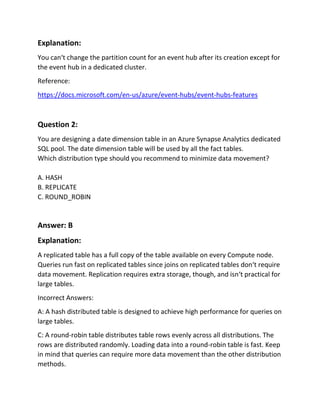
Explanation:
You can‘t change the partition count for an event hub after its creation except for
the event hub in a dedicated cluster.
Reference:
https://docs.microsoft.com/en-us/azure/event-hubs/event-hubs-features
Question 2:
You are designing a date dimension table in an Azure Synapse Analytics dedicated
SQL pool. The date dimension table will be used by all the fact tables.
Which distribution type should you recommend to minimize data movement?
A. HASH
B. REPLICATE
C. ROUND_ROBIN
Answer: B
Explanation:
A replicated table has a full copy of the table available on every Compute node.
Queries run fast on replicated tables since joins on replicated tables don‘t require
data movement. Replication requires extra storage, though, and isn‘t practical for
large tables.
Incorrect Answers:
A: A hash distributed table is designed to achieve high performance for queries on
large tables.
C: A round-robin table distributes table rows evenly across all distributions. The
rows are distributed randomly. Loading data into a round-robin table is fast. Keep
in mind that queries can require more data movement than the other distribution
methods.
Reference:
https://docs.microsoft.com/en-us/azure/synapse-analytics/sql-data-
warehouse/sql-data-warehouse-tables-overview
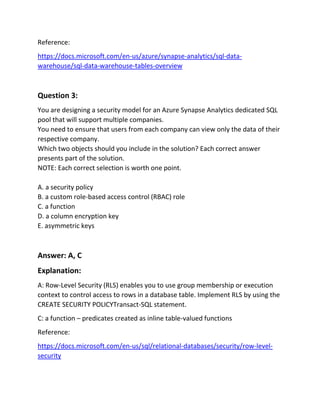
Question 3:
You are designing a security model for an Azure Synapse Analytics dedicated SQL
pool that will support multiple companies.
You need to ensure that users from each company can view only the data of their
respective company.
Which two objects should you include in the solution? Each correct answer
presents part of the solution.
NOTE: Each correct selection is worth one point.
A. a security policy
B. a custom role-based access control (RBAC) role
C. a function
D. a column encryption key
E. asymmetric keys
Answer: A, C
Explanation:
A: Row-Level Security (RLS) enables you to use group membership or execution
context to control access to rows in a database table. Implement RLS by using the
CREATE SECURITY POLICYTransact-SQL statement.
C: a function – predicates created as inline table-valued functions
Reference:
https://docs.microsoft.com/en-us/sql/relational-databases/security/row-level-
security
https://docs.microsoft.com/en-us/azure/synapse-analytics/security/synapse-
workspace-access-control-overview
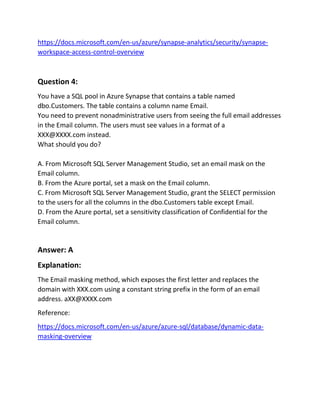
Question 4:
You have a SQL pool in Azure Synapse that contains a table named
dbo.Customers. The table contains a column name Email.
You need to prevent nonadministrative users from seeing the full email addresses
in the Email column. The users must see values in a format of a
XXX@XXXX.com instead.
What should you do?
A. From Microsoft SQL Server Management Studio, set an email mask on the
Email column.
B. From the Azure portal, set a mask on the Email column.
C. From Microsoft SQL Server Management Studio, grant the SELECT permission
to the users for all the columns in the dbo.Customers table except Email.
D. From the Azure portal, set a sensitivity classification of Confidential for the
Email column.
Answer: A
Explanation:
The Email masking method, which exposes the first letter and replaces the
domain with XXX.com using a constant string prefix in the form of an email
address. aXX@XXXX.com
Reference:
https://docs.microsoft.com/en-us/azure/azure-sql/database/dynamic-data-
masking-overview
Question 5:
You are designing an Azure Synapse solution that will provide a query interface
for the data stored in an Azure Storage account. The storage account is only
accessible from a virtual network.
You need to recommend an authentication mechanism to ensure that the
solution can access the source data.
What should you recommend?
A. a managed identity
B. anonymous public read access
C. a shared key
Answer: A
Explanation:
Managed Identity authentication is required when your storage account is
attached to a VNet.
Reference:
https://docs.microsoft.com/en-us/azure/synapse-analytics/sql-data-
warehouse/quickstart-bulk-load-copy-tsql-examples
 For a full set of 340+ questions. Go to
https://skillcertpro.com/product/azure-enterprise-data-analyst-dp-500-exam-
questions/
 SkillCertPro offers detailed explanations to each question which helps to
understand the concepts better.
 It is recommended to score above 85% in SkillCertPro exams before attempting
a real exam.
 SkillCertPro updates exam questions every 2 weeks.
 You will get life time access and life time free updates
 SkillCertPro assures 100% pass guarantee in first attempt.
Question 6:
You are developing an application that uses Azure Data Lake Storage Gen2.
You need to recommend a solution to grant permissions to a specific application
for a limited time period.
What should you include in the recommendation?
A. role assignments
B. shared access signatures (SAS)
C. Azure Active Directory (Azure AD) identities
D. account keys
Answer: B
Explanation:
A shared access signature (SAS) provides secure delegated access to resources in
your storage account. With a SAS, you have granular control over how a client can
access your data. For example:
What resources the client may access.
What permissions they have to those resources.
How long the SAS is valid.
Reference:
https://docs.microsoft.com/en-us/azure/storage/common/storage-sas-overview
Question 7:
You have an Azure Synapse Analytics dedicated SQL pool that contains a table
named Contacts. Contacts contains a column named Phone.
You need to ensure that users in a specific role only see the last four digits of a
phone number when querying the Phone column.
What should you include in the solution?
A. table partitions
B. a default value
C. row-level security (RLS)
D. column encryption
E. dynamic data masking
Answer: E
Explanation:
Dynamic data masking helps prevent unauthorized access to sensitive data by
enabling customers to designate how much of the sensitive data to reveal with
minimal impact on the application layer. It?€™
s a policy-based security feature
that hides the sensitive data in the result set of a query over designated database
fields, while the data in the database is not changed.
Reference:
https://docs.microsoft.com/en-us/azure/azure-sql/database/dynamic-data-
masking-overview
Question 8:
A company purchases IoT devices to monitor manufacturing machinery. The
company uses an Azure IoT Hub to communicate with the IoT devices.
The company must be able to monitor the devices in real-time.
You need to design the solution.
What should you recommend?
A. Azure Data Factory instance using Azure Portal
B. Azure Data Factory instance using Azure PowerShell
C. Azure Stream Analytics cloud job using Azure Portal
D. Azure Data Factory instance using Microsoft Visual Studio
Answer: C
Explanation:
In a real-world scenario, you could have hundreds of these sensors generating
events as a stream. Ideally, a gateway device would run code to push these
events to Azure Event Hubs or Azure IoT Hubs. Your Stream Analytics job would
ingest these events from Event Hubs and run real-time analytics queries against
the streams.
Create a Stream Analytics job:
In the Azure portal, select + Create a resource from the left navigation menu.
Then, select Stream Analytics job from Analytics.
Reference:
https://docs.microsoft.com/en-us/azure/stream-analytics/stream-analytics-get-
started-with-azure-stream-analytics-to-process-data-from-iot-devices
Question 9:
You are designing a dimension table for a data warehouse. The table will track the
value of the dimension attributes over time and preserve the history of the data
by adding new rows as the data changes.
Which type of slowly changing dimension (SCD) should you use?
A. Type 0
B. Type 1
C. Type 2
D. Type 3
Answer: C
Explanation:
A Type 2 SCD supports versioning of dimension members. Often the source
system doesn‘t store versions, so the data warehouse load process detects and
manages changes in a dimension table. In this case, the dimension table must use
a surrogate key to provide a unique reference to a version of the dimension
member. It also includes columns that define the date range validity of the
version (for example, StartDate and EndDate) and possibly a flag column (for
example,
IsCurrent) to easily filter by current dimension members.
Incorrect Answers:
B: A Type 1 SCD always reflects the latest values, and when changes in source
data are detected, the dimension table data is overwritten.
D: A Type 3 SCD supports storing two versions of a dimension member as
separate columns. The table includes a column for the current value of a member
plus either the original or previous value of the member. So Type 3 uses
additional columns to track one key instance of history, rather than storing
additional rows to track each change like in a Type 2 SCD.
Reference:
https://docs.microsoft.com/en-us/learn/modules/populate-slowly-changing-
dimensions-azure-synapse-analytics-pipelines/3-choose-between-dimension-
types
Question 10:
You have an enterprise-wide Azure Data Lake Storage Gen2 account. The data
lake is accessible only through an Azure virtual network named VNET1.
You are building a SQL pool in Azure Synapse that will use data from the data lake.
Your company has a sales team. All the members of the sales team are in an
Azure Active Directory group named Sales. POSIX controls are used to assign the
Sales group access to the files in the data lake.
You plan to load data to the SQL pool every hour.
You need to ensure that the SQL pool can load the sales data from the data lake.
Which three actions should you perform? Each correct answer presents part of
the solution.
NOTE: Each area selection is worth one point.
A. Add the managed identity to the Sales group.
B. Use the managed identity as the credentials for the data load process.
C. Create a shared access signature (SAS).
D. Add your Azure Active Directory (Azure AD) account to the Sales group.
E. Use the shared access signature (SAS) as the credentials for the data load
process.
F. Create a managed identity.
Answer: A, B, E
Explanation:
F. Create a managed identity.
A. Add the managed identity to the Sales group.
B. Use the managed identity as the credentials for the data load process.
Reference:
https://docs.microsoft.com/en-us/azure/synapse-analytics/sql-data-
warehouse/quickstart-bulk-load-copy-tsql-example
 For a full set of 340+ questions. Go to
https://skillcertpro.com/product/azure-enterprise-data-analyst-dp-500-exam-
questions/
 SkillCertPro offers detailed explanations to each question which helps to
understand the concepts better.
 It is recommended to score above 85% in SkillCertPro exams before attempting
a real exam.
 SkillCertPro updates exam questions every 2 weeks.
 You will get life time access and life time free updates
 SkillCertPro assures 100% pass guarantee in first attempt.
Azure Enterprise Data Analyst (DP-500) Exam Dumps 2023.pdf

Azure Enterprise Data Analyst (DP-500) Exam Dumps 2023.pdf

  • 1.
    Azure Enterprise DataAnalyst (DP-500) Exam Dumps 2023 Azure Enterprise Data Analyst (DP-500) Practice Tests 2023. Contains 340+ exam questions to pass the exam in first attempt. SkillCertPro offers real exam questions for practice for all major IT certifications.  For a full set of 340+ questions. Go to https://skillcertpro.com/product/azure-enterprise-data-analyst-dp-500-exam- questions/  SkillCertPro offers detailed explanations to each question which helps to understand the concepts better.  It is recommended to score above 85% in SkillCertPro exams before attempting a real exam.  SkillCertPro updates exam questions every 2 weeks.  You will get life time access and life time free updates  SkillCertPro assures 100% pass guarantee in first attempt. Below are the free 10 sample questions. Question 1: You are designing a streaming data solution that will ingest variable volumes of data. You need to ensure that you can change the partition count after creation. Which service should you use to ingest the data? A. Azure Event Hubs Dedicated B. Azure Stream Analytics C. Azure Data Factory D. Azure Synapse Analytics Answer: A
  • 2.
    Explanation: You can‘t changethe partition count for an event hub after its creation except for the event hub in a dedicated cluster. Reference: https://docs.microsoft.com/en-us/azure/event-hubs/event-hubs-features Question 2: You are designing a date dimension table in an Azure Synapse Analytics dedicated SQL pool. The date dimension table will be used by all the fact tables. Which distribution type should you recommend to minimize data movement? A. HASH B. REPLICATE C. ROUND_ROBIN Answer: B Explanation: A replicated table has a full copy of the table available on every Compute node. Queries run fast on replicated tables since joins on replicated tables don‘t require data movement. Replication requires extra storage, though, and isn‘t practical for large tables. Incorrect Answers: A: A hash distributed table is designed to achieve high performance for queries on large tables. C: A round-robin table distributes table rows evenly across all distributions. The rows are distributed randomly. Loading data into a round-robin table is fast. Keep in mind that queries can require more data movement than the other distribution methods.
  • 3.
    Reference: https://docs.microsoft.com/en-us/azure/synapse-analytics/sql-data- warehouse/sql-data-warehouse-tables-overview Question 3: You aredesigning a security model for an Azure Synapse Analytics dedicated SQL pool that will support multiple companies. You need to ensure that users from each company can view only the data of their respective company. Which two objects should you include in the solution? Each correct answer presents part of the solution. NOTE: Each correct selection is worth one point. A. a security policy B. a custom role-based access control (RBAC) role C. a function D. a column encryption key E. asymmetric keys Answer: A, C Explanation: A: Row-Level Security (RLS) enables you to use group membership or execution context to control access to rows in a database table. Implement RLS by using the CREATE SECURITY POLICYTransact-SQL statement. C: a function – predicates created as inline table-valued functions Reference: https://docs.microsoft.com/en-us/sql/relational-databases/security/row-level- security
  • 4.
    https://docs.microsoft.com/en-us/azure/synapse-analytics/security/synapse- workspace-access-control-overview Question 4: You havea SQL pool in Azure Synapse that contains a table named dbo.Customers. The table contains a column name Email. You need to prevent nonadministrative users from seeing the full email addresses in the Email column. The users must see values in a format of a XXX@XXXX.com instead. What should you do? A. From Microsoft SQL Server Management Studio, set an email mask on the Email column. B. From the Azure portal, set a mask on the Email column. C. From Microsoft SQL Server Management Studio, grant the SELECT permission to the users for all the columns in the dbo.Customers table except Email. D. From the Azure portal, set a sensitivity classification of Confidential for the Email column. Answer: A Explanation: The Email masking method, which exposes the first letter and replaces the domain with XXX.com using a constant string prefix in the form of an email address. aXX@XXXX.com Reference: https://docs.microsoft.com/en-us/azure/azure-sql/database/dynamic-data- masking-overview
  • 5.
    Question 5: You aredesigning an Azure Synapse solution that will provide a query interface for the data stored in an Azure Storage account. The storage account is only accessible from a virtual network. You need to recommend an authentication mechanism to ensure that the solution can access the source data. What should you recommend? A. a managed identity B. anonymous public read access C. a shared key Answer: A Explanation: Managed Identity authentication is required when your storage account is attached to a VNet. Reference: https://docs.microsoft.com/en-us/azure/synapse-analytics/sql-data- warehouse/quickstart-bulk-load-copy-tsql-examples  For a full set of 340+ questions. Go to https://skillcertpro.com/product/azure-enterprise-data-analyst-dp-500-exam- questions/  SkillCertPro offers detailed explanations to each question which helps to understand the concepts better.  It is recommended to score above 85% in SkillCertPro exams before attempting a real exam.  SkillCertPro updates exam questions every 2 weeks.  You will get life time access and life time free updates  SkillCertPro assures 100% pass guarantee in first attempt.
  • 6.
    Question 6: You aredeveloping an application that uses Azure Data Lake Storage Gen2. You need to recommend a solution to grant permissions to a specific application for a limited time period. What should you include in the recommendation? A. role assignments B. shared access signatures (SAS) C. Azure Active Directory (Azure AD) identities D. account keys Answer: B Explanation: A shared access signature (SAS) provides secure delegated access to resources in your storage account. With a SAS, you have granular control over how a client can access your data. For example: What resources the client may access. What permissions they have to those resources. How long the SAS is valid. Reference: https://docs.microsoft.com/en-us/azure/storage/common/storage-sas-overview Question 7: You have an Azure Synapse Analytics dedicated SQL pool that contains a table named Contacts. Contacts contains a column named Phone. You need to ensure that users in a specific role only see the last four digits of a phone number when querying the Phone column.
  • 7.
    What should youinclude in the solution? A. table partitions B. a default value C. row-level security (RLS) D. column encryption E. dynamic data masking Answer: E Explanation: Dynamic data masking helps prevent unauthorized access to sensitive data by enabling customers to designate how much of the sensitive data to reveal with minimal impact on the application layer. It?€™ s a policy-based security feature that hides the sensitive data in the result set of a query over designated database fields, while the data in the database is not changed. Reference: https://docs.microsoft.com/en-us/azure/azure-sql/database/dynamic-data- masking-overview Question 8: A company purchases IoT devices to monitor manufacturing machinery. The company uses an Azure IoT Hub to communicate with the IoT devices. The company must be able to monitor the devices in real-time. You need to design the solution. What should you recommend? A. Azure Data Factory instance using Azure Portal B. Azure Data Factory instance using Azure PowerShell C. Azure Stream Analytics cloud job using Azure Portal D. Azure Data Factory instance using Microsoft Visual Studio
  • 8.
    Answer: C Explanation: In areal-world scenario, you could have hundreds of these sensors generating events as a stream. Ideally, a gateway device would run code to push these events to Azure Event Hubs or Azure IoT Hubs. Your Stream Analytics job would ingest these events from Event Hubs and run real-time analytics queries against the streams. Create a Stream Analytics job: In the Azure portal, select + Create a resource from the left navigation menu. Then, select Stream Analytics job from Analytics. Reference: https://docs.microsoft.com/en-us/azure/stream-analytics/stream-analytics-get- started-with-azure-stream-analytics-to-process-data-from-iot-devices Question 9: You are designing a dimension table for a data warehouse. The table will track the value of the dimension attributes over time and preserve the history of the data by adding new rows as the data changes. Which type of slowly changing dimension (SCD) should you use? A. Type 0 B. Type 1 C. Type 2 D. Type 3 Answer: C
  • 9.
    Explanation: A Type 2SCD supports versioning of dimension members. Often the source system doesn‘t store versions, so the data warehouse load process detects and manages changes in a dimension table. In this case, the dimension table must use a surrogate key to provide a unique reference to a version of the dimension member. It also includes columns that define the date range validity of the version (for example, StartDate and EndDate) and possibly a flag column (for example, IsCurrent) to easily filter by current dimension members. Incorrect Answers: B: A Type 1 SCD always reflects the latest values, and when changes in source data are detected, the dimension table data is overwritten. D: A Type 3 SCD supports storing two versions of a dimension member as separate columns. The table includes a column for the current value of a member plus either the original or previous value of the member. So Type 3 uses additional columns to track one key instance of history, rather than storing additional rows to track each change like in a Type 2 SCD. Reference: https://docs.microsoft.com/en-us/learn/modules/populate-slowly-changing- dimensions-azure-synapse-analytics-pipelines/3-choose-between-dimension- types Question 10: You have an enterprise-wide Azure Data Lake Storage Gen2 account. The data lake is accessible only through an Azure virtual network named VNET1. You are building a SQL pool in Azure Synapse that will use data from the data lake. Your company has a sales team. All the members of the sales team are in an Azure Active Directory group named Sales. POSIX controls are used to assign the Sales group access to the files in the data lake. You plan to load data to the SQL pool every hour.
  • 10.
    You need toensure that the SQL pool can load the sales data from the data lake. Which three actions should you perform? Each correct answer presents part of the solution. NOTE: Each area selection is worth one point. A. Add the managed identity to the Sales group. B. Use the managed identity as the credentials for the data load process. C. Create a shared access signature (SAS). D. Add your Azure Active Directory (Azure AD) account to the Sales group. E. Use the shared access signature (SAS) as the credentials for the data load process. F. Create a managed identity. Answer: A, B, E Explanation: F. Create a managed identity. A. Add the managed identity to the Sales group. B. Use the managed identity as the credentials for the data load process. Reference: https://docs.microsoft.com/en-us/azure/synapse-analytics/sql-data- warehouse/quickstart-bulk-load-copy-tsql-example  For a full set of 340+ questions. Go to https://skillcertpro.com/product/azure-enterprise-data-analyst-dp-500-exam- questions/  SkillCertPro offers detailed explanations to each question which helps to understand the concepts better.  It is recommended to score above 85% in SkillCertPro exams before attempting a real exam.  SkillCertPro updates exam questions every 2 weeks.  You will get life time access and life time free updates  SkillCertPro assures 100% pass guarantee in first attempt.