CHINESE SENTENCE
STRUCTURE
Bahasa Mandarin
By : Erita Astrid
1 Basic Chinese sentence
structure 2 “Time When” in Chinese
sentence structure
3 “Location” in Chinese
sentence structure.
CONTENT
4
“Time duration” in Chinese
sentence structure
5 Exceptions to certain
verbs + location words.
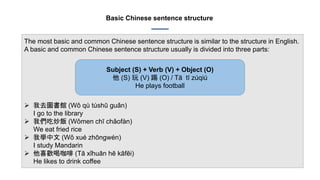
Basic Chinese sentence structure
The most basic and common Chinese sentence structure is similar to the structure in English.
A basic and common Chinese sentence structure usually is divided into three parts:
 我去圖書館 (Wǒ qù túshū guǎn)
I go to the library
 我們吃炒飯 (Wǒmen chī chǎofàn)
We eat fried rice
 我學中文 (Wǒ xué zhōngwén)
I study Mandarin
 他喜歡喝咖啡 (Tā xǐhuān hē kāfēi)
He likes to drink coffee
Subject (S) + Verb (V) + Object (O)
他 (S) 玩 (V) 踢 (O) / Tā tī zúqiú
He plays football
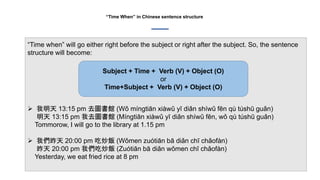
“Time When” in Chinese sentence structure
“Time when” will go either right before the subject or right after the subject. So, the sentence
structure will become:
 我明天 13:15 pm 去圖書館 (Wǒ míngtiān xiàwǔ yī diǎn shíwǔ fēn qù túshū guǎn)
明天 13:15 pm 我去圖書館 (Míngtiān xiàwǔ yī diǎn shíwǔ fēn, wǒ qù túshū guǎn)
Tommorow, I will go to the library at 1.15 pm
 我們昨天 20:00 pm 吃炒飯 (Wǒmen zuótiān bā diǎn chī chǎofàn)
昨天 20:00 pm 我們吃炒飯 (Zuótiān bā diǎn wǒmen chī chǎofàn)
Yesterday, we eat fried rice at 8 pm
Subject + Time + Verb (V) + Object (O)
or
Time+Subject + Verb (V) + Object (O)
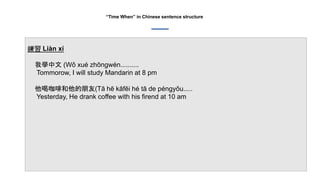
“Time When” in Chinese sentence structure
練習 Liàn xí
我學中文 (Wǒ xué zhōngwén..........
Tommorow, I will study Mandarin at 8 pm
他喝咖啡和他的朋友(Tā hē kāfēi hé tā de péngyǒu.....
Yesterday, He drank coffee with his firend at 10 am
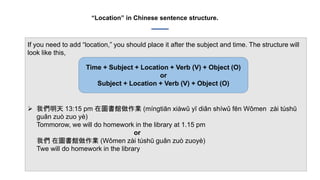
“Location” in Chinese sentence structure.
If you need to add “location,” you should place it after the subject and time. The structure will
look like this,
 我們明天 13:15 pm 在圖書館做作業 (míngtiān xiàwǔ yī diǎn shíwǔ fēn Wǒmen zài túshū
guǎn zuò zuo yè)
Tommorow, we will do homework in the library at 1.15 pm
or
我們 在圖書館做作業 (Wǒmen zài túshū guǎn zuò zuoyè)
Twe will do homework in the library
Time + Subject + Location + Verb (V) + Object (O)
or
Subject + Location + Verb (V) + Object (O)
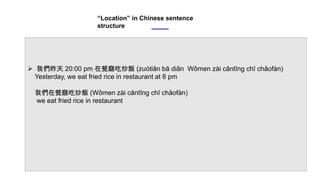
“Location” in Chinese sentence
structure
 我們昨天 20:00 pm 在餐廳吃炒飯 (zuótiān bā diǎn Wǒmen zài cāntīng chī chǎofàn)
Yesterday, we eat fried rice in restaurant at 8 pm
我們在餐廳吃炒飯 (Wǒmen zài cāntīng chī chǎofàn)
we eat fried rice in restaurant
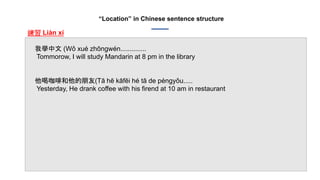
“Location” in Chinese sentence structure
練習 Liàn xí
我學中文 (Wǒ xué zhōngwén..............
Tommorow, I will study Mandarin at 8 pm in the library
他喝咖啡和他的朋友(Tā hē kāfēi hé tā de péngyǒu.....
Yesterday, He drank coffee with his firend at 10 am in restaurant
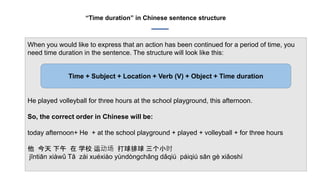
“Time duration” in Chinese sentence structure
When you would like to express that an action has been continued for a period of time, you
need time duration in the sentence. The structure will look like this:
He played volleyball for three hours at the school playground, this afternoon.
So, the correct order in Chinese will be:
today afternoon+ He + at the school playground + played + volleyball + for three hours
他 今天 下午 在 学校 运动场 打球排球 三个小时
jīntiān xiàwǔ Tā zài xuéxiào yùndòngchǎng dǎqiú páiqiú sān gè xiǎoshí
Time + Subject + Location + Verb (V) + Object + Time duration
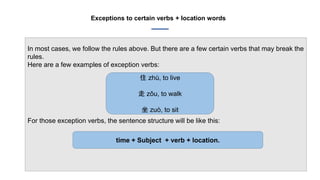
Exceptions to certain verbs + location words
In most cases, we follow the rules above. But there are a few certain verbs that may break the
rules.
Here are a few examples of exception verbs:
For those exception verbs, the sentence structure will be like this:
住 zhù, to live
走 zǒu, to walk
坐 zuò, to sit
time + Subject + verb + location.
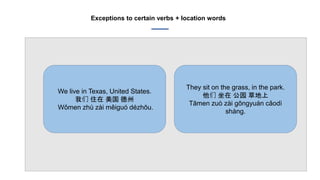
Exceptions to certain verbs + location words
We live in Texas, United States.
我们 住在 美国 德州
Wǒmen zhù zài měiguó dézhōu.
They sit on the grass, in the park.
他们 坐在 公园 草地上
Tāmen zuò zài gōngyuán cǎodì
shàng.
Exceptions to certain verbs + location words
We live in Texas, United States.
我们 住在 美国 德州
Wǒmen zhù zài měiguó dézhōu.
They sit on the grass, in the park.
他们 坐在 公园 草地上
Tāmen zuò zài gōngyuán cǎodì
shàng.
練習 Liàn xí
Saya tinggal di Padang Indonesia
Kemarin sore pukul 3 sore, saya dan teman berjalan ke taman
Xièxiè
謝謝

Chinese Sentence Structure.pptx

  • 1.
  • 2.
    1 Basic Chinesesentence structure 2 “Time When” in Chinese sentence structure 3 “Location” in Chinese sentence structure. CONTENT 4 “Time duration” in Chinese sentence structure 5 Exceptions to certain verbs + location words.
  • 3.
    Basic Chinese sentencestructure The most basic and common Chinese sentence structure is similar to the structure in English. A basic and common Chinese sentence structure usually is divided into three parts:  我去圖書館 (Wǒ qù túshū guǎn) I go to the library  我們吃炒飯 (Wǒmen chī chǎofàn) We eat fried rice  我學中文 (Wǒ xué zhōngwén) I study Mandarin  他喜歡喝咖啡 (Tā xǐhuān hē kāfēi) He likes to drink coffee Subject (S) + Verb (V) + Object (O) 他 (S) 玩 (V) 踢 (O) / Tā tī zúqiú He plays football
  • 4.
    “Time When” inChinese sentence structure “Time when” will go either right before the subject or right after the subject. So, the sentence structure will become:  我明天 13:15 pm 去圖書館 (Wǒ míngtiān xiàwǔ yī diǎn shíwǔ fēn qù túshū guǎn) 明天 13:15 pm 我去圖書館 (Míngtiān xiàwǔ yī diǎn shíwǔ fēn, wǒ qù túshū guǎn) Tommorow, I will go to the library at 1.15 pm  我們昨天 20:00 pm 吃炒飯 (Wǒmen zuótiān bā diǎn chī chǎofàn) 昨天 20:00 pm 我們吃炒飯 (Zuótiān bā diǎn wǒmen chī chǎofàn) Yesterday, we eat fried rice at 8 pm Subject + Time + Verb (V) + Object (O) or Time+Subject + Verb (V) + Object (O)
  • 5.
    “Time When” inChinese sentence structure 練習 Liàn xí 我學中文 (Wǒ xué zhōngwén.......... Tommorow, I will study Mandarin at 8 pm 他喝咖啡和他的朋友(Tā hē kāfēi hé tā de péngyǒu..... Yesterday, He drank coffee with his firend at 10 am
  • 6.
    “Location” in Chinesesentence structure. If you need to add “location,” you should place it after the subject and time. The structure will look like this,  我們明天 13:15 pm 在圖書館做作業 (míngtiān xiàwǔ yī diǎn shíwǔ fēn Wǒmen zài túshū guǎn zuò zuo yè) Tommorow, we will do homework in the library at 1.15 pm or 我們 在圖書館做作業 (Wǒmen zài túshū guǎn zuò zuoyè) Twe will do homework in the library Time + Subject + Location + Verb (V) + Object (O) or Subject + Location + Verb (V) + Object (O)
  • 7.
    “Location” in Chinesesentence structure  我們昨天 20:00 pm 在餐廳吃炒飯 (zuótiān bā diǎn Wǒmen zài cāntīng chī chǎofàn) Yesterday, we eat fried rice in restaurant at 8 pm 我們在餐廳吃炒飯 (Wǒmen zài cāntīng chī chǎofàn) we eat fried rice in restaurant
  • 8.
    “Location” in Chinesesentence structure 練習 Liàn xí 我學中文 (Wǒ xué zhōngwén.............. Tommorow, I will study Mandarin at 8 pm in the library 他喝咖啡和他的朋友(Tā hē kāfēi hé tā de péngyǒu..... Yesterday, He drank coffee with his firend at 10 am in restaurant
  • 9.
    “Time duration” inChinese sentence structure When you would like to express that an action has been continued for a period of time, you need time duration in the sentence. The structure will look like this: He played volleyball for three hours at the school playground, this afternoon. So, the correct order in Chinese will be: today afternoon+ He + at the school playground + played + volleyball + for three hours 他 今天 下午 在 学校 运动场 打球排球 三个小时 jīntiān xiàwǔ Tā zài xuéxiào yùndòngchǎng dǎqiú páiqiú sān gè xiǎoshí Time + Subject + Location + Verb (V) + Object + Time duration
  • 10.
    Exceptions to certainverbs + location words In most cases, we follow the rules above. But there are a few certain verbs that may break the rules. Here are a few examples of exception verbs: For those exception verbs, the sentence structure will be like this: 住 zhù, to live 走 zǒu, to walk 坐 zuò, to sit time + Subject + verb + location.
  • 11.
    Exceptions to certainverbs + location words We live in Texas, United States. 我们 住在 美国 德州 Wǒmen zhù zài měiguó dézhōu. They sit on the grass, in the park. 他们 坐在 公园 草地上 Tāmen zuò zài gōngyuán cǎodì shàng.
  • 12.
    Exceptions to certainverbs + location words We live in Texas, United States. 我们 住在 美国 德州 Wǒmen zhù zài měiguó dézhōu. They sit on the grass, in the park. 他们 坐在 公园 草地上 Tāmen zuò zài gōngyuán cǎodì shàng. 練習 Liàn xí Saya tinggal di Padang Indonesia Kemarin sore pukul 3 sore, saya dan teman berjalan ke taman
  • 13.