Embedding success in your business www.avnet-emb.eu
“The year of the Internet of Things” - this is how many
commentators are now describing 2014, and with good
reason. The number of internet-connected devices
that are not smartphones, tablets or computers has
skyrocketed in recent times.
According to opinion from Silicon Labs, for
example, PCs were the first 100-million-unit-
per-year market in the electronics industry
- but the IoT is poised to become the first
computing market to reach 10 billion units per
year.
Gartner have extrapolated this several
steps further, predicting 26 billion internet-
connected devices (again, excluding PCs,
tablets and smartphones) by 2020.
But there is a caveat. As Gartner have also noted, this
predicted growth in the Internet of Things is “predicated
upon device manufacturers investing in innovation in
this area, and their ability to realize a meaningful return
on investment.”
So will we see device manufacturers (often OEMs, in our
parlance) expanding their hardware production to embrace
intelligent coffee machines, fridges, engines, and all the other
paraphernalia of the populist vision of the IoT, or are there other
IoT-related opportunities that they should be focusing on?
As ever, the answer to the question is complex.
Nick Donaldson, Director, Software, EMEA - Avnet Embedded nick.donaldson@avnet-embedded.eu
Introduction
Firstly, let us consider one potentially huge barrier to
the widespread propagation of the IoT – the fact that
every “thing” (device) “speaks” a different language, and
therefore communicates online in a different way.
This confusion creates significant challenges for OEMs and
other partners who wish to benefit from the (hardware)
opportunities offered by the IoT. Applications have to be
device-specific, meaning that developers have to have
knowledge of multiple device languages if they want to
build applications for multiple devices.
In reality, what this means is that OEMs need to pay for
more developers (the EU application developer workforce is
projected by GIGAOM to reach 4.8 million by 2020!)
And since the type of device is very often specific to a
limited number of market sectors, or even just one, this
lack of a unifying IoT device “translator” means that OEMs
can’t go after revenue opportunities in new markets without
hiring new developers each time. As expansion goes, it’s a
rather unscalable option.
The babble of the IoT
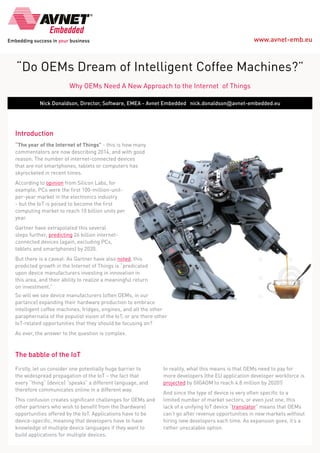
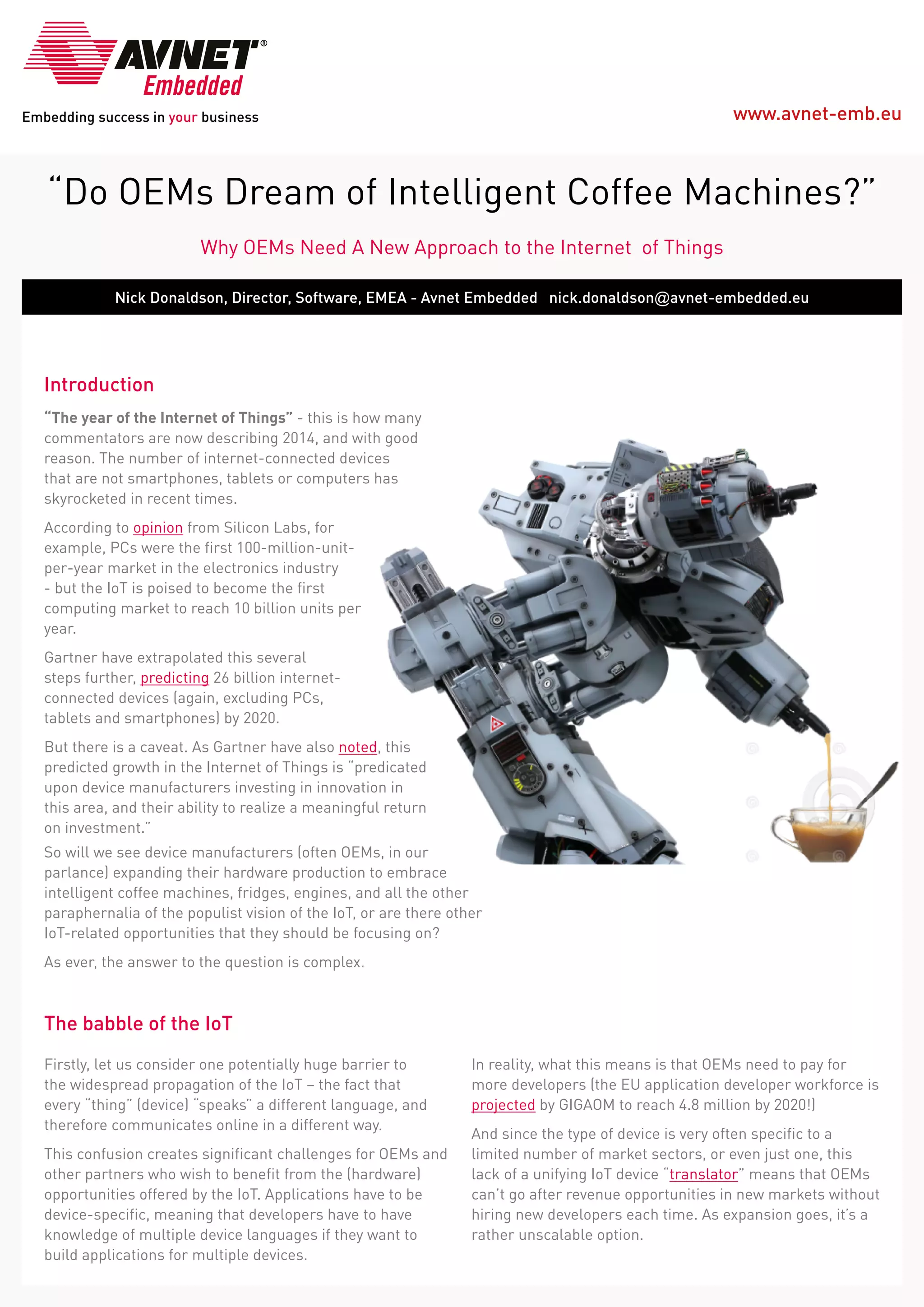
“Do OEMs Dream of Intelligent Coffee Machines?”
Why OEMs Need A New Approach to the Internet of Things
Happily, the IoT market is showing signs of emerging from
this rut, thanks to some recent innovations. One company,
for example, DQuid, has shown how it is possible to create
a universal IoT “translator” - a small module that can be
fitted to practically any electrical object to transform it into
an IoT-capable device.
Clearly, the future for a technology like this – and the OEMs
who could use it to break into new product markets – is
potentially immense. But the ramifications go deeper even
than that: the ability to create one common IoT “tongue”
means that one developer can now build applications for
multiple IoT-connected devices.
Using fewer developers, and at lower cost, an IoT
“ecosystem” can be built that enables OEMs to rapidly “IoT-
ise” and resell any kind of device in any kind of market.
Whatever markets OEMs currently focus on – from digital
signage, to automotive, to biometrics, and surveillance,
to healthcare, and everything else before, after and in
between – they should be looking long and hard at the new
opportunities to diversify their portfolio that the burgeoning
IoT ecosystem brings.
The emergence of an IoT ecosystem
Yet despite these undeniably exciting developments, the
consensus that comes through strongest in all the market
research and commentary that I’ve read is this: in the
words of Laurie Wurster, Gartner’s Research Director:
“...the hyper-growth of IoT will require a rethinking
of manufacturers’ underlying business models...IoT
transforms all hardware and appliance OEMs into software
providers.”
What exactly does she mean by this? She continues:
“Licensing and entitlement management technology
provides the locking capabilities that enable manufacturers
to protect and monetize the embedded software IP running
on connected intelligent devices.”
In other words, what the IoT seemingly makes possible is
a fundamental switch in many OEMs’ value proposition.
Historically, end-user utility resided principally in the
products that the OEMs built – the enabling software within
them, however fundamental to the successful functioning
of the product, was a secondary play. At best, it was a
source of recurring licensing revenue to complement the
one-off ticket price of the product itself.
Cue a complete reversal in the gameplan. In the IoT
universe, products are no longer necessarily complex items
of hardware for which a big ticket price can be charged.
Indeed, as I have discussed above, they may simply be
domestic electricals, fitted with a DQuid IoT-enabling
module or similar, and sold on.
Big-ticket hardware items will continue to be in demand,
of course, but if OEMs really want to capitalise on the IoT
at both ends of the market and all points in between, they
need to be looking to new ways to sell the value in the
software that links the device to the IoT, rather than in the
physical device itself.
Or, as Wurster puts it: “Device manufacturers faced
with increasing global competitive pressure to reduce
manufacturing costs that produce thinner margins can
leverage the value created with Internet-connected
products to increase revenue. However, to secure additional
revenue, manufacturers need to recognize the role
embedded software and/or software applications play in
the IoT, and monetize this value.”
“Similar to the traditional software industry, device
manufacturers need to protect the intellectual property
contained in applications and monetize it through the
adoption of licensing and entitlement management
systems that control access to the Internet-connected
device, its functions and features.”
In short, the IoT is going to force OEMs to be less about
building hardware that contains software, and more
about reaping the fruits of the software that runs on
the hardware! Potentially, any action that that software
performs, any data it generates or stores, any analytics that
it can be used to produce, are all chargeable services.
Incorporate these into a managed service/cloud-type
model, where those services are 100% controllable and
therefore 100% monetisable by the OEM, and it’s not
difficult to see why hardware is now arguably a passenger,
even if it’s not quite been relegated to the back seat.
From hard to soft: change is afoot
“Device manufacturers faced with increasing global competitive pressure to reduce manufacturing
costs that produce thinner margins can leverage the value created with Internet-connected products
to increase revenue. However, to secure additional revenue, manufacturers need to recognize the
role embedded software and/or software applications play in the IoT, and monetize this value.’”
- Laurie Wurster, Research Director, Gartner.
When it comes to sizing these new software and services-
driven OEM opportunities, opinions are (inevitably) divided.
But a paper by Harbor Research – The Emergence of Smart
Systems – suggests that the IoT is part of a much wider
“smart systems” market, the value of which is potentially
staggering.
It is predicted to grow from $275 billion in 2013 to $873
billion in 2018. Investment in these same smart systems
is likely to represent as much as 20% of all ICT investment
within the next five years.
There can be little doubt: the IoT and its associated
developments open up a whole new world of opportunties
for OEMs, but only if they’re prepared to temper their
hardware-driven, big-ticket-dependent business with the
opportunities that the software outputs from IoT-enabled
devices (and particularly, as Gartner note, embedded
software) now present.
Indeed, it seems that, in some quarters, one of the biggest
barrier to OEMs exploiting the opportunities of the IoT is
perceived to be the OEMs themselves.
To quote Wurster again: “The adoption of licensing
and entitlement management may be inhibited by
the inexperience of many device manufacturers with
software.... Many manufacturers still apply a traditional
‘box’ mentality to their products, and fail to take into
account additional revenue opportunities that licensing-
controlled embedded software and software applications
deliver.”
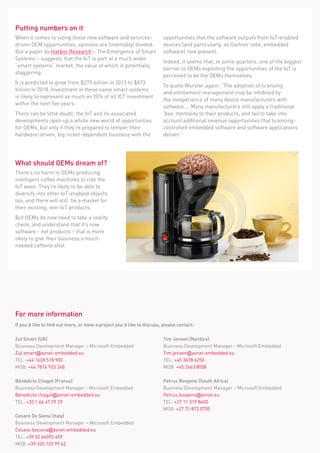
There’s no harm in OEMs producing
intelligent coffee machines to ride the
IoT wave. They’re likely to be able to
diversify into other IoT-enabled objects
too, and there will still be a market for
their existing, non-IoT products.
But OEMs do now need to take a reality
check, and understand that it’s now
software - not products - that is more
likely to give their business a much-
needed caffeine shot.
Putting numbers on it
What should OEMs dream of?
Zul Smart (UK)
Business Development Manager – Microsoft Embedded
Zul.smart@avnet-embedded.eu
TEL: +44 1628 518 900
MOB: +44 7816 933 248
Bénédicte Chagot (France)
Business Development Manager - Microsoft Embedded
Benedicte.chagot@avnet-embedded.eu
TEL: +33 1 64 47 29 29
Cesare De Siena (Italy)
Business Development Manager – Microsoft Embedded
Cesare.desiena@avnet-embedded.eu
TEL: +39 02 66092 459
MOB: +39 335 120 99 62
Tim Jensen (Nordics)
Business Development Manager - Microsoft Embedded
Tim.jensen@avnet-embedded.eu
TEL: +45 3678 6250
MOB: +45 2463 8008
Petrus Booyens (South Africa)
Business Development Manager – Microsoft Embedded
Petrus.booyens@avnet.eu
TEL: +27 11 319 8600
MOB: +27 71 872 0705
For more information
If you’d like to find out more, or have a project you’d like to discuss, please contact:

AVNET_TL_OEM_DREAMS

  • 1.
    Embedding success inyour business www.avnet-emb.eu “The year of the Internet of Things” - this is how many commentators are now describing 2014, and with good reason. The number of internet-connected devices that are not smartphones, tablets or computers has skyrocketed in recent times. According to opinion from Silicon Labs, for example, PCs were the first 100-million-unit- per-year market in the electronics industry - but the IoT is poised to become the first computing market to reach 10 billion units per year. Gartner have extrapolated this several steps further, predicting 26 billion internet- connected devices (again, excluding PCs, tablets and smartphones) by 2020. But there is a caveat. As Gartner have also noted, this predicted growth in the Internet of Things is “predicated upon device manufacturers investing in innovation in this area, and their ability to realize a meaningful return on investment.” So will we see device manufacturers (often OEMs, in our parlance) expanding their hardware production to embrace intelligent coffee machines, fridges, engines, and all the other paraphernalia of the populist vision of the IoT, or are there other IoT-related opportunities that they should be focusing on? As ever, the answer to the question is complex. Nick Donaldson, Director, Software, EMEA - Avnet Embedded nick.donaldson@avnet-embedded.eu Introduction Firstly, let us consider one potentially huge barrier to the widespread propagation of the IoT – the fact that every “thing” (device) “speaks” a different language, and therefore communicates online in a different way. This confusion creates significant challenges for OEMs and other partners who wish to benefit from the (hardware) opportunities offered by the IoT. Applications have to be device-specific, meaning that developers have to have knowledge of multiple device languages if they want to build applications for multiple devices. In reality, what this means is that OEMs need to pay for more developers (the EU application developer workforce is projected by GIGAOM to reach 4.8 million by 2020!) And since the type of device is very often specific to a limited number of market sectors, or even just one, this lack of a unifying IoT device “translator” means that OEMs can’t go after revenue opportunities in new markets without hiring new developers each time. As expansion goes, it’s a rather unscalable option. The babble of the IoT “Do OEMs Dream of Intelligent Coffee Machines?” Why OEMs Need A New Approach to the Internet of Things
  • 2.
    Happily, the IoTmarket is showing signs of emerging from this rut, thanks to some recent innovations. One company, for example, DQuid, has shown how it is possible to create a universal IoT “translator” - a small module that can be fitted to practically any electrical object to transform it into an IoT-capable device. Clearly, the future for a technology like this – and the OEMs who could use it to break into new product markets – is potentially immense. But the ramifications go deeper even than that: the ability to create one common IoT “tongue” means that one developer can now build applications for multiple IoT-connected devices. Using fewer developers, and at lower cost, an IoT “ecosystem” can be built that enables OEMs to rapidly “IoT- ise” and resell any kind of device in any kind of market. Whatever markets OEMs currently focus on – from digital signage, to automotive, to biometrics, and surveillance, to healthcare, and everything else before, after and in between – they should be looking long and hard at the new opportunities to diversify their portfolio that the burgeoning IoT ecosystem brings. The emergence of an IoT ecosystem Yet despite these undeniably exciting developments, the consensus that comes through strongest in all the market research and commentary that I’ve read is this: in the words of Laurie Wurster, Gartner’s Research Director: “...the hyper-growth of IoT will require a rethinking of manufacturers’ underlying business models...IoT transforms all hardware and appliance OEMs into software providers.” What exactly does she mean by this? She continues: “Licensing and entitlement management technology provides the locking capabilities that enable manufacturers to protect and monetize the embedded software IP running on connected intelligent devices.” In other words, what the IoT seemingly makes possible is a fundamental switch in many OEMs’ value proposition. Historically, end-user utility resided principally in the products that the OEMs built – the enabling software within them, however fundamental to the successful functioning of the product, was a secondary play. At best, it was a source of recurring licensing revenue to complement the one-off ticket price of the product itself. Cue a complete reversal in the gameplan. In the IoT universe, products are no longer necessarily complex items of hardware for which a big ticket price can be charged. Indeed, as I have discussed above, they may simply be domestic electricals, fitted with a DQuid IoT-enabling module or similar, and sold on. Big-ticket hardware items will continue to be in demand, of course, but if OEMs really want to capitalise on the IoT at both ends of the market and all points in between, they need to be looking to new ways to sell the value in the software that links the device to the IoT, rather than in the physical device itself. Or, as Wurster puts it: “Device manufacturers faced with increasing global competitive pressure to reduce manufacturing costs that produce thinner margins can leverage the value created with Internet-connected products to increase revenue. However, to secure additional revenue, manufacturers need to recognize the role embedded software and/or software applications play in the IoT, and monetize this value.” “Similar to the traditional software industry, device manufacturers need to protect the intellectual property contained in applications and monetize it through the adoption of licensing and entitlement management systems that control access to the Internet-connected device, its functions and features.” In short, the IoT is going to force OEMs to be less about building hardware that contains software, and more about reaping the fruits of the software that runs on the hardware! Potentially, any action that that software performs, any data it generates or stores, any analytics that it can be used to produce, are all chargeable services. Incorporate these into a managed service/cloud-type model, where those services are 100% controllable and therefore 100% monetisable by the OEM, and it’s not difficult to see why hardware is now arguably a passenger, even if it’s not quite been relegated to the back seat. From hard to soft: change is afoot “Device manufacturers faced with increasing global competitive pressure to reduce manufacturing costs that produce thinner margins can leverage the value created with Internet-connected products to increase revenue. However, to secure additional revenue, manufacturers need to recognize the role embedded software and/or software applications play in the IoT, and monetize this value.’” - Laurie Wurster, Research Director, Gartner.
  • 3.
    When it comesto sizing these new software and services- driven OEM opportunities, opinions are (inevitably) divided. But a paper by Harbor Research – The Emergence of Smart Systems – suggests that the IoT is part of a much wider “smart systems” market, the value of which is potentially staggering. It is predicted to grow from $275 billion in 2013 to $873 billion in 2018. Investment in these same smart systems is likely to represent as much as 20% of all ICT investment within the next five years. There can be little doubt: the IoT and its associated developments open up a whole new world of opportunties for OEMs, but only if they’re prepared to temper their hardware-driven, big-ticket-dependent business with the opportunities that the software outputs from IoT-enabled devices (and particularly, as Gartner note, embedded software) now present. Indeed, it seems that, in some quarters, one of the biggest barrier to OEMs exploiting the opportunities of the IoT is perceived to be the OEMs themselves. To quote Wurster again: “The adoption of licensing and entitlement management may be inhibited by the inexperience of many device manufacturers with software.... Many manufacturers still apply a traditional ‘box’ mentality to their products, and fail to take into account additional revenue opportunities that licensing- controlled embedded software and software applications deliver.” There’s no harm in OEMs producing intelligent coffee machines to ride the IoT wave. They’re likely to be able to diversify into other IoT-enabled objects too, and there will still be a market for their existing, non-IoT products. But OEMs do now need to take a reality check, and understand that it’s now software - not products - that is more likely to give their business a much- needed caffeine shot. Putting numbers on it What should OEMs dream of? Zul Smart (UK) Business Development Manager – Microsoft Embedded Zul.smart@avnet-embedded.eu TEL: +44 1628 518 900 MOB: +44 7816 933 248 Bénédicte Chagot (France) Business Development Manager - Microsoft Embedded Benedicte.chagot@avnet-embedded.eu TEL: +33 1 64 47 29 29 Cesare De Siena (Italy) Business Development Manager – Microsoft Embedded Cesare.desiena@avnet-embedded.eu TEL: +39 02 66092 459 MOB: +39 335 120 99 62 Tim Jensen (Nordics) Business Development Manager - Microsoft Embedded Tim.jensen@avnet-embedded.eu TEL: +45 3678 6250 MOB: +45 2463 8008 Petrus Booyens (South Africa) Business Development Manager – Microsoft Embedded Petrus.booyens@avnet.eu TEL: +27 11 319 8600 MOB: +27 71 872 0705 For more information If you’d like to find out more, or have a project you’d like to discuss, please contact: