NAME :- AVIRUP RAY
ROLL NO :- 18700219054
DEPARTMENT :- INFORMATION TECHNOLOGY
SEMESTER :- 7TH
SUBJECT CODE :- PEC-IT-702F
Because they can
 A large fraction of hacker attacks have been pranks
Financial Gain
Espionage
Venting anger at a company or organization
Terrorism
• Active Attacks
• Denial of Service
• Breaking into a site
• Intelligence Gathering
• Resource Usage
• Deception
• Passive Attacks
• Sniffing
• Passwords
• Network Traffic
• Sensitive Information
• Information Gathering
• Over the Internet
• Over LAN
• Locally
• Offline
• Theft
• Deception
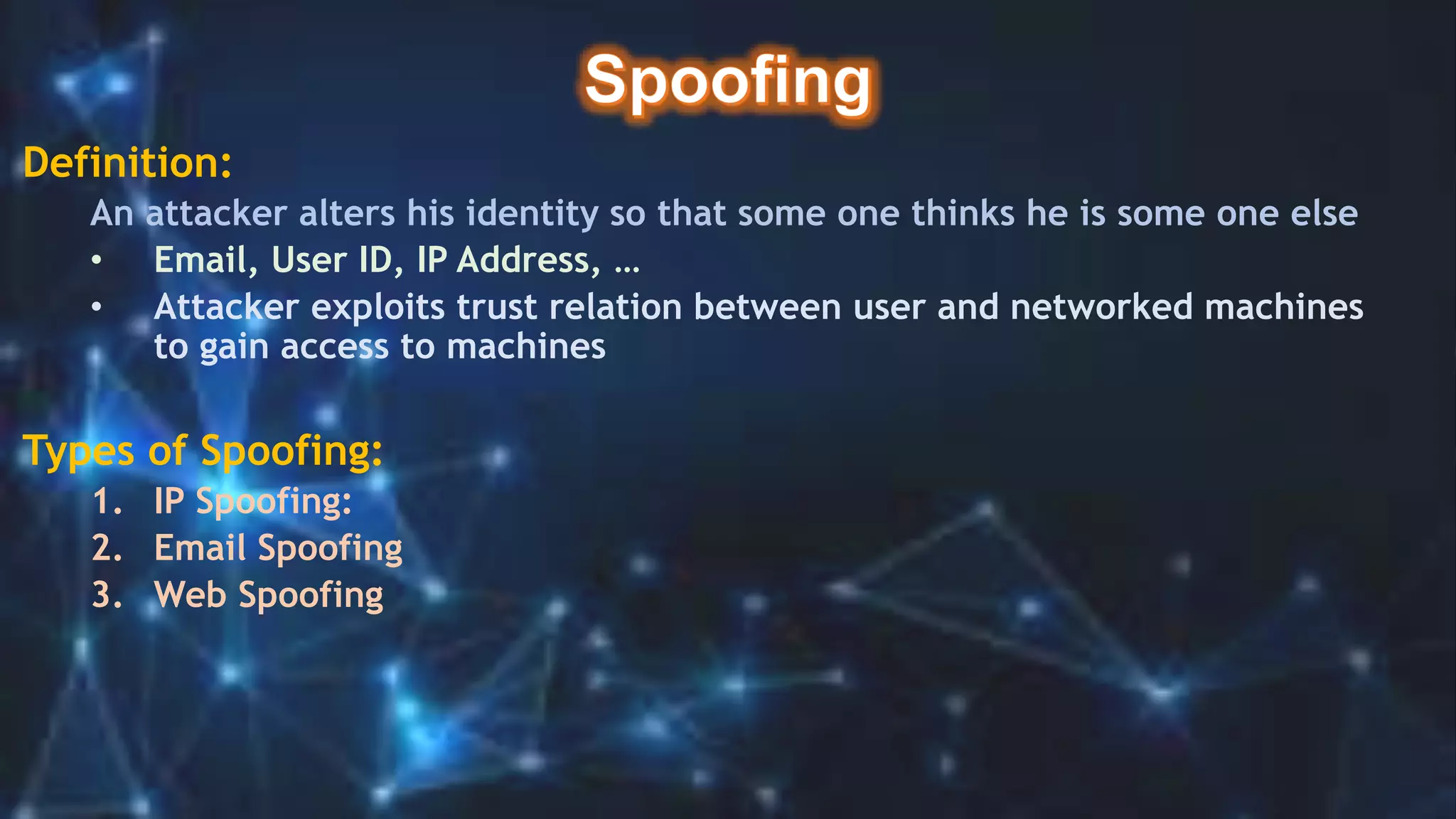
Definition:
An attacker alters his identity so that some one thinks he is some one else
• Email, User ID, IP Address, …
• Attacker exploits trust relation between user and networked machines
to gain access to machines
Types of Spoofing:
1. IP Spoofing:
2. Email Spoofing
3. Web Spoofing
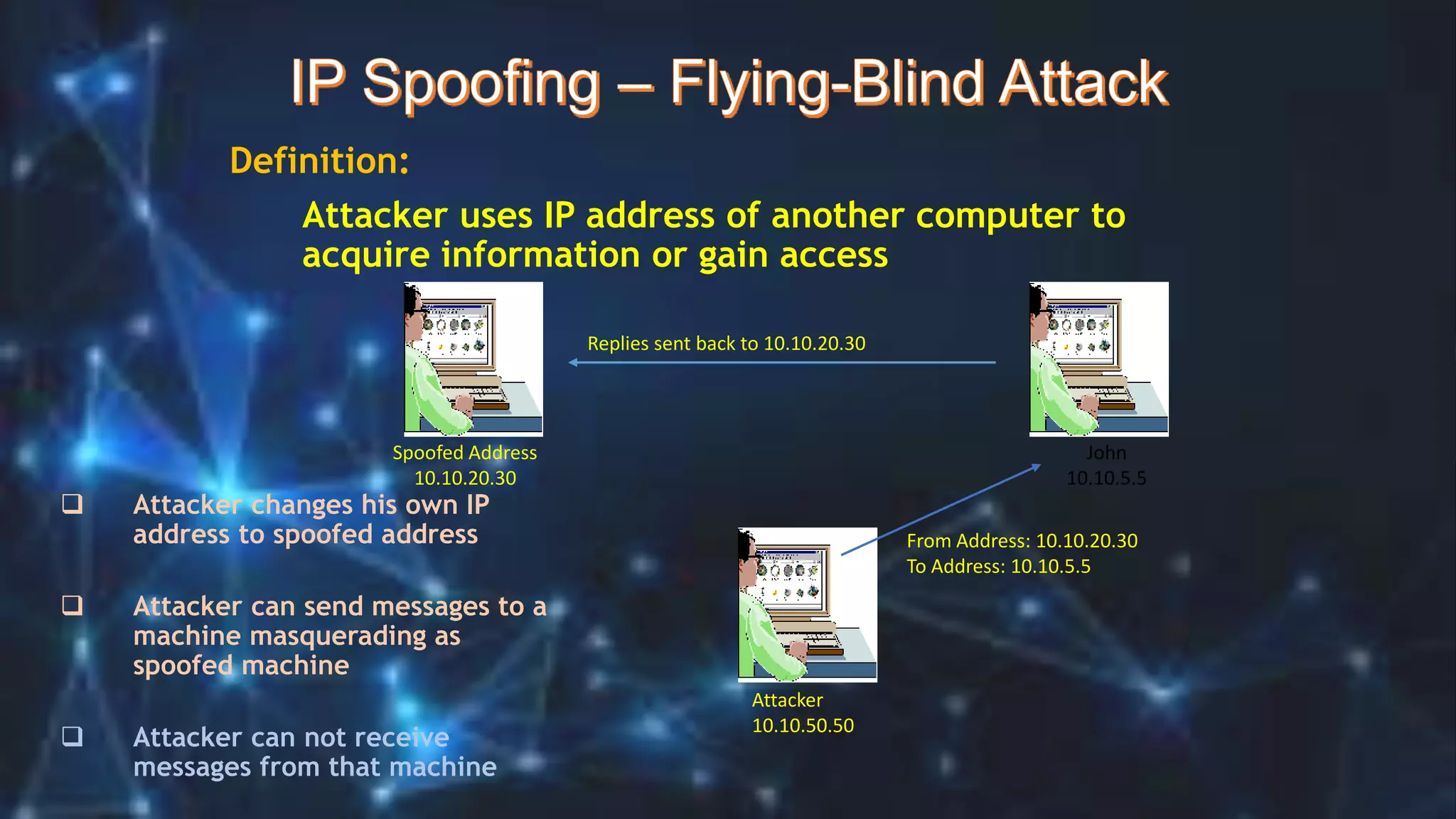
Definition:
Attacker uses IP address of another computer to
acquire information or gain access
Replies sent back to 10.10.20.30
Spoofed Address
10.10.20.30
Attacker
10.10.50.50
John
10.10.5.5
From Address: 10.10.20.30
To Address: 10.10.5.5
 Attacker changes his own IP
address to spoofed address
 Attacker can send messages to a
machine masquerading as
spoofed machine
 Attacker can not receive
messages from that machine
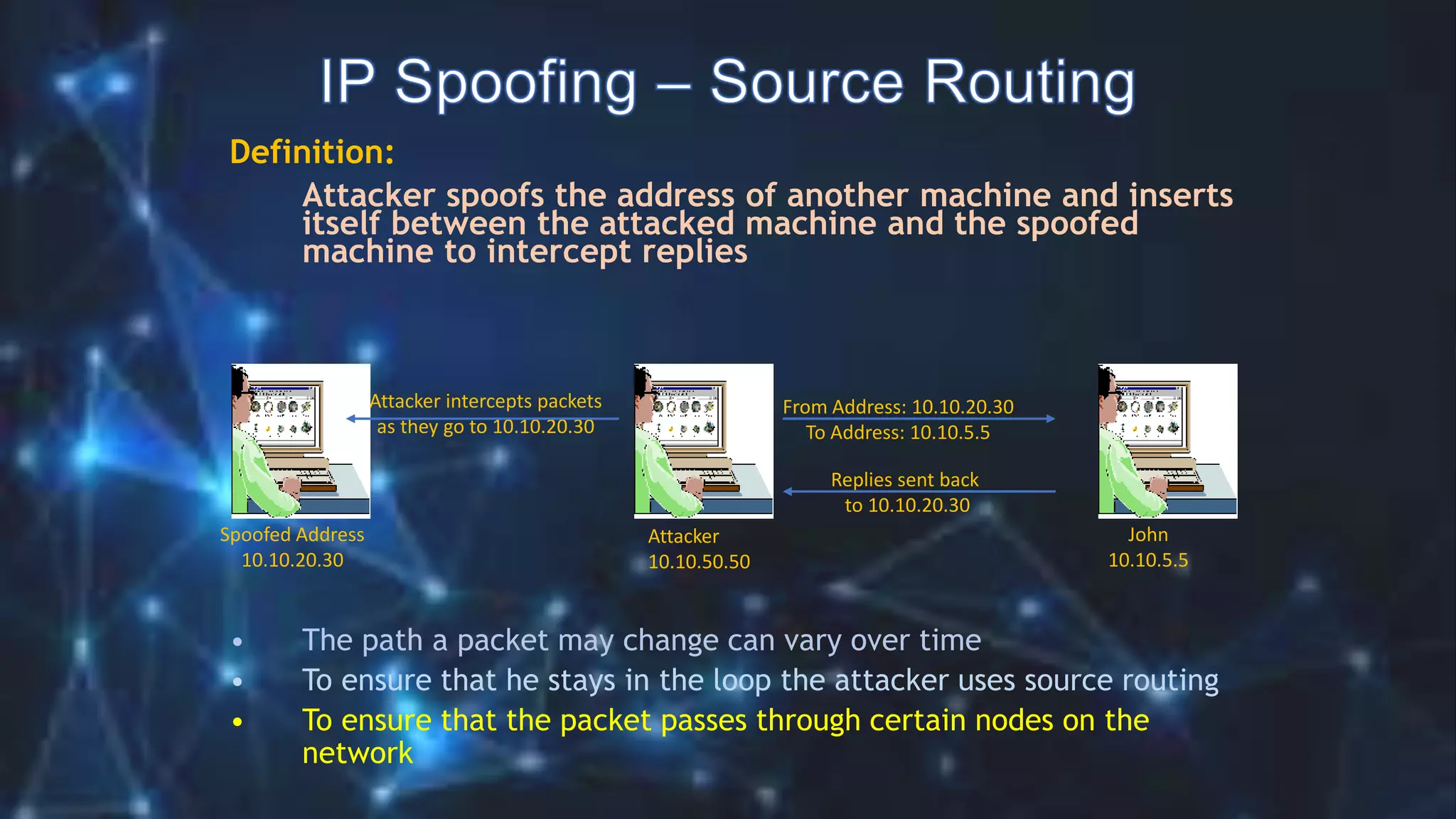
Definition:
Attacker spoofs the address of another machine and inserts
itself between the attacked machine and the spoofed
machine to intercept replies
Replies sent back
to 10.10.20.30
Spoofed Address
10.10.20.30
Attacker
10.10.50.50
John
10.10.5.5
From Address: 10.10.20.30
To Address: 10.10.5.5
• The path a packet may change can vary over time
• To ensure that he stays in the loop the attacker uses source routing
• To ensure that the packet passes through certain nodes on the
network
Attacker intercepts packets
as they go to 10.10.20.30
Definition:
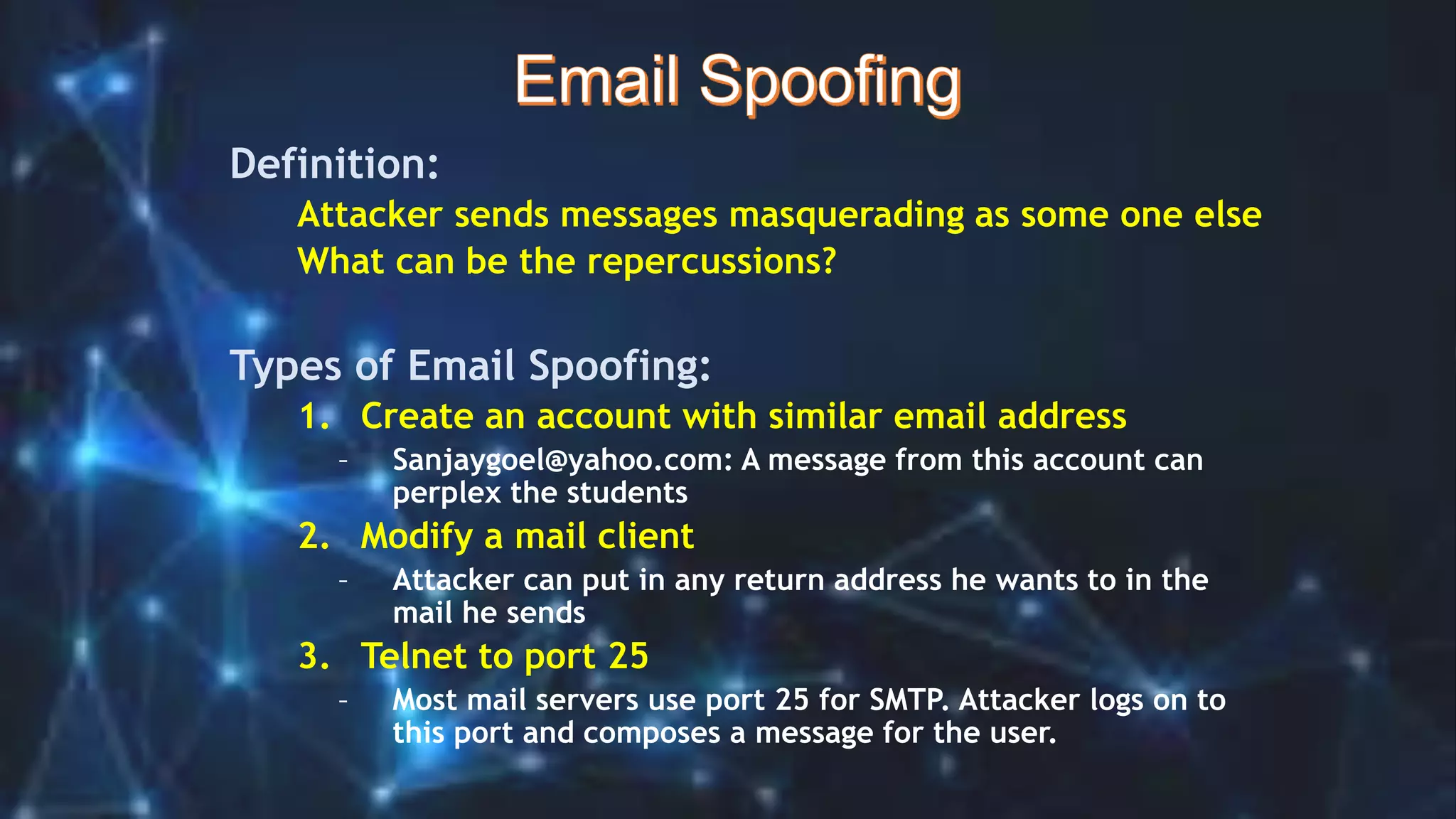
Attacker sends messages masquerading as some one else
What can be the repercussions?
Types of Email Spoofing:
1. Create an account with similar email address
– Sanjaygoel@yahoo.com: A message from this account can
perplex the students
2. Modify a mail client
– Attacker can put in any return address he wants to in the
mail he sends
3. Telnet to port 25
– Most mail servers use port 25 for SMTP. Attacker logs on to
this port and composes a message for the user.
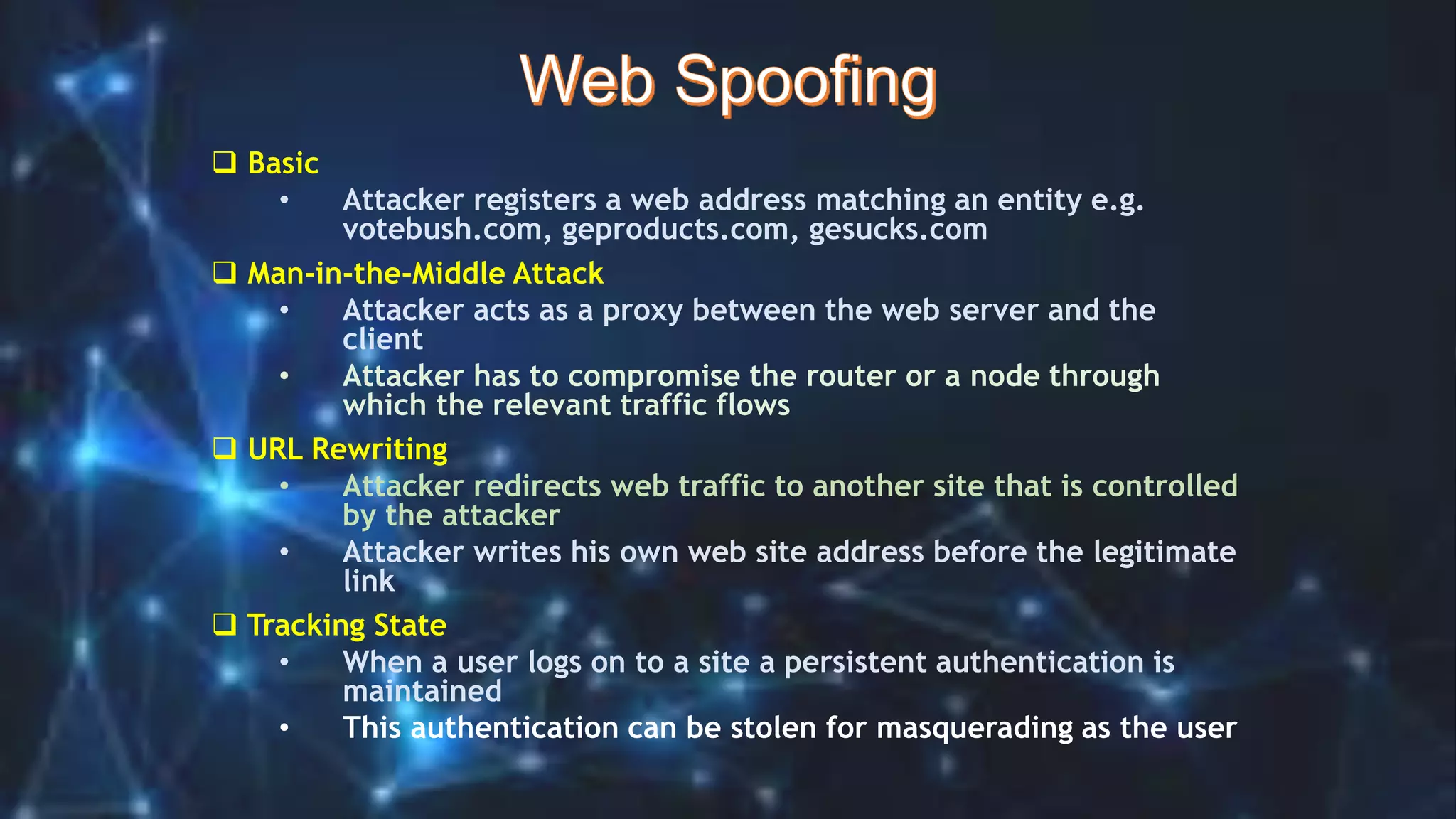
 Basic
• Attacker registers a web address matching an entity e.g.
votebush.com, geproducts.com, gesucks.com
 Man-in-the-Middle Attack
• Attacker acts as a proxy between the web server and the
client
• Attacker has to compromise the router or a node through
which the relevant traffic flows
 URL Rewriting
• Attacker redirects web traffic to another site that is controlled
by the attacker
• Attacker writes his own web site address before the legitimate
link
 Tracking State
• When a user logs on to a site a persistent authentication is
maintained
• This authentication can be stolen for masquerading as the user
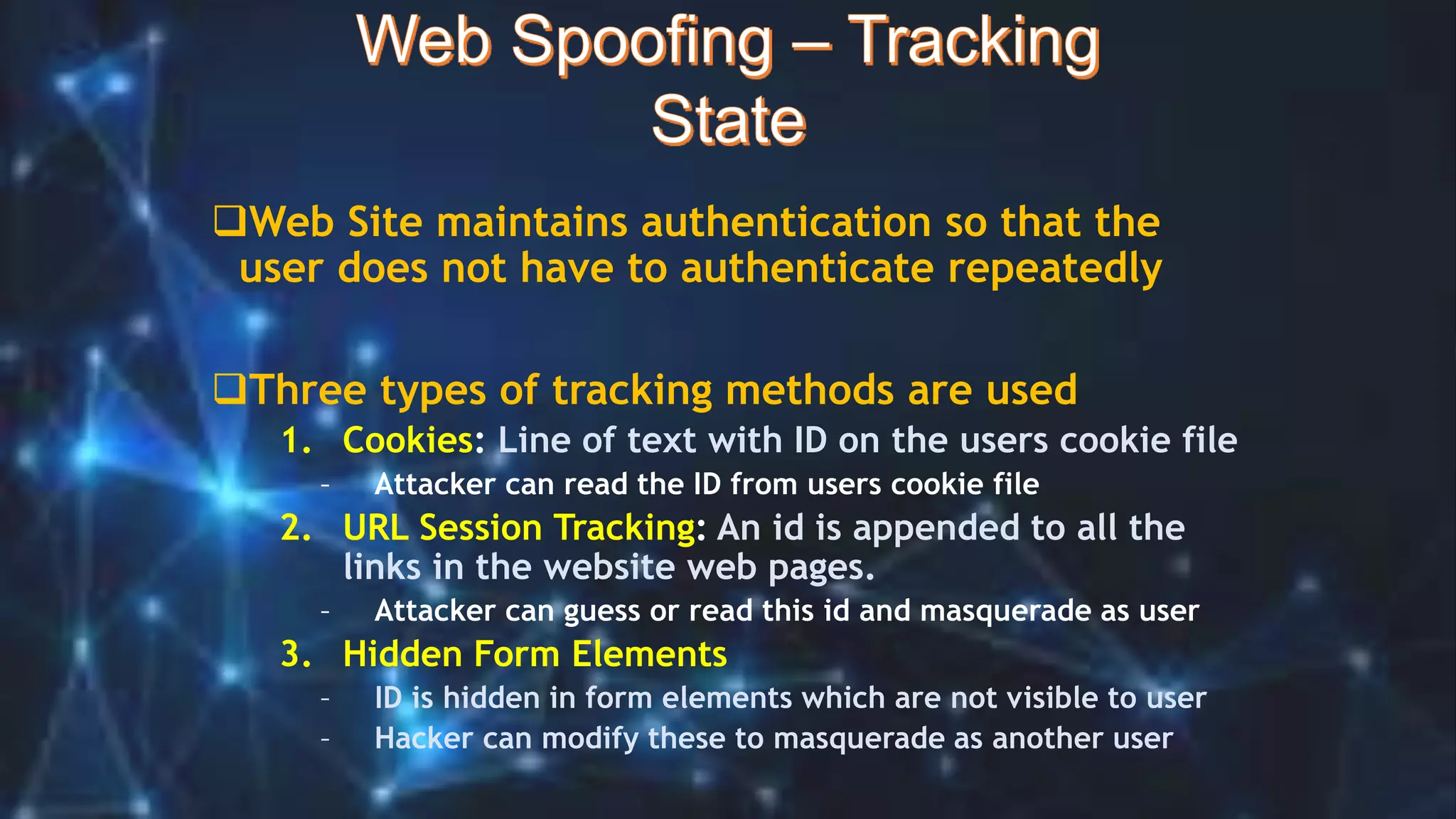
Web Site maintains authentication so that the
user does not have to authenticate repeatedly
Three types of tracking methods are used
1. Cookies: Line of text with ID on the users cookie file
– Attacker can read the ID from users cookie file
2. URL Session Tracking: An id is appended to all the
links in the website web pages.
– Attacker can guess or read this id and masquerade as user
3. Hidden Form Elements
– ID is hidden in form elements which are not visible to user
– Hacker can modify these to masquerade as another user
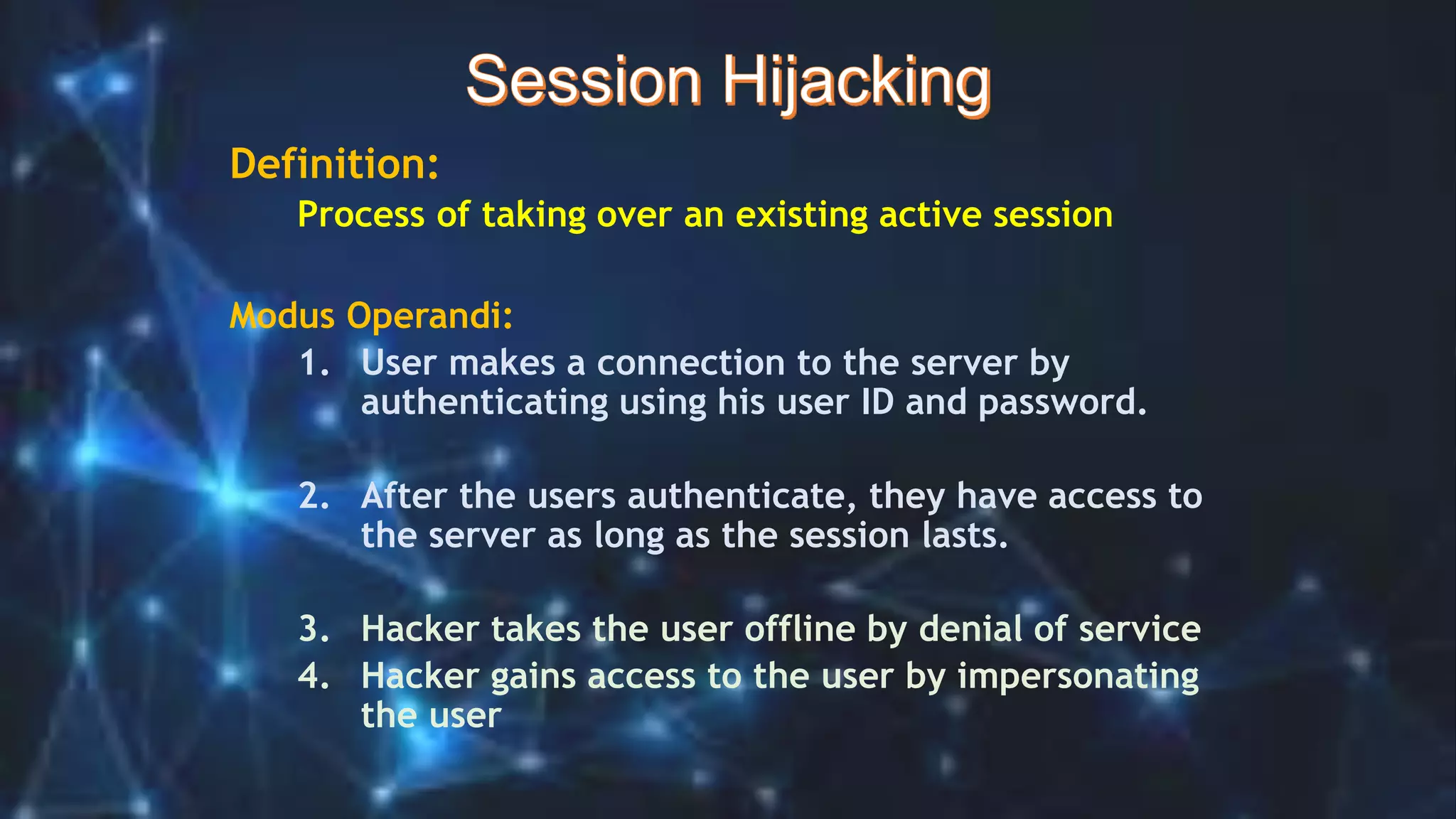
Definition:
Process of taking over an existing active session
Modus Operandi:
1. User makes a connection to the server by
authenticating using his user ID and password.
2. After the users authenticate, they have access to
the server as long as the session lasts.
3. Hacker takes the user offline by denial of service
4. Hacker gains access to the user by impersonating
the user
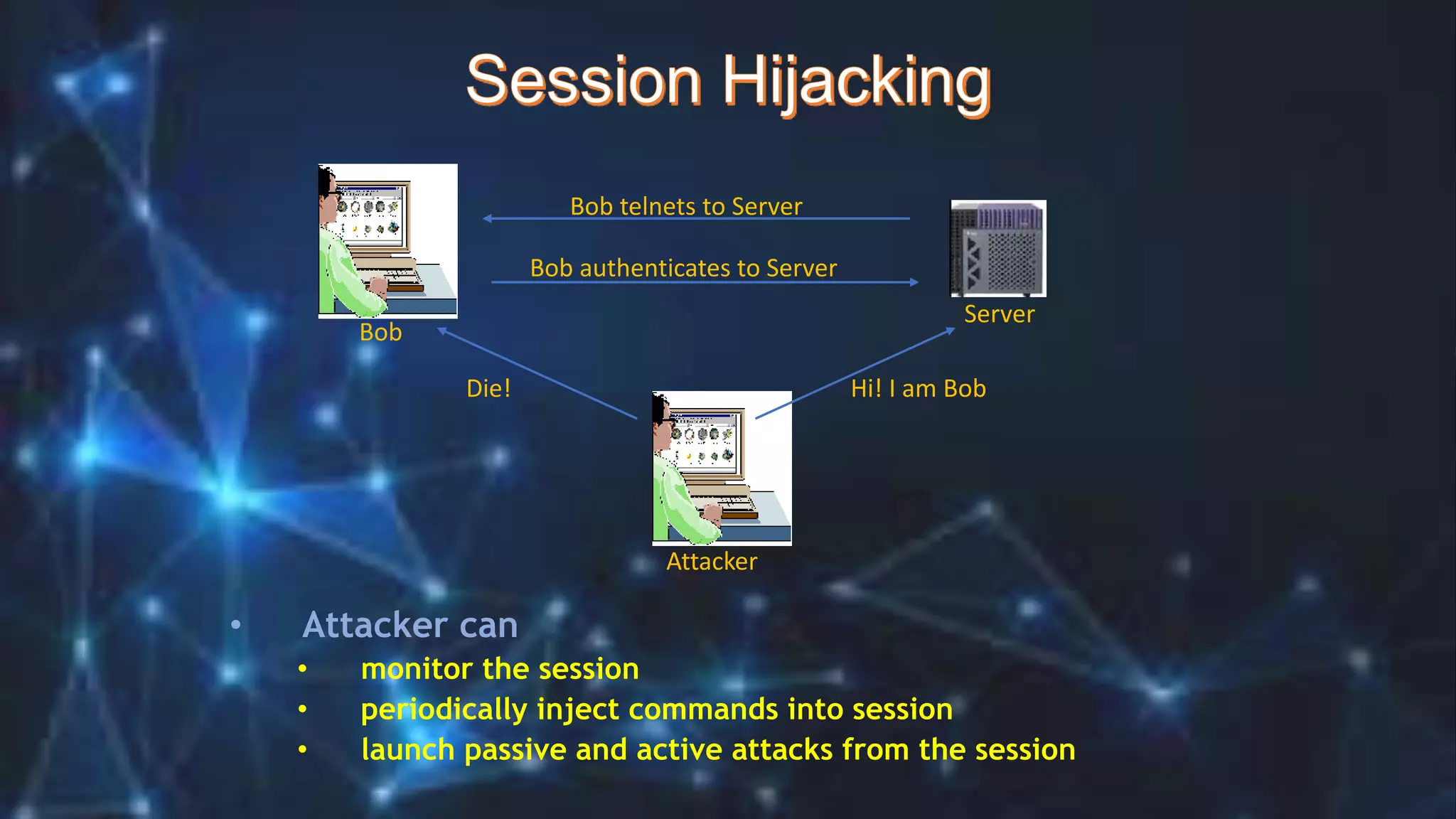
• Attacker can
• monitor the session
• periodically inject commands into session
• launch passive and active attacks from the session
Bob telnets to Server
Bob authenticates to Server
Bob
Attacker
Server
Die! Hi! I am Bob
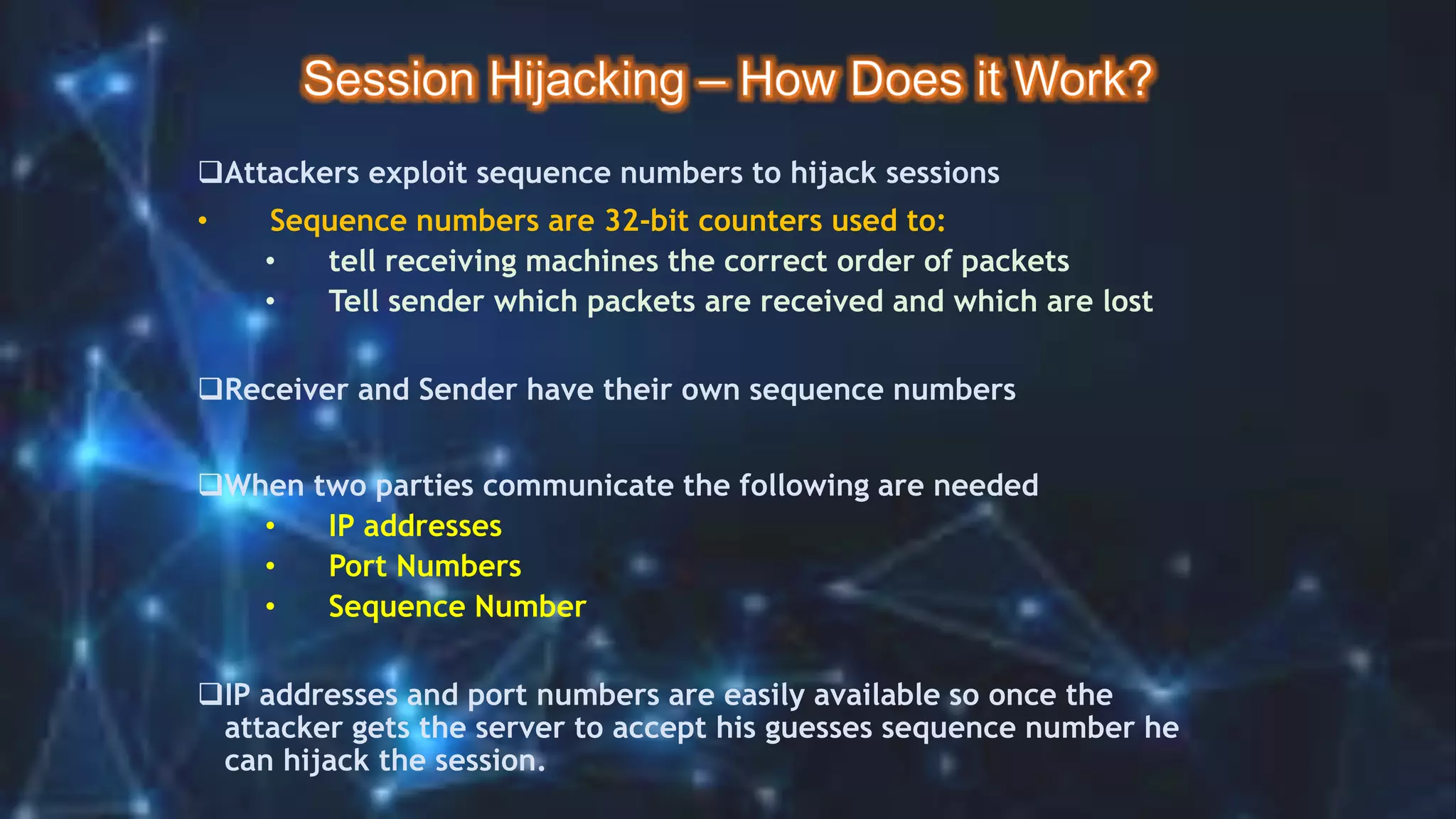
Attackers exploit sequence numbers to hijack sessions
• Sequence numbers are 32-bit counters used to:
• tell receiving machines the correct order of packets
• Tell sender which packets are received and which are lost
Receiver and Sender have their own sequence numbers
When two parties communicate the following are needed
• IP addresses
• Port Numbers
• Sequence Number
IP addresses and port numbers are easily available so once the
attacker gets the server to accept his guesses sequence number he
can hijack the session.
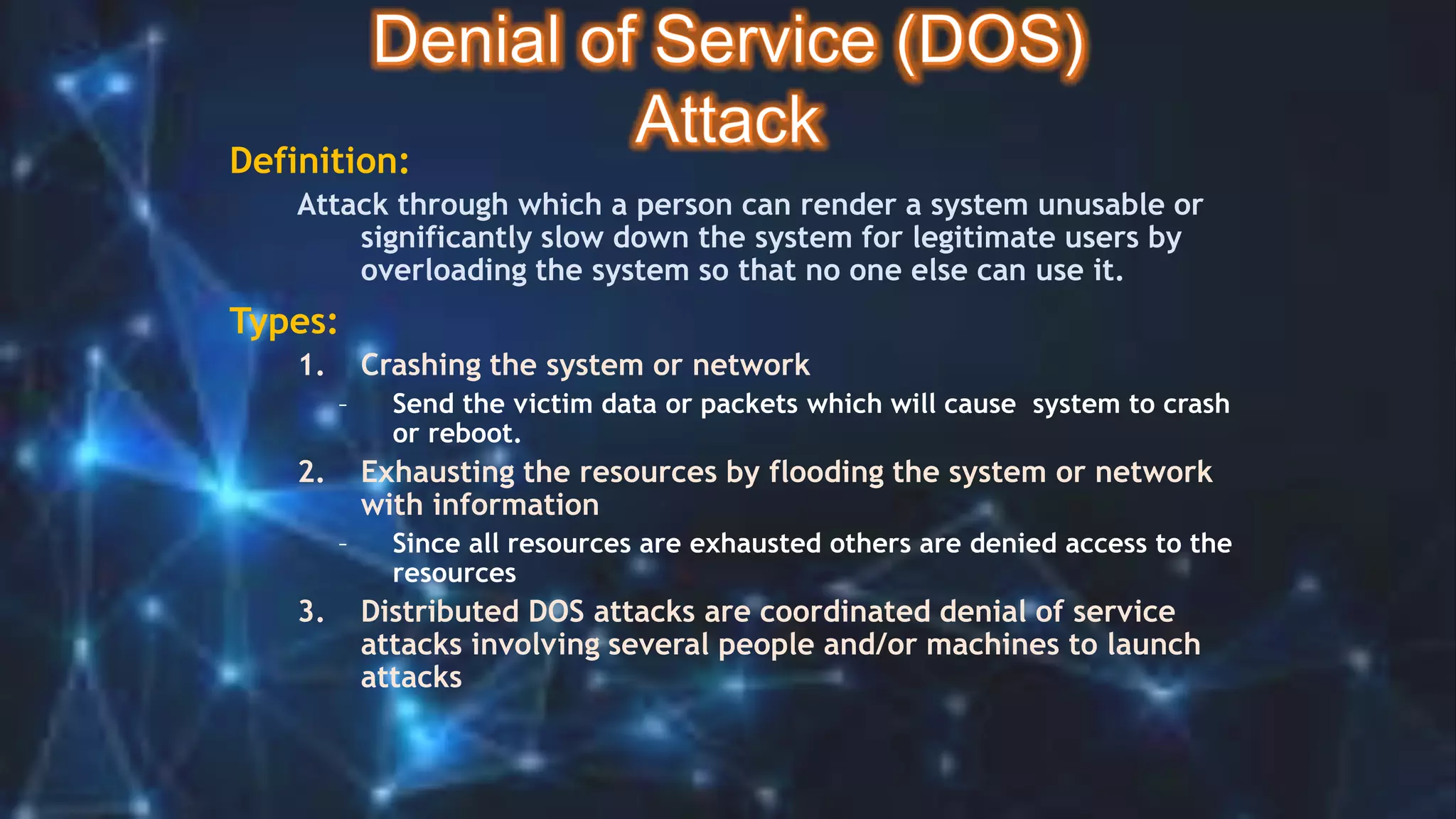
Definition:
Attack through which a person can render a system unusable or
significantly slow down the system for legitimate users by
overloading the system so that no one else can use it.
Types:
1. Crashing the system or network
– Send the victim data or packets which will cause system to crash
or reboot.
2. Exhausting the resources by flooding the system or network
with information
– Since all resources are exhausted others are denied access to the
resources
3. Distributed DOS attacks are coordinated denial of service
attacks involving several people and/or machines to launch
attacks
Types:
1. Ping of Death
2. SSPing
3. Land
4. Smurf
5. SYN Flood
6. CPU Hog
7. Win Nuke
8. RPC Locator
9. Jolt2
10. Bubonic
11. Microsoft Incomplete TCP/IP Packet Vulnerability
12. HP Openview Node Manager SNMP DOS Vulneability
13. Netscreen Firewall DOS Vulnerability
14. Checkpoint Firewall DOS Vulnerability
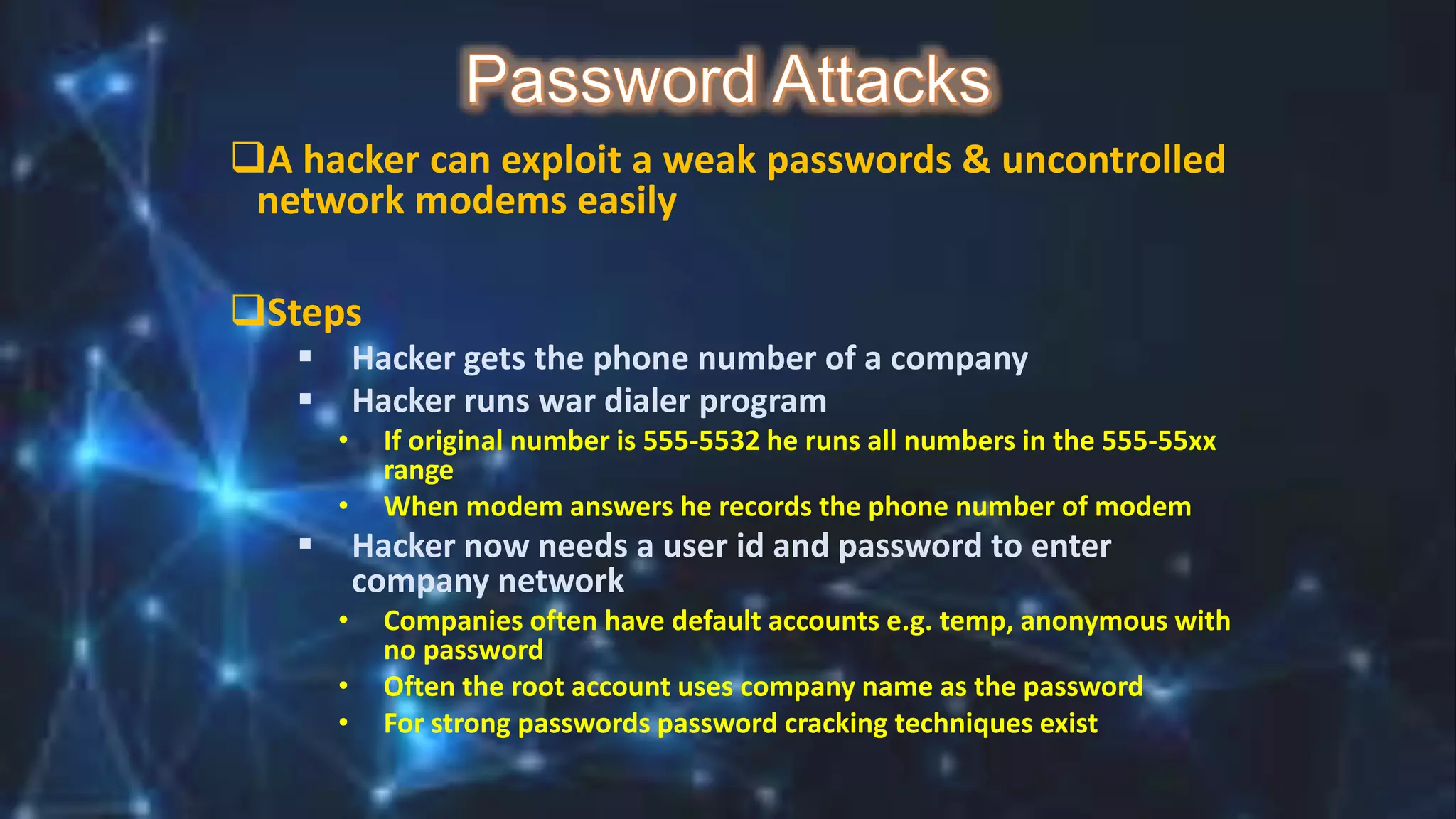
A hacker can exploit a weak passwords & uncontrolled
network modems easily
Steps
 Hacker gets the phone number of a company
 Hacker runs war dialer program
• If original number is 555-5532 he runs all numbers in the 555-55xx
range
• When modem answers he records the phone number of modem
 Hacker now needs a user id and password to enter
company network
• Companies often have default accounts e.g. temp, anonymous with
no password
• Often the root account uses company name as the password
• For strong passwords password cracking techniques exist
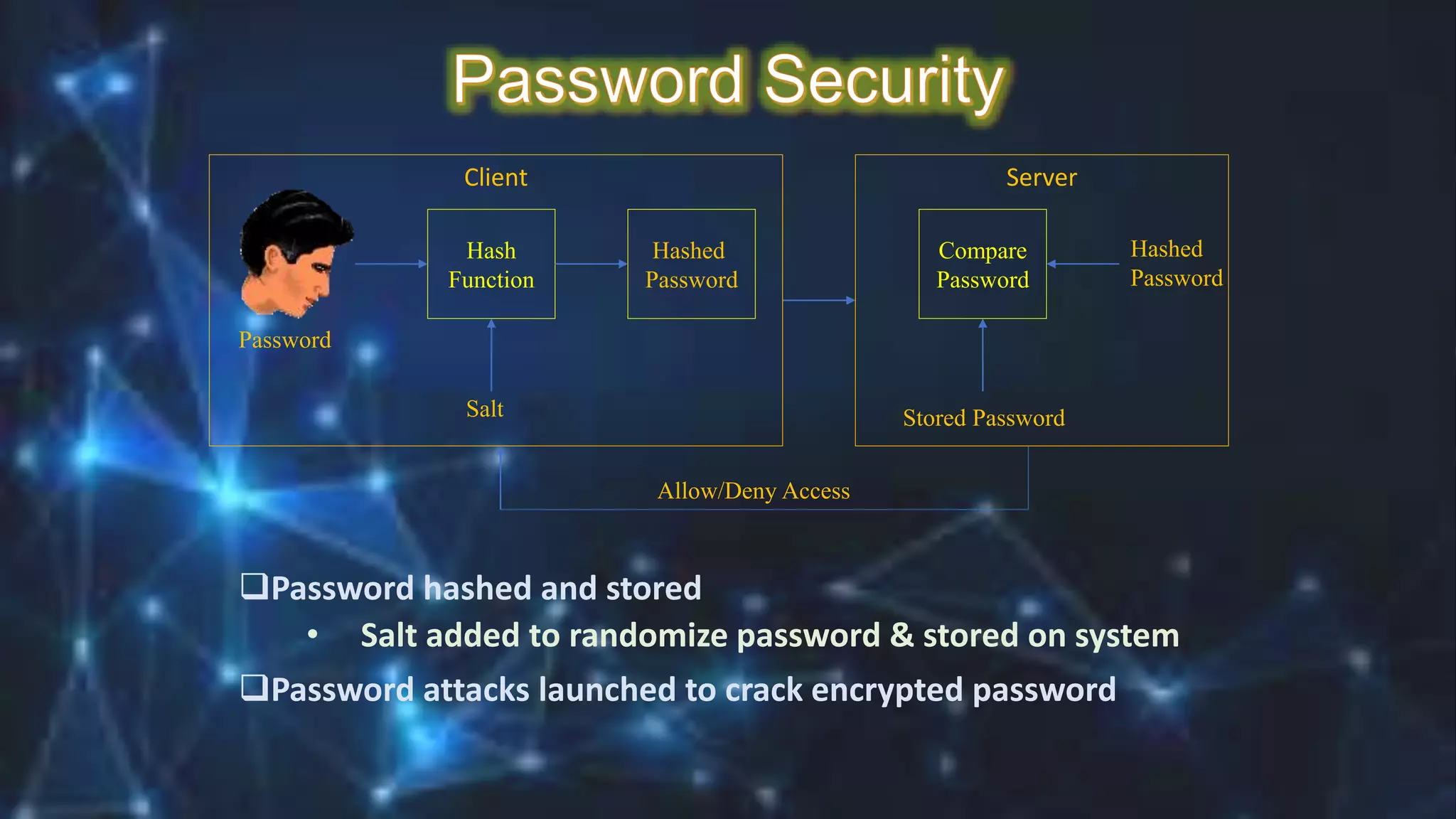
Password hashed and stored
• Salt added to randomize password & stored on system
Password attacks launched to crack encrypted password
Hash
Function
Hashed
Password
Salt
Compare
Password
Client
Password
Server
Stored Password
Hashed
Password
Allow/Deny Access
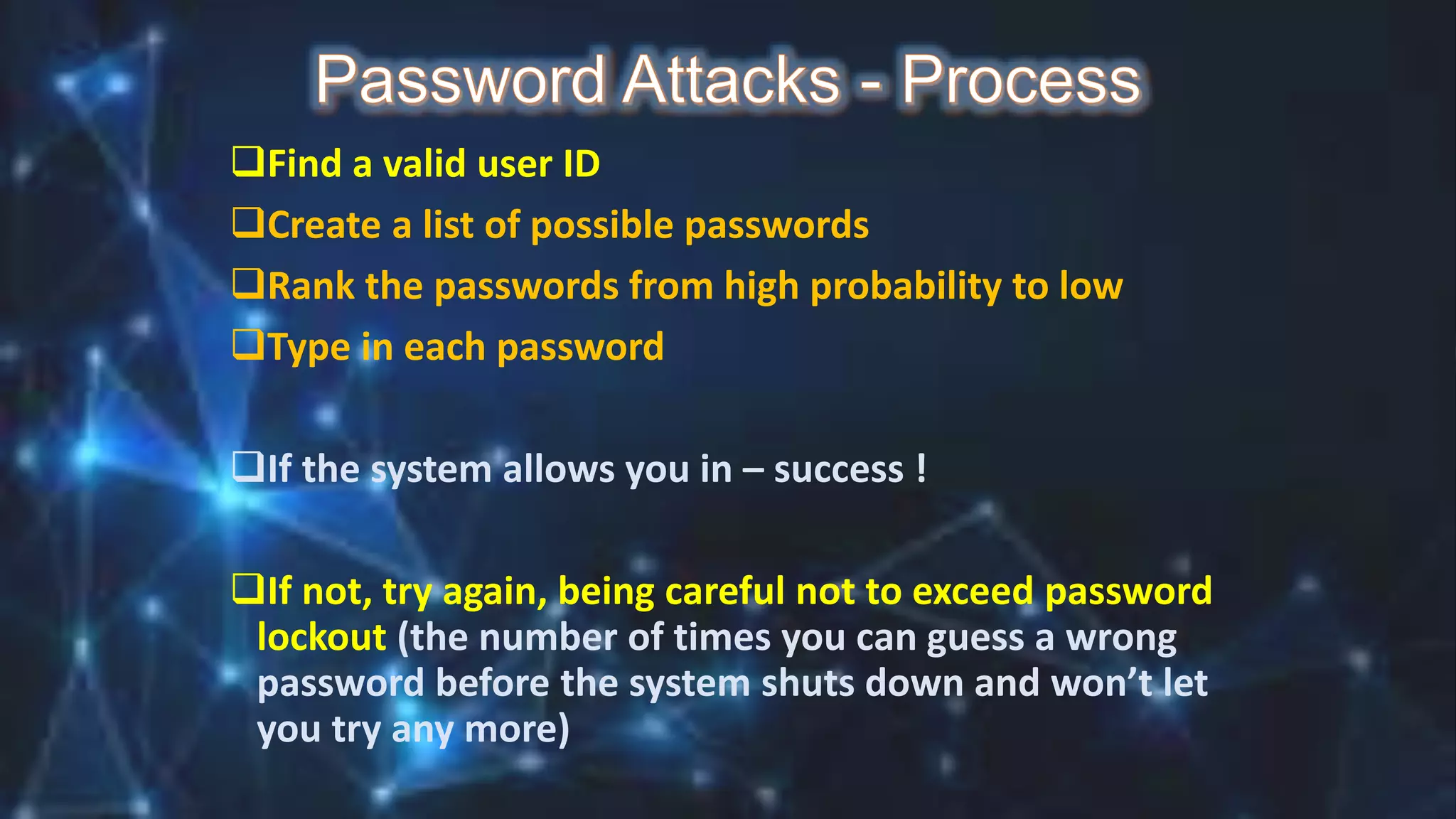
Find a valid user ID
Create a list of possible passwords
Rank the passwords from high probability to low
Type in each password
If the system allows you in – success !
If not, try again, being careful not to exceed password
lockout (the number of times you can guess a wrong
password before the system shuts down and won’t let
you try any more)
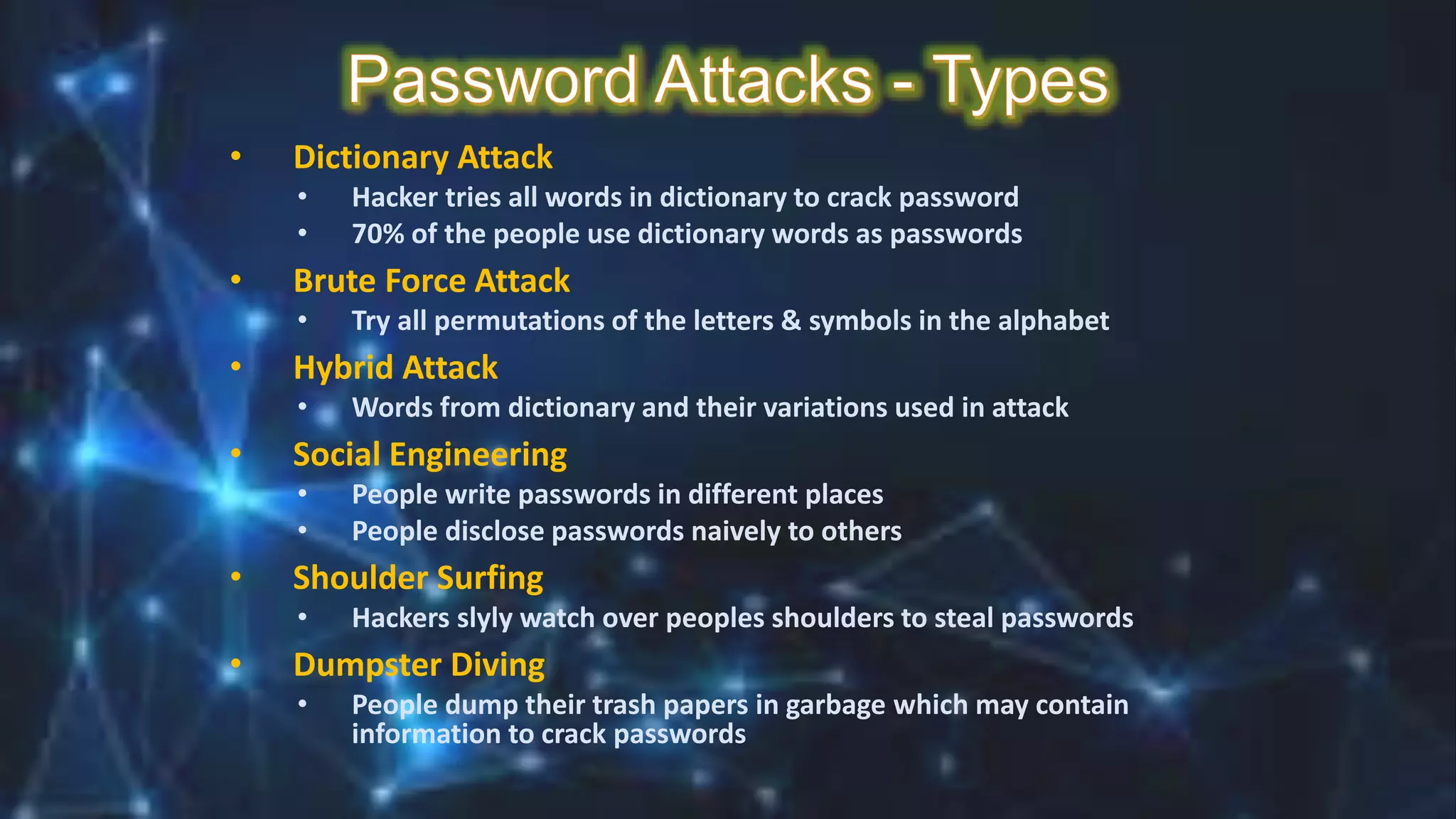
• Dictionary Attack
• Hacker tries all words in dictionary to crack password
• 70% of the people use dictionary words as passwords
• Brute Force Attack
• Try all permutations of the letters & symbols in the alphabet
• Hybrid Attack
• Words from dictionary and their variations used in attack
• Social Engineering
• People write passwords in different places
• People disclose passwords naively to others
• Shoulder Surfing
• Hackers slyly watch over peoples shoulders to steal passwords
• Dumpster Diving
• People dump their trash papers in garbage which may contain
information to crack passwords
Avirup_Ray_18700219054_Cyber_Security_1.pptx

Avirup_Ray_18700219054_Cyber_Security_1.pptx

  • 1.
    NAME :- AVIRUPRAY ROLL NO :- 18700219054 DEPARTMENT :- INFORMATION TECHNOLOGY SEMESTER :- 7TH SUBJECT CODE :- PEC-IT-702F
  • 3.
    Because they can A large fraction of hacker attacks have been pranks Financial Gain Espionage Venting anger at a company or organization Terrorism
  • 4.
    • Active Attacks •Denial of Service • Breaking into a site • Intelligence Gathering • Resource Usage • Deception • Passive Attacks • Sniffing • Passwords • Network Traffic • Sensitive Information • Information Gathering
  • 5.
    • Over theInternet • Over LAN • Locally • Offline • Theft • Deception
  • 6.
    Definition: An attacker altershis identity so that some one thinks he is some one else • Email, User ID, IP Address, … • Attacker exploits trust relation between user and networked machines to gain access to machines Types of Spoofing: 1. IP Spoofing: 2. Email Spoofing 3. Web Spoofing
  • 7.
    Definition: Attacker uses IPaddress of another computer to acquire information or gain access Replies sent back to 10.10.20.30 Spoofed Address 10.10.20.30 Attacker 10.10.50.50 John 10.10.5.5 From Address: 10.10.20.30 To Address: 10.10.5.5  Attacker changes his own IP address to spoofed address  Attacker can send messages to a machine masquerading as spoofed machine  Attacker can not receive messages from that machine
  • 8.
    Definition: Attacker spoofs theaddress of another machine and inserts itself between the attacked machine and the spoofed machine to intercept replies Replies sent back to 10.10.20.30 Spoofed Address 10.10.20.30 Attacker 10.10.50.50 John 10.10.5.5 From Address: 10.10.20.30 To Address: 10.10.5.5 • The path a packet may change can vary over time • To ensure that he stays in the loop the attacker uses source routing • To ensure that the packet passes through certain nodes on the network Attacker intercepts packets as they go to 10.10.20.30
  • 9.
    Definition: Attacker sends messagesmasquerading as some one else What can be the repercussions? Types of Email Spoofing: 1. Create an account with similar email address – Sanjaygoel@yahoo.com: A message from this account can perplex the students 2. Modify a mail client – Attacker can put in any return address he wants to in the mail he sends 3. Telnet to port 25 – Most mail servers use port 25 for SMTP. Attacker logs on to this port and composes a message for the user.
  • 10.
     Basic • Attackerregisters a web address matching an entity e.g. votebush.com, geproducts.com, gesucks.com  Man-in-the-Middle Attack • Attacker acts as a proxy between the web server and the client • Attacker has to compromise the router or a node through which the relevant traffic flows  URL Rewriting • Attacker redirects web traffic to another site that is controlled by the attacker • Attacker writes his own web site address before the legitimate link  Tracking State • When a user logs on to a site a persistent authentication is maintained • This authentication can be stolen for masquerading as the user
  • 11.
    Web Site maintainsauthentication so that the user does not have to authenticate repeatedly Three types of tracking methods are used 1. Cookies: Line of text with ID on the users cookie file – Attacker can read the ID from users cookie file 2. URL Session Tracking: An id is appended to all the links in the website web pages. – Attacker can guess or read this id and masquerade as user 3. Hidden Form Elements – ID is hidden in form elements which are not visible to user – Hacker can modify these to masquerade as another user
  • 12.
    Definition: Process of takingover an existing active session Modus Operandi: 1. User makes a connection to the server by authenticating using his user ID and password. 2. After the users authenticate, they have access to the server as long as the session lasts. 3. Hacker takes the user offline by denial of service 4. Hacker gains access to the user by impersonating the user
  • 13.
    • Attacker can •monitor the session • periodically inject commands into session • launch passive and active attacks from the session Bob telnets to Server Bob authenticates to Server Bob Attacker Server Die! Hi! I am Bob
  • 14.
    Attackers exploit sequencenumbers to hijack sessions • Sequence numbers are 32-bit counters used to: • tell receiving machines the correct order of packets • Tell sender which packets are received and which are lost Receiver and Sender have their own sequence numbers When two parties communicate the following are needed • IP addresses • Port Numbers • Sequence Number IP addresses and port numbers are easily available so once the attacker gets the server to accept his guesses sequence number he can hijack the session.
  • 15.
    Definition: Attack through whicha person can render a system unusable or significantly slow down the system for legitimate users by overloading the system so that no one else can use it. Types: 1. Crashing the system or network – Send the victim data or packets which will cause system to crash or reboot. 2. Exhausting the resources by flooding the system or network with information – Since all resources are exhausted others are denied access to the resources 3. Distributed DOS attacks are coordinated denial of service attacks involving several people and/or machines to launch attacks
  • 16.
    Types: 1. Ping ofDeath 2. SSPing 3. Land 4. Smurf 5. SYN Flood 6. CPU Hog 7. Win Nuke 8. RPC Locator 9. Jolt2 10. Bubonic 11. Microsoft Incomplete TCP/IP Packet Vulnerability 12. HP Openview Node Manager SNMP DOS Vulneability 13. Netscreen Firewall DOS Vulnerability 14. Checkpoint Firewall DOS Vulnerability
  • 17.
    A hacker canexploit a weak passwords & uncontrolled network modems easily Steps  Hacker gets the phone number of a company  Hacker runs war dialer program • If original number is 555-5532 he runs all numbers in the 555-55xx range • When modem answers he records the phone number of modem  Hacker now needs a user id and password to enter company network • Companies often have default accounts e.g. temp, anonymous with no password • Often the root account uses company name as the password • For strong passwords password cracking techniques exist
  • 18.
    Password hashed andstored • Salt added to randomize password & stored on system Password attacks launched to crack encrypted password Hash Function Hashed Password Salt Compare Password Client Password Server Stored Password Hashed Password Allow/Deny Access
  • 19.
    Find a validuser ID Create a list of possible passwords Rank the passwords from high probability to low Type in each password If the system allows you in – success ! If not, try again, being careful not to exceed password lockout (the number of times you can guess a wrong password before the system shuts down and won’t let you try any more)
  • 20.
    • Dictionary Attack •Hacker tries all words in dictionary to crack password • 70% of the people use dictionary words as passwords • Brute Force Attack • Try all permutations of the letters & symbols in the alphabet • Hybrid Attack • Words from dictionary and their variations used in attack • Social Engineering • People write passwords in different places • People disclose passwords naively to others • Shoulder Surfing • Hackers slyly watch over peoples shoulders to steal passwords • Dumpster Diving • People dump their trash papers in garbage which may contain information to crack passwords