Social CRM
Social CRM can be defined as the use of social media platforms and the
appropriate analytical methodologies to gather actionable insights which can
help organizations engage better with their customers. The main objective is to
be proactive to customer expectations and make customer experience more
personal and relevant.
Why ‘Social’ CRM:
A study shows that about 80 percent of social media users prefer to connect
with brands through Facebook. About 34 percent of marketers have generated
leads using Twitter. Such jarring statistics imply that the ‘social consumers’ of
today now have the prowess and means to employ social media platforms to
voice out their sentiments. Personalised selling has become the new mantra for
sales agents who continuously monitor social media to react with customers and
prospects alike with the main objective to engage them better. In addition,
organizations are increasingly deploying social community platforms that
enable consumers to reach out to other fellow consumers to gather information
about a product or a brand, thus adding a new dimension to the role of
consumers in a marketplace. Such rising usage of social media indicates a
radical change in the way organizations are reaching out to customers. In short,
Social CRM has become the new mandate!
Social CRM – A CRM add-on!
Evaluators of social CRM often have a misguided sense that it is here to replace
the existing ‘Customer Relationship Management’ solutions already adopted in
their organization. It is important to understand that Social CRM is not here to
replace traditional CRM. On the other hand, it augments the capabilities of
traditional customer engagement, sales and marketing capabilities by extending
the reach of CRM beyond the corporate firewalls. In fact, from a technological
standpoint, social CRM can be viewed as a powerful add-on tool that provides
an integration between social media, analytics and the existing organizational
CRM applications. In addition, the traditional one-to-one customer
communication channels are being replaced by multichannel communication
platforms which are more conversational than transactional - thus helping
organizations acquire and retain more customers.
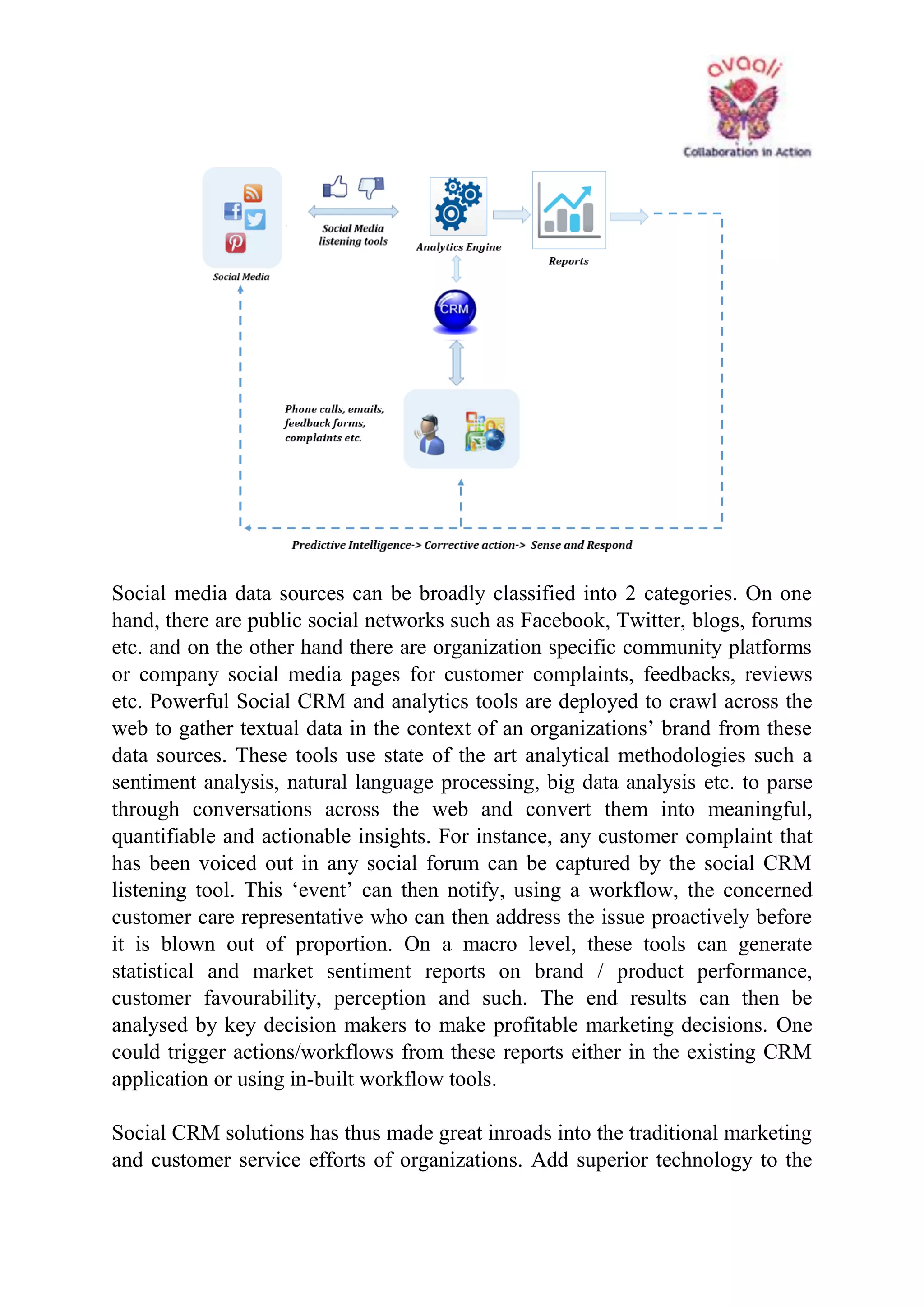
Social media data sources can be broadly classified into 2 categories. On one
hand, there are public social networks such as Facebook, Twitter, blogs, forums
etc. and on the other hand there are organization specific community platforms
or company social media pages for customer complaints, feedbacks, reviews
etc. Powerful Social CRM and analytics tools are deployed to crawl across the
web to gather textual data in the context of an organizations’ brand from these
data sources. These tools use state of the art analytical methodologies such a
sentiment analysis, natural language processing, big data analysis etc. to parse
through conversations across the web and convert them into meaningful,
quantifiable and actionable insights. For instance, any customer complaint that
has been voiced out in any social forum can be captured by the social CRM
listening tool. This ‘event’ can then notify, using a workflow, the concerned
customer care representative who can then address the issue proactively before
it is blown out of proportion. On a macro level, these tools can generate
statistical and market sentiment reports on brand / product performance,
customer favourability, perception and such. The end results can then be
analysed by key decision makers to make profitable marketing decisions. One
could trigger actions/workflows from these reports either in the existing CRM
application or using in-built workflow tools.
Social CRM solutions has thus made great inroads into the traditional marketing
and customer service efforts of organizations. Add superior technology to the
equation and the impact is quite powerful. Easy to use web based CRM tools
have ensured that front line managers are able to engage their customers and
prospects better by being involved in the ‘Social’ aspect of the CRM. At Avaali
Solutions, we believe that by bringing a mix of best-in-class technologies and
consultative change management into an enterprise, Social CRM can be a true
game changer. Avaali provides advisory services as well as implementation
services to help organizations adopt a Social CRM strategy and the associated
technologies.

Avaali-Social CRM Strategy

  • 1.
    Social CRM Social CRMcan be defined as the use of social media platforms and the appropriate analytical methodologies to gather actionable insights which can help organizations engage better with their customers. The main objective is to be proactive to customer expectations and make customer experience more personal and relevant. Why ‘Social’ CRM: A study shows that about 80 percent of social media users prefer to connect with brands through Facebook. About 34 percent of marketers have generated leads using Twitter. Such jarring statistics imply that the ‘social consumers’ of today now have the prowess and means to employ social media platforms to voice out their sentiments. Personalised selling has become the new mantra for sales agents who continuously monitor social media to react with customers and prospects alike with the main objective to engage them better. In addition, organizations are increasingly deploying social community platforms that enable consumers to reach out to other fellow consumers to gather information about a product or a brand, thus adding a new dimension to the role of consumers in a marketplace. Such rising usage of social media indicates a radical change in the way organizations are reaching out to customers. In short, Social CRM has become the new mandate! Social CRM – A CRM add-on! Evaluators of social CRM often have a misguided sense that it is here to replace the existing ‘Customer Relationship Management’ solutions already adopted in their organization. It is important to understand that Social CRM is not here to replace traditional CRM. On the other hand, it augments the capabilities of traditional customer engagement, sales and marketing capabilities by extending the reach of CRM beyond the corporate firewalls. In fact, from a technological standpoint, social CRM can be viewed as a powerful add-on tool that provides an integration between social media, analytics and the existing organizational CRM applications. In addition, the traditional one-to-one customer communication channels are being replaced by multichannel communication platforms which are more conversational than transactional - thus helping organizations acquire and retain more customers.
  • 2.
    Social media datasources can be broadly classified into 2 categories. On one hand, there are public social networks such as Facebook, Twitter, blogs, forums etc. and on the other hand there are organization specific community platforms or company social media pages for customer complaints, feedbacks, reviews etc. Powerful Social CRM and analytics tools are deployed to crawl across the web to gather textual data in the context of an organizations’ brand from these data sources. These tools use state of the art analytical methodologies such a sentiment analysis, natural language processing, big data analysis etc. to parse through conversations across the web and convert them into meaningful, quantifiable and actionable insights. For instance, any customer complaint that has been voiced out in any social forum can be captured by the social CRM listening tool. This ‘event’ can then notify, using a workflow, the concerned customer care representative who can then address the issue proactively before it is blown out of proportion. On a macro level, these tools can generate statistical and market sentiment reports on brand / product performance, customer favourability, perception and such. The end results can then be analysed by key decision makers to make profitable marketing decisions. One could trigger actions/workflows from these reports either in the existing CRM application or using in-built workflow tools. Social CRM solutions has thus made great inroads into the traditional marketing and customer service efforts of organizations. Add superior technology to the
  • 3.
    equation and theimpact is quite powerful. Easy to use web based CRM tools have ensured that front line managers are able to engage their customers and prospects better by being involved in the ‘Social’ aspect of the CRM. At Avaali Solutions, we believe that by bringing a mix of best-in-class technologies and consultative change management into an enterprise, Social CRM can be a true game changer. Avaali provides advisory services as well as implementation services to help organizations adopt a Social CRM strategy and the associated technologies.