Automating API Delivery MEAP V05 APIOps with OpenAPI Ikenna Nwaiwu
Automating API Delivery MEAP V05 APIOps with OpenAPI Ikenna Nwaiwu
Automating API Delivery MEAP V05 APIOps with OpenAPI Ikenna Nwaiwu
Automating API Delivery MEAP V05 APIOps with OpenAPI Ikenna Nwaiwu
Automating API Delivery MEAP V05 APIOps with OpenAPI Ikenna Nwaiwu
1.
Automating API DeliveryMEAP V05 APIOps with
OpenAPI Ikenna Nwaiwu pdf download
https://ebookfinal.com/download/automating-api-delivery-
meap-v05-apiops-with-openapi-ikenna-nwaiwu/
Explore and download more ebooks or textbooks
at ebookfinal.com
2.
Here are somerecommended products for you. Click the link to
download, or explore more at ebookfinal
Fluent Bit with Kubernetes MEAP Phil Wilkins
https://ebookfinal.com/download/fluent-bit-with-kubernetes-meap-phil-
wilkins/
RESTful Web API Design with Node js Second Edition Bojinov
https://ebookfinal.com/download/restful-web-api-design-with-node-js-
second-edition-bojinov/
Fight Fraud with Machine Learning MEAP V09 Ashish Ranjan
Jha
https://ebookfinal.com/download/fight-fraud-with-machine-learning-
meap-v09-ashish-ranjan-jha/
Building Machine Learning Pipelines Automating Model Life
Cycles with TensorFlow 1st Edition Hannes Hapke
https://ebookfinal.com/download/building-machine-learning-pipelines-
automating-model-life-cycles-with-tensorflow-1st-edition-hannes-hapke/
3.
Mining Google WebServices Building Applications with the
Google API 1st Edition John Paul Mueller
https://ebookfinal.com/download/mining-google-web-services-building-
applications-with-the-google-api-1st-edition-john-paul-mueller/
Mastering REST APIs Boosting Your Web Development Journey
with Advanced API Techniques 1st Edition Sivaraj Selvaraj
https://ebookfinal.com/download/mastering-rest-apis-boosting-your-web-
development-journey-with-advanced-api-techniques-1st-edition-sivaraj-
selvaraj/
Automating with STEP 7 in LAD and FBD SIMATIC S7 300 400
Programmable Controllers 5th Edition Hans Berger
https://ebookfinal.com/download/automating-with-step-7-in-lad-and-fbd-
simatic-s7-300-400-programmable-controllers-5th-edition-hans-berger/
Automating System Administration with Perl Tools to Make
You More Efficient 2nd ed Edition David N Blank-Edelman
https://ebookfinal.com/download/automating-system-administration-with-
perl-tools-to-make-you-more-efficient-2nd-ed-edition-david-n-blank-
edelman/
Programming Google Glass 2nd edition Build Great Glassware
Apps with the Mirror API and GDK Eric Redmond
https://ebookfinal.com/download/programming-google-glass-2nd-edition-
build-great-glassware-apps-with-the-mirror-api-and-gdk-eric-redmond/
5.
Automating API DeliveryMEAP V05 APIOps with
OpenAPI Ikenna Nwaiwu Digital Instant Download
Author(s): Ikenna Nwaiwu
ISBN(s): 9781633438781, 1633438783
Edition: Chapers 1 to 7 of 11
File Details: PDF, 9.22 MB
Year: 2023
Language: english
1 What isAPIOps?
This chapter covers
The challenge of scaling API design and delivery
APIOps as the combination of DevOps and GitOps for APIs
APIOps principles
The benefits and challenges of APIOps with OpenAPI
1.1 What is APIOps?
Many companies aim to build high-quality, well-documented, easy-to-use
APIs. But they struggle with being able to implement this in practice. They
may have API governance standards and functions and even adopt a design-
first approach to API development. But with all this, they still see a big gap
between their governance standards and what they implement. This execution
gap results in shipping APIs that are not compliant with their usability and
security standards are not well-documented, discoverable, and accessible, or
have performance, reliability, and scalability issues. Along with all this, they
face an expensive and inefficient API-development process with a long lead
time to getting their API products to market.
This gap is what APIOps aims to solve. You can think of APIOPs as
designing, building, testing, and deploying your API products more
efficiently by automating your API delivery workflow. APIOps introduces
automation into managing API definition and API configuration files in your
CI/CD pipeline. APIOps is the end-to-end automation of the API life cycle
using DevOps and GitOps principles to help API providers deliver more
value to API consumers (I explain what DevOps and GitOps mean later).
APIOps helps you automate API design governance by replacing manual API
governance practices with automated checks like API linting and breaking
change checks. It also improves the reliability of your API releases through
Git-controlled API configuration deployments. This improves auditability,
compliance, and collaboration between developer and operations teams on
10.
your API deployments.In this way, APIOps helps organizations increase the
speed of their API delivery and deployment, as well as increase the
consistency of their APIs through automated standard governance and policy
checks. Let me illustrate this with an example.
1.1.1 Scaling API delivery: problems arising.
Imagine a hypothetical e-commerce company – BookInc - that runs an online
bookstore. Their flagship BookStore API product is a cloud-native platform
that enables affiliates market books on behalf of BookInc.
At the beginning of its API program, engineers at BookInc had free reign to
design and deploy changes to the Bookstore REST API. Without any quality
gates, they could make changes very quickly. However, as BookInc scaled its
operations and the number of development teams making changes to the API
grew, the Bookstore API became inconsistent. Their API consumers
complained that the same resource was given a different name in some
sections of the API and that not all endpoints followed the same error
message format. There were also complaints of some missing API reference
documentation, unsecured endpoints, and some endpoints that always failed.
In response, BookInc created a centralized API platform team to govern
changes to the Bookstore API. The team was responsible for creating API
standards and ensuring API changes complied with them. As well as this
governance function, the team was also responsible for operating the API
gateway and deploying APIs to it. They were responsible for writing
functional tests to ensure the external API worked as documented in the
published API reference.
As part of their API design-governance function, the API platform team
manually reviewed any design changes to the Bookstore API submitted by
dev teams to ensure they were compliant. The platform team evangelized the
best practice in their API standards document to the dev teams and made it
clear that teams needed to read and closely follow it. To ensure the finished
output delivered a great user experience, the API platform team also
advocated a design-first approach to API development, requiring teams to
complete their API designs in the OpenAPI specification first and get them
11.
reviewed and validatedbefore starting any backend implementation on them.
The quality gates the API platform team introduced were all well-intentioned.
However, as BookInc scaled its operations and added more feature teams, a
few problems came up:
Feature teams had to raise a work ticket or schedule a meeting for the
API platform team to review their API changes. A big backlog of API
changes resulted, as multiple teams had to wait until their change was
scheduled, reviewed, and approved by the platform team. The net result
is that it took longer (that is, increased lead time) to get an API change
deployed.
The API platform team's manual compliance checks introduced
increased consistency and standards compliance. But by their very
nature of being manual checks, they were error-prone. They sometimes
missed important issues that were only discovered later, after the API
change was deployed to production and in use by consumers.
Faced with an increased number of API deployments and the large
amount of time it took to create and maintain its automated tests, the
centralized API platform came under pressure and had to limit its API
review sessions to once a week to enable them to cope with other work
they need to do.
Given the long time it took to get feedback on API designs under
pressure to deliver features, some development teams abandoned the
API-design-first approach advocated by the platform team and resorted
to starting work on the backend microservices while they waited for the
design review. This sometimes resulted in lots of rework (and the
accompanying frustration) if the final approved design was very
different.
Feature teams now had the responsibility of internalizing and
remembering all the standards and also keeping abreast of any changes
to them. This increased their cognitive load.
In summary, BookInc transitioned from decentralized API management with
a focus on speed to a centralized API management model with a focus on
quality. In doing this, BookInc had to trade speed for API quality and
reliability. In addition, BookInc now has a rather developer-unfriendly
12.
method of deployingAPI changes that involve handoffs (raising work tickets,
emails, and meeting scheduling), long queue times, and long feedback cycles.
This frustration and friction this causes affect the culture at BookInc.
1.1.2 Tackling the scaling problem
The problem here is that as BookInc scales, it is faced with having to make a
trade-off between the speed of API delivery and API quality. But there is a
well-established software delivery paradigm that addresses this challenge -
DevOps. Anyone familiar with DevOps will see that this friction between the
API development teams and the API platform or operations team is the kind
of problem DevOps aims to solve. DevOps is about applying lean principles
across the entire technology value stream, including development and
operations, to deliver value to the customer quicker and reliably. One of the
benefits DevOps aims to achieve is lower lead times (getting valuable work
done quicker) coupled with a lower change failure rate (increasing quality).
You can see how this would apply in the BookInc API development
workflow.
As described by G. Kim in The DevOps Handbook (second edition, IT
Revolution Press, 2021, https://itrevolution.com/product/the-devops-
handbook-second-edition), DevOps is based on three principles:
1. Enabling the fast flow of valuable work from left to right in the value
stream.
2. The opposite flow of feedback to detect and remediate problems
quickly.
3. Enabling a culture of continuous learning, sharing, and experimentation
to build a high-trust work environment.
DevOps practices are based on these principles. These practices include:
Continuous integration and continuous delivery (CI/CD). In
continuous integration, development teams integrate tested code into a
shared branch multiple times a day. Continuous integration systems
(also called build servers) build and package this code as deployable
artifacts to drive frequent deployments. Continuous delivery is the next
13.
phase, where artifactsare deployed to one or more test and production
environments in an automated way. CI/CD enables development teams
always have deployment-ready software artifacts that have gone through
a standard test process.
Version control: Version control (also called source control) is the
practice of tracking revisions and the change history of code and
configuration files to make it easy to review and recover code or fix a
mistake. Version control systems allow multiple developers to
collaborate on authoring code and keep track of every code
modification. An example of a popular version control system is Git.
Infrastructure as code (IaC): This practice is about defining and
managing system resources and topologies (for example, networks,
virtual machines, and load balancers) using a descriptive model. This
enables development teams to manage these resource definitions and
store them in version control as they would code. Teams can avoid
manual provisioning and environment drift by using IaC tools like
Terraform, Ansible and AWS CloudFormation to automate the
infrastructure provisioning. IaC helps teams recreate the same
environment every time it is applied, making deployments reliable and
repeatable.
Configuration as code (CaC): Configuration as code is about
managing application configuration using a descriptive model stored in
version control. CaC is similar to IaC but is about deployed applications
rather than infrastructure. Teams can templatize, roll out and track
application configuration changes to avoid drift.
Monitoring and observability: Monitoring involves setting up pre-
defined metrics, dashboards, and alerting to enable teams to understand
the internal state of their systems. Teams can set up alerts for predefined
conditions in the system that require the team's attention. Observability
is about querying and analyzing the behavior of instrumented systems
and environments to determine the root cause of issues you cannot
anticipate beforehand. Monitoring and observability tools allow teams to
get real-time visibility of their system’s overall performance and health
using telemetry – event data and logs collected from the running systems
that can be analyzed and queried.
Learning from failure: With complex software systems, failure is
inevitable. But teams can learn from failure incidents by running
14.
blameless post-mortems andexperiment with systems by injecting
failure into them to understand how they perform under turbulent
production conditions – a practice known as chaos engineering. They
can run game days where they simulate system failure to test how their
team and processes respond in an incident scenario. And they can run
red team exercises to test the security of the organization's systems with
a ‘red team’ that plays the role of an adversary aiming to hack the
system.
DevOps also includes other product, process, and cultural practices like
working in small batches, having a lightweight approval process, continuous
testing, and supporting team collaboration. Teams applying DevOps practices
tend to measure their software delivery performance on four key metrics –
deployment frequency, lead time for changes, change failure rate, and mean
time to restore service. For an in-depth discussion of DevOps practices and
metrics, please see Accelerate (IT Revolution, 2018,
https://itrevolution.com/product/accelerate) by Nicole Forsgren, Jez Humble,
and Gene Kim.
Coming back to the developer-unfriendly API design change approval
practices at BookInc, again, we can refer to another well-known software
delivery paradigm that addresses similar issues. GitOps is a developer-
friendly way to manage application and infrastructure changes to cloud-
native applications. In the GitOps model, engineers manage system
configuration by using Git to store and update the desired state of the system.
Delivery pipelines run automatically to apply the state specifications in Git to
the required environments. Manual changes to configuration via a UI are not
permitted, and engineers can make changes only via Git pull requests.
One of the benefits of GitOps for application developers is that it promotes a
self-service way of working. Traditionally, a dedicated operations team
receives infrastructure-change work tickets from development teams. As
development teams increase, this usually results in bottlenecks with the
centralized operations team. With the GitOps model, developers can make the
configuration changes themselves by raising a Git pull request (PR). The
operation team can then review and approve the PR, which then triggers an
automatic process that applies it to the required environment. This is a much
15.
more efficient anddeveloper-centric way of working that uses Git – a tool
most developers are familiar with. It provides the right balance between
developer speed and control of infrastructure and config changes. Rolling
back configuration changes can become as simple as running a git revert
command.
Another benefit of the GitOps approach is that compliance and auditability
are built in. Because the configuration files are under version control, anyone
can see who made a change, what change they made, and when. You can run
automated checks on the files to verify and report on their compliance with
the organization's standards.
As described by the GitOps Working Group (https://opengitops.dev), GitOps
is based on four principles. The state of the system (that is, all the
configuration data required to recreate the system) must be the following:
Declarative: The desired state of the whole software system
(application configuration and infrastructure) is described with a
declarative specification for each environment. A declarative description
specifies the desired state of the system without specifying how the state
will be achieved. The state is specified not as a set of implementation
commands or instructions but rather as a configuration.
Versioned and immutable. The state of the system is stored in a
version control system such as Git that enforces immutability and retains
a complete version history.
Pulled automatically: Software agents can automatically pull the
desired state of the system from the source. This enables them to
compare it to the deployed configuration and alert on divergence.
Software agents provide a feedback and control loop that ensures the
system is self-healing.
Continuously reconciled: Software agents automatically apply the
desired state to the actual system state if any divergence occurs.
Divergence can occur if the actual system state is changed directly or
because the desired system state is intentionally changed. Regardless of
how the divergence occurs, software agents detect the drift and change
the actual state to match the desired state.
For a thorough treatment of GitOps for cloud-native environments, please see
16.
GitOps and Kubernetes(Manning, 2021,
https://www.manning.com/books/gitops-and-kubernetes) by Billy Yuen et al.
The combination of DevOps and GitOps principles outlined above and
applied to API design and delivery leads to the definition of APIOPs as the
end-to-end automation of the API life cycle. This is why I mentioned earlier
that APIOps is about designing and delivering APIs more efficiently by
automating your workflow. In this book, I discuss APIOps in the context of
building RESTful API products for microservice architectures using
OpenAPI as the language for defining API interfaces.
What about APIOps for other API specification formats?
The OpenAPI Specification (https://www.openapis.org), formerly known as
the Swagger Specification, is an interface definition language (IDL) for
describing and documenting HTTP APIs. But OpenAPI is not the only API
specification format used to build APIs. Some others are:
RAML (https://raml.org) is also an IDL for HTTP APIs. RAML API
definitions are defined in YAML.
API Blueprint (https://apiblueprint.org) is an API description language
based on the Markdown syntax.
The AsyncAPI specification (https://www.asyncapi.com) is inspired by
OpenAPI. It is a protocol-agnostic interface definition format that describes
and documents message-driven APIs. It can document messaging APIs for
AMQP, MQTT, WebSockets, Kafka, STOMP, and other messaging
protocols.
gRPC is a high-performance remote procedure call framework for
communicating between applications and services. gRPC is typically used
along with Protocol Buffers (Protobuf) - a language-neutral data format used
to serialize structured data.
Some APIOps principles I discuss in this book are certainly applicable to
some of these API formats. For example, the API linting tool I discuss in
chapter 2 can also be used to run automated style guide checks on AsyncAPI
17.
definition files. Buteven though some of the principles are applicable, a
detailed discussion on how to apply them to other API formats is out of the
scope of this book.
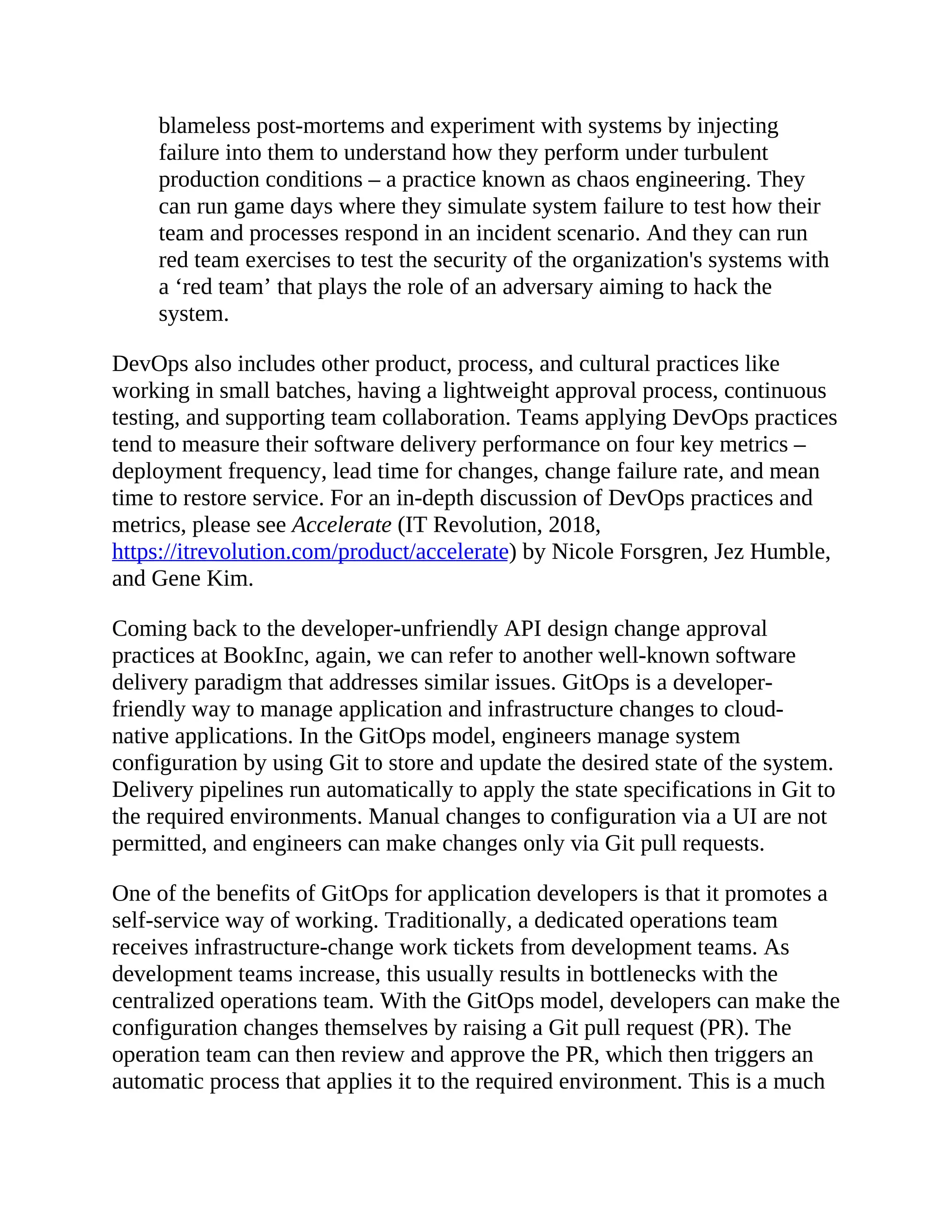
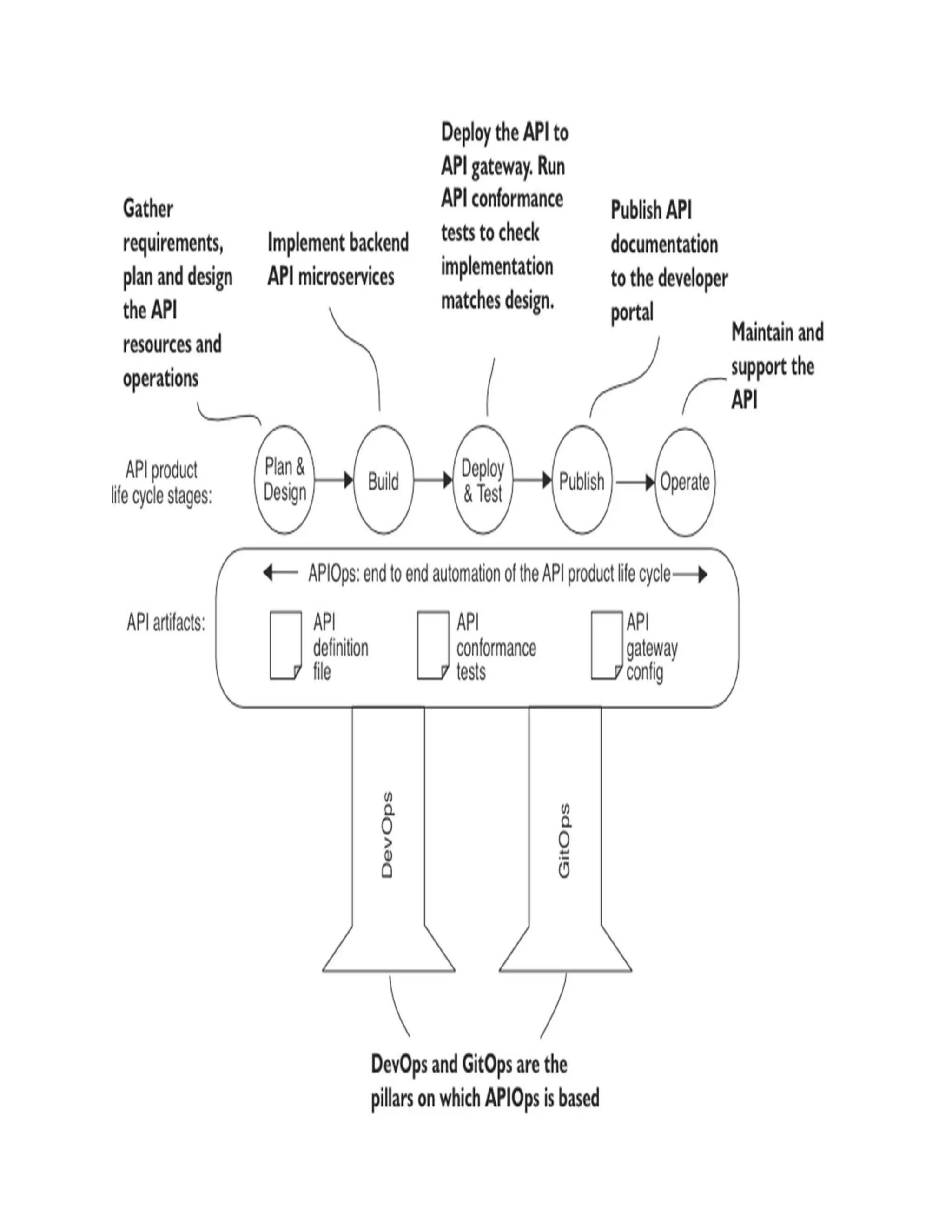
I look at how to apply APIOps principles across your entire API life cycle by
automating the management of your API definition files, API conformance
tests, and API gateway configuration to help you deliver APIs to the
customer quicker (that is, lower lead times) and to governance and quality
standards (see figure 1.1).
Figure 1.1 APIOps is about the end-to-end management of the API lifecycle to achieve the fast
flow of value while maintaining governance and quality standards.
19.
I mentioned thatAPIOps is about automating the API life cycle. But before
going further, I want to explain what an API product is and how it differs
from an API which is just an integration service.
1.2 APIs and API Products
An application programming interface, or API, defines the set of functions
and protocols software systems use to communicate with each other. It is the
shared boundary for information exchange between software systems. There
are different kinds of API solutions, for example, REST APIs, SOAP APIs,
RPC APIs, GraphQL APIs, and WebSocket APIs. On the other hand, an API
product is a packaged API solution that exposes capabilities that solve a
problem for the API consumer. It is secure and packaged with good
documentation and support channels. A designated API team is responsible
for overseeing its life cycle (from ideation to sunset) and for understanding
the needs of the API consumer, improving the user experience, and ensuring
the API achieves key business metrics. If offered as a billed service, it
specifies a pricing plan explaining how the API provider meters and charges
for service consumption. The API product should have a service level
agreement that specifies its quality-of-service characteristics (like uptime and
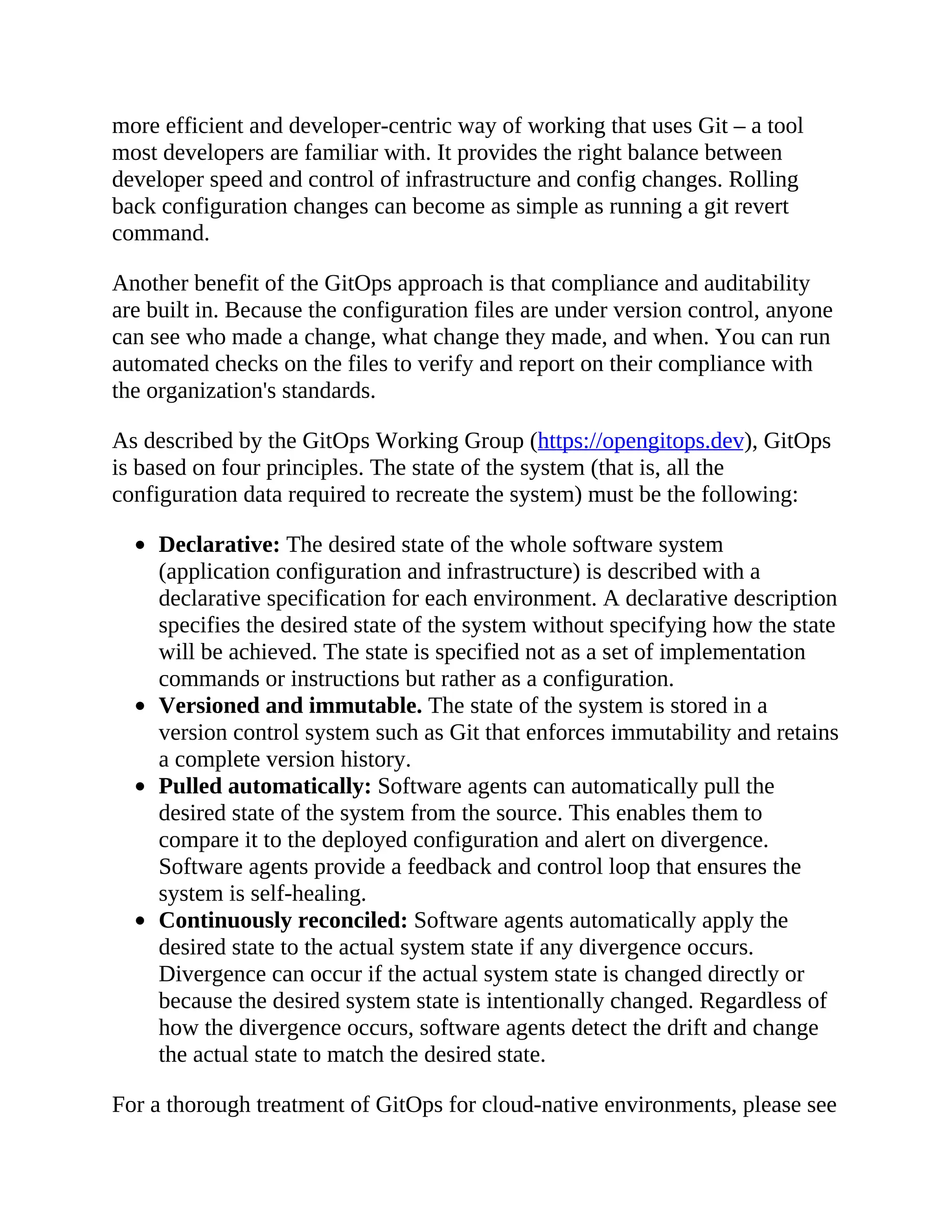
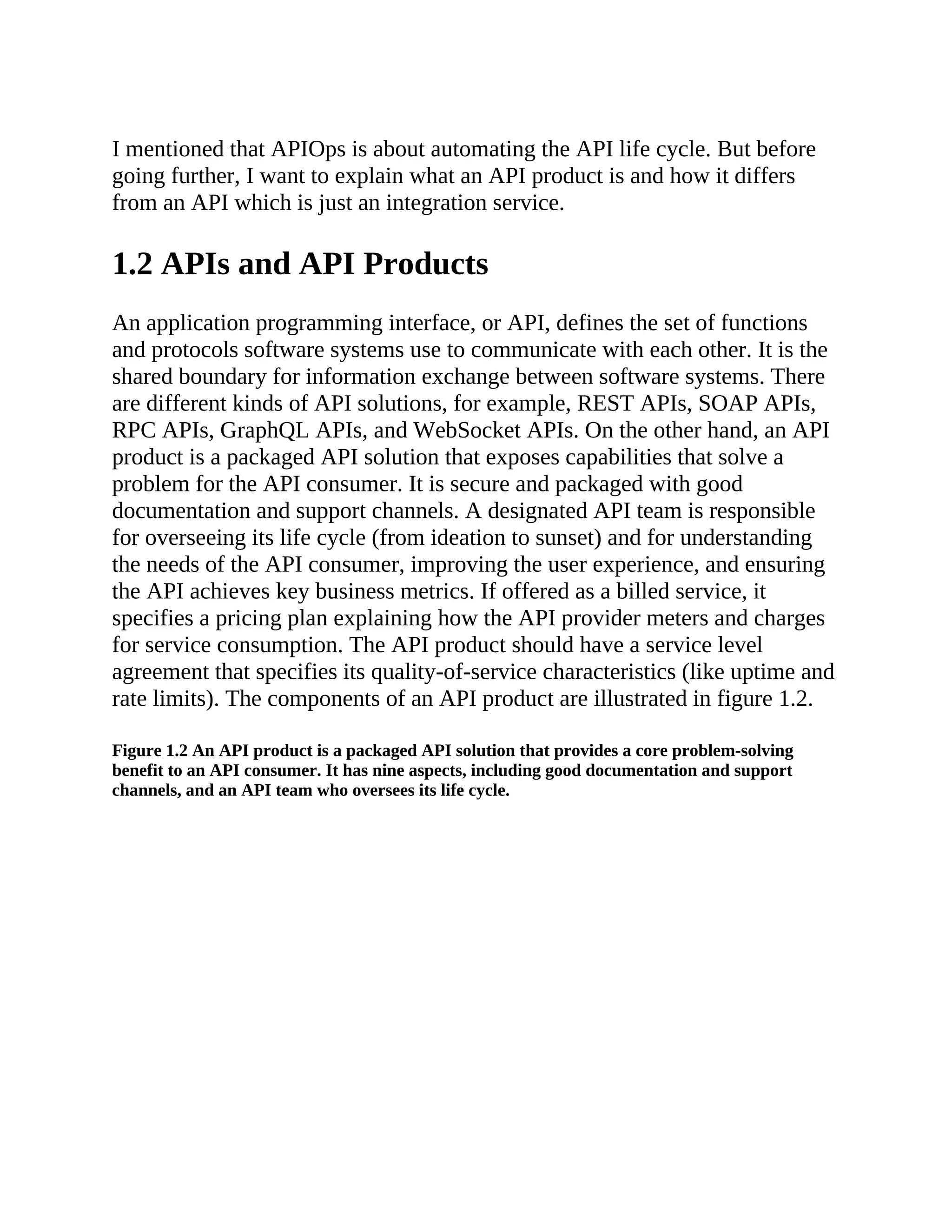
rate limits). The components of an API product are illustrated in figure 1.2.
Figure 1.2 An API product is a packaged API solution that provides a core problem-solving
benefit to an API consumer. It has nine aspects, including good documentation and support
channels, and an API team who oversees its life cycle.
21.
API products canbe external-facing APIs that expose business capabilities or
internal APIs that expose technical capabilities (for example, an internal
Permissions API). What makes it an API product is that it is managed as a
product. That means the API team starts with identifying and understanding
the problems API consumers face and the value the API should bring them.
And then, the team designs the API to meet this need, validates the design,
and implements, documents, and publishes the packaged API solution. They
also continuously monitor and improve the API over its lifetime based on
user and operational feedback of the API.
This product-led API differs from an API solution that is purely an enterprise
integration interface lacking the same level of investment in documentation,
support, or user experience. The principles and practices of APIOps I discuss
in this book are aimed at API products.
In product management, a model used to understand and manage products is
the product lifecycle. It is the succession of stages products go through during
their existence, from development to growth, maturity, and decline.
Understanding a product's lifecycle stage helps product managers think about
and communicate on product development, planning and forecasting.
Similarly, we can think of API products as having a lifecycle from ideation to
sunset. Having a shared vocabulary around an API product’s lifecycle helps
API teams plan, build and govern their API. But organizations define their
API lifecycle in different ways. For this book, I use the following simple
lifecycle:
Plan and design: New ideas for the API are generated and captured.
Functional and non-functional requirements are identified and analysed.
A conceptual domain model is created. Requirements are translated into
API definitions. API definition is reviewed and validated with
prospective users.
Build: The API is implemented in the backend microservices. This
involves coding, unit testing, and packaging. The API design is also
mocked out to enable parallel development of any upstream API
consumers.
Deploy and test: The microservices are configured in an API gateway,
and the API is deployed to a non-production environment for acceptance
22.
testing.
Publish: API documentationand release notes are published to a
developer portal.
Operate: The API is deployed and run in production. The health of the
API is monitored for functional, performance, and security issues.
Every conceptual model simplifies surrounding complexity to emphasize
particular points, and this model is no different. I use this model to explain
the APIOps practices and the governance controls API teams can apply at
high-level stages in an API product’s life. It is not meant to be exhaustive or
explain low-level process details of how APIs are actually designed and
delivered (which usually occurs in a more iterative and agile workflow). For
a more detailed discussion on the API lifecycle, see Enterprise API
Management by Luis Weir (Packt Publishing, 2019,
https://www.packtpub.com/product/enterprise-api-
management/9781787284432).
1.3 Why should you care about APIOps?
With APIOps, you automate how you govern and deploy API products. But
before doing this, you need to start by understanding your current API
product value stream – the key activities and stages involved in going from a
customer request to a deployed API in production. Having a clear picture of
your workflow shows you the priority areas that may benefit from
automation. I talk more about mapping your API design and delivery value
stream in chapter two.
In this book, I discuss APIOps in the context of building RESTful API
products for microservice architectures. Building and managing API products
on a microservices project is a highly collaborative and iterative activity,
requiring the input of multiple roles in an organization – developers,
architects, product managers, security engineers, technical writers, operations
teams, and more. Getting multiple teams and roles to collaborate on API
design, development, and operation in an efficient way while introducing
automation to reduce manual tasks, delays, and handoffs is the goal of
APIOps.
23.
To illustrate this,it is worth looking at the different components involved in a
microservice architecture. A microservice architecture is one comprised of
small, loosely coupled services, where each service implements a single
business capability within a bounded context. Each microservice is managed
by a small team, has its own codebase, is responsible for persisting its own
data, and can be deployed independently. Microservices have well-defined
APIs, which can be packaged into API products and exposed to the outside
world via an API gateway.
NOTE
A bounded context is a concept from domain driven design (DDD) and refers
to a domain model that is a subdomain of a larger application. It is the
boundary within which particular terms and rules in that domain apply
consistently.
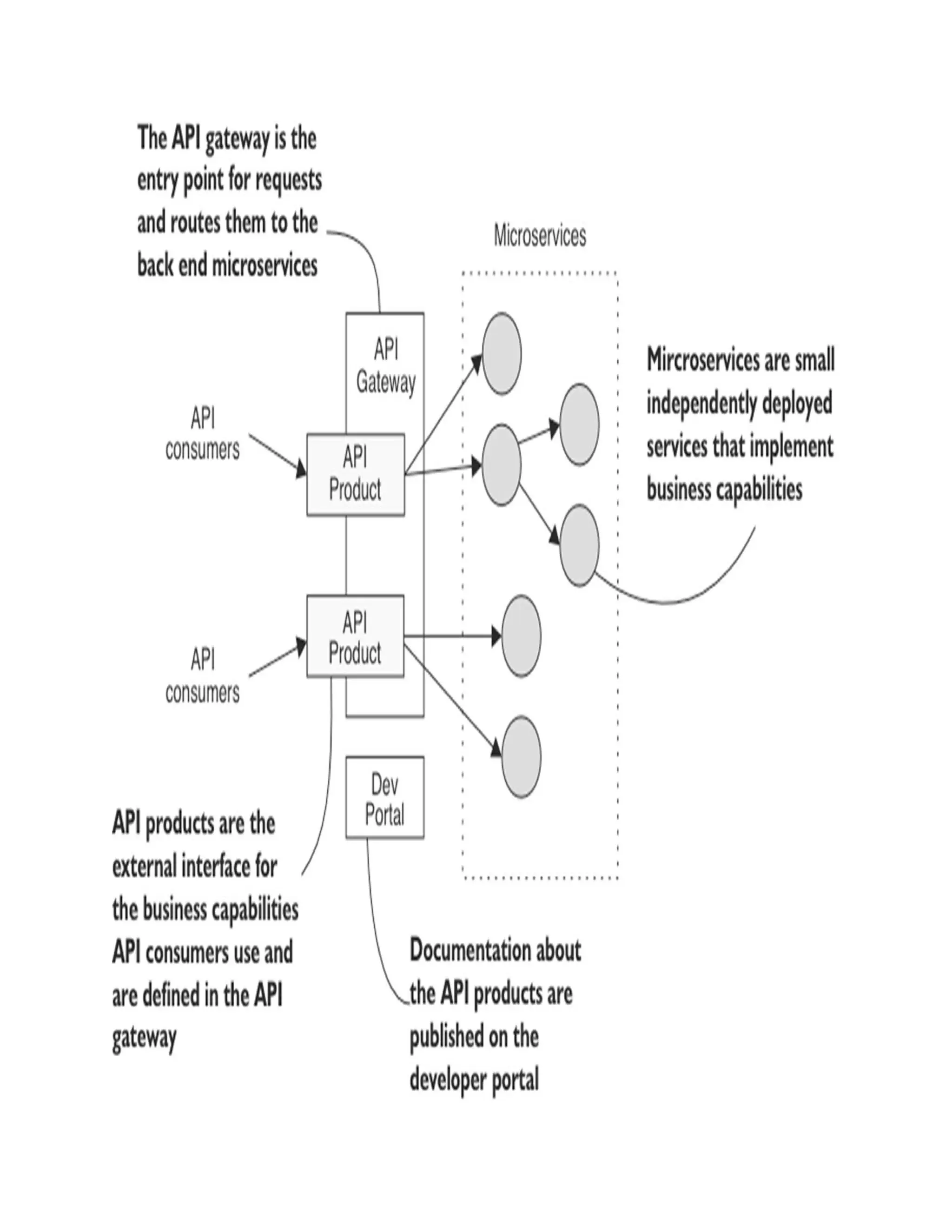
An API gateway is a reverse proxy that serves as an entry point to API
products. Along with routing requests to the API products to the backend
microservice APIs, API gateways can also offer security, traffic management,
analytics, message transformation and orchestration capabilities. The API
gateway exposes the interface to the API product to API consumers. API
consumers are the developers creating software applications that integrate
with the API. A developer portal is used to publish documentation about the
API – usually an API reference, API user guides, and API product tutorials
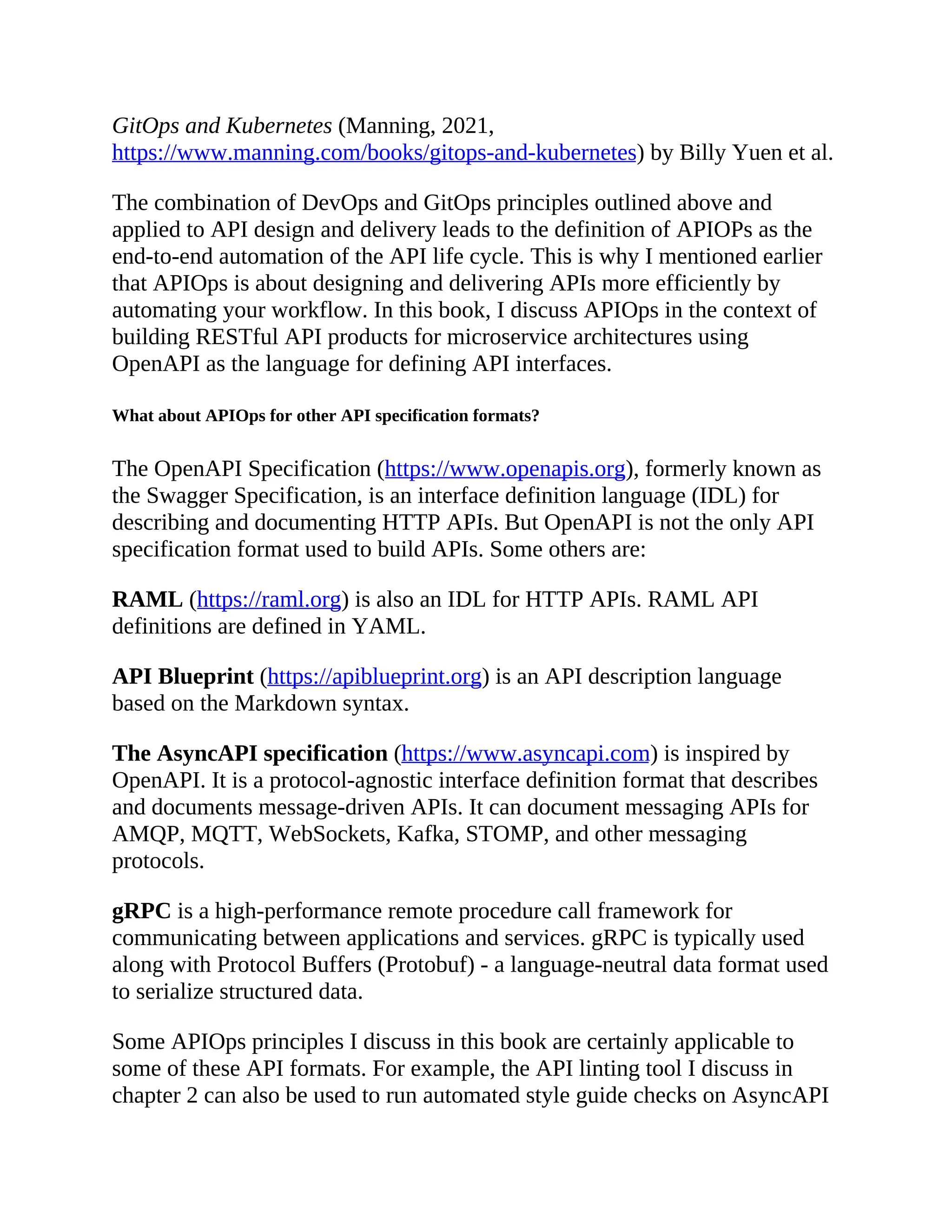
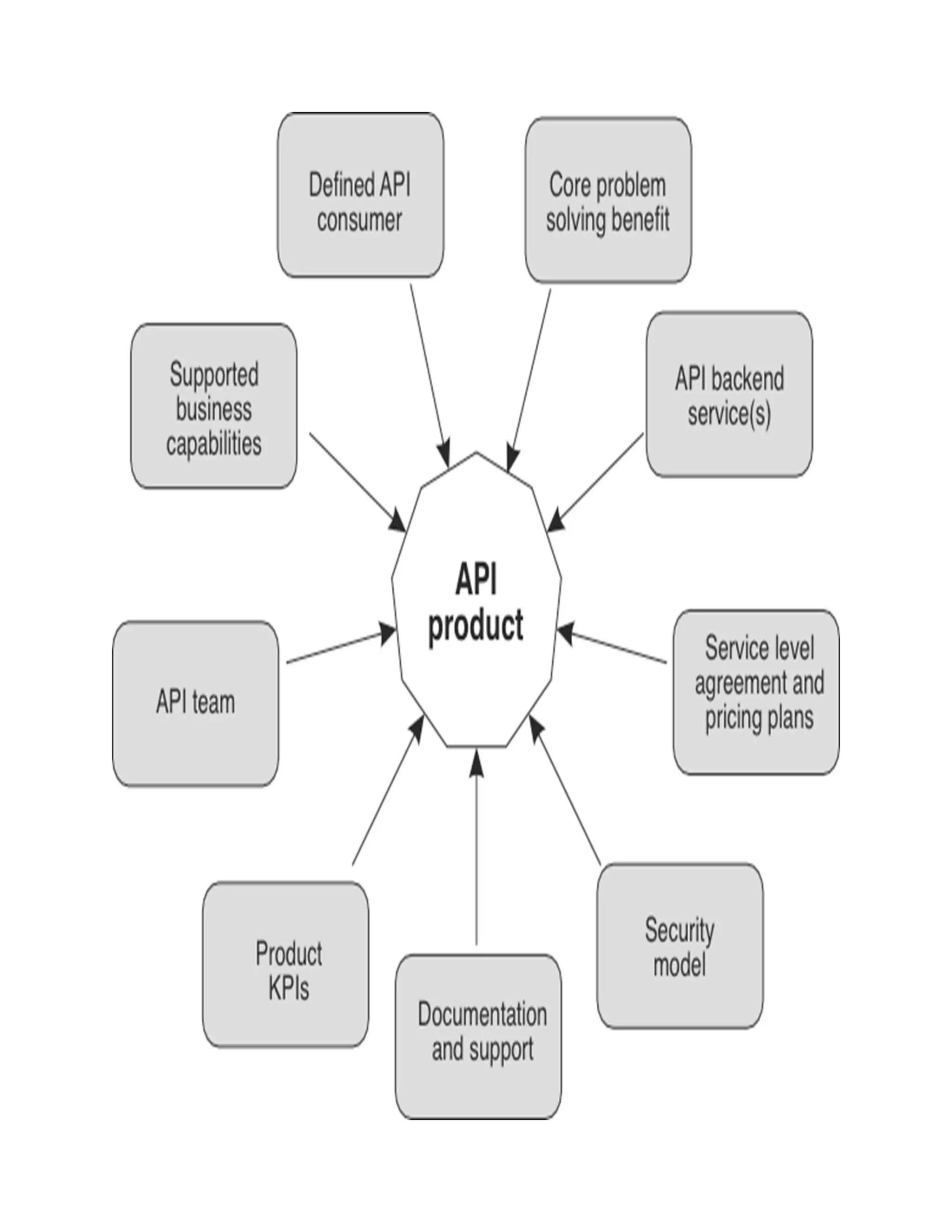
(see figure 1.3).
Figure 1.3 In a microservices architecture, API gateways define API products and route requests
to them to backend microservices that implement the business capabilities.
25.
Each API producthas an API definition that describes the operations and
resources that the API product provides to API consumers. The API gateway
also has an API configuration that describes how external requests are routed
to internal microservices, along with other constraints on the interface, such
as rate limiting and applied security mechanisms.
API specifications, API definitions and Swagger
In this book, when I use the term API specification, I am referring to the
OpenAPI specification (OAS), which is an industry-standard way of
describing REST APIs in a way humans and machines can understand. You
can find the latest version of the specification at
https://spec.openapis.org/oas/latest.html. At the time of writing, this is
version 3.1.0. The standard is maintained by a consortium of industry experts
called the OpenAPI Initiative (OAI), which sits under the Linux Foundation.
When I use the term API definition or OpenAPI definition, I am referring to a
file that contains the description of a particular API using the OpenAPI
specification format. API definition files are usually YAML or JSON files. In
other words, when you use the OpenAPI specification to describe your API,
you create an API definition file. An API definition file is a contract that
details the operations your API supports, the security mechanisms it employs,
and the details of the expected request and possible responses for each
operation.
Due to the wide adoption of the OpenAPI standard, many tools can read
OpenAPI definition files. This includes GUI and text editors, SDK
generators, mock servers, and documentation tools. You can find a good list
of these at http://OpenAPI.tools.
As I previously mentioned, the OpenAPI Specification used to be known as
the Swagger Specification. In November 2015, SmartBear Software donated
the Swagger Specification to the OpenAPI Initiative and renamed it to the
OpenAPI Specification. OpenAPI 3.0 was the first release of a new version
of the specification after the name change. Now, officially the name Swagger
refers to SmartBear’s suite of open source, free and commercial tools for
working with the specification. These include Swagger Editor, Swagger UI,
This ebook isfor the use of anyone anywhere in the United
States and most other parts of the world at no cost and with
almost no restrictions whatsoever. You may copy it, give it away
or re-use it under the terms of the Project Gutenberg License
included with this ebook or online at www.gutenberg.org. If you
are not located in the United States, you will have to check the
laws of the country where you are located before using this
eBook.
Title: Shining Hours
Author: Anonymous
Release date: January 30, 2021 [eBook #64422]
Most recently updated: October 18, 2024
Language: English
Credits: Richard Tonsing, Juliet Sutherland, and the Online
Distributed Proofreading Team at
https://www.pgdp.net
*** START OF THE PROJECT GUTENBERG EBOOK SHINING HOURS
***
COME AND PLAY!
Play-fulkit-tens! see them spring-ing
Light-ly up my fa-vor-ite tree;
Now they spy the ham-mock swing-ing—
In they scram-ble-one, two, three.
For a while they sit de-mure-ly,
In a dain-ty fluffy row,
Then they gaze a-bout—why sure-ly,
There stands pa-tient Spot be-low.
“Come!” I fan-cy they are say-ing;
“See, it is not far to climb:
’Mid the branch-es i-dly sway-ing,
We are hav-ing such a time!
“You shall have a wel-come hear-ty
Here with-in the leaf-y shade.
What! you will not join our par-ty?
Sil-ly pup, you are a-fraid!”
But a meek re-proach is ly-ing
In those eyes so brown and large;
One can al-most hear him cry-ing,
“I have mas-ter’s stick in charge!”
Pret-ty, mirth-ful, sau-cy crea-tures—
Let them play their mer-ry part!
How can their light kit-ten-na-tures
Un-der-stand his faith-ful heart?
That night Edith insisted on taking the old idol to bed with her as
of old. Aunt Bell over-heard her talking to it.
“I love you bushels. You are the beautifulest dolly in all the world.
And I don’t care if you haven’t dot two arms, and fine clothes, and a
35.
parasol. You’ve dotme, and I’ve dot you, and we’ll just do on loving
each other. Dat new dolly can sit in the parlor, but you’se my every
day chum.”
Edith showed the new dolly to all her friends, but wouldn’t play
with it for many days. Like a genuine little woman, she wanted to be
loyal to her first love.
36.
IN THE MEADOW.
Littlegirlie in the meadow,
Do you love to pick the flowers?
Do you love to sing and chatter,
Through the bright and sunny hours?
Pretty maiden in the meadow,
Do you love to dream and sigh?
Do you love to build bright castles
In the air, yet know not why?
Kind old doggie in the meadow,
Do you love to laze and think?
Do you love to catch the snappers,
While at them you wink and blink?
Little girlie, pretty maiden,
Kind old doggie—three good friends—
Love the sunshine, dreams, and flowers,
All joy that summer days attends.
37.
T
A PUZZLED CAT.
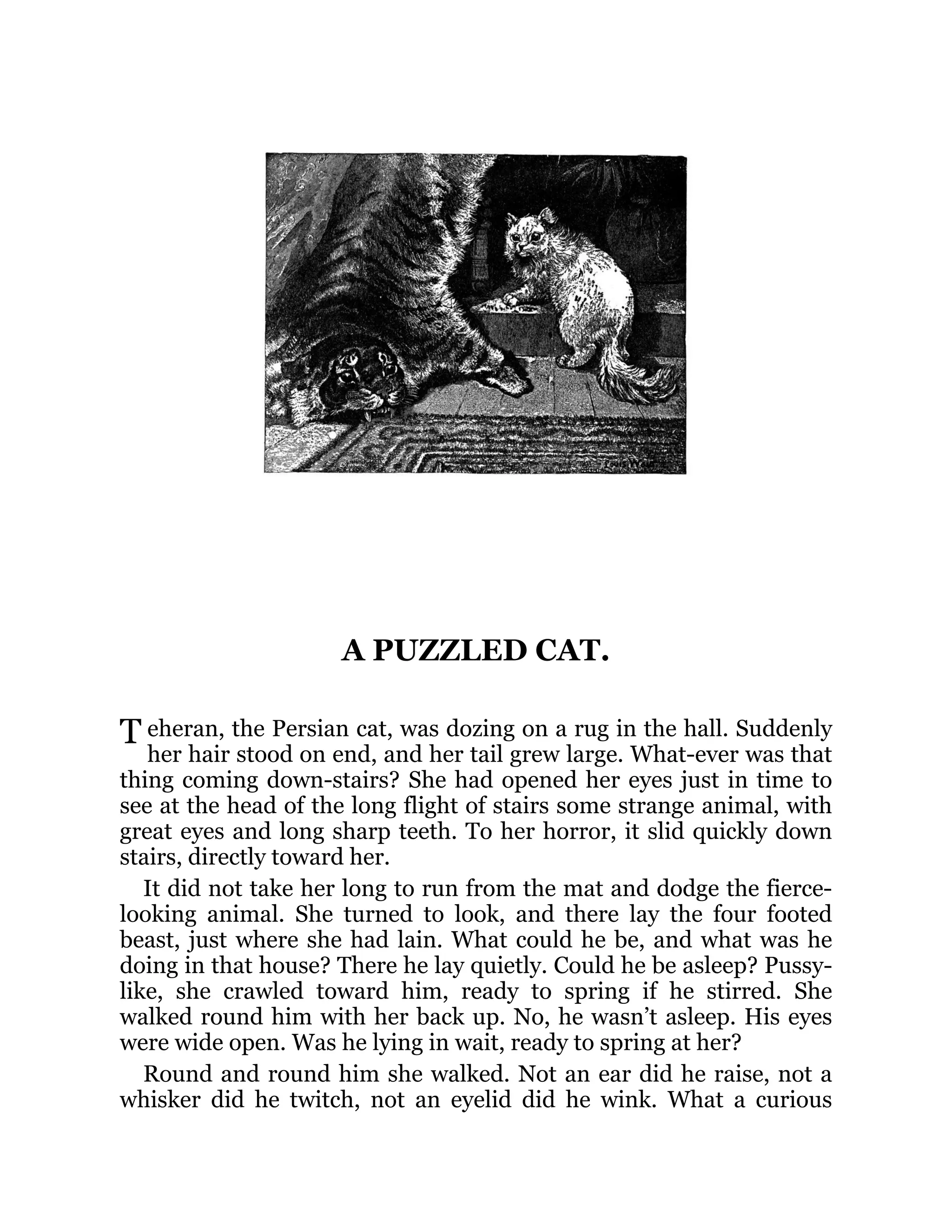
eheran,the Persian cat, was dozing on a rug in the hall. Suddenly
her hair stood on end, and her tail grew large. What-ever was that
thing coming down-stairs? She had opened her eyes just in time to
see at the head of the long flight of stairs some strange animal, with
great eyes and long sharp teeth. To her horror, it slid quickly down
stairs, directly toward her.
It did not take her long to run from the mat and dodge the fierce-
looking animal. She turned to look, and there lay the four footed
beast, just where she had lain. What could he be, and what was he
doing in that house? There he lay quietly. Could he be asleep? Pussy-
like, she crawled toward him, ready to spring if he stirred. She
walked round him with her back up. No, he wasn’t asleep. His eyes
were wide open. Was he lying in wait, ready to spring at her?
Round and round him she walked. Not an ear did he raise, not a
whisker did he twitch, not an eyelid did he wink. What a curious
38.
fellow!
Had he diedof heart disease coming down-stairs so fast? Her eyes
opened wider. She pricked up her ears to listen. Not a breath could
she hear. Poor fellow, he must be dead.
She grew bolder. She played with his paws, and she pulled his tail.
She brushed by his side. How queer! No fat, no bones! She put one
paw on his back, two paws, three paws, all four paws. How flat! no
heart, no stomach, no insides at all. She sat down on him to think.
What was he?
Many a day she thought about him; many a time she played with
him; many an hour she watched him. But a puzzled cat she always
remained.
39.
T
ON THE BEACH.
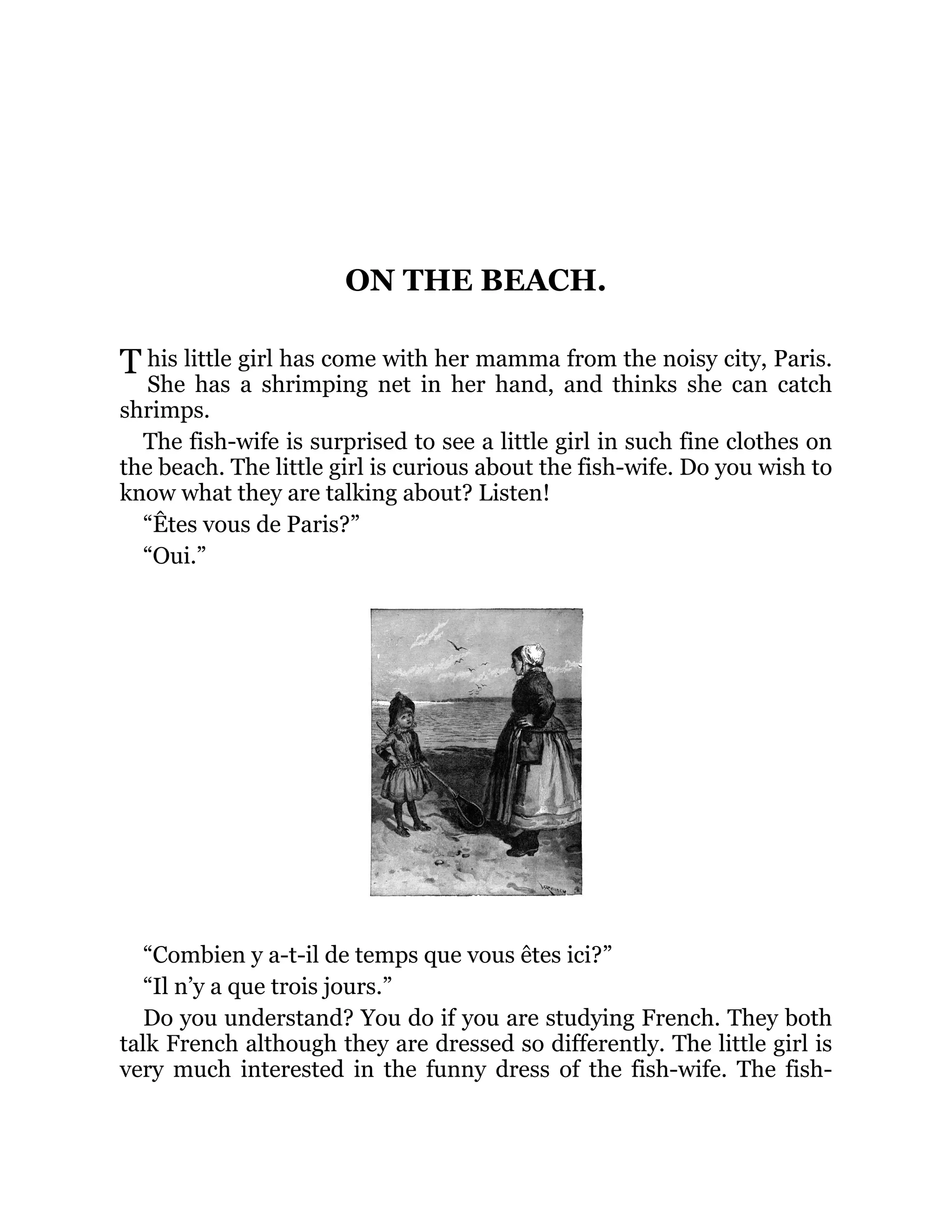
hislittle girl has come with her mamma from the noisy city, Paris.
She has a shrimping net in her hand, and thinks she can catch
shrimps.
The fish-wife is surprised to see a little girl in such fine clothes on
the beach. The little girl is curious about the fish-wife. Do you wish to
know what they are talking about? Listen!
“Êtes vous de Paris?”
“Oui.”
“Combien y a-t-il de temps que vous êtes ici?”
“Il n’y a que trois jours.”
Do you understand? You do if you are studying French. They both
talk French although they are dressed so differently. The little girl is
very much interested in the funny dress of the fish-wife. The fish-
40.
wife is verymuch pleased with the pretty dress of the little girl. She
says under her breath “Qu’elle est jolie!”
They look each other over from top to toe, and talk awhile. Then
the fish-wife goes back to her work. The little girl pokes the
shrimping-net into the water and tries to catch the shrimps.
41.
D
DOROTHY’S CALL.
orothy waswandering about the house, wondering what to do.
She strayed into Grandma’s room. On the bureau lay Grandmas’s
cap. Dorothy tried it on, and thought she looked very like Grandma.
There lay a pair of spectacles. She tried those on too.
Suddenly a scheme came into her wise little head. She went to
Grandmas’s closet, found one of her dress skirts, and put on that.
Grandma was a short woman, and Dorothy was a pretty big girl for
her age, still the skirt was a trifle long in front. Grandma didn’t wear
short sleeves and high-necked aprons. Grandma’s black shawl was
just the thing to cover them up, Dorothy thought, as she fastened it
with Grandma’s big pin.
DOROTHY.
She walked quietly into the hall. Quietly, because she wasn’t sure
that Grandma would be pleased. She couldn’t see through the
42.
spectacles. She clungto the bannisters, or down the whole flight of
stairs she would have gone at one step. Shoving the glasses to the end
of her nose, she went on her way. Around the corner lived a poor old
lady that Grandma sometimes called on. Dorothy walked to her door
and knocked. The old lady came to the door.
“Good morning, Mrs. Johns!” said Dorothy.
“Good morning,” answered Mrs. Johns, looking at her caller
curiously. “Come in, wont you, and sit down? I don’t just recall you,
though you do seem familiar.”
“My name is Swinton,” said Dorothy. (So it was and so was her
Grandmother's).
“Oh, how do you do, Mrs. Swinton? You must excuse me for not
knowing you. I’m getting hard o’hearing, and my eyes aren’t as good
as they were once. And how are you?”
“I have a little rheumatiz, and sometimes a ‘stick’ in my back,”
answered Dorothy.
“Your voice doesn’t sound natural, but perhaps it’s my ears. Does
your throat trouble you?”
“Oh no!” said Dorothy, growing nervous. “I guess I better be
going.”
“Going! Why you’ve just come.”
But Dorothy hurried away, rather quickly for an old lady.
“Well I never!” muttered Mrs. Johns. “She must be going out of
her mind, she acted so queer. The rheumatiz must be in her brain.
She walked too fast to have it in her legs.”
Grandma was surprised to see Dorothy coming into the house,
dressed in her clothes. She couldn’t help smiling while Dorothy told
her all about her call.
“And Grandma,” said Dorothy, “she didn’t find out that I was only
myself, and not yourself at all!”
43.
F
FIDO’S PUPPIES.
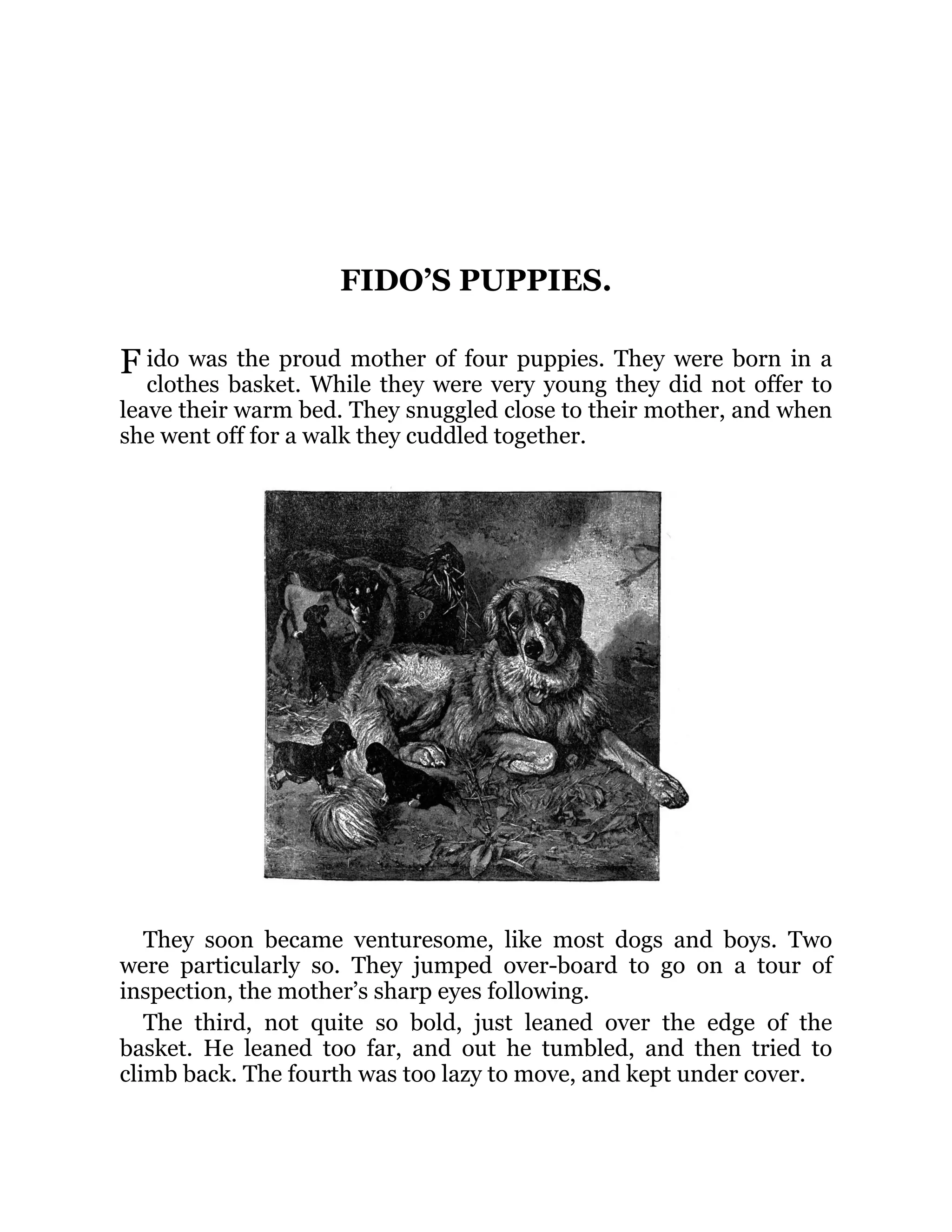
ido wasthe proud mother of four puppies. They were born in a
clothes basket. While they were very young they did not offer to
leave their warm bed. They snuggled close to their mother, and when
she went off for a walk they cuddled together.
They soon became venturesome, like most dogs and boys. Two
were particularly so. They jumped over-board to go on a tour of
inspection, the mother’s sharp eyes following.
The third, not quite so bold, just leaned over the edge of the
basket. He leaned too far, and out he tumbled, and then tried to
climb back. The fourth was too lazy to move, and kept under cover.
44.
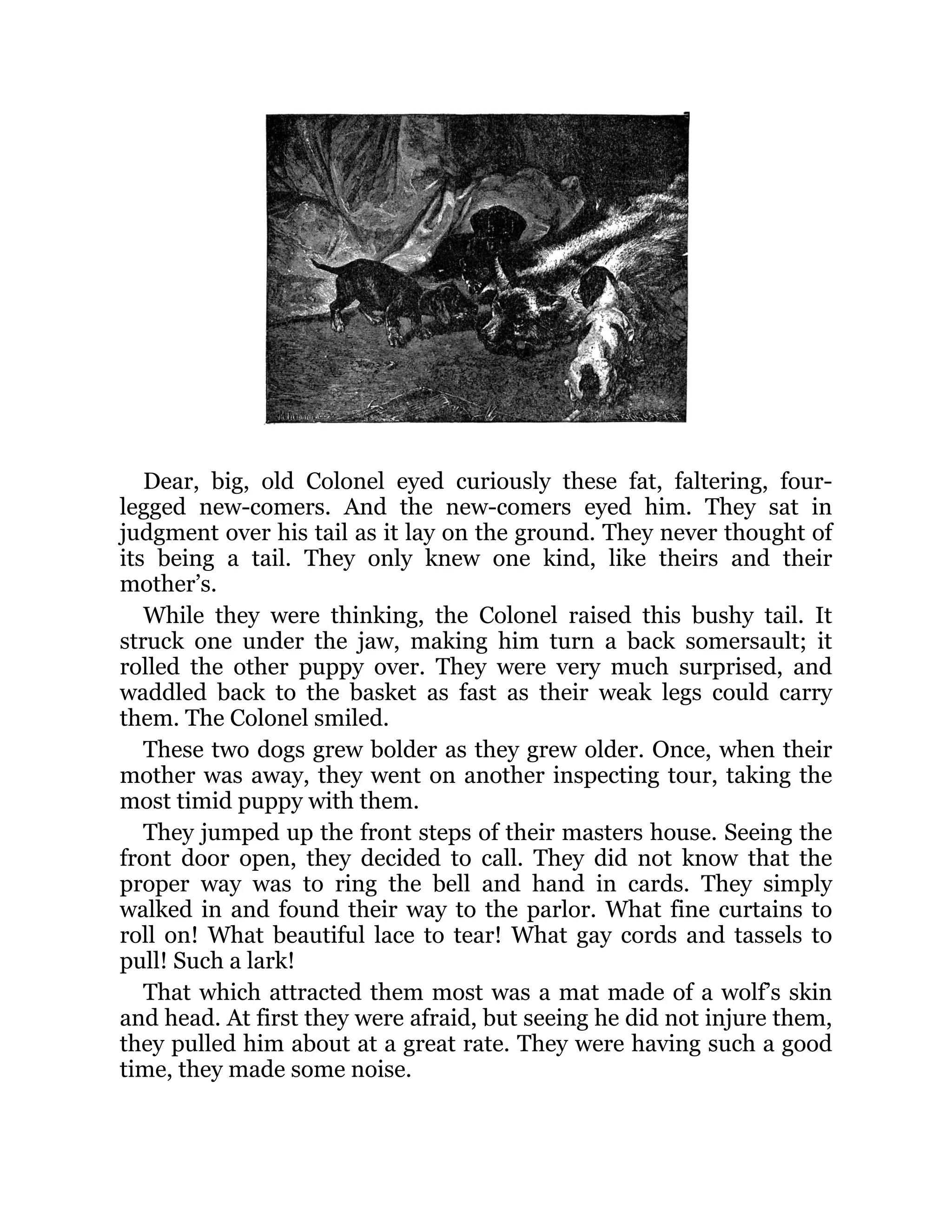
Dear, big, oldColonel eyed curiously these fat, faltering, four-
legged new-comers. And the new-comers eyed him. They sat in
judgment over his tail as it lay on the ground. They never thought of
its being a tail. They only knew one kind, like theirs and their
mother’s.
While they were thinking, the Colonel raised this bushy tail. It
struck one under the jaw, making him turn a back somersault; it
rolled the other puppy over. They were very much surprised, and
waddled back to the basket as fast as their weak legs could carry
them. The Colonel smiled.
These two dogs grew bolder as they grew older. Once, when their
mother was away, they went on another inspecting tour, taking the
most timid puppy with them.
They jumped up the front steps of their masters house. Seeing the
front door open, they decided to call. They did not know that the
proper way was to ring the bell and hand in cards. They simply
walked in and found their way to the parlor. What fine curtains to
roll on! What beautiful lace to tear! What gay cords and tassels to
pull! Such a lark!
That which attracted them most was a mat made of a wolf’s skin
and head. At first they were afraid, but seeing he did not injure them,
they pulled him about at a great rate. They were having such a good
time, they made some noise.
45.
The maid surprisedthem, and stopped their little game by
appearing with a whip. The puppies went out the front door faster
than callers usually go; and they never so much as said good-
afternoon.
46.
DOLLY’S LULLABY.
Dolly darling,now don’t cry,
Here’s your cradle right close by,
In my arms you’ll safely keep,
Close your eyes and go to sleep.
47.
THE BIRDIES.
Dear littlebirdies, come in from the cold.
Don’t be so ’fraid of us. Try to be bold.
Doggie won’t hurt you; he loves little birds;
He minds when I speak, for he understands words.
Dear little birdies, come in for this bread.
Why do you hop away, why turn your head?
Here in my hand is the bread, all for you.
Taste it, and see if my words are not true.
Dear little birdies, come in from the snow.
You will be frozen. Just hear the wind blow!
Hop on the window-sill; hop right along;
Eat of this bread, and then chirp us a song.
Dear little birdies, come in or you’ll freeze.
With snow in the garden, and ice on the trees,
Surely you cannot, though trying your best,
Find any breakfast or feather your nest.
48.
K
THE HISTORY LESSON.
atewas trying to learn her history lesson. She thought she never
could learn the names of all the Presidents of the United States,
and recite them in their order. Her eyes would stray to the story
books. Her mind would wander to “Lady Constance,” who had her
right hand cut off to save the life of her dear husband. And to
Cinderella and her lost slipper. And to the Prince who found it and
married her. In fact she could think of everything except the
Presidents of the United States.
While she was wasting her time, Cousin Anna came in to call.
“What makes you look so cross, Kate?” Cousin Anna asked.
“I can’t get my lesson,” lamented Kate.
“What is your lesson about?” asked the cousin.
“All the Presidents, and I get so mixed up.”
“Have you the list in rhyme?” asked Anna.
“No, Cousin Anna. I never saw it,” said Kate.
“Oh, you must have that. It is so easy to learn. We used to learn the
English Sovereigns in rhyme. I remember so well our reciting;
‘First William, the Norman,
Then William, his son,’
“And so on. And now Mrs. Peter has put our Presidents in rhyme;
‘First Washington, then Adams,
Next Jefferson we view;
James Madison, Monroe, and then,
John Adams’ son—John Q.’
“And so forth. Come home with me and I’ll get you her little book.
She has the important events of each administration all in rhyme,
49.
Welcome to ourwebsite – the ideal destination for book lovers and
knowledge seekers. With a mission to inspire endlessly, we offer a
vast collection of books, ranging from classic literary works to
specialized publications, self-development books, and children's
literature. Each book is a new journey of discovery, expanding
knowledge and enriching the soul of the reade
Our website is not just a platform for buying books, but a bridge
connecting readers to the timeless values of culture and wisdom. With
an elegant, user-friendly interface and an intelligent search system,
we are committed to providing a quick and convenient shopping
experience. Additionally, our special promotions and home delivery
services ensure that you save time and fully enjoy the joy of reading.
Let us accompany you on the journey of exploring knowledge and
personal growth!
ebookfinal.com








![This ebook is for the use of anyone anywhere in the United
States and most other parts of the world at no cost and with
almost no restrictions whatsoever. You may copy it, give it away
or re-use it under the terms of the Project Gutenberg License
included with this ebook or online at www.gutenberg.org. If you
are not located in the United States, you will have to check the
laws of the country where you are located before using this
eBook.
Title: Shining Hours
Author: Anonymous
Release date: January 30, 2021 [eBook #64422]
Most recently updated: October 18, 2024
Language: English
Credits: Richard Tonsing, Juliet Sutherland, and the Online
Distributed Proofreading Team at
https://www.pgdp.net
*** START OF THE PROJECT GUTENBERG EBOOK SHINING HOURS
***](https://image.slidesharecdn.com/6533-250405044937-44d6935c/75/Automating-API-Delivery-MEAP-V05-APIOps-with-OpenAPI-Ikenna-Nwaiwu-31-2048.jpg)