M A NN I N G
Arnaud Lauret
Foreword by Kin Lane
SECOND EDITION
2.
We
are
here
DEVELOP
DEFINE PROVIDE/CONSUME
DEPLOY
TEST
DESIGN
Refine Refine
Modify
Create
Notcovered in the book
This book focuses on the Design stage of the API lifecycle. It doesn’t cover business or IT strategies
for creating an API, defining its objectives, or desired business or IT outcomes. The book also excludes
implementation code, architecture, tests, and deployment concerns, such as API developer portal
resources like documentation. However, it explains how other stages can use the work and artifacts
created during Design.
DESIGN
Identify
the API
capabilities
Design the
programming
interface
Enrich the
API design
artifacts
API
design
ref. kit.
Describe the
programming
interface
DEVELOP
TEST
DEPLOY
PROVIDE/
CONSUME
DEFINE
(Vague)
needs
DESIGN LAYERS
A versatile API design that does the right job
An API design that is user-friendly and interoperable
An API design that considers constraints
(context, security, efficiency,
backward-compatibility, and extensibility)
A reasoned and continuously improving API design process
API design
toolbox
The perspectives
we'll consider
The stages/activities
we'll go though Final deliverable
and supporting
tools and artifacts
Natural language
(share)
Programming language
(POST /statuses)
Standard API
description format
To facilitate design
and next stages
Reuse across APIs
This book’s methodology breaks down the design process in a step-by-step, layered approach to address one
main problem at a time, facilitating learning and execution.
3.
Praise for thefirst edition
Stop scouring the internet for information, it's in this book! A great resource for all skill levels on
designing a Web API.
—Shayn Cornwell, Senior Software Consultant at XeroOne Systems LLC
Answers nagging and complicated questions with a simple philosophy, and never tries to hide
anything from you. A fantastic introduction to the field.
—Bridger Howell, Software Engineer at Social Finance
A strong, structured, and well documented resource the community lacked.
—George Onofrei, Web Developer at DevEx Solutions
A journey from novice to professional for developing Web APIs that are robust, friendly, and easy to
consume.
—Mohammad Ali Bazzi, Lead Software Architect at Seek
A must-read for API programmers and architects.
—Sanjeev Kumar Jaiswal, Lead Security Engineer at Gainsight
Finally, a systematic approach to API design.
—Javier Collado, Backend Engineer at Constructor.io
5.
The Design
of WebAPIs,
Second Edition
ARNAUD LAURET
FOREWORD BY KIN LANE
M A N N I N G
SHELTER ISLAND
To all APIdesigners: it’s dangerous to go alone! Take this.
9.
vii
contents
foreword xxvii
preface xxix
acknowledgmentsxxxi
about this book xxxiii
about the author xxxvii
about the cover illustration xxxviii
1 What is API design? 1
1.1 What is a web API? 2
A web API is a remote interface for applications 2 ■
A web API uses
the HTTP protocol 3 ■
A web API is an interface to an
implementation 4 ■
A web API is an interface for others 5
1.2 Why does the design of any API matter? 6
What if a terrible API was a kitchen appliance? 6 ■
Poor web API
design affects developers and architecture 7 ■
Poor web API design
puts security and infrastructure at risk 8 ■
Poor web API design
affects end-user and third-party experiences 9 ■
Taking care of
design unleashes the power of APIs 9
1.3 When to design web APIs? 10
Any new API must be designed 10 ■
Any modification of any
existing API must be designed 11 ■
Design happens between
choosing to create an API and coding it 11
10.
CONTENTS
viii
1.4 Who designsweb APIs? 12
The three profiles needed to design an API 13 ■
The stakeholders
influencing API design 13
1.5 How do we design web APIs? 14
1.6 Designing APIs step by step 15
Identifying the API capabilities 15 ■
Designing the programming
interface 15 ■
Describing the programming interface 16
Enriching API design artifacts 16
1.7 Designing APIs layer by layer 16
Designing a versatile API that does the right job 16 ■
Designing a
user-friendly and interoperable API 17 ■
Integrating constraints
in an API design 17 ■
Using a reasoned and continuously
improving design process 18
PART 1 FUNDAMENTALS OF API DESIGN.........................21
2 Identifying API capabilities 23
2.1 An overview of identifying API capabilities 24
Starting with the output of the Define stage 25 ■
Analyzing what
users need to achieve 26 ■
Identifying versatile operations to
achieve use cases 26 ■
Keeping programming interface design
concerns for later 27 ■
Clarifying the subject matter and
input 27
2.2 Introducing the API Capabilities Canvas 28
How does the API Capabilities Canvas work? 29 ■
Tools to use
along with the API Capabilities Canvas 30
2.3 Walking the nominal paths 31
Identifying users 32 ■
Listing use cases 32 ■
Decomposing use
cases in steps 33 ■
Determining inputs and success outcomes 33
Spotting missing elements with sources and usages 34 ■
Analyzing
the spotted elements 34
2.4 Walking the alternative and failure paths 35
Analyzing failures for each step 36 ■
Adding alternative
branches on each use case 37 ■
Analyzing the alternative users
and use cases 38
2.5 Refining steps to identify operations 38
Differentiating steps and operations 38 ■
Identifying unique and
versatile operations 39
11.
CONTENTS ix
2.6 Focusingon the proper needs 40
Staying within the Define stage’s needs scope 40 ■
Focusing on
the proper perspectives 41 ■
Asking why to investigate any
problem 41
2.7 Avoiding integrating too specific consumers’
perspective 41
Avoiding mapping consumers’ UI 42 ■
Avoiding integrating
consumers’ business logic 42
2.8 Avoiding exposing the provider’s perspective 43
Avoiding exposing the provider’s data organization 43 ■
Avoiding
exposing the provider’s business logic 44 ■
Avoiding exposing the
provider’s software architecture 45
3 Observing operations from the REST angle 49
3.1 An overview of programming interface design 50
Introducing the basics of the HTTP protocol 51 ■
Introducing the
basics of REST APIs 52 ■
Contrasting REST with non-HTTP-
compliant web APIs 53 ■
How do we design a REST programming
interface? 53 ■
Why not discuss HTTP and REST when
identifying capabilities? 54
3.2 Observing the API Capabilities Canvas from
the REST angle 55
Reorganizing and expanding the API capabilities canvas 56
How to observe operations from the REST angle 57
3.3 Identifying resources and their relations 58
What is a resource? 58 ■
Identifying an operation’s resource 58
Tweaking an operation’s description to identify resource 59
Identifying resource relations 60 ■
Using patterns and recipes
to identify resources and relations 60
3.4 Identifying resource actions 61
What is an action, and how can it be identified? 61 ■
Listing an
action’s inputs 62 ■
Dealing with the operation’s resource when
listing an action’s inputs 63 ■
Listing an action’s outputs 64
Dealing with contradictory successes and failures when listing
outputs 65
4 Representing operations with HTTP 69
4.1 Representing operations with HTTP 70
What an operation looks like with HTTP 71 ■
How to represent
operations with HTTP 72
12.
CONTENTS
x
4.2 Representing resourceswith paths 73
What is a resource path? 73 ■
Designing meaningful resource
paths 74 ■
Targeting specific elements with path parameters 74
Showing resource relationships with a hierarchy 75 ■
Representing
lists and their elements 76
4.3 Representing actions with HTTP methods 77
Determining which HTTP methods to use 77 ■
Choosing HTTP
methods to represent actions 78 ■
Representing search, read,
and delete actions 78 ■
Representing update actions 79
Representing create actions 79 ■
Mapping typical operations
to HTTP 80
4.4 Choosing input data locations in HTTP requests 80
Where to put input data in an HTTP request 80 ■
An overview of input
data natures 81 ■
Choosing a location for resource identifiers 82
Choosing a location for resource representations 82 ■
Choosing a
location for resource modifiers 83 ■
Hesitating between resource
identifiers and modifiers 83 ■
Choosing input data locations for
typical operations 84
4.5 Representing output types with HTTP statuses 84
What is an HTTP status? 84 ■
Choosing HTTP statuses
for outputs 85 ■
Choosing successful HTTP statuses for read
operations 86 ■
Choosing successful HTTP statuses for
delete operations 86 ■
Choosing successful HTTP statuses for
update operations 87 ■
Choosing successful HTTP statuses
for search operations 87 ■
Choosing successful HTTP
statuses for create operations 87 ■
Choosing error HTTP
statuses 87 ■
Ensuring exhaustive error-handling 88
Choosing HTTP statuses for typical operations 89
4.6 Choosing output locations in HTTP responses 90
Where to put data in an HTTP response 90 ■
Filling the output
data gaps 90 ■
Choosing output locations 91 ■
Choosing
output data locations for typical operations 92
4.7 Representing a “do” operation with HTTP 92
Using an action resource 93 ■
Turning the action into a business
concept 93 ■
Focusing on the result 94
4.8 Using the REST architectural style principles for
API design 94
Introducing the REST architectural style 94 ■
Applying REST
principles to API design 95 ■
Debates about what is (or is not)
REST 96
13.
CONTENTS xi
5 Modelingdata 99
5.1 An overview of data modeling 100
Which data are we modeling? 102 ■
Introducing the JSON
portable data format 103 ■
Modeling data 104
5.2 Designing theoretical resource data models 105
Determining a resource’s structure 105 ■
Choosing an object
resource’s properties 106 ■
Choosing a property name and
type 107 ■
Indicating required properties 107 ■
Listing
and modeling properties efficiently 108
5.3 Designing inputs and outputs data models 108
Designing a read operation’s inputs and success outputs 108
Designing a search operation’s inputs and success outputs 109
Designing a create operation’s inputs and success outputs 111
Designing an update operation’s inputs and success outputs 112
Designing a delete operation’s inputs and success outputs 113
Designing a temporary error data model 113
5.4 Streamlining input and output data modeling 113
Designing and using the complete, summarized, minimal,
and identifier models 114 ■
Designing and using the creation,
replacement, and modification models 115 ■
Modeling data
for “do” operations 116 ■
Differentiating similarly named
elements 116
5.5 Using data to ensure completeness and proper focus 117
Spotting missing elements by analyzing input sources and output
usages 117 ■
Ensuring complete business error-handling 117
Focusing on the proper elements 118
6 Describing HTTP operations with OpenAPI 122
6.1 Overview of describing the programming interface 123
Introducing the OpenAPI Specification 124 ■
Using OpenAPI
during design 125 ■
Introducing the YAML format 126
Contrasting an OpenAPI document with our API spreadsheet 127
Describing the programming interface while designing it 128
6.2 Authoring OpenAPI documents 129
Introducing the specification-first and code-first approaches 129
Contrasting the specification-first and code-first approaches 130
Picking an OpenAPI editor 131 ■
Choosing an OpenAPI
version 132 ■
Choosing between JSON and YAML 132
6.3 Describing HTTP operations with OpenAPI 132
14.
CONTENTS
xii
6.4 Describing resourcepaths 133
Initiating an OpenAPI document 134 ■
Describing a path 135
Describing a path with path parameters 135
6.5 Describing operations 136
6.6 Describing operation inputs 138
Describing query parameters and other non-body parameters 138
Describing request bodies 139
6.7 Describing operation output HTTP status codes 140
Describing an output case type with an HTTP status 141
Dealing with outputs sharing the same HTTP status code 142
6.8 Describing operation output contents 142
Describing response bodies 143 ■
Dealing with responses without
bodies 144 ■
Describing response headers 144
7 Describing data with JSON Schema in OpenAPI 148
7.1 An overview of describing data 149
Introducing JSON Schema 149 ■
Contrasting OpenAPI and
JSON Schema with our API spreadsheet 150 ■
Describing data
while designing it 151
7.2 Authoring a JSON Schema data model in OpenAPI 152
7.3 Adding complete resource data models to the OpenAPI
document 152
Choosing a location for the resource model in the OpenAPI
document 152 ■
Initiating the resource model description 153
7.4 Describing complete resource data models
with JSON Schema 153
Describing an object 154 ■
Adding properties to an object 154
Describing an atomic property 155 ■
Describing an object
property 157 ■
Describing an array property 158 ■
Stating
which properties are required 158
7.5 Describing operation input and output data 160
7.6 Describing operation non-body data 161
Describing non-body request parameters with inline schemas 161
Tweaking non-atomic parameter serialization 162 ■
Describing
response headers with inline schemas 162
7.7 Describing operation body data 163
Using references to resource models in response bodies 163
Deriving the complete resource model to create other reusable
15.
CONTENTS xiii
models 165■
Using references to resource models in request
bodies 167 ■
Mixing inline schema and reference 167
PART 2 USER-FRIENDLY, INTEROPERABLE API DESIGN ...173
8 Designing user-friendly, interoperable data 175
8.1 The user-friendliness and interoperability layer
of API design 176
Overview of the API user experience 177 ■
Which users’ experiences
matter to us? 177 ■
How API design user-friendliness and
interoperability affect UX 178
8.2 What makes data user-friendly and interoperable? 179
User-friendly data meets user needs 179 ■
User-friendly data helps
us find and interpret information 179 ■
User-friendly data limits
consumers’ work 180 ■
User-friendly data is consistent 180
Interoperable data is consistent and standard 181
8.3 When and how to design user-friendly, interoperable
data 181
Which data must be user-friendly and interoperable? 182 ■
When
to address user-friendly, interoperable data 182 ■
How to design
user-friendly, interoperable data 183
8.4 Selecting and crafting ready-to-use data 183
Choosing simple and meaningful but useful data 184
Adding supporting data to ease and secure interpretation 185
Adding processed data to reduce consumer effort 185 ■
Choosing
well-known or standard resource identifiers 185 ■
Choosing well-
known or standard data 186
8.5 Choosing user-friendly, interoperable atomic types
and formats 186
Considering formatting numbers as strings 187 ■
Managing
non-human-readable codes 187 ■
Managing dates and
times 188
8.6 Organizing data 189
Grouping data with objects 189 ■
Grouping data with
arrays 191 ■
Sorting data in arrays and objects 192
8.7 Choosing data granularity and scope 192
Considering relevance, not size 192 ■
Embedding lists in a
resource model 193 ■
Modeling embedded resources 194
16.
CONTENTS
xiv
8.8 Designing user-friendlynames 195
When to design user-friendly names 195 ■
Designing simple,
clearly organized, concise names 195 ■
Learning by fixing non-
user-friendly names 196
8.9 Aiming for consistency and standardization 197
Seeking local, domain, or global standardization 197 ■
Using
well-known or standard identifiers consistently 198 ■
Defining a
naming pattern for identifiers 198 ■
Naming, typing, and
structuring consistently 199
9 Designing user-friendly, interoperable operations 203
9.1 What makes operations user-friendly and
interoperable? 204
User-friendly operations expose clear capabilities that meet the
needs 204 ■
User-friendly operations use user-friendly data and
are helpful 204 ■
User-friendly, interoperable operations are
consistent and standard 205
9.2 When and how to design user-friendly, interoperable
operations 205
When to take user-friendly, interoperable operations into
consideration 206 ■
How to design user-friendly, interoperable
operations 206
9.3 Designing easy-to-understand, guessable operations 207
Combining meaningful resource paths and HTTP compliance 208
Creating predictable resource paths 208 ■
Crafting short but
accurate resource paths 209
9.4 Requesting easy-to-provide inputs 210
Using typical and HTTP-compliant input locations 210
Mapping inputs to outputs 212 ■
Requesting well-known
or standard data 212 ■
Minimizing inputs with default and
server-processed data 213
9.5 Returning ready-to-use successful responses 214
Choosing adequate HTTP status and HTTP-compliant data
locations 214 ■
Returning sufficiently informative data 215
9.6 Filtering, sorting, and paginating lists 216
Designing guessable filters that map returned data 216
Designing flexible filters 217 ■
Enabling free search and complex
logic with a q filter 217 ■
Minimizing filters 218 ■
Enabling
sort with helpful defaults 218 ■
Paginating lists 218
Returning filter, sort, and pagination metadata 219
17.
CONTENTS xv
9.7 Adaptingrequest and response data 220
Handling different data formats 220 ■
Translating data and
adapting to locale 222 ■
Tweaking returned data 222
9.8 Handling consumer errors gracefully 223
Limiting consumer errors 223 ■
Using adequate HTTP
status codes 224 ■
Providing informative, problem-solving
feedback 224 ■
Returning machine-readable feedback 225
Returning an exhaustive list of errors 225 ■
Using
standards 226
9.9 Avoiding hiding multiple capabilities in a single
operation 227
Reconsidering request and response data granularity 227
Reconsidering an operation’s purpose 228
9.10 Aiming for consistency and standardization 228
Using standardized data consistently 229 ■
Adopting
standardized behavior consistently 229 ■
Offering standardized
features consistently 230
10 Designing user-friendly, interoperable operation flows 235
10.1 What makes an operation flow user-friendly
and interoperable? 236
Using user-friendly, interoperable elements 236 ■
Being designed
as a whole 236 ■
Being concise and flexible 237 ■
Meeting user
needs within the flow 237 ■
Being helpful across operations 238
Aiming for consistency and standardization 238
10.2 When and how to optimize flows 238
When to consider flow optimization 239 ■
How to optimize
flows 239
10.3 Designing concise, error-limiting, flexible flows 240
Introducing the money-transfer use case 240 ■
Uncovering
operation flow problems 241 ■
Calling read and search
operations once 242 ■
Enhancing operations with use-case-specific
features 242 ■
Adding use-case-specific operations 243
Combining operations into a use-case-specific operation 243
Adding use-case-specific output data 244 ■
Avoiding constraining
consumer flow 245
10.4 Designing flexible data-saving flows 246
Introducing the “Open an account” use case 246
Understanding how data-saving constrains consumer flow 247
Enabling partial data-saving 247 ■
Carefully aggregating saving
18.
CONTENTS
xvi
operations 248 ■
Smoothingvalidation and separating it from
completion 249 ■
Enabling full and partial data-saving
flows 249 ■
Redirecting the consumer to the finalized
resource 250
11 Designing user-friendly, interoperable APIs 253
11.1 What makes an API user-friendly and interoperable? 254
Having a clear purpose that meets focused needs 254 ■
Enabling
discovery and navigation 255 ■
How to create user-friendly,
interoperable APIs 255
11.2 Creating one or multiple APIs 255
When to discuss API granularity 256 ■
Identifying independent
sets of operations 256 ■
Keeping in mind that sub-APIs can be
related 257
11.3 Clarifying the API’s purpose with its name 258
When to choose an API name 258 ■
Choosing an API name 258
Adding the API name to the API base path 258
11.4 Enabling interoperable API browsing with HTTP
and hypermedia APIs 259
Listing a resource’s operations with the OPTIONS HTTP
method 260 ■
Providing pagination, formats, and resources
links with the Link header 260 ■
Using hypermedia formats for
relations and actions 261 ■
Using content negotiation to select
hypermedia or plain JSON format 262 ■
Ensuring that subject
matter data is always available 262 ■
Considering browsing
capabilities 263
PART 3 CONSTRAINED API DESIGN ..............................267
12 Designing a secure API 269
12.1 Overview of API security 270
What happens during an API call? 270 ■
Uncovering design-
related API security problems 272
12.2 When and how to handle security during design 273
When to consider security during API design 273 ■
How API
design contributes to API security 274
12.3 Exposing only the necessary data and operations 275
What are sensitive operations and data? 275 ■
Challenging
sensitive and non-sensitive data and operations 276 ■
Modifying
19.
CONTENTS xvii
data tomake it less sensitive or non-sensitive 276 ■
Splitting an
operation to separate concerns 277 ■
Separating sensitive
operations in dedicated APIs 277
12.4 Ensuring that implemented operations behave according
to context 278
Describing who sees or does what 278 ■
Describing what list or
search operations return 279 ■
Describing how inputs narrow
access 279 ■
Describing all expected implementation checks and
behaviors 280 ■
Narrowing access by design 280
12.5 Ensuring data integrity 281
Corrupting data with regular API calls 281 ■
Correctly
implementing HTTP methods 282 ■
Preventing request
replay 282 ■
Enabling and enforcing conditional
updates 283
12.6 Avoiding protocol- or architecture-based security
problems 284
What may not be secured on an API call over HTTPS 284
Dealing with sensitive search parameters 285 ■
Dealing with
sensitive resource IDs 286 ■
Integrating data encryption or signing
in the design 286
12.7 Limiting consumer access with scopes 287
Limiting access to an operation with a scope 287 ■
Measuring the
importance of scopes and their design 288
12.8 Designing scopes 289
Creating operation-based scopes 289 ■
Creating resource-,
concept-, or use-case-based scopes 290 ■
Creating scopes for read
or write operations 291 ■
Creating end-user- or consumer-based
scopes 291 ■
Tweaking operation behavior with scopes 292
Deciding which scope types to use 292
12.9 Describing scopes with OpenAPI 292
Defining scopes 292 ■
Using scopes 293
12.10 Erroring securely 294
Handling token-related errors 294 ■
Handling missing scopes or
permissions 294 ■
Avoiding disclosing implementation details on
server errors 295 ■
Providing implementation details in response
descriptions in OpenAPI 296 ■
Enforcing expected error data with
JSON Schema 297
20.
CONTENTS
xviii
13 Designing anefficient API 302
13.1 An overview of API efficiency 303
How an API can be inefficient 303 ■
When to be concerned
about efficiency 304 ■
How design contributes to API
efficiency 305
13.2 Optimizing the design only when necessary 305
Ensuring HTTP configuration efficiency 305 ■
Limiting API
usage with rate-limiting 306 ■
Enhancing response with rate-
limiting headers 307 ■
Finding the true root cause 307
13.3 Focusing on user needs and user-friendliness
to be efficient 307
What we’ve learned so far 308 ■
Analyzing an inefficient
flow 308 ■
Optimizing each operation 309 ■
Rethinking
the flow 310
13.4 Enabling caching and conditional readings 311
An overview of caching and conditional readings 311 ■
Not
letting consumers decide how to cache 312 ■
Defining caching
policies based on data and context 312 ■
Returning cache
directives 313 ■
Retrieving data only when modified 314
13.5 Optimizing data volume 314
Enabling resource model selection 315 ■
Toggling the return of
updated or created resources 316 ■
Enabling field selection 316
Centralizing redundant data in dedicated operations 317
Considering a partial update over total replacement 317
Contrasting JSON Merge Patch and JSON Patch for array
updates 318
13.6 Optimizing pagination 319
Optimizing page size limits 319 ■
Choosing cursor- or index-based
pagination 320
13.7 Processing multiple elements with bulk or batch
operations 320
Designing bulk operation requests 321 ■
Optimizing bulk
operation requests 322 ■
Clarifying a bulk operation error
policy 322 ■
Designing a mixed response 323 ■
Designing
an all-or-nothing response 324 ■
Optimizing bulk request
responses 324 ■
Partitioning access to bulk operations 325
13.8 Considering a separate optimized API 325
21.
CONTENTS xix
14 Adaptingthe API design to the context 330
14.1 Integrating context into the API design 331
How context can affect the design of an API 332 ■
Seeking
constraints and limitations during design 333 ■
Challenging
constraints and limitations 333 ■
Making trade-offs 334
14.2 Dealing with consumer and provider constraints 334
Working around consumer HTTP method limitations 334
Accommodating consumers who are used to different data
formats 335 ■
Managing planned interruptions 336
Ensuring data and URL compatibility 336 ■
Implementing
partial updates 337
14.3 Handling data and files 337
Collecting data and files in a flow 338 ■
Sending data and files
with a single call 338 ■
Retrieving data and files with a single
call 340 ■
Describing files with OpenAPI 340 ■
Describing
mixed data and files with OpenAPI 341
14.4 Providing efficient file management features 343
Returning file data only when necessary 343 ■
Enabling partial
downloads and uploads 343 ■
Preventing unnecessary uploads 344
14.5 Delegating file downloads and uploads 345
Downloading files from another system 345 ■
Uploading files to
another system 346
14.6 Notifying consumers about provider-sourced events with a
webhook 347
What is a webhook, and why should we consider using one? 347
Webhooks should be optional 348 ■
Designing a webhook
operation 348 ■
Using a standard event format 348
Choosing event data granularity 349 ■
Designing a secure
webhook 350 ■
Defining the expected webhook behavior 351
Dealing with webhook failures 351 ■
Describing a webhook
with OpenAPI 352
14.7 Handling long operations 353
Starting a long operation and monitoring its status with
polling 353 ■
Using a callback API to avoid polling 354
Describing a callback with OpenAPI 354 ■
Choosing an
execution mode with the Prefer header 356
14.8 Considering other API types 356
Introducing REST API alternatives 356 ■
When to select
an API type 357
22.
CONTENTS
xx
15 Modifying anAPI 361
15.1 An overview of API modification concerns 362
What can happen when modifying an API? 363 ■
Uncovering
API design modification concerns 363 ■
How to design API
modifications 364
15.2 Identifying breaking changes and ensuring backward
compatibility 365
Modifying output data 365 ■
Modifying input data 367
Modifying resource paths 370 ■
Modifying operations or their
HTTP methods 370 ■
Modifying HTTP statuses 371
Modifying operation flows 371 ■
Being aware of the invisible
contract 372 ■
Preventing unintended modifications 372
15.3 Identifying security-breaking changes and preventing
breaches 373
15.4 Assigning a version to an API 373
Differentiating interface and implementation versioning 374
Choosing an API version identifier 375 ■
How the API version
can be represented in a request 376 ■
Choosing how to represent the
API version in a request 377 ■
When to choose an API version
scheme and representation 377 ■
Avoiding sub-API-level
versioning 377
15.5 Carefully breaking and versioning an API 378
Listing consumers and their types 379 ■
Checking whether
consumers use what we break 379 ■
Determining whether it’s
possible to expose multiple API versions 379 ■
Complying with the
API versioning policy 380 ■
Balancing effects and benefits of
breaking changes 380 ■
Accumulating trade-offs or breaking
regularly 380
15.6 Creating extensible API designs 381
Designing a user-friendly, interoperable REST API that does
the job 381 ■
Learning from past decisions 382 ■
Using
extensible design patterns 383 ■
Providing deprecation runtime
information 384
15.7 Describing the design modifications with OpenAPI 384
Indicating the API version 384 ■
Deprecating elements 385
Adding a changelog 386
23.
CONTENTS xxi
PART 4SCALED AND SIMPLIFIED API DESIGN ................393
16 Facilitating API design decision-making 395
16.1 Making design decisions confidently and
consistently 396
Ensuring that it’s the right time to make a decision 397
Evaluating the scope of the decision 397 ■
Deciding based on
trusted past decisions 397 ■
Deciding based on trusted external
sources 398 ■
Backing decisions with reasoning and sourced
information 398 ■
Explaining out loud 398
16.2 Researching solutions to API design questions 399
Where to research solutions to design questions 399 ■
Searching and
considering 400 ■
Using an architectural decision record format 400
16.3 What are API design guidelines? 402
How design guidelines can help us 402 ■
How API design guidelines relate
to API governance 403 ■
When do we need design guidelines? 403
16.4 What to put in user-friendly API design guidelines 403
Listing principles and rules 404 ■
Providing actionable
recipes 404 ■
Providing ready-to-use artifacts and tools 405
Helping with the API design process 405 ■
Adding
implementation or architecture considerations 405
16.5 How to build API design guidelines 406
Starting with basic API design guidelines 406 ■
Considering
existing APIs 407 ■
Expanding the guidelines when new questions
arise 407 ■
Ensuring that each rule brings value 408
Carefully modifying API design guidelines 408
17 Optimizing an OpenAPI document 411
17.1 An overview of OpenAPI document optimization 412
17.2 Defining consistent data models 413
Reusing schemas 413 ■
Defining subschemas 414 ■
Targeting
part of a schema with a deep reference 414 ■
Overriding
descriptions when using a $ref 415 ■
Creating unique
read-and-write models 416 ■
Defining a complete schema
from its summary 418 ■
Considering schema optimizations 419
17.3 Defining consistent parameters 419
Using path-level parameters 419 ■
Reusing parameters 420
Defining reusable groups of query parameters 421
17.4 Defining consistent request bodies 422
24.
CONTENTS
xxii
17.5 Defining consistentresponses 423
Reusing response headers 423 ■
Reusing responses 424
17.6 Ensuring cross-API consistency with external shared
components 426
Defining a library of reusable components 426 ■
Using a shared
component in an API 427 ■
Ensure that library files are editable
independently 427
17.7 Enhancing API design guidelines 428
18 Automating API design guidelines 432
18.1 What API linting is and how it can help us 433
Detecting API design and OpenAPI authoring problems 434
Applying guidelines seamlessly and concentrating on user
needs 435
18.2 Using an API linter to automate API design
guidelines 435
Developing linting rules to automate guidelines 435 ■
Using our
automated guidelines while designing APIs 436 ■
Choosing an
API linter 436
18.3 Introducing Spectral 437
Linting an OpenAPI document with Spectral CLI 437 ■
How
Spectral lints an OpenAPI document 438 ■
Editing Spectral
rulesets 438
18.4 Deciding what API linting rules verify 439
Using our guidelines to create only needed rules 439 ■
Finding
small problems to solve 440 ■
Simplifying rules with shared
OpenAPI components 441 ■
Ensuring appropriate granularity
with a concise name and description 441
18.5 Targeting elements to check in the OpenAPI
documents 442
Starting rule development by targeting the proper elements 442
Targeting any element in the OpenAPI document 443 ■
Dealing
with references to local or shared components 445 ■
Creating a
library to target typical elements 445
18.6 Checking element values 447
Performing basic checks on values and keys 447 ■
Ensuring that
an element is defined 448 ■
Ensuring that an element is not
defined 449 ■
Checking references 450 ■
Checking partial
JSON schemas 451 ■
Performing cross-element checks 452
25.
CONTENTS xxiii
18.7 Returninghelpful feedback when problems
are detected 454
Stating the importance or nature of a problem with a severity 455
Returning problem-solving message 456 ■
Splitting rules due to
severity or message concerns 457
18.8 Organizing rules 457
18.9 Using our automated guidelines when designing APIs 458
Importing and tweaking the guidelines ruleset 458 ■
Ignoring
certain problems 459
19 Enriching API design artifacts 463
19.1 Crafting an API design reference kit 464
What an API design reference kit can contain 465 ■
Using the kit
to design the API 466 ■
Using the kit to develop the API 466
Using the kit to test the API 466 ■
Using the kit to deploy the
API 466 ■
Using the kit to provide and consume the API 467
What we already have and what we may want to add 467
19.2 Providing an overview of the API design with
OpenAPI 468
Adding links to other artifacts and describing the API 468
Organizing operations around concepts and use cases 469
Describing use cases 470
19.3 Enhancing the precision of data models with JSON
Schema 471
Describing a number or element size range 471 ■
Describing a
value with pattern, enum, and default 472
19.4 Providing examples to illustrate data and operations 473
Adding property examples with JSON Schema 474 ■
Adding
examples of parameters, request and response bodies, and headers
with OpenAPI 475 ■
Authoring accurate and realistic
examples 475 ■
Sharing OpenAPI examples across
operations 476 ■
Connecting examples to each other 477
19.5 Enhancing and adapting artifacts for implementers 478
Embedding implementation notes in artifacts 478 ■
Enhancing or
adapting OpenAPI for code generation 479
19.6 Considering API mocking or prototyping during
API design 479
Creating a basic mock with OpenAPI 480 ■
Favoring an early
prototype over a complex mock during design 480
26.
CONTENTS
xxiv
19.7 Considering creatingfunctional API tests during
API design 480
Clarifying logic 481 ■
Smoothing collaboration 481
Designing standard APIs 481
appendix Solutions to the exercises 485
index 523
27.
xxv
foreword
The discipline ofweb API design has been maturing for well over a decade, and each
edition of The Design of Web APIs by Arnaud Lauret provides a milestone marker for
this collective API journey. To help you properly absorb and apply what you are about
to read, you need to understand that the seeds of the specifications and techniques
put forth by Arnaud in this book emerged between 2010 and 2015, when he began to
help properly document this movement in character as the API Handyman. There is
nobody better to learn API design from than Arnaud Lauret, and no better time to be
implementing it.
I personally watched Arnaud dissect HTTP, OpenAPI, JSON Schema, and the
other essential building blocks of the API economy between 2015 and 2019. As the
API Handyman, he went deep down the API design rabbit hole and returned with the
first edition of The Design of Web APIs. Now Arnaud has done it again, aligning his
expertise in the pragmatic real-world design of the digital resources and capabilities
that are shaping the global business landscape with what enterprises need to tame the
API sprawl they face in 2025.
It does not matter if your teams are producing internal, partner, or public APIs.
Your engineering teams are likely both design-first and code-first when it comes to
delivering web APIs. The Design of Web APIs in 2025 is your guide to modernizing your
digital supply chain, factory floor, and distribution channels. Most traffic on the World
Wide Web is web API traffic, and this is the ubiquitous approach to defining digital
resources and capabilities and delivering modern web, desktop, mobile, device, and
now artificial intelligence application experiences. The second edition of The Design of
28.
FOREWORD
xxvi
Web APIs isyour handbook not just to design APIs but also to lay a solid foundation for
the governance of those APIs at scale across teams.
There are two types of enterprise organizations today: those investing in ensuring
that their product and engineering teams have the skills they need to design, develop,
deliver, and sustain modern web APIs; and those outsourcing the heart of their busi-
nesses to cloud software vendors. The Design of Web APIs is the book you need to equip
both your product and engineering teams to deliver consistent and standardized web
APIs at scale. This book will help your teams master the most common standardized
aspects of web APIs and will equip them with the skills they need to design and deliver
the parts of your operations that are unique and proprietary to the way your enter-
prise does business.
I have been working exclusively with web APIs since 2010, and Arnaud—the API
Handyman—and The Design of Web APIs are always my go-to for the API design knowl-
edge I need to produce APIs and support my customers in producing the hundreds or
thousands of APIs they need to conduct business each day. Without proper design of
web APIs, each new application or integration inside or outside the enterprise becomes
exponentially more expensive and time-consuming to make happen—increasing the
total cost of ownership for every API. If you are just starting your business and are
looking for guidance to make your business supply chain, factory floor, and distribu-
tion channels efficient, or you’ve been in business for many years and would like to
get a handle on API sprawl, The Design of Web APIs has the answers you are looking for.
—KIN LANE, The API Evangelist
29.
xxvii
preface
My career hasspanned more than two decades, mostly in finance, and during that
time I have worked on connecting software across networks using technologies like
FTP, Sun RPC, CORBA, Java RMI, SOAP, and web APIs. I have complained about terri-
ble internal and third-party APIs (web services, RPC, etc.) and created awful ones
myself. I’ve witnessed how flawed API design causes confusion, prolonged develop-
ment, brittle code, rising technical debt, wasted resources, production crashes, and
security breaches.
As technology evolved, connecting software became easier, especially with web
APIs. The rise of “as a service” products and successful public APIs like Twilio and
Stripe in the 2010s raised expectations for API design and developer experience;
sending SMS messages and money with simple code was a game-changer. It trans-
formed my approach to software and API design: why, I wondered, couldn’t I always
have such a fantastic experience? However, even after the API hype started, many pri-
vate and public web APIs were neglected, just as their predecessors had been. They
were often seen as mere technical plumbing, and well-meaning creators often fell into
common traps that I also encountered.
Attending my first API conference (API Days Paris in late 2014) made me want to
share all I had learned. I created my API Handyman blog, began speaking at confer-
ences, and wrote the first edition of The Design of Web APIs, published in 2019. I origi-
nally intended to explore web API design with REST, GraphQL, and gRPC, but the
book became too lengthy and complex. To teach design principles, I chose to focus
on REST APIs, as they are widely used and rooted in solid principles; this helped me
30.
PREFACE
xxviii
address key designissues like meeting needs, usability, security, performance, and
modifications, which apply to all APIs.
In 2025, the first edition of this book is still relevant. Web APIs remain vital across
all industries and are essential for distributed systems, web apps, mobile apps, cars,
kitchen appliances, other applications, and AI. REST APIs are still the most com-
monly used. And the numerous API design reviews, workshops, training sessions, and
API analyses I’ve conducted make it clear that API design still needs to be taught.
Many, including AI, struggle to understand what designing an API entails and how to
create effective APIs.
So, I quickly agreed to work on a second edition when asked. Since the first edi-
tion, I’ve gained valuable insights and wanted to include my new and revised knowl-
edge in the book. The first edition can be compared to Terminator and the second to
Terminator 2: Judgment Day: bigger and better. The core story remains (teaching web
API design and focusing on REST APIs, not saving us from Skynet), but it’s a complete
rewrite with more depth and tons of new content. For example, it features an API
design process that ties the book together, emphasizes the importance of communica-
tion with other stakeholders, highlights interoperability as part of usability, simplifies
design decisions, discusses building guidelines and their automation, and includes 70
exercises to reinforce key concepts. My past self would have avoided many problems if
I’d had this book to use as a resource; I hope you find it useful, too!
31.
xxix
acknowledgments
Writing this secondedition was even more challenging than the first; I wouldn’t have
achieved such a great book alone. I want to thank everyone who made this odyssey
possible.
First and foremost, I want to thank my wife, Cinzia, and my daughter, Elisabetta.
You have always supported me and encouraged me. I love you so much.
Next, I want to thank everyone at Manning Publications, starting with my editor,
Mike Stephens; thank you for believing in the book’s first and second editions. To my
development editor, Marina Michaels: thank you for your help, support, and feed-
back. Thanks also to my technical editor, Jeremy Glassenberg, for his invaluable feed-
back. And thank you to all the Manning production folks—production manager
Aleksandar Dragosavljević, production editor Andy Marinkovich, graphics supervisor
Azra Dedic, copyeditor Tiffany Taylor, proofreader Jason Everett, typesetter Dennis
Dalinnik, and cover designer Marija Tudor—for their efforts in getting this book
ready for publication.
Thank you to all the reviewers for their invaluable and detailed feedback: Adam
Hörömpöli, AJ Bhandal, Akinwale Habib, Alceu Rodrigues de Freitas Junior, Amol
Gote, Andrei Tarutin, Andres Sacco, Ashwini Gupta, Asif Iqbal, Becky Huett, Dileep
Kumar Pandiya, Elias Rangel, Emmanouil Chardalas, Ernesto Cardenas Cangahuala,
Gabriele Bassi, Harini Shankar, Jeremy Caney, José Alberto Reyes Quevedo,
Kalyanasundharam Ramachandran, Kristina Kasanicova, Lakshminarayanan A. S, Lov
Lalwani, Malik Novruzov, Mihaela Barbu, Mikhail Malev, Mwiza Kumwenda, Naga
Rishyendar Panguluri, Nakul Pandey, Nghia To, Palak Mathur, Richard Meinsen,
32.
ACKNOWLEDGMENTS
xxx
Saidaiah Yechuri, SalahuddinZaki, Shantanu Kumar, Sridhar Rao Muthineni, Sumit
Bhatnagar, Tede Morgado, Walter Alexander Mata López, Werner Nindl, and Zorodzayi
Mukuya. Your input helped make this a better book.
Thank you to everyone who provided invaluable encouragement and feedback at
various stages. A very special merci beaucoup to Joyce Stack for her feedback on the
early manuscript of the second edition. Also, thanks to all readers of the first edition,
especially Isabelle Reusa and Mehdi Medjaoui, who field-tested and reviewed the early
manuscript.
Finally, thanks to all the API practitioners I have met; I learned a lot from you.
Thanks to Mike Amundsen, Kin Lane, and Mehdi Medjaoui (again) for their encour-
agement and help when I started the API Handyman blog in 2015 and after. A special
thanks to Ivan Goncharov, who, in 2017, forwarded an email from Manning Publica-
tions seeking an author for an API book that later became The Design of Web APIs. This
book wouldn’t exist without all of you.
33.
xxxi
about this book
TheDesign of Web APIs, Second Edition was written to help you design new web APIs or
modify existing APIs so that they do the right job; are versatile, secure, and efficient;
address contextual constraints; and facilitate future changes. To do so, this book
uncovers all aspects of API design and equips you with the mindset, processes, and
tools to efficiently do your job in the long run and at scale, working on many APIs and
with other API designers.
Who should read this book?
The Design of Web APIs, Second Edition, is, obviously, for anyone who directly designs
web APIs, but also for people involved in their creation and use. They could be develop-
ers, business analysts, technical writers (involved in the creation of server applications,
microservices, and backends for mobile applications or websites), tech leads, archi-
tects, API governance experts (working at scale on many APIs), or API product owners
(who want to ensure the best possible developer experience). Additionally, developers
using APIs, QA engineers testing APIs, technical writers documenting APIs, and secu-
rity experts requesting modifications may be interested in understanding how APIs
should be designed so they can give constructive feedback to their API providers.
How this book is organized: A roadmap
This book has 4 parts, 19 chapters, and an appendix. Chapter 1 is an introduction to the
entire book. It establishes a shared understanding of web APIs and web API design and
outlines the design process and practices we’ll learn in the following chapters.
34.
ABOUT THIS BOOK
xxxii
Part1 teaches the fundamentals of designing a versatile API that does the
right job:
Chapter 2 explains how to identify the capabilities an API must offer to meet
the requirements exhaustively and adequately.
Chapter 3 introduces REST APIs and teaches how to observe API capabilities to
identify the elements needed to design a REST API: resources, their relations,
and their operations.
Chapter 4 explores how to represent operations with HTTP, including resource
path design, choosing HTTP methods and HTTP statuses, and selecting loca-
tions for data in HTTP requests and responses. It also discusses the REST archi-
tectural style and its benefits for API design.
Chapter 5 discusses modeling data, including resources, path parameters,
query parameters, and request and response headers and bodies.
Chapter 6 shows how to describe HTTP operations using the OpenAPI
Specification.
Chapter 7 explains how to describe data in OpenAPI documents with JSON
Schema.
Part 2 focuses on designing user-friendly, interoperable APIs that developers can use
quickly and seamlessly without complex thinking and coding. It covers these con-
cerns at the data, operation, sequence of operations, and API levels, with one chap-
ter for each:
Chapter 8 introduces the concepts of user-friendliness and interoperability for
APIs and then focuses on data. It explains how to choose, define, type, orga-
nize, and name data so that it is ready to use, consistent, and standard.
Chapter 9 explains how to make operations clear and guessable; have easy-to-
provide inputs and ready-to-use outputs; enable pagination, filtering, and sort-
ing; and handle errors gracefully.
Chapter 10 shows how to design concise, error-limiting, flexible sequences of
operations.
Chapter 11 discusses creating one or multiple APIs, naming APIs, and enabling
API browsing with HTTP and hypermedia.
Part 3 explains how security, efficiency, data, architecture, business, and modification
concerns can constrain our ideal user-friendly, interoperable design that does the
right job:
Chapter 12 covers designing secure APIs, including data sensitivity, secure oper-
ation behavior, data integrity, and controlling access with scopes.
Chapter 13 focuses on efficient API design that doesn’t bother end users or
negatively impact infrastructure. It discusses data volume optimization, cach-
ing, processing multiple elements, and considering separate optimized APIs.
35.
ABOUT THIS BOOKxxxiii
Chapter 14 explores how data, architecture, and business affect our design. It
discusses handling files, long operations, webhooks, and types of APIs other
than REST.
Chapter 15 discusses modifying an API, including how not to break consumers,
versioning, and extensible design.
Part 4 aims to make our API designer job easier and more sustainable in the long term
and at scale, when we’re working on many APIs with colleagues:
Chapter 16 explains how to make design decisions confidently and create user-
friendly API design guidelines.
Chapter 17 discusses optimizing OpenAPI documents for consistency and sim-
plified authoring, including defining reusable elements shared across APIs.
Chapter 18 describes automating guidelines to ensure consistency and free our
minds of details. It illustrates this with Spectral, an API linter.
Chapter 19 discusses enhancing the API design artifacts we’ve created to build a
design reference kit that streamlines our work, ensures accurate implementa-
tion, and supports the following steps of the API lifecycle.
The online appendix contains the solutions to the exercises in the book. I encourage
you to solve them before reading their solutions, which include detailed explanations,
references to relevant sections, and additional comments. It is available in the ePDF,
ePUB, and liveBook versions of the book, as well as via download on the book product
page at www.manning.com/books/the-design-of-web-apis-second-edition.
This book should be read from cover to cover, in order. Each new chapter expands
on what has been learned in previous ones. But after you finish chapters 1–7, you can
jump to any chapter that covers a topic you urgently need to investigate.
About the code
This book contains many examples of source code, both in numbered listings and in
line with normal text. In both cases, source code is formatted in a fixed-width font
like this to separate it from ordinary text.
You’ll find detailed examples of OpenAPI and JSON Schema in chapters 6, 7, and
11–19. Chapter 18 also contains examples of Spectral rules; you’ll need NodeJS and
Spectral version 6 to run them.
You can copy the listings’ source code from the liveBook (online) version of this
book at https:/
/livebook.manning.com/book/the-design-of-web-apis-second-edition.
The complete code for the examples in the book is available for download from the
Manning website at www.manning.com/books/the-design-of-web-apis-second-edition
and in this book’s repository, available at https:/
/github.com/arno-di-loreto/design
-of-web-apis-2e. Both contain the following:
An example of the API Capabilities Canvas from chapter 2 in Google Sheet (via
a link), Excel, and Open Document formats
36.
ABOUT THIS BOOK
xxxiv
All OpenAPI, JSON Schema, and Spectral code listings with complete com-
ments and full versions of elements that are truncated in the book
Spectral and OpenAPI files and magic npm run <section number> commands to
quickly run the Spectral rules in each section of chapter 18
liveBook discussion forum
Purchase of The Design of Web APIs, Second Edition includes free access to liveBook,
Manning’s online reading platform. Using liveBook’s exclusive discussion features,
you can attach comments to the book globally or to specific sections or paragraphs.
It’s a snap to make notes for yourself, ask and answer technical questions, and receive
help from the author and other users. To access the forum, go to https:/
/livebook
.manning.com/book/the-design-of-web-apis-second-edition/discussion. You can also
learn more about Manning’s forums and the rules of conduct at https:/
/livebook
.manning.com/discussion.
Manning’s commitment to our readers is to provide a venue where a meaningful
dialogue between individual readers and between readers and the author can take
place. It is not a commitment to any specific amount of participation on the part of
the author, whose contribution to the forum remains voluntary (and unpaid). We sug-
gest you try asking the author some challenging questions lest his interest stray! The
forum and the archives of previous discussions will be accessible from the publisher’s
website for as long as the book is in print.
Other online resources
If you want to learn more about API design and beyond, I recommend doing the
following:
Subscribe to the API Developer Weekly newsletter at https:/
/apideveloperweekly
.com.
Read posts by Kin Lane, the API Evangelist, at https:/
/apievangelist.com.
Read my API Handyman blog at https:/
/apihandyman.io.
37.
xxxv
about the author
ARNAUDLAURET is a French software architect and tech enthu-
siast with over two decades of experience. He has spent most of
his career in finance, connecting systems in various ways,
including web APIs. Currently, he is involved in API tooling and
works as an API Industry Researcher at Postman. For the last
decade, he has focused on web APIs—designing, building, and
analyzing APIs, and guiding others in these areas while investigat-
ing the tools, practices, and challenges shaping the API world
across industries. He shares his knowledge on the API Handy-
man blog and at conferences worldwide. Passionate about human-centered design, he
strives to create systems that provide excellent experiences for everyone involved,
from those who build and run them to end users.
38.
xxxvi
about the coverillustration
The figure on the cover of The Design of Web APIs, Second Edition is captioned “Girl
from Drniš, Dalmatia, Croatia.” The illustration is taken from a reproduction of an
album of Croatian traditional costumes from the mid-nineteenth century by Nikola
Arsenovic, published by the Ethnographic Museum in Split, Croatia, in 2003. The
illustrations were obtained from a helpful librarian at the Ethnographic Museum in
Split, itself situated in the Roman core of the medieval center of the town: the ruins of
Emperor Diocletian’s retirement palace from around AD 304. The book includes
finely colored illustrations of figures from different regions of Croatia, accompanied
by descriptions of the costumes and of everyday life.
In those days, it was easy to identify where people lived and what their trade or sta-
tion in life was just by their dress. Manning celebrates the inventiveness and initiative
of the computer business with book covers based on the rich diversity of regional cul-
ture centuries ago, brought back to life by pictures from collections such as this one.
39.
1
What is APIdesign?
Think about your past experiences with web APIs. Have you struggled with cryptic or
inconsistent naming and typing, poor data organization, or missing data or opera-
tions? Spent hours debugging a failed call that returned a vague “Bad Request”? Have
you dealt with crashes due to data being removed in API responses? Maybe end users
complained about slow performance, only for you to find an API call returning an
entire database table. Or worse, have you discovered an API exposed sensitive data
inappropriately? The root cause is often the same: poor API design.
The design of any web API is crucial, whether it is used by thousands of third
parties or a few internal developers. Poorly designed APIs can negatively affect
developers’ productivity, an IT system’s performance and integrity, end users’ expe-
rience, and an organization’s revenue. Well-designed APIs give developers and IT
This chapter covers
What are web APIs?
Why web API design matters
When to design web APIs
Who designs web APIs
How to design web APIs
40.
2 CHAPTER 1What is API design?
systems superpowers and make end users happy, helping individuals, teams, depart-
ments, or organizations achieve their IT-system-dependent goals faster and more effi-
ciently. In this book, we’ll introduce you to techniques and tools that will help you
design web APIs that developers will love to use.
1.1 What is a web API?
Our interconnected world relies heavily on web APIs (application programming inter-
faces), which enable communication between applications over a network. They are
essential for websites, mobile applications, and IT systems with different software com-
ponents working together. Web APIs can provide simple programmatic access to any
server application with a few lines of code, enabling the remote triggering of any
action the application can perform: for example, reading or updating a customer’s
address, getting a server’s health information, sending an SMS, or detecting kittens in
a video. APIs don’t require knowledge of the underlying code and logic; as long as
they are authorized to (API security is discussed in section 12.1), anyone can use
them, not just their creators. This section clarifies what a web API is in the context of
this book by discussing four key aspects. A web API is
A remote interface for applications
An HTTP protocol-based interface
An interface to an implementation
An interface we create for others
1.1.1 A web API is a remote interface for applications
A web API enables one application (server, backend, or provider) to expose functions
or operations that other applications (clients or consumers) can use, call, or con-
sume remotely over a network. Figure 1.1 illustrates typical scenarios with the ficti-
tious SOCNET social network (replace with your favorite one).
To share a message on SOCNET, a user of its mobile application takes a photo, types a
message, and taps the Share button. The mobile application then calls the “Share” oper-
ation of SOCNET’s backend web API, sending the message and photo over the internet.
The backend detects friends in the photo and stores the message by invoking internal
server applications via their web API over the local network. Other users can view the
shared message via the SOCNET application or website, which calls the “Timeline” oper-
ation. SOCNET also has a Health Check server application that runs in the cloud, regu-
larly calling the “Timeline” operation to ensure that everything functions correctly.
This example shows that we can retrieve, send, or process data via a web API. How-
ever, web APIs can also affect the real world beyond data. For example, a web API call
can hail a taxi or turn a smart lightbulb on or off.
NOTE A web API enables communication between mobile or web applica-
tions and their backends and between server applications (typically in micro-
service or similar distributed architectures). A web API can provide multiple
41.
3
1.1 What isa web API?
operations. Multiple applications can access the same web API. An applica-
tion that provides a web API can also consume others. An application con-
suming an API may or may not have end users.
1.1.2 A web API uses the HTTP protocol
When an application calls a web API, it uses HTTP (Hypertext Transfer Protocol), the
same thing a web browser uses to retrieve an HTML page of a website; that’s the origin of
the “web” in web APIs. Figure 1.2 shows a call to the “Share” operation of the SOCNET
web API to illustrate what it looks like; we’ll keep the details for section 3.1.
SOCNET
( ^_^)
Hello!
Share
h ps://soc.net
SOCNET
( ^_^)
Hello!
#API blah
Trending
#API
#design
Health check
Share Timeline
SOCNET backend
Save Search
Messages
Add Detect
Friends
Local network
Internet
(network)
SOCNET
infra.
Client application
(consumer)
Operation
Web API
Server
application
(provider)
Web API
Inter-server
applications
API calls
Client application
with no end user
Figure 1.1 The SOCNET web API exposed by the backend has operations that can be called by any kind
of application over the internet. The Friends and Messages internal applications also expose web APIs
that can be called over the local network.
SOCNET
( ^_^)
Hello!
Share
Share Timeline
SOCNET backend
POST /statuses
{
message: Hello!,
...
}
HTTP
request
SOCNET
Shared!
201 Created
{
id: 12345,
...
}
HTTP
response
What to do and the
associated data
How the processing went
and resulting data
Can you share
this, please?
Sure, it's
done!
Figure 1.2 When calling a web API, the consumer sends an HTTP request indicating what to do and
the needed data. Once the request is processed, the server returns an HTTP response indicating how
the processing went and the resulting data.
42.
4 CHAPTER 1What is API design?
When using an HTTP-based API, the consumer sends a request containing informa-
tion that describes the action to be performed and the associated data needed to exe-
cute the action. The server returns a response indicating whether the processing went
well and the resulting data. Different types of web APIs exist, such as REST, SOAP,
GraphQL, and gRPC (no worries if those names mean nothing to you); they use
HTTP differently. The figure illustrates a typical REST API call, the type of API we
focus on in this book.
NOTE This book focuses on REST APIs because they are the most commonly
used type of web API and rely on solid architectural principles (discussed in
section 4.8). These principles can benefit any type of web (and non-web) API.
Additionally, many design principles of this book apply to other APIs. How-
ever, a REST API is not always the adapted solution; alternatives will be briefly
discussed in section 14.8.
1.1.3 A web API is an interface to an implementation
The term Web API is often used to refer to an application that exposes an API, but it rep-
resents only part of the application. A web API is an interface to an implementation and
(ideally) conceals implementation details. As shown in figure 1.3, an application provid-
ing a web API can be compared to a restaurant and its consumers to the customers.
NOTE The term API consumer, or consumer, can refer to an application con-
suming the API, the developers who create it, and their organization. Simi-
larly, the term API provider, or provider, refers to the application exposing the
API, the developers who create it, and their organization.
The API is the waitperson who takes our order and delivers it to us. The implementa-
tion represents everything that occurs in the kitchen. When we order our dish, we
CUSTOMERS
DEVELOPERS CONSUMER
APPLICATIONS
CONSUMERS/CLIENTS PROVIDER APPLICATION/SERVER
RESTAURANT
WAITPERSON
API IMPLEMENTATION
KITCHEN
request to do
something
order dish
returns
result
serves dish
Only the interface
is visible
What happens behind
the scenes is hidden
Only interact with
the interface
Only interact with
the interface
cooks dish
does
something
code
Figure 1.3 In a restaurant, we interact only with the waitperson without knowing what’s happening in the
kitchen. An API acts similarly, hiding what’s happening in the implementation.
43.
5
1.1 What isa web API?
only interact with the waitperson and don’t need to know who is in the kitchen, the
recipe, the ingredients, how the dish is cooked, or even if it’s cooked there.
SOCNET mobile application developers blissfully ignore API implementation
details when coding the API call to the “Share” operation triggered by the Share but-
ton’s tap. They don’t need to know if microservices are used under the hood, which
database is used, how the data is organized in it, or how friends are identified in the
photo. They only need to code an HTTP call (which all programming languages sup-
port) and send the relevant data (a message and an optional photo). The SOCNET
backend API implementation handles the rest.
NOTE This book focuses on the design of web API interfaces (what is visible
to consumers) and doesn’t discuss their implementation (how they are
architected and coded). This book’s API design principles are applicable
regardless of the architecture and programming language chosen for the
implementation. However, what happens in the implementation may influ-
ence the design of an API (see section 14.1).
1.1.4 A web API is an interface for others
Web APIs can be used by others in addition to their creators; they foster seamless col-
laboration within an organization and with external users. As shown in figure 1.4, the
SOCNET mobile and web teams use the API created by the backend team. To deliver
a robust face-detection feature, the Friends API team uses the Face Detection API
from the Image Processing as a Service (IPaaS) company (for which they pay a sub-
scription). Additionally, SOCNET has set up a Search API for selected partners (will-
ing to pay for access to more data).
Private API
Partner API
Public API
Selcted third parties
Only the provider
Anyone*
Internal API
External API
( Anyone respecting the conditions of use)
*
WHO CONSUMES
THE API?
THEN IT
IS A ...
AND ALSO
AN ...
Internal API
External API
Internet
Local network,
intranet
WHERE IS THE
API EXPOSED?
THEN IT
IS AN ...
Local network
SOCNET
infra.
IPaaS
infra.
Public API
Face Detect.
Private API
SOCNET Back.
Private API
Friends
Partner API
Search
SOCNET
SOCNET
Internet
Internet
Partner apps
Internet
Figure 1.4 The terms internal, external, private, partner, and public API may need to be disambiguated so
everyone involved understands each other.
44.
6 CHAPTER 1What is API design?
The APIs involved here represent three levels of API openness or closeness: private
(Backend and Friends APIs), partner (Search API), and public (Face Detection API).
Internal and external may be used to qualify private and partner/public APIs, respectively.
These terms may also indicate that an API is exposed on a local network or the internet.
Most web APIs are private, and hundreds of millions exist because any company
with an IT system must connect its different applications. A private API may be used
by several teams in the organization or only by the team that created it. Even APIs cre-
ated for our team are used by “others”: newcomers, those who didn’t design them, or
our six-month-older self.
Many organizations use partner or public APIs from commercial or open source
software or “as-a-service” companies. These APIs are present in any domain or sector,
such as payroll, retail, financial services, logistics, telecommunications, project man-
agement, software development, cloud infrastructure, or AI. Even not-so-digital com-
panies and government agencies are offering partner or public APIs. Whatever we
need, there’s an API for that.
1.2 Why does the design of any API matter?
What APIs can do, what they look like, and their behavior, and hence their design, can
have terrible consequences or invaluable benefits for API consumers, their end users,
and the API providers. To explain why the design of any private, partner, or public API
matters, this section first illustrates fundamental API design flaws using an analogy to
better realize how absurd APIs can be. Then we return to the software world to describe
some consequences of poorly designed APIs and some benefits of well-designed APIs
using quotes from internal or external users of the SOCNET APIs.
1.2.1 What if a terrible API was a kitchen appliance?
Transposing the flaws we may find in APIs to an everyday object can help us and others
realize how absurd the design of our APIs can be and why. The Kitchen Radar in figure
1.5 has an interface that doesn’t help us determine what it is or how to operate it. Press-
ing the MAG. button appears to start it, but it stops when we release the button.
KITCHEN
RADAR
MAG.
3 year warranty!
Military-grade components!
Read user manual before first use!
Control panel
(interface)
Push bu on
(needs to be held)
Glass door
Door handle
Figure 1.5 The cryptically named Kitchen Radar has an unclear purpose and a complicated
user interface that is cumbersome to use.
45.
7
1.2 Why doesthe design of any API matter?
According to the user manual shown in figure 1.6, the Kitchen Radar is named “Radar”
for historical reasons; its actual purpose is to heat food. Holding the MAG. button turns
on a magnetron, heating food with microwaves. To adjust the heating power, users
repeatedly hold the button for a duration specified in the “Heating power cheat sheet”
and then release it for the same duration until they feel it is enough.
The Kitchen Radar is a microwave oven that offers a frustrating user experience. Its
main flaw is that it fails to address user needs; people want to heat food, not turn on a
magnetron. The user manual doesn’t make it user-friendly. The inside-out interface
forces users to become magnetron experts and time themselves pushing and releasing
the cryptic MAG. button. There are also potential reliability and safety concerns regard-
ing the magnetron and circuitry when turned on and off at an erratic speed. Finally, we
can wonder whether people would buy or use such a terrible product unless forced to.
We all agree that this appliance is absurd. Yet I’ve encountered private, partner,
and public APIs whose designs resemble the Kitchen Radar. Such poorly designed
APIs affect API consumers, their end users, and API providers.
1.2.2 Poor web API design affects developers and architecture
The design of APIs can make the work of application developers who consume them
impossible or more complicated than it should be, possibly resulting in code and over-
all software architecture that are complex and brittle. If SOCNET neglected the
design of its APIs, developers of applications consuming them might say
“I can’t list friends of friends!”
“What contains the sts property?”
KITCHEN
RADAR
MAG.
KITCHEN RADAR
USER MANUAL
Page 2
English
1
2
3
Put food in the cavity.
Press and hold the MAG. bu on to turn the
magnetron on; release it to turn it off. Turn it on
and equal durations modulates the heating
off for
power (see cheat sheet for options).
Enjoy your food when it’s cooked enough.
Full
Medium
Low
Thaw
Hold
7s
11s
13s
POWER DURATION
HEATING POWER
CHEAT SHEET In the 1940s, as he was working near an
active radar, Percy Spencer realized that a
chocolate candy bar had melted in his
pocket. He discovered that the radio
microwaves generated by the radar’s
magnetron could heat ma er by exciting
w molecules
ater . A er a few experiments, he
cr a
eated new type of oven that heats food
faster than gas or electric ovens.
THE KITCHEN RADAR’S HISTORY
Figure 1.6 The Kitchen Radar’s user manual clarifies its purpose and explains (poorly) how to operate it but
doesn’t make it easier to use.
46.
8 CHAPTER 1What is API design?
“Why don’t createdAt and fromDate use the same date-time format?”
“Identifying friends requires a userId, but storing a message requires a user-
name! Can’t we use the same user ID in all operations?”
“The ‘List friends’ operation is useless; to get useful data, I must call the ‘Read
friend’ operation for each friend!”
“The HTTP response indicates a success, but its data contains an error!”
“How can I know what’s wrong with my API call if I only get an ‘Invalid request’
error message?”
“Are you sure about the mobile and web applications taking care of friend iden-
tification with the Face Detection API before sharing a message with photos?”
Due to poor API design, developers will waste time deciphering cryptic operations, data,
and errors or face unnerving problems due to inconsistencies or wrong HTTP usage.
Incorrect or missing data or operations complicate code, possibly making it impossible
to develop a desired feature. An API that exposes inner workings leads to error-prone
and duplicated code across consumers and tight coupling between client and server,
necessitating risky updates whenever what should have been inner logic changes.
Missed milestones, fewer features, frequent bugs, increased technical debt, and revenue
loss: poorly designed APIs affecting developers can cost an organization a lot.
1.2.3 Poor web API design puts security and infrastructure at risk
The design of an API can make it unsecured and can make an infrastructure unreli-
able and costly, as pointed out in the following feedback from consuming application
developers:
“Is it normal for user A to read the direct messages of user B?”
“As I handle friend detection, I could send false identification information
when sharing a message with a photo!”
“Sometimes, calling the ‘Timeline’ operation takes ages.”
“Sometimes, the ‘Timeline’ operation’s response is a Java stack trace indicating
an out-of-memory error. I guess it’s because it returns all user messages; an
active user can have thousands.”
Exposing inner workings increases the risk of corrupting data or processes if an essen-
tial API operation call is missed or the wrong data is sent. Unclear definitions of secu-
rity rules during design can lead to an unsecured implementation that grants access to
data that consumers or end users shouldn’t access. Leaking infrastructure informa-
tion simplifies hackers’ work. API security problems can harm people and our organi-
zation, possibly leading to its bankruptcy.
NOTE Web APIs typically restrict access to authorized consumers, often allow-
ing only a subset of operations (call “Search” message but not “List direct”
message). Even if an operation is permitted, the end user’s privileges can
limit execution or affect responses (“List direct” message returns only the end
47.
9
1.2 Why doesthe design of any API matter?
user’s messages). This book focuses on design-related security problems; see
section 12.1 for more details.
Large data volumes—due, for example, to the absence of pagination in an operation
design—can cause slow responses, server application crashes, or high cloud infrastruc-
ture egress fees (what cloud providers charge for transferring data). API design can
also lead to inefficient use of server resources or third-party APIs, raising infrastruc-
ture costs or blocking the system because limits are reached.
1.2.4 Poor web API design affects end-user and third-party experiences
The design of an API can affect the end users of our application powered by our pri-
vate APIs or third parties consuming our partner or public APIs, as illustrated by the
following feedback:
“The application crashes when showing the timeline of very active users!”
“How can I help the end user fix the problem if the API error message is just
‘Invalid request’?”
“Can’t we find a way to reduce the number of steps end users have to take to
send a message in the mobile or web application?”
“The application crashes when calling the ‘Timeline’ operation since the last
API update!”
“Send $10 to a friend, and they’ll receive $1,000!”
“I’m fed up! I cancel my subscription to the Search API.”
The design of an API can affect end-user experience with unexpected crashes,
unhelpful error messages, or complex or inflexible UI flows. Careless, non-backward-
compatible modifications made to the design of existing APIs can cause unexpected
errors (because sts has been renamed status) or, worse, silent behavior changes
(turning dollars into cents when sending money to a friend). If end users are cus-
tomers, they may switch to our competitors. If end users are internal, these prob-
lems will complicate their work and affect our customers. Developers potentially
interested in our public or partner API may pass by or quickly cancel their subscrip-
tions because of our API’s complexity or unreliability. Less customers means less rev-
enue for the organization.
1.2.5 Taking care of design unleashes the power of APIs
Taking care of API design not only prevents the problems described in the previous
sections but also unleashes the true potential of web APIs. The following feedback
from internal and external users of SOCNET’s well-designed APIs illustrates this:
“The Search API provides exactly the operations and data I need!”
“It’s amazing! I was able to guess how the API works without reading the docs!”
“I realized I could reuse many pieces of code when using different APIs!”
“I developed the new SOCNET application for smart refrigerators in no time!”
48.
10 CHAPTER 1What is API design?
“I quickly aggregated different APIs into my server application!”
“The API’s clever error handling helped us enhance the user experience!”
“We’re far more responsive because we stopped returning all data on the
timeline!”
“We quickly improved the subscription funnel thanks to the API flexibility!”
“Three partner integrations were done this week; it’s a new record!¨
“We replaced our in-house face-detection system with a third-party API without
affecting our existing applications!”
Well-designed APIs give developers superpowers, improve their productivity, and help
an organization achieve its goals faster. That’s because these APIs meet user needs,
hide inner workings, and are user-friendly. They are also interoperable, facilitating
data exchange and connection between systems; their operations and data are easy to
use together. These APIs also foster the creation of modular, decoupled systems that
are easy to evolve, simplifying developers’ work even further.
Well-designed APIs significantly enhance the overall experience for end users by
contributing to efficiency and ease of use within applications. Their flexibility also
enables improving client applications, especially the UI, without modifying the API.
In the case of a partner or public API, a good design that can be used instinctively
without reading documentation contributes to an invaluable “Whoa!” effect and a
faster time to value (the time necessary to create something meaningful for a con-
sumer). All this increases acquisition and retention.
NOTE Well-designed private, partner, and public APIs help organizations gen-
erate more value by increasing developer productivity, making systems more
modular and efficient, reducing the time to value, and contributing to out-
standing user experience. However, don’t worry if your existing APIs look like
the Kitchen Radar! It’s never too late to fix them; reading this book will help.
1.3 When to design web APIs?
Should we design all APIs? Should modifications to APIs also be designed? When is
the best time to design an API? It’s essential to consider API design
When creating any new API
When modifying any API
After deciding on an API creation and before its implementation
1.3.1 Any new API must be designed
You’ll often see the question, “Should we focus only on designing partner or public
APIs, given that they are more visible than private ones?” The answer must be a firm
“No!” Ignoring private API design leads to the problems highlighted in section 1.2,
affecting developments, IT systems, and the entire organization. Additionally, it will
undermine future partner and public API initiatives.
49.
11
1.3 When todesign web APIs?
You will create more private APIs for your team than for others and far fewer for
partners or public use. Designing many private APIs helps build invaluable skills via
practice. Although it’s possible to start from scratch with partner and public APIs, it
may be risky; this book can help but won’t work miracles. Partner and public APIs
often rely on existing private APIs; neglecting these can lead to challenges. A public
or partner API implementation may conceal a private API mess (like renaming sts to
status). However, addressing deeper problems such as data, operations, security
gaps, or missing pagination causing out-of-memory errors will likely necessitate
changes to existing APIs, which may affect current consumers.
Designing private APIs facilitates creating partner and public APIs, even enabling
instant transitions in some cases. In 2002, Jeff Bezos, then-CEO of Amazon, required
all teams to communicate through “service interfaces” (they weren’t called APIs then)
designed with external use in mind, allowing customer access anytime after creation.
This strategy was key to Amazon’s success.
CAUTION Amazon’s instant private-to-public switch is ideal but extreme, with
deep architectural and organizational implications, and can be challenging
for many organizations. One valid alternative is to create partner or public
API façades on solid but less polished private API building blocks (see sec-
tion 13.8).
1.3.2 Any modification of any existing API must be designed
API design doesn’t only matter on creation; section 1.2.4 showed that carelessly modi-
fying an existing API design can cause unexpected crashes or more fatal silent prob-
lems. It’s essential to design any modification to, ideally, not introduce non-backward-
compatible changes or to introduce them knowingly after carefully considering the
consequences (see section 15.1). For example, a crash due to renaming sts to status
can be avoided if we can synchronize updated consumers and API deployment.
Not everyone has the luxury of starting from a blank page. APIs may already exist
and may not be as well-designed as they should be. The goal is not to shame what
has been done before but to ensure that increases in API design technical debt are
stopped. New APIs can use a new design mindset partly inspired by existing APIs (see
section 16.5.2). However, rebuilding every existing API is often pointless unless it gen-
erates enough value to cover the update. Still, nothing prevents us from following new
design principles learned in this book when modifying preexisting APIs.
NOTE This book also teaches how to create an extensible API design that
reduces the risk of non-backward-compatible changes (section 15.6).
1.3.3 Design happens between choosing to create an API and coding it
API design, the book’s focus, differs from API development (coding, implementation)
or deciding to create an API for a specific purpose; it happens between them, as illus-
trated in figure 1.7. The figure shows a typical API lifecycle, which isn’t strictly linear
and applies to any software creation methodology (agile or waterfall, for example). It
50.
12 CHAPTER 1What is API design?
outlines the stages or activities an API undergoes from inception to consumption but
oversimplifies reality; activities can occur in parallel and involve back-and-forth inter-
actions. Depending on our role in the organization, we may participate in various
stages, wearing caps other than those of API designers.
Someone identifies the need for an API, such as creating a Search API to monetize
SOCNET platform content or developing a microservice for friend identification in
images and videos (Define). An API designer (that’s us) then designs a web API
meeting these needs (Design). Developers code an application that exposes this
API, which may start with an incomplete design (Develop). Throughout develop-
ment, developers, QA engineers, and security experts verify that the API functions
correctly and is secure (Test). An incomplete API can be deployed for testing or pro-
duction, often involving exposure on an API gateway for securitization, consumption,
and monitoring (Deploy). Once the final or incomplete API is deployed, consumers
can use it, and it may be published to an API catalog or developer portal to make it vis-
ible (Provide/Consume).
API design is iterative. Questions and discoveries can require revisiting needs
from the Define stage. Development, tests, and early consumption may help refine
the API design. Once it’s in production, new needs may arise, necessitating API
design modifications.
NOTE This book focuses on the Design stage of the API lifecycle. It doesn’t
cover business or IT strategies for creating an API, defining its objectives, or
desired business or IT outcomes. The book also excludes implementation
code, architecture, tests, and deployment concerns, such as API developer
portal resources like documentation. However, it explains how other stages
can use the work and artifacts created during Design (section 19.1).
1.4 Who designs web APIs?
Once someone decides that an API needs to be created or modified, “we” can start
working on the design. But who is “we”? It’s you, but maybe with some help. This sec-
tion discusses the profiles needed to design an API and briefly lists the stakeholders
who can influence API design.
We
are
here
DEVELOP
DEFINE PROVIDE/CONSUME
DEPLOY
TEST
DESIGN
Refine Refine
Modify
Create
Not cover d in the book
e
Figure 1.7 API design is an iterative activity distinct from deciding to create an API and implementing it.
51.
13
1.4 Who designsweb APIs?
1.4.1 The three profiles needed to design an API
Designing an API requires the following roles around the table; they can be one or
different people:
API designer
Subject matter expert
IT system expert
API designers can have various backgrounds. I’ve worked with, advised, and trained
API designers with various profiles and experience in their fields, including develop-
ers, tech leads, architects, business analysts, tech writers, QA engineers, product man-
agers, and product owners. The key for API designers is the ability, in the worst
scenarios, to interpret vague user needs from the Define stage of the API lifecycle and
address complex related subject matters (or fields, domains, business domains, top-
ics) handled by obscure IT systems (where the API will run). The goal is to transform
this complexity into an implementable HTTP-based API that meets user needs, con-
ceals inner workings, and is user-friendly, interoperable, etc. (all that makes an API
awesome, as seen in section 1.2). That’s what this book will teach you.
APIs cover countless fields like banking, logistics, customer relationship manage-
ment (CRM), product catalogs, and cloud infrastructure. With experience, you may
become a subject matter expert (SME) in some fields, facilitating your API designer
work. However, not being an SME is not a problem; as an API designer, you can effec-
tively interview SMEs to gather information important to design an API.
This book covers essential software concerns for designing web APIs. For instance,
some design patterns may drain smartphone batteries, whereas others enhance sys-
tems interoperability. However, this knowledge won’t make you an expert in all the
IT systems of our vast world’s organizations. For instance, if you work at SOCNET,
you may not know that the application responsible for detecting faces takes a min-
ute to identify people in a 10-second video; this should be considered when design-
ing the SOCNET backend API. Your API design skills will help you gather such
information from developers, tech leads, and architects of systems you’re not an
expert on.
1.4.2 The stakeholders influencing API design
Some stakeholders directly or indirectly influence the design of an API. In addition to
SMEs and IT experts whose information will shape the design of the API, we can add
People in charge of the Define stage
Consumers
Security experts
Peers
As an API designer, you’ll discuss the design with the people who define the user
needs and with consumers to ensure that the API design matches the (initially vague)
52.
14 CHAPTER 1What is API design?
expectations. Security experts and peers may make recommendations to improve your
design. You’ll know how to integrate, adapt, or refuse all stakeholders’ requests and
feedback for the greater good of the API and your organization to design an API that
satisfies all parties involved. Typically, you’ll integrate security feedback without much
discussion but carefully consider consumers’ requests, which may lead to a highly spe-
cific API usable by only one of them.
NOTE The designer, SME, and IT expert profiles and collaboration with vari-
ous stakeholders, including users, are similar to what we see when creating
any application. The software design methodologies, tips, and tricks you know
may help you design APIs.
1.5 How do we design web APIs?
Designing APIs mirrors any design process; it involves analyzing requirements and
creating a blueprint for the final product. Figure 1.8 illustrates this book’s methodol-
ogy within the API lifecycle, breaking down the design process step by step while using
a layered approach to address one main problem at a time. Similarly to the API lifecy-
cle, don’t view this as a strict linear waterfall; the activities and perspectives occur in
parallel, with optional steps and back-and-forths within the Design stage and other
lifecycle stages. Section 1.6 guides us through the design process, and section 1.7 sum-
marizes the design layers.
DESIGN
Identify
the API
capabilities
Design the
programming
interface
Enrich the
API design
artifacts
API
design
ref. kit.
Describe the
programming
interface
DEVELOP
TEST
DEPLOY
PROVIDE/
CONSUME
DEFINE
(Vague)
Needs
DESIGN LAYERS
A versatile API design that does the right job
An API design that is user-friendly and interoperable
An API design that considers constraints
(context, security, efficiency,
backward-compatibility, and extensibility)
A reasoned and continuously improving API design process
API design
toolbox
The perspectives
we'l consider
l
The stages/activities
we'l go though
l Final deliverable
and supporting
tools and artifacts
Natural language
(share)
Programming language
(POST /statuses)
Standard API
description format
To facilitate design
and next stages
Reuse across APIs
Figure 1.8 This step-by-step and layered approach aims to help us design APIs in various contexts and
facilitate our learning.
53.
15
1.6 Designing APIsstep by step
NOTE Many software design and development methodologies can be applied
to API design. Consider this book a toolbox; once you’ve learned its princi-
ples, adapt them to your context.
1.6 Designing APIs step by step
As we saw in figure 1.8, the Design stage starts once user needs or requirements are
identified in the Define stage of the API lifecycle and is composed of four steps or
activities:
Identifying the API capabilities
Designing the programming interface
Describing the programming interface
Enriching API design artifacts
1.6.1 Identifying the API capabilities
As API designers, our primary task is to analyze user needs and identify the required
API capabilities to address them (discussed in chapter 2). User needs can range from
broad objectives like “Social network” or “Database as a service” to specific intents
such as “Enabling tagging friends in a photo on mobile and web.” Artifacts describing
these needs can vary from brief sticky notes or tickets to detailed documents, includ-
ing, for example, user experience research for public APIs. We express API capabili-
ties in a stakeholder-friendly natural language like English or French. Capabilities
encompass use cases, such as “Sharing a status,” which involves steps like “Upload mes-
sage’s photos” and “Send the status.” We’ll identify the API operation needed for
these steps, like “Upload a photo” and “Share a message.” Operations can apply to
multiple use cases; for example, the “Changing user profile photo” could need the
“Upload a photo” operation.
1.6.2 Designing the programming interface
We design the programming interface that represents the identified API capabilities.
This book focuses on REST APIs, but the choice of API type should align with capabil-
ities and context (section 14.8). We will prepare for our REST API design by identify-
ing key concepts or business objects, such as User and Status (chapter 3). We’ll
convert natural language operations into HTTP operations, like turning “Share a mes-
sage” into POST /statuses (chapter 4). Additionally, we will model the input and out-
put data for operations (chapter 5): for example, determining that a Status includes a
message of type string.
NOTE Although this book focuses on REST APIs, many of its teachings can
be applied to other types of APIs. We typically need to identify key concepts
or model data when designing any API.
54.
16 CHAPTER 1What is API design?
1.6.3 Describing the programming interface
Using a standard API specification format, we can efficiently describe the program-
ming interface HTTP operations (chapter 6) and their data (chapter 7) in a blueprint
document while we design them. Doing so has numerous benefits, including generat-
ing implementation code (Develop) or facilitating the connecting of the dots between
the initial user needs and API capabilities in natural language and the resulting pro-
gramming interface for all stakeholders (Design).
1.6.4 Enriching API design artifacts
The document listing capabilities and the API blueprint belong to the API design ref-
erence kit. This kit fully describes the API and is used during design and in the follow-
ing stage of the API lifecycle, particularly to implement and test the API. In parallel
with previous steps, we may consider enhancing the API blueprint with more detailed
information (the Status message is 140 characters long, for example) or adding new
artifacts to the kit (an API mock that simulates the yet-to-be-developed API, for exam-
ple). Such enrichments help to describe the API design better and facilitate discus-
sions and thinking (chapter 19).
1.7 Designing APIs layer by layer
As illustrated in figure 1.8, we’ll split designing APIs into four layers to address one
main problem at a time:
A versatile API design that does the right job
An API design that is user-friendly and interoperable
An API design that considers constraints
A reasoned and continuously improving API design process
1.7.1 Designing a versatile API that does the right job
Our first goal is not only to design an API that meets the needs identified in the
Design stage of the API lifecycle but also to conceal its inner workings and ensure
that the API is usable in different contexts (chapter 2). A well-designed API typically
reflects a business domain, independent of the applications consuming it, although
specific APIs may sometimes be required (see section 13.8). The SOCNET backend
API is designed to allow the website and mobile application to deliver expected
social network features, despite differing UIs, without burdening developers with
face-detection algorithms or microservices architecture. SOCNET can also build a
new smart refrigerator application without modifying the API. Similarly, SOCNET
designs the Search partner API without knowing the types of applications that will
use it.
55.
17
1.7 Designing APIslayer by layer
1.7.2 Designing a user-friendly and interoperable API
In addition to doing the right job and being versatile, we must ensure that our API is
user-friendly and interoperable; this affects data (chapter 8), operations (chapter 9),
sequences of operations (chapter 10), and the entire API (chapter 11). Using the
SOCNET APIs can be challenging if data pieces are labeled with cryptic names like
sts and someCrypticJargonThatMeansStatus instead of clear and easily understood
terms like status. An error message like “Invalid request” is insufficient; we need to
provide actionable error feedback. If the Friends and Message APIs use different user
IDs (username versus internal numerical ID), that compromises interoperability. The
same applies if a backend API’s “List friends” operation requires a username but the
Send Message function needs a numerical ID.
1.7.3 Integrating constraints in an API design
If we focus only on ensuring that our API design is effective, user-friendly, and interop-
erable, we may end up with a non-implementable, failure-prone, or, worse, dangerous
API design. Designing an API requires integrating constraints dictated by security, effi-
ciency, context, and modification-related concerns.
API security in the context of API design covers sensitive data management (like per-
sonal and banking information) and access controls (chapter 12). For instance, in sec-
tion 1.2.3, a developer using the SOCNET backend API found that user A’s direct
messages were accessible when they were logged in as user B. This common API security
flaw often arises because “who can see what” is not clearly defined during API design.
An API’s design affects its efficiency (chapter 13). An inefficient API may be slow,
consume excessive server resources, or drain smartphone batteries. For example, in
section 1.2.2, developers reported the “Timeline” operation being slow and returning
an out-of-memory error (it also affects end users). This is often due to attempting to
return all data in a single call, which an appropriate design can prevent.
We may need to adapt API design to its specific context, including the subject mat-
ter, provider, consumer habits, and limitations (chapter 14). For instance, in section
1.4.1, we discovered that identifying friends in a video takes 1 minute for every 10 sec-
onds of footage. This makes the identification process longer than the 100 millisec-
onds maximum SOCNET that allows for efficient API calls. Instead of a typical one-
call design, a long operation is required, initiating a job with the first call, monitoring
status with a second call, and retrieving results with a third call (section 14.7).
API design must ensure extensibility to facilitate future changes and carefully con-
sider non-backward-compatible modifications that could break consumers (chapter 15).
Following developer feedback from section 1.2.2, SOCNET renamed sts to status,
which in section 1.2.4 led to crashes in unmodified applications due to missing
expected data. Assessing the effect of this modification could have prevented the
problem by SOCNET either deciding not to perform the modification or handling
consumer updates better.
56.
18 CHAPTER 1What is API design?
1.7.4 Using a reasoned and continuously improving design process
We must find ways to simplify our API designer’s life and enhance our efficiency.
Designing APIs involves numerous decisions, such as selecting names, data types, and
pagination parameters, many of which recur consistently. Although we may not have
all the answers, some choices can affect subsequent designs, and mistakes can happen.
For instance, if we choose fromDate over from_date, we must remain consistent
within and across APIs, but typos like froMDate may still occur. There are various pagi-
nation methods and ways to design them; which one should we adopt? Establishing a
clear decision-making process is vital for guiding our research and ensuring confi-
dent, consistent choices (section 16.1). We can create and continuously enrich an API
design toolbox with API design guidelines (section 16.3), ready-to-use design compo-
nents (section 17.6), and automated guidelines (chapter 18). Such a toolbox can help
us seamlessly and consistently apply the correct naming conventions and pagination
without the need to remember everything. The API design toolbox elements can
enrich the API design reference kit.
NOTE AI will likely become a vital asset in our API design toolbox. You’ll find
very few tips in this book, because it’s not The Design of Web APIs with AI. The
book focuses on core principles essential for humans and AI. Understanding
the API design process and principles before depending on AI is crucial, as AI
can produce wrong, inaccurate, or incomplete responses. By mastering API
design from this book, you’ll better see when and how to integrate AI in your
design process, guide AI with essential information to enhance its response
quality, and finally ensure that the resulting API does the job, is user-friendly
and interoperable, and integrates all security-, efficiency-, context-, and modi-
fication-related constraints.
Summary
Web application programming interfaces (web APIs) are software interfaces
that allow communication between applications over a network using the
HTTP protocol.
Web APIs enable communication between mobile or web applications and their
backends and between server applications, can expose multiple operations, and
can be consumed by multiple applications.
Different types of web APIs exist; they use the HTTP protocol differently. This
book focuses on REST APIs.
A web API is an interface to an implementation and ideally conceals implemen-
tation details.
A web API can be used by internal applications and developers (private API),
selected partners (partner API), or anyone (public API). A private API can be
exposed on the internet.
57.
19
Summary
Consider APIdesign because it can positively or negatively affect developer pro-
ductivity, security, infrastructure efficiency, costs, end-user experience, and an
organization’s revenue.
Design APIs that meet user needs, are usable in different contexts, hide inner
workings, and are user-friendly, interoperable, and efficient.
Design any new private, partner, or public API or modification of an API.
Design an API after deciding why to create it and before its implementation.
Design private APIs to build skills via practice and design partner or public APIs
more easily.
Carefully consider API modifications to prevent unexpected crashes or silent
behavior modifications.
Design APIs collaboratively and iteratively.
Use your or your colleague’s SME and IT expertise when designing an API.
Discuss the design with the people who define the user needs and with consum-
ers to ensure that the API design matches expectations.
Integrate, adapt, or refuse stakeholders’ requests and feedback to design an
API that satisfies all parties involved.
Analyze user needs, and identify the required API capabilities to address them.
Design the programming interface that represents the identified API capabilities.
Align the choice of API type with capabilities and context.
Build an API design reference kit starting with an API capabilities list and stan-
dard API description to support the design process and the following stages of
the API lifecycle; enrich it according to your needs.
Consider security, efficiency, context (subject matter, provider, or consumer),
backward compatibility, and extensibility when designing an API.
Establish a clear decision-making process for guiding research and ensuring
confident and consistent API design choices.
Create and continuously enrich an API design toolbox with API design guide-
lines, automated guidelines, and ready-to-use design components.
59.
Part 1
Fundamentals
of APIdesign
Fundamental web API design skills include identifying capabilities that meet
user needs, representing capabilities in an HTTP interface, and describing the
interface in a blueprint. For example, suppose the “Define stage” output is
“SOCNET API”: we must clarify the expected capabilities to avoid creating a
design that doesn’t meet user needs. Once we agree with stakeholders on capa-
bilities like “Sharing a status” and “List friends,” we can design a REST API inter-
face with operations such as POST /statuses and GET /friends, which requires
understanding REST API principles and HTTP. Discussing the design with stake-
holders requires a formal description of the API. Using a standard API descrip-
tion format instead of a wiki page is recommended for streamlining discussions.
It will also facilitate accurate implementation.
To teach these fundamentals of web API design, the first part of this book
focuses on the first layer of API design: designing a versatile API that does the
right job (section 1.7.1). We go through the essential steps of the API design pro-
cess (section 1.6): identifying API capabilities, and designing and describing the
programming interface. Chapter 2 discusses identifying API capabilities that
meet user needs from the Define stage of the API lifecycle. Chapter 3 introduces
REST APIs and HTTP and discusses how to examine capabilities to spot ele-
ments required to design a REST API. Chapter 4 starts the programming inter-
face design, showing how to represent capabilities with HTTP operations, and
60.
22 PART 1Fundamentals of API design
chapter 5 ends it by looking at data modeling. Chapter 6 explains how to describe
HTTP operations using the OpenAPI format, and chapter 7 discusses data description
via JSON Schema in OpenAPI.
61.
23
Identifying
API capabilities
API designbegins by analyzing users’ needs and identifying the API capabilities
required to fulfill them. Identifying the appropriate API capabilities is crucial. As
seen in section 1.2, an API with incorrect capabilities can make developing applica-
tions that consume it complex or impossible, wasting time and resources and
potentially jeopardizing the API provider, even when the faulty API is private.
We’ll describe capabilities using plain English or any other natural language
rather than programming interface language. This is because form follows func-
tion, a design principle that applies to buildings, kitchen appliances, applications,
and APIs. An effective API design requires analyzing users’ use cases and identify-
ing the generic operations to fulfill them and yet-to-be-discovered use cases before
choosing the appropriate programming representations and data modeling. This
This chapter covers
Analyzing use cases
Identifying unique and versatile operations
Ensuring alignment with user needs
Avoiding integrating overly specific consumer
requirements
Avoiding exposing the provider’s inner workings
62.
24 CHAPTER 2Identifying API capabilities
simplifies discussions, streamlines the design process, and avoids creating complex or
incomplete APIs that don’t meet user needs.
This chapter starts with an overview of the identification of API capabilities and
when it happens in the API lifecycle and design process. Then we present the API
Capabilities Canvas, the methodology this chapter uses to subsequently illustrate the
necessary steps to effectively and accurately identify an API’s capabilities while avoid-
ing common pitfalls.
2.1 An overview of identifying API capabilities
As shown in the API lifecycle (figure 2.1) and in the microwave oven and SOCNET
backend API examples (figure 2.2), our first task when designing an API is to analyze
user needs from the Define stage to identify the necessary capabilities to address them
(section 1.6.1). To simplify our work and learning, we focus on the “versatile API that
does the right job” layer, addressing consumer needs, concealing inner workings, and
ensuring usability in various contexts (section 1.7.1).
The API capabilities we seek are use cases and operations. Use cases are like recipes,
and operations are their generic ingredients. The API will expose the operations to
consumers, enabling them to achieve existing and new use cases. We describe these
capabilities in plain English or other natural languages (“Send a message”), leaving the
programming language (POST /status) for the “Design the programming interface”
DESIGN
Identify
the API
Design the
programming
interface
Enrich the
API design
artifacts
API
design
ref. kit.
Describe the
programming
interface
DEVELOP
TEST
DEPLOY
PROVIDE/
CONSUME
DEFINE
Needs
DESIGN LAYERS
A versatile API design that does the right job
An API design that is user-friendly and interoperable
An API design that considers constraints
(context, security, efficiency,
backward-compatibility, and extensibility)
A reasoned and continuously improving API design process
API design
tollbox
Natural language
(send a message)
Keep programming language for next step
(POST /status)
Capa-
bilities
We
are
here
We're
also
here
Iterate, refine,
validate
What consumers can
achieve and how (use
cases, operations)
Keep other
concerns
for later
Vague or precise
needs description
with optional
supporting
documents
API meets needs +
conceals inner workings
+ is usable in various
contexts
Figure 2.1 We analyze the needs from the Define stage of the API lifecycle to identify the versatile API
capabilities that meet them and other unknown needs. We’ll iterate with the Define and Design stages
stakeholders.
63.
25
2.1 An overviewof identifying API capabilities
step (see section 3.1). We’ll iteratively discuss and clarify the subject matter and input
and validate our findings with the stakeholders of the Define and Design stages to
ensure alignment.
Contrasting a microwave oven and API, this section provides an overview of API
capabilities identification, during which we’ll
Use the output of the Define stage
Analyze what users need to achieve
Identify versatile operations to achieve use cases
Keep programming interface design concerns for later
Clarify the subject matter and input
2.1.1 Starting with the output of the Define stage
We will analyze user needs to identify API capabilities but not determine the API’s
global purpose. This occurs during the Define stage of the API lifecycle and addresses
strategic, product, and IT systems architecture concerns (section 1.3.3). Our input is
the output from the Define stage, which describes user needs or problems to solve
with more or fewer details.
API design input often fits on a sticky note, especially for a private API. It may
range from vague descriptions (“Social network,” “Online shopping,” or “Database as
a service”) to precise ones (“Tracking order status on customer mobile and customer
care applications”). Such brief input requires us to investigate users and their use
Heat food at a given power for a given time
MICROWAVE
O T
VEN OUCH
WATTS
TIME
MICROWAVE
OVEN
POWER
DURATION
Turn
magnetron
on and off
Implementation
USE CASES
Get timeline, Send a message, ...
OPERATIONS
GET /timeline
POST /status
SOCNET backend
Read/insert in
MSG table
Different
interface or API designs,
same capabilities
GET /messages
POST /messages
Cook a
frozen dish
Bake a chocolate cake Send a mes age
s
to a friend
Check friends'
activities Specific
steps
Versatile
operations
Users'
needs
Enable new use cases
Capa-
bilities
Not what users need
unless we design a
Database API
In next step, we'll design the
actual API
based on
Figure 2.2 API capabilities are use cases and the operations needed to achieve them. We describe them
in plain English and keep programming interface concerns for the next stage because form follows function.
64.
26 CHAPTER 2Identifying API capabilities
cases from scratch. The input may be more complete, typically for a partner or public
API. It may include user experience research, personas, or use cases. We may need to
refine the provided use case, as the descriptions may be high-level and not give all the
details we need to spot all capabilities.
NOTE APIs may also be created based on nonfunctional requirements. For
instance, a server application typically offers a health check API. Such a “tech-
nical” API is no different from a “business” API (like “Social Network” or
“Database as a service”) and must also be designed using the principles of this
book.
2.1.2 Analyzing what users need to achieve
When identifying API capabilities, we focus on the use cases users need to achieve, not
the inner workings. We’ll look at them in section 14.1.
What do microwave oven users want? They don’t want to turn the magnetron on
and off, which is the implementation’s job. Although it’s possible to cook frozen meals
or bake cakes by turning the magnetron on and off, doing so requires considerable
effort and can lead to half-frozen dishes, burned cakes, and damaged appliances (sec-
tion 1.2). Users want to “Cook a frozen dish” or “Bake a chocolate cake”; these use
cases can involve one or multiple steps. Cooking a frozen dish requires heating at a
specified power for a set time. Baking a chocolate cake includes several steps: heating
a mixture of chocolate, butter, and milk; incorporating eggs, sugar, and flour; mixing;
and then reheating.
Users in the API context may refer to the consumers or their end users (if any). For
the SOCNET backend API, users don’t want to read from the MSG database table. They
want to “Check friends’ activities” or “Send a message to a friend.” Checking friends’
activities requires listing their last messages. Sending a message involves listing friends,
selecting one, and sending the message.
Knowing users is vital for accurately identifying API capabilities. For instance,
unlike people using a microwave oven, people building microwave ovens or radars
want to turn magnetrons on and off, not bake cakes. Database API users need to
access specific tables.
NOTE Identifying users and analyzing their use cases can be tricky. To avoid
missing anything and to streamline the analysis, see section 2.2. Also, see sec-
tion 2.8 to discover how inner workings can surface in API capabilities and
jeopardize an API.
2.1.3 Identifying versatile operations to achieve use cases
We use case steps to identify API operations that meet user needs. Although steps may
be specific, operations are versatile (usable in various contexts). For example, the
microwave can handle heating steps for “Cook a frozen dish” or “Bake a chocolate
cake” use cases with the operation “Heat food at a given power and time.” This opera-
tion also supports new cases like “Prepare hot chocolate.” Strictly mapping operations
65.
27
2.1 An overviewof identifying API capabilities
to specific steps, like “Heat chocolate, butter, and milk,” complicates the interface and
hinders new cases. Achieving new use cases would require many specific operations,
such as “Heat milk and chocolate.” The interface doesn’t intend to cover all use-case
steps; for instance, we let users mix ingredients when baking a chocolate cake because
it isn’t the microwave’s role.
The SOCNET backend API’s “Get timeline” operation allows users to “Check
friends’ activities.” Operations like “List friends,” “Upload media,” and “Send a mes-
sage” enable the “Send a message to a friend” use case, although it’s up to users to
choose whom to message. A specific operation like “Send a message to friends at Paris
Olympics Games” fulfilling a “Contact friends at Paris Olympics Games” use case is
unnecessary; generic operations for listing friends (with an “at event” filter) and mes-
saging will suffice for contacting friends at any event.
NOTE Identifying unique and versatile operations is essential to make an API
usable in various contexts; check section 2.5. The same goes for fulfilling
users’ needs without being too specific; see section 2.7.
2.1.4 Keeping programming interface design concerns for later
When identifying capabilities, we focus on what consumers can do with the API, not
its appearance, because form follows function. We describe capabilities in a natural
language, such as English or French, rather than in an API programming language, to
avoid complicating discussions and creating an API with incorrect capabilities.
Different designs may offer the same capabilities; a microwave may use power and
duration knobs or a touchscreen with time and watts sliders. What truly matters now is
that users want to “heat food at a given power and time,” not whether they will use
“power” or “watts” and “time” or “duration” knobs or sliders to achieve it. The SOC-
NET backend REST API’s “Send a message” operation could be POST /status, POST
/messages, or POST /message, among other options (section 3.1 explains this). Debat-
ing these options distracts from user needs and wastes subject matter experts’ time.
Also, not all stakeholders understand API language, which complicates discussions
and leaves doubts about whether the capabilities meet user needs.
NOTE Another reason we avoid the API programming language is the “Con-
sider constraints” API design layer (section 1.7.3). To-be-discovered con-
straints could require us to adapt the API design (section 14.1) or even lead
us to use a type of API other than REST (section 14.8).
2.1.5 Clarifying the subject matter and input
Identifying API capabilities requires questioning, rephrasing, and resolving contradic-
tions in subject matter- and input-related discussions and documents.
It’s premature to argue over POST /messages versus POST /message (we discuss this
in section 9.3.2), but clarifying the subject matter is crucial. If stakeholders, including
us, interchangeably say “Sharing a status” and “Sending a message,” we must clarify: Is
66.
28 CHAPTER 2Identifying API capabilities
status a message? Is it a private message? This is where our or our colleagues’ expertise
comes in (section 1.4.1).
We must collaborate with the Define stage stakeholders to align capabilities with
their expectations. However, although we focus on Design rather than Define, our
role isn’t simply to accept every input uncritically. We must discuss unclear or imprac-
tical requirements. For example, an input such as “Create a Social Network API” is
vague; does it involve content moderation? Similarly, “Create an operation that returns
all user data, posts, and private messages” combines unrelated elements, risking perfor-
mance problems (see section 13.1). Requesting more details uncovers the actual expec-
tations and ensures that we design the appropriate API (see section 2.6.3).
This need for clarification emphasizes the importance of using a natural language
that all stakeholders understand, like English, instead of an API language (section 2.1.4).
In addition to streamlining discussions, natural language helps refine terms and build a
common vocabulary, contributing to capability identification (if you’re familiar with the
domain-driven design methodology, that’s the “ubiquitous language”).
NOTE API design, particularly identifying capabilities, is often collaborative
and iterative, even for experienced designers. The iterative process described
in this chapter (see section 2.2) helps refine information into a comprehen-
sive and accurate list of capabilities that all parties can agree on. Additionally,
refer to section 2.6 to stay aligned with inputs and clarify obscure topics.
2.2 Introducing the API Capabilities Canvas
Now that we have a general idea, we can explore the steps to take and pitfalls to
avoid to achieve the API capabilities identification concretely. The rest of this chap-
ter illustrates this with the API Capabilities Canvas, a methodology and document I
developed from years of software and API design experience. I didn’t create any-
thing entirely new with this canvas; many API designers, analysts, developers, and
tech leads use similar processes to analyze user needs. However, the API Capabilities
Canvas consolidates all necessary knowledge to identify API capabilities thoroughly.
Experienced designers will find fresh insights and connections with their practice,
and newcomers will learn to identify capabilities effectively. Consider the canvas a
toolbox adaptable to your needs. With experience, you may not even need it for sim-
ple cases, like a small private API used only by yourself; you can process everything
in your head. This section looks at how the API Capabilities Canvas works and dis-
cusses related tools.
NOTE Identifying capabilities is essential when creating or modifying an API;
the API Capabilities Canvas can be used in both situations. However, modifi-
cations require more caution as we can break consumers; see section 15.1.
67.
29
2.2 Introducing theAPI Capabilities Canvas
2.2.1 How does the API Capabilities Canvas work?
The API Capabilities Canvas template (figure 2.3) and sample (figure 2.4) show that
we decompose the user needs determined in the Define stage of the API lifecycle into
small steps in two passes (nominal paths first, then alternative and failure paths), iden-
tify unique operations for all steps, and ensure focus on the proper needs.
To exhaustively analyze user needs, we identify users (USER column); describe their
use cases (USE CASE column); and list steps to achieve the use cases (STEP column),
inputs to execute each step (INPUT column), outcomes and outputs when the step is
successful (SUCCESS column), and context, outcomes, and outputs or errors when it
fails (FAILURE column).
USER USE CASE STEP INPUT OPERATION
SUCCESS FAILURE
API cap bilities
a
What happens
if the step
fails?
How to
fix it?
Walking the alternative
and failure paths
2
What else? What else?
Who else?
Who are
the users?
What do
they do?
How do
they do it?
What is needed
to achieve
this step?
What happens
if the step
succeeds?
Where does it
come from?
How is
it used?
Walking the nominal paths
1
What is
the unique
and generic
operation to
achieve
this step?
Identifying
operations
3
Needs scope? Provider’s perspective? Overly specific consumer’s perspective?
Focusing on the proper needs
4
Figure 2.3 We walk through all use cases' nominal, alternative, and failure paths. Then we refine steps
to identify unique operations. Finally, we ensure that capabilities fulfill expected users' needs without
being too consumer-specific or exposing inner workings.
Check out Cart Empty cart Create an rder
o
User gets an
order
Search for
products to buy
Add a product
to the cart
Catalog, filters
Selected product
Products
matching filters
Product
info.
Search for products
Add a product to
the cart
No product
found
Product
doesn’t exist
Buy
products
Fill
catalog
End users
Catalog
admins
USER USE CASE STEP INPUT OPERATION
SUCCESS FAILURE
Look for similar
products
Catalog,
characteristics
No product
found Search for products
Products
matching
characteristics
Same
... ...
... ... ...
Figure 2.4 Different steps may share the same unique operation.
68.
30 CHAPTER 2Identifying API capabilities
NOTE The input from the Define stage may include user and user case defi-
nitions (section 2.1.1). However, we’ll likely need to investigate this input fur-
ther to fill gaps, add additional information, and identify the needed API
capabilities.
We proceed in two passes to separate concerns and simplify the decomposition pro-
cess. We analyze the nominal, ideal, or happy paths in the first pass. They are the most
common and straightforward use cases and sub-paths of steps that lead to successful
completion (section 2.3). In the second pass, we investigate alternative sub-paths and
use cases and the failures set aside during the first pass (section 2.4). We check each
input source, outcome usage, and how to fix failures (second pass only) to ensure that
nothing is missed.
To ensure that our API is versatile, we map each step to a unique, context-agnostic
operation (OPERATION column). Different steps may share the same operation (see
section 2.5).
Ultimately, we ensure that we stay within the Define stage’s needs scope and check
all elements contribute to fulfilling the proper needs (see section 2.6). We especially
don’t want to integrate overly specific consumer needs (see section 2.7) or expose
inner workings (see section 2.8).
NOTE Identifying API capabilities correctly requires trial and error. Even
experienced designers rely on an iterative process and need feedback. Find-
ing the right level of detail can be tricky in the beginning, but keep going; it
takes practice.
2.2.2 Tools to use along with the API Capabilities Canvas
You can draw and fill the API Capabilities Canvas on a virtual or physical whiteboard.
However, a physical whiteboard may fall short for bigger APIs or when modifying mul-
tiple elements, and you’ll likely need to rewrite everything in a digital document at
some point.
A good-old spreadsheet is my go-to for a digital API Capabilities Canvas; examples
can be found on my website (https:/
/apihandyman.io/the-design-of-web-apis). You
can screen-share during API design workshops. Adding or moving elements is easy,
and the searching and filtering features are helpful. Pivot tables provide an overview
of unique operations and their use, as illustrated in figure 2.5.
It can be helpful to model step flows with diagrams for complex use cases with
optional subbranches and loops. Diagram-as-code tools like PlantUML and MermaidJS
allow for easy creation and modification of diagrams.
69.
31
2.3 Walking thenominal paths
2.3 Walking the nominal paths
We start identifying API capabilities by analyzing the nominal paths, which are the
ideal and successful paths of the most common use cases. We keep alternative use
cases, sub-paths, and failures for section 2.4. Treating nominal and other paths sepa-
rately simplifies analysis and provides a quick overview of API capabilities for stake-
holder discussions. As illustrated in figure 2.6, we use a subset of the API Capabilities
Canvas from section 2.2. It focuses on
Identifying who does what and how (users, use cases, steps)
Identifying steps’ inputs and successful outcomes
Spotting missing elements
In this section, we’ll learn how to walk the nominal paths using a sticky note indicating
“Online Shopping” as input.
Look for similar
products
Catalog,
characteristics
Products
matching
characteristics
No product
found
Search for
products to buy
Catalog, filters Products
matching filters
Search for products No product
found
Buy
products
Fill
catalog
End users
Catalog
admins
USER
USE CASE
STEP
INPUT
OPERATION SUCCESS FAILURE
Add a product
to the cart
Selected product Product
info.
Add a product to
the cart
Product
doesn’t exist
Buy
products End users
Check out
Cart Empty cart
Create an order User gets an
order
Buy
products End users
Search for products
Dat is re rganized around operations.
a o
Be er
view on
operation
info
... ...
... ... ... ... ...
Figure 2.5 A pivoted API Capabilities Canvas where data is reorganized around operations
Who are
the users?
What do
they do?
How do
they do it?
What is needed
to achieve
this step?
What happens
if the step
succeeds?
Where does it
come from?
How is
it used?
Who does what, and how?
1
Inputs and success outcomes
2
Missing elements
3
+
USER USE CASE STEP INPUT SUCCESS
Figure 2.6 When walking the nominal path, we focus on the ideal and successful paths of
the most common use cases. We wonder who (users) does what (use cases) and how (steps).
We also identify steps' inputs and successful outcomes to spot missing elements.
70.
32 CHAPTER 2Identifying API capabilities
2.3.1 Identifying users
Walking the nominal paths starts by investigating who the users are, what they do, and
how they do it, as shown in figure 2.7. This section discusses users, section 2.3.2 dis-
cusses use cases, and section 2.3.3 discusses steps.
Identifying users is essential for framing areas to cover and identify all use cases.
Users, also called profiles, include consumers (applications, developers, organizations)
and application end users. Although end users don’t directly use the API, their needs
shape its capabilities. We can either list all users and focus on significant ones or start
with a shortlist of key users and revisit identification in the second pass (section 2.4.3).
We can use the 80/20 Pareto principle to identify significant users, targeting the 20%
of users who provide 80% of use cases or business value. Exact numbers don’t matter;
we seek key elements that cover the most ground. In our “Online Shopping” example,
the key users are those shopping online through the mobile application or website
(that consumes the API); these applications and their developers can also be seen as
users. We may keep administrators and corporate end users for the second pass.
NOTE The API Capabilities Canvas also helps spot missing users; see section
2.3.6. Identifying users, profiles, or roles also has important implications
regarding security; see section 12.1.
2.3.2 Listing use cases
Once we know the users and select the key ones, we can list what they do and hence
their use case or the high-level actions, processes, and flows they perform. Using the
80/20 rule and subject matter knowledge, we can prioritize the 20% of use cases that
address 80% of a user’s needs. Again, these are not actual numbers; a single use case
may give a good idea of what the APIs need to provide. We reserve the other users and
use cases for the second pass (section 2.4.3). During workshops with subject matter
experts (SMEs) unfamiliar with the methodology, you can encourage them to select a
familiar use case for practice. In our case, what do most end users of an “Online Shop-
ping” application do? As seen in section 2.1.2, these users likely don’t want to select *
from product—that is, read the product table in the database. They “Buy products.”
They can also “Manage their delivery preferences.” Use cases can be more specific,
like “Buy birthday presents.”
End users Buy products Add a product
to the cart
Check out
1
Who are
the users?
What do
they do?
2 How do
they do it?
3
USER USE CASE STEP INPUT SUCCESS
Figure 2.7 Identifying users ensures exhaustively listing use cases. Breaking down
use cases into steps will help us identify all operations.
71.
33
2.3 Walking thenominal paths
NOTE Use prioritization methods that work for you and the context. We can
pick the top five use cases, regardless of users. The idea is to cover the most
ground with minimal effort and quickly get an overview of the API’s main
capabilities.
2.3.3 Decomposing use cases in steps
Stopping at the use-case level risks missing capabilities; it is crucial to decompose the
use case into steps. How do the end users buy products? They repeatedly “Add a prod-
uct to the cart” and then “Check out.” These are the two steps of the use case. Manag-
ing delivery preferences can be done with “View delivery preference” and “Update
delivery preferences.”
Don’t rush the process and think about generic operations; we’ll work on this in
section 2.5. Keep step descriptions as said by the people participating in this or as they
come to your mind. For example, to “Buy Christmas presents,” users may “Add a gift
to Santa’s basket” and then “Check out.” Although we likely already see that the first
step is similar to “Add a product to the cart,” we keep its original description.
TIP We can work iteratively to avoid analyzing unneeded areas. The user and
use-case levels (without steps) can provide an initial overview of API capabili-
ties, which can help get stakeholders’ first confirmation that we’re aligned.
Then we can break down use cases into steps to identify accurate capabilities.
We can proceed similarly with the second pass (section 2.4).
2.3.4 Determining inputs and success outcomes
We determine inputs and success outcomes for each step, keeping failures for later
(section 2.4). Inputs are the information or business concepts necessary to achieve
the step. Success outcomes indicate what happens when the step executes smoothly.
They describe inputs’ states after the step, what has been created or done, or an event.
These elements are viewed from the users’ perspective and remain coarse-grained; for
instance, we don’t need to detail a product’s properties (discussed in section 5.1).
What do end users need to add a product to the cart? As shown in figure 2.8, they
need a product and a cart. And what happens when a product is added to the cart?
The success outcome description states, “Product added to cart.” Similarly, for “Check
out,” the input is a cart, and the successful outcome is “User gets an order.” When
viewing delivery preferences, we need a “User” and get “Delivery preferences” in return.
End users Buy products Add a product
to the cart
Check out
Product, cart Product added to
the cart
Cart User gets an order
USER USE CASE STEP INPUT SUCCESS
1
What is needed? What happens? 2
Figure 2.8 Inputs and success outcomes are essential for understanding user needs,
identifying and designing operations, and spotting missing elements.
72.
34 CHAPTER 2Identifying API capabilities
Updating these preferences requires “Modified delivery preferences” as input; the
success outcome is “Delivery preferences are updated.”
2.3.5 Spotting missing elements with sources and usages
Analyzing input sources and success outcome usages reveals missing steps, use cases,
or users. Inputs can be user-known, API-managed, or from prior steps. Success out-
comes may also serve as inputs for other steps. Figure 2.9 illustrates this for the “Buy
products” steps.
For the “Add a product to the cart” step, we check where the cart and the product
come from. The API manages the cart (users don’t provide it or get it from another
step). Users search for products before adding them to the cart; we missed an essen-
tial step. But it’s fixed by adding the “Search for products to buy” step at the begin-
ning of the “Buy product” use case. The successful outcome of “Add a product to the
cart” is “Product added to the cart.” It’s useful for the “Check out” step, but there’s
nothing new here.
We proceed similarly with the “Check out” step. It needs a cart that is managed by
the API. When a “User gets an order,” they may want to check its status, modify or can-
cel it, and even do that with all their orders. We have uncovered a new area to investi-
gate: “Manage orders,” which we added to the use case list for the end users.
NOTE Some elements we spot may not be in the initial scope defined in the
input; remember to validate with stakeholders whether the new aspects
should be included in the API.
2.3.6 Analyzing the spotted elements
To investigate the newly identified elements, we proceed as before (identifying use
cases, decomposing them in steps, and spotting missing elements). Figure 2.10 illus-
trates this analysis for the “Search products to buy” step. We identified a new step, use
case, and user.
End users Buy products
Add a product
to the cart
Check out
How it
it used?
2
Product (Search
products to buy)
,
cart (API)
Product added
to the cart
(Check out)
Cart (API) User gets an
order (Manage
orders)
Search
products to buy
+ 1
Where does
it come from?
Manage orders +
USER USE CASE STEP INPUT SUCCESS
Figure 2.9 Investigating the “Buy products” step’s input sources and success
outcome usages allows us to spot a missed step and use case.
73.
35
2.4 Walking thealternative and failure paths
We identified the step’s inputs and success outcomes. Users need a catalog of prod-
ucts to search for products and would benefit from search filters (details aren’t
needed at this stage). In return, they get the “Products matching filters.”
We analyzed input sources and the use of success outcomes to spot missing ele-
ments. End users provide filter values, and the API manages the catalog. However, cat-
alog administrators “fill the catalog” with products. We identified a new type of user
and one of their use cases. When end users get the “Products matching filters,” they
may add products to their cart or check the product’s detailed information before-
hand. We added this step to the “Buy products” use case after the search step.
2.4 Walking the alternative and failure paths
Focusing only on the nominal paths would result in an incomplete API design. Once
we have walked them, we must explore the alternative (less common) and failure
paths. As shown in figure 2.11, we continue using the API Capabilities Canvas intro-
duced in section 2.2 and will
Describe failures for each step
Add alternative branches on use cases
Add alternative users and use cases
We continue working with the “Online Shopping” example from section 2.3. We inves-
tigate failures for each step of the “Buy products” use case, add its alternative and fail-
ure branches, and then step back to see how to identify and analyze other alternative
use cases.
End users Buy products
How is
it used?
4
Search products
to buy
+
3
Where does
it come from?
+
Check a product
detailed info
Selected product
(Search products to
buy)
Product info
(Add a product to
the cart)
Catalog (API,
Fill catalog)
,
filters (User)
Products
matching filters
(Add a product to
the cart, Check
prod. details)
Catalog
admins Fill the catalog
1
What is
needed?
What
happens?
2
USER USE CASE STEP INPUT SUCCESS
Figure 2.10 Investigating the “Search for products to buy” step’s input
source and success outcome helps us spot new elements.
74.
36 CHAPTER 2Identifying API capabilities
2.4.1 Analyzing failures for each step
Analyzing failures helps spot missing steps, use cases, or users and is essential for creat-
ing a user-friendly API (section 9.8) and developing the implementation (section
19.1.3). For each step, we list potential failures, errors, or problems from the user’s
perspective and explain why they occur and how to fix them. Missing or invalid inputs,
data states, or business controls can cause failures. Figure 2.12 illustrates this analysis
for the steps of the “Buy products” use case; the FAILURE column is filled, and a new
step is identified.
What problems can occur when searching for products? No product can be found due
to users providing filters with no corresponding product in the catalog or the catalog
being empty. As a fix, end users may search again with different filters, or administra-
tors may “Fill the catalog” (as identified in section 2.3.5).
What happens
in case of
failure?
How is
it used?
What do they
do if ...?
Steps failures
1
Who are
the users?
Alternative
use cases
3
What do
they do? ... ... ... ...
... ...
Alternative
branches
2
USER USE CASE STEP INPUT SUCCESS FAILURE
+
Figure 2.11 To complete the analysis, we investigate the alternative users, use cases, and
branches set aside during the first pass and analyze what happens when the steps fail.
End users Buy products
Add a product to
the cart
Check out
Search products to
buy
Check a product
detailed info.
No product matching filters (Retry with diff. filters)
No product found when no filters (Fill catalog)
Product doesn’t exist (Search products to buy)
Product doesn’t exist (Search products to buy)
Cart is empty (Add a product to the cart)
A product is unavailable (Remove unavailable product
from cart)
Remove unavailable
product from cart
+
USER USE CASE STEP FAILURE
Product not in cart (No fix)
1
Problems? Why?
2
How to fix? 3
Product,
cart
Cart
INPUT
Catalog
Product
Product,
cart
Figure 2.12 Investigating the failures of the “Buy products” steps, their causes, and how to fix them
helps identify a new step.
75.
37
2.4 Walking thealternative and failure paths
What can go wrong if “Check a product details info” is executed without a prior
search? No product details may be found because the requested product may not exist
in the catalog. To fix that, users can “Search products to buy” to find products existing
in the catalog and try again.
“Check out” can fail if the cart is empty, which can be fixed with “Add a product to
the cart.” The cart may also contain an unavailable product; the user can “Remove
unavailable product from cart” to fix this. It’s a new step we add after “Check out.”
As we did for other steps, we investigate what is needed to achieve it and what hap-
pens in case of success and failure. Users need the cart managed by the API and the
product indicated in the failure of “Check out.” On success, the product is removed
from the cart. It fails if a user tries to remove a product not in the cart; there’s no fix.
2.4.2 Adding alternative branches on each use case
We must explore other user actions within use cases to ensure comprehensive API
capabilities. We can identify alternative paths by examining potential events before or
after the identified steps. We can also add elements previously set aside to streamline
the nominal pass. We analyze new steps as usual, similar to how we have decomposed
and analyzed use cases. This section briefly explores alternative paths. Use your knowl-
edge to fill in gaps by listing steps, identifying inputs and their sources, and noting
success and failure outcomes and fixes. Figure 2.13 shows the completed “Buy prod-
ucts” use case with steps of an alternative branch.
What if a user changes their mind about a product on “Check out?” They need to
“Remove unwanted product from cart” (step of an alternative branch). To do so, they
need the cart and the product (its input), which can be obtained with “Verify cart con-
tent” (new step spotted with input source). Other examples of alternative branches
could be “What if a user doesn’t have an address defined for delivery?” and “What if
the price of a product in the cart has changed?”
End users Buy products
Add a product to the cart
Check out
Search products to buy
Check a product detailed info
Remove unavailable product from cart
Remove unwanted product from cart
Verify cart content
...
Business
as usual
2
USER USE CASE STEP INPUT SUCCESS FAILURE
What if?
1
...
...
...
...
...
...
...
...
...
...
...
...
...
...
...
...
...
...
...
...
Figure 2.13 Asking “What if …” helps identify a non-nominal branch in the “Buy products”
use case.
76.
38 CHAPTER 2Identifying API capabilities
“What if?” is not always needed. Thanks to our subject matter expertise, we may
know that users usually “Verify cart content” before “Check out” and may “Remove
unwanted product from cart” afterward. We may have omitted this alternative branch
to streamline the nominal pass on the “Buy products” use case.
2.4.3 Analyzing the alternative users and use cases
To ensure API capabilities’ exhaustivity, we must list (if we haven’t already) and ana-
lyze the alternative or secondary use cases and users we set aside for the first pass (sec-
tion 2.3). During our first pass, we may not have covered the “Manage delivery
preferences” use case. Alternative use cases can be edge cases that rarely happen or
specific use cases dealing with problems, such as “Notify a problem with an order” or
“Be notified when a product is back in stock.” Alternative users, for our example,
could be catalog administrators or corporate end users. Whatever their nature, we
analyze them like the other users and use cases, including checking with stakeholders
if they are to be covered by the API.
CAUTION We prioritized nominal elements to get a quick overview and sim-
plify our work, analyzing one aspect at a time. However, we must not neglect
alternatives. For example, administrators may be less prominent than regular
users, but the system may not work if their use cases are not fulfilled.
2.5 Refining steps to identify operations
After analyzing use cases, we identify versatile operations for all steps; different steps
may share the same operations. As seen in section 2.1.3, these context-agnostic opera-
tions can be used in various situations, enabling consumers to address new use cases.
We aim to grasp the fundamentals of the API’s subject matter, which is essential for
creating a reusable, user-friendly API. We will use these operations to design the pro-
gramming interface (see section 2.1). Using the “Online Shopping” example and API
Capabilities Canvas, this section clarifies the distinction between steps and operations,
showing how to refine steps to find operations.
2.5.1 Differentiating steps and operations
Differentiating steps from functions or operations is essential to creating a reusable
and user-friendly API design. An API bloated with duplicates or highly specific opera-
tions is difficult to use and reuse.
If we turn each step into an API operation as identified, we’ll end up with many
similar ones. For example, in the “Buy products” use case, the “Remove unwanted
product from cart” and “Remove unavailable product from cart” steps are very similar.
A unique “Remove product from cart” operation can fulfill them. Similarly, the “Add a
product to the cart” step of “Buy Product” resembles “Add a birthday present to cart”
for the “Buy a birthday present” use case.
Many steps won’t have lookalikes and need a specific operation. However, we
still need to differentiate them from the operations that fulfill them to make these
77.
39
2.5 Refining stepsto identify operations
operations usable in other yet-unknown contexts. For example, we can’t use the
“Search products to buy” step as an operation as it is specific to the “Buy products” use
case. A context-agnostic “Search for products” operation can fulfill it and is reusable
in other situations we may encounter long after API deployment like creating a
birthday wishlist.
2.5.2 Identifying unique and versatile operations
As shown in figure 2.14, for each step, we look for similar steps in the API Capabilities
Canvas and determine their true intent by using their description, inputs, and success
outcomes to describe a unique, context-agnostic operation fulfilling them. Figure 2.15
shows the operations for two “Online Shopping” use-case steps. Steps marked with the
same letter are similar and share the same operations. This example includes the
unanalyzed “Fill catalog” use case from section 2.3.6, which involves searching for sim-
ilar products, verifying their details, and adding them if they are not duplicates.
3
Unique and context-
agnostic operation
1
Similar steps?
USER USE CASE STEP INPUT OPERATION
SUCCESS FAILURE
2
True intent?
*
Repeat for each
step without operation
Figure 2.14 Checking whether there are similar steps or digging to find each step’s true intent allows us
to identify unique and context-agnostic operations.
End
users
Buy
products
Add a product
to the cart
Check out
Search products to buy
Check a product
detailed info
Remove unavailable
product from cart
Remove unwanted
product from cart
Verify cart content
Fill
catalog
Verify if product
is different
Add product to catalog
Look for similar products
Catalog
admins
Selected product,
cart
Cart
Catalog, filters
Selected product
Unavailable product,
cart
Unwanted product,
cart
Cart
Found product
Product, catalog
Catalog, filters
Product is in cart
Order
Products matching filters
Product info.
Product removed from
cart
Product removed from
cart
Products in cart
Product info.
Product is in catalog
Product matching filters
Search for products
Search for products
List products in cart
Check out
Rem. prod. from cart
Rem. prod. from cart
Get product details
Get product details
Add a product
to the cart
Add prod. to catalog
A
C
A
B
B
C
USER USE CASE STEP INPUT OPERATION
SUCCESS ...
...
...
...
...
...
...
...
...
...
...
Figure 2.15 We identified unique and versatile operations for each step of the “Buy products” and “Fill
catalog” use cases. Three operations appear in more than one step.
78.
40 CHAPTER 2Identifying API capabilities
The “Search products to buy” step is similar to the “Look for similar products” step of
the “Fill catalog” use case (operation A). Their descriptions resemble each other
(“Search products …” and “Look for … products”), and they share the same inputs
(Catalog, filters) and success outcomes (Products matching filters). Their true intent
is to “Search for products”; we use it as their unique and context-agnostic operation
description.
The same goes for “Check a product detailed info” and “Verify if product is dif-
ferent” (B). They have the same fundamental intent and operation, “Get product
details.” The “Verify cart content” step has no similar steps. Its description is spe-
cific and doesn’t clearly express the actual intent. We can find it by looking at the
success outcome; it returns the list of “Products in cart.” Its operation is “List prod-
ucts in cart.”
As with A and B, “Remove unwanted product from cart” and “Remove unavailable
product from cart” (C) are similar. We can remove the context-specific “unwanted”
and “unavailable” qualifiers from their descriptions to get their operation: “Remove
product from cart.”
The “Check out” and “Add a product to the cart” steps have no similar steps, and
their descriptions are context-agnostic; we can keep them for their operation.
NOTE The same operation can be used in various steps of a use case and
across different use cases and users.
2.6 Focusing on the proper needs
Although we seek API capabilities that meet user needs from the Define stage, we can
be off track. To ensure the API’s accuracy and versatility, we must carefully filter, trans-
form, or accept the elements we add to the API Capabilities Canvas (users, use cases,
steps, inputs, outcomes, operations). This section discusses staying within the scope
identified during the Define stage, focusing on the proper perspectives, and using the
“Why?” question.
2.6.1 Staying within the Define stage’s needs scope
We must stay within the scope of the requirements clearly or vaguely defined during
the Define stage (section 2.1.1). To do so, we can request confirmation from the
stakeholders of the Define stage. To streamline discussions, we can also evaluate
whether what we find is within the scope of the input subject matter(s) and verify the
usage of outcomes.
When user needs are unclear or coarse-grained, we can request confirmation from
the stakeholders of the Define stage before investigating new areas related to the ini-
tial user needs we uncover or think of. For instance, does “Online Shopping” cover
the administration of the product catalog?
Elements unrelated to the user needs’ subject matter(s) are highly questionable.
For instance, “Check end user bank account balance” looks distantly related to “Online
shopping,” so maybe we shouldn’t include it in the scope of the API. Still, it can be
79.
41
2.7 Avoiding integratingtoo specific consumers’ perspective
OK; our analysis may uncover initially unidentified subject matters not explicitly iden-
tified in our input. It’s up to SMEs and the stakeholders of the Define stage to decide.
Verifying outcomes usage can help streamline decisions; it is a direct follow-up to
looking for missing elements (section 2.3.5). We can likely remove any steps whose
outcomes are useless to users and are not inputs for other steps. For example, if the
“Buy products” use case has a “List product suppliers” step, and users do not use this
information, and it is not an input for another step, we should remove it.
TIP Take an iterative approach. Validate the nominal list of users and use
cases before further investigation (section 2.3); proceed similarly with the
alternatives (section 2.4). Confirm newly identified topics before investigating
them (section 2.3.5).
2.6.2 Focusing on the proper perspectives
Although we design an API to fulfill consumer needs, integrating needs specific to a
consumer or integrating more generic needs in a way specific to a consumer leads to
less versatile and reusable APIs. It’s up to us and SMEs to balance all consumers’ needs
by staying focused on the subject matter(s). Section 2.7 illustrates typical overly spe-
cific consumer-needs situations.
Our expertise in the subject matter, software architecture, or existing implementa-
tion may lead us to expose inner workings that are not the consumer’s business. Helped
by SMEs, architects, tech leads, or implementation developers, we must ensure that we
do not expose the provider’s perspective. Section 2.8 shows typical examples.
NOTE We’ll see in section 14.1 that sometimes we must adapt our design to
provider and consumer habits and limitations.
2.6.3 Asking why to investigate any problem
“Why?” is a powerful question that helps us better understand the user needs and
investigate potential problems. For example, why should users deactivate their addresses
when updating them? Because a user can have only one active address in the database,
which is not the consumer’s business but the provider’s (see section 2.8.2). Asking why
several times can help us get to the root of any problem and identify unnecessary ele-
ments or proper capabilities.
2.7 Avoiding integrating too specific consumers’
perspective
Although we design an API from the consumers’ perspective, we must be careful not
to be too specific, or the resulting API may be usable by only one or a few consumers
or may not be reusable in other contexts. This section uses the “Online Shopping”
example to illustrate how we can be too consumer-specific by
Mapping our API design to consumers’ user interface (UI)
Integrating consumers’ business logic
80.
42 CHAPTER 2Identifying API capabilities
2.7.1 Avoiding mapping consumers’ UI
Designing an API based on an existing or wireframe UI can be helpful. Still, we must
be careful not to create use-case step flows representing specific UI flows instead of
context-agnostic subject matter flows. UI-specific flows make APIs hard to reuse in
other contexts, such as a modified UI or another application. Typically, optimizing a
UI flow to gain more customers could be hindered because it requires revising the
API, adding development costs and delays. Modifying the API and the UI can be
impossible because other applications rely on this specific API call flow.
Like the UI it is based on, the “Create a user account” use case (see figure 2.16)
comprises four steps/operations: “Save the user’s email,” “Save the user’s first name
and last name,” “Save the user’s address,” and “Validate the new user.” Four UI screens
to create a user account may make sense. But for an API, that means four calls, mak-
ing the use-case flow unnecessarily complex. Also, if the screen order changes, can we
change the step order to match it? Additionally, not executing the final step could
result in incomplete user accounts.
Instead, a single “Create new user” subject-matter-focused step/operation is easily
usable by any consumer (server application or UI). They are free to divide the infor-
mation gathering into several steps. But ultimately, they will make a single API call to
create a user account.
CAUTION If a use case’s flow mentions fine-grained information or can’t
stand a UI flow modification, that’s a sign of a too-specific consumer perspec-
tive. We must replace it with a generic, context-agnostic flow focusing on the
subject matter. See section 10.3 for designing flexible flows and section 10.4
for flexible flows that save data.
2.7.2 Avoiding integrating consumers’ business logic
Consumers may try to delegate a specific job to the API, leading to tight coupling and
reduced reusability.
For example, an application using our “Online Shopping” example needs to show
a weather forecast pictogram based on the user’s address, leading to a “Get user’s
USE CASE
STEP/OPERATION
(UI-specific)
STEP/OPERATION
(Context-agnostic)
Create a user
account
Save the user’s first name and last name
Create new user
Save the user’s email
Save the user’s address
Validate the new user
h ps://shop .ing
p
Email
USER ACCOUNT
Validate!
USER ACCOUNT
Figure 2.16 UI-specific flows are less reusable and flexible than context-agnostic flows.
81.
43
2.8 Avoiding exposingthe provider’s perspective
weather forecast” use case. We, and SMEs, can consider this highly specific to this
application and unrelated to our primary subject matter, so we won’t include it in
our “Online Shopping” capabilities. Still, weather-forecast-related features may
make sense. For instance, the “Search for products” operation could have a filter to
get products related to a weather condition like “winter,” “summer,” or “rain.” It
would be up to the consumers to provide the conditions they think are interesting
to their end users.
CAUTION An element (user, use case, step, input, outcomes, operation, or,
later, data model) implying integrating concerns, business logic, or process-
ing unrelated to or distantly related to the subject matter may be a sign of a
too-specific consumer perspective. In case of doubt, check with an SME. Dis-
tantly related subject matters may also indicate that we need different APIs to
fulfill all user needs; see section 11.2.
2.8 Avoiding exposing the provider’s perspective
APIs reflecting the provider’s perspective expose the inner workings that consumers
shouldn’t be bothered with. They are hard to understand and use and can harm the
underlying systems. This section uses the “Online Shopping” example to illustrate
three common ways of doing so:
Exposing data organization
Delegating business logic
Exposing software architecture
2.8.1 Avoiding exposing the provider’s data organization
An API design can mirror the underlying data organization (tables, databases), dis-
tancing it from the fundamental subject matter and making it complex. At the API
level, consumers should view data (such as a customer or product) as cohesive busi-
ness concept units; the implementation must manage data complexity. Figure 2.17
illustrates how data organization can affect or not affect a use case for retrieving cus-
tomer information.
The first example has two steps/operations, “Read CUSD” and “Read CUSA,” map-
ping the customer data organization in two CUSD (customer data) and CUSA (cus-
tomer address) tables. We hope they understand that CUSD and CUSA are customer
data; it’s up to the consumer to aggregate the data retrieved with the two operations
to get all customer data.
The second example is similar. It replaces the cryptic names with more meaningful
ones: “Read customer data” and “Read customer address.” However, consumers still
have to aggregate data from the two operations.
The third example doesn’t expose the data organization and focuses on the sub-
ject matter with a single step/operation: “Read custom information.” The implemen-
tation manages data aggregation, and the consumers get the needed data easily.
82.
44 CHAPTER 2Identifying API capabilities
CAUTION Table names present in step or operation names or steps that indi-
cate how data is structured may be a sign of the provider’s perspective.
2.8.2 Avoiding exposing the provider’s business logic
An API design can mirror internal business logic, making it hard to use and poten-
tially leading to underlying data and system corruption. Figure 2.18 illustrates this
with an API relying on a system where older addresses are kept for security purposes; a
customer’s address is the one with an “active” status.
USE CASE
STEP/OPERATION
(Provider’s perspective)
STEP/OPERATION
(Still provider’s perspective)
STEP/OPERATION
(Consumers’ perspective)
A use case implying
retrieving customer
information
Read CUSD
Read CUSA
Read customer data
Read customer address
Read customer
information
Database
Customer
Read CUSD Read CUSA
API Read customer info. API
CUSA
Implementation aggregates data
Consumers aggregate data Consumers get the data they need
+
Implementation returns raw data
CUSD
Address Customer (which includes address)
Figure 2.17 Exposing database structure through an API makes it complicated to
understand and use.
USE CASE
STEP/OPERATION
(Provider’s perspective)
STEP/OPERATION
(Consumers’ perspective)
Modifying customer’s
address Update address status Update customer’s address
List customer’s addresses
Add new address
Update customer’s address API
Implementation manages
business logic
List customer’s
address
Add new
address API
Update
address status
Implementation delegates business logic
Consumers implement business logic Consumers just send the new address
Address 1
active
Address 2
inactive
active
Address 2
inactive
Address 2
active
New
address New address
1
2
3
4
5
Figure 2.18 Delegating business logic to consumers can lead to system and data corruption.
83.
45
2.8 Avoiding exposingthe provider’s perspective
Modifying a customer’s address from the provider’s perspective takes three steps. Users
“List customer’s addresses” to get the active one, “Update address status” to make this
address inactive, and finally, “Add new address” with an active status. Going through
these steps and data manipulation is complex, but more critical problems exist.
These steps will be executed by an uncontrolled consumer (developed by a third
party, for example) or in an unsecured environment (a browser, for instance). Due to
unexpected crashes, errors in code, or malicious intent, consumers may stop at the
second step or add a new address without deactivating the active one, leading to data
integrity problems. When thought of from the consumer’s perspective, the use case
has a single step, “Update customer’s address,” which ensures that the implementa-
tion we control manages the business logic securely and preserves data integrity.
WARNING If incorrect API steps or operation executions can compromise
underlying data and systems integrity, we trust API consumers with business
logic. It’s solely the implementation’s responsibility to handle such logic. For
more secure API design considerations, see section 12.1.
2.8.3 Avoiding exposing the provider’s software architecture
APIs enable building systems from various software pieces, but exposing the composi-
tion of an API’s system can lead to complex and less performant APIs. Figure 2.19
illustrates this problem with an API relying on a system composed of two microservices
(or small server applications). One handles most of the products’ data, and the other
manages their prices.
USE CASES
STEPS
(Provider’s perspective)
STEPS
(Consumers’ perspective)
Buy products
Get product price (for each product)
Search for products (with prices)
Search for products (without prices)
Price 1
Price 2
Search for
products
Get product
price
API Search for products API
Product 1 (which includes price 1)
Product 2 (which includes price 2)
Prices
Implementation orchestrates
microservices
Consumers orchestrate microservices Consumers get the data they need
+ 2x
Product 1
Product 2
Implementation delegates orchestration
Products
Microservices
Figure 2.19 Exposing underlying system architecture can make APIs complicated to
understand and use.
84.
46 CHAPTER 2Identifying API capabilities
When buying products from the provider’s perspective, users “Search for products”
and loop on all products to “Get product price.” A product without a price is irrele-
vant from the subject matter perspective of our API, so users will always do this incon-
venient sequence, which also has performance concerns we’ll discuss in section 13.1.
There can be excellent reasons for such an architecture, but that’s none of the
consumer’s business, and it splits an API’s business concept across operations. A single
“Search for products” whose implementation handles getting their data, including
their price, is preferable.
CAUTION If application names appear in steps or operations or retrieving
data requires complex sequences, it’s probably a sign of the provider’s per-
spective. It’s up to the API implementation to deal with the complexity of dif-
ferent applications handling a business concept.
Summary
Analyze the user needs from the Define stage to identify API capabilities, which
are the use cases the API must cover and the operations needed to achieve them.
Describe API capabilities in natural language (“Send a message”) instead of
API language (POST /status) to ensure accurate identification and stream-
line discussions.
Clarify subject-matter vocabulary variations or uncertainty to identify the cor-
rect API capabilities (“Are A and B the same thing?”).
Confirm with Define stage stakeholders that the found capabilities meet their
expectations, and request clarification or challenge their inputs when necessary.
List all users and their use cases to ensure that all capabilities are identified.
Streamline use case analysis by focusing on nominal paths: the most common
and successful cases. Save alternative use cases and failures for a second pass.
Decompose use cases in steps to ensure exhaustive API capabilities.
Identify the steps’ source of inputs and success outcomes’ usage to uncover
missing steps, use cases, or users.
Analyze alternative use cases, paths, and failures for exhaustive API capabilities.
List potential failures, errors, or problems from the user’s perspective, and
explain why they occur and how to fix them to identify missed elements.
Discover alternative paths by examining potential events before or after the
identified steps (“What if?”).
Conway’s law
Conway’s law states that any organization’s system design will mirror its communi-
cation structure. This adage, first published in April 1968 in Datamation magazine,
applies to APIs. They are influenced by the organization’s communication structure
and how it exchanges and processes data across its applications.
85.
47
Exercises
Use steps’description, inputs, and success outcomes to identify similar ones (if
any), and describe a unique, context-agnostic operation fulfilling them.
Challenge elements distantly related to the user needs’ subject matter(s) and
those whose outcomes aren’t used.
Refrain from mapping use case flows to UI flows or integrating consumer-specific
business logic; this makes an API less reusable and flexible.
Refrain from exposing data organization, trusting consumers with business logic,
or exposing software architecture; these make an API complex and can harm
the underlying system.
Exercises
This section contains exercises to help you practice some key skills in this chapter.
You’ll find the solutions in the online appendix (https:/
/mng.bz/260N). I encourage
you to solve them and read their solutions, which include detailed explanations, refer-
ences to relevant sections, and additional comments.
Exercise 2.1
You’re designing an API for an HR tool that manages time-off requests. List at least
three potential users for this API (think about your experience taking time off, and
remember that there are different types of users). Then choose which user you would
prioritize for analyzing use cases, and imagine the use case you would analyze first.
Briefly explain your reasoning.
Exercise 2.2
You’re designing an API for a customer relationship management (CRM) tool for
sales teams. Can you explain what’s wrong and why with the following list of use cases
for the sales representative user? Bonus question: what action could you take with
what’s wrong?
Prepare a customer meeting
Follow up on sales lead
Verify data synchronization processes
Identity and reach out to customers at risk of churn
Track ongoing deals
Exercise 2.3
You’re designing an API for a food delivery service and listing the steps for the “Place
an order” use case for the “Customer” user. Investigate each step’s input and success-
ful outcome to find the missing step in the following list:
Search restaurant
Add dish to order
Pay order
86.
48 CHAPTER 2Identifying API capabilities
Exercise 2.4
You’re designing an event management API. Your analysis reveals that event organiz-
ers can create events and offer event tickets, and customers can book tickets for an
event. Using their description, inputs, and success outcomes, identify unique and ver-
satile operations for the following use-case steps:
(Create an event) Verify if the event already exists
(Create an event) Create the event
(Book a ticket for an event) Search for available events
(Book a ticket for an event) Add tickets to order
(Book a ticket for an event) Pay order
(Offer event tickets) Add tickets to gift
(Offer event tickets) Validate gift
Exercise 2.5
You’re designing an API for a library management system. What’s wrong with the fol-
lowing steps describing the “Return a borrowed book” use case? How do you fix the
problem?
Search for the borrowing record based on book ID
Update the borrowing record to indicate the book has been returned
Remove the borrowing record reference from the user’s account
87.
49
Observing operations
from theREST angle
Now that we have analyzed users’ needs and identified the API capabilities required
to fulfill them, especially the operations, we can start turning their plain English
(or any other language) descriptions into the programming interface. In the context
of this book, this means designing a REST web API. It requires knowing the basics of
HTTP and REST APIs, which the sample without explanation in section 1.1.2 didn’t
teach us. We still have no clue how an operation like “Send a message” can be
turned into a POST /status, POST /message, or POST /messages HTTP request.
Additionally, designing such a programming interface covers different aspects we
must know and separate to simplify our learning and work while ensuring that our
API design is accurate and versatile.
This chapter examines the “Design the programming interface” step of the API
design process by explaining the basics of HTTP and REST APIs and how to design a
REST API. Then we focus on our first task within this step: observing the operations
This chapter covers
The basics of HTTP and REST APIs
Identifying resources and their relations
Identifying resources' actions and their inputs
and outputs
88.
50 CHAPTER 3Observing operations from the REST angle
we identified from the REST perspective. This consists of identifying the business con-
cepts with which the API deals, called resources in REST APIs, how they relate, the
actions that apply to them, and their inputs and outputs.
3.1 An overview of programming interface design
As shown in figure 3.1, we now enter the second step of the API design process,
“Design the programming interface” (section 1.6.2). This step aims to design the
REST API that represents the operations we described in plain English or any other
natural language during the identification of API capabilities (section 2.1). We con-
tinue to focus on the “versatile API that does the right job” layer, addressing con-
sumer needs, concealing inner workings, and ensuring usability in various contexts
(section 1.7.1).
CAUTION We assume that a REST API suits our needs, but this API type may
not be the most adapted option in our context; section 14.8 discusses typical
alternatives and when to select an API type.
This section explains the basics of the HTTP protocol and REST APIs. We then pro-
vide an overview of how to design a REST programming interface and explain why we
didn’t discuss these concerns when identifying capabilities.
DESIGN
Identify
the API
Design the
programming
interface
Enrich the
API design
artifacts
API
design
ref. kit.
Describe the
programming
interface
DEVELOP
TEST
DEPLOY
PROVIDE/
CONSUME
DEFINE
Needs
DESIGN LAYERS
A versatile API design that does the right job
An API design that is user-friendly and interoperable
An API design that considers constraints
(context, security, efficiency,
backward-compatibility, and extensibility)
A reasoned and continuously improving API design process
API design
toolbox
Operations described
in natural language
(“Send a message)
Turn “Send a message into “POST /status
(among other things)
Capa-
bilities
We
are
here
We're
also
here
Keep other
concerns
for later
API meets needs +
conceals inner workings
+ is usable in various
contexts
REST
API
We assume a REST
API is needed, but
API type depends
on context
Figure 3.1 We design the REST programming interface based on the capabilities identified during the needs
analysis. We focus on designing a versatile API that does the right job.
89.
51
3.1 An overviewof programming interface design
3.1.1 Introducing the basics of the HTTP protocol
As mentioned in section 1.1.2, REST APIs are web APIs that use Hypertext Transfer
Protocol (HTTP), like web browsers. HTTP is a synchronous request–response proto-
col that enables interaction with resources via standardized methods. A resource can
be anything and can be represented in requests or responses in various formats, such
as HTML, videos, or PDFs. HTTP methods allow retrieving (GET) and sending (POST)
resources, among other basic interactions. HTTP enables communication between
clients and servers, independent of technologies and implementations. Figure 3.2
shows we can retrieve my blog posts using a web browser or the curl command by pro-
viding the https:/
/apihandyman.io/blog URL.
Both tools (clients) send a GET /blog HTTP request to the apihandyman.io server. The
GET method requests a resource, and the /blog path identifies it. The server responds
with a 200 OK success status indicating that the resource is found, and returns the HTML
code for the requested page. The browser parses this HTML, retrieving additional
resources like JS, CSS, or images it references with the same mechanism. The curl
https://apihandyman.io command outputs the returned HTML directly.
import requests
page = requests.get(https://apihandyman.io/blog)
print(page.text)
HTTP can be used in any programming language. Listing 3.1 shows a Python script
acting like the example curl command. A Swift, Kotlin, or Java mobile application
can send the same HTTP request. Whether the server is a WordPress PHP application
or a static server, it will return the same HTTP response.
Listing 3.1 Retrieving a web page in Python
url https://apihandyman.io/blog
c
H ML
T
...
H Overcoming .../H1
1
...
TERMINAL
https://apihandyman.io/blog
API HANDYMAN
Overcoming API design doubts
20 OK
0
H ML
T
...
H Overcoming .../H1
1
...
H Why do we .../H1
1
/ TML
H
Sure, here
it is! apihandyman.io
GE /blog
T
Can you give me the
/blog resource, please?
HTTP client
(browser, curl
command line,...)
HTTP
method
HTTP
status
Resource
content
Path identifying
resource
HTTP response
HTTP request
HTTP server
(static, WordPress, ...)
Why do we need API guidelines
Figure 3.2 A browser or curl command loads a web page by sending an HTTP request containing a
standard method and a path identifying the page. The server returns with an HTTP response confirming that
the page is found and its content.
90.
52 CHAPTER 3Observing operations from the REST angle
3.1.2 Introducing the basics of REST APIs
REST APIs can be used by applications with or without end users (section 1.1.1) and
built in any technology, as any programming language supports HTTP (section 3.1.1).
For now, we’ll consider REST APIs as web APIs that extensively use HTTP and respect
its semantics, although we’ll see they’re more than that in section 4.8. Figure 3.3
shows a call to the “Online Shopping” API made by a mobile application and the curl
command-line tool to “Search for products.”
The application sends a GET /products HTTP request to the API server, which
responds with a 200 OK status and the product list, regardless of how data is stored and
read. From an HTTP perspective, this REST API call is similar to the blog example in
section 3.1.1. However, the resource represents a business entity or concept (“prod-
ucts”) related to “Online Shopping” instead of a web resource like HTML or CSS files,
and the client gets structured data instead of HTML. The curl command line, a web
application, a smart refrigerator application, or any application or program speaking
HTTP can perform the same REST API call.
NOTE The data is in JSON format, but that doesn’t matter now. Section 5.1.2
discusses this format, and section 9.7 demonstrates using other formats, such
as XML and CSV.
The resource and method model may look familiar to those accustomed to object-
oriented programming (OOP). An HTTP resource can be compared to an object or
class, and the HTTP methods to the methods of an object or class. However, unlike
OOP, HTTP is limited to standardized methods.
url https://api.shp.ng/products
c
[
{
id: 12345,
...
TERMINAL
SHOPPING
Co boy Bebop
w
Macross
All Products
Patlabor
GE /products
T
Sure, here
it is!
Can you give me the
/products resource,
please?
20 OK
0
[
{
id: 12345,
name: Cowboy Bebop,
type: BD
},
. .
.
]
Search
Online Shopping
Buy
Client
application Web API
server
HTTP response
HTTP request
HTTP method
HTTP
status
Resource content
Path identifying
resource
Figure 3.3 How a client application calls a REST API is identical to when a web browser loads an
HTML page.
91.
53
3.1 An overviewof programming interface design
3.1.3 Contrasting REST with non-HTTP-compliant web APIs
Although all web APIs use HTTP, not all web APIs respect HTTP semantics like REST
APIs. Figure 3.4 contrasts deleting a nonexistent product with a REST and non-HTTP-
compliant web API.
A REST API respecting HTTP semantics allows a client application to send a DELETE
/products/123 request to delete a specific product resource. If the product doesn’t
exist, the server responds with 404 Not Found, similar to a nonexistent web page request.
Conversely, an API ignoring HTTP semantics may use GET /deleteProduct/123 and
return 200 OK with a “Not Found” error message, misusing the GET method for deletion
and signaling an error with a success code, contrary to HTTP standards.
WARNING It may make sense for some web APIs to not use the HTTP proto-
col extensively and to use it as a transport layer. Still, it’s best to stay within the
protocol’s definition to be interoperable and user friendly (see section 9.1.3).
3.1.4 How do we design a REST programming interface?
Designing a REST programming interface efficiently and accurately requires separat-
ing concerns, as illustrated in figure 3.5. We observe the operations found when iden-
tifying API capabilities (“Search for products”) from the REST angle (see sections 3.2
and following). We identify resources (“Catalog”), their relations (“Catalog contains
Product resources”), the actions that apply to them (“Search”), their inputs, and suc-
cess and error outputs.
Using identified elements, we represent operations with HTTP (see section 4.1). We
design paths representing resources (/products for “Catalog”), choose standard HTTP
methods to represent actions (GET for “Search”), pick HTTP status codes to indicate
success or failure, and locate inputs and outputs data in requests and responses.
Ultimately, we design fine-grained data models (see section 5.1). We design the
data of resources, operation inputs, and outputs. We identify, name, and type each
piece of data (a product has a category of type string) and organize them in objects
or arrays.
DE ETE /products/123
L GE /deleteProduct/123
T
20 OK
0
{ error: Not found }
40 NOT FOUND
4
“Delete product 123”
“The product doesn’t exist”
Respects HTTP semantics
REST API
HTTP response
HTTP request
Non-HTTP-compliant web API
Uses GET HTTP
method (read) to
delete
Returns an error
with an OK
HTTP status
Figure 3.4 Some web APIs don’t respect HTTP semantics. Their creator may wrongly call them “REST”
simply because they use HTTP.
92.
54 CHAPTER 3Observing operations from the REST angle
3.1.5 Why not discuss HTTP and REST when identifying capabilities?
With experience, it may become evident that “Search the catalog” can translate to
GET /products. However, we must always remember section 2.1.4: avoid discussing
REST or HTTP when identifying API capabilities. Experience does not exempt us
from assessing user needs to determine whether REST is suitable or whether another
API type is required. We still face discussions around using /products, /product, or
/catalog and deciding on appropriate HTTP statuses. This can complicate conver-
sations with subject matter experts (SMEs), shifting focus from user needs and sub-
ject matter.
Our experience with the resource and standard methods model can bias our
thinking, leading to flawed designs that do not meet user needs. Early attempts to
identify HTTP representations can slow us down and increase error risks. For exam-
ple, when designing an API for a library guided by our HTTP knowledge, we may
focus only on the “Books” and “Book” resources with methods like GET /books
(“search for books”) and GET /books/{bookId} (“read a book”). However, does
DELETE /books/{bookId} (“delete a book”) make sense? Do these operations accom-
modate a library’s multiple book copies and handle the borrowing process? Speaking
of the borrowing process, how do we represent it with HTTP? It’s more an action than a
business concept (discussed in section 4.7). Identifying all capabilities without thinking
Represent operations
with HTTP
2
Model data
3
HT P
T
ME HOD
T
/p th
a
HT P request
T
Da a locations
t
/o her-path
t
HT P responses
T
ST TUSES
A
Da a locations
t
In ut data
p Ou put data
t
GET
/p oducts
r
{
rice: float
p
ategory: string
c
}
Observe operations
from a REST angle
1
Action
Resource
Inputs
Other resource
Success and
error outputs
Search
Product contains Catalog
Choose data, names, types, and organization
“Search for products”
API Capabilities
Canvas
Identify the API capabilities
Design the programming interface
Figure 3.5 To efficiently and accurately design the programming interface representing the API
capabilities, we observe the operations information of the API Capabilities Canvas from the REST angle,
represent identified elements with HTTP, and, finally, model data.
93.
55
3.2 Observing theAPI Capabilities Canvas from the REST angle
about HTTP and REST will help us meet user needs and be exhaustive and will pro-
vide us with information to help us overcome such challenges.
NOTE We avoid burdening SMEs with REST and HTTP concerns. However,
their subject-matter expertise is essential for identifying resources (business
concepts) and modeling data when designing the programming interface.
3.2 Observing the API Capabilities Canvas from
the REST angle
The rest of this chapter focuses on observing the API Capabilities Canvas (section 2.2)
from the REST angle to spot the REST elements needed to represent operations with
HTTP (covered in section 4.1).
We use the API Capabilities Canvas in figure 3.6 to learn how to perform this task.
It contains a subset of elements from chapter 2’s “Online Shopping” example, repre-
senting the five most typical API operations: searching, reading, creating, updating,
and deleting things. These are often called CRUD operations; CRUD stands for cre-
ate, read (also applies to search), update, and delete.
This section reorganizes the canvas’s information around operations and expands it
to save findings. Then we provide an overview of how to observe operations from the
REST angle to uncover what we seek.
Modify product
info.
Selected product,
modified info
Product is
updated Modify a product
Remove a product
from the catalog
Selected product Product is
removed
Remove a product
from the catalog
Product
doesn’t exist
Product
doesn’t exist
Verify if product
is different
Add a product
to the catalog
Look for similar
products
Found product
Product, catalog
Catalog,
characteristics
Product
info.
Product is
in catalog
Products
matching
char cteristics
a
Search for products
Get product details
Add a product to
the catalog
No product
found
Product
doesn’t exist
Wrong product
info. (not
added to cat.)
Search for
products to buy
Check a product
detailed info.
Catalog, filters
Selected product
Products
matching filters
Product
info.
Search for products
Get product details
No product
found
Product
doesn’t exist
Buy
products
Fill
catalog
End users
Catalog
admins
C
R
U
D
USER USE CASE STEP INPUT OPERATION
SUCCESS FAILURE
Figure 3.6 This API Capabilities Canvas showcases the five typical API operations: searching for elements
and creating, reading, updating, and deleting an element (CRUD).
94.
56 CHAPTER 3Observing operations from the REST angle
3.2.1 Reorganizing and expanding the API capabilities canvas
To observe operations from the REST angle, we can reorganize the API Capabilities
Canvas around operations and expand it to save our findings. Currently, the canvas is
organized by use cases, with the same operation appearing in multiple steps, compli-
cating our task. A spreadsheet can simplify reorganization. As shown in figure 3.7, we
can create a pivot table with OPERATION as the main column, followed by INPUT,
SUCCESS, FAILURE, STEP, USE CASE, and USER (check https:/
/apihandyman.io/
the-design-of-web-apis/ for an example document). Alternatively, we can filter by
OPERATION to select steps for a specific operation. Avoid sorting by operations to
maintain the order of use-case steps.
We’ll save resource- and operation-related findings in the Operations and Resources
tables in figure 3.8; we can add them as new sheets in our API spreadsheet. We can
copy the OPERATION column of the pivot table to start filling the Operations sheet
with the unique names we defined during API capabilities identification.
Creating a pivot table
To create a pivot table in Google Spreadsheet or Excel, select all cells in the sheet
containing the capabilities. In the Insert menu, choose Pivot Table. Then insert it into
a new sheet. Add the columns starting with OPERATION in lines (or rows) in your
desired order. Finally, uncheck all the “totals” check boxes.
Modify product
info.
Selected product,
modified info
Product is
updated
Modify a product
Remove a product
from the catalog
Selected product Product is
removed
Remove a product
from the catalog
Product
doesn’t exist
Product
doesn’t exist
Verify if product
is different
Add a product
to the catalog
Look for similar
products
Found product
Product, catalog
Catalog,
characteristics
Product
info.
Product is
in catalog
Products
matching
characteristics
Add a product to
the catalog
No product
found
Product
doesn’t exist
Search for
products to buy
Check a product
detailed info.
Catalog, filters
Selected product
Products
matching filters
Product
info.
Search for products
Get product details
No product
found
Product
doesn’t exist
Buy
products
Fill
catalog
End users
Catalog
admins
Buy
products End users
Fill
catalog
Catalog
admins
Fill
catalog
Fill
catalog
Fill
catalog
Catalog
admins
Catalog
admins
Catalog
admins
C
R
U
D
USER
USE CASE
STEP
INPUT
OPERATION SUCCESS FAILURE
Wrong product
info. (not
added to cat.)
Figure 3.7 Pivoting the API Capabilities Canvas to group information around operations simplifies our
work. CRUD stands for create, read, update, and delete.
95.
57
3.2 Observing theAPI Capabilities Canvas from the REST angle
3.2.2 How to observe operations from the REST angle
As shown in figure 3.9, our input is the output of the API capabilities identification:
the API Capabilities Canvas in our case. Going through each operation’s information,
we identify resources (or business concepts) manipulated by the operations and how
they are related (section 3.3), which actions apply to them, and their inputs and out-
puts (section 3.4). SMEs can significantly contribute to observing operations from the
REST angle; this task only requires using plain language and relies on subject matter
expertise and vocabulary. Once done, we can move to the next task of programming
the interface design, representing these elements with HTTP (see section 4.1).
Resources
RESOURCE RELATION
Modify a product
Remove a product from the catalog
Add a product to the cat log
a
Search for products
Get product details
RESOURCE
OPERATION INPUT
ACTION Description Type Data
OUTPUT
Operations
Figure 3.8 We expand the API Capabilities Canvas with the Operations and Resources tables to keep track
of our findings.
Catalog,
characteristics
Products
matching
characteristics
No product
found
Catalog,
filters
Products
matching filters
Search for
products
No product
found
INPUT
OPERATION SUCCESS FAILURE
Search
Catalog
Filters Products info.
(succes )
s
Product Identify resources
1
List inputs
4 List outputs
5
Identify relations
2
List actions
3
Observe operations
from the REST angle
API Capabilities
Canvas
RESOURCE RELATION
Catalog Contains many
products
1 2
INPUT
OUTPUT
Filters Products matching
filters found Success Products
info.
Description Type Data
Catalog
RES.
OPERATION ACTION
Search
Search for
products
3 4 5
1 Operations
Resources
Figure 3.9 Using the operations information from the API Capabilities Canvas, we identify resources, their
relations, and the actions that apply to them with their input and outputs.
96.
58 CHAPTER 3Observing operations from the REST angle
3.3 Identifying resources and their relations
The observation of the API Capabilities Canvas from the REST angle starts with identi-
fying resources manipulated by operations and how they are related (see section 3.2.2).
This section first discusses what a resource is. Then we demonstrate how to identify
resources and their relations using the five typical CRUD operations from section 3.2.1.
Finally, we uncover patterns and recipes to simplify this task.
3.3.1 What is a resource?
In sections 3.1.1 and 3.1.2, we introduced the concept of resources when discussing
HTTP and REST. In HTTP, a resource is virtually anything, such as an HTML file or
an image, represented by a path (/blog or /thumbnails/blade-runner.jpg, for exam-
ple). It can be manipulated with standard HTTP methods (such as GET or POST) and
hence operations.
The same is true for a REST API, but before being represented by a path (we keep
this for section 4.2.2), a resource is a high-level business concept or entity related to
the API’s subject matter. It has a noun or short description using domain terminology.
A resource can exist independently and be manipulated alone. It differs from its prop-
erties, the small data pieces that compose it (see section 5.1). Typically, a resource is a
class in object-oriented programming.
In our “Online Shopping” example, the “Product” is a key subject matter concept
that appeared often when we identified the API capabilities (see section 2.1): this is a
resource. Conversely, the “name” of the product is a piece of information belonging
to it that can’t exist independently. A counter-example is the product’s price. It is a
product property, but our analysis may reveal that we must also treat prices as resources
to track their evolution over time.
3.3.2 Identifying an operation’s resource
As shown in figure 3.10, we use an operation’s description, input, success, and failure
to identify the resource it manipulates. The operation’s resource is often the target of
Selected product,
modified info
Product is
updated
Modify a product Product
doesn’t exist
Found product Product info. Product
doesn’t exist
Selected product Product info.
Get product details Product
doesn’t exist
INPUT
OPERATION SUCCESS FAILURE
Product
Modify a product
Get product details
RESOURCE
OPERATION
Product
Product
RESOURCE RELATION
Product
(Pivoted) API Capabilities Canvas Operations
Only mention
Product
Main verb applies to
Resources
Figure 3.10 We use description, input, success, and failure to identify the resource manipulated by
an operation.
97.
59
3.3 Identifying resourcesand their relations
its description’s main verb. In “Modify a product,” the verb “modify” applies to “prod-
uct.” We can assume the resource is “Product.” Looking at this operation’s input, suc-
cess, and failure confirm it; they all focus on the concept of “Product.” Similarly, in
“Get product details,” the verb “get” applies to “product details,” and the inputs, suc-
cess, and failure focus on “Product.” Both operations manipulate the same resource.
NOTE An operation manipulates only one resource, and a resource can be
manipulated by different operations.
3.3.3 Tweaking an operation’s description to identify resource
Shortening (figure 3.11) or expanding (figure 3.12) descriptions sometimes helps
better identify an operation’s resource. Shortening operation descriptions aids in
identifying resources. For “Add a product to the catalog,” we may hesitate between the
“Product” and “Catalog” resources. We can simplify the description to “Add to the cat-
alog,” concluding that the resource is “Catalog.” Additionally, although both “Prod-
uct” and “Catalog” are mentioned as input, success or failure relates to whether the
RESOURCE
OPERATION
Catalog
Product
Add a product to
the catalog
Remove a product
from the catalog
RESOURCE RELATION
Catalog
Product
INPUT
OPERATION SUCCESS FAILURE
Product, catalog Product is
in catalog
Add a product to
the catalog
Selected product Product is
removed
Remove a product
from the catalog
Product
doesn’t exist
Wrong product
info. (not added
to cat.)
Can be rephrased “Remove a ”
Product
Catalog
Can be rephrased “add to ”
(Pivoted) API Capabilities Canvas Operations
Resources
Figure 3.11 We can shorten the description to identify an operation’s resource.
RESOURCE
OPERATION
Catalog
Search for products
RESOURCE RELATION
Catalog
INPUT
OPERATION SUCCESS FAILURE
Catalog,
characteristics
Products
matching
characteristics
No product
found
Catalog, filters Products
matching filters
Search for products No product
found
Can be shorten d to “Search in the ”
e Catalog
“Search for products matching filters or characteristics in the catalog”
(Pivoted) API Capabilities Canvas Operations
Resources
Figure 3.12 We can expand the description to identify an operation’s resource.
98.
60 CHAPTER 3Observing operations from the REST angle
product is added to the catalog, confirming that the main concept the operation deals
with is “Catalog.” Similarly, we can condense “Remove a product from the catalog” to
“Remove a product,” indicating that this operation manipulates a “Product,” as con-
firmed by the input and outcomes that focus solely on “Product.”
Alternatively, we can expand the operation’s description to identify its resource.
For example, “Search for products” requires “Catalog” and “Filters” or “Characteris-
tics.” We can expand its description to “Search for products matching filters or charac-
teristics in the catalog” and shorten it to “Search in the catalog.” “Catalog” is the
resource we search for, just like in the previous two operations.
NOTE If tweaking the description doesn’t help determine the resource’s
identity, it may be because we’re dealing with a nested or hierarchical resource.
For example, if an operation is “Add a new product to a merchant’s catalog,”
we can shorten it to “Add to the merchant’s catalog,” but not “Add to cata-
log.” The resource is “merchant’s catalog,” not just “catalog.”
3.3.4 Identifying resource relations
Once we’ve analyzed all operations and determined their resources, we can identify
their relations using our subject-matter knowledge and the API Capabilities Canvas
information. We can also look for relations when adding a new resource to our list.
Note that resources may not have relations, depending on the subject matter.
As shown in figure 3.13, from the “Online Shopping” subject matter perspective,
it’s pretty evident that a “Catalog” (of products) contains many elements of type
“Product,” and a “Product” belongs to a “Catalog.” In the API Capabilities Canvas, the
“Search for products” and “Add a product to the catalog” operations and “Products
matching filters” and “Product is in catalog” successes confirm this relationship.
3.3.5 Using patterns and recipes to identify resources and relations
Analyzing descriptions and using inputs and outcomes are fundamental for identify-
ing resources and their relations. Still, we’ve discovered recipes applicable whenever
we encounter typical patterns, such as CRUD operations.
RESOURCE RELATION
Catalog
Product
Contains many
products
Belongs to the
catalog
Subject-ma er knowledge is confirmed by API Capabilities Canvas
Catalog
Product
contains many
Subject-ma er knowledge (Pivoted) API Capabilities Canvas Resources
Product is in catalog
Add a product to the catalog
Products matching filters
Search for Products
OPERATION SUCCESS
Figure 3.13 We can use subject-matter knowledge and the API Capabilities Canvas to identify resource
relations.
99.
61
3.4 Identifying resourceactions
NOTE Throughout the design process, recognizing typical patterns and
applying proven recipes facilitates the design work, helps us be more confi-
dent in our design decisions, and contributes to creating excellent APIs. See
section 16.1 to learn more about streamlining API decision-making.
The resource is the element when reading, updating, or deleting an element. The
resource is the element’s container when creating or adding an element to a con-
tainer or when listing or searching for elements belonging to a container. How we
describe relations between resources may depend on the subject-matter terminology,
but we’ll usually end with “X belongs to Y” or “Y contains X” relations.
CAUTION Identifying resources and their relations is similar to defining
classes or tables. Use your preferred methods, but avoid being influenced by
preexisting code or databases (see section 2.8).
3.4 Identifying resource actions
Consumers interact with resources through standardized HTTP methods when using
a REST API. As seen in section 3.1.4, we need to identify the specific action an opera-
tion applies to the resource we identified in section 3.3 to be able to choose the
appropriate HTTP method representing it (section 4.3). In the process, we’ll list the
action’s inputs and outputs, for which we’ll select locations in HTTP requests (sec-
tion 4.4) and responses (section 4.6). We’ll model the input and output data in sec-
tion 5.1. This section explains what an action is and how to identify it, and lists its
inputs and outputs.
3.4.1 What is an action, and how can it be identified?
Each operation applies an action to its resource, described by the main verb from the
operation’s description. This verb is the same one we used to identify the resource
(see section 3.3.2), which is why we can simultaneously identify an operation’s
resource and action. Figure 3.14 shows the enhanced operation descriptions we used
when identifying resources, allowing us to connect the two tasks.
Modify a product
Remove a product from the cat log
a
Add a product to the catalog
Search for products (in the catalog)
Get product details
RESOURCES
OPERATIONS ACTIONS
Catalog
Catalog
Product
Product
Product
Add
Search
Get
Modify
Remove
The main verb is the action
Operations
Figure 3.14 We use the operation
description’s main verb to identify
the action.
100.
62 CHAPTER 3Observing operations from the REST angle
In “Add (a product) to the catalog,” the main verb is “Add”; it is the action applied to
the “Catalog” resource by this operation. Similarly, with “Search (for products) in the
catalog,” the main verb/action is “Search.” The same goes for the three other opera-
tions: “Get product details,” “Modify a product,” and “Remove a product (from the
catalog).” Their actions are, respectively, “Get,” “Modify,” and “Remove.”
CAUTION Don’t jump ahead when identifying actions (especially once you’ve
learned to map them to HTTP methods in section 4.3). Use raw verbs from
operation descriptions, and avoid replacing them with CRUD verbs or HTTP
methods.
3.4.2 Listing an action’s inputs
Each operation’s action inputs merge the inputs of all steps using the operation. We
describe them in a context-agnostic way to avoid duplicates, as when identifying oper-
ations in section 2.5.2.
When different steps use an operation, we merge inputs, as shown in figure 3.15.
Two steps use the “Get product details” operation, whose inputs are “Selected prod-
uct” and “Found product.” They both identify a specific product found with “Search
for products,” regardless of its use. We discuss with SMEs what they usually use to iden-
tify a particular product; it’s a “Product reference.” We add it to the action’s inputs.
NOTE Naming can be difficult; if there are uncertainties, we can revise our
choices during detailed data modeling. Section 8.8 covers the art of naming,
and section 8.9.2 discusses selecting identifiers.
The task is more straightforward when the operation’s action is used on a single step,
as shown in figure 3.16. Similar to the previous example, both “Modify a product” and
“Remove a product from the catalog” expect a “Selected product,” so we add a “Prod-
uct reference” to their action’s inputs. Modifying a product also requires “Modified
information,” which we can make more explicit with the “Modified product informa-
tion” description at the action level.
Verify if product
is different
Found product
(Search for prod.)
Check a product
detailed info.
Selected product
(Search for prod.)
Get product
details
STEP
INPUT (source)
OPERATION
Get product
details
RESOURCE
OPERATION INPUT
ACTION
Product Get Product
reference
Steps inputs are refined into context-agnostic and unique operation/action inputs
(Pivoted) API Capabilities Canvas Operations
Figure 3.15 We can merge multiple context-specific step inputs into a unique, context-agnostic
action input.
101.
63
3.4 Identifying resourceactions
NOTE Remember, we don’t need all the details at that stage; we’ll look into
fine-grained data, such as what goes into “Product information” when model-
ing data (section 5.1). For input parameters and output data related to pagi-
nation or filtering, it’s not a problem if we miss them now; later, we’ll work on
API design efficiency to ensure that we don’t miss them (section 13.1).
3.4.3 Dealing with the operation’s resource when listing
an action’s inputs
The action inputs usually exclude the operation’s resource, but exceptions may exist.
They may help us spot elements we missed during the needs analysis.
Figure 3.17 shows that the “Add a product to the catalog” operation has a “Prod-
uct” input, which we turn into “Product information” in the action inputs to avoid
confusion with the product resource. The “Catalog” operation input source is the API;
it’s the operation’s resource. If there are multiple catalogs, we add a “Catalog refer-
ence” to the action inputs to identify the catalog to work with and investigate a new
use case, “Manage catalogs.” If there’s only one catalog, we don’t add it to the action’s
input. After discussing this with SMEs, we decided to keep the one catalog option.
Figure 3.18 shows the “Search for products” operation in two steps: “Search for prod-
uct to buy” and “Look for similar products.” It also has the “Catalog” input, but we
STEP
INPUT
OPERATION
Modify product
info.
Selected product,
modified info
Modify a product
Remove a product
from the catalog
Selected product
Remove a product
from the catalog
Modify a
product
RESOURCE
OPERATION INPUT
ACTION
Product Modify Product reference
Mod. prod. info.
Remove a
product from... Product Remove Product reference
(Pivoted) API Capabilities Canvas Operations
Figure 3.16 No merging is needed when a single step uses the operation, but we may improve
descriptions.
“Manage Catalog” use
case to analyze
INPUT (source)
OPERATION
Product (user),
catalog (API)
Add a product
to the catalog
RESOURCE
OPERATION INPUT
ACTION
Catalog Add Product info.
Add a product
to the catalog
“Catalog” is provided by the API and is the operation’s resource Single
“Catalog”
INPUT
Product info.
Catalog ref.
More than
one “Catalog”
API Capabilities
Canvas
(Pivoted) API Capabilities Canvas Operations
Figure 3.17 We can uncover a new use case when including the operation resource in the inputs.
102.
64 CHAPTER 3Observing operations from the REST angle
excluded it because it is the operation resource with only one catalog. After discussing
this with SMEs, we merged “Filters” and “Characteristics” as “Filters,” both of which
are search criteria that allow users to find specific products.
NOTE Listing an action’s inputs may reveal inputs with different names that
are the same. If unsure, keep them separate, and reevaluate during data
modeling.
3.4.4 Listing an action’s outputs
For each operation’s action, we build a single output list containing all successes
and failures. Each case has a description, type (success or error), and data (if any).
As for inputs, we merge elements from different steps and describe them in a context-
agnostic way.
Figure 3.19 shows that “Get product details” is used in the steps “Check a product
detailed info” and “Verify if product is different,” with the same success and failure
outcomes. The success outcome is “Product information,” added to the actions out-
puts list with the description “Product found,” type “Success,” and data “Product infor-
mation.” The failure outcome is “Product doesn’t exist,” added to the list with the
description “Product not found,” type “Error,” and no data.
STEP
INPUT (source)
OPERATION
Look for similar
products
Catalog (API),
characteristics (user)
Search for
products to buy
Catalog (API),
filters (user)
Search for
products
Search for
products
RESOURCE
OPERATION INPUT
ACTION
Catalog Search Filters
(Pivoted) API Capabilities Canvas Operations
Figure 3.18 We merge the inputs of the different steps and exclude the operation resource from
the action’s inputs.
RESOURCE
(ACTION)
OUTPUT
Product
(Get)
Product found Success Product
info.
Product not found Error
Description Type Data
Verify if product
is different
Product
info.
Product
doesn’t exist
Check a product
detailed info.
Product
info.
Get product
details
Product
doesn’t exist
STEP
OPERATION SUCCESS FAILURE
Merged into a single
success output
Merged into a single
error output Descriptions can be rephrased
(Pivoted) API Capabilities Canvas Operations
Figure 3.19 We merge different steps' outcomes and rephrase descriptions when listing the action’s
outputs.
103.
65
3.4 Identifying resourceactions
CAUTION Mixing apples and oranges is often a problem. An operation return-
ing heterogeneous content, particularly in lists, often indicates incorrect
operation or data identification. For example, if an operation returns “Books”
and “Toothbrushes,” these could be grouped as “Products.” If it returns
“Products” and “Providers,” it may need to be separated into two operations.
However, a product detail with a provider summary makes sense. Refer to sec-
tion 8.7 for more information.
We proceed similarly for “Add a product to the catalog,” “Modify a product,” and
“Remove a product from catalog” operations, all of which are used by a single step
(figure 3.20). The “Add” action’s outputs are “Product added to the catalog” (Success,
no data) and “Wrong product information” (Error, no data). The “Modify” action’s
outputs are “Product modified” (Success, no data) and “Product not found” (Error,
no data). The “Remove” action’s outputs are “Product removed” (Success, no data)
and “Product not found” (Error, no data).
3.4.5 Dealing with contradictory successes and failures
when listing outputs
Defining success or error for an API operation must be independent of the use case
and consumer. It relies on the operation’s nature, input and output data, and subject
matter. When calling the API, the consumer will interpret the response as success or
error according to its specific context.
In the “Search for products” operation shown in figure 3.21, the success and fail-
ure outcomes of the two steps contradict each other. Finding products to buy is a suc-
cess, and finding none is an error. However, looking for similar products to avoid
duplicates in the catalog is the opposite.
RESOURCE
(ACTION)
OUTPUTS
Cat log
a
(Add)
Product
(Modify)
Product
(Remove)
Wrong product
information
Product added
to the catalog
Success
Error
Product modified Success
No product found Error
Product removed Success
No product found Error
Description Type Data
Modify product
info.
Product is
updated
Modify a
product
Remove a product
from the catalog
Product is
removed
Remove a
product from
the catalog
Product
doesn’t exist
Product
doesn’t exist
Add a product
to the catalog
Product is
in catalog
Add a
product to
the catalog
Wrong
product info.
STEP
OPERATION SUCCESS FAILURE
(Pivoted) API Cap bilities Canvas
a Operations
Figure 3.20 No merge is necessary when a single step uses the operation.
104.
66 CHAPTER 3Observing operations from the REST angle
We add both “Product matching filters found” (with “Products information” data)
and “No products matching filters” (with no data) to the action outputs. Then we
choose their type from a context-agnostic perspective. We set the “Product matching
filters found” type to “Success” because that is how search operations usually behave.
We can find both options for “No products matching filters” when looking at other
APIs. Still, we choose “Success” because that’s the most common and user-friendly
option (discussed further in section 9.8). For now, that’s a pattern to remember:
search and list operations do not error when they find nothing.
NOTE Design decisions, such as making a search operation that finds noth-
ing successful, should be applied consistently to all future designs to make
our APIs user-friendly. Check section 16.3 to discover how defining API
design guidelines can help you achieve consistent designs.
Similarly, suppose that reading a product returns product information indicating an
empty stock. In a use case where an end user wishes to buy it, this can be interpreted
as a failure. However, it’s a success in another use case where an admin wishes to verify
that this product is no longer available. In both cases, the operation success output is
the product information.
Summary
HTTP is a synchronous, request–response protocol that enables interactions
with resources through standardized HTTP methods.
An HTTP resource can be anything, such as an HTML file or data in any format.
REST APIs use HTTP extensively and respect its semantics.
To design a REST API, observe operations from the API Capabilities Canvas
from the REST perspective, represent the identified elements with HTTP, and
model data.
Observe operations from the REST perspective to identify resources, actions,
inputs, and outputs, continuing with plain languages like English.
RESOURCE
(ACTION)
OUTPUT
Cat log
a
(Search) No products
matching filters
Products matching
filters found Success Products
info.
Success
Description Type Data
Look for similar
products
Products
matching
char cteristics
a
No product
found
Search for
products to buy
Products
matching
filters
Search for
products
No product
found
STEP
OPERATION SUCCESS FAILURE
Interpretation of an operation output may depend on context Context-agnostic output types
(Pivoted) API Capabilities Canvas Operations
Figure 3.21 We must turn consumer-context-specific steps' outcomes into context-agnostic
operation/action outputs.
105.
67
Exercises
The fivetypical API operations are searching for elements and creating, read-
ing, updating, and deleting an element, also called CRUD operations.
A resource is a standalone business concept distinct from properties.
An operation uses a single resource, which several operations can use.
The resource is the target of the main verb in the operation description.
When creating/adding and listing/searching elements, the resource is the con-
tainer of the elements; when reading/updating/deleting, the resource is the
individual element within the container.
An action is the main verb that applies to the resource manipulated by an
operation.
An action inputs list merges the inputs of the steps using it; use context-agnostic
descriptions to avoid duplicates.
The operation’s resource should be removed from the action’s input list unless
multiple instances exist.
An action’s outputs list merges the success and failure of the steps using it. Each
output has a description, type (success or error), and optional data.
Choose an action’s output type from a context-agnostic perspective. Consumers
may interpret success and error differently based on their context.
Exercises
This section contains exercises to help you practice some key skills in this chapter.
You’ll find the solutions in the online appendix (https:/
/mng.bz/260N). I encourage
you to solve them and read their solutions, which include detailed explanations, refer-
ences to relevant sections, and additional comments.
Exercise 3.1
You’re designing an API for an online course platform where teachers and students
interact in various ways. Following are descriptions of some of the platform’s opera-
tions for teachers. For each, identify the resources, relations, and actions.
1 Set up a new course offering, including a syllabus, difficulty level, and a list of
topics to cover.
2 Look for available courses by topic or difficulty level.
3 Verify information about a course, including syllabus and topics.
4 Modify a course difficulty level, syllabus, or topics.
Exercise 3.2
You’re designing an Air Travel API and have identified the following operations and
step inputs. What is the resource, and what are the actual operation inputs for each
operation?
Operation: Search for flights. Step inputs: airport, destination, flights, depar-
ture date.
106.
68 CHAPTER 3Observing operations from the REST angle
Operation: Search for flights. Step inputs: date, airline, flights.
Operation: Book a flight. Step inputs: flight, date, passenger, flights.
Exercise 3.3
You’re designing an API for a fitness and wellness application. By identifying and
analyzing the following operation outputs, can you spot and explain what’s wrong
and why?
View meal plan logs and sleep logs
Search for trainers
List workout history and nutrition advice logs
Get today’s dashboard (today’s workouts and meals and last night’s sleep logs
summary)
Exercise 3.4
You’re designing an API for a library system and have found that steps of different use
cases using the “Read a book” operation have contradicting success and failure out-
comes. What should be the operation’s success output?
The step fails if a reader discovers the book has been borrowed.
The step is a success when a librarian can confirm a book has been borrowed.
107.
69
Representing operations
with HTTP
Afterreviewing the API Capabilities Canvas from a REST perspective and identify-
ing resources, actions, inputs, and outputs, we can translate “Send a message” into
a POST /messages or POST /message request. However, challenges can arise in rep-
resenting the resource (“message”) with a path (/messages or /message) and map-
ping the freely defined action “Send” to standard HTTP methods like POST. These
examples reveal only a few aspects of a request; more considerations are needed for
accurately mapping all the identified elements to HTTP requests and responses.
Additionally, not all operations fit neatly in typical create, search, read, update, and
This chapter covers
Designing paths for resources
Mapping typical actions to HTTP methods
Representing successes and failures with
HTTP status codes
Choosing data locations in HTTP requests
and responses
Representing “do” operations with HTTP
Using the REST architectural style
108.
70 CHAPTER 4Representing operations with HTTP
delete categories; some are simply verbs, such as “like.” These verb-based “do” opera-
tions can complicate HTTP representation.
We’ll break the work into steps to overcome these challenges for easier execution
and learning. We’ll dive into HTTP and look at common practices to understand our
decisions. This will help us identify patterns and recipes that are applicable to typical
operations to streamline design. While doing this, we may fill gaps in our analysis, as
it’s expected to overlook some data or error cases in previous steps. We’ll learn
enough to discuss the origin of REST APIs: the REST architectural style. Its principles
are essential for creating REST APIs and can also be used for other types of web APIs
and remote APIs.
This chapter first outlines how to represent operations with HTTP, detailing the
resulting HTTP request and response and the steps taken to achieve them. We then
explore each step in depth. The chapter also covers representing “do” operations with
HTTP. Finally, we introduce the REST architectural style and how to use its principles
in API design.
4.1 Representing operations with HTTP
As shown in the zoomed API lifecycle (section 1.6) in figure 4.1, we continue design-
ing the programming interface, as discussed in section 3.1.4. After observing the API
Capabilities Canvas operations from the REST angle (section 3.2), we can represent
Observe operations
from a REST angle
Represent operations
with HTTP
Search
Products
GET
/p oducts
r
“Search for
products”
{
rice: float
p
ategory: string
c
}
Model data
We
are
here
Design the programming interface
DESIGN LAYERS
A versatile API design that does the right job
An API design that is user-friendly and interoperable
An API design that considers constraints
(context, security, efficiency,
backward-compatibility, and extensibility)
A reasoned and continuously improving API design process
API design
tollbox
We're
also
here
Keep other
concerns
for later
API meets needs +
conceals inner workings
+ is usable in various
contexts
DESIGN
REST
API
Capa-
bilities
Identify
the API
Figure 4.1 After identifying API capabilities, including operations, we observed them from the REST angle.
We identified resources, actions, inputs, and outputs that we can now represent with HTTP.
109.
71
4.1 Representing operationswith HTTP
the identified resources, actions, inputs, and outputs shown in figure 4.2 with HTTP.
This section provides an overview of the final HTTP representation of an operation
and what we focus on in this chapter. The next step, modeling data, is discussed in sec-
tion 5.1. We continue to focus on the “versatile API that does the right job” layer,
addressing consumer needs, concealing inner workings, and ensuring usability in var-
ious contexts (section 1.7.1).
4.1.1 What an operation looks like with HTTP
Before discussing how to represent operations with HTTP, we look at the final result
and how an application uses it. Figure 4.3 shows a possible HTTP representation of
the “Search for products in the catalog” operation of the Online Shopping API. This
operation accepts search filters and returns the products matching them.
The mobile application searches for Blu-ray (BD) products by sending a GET
/products?type=BD HTTP request to the API server. The GET HTTP method rep-
resents “search,” and the /products path is the “catalog of products.” The type=BD is a
query parameter used as a search filter. The HTTP response has a 200 OK status,
which indicates that no problems were encountered. The response body contains the
list of products matching the filters.
INPUT OUTPUT
Wrong product information
No products matching filters
Product added to the catalog Success
Error
Products matching filters found Success Products info.
Success
Product found Success Product info.
No product found Error
Product modified Success
No product found Error
Product removed Success
No product found Error
Description Type Data
OPERATION ACTION
Add
Search
Get
Modify
Remove
Product info.
Product info
Filters
Product reference
Product reference,
Modified product info
Product reference
Modify a
product
Remove a product
from the catalog
Add a product
to the catalog
Search for
products
Get product
details
RESOURCE
Product
Catalog
Contains
many
Information collected when observing the operation capabilities from the REST angle
Capabilites identified
by analyzing needs
Figure 4.2 When observing the operations in the API Capabilities Canvas of the Online Shopping API from
the REST angle, we identified resources, the actions that apply to them, and their inputs and outputs.
110.
72 CHAPTER 4Representing operations with HTTP
4.1.2 How to represent operations with HTTP
When observing the operations from the REST angle, we identified resources, actions
that apply to them, and their inputs and outputs. Figure 4.4 shows how we’ll represent
them with HTTP.
We start with the HTTP request, representing the resource (“Catalog with many prod-
ucts”) with a path (/products). We select an HTTP method (GET) for the action
(“Search”) and choose the appropriate locations for each piece of input data (query
for “Filters”). Next, we address the HTTP responses, choosing status codes represent-
ing the output types and descriptions (200 OK for the successful “Products matching
filters found”) and locations for output data (body for “Products info”).
SHOPPING
Co boy Bebop
w
Macross
Filters: BD
Patlabor
GE /products?type=BD
T
20 OK
0
[
{
id: 12345,
name: Cowboy Bebop,
type: BD
},
...
]
Search products
Online Shopping API
HTTP response
HTTP request
HTTP method representing “Search”
The application calls the
“Search for products”
operation with search
filters
Successful
HTTP status
Query parameter representing
a search filter
Response body containing
the products matching
the filters
Path representing “(the catalog of) products”
Figure 4.3 The mobile application searches the catalog for BD products. The API server returns the
products with type BD.
No data modeling yet
INPUT OUTPUT
Filters Products matching
filters found Success Products
info.
Description Type Data
Catalog
RES.
OPERATION ACTION
Search
Search for
products GET query body
200 OK
HTTP
METHOD Desc. Location Location
Status
RESOURCE RELATION
Catalog Contains many products /products
PATH
/products
/products
Represent resources with paths
1
Represent actions with
standard HTTP methods
2
query
Choose input
locations
3
Choose standard HTTP
status codes for outputs
4 Choose output
locations
5
We temporarily use the spreadsheet
for easier learning; we'll discover a
be er format later.
Figure 4.4 We focus on paths, HTTP methods, HTTP statuses, and the locations of input and output data
in HTTP requests and responses.
111.
73
4.2 Representing resourceswith paths
Modeling the detailed data of elements such as “Filters” input (products can be fil-
tered by type, price, etc.) and “Products info” output (a product as an ID, name, price,
etc.) is done in the next step (see section 5.1). We temporarily store our findings in
our API spreadsheet to separate learning concerns; we will discover a more suitable
format when describing the programming interface (see section 6.1).
The following sections detail this process for the five typical operations of the
Online Shopping API and teach recipes that will help us streamline representing
operations with HTTP and use HTTP correctly.
NOTE Although it’s not our focus yet, the recipes will help us proceed simi-
larly across operations and APIs, making them interoperable and user-
friendly (see section 1.7.2). For HTTP-related questions not covered in this
book, refer to the documentation (starting with RFC 9110, www.rfc-editor.org/
rfc/rfc9110.html); it may even help you find solutions to design web APIs.
See section 16.1 for searching design solutions.
4.2 Representing resources with paths
As seen in section 3.1.2, REST APIs rely on resources (such as the catalog business con-
cept) identified by a path (/products, for example). This section first explains the
basics of resource paths. Then, using the catalog and “Product” resources of the Online
Shopping API identified in section 3.3.2, we cover the following considerations:
Designing meaningful resource paths
Targeting specific elements with path parameters
Materializing the relations between resources
Representing lists and their elements
4.2.1 What is a resource path?
The resource path in https://api.server.com/path is /path, identifying a unique
resource. Two resources can’t share the same path on a web API or HTTP server, simi-
lar to files on a filesystem. However, different paths may lead to the same resource.
NOTE We’ll discuss other path elements that may precede the actual resource
path (/shopping/v1/path). Section 11.3.3 covers the API name (shopping),
and section 15.4.3 discusses its version (v1).
Although a path identifies a resource, it doesn’t reflect the underlying data or its orga-
nization. For instance, the /something path doesn’t correspond to the /something
filesystem folder or something database table. Remember the provider’s perspective
in section 2.8.
A path (/this/is/a/path) can have segments (this, is, a, path) separated by
slashes (/). It may include path parameters denoted by curly braces (/segment/
{someParameter}) or prefixed with a colon (/segments/:someParameter) in API doc-
umentation or code. Path parameters are filled with values (/segment/123abc) in an
112.
74 CHAPTER 4Representing operations with HTTP
HTTP request. Multiple path parameters can appear anywhere in the path, inside seg-
ments, and combined with characters (/{a}/{b}-{c}12/{d}text{e}).
TIP A resource path with a trailing slash, such as /path/, can cause routing
bugs at the implementation code or network infrastructure levels, leading to
hours of debugging. Use /path instead.
4.2.2 Designing meaningful resource paths
Our first concern when designing paths is to ensure that they best represent the
resources. Figure 4.5 shows different paths uniquely identifying the “Catalog” resource;
some choices are more meaningful than others.
We can randomly choose /xyz for the “Catalog” resource path; it can uniquely iden-
tify a resource. However, it’s not evident that it represents a catalog. It’s best to call a
spade a spade; /catalog is a good option that is unique and meaningful. Abbreviated
names are common in programming, but /cat is less clear than /catalog. A name
based on the resource’s content works, too. Because a catalog is a list or collection of
products, we can also consider the /products path. Before deciding, we’ll discuss pos-
sible paths for the “Product” resources the catalog contains.
CAUTION Users won’t easily understand cryptic or abbreviated names; we
may not even remember their meaning six months later. See section 8.8 to
learn the art of naming.
4.2.3 Targeting specific elements with path parameters
Some resources can’t be uniquely identified by name, as shown by the “Product”
resource paths in figure 4.6. This section discusses the first three paths, and section 4.2.4
covers the others, focusing on the “Catalog” and “Product” relationship.
The /product path is meaningful but can’t uniquely identify a product. During
our REST angle analysis, we found that all operations using the “Product” resource
require a unique product reference input (see figure 4.2 in section 4.1). We can use it
as a path parameter, giving /{Product reference} (/123456).
/xyz /catalog
Catalog /cat /products
Unique but not meaninglful Unique and meaningful
Resource name
RESOURCE
A collection
of products
Abbreviation
Random Resource content
PATH
Figure 4.5 From a REST perspective, a path only needs to be unique. However,
we should ensure that our paths mean something to our API users.
113.
75
4.2 Representing resourceswith paths
Although unique, /{Product reference} lacks meaning, and a future /{Supplier
reference} could conflict with it (/123456 versus /123456); even noncolliding IDs
would complicate implementation. Combining the resource name and reference
solves this problem. The /product-123456 path suggests, “I’m the unique product
123456.” However, we should explicitly show the relationship between “Catalog” and
“Product” resources.
NOTE A resource identifier is an ID, reference, or code that appears in all the
resource operations; add it to the resource path to ensure unique identifica-
tion. The {Product reference} name is temporary; we’ll specify the actual
path parameter name when modeling data (see section 5.3.1). Section 8.4.4
covers resource identifier selection, and section 9.3.3 discusses using multiple
identifiers and path parameters for a resource path.
4.2.4 Showing resource relationships with a hierarchy
By taking advantage of HTTP paths’ hierarchical nature, we can indicate the relation-
ship between different resources in a path, making our paths more meaningful. In
/parent/child, the parent contains one or more children, and the child is an ele-
ment of a parent.
The last three paths in figure 4.6 try to materialize that a product is an element of
the catalog. The /{Product reference}/catalog (/123456/catalog) path could be
read as “Product 123456 belongs to the catalog,” but its hierarchy is reversed (child
comes before parent). The /catalog/{Product reference} (/catalog/123456) path
fixes this, saying, “The catalog contains product 123456.” We can also use /products/
Product
/p oduct
r Resource name
RESOURCE
/1 3456
2
/p oduct-123456
r
/c talog/123456
a
/p oducts/123456
r
Resource identifier
Resource name and identifier
/1 3456/catalog
2
A single
Identifier and parent name
Parent name and identifier
Resource type and identifier
PATH
(123456 is a {Product reference} path parameter)
UNIQUE MEANINGFUL HIERARCHICAL
may collide with /{ upplier reference}
S
/{ roduct reference}
P
n/a
n/a
n/a
Product
A single
in the
Catalog
collection
Figure 4.6 The “Product” resource path requires a unique resource identifier path parameter. Multiple
segments can show the relationship between “Catalog” and “Product” resources.
114.
76 CHAPTER 4Representing operations with HTTP
{Product reference} (/products/123456), which states, “Product 123456 belongs to
the list of products.”
NOTE The last segment of a hierarchical path defines its fundamental mean-
ing; /w/h/a/t/e/v/e/r/products refers to products. Segments before the
last one influence interpretation; /merchants/{merchant id}/products/
{product reference} represents a specific product in a merchant’s catalog. A
nonhierarchical path, such as /products/merchant/{product reference}/
{merchant id}, is more complicated to interpret, especially at runtime
(/products/merchant/123/456). Section 9.3 further discusses path structure,
hierarchy, length, and number of path parameters.
Now that we have different options for the catalog and its products, we can decide
which paths to choose.
4.2.5 Representing lists and their elements
All of the previous catalog and product path combinations are valid from a REST per-
spective. However, the common approach for a list or collection resource with ele-
ments is to use an /elements path for the collection and /elements/{element
resource identifier} for child elements, as shown in figure 4.7. Such paths are
meaningful and establish resource relationships. Consumers can simply concatenate
the element ID to the collection path to form the element path, like when working
with a filesystem. A singular collection noun is also valid (/element and /element/
{identifier}).
“Catalog” is a collection resource containing “Product” resources, so we represent
them as /products and /products/{Product reference}. These paths uniquely iden-
tify each resource (thanks to the product reference path parameter for the product),
describe the relationship between the two (thanks to being hierarchical), and are
meaningful (each clearly states what the resource is).
NOTE Although it’s not our focus yet, this pattern or recipe makes our API
user-friendly by simplifying its use and making it look like all the others. Read
RESOURCE RELATION
Catalog
Product
Contains many products
Belongs to the catalog
/p oducts
r
/p oducts/{product reference}
r
PATH
Collection
Type of element in
collection
Element
identifier
Element of collection
I’m a
product
I’m the list of products
(the catalog)
Figure 4.7 A list is represented by a noun that indicates its element type (usually plural, but can also
be singular). The element identifier is added to the list path, forming the element path. This pattern is
widely adopted in REST APIs.
115.
77
4.3 Representing actionswith HTTP methods
section 9.3 to learn more about user-friendly paths. We also streamline our
work by using a reasoned, established practice. See section 16.1 to learn more.
4.3 Representing actions with HTTP methods
As seen in section 3.1.2, REST APIs represent operations with standardized HTTP
methods applied on resource paths (GET /products, for example). This section intro-
duces the HTTP methods that are commonly used and then illustrates how to choose
one for each operation’s action identified in section 3.4.1. Finally, we generalize these
learnings with recipes for choosing an HTTP method for the five typical operations
(create, read, search, update, and delete).
4.3.1 Determining which HTTP methods to use
REST APIs use five HTTP methods to represent actions: POST, GET, PUT, PATCH, and
DELETE. Figure 4.8 summarizes their meaning and usage.
POST usually represents a creation (C of CRUD), adding an element to the targeted
resource. Use it for actions such as “create,” “add,” “start,” “save,” and “send.” How-
ever, its real meaning is broader. It means “process according to resource’s significa-
tion” and can be a fallback when no other method works.
GET reads the resource (R of CRUD). Use it for actions such as “read,” “get,”
“search,” “filter,” “select,” “retrieve,” “show,” and “download.”
PUT is for resource replacement or update (U of CRUD), creation (C of CRUD),
and upsert, which updates an existing resource or creates a new resource if one
doesn’t already exist (CU of CRUD). Use it for actions like “modify,” “update,”
“change,” “replace,” and “edit,” or the same actions as POST for creation.
PATCH also updates a resource (U of CRUD) and can be used for the same update
actions as PUT. PATCH is generally used for partial updates (modifying a subset of
C R D
U
non-
C
R
U
D
C
U
Create
Read
Update
Delete
Replace
Create
Upsert C U
Process
POST
GET
PUT
PATCH
DELETE
HTTP METHOD MEANING (HTTP) MEANING (CRUD)
Create, add, start, save, send
Read, get, search, filter, select, retrieve, show, download
Replace, modify, update, change, edit
Delete, cancel, close, finish, stop
ACTION EXAMPLE
Replace, modify, update, change, edit
Do, execute
Create if not present, update otherwise
Create, add, start, save, send
From the
consumer
perspective,
both allows
partial update
Figure 4.8 Refer to this mapping when in doubt about choosing an HTTP method for an action. CRUD
stands for create, read, update, delete.
116.
78 CHAPTER 4Representing operations with HTTP
resource data); however, from the consumer perspective, a partial update can be
performed with either PUT or PATCH. With PUT, all of the resource data containing
the few needed modifications is sent; with PATCH, only the modified data is sent (see
section 5.3.4).
DELETE represents a deletion (D of CRUD). Use it for actions such as “delete,”
“cancel,” “close,” “finish,” and “stop.”
NOTE What actually happens internally when processing an HTTP request
depends on subject matter and implementation choices. A DELETE /something
request can hard- or soft-delete data by updating a flag. Likewise, POST or PUT
/something can also trigger data deletion. However, the implementation must
comply with the “idempotent” or “safe” nature of HTTP methods. No worries if
these terms are unfamiliar; we’ll discuss these concerns in section 12.5.2.
4.3.2 Choosing HTTP methods to represent actions
We must select the HTTP methods that best represent resource actions. However, an
HTTP method can be defined only once for each resource. Conflicts are rare and
usually indicate a wrong resource or operation identification; reevaluate them in
such cases.
Figure 4.9 shows the HTTP methods for the five typical REST API operations of
the Online Shopping example (we designed the resource paths in section 4.2). The
following sections explain these results from simple to complex cases. In practice,
you’ll work on one resource after another, which helps detect HTTP method conflicts.
4.3.3 Representing search, read, and delete actions
The “Catalog” resource has a “Search” action, but it’s fundamentally a “Read” action
we can map to the GET HTTP method. To “Search for products,” consumers send a
GET /products HTTP request.
The “Product” resource has a “Get” action, which we can easily map to the GET
HTTP method. To “Get product details,” consumers send a GET /products/{Product
reference} HTTP request.
Catalog
Product
RESOURCE
OPERATION ACTION
Add
Search
Get
Modify
Remove
Modify a product
Remove a product from the
catalog
Add a product to the catalog
Search for products
Get product details
POST
GET
GET
PUT PATCH
or
DELETE
HTTP METHOD
/products
/products/{Product reference}
RESOURCE PATH
Figure 4.9 We added the action and HTTP method mapping to the operation table of the API spreadsheet.
117.
79
4.3 Representing actionswith HTTP methods
The “Product” resource has a “Remove” action of type “Delete,” so we choose the
DELETE HTTP method. To “Remove a product from the catalog,” consumers send a
DELETE /products/{Product reference} HTTP request.
NOTE Without refining the use-case steps in section 2.5.2, we would have
“Search for products” and “Look for similar products” operations, leading to
“Search” and “Look” actions. This results in conflicting GET methods on the
“Catalog” resource and makes us realize we can merge these two operations.
4.3.4 Representing update actions
The “Modify a product” operation of the “Product” resource has a “Modify” action,
which is an update; we can map it to PUT or PATCH /products/{Product reference}.
At this learning stage, PUT and PATCH can be used interchangeably. I recommend
choosing PUT as it fits most cases and is simpler to implement. It is possible to have
both methods defined. We’ll keep both to demonstrate the five usual HTTP methods.
NOTE Later sections will show other perspectives and help us make a reasoned
choice between PUT and PATCH. Section 5.3.4 covers basic data formats, sec-
tion 13.5 discusses efficiency concerns and advanced data formats, section 14.2.5
covers implementation questions, and section 12.5.1 discusses expected imple-
mentation behavior.
4.3.5 Representing create actions
The “Catalog” resource has an “Add” action to add a product. It’s a creation we can
represent with POST or PUT. Using POST /products creates a product and returns the
reference usable with GET /products/{Product reference}. A PUT /products would
replace the entire catalog, which is not what we want. We must use PUT /products/
{Product reference} to create a single product with PUT.
Choosing the PUT option requires combining “Add a product to the catalog”
and “Modify a product” into “Adding or modifying a product” and allowing the
consumer to provide the product reference. Creating a resource based on user-
provided IDs works with predefined and globally unique IDs, such as book ISBNs.
However, if the reference is a random number, it’s better to use POST /products
and let the system generate the reference to avoid errors from colliding IDs. At this
stage of learning, I recommend choosing POST for creations; it’s the most com-
monly used pattern.
NOTE Learning more about resource IDs (section 8.4.4) and the HTTP-
induced implementation behavior for POST and PUT (section 12.5.2) will help
you decide between the two for creation operations.
118.
80 CHAPTER 4Representing operations with HTTP
4.3.6 Mapping typical operations to HTTP
We’ve uncovered new patterns and recipes that apply whenever we need to map one
of the typical create, search, read, update, or delete operations to HTTP.
Given that /elements represents a list or collection of elements and /elements/
{element identifier} represents one of its elements, the five typical REST API oper-
ations can be mapped to HTTP as follows:
Create an element—POST /elements (default choice at this stage) or /PUT
/elements/{element identifier}
List or search for elements—GET /elements
Read an element—GET /elements/{element identifier}
Update an element—PUT (default choice at this stage) or PATCH /elements/
{element identifier}
Delete an element—DELETE /elements/{element identifier}
4.4 Choosing input data locations in HTTP requests
After choosing a path and an HTTP method, we can decide on the locations of inputs
in the HTTP request. This section discusses possible locations for data in an HTTP
request and explains how to choose locations based on the nature of the input data
when designing an API. We also generalize what we learn in recipes that are applica-
ble to the five typical operations (create, read, search, update, and delete).
NOTE See section 5.1 for data modeling. Section 9.4.1 discusses the effect of
input data location on usability, and section 12.6 covers security considerations.
4.4.1 Where to put input data in an HTTP request
This section explains the possible data locations in an HTTP request from a pure
HTTP perspective. As shown in figure 4.10, these locations are the path, query param-
eters, and header fields and the body, which only specific methods support.
METHOD /path/{input}?input=value
Input: value
Query parameter
{
input: value
}
Body
Path parameter
Header field POST
GET
PUT
PATCH
DELETE
Path
parameter
Query
parameter
Header
field Body
METH.
LOC.
Figure 4.10 An HTTP request can contain data in path parameters, query parameters and header fields
as well as the body, which is only available for POST, PUT, and PATCH.
119.
81
4.4 Choosing inputdata locations in HTTP requests
HTTP doesn’t explicitly define path parameters; as seen in section 4.2.1, path
parameters are located in the resource path on the first line of the HTTP request.
Their value can be anything that fits in a (usually short) string. For example, the path
/resources/{Resource identifier}/sub-resources/{Sub-resource identifier}
could become /resources/12/sub-resources/ab in an HTTP request.
The resource’s path can be completed with query parameters containing nonhier-
archical data; their order doesn’t matter. They participate in resource identification.
They’re after a ? in name=value format, separated by for multiple parameters. Names
can be chosen freely, with values fitting in strings like path parameters. For example,
/resources?a=1b=noc=true is equivalent to /resources?c=trueb=noa=1 and con-
tains three query parameters: a, b, and c, using number, string, or Boolean values.
Header fields come after the first line and contain metadata about the request,
such as its origin, content, security, or cache concerns. Over 200 standard headers are
defined (see the IANA HTTP Field Registry at www.iana.org/assignments/http-fields/
http-fields.xhtml). Their format is name: value. Standard headers will usually meet
our needs, but we’ll discuss using custom ones in later chapters. As for query and path
parameters, the value fits in a string; for example, Content-length: 345 shows the
request body size in bytes.
The request body follows the headers and is used in POST, PUT, and PATCH but not
GET or DELETE. It can contain text or binary data, such as HTML, JSON, XML, or
images. The body is a “representation” of the resource to create or update. The server
may not store it exactly as sent; it can be converted for storage in an SQL database, for
example. The representation concept is further discussed in section 9.7.
4.4.2 An overview of input data natures
The HTTP method and the data’s nature influence the input data’s location. We can
categorize inputs into
Resource identifiers—Data identifying the resource the operation interacts with
(product reference)
Resource representations—Resource data to create or update (product informa-
tion and modified product information)
Resource modifiers—Parameters tweaking the data (filters)
The following sections discuss the nature and location of the input data for the typical
operations of the Online Shopping example shown in Figure 4.11. In the field, you’ll
work on one resource at a time, like HTTP methods.
NOTE We’ll learn more about the “why” behind these results in section 9.4.1,
which compares all location possibilities and their effects on API usability.
120.
82 CHAPTER 4Representing operations with HTTP
4.4.3 Choosing a location for resource identifiers
The three operations of the “Product” resource (GET, PUT or PATCH, and DELETE
/products/{product reference}) share the same “Product reference” input already
identified as a resource identifier and path parameter (section 4.2). Still, we’ll investi-
gate it again to learn about data location in HTTP requests for REST APIs.
This input cannot be a header because it doesn’t match any of IANA’s 200 stan-
dard headers. It shouldn’t be in the body, as GET or DELETE cannot have a body. Only
PUT (or PATCH) allows body input, but it identifies rather than represents the resource
to update. Hence, the input may be a path (/products/{product references}) or a
query parameter (/products?reference={product reference}).
Both are valid for HTTP because the concatenation of path and query parame-
ters identifies a resource. However, the pattern /products and /products/{Product
reference} is most common from an API perspective. It shows a hierarchy, with the
last segment indicating the resource we interact with. In contrast, /products?ref-
erence={product reference} lacks hierarchy and can be confusing: /products sug-
gests either a list or a single element.
NOTE A resource identifier contributes to identifying the operation’s resource;
it goes in a path parameter. If it doesn’t assist in identification, it becomes a
resource modifier; refer to section 4.4.6 for an example.
4.4.4 Choosing a location for resource representations
We need “Modified product information” to modify a product (PUT or PATCH). This
isn’t a header, as it doesn’t match standard headers; nor is it a path parameter,
because it doesn’t identify the resource. This leaves the query parameter and body.
Although we could stringify the data for a query parameter (which may cause problems;
Catalog
Product
RESOURCE
OPERATION ACTION
Add
Search
Get
Modify
Remove
Modify a product
Remove a product from the
catalog
Add a product to the catalog
Search for products
Get product details
POST
GET
GET
PUT PATCH
or
DELETE
HTTP METHOD INPUT
Product information
Product reference
Filters
body
query
path
Description Location
Product reference path
Modified product info
Product reference path
body
Resource modifier
Resource identifier
Resource
representation
Resource
representation
Resource identifier
Location is influenced by HTTP method and input data nature
Figure 4.11 We added the input data location to the operations table of the API spreadsheet based on HTTP
methods and the nature of the input data (resource identifiers, representations, or modifiers).
121.
83
4.4 Choosing inputdata locations in HTTP requests
see section 14.2.4), it must be in the body according to HTTP because it represents
the resource’s new state. This also applies to the production information needed to
add a product to the catalog (POST).
NOTE Following HTTP terminology, we can qualify the data needed to create
or update a resource as a resource representation. It goes in the request body.
4.4.5 Choosing a location for resource modifiers
To search for products (GET /products), consumers can provide “Filters” to get a subset
of all products. Because the HTTP method is GET, a request body isn’t allowed, and such
input doesn’t fit in a standard HTTP header. This leaves path and query parameters
as options. For example, with filters like “type” and “description,” we could use
/products/{type}/{description} (path parameters) or /products?type={type}
description={description} (query parameters).
According to HTTP, nonhierarchical data like type and description best suits query
parameters, not hierarchical paths. Also, including them in the path makes them
mandatory. Consumers can only search for products matching a type and description,
excluding retrieving all products, products matching a specific type, or products
matching a description.
We can achieve the same conclusion from another perspective. Although GET
/products, GET /products?type=bookdescription=design and GET /products/
book/design access different HTTP resources because path and query participate in
resource identification, they target the same API resource (the “Catalog” entity).
Therefore, type and description shouldn’t be part of the catalog path; they should be
query parameters.
The type and description filter inputs modify response data but don’t change its
nature; the operation still returns products, making the filters resource modifiers. If
an input enables the return of the products in XML instead of JSON, the needed
parameter also acts as a resource modifier. However, it fits in a standard Accept HTTP
header (covered in section 9.7).
NOTE Resource modifiers tweak data, but the returned business entity is the
same. They are included in query parameters unless they fit standard HTTP
headers.
4.4.6 Hesitating between resource identifiers and modifiers
The difference between a resource identifier (path parameter) and a resource modi-
fier (query parameter) isn’t always clear, which can lead to unnecessary operations. To
decide whether an element is a resource identifier or modifier, we can check the oper-
ation behavior without this input or revisit consumer needs and capabilities.
A resource identifier in one context can act as a modifier in another. For instance,
a “Category reference” may identify a category when reading it (path parameter). Or
122.
84 CHAPTER 4Representing operations with HTTP
it can be a resource modifier (query parameter) to filter product searches because it
isn’t needed for catalog identification. Products can still be searched without it.
We can argue that a category is a clear entity in our API, making GET /categories/
{Category reference}/products useful alongside GET /products. But is “Searching
for a category’s products” an identified capability? Also, aren’t we mapping the UI?
A category page displaying products doesn’t necessitate a specific operation (sec-
tion 2.7.1). A versatile GET /products with necessary filters suffices (see section 9.6
for more about searching, sorting, and paginating lists). This may differ for GET
/suppliers/{supplier reference}/products, where the “Supplier’s products”
resource may fundamentally differ from products that users purchase, reflecting a dif-
ferent perspective on product data. However, this operation makes sense only if it’s an
identified capability.
CAUTION Return to consumer needs and capabilities before creating opera-
tions derived from newly discovered possible paths. Otherwise, you risk com-
plicating the API with unnecessary operations.
4.4.7 Choosing input data locations for typical operations
We’ve uncovered new patterns and recipes that are applicable any time we need to
identify input locations of the typical create, search, read, update, and delete opera-
tions to HTTP:
The data needed to create or update a resource is the resource representation
and goes in the body.
The resource identifiers participating in the operation’s resource identification
go in path parameters.
The resource modifiers that tweak the returned data go in query parameters
unless they fit in a standard HTTP header.
4.5 Representing output types with HTTP statuses
We’re done with the HTTP request after designing resource paths and selecting
HTTP methods and input locations. We can proceed to HTTP responses, starting
with statuses. This section explains HTTP statuses and how to choose them for the
success and error outputs discussed in section 3.4.4. We discuss how to ensure com-
prehensive error-handling. Finally, we summarize our findings in recipes for the five
typical operations.
4.5.1 What is an HTTP status?
An HTTP response’s status indicates the outcome of an HTTP request. You likely
already know the status 404 Not Found, which appears when you access a nonexistent
web page. An HTTP status has a three-digit code (404) and a descriptive reason (Not
Found), as shown in figure 4.12.
123.
85
4.5 Representing outputtypes with HTTP statuses
The codes ranging from 100 to 599 are grouped in five classes: 1XX to 5XX, each with a
specific meaning. We’ll focus on 2XX (success), 4XX (client error), and 5XX (server
error), which most APIs use:
2XX class codes 200 to 299 indicate that the server has successfully processed
the request.
4XX class codes 400 to 499 indicate client/consumer errors. The server can’t
process requests due to problems such as unparsable data, unhandled HTTP
methods, missing properties, business logic checks, or insufficient rights.
5XX class codes 500 to 599 indicate server/implementation errors caused by unex-
pected problems (a bugged implementation throwing a null pointer exception
or an inaccessible database server, for example) or planned unavailability.
The class system simplifies interpreting unknown code. Even if you don’t know the
413 HTTP status code, its 4XX class indicates that it’s a consumer error.
NOTE Some APIs also use 3XX (redirection); section 10.4.7 uses it for operations
flow optimization and section 14.5.1 for file uploads. The 1XX (Informational)
class is uncommon and can also be used for file uploads (section 14.4.3).
4.5.2 Choosing HTTP statuses for outputs
We can proceed operation by operation to choose the HTTP statuses best represent-
ing each output listed in section 3.4.4, using what we discover from one to the next. At
this stage, selecting an HTTP status code depends on the following:
The type of output: success (2XX) or error (4XX, 5XX)
In case of error, who caused it: consumer (4XX) or provider (5XX)
The HTTP method of the request
This book showcases commonly used HTTP statuses in REST APIs, covering most
cases. The HTTP methods documentation may provide recommendations (see the
IANA HTTP Method Registry at www.iana.org/assignments/http-methods/http
-methods.xhtml). For more codes, refer to the IANA HTTP Status Code Registry
(www.iana.org/assignments/http-status-codes/http-status-codes.xhtml). Use caution
2XX
4XX
5XX
200 OK
400 Bad request
500 Internal Server Error
Success
Error (client)
Error (server)
CLASS SIGNIFICATION MAIN VALUE
404 Not Found
Reason
Code
HTTP status
Class 4XX
Figure 4.12 An HTTP status has a numeric code and human-readable reason. The class system
allows for easily identifying whether the code signifies a success or an error and who is at fault.
124.
86 CHAPTER 4Representing operations with HTTP
when using unusual codes not referenced in this book; they could surprise users.
When in doubt, use the X00 main value of a class.
WARNING HTTP classes facilitate interpretation, but don’t use unassigned
codes to create custom statuses. Doing so will only cause compatibility prob-
lems and confusion; see section 9.5.1.
In the following sections, we’ll treat successes (2XX) and then errors (4XX or 5XX) to
facilitate learning. In reality, proceed operation by operation and output by output.
4.5.3 Choosing successful HTTP statuses for read operations
Figure 4.13 shows the five typical operations of the Online Shopping example and
their success outputs with corresponding HTTP statuses from the 2XX (success) class.
This section and the following ones explain the results for each typical operation.
Consumers can “Get product details” by sending a GET /products/{Product reference}
HTTP request. We could look at each 2XX code documentation to find the best one to
represent this success. However, it is faster to check the GET HTTP method documen-
tation, which says a GET request usually returns a 200 OK response.
4.5.4 Choosing successful HTTP statuses for delete operations
The “Remove a product from the catalog” operation uses the DELETE HTTP method,
whose documentation gives three options: 200 OK, 202 Accepted, and 204 No Content.
We can use 200 OK if the action has been executed and the response contains data
OUTPUT
No products
matching filters
Product added
to the catalog Success
Products matching
filters found Success
Success
Product found Success
Product modified Success
Product removed Success
Description Type
Catalog
Product
Product
Product
Catalog
RES.
OPERATION ACTION
Add
Search
Get
Modify
Remove
Modify a
product
Remove a
product from
the catalog
Add a product
to the catalog
Search for
products
Get product
details
POST
GET
GET
PUTor
PATCH
DELETE
201 Created
200 OK
200 OK
200 OK
204 No Content
200 OK
HTTP
METHOD HTTP status
Data
Product info.
Products info.
Missing
data!
Missing
data!
Figure 4.13 We added the HTTP status corresponding to each successful output and spotted
missing output data in the process.
125.
87
4.5 Representing outputtypes with HTTP statuses
describing its status. We can use 202 Accepted if the action will likely succeed but has
not yet been executed. 204 No Content is similar to 200 OK, but the response contains
no data. For our case, where deletion is instantaneous and doesn’t return data, 204 No
Content is the best option. Read section 14.7.1 to see 202 Accepted in action.
4.5.5 Choosing successful HTTP statuses for update operations
The “Modify a product” operation uses PUT or PATCH methods. Navigating the docu-
mentation, we found that the HTTP status options are the same as those for DELETE.
As the update is instantaneous, we have to choose between 200 OK and 204 No Content.
The output description, which says “Product modified,” isn’t clear about returning
data (200) or not (204). Both options are OK; we choose the most common one, 200
(section 13.5 discusses the pros and cons of these options). That means we need to
add output data; see section 4.6.2.
4.5.6 Choosing successful HTTP statuses for search operations
Based on what we’ve seen with GET and DELETE, “Search for products” (GET /prod-
ucts) can return 200 OK when “Products matching filters found” and 204 No Content
when “No products matching filters.” We can also use 200 OK for both; we choose this
option because it is the most commonly used and enables having the same behavior
when finding products or not (see section 9.6 for a detailed explanation).
4.5.7 Choosing successful HTTP statuses for create operations
Following the POST HTTP method documentation, “Add a product to the catalog”
(POST /products) returns 201 Created as we create a resource. It is the same if we use
PUT /products/{product reference}, which allows the consumer to differentiate
between an update (200 OK) and a creation (201 Created).
The HTTP documentation reveals a missing piece: a creation should return the
information of the created resource or at least minimal data so that it can be retrieved
later. Section 4.6.2 shows how to detect and fill such a gap.
4.5.8 Choosing error HTTP statuses
Section 4.5.1 taught us that error HTTP statuses fall into two classes: 4XX (client) and
5XX (server); determining who is responsible for the error allows us to identify the cor-
rect one. As shown in figure 4.14, we identified two errors across all operations of the
Online Shopping example: “No product found” and “Wrong product information.”
The “No product found” error is caused by a consumer providing the wrong prod-
uct reference, resulting in a 4XX HTTP status class. Based on our web browsing experi-
ence and the HTTP documentation, 404 Not Found is the relevant code to indicate
that the /products/{Product reference} resource doesn’t exist. It’s important not to
confound 404 and 204 No Content. In this case, returning a 204 without data would be
incorrect, meaning the product exists but has no data.
126.
88 CHAPTER 4Representing operations with HTTP
The “Wrong product information” error occurs when a consumer provides incorrect
or incomplete data while adding a product, resulting in a 4XX HTTP status class. The
IANA list contains several options discussed in section 9.8. At this stage of our learn-
ing, we can use the most common one: 400 Bad Request.
4.5.9 Ensuring exhaustive error-handling
Errors found during the needs analysis may not be exhaustive; this is normal as the
focus is on business needs. Choosing HTTP statuses is the perfect moment to identify
and fill the gaps. Figure 4.15 shows what we can detect at this stage of our learning;
we’ll learn to discover more gaps throughout the book.
Some operations expecting inputs are missing errors related to improper and miss-
ing inputs: 400 Bad Request. This is the case for “Search for products” and its “Filters”
and “Modify a product” and its “Modified product information.” We can check that
any operation with path parameters has a “Resource not found” error and 404 Not
Found; we aren’t missing any errors here.
All operations must have an unexpected server error output returning 500 Internal
Server Error. Such errors can arise from implementation problems, such as accessing
a null value in Java (java.lang.NullPointerException), or infrastructure problems,
such as an inaccessible database server or full storage.
NOTE We’ll discover more error cases when discussing user-friendly errors (sec-
tion 9.8), security (section 12.10), and planned interruptions (section 14.2.3).
OUTPUT
Description Type
Catalog
Product
Product
Product
Catalog
RES.
OPERATION ACTION
Add
Search
Get
Modify
Remove
Modify a
product
Remove a
product from
the catalog
Add a product
to the catalog
Search for
products
Get product
details
POST
GET
GET
PUT or
PATCH
DELETE
HTTP
METHOD HTTP status
Wrong product
information Error
No product found
No product found
No product found
400 Bad Request
404 Not Found
404 Not Found
404 Not Found
Error
Error
Error
INPUT
Prod.
info
Prod.
ref.
Filters
Mod.
prod.
info.
body
query
path
body
Prod.
ref.
path
Prod.
ref.
path
Desc. Location
Figure 4.14 We added the HTTP status corresponding to each error output.
127.
89
4.5 Representing outputtypes with HTTP statuses
4.5.10 Choosing HTTP statuses for typical operations
We’ve uncovered new patterns and recipes that are applicable any time we choose the
HTTP status codes representing the outputs of the typical create, search, read,
update, and delete operations and that can help us detect gaps:
Choosing HTTP statuses for successful outputs:
– A successful creation returns 201 Created.
– A successful read returns 200 OK.
– A successful search returns 200 OK.
– A successful update returns 200 OK when the updated resource is returned
and 204 No Content when it’s not.
– A successful delete returns 204 No Content if no status data is returned and
200 OK if status data is returned.
Choosing HTTP statuses for error outputs and spotting missing errors:
– An operation expecting input query or body data must handle missing or
invalid data errors and return 400 Bad Request.
– An operation whose resource path contains one or more path parameters
must handle resource not found errors and return 404 Not Found.
– Each operation must handle unexpected server errors and return 500
Internal Server Error.
OUTPUT
Description Type
Cat log
a
Product
Product
Product
Cat log
a
RES.
OPERATION ACTION
Add
Search
Get
Modify
Remove
Modify a
product
Remove a
product from
the cat log
a
Ad a product
d
to the cat log
a
Search f r
o
products
Get product
details
POST
GET
GET
PUT or
PATCH
DELETE
HTTP
METHOD HTTP status
Wrong product
inf rmation
o Error
No product found
No product found
No product found
400 Bad Request
404 Not Found
404 Not Found
404 Not Found
Error
Error
Error
INPUT
Prod.
info
Prod.
ref.
Filters
Mod.
prod.
info.
body
query
path
body
Prod.
ref.
path
Prod.
ref.
path
Desc. Location
Error 400 Bad Request
Wrong filters
Wrong product
information Error 400 Bad Request
500 Internal
Server Error
Al operations
l Error
Unexpected server
error
Figure 4.15 Analyzing inputs helps to identify errors missed during the needs analysis. Additionally,
all operations need a 500 error.
128.
90 CHAPTER 4Representing operations with HTTP
NOTE We’ll discover more options throughout the book, especially when dis-
cussing user-friendly errors (section 9.8), security (section 12.10), and long
operations (section 14.7).
4.6 Choosing output locations in HTTP responses
Our last task is determining the locations of output data in the HTTP response, which
affects data modeling (section 5.1). This section covers data locations in HTTP
responses, filling output data gaps with HTTP, and choosing locations for data identi-
fied in section 3.4.4. Finally, we generalize these learnings in recipes that are applica-
ble to the typical API operations.
4.6.1 Where to put data in an HTTP response
Figure 4.16 shows that an HTTP response has a structure similar to an HTTP request,
starting with the HTTP status in the first line instead of a method and path. Headers,
an empty line, and the body follow. The headers and body have the same characteris-
tics as in the HTTP request (section 4.4.1). Headers are formatted as name: value, and
standard headers from the IANA Header Field Registry (www.iana.org/assignments/
http-fields/http-fields.xhtml) usually suffice; we’ll discuss using custom ones in later
chapters. The body can include any data.
4.6.2 Filling the output data gaps
As seen in section 4.4, we may have missed some output elements when listing them in
section 3.4.4, and HTTP can help us fill the gaps (see figure 4.17 for the final output
list). The “Add a product to the catalog” operation uses POST, whose documentation
recommends returning the representation/data of the created resource or minimal
information (the product reference) to retrieve it later (with “Get product details”). It
also uses 201 Created, which requires the response to contain the URL of the created
resource in a Location header, which allows for later retrieval with a GET {created
resource URL} even when no data is returned.
We chose to return 200 OK (with data) instead of 204 No Content (without data) on
the “Modify a product” operation, so we should add the updated product data as out-
put. Similarly, for the “No products matching filters” 200 OK output of “Search for
products,” we must return data like “Empty products list.”
CODE REASON
Output: value
{
output: value
}
Body
Header field
Figure 4.16 There are only two locations for
data in an HTTP response: headers and body.
129.
91
4.6 Choosing outputlocations in HTTP responses
HTTP status codes can hint at what is happening but often fall short in case of
errors. Thus the HTTP documentation recommends returning “Error information”
data on all errors (see section 9.8 for more on errors).
4.6.3 Choosing output locations
Once we have an exhaustive output data list, we choose data locations (header or
body) similarly to the way we did for input data in section 4.4. Figure 4.17 shows the
final HTTP representation of the typical operations in the Online Shopping example,
including output data locations.
INPUT OUTPUT
Prod.
info
Prod.
ref.
Filters
Mod.
prod.
info.
Wrong product
information
No products
matching filters
Product added
to the catalog Success
Error
Products matching
filters found Success Products
info.
Success
Product found Success
Product
info.
No product found Error
Product modified Success
No product found Error
Product removed Success
No product found Error
Description Type Data
Catalog
Product
Product
Product
Catalog
RES.
OPERATION ACTION
Add
Search
Get
Modify
Remove
Modify a
product
Remove a
product from
the catalog
Add a product
to the catalog
Search for
products
Get product
details
POST
GET
GET
PUT or
PATCH
DELETE
body
query
path
body
body
body
201
400
200
200
200
404
204
body
header
Product
info.
Product
URL
body
Error
info.
body
Empty
products
info.
200
404
404
HTTP
METHOD
Prod.
ref.
path
Prod.
ref.
path
Desc. Location Location
Status*
body
Error
info.
body
Error
info.
body
Product
info.
body
Error
info.
200 OK, 201 Created, 204 No Content, 400 Bad Request,
404 Not Found, 500 Internal Server Error
Status*
500
All operations Error
Unexpected server
error body
Error
info.
Error
Wrong filters 400 body
Error
info.
Wrong product
information Error 400 body
Error
info.
Figure 4.17 This is the finalized operations table of the API spreadsheet, completed with all output data
and its locations.
130.
92 CHAPTER 4Representing operations with HTTP
The “Product information” returned on creating, reading, or updating a product, as
well as the “Products information” and “Empty products list,” are unfit for standard
headers. They are representations of the resource the operation interacts with, so, as
the HTTP documentation says, they go in the response body (as done in the request).
HTTP also recommends putting “Error information” in the body. Strictly following
the 201 Created status documentation, we return the “Product URL” of the “Add a
product to the catalog” operation as a standard Location header.
4.6.4 Choosing output data locations for typical operations
We’ve uncovered new patterns and recipes that are applicable any time we need to
identify output locations of the typical create, search, read, update, and delete opera-
tions in HTTP:
A successful “read” operation (GET) returns the requested resource in the body.
A successful “search” operation (GET) returns found elements or an empty list
in the body.
A successful “create” operation (POST or PUT) returns the created resource in
the body and its URL in a standard Location header.
A successful “update” operation (PUT or PATCH) returns the modified resource
in the body.
A successful “delete” operation (DELETE) returns nothing.
Errors return error data in the body.
NOTE Section 13.5.2 discusses tweaking the return of created or modified
resources for network efficiency concerns.
4.7 Representing a “do” operation with HTTP
Not all operations fit the typical create, search, read, update, and delete operations.
For instance, mapping the “Check out” step of the “Buy products” use case (see sec-
tion 2.3.1) to an HTTP operation is not straightforward. The challenge is figuring out
the resource and the corresponding HTTP method.
As shown in figure 4.18, this section examines three ways to handle such a “do” or
non-CRUD operation:
Using an action resource
Turning the action into a busines concept
Focusing on the action’s result.
131.
93
4.7 Representing a“do” operation with HTTP
4.7.1 Using an action resource
The POST HTTP method signifies “Process according to resource’s signification” (sec-
tion 4.3.1). A “do” operation can be represented by POST /do, where /do is the action
resource path. The request body may contain data needed to execute the action, and
the response body may include resulting data and input data. When it makes sense,
the path should reflect the relationship between the action resource and a business
concept resource, similar to the relation between a method and a class.
We can represent the “Check out” operation with a POST /check-out (or POST
/carts/{Cart identifier}/check-out if multiple carts exist). It takes no input and
returns 201 Created with the created order information (body) and URL (Location
header, /orders/123456, for example).
Creating something is not mandatory; we can use action resources for volatile pro-
cessing, such as summing two numbers with a POST /sum that expects two numbers in
its body and returns 200 OK with the result.
NOTE Action resources are often misclassified as non-REST. Section “3.1
Resources” of RFC 9110 (HTTP semantics) states, “HTTP does not limit the
nature of a resource; it merely defines an interface for interaction.” Thus, a
resource can be a business concept, process, or action. Therefore, POST /do is
valid in a REST API. However, although I keep action resources in my tool-
box, I usually turn them into noun-based resources in my API designs for
greater possibilities, as detailed in the following section.
4.7.2 Turning the action into a business concept
If it makes sense from a subject matter perspective, we can turn an action resource
into a business concept by nominalizing its verb. Doing so also allows us to add more
features than just “do.”
We can consider “Checkouts” (“check out” nominalization) as an essential busi-
ness concept independent from the cart (though it uses the cart under the hood).
POST /checkouts takes no data and returns checkout-related data (including an order
reference) along with the /checkouts/{Checkout ID} URL to retrieve it later (“Get
POST /check-out
POST /checkouts
POST /orders
Cart’s checkout
RESOURCE
OPERATION ACTION
Check out
Check out cart
Checkouts
Orders
Create a checkout (from cart)
Create an order (from cart)
Create
HTTP METHOD AND PATH
Create
Action resource
Action’s result as
business concept
Action to
business concept
Figure 4.18 To represent a “do” action, we can create an action resource, turn the action into a
business concept, or focus on the action’s result.
132.
94 CHAPTER 4Representing operations with HTTP
checkout details” operation). Also, we can “Search for checkouts (with filters)” with
GET /checkouts.
If you struggle to find a noun for a verb, try adding a suffix such as -ing, -ance, -ence,
-ment, -tion, or -sion to the verb. For instance, “do” will become “doings,” and “execute”
will become “executions.”
NOTE Turning an action into a business concept is perfect for handling long
processes or operations, as covered in section 14.7.
4.7.3 Focusing on the result
If the action is not interesting from a subject matter perspective, we can work directly
with its result and create a resource based on it. We might decide that the resulting
“Order” is the crucial business concept and so represent the “Check out” operation
with POST /orders (“Create an order from the cart”). This would return the created
order (body) along with its URL (Location header, /orders/{Order reference}).
4.8 Using the REST architectural style principles
for API design
To simplify learning, we’ve considered REST APIs as mapping capabilities to HTTP.
However, reducing them to just that overlooks key principles. REST APIs are based on
the REST architectural style, offering a foundation for efficient, scalable, and reliable
remote API-based systems. This section introduces the REST architectural style, its
core principles, and their importance in API design. We also discuss the often sterile
debates that may arise in REST discussions.
4.8.1 Introducing the REST architectural style
Designing a web API involves working on a distributed system composed of software
communicating over a network. A mobile application and its backend, microservices
working together, and the internet are distributed systems.
The REST architectural style enables building distributed systems that are effi-
cient (fast network communication and request processing), scalable (capable of
handling more and more requests), reliable (resistant to failure), simple, portable
(reusable), and modifiable. Roy Fielding developed it in his 2000 dissertation,
“Architectural Styles and the Design of Network-based Software Architectures,”
while working on HTTP 1.1. A REST software architecture needs to conform to the
six following constraints:
Client/server separation—Clients and servers must have separate and balanced
responsibilities.
Statelessness—Requests contain all necessary information; no client context (ses-
sion) is stored between them.
Cache—Responses to requests specify whether they can be reused and for how
long (to avoid repeating the same call)
133.
95
4.8 Using theREST architectural style principles for API design
Layered system—Clients only see and interact with servers and are unaware of the
underlying infrastructure.
Uniform interface—Interactions are performed via the manipulation of resources
through representations of their state/data with standard methods (this is the ori-
gin of the REST acronym: representational state transfer) and the help of meta-
data, enabling representation interpretation and knowing resource capabilities.
Code on demand (optional)—A server can transfer executable code to the client
(JavaScript, for example).
4.8.2 Applying REST principles to API design
This book has already used or uncovered some REST constraints and will continue to
do so. Note that you can use these principles for other types of remote APIs.
Section 2.6 discusses the provider and consumer perspectives, which are related to
the client/server separation constraint. This constraint is an essential foundation for
usability (section 8.1), security (section 12.1), and extensible designs (section 15.6).
The statelessness constraint is hidden behind the context-agnostic operation of sec-
tion 2.5.2. Section 10.4 shows an example of a stateless API call flow that can support
execution across different sessions.
Section 13.4 discusses enabling cache and conditional requests related to the cache
constraint. Section 1.1.3 mentions that consumers are only aware of the API, which is
the first layer of the system; it is an example of the layered system constraint.
In this chapter, we represented API capabilities with resources and HTTP meth-
ods, following the uniform interface constraint. The importance and benefits of this
approach will be better understood when we discuss the interoperability of operations
in section 9.10.
The code-on-demand constraint is mainly used in HTML and JavaScript apps but not
often in REST APIs. Section 10.3 uses its spirit by providing flexible data and opera-
tion and data, enabling API call flow optimization.
More about the REST architectural style
Fielding’s dissertation is available at www.ics.uci.edu/~fielding/pubs/dissertation/
top.htm. REST is defined in chapter 5. It gives no guidance on APIs and API design.
The world has evolved, and REST has been used, misused, and abused since 2000.
“Reflections on the REST Architectural Style and ‘Principled Design of the Modern
Web Architecture,’” by Fielding et al., https://dl.acm.org/doi/10.1145/3106237
.3121282, describes the history, evolution, and shortcomings of REST as well as
several architectural styles derived from it.
134.
96 CHAPTER 4Representing operations with HTTP
4.8.3 Debates about what is (or is not) REST
The “What is or is not REST/RESTful?” question has sparked many heated and sterile
debates that are often unrelated to REST or due to misunderstanding of REST and
HTTP. Some people argue that “POST /do is not RESTful because /do is an action, not
a resource.” Using an action resource is valid for HTTP, so it is valid for REST APIs.
Similarly, others declare, “A collection must have a plural (or singular noun) in a
REST API.” But naming conventions do not determine whether an API is RESTful.
This book has your back to help you understand the principles, apply them seam-
lessly, know when to make trade-offs, and evaluate the consequences of following only
some principles. Beyond helping you create robust APIs, this will help you assess what
to do with preexisting so-called RESTful APIs that don’t follow REST principles and
barely use HTTP correctly. The focus must be not on shaming or engaging in sterile
debates about the past but rather on recognizing the need for evolution in practice,
addressing critical components, and discontinuing actions that may negatively affect
our systems, users, and organizations.
NOTE Section 16.1 shows how to find reasoned solutions backed with sourced
information (like this book) and reduce the risk of endless arguing over the
same questions.
Summary
A resource path must uniquely identify each resource (using path parameters
when needed: /resources/{identifier}), clearly state the resource, and indi-
cate any parent-child relations (/parent/child).
A collection (list) resource path indicates the element it contains (/elements,
for example), and its children’s resources concatenate their unique identifier
and parent’s path (/elements/{identifier}).
The five typical REST API operations are searching for elements and creating,
reading, updating, and deleting an element (CRUD).
– Map searching for elements to GET /elements.
– Map creating an element to POST /elements or /PUT /elements/{element
reference}.
– Map reading an element to GET /elements/{element identifier}.
– Map updating an element to PUT or PATCH /elements/{element identifier}.
– Map deleting an element to DELETE /elements/{element identifier}.
The data needed to create or update a resource is the resource representation
that goes in the body.
The resource identifiers participating in identifying the operation’s resource go
in path parameters.
135.
97
Exercises
The resourcemodifiers (such as search filters or resource identifiers that don’t
identify the operation’s resources) go in query parameters unless they fit a stan-
dard HTTP header.
Only standard HTTP headers defined in the IANA registry should be used (at
this stage).
The success of an operation is represented by a 2XX class HTTP status code, an
error caused by the consumers by 4XX, and an error caused by the provider by 5XX.
A successful creation returns 201 Created; other operations may return 200 OK
if data is returned (search, read, update) or 204 No Content otherwise (delete).
Operations with input data (query, body) must handle invalid input with 400
Bad Request.
Operations using resource path with path parameter(s) must handle a not
found resource error with 404 Not Found.
All operations must handle unexpected server errors with 500 Internal Server
Error.
Output data goes in the response body unless it fits in a standard header
defined in the IANA registry.
A “do” non-CRUD operation can be mapped to POST /do (action resource),
/doings (nominalization of action), or /results (resource based on result).
The latter two are preferred.
An API adhering to the REST architecture style is efficient, scalable, reliable, sim-
ple, portable, and modifiable. It must respect the client/server separation, state-
lessness, cache, uniform interface, and optional code-on-demand constraints.
Exercises
This section contains exercises to help you practice some key skills in this chapter.
You’ll find the solutions in the online appendix (https:/
/mng.bz/260N). I encourage
you to solve them and read their solutions, which include detailed explanations, refer-
ences to relevant sections, and additional comments.
Exercise 4.1
Following is a list of calls to a library API and the context in which they occur. Analyze
each call to fix the resource path, path parameters, and query parameters if needed.
1 Read a book’s review: GET /books/12345/reviews?reviewId=678
2 List a borrower’s books: GET /books/borrowers/7890
3 Search for available books written in English: GET /books/available/en
4 Get book information: GET /book/12345
5 Search for science fiction authors: GET /genres/science-fiction/author
136.
98 CHAPTER 4Representing operations with HTTP
Exercise 4.2
You’re designing an event ticket booking API. For each of the following operations and
their inputs, indicate the HTTP method and the location of each piece of input data.
1 Search for events. Inputs: event type, date range.
2 Book a ticket. Inputs: event, number of seats, attendee information.
3 Modify a booking. Input: booking, new number of seats, attendee information.
4 Cancel a booking. Input: booking.
5 Fetch a user’s bookings. Input: user, event type, date range.
Exercise 4.3
Following are scenarios describing API responses for a restaurant reservation system.
Each is paired with an HTTP status code. Based on the HTTP statuses mentioned in
this chapter, fix the HTTP status codes if needed or indicate alternatives.
1 404: A client searches for available tables, but no tables match the date, time, or
party size.
2 200: A new reservation is successfully created in the system.
3 500: A client tries to update reservation details using an invalid reservation ID.
4 204: A client successfully cancels an existing reservation.
5 455: A client submits a reservation request with an impossible date or negative
party size.
Exercise 4.4
In an API managing magazine subscriptions, creating a new subscription operation
instantly returns the created subscription data in the response body with a 200 OK sta-
tus. How would you modify this based on what you learned from this chapter?
Exercise 4.5
You need a “translate text to language” operation in a translation API. It takes input
text and the target language for translation. Which HTTP method and resource path
can you use to represent it?
137.
99
Modeling data
After givingan HTTP representation to operations and locating coarse-grained
input and output data in HTTP requests and responses, such as “Product informa-
tion” in the response body of “Read a product,” we can model the data. This
implies deciding that a product is an object with a required product reference
(integer), category (string), price (float), and optional keywords (array of strings).
Additionally, the “Product reference” path parameter will be an integer, and we will
break down the “Filters” of “Search for products” into “category” and “keywords.”
Data modeling involves selecting data, names, types, and organizations in
objects or arrays, which can be error-prone. It’s easy to end with incomplete and
inconsistent input and output models. It can also be laborious, especially when
wasting time in arguments such as available versus isAvailable at the wrong
This chapter covers
Designing resource data models
Designing operations data from resource models
Spotting missing capabilities with data
Completing business errors
Ensuring a versatile API that meets consumer
needs
138.
100 CHAPTER 5Modeling data
moment. Our goal is to efficiently model versatile data that meets consumer needs.
Although this is a good first draft, we will refine our design later to avoid managing
too many concerns at once; user-friendliness, security, performance, and implementa-
tion constraints are crucial in data modeling and will be addressed in later chapters.
This chapter starts by clarifying which data we model and provides an overview of
how we’ll model it, inspired by the JSON portable data format. Then, using the
Online Shopping example from previous chapters, we demonstrate how to model
resources and derive them into operations inputs and outputs, building new recipes
along the way. We also show how to use the models to ensure capability completeness
and exhaustive business error listings and make sure our API is versatile and meets
consumer needs.
5.1 An overview of data modeling
As shown in the zoomed API lifecycle (section 1.6) in figure 5.1, we continue design-
ing the programming interface, as discussed in section 3.1.4. After observing the API
Capabilities Canvas operations from the REST angle (section 3.2), we have repre-
sented the identified resources, actions, inputs, and outputs; figure 5.2 shows the
identified resources and their paths, and figure 5.3 lists the operations and their
HTTP representations. We now enter the third step, which consists of modeling previ-
ously identified input and output data. We continue to focus on the “versatile API that
Observe operations
from a REST angle
Represent operations
with HTTP
Search
Products
GET
/p oducts
r
“Search for
products”
{
rice: float
p
ategory: string
c
}
Model data
Design the programming interface
We
are
here
DESIGN LAYERS
A versatile API design that does the right job
An API design that is user-friendly and interoperable
An API design that considers constraints
(context, security, efficiency,
backward-compatibility, and extensibility)
A reasoned and continuously improving API design process
API design
to lbox
o
We're
also
here
Keep other
concerns
for later
API meets needs +
conceals inner workings
+ is usable in various
contexts
DESIGN
REST
API
Cap -
a
bilities
Identify
the API
Figure 5.1 Once we have represented operations with HTTP, including choosing data locations in HTTP
requests and responses, we can work on data modeling.
139.
101
5.1 An overviewof data modeling
does the right job” layer, addressing consumer needs, concealing inner workings, and
ensuring usability in various contexts (section 1.7.1). This section clarifies which data
we model, introduces the JSON data format we must consider when designing data,
and outlines how to model data.
RESOURCE RELATION
Catalog
Product
Contains many products
Belongs to the catalog
/p oducts
r
/p oducts/{product reference}
r
PATH
Figure 5.2 We’ll model the
data of the resources of the
Online Shopping example.
INPUT OUTPUT
Prod.
info
Prod.
ref.
Filters
Mod.
prod.
info.
Wrong product
information
No products
matching filters
Product added
to the catalog Success
Error
Products matching
filters found Success Products
info.
Success
Product found Success
Product
info.
No product found Error
Product modified Success
No product found Error
Product removed Success
No product found Error
Description Type Data
Catalog
Product
Product
Product
Catalog
RES.
OPERATION ACTION
Add
Search
Get
Modify
Remove
Modify a
product
Remove a
product from
the catalog
Add a product
to the catalog
Search for
products
Get product
details
POST
GET
GET
PUT or
PATCH
DELETE
body
query
path
body
body
body
201
400
200
200
200
404
204
body
header
Product
info.
Product
URL
body
Error
info.
body
Empty
products
info.
200
404
404
HTTP
METHOD
Prod.
ref.
path
Prod.
ref.
path
Desc. Location Location
Status*
body
Error
info.
body
Error
info.
body
Product
info.
body
Error
info.
200 OK, 201 Created, 204 No Content, 400 Bad Request,
404 Not Found, 500 Internal Server Error
Status*
500
All operations Error
Unexpected server
error body
Error
info.
Error
Wrong filters 400 body
Error
info.
Wrong product
information Error 400 body
Error
info.
Figure 5.3 We’ll model the data of the input and output of the Online Shopping example’s operations.
140.
102 CHAPTER 5Modeling data
5.1.1 Which data are we modeling?
We’ll model the data for which we identified locations in HTTP requests (section 4.4.1)
and responses (section 4.6.1). This data is what we put in the path parameters, query
parameters, header fields, and bodies shown in figure 5.4; figure 5.5 shows examples.
Path parameters appear in HTTP request paths and are resource identifiers pinpoint-
ing a unique resource; an example is the 12345 product reference necessary to get a
product’s details. Query parameters are resource modifiers that may appear at the
end of the path after a ? and separated by in the name=value form. The category
and keywords product search filters are examples.
HTTP header fields contain metadata about requests and responses. For instance,
the Location header indicates the created product URL when a product is added to
the catalog.
HTTP request and response bodies contain a representation of a resource’s
desired or current state. For example, when we add a product to the catalog, the
request body represents the product to create, and the response body represents
the created product.
CO E REASON
D
Ou put: value
t
{
o tput: value
u
}
ME HOD /path/
T {i put}
n ?in ut=value
p
In ut: value
p Query parameter
{
i put: value
n
} Body
Path parameter
Header field
HTTP request HTTP response
A “representation
of a resource
Figure 5.4 We model all HTTP request and response data (path parameters, query parameters, headers,
and bodies).
GE /products/
T 12 45
3 20 Created
1
Lo ation: /products/12345
c
{
roductReference: 12345,
p
ame: Cowboy Bebop,
n
ategory: BD,
c
. .
.
}
“Get product details HTTP request “Add a product HTTP response
GE /products?
T ca egory=BD
t ke words=anime
y
“Search for products HTTP request
Query parameter
Body
Path parameter
Header field
Organization, models, formats may be different
Implementation transforms data
Data
API data
Input data
Output data
A representation of the product resource
Figure 5.5 The data we model is the data exchanged between the consumer and the provider; it may differ
from the underlying data stored in the database.
141.
103
5.1 An overviewof data modeling
CAUTION Careful data modeling is crucial for public, partner, and private
APIs. Poor design can have severe consequences, as noted in section 1.2.
When modeling data for a web API, focus on the data exchanged from a sub-
ject matter perspective rather than on storage. Names, types, and organiza-
tions may differ between an API and the database; implementation handles
data transformation. It’s acceptable for API data to resemble database data,
but we must meet consumer needs without carelessly exposing the provider’s
data structure (see section 2.8).
5.1.2 Introducing the JSON portable data format
HTTP supports any textual or binary data format in request and response bodies,
such as HTML and images. The most common format for web APIs is JSON (Java-
Script Object Notation, www.json.org), which is valued for its human readability and
ease of processing in browsers that support JavaScript (typically compared to XML).
Although JSON is based on JavaScript, it is programming language-independent and
can be used in Java or Python, for example. It is also popular for data storage and con-
figuration files.
NOTE It’s a common oversight to limit REST APIs to JSON. Thanks to HTTP,
REST APIs can use any format, such as XML, CSV, or images, if that suits our
needs. The same REST API operation can even accept and return various
data formats. For more about this, including XML and CSV samples, see sec-
tion 9.7.1.
As shown in figure 5.6, JSON describes atomic values (strings, numbers, Booleans),
ordered arrays, and unordered objects. Arrays are delimited by brackets ([]) and sep-
arated by commas (,). Objects use curly braces ({}) with properties separated by com-
mas. A property key is a quoted string (price) and is separated from its value by a
colon (:). Values can be strings (Cowboy Bebop), numbers (49.99), Booleans
(false), objects, arrays, or null to indicate that a value is not set.
{
roductReference: 12345,
p
ame: Cowboy Bebop,
n
eywords: [anime, ...],
k
rice: 49.99,
p
sProductUnavailable: false,
i
upplier: {
s
supplierCode: SUNR,
name: Sunrise
}
}
Object
Object
Array (can contain any type)
String
Number (integer)
Number (float)
Boolean
Portable data types
Key Value
[
{
productReference: 12345,
name: Cowboy Bebop
},
. .
.
]
Array
12 45
3 Atomic value
Root level can
be of any type
Figure 5.6 To ensure that all consumers can understand our data, we use the JSON portable data format.
It handles Boolean, number, string, array, and object data types.
142.
104 CHAPTER 5Modeling data
NOTE JSON is a possible format for representing resource data in bodies; we
may use others. But we model data with JSON in mind to ensure maximum
compatibility between providers and consumers. This includes path, query,
and header parameters, which we’ll typically map to atomic values.
5.1.3 Modeling data
As shown in figure 5.7, we go through three steps when modeling data. First we design
theoretical resource models that encompass all potential business concept data. We
define names, data types, and data structures. The “Product” resource is an object
with properties like productReference (an integer) and supplier (an object).
Then we derive the theoretical model of a resource into inputs and outputs for the
resource operations, selecting all or a subset of the model elements. When adding a
product, the request body must not contain the product reference generated by
the server.
NOTE Using resource models as a base for inputs and outputs simplifies our
work and ensures data consistency, which is essential for creating user-
friendly APIs (section 8.9). This also applies to other types of APIs. However,
action resources may require a different approach (section 5.4.3).
Finally, we analyze data models to ensure that our API design meets consumer needs
without exposing inner workings. For example, users need product dimensions, but
the resource lacks them. The supplier’s phone number may be in our database, but it
doesn’t need to be included in the “Product” resource. If adding a product requires a
supplier code that consumers can’t provide, we must add supplier-related elements in
our API Capabilities Canvas to fill the gap.
API Capabilities
Canvas
Derive them into operations
inputs and outputs
2 Ensure completeness
and proper focus
3
Design
resource models
1
+
NAME TYPE
productReference
...
integer
...
supplier object
NAME TYPE
productReference
...
integer
...
supplier object
“Managing
suppliers
use cases and
steps
Source?
RESOURCE RELATION
Product ...
PATH
...
INPUT OUTPUT
OPERATION
Modify a product body
...
Mod. prod. info. ...
...
Supplier phone
Dimensions
NAME TYPE
Product
+
Figure 5.7 We use theoretical resource models to design inputs and outputs. We ensure that data meets
consumer needs without exposing inner workings; we especially check input sources for gaps in capabilities.
143.
105
5.2 Designing theoreticalresource data models
NOTE We temporarily store findings in our API spreadsheet to separate learn-
ing concerns; we’ll find a better format for describing the programming inter-
face data in section 7.1. Our focus is on the “versatile API that does the job”
layer; however, data modeling will also address user-friendliness and interop-
erability (section 8.2), performance (section 13.1), security (section 12.1),
and implementation constraints (section 14.1).
5.2 Designing theoretical resource data models
We’re designing a REST API that relies on interacting with resources that we con-
sider business concepts (section 3.3.1). Excluding HTTP headers metadata, all oper-
ation input and output relates to resource or concept data. Request and response
bodies represent the resource, such as a product to create or its summary during
searches. Path parameters, often IDs like a product reference, are part of the resource,
whereas query parameters, such as search filters, originate from the resource data.
Thus, our first task in data modeling is creating theoretical resource data models
encompassing all potential data for the business concepts before actual inputs or out-
puts for any operations. This approach streamlines modeling and minimizes errors
and inconsistencies, ensuring that our API meets consumer needs and is easy to use
(section 8.9).
This section uses the Online Shopping example resources to discuss determining a
resource’s structure, choosing properties, their names and types, and whether they
are essential. Finally, we explain how to achieve all this efficiently and are reminded of
our current objective, which we may lose sight of when modeling data.
5.2.1 Determining a resource’s structure
All elements we design must be any portable type introduced in section 5.1.2, including
resource models. For simplicity at this stage of our learning, we will model a collection
resource as an array and an individual resource as an object. As shown in figure 5.8,
“Product” is an element of “Catalog,” so the Product model is of type object, and “Cata-
log” is a collection or list of “Product” and thus is an array of Product.
NOTE We’ll learn that collection or individual resource data must always be
encapsulated in an object to enable us to add list metadata (section 9.6.7) or
propose an extensible design (section 15.6.3).
RESOURCE RELATION
Catalog
Product
Contains many products
Belongs to the catalog
/products
/products/{product reference}
PATH
array of Product
Product (object)
RESOURCE MODEL
Figure 5.8 “Catalog” contains many products; it is an array. “Product” is an object.
144.
106 CHAPTER 5Modeling data
5.2.2 Choosing an object resource’s properties
Designing a resource model requires identifying the properties representing the
business concept, including a resource identifier. If our resource has relationships
with other resources, we may include some of their data. Our expertise and input
from subject matter experts (SMEs) guide us. We may also rely on existing or wire-
framed UI, implementation code, or databases, which are often the only available
documentation.
CAUTION As discussed in section 2.6, we must ensure that the resulting mod-
els meet consumer needs, make sense to consumers, and remain unbiased
(especially when relying on the UI, code, or database). Section 5.5.3 will
revisit these concerns in the data context.
Figure 5.9 shows the result of our discussions with SMEs about “What goes into a Prod-
uct?” This section focuses on a few chosen elements; the following sections discuss the
name, type, and required columns.
The “Product” resource theoretical model contains the product reference resource
identifier and data representing the product, such as a name and price. We included
the code and name from the related supplier resource (seen in section 5.1.3); accord-
ing to the SME, a product’s supplier name is essential for a product. The supplier
{
productReference: 12345,
name: Cowboy Bebop,
description: An amazing ...,
keywords: [anime, ...],
category: BD,
price: 49.99,
dateAdded: 1997-18-09,
isProductUnavailable: false,
supplier: {
supplierCode: SUNR,
name: Sunrise
}
}
NAME TYPE REQ. DESCRIPTION
productReference
name
description
keywords
category
price
dateAdded
isProductUnavailable
supplier
integer
string
string
array of
string
string
float
string
boolean
object
*
*
*
*
*
*
Price in USD
Unique identifier
Temp.
YYYY-MM-DD
fo mat
r
NAME TYPE REQ. DESCRIPTION
supplierCode
name
string
string
*
*
Unique identifier
JSON example
Product resource model
Figure 5.9 The “Product” resource theoretical model contains all the information necessary to describe
a product in the context of the API.
145.
107
5.2 Designing theoreticalresource data models
code can be used to read the related supplier resource for more information. Alterna-
tively, we could include only the supplier code if the supplier name is nonessential.
NOTE Section 8.4.4 discusses the wise selection of resource identifiers. Sec-
tion 8.7 covers determining how much data from related resources to include
in a resource, which also affects efficiency, covered in section 13.1.
5.2.3 Choosing a property name and type
Once we have identified some data, we can name and type it. For now, we choose the
first meaningful names that pop into the discussion without thinking much about
them. We write them like variable names in code. For instance, the reference uniquely
identifying a product is productReference, product_reference, or any other casing
variation, depending on our preferences. Be consistent across the entire API (and
even other APIs); don’t have product_reference and isProductAvailable.
We select portable types appropriate for the data (see section 5.1.2). The Product
model in figure 5.9 showcases all the portable data types. productReference is an inte-
ger, name is a string, price is a float, and isProductAvailable is a Boolean. Not all
resource properties are atomic values; the keywords property is an array of string,
and supplier is an object with its own properties.
We may provide an optional description to capture additional information that the
combination of resource name, property name, type, and format can’t convey. For
instance, the product’s price is expressed in US dollars. As there is no specific porta-
ble date type, dateAdded is a string whose description indicates a YYYY-MM-DD format.
NOTE See section 8.5 for more information about atomic data types and
formats (including date formats). Section 8.8 covers the art of choosing
names. Section 8.9 discusses the significance of consistency (in particular,
we’ll learn that resource identifiers should use specific naming patterns to
be easily identifiable).
5.2.4 Indicating required properties
In a theoretical resource model, the required flag (the Req. column in figure 5.9)
indicates properties essential for the concept. This is mainly a subject-matter question,
but we can also consider what consumers must provide as input and what the API
implementation always returns as output; this is how we’ll interpret this flag when
modeling input and output data. A product doesn’t make sense without a product-
Reference, name, or price but can exist without a description or keywords. We must
also set this flag for deeper elements; for example, the supplier object must have a
supplierCode property. It’s not because the supplier property object is required that
all of its properties are required; it could also have an optional description.
NOTE The required flag provides essential information for implementing
and consuming the API. It indicates what the implementation always returns
and what consumers must provide, which can affect user experience (see
146.
108 CHAPTER 5Modeling data
section 9.4.4). If unsure of the value at that stage, you can define it when
modeling inputs and outputs.
5.2.5 Listing and modeling properties efficiently
Listing and modeling resource data and data in general is not always easy. We need to
identify the concept’s data, organize it in objects or arrays, name it, type it, and decide
whether it’s essential (required). Trying to tackle all concerns simultaneously is the
surest way to waste everyone’s time and end up with a low-quality result. Typically, it’s
not the time to argue about isAvailable versus isProductAvailable. What matters is
identifying that “Product” needs a property indicating its availability.
To streamline the design process, you can proceed as follows:
1 List the concept elements using the first names or descriptions that come to
mind without worrying about details (final names or types).
2 Group those belonging to a subconcept to create subobjects.
3 For each element, choose a type, tweak the name into a variable name, and
determine whether it’s required.
4 If necessary, reiterate with deeper objects (such as the supplier object of
a product).
5 Evaluate each element, and remove any that don’t make sense.
NOTE Our current focus is on representing concepts and meeting consumer
needs (the “versatile API that does the job” layer). This may result in subopti-
mal data that does not consider all usability, efficiency, or security aspects,
which is normal, even for experienced designers. The following design layers
will fix it; see section 5.1.3.
5.3 Designing inputs and outputs data models
After designing theoretical resource models, we can efficiently create inputs and out-
puts for each API operation by selecting the necessary elements from the theoretical
models according to the context. This section provides practice in modeling inputs
and successful outputs for typical create, read, search, update, and delete operations,
which will help us discover recipes to streamline the process. Although this chapter
focuses on successful outputs, we will also draft a temporary error model.
NOTE Section 5.4 summarizes and generalizes the insights gained from this
section to streamline our work. Section 5.4.3 covers “do” operations modeling
using these insights.
5.3.1 Designing a read operation’s inputs and success outputs
Figure 5.10 shows that the “Get product details” (GET /products/{product reference})
operation has a “Product reference” input and a “Product information” success output.
Because the operation reads the “Product” resource and returns “Product information,”
147.
109
5.3 Designing inputsand outputs data models
it can return a representation containing all data of the theoretical “Product” resource
model (see figure 5.9).
TIP Model an operation’s output data before the input because, in most
cases, each input data is identical to part of the output.
In the current context, each property’s required flag shows whether it is returned.
For example, the name property is required, so it is returned for all products, whereas
the nonrequired description property may not be returned.
NOTE Identifying always-present and sometimes-absent properties in API
responses aids in implementation and testing. Knowing what data is returned
and when is essential for consumers. See section 19.1 for information about
how API design assists in the API lifecycle.
The “product reference” path parameter identifies the “Product” resource as the
productReference from the Product model. Thus, we set the path parameter type to
integer and rename it to /products/{productReference}. Although {product-
Reference} is a placeholder replaced by actual values in API calls, it’s visible in the
documentation; using the same name aids consumers in connecting data pieces easily
(more on user-friendly data in section 8.2).
5.3.2 Designing a search operation’s inputs and success outputs
The “Search for products” operation (GET /products) reads the “Catalog” resource,
an array of Product. It returns either “Products information” or “Empty products
information.” Both can be an array of Product; one has Product elements, and the
other is empty. However, figure 5.11 shows that the operation returns an array of
ProductSummary, a subset of the Product model.
REQ.
productReference integer
... ...
...
...
...
*
...
INPUT OUTPUT
Data
RES.
OPERATION HTTP
METHOD Desc. Location Location
Product
info. body
integer
RESOURCE
Product /products/{productReference}
PATH
Prod.
ref.
Product
Get product
details GET path Product
Type
Product resource model
...
...
Type
...
...
...
...
Always returned
/products/{Product reference}
Renamed to
match model
NAME TYPE
Figure 5.10 The operation output is the Product resource model; required properties are always
returned. The productReference path parameter is based on the productReference property.
148.
110 CHAPTER 5Modeling data
The ProductSummary model provides an overview of the product and fits our needs. It
includes properties like productReference, name, category, keywords, and price but
excludes others we consider less interesting in this context, like dateAdded. Consum-
ers can use the returned product reference to get more data for a specific product
with GET /products/{productReference}. Returning the complete “Product” resource
data is also possible if it meets consumer needs.
CAUTION Putting insufficient or too much data in lists can affect API effi-
ciency, leading to many API calls to read each element or high data volumes;
see section 13.1.
The “Search for products” operation features a “Filters” input to retrieve a subset of
all products. Filter options vary based on user needs and data available in API models.
We can have keywords and category filter query parameters that align with the
ProductSummary model properties; an example request is GET /products?keywords=
anime,fantasycategory=BD. To filter by availability, we must add the isProduct-
Available property to the returned model. Filtering by the product’s origin country
is impossible because it’s missing from the Product model. But we can add an origin
property to Product and ProductSummary to allow filtering by origin.
NOTE Section 7.6.2 shows other options for array serialization in query
parameters. Section 9.6 covers other filtering options, such as ranges; it also
includes sorting and paginating lists. Having input and output consistent
with each other is not an obligation. However, it’s crucial for usability; see
section 9.4.2.
NAME TYPE REQ.
pr ductReference
o
na e
m
de cription
s
ke words
y
ca egory
t
pr ce
i
da eAdded
t
is roductUnavailable
P
su plier
p
in eger
t
st ing
r
st ing
r
ar ay of
r
st ing
r
st ing
r
fl at
o
da e
t
bo lean
o
ob ect
j
*
*
*
*
*
*
[
{
productReference: 12345,
name: Cowboy Bebop,
keywords: [anime, ...],
category: BD,
price: 49.99,
},
{ ... }
]
[]
“Products info.
JSON example
Product
Summary
A subset of the resource model
Product
“Empty products info.
JSON example
array of
ProductSummary
Figure 5.11 The ProductSummary model is a subset of the Product model containing essential
information describing a product in the context of a list.
149.
111
5.3 Designing inputsand outputs data models
5.3.3 Designing a create operation’s inputs and success outputs
The “Add a product to the catalog” operation (POST /products) has a single input,
“Product information,” and returns “Product information” and “Product URL” when
a product is successfully created. The “Product information” output is the created
product’s data. We can use the Product theoretical model, as when reading a product.
However, we may need to return less data for performance reasons (section 13.1); we
can return a ProductMinimal model, an object containing the productReference
property identifying the created product.
The “Product URL” goes in a standard HTTP header (section 4.6.2); its model
doesn’t derive from the Product model. Following HTTP, we define a Location header
with a string type, /products/12345, for example (/products/{productReference}).
As shown in figure 5.12, although they have the same name, the “Product informa-
tion” input differs from the output. It is the essential data to create a product, a subset
of the Product output model without implementation-managed properties. After
discussions with SMEs and the implementation team, we conclude that the Product-
Creation model includes all Product properties except productReference, dateAdded,
and supplier name. The implementation generates the first two and determines the
third based on supplierCode. In this creation context, each property’s required flag
shows whether it must be provided. For example, a name is mandatory for creating a
product, but a description is optional.
NAME TYPE REQ.
pr ductReference
o
na e
m
de cription
s
ke words
y
ca egory
t
pr ce
i
da eAdded
t
is roductUnavailable
P
su plier
p
in eger
t
st ing
r
st ing
r
ar ay of
r
st ing
r
st ing
r
fl at
o
da e
t
bo lean
o
ob ect
j
*
*
*
*
*
*
{
ame: Cowboy Bebop,
n
escription: An amazing ...,
d
eywords: [anime, ...],
k
ategory: BD,
c
rice: 49.99,
p
sProductUnavailable: false,
i
upplier: {
s
supplierCode: SUNR
}
}
JSON example
A subset of the resource model
Product
NAME TYPE REQ.
su plierCode
p
na e
m
st ing
r
st ing
r
*
*
Must be provided
Determined by the server
from the supplier code
Product
Creation
Se ver-generated
r
Se ver-generated
r
Figure 5.12 To model the data participating in product creation, we start with the complete model and
remove the data managed by the server.
150.
112 CHAPTER 5Modeling data
NOTE Knowing the required data for an operation is crucial for proper
implementation. It also influences the user experience; more required data
makes the operation more complex. Refer to section 9.4 for guidance on
requiring minimal elements.
5.3.4 Designing an update operation’s inputs and success outputs
The “Modify a product” operation (PUT or PATCH /products/{productReference})
has two inputs, “Product reference” and “Modified product information,” and returns
“Product information” when the product is successfully updated. The returned “Prod-
uct information” is the new state of the “Product” resource; thus, its data is the Product
theoretical model, the same as when reading or adding a product. The “Product refer-
ence” path parameter is the same as when reading a product, as both operations share
the same resource.
Figure 5.13 contrasts the “Modified product information” input in PUT and PATCH
requests updating a product’s price and description. With PUT /products/{product-
Reference}, the input contains all properties necessary to replace entirely; hence, we
re-create the product identified by the path. So, we need a model identical to Product-
Creation used when adding a product (POST /product). We can rename the creation
model ProductCreationOrReplacement to have a unique model. If we use PATCH
/products/{productReference}, which only needs the modified data to be sent, we
can have a ProductModification model that is similar to ProductCreation, but all
properties are optional.
Some data may be restricted from updates for subject-matter-related reasons. For
example, a product’s supplier may be defined on creation and cannot be modified
PU /products/12345
T
{
ame: Cowboy Bebop,
n
escription: A fantastic ...,
d
eywords: [anime, ...],
k
ategory: BD,
c
rice: 59.99,
p
sProductUnavailable: false,
i
upplier: {
s
supplierCode: SUNR
}
}
PA CH /products/12345
T
{
escription: A fantastic ...,
d
rice: 59.99
p
}
Body contains only the
modified data
Body contains everything needed to
replace/re-create the entire resource
Same model as Product Creation data model Same model as Product Creation data model
but everything is optional
We update 12345
product’s description
and price
Figure 5.13 The model for PUT matches product creation. Modifying two properties requires sending all
data. The model for PATCH is similar, but all properties are optional; consumers send only modified data.
151.
113
5.4 Streamlining inputand output data modeling
afterward. To limit what can be updated, the input data model may be a subset of the
one used for creation.
NOTE Section 9.8.1 will show that the implementation should accept modifi-
cation and complete models as PUT input, ignoring extra properties to pre-
vent unnecessary errors. The PATCH strategy employed is JSON Merge Patch
(RFC 7396), the most common option, whereas JSON Patch (RFC 6902) is a
less-used alternative; section 13.5.7 contrasts them.
5.3.5 Designing a delete operation’s inputs and success outputs
The “Remove a product from the catalog” operation (DELETE /products/{product
reference}) has a single input, “Product reference,” and no outputs. We’re in the same
situation as with GET, PUT, and PATCH /products/{product reference}. This operation
manipulates a “Product” resource, so we end with DELETE /products/{product-
Reference}, where the {productReference} path parameter maps the product-
Reference property of the theoretical “Product” resource.
5.3.6 Designing a temporary error data model
This chapter focuses on success output modeling, but we can design a temporary sim-
ple data model for all error outputs (4XX and 5XX) of all operations. The Error model
in figure 5.14 is an object with a required message property, a string, conveying
explicit, human-readable information about the problem. We’ll enhance it in sec-
tion 9.8 when we discuss errors in depth.
5.4 Streamlining input and output data modeling
Having designed all the resource models and operations’ inputs and success outputs,
we can identify seven models to streamline the design for CRUD and “do” operations:
complete, summarized, minimal, identifier, creation, replacement, and modification.
Figure 5.15 illustrates their application. This section discusses designing and using
these models and how to streamline property listing and modeling. It also highlights
the risks related to similarly named elements.
NAME TYPE REQ.
me sage
s st ing
r *
{
m ssage: The product type is missing
e
}
JSON example
Temporary model
Error
Figure 5.14 To be exhaustive about output data modeling, we design a simplistic and
generic error model that we will enhance later.
152.
114 CHAPTER 5Modeling data
5.4.1 Designing and using the complete, summarized, minimal,
and identifier models
Figure 5.16 shows we can derive the complete model to design the summarized, mini-
mal, and identifier models. A complete (or theoretical) resource model, such as Product,
should be designed first, as it is the source for the other models. Remember the guid-
ance from section 5.2.5 to model data efficiently. It contains all possible business con-
cept properties, including a resource identifier. We can use it as a successful output
body for create, read, search (in a list), and update operations.
A summarized model, such as ProductSummary, contains a subset of the data from the
complete resource model, including resource identifiers and “main” properties represent-
ing a meaningful summary. We can use it as an output of search operations (in a list).
On search operations, we can use the properties of the complete or summarized
model we use in the list as a base for query parameters, as in GET /products?keywords
=anime,fantasycategory=BD. A minimal model, such as ProductMinimal, is a subset
GE /resources
T
PO T /resources
S
GE /resources/{resourceId}
T
PU /resources/{resourceId}
T
PA CH /resources/{resourceId}
T
DE ETE /resources/{resourceId}
L
REQUEST BODY
PATH QUERY RESPONSE BODY
Breakdown
of response
Complete
Identifier
Complete, Minimal
Creation
Replacement,
Creation
Modification
List of Complete
or Summarized
OPERATION
Create resource
Search resources
Read resource
Delete resource
Partial res. update
Replace resource,
Create resource
PO T /do
S
Action resource Complete
Creation
Figure 5.15 The typical API operations use typical data models.
Identifier
DATA
Re ource ID
s
Ma n
i
Se ondary
c
Bu iness
s
co cept
n
pr perties
o
Complete Minimal
Summarized
DATA
Re ource ID
s
Ma n
i
Se ondary
c
DATA
Re ource ID
s
Ma n
i
Se ondary
c
DATA
Re . ID (value)
s
Ma n
i
Se ondary
c
Output for search, create, read,
and update; we can also break it
down into query parameters
Output for search,
embedded in other resource;
we can also break it down
into query parameters
Path parameter
Output for create;
embedded in other resource
Properties
making a
meaningful
summary
Figure 5.16 Starting from the complete data model, we can design summarized (essential information),
minimal (only the resource identifier property), and identifier (only the resource identifier value) models.
153.
115
5.4 Streamlining inputand output data modeling
of the complete or summarized models, containing only the resource identifier. We can
use it as an output for a create operation (discussed in section 13.5.2).
The summarized and minimal models can also be embedded in other resources. For
example, an Order may contain a list of products whose elements are one of these
models.
An identifier model is the type of resource identifier of the complete data model. We
can use it as a path parameter (/products/{productReference}).
5.4.2 Designing and using the creation, replacement, and modification
models
Figure 5.17 shows how we can derive the complete model to design the creation,
replacement, and modification models. A creation model, such as ProductCreation,
contains all the properties needed to create a resource and goes in the body input of a
“Create resource” operation. It is a subset of the complete model that excludes data
managed by the implementation, such as the resource unique identifier (product-
Reference) or creation date (dateAdded).
A replacement model, such as ProductReplacement, is the body input for an “Update
resource” operation using PUT. It’s usually the same model as the creation model
(ProductCreationOrReplacement).
A modification model, such as ProductModification, is the body input for an
“Update resource” operation using PATCH. It’s usually a copy of the creation model,
where all properties are nonrequired (section 13.5.7 discusses a less common alterna-
tive). If some properties are not modifiable after creation, replacement and modifica-
tion models can be a subset of the properties consumers can provide on creation.
Creation
Replacement
DATA
Re ource id.
s
Ha dled by server
n
Pr vided by
o
co sumer
n
Bu iness
s
co cept
n
pr perties
o
DATA
Re ource id.
s
Ha dled by server
n
Pr vided by
o
co sumer
n
DATA
Re ource id.
s
Ha dled by server
n
Pr vided by consumer
o
Mo ifiable
d
af er creation
t
No -modifiable
n
af er creation
t
Complete Modification*
*Al data is optional
l
Replacement
Modification*
Example:
creation
date
When not all
properties are
modifiable after
creation
Figure 5.17 Starting from the complete model, we can design the creation, replacement, and modification
of input data models that contain only consumer-managed data.
154.
116 CHAPTER 5Modeling data
5.4.3 Modeling data for “do” operations
In section 4.7, we learned about representing “do” or non-CRUD operations using the
REST model. We fundamentally defined two options: creating a business concept
resource or an action resource. This section discusses how to model their data based
on previous sections.
Choosing the business concept option and creating an “Executions” or “Results”
resource means “do” is represented by a create operation (POST /executions or POST
/results). Model the operation resources’ complete models, and derive them as
input and output, as for a regular creation. Design the “Results” resource like any
other business concept. The process for “Executions” is similar; the complete model
includes all “do” input and output data (the numbers to sum and their total, for exam-
ple) along with a resource identifier. The input is a creation model with only the nec-
essary data for the action (the numbers to sum).
Using an action resource means having a POST /do that behaves like a function.
The input body can contain all necessary data (numbers to sum), and the output pro-
vides the result (the sum). However, I suggest designing the output model like “Execu-
tions” resources without the identifier; returning all input and output data lets
consumers understand the result’s source.
5.4.4 Differentiating similarly named elements
Similarly named resources, inputs, or outputs may be different concepts or require
different data models depending on the context. Distinguishing them is essential for
designing an API that meets consumer needs.
In section 5.3.3, we realized “Product information” was both an input and output
for the “Add a product to the catalog” operation, but with different modeling. Thanks
to the typical models in section 5.4, we can seamlessly differentiate elements between
inputs and outputs and across operations that manipulate the same resource.
After identifying and modeling concepts, we must avoid using them blindly, partic-
ularly resources that can distract us, given the resource-driven nature of REST APIs.
Similar terms can represent different concepts depending on context. For instance,
the “Product” resource in catalog operations differs from the “Product” concept in a
cart. Adding to a cart involves referencing the productReference and quantity, which
differs from adding a product to the catalog. Therefore, we should differentiate these
by naming them “Catalog Product” and “Cart Item” and modeling them appropri-
ately. We can combine data when necessary: for example, listing cart items output may
include CatalogProductSummary data in the CartItemSummary.
NOTE What seems like a unique business concept is often several concepts
adapted to specific contexts. Always consult SMEs to determine whether
seemingly identical concepts are truly the same; rename them with a suffix,
prefix, or more precise term. As a last resort, fine-grained modeling can
reveal nondifferentiation problems by showing unrelated data. When concepts
155.
117
5.5 Using datato ensure completeness and proper focus
are related, use typical models from section 5.4 or their elements to compose
new models.
5.5 Using data to ensure completeness and proper focus
Now that we have investigated consumer needs in depth using data modeling, we have
a solid draft of our programming interface design. However, we must review the
design for completeness and accuracy before moving forward. This review involves
Spotting missing elements by analyzing input sources and output usages
Ensuring complete business error-handling
Focusing on the proper elements
This section examines these tasks, using the Online Shopping programming interface
data as an example.
5.5.1 Spotting missing elements by analyzing input sources
and output usages
We must check whether consumers can provide requested inputs and what they do
with outputs to identify missing use cases, steps, and operations and ensure that our
design meets all the user needs. This is similar to what we did with steps’ inputs and
outcomes in section 2.3.5.
The fine-grained input source check can reveal new API parts that were previously
unknown during the needs analysis. For instance, to “Add a product to the catalog,”
consumers must provide a category, which can also be used as a filter when searching
for products. However, consumers can’t invent this value. After discussing this with
SMEs, we realize that a “Select a category” step needs to be added to the “Fill the cata-
log” and “Search for products to buy” use cases. Without this, it’s impossible to add
any products to the catalog.
We probably spotted all the use cases and steps during the needs analysis by investi-
gating output usage. However, we can do a quick second pass. For example, we can
consider what end users may do with the supplier information returned with prod-
ucts. We may add this as a filter to “Search products,” but if we decide the supplier
property is irrelevant for end users, we can remove this information. However, catalog
administrators need it. We may need to separate end users and admin operations; see
section 12.3.4.
5.5.2 Ensuring complete business error-handling
Now that we have a detailed view of all inputs, we can double-check with SMEs about
what possible business errors can occur, especially in creation and modification opera-
tions. At this stage of our learning, we focus on exhaustively identifying these errors,
which is essential for correctly implementing the API. This information is also crucial
for consumers who need to know the behavior of operations to code their applications.
In most cases, the newly identified errors should be refinements of those already
detected during the needs analysis. For instance, “You can’t add a product with a price
156.
118 CHAPTER 5Modeling data
that is negative or above 100,000” refines “Wrong product information.” We can also
add specific newly detected error cases to the description of the 400 error cases. We
must also check whether errors affect the use cases identified during capabilities iden-
tification (adding new branches, operations, etc.), although that should be rare.
NOTE Section 9.8 thoroughly discusses handling errors, including data
modeling and limiting their occurrence. We’ll add more errors as we cover
new concerns, typically security (section 12.10) or planned unavailability
(section 14.2.3).
5.5.3 Focusing on the proper elements
We must ensure that any piece of data aligns with consumer needs, is versatile, doesn’t
expose the provider’s perspective, and isn’t too consumer-specific, as we did with capa-
bilities in section 2.6. We must also ensure that consumers can send the data they want
and get the data they need to achieve their goals in the context of the use cases identi-
fied during the needs analysis. For example, the “Product” resource data model
returned by “Get product details” may miss data about the size of the product, which
is crucial for consumers but not used elsewhere in the API.
In addition, we must be sure the data is versatile and fits in new contexts.
Although the available wireframe of the first application using the API doesn’t show
a description field, we add it to the Product model because it’s essential informa-
tion for a product from a subject matter perspective. An application will likely need
it sooner or later.
Next, we must ensure that the names, types, and data organization do not expose
the provider’s perspective, which would expose the data organization or business logic
(there’s less risk of software architecture problems here). For instance, if the price
description says, “Add 10% on Fridays between 4 pm and 7 pm,” it would be better to
find a way to avoid consumers having to deal with that. Section 8.4 will show us how to
craft ready-to-use data.
Finally, we must be sure the data isn’t tainted by an overly specific consumer per-
spective by checking that it doesn’t mimic existing UI and isn’t specialized for one
consumer. A typical UI influence would be to group the description and keywords
properties under a summary object in the product model because that’s how informa-
tion is presented on the existing website. But from a pure data perspective, agnostic of
the context, this organization doesn’t make any sense.
Summary
To improve compatibility between providers and consumers, all data should be
modeled using JSON portable data types (strings, numbers, Booleans, arrays,
and objects).
Design data models for resources (business concepts), and derive them into
inputs and outputs for each API operation.
157.
119
Exercises
To designmodels, list properties without worrying about details (final names or
types), reorganize and filter them, and finally, choose the name, type, and
required status.
Typical data models used as input or output for CRUD and “do” operations
include complete, summarized, minimal, identifier, creation, replacement, and
modification.
The complete (or theoretical) model contains all business concept properties,
including a resource identifier. Design it first; it is the source for the other mod-
els. Use it for create, read, search (list), or update operations.
The summarized model is a subset of the complete model, including the
resource identifier and properties representing a meaningful summary. Use it
as output for search operations (list).
The minimal model is a subset of the complete model containing only the
resource identifier. Use it as output for create operations.
The identifier model is the type of the resource identifier of the complete data
model. Use it for path parameters.
The creation model is a subset of the complete model that excludes data man-
aged by the implementation. Use it as input for create operations.
The replacement model is usually the same as the creation model. Use it as
input for update operations using PUT.
The modification model is usually a copy of the creation model where all prop-
erties are nonrequired. Use it as input for update operation using PATCH.
Investigate data sources and usages to spot missing use cases or steps.
Identify all business errors by using input data.
Ensure that data is versatile, aligned with consumer needs, and free of unwanted
providers or consumer influence that is too specific.
Exercises
This section contains exercises to help you practice some key skills in this chapter.
You’ll find the solutions in the online appendix (https:/
/mng.bz/260N). I encourage
you to solve them and read their solutions, which include detailed explanations, refer-
ences to relevant sections, and additional comments.
Exercise 5.1
Analyze the response data for the “Read movie information” (listing 5.1) and “Search
for movies” (listing 5.2) operations of an API for a movie streaming service, and fix
them based on the lessons learned in this chapter.
{
id: ZFqoFq,
title: Ghost In The Shell,
Listing 5.1 Sample response for the “Read movie information” operation
158.
120 CHAPTER 5Modeling data
releaseYear: 1995,
duration: 83,
director: Mamoru Oshii,
music: Kenji Kawai,
language: ja
}
[
{
title: Ghost In The Shell,
language: ja,
stars: 5,
music: Kenji Kawai
}
]
Exercise 5.2
An API for a recipe-sharing platform allows users to search for recipes, read recipes,
and save new recipes. Listing 5.3 shows an example of a request body used to save a
new recipe (POST /recipes). Explain what’s wrong with the requested data.
{
id: 67890,
title: Quiche Lorraine,
description: A traditional French savory tart.,
creationDate: 2024-11-14T15:00:00Z,
ingredients: [
{ id: shortcrust_pastry, quantity: 200g },
{ id: egg, quantity: 3},
{ id: cream, quantity: 200ml },
{ id: diced_bacon, quantity: 150g},
{ id: grated_cheese, quantity: 50g},
{ id: salt},
{ id: pepper}
],
instructions: [
Preheat oven to 180°C,
Mix ingredients,
Pour into pastry,
Bake for 35 minutes.
]
}
Exercise 5.3
A fitness-tracking smartwatch application allows users to view the duration and type of
a workout. The GET /workouts/{workoutId} API operation it uses returns the data
shown in listing 5.4. Indicate whether each field should be kept or removed and why.
Listing 5.2 Sample response for the Search for movies operation
Listing 5.3 Sample request body for saving a recipe
159.
121
Exercises
{
id: abcd1234,
type: running,
duration:{ value: 45, unit: minute }
distance: { value: 8, unit: km }
date: 2024-11-13T08:12:34Z,
lastDbSync: 2024-11-14T12:00:00Z
}
Exercise 5.4
The “Get car details” operation of an API for a car rental service can be used in two
use cases: a customer renting a car and a mechanic checking a car for maintenance.
Based on the sample data from a GET /cars/{carId} call in listing 5.5, can you verify
whether the operation suits both? If not, explain how to fix this API design.
{
carId: 12345,
make: Volkswagen,
model: Golf,
rentalPricePerDay: 50,
features: [air conditioning, GPS, automatic transmission],
maxPeople: 5,
maxLuggage: 3,
mileage: 80000,
yearOfManufacture: 2018,
currentCondition: No issues reported,
engineType: 1.4L TSI Turbocharged,
fuelType: Petrol,
transmission: Manual,
chassisNumber: WVWZZZ1JZ9W123456,
lastInspectionDate: 2024-01-15,
nextInspectionDue: 2024-07-15,
tireCondition: 80% tread remaining,
brakeCondition: Good,
batteryStatus: Fully charged
}
Listing 5.4 Sample read workout response
Listing 5.5 Data returned when getting car details
160.
122
Describing HTTP
operations withOpenAPI
Our API designer’s job could be considered done. We have designed a versatile
REST API exposing capabilities that meet the needs identified in the Define stage
of the API lifecycle. But we described the programming interface using a spread-
sheet; it could also have been a word processor document or a wiki page. These for-
mats are not made for this task; authoring and maintaining such documents can be
complex and error-prone. A more efficient way is to use an API specification, a
standard format for describing APIs. The OpenAPI Specification is the most com-
mon for REST APIs, simplifying design, reducing errors, and facilitating discus-
sions while enabling more than just describing APIs and benefiting the rest of the
API lifecycle.
After introducing OpenAPI, this chapter shows how the “Describe the program-
ming interface” step of the API design process parallels “Design the programming
interface.” Then we discuss how to author OpenAPI documents and provide an
This chapter covers
Introduction to the OpenAPI Specification
Describing resource paths
Describing HTTP operations
Describing HTTP operations’ inputs and outputs
161.
123
6.1 Overview ofdescribing the programming interface
overview of the steps to create an OpenAPI document describing the HTTP opera-
tions as we design them. We also go through these steps to describe the API’s resources
and operations and their inputs and outputs. The following chapter describes data
models as we design them.
6.1 Overview of describing the programming interface
Figure 6.1 shows that we are entering the third step of the API design process outlined
in section 1.6, “Describe the programming interface,” which parallels “Design the pro-
gramming interface” (section 3.1). Describing HTTP operations and data models in a
spreadsheet was temporary; we can use an API description format like OpenAPI when
we start HTTP discussions. This format is an essential part of our API design toolbox;
it helps streamline our work and discussions, helping us across all layers of API design.
However, this chapter and the following focus on the basics so we can design a versa-
tile API that does the job; we’ll thoroughly discuss other layers in parts 2, 3, and 4 of
this book (section 1.7).
This section explores the OpenAPI Specification format we add to our API design
toolbox and its usage. We introduce the YAML data format we’ll use for writing
OpenAPI documents and contrast an OpenAPI document with information from our
API spreadsheet. Finally, we outline the steps to create the OpenAPI document for
our API design and relate them to the tasks performed when designing the program-
ming interface.
DESIGN
Identify
the API
Design the
programming
interface
Enrich the
API design
artifacts
API
design
ref. kit.
Describe the
programming
interface
DEVELOP
TEST
DEPLOY
PROVIDE/
CONSUME
DEFINE
Needs
DESIGN LAYERS
A versatile API design that does the right job
An API design that is user-friendly and interoperable
An API design that considers constraints
(context, security, efficiency,
backward-compatibility, and extensibility)
A reasoned and continuously improving API design process
API design
toolbox
Using a spreadsheet for describing
GET /messages was temporary
Parallels programming
interface design
Capa-
bilities
We
are
here
We're
also
here
OpenAPI will also
contribute to
OpenAPI helps
working on
REST
API OpenAPI
We add the
OpenAPI
Spec.
to our toolbox
Figure 6.1 Using a spreadsheet to describe our REST API was only to simplify our learning. We can describe
the programming interface with OpenAPI once we start to design it.
162.
124 CHAPTER 6Describing HTTP operations with OpenAPI
6.1.1 Introducing the OpenAPI Specification
The OpenAPI Specification (www.openapis.org) is an open source format for describ-
ing REST(ish) APIs. An OpenAPI document contains data about an API’s resource
paths, HTTP operations, inputs, outputs, and data models. Data models are defined
using the JSON Schema format, discussed in section 7.1. OpenAPI can be used in
many scenarios across the API lifecycle.
The OpenAPI Specification is predominantly used for API documentation; an exam-
ple is shown in figure 6.2. Generating such documentation from our API spreadsheet
is possible. But no commercial or open source API documentation solution can inter-
pret our spreadsheet, whereas most REST API documentation tools understand the
OpenAPI format.
However, OpenAPI has many uses throughout the API lifecycle beyond documen-
tation. OpenAPI documents can be created via design tools, generated from code or
network traffic, and used for testing, design, security checks, and application and
infrastructure generation and configuration. OpenAPI is a standard that helps with all
these tasks and serves as a bridge between tasks and tools. For example, an OpenAPI
document created during design can be used to generate code during development,
create tests, configure an API gateway during deployment, publish documentation
when providing the API, and generate consumer code.
TIP You’ll find plenty of OpenAPI-compatible tools on the official OpenAPI
Tooling website (https:/
/tools.openapis.org) or by searching the web for
“what you want to do OpenAPI”.
The OpenAPI Specification vs. Swagger and the rest of the world
The OpenAPI Specification (formerly the Swagger Specification) originated from the
Swagger open source tools for generating API documentation and SDKs (Software
Development Kit). In 2015, the Swagger 2.0 specification was donated to the
OpenAPI Initiative under the Linux Foundation, evolving into OpenAPI with versions
3.0 in 2017 and 3.1 in 2021. The brand “Swagger” is owned by SmartBear; most
non-SmartBear open source tools have been renamed from “Swagger-something” to
“OpenAPI-something” or are likely outdated if not.
Alternative REST(ish) API specifications like WADL, RAML, and API Blueprint exist, but
OpenAPI is now the industry standard, with most tools supporting it. Whatever type
of API you work on, there is likely an API specification to use: for example, WSDL for
SOAP, GraphQL Schema for GraphQL, Protocol Buffers for gRPC, and AsyncAPI for
asynchronous APIs.
163.
125
6.1 Overview ofdescribing the programming interface
6.1.2 Using OpenAPI during design
During the design process, an OpenAPI document can be written, created via a design
tool, or generated from an implementation (discussed in section 6.2). However,
regardless of how it was created, an OpenAPI document simplifies describing the pro-
gramming interface, helps our thinking, and facilitates discussions with stakeholders.
An OpenAPI document speeds up describing the programming interface and
reduces oversights and errors. It provides a structure that can guide us when describ-
ing the programming interface. And it offers mechanisms to limit the repetition of
information, such as defining data models once and reusing them in different places.
Programs called linters can analyze it to seek design errors (discussed in section 18.1).
API documentation tools render OpenAPI documents in a way that makes it easy
for API designers, subject matter experts (SMEs), and developers to understand oper-
ations and data without needing to understand OpenAPI syntax. Creating API mocks
(or simulators) from OpenAPI documents is simple. Making calls to an as-yet-undevel-
oped API can be enlightening for an API designer. An API mock can help consumer
teams draft proof-of-concept applications and catch design problems (discussed in
section 18.10).
h ps://some.server/api-docs/get-product-details
Get product details
200 Product found
GET /products/{productReference}
Response samples
Content type: application/json
{
productReference: 0,
name: string,
keywords: [
string
],
category: string,
price: 0,
dateAdded: 2024-12-07,
supplier: {
supplierCode: string,
name: string
}
productReference (integer): Unique identifier
name (string)
keywords (array of strings)
category (string)
price (number): Price in USD
dateAdded (string:date)
isProductUnavailable (boolean): Temp. unavailable
supplier (object)
supplierCode (string)
name (string)
Responses
Parameters
200 404 500
404 No product found
Figure 6.2 An API documentation tool can render an OpenAPI document and show information similar
to our API spreadsheet, but in a more user-friendly way.
164.
126 CHAPTER 6Describing HTTP operations with OpenAPI
6.1.3 Introducing the YAML format
OpenAPI documents can be in either JSON or YAML format. All OpenAPI snippets in
this book will be in YAML (we’ll discuss why in section 6.2.5). If you need to become
familiar with YAML, here’s a brief introduction; for more information, visit http://
yaml.org.
YAML (YAML Ain’t Markup Language) is a human-friendly data serialization for-
mat and a cousin of JSON (introduced in section 5.1.2). As shown in figure 6.3, simi-
larly to JSON, YAML can describe atomic values (strings, numbers, or Booleans),
objects containing unordered key/value pairs, and arrays or lists containing ordered
values. But the two formats represent them slightly differently:
JSON encloses property names in double quotes ( ); YAML usually omits
them (unless they are numbers).
JSON encloses strings in double quotes ( ); YAML usually omits them (unless
they only contain numbers or contain YAML-reserved or special characters).
In JSON, commas (,) separate elements; YAML uses newlines.
JSON’s object’s curly braces ({}) and commas (,) are replaced by newlines and
indentation in YAML.
JSON’s array brackets ([]) and commas (,) are replaced by newlines and
dashes (-) in YAML.
Unlike JSON, YAML allows comments beginning with a hash mark (#).
Converting one format to another is easy, but comments will be lost when converting
YAML to JSON.
a- tring: value
s
a- umber: 123
n
a- oolean: true
b
an object:
-
-property: value
a
nother-property: value
a
an array:
-
item-1-property-1: one
-
item-1-property-2: 1
item-2-property-1: two
-
item-2-property-2: 2
# his is a comment
T
{
a-string: value,
a-number: 123,
a-boolean: true,
an-object :
{
a-property: value,
another-property: value
,
}
an-array:
[
{ item-1-property-1: one,
item-1-property-2: 1 },
{ item-2-property-1: two,
item-2-property-2: 2 }
]
}
YAML JSON
Atomic
values
Array
Comment
Object
Figure 6.3 YAML is a cousin of JSON with additional features, such as commenting.
165.
127
6.1 Overview ofdescribing the programming interface
6.1.4 Contrasting an OpenAPI document with our API spreadsheet
We collected information on resources, operations, inputs, outputs, and data models
in our API spreadsheet. The same information can be described in an OpenAPI docu-
ment, as shown in figure 6.4. This section connects the dots between the two formats;
we’ll discuss the details in this chapter and the next one.
The Resource table of our spreadsheet describes resources, such as “Catalog.” The
OpenAPI document holds this information within the /products path under the
paths key. The Operation table of the spreadsheet has information about the “Search
of products” operation (“Catalog” resource), which uses the GET HTTP method. The
OpenAPI document describes this operation with the get property inside /products.
The document describes the inputs and outputs stored in our spreadsheet’s operation
table under parameters and responses. Finally, the fine-grained data models we put
op napi: 3.1.0
e
in o:
f
itle: Online Shopping
t
ersion: 1.0
v
pa hs:
t
products:
/
summary: Catalog
get:
summary: Search for products
parameters:
- name: category
in: query
schema:
type: string
responses:
200:
description: Products matching filters
content:
application/json:
schema:
type: array
items:
type: object
properties:
productReference:
type: number
name:
type: string
OpenAPI document
Resources
Operations
Inputs
Outputs
Data models
or schemas
JSON schema
OpenAPI Specification
API “spreadsheet”
RESOURCE
Catalog ... /p oducts
r
PATH
...
OUTPUT
Products
matching
filters
List of
product
summaries
Description Data
bo y
d
200
Location
Status
...
NAME TYPE ....
pr ductReference
o
na e
m
in eger
t
st ing
r
...
...
...
...
...
OPERATION
Search for products GET
HTTP METHOD
...
...
INPUT
Filters qu ry
e
Desc. Location
NAME TYPE ....
ca egory
t st ing
r ...
...
...
...
Figure 6.4 All of the REST API information we put in our custom API spreadsheet can be described in a
standard way with an OpenAPI document.
166.
128 CHAPTER 6Describing HTTP operations with OpenAPI
in the spreadsheet are described in the schema properties in OpenAPI. These schema
properties use the JSON Schema format; see section 7.1.
6.1.5 Describing the programming interface while designing it
As shown in figure 6.5, we designed the programming interface in three steps: observ-
ing operations from the REST angle (section 3.2), representing operations with HTTP
(section 4.1), and modeling the operations’ input and output data (section 5.1). We can
start using the OpenAPI format when dealing with HTTP after identifying REST ele-
ments to turn into HTTP elements.
CAUTION We must not use OpenAPI during the needs analysis before the
“Design the programming interface” stage. At that point, we need to identify
API capabilities, and focusing on REST and HTTP would lead to a poor API
(section 2.1.4).
We can create the OpenAPI document in three steps. The first two steps parallel the
“Design the programming interface” stage. We describe the HTTP operations as we
design them (this chapter). Then we describe data as we model it (see section 7.1).
At that point, we’ll have a solid formal API description, which may contain duplica-
tion and could be better. However, it’s essential to separate concerns, first focusing
on the API design and then optimizing the OpenAPI code as a third step (section 17.1),
typically defining schemas, parameters, and responses shared by different opera-
tions. With experience, you’ll be able to seamlessly use some of these advanced
Observe operations
from a REST angle
Represent operations
with HTTP
Search
Products
GET
/p oducts
r
“Search for
products”
[{
n me: string
a
}]
Model data
op napi: 3.1.0
e
...
pa hs:
t
products:
/
get:
...
op napi: 3.1.0
e
...
sc ema:
h
..
.
properties:
name:
type: string
op napi: 3.1.0
e
...
co ponents:
m
chemas: ...
s
arameters: ...
p
esponses: ...
r
...
Describe data Optimize OpenAPI
Describe HTTP operations
Design the programming interface
Describe the programming interface
Figure 6.5 We design and describe the programming interface in parallel.
167.
129
6.2 Authoring OpenAPIdocuments
OpenAPI features when describing HTTP operations and data, which will speed up
the authoring.
NOTE This book aims to demonstrate what you need most to design APIs.
For more on OpenAPI, see the documentation at https:/
/spec.openapis.org/
or visit my OpenAPI Map at https://openapi-map.apihandyman.io/.
6.2 Authoring OpenAPI documents
Before describing the API, we must first discuss how to author OpenAPI documents in
the context of API design. This section discusses two approaches to authoring OpenAPI
documents: independent of implementation or generated from it. We also cover how
to choose an approach and briefly mention OpenAPI editors and OpenAPI’s version
and format options.
6.2.1 Introducing the specification-first and code-first approaches
When designing a web API, we can create an independent OpenAPI document or
generate one from the implementation. This book focuses on the former, but it’s
good to know both approaches to select one. This section introduces them and clari-
fies related terms; the next contrasts them.
Creating an OpenAPI document independently from the implementation using
an OpenAPI editor (see section 6.2.3) is known as a specification-first approach. It is
often confused with the design-first approach we’re learning in this book, which
involves designing the API (analyzing the problem, considering user experience, and
integrating constraints) before coding the implementation. Specification-first can be
used in a design-first approach.
Most REST API development frameworks enable the generation of OpenAPI docu-
ments from the code directly or via a library. Using this possibility during design is
known as the code-first approach. It requires only coding the controllers and data mod-
els, not the business logic. Code-first is often opposed to design-first but is compatible
with it.
The term code-first may also describe directly coding the API based on the output of
the “Define” stage (see section 1.6.1). I usually don’t recommend it, as not designing
an API can have dire consequences (see section 1.2). A quick proof of concept may
make sense, but be aware that once an API is consumed, it’s hard to change it (see sec-
tion 15.1).
TIP If you need to retro-document an existing API, adding an OpenAPI
library to the implementation is a quick and simple way to achieve it. You
won’t get 100% exhaustive documentation, but you’ll see all operations and
their input and successful output data.
168.
130 CHAPTER 6Describing HTTP operations with OpenAPI
6.2.2 Contrasting the specification-first and code-first approaches
When designing APIs, we can use specification-first and code-first approaches. How-
ever, there are pros and cons to consider before making a decision adapted to the
context, as shown in figure 6.6.
The specification-first approach makes the OpenAPI document an independent
source of truth for checking whether the implementation exposes the expected API.
If the implementation offers extra operations, an API gateway based on this document
won’t expose them. Conversely, the code-first approach keeps the OpenAPI document
aligned with the implementation, which is convenient. Yet without monitoring, the
implementation may change unnoticed after initial development, lacking an indepen-
dent description of the expected API.
INDEPENDENT
VS. SYNCED
EDITING
EXPERIENCE
DESIGN AND OPENAPI
QUALITY
DEVELOPMENT
STACK
SPECIFICATION-FIRST CODE-FIRST
PROS
CONS
PROS
CONS
PROS
CONS
PROS
CONS
APPROACH
TOPIC
Easy in-implementation code editing
(for developers)
Complex in-implementation code
editing (for non-developers)
Maybe too-early stack choice
Avoid too-early development
stack choice
Figure 6.6 When deciding between specification-first and code-first approaches, it’s essential to check the
pros and cons of each approach in the context in which you work.
169.
131
6.2 Authoring OpenAPIdocuments
OpenAPI is easier to learn than a development framework and requires no setup.
Editors may even hide it behind a GUI. Code-first mixes documentation with code;
API designers with coding skills may find it convenient, whereas those without may
find it complex. Generating OpenAPI from code may involve compiling and deploy-
ing the application to modify it, which may be a problem in production unless you’re
used to constantly pushing in production.
Frameworks can generate OpenAPI from code using framework-native annota-
tions, which is convenient. But some frameworks may not support all OpenAPI fea-
tures, leading to less detailed or optimized OpenAPI documents (for example, path
descriptions or responses defined once and shared across operations). However, this
may be fine in some cases. OpenAPI-specific annotations or a complex OpenAPI gen-
eration configuration may be required to fill the gap.
The code-first approach de facto requires working with implementation code,
which risks exposing inner workings, but we’ve learned to avoid this (see section 2.8).
It also requires choosing a development stack early. Although we often stick to a stack
that’s already used, it may not be the most adapted one to implement the API; we’ll
discuss factors affecting this choice in section 14.8.
NOTE I usually recommend the specification-first approach, as it provides an
easily editable source of truth. However, consider the context when choosing;
if mixed implementation and documentation is not a problem, OpenAPI
code quality is not a priority, and the implementation cannot evolve silently,
the code-first approach may be suitable. Either way, you can switch between
approaches at any time.
In this book, we’ll use the specification-first approach to discover the main features of
OpenAPI that support our learning of API design and to equip you to make specifica-
tion-first versus code-first and OpenAPI-tooling-related decisions.
6.2.3 Picking an OpenAPI editor
As we use the specification-first approach, we need an OpenAPI editor. Many open
source and commercial editors have basic syntax validation and rendering features.
For extensive daily use, I recommend using editors that offer a GUI and hide the
OpenAPI code. Search engines and the official OpenAPI Tooling website (https://
tools.openapis.org/) can help you find one.
In the context of this book, you should use an OpenAPI editor that displays the
code and renders side by side. The open source Swagger Editor Next (https://editor
-next.swagger.io/) supports OpenAPI up to 3.1 and requires no account creation or
installation. You can also run it on your machine (https:/
/github.com/swagger-api/
swagger-editor/tree/next). Note that https:/
/editor.swagger.io/ hosts the previous
version, which supports OpenAPI up to 3.0; it will likely be updated one day.
170.
132 CHAPTER 6Describing HTTP operations with OpenAPI
6.2.4 Choosing an OpenAPI version
Three versions of OpenAPI are available: 2.0, 3.0, and 3.1. This section briefly discusses
which one to use (or avoid). You can find a detailed comparison of the three versions in
my “OpenAPI does what Swagger don’t” (grammatical error intended) presentation on
my blog at https://apihandyman.io/openapi-does-what-swagger-dont/.
OpenAPI 2.0 (Swagger 2.0) is still widely used due to its age. But I recommend
using the more recent versions, OpenAPI 3.0 and 3.1; they have many improvements
covering document structure, security, documentation, and API and data modeling.
They allow using JSON Schema for any data model and provide new features like
callbacks and webhooks. Version 2.0 support decreases over time as tools are created
or updated.
Ideally, use OpenAPI 3.1, but not all tools may support it yet. Using version 3.0,
supported by most tools, is OK unless you need 3.1-specific features. The gap between
3.0 and 3.1 is minimal. The 3.1 enhancements are the support of a more recent ver-
sion of JSON Schema and webhooks (discussed in section 14.6).
In this book, we won’t consider version 2.0 at all. We’ll use version 3.1, and I’ll
warn about potential 3.0 backward incompatibility when relevant.
NOTE Converting OpenAPI 2.0 to 3.0 or 3.1 is simple, as no information is
lost during the conversion (check https:/
/tools.openapis.org to find tools).
However, migrating an existing ecosystem requires ensuring that all tools
using OpenAPI documents are compatible with the chosen version, which
should be the case unless they are custom-made.
6.2.5 Choosing between JSON and YAML
OpenAPI documents can be in YAML or JSON format. If you don’t have a specific
requirement, it’s a matter of preference. We’ll use YAML in this book. I prefer it over
JSON for writing and reading OpenAPI documents because fewer brackets and quotes
make it more straightforward for humans. I also like YAML because it can be com-
mented on (although comments are lost when converting to JSON). However, block
YAML indentation problems can be bothersome.
TIP Indentation or spacing problems may not be obvious; if an editor says,
“Property X is not authorized,” it likely indicates an indentation problem at
or near the “X” level.
6.3 Describing HTTP operations with OpenAPI
The rest of this chapter focuses on describing HTTP operations with OpenAPI. As
we’ve seen in section 6.1.5, it happens in parallel with representing operations with
HTTP.
As shown in figure 6.7, we describe operations following the steps used while
designing them (section 4.1). We add resource paths, HTTP methods, inputs,
171.
133
6.4 Describing resourcepaths
HTTP status codes in responses, and outputs in each response. The final document
gives an overview of the API capabilities in their HTTP representation, which is
helpful for discussion.
We continue using the “Online Shopping” resources and operations shown in fig-
ures 6.8 and 6.9. These typical REST API elements allow for a good overview of the
OpenAPI Specification format possibilities for describing HTTP operations.
6.4 Describing resource paths
We can initiate our OpenAPI document when we design resource paths (see section
4.2.2). In this section, we create a minimal OpenAPI document and then learn how to
describe basic resource paths and resource paths holding path parameters. We work
with the “Catalog” and “Product” resources from figure 6.8.
HT P
T
ME HOD
T
/p th
a
HT P request
T
Da a locations
t
HT P responses
T
ST TUSES
A
Da a locations
t
1
2
3
4
5
Observe operations
from a REST angle
Represent operations
with HTTP Model data
Describe data Optimize OpenAPI
Describe HTTP operations
op napi: 3.1.0
e
...
pa hs:
t
products:
/
get:
...
We
are
here
Design the programming interface
Describe the programming interface
Figure 6.7 We describe HTTP operations with OpenAPI as we design them.
RESOURCE RELATION
Catalog
Product
Contains many products
Belongs to the catalog
/products
/products/{productReference}
PATH
Figure 6.8 We can use OpenAPI to describe the HTTP representation of resources
instead of the resource table of the API spreadsheet.
172.
134 CHAPTER 6Describing HTTP operations with OpenAPI
6.4.1 Initiating an OpenAPI document
The following listing shows a minimal OpenAPI document with three entries: openapi,
info, and paths.
openapi: 3.1.0
info:
title: Online Shopping
version: 1.0
paths: {}
Listing 6.1 A minimal OpenAPI document
INPUTS OUTPUTS
Prod.
info
Prod.
ref.
Filters
Mod.
prod.
info.
Wrong product
information
No products
matching filters
Product added
to the catalog Success
Error
Products matching
filters found Success Products
info.
Success
Product found Success
Product
info.
No product found Error
Product modified Success
No product found Error
Product removed Success
No product found Error
Description Type Data
Catalog
Product
Product
Product
Catalog
RES.
OPERATION ACTION
Add
Search
Get
Modify
Remove
Modify a
product
Remove a
product from
the catalog
Add a product
to the catalog
Search for
products
Get product
details
POST
GET
GET
PUT or
PATCH
DELETE
body
query
path
body
body
body
201
400
200
200
200
404
204
body
header
Product
info.
Product
URL
body
Error
info.
body
Empty
products
info.
200
404
404
HTTP
METHOD
Prod.
ref.
path
Prod.
ref.
path
Desc. Location Location
Status*
body
Error
info.
body
Error
info.
body
Product
info.
body
Error
info.
200 OK, 201 Created, 204 No Content, 400 Bad Request,
404 Not Found, 500 Internal Server Error
Status*
500
All operations Error
Unexpected server
error body
Error
info.
Error
Wrong filters 400 body
Error
info.
Wrong product
information Error 400 body
Error
info.
Figure 6.9 We can use OpenAPI to describe the HTTP representation of operations instead of the
operation table of the API spreadsheet.
OpenAPI version used in the document
API’s metadata
API’s name
API’s version
Empty paths needed to make the document valid
173.
135
6.4 Describing resourcepaths
The openapi field indicates the version of OpenAPI used. Its value is 3.1.0 because
we chose to use OpenAPI version 3.1 in section 6.2.4. If we had used version 3.0, it
would be 3.0.3. Note that parsers ignore the third segment of the version number, so
3.0.0 would work the same.
The info object contains general information about the API, such as its name
(title) and version (surrounded by quotes to ensure that it’s interpreted as a
string). We’ll discuss API names in section 11.3.2 and versioning in section 15.4. We’ll
learn more about the info object and other data to put in it in section 19.2.
The paths object will hold our Online Shopping API resource paths. This property
is mandatory to make the document syntactically valid, so we add two curly braces, {},
representing an empty object, to avoid problems. We can now add the resource paths
as we design them.
6.4.2 Describing a path
To describe a resource path in an OpenAPI document, add it as a key under paths,
with its value as a Path Item object containing its name. Let’s add the “Catalog” resource
as /products (a list of products).
openapi: 3.1.0
info:
title: Online Shopping
version: 1.0
paths:
/products:
summary: Catalog
To add the “Catalog” resource path, we remove {} (which indicated an empty paths
object) and add /products as a key under paths. Then we add the name “Catalog” in
natural language as a summary property.
TIP The summary property is optional but strongly recommended; it bridges
the OpenAPI document and API Capabilities Canvas information and helps
anyone, including your future self, understand the path.
6.4.3 Describing a path with path parameters
Adding a path with one or more path parameters is similar but requires describing the
path parameters. For example, the “Product” resource path is /products/{product-
Reference} (a product of the list of products); it contains the productReference path
parameter. Adding this path to our document will trigger an error that requires defin-
ing productReference. The next listing shows the solution.
Listing 6.2 Resource paths
Catalog
resource path
Short description
of the resource
174.
136 CHAPTER 6Describing HTTP operations with OpenAPI
...
paths:
...
/products/{productReference}:
summary: Product
parameters:
- name: productReference
in: path
required: true
schema: {}
We must declare the path parameter in the parameters list of the path. This property
holds path-level parameters that apply to all operations under the path. We’ll discuss
the importance of this list when discussing OpenAPI document optimizations in sec-
tion 17.3.1. The parameter object describing the productReference path parameter
has four properties: name, in, required, and schema.
The name matches the one used in the path (minus the brackets {}). The in prop-
erty indicates its location in the HTTP request (path). We’ll discover other locations
in section 6.6.1.
The required property indicates whether a parameter is optional or not. Setting it
to true for any path parameter is mandatory in OpenAPI. Making an API call without
it wouldn’t make sense.
We set the schema property value to an empty object ({} to avoid any parsing prob-
lems. We’ll return to it when we describe data (section 7.1).
If the resource path has multiple path parameters, define them similarly by adding
elements to the parameters list. Most GUI editors add path parameters when typing
the path.
TIP It’s not mandatory to use final code-like names for path parameters. You
can use a path parameter name that has not yet been designed, such as
product reference, and update it later to productReference when working
on fine-grained data modeling.
6.5 Describing operations
We can add operations to resource paths when we choose the HTTP methods repre-
senting them (see section 4.3.2). Each HTTP method is a key in the path item object
of the operation’s resource, with its value being an operation object containing the
operation’s name.
As shown in figure 6.10, we identified five operations. We represented them with
standard HTTP methods to manipulate resources: two for “Catalog” (POST and GET
/products) and three for “Product” (GET, PUT/PATCH, and DELETE /products/{product-
Reference}). Let’s start with POST /products.
Listing 6.3 Path parameters
Product resource
path containing a
path parameter
Path-level
parameters list
Path parameter name
(same as in path)
Path parameter location
Needed to make the parameter
definition valid
175.
137
6.5 Describing operations
Toadd an operation to an OpenAPI document, add the HTTP method in lowercase
as a key under the resource’s path. Then, just like at the path level, add the opera-
tion’s human-readable name as a summary property. Listing 6.4 shows the “Catalog”
resource represented by the /products path with the post HTTP method added. The
post operation’s summary is set to Add a product to the catalog.
...
paths:
/products:
summary: Catalog
post:
summary: Add a product to the catalog
TIP The summary property is optional but strongly recommended; it bridges
the OpenAPI document and API Capabilities Canvas information and helps
anyone, including your future self, understand the path and HTTP operation
couple.
Adding all the other operations we’ve identified is done similarly. You’ll note that we
use the put HTTP method for the “Modify a product” operation; we could also have
used the patch method.
...
paths:
/products:
summary: Catalog
post:
summary: Add a product to the catalog
get:
summary: Search for products
/products/{productReference}:
summary: Product
parameters: ...
get:
summary: Get product details
Listing 6.4 HTTP methods
Listing 6.5 Defining all operations
Catalog
Product
Product
Product
Catalog
RESOURCE
OPERATION ACTION
Add
Search
Get
Modify
Remove
Modify a product
Remove a product from the catalog
Add a product to the catalog
Search for products
Get product details
POST
GET
GET
PUT or PATCH
DELETE
HTTP METHOD
Figure 6.10 We add
operations to the OpenAPI
document when choosing
their HTTP method.
Operation’s
HTTP method
Operation’s name
176.
138 CHAPTER 6Describing HTTP operations with OpenAPI
put:
summary: Modify a product
delete:
summary: Remove a product from the catalog
6.6 Describing operation inputs
We can add the operation inputs to the OpenAPI document when we choose their
locations in the HTTP request (see section 4.4). As shown in figure 6.11, we have iden-
tified four possible locations for data in an HTTP request: headers, path parameters,
query parameters, or body. From the OpenAPI standpoint, we can group the headers,
path parameters, and query parameters as “non-body parameters.”
We already described path parameters in section 6.4.3. Now we’ll learn how to
describe the other non-body request parameters and then work on request bodies,
focusing on the operations and information highlighted in figure 6.12.
6.6.1 Describing query parameters and other non-body parameters
In OpenAPI, all non-body parameters go into the parameters list in the operation or
path object. As shown in figure 6.12, during data modeling, we identified a fuzzy “fil-
ters” query parameter for the “search for products” operation, which we refined into
multiple parameters, such as category and keywords. We could have worked with “fil-
ters,” but this section uses the two fine-grained parameters to demonstrate how to
define multiple parameters in an operation.
METHOD /path/{input}?input=value
Input: value
Query parameter
{
input: value
}
Body
Path parameter Header field
Non-body parameter
Figure 6.11 In OpenAPI, input
data is organized into body and
non-body data (headers, path,
and query parameters).
INPUTS
Product info
Filters (name, category, keywords, q)
Catalog
Catalog
RES.
OPERATION ACTION
Add
Search
Add a product
to the catalog
Search for
products
POST
GET
body
query
HTTP
METHOD Description Location
Figure 6.12 We add operation inputs to the OpenAPI document when choosing their
locations in the HTTP request.
177.
139
6.6 Describing operationinputs
...
paths:
/products:
summary: Catalog
...
get:
summary: Search for products
parameters:
- name: keywords
in: query
schema: {}
- name: category
in: query
required: false
schema: {}
This listing shows the GET /products operation with two query parameters added to
the parameters list. It has the same structure as the parameters list seen when adding
the path parameter of the /products/{productReference} path in section 6.4.3.
Each has a name (keywords and category) and an in property indicating that they are
in the query.
We’ll address the optional versus required question in section 9.4.4. But to demon-
strate OpenAPI, the document describes both parameters as optional in two ways:
The keyword parameter doesn’t have a required property.
The category parameter has the required property explicitly set to false.
As we did for the path parameter, we added an empty schema object property to make
the parameters syntactically valid. That’s another place we’ll describe data (section 7.1).
TIP You can temporarily describe multiple and not-yet-clearly identified
parameters with a single parameter (such as filters) and later replace them
with the final ones (like name, keywords, categories, and q) when working
on data modeling.
The parameter object describes all input data in an HTTP request, except the request
body, with in set to query, path, or header. We can define parameters at the path or
operation level. Path-level parameters apply to all operations under the path (dis-
cussed further in section 17.3.1).
6.6.2 Describing request bodies
We saw in section 4.4.1 that request bodies are used on the HTTP methods POST, PUT,
or PATCH. In OpenAPI, request bodies are defined in the requestBody property of the
Listing 6.6 Non-body parameters
Operation’s
parameters list
Parameter’s name
Parameter’s location
No required property
means the parameter
is optional.
Needed to make the
parameter definition valid
Parameter’s name
Parameter’s location
Explicitly makes the
parameter optional
178.
140 CHAPTER 6Describing HTTP operations with OpenAPI
operation. In our “Online Shopping” example, two operations are using an input
parameter of type body: “Add a product to the catalog” (POST /products) and “Mod-
ify a product” (PUT /products/{productReference}). Let’s describe the first; you can
proceed similarly for the second.
...
paths:
/products:
summary: Catalog
post:
summary: Add a product to the catalog
requestBody:
description: Product info
content:
application/json:
schema: {}
This is the POST /products operation in which we added a requestBody property. Its
value is a Request Body object containing the description and content properties.
TIP The description property is optional but strongly recommended; it
bridges the OpenAPI document and API Capabilities Canvas information and
helps anyone, including your future self, understand what goes in the request
body.
Similarly to the summary and name properties previously used, the description prop-
erty holds this input’s human-readable name from the operation table of the API
Capabilities Canvas (see figure 6.12).
The content property is a Content object that describes the body’s content. It’s
optional, but filling it with minimal data makes the request body visible in OpenAPI
documentation tools. It also allows us to mark where we’ll need to define data, as we
did in parameters.
We must provide the request body data format using a media type. Here, we’ll arbi-
trarily use application/json, which says the body is in JSON. We’ll discuss other
options in section 9.7.1.
As we did for the non-body parameters, we added an empty schema object prop-
erty. That’s yet another place where we’ll describe data (section 7.1).
NOTE Section 14.3 covers file uploads and downloads, and how to describe
binary content with OpenAPI.
6.7 Describing operation output HTTP status codes
We can add information about the operation’s responses when we choose HTTP sta-
tuses to describe output types (see section 4.5). This section focuses on the “Add a
Listing 6.7 Request body
Operation’s
request body
Request body’s
description
Body’s media type
Needed to make the
body definition valid
179.
141
6.7 Describing operationoutput HTTP status codes
product” (POST /products) and “Search for products” (GET /products) operations
shown in figure 6.13. You can proceed similarly for the other operations.
6.7.1 Describing an output case type with an HTTP status
In OpenAPI, the outputs of an operation are described in the responses property. As
shown in figure 6.13, we use 201 Created to represent the success output for the “Add
a product to the catalog” operation and 400 Bad Request for the “Wrong product
information” error output. All operations must handle an unexpected server error
with a 500 Internal Server Error. Let’s add them to our document.
...
paths:
/products:
summary: Catalog
...
post:
summary: Add a product to the catalog
...
responses:
201:
description: Product added to the catalog
400:
description: Wrong product information
500:
description: Unexpected server error
Listing 6.8 HTTP status
INPUTS OUTPUTS
Prod.
info
Filters
Wrong product
information
No products
matching filters
Product added
to the catalog Success
Error
Products matching
filters found Success Products
info.
Success
Description Type Data
Catalog
Catalog
RES.
OPERATION ACTION
Add
Search
Add a product
to the catalog
Search for
products
POST
GET
body
query
body
201
400
200
200
body
header
Product
info.
Product
URL
body
Empty
products
info.
HTTP
METHOD Desc. Location Location
Status*
body
Error
info.
200 OK, 201 Created, 400 Bad Request, 500 Internal Server Error
Status*
500
All operations Error
Unexpected server
error body
Error
info.
Error
Wrong filters 400 body
Error
info.
Figure 6.13 We add responses to the OpenAPI document when choosing their HTTP statuses.
Operation’s
possible
responses
Output HTTP status
code (created)
Subject-matter-
oriented output
description
Output HTTP status
code (bad request)
Output HTTP
status code
(server error)
180.
142 CHAPTER 6Describing HTTP operations with OpenAPI
We add the responses property to the POST /product operation object, with HTTP
status codes as keys (surrounded by quotes, 201, to make them syntactically valid
YAML keys). Each HTTP status value is a Response object with a description property
containing a human-readable description of the response.
TIP The description property is optional but strongly recommended; it
bridges the OpenAPI document and API Capabilities Canvas information and
helps anyone, including your future self, understand the meaning of any
HTTP status code.
6.7.2 Dealing with outputs sharing the same HTTP status code
Different output cases can share HTTP status codes in an operation. However, having
duplicated keys in YAML or JSON is impossible. As shown in figure 6.13, the “Search
for products” operation uses 200 OK for two different output cases. Recall from section
5.3.2 that in both cases, the operation returns a list of product summaries: one filled
with the product found and the other empty. Let’s see how to handle this duplication.
CAUTION When outputs of an operation share the same HTTP status, they
usually have similar data types. If not, there may be an operation or data type
identification problem. You may use a common parent data type or split the
operation to solve this problem.
As shown in listing 6.9, we merge the two outputs into a single response object under
the 200 key in the operation’s responses. We join the two descriptions into the
description property.
...
paths:
/products:
summary: Catalog
...
get:
summary: Search for products
...
responses:
200:
description: Products matching filters found or
➥ no products matching filters
400:
description: Wrong filters
500:
description: Unexpected server error
6.8 Describing operation output contents
We can describe the operation output data or content when identifying the data loca-
tion (see section 4.6). This section shows how to describe response bodies, handle
Listing 6.9 Merging descriptions
HTTP status code
can appear only
once
Merged output
descriptions
181.
143
6.8 Describing operationoutput contents
responses without bodies, and work with response headers. We focus on two opera-
tions: POST /products and DELETE /products/{productReference}, using the infor-
mation in figure 6.14. You can proceed similarly for the other operations.
6.8.1 Describing response bodies
In OpenAPI, describing the response data is done similarly to describing the request
body data (see section 6.6.2), but we handle the human-readable description differently.
...
paths:
/products:
summary: Catalog
...
post:
summary: Add a product to the catalog
...
responses:
201:
description: Product added to the catalog
content:
application/json:
schema:
description: Product info.
400:
description: Wrong product information
content:
application/json:
schema:
Listing 6.10 Response bodies
INPUTS OUTPUTS
Prod.
info
Wrong product
information
Product added
to the catalog Success
Error
Description Type Data
Catalog
RES.
OPERATION ACTION
Add
Add a product
to the catalog POST body
201
400
body
header
Product
info.
Product
URL
HTTP
METHOD Desc. Location Location
Status*
body
Error
info.
200 OK, 201 Created, 400 Bad Request, 500 Internal Server Error
Status*
500
All operations Error
Unexpected server
error body
Error
info.
Product removed Success
No product found Error
Product Remove
Remove a
product from
the catalog
DELETE
204
404
Prod.
ref.
path
body
Error
info.
Figure 6.14 We add output data to the OpenAPI document when choosing their locations in the HTTP
response.
Data to be
returned on
201 Created
The response
body’s media
type is JSON.
Data description
Data to be returned on
400 Bad Request
The response body’s
media type is JSON.
182.
144 CHAPTER 6Describing HTTP operations with OpenAPI
description: Error info.
500:
description: Unexpected server error
content:
application/json:
schema:
description: Error info.
We add a content property on each response object of the POST /products operation.
As we did for the request body in section 6.6.2, we take for granted that we have JSON
data, so we add the application/json media type. We’ll discuss other options in sec-
tion 9.7.1.
Unlike in the request body, the schema has a description property set with the value
from the API Capabilities Canvas (see figure 6.14). That keeps the human-readable data
description separate from the response description, as done in the API Capabilities Can-
vas. We’ll discuss describing data in the schema property in section 7.1.
NOTE Section 14.3 covers file uploads and downloads and how to describe
binary content with OpenAPI.
6.8.2 Dealing with responses without bodies
Some output may contain no response bodies. That is the case for the 204 No Content
response of DELETE /products/{productReference}. It doesn’t need a content prop-
erty, as seen in the following listing. However, the 404 Not Found response does.
...
paths:
/products/{productReference}:
summary: Product
...
delete:
summary: Remove a product from the catalog
responses:
204:
description: Product removed
404:
description: No product found
content:
application/json:
schema:
description: Error info.
6.8.3 Describing response headers
In OpenAPI, the response headers are defined in the headers map of the “Response”
object. The only operation using a response header is “Add a product to the catalog.”
When a product is successfully added, it returns the newly created product’s URL in a
Listing 6.11 Response without a body
Data to be returned
on 500 Internal
Server Error
The response body’s
media type is JSON.
No data is returned
on 204 No Content.
Data is returned on
404 Not Found.
183.
145
Summary
Location standard HTTPheader (see section 4.5.3). The next listing demonstrates
how to describe this header.
...
paths:
/products:
summary: Catalog
...
post:
summary: Add a product to the catalog
...
responses:
201:
description: Product added to the catalog
headers:
Location:
description: Product URL
required: true
schema: {}
content: ...
We add a headers map to the 201 Response object in the responses of POST /products.
The header’s name, Location, becomes a key in this map. Its value is a Header object,
which is a Parameter object minus the name and in properties. It contains the description
we put in the operations table of the API Capabilities Canvas. We set the required flag
to true for parameters to indicate that they will always be returned. As we do for all
data, we add an empty schema object (see section 7.1).
Summary
An API specification is a data format describing APIs; it can be used across the
API lifecycle. The OpenAPI Specification, formerly the Swagger Specification,
is the industry standard for REST APIs.
During design, an OpenAPI document simplifies describing the programming
interface, helps our thinking, and facilitates stakeholder discussions.
The specification-first approach is usually recommended for authoring OpenAPI
documents, but the code-first approach may be used depending on context.
An OpenAPI document can be filled in parallel with HTTP operation design
and data modeling. It can be initiated when designing the resource paths.
Resource paths (/products, for instance) are keys in the paths object.
A path parameter must be defined in the path-level parameters list of its path.
Its required flag must be set to true.
The HTTP method representing an operation goes under its resource path as a
key in lowercase (post, for instance).
Listing 6.12 Response header
Response
header map
Header name
Header description
The header is
always returned.
Needed to make the
parameter definition valid
184.
146 CHAPTER 6Describing HTTP operations with OpenAPI
An operation’s header or query parameter goes into the operation’s parameters
list, and the request body is described in requestBody.
The in property of a parameter indicates its location in the request (path,
query, header).
A mandatory parameter has its required property set to true, an optional one
doesn’t have this property, or it is set to false.
Filling the content property allows a requestBody to be visible in API docu-
mentation tools.
The schema properties mark the locations where fine-grained data will be
described.
An operation’s output HTTP status code is a key under the responses property
of the operation.
Merge descriptions of outputs sharing the same status code only if they return
the same data type or have a common parent. Otherwise, consider splitting the
operation.
A response’s header is defined in headers, and its body goes into content.
Use summary or description to keep a human-readable description of ele-
ments, connecting to the API Capabilities Canvas, so anyone (including your
later self) can understand the meaning of all HTTP elements.
Exercises
This section contains exercises to help you practice some key skills in this chapter.
You’ll find the solutions in the online appendix. I encourage you to solve them and
read their solutions, which include detailed explanations, references to relevant sec-
tions, and additional comments.
Exercise 6.1
Fix the book resource path definition in listing 6.13.
paths:
/books/{bookReference}:
summary: A book
parameters:
- name: bookId
in: path
schema: {}
Exercise 6.2
You are designing an API for an online teaching system. Describe the resource path
representing a specific course offered by a specific instructor.
Listing 6.13 A resource path definition to fix
185.
147
Exercises
Exercise 6.3
You aredesigning an API for a hiking application. Describe the inputs of the opera-
tion that retrieves the list of segments in a specific trail and allows users to filter seg-
ments by difficulty.
Exercise 6.4
Fix the description of the “Get hotel details” operation shown in listing 6.14.
paths:
/hotels/{hotelId}:
summary: An hotel
get:
summary: Get hotel details
responses:
200:
description: Hotel details successfully retrieved
content:
schema: {}
Exercise 6.5
You are designing an API for a travel agency system. Describe the inputs and outputs
of an operation that adds a new destination to a specific travel package and returns
the created destination.
Listing 6.14 Operation with errors
186.
148
Describing data
with JSONSchema
in OpenAPI
Once we have described the HTTP operations with OpenAPI, we can move on to the
next step and describe their data. Describing data models in a spreadsheet, word pro-
cessor document, or wiki page is technically possible. However, although we used a
spreadsheet for learning purposes, we must not use such formats for the same rea-
sons they are not suitable for describing HTTP operations: they are not made for this
task, authoring and maintaining such documents can be complex and error-prone,
and their use is limited to reading them. Instead, we continue using OpenAPI, which
uses another standard called JSON Schema to describe data.
This chapter introduces the JSON Schema format and provides an overview of
how to describe data while designing it. We briefly discuss JSON Schema authoring
in the context of OpenAPI. Then we explain how to describe resource data models
with JSON Schema in an OpenAPI document and use them as inputs and outputs
for operations.
This chapter covers
Using JSON in OpenAPI
Describing resource data
Describing request parameter data
Describing request and response body data
Describing response header data
187.
149
7.1 An overviewof describing data
7.1 An overview of describing data
Figure 7.1 shows that we’re still in the “Describe the programming interface” step
introduced in section 6.1, which parallels “Design the programming interface” (sec-
tion 3.1). We continue replacing our spreadsheet for describing the programming
interface. After describing HTTP operations with OpenAPI (section 6.3), we describe
data models with the JSON Schema format, which OpenAPI uses under the hood.
This section introduces JSON Schema and its use in OpenAPI, contrasts an OpenAPI
document with the API spreadsheet to highlight JSON Schema usage, and discusses
when and how to describe data models when designing an API.
NOTE Remember that using spreadsheets for data modeling was temporary;
we separated concerns to facilitate learning. After reading this chapter, you
can use OpenAPI and JSON Schema directly for modeling.
7.1.1 Introducing JSON Schema
When introducing the OpenAPI Specification format in section 6.1.1, we briefly stated
that OpenAPI uses another format to describe data: JSON Schema. It is a format inde-
pendent of OpenAPI, aiming to validate and annotate JSON (or YAML) data.
A JSON Schema document (called a schema or JSON schema) can validate that JSON
data is an object with a required amount property (a number greater than 0) and an
optional currency property (a string with value USD or EUR). The schema can also
DESIGN
Identify
the API
Design the
programming
interface
Enrich the
API design
artifacts
API
design
ref. kit.
Describe the
programming
interface
DEVELOP
TEST
DEPLOY
PROVIDE/
CONSUME
DEFINE
Needs
DESIGN LAYERS
A versatile API design that does the right job
An API design that is user-friendly and interoperable
An API design that considers constraints
(context, security, efficiency,
backward-compatibility, and extensibility)
A reasoned and continuously improving API design process
API design
toolbox
Using a spreadsheet for describing
data models was temporary
Parallels programming
interface design
Capa-
bilities
We
are
here
We're
also
here
They will also
contribute to
OpenAPI + JSON
Schema helps
working on
REST
API OpenAPI
We add the
JSON
Schema
to our toolbox
Figure 7.1 Using a spreadsheet for the data models of our API was only to simplify our learning. We can
describe data models with JSON Schema in our OpenAPI document once we start designing them.
188.
150 CHAPTER 7Describing data with JSON Schema in OpenAPI
contain additional information that is not used for validation. For example, the
schema can describe the currency property as a “standard ISO 4217 currency code”
(such standard codes are discussed in section 8.4.5).
An OpenAPI document uses JSON schemas to describe and document data. But
JSON Schema contributes to all areas where OpenAPI is used: design, documenta-
tion, mocking, and testing, for example (see section 6.1.1). It can also be used inde-
pendently of OpenAPI to validate application JSON/YAML configuration files or
generate user interfaces with validation checks, for example.
NOTE This book focuses on the essentials of JSON Schema in the context of
OpenAPI and API design. Visit https:/
/json-schema.org/ for resources, learn-
ing materials, examples, and reference documentation.
7.1.2 Contrasting OpenAPI and JSON Schema with our API spreadsheet
As a reminder of section 6.1.4, which overviews the “Describe the programming inter-
face” stage of API design, figure 7.2 contrasts the information we gathered in the API
openapi: 3.1.0
info:
title: Online Shopping
version: 1.0
paths:
/products:
summary: Catalog
get:
summary: Search for products
parameters:
- name: category
in: query
schema:
type: string
responses:
200:
description: Products matching filters
content:
application/json:
schema:
type: array
items:
type: object
properties:
productReference:
type: number
name:
type: string
OpenAPI document
Resources
Operations
in: query
- name: category
in: query
Inputs
type: array
items:
type: array
items:
type: object
Outputs
Data models
or schemas
JSON Schema
OpenAPI Specification
API “spreadsheet
RESOURCE
Catalog ... /products
PATH
...
OUTPUT
Products
matching
filters
List of
product
summaries
Description Data
body
200
Location
Status
...
NAME TYPE ....
productReference
name
integer
string
...
...
...
...
...
OPERATION
Search for products GET
HTTP METHOD
...
...
INPUT
Filters query
Desc. Location
NAME TYPE ....
category string ...
...
...
...
op napi: 3.1.0
e
i o:
nf
itle: Online Shop ing
t p
ers on: 1.0
v i
pa h :
t s
product :
/ s
summary: Catalog
get:
summary: Searc for products
h
parameters:
- name: category
in: query
sc em :
h a
type: st ing
r
esponses:
r
200:
descriptio : Products matching filters
n
content:
applicat on/json:
i
sc em :
h a
type: array
items:
type: object
pr perties:
o
roductReference:
p
type: number
ame:
n
type: string
OpenAPI document
Resources
Operations
Inputs
Outputs
Data models
or schemas
JSON Schema
OpenAPI Specification
API “spreadsheet
RESOURCE
Catalog ... /p odu ts
r c
PATH
...
OUTPUT
Products
matching
filters
List of
product
summaries
Description Data
b y
od
200
Location
Status
...
NAME TYPE ....
pr duc Reference
o t
n e
am
in eg r
t e
st i g
r n
...
...
...
...
...
OPERATION
Search for products GET
HTTP METHOD
...
...
INPUT
Filters q ry
ue
Desc. Location
NAME TYPE ....
ca egory
t st ing
r ...
...
...
...
Figure 7.2 No need for the API spreadsheet when modeling data; we can use JSON Schema in our OpenAPI
document instead.
189.
151
7.1 An overviewof describing data
spreadsheet with an OpenAPI document. It connects the dots between the two for-
mats and highlights the element this chapter covers.
In the previous chapter, we used the resource and operation tables of the API
spreadsheet to put their content under the paths property of the OpenAPI document
(section 6.3). We added schema properties set to {} to mark data model locations. The
schema properties are now filled with JSON schemas containing the same information
as the table we used when modeling data in “Design the programming interface.”
7.1.3 Describing data while designing it
As shown in figure 7.3, we can describe API data in our OpenAPI document when we
start to model it (section 5.1). We follow the same steps: we describe complete
resource models and derive them into other typical models, or pick bits of them to
describe the operation’s input and output data.
In this chapter, we continue working on the “Online Shopping” OpenAPI example docu-
ment initiated in the previous chapter. We use the models we previously designed for this
example (section 5.1) to learn how to describe data with JSON Schema in OpenAPI. We
will not describe all the API data, but you’ll learn all you need to fill the gaps.
NOTE To avoid being polluted by pure OpenAPI and JSON Schema con-
cerns, we’ll only use essential OpenAPI and JSON Schema features to achieve
our task. Afterward, we’ll optimize our OpenAPI document (section 17.1)
and enrich it with more details, such as numerical ranges and string lengths
(section 18.3).
op napi: 3.1.0
e
...
sc ema:
h
ype: array
t
tems:
i
type: object
...
{n me: type}
a
/p th/{name: type}
a
{n me: type}
a
{n me: type}
a
1
2
We describe
resource models ... ... and use them to describe
inputs and outputs
Observe operations
from a REST angle
Represent operations
with HTTP Model data
Describe data Optimize OpenAPI
Describe HTTP operations
Design the programming interface
Describe the programming interface
We
are
here
Figure 7.3 We describe data using OpenAPI and JSON Schema while modeling it. We proceed
with the same steps: modeling the resources and deriving them.
190.
152 CHAPTER 7Describing data with JSON Schema in OpenAPI
7.2 Authoring a JSON Schema data model in OpenAPI
Once you’ve found your way to authoring OpenAPI documents (see section 6.2),
authoring JSON Schema data models follows the same path. Your OpenAPI editor will
support JSON Schema, as OpenAPI requires it. But we need to discuss using JSON ver-
sus YAML and JSON Schema versus OpenAPI versions.
When JSON Schema is used independently, schemas must be in JSON format. But
you can author them in YAML and convert them to JSON. For example, that’s how the
OpenAPI Specification’s JSON schema is managed in its GitHub repository (https://
github.com/OAI/OpenAPI-Specification/tree/dev/src/schemas/validation). When
JSON Schema is used in a YAML OpenAPI document, schemas can be in either JSON
or YAML format, but if using JSON, the schemas must also be in JSON format.
OpenAPI 3.0 and 3.1 use different versions of JSON Schema (“draft 5” and “2020-12,”
respectively). Unless advanced features are used, schemas usually look the same in these
two versions. See the release notes available at https:/
/json-schema.org/specification for
more information about the differences. The main concern is that tools supporting
OpenAPI may not support all (advanced) features of the JSON Schema version used.
In this book, we use OpenAPI 3.1 (see section 6.2.4). Therefore, we use version
“2020-12” of JSON Schema. Our OpenAPI document is in YAML, so our JSON sche-
mas are in YAML (see section 6.2.5). Unless stated otherwise, the features used are
compatible with JSON Schema “draft 5” used in OpenAPI 3.0.
7.3 Adding complete resource data models to the OpenAPI
document
The first thing we did when modeling data was to design the theoretical or complete
resource models containing all of a resource’s data (see section 5.2). This section initi-
ates the description of these models, using the Product resource model as an exam-
ple. But first, we discuss where to place this model in the OpenAPI document.
7.3.1 Choosing a location for the resource model in the OpenAPI
document
In section 6.4.3, we learned about the schema properties that hold operation data
descriptions. However, we should define the theoretical or complete resource models
in another place, components.schemas, which makes them agnostic of their use and
reusable across operations.
Having resources described independently of operations allows us to design them
independently, as we did in section 5.2. It also gives a better view of the API subject
matter when the OpenAPI document is visualized via an API documentation tool,
which can be helpful when discussing and validating the design.
When working on data modeling, we realized that different operations return
the “Product” complete model (see section 5.4). So, defining schemas once and
using them anywhere is helpful (we’ll see how to use them in section 7.7.1). It
191.
153
7.4 Describing completeresource data models with JSON Schema
ensures a certain level of consistency and speeds up and secures authoring by reduc-
ing copying and pasting.
NOTE We’ll discuss reusable and consistent schemas in greater depth in sec-
tion 17.2 when we optimize the OpenAPI document. Consistent design, espe-
cially consistent data that is identical or similar, is essential to make an API
easy to use. See section 8.1 for more.
7.3.2 Initiating the resource model description
As shown in listing 7.1, we add the components property, which holds reusable ele-
ments such as schemas, as well as parameters or responses (discussed in section 17.1
when optimizing the document). It contains a schemas property, which holds reusable
JSON schemas. It is a map of Schema objects, each identified by a key. In our example,
we define a Product schema, which is empty for now ({}). We’ll fill it with the JSON
schema of the “Product” resource in section 7.4.
NOTE No explicit naming conventions exist for model names in components
.schemas; my_model and myModel are acceptable, but PascalCase (MyModel) is
the most used convention, likely because it aligns with class naming in object-
oriented programming. Model names appear only in documentation, not in
API data exchanges.
openapi: 3.1.0
info: ...
paths: ...
components:
schemas:
Product: {}
TIP The info, paths, and components properties can be in any order. How-
ever, I recommend sticking to this order as this is how most OpenAPI docu-
ments are ordered. People looking at raw OpenAPI documents are first
interested in general information (info), the operations of the API (paths),
and then the data models and other reusable elements (components).
7.4 Describing complete resource data models
with JSON Schema
This section demonstrates the basics of JSON Schema, including describing typical data
types (object, array, and atomic) and stating whether a property is required in an object.
We turn the spreadsheet data for the “Product” resource shown in figure 7.4 into a JSON
schema under components.schemas.Product. Although this section groups elements by
types to teach JSON Schema, you’ll describe them as you design them in the field.
Listing 7.1 Reusable schema
Where to define
reusable elements
Map of reusable
JSON schemas
Reusable schema identifier
with an empty JSON
Schema value
192.
154 CHAPTER 7Describing data with JSON Schema in OpenAPI
NOTE As we said in section 5.1.3, the data models we created could be better.
Our focus is on the “versatile API that does the job” layer; we’ll later address
user-friendliness and interoperability (section 8.2), performance (section 13.1),
security (section 12.1), and implementation constraints (section 14.1).
7.4.1 Describing an object
In section 5.2, we designed the “Product” resource as an object, which is reflected in
the following JSON schema.
...
Product:
type: object
In the OpenAPI document, under components.schemas.Product, we add type and
set its value to object. This JSON schema says, “This is an object,” without describing
its properties. Such a minimal schema could be helpful when you want to initiate and
use a resource data model, leaving the fine-grained details for later.
Listing 7.2 Object type
{
roductReference: 12345,
p
ame: Cowboy Bebop,
n
escription: An amazing ...,
d
eywords: [anime, ...],
k
ategory: BD,
c
rice: 49.99,
p
ateAdded: 1997-18-09,
d
sProductUnavailable: false,
i
upplier: {
s
supplierCode: SUNR,
name: Sunrise
}
}
NAME TYPE REQ. DESCRIPTION
pr ductReference
o
na e
m
de cription
s
ke words
y
ca egory
t
pr ce
i
da eAdded
t
is roductUnavailable
P
su plier
p
in eger
t
st ing
r
st ing
r
ar ay of
r
st ing
r
st ing
r
fl at
o
st ing
r
bo lean
o
ob ect
j
*
*
*
*
*
*
Price in USD
Unique identifier
Temp. unavailable
YY Y-MM-DD
Y
fo mat
r
NAME TYPE REQ. DESCRIPTION
su plierCode
p
na e
m
st ing
r
st ing
r
*
*
Unique identifier
JSON example
Figure 7.4 We’ll reproduce (and replace) the “Product” resource complete model tables with a JSON
schema.
The value of “Product”
is a JSON schema.
The JSON schema
describes an object.
193.
155
7.4 Describing completeresource data models with JSON Schema
7.4.2 Adding properties to an object
The “Product” resource isn’t empty; it contains various properties. Listing 7.3 shows
how to initiate their description: add the properties property, a map in which keys
are the properties’ names and values are their JSON schemas. We temporarily set its
value to {} for syntax. We’ll add properties in the following sections.
...
Product:
type: object
properties: {}
7.4.3 Describing an atomic property
To describe each property of an object, we add its name as a key under properties
whose value is its JSON schema. We start with the product’s atomic properties (not
arrays or objects), shown in figure 7.5. The Required column is grayed out; we’ll dis-
cuss it in section 7.4.6.
We design the productReference property as an integer and describe it as a “Unique
identifier.” The following listing shows the corresponding JSON schema. We add the
productReference name as a key under properties, set its type to integer, and add
the “Unique identifier” description.
Listing 7.3 Properties map
Map of JSON schemas
describing the
object’s properties
NAME TYPE REQ. DESCRIPTION
pr ductReference
o
na e
m
de cription
s
ca egory
t
pr ce
i
da eAdded
t
is roductUnavailable
P
in eger
t
st ing
r
st ing
r
st ing
r
fl at
o
st ing
r
bo lean
o
*
*
*
*
*
Price in USD
Unique identifier
Temp. unavailable
YY Y-MM-DD
Y
fo mat
r
{
roductReference: 12345,
p
ame: Cowboy Bebop,
n
escription: An amazing ...,
d
ategory: BD,
c
rice: 49.99,
p
ateAdded: 1997-18-09,
d
sProductUnavailable: false,
i
}
JSON example
Figure 7.5 We’ll add the atomic properties of the “Product” resource to the Product schema without
caring that they are required or optional.
194.
156 CHAPTER 7Describing data with JSON Schema in OpenAPI
...
Product:
type: object
properties:
productReference:
type: integer
description: Unique identifier
All the other atomic properties can be added similarly. Not all properties have a
description; for example, category doesn’t have one.
...
Product:
type: object
properties:
productReference:
type: integer
description: Unique identifier
description:
type: string
category:
type: string
price:
type: number
description: Price in USD
dateAdded:
type: string
format: date
isProductUnavailable:
type: boolean
description: Temporarily unavailable
We map our usual programming language type names to the four atomic types defined
by JSON Schema: string, integer, number, and Boolean. For example, category: BD
is a string, productReference: 12345 is an integer, price: 49.99 is a (float) number,
and isProductUnavailable: false is a Boolean.
The dateAdded property is designed as a “string” in a “YYYY-MM-DD” format but can
be described formally with JSON Schema as a string with a date format (1997-18-09).
Other typical values for the JSON Schema format are related to date and time: time
(13:08:23+00:00), date-time (1997-18-09T13:08:23+00:00), and duration (P3D, 3
days), discussed in section 8.5.3. Consult https:/
/www.learnjsonschema.com/2020-12/
format-annotation/format to discover other available options for JSON Schema’s
format. OpenAPI also defines custom format values like int32 and int64 for the
Listing 7.4 A property of an object
Listing 7.5 Properties of different types
The key is the property
name, and the value is
a JSON schema.
This property
is an integer.
An optional description
The category property is a
string and has no description.
Use the number type
to represent a float.
Additional format information can
be provided in properties of type
string, integer, and number.
195.
157
7.4 Describing completeresource data models with JSON Schema
integer type and float and double for number; see https:/
/spec.openapis.org/oas/
v3.1.0#data-types.
NOTE We’ll learn to describe numerical ranges, string length, and enumera-
tion with JSON Schema in section 18.3.
7.4.4 Describing an object property
Adding an object property is also done by adding its name as a key under properties,
the value of which is its JSON schema. The “Product” resource has a supplier object
property, shown in figure 7.6. It is an object with supplierCode and name properties
of type string, and supplierCode is a “Unique identifier.” We’ll address the required
flag in section 7.4.6.
Listing 7.6 shows the corresponding JSON schema. We add the supplier property, set
its type to object, and add its properties map. Each sub-property name is a key in
the properties map, and each contains yet another JSON schema. Both have a type
set to string. The supplierCode property also has a description.
...
Product:
type: object
properties:
...
supplier:
type: object
properties:
supplierCode:
type: string
description: Unique identifier
name:
type: string
NOTE What we did is exactly how we started to describe this property’s par-
ent object. With JSON Schema, each element is a JSON schema regardless of
Listing 7.6 An inner object
NAME TYPE REQ. DESCRIPTION
su plier
p ob ect
j *
NAME TYPE REQ. DESCRIPTION
su plierCode
p
na e
m
st ing
r
st ing
r
*
*
Unique identifier
{
upplier: {
s
supplierCode: SUNR,
name: Sunrise
}
}
JSON example
Figure 7.6 We’ll add an object property and its properties without caring that they are required or optional.
The supplier property
is an object (like the
Product schema).
This object has
two properties.
196.
158 CHAPTER 7Describing data with JSON Schema in OpenAPI
the level in the data model. Alternatively, we could have defined a dedicated
model; section 7.7.4 shows how to do this.
7.4.5 Describing an array property
Adding an array or list property also requires putting its name as a key under proper-
ties, the value of which is its JSON schema; it has an array type and an items prop-
erty that defines the JSON schema of its elements. As shown in figure 7.7, we designed
the Product’s keywords property as an array of string; it could also have been a list
of string.
Listing 7.7 shows the corresponding JSON schema. We add the keywords property
name as a key under the product’s properties. We set its type to array and add an
items property containing the JSON schema of the array elements. We set the value of
items to the type: string schema.
...
Product:
type: object
properties:
...
keywords:
type: array
items:
type: string
We can describe arrays with other types of elements, such as objects, by putting the
appropriate JSON schema under items.
NOTE We’ll learn to describe array size with JSON Schema in section 18.3.
7.4.6 Stating which properties are required
Add its name to the required list to indicate that an object’s property is required.
When an object is used as input, the consumer must provide the required properties;
and when an object is used as output, the API must return the properties. Other prop-
erties are optional and may be absent. Figure 7.8 shows which properties we chose to
mark as required when designing the “Product” resource in section 5.2.
Listing 7.7 An array of strings
NAME TYPE REQ. DESCRIPTION
ke words
y ar ay of
r
st ing
r
{
eywords: [anime, ...]
k
}
JSON example
Figure 7.7 We’ll add an array property to the Product schema without caring if it’s required or optional.
The keywords property
is an array.
The items property contains the
JSON Schema of the array’s
elements.
The keywords property is
an array of string.
197.
159
7.4 Describing completeresource data models with JSON Schema
Listing 7.8 shows the corresponding JSON schema. We add a required list at the root
level schema and in the supplier property schema, which are objects. In the supplier
object, all properties are required, so all keys of properties are present in required.
At the root level, not all properties are required. The description, keywords, and
isProductUnavailable property names are optional because they are absent from the
required list.
...
Product:
type: object
required:
- productReference
- name
- category
- price
- dateAdded
properties:
productReference: ...
name: ...
description: ...
keywords: ...
category: ...
price: ...
dateAdded: ...
isProductUnavailable: ...
Listing 7.8 Required properties
NAME REQ.
pr ductReference
o
na e
m
de cription
s
ke words
y
ca egory
t
pr ce
i
da eAdded
t
is roductUnavailable
P
su plier
p
*
*
*
*
*
*
NAME REQ.
su plierCode
p
na e
m
*
*
{
roductReference: ...,
p
ame: ...,
n
escription: ...,
d
eywords: ...,
k
ategory: ...,
c
rice: ...,
p
ateAdded: ...,
d
sProductUnavailable: ...,
i
upplier: {
s
supplierCode: ...,
name: ...
}
}
{
roductReference: ...,
p
ame: ...,
n
ategory: ...,
c
rice: ...,
p
ateAdded: ...,
d
upplier: {
s
supplierCode: ...,
name: ...
}
}
JSON example
(only required properties)
JSON example
(all properties)
Figure 7.8 We’ll indicate which properties of the “Product” resource are required.
The object’s
required properties
Nonrequired properties
are absent from the
required list.
198.
160 CHAPTER 7Describing data with JSON Schema in OpenAPI
supplier:
type: object
required:
- supplierCode
- name
properties:
supplierCode: ...
name: ...
We separated indicating the required statuses from describing the properties for
learning purposes. You can either describe all data and then fill in the required lists
on each object or add the property name to the required list when adding it to the
schema. GUI editors often allow us to mark a required property with a check box at
the property level.
TIP The type, required, and properties properties can be in any order.
However, I recommend sticking to this order, which is the most common and
facilitates reading. The properties block can be long and can hide type and
required if they are placed after it.
7.5 Describing operation input and output data
Once we have designed (section 5.2) and described the resource model (section 7.4),
we can move on to the next step: describing the operation input and output data as
we design it (sections 5.3 and 5.7). We’ll fill in the schema properties we added to the
OpenAPI document when describing HTTP operations (section 6.1).
Although you’ll describe all these elements as you design them in the field, here
we’ll learn to describe operation input and output data depending on its locations:
non-body data (section 7.6) and body data (7.7). As shown in figure 7.9, body data
goes in request or response bodies, and non-body data goes in all other locations
(path, query parameters, and request and response header fields).
The object’s
required properties
ME HOD /path/
T {i put}
n ?in ut=value
p
In ut: value
p
Query parameter
{
nput: value
i
}
Path parameter Request header field Non-body data
CO E REASON
D
Ou put: value
t
{
utput: value
o
}
Response header field
Request body Response body Body data
HTTP request HTTP response
Figure 7.9 In OpenAPI, non-body and body data of HTTP requests and responses are not defined in the same
location, but all use JSON Schema.
199.
161
7.6 Describing operationnon-body data
7.6 Describing operation non-body data
This section demonstrates how to describe non-body data (parameters, query parame-
ters, and request and response header fields) using copied or ad hoc inline schemas:
JSON schemas put directly under a schema property.
NOTE In addition to inline schemas, section 7.7 demonstrates how to describe
body data using references to reusable schemas and mixing references and
inline schemas. All options apply to the body or non-body data.
7.6.1 Describing non-body request parameters with inline schemas
In an OpenAPI document, the non-body input parameters are described in the
parameters list at the path or operation level. The JSON schema describing their data
model goes in the schema property.
...
paths:
...
/products/{productReference}:
summary: Product
parameters:
- name: productReference
in: path
required: true
schema:
type: integer
components:
schemas:
Product:
type: object
properties:
productReference:
type: integer
...
Often, a parameter matches a property of the manipulated resource. We copied the
product’s productReference property model to design the productReference path
parameter in section 5.3. We proceed similarly with OpenAPI in listing 7.9: the schema
of the productReference path parameter in the /products/{productReference} path
is a copy of the JSON schema of the productReference property of the Product reus-
able schema. This technique applies to any parameter regardless of location (in) and
level (path or operation); we could proceed similarly for the category query parameter.
NOTE We’ll learn how to limit information duplication when optimizing the
OpenAPI document. Section 17.2.3 explains how to use deep references to
reuse part of data models. A parameter may be used across different opera-
tions; section 17.3.2 shows how to define reusable parameters.
Listing 7.9 Inline parameter schema
Path-level parameters list
The parameter’s inline
schema is copied and pasted
from the corresponding
property of the Product
reusable schema.
200.
162 CHAPTER 7Describing data with JSON Schema in OpenAPI
7.6.2 Tweaking non-atomic parameter serialization
Query parameters are not always atomic values; for instance, it’s common to have an
array of strings, which is the case for the keywords search filter. The OpenAPI Specifi-
cation allows us to describe how such a non-atomic value is serialized in the URL. In
the following listing, we proceed as in the previous section, copying the parameter
schema from the corresponding property in the Product schema. Additionally, we
explicitly indicate how to serialize the parameter’s array value.
...
paths:
/products:
...
get:
summary: Search for products
parameters:
- name: keywords
in: query
style: form
explode: false
schema:
type: array
items:
type: string
...
components:
schemas:
Product:
...
properties:
...
keywords:
type: array
items:
type: string
By default, an array of atomics is represented as multiple query parameters with the
same name: keywords=animekeywords=space. Here, we set the parameter style to
form (which is its default value) and explode to false (the default is true) to have a
single query parameter and comma-separated values (CSV): keywords=anime,space.
NOTE Section 17.3.3 will show how to use these options to serialize an object.
Consult https:/
/spec.openapis.org/oas/v3.1.0#style-examples to discover all
possible options for style and explode and their effect on arrays and objects.
7.6.3 Describing response headers with inline schemas
In an OpenAPI document, response header fields are defined in the response’s headers
map. The JSON schema describing their data model goes in the schema property.
Listing 7.10 Array query parameter serialization
Operation-level
parameters list
Controls object or
array serialization
The parameter’s inline
schema is copied and pasted
from the corresponding
property of the Product
reusable schema.
201.
163
7.7 Describing operationbody data
Some non-body data schemas can’t be copied from a predefined resource, such as
the Location header of the POST /products operation (URL of the created resource;
see sections 4.6.2 and 4.6.3). It needs an ad hoc schema. We describe it ad hoc with
the type: string JSON schema instead of copying it.
...
paths:
/products:
...
post:
...
responses:
201:
headers:
Location:
description: Product URL
required: true
schema:
type: string
NOTE OpenAPI allows us to define reusable response headers. We’ll discuss
this when optimizing the OpenAPI document in section 17.5.1.
7.7 Describing operation body data
This section demonstrates how to describe request and response body data using ref-
erences to reusable schemas defined under components.schemas instead of inline sche-
mas. We explain and demonstrate the use of schema references, illustrate resource
schema derivation, and show how to mix inline schemas and references.
NOTE In addition to references to schemas, section 7.6 demonstrates how to
describe non-body data using inline schemas. All options apply to the body or
non-body data. Section 14.3 discusses binary data.
7.7.1 Using references to resource models in response bodies
In OpenAPI, operation responses are defined in the responses map; keys are HTTP
status codes and values Response objects. The JSON schema of each is specified in con-
tent.application/json.schema (see sections 6.7 and 6.8).
Whatever its location, a JSON schema can either be an inline schema (see section
7.6) or a reference using a $ref property that targets a schema using a JSON pointer. It
is a standard independent of JSON Schema and OpenAPI indicating the location of a
value in a JSON (or YAML) document (see https:/
/datatracker.ietf.org/doc/html/
rfc6901 for more information).
The Product schema under components.schemas (see section 7.3) represents the
“Product” resource model that different operations return: for example, “Add a product
to the catalog” and “Get product details” (see section 5.3). Instead of copying and pasting
the schema in both operations’ responses, we can reference it, as shown in listing 7.12.
Listing 7.11 Inline response header schema
Ad hoc inline schema
not copied from a
resource schema
202.
164 CHAPTER 7Describing data with JSON Schema in OpenAPI
NOTE Referencing schemas avoids duplication and unwanted variations; if
we need to modify the schema, we only need to do it in one place. We’ll thor-
oughly discuss the benefits and advanced use of references when optimizing
the OpenAPI document in section 17.2.
...
paths:
/products:
...
post:
...
responses:
201:
...
content:
application/json:
schema:
$ref: #/components/schemas/Product
...
/products/{productReference}:
get:
...
responses:
200:
...
content:
application/json:
schema:
$ref: #/components/schemas/Product
...
components:
schemas:
Product: ...
In the schema of the successful 2XX responses of POST /products and GET /products/
{productReference}, we added $ref properties. They share the same JSON Pointer
value, #/components/schemas/Product, indicating the location of the actual JSON
schema. It’s enclosed in double quotes () because the dash (#) marks comments
in YAML.
The dash (#) is the document’s root. The following segments (components, schemas,
and Product) separated by slashes (/) represent properties in the document. This
means the schema is in components.schemas.Product.
NOTE We can do the same for error responses: define a unique Error JSON
schema (see section 5.3.6) under components.schemas and reference it in all
4XX and 5XX response schema properties using the #/components/schemas/
Error JSON pointer. Many error responses are similar; OpenAPI allows us to
Listing 7.12 References to reusable schemas
Reference to the Product
schema defined under
components.schemas
203.
165
7.7 Describing operationbody data
define them once and use them in multiple places. We’ll discuss this when
optimizing the OpenAPI document in section 17.5.
7.7.2 Deriving the complete resource model to create other
reusable models
We learned to design models derived from a complete resource model in sections 5.3
and 5.4. For instance, we created a “Product Creation or Replacement” model that is
used as a request body of the “Add a product to the catalog” and “Modify a product”
operations by stripping the Product model of the properties managed by the imple-
mentation in the context of creation and replacement (see figure 7.10).
As shown in listings 7.13 and 7.14, to derive the Product model in the OpenAPI docu-
ment, we add a ProductCreationOrReplacement schema under components.schemas,
copy and paste the content of the Product schema into it, and remove the unneces-
sary properties (productReference, dateAdded, and supplier.name) from proper-
ties and required.
...
components:
schemas:
Product:
type: object
Listing 7.13 Product schema
NAME TYPE REQ.
pr ductReference
o
na e
m
de cription
s
ke words
y
ca egory
t
pr ce
i
da eAdded
t
is roductUnavailable
P
su plier
p
in eger
t
st ing
r
st ing
r
ar ay of
r
st ing
r
st ing
r
fl at
o
st ing
r
bo lean
o
ob ect
j
*
*
*
*
*
*
{
ame: Cowboy Bebop,
n
escription: An amazing ...,
d
eywords: [anime, ...],
k
ategory: BD,
c
rice: 49.99,
p
sProductUnavailable: false,
i
upplier: {
s
supplierCode: SUNR
}
}
JSON example
A subset of the resource model
Product
NAME TYPE REQ.
su plierCode
p
na e
m
st ing
r
st ing
r
*
*
Product
CreationOr
Replacement
Figure 7.10 We’ll derive the Product model into the ProductCreationOrReplacement model.
Reusable
Product schema
204.
166 CHAPTER 7Describing data with JSON Schema in OpenAPI
required:
- productReference
- name
- category
- price
- supplier
properties:
productReference: ...
name: ...
description: ...
keywords: ...
category: ...
price: ...
dateAdded: ...
isProductUnavailable: ...
supplier:
type: object
required:
- supplierCode
- name
properties:
supplierCode: ...
name: ...
...
components:
schemas:
Product: ...
ProductCreationOrReplacement:
type: object
required:
- name
- category
- price
- supplier
properties:
name: ...
description: ...
keywords: ...
category: ...
price: ...
isProductUnavailable: ...
supplier:
type: object
required:
- supplierCode
properties:
supplierCode: ...
CAUTION Copying and pasting may cause variations in the long run, but it’s
simpler at this stage. We may replace these schemas with a single read-and-write
schema when optimizing the OpenAPI document (section 17.2).
Listing 7.14 ProductCreateOrReplace schema
Properties managed by
the implementation in
creation or replacement
contexts
ProductCreationOrReplacement
is a copy of the Product schema.
Implementation-managed
properties have been
removed from the
required lists and the
properties maps.
205.
167
7.7 Describing operationbody data
7.7.3 Using references to resource models in request bodies
In OpenAPI, an operation request body is defined in requestBody. Its JSON schema is
specified in content.application/json.schema (see section 6.6.2).
Similarly to what we did with response body schemas (section 7.7.1), we can avoid
copying and pasting schemas used in different operations’ request bodies with refer-
ences. Listing 7.15 demonstrates the use of a reference to the ProductCreationOr-
Replacement (added in section 7.7.2) in the request bodies of the POST /products and
PUT /products/{productReference} operations. In both schema properties, we add a
$ref property whose value is #/components/schemas/ProductCreationOrReplacement.
It targets the ProductCreationOrReplacement reusable schema in components.schemas.
...
paths:
/products:
...
post:
requestBody:
content:
application/json:
schema:
$ref: #/components/schemas
linearrow//ProductCreationOrReplacement
...
/products/{productReference}:
...
put:
requestBody:
content:
application/json:
schema:
$ref: #/components/schemas
linearrow//ProductCreationOrReplacement
...
components:
schemas:
...
ProductCreationOrReplacement: ...
7.7.4 Mixing inline schema and reference
A JSON schema can be inline or referenced, allowing both approaches to be mixed.
As shown in figure 7.11, we designed the ProductSummary model as a subset of the
Product model. We used it in the list of products that “Search for products” returns
(see section 5.3.2). We can use a mixed approach for this response’s schema in the
OpenAPI document.
In listing 7.16, and as done in section 7.7.2, we add the ProductSummary schema in
components.schemas and copy, paste, and adapt the Product schema. Then, as shown
Listing 7.15 References to reusable schemas
A reference to the
ProductCreation-
OrReplacement
schema located under
components.schemas
206.
168 CHAPTER 7Describing data with JSON Schema in OpenAPI
in listing 7.17, in the 200 response of the GET /products operation schema, we define
an inline schema of type array whose items are a reference ($ref) to this schema
(#/components/schemas/ProductSummary).
...
components:
schemas:
Product: ...
...
ProductSummary:
type: object
required:
- productReference
- name
- category
- price
properties:
productReference: ...
name: ...
description: ...
category: ...
price: ...
...
paths:
/products:
...
get:
...
Listing 7.16 ProductSummary schema
Listing 7.17 Inline schema and reference
NAME TYPE REQ.
pr ductReference
o
na e
m
de cription
s
ke words
y
ca egory
t
pr ce
i
da eAdded
t
is roductUnavailable
P
su plier
p
in eger
t
st ing
r
st ing
r
ar ay of
r
st ing
r
st ing
r
fl at
o
da e
t
bo lean
o
ob ect
j
*
*
*
*
*
*
[
{
productReference: 12345,
name: Cowboy Bebop,
keywords: [anime, ...],
category: BD,
price: 49.99,
},
{ ... }
]
[]
“Products info.”
JSON example
Product
Summary
A subset of the resource model
Product
“Empty products info.”
JSON example
array of
ProductSummary
Figure 7.11 The ProductSummary model is a subset of the Product model for lists.
The ProductSummary reusable
schema is the summarized
version of the Product schema.
207.
169
Summary
responses:
200:
content:
application/json:
schema:
type: array
items:
$ref: #/components/schemas
linearrow//ProductSummary
Similarly,when describing the Product model, we could have defined a Supplier-
Summary schema under components.schemas and referenced it in the supplier prop-
erty instead of defining an inline schema, as illustrated in the following listing. We
could use this model in the response to “Search for suppliers.”
...
components:
schemas:
Product:
type: object
...
properties:
...
supplier:
$ref: #/components/schemas/SupplierSummary
SupplierSummary:
type: object
required: ...
properties:
supplierCode: ...
name: ...
CAUTION Splitting resource models into smaller models can be helpful to
avoid duplication and limit the risk of inconsistency. However, don’t try to
optimize models too much in this first pass; focus on describing the API and
not on OpenAPI concerns. We’ll optimize the OpenAPI file and learn new
techniques in the third step of “Describing the programming interface,”
including considering how to split models; refer to section 17.1.
Summary
JSON Schema is an independent format that OpenAPI uses to describe data.
Describe data with JSON schemas in OpenAPI while designing it after adding
HTTP operations.
Describe resource models as reusable schemas under components.schemas for
better API subject matter view and reusability across operations.
JSON schemas typically start with a type definition (object, array, string,
number, integer, or Boolean).
Listing 7.18 Reference in a reusable schema
Inline array
schema
The array elements schema is a
reference to the ProductSummary
reusable schema.
Uses a reference to
another schema
Targeted schema
208.
170 CHAPTER 7Describing data with JSON Schema in OpenAPI
An object has a properties map with property names as keys and their JSON
schemas as values.
The required list of an object contains its required properties’ names.
The items property of an array contains the JSON schema of its elements.
Operations input and output data JSON schemas go into the schema properties
added when describing the HTTP operations.
A reusable schema defined in components.schemas.Name can be referenced with
a $ref property whose value is a #/components/schemas/Name JSON Pointer.
Use reference to reusable schemas to avoid duplication and unwanted varia-
tions in request and response bodies.
Describe resource model derivations as reusable schemas under components
.schemas.
The value of a schema property can be an inline schema, a reference ($ref) to a
schema, or a mix of both options.
Exercises
This section contains exercises to help you practice some key skills in this chapter.
You’ll find the solutions in the online appendix (https:/
/mng.bz/260N). I encourage
you to solve them and read their solutions, which include detailed explanations, refer-
ences to relevant sections, and additional comments.
Exercise 7.1
You’re designing an API for a pixel-art device comprising a “screen” composed of
36-by-36 luminous squares. A screen has an id (SC001, for example) and a matrix of
pixels (array of array). Each pixel has an rgb array ([10, 23, 45], for example), a
brightness percentage between 0 and 1 (0.3, for example), and an on flag. All proper-
ties are required except the brightness. Describe the corresponding Screen, Pixels,
and Pixel reusable schemas with OpenAPI.
Exercise 7.2
You’re designing an API for a music streaming service. Use OpenAPI to describe the
following sample API call.
GET /artists/pink-floyd/albums?releaseYear=1969
200 OK
Content-Type: application/json
[
{
id: A890,
name: More,
mainArtist: {
Listing 7.19 Sample call
209.
171
Exercises
id: pink-floyd,
name: PinkFloyd
},
releaseYear: 1969,
comment: Movie soundtrack
},
{
id: A789,
name: Ummagumma,
mainArtist: {
id: pink-floyd,
name: Pink Floyd
},
releaseYear: 1969
},
]
Exercise 7.3
You’re working on an API for a recruitment platform. Given the following sample of
job offer JSON data, describe the “Create a job offer” and “Update (replace) a job
offer” operations with OpenAPI.
{
reference: xz789,
created: 2024-12-08,
title: Technical book author,
description: Writing technical books
}
Listing 7.20 Job offer sample data
211.
Part 2
User-friendly,
interoperable APIdesign
Designing a reusable API that does the right job is already an outstanding
achievement. However, we can enhance our design so developers and their con-
suming applications can use our API quickly and seamlessly without complex
thinking and coding. This will increase developers’ productivity and make them
feel as though they have superpowers. For instance, it could be unnerving that
with the SOCNET API, adding a friend requires a user ID, whereas sending a mes-
sage to a friend requires a friend ID, although they represent the same concept: a
user. We must also ensure that our design contributes to building an outstanding
end-user experience; for instance, we don’t want end users to face an unhelpful
error message like “Can’t create the account.” The icing on the cake is that hand-
ling all these concerns increases the reusability and flexibility of our API.
This part of the book focuses on the second layer of API design: designing a
user-friendly, interoperable API (section 1.7.2). We dive into these concerns
for each level we must consider. Chapter 8 introduces the concepts of user-
friendliness and interoperability and then focuses on data: choosing, naming, typ-
ing, and organizing data, as well as ensuring its consistency and standardization.
Chapter 9 discusses operations, diving into creating easy-to-provide inputs and
ready-to-use outputs, filtering and pagination, handling various data formats, and
erroring. Chapter 10 discusses flows or sequences of operations and how to make
them concise, error-limiting, and flexible. Chapter 11 looks at the API as a whole:
naming, sizing, and splitting it, as well as adding browsing or discovery features.
213.
175
Designing user-friendly,
interoperable data
Imaginea washing machine that shows “EC 50400” when it’s started. You must con-
sult the manual to decode this as the end-of-cycle time in seconds from 00:00. Even
knowing this, you must do the math to get meaningful information. A clear mes-
sage like “Washing ends at 2:35 pm” would be more useful. Although this washing
machine fulfills its users’ needs (washing clothes and indicating when it’s done), it
is not easy to understand and use: it’s not user-friendly.
Now, imagine that the washing machine uses pictograms for washing programs,
like a bucket with two lines underneath for delicate cycles. These pictograms help
users select the right program from clothing labels. If your machine lacks them,
you can still refer to the meaning of the pictograms on the label for an appropriate
setting. I never remember their meaning, so I take a photo of the pictograms with
This chapter covers
Designing ready-to-use data
Choosing atomic data types and formats
Organizing data in objects and arrays
Choosing data granularity
Designing names
Designing consistent and standard data
214.
176 CHAPTER 8Designing user-friendly, interoperable data
my iPhone, swipe up the photo, and tap “Look up Laundry Care” to get their mean-
ings. Although not always user-friendly, these universal symbols, defined by the ISO
3758 standard, ensure interoperability in the laundry world.
It’s the same in the API world; meeting user needs is a good start, but an API
design must also be user-friendly and interoperable. Unhelpful data like {ec:
50400} and nonstandard formats such as {endOfCycle: 2-35} lead to questions,
errors, complicated coding, and lengthy development. User-friendly, interoperable
API design helps create straightforward APIs that developers and their applications
can use easily and intuitively and can even love.
This chapter introduces the second layer of API design covered by part 2 of this
book, focusing on user-friendliness and interoperability. We then explore these
aspects from a data perspective, explaining what makes data user-friendly and interop-
erable and when to address these features. We demonstrate how to create ready-to-use
data, choose suitable atomic data types and formats, organize data effectively, deter-
mine data granularity, and craft user-friendly names. Finally, this chapter highlights
the importance of data consistency and standardization in this context.
8.1 The user-friendliness and interoperability layer
of API design
As illustrated in figure 8.1, we’re done with the first layer of API design. We have
designed and described a versatile API that does the right job. It exposes the capabili-
ties meeting the needs identified in the Define stage of the API lifecycle and can han-
dle other scenarios; we’ll cover the last step of the design process, “Enrich the API
DESIGN
Identify
the API
Design the
programming
interface
Enrich the
API design
artifacts
API
design
ref. kit.
Describe the
programming
interface
DEVELOP
TEST
DEPLOY
PROVIDE/
CONSUME
DEFINE
Needs
DESIGN LAYERS
A versatile API design that does the right job
An API design that is user-friendly and interoperable
An API design that considers constraints
(context, security, efficiency,
backward-compatibility, and extensibility)
A reasoned and continuously improving API design process
API design
toolbox
Capa-
bilities
We
are
here
REST
API OpenAPI
Good start,
but not enough
Easy to
understand and use
+ easy connection
between systems
We'll get back
to this later
Figure 8.1 Designing a versatile API that does the job is a good start, but we must ensure that it’s user-
friendly and interoperable.
215.
177
8.1 The user-friendlinessand interoperability layer of API design
design artifacts,” in section 19.1. We will now work on the second layer, ensuring that
our API design is user-friendly and interoperable (section 1.7.2). A user-friendly API is
easy to understand and use. An interoperable API enables systems to work together
efficiently without complex processing or coding.
To introduce user-friendliness and interoperability in the context of API design,
this section discusses API user experience and clarifies which users’ experiences we’re
interested in. Then we explain how API design user-friendliness and interoperability
affect user experience.
8.1.1 Overview of the API user experience
User experience (UX) refers to a user’s overall perception and interaction with products
or systems like washing machines, microwave ovens, websites, mobile applications,
command-line interfaces, and APIs. Beyond design, various factors affect the UX of
APIs, from how we find and use them to their reliability.
To send an SMS from an application, we search for “SMS API” or “best SMS API”
on a search engine to find SMS API providers with good reviews. Finding interactive
documentation that allows us to understand the API and make API calls in seconds on
the developer portal is an excellent start. Retrieving credentials for our application
and coding the API calls swiftly is even better. If the pricing and terms and conditions
are clear and look OK, we happily input our credit card details. Seeing our users
always receive their SMSs quickly is the ultimate satisfaction.
Hiccups can ruin the experience, stopping or preventing us from using the API
and making us look for alternatives. The API may not fulfill our needs; some countries
we target may not be listed in the terms and conditions. The pricing model may be
costly. Navigating the developer portal and retrieving credentials can be difficult. API
security may not match our standards. Using the API and coding calls may be chal-
lenging, leading to complex and costly development. The API may be unreliable;
SMSs may take too long to arrive, annoying end users.
The API UX is not only for public or partner APIs; it also matters for private APIs.
They often come with portals that are more basic and less self-service, but this is not a
problem. The big problem is that we likely can’t switch to alternatives if our private
APIs are complicated, require complex and long coding, or are unreliable and affect
our end users.
8.1.2 Which users’ experiences matter to us?
The main users of APIs are developers of applications consuming them, which is why
API UX is often called developer experience (DX). However, not just typical developers
use APIs; business analysts may use them in spreadsheets, and QA engineers test them
via API clients. With AI’s rise, applications using APIs can also be seen as users. Deci-
sion-makers like architects, SMEs, and business analysts may explore APIs on devel-
oper portals to find the ones that meet their needs. Finally, although end users don’t
directly engage with APIs, they expect a quick, seamless experience with applications
that use them. API design can significantly affect all these users.
216.
178 CHAPTER 8Designing user-friendly, interoperable data
NOTE In this book, developer, consumer developer, and consumer refer to anyone
directly interacting with an API, whatever their actual profile and objectives
(coding an application using an API, using this via a client, or analyzing it for
decisions).
8.1.3 How API design user-friendliness and interoperability affect UX
Even if it exposes the right capabilities, a non-user-friendly or non-interoperable API
design can negatively affect developers’ and end users’ experiences, influencing the
decision to use the API, as shown in figure 8.2. If an SMS API’s documentation out-
lines a complex six-step operations flow for sending an SMS, we won’t choose it unless
it’s a private API that we’re forced to use. Such complexity is unnecessary for a simple
action. Additionally, it may require significant UI refactoring, complicating our appli-
cation and frustrating end users. Similarly, if sending an SMS requires a cryptic POST
/x2501 operation that returns a noncompliant and thus noninteroperable 2OO OK with
an unclear error message for missing data, we’ll avoid it.
In contrast, an API with an operation like POST /messages that returns 400 Bad
Request with a clear message like {error: Missing phone number} will catch our
eye. We’ll quickly integrate such a user-friendly, interoperable API, helping us provide
end users with a simple UI and clear error feedback.
NOTE A user-friendly, interoperable design enables efficient development
and can enhance UX. Remember the consequences of terrible API design
(section 1.2). User-friendliness and interoperability matter at all levels
when designing an API: data (the rest of this chapter’s focus, starting with
section 8.2), operations (section 9.1), operations flows (section 10.1), and
APIs (section 11.1).
DOCUMENTATION
How to send an SMS?
1
2
3
4
5
6
Call operation A
Call operation B
Call operation C
Call operation D
Call operation E
Call operation F
PO T /x2501
S
{
: Hello!
m
}
20 OK
0
er or
r
DOCUMENTATION
How to send an SMS?
1 Call operation A
PO T /messages
S
{
essage: Hello!
m
}
400 Bad Request
{
rror: Missing
e
phone
number
}
I won’t choose any of these unless I’m forced to
One step, that’s better!
I love this! Where do I sign?
How can it be OK
if it’s an error?
What’s this?
Six steps
to send an
SMS?!
Hello!
MESSAGE
Next
Hello!
MESSAGE
Send
TO
Error!
Figure 8.2 The design of an API may affect the developer and user experiences, making decision-makers
think twice before choosing it (if they have a choice).
217.
179
8.2 What makesdata user-friendly and interoperable?
8.2 What makes data user-friendly and interoperable?
User-friendly, interoperable data is essential to enable efficient development, but what
are the characteristics of such data? Regardless of the context, whether it is a resource
path, a path parameter, a query parameter, a header, a request body, or a successful or
error response body, user-friendly data meets user needs, helps find and interpret
information, limits consumers’ work, and is consistent. Interoperable data is consis-
tent, too, but also standard. This section uses a Car Rental API as an example.
8.2.1 User-friendly data meets user needs
Although meeting user needs alone is not sufficient on its own, it fosters the design of
user-friendly data. Suppose we create a Car Rental API for third parties. Our API users
need information about vehicles that are available in a shop. But that doesn’t mean we
should include vehicles’ data in the shop’s data; doing so will complicate and blur the
meaning of our data. We likely identified a “Search for vehicles” operation that will
return this data. We’re used to referring to a shop’s location as a “Business area refer-
ence” when using our internal jargon. However, we should use “Shop location”
instead, which makes more sense in this API’s context and related needs. This doesn’t
mean we can’t use our jargon; it may suit another API with different needs.
NOTE Remember from section 2.1.2 that focusing on users’ needs was our
guide when identifying API capabilities. It also helps name and shape user-
friendly data by forcing us to look at our usual capabilities and data from an
outside-in perspective. Before making existing APIs more user-friendly, ensure
that they meet user needs.
8.2.2 User-friendly data helps us find and interpret information
User-friendly data helps developers find and interpret information. As shown in fig-
ure 8.3, it’s difficult for developers to understand that shop location data is available
or find it when using cryptically named and scattered la (latitude) and lo (longitude)
properties; renaming them latitude and longitude helps, but data is still lost among
other elements. On the other hand, an explicitly named location object grouping
latitude and longitude properties is easy to find and interpret.
{
..
.
la: 12,
..
.
lo: 34,
..
.
}
{
..
.
location: {
latitude: 12
longitude: 34,
,
}
..
.
}
Properly typed, organized, and named
data is easier to find and understand
{
..
.
latitude: 12,
..
.
longitude: 34,
..
.
}
Hard to see that a location is hidden in all
the available data or find its data
Figure 8.3 User-friendly data helps find and interpret information easily and limits
consumers’ work.
218.
180 CHAPTER 8Designing user-friendly, interoperable data
8.2.3 User-friendly data limits consumers’ work
User-friendly data limits consumers’ work and helps them achieve their objectives
more efficiently. As shown in figure 8.4, we can add a ready-to-use address alongside
geographic coordinates to eliminate the need for consumers to perform reverse geo-
coding. Once done, we might consider removing the geographic coordinates now
that we have the address, because the address may suffice for our needs.
NOTE Crafting user-friendly data can uncover previously unknown needs or
make us reevaluate API capabilities. Modifying data will require us to ensure
that there’s no gap in our design, as we did when first modeling it (section 5.5).
8.2.4 User-friendly data is consistent
User-friendly data is consistent, which makes it intuitive and allows developers to rely
on their experience to understand and use it quickly. As shown in figure 8.5, suppose
we represent the location of a car with a place: [34° 0' 0, 12° 0' 0] array
where the values are the longitude and latitude in degrees, minutes, and seconds,
respectively, instead of decimal degrees. Information will be harder to find, and we’ll
confuse users. Users will instinctively know how to identify and use location data if we
use a similar name, location or lastLocation, and the same format and units for all
locations.
NOTE An intuitive API design gives developers superpowers, allowing them
to guess available data and operations. This creates an invaluable “wow” effect
during use.
{
..
.
location: {
latitude: 12
longitude: 34,
address: { street: API street, ... }
,
}
..
.
}
Consumers directly use
the address
{
..
.
location: {
latitude: 12
longitude: 34,
,
}
..
.
}
Consumer must
reverse-geocode
coordinates
Figure 8.4 Adding the address prevents consumers from reverse-geocoding the coordinates.
{
...
place: [
78° 0' 0,
56° 0' 0
]
...
}
{
...
location: {
latitude: 12
longitude: 34,
,
}
...
}
Shop data
{
...
lastLocation: {
latitude: 56
longitude: 78,
,
}
...
}
Same data
stucture
{
...
...
{
Car data
Different from
shop's location
Similar name
Figure 8.5 Different, intuitive, and interoperable representations of a location
219.
181
8.3 When andhow to design user-friendly, interoperable data
8.2.5 Interoperable data is consistent and standard
Interoperability is essential for APIs, allowing systems to collaborate efficiently without
complex processing or coding and easing developers’ work. An API operation’s inter-
operable data can be easily used as input for other operations of the same or other
APIs. Moreover, any consuming application can easily provide or use interoperable
data. Achieving interoperability involves using custom (or local), domain-specific, or
generic standards.
Figure 8.6 illustrates the consistent use of an object with latitude, longitude, and
address properties to represent a location across data models. This enhances our
data’s local interoperability. Adopting a local standard is beneficial, but we should use
existing domain-specific or generic standards whenever possible to avoid reinventing
the wheel and improve interoperability. Instead of inventing our geographic point
representations, we can use GeoJSON’s Geometry object as defined by RFC 7946 (see
https://geojson.org/). We can replace latitude and longitude with an object that
includes a type: Point string and a coordinates: [12, 34] array in decimal
degrees. Although not overly user-friendly (I never remember which item is the lati-
tude or longitude in the coordinates array), this standardized data simplifies the shar-
ing and interpretation of coordinates.
NOTE Interoperable standards may overlook user-friendliness or may need
to sacrifice it for efficiency. Section 8.9.1 explores user-friendliness and
interoperability.
8.3 When and how to design user-friendly,
interoperable data
Now that we’ve seen what makes data user-friendly and interoperable, we can clarify
which data needs to be user-friendly and interoperable, when to address these con-
cerns, and how to design such data.
{
location: {
coordinates: {
type: Point,
coordinates: [ 12, 34 ]
},
address: { ... }
}
}
Standard GeoJSON Geometry object
{
..
.
location: {
latitude: 12
longitude: 34,
address: {...}
,
}
..
.
}
Shop data
{
..
.
lastLocation: {
latitude: 56
longitude: 78,
address: {...}
,
}
..
.
}
Car data
Local/custom standard data
Figure 8.6 Using custom or local standards or actual standards makes data interoperable.
220.
182 CHAPTER 8Designing user-friendly, interoperable data
8.3.1 Which data must be user-friendly and interoperable?
We must ensure that any of the API’s pieces of data are user-friendly and interopera-
ble, including
Resource paths
Resource data models
Operation inputs (headers, path parameters, query parameters, bodies)
Operation outputs (headers, bodies)
Operation errors (headers, bodies)
NOTE This chapter focuses on the resource theoretical or complete models
designed in section 5.2 to explain principles we’ll use to design resource paths
and operation inputs, outputs, and errors when working on user-friendly,
interoperable operations (section 9.1).
8.3.2 When to address user-friendly, interoperable data
As shown in figure 8.7, we address user-friendly, interoperable data via a secondary pass
through our data modeling (section 5.1) to keep the design process efficient; to a lesser
extent, we’ll also revisit HTTP representations to enhance paths and path parameters,
but we’ll discuss this when working on operations (section 9.1). For instance, we don’t
waste time discussing longitude versus lng or debating about GeoJSON when initially
modeling the “Car Rental Shop” resource; identifying that coordinates are needed is suf-
ficient. There will probably be some back and forth between fulfilling user needs and
being user-friendly and interoperable, as working on these aspects may raise questions
and new ideas, such as when we add an address to the shop location data (section 8.2.3).
DESIGN
Identify
the API
Design the
programming
interface
Enrich the
API design
artifacts
API
design
ref. kit.
Describe the
programming
interface
DEVELOP
TEST
DEPLOY
PROVIDE/
CONSUME
DEFINE
Needs
Capa-
bilities
REST
API OpenAPI
Observe operations
from a REST angle
Represent operations
with HTTP
Search
Shops
GET
/s ops
h
“Search for
car rental
shops
{
d: string
i
ocation: {}
l
}
Model data
DESIGN LAYERS
A versatile API that
does the right job
An API that is user-friendly
and interoperable
An API that considers
constraints
A reasoned and continuously
improving API design process
And
here
We are
here
Also here, but we’ll look at it
when working on operations
Figure 8.7 Once we have modeled versatile data that does the job, we can revisit it to ensure that it’s user-
friendly and interoperable.
221.
183
8.4 Selecting andcrafting ready-to-use data
NOTE The initial data modeling will require less and less rework to become
user-friendly and interoperable, thanks to experience and the help of API
design guidelines we’ll craft to facilitate our work (section 16.3).
8.3.3 How to design user-friendly, interoperable data
As summarized in figure 8.8, to design user-friendly, interoperable data, we ensure
that the selected data is ready to use without thinking or processing by verifying that
we chose the correct data (“Business area reference” versus “Location”) and enhanc-
ing it (the reverse-geocoded address addition). Then we work on types and organiza-
tion to make data easy to interpret and find (the location object). Afterward, we
reconsider data granularity to keep only relevant data (should we include all available
cars in the rental shop resource?). Ultimately, we craft easy-to-understand names that
describe the data appropriately (l versus location versus place). We must always
ensure that we are making consistent design decisions and aim for standardization
(location name and GeoJSON format). The rest of this chapter explores these con-
cerns using a new example: a Banking API.
NOTE This chapter focuses on user-friendly, interoperable data; however,
data modeling must also address meeting user needs (section 5.1), perfor-
mance (section 13.1), security (section 12.1), and implementation constraints
(section 14.1).
8.4 Selecting and crafting ready-to-use data
Our first concern when modeling data is selecting the data that fulfills the identified
needs (section 5.1). But afterward, we must check whether the data is ready to use as
individual pieces and as a whole so that users can use or provide it directly without
{
type: Point,
coordinates: [ 12, 34 ]
} GeoJSON standard
Standardization
NAME TYPE
lo ation
c Lo ation
c
la tLocation
s Lo ation
c
RESOURCE
Car Rental Shop
Car
Consistency
{
location: {
latitude: 12
longitude: 34,
}
}
Type and organization
Location object instead
of separate properties
CONCEPT NAME
l location place
vs. vs.
location
Names
{
..
.
ars: [...]
c
}
Granularity
Embed available
cars in shop?
CAR RENTAL SHOP
Business area ref. vs. Location
Reverse-geocoded address
Ready to use
Figure 8.8 How to design user-friendly, interoperable data
222.
184 CHAPTER 8Designing user-friendly, interoperable data
thinking or processing. In the process, we may discover gaps in our needs analysis or
exposure of internal workings. This process involves
Selecting simple yet effective data
Enhancing data with supporting or processed data
Using well-known or standard data
This section discusses these concerns by modeling a Bank Account resource model for
a Banking API, illustrated in figure 8.9. This Banking API proposes typical retail or
personal banking capabilities, such as listing bank accounts, checking an account bal-
ance, and transferring money.
8.4.1 Choosing simple and meaningful but useful data
The same information can be present in different forms in the system(s) behind an
API. We must select simple and meaningful ones so consumers can easily understand
and use them. But we must also ensure that the data is not too simplistic.
Because providing the amount of money an account holds was a requirement, we
included the balances in the initial data modeling of the Bank Account model. Bank
accounts have multiple balances due to various calculation methods in banking systems.
A Bank account model with all balances offers versatility for advanced use cases.
However, it increases complexity, requiring consumers to decide which balance to use
according to the use case. Instead, we can pick the most commonly used balance in
banking websites or applications. It’s simpler but reduces the possibilities.
We aim for simplicity but must consider the targeted users’ needs and related API
capabilities when choosing an option. A single balance makes sense if no use cases
involve multiple balance types or the users are non-experts. However, if different types
of balances are necessary or we target banking experts, we can keep all balances. Also,
if the balances are a crucial concept, we may have missed balance-related capabilities
or resources during the needs analysis. If they are accessible by other means, we could
remove the balances from the Bank Account model; and why not keep the most com-
mon one? That will please both expert and non-expert users.
NOTE Remember not to overemphasize simplicity when working on user-
friendliness; always confront optimizations to identified needs and capabilities.
Select data
Add supporting data
Add processed data Use well-known or
standard IDs
Use well-known or
standard data
Balance vs. Balances
Balance currency
Safe to spend
IBAN vs. Account Number vs ID
UD vs. USD (Internal Code vs. ISO4217)
BANK ACCOUNT
DATA VALUE
Identifier
Figure 8.9 Designing ready-to-use data for the Bank Account model
223.
185
8.4 Selecting andcrafting ready-to-use data
8.4.2 Adding supporting data to ease and secure interpretation
Interpreting a piece of information may require unnecessary speculation or guess-
work. Adding supporting data enhances comprehension, reduces errors, and facili-
tates developers’ work.
The Bank Account model balance is an amount. It can be 123, for instance, but 123
what? If a European bank provides the API, it’s probably €123 (123 Euros). However,
not all European countries use this currency, and even those that do may propose
accounts with currencies other than the Euro. Adding the balance currency makes
interpreting the balance easy and accurate. Also, if we keep multiple balances, we can
add a default flag to the most common one so non-expert consumers can choose it
without thinking.
8.4.3 Adding processed data to reduce consumer effort
Picking relevant raw information is not always enough to make data user-friendly.
Adding processed data can be more effective and may even replace the initially
selected raw data.
One of the Banking API requirements is to help users evaluate how much money
they can spend. To do so, during the first pass of data modeling, we added approved
overdraft information (active flag and amount) along with the balance. The “over-
draft facility” is a service allowing account owners to overdraw up to a specific
amount without fees (which is common in France). However, evaluating how much
end users can spend requires the consumer to add together the overdraft facility
amount and the balance if the overdraft facility is active (active flag and amount),
along with the balance.
Including a safe-to-spend amount simplifies the consumer’s job. We can also
reevaluate whether balance and overdraft information is necessary with this new addi-
tion. Depending on our API’s purpose and target audience, a super-simplified Bank
Account model may make sense.
NOTE Remember the provider’s perspective (section 5.5.3). Supporting data
and processed data prevent consumers from implementing our business rules
and making mistakes due to a lack of knowledge or incomplete data. Should
the overdraft amount be added to or subtracted from the balance? And what
if determining an accurate safe-to-spend amount requires considering known
but unprocessed transactions?
8.4.4 Choosing well-known or standard resource identifiers
Resource identifiers, discussed in section 4.2.3, uniquely identify resources but also con-
nect data from different systems and end users to systems. Choosing well-known or stan-
dard identifiers for API interoperability and intuitiveness is crucial whenever possible.
As shown in figure 8.10, we have three identifiers for a bank account: ID, account
number, and IBAN (International Bank Account Number). The internal ID (a686783e-
d699-421b-965b-4f039d5c6adc) is complex and only known by the subsystem that
224.
186 CHAPTER 8Designing user-friendly, interoperable data
manages bank accounts, so we can set it aside. The account number (3333333) is a better
option. It is well-known across all of our systems and by end users. It is also easily remem-
bered by developers in test environments. The IBAN (FR7611111222220000333333320)
is a longer but standard version of the account number and is understood worldwide.
We can use the well-known account number as a bank account identifier for internal
use. It makes it easy for our subsystems to find relevant information. However, when
external systems use our API, they may struggle to connect their data to ours if we
don’t adopt the IBAN standard identifiers.
NOTE I recommend selecting standard identifiers unless there are compel-
ling reasons not to do so (such as security concerns; see section 12.1). Note
that picking one as a resource identifier doesn’t prevent us from having both
the account number and the IBAN as regular data in our model.
8.4.5 Choosing well-known or standard data
Interoperability and intuitiveness are crucial for more than just resource identifiers.
Each piece of data should be well-known or standardized whenever possible. For
instance, the balance we chose from the possible balances in section 8.4.1 is well-known.
Also, although we have user-friendly internal currency codes (EU for the Euro and UD for
the US dollar) that are known by all internal systems, it is better to use internationally
recognized ISO 4217 currency codes (EUR, USD) for the balance currency.
NOTE Identifiers and other data can be local, widely known across systems,
internationally recognized, or a standard. The larger the audience, the better.
However, no worries if standards don’t exist; we can still achieve interoperabil-
ity with shared information. Using only locally known data is fine if all else fails.
8.5 Choosing user-friendly, interoperable atomic types
and formats
In section 5.1.2, we learned about the basic portable atomic data types: string, number,
and boolean. Booleans are de facto user-friendly and interoperable as long as they are
correctly named. On the other hand, strings and numbers can cause hiccups. As
shown in figure 8.11 and discussed in this section, we need to
Internal ID
Well-known account number
Standard IBAN
BANK ACCOUNT
DATA VALUE
Identifier a686783e-d699-421b-965b-4f039d5c6adc
FR7611111222220000333333320
3333333
Figure 8.10 The three possible identifiers for a bank account
225.
187
8.5 Choosing user-friendly,interoperable atomic types and formats
Consider formatting numbers as strings
Avoid non-human-readable code when possible
Use human-readable date and time formats
8.5.1 Considering formatting numbers as strings
We should always carefully consider formatting numbers as strings. Numbers that con-
sumers can use in calculations must not be formatted. However, numeric references
or codes may benefit from string formatting.
Representing a bank account balance with a formatted string like €1,234.5 may
seem like a good idea; it avoids adding the balance currency to our model and makes
it ready to use in a UI. But it’s not a good idea. Consumers must parse it to extract the
value for calculations and currency. Also, the chosen format may not be suitable for all
end users; in France, a UI should show 1 234,5 €. Instead of such a formatted
string, it’s better to use a plain number (1234.5) and add a supporting currency in a
separate property (section 8.4.2).
NOTE The consumer’s locale typically defines how to format an amount of
money or a date for the end user to read. It’s usually up to the consumer to
format raw data appropriately. However, an API may sometimes need to take
the locale into consideration. Check section 9.7.2 for an example.
An account number like 1234567 is a number, but it needs leading zeros (0001234567)
to reach a certain length so that it’s a proper account number. Remembering this
length is challenging even for banking industry veterans like me. Thus, offering a for-
matted string instead of a bare number is helpful.
8.5.2 Managing non-human-readable codes
We should avoid using non-human-readable codes such as 1 or XYZ in our API data.
They make interpreting data complex, if not impossible, if you don’t have a dictionary
that explains them.
As shown in figure 8.12, in our system, a bank account type is a nonintuitive value
like 1 or 7 (in another case, it could be xbt or tvp). These values are not self-
explanatory and may be confusing to interpret. Another option could be abbreviated
DATA NON-USER-FRIENDLY
TYPE/FORMAT
USER-FRIENDLY
TYPE/FORMAT
€ ,234.5
1
12 4567
3
1 r xbt
o
40 228260
9
12 4.5
3
0 01234567
0
c ecking
h
1 82-12-20
9
Balance
Account number
Account type
Creation date
Unnecessarily formatted numeric data
Numeric code missing formatting
Cryptic code
Non-human-readable date
ISSUE
Figure 8.11 Contrasting non-user-friendly and user-friendly data types and formats
226.
188 CHAPTER 8Designing user-friendly, interoperable data
codes such as c and s, which experts might guess stood for “checking” and “savings.”
Clear labeling is essential for universal understanding. Thus, we should use plain
English words like checking and savings instead of cryptic code values. Such
human-readable alphabetical codes are typically what we would put in an enumera-
tion when coding.
In some cases, it’s impossible to replace non-human-readable codes with human-
readable ones because they are used across multiple systems. To address this, we can
apply what we learned from section 8.4.2 and add a human-readable label next to the
code to help developers understand the data or show it to end users. For example, we
can use typeLabel: savings next to type: 7 or have a type object with a code
and a label. Such labels may be shown to end users.
NOTE Dictionaries of code and values or labels can be retrieved via dedicated
operations; see section 13.5.4.
8.5.3 Managing dates and times
API data uses timestamps (number) or the ISO 8601 standard (string) for dates and
times. A bank transaction date, such as December 20, 1982, 10:31 a.m., can be shown
as 409228260 (Unix timestamp) or 1982-12-20T10:31:00Z (ISO 8601). Any program-
ming language supports both formats. However, I recommend ISO 8601 over time-
stamps for its readability, clarity, and flexibility in representing dates and times, with
or without time and time zones.
An ISO 8601 string such as 1982-12-20T10:31:00Z (date-time string format in
JSON Schema) offers a human-readable date and time format: YYYY-MM-DD for year,
month, day; T as a time separator; HH:MM:SS for hour, minutes, seconds; and Z for the
UTC time zone. If we just need a date without time precision, we can use 1982-12-20
(date string format in JSON Schema). In contrast, interpreting or modifying Unix
time, which uses the number of seconds since the Unix epoch (January 1, 1970), is
more challenging for humans. Developers can’t easily determine the date 409228260
from API logs, create a date input, or modify the day or hour for a test API call via an
API client. It’s unclear whether a timestamp is a date or a date and time. As a result,
I’ve seen many APIs that mix timestamps for date times and ISO 8601 for dates, which
makes their design inconsistent.
CAUTION A timestamp’s units may vary depending on the context. Clarifying
the units used is essential, as there’s a risk of inconsistency and confusion.
BANK ACCOUNT
DATA HUMAN-READABLE
Type
NON-HUMAN-READABLE
1
7
xbt
tvp
ch cking
e
sa ings
v
Figure 8.12 Contrasting non-human-
readable and human-readable bank
account type codes
227.
189
8.6 Organizing data
Forexample, Unix time and Python’s time.time() are in seconds, whereas
JavaScript’s Date.now() is in milliseconds. 1704067200 can be 2024-12-
31T00:00:00Z (seconds) or 1970-01-20T17:01:07.200Z (milliseconds).
An ISO 8601 date-time string can also indicate the time-zone offset: 1982-12-20T11:
31:00+01:00 is the same date and time as 1982-12-20T10:31:00Z, but in CET (Cen-
tral European Time), which is one hour ahead of UTC (+01:00). Timestamps are
UTC only and don’t support time zones. However, sticking to the UTC time zone is
recommended because it is not affected by daylight savings time; if the clock shift hap-
pens at 2:00 a.m., 1:30 a.m. could be before or after the shift. But if there are specific
requirements, we can use time-zone offsets. For example, in our banking API, we may
need it for audit or regulation reasons for bank account transaction dates.
TIP ISO 8601 also defines a format for durations. For instance,
P2Y3M5DT11H30M5S represents 2 years, 3 months, 5 days, 11 hours, 30 minutes,
and 5 seconds.
8.6 Organizing data
You would probably struggle to use a video game controller if its direction buttons
were randomly scattered; it’s the same with data. Developers will understand and use
data easily if it’s well organized. As contrasted in figure 8.13 and explained in this sec-
tion, data is easier to find and process if it is
Grouped
Hierarchized
Sorted
8.6.1 Grouping data with objects
Objects group data into smaller sets, highlighting the existence of subconcepts and
their relations and making data easier to understand, use, and browse. The overdraft
facility data in the Bank Account model data example in figure 8.13 is hard to find due
to the separate overdraft facility Boolean flag and limit amount. The limit
could be something unrelated to overdraft facility. Even experts might struggle to
make the connection.
In figure 8.14, we rename limit to overdraft facility limit to make the rela-
tion between properties prominent. But it’s still inefficient, as developers must review
all the data to find both properties. Ordering the properties so they’re close to each
other can address this. However, the concept of an independent overdraft facility
needs to be clarified. And what if there are 10 or more overdraft facility xxx prop-
erties? It will be better to group them under an overdraft facility object with an
active flag (holding the original overdraft facility value) and its limit amount.
This way, developers can easily view the business concept and data and benefit from
this organization in their code. They can also open/close the object in a JSON viewer
to visualize the data better.
228.
190 CHAPTER 8Designing user-friendly, interoperable data
Business concepts can be more generic. The limit, value-date balance, expected
balance, and safe to spend are all amounts in a specific currency indicated by the
balance currency property. It’s easy to connect a currency with the balances based on
their names, but it’s less evident for the other two. To fix this, we can turn each
{
,
overdraft facility: true
date value balance: 2501,
number: 00003333333,
value-date balance date: 2024-01-28
type: checking,
expected balance: 2600,
iban: FR7611111222220000333333320
,
limit: 100
expected balance date: 2024-01-29,
,
balance currency: EUR
name: Mr. and Ms. Forger,
safe to spend: 1800,
creation date: 1982-12-20,
default balance: value-date
}
{
iban: FR7611111222220000333333320,
number: 00003333333,
safe to spend: {
amount: 1800,
currency: EUR
,
}
type: checking,
name: Mr. and Ms. Forger,
balances: [
{
default: true,
type: value-date,
balance: {
amount: 2501,
currency: EUR
},
date: 2024-01-28,
},
{
type: expected,
...
}
]
overdraft facility: {
active: true,
limit: {
amount: 100,
currency, EUR
}
},
creation date: 1982-12-20
}
Grouped, hierarchized, and sorted data
Flat and unorganized data
Important
data is on top
Related data is
grouped
by position
or in objects
Randomly placed
flat data is
hard to find
and use
Similar items
are grouped in
arrays
Figure 8.13 Organized data is easier to understand and use.
{
overdraft facility: true,
..
.
limit: 100,
..
.
}
{
overdraft facility: true,
..
.
overdraft facility limit: 100,
..
.
} {
..
.
overdraft facility: true,
overdraft facility limit: 100,
..
.
}
{
..
.
overdraft facility: {
active: true,
limit: 100
}
..
.
}
Group with
similar names
Group by
position
Group in an
object
Scattered overdraft facility data Organized overdraft facility data
Objects can be opened/closed
in JSON viewer
Figure 8.14 We can group data by name or position or in objects.
229.
191
8.6 Organizing data
numericvalue into an object with amount and currency properties (see figure 8.13).
Doing so allows developers to quickly understand and use each value independently
of top-level data. We can use the same formats in different places, which makes our
data more interoperable.
CAUTION Avoid over-organizing data into unnecessary sub-objects, as this can
complicate interpretation and usability. Each sub-object should represent a
business concept and ideally be reusable. Avoid mapping the UI organization
(section 2.7.1).
8.6.2 Grouping data with arrays
Grouping similar objects into an array can simplify data browsing in code or a
JSON viewer. It also helps materialize sub-business concepts, making them easier to
understand.
As shown in figure 8.15, the Bank Account model has two balances described with
different properties, and the default balance property indicates the default one. We
can organize the balance data into value-date balance and expected balance object,
as we learned in section 8.6.1. We also replace the default-balance string root prop-
erty with a default Boolean flag in the value-date balance. Then, because they are
both balances, we can group them in a balances array and add a type (value-date
or expected). The fact that an account has multiple balances is more explicit and
makes it easier for developers to view them or browse them in code.
TIP Use a values array to replace properties named value1, value2, …,
and valueN, such as replacing line1 to line4 with a lines array in an
Address model.
Group in an
array
Group in objects
{
value-date balance: 2501,
..
.
value-date balance date: 2024-01-28
..
.
expected balance: 2600,
..
.
expected balance date: 2024-01-29,
balance currency: EUR,
..
.
default balance: value-date
}
{
value-date balance: {
default: true,
balance: {
amount: 2501,
currency: EUR
},
date: 2024-01-28,
}
expected balance: {
balance: {
amount: 2600,
currency: EUR
},
date: 2024-01-29,
}
}
{
alances: [
b
{
default: true,
type: value-date
balance: {
amount: 2501,
currency: EUR
},
date: 2024-01-28,
},
{
type: expected
balance: {
amount: 2600,
currency: EUR
},
date: 2024-01-29,
}
]
}
Scattered balances data Organized balances data
Arrays can be
opened/closed
in JSON viewer
Figure 8.15 Different properties representing the same type of data may be grouped into an array.
230.
192 CHAPTER 8Designing user-friendly, interoperable data
8.6.3 Sorting data in arrays and objects
Sorting data in arrays and objects makes it easier to browse and manipulate. Sorting in
an array can make data more straightforward for processing or rendering in a UI.
However, we can’t formally describe the array order in JSON Schema. Instead, we rely
on the description field to specify the sorting for implementers (see section 19.5.1).
For instance, we can state “sort the array by balance type: value-date and then
expected” in the description of the balances array. This allows consumers to display
the list without worrying about sorting it.
An object’s property order doesn’t affect code or applications but does affect
viewed data and documentation. To make it easier for developers to find data, related
data should be placed next to each other, and essential data should be placed first in
the properties map of JSON schemas (and in implementations). For example, in the
Bank Account model in Figure 8.13, the iban and number references are near each
other and come first, followed by safe to spend.
8.7 Choosing data granularity and scope
After organizing the model data, we must ensure that we have only the necessary data
and that we stay within the model’s scope. A data model bloated with unnecessary ele-
ments or a mishmash of concepts that should live independently is not user-friendly.
This section discusses
Ensuring the relevance of each piece of data
Embedding lists in resources
Modeling embedded resources
8.7.1 Considering relevance, not size
We must question not the number of properties and depth of a data model but rather
the relevance of each element. Smaller models are more user-friendly, but randomly
removing properties to achieve size reduction can hinder meeting user requirements.
Also, specialized smaller models lack versatility compared to larger, generic models. At
this stage, model size and depth must be driven by subject matter, API capabilities,
and context (section 13.5 covers size and performance). We can remove unnecessary
elements to create user-friendly models by ensuring that we satisfy current and future
user needs (see section 8.2.1). We do this when modeling data by focusing on the
proper elements (section 5.5.3).
Suppose our Bank Account model has 30 properties and a maximum depth of 3.
Although we can’t compare it to other models, we know that it represents only a frac-
tion of all bank account information and can be considered “relatively small.” But
whether it has 20 or 100 properties and a depth of 3 or 10, we must investigate the
purpose of each element, as illustrated in figure 8.16.
The iban, number, type, and name properties are essential to represent a bank
account. The safe to spend property is essential to know how much money can be
231.
193
8.7 Choosing datagranularity and scope
spent and meet users’ needs. However, according to our SMEs, creation date is
unnecessary and not helpful in manipulating bank accounts beyond our initial need.
We can simplify the model and reduce distraction by removing it.
8.7.2 Embedding lists in a resource model
When lists are embedded in a data model, we must consider their nature, relationship
with the resource, and potential size, as illustrated in figure 8.17. Large arrays may
necessitate separate resource models and operations for filtering and pagination so
consumers can easily manipulate them (section 9.6).
The balances array (see section 8.4.1) presents no problems because it’s a small set
comprising the current balance of each type, and it doesn’t require filtering and pagi-
nation. We didn’t identify balances as an actual resource, although we could do so
depending on our needs. If we need historical account balance data via a dedicated
operation, we could still keep this specific subset in the Bank Account model, as it’s
only the current balances, and a balance is essential information for an account. How-
ever, we may also reconsider the need for an array of balances and only keep the one
value that makes the most sense based on our needs.
A list of all transactions directly embedded in the Bank Account model is more
questionable. From a practical perspective, there can be thousands of transactions
that require filtering and pagination. We should maintain the transactions separately
{
iban: FR7611111222220000333333320,
number: 00003333333,
safe to spend: {
amount: 1800,
currency: EUR
,
}
type: current,
name: Mr. and Ms. Forger,
creation date: 1982-12-20,
..
.
}
Unnecessary
Essential to meet needs
Essential to represent
a bank account
Bank Account
Figure 8.16 Each piece of data must be relevant.
{
iban: FR7611111222220000333333320,
..
.
balances: [ ... ],
..
.
transactions: [ ... ]
}
Embedded list resource requiring
filtering, sorting, pagination
List with a few elements; essential
information for an account
Bank Account
Figure 8.17 We shouldn’t embed lists requiring filtering or pagination.
232.
194 CHAPTER 8Designing user-friendly, interoperable data
and create dedicated operations for ease of use. From a subject matter perspective,
transactions are a standalone concept in banking. We may have missed something
during the needs analysis if they have not been identified as resources. We could con-
sider embedding a subset of the most recent transactions affecting the safe to spend
value; however, such a model would look more like a Safe to Spend Report than a
Bank Account model.
8.7.3 Modeling embedded resources
When embedding another resource (list or individual element) in the model of a
resource, we should choose the appropriate model (ID, summarized, or complete; see
section 5.4) depending on what’s needed and to facilitate using data, as illustrated in
figure 8.18.
CAUTION Providing insufficient information about related resources directly
affects API efficiency and the end-user experience; see section 13.1.
Suppose that account owners and the overdraft facility are identified resources having
their own life, and we need their data in the Bank Account model (owners and over-
draft facility properties). An overdraft facility ID may be enough if we just need to
know that a bank account is linked to an overdraft facility and we don’t need the
details when working on a bank account (thanks to the safe to spend value we added
in section 8.4.3). Owner IDs won’t be enough for owners because we need more infor-
mation for bank advisors, such as owner names; consumers will systematically need to
make additional API calls to read each owner after reading the account. A Summarized
Owner model meets our needs.
NOTE To choose between using just an ID and a more complete model for
embedded resources, evaluate whether consumers must read them systemati-
cally with the resource. If so, they likely form a cohesive whole. Embed at least
a summarized model, or a complete model if more data is needed. If not, the
resources are just related, and an ID is enough. A list of IDs may often be
meaningless; include at least a summary, or consider removing the list.
{
..
.
number: 00003333333,
..,
.
name: Mr. and Ms. Forger,
owners: [
{ id: 12345, ... },
{ id: 56789, ... }
,
]
overdaft facility: {id: OD123, ... }
}
ID, summary, or
complete resource?
Bank Account
Figure 8.18 Adapt embedded resource models to needs, ensuring that consumers
must not systematically read them.
233.
195
8.8 Designing user-friendlynames
8.8 Designing user-friendly names
Choosing names that everyone can easily read and understand is essential to creating
a user-friendly API. Representing the overdraft facility active with the unread-
able ACTBLNDFPRTFTBKACC or jargonesque deficitProtectionActive can make the
API harder to understand and use. Designing user-friendly names is challenging
and must be done at the right moment. This section discusses when to design user-
friendly names and explains and illustrates the principles we can use to create
names that are
Simple
Clearly organized
Concise
8.8.1 When to design user-friendly names
To design our API efficiently, we must differentiate between identifying concepts with
correct names and designing user-friendly names. This requires a deep understanding
of data types, formats, and organization. Choosing user-friendly names should be our
final task.
During the first design pass (section 5.1), our primary goal was to design an API
that fulfilled user needs and correctly represented the subject matter. At this stage,
when adding a property indicating that the overdraft facility is active to the Bank
Account model, we must call it what we first named it: overdraft facility active.
It’s sufficient to identify this concept correctly from a subject matter perspective.
Discussing overdraftFacility versus overdraftFacilityBln versus odFacActive
slows us down in achieving the first version of the design that does the job and that we
can discuss with stakeholders. Additionally, we may need more information to make
decisions. Names are affected by type, format, and context, which we explore thor-
oughly in this second pass of API design. For instance, the overdraftFacilityBln
property may be not a Boolean but a string enumeration with an active, suspended,
or ended value (see section 8.5). We can also rename it active when organizing the
overdraft facility data in an object (section 8.6). Finally, it would be a shame to waste
time on a piece of data we don’t keep (section 8.7).
8.8.2 Designing simple, clearly organized, concise names
After agreeing on a concept and giving it a temporary name, we can represent it with
a user-friendly name that is simple, clearly organized, and as short as possible. This
section lists the principles we can use, and the next section illustrates them.
We must use simple language that everyone can understand, avoiding jargon. But at
the same time, we must ensure that we don’t sacrifice meaning for the sake of simplicity.
Names with multiple words benefit from proper casing and sorting to aid under-
standing. Casing examples include using camel (someProperty) or snake case (some_
property) for property names and pascal case for reusable JSON Schema models in
234.
196 CHAPTER 8Designing user-friendly, interoperable data
OpenAPI (SomeModel). Also, similar to organizing paths (section 4.2), we must arrange
words in a meaningful hierarchy from parent/broad/left to children/specific/right.
Aim for brevity, and consider the necessity of each word. Ideally, we should keep
names to three words or fewer, but not at the expense of meaning (remember the
number of properties from section 8.7.1). Context can help, and we can ditch prefixes
and suffixes indicating the parent model, parent concept, or type. Also, if a word
doesn’t affect understanding, we can remove it. Avoid abbreviations whenever possi-
ble, but well-known abbreviations and acronyms are OK. We may discover grouping
optimizations by refining names, even after designing a well-organized data structure
(see section 8.6).
8.8.3 Learning by fixing non-user-friendly names
Figure 8.19 shows a poorly designed Bank Account data model sample. Property names
like ACTBLNDFPRTFTBKACC and LMTDFPRTFTBKACC are hard to understand without
proper documentation, even for experts. Let’s use the principles listed in section 8.8.2
to fix them.
Reading ACTBLNDFPRTFTBKACC is complicated. We can use camel case, actBlnDfPrt-
FtBkAcc, which helps by showing distinct words, but the words are abbreviated and
not meaningful. Replacing our specific abbreviations but keeping commonly used
ones, such as bln for boolean, gives a more readable activeBlnDeficitProtection-
FeatureBankAccount. Unfortunately, understanding is not facilitated by words that
are randomly ordered without hierarchy. Sorting them from parent to child gives
bankAccountDeficitProtectionFeatureActiveBln.
{
..
.
ACTBLNDFPRTFTBKACC: true,
LMTDFPRTFTBKACC: 100
..
.
}
Bank Account sample
ac BlnDfPrtFtBkAcc
t
ac iveBlnDeficitProtectionFeatureBankAccount
t
ba kAccountDeficitProtectionFeatureActiveBln
n
ba kAccountDeficitProtectionFeatureActive
n
ba kAccountDeficitProtection
n
de icitProtection
f
ov rdraftFacility
e
{
..
.
overdraftFacility: true,
overdraftFacilityLimit: 100
..
.
} {
..
.
overdraftFacility: {
active: true,
limit: 100
}
..
.
}
Separate words with camel case
Remove uncommon abbreviations
Left-to-right hierarchy
Remove type suffix
Remove unnecessary words
Remove parent prefix
Use appropriate vocabulary
AC BLNDFPRTFTBKACC
T
Rename
Group
Figure 8.19 Fixing non-user-friendly names in the Bank Account model
235.
197
8.9 Aiming forconsistency and standardization
Reading such a long name is difficult; we must shorten it. The property’s true
value is a Boolean, so the Bln suffix is unnecessary. Active is redundant with the Bool-
ean type; we can also remove it. We can also challenge Feature; the name is still
understandable without it. The same goes for the bankAccount prefix; there’s no need
to state that we’re in a “Bank Account model.”
That leaves deficitProtection, our jargon for what most people call an “over-
draft facility.” Using the more familiar term, we end with overdraftFacility:
true, which clearly indicates whether the feature is active on the bank account.
We transform LMTDFPRTFTBKACC into overdraftFacilityLimit with the same rea-
soning. Both properties have a prefix representing the same business concept. As seen
in section 8.6.1, we can group them in an overdraftFacility object property with
active (reusing the word we got rid of earlier) and limit properties.
NOTE Casing preferences vary. We used camel case (overdraftFacility),
which is typical of Java and JavaScript, but we could also have used snake case
(overdraft_facility), which is typical of Python. Consumers can easily
adapt, so choose based on your preference, but be consistent (section 8.9).
8.9 Aiming for consistency and standardization
To ensure that our API is user-friendly and interoperable, we must make consistent
decisions and aim for standardization. Data that looks like other data or matches stan-
dards favors intuitiveness and interoperability. This is tricky because it applies at any
level: which data we select; its organization, types, formats, and names; and the stan-
dards we use. Every decision we or others have made previously may affect our and
others’ API design now or later. For example, if the first date we model is named
whateverDate and uses ISO 8601, we better stick to this format for any date property
we model afterward. This section illustrates these concerns by revisiting elements of
our Banking API example in light of them.
NOTE Being consistent and creating or using the proper standards can be
difficult. Check out section 16.1 to discover how to overcome this.
8.9.1 Seeking local, domain, or global standardization
Data must at least be consistent within the API. But it’s best to be consistent with other
APIs in the organization, domain or industry, and even the rest of the world. Seek con-
sistency at the most extensive possible spectrum, but no worries if that’s only local con-
sistency. Check whether a ready-to-use standard exists, reuse preexisting data models
as is, or adapt them. If no local or broader standard is applicable, reuse the same pat-
terns when choosing types, formats, organizations, and names.
Before designing data models for our Banking API, we didn’t look for preexisting
material. Our team or organization may already have designed a Bank Account model
for other purposes, in which case we could reuse it. Also, the banking industry’s
renowned ISO 20022 standard offers data models for several banking use cases; we
236.
198 CHAPTER 8Designing user-friendly, interoperable data
should investigate it. However, in both cases, we must be sure this preexisting material
actually fits our needs. Being interoperable but not fulfilling user needs is not an
option. If nothing exists, we can start inventing our own model, but we can also use
preexisting patterns or standards in our data models.
CAUTION Be careful when using organization or standard data models. Ensure
that they fulfill your requirements. Also carefully consider their complexity;
standards are not always designed to be user-friendly for non-experts.
8.9.2 Using well-known or standard identifiers consistently
We saw in section 8.4.4 that we should use well-known or standard identifiers. We must
be sure to use the same identifier when the same resource is used in various contexts.
Figure 8.20 contrasts options for identifying a bank account in different models.
If we choose the IBAN for the Bank Account model and ID and number, respectively,
for a Money Transfer source and destination, we’re inconsistent within and across
models. Choosing the ID for all uses makes our design consistent, but the ID is only
known in a small part of our system. Choosing the IBAN is a better option that makes
our design consistent and interoperable with any banking and, most likely, non-banking
APIs worldwide.
A money transfer needs an ID, too. There’s no standard for that. If there’s a well-
known identifier shared across our system, we can use it. If not, no worries; not all
identifiers have to be well-known or standard, but always check if any are available.
8.9.3 Defining a naming pattern for identifiers
It’s essential to define a naming pattern that helps developers identify the identifiers of
resources and whether there are related resources. As shown in figure 8.21, naming the
account identifier iban implies that it’s an IBAN but not necessarily the bank account’s
unique identifier. But using a generic name such as accountId causes a problem, too,
because the IBAN is essential data. We keep both iban and accountId to strike a bal-
ance. However, adding accountOwnerId may complicate the resource identifier search.
Therefore, we opt for the even more generic name id to resolve the problem.
These decisions have consequences. Any resource identifier must be named id
within the resource and resourceNameId elsewhere. If this identifier is essential and
meaningful data, it may be present twice within the resource as the id and another
CONCEPT
DATA
source
destination
MODEL
Bank Account
Money Transfer
identifier
account ID
account number
IBAN
IBAN
account ID
Inconsistent Consistent
Consistent and
interoperable
Figure 8.20 We must use the same identifier for the account across models.
237.
199
8.9 Aiming forconsistency and standardization
property. For instance, the “Account Owner” resource has an id whose value is the
owner reference, but no ownerReference. This information is only interesting as the
owner’s unique identifier.
8.9.4 Naming, typing, and structuring consistently
As shown in figure 8.22, consistency and standardization are a concern for any aspect
of data, not just resource identifiers. The account number needs to be formatted with
leading zeros (see section 8.5.1), and we must format it this way everywhere. The bank
account creation date is an ISO 8601 string (see section 8.5.3) named created,
whereas the execution date of a money transfer is an executionDate UNIX time. We
must use the same type and naming pattern to be interoperable and consistent. The
account balance is an object with a value and an ISO 4217 currency property (see sec-
tion 8.6.1); the money transfer’s amount must be structured similarly.
CAUTION When a decision is made, it creates a precedent that establishes a
pattern to be applied consistently in the future. Building design guidelines
helps you design consistently; see section 16.3.
{
ban: ...
i
}
{
ownerRef: ...
}
{
accountId: ...
iban: ...
}
{
ownerId: ...
}
{
accountId: ...
iban: ...
ownerId: ...
}
{
id: ...
iban: ...
ownerId: ...
}
Account Owner
Bank Account
Inconsistent names Consistent names
Which “id is the
resource identifier?
Consistent, easy-to-spot names
IBAN is more than an ID
{
id: ...
}
Where is the resource identifier?
Figure 8.21 Inconsistent versus consistent and user-friendly resource identifier names
{
amount: 12,
currency: EUR,
executionDate: 1707215025,
accountNumber: 12345
}
{
balance: {
value: 123.45,
currency: EUR
,
}
created: 2024-02-01,
number: 00012345
}
Bank Account
{
amount: {
value: 12,
currency: EUR
,
}
accountNumber: 00012345,
executed: 2024-02-06T10:23:45Z
}
Money Transfer
Inconsistent structure
Models are consistent
with each other
Inconsistent format
Inconsistent type
Inconsistent naming pattern
Reusable Amount
data model
Figure 8.22 Bank Account model and inconsistent versus consistent and interoperable Money
Transfer models
238.
200 CHAPTER 8Designing user-friendly, interoperable data
Summary
Besides fulfilling their needs, users expect an API to be user-friendly: easy to
understand and enjoyable to use.
Design plays a crucial role in attracting or repelling users, making their work
easier or more complex. It can even be a source of joy.
To facilitate API usage, data must be user-friendly and simple, clear, helpful,
intuitive, and interoperable regardless of the context, whether that is a resource
path, path parameter, query parameter, header, request body, or success or
error response body.
For an efficient design process, treat user-friendliness via a distinct second data-
modeling pass after ensuring that the identified data fulfills user needs.
Ensure that the data is ready to use. Select simple yet effective data, enhance it
with supporting or processed data, and use well-known or standard data.
Don’t format numbers that can be used in calculations as strings; consumers
would have to parse them. However, numeric references or codes may benefit
from string formatting.
Avoid using non-human-readable codes such as 1 and XYZ in API data whenever
possible; they are challenging to understand. If using them is unavoidable, add
human-readable labels.
Use the ISO 8601 standard to represent dates and times to facilitate readability.
Use its time precision only when necessary to prevent dealing with time-zone
complexity.
Organized data is easier to understand and process. Group properties that are
shared by concepts in objects (typically, conceptThis and conceptThat), and
group similar elements in arrays (commonly, item1 to itemN). Sort arrays for eas-
ier manipulation, and sort object properties to make it easier to find information.
Smaller data models are easier to understand and process, but don’t question
the number of properties and structure depth; rather, consider their relevance.
Consider using a resource identifier or a summarized or complete model when
embedding a resource into another, to provide sufficient but useful data.
Avoid embedding large arrays into a resource. They require search and pagina-
tion features that are only accessible via dedicated operations.
For an efficient design process, identify concepts during the first design pass
and choose user-friendly names only after typing, formatting, and organizing
the data.
To design easy-to-understand names, use simple language casing to separate
words; arrange words hierarchically; remove parent prefixes, type suffixes, and
unnecessary words; and aim for three words max (but not at the expense of
meaning).
Check whether standard or preexisting models can be used; doing so fosters
interoperability.
239.
201
Exercises
Seek consistencyand interoperability across a broad range, ideally aligning with
global standards or industry practices, while carefully considering complexity
and ensuring that you meet all requirements. Local-only consistency can also be
sufficient.
Exercises
This section contains exercises to help you practice some key skills in this chapter.
You’ll find the solutions in the online appendix (https:/
/mng.bz/260N). I encourage
you to solve them and read their solutions, which include detailed explanations, refer-
ences to relevant sections, and additional comments.
Exercise 8.1
Listing 8.1 shows partial flight resource data used by a flight comparator. Based on this
chapter’s teachings, how could this data be completed or improved to be user-friendly
and interoperable? Hint: use an actual flight comparator as a virtual SME.
{
...
flight: {
number: AF1234,
departureAirport: 12345,
departureTime: 1733063400,
arrivalAirport: 67890,
endTime: 1733073000,
},
class: 56,
price: {
base: 150,
taxes: 50.00,
discount: 0.1
}
}
Exercise 8.2
Listing 8.2 shows an artist’s complete resource data for an audio streaming service.
Are there any elements that should be removed, and why?
{
id: 12345,
name: Maaya Sakamoto,
bio: Maaya Sakamoto started ...,
genres: [anime, j-pop],
albums : [
{ id: 54, name: Grapefruit, ... }
],
Listing 8.1 Flight data
Listing 8.2 Artist data
240.
202 CHAPTER 8Designing user-friendly, interoperable data
tracks: [
{ id: 54, name: Feel Myself, ... }
]
}
Exercise 8.3
Listing 8.3 shows the data for a “Book” resource in an API for a library. List the prob-
lems in naming and organization that make this data non-user-friendly, and fix the
data based on what you learned in this chapter.
{
bookReference: B12345,
title: The Eternal Champion,
authorCode: A123,
name: Michael Moorcock,
published_year: 1970,
authDob: 1939-12-18,
ctry: GBR,
genre: Fantasy
}
Listing 8.3 Book data
241.
203
Designing user-friendly,
interoperable operations
Imaginea Shopping API whose “Create order” (POST /orders) operation returns 400
Bad Request without further explanation for any error, such as a typo in a property
name (qantity instead of quantity), an invalid product reference, or an unavailable
product. Developers will have difficulty figuring out the problem in their code, or
end users may face an unhelpful “Impossible to validate order” message.
And it’s not only error-handling that can be problematic. Despite a valid pur-
pose, an operation’s HTTP representation, requested and returned data, and
behavior can increase development time, code complexity, and error risk, and
can even affect end users. Designing user-friendly, interoperable operations pre-
vents these problems, making developers more efficient and leading them to love
the API.
This chapter covers
Designing easy-to-use requests and responses
Filtering, sorting, and paginating lists
Handling multiple data formats
Erroring gracefully
Avoiding hiding capabilities
Standardizing operations
242.
204 CHAPTER 9Designing user-friendly, interoperable operations
This chapter provides an overview of what makes an operation user-friendly and
interoperable, and when and how to take these aspects into consideration. Then we
explain how to design easy-to-understand and guessable operations, request easy-to-
provide inputs, and return ready-to-use, successful outputs. We show how to design
flexible operations that adapt data to consumer needs. Subsequently, the chapter
dives into error-handling, illustrates how a design can hide capabilities, and discusses
how to aim for consistency and standardization.
9.1 What makes operations user-friendly
and interoperable?
API operations must be user-friendly and interoperable to enable efficient develop-
ment and ensure an excellent end-user experience. This section illustrates how opera-
tions can be user-friendly and interoperable by
Meeting user needs
Exposing clear capabilities
Using user-friendly data
Being helpful
Being consistent
Being standard
NOTE User-friendliness and interoperability matter for public, partner, and
private APIs (section 8.1).
9.1.1 User-friendly operations expose clear capabilities
that meet the needs
As for data, meeting user needs fosters the design of user-friendly operations that con-
sumers will easily understand. Suppose we create a car rental API (as in section 8.2)
dealing with car rental shops, the cars they own, and renting them. Identifying capa-
bilities that meet user needs will likely end with “Rent a car” and not “Implement a
new deal,” an unclear jargon that doesn’t fit in this context. However, beyond meeting
user needs, capabilities must be clearly visible through the API’s operations. For exam-
ple, although it’s possible to add a car to a rental shop by updating the shop, we likely
need a dedicated “Add a car to a shop” operation.
9.1.2 User-friendly operations use user-friendly data and are helpful
To be user-friendly, an operation must request and return data that is also user-friendly
(section 8.2). We must apply what we learned to all the operation data, including
resource paths, path parameters, request headers, query parameters, request bodies,
response headers, and response bodies. If our initial HTTP representation of “Search
cars” is GET /shops/{shopId}/cars, we may wonder if we can simplify it to GET /cars,
which requests no parameters. However, that brings us back to the needs analysis:
“Should we search cars across all shops?” How we organize data in requests is also
243.
205
9.2 When andhow to design user-friendly, interoperable operations
essential. For example, “Rent a car” input data must be in the request body and not
randomly split between the body, headers, and query parameters.
Operation behavior and data must be helpful and facilitate consumers’ work.
“Search cars” should only return available cars by default and should be able to filter
on a specific type of vehicle. If startDate and endDate are missing when calling “Rent
a car,” the error feedback should explicitly state that these two required properties are
missing instead of returning an empty 400 Bad Request HTTP status without any other
information, which would likely affect the end user’s experience (section 8.1.3). Once
the rented car is used, if the distance is tracked, indicating the remaining distance (in
miles or kilometers) allowed by the contract when using “Get car rental information”
would be an excellent addition.
9.1.3 User-friendly, interoperable operations are consistent
and standard
Just as with data (section 8.9), consistency and standardization make operations user-
friendly and interoperable. Developers can guess which operations exist and how they
behave based on their knowledge of the subject matter and HTTP and their experi-
ence with this or other APIs. If GET /shops returns the list of car rental shops, users
can guess that POST /shops allows for creating a new shop and GET /shops/{shopId}
returns all shop details. A nonintuitive design might include GET /shops (plural resource
name) and GET /shop/{shopId} (singular resource name); developers couldn’t build
the second resource path from the first. With consistent requests and responses,
developers can guess which data is needed to rent a car by looking at the response
“Get car rental information.”
Using well-known or standard elements and behaviors is key at the operation level.
If the API is private, developers expect the car ID used in the /cars/{carId} path not
only to be used across the API’s operations but also to be the well-known ID shared
between all internal systems. Developers also expect the API to comply with HTTP; for
instance, a GET /cars/1234 must read a car, not delete it, and return a 404 Not Found
HTTP status if the car 1234 doesn’t exist.
NOTE Consistency and standardization make APIs highly intuitive, simplify
coding, and guarantee an invaluable “wow” effect. Developers will feel like
they have superpowers.
9.2 When and how to design user-friendly, interoperable
operations
Now that we’ve seen what makes operations user-friendly and interoperable, we can
discuss when to take these concerns into consideration and how to design such
operations.
244.
206 CHAPTER 9Designing user-friendly, interoperable operations
9.2.1 When to take user-friendly, interoperable operations into
consideration
As shown in figure 9.1, we’re still working on the user-friendly, interoperable layer, a
second pass through our initial versatile API design that does the job. Don’t waste
time wondering whether GET /shops/{shopId}/cars can be optimized into GET /cars
when first representing the “Search cars” operation with HTTP; keep it for this second
pass. We can simultaneously work on data and operation user-friendliness and
interoperability because they are intimately linked. As we said for data in section 8.3,
there will probably be some back and forth between meeting user needs and being
user-friendly and interoperable, as with the GET /cars optimization (section 9.1.2).
NOTE The initial operations design will require less and less rework to
become user-friendly and interoperable, thanks to experience and the help
of API design guidelines that we’ll craft to facilitate our work (section 16.3).
9.2.2 How to design user-friendly, interoperable operations
Although identifying API capabilities gave us a solid foundation to create user-friendly
operations by meeting user needs (“Rent a car” versus “Implement a new deal”), we
need to go further. Figure 9.2 summarizes how to create user-friendly operations
based on what we saw in section 9.1.
We craft easy-to-understand and guessable operations by working on paths and
HTTP methods (GET /shops and GET /shops/{shopId} or GET /shop/{shopId}). We
DESIGN
Identify
the API
Design the
programming
interface
Enrich the
API design
artifacts
API
design
ref. kit.
Describe the
programming
interface
DEVELOP
TEST
DEPLOY
PROVIDE/
CONSUME
DEFINE
Needs
Capa-
bilities
REST
API OpenAPI
Observe operations
from a REST angle
Represent operations
with HTTP
Search
Shops
GET
/s ops
h
“Search for
car rental
shops
{
d: string
i
ocation: {}
l
}
Model data
DESIGN LAYERS
A versatile API that
does the right job
An API that is user-friendly
and interoperable
An API that considers
constraints
A reasoned and continuously
improving API design process
We are
here
And
here
Also
here
Figure 9.1 Once we have designed versatile operations that do the job, we can revisit them to ensure that
they’re user-friendly and interoperable. We’ll rework the HTTP representations and input and output data
modeling.
245.
207
9.3 Designing easy-to-understand,guessable operations
ensure that the inputs are easy to provide (“Rent a car” input location, well-known car’s
ID). We also ensure that successful responses are ready to use (“Remaining allowed dis-
tance”). We enhance operations with features to make them flexible (filtering on a spe-
cific type when searching cars). We handle errors gracefully and help consumers fix
them (indicating that the required startDate and endDate are missing when renting a
car). We reconsider operation granularity and scope to ensure clear capabilities (adding
a car via the shop’s update or a dedicated operation). At all times, we ensure that we are
making consistent design decisions and aim for standardization (similar data in “Rent a
car” and “Get car rental information” and well-known car ID). The rest of this chapter
dives into all these concerns using the Banking API introduced in the previous chapter.
NOTE This chapter focuses on user-friendly, interoperable operations. How-
ever, operation design must also address meeting user needs (section 5.1),
performance (section 13.1), security (section 12.1), and implementation con-
straints (section 14.1).
9.3 Designing easy-to-understand, guessable operations
User-friendly operations should be immediately understandable based on their path
and HTTP method and should even be guessable without being seen. We can achieve
this by
Combining meaningful resource paths and HTTP compliance
Creating predictable resource paths
Crafting short but accurate resource paths
/cars/{Well-known car ID}
Interoperable identifier
Standardization
INPUT OUTPUT
CarRentalCreate
CarRental
OPERATION
Rent a car
Get car rental
CarRental
Consistency
HTTP REPRESENTATION
OPERATION
List shops
Get shop info.
GET /shops
GET /shop/{shopId}
GET /shops/{shopId}
HTTP REPRESENTATION
OPERA ION
Easy to understand and guessable operation
DESCRIPTION LOCATION
Header
Body
Body
INPUT
carId
startDate
Random UUID
Well-known ID
DE I I N
Easy to provide input
400 BAD REQUEST
{
error: Missing startDate and endDate
}
Graceful errors
GET /cars?type=minivan
Filter cars by type
Flexible operation
HOW TO ADD A CAR?
Update shop or
Add a car to a shop
H ADD A CAR
Granularity and scope
{
allowed: 1000,
remaining: 536
}
Adding processed data
Ready to use successful response
Figure 9.2 Consistent, interoperable, user-friendly operations with appropriate granularity, HTTP
representations, input, and output and helpful error-handling are easily used by anyone and any system.
246.
208 CHAPTER 9Designing user-friendly, interoperable operations
9.3.1 Combining meaningful resource paths and HTTP compliance
We have learned to design meaningful paths and use appropriate HTTP methods
when representing operations with HTTP (section 4.1). This is a good start to make
operations easy to understand and guessable. A path like /accounts is easily under-
stood as the “list of accounts,” whereas a less user-friendly /act path can be confusing.
Users can also easily understand the /accounts/{accountId}/transactions hierar-
chical path as “account’s transactions.” Thanks to the appropriate use of standard
HTTP methods, if the /customers path represents the bank’s customers, users can
guess that GET /customers allows them to “List or search for customers” and POST
/customers means “Add or create a customer.” Although meaningful and readable,
options like POST /add-customer or POST /delete-customers are less guessable.
CAUTION Although there are other HTTP methods (see www.iana.org/
assignments/http-methods/http-methods.xhtml), only use POST, GET, PUT, PATCH,
and DELETE to avoid surprising developers, their libraries, and their HTTP inter-
mediaries with obscure methods (we’ll add OPTIONS to the list in section 11.4.1).
Also, it’s essential to respect the meaning and inherent behavior of these HTTP
methods; don’t modify data with a GET, for example. The implementation must
comply with the methods’ “idempotent” or “safe” nature. Don’t worry if these
terms are unfamiliar; we’ll discuss these concerns in section 12.5.2.
9.3.2 Creating predictable resource paths
A path must be hierarchical and strictly organized to be predictable. Each level must
have a specific purpose.
Resource paths must behave like hierarchical file system paths. Using /accounts
(plural) and /account/{accountId} (singular) doesn’t make any sense. A parent direc-
tory doesn’t change when we access one of its files. Users intuitively append an account
identifier to /accounts to read a specific account (GET /accounts/{accountId}). Simi-
larly, users who know that an account has transactions append transactions to the
path to call GET /accounts/{accountId}/transactions. This works only when the
child has its parent as root (/path/to/parent and /path/to/parent/child). As seen in
section 4.2.5, using singular resource nouns is OK; just be consistent and use singular
everywhere (/account, /account/{accountId}, /account/{accountId}/transaction).
Avoid randomly structured paths; each path segment must have an actual purpose.
Although readable and hierarchical, paths such as /savings/accounts/{accountId}
and /checking/accounts/{accountId} are puzzling, especially when compared to
/customers/{customerId}. Users won’t easily guess such paths because of the savings
and checking segments. Additionally, their role is unclear; are these actual resources,
identifiers, or something else? The “Resource list plus optional resource identifier” pat-
tern can fix this (/resources, /resources/{identifier}, /resources/{identifier}/
sub-resources, /resources/{identifier}/sub-resources/{sub-identifier}…).
To make these paths more predictable and to clarify them, we can use /savings-
accounts/{accountId} and /checking-accounts/{accountId}. We can also challenge
247.
209
9.3 Designing easy-to-understand,guessable operations
the distinction between the types of accounts and use /accounts/{accountId} if it is
unnecessary.
9.3.3 Crafting short but accurate resource paths
A hierarchical path is relatively easy to read because the last segment drives its mean-
ing, but short resource paths are better for readability. Using globally unique resource
IDs helps reduce path length with the nice side effect of minimizing input data (dis-
cussed in section 9.4.4 for all inputs). However, we must ensure that we do not create
inaccurate paths.
Figure 9.3 shows the paths we may design to represent customers, addresses,
accounts, and transactions. We shorten them by analyzing each path parameter start-
ing from the end of the path (grayed segments in the figure).
The /customers/{customerId}/accounts/{accountId}/transactions/{transac-
tionId} path represents a transaction. We can shorten this path to /transactions/
{transactionId} because a transaction is identified by a globally unique ID in our
banking system, making all other path parameters unnecessary.
The /customers/{customerId}/addresses/{addressId} path representing a cus-
tomer’s address can’t be shortened because addressId is not globally unique, with val-
ues such as home or fiscal. Only the combination of customerId and addressId can
uniquely identify a customer’s address. Similarly, /customers/{customerId} (a cus-
tomer) can’t be shortened.
We can proceed similarly with paths not ending with a path parameter. In the
/customers/{customerId}/accounts/{accountId}/transactions path representing
an account’s transaction, accountId is necessary to identify the account. But it’s a
globally unique ID, so customerId is unnecessary. This simplification applies to the
parent account resource path, with /customers/{customerId}/accounts/{accountId}
becoming /accounts/{accountId}.
SHORTENED PATH
RESOURCE
Non-globally unique ID
Globally unique IDs
(Only if “all accounts and not “customer’s accounts)
Customers /c stomers
u
Customer
(Customer’s) accounts
Account
Account’s transactions
Transaction
Customer’s addresses
Customer’s address
/c stomers/{customerId}
u
/customers/{customerId}/accounts
/customers/{customerId}/accounts/{accountId}
/customers/{customerId}/accounts/{accountId}/transactions
/customers/{customerId}/accounts/{accountId}/transactions/{transactionId}
/customers/{customerId}/addresses
/customers/{customerId}/addresses/{addressId}
Figure 9.3 We question user needs and use globally unique IDs to reduce the number of path parameters in
the Banking API resources paths and make them easier to use.
248.
210 CHAPTER 9Designing user-friendly, interoperable operations
We haven’t modified /customers and /customers/{customerId}/addresses
because they’re the best ways to represent the list of customers and a customer’s
addresses. If the /customers/{customerId}/accounts path represents the accounts a
customer holds, we can’t shorten it. But if it represents all customers’ accounts, we can
shorten it to /accounts. An API can have both options depending on the needs it serves.
NOTE Shorter resource paths are also more versatile. Customers and bank
branches may have accounts accessible with /customers/{customerId}/
accounts and /branches/{branchId}/accounts, but /accounts/{accountId}
will represent one account in both contexts (as long as they actually are the
same resource).
9.4 Requesting easy-to-provide inputs
We must ensure that users can easily provide the operation input data, including path
parameters, query parameters, request headers, and request bodies. In addition to
designing user-friendly input data (section 8.3.3), we must ensure
Using typical and HTTP-compliant input locations
Mapping inputs to outputs
Requesting well-known or standard data
Minimizing required input data
9.4.1 Using typical and HTTP-compliant input locations
Complying with HTTP standards and habits when choosing input locations creates
easy-to-provide inputs. This section revisits the principles learned in section 4.4 in
light of user-friendliness. We explain how to choose a data location in an HTTP
request (path parameters, query parameters, headers, or body; see figure 9.4) and the
bad consequences of choosing randomly or using only one location for all data.
As shown in figure 9.5, a basic money transfer (POST /transfers) needs source and
destination accounts and an amount of money. Randomly selecting the location of
each input complicates the inputs and makes their location unguessable. Putting all
ME HOD /path/
T {i put}
n ?in ut=value
p
In ut: value
p
Query parameter
{
nput: value
i
}
Body
Path parameter
Header field
Data needed to create
or update resource
Standard HTTP
request metadata
Resource modifiers (that do not
fit into standard HTTP headers)
Resource identifiers participating in
identifying the manipulated resource
Only on POST,
PUT, PATCH
Figure 9.4 Choosing user-friendly input data locations in an HTTP request depends on HTTP and common
practice. Choosing appropriate locations facilitates the provision and understanding of input data.
249.
211
9.4 Requesting easy-to-provideinputs
data in query or path parameters or headers (POST /transfers/12345/54321/100/
EUR, for example) makes it difficult to discern the structure of the transfer resource
data. Additionally, we must put the resource data in the body to be HTTP compliant.
The “Search account’s transactions” operation in figure 9.6 needs an account identi-
fier and optional search filters like from (a date) and minAmount. Using only path
parameters goes against HTTP recommendations by having a path with nonhierar-
chical data (/accounts/12345/transactions/from/2024-01-01/minAmount/100).
Stacked parameters (/accounts/12345/transactions/2024-01-01/100) make the
path less understandable, especially with unsorted or absent parameters (/accounts/
12345/transactions/100/2024-01-01, /accounts/12345/transactions/100).
Using only query parameters can remove helpful hierarchical information from
resource paths (/accounts/12345/transactions versus /transactions). Although
/accounts/12345/transactions and /transactions?accountId=12345 are both valid
resource identifiers for HTTP, many developers consider only the path (excluding query
parameters) to identify resources. This separation allows for unambiguous identification
of resource and modification parameters. Additionally, inconsistencies can arise that con-
fuse users. For example, GET /transactions?accountId=12345 returns a list of transac-
tions, whereas GET /transactions?transactionId=2501 returns a single transaction.
Relying solely on headers can complicate developers’ work. It can hide significant
data in logs and API clients, such as accountId. It also leads to having headers that are
not HTTP request metadata. Using only the body leads to using only POST, because
GET and DELETE can’t have a body. In the process, we lose the resources as business
PO T /transfers
S
{
source:12345,
destination: 54321,
amount: {
value: 100,
currency: EUR,
}
}
PO T /transfers?
S so rce=12345
u
De tination: 54321
s
{
amount: {
value: 100,
currency: EUR,
}
}
PO T /transfers
S
So rce: 12345
u
De tination: 54321
s
Am unt-Value: 100
o
Am unt-Currency: EUR
o
APPROPRIATE LOCATIONS RANDOM LOCATIONS
PO T /transfers/
S so rce
u /12 45
3 /de tination
s /54 21
3 /am unt.value
o /100/am unt.currency
o /EUR
PO T /transfers/
S 12 45
3 /54 21
3 /100/EUR
HEADERS ONLY
QUERY PARAMETERS ONLY
PATH PARAMETERS ONLY
Non-standard HTTP headers,
not HTTP compliant, and data
structure is not easily visible
Hard to understand, not guessable,
and not HTTP compliant
Not HTTP compliant (resource not in body), and hides data structure
Not HTTP compliant (resource not in body), and hides data structure
Non-hierachical data in path is not HTTP compliant, cryptic with
stacked parameters, hard to implement and use (how to handle
optional values and unordered values?)
POST /transfers?source=12345destination=54321amount.value=100amount.currency=EUR
Figure 9.5 Creating a money transfer requires input data to be put in the body to be HTTP compliant
and user-friendly.
250.
212 CHAPTER 9Designing user-friendly, interoperable operations
concepts (/search-transaction is an operation) and the predictable HTTP uniform
interface, making the API harder to understand, guess, and use.
9.4.2 Mapping inputs to outputs
When modeling data, we have learned to design inputs from the complete resource
models and hence the outputs (section 5.3). This makes the inputs guessable based
on the outputs and makes them easy to provide. For instance, the AccountCreation
model maps the AccountModel. Once developers have read an account, they can guess
what data to provide when creating an account. Similarly, once they have seen that the
data returned by “Search for transactions” contains a currency property, they can try
GET /transactions?currency=USD.
9.4.3 Requesting well-known or standard data
Using well-known or standard data for path parameters, query parameters, headers,
and request bodies makes operations more straightforward. The /accounts/{iban}
path is user-friendly and interoperable because IBAN is a standard for identifying
bank accounts. Using the well-known customerId shared among all internal systems
for /customers/{customerId} is a valid option when no standard exists.
IDs are often opaque, but not always. As we saw in section 8.5.2, we can sometimes
use fixed codes that I also call magic identifiers. For instance, a customer’s address can be
APPROPRIATE LOCATIONS
GET /accounts/12345/transactions?from=2024-01-01minAmount=100
GET /accounts/transactions?accountId=12345from=2024-01-01minAmount=100
GET /transactions?accountId=12345from=2024-01-01minAmount=100
POST /search-transactions
{
accountId:12345,
from: 2024-01-01,
minAmount:100,
}
GET /transactions
Account-Id: 12345
From:2024-01-01
Min-Amount:100
We lose resources, and
the predictable HTTP
uniform interface
No hierarchy, and returns many elements while GET /transaction?transactionId=2501 returns one element
PATH PARAMETERS ONLY
QUERY PARAMETERS ONLY
BODY ONLY HEADERS ONLY
Headers hidden in
logs and API clients
Hides the necessary resource identifiers and againsts habits
Non-hierachical data in path is not HTTP
compliant, cryptic with stacked parameters,
hard to implement and use (how to handle
optional values and unordered values?)
GET /accounts/12345/transactions/from/2024-01-01/minAmount/100
GET /accounts/12345/transactions/2024-01-01/100
GET /accounts/12345/transactions/100/2024-01-01
GET /accounts/12345/transactions/100
GET /accounts/12345/transactions/2024-01-01
Figure 9.6 Using a path parameter for the account identifier and query parameters for the transaction
resource modifiers makes the “Search account transactions” operation user-friendly.
251.
213
9.4 Requesting easy-to-provideinputs
represented with the /customers/{customerId}/addresses/{addressId} path, where
customerId is likely an opaque identifier. In contrast, the addressId can be a fixed
identifier like home or fiscal, given that a customer can have only one address of each
type at a time. Thus, the path for the 1234 customer’s home address is /customers/
1234/addresses/home (/customers/{customerId}/addresses/{addressType}).
Using well-known or standard data makes it easy to provide, wherever it is located
in the request. For example, we can use an ISO currency code as a currency query
parameter to filter transactions. In the request body of a money transfer, we can use
IBANs as source and destination account numbers. Similarly, we can use the well-
known customerId in the body of “Add owner to account.”
9.4.4 Minimizing inputs with default and server-processed data
Minimizing input data facilitates the operation’s use, as we learned with path parame-
ters in section 9.3.3. This section demonstrates this principle by removing the element
of a request body that the implementation can deduce and making other elements
optional with appropriate default values that the implementation will set. This also
applies to query parameters (discussed with pagination, sorting, and filtering in sec-
tion 9.6) and headers (section 9.7).
Figure 9.7 depicts the input for a money transfer (POST /transfers) and how we
can optimize it. This operation transfers money in any currency from one account to
another immediately, at a future date, or repeatedly.
POST /transfers
{
source: FR123,
destination: FR543,
amount: {
value: 100
}
}
POST /transfers
{
source: FR123,
destination: FR543,
amount: {
value: 100
},
date: 2024-06-01
}
POST /transfers
{
source: FR123,
destination: FR543,
amount: {
value: 100
},
frequency: monthly
}
POST /transfers
{
source: FR123,
destination: FR543,
amount: {
value: 100,
currency: EUR
}
type: immediate,
frequency: none,
date: 2024-01-01,
endDate: 2024-01-01
}
POST /transfers
{
source: FR123,
destination: FR543,
amount: {
value: 100,
currency: EUR
}
type: recurring,
frequency: monthly,
date: 2024-01-01,
endDate: 2100-01-01
}
POST /transfers
{
source: FR123,
destination: FR543,
amount: {
value: 100,
currency: EUR
}
type: delayed,
frequency: none
date: 2024-06-01,
endDate: 2024-06-01
}
IMMEDIATE TRANSFER DELAYED TRANSFER RECURRING TRANSFER
MINIMIZED INPUTS
Source
account
currency
by default
Determined
based on
provided
data Unnecessary in this context Unnecessary in this context Optional
Figure 9.7 We minimize money transfer inputs by determining data based on other data and using default data.
252.
214 CHAPTER 9Designing user-friendly, interoperable operations
The money transfer type (immediate, delayed, recurring) is unnecessary. The
implementation can set it based on the presence or absence of other data. If there are
only source, destination, and amount, it’s an immediate transfer. If a date is added, it
becomes delayed. And if frequency is present, it’s a recurring transfer. Any transfer
requires source and destination accounts and the amount of money. Although value
is necessary, currency can be optional; the implementation can use the source
account currency by default. The frequency is only needed for a recurring transfer.
Its date range can be optional. The default start date is today, and no endDate means
the recurring transfer is executed until the user ends it.
CAUTION Not all data is suitable to be server-defined; making the wrong
data optional can lead to inaccurate data. For instance, the transaction date
and time of a payment card transaction can’t be set by the server because
the transaction may be received by the server a few minutes or hours after
its execution.
9.5 Returning ready-to-use successful responses
Designing user-friendly data (section 8.3.3) helps return ready-to-use successful
responses. However, before that, the principles we learned when representing opera-
tions with HTTP (section 4.1) and modeling data (section 5.1) can help us with this.
This section revisits and explains these principles from the perspective of user-
friendliness and interoperability.
9.5.1 Choosing adequate HTTP status and HTTP-compliant
data locations
Similarly to requests (section 9.4.1), complying with HTTP by using the proper HTTP
status and adequate data location makes responses user-friendly and interoperable.
When a money transfer is created successfully, we can technically return a 299 HTTP
status code. Anyone with basic knowledge knows that it means success because it
belongs to the 2XX success class, even if they don’t know its precise significance. 299 is
an unassigned HTTP status, which we can give whatever meaning we want, like
“Money Transfer Created.” However, I do not recommend doing this because it will
surprise developers and may cause problems in their code or with HTTP intermediar-
ies. I recommend following the HTTP documentation and returning a 201 Created
when creating a money transfer.
According to HTTP, the response body represents the requested, created, or
updated resource. This is where developers expect to see the data in response to a
money transfer creation, so we should avoid surprising them using headers (unless we
use the standard Location header to indicate the created transfer resource path).
253.
215
9.5 Returning ready-to-usesuccessful responses
9.5.2 Returning sufficiently informative data
An operation must return sufficiently informative data. This section explains the
principles introduced in section 5.4 regarding using complete, summarized (a subset
of complete), and minimal (resource ID only) data models in light of user-friendliness
concerns.
Don’t hold back on providing helpful data, even if it means returning a lot of
information in lists (see section 13.1 for performance concerns). For instance, it is
better not to use the minimal transaction model when searching an account’s transac-
tions. The transaction ID alone isn’t helpful; developers must read each transaction to
get valuable data. A summarized transaction model comprising id, amount, and date
properties is better but falls short. Developers and end users are interested in addi-
tional information such as the transaction description, origin (shop), and type (bank
card versus transfer). This represents almost all transaction data; using the complete
model in the transactions list makes the most sense (see figure 9.8).
A creation or an update always implies generating or modifying data that the consum-
ing application didn’t send and is most likely interested in. That’s why it is recom-
mended to always return the complete resource rather than the minimal model in
these cases. For instance, when creating a money transfer, the execution date of an
immediate transfer may not be today as expected because it’s a holiday. So, returning
the ID is not enough; returning the complete money transfer model is better.
CAUTION Be careful not to return completely heterogeneous data including,
for instance, all the account and owner information in a transaction when
searching for transactions; it’s not the purpose of the operation. See also sec-
tion 9.9.
[
{
id: 123
},
{
id: 456
}
]
[
{
id: 123,
amount: 100,
date: 2024-04-06,
description: ...,
origin: ...,
type: ...,
..
.
},
. .
.
]
[
{
id: 123,
amount: 100,
date: 2024-04-06
},
{
id: 456,
amount: 50,
date: 2024-04-05
}
]
MINIMAL MODEL COMPLETE MODEL
SUMMARIZED MODEL
GET /transactions/{id})
for each transaction
Missing important data Everything developers need
No interesting data
Figure 9.8 We should return the complete transaction model when listing an account’s transactions so
developers have everything they need and don’t have to call “Read transaction” for each transaction.
254.
216 CHAPTER 9Designing user-friendly, interoperable operations
9.6 Filtering, sorting, and paginating lists
List and search operations require filtering, sorting, and pagination features, as illus-
trated in figure 9.9, to be flexible and allow consumers to access necessary data easily.
For instance, bank accounts may have many transactions, but consumers often need
specific ones, like the first 10 from March 6, 2024, at a restaurant or bar, with amounts
between 100 and 400 (excluded), sorted from largest to smallest. If GET /account/
{accountId}/transactions returns all transactions, it complicates obtaining these
specific ones.
NOTE Filters and pagination reduce data volume, enhancing API efficiency;
see section 13.1. This section covers filtering, sorting, and pagination with
selected design options. However, many more exist; see section 16.2 for
choosing design solutions adapted to your context.
9.6.1 Designing guessable filters that map returned data
Adding search parameters or filters to a list operation allows consumers to find the
subset of elements matching specific criteria and get the needed data. Filters must
map the returned data so developers can easily understand, guess, and provide it.
We must name and type search parameters accordingly with filtered element data.
For example, suppose a transaction has date, category, and amount properties. To
retrieve transactions from March 6, 2024, in a restaurant, with an amount equal to 100, a
consumer can call GET /accounts/12345/transactions?date=2024-03-06category=
restaurantamount=100. The query parameter names and types are similar to the
transaction data. If the amount property is an object with a value and currency, we
can use a fully qualified name such as amount.value or amountValue. I prefer the dot-
ted notation as it clearly maps the data structure and is similar to code.
Avoid filtering on data that is not returned. It is inconvenient to look for transac-
tions with bar or restaurant categories without knowing which category has a returned
[
{ id: 1, v: B},
{ id: 2, v: W},
{ id: 3, v: C},
{ id: 4, v: X},
{ id: 5, v: Y},
{ id: 6, v: E},
{ id: 7, v: D},
{ id: 8, v: A}
]
[
{ id: 1, v: B},
{ id: 3, v: C},
{ id: 6, v: E},
{ id: 7, v: D},
{ id: 8, v: A}
]
{ id: 8, v: A},
{ id: 1, v: B},
{ id: 3, v: C},
{ id: 7, v: D},
{ id: 6, v: E},
]
{ id: 8, v: A},
{ id: 1, v: B},
{ id: 3, v: C}
]
Filter Paginate
[
{ id: 7, v: D},
{ id: 6, v: E},
]
Sort
Elements matching criteria
(v between A and E)
Sorted elements
(sorted against v)
Page 1
Ranges of elements
(page size 3)
All elements
Page 2
[ [
Figure 9.9 Enabling filtering, sorting, and paginating lists is essential to allow consumers to get only the
elements they want, sorted as needed.
255.
217
9.6 Filtering, sorting,and paginating lists
transaction. Also, developers won’t be able to guess whether the category filter exists
based on returned data if there is no category property.
NOTE As we learned in section 5.3.2, designing filters based on output data
ensures consistency between input and output. Filters will also inherit the
user-friendly, interoperable features of output data.
9.6.2 Designing flexible filters
To enable consumers to retrieve the necessary data, we shouldn’t just filter by specific
values; we can use enumerations, ranges, or fuzzy values. The category filter can
become an enumeration to filter transactions in restaurants and bars. As seen in sec-
tion 7.6.2, it can be represented as category=restaurant,bar or category=restau-
rantcategory=bar.
We can filter on amount or date ranges. For example, amount.gte=100amount
.lt=400 or amount=gte:100amount=lt:400 filters on amounts greater than or equal
(gte) to 100 and less than (lt) 400 (100 ≤ amount 400). Instead of using gt, gte, lt,
and lte, ranges can be represented with prefixes or suffixes such as from and to or
min and max (minAmount and maxAmount or fromDate and toDate). However, they
don’t clearly state whether the comparison is strict: do from or min mean or ≥?
Filters can accept less strict values. For example, accepting a shorter date value,
such as fromDate=2024-03 or date=2024, simplifies month and year range inputs. If
the request has a description=good filter, the implementation can look for transac-
tions with a description that includes the “good” string, not just this exact value. We
can also accept regex filters: description=^good|nice looks for transactions whose
description starts with “good” or “nice.”
9.6.3 Enabling free search and complex logic with a q filter
We can use a q parameter to enable complex logic or free textual search covering dif-
ferent properties. For example, GET /account/12345/transactions?q=nice restaurant
last week returns transactions based on their date, category, and description. We
can also use an engine- or database-like query, which gives us more possibilities for
logical conditions. I recommend not inventing a syntax but using an existing one like
that used by Lucene, which is an open source search engine: for example, GET
/account/12345/transactions?q=date:2024-03-06 AND (category:restaurant
OR category:bar) AND amount:{100 TO 400]. The sample q values are not URL
encoded for readability, but consumers will need to URL encode them in their
requests (nice%20restaurant%20last%20week, for example).
NOTE Not all consumers may need that complexity. Simple query parameters
and q options can be proposed to satisfy all consumers. Additionally, the q
parameter can be combined with other filters. Implementing such q filters
may not be evident; check with the implementation developers.
256.
218 CHAPTER 9Designing user-friendly, interoperable operations
9.6.4 Minimizing filters
Providing too many filters can make the design and implementation needlessly com-
plex. However, we must not artificially limit the number of filters; focusing on meeting
user needs helps select the appropriate filters. It’s OK not to have filters if they are not
needed. Having filters for every transaction property, excluding its ID, makes sense
when listing an account’s transactions. We can enable searching for account owners by
name but not by their address.
Filters must be optional and, unlike body data, often don’t have default values (sec-
tion 9.4.4); GET /accounts/1234/transactions will return all transactions for the
1234 account regardless of their date, category, or amount. A required filter may
indicate a missing resource identifier in the path. For example, GET /transactions?
accountId=12345 with a required accountId represents an account’s transactions; it
must be represented with GET /accounts/12345/transactions.
CAUTION Query parameter filters must exclude sensitive data; see section
12.6.2 for guidance. If filter combinations lead to URLs over 2,000 characters,
refer to section 14.2.4 for insights on this limit and workarounds.
9.6.5 Enabling sort with helpful defaults
Consumers may need to sort list elements, whether they use filters or not. A list can be
sorted on one or multiple values in ascending or descending order. For example, using
GET /accounts/12345/transactions?sort=amount:desc will return the 12345 account
transactions sorted by descending amount. Similarly, sort=date:desc,amount:asc will
sort transactions by descending date (from most recent to oldest) and ascending
amount (from smallest to largest).
To ensure ease of use for consumers, keep the sort parameter optional and pro-
vide a helpful default ordering. Most consumers will prefer recent transactions first, so
GET /accounts/12345/transaction should return transactions in reverse-chronological
order as if sort=date,desc were provided. Making direction optional and setting it to
asc by default will simplify things. Thus, sort=date:desc,amount is equivalent to
sort=date:desc,amount:asc.
9.6.6 Paginating lists
Pagination allows consumers to get elements based on their position in a list (possibly
sorted or filtered). They can get the first N elements or jump to a deeper position
without going through unneeded elements.
With index-based pagination, GET /accounts/12345/transactions?page=3size=
10amount=gt:200 returns the third page (page=3) of 10 elements (size=10)—that is,
the 21st to the 30th—of account 12345 transactions having an amount greater than
200. Change the pagination parameters to page=1size=10 to get the first 10 transac-
tions. With cursor-based pagination, GET /accounts/12345/transactions?after=
2501size=25amount=gt:200 returns the 25 transactions after the one identified by
the 2501 cursor (which happens to be its ID).
257.
219
9.6 Filtering, sorting,and paginating lists
NOTE Pagination is mainly related to performance concerns. Section 13.6
discusses optimizing page size and explains cursors and when to use index- or
cursor-based pagination.
Using standards is generally a good idea, but not always. We could use the Range HTTP
header for pagination, but it’s best not to. HTTP intermediaries may strip this header if
it’s used for a purpose other than retrieving chunks of binary data. Having pagination
parameters separate from the filter and sort parameters complicates inputs. Ultimately,
we should stay within the common practice: nobody uses Range for pagination.
Keep pagination parameters optional, and choose helpful default values to facili-
tate the operation’s use. A month of transactions provides data that’s useful for many
use cases, and an average bank account has around 40 transactions per month, so we
decided that GET /accounts/12345/transactions returns the first 40 transactions.
NOTE Filter, sort, and pagination parameters are query parameters because
they are resource modifiers (section 4.4.5); this is also common practice.
9.6.7 Returning filter, sort, and pagination metadata
As we learned in section 9.5.2, we should return informative filter, sort, and pagina-
tion data; in particular, it can help consumers know which default values are used.
This is not actual subject-matter data but metadata related to the list, so as we learned
in section 8.6, we must reorganize response data to make a clear separation.
As shown in figure 9.10, the response of the “List account transactions” operation
is no longer an array of transactions but an object with data and metadata properties.
GET /accounts/12345/transactions?
amount=gte:100
amount=lt:400
date=2024-03-06
categories=restaurant,bar
200 OK
{
data: [ ... ],
metadata: {
pagination: {
page: 1,
size: 40,
last: 10,
elements: 398
},
sort: [
{ name: date, direction: desc }
],
filters: [
{ name: amount,
range: {min: 100, exclusiveMax: 400} },
{ name: date,
value: 2024-03-06 },
{ name: categories,
enum: [restaurant, bar] }
]
}
}
The transactions
List metadata
Default pagination
Enhanced pagination data
Default sort
Used filters
Figure 9.10 The pagination, sort, and filter metadata lets consumers know exactly what they will get
(especially when default parameter values are used) and whether other elements are available.
258.
220 CHAPTER 9Designing user-friendly, interoperable operations
Section 9.10.1 discusses the choice of the name data. The metadata object proposes a
clear organization with pagination, sort, and filters properties.
If a parameter is not provided, metadata indicates the default value used. For
instance, if no sort or pagination parameters are provided, the operation returns the
first 40 transactions in reverse chronological order. This is indicated in metadata’s
pagination and sort properties. We also enhance the pagination metadata with the
last page index and the total number of transactions (elements) to facilitate working
with the list.
NOTE We decided to always return a successful status when data is found
(section 3.4.5); this makes search operations user-friendly and is discussed in
section 9.8.1.
9.7 Adapting request and response data
Another way to make operations flexible is to adapt data to consumers’ needs. We can
return or accept different data formats, adapt to the consumer locale, or tweak
returned data.
9.7.1 Handling different data formats
Thanks to content negotiation, HTTP supports various data formats, not just JSON, in
requests and responses, which can simplify consumers’ work. Many end users analyze
transactions in a spreadsheet, where importing comma-separated values (CSV) data is
easier than JSON. Figure 9.11 shows that GET /account/{accountId}/transactions
returns data in CSV format if the consumer sends an Accept HTTP header with the
text/csv media type (see section 6.6.2). Check the IANA media types list for other
standard media types (www.iana.org/assignments/media-types/media-types.xml). The
GET /accounts/12345/transactions
Accept: application/json
GET /accounts/12345/transactions
Accept: text/csv
200 OK
Content-Type: application/json
{
metadata: { ... }
data: [
{ id: 1,
amount: {
value: 100,
currency: EUR } },
{ id: 2,
amount: {
value: 200,
currency: USD } }
]
}
200 OK
Content-Type: text/csv
id,amount.value,amount.currency
1,100,EUR
2,200,USD
Same /accounts/12345/transactions resource
but different representations/data formats
Indicates
expected
response
format
JSON
CSV (comma-separated values)
Indicates
response
format
No metadata
Default format if Accept is not indicated
Figure 9.11 Content negotiation allows consumers to request an account’s transactions in different formats
by sending a standard Accept header.
259.
221
9.7 Adapting requestand response data
response has a Content-Type: text/csv header to indicate that the response body is
in CSV format. Sometimes, data may be different depending on the format; for exam-
ple, the CSV response lacks the list metadata.
As we learned in section 9.4.4, we make the Accept header optional and return
JSON data as the default. Whether consumers send an Accept: application/json
request header or not, they’ll get JSON data.
HTTP also supports different formats in requests, as shown in figure 9.12. Some
banking systems that need to transfer money can send XML natively but require extra
work to produce JSON. When using POST /transfers to transfer money, consumers
can send XML in the request body by adding a Content-Type: application/xml
header. Formats for the request and response don’t have to match. Consumers can
add Accept: application/xml to their JSON request (Content-Type: application/
json) and get an XML response (or vice versa).
NOTE Operations must only support the formats that make sense for the
identified needs; section 9.8.2 discusses handling unsupported media types.
POST /transfers
Content-Type: application/json
{
source: 12345,
destination: 54321,
amount: {
value: 100,
currency: EUR }
}
POST /transfers
Content-Type: application/xml
Accept: application/xml
transfer
source12345/source
destination54321/destination
amount value=100 currency=EUR/
/transfer
201 Created
Location: /transfers/1
Content-Type: application/json
{
id: 1
source: 12345,
destination: 54321,
amount: {
value: 100,
currency: EUR }
...
}
201 Created
Location: /transfers/1
Content-Type: application/xml
transfer
id1/id
source12345/source
destination54321/destination
amount value=100 currency=EUR/
/transfer
JSON
JSON XML
XML
Request and response can have different formats
POST /transfers
Content-Type: application/json
Accept: application/xml
{ ... }
POST /transfers
Content-Type: application/xml
Accept: application/json
transfer ... /transfer XML JSON
Figure 9.12 It is possible to transfer money with a JSON or XML input and get a response in
JSON or XML regardless of the input format.
260.
222 CHAPTER 9Designing user-friendly, interoperable operations
Not all operations need to support the same formats, but a certain level of
consistency is essential; see section 9.10.
9.7.2 Translating data and adapting to locale
Similarly to section 9.7.1, we can use HTTP content negotiation to adapt to the
consumer’s or end user’s locale to translate data. GET /accounts/{accountId}/
transactions returns a list of transactions, each with a category code and label
(travel_agency and Travel agency, for example). The label can be displayed to end
users, but English may not be appropriate for everyone.
Consumers can send the Accept-Language HTTP request header to get the label
in French (Accept-Language: fr, Agence de voyage) or English (Accept-Language:
en, Travel agency). As we saw in section 9.4.4, we can make this header optional and
choose English as the default value because it suits most cases.
The translation must only affect values that are meant for humans and not used in
consuming application code; we must not translate property names or human-readable
codes. For example, developers of consuming applications who want to show a picto-
gram for the transaction category would have difficulty managing the category
(English) or categorie (French) properties or travel_agency and agence_de_voyage
category code depending on the end-user language.
The Accept-Language header supports language variations: for example, fr-FR
for French from France and fr-CA for the Canadian variant. Additionally, consumers
can prioritize languages with the q parameter representing a weight. The fr;q=0.9,
it;q=0.8, *;q=0.5 value means they prefer French over Italian and will accept any
language if neither is available.
The Accept-Language header also dictates how data can be formatted as strings,
which an API usually lets consumers handle (section 8.5.1). However, an API may
sometimes need to handle this formatting. For example, if our Banking API returns
the list of transactions as a PDF (application/pdf content type), the API implemen-
tation can format amounts based on Accept-Language.
NOTE We’re not obligated to support all possible languages; section 9.8.2 dis-
cusses handling unsupported ones.
9.7.3 Tweaking returned data
In addition to HTTP content negotiation headers, we can use query parameters to
tweak the returned data. A typical use is to change the units used in the returned data.
For example, when reading a bank account with GET /accounts/1234?currency=EUR,
the balance amount will be in EUR instead of the default USD. This also works on search
operations, but I chose this example because using query parameters on a read opera-
tion is uncommon and is often overlooked, if not wrongly considered incorrect.
CAUTION Don’t use this technique to drastically change the data structure or
enable the return of different resources. Check out section 14.2.2 if you need
to tweak the resource model that is returned.
261.
223
9.8 Handling consumererrors gracefully
9.8 Handling consumer errors gracefully
Considering how operations handle errors is essential to creating a user-friendly,
interoperable API. Operations must return intuitive, informative, problem-solving,
and exhaustive feedback on consumer errors. But before that, our design must pre-
vent errors as much as possible. Handling consumer errors in a user-friendly, interop-
erable way requires
Limiting errors
Using adequate HTTP status codes
Providing informative and problem-solving feedback
Returning machine-readable feedback
Returning all possible errors
Using standards
NOTE This section focuses on consumer errors related to inputs. Section
12.10 discusses consumer and server errors from the security perspective, and
section 14.2.3 discusses planned interruptions (server errors).
9.8.1 Limiting consumer errors
To avoid unnecessary errors, we can use a common software principle, Postel’s law
(also known as the robustness principle), and create flexible operations by being lib-
eral in what they accept and conservative in what they return. We can also carefully
consider what an error is.
Consumers can modify pending money transfers with PUT /transfers/{trans-
ferId}. If the input data checks are strict, a consumer sending data returned by GET
/transfers/{transferId} with some modifications will receive a 400 Bad Request for
sending the complete data model instead of the required “creation or replacement”
version (see section 5.4). They must exclude nonmodifiable data like id before updat-
ing, which is inconvenient. It’s preferable to ignore extra data and return a 400 Bad
Request only if there’s a problem with modifiable data. We can also propose PUT and
PATCH /transfers/{transferId} to allow consumers to send the full transfer data or
just the necessary modifications.
We can also be flexible with properties. We may face time-zone complexities if a
money transfer is triggered at a specific date and time. Accepting only Coordinated Uni-
versal Time (UTC, 2024-03-10T14:10:00Z) simplifies our work but complicates things
for consumers, leading to the rejection of other formats (2024-03-10T05:10:00
+09:00). Instead, we can accept all options and always return UTC. Also, supporting a
date (2014-03-10) would be nice for consumers who don’t care about the time.
If GET /accounts/12345/transactions?category=restaurant finds nothing, it
can return either 200 OK (with an empty list) or 404 Not Found (the /accounts/
12345/transactions?category=restaurant URL doesn’t exist); both make sense for
HTTP. But a successful empty list may simplify the code and cause fewer bugs in lazy
consumer applications—and that is common practice.
262.
224 CHAPTER 9Designing user-friendly, interoperable operations
9.8.2 Using adequate HTTP status codes
User-friendly error feedback requires HTTP-compliant and usual HTTP statuses. Sec-
tion 4.5.8 discussed typical options, and this section discusses some new ones.
Consumers can obtain account transactions in CSV format by including the
Accept: text/csv header in their request (section 9.7.1). However, if they request the
unsupported PDF format (Accept: application/pdf), the response will be 406 Not
Acceptable. This also applies to those requesting data in unsupported Japanese using
Accept-Language: ja (section 9.7.2).
The “Transfer money” operation supports an XML request body (Content-Type:
application/xml). However, if consumers send unsupported CSV data (Content-
Type: text/csv), the response must have the 415 Unsupported Media Type status.
400 Bad Request can indicate errors like invalid JSON, a missing source account,
or an insufficient balance in a money transfer. Alternatively, 422 Unprocessable
Content can be used if the body can be parsed (valid JSON) but validation fails due to
data or business rules, such as a missing source account or insufficient balance.
Despite 422 being “more HTTP compliant,” I prefer 400 as it addresses body and
query parameter problems with one code (see section 9.8.5). The choice is yours.
Returning 404 Not Found on POST /transfers because the source account doesn’t
exist is not HTTP compliant. In this case, 404 means the /transfers resource was not
found; we must use 400 (or 422) instead.
CAUTION As discussed in section 9.5.1, remember not to surprise developers,
their applications, and HTTP intermediaries with custom HTTP status codes
that use unassigned values.
9.8.3 Providing informative, problem-solving feedback
User-friendly error feedback helps consumers understand the problem and how to
solve it. If a POST /transfers with Content-Type: text/csv returns 415 Unsupported
Media Type, consumers may assume that the format is not supported. To aid them, we
can return Accept: application/json, application/xml with the 415 status to indi-
cate supported formats. Although this is standard HTTP behavior, not all developers
may realize that they need to check response headers for more details. Additionally,
we can return a JSON body with a message stating, “text/CSV is not supported; use
application/json or application/xml.”
On the same operation, returning 400 Bad Request for a missing source account in
the request body falls short. Returning a clear message property like “Required source
account is missing” will help consumers fix the request immediately. Similarly, if a
transfer only supports EUR and USD but a consumer sends JPY, the message should
specify, “Unsupported JPY currency; amount currency must be EUR or USD” rather
than just “Unsupported JPY currency,” which is unhelpful.
In the case of 404 Not Found on GET /customers/54321/addresses/home, return-
ing a “customer 54321 doesn’t exist” message will help consumers know which of
the customerId and addressId path parameters was not found in /customers/
263.
225
9.8 Handling consumererrors gracefully
{customerId}/addresses/{addressId}. To facilitate understanding, we can use
Accept-Language, as in section 9.7.2, to return the error message in a language that
developers or end users can understand.
9.8.4 Returning machine-readable feedback
A message string may not always help determine the origin of the error, or consumers
may need machine-readable information (to show errors to end users in the UI, for
instance). As shown in figure 9.13, we can add the source and type of errors and
optional values (if any). The source property indicates the location of the problem
(header, path, query, or body), the element’s name, and an optional JSON pointer
indicating a location in the request body (as used in OpenAPI; see section 7.7.1). The
type is a human-readable, generic error code; we don’t want to overwhelm consumers
with hundreds of specific, cryptic numeric codes. For instance, INVALID_FORMAT can
be used if the body is in an unexpected media type or a date property doesn’t have a
proper ISO 8601 date format.
9.8.5 Returning an exhaustive list of errors
User-friendly feedback is exhaustive and lists all errors. If a consumer sends a POST
/transfers request with a missing destination account and an amount greater than
the account balance, the operation can return an error message indicating the first
POST /transfers
Content-Type: text/csv
source,destination,value,currency
12345,54321,100,JPY
415 Unsupported Media Type
Accept: application/json,application/xml
Content-Type: application/json
{
message: text/CSV is not supported,
use application/json or application/xml.
source: {
location: header,
name: Content-Type
},
type: INVALID_FORMAT,
values: [
application/json,
application/xml
]
}
400 Bad Request
Content-Type: application/json
{
message: Unsupported JPY currency,
the amount currency must be EUR or USD,
source: {
location: body,
name: currency,
pointer: #/amount/currency
},
type: INVALID_VALUE,
values: [EUR, USD]
}
POST /transfers
Content-Type: application/json
{
source: 12345,
destination: 54321,
amount: {
value: 100,
currency: JPY }
}
JSON pointer
Generic human-readable code
Figure 9.13 Money transfer machine-readable errors returned when an unsupported data format or
currency is sent make it easy to show errors in the UI.
264.
226 CHAPTER 9Designing user-friendly, interoperable operations
problem (“Required destination account is missing”). The consumer fixes it, tries
again, and gets the second error (“Insufficient balance”). Imagine such behavior in a
mobile application or on a website; it’s an irritating experience. As shown in figure 9.14,
the operation must return an exhaustive list of errors indicating the two problems to
provide developers and end users with the best experience. To limit back-and-forth,
the implementation should ideally perform all possible controls on the possibly
imperfect provided data in one shot, including basic schema control (missing destina-
tion account, for example) and business rules (insufficient balance).
9.8.6 Using standards
We can use internal, industry, or general standards to create easy-to-use, interopera-
ble error feedback. This section briefly examines the “Problem Details for HTTP
APIs” standard; check its documentation for more details (www.rfc-editor.org/rfc/
rfc9457.html).
The Internet Engineering Task Force (IETF) defined the “Problem Details for
HTTP APIs” standard to “avoid the need to define new error response formats for
HTTP APIs.” The format can be extended with custom properties. Figure 9.15 shows
an example based on previous sections.
The Content-Type is application/problem+json instead of the generic
application/json. It lets consumers know precisely which error format they use
(application/problem+xml exists, too).
The status is the returned HTTP status. The type identifies the problem type; if
its value is a URL, it may be called to get more information about the problem (in the
form of an HTML page). The title is a human-readable description of the problem
type; it’s the same in all occurrences. The detail is a human-readable description of
the problem. Both the title and detail may be translated. All these properties are
defined by the format.
The errors list is a custom property, almost the same as defined in previous sec-
tions. In each error, we rename the message property to detail to be consistent with
40 Bad Request
0
Co tent-Type: application/json
n
{
er ors
r : [
{ me sage
s : Destination account is missing
... },
{ me sage
s : Insufficient balance,
... }
]
}
POST /transfers
Content-Type: application/json
{
source: 12345,
amount: {
value: 100000,
currency: USD }
}
Exhaustive list of errors
Business rule check Schema check
Figure 9.14 The “Money transfer” operation performs all possible checks and returns an exhaustive list
of errors, which avoids annoying back-and-forth.
265.
227
9.9 Avoiding hidingmultiple capabilities in a single operation
the format. Similarly, we replace the type value with a URL. We also add a generic
human-readable title describing the type.
9.9 Avoiding hiding multiple capabilities in a single
operation
Our work on API capability identification (section 2.1) should limit risks, but we
should be cautious about creating do-it-all operations that hide capabilities from
developers. This section discusses
Ensuring that request and response data has appropriate granularity
Ensuring that operations have a clear purpose
9.9.1 Reconsidering request and response data granularity
We can investigate request and response data granularity, as we learned in section 8.7,
to ensure that an operation has appropriate granularity. We can challenge a GET
/accounts/{accountId} (“Read” account) whose response includes transactions
that need to be filtered, sorted, and paginated; a dedicated “Search” account’s trans-
actions would be better to make the capability more visible. But a more specific “Get
42 Unprocessable Content
2
Co tent-Type: application/problem+json
n
{
tatus: 422,
s
ype: https://api.bank.com/validation-error,
t
itle: The request is not valid,
t
detail: Missing source account and unsupported amount currency,
rrors: [
e
{
type: https://api.bank.com/validation-error/required,
title: Missing required property,
detail: Destination account is missing,
source: {
location: body,
name: destination,
pointer: #/destination
}
},
{
type: https://api.bank.com/validation-error/invalid-value,
title: Invalid value,
detail: Unsupported JPY currency, the amount currency must be EUR or USD
source: {
location: body,
name: currency,
pointer: #/amount/currency
},
values: [EUR, USD]
}
]
}
HTTP status code
The media type indicates it’s a “Problem
Details for HTTP APIs” in JSON format
Problem type (may lead to
HTML documentation)
Human-readable
description
of type
Human-readable
description of the
problem
(former “message”)
Custom
properties
copying the
standard
Defined
by the
standard
Custom
property
Figure 9.15 An error response for the “Money transfer” operation using and customizing the “Problem
Details for HTTP APIs” standard
266.
228 CHAPTER 9Designing user-friendly, interoperable operations
dashboard” operation that combines summarized accounts and their latest transac-
tions may make sense.
Similarly, we can check the input data. It’s not because the “Read an account”
operation returns the holder’s information, such as their address, that we should
include this information in the “Update account” operation input (PUT /accounts/
{accountId}). Although related, an account and the customer holding it are distinct
concepts requiring distinct operations. A dedicated “Update customer address” is bet-
ter (PUT /customers/{customerId}/addresses/{addressId}) because it has a clear
purpose. We could also challenge having such detailed information about an account
holder at the account level, but it may make sense depending on the needs and sub-
ject matter.
9.9.2 Reconsidering an operation’s purpose
Sometimes the need for separate operations is less evident because the data forms a
cohesive whole. Resources are essential, but don’t lose sight of capabilities. We can
check the purpose of an operation to ensure that it is accurate.
An account has a status indicating whether it’s active or closed. We may be
tempted to use PUT /accounts/{accountId} and set its status to closed to close it.
However, closing an account is an essential action that deserves an independent capabil-
ity and operation. Based on what we learned in section 4.7, we could represent it with
POST /accounts/{accountId}/close (action resource) or POST /account-closures
(result resource). A DELETE /accounts/{accountId} is also possible. But if closing an
account is one of many important events, a POST /accounts/{accountId}/events is
preferable. Whatever option we choose, the status visible when reading the account
with GET /accounts/{accountId} will reflect what happened.
On the other hand, there is no need for a dedicated operation to modify the end-
user-defined account title. Using PUT /accounts/{accountId} is an appropriate solu-
tion even if it’s the only property that can be modified.
9.10 Aiming for consistency and standardization
As was the case for the data in section 8.9, we must make consistent decisions and aim
for standardization when designing operations to ensure that our API is user-friendly
and interoperable and to simplify wiring systems via APIs. This applies to operation
data, features, and behaviors. Operations must at least be consistent within the API.
But it’s best to be consistent and share standards with other APIs in the organization,
the domain or industry, or even the rest of the world.
NOTE Being consistent and creating or using the proper standards can be
difficult. Check out section 16.1 to discover how to overcome this.
267.
229
9.10 Aiming forconsistency and standardization
9.10.1 Using standardized data consistently
Follow section 8.9 to design consistent path identifiers, resource paths, query parame-
ters, request and response bodies, and headers. This section illustrates how data con-
sistency and standardization affect operation use.
An operation’s input and output data must be standardized as much as possible to
be provided and used easily. Using an IBAN as accountId in /accounts/{accountId}
and ISO 4217 currency codes for balances and money transfer amounts (EUR, USD) is
best. If there is no standard, the well-known customerId shared among systems is bet-
ter than an internal ID known by a single system.
Consistent data patterns simplify using data and the API as long as the data is
interoperable. Our standardized models in section 5.4 ensure that a customer,
account, transaction, or any other resource model has a recognizable id property that
consumers know they can use to read, update, or delete resources and can probably
use any time the resource is mentioned in a data model. However, that works only if
the data is consistent across resources and operations. For instance, GET /customers
returns a “customer ID,” but account creation requires a “customer reference,” returned
by GET /customers/{customerId}. Although both identify a customer, they are dis-
tinct. Developers may spend hours troubleshooting account creation problems due to
these inconsistent identifiers.
CAUTION APIs should hide inner complexity, such as differing identifiers for
the same element. If identifiers vary for similar resources in different con-
texts, verify whether they represent distinct concepts that need unique names
and identifiers (section 5.4.5).
Similar to id properties, we returned transactions in a generic data property when
searching for transactions in section 9.6.7. Naming the list transactions could clarify
its content. However, searching for accounts would return an object with an accounts
list. The location of the list is different. Both generic (data) and specific name
(transactions) options are common; I prefer a generic name (like data or items) for
consistent access because developers can refer to the resource path (/transactions) to
understand the content. Now that we have decided, we must stick to it for all list oper-
ations; we can’t have data from transactions and accounts for accounts.
9.10.2 Adopting standardized behavior consistently
When and how operations succeed or fail must be standardized to avoid surprising
developers and causing their code to crash. Once the behaviors of a single operation
are defined, a standard is de facto established. All operations designed after that must
consistently return a similar status and data under the same conditions. Let’s look at a
few examples.
If creating a money transfer returns 201 Created with a Location header and a
complete resource model, creating a customer, an account, or anything else should
behave the same way. Having account creation only return the Location header and
268.
230 CHAPTER 9Designing user-friendly, interoperable operations
204 No Content or customer creation return only the resource ID with 200 OK will com-
plicate developers’ work.
If searching for accounts returns 200 OK with an empty list when no accounts
matching the criteria are found, searching for an account’s transactions must not
return 404 when no transaction matches the criteria.
If transferring money fails with a 422 Unprocessable Entity and an application/
problem+json error response with a detailed list of errors when the destination
account is missing or the source account balance is insufficient, we’d better not return
400 Bad Request with a message string only indicating that an invalid account type was
provided when failing to create an account because of a missing owner ID or invalid
account type.
If PUT /transfers/{transferId} accepts a complete transfer model (ignoring the
extra unmodifiable properties), PUT /owners/{ownerId} must not return 400 or 422
when provided with an Owner complete model.
NOTE Respecting HTTP semantics (method, status, standard headers), using
the models from section 5.4, and designing predictable paths (section 9.3.2)
will seamlessly incorporate significant standardization in operations.
9.10.3 Offering standardized features consistently
We must be consistent in adding features, such as filtering, sorting, pagination, and
content negotiation, to operations and in designing them (parameter names, types,
and values). Once they see a generic feature on one operation, developers and their
code expect it to be applied to all operations of the same type with the same design.
If “Search account transactions” (GET /accounts/{accountId}/transactions)
proposes pagination but “Search account” (GET /accounts) and “Search customers”
(GET /customers) don’t, developers will be badly surprised. If GET /accounts/12345/
transaction?amount=gt:400sort=amount:desc returns transactions with an amount
greater than 400 ordered by decreasing amount, the parameters should be similar on
GET /accounts. Searching accounts with a balance greater than 2,000 ordered by
increasing balance should be done with balance=gt:2000sort=balance:asc, not
minBalance=2000order=balance,up.
If we handle XML input and output on POST /transfers, we should support XML
in all operations of the Banking API. Similarly, if “Search account transactions” can
return CSV data, we should consider adding this possibility to any other search opera-
tions; it doesn’t make sense for other operations, such as modifying a customer’s
address.
Summary
User-friendly, interoperable operations meet user needs, expose clear capabilities,
use user-friendly, interoperable data, and are helpful, consistent, and standard.
Work simultaneously on data and operation user-friendliness and interoperability
in a second pass after designing the programming interface that does the job.
269.
231
Summary
To designeasy-to-understand, guessable operations, use appropriate HTTP
methods and design meaningful and hierarchical paths where each segment
has a specific purpose (/resources, /resources/{identifier}, /resources/
{identifier}/sub-resources, /resources/{identifier}/sub-resources/{sub-
identifier} …).
Use globally unique resource IDs to craft short but accurate resource paths
requiring few path parameters.
Every piece of input data, including path parameters, query parameters,
request headers, and request bodies, must be easy to provide.
To make data easy to provide, use typical and HTTP-compliant input locations,
map input to outputs, request well-known or standard data, and minimize
required data.
To minimize input, remove input elements that the implementation can deduce,
and make elements optional with a helpful default value when possible.
Return ready-to-use responses by using an adequate HTTP status, using HTTP-
compliant data locations, and returning sufficiently informative data.
To return sufficiently informative data, always return the complete resource
rather than the minimal model on creation or modification. Don’t hesitate to
include more information in lists if it meets user needs and the subject matter.
Add filter, sort, and pagination features to list or search operations, but balance
these options with needs and complexity.
All query parameters, including filter, sort, and pagination parameters, must be
optional; a required one may indicate a missing path parameter.
Return filter, sort, and pagination metadata on list and search operations.
Put list data in a generically named property (data, for example) to make it eas-
ier to access.
Support multiple formats (JSON and XML, for example) in input and output
using HTTP content negotiation (Accept and Content-Type headers).
Translate data using HTTP content negotiation (Accept-Language header).
Only translate data for humans; don’t translate property names or code.
Return intuitive, informative, problem-solving, exhaustive error feedback, and
prevent errors as much as possible.
Be flexible with inputs to limit errors; be liberal about what is accepted and con-
servative about what is returned. Accept a complete model on update opera-
tions. Accept data format variants, but return a standardized format.
Return an appropriate error HTTP status, but return an empty list with 200 OK
when a search operation finds nothing.
Error feedback must describe the problem and help consumers fix it. Provide
human- and machine-readable error feedback.
Return all errors. Ideally, the implementation should perform all possible con-
trols on the possibly imperfect provided data in one shot, including basic
270.
232 CHAPTER 9Designing user-friendly, interoperable operations
schema control (a missing destination account, for example) and business rules
(such as an insufficient balance).
Use standard error data, such as “Problem Details for HTTP APIs.”
Ensure that each operation has appropriate granularity and doesn’t hide
another capability. Check the granularity of the input and output. Also check
how the operation is used.
Input and output data, features, and behaviors must be consistent within and
across operations.
Exercises
This section contains exercises to help you practice some key skills in this chapter.
You’ll find the solutions in the online appendix (https:/
/mng.bz/260N). I encourage
you to solve them and read their solutions, which include detailed explanations, refer-
ences to relevant sections, and additional comments.
Exercise 9.1
A fitness tracker API allows consumers to search a user’s exercises. Listing 9.1 shows a
request for walking exercises for user 5678 between December 20 and 23, 2024. The
user ID and dates are required, and the exercise type is optional. Listing 9.2 displays
the response to this request. Discuss why and how this operation could be made more
user-friendly and interoperable.
POST /fitness/tracking/summary/exercises?user=5678
{
exerciseType: walking,
fromStartDate: 2024-12-20,
endDate: 2024-12-23
}
200 OK
[
{
id: 123,
type: walking,
startTime: 1734699900
end: 1734702300,
duration: 45 minutes,
distance: 3.5 kilometers
}
]
Listing 9.1 Search exercises request
Listing 9.2 Search exercises response
271.
233
Exercises
Exercise 9.2
An APIproposes the following operations to get information about available player
classes and magic spells in various tabletop role-playing games, such as Dungeons and
Dragons or Warhammer. How could you improve these operations?
GET /games/{name}/classes.json
GET /games/{name}/classes.xml
GET /games/{name}/classes.csv
GET /games/{name}/spells?format={format} (format is required and can be
json, xml, or csv)
Exercise 9.3
Listing 9.3 illustrates how to reschedule an event with an event management API.
What’s the problem with this operation?
PATCH /events/12345
{
date: 2024-12-26,
reason: Venue conflict
}
Exercise 9.4
Listing 9.4 shows an invalid sample request to add a user with an IAM (Identity and
Access Management) API. Listing 9.5 shows the response to this request; why must
this response be fixed, and how?
POST /users
Content-Type: application/json
{
username: curtisnewton,
email: curtis.newton@captainfuture.com,
firstName: Curtis,
lastNam: Newton,
permissions: [
{
group: futuremen,
role: administrator,
}
]
}
Listing 9.3 Rescheduling an event
Listing 9.4 Invalid request
Should be lastName
Should be admin
272.
234 CHAPTER 9Designing user-friendly, interoperable operations
432 Missing And Invalid Data
Exercise 9.5
While optimizing the design for an operation recording blood pressure measure-
ments in a healthcare system API, a designer allows consumers to skip sending the
measurement time (the server generates it) and the unit for blood pressure values
(always mmHg). Listings 9.6 and 9.7 provide a sample request and response. What
problems arise from the resulting design?
POST /patients/P12345/blood-pressures
{
deviceId: AZ456,
systolic: 120
diastolic: 80
}
201 Created
{
id: BP7890,
measurementTime: 2024-20-12T10:34:23Z,
deviceId: AZ456,
systolic: {
value: 120,
unit: mmHg
}
diastolic: {
value: 80,
unit: mmHg
}
}
Listing 9.5 Error response
Listing 9.6 Record blood pressure request
Listing 9.7 Record blood pressure response
Server-defined
values
273.
235
Designing user-friendly,
interoperable
operation flows
Imaginethat buying 10 copies of The Design of Web APIs using the shopping API
involves searching for products, listing promotions, merging these two operations’
data to show accurate prices, adding the product to the cart 10 times, and failing to
check out due to insufficient stock. Such an operation flow leads to a cumbersome
experience for developers who are creating applications that consume the API and
also for their end users. Even built with user-friendly, interoperable operations, the
flows needed to achieve use cases can be complex, require heavy data processing to
transform previous output data into the following input, or lead to complex and
inflexible UI flows. Optimizing API operation flows can limit such annoyances and
ensure a smooth experience for developers and end users.
This chapter examines what makes operation flows user-friendly and interoper-
able and explains when and how to optimize flows to take these concerns into con-
sideration. We then illustrate how to optimize a flow to make it concise, error-
limiting, and flexible so that it is easily usable in various contexts and minimizes
This chapter covers
Designing concise, error-limiting, flexible flows
Designing flexible data-saving flows
274.
236 CHAPTER 10Designing user-friendly, interoperable operation flows
effects on consuming applications and end users. Finally, we show how to optimize a
flow to enable flexible partial and one-shot complete data saving.
10.1 What makes an operation flow user-friendly
and interoperable?
An operation flow is a sequence of calls to API operations that a consumer performs to
achieve a use case. These use cases include those we described when identifying API
capabilities (section 2.1) and new ones invented thanks to our design’s versatility. We
must design our operation flows to be user-friendly and interoperable to enable effi-
cient development in various contexts and ensure an excellent end-user experience.
This section illustrates how an operation flow can be user-friendly and interoperable by
Using user-friendly, interoperable data and operations
Being designed as a whole
Being concise
Being flexible
Meeting user needs within the flow
Forming a helpful whole
Being consistent and standard
10.1.1 Using user-friendly, interoperable elements
A user-friendly, interoperable operation flow is built on user-friendly, interoperable
operations that use user-friendly, interoperable data (section 9.1). For instance, to
rent a car with the Car Rental API introduced in section 8.2, consumers need to
“Search for cars” to find cars matching specific requirements, “Read a car” to get
more information about car characteristics, and “Rent a car.” The car IDs returned by
the search should be the ones needed to read and rent a car. If the “Rent a car” oper-
ation fails because the requested car isn’t available for the given period, it must return
feedback that helps to understand and solve the problem.
10.1.2 Being designed as a whole
Although using user-friendly, interoperable elements is a good start, a flow cannot be
guaranteed to be user-friendly and interoperable if it isn’t seen as a whole. We must
ensure that it forms a concise, flexible, helpful whole that meets user needs.
The six-step “Renting a car” flow in figure 10.1 requires creating a rental request,
searching for a shop, adding the shop to the request, searching for cars in a shop, add-
ing the car to the request, and validating the request. Although each step of this flow
is individually user-friendly and interoperable, the flow as a whole could benefit from
a few enhancements described in the following sections.
275.
237
10.1 What makesan operation flow user-friendly and interoperable?
10.1.3 Being concise and flexible
An operation flow must include minimal steps and ideally avoid constraining consum-
ers. As illustrated in figure 10.1, the “Renting a car” flow has unnecessary steps and
constrains consumers to a specific sequence of API calls, limiting UI possibilities and
reuse in other contexts. It can be simplified into a three-step flow involving searching
for shops, searching for cars in a shop, and renting a car. The search steps are
optional; consumers can call the “Rent car” operation directly if they already have the
shop and car information. We can also merge the search steps into a single “Search
cars across shops” operation to prevent constraining searching for a shop and then
searching for cars. The new flow is concise and flexible. Being able to enter the flow at
different steps increases its interoperability.
10.1.4 Meeting user needs within the flow
An operation flow must use versatile but use-case-focused operations that make sense
and meet user needs in the flow’s context. If our API deals with both renting and buy-
ing cars, it would be best not to use a “Search for cars” operation that is usable in both
contexts when renting a car but to instead use “Search for cars to rent,” which returns
only the cars to rent with the data that matters in that context. The data returned by
this operation or an added “Read a car to rent” operation should help decide which
car to rent. Otherwise, getting only the cars that matter in the rental context and find-
ing the necessary information to decide which to rent may be complicated.
OPERATION (“Renting a car” USE CASE)
Create request
Search shops
Add shop to request
Search cars in shop
Validate request
Add car to request
Search shops
Search cars
in shop
Rent car
Search cars to rent
across shops
Rent car
ERROR
Date range above
max rent days
Search cars
across shops
Rent car
Max rent
days
Available within
range filters
INPUT
OUTPUT
Initial flow Concise and flexible flow Helpful flow
Optional steps Use case-
focused
Prevent error
but imply
processing
Prevent error
and avoid
processing
No order imposed
Avoidable
error
Flow that meets needs
Figure 10.1 We’ll enhance the “Renting a car” operation flow by reducing the number of steps, avoiding
constraining the order of operations, creating use-case-focused operations, and preventing error and data
processing.
276.
238 CHAPTER 10Designing user-friendly, interoperable operation flows
10.1.5 Being helpful across operations
A helpful operation flow minimizes processing and the risk of errors. For instance, as
illustrated in figure 10.1, if a car can only be rented for a maximum of 20 days, including
this information in the search result can help avoid the “Date range above max rent
days” error on the following “Rent car” operation. But enabling filtering cars by avail-
ability within a date range is even more helpful; it avoids complex data processing based
on rental dates and maximum rental days to select cars that match the requirements.
CAUTION The steps and errors of an operation flow can directly affect the
end-user experience (section 8.1.3).
10.1.6 Aiming for consistency and standardization
As is the case for data (section 8.9) and operations (section 9.10), consistency and
standardization make operation flows user-friendly and interoperable. Similar use
cases and sub-sequences must use similar flows so developers can guess them and eas-
ily code applications consuming the API.
NOTE By making APIs highly intuitive and simplifying coding, consistent and
standardized operation flows heavily contribute to the “wow” effect of APIs,
providing an outstanding developer experience.
Many flows rely on chaining typical API operations. Thanks to our respect for the
HTTP uniform interface and our predictable paths, it’s easy for developers to guess
that to modify a rental from scratch, they can GET /rentals (search), GET /rentals/
{rentalId} (read), and PUT or PATCH /rentals/{rentalId} (update).
We can define standard flows beyond HTTP. For instance, renting a car or adding
one to a shop involves uploading documents, like a driver’s license or car registration.
A consistent file-upload pattern makes these flows intuitive and interoperable, allow-
ing developers to guess how they work and reuse code. Section 14.3 discusses file
uploads and downloads.
The most typical area where flows from APIs of different organizations will use an
actual standard is security. For example, the flows to obtain the credentials needed to
call an API are standardized by security frameworks, which section 12.1 illustrates with
an example.
NOTE As we do for data and operations, we implicitly define patterns when
designing operation flows; developers expect to see them used in similar con-
texts. Being consistent and creating or using the proper standards can be dif-
ficult. Check out section 16.1 to discover how to overcome this.
10.2 When and how to optimize flows
Now that we’ve seen what makes operation flows user-friendly and interoperable, we
can discuss when to consider optimizing our flows from these perspectives.
277.
239
10.2 When andhow to optimize flows
10.2.1 When to consider flow optimization
As shown in figure 10.2, we’re still working on the user-friendly, interoperable layer, a
second pass through our initial versatile API design that does the job. Trying to opti-
mize use cases while identifying API capabilities risks, at best, lengthening the discus-
sion and, at worst, can lead to a design failing to meet user needs. In the user-friendly,
interoperable layer, optimizing flows for user-friendliness and interoperability comes
after reworking data (section 8.3) and operations (section 9.2) because we need indi-
vidually optimized operations and their inputs, outputs, and errors to optimize flows
(or use cases) that use them.
NOTE This optimization will become easier with practice and the help of API
design guidelines we’ll craft along the way (section 16.3).
10.2.2 How to optimize flows
The example in section 10.1 provided clues about finding potential points to optimize
and how to optimize flows to make them user-friendly and interoperable, enabling
efficient development in various contexts and ensuring an excellent end-user experi-
ence. To find potential optimizations, we can
Question the need for certain steps (“Search for cars” can be optional)
Check whether errors can be prevented (“Date range above max rent days”
error on “Rent car” operation)
DESIGN
Identify
the API
Design the
programming
interface
Enrich the
API design
artifacts
API
design
ref. kit.
Describe the
programming
interface
DEVELOP
TEST
DEPLOY
PROVIDE/
CONSUME
DEFINE
Needs
Capa-
bilities
REST
API OpenAPI
DESIGN LAYERS
A versatile API that
does the right job
An API that is user-friendly
and interoperable
An API that considers
constraints
A reasoned and continuously
improving API design process
We are
here
GET
/shops {
id: string
location: {}
}
... USE CASE ... OPERATION
Rent a car Create request
Search shop
...
And
here
Rework data and operations Optimize operation flows
Figure 10.2 We optimize operation flows after reworking data and operations to make them user-friendly
and interoperable.
278.
240 CHAPTER 10Designing user-friendly, interoperable operation flows
Check whether the processing of outputs to generate inputs can be prevented
(calculating availability dates based on the maximum rental days returned by
the search operation)
Reconsider how data is saved during the flow (replacing “Create a request,”
“Add shop to request,” and “Add car to request” with the final “Rent a car”)
To optimize a flow, we can
Enhance operations with use-case-related features (adding the “Available within
date range” filter)
Create use-case-focused operations (“Search cars” versus specific “Search cars to
rent”)
Add use-case-focused informative or processed data (adding maximum rental
days in search output data)
Aggregate operations (merging “Search shops” and “Search cars in shop” into
“Search cars across shops” or replacing the “Create” and “Validate” operations
with “Rent a car”)
As is the case for data and operations, we must do this work with consistency and stan-
dardization in mind (file-upload pattern or retrieving API credentials).
NOTE The rest of this chapter illustrates how to identify opportunities for
improvement and perform optimizations. Section 10.1.6 provides guidance
on operation flow consistency and interoperability.
10.3 Designing concise, error-limiting, flexible flows
Checking whether an operation flow can be optimized is essential, whatever its final
purpose: reading or saving data, renting a car, 3D-printing an object, or turning lights
on and off. We must be mindful of limiting data processing between calls and limiting
errors while ensuring that consumer UI flows aren’t overly constrained. However, we
must also ensure that any optimization doesn’t come at the expense of clarity and
scope of data and operations. This section first introduces the Banking API money-
transfer use case that we’ll optimize, and then discusses the following:
Detecting points to optimize
Removing redundant calls
Enhancing existing operations with use-case-specific features and data
Creating use-case-specific operations from scratch or aggregating existing ones
Creating flexible operation flows
10.3.1 Introducing the money-transfer use case
Figure 10.3 shows how to transfer an amount of money from a source account to a
destination account using the Banking API. Consumers list source accounts with the
“List accounts” operation to get all accounts the end user owns and exclude those with
a status set to BLOCKED. They list third-party destination accounts that the end user
279.
241
10.3 Designing concise,error-limiting, flexible flows
has preregistered using the “List beneficiaries” operation. Similar to source accounts,
they get end-user-owned destination accounts. Finally, consumers call the “Transfer”
operation with the end-user-selected source and destination and an amount provided
by the end user.
Transfers may fail for several reasons. The end user may not own the source account,
or the state of the source and destination accounts may not allow money transfers
(status set to BLOCKED). The destination account may not belong to the end user or
match a registered beneficiary. Some source and destination combinations, such as
transferring money from a savings account to a non-end-user-owned account, are
unauthorized. The transfer amount cannot exceed the source balance, and the desti-
nation may impose minimum and maximum limits. Savings accounts require transfers
greater than a specific value and have a maximum balance limit. The amount has to
be below a particular limit based on the end-user profile and the total amount of
money transferred in the last 30 days.
10.3.2 Uncovering operation flow problems
Any flow must be reviewed to detect potential improvements. We must address
Repeating the same operation call needlessly
Processing output to generate an input (or helping the end user decide on one)
Preventing avoidable errors
With four calls, the money-transfer operation flow could be considered short and does
not require optimizations. But developers may write error-prone code, and end users
will be infuriated by easily avoidable errors. As shown in figure 10.3, distracted develop-
ers may call the “List accounts” operation twice and retrieve duplicate data. Developers
must exclude accounts with a status set to BLOCKED to get eligible end-user-owned
source or destination accounts. They must merge accounts and beneficiaries to get a
valid list of destination accounts. To limit errors when calling the “Transfer” operation,
they must add extra processing, such as determining acceptable source and destination
List owned source accounts
List registered destination accounts
List owned destination accounts
Transfer money
List accounts
List beneficiaries
List accounts
Transfer
USE CASE STEP OPERATION FLOW STEP INPUT
Source,
Destination,
Amount
Accounts (consumer must
exclude BLOCKED)
ERROR
OUTPUT
Accounts (consumer must
exclude BLOCKED)
Beneficiaries
Invalid source and/or
destination,
Amount not in
acceptable range
Duplicates Data processing
Avoidable errors
Figure 10.3 The money-transfer use case or operation flow has some problems we can fix.
280.
242 CHAPTER 10Designing user-friendly, interoperable operation flows
combinations and the amount range (hoping that’s possible based on the data they
can get). Without this processing, end users will be left with trial and error; this behav-
ior will frustrate them, even with the best error feedback.
10.3.3 Calling read and search operations once
The same data can be retrieved multiple times if the same operation is called with the
same parameters each time. We can keep only one call to retrieve the needed data.
Such an optimization does not affect the operation design but does affect how we
describe use cases (see section 2.5). As shown in figure 10.4, we can reduce the money-
transfer flow from four calls to three steps because “List owned source accounts” and
“List owned destination accounts” retrieve the same data from the “List accounts”
operation. The “end-user-owned accounts eligible to transfer” data is used for differ-
ent purposes but is still the same.
10.3.4 Enhancing operations with use-case-specific features
To avoid having consumers process the output of one operation to create or help end
users create the input of another operation, we can add use-case-specific features to
the operation itself. For example, to avoid transfer failures, API consumers may exclude
BLOCKED accounts from the response of “List accounts” to generate the source or
destination accounts list.
As shown in figure 10.5, adding a “status not equal” filter to the “List accounts”
operation would avoid consumer processing (for example, GET /accounts?status=
not:BLOCKED). However, this filtering smells like the provider’s perspective and should
be hidden in the implementation (see section 2.8). Also, it needs to be clarified whether
the account status filter is related to money transfers. Instead, we may want to have GET
/accounts?transfer=enabled return accounts that can be used for transfers.
List owned source accounts
List registered destination accounts
List owned destination accounts
Transfer money
List accounts
List beneficiaries
List accounts
Transfer
USE CASE STEP OPERATION FLOW STEP
Return the same data (owned accounts)
Figure 10.4 We can remove calls that return data that has already been retrieved.
List owned accounts List accounts
USE CASE STEP OPERATION FLOW STEP INPUT
Accounts (consumer must
exclude BLOCKED)
OUTPUT
Filter
No data
processing
needed
Get only
eligible
accounts
Figure 10.5 We add a transfer-related filter on “List accounts” to get only transfer-eligible accounts.
281.
243
10.3 Designing concise,error-limiting, flexible flows
CAUTION Be careful with use-case-specific features, as essential capabilities
can be hidden inside generic operations (see section 9.9). Adding a status
filter makes sense because it is data from an account, but adding a filter
that returns money-transfer-eligible accounts may go beyond the “Account”
resource’s scope. Consider adding a use-case-specific operation instead (see
section 10.3.5).
10.3.5 Adding use-case-specific operations
If use-case-specific data can limit errors and consumer processing but can’t be
retrieved from an existing operation because it would go beyond the operation scope,
we can create a use-case-specific operation. In section 10.3.4, we opted against adding
the transfer=enable filter on GET /accounts to get eligible source accounts for a
transfer. Instead, we can create a “List transfer sources” operation (GET /transfer-
sources) that returns the subset of accounts eligible for use as a source for the
“Transfer” operation (see figure 10.6). This operation, specific to the “Money trans-
fer” use case, avoids the need for data processing. Also, developers can easily connect
it to the source property of the “Transfer” operation.
TIP Such specific operations can be used for search operations whose search
filters require predefined static or dynamic data. For instance, we can create a
dedicated operation to retrieve the categories used when filtering transac-
tions (see also section 5.5.1).
10.3.6 Combining operations into a use-case-specific operation
Achieving a use case may require aggregating data from different operations. We can
create a use-case-specific operation for this purpose, but only if the aggregation aligns
with the subject matter and is not specific to a consumer.
Now that we can determine the money-transfer source (see section 10.3.5), we
must determine its destination. A “List destination accounts” operation that returns
List eligible owned accounts
List registered destination accounts
List eligible owned accounts
Transfer money
List accounts
List beneficiaries
List accounts
Transfer
USE CASE STEP OP. FLOW STEP INPUT
Source, Dest.,
Amount
Accounts
ERROR
OUTPUT
Accounts
Beneficiaries
Invalid source
and/or destination
Replaces
Aggregates
List sources List transfer sources
List destinations for source Source
Eligible source accounts
Eligible destination
accounts or beneficiaries
Filter
Filter
List transfer
destinations for source Avoids
Figure 10.6 The “List transfer sources” operation prevents adding money transfer parameters to “List
accounts.” The “List destinations for source” use-case-specific operation avoids processing data of the generic
“List accounts” and “List beneficiaries” operations.
282.
244 CHAPTER 10Designing user-friendly, interoperable operation flows
money-transfer-eligible accounts owned by the end user is insufficient because we
need to combine this list with the beneficiaries. The aggregated concept of a money-
transfer destination (account or beneficiary) makes sense regarding the “Money trans-
fer” subject matter. However, a “List transfer destinations” operation that returns both
eligible accounts and beneficiaries is inadequate because not all combinations of
source and destination are acceptable for the “Transfer” operation. To avoid devel-
oper guesswork, we can create a “List transfer destinations for source” operation that
returns eligible destinations for a source (see figure 10.6).
We can represent it with GET /transfer-sources/{accountId}/destinations. It
uses the interoperable accountId as an identifier for the source; this allows developers
to get destinations without the need to list sources easily. This design doesn’t imply
that GET /transfer-sources/{accountId} exists; we don’t need to get more informa-
tion about a transfer source, so we don’t add it to the API.
CAUTION Beware of pushing the aggregation technique too far. Remember
what we’ve learned about a perspective that is too consumer specific (see sec-
tion 2.7) and the importance of data (section 8.7) and operation granularity
(section 9.9). For example, reading all accounts, transfers, and end-user data
with one operation doesn’t make sense from the perspective of “Money trans-
fer” or “Banking” subject matter and is hard to comprehend and use.
10.3.7 Adding use-case-specific output data
As shown in figure 10.7, we can add use-case-specific data to operations involved in a
flow to avoid data processing or errors—but only if doing so makes sense from a sub-
ject matter perspective. The “Transfer” operation’s input amount must be within a spe-
cific range depending on the source balance, destination type, and end-user profile.
The source balance should not be exceeded, and the destination account has a maxi-
mum value based on the account type. If the transfer is to a beneficiary, the amount
has to be below a specific limit based on the end-user profile and the total amount of
money transferred in the last 30 days.
We can’t provide raw data like balances, savings ranges, and transfer limits directly. It
may make sense to add the balances and savings ranges to the responses of “List trans-
fer sources” and “List transfer destinations for source,” but where should we put the
Transfer money Transfer
USE CASE STEP OP. FLOW STEP INPUT
Source, Dest.,
Amount
ERROR
OUTPUT
Amount not in
acceptable range
Ready-to-use data
List destinations for source Source Eligible destinations
and amount ranges
List transfer
destinations for source Avoids
Figure 10.7 We add ready-to-use amount ranges when listing destinations to avoid consumers
calculating them and to limit the risk of an “Amount not in acceptable range” error when calling
“Transfer money.”
283.
245
10.3 Designing concise,error-limiting, flexible flows
transfer limits? Adding them to “Read user profile” (if it exists) is beyond its scope.
Adding a use-case-specific “Read end user transfer profile” is not an option either;
consumers still need to do the math. We’d better let the implementation handle cal-
culating the ready-to-use ranges for the source and destination combination and add-
ing them to the response of “List transfer destinations for source.”
10.3.8 Avoiding constraining consumer flow
Despite being optimized with new features, operations, and data, an operation flow
can still limit the possibilities on the consumer side and impose UI flows. The first
table in figure 10.8 shows the improved “Money transfer” use case and its UI effects.
Consumers only need to list transfer sources, list transfer destinations for a source,
and perform the transfer without data processing. The risk of error is almost nonexis-
tent because the data guides end users (eligible accounts, valid source and destination
combination, amount limits). However, unexpected server errors or errors due to
updated account balances during the process are still possible, although unlikely. This
flow is better but not very flexible. End users must select the source before choosing
the destination, which is necessary to input the amount within the appropriate range.
The second table shows that trying to offer more flexibility with new operations like
“List transfer destinations” and “List transfer sources for destination” could confuse
developers. They may use “List transfer sources” and “List transfer destinations,” lead-
ing to selecting an invalid source and destination combination. Additionally, end
users must still choose a source or destination before inputting an amount. To avoid
all this, developers can call “List transfer sources” and then loop on each source to
“List transfer destination for source.”
But we can do that work for them and have a single “List transfer sources and
destinations,” as shown in the last table in figure 10.8. This allows developers to
Input amount
3
Select source
2
List transfer
destinations
List transfer
sources for
destination
Select destination
1
Transfer
OPERATION UI
Devs risk using List
transfer sources
Transfer
List transfer
sources
List transfer
destinations
for source
Select source
1
Select destination
2
Input amount
3
But no
flexibility
* Select source,
destination,
and amount in
one or three
steps in any
order
List transfer sources
and destinations
Transfer
UI
UI
OPERATION UI
Full flexibility with
aggregated operation
New operations add
limited flexibility
OPERATION UI
No data processing,
limits errors
Figure 10.8 The optimized money-transfer flow lacks flexibility, which can be fixed by adding new or
aggregated operations.
284.
246 CHAPTER 10Designing user-friendly, interoperable operation flows
build any UI flows in their application to gather the source, destination, and amount
in any order.
10.4 Designing flexible data-saving flows
Saving data at different steps in an operation flow is common, but doing so affects
consumers and end users. An operation flow should allow consumers to save data as
they need to, without restrictions. Such flexibility allows consumers to freely design
their own flows, especially UI flows. This section introduces the “Open an account”
flow we’ll optimize and discusses
Understanding how saving data constrains consumers’ flow
Enabling partial data-saving
Carefully aggregating data saving operations
Enabling partial data validation
Separating validation from completion
Enabling full and partial data saving flows
Redirecting the consumer to the finalized resource
10.4.1 Introducing the “Open an account” use case
Figure 10.9 illustrates how to open an account using the Banking API. The operation
flow includes initiating an account application to obtain an identifier and adding data
related to services, a branch, a payment card, and an account holder. Executing “Add”
operations in another order triggers an error. Consumers can resume from where
they stopped using the “Read account application” operation. The “List” operations
provide up-to-date data for the “Add” operations, preventing consumers from storing
outdated data.
Initiate account application
OPERATION FLOW STEP INPUT ERROR
OUTPUT
Resume acc.
application
List services
Add services
Select branch
Add branch
List payment cards
Add payment card
Add account holder information
Validate account application
Read account application
Acc. applic. ID, services
Acc. applic. ID, branch
Acc. applic. ID, card
Acc. applic. ID, holder
Acc. applic. ID
Acc. applic. ID
Acc. applic. ID
Acc. applic.
Services
Branches
Cards
Missing or invalid data
Missing or invalid data
Missing or invalid data
Missing or invalid data
Missing or invalid data
Data-saving steps
constraining
consumer flow
Acc. applic. data Missing or invalid data
Figure 10.9 The operation flow to open an account comprises several data-saving steps that constrain
consumer flow. We can fix that.
285.
247
10.4 Designing flexibledata-saving flows
10.4.2 Understanding how data-saving constrains consumer flow
Requiring consumers to execute data-saving steps in a specific order limits consumer
flow and affects the end-user experience. In our example, the end user must select
and input services, a branch, and a bank card in that specific order, followed by
account holder information. Optimizing the UI flow to boost account opening rates
requires modifying the API, which is tedious (see section 2.7.1). Furthermore, we
don’t collect vital data early on; we gather the information we need to get back to the
applicant in the account holder step just before validation. If the applicant doesn’t
reach this step, we cannot contact them to finish the account application.
10.4.3 Enabling partial data-saving
Collecting minimal vital data first matters, but the rest can be collected as consum-
ers need it. Instead of requesting data in a specific order (services, then card, etc.),
we can let consumers submit any data in any order while enforcing obtaining an
email address so they can get back to the end user. This partial data-saving offers
flexibility for consumers to create a flow that meets their needs. However, invalid
data will be rejected.
As shown in figure 10.10, consumers can execute “Add” operations at their
convenience, such as calling “Add account holder” early to collect an email to get
back to the applicant for an unfinished account application. However, to avoid con-
straints, no other account holder information should be required, allowing comple-
tion later through the “Update account holder information” operation. But collecting
this email is crucial for the entire flow; we’d better do it when we initiate the account
application. Additional information can be gathered with “Update account applica-
tion.” This approach applies to other “Add” operations (services, branch, card) and
corresponding “Update” operations. After initiating the account application, consum-
ers can call operations in any order to collect data as they wish.
Initiate account application
OPERATION FLOW STEP INPUT ERROR
OUTPUT
Fail only if
invalid data
List services
Add services
Validate account application
Acc. applic. ID*, services
Acc. applic. ID*
Acc. applic. ID
Services
Missing or invalid data
Missing or invalid data
Non-blocking
partial creation
Update account application
Missing or invalid data
Acc. applic. ID*, services
Acc. applic. ID*, data
Update services
...
Invalid data
Invalid data
Same for other
data-saving steps
Applicant email*, data
Required data
(*) is minimal
Figure 10.10 By enabling partial creation and completing data with “Update” operations for account
application, services, branch, card, and holder information, we allow consumers to build a UI flow that matches
their needs.
286.
248 CHAPTER 10Designing user-friendly, interoperable operation flows
However, “Add,” “Initiate,” and “Update” operations must not accept invalid data. For
example, it must be impossible to add an invalid card type with the “Add payment
card” operation or set an invalid address with “Update account holder information.”
Proceed as usual for HTTP representation and data modeling. Use POST to initiate
or add, and PUT or PATCH to update. For example, POST /account-applications initi-
ates an account application, and PUT or PATCH /account-applications/{account-
ApplicationId} updates it. When using PUT, the request body contains all previously
provided data plus the added/modified data (to replace the current account applica-
tion). If we use PATCH, it contains only the added/modified data.
CAUTION Enabling partial creation and updating of resources has a draw-
back: knowing whether data is complete and which data is missing can be
tedious. Section 10.4.5 discusses and solves this problem. Ensure that saving
data in any order is not impossible because of business or implementation
constraints; see section 14.1.
10.4.4 Carefully aggregating saving operations
As discussed in section 10.3.6, we can challenge operation granularity to simplify the
flow if that makes sense for the subject matter. Figure 10.11 challenges the need for
separate operations for each account application element. Combining operations
around the account application concept can make sense. Consumers can initiate,
update, read, and validate the account application, services, branch, card, and holder
data with a single set of operations.
However, aggregating operations may not always be appropriate. For example, com-
bining “List services,” “List branches,” and “List payment cards” in a single operation
doesn’t make sense. They deal with unrelated concepts from the banking and account
application subject matter perspectives and are separate information in the account
application, and it will be complicated to handle filtering. Fortunately, keeping them
separate doesn’t affect the consumer flow.
Initiate account application
OPERATION FLOW STEP INPUT ERROR
OUTPUT
Validate account application
Read account application Acc. applic. ID
Acc. applic. ID
Acc. applic ID
Missing or invalid data
Update acc. application
handles all elements
Applicant email
Update account application Acc. applic. data Invalid data
Invalid data
Add/update services
Add/update payment cards
Add/update holder
Figure 10.11 We merge all “Add” and “Update” operations of sub-elements (services, payment cards,
holders) into the “Update account application” operation.
287.
249
10.4 Designing flexibledata-saving flows
10.4.5 Smoothing validation and separating it from completion
It’s essential to let applications consuming the API know whether they need to collect
more data and allow them to let their end users do a final check before completing
the flow. In section 10.4.4, we started with minimum data and updated it until comple-
tion. However, this approach has two drawbacks. After each update, consumers must
call the “Validate” operation to determine the missing data, and end users can’t double-
check the complete and valid data they provided before confirming the account appli-
cation. We can either add a “Complete account application” operation or use a query
parameter flag for account application validation (POST /account-applications/
{accountApplicationId}/validations?completion=false; the query parameter is a
resource modifier: validation versus completion). Both require a call to “Validate”
after each account application update to determine which data is missing.
A better approach would be to provide informative data within the account appli-
cation, using the error feedback design from section 9.8. We still return a 2XX class code
on “Initiate account application” and “Update account application” operations because
an incomplete account application is not an error in that context. A status property
and a messages list inform consumers about the account application status. The status
can be COMPLETE (all required data is present) or INCOMPLETE (some required data is
missing). The messages can use a data format similar to the one we put in errors on
error responses. This way, consumers know precisely what’s missing each time they save
data. Once the status is COMPLETE, consumers can show all collected data to the end
user for a final check before calling the Validate account application operation.
TIP Generalizing the data plus metadata structure introduced for list
responses (section 9.6.7) would allow a clean separation between the actual
account application data and the metadata, indicating what’s missing or wrong.
10.4.6 Enabling full and partial data-saving flows
Consumers may or may not have end users. Either way, they may need to provide data
incrementally, whereas others may not. Allowing for full (single-step) or partial
(multiple-step) operation flow lets them choose the best approach for their use case.
We can consider adding the optional completion flag to the account application
initiation to enable consumers to open an account in one call (POST /account-
applications?completion=true; the query parameter is a resource modifier: partial
versus complete account application); the operation errs if data is missing or invalid.
This option could be helpful for a bank’s partner using a batch application to open
accounts. If it suits most consumers, we can make the one-call option the default
(completion true by default). Therefore, a POST /account-applications?completion=
false will start the multiple-step flow.
NOTE We’re seeing many different design options. Check section 16.1 to
learn not to feel overwhelmed and overcome doubts when deciding which to
choose.
288.
250 CHAPTER 10Designing user-friendly, interoperable operation flows
To be more explicit, we can differentiate a one-shot versus partial account application
by creating /account-applications and /partial-account-applications resources
and operations. Once a partial account application is validated (POST /partial-
account-applications/{accountApplicationId}/validations), it becomes an
account application (/account-applications/{accountApplicationId}). Check
section 10.4.7 to see how to handle this switch. Consumers can perform a one-call
account application with POST /account-applications.
10.4.7 Redirecting the consumer to the finalized resource
In section 10.4.6, we introduced the idea of working on an intermediary resource or
operation dedicated to collecting data to create another resource; now, we need to con-
nect the dots between the two. If the collected data is correct, POST /partial-account-
applications/{accountApplicationId}/validations creates an account application
that can be retrieved with GET /account-applications/{accountApplicationId}. The
validation operation can return 201 Created with a Header location targeting the cre-
ated account application (/account-applications/{accountApplicationId}) and
its data.
We can also use the 3XX HTTP status class, which we haven’t used yet. A 3XX class
status indicates a redirection. The server tells the client that they should go elsewhere
to get information. A 3XX response has a Location header indicating where to go; it
has no body. Consumers may follow the redirection automatically if configured to do
so or send a GET on the URL indicated in Location. The “Validate” operation can
return 303 See Other with the Location header (/account-applications/{account-
ApplicationId}) and no account application data. It’s up to consumers to decide
whether to follow the redirection to get all data; the Location header may be enough
for later use.
Summary
An operation flow is a sequence of calls to API operations a consumer performs
to achieve a use case.
A user-friendly, interoperable operation flow uses user-friendly, interoperable
data and operations, but it must also be seen as a whole.
Design concise flows with minimum steps.
Design flexible flows that can be used in various contexts and limit constraints
on UI flows; flows should ideally enable starting from steps later than the ini-
tial one.
Ensure that operations used within the flow meet user needs in the flow’s con-
text, helping to call other operations in the flow.
Ensure the reuse of similar patterns across similar flows to create consistent and
standardized flows that are guessable and easy to use.
Optimize operation flows after enhancing data and operation user-friendliness
and interoperability.
289.
251
Exercises
To findpotential optimizations, question the need for certain steps, check
whether errors and data processing can be prevented, and reconsider how data
is saved during the flow.
To optimize a flow, add use-case-specific features or data, create specific opera-
tions, and aggregate operations.
Ensure that any optimizations, especially aggregations, don’t come at the
expense of clarity and scope of data and operations.
Enable partial data-saving to allow consumers to collect data as needed without
forgetting to collect the minimal vital data when initiating the flow.
Split validation and completion in a data-saving flow to inform consumers
about missing data and enable end users to verify data before finishing.
Allow for a full (single-step) or partial (multiple-step) saving operation flow that
lets consumers choose the best approach for their use case.
Exercises
This section contains exercises to help you practice some key skills in this chapter.
You’ll find the solutions in the online appendix (https:/
/mng.bz/260N). I encourage
you to solve them and read their solutions, which include detailed explanations, refer-
ences to relevant sections, and additional comments.
Exercise 10.1
In a healthcare appointment scheduling API, the flow for scheduling an appointment
with a doctor is as follows:
1 “List doctors” (GET /doctors); returns all doctors
2 “Get a doctor’s slots” (GET /doctors/{doctorId}/slots); returns occupied and
free slots in a doctor’s schedule (date and time)
3 “Update slot with patient details” (PATCH /doctors/{doctorId}/slots/{slotId})
What are the problems with this flow, and how can you fix them?
Exercise 10.2
The Renovation Quotes API allows for a quick and raw estimation of costs and delays
for a renovation project, as follows:
1 “Initiate quote” (POST /quotes); expects no data and returns a quote ID
2 “Indicate the number of rooms for a quote” (PUT /quotes/{quoteId}/room-
count); fails if already set
3 “Add a room to quote” (POST /quotes/{quoteId}/rooms); expects no data,
returns a room ID, and fails if the previously added room does not have all its
data completed or the room count has been reached
4 “Set room size” (PUT /quotes/{quoteId}/room/{roomId}/size)
5 “Set room current condition” (PUT /quotes/{quoteId}/room/{roomId}/
condition); fails if the room has no size or the condition has already been set
290.
252 CHAPTER 10Designing user-friendly, interoperable operation flows
6 “Set room accessibility” (PUT /quotes/{quoteId}/room/{roomId}/accessibil-
ity); fails if the room has no condition or the accessibility has already been set
7 “Add service to a room” (POST /quotes/{quoteId}/room/{roomId}/services);
includes painting, flooring, plumbing or electrical work, material quality, etc.;
fails if the room has no size, condition, or accessibility
8 “Describe the project” (PUT /quotes/{quoteId}/description); fails if all rooms
are not added to the list and fully described
9 “Estimate” (POST /quotes/{quoteId}/estimate); returns the estimate for cost
and delay; fails without a description
What are the problems with this flow, and how can you fix them?
291.
253
Designing user-friendly,
interoperable APIs
Weare not easing developers’ work if an application must use different APIs but
their search operations have completely different designs or similar resources have
different IDs in different APIs. But before that, developers must find the right APIs
and understand their capabilities and how to use them to meet their needs. But
suppose an organization’s information system is divided into two dozen blocks,
each exposing an API just named “API” comprising hundreds of operations. Any-
one (human or AI), including those who have created them, will have difficulty
finding the right APIs and operations they need.
Ensuring the design of globally user-friendly, interoperable APIs is essential,
as we’ve covered in previous chapters. But we must see an API as a whole and
understand how to facilitate its discovery, understanding, and usage. This chapter
examines what makes an API globally user-friendly and interoperable. We then
explain how to choose between one or multiple APIs and how to select API names
to help developers find and understand our APIs. Finally, we discuss enhancing API
This chapter covers
Creating one or multiple APIs
Naming APIs
Enabling interoperable API browsing
292.
254 CHAPTER 11Designing user-friendly, interoperable APIs
interoperability and enabling runtime discovery by adding browsing capabilities and
creating a hypermedia API.
11.1 What makes an API user-friendly and interoperable?
As shown in figure 11.1, we’re almost done with the user-friendly, interoperable layer
of the API design process introduced in section 8.1. After learning what makes data,
operations, and flows user-friendly and interoperable, we can focus on the API level. A
user-friendly, interoperable API has a clear purpose that meets focused needs and may
help consumers discover available operations and relations at runtime.
11.1.1 Having a clear purpose that meets focused needs
A user-friendly, interoperable API uses user-friendly data (section 8.2), operations
(section 9.1), and flows (section 10.1) that meet user needs. However, as is the case for
operation flows, the sum of user-friendly, interoperable individual elements may not
be a user-friendly, interoperable whole. So that they don’t overwhelm developers and
are easy to understand and easy to use, user-friendly APIs don’t meet all possible
needs; they have a clear, focused purpose.
For example, the Rent-A-Vehicle company has an information system covering
accounting, HR, cloud infrastructure management, and car rental. Its developers will
be overwhelmed if the company builds a single internal API named “API” that central-
izes all possible operations across these domains. Creating an API per domain may
still not be fine-grained enough to offer clear purposes. Although its name seems
clear, a single Car Rental API covering the car rental domain actually covers differ-
ent subdomains, such as rental management, customer management, and car fleet
DESIGN
Identify
the API
Design the
programming
interface
Enrich the
API design
artifacts
API
design
ref. kit.
Describe the
programming
interface
DEVELOP
TEST
DEPLOY
PROVIDE/
CONSUME
DEFINE
Needs
DESIGN LAYERS
A versatile API design that does the right job
An API design that is user-friendly and interoperable
An API design that considers constraints
(context, security, efficiency,
backward-compatibility, and extensibility)
A reasoned and continuously improving API design process
API design
toolbox
Capa-
bilities
We
are
here
REST
API OpenAPI
Data
Operations
Flows
API
And
here
Figure 11.1 We’re almost done with the user-friendly, interoperable API design layer.
293.
255
11.2 Creating oneor multiple APIs
management. Each can become a separate API with a clearer purpose that can be
used in isolation or conjunction with others.
11.1.2 Enabling discovery and navigation
Using HTTP correctly and ensuring consistent and standardized data, operations,
and flow design makes our APIs user-friendly and interoperable, simplifying discov-
ery and navigation because consumers can guess how things work. But we may con-
sider adding standard features to remove the guesswork and enable runtime discovery
and navigation.
By using HTTP, a consumer of the fleet management API can know at runtime
whether a specific car can be updated and how by verifying whether the PUT or PATCH
method is available on the car resource. Using standard hypermedia data formats and
their metadata, a consumer of the rental management API that retrieves the data of a
car rental contract can determine the relationship between a contract and a vehicle
and get a ready-to-use vehicle path instead of building it by concatenating a vehicleId
to /vehicles.
11.1.3 How to create user-friendly, interoperable APIs
Based on previous sections, we can say that in addition to ensuring that we use user-
friendly, interoperable elements when designing an API, we need to
Ensure that the API is clearly bounded (do-it-all API versus fleet, rental, and
customer management APIs)
Ensure that the API has a meaningful name (“API” versus “Fleet management”)
Consider making the API browsable (discovering whether an update is possible)
The rest of this chapter details when and how to consider these concerns.
11.2 Creating one or multiple APIs
It’s essential to analyze the set of operations we have designed to determine whether
we’re creating one or more APIs. Although a single all-in-one API comprising all iden-
tified operations can meet user needs, it can be challenging for users, designers, and
other stakeholders to understand the purpose of the API if it contains heterogeneous
operations. Organizing the operations in different APIs can help better represent
their intent.
This topic also has implications at the information system level. Organizing an infor-
mation system or a subpart of it in different blocks is a discipline in itself that exists inde-
pendently of API design. It is usually a task for architects (typically an enterprise
architect in a big organization) or tech leads. However, we may have to work on such
questions at a smaller scale as API designers. This section gives a few tips to achieve this
task from the API design perspective, but consult with your tech leads and architects.
NOTE Security (section 12.3.5) and organizational or system constraints (sec-
tion 14.1) can also drive the creation of one or more APIs. Typically, we’ll
294.
256 CHAPTER 11Designing user-friendly, interoperable APIs
separate business operations (such as transferring money or listing accounts)
from system monitoring operations (health check operations). An API’s gran-
ularity also affects its extensibility (section 15.6.1).
11.2.1 When to discuss API granularity
Regardless of the number of operations, we must always question whether one or mul-
tiple APIs are needed to avoid creating gigantic, meaningless APIs. We can investigate
this question once we have a detailed view of the data, resources, and operations. That
means we must wait until after optimizing the data, operations, and flows (section 10.2),
as we may discover new resources and operations; what comes out of the API capabil-
ity identification (section 2.1) may be incomplete.
If unsure about the division, we may keep everything in a single API and split it later,
after expanding the API, when we have a better view of the domain(s) we are working
with. This strategy has a minor drawback: consumers must slightly modify their configu-
ration or code to call the new APIs (section 15.2.3); however, that’s manageable.
TIP Remember that an API is an interface to an implementation. A single
application may expose multiple APIs.
11.2.2 Identifying independent sets of operations
To evaluate whether the API needs to be divided, we can identify independent sets of
operations and see how they are related. To achieve this, we use subject matter knowl-
edge and operation flows.
Figure 11.2 shows the Banking API operations and how they relate once we optimize
the flows. If we ask our SMEs, they can tell us the operations deal with three subdomains
of their activity: account information (account, transaction, and holder-related opera-
tions), money transfer (beneficiary, source/destination, and transfer-related operations),
and account application. Although resources may also give us some hints to identify
these groups, we must look at operation flows to determine how they are related.
List accounts
Read account
List holders Read holder
Search account transactions
List transfers
Cancel transfer
Modify transfer
Initiate acc. application
Update acc. applic.
Transfer
Delete beneficiary
List beneficiaries
Account Information Money Transfer Account Application
Validate acc. applic.
Add beneficiary
List sources and destinations
Figure 11.2 According to SMEs and confirmed by our analysis of the operation flows, the Banking API comprises
three independent sets of operations (“Account Information,” “Money Transfer,” and “Account Application”).
295.
257
11.2 Creating oneor multiple APIs
These three blocks can be seen by representing all operations in a diagram that con-
nects them based on the flows identified in previous design process steps and listed in
the API Capabilities Canvas. Divided this way, each sub-API can be used independently
of the others. Consumers can trigger a money transfer without needing account infor-
mation or account application operations, which means we can split the API into
three parts.
TIP Consider using existing business data models to avoid unnecessary rein-
vention. Your architects or tech leads may have already divided the business
into smaller domains that you can use to organize operations into different
APIs. You can also use standard industry models such as ACORD in insur-
ance, BIAN in banking, or ARTS in retail. However, although accurate, these
enterprise models may not be user-friendly or suitable for public APIs or new
practices.
11.2.3 Keeping in mind that sub-APIs can be related
Subdomains are not always clearly separated; they can share connections by using
interoperable identifiers, which can sometimes result in the creation of different
resources tied to similar business concepts.
Before optimizing the money transfer flow in section 10.3, we used “List accounts”
to list sources for money transfers. Because of that, we might have been tempted to
keep account information and money transfer operations in the same “Account” set
of operations, as they are related to accounts, which wouldn’t be a clear way to organ-
ize them. However, the money transfer flow optimization highlighted the need for a
money-transfer-dedicated “List source accounts” operation. “Account information”
and “Source account for a money transfer” are different resources related to the con-
cept of an account and share an interoperable ID: an IBAN (section 5.4.5).
This design allows us to create independent but related sets of operations with
more precise purposes. “List accounts” and other account-related operations can go
in an “Account Information” set, and “List source accounts” and “Transfer” go in a
“Money Transfer” set. Consumers can trigger money transfers by solely relying on the
“Money Transfer” set operations or by providing IBANs retrieved with the “List
accounts” operation or from another data source they own; the origin of the IBAN is
unimportant.
Domain-driven design bounded context
If you’re familiar with domain-driven design (DDD) methodology, you can use the
concept of bounded context, which lets you split a domain model into smaller mod-
els that are independent but may share concepts. For more information, I recom-
mend reading Martin Fowler’s post on the topic at https://martinfowler.com/bliki/
BoundedContext.html.
296.
258 CHAPTER 11Designing user-friendly, interoperable APIs
11.3 Clarifying the API’s purpose with its name
An API’s name is crucial for setting the API’s boundaries and helping potential users
understand what the API does. It also ensures smooth evolution (section 15.6). This
section covers when and how to choose an API name and add it to the API paths.
11.3.1 When to choose an API name
API names, like data names (see section 8.8.1), can vary during the design process. An
API name is initially based on expressed user needs and is finalized only after we have
discussed granularity and developed a detailed view of the API(s) needed to fulfill
those needs (see section 11.2).
11.3.2 Choosing an API name
API names should focus on the subject matter domain, business concept, or use case.
Avoid generic, project- or context-related, or meaningless names.
Generic names like “API” and “Web Service” don’t tell what the API does and can’t
differentiate one API from another. Developers will be confused and have difficulty
picking one “API” among many. Also avoid naming an API after a project, such as
“New Banking Architecture”; such names often don’t describe the API’s purpose, and
the API will outlive the project. In this example, “Banking Architecture” describes an
internal reason or the context for creating the API, not its purpose. Once this archi-
tecture is set up, the project ends, but the API remains. Additionally, the API won’t be
“new” forever. Non-meaningful names like “Pink Fluffy Unicorn” are usually wrong,
but they can be used for public or partner API branding. A name such as “Online
Money Transfer,” although meaningful, should be used cautiously because it may limit
the API’s use cases; we designed it to be used by either a mobile application or a batch
server application.
Plain, simple names like “Banking,” “Account,” and “Money Transfer” work well
and describe the API’s primary domain, resource, or use case. We can also suffix the
name with “API”: “Banking API,” for example. However, a “Banking” API that only
provides account information without other banking capabilities may confuse poten-
tial users, especially if it’s public; a name focusing on the actual offered capabilities
is best.
TIP Use what you learned about user-friendly names in section 8.8 to craft an
API name.
11.3.3 Adding the API name to the API base path
To help users identify the API used, we can add it to the base or root path that prefixes
all paths. For instance, the Banking API, now split into Account, Transfer, and Account
Application APIs, can have paths like /account/accounts, /transfer/beneficiaries/
{beneficiaryId}, and /account-application/partial-account-applications. If
there’s an API suffix (“Account API”), it is usually not present in the base path. As
297.
259
11.4 Enabling interoperableAPI browsing with HTTP and hypermedia APIs
illustrated in listing 11.1, in an OpenAPI document, the API name (appearing in
info.title, “Account”) can be added to the API base path by defining a server and its
url in servers (/account). This url is a prefix to all paths defined under paths.
openapi: 3.1.0
info:
title: Account
version: 1.0
servers:
- url: /account
paths:
/accounts: ...
NOTE The base path is also a common location for indicating the API version
(section 15.4.4). API gateways often rely on the base path to differentiate the
API called and route traffic to the appropriate API server.
11.4 Enabling interoperable API browsing with HTTP
and hypermedia APIs
We don’t have to guess URLs and what is possible when browsing websites. For exam-
ple, on a banking website, the page providing information about a money transfer has
a hyperlink to the source account and shows whether the transfer can be canceled. If
so, there is a link or button to cancel it. We can provide similar features with HTTP
and interoperable hypermedia API data formats, which help consumers discover pos-
sible actions and relations between resources and operations at runtime. Despite their
usefulness, these features are rarely used in APIs, but it’s worth knowing they exist
because they can be useful in some contexts.
This section discusses
Listing a resource’s operations with the OPTIONS HTTP method
Providing pagination, format, and other resource links with the Link header
Using hypermedia formats for relations and actions
Proposing a plain JSON and hypermedia format with content negotiation
Ensuring that subject-matter data isn’t hidden in hypermedia metadata
Considering browsing capabilities
Listing 11.1 Defining a server to have the API name in all resources
Hypermedia API, REST, and HATEOAS
The term hypermedia API means consumers/clients can dynamically interact with the
API/server via hypermedia metadata and a generic understanding of HTTP. It is
described as “hypermedia as the engine of application state” in Roy Fielding’s dis-
sertation, which defines the REST architectural style (www.ics.uci.edu/~fielding/
pubs/dissertation/top.htm). It is often referred to as the unpronounceable HATEOAS
acronym.
API name
API base path including
the API name
Resource path
298.
260 CHAPTER 11Designing user-friendly, interoperable APIs
11.4.1 Listing a resource’s operations with the OPTIONS HTTP method
The OPTIONS HTTP method lets consumers know which HTTP methods are available
on a resource without retrieving it. For example, a money transfer (/transfers/
{transferId}) can be read (GET), modified (PUT), and canceled (DELETE). However,
depending on its status, the transfer may not be modified or deleted. To check what is
possible, consumers can call OPTIONS /transfers/{transferId}, which indicates the
available HTTP methods in the Allow response header. In figure 11.3, the transfer
can be read (GET) and canceled (DELETE) but not modified (PUT is absent).
11.4.2 Providing pagination, formats, and resources links
with the Link header
Figure 11.4 shows how the Link response header, defined by the Web Linking RFC
(https:/
/datatracker.ietf.org/doc/html/rfc8288), can provide various types of links,
including alternate formats, pagination links, and links to other resources. In sec-
tion 9.7.1, we enabled the ability to request account transactions in CSV or PDF formats
instead of JSON. The response to GET /accounts/12345/transactions can include a
Link header listing these alternate formats. The Link header is a comma-separated list
OPTIONS /accounts/12345/transactions 200 OK
Allow: GET,DELETE
Available methods
No body
Figure 11.3 Using the OPTIONS HTTP method lets consumers know which operations are available
on a resource.
GET /accounts/12345/transactions
200 OK
Link: /accounts/12345/transactions;rel=alternate;type=text/csv,
/accounts/12345/transactions;rel=alternate;type=application/pdf,
/accounts/12345/transactions?page=2;rel=next
[ ... ]
Pagination link
Body
GET /transfers/54321
200 OK
Link: /accounts/11111;rel=source, /beneficiaries/22222;rel=destination
{ ... }
Body
Alternate format link
Link to transfer’s source Link to transfer’s destination
Figure 11.4 We can provide formats, pagination, and links to other resources with the Link header when
listing transactions or reading a transfer.
299.
261
11.4 Enabling interoperableAPI browsing with HTTP and hypermedia APIs
of links, each composed of a URL enclosed in , rel, and optional type separated
by ;. The rel describes the relationship between the current resource and the one
targeted in the URL. The alternate relation indicates that the URL is an alterna-
tive resource representation. The optional type describes the media type of the tar-
geted resource.
In section 9.6.6, we discussed transactions list pagination. Transactions pagination
links can also be provided with a rel set to prev or next. The GET /transfers/54321
call shows that the Link header can contain any link, such as links to the source and
destination of a transfer retrieved with GET.
11.4.3 Using hypermedia formats for relations and actions
Hypermedia APIs use metadata to create website-like features that describe links between
resources; some may also describe possible actions on linked or current resources. To
be effective, APIs must follow a standard format. The most popular is HAL, but
JSON:API, Siren, and JSON-LD are also used.
Figure 11.5 compares money transfer representations in plain JSON, HAL, and
Siren formats. How these formats describe relations is inspired by the Web Linking
RFC, which defines the Link header described in section 11.4.2.
HAL integrates _links, a map of links, into the plain JSON data. Keys describe a rela-
tion; values are objects with an href targeting a resource. The self relation describes
the current resource, and the source and destination target the source account and
beneficiary. The rest of the data remains unmodified.
{
id: 12345,
source: 11111,
destination: 222222,
amount: 1000
} {
id: 12345,
source: 11111,
destination: 222222,
amount: 1000,
_links: {
self: {
href: /transfers/12345},
source: {
href: /accounts/11111},
destination: {
href: /beneficiaries/22222}
}
}
{
properties: {
id: 12345,
source: 11111,
destination: 222222,
amount: 1000
}
links: [
{ rel: [self],
href: /transfers/12345},
{ rel: [source],
href: /accounts/11111},
{ rel: [destination],
href: /beneficiaries/22222}
],
actions: [{
name: cancel,
method: DELETE,
href: /transfers/12345 }]
}
Plain JSON
HAL
Siren
Links and how
they relate to
current resource
Possible
operations
Encapsulated
original data
Unmodified
original data
Figure 11.5 HAL and Siren propose standardized representations of links between resources. Siren adds
the description of possible actions and separates original data and hypermedia metadata.
300.
262 CHAPTER 11Designing user-friendly, interoperable APIs
Like other formats, such as JSON:API and JSON-LD, Siren is a data format that
modifies the original structure and stores the properties in properties. The links
property is similar to HAL’s _links, but it is an array in which each element has an
href and a rel. Siren also defines an actions list to describe operations, such as to
cancel the current transfer with an HTTP method and href (DELETE /trans-
fers/12345). We can use the same mechanism to add pagination links like prev and
next to collection resources.
11.4.4 Using content negotiation to select hypermedia
or plain JSON format
We can offer hypermedia formats as alternate formats alongside our plain JSON data
with content negotiation (see section 9.7.1). Hypermedia formats like HAL and Siren
have their own media types: application/hal+json and application/vnd.siren+json.
Consumers can request these formats by sending their media types in the Accept
header instead of application/json. As we learned in section 11.4.2, we can advertise
supported formats with the Link header.
11.4.5 Ensuring that subject matter data is always available
Although metadata provided through the OPTIONS HTTP method, Link header, and
hypermedia format data can be helpful, we must ensure that essential information is
not hidden within them. This keeps the API usable even when the browsing metadata
and capabilities are ignored.
For instance, we can use OPTIONS or the Siren hypermedia format to describe the
available operations on a resource. But if a piece of information is crucial, such as
the possibility of deleting a transfer, we need to include it in the transfer’s data with
a cancellable flag. Similarly, although we may have a link to the source in HAL’s
_links, we shouldn’t remove the source identifier from the data because it’s essential
information for consumers and end users. Conversely, the Link header may indicate
available formats (CSV or PDF) on the transactions list, which shouldn’t be included
in the plain JSON response data. It would put us in the position of creating a custom,
non-interoperable hypermedia format that nobody would use. When relying only on
plain JSON data, consumers use their knowledge and documentation to know which
formats are available on a resource, connect the cancellable flag to the delete opera-
tion, or build the path to the source resource (/accounts/{source}).
Learn more about Hypermedia formats
This chapter only scratches the surface of hypermedia APIs. If you want to learn more
about these formats, see https://stateless.group/hal_specification.html for HAL,
https://jsonapi.org/ for JSON:API, https://json-ld.org/ for JSON-LD, and https://
github.com/kevinswiber/siren for Siren.
301.
263
Summary
11.4.6 Considering browsingcapabilities
Although hypermedia is in REST DNA (part of the uniform interface constraint intro-
duced in section 4.8.1) and hypermedia APIs are powerful, they never caught on.
Therefore, we should carefully consider whether to add such features to our APIs. As
with any technology or design pattern, we must use it only if we actually need it.
The main benefit of hypermedia APIs is that they enable dynamic interactions
between providers and consumers and may bring a certain level of standardization to
our data and metadata organization. With a fully fledged hypermedia API and a client
library that supports hypermedia formats, building a basic and even generic consum-
ing application is easy and fast. It can also simplify the work of an AI agent because the
agent can rely on runtime data instead of guessing which subsequent API calls could
be made (which can be facilitated by a consistent API design). Additionally, hyperme-
dia facilitates modifications, such as an API split (section 11.2.1), because consumers
don’t calculate paths but use the ones returned by the API (section 15.1).
If you’re in a context where developers are eager to use these features and
dynamic, generic, or AI-powered API clients could benefit from them, it may be worth
investigating hypermedia APIs. If not, don’t bother. No worries if you are unsure or
the context changes; browsing capabilities can be added later through content negoti-
ation (see section 11.4.4).
NOTE When selecting a hypermedia format, confirm the availability of client
and server libraries that are compatible with your and your consumers’ eco-
systems. This will facilitate implementation and foster adoption.
Summary
A user-friendly, interoperable API uses user-friendly, interoperable data, opera-
tions, and flows. It also has a clear purpose that meets focused needs and may
help consumers discover available operations and relations at runtime.
A single API can fulfill user needs but can be complicated to understand. After
optimizing flows, evaluate whether one or more APIs are needed.
To decide on the API split, identify independent sets of operations and see how
they are related. The subdomains are not always clearly separated; they can
share connections.
An API name is crucial for setting the API’s boundaries and helping potential
users understand what the API does.
When choosing an API name, focus on the subject matter domain, business
concept, or use case. Avoid generic, project- or context-related, or meaningless
names.
Use the OPTIONS HTTP method to let consumers know which HTTP methods
are available on a resource without retrieving it.
Provide pagination, formats, and resource links on GET operations with the
Link header.
302.
264 CHAPTER 11Designing user-friendly, interoperable APIs
Use a standard hypermedia API format to provide interoperable metadata that
enables navigation.
Consider browsing capabilities only if they’re actually needed, typically in a con-
text where dynamic or AI-powered consuming applications can benefit from
these features.
Exercises
This section contains exercises to help you practice some key skills in this chapter.
You’ll find the solutions in the online appendix (https:/
/mng.bz/260N). I encourage
you to solve them and read their solutions, which include detailed explanations, refer-
ences to relevant sections, and additional comments.
Exercise 11.1
A university is creating an API to support its operations. The following API operations
have been identified:
Search courses (GET /courses)
Create a course (POST /courses)
Read a course (GET /courses/{courseId})
Update a course (PUT /courses/{courseId})
Cancel a course (DELETE /courses/{courseId})
Enroll a student in a course (POST /courses/{courseId}/students)
Handle student withdrawal from a course (DELETE /courses/{courseId}/
students/{studentId})
Track course enrollment (GET /courses/{courseId}/students)
Define course exam date (POST /exams)
List exams (GET /exams)
Add student (POST /students)
Update student (PUT /students/{studentId})
Delete students (DELETE /students/{studentId})
Search students (GET /students)
Record or update student grades for an exam (PUT /exams/{examId}/grades/
{studentId})
List grades for students, courses, or exams (GET /grades)
Add employee time off (POST /employees/{employeeId}/time-offs)
Update employee time off request (PUT /time-offs/{timeOffId})
List employee time offs (POST /employees/{employeeId}/time-offs)
List employees (GET /employees)
Do these operations fit in a single or different APIs?
303.
265
Exercises
Exercise 11.2
The PAX(Print Anything eXpress) company, which prints anything on any medium,
has launched a ReGenesis initiative to rebuild all its internal applications. The com-
pany just finished refactoring the Zeus application that enables
Calculating shipping costs for an order
Generating shipping labels for an order
Shipping an order
Tracking an order shipment
PAX is considering the following names for this private API:
Zeus API
Logistics API
ReGenesis Shipment API
Evaluate the pros and cons of each name. If none of these names are appropriate,
propose one.
305.
Part 3
Constrained APIdesign
W
e have designed a versatile, user-friendly, interoperable API that does the
right job, streamlines consuming application development, makes developers
feel fantastic, and enhances the end-user experience. However, this API design
may be unrealistic and require adaptation to potential constraints. We must con-
sider data and operation exposure and access, such as whether account reads
should return sensitive information like payment card numbers, and who can
read a specific account in a Banking API. We must avoid creating an API design
that causes an excessive infrastructure load or drains smartphone batteries. We
must integrate into our design the nature and usage of our data, the infrastruc-
ture, and business limitations: for example, we won’t treat files like regular data,
and the system or business may not be available 24/7. Finally, modifying an exist-
ing design involves caution; careless modifications risk making existing consumers
crash, preventing our or our consumer’s end users from accessing our services.
This part of the book focuses on the constraints layer of API design (section
1.7.3). Chapter 12 covers designing secure APIs; we discuss data sensitivity,
secure operation behavior, data integrity, and controlling access. Chapter 13
focuses on efficient API design, discussing design optimization, cache, and pro-
cessing multiple elements. Chapter 14 explores contextual constraints due to
our data, architecture, or business. Chapter 15 discusses modifying an API,
including how not to break consumers, versioning, and extensible design.
307.
269
Designing a secureAPI
A versatile API that does the job and is user-friendly and interoperable is nice, but
it’s worth nothing if it’s not secure. As APIs have grown in popularity, the number
of API attacks has increased exponentially, making APIs the primary hacking attack
vector in 2022. In 2023, 95% of organizations faced API security problems, such as
distributed denial of service (DDoS) attacks, lack of authentication, API key leaks,
shadow or zombie APIs that no one knows about, sensitive data overexposure, and
business logic abuse. API security problems can cause reputational damage, finan-
cial losses, disruption to business operations, and data privacy threats.
This chapter covers
Exposing only the necessary data and operations
Ensuring that implemented operations behave
according to context
Ensuring data integrity
Preventing protocol or infrastructure-based
data leaks
Limiting access with security scopes
Erroring securely
308.
270 CHAPTER 12Designing a secure API
API designers can’t solve all API security problems, but they have a crucial role to
play. API security must not be overlooked during the API design process, assuming
that security experts will handle it later. How we design an API can significantly influ-
ence its security. For example, if we’re not careful, a user buying products on our web-
site via our Shopping API could discover the secret wholesale price (the discounted
price we pay suppliers for bulk purchases) by inspecting network traffic through
developer tools, accessing other users’ orders, or changing the price of a product.
This chapter provides an overview of API security and how design contributes to it.
Then we explain how to minimize the API surface by exposing only what is necessary,
ensuring that operations behave according to the context, understanding how data can
leak over HTTPS, and partitioning access to operations and data. Additionally, we discuss
ensuring data integrity and how to design errors from a security perspective. In doing all
this, we’ll also learn how to describe the API in an OpenAPI document to ensure that
implementation developers have all the information needed to develop a secure API.
12.1 Overview of API security
Securing any API is crucial. API providers must ensure that only relevant operations
and data are accessible to authorized consumers and end users. Although APIs
exposed on the internet are de facto at risk of being used and abused by anyone,
internal nonsecure APIs become vulnerable once a network is breached. Additionally,
inadequate security on internal APIs can lead to the accidental use of an API deployed
in the production environment instead of the development environment, potentially
corrupting the system.
To effectively contribute to creating a secure API, we must understand how API
security works and how it connects with design. This section provides an overview of
typical API security mechanisms and discusses common design-driven API security
problems. We use the Shopping API example introduced when identifying API capa-
bilities in section 2.3, which allows users to search for products and buy them.
12.1.1 What happens during an API call?
API security happens at three levels during an API call:
Communication between the consumer and provider takes place over a secure
channel.
An API operation can only be called by known consumers with appropriate
scopes or permissions and used by known end users (if any).
The implementation performs the requested action based on the consumer or
end-user context.
Figure 12.1 presents a simplified overview of what happens when an end user browses
our shopping website, which uses the Shopping API secured with a mechanism similar
to that used with OAuth 2.0 (www.rfc-editor.org/rfc/rfc6750.html) or OpenID Connect
(www.openid.net/developers/how-connect-works/).
309.
271
12.1 Overview ofAPI security
NOTE To learn more about API security (including the OAuth 2.0 and
OpenID Connect frameworks), I recommend reading API Security in Action by
Neil Madden (www.manning.com/books/api-security-in-action) and Secure
APIs by José Haro Peralta (www.manning.com/books/secure-apis).
The process in figure 12.1 is as follows:
1 The website contacts the authorization server (AS), indicating its client_id,
which identifies it. When the AS recognizes this ID, it authenticates the end
user and returns an access token. This token allows the website to call the Shop-
ping API exposed on the resource server (RS) in the end user’s name.
2 To list the user’s orders, the website sends a GET /orders request to https://
api.shopp.ing with the standard Authorization header set to the token value.
h ps://auth.shopp.ing
SHOPPING - LOGIN
spike@spiegel.com
*********
USERNAME
PASSWORD
Get an API
access token
h ps://www.shopp.ing
SHOPPING
WELCOME BACK!
View Orders
h ps://www.shopp.ing/orders
SHOPPING - ORDERS
Order #456123 May 4th
Order #123456 March 10th
Call API exposed on h ps://api.shopp.ing
with access token
Display
orders
Shopping company
infrastructure
Internet
(HTTPS)
Browser
Resource server
(API implementation)
Shopping API
Check whether consumer can
access the Shopping API
Check whether consumer can
call GET /orders operation
Get info for token HPOI9
Retrieve user 123’s orders
HPOI9
GET /orders
Authorization: HPOI9
GET /tokeninfo
Authorization: HPOI9
200 OK
[ ... ]
Authorization
server
200 OK
{
token: HPOI9,
consumer: {
name: Shopping Website,
apis: [{
name: Shopping API,
scopes: [ product, order ]
}],
},
user: { id: 123 }
}
1
2
3
4
5
6
7
GET /auth?client_id=123
Figure 12.1 The shopping website gets an access token to call the Shopping API to retrieve an end
user’s orders. Based on the token, the Shopping API implementation verifies that the consumer has
appropriate permissions before returning the user’s data.
310.
272 CHAPTER 12Designing a secure API
The https URL scheme indicates that the HTTPS protocol is used. This secure
version of HTTP secures communication between the consumer and the RS by
encrypting requests and responses.
3 When the RS (and hence the API implementation) receives the request, it
requests the information attached to the token by contacting the AS.
4 The RS checks the returned information to ensure that the consumer can
access the Shopping API.
5 The RS also checks that the returned information has the order scope that
allows calling the GET /orders operation.
6 The RS retrieves the orders for the user indicated in the token information.
7 The website displays the orders.
NOTE Like API design, API security applies to any API, including server-to-
server communication, typically within a microservice architecture. The
mechanism for obtaining the token to call an API and retrieve attached data
may vary depending on the context. But the API implementation will always
check this token to decide whether to respond, and the response will be
based on information attached to this token.
12.1.2 Uncovering design-related API security problems
API security problems cover a wide range of topics beyond the perimeter of API
design; for example, it’s not up to us, API designers, to ensure that the authorization
server securely stores access tokens or that our API servers can handle a DDoS attack.
However, there are some essential API security problems we can help prevent during
the design stage of the API lifecycle:
Excessive data or operation exposure
Business logic delegation
Compromised data integrity due to concurrent updates or request replay
Information leaks due to protocol or architecture
Inappropriate consumer scope
Insufficient implementation-level controls
An API may expose more data or operations than it should. For example, the data
returned when reading a product with the Shopping API contains the wholesale price.
Although it’s not shown on the shopping website, it can be seen by looking at network
traffic with developer tools in any browser. Also, an unexpected server error message
may divulge critical infrastructure information.
An API may delegate business logic to consumers, risking the underlying system’s
integrity. As we saw in section 2.8.2, if updating the end user’s address requires the
consumer to deactivate the current address before adding a new one, there’s a signifi-
cant chance that the end user will end up without an active address or with multiple
active addresses.
311.
273
12.2 When andhow to handle security during design
Data integrity may also be compromised. If the Shopping administration website
updates a customer’s VIP level and the selling website updates the same customer’s
email address with PUT /customers/123, the last update wins, and the VIP level or
email address may be reverted. If a consumer thinks that an order (POST /orders)
failed due to an absence of server response, they may retry the order and create
duplicates.
Sensitive information can leak based on the architecture or how we use protocols.
For instance, the “List orders” operation allows us to filter orders by payment card
number (GET /orders?card=12345). This makes the sensitive card number visible in
many logs.
A scope may cover an overly wide perimeter. The shopping website that targets end
users buying products has product scope, which allows it to call any “Product”
resource-related operations, including the “Update product” operation. This must be
accessible only to the application targeting the administrator of our product catalog.
The implementation may also lack some controls. The Shopping API implementa-
tion may allow access to any order with GET /orders/{orderId} because it doesn’t
check that the provided orderId belongs to the end user.
12.2 When and how to handle security during design
Now that we’ve looked at API security and how API design can cause security prob-
lems, we can discuss when and how to manage API security when designing an API.
12.2.1 When to consider security during API design
As illustrated in figure 12.2, we’re now working on the constraints layer of API design
introduced in section 1.7.3. API designers contribute to making an API secure (or
insecure) throughout most steps of the design process. Security concerns affect capa-
bilities identification, HTTP representation of operations, data modeling, and describ-
ing the API with the OpenAPI document. Although we must always consider security
when designing an API, we must separate concerns to streamline our work and
related discussions. We can work on security once we have designed a versatile API
that does the right job, and after making it user-friendly and interoperable, which may
add new data and operations; that way, we’ll work on a complete design. However,
security is not a one-shot concern; if any modifications are made, we must review them
from the security perspective.
Learn more about software and API security with OWASP
The Open Web Application Security Project (OWASP) is a worldwide not-for-profit orga-
nization focused on improving software security. Its website (https://owasp.org) pro-
vides many insights about software security, especially API security. I recommend
reading the API Security Top 10, which describes the most typical API security problems
(check the most recent edition in the top menu at https://owasp.org/API-Security/).
312.
274 CHAPTER 12Designing a secure API
NOTE Securing an API design will become easier with experience and the
help of API design guidelines we’ll craft to facilitate our work (section 16.3).
12.2.2 How API design contributes to API security
To avoid or at least limit the risk of the problems discussed in section 12.1.2, we must
Be sure not to expose the provider’s perspective
Minimize the API surface
Ensure data integrity
Ensure that the implementation and its developers have all the needed infor-
mation
Exposing the provider’s business logic to consumers leads to nonsecure APIs that
allow consumers to corrupt underlying systems, as we learned when identifying API
capabilities (section 2.8.2). Focusing on user needs is a pillar of API security.
To minimize the API surface, we identify sensitive data and operations and adapt
our design to expose only the necessary ones securely, based on who consumes the
API and how it is exposed. We must also know how to use HTTP to avoid leaks and to
design scopes that allow us to partition the API securely.
To ensure data integrity, we must condition updates to use fresh data and ensure
that the implementation has the information it needs to perform such a check. We
must also ensure that a call to an operation creating elements can’t be replayed.
API security problems often arise because insufficient information is provided to
implementation developers, and security concerns are ignored during design. To
DESIGN
Identify
the API
Design the
programming
interface
Enrich the
API design
artifacts
API
design
ref. kit.
Describe the
programming
interface
DEVELOP
TEST
DEPLOY
PROVIDE/
CONSUME
DEFINE
Needs
Capa-
bilities
REST
API OpenAPI
DESIGN LAYERS
A versatile API that does the
right job
An API that is user-friendly
and interoperable
An API that considers
constraints
A reasoned and continuously
improving API design process
We are
here
Observe operations
from a REST angle
Represent operations
with HTTP
Search
Shops
GET
/shops
“Search for
car rental
shops”
{
id: string
location: {}
}
Model data
Security constrains design and is a
concern throughout the design process
Figure 12.2 API security is a concern throughout the design process, affecting capability identification,
HTTP representation, data modeling, and describing the API with OpenAPI.
313.
275
12.3 Exposing onlythe necessary data and operations
prevent this, we thoroughly describe all security errors in the interface contract, iden-
tify security needs, adapt the design as necessary, and document security requirements
for operations and responses.
The rest of this chapter discusses these concerns further, using the Banking API
example from previous chapters. We’ll learn to
Expose only the necessary data and operations
Ensure that operations behave according to the context
Ensure data integrity
Prevent protocol- or architecture-based security problems
Limit access with scopes
Err securely
12.3 Exposing only the necessary data and operations
A secure API design exposes a minimal surface that comprises only necessary data and
operations. To achieve that, we can exclude unnecessary sensitive or non-sensitive ele-
ments or modify the design to handle sensitive ones securely. After discussing what
we mean by sensitive data and operations, this section discusses how to achieve our
objective by
Challenging the presence of sensitive and non-sensitive data and operations
Modifying data to make it less or non-sensitive
Splitting an operation to separate concerns
Separating sensitive operations in dedicated APIs
12.3.1 What are sensitive operations and data?
Sensitive data is information that, if leaked, can lead to security threats or loss of advan-
tage for the organization that owns the data and related individuals. A sensitive API oper-
ation carries similar risks as it manipulates sensitive data or provides access to critical
business or technical processes. Let’s look at a few examples related to the Banking API.
Payment card details like the number and expiration date are highly sensitive;
leaking them can lead to fraudulent payments. Account owner details such as name,
phone number, and address are also sensitive; leaking this information can lead to
scams and identity theft. Additionally, such personally identifiable information (PII) is
subject to regulations like the European General Data Protection Regulation (GDPR)
and the Privacy Act in the United States, which (rightly) impose high fines for abusing
or failing to protect this data.
Listing banking services to choose from for an account application may seem
harmless, but revealing their internal costs can be risky. Such business-critical informa-
tion should only be accessible to bank employees who require it. Also, some money
transfers are unusual and require extra validation from specific bank employees. Inad-
vertently letting other users, such as account owners, perform this validation creates a
security vulnerability.
314.
276 CHAPTER 12Designing a secure API
CAUTION As API designers, we cannot determine sensitivity on our own. Con-
sult with your Chief Information Security Officer (CISO), Data Protection
Officer (DPO), legal department, or another qualified expert. Sensitive data
and operations are often already identified, so gathering that information
before designing the API streamlines the process. Sharing an exhaustive
OpenAPI document with security stakeholders will also help.
12.3.2 Challenging sensitive and non-sensitive data and operations
When identifying sensitive data or operations, our first reaction should be to question
their presence. For instance, we can challenge adding the list of payment cards to an
account data model or expose the unusual transfer validation operation on the inter-
net or to partners. However, the presence of this data can be legitimate in context or
due to requirements. These elements may make sense in a private API exposed on an
internal network or in a partner API exposed to trusted third parties that need pay-
ment card information to perform specific tasks. In those cases, we must take the steps
described in the following sections to minimize the risks.
Non-sensitive data and operations should also be questioned from a broad security
perspective. Minimizing the software and API surface is recommended to limit secu-
rity risks. The most secure data or operation is the one that doesn’t exist. There must
be a genuine reason for exposing non-sensitive data or operations via an API. Focus-
ing on user needs (as we learned in part 1 of this book) helps create APIs that expose
only the necessary elements. For example, if no use case involves reading an account
owner profile, we must not include this operation in the API.
12.3.3 Modifying data to make it less sensitive or non-sensitive
We can modify the model of the sensitive data we wish to keep to make it less sensitive or
non-sensitive by removing or replacing elements. Figure 12.3 illustrates these options.
{
ype: PREMIER,
t
umber: 1111 2222 3333 4444,
n
older: {
h
name: MOTOKO KUSANAGI,
phone: +8123456789,
address: { street: 1 SOME STREET, ... }
}
}
{
t pe: PREMIER,
y
umber: 4444,
n
older: {
h
name: MOTOKO KUSANAGI
}
}
{
erchant: {
m
name: Junku,
address: { ... }
},
mount: 12.3
a
}
{
ype: bookshop,
t
a ount: 12.3
m
}
{
t pe: bookshop,
y
mount: low
a
}
{
t pe: bookshop,
y
mount: 675...
a
}
Replace amount with range
Remove some PII properties
Replace number with
truncated value
Sensitive
card number
Sensitive PII
Sensitive transaction data Replace merchant with type
Replace amount with
homomorphically encrypted value
Sensitive card and holder data Modify number and holder
Figure 12.3 Card, holder, and transaction-sensitive data become less sensitive by removing or encrypting data.
315.
277
12.3 Exposing onlythe necessary data and operations
When reading an account, we decided to return the list of payment cards attached to
it. A card has a type, number, and holder. We replaced the sensitive card number
value (1111 2222 3333 4444) with the last four digits (4444) to make it less sensitive.
The holder data properties are sensitive when all together. We kept only the holder’s
name and removed their phone number and address to fix this.
CAUTION Always check whether any security standards provide recommenda-
tions when handling sensitive elements. For example, when processing payment
card data, comply with PCI security standards. Visit www.pcisecuritystandards
.org for more information.
The transaction amount, merchant name, and address may be considered sensitive
when sharing account transaction data with a third party for statistical analysis. To
address this, we can replace the merchant information with a category (restaurant
or bookshop, for example). Similarly, we can replace the amount with a fuzzy range
(low, medium, or high, for example). However, this method limits computation.
Alternatively, we can use homomorphic encryption to hide actual amounts while keep-
ing them computable. Our partner can perform calculations on encrypted amounts
and return the result to us, and we can decrypt it to get the actual result. Check
https://homomorphicencryption.org for more information. Also see section 12.6.4,
which discusses other uses of data encryption.
12.3.4 Splitting an operation to separate concerns
An operation can have a purpose that addresses sensitive and non-sensitive concerns.
As we learned in section 9.9.2, splitting such an operation can help make the API
more secure. In section 12.3.1, we discovered that some money transfers may require
extra validation from a bank employee. Suppose this validation is performed via a sta-
tus modification with the “Update a transfer” operation, which also allows the modifi-
cation of the execution date or amount. In that case, the operation mixes sensitive
and non-sensitive actions. We can create a dedicated “Validate unusual transfer” oper-
ation, which separates concerns, makes the sensitive action more visible, and simpli-
fies access control.
NOTE We may also consider letting the implementation tweak what can be
done (modifying the date of a transfer, for example) or which data is
returned (merchant address in a transaction) at runtime by using consumer
or end-user contexts (section 12.4.4) and scopes (section 12.8.5).
12.3.5 Separating sensitive operations in dedicated APIs
Splitting an API to separate sensitive and non-sensitive operations reduces the risk of
giving sensitive access to the wrong consumers or users. However, as we learned in sec-
tion 11.2, ensuring that the resulting APIs are helpful and make sense is essential.
Additionally, such security-driven splits can highlight gaps in our needs analysis and
help fix them.
316.
278 CHAPTER 12Designing a secure API
The Money Transfer API provides operations such as “List source and destination,”
“Transfer,” “List transfers,” “Modify a transfer,” “Cancel a transfer,” and “Validate
unusual transfer.” The last one is sensitive and should allow access only by selected
bank employees. We should move it to a dedicated Money Transfer Admin API.
However, the new API doesn’t work alone and requires the Money Transfer API’s
“List transfer” operation to validate an unusual transfer. To address this, we perform a
quick needs analysis and search the API Capabilities Canvas for use cases that use the
“Validate unusual transfer” operation. We identify the necessary operations to make
the API a standalone solution.
The resulting APIs may share identical or slightly different operations. In both
APIs, the “List transfer” operation returns the transfer the end user can see. A bank
customer will see the transfer related to their bank accounts. A bank employee will see
the transfer related to the bank accounts they manage, which require their validation.
However, the data returned may differ; the admin version can contain extra data such
as the identity, IP address, and user agent of the user who initiated the transfer. Addi-
tionally, some operations may exist only on one side. For example, the admin API
doesn’t have the “List source and destination” operation.
NOTE Remember from section 5.4.5 that the same concept may be repre-
sented by different resources and thus different data models depending on
the context in which it’s used.
12.4 Ensuring that implemented operations behave
according to context
Despite only integrating the necessary operations and data in our design, data leaks and
security-related errors can happen at runtime because the implementations of opera-
tions don’t behave according to the context. Typically, Alice shouldn’t be able to access
Bob’s accounts unless Alice is a bank advisor managing them. To prevent this, we can
Describe what consumers and end users can see or do
Narrow access by design
12.4.1 Describing who sees or does what
API operations must behave according to the security context attached to the access
token, which indicates the consumer and end user. But the resource paths, HTTP
methods, and data alone may not convey the expected security-related checks and
data processing. We must provide implementation developers with explicit, clear
information about expected runtime security measures to avoid misses or hazardous
guesswork in the implementation, which can compromise API security. The following
sections cover the following:
Describing what list or search operation returns
Describing how inputs narrow access
Describing all expected implementation checks and behaviors
317.
279
12.4 Ensuring thatimplemented operations behave according to context
12.4.2 Describing what list or search operations return
A typical runtime security problem is a list or search operation returning more data
than it should. To clarify expectations, we can use the description of the operation
or its 2XX response in the OpenAPI document.
Our OpenAPI document defines the “List accounts” operation as GET /accounts,
which returns a list of Account elements that include iban, balance, and other care-
fully selected properties. However, without more precision, the implementation
risks exposing all bank accounts to any application calling the operation. This may
not be a problem with an internal application that is performing global financial
checks. But it would be a colossal data leak for the mobile application used by
account owners, who are supposed to see only the accounts they own. Fortunately,
most developers will ask how they should filter the accounts, but some may not or
may make wrong assumptions based on incomplete information that we provided.
The following listing shows how we can prevent such problems by clarifying what is
returned in the 200 response description of the “List accounts” operation in the
OpenAPI document.
openapi: 3.1.0
...
paths:
/accounts:
get:
summary: List accounts
...
responses:
200:
description: |
The returned account lists vary depending on the
➥ security context:
- Account owner user: returns accounts owned by the end user.
- Bank advisor user: returns accounts owned by the account
➥ owners that the bank advisor manages.
- Partner application: returns accounts linked to partner
➥ identifier.
TIP All OpenAPI description fields support Markdown format, allowing
clear text formatting.
12.4.3 Describing how inputs narrow access
Narrowing access according to the consumer or end-user context is a concern for any
operation. It is done based on what the implementation knows about the consumer or
end user and all input data.
For instance, GET /accounts/{accountId} must only return the account to
account owners who own it or bank advisors who are managing the account’s owners.
Listing 12.1 “List accounts” response description
318.
280 CHAPTER 12Designing a secure API
A call to POST /owners/{ownerId}/addresses must be checked similarly. A POST
/transfer has a source account. If the end user is an account owner, the implemen-
tation must check that the end user owns this account. If the end user is a bank advi-
sor, the implementation must check whether this account belongs to an account
owner managed by this bank advisor. See section 12.10 to learn how to handle
related errors.
CAUTION Such controls must be performed even when using opaque UUIDs
(ff0d991d-6fcf-4349-baa2-6875a69790f8); opacity isn’t security. Input data
must always be checked against the security context data, which is the only
input data the implementation can trust.
12.4.4 Describing all expected implementation checks and behaviors
As seen in previous sections, the consumer’s or end user’s context attached to the
token contains information that allows the implementation to identify them and nar-
row their access. It also contains their roles or permissions, which may grant them
access or prevent them from seeing or doing something. Clarifying any related checks
and behaviors the implementation must perform is essential.
For example, some bank advisors can perform a transfer of more than $100,000
to an external account, but others are not allowed to. If they try, the implementa-
tion must return an error. The “Money transfer” operation description can state
this limitation. Account owners can see all transaction data, including the mer-
chant address (section 12.3.3), whereas bank advisors can’t. Therefore, when an
account transaction is listed for a bank advisor, the merchant data can be stripped
out. The description of the merchant property can state, “Only returned to account
owners.”
NOTE Use the operation, response, and property descriptions in the OpenAPI
document to exhaustively describe who sees and does what.
12.4.5 Narrowing access by design
When clarifying and discussing who sees or does what, we must consider adapting the
design to return only elements needed to achieve a specific objective, although the
consumer or end user could access more. This is not a strong security measure, but it
can limit errors that would harm our company, partners, and customers.
When a bank advisor executes a money transfer on behalf of an account owner, it’s
best that GET /source retrieves the possible transfer sources for that specific account
owner instead of sources for all the account owners the advisor manages. This ensures
that the source is owned by the account owner who requested the transfer. To accom-
plish this, we can add the owner ID to the resource path and modify the operation
into GET /owners/{ownerId}/sources.
To avoid bothering consumers used by account owners with extra input, we can
accept the magic owner ID me, leading to GET /owners/me/sources or keep GET
319.
281
12.5 Ensuring dataintegrity
/sources. Either way, check section 12.8.4 to see how to use scopes to ensure that
each application type only accesses the proper “List sources” operation.
NOTE To prevent accidents, discuss with your security experts whether it’s
possible to have a security token indicating that the user (human or applica-
tion) is acting on behalf of someone: for example, that Alice, the bank advi-
sor, is performing a money transfer on behalf of Bob. The implementation
can perform stronger checks based on the information attached to the token.
12.5 Ensuring data integrity
Ensuring that consumers and their end users only do what they are supposed to do
does not ensure total data integrity. Data integrity can be compromised due to the
replay of a request; duplicates can be created. There’s also a risk of losing past modifi-
cations on updates because an authorized consumer used old data. This section dis-
cusses corrupting data with regular API calls and how to prevent it by
Correctly implementing HTTP methods
Preventing request replay
Enabling conditional updates
NOTE This section discusses design and implementation considerations,
which are essential to understand when designing an API and describing the
expected behaviors. These generic behaviors can fit into API guidelines (sec-
tion 16.3).
12.5.1 Corrupting data with regular API calls
Data corruption may occur when replaying a request and when updating data. Con-
sumers or HTTP intermediaries may encounter unexpected problems due to infra-
structure or network glitches, such as 500 errors or no response. Replaying an
unexpectedly failed request, such as a money transfer, can be risky for data integrity,
as the server may already have fulfilled it and would thus send money twice.
CAUTION Data corruption can have broader consequences that reverting
data in a database may not solve.
Additionally, we only need to update based on stale or outdated data returned by a
previous read to corrupt data, as illustrated in figure 12.4. Suppose two consumers
read an account owner with GET /owners/123; one modifies the email address and
then the other the job title with PUT /owners/123. The email address change is
reverted because the second update is based on outdated data. The same applies to a
PATCH request resending nonmodified data.
320.
282 CHAPTER 12Designing a secure API
12.5.2 Correctly implementing HTTP methods
We can rely on HTTP methods to determine when to replay a request without jeopar-
dizing data integrity. Depending on the method, an HTTP request can be safe and
idempotent.
A safe HTTP request does not alter the server state and is used for read-only oper-
ations (GET), but the server may log calls or update stats. We can safely replay a GET
/accounts/12345 request; the server will add a new log line.
HTTP idempotency means identical requests produce the same server effect. GET,
PUT, and DELETE are idempotent, whereas POST and PATCH are not. For example,
repeatedly calling DELETE /files/12345 results in the same server outcome: the file is
deleted after the first call, and subsequent calls may return an error if it’s not found,
but the server state remains unchanged. In contrast, replaying POST /transfers cre-
ates multiple money transfers, changing the server state each time and emptying the
end user’s bank account.
CAUTION Replaying non-idempotent POST and PATCH jeopardizes data integ-
rity. However, replaying an idempotent PUT doesn’t ensure data integrity, as
data may have been modified; see section 12.5.1.
Therefore, we can only safely replay GET and DELETE requests if their implementation
is idempotent.
12.5.3 Preventing request replay
We can identify unique requests with a technical ID or based on data to prevent a server
from reprocessing a replayed request, typically POST, PATCH, or PUT. We can add a request
header with a consumer-generated unique identifier, typically a UUID, to block the
reprocessing of requests. That way, a consumer can automatically replay a request safely.
Consumer A Consumer B
PUT /owners/123
{
...
email: new@email.com,
jobTitle: Old Title
}
PUT /owners/123
{
...
email: old@email.com,
jobTitle: New Title
}
200 OK
{
...
email: old@email.com,
jobTitle: Old Title
} 200 OK 200 OK
GET /owners/123
Consumers A and B
ID EMAIL JOBTITLE
123 new@email.com Old Title
ID EMAIL JOBTITLE
123 old@email.com Old Title
ID EMAIL JOBTITLE
123 old@email.com New Title
Corrupted email
Email updated
Figure 12.4 An update based on outdated data corrupts data.
321.
283
12.5 Ensuring dataintegrity
An IETF Internet-Draft (https:/
/datatracker.ietf.org/doc/html/draft-ietf-httpapi
-idempotency-key-header-06) suggests naming this header Idempotency-Key; we could
also use Transaction-Id or Request-Unique-Id, for example. When receiving a POST
/transfers request, the server checks whether the consumer has already sent a
request with the same identifier and returns a 409 Conflict status if so.
We may also consider adding business-level checks based on request data. End
users of our mobile application may retry money transfers when the UI shows an
unexpected technical error; the server may or may not have processed the request.
The server may view these retries as separate instances if each attempt has a new idem-
potency key. But if the server detects an identical transfer (same amount, source, des-
tination) within the last minute, it can respond with a 409 Conflict. The duration for
blocking duplicates varies by context. However, if the consumer or end user wishes to
repeat the transfer, resend POST /transfers with a Confirm-Duplicate: true header
to force it.
12.5.4 Enabling and enforcing conditional updates
We can use HTTP conditional requests to prevent data corruption on an update. It’s a
standard HTTP mechanism that lets us send a request that says, “Execute this request
if a condition is met.” In our current context, it ensures that the update is based on
fresh data, as illustrated in figure 12.5.
The “Read owner” operation returns an Etag: z567dff header. The Etag standard
header contains an entity tag (z567dff), which identifies the data’s version based on
changes over time and content negotiation; JSON and XML representations of the
same data have different entity tags. An Etag can be based, for example, on a hash of
the modification date or all the data; it’s up to the implementation to decide what’s best.
Consumers send this value in an If-Match: z567dff request header on the update
operation to make it conditional. Based on this, the implementation checks before
PU /owners/123
T
If Match: z567dff
-
{
..
.
email: new@email.com,
jobTitle: Old Title
}
PU /owners/123
T
If Match: z567dff
-
{
..
.
email: old@email.com,
jobTitle: New Title
}
20 OK
0
Et g: z567dff
a
{
..
.
email: old@email.com,
jobTitle: Old Title
} 20 OK
0 41 Precondition Failed
2
GE /owners/123
T
Consumer A Consumer B
Consumers A and B
“Version of
returned data Data doesn't
match anymore
Update if data
matches my version
Data matched!
Figure 12.5 By returning the resource data version in an Etag header on reading, we can condition
updates with the If-Match header and ensure that data stays uncorrupted.
322.
284 CHAPTER 12Designing a secure API
performing the update that no modification has been made since consumers retrieved
the data. If the resource data doesn’t match the Etag, it means the data has been mod-
ified since it was read. In that case, the operation returns a 412 Precondition Failed
error. Use the usual error format to inform the consumer, such as an application
problem. The consumer must read the owner to get the latest version to fix this and
perform the update.
Alternatively to Etag and If-Match, the read operation may return a Last-
Modified: Sat, 29 Jun 2024 07:28:00 GMT header that contains an HTTP date. Con-
sumers can use this date with the If-Unmodified-Since header to condition their
update request. Check the Conditional Requests section of RFC 9110, HTTP Seman-
tics (https://www.rfc-editor.org/rfc/rfc9110.html#name-conditional-requests) for
more information. To ensure the safety of all updates (PUT or PATCH), we may consider
always marking the If-Match (or If-Unmodified-Since) request header as required
in our OpenAPI document.
NOTE Section 13.4 discusses further how consumers can safely and efficiently
cache data and use conditional requests to update their cache only when nec-
essary. Ensuring that we systematically design updates to be conditional is a
typical topic to include in API design guidelines (section 16.3).
12.6 Avoiding protocol- or architecture-based security
problems
To securely design an API, it’s essential to know how the protocol we use for our API
and the architecture used to expose and consume it can lead to data leaks. This sec-
tion first discusses what may not be secured on an API call over HTTPS and then
explains the following:
Dealing with sensitive search parameters in URLs
Dealing with sensitive resource IDs in URLs
Integrating data encryption or signing in the design
12.6.1 What may not be secured on an API call over HTTPS
Understanding what HTTPS secures and how API data can leak on the consumer and
provider sides is essential to adapting our design and limiting sensitive data leaks. Fig-
ure 12.6 illustrates a typical architecture with the Banking API exposed via an API
gateway, an API-security-focused HTTP proxy, and consumed by a server, web, or
mobile application. The architecture on the consumer side can be unknown.
No one can read the encrypted data on the secured HTTPS wires between the con-
sumer and the API gateway, as well as the API gateway and the implementation. However,
these components between HTTPS wires may not be secured. Applications that expose
or consume APIs often log calls, potentially exposing URLs and request/response bod-
ies (although it’s less common due to storage limitations). Also, although we may
know what happens on the provider side, an API call and its data can pass through
323.
285
12.6 Avoiding protocol-or architecture-based security problems
multiple intermediaries, some of which may be uncontrolled. Our very own banking
mobile application runs on uncontrolled devices owned by our customers.
To mitigate these protocol- and architecture-based security risks, an API must
Never have sensitive data in URLs
Encrypt data if necessary to ensure that no intermediary can read it
Sign data if necessary to ensure that no intermediary can tamper with it
The following sections discuss these concerns further.
12.6.2 Dealing with sensitive search parameters
Search filters can contain sensitive data, but we’re used to putting them in query
parameters. The POST /resources/search pattern, which moves sensitive query
parameters from the URL to the request body, is a typical solution to this problem.
We manage account holders with our Banking API. Suppose we must enable part-
ners to search them using sensitive data, such as names. We can’t have a request such
as GET /holders?name=Bob; sensitive information will be logged everywhere. In such a
case, a usual design pattern is to use POST /holders/search and put the search filters
in the body (if someone complains about this being “not REST,” refer to section 4.7.1).
That way, no sensitive data is logged. We can’t use POST /holders because it’s used to
create an account holder. We could use a named resource such as /holders-searches
to stick to our usual “Resource list plus optional resource identifier” path pattern (sec-
tion 9.3.2), but doing so would be less intuitive. The /search option modifies our pat-
tern into “Resource list plus optional resource identifier or action resource.”
API Gateway
Banking
API Implementation
Banking
API
Server/Web/Mobile
application
Consumer Logs
GET /cards/12345
GET /accounts?type=X
POST /applications
...
Banking API Logs
GET /cards/12345
GET /accounts?type=X
POST /applications
...
h ps://dashboard
API GATEWAY LOGS
POST /applications
{
name: Bob,
URL is logged
everywhere
HTTPS secures communication
between a client and a server
Body could also be logged (less common)
HTTPS HTTPS
HTTPS?
Security is also a
concern within provider
infrastructure
Internet
Path and what
happens to data
are unknown
Provider infrastructure
Consumer infrastructure
Mobile and web run in
uncontrolled environment
? ?
HTTPS?
Figure 12.6 HTTPS secures communication between client and server. The URL and even the body can be
logged in many places on the consumer and provider sides. How security is handled on the consumer side is
unknown.
324.
286 CHAPTER 12Designing a secure API
12.6.3 Dealing with sensitive resource IDs
Interoperable IDs can be sensitive data. Unfortunately, we can’t use them as resource
IDs because doing so would mean adding a sensitive path parameter to a URL. But we
can use the POST /search pattern from section 12.6.2 to work around this constraint
and keep our API interoperable.
If any possible account holder can be identified with a unique Social Security num-
ber known by many different systems outside ours, we might be tempted to read an
account holder with GET /holders/{socialSecurityNumber} in our Banking API. But
we can’t put such sensitive data in URLs, so we’ll use our internal holder ID, known by
all of our systems, instead (GET /holders/{holderId}). That makes our API at least
internally interoperable. But we can also propose a certain level of interoperability
with the outside world by proposing to search account holders by Social Security num-
bers with POST /holders/search, as in the previous section. If a matching holder is
found, the consumer gets our holder ID and can use it with any Banking API opera-
tion that needs it.
12.6.4 Integrating data encryption or signing in the design
Security experts may consider HTTPS insufficient and decide that the consumer or
provider must encrypt or sign the request or response data. Encrypting data ensures
that only authorized parties can read it. Signing data ensures that it comes from a
trusted source and hasn’t been tampered with by an intermediary; it leaves the data
readable. Both mechanisms can be used together. As API designers, we won’t discuss
the details of these. But we can ask security experts a few questions to ensure that we
correctly adapt our design to security needs and complete our documentation for
consumer and implementation developers:
Do we encrypt or sign all data or only the sensitive element(s)?
Should data be encrypted or not, depending on consumers?
How do consumers get or provide the elements to encrypt/decrypt or sign
data?
Encryption or signatures may cover the whole request or response or only part of it.
We must indicate what is encrypted and how at the operation, request, response, or
property-level description. If a signature is used, we need to indicate which ele-
ments are covered so the consumer and provider know how to generate or validate
the signature.
The need for encryption may vary depending on consumers or the network used.
We may use scopes to tweak returning raw or encrypted data (see section 12.8.5).
Encrypting/decrypting and signing/validating data may require elements of con-
figuration or information to be exchanged out of band or within the API calls
between the consumer and provider. All this information must be included in the
descriptions in our OpenAPI document or in the design itself when relevant.
325.
287
12.7 Limiting consumeraccess with scopes
12.7 Limiting consumer access with scopes
An API that exposes only necessary data and operations still allows access to all of
them for any consuming application authorized to use the API. The security principle
of least privilege must be applied, and access must be granted only to what the con-
suming applications need. We can use scopes to define which parts of an API an appli-
cation can access, thereby limiting access to what is essential. Before designing scopes
(section 12.8), it is important to understand what scopes do and why their design is
significant.
NOTE Scopes are primarily associated with the OAuth and OpenID Connect
security frameworks (section 12.1.1). They can be compared to roles or attri-
butes of other security frameworks, such as Role-Based Access Control
(RBAC) and Security Assertion Markup Language (SAML).
12.7.1 Limiting access to an operation with a scope
To design scopes, it’s essential to understand how they are used during an API call;
having the appropriate scopes grants access to applications but does not ensure exe-
cution, as business rules and end-user permissions can still influence execution.
Figure 12.7 illustrates what happens when different applications used by various
end users call the “Transfer” operation, which requires the transfer scope. It shows a
typical architecture with the Banking API implementation exposed via an API gateway,
an API-security-focused HTTP proxy that controls access to the API and operations.
The gateway and implementation use the token in the Authorization header to iden-
tify the consumer and end user (as seen in section 12.1.1).
The Admin Website and Mobile Banking applications have the transfer scope
that grants access to the “Transfer” operation (POST /transfers), and the third-party
SpendAdvize application doesn’t. Therefore, the API gateway that controls access to
the API blocks the POST /transfers call of SpendAdvize. Although the API gateway
lets the Mobile Banking application call pass, the implementation refuses to execute it
as the user, Bob, doesn’t have the “unlimited transfer” user permission required to
perform a money transfer exceeding $100,000. Alice, who has this permission (and
uses the Admin Website, which has the transfer scope), can transfer money because
the account has a sufficient balance. If this were not the case, the implementation
would refuse to execute it.
Learn more about data encryption and signing in APIs
If you want to learn more about data encryption and signing in APIs, I recommend
looking at standards such as HTTP Signature header (RFC 9421), Encrypted Content-
Encoding for HTTP (RFC 8188), JWE encryption (RFC 7516), and JWT tokens (RFC
7519). The documentation is available at www.rfc-editor.org.
326.
288 CHAPTER 12Designing a secure API
12.7.2 Measuring the importance of scopes and their design
Scopes effectively reduce the accessible API surface to what consumers strictly need
only if they are correctly designed and understood by the people who choose them.
With no scope defined, any authorized application can call all API operations. For
example, if an end user authorizes the SpendAdvize application to use the Banking
API, it can call operations it doesn’t need, such as “Transfer”. This exposes a wider API
surface than necessary.
We must define scopes to limit the operations consumers can call. For instance, we
can require the account scope to list accounts and transactions and the transfer
scope to perform transfers. As discussed in section 12.7.1, the SpendAdvize applica-
tion would only be granted the account scope, preventing it from transferring money.
If we don’t carefully design scopes, we may grant access to unneeded and possibly
sensitive operations. For example, suppose we define a write scope granting access to
all write operations, such as “Update transaction” and “Transfer”. If the SpendAdvize
application needs to mark transactions as “checked,” the end user grants it the write
scope so it can call the “Update transaction” operation, but doing that also grants it
access to the “Transfer” operation it doesn’t need.
Deciding what a scope grants access to is essential, but how we name and
describe it is also crucial. API providers, consumers’ developers, and end users
must be able to understand it clearly. As shown in figure 12.8, the Banking API
owner decides which scopes the MyBk App application may use, such as account,
transfer, and transaction. MyBk App’s developer can request all or a subset of
scopes (only transfer, for example) when requesting an access token. End users
who want to use our Banking API with MyBk App verify what it can do by reading
the scope name (transfer) or description (“Transfer money”) shown during the
API gateway
Banking
API Implementation
Banking
API
USER PROFILE PERMISSION
Bob Account owner
Alice Bank advisor unlimited transfer
Mobile Banking
Admin Website
SpendAdvize
Bob
Alice
SpendAdvize
doesn't have
transfer scope
Bob doesn't have
“unlimited transfer
permission
APPLICATION SCOPE
Mobile Banking account, transfer
Admin Website account, transfer
SpendAdvize account
PO T /transfers
S
Au horization: HPOI9
t
{
ource: 123,
s
estination: 456,
d
mount: 100001
a
}
OPERATION SCOPE
POST /transfers transfer
GET /accounts account
Access token allows gateway and implementation
to get consumer scopes and user permissions info
Figure 12.7 Scopes are usually handled at the API gateway level, and the implementation handles user
permissions.
327.
289
12.8 Designing scopes
authenticationprocess. End users don’t need to perform such verification when
using our Mobile Banking application.
12.8 Designing scopes
We can design scopes once we have designed the API operations and their data. We
must design scopes to offer the proper access to consumers while ensuring that API
providers, consumers, and their end users can easily make the right decisions when
choosing them (section 12.7.2). This section shows different scope design options
illustrated in figure 12.9 and discusses choosing them. These options are as follows:
Operation-based scopes granting access to one operation
Resource- or concept-based scopes granting access to all operations strictly or
loosely related to a resource
Use-case-based scopes granting access to operations needed for a use case
Read-write-based scopes that enable separating access to read and write operations
End-user- or consumer-based scopes granting access to all operations needed by
a user, profile, or application
Behavior-tweak scopes that modify the behavior of one or more operations
12.8.1 Creating operation-based scopes
We can define one scope per operation and name them operation_name or singular_
resource_name:action, for example. For instance, the list_transfers and transfer
:list scopes grant access to “List transfers” (GET /transfers). Fine-grained operation-
based scopes offer the most precise access configuration. However, selecting the right
ones can take time and effort for providers and consumers if there are many. They
may also overwhelm end users who need to validate them.
h ps://api-gtw-bank.ing
MyBk App
CONSUMER
SCOPES
BANKING API ADMIN
€
transfer: Transfer money
account: Read accounts
owner: Read profile
transaction: Read transac
API provider decides which
scopes a consumer can use
Consumer developers can decide to
use a subset of available scopes
End user consent may
be requested upon
authentication in
third-party application
SUPER STUDIO CODE
/*
Calling Banking API
Oauth server to get
an access token
*/
appName = MyBk App;
url = BANKING_API_OAUTH_URL
// Only need transfer scope
url = url + scope=transfer
mybk-app.js
BANKING
MyBk App
wants to
-Transfer
money
€
Consent
SIGN IN WITH
Figure 12.8 Scopes are visible to providers and consumers but also end users.
328.
290 CHAPTER 12Designing a secure API
NOTE The API world can be inconsistent: resource names in the path are
usually plural, whereas scopes often use singular. We use snake case to name
scopes, but other options are also used. Feel free to use your preferred nam-
ing conventions, but be consistent and user-friendly.
12.8.2 Creating resource-, concept-, or use-case-based scopes
To simplify understanding and configuration, we can create coarse-grained scopes
covering multiple related operations. A resource-based scope grants access to all opera-
tions related to a resource (/resources and /resources/{resourceId}). For example,
the transfer or transfer:all resource-based scope grants access to all operations
related to transfer collection and unitary resources (GET and POST /transfers and GET,
PUT and DELETE /transfers/{transferId}).
The resource approach may lead to an incomplete and unhelpful group of opera-
tions. In our case, a consumer with the transfer:all scope can’t perform the money
List
transfers
SINGLE
OPERATION
transfer:list
Transfer
Cancel
transfer
Modify
transfer
transfer:create
transfer:cancel
transfer:modify
RESOURCE/
CONCEPT
transfer:all
List
accounts
Create
account
Close
account
account:all
READ/WRITE
transfer:read
transfer:write
END USER/PROFILE/CONSUMER
owner:transfer:all
Validate
uncommon
transfer
transfer:validate
owner:account:all
owner:all
account:read
account:write
owner:all
account:list
account:create
account:close
owner:transfer:write
OPERATION
SCOPE LIMITING ACCESS TO OPERATIONS
Not for account owners
Not for account owners
Most precise option (but
can be overwhelming) Less overwhelming coarse-grained scope (but may grant
access to operations with different sensitivities)
List
sources
List
destinations destination:list
source:list
USE
CASE
money_
transfer
destination:read
source:read
Read
transfer transfer:read
Read
account account:read
destination:all
source:all
Not in
money
transfer
use case
owner:account:read
owner:transfer:read
List
transactions transaction:list transaction:all transaction:read
transaction:sensitive_data
SCOPE TWEAKING OPERATION BEHAVIOR
Transfer as a concept could include
source and destination
Could also be sensitive_data
and apply to all operations
Global read or
write scope
rarely used Combine options to refine
coarse-grained scopes
Sensitive advisor-only
operations
Multiple options are possible in the same API
Figure 12.9 Choose scope design options according to your context. You can use multiple options in the
same API and also combine them to refine coarse-grained scopes. Behavioral scopes may apply to one or more
operations.
329.
291
12.8 Designing scopes
transferuse case, which requires selecting a source and destination. To address this,
we can create use-case-based scopes (Use Case column of the API Capabilities Can-
vas). The money_transfer scope grants access to all operations related to /transfers
and /transfers/{transferId} resources but also the “List sources” (GET /sources)
and “List destinations” (GET /sources/{sourceId}/destinations) operations, which
are necessary to perform the money transfer use case.
We can also consider resources less strictly and see them as broader concepts. For
example, we can decide that “transfer” is a wider concept, which includes all related
operations, such as “List source,” “List destinations,” and “Validate uncommon trans-
fer.” However, in that specific case, we mix operations with different sensitivities;
uncommon transfer validation is only for bank advisors. Check section 12.8.4 to dis-
cover how to fix this.
12.8.3 Creating scopes for read or write operations
We can create scopes to separate read and write operations. Global read and write
scopes could grant access to all read and write operations, but as our API covers
many different concepts, we prefer more focused scopes. We can work at the
resource or concept level. The account and account:all scopes grant access to
read and write operations such as “List accounts,” “Create account,” “Read account,”
and “Close (delete) account.” However, create and close operations are sensitive
because they modify data. To address this, we can create an account:all:read or
account:read_only scope that grants access to list and read, along with account
:all:write and account:write_only to covers create and close.
12.8.4 Creating end-user- or consumer-based scopes
We can create end-user- or consumer-based scopes because different end users or con-
sumers (identified in the API Capabilities Canvas User column) may work with the
same resource or have similar use cases but require slightly different operations. We
can have broad scopes that grant access to all operations a specific user needs. For
example, the owner:all scope grants access to all operations needed by an account
owner. We typically grant this scope to our Mobile Banking application and Banking
Website. However, this approach grants access to many operations and hides the
details of what is granted. It can be a problem with third-party applications, especially
if end users need to validate scopes. We can narrow such scopes to address this with
concept/resource and read/write considerations. The owner:transfer:all grants
access to all transfer-related operations, excluding “Validate uncommon transfer,”
which is reserved for bank advisors. The owner:transfer:write scope grants access
to the “Transfer,” “Modify transfer,” and “Cancel transfer” operations.
Similarly, we can have scopes defined for specific consumers. The third_party_
server_application:account_application:all scope grants access to all operations
a partner needs for account applications in the context of a server application.
330.
292 CHAPTER 12Designing a secure API
NOTE We end with the {user or consumer or wildcard}:{resource or use
case or wildcard}:{action or wildcard} scope naming pattern, which
allows us to use different approaches altogether. Feel free to use another one,
but remember what we’ve learned about user-friendly names and resource
paths: it must be simple, organized, and intuitive.
12.8.5 Tweaking operation behavior with scopes
Scopes can also modify an operation’s behavior; the implementation usually han-
dles such scopes, as an API gateway doesn’t handle business logic. Section 12.3.3 dis-
cusses how to make account transaction data non-sensitive so that it can be shared
with a third party. This makes the “List transactions” operation specific to a type of con-
sumer. To avoid this, we can condition the return of sensitive data to the transaction:
sensitive_data scope. A third-party application with the transaction:all scope can
call “List transactions” but get the non-sensitive data only. Applications like our trusted
web and mobile applications with transaction:all and transaction:sensitive_
data scopes will get the merchant’s name and address.
12.8.6 Deciding which scope types to use
This section summarizes the previous ones to help you decide among the various
options. Fine-grained operation-based scopes are the most precise but may make the
configuration complex and overwhelming, especially if third parties or end users are
involved. To address this, use coarser-grained resource-, concept-, use-case-, user-, or
consumer-based scopes. However, be careful not to grant access to operations with dif-
ferent sensitivities or create big, unclear scopes that third parties or end users may
have difficulty grasping. Combine different options, including separating read and
write operations, to prevent this. Feel free to use multiple options within the same API
to match all user needs; multiple scopes can cover the same operation.
NOTE With API gateways, modifying scopes that limit access to operations is
relatively simple; it’s only a configuration often based on an OpenAPI docu-
ment. Modifying scopes that tweak behavior is more complex, as it most
likely requires modifying the implementation. Modifying scopes after
deployment may have consequences for consumers already using the API;
refer to section 15.3.
12.9 Describing scopes with OpenAPI
We can use the OpenAPI format to describe scopes and the operations to which they
apply. This section discusses defining scopes, organizing them in groups, and applying
them to the relevant operations.
12.9.1 Defining scopes
As illustrated in figure 12.10, API security is defined through security schemes under
components.securitySchemes. The security scheme name is a key in the object
331.
293
12.9 Describing scopeswith OpenAPI
(OperationBased). If you’re unsure about which type and flow to use, ask a security
expert; you can temporarily use the oauth2 type and implicit flow. You need to
define URLs for a flow (authorizationUrl, for example); use dummy values if
unknown. Scopes go under the scopes object; names are keys (beneficiary:create)
and description values (“Add a beneficiary”). Use quotes around names with : to
avoid YAML errors. Multiple security schemes can be defined to separate scopes.
OpenAPI allows us to organize scopes into different groups. This can help differenti-
ate fine-grained (OperationBased) and coarser-grained (ResourceOrUseCaseBased)
scopes or scopes that vary depending on consumers, for example.
12.9.2 Using scopes
After defining security schemes and scopes, we can use them on relevant operations,
as illustrated in figure 12.11. Add a security list where each element is an object with
a property matching a security scheme defined under components.securitySchemes.
The value should be a list with a scope corresponding to one specified under the
selected security scheme’s scopes.
The consumer must match one of the security list elements to use the operation.
For instance, to call POST /beneficiaries, a consumer needs the beneficiary:create
or beneficiary:all scope. OpenAPI supports more intricate combinations; refer to
https://spec.openapis.org/oas/v3.1.0#operationSecurity for details.
...
components:
securitySchemes:
OperationBased:
type: oauth2
flows:
implicit:
authorizationUrl: https://auth.bankingcompany.com/authorize
scopes:
beneficiary:create: Add a beneficiary
beneficiary:list: List beneficiaries
beneficiary:read: Read a beneficiary
beneficiary:modify: Modify a beneficiary
beneficiary:delete: Delete a beneficiary
transfer:create: Transfer money
...
ResourceOrUseCaseBased:
type: oauth2
flows:
implicit:
authorizationUrl: https://auth.bankingcompany.com/authorize
scopes:
beneficiary:all: Create, list, read, modify, and delete beneficiaries
transfer:all: All operations needed to perform and manage transfers
...
Security elements are defined here and used in operations
Create several
security schemes
to organize
scopes if needed
Ask security
experts which
type and flow(s)
can be used If unknown during
design, use dummy URL
Don’t forget quotes if
you use “:” in names
Scopes is an
object, not a
list
Scope
name (key)
Scope description (value)
Security scheme name
Figure 12.10 Define scopes in security schemes under components.securitySchemes. You can define
multiple security schemes to organize scopes.
332.
294 CHAPTER 12Designing a secure API
12.10 Erroring securely
It’s essential that API operations properly handle security-related errors and avoid
leaking sensitive security or implementation information on errors. Using our learn-
ings about HTTP (section 4.5.8) and user-friendly errors (section 9.8), we can contrib-
ute to that effort by doing the following in our OpenAPI document:
Add and document token-related errors (401 Unauthorized)
Add and document scope- or permission-related errors (403 Forbidden or 404
Not Found)
Complete the documentation for unexpected errors (500 Internal Server
Error)
12.10.1 Handling token-related errors
Any API call with a missing, expired, or invalid access token must result in a 401 Unau-
thorized response. Developers calling any operation of the Banking API who forget
to provide the Authorization header, send it with an expired token, or use a token
with a typo because of an incomplete copy/paste get a 401 Unauthorized HTTP status
with a generic error message, such as “Missing, invalid, or expired token.”
12.10.2 Handling missing scopes or permissions
A call may be rejected despite a valid token due to a missing consumer scope or insuf-
ficient end-user permission. If the requested resource’s existence can be disclosed and
the problem can be resolved by requesting the appropriate scope or permission, the
operation returns a 403 Forbidden HTTP status or 404 Not Found otherwise. Figure
12.12 shows an example.
If a consumer calls GET /accounts/12345 but doesn’t have a scope granting access
to the “Read account” operation, the operation returns 403 Forbidden. The error
...
pa hs:
t
beneficiaries:
/
post:
summary: Add a beneficiary
security:
- OperationBased:
- beneficiary:create
- ResourceOrUseCaseBased:
- beneficiary:all
responses:
201:
description: Added
co ponents:
m
securitySchemes:
...
Access is granted if consumer
complies with at least one
element of the security list
Security scheme name
Scope name
Figure 12.11 The security list contains the security schemes and scopes a consumer needs
to use to access an operation.
333.
295
12.10 Erroring securely
messagecould be “Missing scope,” which doesn’t disclose which scope is missing, or
“Missing account:read or account:all scope,” which discloses the options.
Suppose Alice is a bank advisor using the Banking Admin Website and tries to
access the 12345 account, which isn’t her responsibility. The response to GET /accounts/
12345 is 403 Forbidden with a “Missing permissions to access account 12345” error
message. It indicates that she doesn’t have access to the 12345 account but may
request additional permissions to get it. Similarly, Alice may not be allowed to trigger
transfers exceeding $100,000; calling the “Transfer” operation with an amount set to
100001 would result in a 403.
If we don’t want to disclose that an accessed resource exists, or the consumer or
end user can’t request an additional scope or permission to fix the problem, the
operation must return 404 Not Found instead of 403 Forbidden. For example, if an
account holder, Bob, triggers a GET /accounts/12345 call for an account he doesn’t
own, the API can return 404 Not Found with an “Account 12345 not found” message.
This way, the API communicates to Bob that the account doesn’t exist for him, even
though it exists in reality.
12.10.3 Avoiding disclosing implementation details on server errors
In section 4.5.9, we added a 500 Internal Server Error HTTP status to all operations
to handle unexpected errors. It’s crucial to avoid leaking sensitive implementation
details like server names or IP addresses, programming languages, or database
engines in the error messages, as hackers can exploit such information. Instead,
return a generic error message that conceals implementation details. You can also
provide an opaque reference for further investigation if needed. Figure 12.13 con-
trasts 500 responses that do or do not disclose implementation details.
40 Forbidden
3
{
message: Missing account:read or account:all
scope
}
GE /accounts/12345
T
Au horization: ABC
t
Token ABC attached to consumer without proper scope
40 Forbidden
3
{
message: Missing permission to access acount
12345
}
40 Not Found
4
{
message: Account 12345 doesn’t exist
}
Token ABC attached to a bank advisor not managing account 12345
Token ABC attached to an account owner not owning account 12345
Account 12345 exists
(for you)
Figure 12.12 The “Read an account” operation returns “403” if the consumer doesn’t have the
proper scope or if the end user is a bank advisor who doesn’t manage the account. It also returns
“404” if the end user is an account owner who does not own the account.
334.
296 CHAPTER 12Designing a secure API
The Error [08001] Connection to server 192.168.12.34 failed message indicates
that the PostgreSQL DB is used (error code 08001) and its IP address. The safer alter-
native uses the Problem Details for HTTP APIs standard we discovered in section
9.8.6, but you can apply the same principle to a custom error format. Compared to
what we’ve seen previously, we’re using a new property, instance, which allows us to
provide a reference to the specific error that just happened. It’s a URI (/unexpected-
errors/12345), but it doesn’t have to be resolvable; it can just appear in the server
logs, for example. We also put the reference number (12345) in the human-readable
detail, which may be shown to end users.
12.10.4 Providing implementation details in response descriptions
in OpenAPI
Using the HTTP status reason as a response description, such as “Forbidden” for a 403
response in the OpenAPI document, is the surest path to an improper implementa-
tion. We must provide details about security-related client errors (4XX class) for the
implementation developers, as illustrated in figure 12.14.
There are often uncertainties about 401 versus 403 and what an invalid token is
(“Does it include tokens with wrong permissions?”). To avoid this, we indicate that
“invalid” means “nonexistent, typo” and that “scope-related errors are handled with
403” in the 401 response description. Check out section 17.5.2 to see how to do this
once for all 401 responses.
An implementation-friendly 403 or 404 description clearly states the condition in
which it happens. On the GET /accounts/{accountId} operation, the 403 description
can state, “The access token is missing a scope, or the identified user is a bank advisor
who doesn’t have access to the account.” Its 404 indicates, “The account doesn’t exist,
or the identified user is an account owner who doesn’t have access to it.”
50 Internal Server Error
0
Co tent-Type: application/problem+json
n
{
status: 500,
type: https://api.bank.com/unexpected-error,
title: An unexpected error occurred,
detail: An unexpected error occurred (referen
ce 12345),
instance: /unexpected-errors/12345
}
Generic error data
free of sensitive
information
Reference to this
specific error for
further investigation
50 Internal Server Error
0
Co tent-Type: text/plain
n
Er or [08001] Connection to server 192.168.12.34 f
r ailed
PostgreSQL
database
error code
Database server
IP address
Discloses sensitive implementation details
Indicates only what is useful for consumer
Figure 12.13 An unexpected server error must not disclose implementation details. Return generic
information with an optional reference to this error’s occurrence for further investigation.
335.
297
12.10 Erroring securely
CAUTIONDo not confuse the response description in the OpenAPI docu-
ment (“The consumer is missing a scope, or the identified user is a bank advi-
sor who doesn’t have access to the account”) with the API’s error response
(“Missing permission to access account 12345”). The OpenAPI document
may provide more information than the error message.
12.10.5 Enforcing expected error data with JSON Schema
It’s common not to define a schema or to use the same generic schema for all error
responses in an OpenAPI document. That can lead to the implementation returning
an improper data format and, worse, a sensitive information leak. To ensure that the
error data the implementation returns contains precisely what is expected, we can use
JSON Schema, as shown for a 500 error using the application/problem+json format
in figure 12.15. You can apply this to 4XX errors, too.
In the UnexpectedError JSON schema defined under components.schemas, we
use the const keyword to indicate the only possible value for an element. For exam-
ple, we constrain the possible value for title to “An unexpected error occurred.” The
detail property contains the title plus the error reference; we constrain the value
using the pattern keyword, which is a regular expression describing the expected
string. Regular expressions can be complex to read; we provide an example value to
clarify expectations. Afterward, we use the schema with $ref set to #/components/
schemas/UnexpectedError in the 500 response of all operations. If developers of the
implementation respect this contract, no sensitive information should leak.
openapi: 3.1.0
...
paths:
/accounts/{accountId}:
get:
...
responses:
401:
description: |
The access token is missing, expired, or invalid (non-existing, typo).
Scope-related errors are handled with 403.
403:
description: |
The consumer is missing a scope, or the identified user is a bank
advisor who doesn't have access to the account.
404:
description: |
The account doesn't exist, or the identified user is an account
owner who doesn't have access to it.
403 Forbidden
{
message: Missing permission to access acount 12345
} 'HVFULSWLRQGLIĒHUđQWIURPDFWXDOHUUĴU
,PSOHPđQWDWLRQIULHQGOGHVFULSWLRQ
Figure 12.14 Each response description provides information that is essential for the implementation. The
response description is different from the actual error message.
336.
298 CHAPTER 12Designing a secure API
Summary
Secure any API, even if it is private and not exposed on the internet, to ensure
that only relevant operations and data are accessible to authorized consumers
and end users.
To ensure security, minimize the API surface, avoid revealing the provider per-
spective, and provide all necessary information to the implementation and
developers.
Consult with competent experts to identify sensitive data and operations and
define how to protect them; share an exhaustive OpenAPI document with the
experts.
Challenge any sensitive or non-sensitive data and operations, remove or
replace sensitive elements, split operations, or separate sensitive operations
into dedicated APIs based on subject-matter relevance, to expose only the
necessary elements.
Describe what consumers and end users can see or do in the operation
description in the OpenAPI document, and adapt the design to allow return-
ing only the needed data. This will limit runtime data leaks and security-
related problems.
Figure 12.15 The UnexpectedError schema describes precisely what is expected on 500 errors, which
avoids disclosing sensitive information.
337.
299
Exercises
Use thePOST /resources/search pattern to move sensitive search parameters
from the URL to the request body and enable retrieving non-sensitive resource
IDs from interoperable but sensitive data.
Use conditional requests (If-Match: ETag) to ensure that updates won’t
revert data.
Discuss encrypting or signing data with security experts to adjust the design as
needed and include relevant details in the documentation.
Design user-friendly scopes so that API providers, consumers, and their end
users can easily make the right decisions when choosing them.
To partition access to operations with scopes, choose one or more approaches
(operation, resource, use case, read/write, end user, or consumer).
Use scopes to tweak operation behaviors such as returning sensitive data.
Define scopes under components.securitySchemes, and use them on each
operation under security in the OpenAPI document.
Return 401 Unauthorized for token problems, 403 Forbidden for fixable scope
or permission problems, and 404 Not Found for non-fixable ones.
Add information to OpenAPI to ensure that 500 Internal Server Error data
doesn’t disclose implementation details.
Exercises
This section contains exercises to help you practice some key skills in this chapter.
You’ll find the solutions in the online appendix (https:/
/mng.ba/260N). I encourage
you to solve them and read their solutions, which include detailed explanations, refer-
ences to relevant sections, and additional comments.
Exercise 12.1
You’re designing an API for a health and fitness tracking application. Listing 12.2
shows the data returned to a specific user when reading their profile, and listing 12.3
shows the data returned when reading one of their workouts. Stakeholders are consid-
ering allowing consumers to use these operations to share information across all plat-
form users; any user can read any profile or workout. Are there any security problems?
How can you avoid them?
{
id: spikey34
phone: +33123456789
name: Spike Spiegel,
email: spike@bebop.com,
birthDate: 2044-06-26,
fitnessLevel: 123
}
Listing 12.2 Reading user data
338.
300 CHAPTER 12Designing a secure API
{
id: 1234,
date: 2066-09-01,
type: running
duration: 45,
calories: 350,
gpsCoordinates: [
{
timestamp: 2066-09-01T10:00:00Z,
latitude: 40.748817,
longitude: -73.985428
},
...
]
}
Exercise 12.2
A company specializing in data extraction creates an API to determine whether a
string format matches any ID format of any country. For example, GET /identifi-
ers?id=123-456-789 country=BRA could determine whether 123-456-789 matches a
Brazilian driver’s license ID or any other Brazilian ID. Does the design of this opera-
tion have security problems, and if so, how can they be fixed?
Exercise 12.3
In a hospital, different applications, such as Patient Folder, Treatment, and Schedule,
use the same medical API. This API has a GET /patients/{patientId}/conditions
operation whose data must be accessible only to the doctors treating the patient on
the Patient Folder and Treatment applications. Can this be handled with scopes or
implementation checks?
Exercise 12.4
An API for managing library systems has the following operations and scopes:
GET /books, scope: books
POST /books, scope: books
GET /books/{bookId}, scope: book
PUT /books/{bookId}, scope: book
DELETE /books/{bookId}, scope: book
GET /members, scope: members
POST /members, scope: members
GET /members/{memberId}, scope: member
PUT /members/{memberId}, scope: member
Listing 12.3 Reading workout data
339.
301
Exercises
DELETE /members/{memberId},scope: member
POST /members/{memberId}/borrowed-books, scope: borrowed books
Could the scope design cause security problems? If so, how could you fix them?
Exercise 12.5
An event management API has a GET /events/{eventId}/attendees operation that
an event organizer uses to check the people coming to an event. Suppose users A and
B are event organizers, and event 1234 is organized by A. Which HTTP status should
be returned when B sends a GET /events/1234/attendees request?
340.
302
Designing
an efficient API
Sincethe Shopping company implemented its newly redesigned API with addi-
tional features, the number of product purchases has dropped. Website and mobile
analytics indicate that users are experiencing wait times of over 500 ms when
searching for products. This problem is due not to a missing index in the database
or inadequate infrastructure but rather to the inefficient design of the API. Search-
ing for products necessitates firing multiple API requests for each product found to
gather all the necessary data and display it to users.
Concern about efficiency is not limited to the implementation level. An efficient
API design can lead to benefits including optimized smartphone battery usage,
reduced wait times for end users, and minimal effects on 5G data plans. Furthermore,
it can enhance provider infrastructure efficiency, reducing cloud infrastructure
costs through reduced CPU usage and data downloads.
This chapter covers
Optimizing design when necessary
Enabling caching and conditional readings
Optimizing data volume
Processing multiple elements with bulk operations
Considering an optimization-specific API layer
341.
303
13.1 An overviewof API efficiency
This chapter provides an overview of common mistakes and oversights that lead to
inefficient APIs and explains how to design an efficient API. We discuss aspects to con-
sider beyond design before considering drastic optimizations. Then we revisit past
learnings from the efficiency perspective. We discuss new considerations to make our
API efficient: cache and conditional requests, data volume optimization, and perform-
ing multiple operations with a single call. Finally, we consider creating a specifically
optimized API layer so we can keep versatile and reusable APIs underneath.
13.1 An overview of API efficiency
After security, efficiency is the next most vital constraint that can affect API design. An
efficient API enables consumers to accomplish their goals quickly with minimal
energy or processing, even when communicating over a low-quality network, while
using the provider’s infrastructure effectively. As API designers, we must understand
how inefficient APIs can negatively affect consumers and providers and how to help
prevent this at the design level. This section presents an example of an inefficient API,
discusses when to be concerned about efficiency during API design, and introduces
the principles we can use to create an API that is efficient by design.
13.1.1 How an API can be inefficient
An inefficient API has direct and immediate consequences for both consumers and
providers. Consumers experience global slowness and unnecessary data load, which
affects their end users’ experience and satisfaction. In addition, providers face an
overloaded and costly infrastructure. Figure 13.1 illustrates these concerns.
GET
2s
4s
Search
Details
GET
GET
GET
GET
GET
GET
GET
GET
GET
GET
Search
Long overall
response time
Load, thro ling, and
rate limiting may increase
response time and errors
Large total
outbound data
3s
Many sequential
API calls
Overloaded
infrastructure
Increased
response time High costs
= +
Lots of
(re)loaded data
Ba ery
drain
SHOPPING
Can muscles
crush magic?
In the magic
realm, magic
Paperback
Mashle Vol.1
Mobile
Data
90%
Mashle
SHOPPING
Mashle Vol.3
Mashle Vol.2
Mashle Vol.1
Network
impacts perf.
API Calls
h ps://amazing.cloud
AMAZING CLOUD DASHBOARD
SSSS
99%
45.6 YB
Database
Gateway
API Implementation
Increased
errors/retries
` ´
)
#
GET
Single but
long API call
Consumer
Angry
user
Slow
app
=
Provider Infrastructure
Figure 13.1 An API can negatively affect consumers with slow response times and high data volumes, and
providers with costly, overloaded infrastructure and massive total outbound data.
342.
304 CHAPTER 13Designing an efficient API
Users are frustrated by the Shopping mobile application’s slow performance, battery
drain, and high data usage. API interactions are sluggish due to large amounts of returned
data and infrastructure overload. Long sequential API call flows slow the process. A
sequence of ten 300-millisecond calls lasts only 3 seconds, but the human brain perceives
a delay for any time greater than 500 milliseconds. These call flows also increase the risk
of errors and battery drain. Users with limited data plans quickly reach their limit due to
repeated data loading. The experience worsens in areas with poor mobile connections or
congested networks, where limited bandwidth makes everything slower.
The Shopping API provider is frustrated by losing customers and skyrocketing
infrastructure costs caused by excessive requests overloading the system and high out-
bound data volume. Throttling, rate limiting, and optimizing the implementation and
database have helped, but the system remains slow for consumers, and the outbound
data problem persists with unnecessary repeated requests.
Applications using an API over a wired network are also concerned about effi-
ciency. A batch server application that performs stats on the orders and runs on an on-
demand infrastructure may increase costs by running longer than necessary. And
when the API slows the internal administration web application, employees lose time.
13.1.2 When to be concerned about efficiency
Efficiency is a concern for all actors across the API lifecycle. Although consuming
applications and API implementation and their dependencies (database or other
APIs) can be optimized by architects, tech leads, or developers, some design elements
will hamper these efforts. Efficiency constrains our design by affecting data modeling,
operation design, and operation flows, as illustrated in figure 13.2. It’s essential to
DESIGN
Identify
the API
Design the
programming
interface
Enrich the
API design
artifacts
API
design
ref. kit.
Describe the
programming
interface
DEVELOP
TEST
DEPLOY
PROVIDE/
CONSUME
DEFINE
Needs
Capa-
bilities
REST
API OpenAPI
DESIGN LAYERS
A versatile API that does the
right job
An API that is user-friendly
and interoperable
An API that considers
constraints
A reasoned and continuously
improving API design process
Observe operations
from a REST angle
Represent operations
with HTTP
Search
Shops
GET
/s ops
h
“Search for
car rental
shops”
{
d: string
i
ocation: {}
l
}
Model data
Efficiency constrains API design
We are
here
Figure 13.2 Creating a versatile API that does the job and is user-friendly and interoperable puts us on the
right track. But we can improve data, operations, and flow design to be totally efficient.
343.
305
13.2 Optimizing thedesign only when necessary
continue separating concerns and consider efficiency after designing a user-friendly,
interoperable API that does the job. Fortunately, such an API is already reasonably
optimized. But there’s always room for improvement.
13.1.3 How design contributes to API efficiency
To be efficient by design, our APIs should require the fewest possible calls, especially
sequential ones, and handle the least possible data to achieve use cases. To do so, we can
Optimize input and output data
Optimize API call flows
Enable cache and conditional requests
Consider an efficiency-specific API layer
In the Shopping application, searching for products requires 10 calls to present the
result to the end users. Our search returns too few products simultaneously, and prod-
uct summaries miss essential information. Consumers need to make additional API
calls sequentially to fill the gaps. But retrieving product details returns massive
amounts of data.
We can optimize this to get only the necessary information in one call. The mobile
application retrieves the same product or searches data each time users navigate.
The application can cache data to reuse it if the API returns the proper informa-
tion. Additionally, we can help consumers by retrieving data only if it has changed. If
that’s insufficient and no infrastructure configuration can help, we can consider
more drastic design optimization. However, that could make the API specific to the
mobile application. So in that case, we can consider creating a dedicated API that
uses the regular Shopping API underneath. The following sections discuss these con-
cerns in more depth.
13.2 Optimizing the design only when necessary
In this chapter, we’ll discover patterns we can use to make our API efficient by design.
But there are a few non-design-related concerns we need to be aware of as API design-
ers to prevent injecting unnecessary complexity in our design and address perfor-
mance problems: those we imagine at design time and actual ones discovered after
deployment at runtime. This section discusses
Ensuring HTTP configuration efficiency
Limiting API usage with rate-limiting
Enhancing response with rate-limiting headers
Finding the true root cause of an API performance problem
13.2.1 Ensuring HTTP configuration efficiency
An appropriate HTTP server configuration can drastically enhance API efficiency,
optimizing data volume and the network connection. HTTP versions can be divided
into “1.1” and “2 and above.” HTTP 1.1 represents a small portion of internet traffic
344.
306 CHAPTER 13Designing an efficient API
compared to HTTP 2 and later. Nonetheless, many APIs still employ HTTP 1.1. The
choice of version doesn’t alter our use of HTTP (requests, responses, methods, sta-
tuses, etc.). However, using HTTP 2 directly or via a proxy is more efficient.
HTTP 1.1 can compress request and response body data (not headers) to reduce
data volume, but this may not be enabled by default. An HTTP 1.1 server keeps con-
nections open, enabling consumers to reuse connections for other requests. However,
HTTP 1.1 does not allow parallel requests over the same connection, requiring con-
sumers to open multiple connections. Additionally, browsers and smartphone OSs
limit simultaneous connections to a server, affecting overall response time.
HTTP 2 and later versions resolved HTTP 1.1’s limitations and enhance perfor-
mance. They offer improved compression for bodies and headers, use a more effi-
cient binary format for data transmission, and support persistent connections and
parallel requests. Consumers can send requests in parallel up to the server’s capacity
without being limited by browsers and smartphone OSs.
NOTE On average, HTTP compresses JSON or any textual data by up to 75%;
the compressed data is reduced to 25% of its original size. Although addi-
tional compression is unnecessary, we may want to optimize the returned data
to minimize volume (section 13.5).
13.2.2 Limiting API usage with rate-limiting
Rate-limiting lets us control how consumers perform requests over time by, for exam-
ple, limiting the number of requests over a short period. This is crucial for protecting
underlying systems from malicious (denial of service [DoS]) or unintentional (loop
bug) floods of requests and ensuring fair distribution of resources among all consum-
ers. On-premises infrastructure has limited capabilities and is often difficult to extend,
and although cloud infrastructure can expand to meet demand, budget constraints
may arise. Defining rate-limiting policies isn’t our role, but we can at least ensure that
they are in place and applied in a user-friendly, interoperable way.
The money transfer system handles 1,000 requests per minute. Increasing the
server’s CPU and RAM may enhance processing capacity, but limits remain. Each con-
sumer must be granted a limited number of calls per minute to protect the system. On
reaching their limit, the API gateway returns 429 Too Many Requests with a standard
Retry-After: Tue, 02 Jan 2024 14:12:00 GMT header for the reset time. Additional
error details may be provided (section 9.8), but they must adhere to the error struc-
ture shared by all APIs and outlined in the API design guidelines (section 16.3).
NOTE Rate-limiting can also restrict API usage based on payment tiers. Rate-
limiting policies may need to evolve as the business, API usage, or infrastruc-
ture changes. Rate-limiting is usually implemented by an API gateway man-
aged by a separate team; coordinate with them to maintain a consistent
design across all exposed APIs.
345.
307
13.3 Focusing onuser needs and user-friendliness to be efficient
13.2.3 Enhancing response with rate-limiting headers
Rate-limiting headers can be added to all responses to help consumers be more effi-
cient by being proactive instead of waiting for a 429 error. For example, X-RateLimit-
Limit: 100 shows the total allowed requests, X-RateLimit-Remaining: 90 indicates
requests remaining, and X-RateLimit-Reset: Tue, 02 Jan 2024 14:12:00 GMT displays
the reset time. Some APIs, such as GitHub’s, use epoch timestamps (1704204720)
instead of an HTTP date. However, I use HTTP dates in the examples because it’s the
standard date format in HTTP headers.
The X-RateLimit headers are custom and not defined by any RFC but have
become a standard (with some naming variations). However, I recommend considering
the RateLimit and RateLimit-Policy headers defined by the “RateLimit header fields
for HTTP” IETF draft (which may become an RFC). The server returns RateLimit:
default;r=90;t=20 to indicate remaining requests (r=90) and a reset in 20 sec-
onds (t=20), and RateLimit-Policy: default;q=100;w=60 to state that it allows
100 requests (q=100) per 60 seconds. Check the documentation at https://datatracker
.ietf.org/doc/draft-ietf-httpapi-ratelimit-headers for more details.
NOTE The X- header name prefix indicates eXperimental or eXtension; it
aims to separate custom headers from standard ones. This practice was depre-
cated in 2012 with RFC 6648 due to the costs of leakage into standards
(www.rfc-editor.org/rfc/rfc6648.html). Once widely adopted, names are diffi-
cult to change, which applies to any API data; this is discussed further with
API modifications in section 15.1.
13.2.4 Finding the true root cause
Runtime efficiency problems sometimes lead to hasty blame on the API design. How-
ever, most API efficiency problems I’ve encountered over the years were caused by the
implementation (in a broad sense), not the API design. I’ve encountered problems
caused by undersized servers, misconfigured load balancers driving all traffic to a sin-
gle instance, undersized networks, and bugged or sub-optimized implementations.
However, the most predominant cause was databases; I can’t count how often the solu-
tion was to add a missing database index.
CAUTION Before attempting to solve an efficiency problem (or any other),
make sure its true root cause is identified.
13.3 Focusing on user needs and user-friendliness
to be efficient
Our focus on user needs and user-friendliness has helped us build efficient APIs, bal-
ancing factors like API data and operation call flows. This section summarizes what we
have learned and demonstrates how to optimize an inefficient flow, using the Banking
API example from previous chapters.
346.
308 CHAPTER 13Designing an efficient API
13.3.1 What we’ve learned so far
Our past learnings seamlessly guided us in creating an efficient API that deals only
with necessary data and operations. For instance, in section 5.5.3, we discussed ensur-
ing that our data modeling fits our users’ needs so we only request or return essential
data. In section 9.4.4, we cut in half the data needed to create a money transfer by
minimizing input data. In section 9.9.2, we also learned to rethink an operation’s pur-
pose, allowing us to deal with more context-focused data and possibly less data. These
locally minor optimizations can make a massive difference at scale, especially when
operations are called thousands of times per hour or second.
We also worked at the use-case level. For example, in section 10.3, we optimized
the selection of the source and destination of a money transfer from three sequential
generic steps to a one-step flow specific to the use case. A shorter flow with fewer or no
sequential steps takes less time.
13.3.2 Analyzing an inefficient flow
Let’s analyze an inefficient flow to understand the effects. The banking application’s
home screen shows account information for the user and related individuals, includ-
ing total balances, pie charts of categorized transactions over the last three months,
and alerts for transactions in a country other than the owner’s. Figure 13.3 shows the
operation flow the application uses to get this information.
It reads and lists owners (related to users), accounts, and transactions, with each ele-
ment requiring individual reads because essential data is missing in the summarized
models used in lists. Three months of transactions is an average of 100 transactions: 10
calls are required to list all transactions because the maximum page size is 10. That
takes 400 ms and represents 630 KB of data on average. These stats apply to a simple
Max page
size = 10
TIME
(SUM)
DATA
(SUM)
INFRA
LOAD
FLOW GET
GET
GET
GET
GET
List owners
List accounts
Read account
Read owner
List transactions
Read transaction
100 ms
200–300 ms
200–300 ms
300–400 ms
300–1,400 ms
400–11,400 ms
x100
x1
x10
x1
x1
x1
10 KB
15 KB
25 KB
30 KB
130 KB
630 KB
1%
99%
“Read” calls
caused by
missing data
in lists
Infra
stress
Lots of data
Response time is slow, varies depending on consumer and provider
parallelized calls, and will be slower with more owners and accounts
Figure 13.3 The home screen information flow is slow due to numerous sequential calls, which stresses
the infrastructure with up to 100 parallel calls. Also, three months of transactions mean a lot of data.
347.
309
13.3 Focusing onuser needs and user-friendliness to be efficient
case with one owner and one account; they increase with more owners or accounts,
which is common.
These numerous calls are triggered every time a user visits the application’s home
screen, which stresses the infrastructure, including the database. This leads to
decreased responsiveness and fewer parallel requests. The flow could take up to 11.4
seconds on the worst days, not considering network quality concerns. Additionally,
although 630 KB may seem small, 100,000 users viewing their dashboard daily adds up
to around 1.8 TB of data each month.
This flow could also be more developer-friendly: developers have to implement
many concurrent calls and deal with errors. Fortunately, we can improve it by using
what we have learned, as shown in the following sections.
13.3.3 Optimizing each operation
As shown in figure 13.4, we can enhance response time and reduce infrastructure load
by working on each operation, especially by rethinking data models and input data
according to user needs and the subject matter.
We have learned to design helpful list data models by summarizing essential data from
complete data models or using these models entirely. Therefore, we can modify the
list owners, accounts, and transaction operations so they return the relevant data. This
approach eliminates the need to read each element returned by list operations, espe-
cially reading each of the 100 transactions returned by list transactions.
Additionally, setting the maximum page size to 10 when listing transactions is irrel-
evant to the topic of account transactions in general and our context. There are an
average of 33 transactions per month, and most consumers in many use cases need
more than that. Increasing the value to 100 aligns with actual requirements without
affecting performance. It allows consumers to get all the data they need in one call
most of the time; if they need less, they can set a smaller page size.
Faster (but will be slow with
more owners and accounts)
Lists contain
needed data
TIME
(SUM)
DATA
(SUM)
INFRA
LOAD
FLOW GET
GET
GET
GET
GET
100 ms
200 ms
300 ms
20 KB
55 KB
560 KB
List owners
List accounts
List transactions
x1
x1
x1
400–11,400 ms 630 KB
INITIAL TIME AND DATA
1%
99%
Max page
size = 100
No infra
stress
Less but still a lot of data
Figure 13.4 Due to relevant data additions and larger transaction list pages, the flow is faster and
infrastructure-stress-free. However, the process may slow down with more owners and accounts, and the
data volume remains substantial.
348.
310 CHAPTER 13Designing an efficient API
These optimizations simplify the flow to three steps and enhance its response time
(300 ms versus 400 to 11,400 ms). However, it will still be slow if there are more own-
ers and accounts (more calls to “List accounts” and “List transactions”), and it still
deals with a significant amount of data (560 KB versus 630 KB).
13.3.4 Rethinking the flow
An inefficient operation or flow can indicate that we’re not solving the right problem.
We must question why a consumer would need such a complicated flow. The applica-
tion calls generic operations (“List owners,” “List accounts,” “List transactions”) to
perform many calculations to present a dashboard. We’re delegating business logic to
the application, which we must avoid at all costs. It is error-prone and not user-
friendly, and we now realize it can also be inefficient.
Although it aggregates various kinds of information (owners, accounts, transac-
tions) in a specific way, the dashboard is a valid business concept that can be reused
in our customer- or advisor-facing applications. Figure 13.5 shows a dashboard-
focused flow that prioritizes user needs and conceals business logic. It is faster (100
ms versus 400 to 11,400 ms), returns only necessary, ready-to-use data (20 KB versus
630 KB), and places minimal strain on the infrastructure because only one call is
required. It would also be fine if there were more owners and accounts. The icing
on the cake is that it’s super user-friendly. But the result will be efficient only if the
implementation handles the workload efficiently. Suppose the implementation
reproduces the initial unoptimized flow by reading each transaction individually: in
that case, we’ll avoid the many round trips over the internet but still put consider-
able stress on the database.
NOTE Such a specialized operation may be far from the actual subject matter
and limit flexibility. We may want to put such an operation in a separate API
dedicated to efficiency (section 13.8).
TIME
(SUM)
DATA
(SUM)
INFRA
LOAD
FLOW GET
GET
GET
GET
GET
100 ms 20 KB
Read dashboard x1
400–11,400 ms 630 KB
INITIAL TIME AND DATA
1%
99%
Use-case-
specific
operation
Always fast (if optimized
implementation)
No infra
stress
Necessary data only and no
business logic delegation
Figure 13.5 The real problem is delegating business logic to the consumer. It’s more efficient to create
an operation that fulfills actual user needs. It is fast and returns only necessary, ready-to-use data.
349.
311
13.4 Enabling cachingand conditional readings
13.4 Enabling caching and conditional readings
The most efficient API call is the one that doesn’t occur or retrieves data only when
necessary. To achieve this, we can indicate to consumers whether and how they can
save data for reuse (caching) and allow them to retrieve data only if it has changed
(conditional request). This section examines these features and discusses
Not letting consumers decide how to cache
Defining caching policies according to data and context
Returning cache directives
Retrieving data only when modified
13.4.1 An overview of caching and conditional readings
When consumers cache data, they store it for later use, which reduces API calls and
data downloads. However, there’s a risk of using outdated data. Conditional requests
help mitigate this risk by allowing consumers to retrieve data only if it has changed.
This means downloading less data while still calling the API. Figure 13.6 shows the
effect of cache and conditional requests when a user navigates the Banking mobile
application.
No data
cached
Data
cached
for 10 min
Cached
data
verified
with
conditional
requests
BANKING
Account 123
Balance 45.6
GET
200
Balance 45.6
GET
200
Balance 45.6
GET
200
First call
BANKING
Account 123
Balance 10.6
GET
200
Balance 10.6
GET
If:
200
Balance 45.6
+7 min
BANKING
Account 123
Balance 45.6
GET
200
Balance 45.6
GET
If:
304
Balance 45.6
+6 min
BANKING
Account 123
Balance 45.6
GET
200
Balance 45.6
Balance 45.6
GET
If:
304
+3 min
BANKING
Account 123
Balance 10.6
GET
200
Balance 10.6
GET
If:
304
+11 min
Balance 10.6
GET
200
Balance is
modified!
Inaccurate balance Cache expired,
calling API
Modified data returned
Cache
API says data isn’t modified, using cache
Account 123 cached
Account 123 cached
No API call and data is loaded from cache
Application calls the API and downloads data each time user navigates to account 123 details screen
Figure 13.6 The application must call the API to show data when it isn’t cached. When data is cached for
10 minutes, the application gets data from the cache, which may be inaccurate. Before using it, the
application can call the API to ensure that its cache is up to date.
350.
312 CHAPTER 13Designing an efficient API
When no data is cached, the Banking mobile application calls GET /accounts/123
each time the user visits the account 123 details screen. If the account data is cached
for 10 minutes, the application calls the API to initiate the cache. It then loads the
data from the cache for subsequent visits until the cache expires. However, the appli-
cation may display an inaccurate balance if a transaction occurs during the 10-minute
period. To address this, the application can send a conditional request that says,
“Return account 123 data if modified” before using cached data, to ensure accuracy. If
the data is modified, it uses the returned updated data and refreshes the cache.
13.4.2 Not letting consumers decide how to cache
Although caching data can reduce API calls and data volume, consumers must not
decide how to do it. Outdated cached data can pose significant risks, from mildly irri-
tating users to severe legal complications. For example, as illustrated in section 13.4.1,
an incorrect balance could be displayed in our Banking mobile application due to
outdated cached data. This could lead to users making wrong financial decisions,
resulting in negative balances and fees that could result in complaints, legal action,
and a loss of trust in our company.
13.4.3 Defining caching policies based on data and context
To ensure performance and accuracy, it’s crucial to explicitly define caching policies
indicating whether and how long consumers can cache data and whether cached data
must be validated before use (to ensure that it’s still fresh). To do so, we must consider
the data’s composition (not all elements may have the same lifespan), events leading
to its modification (leading to cache invalidation), volatility (short or long lifespan),
and usage context (sometimes, using old data may be OK). We can also enhance the
data to clarify its freshness.
We provide a list of available bank cards and their pricing during the bank account
application process. The types of cards won’t change, but their pricing can be
updated on the 15th of each month; this data can be cached until this date. The data
returned by the “Read account” operation includes the account type, owner name,
and balance. Although the account type and owner name are unlikely to change, the
balance is affected by transactions. In the past, transactions were processed once a day
at midnight, allowing us to cache account data until then. With transactions now pro-
cessed in real time, the balance can change; the update frequency depends on how
active the owner is and the type of account. We can consider allowing caching but
enforcing cache validation before using cached data. Suppose the transaction pie
chart categorization data shown on the mobile application’s home screen is returned
by a dedicated operation. Despite being affected by any new transaction, the data is
coarse grained and fuzzy; we can allow it to be cached for several hours or a day, and
to mitigate problems, we can indicate when the percentages were calculated.
NOTE Don’t work alone on this; discuss it with subject-matter experts, archi-
tects, or tech leads. You must ensure that no security, business, or regulation
351.
313
13.4 Enabling cachingand conditional readings
concerns prevent client-side caching. Add the defined caching policies in the
operation or its 2XX response description in the OpenAPI document, where
all stakeholders can easily find it; in particular, the implementation’s develop-
ers will need it.
13.4.4 Returning cache directives
Operations can return HTTP caching directives to enable interoperable cache man-
agement that can be seamlessly used by any HTTP-cache-compliant tool. Figure 13.7
shows three responses with cache directives using the Cache-Control standard HTTP
header.
The no-store value means the account 123 data can’t be cached, and max-age indi-
cates that the data can be cached for 600 seconds. Contrary to what the name sug-
gests, the no-cache value allows caching, but consumers must check its validity before
using it. The Etag header contains an entity tag (z567dff), which identifies the data’s
version based on changes over time and content negotiation; JSON and XML represen-
tations of the same data have different entity tags. An Etag can be based, for example,
on a hash of the modification date or the entire data; it’s up to the implementation to
decide what’s best. We (or, more precisely, our cache) will validate the data by reading it
conditionally with the Etag header in section 13.4.5. The Cache-Control header can
contain multiple directives, and other directives are available. For more information,
consult RFC 9111, HTTP Caching (www.rfc-editor.org/rfc/rfc9111.html).
By default, HTTP caches use the URL (including the query) as a key for the
cached data. However, this may be insufficient when using content negotiation to pro-
pose different formats or languages (section 9.7). For example, data in JSON in
French and XML in English would share the same cache key. In that case, the
response must include the Vary header, with the header names contributing to the
cache key calculation: for example, Vary: Accept, Accept-Language.
Data can be cached but
requires validation before use
200 OK
Cache-Control: no-store
{ balance: 45.6, ... }
200 OK
Cache-Control: max-age=600
{ balance: 45.6, ... }
200 OK
Cache-Control: no-cache
Etag: z567dff
{ balance: 45.6, ... }
Cache directives
Data can’t be cached Data can be cached for 600 sec
“Version” of
returned data
to use when
validating
GET /accounts/123
Read account 123
Figure 13.7 The Cache-Control response header contains directives indicating whether and how the
returned data can be cached.
352.
314 CHAPTER 13Designing an efficient API
13.4.5 Retrieving data only when modified
Similar to the updates in section 12.5, we can condition readings with HTTP to vali-
date cached data before use and get data only when modified. An HTTP-compliant
cache can automatically use this feature.
Figure 13.8 shows how to use Etag for validation. When consumers want to check
whether cached account data is still valid, they can make a conditional Read account
call by including the If-None-Match header with the value of the previous Etag
(z567dff). This conditional request means “Read account 123 if it is not modified
compared to the z567dff version.” If the data is unmodified, the response is 304 Not
Modified with no data. If modified, the response is 200 OK and includes the updated
data and a new Etag.
We can use If-Modified-Because, which expects a date instead of If-None-Match and
an Etag. For more options, consult the Conditional Requests section of RFC 9110,
HTTP Semantics (www.rfc-editor.org/rfc/rfc9110.html#name-conditional-requests).
NOTE Remember to add the request and response cache-related headers and
new 304 responses in the OpenAPI document.
13.5 Optimizing data volume
Although HTTP compression can significantly reduce data volume (section 13.2.1),
we can use various options to optimize data volume by returning more or less data
according to the context. Returning more data allows consumers to make fewer API
calls and possibly return less data overall. Returning less data means responding faster
and reducing cloud infrastructure costs. This section discusses various options:
Enabling resource model selection
Toggling the return of the resource on creation or modification
Enabling field selection
Centralizing redundant data in dedicated operations
Considering partial update over total replacement
Contrasting JSON Merge Patch and JSON Patch for array updates
Data has been modified
GET /accounts/123
If-None-Match: z567dff
304 Not Modifi
ed
Cache-Control: no-cache
Etag: z567dff
200 OK
Cache-Control: no-cache
Etag: 890xtdi
{ balance: 10.6, ... }
Data isn’t modified
Read account 123
if not modified compared to this “version
New Etag
Updated data
Etag received on
previous call No data returned
Same Etag
Figure 13.8 The If-None-Match header allows us to return data only if it has changed compared to
the provided Etag value.
353.
315
13.5 Optimizing datavolume
13.5.1 Enabling resource model selection
Once we choose a data model, especially for lists, we can’t change it, potentially lead-
ing to too much or insufficient data. Allowing consumers to select the data model for
each operation would improve our API’s flexibility and efficiency. Figure 13.9 shows
how to use content negotiation or the Prefer header to enable this choice.
We learned about standard media types, such as application/json and text/csv,
in section 9.7.1. HTTP lets us create custom media types. Custom media types used
in APIs are often named application/vnd.something+json, where vnd indicates a
vendor-specific type and +json indicates that the type is JSON-based (use +xml for
XML-based data). We can define a custom media type for each model type, such as
application/vnd.bankingapi.summarized+json for the summarized data model or
application/vnd.bankingapi.complete+json for the complete one. The API responds
with the type of model corresponding to the media type the consumer sent in the
Accept header. Its Content-Type indicates the model used.
Instead of custom media types, we can use the Prefer request header to tweak an
operation’s behavior (defined in RFC 7240, Prefer Header for HTTP; www.rfc-editor
.org/rfc/rfc7240.html). We define a model custom preference so consumers can send
Prefer: model=summarized or Prefer: model=complete depending on their needs.
The response has the usual Content-Type: application/json header, but it also con-
tains the Preference-Applied header indicating the returned model.
CAUTION Although these API design options are useful and aligned with
HTTP specifications, they are uncommon, so use them cautiously. Using a
custom media type may surprise developers. The Prefer header option allows
the usual application/json media type to be used.
200 OK
C +
ontent-Type: application/vnd.bankingapi.summarized json
{ id: ...,
balance: ... }
GET /accounts/123
Accept: application/vnd.bankingapi.summarized+json
GET /accounts
Prefer: model=complete
200 OK
Content-Type: application/json
Preference-Applied: model=complete
{ data: [{
id: ...,
balance: ...,
owner: ...,
... }]
}
Complete data model
instead of summarized
Summarized data model
instead of complete
Custom media type indicating desired model The Prefer header can be used to tweak behavior
Custom preference
indicating desired
model
Figure 13.9 We can use a custom media type or preference to get the complete or summarized model on
any read, list, or search operation.
354.
316 CHAPTER 13Designing an efficient API
Both solutions apply to “Read” and “List” or “Search” operations. For example, calling
GET /accounts with Prefer: model=complete returns a list of complete accounts
instead of the usual summary. Calling GET /accounts/123 with application/vnd
.bankingapi.summarized+json media type returns the summarized account instead
of the usual complete one. If no information about the desired model is provided, the
operation returns a default model so it behaves as expected. For example, the com-
plete model is returned by default when reading an account.
TIP The model selection helps with reading resources that have multiple
IDs. For instance, if a consumer only has an account ID and the “Read
account” operation is GET /accounts/{iban}, they usually need to search with
GET /accounts?id=123 to get the IBAN and then read the account. Selecting
the complete model on search avoids the read call.
13.5.2 Toggling the return of updated or created resources
In section 4.6.2, we learned to return resource data on creation or update, but con-
sumers may not always need that data. We can use the Prefer header we discussed in
section 13.5.1 to toggle the return of the created or updated resource.
For instance, when creating an account application with POST /account
-applications with Prefer: model=none or Prefer: return-no-content, the response
will be 201 Created with the Location header holding the created resource URL but
without data. I prefer to avoid returning 204 No Content to keep the information that
something was created. The model=none option also allows model=summarized or
model=minimal, respectively, leading to the return of the summarized account appli-
cation model or just its ID (see typical models in section 5.4.1).
13.5.3 Enabling field selection
If tuning models is not fine-grained enough, we can allow consumers to specify precisely
which fields they need. In section 11.4.3, we introduced hypermedia formats; some pro-
pose this feature out of the box. For instance, figure 13.10 shows how to get only the bal-
ance of an account with the JSON:API hypermedia format (https://jsonapi.org/).
A basic JSON:API document has some links and a data object containing a type
(account), a unique id (123), and attributes holding the account data. By default,
GET /accounts/123 returns all attributes. Only the balance attribute is returned if we
add the fields[account]=balance query parameter. See https:/
/jsonapi.org/format/
#fetching-sparse-fieldsets for more information. If you’re not using a specific hyper-
media format, you can use fields=balance to achieve the same result with plain
application/json data.
NOTE Other API formats like GraphQL and OData also propose field selec-
tion. GraphQL is discussed in section 14.8.
355.
317
13.5 Optimizing datavolume
13.5.4 Centralizing redundant data in dedicated operations
Sometimes our data contains redundant information that appears many times in a
response or across responses. We may want to deliver this data through dedicated
operations.
In section 8.5.2, we learned to add human-readable labels for codes such as
account types and transaction categories. Operations that use these labels may return
the same occurrences multiple times; for example, many transactions may have the
123 code with the “Restaurant” label. Additionally, operations will always return them,
even if consumers already know what the 123 transaction category code means. We
can create a generic GET /codes/{codeName}/values operation to get the labels cor-
responding to codes, giving GET /codes/transaction-category/values in that case.
Such an operation will benefit from being cached (section 13.4). We can also create a
more specific GET /transaction-categories operation that returns more data, such
as icons and short and long labels that consumers may use depending on the room
available in the UI. The downside is that transaction data is a bit less ready to use,
requiring an extra call when category codes need to be interpreted, but that may be
worth considering at scale.
13.5.5 Considering a partial update over total replacement
Requesting less data means less time spent transmitting and processing it and less load
on the infrastructure. Additionally, although data ingress is generally free, cloud pro-
viders may bill for it. So, using partial update (PATCH) over total replacement (PUT)
can be useful in some cases. A replacement implies sending all of the resource’s data,
and a partial update allows consumers to send only modified data. Partially updating a
2 0
0 OK
C n
o tent-Type: application/vnd.api+json
{
i
l nks: { ... }
a
d ta: {
type: account,
id: 123,
attributes: {
balance: 45.6
}
}
}
G T
E /accounts/123? i
f elds[account]=balance
A c
c ept: application/vnd.api+json
Only the selected
data is returned
2 0
0 OK
C n
o tent-Type: application/vnd.api+json
{
i
l nks: { ... }
a
d ta: {
type: account,
id: 123,
attributes: {
type: current,
balance: 45.6,
...
}
}
}
G T
E /accounts/123
A c
c ept: application/vnd.api+json
All account data
is returned
JSON:API
hypermedia format
Figure 13.10 If field selection is enabled, consumers can, for example, get only the account
balance instead of all the account data.
356.
318 CHAPTER 13Designing an efficient API
transaction to mark it as “checked” only requires sending {checked: true}, whereas
replacing it requires sending all of its properties. It looks like a negligible optimiza-
tion, especially when we know that data is compressed over the HTTP connection. But
we must think at scale; we don’t have one user checking one transaction. We have
hundreds of thousands, if not millions, of users checking 10 times more transactions
weekly or monthly.
13.5.6 Contrasting JSON Merge Patch and JSON Patch for array updates
In section 5.3.4, we learned to use the PATCH HTTP method for partial updates by
sending only the data to update. This technique is called JSON Merge Patch (RFC
7396). When modifying arrays, an alternative method called JSON Patch (RFC 6902)
can be used for efficient updates, but I recommend careful consideration before
using JSON Patch.
Figure 13.11 contrasts the two formats for updating the home address city of an
account owner using a PATCH /owners/123 request. The JSON Merge Patch version
contains the modified elements of the resource: the entire addresses array with only
the city property of the home address modified. The JSON Patch option describes a
list of modifications to be performed sequentially on the resource. It uses the replace
operation (op) to set the value of the element indicated by the path JSON pointer
(city property of the first element of addresses) to value.
Although JSON Patch can be more efficient than JSON Merge Patch when updating
elements in an array, I do not recommend using it to solve this particular problem or
in general. JSON Patch is not commonly used and is complex, whereas JSON Merge
Patch is widely adopted and intuitive. Documenting possible JSON Patch operations
with OpenAPI and JSON Schema is complex, if not impossible. Regarding array
update efficiency, if there are many elements in an array, they should be extracted
from the resource and handled via dedicated operations. In our case, we have only
two addresses that are not often modified, so it’s unnecessary.
PATCH /owners/123
Content-Type: application/json-patch+json
If-Match: et715
[
{
op: replace,
path: /addresses/0/city,
value: Paris
}
]
PATCH /owners/123
Content-Type: application/merge-patch+json
If-Match: et715
{
addresses: [
{ type: home, city: Paris, ...},
{ type: office, ... },
... ]
}
JSON Merge Patch JSON Patch
Only modified
element
Complete array
List of modifications
JSON Pointer
Operation
Figure 13.11 Updating the home address city with JSON Merge Patch requires sending the entire
address array. With JSON Patch, we only describe the modification of the city property of the first
element without needing to send the address array.
357.
319
13.6 Optimizing pagination
Butit’s worth noting that thanks to content negotiation, both formats can be used,
so users can use the one they prefer if necessary. A PATCH update with application/
merge-patch+json or application/json or no Content-Type can be treated as a
JSON Merge Patch, and one using application/json-patch+json can be treated as
a JSON Patch. Users can check the JSON Merge Patch option in the OpenAPI-based
documentation to know what can be updated and create their JSON Patch request
accordingly.
13.6 Optimizing pagination
Enabling list filtering and pagination, as discussed in section 9.6, makes our API effi-
cient by allowing consumers to retrieve tailor-made subsets of data. This prevents sys-
tematic retrieval of all data, which may cause the server to hang or crash due to out-of-
memory problems and lead to costly cloud-provider bills due to the return of large
amounts of data. However, we can do more by working on page size to optimize data
volume and favoring cursor-based pagination for better performance.
13.6.1 Optimizing page size limits
We must carefully set page size limits to ensure that our search operations return only
the needed data with minimum time and calls while maintaining user-friendliness. In
section 13.3.2, the maximum page size of 10 caused an unnecessary load on our infra-
structure when consumers needed to retrieve a large number of transactions. To
address this, we’ve increased the maximum page size to 100, which seems reasonable
based on the subject matter of account transactions, the use cases covered by our API,
and the time needed to transmit the data.
Choosing the appropriate minimum page size is equally important. If it’s set too
high, such as 50 transactions, consumers who need only 10 transactions will receive 40
unnecessary ones. This can lead to inefficient data retrieval. On the other hand, set-
ting the minimum page size to 1 ensures that consumers get exactly what they need. It
allows them, for instance, to get the latest transaction.
Making the page size mandatory would ensure that we didn’t return unneeded
transactions, but that would make our API a little less user-friendly. We set the default
page size to 10, which allows us to return limited but still interesting data for consum-
ers, especially when they’re in the discovery phase of the API. Afterward, they can
specify a page size that matches their needs.
CAUTION More items per page means more output data and longer down-
loads, so extending the page size must be carefully considered. Most calls will
use the default page size; setting it too high may result in returning unneces-
sary data and increasing infrastructure costs.
358.
320 CHAPTER 13Designing an efficient API
13.6.2 Choosing cursor- or index-based pagination
Choosing between an index and a cursor for pagination is not a question of prefer-
ence; data, performance, and implementation constrain the choice, but we must not
forget to carefully consider user needs. Index- or offset-based pagination uses a page
index or offset number of records to retrieve a specific subset of results. A GET
/transfers?page=2pageSize=10 or GET /transfers?offset=10pageSize=10 request
returns the second page of 10 money transfers. Cursor-based pagination uses a
pointer to the last item of the current page to fetch the next set of results. A GET
/transfers?next=xbzv237pageSize=10 request returns the 10 transactions after the
one identified by the xbzv237 cursor. Only the server can understand the cursor’s
opaque value: it’s based on unique and sequential data, such as an ID.
The volatility and nature of the data can drive the decision. For example, if a
consumer retrieves the last 10 transfers and wants the next page, adding a new trans-
fer causes the last transfer on the retrieved first page to appear on the second page.
Additionally, if one of the last 10 transfers is deleted, the first transfer on the second
page moves to the first page, and the consumer may miss it. Cursor-based pagination
avoids this. However, nonsequential IDs, like UUIDs, can prevent this approach
from being used.
From a performance perspective, cursor-based pagination is far more efficient
than index-based pagination, which requires the database to load all previous pages.
The effect on server resource use and response time is significant for big datasets
and deep pages.
At the server-side implementation level, index-based pagination is simpler than
cursor-based pagination, especially when search filters are involved. However, although
implementing a cursor is complex, it is possible if unique, sequential data is available.
Be cautious: the database may not support it. But if such a database is used, you likely
won’t need cursor-based pagination.
From the client-side perspective, the next page based on an index or cursor funda-
mentally makes no technical difference. But user needs must also be considered. If
consumers must jump directly to page 10, index-based pagination is required. Cursor-
based pagination allows consumers to go only to the previous or next page.
NOTE Consider cursor-based pagination for performance unless the require-
ments involve jumping to a specific page or the data or database is not cursor-
compatible. Discuss this topic with architects or tech leads.
13.7 Processing multiple elements with bulk
or batch operations
Optimizing call flows can be done by aggregating similar API calls into a single call. An API
operation that allows consumers to create, update, replace, or delete multiple elements is
often called a bulk or batch operation. We’ll use the term bulk in this book. We need these
operations for the same reasons we need “Search” and “List” operations. For example, it
takes more time and resources to mark 100 accounts’ transactions as “checked” with 100
359.
321
13.7 Processing multipleelements with bulk or batch operations
“Update transaction” calls than a single call to “Update transactions.” This section dis-
cusses the design and optimization of bulk requests, choosing a bulk operation response
policy, designing the response, and partitioning access to bulk operations.
CAUTION A bulk operation’s design may require adaptations because pro-
cessing multiple elements may take a long time. See section 14.7 to learn how
to integrate this constraint into its design.
13.7.1 Designing bulk operation requests
As illustrated in figure 13.12, a bulk operation request contains multiple times the
information needed to process one element, including the resource identifier (in a
broad sense, path and ID), HTTP method, and resource data. Our banking company
collaborates with a partner that submits many bank account applications to us daily.
Rather than making individual calls to our POST /account-applications operation
for each account application, we modified the request body to allow them to submit
100 account applications in a single call, using a data array consistent with our
“Search” or “List” operation response format.
Suppose the partner needs to modify multiple account applications. In that case, they
can work at the collection level and use a single PUT or PATCH /account-applications
Path parameter moved in
a list query parameter
PO T /acc-applications
S
{
card: gold,
..
.
}
PO T /acc-applications
S
{
ata: [
d
{
card: gold,
...
},
{
card: metal,
...
}
]
}
Design similar to a List or
Search operation response
PA CH /acc-applications/456
T
{
card: metal,
..
.
}
PA CH /acc-applications
T
{
ata: [
d
{
id: 123,
card: metal,
...
},
{
id: 456,
card: gold,
...
}
]
}
PO T /acc-applications
S
{
card: gold,
..
.
}
PA CH /acc-applications/123
T
{
card: metal,
..
.
}
DE ETE /acc-applications/456
L
DE ETE /acc-applications/123
L
DE ETE /acc-applications ?id=123,456
L
Working at parent collection level
(last path parameter removed)
Path parameter moved
in resource data
Multiple applications
Each body goes in the list
Also works with PUT
Figure 13.12 The bulk requests body contains the data of multiple resources (if any). If each element needs
to be identified, the final path parameter is moved at each resource data level in the body (PATCH or PUT) or
in a list query parameter (DELETE).
360.
322 CHAPTER 13Designing an efficient API
instead of multiple PUT or PATCH /account-applications/{accountApplicationId}
on individual elements. The body contains a data list where each account application
object has an id replacing the accountApplicationId path parameter to identify it.
Similarly, if the partner needs to cancel account applications that are too old and
unfinished, it can call DELETE /account-applications?id=123,456,… instead of
calling DELETE /account-applications/{accountApplicationId} 100 times. Each
accountApplicationId path parameter goes in the ids query parameter list.
TIP By combining GET /some-resources?id=1,2,3 and model selection
from section 13.5.1, we can bulk-read multiple resources.
13.7.2 Optimizing bulk operation requests
In the case of partial updates and deletions, we can optimize the bulk operation
design so that the consumers send less data and possibly do fewer API calls. In section
13.7.1, partners can cancel old and unfinished account applications using DELETE
/account-applications?id=123,456. Alternatively, they can cancel account applica-
tions based on filters other than IDs using the DELETE /account-applications?created
=lt:2024-05-04status=IN_PROGRESS request. This allows them to cancel account
applications created before May 4, 2024, with a status of IN_PROGRESS.
Alternatively, suppose partners need to change an account application’s status to
STALLED. We could have a PATCH /account-applications?created=lt:2024-05-
04status=IN_PROGRESS whose body contains a single object with the new status ({
status: STALLED }). Although the bulk DELETE operation design is common, the
bulk PATCH with selection filters and a single input is uncommon but useful to avoid
repeating the same data.
However, the best optimized call is the one that is not made. In that specific case,
we may question the need for consumers to clean up old and unfinished account
applications. Instead, the account application system could automatically handle this,
optionally based on a specified timeframe provided by the consumer when initiating
the account application.
13.7.3 Clarifying a bulk operation error policy
When designing a bulk operation, it’s crucial to decide between the all-or-nothing
and mixed approaches to handle errors when processing each element. Does a sin-
gle errored element make the entire request fail? The API designer can’t decide
alone; subject matter, business, or implementation concerns may drive which approach
to use.
For example, when designing the bulk account application, the architect men-
tioned that rolling back the 99 previously created account applications due to an
error on the 100th is impossible without significant system fixes (check section 14.1
for more about such constraints). This forces us to use the mixed approach, which
fortunately aligns with our company and partner needs. Our business growth
and partner incentives are tied to valid account applications. This approach also
361.
323
13.7 Processing multipleelements with bulk or batch operations
improves data efficiency by eliminating the need for consumers to resend valid
account applications.
However, in the context of bulk money transfers, the all-or-nothing approach is not
just a choice but a necessity. It’s crucial to maintain the integrity of the processing for
the set of provided transactions where elements may be interdependent, ensuring a
secure, reliable bulk operation.
13.7.4 Designing a mixed response
If we use the mixed error policy, we can use the 207 Multi-Status HTTP status code
defined by WebDAV, which is an extension of HTTP (www.rfc-editor.org/rfc/rfc4918).
This extension defines a response data format containing a status and data for each
processed element. Unfortunately, it’s in XML, is specific to WebDAV, and lacks head-
ers. No similar standard exists for JSON-based APIs, but we can use it as an inspiration
to define our format. It contains the same data that the regular unitary operation
would return for each element, including status, headers, and body data. This format
is illustrated in figure 13.13.
The data array contains elements ordered as in the original request. Each element
includes an HTTP status, a headers map, and a body. The first element had no prob-
lems, with a status of 201 (Created), standard headers (including Location), and the
created resource data in the body. The second call had an invalid value in the card prop-
erty, resulting in a status of 400 (Bad Request) and a Content-Type of application/
problem+json in the headers. The body contains error information, with all paths
POST /acc-applications
{
data: [
{
card: gold,
...
},
{
card: bleue,
...
}
]
}
207 Multi-Status
{
data: [
{
status: 201,
headers: {
Content-Type: application/json,
Location: /account-applications/123
},
body: { id: 123, card: gold, ... }
},
{
status: 400,
headers: {
Content-Type: application/problem+json
}
body: {
errors: [ { path: #/data[1]/card, ... }]
}
}
]
}
Same
order Media type, URL, and data as usual
Error paths start with #/data/[index]
Same
information as
for a unitary
call
Error media type and data as usual
Indicates a response with mixed statuses
Figure 13.13 Each element of the bulk response contains the same data that a unitary call would return.
Response elements are ordered as in the request.
362.
324 CHAPTER 13Designing an efficient API
starting with #/data[1] to indicate the source of the problem. If all elements share
the same status, such as 200 OK or 400 Bad Request, the operation returns that status
instead of 207.
13.7.5 Designing an all-or-nothing response
If we use the all-or-nothing error policy, we can use the same design as the mixed
approach so all our bulk operations are consistent. Also, we may be constrained by the
fact that even in the case of total success or error, we may need different HTTP sta-
tuses and return 207 Multi Status. The response to a PUT can be 200 OK (update) or
201 Created. A specific error can be 400 Bad Request or 403 Forbidden. Additionally,
we may need to return a Location header for each created element.
Figure 13.14 shows an alternative design to use if we don’t care about element-
specific headers or statuses. For success, we can return a data list containing the data
for each element. In case of an error, we can return the usual error format, listing all
errors of all elements in the same place. Such formats have the advantage of being
simple and similar to regular operation responses; still, if we later need to handle a
mixed status for another bulk operation and introduce the other design option, we’ll
end up with inconsistent designs. That can be a tricky decision; check section 16.1 to
make it confidently.
13.7.6 Optimizing bulk request responses
As in section 13.5.2, we can use model selection to indicate the desired model for ele-
ments returned under data. When we add Prefer: model=none to the request, no
body property is returned. We can also request just the IDs (model=minimal) or sum-
marized data (model=summarized). In the case of 207 Multi Status, this doesn’t apply
to errored elements in data, which will always have their body.
20 Created
1
{
data: [
{
id: 123,
card: gold, ...
},
{
id: 456,
card: metal, ...
}
]
}
Single HTTP status
All errors of all
elements in same list
instead of being
grouped by element
40 Bad Request
0
Co tent-Type: application/problem+json
n
{
status: 400,
..
.
errors: [
{ path : #/data[1]/card, ... },
{ path : #/data[1]/card, ... },
{ path : #/data[1]/card, ... },
{ path : #/data[9]/card, ... },
{ path : #/data[9]/card, ... }
]
}
No element-specific
headers
Figure 13.14 Possible design for all-or-nothing operations if we don’t care about element-specific HTTP
statuses or headers. The errors list contains all errors of all errored elements.
363.
325
13.8 Considering aseparate optimized API
13.7.7 Partitioning access to bulk operations
We may need to reserve access to bulk operations for certain consumers. For instance,
creating many account applications in one shot makes sense for a specific partner, but
not all of them, or for our mobile application. We can use a behavior scope, such as
account-application:create:bulk, to allow consumers to use POST /account-
applications in bulk mode. Although both the partner and mobile applications have
the account-application:create scope that allows them to call POST /account-
applications, only the partner application has account-application:create:bulk
that allows the partner to send more than one account-application. Alternatively, we
can have a dedicated POST /account-applications/bulk operation accessible via the
account-application:create_bulk scope.
13.8 Considering a separate optimized API
Suppose heavy optimizations are absolutely needed but lead to an ultra-specific API
with resources and operations that make sense only for a specific consumer that needs
them. In that case, we must consider not optimizing our versatile API but instead cre-
ating an optimized API on top of it. It’s common to have different layers of APIs in a
system. The typical layers are system, business, and experience APIs.
System APIs are exposed by commercial, open source, or old in-house software;
they reveal inner workings and require considerable expertise. They shouldn’t be pro-
vided to non-experts. The business API layer should ideally be the only layer. It rep-
resents the organization’s business, subject matter, and domains and hides the system
API complexities if needed. The experience layer holds specific APIs that rely on busi-
ness APIs. Experience APIs are optimized for different purposes, such as new product
experimentation or performance. Some experience APIs may evolve into business
APIs over time.
In our efficiency case, it’s typical to create an experience API called backend-for-frontend
(BFF) that aggregates and optimizes business APIs for specific consumers, such as
mobile applications or websites. Such APIs may use API formats other than REST,
such as GraphQL (discussed in section 14.8). The team developing the consumers
usually manages these APIs.
CAUTION As when we decide whether to have one or multiple APIs (sec-
tion 11.2), creating different API layers is a question to discuss with architects.
Creating layers and having many components communicating with each
other requires discipline and organization to be sure what goes in each layer
and component, ensure optimal paths, and limit duplication. The uncon-
trolled growth of such a distributed system can make it inefficient, brittle, and
hard to maintain.
364.
326 CHAPTER 13Designing an efficient API
Summary
Efficient APIs benefit consumers, end users, and providers (speed, minimal bat-
tery usage, low data volume, light infrastructure load, and cost-effectiveness).
To ensure efficiency, use cases should require the fewest API calls, especially
sequentially, and handle the least possible data.
Separate concerns. Design a user-friendly API that does the job first, and then
enhance its efficiency.
Pay attention to locally minor optimizations; they matter at scale.
Use caching and conditional requests to optimize calls and data volume.
Define caching policies, indicating whether and how long consumers can cache
data to mitigate risks associated with outdated cached data.
Consider the data’s composition, volatility, and usage context to define cache
policies.
Use interoperable HTTP cache and conditional requests so that consumers can
save data to reuse it and update their cache only when necessary (Cache-Con-
trol, Etag, If-None-Match headers, and 304 Not Modified status).
Enable the request or return of more or less data to optimize calls and data
volume.
Let consumers decide the model to return with content negotiation or Prefer
header to optimize calls and data volume.
Use hypermedia format field selection or a custom fields query parameter to
minimize data volume.
Consider delivering redundant information that appears many times inside or
across response data through dedicated operations.
Consider partial update (PATCH) over total replacement (PUT) to reduce data
ingress.
Favor the simpler and widely adopted JSON Merge Patch format over JSON
Patch; use content negotiation to support both.
Enable list filtering and optimize pagination boundaries from 1 to an efficient
maximum to optimize calls and data volume.
Favor cursor-based pagination for performance unless the requirements involve
jumping to a specific page or the data or database is not cursor-compatible.
Create bulk operations for consumers to efficiently process multiple elements
in one call, optimizing call flows and reducing infrastructure load.
Put resource IDs in resource data for bulk updates; use a query parameter for
bulk deletes.
Consider using search filters instead of IDs to optimize bulk deletes and same-
input updates.
Consider subject matter, business, and implementation concerns when decid-
ing between an all-or-nothing or mixed error policy for bulk operations.
365.
327
Exercises
Return a207 Multi-Status HTTP status if the bulk response contains successes
and errors.
Use behavior scope or a dedicated operation to partition access to bulk
operations.
When a consumer hits its limits, return 429 Too Many Requests and a Retry-
After header. Provide informative RateLimit headers on all responses.
Ensure that HTTP 2 is activated or HTTP 1.1 compression and keep-alive
connections are enabled before optimizing API design due to performance
problems.
Create an experience API on top of your business API to keep it versatile if
heavy optimization is needed.
Exercises
This section contains exercises to help you practice some key skills in this chapter.
You’ll find the solutions in the online appendix (https:/
/mng.bz/260N). I encourage
you to solve them and read their solutions, which include detailed explanations, refer-
ences to relevant sections, and additional comments.
Exercise 13.1
An e-learning platform that proposes tens of thousands of courses that cover hun-
dreds of domains is powered by an API. The users of the platform search for courses
by domain, description, and star rating. Listing 13.1 shows the response of the “List
courses” operation (GET /courses), which returns all available courses. Listing 13.2
shows the response of the “Read course” operation (GET /courses/{courseId}). Can
these operations cause efficiency problems when users search for courses, and how
can they be fixed?
{
data: [
...
{
id: course_1005,
name: Advanced Machine Learning
},
{
id: course_1006,
name: Financial Accounting,
},
...
]
}
Listing 13.1 “List courses” response
366.
328 CHAPTER 13Designing an efficient API
{
id: course_1005,
name: Advanced Machine Learning,
domain: {
code: AI,
name: Artificial Intelligence,
description: The Artificial Intelligence domain focuses ...
},
stars: 4.9,
description: Dive into the advanced techniques of ...,
lessons: [ ... ]
}
Exercise 13.2
You’re working on a Library API and have defined the caching policy for the “Search
books” operation (GET /books) based on the following information:
The operation returns books matching search criteria covering availability, title,
author, genre, and description.
New books are added on the 12th of each month at 00:00.
Each book can be returned or reserved at any time, modifying the book’s avail-
ability.
What cache-related HTTP headers are returned for a GET /books call performed on
January 11 at 11:00 a.m.?
Exercise 13.3
In a social network API, the “Timeline” operation returns the threads for a user; list-
ing 13.3 shows its partial definition with OpenAPI. Is there an efficiency problem, and
how can it be fixed?
openapi: 3.1.0
...
paths:
/threads:
get:
summary: Timeline
parameters:
- name: q
in: query
schema:
type: string
- name: next
in: query
schema:
type: string
Listing 13.2 “Read course” response
Listing 13.3 “Timeline” operation
330
Adapting the APIdesign
to the context
Although they both measure time, an everyday watch does not have the same
design as a deep-diving watch that’s used under high pressure by a person wearing
bulky gloves. An everyday object’s design must consider various contextual factors
to be entirely effective; the same goes for APIs. If the partners using the Shopping
API need to be aware of any product price modifications in real time, requiring
them to read all products every second to get up-to-date prices is likely not the best
design option.
A design that only fulfills user needs and is user-friendly without embracing the
full context surrounding the API will fall short. In previous chapters, we’ve seen
This chapter covers
Challenging or dealing with provider and
consumer constraints
Downloading and uploading files
Notifying consumers about provider-sourced
events with a webhook
Handling long operations with polling and
callbacks
Considering other API types
369.
331
14.1 Integrating contextinto the API design
that security and efficiency affect API design, but these are not the only contextual
constraints we must consider. The nature of data and services exposed, how they are
used, how they are implemented, business considerations, existing systems, who
consumes the API, and their limitations are some of the factors that can influence
the design of an API. The effects on the API design can range from light modifica-
tions of data to significant consequences for operation flows. Consumers may be
required to implement APIs for us to call, or we may need to consider types of APIs
other than REST.
This chapter first examines the typical concerns that could influence our API
design. Next, we illustrate consumer and provider habits and limitations. We then dis-
cuss managing files, notifying consumers about events, and handling long operations.
Finally, we consider API types other than REST.
14.1 Integrating context into the API design
As shown in figure 14.1, we’re still in the constraints layer of API design introduced in
section 1.7.3. In addition to security (section 12.1) and efficiency (section 13.1), we
must observe our API’s full context to achieve an effective design; modification con-
cerns will be discussed in section 15.1. This section examines contextual factors that
can affect the design of an API and discusses seeking and challenging these elements
before adapting the API design accordingly.
DESIGN
Identify
the API
Design the
programming
interface
Enrich the
API design
artifacts
API
design
ref. kit.
Describe the
programming
interface
DEVELOP
TEST
DEPLOY
PROVIDE/
CONSUME
DEFINE
Needs
DESIGN LAYERS
A versatile API design that does the right job
An API design that is user-friendly and interoperable
An API design that considers constraints
A reasoned and continuously improving API design process
API design
toolbox
Security Efficiency
Modifications
Context
Capa-
bilities
We
are
here
REST
API OpenAPI
Figure 14.1 Many contextual factors other than security and efficiency constrain API design.
370.
332 CHAPTER 14Adapting the API design to the context
14.1.1 How context can affect the design of an API
The design of an API can be affected by the following contextual factors:
Consumer limitations
Domain or subject-matter constraints
How consumers and the provider must communicate
Nature of the data
Nature of the operations
Implementation limitations
Infrastructure and business constraints
Consumers may have limitations. For example, in the banking world, it’s typical to see
old systems that can only use the POST HTTP method and XML data. A perfectly
designed REST API that cleverly uses all HTTP methods and only accepts and returns
JSON is unusable for such systems.
The domain or subject matter we work with may constrain us. Banking systems usu-
ally use the ISO 20022 financial XML message standard to communicate with other
systems via file transfers or APIs. This format constrains API data, operations, and
flows. The usual consumer-to-provider communication may not be adapted to user
needs, such as “Real-time chat with bank advisor” or “Notifying partners of any new
bank account transaction.”
The nature of the data may require adapting the design. Future account owners
must provide supporting documents during the account application process, such as
ID documents and proof of residence; file uploads can’t be handled like sending
JSON data. Depending on its location, data may need to be adapted; typically, if our
existing transaction ID contains a slash /, it will break our URLs when used as a path
or query parameter.
An operation can last more than a few seconds because the processing is inher-
ently complex or involves a human being. The automated validation of supporting
documents provided during an account application can take up to one minute. In
some cases, human validation may be required.
Technically, everything is implementable, but it can be complex. For example,
developers at our banking company complain about implementing partial updates in
Java, which is “impossible.” We may (or may not) want to make some design trade-offs
to work around this limitation.
We may also need to manage infrastructure and business constraints. A single sys-
tem can’t offer the identified capabilities, possibly requiring the creation of multiple
APIs instead of just one. The old money transfer subsystem is stopped every night
between midnight and 1:00 a.m. to run some internal processing. Additionally, there
are a few days during the year when the payment networks between banks are closed,
and no money transfers can be performed then.
371.
333
14.1 Integrating contextinto the API design
14.1.2 Seeking constraints and limitations during design
We must identify elements that could influence the design of our API throughout the
design process to ensure that our final design will work for the targeted consumers
and is implementable. Some elements can be identified from the beginning, and oth-
ers can be identified later as our understanding of user needs and the design grows.
Based on the previous section, here are some typical questions we can ask before the
needs analysis and during the entire design process to help determine what con-
straints and limitations may affect the design of an API:
Do the identified consumers have limitations compared to how we usually cre-
ate APIs? (Consumer limitations)
Are standards or practices defined and used in the industry, organization
domain, or subject matter? (Domain constraints)
Do we need another way of communicating than the usual consumer-to-
provider synchronous request and response mechanism offered by HTTP?
(Communication)
Is the data compatible with URLs? (Nature of the data)
Are files involved? (Nature of the data)
Are there processes that may take more than a few seconds? (Nature of the
operations)
Are humans involved? (Nature of the operations)
Is “this” implementable? (Implementation limitations)
Do the capabilities cover multiple systems, domains, or teams? (Infrastructure
and organization limitations)
Does the system or business run 24/7? (Infrastructure and business limitations)
With experience, you may discover more precise questions or new ones adapted to
your environment.
14.1.3 Challenging constraints and limitations
Once an element that may affect the API design is identified, it’s essential to challenge
it, as it may be solvable or avoidable. However, not all constraints are “problems.”
We must remember the provider and overly specific consumer perspectives (sec-
tion 2.6) and how we challenged efficiency problems (section 13.2.4); we must find
the root causes of elements that affect the design, but we may not find a problem. For
example, is it really “impossible” to implement partial updates in Java? (Spoiler: no.)
Or can those consumers actually only use POST and XML? (Old banking systems have
evolved to support more options.)
NOTE System API-fication often requires revisiting old business processes
involving manual controls. These processes may be incompatible with provid-
ing APIs to the outside world unless an organization has enough employees to
meet all demands, hoping that human processing delays will not be a problem.
372.
334 CHAPTER 14Adapting the API design to the context
Considering the context is not always a question of solving “problems” but simply
using appropriate design patterns or tools. For example, to better meet user needs, we
may need to consider a type of API other than REST.
14.1.4 Making trade-offs
We can adapt the API design and make trade-offs once we’re sure they’re unavoid-
able. For example, if capabilities span different teams, a single shared API can lead to
fragmented ownership and coordination problems. The resulting design may be less
than ideal, but separated APIs that ensure clear ownership are best. This example is
related to Conway’s law, introduced in section 2.8.3, which states that organizations
and IT systems are aligned (for the best or the worst).
NOTE Some design trade-offs may evolve into standardized solutions if simi-
lar challenges appear in different places (like POST /search to handle sensitive
query parameters). We must apply them consistently, which the guidelines will
help us do (section 16.3).
The rest of this chapter illustrates and discusses adapting the design to the context
(or not):
Dealing with provider and consumer constraints
Adapting the design for file downloads and uploads
Notifying consumers about provider-sourced events with a webhook
Handling long operations with polling and callbacks
Considering other API types
14.2 Dealing with consumer and provider constraints
We may need to work around or challenge habits and limitations when designing an
API. This section discusses a few typical cases:
Consumers who can only use a subset of HTTP methods
Consumers who are used to different data formats
Provider systems or businesses that don’t operate 24/7
Data and URL compatibility
Partial update implementation concerns
14.2.1 Working around consumer HTTP method limitations
It is now rare to encounter systems that can’t use specific HTTP methods. But it’s still
worth discussing this problem to illustrate typical design discussions. Suppose our
Banking API is consumed by an old application that needs to create and update
money transfers. The application can send a POST /transfers HTTP request without
difficulty, but it can’t send a PATCH /transfers/{transferId} because it doesn’t sup-
port the PATCH HTTP method.
We can tell this application team that we won’t change our design. They can han-
dle the problem by creating a backend-for-frontend to transform their POST-only
373.
335
14.2 Dealing withconsumer and provider constraints
request. But many consumers in our system are experiencing similar problems, so we
should find a way to fix this once and for all.
We can opt to avoid using PATCH and prioritize PUT instead. This requires sending
all data for updates, but we don’t anticipate performance problems at scale. Unfortu-
nately, we discover that other consumers cannot use the DELETE HTTP method, so we
need to find an alternative approach.
The standard solution in such a case is to support the clearly named X-HTTP-
Method-Override custom header (previous options are purely rhetorical). Although not
officially defined by any RFC, it’s a de facto standard that many HTTP servers support.
Instead of sending PATCH /transfers/123, consumers can send POST /transfers/123
with the X-HTTP-Method-Override: PATCH header to update a transfer. To delete it,
they send X-HTTP-Method-Override: DELETE.
14.2.2 Accommodating consumers who are used to different data formats
Different consumer categories may want the same API, but the ideal design may differ
for each. Sometimes, we can accommodate everyone; other times, we must prioritize a
design that suits most consumers, even if it takes extra effort for others.
The bank company plans to offer an API for validating identity and bank account
information, which helps corporations and startups prevent fraud. The “Verify
account information” operation requires an IBAN, name, and address, returning the
account’s status and validity; figure 14.2 shows two design options. We can use the ISO
PO T /account-verifications
S
Co tent-Type: application/json
n
{
ban: JP89ABCD12345678901234,
i
ame: Spike Spiegel,
n
ddresse: {
a
streetName: 2 Chome-44-10 Kamiyama
postalCode: 171-0033
city: Toshima City,
country: JP
}
}
PO T /account-verifications
S
Co tent-Type: application/xml
n
D cument
o
mlns=urn:iso:std:iso:20022:tech:xsd:acmt.023.0
x 01.04
IdVrfctnReq
Assgnmt
MsgId12345/MsgId
CreDtTm2001-11-24T20:31:37.45/CreDtTm
/Assgnmt
Vrfctn
Id1/Id
PtyAndAcctId
Acct
IBANJP89ABCD12345678901234/IBAN
/Acct
Pty
NmSpike Spiegel/Nm
PstlAdr
StrtNm2 Chome-44-10 Kamiyama/StrtNm
PstCd171-0033/PstCd
TwnNmToshima City/TwnNm
CtryJP/Ctry
/PstlAdr
/Pty
/PtyAndAcctId
/Vrfctn
/IdVrfctnReq
/ ocument
D
ISO 20022 identification
verification request message
Custom JSON
data
Figure 14.2 The Verify Account Information operation request with custom JSON and standard ISO20022 data
374.
336 CHAPTER 14Adapting the API design to the context
20022 XML standard for requests and responses; it’s commonly adopted by large
organizations, although it isn’t user-friendly for startups accustomed to JSON APIs. We
can use content negotiation to allow users to select their preferred format with an
Accept header for either application/xml or application/json, pleasing both tar-
gets. If other use cases arise, we may need to reconsider, because ISO 20022 could
constrain the design and capabilities.
Creating separate APIs for different markets and creating a single API using cus-
tom JSON are possible solutions. We must return to the Define phase of the API lifecy-
cle to clarify our objectives with stakeholders.
14.2.3 Managing planned interruptions
Although APIs are expected to be constantly available, they may need maintenance,
or the business behind them may not be available. If we can’t avoid such unavailability,
we must adapt our design.
The bank cannot process money transfers between midnight and 1:00 a.m. due to
scheduled batch processing of account data. Additionally, interbank payment net-
works are down for maintenance on holidays like New Year’s Day (January 1). Modify-
ing the transfer system may help with nightly problems, but interbank downtime is
unavoidable.
If the money transfer capability is unavailable, we can return a 503 Service
Unavailable response for POST /transfer calls. To improve the user experience, we
include the Retry-After header to indicate when transfers will resume. For instance,
if a transfer occurs on a banking holiday, we can set Retry-After to Tue, 02 Jan 2024
00:00:00 GMT (HTTP date) or 3600 (duration in seconds). We can also provide an
application problem for more information about the error (section 9.8.6).
Alternatively, we can accept valid money transfer requests for later processing with-
out returning an error. In this case, we return 202 Accepted with status as DELAYED
and processingDate set to January 2, instead of the usual 201 Created. This requires
all the necessary checks before executing the transfer, which our tech lead confirms is
feasible. Although there’s a risk of an insufficient balance at execution, this is similar
to a scheduled transfer, and we are willing to accept the possibility.
14.2.4 Ensuring data and URL compatibility
When adding segments, path parameters, and query parameters to URLs, we must
keep in mind that not all characters are allowed, and URLs can’t be too long. Path
and query parameter values with special characters like “/” and “?” must be URL
encoded. Most programming languages that support HTTP have built-in encoding
functions, such as JavaScript’s encodeURIComponent(). However, it’s best to avoid
these characters in API data used in URLs, particularly IDs. For instance, if GET
/transactions returns “123/456” transaction IDs, consumers must encode them to
access the transaction. URL-encoding IDs in responses may cause interoperability prob-
lems, making them unusable if not decoded. If the IDs are internal and system-specific,
375.
337
14.3 Handling dataand files
we can transform them into a format like “123456” or “123-456” at the API level, as
existing data may not be fixable.
HTTP doesn’t set a maximum URL size, but implementations do. URLs over 2,000
characters can be problematic because browsers, servers, or proxies may reject them.
For our Banking API, a GET /transactions?transactionId=ID1,ID2,ID3 filtering
200 transaction IDs could approach this limit if the IDs are 10 characters long. If nec-
essary, we can use the /search pattern discussed for security in section 12.6.2. A POST
/transactions/search can handle 200 IDs easily. However, we may also decide that
consumers can make two separate calls.
14.2.5 Implementing partial updates
In rare cases, some developers may propose using PUT or JSON Patch over JSON
Merge Patch, believing the latter is unimplementable due to their language’s inability
to differentiate between key: null and a missing key in JSON. This concern is
unfounded; any language can handle it natively or with JSON libraries. Furthermore,
using a less user-friendly JSON Patch instead of the nearly standard and user-friendly
JSON Merge Patch would unnecessarily complicate our API, deviating from what peo-
ple are used to. However, remember that we can offer both with content negotiation
(section 13.5.7).
14.3 Handling data and files
It’s common to need to handle files such as images, PDFs, and videos in web APIs. In
our Banking API, we may need to provide pictograms for account transaction catego-
ries, return bank account statement PDFs, or require a photo as proof of residence to
open a bank account. Although HTTP doesn’t differentiate between a JSON or PDF
body (section 9.7.1), we must treat files slightly differently than the data we’ve been
working with. Security, architecture, and efficiency concerns often constrain how we
handle files in our API, affecting data, operations, and flow design.
CAUTION File uploads must always be checked for viruses and malware. Your
organization has likely defined and standardized secure file uploads. If not,
this must be defined and standardized. In both situations, contact your secu-
rity team.
This section focuses on handling data and files in operations and flows:
Collecting data and files in a flow
Sending and retrieving data and files with a single call
Describing files and a mix of data and files with OpenAPI
NOTE Managing files requires efficiency (section 14.4) and is often dele-
gated to another system (section 14.5).
376.
338 CHAPTER 14Adapting the API design to the context
14.3.1 Collecting data and files in a flow
Flows often include uploading files in addition to collecting data. In section 10.4, we
designed a flexible data-saving flow for opening a bank account, incorporating POST
/account-applications and PUT /account-applications/{accountApplicationId}.
These operations allow for creating an account application in one step or gathering
information incrementally; let’s modify it to collect documents, such as an ID docu-
ment or proof of residence. This is typically done by
Uploading files directly attached to a business object
Uploading generic files and attaching them to a business object
NOTE These two options imply that all data (including files) can be col-
lected gradually, which may not be the case (section 14.3.2). These flows
may be affected when file management is delegated to a different system
(section 14.5).
We can directly attach a file to the “Account Application” business resource. In this
case, a proof of residence PDF document can be sent in the request body of PUT
/account-applications/12345/documents/residence, where residence is a docu-
ment type used as an identifier. Calling PUT again replaces it. Checking the uploaded
file can be done with GET and removing it with DELETE.
Alternatively, we can use a generic file resource, possibly hosted in a dedicated File
API. A POST /files request saves a file and returns an ID, which can be used as the
fileId to add a document to the account application via an operation such as PUT
/account-applications/{accountApplicationId} or PUT /account-applications/
{accountApplicationId}/documents/{documentType}. To verify an uploaded file, a
consumer can call GET /files/{fileId} with the document’s fileId. Replacing
a document means uploading a new file and updating the document list. Deleting a
document removes it from the account application data. The File API implementa-
tion cleans up orphan files.
NOTE The generic file option allows files to be reused for different purposes.
For example, the same uploaded video can be processed to detect kittens or
generate a textual summary without reuploading it. This also helps centralize
all file-related functions.
14.3.2 Sending data and files with a single call
Collecting information gradually may not be possible. Consuming applications may
only be able to send a single call with all data, or the implementation may not be able
to store resources in an intermediary state. Such limitations must be challenged but
may not be solvable (section 14.1.3). Mixing files and data on upload is feasible but
has downsides. Figure 14.3 shows two options: a Base64-encoded file in JSON data and
a multipart/form-data media type.
377.
339
14.3 Handling dataand files
CAUTION Base64 turns binary data into text but increases the content size by
33%. HTTP compression limits this over the network, but the increase will be
around 5 to 10% for JPG files, for example.
Consumers can send all account application data and files with a single POST /account-
applications request that includes a documents array. Each document has type set to
“identity” or “residence” and a content property for Base64-encoded content.
Alternatively, we can use a more standard multipart/form-data to mix data and
raw binary files (smaller than Base64-encoded content). Each element is separated by
the boundary indicated in the Content-Type header and handled by HTTP libraries.
A part usually represents an HTML form field, such as a applicant name (“Spike Spie-
gel”) or a file (residence PDF). However, parts can have any media type, allowing com-
plex data structures, such as the data object, which is application/json. If two parts
share the same name, such as documents, they are considered an array. Here, the
implementation will map it with data.documents to get each file type (“identity” or
“residence”).
These approaches have downsides. Data and files need to be re-uploaded if errors
occur (such as missing properties in the data). Uploading multiple files can quickly
hit request size limits. Some legacy systems, like our old API gateway and banking
apps, may not handle multipart or Base64 content. However, combining files and data
works in simple cases, like sending a file with metadata that doesn’t fit in the URL or
headers; I suggest the multipart option in this case.
PO T /account-applications
S
Co tent-Type: application/json
n
{
name: Spike Spiegel,
address: { city: Tokyo },
documents: [
{ type: identity,
content: SGVsbG8s...},
{ type: residence,
content: IFdvcmxkIQ...}
]
} JSON + Base64
Base64-encoded
file content
PO T /account-applications
S
Co tent-Type: multipart/form-data; boundary=--123
n --boundary
-- 23--boundary
1
Co tent-Type: application/json
n
Co tent-Disposition: form-data; name=data
n
{
name: Spike Spiegel,
address: { ... },
documents: [
{ type: identity },
{ type: residence }
]
}
-- 23--boundary
1
Co tent-Type: image/png
n
Co tent-Disposition: form-data; name=documents
n
b nary data
i
-- 23--boundary
1
Co tent-Type: application/pdf
n
Co tent-Disposition: form-data; name=documents
n
b nary data
i
Multipart form data
Value
separator
Raw binary data
(smaller than Base64)
Flat name/value format
Figure 14.3 We can send a mix of data and files by encoding file content in Base64 strings in JSON or using
the multipart/form-data media type.
378.
340 CHAPTER 14Adapting the API design to the context
14.3.3 Retrieving data and files with a single call
We can mix data and files in responses if we consider them inseparable or if consum-
ers can’t retrieve files independently. This must be challenged (section 14.1.3)
because embedded files are always retrieved and may not be in the most helpful for-
mat. Typically, we embed Base64-encoded files as strings in JSON, as in section 14.3.2.
Although we could use the multipart/mixed format similar to multipart/form-data
for responses, I do not recommend it as it’s uncommon and complicates client-side
implementation.
Figure 14.4 shows the “Read account” operation (GET /accounts/123) returning
account data, including an icon URL. Because the icon is a small, user-defined file, we
could return a Base64-encoded icon string instead of iconUrl. Consumers could
decode it rather than make an additional API call: but was the extra call, which could
be cached, really a problem? The downside becomes more apparent with multiple
generic files. If we add a category icon to each transaction, consumers will download
redundant Base64-encoded files, as many transactions share categories. Also, remem-
ber that Base64 increases the content size.
Separating files from data allows each element to be retrieved individually and, if
cache and conditional requests are enabled (section 14.4.1), only when modified.
Consumers can obtain images in the desired size and format using an Accept header
and width and height query parameters. But using a resizable format like SVG when
embedding images with Base64 can address sizing limitations if consumers support it.
TIP Use content negotiation (section 9.7.1) to retrieve a file or data. A
request with the Accept: application/json header returns data; one with-
out it returns the raw file content.
14.3.4 Describing files with OpenAPI
Describing files in OpenAPI is straightforward. Just indicate the relevant media type(s)
under content without any other information (empty object) when the request or
response body accepts raw files. It’s also possible to use wildcards such as image/*. For
an arbitrary binary file, we can use application/octet-stream. Listing 14.1 shows
GE /accounts/123
T
Co tent-Type: application/json
n
{
d: 123,
i
con: VGhpcyBpcyBzdXBwb3NlZC...
i
}
GE /accounts/123
T
Co tent-Type: application/json
n
{
d: 123,
i
conUrl: https://api.bank.com/icons/abc
i
}
Base64-encoded
image file content
URL of the
image
Figure 14.4 Base64 encodes any binary or textual data into a string; it can be embedded into a JSON
string.
379.
341
14.3 Handling dataand files
that the POST /files operation accepts PDF, PNG, and JPG files. In listing 14.2, read-
ing a file (GET /files/{fileId}) returns the same media types plus application/
json to return file metadata.
paths:
/files:
post:
requestBody:
content:
application/pdf: {}
image/png: {}
image/jpeg: {}
responses:
201:
description: File uploaded
paths:
/files/{fileId}:
parameters: ...
get:
responses:
200:
description: File content or metadata
content:
application/pdf: {}
image/png: {}
image/jpeg: {}
application/json:
schema:
type: object
...
TIP Libraries like file-type in NodeJS and TypeScript can help check that
binary content matches the media type, which type is application/octet-
stream content, and which media type should be sent for a binary file.
14.3.5 Describing mixed data and files with OpenAPI
This section illustrates how to describe bodies mixing data and files in OpenAPI 3.1
when we are
Embedding Base64-encoded files in JSON
Mixing raw files and data with a multipart request body
NOTE Handling files and mixed content varies slightly between OpenAPI 3.0
and 3.1. For more information, refer to the “Considerations for File Uploads”
Listing 14.1 Sending a file in a request body
Listing 14.2 Returning a file or metadata
PDFs, PNGs, and JPGs
are accepted.
Returns the Location header
and file ID as usual
Raw file data
File metadata
380.
342 CHAPTER 14Adapting the API design to the context
section of the OpenAPI documentation: https:/
/spec.openapis.org/oas/
v3.0.3#considerations-for-file-uploads (3.0) and https:/
/spec.openapis.org/
oas/v3.1.0#considerations-for-file-uploads (3.1).
When mixing data and Base64-encoded files, use JSON Schema’s contentMediaType
and contentEncoding. In listing 14.3, the icon property of the Account schema is a
PNG image encoded in Base64. Similarly, we would set contentMediaType to image/
svg+xml for an SVG image that uses a text-based image format (XML).
...
components:
schemas:
Account:
properties:
...
icon:
type: string
contentMediaType: image/png
contentEncoding: base64
...
We could use a similar approach to define each part’s media type in a multi-
part/form-data request body, but we’ll use an OpenAPI encoding object instead. In
listing 14.4, each root-level property of the request body schema becomes a part and
has a specific media type. The data object defaults to application/json (whereas an
atomic value is text/plain). The documents array of binary elements results in parts
sharing the documents name and a generic application/octet-stream media type.
We include an encoding object beside schema as a comma-separated list to specify
allowed media types for documents. Additionally, a documents array in data allows
consumers to access details for each document, such as their type (ID document or
proof of residence), by using item indexes.
paths:
/account-applications:
post:
requestBody:
content:
multipart/form-data:
schema:
properties:
data:
properties:
name:
type: string
documents:
type: array
Listing 14.3 Embedding a file in JSON
Listing 14.4 Defining a multipart request body
What’s in the
string
How it’s encoded
Each root
property is
a part.
The default media type
for an object or array is
application/json.
Data for each document
381.
343
14.4 Providing efficientfile management features
items:
properties:
type:
type: string
enum:
- identity
- residence
documents:
type: array
items:
type: string
format: binary
encoding:
documents:
contentType: application/pdf,
➥ image/png, image/jpeg
14.4 Providing efficient file management features
Efficiency was already a concern for us (section 13.1), but it is even more important
when retrieving or sending files. They can be larger than the usual data and change
less often. This section discusses the following:
Returning file data only when necessary
Enabling partial downloads and uploads
Preventing unnecessary uploads
CAUTION This section illustrates typical file management features based on
our previous learnings and using HTTP. However, some of them may be com-
plex to implement. Using a cloud or on-premises file management or storage
system helps implement secure, standard (or at least familiar) file upload and
download features (section 14.5).
14.4.1 Returning file data only when necessary
As seen in section 13.4, we should enable cache and conditional requests on file read-
ing. This can prevent the January 2024 PDF statement of account 12345 from being
downloaded again if it hasn’t been modified. Following the recommendations in sec-
tion 13.5, we won’t return the uploaded file on creation or update. When uploading
the proof of residence file during the account application, the response only acknowl-
edges the upload and returns an ID for later use if needed.
14.4.2 Enabling partial downloads and uploads
Consumers may need to resume interrupted downloads, progressively load media, or
download multiple file parts in parallel. We can use the Range standard request
header (discarded for pagination in section 9.6.6). For example, by adding Range:
bytes=0-10485759 to its request, a consumer can retrieve the first 10 MB of a zip
archive containing all available account statements. The server responds with 206
Eachdocument’s
content is in a
part.
The default media type is
application/octet-stream.
Overrides default
media types
Multiple media
types are possible.
382.
344 CHAPTER 14Adapting the API design to the context
Partial Content with the request bytes if the range is valid or 416 Range Not Satis-
fiable if it isn’t.
Similarly, consumers may need to resume interrupted uploads or upload multiple
parts simultaneously. We can use the Content-Range request header. A POST /files
with a Content-Range: 0-500/1000 header indicates a partial upload of the first 500
bytes of a 1,000-byte file. The server responds with 202 Accepted and a Location
header with the partially created resource URL. The consumer uses the returned URL
to send a subsequent PUT /files/12345 with a Content-Range: 501-1000/1000 header,
ending the file upload.
NOTE Partial downloads and uploads make sense when dealing with large
files. However, implementing them can be complex. Storage solutions usually
handle these features but may use custom solutions instead of HTTP features.
14.4.3 Preventing unnecessary uploads
If the server rejects the request, a file could be uploaded for nothing. To prevent this,
we can inform the consumers about our expectations and enable prechecks before
the file upload.
It would be inefficient to upload a 200 MB proof of residence GIF image with POST
/account-applications/12345/documents, only to realize that the authorization
token has expired or the consumer lacks a relevant scope (Authorization header),
the path doesn’t exist or is inaccessible to the consumer for security reasons, GIF files
are not allowed (Content-Type header), or the maximum allowed size is 100 MB
(Content-Length header).
NOTE The operation can return a 413 Content Too Large status if a file size
exceeds the server limit. This can be used for any request’s content, such as a
PDF file or JSON data.
When enhancing the account application flow for flexibility, we likely added a use-
case-specific operation indicating the expected documents for an account application
(section 10.3.5). We could add the accepted file types and sizes to prevent related
problems. However, the upload can fail if consumers don’t use this operation or
because of security problems. As a last resort, we can use the 100 Continue HTTP sta-
tus as follows:
1 The consumer sends an initial request with an Expect: 100-continue header
and other usual headers without body data.
2 The server checks the request based on available data (method, URL, headers).
3 If the checks are OK, the server responds with a 100 Continue status; if not, the
server responds with the adapted 4XX status.
4 On receiving 100 Continue, the consumer sends the body data.
5 Once the body is received, the server sends the final HTTP status, an adapted
2XX or 4XX, depending on the processing of the file.
383.
345
14.5 Delegating filedownloads and uploads
NOTE As for partial downloads and uploads, enabling prechecks on upload
makes sense when dealing with large files.
14.5 Delegating file downloads and uploads
File uploads and downloads are commonly delegated to a file management system for
security, performance, or architectural reasons; doing so typically prevents reinvent-
ing the file management wheel (section 14.4). Ideally, the implementation should
hide this from consumers. However, consumers sometimes need to interact directly
with the file management system, which may have security mechanisms different from
our APIs. This section illustrates why and how to manage such a constraint on down-
loads and uploads.
14.5.1 Downloading files from another system
As shown in figure 14.5, to work around limitations preventing direct download, we
can redirect consumers. Our Banking API platform team forbids binary file uploads
or downloads through our on-premises API gateway. This gateway reads requests fully
before forwarding them. This isn’t a problem with JSON data, but it requires too
many resources for larger files.
Consumers should download monthly PDF statements via the Banking API; however,
due to the gateway’s limitation, we can’t return 200 OK with PDF content on a GET
/accounts/123/statements/2024-01 request. Because our files are stored in an AWS
S3 bucket (a third-party cloud storage service), the implementation can use the AWS
S3 API to generate a secure, single-use, time-limited file access URL known as a signed
or presigned URL. It is returned in the Location header of a 303 See Other redirection
for download. Consumers don’t need to know the URL’s destination or structure; they
just need to follow the redirection.
1
Consumer
API gateway
Banking API
File bucket
2
3
4
5
Generate secure URL
Return file
(200)
Get PDF
statement
Redirect
to URL
(303)
Get file
Consumer
1
API gateway
Banking API
2
Get PDF
statement
Return file
(200) PDF PDF
Direct
download
Redirected
download
Figure 14.5 When we can’t directly return file content to the consumer, we can use a 303 See Other
redirection response to redirect consumers to the file.
384.
346 CHAPTER 14Adapting the API design to the context
14.5.2 Uploading files to another system
As shown in figure 14.6, if a direct upload is impossible, we can use a regular API call
to obtain an upload request description, including at least a URL, and then upload
the file to another system. Our API gateway limitations prevent consumers from
directly uploading documents during account application, such as sending proof of
residence via PUT /account-applications/123/documents/residence. The API imple-
mentation can generate an AWS S3 signed URL for upload, but unlike the case of
downloads, HTTP redirection isn’t possible. It requires routing files through the gate-
way on the initial call. Consumers can use a dedicated operation to generate the signed
URL, such as POST /account-applications/123/documents/proof-of-residence/
upload-requests. This operation returns 200 OK with the POST or PUT method, URL,
and upload headers because the URL alone may not suffice. A signed URL enforces
the HTTP method, which may differ from typical usage or not be POST. It may also
require specific headers, such as application/octet-stream instead of application/
pdf. This ready-to-use information (section 8.4) helps consumers upload files without
errors from hardcoded configurations.
This pattern also works with the generic “File” resource from section 14.3.1. Instead of
calling POST /files, which returns a file ID to be used when adding the proof of resi-
dence to the account application, consumers call POST /file-upload-requests. In
that case, the file ID can be returned on request generation or upload calls. In this sit-
uation, the generic File API prevents the business APIs from being polluted with oper-
ations created because of our system’s architecture.
Consumer
1
API gateway
Banking API
2
Upload
proof of
residence
File
uploaded 1
Consumer
API gateway
Banking API
File bucket
3
4
5
Generate secure URL
URL,
method,
headers
Upload
file
Generate
proof-of-
residence
upload
request
JPG
File
uploaded
2
JPG
Direct
upload
20 OK
0
Co tent-Type: application/json
n
{
method: PUT,
url: https://my-bucket...,
headers: {
Content-Type: application/octet-stream
}
}
3
URL generation response
Signed URL
Indicating method brings
flexibility and limits errors
Signed URLs may require
specific headers
2-step
upload
Figure 14.6 When we can’t directly receive file content, we can provide an operation that generates
a URL targeting a system that can receive it in the place of our API.
385.
347
14.6 Notifying consumersabout provider-sourced events with a webhook
14.6 Notifying consumers about provider-sourced events
with a webhook
We’ve learned to design APIs that allow consumers to call a provider. However, in
some cases, API providers need to contact consumers to notify them about events; the
typical solution to this problem is a webhook. This section explains what a webhook is,
why it should be considered, how to design it, the related features, and how to
describe it with OpenAPI.
14.6.1 What is a webhook, and why should we consider using one?
A webhook is a “reverse web API” that enables an API provider to notify consumers
about events occurring on its end. Unlike regular API calls initiated by consumers,
webhooks allow the provider to call the consumer. The API provider defines the web-
hook interface that consumers implement. Events may occur independently of con-
sumer interactions, and consumers can be notified in real time. Webhooks help avoid
inefficient polling (consumers repeatedly calling an operation), reducing unneces-
sary infrastructure load.
Figure 14.7 shows that third parties using our Banking API need to be updated
about new transactions on their users’ bank accounts. Transactions can occur any time
(instant payments and debit card use, for example). Although consumers can call the
“List transactions” operation every second, it often returns no new data, risking infra-
structure overload without rate-limiting (section 13.2.2). Conversely, by calling less
frequently, consumers risk getting transaction information long after it happens.
To prevent these problems, we can define a transaction notification webhook. A third
party interested in receiving transactions in real time can implement it according to
our specifications and expose it under a consumer-defined address, such as https://
consumer.com/notifications. Once they have configured the webhook address on
our Banking API developer portal, we can send a POST request whose body contains
transaction information, as defined in our specifications, as soon as it occurs.
NOTE Section 14.7.2 discusses how long operations can benefit from a simi-
lar reverse API mechanism called a callback. Section 14.8 discusses API types
Consumer Banking
API
Webhook API
Consumer Banking
API
Notif. system
List transactions
every second
Polling to get new transactions Notified of new transaction
Defined by
provider
Implemented
by consumer Provider calls on
new transaction
Returns no new data
most of the time
99%
Figure 14.7 The banking notification system calls the Transaction Notification webhook to prevent the
consumers from polling transactions.
386.
348 CHAPTER 14Adapting the API design to the context
other than REST that can be used in consumer-to-provider communication
scenarios.
14.6.2 Webhooks should be optional
Not all consumers can implement a webhook. It should be optional if similar actions
can be done through regular API calls (at the expense of consumers being notified in
real time) and without infrastructure problems. Addressing these concerns may lead
to revising user needs, use cases, or operations.
Some Banking API consumers can’t implement webhooks. A few have mobile
applications with no backend and prefer not to set up a server. Others face challenges
exposing APIs because of their infrastructure or security. Nevertheless, they can access
user account transactions via GET /accounts/{accountId}/transactions, which is
inefficient and doesn’t meet their needs: retrieving any new transaction. We can intro-
duce a GET /transactions operation to fetch all transactions across accessible
accounts, allowing them to retrieve any new transactions since the last one. Although
this isn’t in real time and may lead to excessive calls, it’s a more efficient solution.
14.6.3 Designing a webhook operation
Designing a webhook is similar to how we design regular operations. It must meet user
needs, be user-friendly, and ensure efficiency and security. We also need to describe it
using OpenAPI. However, there are a few differences. Webhooks always use the POST
method, with consumers choosing the operation path (and implementing the web-
hook). Furthermore, we can enhance our API ecosystem to simplify webhook use. In
the following sections, we discuss the following:
Using a standard event format to be consistent and interoperable and simplify
implementation
Deciding which data to put in an event, depending on the nature of the data
and its usage
Securing a webhook by ensuring that it only deals with necessary data and can
only be called by the API provider
Defining the webhook behavior on success
Dealing with webhook failures by enhancing the webhook call implementation,
API, or developer portal
Describing a webhook with OpenAPI
14.6.4 Using a standard event format
Instead of creating an event format, I suggest using the CloudEvents standard
(https:/
/cloudevents.io/) for interoperability and to streamline work for us and con-
sumers. It provides a protocol-agnostic definition of events compatible with various
technologies. For more information, see the specification documentation at https://
github.com/cloudevents/spec. Figure 14.8 illustrates a webhook call to notify a con-
sumer about a new transaction using this format.
387.
349
14.6 Notifying consumersabout provider-sourced events with a webhook
Following the CloudEvents specification, we set the request’s Content-Type header to
application/cloudevents+json. The request body is a JSON object describing a
unique event. Alternatively, we could have used application/cloudevents-batch+json
to send a JSON array describing multiple events. But in our case, we want to send each
transaction in real time as it occurs.
The event object contains a specversion field indicating the CloudEvents format
version (1.0). The type represents the event type and the originating organization
with a reverse domain-like name (com.banking.transaction.new). The concatena-
tion of source and id must uniquely identify an event. The source set to the transac-
tions collection path (/transactions) is a URI identifying the event’s context. The id
set to the transaction ID (123456) uniquely identifies the event within the context. As a
comparison, for a com.banking.account.balance.update event notifying the consumer
about an account’s balance update, the source could be set to /accounts/654321
(account resource path) and the id to a timestamp such as 1719061768. The data
property contains event-specific data related to our com.banking.transaction.new
event (discussed in the following section).
14.6.5 Choosing event data granularity
As shown in figure 14.9, when designing event data, the data property of the Cloud-
Events format, we must choose between creating a minimal, light, or thin event that
contains a pointer to data accessible via a regular API call and a complete, heavy, or
thick event that includes more or less usable data. The choice depends on the volume
and volatility of the data and its usage. Data sensitivity may affect the decision, too; see
section 14.6.6.
We chose the complete option for our transaction notification event, equivalent to
the response of GET /transactions/123456. This prevents consumers from needing
to read each new transaction after receiving the event. This option is valid because
transaction data is static and small.
Webhook API Notif. system
CloudEvents event
media type
PO T /notifications
S
Co tent-Type: application/cloudevents+json
n
{
specversion : 1.0,
type : com.banking.transaction.new,
id : 123,
source : /transactions,
data : {
id : 123,
amount: 36.2,
...
}
}
Event-specific data
Consumer-implemented
webhook Banking
notification
system
CloudEvents event data
CloudEvents version
Event type
Uniquely identifies
this event
Figure 14.8 The banking notification system notifies a consumer about a new transaction with a
POST request whose body uses the CloudEvents format.
388.
350 CHAPTER 14Adapting the API design to the context
For volatile data, a minimal event is better. For instance, when notifying the consumer
about an account’s balance update, we will send a minimal event with a href to the
bank account (/accounts/12345) instead of the balance, which can change quickly.
However, if consumers want to track balance changes, including it may make sense.
To ensure efficiency, events shouldn’t carry large volumes of data. If we generate
yearly statements for corporate customers and notify them when the statements are
available, including statement data in the events would make them too large.
NOTE The CloudEvents format recommends a maximum size of 64 KB for
the entire event (data and other properties) to ensure compatibility across
different protocols and allow for a broader distribution.
14.6.6 Designing a secure webhook
Like a regular operation, a webhook must be designed with security in mind. It should
expose only necessary, ideally non-sensitive, data and be accessible only to authorized
consumers.
We previously considered transaction merchant data sensitive and restricted its
access to specific consumers through a behavioral tweak (see section 12.3.3). We must
ensure that a similar behavior is implemented when we send transaction notification
events. Alternatively, we could use a light event that only references the new transac-
tion; but consumers would need to read the transaction, and some consumers might
consider this impractical and complain.
It’s up to the consumer to implement the webhook and ensure that only we, the
Banking API provider, can access it. But we must decide which security measure must
be implemented. As for a regular API, consult security experts to determine necessary
security measures, which may include signing messages with a shared secret (which
allows the consumer to confirm that the message hasn’t been tampered with and legit-
imately came from our platform), IP server addresses allowlisting, mutual Transport
Layer Security (TLS), and OAuth 2.0. Multiple security mechanisms can be combined,
PO T /notifications
S
Co tent-Type: application/cloudevents+json
n
{
specversion : 1.0,
type : com.banking.transaction.new,
id : 123,
source : /transactions,
data : {
id : 123,
amount: 36.2,
merchant: { ... },
...
}
}
Heavy event data
PO T /notifications
S
Co tent-Type: application/cloudevents+json
n
{
specversion : 1.0,
type : com.banking.transaction.new,
id : 123,
source : /transactions,
data : {
href : /transactions/123
}
}
Light event data
Figure 14.9 A light event only contains a reference that can be used to get data via a regular API
call. A heavy event contains usable data and may not necessitate an API call.
389.
351
14.6 Notifying consumersabout provider-sourced events with a webhook
and the API provider may offer various options to facilitate implementation on the
consumer’s side. Depending on the chosen security mechanisms and how we trust the
webhook implementers, we may decide whether including sensitive data in our notifi-
cations is acceptable.
14.6.7 Defining the expected webhook behavior
We only need to confirm that our consumers’ servers successfully received the web-
hook calls without further information. A webhook can respond with any 2XX status,
ideally in a few milliseconds. There’s no need to return data or a Location header;
although this could be considered a creation, we, the API provider, don’t care what
happens to the event and won’t need to read the possibly created resource later. In
our transaction notification webhook case, we’ll define a 2XX response with no data in
the OpenAPI document (see section 14.6.9). For example, it allows an implementa-
tion to return 200 OK or 204 No Content when successfully receiving an event. If extra
data is sent, we won’t read it.
14.6.8 Dealing with webhook failures
What happens when the API provider can’t send events due to failures on the web-
hook implemented by a consumer? This can have major implications for the consum-
ers and provider sides, depending on how the provider reacts and the features put in
place to fix failures. We have the following options:
Let consumers fill the gap with regular operations.
Provide specific operations to help consumers fill the gap.
Resend past events on demand via the developer portal or API.
Retry automatically on timeout or errors.
Suppose the transaction notification webhook implemented by a consumer takes too
long to respond to our call or responds with a status other than 2XX. We can let the
consumer get the missed transaction by calling the regular operations of the Banking
API (such as the GET /transactions operation we defined in section 14.6.2).
However, this can complicate webhook implementation by requiring specific API
calls for different events like new transactions (“List transactions”) or account balance
updates (“Read account”). To mitigate this, we could provide a “List notifications”
operation to retrieve past notifications. Consumers could get the undelivered notifica-
tions using appropriate search filters
Implementing a webhook
A webhook implementation must be as simple as possible to respond quickly and
avoid failures. It can check security and the data format before putting the event in a
database or event queue, but it must not process the event. This must be done after-
ward by another system.
390.
352 CHAPTER 14Adapting the API design to the context
To simplify the implementation further, we could propose resending past events
on demand via the API developer portal or an API call to a “Redeliver notifications”
operation. That way, the events would go through the same channel on the webhook
implementation.
To prevent the need to catch up on missed events, we can automatically retry failed
event deliveries due to timeouts or errors. Webhook implementers could include a
Retry header in the response to optimize our retry. However, we don’t want to use
excessive resources; therefore, we’ll limit retries to five over 24 hours. Consumers can
use on-demand redelivery after this limit.
NOTE Have a discussion with stakeholders, especially architects or tech leads,
to evaluate the need for and complexity of setting up an event history and
automated or on-demand retries. For comparison, look at how popular APIs
like GitHub and PayPal handle webhooks. Additionally, their documentation
offers valuable insights into webhook behavior and implementation.
14.6.9 Describing a webhook with OpenAPI
Figure 14.10 illustrates that describing a webhook within an OpenAPI document is
similar to describing a regular operation. Regular operations are defined under paths,
op napi: 3.1.0
e
in o: ...
f
pa hs:
t
accounts:
/
get: ...
we hooks:
b
ransactions:
t
post:
summary: New transaction
description: ...
security:
- WebhookMutualTLS: []
requestBody:
content:
application/cloudevents+json:
schema:
$ref: #/components/schemas/TransactionEvent
responses:
2XX:
description: Event successfully sent
co ponents:
m
chemas:
s
TransactionEvent: ...
ecuritySchemes:
s
WebhookMutualTLS:
type: mutualTLS
Not a path but a webhook identifier
Webhooks to be
implemented by
consumers
Defined like any other
operation under paths
HTTP status wildcard
We can add behavior and
implementation concerns in
the operation description
Figure 14.10 Webhooks go under the webhooks property of the OpenAPI document. A webhook
doesn’t have a path but an identifier. Other than that, a webhook is defined like any other operation
under paths.
391.
353
14.7 Handling longoperations
but webhooks are defined under webhooks. The keys under the webhooks property are
not paths but webhook identifiers, such as TransactionNotification. Consumers are
free to use any path for their implementation. These are the only differences; the rest
of the webhook is defined like any other operation. As usual, we added the POST HTTP
method, summary, requestBody, and responses and referenced a model defined under
components.schemas. It’s worth noting that OpenAPI supports HTTP wildcards; we
can define a 2XX response to signify that we accept any successful response. Because
we’re using a security mode handled by OpenAPI (mutual TLS), we defined it under
components.securitySchemes and indicated it in the security property of the web-
hook operation. Other security measures may be specified using a formal (custom
header holding the message signature, for example) or textual description.
We can use the webhook description to indicate that it has to be implemented by
the API consumers and describe how they provide us with its URL and security config-
uration. It is also recommended to indicate the behavior of the caller (“Events are
resent up to 5 times over 24 hours in case of failure,” for example) and the expected
behavior of the implementation (“must respond in less than 200 ms,” for example).
14.7 Handling long operations
Some operations are qualified as “long” because they require more than a few seconds
to return a response; they may last minutes or hours. For instance, detecting kittens in
a 2-hour video may take more than 1 minute. Although consumers can technically
wait a long time, it should be avoided. We may face scalability problems (connection
limits, infrastructure strain). The connection may be interrupted because of a timeout
or consumer problem, in which case the consumer would need to restart the process,
which wastes server resources. In this section, we discuss options we can use when we
need to integrate long operations into our API design:
Starting a long operation and monitoring its status with polling
Using a provider-initiated callback to prevent polling (similar to a webhook)
Letting consumers choose an execution mode with the Prefer header
14.7.1 Starting a long operation and monitoring its status with polling
When dealing with long operations, it’s common to start with a create API call to
get a reference to the running operation (POST /resources) and check its status
with subsequent read calls (GET /resources/{resourceId}). Although we saw that
such a polling strategy can be inefficient with random events (section 14.6), it can
be optimized for long operations for which we can determine how they progress and
their duration.
Our bank needs to regularly run stock market stress tests to gauge resilience to
economic downturns, market volatility, and financial shocks. We want to execute these
simulations on demand using a dashboard that makes API calls. A simulation can last
up to an hour, so we can’t call a POST /simulations and wait for the end of the sim-
ulation to respond with 201 Created. Instead, we can return 202 Accepted along with
392.
354 CHAPTER 14Adapting the API design to the context
the simulation status and Location header set to /simulations/12345. Afterward,
the consumer can poll on GET /simulations/12345 to check whether the status is
IN_PROGRESS or DONE.
We can enhance the response with information about the processing to optimize
polling on the GET request. We can indicate the progress as a percentage (progress-
Percentage: 31.6), the progression rate (progressPercentagePerMinute: 1.8),
and the estimated end time (estimatedEnd: 2024-06-21T10:34:12). With this
data, the consumer can adjust the call frequency or wait for the estimated end before
making another call. We may also use the Retry-After HTTP header discovered
with the 503 Service Unavailable in section 14.2.3. Although using it on successful
GET requests is uncommon, returning it set with the estimated end date on a GET
/simulations/12345 call can make sense.
14.7.2 Using a callback API to avoid polling
Instead of letting consumers poll, we can use a callback to notify them that the long
operation they initiated has ended. A callback is like the webhook in section 14.6: a
reverse API defined by the API provider and implemented by the API consumer.
Sometimes, the terms webhook and callback are used interchangeably. In this book, we
differentiate them by saying that a callback call is the result of a consumer-initiated
action (the end of a stress simulation launched by the consumer, for example), and a
webhook call is generated by a provider-initiated event (a new transaction caused by a
card payment, for example). Technically, it results in the API provider calling the API
consumer. It’s worth noting that webhook and callback calls can be received by the
same implementation or different ones on the consumer side. Designing a callback is
no different than designing a webhook, so we can reuse what we learned in section
14.6.6; we won’t go into all the details here.
We treat webhooks and callbacks similarly for simplicity of implementation on the
consumer and provider sides. Both use the same mutual TLS security configuration
and URL defined via the API developer portal. To be consistent with the transaction
notification events, we use the CloudEvents format for the “Simulation end” callback.
The event type is com.banking.simulation.end, and its data contains a reference to
the ended simulation. We use a lightweight event because the simulation results repre-
sent a huge amount of data, which is accessible via various operations on the simula-
tion subresources.
14.7.3 Describing a callback with OpenAPI
To describe a callback with OpenAPI, we can describe it as a webhook under web-
hooks, like the TransactionNotification webhook (see section 14.6.9). However,
although we could use the SimulationEnd webhook and POST /simulations descrip-
tion to mention their relationship, it’s not formally explicit. Instead, we can define a
callback operation under callbacks in the POST /simulations operation, as shown in
figure 14.11.
393.
355
14.7 Handling longoperations
Multiple callbacks can be defined under callbacks. Each callback has an identifier,
such as SimulationEnd. We could, for example, add a SimulationFail callback.
Unlike webhooks, OpenAPI callbacks have URLs, which can be static (/my-callback)
or dynamic (/my-callback/{withVariable}). A dynamic callback URL can use the
request or response data. If we allowed the consumer to define the callback URL via a
query parameter (POST /simulations?callback=https://consumer.com/callback),
the callback path would be {$request.query.callback}. However, we prefer to have a
shared URL for all our webhooks and callbacks, defined via the API developer portal, so
we use a custom variable, {webhookUrl}. When the simulation ends, the system respon-
sible for calling the callback will fetch the URL from the consumer configuration.
TIP If your editor reports an OpenAPI syntax error, ensure that you have
defined callbacks at the root of the operation (same level as responses) and
that your callback has an identifier and then a URL (it’s common to forget
one or the other).
The rest of the callback description is similar to any operation and is especially consis-
tent with the TransactionNotification webhook. We use the same WebhookMutualTLS
...
paths:
/simulations:
post:
summary: Run market stress simulation
requestBody: ...
responses:
202:
description: Simulation started
content: ...
callbacks:
SimulationEnd:
{webhookUrl}:
post:
summary: Simulation has ended
security:
- WebhookMutualTLS: []
requestBody:
content:
application/cloudevents+json:
schema:
$ref: #/components/schemas/SimulationEndEvent
responses:
2XX:
description: Event successfully sent
components:
schemas:
SimulationEndEvent: ...
securitySchemes:
WebhookMutualTLS:
type: mutualTLS
Callback identifier
Callbacks for the
simulation operation
to be implemented
by consumers
Defined like any other
operation + consistent
with Transaction
Notification webhook
Callback path can be static or contain
variables evaluated at runtime
Figure 14.11 An operation callback is defined under callbacks within the operation object. Its
path can be static or contain runtime variables. We use a design consistent with the previously defined
transaction notification webhook.
394.
356 CHAPTER 14Adapting the API design to the context
security scheme defined under components.securitySchemes. The application/
cloudevents+json request body references the SimulationEndEvent JSON Schema
model under components.schemas.
14.7.4 Choosing an execution mode with the Prefer header
We can propose letting consumers choose whether to execute a long operation in
asynchronous or synchronous mode. Even if it’s not the best option and should be
used with caution, it can be helpful to simplify implementation on the consumer side
when they have minimal capabilities.
A POST /simulations request with a Prefer header set to response=synchronous
would wait for the end of the simulation before responding with 201 Created and a
DONE status. Not providing the Prefer header or setting it to response=asynchronous
would result in an immediate 202 Accepted response with an IN_PROGRESS status as in
section 14.7.2.
But this synchronous execution is not super-optimized due to its very long dura-
tion. We may reserve it only for selected consumers, and we can use behavioral scope
to do so. Only consumers with the simulation:run:synchronous scope can benefit
from this option if they provide the appropriate Prefer header.
14.8 Considering other API types
Although we usually rely on a predefined development stack, including an API type
(REST in the context of this book), we must stay open to other solutions, because our
usual API type may not be the best option. “If you have a hammer, everything looks
like a nail” is a common way to summarize the “Law of the Instrument,” a cognitive
bias involving overreliance on a familiar tool or methodology. Like any other aspect of
the solution our team builds, we must choose an API type according to the user needs
and context. As API designers, knowing about alternatives will help us detect possible
problems and alert architects and tech leads. This section introduces typical alterna-
tives and discusses when to select an API type.
14.8.1 Introducing REST API alternatives
This section briefly discusses a few cases to illustrate alternatives to REST APIs:
Event-driven architecture (EDA)
HTTP Server-Sent Events (SSE)
WebSockets
GraphQL
gRPC
In section 14.6, we used webhooks to notify consumers about events happening inde-
pendently, such as new transactions. Although webhooks make sense when communi-
cating over the internet, setting up an event-driven architecture (EDA) makes sense
when communicating internally. In this architecture, an event provider, such as the
395.
357
14.8 Considering otherAPI types
transaction system, can publish events in message channels, and event consumers can
subscribe to these channels to receive the events, such as notifications for new transac-
tions. Note that our transaction notification webhook could be powered by such an
architecture.
We used a callback to notify consumers about the end of a simulation in section
14.7.2. We could use HTTP Server-Sent Events (SSE) to provide real-time information
about the simulation’s progress. SSE allows textual data to be streamed from the
server to the client over HTTP. SSE could also be useful when feeding a web applica-
tion with real-time stock market data or streaming an AI agent’s response. It’s com-
mon to use SSE in conjunction with a REST API because you just need a regular
HTTP call to receive the server-sent events. Note that this means keeping HTTP con-
nections open, which can be resource-intensive. If account owners need to chat with
their bank advisors, we need real-time bidirectional communication, which can be
achieved with WebSockets. This protocol allows the bidirectional exchange of textual
and binary data. Note that as with long-lived HTTP connections, handling large num-
bers of WebSockets connections can be resource-intensive. Also, firewalls or proxies
may block WebSockets connections, requiring additional configuration.
Section 13.8 discussed creating a backend-for-frontend for heavy optimizations; we
may consider using a GraphQL API in such a case. GraphQL can aggregate data from
various APIs, allows precise selection of elements to retrieve, and features an account
application mechanism that uses WebSockets to receive server events, such as data
updates. It’s important to consider the challenges of using GraphQL, such as caching,
preventing resource-intensive complex queries, and ensuring security. If you don’t need
GraphQL-specific features, a well-designed REST API over HTTP/2 may be enough.
gRPC may be considered in a microservices architecture where many components
communicate. It fully uses HTTP/2’s possibilities, including bidirectional streaming.
Messages use the Protobuf binary format, which is more compact and has more effi-
cient serialization than JSON (even over HTTP/2). Be aware that browsers do not
support gRPC.
14.8.2 When to select an API type
In most cases, we use a standard development stack that includes an API type (which
may vary depending on the component type and location within the architecture).
That means we usually already have a predefined API type when entering the design
stage. However, the needs analysis may reveal requirements incompatible with our
usual choice. In the context of this book, our standard choice is a REST API, and we
may consider other options if
We need to stream data to consumers. (consider SSE)
We need bidirectional communication. (consider WebSockets)
We need to send events to internal systems. (consider EDA)
We build a backend-for-frontend. (consider GraphQL if you need its specific
features that a well-designed REST API exposed over HTTP/2 can’t provide)
396.
358 CHAPTER 14Adapting the API design to the context
Note that if your standard choice is not REST, you should consider it if
You design a public or partner API. (the vast majority use REST, although there
are a few public GraphQL APIs)
You design a private API that may become a partner or public. (or you need to
train before providing public or partner APIs)
Browsers consume the API. (gRPC is not browser-compatible, for example)
You need provider-to-consumer communication over the internet. (HTTP web-
hook or callback)
Summary
Adapt the design only after challenging constraints to ensure that they’re not
solvable.
Use the X-HTTP-Method-Override request header to allow consumers to call an
operation using a method they don’t support.
Use content negotiation to propose different formats if they don’t constrain the
operation flow; otherwise, consider separate APIs or support only one format.
Return 503 Service Unavailable and a Retry-After header, or store requests
to process them later, responding with 202 Accepted in the case of planned
unavailability.
Ensure that data, especially IDs, is URL compatible and that URLs don’t grow
over 2,000 characters.
When uploading files in a flow, use generic files to attach to a business
resource (POST /files) or files directly attached to a business resource (POST
/resources/{resourceId}/documents).
Mix files and data using Base64 file content encoding or a multipart content
type, but be careful about efficiency.
To describe a file in a body in OpenAPI, indicate the relevant media type(s)
under content without any other information (empty object).
To describe a Base64-encoded file in a JSON Schema, use JSON Schema’s
contentMediaType and contentEncoding.
Use an OpenAPI encoding object to override a part media type with multi-
part/form-data.
Enable caching, and don’t return files on creation or upload for efficiency.
To efficiently handle large files, enable partial download (Range header) and
upload (Content-Range header) and upload prechecks (Expect: 100-continue
header and 100 Continue status). Ideally, rely on a file management system.
Redirect consumers with 303 See Other and a secured URL to download a file
from a third-party system. Return a body with the secured URL, HTTP method,
and headers for file uploads.
Define a consumer-implemented webhook to notify them about provider-gen-
erated events and prevent inefficient polling.
397.
359
Exercises
Not allconsumers can implement webhooks; ensure that consumers can
retrieve data with means other than webhooks if feasible.
Use the CloudEvents standard to design interoperable events.
Design lightweight events pointing to a resource for volatile or large data, and
reserve heavyweight events for small and static data.
Optionally propose resending webhook events or retrieving past events in case
of failure.
Define webhooks under the webhooks property of the API’s OpenAPI document.
Provide progress information or a Retry-After header to optimize polling on
long operations.
Propose a callback to notify the consumer of the end of a long operation.
Define long operation’s callback under callbacks in the API’s OpenAPI docu-
ment.
Consider API types other than REST when there’s a need for data streaming,
bidirectional communication, sending events to internal systems, and highly
specific backend-for-frontend needs.
Exercises
This section contains exercises to help you practice some key skills in this chapter.
You’ll find the solutions in the online appendix (https:/
/mng.bz/260N). I encourage
you to solve them and read their solutions, which include detailed explanations, refer-
ences to relevant sections, and additional comments.
Exercise 14.1
The Wood as a Service company proposes made-to-measure planks in different types
of wood. It wants to create an API to automate ordering. However, human validation is
required, limiting ordering to business hours. How can you adapt the design to this
constraint?
Exercise 14.2
The Very Fast Shipping company offers an API providing information about ship-
ments but faces infrastructure overload due to consumers repeatedly calling GET
/shipments and GET /shipments/{shipmentId} operations. What can they do to
fix this?
Exercise 14.3
The Music Analyzer API processes audio and video files to detect tempo, key, scale,
chord progressions, instruments, and voices and to generate audio files containing
selected instruments and voices with modified tempo or scale to create backing tracks
or for karaoke. Users may proceed in one or several passes to extract the needed data
from a file. The API comprises a single operation expecting a Base64-encoded file and
the list of processing tasks to perform (listing 14.5); each processing task may take
398.
360 CHAPTER 14Adapting the API design to the context
between 1 second and 1 minute per minute of audio content. The response (listing 14.6)
returns data for each processing. Processing data varies depending on the type and
may include Base64-encoded files. What are the problems with this design, and how
could it be improved?
POST /processing-tasks
{
file: QmFzZTY0RW5jb2RlZFN0cmluZw==...,
processingTasks: [
{ type: tempo },
...
{ type: karaoke}
]
}
200 OK
{
processingTasks: [
{ type: tempo, data: { tempo: 180 } },
...
{ type: karaoke, data: { file: U2ltcGx...} }
]
}
Listing 14.5 Processing request
Listing 14.6 Processing response
399.
361
Modifying an API
TheShopping company would like to enhance its API with support for multiple
categories. Toward this end, it considers replacing the product’s category (string)
with a categories array. However, that would require modifying all consuming appli-
cations’ code to use the categories array instead of the category property. A non-
updated application’s code will break because the category property it expects to
find isn’t there. Although updating internal applications is not a problem, asking
all partners to modify their applications is more complicated. Now, imagine that
such a design modification is made without anyone being informed; all the con-
suming applications would suddenly stop functioning. That could cost a lot of
money and affect the Shopping company’s reputation.
An API rarely stays unmodified once consumed; consumers can provide feed-
back, and new user needs can arise. When modifying an API, we must still fulfill
This chapter covers
Designing backward-compatible modifications
Balancing the value and effects of breaking
changes
Versioning an API
Creating an extensible design
Describing modifications with OpenAPI
400.
362 CHAPTER 15Modifying an API
user needs; be user-friendly, interoperable, secure, and efficient; and adapt to context.
However, modifications may cause problems such as breaking consumer code, user
interface errors, or data corruption. Careful design of modifications is crucial to avoid
or identify such breaking or non-backward-compatible changes before deploying
them in production. Identifying breaking changes allows us to do what is necessary to
enable consumers to migrate smoothly to the new API version if those changes can’t
be avoided. Additionally, the risk of introducing breaking changes on modification
may increase due to the initial design. However, careful initial API design can help
reduce this risk and facilitate evolution.
This chapter examines the specific concerns related to API modifications and
then discusses designing backward-compatible changes, API versioning, and balanc-
ing the value and effects of breaking changes. We also explain how to create an
extensible design. Finally, we cover documenting modifications and informing con-
sumers about them.
15.1 An overview of API modification concerns
As shown in figure 15.1, we are exploring the last concern of the constraints layer of the
API design process. Modifying an API design is similar to designing an API from scratch.
We must identify capabilities to meet user needs and design the matching programming
interface. We must ensure that our design is user-friendly, interoperable, secure, and
efficient and integrates contextual constraints. But there are additional concerns spe-
cific to modifying an API that we must consider, such as introducing non-backward-com-
patible changes that break consumers and API versioning. This section examines what
can happen when modifying an API and how to design API modifications.
DESIGN
Identify
the API
Design the
programming
interface
Enrich the
API design
artifacts
API
design
ref. kit.
Describe the
programming
interface
DEVELOP
TEST
DEPLOY
PROVIDE/
CONSUME
DEFINE
Needs
DESIGN LAYERS
A versatile API design that does the right job
An API design that is user-friendly and interoperable
An API design that considers constraints
A reasoned and continuously improving API design process
API design
toolbox
Security Efficiency
Modifications Context
Capa-
bilities
We
are
here
REST
API OpenAPI
Modifying design
can break consumers
Initial design
facilitates or
complicates
modifications
Create
Modify
Designing
modifications
involves all
layers
Figure 15.1 Modifying a consumed API is “design as usual,” with the constraint of determining how
modifications will affect consumers and making trade-offs if necessary. The initial design can facilitate later
modifications.
401.
363
15.1 An overviewof API modification concerns
15.1.1 What can happen when modifying an API?
Suppose we want to add support for multiple currencies to the Shopping API. We
could replace the price number property with a value and a currency object. This
would require modifying all operations that use prices in input or output data. If we
carelessly deployed this change in production, consumers would err when reading
products because they expected prices to be numbers. They would also face an error
when adding products because the server expects a price object, not a number. Both
errors would be visible to end users.
Fortunately, we are well aware of the potential problems this modification could
cause and won’t deploy such a breaking change without thorough preparation. If only
one internal consuming application existed, we could easily synchronize the deploy-
ment of its update with the new API. However, synchronized deployment isn’t feasible
if numerous partners use the API. To address this, we can expose both the previous
and new versions of the Shopping API in parallel, allowing consumers to adjust their
code at their own pace for a smooth transition.
Another option is to revise our design modification to ensure backward compati-
bility. Grouping the price’s value and currency in an object is a nice design but intro-
duces a breaking change. Instead, we can leave the price property unchanged and
add a priceCurrency with a default value. It won’t affect unmodified consumers, and
we won’t have to maintain two versions of the Shopping API. A better initial design
could have avoided this trade-off. It’s frustrating, but we’ll learn to live with it; we’ll
probably discover more problems as more people use our API in various situations.
CAUTION Modifying an API must be done carefully, regardless of its visibility
(public, partner, private), “size” (from microservices to huge monoliths), or
type (REST or other).
15.1.2 Uncovering API design modification concerns
We need to consider the following when modifying APIs:
Creating an extensible initial design
Listing the modifications made to the design
Determining whether modifications are backward compatible
Balancing the effects and value of breaking changes
Versioning our API
Designing API modifications starts before they happen. We must make our initial
design extensible to prepare the ground for future modifications. Creating a versatile
and flexible design that’s usable in various contexts is an excellent start. However, we
must avoid specific design patterns to limit the risks of introducing non-backward-
compatible changes later.
We must exhaustively list modifications to ensure that they meet user needs and to
evaluate their effect. The developers of the implementation and the developers of con-
suming applications will also need this information to update their code if necessary.
402.
364 CHAPTER 15Modifying an API
We must determine whether the modifications are backward compatible to
ensure that we won’t inadvertently break consumers or API security. However, intro-
ducing a breaking change is not always a problem. Its effect depends on who con-
sumes the API and how, our versioning capabilities, and the value it adds to the API.
If a breaking change is not worth the cost or is impossible, we can make a design
trade-off to avoid it.
API versioning involves more than picking a version name or number; it requires
defining a versioning policy that outlines when and how modifications occur and how
to address breaking changes (which we may choose to avoid) and specifies the num-
ber of supported past version and their lifespan. API versioning also considers imple-
mentation and architecture: can we run multiple API versions concurrently, and how
does this affect the policy? API product owners and architects manage these decisions,
but versioning may constrain our design work.
15.1.3 How to design API modifications
Figure 15.2 shows how to integrate API modification concerns into our design pro-
cess. API product owners and architects define versioning policy and related architec-
ture. Because it affects design, we (or another designer) contribute to defining the
versioning scheme (what we version and how we identify a version). Then we design
the initial version of the API with extensibility in mind.
Once the API is consumed, modifications may be necessary to meet new user needs or
fix problems due to inaccurate needs identification during the Define stage of the API
lifecycle or a faulty design (which should not happen due to our excellent API design
skills). We identify new and modified capabilities and design and describe the match-
ing programming interface as usual. However, we must exhaustively list modifications
to evaluate their effects and make design trade-offs when necessary (similar to when
we integrated unsolvable contextual constraints in the design in section 14.1.4). Once
CREATE THE API MODIFY THE API (DESIGN ALMOST AS USUAL)
Deploy
and
consume
Identify
new and
modified
capabilities
Design and
describe the
programming
interface
List
modifications
and evaluate
impacts
Update API
version
number and
write
changelogs
Create
an initial
extensible
design
Define
versioning
policy,
architecture,
Avoid breaking changes
API product
owners and
architects
We did a good job but
will learn new things
We make trade-offs when a modification
isn't worth the cost
Finalize the programming
interface modifications
description
and scheme
API
designer
required
DEFINE
New
needs
API versioning
Figure 15.2 Handling design modification starts when we create an API. Modifying an API is “design as
usual” with the addition of taking care of breaking changes and modification logs.
403.
365
15.2 Identifying breakingchanges and ensuring backward compatibility
we’re all set, we can finalize the API description by updating the version number and
adding a change log.
The rest of this chapter dives into these concerns by discussing the following:
Identifying breaking changes and ensuring backward compatibility
Identifying security-related breaking changes and preventing breaches
Assigning a version to an API
Carefully breaking and versioning an API
Creating an extensible API design
Describing the design modifications with OpenAPI
15.2 Identifying breaking changes and ensuring backward
compatibility
A breaking or non-backward-compatible change requires consumers to modify their
code to continue using the API. Such modifications can lead to blatant errors, espe-
cially when end users are involved. They can also cause silent problems because the
unmodified code can still process modified data but produce results that are different
than expected. This section contrasts breaking and backward-compatible changes
when modifying
Success and error output
Input data
Resource paths
Operations (HTTP methods)
HTTP statuses
Operation flows
We also discuss specific breaking changes that may occur because consumers rely on an
API’s non-explicit behaviors and how to identify and prevent unintended modifications.
15.2.1 Modifying output data
Consumer code may break if it can’t find expected data or receives unexpected values
in a modified response. To ensure backward-compatible changes, we must only add or
adjust data within the original limits. This applies to success and error response head-
ers and bodies. Figure 15.3 outlines breaking and compatible changes, and figure 15.4
shows these changes applied to an output Transaction JSON Schema model.
API consumers may crash or behave unexpectedly if the data they rely on is miss-
ing from the operation response. For example, making the always-included category
property optional could result in crashes or in “null” being displayed in a UI. Renaming
amt to amount, eliminating the required aboveAverageAmount, or nesting merchantName
inside a merchant object leads to similar problems because consumers won’t find what
they expect.
404.
366 CHAPTER 15Modifying an API
XX Any HTTP Status
X
So e-Header: ...
m
{
someData: ...
}
AN -METHOD /some-resources
Y
Applies to
any response
Applies to
response headers
Applies to
response
body
Rename data
Move data
Remove required data
Make required data optional
Change data type
Change data format
Change data meaning
Add value to an enumeration
Extend string maximum length
BREAKING CHANGE
Add new data
Make optional data required
Remove optional data
Reduce string maximum length
BACKWARD-COMPATIBLE CHANGE
Required means
always returned
Optional
means
sometimes
returned
Figure 15.3 Breaking changes can occur in headers and bodies of any success or error response. Only add
or modify data within the limits of the original data to be backward compatible.
re uired:
q
amt
-
date
-
label
-
category
-
aboveAverageAmount
-
pr perties:
o
mt :
a
type: number
description: Cents
boveAverageAmount:
a
type: boolean
ate:
d
type: string
description: |
A string timestamp
abel:
l
type: string
maxLength: 100
ype:
t
type: number
ategorizationStatus:
c
type: string
enum:
- A
- M
ategory:
c
type: string
erchanName:
m
type: string
erchantZip:
m
type: string
re uired:
q
amount
-
date
-
label
-
pr perties:
o
mount :
a
type: number
description: Dollars
ate:
d
type: string
description: |
An ISO8601 date
abel:
l
type: string
maxLength: 150
ype:
t
type: string
ategorizationStatus:
c
type: string
enum:
- A
- M
- C
ategory:
c
type: string
erchant:
m
merchantName:
type: string
merchantZip:
type: string
merchantCity:
type: string
Remove required
Move
Change type
Increase length
Change format
Change
value
Add value to
enumeration
Rename
re uired:
q
amt
-
date
-
label
-
category
-
aboveAverageAmount
-
type
-
pr perties:
o
mt :
a
type: number
description: Cents
boveAverageAmount:
a
type: boolean
ate:
d
type: string
description: |
A string timestamp
abel:
l
type: string
maxLength: 50
ype:
t
type: number
ategory:
c
type: string
erchanName:
m
type: string
erchantZip:
m
type: string
erchantCity:
m
type: string
Make optional required
Reduce length
Remove optional
Add
Make required optional
Original output
data model
Breaking
changes
Ba kward-
c
co patible
m
ch nges
a
Figure 15.4 Breaking changes in output data require updating the consuming applications' code. Backward-
compatible changes have no effect on non-updated consumers, but they won’t use the newly added data.
405.
367
15.2 Identifying breakingchanges and ensuring backward compatibility
API consumers may face problems with unexpected values or types. Changing the
type property from a number to a string can crash JSON parsing. Altering the date
property format from a number (timestamp) to a string (ISO8601) will also cause a
crash. Adding M to the categorizationStatus enumeration will cause a problem
because it is likely mapped to something more meaningful. Increasing the label
length from 100 to 150 may lead to errors in a relational database on the consumer
side if the column is set to 100.
Adding required data like merchantCity won’t cause problems; non-updated API
consumers won’t use it. Always returning previously optional data is fine; adding type
to the required list is acceptable. We can remove optional data like categorization-
Status because consumers expect that it may not be returned. Shortening string
lengths, like label, is also fine.
Introducing breaking changes affects all responses, including errors, as shown in
figure 15.5. For instance, renaming items to errors may cause problems, potentially
crashing consumers or hiding errors due to the missing items property. Retaining
items while replacing specific error types (MISSING_SOURCE, MISSING_DESTINATION)
with a generic type (REQUIRED) can lead to crashes or ignored errors.
All these concerns apply to response headers, too. For example, if we always return
a Location header on POST requests, no longer returning it could cause consumers
to crash.
15.2.2 Modifying input data
Unmodified consumers will send requests with inputs defined by the previous ver-
sion. If the server can’t find the required data or receives unexpected values, it will
return errors or unexpected, more, or less data. More concerning is that incorrect
data may be accepted, causing serious side effects. To ensure backward-compatible
40 BAD REQUEST
0
{
items: [
{
type: MISSING_SOURCE,
message: Missing source
},
{
type: MISSING_DESTINATION,
message: Missing destination
}
]
}
Original
error response
40 BAD REQUEST
0
{
errors: [
{
type: REQUIRED,
message: Missing source
},
{
type: REQUIRED,
message: Missing destination
}
]
}
Modified
error response
Renamed
Value
changed
Value
changed
Figure 15.5 Breaking changes are introduced while enhancing an error data model. The error list
is renamed, and specific error types are replaced by generic ones.
406.
368 CHAPTER 15Modifying an API
input modifications, we can make required data optional, add new optional data,
and expand existing data limits. This applies to body, headers, query parameters,
and paths (see section 15.2.3). Figure 15.6 lists input data changes, and figure 15.7
illustrates them in the Transfer JSON Schema data model of the POST /transfers
operation.
The server returns an error if the required data for the new version is missing. Con-
sumers will send amt instead of amount and destinationAccount instead of the des-
tination object. They will not send new required elements like reason.
The server returns an error if required or optional data has unexpected values or
types. Consumers sending money transfers in EUR will receive an error because it has
been removed from the currency enumeration. They will send the date as a string
timestamp instead of an ISO 8601 date and an account internal ID (number) instead
of an IBAN (string) for source. The description length limits have changed from
10–300 to 20–150. Although the minimum amount value has no effect, its maximum
has been reduced from 1,000,000 to 9,000.
Modifying the meaning of an input value can have dire consequences. For exam-
ple, the server may receive cents from non-updated consumers but interpret them
as dollars. Thus, a consumer sending a 1,000-cent transfer will trigger a 1,000-dollar
transfer.
Adding optional data containing required data is backward compatible. The new
reason object is optional but must include a code if sent. Updated consumers will
receive an error if they send it without a code. However, non-updated consumers
won’t send a reason, so they don’t risk causing an error.
We can remove data or make required data optional. The date was previously
required but was only necessary for delayed transfers, so it’s now optional. The
XX Any HTTP Status
X
...
AN -METHOD /segment/{pathParam}?queryParam=...
Y
So e-Header: ...
m
{
someData: ...
}
Applies to any request
Applies to request headers
Applies to
request body
Applies to
query parameters
Applies to path and path parameters
Add required data
Make optional data required
Rename data
Move data
Change data type
Change data format
Change data meaning
Constrain number limits
(augment minimum, reduce maximum)
Constrain string length
(augment minimum length, reduce maximum length)
Remove value from an enumeration
BREAKING CHANGE
Add optional data
(that may contain required data)
Remove data
Make required data optional
Expand number limits
(reduce minimum, augment maximum)
Expand string length
(reduce minimum length, augment maximum length)
Add value to an enumeration
BACKWARD-COMPATIBLE CHANGE
Figure 15.6 Breaking changes can occur in request bodies, headers, query parameters, and paths (including
path parameters). To be backward compatible, only make required data optional, add new optional data, and
expand the limits of existing data.
407.
369
15.2 Identifying breakingchanges and ensuring backward compatibility
delayed flag, which was redundant with the date, has been removed. Consumers can
still send these properties; the server will ignore unnecessary data (section 9.8.1).
Expanding ranges and enumerations is backward compatible for inputs. Adding JPY
to the currency enumeration will not cause problems; non-updated consumers will not
use it. Non-updated consumers will send amounts within the new 1–15,000,000 range
because they’re used to the smaller 100–10,000,000 range. The same is true for the
description string length.
re uired:
q
amt
-
source
-
destination
-
delayed
-
date
-
pr perties:
o
mt :
a
type: number
description: Cents
minValue: 100
maxValue: 1000000
urrency:
c
type: string
enum:
- USD
- EUR
ate:
d
type: string
description: |
A string timestamp
elayed:
d
type: boolean
ource:
s
type: number
estinationAccount:
d
type: string
escription:
d
type: string
minLength: 10
maxLength: 300
re uired:
q
amount
-
source
-
destination
-
delayed
-
date
-
currency
-
reason
-
pr perties:
o
mount :
a
type: number
description: Dollars
minValue: 10
maxValue: 9000
urrency:
c
type: string
enum:
- USD
ate:
d
type: string
description: |
An ISO8601 date
elayed:
d
type: boolean
ource:
s
type: string
estination:
d
destinationAccount:
type: string
escription:
d
type: string
minLength: 20
maxLength: 150
eason:
r
type: string
Original input
data model
Breaking
changes
Ba kward-
c
co patible
m
ch nges
a
Make optional required
re uired:
q
amt
-
source
-
destination
-
pr perties:
o
mt :
a
type: number
description: Cents
minValue: 1
maxValue: 1500000
urrency:
c
type: string
enum:
- USD
- EUR
- JPY
ate:
d
type: string
description: |
A string timestamp
ource:
s
type: number
estinationAccount:
d
type: string
escription:
d
type: string
minLength: 5
maxLength: 500
eason:
r
required:
- code
properties:
code:
type: string
...
Add required
Remove value
from enum
Change
value
Constrain
limits
Constrain
limits
Change format
Rename
Change type
Add optional ...
Expand
limits
Expand
limits
Remove
Make required optional
Add value
to enum
... that may
contain required
Move
Figure 15.7 The breaking changes in the data model require updating the consumer code. Backward-
compatible changes have no effect on consumers. However, non-updated applications will continue to send
removed data and will never send newly added data.
408.
370 CHAPTER 15Modifying an API
This applies to all input data locations in a request. For instance, renaming the
pageIndex parameter to page means consumers will always receive the first page of
transactions instead of the expected page when calling GET /transactions?page-
Index=2. Adding pagination if it wasn’t enabled or reducing the page size will lead
to consumers getting fewer transactions than expected, but they may not notice.
Additionally, enabling conditional requests and adding a required If-Match header
on all PUT and PATCH requests prevents unmodified consumers from making any
modifications.
CAUTION Modifying input data often implies modifying output data, so
ensure that no breaking changes are introduced there (see section 15.2.1).
Input data modification may also affect the implementation’s internal behav-
ior; ensure that it doesn’t break calls to other operations, hence breaking
operation flows (see section 15.2.6).
15.2.3 Modifying resource paths
Modifying resource paths follows similar rules as other input data. Non-backward-
compatible path modifications will lead to 404 Not Found errors.
Modifying static segments of a resource path or changing its organization will
break consumers. For example, changing the /transaction resource path to /trans-
actions will lead to consumers getting a 404 Not Found error on all of the resource’s
operations, such as GET /transaction. Similarly, changing /accounts/{accountId}/
transactions/{transactionId} to /transactions/{transactionId} also leads to
404 errors. We could implement a 308 Permanent Redirect redirection to mitigate
path modification problems, returning a Location header targeting the new resource
paths (/transactions or /transactions/123). Unfortunately, consumers are often
configured not to follow redirections.
Replacing the value of a path parameter will break consumers, but adding new
options is backward compatible. If we replace /accounts/{accountNumber} with
/accounts/{iban}, all consumers calling GET /accounts/{accountNumber} will get a
404 Not Found response. But if we accept both options (/accounts/{accountNumber-
OrIban), we’re backward compatible. Although we modified the path parameter’s
name, there will be no problem as it’s not part of the request; it’s replaced by a value
(/accounts/123).
Suppressing or modifying options for enumerated path parameters (magic identi-
fiers) will break consumers; adding options causes no problems. If we accepted home
and office as address types in GET /addresses/{type}, renaming the office type to
professional or removing it will lead to 404 Not Found. Adding a vacation address
type is OK.
15.2.4 Modifying operations or their HTTP methods
Removing an operation or replacing its HTTP method will cause errors for non-
updated consumers that will continue to call it. The HTTP status returned when
409.
371
15.2 Identifying breakingchanges and ensuring backward compatibility
calling an operation that doesn’t exist (anymore) may vary. If we remove PATCH
/addresses/{type} but still have GET /addresses/{type}, the server will respond
with a 405 Method Not Allowed status. If we remove all /addresses resource opera-
tions, the path no longer exists, so the server returns 404 Not Found. Replacing PATCH
/addresses/{type} with PUT /addresses/{type} will cause 405.
Adding an operation under a new or existing path doesn’t cause problems. If we
already have PATCH /addresses/{type}, adding PUT /addresses/{type} and adding a
new /customer-addresses/{type} path and its PUT operation are backward compati-
ble. Non-updated applications won’t call the newly added operation.
15.2.5 Modifying HTTP statuses
Modifying HTTP statuses can change an operation’s behavior and may be accompa-
nied by modified output data. If consumers’ HTTP status checks are too strict, or if we
modify output data in a non-backward-compatible way, this can break their code. No
longer returning a specific HTTP status is backward compatible.
Replacing an HTTP status with another of the same class code or adding one can
cause problems. For example, if POST /transfers returns 200 OK, we may want to
return 201 Created for more precise feedback without affecting the output data.
Although the HTTP documentation states that a client should handle any unknown
status based on its class, consumers often have strict expectations. Even though 201 is
a success, it won’t match an if(response.status !== 200) statement. If we modified
it to return 202 Accepted in case of unavailability, it could also cause problems. If a
consumer uses if(response.status.isSuccess()) but the 202 is accompanied by
less or different data than 201, we fall into the problems from section 15.2.1. We mod-
ified the expected output data, likely breaking consumers’ code when transfers are
unavailable.
This also applies to 4XX and 5XX errors. For example, replacing 400 Bad Request
with 422 Unprocessable Content may not be handled as expected due to a strict if.
However, modifying error HTTP statuses may be OK in some cases. For example, add-
ing 429 Too Many Requests errors to our possible 4XX errors can lead to consumers
not handling this new case. It will most likely fall under an else statement that treats
unexpected errors. If lucky, the code can extract information from our generic
error format or not use response data. Otherwise, it breaks due to missing or unex-
pected data.
Stopping to return a specific HTTP status will not cause any problems. If the
money transfer operation returned 503 Service Unavailable because of nightly
maintenance, but we found a way to avoid this maintenance, consumers would no lon-
ger receive this 503.
15.2.6 Modifying operation flows
Modifying an operation flow will break consumers. For example, the “Transfer
money” use case consists of “Search sources,” “Search destinations for sources,” and
410.
372 CHAPTER 15Modifying an API
“Transfer.” If, for security reasons, we need to add a new “Validate transfer” step that
expects the transfer ID and an OTP (one-time password) sent by SMS, unmodified
consumers can no longer achieve this use case. Even worse, because there is no error,
consumers won’t know the transfer is not finalized; it’s a silent breaking change.
15.2.7 Being aware of the invisible contract
Consumers may rely on an API’s non-explicit behaviors. Hyrum’s law states, “With a
sufficient number of users of an API, it does not matter what you promise in the con-
tract: all observable behaviors of your system will be depended on by somebody.”
Sometimes we may blame consumers for complaining about breaking changes related
to non-explicit behaviors, but sometimes it’s our fault.
Suppose a consumer relies on an address position in the addresses array instead
of the address type to get the home address of an account owner. If for some reason
the addresses array order changes, they’ll get the wrong address. Although an array is
an ordered set of elements, we never explicitly state how the addresses are ordered.
Too bad for them, but that’s their loss. Searching for an address based on its type is
the right approach.
The API gateway handles rate limiting, whose 429 Too Many Requests isn’t explic-
itly documented in our Banking API documentation because “we don’t manage the
API gateway.” But breaking changes introduced in such a response’s data will break
consumers’ code. This time, it’s our fault: we needed to document this and take care
of its evolution correctly. Consumers of partner and public APIs won’t care if another
team inside our organization handles this.
Although not directly design-related, it’s worth noting that consumers may be
affected by implementation-related modifications that affect response time. Augment-
ing response time because of new business logic added to an operation may lead to
reaching some consumers’ timeout limits.
15.2.8 Preventing unintended modifications
Unwanted or underestimated modifications can break the API at any time, during
design and after. Always compare old and new OpenAPI documents to ensure that all
modifications are listed and to evaluate their effect. A regular diff will fall short, possi-
bly indicating many structural changes in the OpenAPI document even though the
interface hasn’t been modified. Additionally, not everyone knows what kind of modifi-
cation could break consumers.
Specialized tools exist to compare OpenAPI documents and indicate the safe and
breaking changes. They can easily be integrated into continuous integration and con-
tinuous delivery (CI/CD) as another layer of testing, comparing the OpenAPI vali-
dated for the last deployment with the new version. If unwanted changes are detected,
deployment can be blocked. However, such tools won’t detect the changes outside the
OpenAPI document, such as response behavior (section 15.2.5) or the invisible con-
tract (section 15.2.7). Thoroughly testing the implementation against an expected
411.
373
15.4 Assigning aversion to an API
OpenAPI also helps to prevent unwanted changes. This implies that an OpenAPI doc-
ument acts as a source of truth (section 6.2).
NOTE The “OpenAPI diff” space is constantly evolving; search for “diff” on
https://tools.openapis.org/ or “oas diff” or “openapi diff” with your favorite
search engine. Thoroughly check the tools’ documentation to see how they
decide whether a modification is a breaking change.
15.3 Identifying security-breaking changes and preventing
breaches
We may need to modify API security scopes and schemes when adding or removing
operations. Independent of any other modification, we can replace a less secure
scheme with a more secure one or adjust scopes for better access control. Depending
on the change, modifying security schemes and scopes can introduce breaking
changes and security breaches. Although introducing a security breach is not an
option, introducing a breaking change to improve security is likely unavoidable.
Replacing or removing a security scheme will break consumers. For instance, our
partners can use an API key security scheme. When calling our Banking API, they
send an API-KEY header with a static value generated via the developer portal. Our
security team considers API keys unsecured, and they strongly recommend replacing
this security scheme with mutual TLS authentication when communicating with part-
ners. This is a security protocol with which the consumer and the provider authenti-
cate each other’s digital certificates to establish a secure and trusted communication
channel. Such a modification requires changing consumer code. Although that’s a
breaking change we can’t avoid, we can temporarily propose the two security modes to
let consumers switch.
Modifying the security scope configuration can lead to breaking changes. Suppose
account:all consists of the “List transfers” operation. If we move it under a new
transfer: read scope, consumers must update their code to call this operation.
That’s because consumers indicate which scopes they’ll use on authentication. To mit-
igate this, we can add the “List transfers” operations to the transfer: read scope and
later remove it from account:all once consumers have been updated.
Modifying and adding scopes may not break consumers but still create security
breaches. Apply what we learned about security scope design in section 12.7 when
adding new scopes or modifying existing ones. For example, adding “Delete account”
to the user:account:all scope grants owner-facing applications access to an admin-
only operation.
15.4 Assigning a version to an API
Software versioning consists of assigning a unique version number or name to a spe-
cific state of the software. The initial version of the Banking API, which only pro-
vides access to bank accounts and their transactions, could be “1.0” or “2023-10-03.”
412.
374 CHAPTER 15Modifying an API
The following version, in which we added money transfers and related operations,
could be “1.1” or “2024-03-17.”
However, versioning also involves determining when and how to attribute a version
identifier and handle the effects. In the API world, the question of versioning an API
typically comes up when a breaking change is introduced and is often reduced to a
debate about whether the API version number should be included in the path or else-
where. However, API versioning is more than that and should be discussed early.
This section contrasts API and implementation versioning. Then we discuss how to
choose an API version identifier and represent it in a request and when to make these
decisions. Finally, we discuss why we should avoid version sub-elements of the API. Ver-
sioning as a process related to introducing breaking changes and the consequences is
discussed in section 15.5.
15.4.1 Differentiating interface and implementation versioning
When we version the API we’ve designed, we version what is visible from the consumer
perspective: the interface contract, not the implementation code. The implementa-
tion code can evolve without affecting the API it exposes; this is not the consumer’s
business. Figure 15.8 contrasts the evolution of the Banking API and its implementa-
tion versions using incremental version numbers.
In the initial v1 version, the API (and implementation) provided operations related to
account information. However, we discovered a bug that allowed unrestricted access
when reading an account, so we fixed this in version v2 of the implementation without
affecting the API, which stayed in v1. Later, we added transfer-related operations,
resulting in version v2 of the API and v3 of the implementation. We initially had an
inefficient implementation of the “Transfer” operation due to a direct connection
with the transfer subsystem. We improved it by reimplementing the transfer subsystem
Account Information Initial version with account information operations
Implement transfer subsystem checks and send to queue
Account Information, Transfer Add transfer operations
Account Information, Transfer, Acc. Application
Fix account access bug
Add account application operations
WHAT CONSUMERS SEE MODIFICATION DESCRIPTION
IMPL.
API
v2
v1
v3
v2
v4
v2
v5
v3
v1
v1
Account Information
Account Information, Transfer
Unmodified API
Unmodified API
Figure 15.8 We version the API from the consumer perspective. Implementation modifications that don’t
affect the interface contract are not reflected in API version numbering.
413.
375
15.4 Assigning aversion to an API
checks and using a message queue. It was a heavy restructuring, but it was transparent
for consumers, resulting in version v4 of the implementation and an unmodified v2
for the API. Finally, we added account application-related operations, leading to ver-
sion v3 of the API and v5 of the implementation.
15.4.2 Choosing an API version identifier
Semantic versioning is the most commonly used versioning scheme in APIs, but you
may also come across date-based versioning. Figure 15.9 contrasts both options when
modifying the Banking API.
Semantic versioning (https:/
/semver.org/) is widely used in software. It consists of
three MAJOR.MINOR.PATCH digits or versions, such as 1.0.0 or 1.2.1. The MAJOR
version is incremented for breaking API changes and MINOR for backward-compati-
ble modifications. We don’t use the PATCH version for API versioning, because it’s for
bug fixes that can only happen in the implementation. Therefore, a semantic API ver-
sion must be 1.0 or 1.2, for example.
The initial version of the Banking API (1.0) comprises the “List accounts” and
“Read account” operations. Adding the “List transactions” operation is backward com-
patible, so we increment the API MINOR version (1.1). Adding the merchant name
and address to the “List transactions” response has the same effect (1.2). Replacing
the internal account number path parameter with an IBAN when reading an account
or its transactions (/accounts/{accountNumber} to /accounts/{IBAN}) is a breaking
change that requires incrementing the MAJOR version (2.0). Similarly, removing the
list of cards always returned when reading an account requires a MAJOR version
increment (3.0).
Date-based versioning identifies a version with a date, typically in ISO 8601 for-
mat, corresponding to the deployment date with day (YYYY-MM-DD) or month (YYYY-
MM) precision; version 1.0 could be 2023-10-02 or 2023-10, and version 3.0 could be
Initial version with List accounts and Read account operations
Replaced account number (/accounts/{accountNumber}) by IBAN
(/accounts/{IBAN}) for Read account and List transactions
Added merchant address and name to List transactions output
Added List transactions operation
Removed cards list from Read account
BANKING API VERSION
CHANGE DESCRIPTION
SEMANTIC
DATE
1.0
2023-10-02
1.1
2023-11-06
1.2
2024-01-08
2.0
3.0
2024-02-05
2024-03-04
CHANGE TYPE
Backward-compatible
Backward-compatible
Breaking
Breaking
Figure 15.9 Semantic versioning indicates the type of change and date-based versioning doesn’t.
414.
376 CHAPTER 15Modifying an API
2024-03-04 or 2024-04. Consumers can tell the most recent version but must look at
the documentation to learn how they differ. Although they know there are breaking
changes between versions 1.0 and 3.0, they still need to look at the documentation to
determine which part of their code needs an update.
By default, I recommend using semantic versioning because it indicates the type of
change and is the most widely adopted option. However, you may consider using date-
based versioning when releasing frequently or regularly (every quarter, for example).
15.4.3 How the API version can be represented in a request
If different versions of an API are available, consumers need to indicate which version
they want to use in their request. Alternatively, it’s possible not to include the version
in the request and use an out-of-the-band consumer configuration outside the API’s
standard request-response mechanism. Figure 15.10 shows options for semantic ver-
sioning, which apply similarly to date-based versioning. This section describes the pos-
sibilities, and section 15.4.4 discusses which should be used.
We can add the major version number to the path before the resource, like
/v2/accounts. If the path includes the API name, it leads to /banking/v2/accounts.
We use the major version because there’s no need to differentiate minor versions at
the exposition level; all operations in version 2.0 are backward compatible in ver-
sion 2.1. A similar but rare option is to indicate the version in the domain name,
such as api-v2.bnk.com. The version number can also be passed in request parame-
ters, such as a query parameter (GET /accounts?version=2) or a custom request
header (Version: 2).
We can use content negotiation and define a custom application/vnd.bnk.v2+
json media type to indicate it in the Accept request header. However, this approach
GE /v2/accounts?type=current
T
Ho t: api.bnk.com
s
GE /accounts?type=current
T
Ho t: api-v2.bnk.com
s
GE /accounts?type=currentversion=2
T
Ho t: api.bnk.com
s
GE /accounts?type=current
T
Ho t: api.bnk.com
s
Ve sion: 2
r
GE /accounts?type=current
T
Ho t: api.bnk.com
s
Ac ept: application/vnd.bnk.v2+json
c
GE /accounts?type=current
T
Ho t: api.bnk.com
s
Ac ept: application/json;version=2
c
GE /accounts?type=current
T
Ho t: api.bnk.com
s
Au horization: Bearer 5S56UE89
t
Path
Domain
Query parameter
Custom
header
Media type
Media type
parameter
Consumer configuration
T KEN
O
5 56UE89
S m b_app
o
C NSUMER
O C NSUMER
O
2
A I_VERSION
P
m b_app
o
Figure 15.10 The API version can be indicated in the path, domain name, query parameter, header,
or media type or an out-of-the-band configuration.
415.
377
15.4 Assigning aversion to an API
limits content negotiation; for example, it’s impossible to differentiate versions when
reading a bank account as a PDF instead of JSON. To use any media type, we could use
a media type parameter to indicate the version (application/json;version=v2). But
although indicating that a version with a custom media type is common, using a
media type version parameter is rare.
We can use the consumer configuration to specify the preferred API version. This
should be used in conjunction with the ability to state the desired API version explic-
itly. Some providers set the version configuration automatically to the latest available
version on the first API call (which doesn’t indicate a version). They allow consumers
to update their configuration later or indicate the version to use in their call, typically
using a custom request header like Version.
15.4.4 Choosing how to represent the API version in a request
Choosing how to represent an API version was and may still be a source of heated
debate. I recommend using path-level versioning by default; it’s super simple to imple-
ment and use, which is likely why it’s the most commonly used option.
Alternatively, a custom header (like Version) can be considered. A custom media
type is also an option if content-negotiation limitation is not a problem. However, that
can be trickier to implement. Also, developers using APIs (especially me) often forget
to set version-related headers (Version or Accept). They can lose precious time figur-
ing out why their call isn’t working or returning the expected data. Out-of-the-band
configuration can be interesting for public APIs when you promise to support many, if
not all, past versions. I do not recommend using a query parameter, because doing so
would lead to mixing request data (like search filters) and metadata (the version num-
ber): for example, GET /accounts?version=2type=current.
15.4.5 When to choose an API version scheme and representation
There are two options regarding the choice of the API version scheme and its repre-
sentation: waiting for the first breaking change or deciding from the start. I recom-
mend deciding right from the beginning; that way, consumers know what awaits
them, and transitioning to a new version will be easier. However, this doesn’t mean
you have to change the API version; you may, for example, add a /v1 segment to
your API path and never change it (see section 15.5.6). Furthermore, that’s not a
decision you’ll make per API; your team or organization’s APIs will likely share the
same versioning policy.
15.4.6 Avoiding sub-API-level versioning
So far, we have discussed versioning the entire API, but it’s technically possible to ver-
sion sub-elements of an API, such as resources or operations. However, I do not rec-
ommend sub-API-level versioning because it’s highly uncommon and will puzzle
consumers (and you). The API will become an inextricable bag of knots, and consum-
ers (and you) won’t know which operations can be used together.
416.
378 CHAPTER 15Modifying an API
Based on the private APIs using it I have encountered, resource-level versioning
can result from an overly resource-centric approach or the absence of separation
between concept models and API; someone may have taken the REST resource con-
cept too strictly and confounded the resource and API, forgetting that an API can
deal with different resources and concepts to allow its users achieve something. The
idea of resource versioning can also result from creating a do-it-all API that would
benefit from being split (see section 11.2).
Suppose /v2/transfers and /v3/transfers represent two versions of the trans-
fer resource in the Banking API. Similarly, we have /v1/sources, /v2/sources,
/v3/sources, /v1/sources/{sourceId}/destinations, and /v2/sources/{sourceId}/
destinations. How can consumers know which version of each resource to use to
achieve a money transfer that requires reading sources (GET /sources), getting a match-
ing destination (GET /sources/{sourceId}/destinations), and finally executing a
transfer (POST /transfers)? Maybe all versions can be used together; maybe not.
That doesn’t mean you can’t version the data put in the bodies in addition to ver-
sioning the API. If you create standard data (such as ISO 20022 models) that can be
used in other contexts, versioning data models and using different versions in the
same operation can make sense. We can use content negotiation to handle model ver-
sions unless the model version is embedded in the data. But don’t bother consumers
unnecessarily with such two-level versioning.
I’ve only seen operation-level versioning on a few non-REST remote procedure call
(RPC) APIs that use HTTP just for transport and don’t care about its semantics. They
can expose operations like POST /deleteTransferV1, for example (V1 being the oper-
ation version). The problems are the same as for resource-level versioning: how do
you know which version of each operation can be used together?
15.5 Carefully breaking and versioning an API
API versioning involves more than bumping the API version number. Although incre-
menting the API version from 1.1 to 1.2 has no consequences because it involves back-
ward-compatible changes, version 2.0 introduces breaking changes, which must be
carefully considered. Evaluating the effects of breaking changes on the consumers
and the provider is essential to ensure that they’re possible and the benefits balance
the cost. We can use the following questions to evaluate this:
How many consumers are potentially affected, and who are they?
Do consumers use what we break?
Can we expose multiple API versions simultaneously?
Does a versioning policy constrain us?
What are the purposes of the breaking changes?
If breaking the API is not worth the cost, we can make design trade-offs, but accumulat-
ing trade-offs can have long-term consequences. Once we decide to break the API, pro-
viding runtime information about the deprecation of older versions can be helpful.
417.
379
15.5 Carefully breakingand versioning an API
15.5.1 Listing consumers and their types
To evaluate the effects, we must know who consumes the API. The more consumers
are affected, and the more distant they are, the trickier it is to introduce a breaking
change. Modifying our Banking API to replace the amounts with a currency and a
value object will likely affect most operations and, therefore, all consumers. If our
team develops the only application using the API, we can easily fix it. If there are doz-
ens of internal applications, the change will cost our organization a lot of money and
time. If we have only two partners using the API, that doesn’t seem like many, but
these are customers; we may not want to bother them.
TIP We can sync the deployment of an API and mobile applications. The typ-
ical approach is to perform an API call or retrieve a static JSON file that indi-
cates whether an update is needed when the application starts (Google Play
has a force-update feature; the Apple App Store doesn’t).
15.5.2 Checking whether consumers use what we break
Some or all consumers may not be affected by the modifications, possibly making it
simpler to introduce a breaking change. Analyzing scopes, logs, and code to check
how consumers use the API will help refine the evaluation of the effects.
Scopes limit consumers to specific operations. Replacing the “Read current year”
dashboard with a more flexible “Read yearly” dashboard affects only those currently
using it. Consumers lacking the account scope covering the replaced operation won’t
be affected.
Consumers may not use all API operations granted by their scopes. For instance, a
consumer with the account scope may not call the “Read current year” dashboard
operation. We can scan logs, typically at the API gateway level, to track operation
usage, but some calls may not appear due to log retention. If end users focus on yearly
statistics in December and logs are retained for six months, the calls to the “Read cur-
rent year” dashboard operation may not be visible when checked in November.
Analyzing code is sometimes the only option to identify effects. Changing the
owner string to an object in the “Read account” operation response is a breaking
change. For security and efficiency, API logs typically exclude request bodies. If
included, request bodies may show data sent by consumers, but logs do not tell how
consumers use response body data. We must ask consumer developers to analyze their
code to see whether the property is used, which is likely impossible with partner or
public APIs.
15.5.3 Determining whether it’s possible to expose multiple
API versions
It’s common to expose different API versions simultaneously to let consumers update
their code when possible. However, we may be technically constrained. Architects and
tech leads oversee API infrastructure and implementation. As an API designer, it’s
worth knowing the two options to handle API versioning: multiple instances of the
418.
380 CHAPTER 15Modifying an API
API or a single instance supporting different versions. Multiple instances can lead to
excessive infrastructure costs and may not be technically feasible. For instance, main-
taining an unmodified v1 instance is likely impossible with database schema changes
introduced by v2. A single instance is the recommended option.
A common implementation technique involves request and response adapters;
they transform a v1 request into a v2 request, allow v2 processing, return a v2 result,
and convert it back to a v1 result. However, this can complicate implementation based
on modifications and the number of versions. Some transformations may not be feasi-
ble due to missing data in the newer version or operation behavior modification.
15.5.4 Complying with the API versioning policy
Any public or partner API has a versioning policy that specifies how many past ver-
sions are supported and for how long (deprecation policy). The API versioning policy
is managed by the API product owner, along with architects and tech leads, as it affects
infrastructure and implementation. It can also outline when new versions are pub-
lished and what changes they may include. This may limit how we can alter the API
design. For instance, our Banking API policy may indicate that we support the last two
major versions, with breaking changes annually and quarterly releases only with back-
ward-compatible changes. Private APIs may have versioning policies, but enforcing
updates on consuming applications is often challenging due to differing priorities
and budget constraints among teams.
15.5.5 Balancing effects and benefits of breaking changes
We must balance the effects of the breaking changes with the benefits to our consum-
ers and ourselves. Suppose our partners have requested that we modify the amounts
to support multicurrency operations across all use cases. In that case, it’s an accept-
able breaking change that pleases our consumers, may attract new ones, and gener-
ates revenue. If we replace the “Read current year” dashboard with a “Read yearly”
dashboard to fix a sub-optimal design, it brings nothing while requiring us to update
various applications. We can decide not to do it or keep the old operation and add the
better-designed one to be backward compatible.
TIP We must not hesitate to be pragmatic, especially with private APIs. If
we’re sure the breaking changes affect nobody, we can change only the minor
version to avoid updating the base URL (/banking/v1 to /banking/v2),
which will affect all consumers. This may be risky with a partner or public API.
Alternatively, we may keep elements we’d like to remove but mark them dep-
recated in the OpenAPI document (section 15.7.2).
15.5.6 Accumulating trade-offs or breaking regularly
Accumulating trade-offs in the long term may or may not be a problem. In some con-
ditions, it may be better to break the API regularly. I usually recommend staying with
version 1 of an API as long as possible to cover the domain, get feedback, and learn
419.
381
15.6 Creating extensibleAPI designs
what works. Only transition to version 2, which breaks everything, if it’s worth the
cost; awaited features may justify it (see section 15.5.5). Version 2 often doesn’t
occur, and we may have to live with a sub-optimal API forever, but it may suffice if it
meets user needs.
However, long-term consequences must be considered. As consumer numbers
grow, fixing sub-optimal APIs becomes more complicated. Accumulating trade-offs
may make our APIs complex, lengthening the integration of private APIs. This may
also make the API less engaging for new consumers, which is a problem for partner
and public APIs. A strong API versioning policy can enforce transitions to newer ver-
sions, allowing for breaking changes. But partner or public API users may become
frustrated with frequent updates, especially if they don’t use the new features. We run
the risk of consumers switching to competitors with more stable APIs. Although pri-
vate API consumers are captive, it may be complicated to enforce updates as priorities
and budgets differ between departments or teams.
NOTE Fortunately, we can limit the need for breaking changes and trade-offs
with an extensible design; see section 15.6.
15.6 Creating extensible API designs
Introducing breaking changes and making design trade-offs is not a fatality. We can
design our API and its modifications to minimize the effects of future evolutions and
even limit the need for future evolutions. We already worked hard on that topic
because we’ve learned to create versatile and flexible APIs, and with a few additions,
we can make our APIs totally extensible. This section revisits our past learnings in the
light of extensibility, illustrates how we can learn extensible design patterns from past
decisions, and shows extensible design patterns.
15.6.1 Designing a user-friendly, interoperable REST API that does
the job
By learning to design REST APIs that do the job and are user-friendly and interopera-
ble, we implicitly saw how to limit the need for changes or introduce breaking
changes at the data, operation, flow, and API levels, thanks to the following practices:
Use REST uniform interface
Use ready-to-use data
Make operations accept extra input data
Design flexible flows
Choose the right size for APIs
The uniform interface of REST (see section 4.8.1) makes our API flexible. By looking
for resources to represent right-sized and sometimes not obvious business concepts
like money transfer destinations, our API is built on elements that are less prone to
breaking changes. Thanks to content negotiation, we can also seamlessly add new data
formats like CSV or PDF.
420.
382 CHAPTER 15Modifying an API
Data that doesn’t need to be interpreted is flexible and less prone to breaking
changes. In section 8.4.3, we learned to provide ready-to-use data; in particular, we
decided to add a currency to our amounts. That way, consumers don’t rely on hard-
coded logic.
Operations that don’t return an error when receiving extra data are good candi-
dates for removing input data seamlessly. In section 9.8.1, we decided that updating a
money transfer would accept all data, even unmodifiable data. The implementation
ignores extra elements. This must apply to any operation; that way, input data can be
removed seamlessly as long as the effects of the operation executed with ignored extra
data are backward-compatible.
Flexible flows can avoid many later modifications. During needs analysis, we learned
not to map flows to UI and expanded our skills to build user-friendly flows that give
consumers total freedom. For example, in section 10.4, we designed an account appli-
cation flow to collect applicant data in any order.
A big, do-it-all API is complicated for users to grasp, but it will also irremediably
lead to many breaking changes. Fortunately, section 11.2.2 taught us to define right-
sized APIs that focus on smaller pieces of subject matter. We split the do-it-all Banking
API into three different APIs dealing with account information, transfers, and account
applications. It’s easier to make each one evolve individually as they have a smaller
perimeter and possibly fewer consumers.
15.6.2 Learning from past decisions
Capitalizing on trade-offs, including unfixed erroneous past decisions, is essential
for the next design decisions. For example, suppose we designed the Banking API’s
“Transfer” operation to manage only immediate transfers and return an executed
Boolean value. It is true if the transfer is executed and false if the transfer is post-
poned due to the transfer subsystem’s planned unavailability. We realized the executed
flag was limited when we added the delayed transfer feature (transfer executed on a
specific date). We need to indicate whether (1) the transfer is executed, (2) the trans-
fer is delayed by the user, or (3) the transfer subsystem is unavailable. As we learned
in section 15.2, we can’t replace executed with a status property, but we can keep it
and add status. It could be better, but it works. We can remove the executed flag when
switching to version 2 (if that version ever comes). This incident teaches us that the
next time we want to use Booleans, we should think about it carefully first.
TIP Establish a list of known design problems for your APIs, and add ele-
ments as soon as they are detected (post-deployment). This helps you avoid
reproducing them, detect the need for clearer guidelines (section 16.3), and,
if v2 happens, quickly determine what needs to be fixed.
421.
383
15.6 Creating extensibleAPI designs
15.6.3 Using extensible design patterns
We discovered that some design patterns are not extensible in section 15.6.2. The cor-
ollary is that others are extensible:
Always use objects in bodies.
Consider using arrays of objects over arrays of atomics.
Use interpretable formats.
Consider grouping similar data in arrays.
Consider using enumerations over Booleans.
Consider using operations over enumerations.
Always use an object at the request and response body level; array and atomic types
can’t be extended. If GET /accounts returns an array of accounts and we decide to add
pagination metadata, we’ll have to replace the array with an object and break the
interface contract. A POST /transfers that returns a string will have similar conse-
quences if we want to return more data.
Consider using arrays of objects instead of arrays of atomics unless you’re sure
you’ll never need to add more data to each element. For example, if we have an
owner’s array of owner IDs in the Account data model, we can’t add more owner data
without replacing the strings with objects, introducing a breaking change. A tags
array of strings on a transaction is acceptable as a tag string is self-sufficient.
Use interpretable and extensible formats whenever possible. For instance, instead
of using static values like MONTHLY or QUARTERLY to represent a money transfer recur-
ring period, it’s better to use ISO 8601 durations like P1M and P3M, which are easily
understandable and can be seamlessly extended: we can add a weekly option (P1W),
for example.
Grouping similar data in arrays allows us to add elements that consumers will inte-
grate seamlessly if they don’t interpret the data. For example, a money transfer may
have multiple dates, such as creationDate, executionDate, and validationDate,
which can be grouped in an events or statuses array where each element has a date
and status (created, for example). If consumers loop on the array without interpret-
ing data, adding a new status, like canceled, is fine. However, it may cause a breaking
change if consumers interpret it.
Booleans must be used carefully because they support only two values (true and
false). As seen in section 15.6.2, our Transfer data model can have an extensible
enumerated status string (executed and later delayed) instead of an executed Bool-
ean flag. However, remember that adding new values to an enumeration used in out-
put can be a breaking change.
If an enumeration changes regularly, consider adding an operation to return val-
ues (and extra information). For instance, transaction categories frequently evolve,
and using a static enumeration for a search filter can be problematic. To address this,
we add a GET /transaction-categories operation to return category names (accom-
panied by icon URLs).
422.
384 CHAPTER 15Modifying an API
CAUTION Extensibility must not lead to an ultrageneric but ultracomplex design
that covers all imagined futures that will never happen. Be careful not to neglect
other design aspects, especially meeting user needs and being user-friendly.
15.6.4 Providing deprecation runtime information
When exposing multiple versions of an API, each supported for a limited time, it can
be helpful to indicate future deprecation programmatically. When we know an API
version will be deprecated, we can add to all responses a Sunset: Wed, 31 Aug 2024
23:59:59 GMT response header defined by RFC 8594. The HTTP date it contains indi-
cates when the API will be deprecated. However, it’s only helpful if consumers or the
infrastructure actually checks the presence of this header to do something about it.
An API SDK created by an API provider typically uses this to output warnings in the
consuming application logs.
15.7 Describing the design modifications with OpenAPI
Clear and exhaustive information about the API design modifications is essential so
that design stakeholders, including us, can better assess whether the modifications
meet user needs and make an informed decision regarding breaking changes (section
15.1.3). Implementation developers need this information to update the API prop-
erly, and consumers will use it to update their code if necessary. This section discusses
using OpenAPI to do so by
Indicating the API version
Deprecating elements
Adding a changelog
NOTE Section 19.1 discusses our role in providing information to the devel-
opers of the API implementation (Develop stage) and consuming application
developers (Consume stage).
15.7.1 Indicating the API version
As shown in figure 15.11, the API version identifier is indicated in the info.version
field in an OpenAPI document; we can also use it to indicate the document version.
Add quotes if the API version is a number; use version: 1.2 instead of version:
1.2 to prevent parsers from interpreting the version as a number instead of a string. A
semantic version number conveniently indicates whether the modifications are back-
ward compatible, but you can use other schemes (section 15.4.2).
CAUTION An OpenAPI document generated from the implementation may
have the implementation version in info.version instead of the API version
(section 15.4.1). Check the generator documentation to see how to override
this behavior.
Modifications can be made to the OpenAPI document without affecting the inter-
face contract; the info.version value can track document versions by adding a
423.
385
15.7 Describing thedesign modifications with OpenAPI
patch version. For example, a document describing version 1.2 of an API may show
version: 1.2.0 (no quotes, as it’s a string). Clarifying descriptions or reorganizing
data models (like using components instead of inline definitions) can result in version:
1.2.1. This detail is often unnecessary for private APIs.
NOTE Update the base URL in servers if the version appears in the domain
(https://api-v2.bnk.com) or base path (/v2 or /banking/v2); see section
11.3.3. For other version representations (section 15.4.3), update the neces-
sary header, query parameter, or specific media type on all operations.
15.7.2 Deprecating elements
As shown in figure 15.12, in an OpenAPI document, we can indicate that an opera-
tion, parameter, response header, or property is deprecated. The GET /current-year-
dashboard operation and cards property of the Account schema are deprecated. The
deprecated flag indicates that an element shouldn’t be used anymore but is kept for
backward compatibility. This only requires updating the minor version of the API, as
it’s not a breaking change.
TIP When sharing the OpenAPI document with consumers, you can remove
deprecated elements to ensure that only existing consumers use them. New
consumers won’t use them because they are not visible in the documentation.
However, output data remains visible when calling the API.
We could consider using this flag in an intermediate version of the OpenAPI docu-
ment to indicate the elements to remove from the new version. However, it’s less pre-
cise than the output of an OpenAPI diff tool, which can also provide that information,
among many other things, such as indicating that a value is removed from an enumer-
ation or an optional parameter becomes required.
op napi: 3.1.0
e
in o:
f
itle: Banking API
t
ersion: 1.1
v
pa hs:
t
accounts:
/
get: ...
Add quotes to the version number to ensure that
it's interpreted as a string
op napi: 3.1.0
e
in o:
f
itle: Banking API
t
ersion: 1.2
v
pa hs:
t
accounts:
/
get: ...
post: ...
op napi: 3.1.0
e
in o:
f
itle: Banking API
t
ersion: 1.1.0
v
pa hs:
t
accounts: ...
/
get: ...
op napi: 3.1.0
e
in o:
f
itle: Banking API
t
ersion: 1.1.1
v
pa hs:
t
accounts: ...
/
get: ...
co ponents: ...
m
No quotes needed as it doesn't look like a number
API interface contract modified OpenAPI document structure or descriptions modified
API version
Document version
API version
Figure 15.11 We can indicate the API version or API plus document version in info.version.
424.
386 CHAPTER 15Modifying an API
15.7.3 Adding a changelog
Figure 15.13 shows that we can use descriptions and tags to add changelog information
to an OpenAPI document. Because all description fields are Markdown compatible,
in o:
f
itle: Banking API
t
version: 1.
2
pa hs:
t
current-year-dashboard:
/
get:
deprecated: true
...
co ponents:
m
chemas:
s
Account:
properties:
...
cards:
deprecated: true
t pe: array
y
...
Should no longer be used but
kept for backward compatibility
in o:
f
itle: Banking API
t
ersion: 1.1
v
pa hs:
t
current-year-dashboard:
/
get:
...
co ponents:
m
chemas:
s
Account:
properties:
...
cards:
t pe: array
y
...
Bumping minor version only
(backward-compatible change)
Figure 15.12 Use the deprecated flag to mark elements that should no longer be used but must
be kept to maintain backward compatibility.
op napi: 3.1.0
e
in o:
f
itle: Banking API
t
ersion: 1.2
v
escription: |
d
# Changelog
- Version 1.1:
- Added owners list on Read account.
- Version 1.2:
- Added cards list on Read account.
- Deprecated current year dashboard;use Get dashboard instead.
pa hs:
t
current-year-dashboard:
/
get:
tags:
- All
- Modified by v1.2
deprecated: true
description: |
# Changelog
- Version 1.2
.
- Deprecated; use Get dashboard instead
...
List of modifications
All description properties
are Markdown compatible
Local modifications (can also be in info)
Tag modified operations for quick access
https://ref.doc
BANKING API - Version 1.2
Modified by v1.2
All
Read account
Current year dashboard
...
Current year dashboard
Changelog Changelog
All
Modified by v1.2
Info description sections
and operation tags are
added to navigation
Operations are grouped by tags in UI
Figure 15.13 Use Markdown to add changelogs to the API and any element that supports
description. Consider adding tags to highlight modified operations.
425.
387
Summary
we can adda # Changelog section with a bulleted list to the info.description field.
We can do the same in the description of an operation, parameter, header, response,
or schema to provide more detailed information.
TIP Use the OpenAPI diff tools discussed in section 15.2.8 to list changes
and feed AI with them to describe the modification in plain English (or
French). Some tools may handle all this for you seamlessly. However, you’ll
need to manually add modifications that aren’t visible in the OpenAPI docu-
ment, such as response behavior (section 15.2.5) and the invisible contract
(section 15.2.7).
Operations have a tags list that OpenAPI UI renderers can use to group operations.
We may want to use this feature to highlight new and modified operations, which
can be helpful for design stakeholders, implementers, and consumers. All opera-
tions have the “All” tag, and the operations affected by version 1.2 also have a “Mod-
ified by v1.2” tag.
NOTE OpenAPI tags can be used to provide an overview of concepts and use
cases; see section 19.2.
Summary
Modify an API as you design it. Fulfill user needs; be user-friendly, interopera-
ble, secure, and efficient; and adapt to the context.
To design backward-compatible output data modifications, only add or modify
data within the original data’s limits.
To design backward-compatible input data modifications, only make required
data optional, add new optional data, or expand the limits of existing data.
Be careful when removing operations, replacing HTTP status codes, modifying
flow steps, or modifying security schemes, as these are breaking changes.
Be careful when modifying security scopes, which may lead to breaking changes
and security breaches.
Version the interface contract separately from the implementation.
Prefer the most common semantic versioning, which indicates the type of
change. Consider using date-based versioning when releasing frequently or
regularly.
Prefer the most common path-level versioning. Alternatively, consider using a
custom header. Media type versioning is also an option, but it constrains con-
tent-negotiation possibilities.
Decide on the versioning scheme and representation from the beginning
so that consumers know what awaits them and transitioning to a new version
is easier.
Check how many consumers are affected, who they are, and any technical or
contractual constraints to evaluate the effects of breaking changes.
426.
388 CHAPTER 15Modifying an API
Balance the effect of non-negligible breaking changes with benefits for your
consumers and your organization.
Accept design trade-offs, stick to version N as long as possible, and move to ver-
sion N + 1 if new features justify it.
Use ready-to-use data, make operations accept extra input data, design flexible
flows, and avoid do-it-all APIs to create an extensible design.
Use objects in bodies, group similar data in arrays, use interpretable formats,
and consider using arrays of objects over arrays of atomics, enumerations over
Booleans, and operations over enumerations to create an extensible design.
Update the version, add a changelog to the description, and indicate depre-
cated elements in the OpenAPI document so the implementation’s developers
and consumers are aware of the modifications.
Exercises
This section contains exercises to help you practice some key skills in this chapter.
You’ll find the solutions in the online appendix (https:/
/mng.bz/260N). I encourage
you to solve them and read their solutions, which include detailed explanations, refer-
ences to relevant sections, and additional comments.
Exercise 15.1
An online course platform proposes an API to selected third parties. Its initial version
allowed users to search for courses. A new version of the API allows the addition of
new courses. Listing 15.1 shows an excerpt of the OpenAPI document describing the
API’s new version. Can you spot any problems? If so, how could you fix them?
openapi: 3.1.0
info:
title: Online Course Platform
version: athena-build.20250117.1830
paths:
/v1/courses:
get:
summary: Search courses
...
/v2/courses:
post:
summary: Add a course
...
Exercise 15.2
Modifications were made to the request body of a Fitness API’s “Create workout”
(POST /workouts) operation. Listing 15.2 shows the request body JSON schema
Listing 15.1 Online course platform OpenAPI document
427.
389
Exercises
before the modifications,and listing 15.3 shows the modified version. List all changes
made to the schema, and evaluate whether they are backward compatible.
properties:
difficulty:
type: string
enum:
- easy
- challenging
duration:
type: integer
description: Minutes.
activities:
type: array
minItems: 1
items:
required:
- name
properties:
name:
type: string
description: Plank, burpees, etc.
dur:
type: number
description: Seconds.
repetitions:
type: integer
description: Number of repetitions
required:
- difficulty
- duration
- activities
required:
- duration
- activities
properties:
duration:
type: string
description: ISO8601 duration.
difficulty:
type: string
enum:
- easy
- challenging
- insane
activities:
type: array
minItems: 1
maxItems: 20
Listing 15.2 Request body data before modifications
Listing 15.3 Request body data after modifications
428.
390 CHAPTER 15Modifying an API
items:
required:
- name
- repetitions
properties:
name:
type: string
description: Plank, burpees, etc.
duration:
type: string
description: ISO8601 duration.
repetitions:
type: integer
description: Number of repetitions
Exercise 15.3
Modifications were made to the response body of an Industrial Machine Monitoring
API’s GET /machine-reports/{reportId} operation. Listing 15.4 shows the response
body JSON schema before the modifications, and listing 15.5 shows the modified ver-
sion. List all changes made to the schema, and evaluate whether they are backward
compatible.
required:
- id
- machineIdentifier
- conditionComment
- conditionStatus
properties:
id:
type: string
pattern: [0-9]{10}
date:
type: integer
conditionComment:
type: string
conditionStatus:
type: string
enum:
- green
- orange
- red
machineIdentifier:
type: integer
status:
type: string
enum:
- running
- stopped
- maintenance
temperature:
Listing 15.4 Response body data before modification
429.
391
Exercises
type: number
description: Celsius.
required:
-id
- date
- machineId
- condition
properties:
id:
type: string
pattern: [a-z]{3}-[0-9]{10}
date:
type: string
format: date-time
condition
required:
- conditionComment
- conditionStatus
properties:
conditionComment:
type: string
conditionStatus:
type: string
enum:
- green
- orange
- red
machineId:
type: integer
status:
type: string
enum:
- running
- stopped
- maintenance
temperature:
type: number
description: Farhenheit.
pressure:
type: number
description: Kilopascals.
Exercise 15.4
An Event Management Platform API has a GET /events operation that returns an
object with a data array of events. It doesn’t support pagination and returns all avail-
able data. Could you decide that the server will now return a maximum of 50 events
and add an optional page query parameter allowing consumers to get other pages of
events? If that’s a problem, how could you safely enable pagination?
Listing 15.5 Response body data after modifications
430.
392 CHAPTER 15Modifying an API
Exercise 15.5
A Document Management API uses the generic file design pattern to handle docu-
ment content. Do you see any problems with the design of the POST /files operation
in listing 15.6? If so, how could you fix them?
paths:
/files:
post:
requestBody:
content:
application/octet-stream: {}
responses:
201:
description: File stored.
content:
application/json:
schema:
type: integer
description: The ID of the created document.
Listing 15.6 Add file operation
431.
Part 4
Scaled and
simplifiedAPI design
We have designed an API that does the right job, is user-friendly and
interoperable, and integrates necessary constraints like security and efficiency.
But doing so has involved many design decisions and tasks, some with huge
effects. We must be equipped to make our work sustainable in the long term and
at scale because we, as well as our colleagues, will continue to enhance the API
we designed and also design new APIs. For example, integrating pagination into
an API design is challenging because of the many design options; we must
choose the “right” one without taking ages, but what is “right”? Once we decide,
pagination must remain consistent across APIs, regardless of who designs them,
enhancing interoperability and user-friendliness. Additionally, not re-discussing
pagination for each new search operation speeds up the design and allows us to
focus on more essential concerns like meeting user needs.
Design is also just one stage in the API lifecycle, and our work supports the
next steps, especially implementation. How can we better equip developers with
essential information for accurate implementation? For example, how can we
clarify that account balances should come from the BALX table instead of BALY?
This part of the book discusses the final design layer: using a reasoned and
continuously improving process (section 1.7.4). We also address the last gaps in
the design process (section 1.6), linking our efforts with the next stages of the
API lifecycle. Chapter 16 covers simplifying design decisions with user-friendly
API design guidelines. Chapter 17 focuses on optimizing OpenAPI documents
432.
394 PART 4Scaled and simplified API design
for consistency and simplified authoring. Chapter 18 describes automating guidelines
to ensure consistency and free our minds of details. Chapter 19 concludes the book by
discussing the final design step: enhancing the API design artifacts we created to build
a design reference kit that streamlines our work, ensures accurate implementation,
and supports the entire API lifecycle.
433.
395
Facilitating API design
decision-making
Shouldwe use an IBAN or an account number to identify a bank account? “Owner”
or “user”? /accounts or /account? 403 or 404? Boolean or string? How do we han-
dle pagination? Designing an API involves countless decisions to fulfill user needs;
be user-friendly, secure, efficient, and extensible; integrate contextual constraints;
and not break consumers. Any decision can have significant consequences or intro-
duce inconsistency. We may struggle to choose one option among many, have no
clue how to solve a problem, or endlessly repeat the same discussions (sometimes
with different conclusions). All this can make API design decision-making ineffi-
cient, inconsistent, and daunting.
The design process, patterns, tips, and tricks we have learned so far contribute
to mitigating this. However, this book can hold only some of the answers to design
questions, and its answers may not be adaptable to all contexts. It’s essential to
establish a clear decision-making process and learn how to research solutions to
design questions to make confident decisions efficiently. We must also record why
This chapter covers
Making design decisions confidently and
consistently
Researching solutions to API design questions
Creating and evolving API design guidelines
434.
396 CHAPTER 16Facilitating API design decision-making
we made certain decisions and turn them into actionable API design guidelines to
make our decisions consistent. API design guidelines also streamline the design pro-
cess by removing the need to make many decisions.
API design guidelines are often seen as essential when multiple people work on
APIs within an organization. However, they are invaluable assets even when working
alone, because we don’t always remember what we did last summer. This chapter dis-
cusses making design decisions confidently and consistently, researching solutions to
API design questions, and creating and evolving API design guidelines.
16.1 Making design decisions confidently and consistently
As shown in figure 16.1, this chapter focuses on the last design layers introduced in
section 1.7.4. We must fill our API design toolbox with the thinking process, tools, and
guidelines that will simplify our work and help us be confident and consistent,
whether we’re facing old or new problems and questions.
The needs analysis, resulting API Capabilities Canvas, design methodology, principles,
tips, and tricks we have learned provide solid foundations for designing APIs. How-
ever, even with experience, we may not have the answer to a design question or may
feel unsure about a design decision. We may also do things differently over time and
inadvertently introduce inconsistency. To overcome doubts and make decisions confi-
dently and consistently, we can do the following
Ensure that it’s the right time to make a decision.
Evaluate the scope of the decision.
DESIGN
Identify
the API
capabilities
Design the
programming
interface
Enrich the
API design
artifacts
API
design
ref. kit.
Describe the
programming
interface
DEVELOP
TEST
DEPLOY
PROVIDE/
CONSUME
DEFINE
(Vague)
needs
DESIGN LAYERS
A versatile API design that does the right job
An API design that is user-friendly and interoperable
An API design that considers constraints
(context, security, efficiency,
backward-compatibility, and extensibility)
A reasoned and continuously improving API design process
API design
toolbox
We
are
here
Processes, tools,
and guidelines to
simplify our work
and be confident
and consistent
Figure 16.1 Designing APIs also involves thinking about simplifying our work so we can be seamlessly
confident and consistent.
435.
397
16.1 Making designdecisions confidently and consistently
Decide based on trusted past decisions.
Decide based on trusted external sources.
Back our decision with reasoning and sourced information.
Explain out loud.
16.1.1 Ensuring that it’s the right time to make a decision
Not every question needs immediate answers. We’ve learned to separate concerns
during the design process to ensure efficiency and keep debates and thinking
focused. For example, we won’t spend an hour debating whether a money transfer
should have an executed Boolean or an enumerated status string during the first pass
through data modeling. Instead, we will include both or a single executedOrStatus in
our model, with notes in the property description. After the initial data modeling, we
can reconsider these details based on user needs, user-friendliness, and extensibility.
This may seem like procrastination, but it’s not. We focus on the right problems and
gather more information, making decision-making easier.
16.1.2 Evaluating the scope of the decision
Not all decisions will have significant effects. Understanding the problem’s scope
reduces decision-making pressure and ensures that we invest time only when needed.
A decision such as choosing a pagination type (section 13.6), whether to use the
“Problem Details for HTTP APIs” format for errors (section 9.8.6), or naming the
account resource identifier accountId or id (section 8.9.3) affects all our APIs and
must be carefully considered. However, we won’t make such decisions daily. Often,
our work involves local concerns within our API or its operations. For instance,
whether to have a single resource for all accounts or separate ones for checking and
savings accounts is a matter specific to our Banking API.
16.1.3 Deciding based on trusted past decisions
The most straightforward decisions are those already made by us or our colleagues,
but we must ensure that these decisions are trustworthy. We can take inspiration from
existing APIs, but API design guidelines are a more reliable source for past choices.
We stressed the importance of consistency and interoperability when discussing
data (section 8.9), operations (section 9.10), flows (section 10.1), and API usability
(section 11.4). Aligning our design with our organization’s other APIs relieves us of
the burden of decision-making. Problems like partial updates, pagination, file uploads,
and choosing an interoperable account identifier may already be resolved. However,
finding a trustworthy solution in our existing APIs can be challenging. Different teams
may have found various valid solutions. A popular choice may be outdated or unsuit-
able for our context. We may miss some APIs in our research. Having many APIs and
opinions can make decision-making uncertain, inefficient, and error-prone.
This is why many small teams and large organizations create API design guidelines:
to standardize solutions and simplify decision-making (usually after creating divergent
436.
398 CHAPTER 16Facilitating API design decision-making
APIs and being frustrated about reinventing the wrong wheel). We’ll learn more in
section 16.3.
16.1.4 Deciding based on trusted external sources
We won’t always find design solutions in our API design guidelines, but answers most
likely exist in the outside world. Remember how we emphasized copying generic and
domain-specific practices and standards to foster consistency and interoperability?
This also helps in decision-making.
Common API problems like pagination, searching, and file uploads have estab-
lished solutions we can adopt instead of reinventing the wheel; some are already
implemented in our development frameworks. Beyond common practices, we can use
generic standards, like the CloudEvents format for webhooks (section 14.6.4). Indus-
try-specific practices and standards can significantly help us; for example, Banking
APIs created by different companies can share similar data and patterns or use stand-
ards like ISO 20022 (section 14.2.2).
However, the solutions we find may be wrong or not adapted to our context, or differ-
ent valid solutions can exist. It’s essential that we carefully benchmark what we find. Check
out section 16.2 to learn more about researching solutions to API design questions.
16.1.5 Backing decisions with reasoning and sourced information
Whatever the scope of a design decision, explaining why we make it with reasoning
and sourced information avoids doubt and ensures its validity. For example, in section
8.9.3, we used a generic name, like id, for the resource identifier in resource data
models. The reasoning was that this property could be immediately identified and is
the same whether it’s an “Account,” “Transaction,” “Product,” or other resource in any
of our APIs. This design pattern makes our APIs user-friendly and interoperable.
However, our reasoning may be biased; trusted information must back it up. We
can add to our reasoning that this pattern is adopted by many APIs in the outside
world (section 16.1.4) and can ask for confirmation from developers of API consum-
ers. Alternatively, if it’s not our first API, we’ll likely say that this is what is defined in
our guidelines (16.1.3).
But not all decisions require extensive reasoning and research. For instance,
there’s no need to waste time considering why we use the term “account” in our Bank-
ing API, as there’s no ambiguity in the banking world and our use case.
NOTE Remember that we have the API Capabilities Canvas to help us with
needs-related decisions, especially flow design.
16.1.6 Explaining out loud
When working alone and struggling to solve a problem, it’s helpful to express the prob-
lem and reasoning out loud instead of thinking in our heads. Hearing the words can lift
all doubts or help us figure out what’s wrong and make adjustments. Developers often
use a similar technique called rubber ducking when debugging code; they talk to an inan-
imate object, traditionally a rubber duck (but you can use whatever you like).
437.
399
16.2 Researching solutionsto API design questions
Explaining the reasoning behind a decision out loud when working with others is
also a good idea. It fosters a deeper understanding of the decision. This approach can
also help reduce the risk of heated arguments, especially about “controversial” topics
(such as pagination and hypermedia APIs).
16.2 Researching solutions to API design questions
Generic design questions that apply to all API operations and across APIs, such as pagi-
nation, error formats, naming patterns, and complex search filters, require careful con-
sideration. These questions are relevant across various APIs you and others will design,
not just the one being designed at the moment. Questions can also pertain to the API’s
subject matter, such as which identifier to use for an account, affecting many operations
and interoperability across APIs. We may create solutions or adapt existing ones, but we
must justify our decisions with reasoning based on reliable sources. This section outlines
how to research solutions and document our findings, thinking, and decisions.
16.2.1 Where to research solutions to design questions
For general-purpose or domain-specific design questions, we can check the following
internal and external sources to find ready-to-use solutions or inspiration to help us
build our solutions:
Our API design guidelines
Our organization’s APIs
Our usual API development stack
API or data standards
Others’ API design guidelines
APIs of other organizations
Books, articles, or videos
We may already have the solution in-house. Our first option must be to search for
solutions in our API design guidelines (if they exist); we’ll discuss those design guide-
lines in section 16.3. They likely explain how to structure a path or handle pagination.
We can also check our organization’s APIs, although their general-purpose design pat-
terns should already be in our guidelines. Our development frameworks often come
with out-of-the-box generic features useful for our API. For example, Spring Boot
(Java), Django (Python), or Express.js (with express-paginate middleware) support
pagination; we may use their default pagination parameters in our design. However,
we must be careful not to introduce inconsistency in a multi-stack environment.
We can use API or data standards and look at what others do. In this book, we
relied heavily on the HTTP specification. We also discovered generic standards like
Problem Details for HTTP APIs for errors and CloudEvents for webhooks that apply
to any domain. We may also use domain-specific standards, such as banking’s ISO
20022 or telecom’s TM Forum Open APIs or CAMARA project. Many organizations
share API design guidelines that likely include solutions to our problems, such as
438.
400 CHAPTER 16Facilitating API design decision-making
Microsoft (https:/
/github.com/microsoft/api-guidelines). Additionally, public APIs
can be helpful references. For instance, we can look at e-commerce APIs to model a
person’s address. Valuable insights also come from tech websites, blogs, forums, vid-
eos, and books, offering benchmarks, pros and cons, and context for solutions.
NOTE We used several RFCs to guide our decisions, including those describing
the HTTP protocol. You may find solutions in one of the many other RFCs at
www.rfc-editor.org. I recommend checking the Best Current Practice category.
16.2.2 Searching and considering
A good-old search engine can help us find information. For example, we can search for
“API guidelines,” “API stylebook,” and “API style guide” when looking for API design
guidelines. We can also let AI do the searches and summarize them for us. Try a prompt
like “How do you represent search filters greater than or equal to in a REST API?”
CAUTION AI can make mistakes; I suggest using AI-driven search engines that
show their sources. This allows us to verify the sources and assess the quality of
the information (particularly if it wasn’t fabricated) and its relevance to our
context.
Whatever means we use, we must objectively consider our findings. Always benchmark
the solutions to evaluate how common they are. For example, an AI-powered search
engine may list JSON-encoded filters when responding to our question about greater-
than-or-equal-to filters (GET /transactions?filter={amount:{$gte:100}}).
Asking, “Are JSON-encoded filters very common?” will show us that it’s not a common
pattern. Therefore, we shouldn’t use it.
It’s also essential to objectively and factually ensure that found solutions fit our
context, especially concerning fulfilling user needs, efficiency, security, and design
consistency. We can use what we’ve learned in this book and our guidelines to help us.
Additionally, as is the case for software architecture, “famous company A does it” is
likely not a valid argument; it’s even OK not to agree with the design of other organi-
zations’ APIs. Similar problems in different contexts may lead to different (good and
bad) solutions. Understanding why we disagree or why a solution we like was chosen is
essential, especially for structuring decisions like choosing the type of API to create
(REST or other).
16.2.3 Using an architectural decision record format
It’s essential to record structuring decisions to remember them and be able to under-
stand and explain them later, but also to force us to justify them. I recommend using
an architectural decision record (ADR) as a guide. ADRs were initially intended to
record justified design choices that address significant functional or nonfunctional
requirements for software architecture. An ADR can be a Markdown file or a wiki
page. A project may need multiple ADRs; they constitute a decision log. The ADR con-
cept can be extended to other domains (any decision record), including API design.
439.
401
16.2 Researching solutionsto API design questions
In that case, the “project” can be the API we design or all our APIs. Most API design-
related ADRs will deal with cross-API concerns. They will serve as foundations for our
API design guidelines (see section 16.3).
This section provides a quick overview of using an ADR in the context of API
design; I recommend exploring the homepage of the ADR GitHub organization
(https:/
/adr.github.io/) to learn more about the various ADR formats, practices, and
tools. I like the MADR (Markdown any decision records) format, which has short and
long versions (https:/
/adr.github.io/madr/). I usually use the long version of the
MADR format for my API design decision record because it allows me to fully describe
the options I considered, my reasoning, and sources of information. Figure 16.2 shows
an example involving resource ID property names.
# Resource ID Property Name
## Context and Problem Statement
Each resource data model must contain the unique identifier of the
resource; how to name the property holding it?
## Considered Options
* Generic name (`id`)
* Name that includes the resource (`accountId` or `ownerId`)
## Decision Outcomes
We chose the Generic name (`id`) option because it's interoperable and
easily identifiable. A minor downside is that its content can't be
determined when seen alone. It's used in many APIs, including GitHub
or Stripe.
## Pros and Cons of the Options
### Generic Name
* Pro, immediately identifiable among other IDs (`id` vs. `ownerId`).
* Pro, interoperable; all resource IDs are all named `id`.
* Con, not identifiable if seen alone (`id` could be the ID of an
account or an owner). However this element will always be used in the
whole resource data context.
### Name That Includes the Resource
* Pro, what kind of ID is in the property is immediately identifiable
* Con, not interoperable; each resource ID has a specific name.
* Con, the resource identifier is not differentiable from other
resource identifiers within the data (`accountId` vs. `ownerId`)
## More Information
- `id` used in many APIs such as GitHub or Stripe (Twilio uses `sid`)
- Some Salesforce APIs use `resourceId` and others `id`
- The Design of Web APIs, Second Edition recommends `id`
The question or problem to solve
The possible solutions
The chosen solutions with good and bad consequences
Info about each solution (links, description)
and detailed analysis (pros and cons)
Comments and sources
Figure 16.2 This example of ADR uses the MADR template. It’s a Markdown file, but you can
also use a wiki page or any other format. It describes the problem, solution, reasoning, and sources
of information.
440.
402 CHAPTER 16Facilitating API design decision-making
This example of ADR is a final result. I started framing the problem in the Context
and Problem Statement section. After some research, I listed the options and
described and analyzed them in the Pros and Cons of the Options section (I could
also have added links to option-specific sources). In the process, I added comments
and sources of information in the More Information section. Finally, I wrote the deci-
sion outcomes and consequences (both good and bad).
16.3 What are API design guidelines?
ADRs are valuable decision logs but are not the most effective day-to-day guides for
API design: this is the role of API design guidelines. API design guidelines can help us
across all steps and layers of API design, rather than being a constraint that only
enforces a certain level of consistency across APIs. They are a user-friendly guide that
simplifies decision-making and helps create user-friendly, secure, efficient, consistent
APIs. Although often linked with API governance, API design guidelines can stand
alone. They are invaluable assets, whether we work alone creating or evolving a single
API or are working on many APIs with colleagues.
This section discusses how API design guidelines help us, how they relate to API
governance, and when we need them. Section 16.4 describes what we can put in user-
friendly API design guidelines, and section 16.5 shows how to build them iteratively.
16.3.1 How design guidelines can help us
Relying solely on ADRs for API design can make our work complex. For instance,
designing a “Search transactions” operation may require reviewing several ADRs to
decide on resource paths, HTTP status, response formats, pagination, filtering, and
error handling. This process is cumbersome and prone to oversights. Moreover, our
ADRs may not cover every aspect of API design.
With API design guidelines that provide actionable knowledge based on the solid
foundations of our ADRs, we can quickly and confidently design this operation by con-
sulting the “How to search or list elements” guide that explains everything in one place
(without all the details about the why of everything, but including links to relevant
ADRs) and offers us a complete example. The risk of missing something is minimal,
especially when we complement our textual guidelines with tools that analyze our
OpenAPI documents and identify errors or possible enhancements (such a tool is called
a linter). The guide can also offer suggestions on crafting user-friendly search filters and
advice on the pagination type, which should be customized to our specific context.
API design guidelines help us focus on fulfilling user needs and delivering value
without burdening ourselves with endless discussions about details. If the “How to
search or list elements” guide provides all the details on error handling, we won’t
need to debate for the hundredth time whether the “Search transactions” operation
should return 200 OK with an empty list or 404 Not Found if no transaction is found.
Instead, we can concentrate on ensuring that the TransactionSummary data model
provides the necessary data.
441.
403
16.4 What toput in user-friendly API design guidelines
16.3.2 How API design guidelines relate to API governance
API design guidelines are often associated with API governance, which aims to guide
how an organization handles APIs. To describe API governance, I usually say that it’s
like “the API police yelling at people who don’t follow (complex and impractical)
API design rules” or “the resource and support that facilitate creating APIs at scale.”
The “API police” approach focuses too much on ensuring design consistency across
the entire API landscape. It isn’t concerned with facilitating the work of the people
creating APIs and often neglects user-friendly design aspects. I obviously recom-
mend the other approach and see governance as an enabler that uses guidelines,
tools, training, advocacy, and support to help people create APIs. Such API gover-
nance helps people with all design layers and covers the entire API lifecycle, not just
design. To learn more about API governance, I recommend watching my Human-
Centered API Governance presentation (https:/
/apihandyman.io/human-centered-api
-governance/) and reading the many related posts on my blog (search for “gover-
nance” on https:/
/apihandyman.io).
16.3.3 When do we need design guidelines?
Although API design guidelines are associated with API governance, they can exist
without it. API guidelines are helpful when we’re working alone, even for personal
projects. We will likely create and evolve many APIs, and the same guidelines can serve
us over time. If we’re in a team or organization and work with several people on the
same API or multiple APIs belonging to a whole, it’s essential to share a common
guide, as we may not have learned to design APIs in the same way.
API design guidelines may not always include all the details and additional artifacts
described in this book. Adapt the level of detail to your context; but remember that
people come and go in small teams or larger organizations, and having ready-to-use
guidelines can speed up the integration of newcomers who may not be as experienced
as you.
16.4 What to put in user-friendly API design guidelines
Before learning how to build API design guidelines (section 16.5), this section dis-
cusses what we can include in them. Our guidelines can comprise any information
and artifacts that will facilitate our API designer’s job:
Principles and rules
Actionable recipes
OpenAPI templates and libraries
Tool to automatically check a design (linter)
Meta-information about the design process
Implementation or architecture considerations
442.
404 CHAPTER 16Facilitating API design decision-making
16.4.1 Listing principles and rules
The most basic API design guidelines contain a list of generic or domain-specific prin-
ciples and rules. These can include authorized HTTP methods (PUT versus PATCH, or
both) or HTTP statuses (400 versus 422), resource path naming conventions (plural
versus singular), the type of pagination to use by default (cursor versus index), and
associated parameters and metadata. A rule can indicate that any error must use the
Problem Details for HTTP APIs, and another can state that when a resource is not
found, the type of the problem must be resource-not-found.
The principles and rules are not limited to general REST (or other API types)
design concerns; they can also cover domain-specific concerns. For example, a rule
can indicate that an account must always be identified with an IBAN. Ideally, all these
rules are connected to the ADRs that explain them.
TIP Follow the MUST, SHOULD, and MAY definitions in RFC 2119
(www.rfc-editor.org/rfc/rfc2119.html) to describe requirement levels: what is
mandatory, recommended (mandatory in a specific context), or optional.
16.4.2 Providing actionable recipes
Limiting API design guidelines to a (vast) set of fine-grained rules is unfortunately
common, and it is the surest path to being unable to follow them. How can we know
all the rules to use together in a specific case? We must group rules in actionable reci-
pes (a rule can appear in more than one recipe) that we can use to achieve a specific
design task, making our guidelines user-friendly.
Recipes don’t just list rules; they guide us in detail. For instance, the “How to
search for list elements” recipe should explain the operation’s purpose (“listing or
searching for elements in a collection”), extra features (filters, pagination, sorting),
and behavior (success, errors, handling no results). It should detail the resource path,
parameters (name and location of filter, pagination, and sorting parameters), and all
possible responses (context, HTTP status, body data, and headers).
Recipes (and rules) may not be applicable in all contexts; it’s essential to indicate
when to use them or whether there are limitations. For example, the “Search opera-
tion” recipe could contain a callout about operations dealing with sensitive search fil-
ters and a link to “How to search for elements with sensitive filters.”
Recipes can cover typical flow questions, such as “How to integrate file upload into
an operation flow” or “How to collect data in a multistep flow.” They can also provide
an overview of specific aspects, helping us understand the global design, create new
recipes, or implement the API. For example, the “How to handle errors” recipe may
explain which HTTP status code to use and how to use the Problem Details for HTTP
API for errors based on the situation.
443.
405
16.4 What toput in user-friendly API design guidelines
16.4.3 Providing ready-to-use artifacts and tools
API design guidelines are composed of more than just descriptive text. To facilitate
our designer’s work, we can also expand them with
Examples and OpenAPI templates
Libraries of OpenAPI components
Tool to automatically check a design (linter)
We can illustrate recipes with examples in the form of partial OpenAPI or JSON
Schema snippets or links to complete OpenAPI templates. However, that may some-
times lead to duplicating elements across operations or APIs. To mitigate this, we can
provide ready-to-use shared components that can be referenced from many OpenAPI
documents, such as the standard Error data model or UnexpectedError response (see
section 17.6). We can use a tool called a linter to check that our OpenAPI document
describes a design that conforms to our guidelines automatically, so we don’t always
need to check our guidelines; check chapter 18 to see how to do this.
16.4.4 Helping with the API design process
To facilitate the design process, we can add meta-elements about designing APIs,
such as
API Capabilities Canvas template
Design process description
List of trusted sources of information
ADR template
We can add a link to an API Capabilities Canvas template (or any other artifacts that
help analyze user needs or that are related to other design methodologies). We can
document the design process by adding a checklist of expected input and output
artifacts. We may also describe who is responsible for what, when, and why, and how
people should meet during the design of an API. To simplify research, we can have a
list of trusted references, tips for research, and an ADR template with an instruction
manual.
16.4.5 Adding implementation or architecture considerations
We can extend the content of our API design guidelines with considerations beyond
design. For example, we can add implementation or architecture details to our reci-
pes when relevant, such as the implications of cursor-based pagination, which may
help us decide about or facilitate the work of implementation developers. However,
we shouldn’t add too many details unrelated to API design; we can have complete but
independent API implementation guidelines and reference them from the design
guidelines (and the reverse).
444.
406 CHAPTER 16Facilitating API design decision-making
16.5 How to build API design guidelines
We won’t build complete API design guidelines from scratch before designing our
first API. It’s essential to iteratively build guidelines that match our needs and care-
fully expand or modify them. Building API design guidelines implies that we do the
following:
Start small.
Consider existing APIs.
Expand the guidelines when new questions arise.
Ensure that each rule brings value.
Modify the guidelines with care.
16.5.1 Starting with basic API design guidelines
We won’t build exhaustive guidelines covering all possible questions and edge cases
from the beginning. As illustrated in figure 16.3, we can start with minimal recipes
covering typical create, read, search (list), update, and delete operations and their
underlying principles and rules; that will cover most of our needs. Our knowledge of
API design will be helpful.
We focus on basic operations like “Update one element” and “Search elements” and
save less common topics such as complex filtering, bulk operations, and file uploads
for later. To write guides to design typical operations, we need to consider the per-
spectives we’ve covered when learning to design them, such as HTTP, data, errors,
and additional features, to identify rules and principles.
We need to clarify our use of HTTP. Will we allow PATCH or favor PUT? Which
HTTP statuses will we use and how? Will custom HTTP headers be authorized? And
what locations will we use in HTTP requests and responses?
We must decide on the data envelope for single items and lists: should we use a
data property? Establish naming conventions such as casing for all HTTP locations or
h ps://api.guidelines
Basic API Design Guidelines - TOC
PRINCIPLES AND RULES
RECIPES
...
The 5 typical
API operations
HTTP
Data
Errors
Features
The principles and
rules they rely on
Figure 16.3 Basic guidelines cover the typical operations (create, search, read, update, and delete) and
the principles and rules they rely on (covering HTTP usage, data, errors, and additional features).
445.
407
16.5 How tobuild API design guidelines
how to name resource IDs in body data. Define typical data models (complete, sum-
mary, etc.) and their usage. Decide how to structure paths and name resources (singu-
lar or plural nouns).
We must choose our error data format, perhaps using the Problem Details for
HTTP APIs standard. It’s crucial to define how operations must fail (including all pos-
sible errors, for example). And specifically for the search operation, we’ll need to
define how we handle features such as pagination, sort, and basic filtering, including
how we design them and whether we make them mandatory.
To streamline this work, we can create example designs and define principles and
rules from there. Although writing guides based on these designs is possible, please
don’t skip the principles and rules (backed with ADRs when relevant); they are the
foundational elements for all current and future guidelines and justify our design
choices (see section 16.5.4).
16.5.2 Considering existing APIs
We should create guidelines for our first API, but that rarely happens; guidelines
almost always come once a few or many APIs exist (which may also help us decide
what we like and what works or doesn’t work). When creating our guidelines, we can
look at our existing APIs and start from there unless they contradict too many princi-
ples described in this book or significantly differ from what exists in the outside world
(see section 16.2 to do research). Ideally, we should begin with the “cleanest” guide-
lines, which may imply a new API look and feel.
The consequences of modifying our API look and feel need to be carefully evalu-
ated, which doesn’t mean we can’t introduce changes. If our new API design guide-
lines differ from what exists in our systems, our team or organization must decide how
to handle existing APIs that don’t comply. We can’t choose to modify them all without
assessing the effects (section 15.5). Architects, tech leads, managers, and the API gov-
ernance team (if it exists) should collaborate to decide on a strategy. For example, it’s
common to have new APIs follow new guidelines; existing ones may leverage them for
additions or can be entirely redesigned if they are heavily modified to introduce new,
awaited features, justifying updating consumers. Having a consistent API surface will
take time, and it may never happen. However, this strategy enables the introduction of
a standardized API look and feel to stop the API design technical debt from increas-
ing without breaking existing consumers.
16.5.3 Expanding the guidelines when new questions arise
Starting small implies that we won’t cover every possible design question. This is not a
problem; it’s even a good strategy because that way, we’ll only define solutions for
actual problems we encounter, and we can field-test our solution. Once we go beyond
the basic features listed in section 16.5.1, the context may influence the choice of solu-
tion. For instance, it is best to add file upload considerations to our guidelines only
when needed, if we’ve never dealt with such a use case before in our architecture.
446.
408 CHAPTER 16Facilitating API design decision-making
Uploading files implies much more than just designing an HTTP request; infrastruc-
ture and security are involved. We’d better wait to see the whole picture before decid-
ing on the API design.
16.5.4 Ensuring that each rule brings value
Either in the initial version or with later expansion of the API design guidelines, it’s
essential to add only rules that make sense and bring value regarding consistency, effi-
ciency, security, or interoperability. One pitfall we can fall into is defining rules for the
sake of defining rules (which is typical of the “API police” mentioned in section 16.3).
That’s why filling out an ADR explaining each rule’s good and bad consequences is
essential. If we cannot explain the reason for a rule, it must not exist. For example, we
should not add a rule that enforces using numbers for resource IDs. If we analyze the
question of typing resource IDs as described in section 16.2, listing options with their
pros and cons, we’ll realize it’s not a good idea (I’ll let you figure out why).
16.5.5 Carefully modifying API design guidelines
Because our API design guidelines define how we design APIs, we must be mindful of
how we modify them. If a modification means that all existing APIs will become
invalid, we may have a problem. We most likely won’t decide to drastically change how
we handle pagination or replace generic 400 Bad Request with 422 Unprocessable
Content just to make our design “better.” We can use what we learned in chapter 15
about API modification to evolve our guidelines smoothly. We can version our guide-
lines to handle the introduction of breaking changes and say that some APIs conform to
guidelines v1 and newer ones must conform to v2, but that would be highly complex to
handle in the long run. That doesn’t mean we can’t version our guidelines to track their
evolution; we just need to not introduce breaking changes (unless we want to).
Summary
Ensure that it’s the right time to make a design decision so you focus on the
right problem. Wait for a broader vision to make an easier decision.
Evaluate the scope of a decision to reduce decision-making pressure and spend
only the necessary time on it.
Logically explain why and how you reached a specific conclusion.
Copy trusted decisions and solutions available in your API design guidelines,
other operations of the API you design, or other internal APIs.
Check how your question has been answered in the outside world to ensure
global consistency.
Explain your reasoning out loud to aid your thinking and help others under-
stand the decision.
Use sources such as your API guidelines or APIs, your usual development
stack, API or data standards, and others’ API design guidelines and APIs to
find solutions.
447.
409
Exercises
Check thesource of responses when using AI to find solutions.
Objectively consider found solutions and ensure that they are commonly used.
Record and justify your decisions with an ADR that contains the problem to
solve, the decision, options you considered, your reasoning, pros and cons, and
sources of information.
Always create API design guidelines, even when you’re working alone and with-
out fully fledged API governance.
List generic or domain-specific principles and rules (backed by ADRs) in your
API design guidelines.
Group design rules in actionable recipes that explain how to achieve a specific
design task; a rule can appear in multiple recipes. This also helps ensure that
the rules work well together.
Consider extending guideline content with OpenAPI templates, shared
OpenAPI components, tools, and considerations about the design process or
implementation.
To build guidelines, start with minimal recipes that cover typical cases, such as
designing create, read, search (excluding complex filtering), update, and
delete operations.
Expand the guidelines only when new questions arise so you can define solu-
tions for actual problems and field-test your solutions.
Only add design rules that make sense and bring value regarding consistency,
efficiency, security, or interoperability.
Carefully modify your guidelines to avoid introducing a breaking change inad-
vertently.
Exercises
This section contains exercises to help you practice some key skills in this chapter.
You’ll find the solutions in the online appendix (https:/
/mng.bz/260N). I encourage
you to solve them and read their solutions, which include detailed explanations, refer-
ences to relevant sections, and additional comments.
Exercise 16.1
It’s your first time designing an API for your company. Is it OK to look at another of
the company’s APIs to decide between GET /contracts and GET /contract to search
for contracts? Explain why.
Exercise 16.2
You’re initiating API design guidelines. Because file upload and download can be
tricky, you are considering adding recipes related to this topic. Explain why you
should or shouldn’t do this.
448.
410 CHAPTER 16Facilitating API design decision-making
Exercise 16.3
You are working for a delivery and logistics company and designing an API to manage
a fleet of vehicles. Should you add a rule to your company’s API design guidelines stat-
ing that all vehicles are represented by the /vehicles resource?
Exercise 16.4
Your API design guidelines start with “Rule 1: Base URL contains the name and ver-
sion of the API” and end with “Rule 789: A Location header is always returned on 201
Created.” What’s the problem with such guidelines?
Exercise 16.5
How can you convince your API governance team that enforcing the use of UUIDs for
all resource IDs is a terrible idea and that you should decide on a per-resource basis?
449.
411
Optimizing
an OpenAPI document
Wemay have hesitated between an integer and a string when modeling a product
ID and used one or the other in various path and query parameters or properties in
body data models in our OpenAPI document. We will need to update each instance
of the many 500 errors if we intend to add an Error-Id response header after
describing numerous operations.
Authoring OpenAPI documents can lead to cumbersome information duplica-
tion and, more worryingly, API design inconsistency. Additionally, unoptimized
OpenAPI documents that don’t use all of the format’s possibilities are more complex
to author and maintain, leading to more inconsistencies. By using OpenAPI and
JSON Schema extensively, we can optimize our OpenAPI documents to reduce the
risk of inconsistencies and facilitate our work. That must be done separately from the
first pass through the design so we don’t mix design- and OpenAPI-related discus-
sions. However, with experience, we’ll be able to introduce optimization, speed up
authoring, and ensure consistency from the start.
This chapter covers
Defining consistent elements with JSON Schema
and OpenAPI
Sharing components across OpenAPI documents
Defining OpenAPI guidelines
450.
412 CHAPTER 17Optimizing an OpenAPI document
This chapter begins with an overview of OpenAPI document optimization. We
then explain how to use OpenAPI and JSON Schema to describe consistent schemas,
parameters, request bodies, response bodies, and headers. Finally, we discuss creating
OpenAPI libraries and OpenAPI authoring guidelines.
17.1 An overview of OpenAPI document optimization
As illustrated in figure 17.1, we’re back to the “Describe the programming interface”
stage of the design process to discuss OpenAPI optimizations. While representing oper-
ations with HTTP (section 4.1) and modeling data (section 5.1), we used OpenAPI (sec-
tion 6.1) and JSON Schema (section 7.1) to describe our design. We set aside the final
optimization step to learn about the importance of consistency when working on user-
friendly design and how API design guidelines (section 16.3) can contribute to it. We
can now learn how to optimize an OpenAPI document to do the following:
Ensure API design consistency
Simplify authoring and maintaining the OpenAPI document
We’ll use OpenAPI features to define consistent schemas, parameters, bodies, and
responses. For instance, the 404 Not Found response will be defined once for all
/products/{productId} operations. Additionally, we’ll ensure cross-API consistency
DESIGN
Observe from
REST angle
Represent
operations
with HTTP
Model
data
Describe
data
Optimize
OpenAPI
Describe
HTTP
operations
Design the programming interface
Describe the programming interface
We
are
here
DESIGN LAYERS
A versatile API design that does the right job
An API design that is user-friendly and interoperable
An API design that considers constraints
(context, security, efficiency,
backward-compatibility, and extensibility)
A reasoned and continuously improving API design process
API design
toolbox
We're
also
here
Identify
the API
capabilities
DEFINE
Needs
OpenAPI
guidelines and
templates
Enrich the
API design
artifacts
API
design
ref. kit.
Figure 17.1 We’re back to the “Describe the programming interface” stage of the design process. We must
optimize our OpenAPI document to ensure consistency and simplify its evolution. To avoid mixing design and
OpenAPI concerns, we should optimize the OpenAPI document after the “Design the programming interface” step.
451.
413
17.2 Defining consistentdata models
by creating an OpenAPI library. This will allow us to share elements, such as standard
pagination parameters, across OpenAPI documents and, thus, APIs.
We have already slightly optimized our OpenAPI document with reusable schemas
when describing data, simplifying our work. But we have barely scratched the optimi-
zation surface; we’ll learn many new techniques using the online shopping example.
Once you gain experience, you can seamlessly use some of these techniques during
actual API design, speeding up authoring. However, in the beginning, or for complex
techniques, it’s better to use a separate optimization step: put essential information in
the OpenAPI document, and then see how it can be optimized. This approach will
ensure that the HTTP and data modeling steps are not polluted with OpenAPI-specific
concerns. Additionally, to facilitate authoring and ensure consistent use of OpenAPI
and these techniques, you can consider expanding the meta-information of your API
design guidelines with OpenAPI-related concerns.
17.2 Defining consistent data models
When we described data with JSON Schema in our OpenAPI document for the Shop-
ping API in section 7.7.1, we learned to share data models between operations or cre-
ate complex models using reusable models and references. That helps to easily create
consistent data models and facilitates maintaining our OpenAPI document. We can
use other techniques to help with this; these techniques apply to all data, regardless of
its final use (parameter, request body, response body, or response headers). This sec-
tion starts by reminding us of what we’ve learned about reusable schema. Then we
show how to use deep references, override a reusable schema description, and create
unique read-and-write models. Finally, we look at how to aggregate data models and
carefully consider this practice.
17.2.1 Reusing schemas
We learned to define reusable schemas under components.schemas in section 7.4 and
use them with a $ref JSON pointer reference in section 7.7.1.
paths:
/products:
get:
responses:
200:
content:
application/json:
schema:
type: object
properties:
data:
type: array
items:
$ref: #/components/schemas/ProductSummary
Listing 17.1 Defining and referencing a schema
Reference to the
ProductSummary
schema
452.
414 CHAPTER 17Optimizing an OpenAPI document
components:
schemas:
SupplierSummary:
...
Product:
...
properties:
supplier:
$ref: #/components/schemas/SupplierSummary
ProductSummary:
...
properties:
supplier:
$ref: #/components/schemas/SupplierSummary
I recommend defining all resource data models (in all their versions, such as com-
plete and summary) as reusable schemas. This keeps all of our data models organized
in one place for readability and reuse and allows us to model them before using them.
The “Product” resource’s complete and summary data models are defined under
components.schemas as Product and ProductSummary JSON schemas.
We can reference any reusable schema with a $ref JSON pointer anywhere in any
schema, including parameters, request bodies, response bodies, response headers,
and all schemas under components.schemas. The ProductSummary model is refer-
enced with a $ref JSON pointer set to #/components/schemas/ProductSummary
under the 200 response of the GET /products operation. It’s the schema of the data
array items.
17.2.2 Defining subschemas
In listing 17.1, the SupplierSummary schema is referenced in both the Product and
ProductSummary schemas. Defining a subdata model shared by resource models
under components.schemas is recommended to foster consistency and facilitate fur-
ther modification. But we can wait for the OpenAPI optimization step to perform this
optimization if we’re unsure. The drawback of this technique is that the reusable-
schemas section may be bloated with many utility schemas. Sorting them by resource
schemas first and then utility schemas may help limit the annoyance; we can place
schemas in any order in the document. We can also consider using the deep reference
described in section 17.2.4.
17.2.3 Targeting part of a schema with a deep reference
When an element is a copy of another sub-element of a schema, we can use a deep refer-
ence that targets a subpart of a schema instead of creating a small reusable schema.
...
paths:
/products/{productId}:
Listing 17.2 Referencing an inner schema
Identifier of a
reusable schema
References to the
SupplierSummary
schema
453.
415
17.2 Defining consistentdata models
parameters:
- name: productId
in: path
required: true
schema:
$ref: #/components/schemas
➥ /Product/properties/id
...
components:
schemas:
ProducSummary:
properties:
id:
$ref: #/components/schemas
➥ /Product/properties/id
...
Product:
properties:
id:
title: ProductId
description: Product unique identifier
type: string
...
The Product and ProductSummary models’ id property and productId path parameter
are all product IDs. We could define a ProductId reusable schema under components
.schemas and reference it in these three cases with $ref: #/components/schemas/
ProductId. However, in that case, we would also have an OrderId and many other
ResourceId micro schemas.
Instead, we can define a complete schema under the id property of the Product
schema, the source of truth for all product-related data; all other product-related
schemas, including the path parameter, are derived from it (see section 5.4). Then we
can reference the Product’s id property schema when defining the id property of
the ProductSummary schema and the productId path parameter schema with the
#/components/Product/properties/id JSON Pointer. The Product’s id schema’s
optional title property will be shown in OpenAPI tools, usually next to the type:
string (ProductId), for example.
This deep-reference technique works for any schema, not only atomic ones. If it
doesn’t make sense for the SupplierSummary object schema from section 17.2.1 to
exist independently, we can define it under the supplier property of the Product
schema (with title set to SupplierSummary) and use it with the #/components/
Product/properties/supplier reference.
17.2.4 Overriding descriptions when using a $ref
When we reference schemas with a $ref, especially generic ones, it can be helpful to
override, and hence replace, their original description to contextualize their use. We
just need to add a description near $ref, as illustrated in listing 17.3.
Deep references
targeting the
productReference
schema
What’s inside is the schema
of the productReference
property.
Schema name
shown near the
type in tools
454.
416 CHAPTER 17Optimizing an OpenAPI document
TIP OpenAPI allows the override of the summary (if it exists) and descrip-
tion of any element targeted with a $ref.
components:
Amount:
description: An amount of money
type: number
Product:
properties:
price:
description: The product's price in USD
$ref: #/components/schemas/Amount
Order:
properties:
total:
description: The total amount
$ref: #/components/schemas/Amount
For example, a generic Amount schema is useful in our Shopping API; we can use it
any time we need to represent an amount of money, such as a product price or an
order total. However, the referenced schema description (An amount of money) will be
shown when rendering the OpenAPI document. To override the referenced schema
description, we set a description property with the desired value next to the $ref ref-
erence (The total amount, for example).
CAUTION Overriding the $ref description is unavailable in OpenAPI 3.0;
tools will ignore a description property near a $ref or show a parsing error.
It’s possible to emulate a similar behavior using the allOf JSON Schema key-
word (see section 17.2.6) to merge a schema containing a $ref and another
with the description. But I do not recommend doing this as it makes the
documentation and resulting API documentation unnecessarily complex to
read. It’s better to switch to a more recent version of OpenAPI.
17.2.5 Creating unique read-and-write models
The input and output schemas of create and update operations are usually similar,
although their fields may differ slightly. Initially, we learned to duplicate complete
schemas to define “create” or “update” schemas, which may lead to inconsistency if
the design is modified later. Instead, we can create a single read-and-write schema by
using the readOnly and writeOnly JSON Schema flags. We can use such a schema as
the output for create, read, and replace operations and as the input for create and
replace operations.
In section 7.7.2, we duplicated the complete Product resource schema to create
the ProductCreationOrReplacement schema by removing server-defined properties.
The deep-reference trick from section 17.2.3 could limit duplication, but using the
readOnly and writeOnly JSON Schema flags prevents duplication, creating a unique
read-and-write Product schema.
Listing 17.3 Overriding a referenced schema description
Overrides the description
of the following referenced
component
Reference to a
reusable component
455.
417
17.2 Defining consistentdata models
...
components:
schemas:
Product:
properties:
id:
readOnly: true
type: string
price:
type: number
type:
properties:
code:
writeOnly: true
type: string
name:
readOnly: true
type: string
...
The id property is handled by the server, so we set its readOnly flag to true. That
means it exists only in a response (of a read, create, or update product operation), not
in a request (of a create or update product operation). For demonstration purposes
only, we’ve set the writeOnly flag of the type.code property to true. This means the
property exists only when the schema is used in a request; the effect is the opposite of
the readOnly flag. Consumers provide it when creating or modifying a product. The
writeOnly flag is usually necessary when there’s a structural difference between input
and output during creation or update. However, as advised in section 9.10.1, it’s best
to avoid introducing structural variations between output and input so consumers can
seamlessly take the output from the read operation, modify it, and then use it as input
for the update operation.
The Product schema can be used as input for create or update product operations
and as output for read, create, or update product operations with the #/compo-
nents/schemas/Product reference. The following listing illustrates its usage in the
200 response of GET /products/{productId} and the request body of PUT /prod-
ucts/{productId}.
paths:
/products/{ProductId}:
...
get:
...
responses:
200:
content:
application/json:
Listing 17.4 Defining a unique read-and-write model
Listing 17.5 Using the same model in the request and response
Will be used only
in responses
Will be
used only
in requests
456.
418 CHAPTER 17Optimizing an OpenAPI document
schema:
$ref: #/components/schemas/Product
put:
...
requestBody:
content:
application/json:
schema:
$ref: #/components/schemas/Product
...
17.2.6 Defining a complete schema from its summary
A summary schema is a subset of a complete schema; we create them by copying and
pasting elements, risking inconsistency with future changes. To avoid duplication and
inconsistency, we can define a complete schema by combining a summary and other
data using JSON Schema’s allOf keyword.
In section 5.4.1, we created the ProductSummary by copying and pasting elements
from the Product schema; listing 17.6 shows how we can clean this up. We keep the
ProductSummary schema as we originally defined it by picking elements from the com-
plete schema. We strip from the Product schema all properties defined in its summa-
rized version. Then we use the remaining elements as the second item in an allOf list.
The first item is a reference ($ref) to the ProductSummary schema. That means the
Product schema is the sum of the summarized schema (first item) and the inline
schema defined in the second item.
components:
schemas:
ProductSummary:
required: ...
properties:
productReference: ...
...
Product:
allOf:
- $ref: #/components/schemas/ProductSummary
- required: ...
properties: ...
This feature is fully compatible with the read-and-write model technique. We can set
the readOnly and writeOnly flags where required on the summarized model (even if
we use it only on read operations) or in the second inline model in the allOf list.
Listing 17.6 Merging schemas to create a complete schema
Same schema
used in the
request and
response
Summary schema
Complete schema
Merges a list of schemas
Reference to
the summary
Schema defining all
other properties
457.
419
17.3 Defining consistentparameters
17.2.7 Considering schema optimizations
We’ve learned about several features and techniques to help us avoid duplicating
information in an OpenAPI document. However, in some cases you may feel the
resulting optimized document is too complex, especially if it uses the JSON Schema
allOf keyword heavily. It’s essential to know that this can happen and not to worry too
much if it does; a document with a few duplications may be easier to maintain.
NOTE We focus on JSON Schema’s most common possibilities; refer to the
documentation for additional keywords at www.learnjsonschema.com. Besides
allOf, you may be interested in polymorphism-related keywords such as
anyOf and oneOf. However, a schema may become complex by combining
these keywords. We’ll also see in section 18.9.4 that some JSON Schema key-
words may not be compatible with code generation.
17.3 Defining consistent parameters
We learned to define path parameters (/resources/{resourceId}) using the path-
level parameters list in section 6.4.3. Doing so ensures that all operations under a
path share the exact same definition. It’s worth noting that we can use the path-level
parameters list to define other types of parameters consistently across a path’s opera-
tions. However there are more ways to ensure request parameter consistency in our
OpenAPI document. This section reminds us how to use the path-level parameter list,
how to define reusable parameters, and how to create reusable groups of parameters.
17.3.1 Using path-level parameters
We must always define path parameters in the path-level parameters list to avoid
duplicating information at the operation level. That’s a no-brainer optimization we
can use from the start when describing the resource paths (section 6.4.2). However,
the path-level parameters list is not reserved for path parameters. We can use it for
any parameter that all operations share under a path regardless of its location (in),
such as query or header. However, given that we decided to use query parameters as
resource modifiers, such as search filters (section 4.4.1), we likely won’t define query
parameters at this level because they can’t apply to all operations under a path. The
following listing defines a Version request header that indicates the API version
(although I usually recommend using path versioning; see section 15.4.4).
...
paths:
...
/products/{productId}:
parameters:
- name: productId
in: path
required: true
Listing 17.7 Defining path-level parameters
Always define path
parameters at the
path level.
458.
420 CHAPTER 17Optimizing an OpenAPI document
schema: ...
- name: Version
in: header
required: true
schema:
type: string
const: 2
get:
...
put:
...
delete:
...
The Version request header is defined as usual; we set its location (in: header), indi-
cate whether it’s required, and define its schema (note the use of the JSON Schema
const keyword, which indicates the only possible value, similar to an enum with a sin-
gle value). Using a Version header implies defining it on all paths. Unfortunately,
there’s no way to define parameters for all operations in OpenAPI 3. We could define
a reusable schema so that all these Version parameters share the same schema. But
the next section will show us how to define a parameter once and for all, ensuring
consistency across all paths that need it.
17.3.2 Reusing parameters
We defined reusable JSON Schemas under components.schemas, but the components
block can hold other reusable elements, such as parameters. They are defined and
used similarly to reusable schemas; we define reusable parameters under compo-
nents.parameters (listing 17.8) and use them with a $ref whose value is a JSON
pointer targeting the parameter (listing 17.9). As is the case with schemas, we can
override the targeted parameter description.
...
components:
parameters:
ProductId:
name: productId
in: path
required: true
schema: ...
...
...
paths:
...
/products/{productId}:
Listing 17.8 Defining a reusable parameter
Listing 17.9 Referencing a reusable parameter
Request header
All path operations need
the productId and Version
parameters.
Where to define
reusable parameters
Reusable parameter
identifier
Same elements as for an
item in the parameters list
459.
421
17.3 Defining consistentparameters
parameters:
- $ref: #/components/parameters
➥ /ProductId
...
/products/{productId}/suppliers:
parameters:
- description: Same as in Read Product
$ref: #/components/parameters
➥ /ProductId
...
We define the productId path parameter from section 17.2.3 under components
.parameters under the ProductId key. Then we can reference it with the
#/components/parameters/ProductId JSON pointer on different paths; remember
the dash (-) before the references. For demonstration purposes, we override the
description for the second reference (this specific description isn’t necessary in that
case). This is not reserved for path parameters, and we can use this feature for any
other parameter type at the path or operation level. For instance, we can use this tech-
nique to define the Version request header from section 17.3.1 or generic pagination
query parameters shared across all search operations (see section 17.3.3).
17.3.3 Defining reusable groups of query parameters
The reusable parameters we saw in section 17.3.2 may fall short when we’d like to
reuse a group of query parameters: for example, for pagination. Doing so requires
defining and referencing parameters one by one; it’s cumbersome, and we risk intro-
ducing inconsistency in our operations by forgetting some or redefining them differ-
ently. Fortunately, the OpenAPI Parameter object proposes a default serialization
mechanism that turns each property of an object query parameter into multiple query
parameters. We can use this feature to create a group of query parameters (listing
17.10) and use it with a single reference (listing 17.11).
components:
parameters:
Pagination:
name: pagination
description: |
Pagination parameters (`.../?next=s00999limit=10`)
in: query
schema:
type: object
properties:
next:
description: Next page cursor
type: string
limit:
description: Number of elements per page
type: number
Listing 17.10 Creating a group of query parameters
Reference (JSON pointer) targeting
a reusable parameter
Overrides the targeted
parameter’s description
Just shown in the documentation,
not used in the request
Clarifies how this
parameter works
Sets type to object to
create a group
Each property is serialized
as a query parameter.
460.
422 CHAPTER 17Optimizing an OpenAPI document
paths:
/products:
get:
parameters:
- $ref: #/components/parameters/Pagination
When using cursor-based pagination (section 13.6.2), we typically need query parame-
ters like next (next page cursor) and limit (page size). We could define separate
PaginationNext and PaginationLimit query parameters under components.parameters
and then reference them in all search operations. However, a simpler and more effi-
cient solution is to define a single reusable Pagination parameter and describe its
schema as an object with next and limit properties.
Once the parameter is defined, we can reference it like any other, using the
#/components/parameters/Pagination JSON pointer. Using the query parameter
default serialization, tools will interpret this single parameter as two next and limit
query parameters. Although powerful, this technique is rarely seen, and the render-
ing in tools may be unclear because of their design or because they don’t support all
OpenAPI features. I recommend adding a description to the Pagination parameter
clarifying how to use it and explicitly showing that name: pagination is not used in
the request (…/?next=s00999limit=10).
NOTE Parameter serialization doesn’t allow the definition of multiple head-
ers because it’s the content of the parameter that is serialized. For a query
parameter, the serialization mechanism turns the { a: 1, b: 2} object
into the a=1b=2 string. In the case of a header, it gives the a,1,b,2 string by
default and does not lead to two a and b headers. Parameter serialization can
be tuned with style and explode parameter fields; check out the OpenAPI
documentation at https://spec.openapis.org/oas/v3.1.0#parameter-object.
17.4 Defining consistent request bodies
Different operations—typically create and update (replace) operations—may share the
same request body. We could reference the same schema to ensure consistency, but a
better approach is to define a reusable request body under components.requestBodies
(listing 17.12) and reference it with a $ref (listing 17.13). Additionally, we can use the
description override trick from section 17.2.4.
...
components:
requestBodies:
ProductCreateOrReplace:
description: Product info
content:
application/json:
schema: ...
Listing 17.11 Using a query parameter group.
Listing 17.12 Defining a reusable request body
Tools will show the
next and limit query
parameters.
Where to define
reusable request bodies
Reusable request body identifier
Same elements as in an operation’s
requestBody property
461.
423
17.5 Defining consistentresponses
...
paths:
/products:
post:
requestBody:
$ref: #/components/requestBodies/ProductCreateOrReplace
/products/{productId}:
...
put:
requestBody:
description: |
Extra properties are ignored. The complete
Product data returned by Read product is
accepted.
$ref: #/components/requestBodies/ProductCreateOrReplace
The “Create product” and “Update product” operations must share the same Product
read-and-write schema from section 17.2.5 in their request bodies. However, instead of
targeting it in the schema of each operation’s requestBody, we define a unique and
reusable ProductCreateOrReplace request body under components.requestBodies;
it contains the same information we would have put in each operation.
Then we can reference it with the #/components/requestBodies/ProductCreate-
OrReplace JSON pointer under the requestBody of each operation. We can override
the reusable request body’s description by adding a description next to the $ref to
state, for example, that the “Update” operation accepts extra properties; a consumer
can send a request body containing the complete Product data that the “Read” opera-
tion returns (see section 9.8.1).
17.5 Defining consistent responses
Responses of different operations may share similar schemas, response headers, or
descriptions. We can use reusable schemas, response headers, and responses to ensure
consistency. We already covered reusable schemas in section 17.2.1; this section
focuses on reusable responses and response headers.
17.5.1 Reusing response headers
Responses can share identical headers. Defining reusable response headers is similar
(how surprisingly consistent!) to how we define schemas, parameters, and responses.
We define headers under components.headers (listing 17.14) and use them with
the appropriate $ref (listing 17.15). Unlike parameters, we can’t define reusable
response header names. A response’s headers are defined in a headers object, and its
keys are the header names (unfortunate inconsistency!).
Listing 17.13 Referencing a reusable request body
Reference (JSON
pointer) targeting a
reusable request body
Overrides the
referenced request
body description
462.
424 CHAPTER 17Optimizing an OpenAPI document
components:
headers:
ResourceLocation:
description: Created resource URL
schema: ...
...
/products:
post:
...
responses:
201:
headers:
Location:
description: The created product's URL
$ref: #/components/headers/ResourceLocation
...
When creating a resource with POST /resources, we return a Location header along
with the 201 Created response (section 4.6.2); we can define it under components
.headers with the ResourceLocation identifier. For teaching purposes, I do not use
Location so we can differentiate the actual header name from the reusable header
identifier.
Then we can reference the ResourceLocation reusable header under Location
with the #/components/headers/ResourceLocation. As we’ve seen for schemas,
parameters, and responses, we override the targeted reusable header’s description by
adding a description field near $ref.
NOTE Only response headers are defined under components.headers; for
request headers, define a reusable parameter with in set to header under
components.parameters. Unlike reusable response headers, reusable request
headers have their names defined; it is a known problem that a future version
of OpenAPI will fix. As you can see, like APIs, the design of a format such as
OpenAPI can be inconsistent and have room for improvement; what you
learn in this book can help you create or contribute to such a format.
17.5.2 Reusing responses
Operations can share identical responses (the same content schemas and headers);
for example, all 500 errors and the responses to reading and updating a resource are
identical. As is the case with other reusable components, we can define responses
under components.responses (listing 17.16) and use them with the appropriate $ref
(listing 17.17). We can’t define the HTTP status code of a reusable response because it
is a key under an operation’s responses object.
Listing 17.14 Defining a reusable response header
Listing 17.15 Referencing a reusable response header.
Where to define reusable
response headers
Reusable header
identifier (not its name)
The response header
name must be indicated.
Overrides the
reusable response
header’s description
Reference to
the reusable
response header
463.
425
17.5 Defining consistentresponses
components:
responses:
ResourceNotFound:
description: No resource was found
content:
'application/json':
schema:
$ref: #/components/schemas/Error
We can define a ResourceNotFound reusable response whose content is similar to what
we would have put in the 404 key of the responses of any operations under a path con-
taining a path parameter. The schema points to our generic Error schema shared by
all of our errors.
...
/products/{productReference}:
...
get:
...
responses:
...
404:
$ref: #/components/responses/ProductNotFound
put:
...
responses:
...
404:
$ref: #/components/responses/ProductNotFound
components:
responses:
...
ProductNotFound:
description: No product was found
$ref: #/components/responses/ResourceNotFound
Then we can reference this reusable response with the #/components/responses/
ResourceNotFound JSON pointer. We could use it directly under the 404 response of
“Read product” and “Update product” operations. But because we would like to over-
ride the description in both, we define a reusable ProductNotFound response contain-
ing a description field near $ref with the value No product was found and then
reference this product-specific response in these two operations: responses.404. Sim-
ilarly, we can create a ProductSuccess response referencing the Product schema to
be returned by the “Read product” and “Update product” operations.
Listing 17.16 Defining a reusable response
Listing 17.17 Referencing a reusable response
Where to define
reusable responses
Reusableresponse
identifier
A reusable element
may reference other
reusable elements.
The HTTP status
code must be
indicated.
Reference
to a reusable
response
Overrides the
reusable response
description
Reusable response
based on a reusable
response
464.
426 CHAPTER 17Optimizing an OpenAPI document
17.6 Ensuring cross-API consistency with external shared
components
Some elements, such as generic schemas and responses, will be the same across APIs,
which makes them look similar and favors interoperability. To ensure consistency and
simplify our OpenAPI document, we can put them in one or multiple libraries. As dis-
cussed in section 16.4.3, such artifacts can be part of our API design guidelines (also
contributing to API governance, if that exists in our organization; see section 16.3.2).
This section shows how to define OpenAPI libraries and use the components they
contain. Finally, we stress the necessity of ensuring that library files are independent.
17.6.1 Defining a library of reusable components
Listing 17.18 shows an OpenAPI library defining components we can reuse across
APIs. We can use all the elements under components except securitySchemes: secu-
rity schemes are used not via $ref but rather by name (a design limitation that should
be fixed in a future major version of OpenAPI).
openapi: 3.1.0
info:
title: Shared components
version: 1.0
components:
schemas:
Errors: ...
parameters:
Pagination: ...
headers:
ResourceLocation: ...
responses:
ResourceNotFound: ...
The shared-components.yaml file is an OpenAPI file that contains info and components
blocks but doesn’t define an actual API with paths or webhooks. The info.version
field holds the version of this library, which is independent of the version of any API
using it. Under components, the library defines the Errors schema (in schemas),
Pagination parameter (in parameters), ResourceLocation response headers (in
headers), and ResourceNotFound response (in responses).
CAUTION Be mindful of not inadvertently introducing breaking changes in
the components of OpenAPI libraries; all APIs that use these components will
be affected.
Listing 17.18 Creating an OpenAPI library
Version of this
OpenAPI file
No paths or webhooks
are defined.
Components that can
be used across APIs
465.
427
17.6 Ensuring cross-APIconsistency with external shared components
17.6.2 Using a shared component in an API
Using a component defined in an OpenAPI library is similar to using a component
defined in an OpenAPI file; the difference is that the $ref value is the concatenation
of the absolute or relative file path or URL and the JSON pointer of the element
within the file. Relative URLs and paths are calculated from the location of the
OpenAPI file targeting the components. As shown in listing 17.19, the Pagination
parameter defined under components.parameters of the shared-components.yaml
file located in a /path/to folder can be referenced with $ref: /path/to/shared-
components.yaml#/components/parameters/Pagination. A shared-components
.yaml#/components/parameters/Pagination relative reference would mean both
files are located in the same place.
openapi: 3.1.0
info:
title: Shopping
version: 2.3
paths:
/products:
get:
parameters:
- $ref: /path/to/shared-components.yaml
➥ #/components/parameters/Pagination
...
TIP Some tools, such as code generators, may not handle split OpenAPI
files. Search for tools that bundle, combine, or merge OpenAPI files. My
favorite is Redocly CLI (https:/
/github.com/Redocly/redocly-cli).
17.6.3 Ensure that library files are editable independently
We can organize our shared components in multiple files. However, each library file
must be a valid OpenAPI or JSON Schema file that can be edited independently.
Don’t define shared components in partial OpenAPI files, as in listing 17.20. This
pagination-parameter.yaml file contains the definition of the Pagination parame-
ter from section 17.3.3. Although it’s possible to reference the parameter it defines
with $ref: /path/to/pagination-parameter.yaml (no JSON pointer), this file
isn’t editable independently; an OpenAPI parser can’t validate it in a standalone way.
name: pagination
description: |
Pagination parameters (`.../?next=s00999limit=10`)
in: query
schema: ...
Listing 17.19 Referencing components from the library
Listing 17.20 A partial OpenAPI file
Relative or
absolute path
or URL
JSON pointer
in the file
466.
428 CHAPTER 17Optimizing an OpenAPI document
Defining shared schemas in standalone JSON Schema files is OK; they can be edited
and validated independently. If we define an errors-schema.json file containing the
JSON schema of our Errors model, we can reference it with $ref: /path/to/errors-
schema.json (no JSON pointer). However, be careful about tooling; although there
are UI OpenAPI editors that facilitate editing JSON schemas, they may not work with
pure JSON Schema files, and I haven’t seen dedicated JSON Schema editors that pro-
vide a UI matching that available in good OpenAPI UI editors. Additionally, a JSON
Schema file should normally be a JSON file, not YAML. Although it’s not a problem to
have an OpenAPI YAML file referencing a JSON Schema file in JSON, remember why
we chose YAML instead of JSON: it’s easier to edit (see section 6.2.5).
17.7 Enhancing API design guidelines
As you can see, we can use many features, patterns, and tricks to foster consistency
and facilitate authoring our OpenAPI document, and it can be complicated to
remember everything. As discussed in section 16.4, we can enhance our guidelines
with OpenAPI-related concerns. We must indicate the location of the OpenAPI librar-
ies and when and how to use them. We can also add general guidance about OpenAPI
authoring so we can edit our OpenAPI documents consistently. For example, we can
always use a deep reference when targeting a resource ID schema and not define a
micro-schema. Section 18.6.4 will show us how to automatically check that we properly
define and use our OpenAPI libraries and consistently author our OpenAPI docu-
ments. This OpenAPI-related information and artifacts significantly contribute to bet-
ter API governance (if that exists in your organization).
Summary
Do not pollute HTTP and data modeling with complex OpenAPI-specific con-
cerns. Put essential information in the OpenAPI document, and see if it can be
better optimized afterward.
Define reusable schemas under components.schemas to ensure consistency,
and use them with a $ref JSON pointer targeting #/components/schemas/
SchemaId.
Override any reusable component’s description by placing a description near
$ref.
Target inner schemas with deep references to avoid creating many small schemas.
Create unique read-and-write schemas by using readOnly flags. Using write-
Only flags may introduce risky inconsistency between the request and response.
Use allOf to define a complete schema by merging a summary schema with an
inline schema containing other properties.
Find a balance between optimization and the complexity it can create.
Always define parameters that apply to all operations of a path at the path level
to prevent duplication.
467.
429
Exercises
Define reusableparameters under components.parameters to ensure consistency,
and use them with a $ref JSON pointer targeting #/components/parameters/
ParameterId.
Define a reusable object query parameter to create a reusable group of query
parameters.
Define reusable request bodies under components.requestBodies to ensure
consistency, and use them with a $ref JSON pointer targeting #/components/
requestBodies/RequestBodyId.
Define reusable response headers under components.headers to ensure con-
sistency, and use them with a $ref JSON pointer targeting #/components/
headers/HeaderId.
Define reusable responses under components.responses to ensure consistency,
and use them with a $ref JSON pointer targeting #/components/responses/
ResponseId.
Define libraries of components in valid and editable OpenAPI or JSON Schema
files.
Exercises
This section contains exercises to help you practice some key skills in this chapter.
You’ll find the solutions in the online appendix. I encourage you to solve them and
read their solutions, which include detailed explanations, references to relevant sec-
tions, and additional comments.
Exercise 17.1
How can you optimize the OpenAPI document in listing 17.21?
openapi: 3.1.0
info: ...
paths:
/authors:
get:
responses:
200:
description: Found authors
content: ...
401:
description: Unauthorized
content: ...
500:
description: Server error
content: ...
/books:
get:
responses:
Listing 17.21 OpenAPI document
468.
430 CHAPTER 17Optimizing an OpenAPI document
200:
description: Found books
content: ...
401:
description: Invalid token
content: ...
500:
description: Unexpected error
content: ...
Exercise 17.2
How can you optimize the OpenAPI document in listing 17.22?
openapi: 3.1.0
info: ...
paths:
/authors/{authorId}:
get:
parameters:
- name: authorId
in: path
required: true
schema:
type: string
responses:
200:
description: An author
content:
application/json:
schema:
properties:
id:
type: string
delete:
parameters:
- name: authorId
in: path
required: true
schema:
type: s

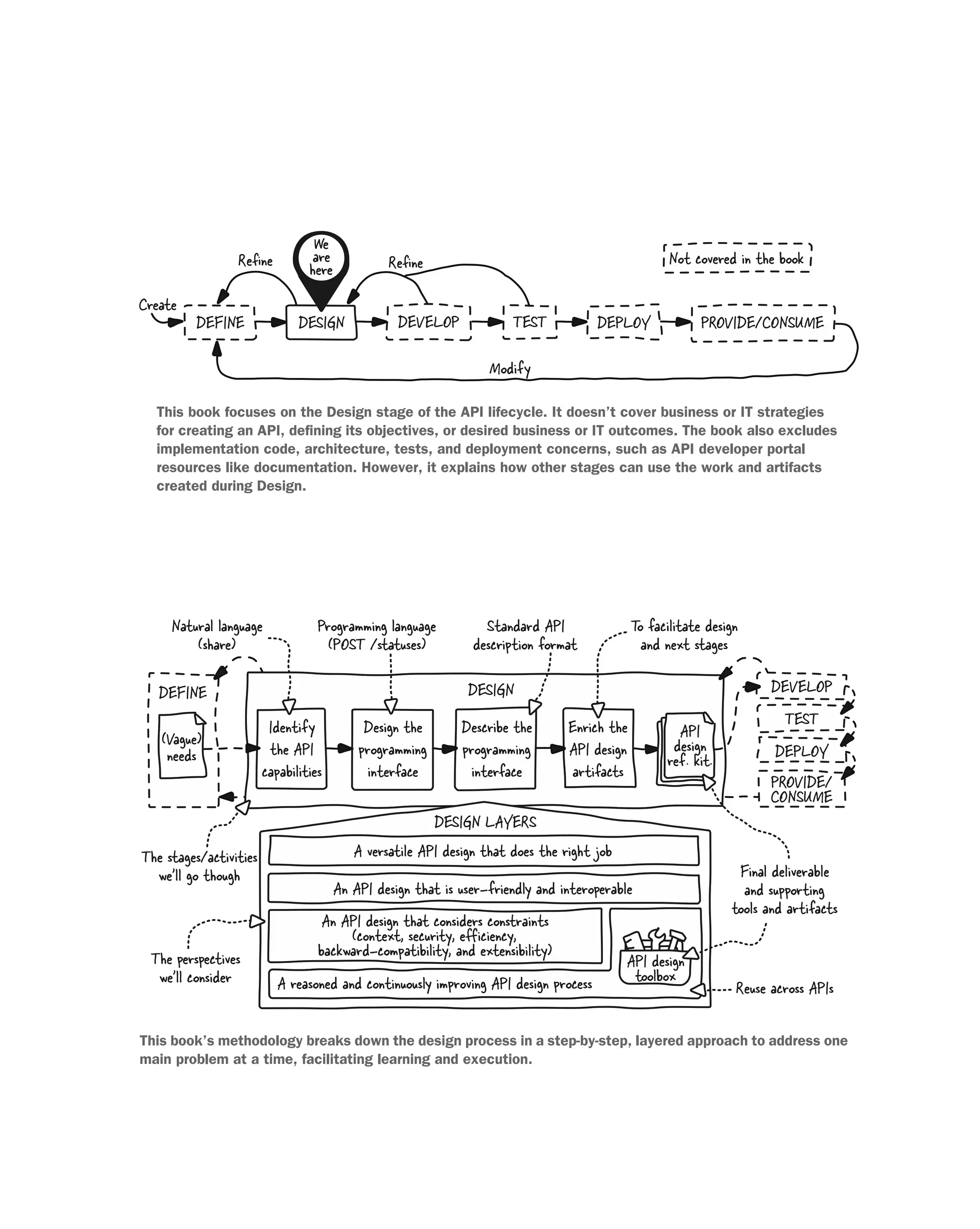






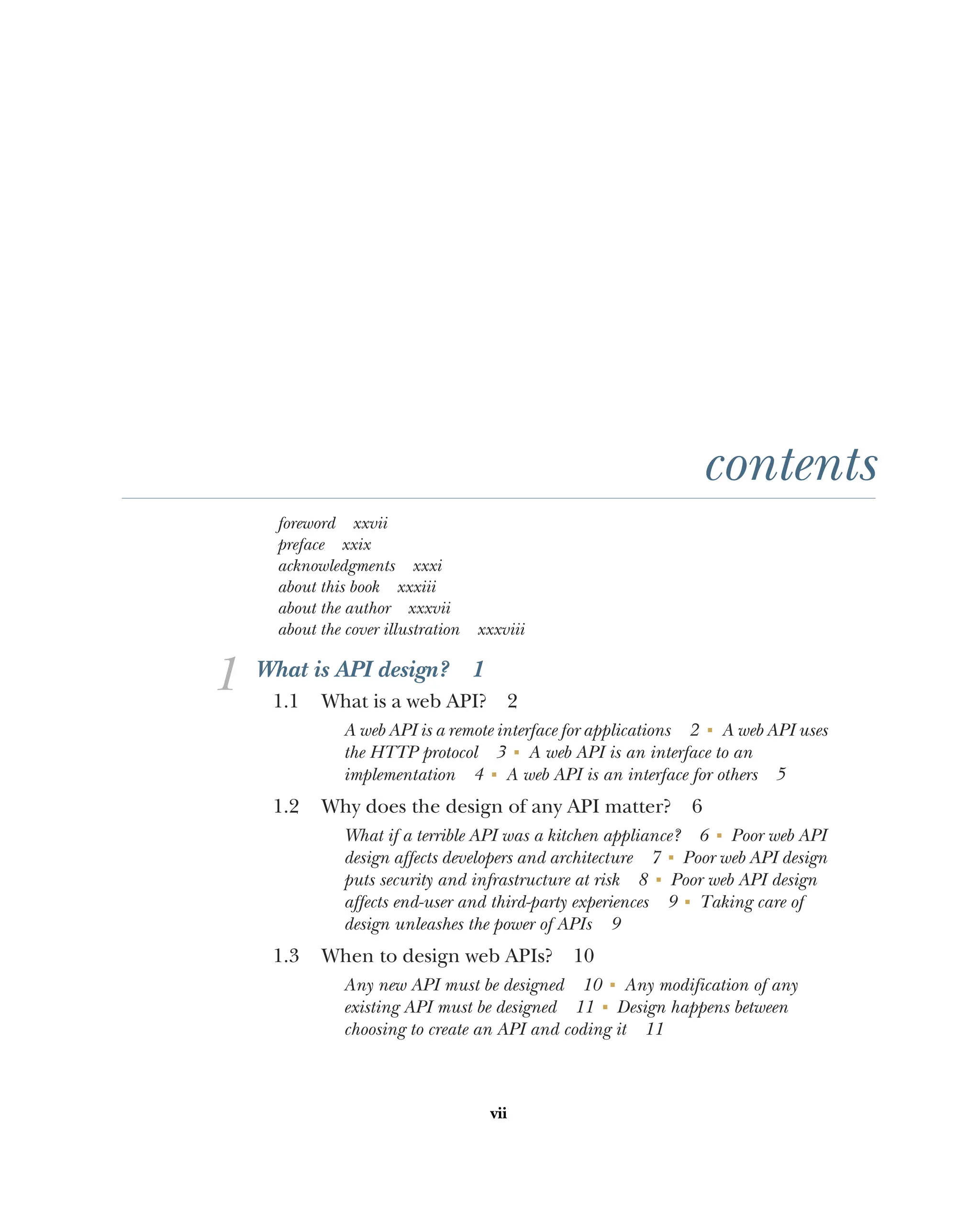











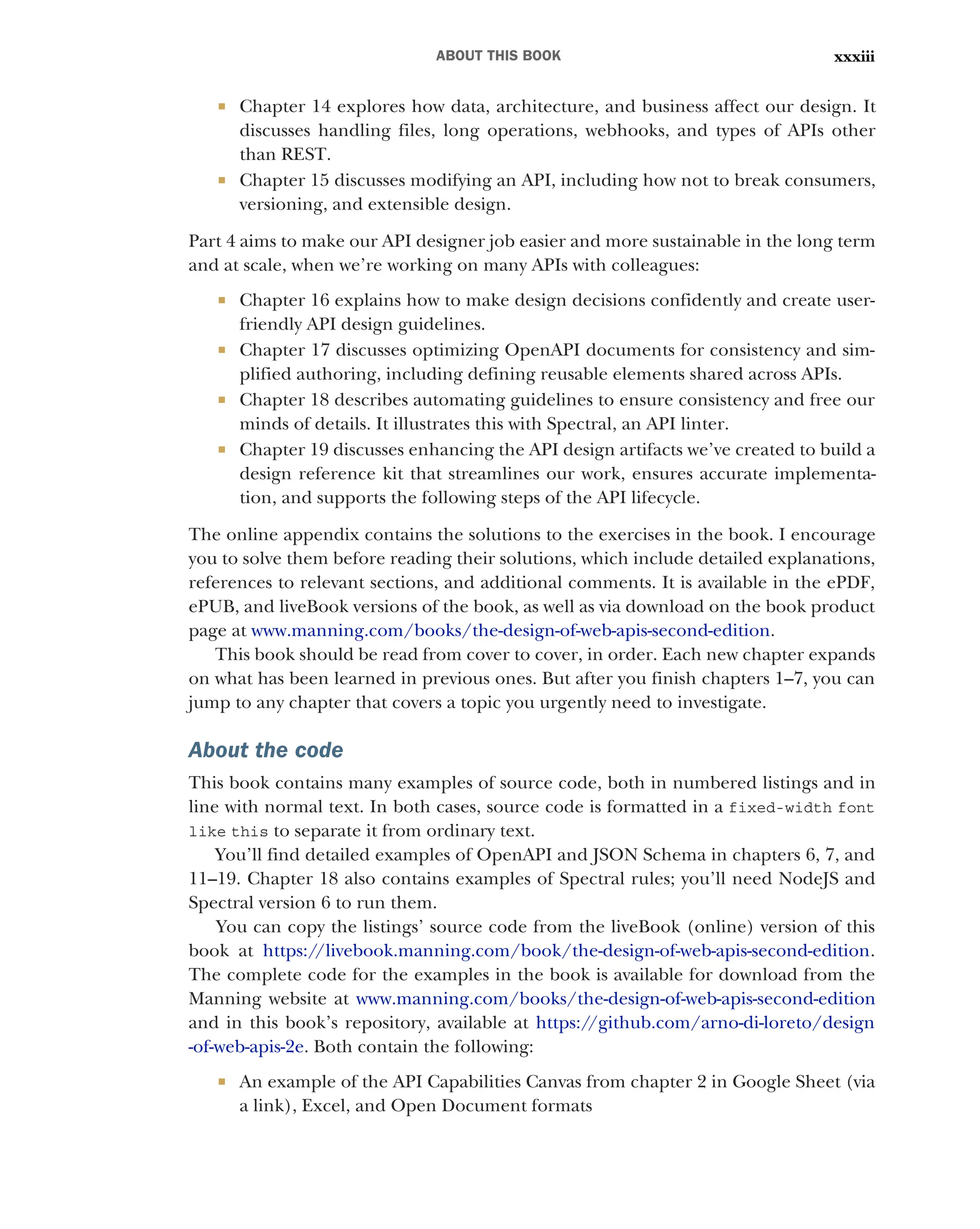



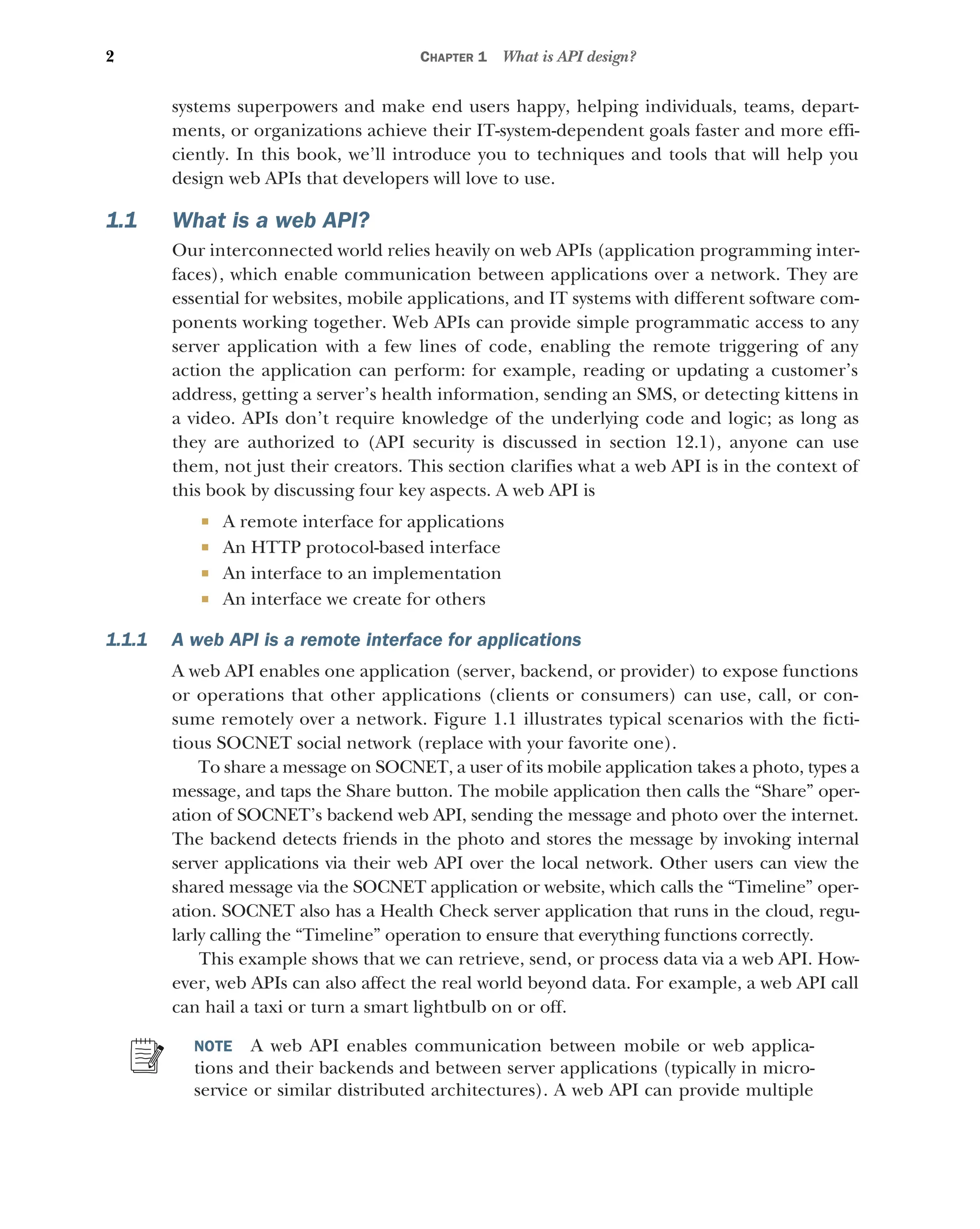
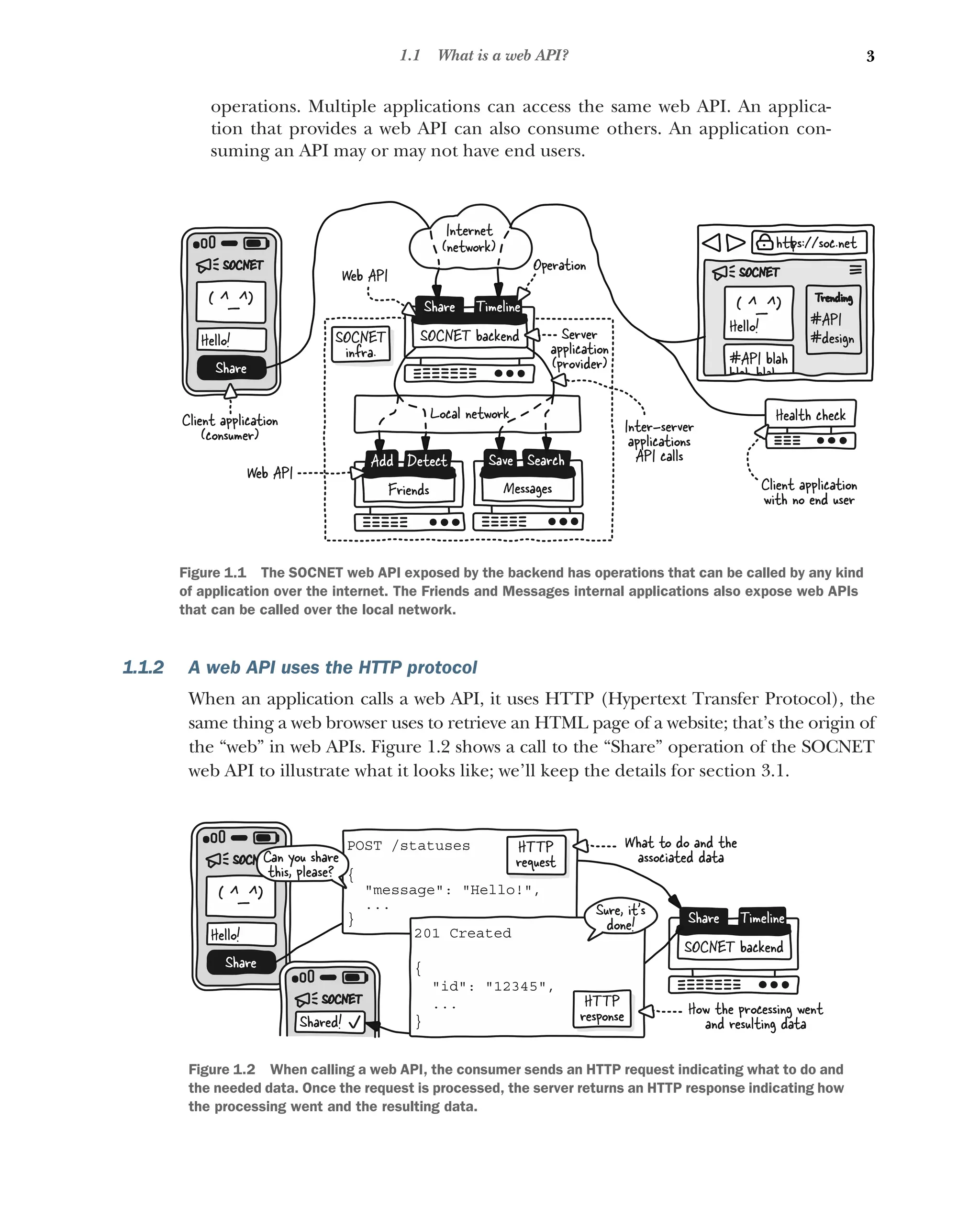
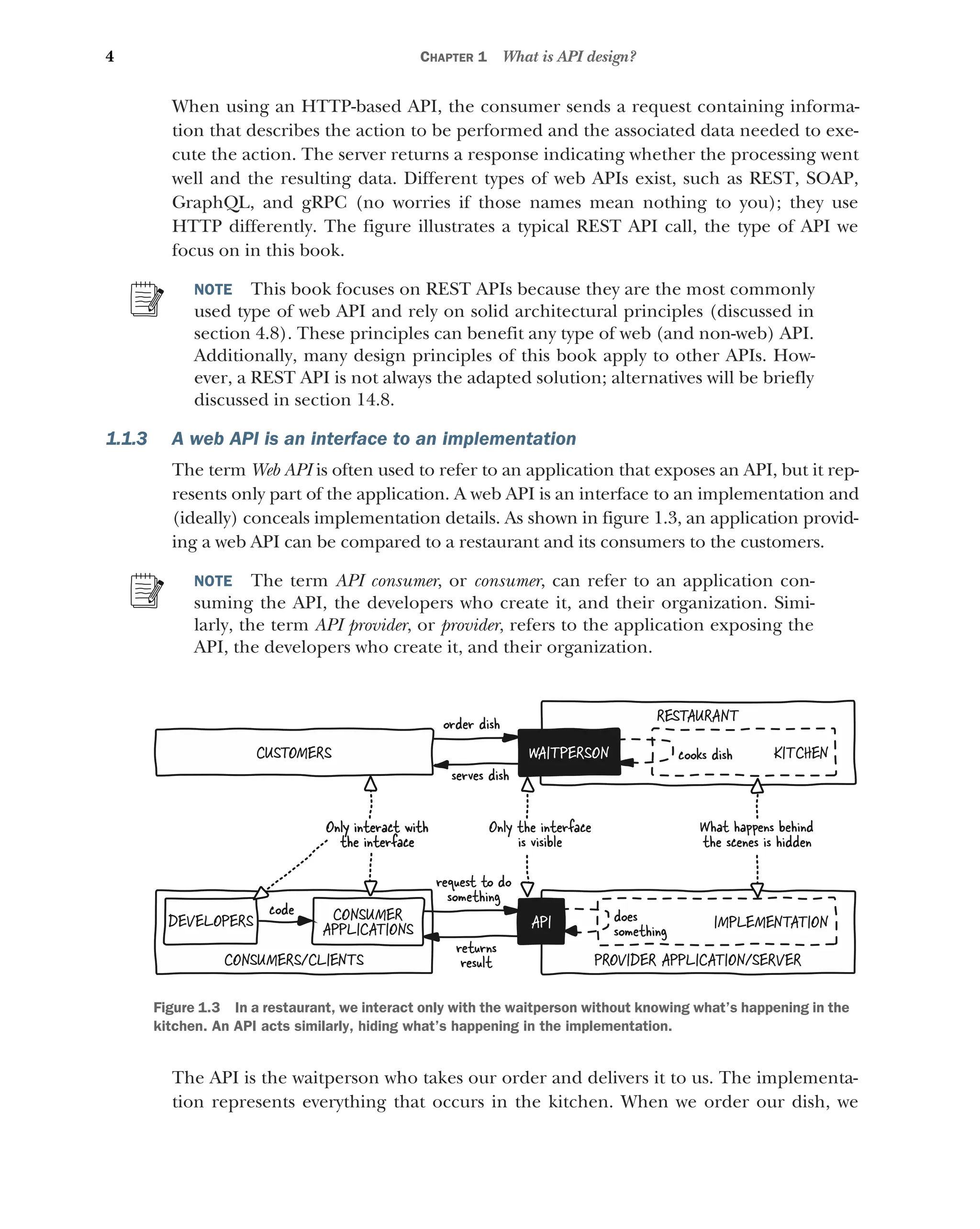
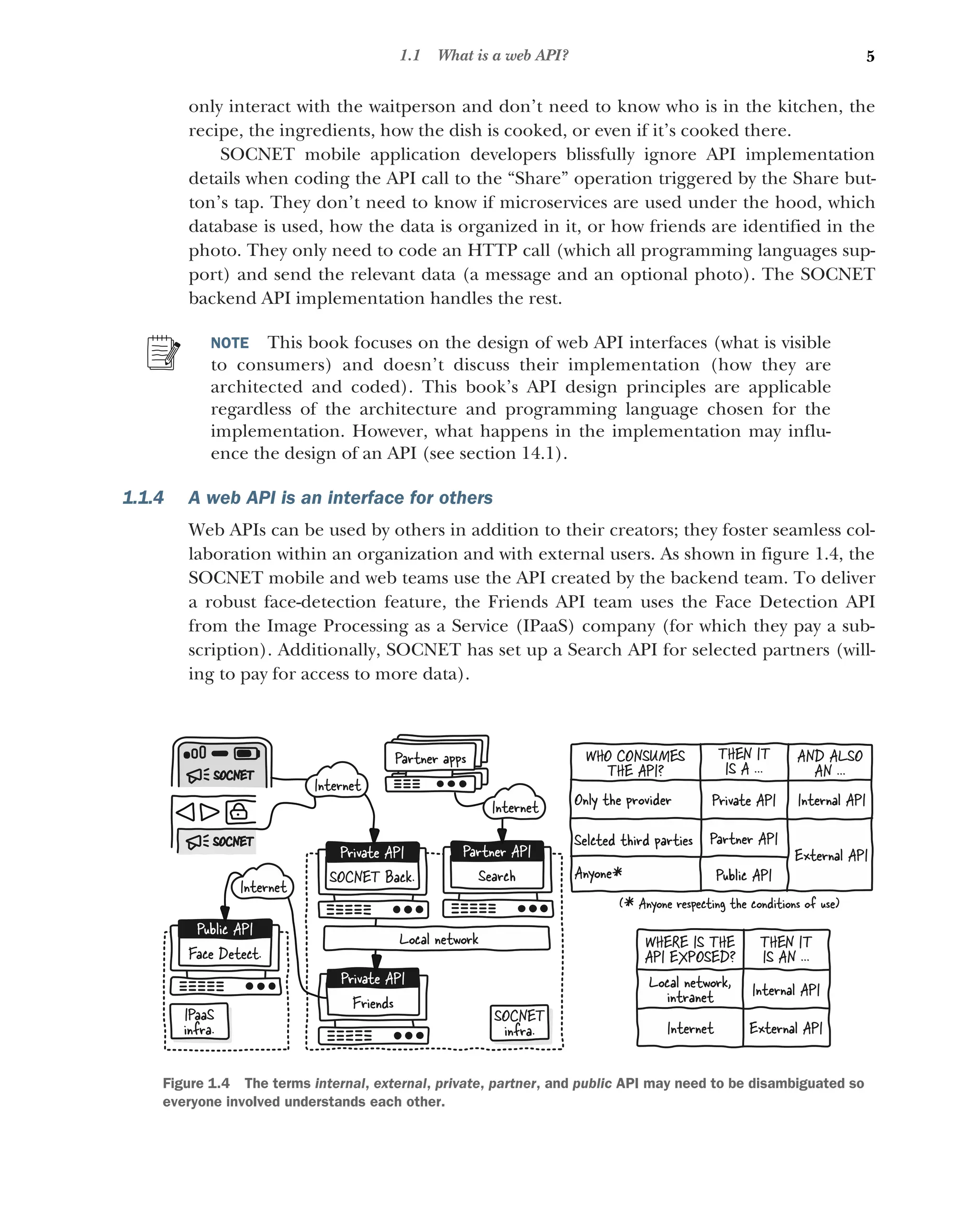
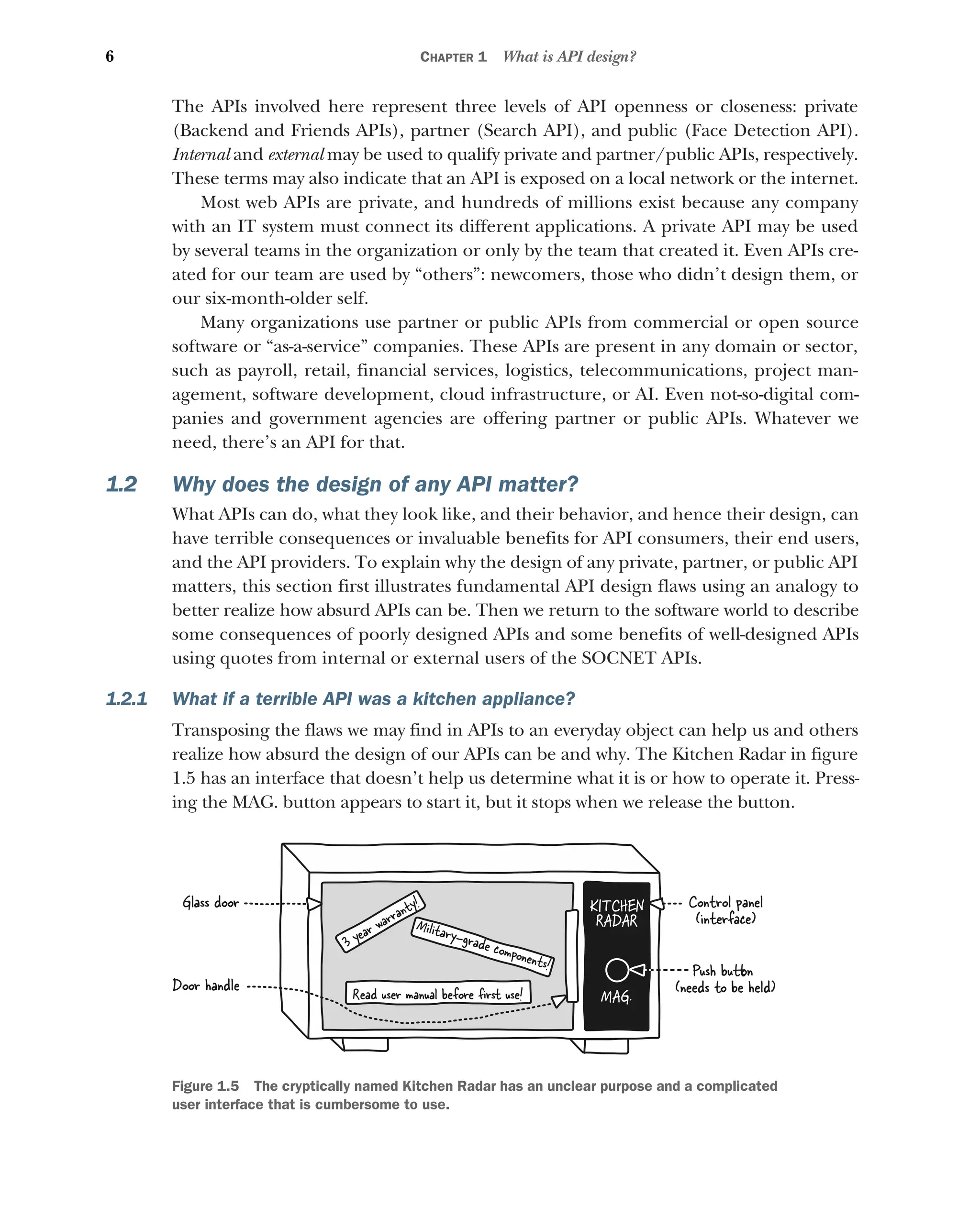
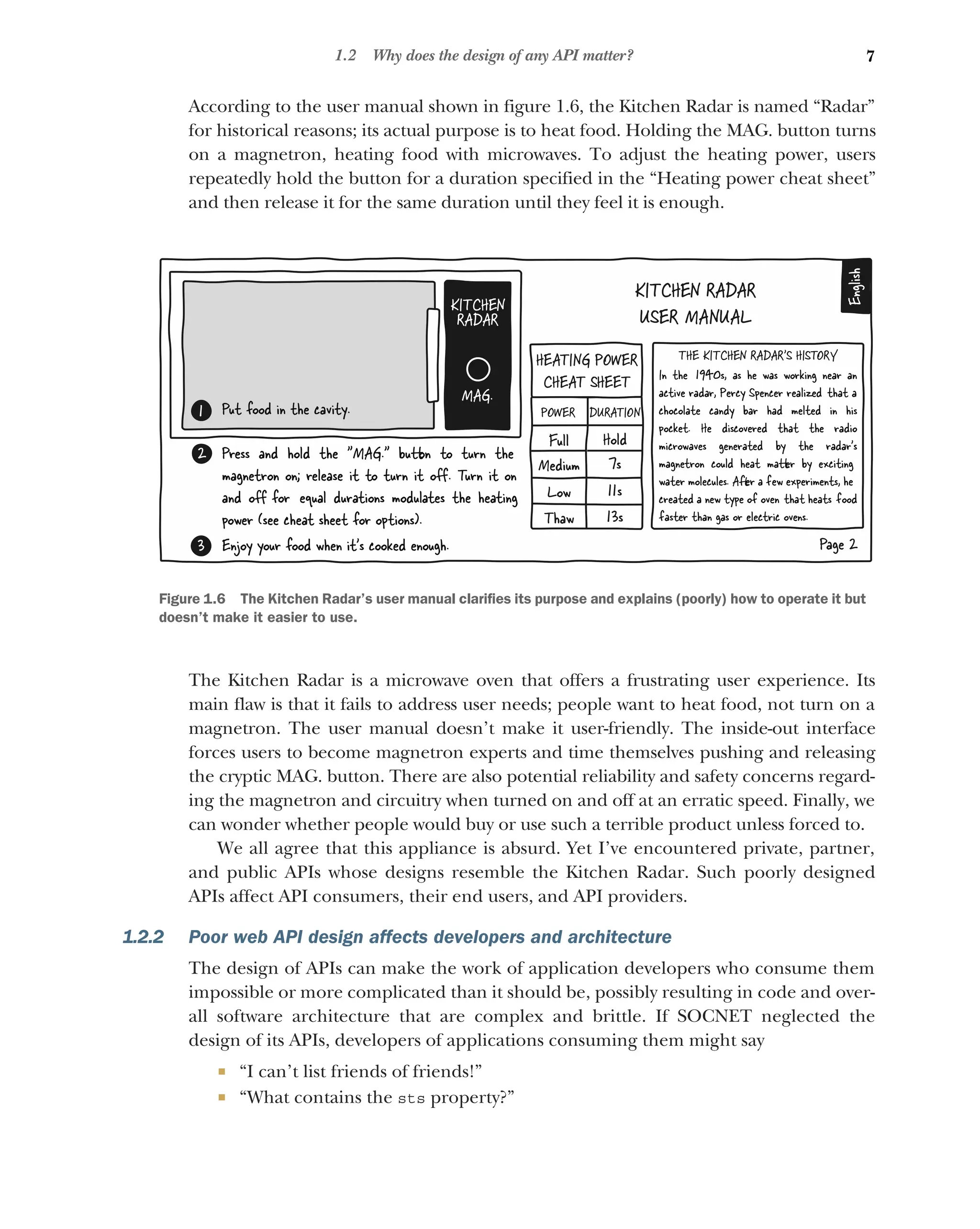
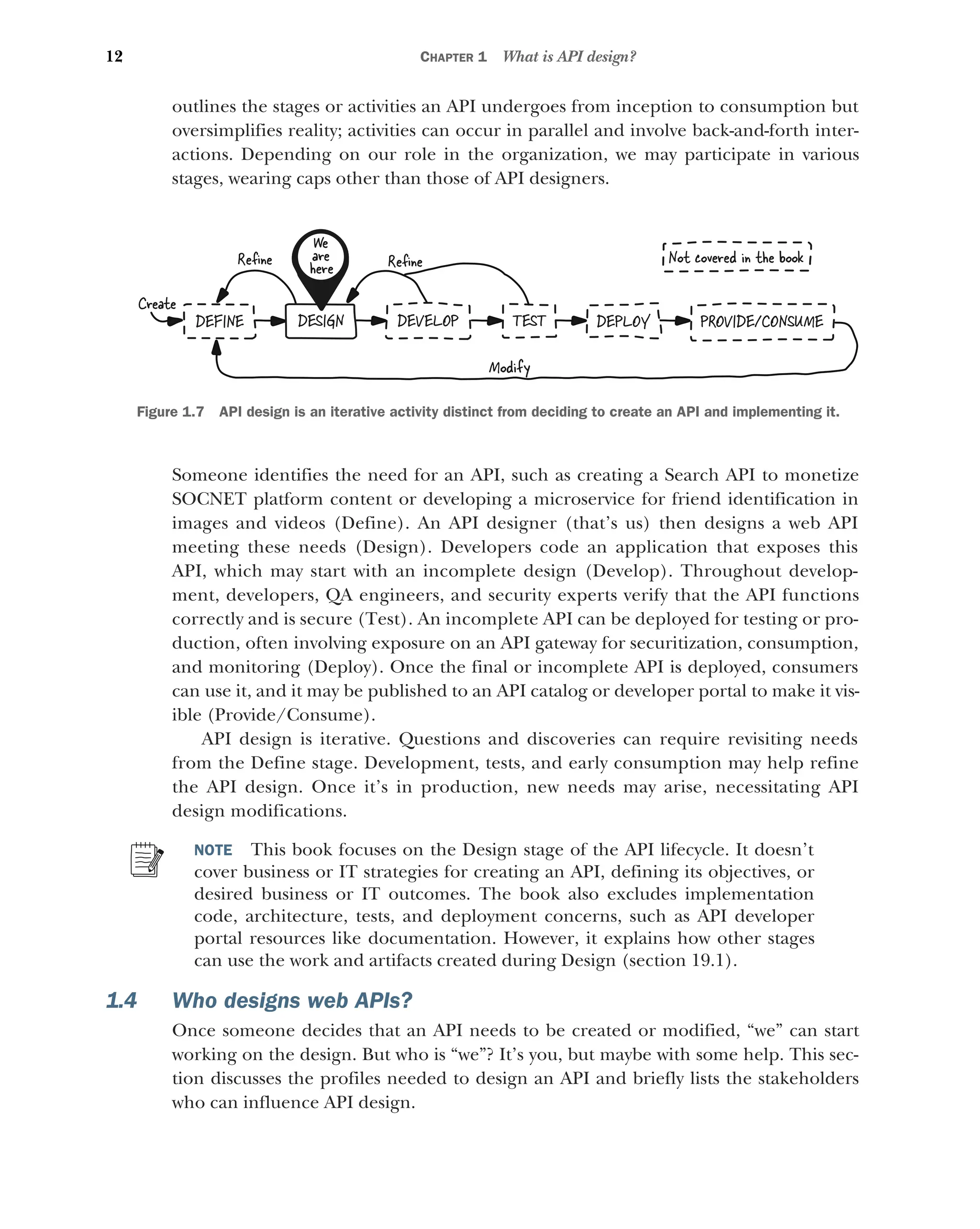
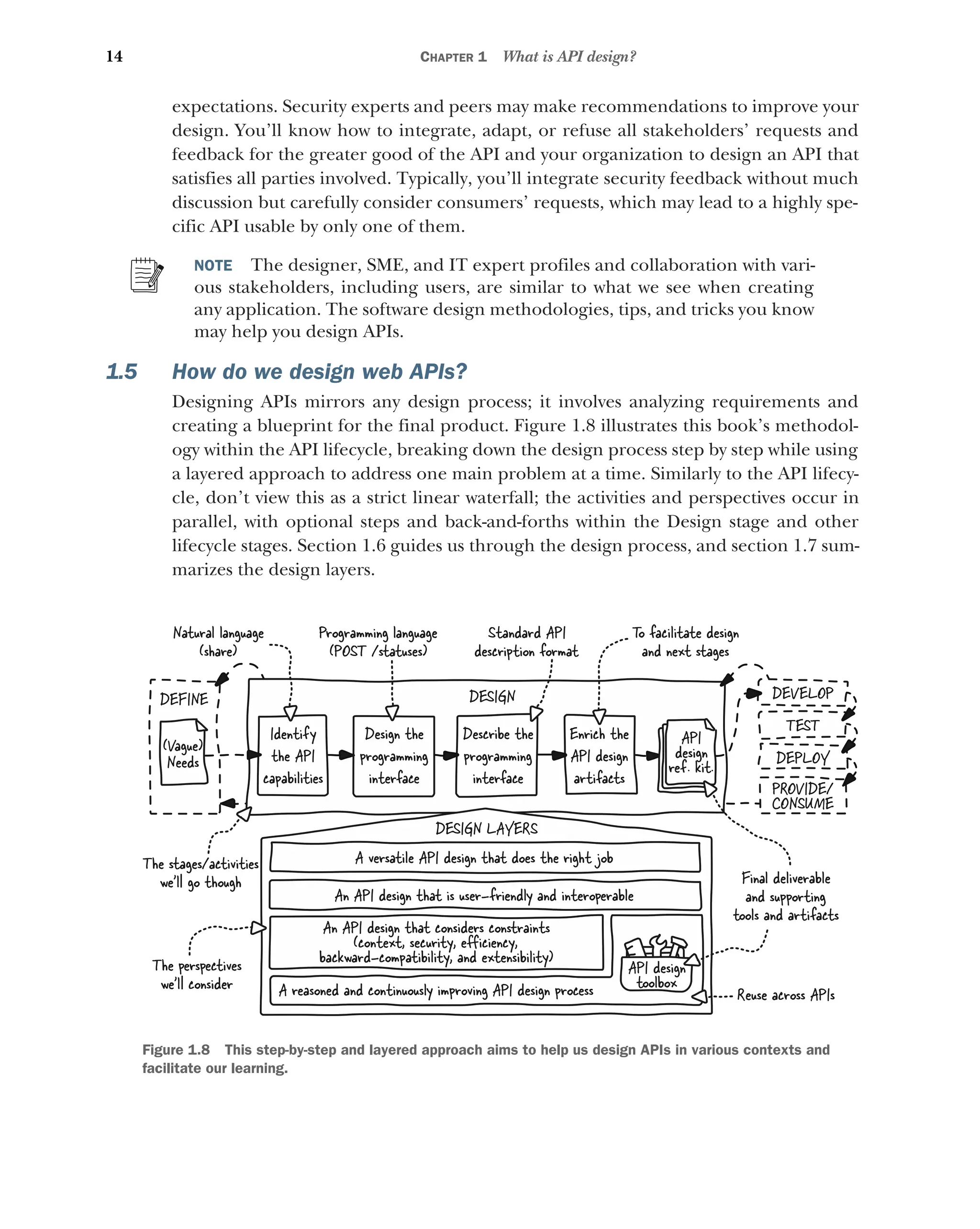



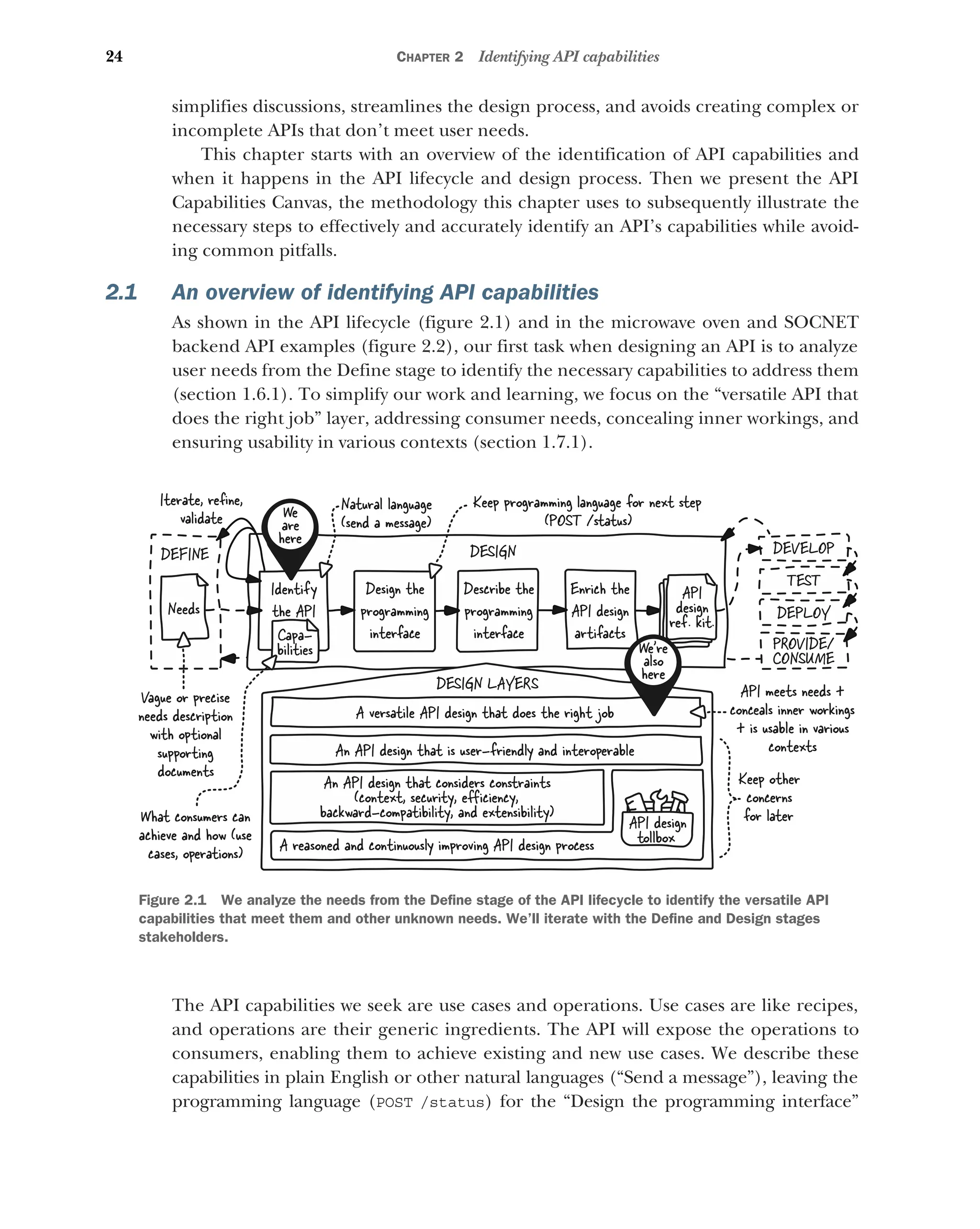
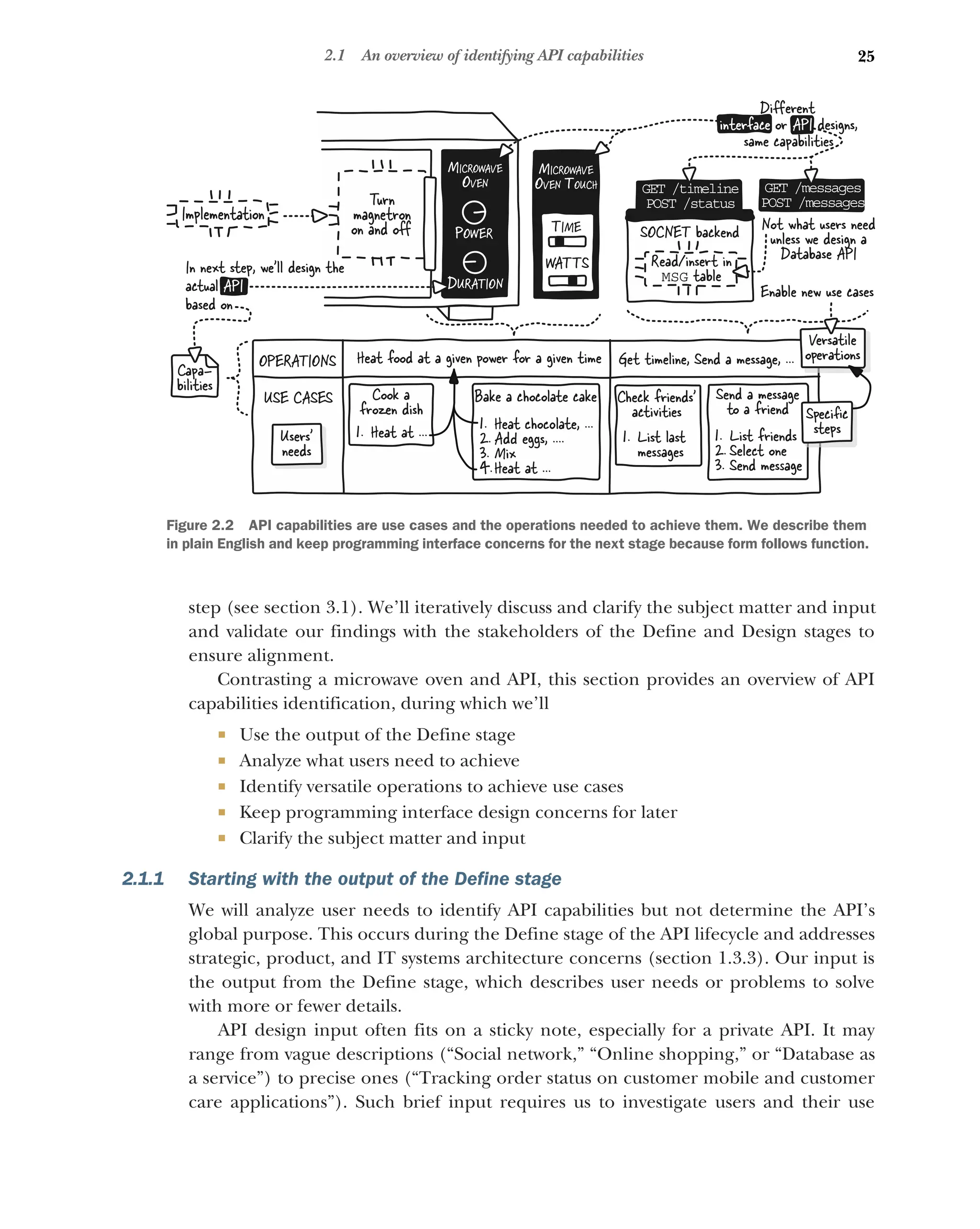
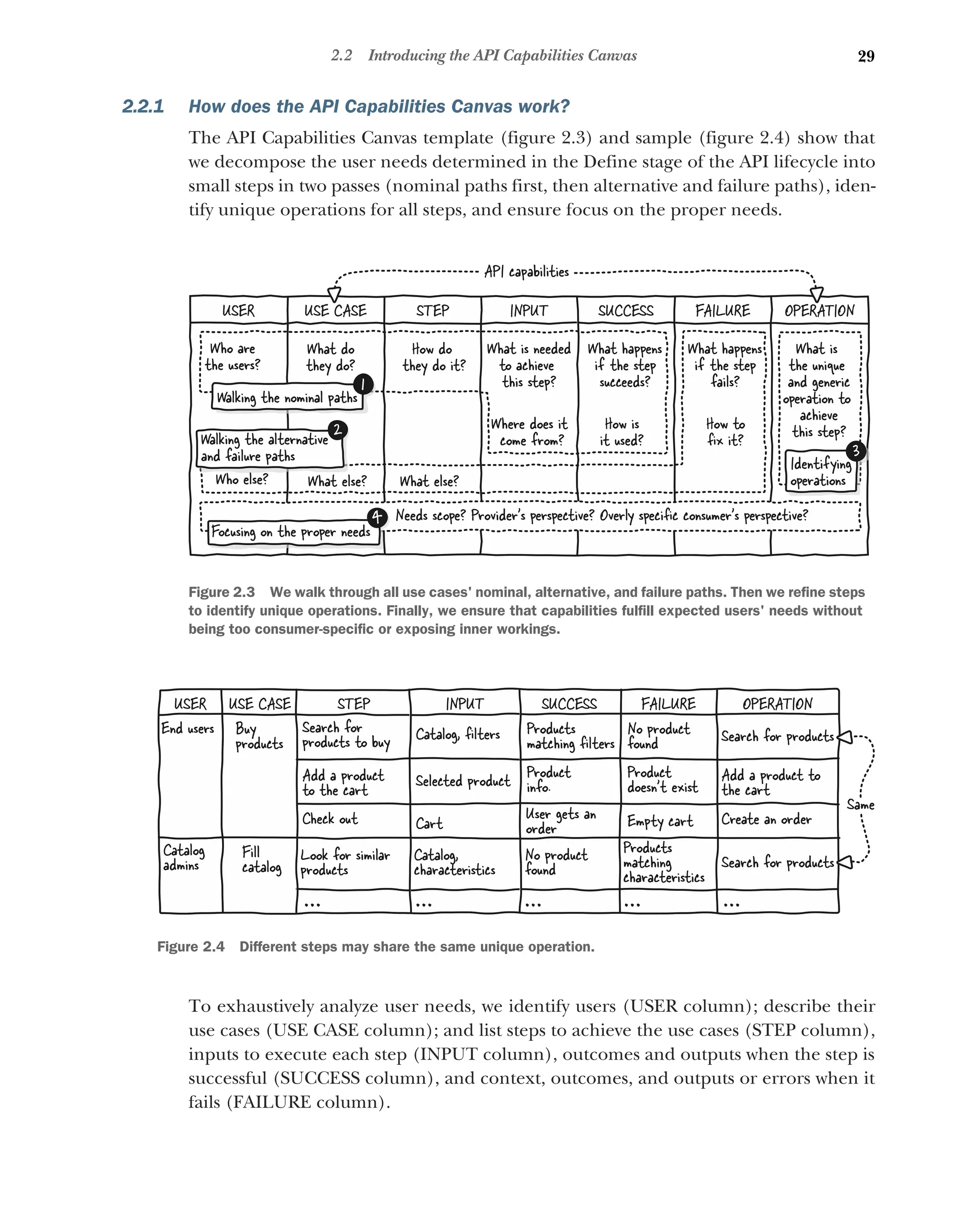
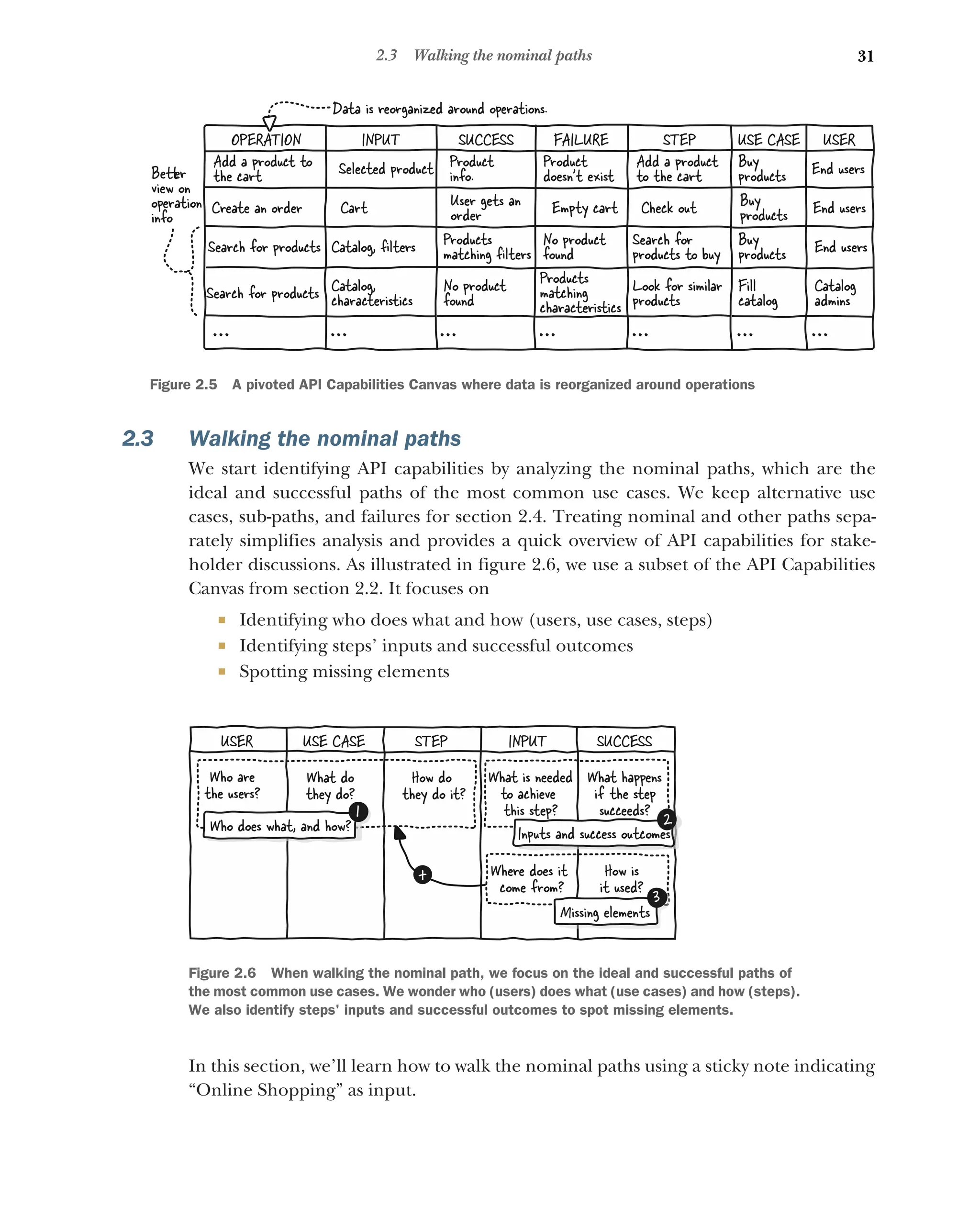
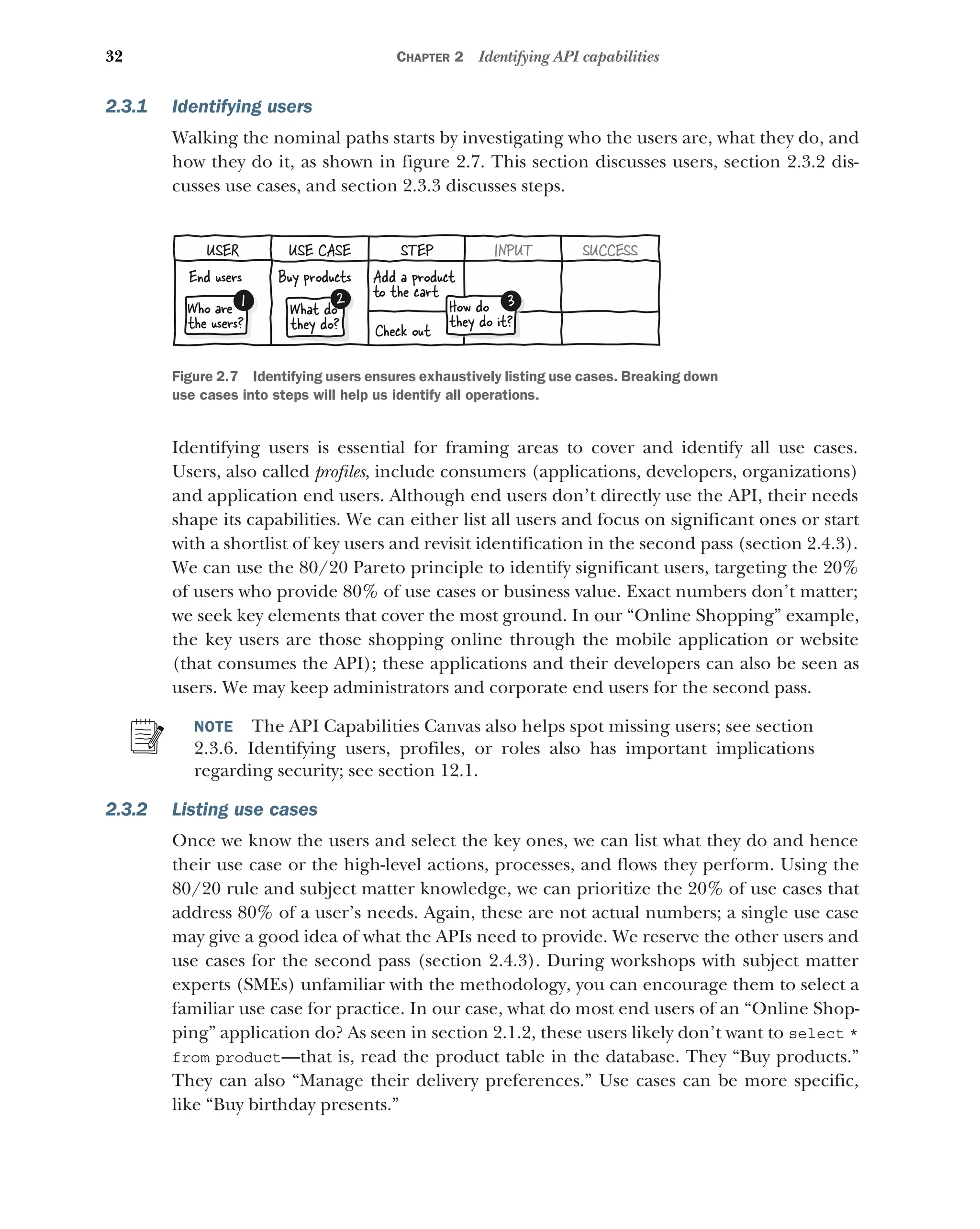
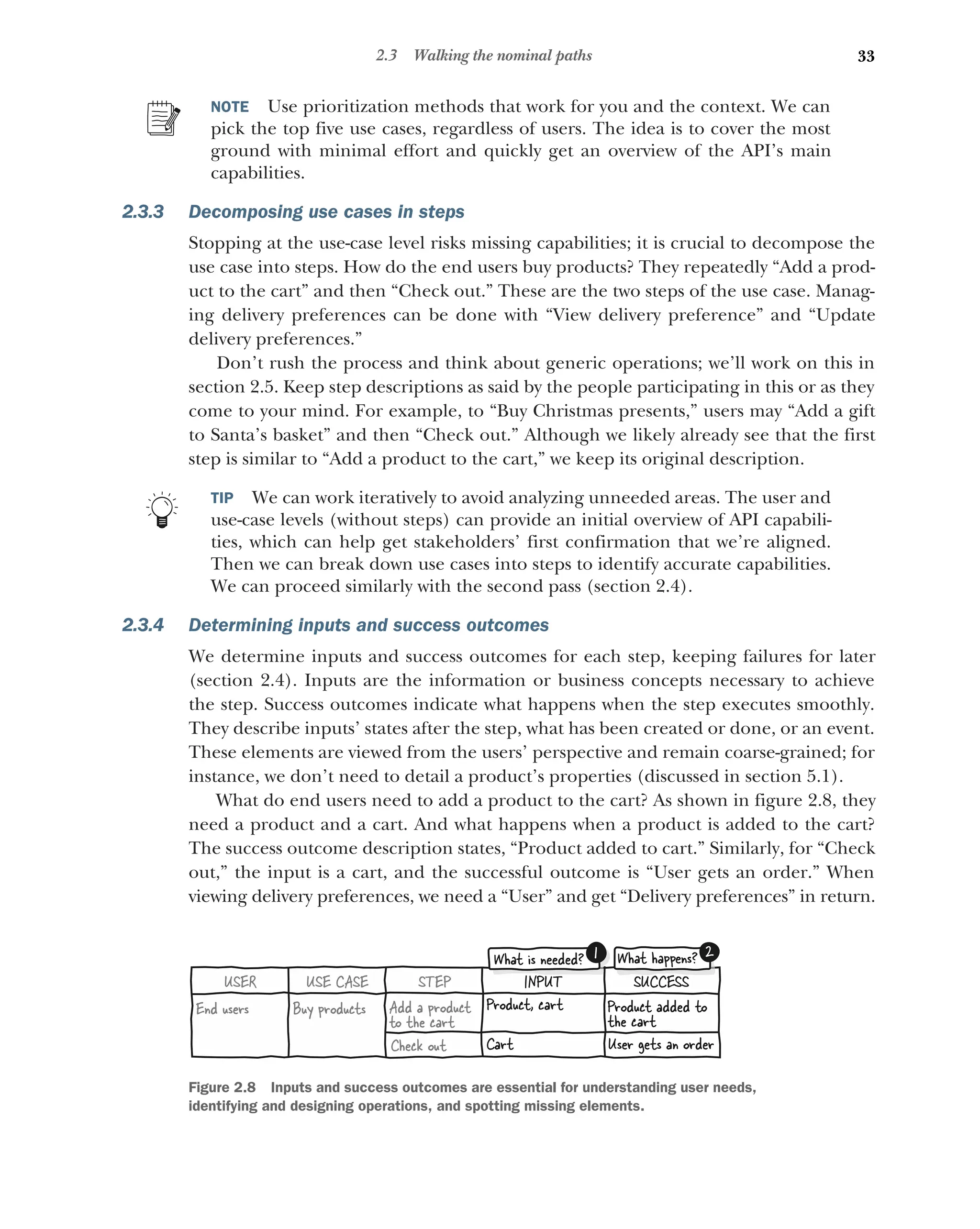
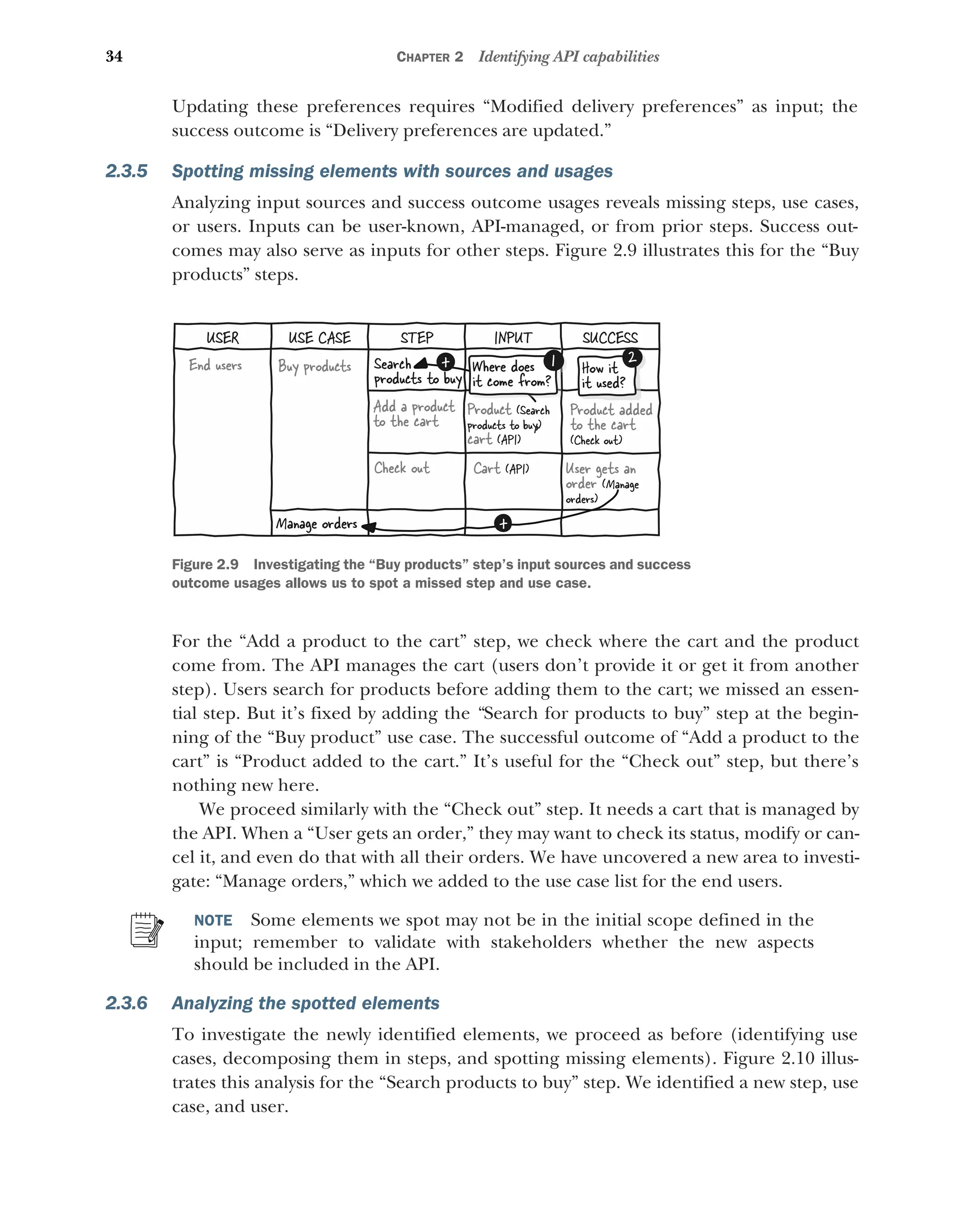
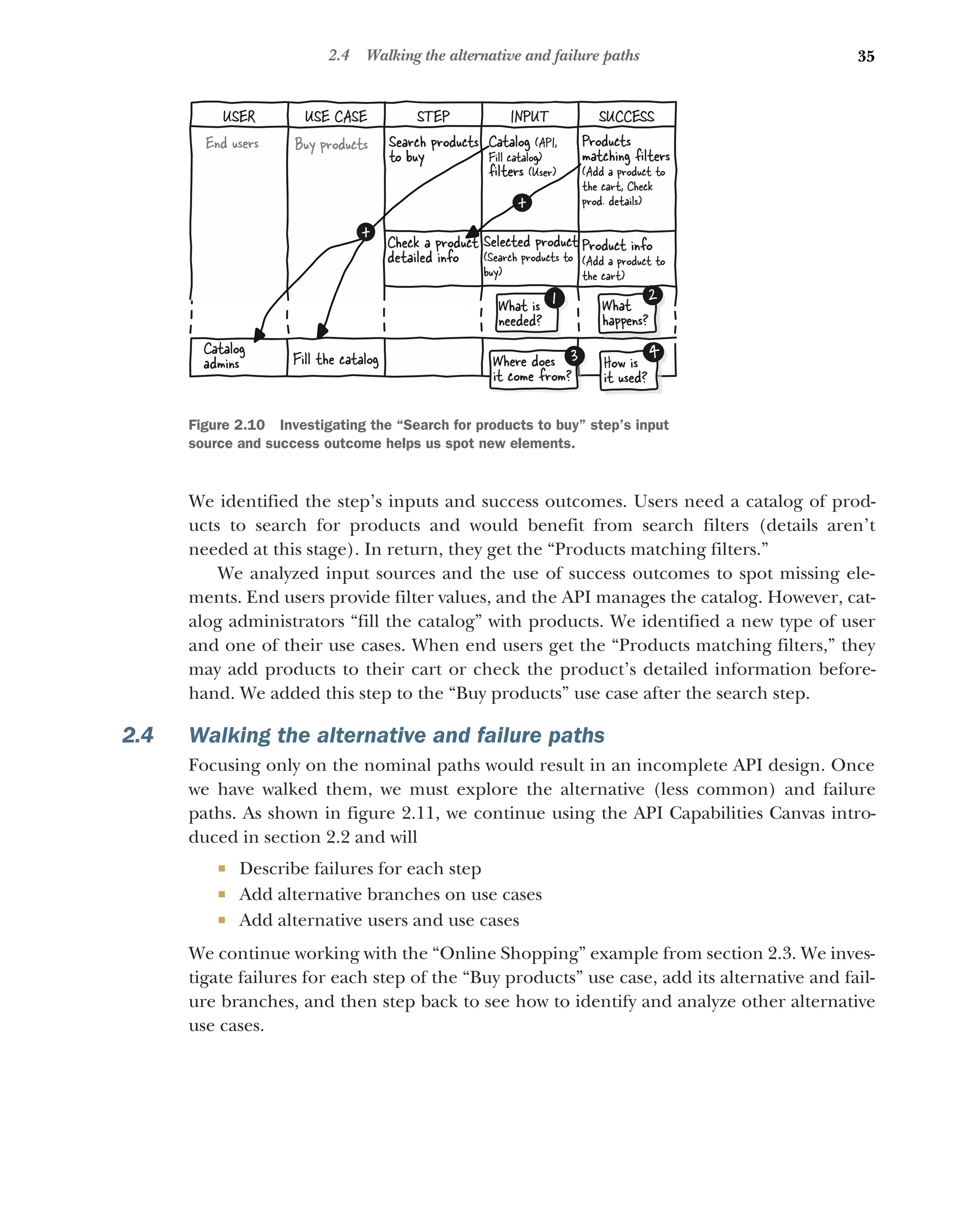
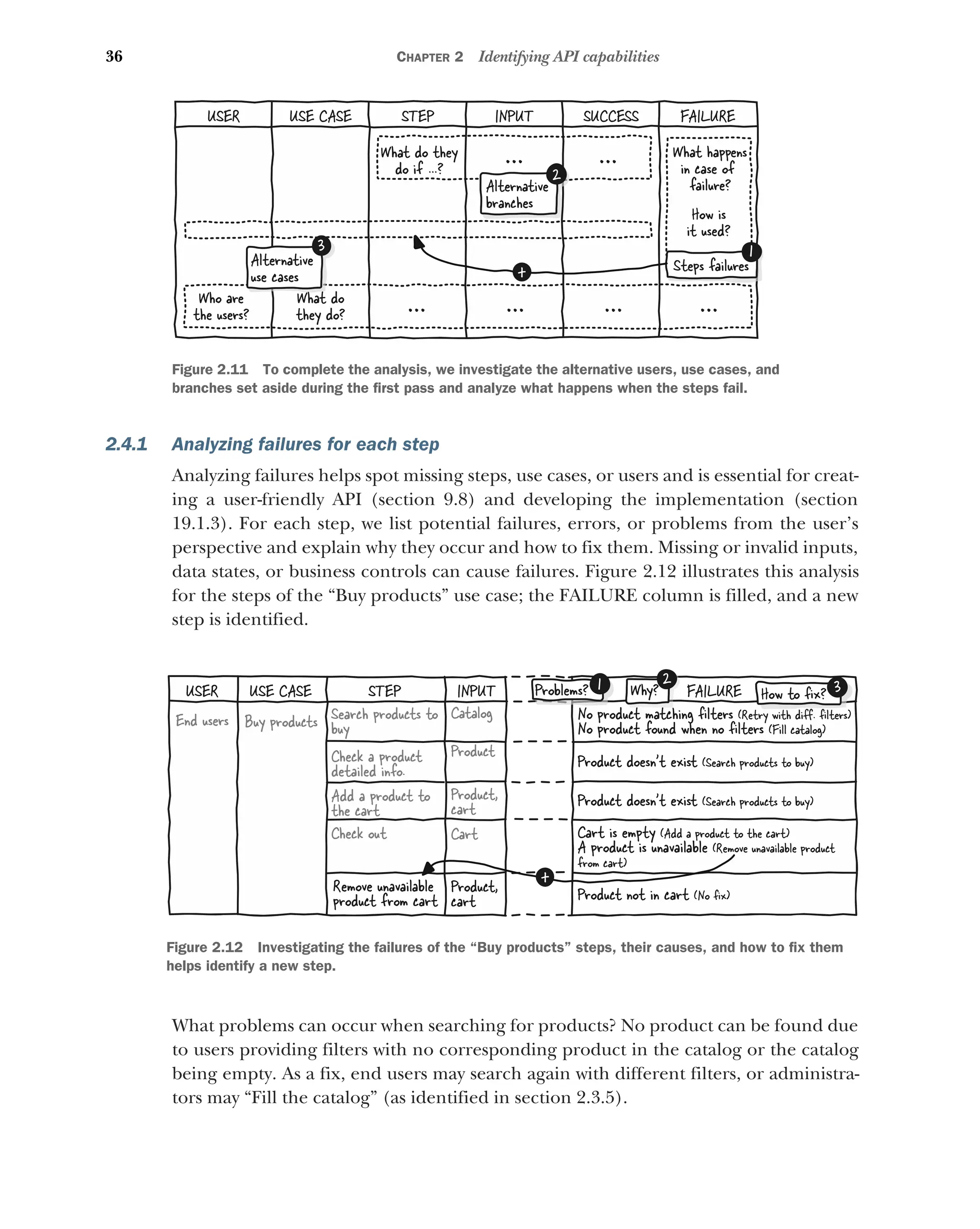
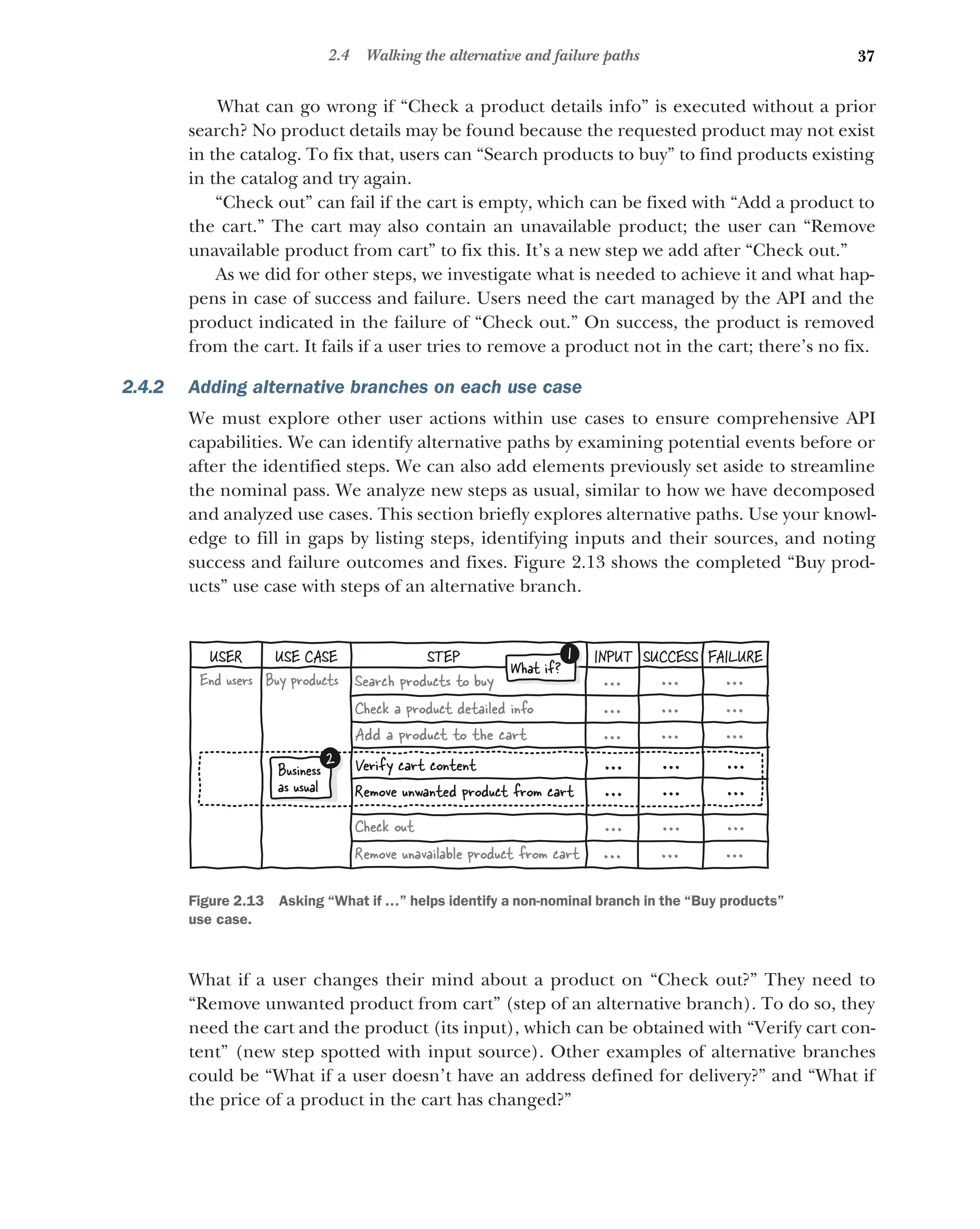
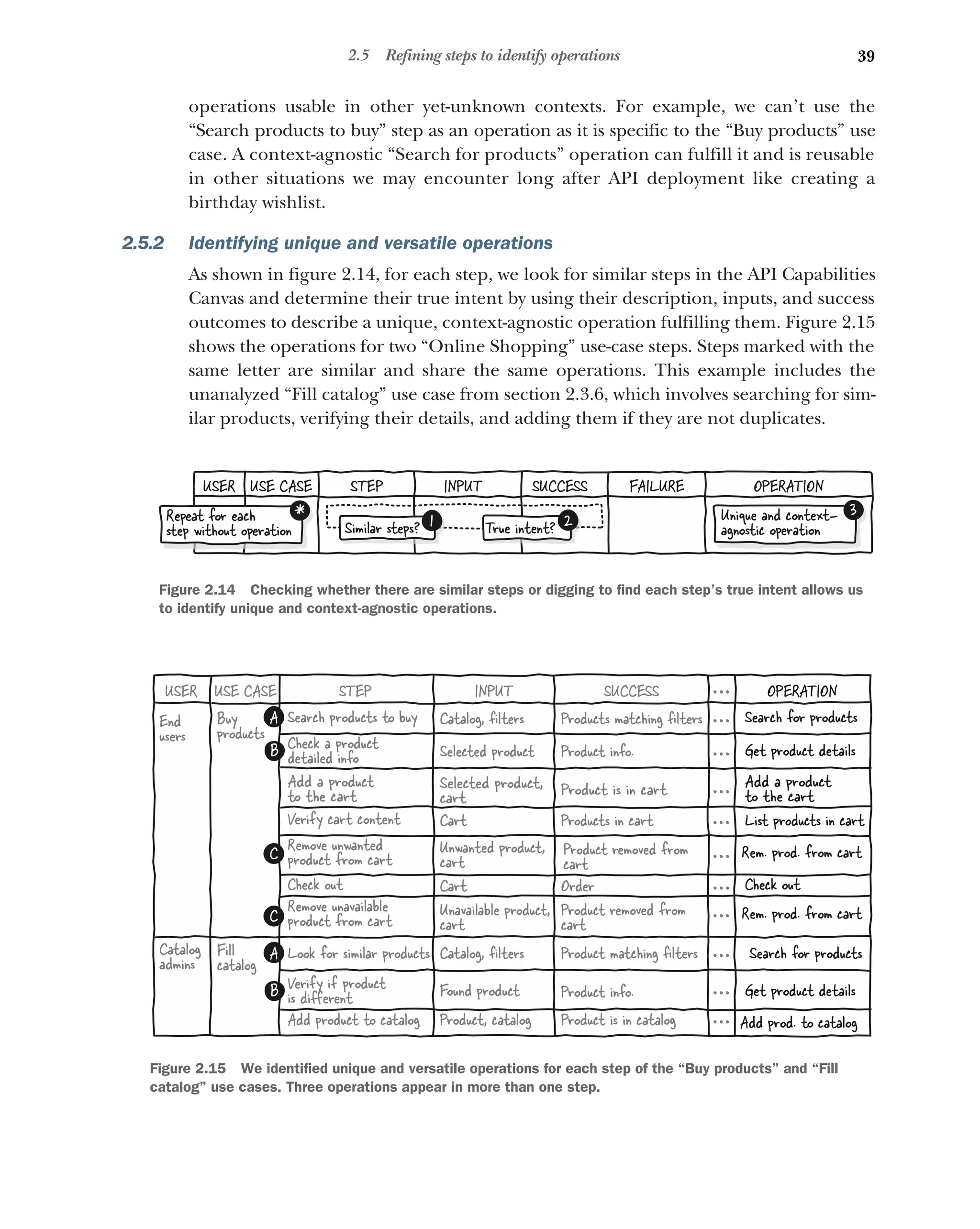
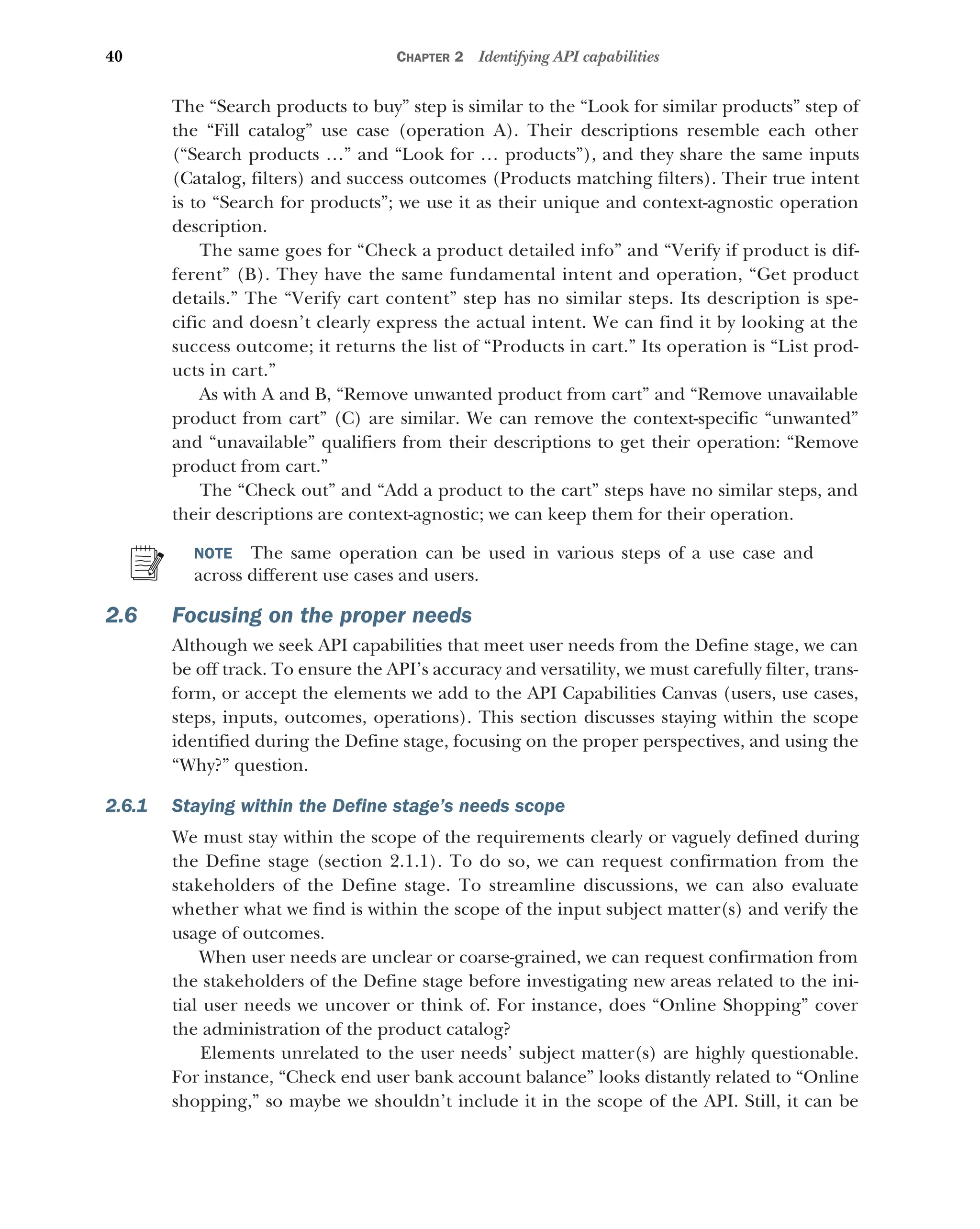
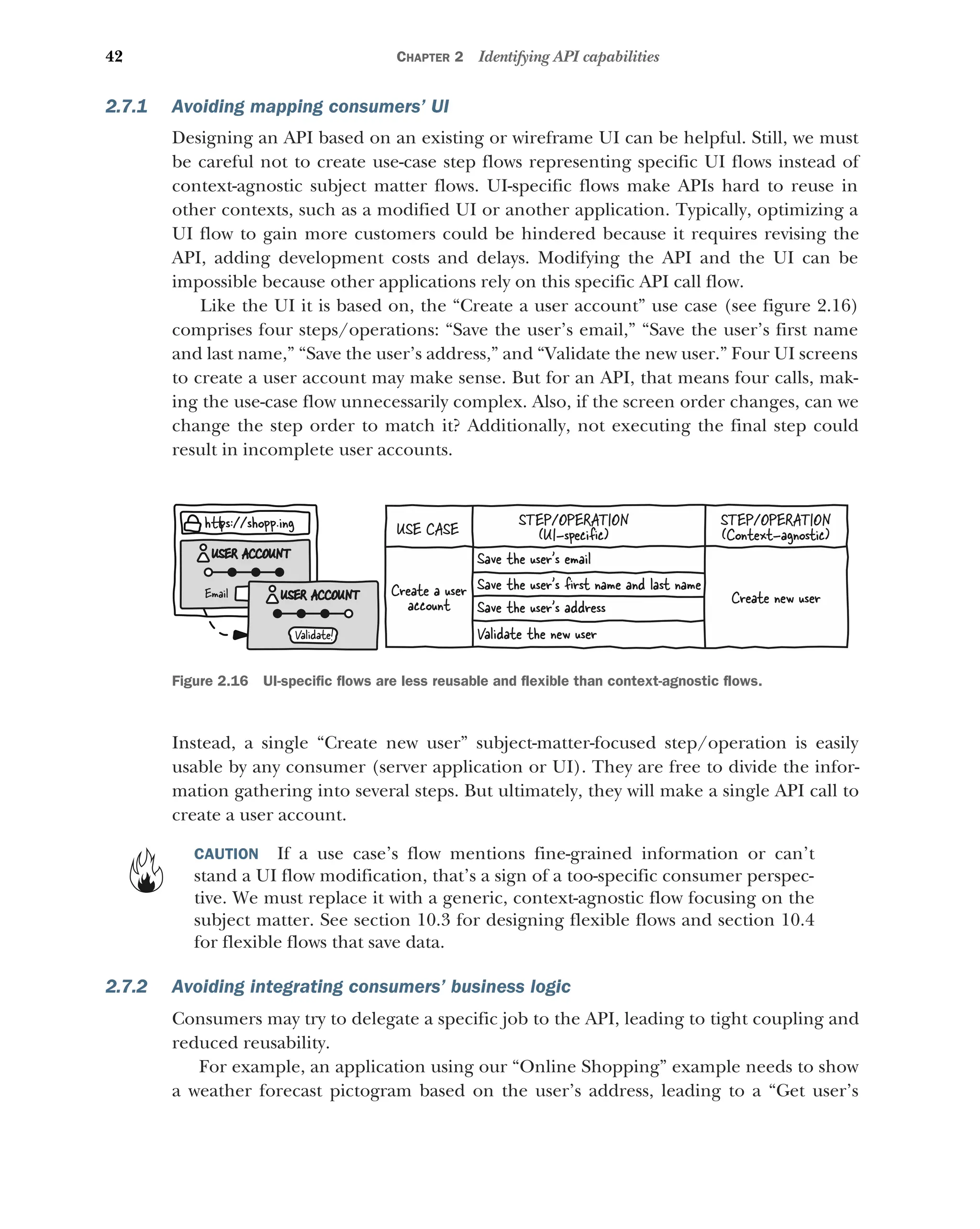
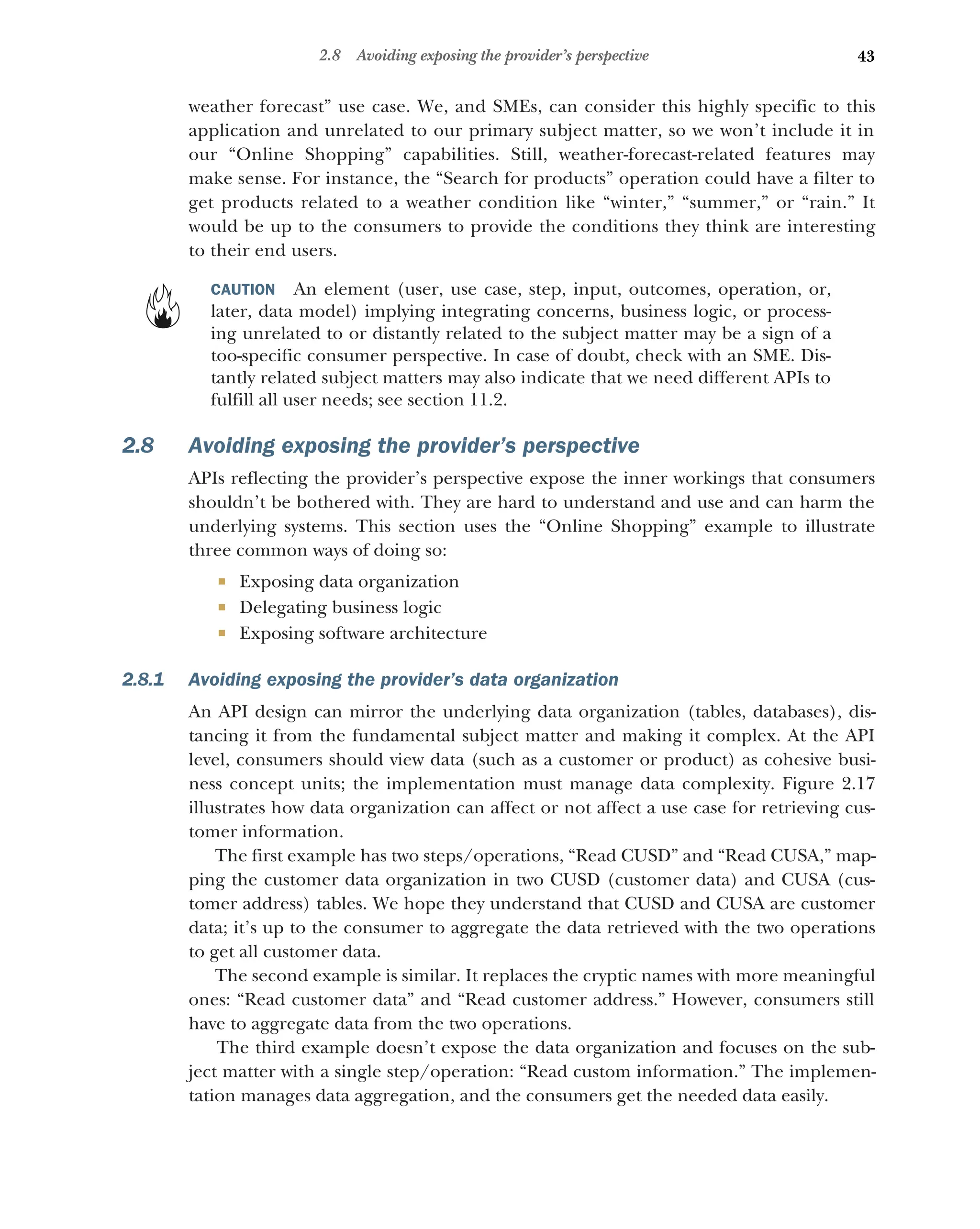
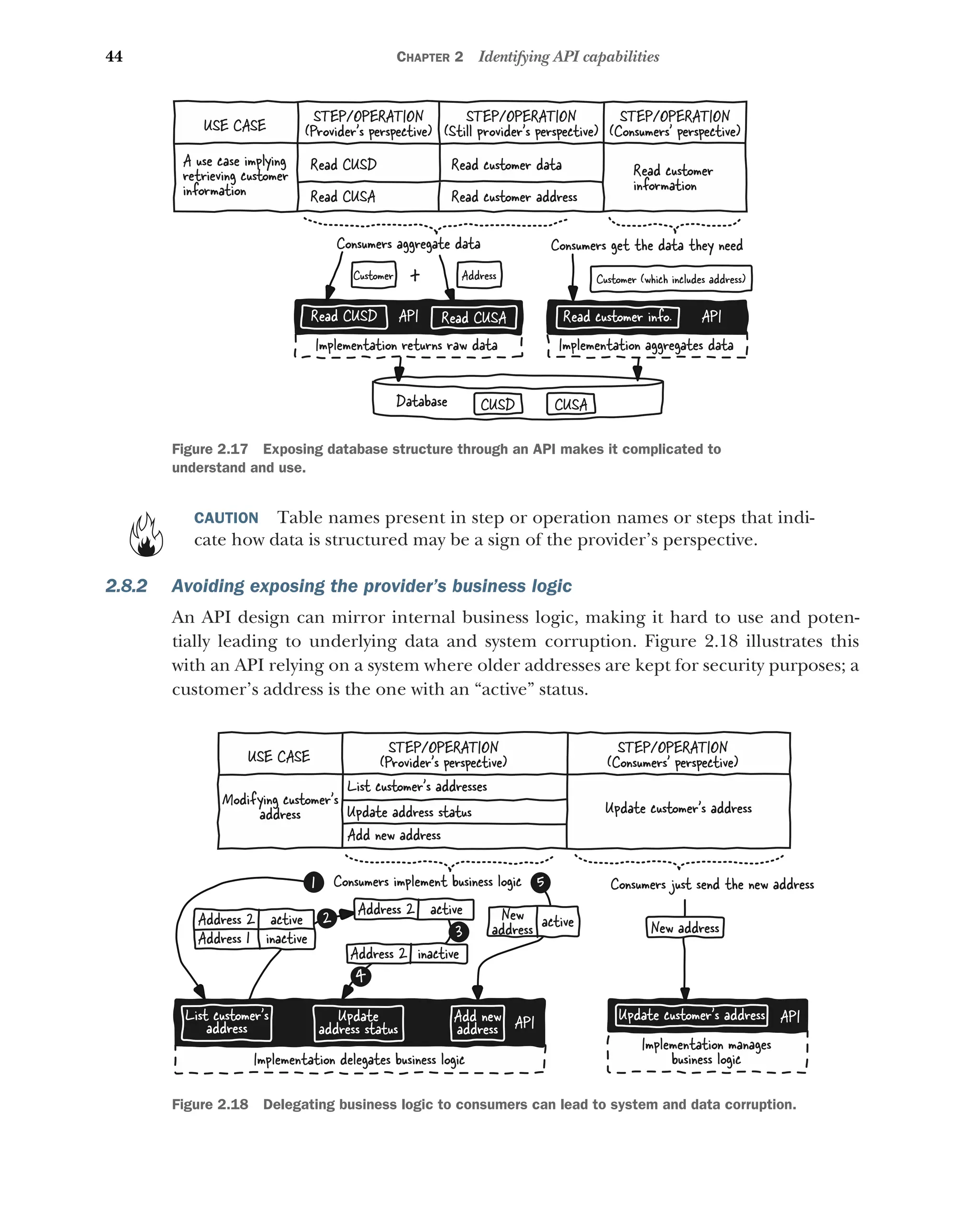
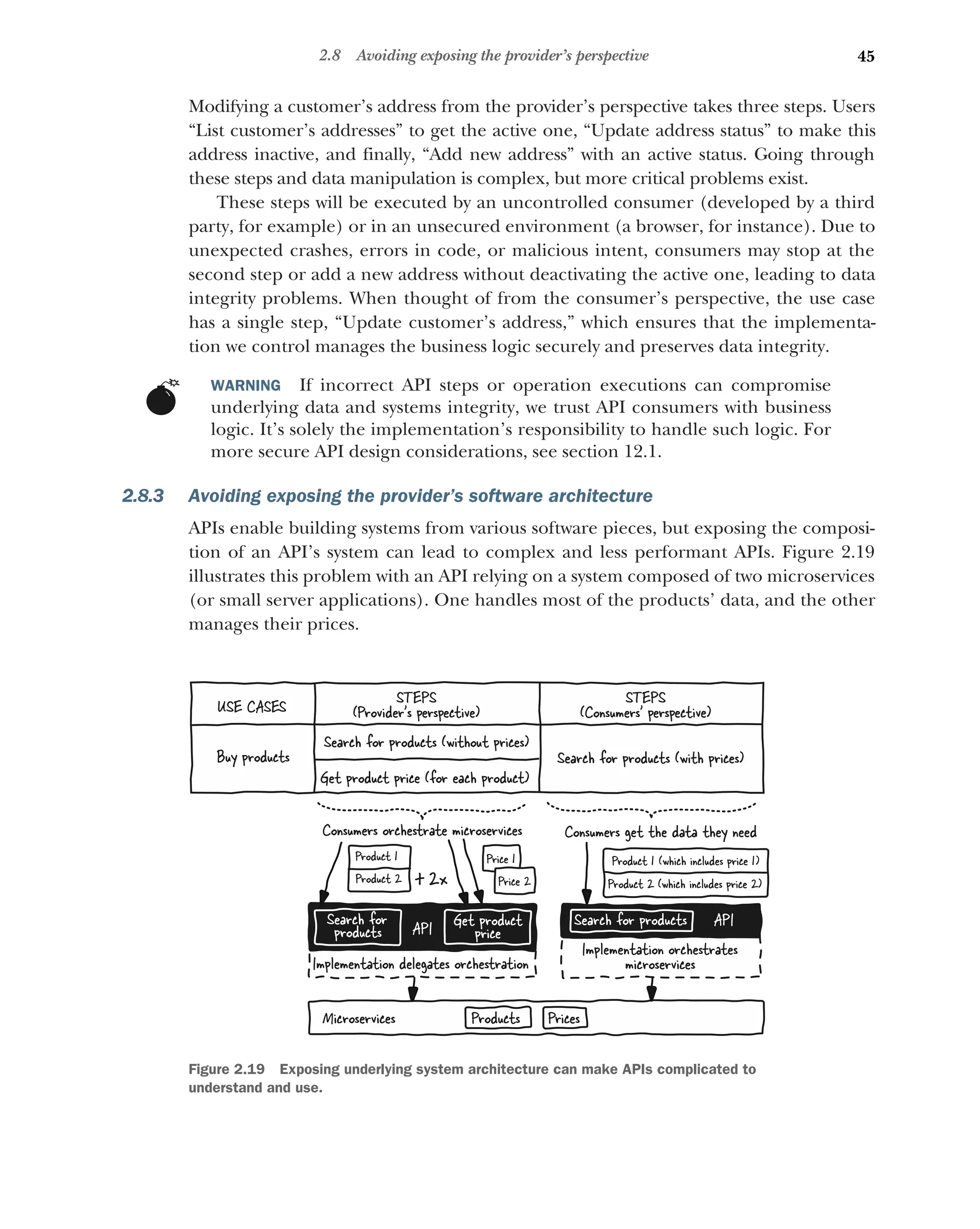
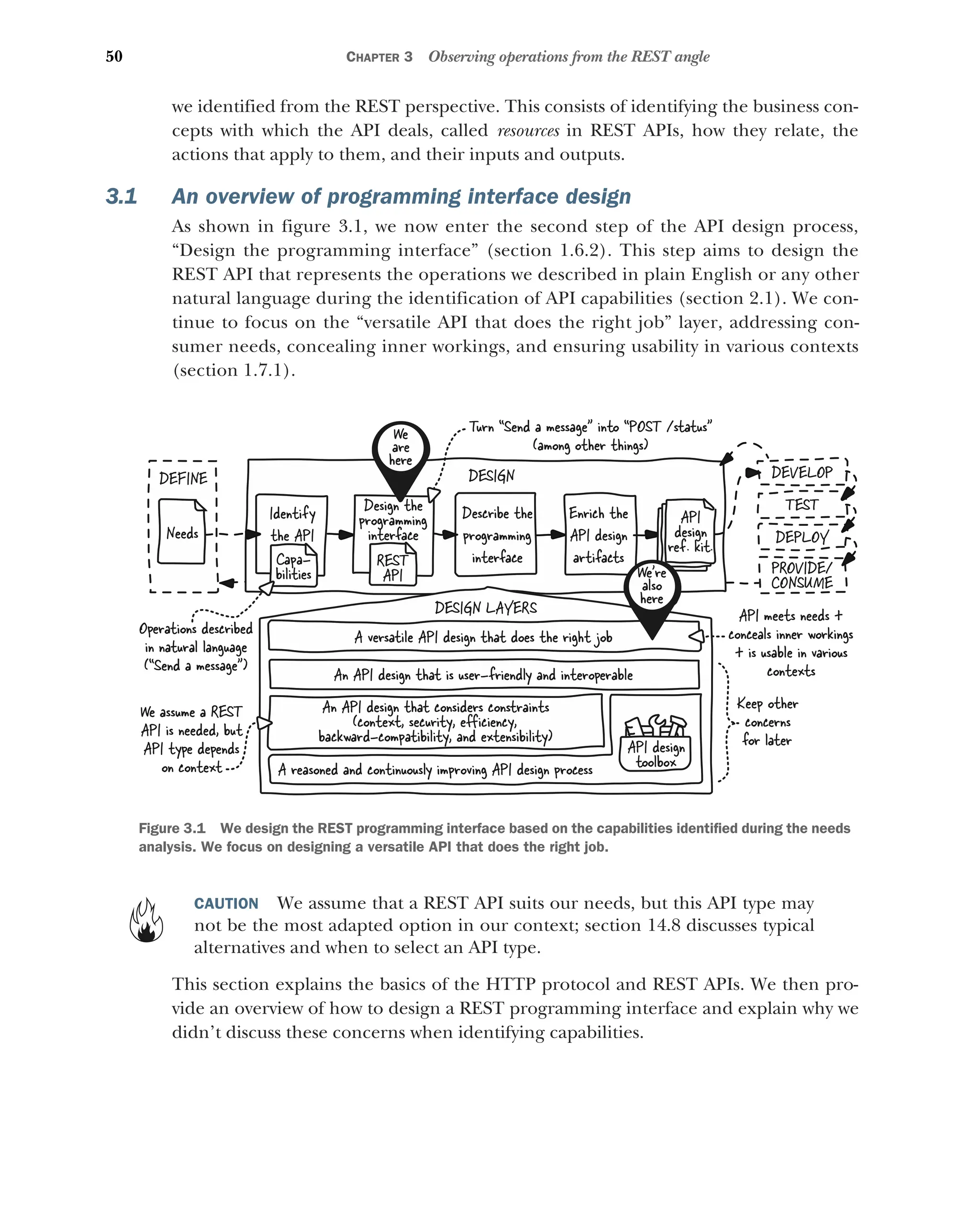
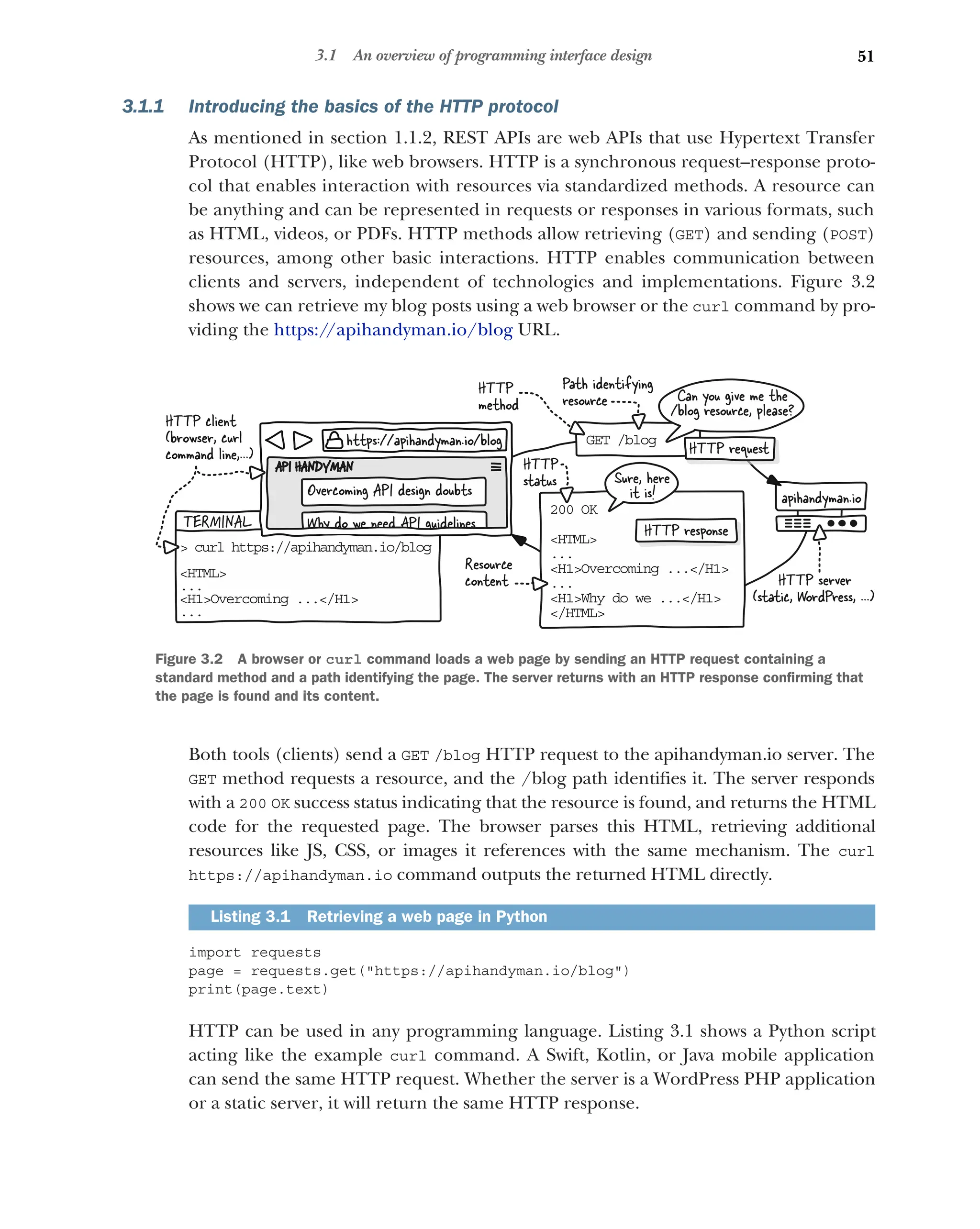
![52 CHAPTER 3 Observing operations from the REST angle
3.1.2 Introducing the basics of REST APIs
REST APIs can be used by applications with or without end users (section 1.1.1) and
built in any technology, as any programming language supports HTTP (section 3.1.1).
For now, we’ll consider REST APIs as web APIs that extensively use HTTP and respect
its semantics, although we’ll see they’re more than that in section 4.8. Figure 3.3
shows a call to the “Online Shopping” API made by a mobile application and the curl
command-line tool to “Search for products.”
The application sends a GET /products HTTP request to the API server, which
responds with a 200 OK status and the product list, regardless of how data is stored and
read. From an HTTP perspective, this REST API call is similar to the blog example in
section 3.1.1. However, the resource represents a business entity or concept (“prod-
ucts”) related to “Online Shopping” instead of a web resource like HTML or CSS files,
and the client gets structured data instead of HTML. The curl command line, a web
application, a smart refrigerator application, or any application or program speaking
HTTP can perform the same REST API call.
NOTE The data is in JSON format, but that doesn’t matter now. Section 5.1.2
discusses this format, and section 9.7 demonstrates using other formats, such
as XML and CSV.
The resource and method model may look familiar to those accustomed to object-
oriented programming (OOP). An HTTP resource can be compared to an object or
class, and the HTTP methods to the methods of an object or class. However, unlike
OOP, HTTP is limited to standardized methods.
url https://api.shp.ng/products
c
[
{
id: 12345,
...
TERMINAL
SHOPPING
Co boy Bebop
w
Macross
All Products
Patlabor
GE /products
T
Sure, here
it is!
Can you give me the
/products resource,
please?
20 OK
0
[
{
id: 12345,
name: Cowboy Bebop,
type: BD
},
. .
.
]
Search
Online Shopping
Buy
Client
application Web API
server
HTTP response
HTTP request
HTTP method
HTTP
status
Resource content
Path identifying
resource
Figure 3.3 How a client application calls a REST API is identical to when a web browser loads an
HTML page.](https://image.slidesharecdn.com/lauretarnaud-thedesignofwebapis2025-250821164447-5e92da1d/75/Lauret-Arnaud-The-Design-of-Web-APIs-2025-pdf-90-2048.jpg)
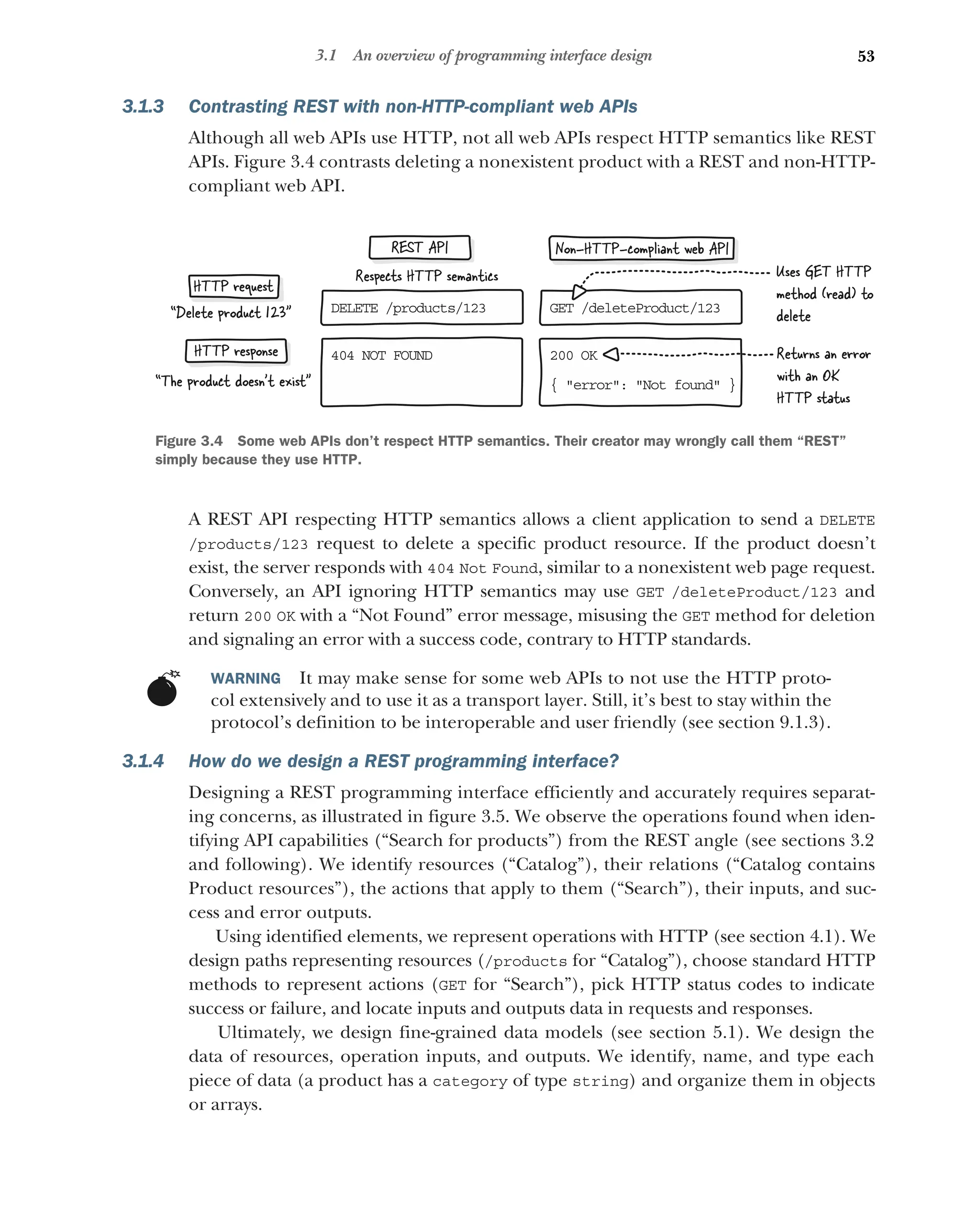
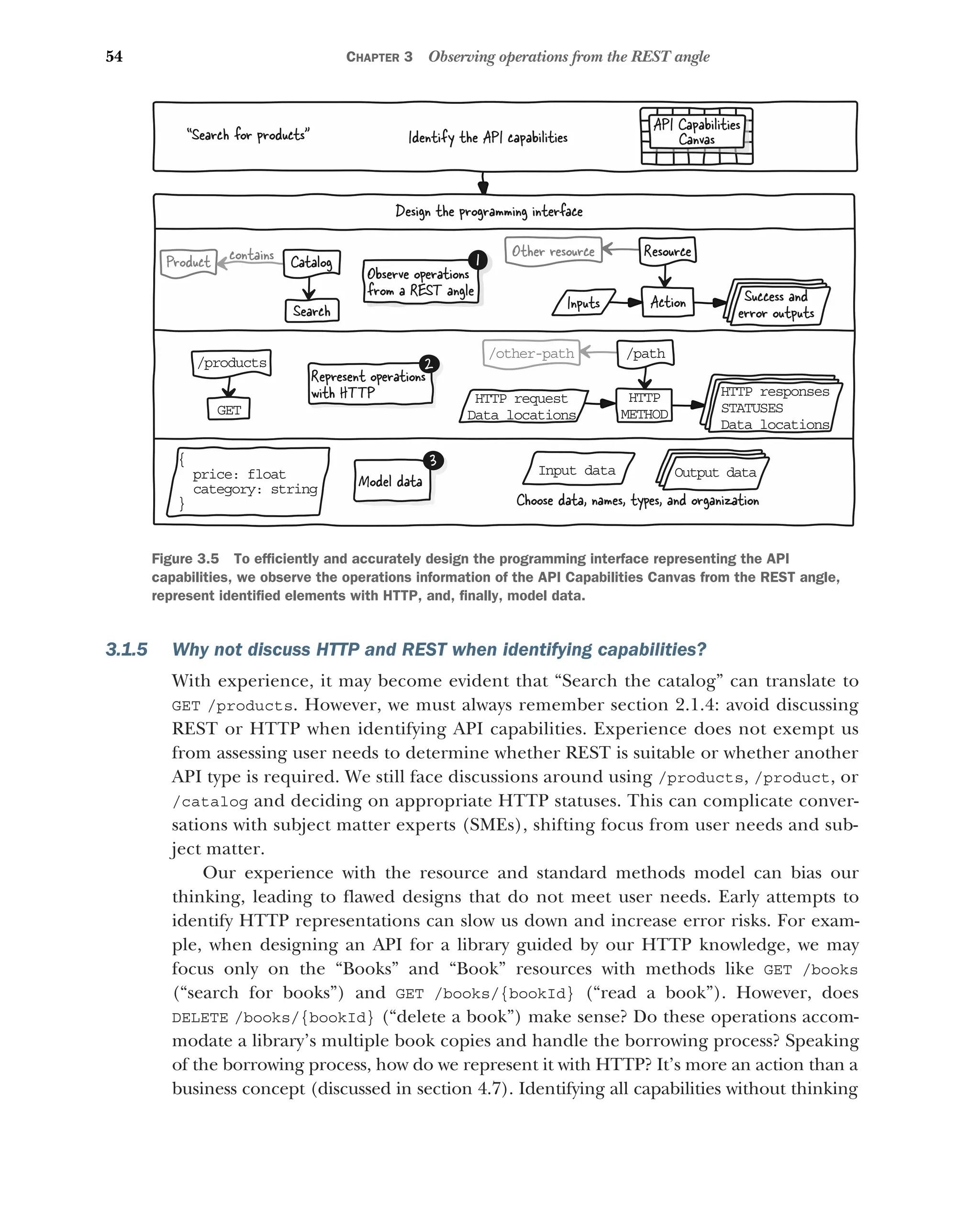
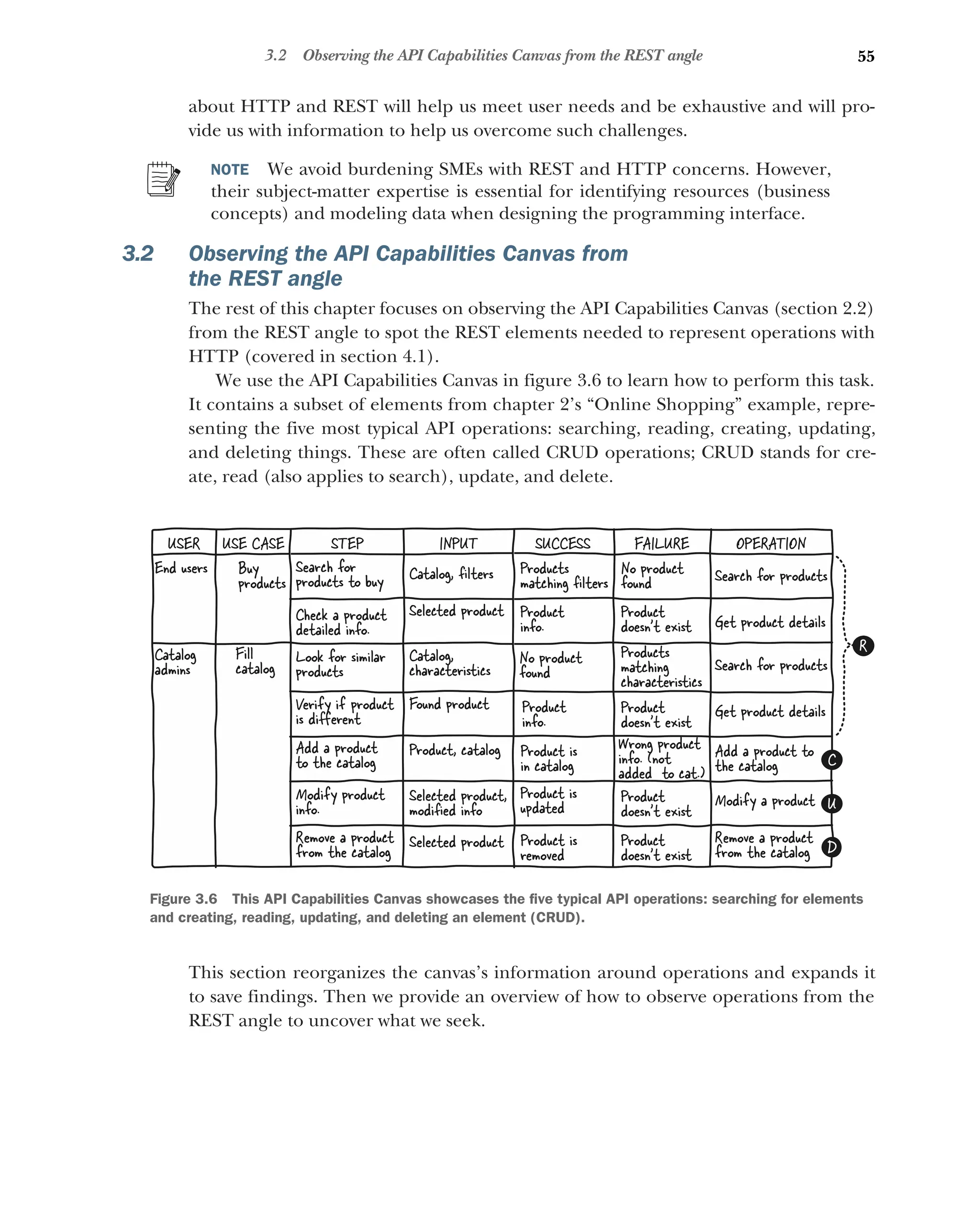
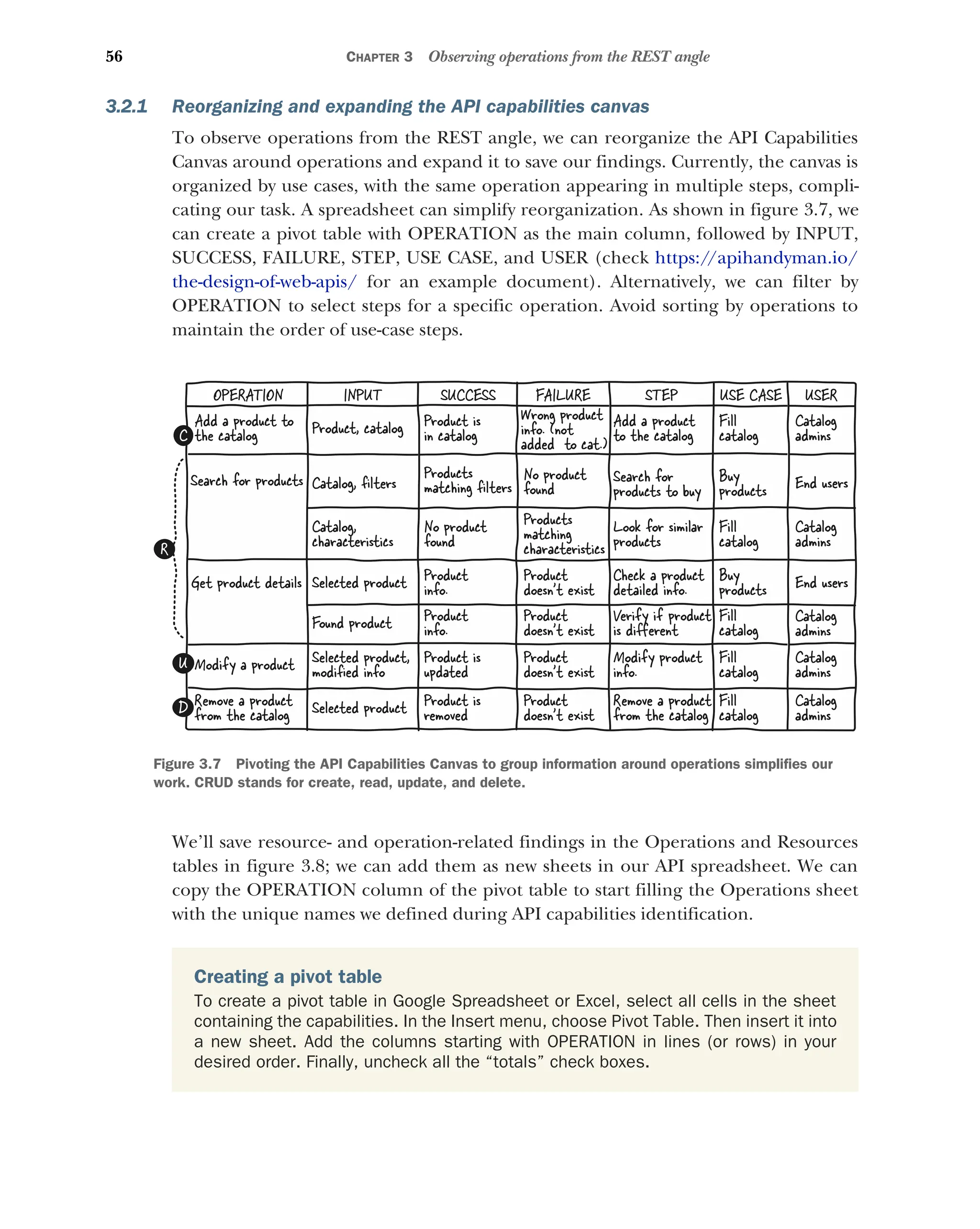
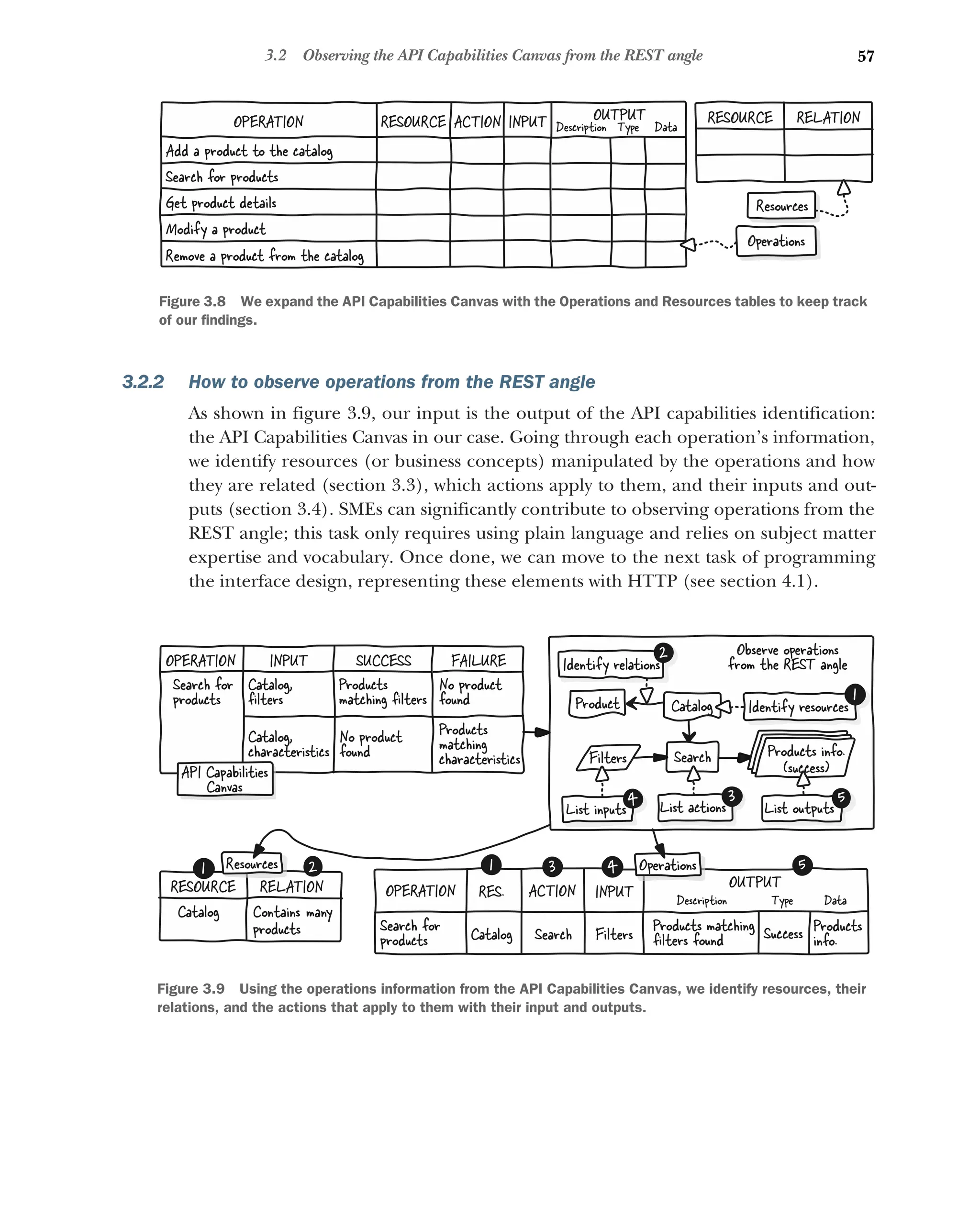
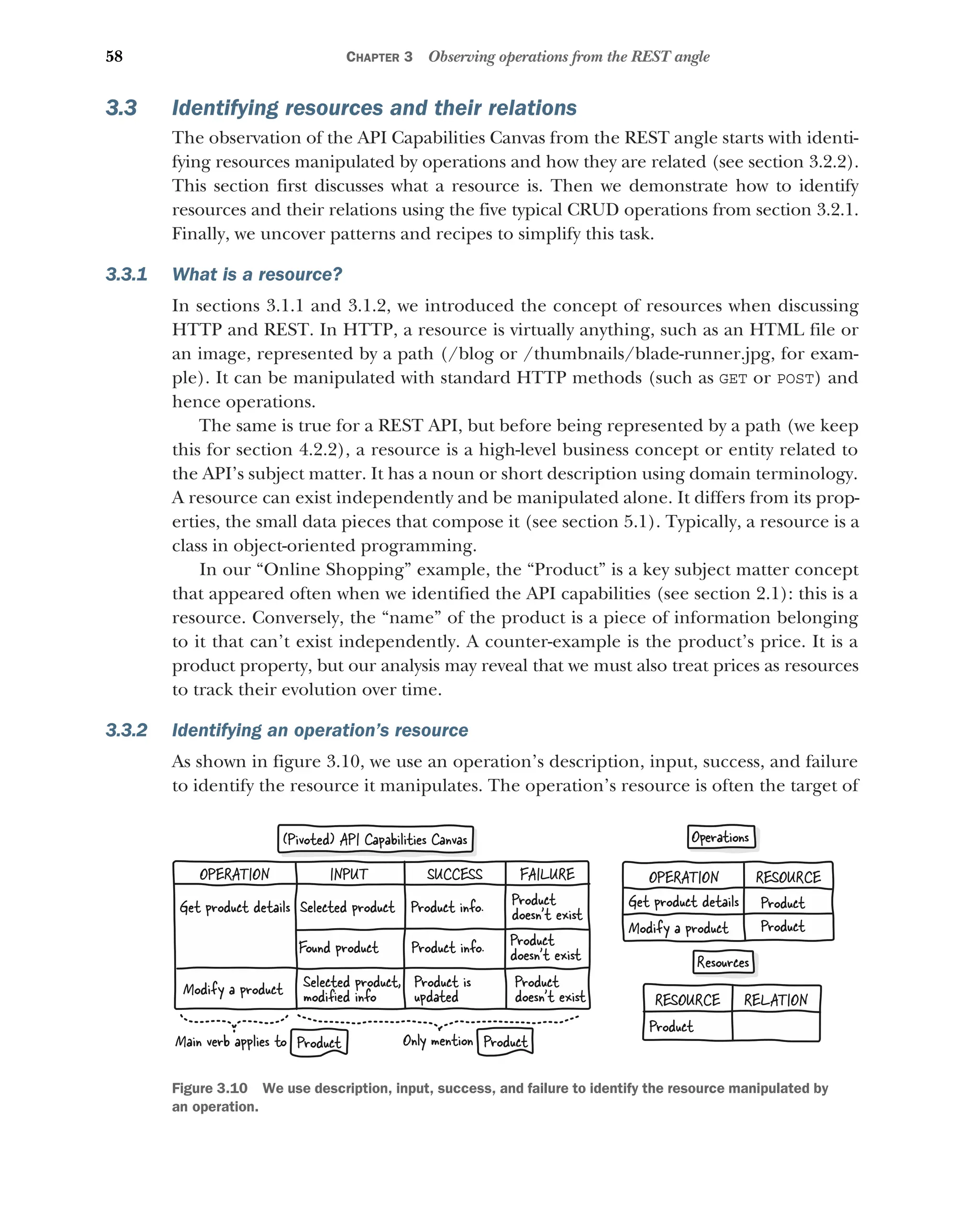
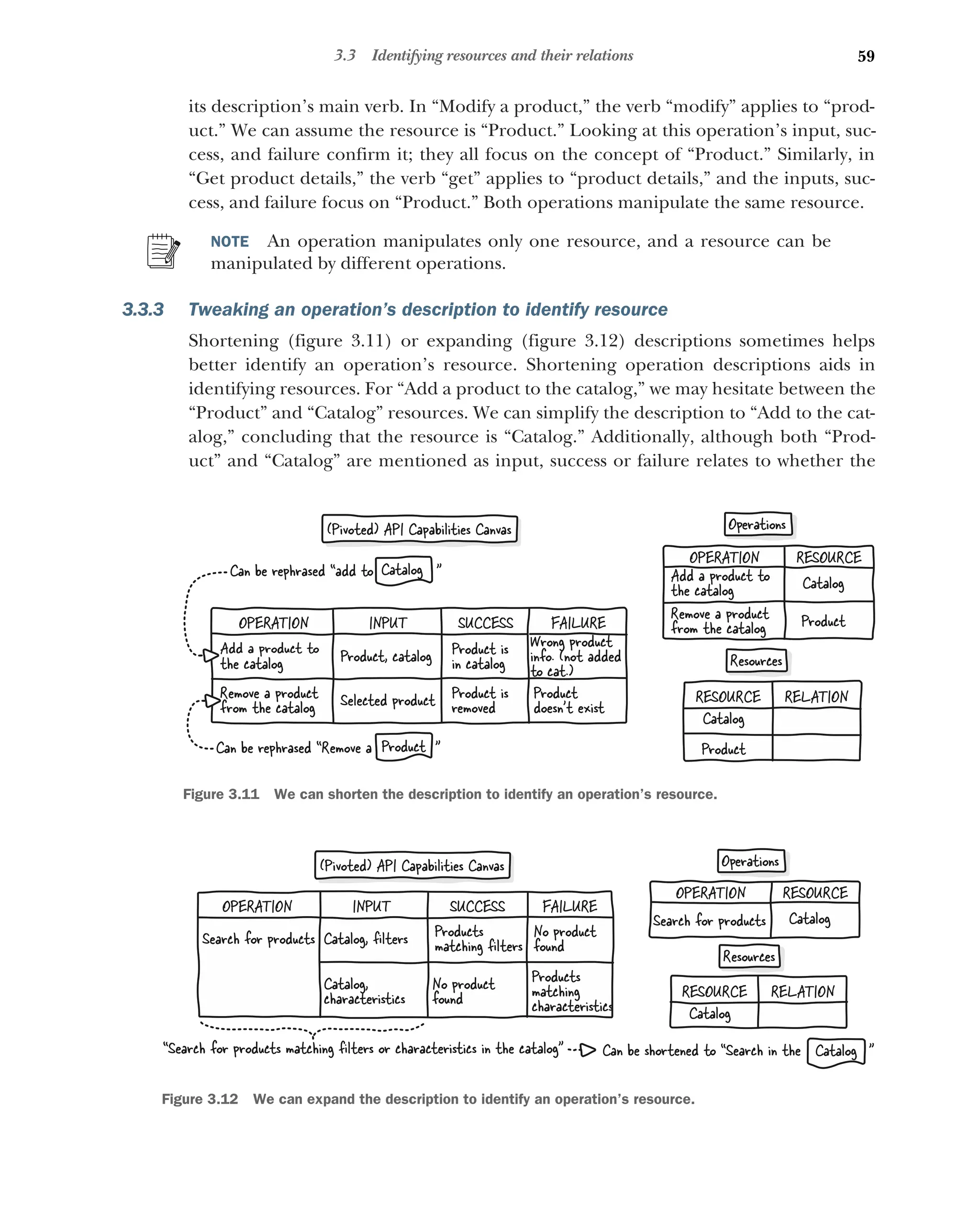
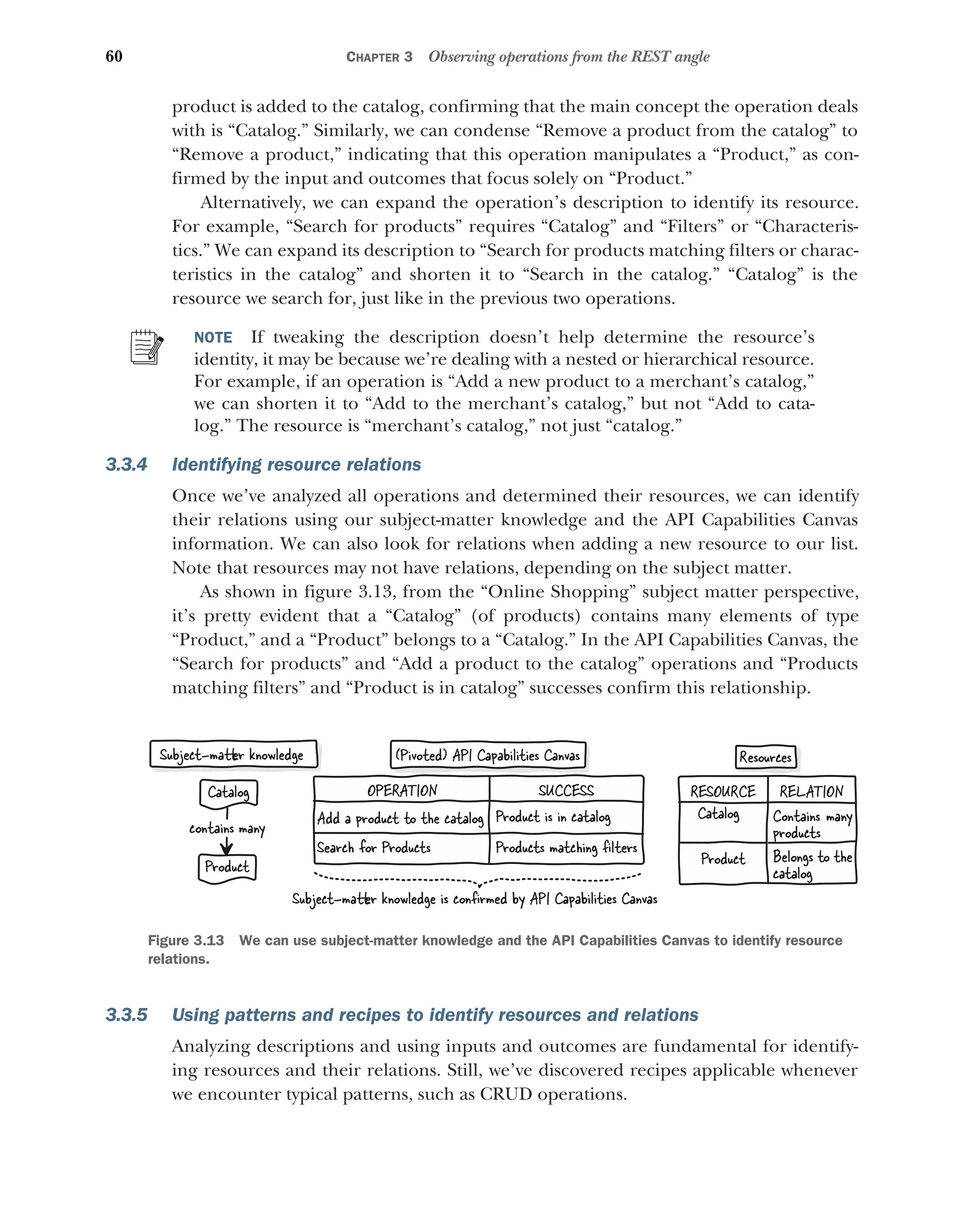
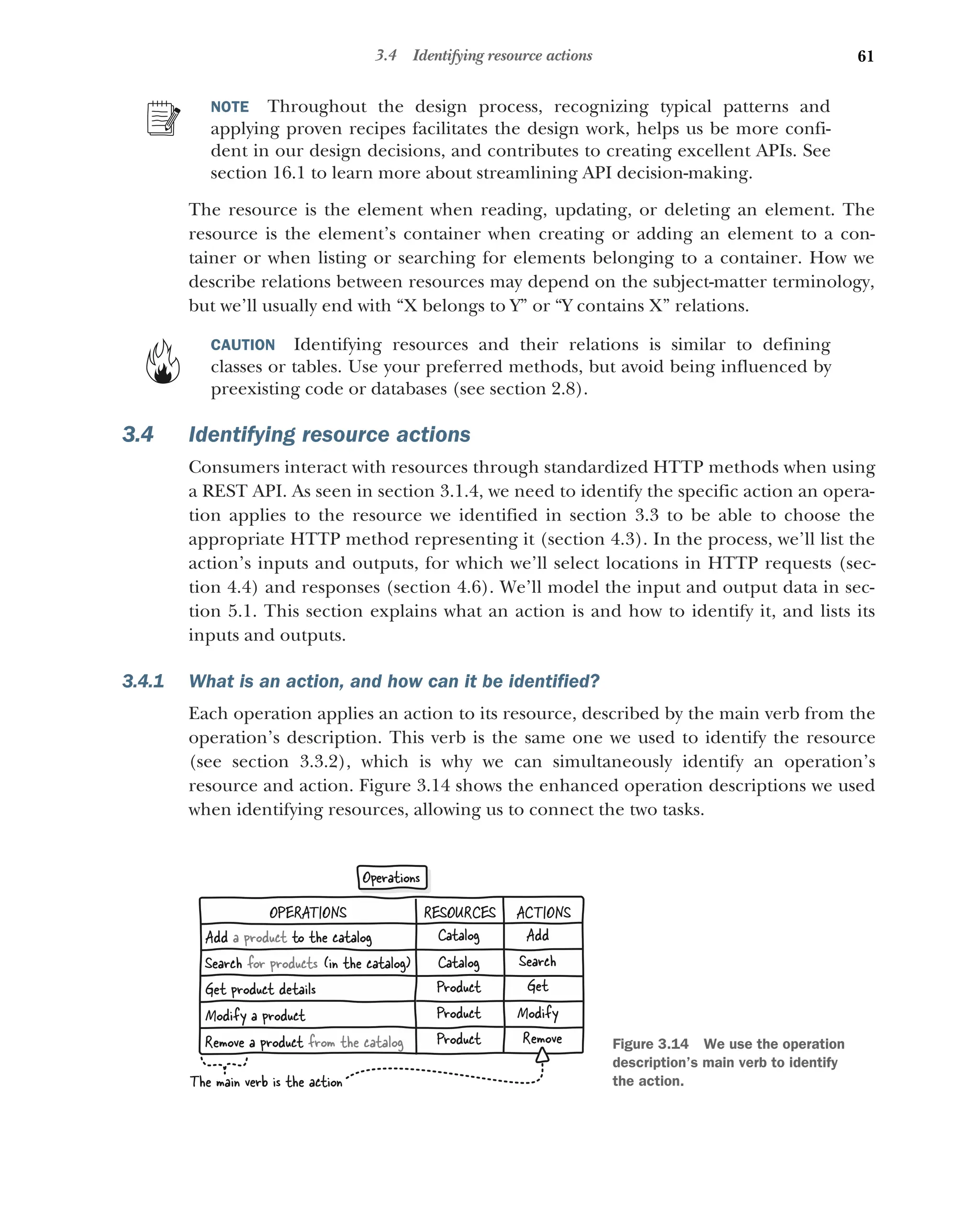
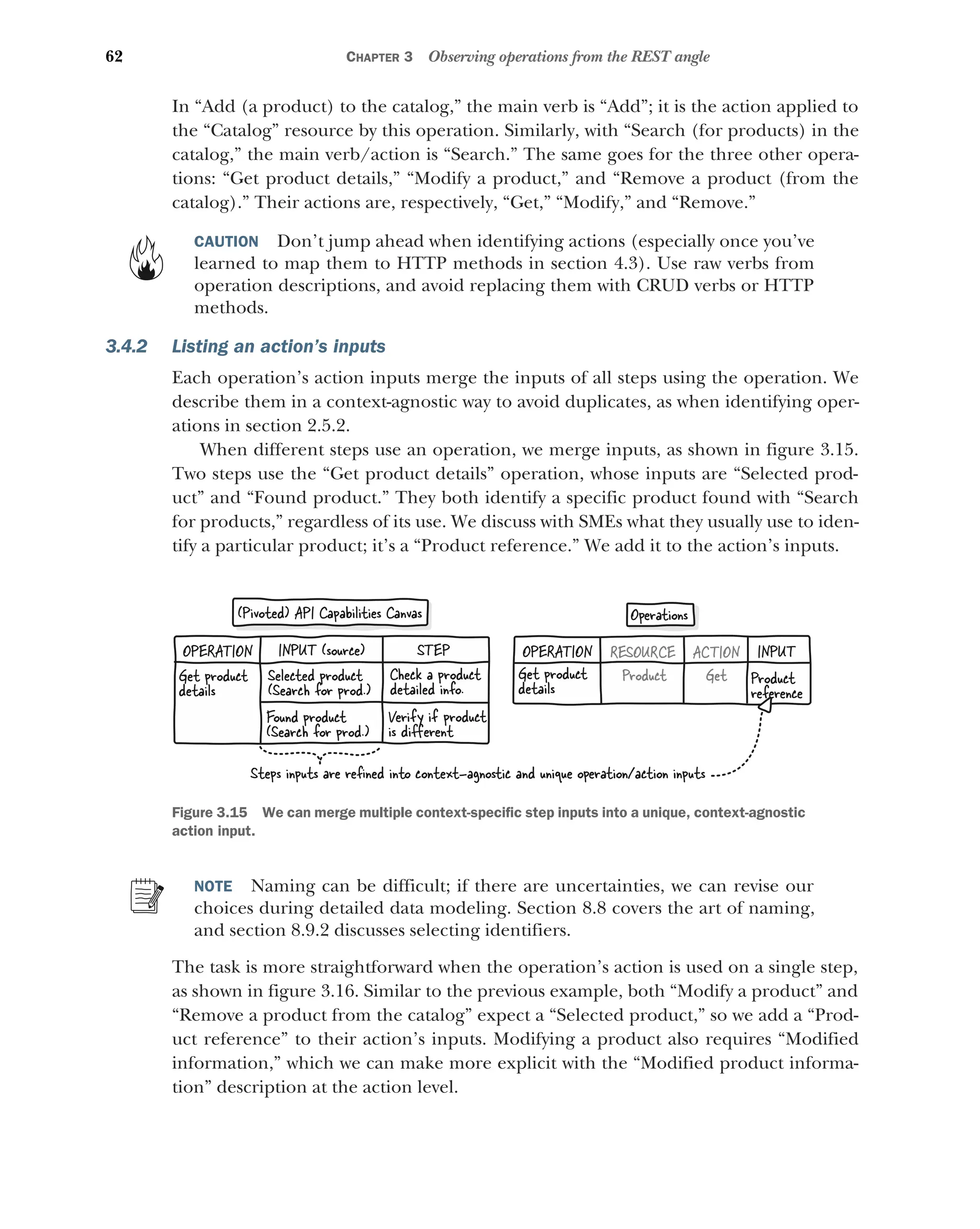
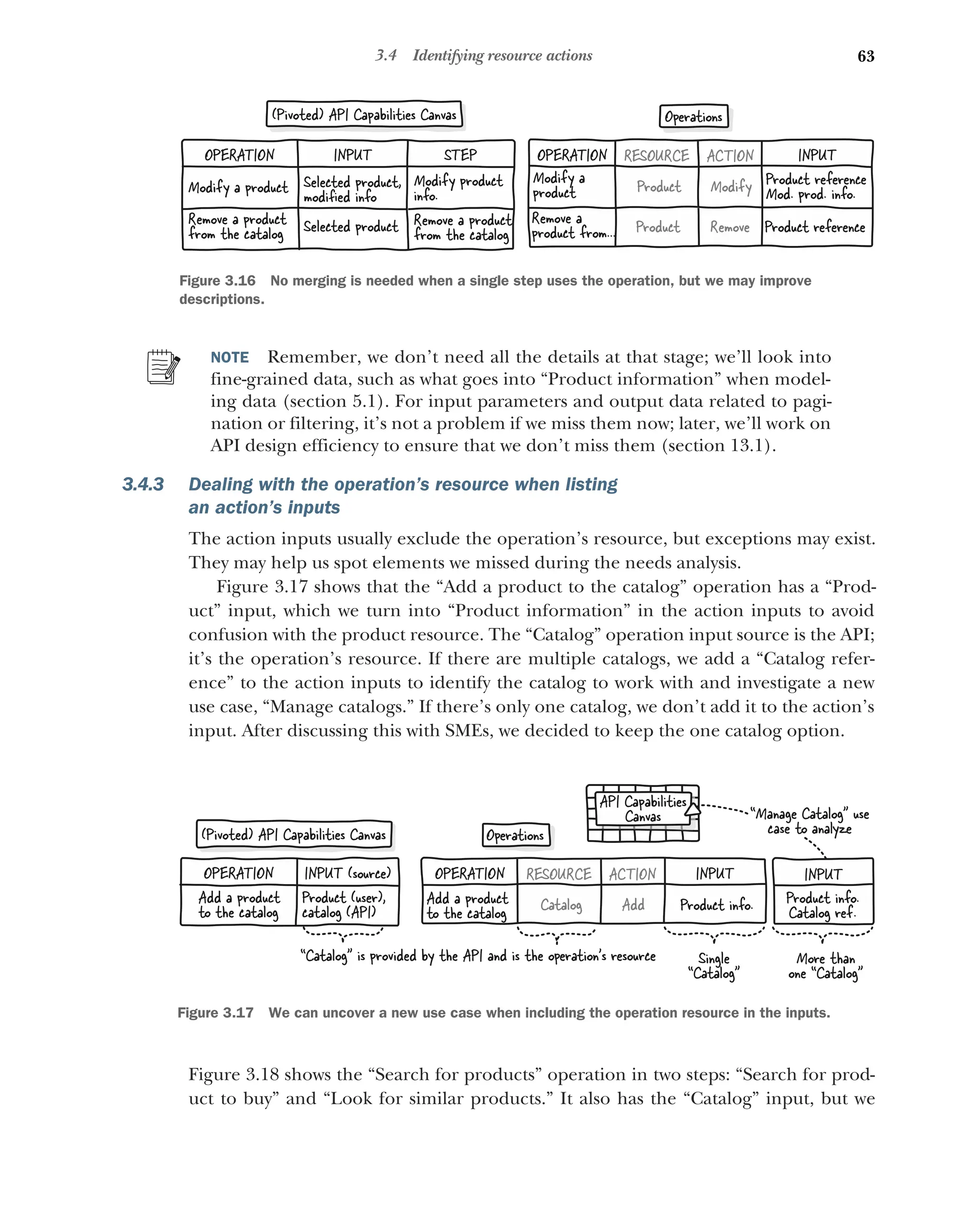
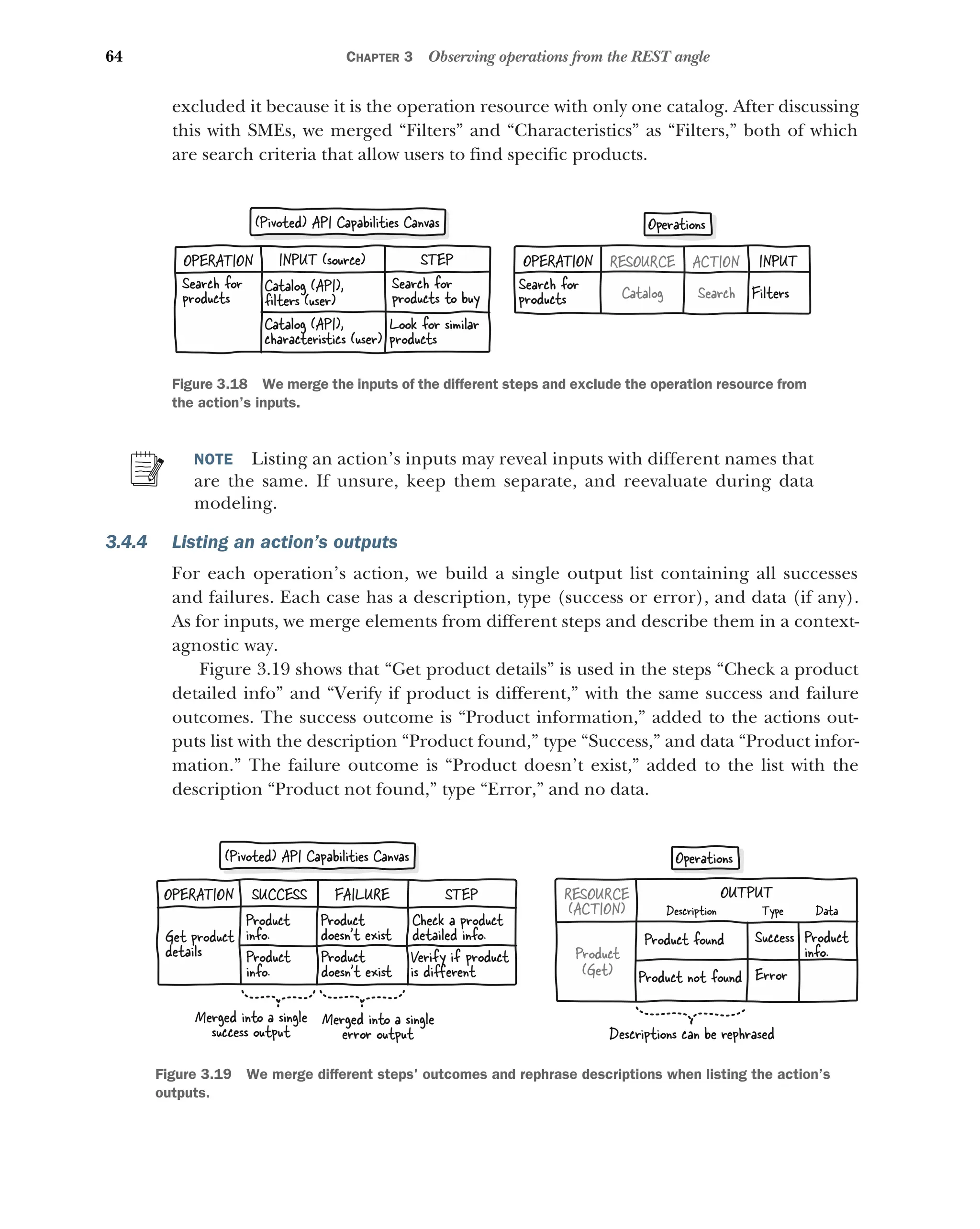
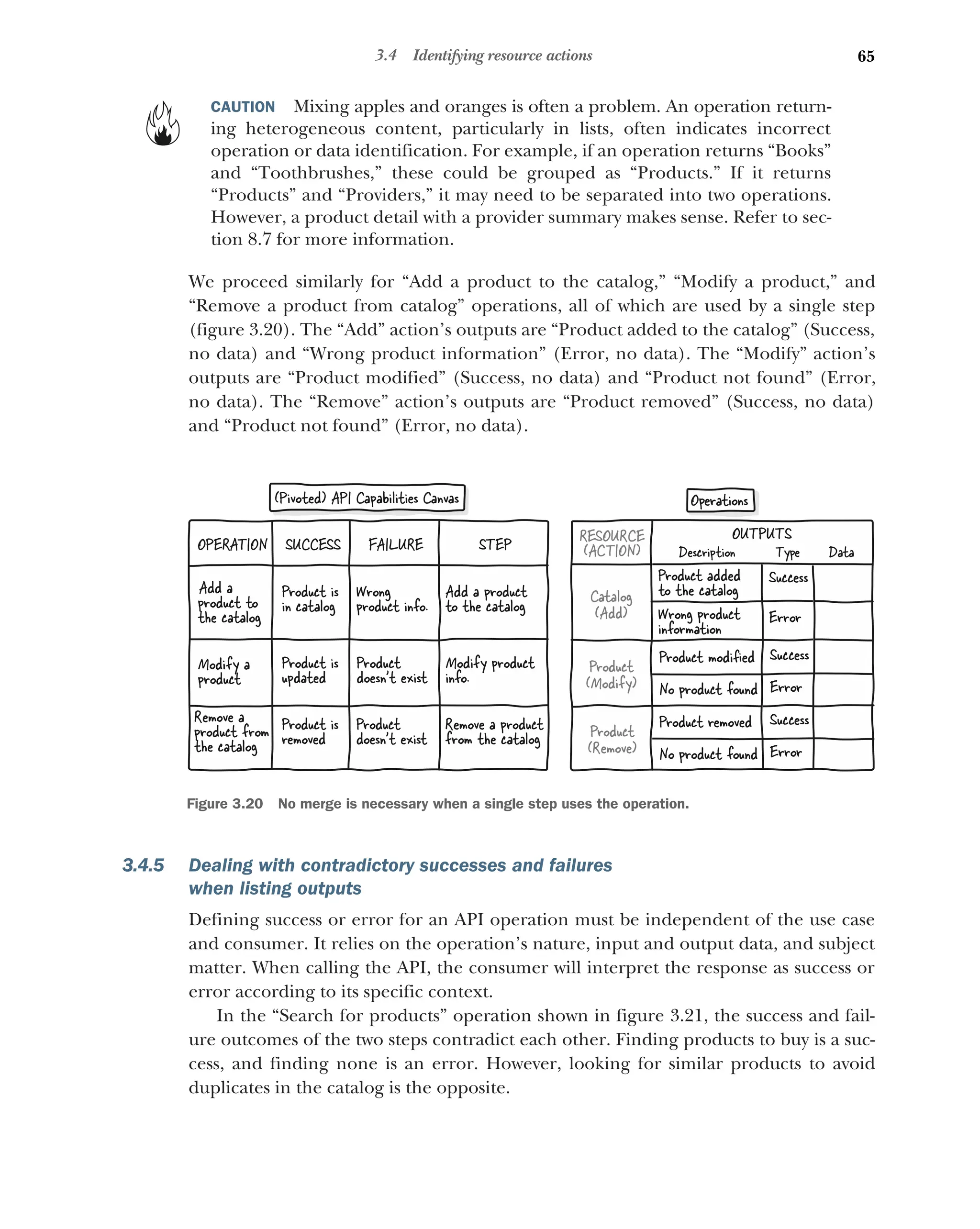
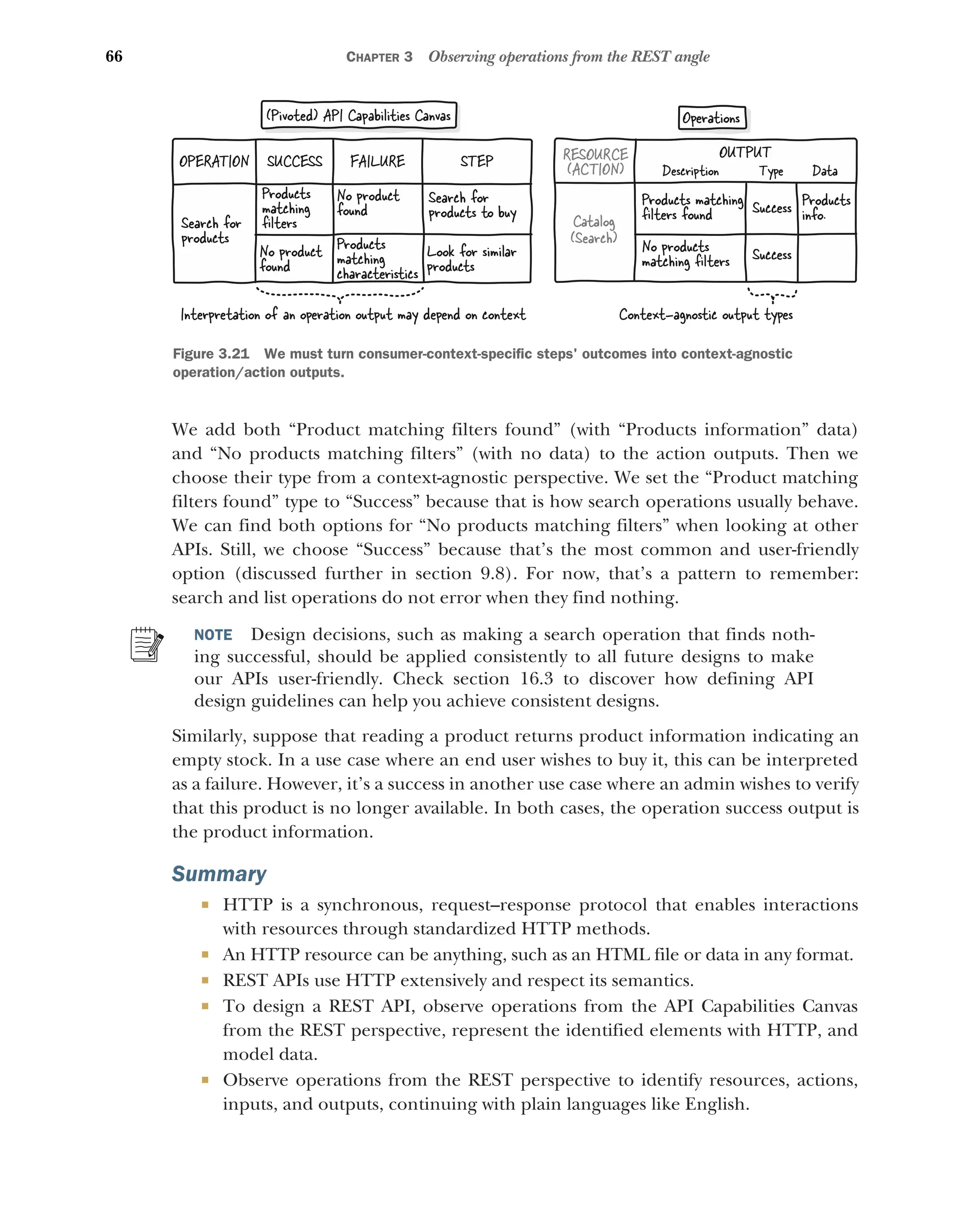
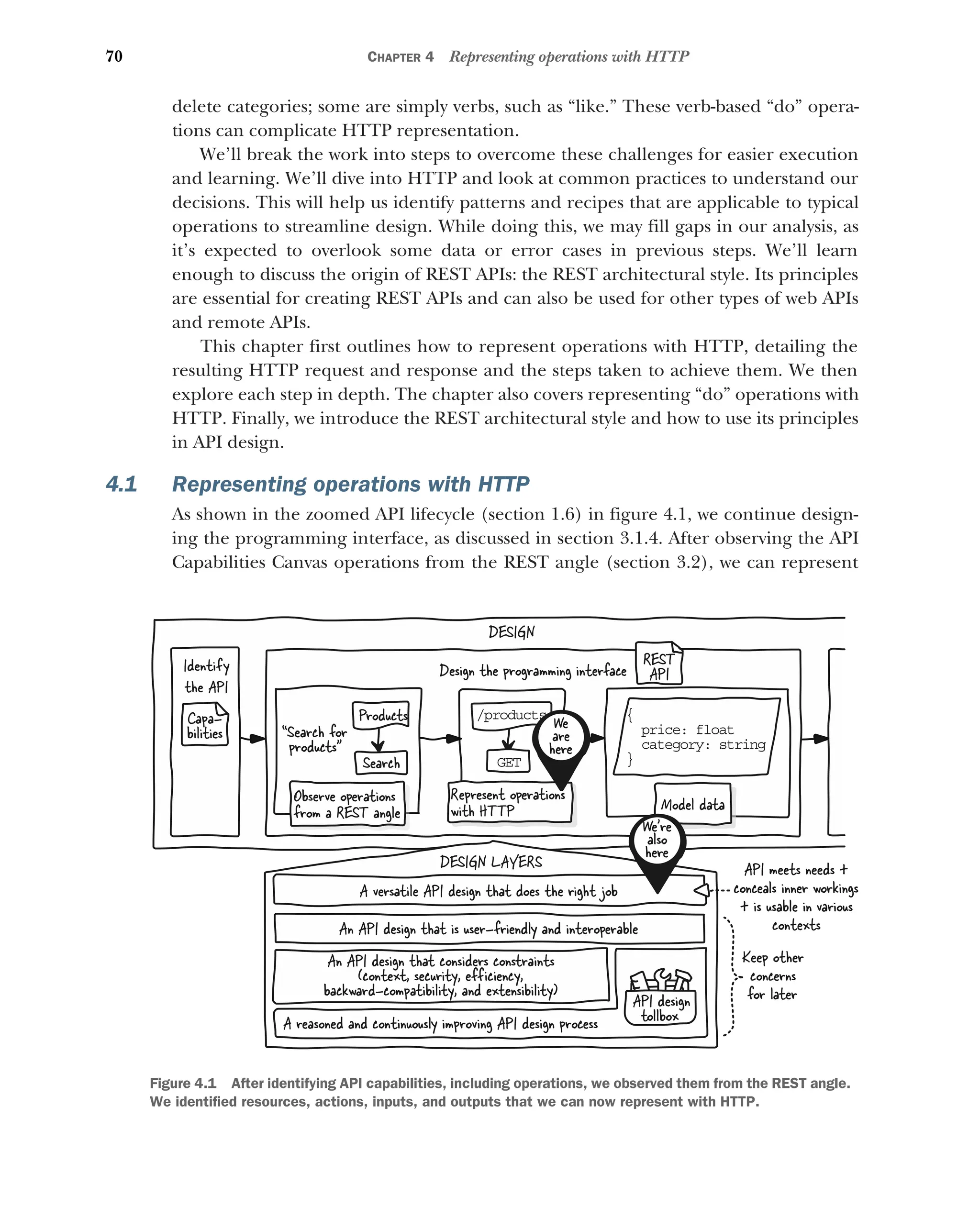
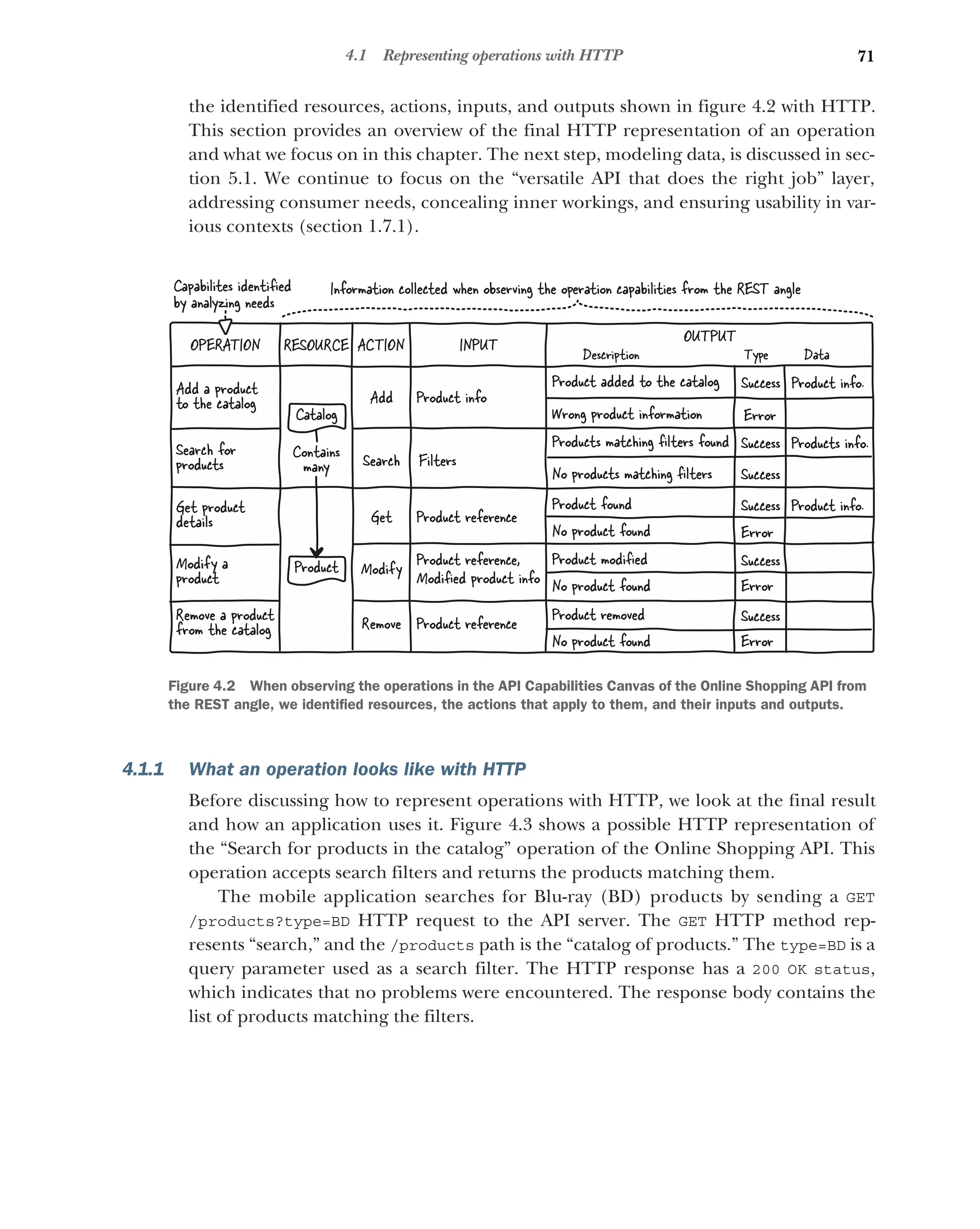
![72 CHAPTER 4 Representing operations with HTTP
4.1.2 How to represent operations with HTTP
When observing the operations from the REST angle, we identified resources, actions
that apply to them, and their inputs and outputs. Figure 4.4 shows how we’ll represent
them with HTTP.
We start with the HTTP request, representing the resource (“Catalog with many prod-
ucts”) with a path (/products). We select an HTTP method (GET) for the action
(“Search”) and choose the appropriate locations for each piece of input data (query
for “Filters”). Next, we address the HTTP responses, choosing status codes represent-
ing the output types and descriptions (200 OK for the successful “Products matching
filters found”) and locations for output data (body for “Products info”).
SHOPPING
Co boy Bebop
w
Macross
Filters: BD
Patlabor
GE /products?type=BD
T
20 OK
0
[
{
id: 12345,
name: Cowboy Bebop,
type: BD
},
...
]
Search products
Online Shopping API
HTTP response
HTTP request
HTTP method representing “Search”
The application calls the
“Search for products”
operation with search
filters
Successful
HTTP status
Query parameter representing
a search filter
Response body containing
the products matching
the filters
Path representing “(the catalog of) products”
Figure 4.3 The mobile application searches the catalog for BD products. The API server returns the
products with type BD.
No data modeling yet
INPUT OUTPUT
Filters Products matching
filters found Success Products
info.
Description Type Data
Catalog
RES.
OPERATION ACTION
Search
Search for
products GET query body
200 OK
HTTP
METHOD Desc. Location Location
Status
RESOURCE RELATION
Catalog Contains many products /products
PATH
/products
/products
Represent resources with paths
1
Represent actions with
standard HTTP methods
2
query
Choose input
locations
3
Choose standard HTTP
status codes for outputs
4 Choose output
locations
5
We temporarily use the spreadsheet
for easier learning; we'll discover a
be er format later.
Figure 4.4 We focus on paths, HTTP methods, HTTP statuses, and the locations of input and output data
in HTTP requests and responses.](https://image.slidesharecdn.com/lauretarnaud-thedesignofwebapis2025-250821164447-5e92da1d/75/Lauret-Arnaud-The-Design-of-Web-APIs-2025-pdf-110-2048.jpg)
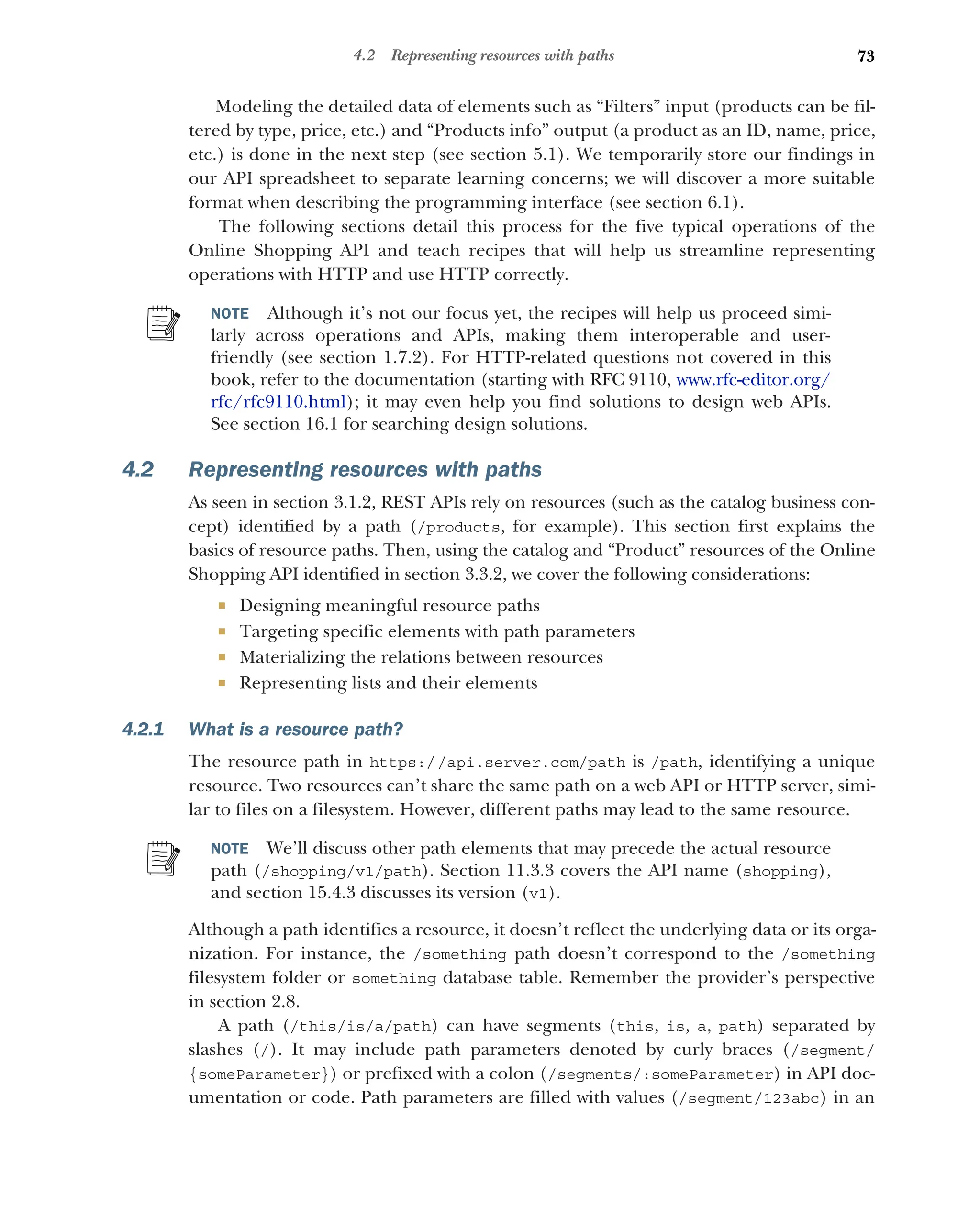
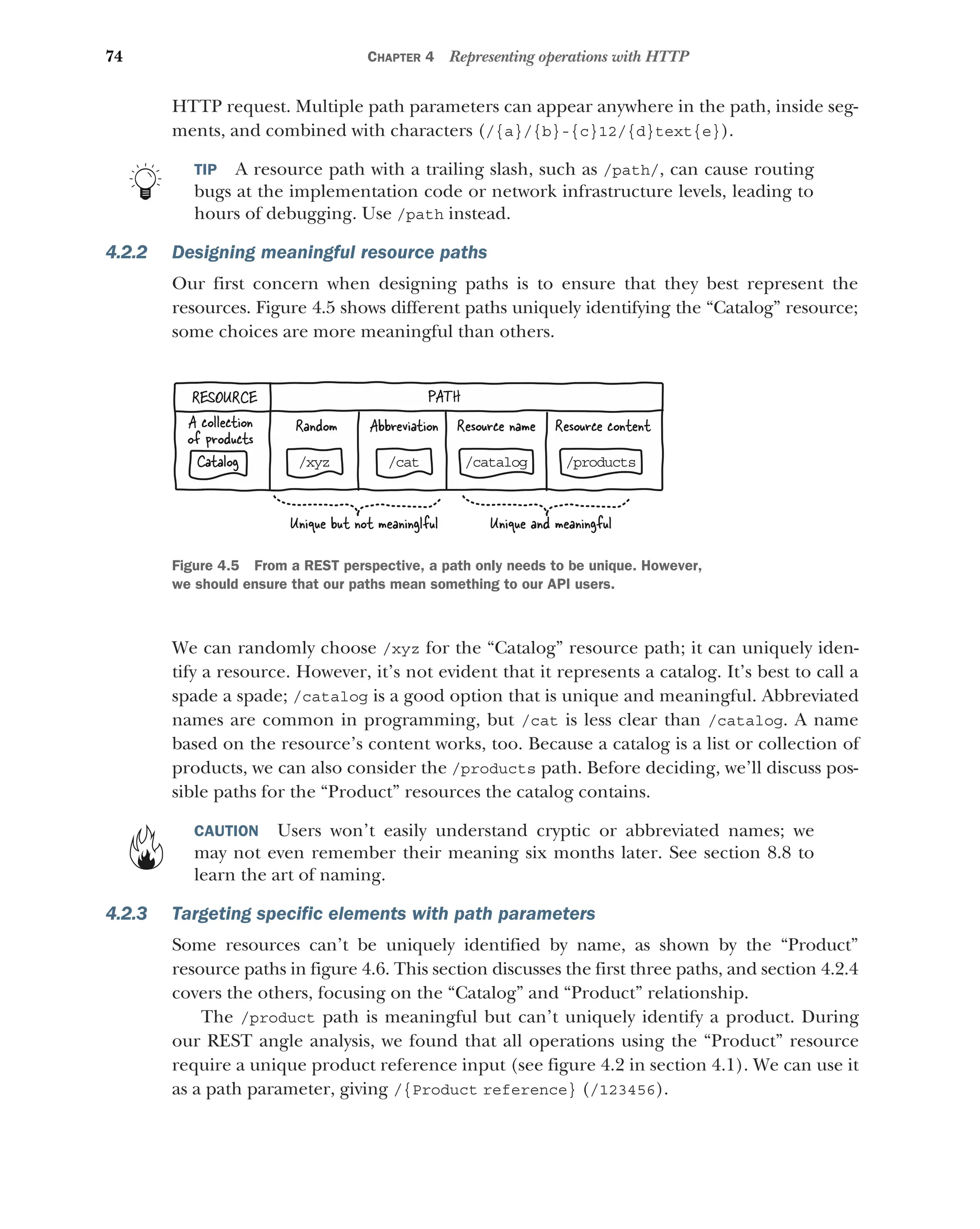
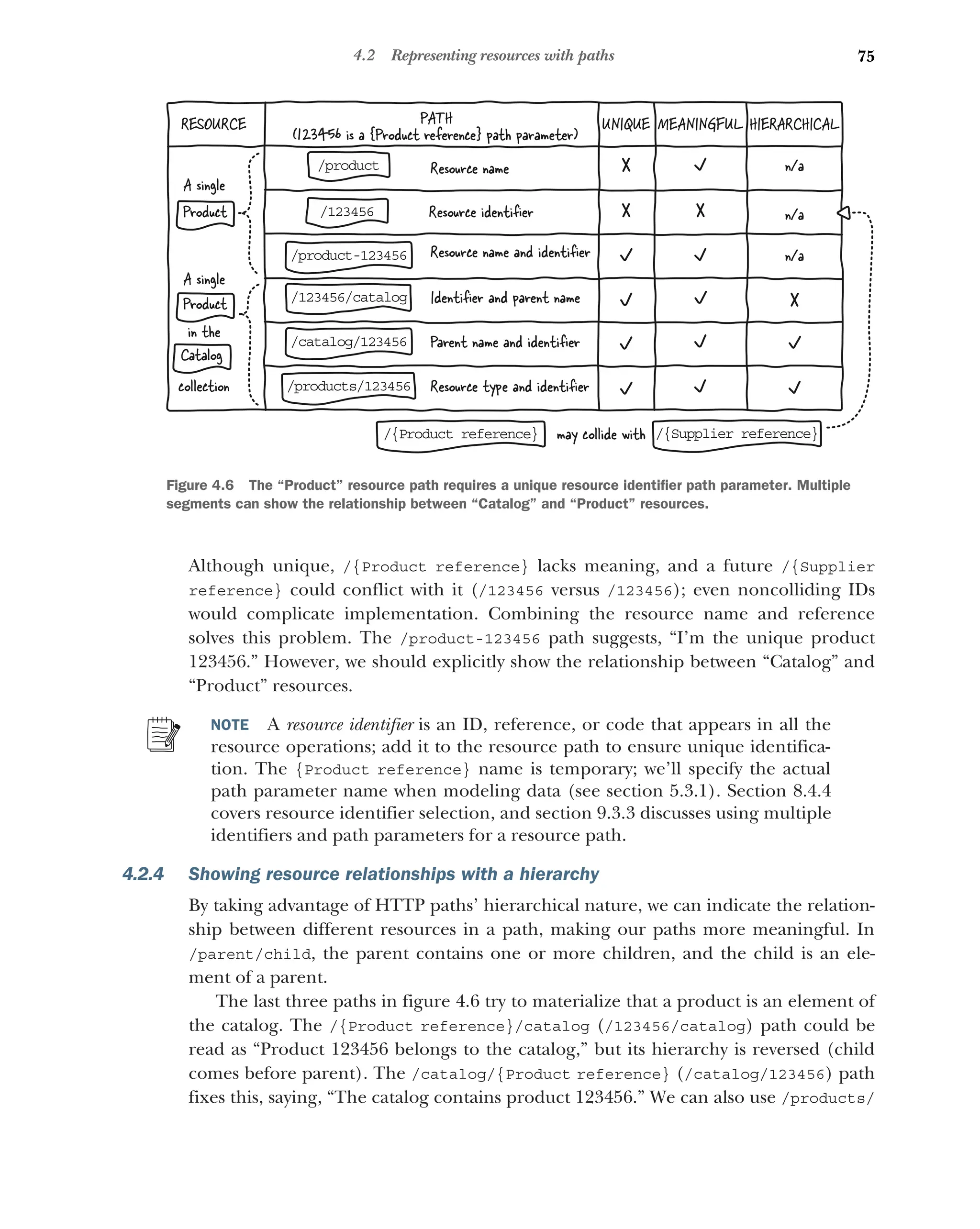
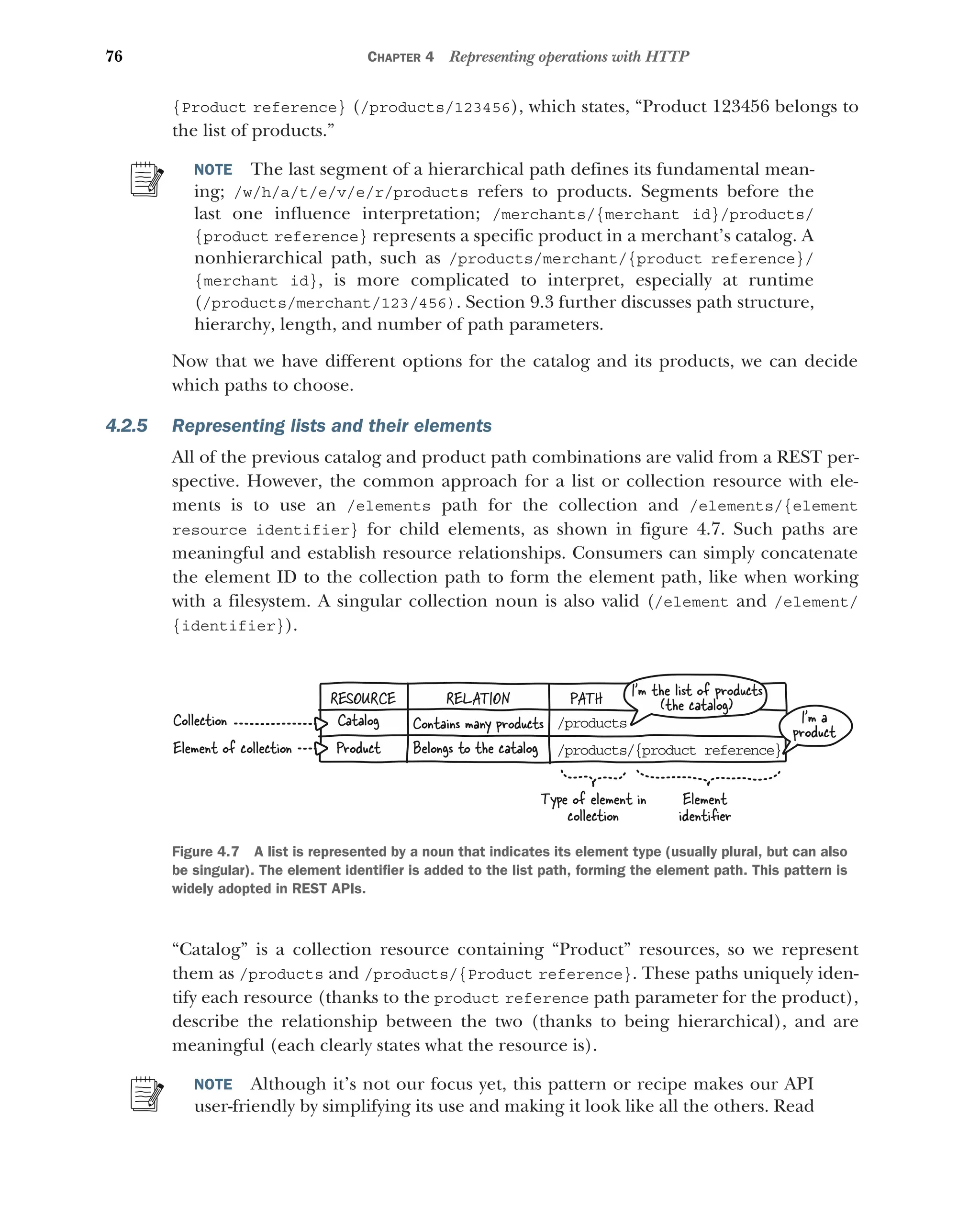
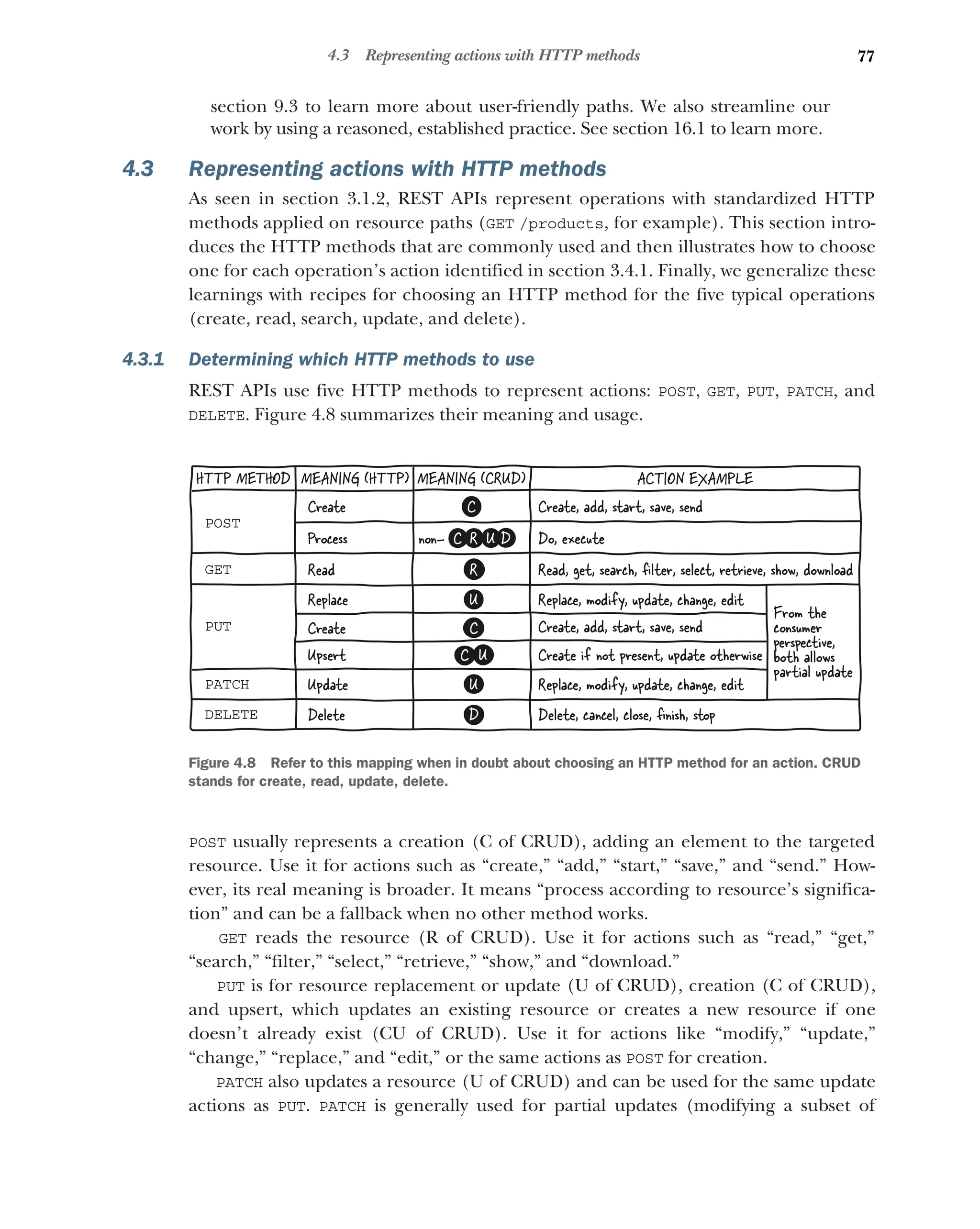
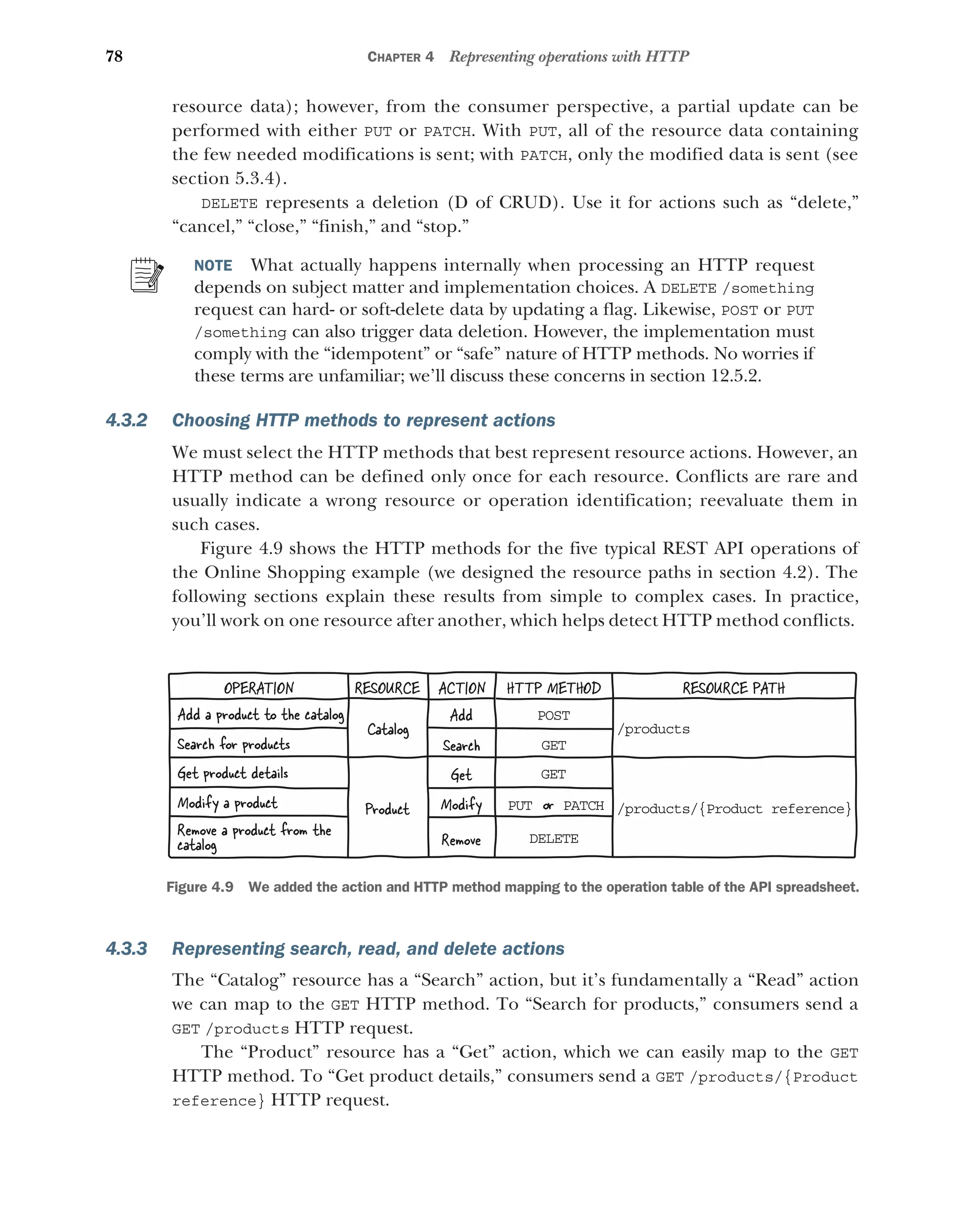
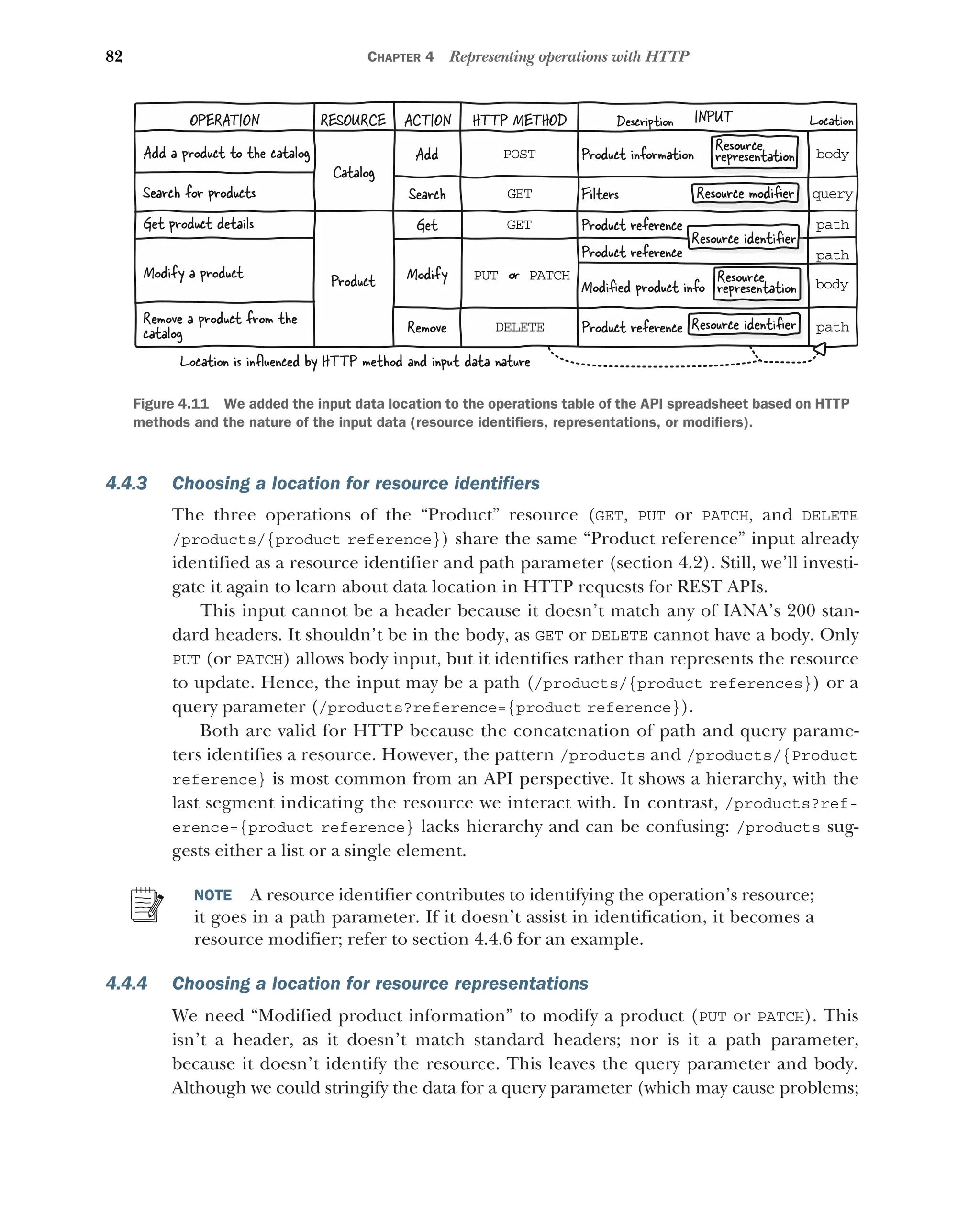
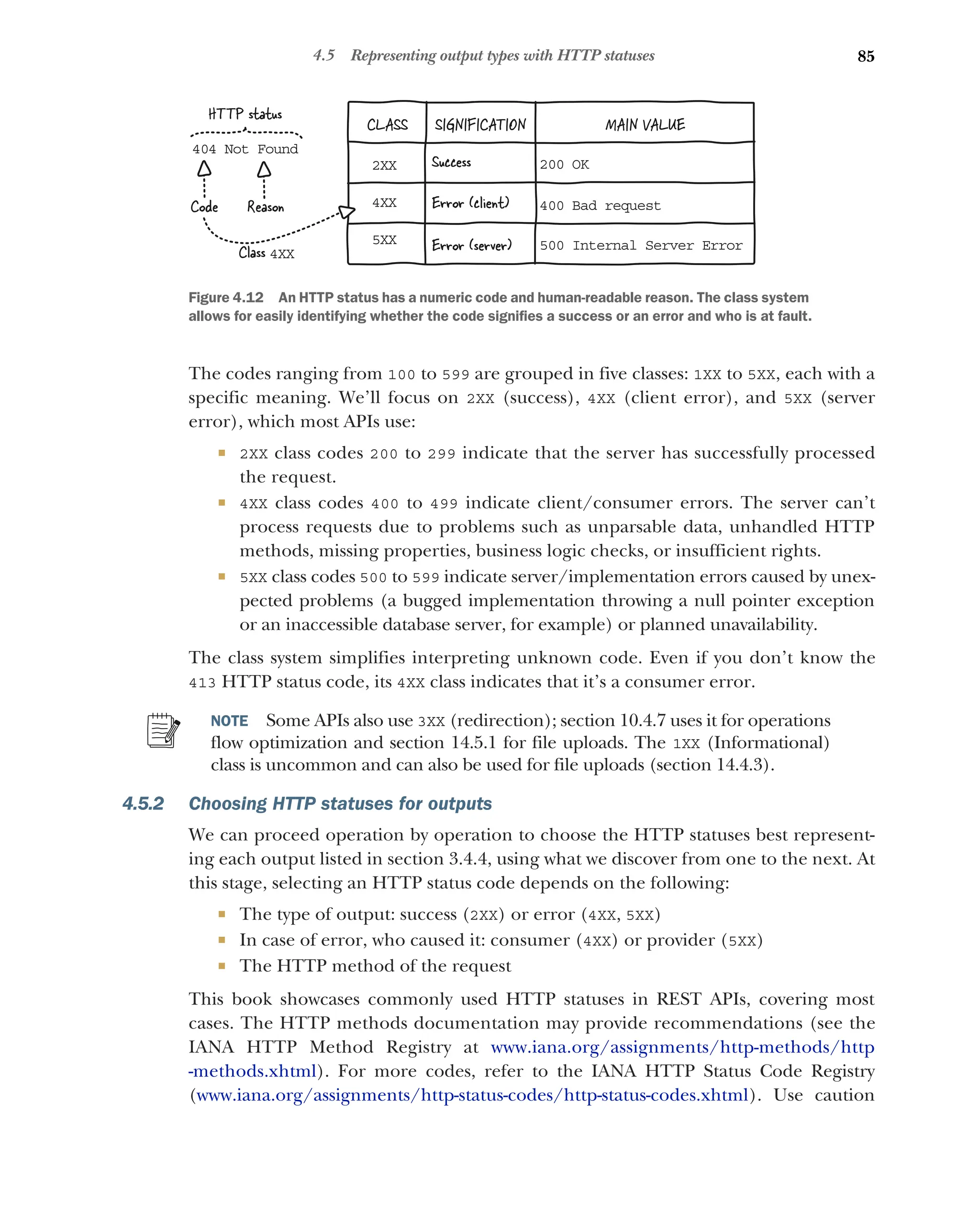
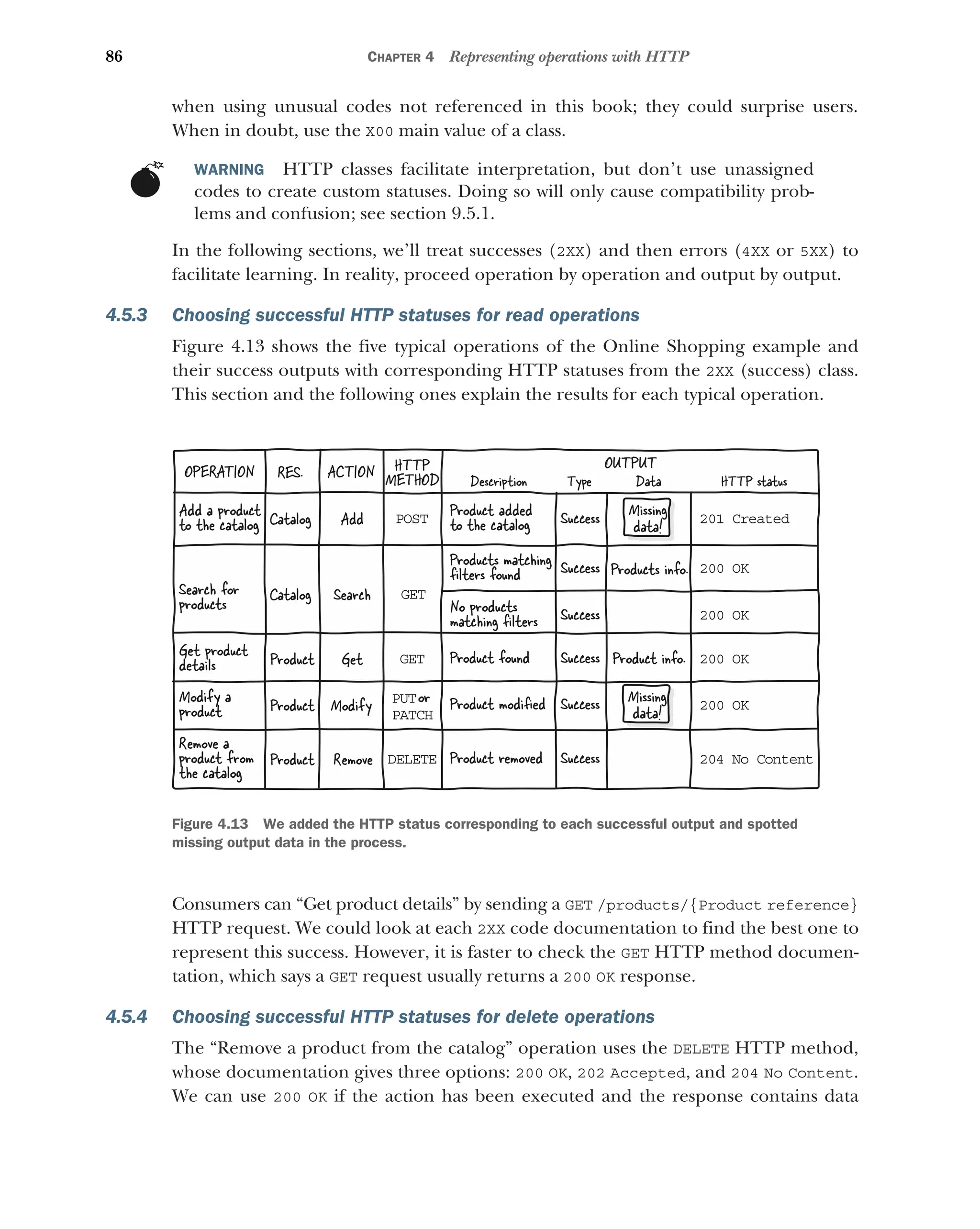
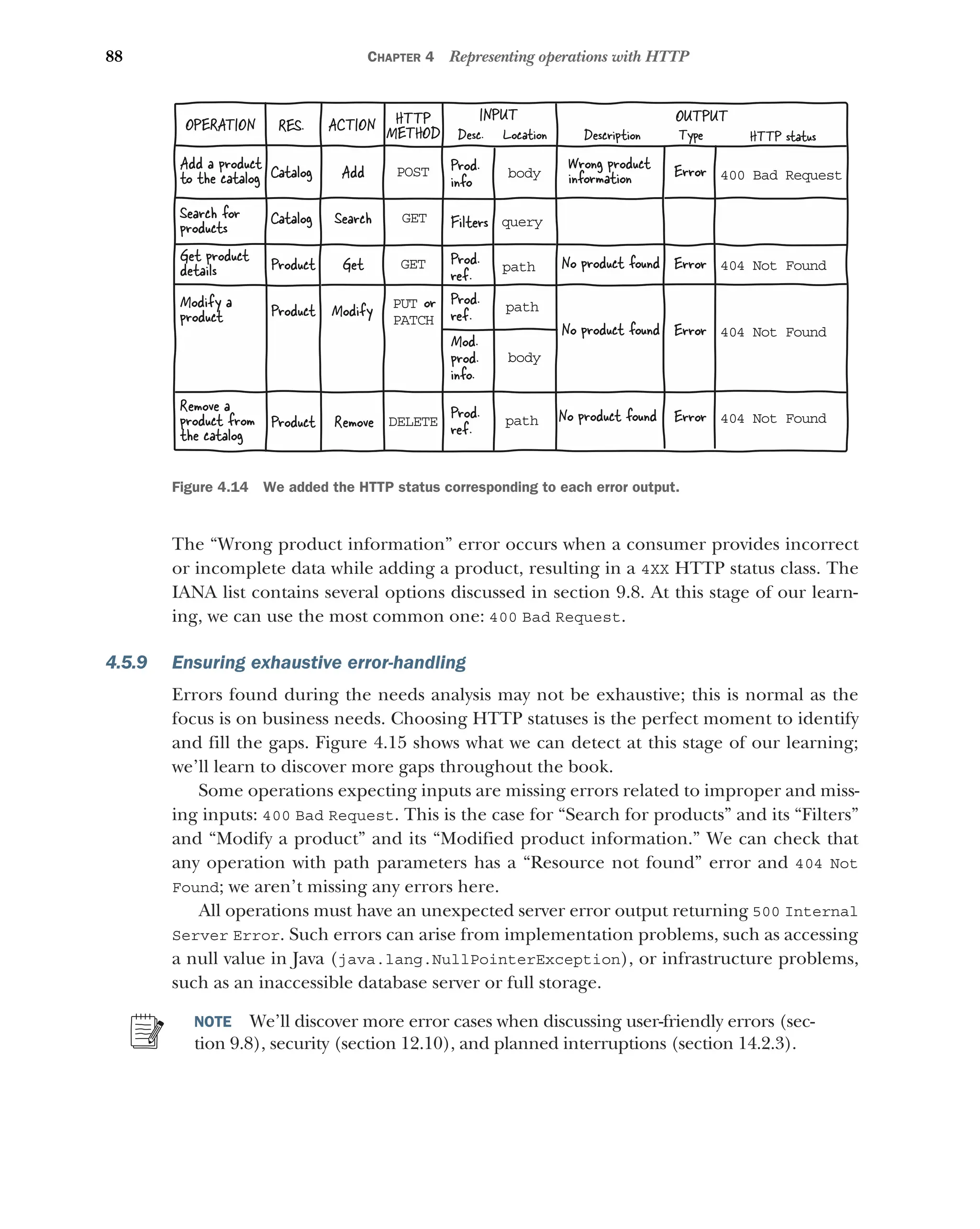
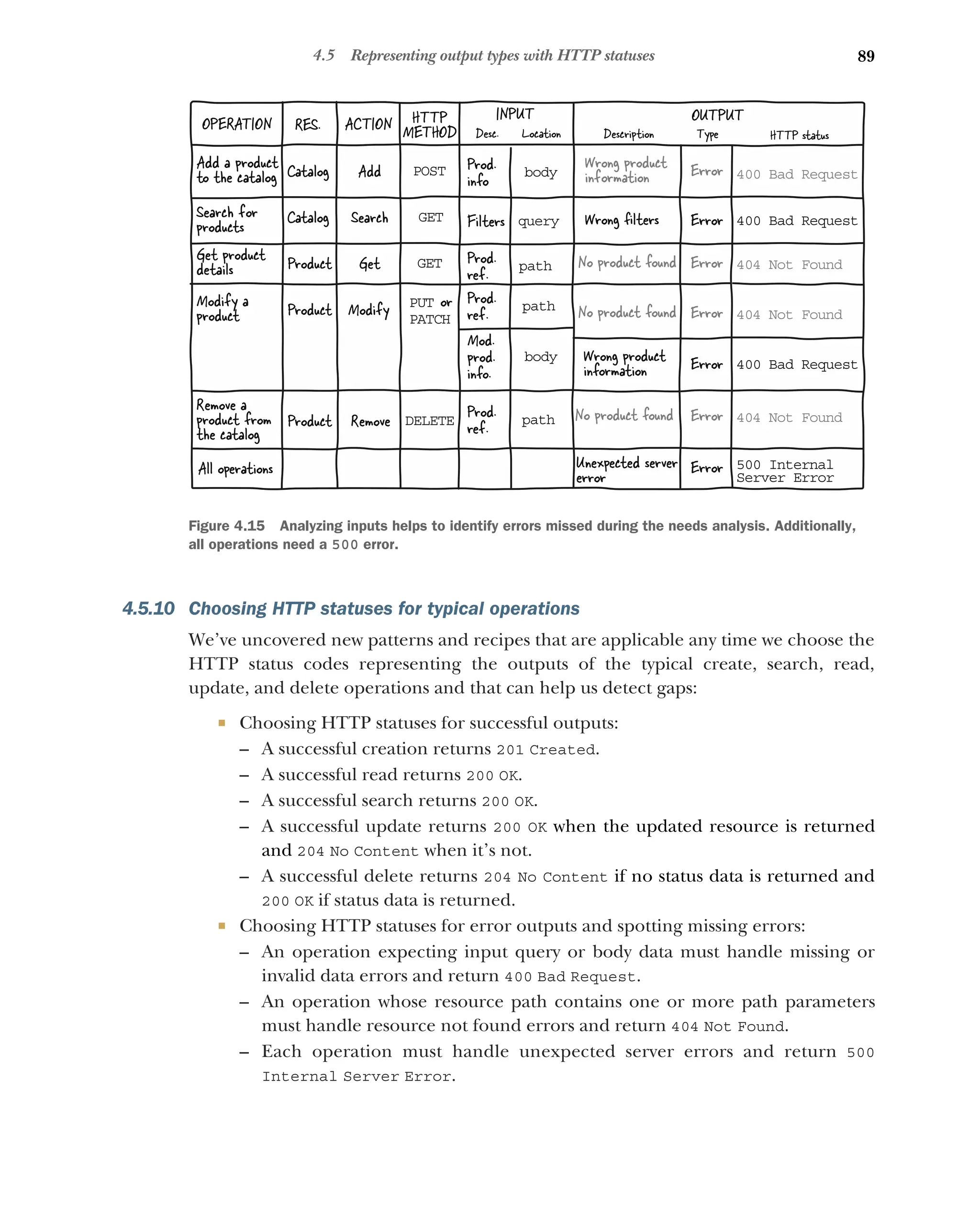
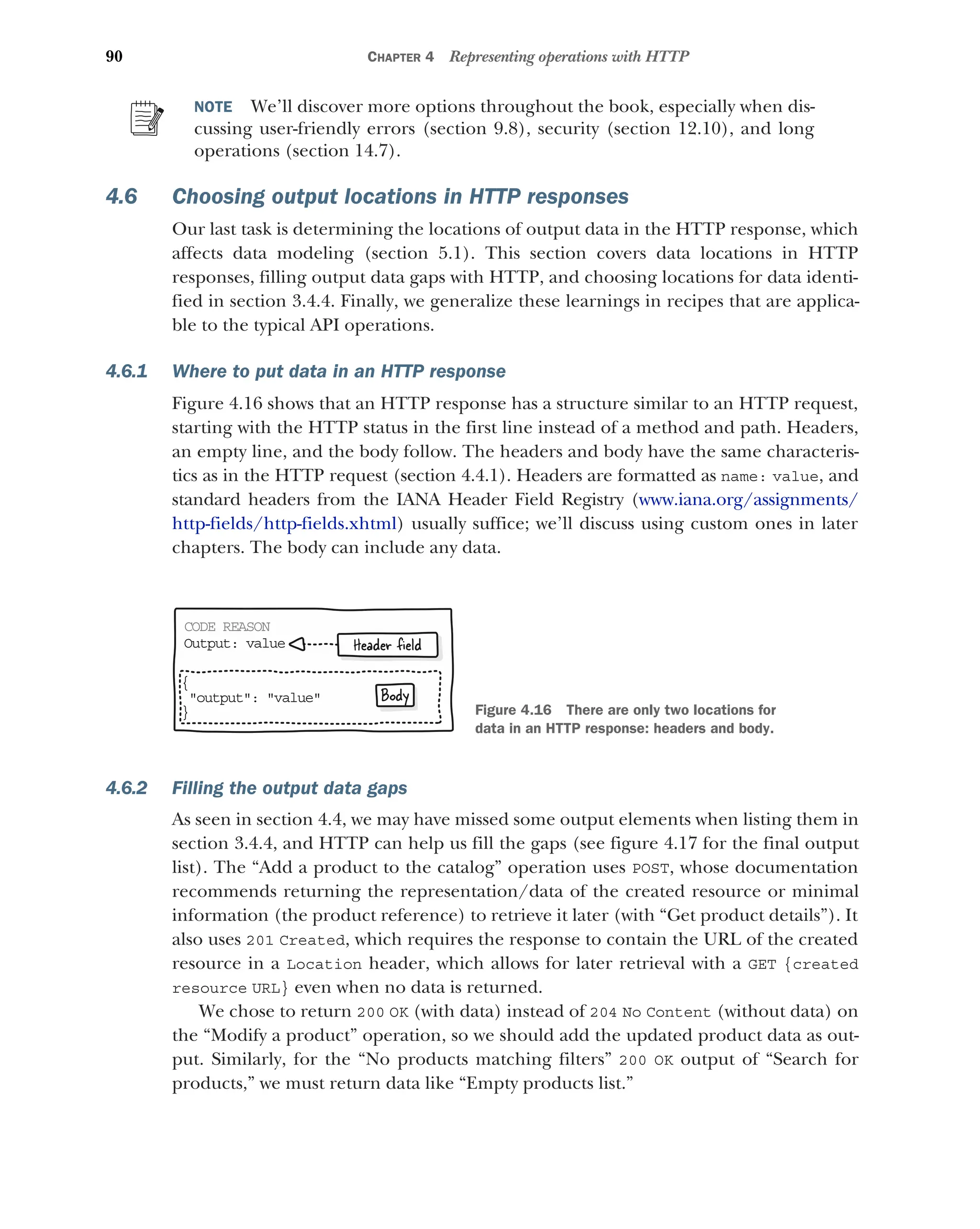
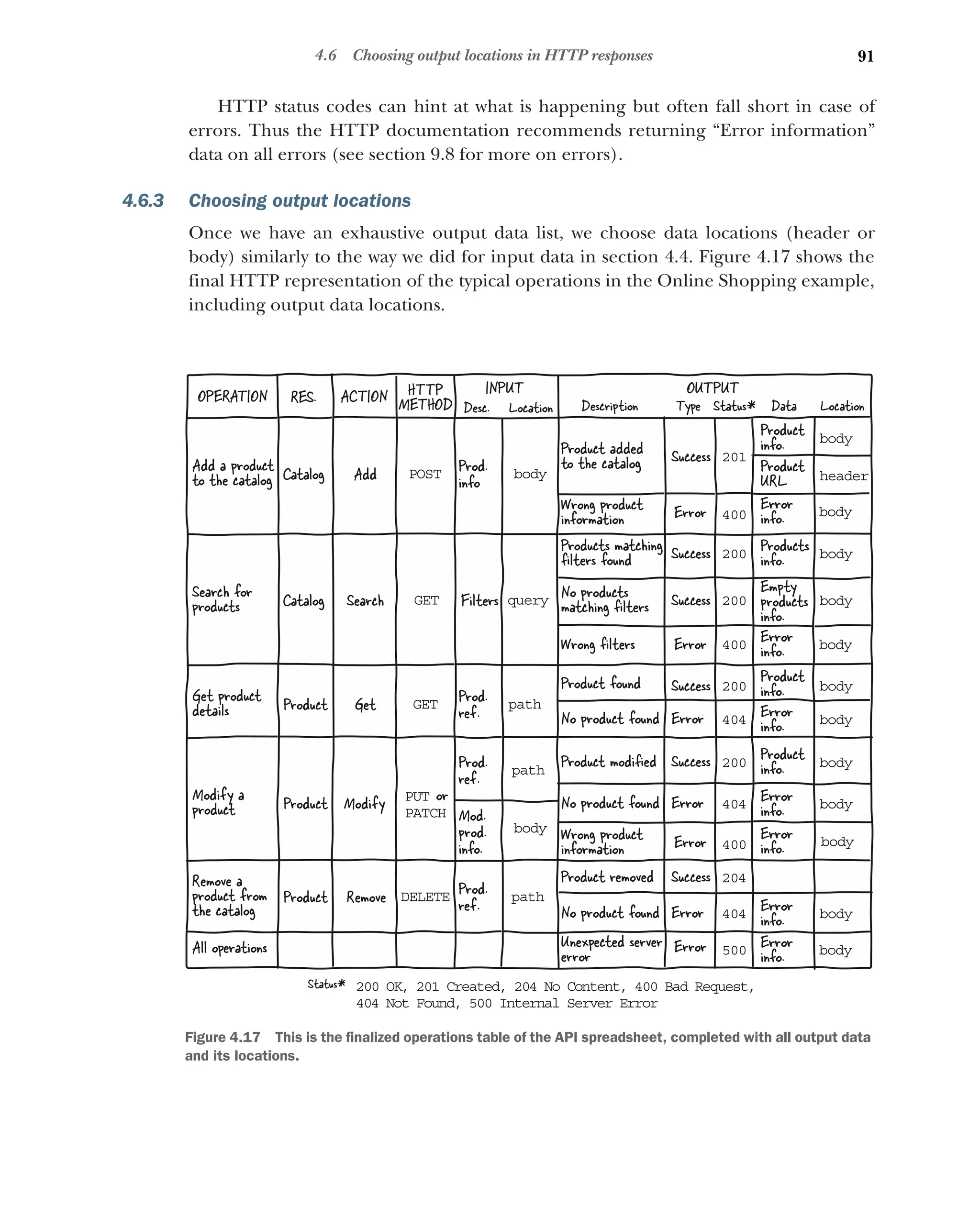
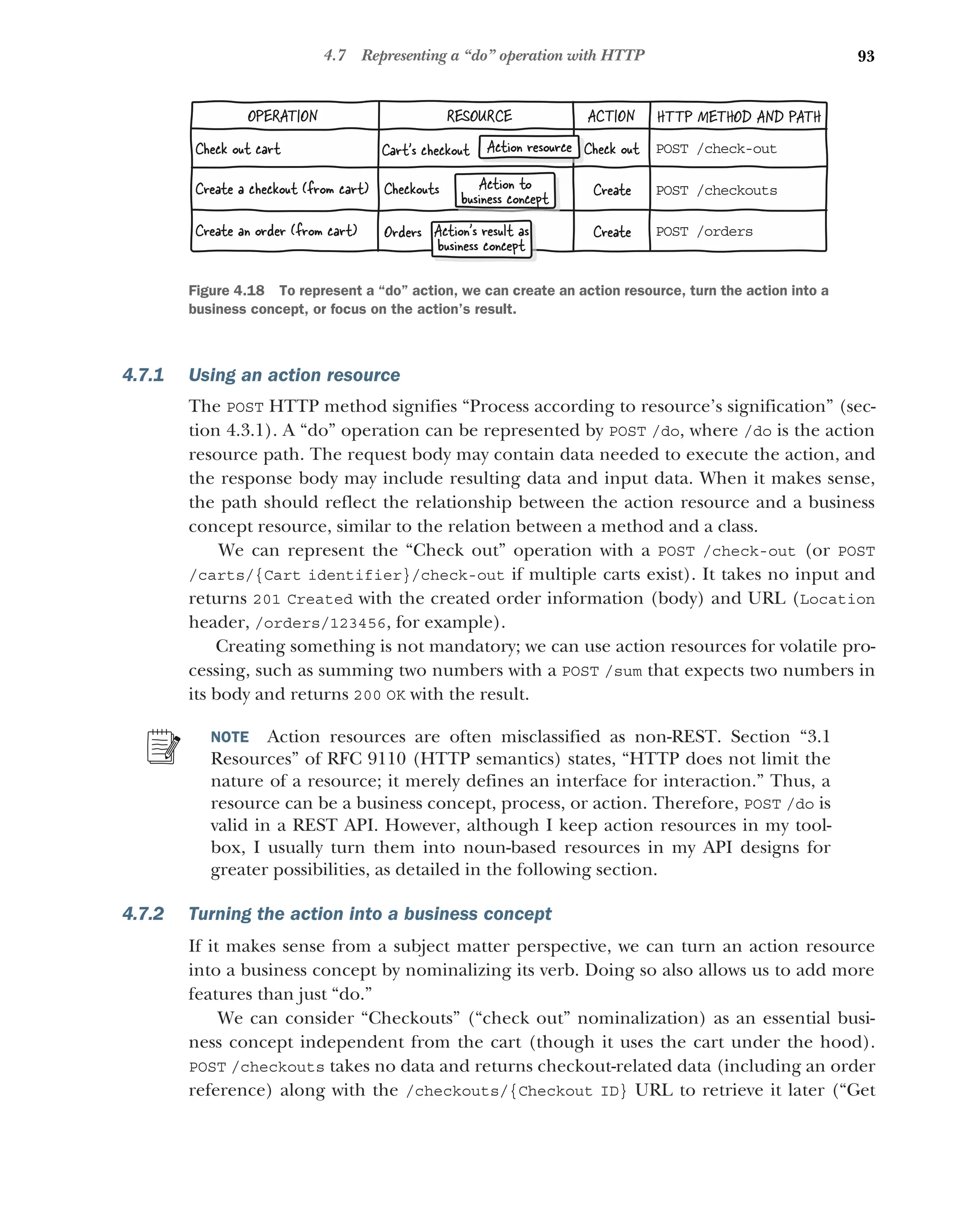
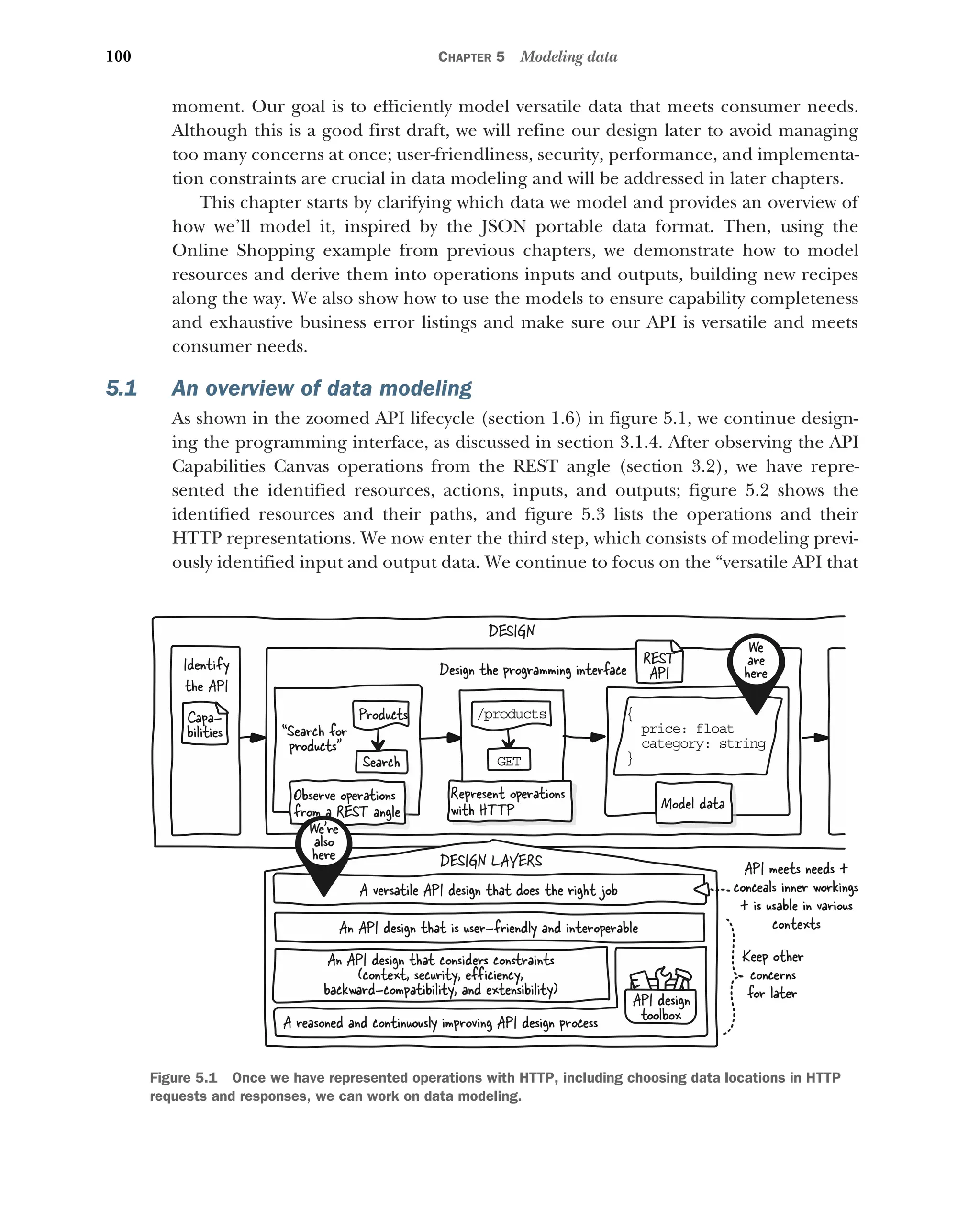

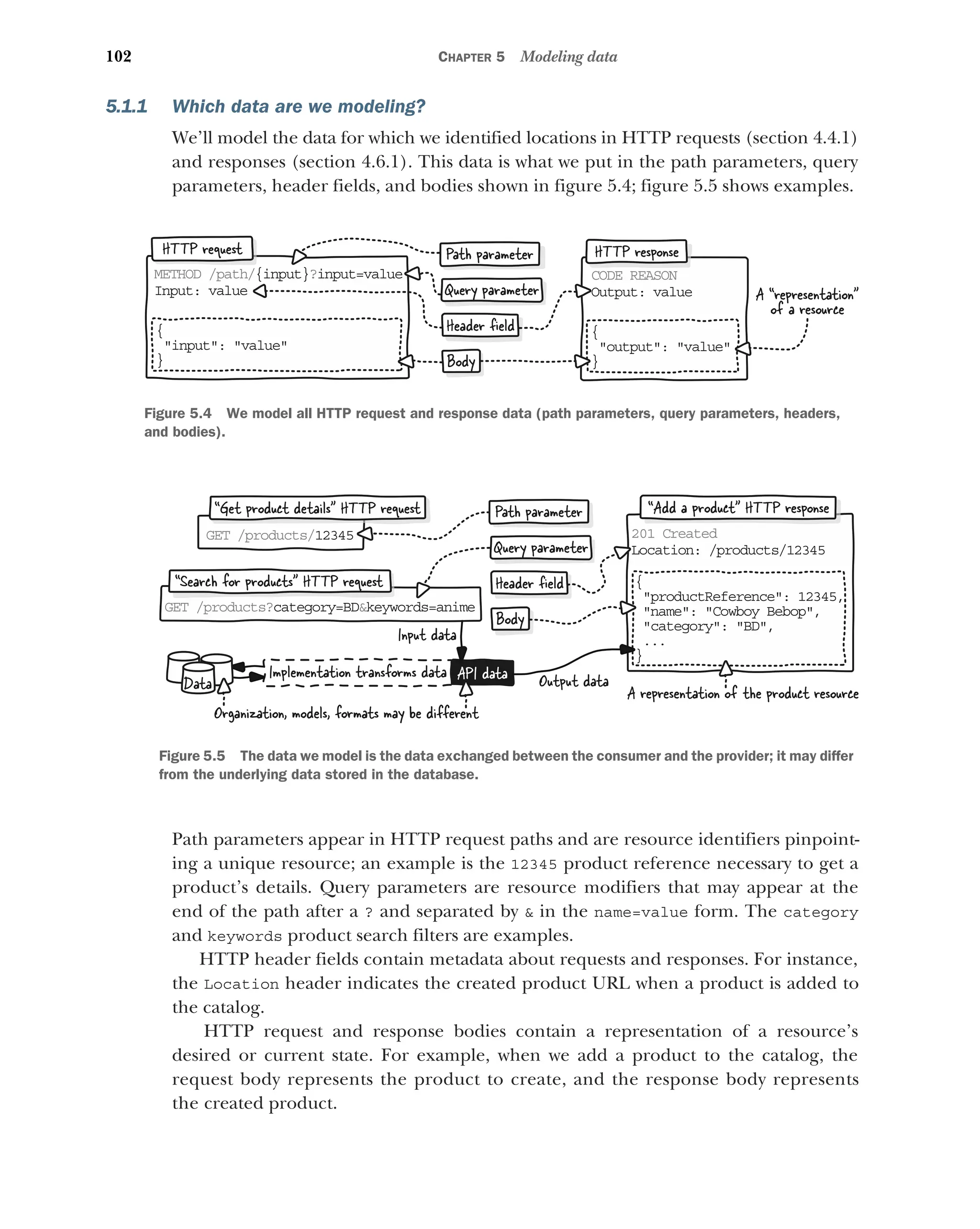
![103
5.1 An overview of data modeling
CAUTION Careful data modeling is crucial for public, partner, and private
APIs. Poor design can have severe consequences, as noted in section 1.2.
When modeling data for a web API, focus on the data exchanged from a sub-
ject matter perspective rather than on storage. Names, types, and organiza-
tions may differ between an API and the database; implementation handles
data transformation. It’s acceptable for API data to resemble database data,
but we must meet consumer needs without carelessly exposing the provider’s
data structure (see section 2.8).
5.1.2 Introducing the JSON portable data format
HTTP supports any textual or binary data format in request and response bodies,
such as HTML and images. The most common format for web APIs is JSON (Java-
Script Object Notation, www.json.org), which is valued for its human readability and
ease of processing in browsers that support JavaScript (typically compared to XML).
Although JSON is based on JavaScript, it is programming language-independent and
can be used in Java or Python, for example. It is also popular for data storage and con-
figuration files.
NOTE It’s a common oversight to limit REST APIs to JSON. Thanks to HTTP,
REST APIs can use any format, such as XML, CSV, or images, if that suits our
needs. The same REST API operation can even accept and return various
data formats. For more about this, including XML and CSV samples, see sec-
tion 9.7.1.
As shown in figure 5.6, JSON describes atomic values (strings, numbers, Booleans),
ordered arrays, and unordered objects. Arrays are delimited by brackets ([]) and sep-
arated by commas (,). Objects use curly braces ({}) with properties separated by com-
mas. A property key is a quoted string (price) and is separated from its value by a
colon (:). Values can be strings (Cowboy Bebop), numbers (49.99), Booleans
(false), objects, arrays, or null to indicate that a value is not set.
{
roductReference: 12345,
p
ame: Cowboy Bebop,
n
eywords: [anime, ...],
k
rice: 49.99,
p
sProductUnavailable: false,
i
upplier: {
s
supplierCode: SUNR,
name: Sunrise
}
}
Object
Object
Array (can contain any type)
String
Number (integer)
Number (float)
Boolean
Portable data types
Key Value
[
{
productReference: 12345,
name: Cowboy Bebop
},
. .
.
]
Array
12 45
3 Atomic value
Root level can
be of any type
Figure 5.6 To ensure that all consumers can understand our data, we use the JSON portable data format.
It handles Boolean, number, string, array, and object data types.](https://image.slidesharecdn.com/lauretarnaud-thedesignofwebapis2025-250821164447-5e92da1d/75/Lauret-Arnaud-The-Design-of-Web-APIs-2025-pdf-141-2048.jpg)
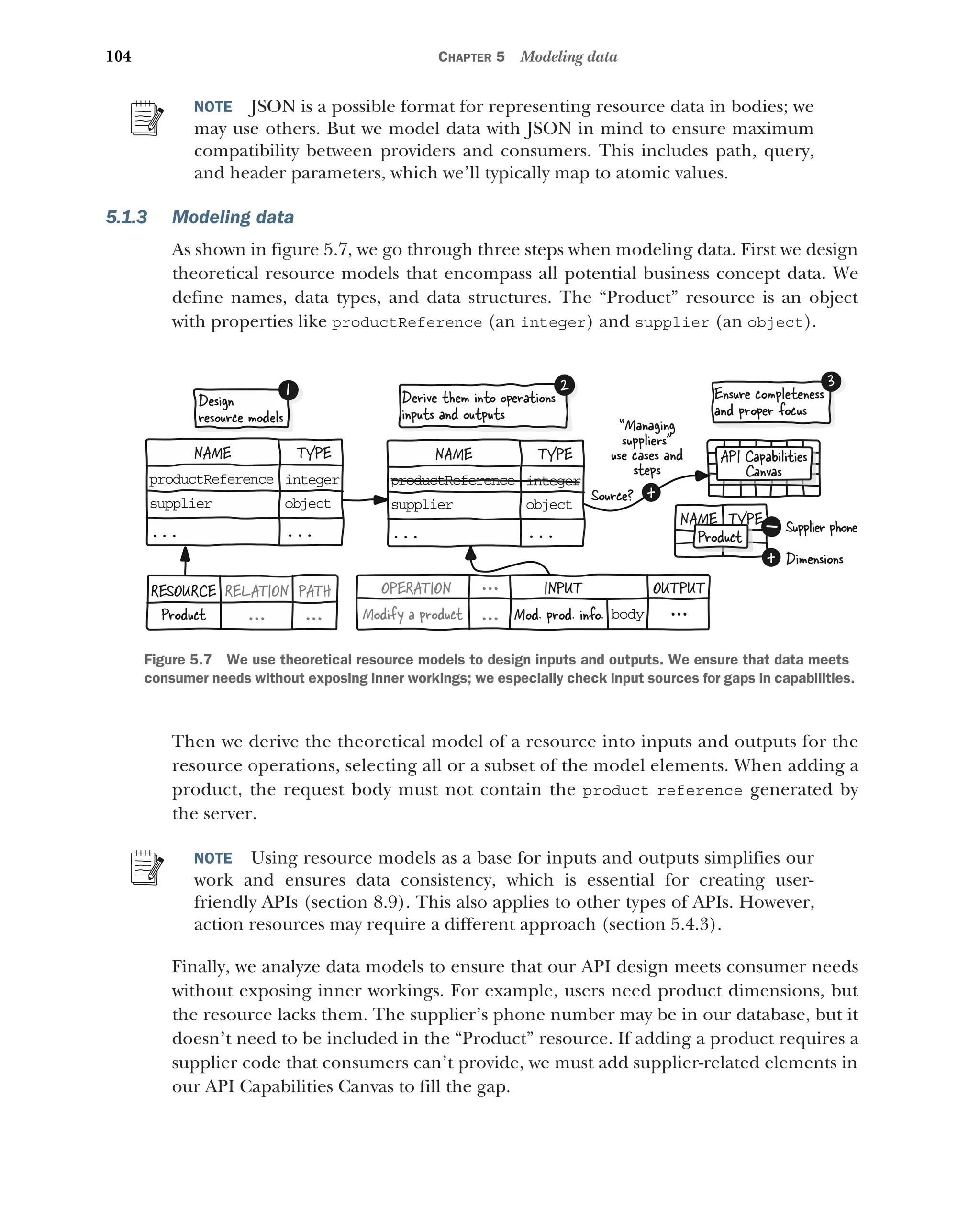
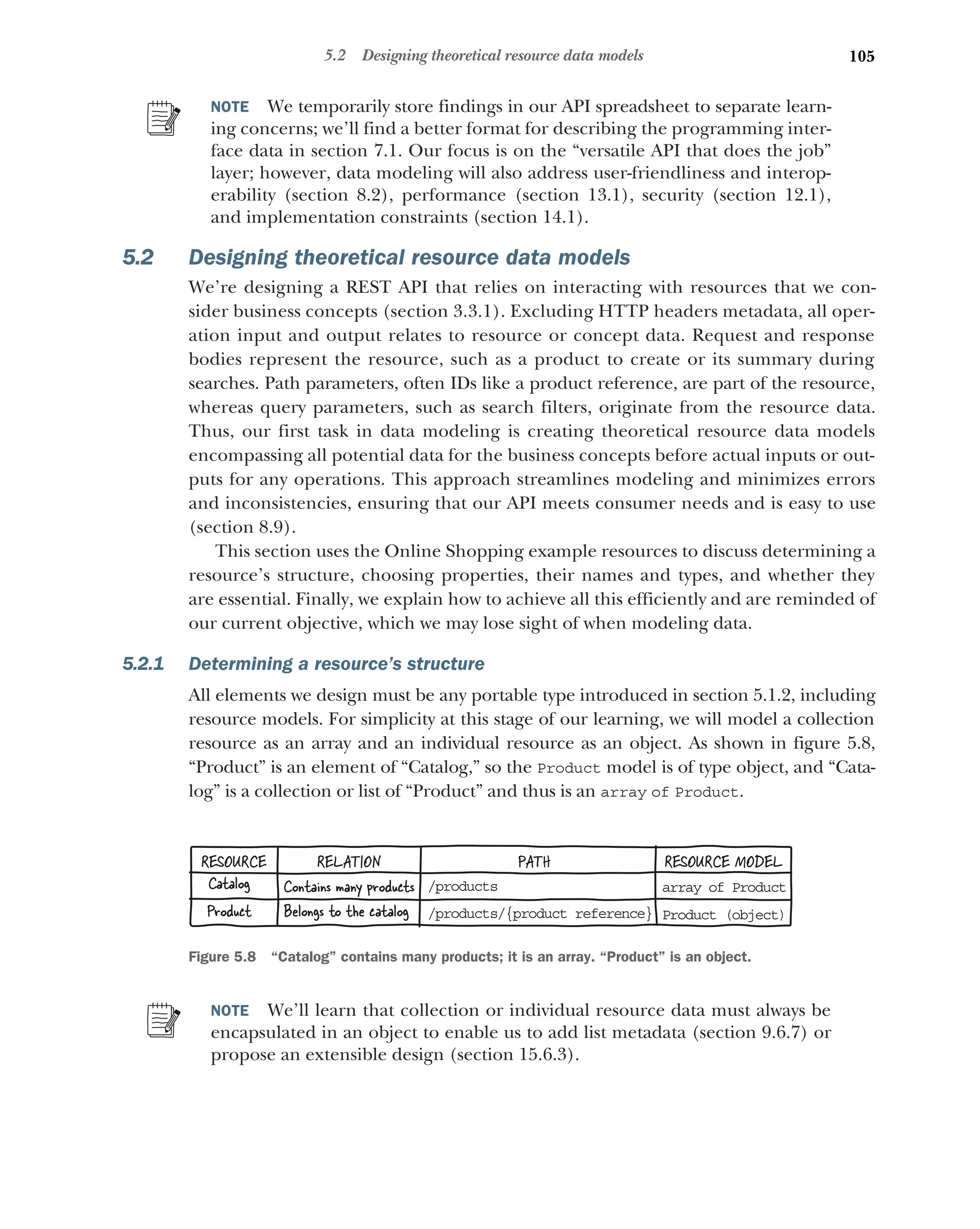
![106 CHAPTER 5 Modeling data
5.2.2 Choosing an object resource’s properties
Designing a resource model requires identifying the properties representing the
business concept, including a resource identifier. If our resource has relationships
with other resources, we may include some of their data. Our expertise and input
from subject matter experts (SMEs) guide us. We may also rely on existing or wire-
framed UI, implementation code, or databases, which are often the only available
documentation.
CAUTION As discussed in section 2.6, we must ensure that the resulting mod-
els meet consumer needs, make sense to consumers, and remain unbiased
(especially when relying on the UI, code, or database). Section 5.5.3 will
revisit these concerns in the data context.
Figure 5.9 shows the result of our discussions with SMEs about “What goes into a Prod-
uct?” This section focuses on a few chosen elements; the following sections discuss the
name, type, and required columns.
The “Product” resource theoretical model contains the product reference resource
identifier and data representing the product, such as a name and price. We included
the code and name from the related supplier resource (seen in section 5.1.3); accord-
ing to the SME, a product’s supplier name is essential for a product. The supplier
{
productReference: 12345,
name: Cowboy Bebop,
description: An amazing ...,
keywords: [anime, ...],
category: BD,
price: 49.99,
dateAdded: 1997-18-09,
isProductUnavailable: false,
supplier: {
supplierCode: SUNR,
name: Sunrise
}
}
NAME TYPE REQ. DESCRIPTION
productReference
name
description
keywords
category
price
dateAdded
isProductUnavailable
supplier
integer
string
string
array of
string
string
float
string
boolean
object
*
*
*
*
*
*
Price in USD
Unique identifier
Temp.
YYYY-MM-DD
fo mat
r
NAME TYPE REQ. DESCRIPTION
supplierCode
name
string
string
*
*
Unique identifier
JSON example
Product resource model
Figure 5.9 The “Product” resource theoretical model contains all the information necessary to describe
a product in the context of the API.](https://image.slidesharecdn.com/lauretarnaud-thedesignofwebapis2025-250821164447-5e92da1d/75/Lauret-Arnaud-The-Design-of-Web-APIs-2025-pdf-144-2048.jpg)
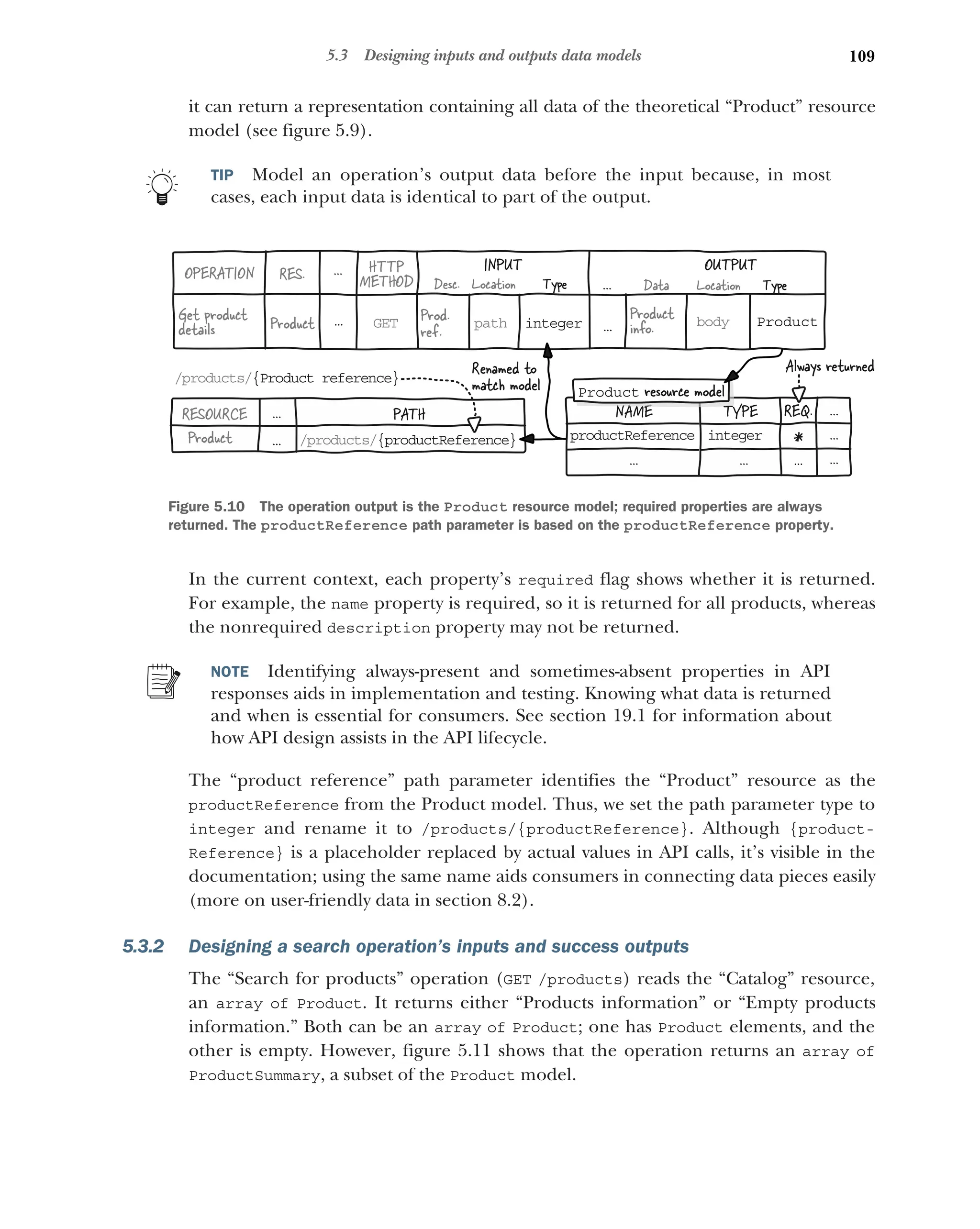
![110 CHAPTER 5 Modeling data
The ProductSummary model provides an overview of the product and fits our needs. It
includes properties like productReference, name, category, keywords, and price but
excludes others we consider less interesting in this context, like dateAdded. Consum-
ers can use the returned product reference to get more data for a specific product
with GET /products/{productReference}. Returning the complete “Product” resource
data is also possible if it meets consumer needs.
CAUTION Putting insufficient or too much data in lists can affect API effi-
ciency, leading to many API calls to read each element or high data volumes;
see section 13.1.
The “Search for products” operation features a “Filters” input to retrieve a subset of
all products. Filter options vary based on user needs and data available in API models.
We can have keywords and category filter query parameters that align with the
ProductSummary model properties; an example request is GET /products?keywords=
anime,fantasycategory=BD. To filter by availability, we must add the isProduct-
Available property to the returned model. Filtering by the product’s origin country
is impossible because it’s missing from the Product model. But we can add an origin
property to Product and ProductSummary to allow filtering by origin.
NOTE Section 7.6.2 shows other options for array serialization in query
parameters. Section 9.6 covers other filtering options, such as ranges; it also
includes sorting and paginating lists. Having input and output consistent
with each other is not an obligation. However, it’s crucial for usability; see
section 9.4.2.
NAME TYPE REQ.
pr ductReference
o
na e
m
de cription
s
ke words
y
ca egory
t
pr ce
i
da eAdded
t
is roductUnavailable
P
su plier
p
in eger
t
st ing
r
st ing
r
ar ay of
r
st ing
r
st ing
r
fl at
o
da e
t
bo lean
o
ob ect
j
*
*
*
*
*
*
[
{
productReference: 12345,
name: Cowboy Bebop,
keywords: [anime, ...],
category: BD,
price: 49.99,
},
{ ... }
]
[]
“Products info.
JSON example
Product
Summary
A subset of the resource model
Product
“Empty products info.
JSON example
array of
ProductSummary
Figure 5.11 The ProductSummary model is a subset of the Product model containing essential
information describing a product in the context of a list.](https://image.slidesharecdn.com/lauretarnaud-thedesignofwebapis2025-250821164447-5e92da1d/75/Lauret-Arnaud-The-Design-of-Web-APIs-2025-pdf-148-2048.jpg)
![111
5.3 Designing inputs and outputs data models
5.3.3 Designing a create operation’s inputs and success outputs
The “Add a product to the catalog” operation (POST /products) has a single input,
“Product information,” and returns “Product information” and “Product URL” when
a product is successfully created. The “Product information” output is the created
product’s data. We can use the Product theoretical model, as when reading a product.
However, we may need to return less data for performance reasons (section 13.1); we
can return a ProductMinimal model, an object containing the productReference
property identifying the created product.
The “Product URL” goes in a standard HTTP header (section 4.6.2); its model
doesn’t derive from the Product model. Following HTTP, we define a Location header
with a string type, /products/12345, for example (/products/{productReference}).
As shown in figure 5.12, although they have the same name, the “Product informa-
tion” input differs from the output. It is the essential data to create a product, a subset
of the Product output model without implementation-managed properties. After
discussions with SMEs and the implementation team, we conclude that the Product-
Creation model includes all Product properties except productReference, dateAdded,
and supplier name. The implementation generates the first two and determines the
third based on supplierCode. In this creation context, each property’s required flag
shows whether it must be provided. For example, a name is mandatory for creating a
product, but a description is optional.
NAME TYPE REQ.
pr ductReference
o
na e
m
de cription
s
ke words
y
ca egory
t
pr ce
i
da eAdded
t
is roductUnavailable
P
su plier
p
in eger
t
st ing
r
st ing
r
ar ay of
r
st ing
r
st ing
r
fl at
o
da e
t
bo lean
o
ob ect
j
*
*
*
*
*
*
{
ame: Cowboy Bebop,
n
escription: An amazing ...,
d
eywords: [anime, ...],
k
ategory: BD,
c
rice: 49.99,
p
sProductUnavailable: false,
i
upplier: {
s
supplierCode: SUNR
}
}
JSON example
A subset of the resource model
Product
NAME TYPE REQ.
su plierCode
p
na e
m
st ing
r
st ing
r
*
*
Must be provided
Determined by the server
from the supplier code
Product
Creation
Se ver-generated
r
Se ver-generated
r
Figure 5.12 To model the data participating in product creation, we start with the complete model and
remove the data managed by the server.](https://image.slidesharecdn.com/lauretarnaud-thedesignofwebapis2025-250821164447-5e92da1d/75/Lauret-Arnaud-The-Design-of-Web-APIs-2025-pdf-149-2048.jpg)
![112 CHAPTER 5 Modeling data
NOTE Knowing the required data for an operation is crucial for proper
implementation. It also influences the user experience; more required data
makes the operation more complex. Refer to section 9.4 for guidance on
requiring minimal elements.
5.3.4 Designing an update operation’s inputs and success outputs
The “Modify a product” operation (PUT or PATCH /products/{productReference})
has two inputs, “Product reference” and “Modified product information,” and returns
“Product information” when the product is successfully updated. The returned “Prod-
uct information” is the new state of the “Product” resource; thus, its data is the Product
theoretical model, the same as when reading or adding a product. The “Product refer-
ence” path parameter is the same as when reading a product, as both operations share
the same resource.
Figure 5.13 contrasts the “Modified product information” input in PUT and PATCH
requests updating a product’s price and description. With PUT /products/{product-
Reference}, the input contains all properties necessary to replace entirely; hence, we
re-create the product identified by the path. So, we need a model identical to Product-
Creation used when adding a product (POST /product). We can rename the creation
model ProductCreationOrReplacement to have a unique model. If we use PATCH
/products/{productReference}, which only needs the modified data to be sent, we
can have a ProductModification model that is similar to ProductCreation, but all
properties are optional.
Some data may be restricted from updates for subject-matter-related reasons. For
example, a product’s supplier may be defined on creation and cannot be modified
PU /products/12345
T
{
ame: Cowboy Bebop,
n
escription: A fantastic ...,
d
eywords: [anime, ...],
k
ategory: BD,
c
rice: 59.99,
p
sProductUnavailable: false,
i
upplier: {
s
supplierCode: SUNR
}
}
PA CH /products/12345
T
{
escription: A fantastic ...,
d
rice: 59.99
p
}
Body contains only the
modified data
Body contains everything needed to
replace/re-create the entire resource
Same model as Product Creation data model Same model as Product Creation data model
but everything is optional
We update 12345
product’s description
and price
Figure 5.13 The model for PUT matches product creation. Modifying two properties requires sending all
data. The model for PATCH is similar, but all properties are optional; consumers send only modified data.](https://image.slidesharecdn.com/lauretarnaud-thedesignofwebapis2025-250821164447-5e92da1d/75/Lauret-Arnaud-The-Design-of-Web-APIs-2025-pdf-150-2048.jpg)
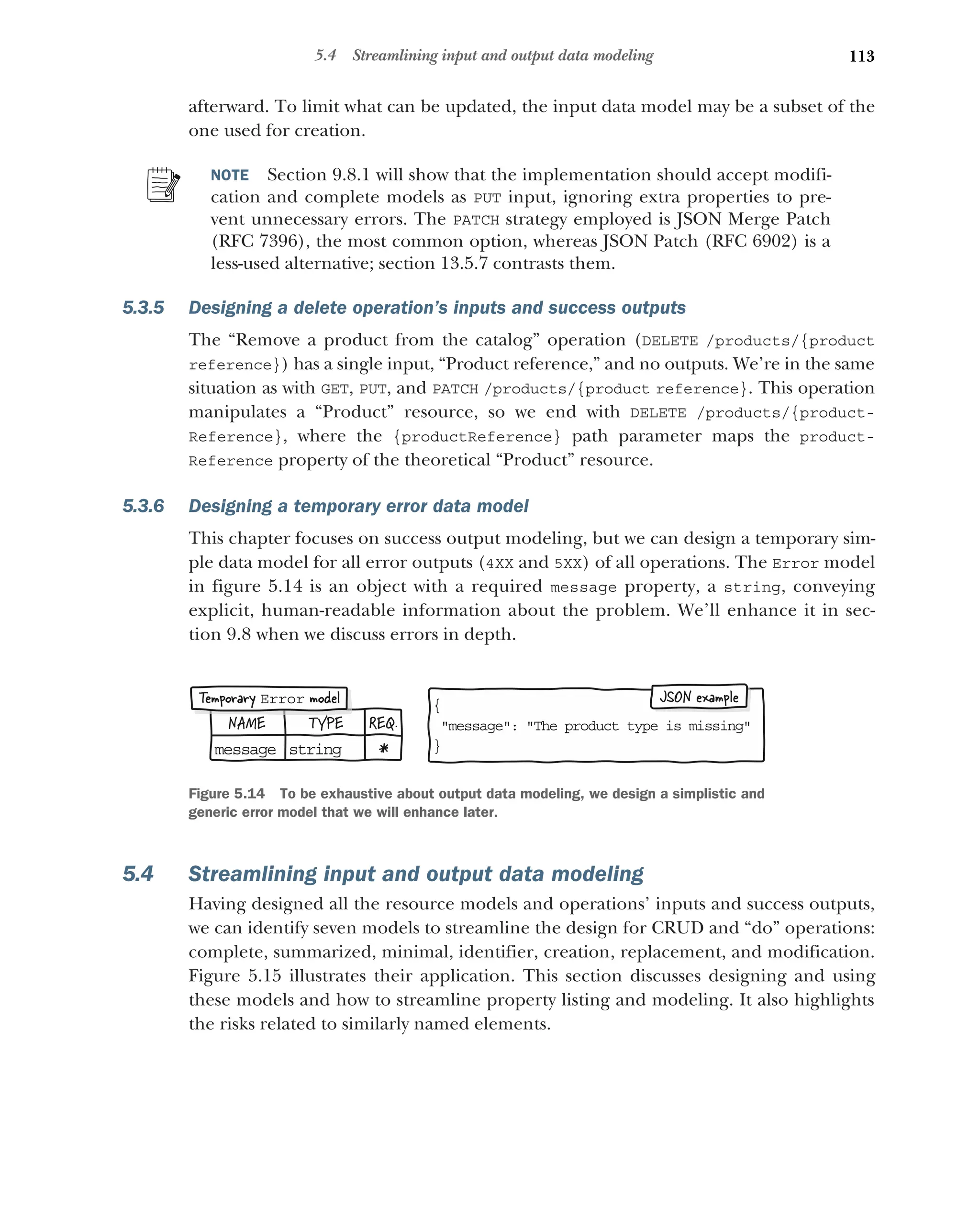
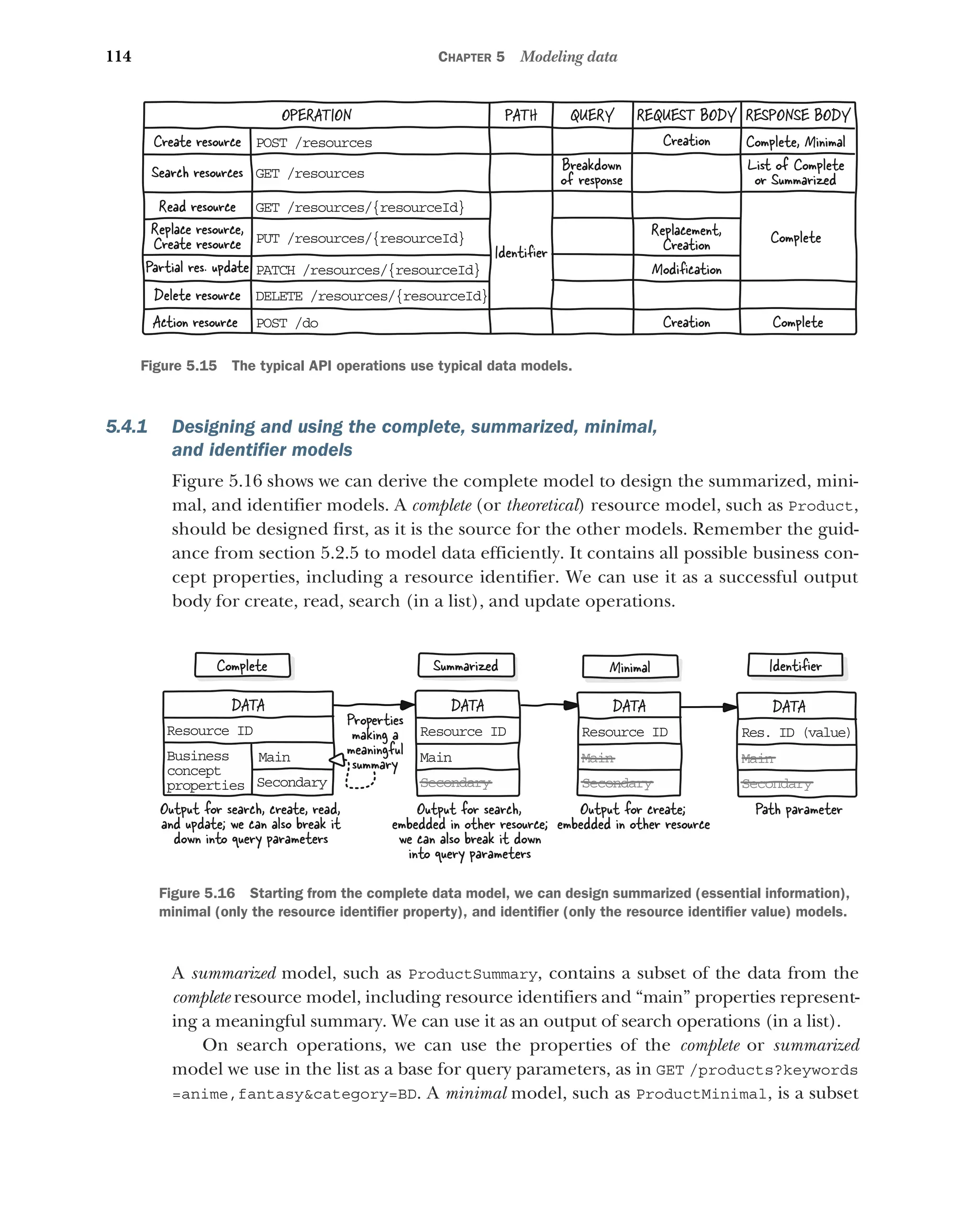
![120 CHAPTER 5 Modeling data
releaseYear: 1995,
duration: 83,
director: Mamoru Oshii,
music: Kenji Kawai,
language: ja
}
[
{
title: Ghost In The Shell,
language: ja,
stars: 5,
music: Kenji Kawai
}
]
Exercise 5.2
An API for a recipe-sharing platform allows users to search for recipes, read recipes,
and save new recipes. Listing 5.3 shows an example of a request body used to save a
new recipe (POST /recipes). Explain what’s wrong with the requested data.
{
id: 67890,
title: Quiche Lorraine,
description: A traditional French savory tart.,
creationDate: 2024-11-14T15:00:00Z,
ingredients: [
{ id: shortcrust_pastry, quantity: 200g },
{ id: egg, quantity: 3},
{ id: cream, quantity: 200ml },
{ id: diced_bacon, quantity: 150g},
{ id: grated_cheese, quantity: 50g},
{ id: salt},
{ id: pepper}
],
instructions: [
Preheat oven to 180°C,
Mix ingredients,
Pour into pastry,
Bake for 35 minutes.
]
}
Exercise 5.3
A fitness-tracking smartwatch application allows users to view the duration and type of
a workout. The GET /workouts/{workoutId} API operation it uses returns the data
shown in listing 5.4. Indicate whether each field should be kept or removed and why.
Listing 5.2 Sample response for the Search for movies operation
Listing 5.3 Sample request body for saving a recipe](https://image.slidesharecdn.com/lauretarnaud-thedesignofwebapis2025-250821164447-5e92da1d/75/Lauret-Arnaud-The-Design-of-Web-APIs-2025-pdf-158-2048.jpg)
![121
Exercises
{
id: abcd1234,
type: running,
duration: { value: 45, unit: minute }
distance: { value: 8, unit: km }
date: 2024-11-13T08:12:34Z,
lastDbSync: 2024-11-14T12:00:00Z
}
Exercise 5.4
The “Get car details” operation of an API for a car rental service can be used in two
use cases: a customer renting a car and a mechanic checking a car for maintenance.
Based on the sample data from a GET /cars/{carId} call in listing 5.5, can you verify
whether the operation suits both? If not, explain how to fix this API design.
{
carId: 12345,
make: Volkswagen,
model: Golf,
rentalPricePerDay: 50,
features: [air conditioning, GPS, automatic transmission],
maxPeople: 5,
maxLuggage: 3,
mileage: 80000,
yearOfManufacture: 2018,
currentCondition: No issues reported,
engineType: 1.4L TSI Turbocharged,
fuelType: Petrol,
transmission: Manual,
chassisNumber: WVWZZZ1JZ9W123456,
lastInspectionDate: 2024-01-15,
nextInspectionDue: 2024-07-15,
tireCondition: 80% tread remaining,
brakeCondition: Good,
batteryStatus: Fully charged
}
Listing 5.4 Sample read workout response
Listing 5.5 Data returned when getting car details](https://image.slidesharecdn.com/lauretarnaud-thedesignofwebapis2025-250821164447-5e92da1d/75/Lauret-Arnaud-The-Design-of-Web-APIs-2025-pdf-159-2048.jpg)
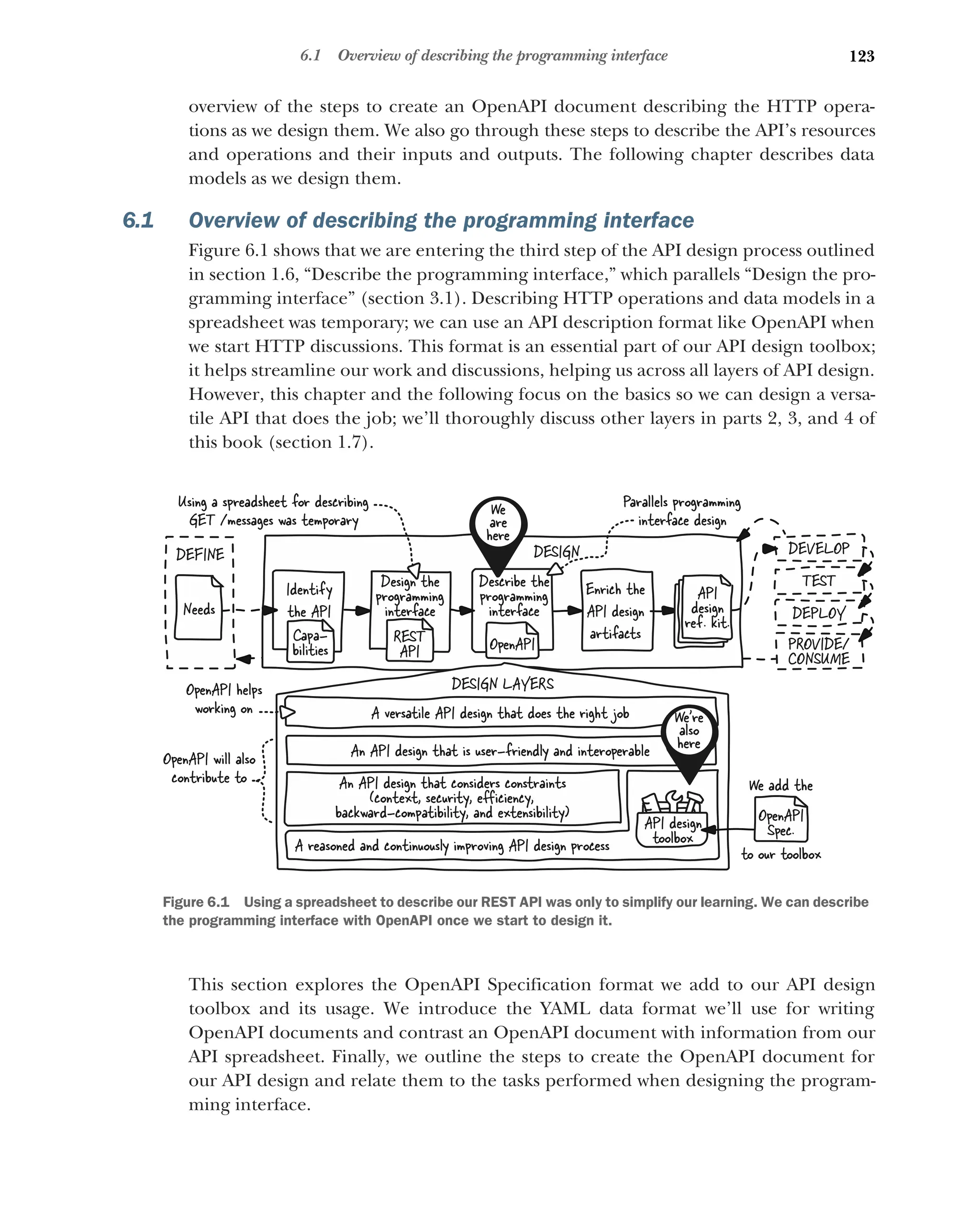
![125
6.1 Overview of describing the programming interface
6.1.2 Using OpenAPI during design
During the design process, an OpenAPI document can be written, created via a design
tool, or generated from an implementation (discussed in section 6.2). However,
regardless of how it was created, an OpenAPI document simplifies describing the pro-
gramming interface, helps our thinking, and facilitates discussions with stakeholders.
An OpenAPI document speeds up describing the programming interface and
reduces oversights and errors. It provides a structure that can guide us when describ-
ing the programming interface. And it offers mechanisms to limit the repetition of
information, such as defining data models once and reusing them in different places.
Programs called linters can analyze it to seek design errors (discussed in section 18.1).
API documentation tools render OpenAPI documents in a way that makes it easy
for API designers, subject matter experts (SMEs), and developers to understand oper-
ations and data without needing to understand OpenAPI syntax. Creating API mocks
(or simulators) from OpenAPI documents is simple. Making calls to an as-yet-undevel-
oped API can be enlightening for an API designer. An API mock can help consumer
teams draft proof-of-concept applications and catch design problems (discussed in
section 18.10).
h ps://some.server/api-docs/get-product-details
Get product details
200 Product found
GET /products/{productReference}
Response samples
Content type: application/json
{
productReference: 0,
name: string,
keywords: [
string
],
category: string,
price: 0,
dateAdded: 2024-12-07,
supplier: {
supplierCode: string,
name: string
}
productReference (integer): Unique identifier
name (string)
keywords (array of strings)
category (string)
price (number): Price in USD
dateAdded (string:date)
isProductUnavailable (boolean): Temp. unavailable
supplier (object)
supplierCode (string)
name (string)
Responses
Parameters
200 404 500
404 No product found
Figure 6.2 An API documentation tool can render an OpenAPI document and show information similar
to our API spreadsheet, but in a more user-friendly way.](https://image.slidesharecdn.com/lauretarnaud-thedesignofwebapis2025-250821164447-5e92da1d/75/Lauret-Arnaud-The-Design-of-Web-APIs-2025-pdf-163-2048.jpg)
![126 CHAPTER 6 Describing HTTP operations with OpenAPI
6.1.3 Introducing the YAML format
OpenAPI documents can be in either JSON or YAML format. All OpenAPI snippets in
this book will be in YAML (we’ll discuss why in section 6.2.5). If you need to become
familiar with YAML, here’s a brief introduction; for more information, visit http://
yaml.org.
YAML (YAML Ain’t Markup Language) is a human-friendly data serialization for-
mat and a cousin of JSON (introduced in section 5.1.2). As shown in figure 6.3, simi-
larly to JSON, YAML can describe atomic values (strings, numbers, or Booleans),
objects containing unordered key/value pairs, and arrays or lists containing ordered
values. But the two formats represent them slightly differently:
JSON encloses property names in double quotes ( ); YAML usually omits
them (unless they are numbers).
JSON encloses strings in double quotes ( ); YAML usually omits them (unless
they only contain numbers or contain YAML-reserved or special characters).
In JSON, commas (,) separate elements; YAML uses newlines.
JSON’s object’s curly braces ({}) and commas (,) are replaced by newlines and
indentation in YAML.
JSON’s array brackets ([]) and commas (,) are replaced by newlines and
dashes (-) in YAML.
Unlike JSON, YAML allows comments beginning with a hash mark (#).
Converting one format to another is easy, but comments will be lost when converting
YAML to JSON.
a- tring: value
s
a- umber: 123
n
a- oolean: true
b
an object:
-
-property: value
a
nother-property: value
a
an array:
-
item-1-property-1: one
-
item-1-property-2: 1
item-2-property-1: two
-
item-2-property-2: 2
# his is a comment
T
{
a-string: value,
a-number: 123,
a-boolean: true,
an-object :
{
a-property: value,
another-property: value
,
}
an-array:
[
{ item-1-property-1: one,
item-1-property-2: 1 },
{ item-2-property-1: two,
item-2-property-2: 2 }
]
}
YAML JSON
Atomic
values
Array
Comment
Object
Figure 6.3 YAML is a cousin of JSON with additional features, such as commenting.](https://image.slidesharecdn.com/lauretarnaud-thedesignofwebapis2025-250821164447-5e92da1d/75/Lauret-Arnaud-The-Design-of-Web-APIs-2025-pdf-164-2048.jpg)
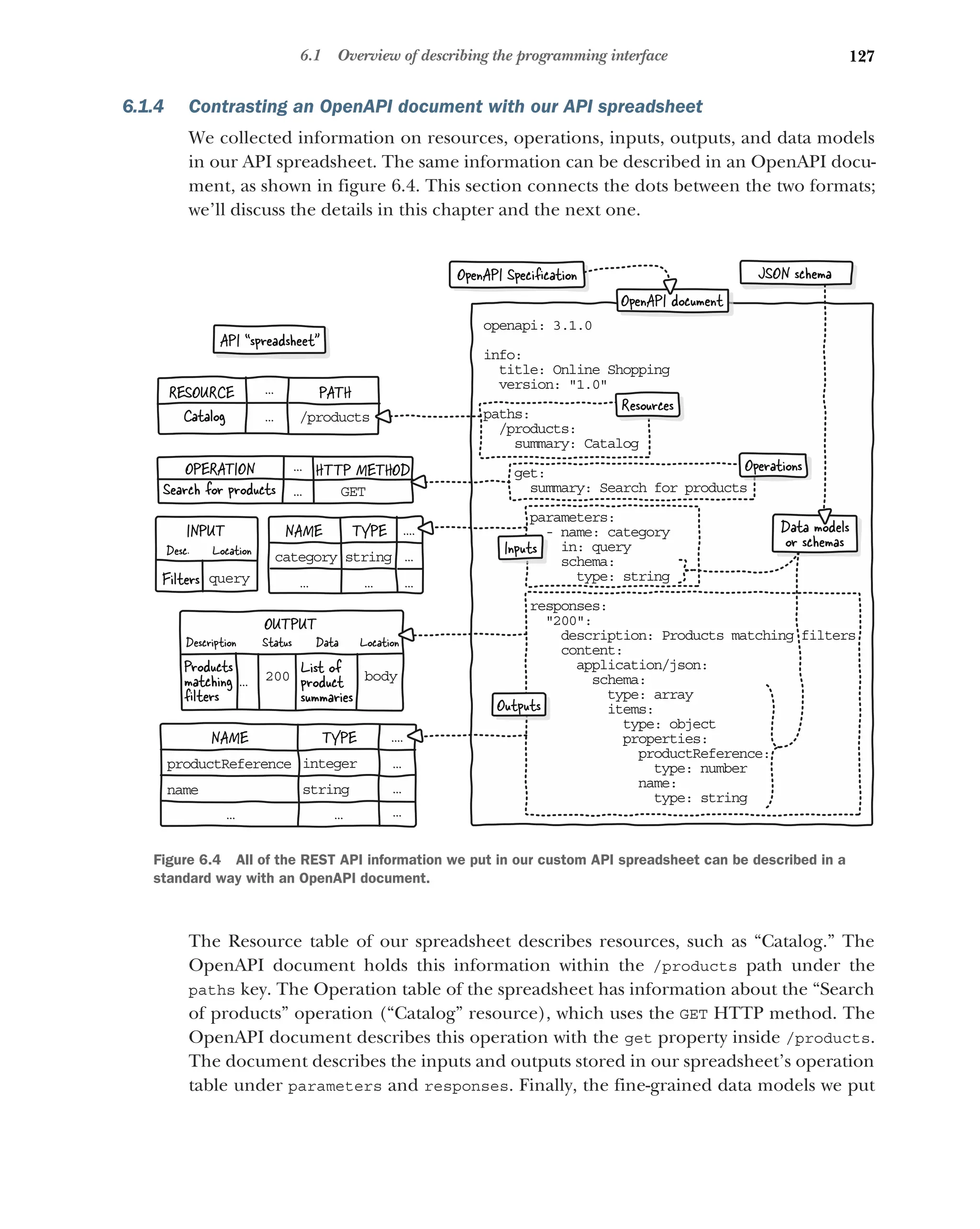
![128 CHAPTER 6 Describing HTTP operations with OpenAPI
in the spreadsheet are described in the schema properties in OpenAPI. These schema
properties use the JSON Schema format; see section 7.1.
6.1.5 Describing the programming interface while designing it
As shown in figure 6.5, we designed the programming interface in three steps: observ-
ing operations from the REST angle (section 3.2), representing operations with HTTP
(section 4.1), and modeling the operations’ input and output data (section 5.1). We can
start using the OpenAPI format when dealing with HTTP after identifying REST ele-
ments to turn into HTTP elements.
CAUTION We must not use OpenAPI during the needs analysis before the
“Design the programming interface” stage. At that point, we need to identify
API capabilities, and focusing on REST and HTTP would lead to a poor API
(section 2.1.4).
We can create the OpenAPI document in three steps. The first two steps parallel the
“Design the programming interface” stage. We describe the HTTP operations as we
design them (this chapter). Then we describe data as we model it (see section 7.1).
At that point, we’ll have a solid formal API description, which may contain duplica-
tion and could be better. However, it’s essential to separate concerns, first focusing
on the API design and then optimizing the OpenAPI code as a third step (section 17.1),
typically defining schemas, parameters, and responses shared by different opera-
tions. With experience, you’ll be able to seamlessly use some of these advanced
Observe operations
from a REST angle
Represent operations
with HTTP
Search
Products
GET
/p oducts
r
“Search for
products”
[{
n me: string
a
}]
Model data
op napi: 3.1.0
e
...
pa hs:
t
products:
/
get:
...
op napi: 3.1.0
e
...
sc ema:
h
..
.
properties:
name:
type: string
op napi: 3.1.0
e
...
co ponents:
m
chemas: ...
s
arameters: ...
p
esponses: ...
r
...
Describe data Optimize OpenAPI
Describe HTTP operations
Design the programming interface
Describe the programming interface
Figure 6.5 We design and describe the programming interface in parallel.](https://image.slidesharecdn.com/lauretarnaud-thedesignofwebapis2025-250821164447-5e92da1d/75/Lauret-Arnaud-The-Design-of-Web-APIs-2025-pdf-166-2048.jpg)
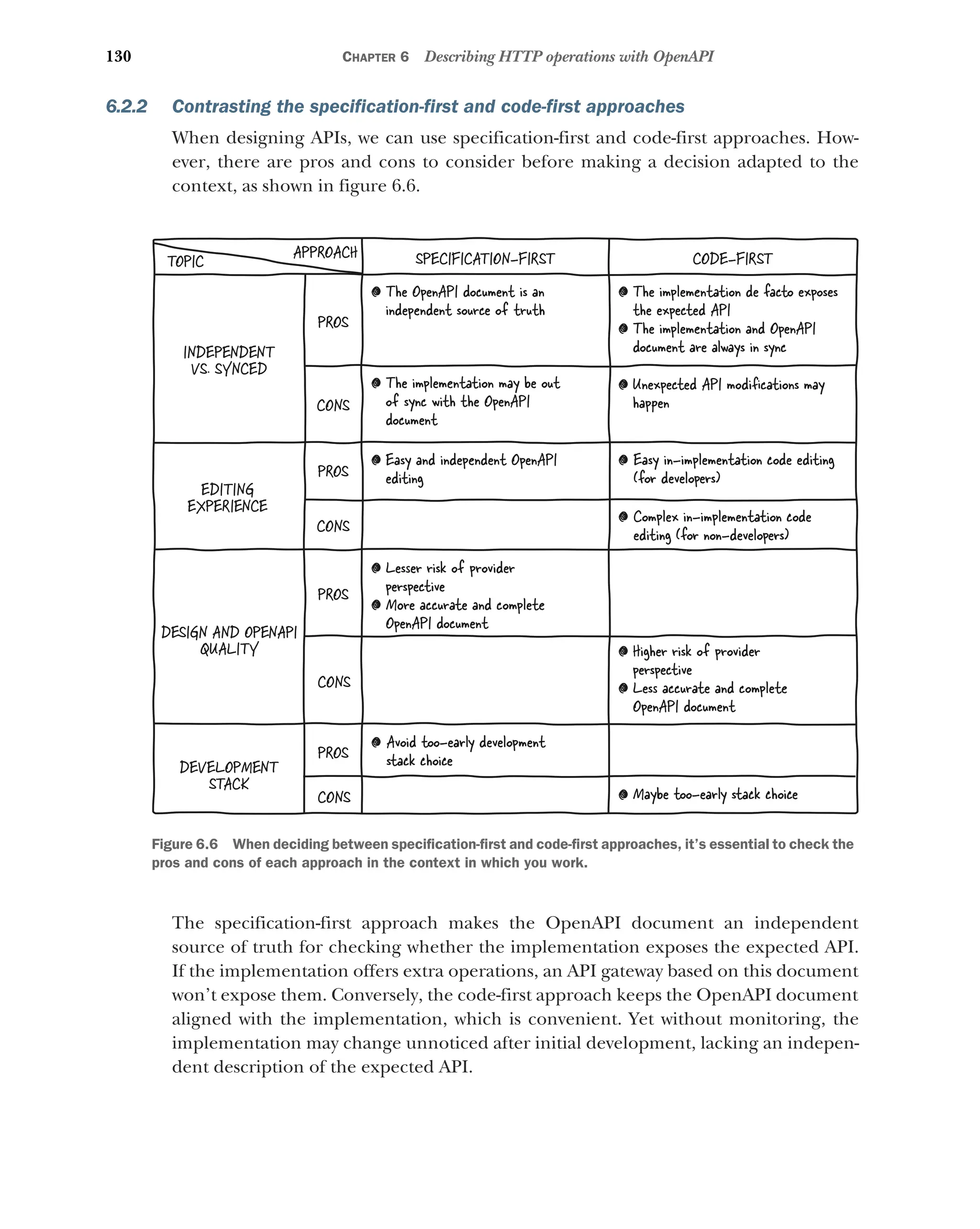
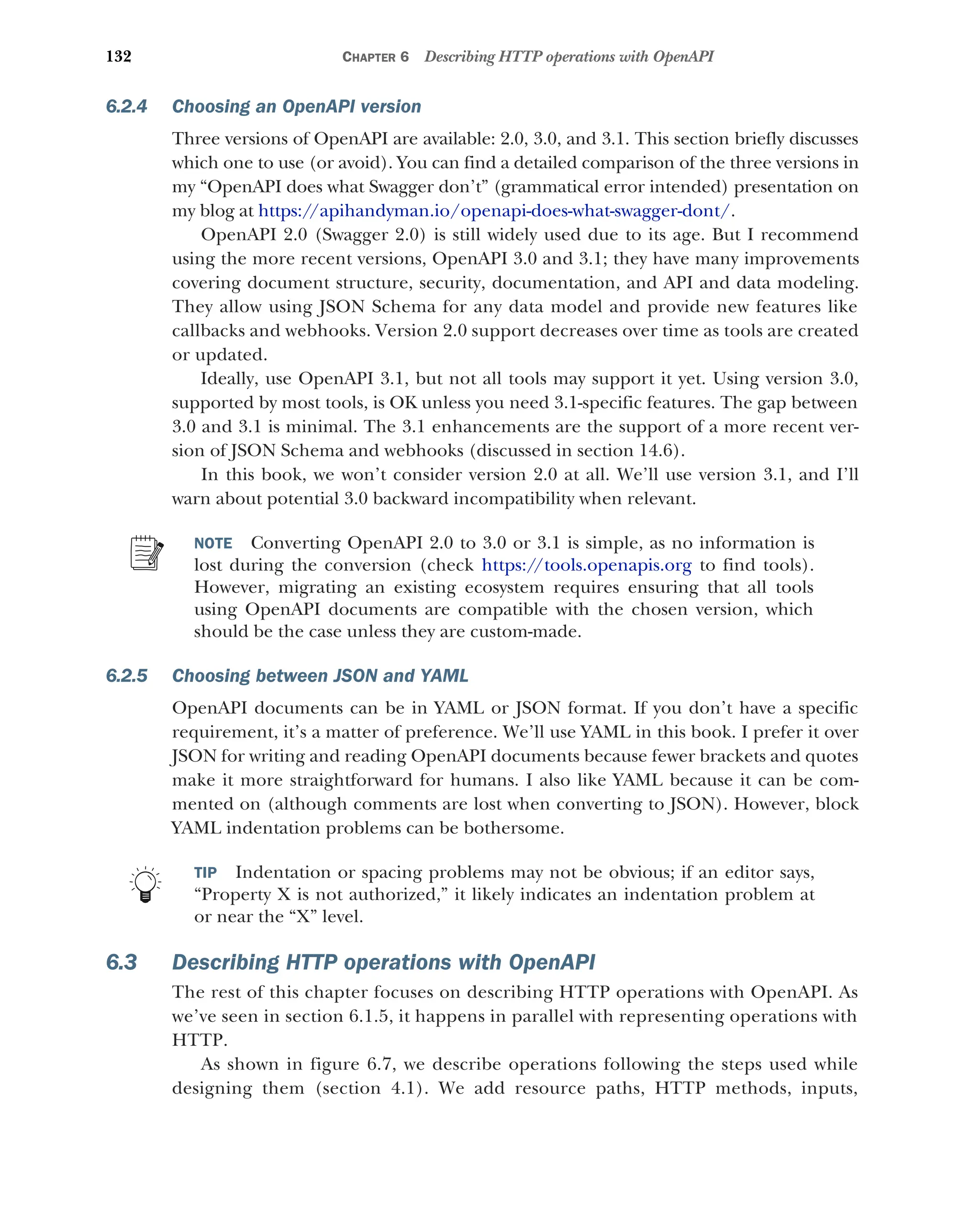
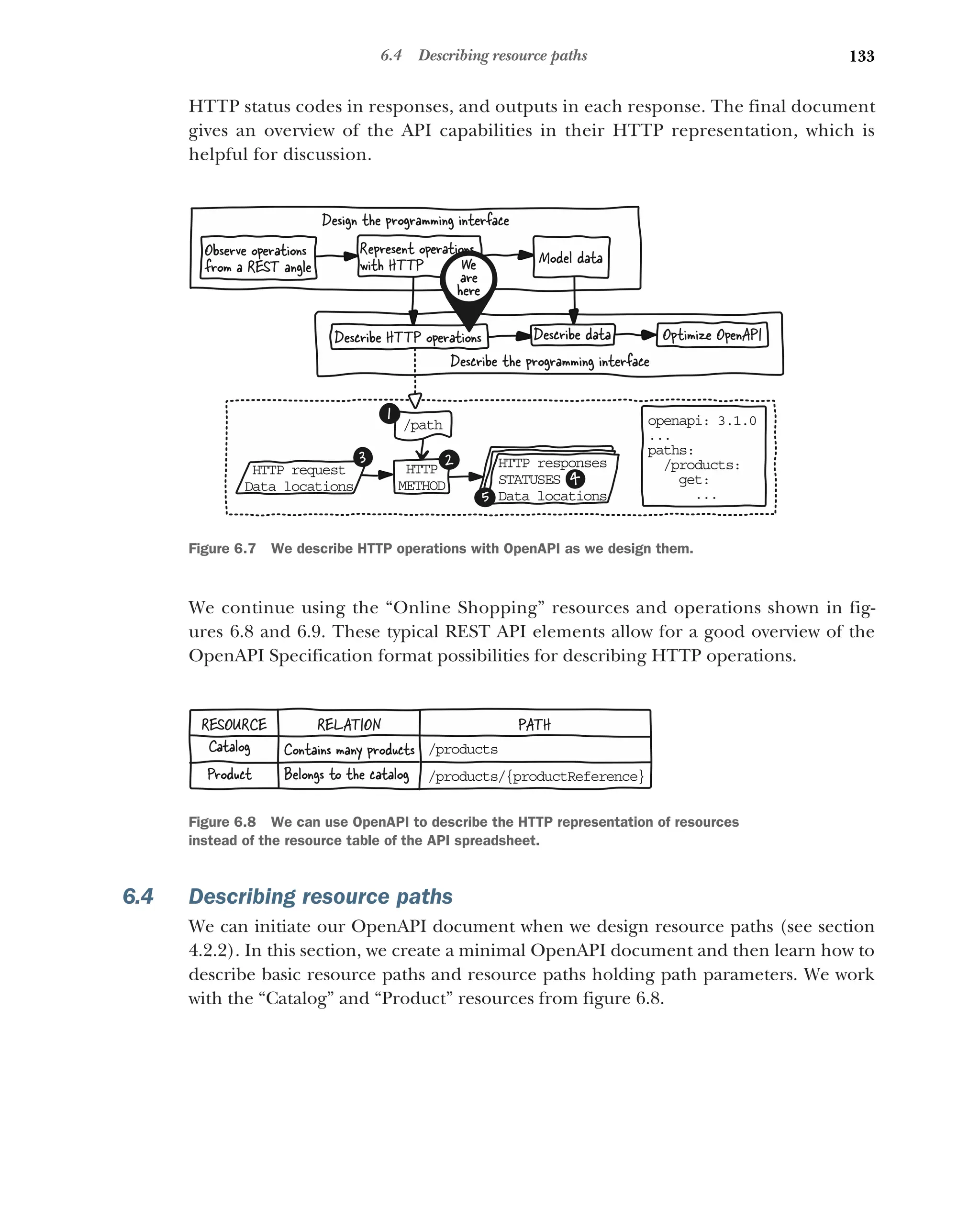

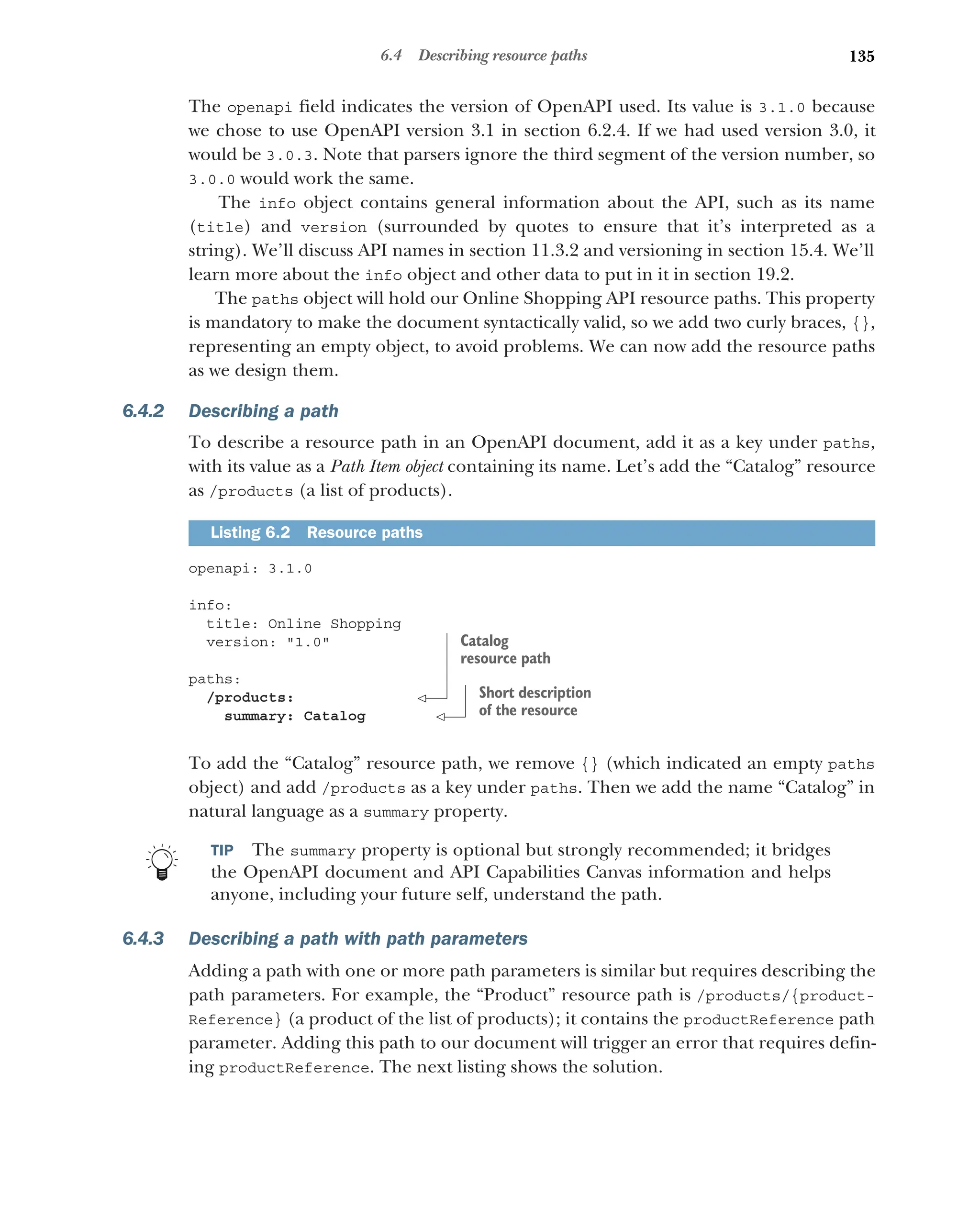
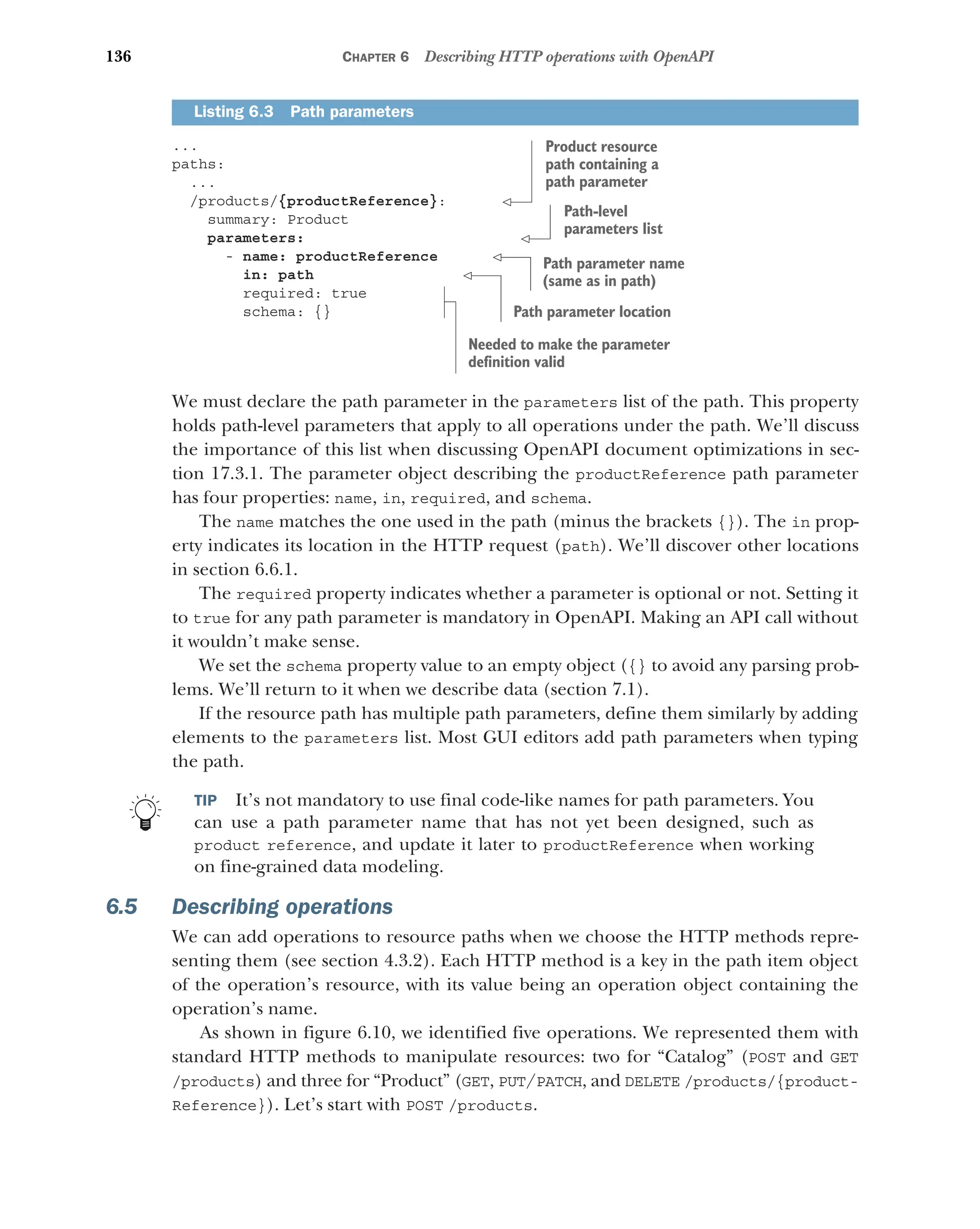
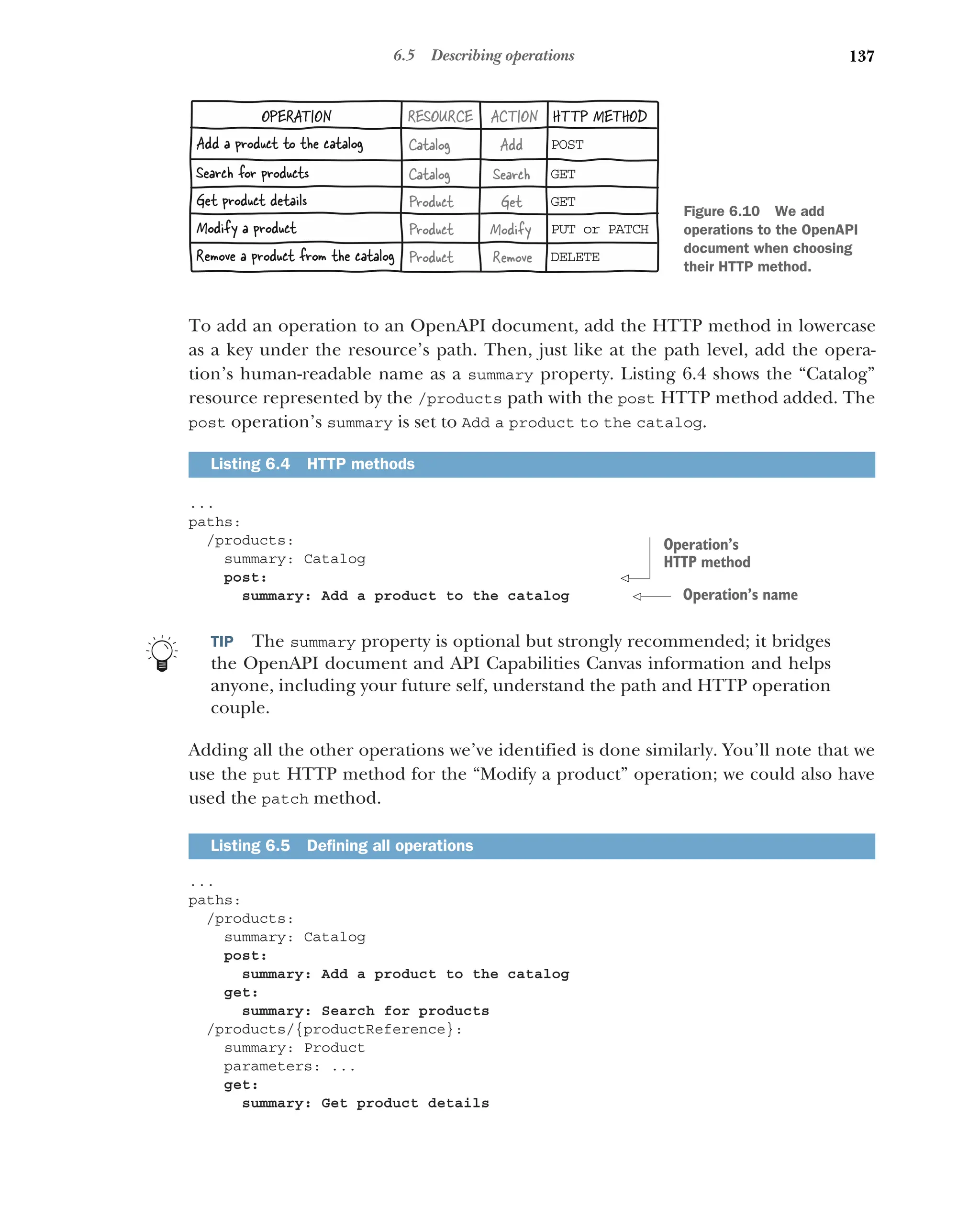
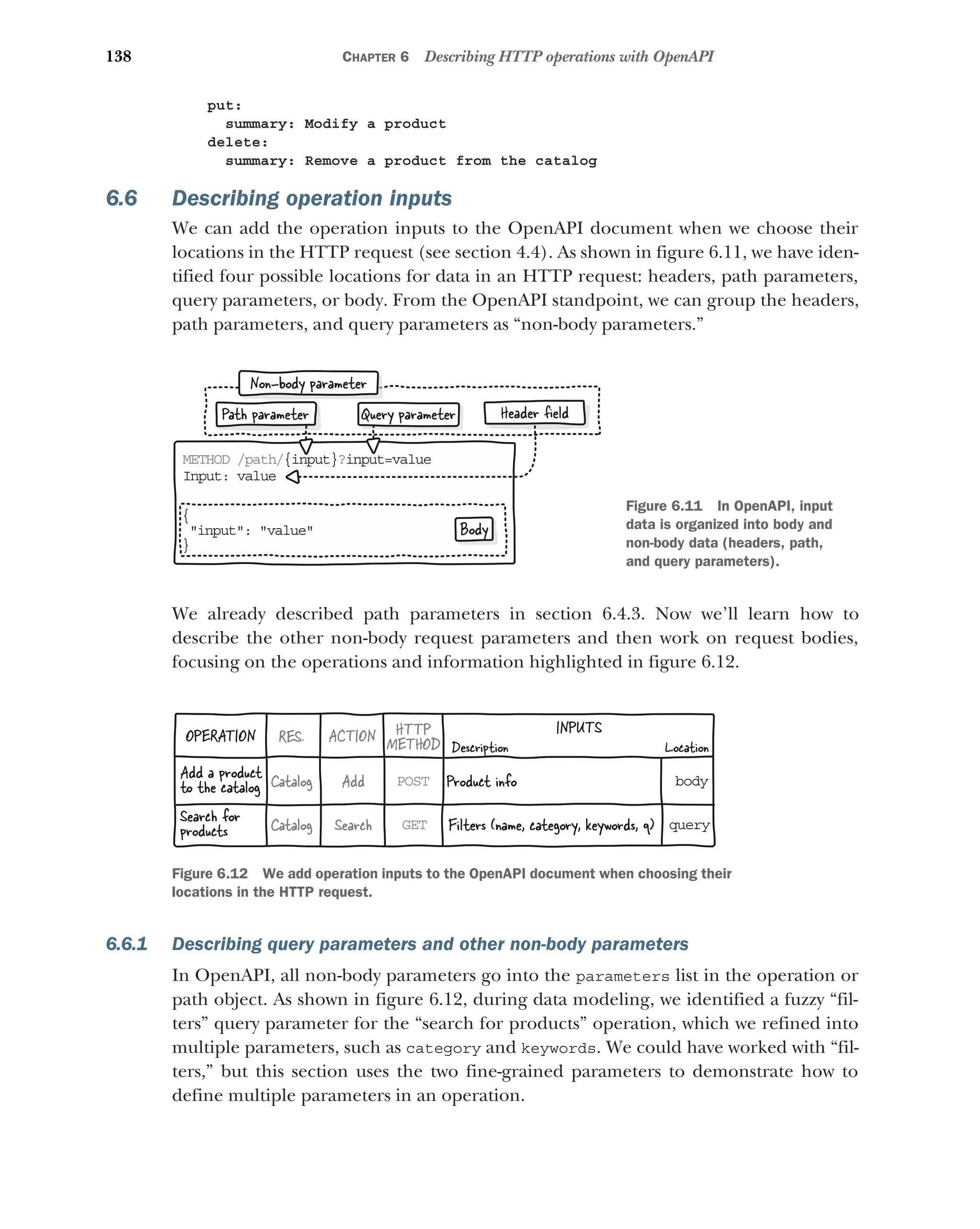
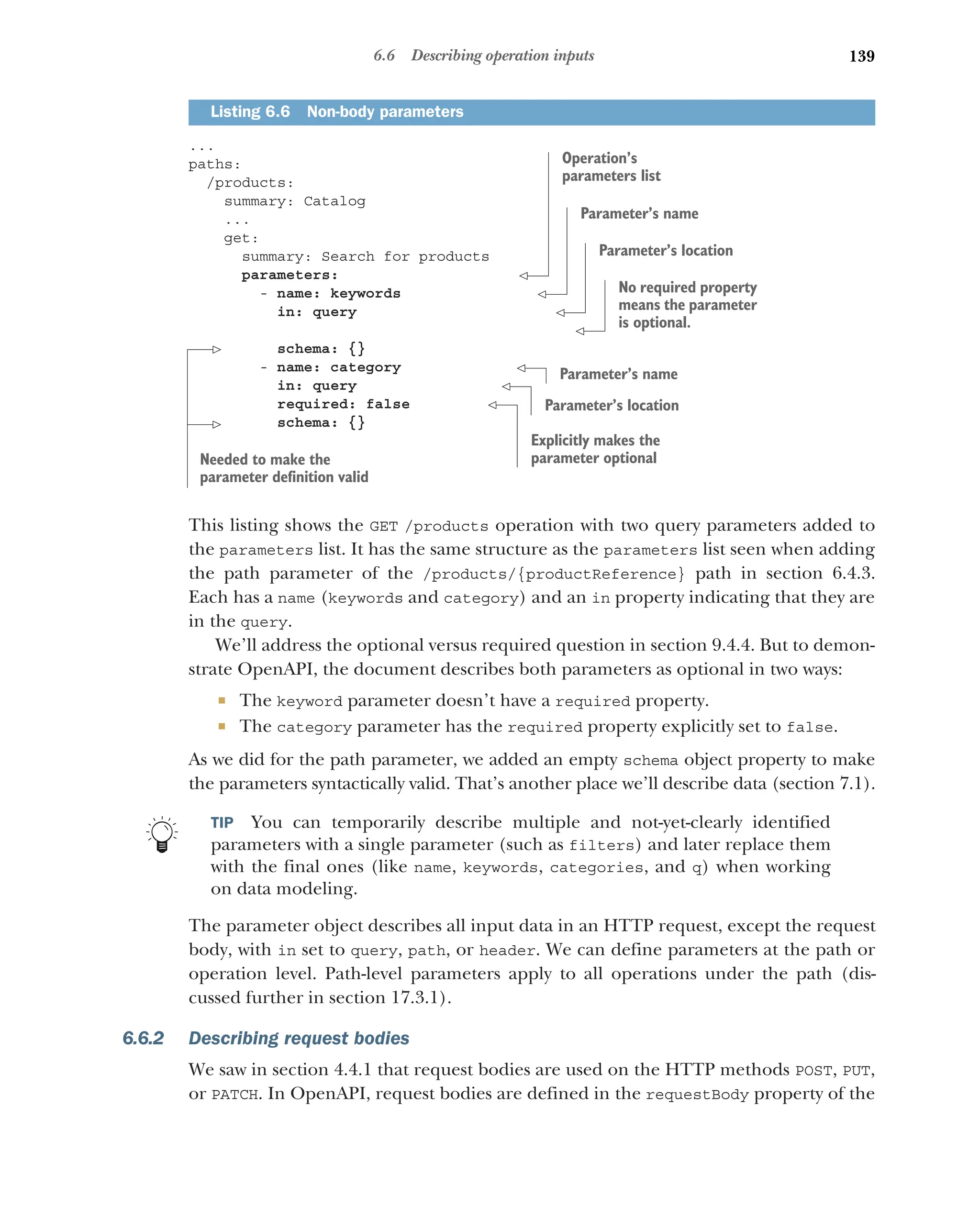
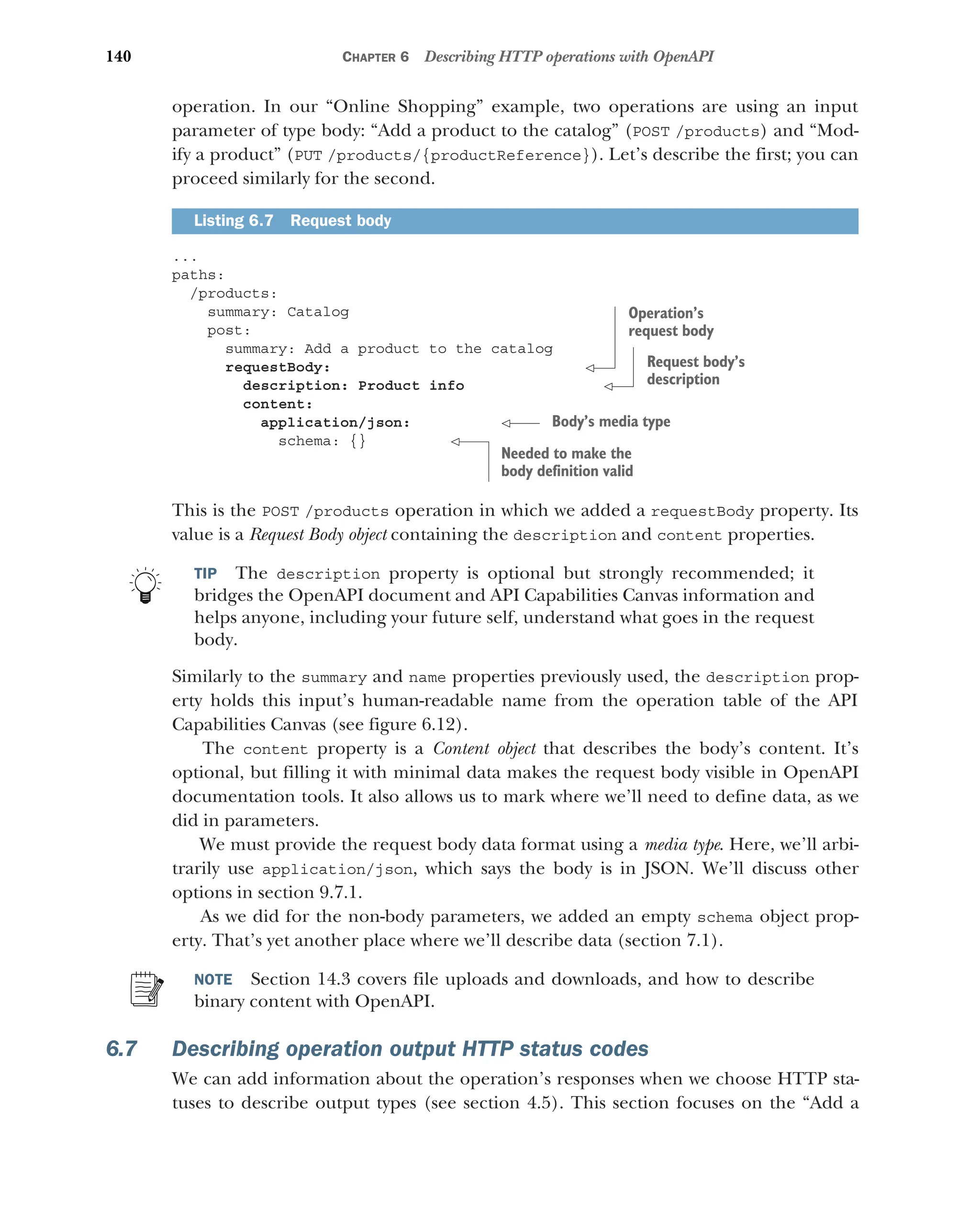
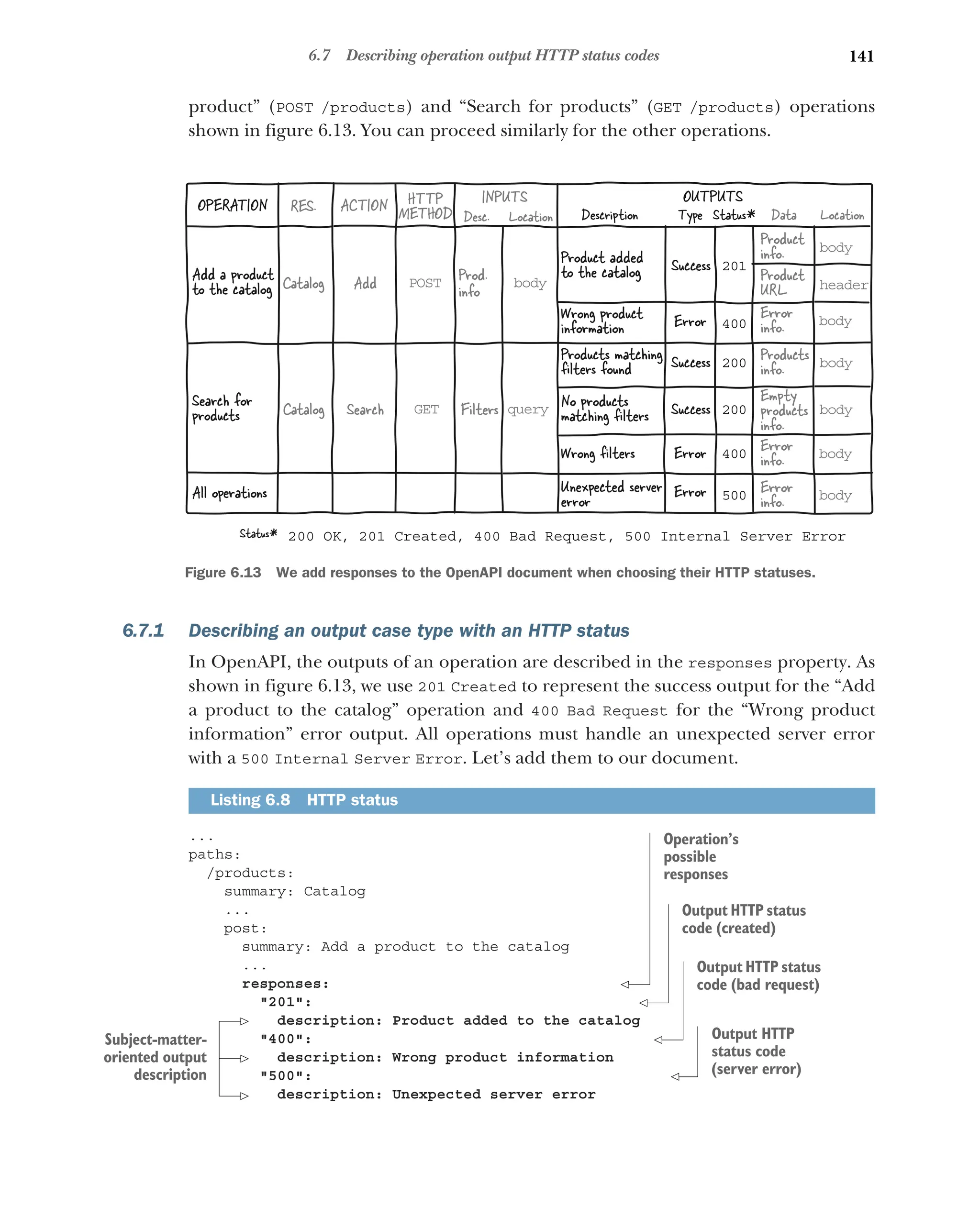
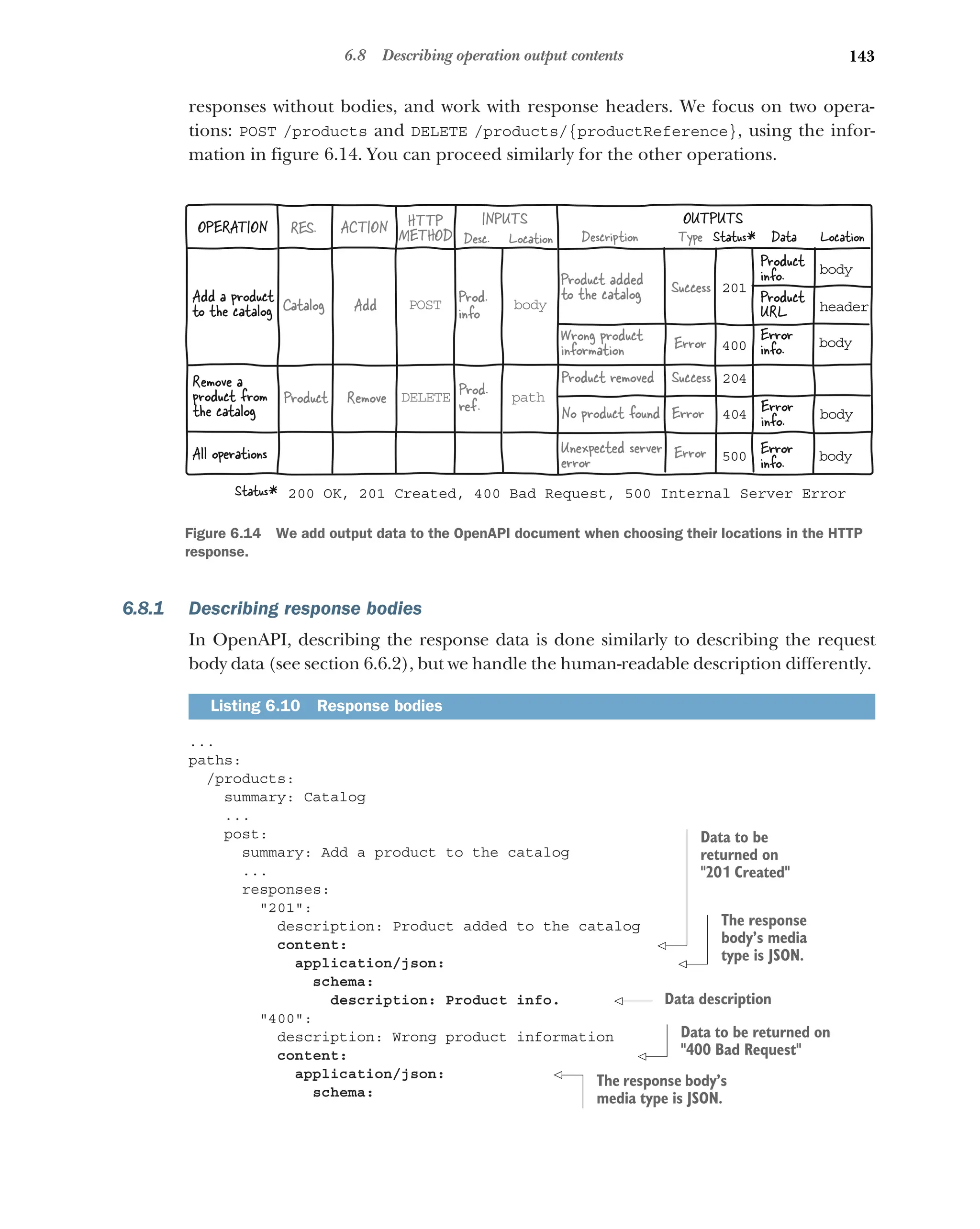
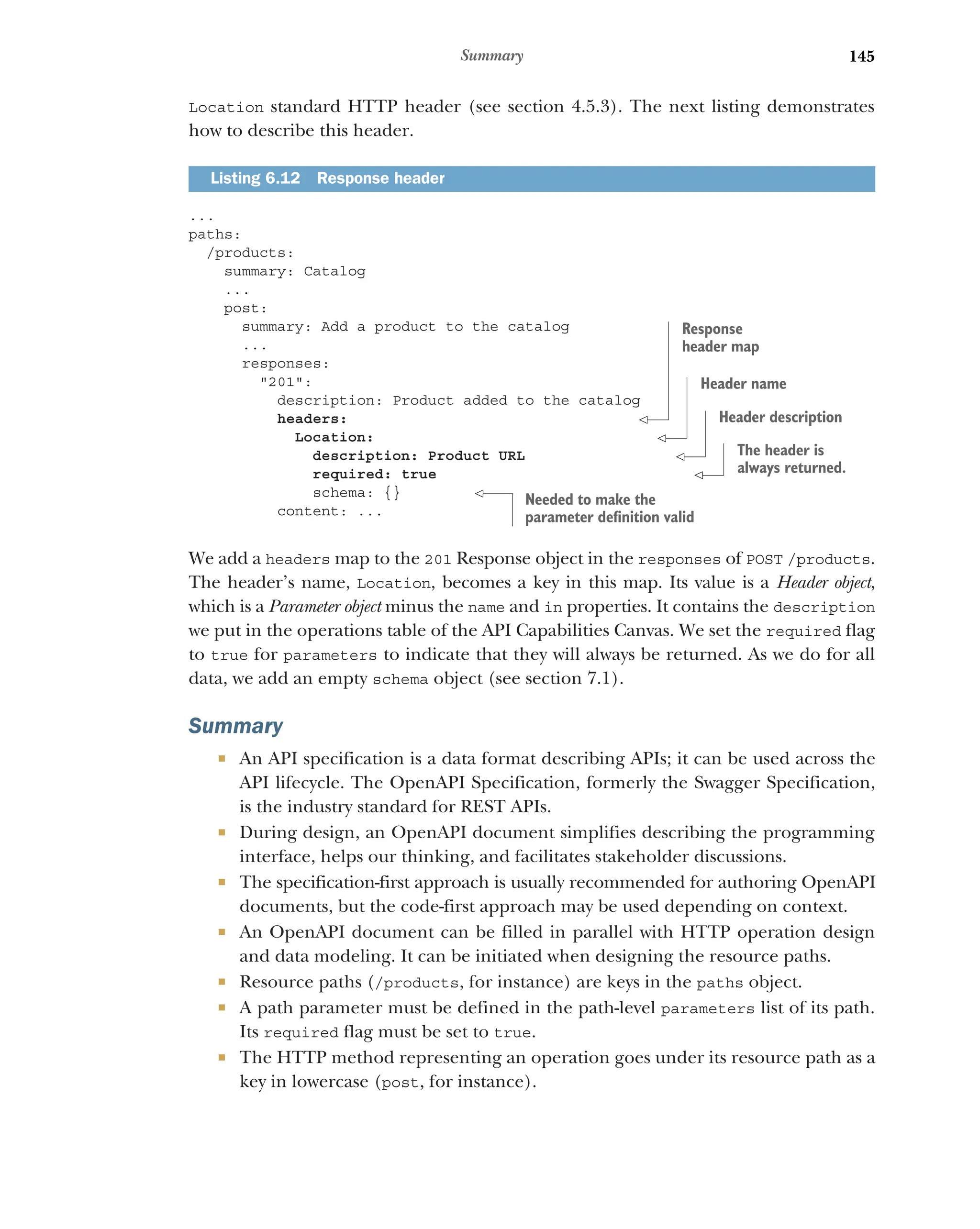
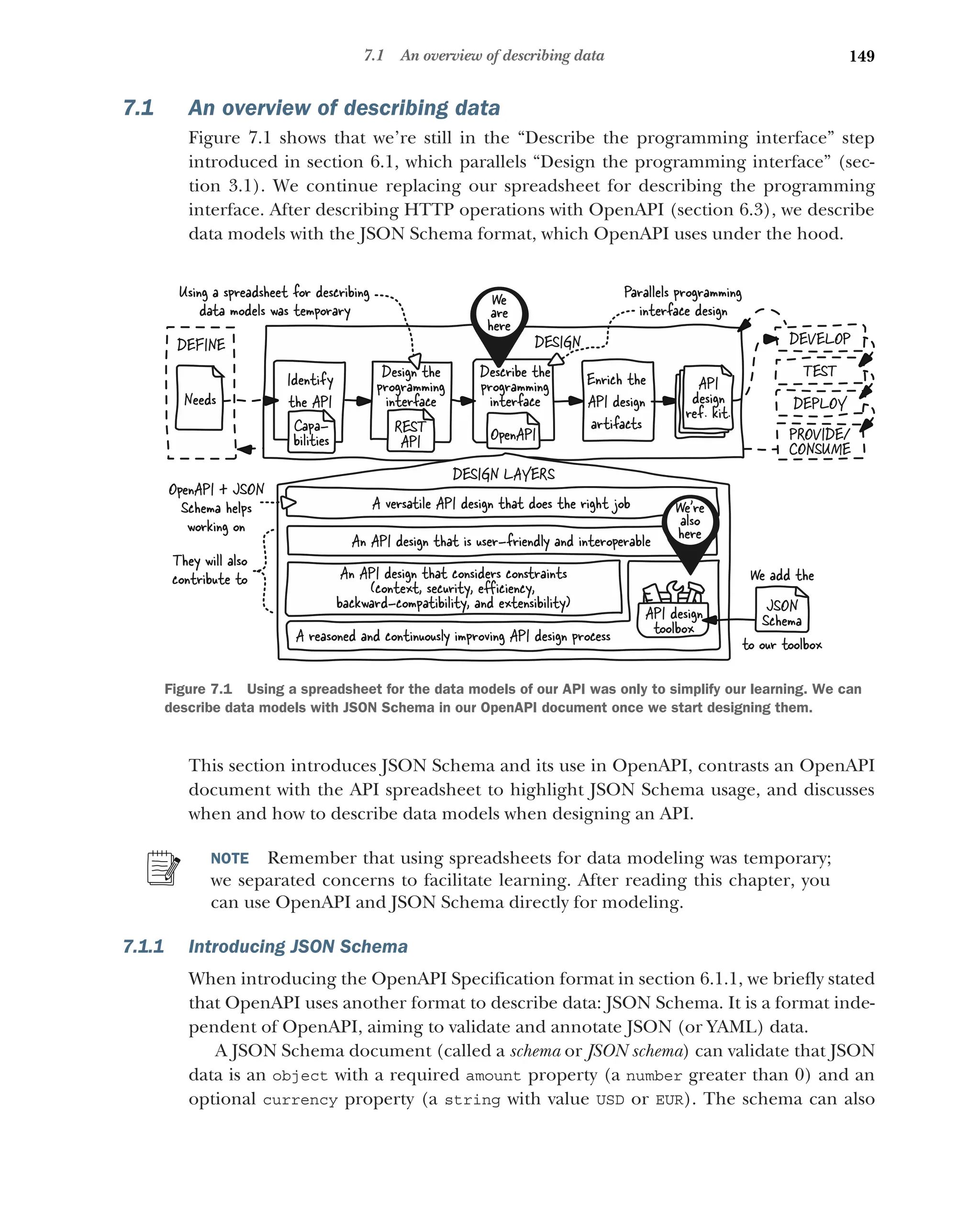
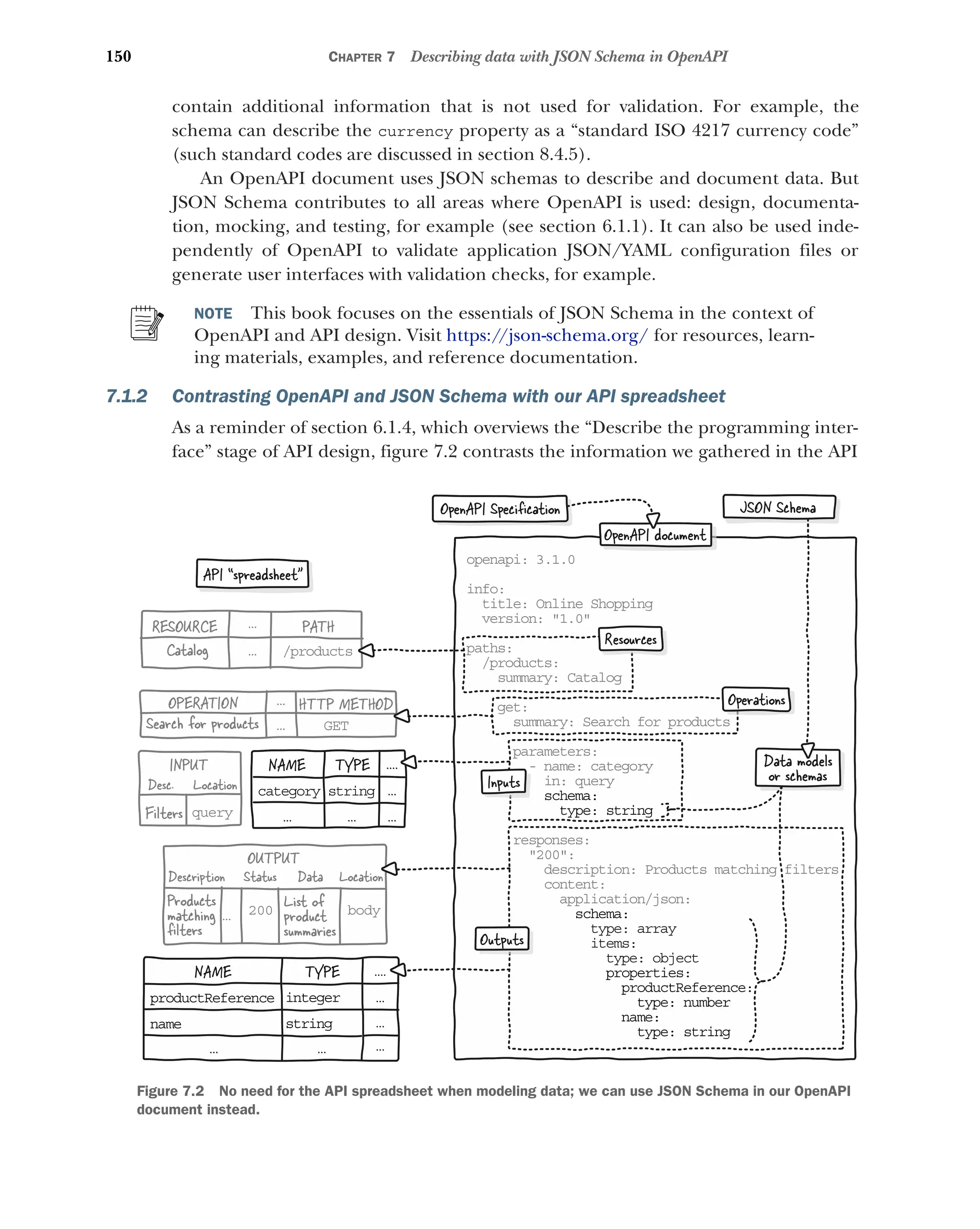
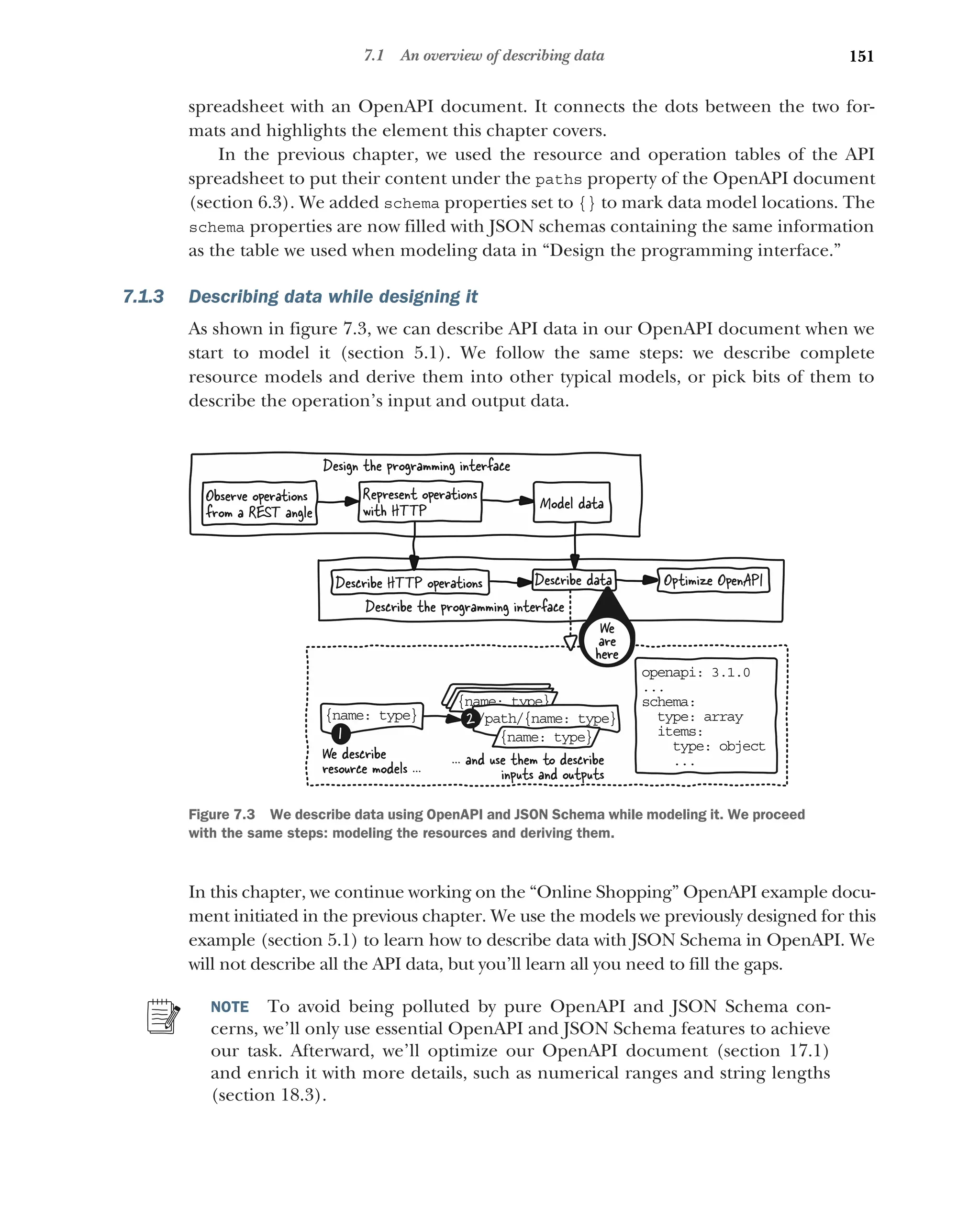
![154 CHAPTER 7 Describing data with JSON Schema in OpenAPI
NOTE As we said in section 5.1.3, the data models we created could be better.
Our focus is on the “versatile API that does the job” layer; we’ll later address
user-friendliness and interoperability (section 8.2), performance (section 13.1),
security (section 12.1), and implementation constraints (section 14.1).
7.4.1 Describing an object
In section 5.2, we designed the “Product” resource as an object, which is reflected in
the following JSON schema.
...
Product:
type: object
In the OpenAPI document, under components.schemas.Product, we add type and
set its value to object. This JSON schema says, “This is an object,” without describing
its properties. Such a minimal schema could be helpful when you want to initiate and
use a resource data model, leaving the fine-grained details for later.
Listing 7.2 Object type
{
roductReference: 12345,
p
ame: Cowboy Bebop,
n
escription: An amazing ...,
d
eywords: [anime, ...],
k
ategory: BD,
c
rice: 49.99,
p
ateAdded: 1997-18-09,
d
sProductUnavailable: false,
i
upplier: {
s
supplierCode: SUNR,
name: Sunrise
}
}
NAME TYPE REQ. DESCRIPTION
pr ductReference
o
na e
m
de cription
s
ke words
y
ca egory
t
pr ce
i
da eAdded
t
is roductUnavailable
P
su plier
p
in eger
t
st ing
r
st ing
r
ar ay of
r
st ing
r
st ing
r
fl at
o
st ing
r
bo lean
o
ob ect
j
*
*
*
*
*
*
Price in USD
Unique identifier
Temp. unavailable
YY Y-MM-DD
Y
fo mat
r
NAME TYPE REQ. DESCRIPTION
su plierCode
p
na e
m
st ing
r
st ing
r
*
*
Unique identifier
JSON example
Figure 7.4 We’ll reproduce (and replace) the “Product” resource complete model tables with a JSON
schema.
The value of “Product”
is a JSON schema.
The JSON schema
describes an object.](https://image.slidesharecdn.com/lauretarnaud-thedesignofwebapis2025-250821164447-5e92da1d/75/Lauret-Arnaud-The-Design-of-Web-APIs-2025-pdf-192-2048.jpg)
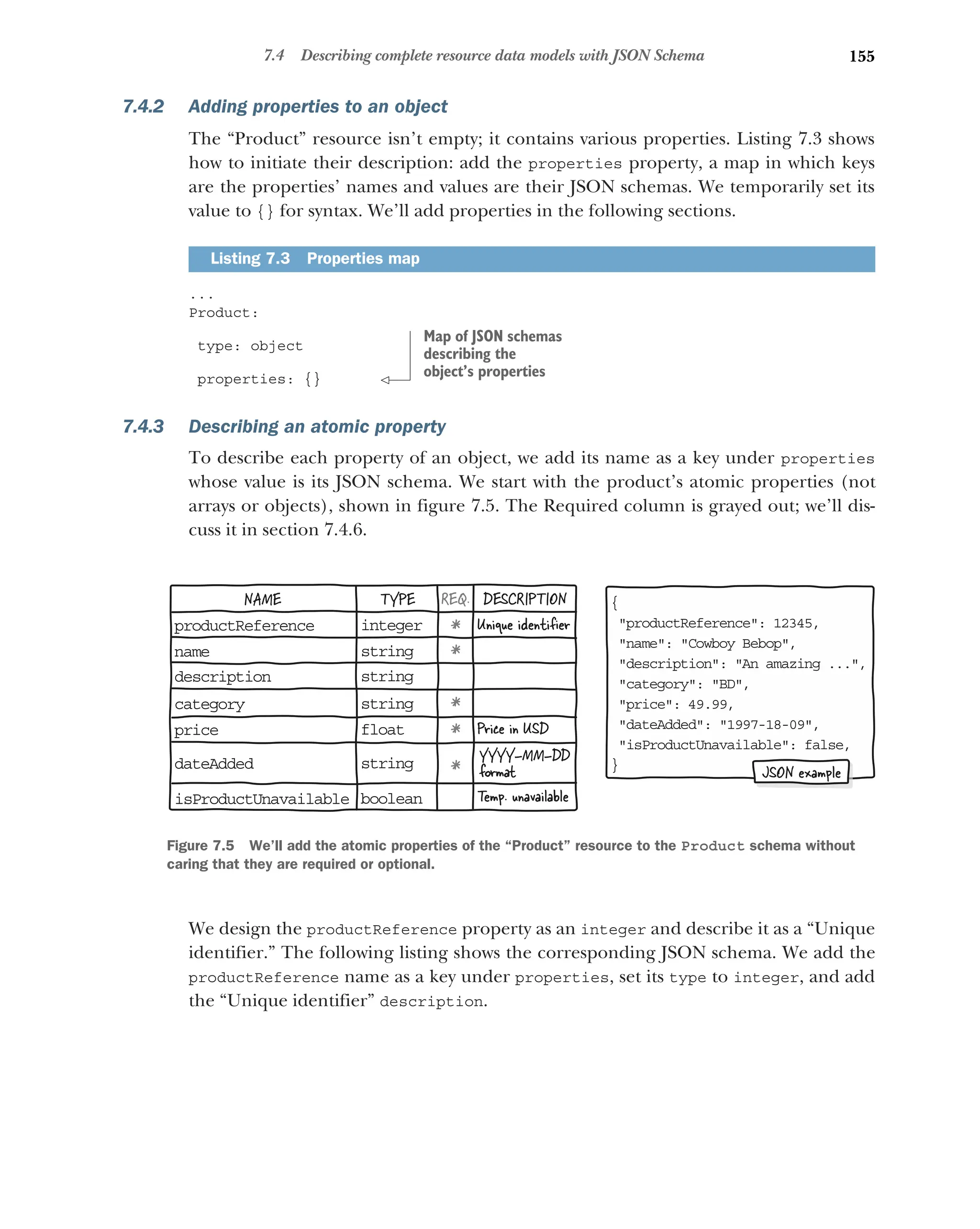
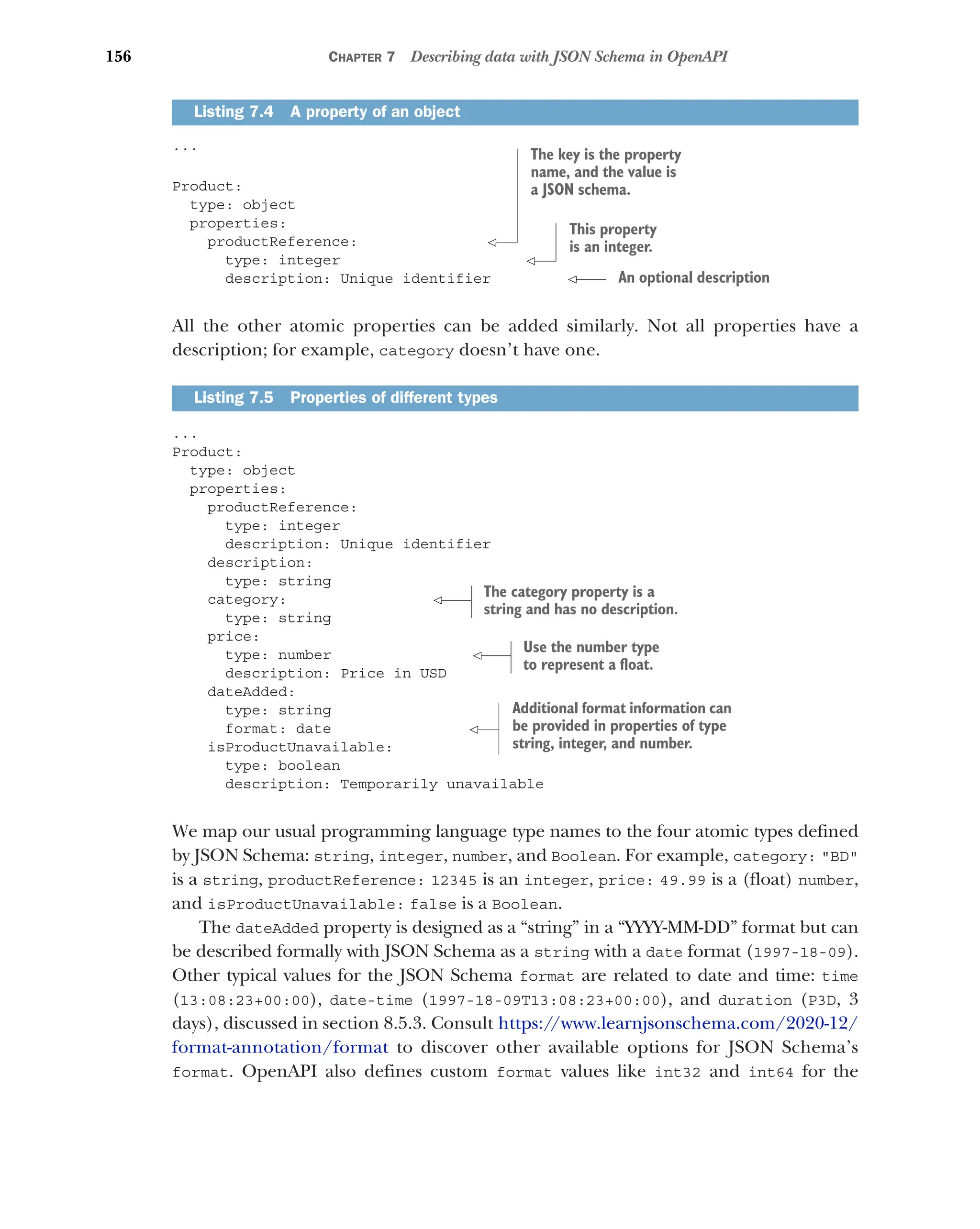
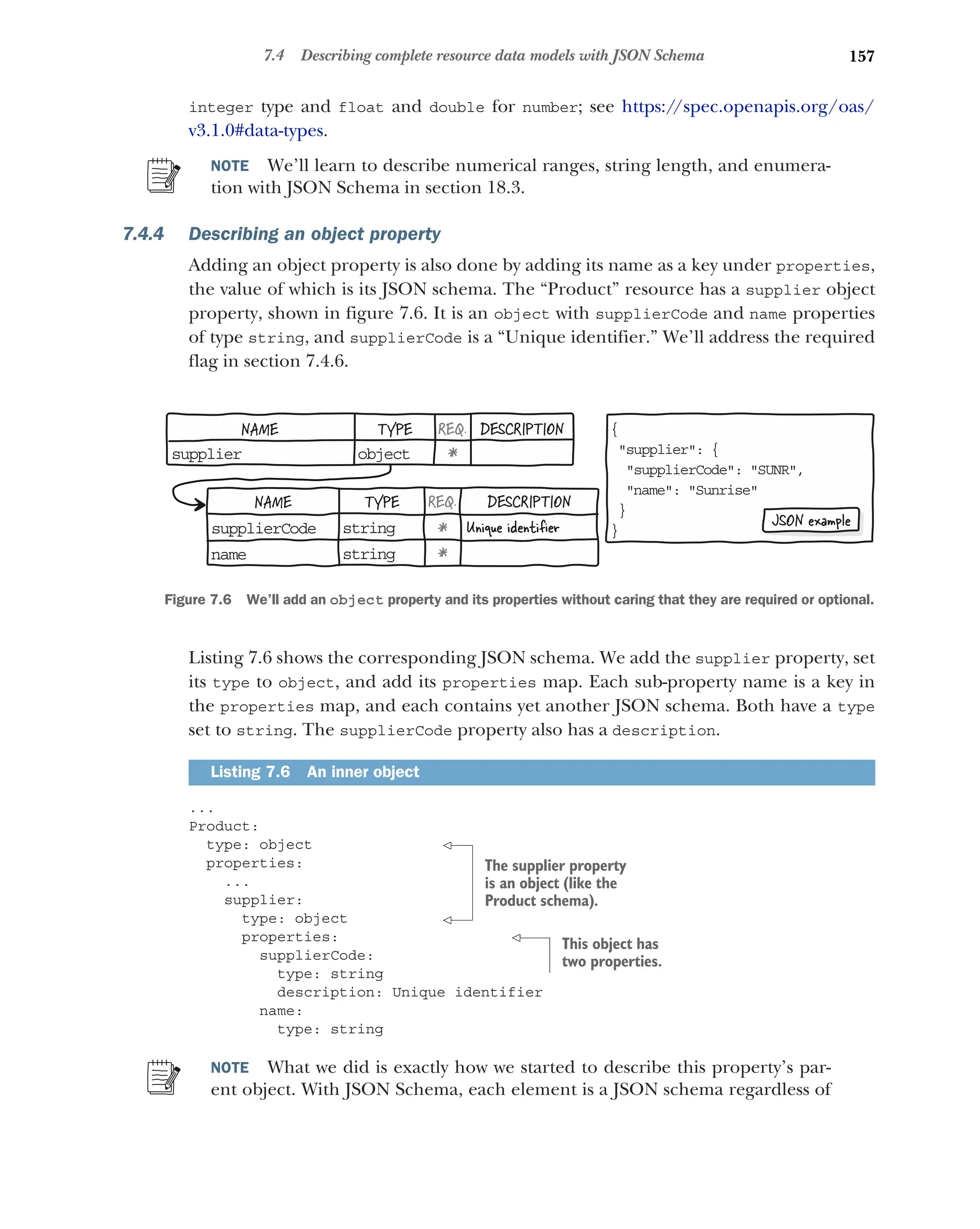
![158 CHAPTER 7 Describing data with JSON Schema in OpenAPI
the level in the data model. Alternatively, we could have defined a dedicated
model; section 7.7.4 shows how to do this.
7.4.5 Describing an array property
Adding an array or list property also requires putting its name as a key under proper-
ties, the value of which is its JSON schema; it has an array type and an items prop-
erty that defines the JSON schema of its elements. As shown in figure 7.7, we designed
the Product’s keywords property as an array of string; it could also have been a list
of string.
Listing 7.7 shows the corresponding JSON schema. We add the keywords property
name as a key under the product’s properties. We set its type to array and add an
items property containing the JSON schema of the array elements. We set the value of
items to the type: string schema.
...
Product:
type: object
properties:
...
keywords:
type: array
items:
type: string
We can describe arrays with other types of elements, such as objects, by putting the
appropriate JSON schema under items.
NOTE We’ll learn to describe array size with JSON Schema in section 18.3.
7.4.6 Stating which properties are required
Add its name to the required list to indicate that an object’s property is required.
When an object is used as input, the consumer must provide the required properties;
and when an object is used as output, the API must return the properties. Other prop-
erties are optional and may be absent. Figure 7.8 shows which properties we chose to
mark as required when designing the “Product” resource in section 5.2.
Listing 7.7 An array of strings
NAME TYPE REQ. DESCRIPTION
ke words
y ar ay of
r
st ing
r
{
eywords: [anime, ...]
k
}
JSON example
Figure 7.7 We’ll add an array property to the Product schema without caring if it’s required or optional.
The keywords property
is an array.
The items property contains the
JSON Schema of the array’s
elements.
The keywords property is
an array of string.](https://image.slidesharecdn.com/lauretarnaud-thedesignofwebapis2025-250821164447-5e92da1d/75/Lauret-Arnaud-The-Design-of-Web-APIs-2025-pdf-196-2048.jpg)
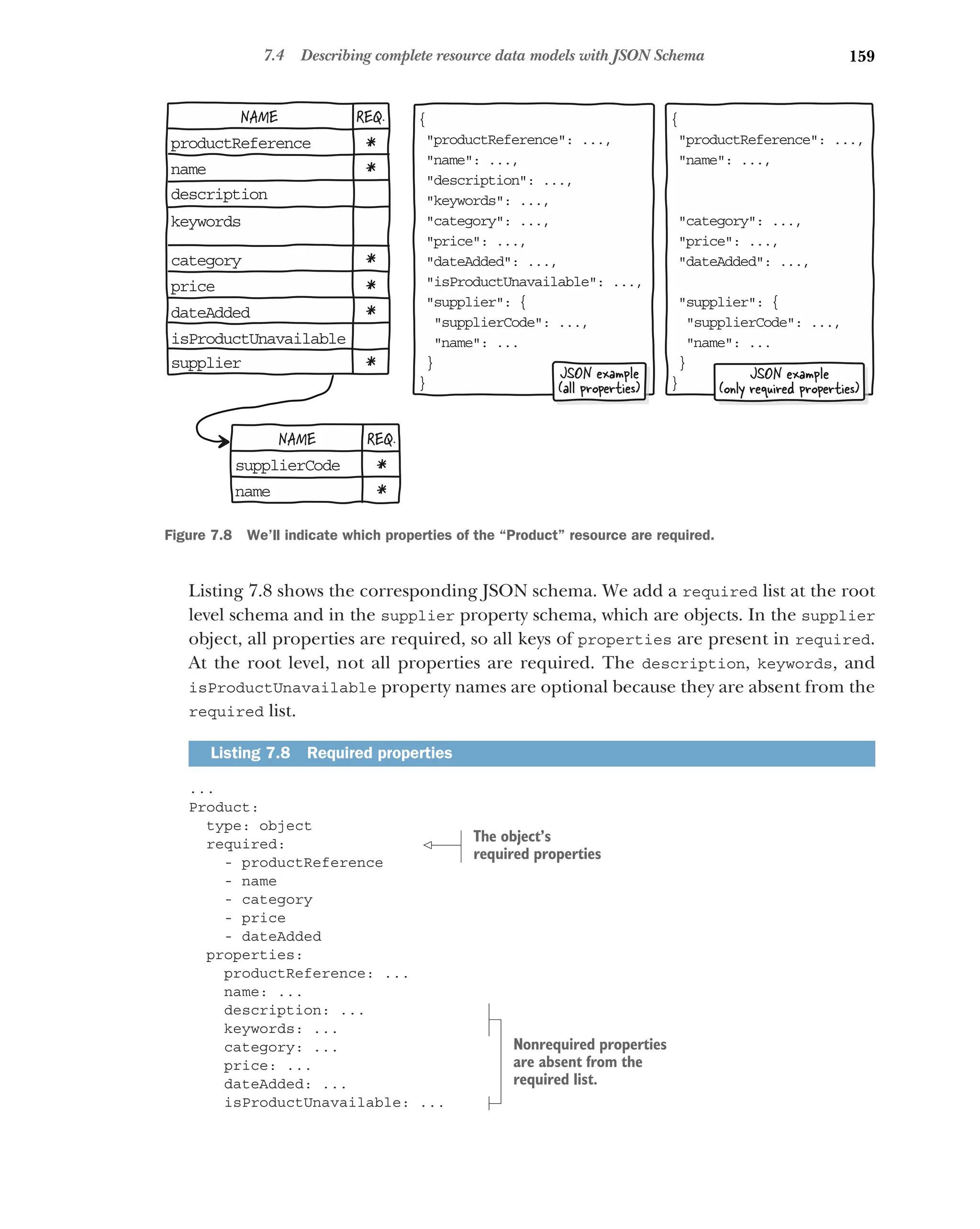
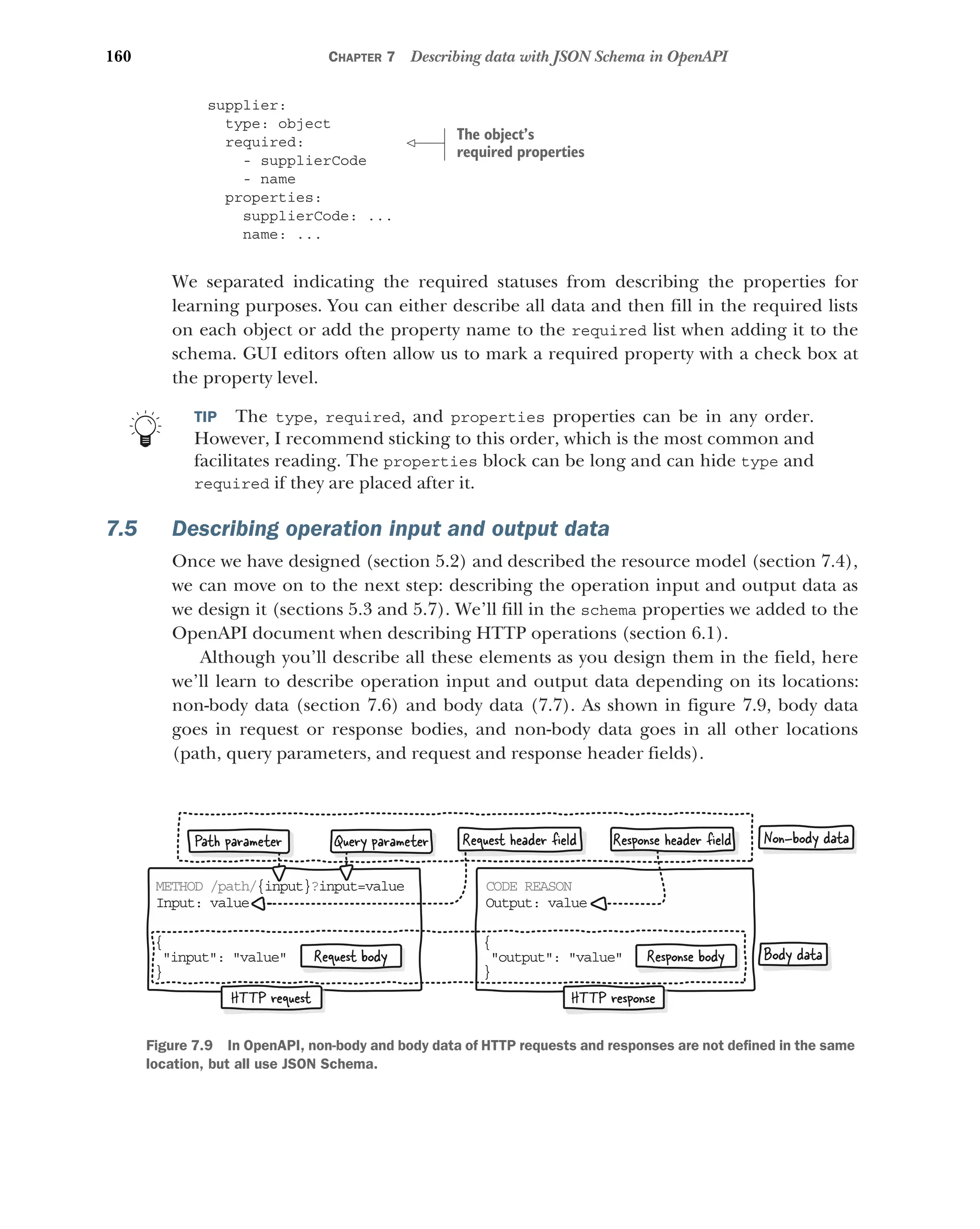
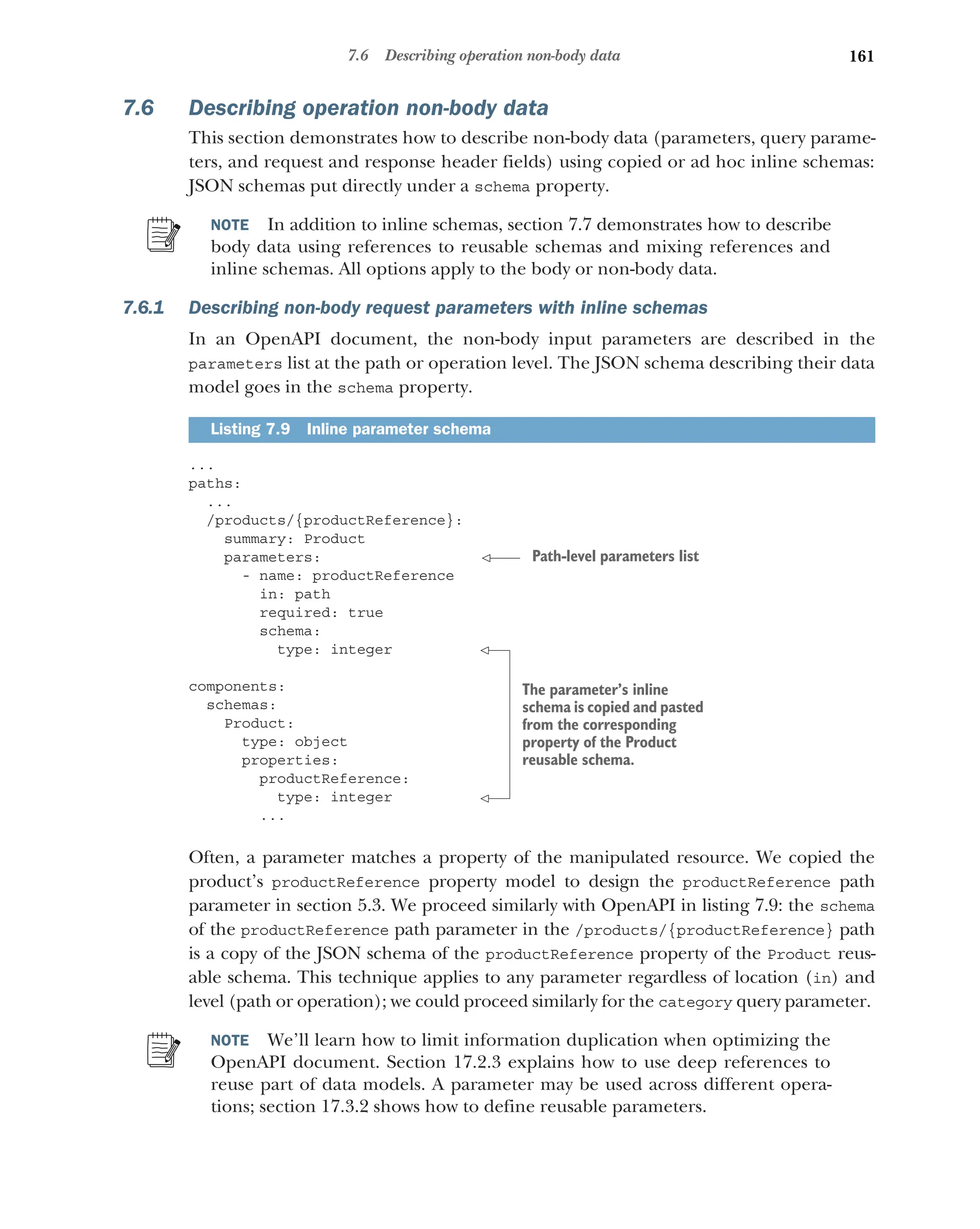
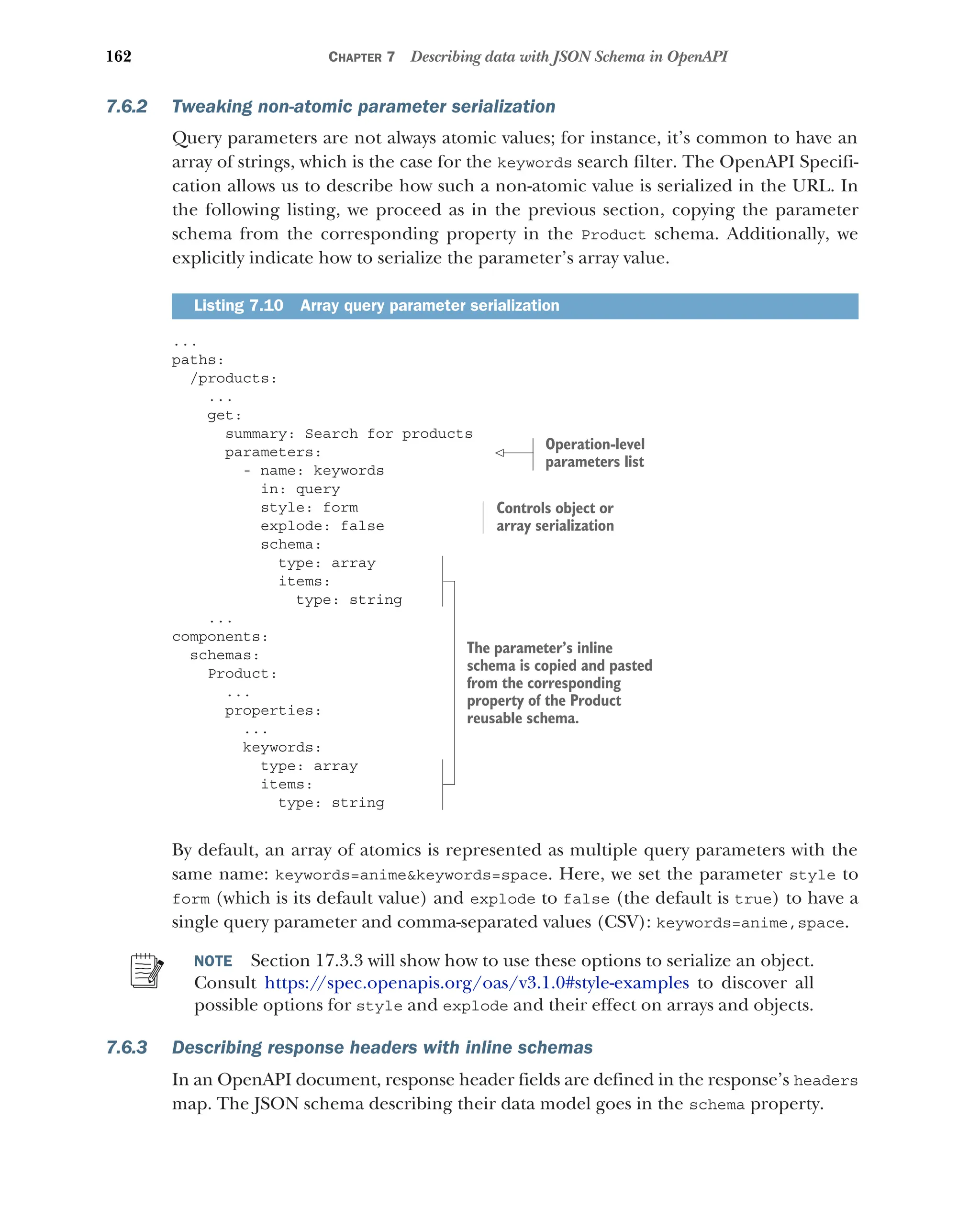
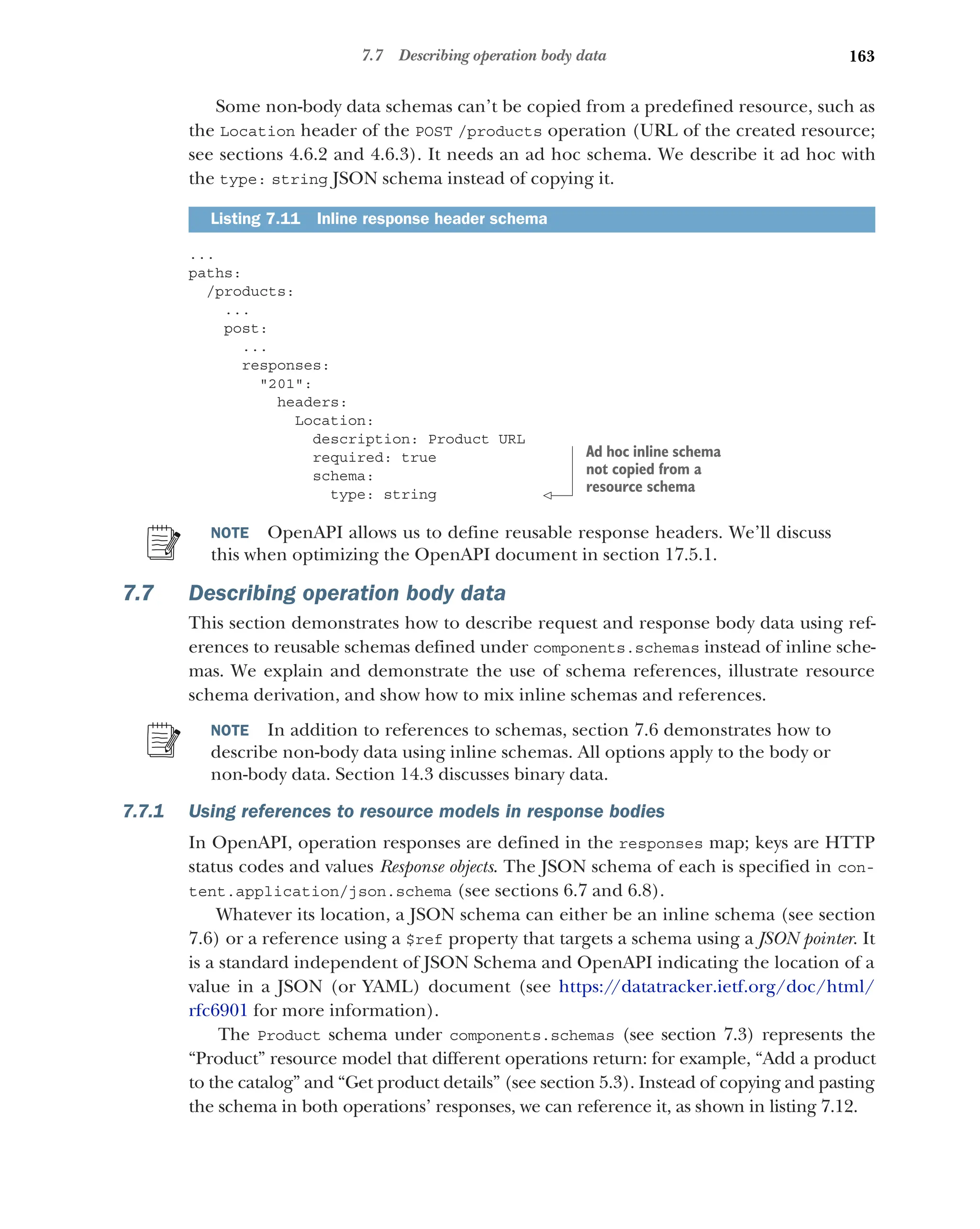
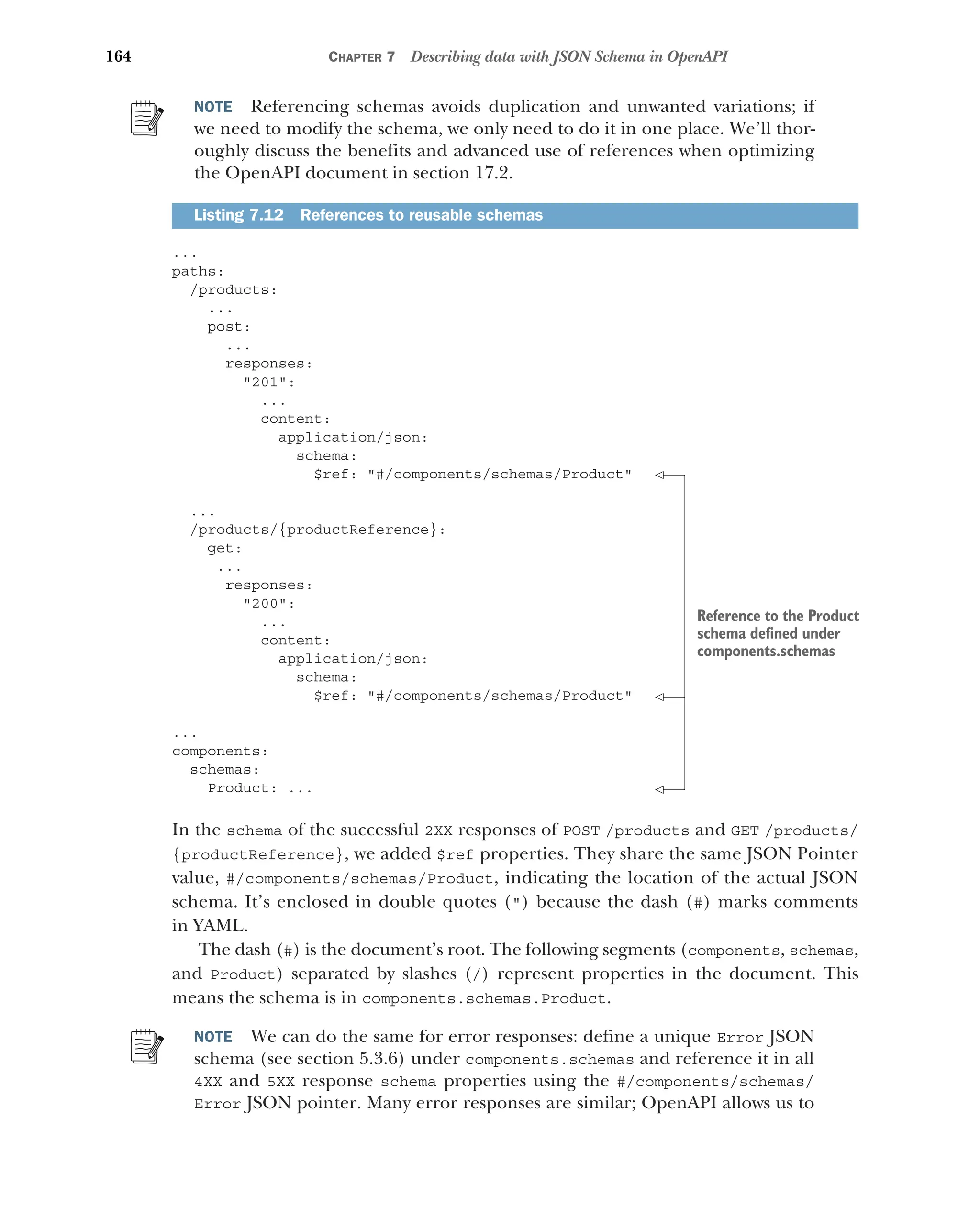
![165
7.7 Describing operation body data
define them once and use them in multiple places. We’ll discuss this when
optimizing the OpenAPI document in section 17.5.
7.7.2 Deriving the complete resource model to create other
reusable models
We learned to design models derived from a complete resource model in sections 5.3
and 5.4. For instance, we created a “Product Creation or Replacement” model that is
used as a request body of the “Add a product to the catalog” and “Modify a product”
operations by stripping the Product model of the properties managed by the imple-
mentation in the context of creation and replacement (see figure 7.10).
As shown in listings 7.13 and 7.14, to derive the Product model in the OpenAPI docu-
ment, we add a ProductCreationOrReplacement schema under components.schemas,
copy and paste the content of the Product schema into it, and remove the unneces-
sary properties (productReference, dateAdded, and supplier.name) from proper-
ties and required.
...
components:
schemas:
Product:
type: object
Listing 7.13 Product schema
NAME TYPE REQ.
pr ductReference
o
na e
m
de cription
s
ke words
y
ca egory
t
pr ce
i
da eAdded
t
is roductUnavailable
P
su plier
p
in eger
t
st ing
r
st ing
r
ar ay of
r
st ing
r
st ing
r
fl at
o
st ing
r
bo lean
o
ob ect
j
*
*
*
*
*
*
{
ame: Cowboy Bebop,
n
escription: An amazing ...,
d
eywords: [anime, ...],
k
ategory: BD,
c
rice: 49.99,
p
sProductUnavailable: false,
i
upplier: {
s
supplierCode: SUNR
}
}
JSON example
A subset of the resource model
Product
NAME TYPE REQ.
su plierCode
p
na e
m
st ing
r
st ing
r
*
*
Product
CreationOr
Replacement
Figure 7.10 We’ll derive the Product model into the ProductCreationOrReplacement model.
Reusable
Product schema](https://image.slidesharecdn.com/lauretarnaud-thedesignofwebapis2025-250821164447-5e92da1d/75/Lauret-Arnaud-The-Design-of-Web-APIs-2025-pdf-203-2048.jpg)
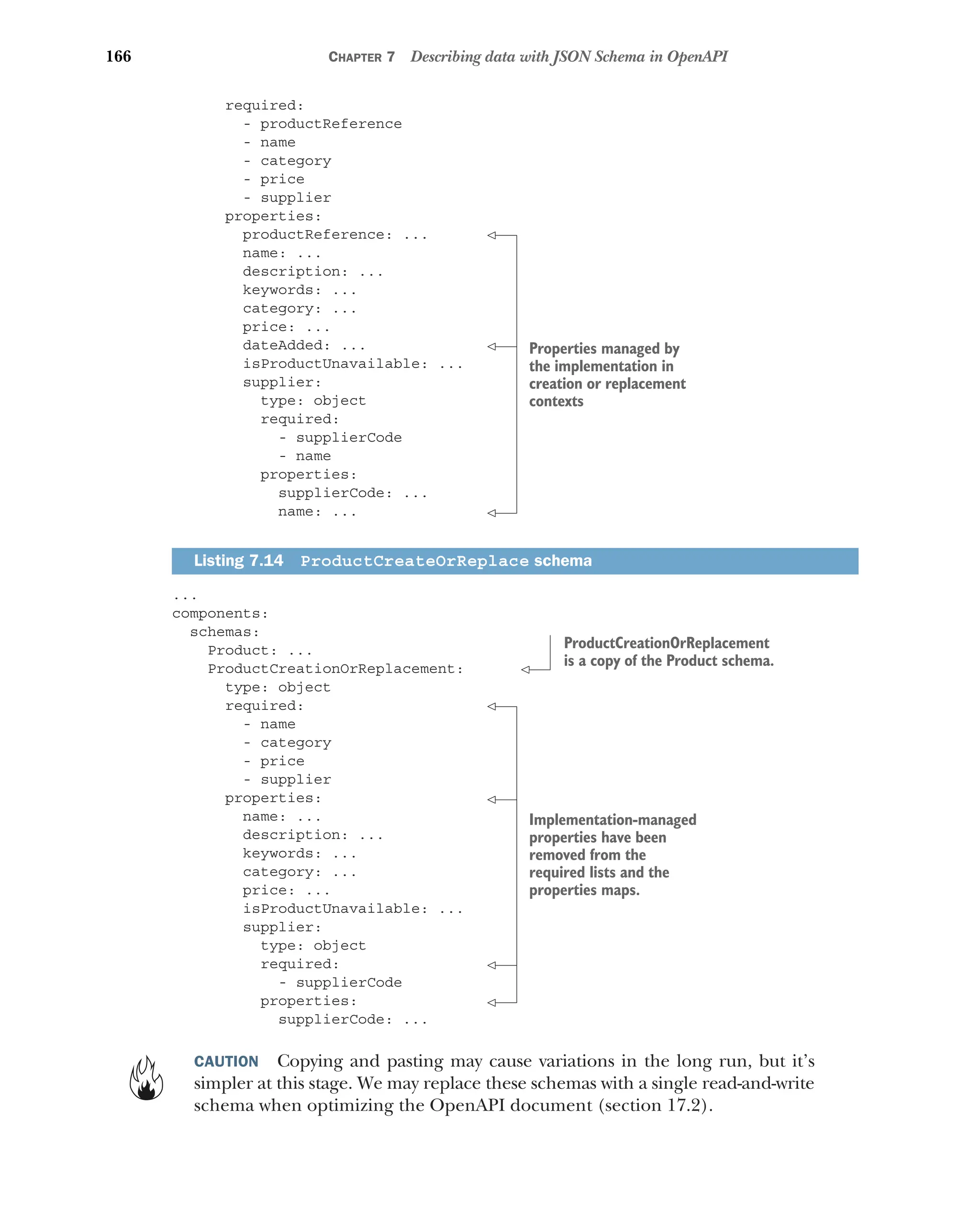

![168 CHAPTER 7 Describing data with JSON Schema in OpenAPI
in listing 7.17, in the 200 response of the GET /products operation schema, we define
an inline schema of type array whose items are a reference ($ref) to this schema
(#/components/schemas/ProductSummary).
...
components:
schemas:
Product: ...
...
ProductSummary:
type: object
required:
- productReference
- name
- category
- price
properties:
productReference: ...
name: ...
description: ...
category: ...
price: ...
...
paths:
/products:
...
get:
...
Listing 7.16 ProductSummary schema
Listing 7.17 Inline schema and reference
NAME TYPE REQ.
pr ductReference
o
na e
m
de cription
s
ke words
y
ca egory
t
pr ce
i
da eAdded
t
is roductUnavailable
P
su plier
p
in eger
t
st ing
r
st ing
r
ar ay of
r
st ing
r
st ing
r
fl at
o
da e
t
bo lean
o
ob ect
j
*
*
*
*
*
*
[
{
productReference: 12345,
name: Cowboy Bebop,
keywords: [anime, ...],
category: BD,
price: 49.99,
},
{ ... }
]
[]
“Products info.”
JSON example
Product
Summary
A subset of the resource model
Product
“Empty products info.”
JSON example
array of
ProductSummary
Figure 7.11 The ProductSummary model is a subset of the Product model for lists.
The ProductSummary reusable
schema is the summarized
version of the Product schema.](https://image.slidesharecdn.com/lauretarnaud-thedesignofwebapis2025-250821164447-5e92da1d/75/Lauret-Arnaud-The-Design-of-Web-APIs-2025-pdf-206-2048.jpg)

![170 CHAPTER 7 Describing data with JSON Schema in OpenAPI
An object has a properties map with property names as keys and their JSON
schemas as values.
The required list of an object contains its required properties’ names.
The items property of an array contains the JSON schema of its elements.
Operations input and output data JSON schemas go into the schema properties
added when describing the HTTP operations.
A reusable schema defined in components.schemas.Name can be referenced with
a $ref property whose value is a #/components/schemas/Name JSON Pointer.
Use reference to reusable schemas to avoid duplication and unwanted varia-
tions in request and response bodies.
Describe resource model derivations as reusable schemas under components
.schemas.
The value of a schema property can be an inline schema, a reference ($ref) to a
schema, or a mix of both options.
Exercises
This section contains exercises to help you practice some key skills in this chapter.
You’ll find the solutions in the online appendix (https:/
/mng.bz/260N). I encourage
you to solve them and read their solutions, which include detailed explanations, refer-
ences to relevant sections, and additional comments.
Exercise 7.1
You’re designing an API for a pixel-art device comprising a “screen” composed of
36-by-36 luminous squares. A screen has an id (SC001, for example) and a matrix of
pixels (array of array). Each pixel has an rgb array ([10, 23, 45], for example), a
brightness percentage between 0 and 1 (0.3, for example), and an on flag. All proper-
ties are required except the brightness. Describe the corresponding Screen, Pixels,
and Pixel reusable schemas with OpenAPI.
Exercise 7.2
You’re designing an API for a music streaming service. Use OpenAPI to describe the
following sample API call.
GET /artists/pink-floyd/albums?releaseYear=1969
200 OK
Content-Type: application/json
[
{
id: A890,
name: More,
mainArtist: {
Listing 7.19 Sample call](https://image.slidesharecdn.com/lauretarnaud-thedesignofwebapis2025-250821164447-5e92da1d/75/Lauret-Arnaud-The-Design-of-Web-APIs-2025-pdf-208-2048.jpg)
![171
Exercises
id: pink-floyd,
name: Pink Floyd
},
releaseYear: 1969,
comment: Movie soundtrack
},
{
id: A789,
name: Ummagumma,
mainArtist: {
id: pink-floyd,
name: Pink Floyd
},
releaseYear: 1969
},
]
Exercise 7.3
You’re working on an API for a recruitment platform. Given the following sample of
job offer JSON data, describe the “Create a job offer” and “Update (replace) a job
offer” operations with OpenAPI.
{
reference: xz789,
created: 2024-12-08,
title: Technical book author,
description: Writing technical books
}
Listing 7.20 Job offer sample data](https://image.slidesharecdn.com/lauretarnaud-thedesignofwebapis2025-250821164447-5e92da1d/75/Lauret-Arnaud-The-Design-of-Web-APIs-2025-pdf-209-2048.jpg)


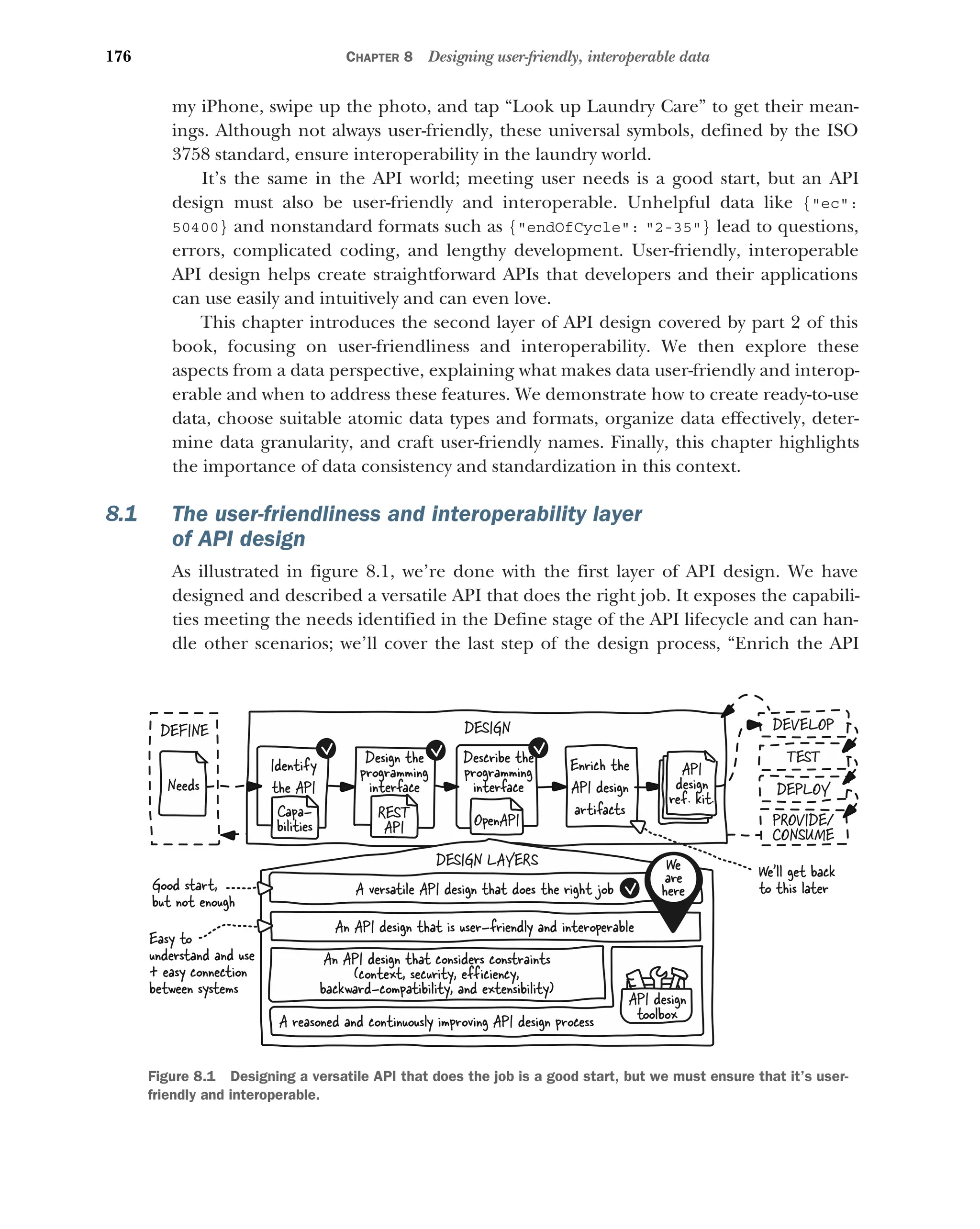
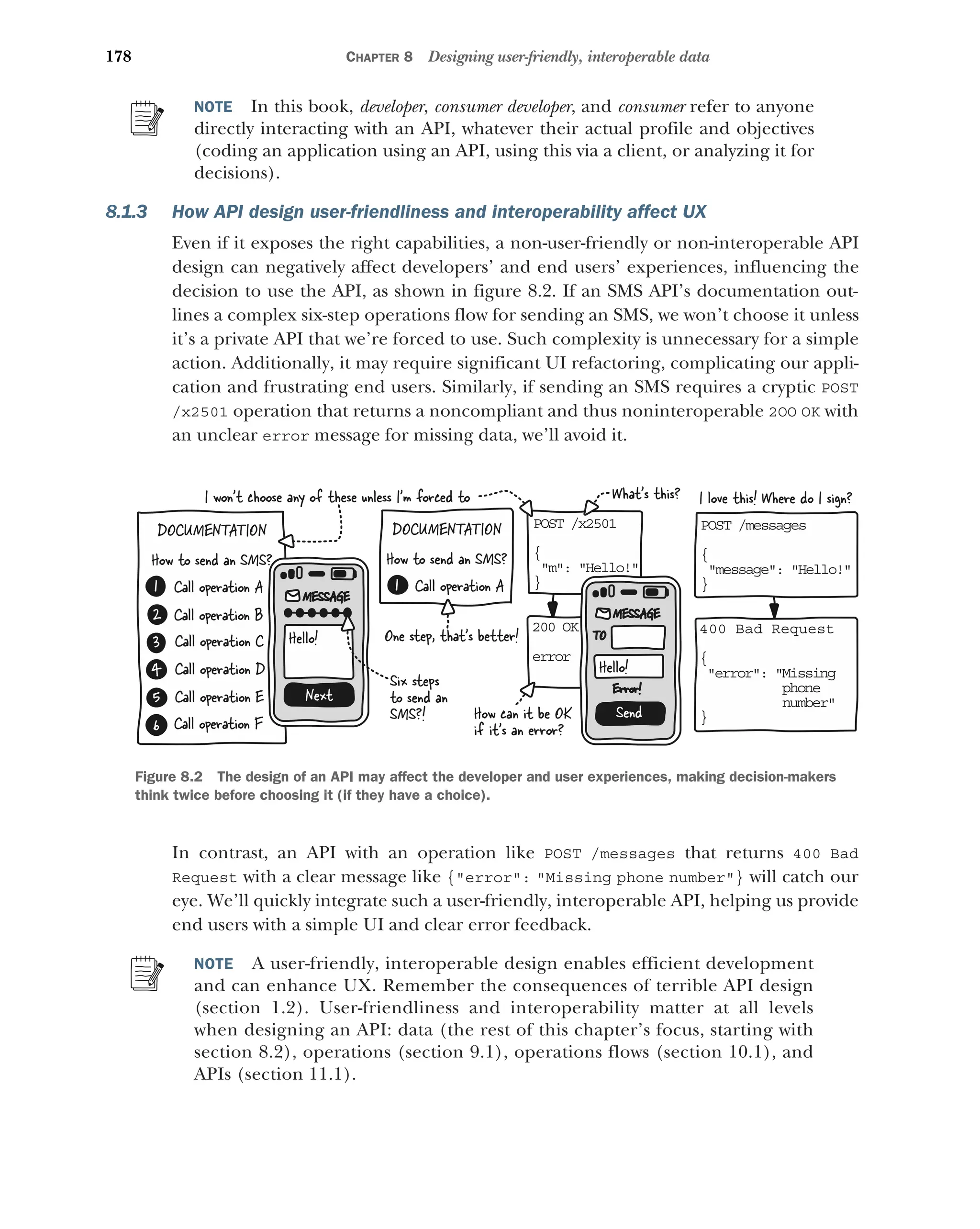
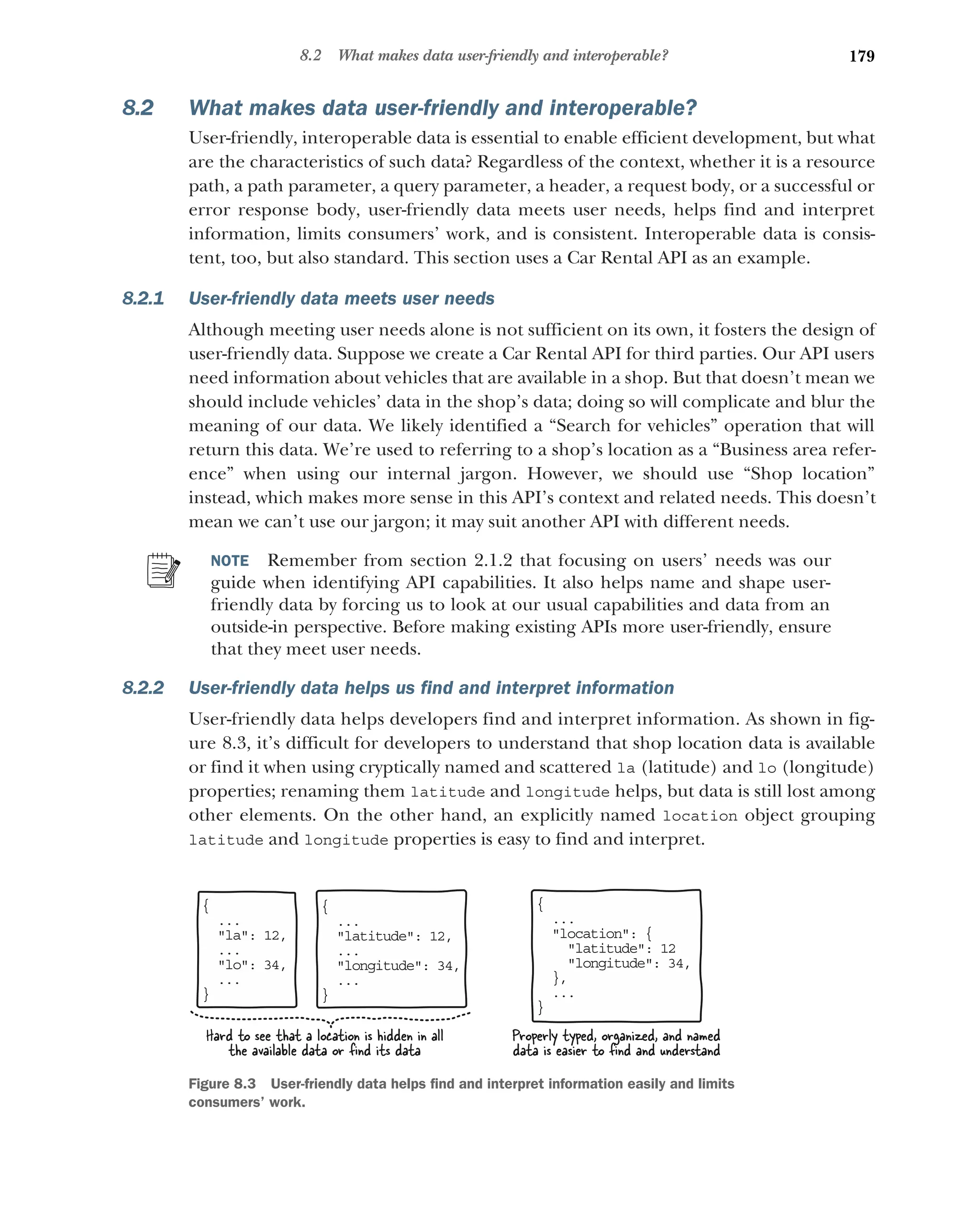
![180 CHAPTER 8 Designing user-friendly, interoperable data
8.2.3 User-friendly data limits consumers’ work
User-friendly data limits consumers’ work and helps them achieve their objectives
more efficiently. As shown in figure 8.4, we can add a ready-to-use address alongside
geographic coordinates to eliminate the need for consumers to perform reverse geo-
coding. Once done, we might consider removing the geographic coordinates now
that we have the address, because the address may suffice for our needs.
NOTE Crafting user-friendly data can uncover previously unknown needs or
make us reevaluate API capabilities. Modifying data will require us to ensure
that there’s no gap in our design, as we did when first modeling it (section 5.5).
8.2.4 User-friendly data is consistent
User-friendly data is consistent, which makes it intuitive and allows developers to rely
on their experience to understand and use it quickly. As shown in figure 8.5, suppose
we represent the location of a car with a place: [34° 0' 0, 12° 0' 0] array
where the values are the longitude and latitude in degrees, minutes, and seconds,
respectively, instead of decimal degrees. Information will be harder to find, and we’ll
confuse users. Users will instinctively know how to identify and use location data if we
use a similar name, location or lastLocation, and the same format and units for all
locations.
NOTE An intuitive API design gives developers superpowers, allowing them
to guess available data and operations. This creates an invaluable “wow” effect
during use.
{
..
.
location: {
latitude: 12
longitude: 34,
address: { street: API street, ... }
,
}
..
.
}
Consumers directly use
the address
{
..
.
location: {
latitude: 12
longitude: 34,
,
}
..
.
}
Consumer must
reverse-geocode
coordinates
Figure 8.4 Adding the address prevents consumers from reverse-geocoding the coordinates.
{
...
place: [
78° 0' 0,
56° 0' 0
]
...
}
{
...
location: {
latitude: 12
longitude: 34,
,
}
...
}
Shop data
{
...
lastLocation: {
latitude: 56
longitude: 78,
,
}
...
}
Same data
stucture
{
...
...
{
Car data
Different from
shop's location
Similar name
Figure 8.5 Different, intuitive, and interoperable representations of a location](https://image.slidesharecdn.com/lauretarnaud-thedesignofwebapis2025-250821164447-5e92da1d/75/Lauret-Arnaud-The-Design-of-Web-APIs-2025-pdf-218-2048.jpg)
![181
8.3 When and how to design user-friendly, interoperable data
8.2.5 Interoperable data is consistent and standard
Interoperability is essential for APIs, allowing systems to collaborate efficiently without
complex processing or coding and easing developers’ work. An API operation’s inter-
operable data can be easily used as input for other operations of the same or other
APIs. Moreover, any consuming application can easily provide or use interoperable
data. Achieving interoperability involves using custom (or local), domain-specific, or
generic standards.
Figure 8.6 illustrates the consistent use of an object with latitude, longitude, and
address properties to represent a location across data models. This enhances our
data’s local interoperability. Adopting a local standard is beneficial, but we should use
existing domain-specific or generic standards whenever possible to avoid reinventing
the wheel and improve interoperability. Instead of inventing our geographic point
representations, we can use GeoJSON’s Geometry object as defined by RFC 7946 (see
https://geojson.org/). We can replace latitude and longitude with an object that
includes a type: Point string and a coordinates: [12, 34] array in decimal
degrees. Although not overly user-friendly (I never remember which item is the lati-
tude or longitude in the coordinates array), this standardized data simplifies the shar-
ing and interpretation of coordinates.
NOTE Interoperable standards may overlook user-friendliness or may need
to sacrifice it for efficiency. Section 8.9.1 explores user-friendliness and
interoperability.
8.3 When and how to design user-friendly,
interoperable data
Now that we’ve seen what makes data user-friendly and interoperable, we can clarify
which data needs to be user-friendly and interoperable, when to address these con-
cerns, and how to design such data.
{
location: {
coordinates: {
type: Point,
coordinates: [ 12, 34 ]
},
address: { ... }
}
}
Standard GeoJSON Geometry object
{
..
.
location: {
latitude: 12
longitude: 34,
address: {...}
,
}
..
.
}
Shop data
{
..
.
lastLocation: {
latitude: 56
longitude: 78,
address: {...}
,
}
..
.
}
Car data
Local/custom standard data
Figure 8.6 Using custom or local standards or actual standards makes data interoperable.](https://image.slidesharecdn.com/lauretarnaud-thedesignofwebapis2025-250821164447-5e92da1d/75/Lauret-Arnaud-The-Design-of-Web-APIs-2025-pdf-219-2048.jpg)
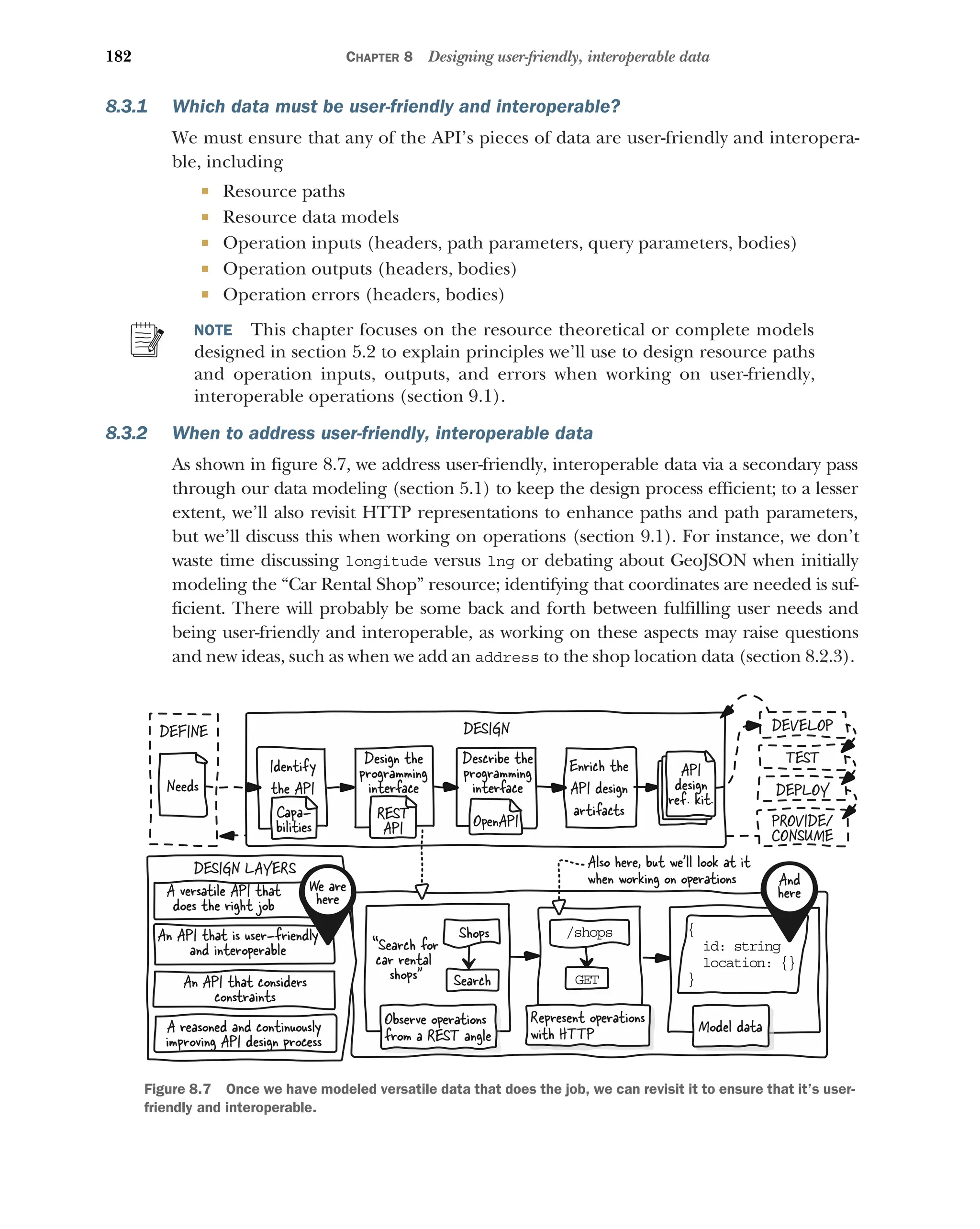
![183
8.4 Selecting and crafting ready-to-use data
NOTE The initial data modeling will require less and less rework to become
user-friendly and interoperable, thanks to experience and the help of API
design guidelines we’ll craft to facilitate our work (section 16.3).
8.3.3 How to design user-friendly, interoperable data
As summarized in figure 8.8, to design user-friendly, interoperable data, we ensure
that the selected data is ready to use without thinking or processing by verifying that
we chose the correct data (“Business area reference” versus “Location”) and enhanc-
ing it (the reverse-geocoded address addition). Then we work on types and organiza-
tion to make data easy to interpret and find (the location object). Afterward, we
reconsider data granularity to keep only relevant data (should we include all available
cars in the rental shop resource?). Ultimately, we craft easy-to-understand names that
describe the data appropriately (l versus location versus place). We must always
ensure that we are making consistent design decisions and aim for standardization
(location name and GeoJSON format). The rest of this chapter explores these con-
cerns using a new example: a Banking API.
NOTE This chapter focuses on user-friendly, interoperable data; however,
data modeling must also address meeting user needs (section 5.1), perfor-
mance (section 13.1), security (section 12.1), and implementation constraints
(section 14.1).
8.4 Selecting and crafting ready-to-use data
Our first concern when modeling data is selecting the data that fulfills the identified
needs (section 5.1). But afterward, we must check whether the data is ready to use as
individual pieces and as a whole so that users can use or provide it directly without
{
type: Point,
coordinates: [ 12, 34 ]
} GeoJSON standard
Standardization
NAME TYPE
lo ation
c Lo ation
c
la tLocation
s Lo ation
c
RESOURCE
Car Rental Shop
Car
Consistency
{
location: {
latitude: 12
longitude: 34,
}
}
Type and organization
Location object instead
of separate properties
CONCEPT NAME
l location place
vs. vs.
location
Names
{
..
.
ars: [...]
c
}
Granularity
Embed available
cars in shop?
CAR RENTAL SHOP
Business area ref. vs. Location
Reverse-geocoded address
Ready to use
Figure 8.8 How to design user-friendly, interoperable data](https://image.slidesharecdn.com/lauretarnaud-thedesignofwebapis2025-250821164447-5e92da1d/75/Lauret-Arnaud-The-Design-of-Web-APIs-2025-pdf-221-2048.jpg)
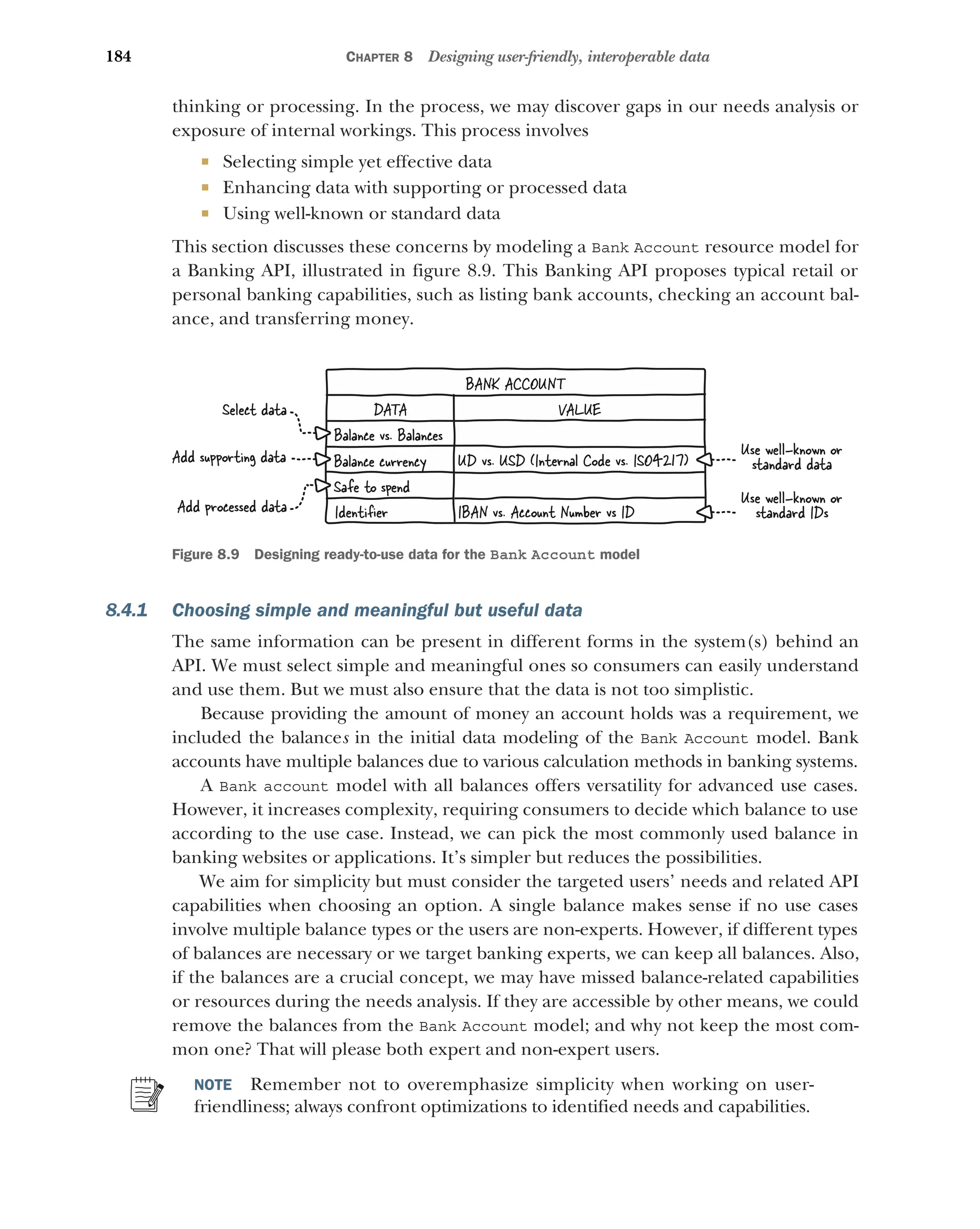
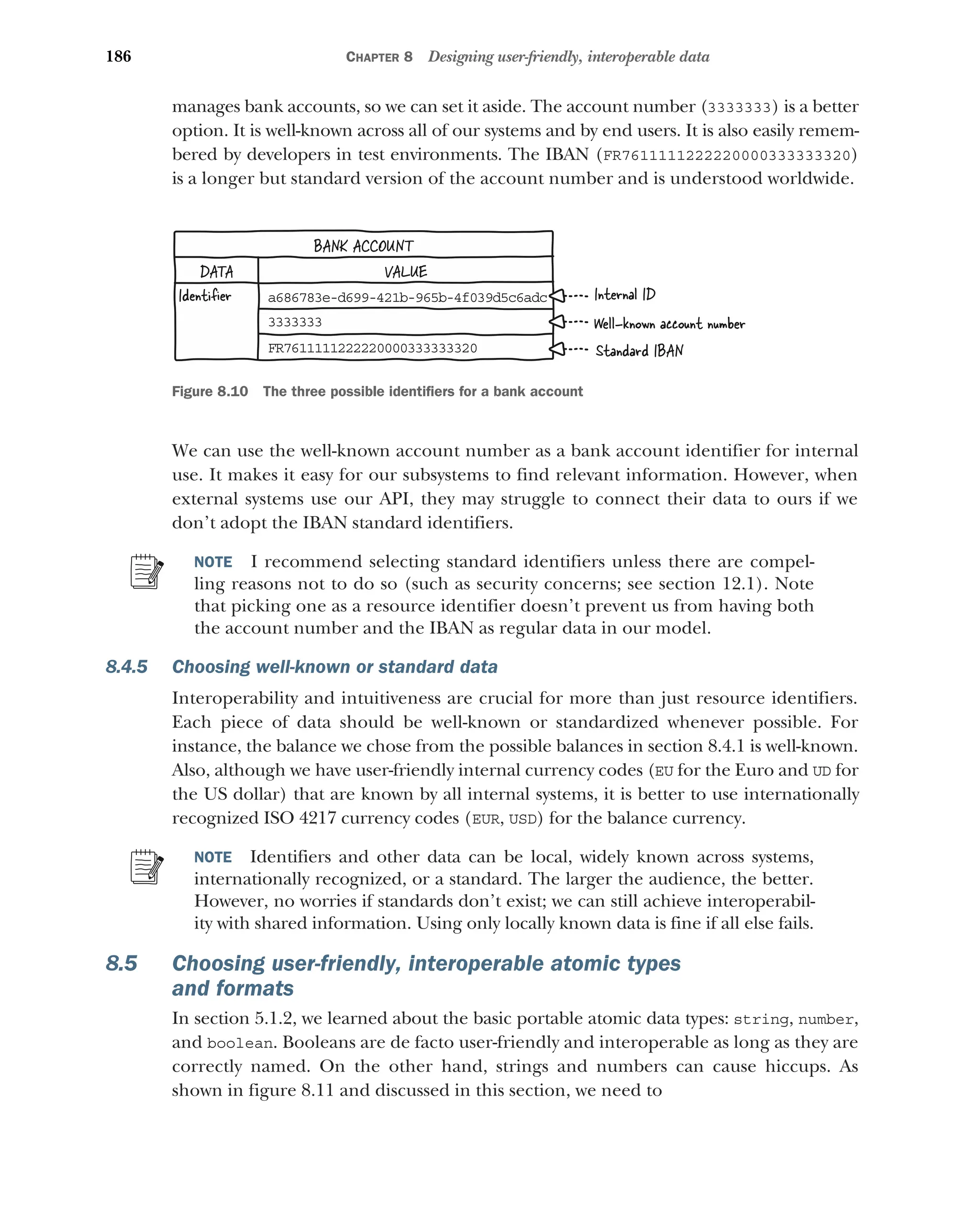
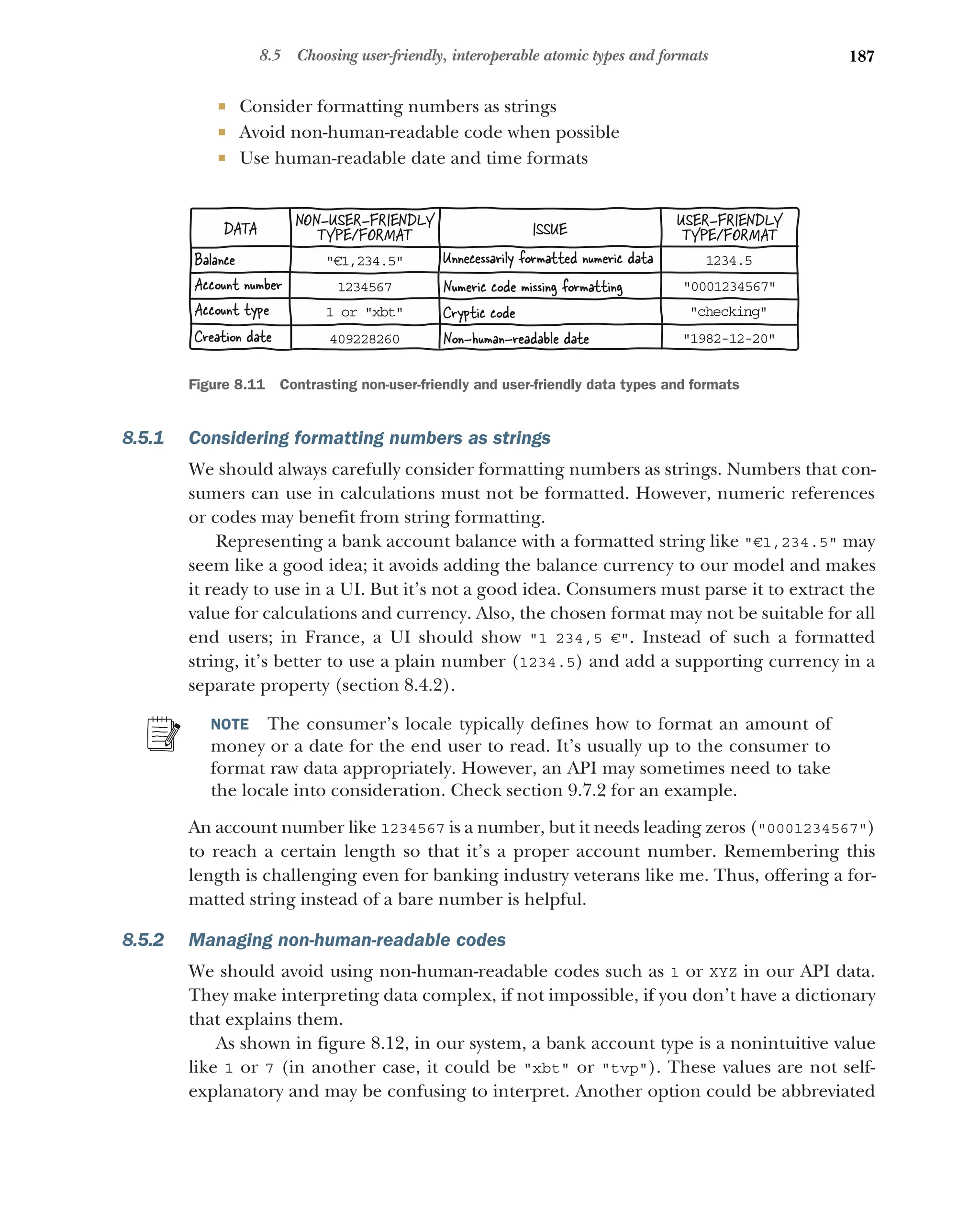
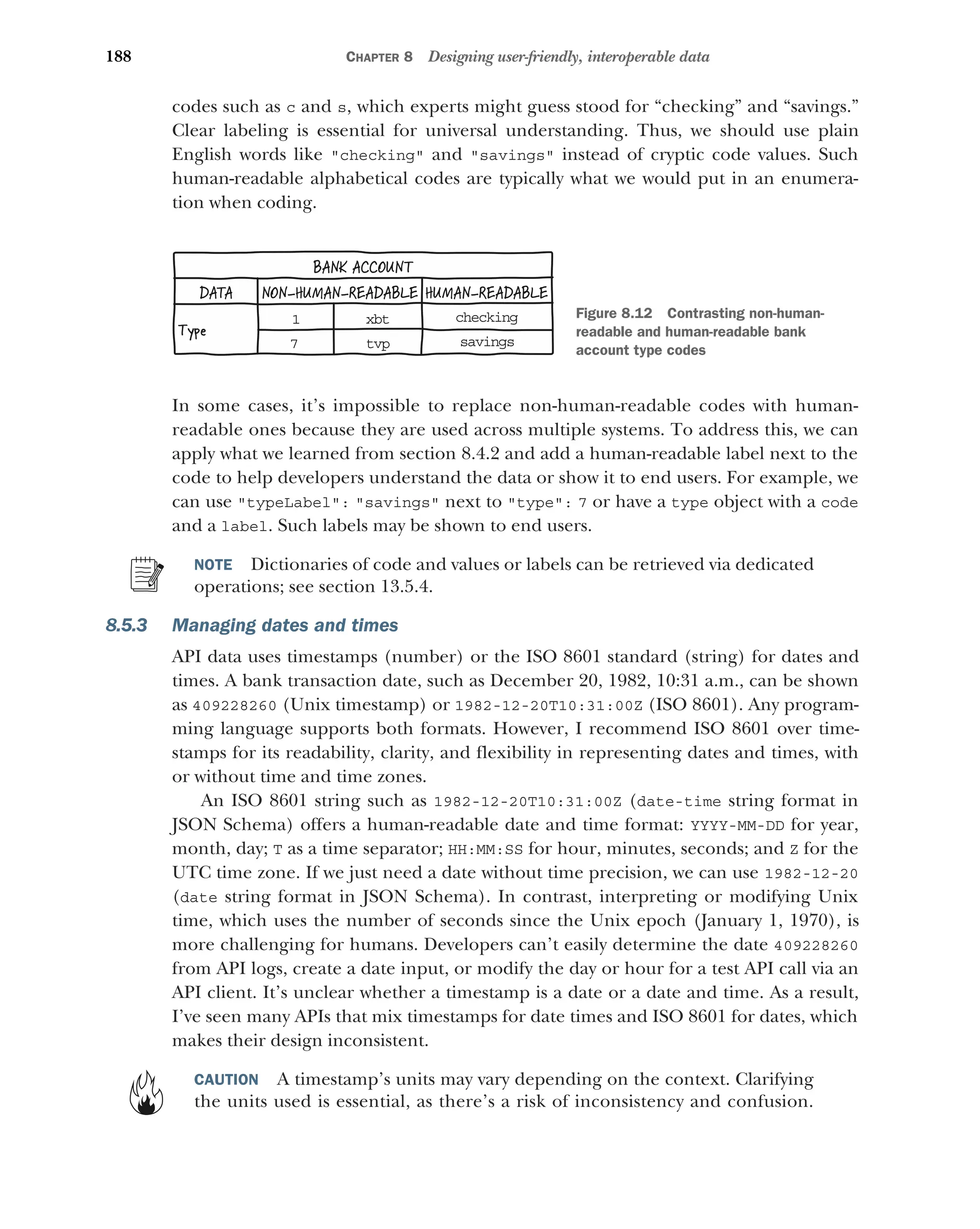
![190 CHAPTER 8 Designing user-friendly, interoperable data
Business concepts can be more generic. The limit, value-date balance, expected
balance, and safe to spend are all amounts in a specific currency indicated by the
balance currency property. It’s easy to connect a currency with the balances based on
their names, but it’s less evident for the other two. To fix this, we can turn each
{
,
overdraft facility: true
date value balance: 2501,
number: 00003333333,
value-date balance date: 2024-01-28
type: checking,
expected balance: 2600,
iban: FR7611111222220000333333320
,
limit: 100
expected balance date: 2024-01-29,
,
balance currency: EUR
name: Mr. and Ms. Forger,
safe to spend: 1800,
creation date: 1982-12-20,
default balance: value-date
}
{
iban: FR7611111222220000333333320,
number: 00003333333,
safe to spend: {
amount: 1800,
currency: EUR
,
}
type: checking,
name: Mr. and Ms. Forger,
balances: [
{
default: true,
type: value-date,
balance: {
amount: 2501,
currency: EUR
},
date: 2024-01-28,
},
{
type: expected,
...
}
]
overdraft facility: {
active: true,
limit: {
amount: 100,
currency, EUR
}
},
creation date: 1982-12-20
}
Grouped, hierarchized, and sorted data
Flat and unorganized data
Important
data is on top
Related data is
grouped
by position
or in objects
Randomly placed
flat data is
hard to find
and use
Similar items
are grouped in
arrays
Figure 8.13 Organized data is easier to understand and use.
{
overdraft facility: true,
..
.
limit: 100,
..
.
}
{
overdraft facility: true,
..
.
overdraft facility limit: 100,
..
.
} {
..
.
overdraft facility: true,
overdraft facility limit: 100,
..
.
}
{
..
.
overdraft facility: {
active: true,
limit: 100
}
..
.
}
Group with
similar names
Group by
position
Group in an
object
Scattered overdraft facility data Organized overdraft facility data
Objects can be opened/closed
in JSON viewer
Figure 8.14 We can group data by name or position or in objects.](https://image.slidesharecdn.com/lauretarnaud-thedesignofwebapis2025-250821164447-5e92da1d/75/Lauret-Arnaud-The-Design-of-Web-APIs-2025-pdf-228-2048.jpg)
![191
8.6 Organizing data
numeric value into an object with amount and currency properties (see figure 8.13).
Doing so allows developers to quickly understand and use each value independently
of top-level data. We can use the same formats in different places, which makes our
data more interoperable.
CAUTION Avoid over-organizing data into unnecessary sub-objects, as this can
complicate interpretation and usability. Each sub-object should represent a
business concept and ideally be reusable. Avoid mapping the UI organization
(section 2.7.1).
8.6.2 Grouping data with arrays
Grouping similar objects into an array can simplify data browsing in code or a
JSON viewer. It also helps materialize sub-business concepts, making them easier to
understand.
As shown in figure 8.15, the Bank Account model has two balances described with
different properties, and the default balance property indicates the default one. We
can organize the balance data into value-date balance and expected balance object,
as we learned in section 8.6.1. We also replace the default-balance string root prop-
erty with a default Boolean flag in the value-date balance. Then, because they are
both balances, we can group them in a balances array and add a type (value-date
or expected). The fact that an account has multiple balances is more explicit and
makes it easier for developers to view them or browse them in code.
TIP Use a values array to replace properties named value1, value2, …,
and valueN, such as replacing line1 to line4 with a lines array in an
Address model.
Group in an
array
Group in objects
{
value-date balance: 2501,
..
.
value-date balance date: 2024-01-28
..
.
expected balance: 2600,
..
.
expected balance date: 2024-01-29,
balance currency: EUR,
..
.
default balance: value-date
}
{
value-date balance: {
default: true,
balance: {
amount: 2501,
currency: EUR
},
date: 2024-01-28,
}
expected balance: {
balance: {
amount: 2600,
currency: EUR
},
date: 2024-01-29,
}
}
{
alances: [
b
{
default: true,
type: value-date
balance: {
amount: 2501,
currency: EUR
},
date: 2024-01-28,
},
{
type: expected
balance: {
amount: 2600,
currency: EUR
},
date: 2024-01-29,
}
]
}
Scattered balances data Organized balances data
Arrays can be
opened/closed
in JSON viewer
Figure 8.15 Different properties representing the same type of data may be grouped into an array.](https://image.slidesharecdn.com/lauretarnaud-thedesignofwebapis2025-250821164447-5e92da1d/75/Lauret-Arnaud-The-Design-of-Web-APIs-2025-pdf-229-2048.jpg)
![193
8.7 Choosing data granularity and scope
spent and meet users’ needs. However, according to our SMEs, creation date is
unnecessary and not helpful in manipulating bank accounts beyond our initial need.
We can simplify the model and reduce distraction by removing it.
8.7.2 Embedding lists in a resource model
When lists are embedded in a data model, we must consider their nature, relationship
with the resource, and potential size, as illustrated in figure 8.17. Large arrays may
necessitate separate resource models and operations for filtering and pagination so
consumers can easily manipulate them (section 9.6).
The balances array (see section 8.4.1) presents no problems because it’s a small set
comprising the current balance of each type, and it doesn’t require filtering and pagi-
nation. We didn’t identify balances as an actual resource, although we could do so
depending on our needs. If we need historical account balance data via a dedicated
operation, we could still keep this specific subset in the Bank Account model, as it’s
only the current balances, and a balance is essential information for an account. How-
ever, we may also reconsider the need for an array of balances and only keep the one
value that makes the most sense based on our needs.
A list of all transactions directly embedded in the Bank Account model is more
questionable. From a practical perspective, there can be thousands of transactions
that require filtering and pagination. We should maintain the transactions separately
{
iban: FR7611111222220000333333320,
number: 00003333333,
safe to spend: {
amount: 1800,
currency: EUR
,
}
type: current,
name: Mr. and Ms. Forger,
creation date: 1982-12-20,
..
.
}
Unnecessary
Essential to meet needs
Essential to represent
a bank account
Bank Account
Figure 8.16 Each piece of data must be relevant.
{
iban: FR7611111222220000333333320,
..
.
balances: [ ... ],
..
.
transactions: [ ... ]
}
Embedded list resource requiring
filtering, sorting, pagination
List with a few elements; essential
information for an account
Bank Account
Figure 8.17 We shouldn’t embed lists requiring filtering or pagination.](https://image.slidesharecdn.com/lauretarnaud-thedesignofwebapis2025-250821164447-5e92da1d/75/Lauret-Arnaud-The-Design-of-Web-APIs-2025-pdf-231-2048.jpg)
![194 CHAPTER 8 Designing user-friendly, interoperable data
and create dedicated operations for ease of use. From a subject matter perspective,
transactions are a standalone concept in banking. We may have missed something
during the needs analysis if they have not been identified as resources. We could con-
sider embedding a subset of the most recent transactions affecting the safe to spend
value; however, such a model would look more like a Safe to Spend Report than a
Bank Account model.
8.7.3 Modeling embedded resources
When embedding another resource (list or individual element) in the model of a
resource, we should choose the appropriate model (ID, summarized, or complete; see
section 5.4) depending on what’s needed and to facilitate using data, as illustrated in
figure 8.18.
CAUTION Providing insufficient information about related resources directly
affects API efficiency and the end-user experience; see section 13.1.
Suppose that account owners and the overdraft facility are identified resources having
their own life, and we need their data in the Bank Account model (owners and over-
draft facility properties). An overdraft facility ID may be enough if we just need to
know that a bank account is linked to an overdraft facility and we don’t need the
details when working on a bank account (thanks to the safe to spend value we added
in section 8.4.3). Owner IDs won’t be enough for owners because we need more infor-
mation for bank advisors, such as owner names; consumers will systematically need to
make additional API calls to read each owner after reading the account. A Summarized
Owner model meets our needs.
NOTE To choose between using just an ID and a more complete model for
embedded resources, evaluate whether consumers must read them systemati-
cally with the resource. If so, they likely form a cohesive whole. Embed at least
a summarized model, or a complete model if more data is needed. If not, the
resources are just related, and an ID is enough. A list of IDs may often be
meaningless; include at least a summary, or consider removing the list.
{
..
.
number: 00003333333,
..,
.
name: Mr. and Ms. Forger,
owners: [
{ id: 12345, ... },
{ id: 56789, ... }
,
]
overdaft facility: {id: OD123, ... }
}
ID, summary, or
complete resource?
Bank Account
Figure 8.18 Adapt embedded resource models to needs, ensuring that consumers
must not systematically read them.](https://image.slidesharecdn.com/lauretarnaud-thedesignofwebapis2025-250821164447-5e92da1d/75/Lauret-Arnaud-The-Design-of-Web-APIs-2025-pdf-232-2048.jpg)
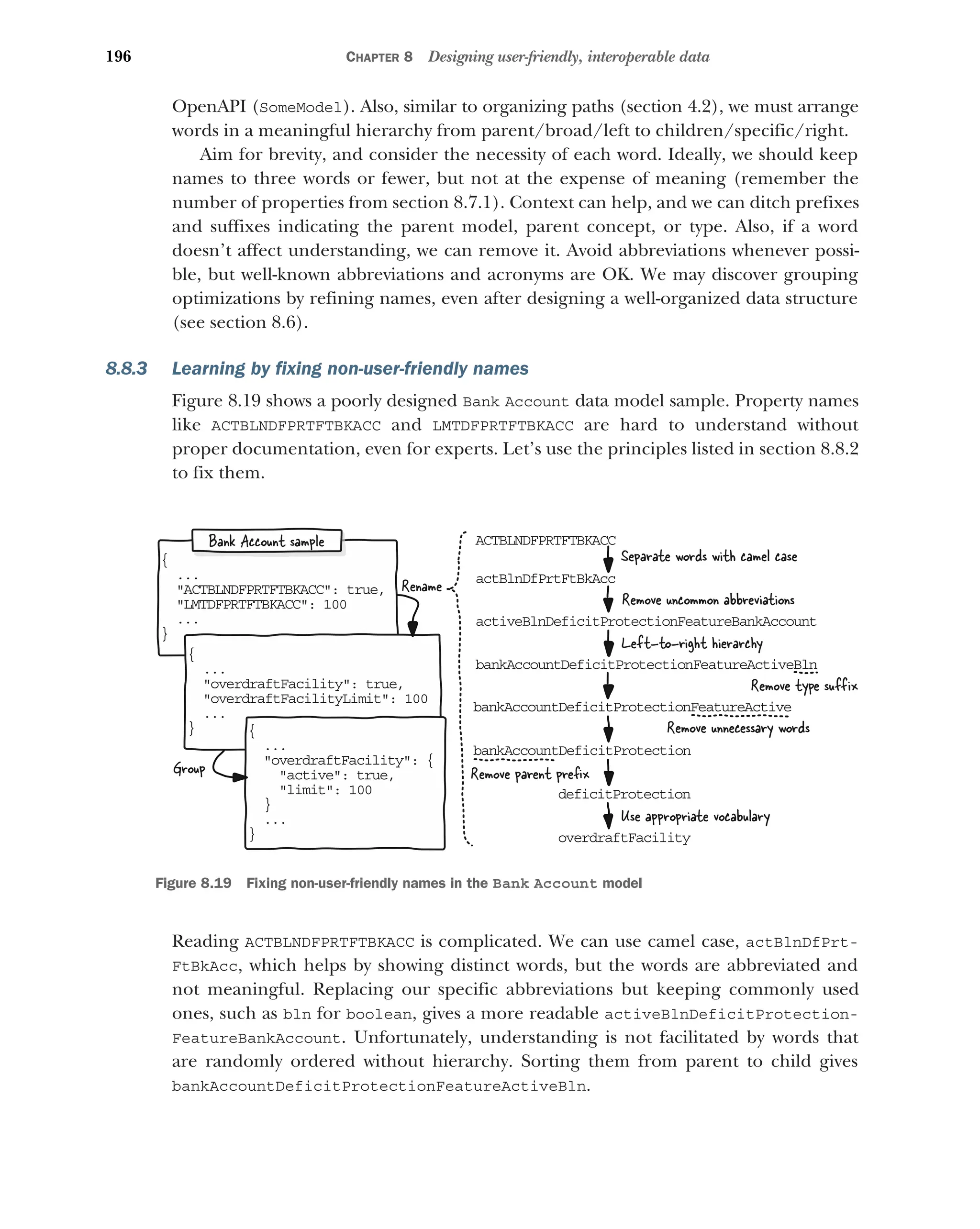
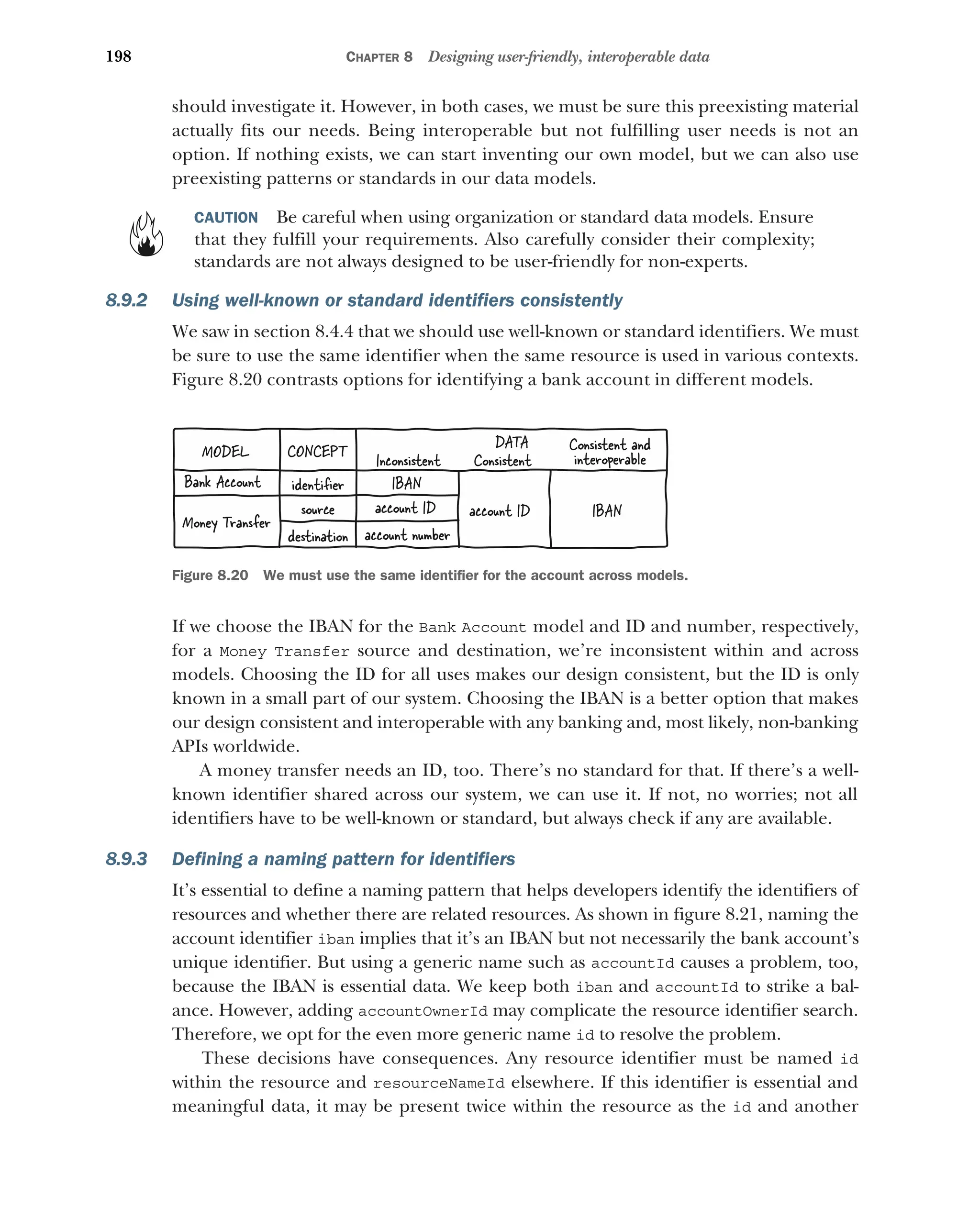
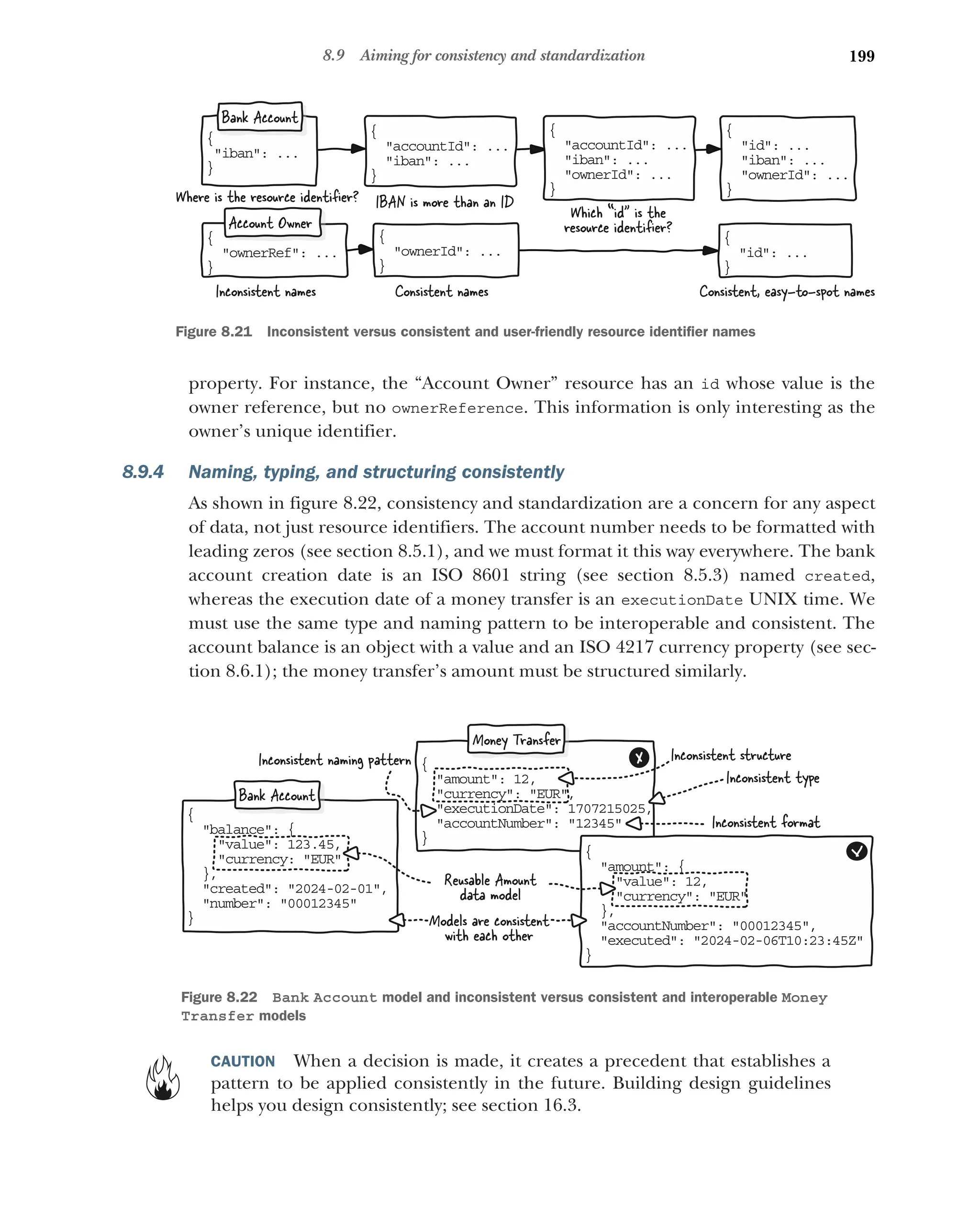
![201
Exercises
Seek consistency and interoperability across a broad range, ideally aligning with
global standards or industry practices, while carefully considering complexity
and ensuring that you meet all requirements. Local-only consistency can also be
sufficient.
Exercises
This section contains exercises to help you practice some key skills in this chapter.
You’ll find the solutions in the online appendix (https:/
/mng.bz/260N). I encourage
you to solve them and read their solutions, which include detailed explanations, refer-
ences to relevant sections, and additional comments.
Exercise 8.1
Listing 8.1 shows partial flight resource data used by a flight comparator. Based on this
chapter’s teachings, how could this data be completed or improved to be user-friendly
and interoperable? Hint: use an actual flight comparator as a virtual SME.
{
...
flight: {
number: AF1234,
departureAirport: 12345,
departureTime: 1733063400,
arrivalAirport: 67890,
endTime: 1733073000,
},
class: 56,
price: {
base: 150,
taxes: 50.00,
discount: 0.1
}
}
Exercise 8.2
Listing 8.2 shows an artist’s complete resource data for an audio streaming service.
Are there any elements that should be removed, and why?
{
id: 12345,
name: Maaya Sakamoto,
bio: Maaya Sakamoto started ...,
genres: [anime, j-pop],
albums : [
{ id: 54, name: Grapefruit, ... }
],
Listing 8.1 Flight data
Listing 8.2 Artist data](https://image.slidesharecdn.com/lauretarnaud-thedesignofwebapis2025-250821164447-5e92da1d/75/Lauret-Arnaud-The-Design-of-Web-APIs-2025-pdf-239-2048.jpg)
![202 CHAPTER 8 Designing user-friendly, interoperable data
tracks: [
{ id: 54, name: Feel Myself, ... }
]
}
Exercise 8.3
Listing 8.3 shows the data for a “Book” resource in an API for a library. List the prob-
lems in naming and organization that make this data non-user-friendly, and fix the
data based on what you learned in this chapter.
{
bookReference: B12345,
title: The Eternal Champion,
authorCode: A123,
name: Michael Moorcock,
published_year: 1970,
authDob: 1939-12-18,
ctry: GBR,
genre: Fantasy
}
Listing 8.3 Book data](https://image.slidesharecdn.com/lauretarnaud-thedesignofwebapis2025-250821164447-5e92da1d/75/Lauret-Arnaud-The-Design-of-Web-APIs-2025-pdf-240-2048.jpg)
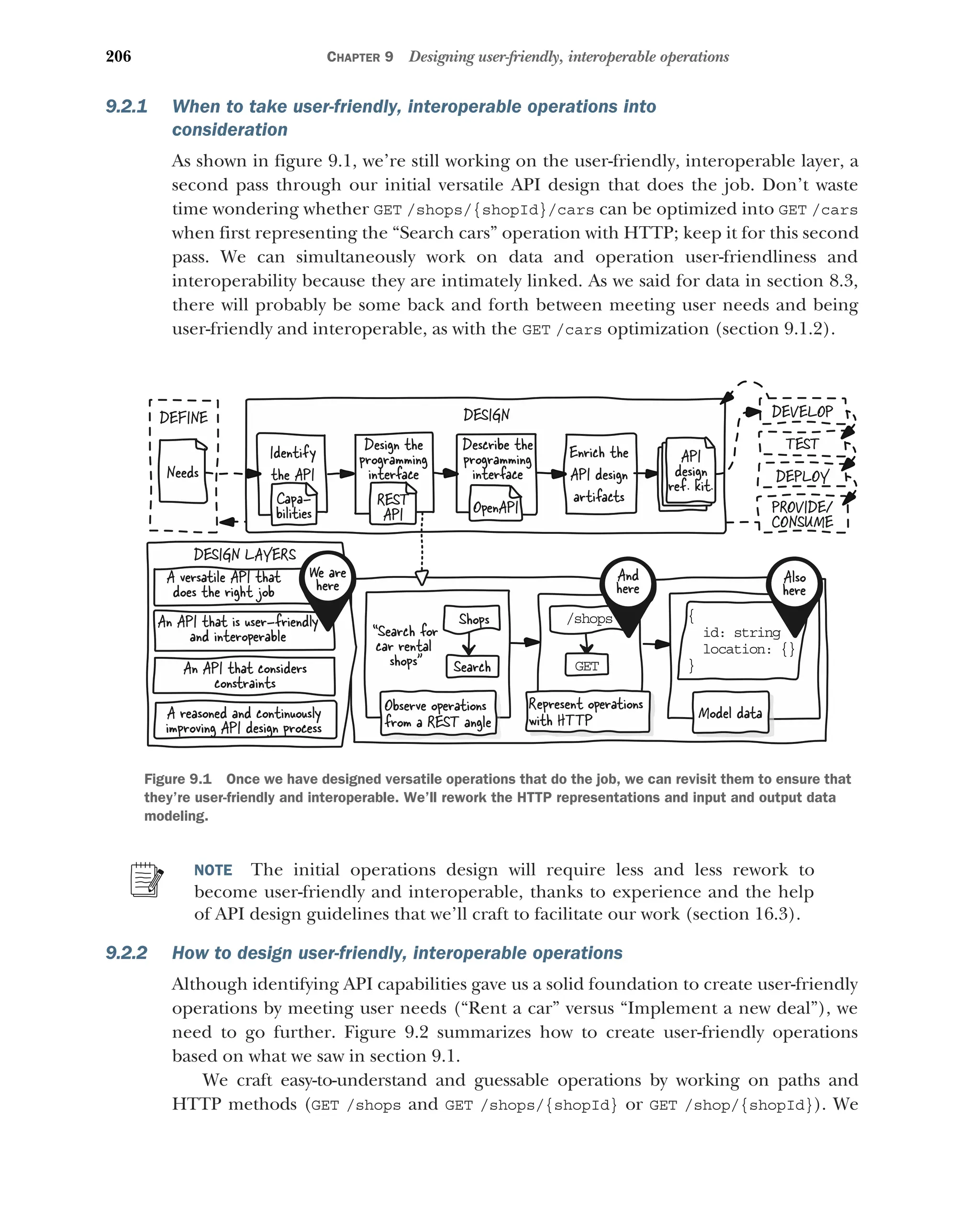
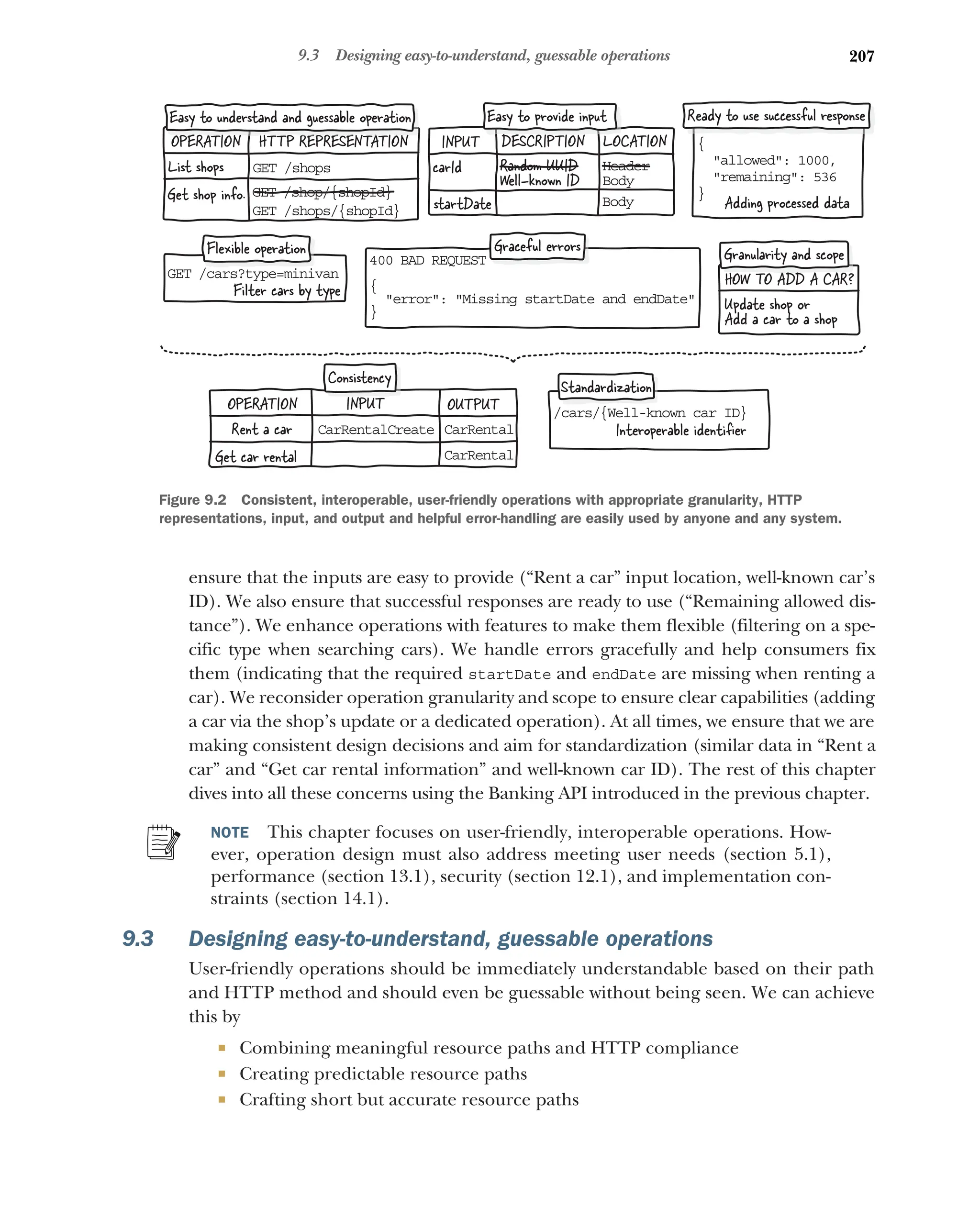
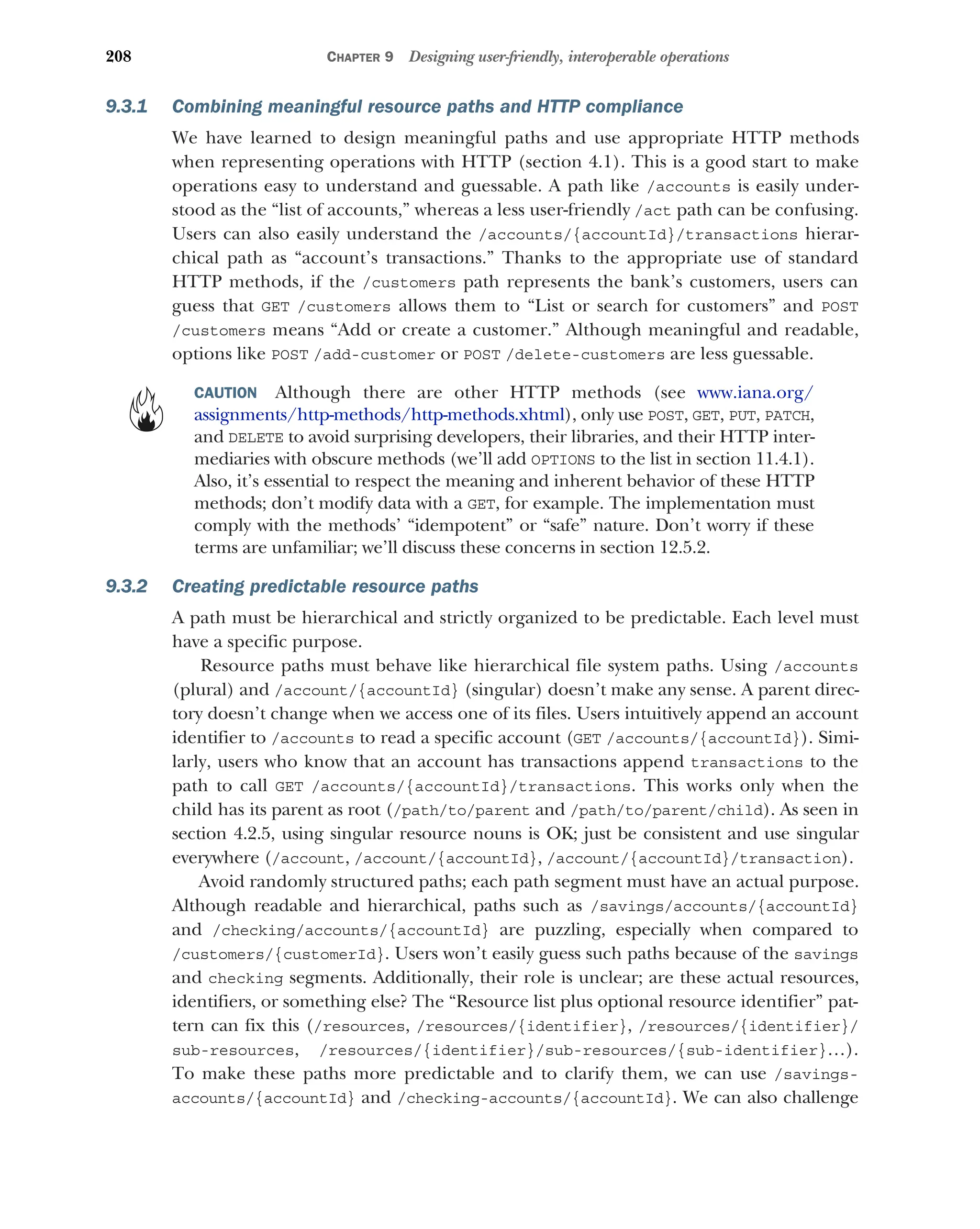
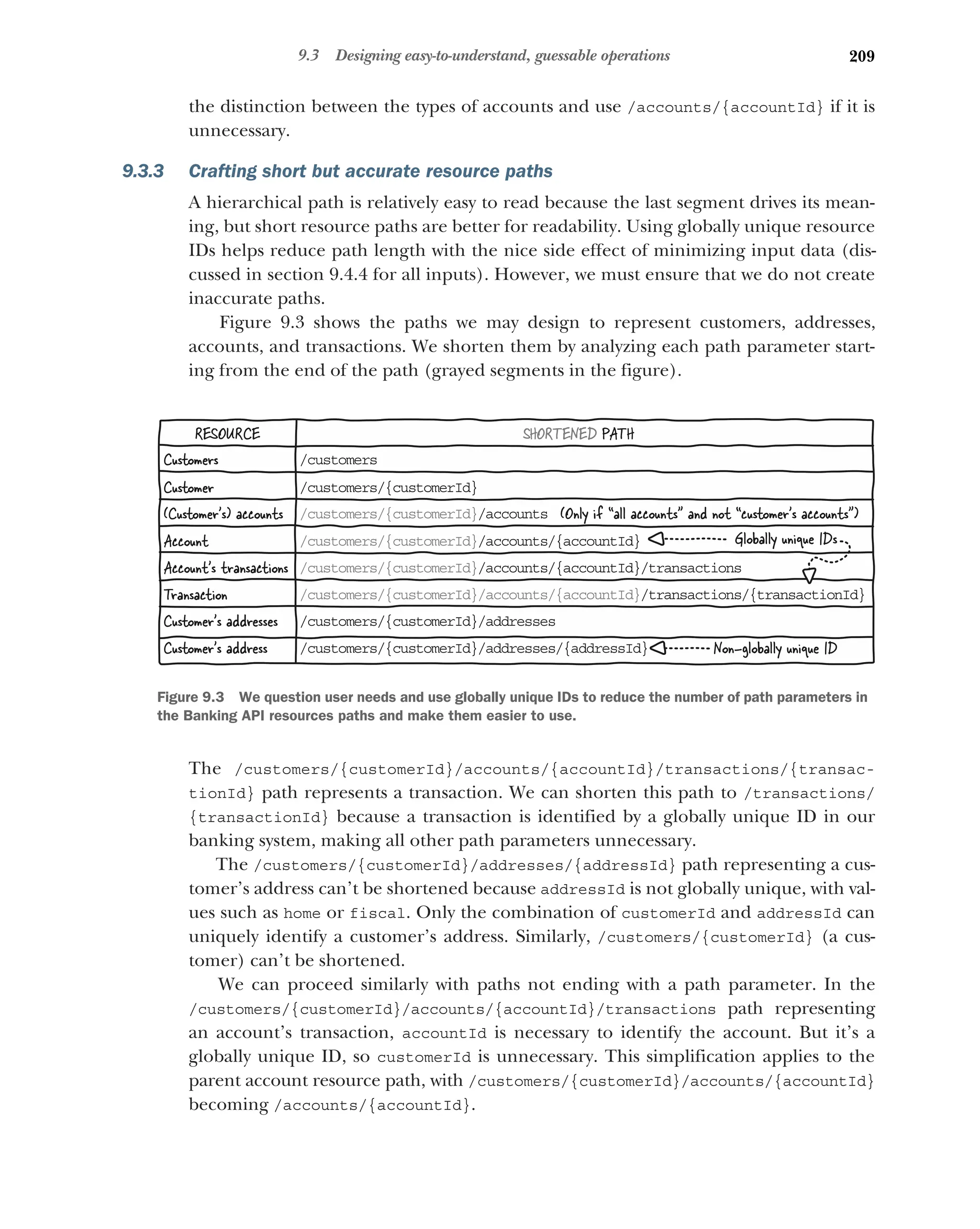
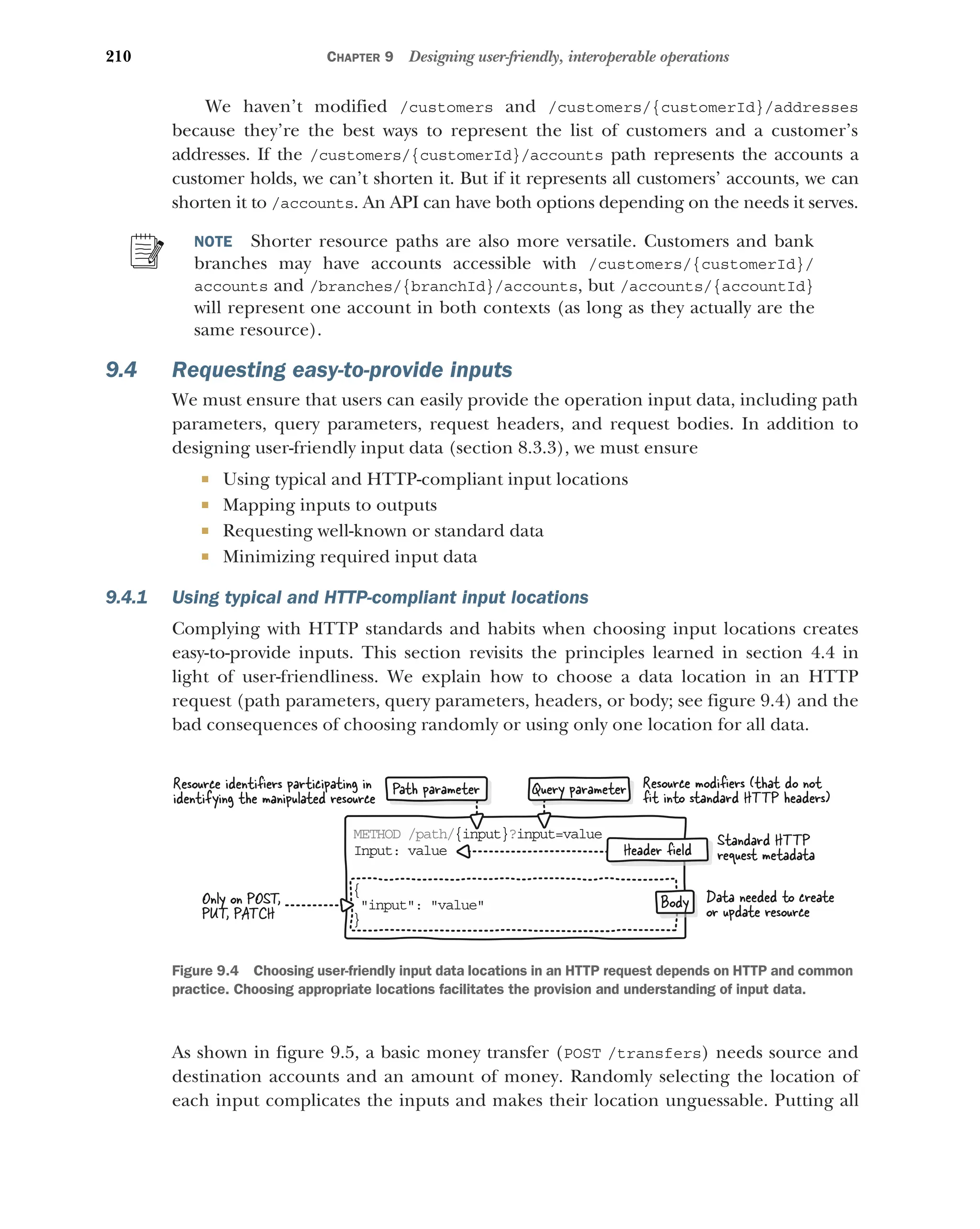
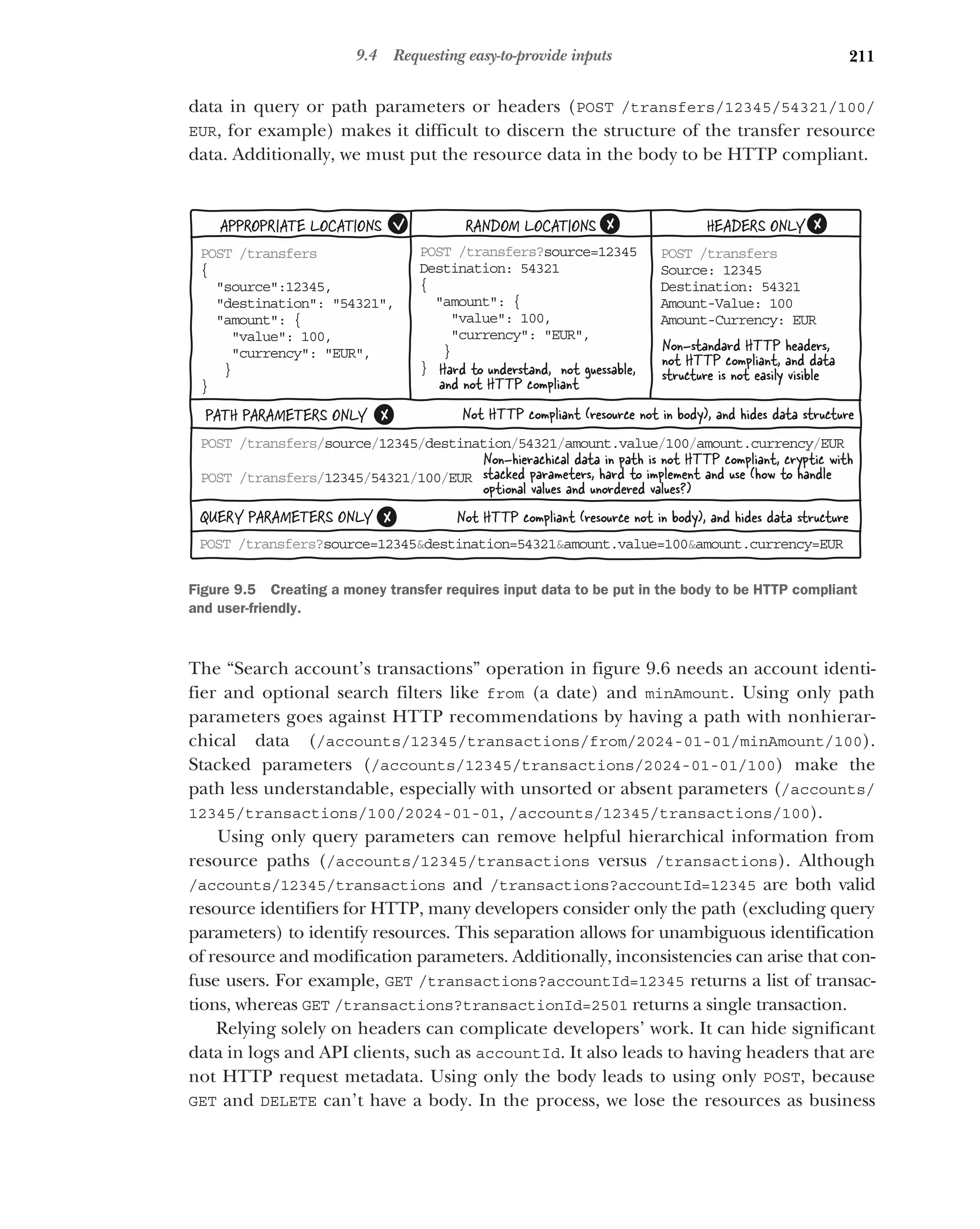
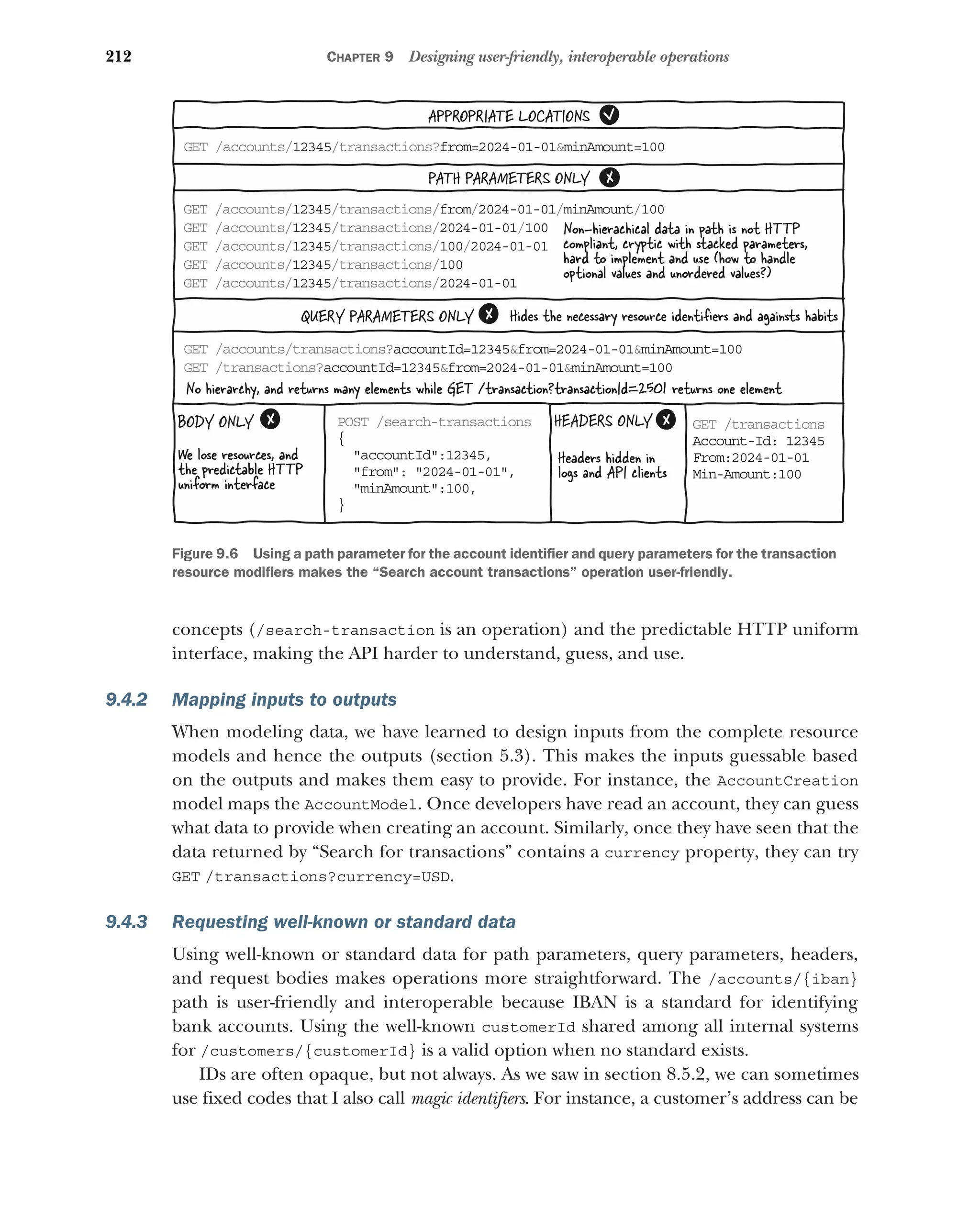
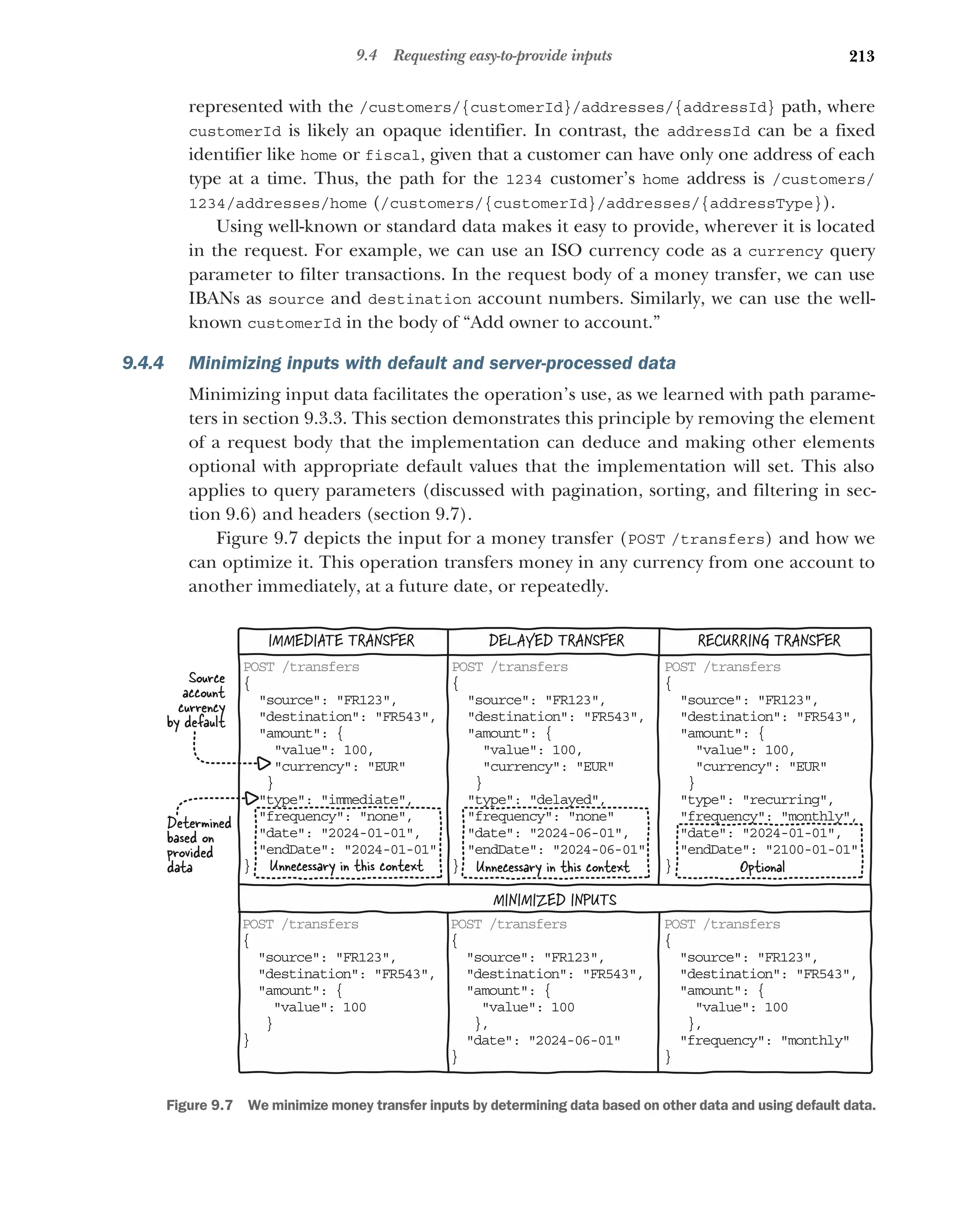
![215
9.5 Returning ready-to-use successful responses
9.5.2 Returning sufficiently informative data
An operation must return sufficiently informative data. This section explains the
principles introduced in section 5.4 regarding using complete, summarized (a subset
of complete), and minimal (resource ID only) data models in light of user-friendliness
concerns.
Don’t hold back on providing helpful data, even if it means returning a lot of
information in lists (see section 13.1 for performance concerns). For instance, it is
better not to use the minimal transaction model when searching an account’s transac-
tions. The transaction ID alone isn’t helpful; developers must read each transaction to
get valuable data. A summarized transaction model comprising id, amount, and date
properties is better but falls short. Developers and end users are interested in addi-
tional information such as the transaction description, origin (shop), and type (bank
card versus transfer). This represents almost all transaction data; using the complete
model in the transactions list makes the most sense (see figure 9.8).
A creation or an update always implies generating or modifying data that the consum-
ing application didn’t send and is most likely interested in. That’s why it is recom-
mended to always return the complete resource rather than the minimal model in
these cases. For instance, when creating a money transfer, the execution date of an
immediate transfer may not be today as expected because it’s a holiday. So, returning
the ID is not enough; returning the complete money transfer model is better.
CAUTION Be careful not to return completely heterogeneous data including,
for instance, all the account and owner information in a transaction when
searching for transactions; it’s not the purpose of the operation. See also sec-
tion 9.9.
[
{
id: 123
},
{
id: 456
}
]
[
{
id: 123,
amount: 100,
date: 2024-04-06,
description: ...,
origin: ...,
type: ...,
..
.
},
. .
.
]
[
{
id: 123,
amount: 100,
date: 2024-04-06
},
{
id: 456,
amount: 50,
date: 2024-04-05
}
]
MINIMAL MODEL COMPLETE MODEL
SUMMARIZED MODEL
GET /transactions/{id})
for each transaction
Missing important data Everything developers need
No interesting data
Figure 9.8 We should return the complete transaction model when listing an account’s transactions so
developers have everything they need and don’t have to call “Read transaction” for each transaction.](https://image.slidesharecdn.com/lauretarnaud-thedesignofwebapis2025-250821164447-5e92da1d/75/Lauret-Arnaud-The-Design-of-Web-APIs-2025-pdf-253-2048.jpg)
![216 CHAPTER 9 Designing user-friendly, interoperable operations
9.6 Filtering, sorting, and paginating lists
List and search operations require filtering, sorting, and pagination features, as illus-
trated in figure 9.9, to be flexible and allow consumers to access necessary data easily.
For instance, bank accounts may have many transactions, but consumers often need
specific ones, like the first 10 from March 6, 2024, at a restaurant or bar, with amounts
between 100 and 400 (excluded), sorted from largest to smallest. If GET /account/
{accountId}/transactions returns all transactions, it complicates obtaining these
specific ones.
NOTE Filters and pagination reduce data volume, enhancing API efficiency;
see section 13.1. This section covers filtering, sorting, and pagination with
selected design options. However, many more exist; see section 16.2 for
choosing design solutions adapted to your context.
9.6.1 Designing guessable filters that map returned data
Adding search parameters or filters to a list operation allows consumers to find the
subset of elements matching specific criteria and get the needed data. Filters must
map the returned data so developers can easily understand, guess, and provide it.
We must name and type search parameters accordingly with filtered element data.
For example, suppose a transaction has date, category, and amount properties. To
retrieve transactions from March 6, 2024, in a restaurant, with an amount equal to 100, a
consumer can call GET /accounts/12345/transactions?date=2024-03-06category=
restaurantamount=100. The query parameter names and types are similar to the
transaction data. If the amount property is an object with a value and currency, we
can use a fully qualified name such as amount.value or amountValue. I prefer the dot-
ted notation as it clearly maps the data structure and is similar to code.
Avoid filtering on data that is not returned. It is inconvenient to look for transac-
tions with bar or restaurant categories without knowing which category has a returned
[
{ id: 1, v: B},
{ id: 2, v: W},
{ id: 3, v: C},
{ id: 4, v: X},
{ id: 5, v: Y},
{ id: 6, v: E},
{ id: 7, v: D},
{ id: 8, v: A}
]
[
{ id: 1, v: B},
{ id: 3, v: C},
{ id: 6, v: E},
{ id: 7, v: D},
{ id: 8, v: A}
]
{ id: 8, v: A},
{ id: 1, v: B},
{ id: 3, v: C},
{ id: 7, v: D},
{ id: 6, v: E},
]
{ id: 8, v: A},
{ id: 1, v: B},
{ id: 3, v: C}
]
Filter Paginate
[
{ id: 7, v: D},
{ id: 6, v: E},
]
Sort
Elements matching criteria
(v between A and E)
Sorted elements
(sorted against v)
Page 1
Ranges of elements
(page size 3)
All elements
Page 2
[ [
Figure 9.9 Enabling filtering, sorting, and paginating lists is essential to allow consumers to get only the
elements they want, sorted as needed.](https://image.slidesharecdn.com/lauretarnaud-thedesignofwebapis2025-250821164447-5e92da1d/75/Lauret-Arnaud-The-Design-of-Web-APIs-2025-pdf-254-2048.jpg)
![217
9.6 Filtering, sorting, and paginating lists
transaction. Also, developers won’t be able to guess whether the category filter exists
based on returned data if there is no category property.
NOTE As we learned in section 5.3.2, designing filters based on output data
ensures consistency between input and output. Filters will also inherit the
user-friendly, interoperable features of output data.
9.6.2 Designing flexible filters
To enable consumers to retrieve the necessary data, we shouldn’t just filter by specific
values; we can use enumerations, ranges, or fuzzy values. The category filter can
become an enumeration to filter transactions in restaurants and bars. As seen in sec-
tion 7.6.2, it can be represented as category=restaurant,bar or category=restau-
rantcategory=bar.
We can filter on amount or date ranges. For example, amount.gte=100amount
.lt=400 or amount=gte:100amount=lt:400 filters on amounts greater than or equal
(gte) to 100 and less than (lt) 400 (100 ≤ amount 400). Instead of using gt, gte, lt,
and lte, ranges can be represented with prefixes or suffixes such as from and to or
min and max (minAmount and maxAmount or fromDate and toDate). However, they
don’t clearly state whether the comparison is strict: do from or min mean or ≥?
Filters can accept less strict values. For example, accepting a shorter date value,
such as fromDate=2024-03 or date=2024, simplifies month and year range inputs. If
the request has a description=good filter, the implementation can look for transac-
tions with a description that includes the “good” string, not just this exact value. We
can also accept regex filters: description=^good|nice looks for transactions whose
description starts with “good” or “nice.”
9.6.3 Enabling free search and complex logic with a q filter
We can use a q parameter to enable complex logic or free textual search covering dif-
ferent properties. For example, GET /account/12345/transactions?q=nice restaurant
last week returns transactions based on their date, category, and description. We
can also use an engine- or database-like query, which gives us more possibilities for
logical conditions. I recommend not inventing a syntax but using an existing one like
that used by Lucene, which is an open source search engine: for example, GET
/account/12345/transactions?q=date:2024-03-06 AND (category:restaurant
OR category:bar) AND amount:{100 TO 400]. The sample q values are not URL
encoded for readability, but consumers will need to URL encode them in their
requests (nice%20restaurant%20last%20week, for example).
NOTE Not all consumers may need that complexity. Simple query parameters
and q options can be proposed to satisfy all consumers. Additionally, the q
parameter can be combined with other filters. Implementing such q filters
may not be evident; check with the implementation developers.](https://image.slidesharecdn.com/lauretarnaud-thedesignofwebapis2025-250821164447-5e92da1d/75/Lauret-Arnaud-The-Design-of-Web-APIs-2025-pdf-255-2048.jpg)
![219
9.6 Filtering, sorting, and paginating lists
NOTE Pagination is mainly related to performance concerns. Section 13.6
discusses optimizing page size and explains cursors and when to use index- or
cursor-based pagination.
Using standards is generally a good idea, but not always. We could use the Range HTTP
header for pagination, but it’s best not to. HTTP intermediaries may strip this header if
it’s used for a purpose other than retrieving chunks of binary data. Having pagination
parameters separate from the filter and sort parameters complicates inputs. Ultimately,
we should stay within the common practice: nobody uses Range for pagination.
Keep pagination parameters optional, and choose helpful default values to facili-
tate the operation’s use. A month of transactions provides data that’s useful for many
use cases, and an average bank account has around 40 transactions per month, so we
decided that GET /accounts/12345/transactions returns the first 40 transactions.
NOTE Filter, sort, and pagination parameters are query parameters because
they are resource modifiers (section 4.4.5); this is also common practice.
9.6.7 Returning filter, sort, and pagination metadata
As we learned in section 9.5.2, we should return informative filter, sort, and pagina-
tion data; in particular, it can help consumers know which default values are used.
This is not actual subject-matter data but metadata related to the list, so as we learned
in section 8.6, we must reorganize response data to make a clear separation.
As shown in figure 9.10, the response of the “List account transactions” operation
is no longer an array of transactions but an object with data and metadata properties.
GET /accounts/12345/transactions?
amount=gte:100
amount=lt:400
date=2024-03-06
categories=restaurant,bar
200 OK
{
data: [ ... ],
metadata: {
pagination: {
page: 1,
size: 40,
last: 10,
elements: 398
},
sort: [
{ name: date, direction: desc }
],
filters: [
{ name: amount,
range: {min: 100, exclusiveMax: 400} },
{ name: date,
value: 2024-03-06 },
{ name: categories,
enum: [restaurant, bar] }
]
}
}
The transactions
List metadata
Default pagination
Enhanced pagination data
Default sort
Used filters
Figure 9.10 The pagination, sort, and filter metadata lets consumers know exactly what they will get
(especially when default parameter values are used) and whether other elements are available.](https://image.slidesharecdn.com/lauretarnaud-thedesignofwebapis2025-250821164447-5e92da1d/75/Lauret-Arnaud-The-Design-of-Web-APIs-2025-pdf-257-2048.jpg)
![220 CHAPTER 9 Designing user-friendly, interoperable operations
Section 9.10.1 discusses the choice of the name data. The metadata object proposes a
clear organization with pagination, sort, and filters properties.
If a parameter is not provided, metadata indicates the default value used. For
instance, if no sort or pagination parameters are provided, the operation returns the
first 40 transactions in reverse chronological order. This is indicated in metadata’s
pagination and sort properties. We also enhance the pagination metadata with the
last page index and the total number of transactions (elements) to facilitate working
with the list.
NOTE We decided to always return a successful status when data is found
(section 3.4.5); this makes search operations user-friendly and is discussed in
section 9.8.1.
9.7 Adapting request and response data
Another way to make operations flexible is to adapt data to consumers’ needs. We can
return or accept different data formats, adapt to the consumer locale, or tweak
returned data.
9.7.1 Handling different data formats
Thanks to content negotiation, HTTP supports various data formats, not just JSON, in
requests and responses, which can simplify consumers’ work. Many end users analyze
transactions in a spreadsheet, where importing comma-separated values (CSV) data is
easier than JSON. Figure 9.11 shows that GET /account/{accountId}/transactions
returns data in CSV format if the consumer sends an Accept HTTP header with the
text/csv media type (see section 6.6.2). Check the IANA media types list for other
standard media types (www.iana.org/assignments/media-types/media-types.xml). The
GET /accounts/12345/transactions
Accept: application/json
GET /accounts/12345/transactions
Accept: text/csv
200 OK
Content-Type: application/json
{
metadata: { ... }
data: [
{ id: 1,
amount: {
value: 100,
currency: EUR } },
{ id: 2,
amount: {
value: 200,
currency: USD } }
]
}
200 OK
Content-Type: text/csv
id,amount.value,amount.currency
1,100,EUR
2,200,USD
Same /accounts/12345/transactions resource
but different representations/data formats
Indicates
expected
response
format
JSON
CSV (comma-separated values)
Indicates
response
format
No metadata
Default format if Accept is not indicated
Figure 9.11 Content negotiation allows consumers to request an account’s transactions in different formats
by sending a standard Accept header.](https://image.slidesharecdn.com/lauretarnaud-thedesignofwebapis2025-250821164447-5e92da1d/75/Lauret-Arnaud-The-Design-of-Web-APIs-2025-pdf-258-2048.jpg)
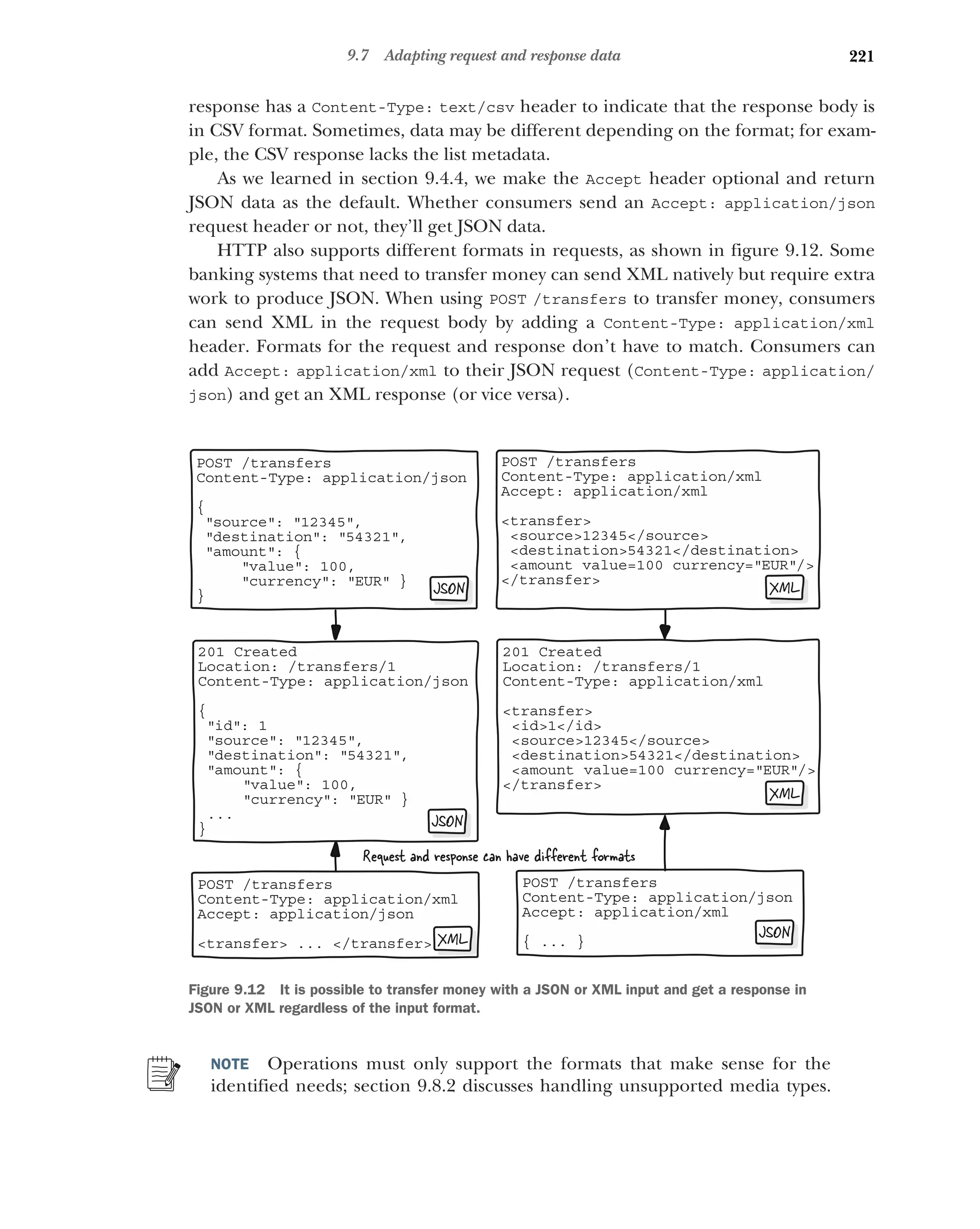
![225
9.8 Handling consumer errors gracefully
{customerId}/addresses/{addressId}. To facilitate understanding, we can use
Accept-Language, as in section 9.7.2, to return the error message in a language that
developers or end users can understand.
9.8.4 Returning machine-readable feedback
A message string may not always help determine the origin of the error, or consumers
may need machine-readable information (to show errors to end users in the UI, for
instance). As shown in figure 9.13, we can add the source and type of errors and
optional values (if any). The source property indicates the location of the problem
(header, path, query, or body), the element’s name, and an optional JSON pointer
indicating a location in the request body (as used in OpenAPI; see section 7.7.1). The
type is a human-readable, generic error code; we don’t want to overwhelm consumers
with hundreds of specific, cryptic numeric codes. For instance, INVALID_FORMAT can
be used if the body is in an unexpected media type or a date property doesn’t have a
proper ISO 8601 date format.
9.8.5 Returning an exhaustive list of errors
User-friendly feedback is exhaustive and lists all errors. If a consumer sends a POST
/transfers request with a missing destination account and an amount greater than
the account balance, the operation can return an error message indicating the first
POST /transfers
Content-Type: text/csv
source,destination,value,currency
12345,54321,100,JPY
415 Unsupported Media Type
Accept: application/json,application/xml
Content-Type: application/json
{
message: text/CSV is not supported,
use application/json or application/xml.
source: {
location: header,
name: Content-Type
},
type: INVALID_FORMAT,
values: [
application/json,
application/xml
]
}
400 Bad Request
Content-Type: application/json
{
message: Unsupported JPY currency,
the amount currency must be EUR or USD,
source: {
location: body,
name: currency,
pointer: #/amount/currency
},
type: INVALID_VALUE,
values: [EUR, USD]
}
POST /transfers
Content-Type: application/json
{
source: 12345,
destination: 54321,
amount: {
value: 100,
currency: JPY }
}
JSON pointer
Generic human-readable code
Figure 9.13 Money transfer machine-readable errors returned when an unsupported data format or
currency is sent make it easy to show errors in the UI.](https://image.slidesharecdn.com/lauretarnaud-thedesignofwebapis2025-250821164447-5e92da1d/75/Lauret-Arnaud-The-Design-of-Web-APIs-2025-pdf-263-2048.jpg)
![226 CHAPTER 9 Designing user-friendly, interoperable operations
problem (“Required destination account is missing”). The consumer fixes it, tries
again, and gets the second error (“Insufficient balance”). Imagine such behavior in a
mobile application or on a website; it’s an irritating experience. As shown in figure 9.14,
the operation must return an exhaustive list of errors indicating the two problems to
provide developers and end users with the best experience. To limit back-and-forth,
the implementation should ideally perform all possible controls on the possibly
imperfect provided data in one shot, including basic schema control (missing destina-
tion account, for example) and business rules (insufficient balance).
9.8.6 Using standards
We can use internal, industry, or general standards to create easy-to-use, interopera-
ble error feedback. This section briefly examines the “Problem Details for HTTP
APIs” standard; check its documentation for more details (www.rfc-editor.org/rfc/
rfc9457.html).
The Internet Engineering Task Force (IETF) defined the “Problem Details for
HTTP APIs” standard to “avoid the need to define new error response formats for
HTTP APIs.” The format can be extended with custom properties. Figure 9.15 shows
an example based on previous sections.
The Content-Type is application/problem+json instead of the generic
application/json. It lets consumers know precisely which error format they use
(application/problem+xml exists, too).
The status is the returned HTTP status. The type identifies the problem type; if
its value is a URL, it may be called to get more information about the problem (in the
form of an HTML page). The title is a human-readable description of the problem
type; it’s the same in all occurrences. The detail is a human-readable description of
the problem. Both the title and detail may be translated. All these properties are
defined by the format.
The errors list is a custom property, almost the same as defined in previous sec-
tions. In each error, we rename the message property to detail to be consistent with
40 Bad Request
0
Co tent-Type: application/json
n
{
er ors
r : [
{ me sage
s : Destination account is missing
... },
{ me sage
s : Insufficient balance,
... }
]
}
POST /transfers
Content-Type: application/json
{
source: 12345,
amount: {
value: 100000,
currency: USD }
}
Exhaustive list of errors
Business rule check Schema check
Figure 9.14 The “Money transfer” operation performs all possible checks and returns an exhaustive list
of errors, which avoids annoying back-and-forth.](https://image.slidesharecdn.com/lauretarnaud-thedesignofwebapis2025-250821164447-5e92da1d/75/Lauret-Arnaud-The-Design-of-Web-APIs-2025-pdf-264-2048.jpg)
![227
9.9 Avoiding hiding multiple capabilities in a single operation
the format. Similarly, we replace the type value with a URL. We also add a generic
human-readable title describing the type.
9.9 Avoiding hiding multiple capabilities in a single
operation
Our work on API capability identification (section 2.1) should limit risks, but we
should be cautious about creating do-it-all operations that hide capabilities from
developers. This section discusses
Ensuring that request and response data has appropriate granularity
Ensuring that operations have a clear purpose
9.9.1 Reconsidering request and response data granularity
We can investigate request and response data granularity, as we learned in section 8.7,
to ensure that an operation has appropriate granularity. We can challenge a GET
/accounts/{accountId} (“Read” account) whose response includes transactions
that need to be filtered, sorted, and paginated; a dedicated “Search” account’s trans-
actions would be better to make the capability more visible. But a more specific “Get
42 Unprocessable Content
2
Co tent-Type: application/problem+json
n
{
tatus: 422,
s
ype: https://api.bank.com/validation-error,
t
itle: The request is not valid,
t
detail: Missing source account and unsupported amount currency,
rrors: [
e
{
type: https://api.bank.com/validation-error/required,
title: Missing required property,
detail: Destination account is missing,
source: {
location: body,
name: destination,
pointer: #/destination
}
},
{
type: https://api.bank.com/validation-error/invalid-value,
title: Invalid value,
detail: Unsupported JPY currency, the amount currency must be EUR or USD
source: {
location: body,
name: currency,
pointer: #/amount/currency
},
values: [EUR, USD]
}
]
}
HTTP status code
The media type indicates it’s a “Problem
Details for HTTP APIs” in JSON format
Problem type (may lead to
HTML documentation)
Human-readable
description
of type
Human-readable
description of the
problem
(former “message”)
Custom
properties
copying the
standard
Defined
by the
standard
Custom
property
Figure 9.15 An error response for the “Money transfer” operation using and customizing the “Problem
Details for HTTP APIs” standard](https://image.slidesharecdn.com/lauretarnaud-thedesignofwebapis2025-250821164447-5e92da1d/75/Lauret-Arnaud-The-Design-of-Web-APIs-2025-pdf-265-2048.jpg)
![232 CHAPTER 9 Designing user-friendly, interoperable operations
schema control (a missing destination account, for example) and business rules
(such as an insufficient balance).
Use standard error data, such as “Problem Details for HTTP APIs.”
Ensure that each operation has appropriate granularity and doesn’t hide
another capability. Check the granularity of the input and output. Also check
how the operation is used.
Input and output data, features, and behaviors must be consistent within and
across operations.
Exercises
This section contains exercises to help you practice some key skills in this chapter.
You’ll find the solutions in the online appendix (https:/
/mng.bz/260N). I encourage
you to solve them and read their solutions, which include detailed explanations, refer-
ences to relevant sections, and additional comments.
Exercise 9.1
A fitness tracker API allows consumers to search a user’s exercises. Listing 9.1 shows a
request for walking exercises for user 5678 between December 20 and 23, 2024. The
user ID and dates are required, and the exercise type is optional. Listing 9.2 displays
the response to this request. Discuss why and how this operation could be made more
user-friendly and interoperable.
POST /fitness/tracking/summary/exercises?user=5678
{
exerciseType: walking,
fromStartDate: 2024-12-20,
endDate: 2024-12-23
}
200 OK
[
{
id: 123,
type: walking,
startTime: 1734699900
end: 1734702300,
duration: 45 minutes,
distance: 3.5 kilometers
}
]
Listing 9.1 Search exercises request
Listing 9.2 Search exercises response](https://image.slidesharecdn.com/lauretarnaud-thedesignofwebapis2025-250821164447-5e92da1d/75/Lauret-Arnaud-The-Design-of-Web-APIs-2025-pdf-270-2048.jpg)
![233
Exercises
Exercise 9.2
An API proposes the following operations to get information about available player
classes and magic spells in various tabletop role-playing games, such as Dungeons and
Dragons or Warhammer. How could you improve these operations?
GET /games/{name}/classes.json
GET /games/{name}/classes.xml
GET /games/{name}/classes.csv
GET /games/{name}/spells?format={format} (format is required and can be
json, xml, or csv)
Exercise 9.3
Listing 9.3 illustrates how to reschedule an event with an event management API.
What’s the problem with this operation?
PATCH /events/12345
{
date: 2024-12-26,
reason: Venue conflict
}
Exercise 9.4
Listing 9.4 shows an invalid sample request to add a user with an IAM (Identity and
Access Management) API. Listing 9.5 shows the response to this request; why must
this response be fixed, and how?
POST /users
Content-Type: application/json
{
username: curtisnewton,
email: curtis.newton@captainfuture.com,
firstName: Curtis,
lastNam: Newton,
permissions: [
{
group: futuremen,
role: administrator,
}
]
}
Listing 9.3 Rescheduling an event
Listing 9.4 Invalid request
Should be lastName
Should be admin](https://image.slidesharecdn.com/lauretarnaud-thedesignofwebapis2025-250821164447-5e92da1d/75/Lauret-Arnaud-The-Design-of-Web-APIs-2025-pdf-271-2048.jpg)
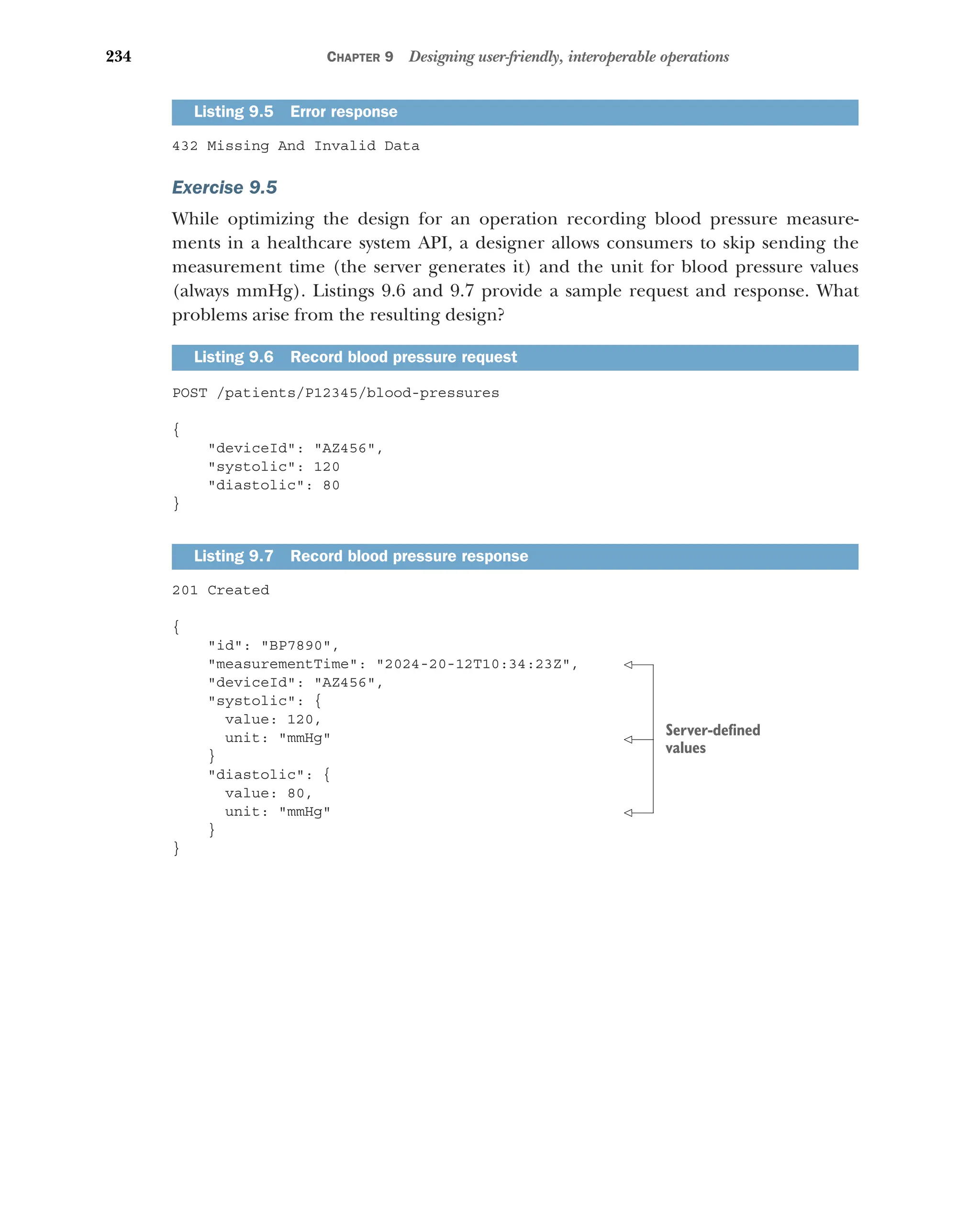
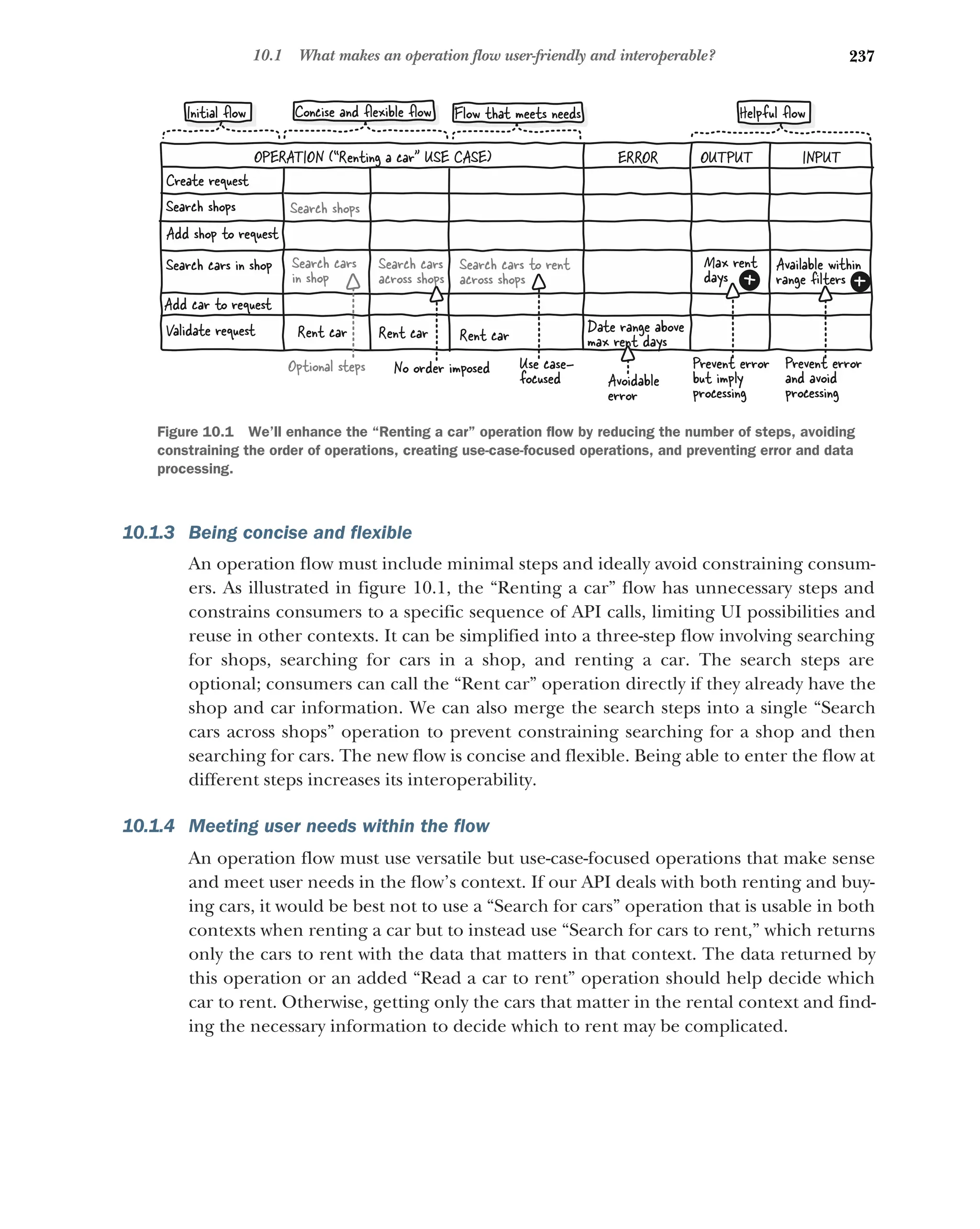
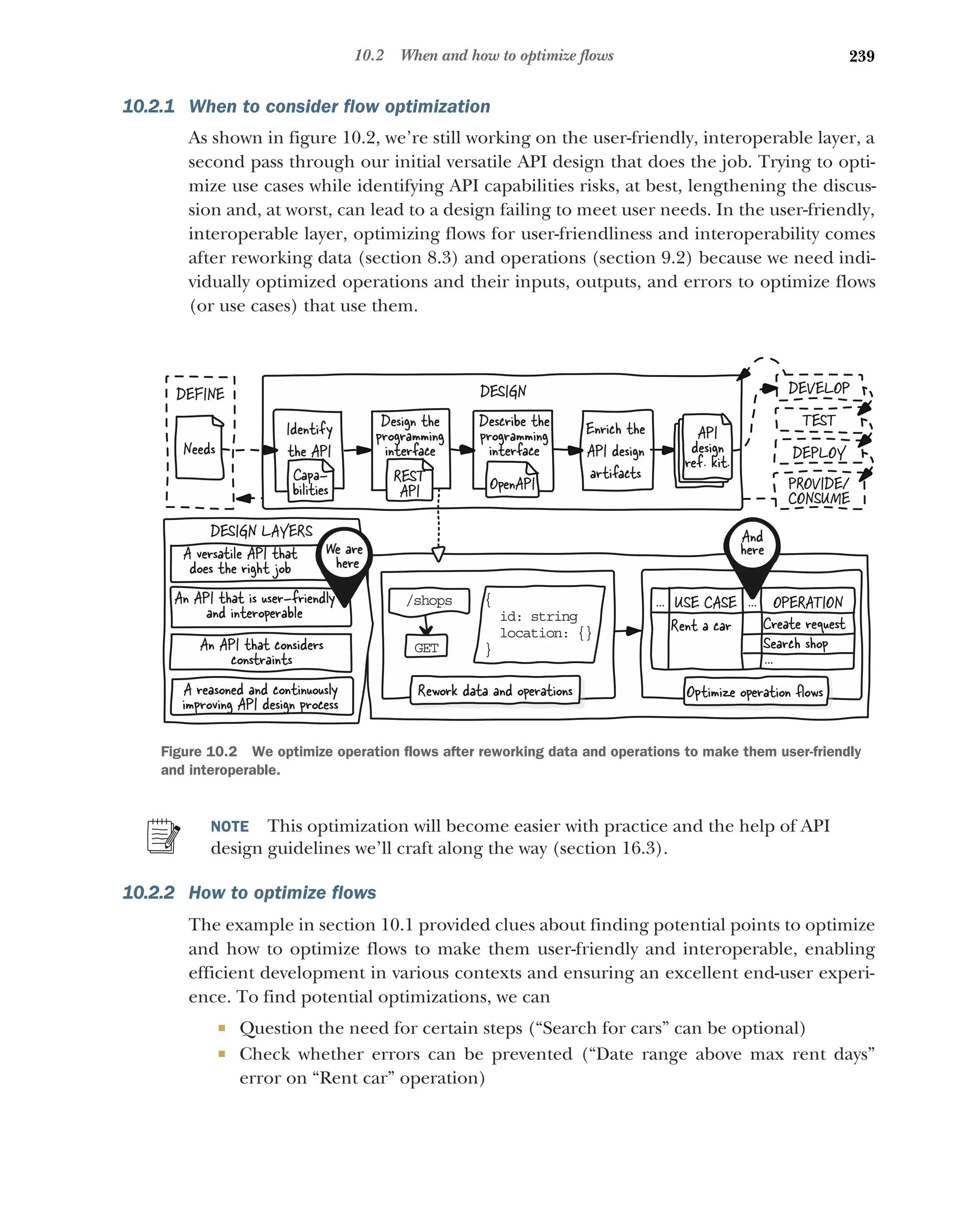
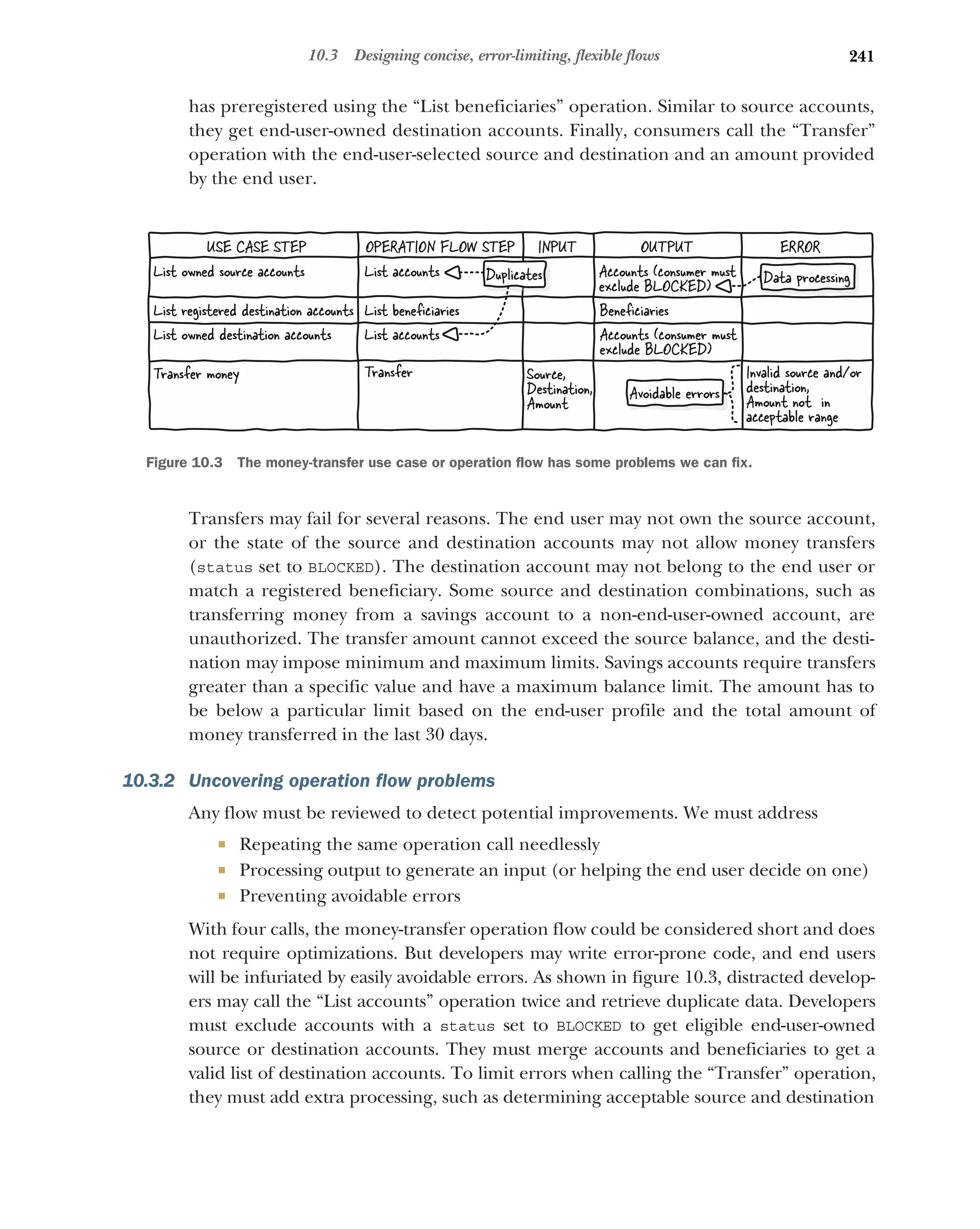
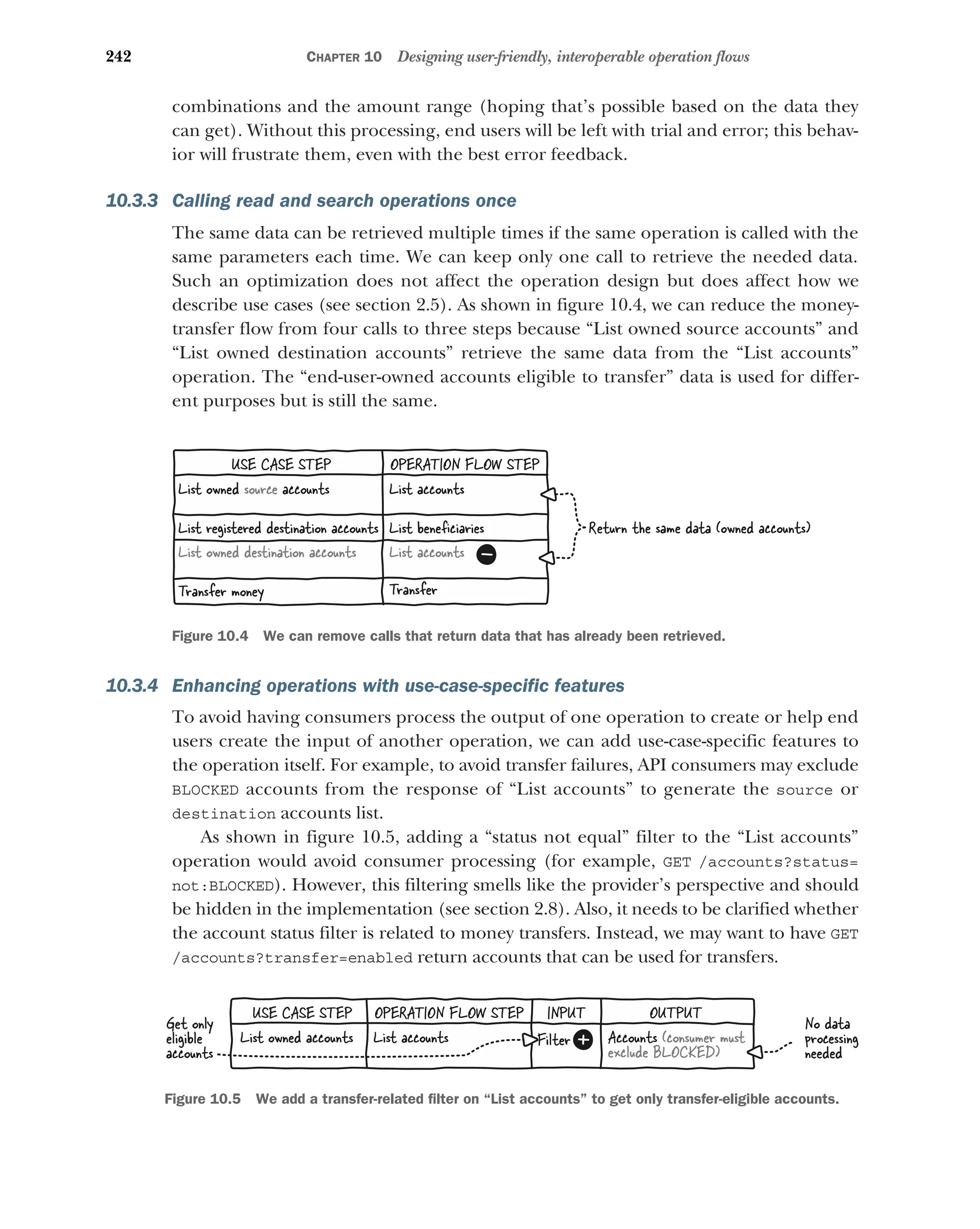
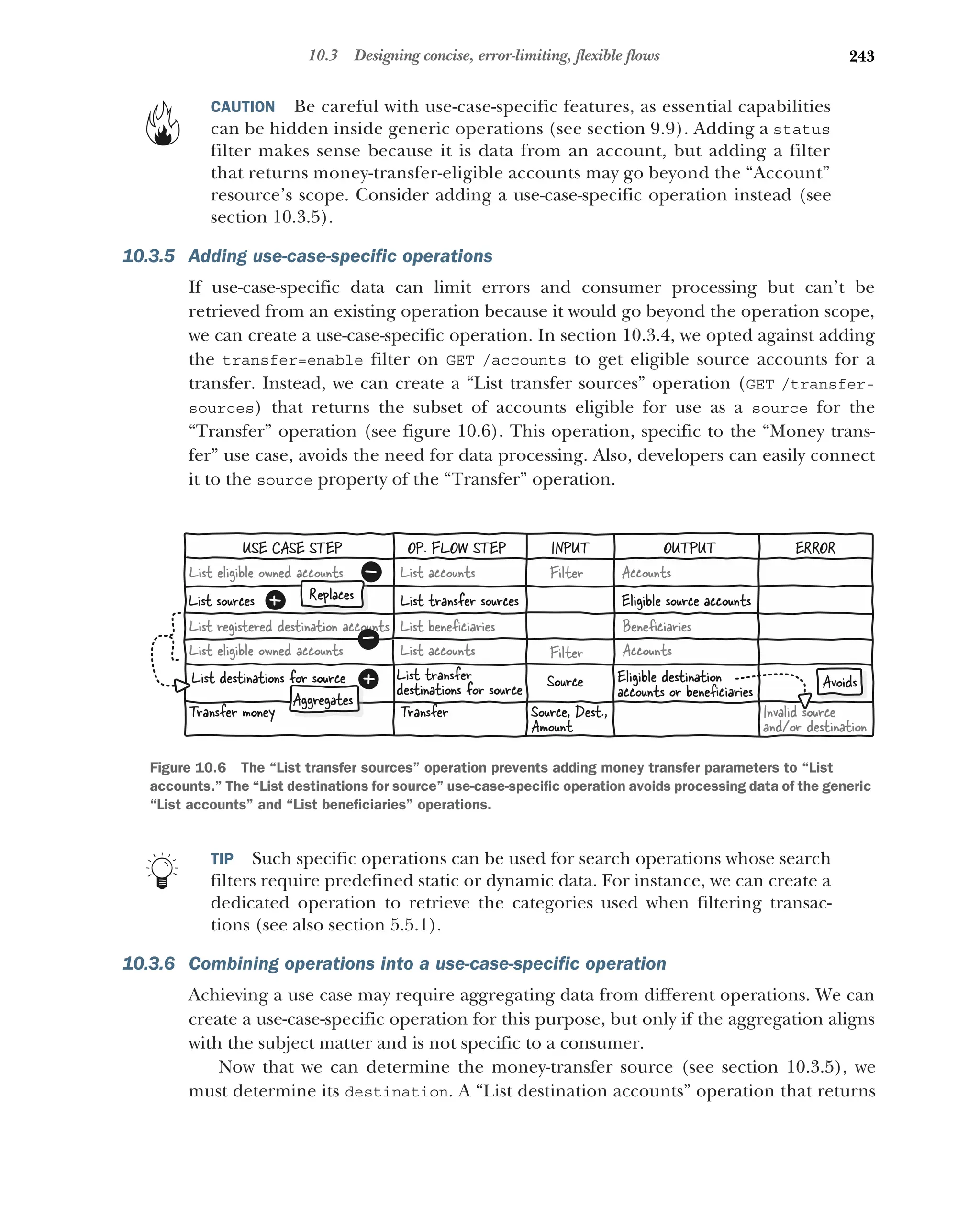
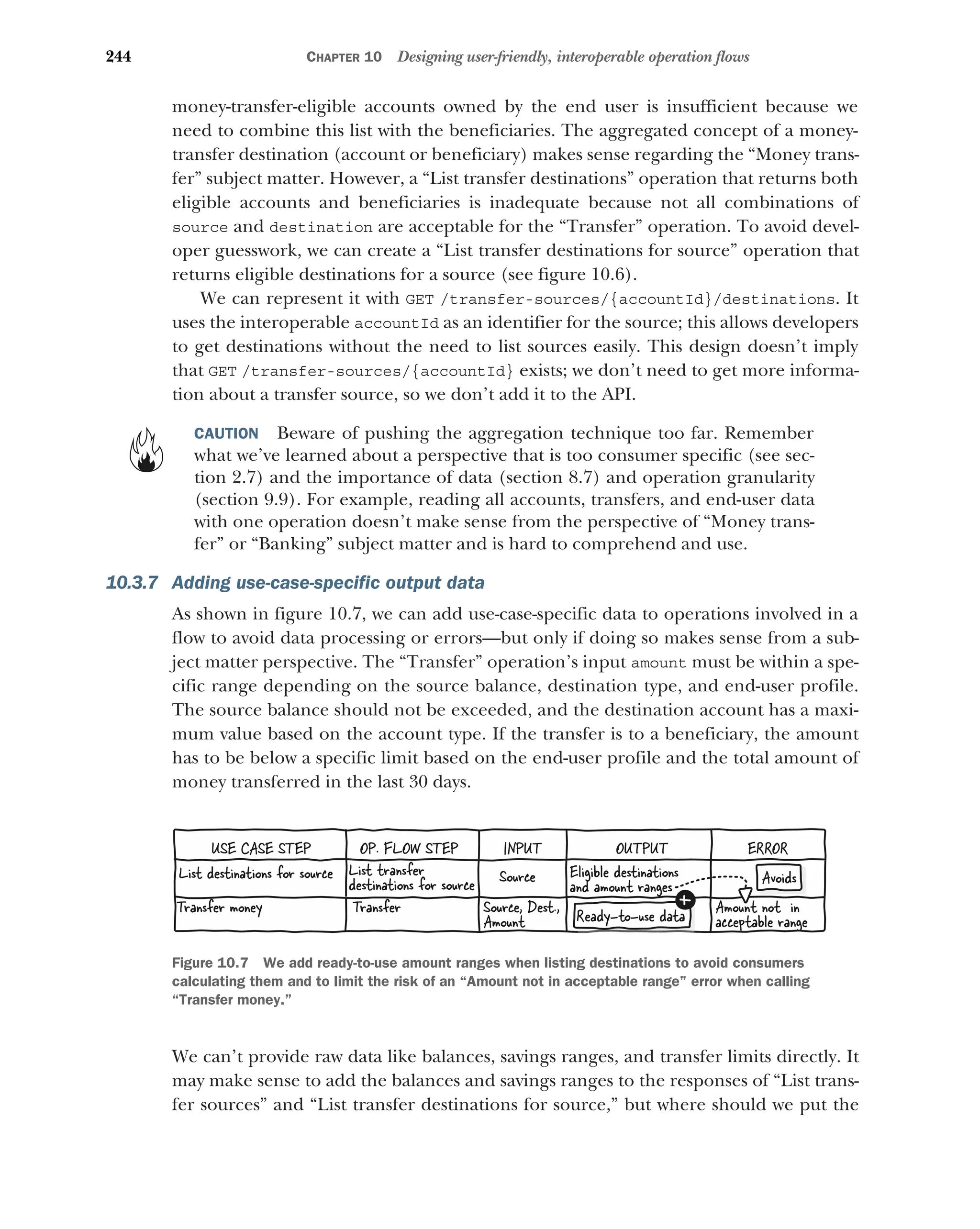
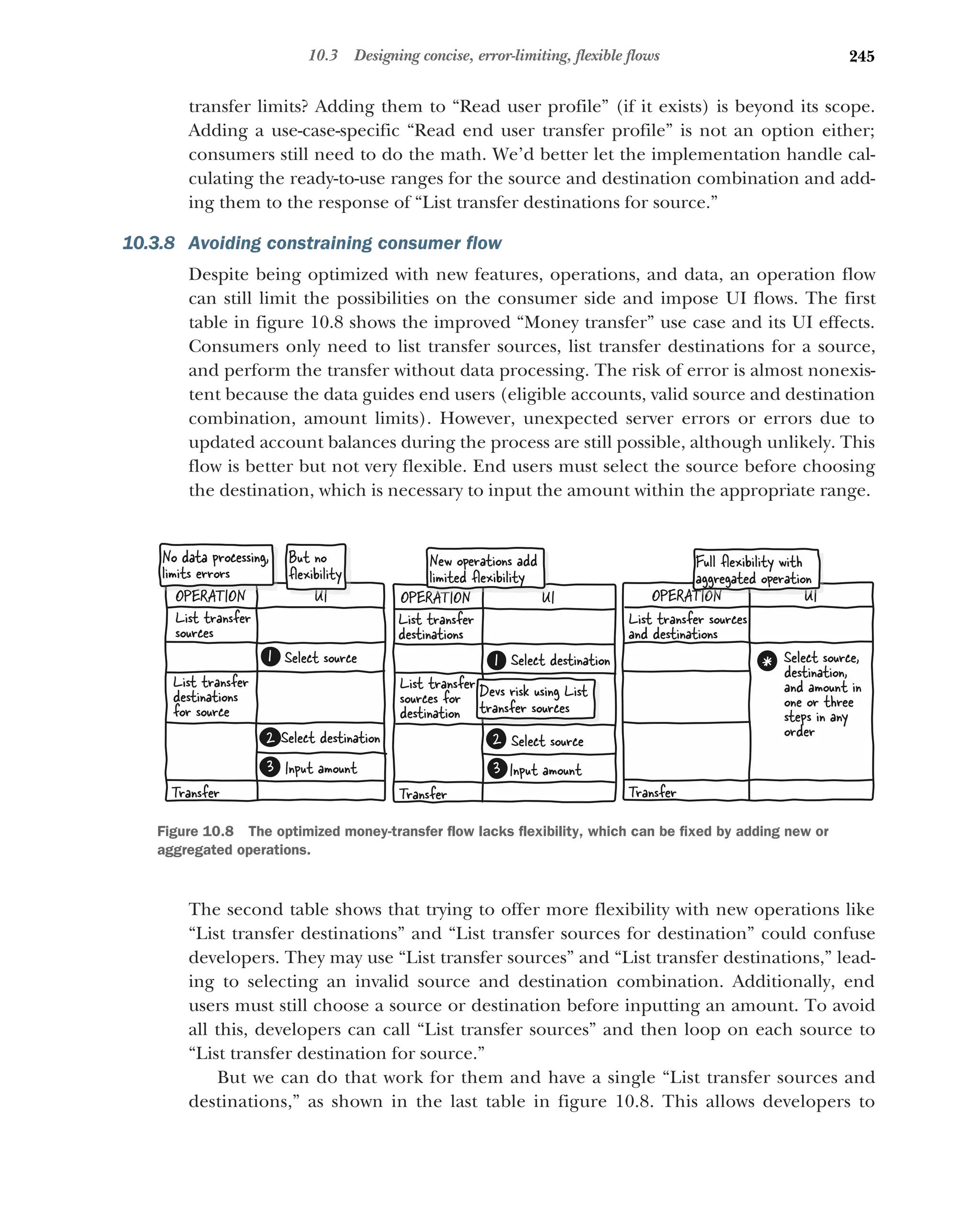
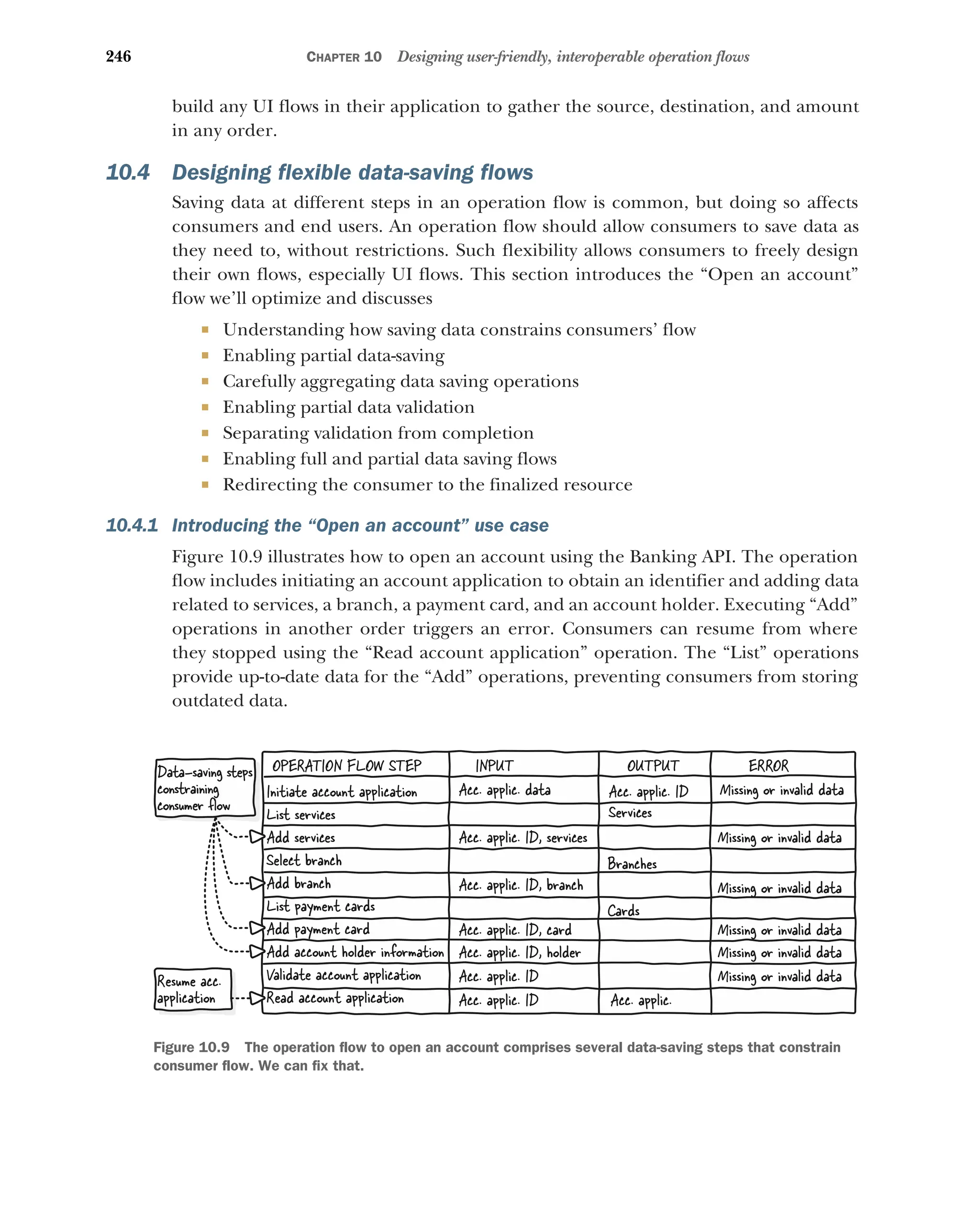
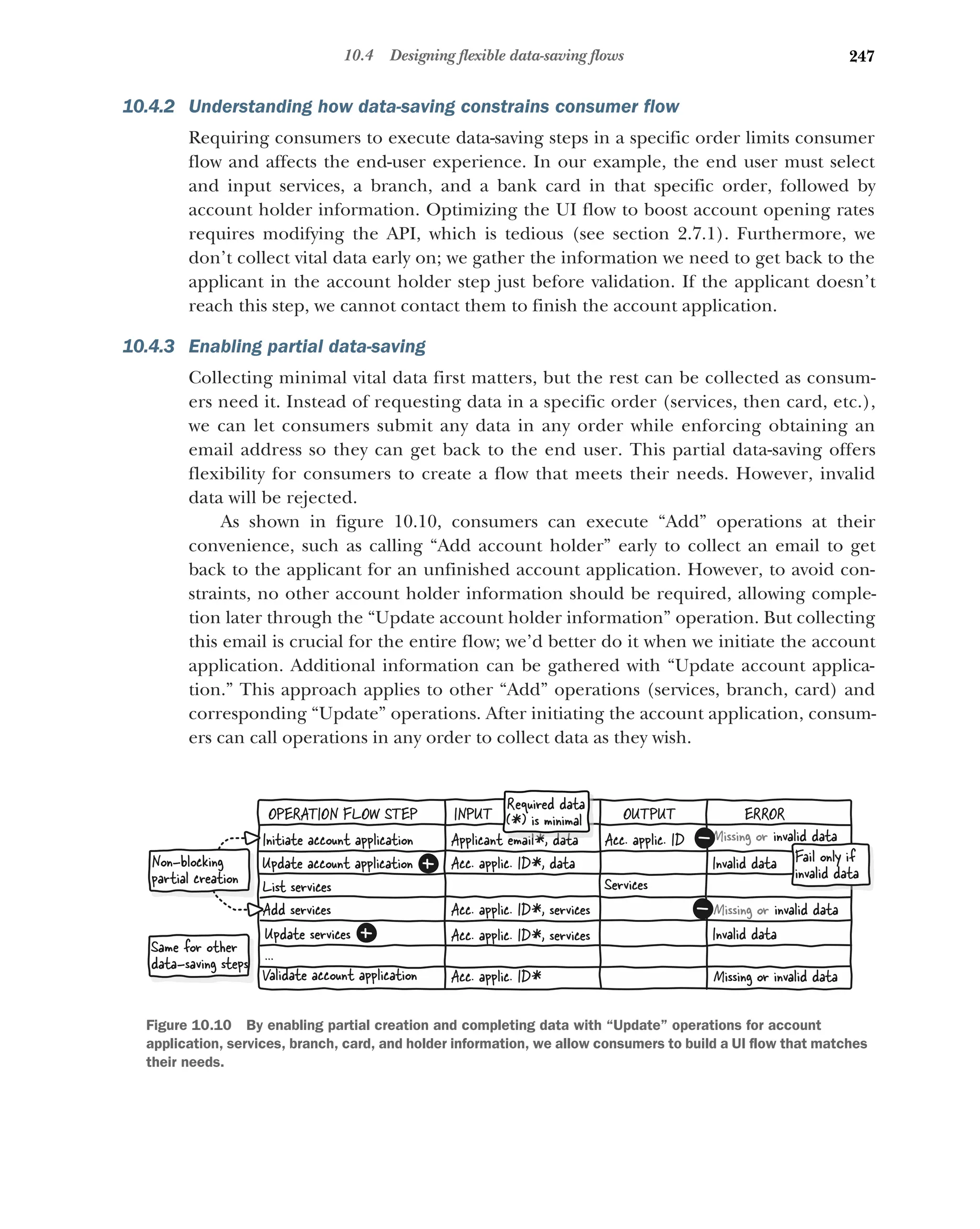
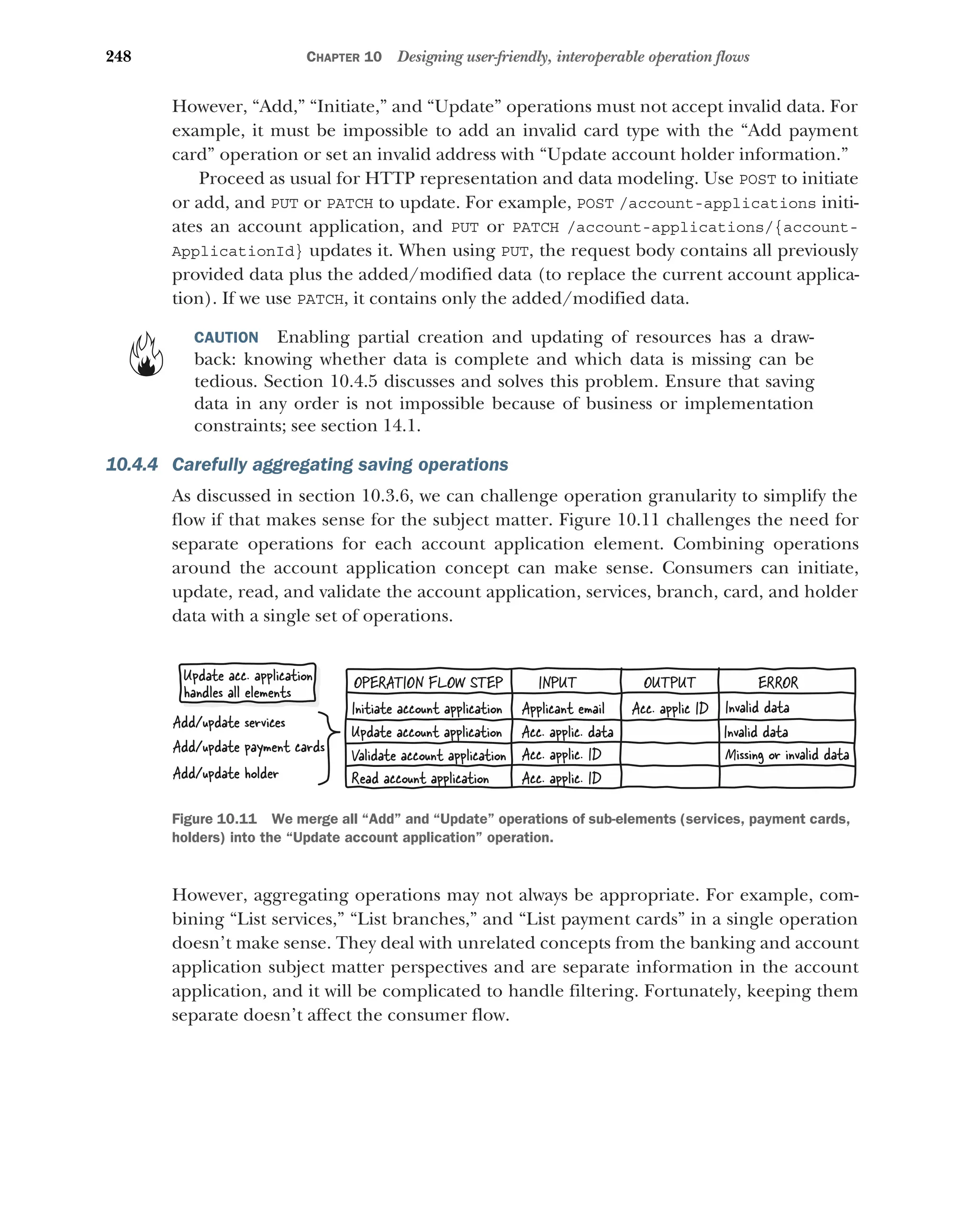
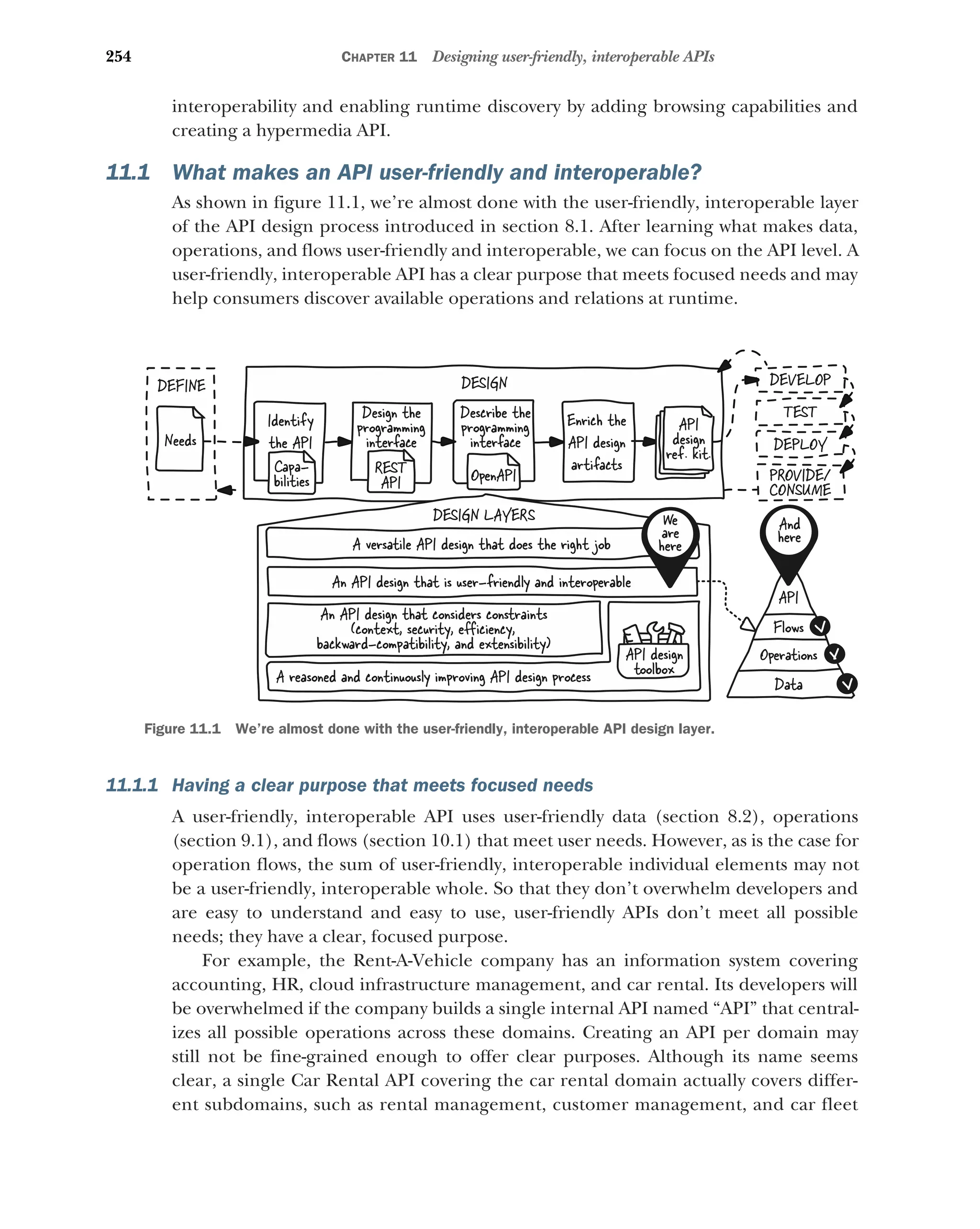
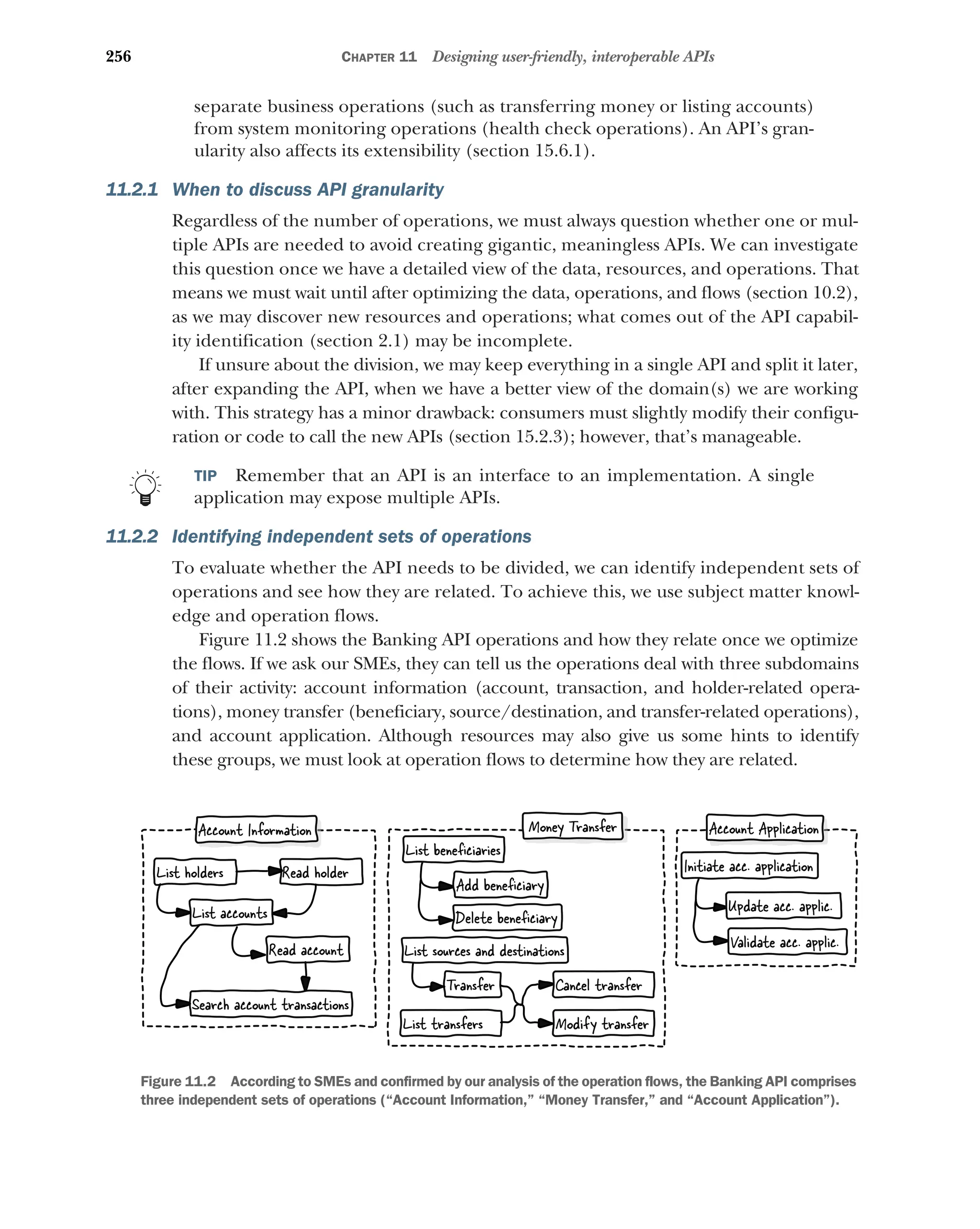
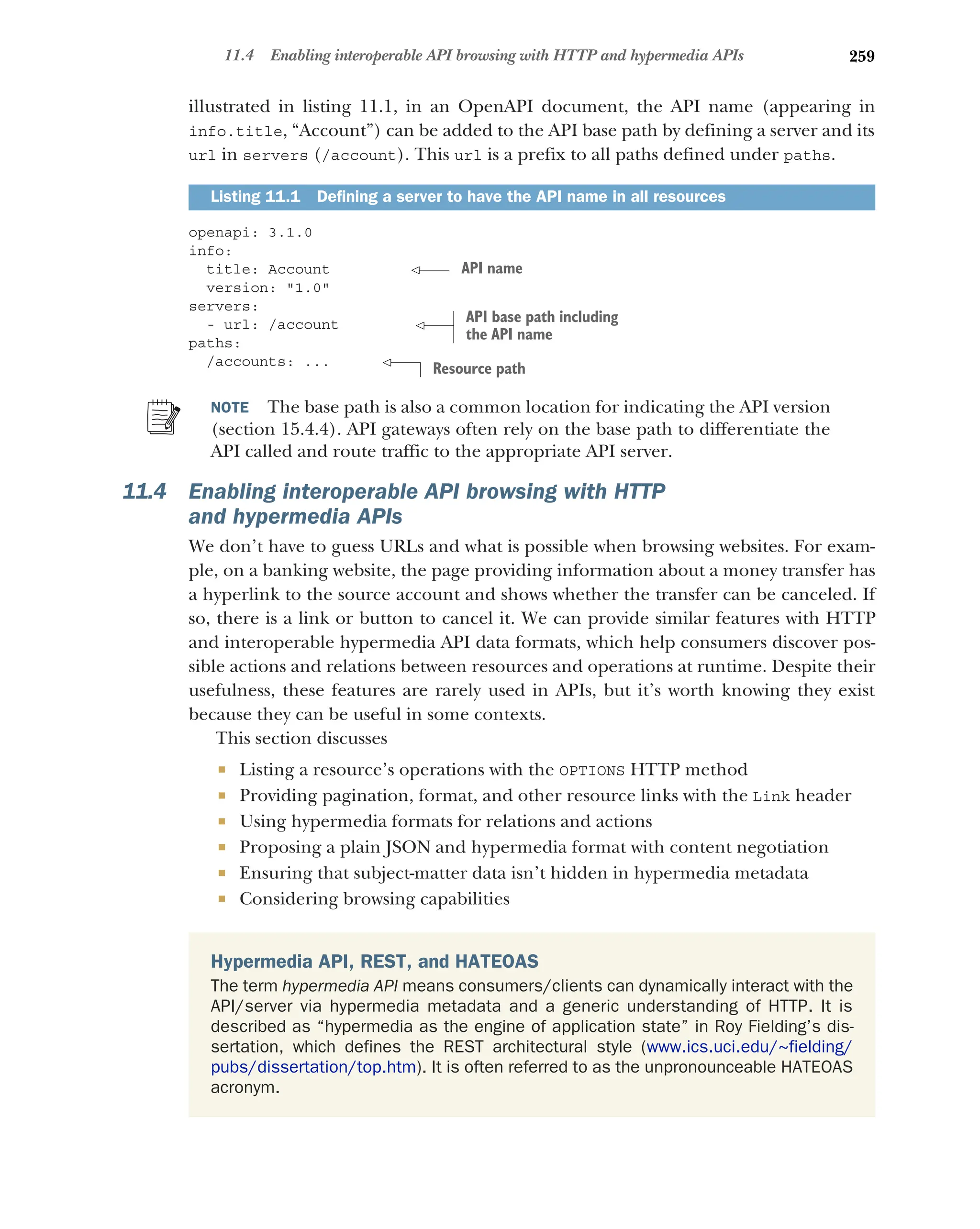
![260 CHAPTER 11 Designing user-friendly, interoperable APIs
11.4.1 Listing a resource’s operations with the OPTIONS HTTP method
The OPTIONS HTTP method lets consumers know which HTTP methods are available
on a resource without retrieving it. For example, a money transfer (/transfers/
{transferId}) can be read (GET), modified (PUT), and canceled (DELETE). However,
depending on its status, the transfer may not be modified or deleted. To check what is
possible, consumers can call OPTIONS /transfers/{transferId}, which indicates the
available HTTP methods in the Allow response header. In figure 11.3, the transfer
can be read (GET) and canceled (DELETE) but not modified (PUT is absent).
11.4.2 Providing pagination, formats, and resources links
with the Link header
Figure 11.4 shows how the Link response header, defined by the Web Linking RFC
(https:/
/datatracker.ietf.org/doc/html/rfc8288), can provide various types of links,
including alternate formats, pagination links, and links to other resources. In sec-
tion 9.7.1, we enabled the ability to request account transactions in CSV or PDF formats
instead of JSON. The response to GET /accounts/12345/transactions can include a
Link header listing these alternate formats. The Link header is a comma-separated list
OPTIONS /accounts/12345/transactions 200 OK
Allow: GET,DELETE
Available methods
No body
Figure 11.3 Using the OPTIONS HTTP method lets consumers know which operations are available
on a resource.
GET /accounts/12345/transactions
200 OK
Link: /accounts/12345/transactions;rel=alternate;type=text/csv,
/accounts/12345/transactions;rel=alternate;type=application/pdf,
/accounts/12345/transactions?page=2;rel=next
[ ... ]
Pagination link
Body
GET /transfers/54321
200 OK
Link: /accounts/11111;rel=source, /beneficiaries/22222;rel=destination
{ ... }
Body
Alternate format link
Link to transfer’s source Link to transfer’s destination
Figure 11.4 We can provide formats, pagination, and links to other resources with the Link header when
listing transactions or reading a transfer.](https://image.slidesharecdn.com/lauretarnaud-thedesignofwebapis2025-250821164447-5e92da1d/75/Lauret-Arnaud-The-Design-of-Web-APIs-2025-pdf-298-2048.jpg)
![261
11.4 Enabling interoperable API browsing with HTTP and hypermedia APIs
of links, each composed of a URL enclosed in , rel, and optional type separated
by ;. The rel describes the relationship between the current resource and the one
targeted in the URL. The alternate relation indicates that the URL is an alterna-
tive resource representation. The optional type describes the media type of the tar-
geted resource.
In section 9.6.6, we discussed transactions list pagination. Transactions pagination
links can also be provided with a rel set to prev or next. The GET /transfers/54321
call shows that the Link header can contain any link, such as links to the source and
destination of a transfer retrieved with GET.
11.4.3 Using hypermedia formats for relations and actions
Hypermedia APIs use metadata to create website-like features that describe links between
resources; some may also describe possible actions on linked or current resources. To
be effective, APIs must follow a standard format. The most popular is HAL, but
JSON:API, Siren, and JSON-LD are also used.
Figure 11.5 compares money transfer representations in plain JSON, HAL, and
Siren formats. How these formats describe relations is inspired by the Web Linking
RFC, which defines the Link header described in section 11.4.2.
HAL integrates _links, a map of links, into the plain JSON data. Keys describe a rela-
tion; values are objects with an href targeting a resource. The self relation describes
the current resource, and the source and destination target the source account and
beneficiary. The rest of the data remains unmodified.
{
id: 12345,
source: 11111,
destination: 222222,
amount: 1000
} {
id: 12345,
source: 11111,
destination: 222222,
amount: 1000,
_links: {
self: {
href: /transfers/12345},
source: {
href: /accounts/11111},
destination: {
href: /beneficiaries/22222}
}
}
{
properties: {
id: 12345,
source: 11111,
destination: 222222,
amount: 1000
}
links: [
{ rel: [self],
href: /transfers/12345},
{ rel: [source],
href: /accounts/11111},
{ rel: [destination],
href: /beneficiaries/22222}
],
actions: [{
name: cancel,
method: DELETE,
href: /transfers/12345 }]
}
Plain JSON
HAL
Siren
Links and how
they relate to
current resource
Possible
operations
Encapsulated
original data
Unmodified
original data
Figure 11.5 HAL and Siren propose standardized representations of links between resources. Siren adds
the description of possible actions and separates original data and hypermedia metadata.](https://image.slidesharecdn.com/lauretarnaud-thedesignofwebapis2025-250821164447-5e92da1d/75/Lauret-Arnaud-The-Design-of-Web-APIs-2025-pdf-299-2048.jpg)



![271
12.1 Overview of API security
NOTE To learn more about API security (including the OAuth 2.0 and
OpenID Connect frameworks), I recommend reading API Security in Action by
Neil Madden (www.manning.com/books/api-security-in-action) and Secure
APIs by José Haro Peralta (www.manning.com/books/secure-apis).
The process in figure 12.1 is as follows:
1 The website contacts the authorization server (AS), indicating its client_id,
which identifies it. When the AS recognizes this ID, it authenticates the end
user and returns an access token. This token allows the website to call the Shop-
ping API exposed on the resource server (RS) in the end user’s name.
2 To list the user’s orders, the website sends a GET /orders request to https://
api.shopp.ing with the standard Authorization header set to the token value.
h ps://auth.shopp.ing
SHOPPING - LOGIN
spike@spiegel.com
*********
USERNAME
PASSWORD
Get an API
access token
h ps://www.shopp.ing
SHOPPING
WELCOME BACK!
View Orders
h ps://www.shopp.ing/orders
SHOPPING - ORDERS
Order #456123 May 4th
Order #123456 March 10th
Call API exposed on h ps://api.shopp.ing
with access token
Display
orders
Shopping company
infrastructure
Internet
(HTTPS)
Browser
Resource server
(API implementation)
Shopping API
Check whether consumer can
access the Shopping API
Check whether consumer can
call GET /orders operation
Get info for token HPOI9
Retrieve user 123’s orders
HPOI9
GET /orders
Authorization: HPOI9
GET /tokeninfo
Authorization: HPOI9
200 OK
[ ... ]
Authorization
server
200 OK
{
token: HPOI9,
consumer: {
name: Shopping Website,
apis: [{
name: Shopping API,
scopes: [ product, order ]
}],
},
user: { id: 123 }
}
1
2
3
4
5
6
7
GET /auth?client_id=123
Figure 12.1 The shopping website gets an access token to call the Shopping API to retrieve an end
user’s orders. Based on the token, the Shopping API implementation verifies that the consumer has
appropriate permissions before returning the user’s data.](https://image.slidesharecdn.com/lauretarnaud-thedesignofwebapis2025-250821164447-5e92da1d/75/Lauret-Arnaud-The-Design-of-Web-APIs-2025-pdf-309-2048.jpg)

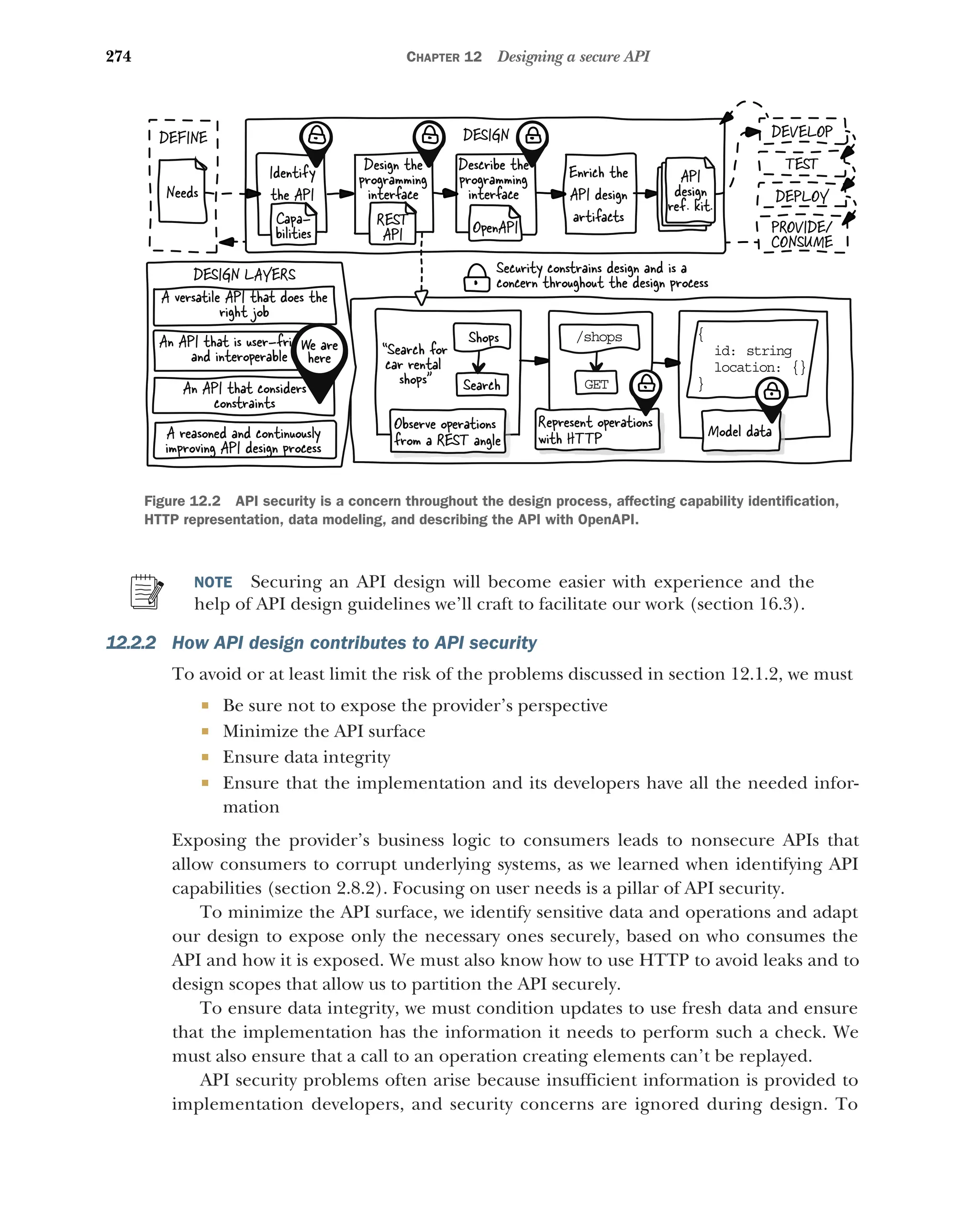
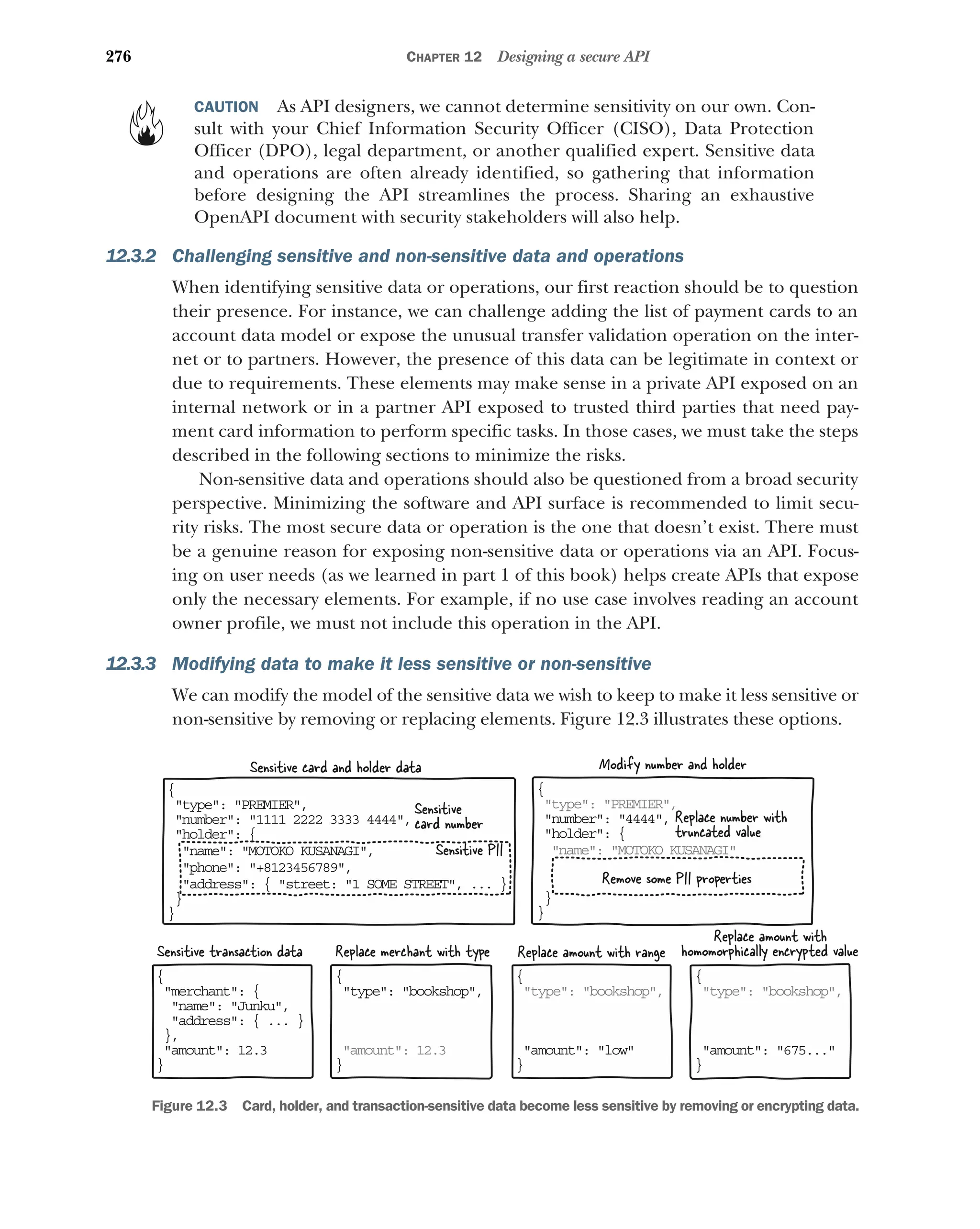
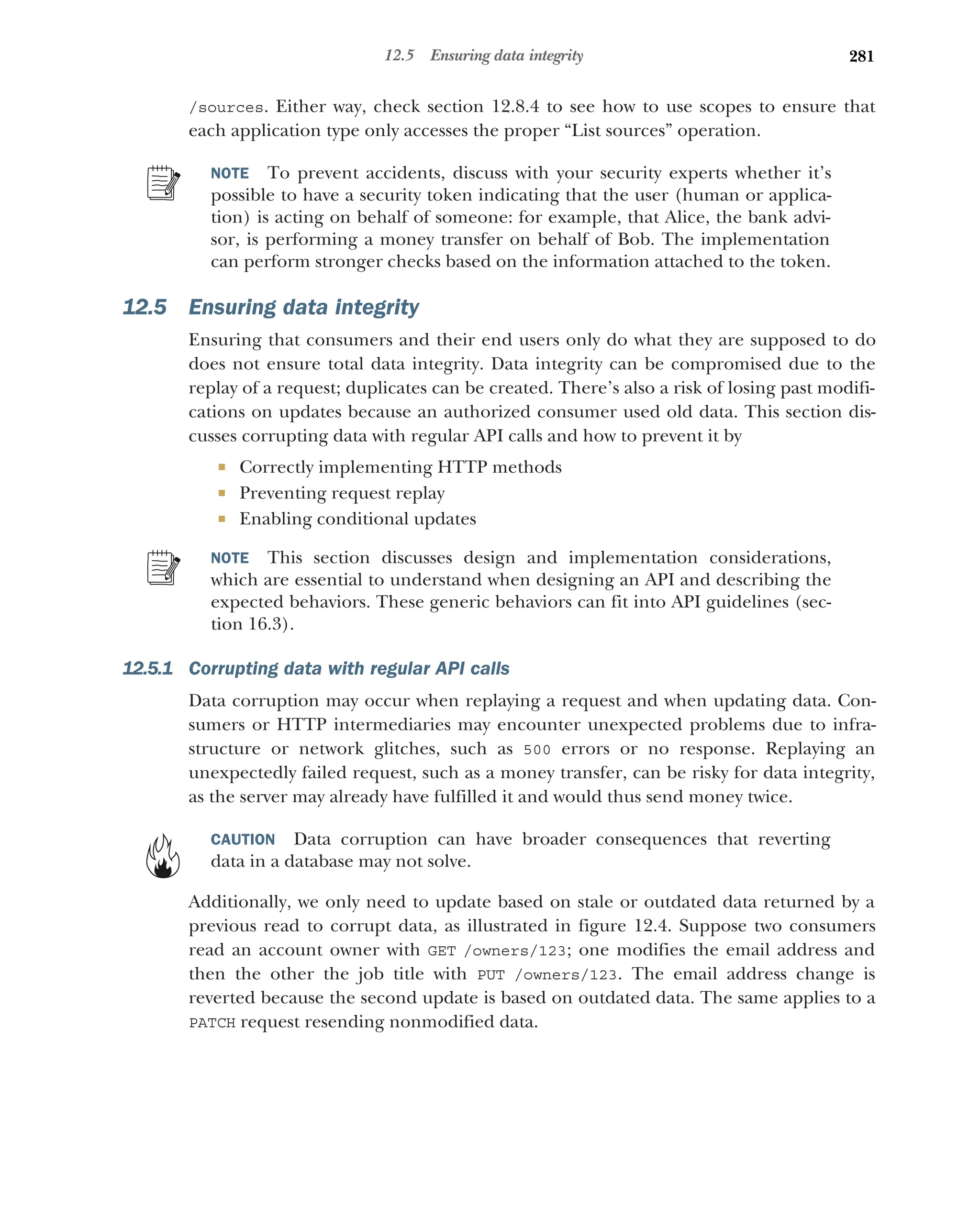
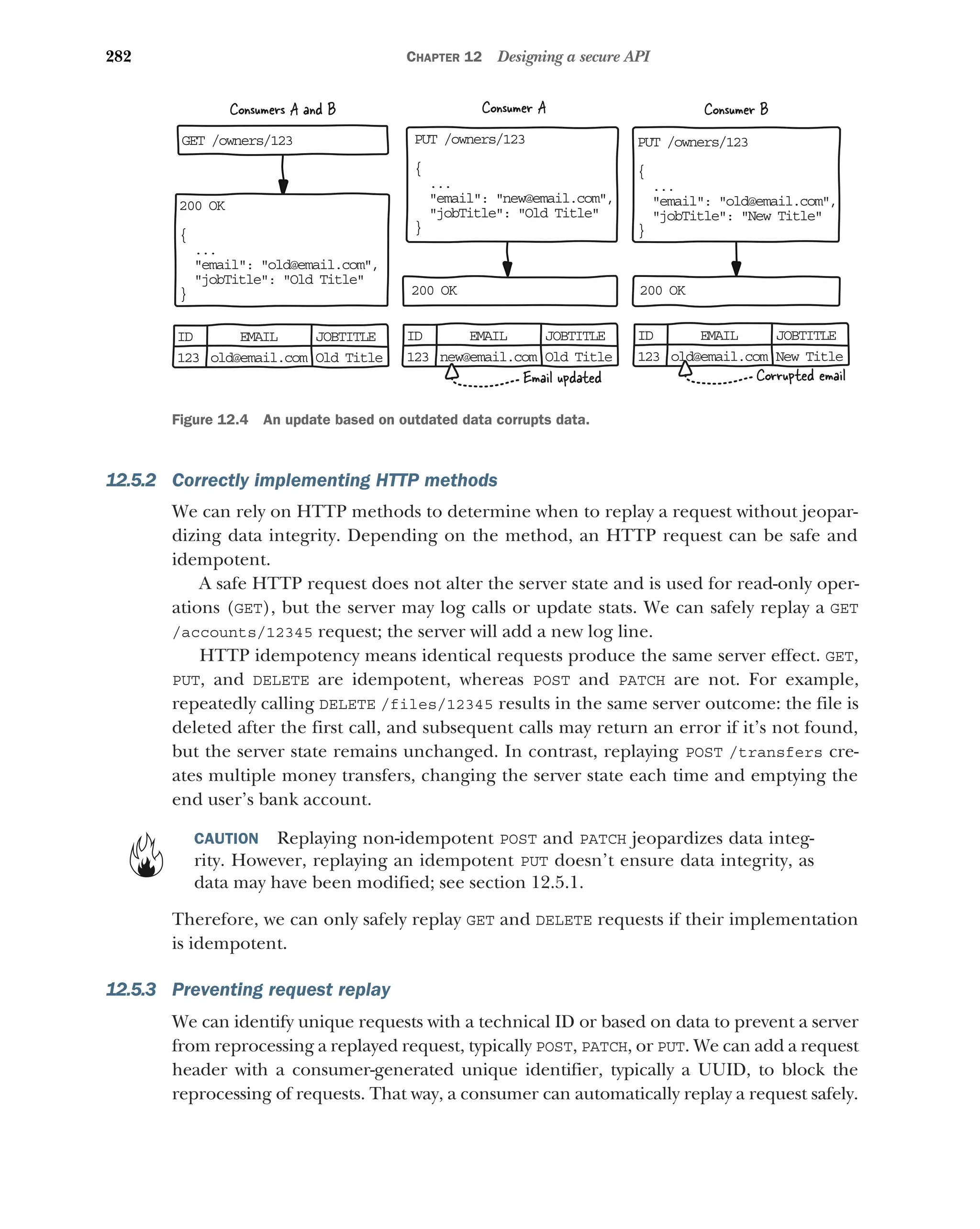
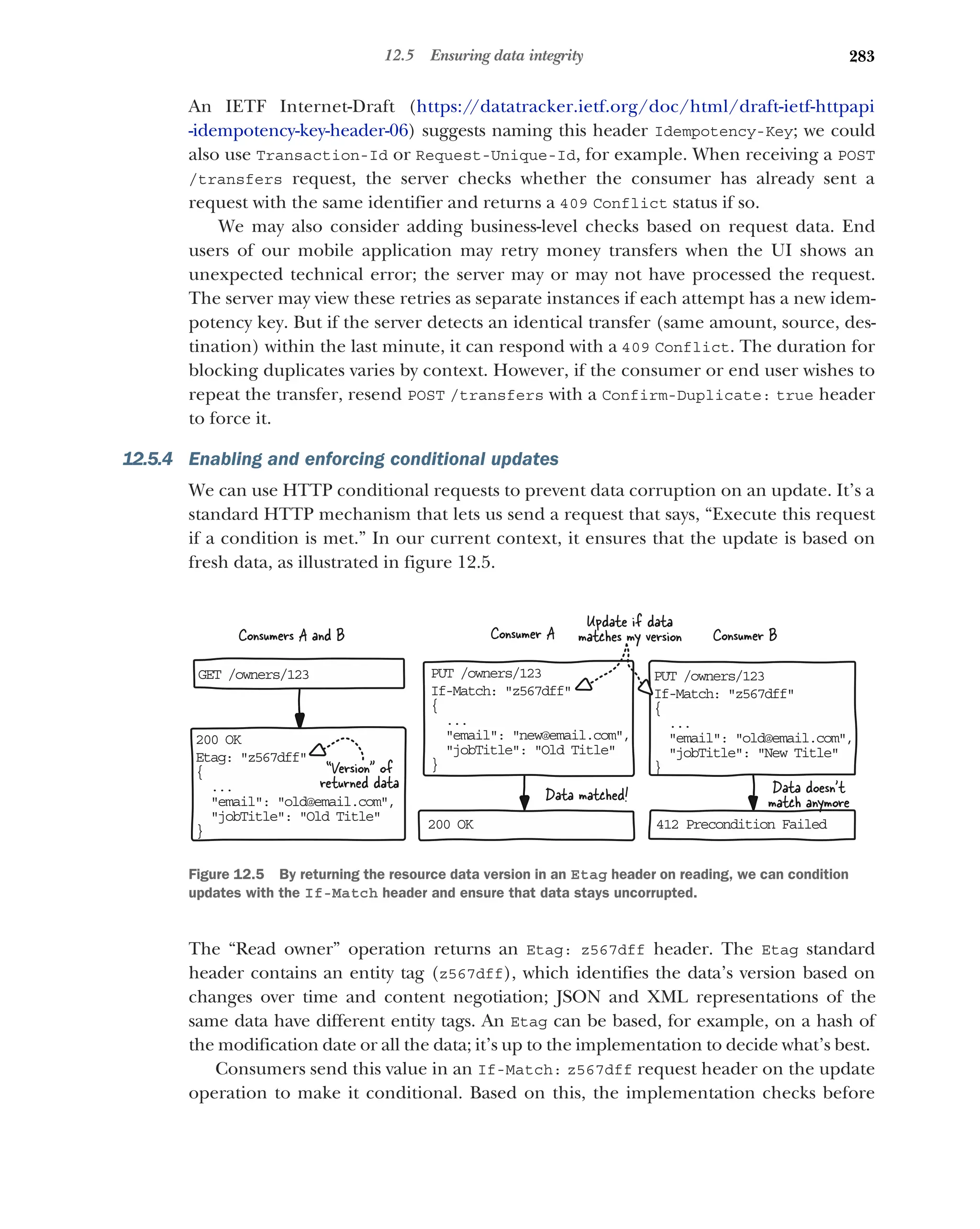
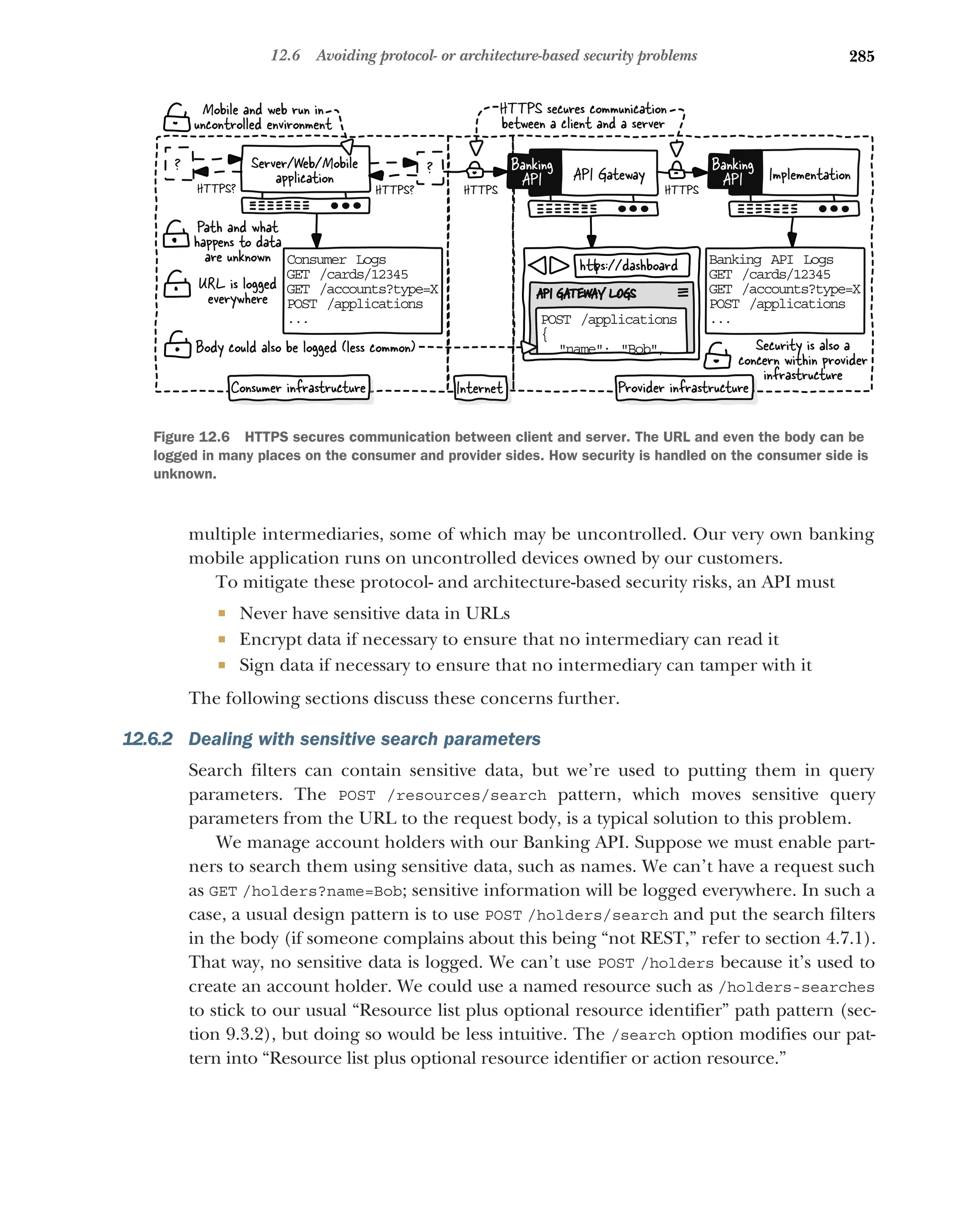
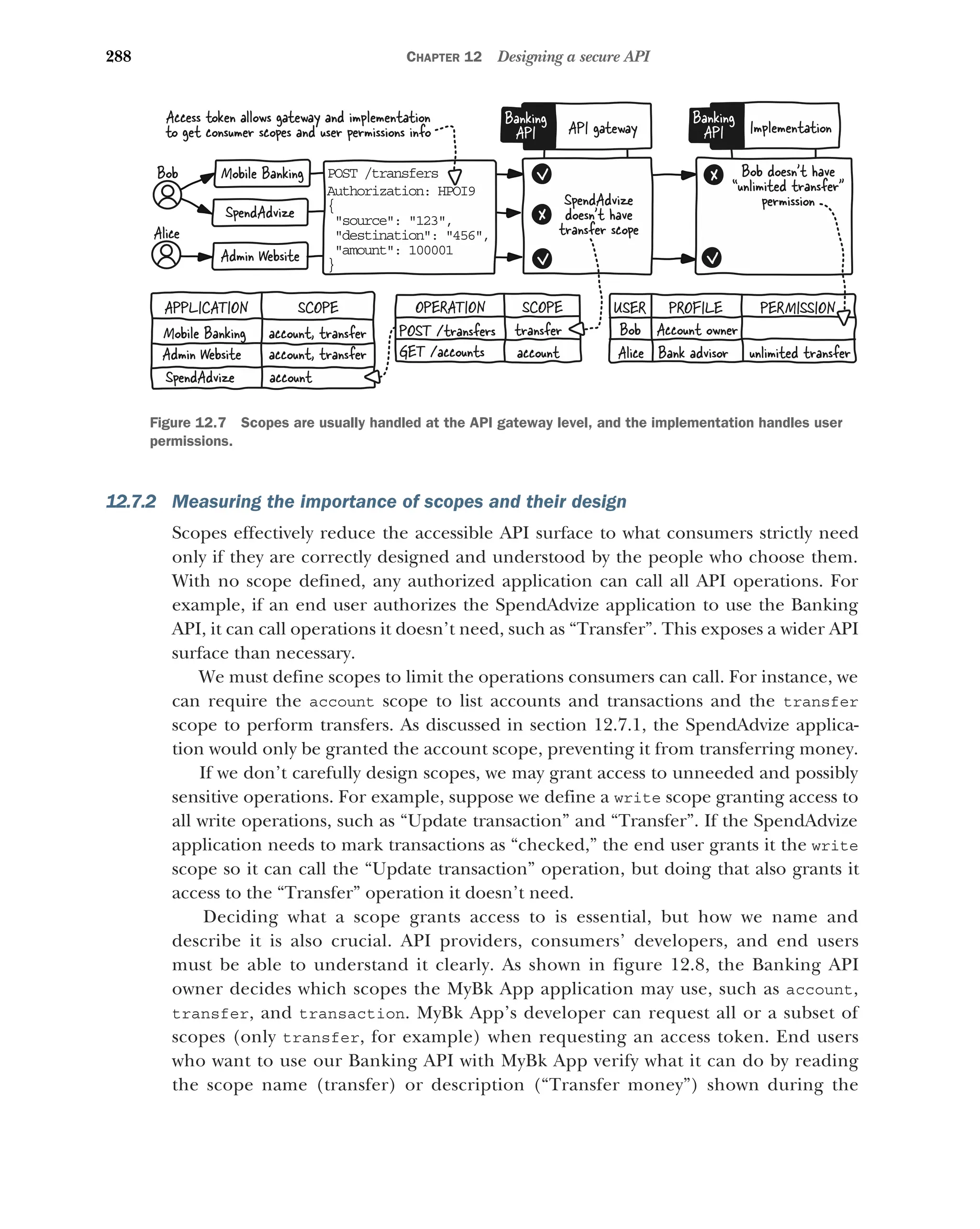
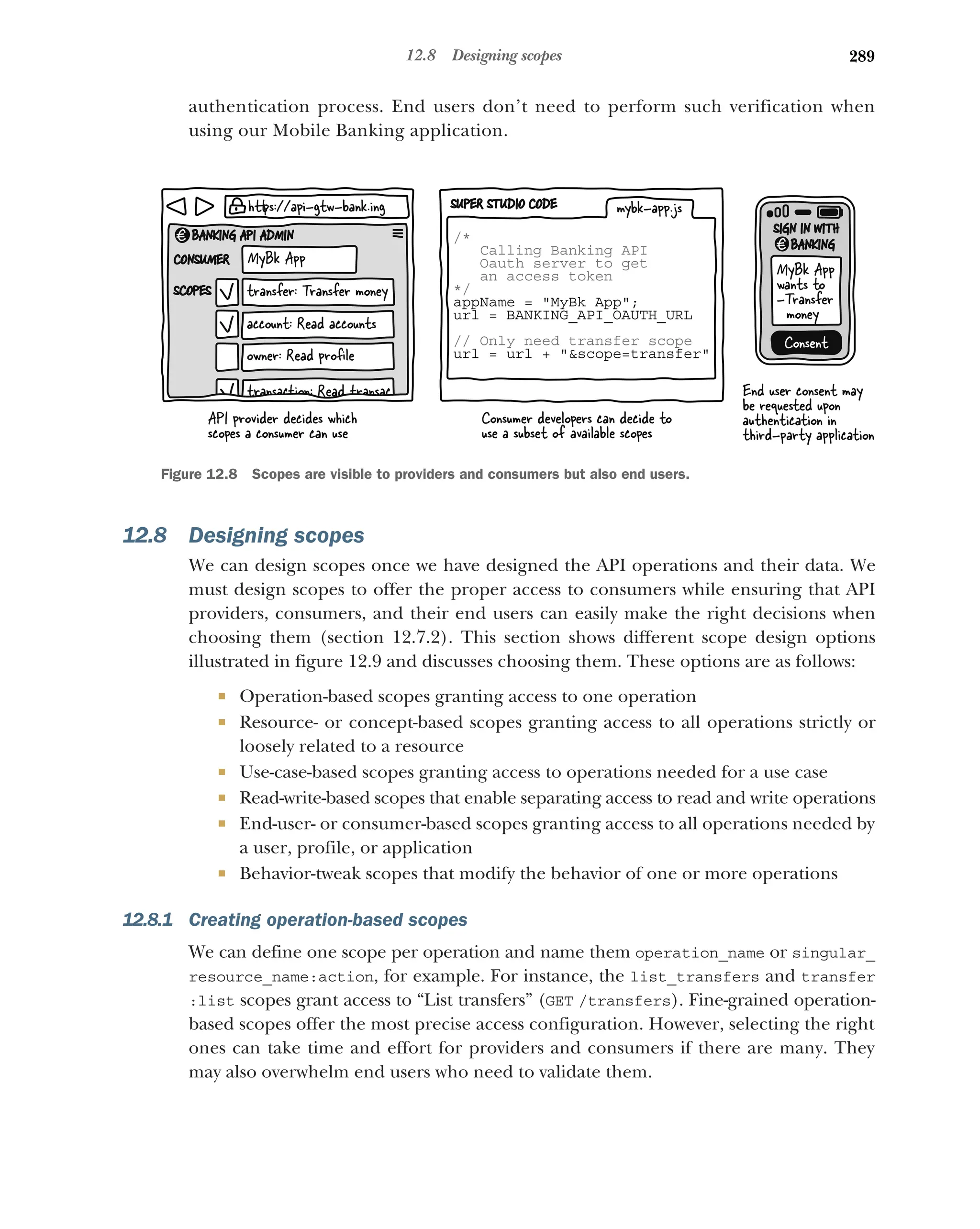
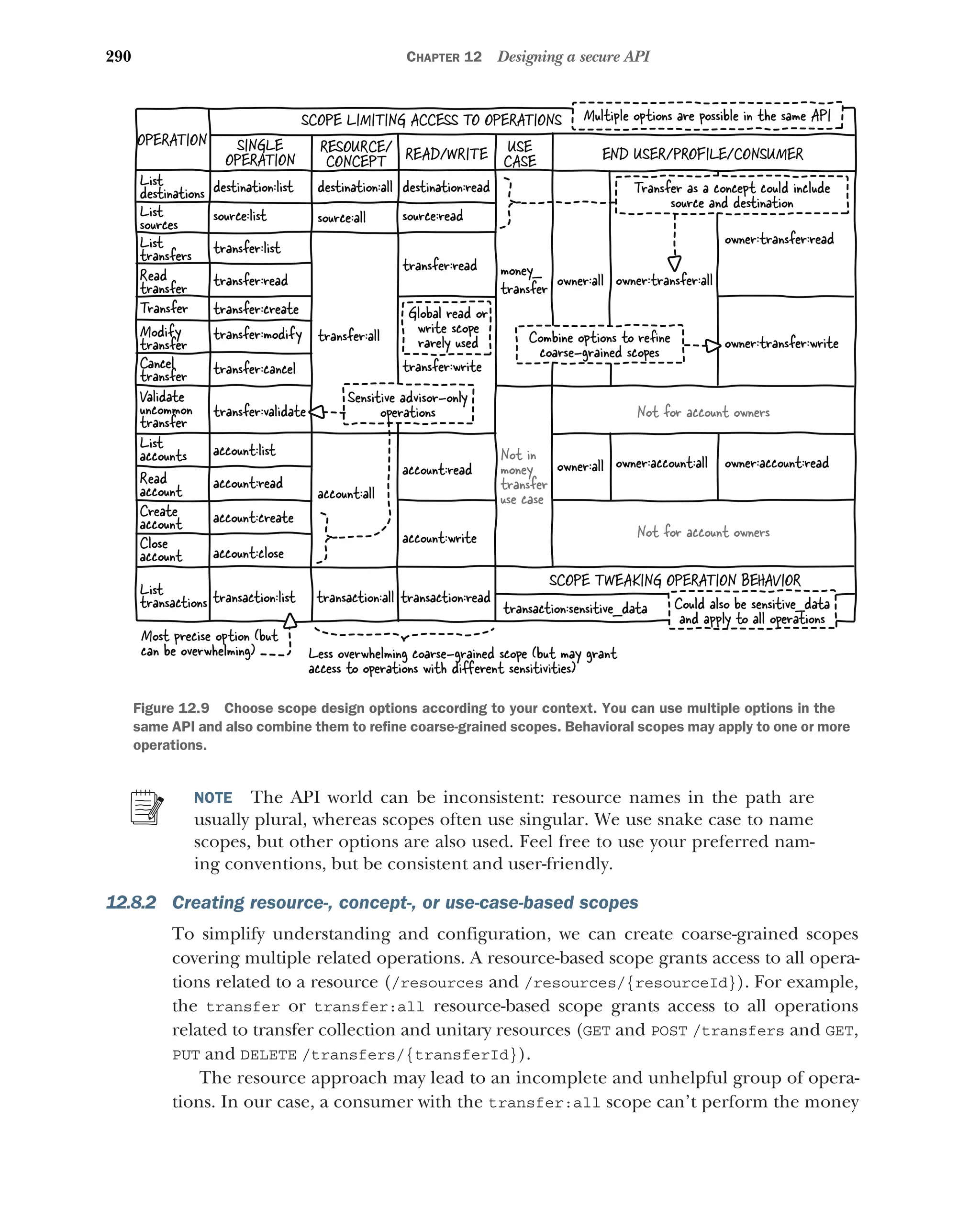
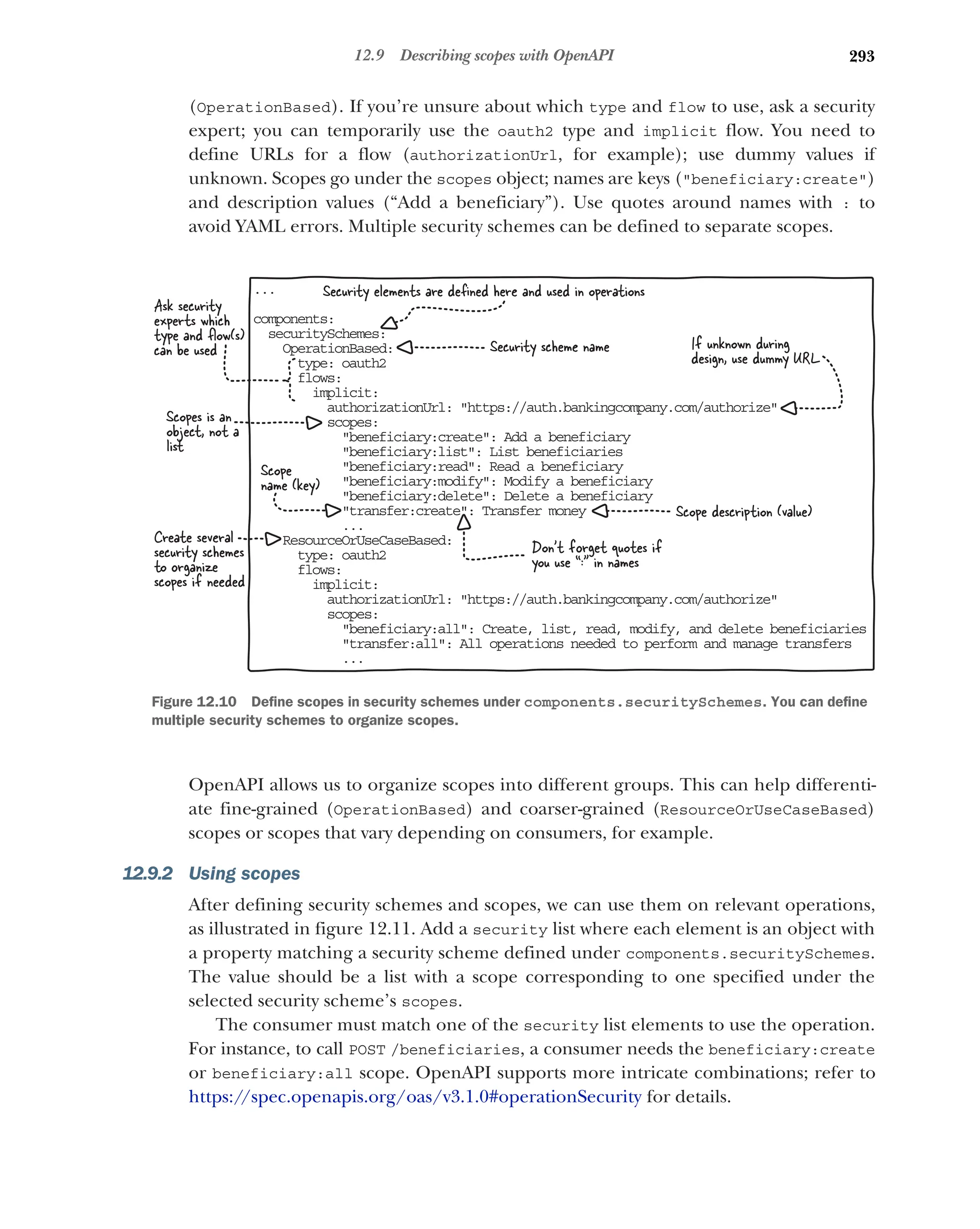
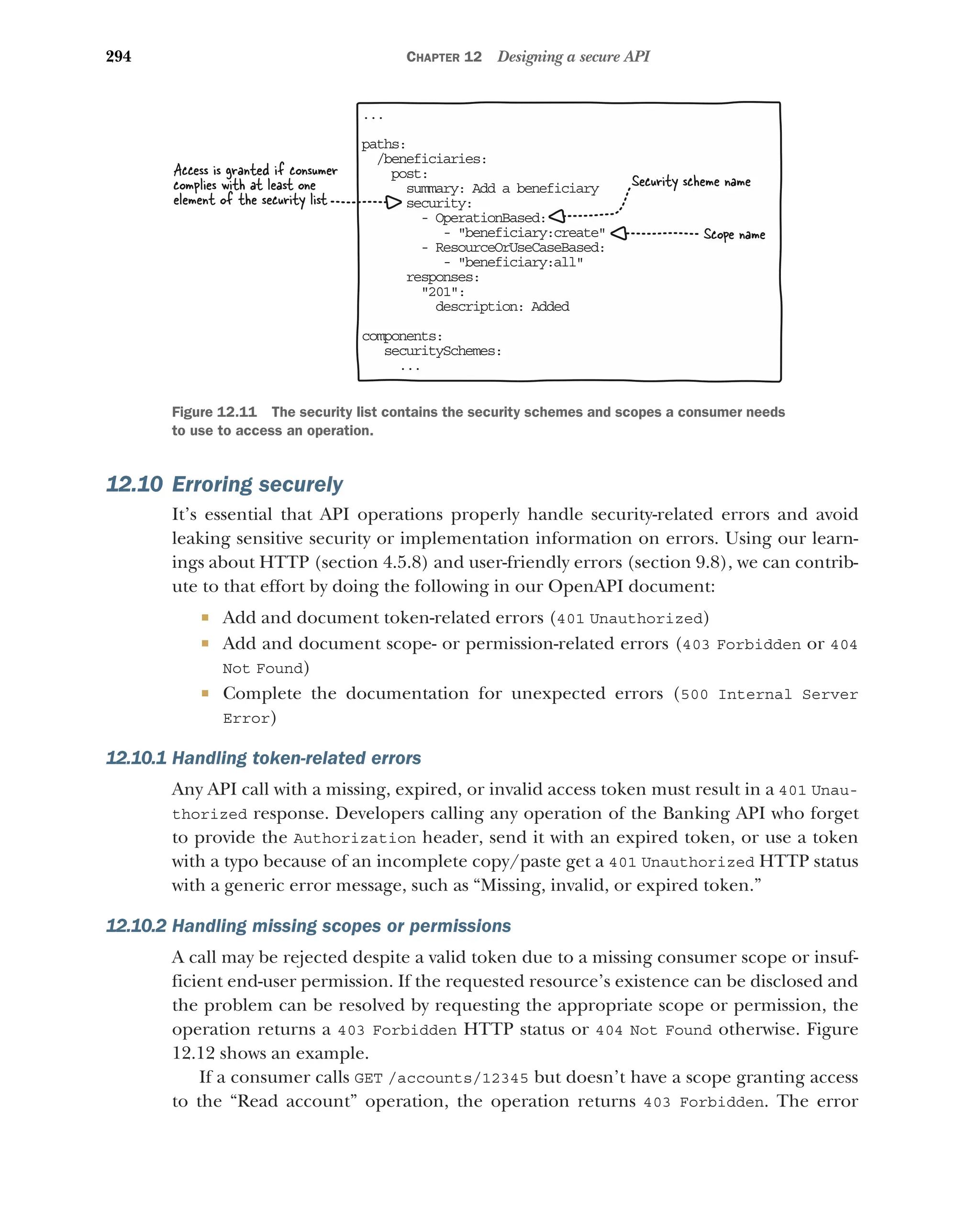
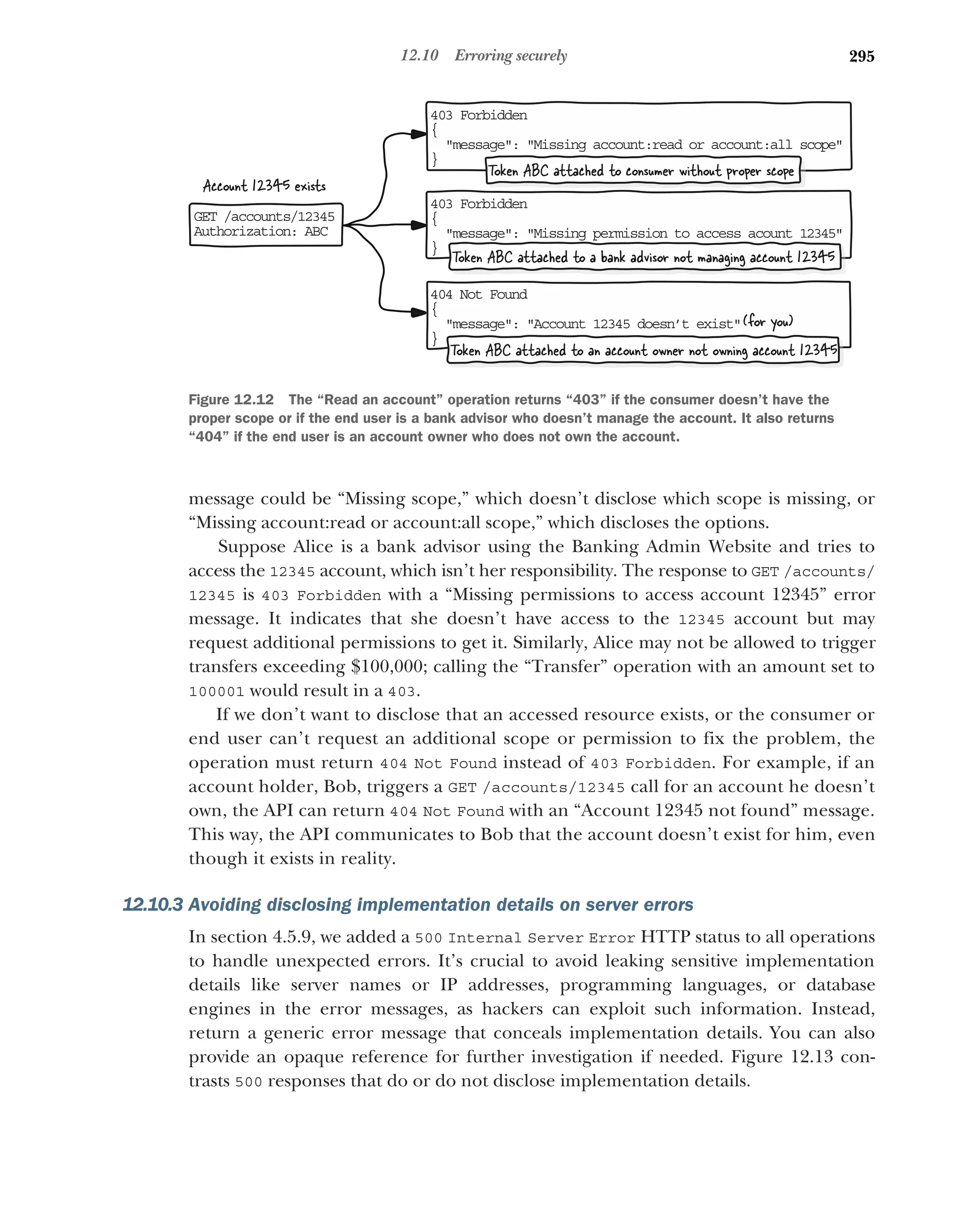
![296 CHAPTER 12 Designing a secure API
The Error [08001] Connection to server 192.168.12.34 failed message indicates
that the PostgreSQL DB is used (error code 08001) and its IP address. The safer alter-
native uses the Problem Details for HTTP APIs standard we discovered in section
9.8.6, but you can apply the same principle to a custom error format. Compared to
what we’ve seen previously, we’re using a new property, instance, which allows us to
provide a reference to the specific error that just happened. It’s a URI (/unexpected-
errors/12345), but it doesn’t have to be resolvable; it can just appear in the server
logs, for example. We also put the reference number (12345) in the human-readable
detail, which may be shown to end users.
12.10.4 Providing implementation details in response descriptions
in OpenAPI
Using the HTTP status reason as a response description, such as “Forbidden” for a 403
response in the OpenAPI document, is the surest path to an improper implementa-
tion. We must provide details about security-related client errors (4XX class) for the
implementation developers, as illustrated in figure 12.14.
There are often uncertainties about 401 versus 403 and what an invalid token is
(“Does it include tokens with wrong permissions?”). To avoid this, we indicate that
“invalid” means “nonexistent, typo” and that “scope-related errors are handled with
403” in the 401 response description. Check out section 17.5.2 to see how to do this
once for all 401 responses.
An implementation-friendly 403 or 404 description clearly states the condition in
which it happens. On the GET /accounts/{accountId} operation, the 403 description
can state, “The access token is missing a scope, or the identified user is a bank advisor
who doesn’t have access to the account.” Its 404 indicates, “The account doesn’t exist,
or the identified user is an account owner who doesn’t have access to it.”
50 Internal Server Error
0
Co tent-Type: application/problem+json
n
{
status: 500,
type: https://api.bank.com/unexpected-error,
title: An unexpected error occurred,
detail: An unexpected error occurred (referen
ce 12345),
instance: /unexpected-errors/12345
}
Generic error data
free of sensitive
information
Reference to this
specific error for
further investigation
50 Internal Server Error
0
Co tent-Type: text/plain
n
Er or [08001] Connection to server 192.168.12.34 f
r ailed
PostgreSQL
database
error code
Database server
IP address
Discloses sensitive implementation details
Indicates only what is useful for consumer
Figure 12.13 An unexpected server error must not disclose implementation details. Return generic
information with an optional reference to this error’s occurrence for further investigation.](https://image.slidesharecdn.com/lauretarnaud-thedesignofwebapis2025-250821164447-5e92da1d/75/Lauret-Arnaud-The-Design-of-Web-APIs-2025-pdf-334-2048.jpg)
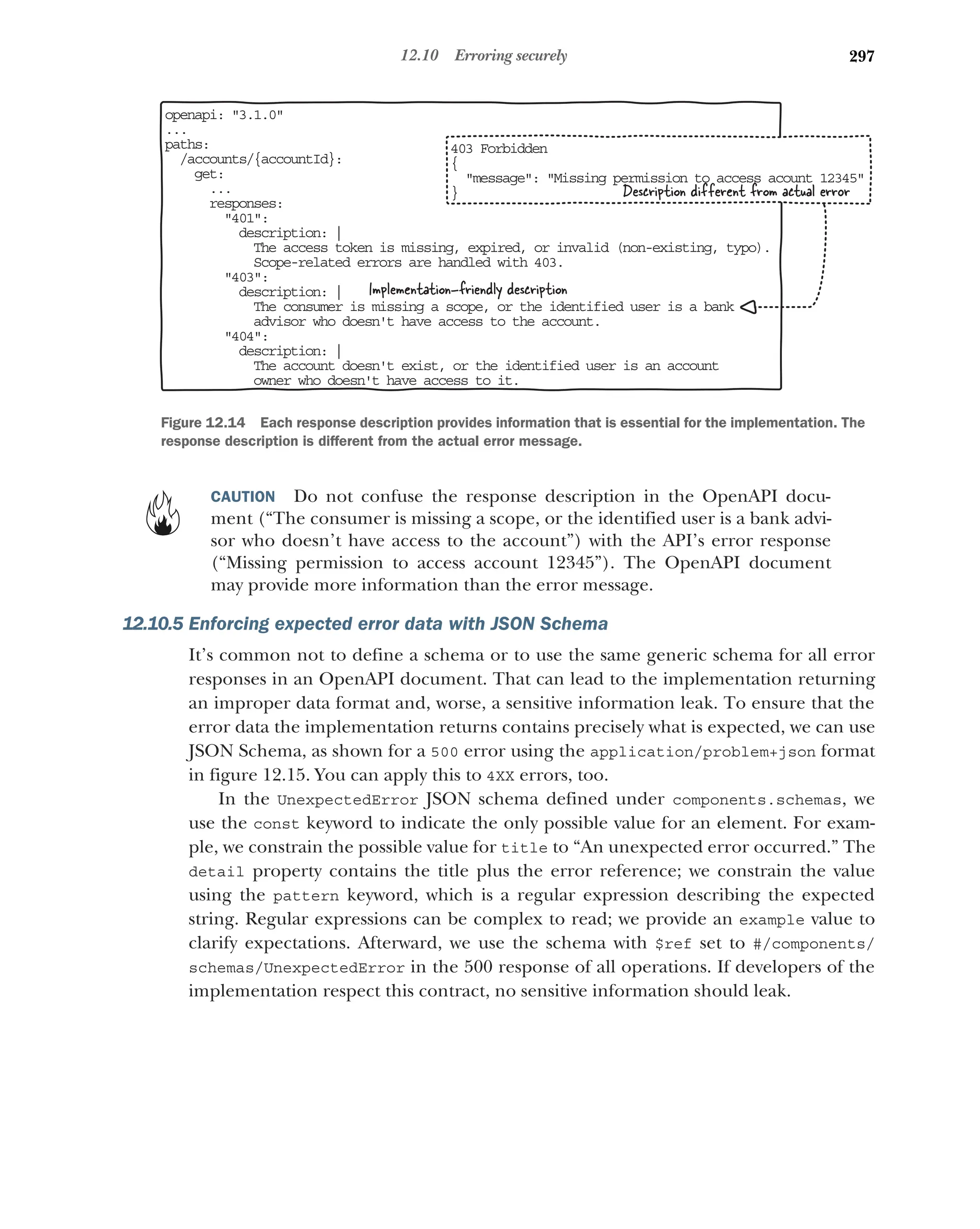
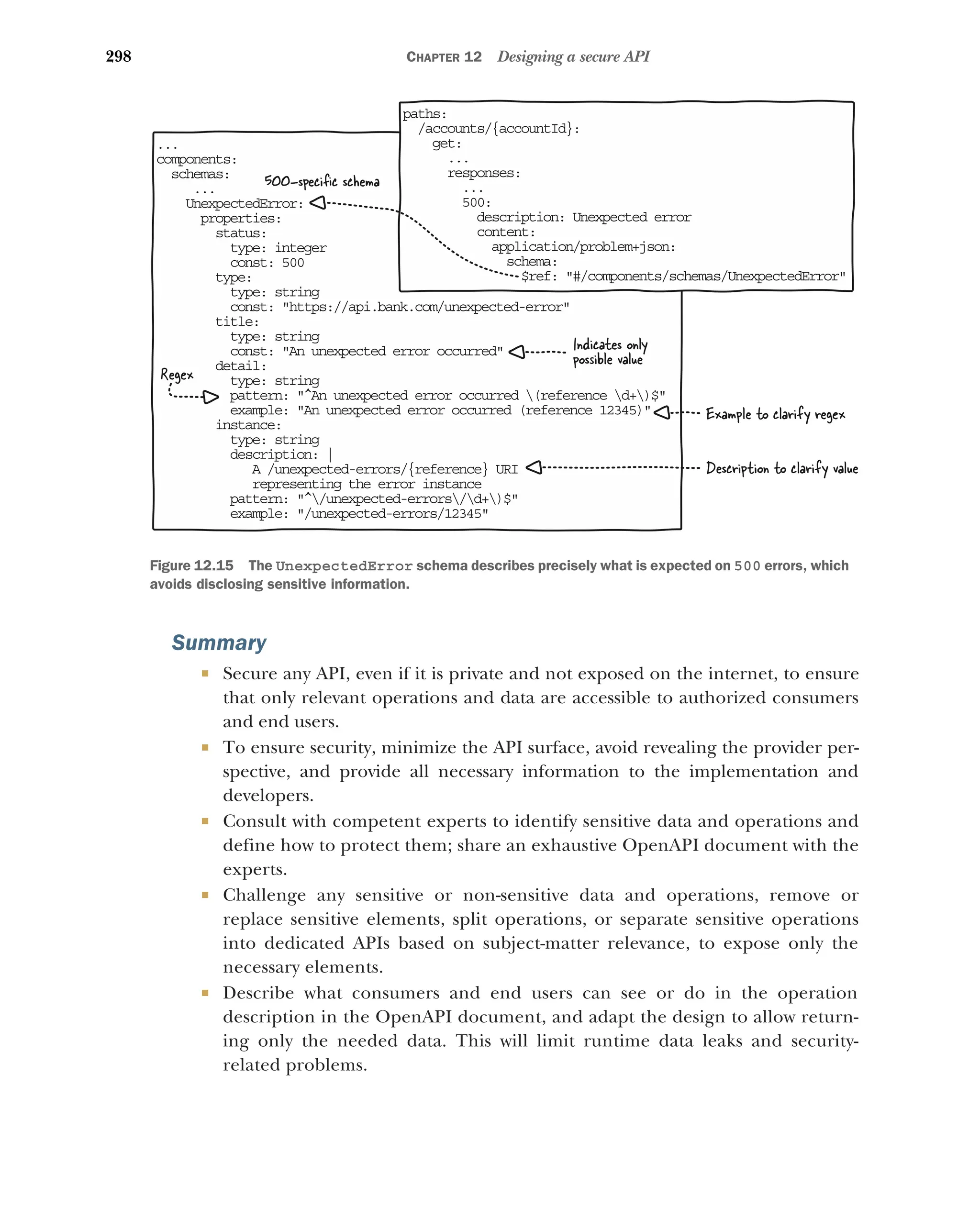
![300 CHAPTER 12 Designing a secure API
{
id: 1234,
date: 2066-09-01,
type: running
duration: 45,
calories: 350,
gpsCoordinates: [
{
timestamp: 2066-09-01T10:00:00Z,
latitude: 40.748817,
longitude: -73.985428
},
...
]
}
Exercise 12.2
A company specializing in data extraction creates an API to determine whether a
string format matches any ID format of any country. For example, GET /identifi-
ers?id=123-456-789 country=BRA could determine whether 123-456-789 matches a
Brazilian driver’s license ID or any other Brazilian ID. Does the design of this opera-
tion have security problems, and if so, how can they be fixed?
Exercise 12.3
In a hospital, different applications, such as Patient Folder, Treatment, and Schedule,
use the same medical API. This API has a GET /patients/{patientId}/conditions
operation whose data must be accessible only to the doctors treating the patient on
the Patient Folder and Treatment applications. Can this be handled with scopes or
implementation checks?
Exercise 12.4
An API for managing library systems has the following operations and scopes:
GET /books, scope: books
POST /books, scope: books
GET /books/{bookId}, scope: book
PUT /books/{bookId}, scope: book
DELETE /books/{bookId}, scope: book
GET /members, scope: members
POST /members, scope: members
GET /members/{memberId}, scope: member
PUT /members/{memberId}, scope: member
Listing 12.3 Reading workout data](https://image.slidesharecdn.com/lauretarnaud-thedesignofwebapis2025-250821164447-5e92da1d/75/Lauret-Arnaud-The-Design-of-Web-APIs-2025-pdf-338-2048.jpg)

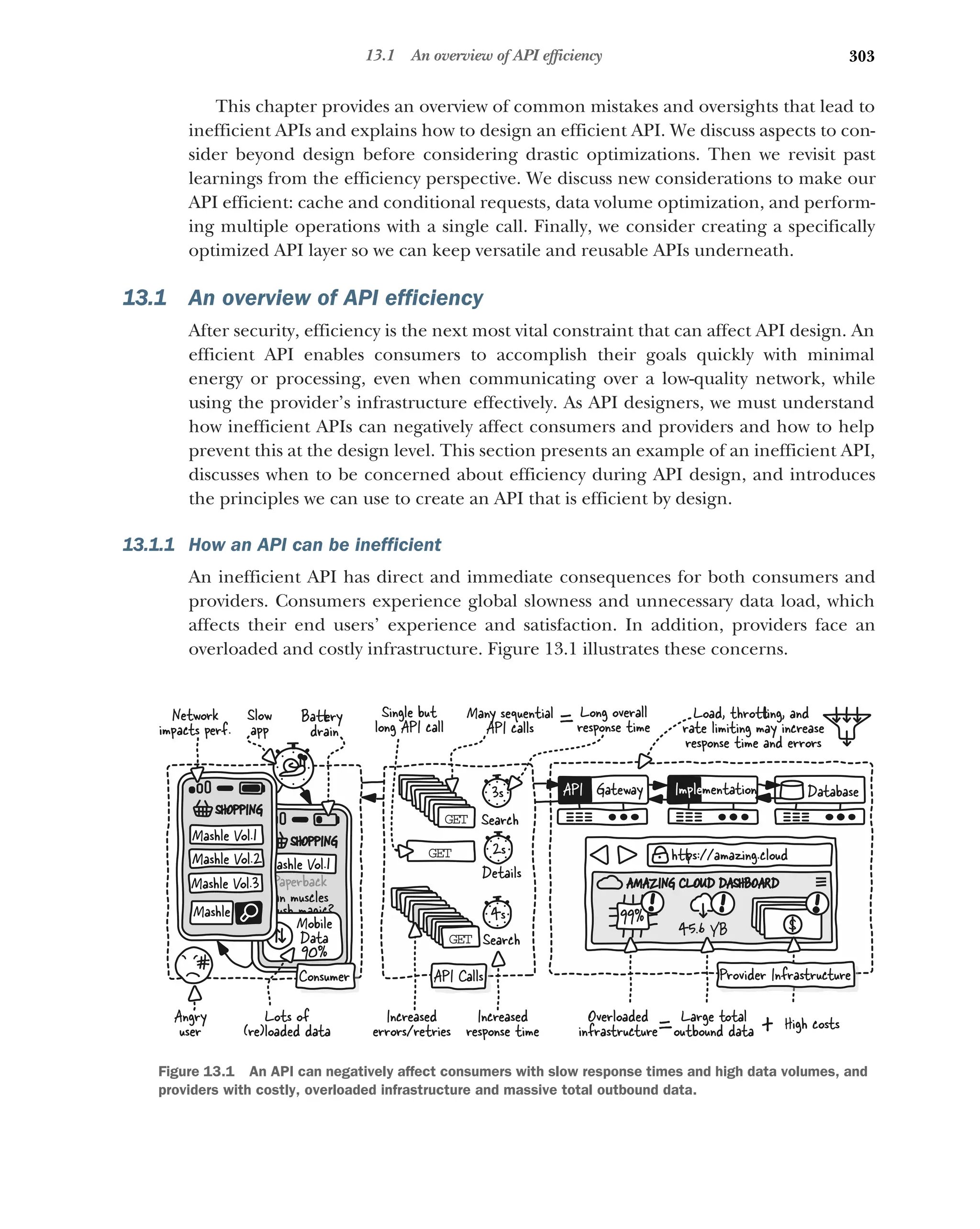
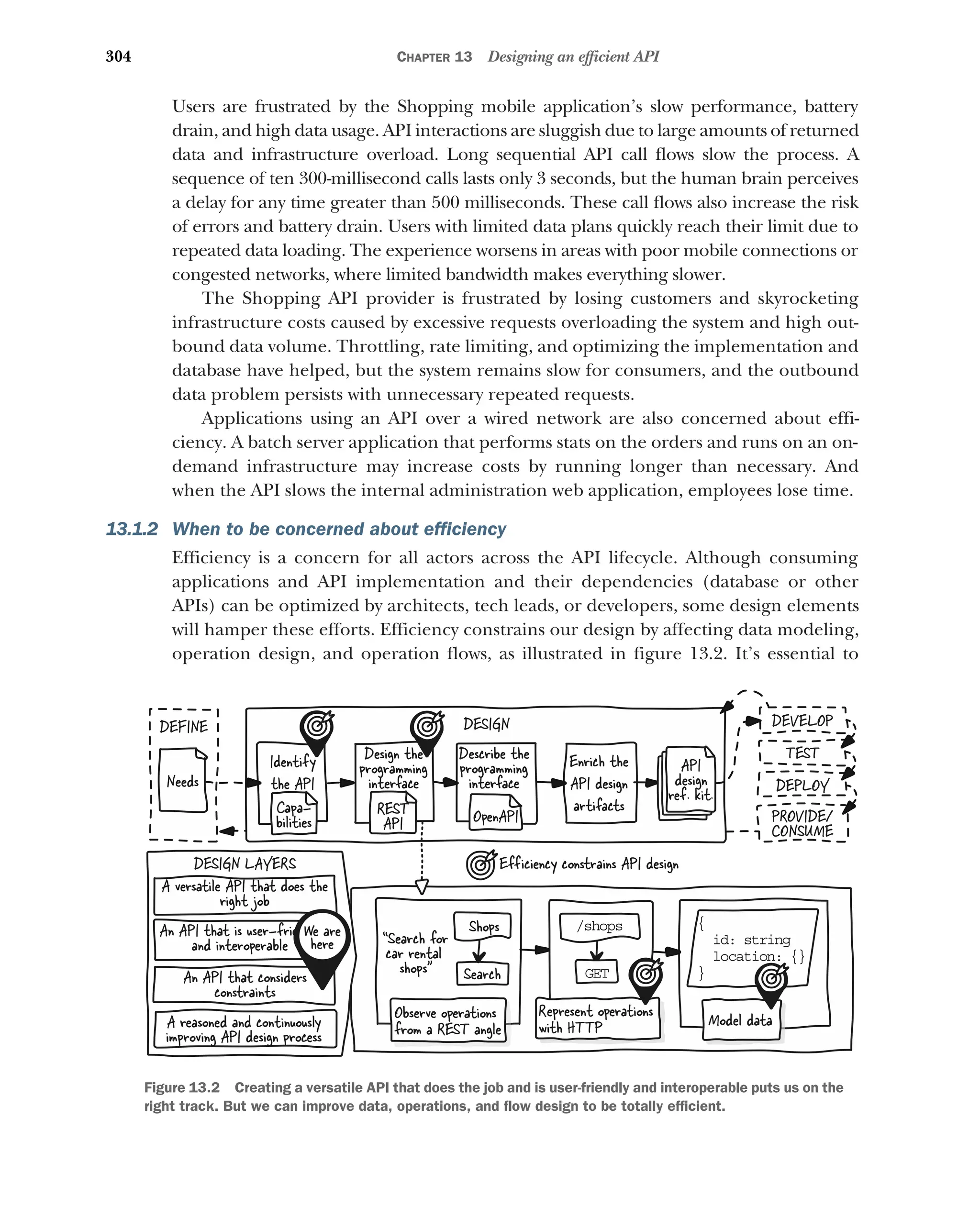
![306 CHAPTER 13 Designing an efficient API
compared to HTTP 2 and later. Nonetheless, many APIs still employ HTTP 1.1. The
choice of version doesn’t alter our use of HTTP (requests, responses, methods, sta-
tuses, etc.). However, using HTTP 2 directly or via a proxy is more efficient.
HTTP 1.1 can compress request and response body data (not headers) to reduce
data volume, but this may not be enabled by default. An HTTP 1.1 server keeps con-
nections open, enabling consumers to reuse connections for other requests. However,
HTTP 1.1 does not allow parallel requests over the same connection, requiring con-
sumers to open multiple connections. Additionally, browsers and smartphone OSs
limit simultaneous connections to a server, affecting overall response time.
HTTP 2 and later versions resolved HTTP 1.1’s limitations and enhance perfor-
mance. They offer improved compression for bodies and headers, use a more effi-
cient binary format for data transmission, and support persistent connections and
parallel requests. Consumers can send requests in parallel up to the server’s capacity
without being limited by browsers and smartphone OSs.
NOTE On average, HTTP compresses JSON or any textual data by up to 75%;
the compressed data is reduced to 25% of its original size. Although addi-
tional compression is unnecessary, we may want to optimize the returned data
to minimize volume (section 13.5).
13.2.2 Limiting API usage with rate-limiting
Rate-limiting lets us control how consumers perform requests over time by, for exam-
ple, limiting the number of requests over a short period. This is crucial for protecting
underlying systems from malicious (denial of service [DoS]) or unintentional (loop
bug) floods of requests and ensuring fair distribution of resources among all consum-
ers. On-premises infrastructure has limited capabilities and is often difficult to extend,
and although cloud infrastructure can expand to meet demand, budget constraints
may arise. Defining rate-limiting policies isn’t our role, but we can at least ensure that
they are in place and applied in a user-friendly, interoperable way.
The money transfer system handles 1,000 requests per minute. Increasing the
server’s CPU and RAM may enhance processing capacity, but limits remain. Each con-
sumer must be granted a limited number of calls per minute to protect the system. On
reaching their limit, the API gateway returns 429 Too Many Requests with a standard
Retry-After: Tue, 02 Jan 2024 14:12:00 GMT header for the reset time. Additional
error details may be provided (section 9.8), but they must adhere to the error struc-
ture shared by all APIs and outlined in the API design guidelines (section 16.3).
NOTE Rate-limiting can also restrict API usage based on payment tiers. Rate-
limiting policies may need to evolve as the business, API usage, or infrastruc-
ture changes. Rate-limiting is usually implemented by an API gateway man-
aged by a separate team; coordinate with them to maintain a consistent
design across all exposed APIs.](https://image.slidesharecdn.com/lauretarnaud-thedesignofwebapis2025-250821164447-5e92da1d/75/Lauret-Arnaud-The-Design-of-Web-APIs-2025-pdf-344-2048.jpg)
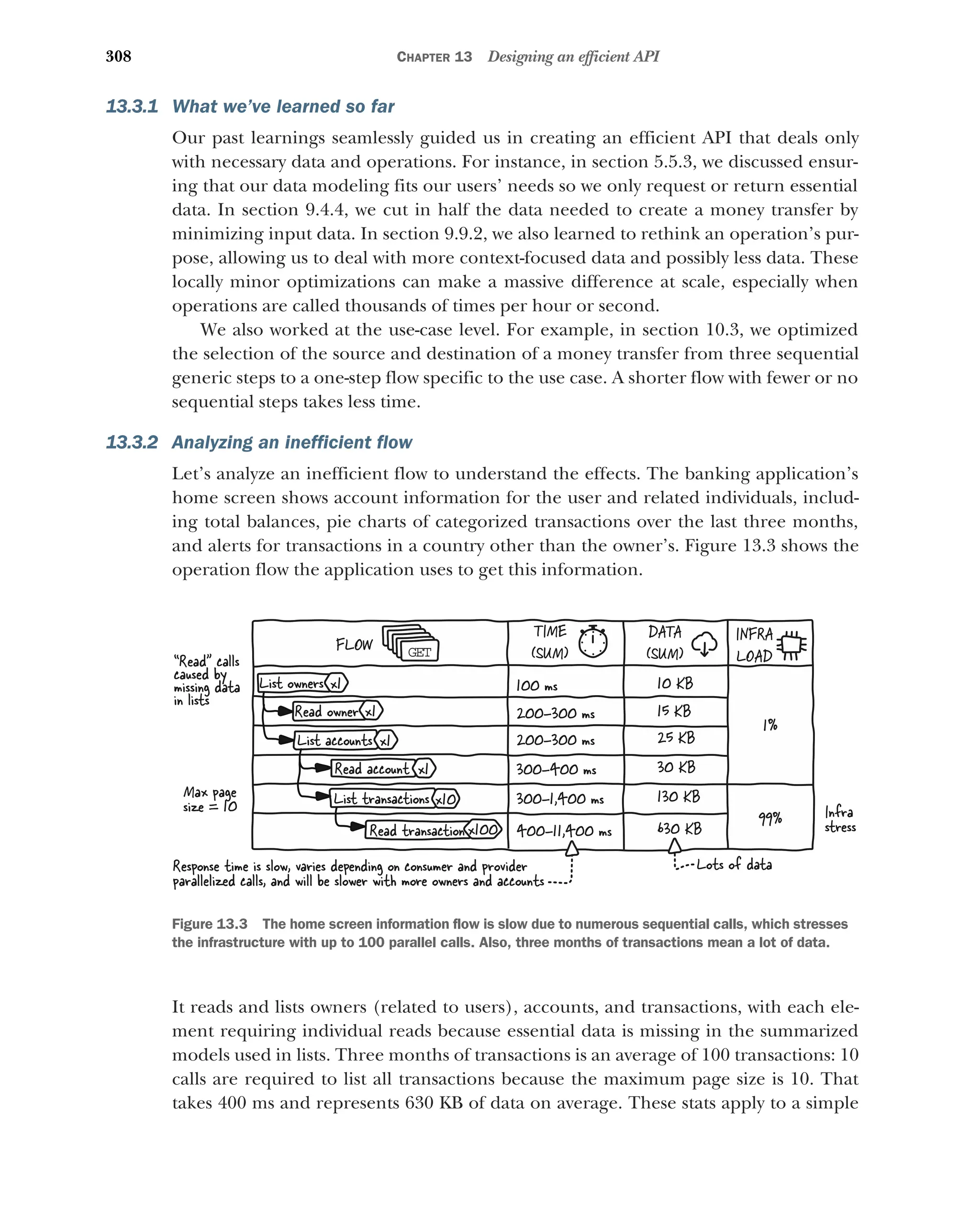
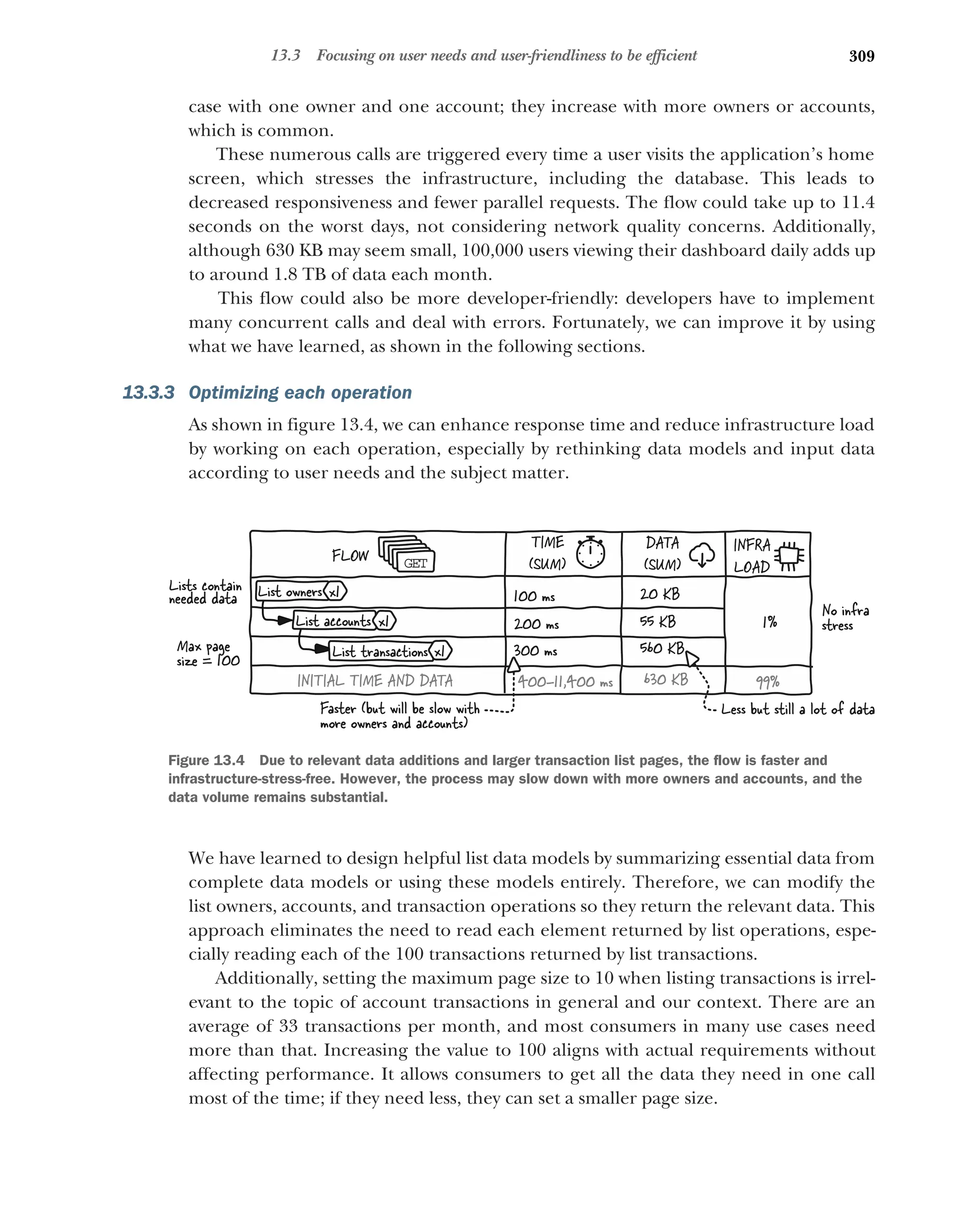
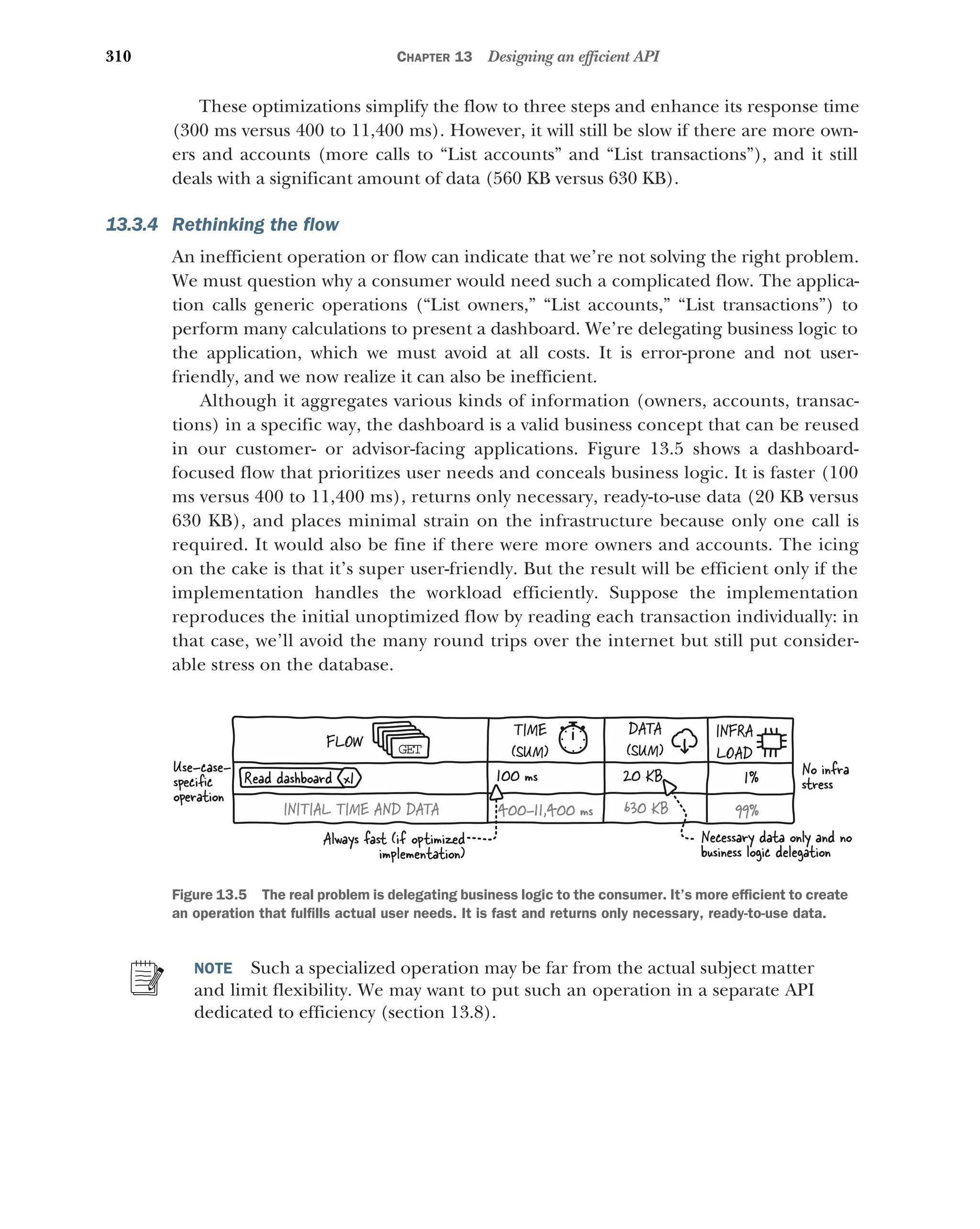
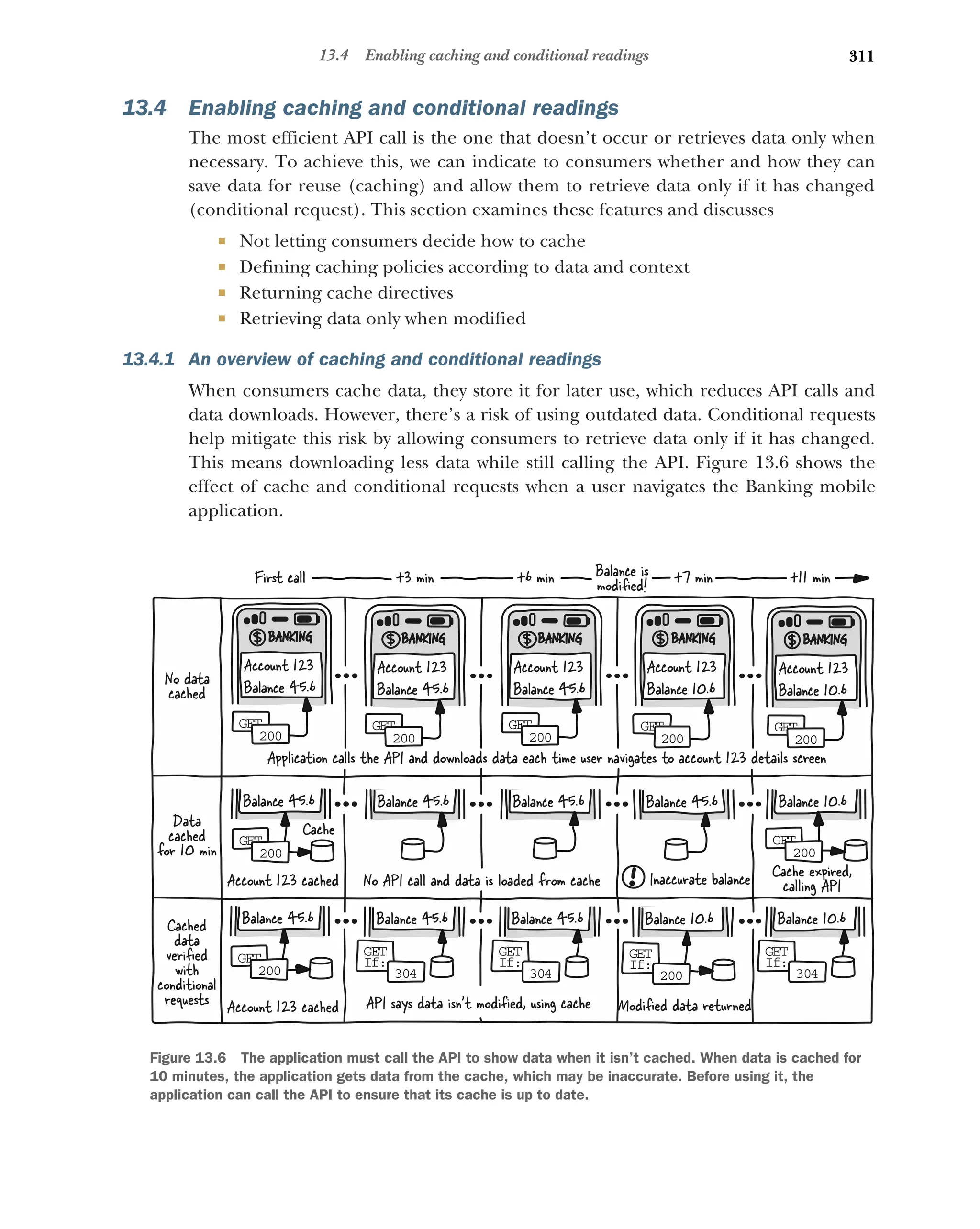
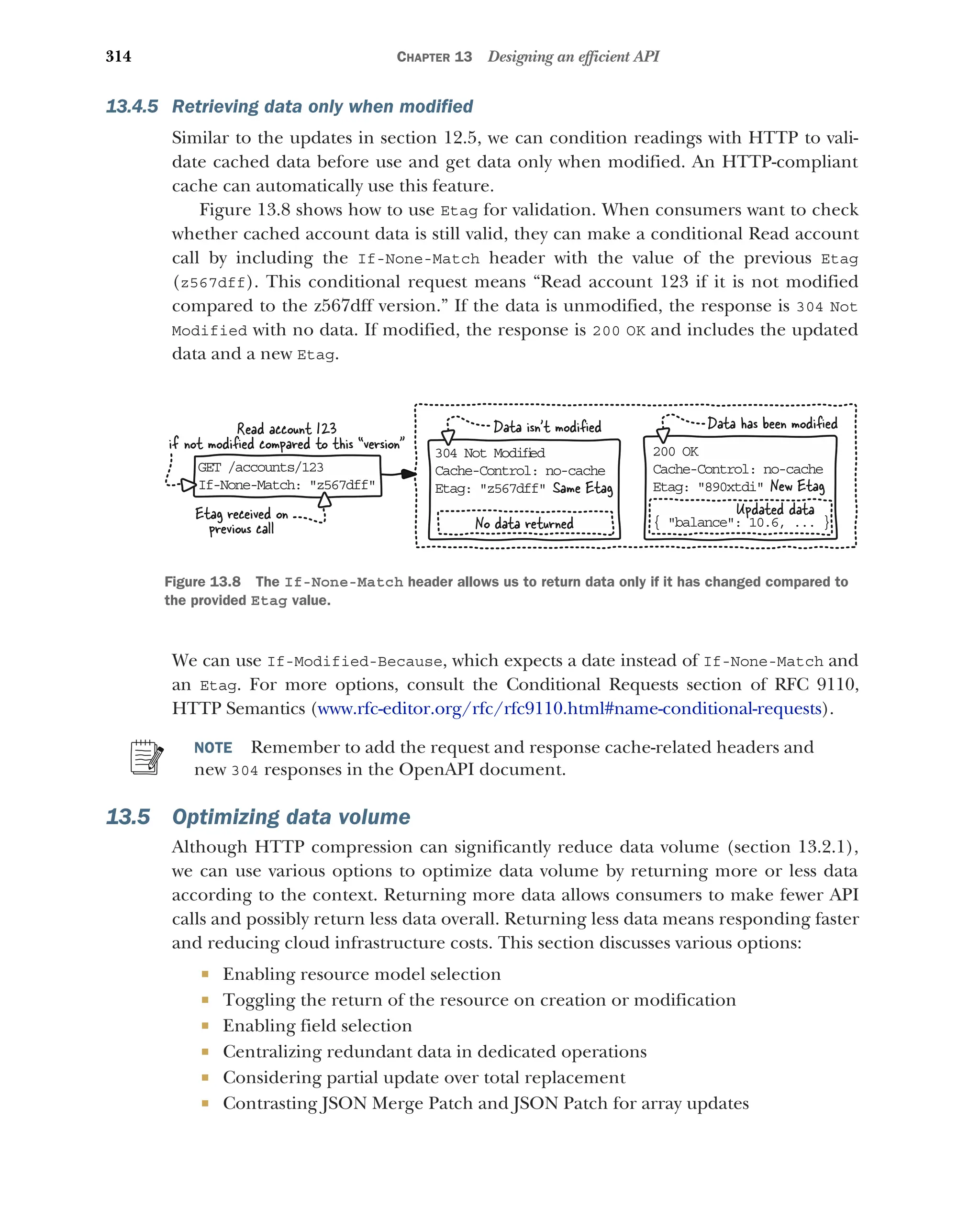
![315
13.5 Optimizing data volume
13.5.1 Enabling resource model selection
Once we choose a data model, especially for lists, we can’t change it, potentially lead-
ing to too much or insufficient data. Allowing consumers to select the data model for
each operation would improve our API’s flexibility and efficiency. Figure 13.9 shows
how to use content negotiation or the Prefer header to enable this choice.
We learned about standard media types, such as application/json and text/csv,
in section 9.7.1. HTTP lets us create custom media types. Custom media types used
in APIs are often named application/vnd.something+json, where vnd indicates a
vendor-specific type and +json indicates that the type is JSON-based (use +xml for
XML-based data). We can define a custom media type for each model type, such as
application/vnd.bankingapi.summarized+json for the summarized data model or
application/vnd.bankingapi.complete+json for the complete one. The API responds
with the type of model corresponding to the media type the consumer sent in the
Accept header. Its Content-Type indicates the model used.
Instead of custom media types, we can use the Prefer request header to tweak an
operation’s behavior (defined in RFC 7240, Prefer Header for HTTP; www.rfc-editor
.org/rfc/rfc7240.html). We define a model custom preference so consumers can send
Prefer: model=summarized or Prefer: model=complete depending on their needs.
The response has the usual Content-Type: application/json header, but it also con-
tains the Preference-Applied header indicating the returned model.
CAUTION Although these API design options are useful and aligned with
HTTP specifications, they are uncommon, so use them cautiously. Using a
custom media type may surprise developers. The Prefer header option allows
the usual application/json media type to be used.
200 OK
C +
ontent-Type: application/vnd.bankingapi.summarized json
{ id: ...,
balance: ... }
GET /accounts/123
Accept: application/vnd.bankingapi.summarized+json
GET /accounts
Prefer: model=complete
200 OK
Content-Type: application/json
Preference-Applied: model=complete
{ data: [{
id: ...,
balance: ...,
owner: ...,
... }]
}
Complete data model
instead of summarized
Summarized data model
instead of complete
Custom media type indicating desired model The Prefer header can be used to tweak behavior
Custom preference
indicating desired
model
Figure 13.9 We can use a custom media type or preference to get the complete or summarized model on
any read, list, or search operation.](https://image.slidesharecdn.com/lauretarnaud-thedesignofwebapis2025-250821164447-5e92da1d/75/Lauret-Arnaud-The-Design-of-Web-APIs-2025-pdf-353-2048.jpg)
![316 CHAPTER 13 Designing an efficient API
Both solutions apply to “Read” and “List” or “Search” operations. For example, calling
GET /accounts with Prefer: model=complete returns a list of complete accounts
instead of the usual summary. Calling GET /accounts/123 with application/vnd
.bankingapi.summarized+json media type returns the summarized account instead
of the usual complete one. If no information about the desired model is provided, the
operation returns a default model so it behaves as expected. For example, the com-
plete model is returned by default when reading an account.
TIP The model selection helps with reading resources that have multiple
IDs. For instance, if a consumer only has an account ID and the “Read
account” operation is GET /accounts/{iban}, they usually need to search with
GET /accounts?id=123 to get the IBAN and then read the account. Selecting
the complete model on search avoids the read call.
13.5.2 Toggling the return of updated or created resources
In section 4.6.2, we learned to return resource data on creation or update, but con-
sumers may not always need that data. We can use the Prefer header we discussed in
section 13.5.1 to toggle the return of the created or updated resource.
For instance, when creating an account application with POST /account
-applications with Prefer: model=none or Prefer: return-no-content, the response
will be 201 Created with the Location header holding the created resource URL but
without data. I prefer to avoid returning 204 No Content to keep the information that
something was created. The model=none option also allows model=summarized or
model=minimal, respectively, leading to the return of the summarized account appli-
cation model or just its ID (see typical models in section 5.4.1).
13.5.3 Enabling field selection
If tuning models is not fine-grained enough, we can allow consumers to specify precisely
which fields they need. In section 11.4.3, we introduced hypermedia formats; some pro-
pose this feature out of the box. For instance, figure 13.10 shows how to get only the bal-
ance of an account with the JSON:API hypermedia format (https://jsonapi.org/).
A basic JSON:API document has some links and a data object containing a type
(account), a unique id (123), and attributes holding the account data. By default,
GET /accounts/123 returns all attributes. Only the balance attribute is returned if we
add the fields[account]=balance query parameter. See https:/
/jsonapi.org/format/
#fetching-sparse-fieldsets for more information. If you’re not using a specific hyper-
media format, you can use fields=balance to achieve the same result with plain
application/json data.
NOTE Other API formats like GraphQL and OData also propose field selec-
tion. GraphQL is discussed in section 14.8.](https://image.slidesharecdn.com/lauretarnaud-thedesignofwebapis2025-250821164447-5e92da1d/75/Lauret-Arnaud-The-Design-of-Web-APIs-2025-pdf-354-2048.jpg)
![317
13.5 Optimizing data volume
13.5.4 Centralizing redundant data in dedicated operations
Sometimes our data contains redundant information that appears many times in a
response or across responses. We may want to deliver this data through dedicated
operations.
In section 8.5.2, we learned to add human-readable labels for codes such as
account types and transaction categories. Operations that use these labels may return
the same occurrences multiple times; for example, many transactions may have the
123 code with the “Restaurant” label. Additionally, operations will always return them,
even if consumers already know what the 123 transaction category code means. We
can create a generic GET /codes/{codeName}/values operation to get the labels cor-
responding to codes, giving GET /codes/transaction-category/values in that case.
Such an operation will benefit from being cached (section 13.4). We can also create a
more specific GET /transaction-categories operation that returns more data, such
as icons and short and long labels that consumers may use depending on the room
available in the UI. The downside is that transaction data is a bit less ready to use,
requiring an extra call when category codes need to be interpreted, but that may be
worth considering at scale.
13.5.5 Considering a partial update over total replacement
Requesting less data means less time spent transmitting and processing it and less load
on the infrastructure. Additionally, although data ingress is generally free, cloud pro-
viders may bill for it. So, using partial update (PATCH) over total replacement (PUT)
can be useful in some cases. A replacement implies sending all of the resource’s data,
and a partial update allows consumers to send only modified data. Partially updating a
2 0
0 OK
C n
o tent-Type: application/vnd.api+json
{
i
l nks: { ... }
a
d ta: {
type: account,
id: 123,
attributes: {
balance: 45.6
}
}
}
G T
E /accounts/123? i
f elds[account]=balance
A c
c ept: application/vnd.api+json
Only the selected
data is returned
2 0
0 OK
C n
o tent-Type: application/vnd.api+json
{
i
l nks: { ... }
a
d ta: {
type: account,
id: 123,
attributes: {
type: current,
balance: 45.6,
...
}
}
}
G T
E /accounts/123
A c
c ept: application/vnd.api+json
All account data
is returned
JSON:API
hypermedia format
Figure 13.10 If field selection is enabled, consumers can, for example, get only the account
balance instead of all the account data.](https://image.slidesharecdn.com/lauretarnaud-thedesignofwebapis2025-250821164447-5e92da1d/75/Lauret-Arnaud-The-Design-of-Web-APIs-2025-pdf-355-2048.jpg)
![318 CHAPTER 13 Designing an efficient API
transaction to mark it as “checked” only requires sending {checked: true}, whereas
replacing it requires sending all of its properties. It looks like a negligible optimiza-
tion, especially when we know that data is compressed over the HTTP connection. But
we must think at scale; we don’t have one user checking one transaction. We have
hundreds of thousands, if not millions, of users checking 10 times more transactions
weekly or monthly.
13.5.6 Contrasting JSON Merge Patch and JSON Patch for array updates
In section 5.3.4, we learned to use the PATCH HTTP method for partial updates by
sending only the data to update. This technique is called JSON Merge Patch (RFC
7396). When modifying arrays, an alternative method called JSON Patch (RFC 6902)
can be used for efficient updates, but I recommend careful consideration before
using JSON Patch.
Figure 13.11 contrasts the two formats for updating the home address city of an
account owner using a PATCH /owners/123 request. The JSON Merge Patch version
contains the modified elements of the resource: the entire addresses array with only
the city property of the home address modified. The JSON Patch option describes a
list of modifications to be performed sequentially on the resource. It uses the replace
operation (op) to set the value of the element indicated by the path JSON pointer
(city property of the first element of addresses) to value.
Although JSON Patch can be more efficient than JSON Merge Patch when updating
elements in an array, I do not recommend using it to solve this particular problem or
in general. JSON Patch is not commonly used and is complex, whereas JSON Merge
Patch is widely adopted and intuitive. Documenting possible JSON Patch operations
with OpenAPI and JSON Schema is complex, if not impossible. Regarding array
update efficiency, if there are many elements in an array, they should be extracted
from the resource and handled via dedicated operations. In our case, we have only
two addresses that are not often modified, so it’s unnecessary.
PATCH /owners/123
Content-Type: application/json-patch+json
If-Match: et715
[
{
op: replace,
path: /addresses/0/city,
value: Paris
}
]
PATCH /owners/123
Content-Type: application/merge-patch+json
If-Match: et715
{
addresses: [
{ type: home, city: Paris, ...},
{ type: office, ... },
... ]
}
JSON Merge Patch JSON Patch
Only modified
element
Complete array
List of modifications
JSON Pointer
Operation
Figure 13.11 Updating the home address city with JSON Merge Patch requires sending the entire
address array. With JSON Patch, we only describe the modification of the city property of the first
element without needing to send the address array.](https://image.slidesharecdn.com/lauretarnaud-thedesignofwebapis2025-250821164447-5e92da1d/75/Lauret-Arnaud-The-Design-of-Web-APIs-2025-pdf-356-2048.jpg)
![321
13.7 Processing multiple elements with bulk or batch operations
“Update transaction” calls than a single call to “Update transactions.” This section dis-
cusses the design and optimization of bulk requests, choosing a bulk operation response
policy, designing the response, and partitioning access to bulk operations.
CAUTION A bulk operation’s design may require adaptations because pro-
cessing multiple elements may take a long time. See section 14.7 to learn how
to integrate this constraint into its design.
13.7.1 Designing bulk operation requests
As illustrated in figure 13.12, a bulk operation request contains multiple times the
information needed to process one element, including the resource identifier (in a
broad sense, path and ID), HTTP method, and resource data. Our banking company
collaborates with a partner that submits many bank account applications to us daily.
Rather than making individual calls to our POST /account-applications operation
for each account application, we modified the request body to allow them to submit
100 account applications in a single call, using a data array consistent with our
“Search” or “List” operation response format.
Suppose the partner needs to modify multiple account applications. In that case, they
can work at the collection level and use a single PUT or PATCH /account-applications
Path parameter moved in
a list query parameter
PO T /acc-applications
S
{
card: gold,
..
.
}
PO T /acc-applications
S
{
ata: [
d
{
card: gold,
...
},
{
card: metal,
...
}
]
}
Design similar to a List or
Search operation response
PA CH /acc-applications/456
T
{
card: metal,
..
.
}
PA CH /acc-applications
T
{
ata: [
d
{
id: 123,
card: metal,
...
},
{
id: 456,
card: gold,
...
}
]
}
PO T /acc-applications
S
{
card: gold,
..
.
}
PA CH /acc-applications/123
T
{
card: metal,
..
.
}
DE ETE /acc-applications/456
L
DE ETE /acc-applications/123
L
DE ETE /acc-applications ?id=123,456
L
Working at parent collection level
(last path parameter removed)
Path parameter moved
in resource data
Multiple applications
Each body goes in the list
Also works with PUT
Figure 13.12 The bulk requests body contains the data of multiple resources (if any). If each element needs
to be identified, the final path parameter is moved at each resource data level in the body (PATCH or PUT) or
in a list query parameter (DELETE).](https://image.slidesharecdn.com/lauretarnaud-thedesignofwebapis2025-250821164447-5e92da1d/75/Lauret-Arnaud-The-Design-of-Web-APIs-2025-pdf-359-2048.jpg)
![323
13.7 Processing multiple elements with bulk or batch operations
improves data efficiency by eliminating the need for consumers to resend valid
account applications.
However, in the context of bulk money transfers, the all-or-nothing approach is not
just a choice but a necessity. It’s crucial to maintain the integrity of the processing for
the set of provided transactions where elements may be interdependent, ensuring a
secure, reliable bulk operation.
13.7.4 Designing a mixed response
If we use the mixed error policy, we can use the 207 Multi-Status HTTP status code
defined by WebDAV, which is an extension of HTTP (www.rfc-editor.org/rfc/rfc4918).
This extension defines a response data format containing a status and data for each
processed element. Unfortunately, it’s in XML, is specific to WebDAV, and lacks head-
ers. No similar standard exists for JSON-based APIs, but we can use it as an inspiration
to define our format. It contains the same data that the regular unitary operation
would return for each element, including status, headers, and body data. This format
is illustrated in figure 13.13.
The data array contains elements ordered as in the original request. Each element
includes an HTTP status, a headers map, and a body. The first element had no prob-
lems, with a status of 201 (Created), standard headers (including Location), and the
created resource data in the body. The second call had an invalid value in the card prop-
erty, resulting in a status of 400 (Bad Request) and a Content-Type of application/
problem+json in the headers. The body contains error information, with all paths
POST /acc-applications
{
data: [
{
card: gold,
...
},
{
card: bleue,
...
}
]
}
207 Multi-Status
{
data: [
{
status: 201,
headers: {
Content-Type: application/json,
Location: /account-applications/123
},
body: { id: 123, card: gold, ... }
},
{
status: 400,
headers: {
Content-Type: application/problem+json
}
body: {
errors: [ { path: #/data[1]/card, ... }]
}
}
]
}
Same
order Media type, URL, and data as usual
Error paths start with #/data/[index]
Same
information as
for a unitary
call
Error media type and data as usual
Indicates a response with mixed statuses
Figure 13.13 Each element of the bulk response contains the same data that a unitary call would return.
Response elements are ordered as in the request.](https://image.slidesharecdn.com/lauretarnaud-thedesignofwebapis2025-250821164447-5e92da1d/75/Lauret-Arnaud-The-Design-of-Web-APIs-2025-pdf-361-2048.jpg)
![324 CHAPTER 13 Designing an efficient API
starting with #/data[1] to indicate the source of the problem. If all elements share
the same status, such as 200 OK or 400 Bad Request, the operation returns that status
instead of 207.
13.7.5 Designing an all-or-nothing response
If we use the all-or-nothing error policy, we can use the same design as the mixed
approach so all our bulk operations are consistent. Also, we may be constrained by the
fact that even in the case of total success or error, we may need different HTTP sta-
tuses and return 207 Multi Status. The response to a PUT can be 200 OK (update) or
201 Created. A specific error can be 400 Bad Request or 403 Forbidden. Additionally,
we may need to return a Location header for each created element.
Figure 13.14 shows an alternative design to use if we don’t care about element-
specific headers or statuses. For success, we can return a data list containing the data
for each element. In case of an error, we can return the usual error format, listing all
errors of all elements in the same place. Such formats have the advantage of being
simple and similar to regular operation responses; still, if we later need to handle a
mixed status for another bulk operation and introduce the other design option, we’ll
end up with inconsistent designs. That can be a tricky decision; check section 16.1 to
make it confidently.
13.7.6 Optimizing bulk request responses
As in section 13.5.2, we can use model selection to indicate the desired model for ele-
ments returned under data. When we add Prefer: model=none to the request, no
body property is returned. We can also request just the IDs (model=minimal) or sum-
marized data (model=summarized). In the case of 207 Multi Status, this doesn’t apply
to errored elements in data, which will always have their body.
20 Created
1
{
data: [
{
id: 123,
card: gold, ...
},
{
id: 456,
card: metal, ...
}
]
}
Single HTTP status
All errors of all
elements in same list
instead of being
grouped by element
40 Bad Request
0
Co tent-Type: application/problem+json
n
{
status: 400,
..
.
errors: [
{ path : #/data[1]/card, ... },
{ path : #/data[1]/card, ... },
{ path : #/data[1]/card, ... },
{ path : #/data[9]/card, ... },
{ path : #/data[9]/card, ... }
]
}
No element-specific
headers
Figure 13.14 Possible design for all-or-nothing operations if we don’t care about element-specific HTTP
statuses or headers. The errors list contains all errors of all errored elements.](https://image.slidesharecdn.com/lauretarnaud-thedesignofwebapis2025-250821164447-5e92da1d/75/Lauret-Arnaud-The-Design-of-Web-APIs-2025-pdf-362-2048.jpg)
![327
Exercises
Return a 207 Multi-Status HTTP status if the bulk response contains successes
and errors.
Use behavior scope or a dedicated operation to partition access to bulk
operations.
When a consumer hits its limits, return 429 Too Many Requests and a Retry-
After header. Provide informative RateLimit headers on all responses.
Ensure that HTTP 2 is activated or HTTP 1.1 compression and keep-alive
connections are enabled before optimizing API design due to performance
problems.
Create an experience API on top of your business API to keep it versatile if
heavy optimization is needed.
Exercises
This section contains exercises to help you practice some key skills in this chapter.
You’ll find the solutions in the online appendix (https:/
/mng.bz/260N). I encourage
you to solve them and read their solutions, which include detailed explanations, refer-
ences to relevant sections, and additional comments.
Exercise 13.1
An e-learning platform that proposes tens of thousands of courses that cover hun-
dreds of domains is powered by an API. The users of the platform search for courses
by domain, description, and star rating. Listing 13.1 shows the response of the “List
courses” operation (GET /courses), which returns all available courses. Listing 13.2
shows the response of the “Read course” operation (GET /courses/{courseId}). Can
these operations cause efficiency problems when users search for courses, and how
can they be fixed?
{
data: [
...
{
id: course_1005,
name: Advanced Machine Learning
},
{
id: course_1006,
name: Financial Accounting,
},
...
]
}
Listing 13.1 “List courses” response](https://image.slidesharecdn.com/lauretarnaud-thedesignofwebapis2025-250821164447-5e92da1d/75/Lauret-Arnaud-The-Design-of-Web-APIs-2025-pdf-365-2048.jpg)
![328 CHAPTER 13 Designing an efficient API
{
id: course_1005,
name: Advanced Machine Learning,
domain: {
code: AI,
name: Artificial Intelligence,
description: The Artificial Intelligence domain focuses ...
},
stars: 4.9,
description: Dive into the advanced techniques of ...,
lessons: [ ... ]
}
Exercise 13.2
You’re working on a Library API and have defined the caching policy for the “Search
books” operation (GET /books) based on the following information:
The operation returns books matching search criteria covering availability, title,
author, genre, and description.
New books are added on the 12th of each month at 00:00.
Each book can be returned or reserved at any time, modifying the book’s avail-
ability.
What cache-related HTTP headers are returned for a GET /books call performed on
January 11 at 11:00 a.m.?
Exercise 13.3
In a social network API, the “Timeline” operation returns the threads for a user; list-
ing 13.3 shows its partial definition with OpenAPI. Is there an efficiency problem, and
how can it be fixed?
openapi: 3.1.0
...
paths:
/threads:
get:
summary: Timeline
parameters:
- name: q
in: query
schema:
type: string
- name: next
in: query
schema:
type: string
Listing 13.2 “Read course” response
Listing 13.3 “Timeline” operation](https://image.slidesharecdn.com/lauretarnaud-thedesignofwebapis2025-250821164447-5e92da1d/75/Lauret-Arnaud-The-Design-of-Web-APIs-2025-pdf-366-2048.jpg)

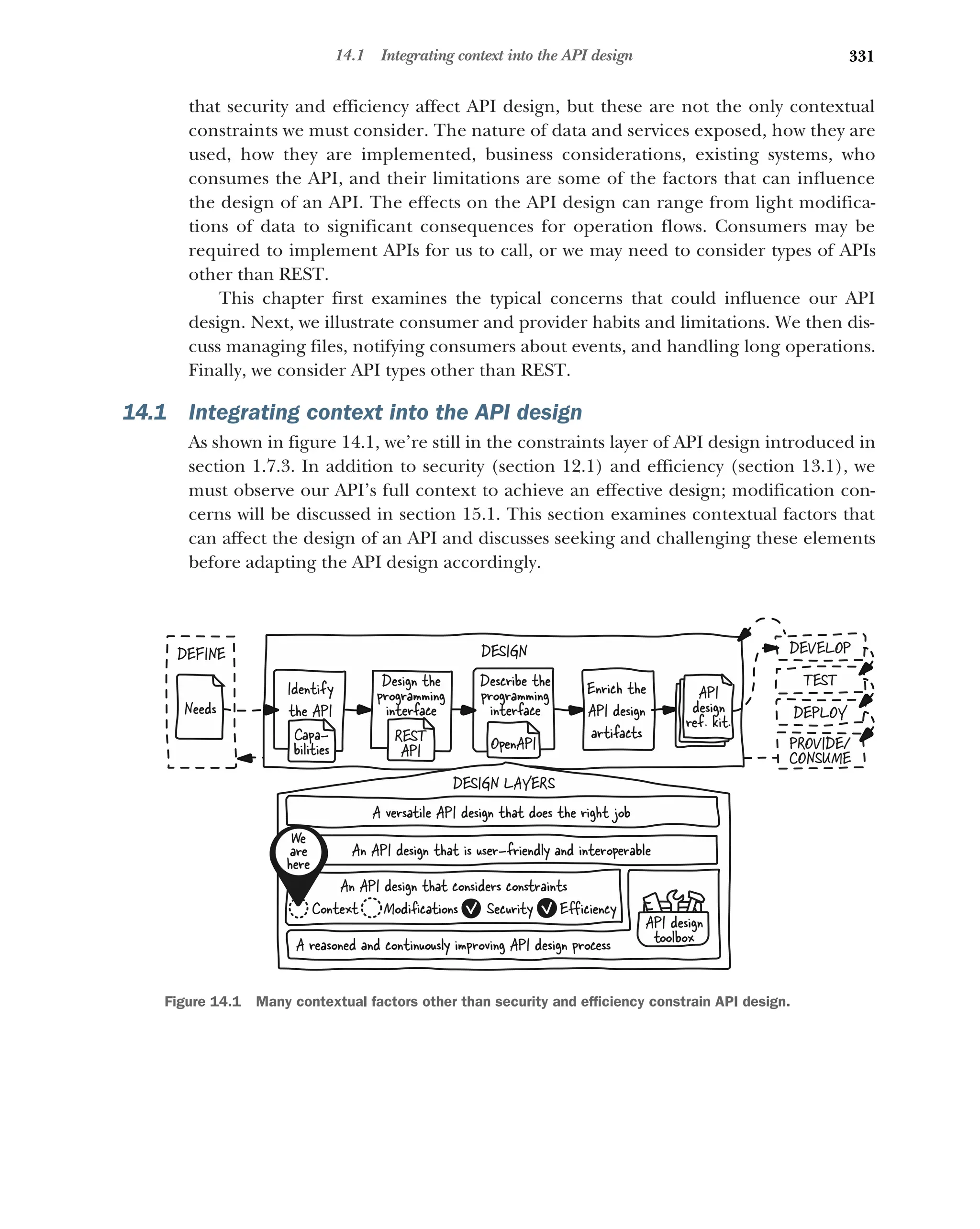

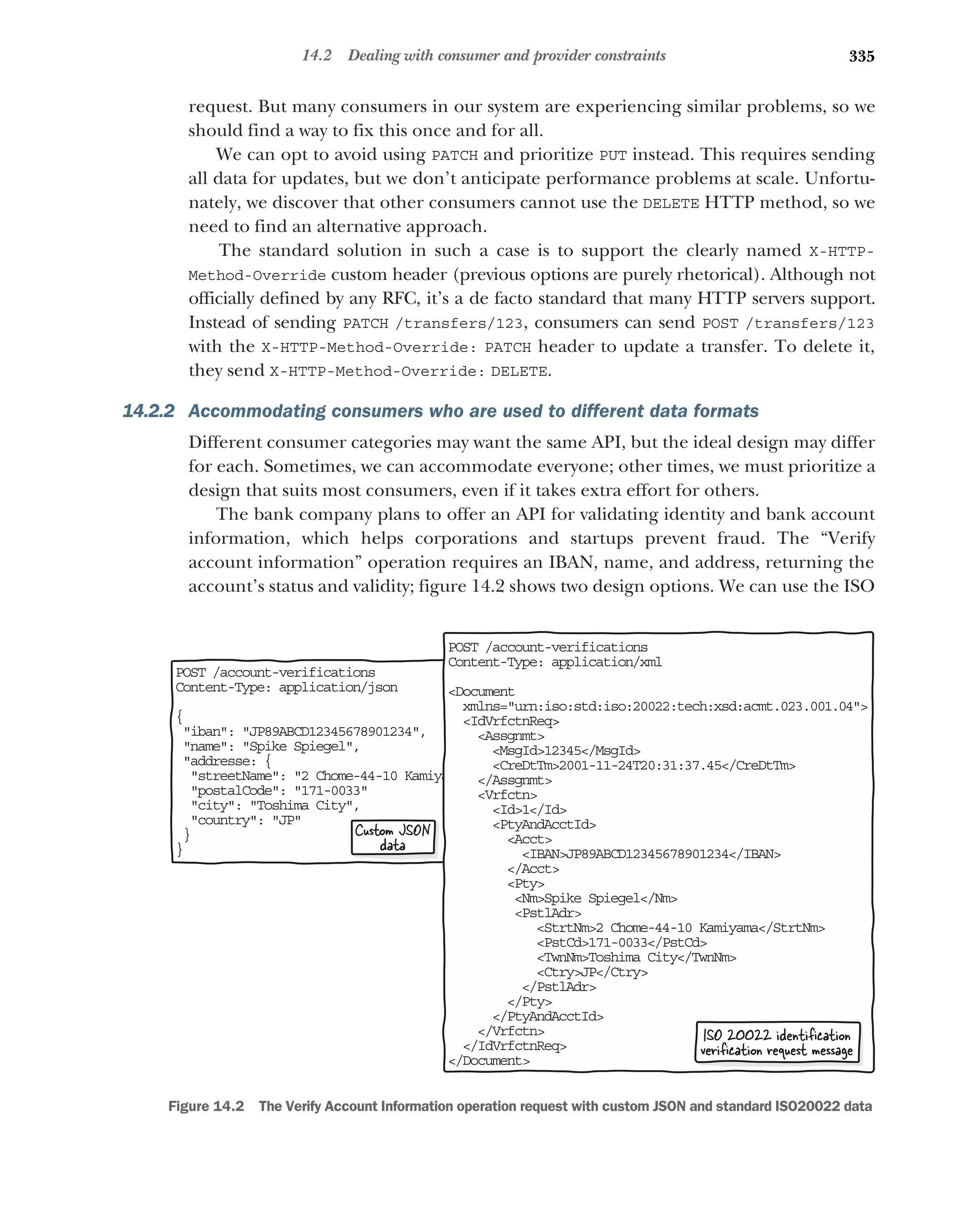
![339
14.3 Handling data and files
CAUTION Base64 turns binary data into text but increases the content size by
33%. HTTP compression limits this over the network, but the increase will be
around 5 to 10% for JPG files, for example.
Consumers can send all account application data and files with a single POST /account-
applications request that includes a documents array. Each document has type set to
“identity” or “residence” and a content property for Base64-encoded content.
Alternatively, we can use a more standard multipart/form-data to mix data and
raw binary files (smaller than Base64-encoded content). Each element is separated by
the boundary indicated in the Content-Type header and handled by HTTP libraries.
A part usually represents an HTML form field, such as a applicant name (“Spike Spie-
gel”) or a file (residence PDF). However, parts can have any media type, allowing com-
plex data structures, such as the data object, which is application/json. If two parts
share the same name, such as documents, they are considered an array. Here, the
implementation will map it with data.documents to get each file type (“identity” or
“residence”).
These approaches have downsides. Data and files need to be re-uploaded if errors
occur (such as missing properties in the data). Uploading multiple files can quickly
hit request size limits. Some legacy systems, like our old API gateway and banking
apps, may not handle multipart or Base64 content. However, combining files and data
works in simple cases, like sending a file with metadata that doesn’t fit in the URL or
headers; I suggest the multipart option in this case.
PO T /account-applications
S
Co tent-Type: application/json
n
{
name: Spike Spiegel,
address: { city: Tokyo },
documents: [
{ type: identity,
content: SGVsbG8s...},
{ type: residence,
content: IFdvcmxkIQ...}
]
} JSON + Base64
Base64-encoded
file content
PO T /account-applications
S
Co tent-Type: multipart/form-data; boundary=--123
n --boundary
-- 23--boundary
1
Co tent-Type: application/json
n
Co tent-Disposition: form-data; name=data
n
{
name: Spike Spiegel,
address: { ... },
documents: [
{ type: identity },
{ type: residence }
]
}
-- 23--boundary
1
Co tent-Type: image/png
n
Co tent-Disposition: form-data; name=documents
n
b nary data
i
-- 23--boundary
1
Co tent-Type: application/pdf
n
Co tent-Disposition: form-data; name=documents
n
b nary data
i
Multipart form data
Value
separator
Raw binary data
(smaller than Base64)
Flat name/value format
Figure 14.3 We can send a mix of data and files by encoding file content in Base64 strings in JSON or using
the multipart/form-data media type.](https://image.slidesharecdn.com/lauretarnaud-thedesignofwebapis2025-250821164447-5e92da1d/75/Lauret-Arnaud-The-Design-of-Web-APIs-2025-pdf-377-2048.jpg)
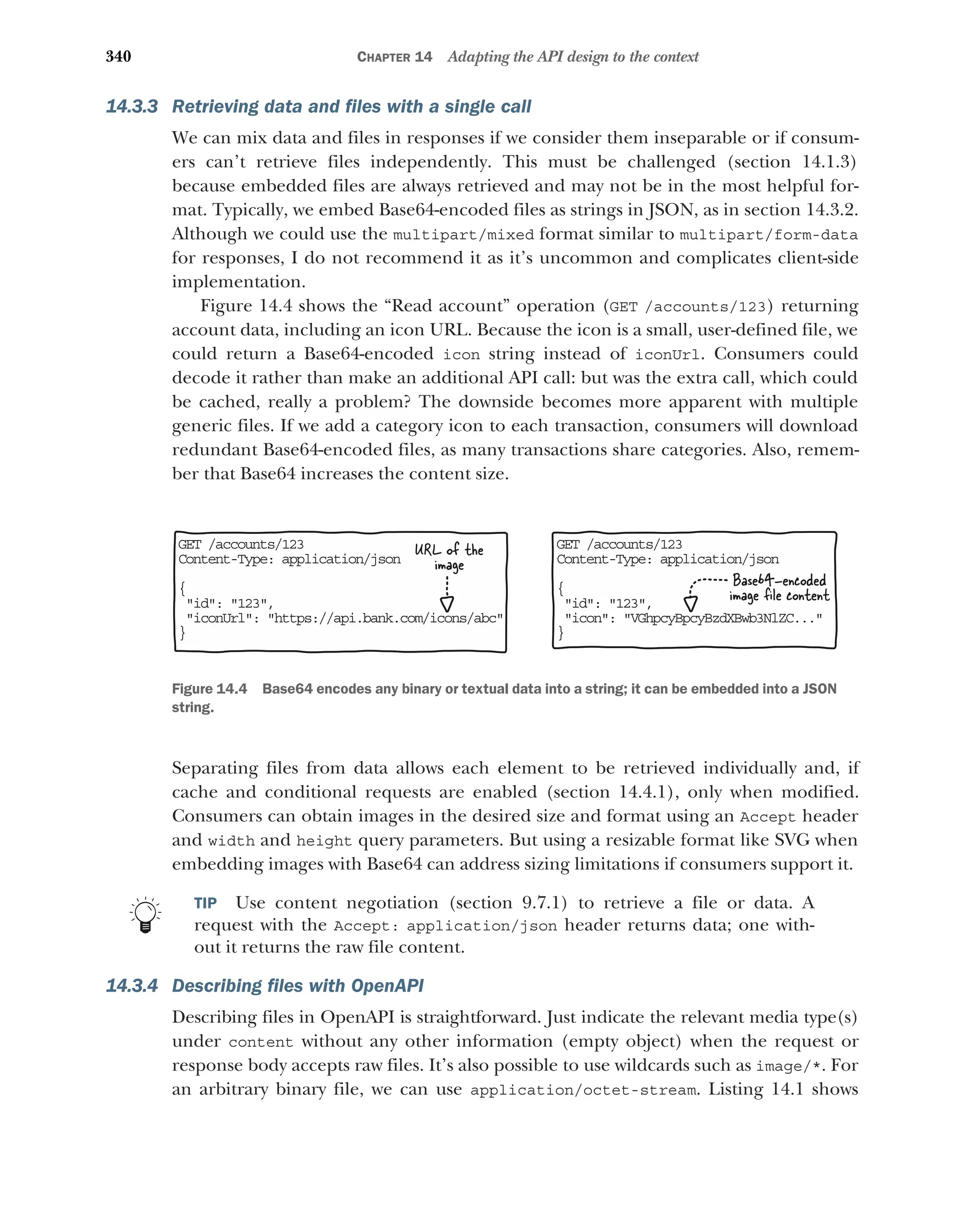
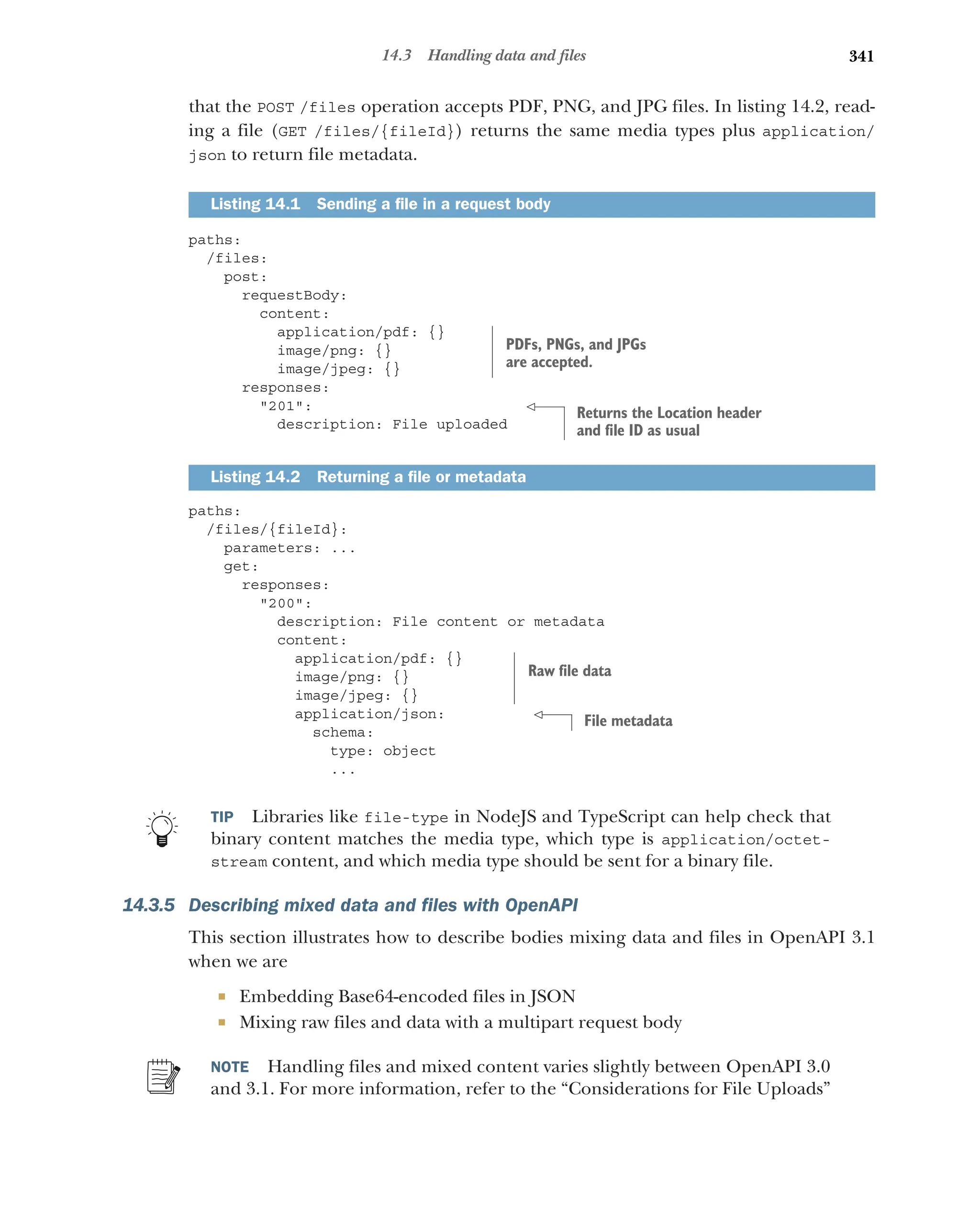
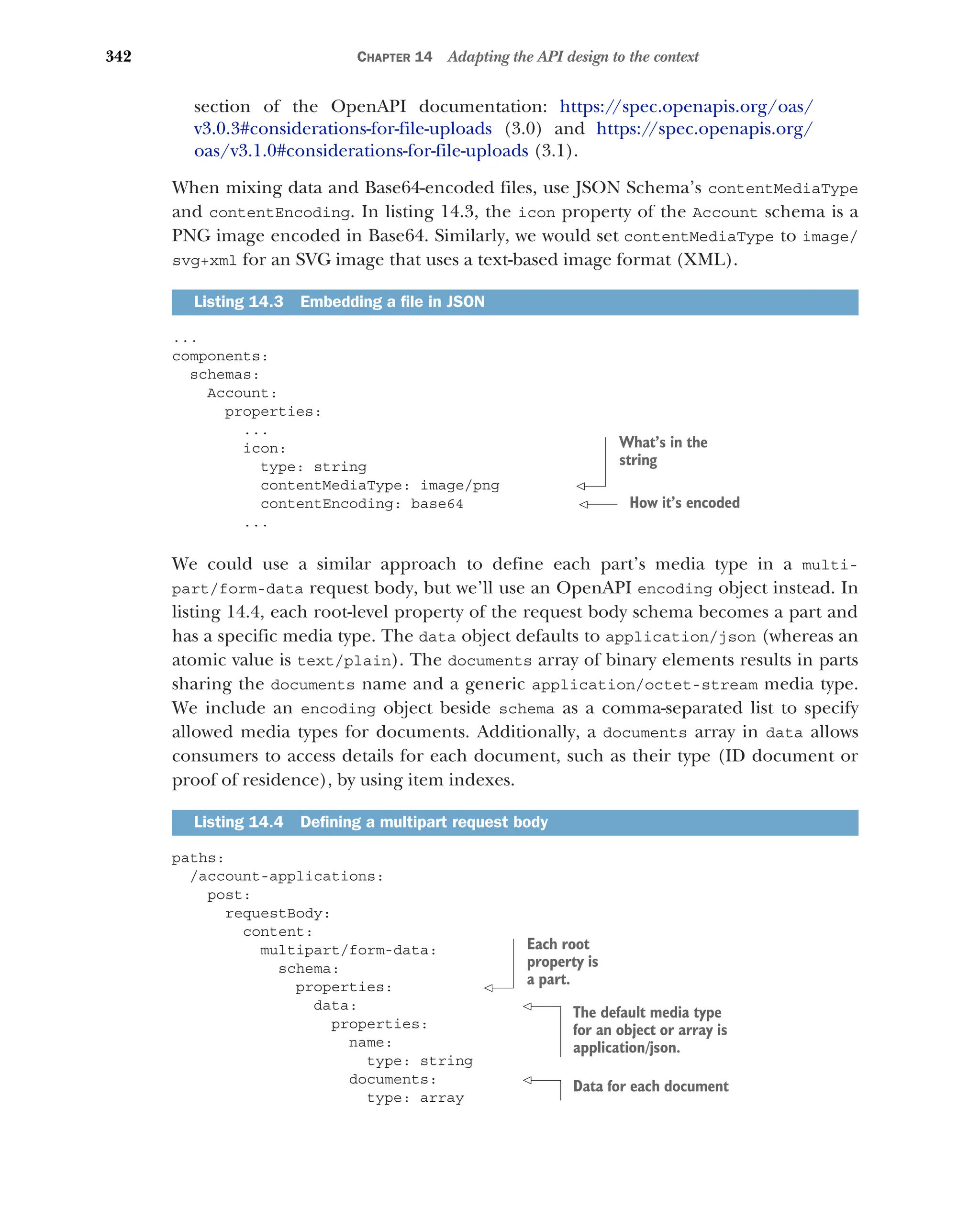
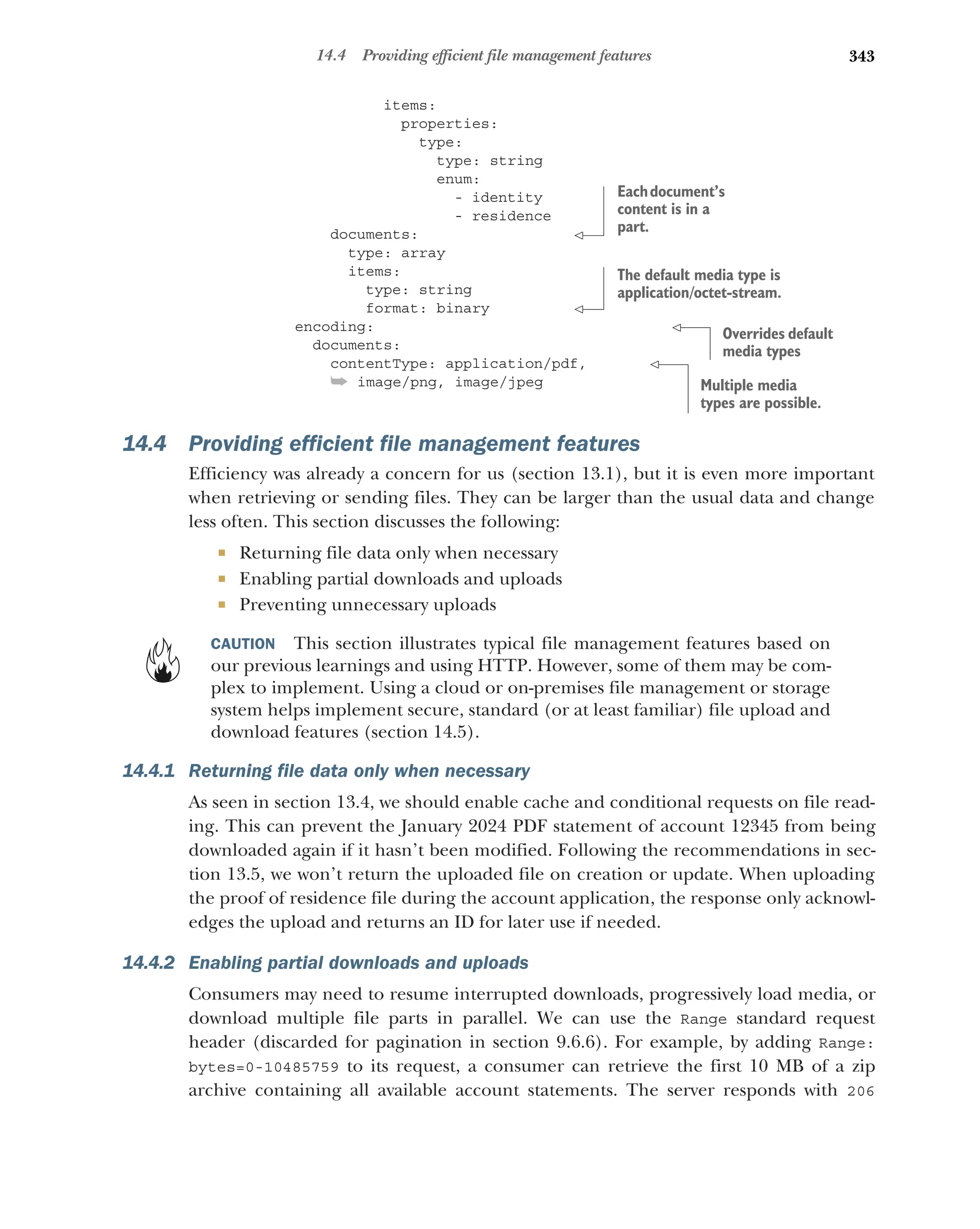
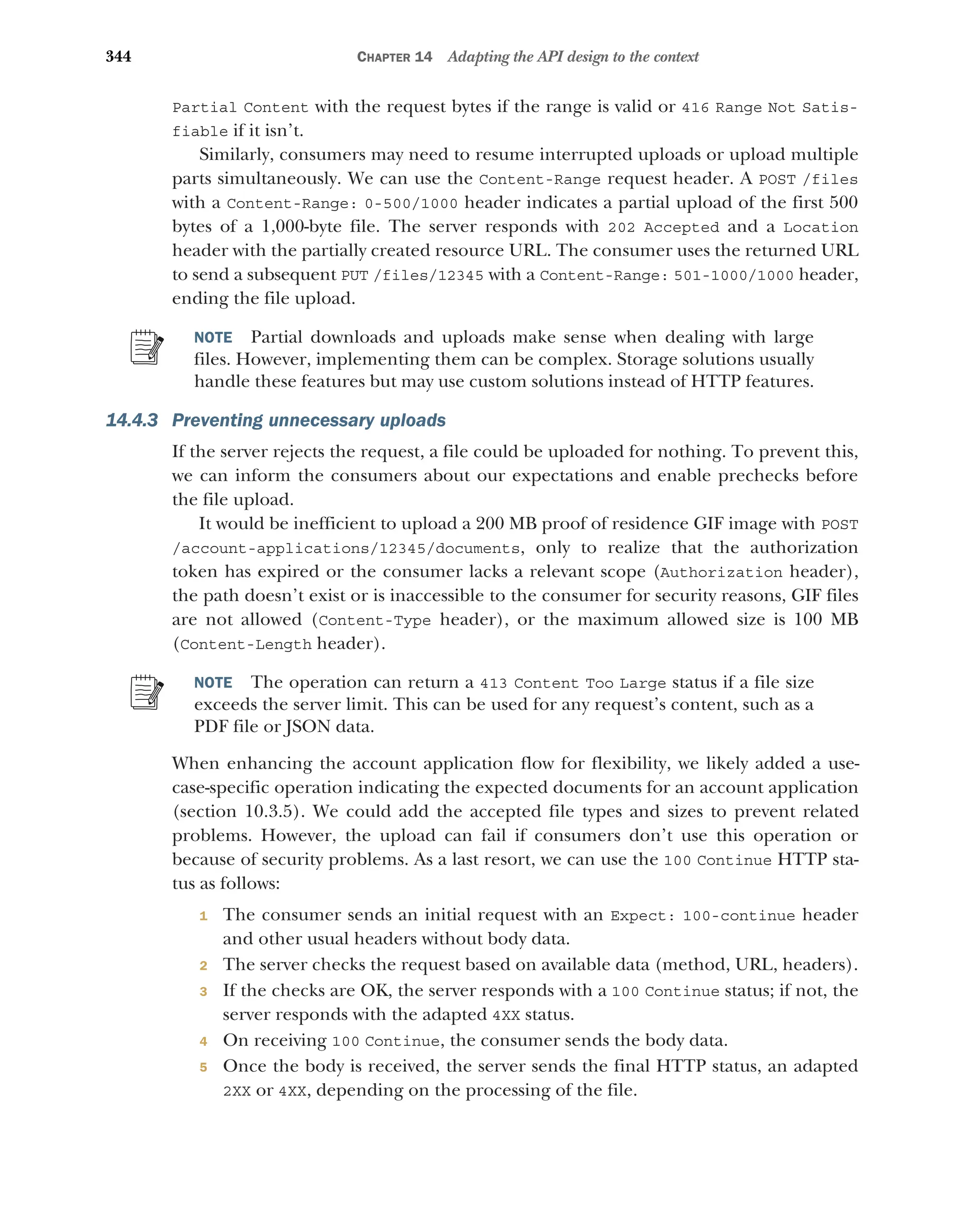
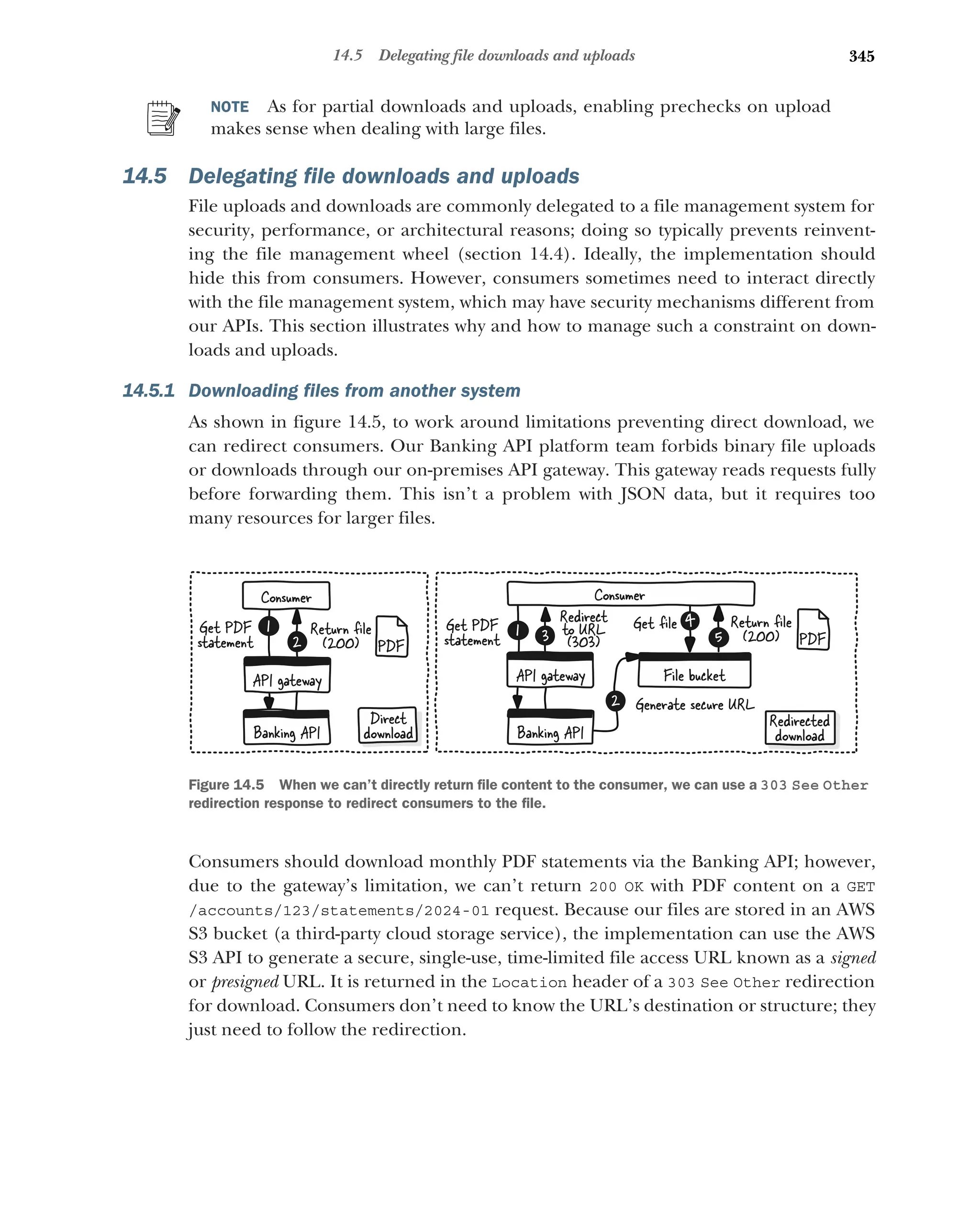
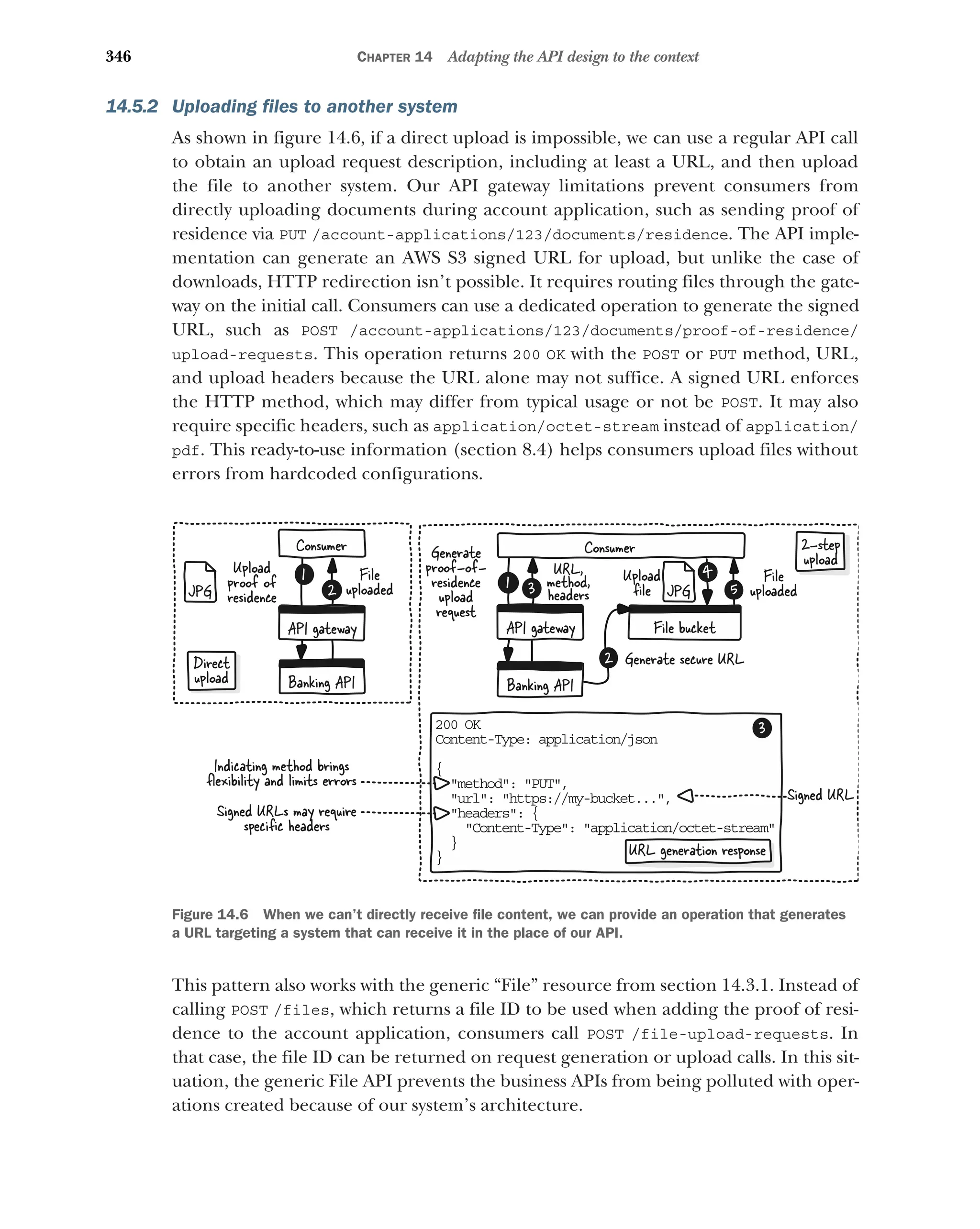
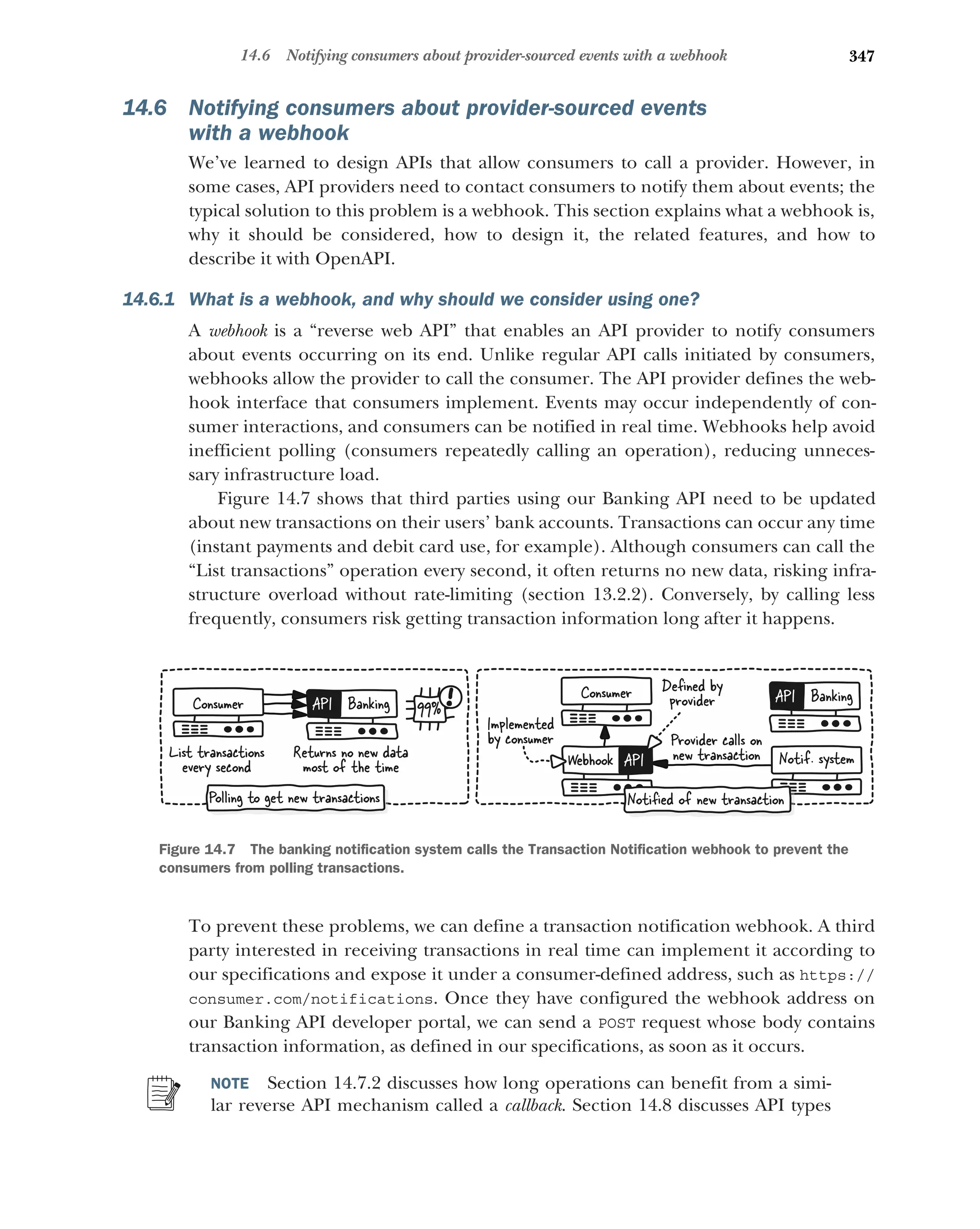
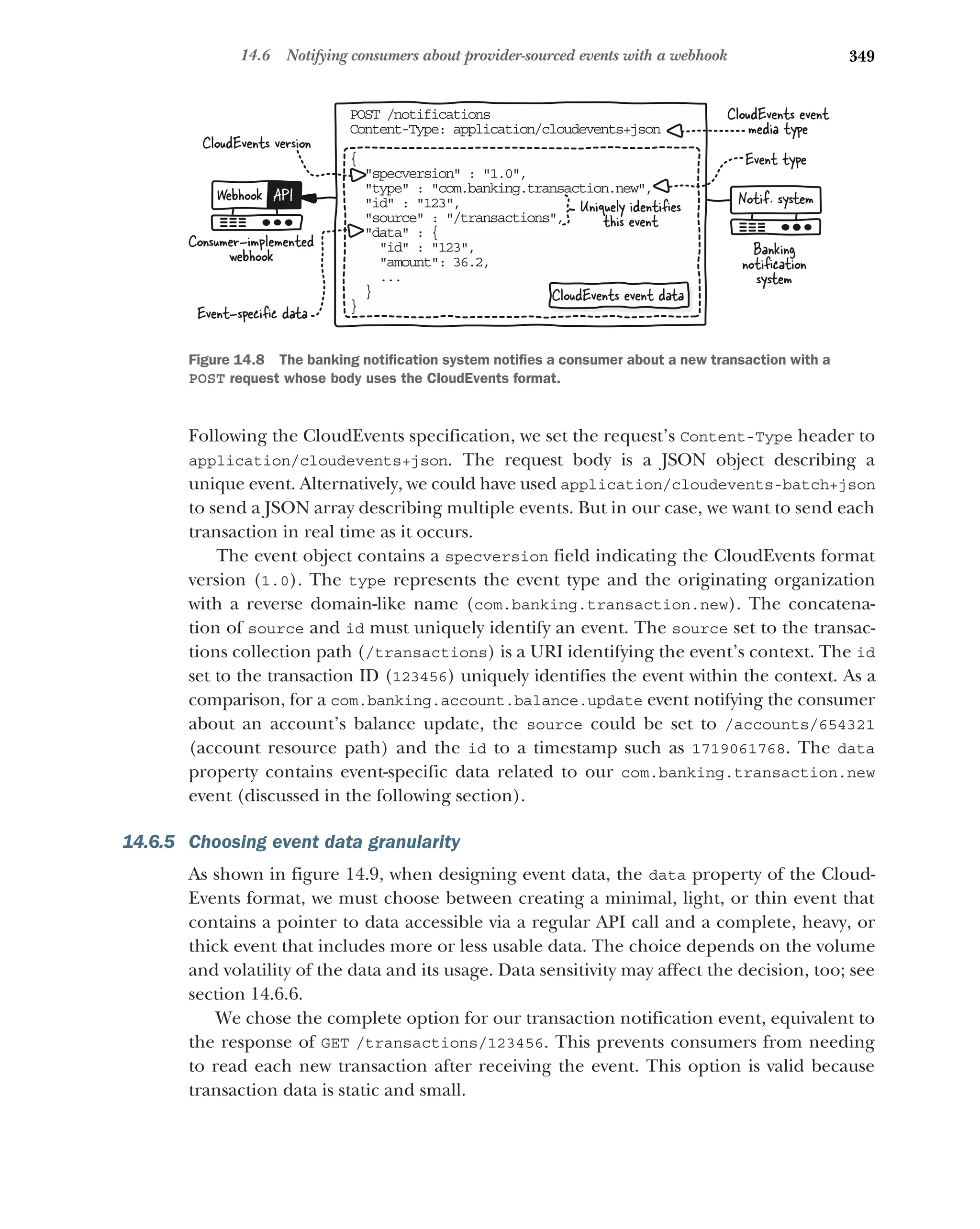
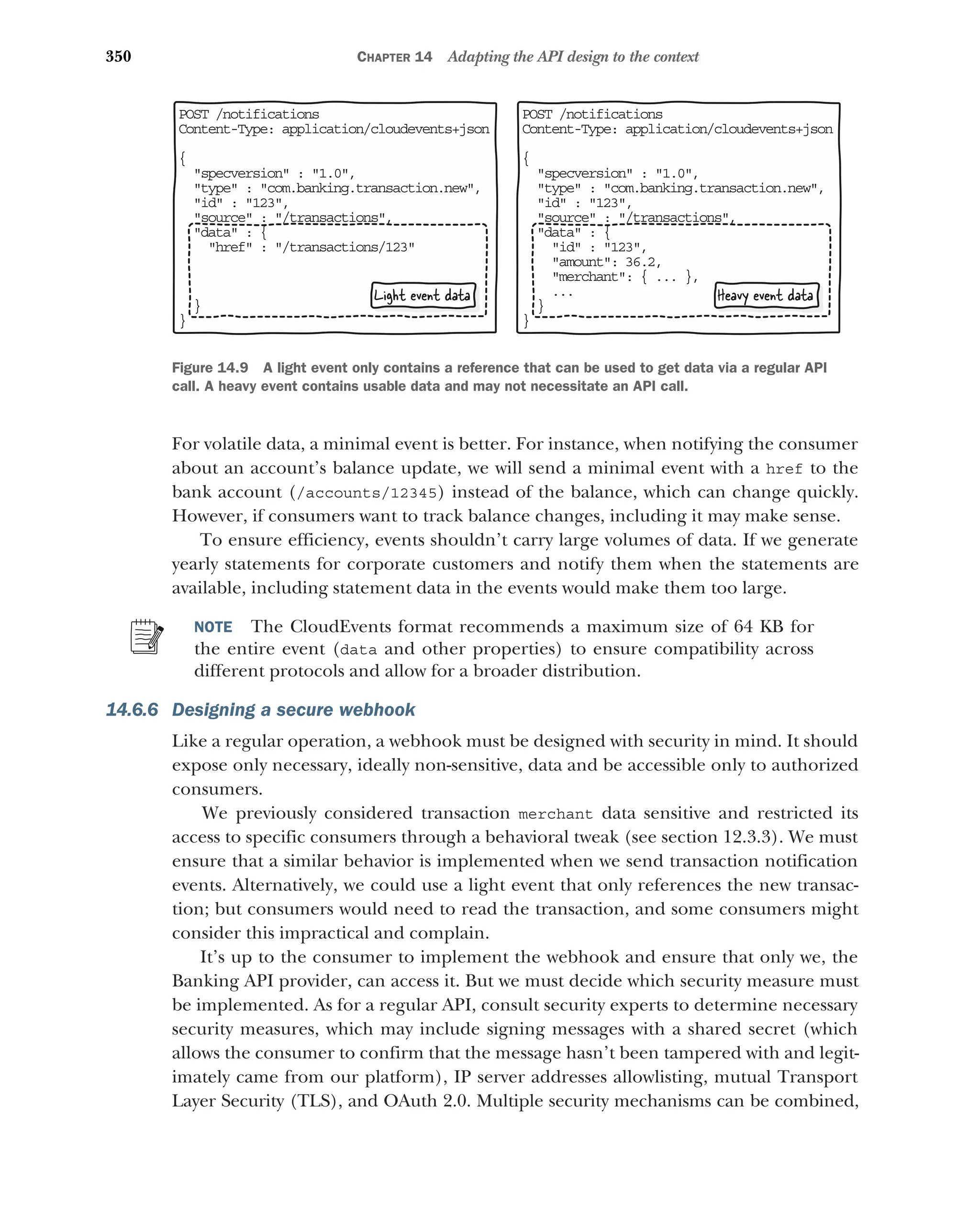
![352 CHAPTER 14 Adapting the API design to the context
To simplify the implementation further, we could propose resending past events
on demand via the API developer portal or an API call to a “Redeliver notifications”
operation. That way, the events would go through the same channel on the webhook
implementation.
To prevent the need to catch up on missed events, we can automatically retry failed
event deliveries due to timeouts or errors. Webhook implementers could include a
Retry header in the response to optimize our retry. However, we don’t want to use
excessive resources; therefore, we’ll limit retries to five over 24 hours. Consumers can
use on-demand redelivery after this limit.
NOTE Have a discussion with stakeholders, especially architects or tech leads,
to evaluate the need for and complexity of setting up an event history and
automated or on-demand retries. For comparison, look at how popular APIs
like GitHub and PayPal handle webhooks. Additionally, their documentation
offers valuable insights into webhook behavior and implementation.
14.6.9 Describing a webhook with OpenAPI
Figure 14.10 illustrates that describing a webhook within an OpenAPI document is
similar to describing a regular operation. Regular operations are defined under paths,
op napi: 3.1.0
e
in o: ...
f
pa hs:
t
accounts:
/
get: ...
we hooks:
b
ransactions:
t
post:
summary: New transaction
description: ...
security:
- WebhookMutualTLS: []
requestBody:
content:
application/cloudevents+json:
schema:
$ref: #/components/schemas/TransactionEvent
responses:
2XX:
description: Event successfully sent
co ponents:
m
chemas:
s
TransactionEvent: ...
ecuritySchemes:
s
WebhookMutualTLS:
type: mutualTLS
Not a path but a webhook identifier
Webhooks to be
implemented by
consumers
Defined like any other
operation under paths
HTTP status wildcard
We can add behavior and
implementation concerns in
the operation description
Figure 14.10 Webhooks go under the webhooks property of the OpenAPI document. A webhook
doesn’t have a path but an identifier. Other than that, a webhook is defined like any other operation
under paths.](https://image.slidesharecdn.com/lauretarnaud-thedesignofwebapis2025-250821164447-5e92da1d/75/Lauret-Arnaud-The-Design-of-Web-APIs-2025-pdf-390-2048.jpg)
![355
14.7 Handling long operations
Multiple callbacks can be defined under callbacks. Each callback has an identifier,
such as SimulationEnd. We could, for example, add a SimulationFail callback.
Unlike webhooks, OpenAPI callbacks have URLs, which can be static (/my-callback)
or dynamic (/my-callback/{withVariable}). A dynamic callback URL can use the
request or response data. If we allowed the consumer to define the callback URL via a
query parameter (POST /simulations?callback=https://consumer.com/callback),
the callback path would be {$request.query.callback}. However, we prefer to have a
shared URL for all our webhooks and callbacks, defined via the API developer portal, so
we use a custom variable, {webhookUrl}. When the simulation ends, the system respon-
sible for calling the callback will fetch the URL from the consumer configuration.
TIP If your editor reports an OpenAPI syntax error, ensure that you have
defined callbacks at the root of the operation (same level as responses) and
that your callback has an identifier and then a URL (it’s common to forget
one or the other).
The rest of the callback description is similar to any operation and is especially consis-
tent with the TransactionNotification webhook. We use the same WebhookMutualTLS
...
paths:
/simulations:
post:
summary: Run market stress simulation
requestBody: ...
responses:
202:
description: Simulation started
content: ...
callbacks:
SimulationEnd:
{webhookUrl}:
post:
summary: Simulation has ended
security:
- WebhookMutualTLS: []
requestBody:
content:
application/cloudevents+json:
schema:
$ref: #/components/schemas/SimulationEndEvent
responses:
2XX:
description: Event successfully sent
components:
schemas:
SimulationEndEvent: ...
securitySchemes:
WebhookMutualTLS:
type: mutualTLS
Callback identifier
Callbacks for the
simulation operation
to be implemented
by consumers
Defined like any other
operation + consistent
with Transaction
Notification webhook
Callback path can be static or contain
variables evaluated at runtime
Figure 14.11 An operation callback is defined under callbacks within the operation object. Its
path can be static or contain runtime variables. We use a design consistent with the previously defined
transaction notification webhook.](https://image.slidesharecdn.com/lauretarnaud-thedesignofwebapis2025-250821164447-5e92da1d/75/Lauret-Arnaud-The-Design-of-Web-APIs-2025-pdf-393-2048.jpg)
![360 CHAPTER 14 Adapting the API design to the context
between 1 second and 1 minute per minute of audio content. The response (listing 14.6)
returns data for each processing. Processing data varies depending on the type and
may include Base64-encoded files. What are the problems with this design, and how
could it be improved?
POST /processing-tasks
{
file: QmFzZTY0RW5jb2RlZFN0cmluZw==...,
processingTasks: [
{ type: tempo },
...
{ type: karaoke}
]
}
200 OK
{
processingTasks: [
{ type: tempo, data: { tempo: 180 } },
...
{ type: karaoke, data: { file: U2ltcGx...} }
]
}
Listing 14.5 Processing request
Listing 14.6 Processing response](https://image.slidesharecdn.com/lauretarnaud-thedesignofwebapis2025-250821164447-5e92da1d/75/Lauret-Arnaud-The-Design-of-Web-APIs-2025-pdf-398-2048.jpg)
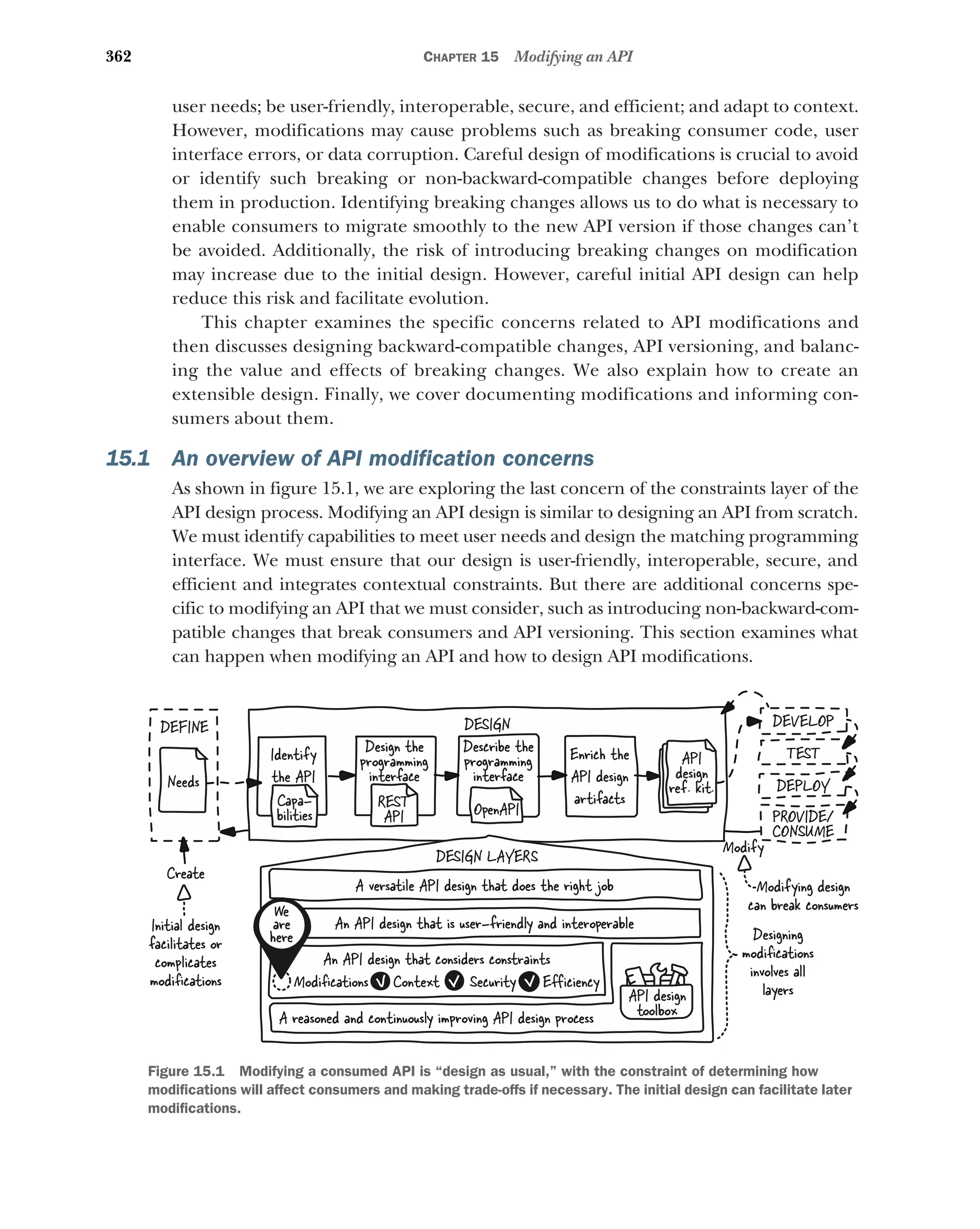
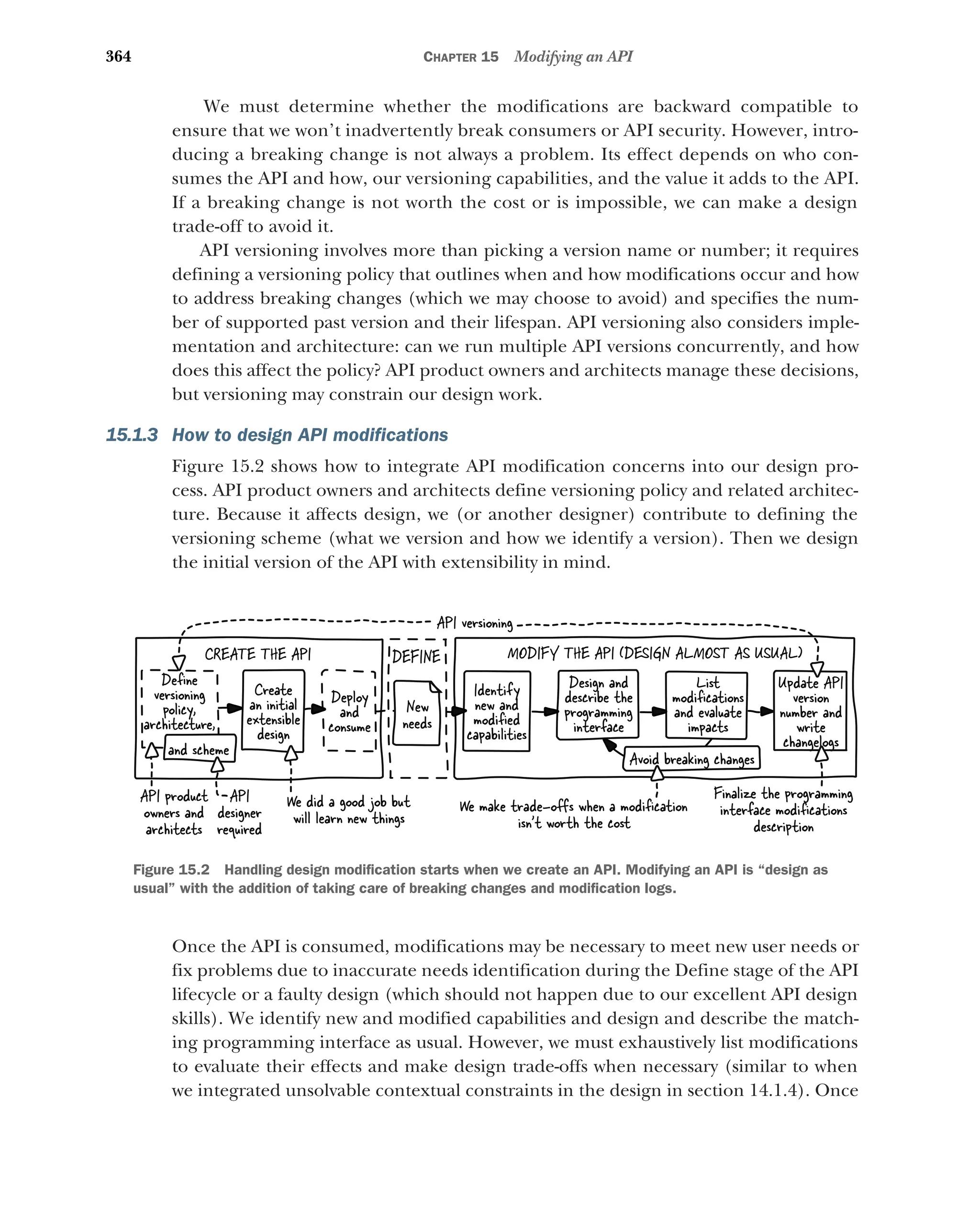
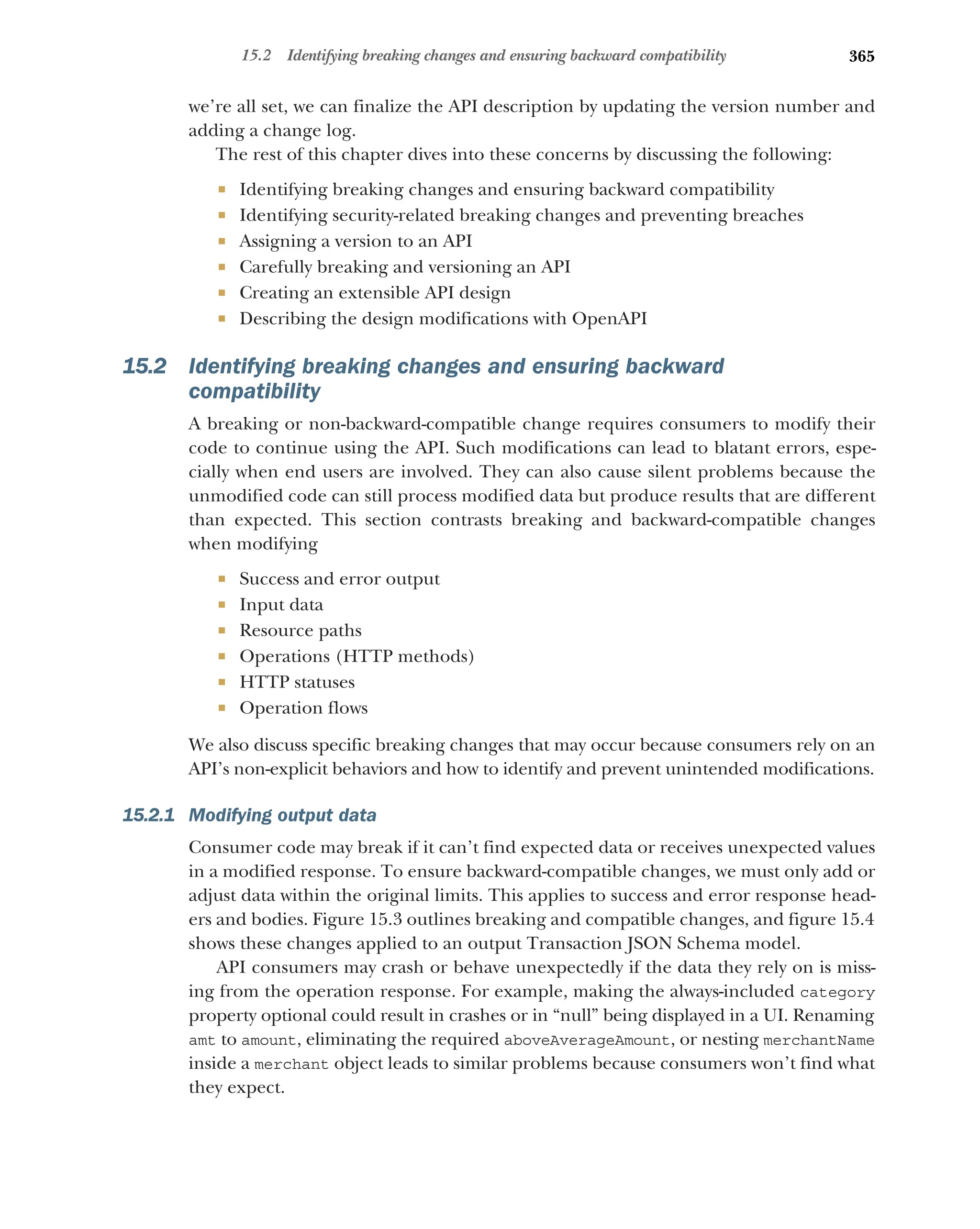
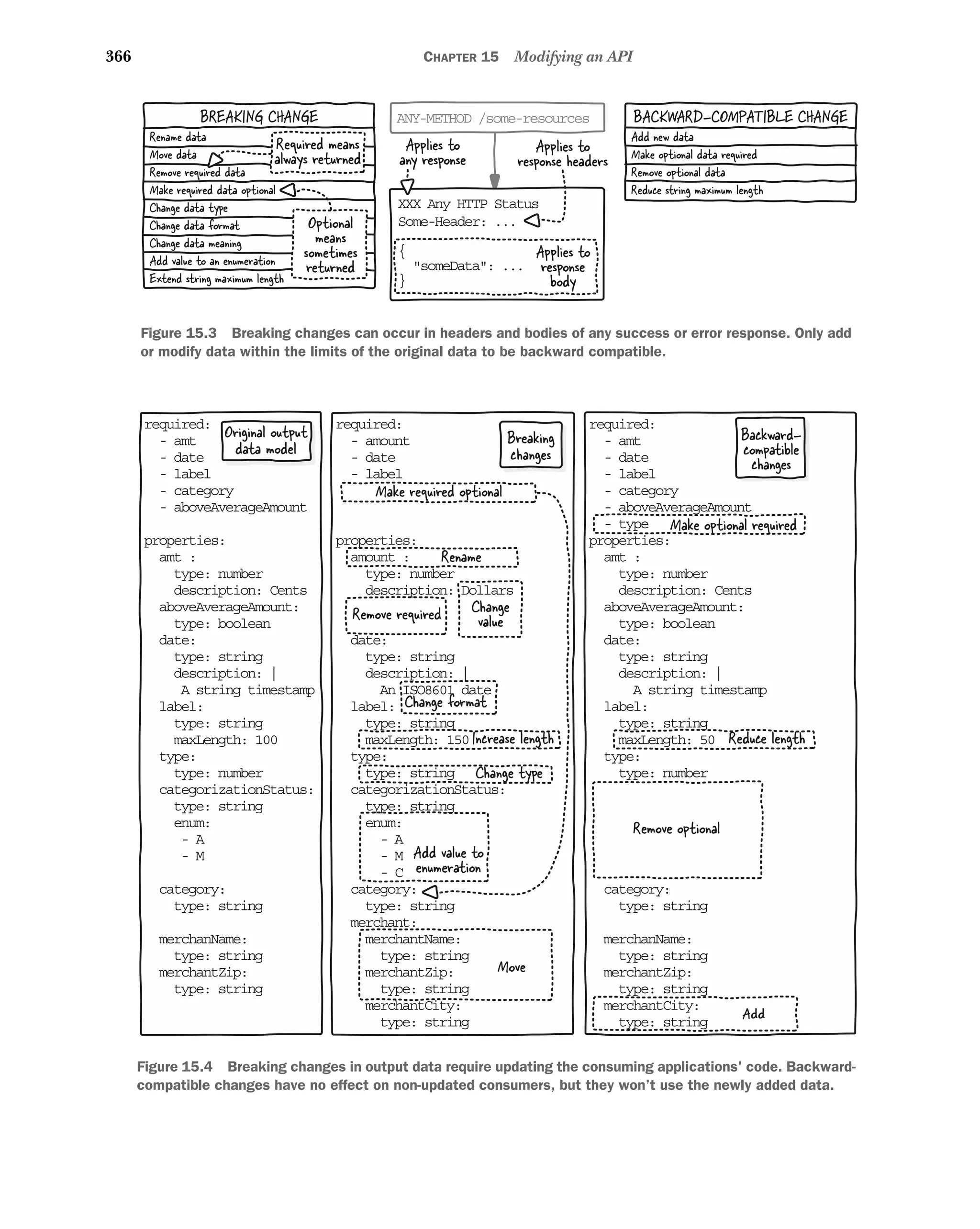
![367
15.2 Identifying breaking changes and ensuring backward compatibility
API consumers may face problems with unexpected values or types. Changing the
type property from a number to a string can crash JSON parsing. Altering the date
property format from a number (timestamp) to a string (ISO8601) will also cause a
crash. Adding M to the categorizationStatus enumeration will cause a problem
because it is likely mapped to something more meaningful. Increasing the label
length from 100 to 150 may lead to errors in a relational database on the consumer
side if the column is set to 100.
Adding required data like merchantCity won’t cause problems; non-updated API
consumers won’t use it. Always returning previously optional data is fine; adding type
to the required list is acceptable. We can remove optional data like categorization-
Status because consumers expect that it may not be returned. Shortening string
lengths, like label, is also fine.
Introducing breaking changes affects all responses, including errors, as shown in
figure 15.5. For instance, renaming items to errors may cause problems, potentially
crashing consumers or hiding errors due to the missing items property. Retaining
items while replacing specific error types (MISSING_SOURCE, MISSING_DESTINATION)
with a generic type (REQUIRED) can lead to crashes or ignored errors.
All these concerns apply to response headers, too. For example, if we always return
a Location header on POST requests, no longer returning it could cause consumers
to crash.
15.2.2 Modifying input data
Unmodified consumers will send requests with inputs defined by the previous ver-
sion. If the server can’t find the required data or receives unexpected values, it will
return errors or unexpected, more, or less data. More concerning is that incorrect
data may be accepted, causing serious side effects. To ensure backward-compatible
40 BAD REQUEST
0
{
items: [
{
type: MISSING_SOURCE,
message: Missing source
},
{
type: MISSING_DESTINATION,
message: Missing destination
}
]
}
Original
error response
40 BAD REQUEST
0
{
errors: [
{
type: REQUIRED,
message: Missing source
},
{
type: REQUIRED,
message: Missing destination
}
]
}
Modified
error response
Renamed
Value
changed
Value
changed
Figure 15.5 Breaking changes are introduced while enhancing an error data model. The error list
is renamed, and specific error types are replaced by generic ones.](https://image.slidesharecdn.com/lauretarnaud-thedesignofwebapis2025-250821164447-5e92da1d/75/Lauret-Arnaud-The-Design-of-Web-APIs-2025-pdf-405-2048.jpg)
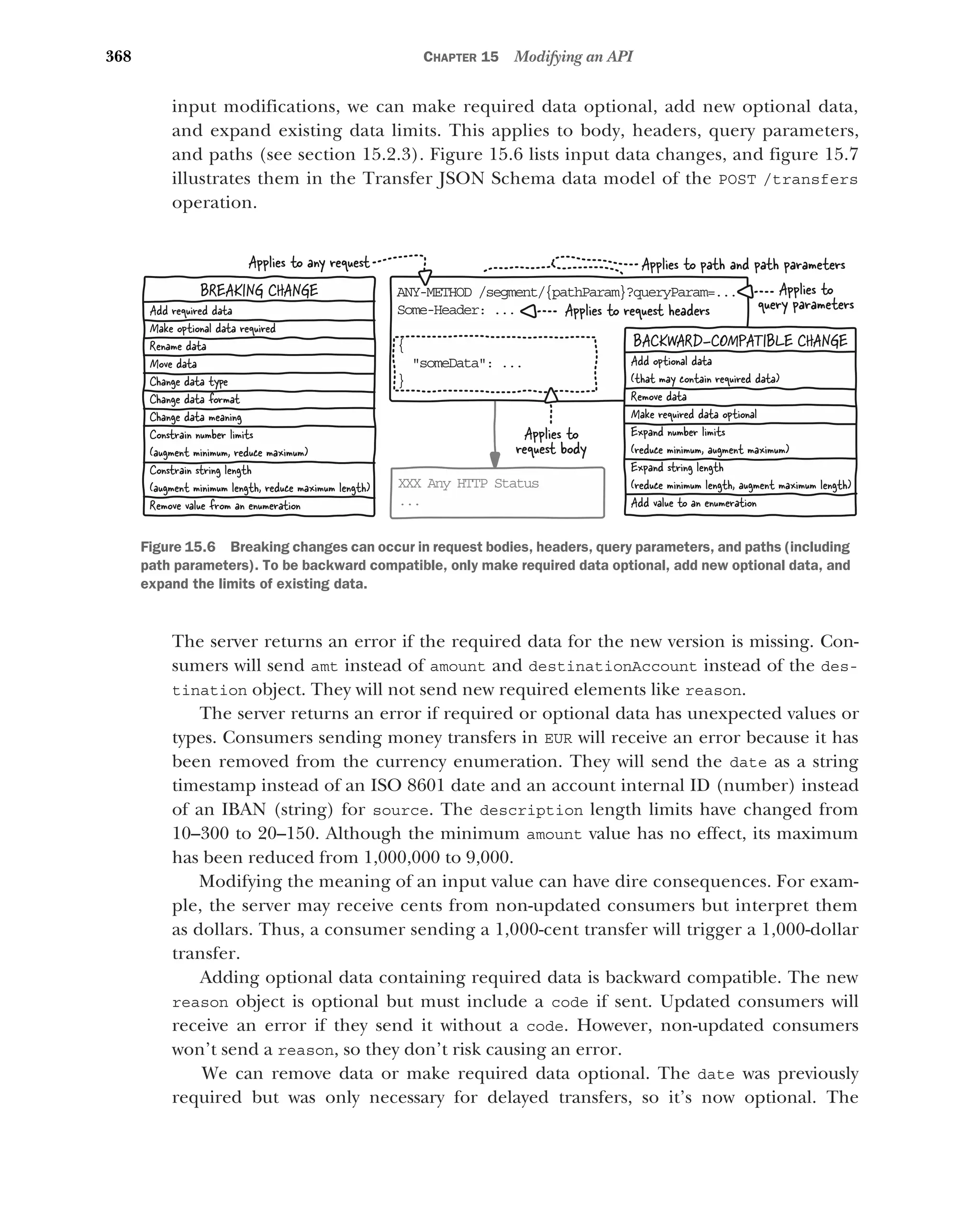
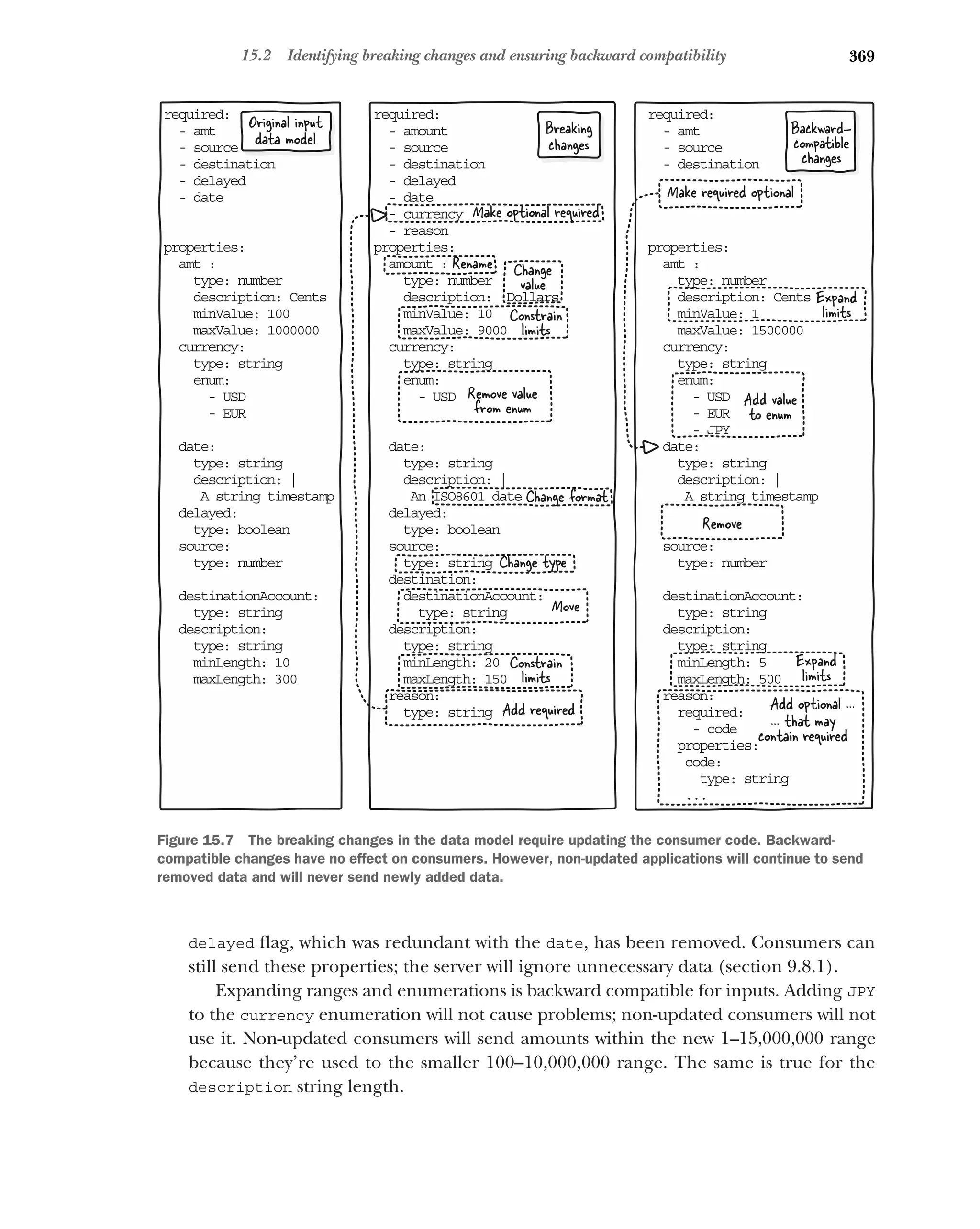
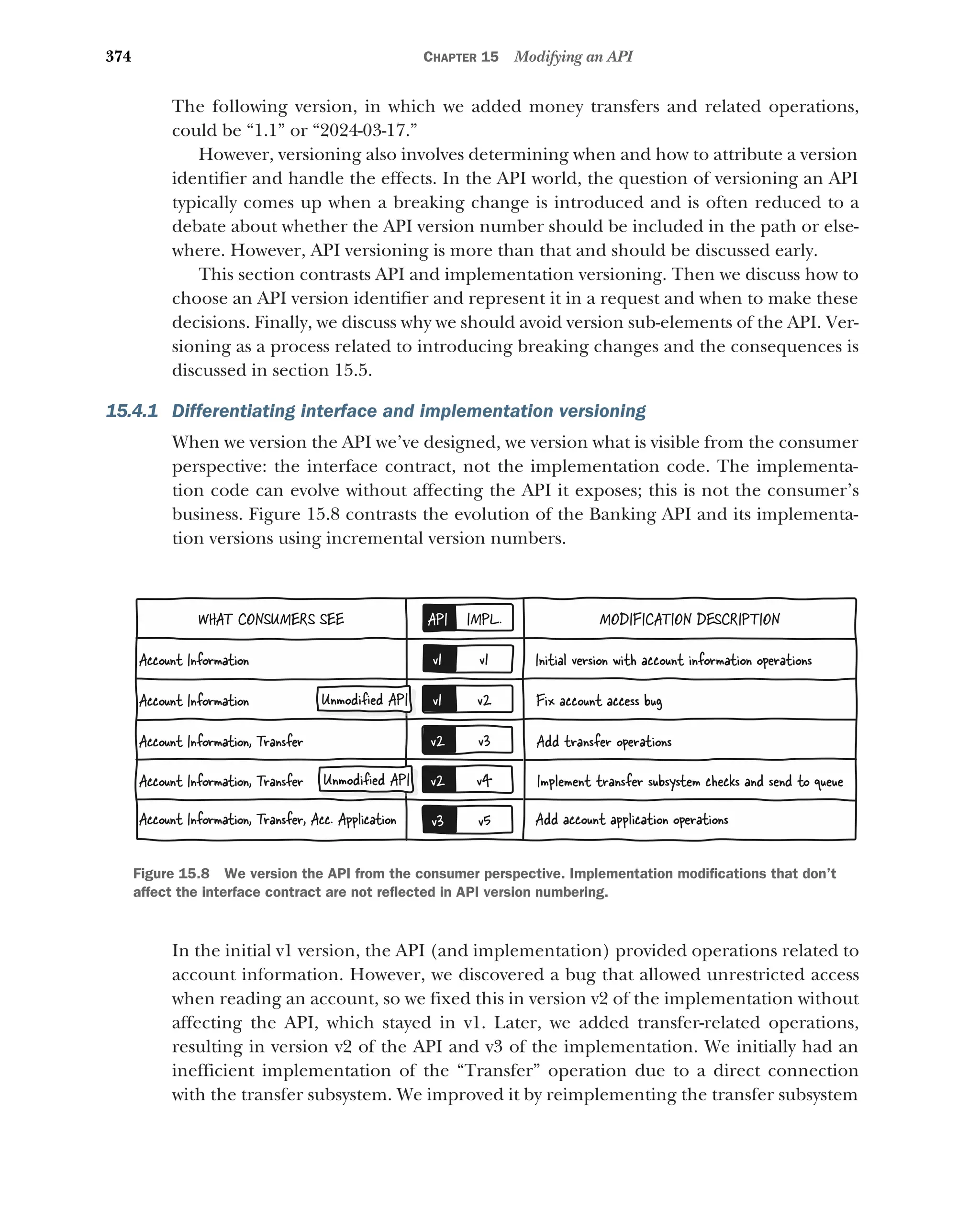
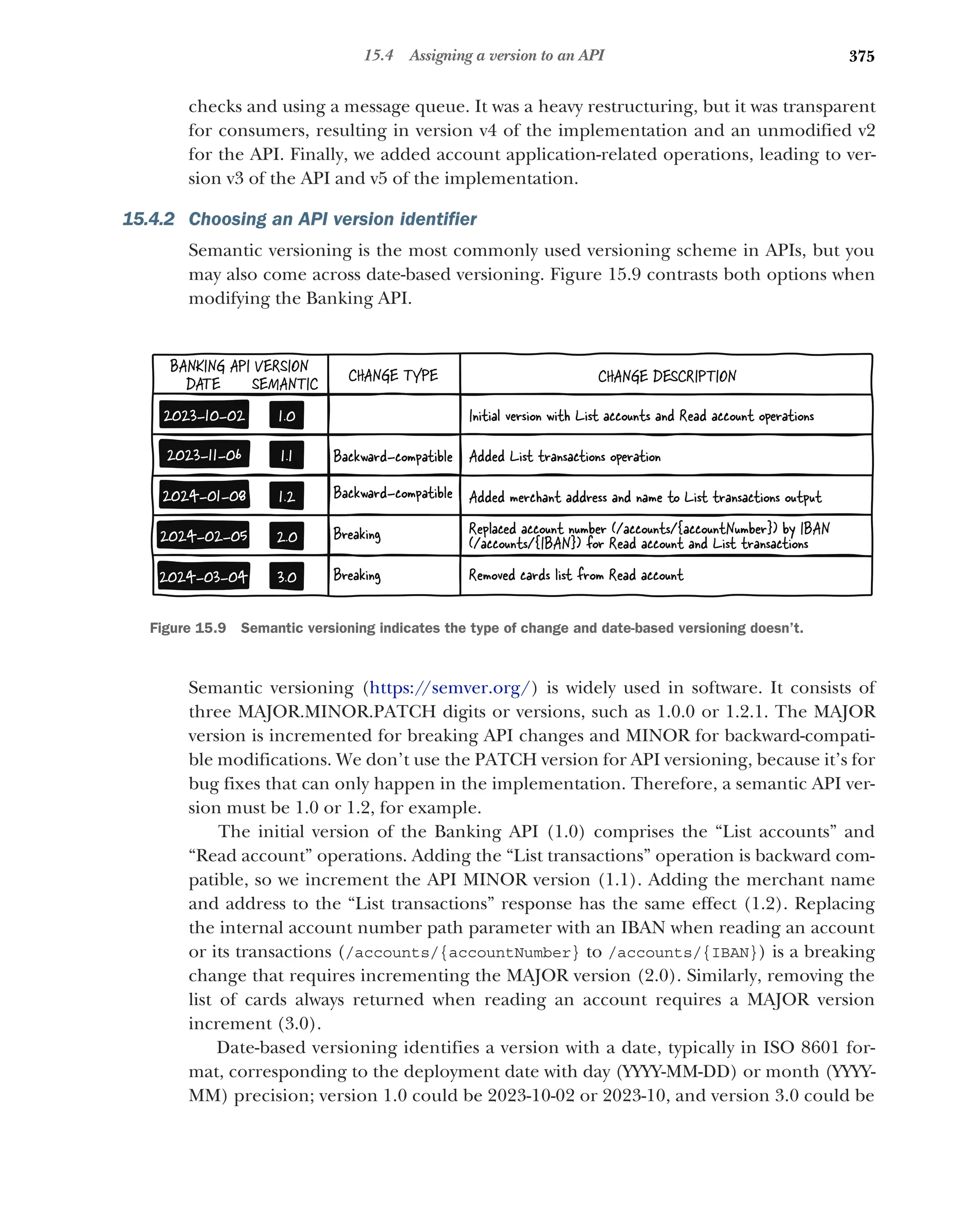
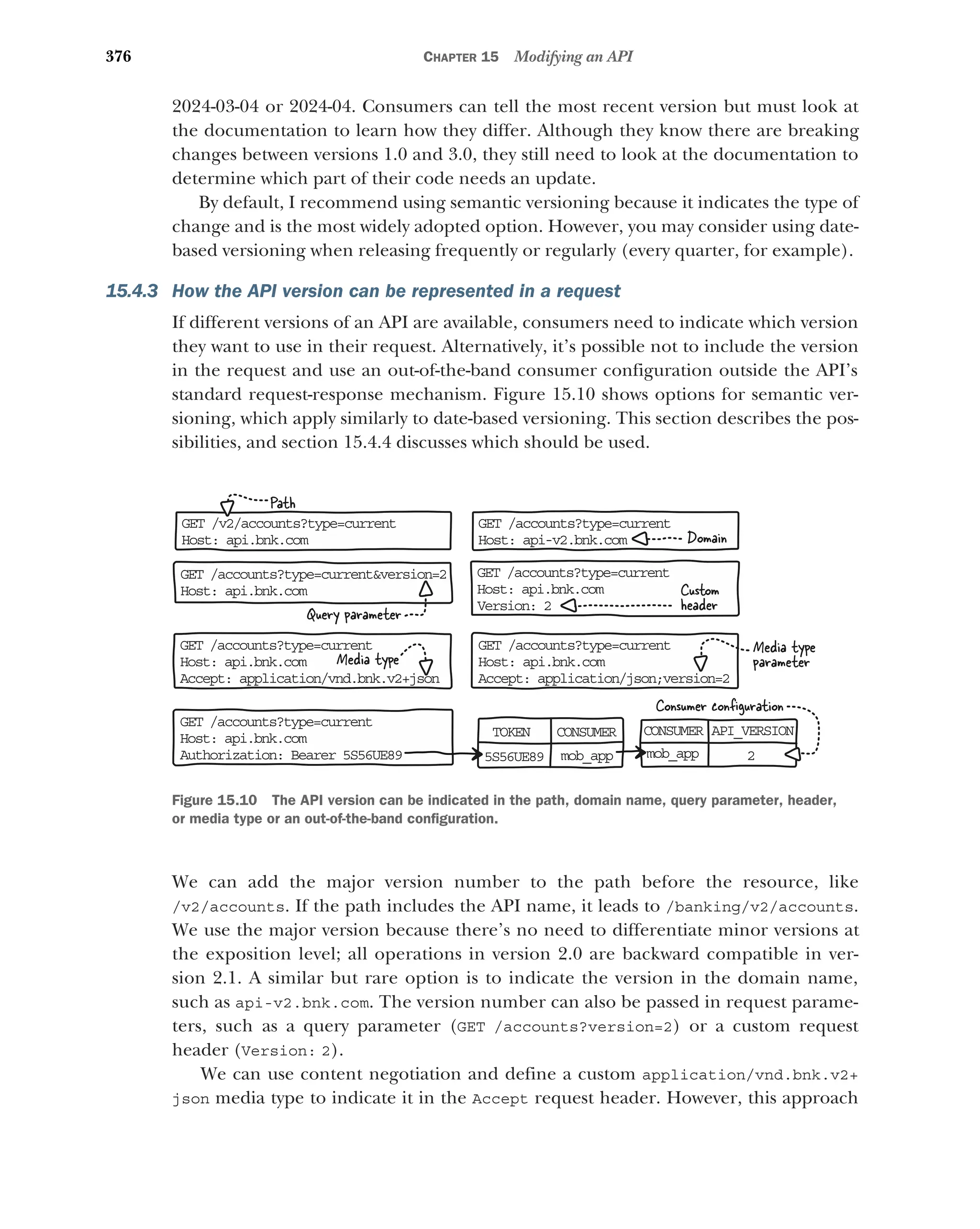

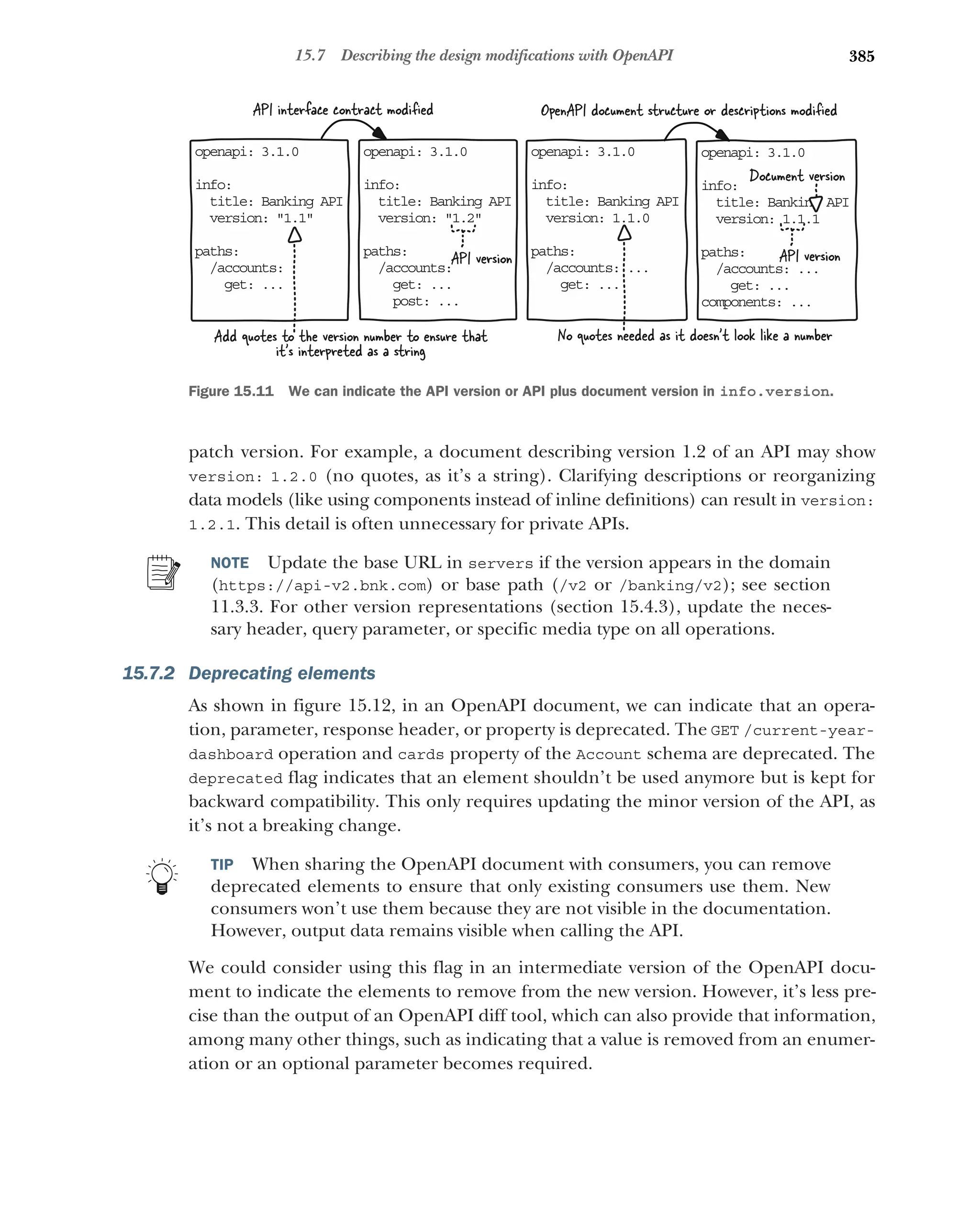
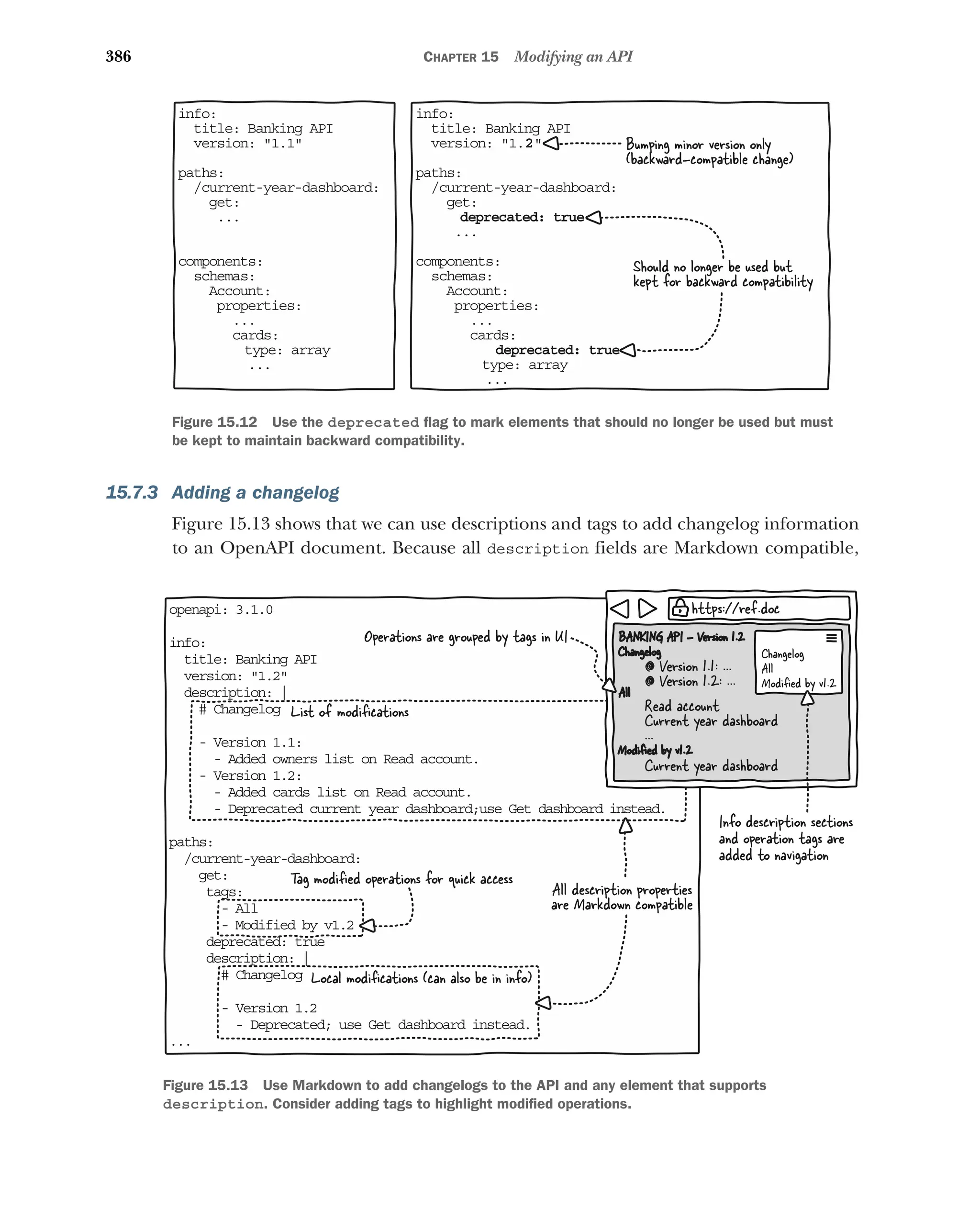
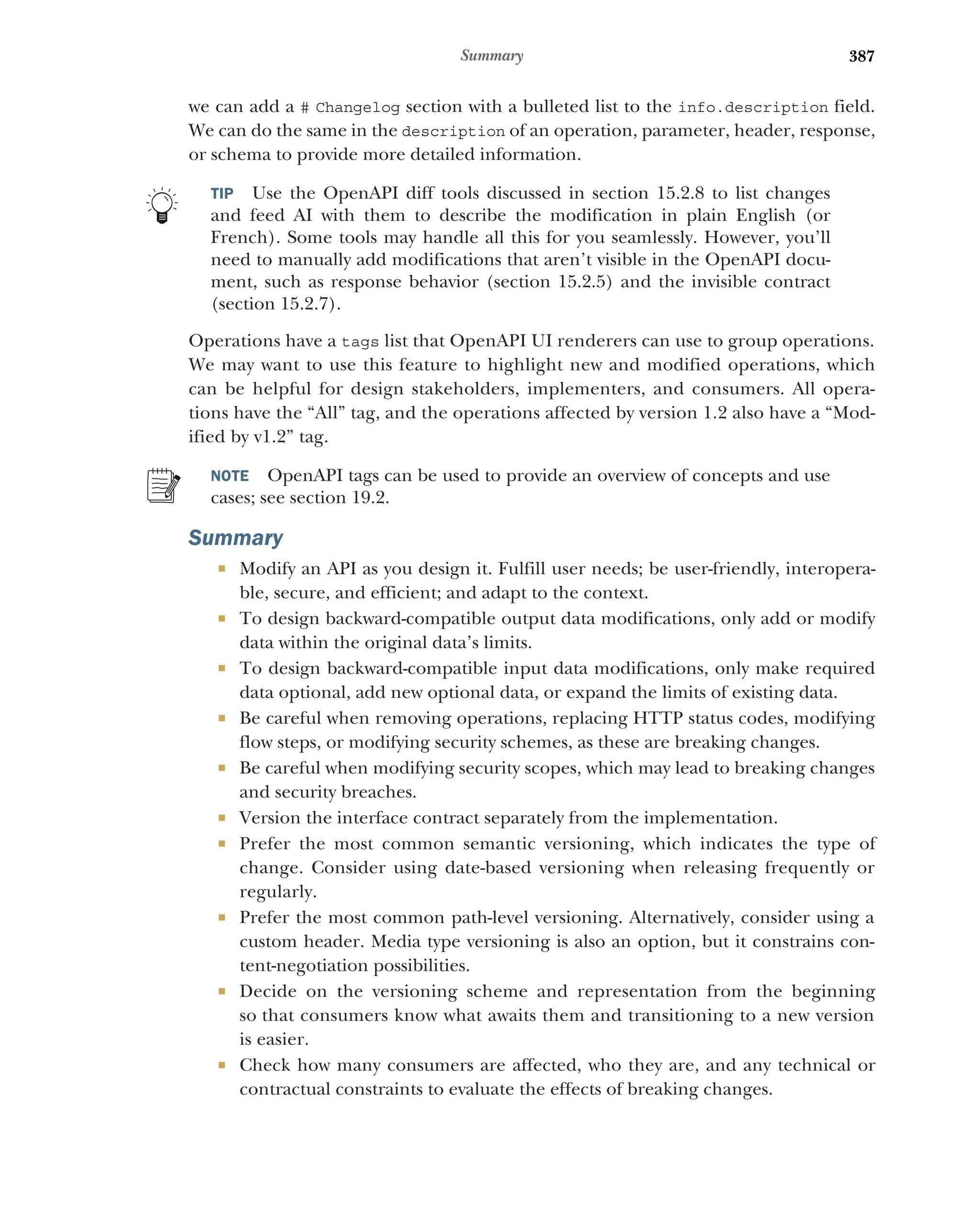
![390 CHAPTER 15 Modifying an API
items:
required:
- name
- repetitions
properties:
name:
type: string
description: Plank, burpees, etc.
duration:
type: string
description: ISO8601 duration.
repetitions:
type: integer
description: Number of repetitions
Exercise 15.3
Modifications were made to the response body of an Industrial Machine Monitoring
API’s GET /machine-reports/{reportId} operation. Listing 15.4 shows the response
body JSON schema before the modifications, and listing 15.5 shows the modified ver-
sion. List all changes made to the schema, and evaluate whether they are backward
compatible.
required:
- id
- machineIdentifier
- conditionComment
- conditionStatus
properties:
id:
type: string
pattern: [0-9]{10}
date:
type: integer
conditionComment:
type: string
conditionStatus:
type: string
enum:
- green
- orange
- red
machineIdentifier:
type: integer
status:
type: string
enum:
- running
- stopped
- maintenance
temperature:
Listing 15.4 Response body data before modification](https://image.slidesharecdn.com/lauretarnaud-thedesignofwebapis2025-250821164447-5e92da1d/75/Lauret-Arnaud-The-Design-of-Web-APIs-2025-pdf-428-2048.jpg)
![391
Exercises
type: number
description: Celsius.
required:
- id
- date
- machineId
- condition
properties:
id:
type: string
pattern: [a-z]{3}-[0-9]{10}
date:
type: string
format: date-time
condition
required:
- conditionComment
- conditionStatus
properties:
conditionComment:
type: string
conditionStatus:
type: string
enum:
- green
- orange
- red
machineId:
type: integer
status:
type: string
enum:
- running
- stopped
- maintenance
temperature:
type: number
description: Farhenheit.
pressure:
type: number
description: Kilopascals.
Exercise 15.4
An Event Management Platform API has a GET /events operation that returns an
object with a data array of events. It doesn’t support pagination and returns all avail-
able data. Could you decide that the server will now return a maximum of 50 events
and add an optional page query parameter allowing consumers to get other pages of
events? If that’s a problem, how could you safely enable pagination?
Listing 15.5 Response body data after modifications](https://image.slidesharecdn.com/lauretarnaud-thedesignofwebapis2025-250821164447-5e92da1d/75/Lauret-Arnaud-The-Design-of-Web-APIs-2025-pdf-429-2048.jpg)



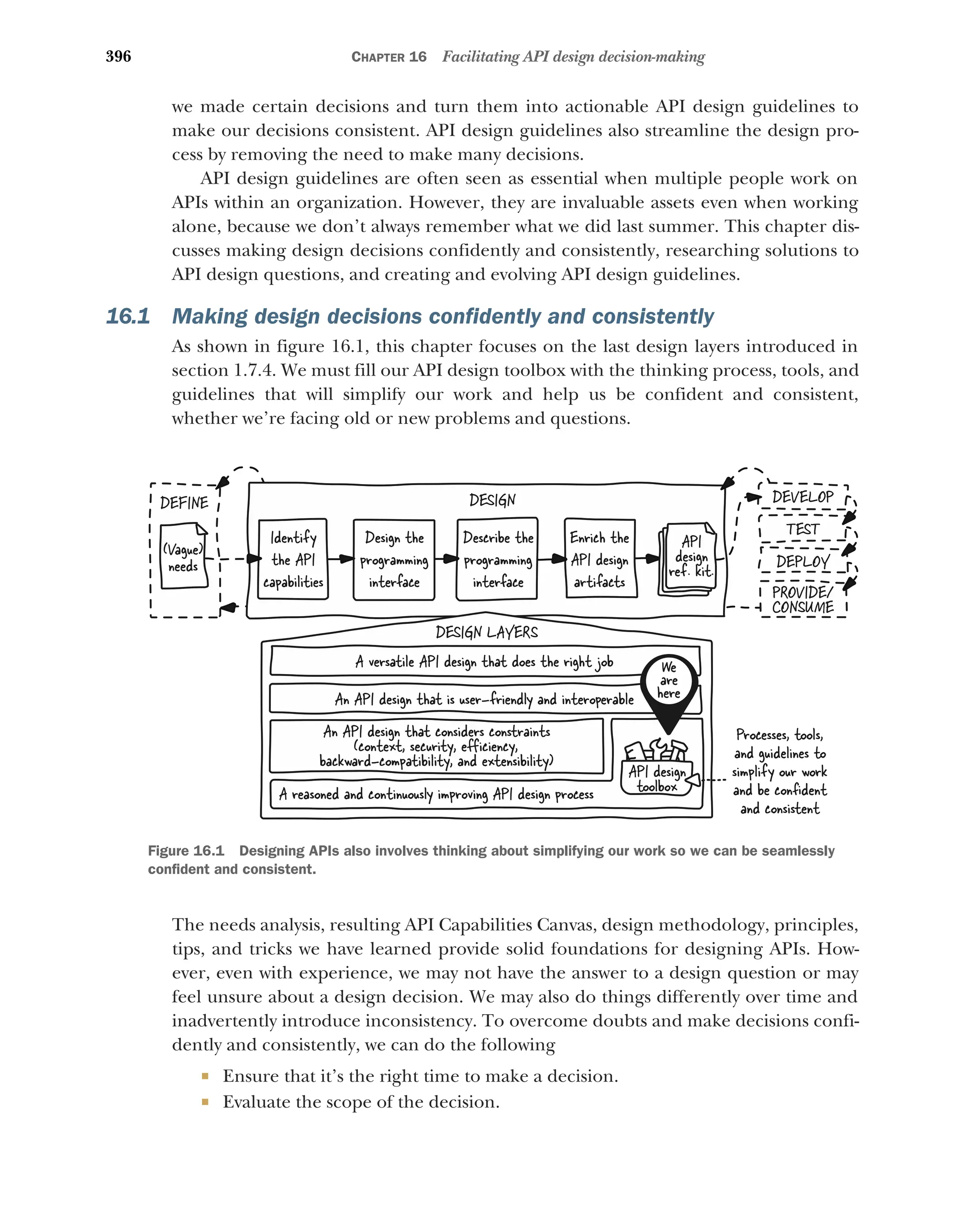
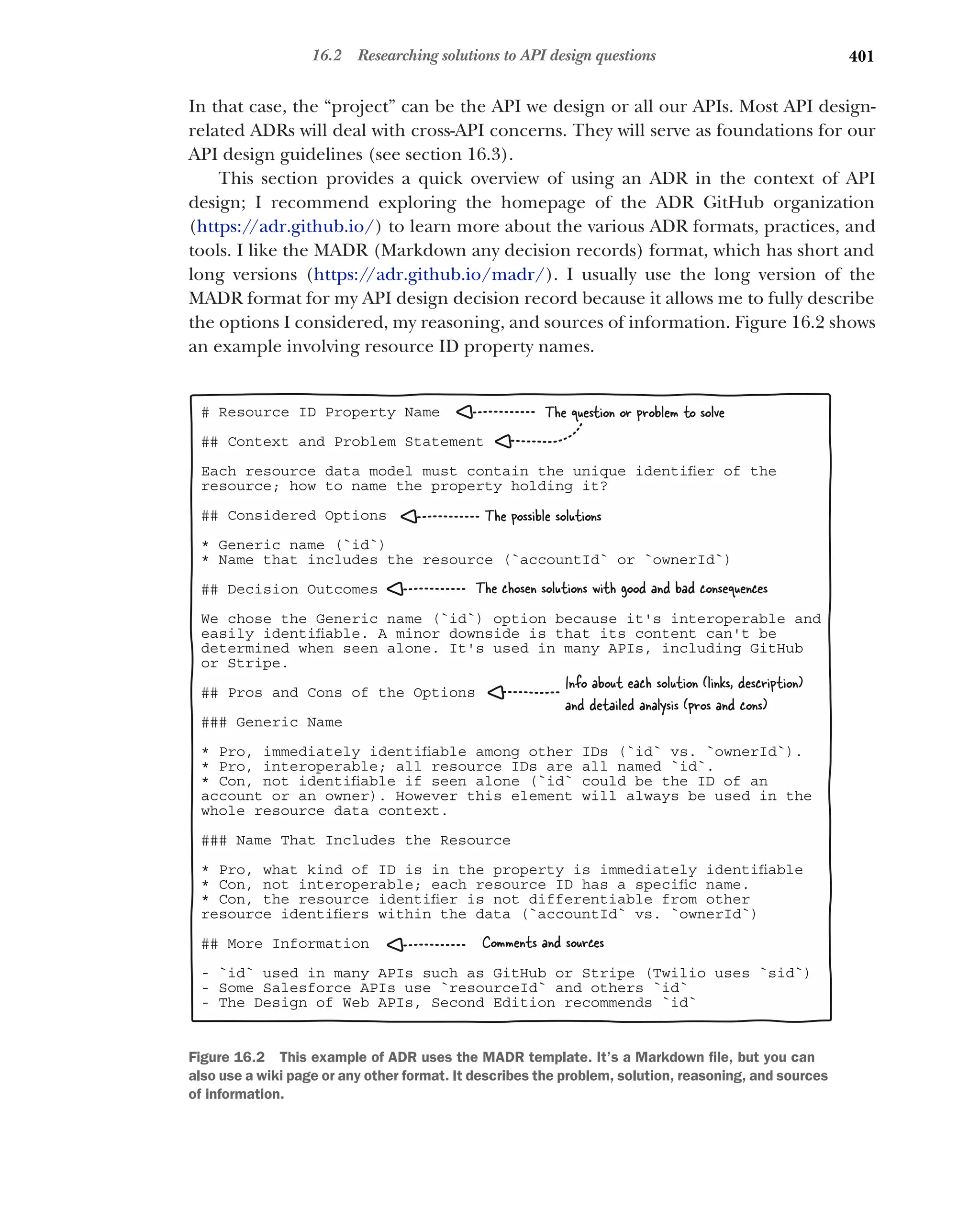
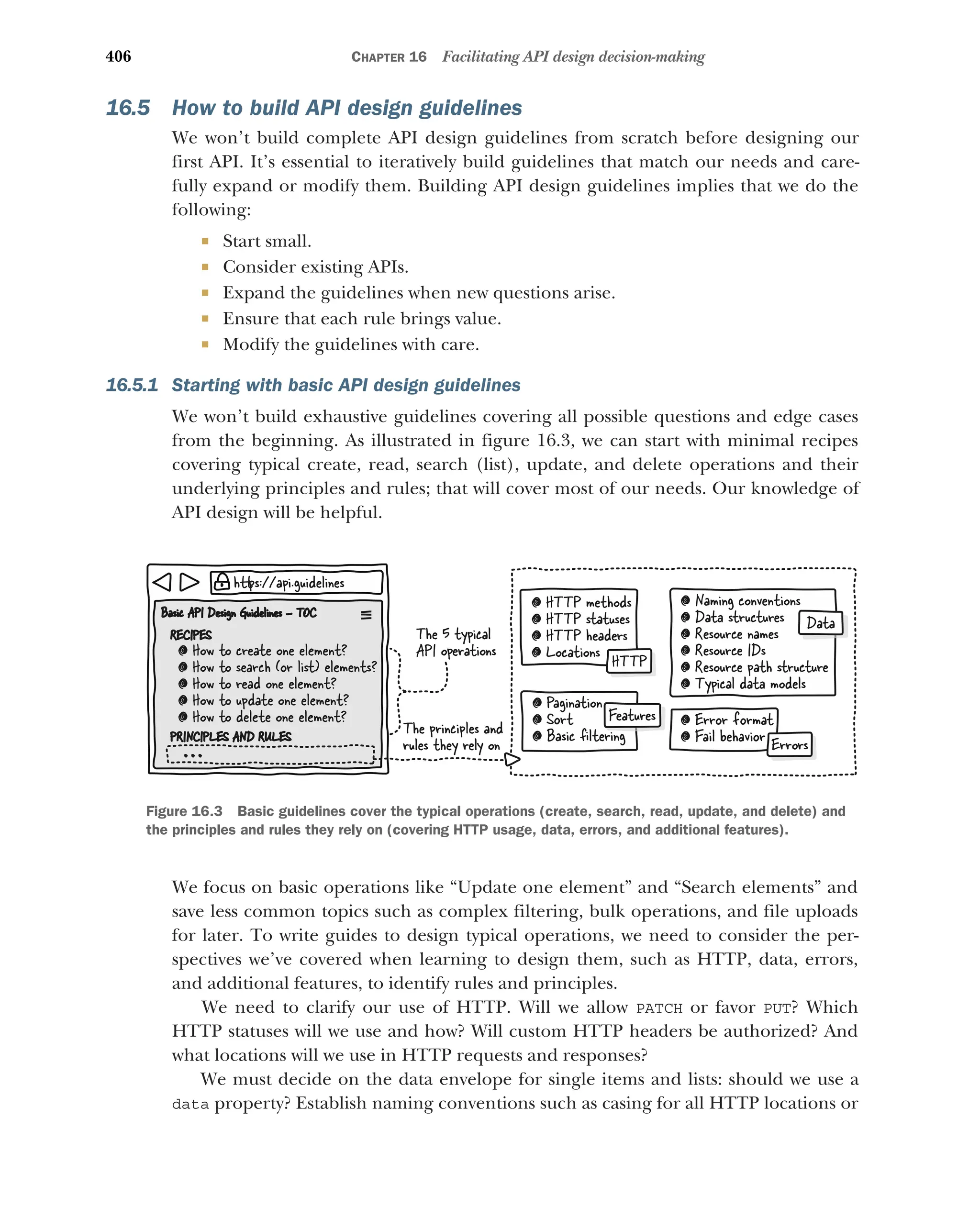

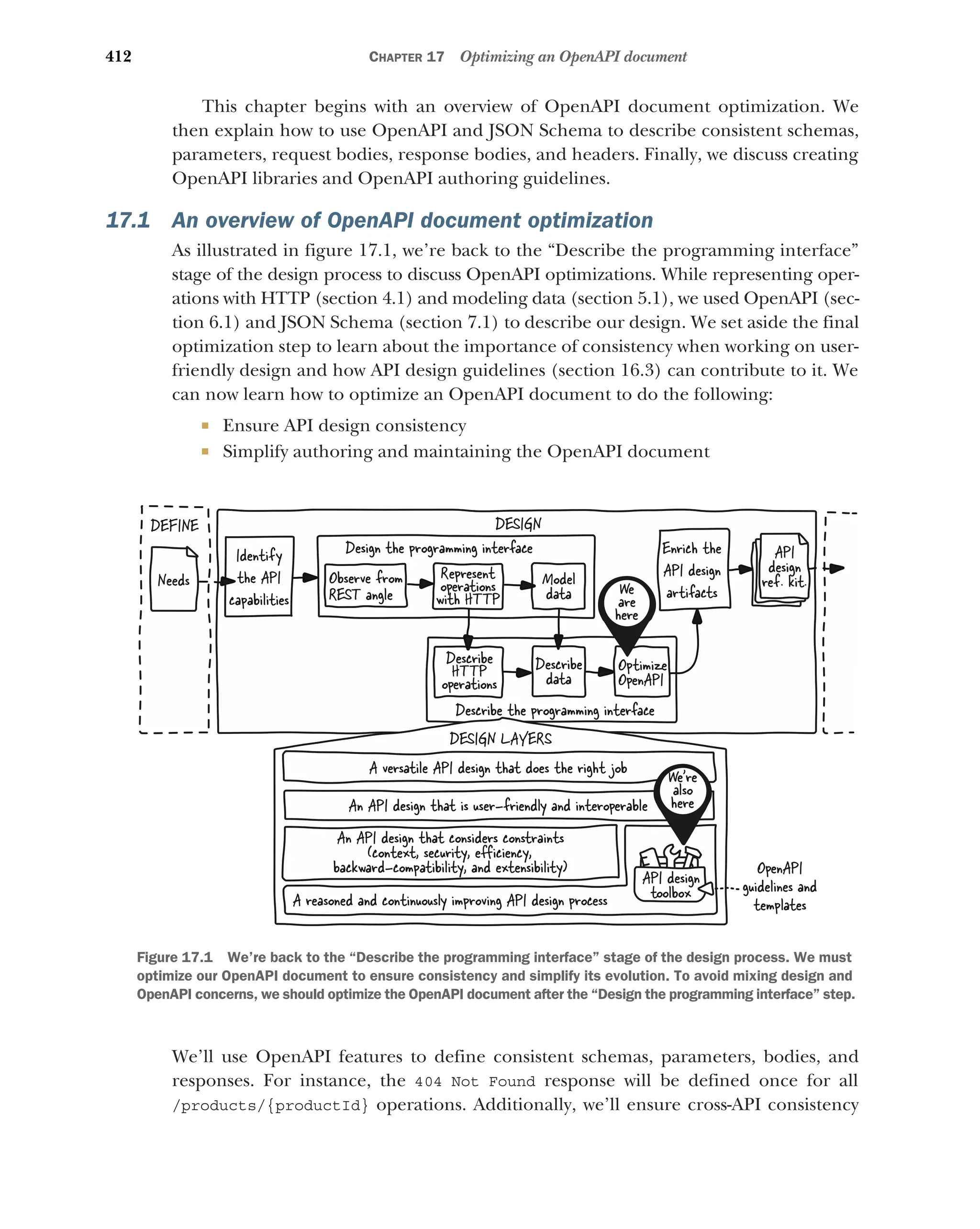
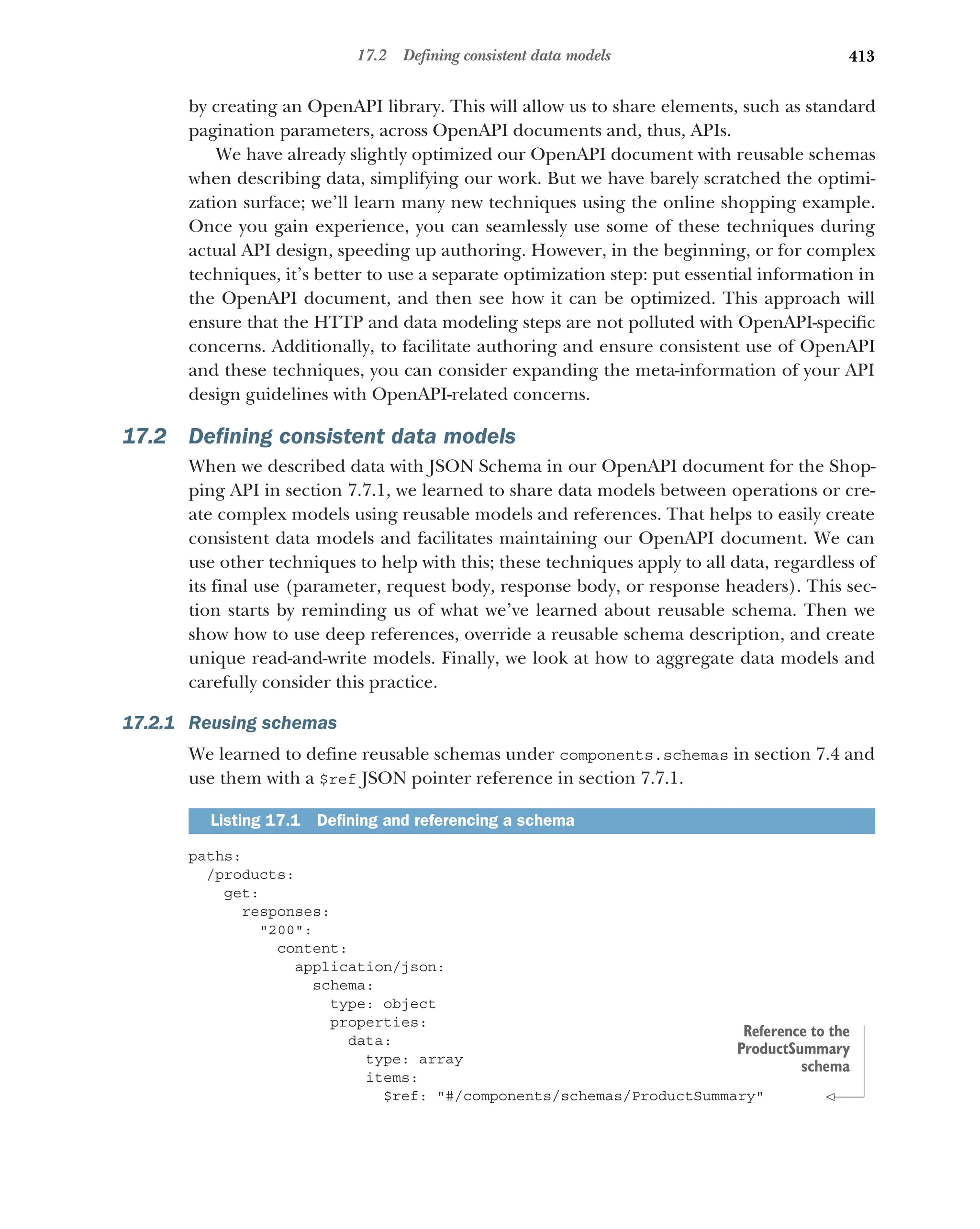
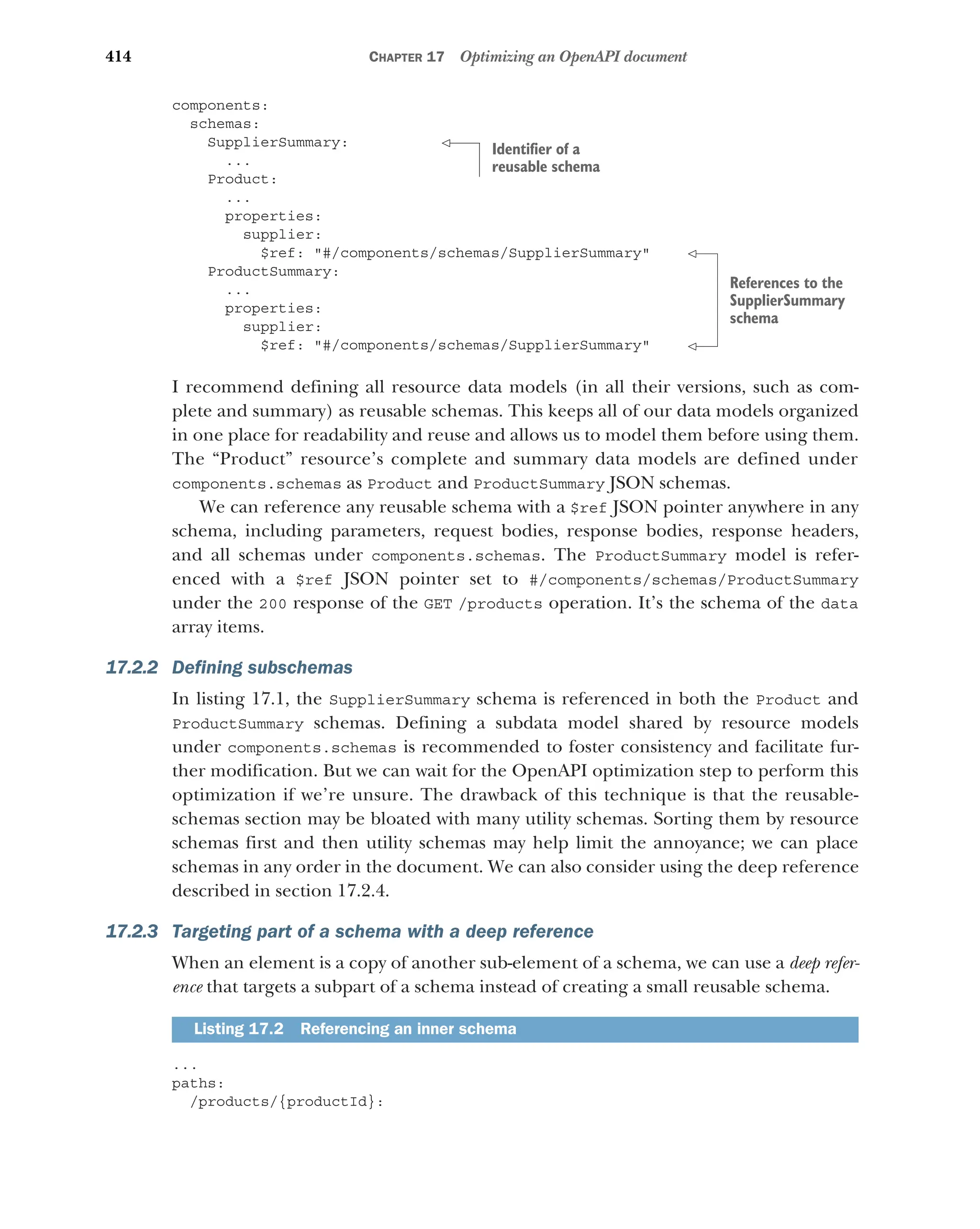
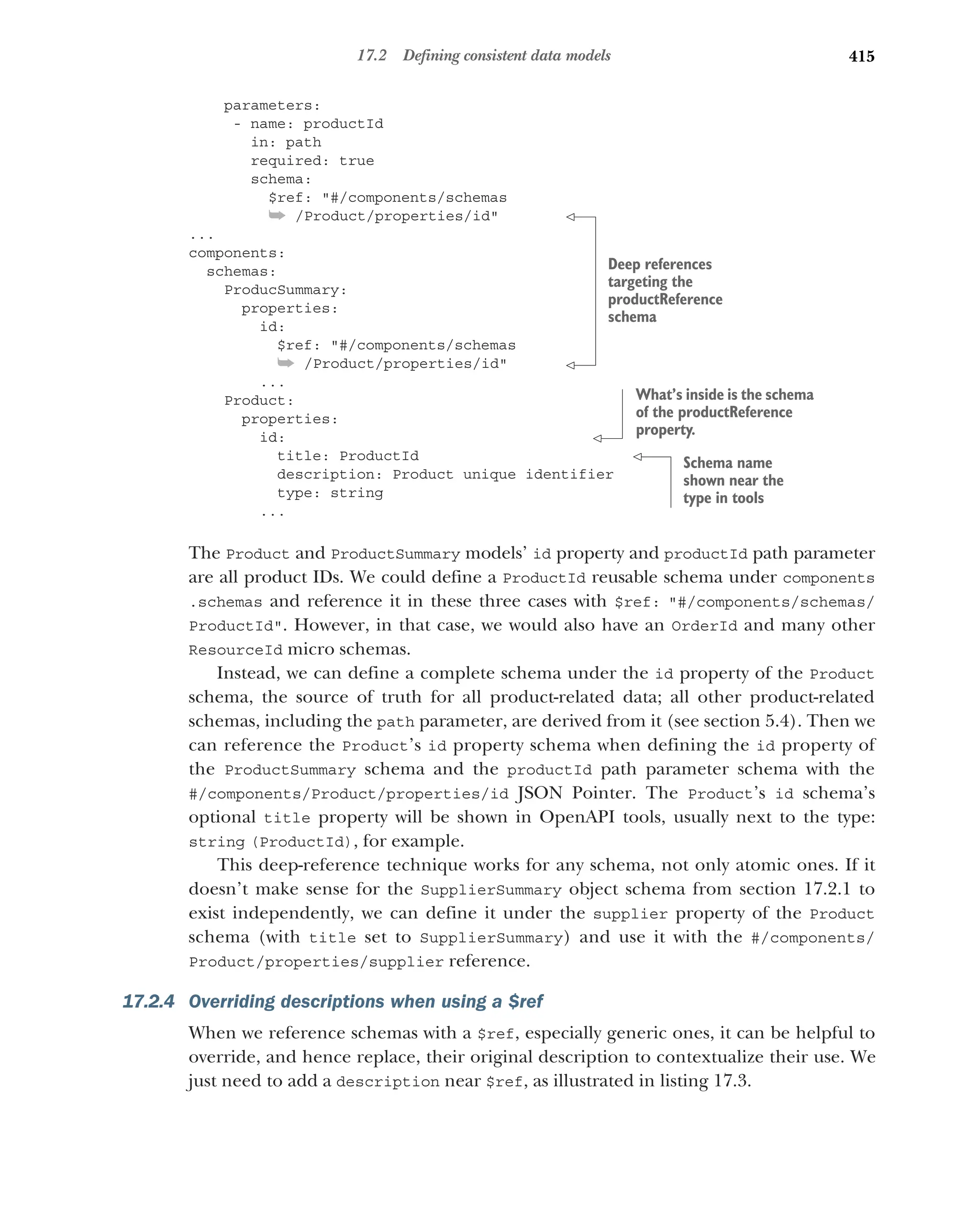
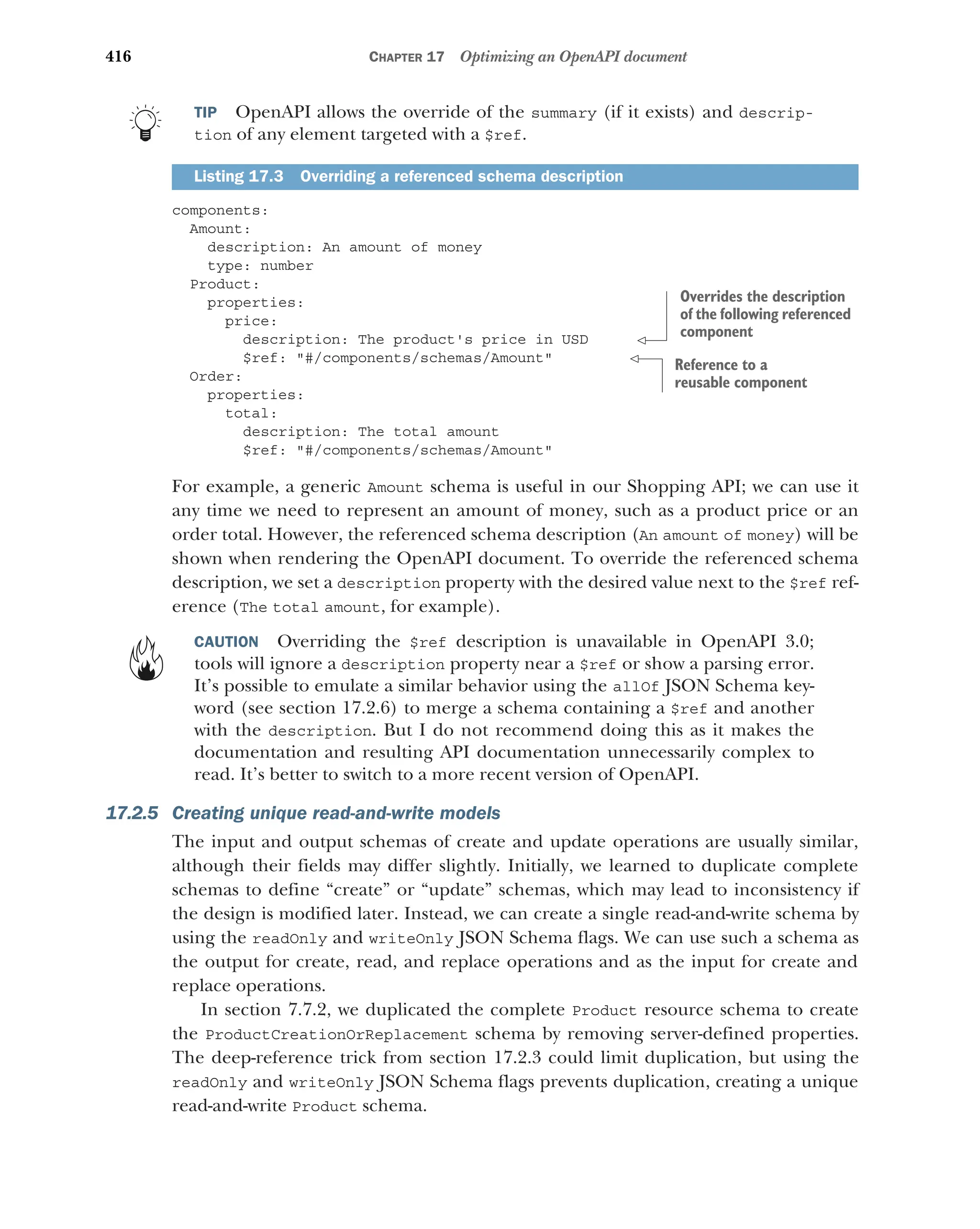
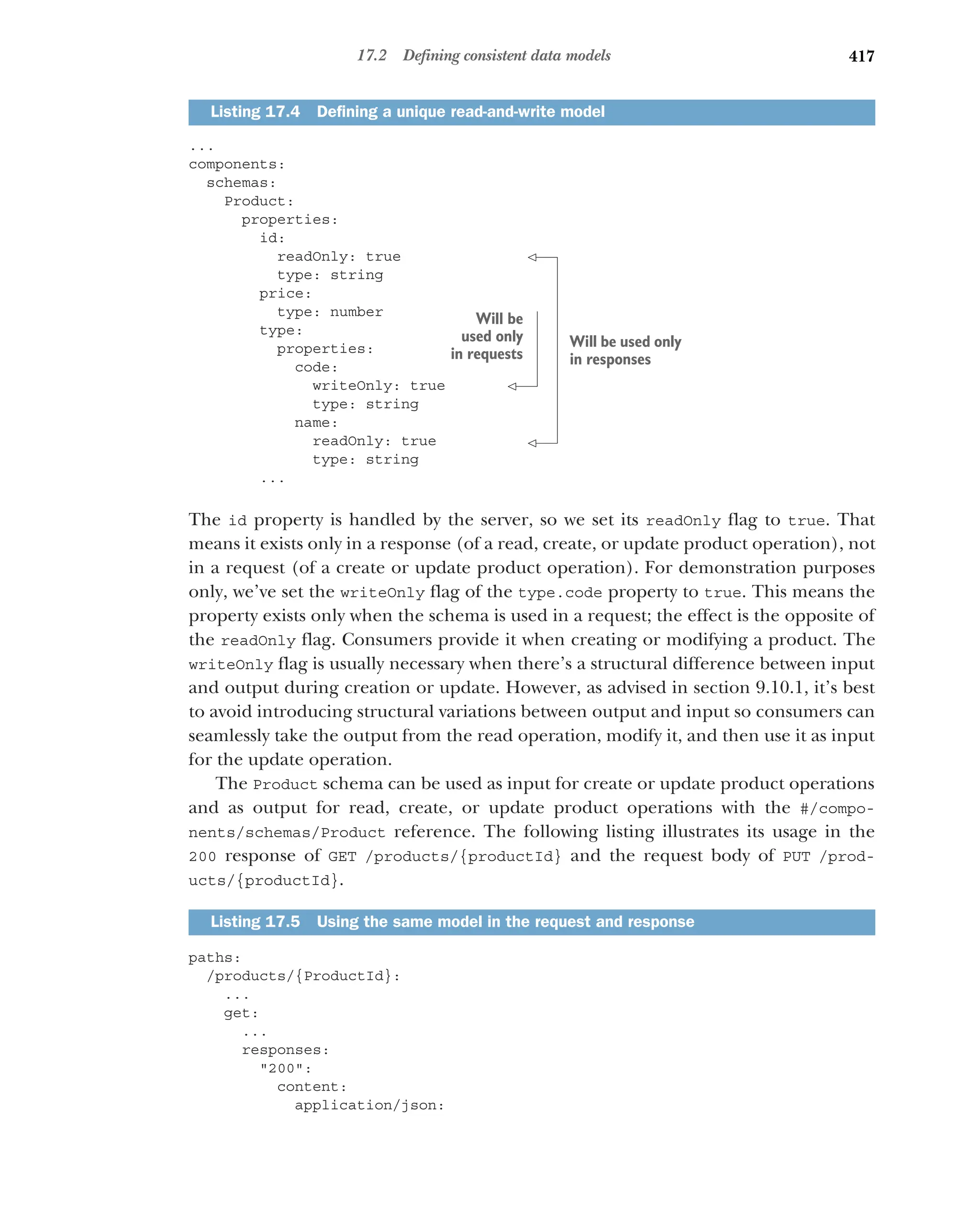
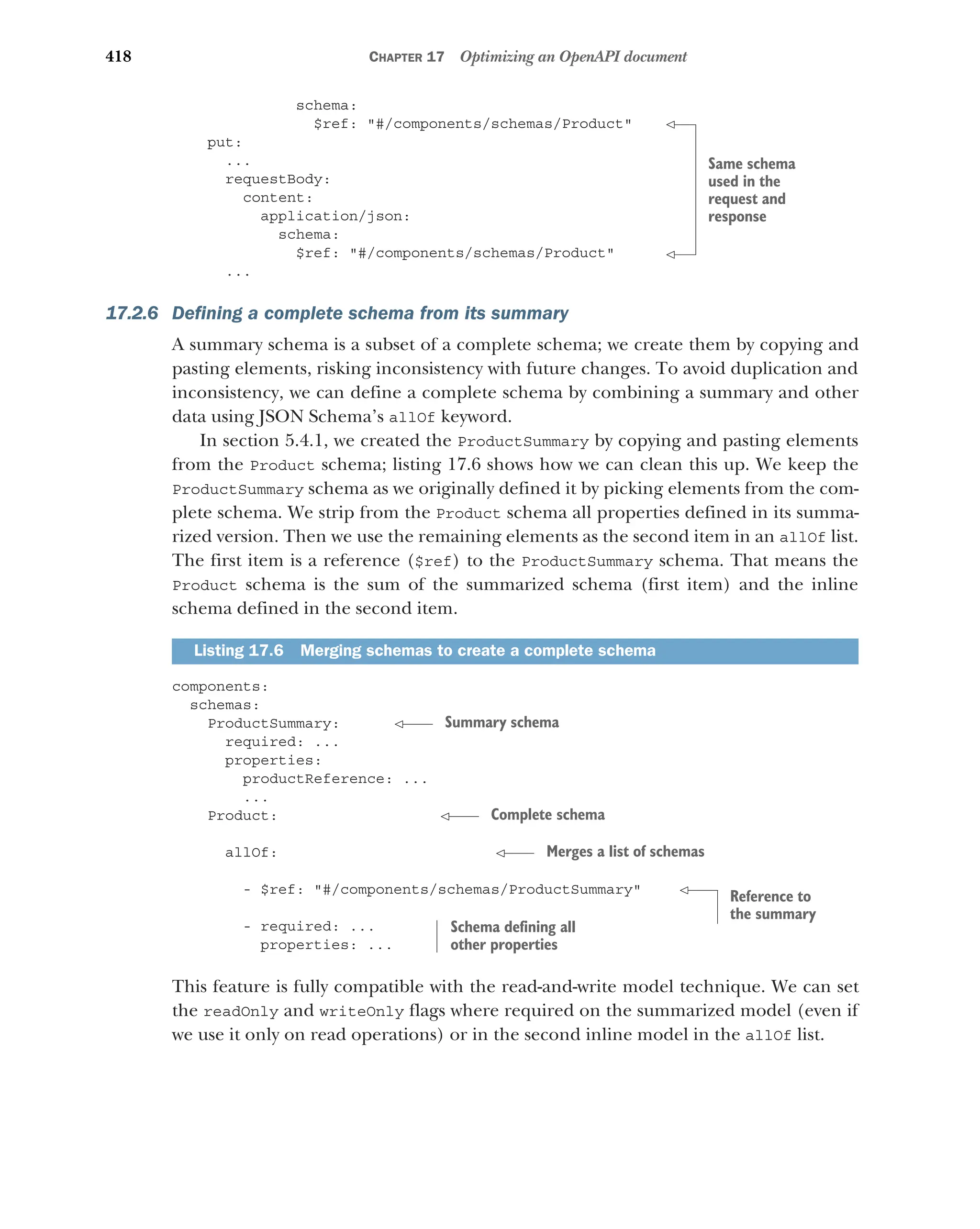
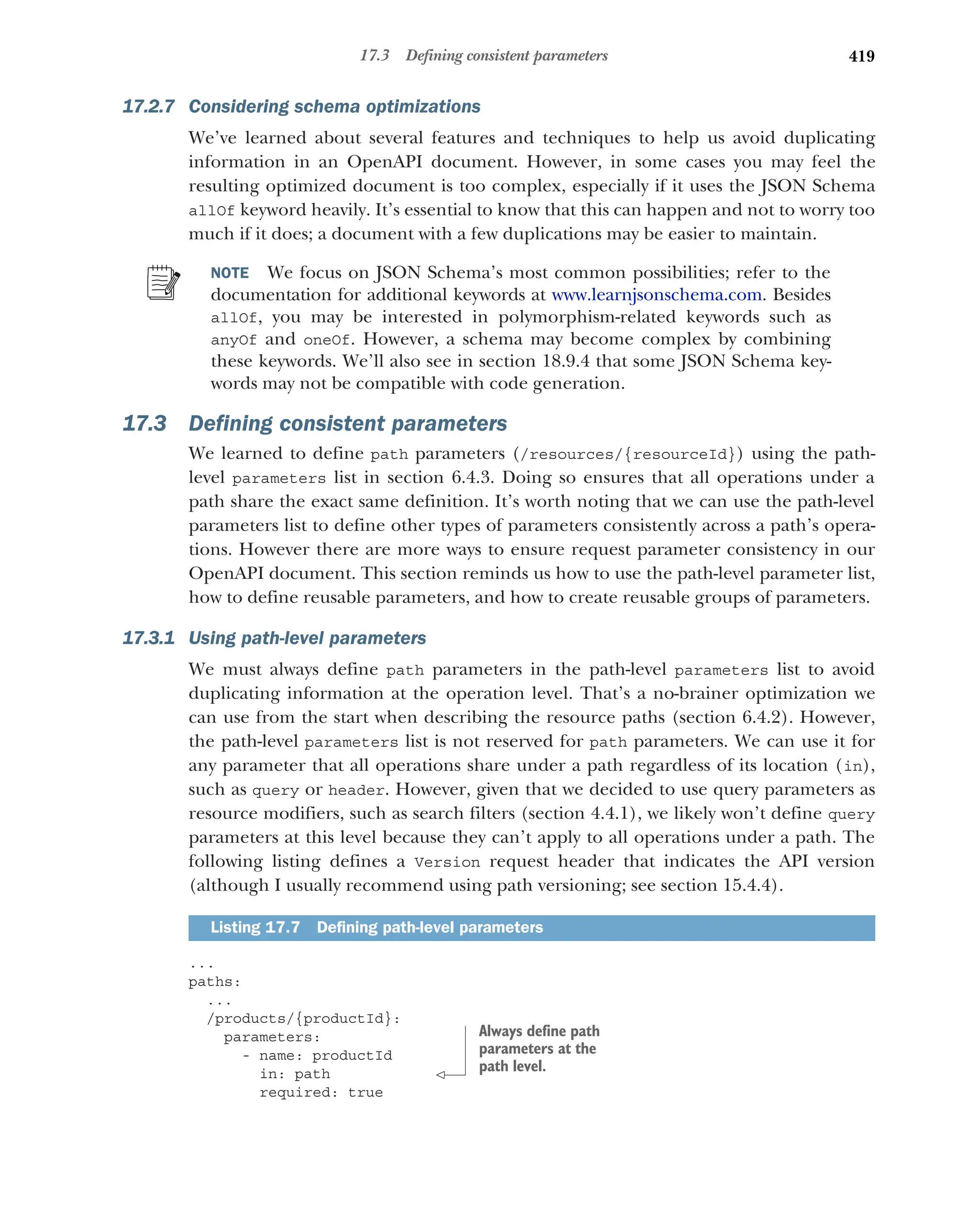
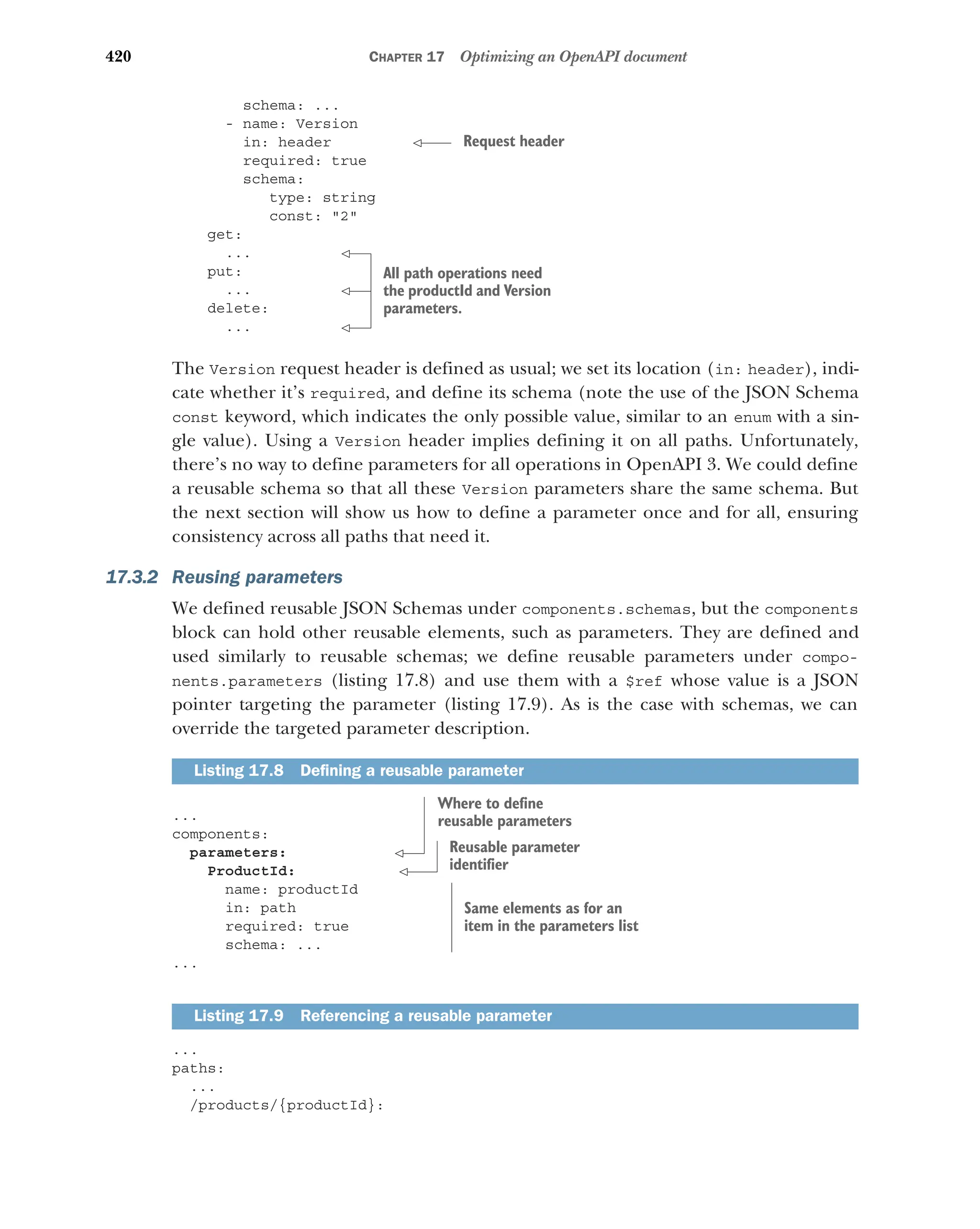
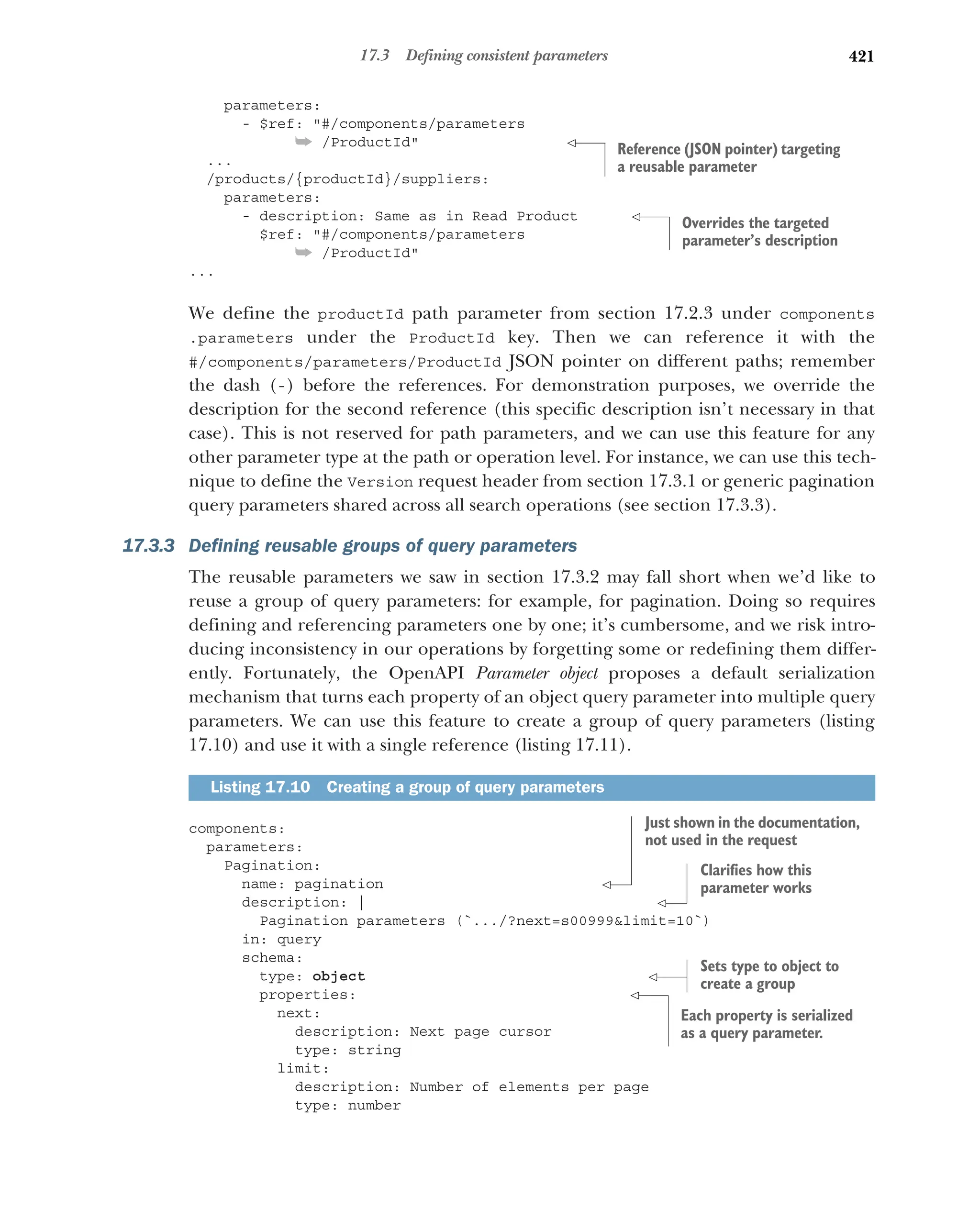
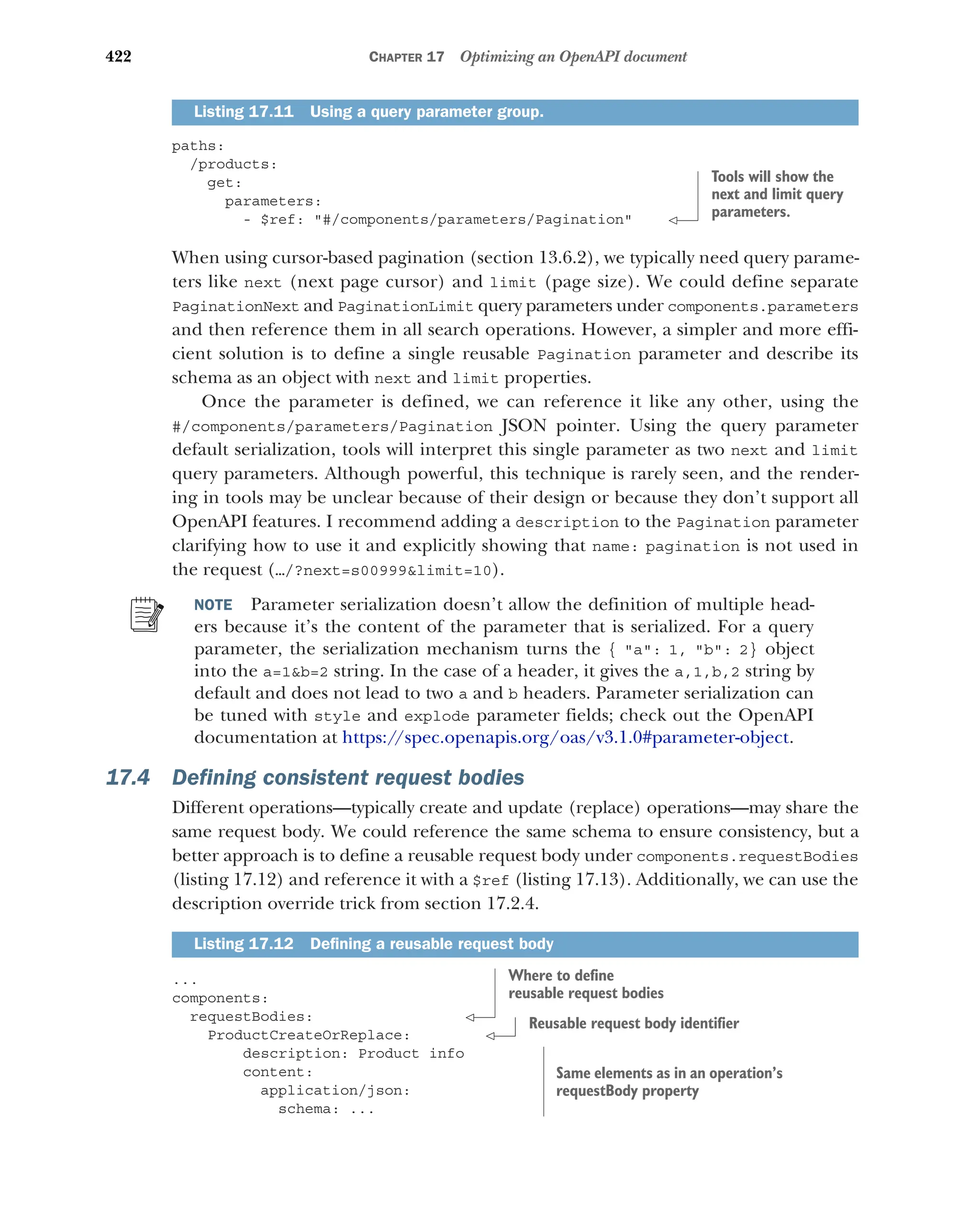
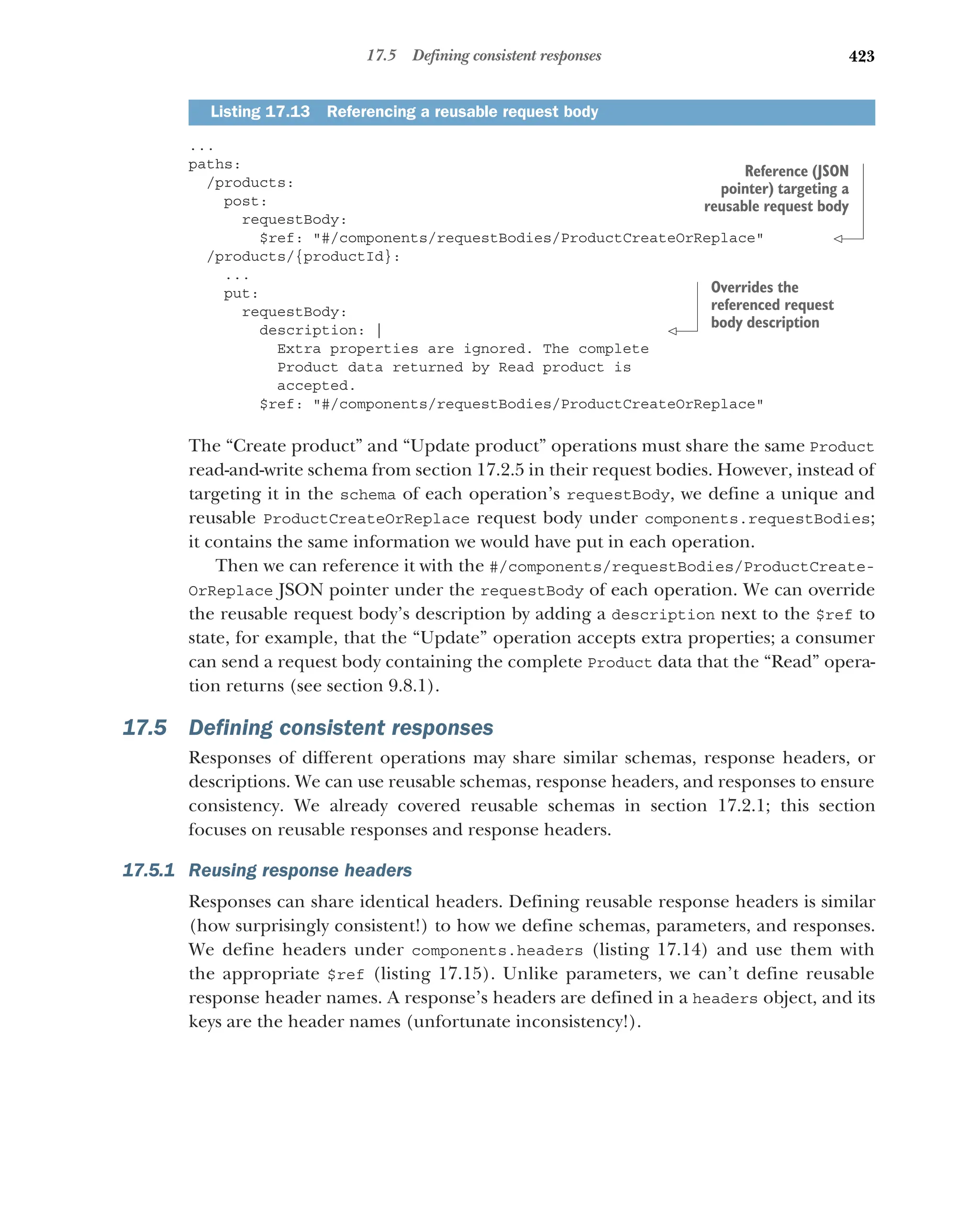
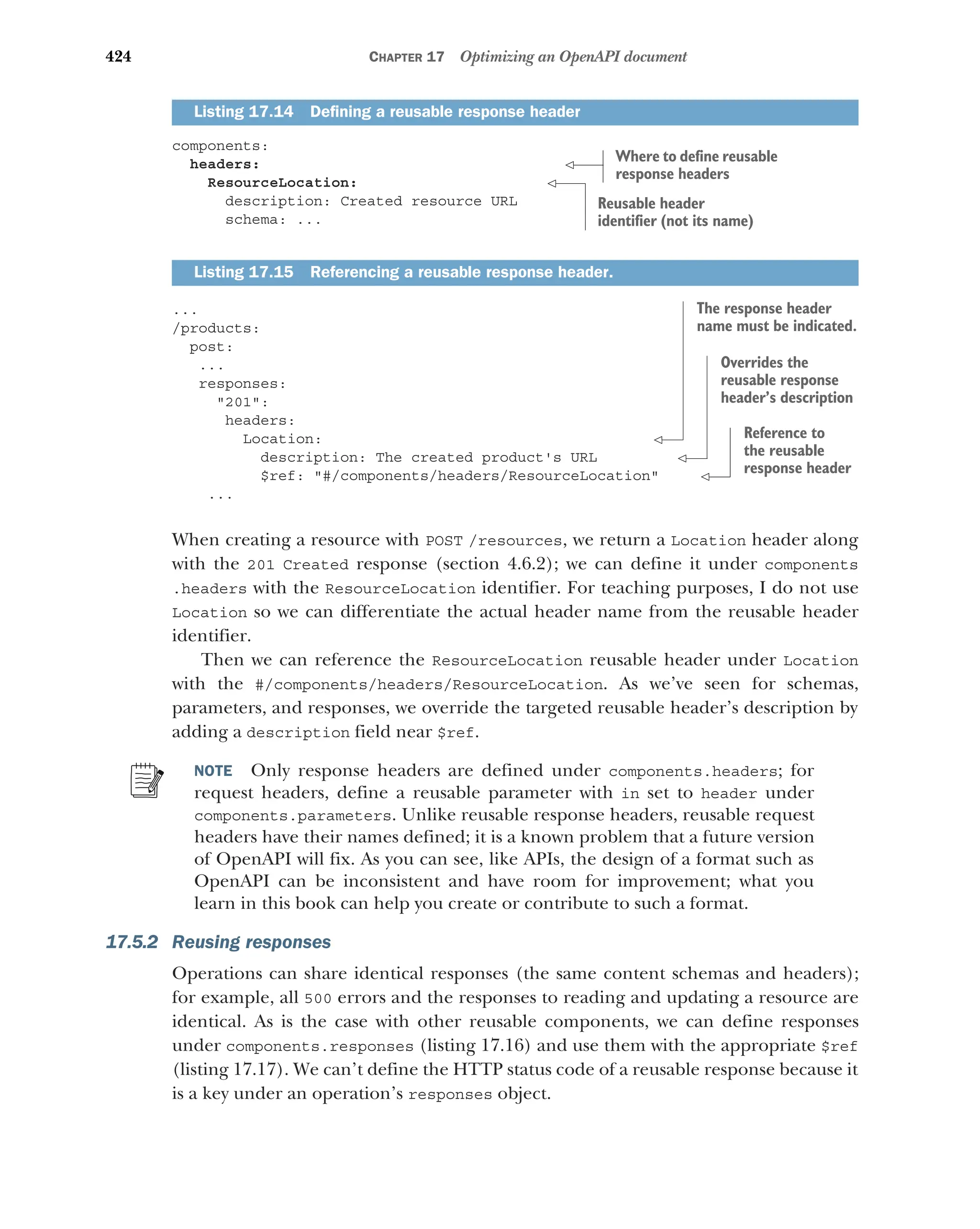
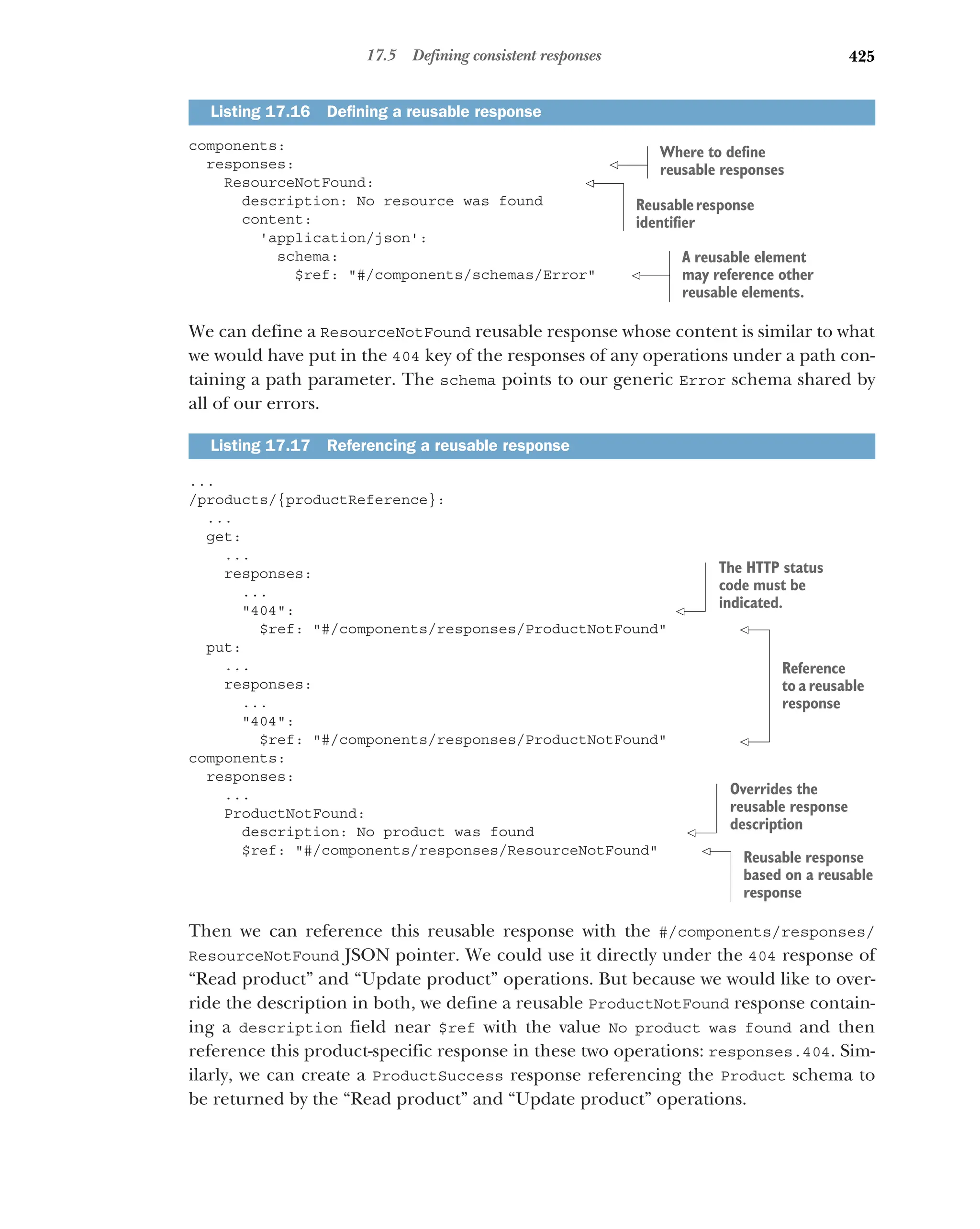
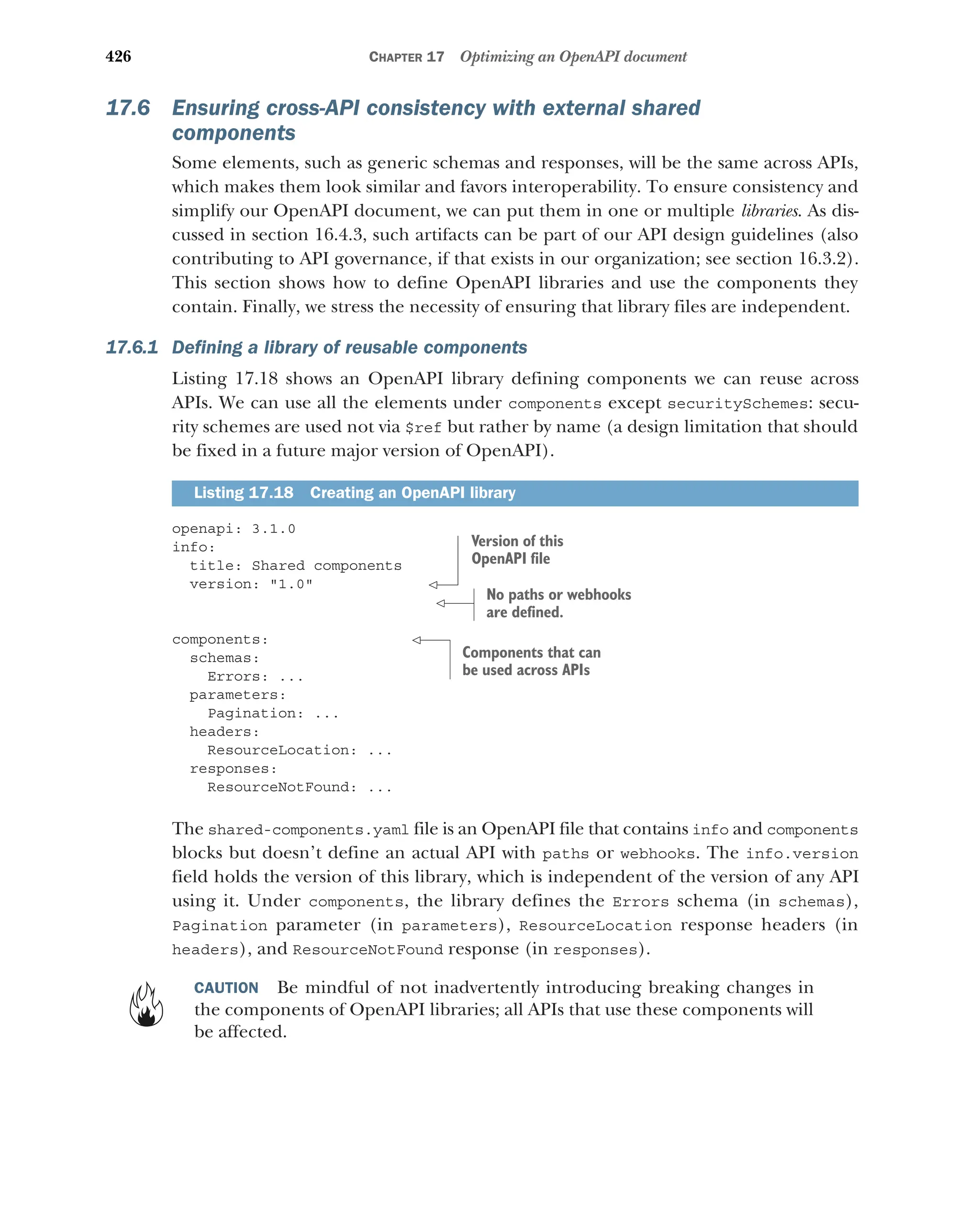
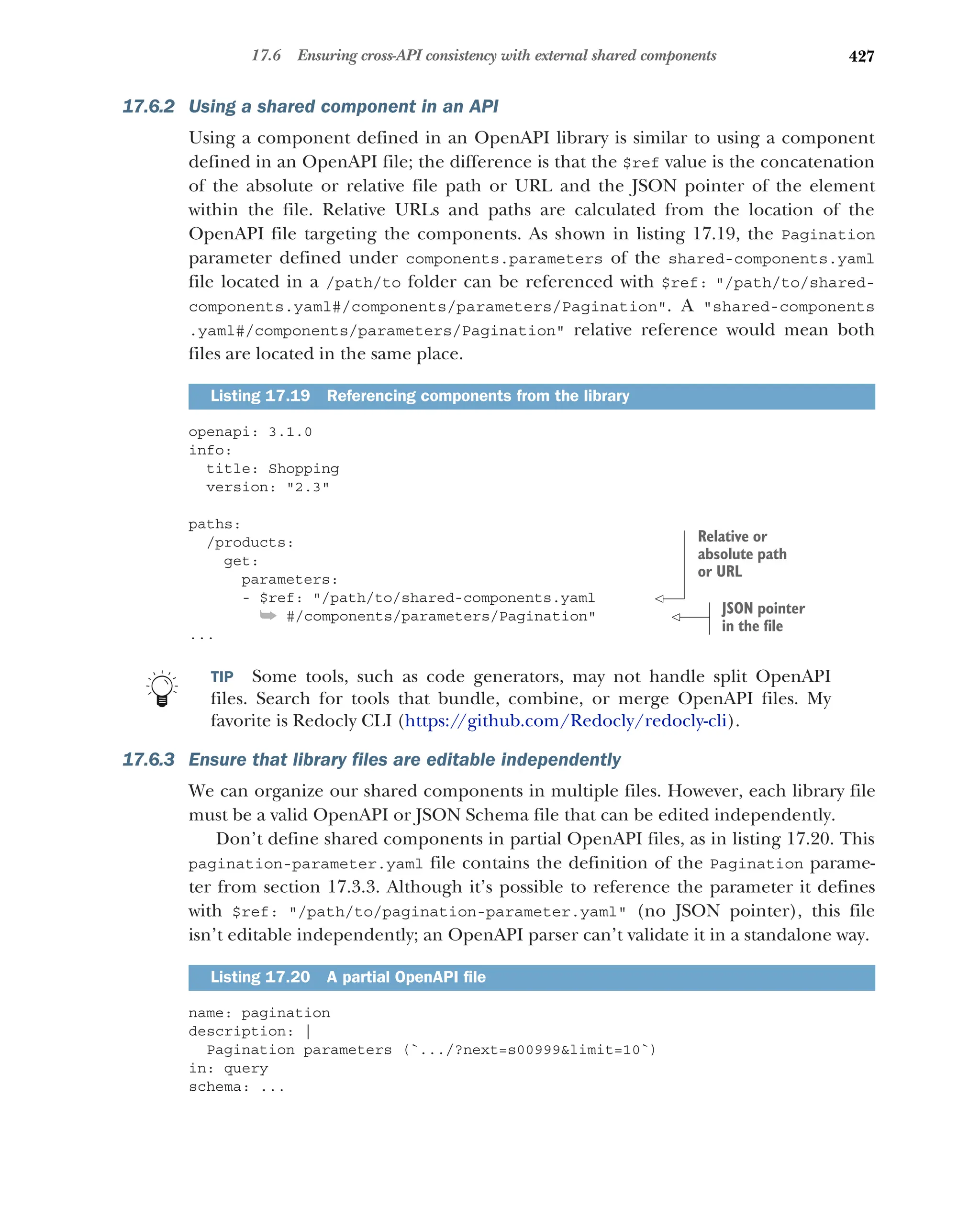

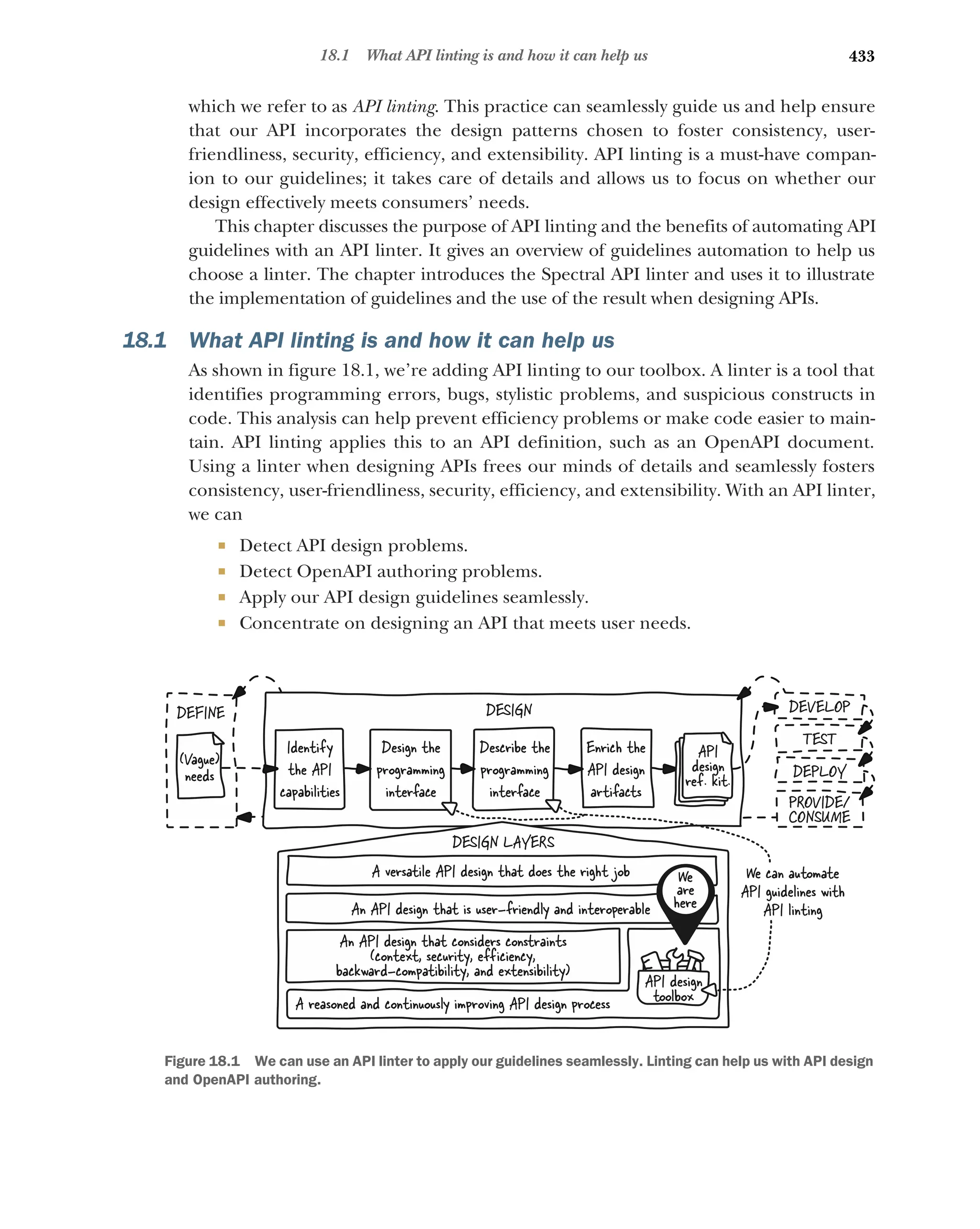
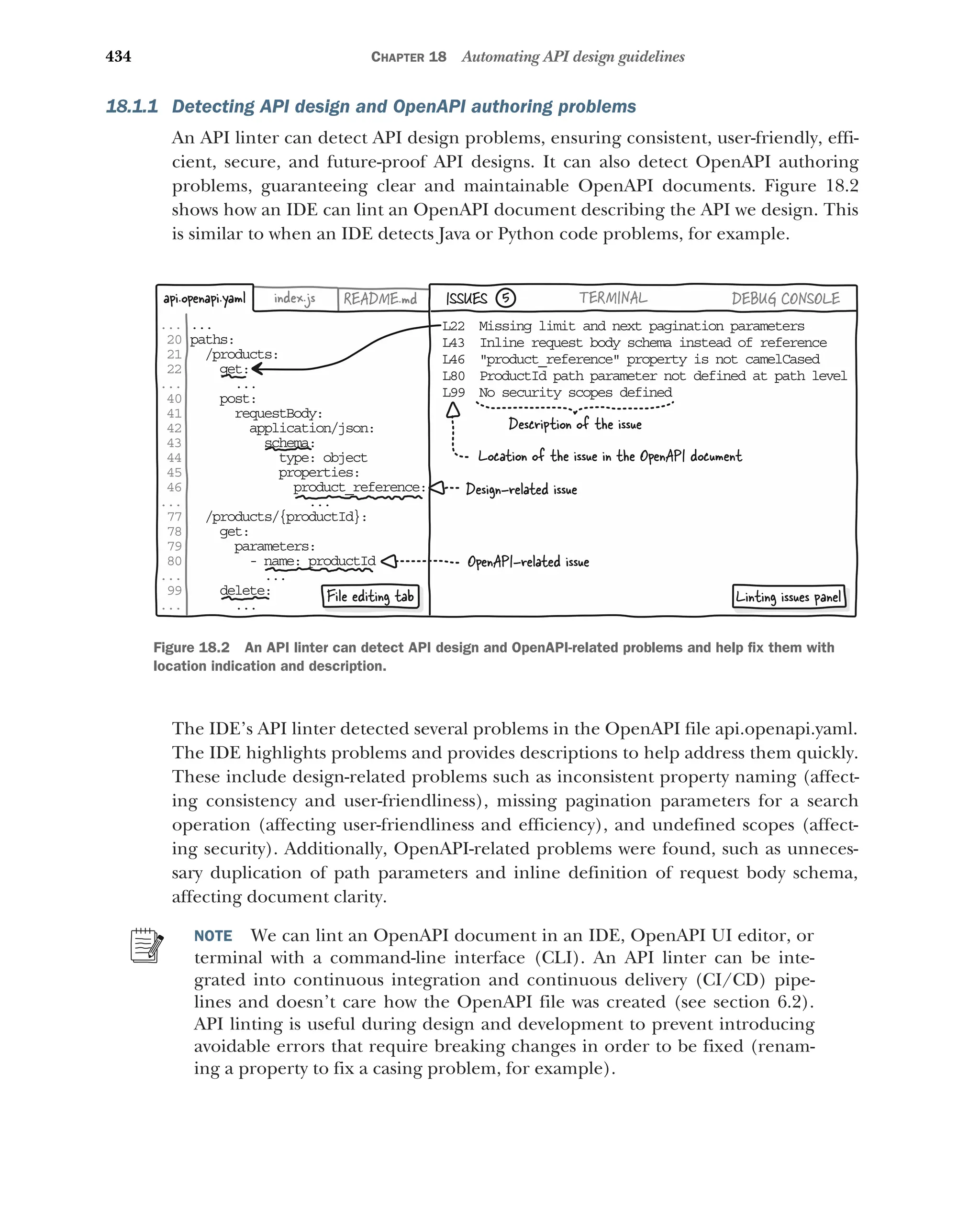
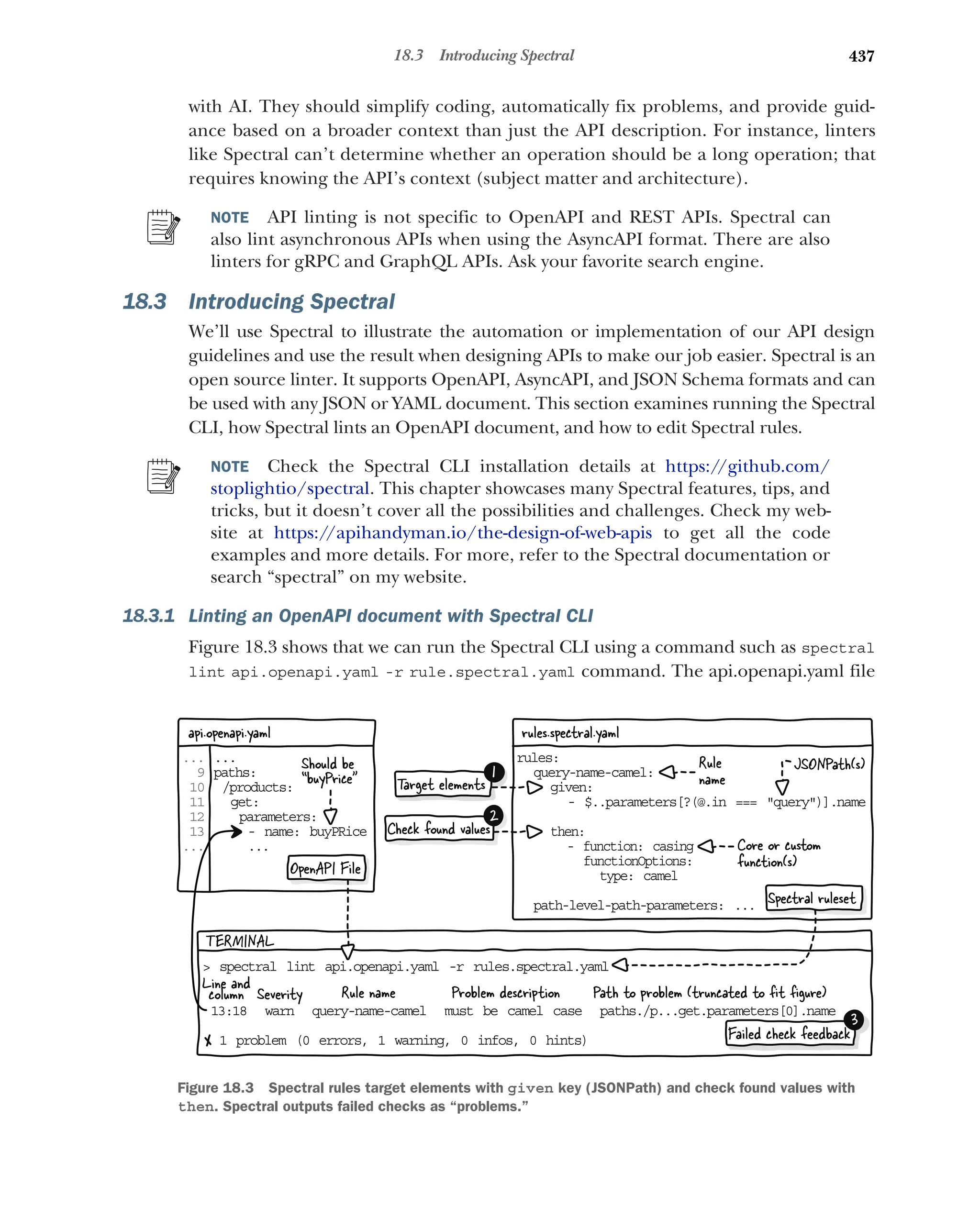
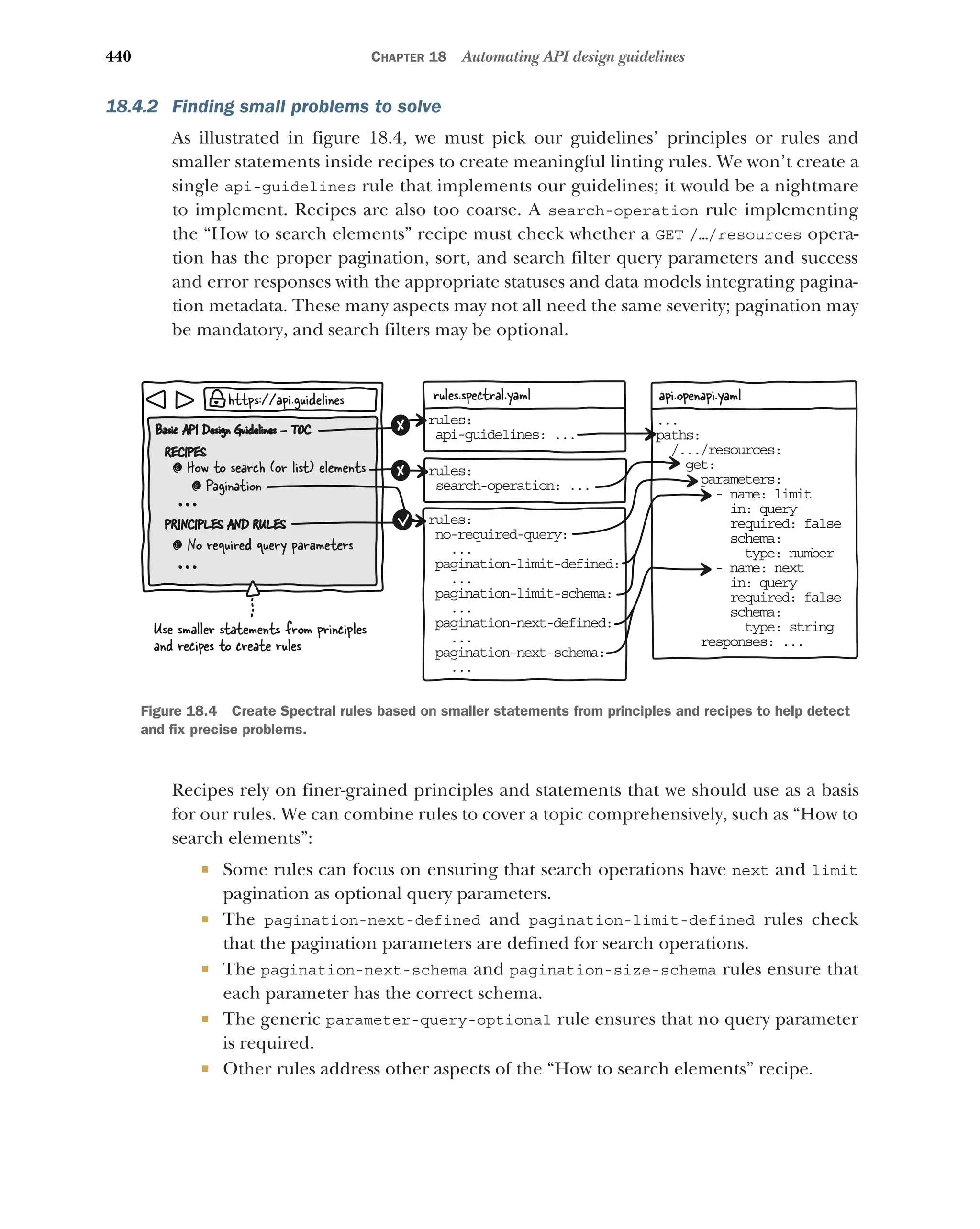
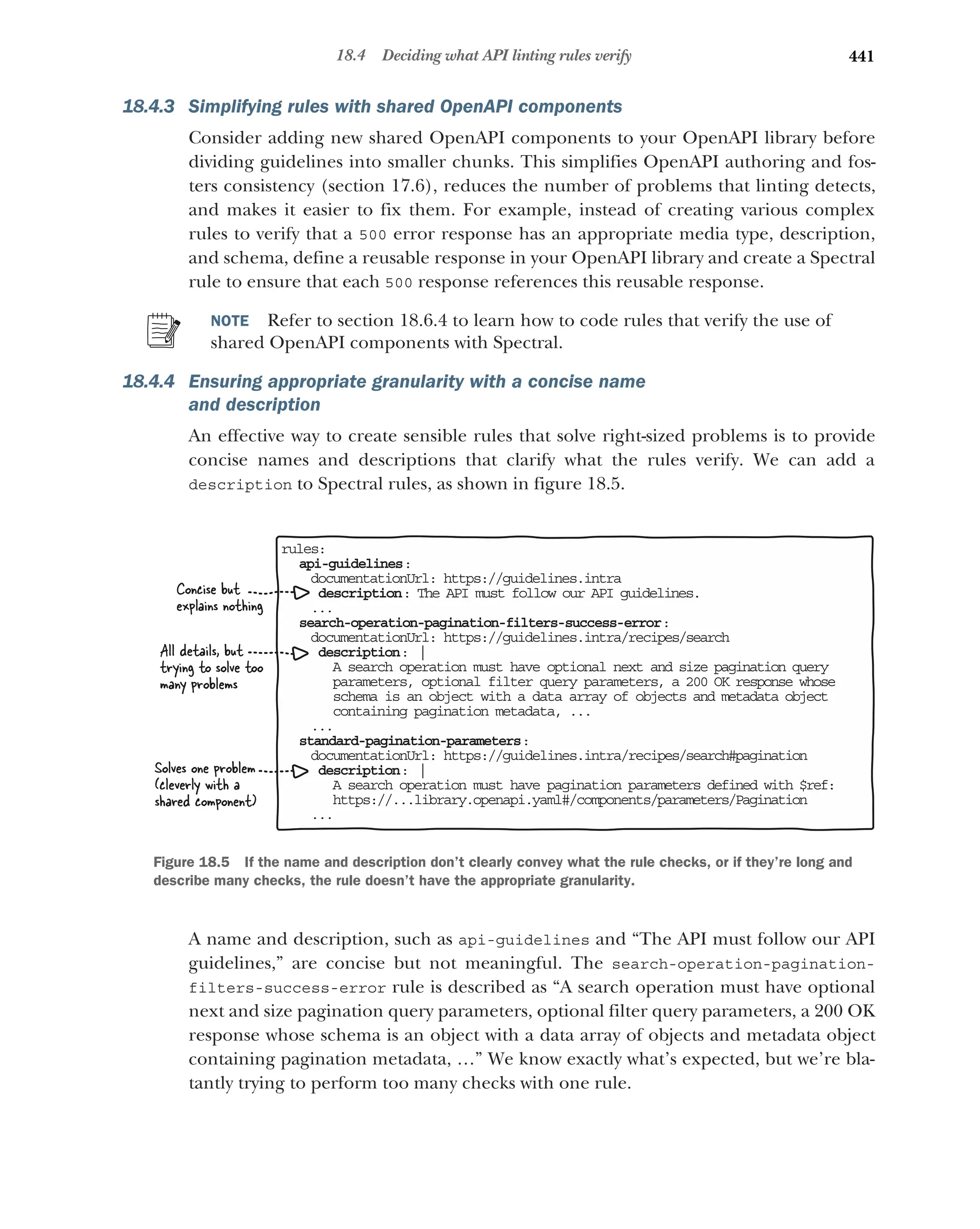
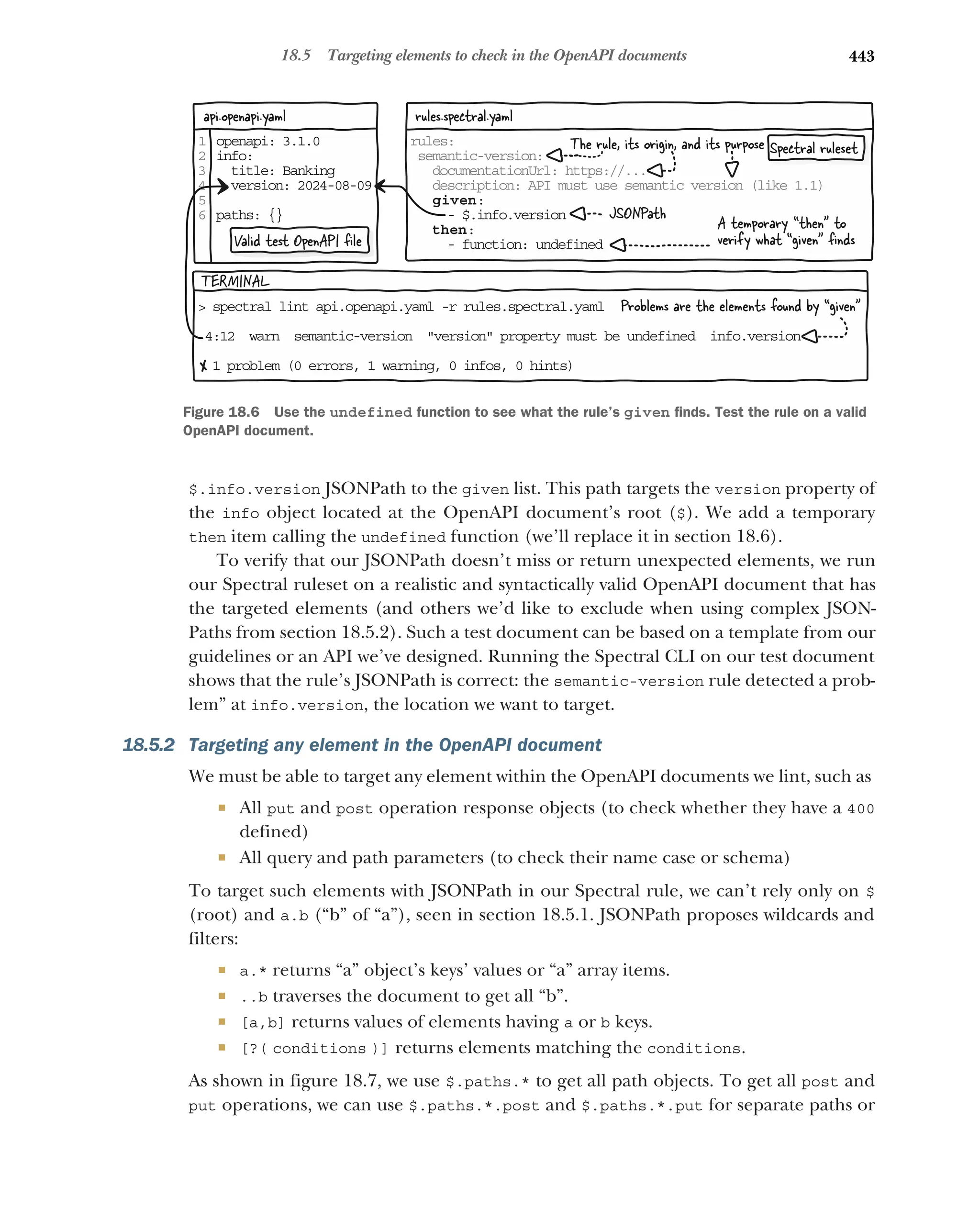
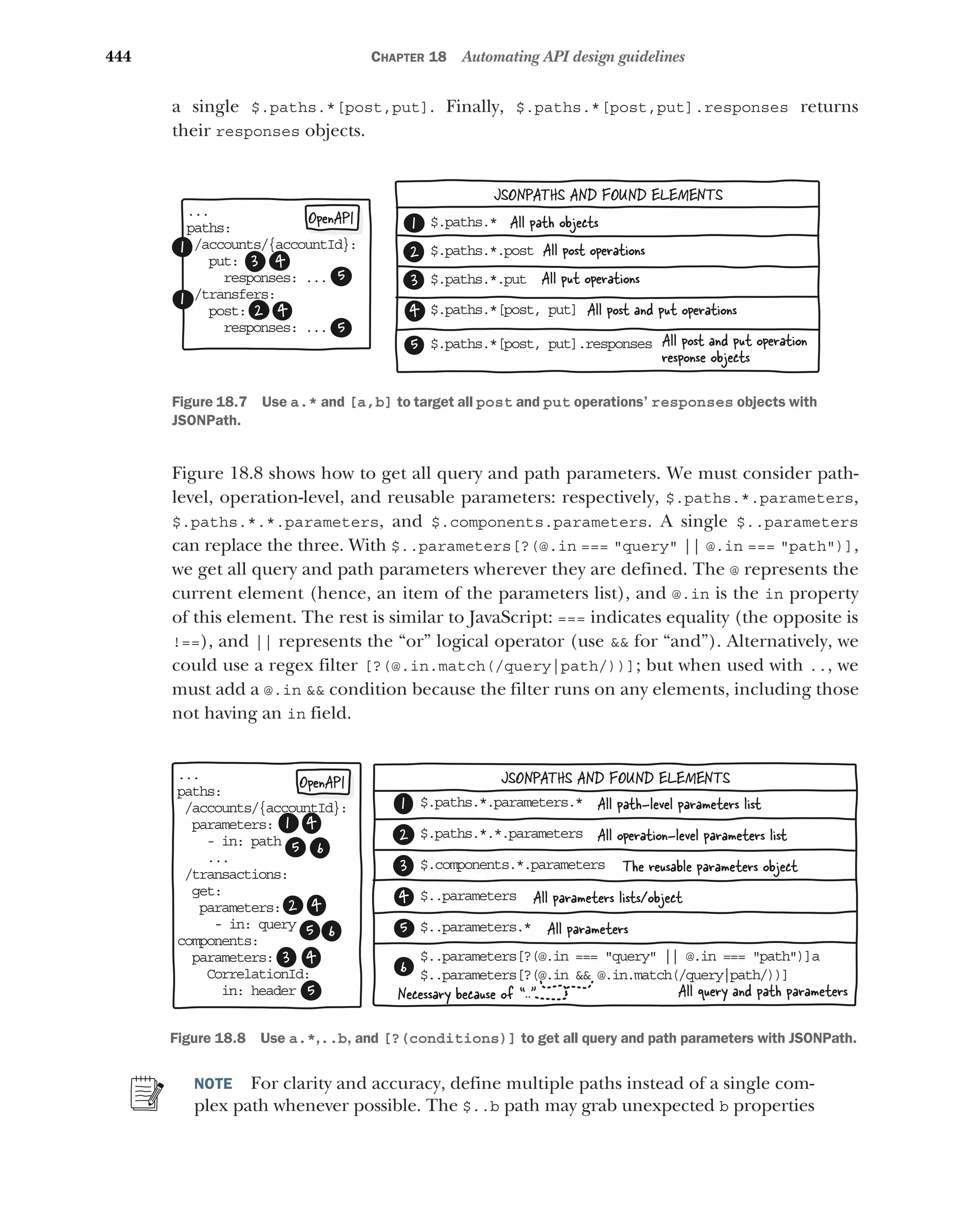
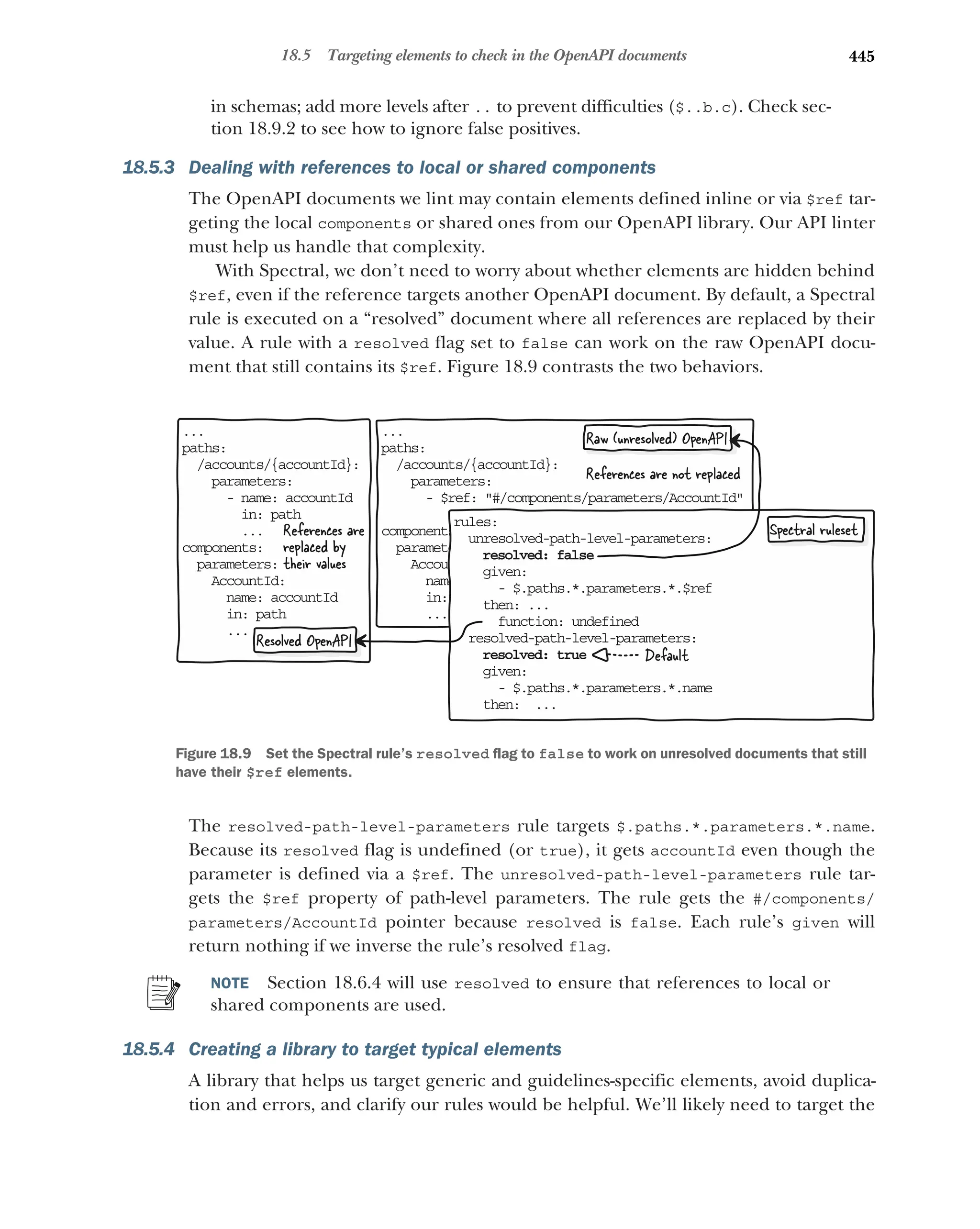
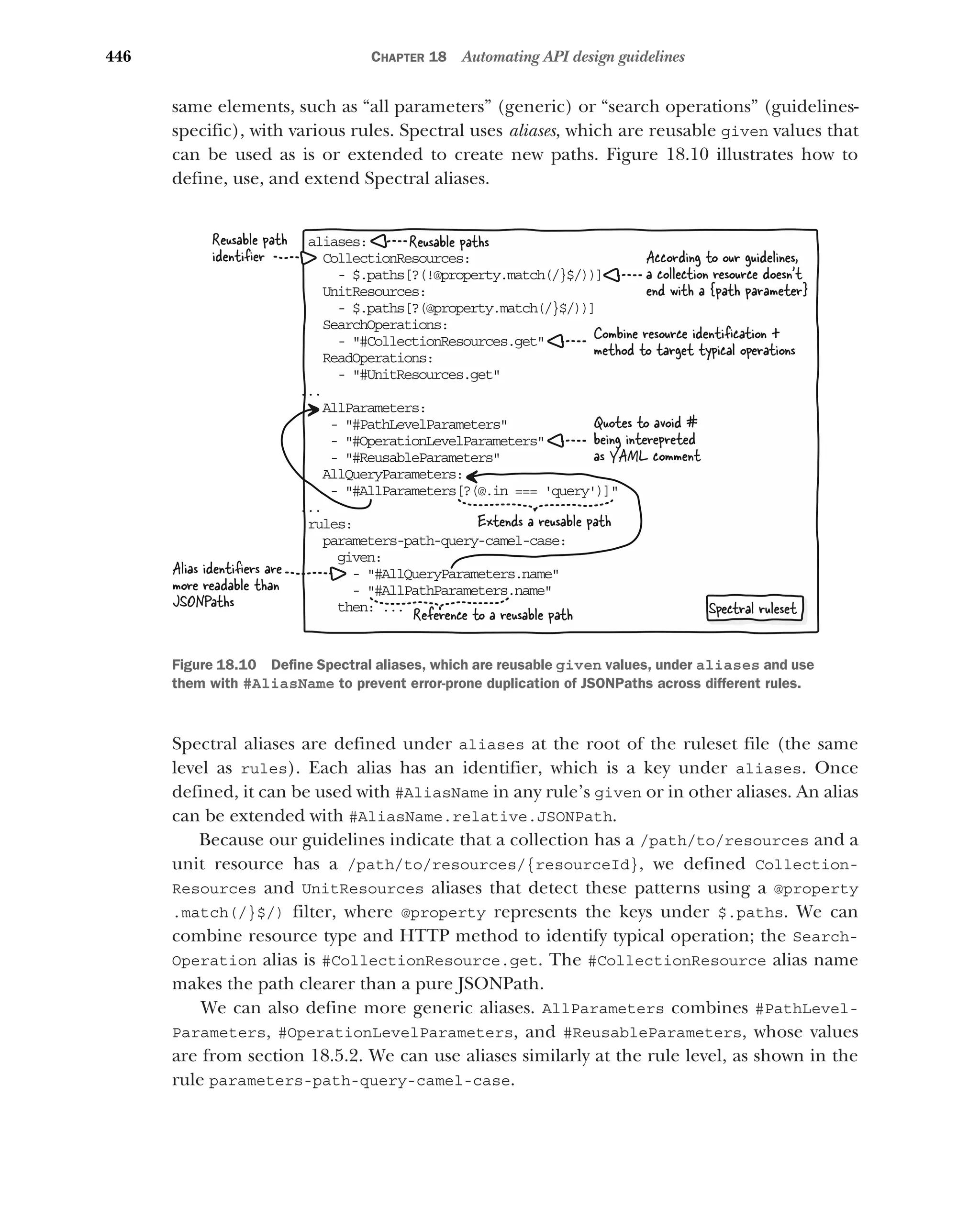
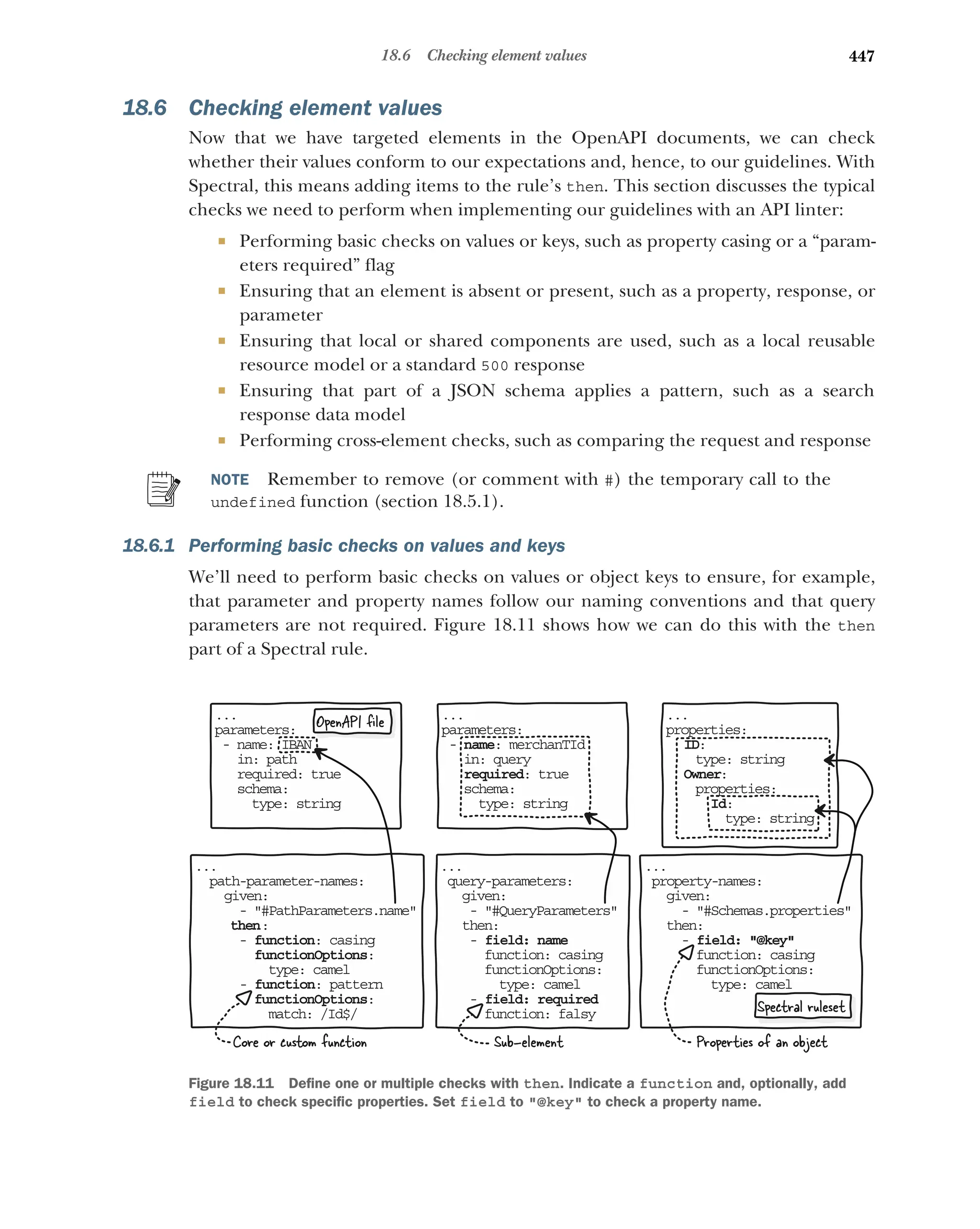
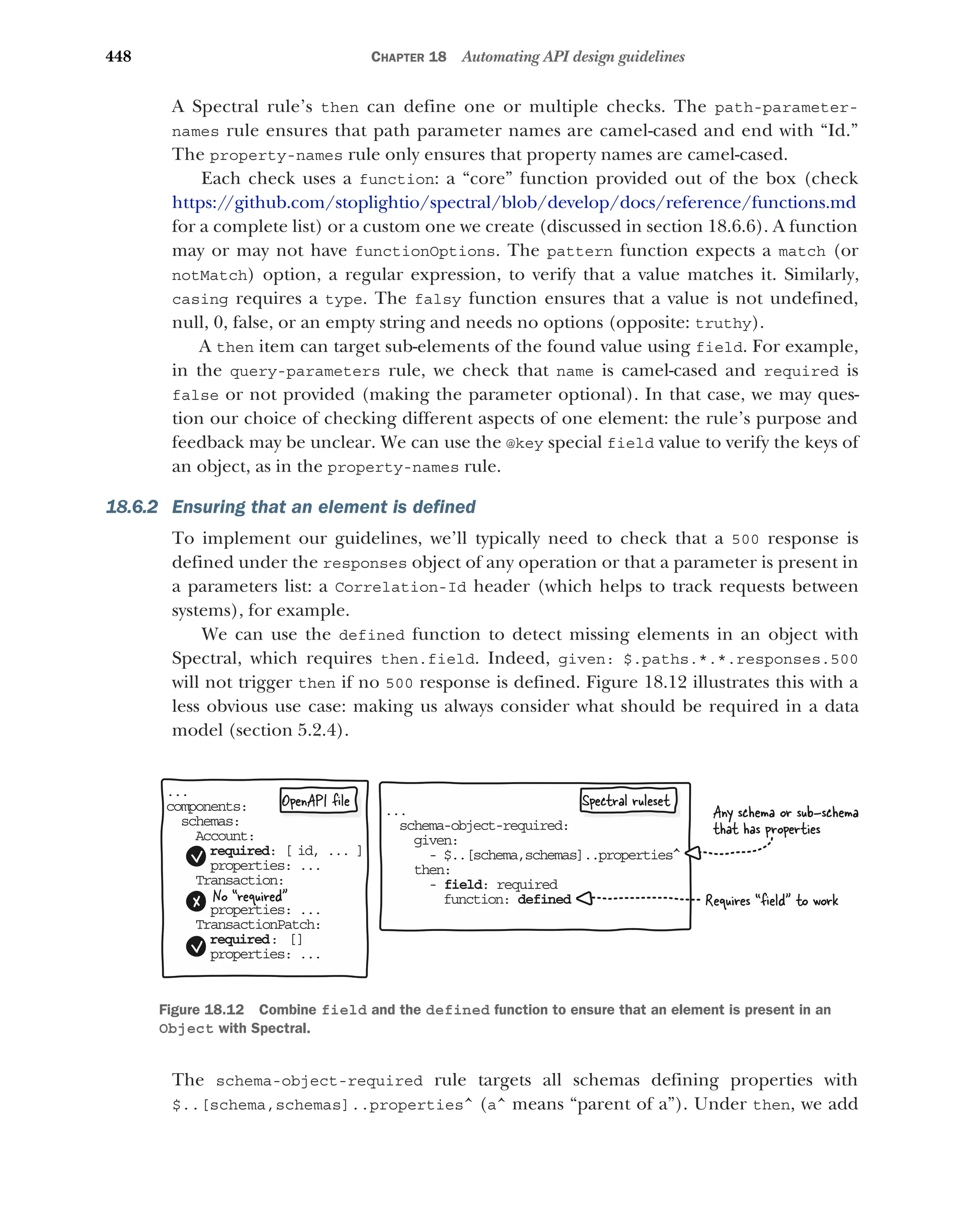
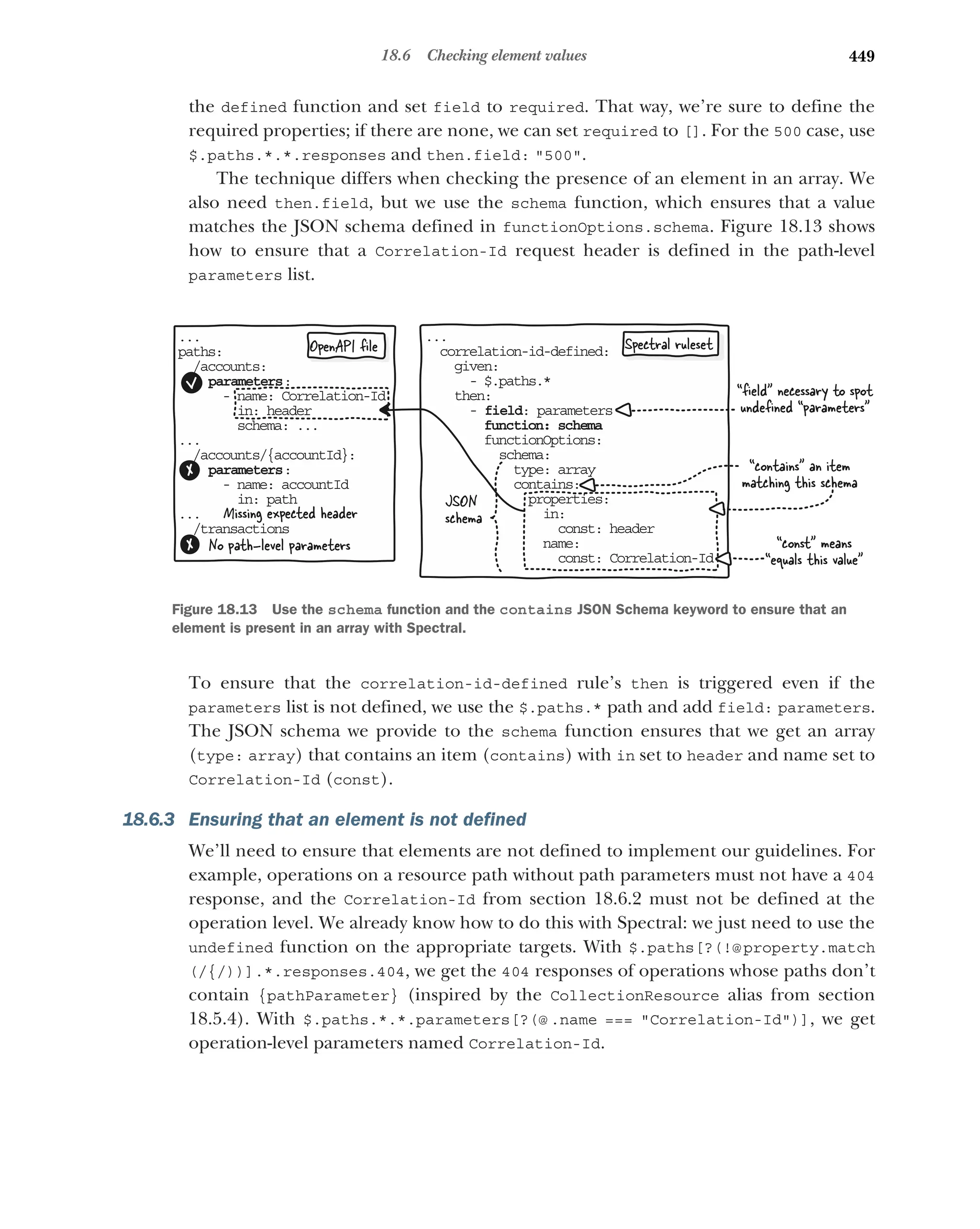
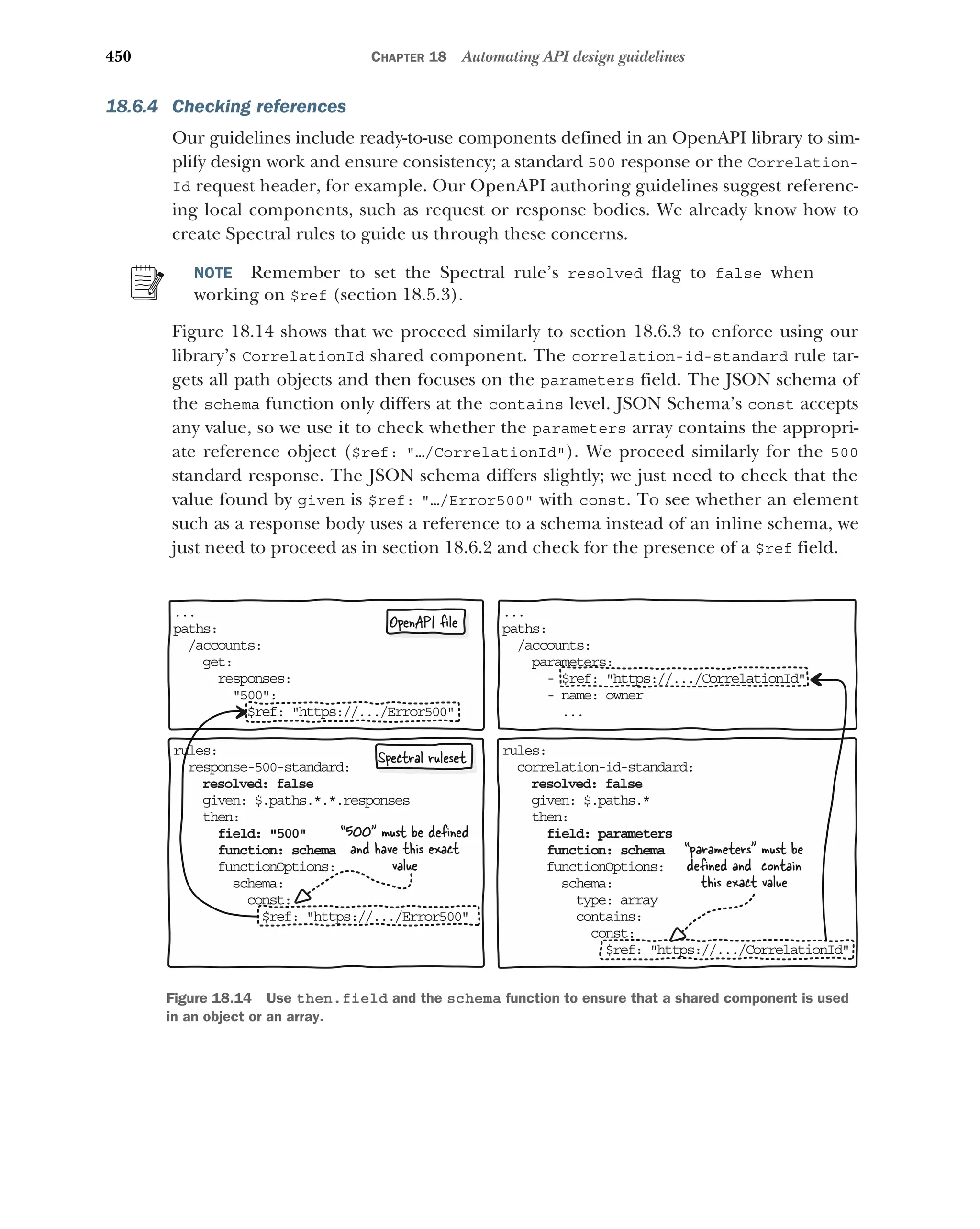
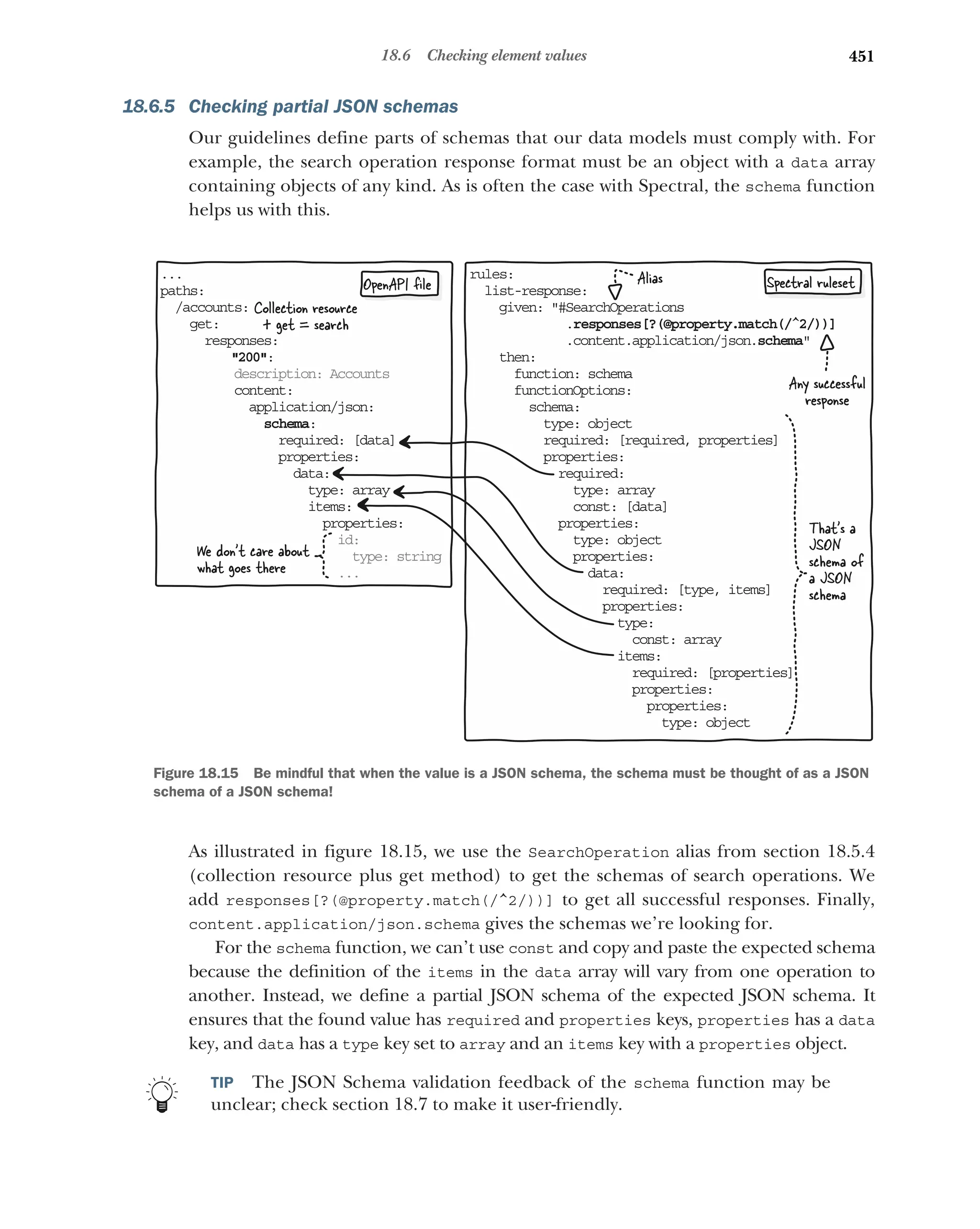
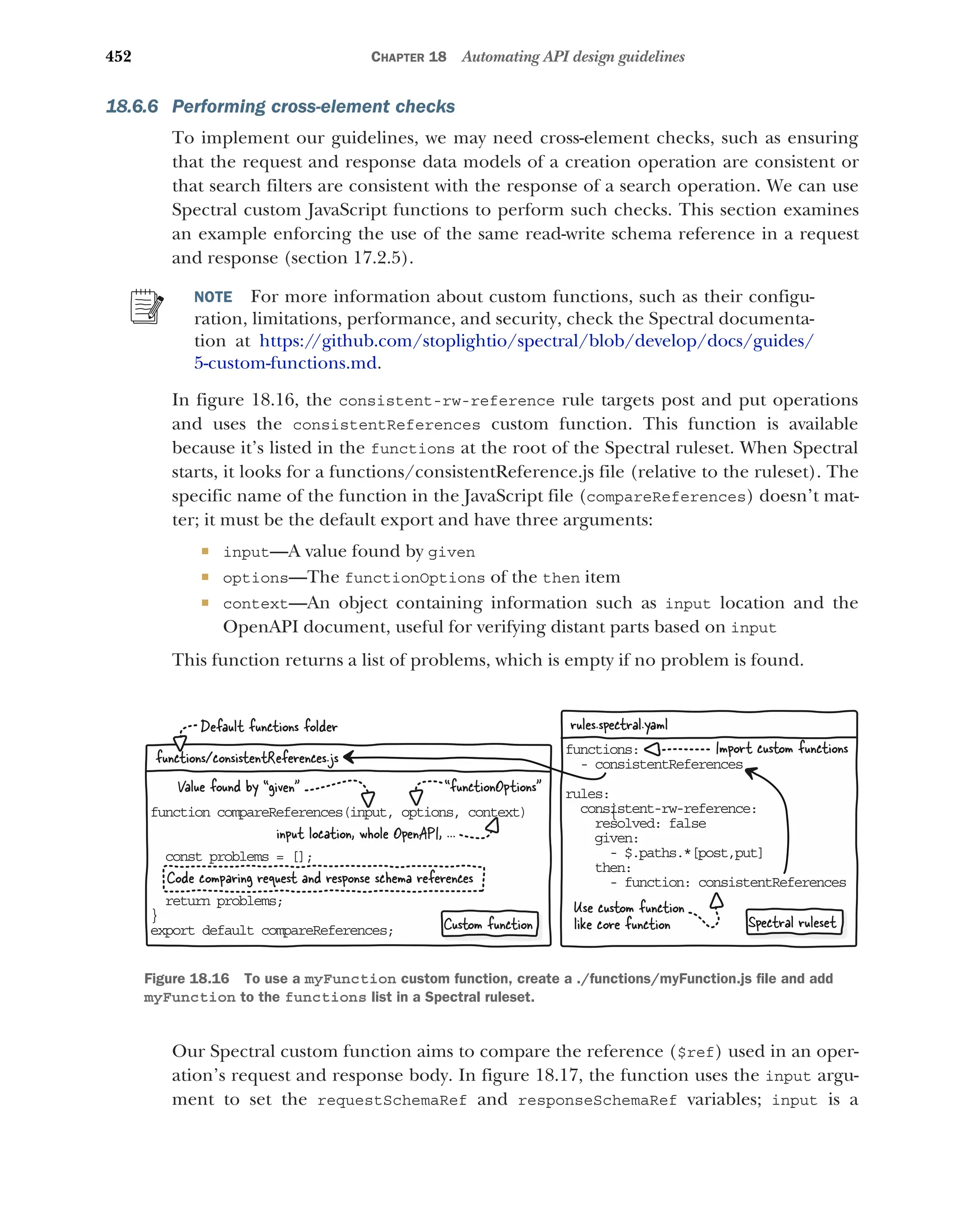
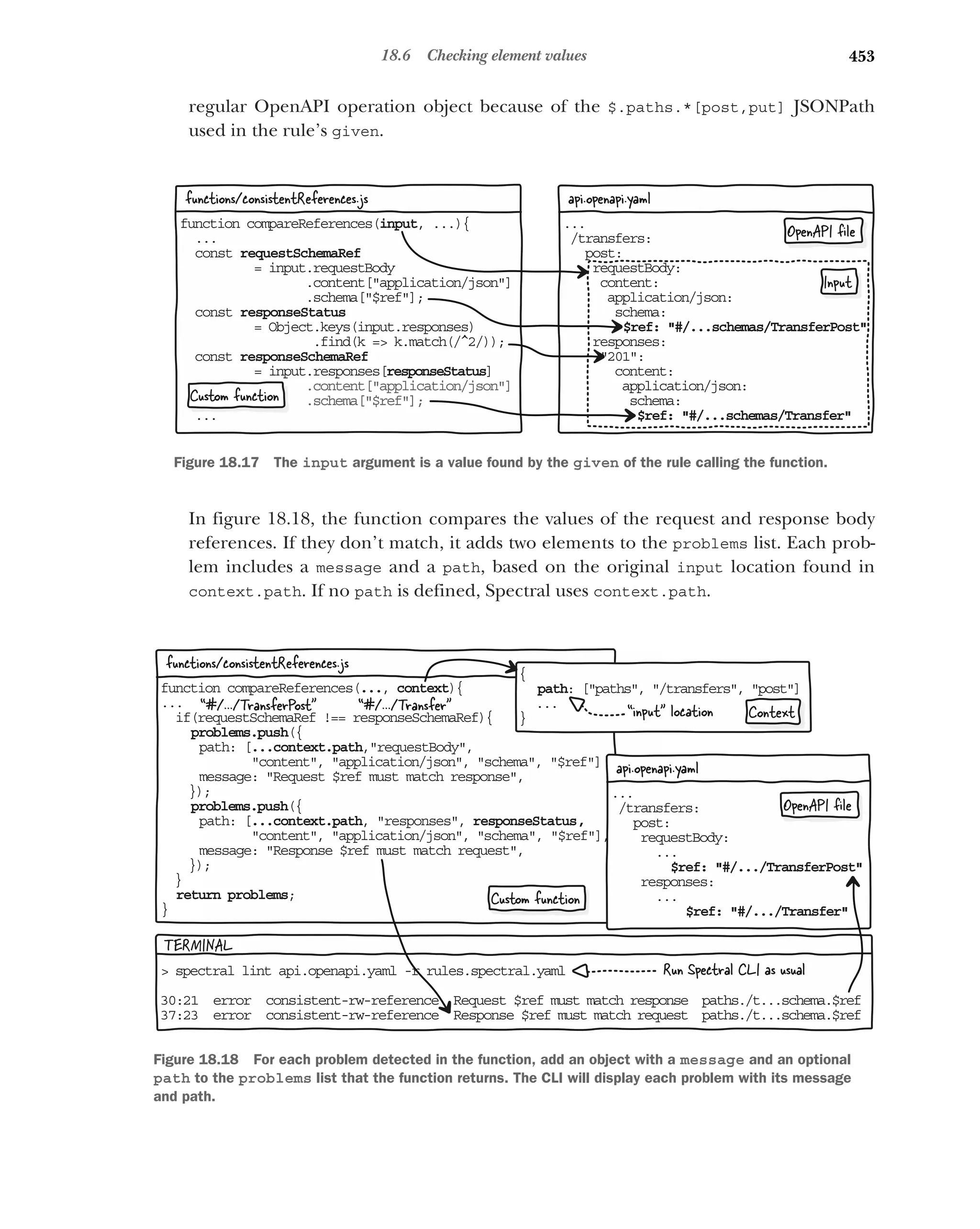
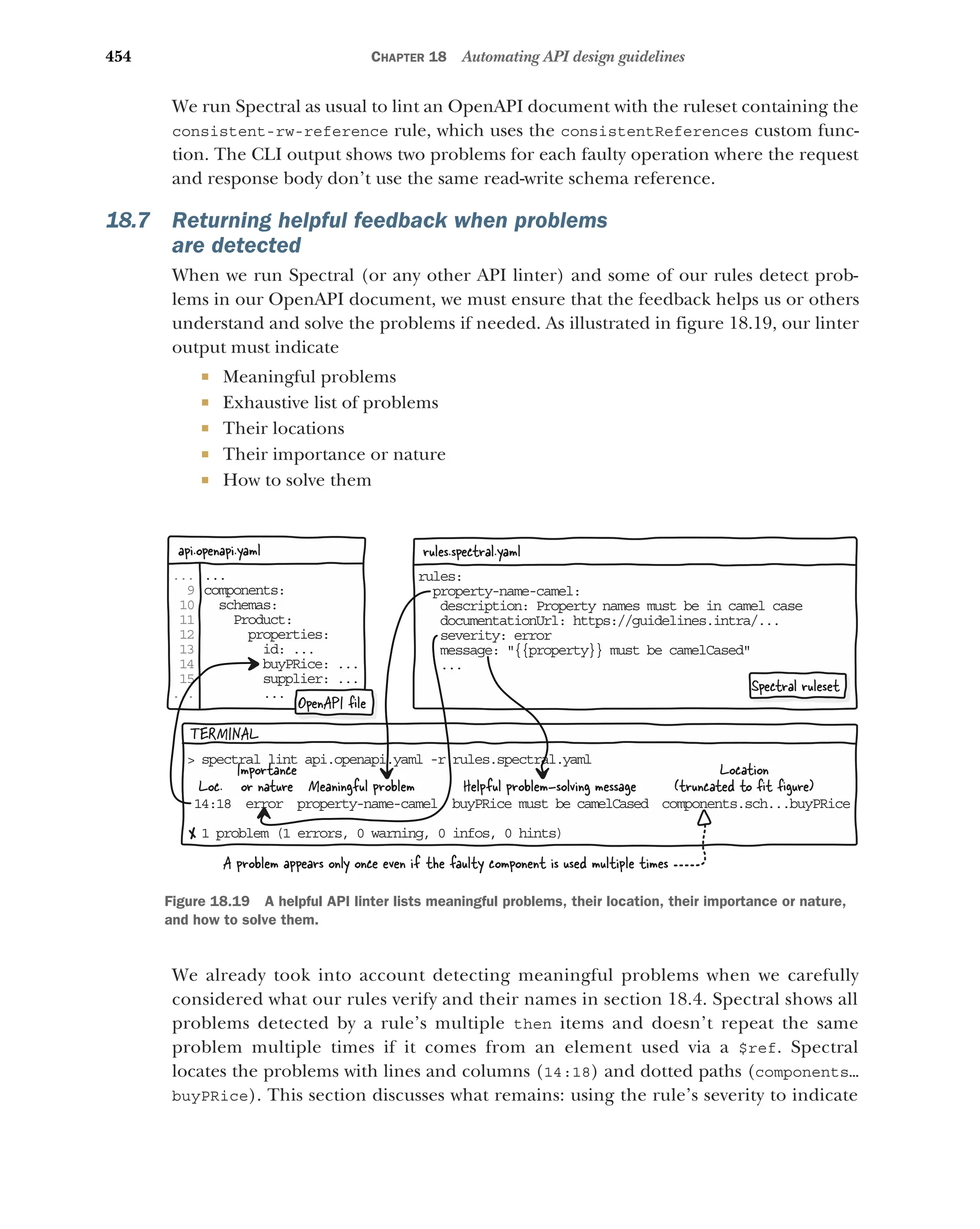
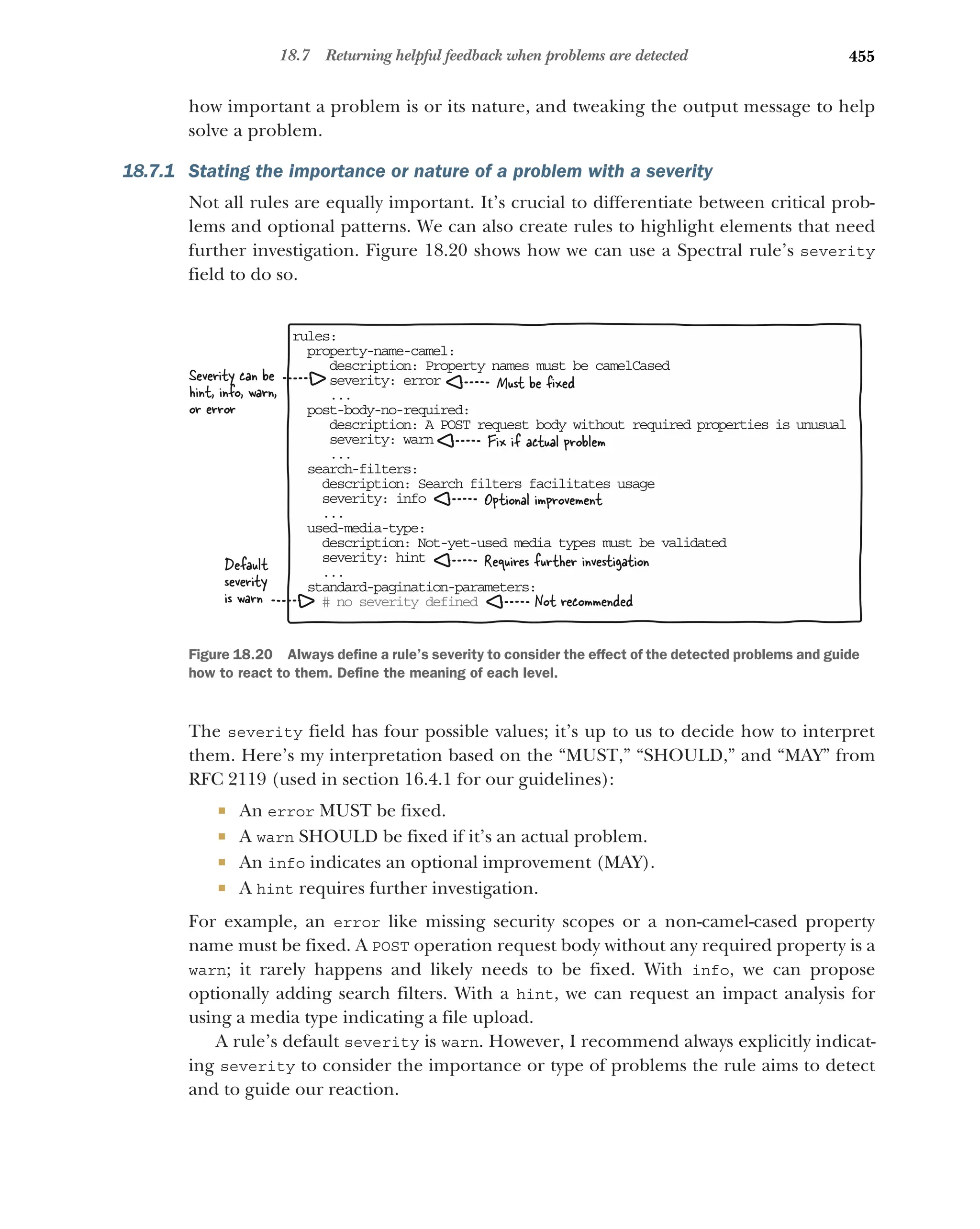
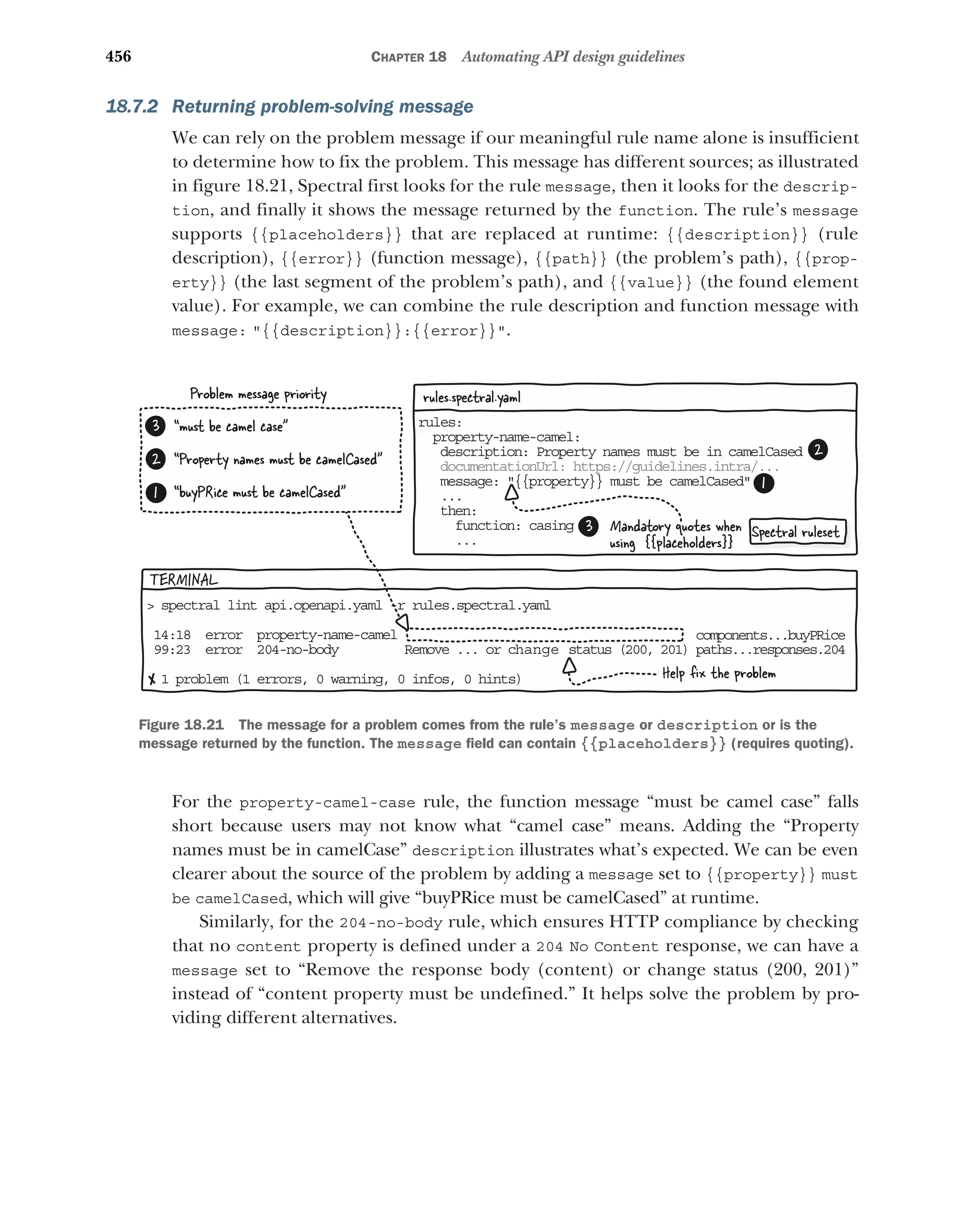
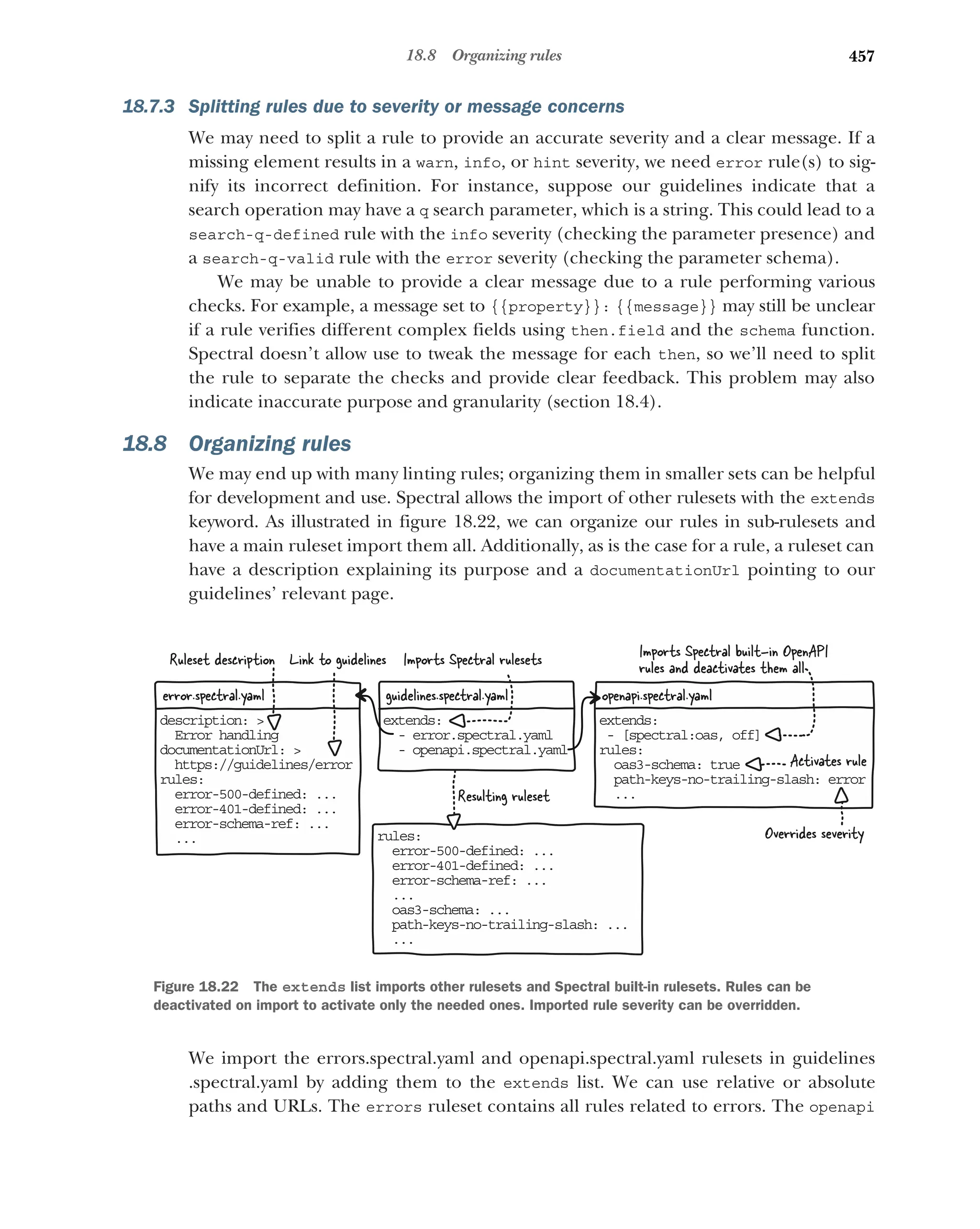
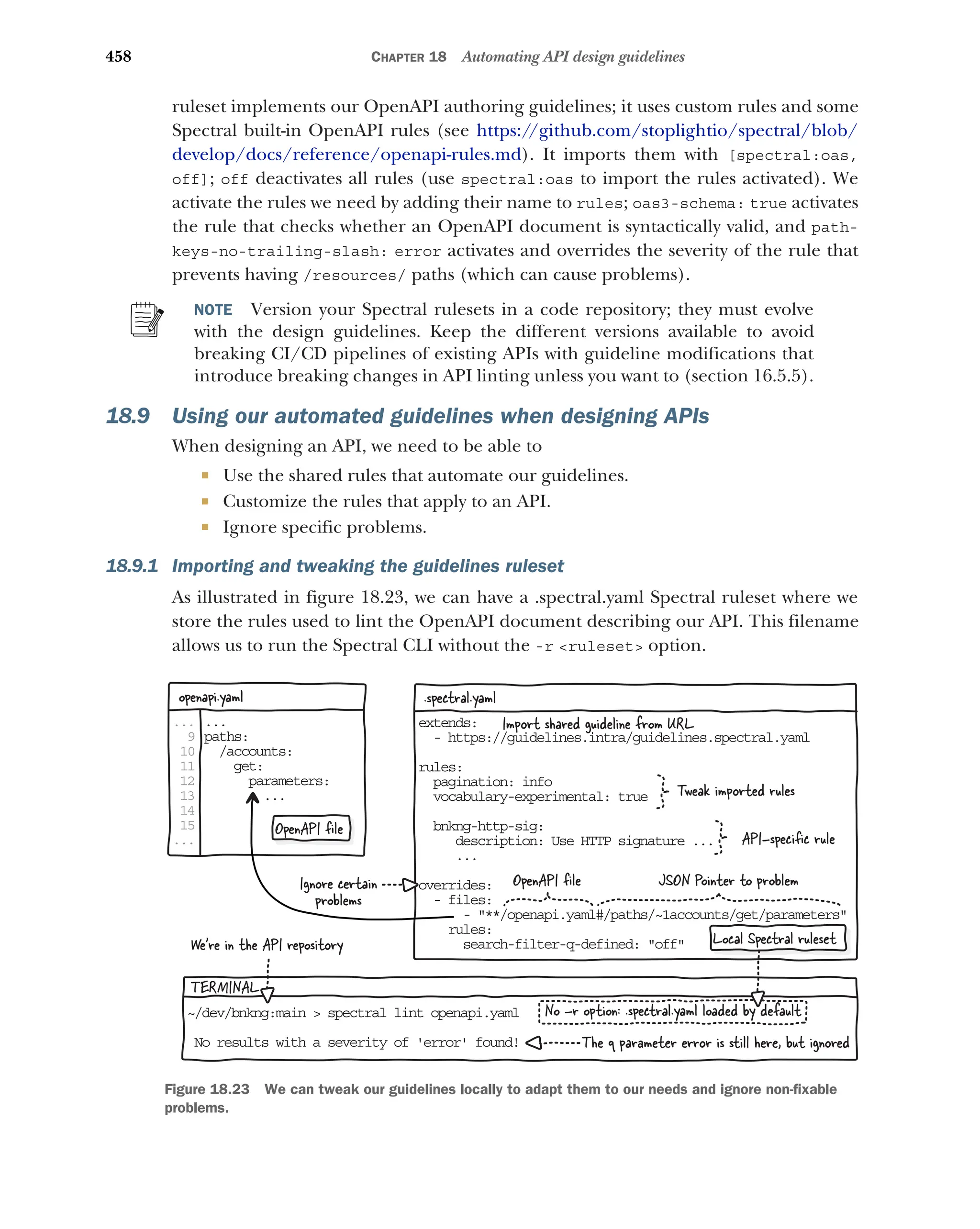
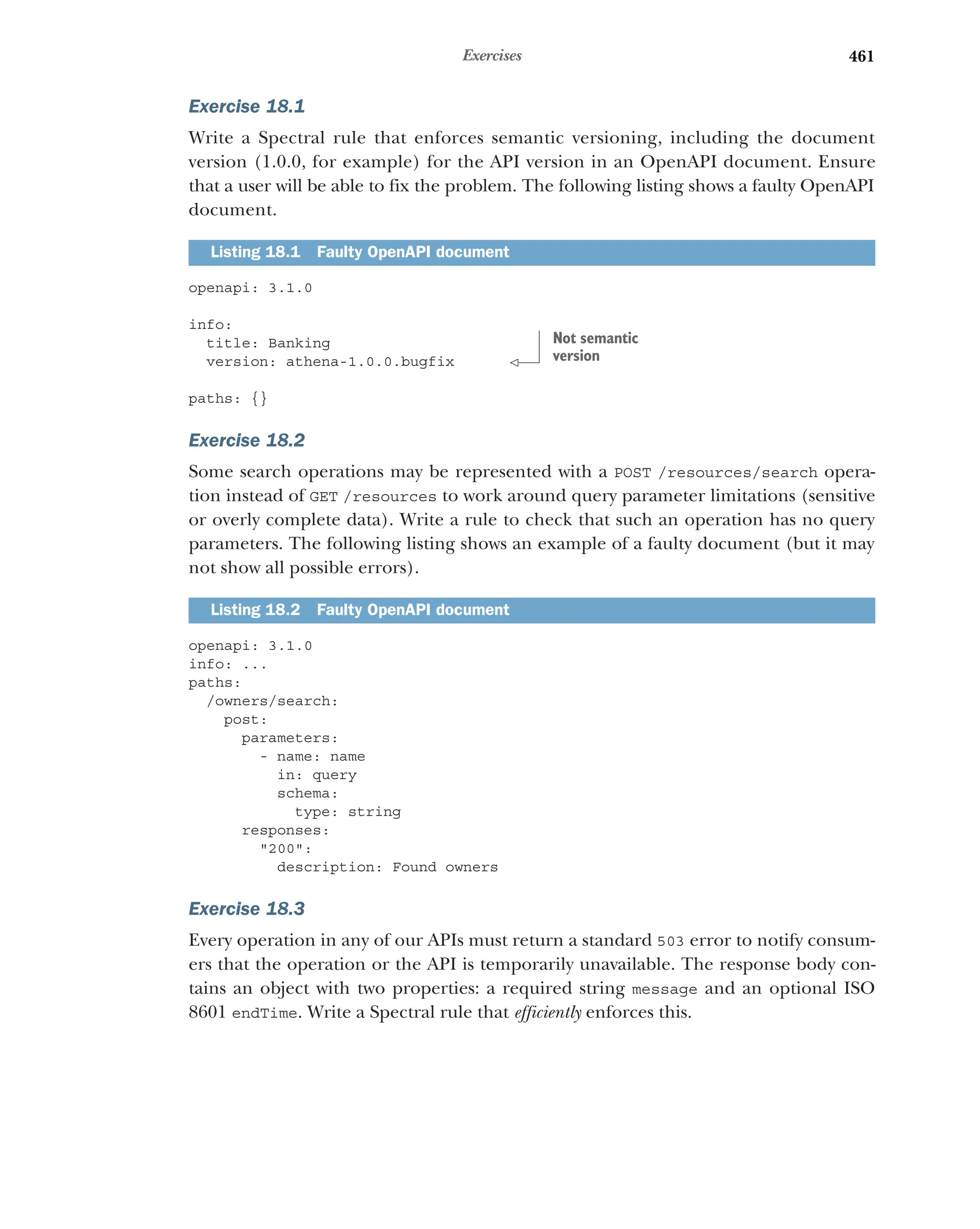


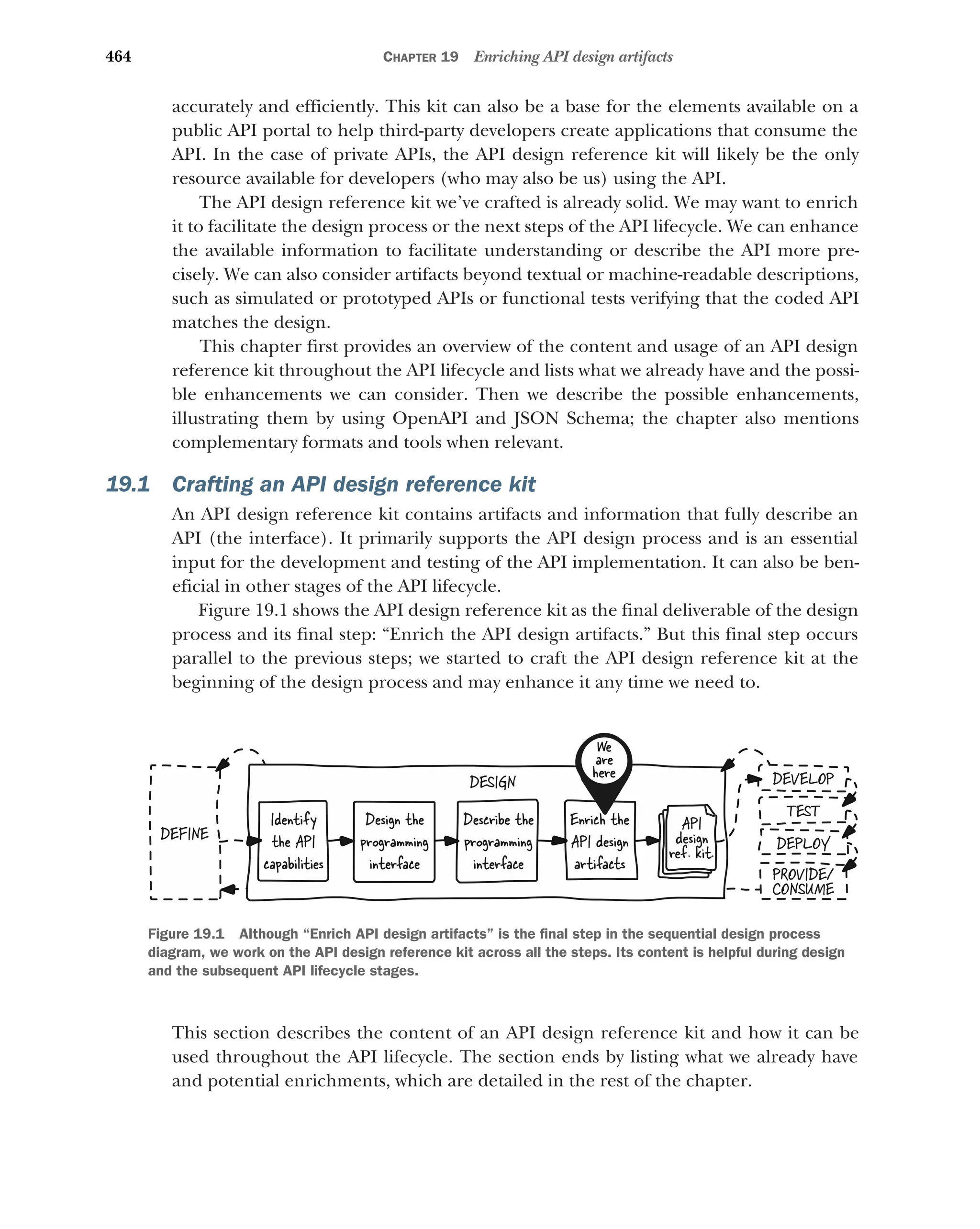
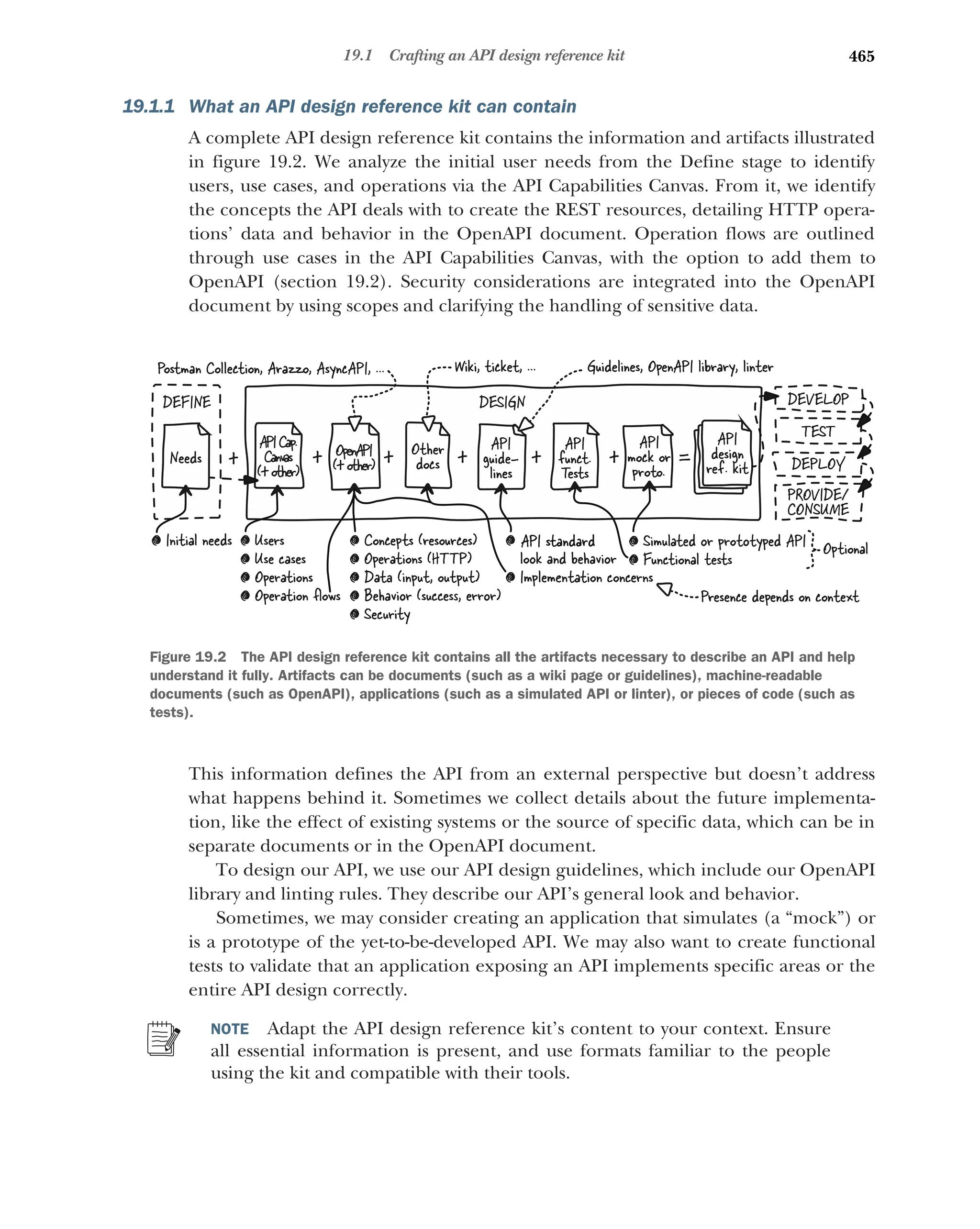
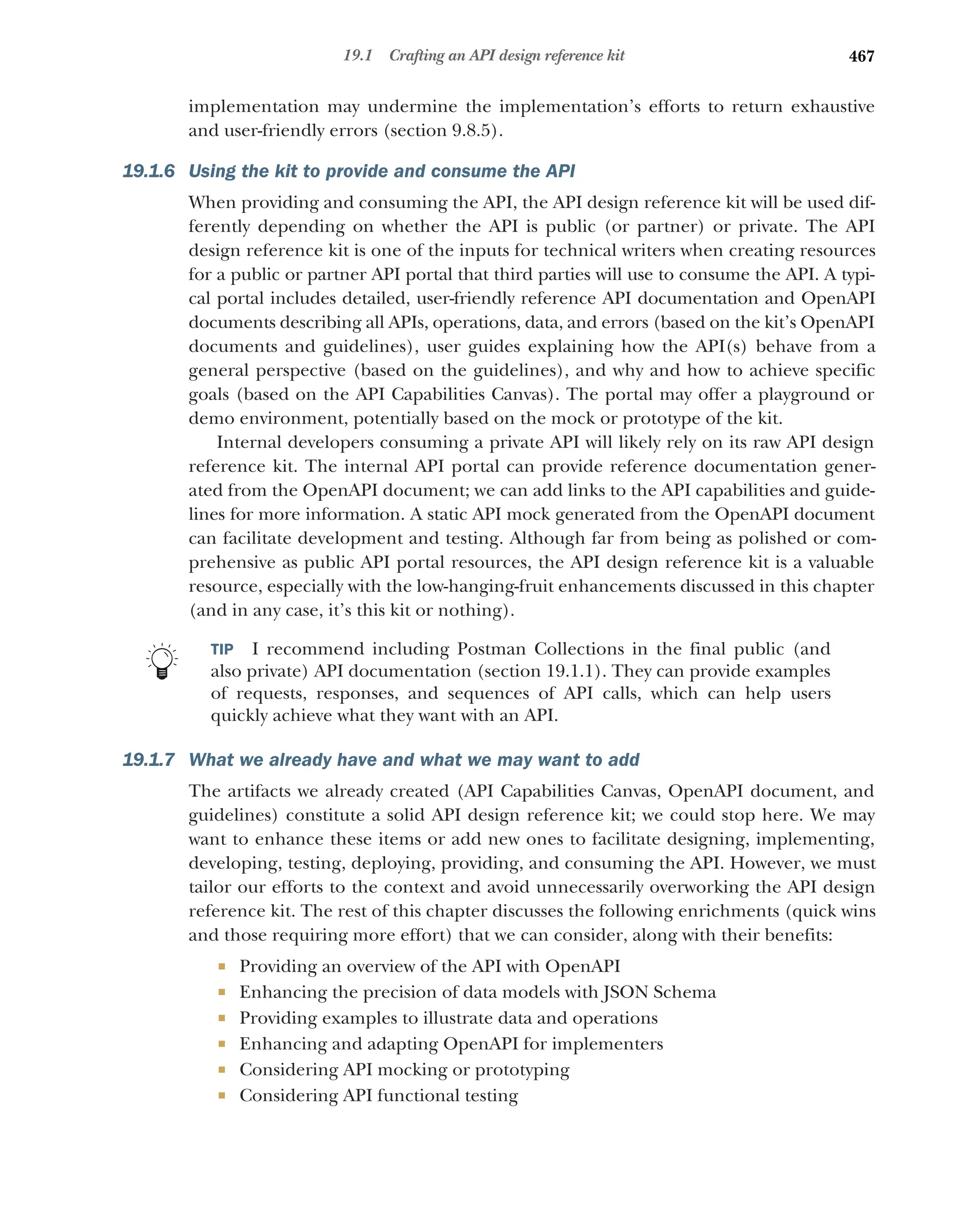
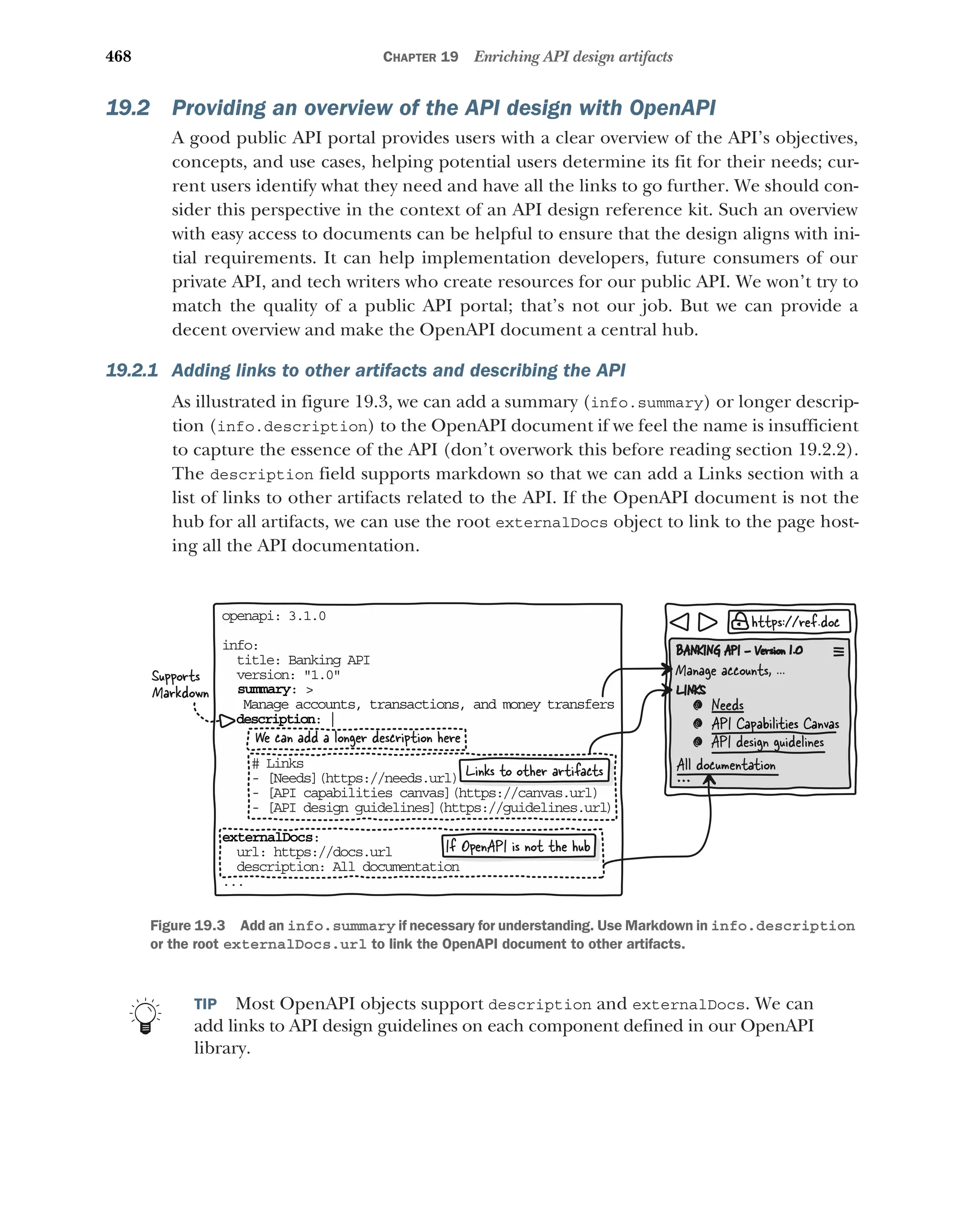
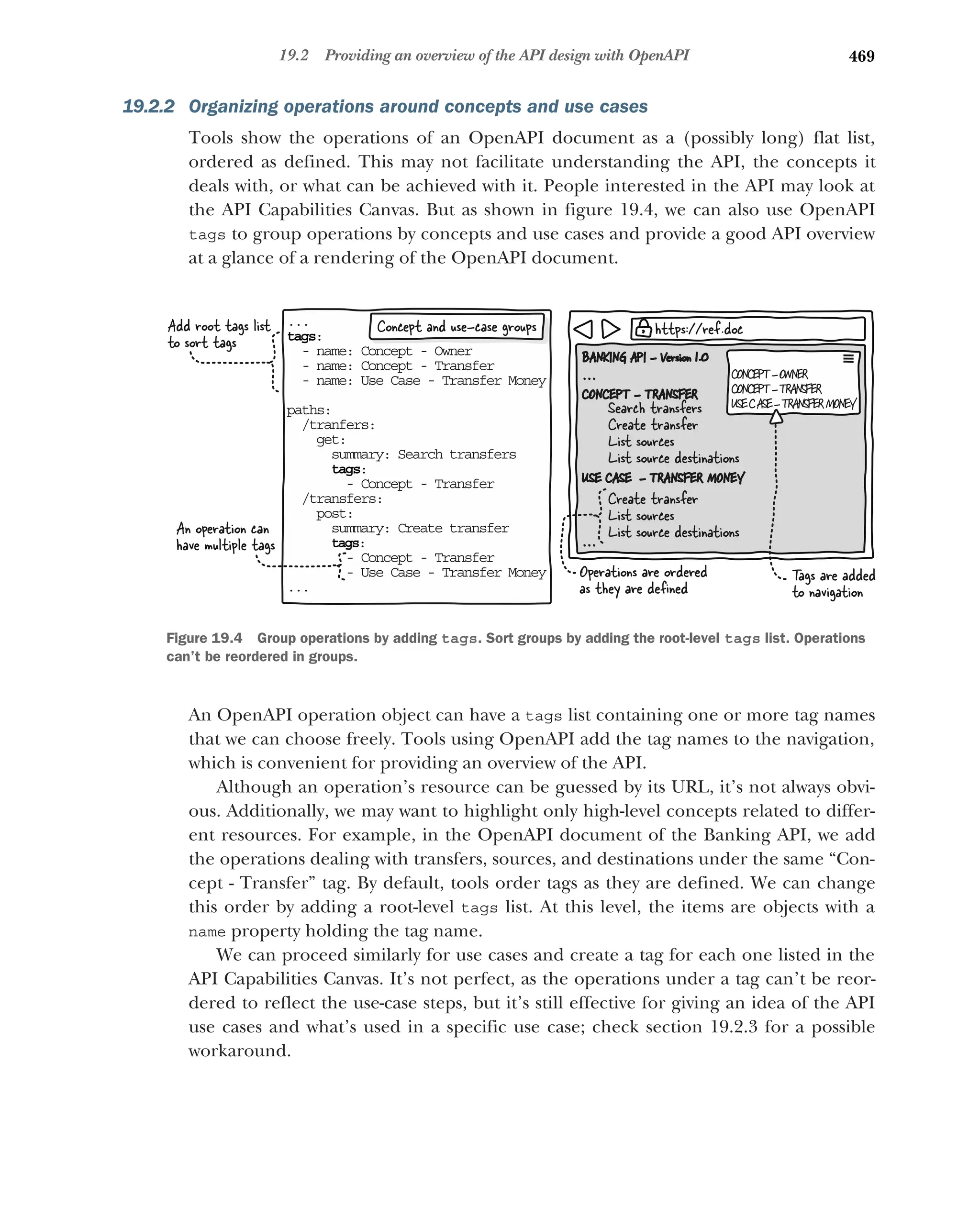
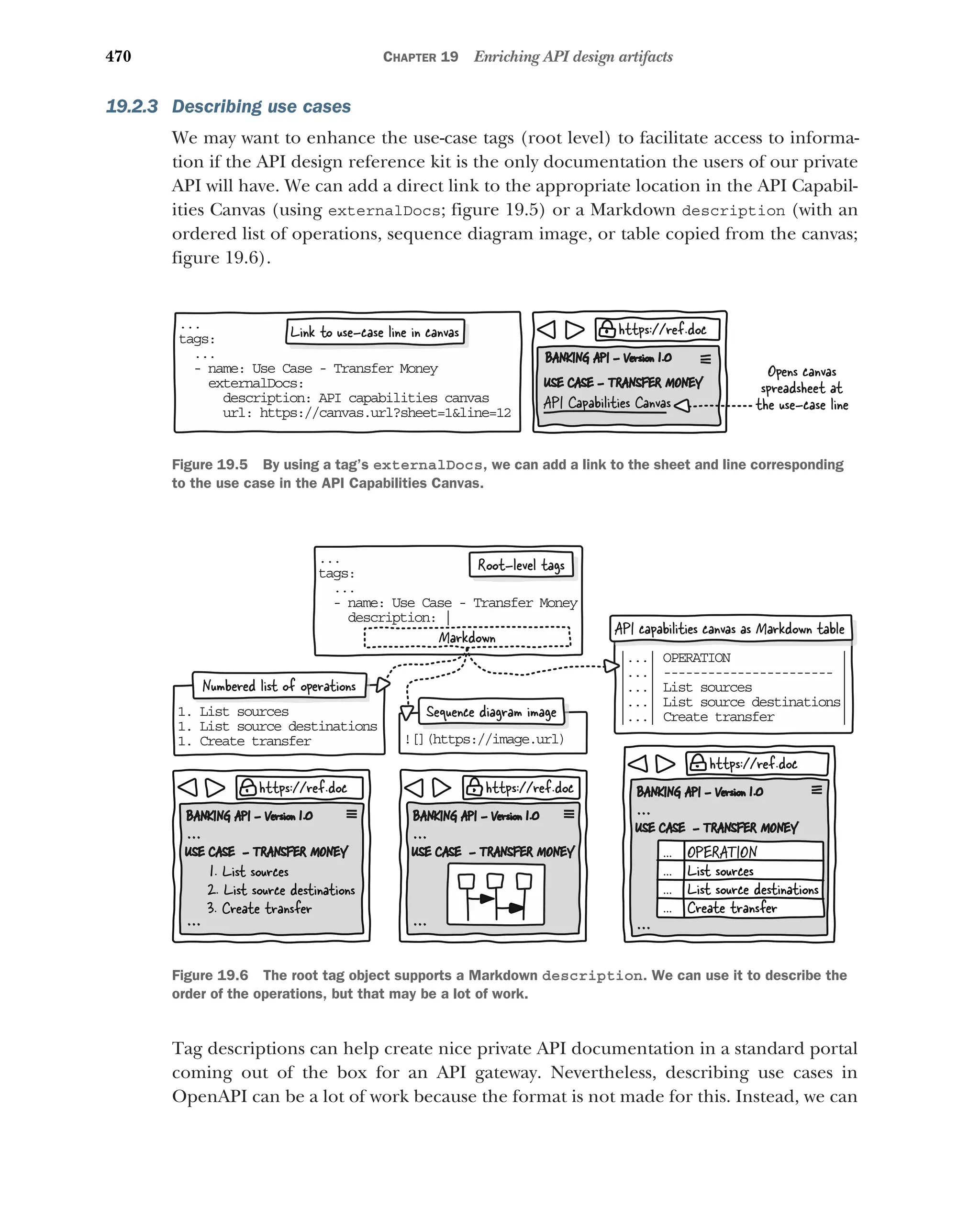
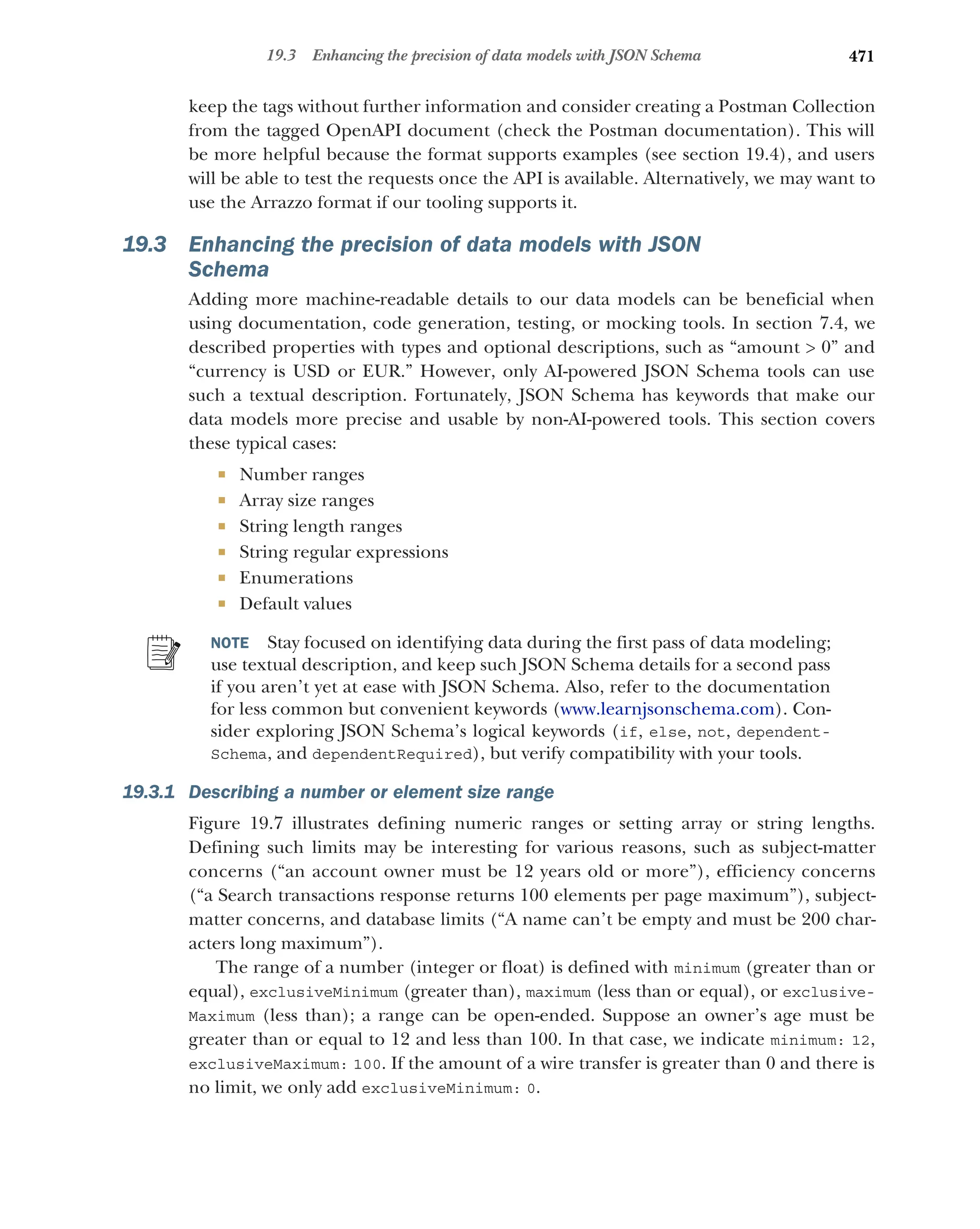
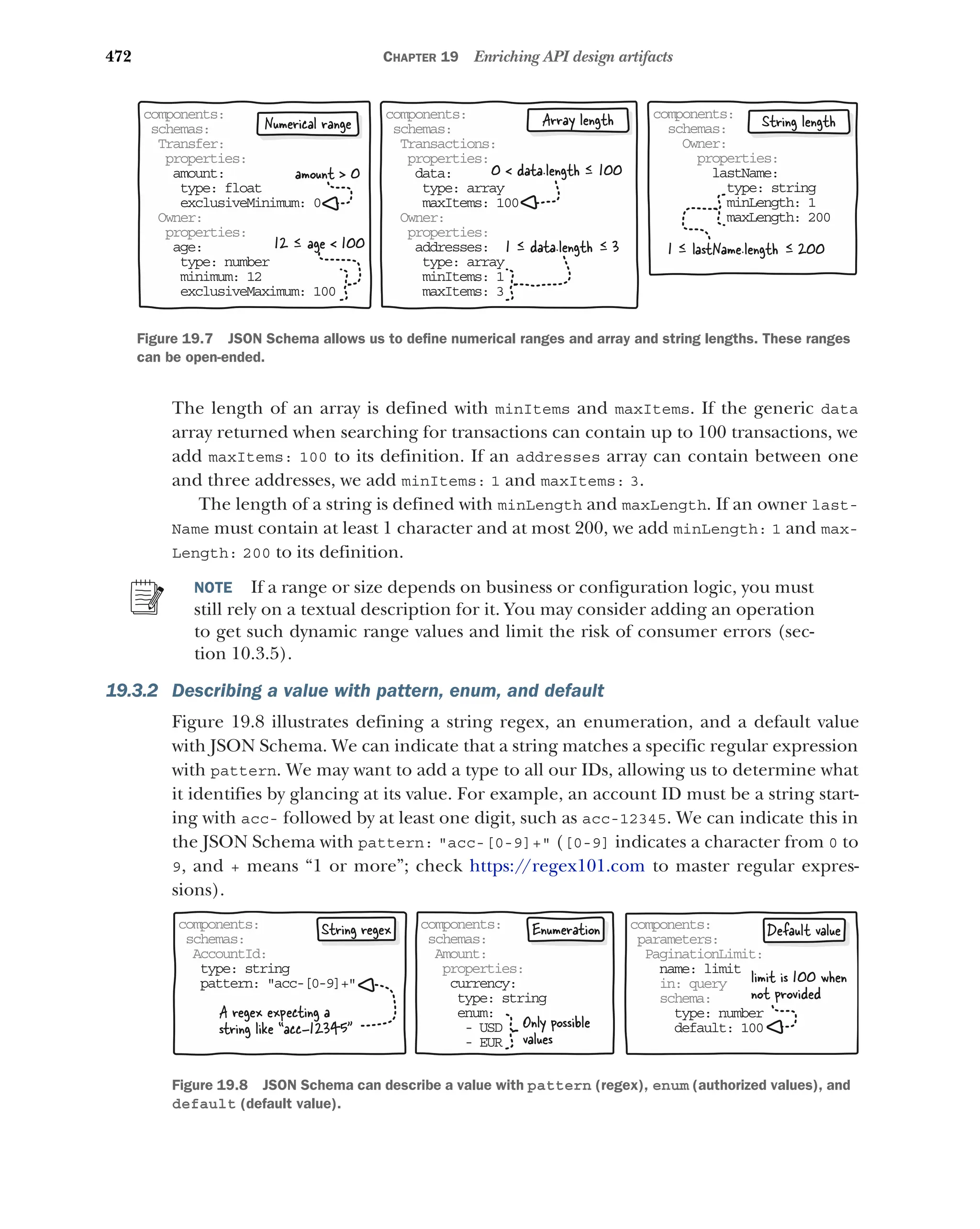
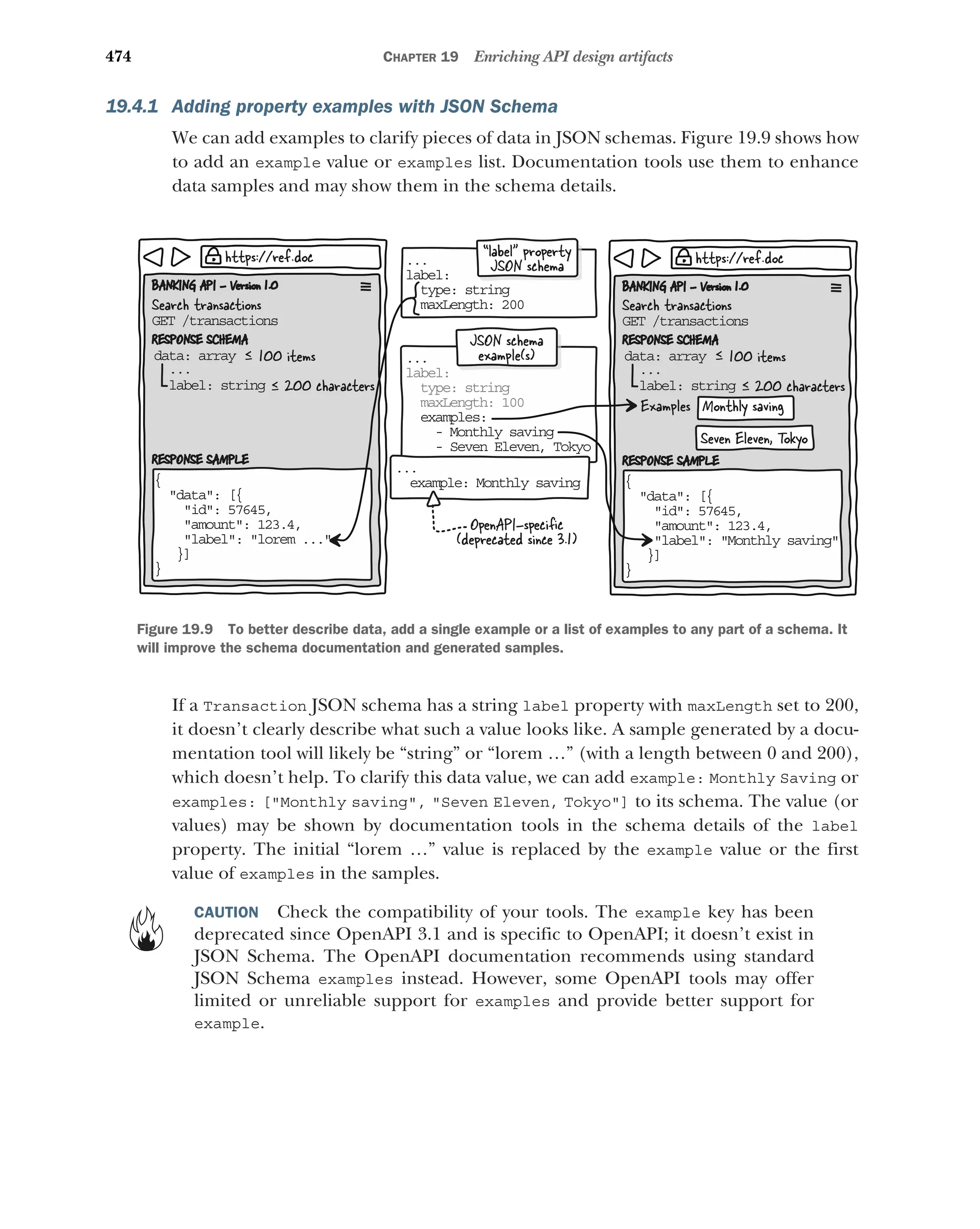
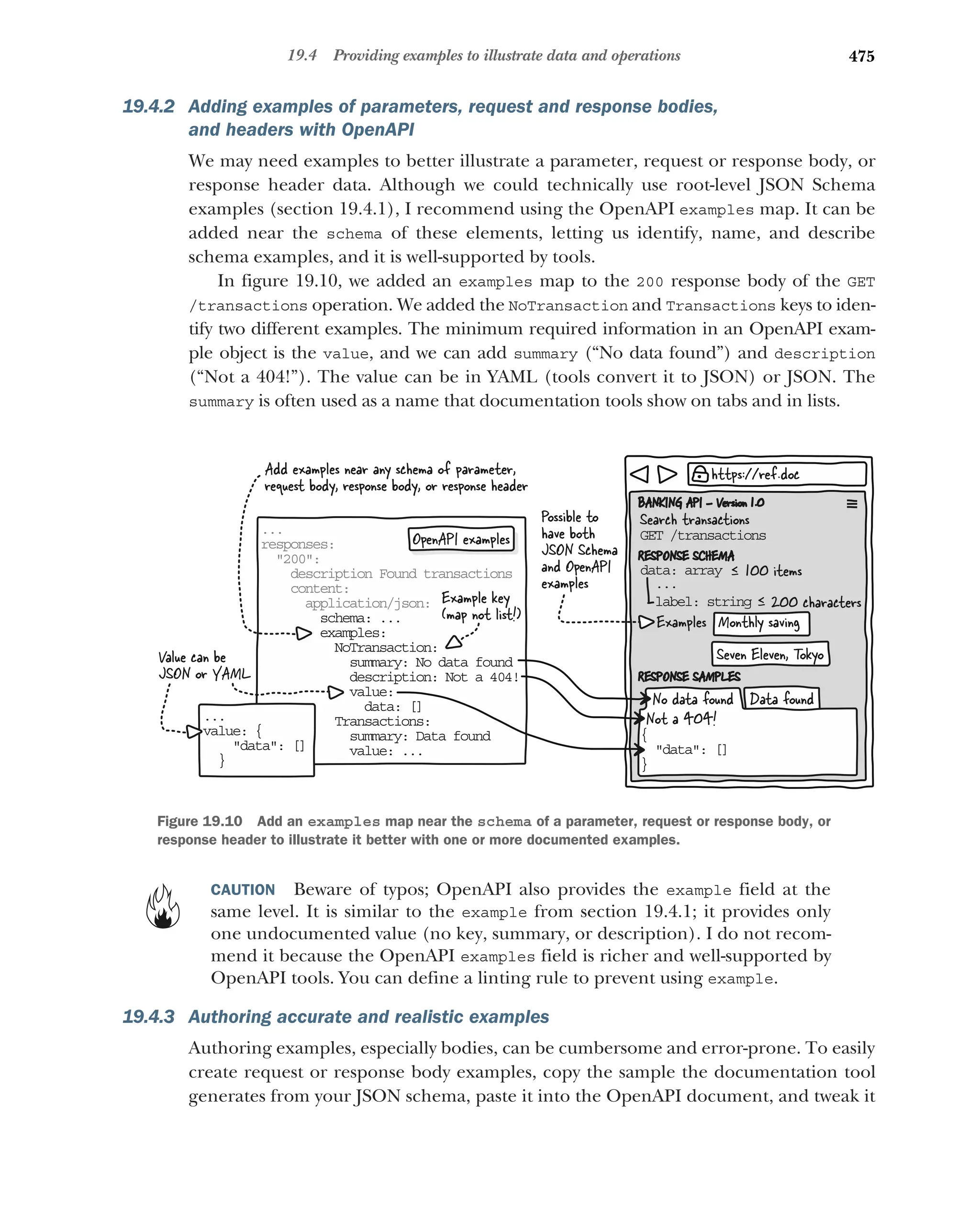
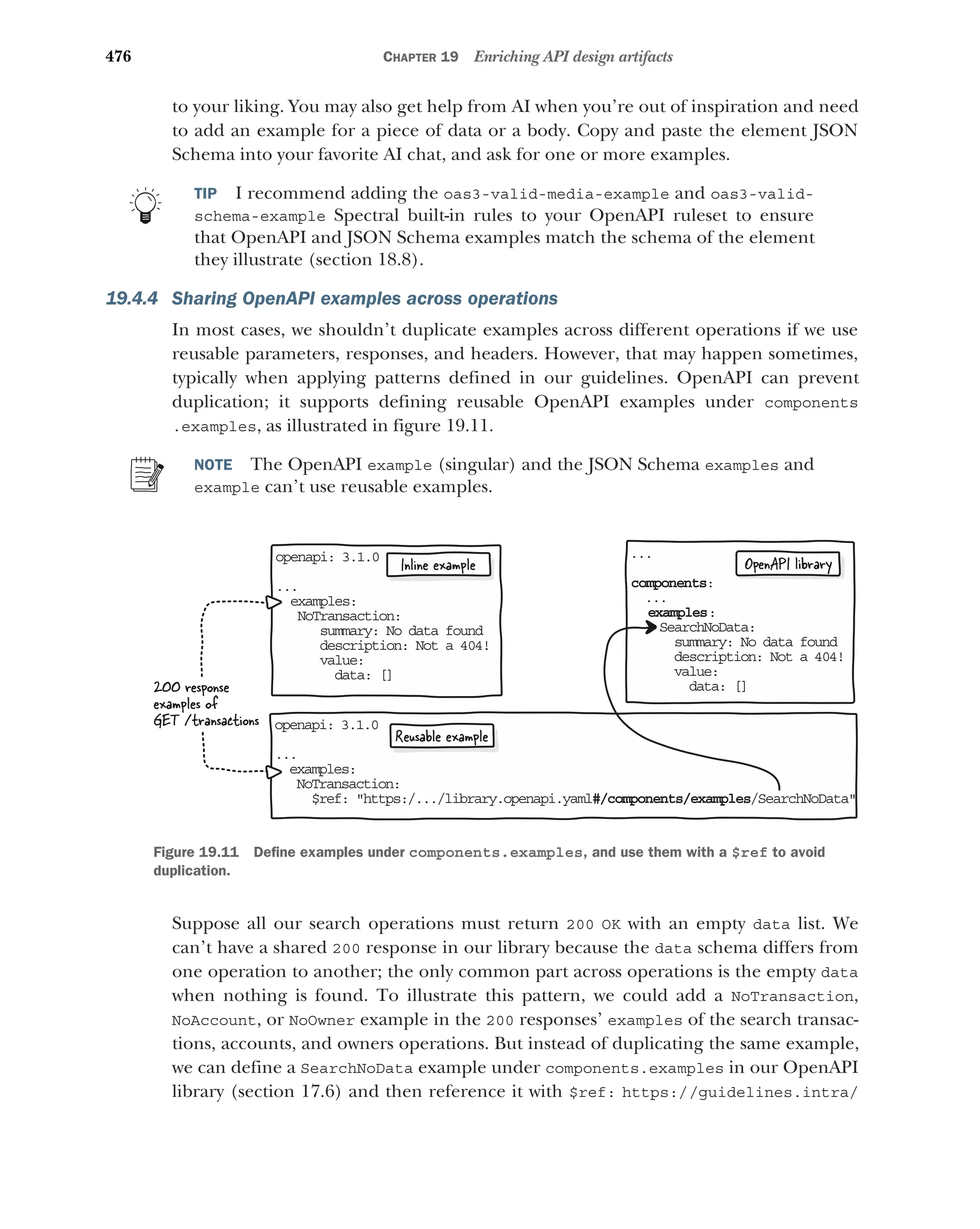
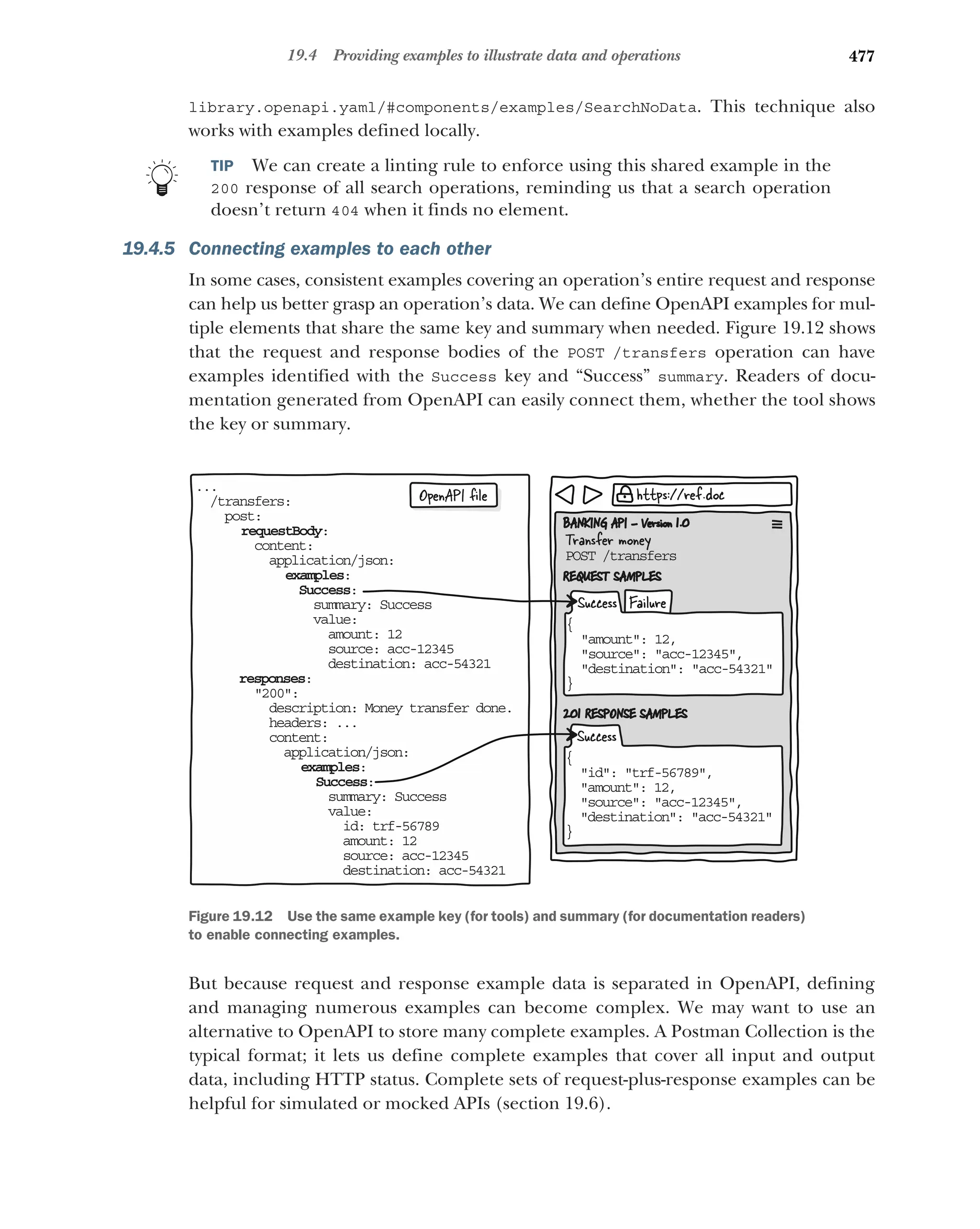
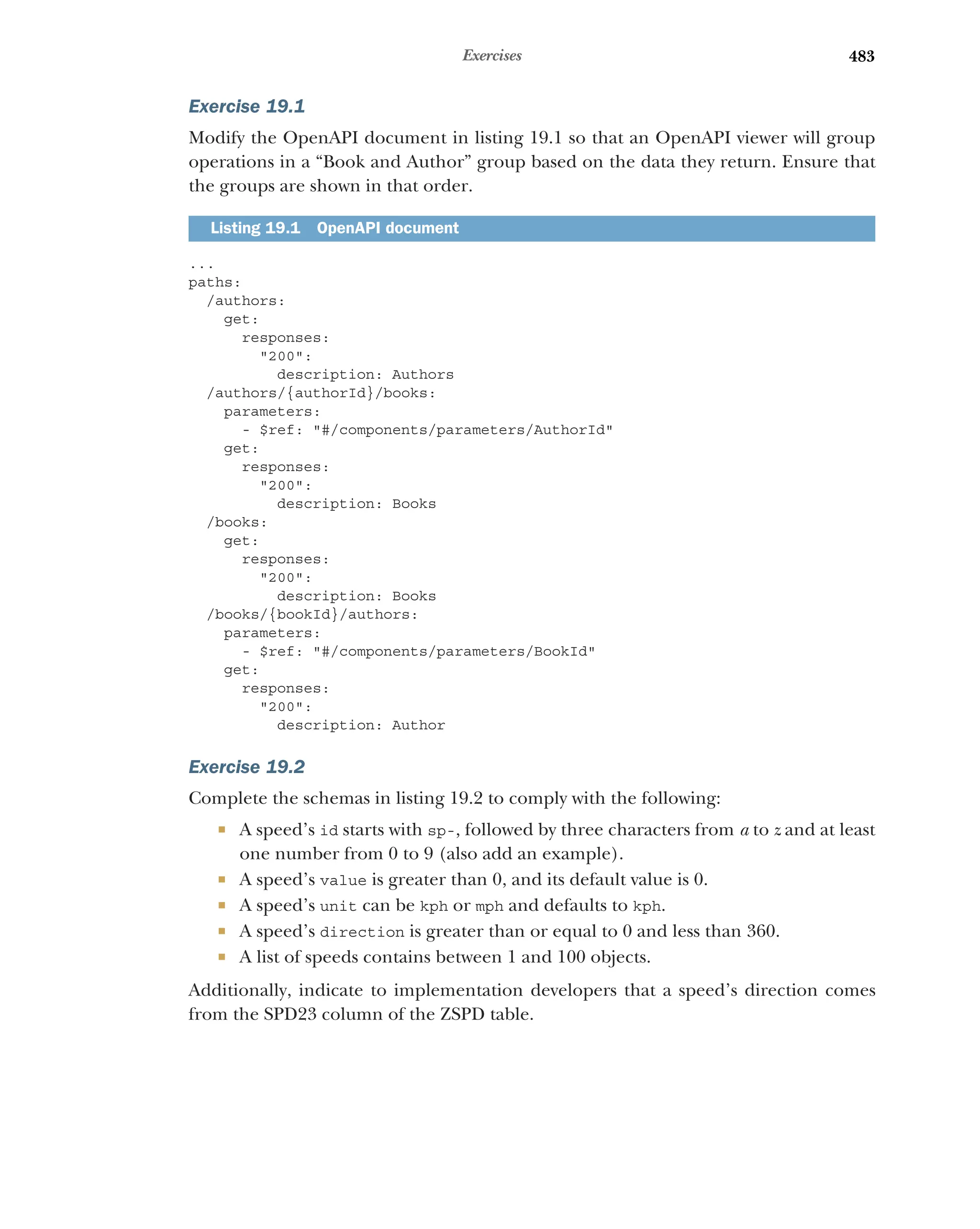

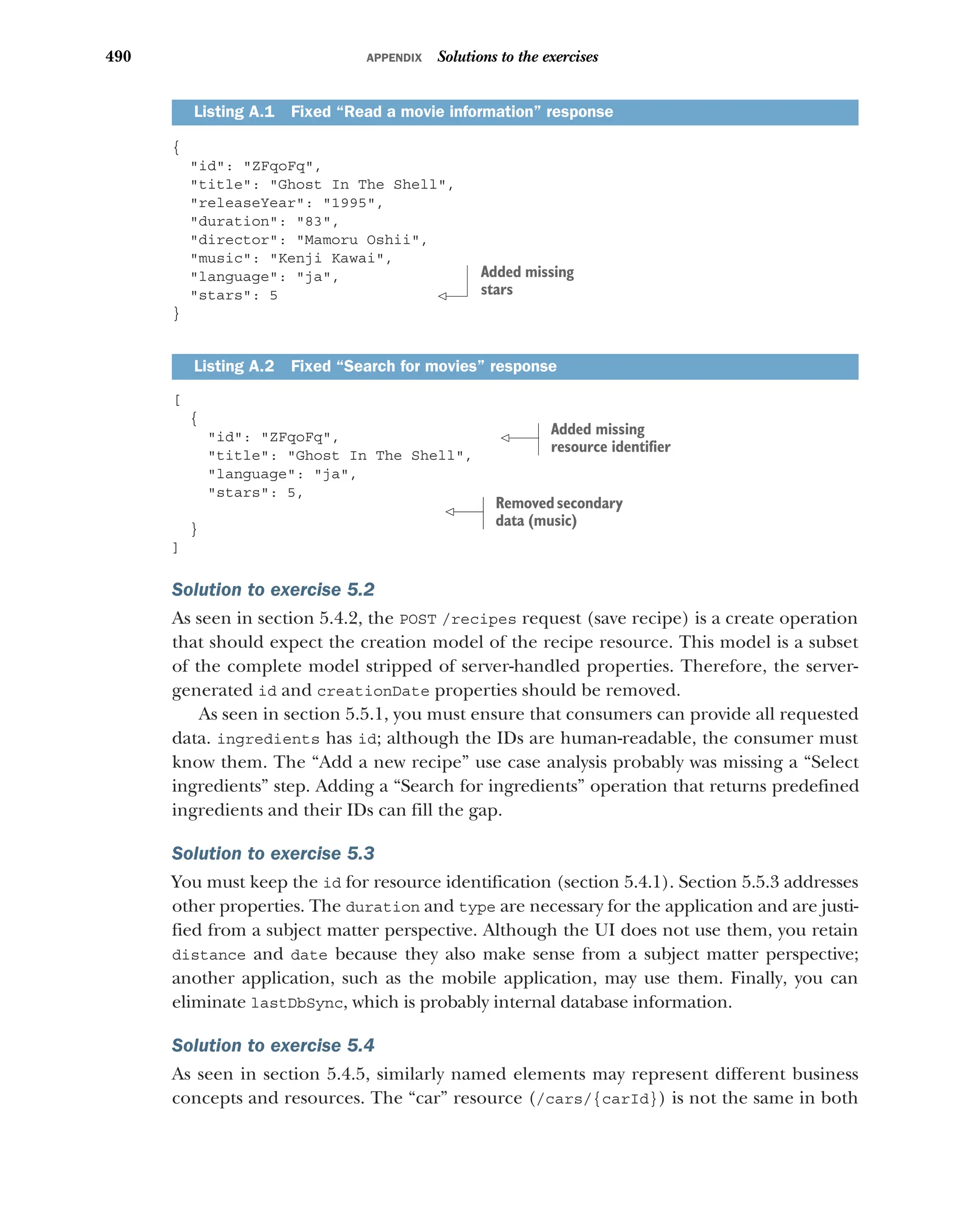
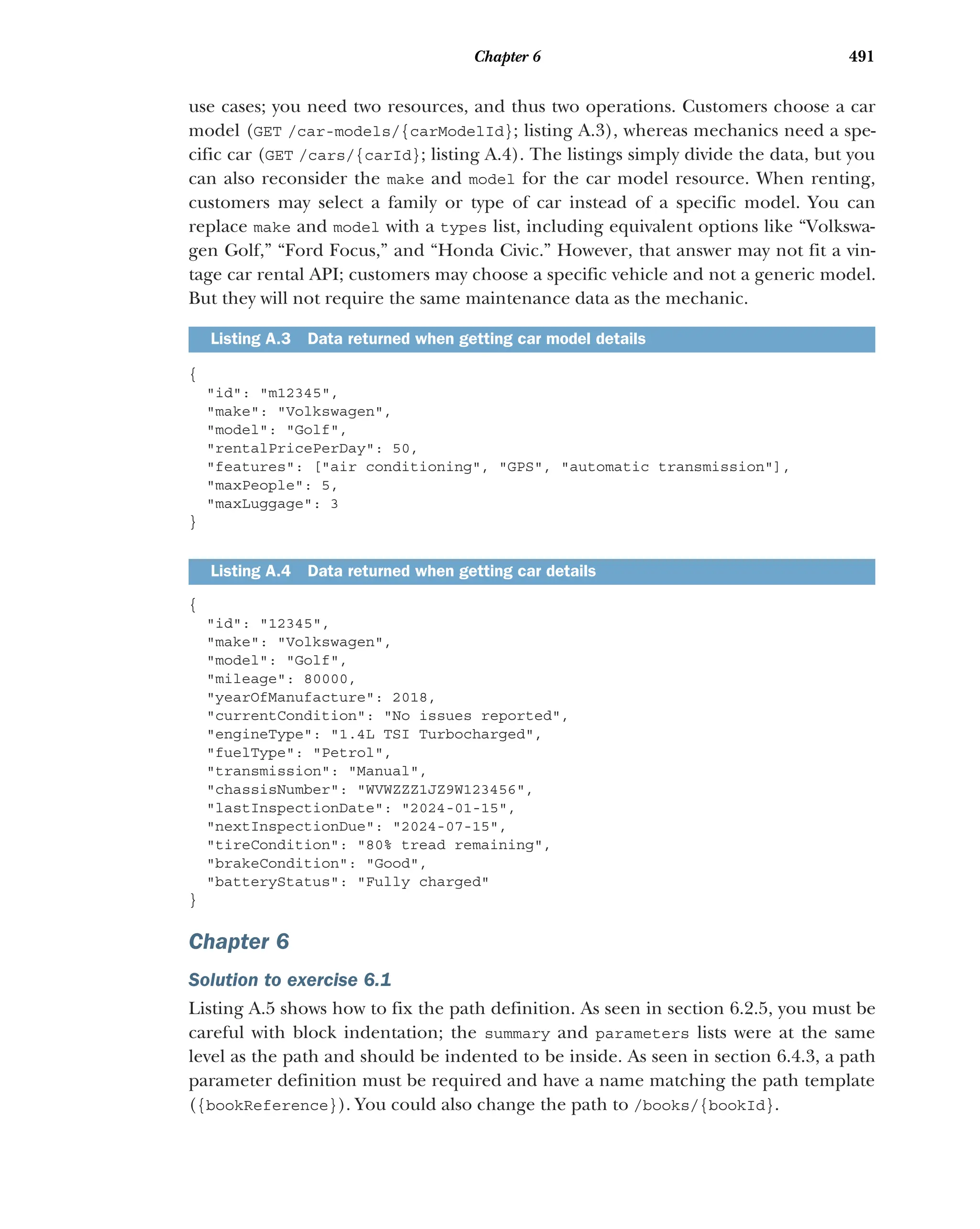
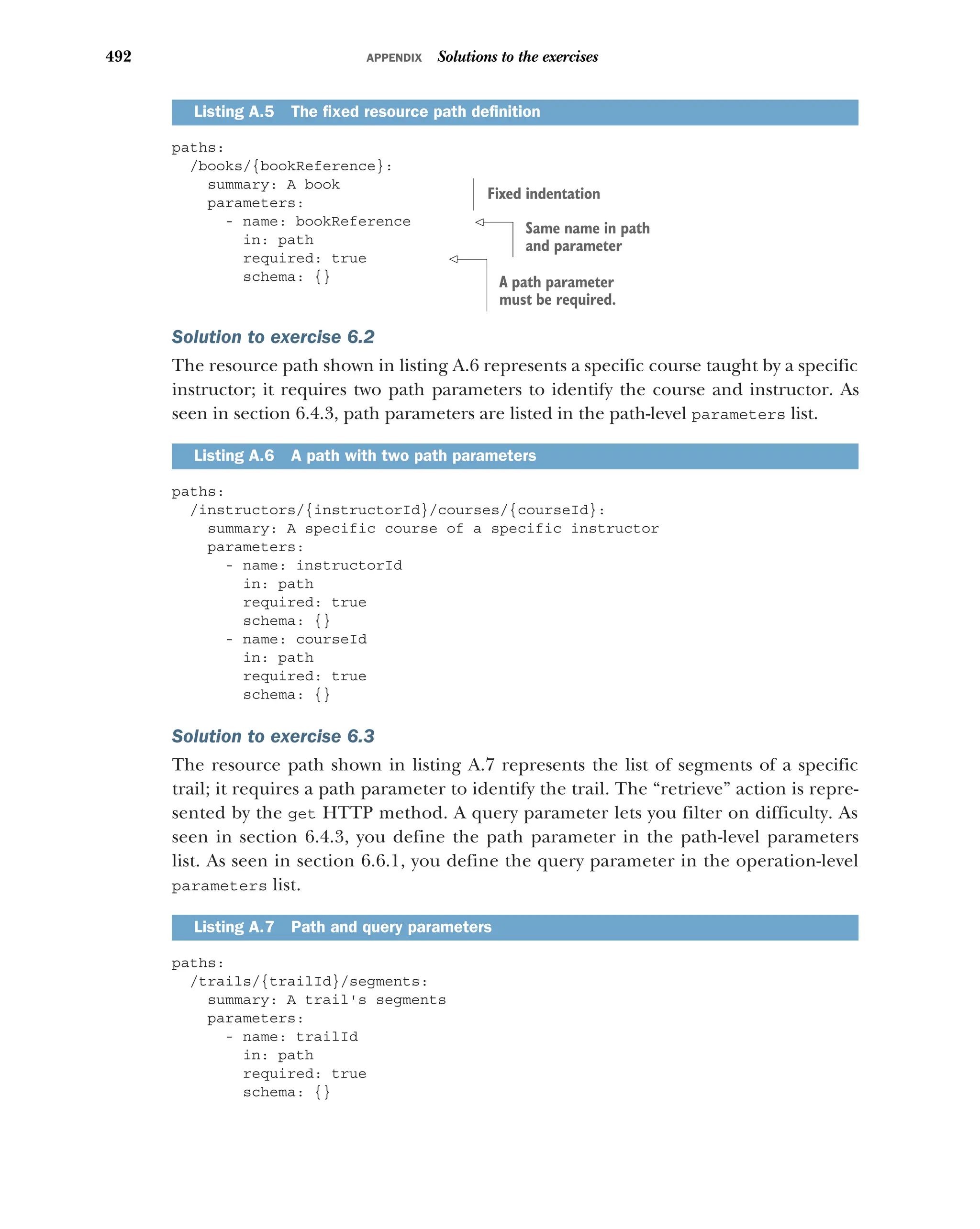
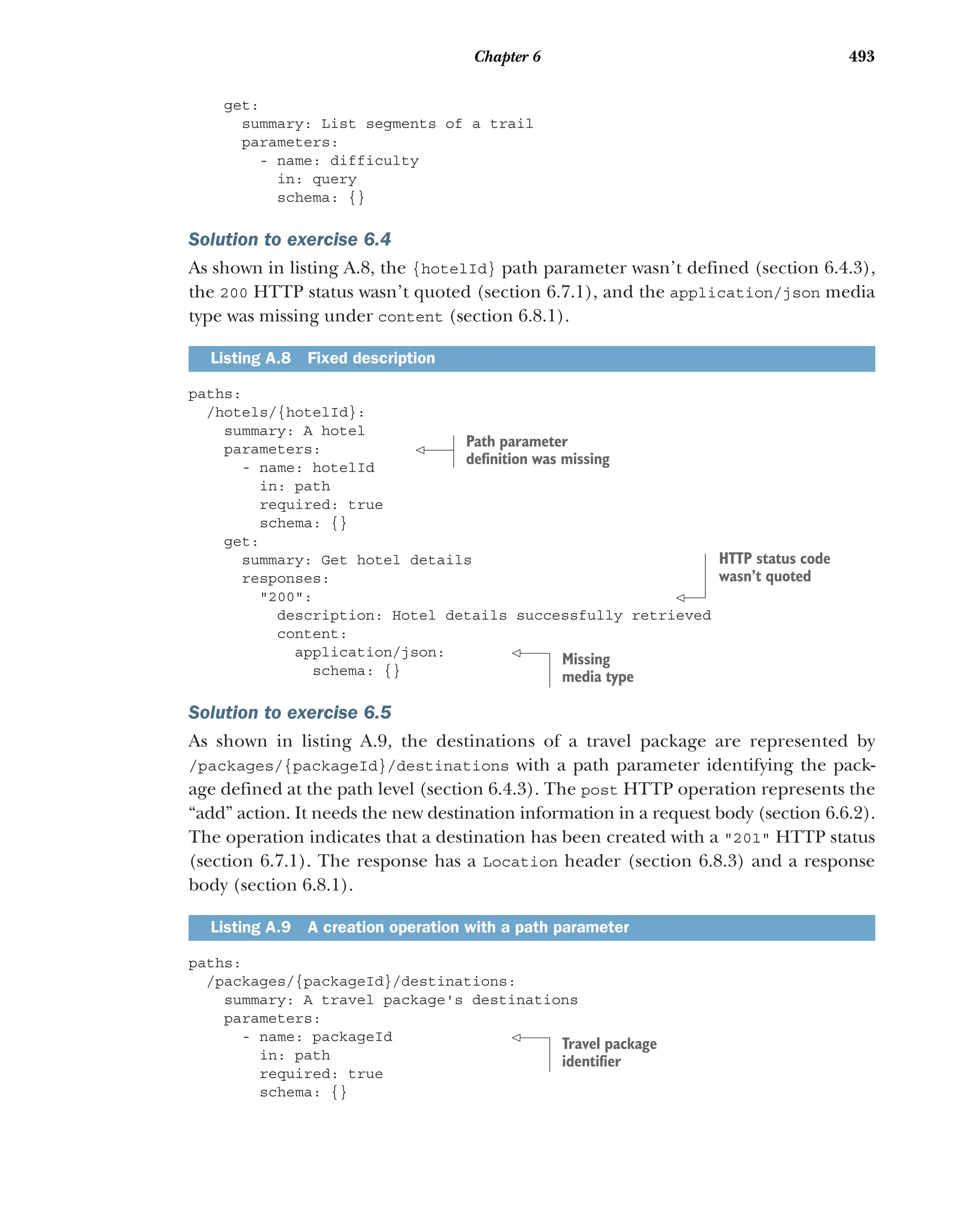
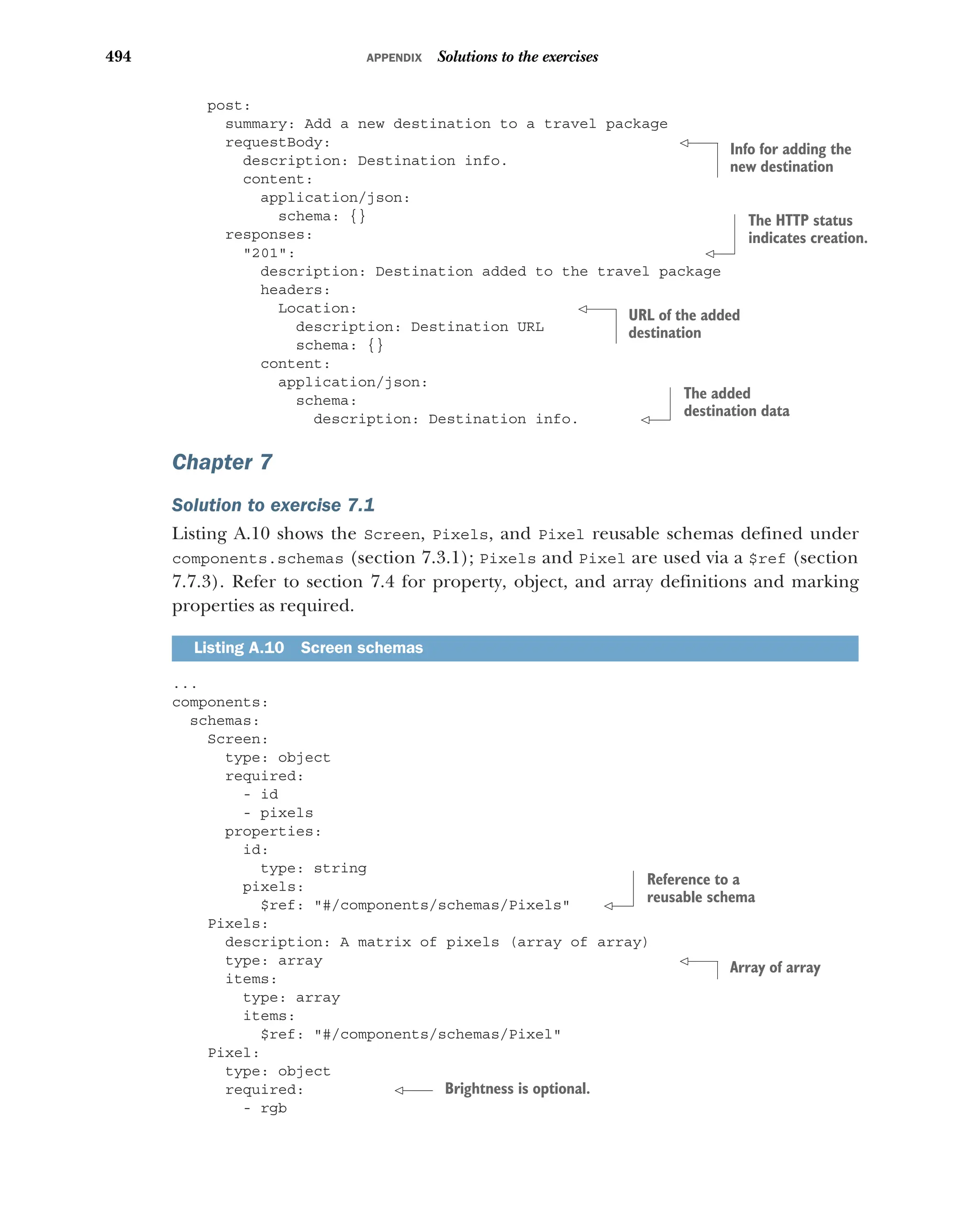
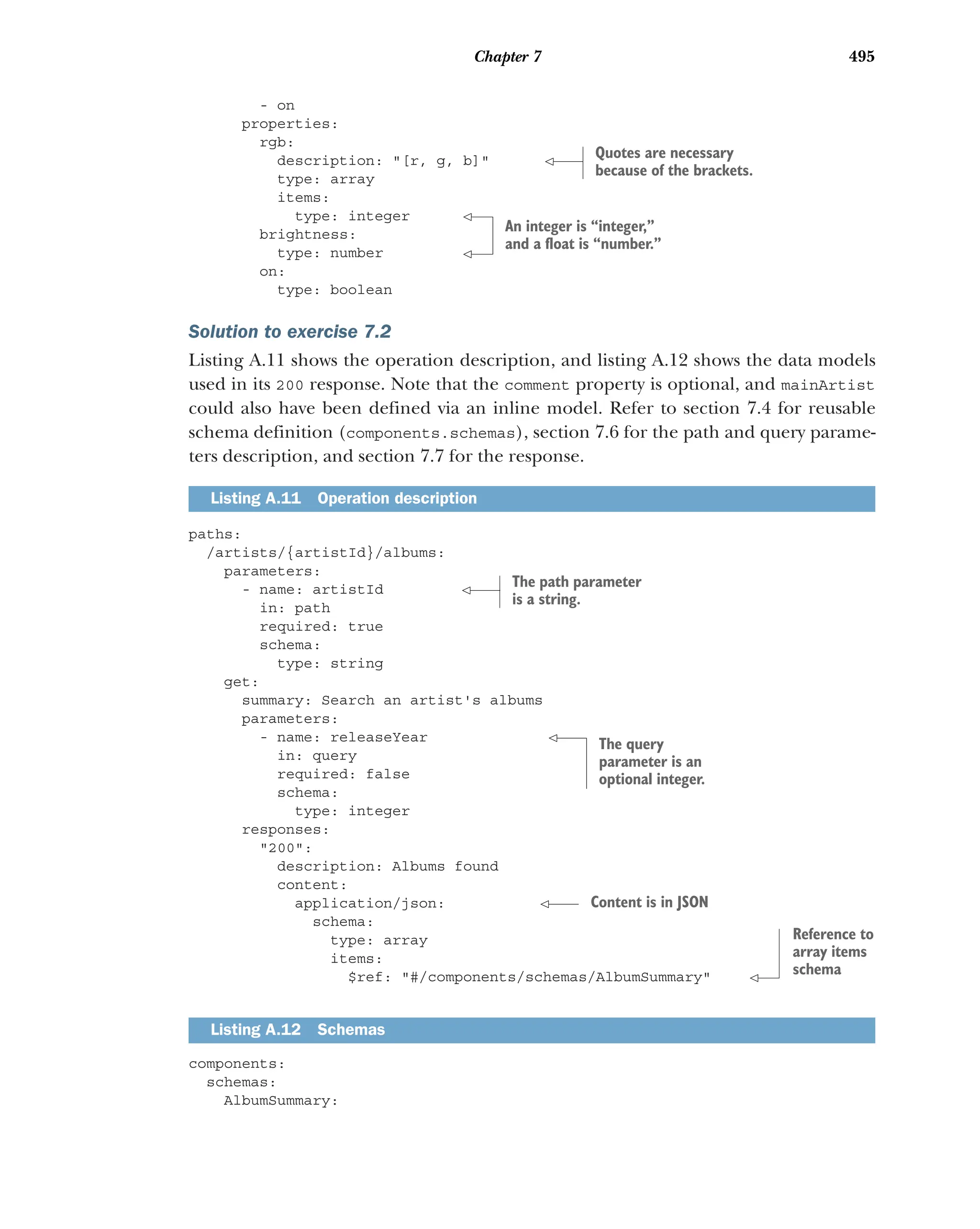
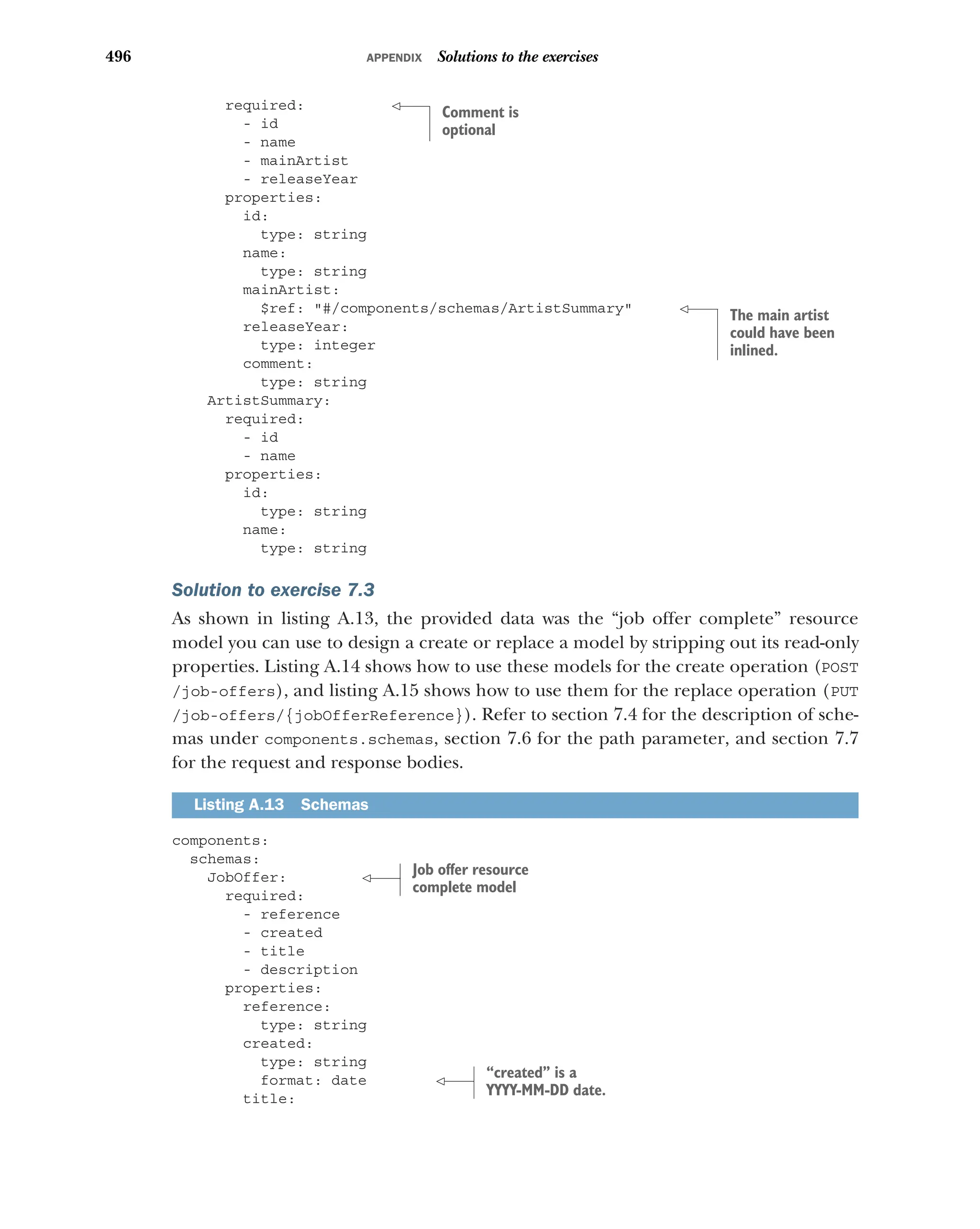
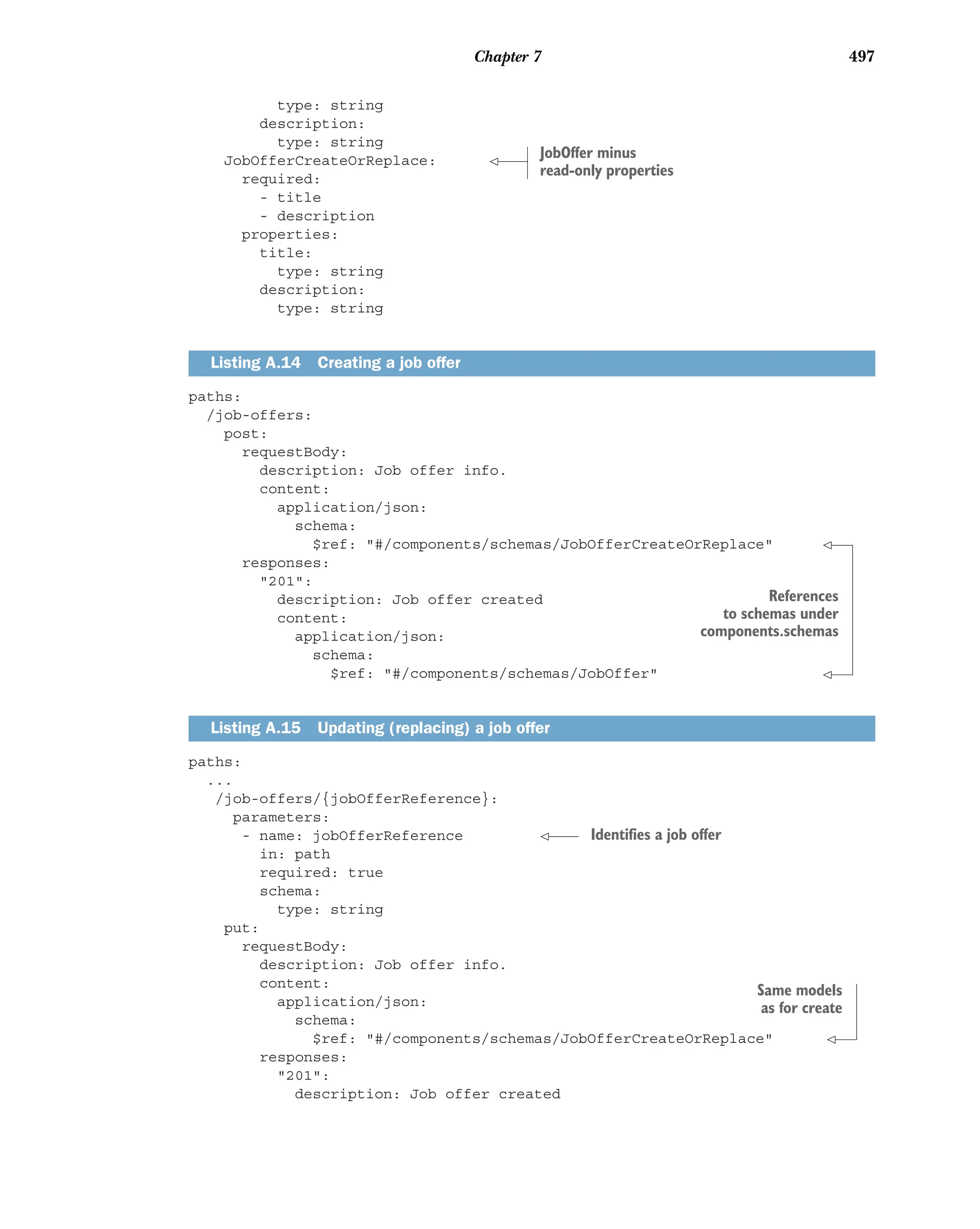
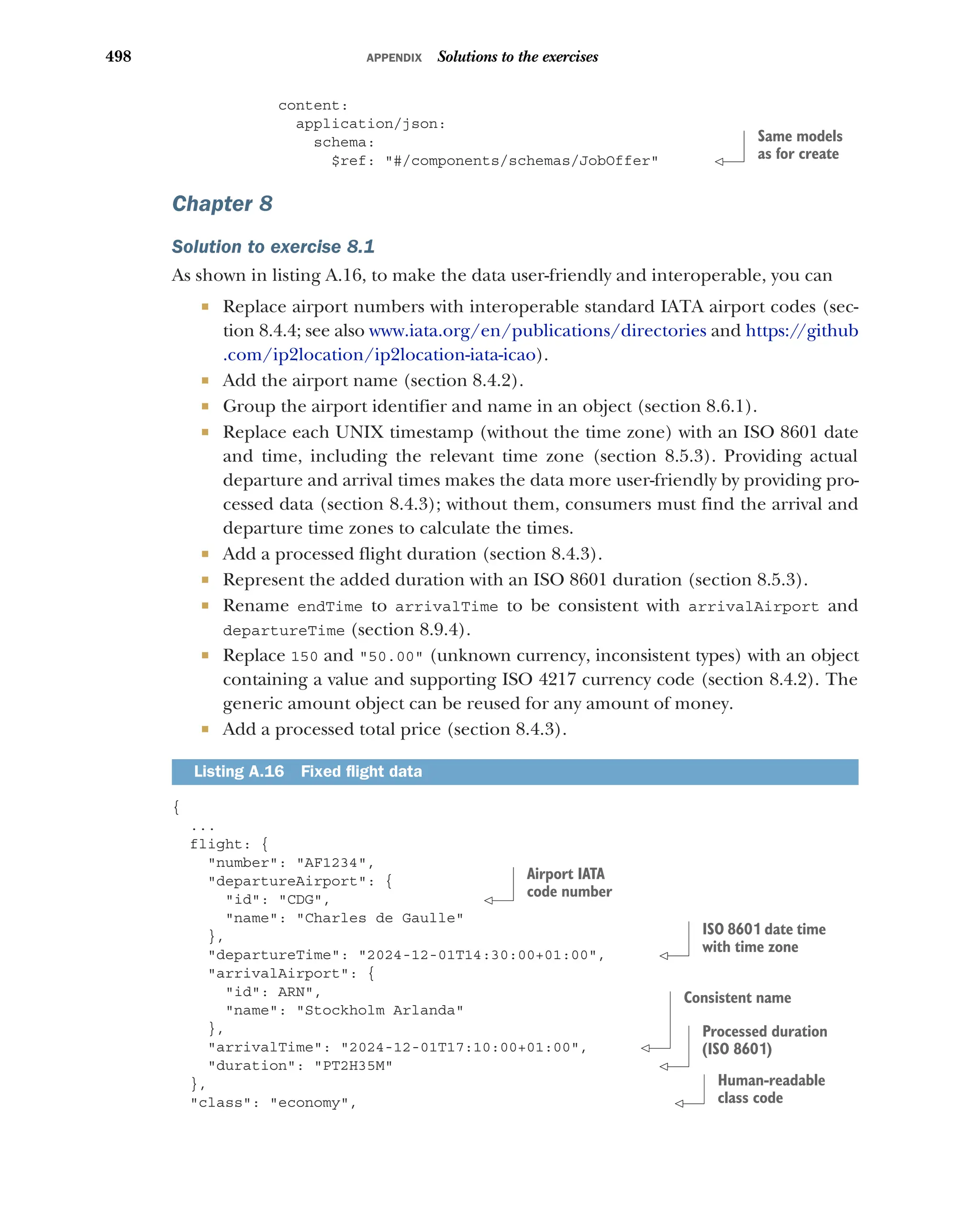
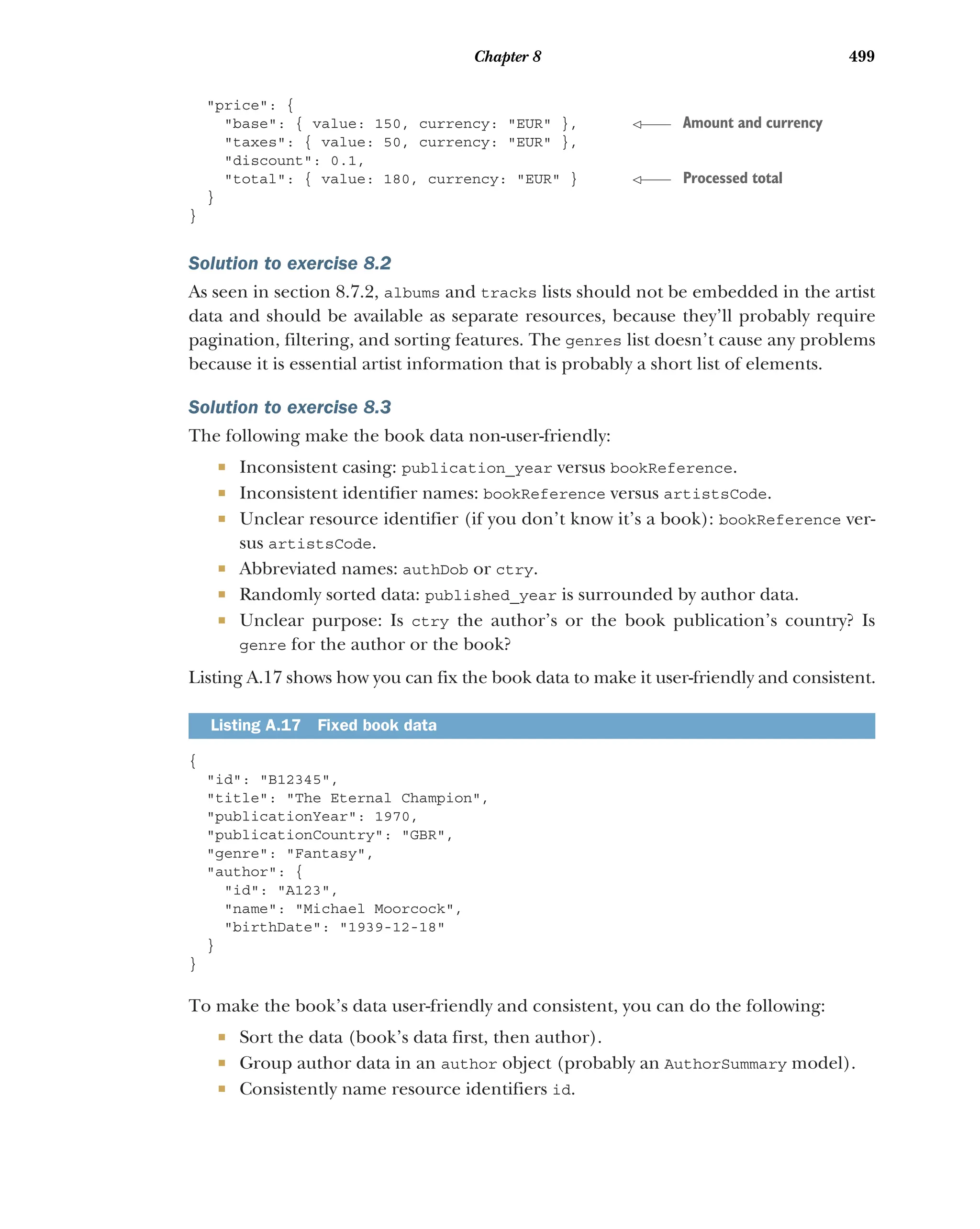
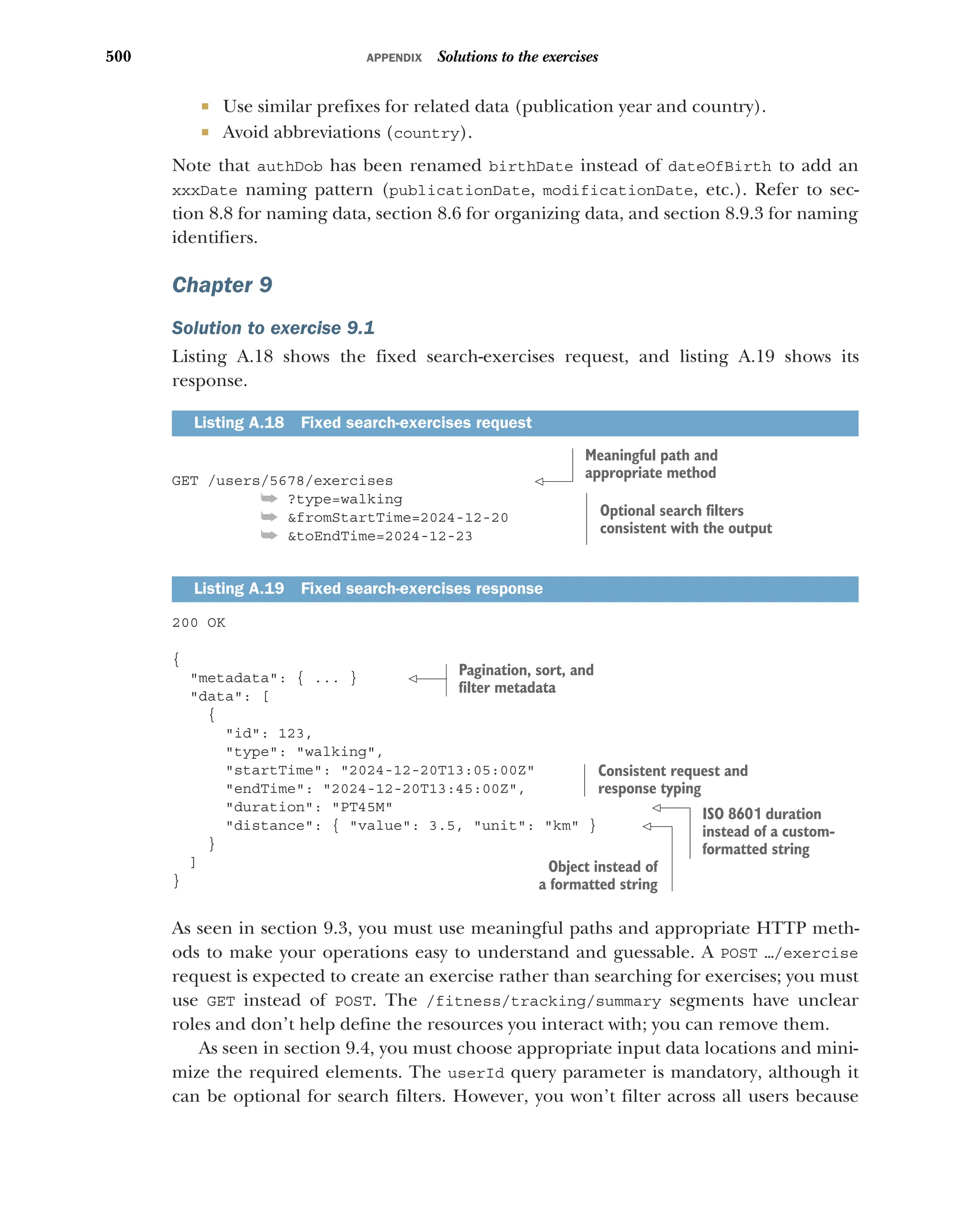
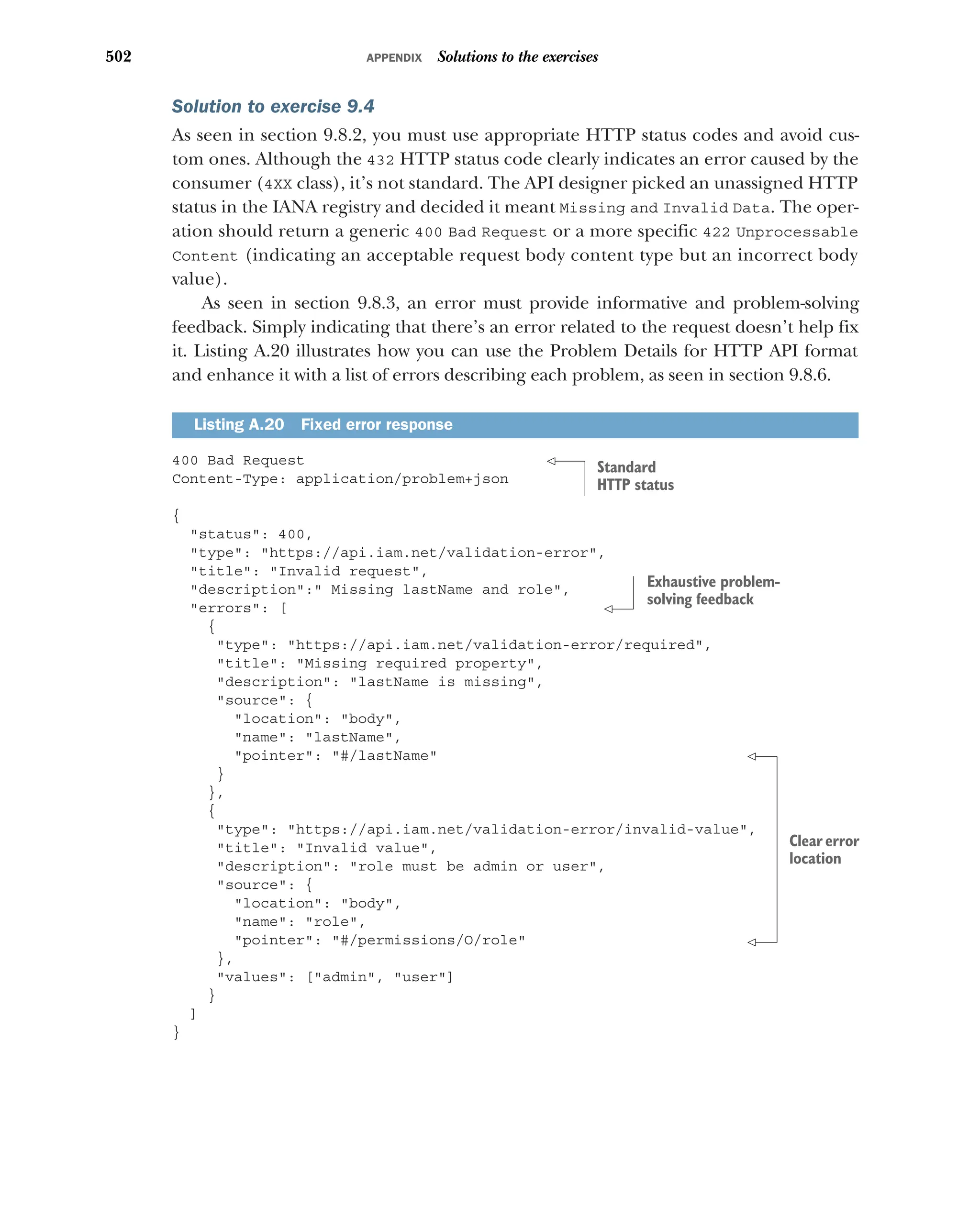
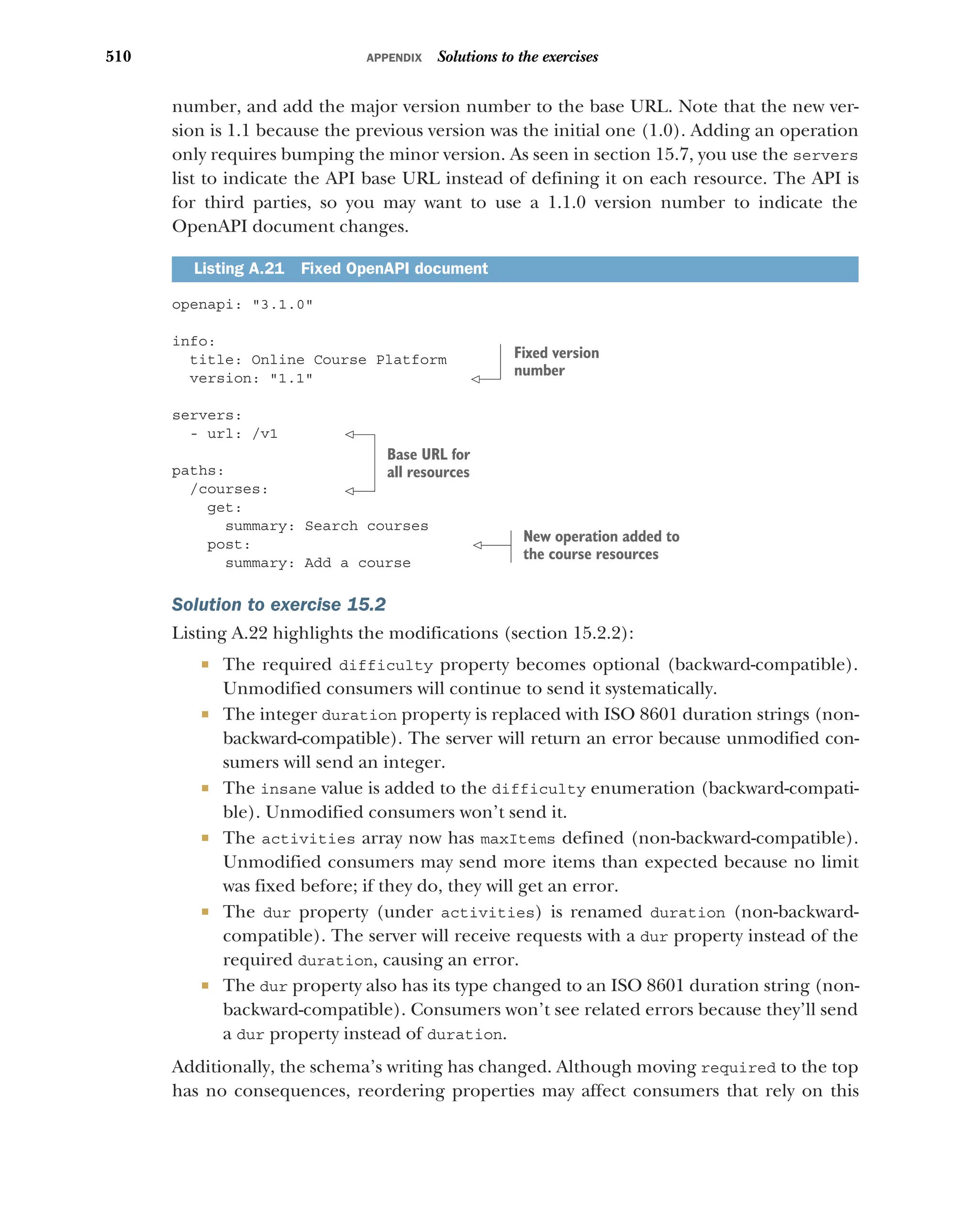
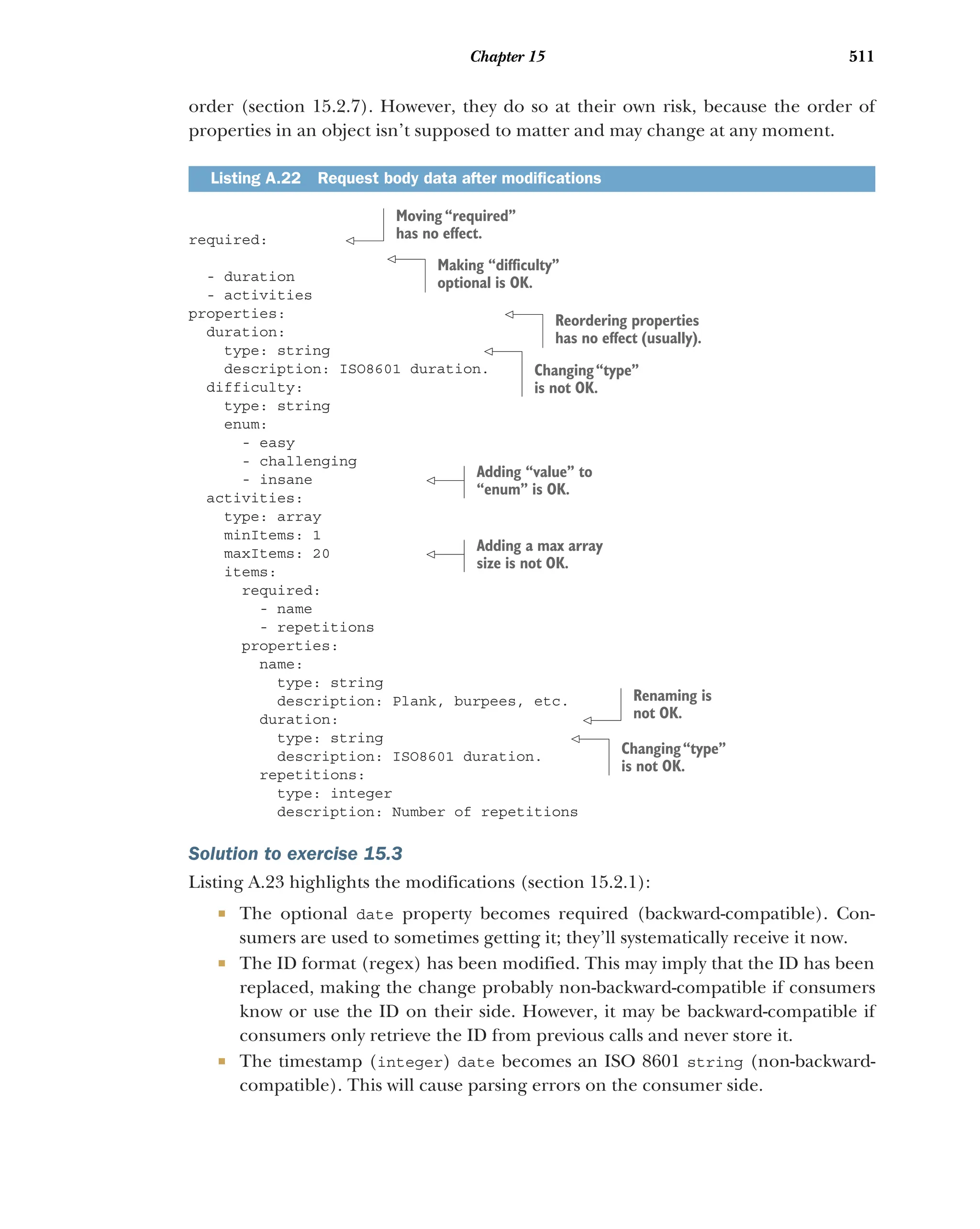
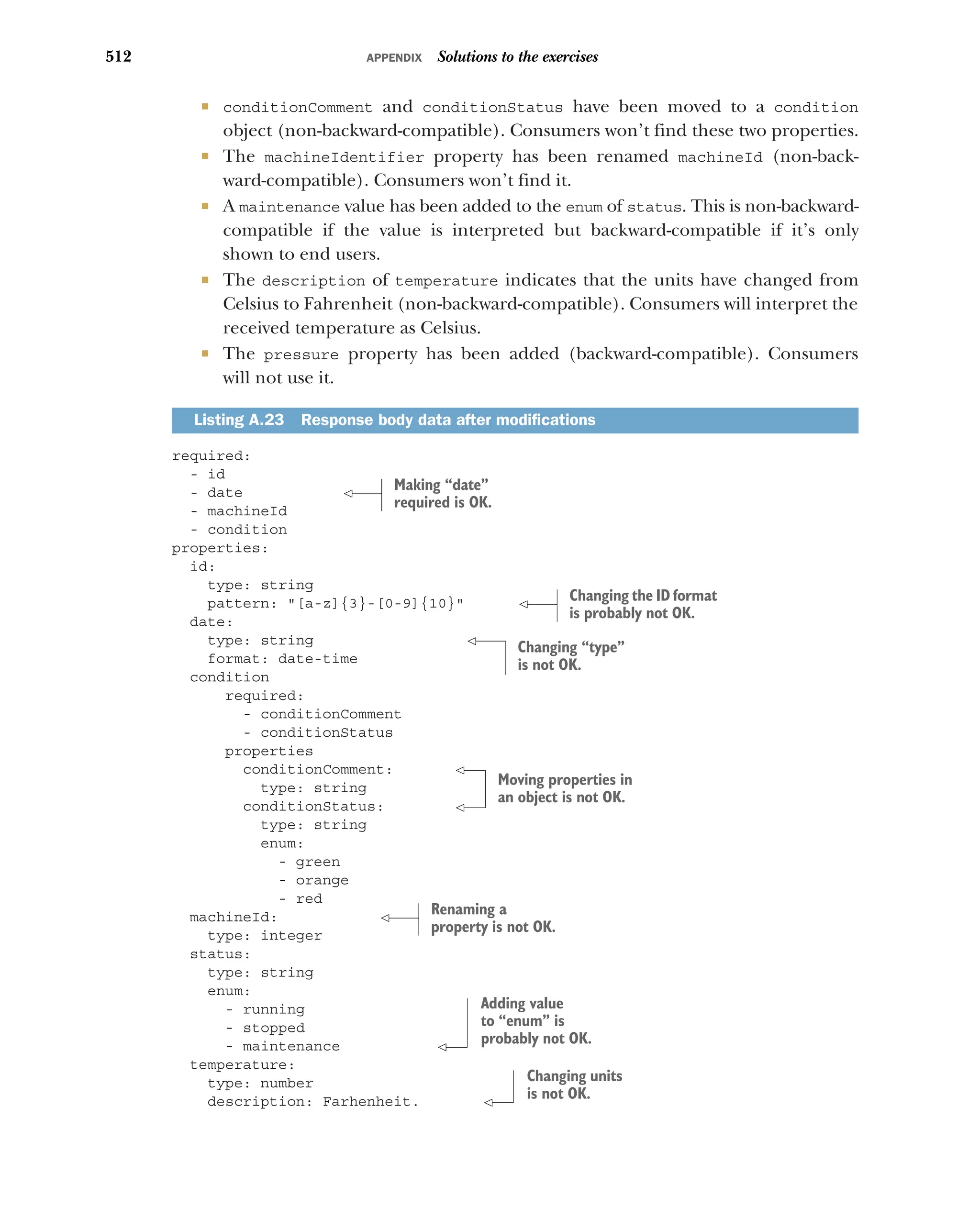
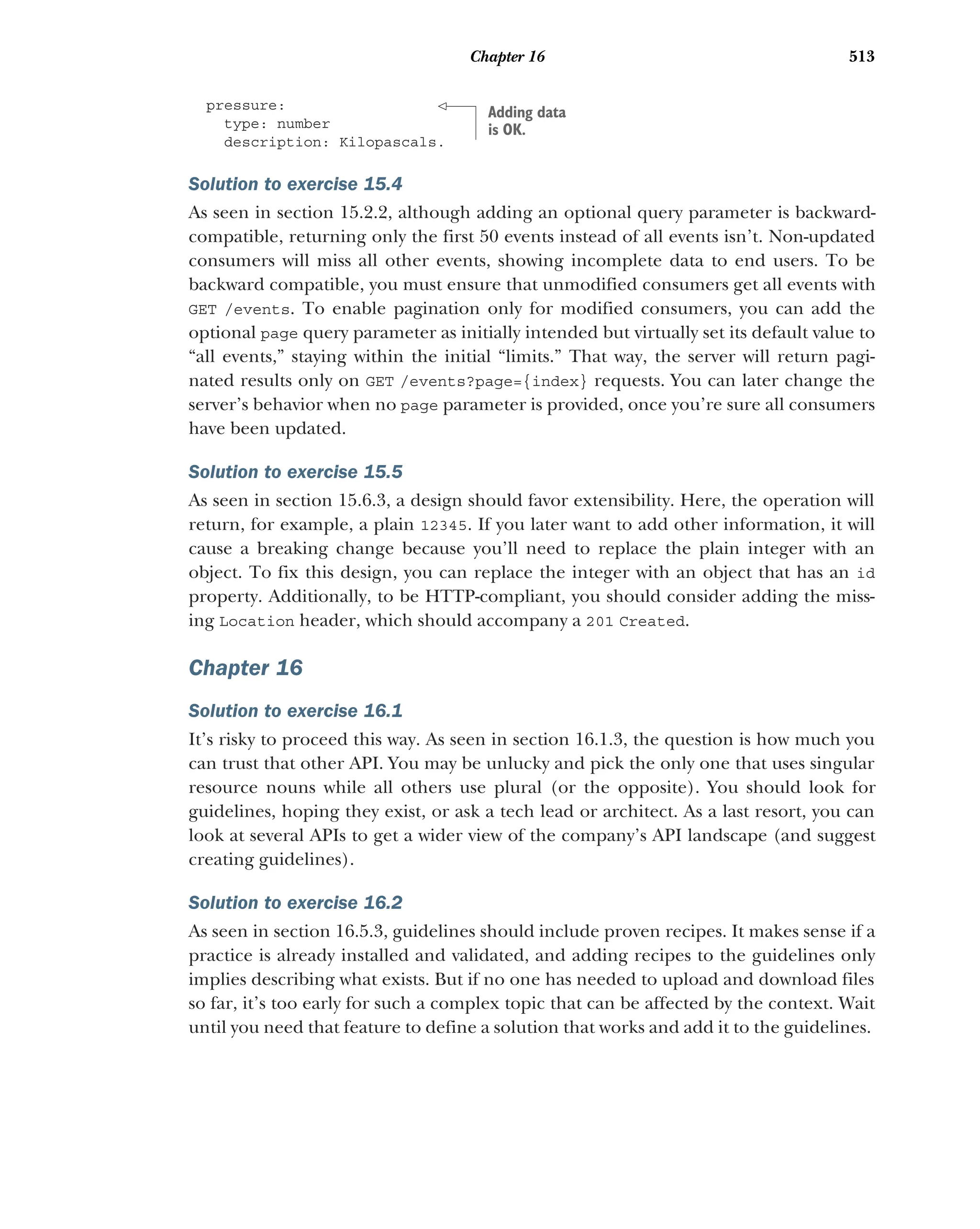
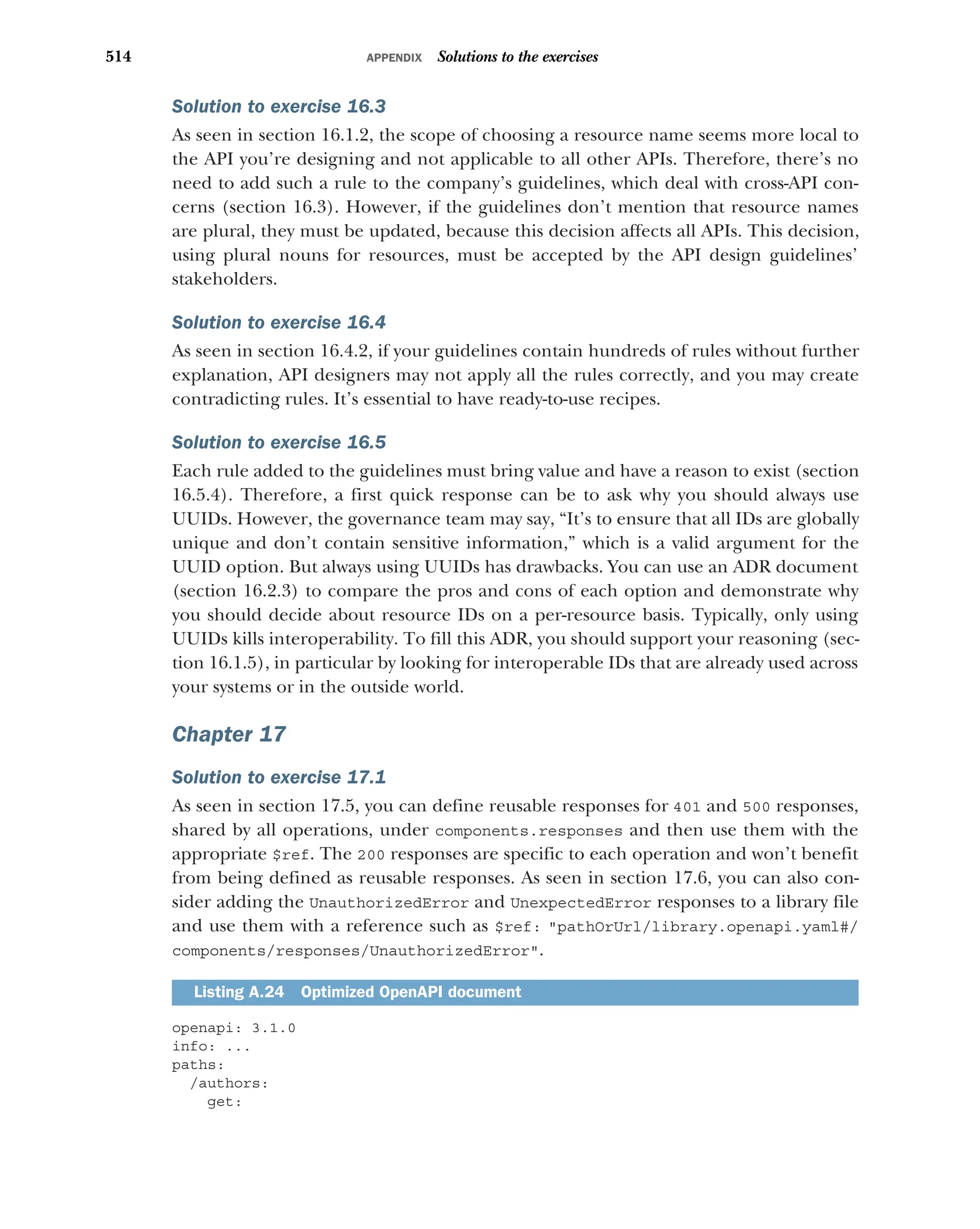
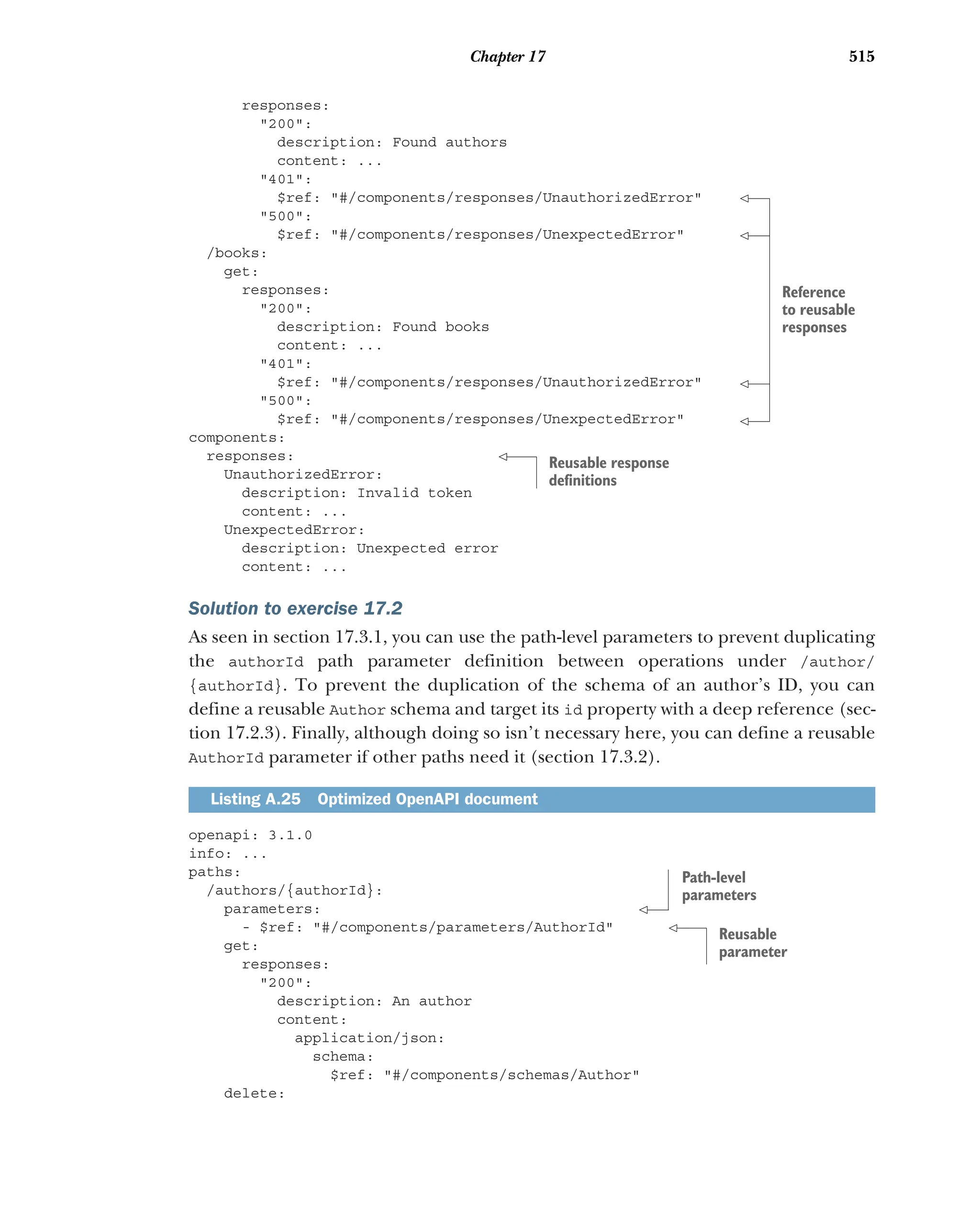
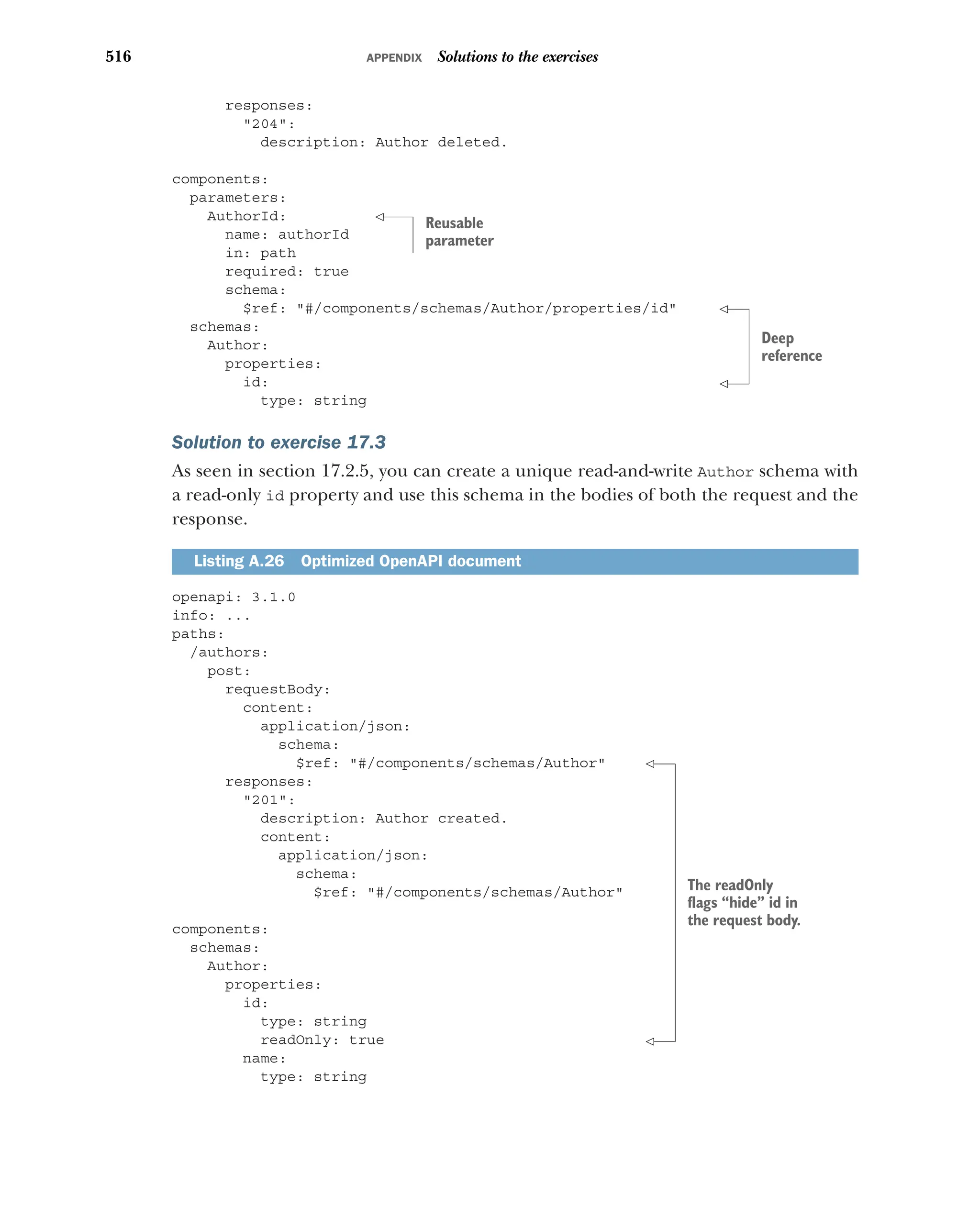
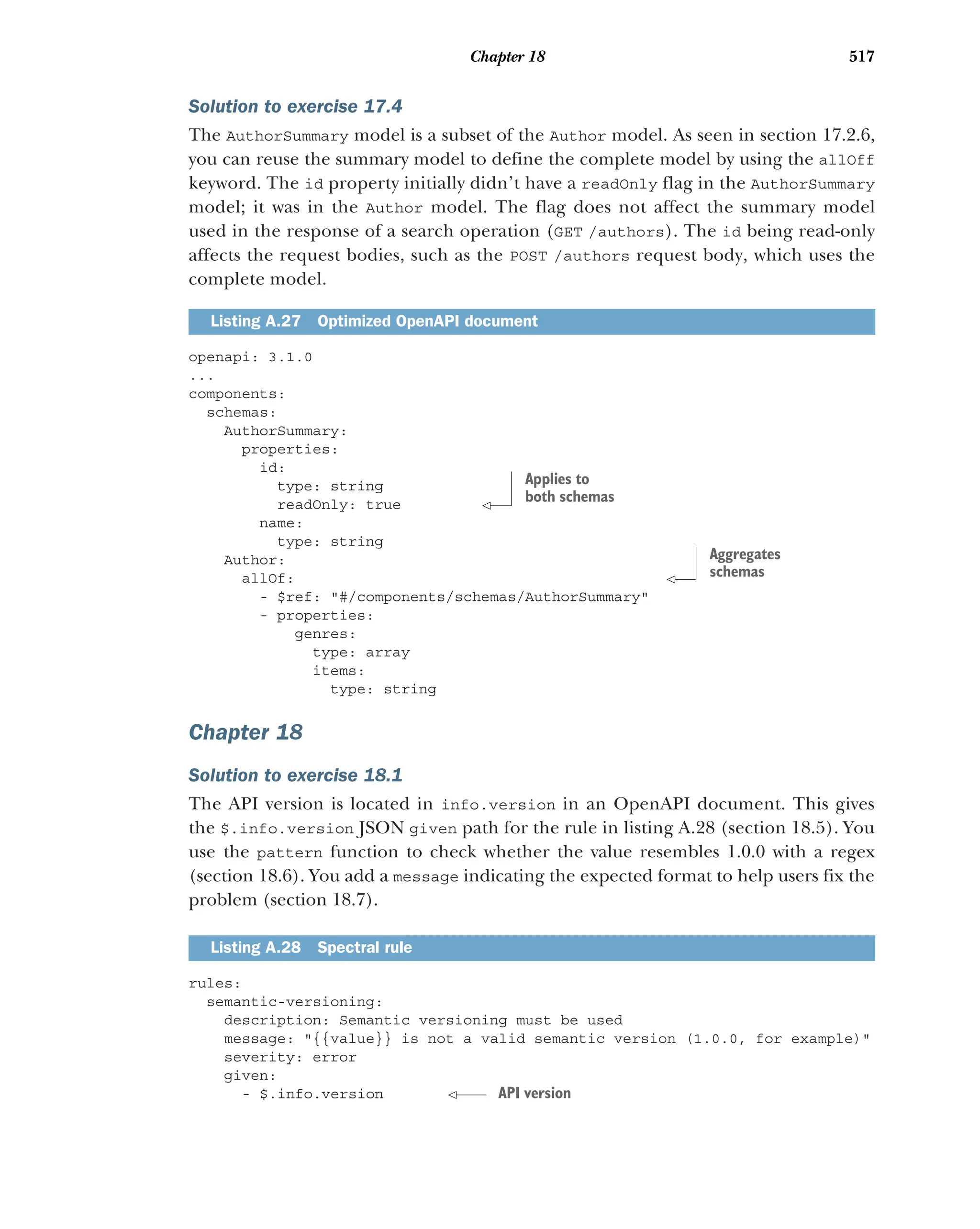
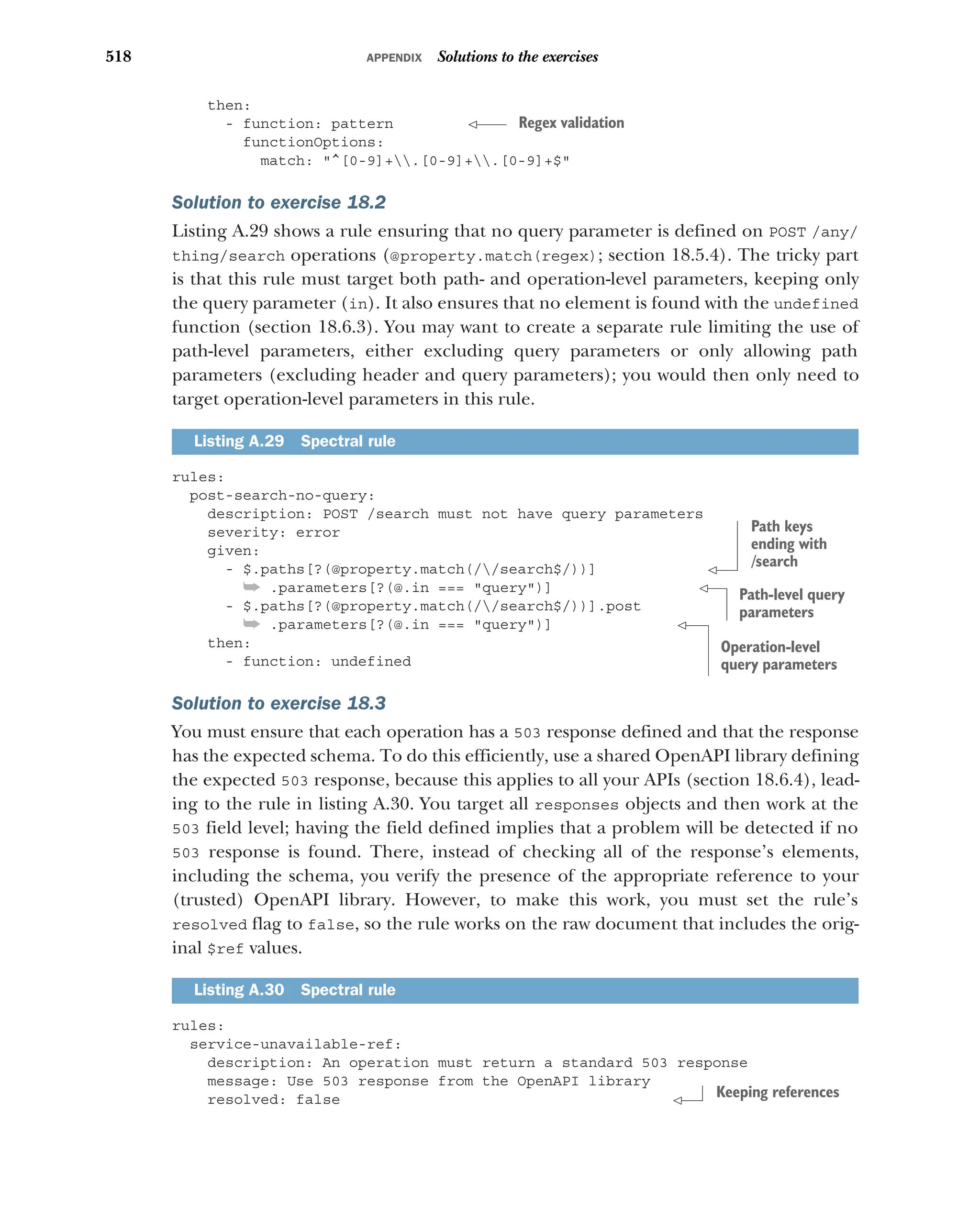
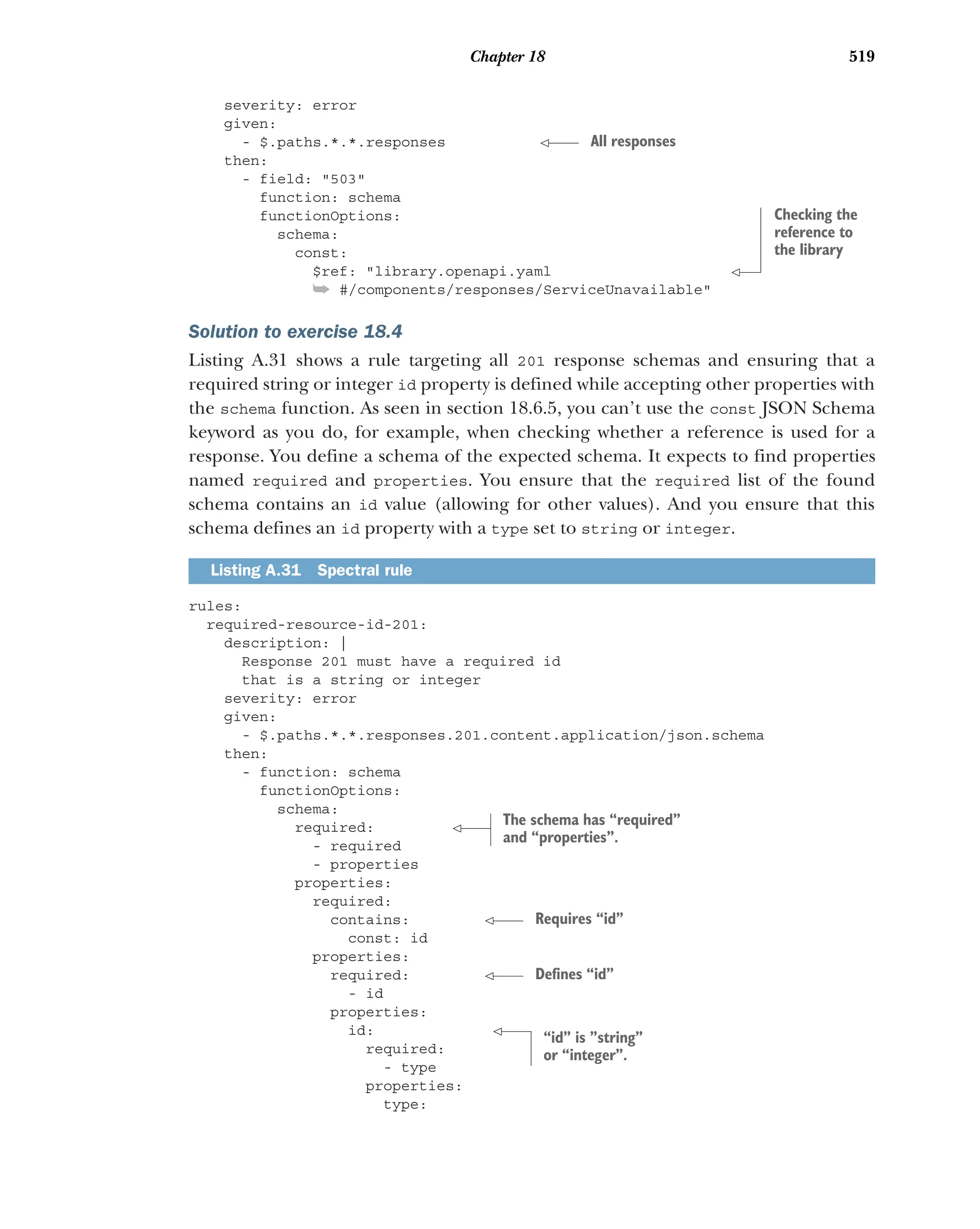
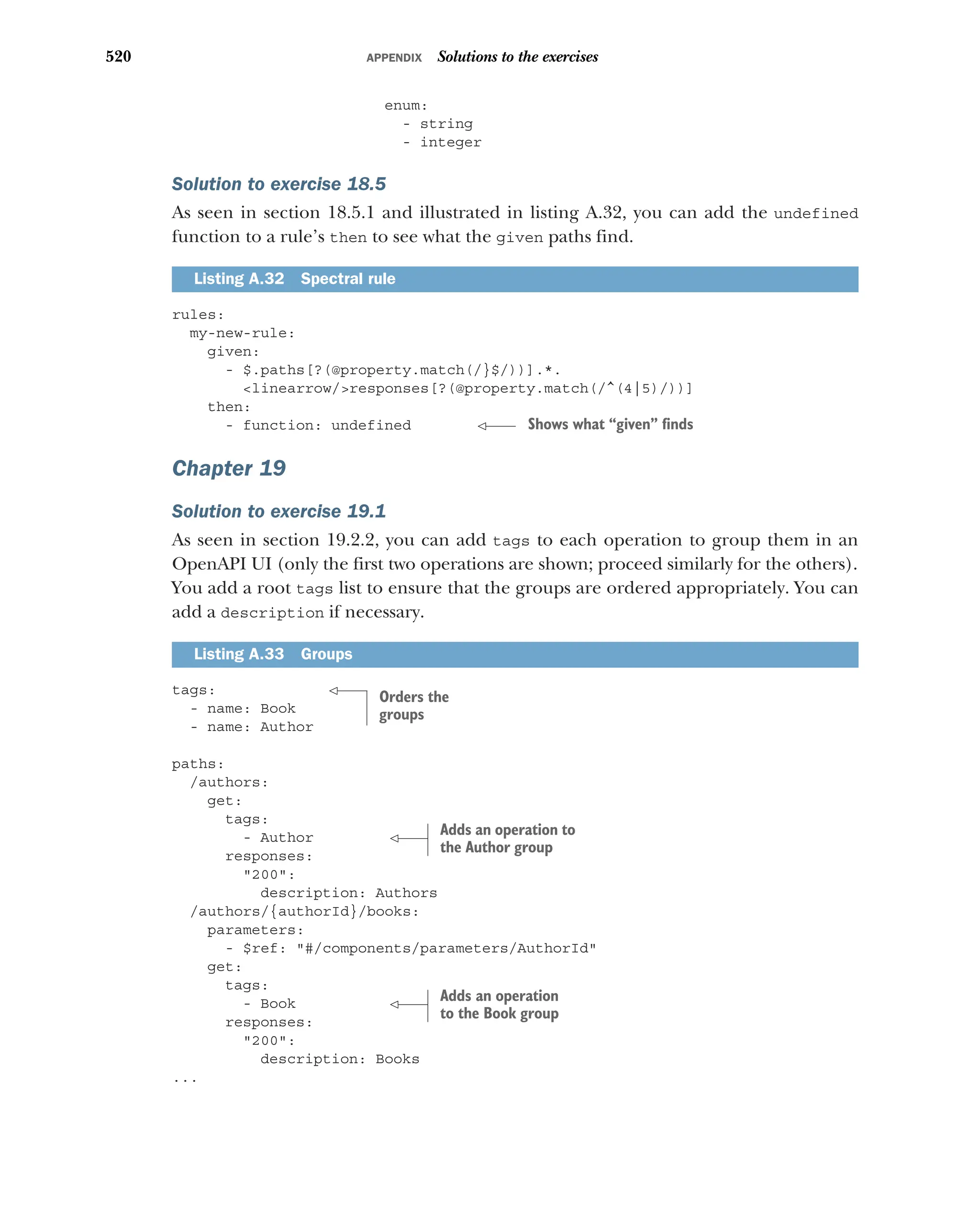
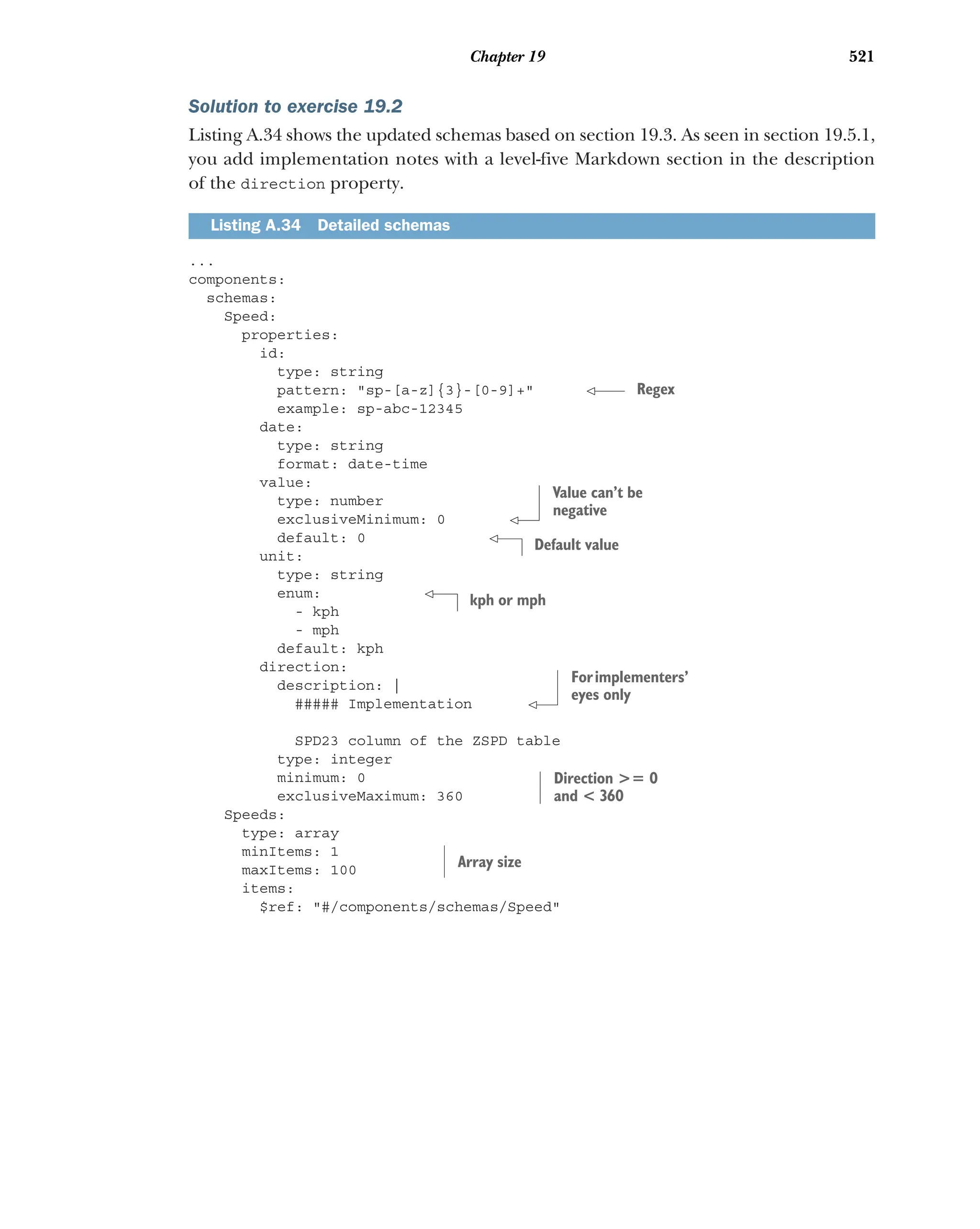

















![API design concepts [Intro]](https://cdn.slidesharecdn.com/ss_thumbnails/restfulapidesign-converted-201003085724-thumbnail.jpg?width=640&height=640&fit=bounds)


