1
“Automatic Paper Punching Using Geneva Mechanism”
Presented by
Student name
Guided By
Asst. Prof.
College name
A
Presentation
On
Project Stage-I
Contents
• Introduction
• Literature Survey
• Problem Statement
• Objective and Scope
• Methodology
• Material Used
• Proposed System
• Advantages , Disadvantages & Application
• References
• Conclusion
2
3
Introduction
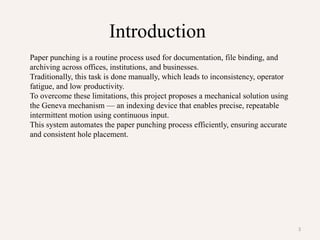
Paper punching is a routine process used for documentation, file binding, and
archiving across offices, institutions, and businesses.
Traditionally, this task is done manually, which leads to inconsistency, operator
fatigue, and low productivity.
To overcome these limitations, this project proposes a mechanical solution using
the Geneva mechanism — an indexing device that enables precise, repeatable
intermittent motion using continuous input.
This system automates the paper punching process efficiently, ensuring accurate
and consistent hole placement.
4
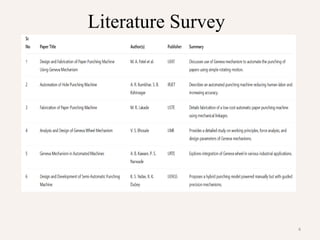
Literature Survey
5
Problem Statement
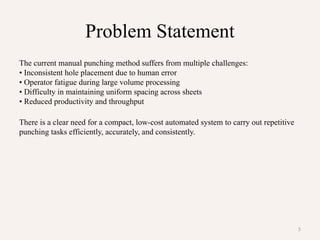
The current manual punching method suffers from multiple challenges:
• Inconsistent hole placement due to human error
• Operator fatigue during large volume processing
• Difficulty in maintaining uniform spacing across sheets
• Reduced productivity and throughput
There is a clear need for a compact, low-cost automated system to carry out repetitive
punching tasks efficiently, accurately, and consistently.
6
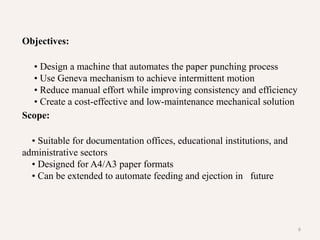
Objectives:
• Design a machine that automates the paper punching process
• Use Geneva mechanism to achieve intermittent motion
• Reduce manual effort while improving consistency and efficiency
• Create a cost-effective and low-maintenance mechanical solution
Scope:
• Suitable for documentation offices, educational institutions, and
administrative sectors
• Designed for A4/A3 paper formats
• Can be extended to automate feeding and ejection in future
7
Methodology
8
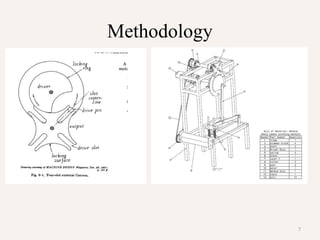
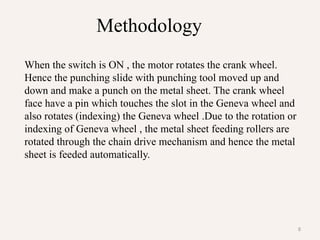
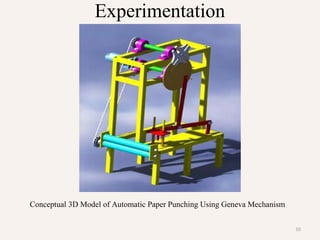
When the switch is ON , the motor rotates the crank wheel.
Hence the punching slide with punching tool moved up and
down and make a punch on the metal sheet. The crank wheel
face have a pin which touches the slot in the Geneva wheel and
also rotates (indexing) the Geneva wheel .Due to the rotation or
indexing of Geneva wheel , the metal sheet feeding rollers are
rotated through the chain drive mechanism and hence the metal
sheet is feeded automatically.
Methodology
9
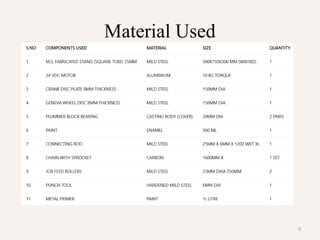
Material Used
10
Experimentation
Conceptual 3D Model of Automatic Paper Punching Using Geneva Mechanism
11
Advantages, Disadvantages, Applications
Advantages:
• High punching accuracy and repeatability
• Minimal electricity consumption
• Low-cost design using basic mechanical components
• Simple, easy-to-maintain mechanism
• Compact and portable setup
• Ideal for batch punching jobs
Disadvantages:
• Speed limitation due to intermittent nature of Geneva mechanism
• Not ideal for thick or multi-sheet punching without redesign
• Manual paper feeding in current model
• Requires consistent maintenance of moving parts
12
Applications:
• Schools and Colleges for document binding
• Office documentation centers
• Libraries and archives
• Record-keeping and filing departments
• Low-volume printing and packaging industries
13
Conclusion:
The proposed machine successfully automates a traditionally manual operation with
improved precision and productivity.
By implementing a Geneva mechanism, intermittent motion control is effectively
used for mechanical actuation of the punching tool.
The design proves to be reliable, user-friendly, and economical.
Future Scope:
• Incorporate automated paper feeding and ejecting
• Add sensors to detect alignment and jams
• Use microcontroller for digital operation and monitoring
14
References:
 A Textbook of Machine Design, R.S. Khurmi, J.K. Gupta, S. Chand Publishing,
https://www.schandpublishing.com
 Mechanical Engineering Design, Joseph Edward Shigley, Charles R. Mischke, Richard G. Budynas,
McGraw-Hill Education, https://www.mheducation.com/highered/product/mechanical-engineering-
design-budynas-nisbett/M9780073398204.html
 Engineering Materials and Metallurgy, R.K. Rajput, S. Chand Publishing,
https://www.schandpublishing.com/books/technical/engineering-materials-and-metallurgy/
9789352534842/
 Design and Fabrication of Geneva Mechanism for Automatic Punching Machine, Sandeep S. Koranne,
P.B. Nagarhalli, International Research Journal of Engineering and Technology (IRJET), Volume 5, Issue
4, April 2018, https://www.irjet.net/archives/V5/i4/IRJET-V5I4746.pdf
 Design and Fabrication of Automatic Paper Punching Machine Using Geneva Mechanism, A.
Shanmugam, G. Venkatesh, International Journal of Scientific and Engineering Research (IJSER),
Volume 9, Issue 5, May 2018, http://www.ijser.org/researchpaper/Design-and-Fabrication-of-
Automatic-Paper-Punching-Machine-using-Geneva-Mechanism.pdf
 Development of Automatic Paper Punching Machine Using Geneva Mechanism, Gajanan B. More,
Sachin S. Patil, International Journal of Research in Advent Technology, Vol. 6, No. 5, May 2018,
http://www.ijrat.org/downloads/Vol-6/may-2018/paper%20ID-65201880.pdf
THANK YOU
15
Department of Mechanical Engineering

Automatic paper punching machine using geneva.pptx

  • 1.
    1 “Automatic Paper PunchingUsing Geneva Mechanism” Presented by Student name Guided By Asst. Prof. College name A Presentation On Project Stage-I
  • 2.
    Contents • Introduction • LiteratureSurvey • Problem Statement • Objective and Scope • Methodology • Material Used • Proposed System • Advantages , Disadvantages & Application • References • Conclusion 2
  • 3.
    3 Introduction Paper punching isa routine process used for documentation, file binding, and archiving across offices, institutions, and businesses. Traditionally, this task is done manually, which leads to inconsistency, operator fatigue, and low productivity. To overcome these limitations, this project proposes a mechanical solution using the Geneva mechanism — an indexing device that enables precise, repeatable intermittent motion using continuous input. This system automates the paper punching process efficiently, ensuring accurate and consistent hole placement.
  • 4.
  • 5.
    5 Problem Statement The currentmanual punching method suffers from multiple challenges: • Inconsistent hole placement due to human error • Operator fatigue during large volume processing • Difficulty in maintaining uniform spacing across sheets • Reduced productivity and throughput There is a clear need for a compact, low-cost automated system to carry out repetitive punching tasks efficiently, accurately, and consistently.
  • 6.
    6 Objectives: • Design amachine that automates the paper punching process • Use Geneva mechanism to achieve intermittent motion • Reduce manual effort while improving consistency and efficiency • Create a cost-effective and low-maintenance mechanical solution Scope: • Suitable for documentation offices, educational institutions, and administrative sectors • Designed for A4/A3 paper formats • Can be extended to automate feeding and ejection in future
  • 7.
  • 8.
    8 When the switchis ON , the motor rotates the crank wheel. Hence the punching slide with punching tool moved up and down and make a punch on the metal sheet. The crank wheel face have a pin which touches the slot in the Geneva wheel and also rotates (indexing) the Geneva wheel .Due to the rotation or indexing of Geneva wheel , the metal sheet feeding rollers are rotated through the chain drive mechanism and hence the metal sheet is feeded automatically. Methodology
  • 9.
  • 10.
    10 Experimentation Conceptual 3D Modelof Automatic Paper Punching Using Geneva Mechanism
  • 11.
    11 Advantages, Disadvantages, Applications Advantages: •High punching accuracy and repeatability • Minimal electricity consumption • Low-cost design using basic mechanical components • Simple, easy-to-maintain mechanism • Compact and portable setup • Ideal for batch punching jobs Disadvantages: • Speed limitation due to intermittent nature of Geneva mechanism • Not ideal for thick or multi-sheet punching without redesign • Manual paper feeding in current model • Requires consistent maintenance of moving parts
  • 12.
    12 Applications: • Schools andColleges for document binding • Office documentation centers • Libraries and archives • Record-keeping and filing departments • Low-volume printing and packaging industries
  • 13.
    13 Conclusion: The proposed machinesuccessfully automates a traditionally manual operation with improved precision and productivity. By implementing a Geneva mechanism, intermittent motion control is effectively used for mechanical actuation of the punching tool. The design proves to be reliable, user-friendly, and economical. Future Scope: • Incorporate automated paper feeding and ejecting • Add sensors to detect alignment and jams • Use microcontroller for digital operation and monitoring
  • 14.
    14 References:  A Textbookof Machine Design, R.S. Khurmi, J.K. Gupta, S. Chand Publishing, https://www.schandpublishing.com  Mechanical Engineering Design, Joseph Edward Shigley, Charles R. Mischke, Richard G. Budynas, McGraw-Hill Education, https://www.mheducation.com/highered/product/mechanical-engineering- design-budynas-nisbett/M9780073398204.html  Engineering Materials and Metallurgy, R.K. Rajput, S. Chand Publishing, https://www.schandpublishing.com/books/technical/engineering-materials-and-metallurgy/ 9789352534842/  Design and Fabrication of Geneva Mechanism for Automatic Punching Machine, Sandeep S. Koranne, P.B. Nagarhalli, International Research Journal of Engineering and Technology (IRJET), Volume 5, Issue 4, April 2018, https://www.irjet.net/archives/V5/i4/IRJET-V5I4746.pdf  Design and Fabrication of Automatic Paper Punching Machine Using Geneva Mechanism, A. Shanmugam, G. Venkatesh, International Journal of Scientific and Engineering Research (IJSER), Volume 9, Issue 5, May 2018, http://www.ijser.org/researchpaper/Design-and-Fabrication-of- Automatic-Paper-Punching-Machine-using-Geneva-Mechanism.pdf  Development of Automatic Paper Punching Machine Using Geneva Mechanism, Gajanan B. More, Sachin S. Patil, International Journal of Research in Advent Technology, Vol. 6, No. 5, May 2018, http://www.ijrat.org/downloads/Vol-6/may-2018/paper%20ID-65201880.pdf
  • 15.
    THANK YOU 15 Department ofMechanical Engineering

Editor's Notes

  • #1 A Presentation On