AUTOMATED FACIAL
RECOGNITION
ATTENDANCE RECORDER
Table of contents
01
05
Conclusions
Introduction
Implementation Analysis
Literature Review
04
02
System
Requirements
06
03
Introduction
01
INTRODUCTION
Automated facial recognition
attendance recorders represent a
significant advancement in
attendance management, offering
improved accuracy, efficiency, and
security over traditional methods. By
utilizing advanced algorithms to
identify and record individuals
automatically, these systems
eliminate the need for manual
attendance tracking, reducing errors
and time consumption. They
enhance security by preventing
fraudulent activities like buddy
punching and can integrate with
other systems, such as payroll, for
streamlined operations.
OBJECTIVE OF
THE STUDY
Efficient
Attendance
System
Facial
Recognition
Technology
Secure Access
and Data
Protection
User-
Friendly
Interface
Report Generation
and Email
Notifications
Data
Management
and Storage
System
Performance
and Accuracy
Scalability and
Adaptability
Acceptance and
Satisfaction
Error Handling
and Feedback
Mechanisms
PROBLEM STATEMENT
Current
situation
Traditional attendance
tracking methods-manual
or simple electronic
systems
Inaccuracy and
errors
Frequent mistakes
and forgery
Inefficiency
Lack of real-time
processing, time
consuming
Health
concerns
Physical contact
poses health risks.
1 2 3
Problems
Literature
Review
02
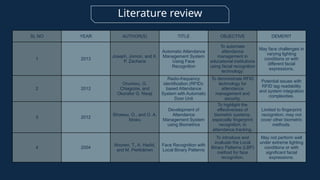
Literature review
SL NO YEAR AUTHOR(S) TITLE OBJECTIVE DEMERIT
1 2013
Joseph, Jomon, and K.
P. Zacharia
Automatic Attendance
Management System
Using Face
Recognition
To automate
attendance
management in
educational institutions
using facial recognition
technology.
May face challenges in
varying lighting
conditions or with
different facial
expressions.
2 2012
Ononiwu, G.
Chiagozie, and
Okorafor G. Nwaji
Radio-frequency
identification (RFID)-
based Attendance
System with Automatic
Door Unit
To demonstrate RFID
technology for
attendance
management and
security.
Potential issues with
RFID tag readability
and system integration
complexities.
3 2012
Shoewu, O., and O. A.
Idowu
Development of
Attendance
Management System
using Biometrics
To highlight the
effectiveness of
biometric systems,
especially fingerprint
recognition, in
attendance tracking.
Limited to fingerprint
recognition; may not
cover other biometric
methods.
4 2004
Ahonen, T., A. Hadid,
and M. Pietikäinen
Face Recognition with
Local Binary Patterns
To introduce and
evaluate the Local
Binary Patterns (LBP)
method for face
recognition.
May not perform well
under extreme lighting
conditions or with
significant facial
expressions.
5 2014
Ozdil, A., and M. M.
Ozbilen
A survey on comparison
of face recognition
algorithms
To compare various
face recognition
algorithms and analyze
their strengths and
weaknesses.
May not cover all
emerging algorithms or
recent advancements in
the field.
6 2006
Ahonen, Timo,
Abdenour Hadid, and
Matti Pietikäinen
Face description with
local binary patterns:
Application to face
recognition
To demonstrate the
practical application of
LBP in face recognition,
including empirical
evidence.
May have limitations in
dynamic and varied
real-world conditions.
7 2001 Viola, P., and M. Jones
Rapid object detection
using a boosted
cascade of simple
features
To introduce a method
for real-time object and
face detection using
Haar-like features and
boosting.
May be computationally
intensive and less
effective on smaller or
partially occluded faces.
8 N/A Will Berger
Deep Learning Haar
Cascade Explained
To explain the Haar
Cascade algorithm and
its integration into
modern face recognition
systems.
May not cover the latest
advancements in deep
learning applications for
face recognition.
9 N/A Kelvin Salton do Prado
Face Recognition:
Understanding LBPH
Algorithm
To explore the Local
Binary Patterns
Histogram (LBPH)
algorithm for face
recognition.
Limited to LBPH; may
not cover other
advanced face
recognition methods or
improvements.
SL NO YEAR AUTHOR(S) TITLE OBJECTIVE DEMERIT
System
Requirements
03
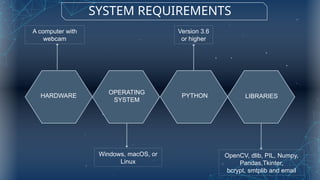
SYSTEM REQUIREMENTS
HARDWARE
A computer with
webcam
OPERATING
SYSTEM
Windows, macOS, or
Linux
PYTHON
Version 3.6
or higher
LIBRARIES
OpenCV, dlib, PIL, Numpy,
Pandas,Tkinter,
bcrypt, smtplib and email
Implementation
04
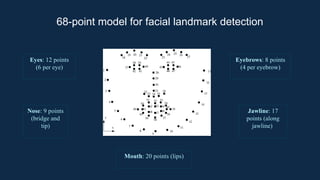
68-point model for facial landmark detection
Mouth: 20 points (lips)
Jawline: 17
points (along
jawline)
Eyebrows: 8 points
(4 per eyebrow)
Eyes: 12 points
(6 per eye)
Nose: 9 points
(bridge and
tip)
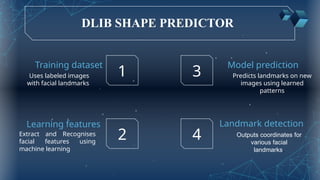
DLIB SHAPE PREDICTOR
Predicts landmarks on new
images using learned
patterns
Uses labeled images
with facial landmarks
Extract and Recognises
facial features using
machine learning
Training dataset
Learning features
Model prediction
Landmark detection
1
2 4
3
Outputs coordinates for
various facial
landmarks.
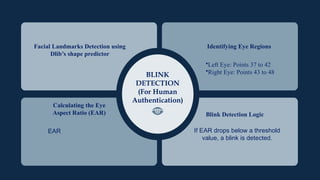
BLINK
DETECTION
(For Human
Authentication)
Facial Landmarks Detection using
Dlib’s shape predictor
Identifying Eye Regions
Calculating the Eye
Aspect Ratio (EAR)
EAR If EAR drops below a threshold
value, a blink is detected.
Blink Detection Logic
•Left Eye: Points 37 to 42
•Right Eye: Points 43 to 48
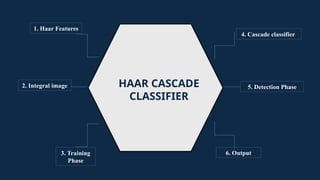
HAAR CASCADE
CLASSIFIER
1. Haar Features
2. Integral image
3. Training
Phase
4. Cascade classifier
5. Detection Phase
6. Output
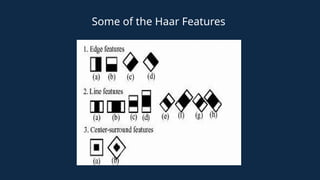
Some of the Haar Features
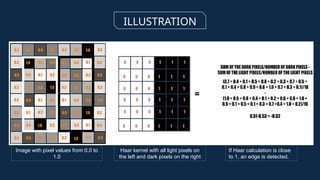
ILLUSTRATION
Image with pixel values from 0.0 to
1.0
Haar kernel with all light pixels on
the left and dark pixels on the right
If Haar calculation is close
to 1, an edge is detected.
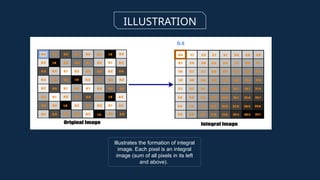
ILLUSTRATION
Illustrates the formation of integral
image. Each pixel is an integral
image (sum of all pixels in its left
and above).
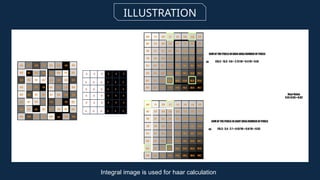
ILLUSTRATION
Integral image is used for haar calculation
ILLUSTRATION
Stage 2
1 complex feature
Stage 1
2 simple features
The stage 1 is applied first on 4×4 windows in the image , if it
passes, then only the stage 2 is applied
Advantages and
limitations of Haar
Cascade classifier
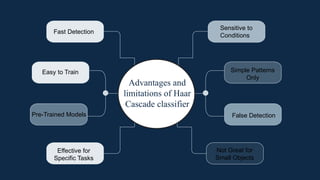
Fast Detection
Easy to Train
Pre-Trained Models
Effective for
Specific Tasks
Sensitive to
Conditions
Simple Patterns
Only
False Detection
Not Great for
Small Objects
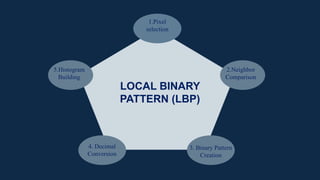
LOCAL BINARY
PATTERN (LBP)
1.Pixel
selection
2.Neighbor
Comparison
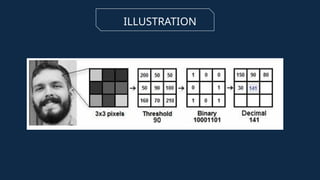
3. Binary Pattern
Creation
4. Decimal
Conversion
5.Histogram
Building
ILLUSTRATION
LOCAL BINARY
PATTERN
HISTOGRAM
(LBPH)
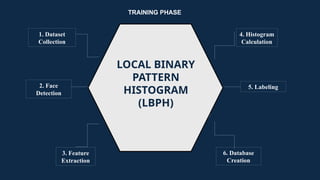
TRAINING PHASE
1. Dataset
Collection
2. Face
Detection
3. Feature
Extraction
4. Histogram
Calculation
5. Labeling
6. Database
Creation
LOCAL BINARY
PATTERN
HISTOGRAM
(LBPH)
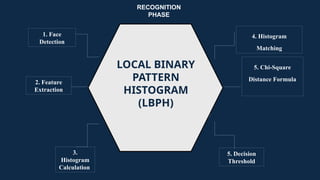
RECOGNITION
PHASE
1. Face
Detection
2. Feature
Extraction
3.
Histogram
Calculation
4. Histogram
Matching
5. Decision
Threshold
5. Chi-Square
Distance Formula
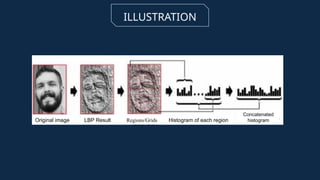
ILLUSTRATION
Original image LBP Result Regions/Grids Histogram of each region
Concatenated
histogram
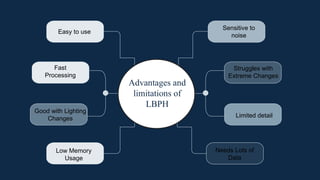
Advantages and
limitations of
LBPH
Easy to use
Fast
Processing
Good with Lighting
Changes
Low Memory
Usage
Sensitive to
noise
Struggles with
Extreme Changes
Limited detail
Needs Lots of
Data
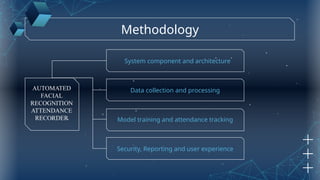
Methodology
System component and architecture
Data collection and processing
Model training and attendance tracking
Security, Reporting and user experience
AUTOMATED
FACIAL
RECOGNITION
ATTENDANCE
RECORDER
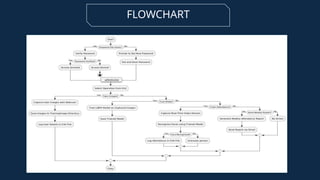
FLOWCHART
authentication
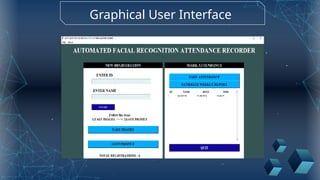
Graphical User Interface
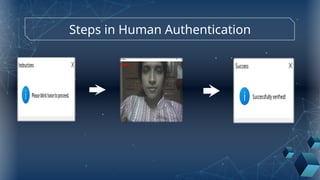
Steps in Human Authentication
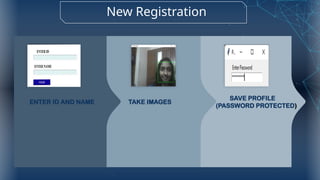
New Registration
SAVE PROFILE
(PASSWORD PROTECTED)
TAKE IMAGES
ENTER ID AND NAME
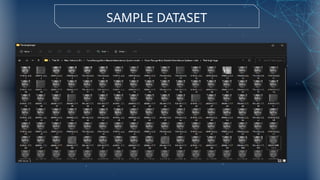
SAMPLE DATASET
MARKING ATTENDANCE
Attendance marked Attendance logged
ATTENDANCE REPORT GENERATED AFTER MARKING ATTENDANCE
WEEKLY ATTENDANCE REPORT GENERATED
Analysis
05
ANALYSIS
The Automated Facial Recognition
Attendance System ensures secure and
accurate attendance tracking by combining
blink detection for human authentication,
Haar Cascade Classifiers for face detection,
and Local Binary Patterns Histograms
(LBPH) algorithm for facial recognition,
supported by dlib for precise landmark
detection. Attendance data is logged in CSV
files, secured with password protection, and
includes automatic weekly report
generation sent via email. Future
enhancements could include adopting
advanced deep learning algorithms for
better accuracy, multi-factor authentication
for increased security, and cloud-based
storage for scalability.
Conclusions
06
CONCLUSION
Automated Facial Recognition Attendance
Recorder successfully modernizes attendance
management by integrating advanced facial
recognition technology. By utilizing Haar
cascades for face detection and LBPH for
recognition, the system achieves reliable and
accurate identification. Enhanced security is
provided through blink detection to confirm
live faces and password protection for
sensitive operations. The system effectively
tracks and records attendance data, which is
conveniently stored in a CSV file and
supplemented with automated weekly email
reports. This solution offers a practical,
efficient, and secure method for managing
attendance, demonstrating significant
improvements over traditional methods.
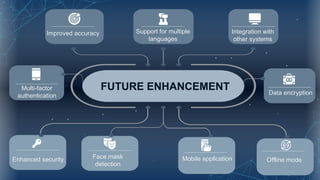
FUTURE ENHANCEMENT
Improved accuracy Support for multiple
languages
Integration with
other systems
Enhanced security Face mask
detection
Mobile application
Data encryption
Offline mode
Multi-factor
authentication
REFERENCES
● Joseph, Jomon, and K. P. Zacharia (2013). "Automatic Attendance Management System
Using Face Recognition." International Journal of Science and Research
● Ononiwu, G. Chiagozie, and Okorafor G. Nwaji (2012). "Radio-frequency identification
(RFID)-based Attendance System with Automatic Door Unit." Academic Research
International
● Shoewu, O., and O. A. Idowu (2012). "Development of Attendance Management System
using Biometrics." The Pacific Journal of Science and Technology
● Ahonen, T., A. Hadid, and M. Pietikäinen (2004). "Face Recognition with Local Binary
Patterns." In Advances in Visual Computing, Springer Science and Business Media LLC
REFERENCES
● Ozdil, A., and M. M. Ozbilen (2014). "A survey on comparison of face recognition
algorithms." 2014 IEEE 8th International Conference on Application of Information and
Communication Technologies (AICT)
● Ahonen, Timo, Abdenour Hadid, and Matti Pietikäinen (2006). "Face description with local
binary patterns: Application to face recognition." IEEE Transactions on Pattern Analysis and
Machine Intelligence
● Viola, P., and M. Jones (2001). "Rapid object detection using a boosted cascade of simple
features." Proceedings of the 2001 IEEE Computer Society Conference on Computer
Vision and Pattern Recognition (CVPR)
● Berger, Will. "Deep Learning Haar Cascade Explained." WILLBERGER 9. Prado, Kelvin
Salton do. "Face Recognition: Understanding LBPH Algorithm." Towards Data Science

Automated Facial Recognition Attendance Recorder using Python and OpenCV

  • 1.
  • 2.
    Table of contents 01 05 Conclusions Introduction ImplementationAnalysis Literature Review 04 02 System Requirements 06 03
  • 3.
  • 4.
    INTRODUCTION Automated facial recognition attendancerecorders represent a significant advancement in attendance management, offering improved accuracy, efficiency, and security over traditional methods. By utilizing advanced algorithms to identify and record individuals automatically, these systems eliminate the need for manual attendance tracking, reducing errors and time consumption. They enhance security by preventing fraudulent activities like buddy punching and can integrate with other systems, such as payroll, for streamlined operations.
  • 5.
    OBJECTIVE OF THE STUDY Efficient Attendance System Facial Recognition Technology SecureAccess and Data Protection User- Friendly Interface Report Generation and Email Notifications Data Management and Storage System Performance and Accuracy Scalability and Adaptability Acceptance and Satisfaction Error Handling and Feedback Mechanisms
  • 6.
    PROBLEM STATEMENT Current situation Traditional attendance trackingmethods-manual or simple electronic systems Inaccuracy and errors Frequent mistakes and forgery Inefficiency Lack of real-time processing, time consuming Health concerns Physical contact poses health risks. 1 2 3 Problems
  • 7.
  • 8.
    Literature review SL NOYEAR AUTHOR(S) TITLE OBJECTIVE DEMERIT 1 2013 Joseph, Jomon, and K. P. Zacharia Automatic Attendance Management System Using Face Recognition To automate attendance management in educational institutions using facial recognition technology. May face challenges in varying lighting conditions or with different facial expressions. 2 2012 Ononiwu, G. Chiagozie, and Okorafor G. Nwaji Radio-frequency identification (RFID)- based Attendance System with Automatic Door Unit To demonstrate RFID technology for attendance management and security. Potential issues with RFID tag readability and system integration complexities. 3 2012 Shoewu, O., and O. A. Idowu Development of Attendance Management System using Biometrics To highlight the effectiveness of biometric systems, especially fingerprint recognition, in attendance tracking. Limited to fingerprint recognition; may not cover other biometric methods. 4 2004 Ahonen, T., A. Hadid, and M. Pietikäinen Face Recognition with Local Binary Patterns To introduce and evaluate the Local Binary Patterns (LBP) method for face recognition. May not perform well under extreme lighting conditions or with significant facial expressions.
  • 9.
    5 2014 Ozdil, A.,and M. M. Ozbilen A survey on comparison of face recognition algorithms To compare various face recognition algorithms and analyze their strengths and weaknesses. May not cover all emerging algorithms or recent advancements in the field. 6 2006 Ahonen, Timo, Abdenour Hadid, and Matti Pietikäinen Face description with local binary patterns: Application to face recognition To demonstrate the practical application of LBP in face recognition, including empirical evidence. May have limitations in dynamic and varied real-world conditions. 7 2001 Viola, P., and M. Jones Rapid object detection using a boosted cascade of simple features To introduce a method for real-time object and face detection using Haar-like features and boosting. May be computationally intensive and less effective on smaller or partially occluded faces. 8 N/A Will Berger Deep Learning Haar Cascade Explained To explain the Haar Cascade algorithm and its integration into modern face recognition systems. May not cover the latest advancements in deep learning applications for face recognition. 9 N/A Kelvin Salton do Prado Face Recognition: Understanding LBPH Algorithm To explore the Local Binary Patterns Histogram (LBPH) algorithm for face recognition. Limited to LBPH; may not cover other advanced face recognition methods or improvements. SL NO YEAR AUTHOR(S) TITLE OBJECTIVE DEMERIT
  • 10.
  • 11.
    SYSTEM REQUIREMENTS HARDWARE A computerwith webcam OPERATING SYSTEM Windows, macOS, or Linux PYTHON Version 3.6 or higher LIBRARIES OpenCV, dlib, PIL, Numpy, Pandas,Tkinter, bcrypt, smtplib and email
  • 12.
  • 13.
    68-point model forfacial landmark detection Mouth: 20 points (lips) Jawline: 17 points (along jawline) Eyebrows: 8 points (4 per eyebrow) Eyes: 12 points (6 per eye) Nose: 9 points (bridge and tip)
  • 14.
    DLIB SHAPE PREDICTOR Predictslandmarks on new images using learned patterns Uses labeled images with facial landmarks Extract and Recognises facial features using machine learning Training dataset Learning features Model prediction Landmark detection 1 2 4 3 Outputs coordinates for various facial landmarks.
  • 15.
    BLINK DETECTION (For Human Authentication) Facial LandmarksDetection using Dlib’s shape predictor Identifying Eye Regions Calculating the Eye Aspect Ratio (EAR) EAR If EAR drops below a threshold value, a blink is detected. Blink Detection Logic •Left Eye: Points 37 to 42 •Right Eye: Points 43 to 48
  • 16.
    HAAR CASCADE CLASSIFIER 1. HaarFeatures 2. Integral image 3. Training Phase 4. Cascade classifier 5. Detection Phase 6. Output
  • 17.
    Some of theHaar Features
  • 18.
    ILLUSTRATION Image with pixelvalues from 0.0 to 1.0 Haar kernel with all light pixels on the left and dark pixels on the right If Haar calculation is close to 1, an edge is detected.
  • 19.
    ILLUSTRATION Illustrates the formationof integral image. Each pixel is an integral image (sum of all pixels in its left and above).
  • 20.
    ILLUSTRATION Integral image isused for haar calculation
  • 21.
    ILLUSTRATION Stage 2 1 complexfeature Stage 1 2 simple features The stage 1 is applied first on 4×4 windows in the image , if it passes, then only the stage 2 is applied
  • 22.
    Advantages and limitations ofHaar Cascade classifier Fast Detection Easy to Train Pre-Trained Models Effective for Specific Tasks Sensitive to Conditions Simple Patterns Only False Detection Not Great for Small Objects
  • 23.
    LOCAL BINARY PATTERN (LBP) 1.Pixel selection 2.Neighbor Comparison 3.Binary Pattern Creation 4. Decimal Conversion 5.Histogram Building
  • 24.
  • 25.
    LOCAL BINARY PATTERN HISTOGRAM (LBPH) TRAINING PHASE 1.Dataset Collection 2. Face Detection 3. Feature Extraction 4. Histogram Calculation 5. Labeling 6. Database Creation
  • 26.
    LOCAL BINARY PATTERN HISTOGRAM (LBPH) RECOGNITION PHASE 1. Face Detection 2.Feature Extraction 3. Histogram Calculation 4. Histogram Matching 5. Decision Threshold 5. Chi-Square Distance Formula
  • 27.
    ILLUSTRATION Original image LBPResult Regions/Grids Histogram of each region Concatenated histogram
  • 28.
    Advantages and limitations of LBPH Easyto use Fast Processing Good with Lighting Changes Low Memory Usage Sensitive to noise Struggles with Extreme Changes Limited detail Needs Lots of Data
  • 29.
    Methodology System component andarchitecture Data collection and processing Model training and attendance tracking Security, Reporting and user experience AUTOMATED FACIAL RECOGNITION ATTENDANCE RECORDER
  • 30.
  • 31.
  • 32.
    Steps in HumanAuthentication
  • 33.
    New Registration SAVE PROFILE (PASSWORDPROTECTED) TAKE IMAGES ENTER ID AND NAME
  • 34.
  • 35.
  • 36.
    ATTENDANCE REPORT GENERATEDAFTER MARKING ATTENDANCE
  • 37.
  • 38.
  • 39.
    ANALYSIS The Automated FacialRecognition Attendance System ensures secure and accurate attendance tracking by combining blink detection for human authentication, Haar Cascade Classifiers for face detection, and Local Binary Patterns Histograms (LBPH) algorithm for facial recognition, supported by dlib for precise landmark detection. Attendance data is logged in CSV files, secured with password protection, and includes automatic weekly report generation sent via email. Future enhancements could include adopting advanced deep learning algorithms for better accuracy, multi-factor authentication for increased security, and cloud-based storage for scalability.
  • 40.
  • 41.
    CONCLUSION Automated Facial RecognitionAttendance Recorder successfully modernizes attendance management by integrating advanced facial recognition technology. By utilizing Haar cascades for face detection and LBPH for recognition, the system achieves reliable and accurate identification. Enhanced security is provided through blink detection to confirm live faces and password protection for sensitive operations. The system effectively tracks and records attendance data, which is conveniently stored in a CSV file and supplemented with automated weekly email reports. This solution offers a practical, efficient, and secure method for managing attendance, demonstrating significant improvements over traditional methods.


  • 42.
    FUTURE ENHANCEMENT Improved accuracySupport for multiple languages Integration with other systems Enhanced security Face mask detection Mobile application Data encryption Offline mode Multi-factor authentication
  • 43.
    REFERENCES ● Joseph, Jomon,and K. P. Zacharia (2013). "Automatic Attendance Management System Using Face Recognition." International Journal of Science and Research ● Ononiwu, G. Chiagozie, and Okorafor G. Nwaji (2012). "Radio-frequency identification (RFID)-based Attendance System with Automatic Door Unit." Academic Research International ● Shoewu, O., and O. A. Idowu (2012). "Development of Attendance Management System using Biometrics." The Pacific Journal of Science and Technology ● Ahonen, T., A. Hadid, and M. Pietikäinen (2004). "Face Recognition with Local Binary Patterns." In Advances in Visual Computing, Springer Science and Business Media LLC
  • 44.
    REFERENCES ● Ozdil, A.,and M. M. Ozbilen (2014). "A survey on comparison of face recognition algorithms." 2014 IEEE 8th International Conference on Application of Information and Communication Technologies (AICT) ● Ahonen, Timo, Abdenour Hadid, and Matti Pietikäinen (2006). "Face description with local binary patterns: Application to face recognition." IEEE Transactions on Pattern Analysis and Machine Intelligence ● Viola, P., and M. Jones (2001). "Rapid object detection using a boosted cascade of simple features." Proceedings of the 2001 IEEE Computer Society Conference on Computer Vision and Pattern Recognition (CVPR) ● Berger, Will. "Deep Learning Haar Cascade Explained." WILLBERGER 9. Prado, Kelvin Salton do. "Face Recognition: Understanding LBPH Algorithm." Towards Data Science