Autoimmune Hepatitis
Case Presentation
► 54 yo woman with abnormal liver function test
 9 years ago patient with ele lfts
 No complaints
 PMH: migraine headaches, arthritis, bilateral tubal
ligation, repair of ganglion cyst
 Meds: Prempro, Imitrex
 SH: rare alcohol, no tobacco
 FH: no history of liver disease
 PE: weight 104 lbs, no stigmata of Chronic liver disease
Laboratory Data
AST 214
ALT 272
Alk Phos 74
Total Bili 0.6
Total Protein 8.0
Alb 3.0
ANA 1:1280
ASMA 1:80
AMA -
Viral Serologies -
Ferritin 75
Other Data
►Sono: 3 mm CBD, normal gallbladder,
increase echogeneity c/w fatty liver
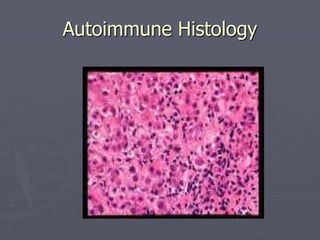
►Liver Biopsy: moderate piecemeal necrosis
with early fibrosis, expanded portal tracts
with plasma cells
►DX: Autoimmune Hepatitis
►RX: Steroids and Imuran
Definition
►Self perpetuating hepatocellular
inflammation of unknown cause
►Characterized by the presence of:
 periportal hepatitis
 Hypergammaglobulinemia
 Serum liver-associated autoantibodies
►Exclusion of other chronic liver diseases
Epidemiology
►1.9 cases per 100,000 incidence of
Autoimmune Hepatitis in western Europe
►Frequency of AIH among patients with
chronic liver disease is 11%
►Accounts for 5.9% of transplantations in the
US
Boberg K. 1998: Scad J Gastro;33:99-103
Background
►40% of patients with untreated severe
disease die within 6 mos of dx
►40% develop cirrhosis
 54% develop esophageal varices
►20% die of hemorrhage
►An acute onset of illness is seen in 40%
patients
►Prednisone and azathioprine are mainstay of
treatment
Clinical Manifestations
►Symptoms
 Fatigue 85%
 Jaundice 77%
 Abdominal pain 48%
 Pruritus 36%
 Anorexia 30%
 Polymyalgias 30%
 Diarrhea 28%
 Fevers 18%
Clinical Manifestations
►Physical Findings
 Hepatomegaly 78%
 Jaundice 69%
 Splenomegaly 32%
 Spider nevi 58%
 Ascites 20%
 Encephalopathy 14%
 Concurrent immune disease 48%
Clinical Manifestations
►Laboratory features
 Elevated AST 100%
 Hypergammaglobulinemia 92%
 Inc immunoglobulin G level 91%
 Hyperbilirubinemia 83%
 Alk Phos >2x 33%
Differential Diagnosis
►Wilson’s disease
►A1AT deficiency
►Hemochromatosis
►Viral hepatitis
►Drug induced hepatitis
Liver Histology
Autoimmune Histology
Diagnosis
Diagnostic Criteria
►Clinical criteria
 Presence of characteristic clinical features
 Liver histology
 Exclusion of other diseases
►Scoring criteria
 Assess the strength of the diagnosis
 Pretreatment and post-treatment
 Helpful with variant or atypical forms of AIH
Diagnostic Scoring System for
Atypical Autoimmune Hepatitis
Category Factor Score Category Factor Score
Gender female +2 Other immune Non-hepatic of
immune nature
+2
AP:AST >3
<1.5
-2
+2
autoabs Anti-
SLA/LP,actin,LC1
+2
glob >2.0
1.5-2.0
1.0-1.5
<1.0
+3
+2
+1
0
histology Interface hepatitis
Plasma cells
Rosettes
None of above
+3
+1
+1
-5
ANA,SMA, LKM1 >1:80
1:80
1:40
<1:40
+3
+2
+1
0
HLA DR3 or DR4 +1
AMA positive -4 Rx response Remission alone
Remission w/relapse
+2
+3
Viral markers Positive
negative
-3
+3
Pretreatment
definite dx
probable dx
>15
10-15
drugs Yes
no
-4
+1
Post-treatment
definite dx
probable dx
>17
12-17
alcohol <25 gm/d
>60 gm/s
+2
-2
Subclassification of AIH
►Type I
►Type II
►Type III
Type 1 AIH
►Diagnostic autoantibodies: ANA, ASMA
►Age: Bidmodal (10-20 and 45-70)
►% Women: 78
►% Concurrent immune diseases: 41
►Elevated gamma globulin: +++
►Steroid responsiveness: +++
►Progression to cirrhosis (%): 45
Type II AIH
►Diagnostic autoantibodies: LKM1
►Age: Pediatric (2-14), rare adults (4%)
►% Women: 89
►% Concurrent autoimmune disease: 34
►Elevated gamma-globulins: +
►Steroids responsive: ++
►% progression to cirrhosis: 82
Type III AIH
►Diagnostic autoantibodies: SLA and LP
►Age: adults (30-50)
►% Women: 90
►% Concurrent autoimmune disease: 58
►Elevated gamma-globulin: ++
►Steroid responsive: +++
►% progression to cirrhosis: 75
Prognostic Indices
► Laboratory findings at presentation
 AST>10x nl: 50%, 3-year mortality
 AST>5x nl + GGT>2x; 90%, 10-yr mortality
 AST<10x nl + GGT<2x; 49%, cirrhosis at 15 yr; 10%
10-yr mortality
► Histologic findings at presentation
 Periportal hepatitis: 17%,cirrhosis at 5 yr; Nl 5 yr
survival
 Bridging necrosis: 82%, cirrhosis of 5 yr; 45%, 5-yr
mortality
 Cirrhosis: 58%, 5 yr-mortality
Recommendations
►Diagnosis of AIH requires aminotransferase
and globulin levels; detection of ANA +/or
SMA, anti-LKM1; and histology
►Diagnostic criteria for AIH should be applied
to all patients
►If the diagnosis is not clear, a scoring
method should be used
Treatment
Indications for Treatment
Absolute Relative
Serum AST>10x uln Symptoms (fatigue,
arthralgia, jaundice)
Serum AST>5x uln and
globulin >2x nl
Serum AST and globulin
less than absolute
criteria
Bridging necrosis or
multiacinar necrosis
Interface hepatitis
Treatment Regimens
Prednisone only Combination
(Pred + AZA)
Week 1 60 mg 30 mg+50 mg
Week 2 40 mg 20 mg+50 mg
Week 3 30 mg 15 mg+50 mg
Week 4 30 mg 15 mg+50 mg
Maintenance
until endpoint
20 mg 10mg+50 mg
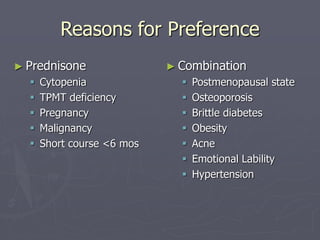
Reasons for Preference
► Prednisone
 Cytopenia
 TPMT deficiency
 Pregnancy
 Malignancy
 Short course <6 mos
► Combination
 Postmenopausal state
 Osteoporosis
 Brittle diabetes
 Obesity
 Acne
 Emotional Lability
 Hypertension
Treatment Endpoints
►Remission
 10-40% of patients
►Treatment Failure
►Incomplete Response
►Drug Toxicity
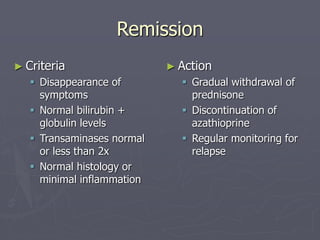
Remission
► Criteria
 Disappearance of
symptoms
 Normal bilirubin +
globulin levels
 Transaminases normal
or less than 2x
 Normal histology or
minimal inflammation
► Action
 Gradual withdrawal of
prednisone
 Discontinuation of
azathioprine
 Regular monitoring for
relapse
Treatment Failure
► Criteria
 Worsening clinical, labs
and histology despite
compliance
 Inc transaminasis by
67%
 Development of
jaundice, ascites or
hepatic encephalopathy
► Action
 Pred 60 mg/d or pred
30 mg/d with aza 150
mg/d x 1 mo
 Reduction of the dose
each month of
improvement until
maintenance levels
Incomplete Response
► Criteria
 Some or no
improvement in
clinical,labs and
histology during therapy
 Failure to achieve
remission after 3 years
 No worsening of
condition
► Action
 Reduction of dose to
lowest levels possible to
prevent worsening
 Indefinite treatment
Management of Relapse after Drug
Withdrawal
►Relapse at least twice
 Indefinite low dose prednisone
 Indefinite low dose azathioprine
Management of Suboptimal
Response to Initial Therapy
►Alternative medications
 Cyclosporine, 6MP, ursodeoxycholic acid,
budesonide, methotrexate, cyclophosphamide
and mycophenolate mofetil
►Liver Transplantation
 5 year graft survival 83-92%
 Disease recurrence is mild and easily managed
Hepatocellular Carcinoma
►Uncommon in the absence of cirrhosis or
coexisting hepatitis B or C
►If cirrhosis
 RUQ ultrasound
 Alfa fetoprotein every 6-12 months
Recommendations
►High dose prednisone alone or prednisone
and aza should be used in treatment failures
►Corticosteroid therapy should be considered
in the decompensated patient
►Liver transplantation should be considered
in the decompensated patient unable to
undergo salvage therapy
Case Presentation
AST 19
ALT 12
AP 54
Total protein/albumin 7.3/4.6
Total bilirubin 0.6
What would do next?

Autoimmune_Hepatitis.ppt pathologycomplete

  • 1.
  • 2.
    Case Presentation ► 54yo woman with abnormal liver function test  9 years ago patient with ele lfts  No complaints  PMH: migraine headaches, arthritis, bilateral tubal ligation, repair of ganglion cyst  Meds: Prempro, Imitrex  SH: rare alcohol, no tobacco  FH: no history of liver disease  PE: weight 104 lbs, no stigmata of Chronic liver disease
  • 3.
    Laboratory Data AST 214 ALT272 Alk Phos 74 Total Bili 0.6 Total Protein 8.0 Alb 3.0 ANA 1:1280 ASMA 1:80 AMA - Viral Serologies - Ferritin 75
  • 4.
    Other Data ►Sono: 3mm CBD, normal gallbladder, increase echogeneity c/w fatty liver ►Liver Biopsy: moderate piecemeal necrosis with early fibrosis, expanded portal tracts with plasma cells ►DX: Autoimmune Hepatitis ►RX: Steroids and Imuran
  • 5.
    Definition ►Self perpetuating hepatocellular inflammationof unknown cause ►Characterized by the presence of:  periportal hepatitis  Hypergammaglobulinemia  Serum liver-associated autoantibodies ►Exclusion of other chronic liver diseases
  • 6.
    Epidemiology ►1.9 cases per100,000 incidence of Autoimmune Hepatitis in western Europe ►Frequency of AIH among patients with chronic liver disease is 11% ►Accounts for 5.9% of transplantations in the US Boberg K. 1998: Scad J Gastro;33:99-103
  • 7.
    Background ►40% of patientswith untreated severe disease die within 6 mos of dx ►40% develop cirrhosis  54% develop esophageal varices ►20% die of hemorrhage ►An acute onset of illness is seen in 40% patients ►Prednisone and azathioprine are mainstay of treatment
  • 8.
    Clinical Manifestations ►Symptoms  Fatigue85%  Jaundice 77%  Abdominal pain 48%  Pruritus 36%  Anorexia 30%  Polymyalgias 30%  Diarrhea 28%  Fevers 18%
  • 9.
    Clinical Manifestations ►Physical Findings Hepatomegaly 78%  Jaundice 69%  Splenomegaly 32%  Spider nevi 58%  Ascites 20%  Encephalopathy 14%  Concurrent immune disease 48%
  • 10.
    Clinical Manifestations ►Laboratory features Elevated AST 100%  Hypergammaglobulinemia 92%  Inc immunoglobulin G level 91%  Hyperbilirubinemia 83%  Alk Phos >2x 33%
  • 11.
    Differential Diagnosis ►Wilson’s disease ►A1ATdeficiency ►Hemochromatosis ►Viral hepatitis ►Drug induced hepatitis
  • 12.
  • 13.
  • 14.
  • 15.
    Diagnostic Criteria ►Clinical criteria Presence of characteristic clinical features  Liver histology  Exclusion of other diseases ►Scoring criteria  Assess the strength of the diagnosis  Pretreatment and post-treatment  Helpful with variant or atypical forms of AIH
  • 16.
    Diagnostic Scoring Systemfor Atypical Autoimmune Hepatitis Category Factor Score Category Factor Score Gender female +2 Other immune Non-hepatic of immune nature +2 AP:AST >3 <1.5 -2 +2 autoabs Anti- SLA/LP,actin,LC1 +2 glob >2.0 1.5-2.0 1.0-1.5 <1.0 +3 +2 +1 0 histology Interface hepatitis Plasma cells Rosettes None of above +3 +1 +1 -5 ANA,SMA, LKM1 >1:80 1:80 1:40 <1:40 +3 +2 +1 0 HLA DR3 or DR4 +1 AMA positive -4 Rx response Remission alone Remission w/relapse +2 +3 Viral markers Positive negative -3 +3 Pretreatment definite dx probable dx >15 10-15 drugs Yes no -4 +1 Post-treatment definite dx probable dx >17 12-17 alcohol <25 gm/d >60 gm/s +2 -2
  • 17.
    Subclassification of AIH ►TypeI ►Type II ►Type III
  • 18.
    Type 1 AIH ►Diagnosticautoantibodies: ANA, ASMA ►Age: Bidmodal (10-20 and 45-70) ►% Women: 78 ►% Concurrent immune diseases: 41 ►Elevated gamma globulin: +++ ►Steroid responsiveness: +++ ►Progression to cirrhosis (%): 45
  • 19.
    Type II AIH ►Diagnosticautoantibodies: LKM1 ►Age: Pediatric (2-14), rare adults (4%) ►% Women: 89 ►% Concurrent autoimmune disease: 34 ►Elevated gamma-globulins: + ►Steroids responsive: ++ ►% progression to cirrhosis: 82
  • 20.
    Type III AIH ►Diagnosticautoantibodies: SLA and LP ►Age: adults (30-50) ►% Women: 90 ►% Concurrent autoimmune disease: 58 ►Elevated gamma-globulin: ++ ►Steroid responsive: +++ ►% progression to cirrhosis: 75
  • 21.
    Prognostic Indices ► Laboratoryfindings at presentation  AST>10x nl: 50%, 3-year mortality  AST>5x nl + GGT>2x; 90%, 10-yr mortality  AST<10x nl + GGT<2x; 49%, cirrhosis at 15 yr; 10% 10-yr mortality ► Histologic findings at presentation  Periportal hepatitis: 17%,cirrhosis at 5 yr; Nl 5 yr survival  Bridging necrosis: 82%, cirrhosis of 5 yr; 45%, 5-yr mortality  Cirrhosis: 58%, 5 yr-mortality
  • 22.
    Recommendations ►Diagnosis of AIHrequires aminotransferase and globulin levels; detection of ANA +/or SMA, anti-LKM1; and histology ►Diagnostic criteria for AIH should be applied to all patients ►If the diagnosis is not clear, a scoring method should be used
  • 23.
  • 24.
    Indications for Treatment AbsoluteRelative Serum AST>10x uln Symptoms (fatigue, arthralgia, jaundice) Serum AST>5x uln and globulin >2x nl Serum AST and globulin less than absolute criteria Bridging necrosis or multiacinar necrosis Interface hepatitis
  • 25.
    Treatment Regimens Prednisone onlyCombination (Pred + AZA) Week 1 60 mg 30 mg+50 mg Week 2 40 mg 20 mg+50 mg Week 3 30 mg 15 mg+50 mg Week 4 30 mg 15 mg+50 mg Maintenance until endpoint 20 mg 10mg+50 mg
  • 26.
    Reasons for Preference ►Prednisone  Cytopenia  TPMT deficiency  Pregnancy  Malignancy  Short course <6 mos ► Combination  Postmenopausal state  Osteoporosis  Brittle diabetes  Obesity  Acne  Emotional Lability  Hypertension
  • 27.
    Treatment Endpoints ►Remission  10-40%of patients ►Treatment Failure ►Incomplete Response ►Drug Toxicity
  • 28.
    Remission ► Criteria  Disappearanceof symptoms  Normal bilirubin + globulin levels  Transaminases normal or less than 2x  Normal histology or minimal inflammation ► Action  Gradual withdrawal of prednisone  Discontinuation of azathioprine  Regular monitoring for relapse
  • 29.
    Treatment Failure ► Criteria Worsening clinical, labs and histology despite compliance  Inc transaminasis by 67%  Development of jaundice, ascites or hepatic encephalopathy ► Action  Pred 60 mg/d or pred 30 mg/d with aza 150 mg/d x 1 mo  Reduction of the dose each month of improvement until maintenance levels
  • 30.
    Incomplete Response ► Criteria Some or no improvement in clinical,labs and histology during therapy  Failure to achieve remission after 3 years  No worsening of condition ► Action  Reduction of dose to lowest levels possible to prevent worsening  Indefinite treatment
  • 31.
    Management of Relapseafter Drug Withdrawal ►Relapse at least twice  Indefinite low dose prednisone  Indefinite low dose azathioprine
  • 32.
    Management of Suboptimal Responseto Initial Therapy ►Alternative medications  Cyclosporine, 6MP, ursodeoxycholic acid, budesonide, methotrexate, cyclophosphamide and mycophenolate mofetil ►Liver Transplantation  5 year graft survival 83-92%  Disease recurrence is mild and easily managed
  • 33.
    Hepatocellular Carcinoma ►Uncommon inthe absence of cirrhosis or coexisting hepatitis B or C ►If cirrhosis  RUQ ultrasound  Alfa fetoprotein every 6-12 months
  • 34.
    Recommendations ►High dose prednisonealone or prednisone and aza should be used in treatment failures ►Corticosteroid therapy should be considered in the decompensated patient ►Liver transplantation should be considered in the decompensated patient unable to undergo salvage therapy
  • 35.
    Case Presentation AST 19 ALT12 AP 54 Total protein/albumin 7.3/4.6 Total bilirubin 0.6 What would do next?