Welcome you all
By
Mrs. S. Malathi
Assistant Professor of English
V. V. V. College for Women
Virudhunagar
LIFE WRITING
AUTOBIOGRAPHY
AUTOBIOGRAPHY
• Derived from the Greek “autos” (self), “bios”
(life) and “grapheir” (write)
• It is a self-written account of life of a person.
• Was first used by William Taylor in 1797 in the
English periodical “The Monthly Review”.
• Then it was used by Robber society in 1809.
2/28/2023
Definition
Dr. Johnson- “Everyman’s life is best written by
himself”.
Longfellow – “Autobiography is a product of first
hand experience, Biography of second hand
knowledge”.
2/28/2023
Example of Autobiography
1. St. Augustine’s “Confessions” (5th century
A.D.) is the earliest example in Europe of full
and frank self analysis.
2. Rosseau’s “Confessions” in the latter half of
the 18th Century.
2/28/2023
Themes of autobiographies
• Notable English autobiographers David Hume,
Edward Gibbon and Benjamin Franklin used
subjective themes.
• Sir Sober Sitwell, Left hand, Right hand used
objective themes in their autobiography.
2/28/2023
Spiritual Autobiography
• Is an account of an author’s struggle or
journey towards god.
Eg: Augustine’s “Confessions”
2/28/2023
Fictional Autobiography
• Signifies novels about a fictional character
writer as though the character were writing
their own autobiography which addresses
both internal and external experiences of the
character.
Eg: Daniel Defoe’s “Moll Flanders”, Charles
Dickens’ “David Copperfield” and Charlottte
Bronte’s “Jane Eyre”
2/28/2023
History of Autobiography
• Classical Period – autobiographical works
were named as Apologia, Oration or
Confession. These works were considered as
self-justification rather than self-
documentation.
Eg: John Henry Newman’s “Apologia Provita
Sua” (1864).
2/28/2023
History of Autobiography
• Augustine(354-430) and Jean Jacques
Rousseau (18th century) used the same title
“Confessions” to their autobiographical works.
• Augustine’s “Confessions”- great masterpieces
of western literature.
• Celine’s “Vita” (1556-58) is one of the first and
great autobiographies of the Renaissance.
2/28/2023
History of Autobiography
• In English, “Book of Margery Kemp” is the
earliest autobiography published in the early
15th Century. This book remained in
Manuscript and was not published in 1936.
• 17th Century notable English autobiographies
– “Lord Herbert’s Cherub” and John Bunyan’s
“Grace Abounding to the Chief of Sinners”
(1666).
2/28/2023
History of Autobiography
• Notable autobiographers of the 19th Century
are Charles Dickens (incorporated
autobiographical elements in his novels),
Anton Trollope, John Stuart Mill, John Henry
Newman and P.T. Barnum.
• William Hazlitt’s “Liber Amoris” (1823) is
about the painful love-life of the author.
2/28/2023
History of Autobiography
• 20th Century – Rudyard Kipling, George
Moore, Winston Churchill, Mahatma Gandhi
and Pundit Nehru.
2/28/2023
Memoir
• Autobiography focuses on the “life and times”
while Memory is on his/her own feeling and
emotions.
Eg: Julius Caesar’s “Commentaries on the Gallic
wars”.
2/28/2023
• In English, 17th Century – Samuel Pepys and
John Evelyn
• 18th Century- Fanny Burney
• 19th Century- Thomas Geneve and Charles
Goreville
2/28/2023
Letters
• Letters have deep human interest and very
great historical importance.
Eg: Dorothy Osborne, Thomas Gray, William
Cowper, Horace Walpole and John Keats
2/28/2023
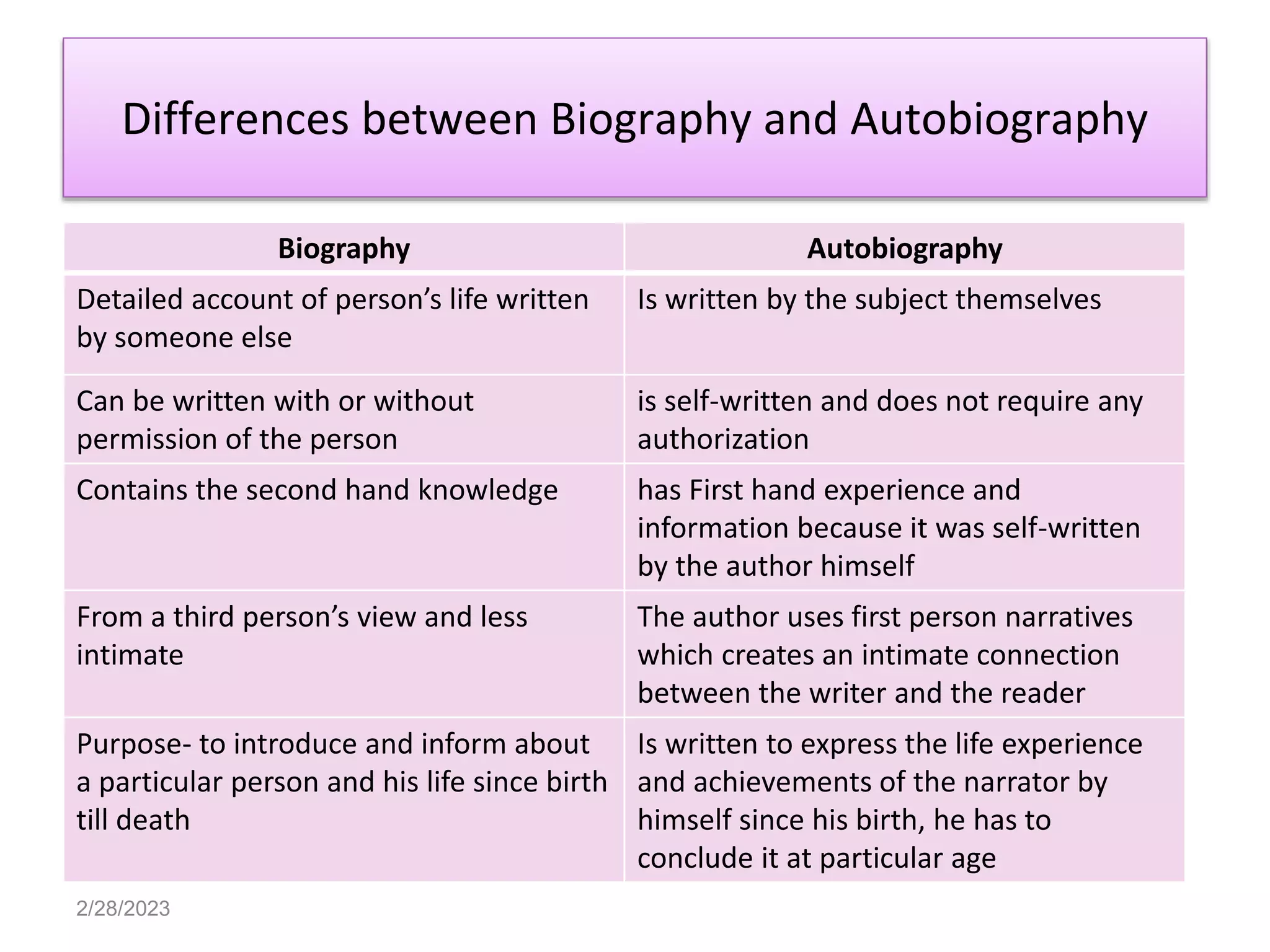
Differences between Biography and Autobiography
Biography Autobiography
Detailed account of person’s life written
by someone else
Is written by the subject themselves
Can be written with or without
permission of the person
is self-written and does not require any
authorization
Contains the second hand knowledge has First hand experience and
information because it was self-written
by the author himself
From a third person’s view and less
intimate
The author uses first person narratives
which creates an intimate connection
between the writer and the reader
Purpose- to introduce and inform about
a particular person and his life since birth
till death
Is written to express the life experience
and achievements of the narrator by
himself since his birth, he has to
conclude it at particular age
2/28/2023
Examples of English Autobiography
• Helen Keller’s - The Story of My Life”
• Jawaharlal Nehru - “An Autobiography”
• M. K. Gandhi – “The Story of My Experiments
with Truth”
• Kamala Das – “My Story”
• Anne Frank – “The Diary of a Young Girl”
• A.P.J. Abdul Kalam – “Wings of Fire”
2/28/2023
Difficulties of the Autobiographer
• Hard for a man to write of himself by grating his own
heart to say the truth.
• To recapture with any accurate impressions and
emotion of the distant path with entire freedom.
• Great care has to be taken in making any comments
on people who may be alive when the book appears.
• The Author was bound to omit the details of daily life
that are common to everyone, and must concentrate
on what was striking or exceptional
2/28/2023
Chief Characteristics
• The truth should be the hallmark of an
autobiography. Facts should not be perused.
• Courage and frankness are the essential
virtues of a good writer of autobiography. The
writer should not be secretive.
• The author should be objective in dealing with
contemporary events and personalities.
2/28/2023
Chief Characteristics
• The author should not be verbose in his
description or narration.
• Self-consciousness is the very essence of an
autobiography. A natural facility of expression
and flashes of humour and wit are essential
attributes of an autobiography.
2/28/2023

Autobiography- Introduction.pptx

  • 1.
    Welcome you all By Mrs.S. Malathi Assistant Professor of English V. V. V. College for Women Virudhunagar
  • 2.
  • 3.
    AUTOBIOGRAPHY • Derived fromthe Greek “autos” (self), “bios” (life) and “grapheir” (write) • It is a self-written account of life of a person. • Was first used by William Taylor in 1797 in the English periodical “The Monthly Review”. • Then it was used by Robber society in 1809. 2/28/2023
  • 4.
    Definition Dr. Johnson- “Everyman’slife is best written by himself”. Longfellow – “Autobiography is a product of first hand experience, Biography of second hand knowledge”. 2/28/2023
  • 5.
    Example of Autobiography 1.St. Augustine’s “Confessions” (5th century A.D.) is the earliest example in Europe of full and frank self analysis. 2. Rosseau’s “Confessions” in the latter half of the 18th Century. 2/28/2023
  • 6.
    Themes of autobiographies •Notable English autobiographers David Hume, Edward Gibbon and Benjamin Franklin used subjective themes. • Sir Sober Sitwell, Left hand, Right hand used objective themes in their autobiography. 2/28/2023
  • 7.
    Spiritual Autobiography • Isan account of an author’s struggle or journey towards god. Eg: Augustine’s “Confessions” 2/28/2023
  • 8.
    Fictional Autobiography • Signifiesnovels about a fictional character writer as though the character were writing their own autobiography which addresses both internal and external experiences of the character. Eg: Daniel Defoe’s “Moll Flanders”, Charles Dickens’ “David Copperfield” and Charlottte Bronte’s “Jane Eyre” 2/28/2023
  • 9.
    History of Autobiography •Classical Period – autobiographical works were named as Apologia, Oration or Confession. These works were considered as self-justification rather than self- documentation. Eg: John Henry Newman’s “Apologia Provita Sua” (1864). 2/28/2023
  • 10.
    History of Autobiography •Augustine(354-430) and Jean Jacques Rousseau (18th century) used the same title “Confessions” to their autobiographical works. • Augustine’s “Confessions”- great masterpieces of western literature. • Celine’s “Vita” (1556-58) is one of the first and great autobiographies of the Renaissance. 2/28/2023
  • 11.
    History of Autobiography •In English, “Book of Margery Kemp” is the earliest autobiography published in the early 15th Century. This book remained in Manuscript and was not published in 1936. • 17th Century notable English autobiographies – “Lord Herbert’s Cherub” and John Bunyan’s “Grace Abounding to the Chief of Sinners” (1666). 2/28/2023
  • 12.
    History of Autobiography •Notable autobiographers of the 19th Century are Charles Dickens (incorporated autobiographical elements in his novels), Anton Trollope, John Stuart Mill, John Henry Newman and P.T. Barnum. • William Hazlitt’s “Liber Amoris” (1823) is about the painful love-life of the author. 2/28/2023
  • 13.
    History of Autobiography •20th Century – Rudyard Kipling, George Moore, Winston Churchill, Mahatma Gandhi and Pundit Nehru. 2/28/2023
  • 14.
    Memoir • Autobiography focuseson the “life and times” while Memory is on his/her own feeling and emotions. Eg: Julius Caesar’s “Commentaries on the Gallic wars”. 2/28/2023
  • 15.
    • In English,17th Century – Samuel Pepys and John Evelyn • 18th Century- Fanny Burney • 19th Century- Thomas Geneve and Charles Goreville 2/28/2023
  • 16.
    Letters • Letters havedeep human interest and very great historical importance. Eg: Dorothy Osborne, Thomas Gray, William Cowper, Horace Walpole and John Keats 2/28/2023
  • 17.
    Differences between Biographyand Autobiography Biography Autobiography Detailed account of person’s life written by someone else Is written by the subject themselves Can be written with or without permission of the person is self-written and does not require any authorization Contains the second hand knowledge has First hand experience and information because it was self-written by the author himself From a third person’s view and less intimate The author uses first person narratives which creates an intimate connection between the writer and the reader Purpose- to introduce and inform about a particular person and his life since birth till death Is written to express the life experience and achievements of the narrator by himself since his birth, he has to conclude it at particular age 2/28/2023
  • 18.
    Examples of EnglishAutobiography • Helen Keller’s - The Story of My Life” • Jawaharlal Nehru - “An Autobiography” • M. K. Gandhi – “The Story of My Experiments with Truth” • Kamala Das – “My Story” • Anne Frank – “The Diary of a Young Girl” • A.P.J. Abdul Kalam – “Wings of Fire” 2/28/2023
  • 19.
    Difficulties of theAutobiographer • Hard for a man to write of himself by grating his own heart to say the truth. • To recapture with any accurate impressions and emotion of the distant path with entire freedom. • Great care has to be taken in making any comments on people who may be alive when the book appears. • The Author was bound to omit the details of daily life that are common to everyone, and must concentrate on what was striking or exceptional 2/28/2023
  • 20.
    Chief Characteristics • Thetruth should be the hallmark of an autobiography. Facts should not be perused. • Courage and frankness are the essential virtues of a good writer of autobiography. The writer should not be secretive. • The author should be objective in dealing with contemporary events and personalities. 2/28/2023
  • 21.
    Chief Characteristics • Theauthor should not be verbose in his description or narration. • Self-consciousness is the very essence of an autobiography. A natural facility of expression and flashes of humour and wit are essential attributes of an autobiography. 2/28/2023