Group members:
    (125) Anusha Jain
(129) Garima Madhok
(144) Jinan Navlakha
 (150) Palak Agarwal
  (164) Saurabh Arya
   (176) Yajur Gupta
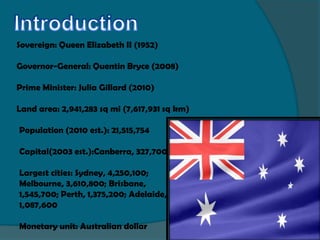
Sovereign: Queen Elizabeth II (1952)

Governor-General: Quentin Bryce (2008)

Prime Minister: Julia Gillard (2010)

Land area: 2,941,283 sq mi (7,617,931 sq km)

Population (2010 est.): 21,515,754

Capital(2003 est.):Canberra, 327,700

Largest cities: Sydney, 4,250,100;
Melbourne, 3,610,800; Brisbane,
1,545,700; Perth, 1,375,200; Adelaide,
1,087,600

Monetary unit: Australian dollar
Australia, officially the Commonwealth of Australia, is a country in the
Southern Hemisphere comprising the mainland of the Australian
continent, the island of Tasmania and numerous smaller islands in the
Indian and Pacific Oceans.

The first inhabitants of Australia were the Aborigines, who migrated
there at least 40,000 years ago from Southeast Asia.

On 1 January 1901, the six colonies became a federation and the
Commonwealth of Australia was formed.

A prosperous developed country, Australia is the world's thirteenth
largest economy.

Democracy. Symbolic executive power is vested in the British monarch,
who is represented throughout Australia by the governor-general.
•   The first settlers, the aborigines, are thought to have
    arrived around 50,000 years ago.

•   The first documented and undisputed European sighting
    of and landing on Australia was in March 1606, by the
    Dutch navigator Willem Janszoon.

•    Most Australians are immigrants or the descendants of
    immigrants, having a multicultural background, who
    arrived during the past two centuries from more than
    200 countries.

•    Being a multicultural country, Australia consists of
    various cultures such as English & Welsh(70%), Irish(24%),
    Scottish(5%)
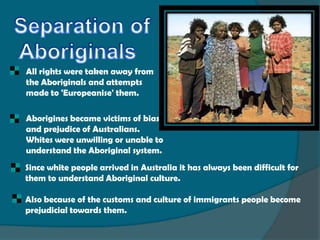
   All rights were taken away from
    the Aboriginals and attempts
    made to 'Europeanise' them.

   Aborigines became victims of bias
    and prejudice of Australians.
    Whites were unwilling or unable to
    understand the Aboriginal system.
    Since white people arrived in Australia it has always been difficult for
    them to understand Aboriginal culture.

    Also because of the customs and culture of immigrants people become
    prejudicial towards them.
Australia is a society of people from a
    rich variety of cultural, ethnic,
    linguistic and religious backgrounds.

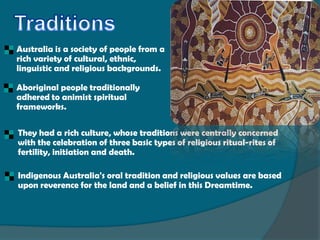
    Aboriginal people traditionally
    adhered to animist spiritual
    frameworks.

   They had a rich culture, whose traditions were centrally concerned
    with the celebration of three basic types of religious ritual-rites of
    fertility, initiation and death.

   Indigenous Australia's oral tradition and religious values are based
    upon reverence for the land and a belief in this Dreamtime.
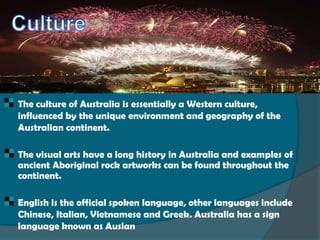
   The culture of Australia is essentially a Western culture,
    influenced by the unique environment and geography of the
    Australian continent.

   The visual arts have a long history in Australia and examples of
    ancient Aboriginal rock artworks can be found throughout the
    continent.

   English is the official spoken language, other languages include
    Chinese, Italian, Vietnamese and Greek. Australia has a sign
    language known as Auslan
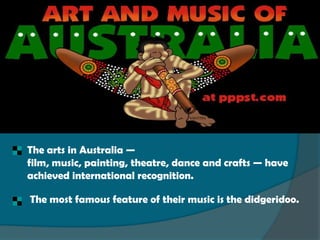
The arts in Australia —
film, music, painting, theatre, dance and crafts — have
achieved international recognition.

The most famous feature of their music is the didgeridoo.
Australians see themselves as believing in democracy,
justice, caring for others, equality, a less selfish society,
loyalty and freedom of self-determination .

Their self image focuses on the conquering of fear, sport,
strength of character and achievement, and physical
prowess.
Believe in fair go attitude

"Underdog" identity

Australians respect women, other people's
beliefs, democracy

Easy Going
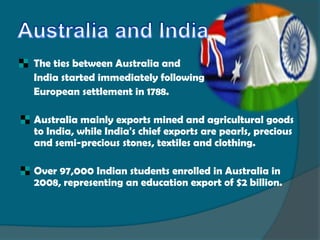
The ties between Australia and
    India started immediately following
    European settlement in 1788.

   Australia mainly exports mined and agricultural goods
    to India, while India's chief exports are pearls, precious
    and semi-precious stones, textiles and clothing.

   Over 97,000 Indian students enrolled in Australia in
    2008, representing an education export of $2 billion.
   Friendly rivalry with the New Zealanders.

   Australia shares one of the closest international relations
    with UK

   It shares diplomatic relations with Indonesia

   It has close political and trade ties with East Timor

   Australia has cordial relations with Papua New Guinea

   Relations with the Solomon Islands are strained
Men wear a conservative
dark business suit and tie.
‡
Women may wear a dress,
or skirt and blouse, for business.
‡
Informal clothing is appropriate
when not attending business functions.
Casual pants are fine for both men and women.
‡
   Punctuality is an essential part of Australian business
    practice.

   Schedule business appointments approximately one
    month in advance.

   Tend to initiate a first name basis with their fellow
    business associates quickly.

   It is customary to shake hands at the beginning and end
    of a meeting.
   It is essential to establish personal relationships with
    those you are conducting business with.

   Will negotiate major issues in an open and direct
    manner.

   Gift giving is not a common practice in business.

   Exchanging business cards is common among
    professional workers.
    The stock of foreign investment in
    Australia at 31 December 2007 totaled
    $1.6 trillion.

   The stock of Australian investment
    abroad was worth $884 billion.

   Australia’s two-way trade in goods
    and services was valued at $454
    billion in 2007.

   Australia’s exports of goods and
    services grew by 3.8 per cent to $218
    billion in 2007, about 20 per cent of
    Gross Domestic Product (GDP).
   Egalitarianism - it creates a society that avoids
    differentiation between individuals.

   Openness - Australians on the whole, receptive to
    new ideas and encourage lively discussion or
    debate

   Individualism - Importance is given to personal
    privacy and the segregation of the public and
    private life of individuals.
Do’s
   DO partake in some initial “small talk” before a business
    meeting begins.

   DO keep a certain amount of distance when in conversation
    with your Australian counterparts.

   DO maintain good, direct eye contact with your Australian
    colleagues during all business meetings and conversations as
    this helps to establish trust.
Don’ts
 DON’T over exaggerate or boast about your company’s
 abilities or build up business information.
 DON’T discuss aspects of your personal life during business
 negotiations. Privacy is an important element of everyday
 life in Australia.
 DON’T use aggressive sales techniques whilst negotiating
Australia Business
Australia Business

Australia Business

  • 1.
    Group members: (125) Anusha Jain (129) Garima Madhok (144) Jinan Navlakha (150) Palak Agarwal (164) Saurabh Arya (176) Yajur Gupta
  • 2.
    Sovereign: Queen ElizabethII (1952) Governor-General: Quentin Bryce (2008) Prime Minister: Julia Gillard (2010) Land area: 2,941,283 sq mi (7,617,931 sq km) Population (2010 est.): 21,515,754 Capital(2003 est.):Canberra, 327,700 Largest cities: Sydney, 4,250,100; Melbourne, 3,610,800; Brisbane, 1,545,700; Perth, 1,375,200; Adelaide, 1,087,600 Monetary unit: Australian dollar
  • 3.
    Australia, officially theCommonwealth of Australia, is a country in the Southern Hemisphere comprising the mainland of the Australian continent, the island of Tasmania and numerous smaller islands in the Indian and Pacific Oceans. The first inhabitants of Australia were the Aborigines, who migrated there at least 40,000 years ago from Southeast Asia. On 1 January 1901, the six colonies became a federation and the Commonwealth of Australia was formed. A prosperous developed country, Australia is the world's thirteenth largest economy. Democracy. Symbolic executive power is vested in the British monarch, who is represented throughout Australia by the governor-general.
  • 4.
    The first settlers, the aborigines, are thought to have arrived around 50,000 years ago. • The first documented and undisputed European sighting of and landing on Australia was in March 1606, by the Dutch navigator Willem Janszoon. • Most Australians are immigrants or the descendants of immigrants, having a multicultural background, who arrived during the past two centuries from more than 200 countries. • Being a multicultural country, Australia consists of various cultures such as English & Welsh(70%), Irish(24%), Scottish(5%)
  • 5.
    All rights were taken away from the Aboriginals and attempts made to 'Europeanise' them.  Aborigines became victims of bias and prejudice of Australians. Whites were unwilling or unable to understand the Aboriginal system. Since white people arrived in Australia it has always been difficult for them to understand Aboriginal culture. Also because of the customs and culture of immigrants people become prejudicial towards them.
  • 6.
    Australia is asociety of people from a rich variety of cultural, ethnic, linguistic and religious backgrounds. Aboriginal people traditionally adhered to animist spiritual frameworks.  They had a rich culture, whose traditions were centrally concerned with the celebration of three basic types of religious ritual-rites of fertility, initiation and death.  Indigenous Australia's oral tradition and religious values are based upon reverence for the land and a belief in this Dreamtime.
  • 7.
    The culture of Australia is essentially a Western culture, influenced by the unique environment and geography of the Australian continent.  The visual arts have a long history in Australia and examples of ancient Aboriginal rock artworks can be found throughout the continent.  English is the official spoken language, other languages include Chinese, Italian, Vietnamese and Greek. Australia has a sign language known as Auslan
  • 8.
    The arts inAustralia — film, music, painting, theatre, dance and crafts — have achieved international recognition. The most famous feature of their music is the didgeridoo.
  • 9.
    Australians see themselvesas believing in democracy, justice, caring for others, equality, a less selfish society, loyalty and freedom of self-determination . Their self image focuses on the conquering of fear, sport, strength of character and achievement, and physical prowess.
  • 10.
    Believe in fairgo attitude "Underdog" identity Australians respect women, other people's beliefs, democracy Easy Going
  • 11.
    The ties betweenAustralia and India started immediately following European settlement in 1788.  Australia mainly exports mined and agricultural goods to India, while India's chief exports are pearls, precious and semi-precious stones, textiles and clothing.  Over 97,000 Indian students enrolled in Australia in 2008, representing an education export of $2 billion.
  • 12.
    Friendly rivalry with the New Zealanders.  Australia shares one of the closest international relations with UK  It shares diplomatic relations with Indonesia  It has close political and trade ties with East Timor  Australia has cordial relations with Papua New Guinea  Relations with the Solomon Islands are strained
  • 13.
    Men wear aconservative dark business suit and tie. ‡ Women may wear a dress, or skirt and blouse, for business. ‡ Informal clothing is appropriate when not attending business functions. Casual pants are fine for both men and women. ‡
  • 14.
    Punctuality is an essential part of Australian business practice.  Schedule business appointments approximately one month in advance.  Tend to initiate a first name basis with their fellow business associates quickly.  It is customary to shake hands at the beginning and end of a meeting.
  • 15.
    It is essential to establish personal relationships with those you are conducting business with.  Will negotiate major issues in an open and direct manner.  Gift giving is not a common practice in business.  Exchanging business cards is common among professional workers.
  • 16.
    The stock of foreign investment in Australia at 31 December 2007 totaled $1.6 trillion.  The stock of Australian investment abroad was worth $884 billion.  Australia’s two-way trade in goods and services was valued at $454 billion in 2007.  Australia’s exports of goods and services grew by 3.8 per cent to $218 billion in 2007, about 20 per cent of Gross Domestic Product (GDP).
  • 17.
    Egalitarianism - it creates a society that avoids differentiation between individuals.  Openness - Australians on the whole, receptive to new ideas and encourage lively discussion or debate  Individualism - Importance is given to personal privacy and the segregation of the public and private life of individuals.
  • 18.
    Do’s  DO partake in some initial “small talk” before a business meeting begins.  DO keep a certain amount of distance when in conversation with your Australian counterparts.  DO maintain good, direct eye contact with your Australian colleagues during all business meetings and conversations as this helps to establish trust.
  • 19.
    Don’ts DON’T overexaggerate or boast about your company’s abilities or build up business information. DON’T discuss aspects of your personal life during business negotiations. Privacy is an important element of everyday life in Australia. DON’T use aggressive sales techniques whilst negotiating