Augmented reality for learning and teaching:  A literature review of the state-of-the-art Yu-Chang Hsu Anthony Saba
Azuma's (1997) definitions of AR Combines real and virtual  Interactive in real time  [Jurassic Park virtual objects--  not interactive] Registered in 3D  [football information on TV--2D]    
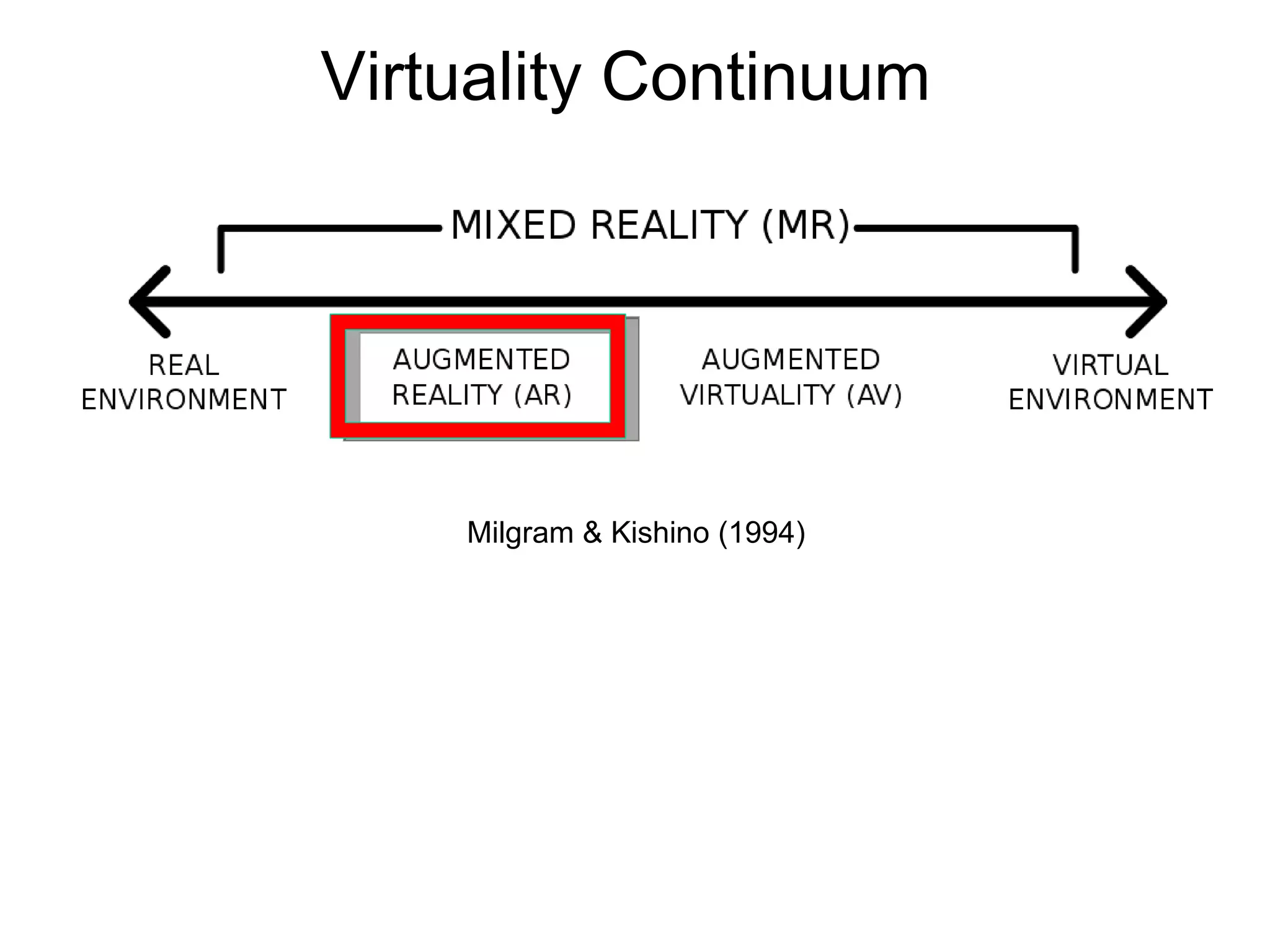
Virtuality Continuum  Milgram & Kishino (1994)  
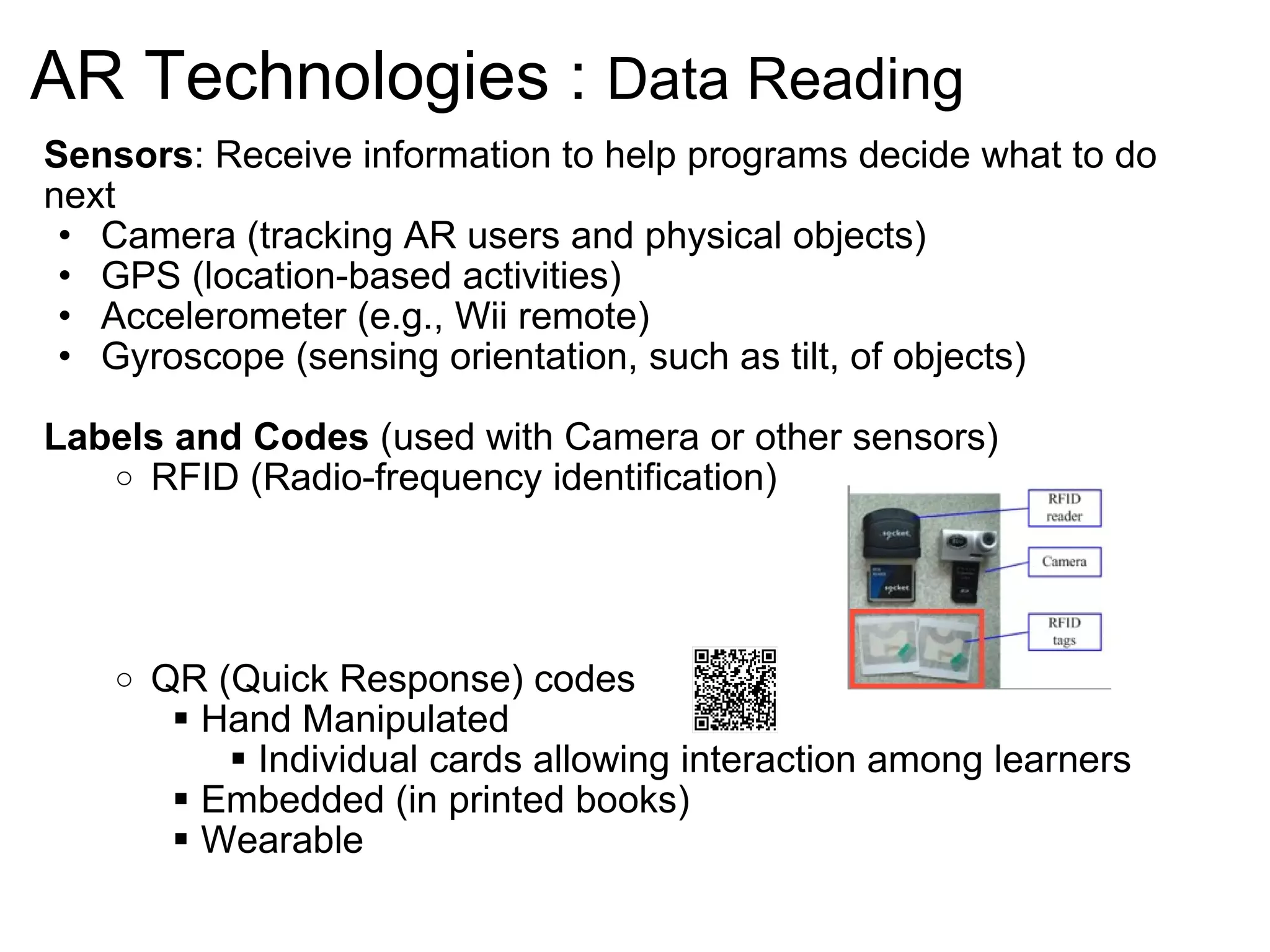
AR Technologies :  Data Reading Sensors : Receive information to help programs decide what to do next Camera (tracking AR users and physical objects)  GPS (location-based activities) Accelerometer (e.g., Wii remote) Gyroscope (sensing orientation, such as tilt, of objects) Labels and Codes  (used with Camera or other sensors) RFID ( Radio-frequency identification) QR (Quick Response) codes Hand Manipulated  Individual cards allowing interaction among learners Embedded (in printed books) Wearable          
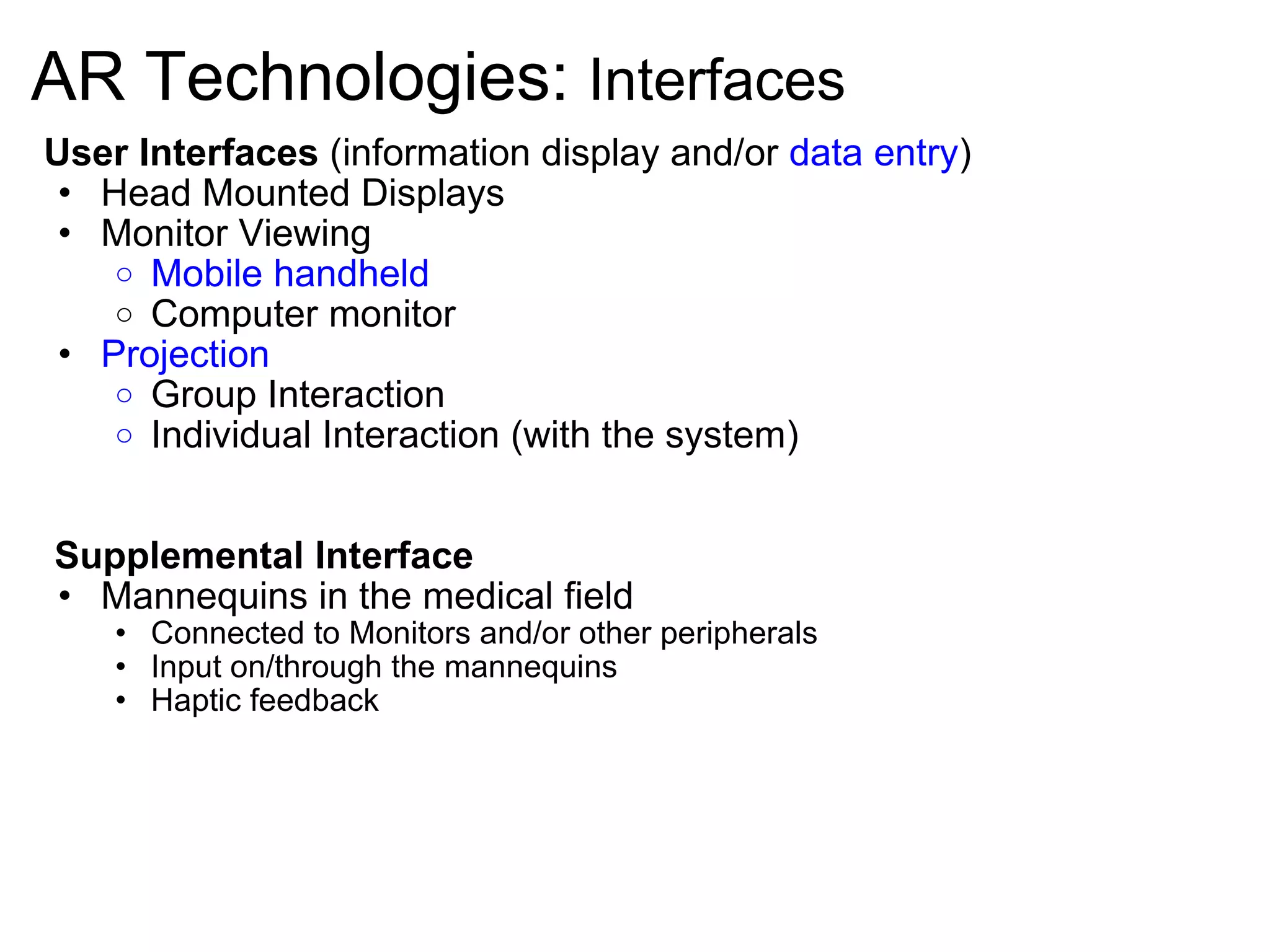
AR Technologies:  Interfaces User Interfaces  (information display and/or  data entry ) Head Mounted Displays Monitor Viewing Mobile handheld Computer monitor Projection Group Interaction  Individual Interaction (with the system)       Supplemental Interface Mannequins in the medical field Connected to Monitors and/or other peripherals Input on/through the mannequins Haptic feedback      
Potential Benefit of AR in Education Reduce cognitive load Simulation situated in physical environment—learning in context  Diversity in applications for various implementations Physical exercise through psychomotor activities Multi-sensory feedback
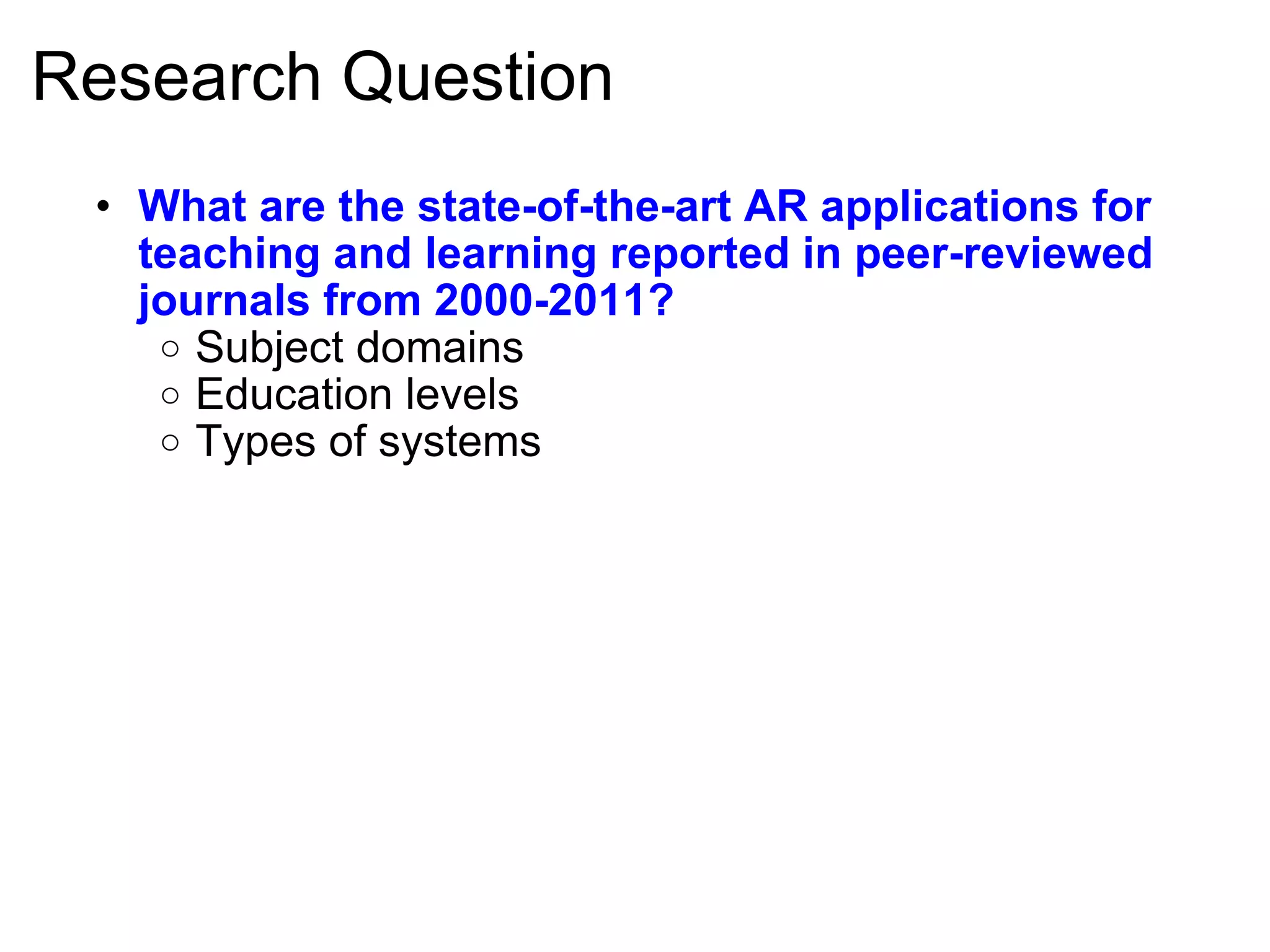
Research Question What are the state-of-the-art AR applications for teaching and learning reported in peer-reviewed journals from 2000-2011? Subject domains Education levels Types of systems
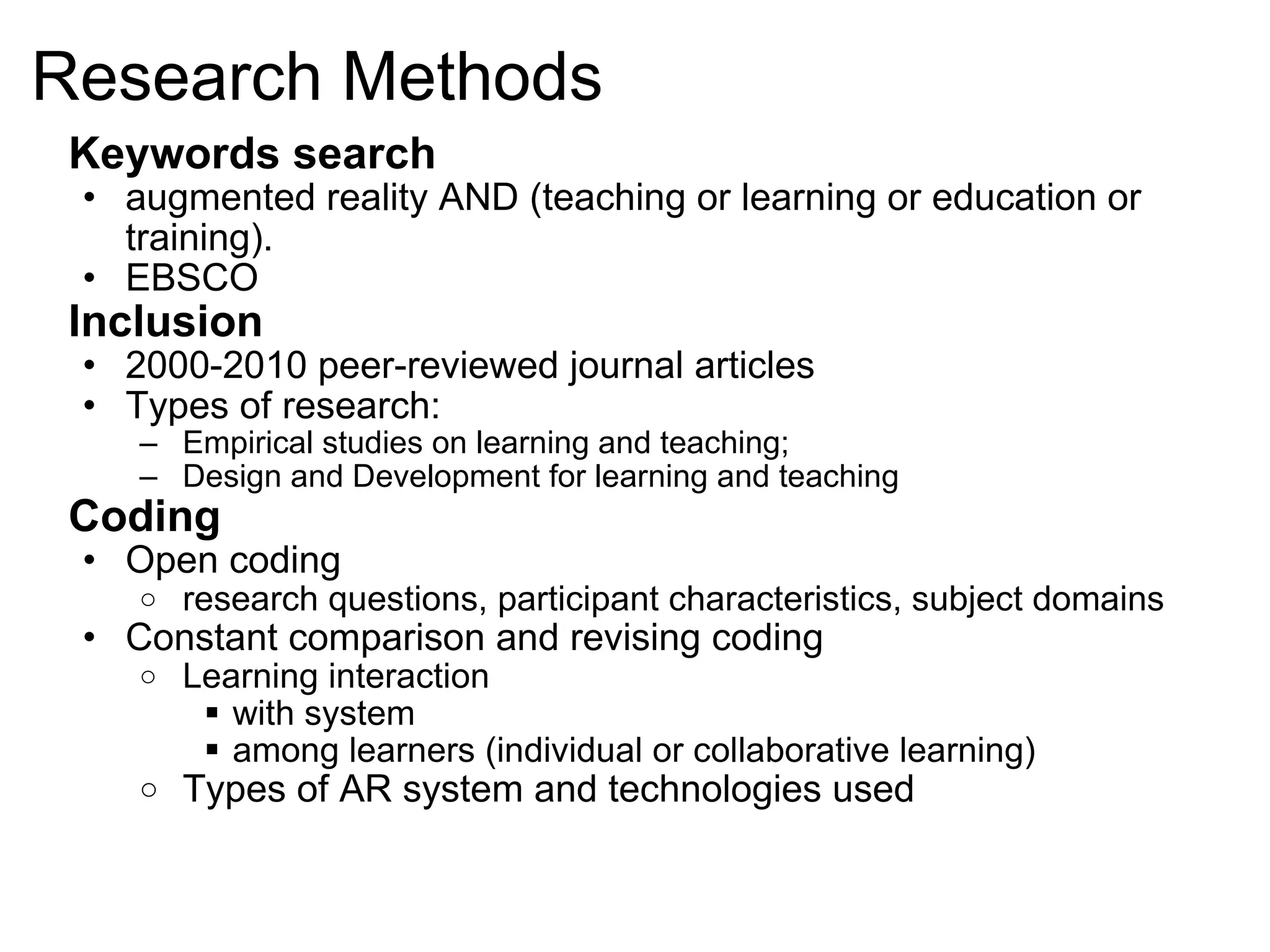
Research Methods Keywords search  augmented reality AND (teaching or learning or education or training).  EBSCO Inclusion 2000-2010 peer-reviewed journal articles Types of research:  Empirical studies on learning and teaching;  Design and Development for learning and teaching Coding  Open coding research questions, participant characteristics, subject domains Constant comparison and revising coding  Learning interaction  with system among learners (individual or collaborative learning) Types of AR system and technologies used
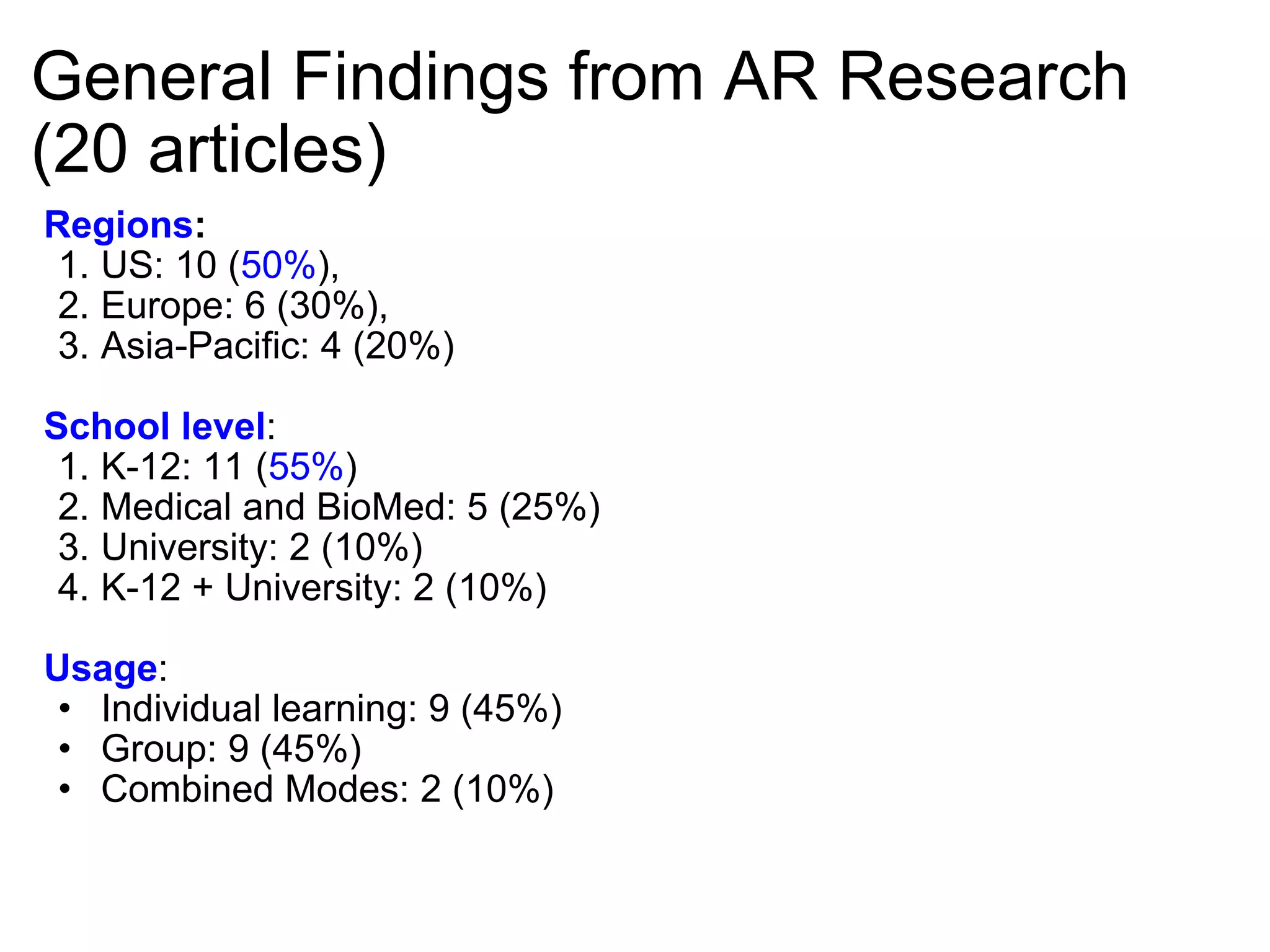
General Findings from AR Research (20 articles) Regions :  US: 10 ( 50% ),  Europe: 6 (30%),  Asia-Pacific: 4 (20%)   School level : K-12: 11 ( 55% ) Medical and BioMed: 5 (25%)  University: 2 (10%) K-12 + University: 2 (10%)    Usage :  Individual learning: 9 (45%)  Group: 9 (45%) Combined Modes: 2 (10%)
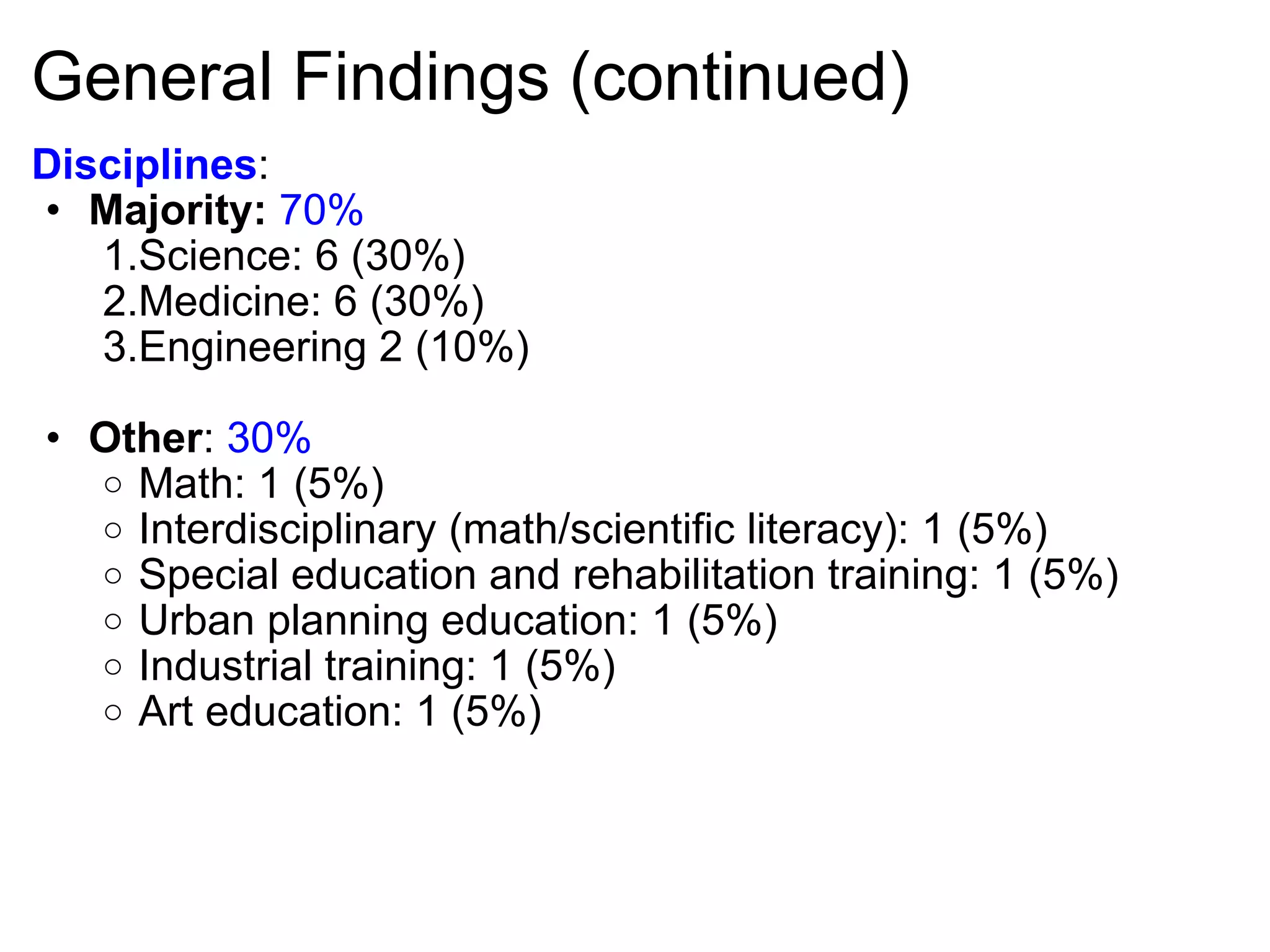
General Findings (continued) Disciplines :  Majority:  70% Science: 6 (30%)  Medicine: 6 (30%) Engineering 2 (10%)    Other :   30% Math: 1 (5%)  Interdisciplinary (math/scientific literacy): 1 (5%) Special education and rehabilitation training: 1 (5%) Urban planning education: 1 (5%) Industrial training: 1 (5%) Art education: 1 (5%)
General Findings (continued) Types of Display Systems :  Computer Monitor Displays (plus mannequins or marker cards): 8 ( 40% )  Mobile Handheld Displays: 6 ( 30% )  Projection Systems: 4 (20%) Head Mounted Displays: 2 (10%)
Diverse Applications
Mobile Handheld Display Dunleavy, Dede, & Mitchell (2008)  [Collaborative/GPS location-based] (USA) Middle school and high school students  Math & Scientific literacy Scenario: Alien Contact! investigate alien's encounter with Earth with inter-dependent pieces of information Four-student team Results High engagement due to Handheld and GPS Collecting Data Outside Concern GPS Issue Complexity and high management need (difficult to scale up) Much requirement on students (technology/content knowledge/collaboration task)
Mobile handheld through Camera Scanning/Sensor (RFID) Liu, Tan, & Chu (2009)  EULER [Ubiquitous Learning with Educational Resources] (EULER)] (Taiwan) 5th graders and their teachers Wetland ecology AR contextual content virtual objects overlay Learning  collaborative learning context-aware learning Outcomes AR group better than control group (textbook only) on post-test no control of time on learning   Perceptions: Easy to use; believe to help their learning.  
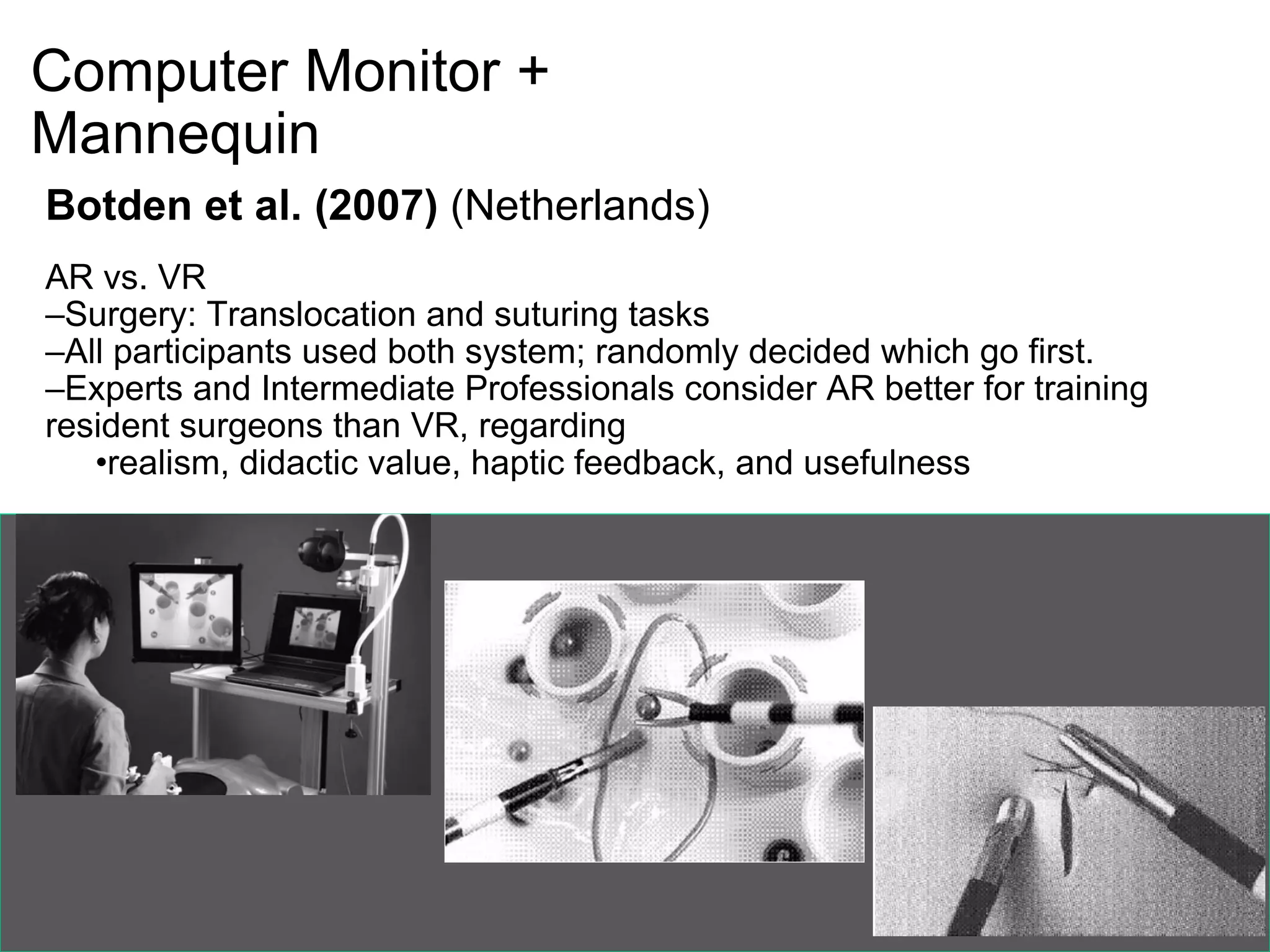
Computer Monitor +  Mannequin Botden et al. (2007)  (Netherlands) AR vs. VR Surgery: Translocation and suturing tasks All participants used both system; randomly decided which go first. Experts and Intermediate Professionals consider AR better for training resident surgeons than VR, regarding realism, didactic value, haptic feedback, and usefulness  
Projection- Group-based   Birchfield et al. (2009) Situated Multimedia Arts Learning Lab [SMALLab] (USA) Group  &  Collaborative learning Urban high school Earth Science Building “layer cake” (rock formations and sediments)  Reinforced concepts taught previously AR Components and interaction Control virtual element to build the layered structure of rock formations together Shake Wii remote to generate fault events Sig. gains in concept learning Engagement and modeling Collaboration and negotiation
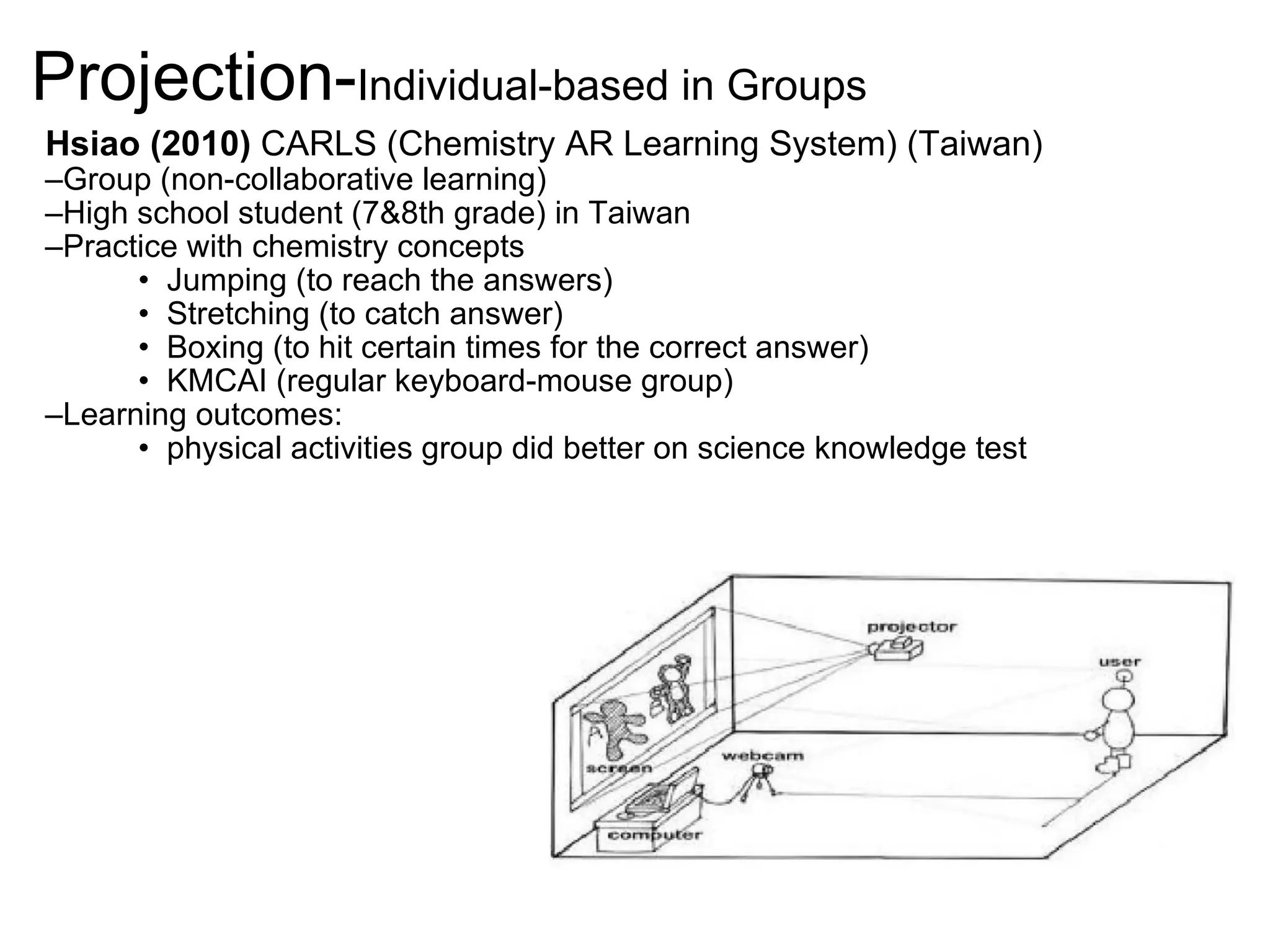
Projection- Individual-based in Groups Hsiao (2010)  CARLS (Chemistry AR Learning System) (Taiwan) Group (non-collaborative learning) High school student (7&8th grade) in Taiwan Practice with chemistry concepts Jumping (to reach the answers) Stretching (to catch answer) Boxing (to hit certain times for the correct answer) KMCAI (regular keyboard-mouse group) Learning outcomes: physical activities group did better on science knowledge test  
  Head Mounted Displays Kaufmann & Schmalstieg (2003)  [Construct3D] (Austria) Math/geometry Develop Spatial ability Experience dynamic geometry Potential for collaborative learning through negotiating modifications Engagement in and motivation due to Co-interacting with virtual objects Making modifications  “ walk around and under” to appreciate their creation”
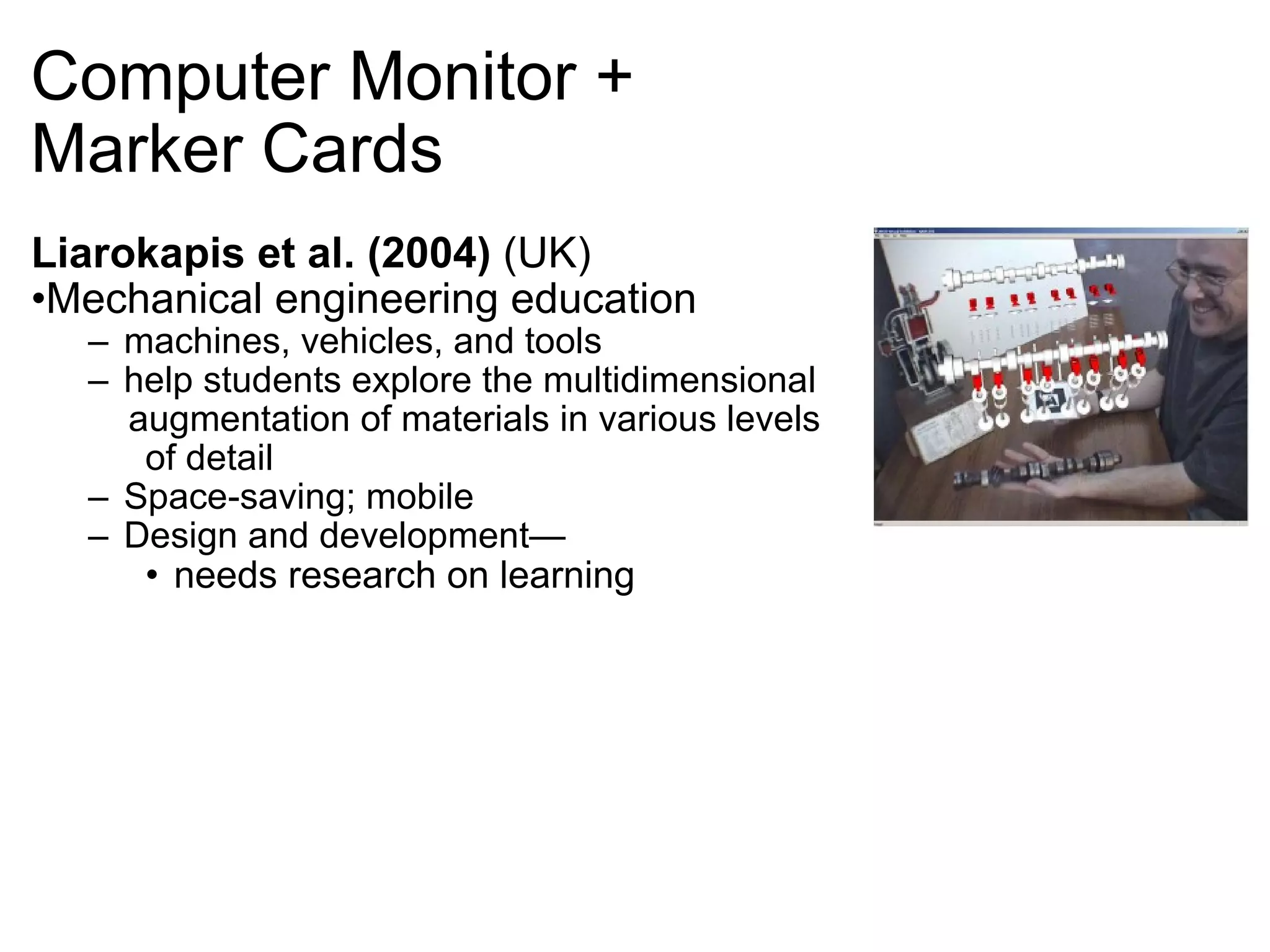
Computer Monitor +  Marker Cards Liarokapis et al. (2004)  (UK) Mechanical engineering education machines, vehicles, and tools help students explore the multidimensional  augmentation of materials in various levels  of detail Space-saving; mobile Design and development— needs research on learning  
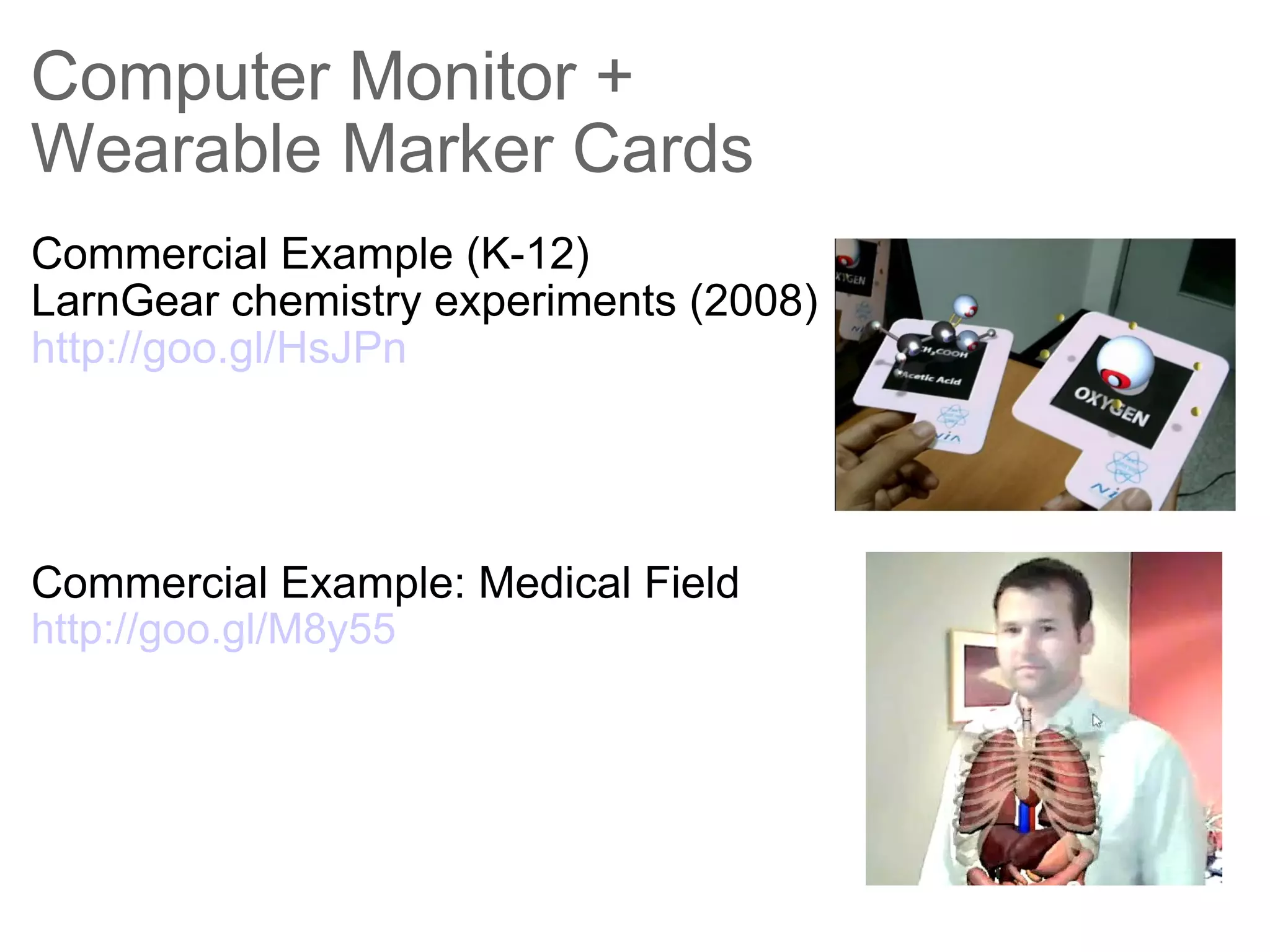
Computer Monitor + Wearable Marker Cards Commercial Example (K-12) LarnGear chemistry experiments (2008) http://goo.gl/HsJPn   Commercial Example: Medical Field  http://goo.gl/M8y55
Conclusions AR is more than presentation Interaction and collaboration Engagement and learning improvement Contextual relevance and immediacy Some Challenge Scalability issues due to learning design AR system literacy Good diversity AR systems Learning domains International research Many examples available, but research on learning lacking in Embedded and manipulated marker cards (e.g., chemistry experiments, human organs)    Disciplines other than STEM education and Medicine, such as Humanities and social sciences (e.g., history, language learning, etc.)
Contact:   [email_address]   [email_address]

Augmented Reality for Learning and Teaching

  • 1.
    Augmented reality forlearning and teaching:  A literature review of the state-of-the-art Yu-Chang Hsu Anthony Saba
  • 2.
    Azuma's (1997) definitionsof AR Combines real and virtual Interactive in real time [Jurassic Park virtual objects-- not interactive] Registered in 3D [football information on TV--2D]    
  • 3.
    Virtuality Continuum Milgram & Kishino (1994)  
  • 4.
    AR Technologies : Data Reading Sensors : Receive information to help programs decide what to do next Camera (tracking AR users and physical objects) GPS (location-based activities) Accelerometer (e.g., Wii remote) Gyroscope (sensing orientation, such as tilt, of objects) Labels and Codes (used with Camera or other sensors) RFID ( Radio-frequency identification) QR (Quick Response) codes Hand Manipulated  Individual cards allowing interaction among learners Embedded (in printed books) Wearable          
  • 5.
    AR Technologies: Interfaces User Interfaces (information display and/or data entry ) Head Mounted Displays Monitor Viewing Mobile handheld Computer monitor Projection Group Interaction  Individual Interaction (with the system)       Supplemental Interface Mannequins in the medical field Connected to Monitors and/or other peripherals Input on/through the mannequins Haptic feedback      
  • 6.
    Potential Benefit ofAR in Education Reduce cognitive load Simulation situated in physical environment—learning in context Diversity in applications for various implementations Physical exercise through psychomotor activities Multi-sensory feedback
  • 7.
    Research Question Whatare the state-of-the-art AR applications for teaching and learning reported in peer-reviewed journals from 2000-2011? Subject domains Education levels Types of systems
  • 8.
    Research Methods Keywordssearch augmented reality AND (teaching or learning or education or training).  EBSCO Inclusion 2000-2010 peer-reviewed journal articles Types of research: Empirical studies on learning and teaching; Design and Development for learning and teaching Coding Open coding research questions, participant characteristics, subject domains Constant comparison and revising coding  Learning interaction  with system among learners (individual or collaborative learning) Types of AR system and technologies used
  • 9.
    General Findings fromAR Research (20 articles) Regions :  US: 10 ( 50% ),  Europe: 6 (30%),  Asia-Pacific: 4 (20%)   School level : K-12: 11 ( 55% ) Medical and BioMed: 5 (25%) University: 2 (10%) K-12 + University: 2 (10%)   Usage :  Individual learning: 9 (45%) Group: 9 (45%) Combined Modes: 2 (10%)
  • 10.
    General Findings (continued)Disciplines :  Majority: 70% Science: 6 (30%) Medicine: 6 (30%) Engineering 2 (10%)   Other : 30% Math: 1 (5%) Interdisciplinary (math/scientific literacy): 1 (5%) Special education and rehabilitation training: 1 (5%) Urban planning education: 1 (5%) Industrial training: 1 (5%) Art education: 1 (5%)
  • 11.
    General Findings (continued)Types of Display Systems : Computer Monitor Displays (plus mannequins or marker cards): 8 ( 40% ) Mobile Handheld Displays: 6 ( 30% ) Projection Systems: 4 (20%) Head Mounted Displays: 2 (10%)
  • 12.
  • 13.
    Mobile Handheld DisplayDunleavy, Dede, & Mitchell (2008) [Collaborative/GPS location-based] (USA) Middle school and high school students Math & Scientific literacy Scenario: Alien Contact! investigate alien's encounter with Earth with inter-dependent pieces of information Four-student team Results High engagement due to Handheld and GPS Collecting Data Outside Concern GPS Issue Complexity and high management need (difficult to scale up) Much requirement on students (technology/content knowledge/collaboration task)
  • 14.
    Mobile handheld throughCamera Scanning/Sensor (RFID) Liu, Tan, & Chu (2009) EULER [Ubiquitous Learning with Educational Resources] (EULER)] (Taiwan) 5th graders and their teachers Wetland ecology AR contextual content virtual objects overlay Learning collaborative learning context-aware learning Outcomes AR group better than control group (textbook only) on post-test no control of time on learning   Perceptions: Easy to use; believe to help their learning.  
  • 15.
    Computer Monitor + Mannequin Botden et al. (2007)  (Netherlands) AR vs. VR Surgery: Translocation and suturing tasks All participants used both system; randomly decided which go first. Experts and Intermediate Professionals consider AR better for training resident surgeons than VR, regarding realism, didactic value, haptic feedback, and usefulness  
  • 16.
    Projection- Group-based  Birchfield et al. (2009) Situated Multimedia Arts Learning Lab [SMALLab] (USA) Group & Collaborative learning Urban high school Earth Science Building “layer cake” (rock formations and sediments) Reinforced concepts taught previously AR Components and interaction Control virtual element to build the layered structure of rock formations together Shake Wii remote to generate fault events Sig. gains in concept learning Engagement and modeling Collaboration and negotiation
  • 17.
    Projection- Individual-based inGroups Hsiao (2010) CARLS (Chemistry AR Learning System) (Taiwan) Group (non-collaborative learning) High school student (7&8th grade) in Taiwan Practice with chemistry concepts Jumping (to reach the answers) Stretching (to catch answer) Boxing (to hit certain times for the correct answer) KMCAI (regular keyboard-mouse group) Learning outcomes: physical activities group did better on science knowledge test  
  • 18.
      Head MountedDisplays Kaufmann & Schmalstieg (2003)  [Construct3D] (Austria) Math/geometry Develop Spatial ability Experience dynamic geometry Potential for collaborative learning through negotiating modifications Engagement in and motivation due to Co-interacting with virtual objects Making modifications “ walk around and under” to appreciate their creation”
  • 19.
    Computer Monitor + Marker Cards Liarokapis et al. (2004)  (UK) Mechanical engineering education machines, vehicles, and tools help students explore the multidimensional augmentation of materials in various levels of detail Space-saving; mobile Design and development— needs research on learning  
  • 20.
    Computer Monitor +Wearable Marker Cards Commercial Example (K-12) LarnGear chemistry experiments (2008) http://goo.gl/HsJPn Commercial Example: Medical Field http://goo.gl/M8y55
  • 21.
    Conclusions AR ismore than presentation Interaction and collaboration Engagement and learning improvement Contextual relevance and immediacy Some Challenge Scalability issues due to learning design AR system literacy Good diversity AR systems Learning domains International research Many examples available, but research on learning lacking in Embedded and manipulated marker cards (e.g., chemistry experiments, human organs)    Disciplines other than STEM education and Medicine, such as Humanities and social sciences (e.g., history, language learning, etc.)
  • 22.
    Contact:   [email_address]  [email_address]