Download the full version and explore a variety of test banks
or solution manuals at https://testbankdeal.com
Auditing And Assurance Services A Systematic
Approach 8th Edition Messier Solutions Manual

_____ Follow the link below to get your download now _____
https://testbankdeal.com/product/auditing-and-assurance-
services-a-systematic-approach-8th-edition-messier-
solutions-manual/
Access testbankdeal.com now to download high-quality
test banks or solution manuals
Here are some recommended products for you. Click the link to
download, or explore more at testbankdeal.com
Auditing And Assurance Services A Systematic Approach 8th
Edition Messier Test Bank
https://testbankdeal.com/product/auditing-and-assurance-services-a-
systematic-approach-8th-edition-messier-test-bank/
Auditing and Assurance Services A Systematic Approach 11th
Edition Messier Solutions Manual
https://testbankdeal.com/product/auditing-and-assurance-services-a-
systematic-approach-11th-edition-messier-solutions-manual/
Auditing and Assurance Services A Systematic Approach 10th
Edition Messier Solutions Manual
https://testbankdeal.com/product/auditing-and-assurance-services-a-
systematic-approach-10th-edition-messier-solutions-manual/
Chemistry Structure and Properties 1st Edition Tro
Solutions Manual
https://testbankdeal.com/product/chemistry-structure-and-
properties-1st-edition-tro-solutions-manual/
Business Law Today Standard Text and Summarized Cases 10th
Edition Miller Test Bank
https://testbankdeal.com/product/business-law-today-standard-text-and-
summarized-cases-10th-edition-miller-test-bank/
Understanding Nursing Research Building an Evidence Based
Practice 6th Edition Grove Test Bank
https://testbankdeal.com/product/understanding-nursing-research-
building-an-evidence-based-practice-6th-edition-grove-test-bank/
Concepts of Database Management 9th Edition Starks Test
Bank
https://testbankdeal.com/product/concepts-of-database-management-9th-
edition-starks-test-bank/
Principles of Economics v2.0 1st Edition Rittenberg Test
Bank
https://testbankdeal.com/product/principles-of-economics-v2-0-1st-
edition-rittenberg-test-bank/
Molecular Thermodynamics Of Fluid Phase Equilibria 3rd
Edition Prausnitz Solutions Manual
https://testbankdeal.com/product/molecular-thermodynamics-of-fluid-
phase-equilibria-3rd-edition-prausnitz-solutions-manual/
Business Law Texts And Cases 14th Edition Clarkson Test
Bank
https://testbankdeal.com/product/business-law-texts-and-cases-14th-
edition-clarkson-test-bank/
Chapter 08 - Audit Sampling: An Overview and Application to Tests of Controls
8-1
CHAPTER 8
AUDIT SAMPLING: AN OVERVIEW
AND APPLICATION TO TESTS OF CONTROLS
Answers to Review Questions
8-1 Audit sampling is the application of audit procedures to less than 100 percent of the items
in a population of audit relevance selected in such a way that the auditor expects the
sample to be representative of the population and thus likely to provide a reasonable basis
for conclusions about the population. When the number of items or transactions in these
populations is large and the items cannot be tested via computer assisted audit techniques
(e.g., physical examination, confirmations), it is not economical for auditors to test 100
percent for the population; instead they use sampling to gather sufficient audit evidence.
The justification for accepting some uncertainty from sampling is due to the trade-off
between the cost to examine all of the data and the cost of making an incorrect decision
based on a sample of the data.
8-2 Type I and Type II errors are the two types of decision errors an auditor can make when
deciding that sample evidence supports or does not support a test of controls or a
substantive test based on a sampling application.
In reference to test of controls, Type I and Type II errors are:
• Risk of incorrect rejection (Type I): the risk that the assessed level of control risk based
on the sample is greater than the true operating effectiveness of the control. Also
commonly referred to as the risk of assessing control risk too high or the risk of
underreliance.
• Risk of incorrect acceptance (Type II): the risk that the assessed level of control risk
based on the sample is less than the true operating effectiveness of the control. Also
commonly referred as the risk of assessing control risk too low or the risk of
overreliance.
In reference to substantive tests, Type I and Type II errors are as follows:
• Risk of incorrect rejection (Type I): the risk that the sample supports the conclusion
that the recorded account balance is materially misstated when it is not materially
misstated.
• Risk of incorrect acceptance (Type II): the risk that the sample supports the conclusion
that the recorded account balance is not materially misstated when it is materially
misstated.
The risk of incorrect rejection relates to the efficiency of the audit because such
errors can result in the auditor’s conducting more audit work than necessary in order to
reach the correct conclusion. The risk of incorrect acceptance relates to the effectiveness
of the audit because such errors can result in the auditor failing to detect a material
misstatement in the financial statements. This can lead to litigation against the auditor by
parties who relied on the financial statements.
Chapter 08 - Audit Sampling: An Overview and Application to Tests of Controls
8-2
8-3 Audit evidence types that do not involve audit sampling include:
• Analytical procedures
• Scanning
• Inquiry
• Observation
Examples of situations where audit sampling would not be used include:
• Procedures applied to every item in the account or population (typically due to a small
number of large items)
• Classes of transactions or account balances not tested
• Tests of automated information technology controls
8-4 Nonstatistical sampling is an approach in which the auditor uses a haphazard selection
technique or uses judgment in any or all of the following steps:
• Determining the sample size
• Select the sample
• Calculating the computed upper deviation rate
Nonstatistical sampling doesn’t require the use of statistical theory to determine sample
size or in the evaluation of sampling risk. Statistical sampling, on the other hand, uses the
laws of probability to determine sample size, randomly select sampling units, and evaluate
the results of an audit sample. The use of statistical theory permits the auditor to quantify
the sampling risk for the purpose of reaching a conclusion about the population.
The major advantages of a statistical sampling application are that it helps the auditor (1)
design an efficient sample, (2) measure the sufficiency of evidence obtained, and (3)
quantify sampling risk. The disadvantages of statistical sampling include the additional
costs of (1) training auditors in the proper use of sampling technique, (2) added
complexity in designing and conducting the sampling application, and (3) lack of
consistent application across audit teams due to the complexity of the underlying concepts.
8-5 Attribute sampling is used to estimate the proportion of a population that possesses a
specified characteristic. For tests of controls, the auditor wants to measure the deviation
rate to determine whether the control procedure can be relied upon to properly process
accounting transactions and therefore support the auditor’s assessed level of control risk.
8-6 The timing of testing often will determine the period to be covered by the test. For
example, interim testing may involve testing transactions from the first nine months of the
year. After the population has been defined, (1) the auditor must determine that the
physical representation of the population is complete, and (2) if the testing was conducted
at an interim date, whether to conduct additional tests in the remaining period.
Chapter 08 - Audit Sampling: An Overview and Application to Tests of Controls
8-3
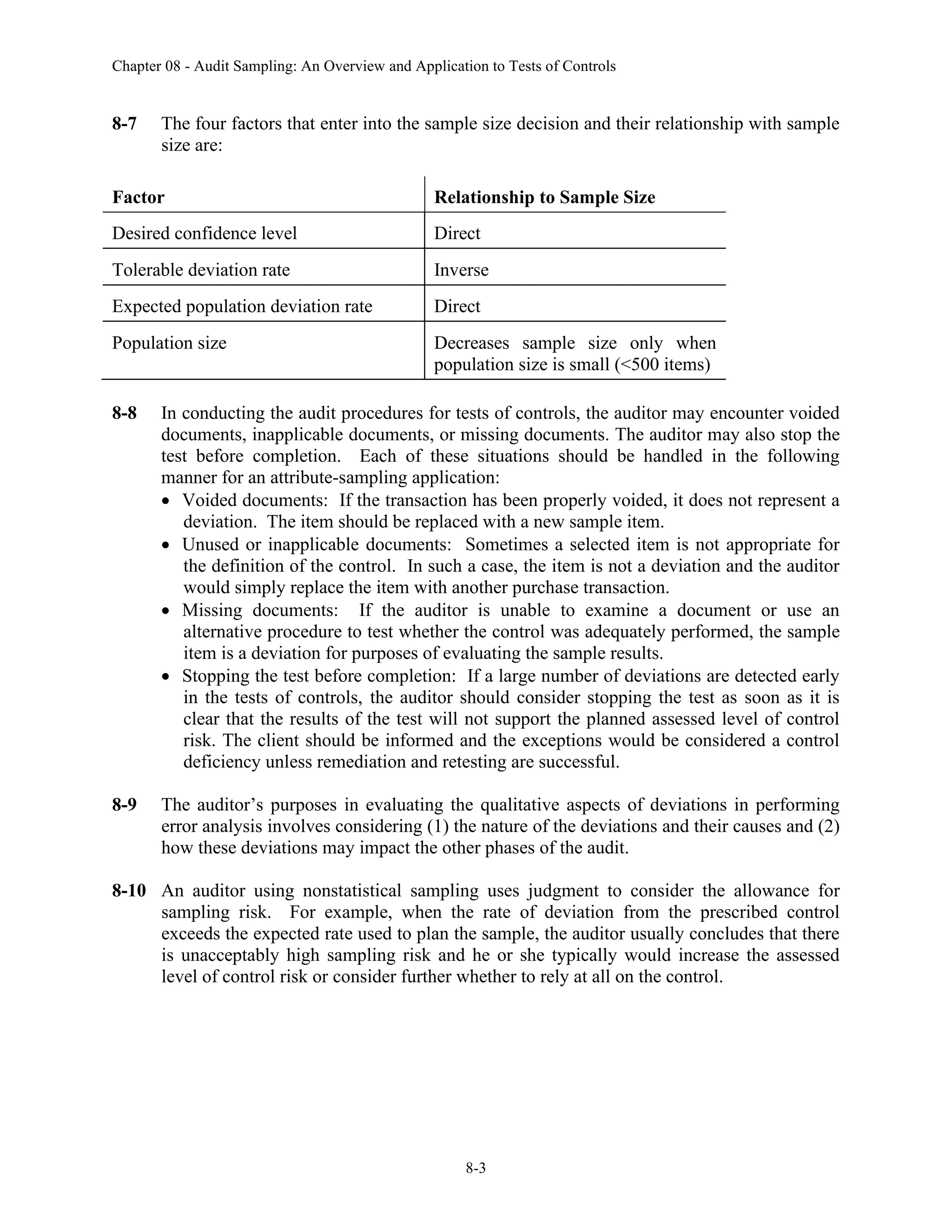
8-7 The four factors that enter into the sample size decision and their relationship with sample
size are:
Factor Relationship to Sample Size
Desired confidence level Direct
Tolerable deviation rate Inverse
Expected population deviation rate Direct
Population size Decreases sample size only when
population size is small (<500 items)
8-8 In conducting the audit procedures for tests of controls, the auditor may encounter voided
documents, inapplicable documents, or missing documents. The auditor may also stop the
test before completion. Each of these situations should be handled in the following
manner for an attribute-sampling application:
• Voided documents: If the transaction has been properly voided, it does not represent a
deviation. The item should be replaced with a new sample item.
• Unused or inapplicable documents: Sometimes a selected item is not appropriate for
the definition of the control. In such a case, the item is not a deviation and the auditor
would simply replace the item with another purchase transaction.
• Missing documents: If the auditor is unable to examine a document or use an
alternative procedure to test whether the control was adequately performed, the sample
item is a deviation for purposes of evaluating the sample results.
• Stopping the test before completion: If a large number of deviations are detected early
in the tests of controls, the auditor should consider stopping the test as soon as it is
clear that the results of the test will not support the planned assessed level of control
risk. The client should be informed and the exceptions would be considered a control
deficiency unless remediation and retesting are successful.
8-9 The auditor’s purposes in evaluating the qualitative aspects of deviations in performing
error analysis involves considering (1) the nature of the deviations and their causes and (2)
how these deviations may impact the other phases of the audit.
8-10 An auditor using nonstatistical sampling uses judgment to consider the allowance for
sampling risk. For example, when the rate of deviation from the prescribed control
exceeds the expected rate used to plan the sample, the auditor usually concludes that there
is unacceptably high sampling risk and he or she typically would increase the assessed
level of control risk or consider further whether to rely at all on the control.
Chapter 08 - Audit Sampling: An Overview and Application to Tests of Controls
8-4
Answers to Multiple-Choice Questions
8-11 c 8-16 b
8-12 a 8-17 b
8-13 a 8-18 d
8-14 c 8-19 d
8-15 a 8-20 c
Solutions to Problems
8-21 a. The auditor’s justification for accepting the uncertainties that are inherent in the
sampling process are based upon the premise that (1) the cost of examining all of the
financial data would usually outweigh the benefit of the added reliability of a complete
(100%) examination and (2) the time required to examine all of the financial data
would usually preclude issuance of a timely auditor’s report.
b. The uncertainties inherent in applying auditing procedures are collectively referred to
as audit risk. Audit risk is the risk that the auditor may unknowingly fail to
appropriately modify the opinion on financial statements that are materially misstated.
Audit risk can be controlled through the scope of the auditor’s test procedures with the
audit risk model providing a framework to follow. Detection risk, which is a
component of the audit risk model, is composed of two risks or uncertainties: sampling
risk and nonsampling risk.
c. Sampling risk arises from the possibility that, when a test of controls or a substantive
test is restricted to a sample, the auditor’s conclusions may be different from the
conclusions he or she would reach if the test were applied in the same way to all items
in the population.
Nonsampling risk includes all the aspects of audit risk that are not due to
sampling and can occur because the auditor used an inappropriate audit procedure,
failed to detect a misstatement when applying an appropriate audit procedure, or
misinterpreted an audit result.
When performing a test of controls, the auditor can commit two types of decision
errors: (1) the risk of incorrect rejection or of assessing control risk too high, which is
the risk that the assessed level of control risk based on the sample is greater than the
true operating effectiveness of the control and (2) the risk of incorrect acceptance or of
assessing control risk too low, which is the risk that the assessed level of control risk
based on the sample is less than the true operating effectiveness of the control.
When performing substantive tests, the related decision errors are: (1) the risk of
incorrect rejection, which is the risk that the sample supports the conclusion that the
recorded account balance is materially misstated when it is not materially misstated
and (2) the risk of incorrect acceptance, which is the risk that the sample supports the
conclusion that the recorded account balance is not materially misstated when it is
materially misstated.
Chapter 08 - Audit Sampling: An Overview and Application to Tests of Controls
8-5
8-22 a 6, b 5, c 7, d 1, e 4, f 2, g 3
8-23 1. In this scenario, the stratum of loans greater than $1 million is tested in total. Since
the entire population is tested, it does not involve sampling. Sampling is involved in
the second strata because the auditor is only examining 15 of the 450 loans in the
strata.
2. If the analytical procedures used do not include statistical techniques (e.g., regression
analysis), then the use of analytical procedures does not involve sampling.
3. Since the auditor has haphazardly selected less than 100% of the population’s
transactions, sampling is involved in such a test.
4. In this case, the auditor has decided not to audit the account because it is immaterial.
This approach does not involve sampling.
8-24 a. The text includes Jenny’s step 3 within the second step of attributes sampling. The
remaining steps of attribute sampling are as follows:
2. Define remaining population characteristics—define the control deviation
conditions.
3. Determine sample size, using the following inputs.
• Determine the desired confidence level.
• Determine the tolerable deviation rate.
• Determine the expected population deviation rate.
• Determine the population size (if < 500).
4. Select sample items.
5. Perform the audit procedures—understand and analyze any deviations observed.
6. Calculate the sample deviation and computed upper deviation rates.
7. Draw final conclusions.
b. The advantages of using a statistical sampling methodology are that it helps the auditor
(1) design an efficient sample, (2) measure the sufficiency of the evidence obtained,
and (3) quantify sampling risk. By using a statistical sampling methodology, the
auditor can limit sampling risk to an acceptable level.
Chapter 08 - Audit Sampling: An Overview and Application to Tests of Controls
8-6
8-25 The sample size for each control procedure is:
Parameters
Control Procedure
1 2 3 4
Risk of incorrect acceptance 5% 5% 10% 10%
Tolerable deviation rate 4% 5% 7% 8%
Expected population deviation rate 1% 2% 3% 4%
Sample size (using tables) 156 181 94 98
Sample size (using ACL) 158 184 96 100
8-26 The computed upper deviation rate and the auditor’s decision for each control procedure
are:
Results Using Tables
Control Procedure
1 2 3 4
Number of deviations 0 5 4 3
Sample size 156 181 94 98
Sample deviation rate 0.0 2.8 4.3 3.1
Computed upper deviation rate 2.0 6.9 8.7 7.3
Auditor’s decision
Supports Does not
support
Does not
support
Supports
Results Using ACL
Control Procedure
1 2 3 4
Number of deviations 0 5 4 3
Sample size 158 184 96 100
Sample deviation rate 0.0 2.7 4.2 3.0
Computed upper deviation rate 1.9 5.7 8.3 6.7
Auditor’s decision
Supports Does not
support
Does not
support
Supports
Chapter 08 - Audit Sampling: An Overview and Application to Tests of Controls
8-7
8-27 The sample size for each control procedure is:
Parameters
Control Procedure
1 2 3 4
Risk of incorrect acceptance 5% 5% 10% 10%
Tolerable deviation rate 6% 7% 4% 3%
Expected population deviation rate 2% 2% 1% 0%
Sample size using tables 127 88 96 76
Sample size using ACL 130 90 98 77
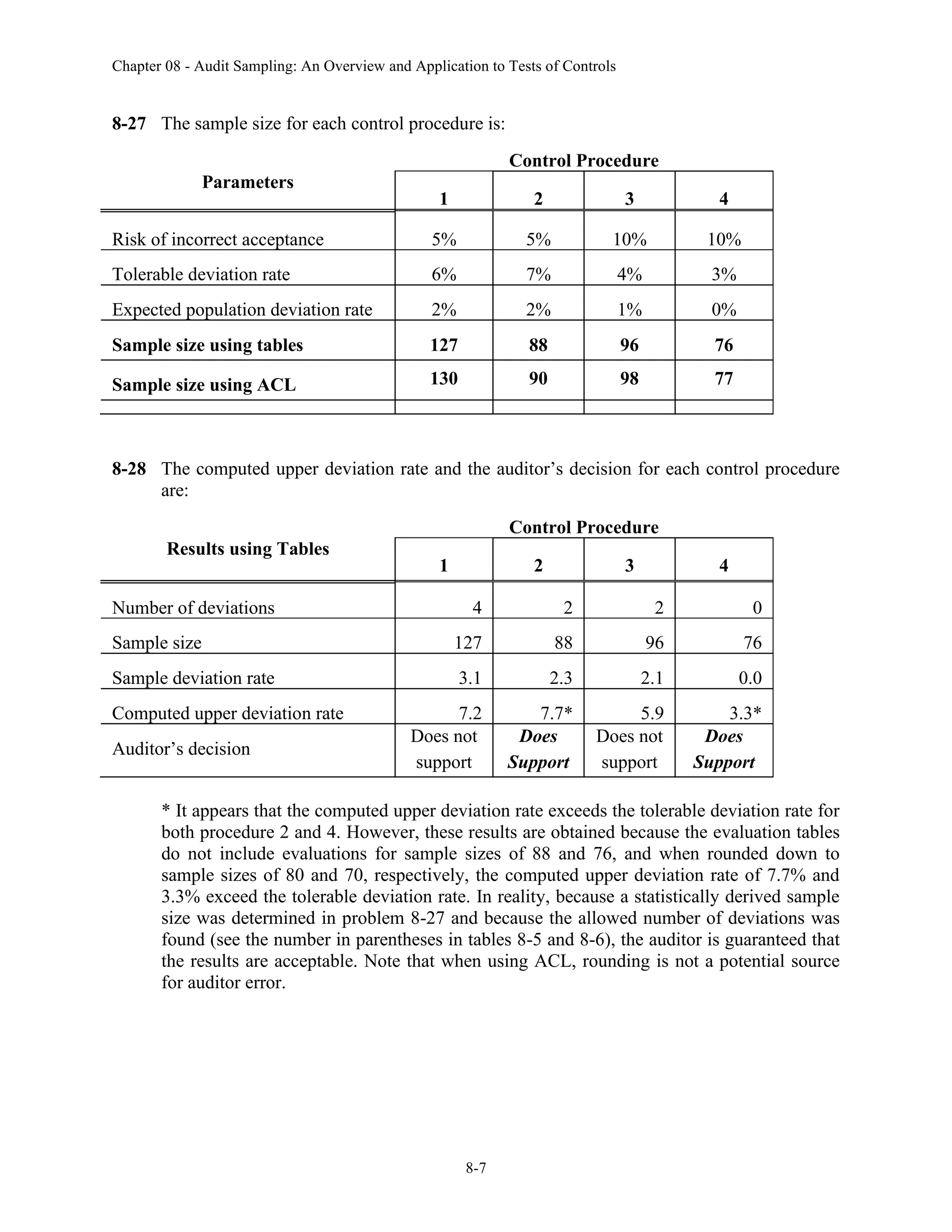
8-28 The computed upper deviation rate and the auditor’s decision for each control procedure
are:
Results using Tables
Control Procedure
1 2 3 4
Number of deviations 4 2 2 0
Sample size 127 88 96 76
Sample deviation rate 3.1 2.3 2.1 0.0
Computed upper deviation rate 7.2 7.7* 5.9 3.3*
Auditor’s decision
Does not
support
Does
Support
Does not
support
Does
Support
* It appears that the computed upper deviation rate exceeds the tolerable deviation rate for
both procedure 2 and 4. However, these results are obtained because the evaluation tables
do not include evaluations for sample sizes of 88 and 76, and when rounded down to
sample sizes of 80 and 70, respectively, the computed upper deviation rate of 7.7% and
3.3% exceed the tolerable deviation rate. In reality, because a statistically derived sample
size was determined in problem 8-27 and because the allowed number of deviations was
found (see the number in parentheses in tables 8-5 and 8-6), the auditor is guaranteed that
the results are acceptable. Note that when using ACL, rounding is not a potential source
for auditor error.
Chapter 08 - Audit Sampling: An Overview and Application to Tests of Controls
8-8
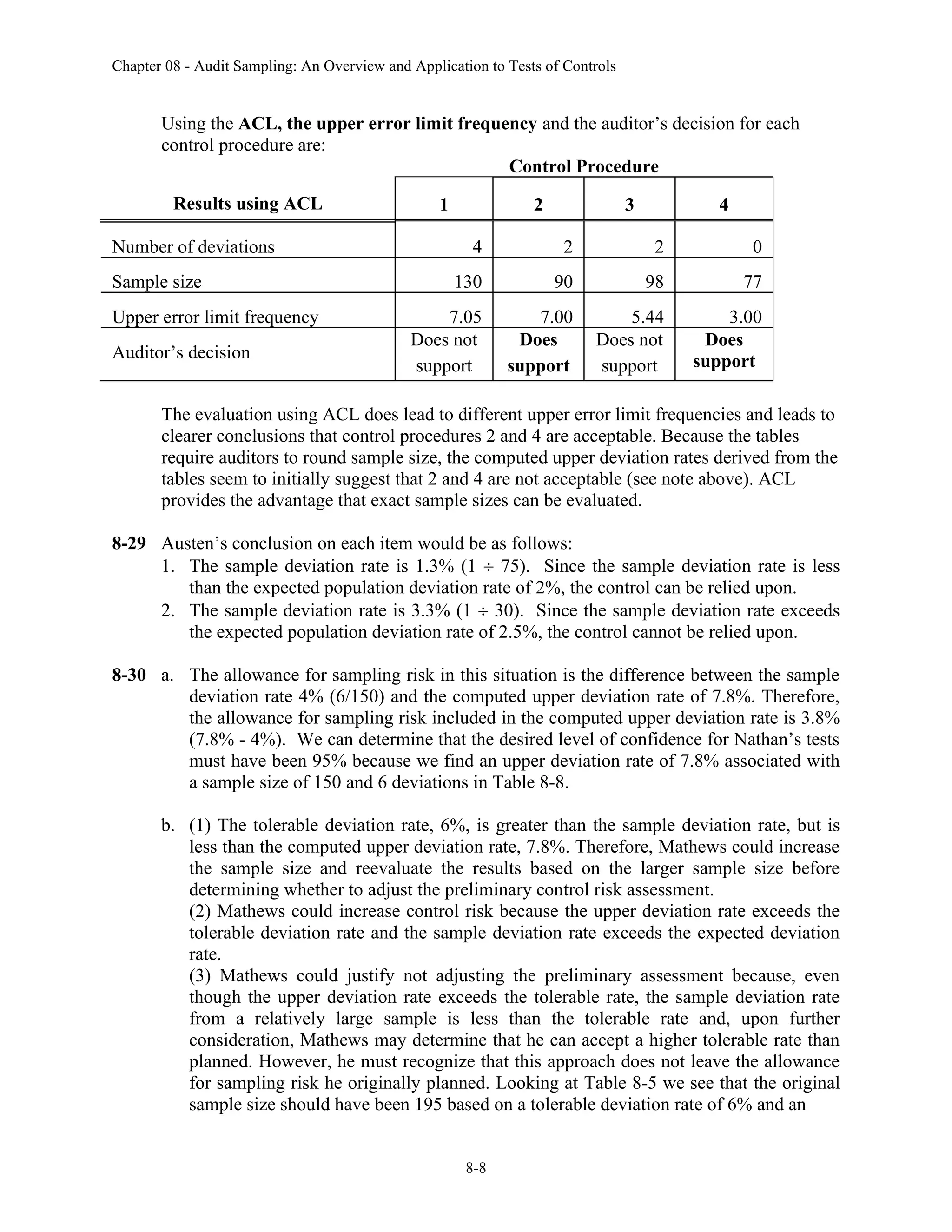
Using the ACL, the upper error limit frequency and the auditor’s decision for each
control procedure are:
Results using ACL
Control Procedure
1 2 3 4
Number of deviations 4 2 2 0
Sample size 130 90 98 77
Upper error limit frequency 7.05 7.00 5.44 3.00
Auditor’s decision
Does not
support
Does
support
Does not
support
Does
support
The evaluation using ACL does lead to different upper error limit frequencies and leads to
clearer conclusions that control procedures 2 and 4 are acceptable. Because the tables
require auditors to round sample size, the computed upper deviation rates derived from the
tables seem to initially suggest that 2 and 4 are not acceptable (see note above). ACL
provides the advantage that exact sample sizes can be evaluated.
8-29 Austen’s conclusion on each item would be as follows:
1. The sample deviation rate is 1.3% (1  75). Since the sample deviation rate is less
than the expected population deviation rate of 2%, the control can be relied upon.
2. The sample deviation rate is 3.3% (1  30). Since the sample deviation rate exceeds
the expected population deviation rate of 2.5%, the control cannot be relied upon.
8-30 a. The allowance for sampling risk in this situation is the difference between the sample
deviation rate 4% (6/150) and the computed upper deviation rate of 7.8%. Therefore,
the allowance for sampling risk included in the computed upper deviation rate is 3.8%
(7.8% - 4%). We can determine that the desired level of confidence for Nathan’s tests
must have been 95% because we find an upper deviation rate of 7.8% associated with
a sample size of 150 and 6 deviations in Table 8-8.
b. (1) The tolerable deviation rate, 6%, is greater than the sample deviation rate, but is
less than the computed upper deviation rate, 7.8%. Therefore, Mathews could increase
the sample size and reevaluate the results based on the larger sample size before
determining whether to adjust the preliminary control risk assessment.
(2) Mathews could increase control risk because the upper deviation rate exceeds the
tolerable deviation rate and the sample deviation rate exceeds the expected deviation
rate.
(3) Mathews could justify not adjusting the preliminary assessment because, even
though the upper deviation rate exceeds the tolerable rate, the sample deviation rate
from a relatively large sample is less than the tolerable rate and, upon further
consideration, Mathews may determine that he can accept a higher tolerable rate than
planned. However, he must recognize that this approach does not leave the allowance
for sampling risk he originally planned. Looking at Table 8-5 we see that the original
sample size should have been 195 based on a tolerable deviation rate of 6% and an
Chapter 08 - Audit Sampling: An Overview and Application to Tests of Controls
8-9
expected population deviation rate of 3%.
8-31 Iceberge’s conclusion on each item would be as follows:
1. The sample deviation rate is 2.0% (1  50). Since the sample deviation rate is less
than the expected population deviation rate of 3%, the control can be relied upon.
2. The sample deviation rate is 4.0% (2  50). Since the sample deviation rate exceeds
the expected population deviation rate of 3%, the control cannot be relied upon.
Solution to Discussion Case
8-32 The following are the incorrect assumptions and statements and inappropriate applications
of attribute sampling in Baker’s procedures:
• Statistical sampling does not eliminate the need for professional judgment.
• The computed upper deviation rate is too high (20%) if Baker plans to assess control
risk at a low level.
• The increase in the population size has little or no effect on determining sample size.
• Baker failed to consider the risk of assessing control risk too low in determining the
sample size.
• The population from which the sample was chosen (invoices) was an incorrect
population.
• The sample was not randomly selected.
• Baker failed to consider the difference of an immaterial amount to be an error.
• The allowance for sampling risk was incorrectly calculated.
• Baker’s reasoning concerning the decision that the sample supported a low assessed
level of control risk was erroneous.
Other documents randomly have
different content
this height a frequent protection from the attacks of the plainsmen.
Later the fort became a city and culture and luxury made their
appearance, offering to the tamed dwellers of the plains and to the
landed proprietors from far and near the opportunity to squander
the proceeds of their crops. The numerous churches did not fare
badly in the days of penitence then.
To-day, Warsaw is still a fine city of broad streets paved with wooden
blocks, with rows of stores on both sides, prominent among which
are the richly equipped jewelry establishments. Carriage traffic is
considerable, even though it cannot compare with that in St.
Petersburg. Just now the main artery of the city, the Vistula, is
closed. The stream is frozen almost over its entire width and ravens
croak on the snowy shoals. But within the city there pass
unceasingly modestly neat cabriolets, fashionable cabs, and splendid
private turnouts with Russian harness and servants. The buildings
are of little interest. A few attempts in the Russian style, a few Polish
shadings of quite modern secession architecture strike the foreigner,
but the deepest impression is created by the feverish life on the
streets and not by its ornamental frame-work. From this should be
excepted the pleasure Villa Lazienki and its quaint park situated at
the end of the avenue. Even snow and ice cannot banish the spirits
that possess one in these gardens. It is a miniature Versailles. Here
is a little castle within which is a picture-gallery of aristocratic
beauties, statues, and portraits of King Stanislas Poniatowski
represented mythologically as King Solomon entering Jerusalem;
without are enchanting villas scattered throughout the park, in the
centre of which is a little natural theatre built in the open of stone,
and arranged like an amphitheatre, the stage separated from the
rest by an arena of the wide lake, and constructed of Corinthian
columns and palisade of bushes. Plays were given here in the times
when the court and the "beauties" of the picture-gallery enjoyed
nature and art together. The moon in the sky was one of the
requisites, and fireworks were burned for the relaxation of the high
and most high lords. Meanwhile the kingdom hastened to its ruin;
for a witty, pleasure-loving court and an immoral oligarchy together
are beyond the endurance of one people, especially when it is
surrounded by covetous neighbors. One hundred years of slavery
and three ruthlessly suppressed revolutions are the historical penalty
for the pleasures of Castle Lazienki. There and on the broad election
plane the "Pole Elekcji Krolow," in the southern part of the town,
where the "schlachtzitz" (lordling) could deposit his "liberum veto"
for a couple of rubles or thalers, the kingdom was destroyed, and its
resurrection is a pious wish the fulfilment of which even our
grandchildren will not live to see.
I have no faith in a Polish kingdom. There may be a Polish revolution
to-morrow, perhaps, when the Russians shall meet defeat in eastern
Asia, as the Russian patriots hope, but a Polish kingdom there will
never be. It is quite apparent how the influence of the times is
changing the entire social structure of the people. No nation can
maintain itself without a middle class, and Poland still has no middle
class. The material for such a class, the strong Jewish population,
has been so ground down that a half-century would not be sufficient
for its restoration and the Russian régime of to-day is disposed to
anything rather than to the uplifting and the education of the Polish
Jewry. It is stated that there are in Warsaw a quarter of a million
Jews, a few well-to-do people among them, who have hastened, for
the most part, to transform themselves into "Poles of the Mosaic
faith," without disarming thereby the clerical anti-Semitism of the
Polish people, and innumerable beggars or half-beggars, who are
designated in western Europe as "schnorrer." And of these there are
in Warsaw an unknown number. It is hard to draw the line between
the "schnorrer" and the "Luftmensch" (a man without any certain
source of income), who has not yet resigned himself to beggary, and
yet cannot tell in the morning whence he is to draw his sustenance
at noon. These include artisans, sweat-shop workers, agents, and
go-betweens, a city proletariat of the very worst kind. I have seen
no such shocking misery in the Jewish quarters on the Moldau as I
encountered in the brilliant capital Warsaw. The Polish Jew,
everywhere despised and unwelcome, is the wandering poverty-
witness of Polish mismanagement. A system that succeeds in
depraving the sober, pious, and sexually disciplined orthodox Jew to
the extent observed in a portion of the Jewish Polish proletariat
should be accorded recognition as the most useless system on the
face of the earth. In the last analysis it was the Polish "schlachtzitz,"
and the Polish clerical going hand-in-hand with him, that constituted
the prime cause of all the miseries of the nineteenth century.
And yet, to be just, one should compare this cheerless Polish-Jewish
proletariat with its immediate environment—the Polish peasants and
the common people. Here one would still find a plus of virtues on
the Jewish side. The wretched Polish peasant is not more cleanly
than the Jew. On the contrary, he lives in the same room with his
pig, and no ritual requirement compels him to wash his body at least
once a week. The Jew, under his patched garment, is for the most
part comparatively clean, only hopelessly stunted and emaciated.
The Jew does not drink, while his "master," the Pole, has a kindly
disposition towards all sorts of spirituous liquors. Also, the modesty
of the Jewish women has yielded but lately to the pressure of
endless misery or the temptations of the cities, while of the higher
classes of Polish and Russian society but little of an exemplary
character has been told. And finally:
"Deutsche Redlichkeit suchst Du in allen Winkeln vergebens."
Goethe's verse applies not only to the Italians, for whom it was
intended; it applies also to Poland and Russia, where less faith is
attached to statements than is customary with us, and it applies,
above all, to the merchant classes of all nations who are wont to
make their living by overreaching their neighbors. There is a wide
gulf between the development of commercial ethics, as they are
understood with us and in England, and the tricks and devices of
petty trade no matter of what nation. But the Jew in Poland and in
Russia has been and still is being driven, in great measure, into a
class of wretched petty traders; and the law of the land forces back
into the pale of settlement by drastic regulations him who would
escape from its cage and from an occupation of dubious ethics.
The Jewish section is the "partie Hortense" of the beautiful Polish
capital; the Jewish misery is a shameful stain on Polish rule and its
Nemesis. All the five continents must have their misery and toil, and
they need a firm, all-embracing humanity to relieve them of this
contagious wretchedness, this residue of centuries of depravity. But
for Poland and Russia the humane solution of the Jewish question is
simply a life-question.
IV
ST. PETERSBURG
A hymn of praise to the Russian railroad! The Russian tracks begin at
Warsaw to have a considerably broader bed. This for a strategical
purpose, to render difficult the invasion by European armies. It is
also a benefit to the traveller, for the Russian coaches are wider and
more comfortable than the European, and the side-passages along
the coupé are very convenient for little walks during the journey. A
separate heating compartment and buffet, with the indispensable
samovar, where one may secure a glass of tea at any time, are
situated in the centre of the long car. The trains do not jolt, although
they are almost as fast as ours. The smoke and soot do not drive
through the tightly closed double windows. A twenty-four hour trip
here tires one less than a six-hour trip with us. Certainly there is
more need of preparation for a comfortable journey in Russia than in
the West. The distances are immense, a twenty-four hour journey
creating no comments. The Warsaw-Petersburg train was as well
filled as the ordinary express-train between Frankfort and Cologne.
The run, which lasts from one morning to the next, is naturally not
very entertaining. The broad expanse of snowy plain, relieved only
by snow-breaks and frozen swamps, at every two miles a few
wretched half-Asiatic huts, and occasionally the dark profile of a
forest, no more to be seen, and a sea of unintelligible Slavic sounds,
no more to be heard. The feeling of loneliness grows upon one, and
the impression becomes constantly stronger that Russia is a world
for itself.
But there is an end to everything, even to a railroad journey without
books, without papers, and without conversation. At the dawn of the
clear, wintry day one may already distinguish the signs of a great
city. A station with magnificent buildings and a well-cared-for park
stretching almost to the tracks claims our attention after the many
unimpressive sights of the long road. We decipher the name
"Gatschina," and understand why there is such a strong police force
on the platform. This is the Winter Palace. Scarcely an hour later the
gilded cupolas stand out bright above the snow; the brakes are put
on; we are in St. Petersburg.
It cannot be said that the city appears in a favorable light when
viewed from the railroad. The not over-elegant two-horse vehicle
which takes us and our baggage rattles over miserable pavements,
dirty from the melting snow, through broad, endless suburban
streets. The houses on either side are of only one story, built mostly
of wood, their poverty-stricken appearance being intensified here
and there by three-storied barracks. Liquor-shops, little second-hand
stores, wooden huts, with putrid garbage, follow one another in a
variety by no means pleasing. The passers-by, ill-clad, with the
inevitable rubber shoes, shuffle along the slushy sidewalks; trucks
with two or sometimes three horses, their necks bent under the
brightly painted Russian "duga" (wooden yoke), a truly Gorki
atmosphere in its entirety. One can scarcely believe that he is
entering one of the most brilliant cities of the continent. The endless
rows of stores with their two-storied sheds, which one passes on the
way to the centre of the city, but slightly improve one's first
impression, for even they are far removed from the splendor of the
capital.
We finally reach the hotel to which our mail has been addressed. It
is an enormous structure, more than two hundred metres long. Yet it
has no room for us. It is filled to overflowing. It is impossible to
crowd in one more soul. We again take our carriage. We drive from
one hotel to another, growing constantly more modest in our
demands for lodging. But our efforts are vain. Everything is occupied
to the very gables.
We were careless in coming to St. Petersburg in January. This is the
time of congresses, of business, of carnivals. All the provincial
officials are here to render their annual reports to their ministries.
Naturally, they bring with them their families, who wish to make
their important purchases here and to taste of the social season.
Congresses and conferences are held here not in the summer and
vacation months as with us, but shortly before the "butter-week,"
really a carnival, the pleasure of which one may wish to take this
opportunity to test. Medical, teachers', and insurance congresses are
held here at the same time. Foreign merchants come here to
complete their transactions. But the great city of St. Petersburg is
not adapted for foreign guests.
The instincts of self-defence awake at the time of need. We do not
intend to camp to-night under the bridge arch. We make great
efforts and by the evening have secured a room, in spite of the
"absolute impossibility," in that large and only comfortable hotel in
St. Petersburg, which we shared with a friendly mouse, but which
was free from other objectionable tenants. Even the little mouse was
deprived in a base manner of its life and liberty the very next night.
Once provided with board and lodging, we decided to become
acquainted with the better side of St. Petersburg. What does a
stranger usually do in the evening when he visits a strange city? He
goes to some theatre.
There are plenty of hotel porters and agents to provide for the
wishes of the guests. "Hello, agent; get me tickets for the Imperial
Theatre"—where a ballet of Tschaikowski's is to be presented to-
night by first-class talent. The theatre programme, obligingly
provided with a French translation, informs us that among others,
Kscheschinska will do herself the honor to play the leading rôle.
"But, honored sir, that is quite impossible; first, because this is the
carnival time; second, because most of the seats are already
subscribed for; and third, because Kscheschinska dances to-night"—
a sly closing of the left eye accompanies the mention of the name
—"and neither the Emperor nor the court will be absent from the
theatre. Unless you pay twenty to thirty rubles to a speculator you
will hardly get into the theatre."
Since my passion for the ballet or for Kscheschinska does not attain
the proportions of a twenty-ruble investment, I find it preferable to
devote the evening to the always interesting and fruitful hotel
studies. What seething life in the numberless corridors, dining-halls,
and vestibules of the fashionable St. Petersburg Hotel! Governors in
generals' gold-braided uniforms, covered with so many orders and
medals that it makes one curious to find out about all the deeds of
heroism for which they were bestowed; chamberlains with refined
elegance in their gala dress, hiding the "beau restes" of the one-
sided Adonis; tall, agile, dark-eyed Circassians with the indispensable
cartridge-pouch on the breast region of their long coats, with the
dagger hanging in its massive gold sheath from the tightly drawn
belt; Cossacks with fur caps a foot high, made of white or black
Angora skins, placed on their bristly heads; a nimble Chinese man,
or maid, servant, with long pigtail, whose sex it is impossible to
distinguish; a whole troop of dark-eyed Khivanese squatting on their
prayer-rugs before the apartment of their khan, passing the nargile
from hand to hand, and exchanging witticisms about the passing
Europeans; beardless Tatar waiters shuffling by in their flat-soled
shoes—a mixture of Europe and Asia such as may hardly be seen at
once in any other part of the world. The west European merchants
and other travellers, who throng the hotel, are scarcely noted among
the exotic appearances. In this hotel, as elsewhere throughout St.
Petersburg, the European, the civilian, is seemingly merely tolerated.
The city belongs to the functionaries, soldiers, officials, and
chamberlains, to the Cossacks, Circassians, and, above all others, to
the police. More intimate acquaintance reveals that a goodly portion
of the uniformed persons in St. Petersburg are ordinary students,
technologists, professors, etc., and that these uniformed persons do
not equally represent the state. On the contrary, the fight of the
state, or, to be more precise, of the police, against the free
professions, would not be so bitter if the members of the latter were
not entitled to wear uniforms. As it is, they also may appear to the
common people as representatives of the Czar's authority.
We slept through the night. Kind fate had decreed for us snow and
cold in succession to the disagreeable thaw, and we availed
ourselves of the clear weather to become acquainted with the bright
side of St. Petersburg. And, first of all, the snow! It changes the
entire appearance of the city as if by a magic wand. The narrow,
open carriages where two persons can accommodate themselves
only with difficulty, especially when wrapped in fur coats, have
disappeared. Their places have been taken by small, low sleighs
without backs. The "izwozchik" (driver) in his blue, plaited Tatar fur
coat and multicolored sash, with fur-trimmed plush cap on his head,
sits almost in the passenger's lap. Yet there is compensation for the
meagre dimensions of the sleigh. The small, rugged horses speed
along like arrows through the straight streets, hastened on by the
caressing words or the exclamations of the bearded driver. Horse,
driver, and sleigh are very essential figures in the St. Petersburg
street scenes. We at home cannot at all realize how much driving is
done in St. Petersburg. The distances are enormous; streets five or
six kilometres long are not unusual. There are almost no streetcar
lines, thanks to the selfishness of the town representatives,
composed of St. Petersburg house-owners, who do not care to see a
reduction in rents in the central portion of the town. The average
city inhabitant readily parts with the thirty, forty, or fifty kopeks
demanded by the "izwozchik," and thus everything is rushed along in
an unending race. The "pravo" (right) or "hei beregis!" (look out!),
which the drivers bawl to one another or to the pedestrians,
resounds through the streets, but they are not very effectual. One
must open his eyes more than his ears if he wishes to escape injury
in the streets of St. Petersburg. The constant racing often results in
four or five rows of speeding conveyances attempting to pass one
another. The drivers with their bearded, apostle faces, which appear
lamblike when they good-naturedly invite you to enter their
conveyances, are like wild men when they let loose. Their Cossack
nature then asserts itself. On and always on, and let the poor
pedestrian take care of his bones. And however much the little horse
may pant and the flakes of foam may fly from its sides, "his
excellency," "the count," "his highness" (the izwozchik is extremely
generous with his titles), will surely add a few kopeks when the
driver has been very smart; and so the little horse must run until the
passenger, unaccustomed to such driving, loses his breath.
But the Russian barbarian conception of wealth and fashion is to
have his driver race even when out for a pleasure drive, as if it were
a question of life or death. The numberless private turnouts,
distinguished by their greater elegance, their splendid horses,
harness, liveries, and carriages, have no less speed than the
hackney-coachman, but the reverse, at a still greater speed, thanks
to the elasticity of their high-stepping Arab trotters. And now
imagine twenty-five thousand such vehicles simultaneously in racing
motion, with here and there a jingling "troika," its two outer horses
galloping madly and the middle horse trotting furiously; imagine, at
the same time, the bright colors of the four-cornered plush caps on
the heads of the stylish drivers, the gay-colored rugs on the
"troikas," the blue and green nets on the galloping horses of the
private sleighs, the glitter of the gold and silver harness, the scarlet
coats of the court coachmen and lackeys, everything rushing along
on a crisp winter day, over the glimmering, freshly fallen snow,
between the mighty façades of imposing structures, flanked by an
almost unbroken chain of tall policeman and gendarmes, and you
have the picture of the heart of St. Petersburg at the time of social
activity. Splendor, riches, wildness are all caricatured into
magnificence as if calculated to impress and to frighten. Woe to him
here who is not of the masters!
V
ST. PETERSBURG—CONTINUED
St. Petersburg is an act of violence. I have never received in any city
such an impression of the forced and the unnatural as in this
colossal prison or fortress of the Russia's mighty rule. The Neva,
around whose islands the city is clustered, is really not a stream. It
comes from nowhere and leads nowhere. It is the efflux of the
Heaven-forsaken Ladoga Lake, where no one has occasion to search
for anything; and it leads into the Bay of Finland, which is frozen
throughout half of the year. No commercial considerations, not even
strategical reasons, can justify the establishment of this capital at
the mouth of the Neva. The fact that St. Petersburg has none the
less become a city of millions of inhabitants is due entirely to the
barbaric energy of its founder, Peter the Great, an energy which still
works in the plastic medium of Russian national character. On the
bank of the Neva stands the equestrian statue of Peter, raised on a
mighty block of granite, a notable work of the Frenchman Falconet.
The face of the Emperor as he ascends the rock is turned to the
northwest, where his most dangerous rival, the Swedish Charles,
lived. And just as his whole attitude expresses defiance and self-
conscious power, so his city, St. Petersburg, is only a monument of
the defiance and the iron will of its founder. The historians relate
that Peter intended, by removing his residence to St. Petersburg, to
facilitate the access of European civilization to the Russian people. If
this be true, Peter utterly failed in his purpose. The old commercial
city, Riga, would have answered the purpose much better. To be
sure, Riga did not come into Russian possession until eighteen years
after the founding of St. Petersburg. Yet what was there to prevent
the despot from abandoning the work that he had begun? But no,
St. Petersburg was to bid defiance to the contemporary might of
Sweden, and so forty thousand men had to work for years in the
swamps of the Neva to build the mighty tyrant's castles, the Peter-
and-Paul fortress, an immense stone block on the banks of the icy
stream. Malarial fevers carried off most of them; but the Russian
people supplied more men, for such was the will of the Czar. The
drinking-water of St. Petersburg to-day is still a yellow, filthy fluid,
consumption of which is sure to bring on typhoid fever; but the will
of Peter still works, and St. Petersburg remains the capital.
Peter, with his peculiar blending of political supremacy and
democratic fancifulness, built for himself a little house on the fortress
island, where the furniture made by himself is still preserved by the
side of the miracle-working image of the Redeemer which the despot
always carried with him. His spirit soars over this city and this land.
What he did not entirely trust to his unscrupulous fist he left in
honest bigotry to the bones of the holy Alexander Nevski, which he
had brought to his capital soon after its establishment. Autocracy
and popocracy still reign in the Russian empire. The Peter-and-Paul
fortress, in the subterranean vaults of which many of the noblest
hearts and heads of Russia have found their grave, the Isaac
cathedral, with its barbarian pomp of gold and precious stones, and
the mighty monoliths—these are the symbols of the city of St.
Petersburg and of its régime. If there is in Russia, even among the
enlightened minds, something like a fanatical hatred of civilization
and of the West, it is due to the manner in which the half-barbarian
Peter imposed Western ideas and civilization on a harmless and
good-natured people.
What brutal power of will may do in defiance of unfriendly nature
has been done on the banks of the Neva. Indeed, its green waters
are now hidden by an ice-crust three feet thick, over which the
sleighs run a race with the little cars of the electrical railway. Yet
even without the restless shimmer of the water the view of the river-
bank is still very impressive. The golden glitter of the great cupolas
of the Isaac cathedral, the long red front of the Winter Palace, the
pale yellow columns of the admiralty, between Renaissance
structures, stand out from among the rest.
Palaces and palaces stretch along the stream right up to the Field of
Mars. The gilded spire of the Peter-and-Paul cathedral pierces the
white-blue sky and greets, with its angel balanced on the extreme
spire, the equally grotesque high spire of the admiralty. Great stone
and iron bridges span the broad stream, its opposite shore almost
faded in the light mist of the wintry day. Walking towards the middle
of the bridge, whence a splendid view may be obtained, one sees
the long row of buildings on the farther islands standing out of the
mist. One row of columns is followed by another—the Academy of
Arts, the Academy of Sciences, the house of Menschikov, which
Catherine built for her favorite, come into view. Towards the west
the hulls of vessels stand out from among the docks. Still farther out
the mist hides the shoals of the Neva, together with those of the
Gulf of Finland, in an impenetrable gray. Towards the north stretch
the endless lanes with their bare branches which lead to the islands.
This is the Bois de Boulogne of St. Petersburg, where the gilded
youth race in brightly decorated "troikas," and hasten to squander in
champagne, at cards, and in gypsy entertainments, the wages of the
starved muzhik. It is a magnificent picture of power, of self-
conscious riches, the better part of which is furnished by the mighty
stream itself.
It is easy now to realize that St. Petersburg was originally planned
for a seaport, and that it therefore presents its glittering front to the
sea. The railroads which conduct the traffic to-day could no longer
penetrate with their stations into the city proper; hence the visitors
must first pass through the broad, melancholy suburban girdle which
gives one the impression of a giant village. When access to the city
was still by boat from the Gulf of Finland, the landing at the "English
quay," with its view of all these colossal structures, golden domes
and spires, must have created a powerful impression. Nothing less
was contemplated by this massing of palaces. The capital and
residence city was not intended to facilitate the access of the West
but rather to inspire it with awe.
The splendor of the city naturally becomes gradually diminished from
the banks of the Neva towards the vast periphery. The main artery
of traffic in St. Petersburg, the "Nevski Prospect," and its
continuation, the "Bolshaya Morskaya," remain stately and
impressive to their very end. A peculiar feature of St. Petersburg is
the numerous canals which begin and end at the Neva, and which
once served to drain the swampy soil of the city. They are now to be
filled, for they do not answer the purpose. Nevertheless, they offer
meanwhile an opportunity for pretty bridge structures, as, for
instance, the one leading over the Fontanka, ornamented with the
four groups of the horse-tamers by Baron Klodt. A comparison with
the lagoon city, Venice, would really be a flattering hyperbole, for
one does not get the impression here of being on the sea, as in the
case of the "Canal-Grande." The city rather reminds one of the
models that were nearer to its founder, the canal-furrowed cities of
Holland. Still, these canals are a pleasant diversion in the otherwise
monotonous pictures of the city streets.
Should it be mentioned here that St. Petersburg has its "millionnaya"
(millionaire's street)? It is well known that hither and towards
Moscow flow the treasures of a country squeezed dry. The great
wealth of the one almost presupposes the nameless misery of the
other. The indifference with which the shocking famine conditions of
entire provinces and the threatening economic collapse of the whole
empire are regarded here finds its explanation only in the bearing of
these boyar-millionaires, who consider themselves Europeans
because their valets are shaved in the English fashion.
The eye of the stranger who wishes to understand, and not merely
to gaze, will rather turn to other phenomena more characteristic
than splendid buildings of the country and its people.
There is, in the first place, the pope (priest), and then the
policeman.
The priests and the policemen are the handsomest persons in St.
Petersburg. Although the flowing hair of the bearded priest, reaching
to his shoulders, is not to be regarded as a characteristic peculiarity,
since every third man in Russia displays long hair or profuse locks
that would undoubtedly draw to their fortunate possessor in our land
the attention of the street boys, still they are carefully chosen
human material, tall, graceful men with handsome heads and proud
mien. Notwithstanding this they are accorded but little reverence
even among the bigoted Russians, for no matter how often and
copiously these may cross themselves before every sacred image,
they quite often experience, behind the priest, a sort of salvation
which compels them suddenly to empty their mouths in a very
demonstrative manner. This may be due to various kinds of
superstition, which regard the meeting with a priest as very
undesirable, but it finds its explanation also in the not always
exemplary life of this servant of the Lord. He is especially accredited
with a decided predilection for various distilled liquors that at times
exert a doubtful influence on a man's behavior. One may see in St.
Petersburg men wrapped in costly sable furs make the acquaintance
of the street pavements, especially during the "butter-week," yet for
spiritual garments the gutter is even less a place of legitimate rest,
and, at any rate, it is difficult to acknowledge as the appointed
interpreter of God's will a man whose mouth savors of an entirely
different spirit than the "spiritus sanctus."
For all this, however, the Russian is filled, outwardly at least, and
during divine services, with a devotion which, to us, is scarcely
comprehensible. With fanatical fervor he kisses in church the hand of
the same priest behind whose back he spat at the church door. His
body never rests. As with the orthodox Jew and the howling dervish,
his praying consists in an almost unceasing bowing, and a not at all
inconsiderable application of gymnastics. He is perpetually crossing
himself. Particularly fervent suppliants, of the female gender
especially, can hardly satisfy themselves by kissing again and again
the stone flags of the floor, the hem of the priest's coat, the sacred
images, and the numberless relics. But how effective and mind-
ensnaring is the orthodox church service. The glimmer of the
innumerable small and large wax candles brought by most of the
congregants fills the golden mist of the place with an unearthly light.
Rubies, emeralds, and diamonds shine from the silver and gold
crowns on the sacred images. The gigantic priest in his gold-
embroidered vestments lets sound his deep, powerful, bass voice,
and wonderful choirs answer him from both sides of the "ikonostas."
Clouds of incense float through the high nave. The faithful, ranged
one after another, intoxicate and carry one another by their devotion
—a huge general hypnosis in which education and priestly art are
equally concerned. The orthodox cult is not to be compared, at least
in my opinion, with that of the Roman Catholics in the depth and
nobility of the music and in the artistic arrangement of the service.
But in its archaic monotony, in its use of the coarsest material
stimuli, it is perhaps even more suggestive for the Eastern masses
than is the other for the civilized peoples of the West. The quantity
of gold, silver, and precious stones offered up, especially in the Isaac
cathedral and in the Kazan cathedral—fashioned after that of St.
Peter's in Rome—to give the faithful a conception of the just claims
of Heaven on treasure and reverence, is beyond the belief of
Europeans. The artistically excellent silver ornaments of the Isaac
cathedral weigh not less than eleven thousand kilograms. A single
copy of the New Testament is bound in twenty kilograms of gold.
The sacred image made in commemoration of the catastrophe of
Borki is almost entirely covered with diamonds. These endowments
came, for the most part, from members of the imperial house. The
union of church and state is more intimate here than elsewhere,
and, apparently, even more profitable for the guardians of the altar.
Among all the sacred relics and trophies of the St. Petersburg
church, one impresses the foreigner above the others. It is a
collection of silver gifts from the French, ranged along the wall of the
Peter-and-Paul cathedral. By the side of the coffins of the Russian
emperors and empresses, from Peter the Great to Alexander III.,
which one cannot pass without a peculiar feeling of historical
respect, under innumerable flags and war trophies, there stand, as
the greatest triumph that the despotic barbarian state has won from
civilized Europe, the silver crowns and the shields of honor which
Félix Faure, Casimir-Périer, the senate, the chamber, and the Parisian
press presented to the Russian ally of France.
"You see here the greatest misfortune that has befallen us in this
century," said my companion, an orthodox Russian of nothing less
than radical views. "Until then, until this alliance, with all our
boastfulness we still felt some shame before Europe for our
barbarous and shameful rule. But since the most distinguished men
and corporations of the most enlightened republic have begun
prostrating themselves before us, the knout despotism has received
the consecration of Europe and has thrown all shame to the winds."
"But the French have lent you eight milliards for it," I replied.
"A part of which has gone into Heaven knows whose pockets; the
other supports our police against us, and the remainder was sunk in
a worthless railroad, while we, in order to provide the interest, must
take the horse from our peasant's plough and the cow from its
stable, until even that shall come to an end, for nothing else will be
left for the executor."
"A Jesuit trick," I said. "You owe the alliance to the diplomacy of
Rampolla."
"The sword and the holy-water sprinkler," answered the Russian, as
he pointed his hand in a circle from the war trophies to the
"ikonostas," "they go everywhere hand-in-hand and enslave and
plunder the nations."
The leaden, snowy skies looked down on us oppressively as with a
deep shudder at the prison gratings of the Peter-and-Paul fortress
we hastened back to the city. I heard in my mind the notes of the
"Marseillaise," and before my eyes there stood the gifts of honor
from the French nation brought to the despot of the fortress. They
are very near each other, cathedral and prison. In the still of the
night the watchman of the French offerings may often hear the
groans and the despairing cries of the poor souls who had dreamed
of freedom and brotherhood and had paid for their dreams behind
the heavy iron bars, deep under the mirror-like surface of the Neva,
in the dungeons of the Peter-and-Paul fortress.
VI
ARTIST AND PROFESSOR—ILYA RYEPIN
Should some one assert that there is a great artist in a European
capital, honored by an entire nation as its very greatest master, yet,
nevertheless, not even known by name among the great European
public, we should shake our heads unbelievingly, for such a
phenomenon is impossible in our age of railroads and printer's-ink.
And yet this assertion would be literally true. There is such a great
artist living in a city of a million inhabitants, and recognized by
millions, yet of his works even art-students outside of Russia have
seen but one or two. To make this even more incomprehensible, it
should be stated that this artist had attained renown in his country
not merely a few years ago, but has created masterpiece after
masterpiece for more than thirty years; indeed, his first picture at
the world's fair in Vienna in 1873 was generally recognized as
startling. Nevertheless, the name of the master has long been
forgotten on our side of the Vistula; it may be because no one found
it to his interest to advertise him and thus to create competition for
others, but more probably because Russia is a separate world and
isolates itself from the rest of Europe with almost barbaric insolence.
There is, however, some advantage for Russia in this isolation from
the "rotten West." They are not obliged to pass through all the
various phases of our so-called art movement, and therefore are not
carried from one extreme to the other, but calmly pursue their own
quiet way. They also had the good-fortune, while the rest of Europe
was in a state of conflict over unfruitful theories, to possess really
great creative artists, always the best antidote against
doctrinarianism. When the one-sided, methodically proletarian
naturalism reigned in the West, itself a protest against the shallow
idealistic formalism of the preceding decades, Russian literature
possessed its greatest realistic poets, Tolstoï, Turgenyev,
Dostoyevski, who never overlooked the inner process, the true
themes of poetical creation, for the sake of outward appearances,
and have thereby created that incomparable, physiological realism
that we still lack. And because their great realists were poets, great
poets and geniuses, they felt no need of a new drawing-room art,
which of necessity goes to the other extreme, the romantic,
aristocratic, catholic. They had no Zola, and therefore they needed
no Maeterlinck. And it was exactly so with their painting. Their great
artists did not lose themselves, like Manet and his school, in
problems purely of light and air without poetical contents; hence to
rediscover poetry and to save it for art there was no need for
Preraphaelites or Decadents. The great painter is artist, man, and
poet, a phenomenon like Leo Tolstoï, therefore the few symbolists
who believe they must imitate European fashions make no headway
against them.
Imitators can only exist among imitators, by the side of nature's
imitators, imitators of Raphael's predecessors.
A single true artist frightens away all the ghosts of the night, and
thus decadence plays an insignificant rôle alongside of Tolstoï and
Ryepin, whether it be the decadent literature of Huysmans and
Maeterlinck, or the decadence of the Neoromanticists and of the
Neoidealists.
It is time, however, to speak of the artist himself, an artist of sixty,
still in the fulness of power, who, besides wielding the brush,
occupies a professor's chair at the St. Petersburg Academy. I have
just called him professor. He is more than that, he is, like Leo Tolstoï,
a revolutionist, the terrible accuser of the two diabolical forces that
keep the nation in its course, the church and the despotism of
government. But, to the honor of the Russian dynasty be it said, this
artist, acknowledged to be the greatest of his country, was never
"induced" to cast aside the criticism of the prevailing system he
made by his painting and to engage in the decorative court art. His
so-called nihilist pictures, reproduction of which has been prohibited
by the police, are for the most part in the possession of grand-
dukes, and, notwithstanding his undisguised opinions, he was
intrusted with the painting of the imperial council representing the
Czar in the midst of his councillors. The czars have always been
more liberal than their administrators. Nicholas I. prized Gogol's
"Revizor" above all else, and Nicholas II. is the greatest admirer of
Tolstoï. And so Ryepin may paint whatever and however he will. And
we shall see that he makes proper use of this opportunity. He is
Russian, and nothing but Russian. At twenty-two he received for his
work, "The Awakening of Jairus's Little Daughter," an academic prize
and a travelling fellowship for a number of years. But before the
expiration of the appointed time spent by him in Berlin and Paris he
returned to Russia, and produced in 1873 his "Burlaks" (barge-
towers), which attracted great attention at the Vienna exposition.
The thirty years that have passed since then have detracted nothing
from the painting. How far surpassed do Manet's "revolutionizing"
works already appear to us, and still how indelibly fresh these
"barge-towers." That is so. The reason is simple—it is no painting of
theory but of nature represented as the individual sees it, the
masterly impression of an artist, the most concentrated effect of
landscape, light, and action. The purely technical problem is
subordinated to the whole, to the unity of action and mood, solved
naturally and easily. The problem of the artist to tell us what we
cannot forget, to give us something of his soul, his sentiments, his
thoughts, is of first importance, just as geniuses of all ages cared
less to be thought masters of technique than to win friends, fellow-
thinkers, and comrades, to share their joys and feelings. From the
purely technical stand-point, where is there a painting that presents
in a more masterly manner the glimmer of sunlight on the surface of
a broad stream—as in this case—and where, nevertheless, the
landscape is treated merely as the background? And again, where is
the action of twelve men wearily plodding onward, drawing with
rhythmic step the boat against the stream, seized more forcibly,
more suggestively than in this plaintive song of the Russian people's
soul?
The youth of barely twenty-four years had at one leap placed himself
at the head of all contemporary artists. Analogies between him and
the artistic career and method of Leo Tolstoï force themselves on us
again and again. Tolstoï's Sketches from the Caucasus, Sevastopol,
Cossacks, are his early works, yet they are the most wonderful that
the entire prose of all literature can show. And so it is in this lifelike
picture of a twenty-four-year-old youth. Had we no other work of his
than the "Barge-towers," we should yet see in him a great master. It
is but necessary to look at the feet of these twelve wretched toilers
to realize with wonder the characterization, the full measure of
which is given only to genius. How they strain against the ground
and almost dig into the rock! How the bodies are bent forward in the
broad belt that holds the tow-line! What an old, sad melody is this to
which these bare-footed men keep step as they struggle up along
the stream? In all his barefoot stories of the ancient sorrow of the
steppe children, Gorki has not painted with greater insight. A
sorrowful picture for all its sunshine, and the more sorrowful
because no tendency is made evident. It means seeing, seeing with
the eyes and with the heart, and, therefore, it is art.
It would be wrong, however, to say that Ryepin—in his works as a
whole if not in a given instance—has introduced a "tendency" in his
choice of solely sorrowful subjects. Such is not the case. There is
nothing more exuberant, more convulsing than his large painting,
"Cossacks Preparing a Humorous Reply to a Threatening Letter of
Mohammed III." The answer could not have been very respectful.
That may be seen from the sarcastic expression of the intelligent
scribe as well as from the effect that his wit has on the martial
environment. A be-mustached old fellow in a white lamb-skin cap
holds his big belly for laughing; another almost falls over backward,
his bald pate quite jumping out of the canvas. One snaps his fingers;
another, old and toothless, grins with joy; a third pounds with
clinched fist on the almost bare back of his neighbor; another shuts
his right eye as if perceiving a doubtful odor; one with a great tooth-
gap shouts aloud, while others smile in quiet joy through the smoke
of their short pipes. All these are crowded around a primitive
wooden table scarcely a metre wide; twenty figures, a natural group,
one head hiding another, and with all you have an unobstructed view
of the camp lying bright in the sunshine and dust and full of horses
and men. The effect of the picture is so overpowering that at the
mere recollection of it you can scarcely refrain from joining in the
hearty laughter of these sturdy, untutored natures. In the entire
range of modern painting there is no other picture so full of the
strong joy of living.
"The Village Procession," preserved in the Tretyakov Gallery in
Moscow—the finest collection of the master's works—is not gloomy
like the mournful song of the "Barge-towers," nor exuberant with
serf arrogance and vitality like the Cossack camp, but a fragment of
the colorless Russian national life as it really is, a sorrowful human
document for the thoughtful observer alone. Tattered muzhiks in fur
coats are carrying on poles a heavy sacred image, and behind them
crowds the village populace with flags and crucifixes. I will not again
emphasize how masterfully everything is noted here, from the gold
border of the sacred image to the last bit of dusty sunshine on the
village street. Absolute mastery is self-evident in Ryepin's work. We
are again attracted in this picture by the great intensity of mood.
What harmony there is in it—the mounted gendarme who pitilessly
strikes with his knout into the peasant group to make room for the
priests and the local officials; the half-idiotic, greasy sexton; the
well-fed, bearded priest; the crowd of the abandoned, the crippled,
and the maimed, the brutalized peasants, the old women. A long
procession of folly, brutality, official darkness, ignorance; a chapter
from the might of darkness; the crucifix misused as an aid to the
knout, a symbol of the Russian régime that could not be held up to
scorn more passionately by any demagogue; and yet only a street-
scene which would hardly strike the Moscow merchant when
strolling in the gallery of a Sunday, because of its freedom from any
"tendency."
Then comes a work of an entirely different character, a tragedy of
Shakespearean force, a painting that is red on red. Ivan the Terrible
holds in his arms the son he has just stricken to death with his
heavy staff. It is a horrible scene from which one turns because of
the almost unbearable misery depicted there, and yet you return to
it again and again. So great is the conception, so wonderful the
insight, so incomparable the technique. The madman, whom a
nation of slaves endures as its master, is at last overtaken by
Nemesis, and he is truly an object for pity as he crouches on the
ground with the body of his dying son in his arms. He would stanch
the blood that is streaming from the gaping wound to the red
carpet. He kisses the hair where but a moment before his club had
struck. The tears flow from his horrified eyes, and their terror is
augmented, for at this last and perhaps first caress of the terrible
father a happy smile plays on the face of the dying son. He had
killed his son! Nothing can save him! He the Czar of Moscow, the
master of the Kremlin, can do nothing. He draws his son to himself,
presses him to his breast, to his lips. What had he done in his anger,
that anger so often a source of joy to him when he struck others
less near to him and for which he had been lauded by his servile
courtiers, since the Czar must be stern, a terrible and unrelenting
master?
Shakespeare has nothing more thrilling than this single work, its
effect so tragic because the artist has succeeded in awakening our
pity for this fiend, pity which is the deliverance from hatred and
resentment. The pity that seizes us is identical with the awe of the
deepest faith, the feeling of Christian forgiveness. We can have no
resentment towards this sorrow-crushed old man with the torn, thin,
white hair. And we can never quite forget the look in these glassy old
eyes from which the bitter tears are gushing, the first that the
monster had ever shed. And how the picture is painted, the red of
the blood contrasting with the red of the Persian rug and the green-
red of the tapestry. Nothing else is seen on the floor except an
overturned chair. The figures of the father, and of the son raising
himself for the last time, alone in all the vast space, hold the gaze of
the spectator. With this painting hanging in the ruler's palace the
death-sentence would never be signed again.
Still another ghastly picture shows that the artist, like all great
masters, is not held back by affectation and feels equal to any
emergency. It represents Sophia, the sister of Peter the Great, who
from her prison is made to witness the hanging of her faithful
"streltzy" (sharp-shooters) before her windows. It was a brotherly
mark of consideration shown her by the Czar. The resemblance of
the princess to her brother is striking; but the expression of pain,
anger, and fear on the stony face turned green and yellow is really
terrifying. But it is also characteristic of the great master to have
chosen just that incident in the life of the great Czar.
In general it must be said that for a professor in the imperial
academy the choice of historical subjects is curious enough. It
certainly does not indicate loyalty.
I could not if I would discuss in detail the fruits of thirty years of the
artist's activity. Besides, mere words cannot give an adequate idea of
the beauty of his works. But there is one thing that may be
accomplished by the description of his most important painting—
namely, the refutation of the absurd notion that the artist and his art
can become important only when they are entirely indifferent to the
joys and sorrows of their fellow-men and concern solely the solution
of artistic problems. The doctrine of art for art's sake has no more
determined opponents than the great artists of our time, and among
them also Ryepin in the front rank. He is willing to subscribe to it
just as far as every artist must seek to influence only by means of
his own peculiar art; yet he rejects the absurdity that it is immaterial
for the greatness of the artist whether he depicts the essence of a
great, rich, and deep mind or only that of a commonplace mind.
According to him only a great man that is a warm-hearted, upright,
and courageous man can become a great artist; and he regards it as
the first duty of such to share the life of their fellow-men, to honor
the man even in the humblest fellow-being, and to strengthen with
all their might the call for freedom and humanity as long as it
remains unheeded by the powerful. Just like Tolstoï, he has only a
deep contempt for the exalted decadents who, with their exclusive
and affected morality, would attack nations fighting for their
freedom. Like every independent thinker, he is disgusted with the
modern epidemic of individualism, and his sympathies belong to the
progressive movement derided by the fools of fashion. To be sure,
that does not make him greater as artist, for artistic greatness has
absolutely nothing to do with party affiliations; neither does it make
him less, for his artistic achievements are not at all lessened by his
giving us sentiments as well as images. But if a humane, altruistic,
cultured man who finds joy in progress stands ethically higher than
the exclusive, narrow-minded reactionary or self-sufficient, surfeited
decadent, then Ryepin is worth more than the idols of snobs. And
not as man only; he also stands higher as artist, for he gives
expression with at least the same mastery, and, in truth, with an
incomparably greater mastery, to the ideals of a more noble, greater,
and richer mind. The belief that participation in the struggles and
movements of the day affects the artist unfavorably is ridiculed by
him; the contrary is true in his case. It has given him an abundance
of striking themes as well as the duel and nihilist cycles.
I will pass by the duel cycle culminating in the powerfully portrayed
suffering of the repenting victor. For us the nihilist cycle is more
interesting, more Russian. "Nihilist" is, by-the-way, an abominable
name for those noble young men and women who, staking their
lives, go out among the common people to redeem them from their
greatest enemies—ignorance and immorality. The real nihilists in
Russia are those of the government who are not held back even by
murder when it is of service to the system, the cynics with the
motto, "Après nous le déluge"; surely not these noble-hearted
dreamers who throw down the gauntlet to the all-powerful Holy
Synod and to the not less powerful holy knout.
At the time when the "well-disposed" portion of Russian society had
turned away in honor from the Russian youth because a few fanatics
had believed that they could more quickly attain their aims by the
propaganda of action than by the fully as dangerous and difficult
work among the people, Ryepin painted his cycle which explains why
among the young people there were a few who resorted to murder.
Who does not know from the Russian novels those meetings of
youths who spent half the night at the steaming samovar discussing
the liberation of the people and the struggle against despotism, in
debates that have no other result than a heavy head and an
indefinite desire for self-sacrifice? The cycle begins with such a
discussion. Men and women students are gathered together,
unmistakably Russian, all of them, Slavic types, the women with
short hair, the men mostly bearded and with long hair. In the smoky
room, imperfectly lighted by the lamp, they are listening to a fiery
young orator. We find this young man again as village teacher in the
second picture. He had gone among the people. In one of the
following pictures he has already been informed against, and the
police search through his books and find forbidden literature. The
police spy and informer, who triumphantly brings the package to
light, is pictured to his very finger-tips as the gentleman that he is.
In still another picture the young martyr is already sitting between
gendarmes on his way to Siberia; and in the last he returns home
old and broken, recognized with difficulty by his family, whom he
surprises in the simple room. One may see this cycle in the
Tretyakov Gallery, and copies of it in the possession of a few private
individuals, persons in high authority, who are above fear of the
police; and one is reminded of the saying so often heard in Russia,
"We are governed by the scoundrels, and our upright men are
languishing in the prisons." The nihilist has the features of
Dostoyevski who was so broken in Siberia that he thanked the Czar,
on his return, for his well-deserved punishment, and who had
become a mystic and a reactionary. In another picture a young
nihilist on his way to the scaffold is being offered the consolation of
religion by the priest, but he harshly motions him back.
All these pictures are homely in their treatment. The poverty of the
interior, the inspired faces of the noble dreamers, and the brutal and
stupid faces of the authorities speak for themselves clearly enough,
and no theatrical effects of composition are necessary to impart the
proper mood to the observer. On the contrary, it is just this
discretion, the almost Uhde-like simplicity that is so effective. Yet
Pobydonostzev and Plehve will scarcely thank the artist for these
works that for generations will awaken hatred against the system
among all better-informed young men. However, their reproduction
is prohibited.
On the other hand, the drawings which Ryepin made for popular
Russian literature are circulated by hundreds of thousands among
the people. It is an undertaking initiated by Leo Tolstoï with the aid
of several philanthropists, for combating bad popular literature. It is
under the excellent management of Gorbunov in Moscow. There are
annually placed among the people about two millions of books,
ranging in price from one to twenty kopeks. It may be taken for
granted that the men who enjoy Tolstoï's confidence will not be a
party to barbarism. The foremost artists supply the sketches for the
title-pages, among them Ryepin, the fiery Tolstoïan. Ryepin's
admiration for the great poet of the Russian soil is also evident from
his numerous pictures of Tolstoï. He has painted the saint of Yasnaya
Polyana at least a dozen times—at his working-table; in the park
reclining under a tree and reading after his swim; a bare-footed
disciple of Kneipp; or following the plough, with flowing beard, his
powerful hand resting on the plough-handle. All are masterly
portraits, and, above all things, they reflect the all-embracing
kindness that shines in the blue eyes of the poet—eyes that one can
never forget when their kindly light has once shone upon him.
Public opinion in Russia has been particularly engrossed with a
recent picture which furnishes much food for reflection. Two young
people, a student clad in the Russian student uniform and a young
gentlewoman with hat and muff, step out hand-in-hand from a rock
right into the raging sea. What is the meaning of it? The triumphant
young faces, the outstretched arms of the student exclude the
thought of suicide. It has been suggested that it is an illustration of
the Russian saying, "To the courageous the sea is only knee-deep."
But in that case it would mean, "Have courage, young people; do
not fear the conflict; for you the sea is only knee-deep." But it could
also be interpreted, "Madmen, what are you doing? Do you not see
that this is the terrible, relentless sea into which you would step?" In
that case it would be a warning intended for the Russian youth,
revolutionary throughout, who would dare anything. This much is
certain: the greatest Russian painter, and one of the greatest of
contemporary painters, is on the side of these young people, and his
heart is with them even though he may doubt, as many another, the
success of the heroic self-sacrifice. The noble ideals of youth cannot
conquer this sea of ignorance and slave-misery. Great and
immeasurable as is the Russian nation, nothing can help the country.
It must and will collapse within itself, and then will come the hour of
release for all, whether noble or poor, to whom the Ryepins and the
Leo Tolstoïs have dedicated their incomparably great works. Perhaps
this hour is nearer than is suspected. Russian soil is already groaning
under the March storms which precede every spring.
VII
THE HERMITAGE
The curious conception of Tolstoï's as to the severing and injurious
influence of art that does not strive directly to make people more
noble, can perhaps be understood only when the collections in the
St. Petersburg Hermitage and Alexander Museum are examined.
Striking proof will there be found that the enjoyment of art—nay, the
understanding of it—need not necessarily go hand-in-hand with
humane and moral sentiments. Antiquity and the Renaissance prove
that, under certain conditions, inhumanity and scandalous immorality
can harmonize very well with the understanding of art, or with, at
least, a great readiness to make sacrifices for the sake of it. The
inference that the greater refinement of the taste for art is the cause
of moral degeneration is not far from the truth. It is quite
conceivable from the stand-point of an essentially revolutionary
philosophy, framed for the struggle against the demoralizing, violent
government of St. Petersburg, since everything that is apparently
entitled to respect in this St. Petersburg is unveiled and damned in
its nothingness. Thus it is with science—that is to say, a university
that does not begin its work by denouncing a despotism only
seemingly favorable to civilization; so it is with a fancy for art, which
possibly may convince czars and their servants that they also have
contributed their mite towards the welfare of mankind.
The stranger who does not see things with the eyes of the
passionate philanthropist and patriot, and who when gazing at the
master-works of art, does not necessarily think of the depravity of
the gatherers of these works, is surely permitted to disregard the
association of ideas between art and morality, and to give himself
over unconstrainedly to the enjoyment of collections that can hold
their own with the best museums of the world. To be sure, Catherine
II. was not an exemplary empress or woman, yet by her purchases
for the Hermitage she rendered a real service to her country, a
service that will ultimately plead for her at the judgment-seat of the
world's history. Alexander III. and his house were misfortunes for his
country, but the museum that bears his name will keep alive his
memory and will cast light of forgiveness on a soul enshrouded in
darkness. Besides, it has nowhere been shown that without the
diversion of expensive tastes for art, slovenly empresses would have
been less slovenly or dull despots less violent. But in the Hermitage
one may forget for a couple of hours that he is in the capital of the
most unfortunate and the most wretchedly governed of all countries.
On the whole, it is impossible to give in a mere description an
adequate conception of the great mass of masterpieces here
gathered together. I shall attempt, in the following, to seize only a
few meagre rays of the brightest solitaires.
Borne by the one-story high—entirely too high—naked Atlas of
polished black granite, there rises the side roof of the Hermitage
over a terrace of the "millionnaya" (millionaires' street). We enter the
dark, high entrance-hall, from which a high marble staircase,
between polished walls, leads to a pillared hall, already seen from
below. The attendants, in scarlet uniforms, jokingly known at the
court as "lobsters," officiously relieve us of our fur coats, and we
hasten into the long ground floor, where await us the world-famous
antiquities from Kertch, in the Crimea. Unfortunately, there awaits us
also a sad disappointment. The high walls are so dark, even in the
middle of the gray winter day, that the beauty of the many charming
miniatures must be surmised rather than felt. We could see scarcely
anything of the great collection of vases. We breathe with relief
when we at last enter a hall that has light and air, now richly
rewarded for our Tantalus-like sufferings in the preceding rooms.
Here glitter the gold laurel and acorn crowns that once adorned
proud Greek foreheads; there sparkles the gold-braided border with
which the Greek woman trimmed her garments, representing in
miniature relief lions' and rams' heads. The gold bracelets and
necklaces, ear-rings and brooches tell us that there is nothing new
under the sun. Before the birth of Christ there were worn in
Chersonesus the same patterns that are now designed anew by
diligent artistic craftsmen—nay, even vases and tumblers, the
creations of the most modern individualities, had already lain buried
under the rubbish of thousands of years. Our attention is drawn to a
vase in a separate case, which gives an excellent representation of
the progress of a bride's toilet from the bath to its finishing touches
ready for the bridegroom's reception. Who knows what scene of
domestic happiness was involved in the presentation of this gift
thousands of years ago! Sensations which one experiences only in
the streets and houses of Pompeii are renewed here while looking at
the glass cases with their collections of ornaments and of articles of
utility that tell us of the refined pleasures and the exquisite taste of
times long gone by. The waves of the Black Sea played about Greek
patrician houses where to-day the rugged Cossack rides with the
knout in his hand. A great hall shows us finally the Olympian Zeus
with the eagles at his feet, also with the soaring Nike in his right
hand. Klinger's "Beethoven" reminds us involuntarily of this lofty
work without attaining its majesty. A torch-bearer, a mighty caryatid
of Praxiteles with a truly wonderful draping of the garments, a
Dionysus of the fourth century, an Omphale clad in the attributes of
Hercules, sarcophagi with masterly reliefs, a divine Augustus,
portrait busts of satyrs, entitle this collection to rank with that of the
Vatican, not in numbers, but in the great worth of single works. But
our wonder and admiration become greater when we enter the
splendid halls of the picture-gallery. We hasten past Canova and
Houdon, however; the graceful figures of the one and the
characteristic "Voltaire" of the other had attracted us at other times.
On to Murillo, Rembrandt, Rubens, Titian, to be presented to us in
unusual completeness. Twenty-two Murillos, the finest of them
carried away by the French from Madrid, wrapped around flag-staffs.
I must confess that I had not hitherto fully comprehended Murillo's
fame, for I am not acquainted with the Spanish galleries. It was only
in St. Petersburg that the full greatness of the master dawned upon
me. No description can give an adequate idea of the charm of the
Welcome to our website – the perfect destination for book lovers and
knowledge seekers. We believe that every book holds a new world,
offering opportunities for learning, discovery, and personal growth.
That’s why we are dedicated to bringing you a diverse collection of
books, ranging from classic literature and specialized publications to
self-development guides and children's books.
More than just a book-buying platform, we strive to be a bridge
connecting you with timeless cultural and intellectual values. With an
elegant, user-friendly interface and a smart search system, you can
quickly find the books that best suit your interests. Additionally,
our special promotions and home delivery services help you save time
and fully enjoy the joy of reading.
Join us on a journey of knowledge exploration, passion nurturing, and
personal growth every day!
testbankdeal.com

Auditing And Assurance Services A Systematic Approach 8th Edition Messier Solutions Manual

  • 1.
    Download the fullversion and explore a variety of test banks or solution manuals at https://testbankdeal.com Auditing And Assurance Services A Systematic Approach 8th Edition Messier Solutions Manual _____ Follow the link below to get your download now _____ https://testbankdeal.com/product/auditing-and-assurance- services-a-systematic-approach-8th-edition-messier- solutions-manual/ Access testbankdeal.com now to download high-quality test banks or solution manuals

  • 2.
    Here are somerecommended products for you. Click the link to download, or explore more at testbankdeal.com Auditing And Assurance Services A Systematic Approach 8th Edition Messier Test Bank https://testbankdeal.com/product/auditing-and-assurance-services-a- systematic-approach-8th-edition-messier-test-bank/ Auditing and Assurance Services A Systematic Approach 11th Edition Messier Solutions Manual https://testbankdeal.com/product/auditing-and-assurance-services-a- systematic-approach-11th-edition-messier-solutions-manual/ Auditing and Assurance Services A Systematic Approach 10th Edition Messier Solutions Manual https://testbankdeal.com/product/auditing-and-assurance-services-a- systematic-approach-10th-edition-messier-solutions-manual/ Chemistry Structure and Properties 1st Edition Tro Solutions Manual https://testbankdeal.com/product/chemistry-structure-and- properties-1st-edition-tro-solutions-manual/
  • 3.
    Business Law TodayStandard Text and Summarized Cases 10th Edition Miller Test Bank https://testbankdeal.com/product/business-law-today-standard-text-and- summarized-cases-10th-edition-miller-test-bank/ Understanding Nursing Research Building an Evidence Based Practice 6th Edition Grove Test Bank https://testbankdeal.com/product/understanding-nursing-research- building-an-evidence-based-practice-6th-edition-grove-test-bank/ Concepts of Database Management 9th Edition Starks Test Bank https://testbankdeal.com/product/concepts-of-database-management-9th- edition-starks-test-bank/ Principles of Economics v2.0 1st Edition Rittenberg Test Bank https://testbankdeal.com/product/principles-of-economics-v2-0-1st- edition-rittenberg-test-bank/ Molecular Thermodynamics Of Fluid Phase Equilibria 3rd Edition Prausnitz Solutions Manual https://testbankdeal.com/product/molecular-thermodynamics-of-fluid- phase-equilibria-3rd-edition-prausnitz-solutions-manual/
  • 4.
    Business Law TextsAnd Cases 14th Edition Clarkson Test Bank https://testbankdeal.com/product/business-law-texts-and-cases-14th- edition-clarkson-test-bank/
  • 5.
    Chapter 08 -Audit Sampling: An Overview and Application to Tests of Controls 8-1 CHAPTER 8 AUDIT SAMPLING: AN OVERVIEW AND APPLICATION TO TESTS OF CONTROLS Answers to Review Questions 8-1 Audit sampling is the application of audit procedures to less than 100 percent of the items in a population of audit relevance selected in such a way that the auditor expects the sample to be representative of the population and thus likely to provide a reasonable basis for conclusions about the population. When the number of items or transactions in these populations is large and the items cannot be tested via computer assisted audit techniques (e.g., physical examination, confirmations), it is not economical for auditors to test 100 percent for the population; instead they use sampling to gather sufficient audit evidence. The justification for accepting some uncertainty from sampling is due to the trade-off between the cost to examine all of the data and the cost of making an incorrect decision based on a sample of the data. 8-2 Type I and Type II errors are the two types of decision errors an auditor can make when deciding that sample evidence supports or does not support a test of controls or a substantive test based on a sampling application. In reference to test of controls, Type I and Type II errors are: • Risk of incorrect rejection (Type I): the risk that the assessed level of control risk based on the sample is greater than the true operating effectiveness of the control. Also commonly referred to as the risk of assessing control risk too high or the risk of underreliance. • Risk of incorrect acceptance (Type II): the risk that the assessed level of control risk based on the sample is less than the true operating effectiveness of the control. Also commonly referred as the risk of assessing control risk too low or the risk of overreliance. In reference to substantive tests, Type I and Type II errors are as follows: • Risk of incorrect rejection (Type I): the risk that the sample supports the conclusion that the recorded account balance is materially misstated when it is not materially misstated. • Risk of incorrect acceptance (Type II): the risk that the sample supports the conclusion that the recorded account balance is not materially misstated when it is materially misstated. The risk of incorrect rejection relates to the efficiency of the audit because such errors can result in the auditor’s conducting more audit work than necessary in order to reach the correct conclusion. The risk of incorrect acceptance relates to the effectiveness of the audit because such errors can result in the auditor failing to detect a material misstatement in the financial statements. This can lead to litigation against the auditor by parties who relied on the financial statements.
  • 6.
    Chapter 08 -Audit Sampling: An Overview and Application to Tests of Controls 8-2 8-3 Audit evidence types that do not involve audit sampling include: • Analytical procedures • Scanning • Inquiry • Observation Examples of situations where audit sampling would not be used include: • Procedures applied to every item in the account or population (typically due to a small number of large items) • Classes of transactions or account balances not tested • Tests of automated information technology controls 8-4 Nonstatistical sampling is an approach in which the auditor uses a haphazard selection technique or uses judgment in any or all of the following steps: • Determining the sample size • Select the sample • Calculating the computed upper deviation rate Nonstatistical sampling doesn’t require the use of statistical theory to determine sample size or in the evaluation of sampling risk. Statistical sampling, on the other hand, uses the laws of probability to determine sample size, randomly select sampling units, and evaluate the results of an audit sample. The use of statistical theory permits the auditor to quantify the sampling risk for the purpose of reaching a conclusion about the population. The major advantages of a statistical sampling application are that it helps the auditor (1) design an efficient sample, (2) measure the sufficiency of evidence obtained, and (3) quantify sampling risk. The disadvantages of statistical sampling include the additional costs of (1) training auditors in the proper use of sampling technique, (2) added complexity in designing and conducting the sampling application, and (3) lack of consistent application across audit teams due to the complexity of the underlying concepts. 8-5 Attribute sampling is used to estimate the proportion of a population that possesses a specified characteristic. For tests of controls, the auditor wants to measure the deviation rate to determine whether the control procedure can be relied upon to properly process accounting transactions and therefore support the auditor’s assessed level of control risk. 8-6 The timing of testing often will determine the period to be covered by the test. For example, interim testing may involve testing transactions from the first nine months of the year. After the population has been defined, (1) the auditor must determine that the physical representation of the population is complete, and (2) if the testing was conducted at an interim date, whether to conduct additional tests in the remaining period.
  • 7.
    Chapter 08 -Audit Sampling: An Overview and Application to Tests of Controls 8-3 8-7 The four factors that enter into the sample size decision and their relationship with sample size are: Factor Relationship to Sample Size Desired confidence level Direct Tolerable deviation rate Inverse Expected population deviation rate Direct Population size Decreases sample size only when population size is small (<500 items) 8-8 In conducting the audit procedures for tests of controls, the auditor may encounter voided documents, inapplicable documents, or missing documents. The auditor may also stop the test before completion. Each of these situations should be handled in the following manner for an attribute-sampling application: • Voided documents: If the transaction has been properly voided, it does not represent a deviation. The item should be replaced with a new sample item. • Unused or inapplicable documents: Sometimes a selected item is not appropriate for the definition of the control. In such a case, the item is not a deviation and the auditor would simply replace the item with another purchase transaction. • Missing documents: If the auditor is unable to examine a document or use an alternative procedure to test whether the control was adequately performed, the sample item is a deviation for purposes of evaluating the sample results. • Stopping the test before completion: If a large number of deviations are detected early in the tests of controls, the auditor should consider stopping the test as soon as it is clear that the results of the test will not support the planned assessed level of control risk. The client should be informed and the exceptions would be considered a control deficiency unless remediation and retesting are successful. 8-9 The auditor’s purposes in evaluating the qualitative aspects of deviations in performing error analysis involves considering (1) the nature of the deviations and their causes and (2) how these deviations may impact the other phases of the audit. 8-10 An auditor using nonstatistical sampling uses judgment to consider the allowance for sampling risk. For example, when the rate of deviation from the prescribed control exceeds the expected rate used to plan the sample, the auditor usually concludes that there is unacceptably high sampling risk and he or she typically would increase the assessed level of control risk or consider further whether to rely at all on the control.
  • 8.
    Chapter 08 -Audit Sampling: An Overview and Application to Tests of Controls 8-4 Answers to Multiple-Choice Questions 8-11 c 8-16 b 8-12 a 8-17 b 8-13 a 8-18 d 8-14 c 8-19 d 8-15 a 8-20 c Solutions to Problems 8-21 a. The auditor’s justification for accepting the uncertainties that are inherent in the sampling process are based upon the premise that (1) the cost of examining all of the financial data would usually outweigh the benefit of the added reliability of a complete (100%) examination and (2) the time required to examine all of the financial data would usually preclude issuance of a timely auditor’s report. b. The uncertainties inherent in applying auditing procedures are collectively referred to as audit risk. Audit risk is the risk that the auditor may unknowingly fail to appropriately modify the opinion on financial statements that are materially misstated. Audit risk can be controlled through the scope of the auditor’s test procedures with the audit risk model providing a framework to follow. Detection risk, which is a component of the audit risk model, is composed of two risks or uncertainties: sampling risk and nonsampling risk. c. Sampling risk arises from the possibility that, when a test of controls or a substantive test is restricted to a sample, the auditor’s conclusions may be different from the conclusions he or she would reach if the test were applied in the same way to all items in the population. Nonsampling risk includes all the aspects of audit risk that are not due to sampling and can occur because the auditor used an inappropriate audit procedure, failed to detect a misstatement when applying an appropriate audit procedure, or misinterpreted an audit result. When performing a test of controls, the auditor can commit two types of decision errors: (1) the risk of incorrect rejection or of assessing control risk too high, which is the risk that the assessed level of control risk based on the sample is greater than the true operating effectiveness of the control and (2) the risk of incorrect acceptance or of assessing control risk too low, which is the risk that the assessed level of control risk based on the sample is less than the true operating effectiveness of the control. When performing substantive tests, the related decision errors are: (1) the risk of incorrect rejection, which is the risk that the sample supports the conclusion that the recorded account balance is materially misstated when it is not materially misstated and (2) the risk of incorrect acceptance, which is the risk that the sample supports the conclusion that the recorded account balance is not materially misstated when it is materially misstated.
  • 9.
    Chapter 08 -Audit Sampling: An Overview and Application to Tests of Controls 8-5 8-22 a 6, b 5, c 7, d 1, e 4, f 2, g 3 8-23 1. In this scenario, the stratum of loans greater than $1 million is tested in total. Since the entire population is tested, it does not involve sampling. Sampling is involved in the second strata because the auditor is only examining 15 of the 450 loans in the strata. 2. If the analytical procedures used do not include statistical techniques (e.g., regression analysis), then the use of analytical procedures does not involve sampling. 3. Since the auditor has haphazardly selected less than 100% of the population’s transactions, sampling is involved in such a test. 4. In this case, the auditor has decided not to audit the account because it is immaterial. This approach does not involve sampling. 8-24 a. The text includes Jenny’s step 3 within the second step of attributes sampling. The remaining steps of attribute sampling are as follows: 2. Define remaining population characteristics—define the control deviation conditions. 3. Determine sample size, using the following inputs. • Determine the desired confidence level. • Determine the tolerable deviation rate. • Determine the expected population deviation rate. • Determine the population size (if < 500). 4. Select sample items. 5. Perform the audit procedures—understand and analyze any deviations observed. 6. Calculate the sample deviation and computed upper deviation rates. 7. Draw final conclusions. b. The advantages of using a statistical sampling methodology are that it helps the auditor (1) design an efficient sample, (2) measure the sufficiency of the evidence obtained, and (3) quantify sampling risk. By using a statistical sampling methodology, the auditor can limit sampling risk to an acceptable level.
  • 10.
    Chapter 08 -Audit Sampling: An Overview and Application to Tests of Controls 8-6 8-25 The sample size for each control procedure is: Parameters Control Procedure 1 2 3 4 Risk of incorrect acceptance 5% 5% 10% 10% Tolerable deviation rate 4% 5% 7% 8% Expected population deviation rate 1% 2% 3% 4% Sample size (using tables) 156 181 94 98 Sample size (using ACL) 158 184 96 100 8-26 The computed upper deviation rate and the auditor’s decision for each control procedure are: Results Using Tables Control Procedure 1 2 3 4 Number of deviations 0 5 4 3 Sample size 156 181 94 98 Sample deviation rate 0.0 2.8 4.3 3.1 Computed upper deviation rate 2.0 6.9 8.7 7.3 Auditor’s decision Supports Does not support Does not support Supports Results Using ACL Control Procedure 1 2 3 4 Number of deviations 0 5 4 3 Sample size 158 184 96 100 Sample deviation rate 0.0 2.7 4.2 3.0 Computed upper deviation rate 1.9 5.7 8.3 6.7 Auditor’s decision Supports Does not support Does not support Supports
  • 11.
    Chapter 08 -Audit Sampling: An Overview and Application to Tests of Controls 8-7 8-27 The sample size for each control procedure is: Parameters Control Procedure 1 2 3 4 Risk of incorrect acceptance 5% 5% 10% 10% Tolerable deviation rate 6% 7% 4% 3% Expected population deviation rate 2% 2% 1% 0% Sample size using tables 127 88 96 76 Sample size using ACL 130 90 98 77 8-28 The computed upper deviation rate and the auditor’s decision for each control procedure are: Results using Tables Control Procedure 1 2 3 4 Number of deviations 4 2 2 0 Sample size 127 88 96 76 Sample deviation rate 3.1 2.3 2.1 0.0 Computed upper deviation rate 7.2 7.7* 5.9 3.3* Auditor’s decision Does not support Does Support Does not support Does Support * It appears that the computed upper deviation rate exceeds the tolerable deviation rate for both procedure 2 and 4. However, these results are obtained because the evaluation tables do not include evaluations for sample sizes of 88 and 76, and when rounded down to sample sizes of 80 and 70, respectively, the computed upper deviation rate of 7.7% and 3.3% exceed the tolerable deviation rate. In reality, because a statistically derived sample size was determined in problem 8-27 and because the allowed number of deviations was found (see the number in parentheses in tables 8-5 and 8-6), the auditor is guaranteed that the results are acceptable. Note that when using ACL, rounding is not a potential source for auditor error.
  • 12.
    Chapter 08 -Audit Sampling: An Overview and Application to Tests of Controls 8-8 Using the ACL, the upper error limit frequency and the auditor’s decision for each control procedure are: Results using ACL Control Procedure 1 2 3 4 Number of deviations 4 2 2 0 Sample size 130 90 98 77 Upper error limit frequency 7.05 7.00 5.44 3.00 Auditor’s decision Does not support Does support Does not support Does support The evaluation using ACL does lead to different upper error limit frequencies and leads to clearer conclusions that control procedures 2 and 4 are acceptable. Because the tables require auditors to round sample size, the computed upper deviation rates derived from the tables seem to initially suggest that 2 and 4 are not acceptable (see note above). ACL provides the advantage that exact sample sizes can be evaluated. 8-29 Austen’s conclusion on each item would be as follows: 1. The sample deviation rate is 1.3% (1  75). Since the sample deviation rate is less than the expected population deviation rate of 2%, the control can be relied upon. 2. The sample deviation rate is 3.3% (1  30). Since the sample deviation rate exceeds the expected population deviation rate of 2.5%, the control cannot be relied upon. 8-30 a. The allowance for sampling risk in this situation is the difference between the sample deviation rate 4% (6/150) and the computed upper deviation rate of 7.8%. Therefore, the allowance for sampling risk included in the computed upper deviation rate is 3.8% (7.8% - 4%). We can determine that the desired level of confidence for Nathan’s tests must have been 95% because we find an upper deviation rate of 7.8% associated with a sample size of 150 and 6 deviations in Table 8-8. b. (1) The tolerable deviation rate, 6%, is greater than the sample deviation rate, but is less than the computed upper deviation rate, 7.8%. Therefore, Mathews could increase the sample size and reevaluate the results based on the larger sample size before determining whether to adjust the preliminary control risk assessment. (2) Mathews could increase control risk because the upper deviation rate exceeds the tolerable deviation rate and the sample deviation rate exceeds the expected deviation rate. (3) Mathews could justify not adjusting the preliminary assessment because, even though the upper deviation rate exceeds the tolerable rate, the sample deviation rate from a relatively large sample is less than the tolerable rate and, upon further consideration, Mathews may determine that he can accept a higher tolerable rate than planned. However, he must recognize that this approach does not leave the allowance for sampling risk he originally planned. Looking at Table 8-5 we see that the original sample size should have been 195 based on a tolerable deviation rate of 6% and an
  • 13.
    Chapter 08 -Audit Sampling: An Overview and Application to Tests of Controls 8-9 expected population deviation rate of 3%. 8-31 Iceberge’s conclusion on each item would be as follows: 1. The sample deviation rate is 2.0% (1  50). Since the sample deviation rate is less than the expected population deviation rate of 3%, the control can be relied upon. 2. The sample deviation rate is 4.0% (2  50). Since the sample deviation rate exceeds the expected population deviation rate of 3%, the control cannot be relied upon. Solution to Discussion Case 8-32 The following are the incorrect assumptions and statements and inappropriate applications of attribute sampling in Baker’s procedures: • Statistical sampling does not eliminate the need for professional judgment. • The computed upper deviation rate is too high (20%) if Baker plans to assess control risk at a low level. • The increase in the population size has little or no effect on determining sample size. • Baker failed to consider the risk of assessing control risk too low in determining the sample size. • The population from which the sample was chosen (invoices) was an incorrect population. • The sample was not randomly selected. • Baker failed to consider the difference of an immaterial amount to be an error. • The allowance for sampling risk was incorrectly calculated. • Baker’s reasoning concerning the decision that the sample supported a low assessed level of control risk was erroneous.
  • 14.
    Other documents randomlyhave different content
  • 15.
    this height afrequent protection from the attacks of the plainsmen. Later the fort became a city and culture and luxury made their appearance, offering to the tamed dwellers of the plains and to the landed proprietors from far and near the opportunity to squander the proceeds of their crops. The numerous churches did not fare badly in the days of penitence then. To-day, Warsaw is still a fine city of broad streets paved with wooden blocks, with rows of stores on both sides, prominent among which are the richly equipped jewelry establishments. Carriage traffic is considerable, even though it cannot compare with that in St. Petersburg. Just now the main artery of the city, the Vistula, is closed. The stream is frozen almost over its entire width and ravens croak on the snowy shoals. But within the city there pass unceasingly modestly neat cabriolets, fashionable cabs, and splendid private turnouts with Russian harness and servants. The buildings are of little interest. A few attempts in the Russian style, a few Polish shadings of quite modern secession architecture strike the foreigner, but the deepest impression is created by the feverish life on the streets and not by its ornamental frame-work. From this should be excepted the pleasure Villa Lazienki and its quaint park situated at the end of the avenue. Even snow and ice cannot banish the spirits that possess one in these gardens. It is a miniature Versailles. Here is a little castle within which is a picture-gallery of aristocratic beauties, statues, and portraits of King Stanislas Poniatowski represented mythologically as King Solomon entering Jerusalem; without are enchanting villas scattered throughout the park, in the centre of which is a little natural theatre built in the open of stone, and arranged like an amphitheatre, the stage separated from the rest by an arena of the wide lake, and constructed of Corinthian columns and palisade of bushes. Plays were given here in the times when the court and the "beauties" of the picture-gallery enjoyed nature and art together. The moon in the sky was one of the requisites, and fireworks were burned for the relaxation of the high and most high lords. Meanwhile the kingdom hastened to its ruin; for a witty, pleasure-loving court and an immoral oligarchy together
  • 16.
    are beyond theendurance of one people, especially when it is surrounded by covetous neighbors. One hundred years of slavery and three ruthlessly suppressed revolutions are the historical penalty for the pleasures of Castle Lazienki. There and on the broad election plane the "Pole Elekcji Krolow," in the southern part of the town, where the "schlachtzitz" (lordling) could deposit his "liberum veto" for a couple of rubles or thalers, the kingdom was destroyed, and its resurrection is a pious wish the fulfilment of which even our grandchildren will not live to see. I have no faith in a Polish kingdom. There may be a Polish revolution to-morrow, perhaps, when the Russians shall meet defeat in eastern Asia, as the Russian patriots hope, but a Polish kingdom there will never be. It is quite apparent how the influence of the times is changing the entire social structure of the people. No nation can maintain itself without a middle class, and Poland still has no middle class. The material for such a class, the strong Jewish population, has been so ground down that a half-century would not be sufficient for its restoration and the Russian régime of to-day is disposed to anything rather than to the uplifting and the education of the Polish Jewry. It is stated that there are in Warsaw a quarter of a million Jews, a few well-to-do people among them, who have hastened, for the most part, to transform themselves into "Poles of the Mosaic faith," without disarming thereby the clerical anti-Semitism of the Polish people, and innumerable beggars or half-beggars, who are designated in western Europe as "schnorrer." And of these there are in Warsaw an unknown number. It is hard to draw the line between the "schnorrer" and the "Luftmensch" (a man without any certain source of income), who has not yet resigned himself to beggary, and yet cannot tell in the morning whence he is to draw his sustenance at noon. These include artisans, sweat-shop workers, agents, and go-betweens, a city proletariat of the very worst kind. I have seen no such shocking misery in the Jewish quarters on the Moldau as I encountered in the brilliant capital Warsaw. The Polish Jew, everywhere despised and unwelcome, is the wandering poverty- witness of Polish mismanagement. A system that succeeds in
  • 17.
    depraving the sober,pious, and sexually disciplined orthodox Jew to the extent observed in a portion of the Jewish Polish proletariat should be accorded recognition as the most useless system on the face of the earth. In the last analysis it was the Polish "schlachtzitz," and the Polish clerical going hand-in-hand with him, that constituted the prime cause of all the miseries of the nineteenth century. And yet, to be just, one should compare this cheerless Polish-Jewish proletariat with its immediate environment—the Polish peasants and the common people. Here one would still find a plus of virtues on the Jewish side. The wretched Polish peasant is not more cleanly than the Jew. On the contrary, he lives in the same room with his pig, and no ritual requirement compels him to wash his body at least once a week. The Jew, under his patched garment, is for the most part comparatively clean, only hopelessly stunted and emaciated. The Jew does not drink, while his "master," the Pole, has a kindly disposition towards all sorts of spirituous liquors. Also, the modesty of the Jewish women has yielded but lately to the pressure of endless misery or the temptations of the cities, while of the higher classes of Polish and Russian society but little of an exemplary character has been told. And finally: "Deutsche Redlichkeit suchst Du in allen Winkeln vergebens." Goethe's verse applies not only to the Italians, for whom it was intended; it applies also to Poland and Russia, where less faith is attached to statements than is customary with us, and it applies, above all, to the merchant classes of all nations who are wont to make their living by overreaching their neighbors. There is a wide gulf between the development of commercial ethics, as they are understood with us and in England, and the tricks and devices of petty trade no matter of what nation. But the Jew in Poland and in Russia has been and still is being driven, in great measure, into a class of wretched petty traders; and the law of the land forces back into the pale of settlement by drastic regulations him who would escape from its cage and from an occupation of dubious ethics.
  • 18.
    The Jewish sectionis the "partie Hortense" of the beautiful Polish capital; the Jewish misery is a shameful stain on Polish rule and its Nemesis. All the five continents must have their misery and toil, and they need a firm, all-embracing humanity to relieve them of this contagious wretchedness, this residue of centuries of depravity. But for Poland and Russia the humane solution of the Jewish question is simply a life-question.
  • 19.
    IV ST. PETERSBURG A hymnof praise to the Russian railroad! The Russian tracks begin at Warsaw to have a considerably broader bed. This for a strategical purpose, to render difficult the invasion by European armies. It is also a benefit to the traveller, for the Russian coaches are wider and more comfortable than the European, and the side-passages along the coupé are very convenient for little walks during the journey. A separate heating compartment and buffet, with the indispensable samovar, where one may secure a glass of tea at any time, are situated in the centre of the long car. The trains do not jolt, although they are almost as fast as ours. The smoke and soot do not drive through the tightly closed double windows. A twenty-four hour trip here tires one less than a six-hour trip with us. Certainly there is more need of preparation for a comfortable journey in Russia than in the West. The distances are immense, a twenty-four hour journey creating no comments. The Warsaw-Petersburg train was as well filled as the ordinary express-train between Frankfort and Cologne. The run, which lasts from one morning to the next, is naturally not very entertaining. The broad expanse of snowy plain, relieved only by snow-breaks and frozen swamps, at every two miles a few wretched half-Asiatic huts, and occasionally the dark profile of a forest, no more to be seen, and a sea of unintelligible Slavic sounds, no more to be heard. The feeling of loneliness grows upon one, and the impression becomes constantly stronger that Russia is a world for itself. But there is an end to everything, even to a railroad journey without books, without papers, and without conversation. At the dawn of the clear, wintry day one may already distinguish the signs of a great city. A station with magnificent buildings and a well-cared-for park
  • 20.
    stretching almost tothe tracks claims our attention after the many unimpressive sights of the long road. We decipher the name "Gatschina," and understand why there is such a strong police force on the platform. This is the Winter Palace. Scarcely an hour later the gilded cupolas stand out bright above the snow; the brakes are put on; we are in St. Petersburg. It cannot be said that the city appears in a favorable light when viewed from the railroad. The not over-elegant two-horse vehicle which takes us and our baggage rattles over miserable pavements, dirty from the melting snow, through broad, endless suburban streets. The houses on either side are of only one story, built mostly of wood, their poverty-stricken appearance being intensified here and there by three-storied barracks. Liquor-shops, little second-hand stores, wooden huts, with putrid garbage, follow one another in a variety by no means pleasing. The passers-by, ill-clad, with the inevitable rubber shoes, shuffle along the slushy sidewalks; trucks with two or sometimes three horses, their necks bent under the brightly painted Russian "duga" (wooden yoke), a truly Gorki atmosphere in its entirety. One can scarcely believe that he is entering one of the most brilliant cities of the continent. The endless rows of stores with their two-storied sheds, which one passes on the way to the centre of the city, but slightly improve one's first impression, for even they are far removed from the splendor of the capital. We finally reach the hotel to which our mail has been addressed. It is an enormous structure, more than two hundred metres long. Yet it has no room for us. It is filled to overflowing. It is impossible to crowd in one more soul. We again take our carriage. We drive from one hotel to another, growing constantly more modest in our demands for lodging. But our efforts are vain. Everything is occupied to the very gables. We were careless in coming to St. Petersburg in January. This is the time of congresses, of business, of carnivals. All the provincial officials are here to render their annual reports to their ministries.
  • 21.
    Naturally, they bringwith them their families, who wish to make their important purchases here and to taste of the social season. Congresses and conferences are held here not in the summer and vacation months as with us, but shortly before the "butter-week," really a carnival, the pleasure of which one may wish to take this opportunity to test. Medical, teachers', and insurance congresses are held here at the same time. Foreign merchants come here to complete their transactions. But the great city of St. Petersburg is not adapted for foreign guests. The instincts of self-defence awake at the time of need. We do not intend to camp to-night under the bridge arch. We make great efforts and by the evening have secured a room, in spite of the "absolute impossibility," in that large and only comfortable hotel in St. Petersburg, which we shared with a friendly mouse, but which was free from other objectionable tenants. Even the little mouse was deprived in a base manner of its life and liberty the very next night. Once provided with board and lodging, we decided to become acquainted with the better side of St. Petersburg. What does a stranger usually do in the evening when he visits a strange city? He goes to some theatre. There are plenty of hotel porters and agents to provide for the wishes of the guests. "Hello, agent; get me tickets for the Imperial Theatre"—where a ballet of Tschaikowski's is to be presented to- night by first-class talent. The theatre programme, obligingly provided with a French translation, informs us that among others, Kscheschinska will do herself the honor to play the leading rôle. "But, honored sir, that is quite impossible; first, because this is the carnival time; second, because most of the seats are already subscribed for; and third, because Kscheschinska dances to-night"— a sly closing of the left eye accompanies the mention of the name —"and neither the Emperor nor the court will be absent from the theatre. Unless you pay twenty to thirty rubles to a speculator you will hardly get into the theatre."
  • 22.
    Since my passionfor the ballet or for Kscheschinska does not attain the proportions of a twenty-ruble investment, I find it preferable to devote the evening to the always interesting and fruitful hotel studies. What seething life in the numberless corridors, dining-halls, and vestibules of the fashionable St. Petersburg Hotel! Governors in generals' gold-braided uniforms, covered with so many orders and medals that it makes one curious to find out about all the deeds of heroism for which they were bestowed; chamberlains with refined elegance in their gala dress, hiding the "beau restes" of the one- sided Adonis; tall, agile, dark-eyed Circassians with the indispensable cartridge-pouch on the breast region of their long coats, with the dagger hanging in its massive gold sheath from the tightly drawn belt; Cossacks with fur caps a foot high, made of white or black Angora skins, placed on their bristly heads; a nimble Chinese man, or maid, servant, with long pigtail, whose sex it is impossible to distinguish; a whole troop of dark-eyed Khivanese squatting on their prayer-rugs before the apartment of their khan, passing the nargile from hand to hand, and exchanging witticisms about the passing Europeans; beardless Tatar waiters shuffling by in their flat-soled shoes—a mixture of Europe and Asia such as may hardly be seen at once in any other part of the world. The west European merchants and other travellers, who throng the hotel, are scarcely noted among the exotic appearances. In this hotel, as elsewhere throughout St. Petersburg, the European, the civilian, is seemingly merely tolerated. The city belongs to the functionaries, soldiers, officials, and chamberlains, to the Cossacks, Circassians, and, above all others, to the police. More intimate acquaintance reveals that a goodly portion of the uniformed persons in St. Petersburg are ordinary students, technologists, professors, etc., and that these uniformed persons do not equally represent the state. On the contrary, the fight of the state, or, to be more precise, of the police, against the free professions, would not be so bitter if the members of the latter were not entitled to wear uniforms. As it is, they also may appear to the common people as representatives of the Czar's authority.
  • 23.
    We slept throughthe night. Kind fate had decreed for us snow and cold in succession to the disagreeable thaw, and we availed ourselves of the clear weather to become acquainted with the bright side of St. Petersburg. And, first of all, the snow! It changes the entire appearance of the city as if by a magic wand. The narrow, open carriages where two persons can accommodate themselves only with difficulty, especially when wrapped in fur coats, have disappeared. Their places have been taken by small, low sleighs without backs. The "izwozchik" (driver) in his blue, plaited Tatar fur coat and multicolored sash, with fur-trimmed plush cap on his head, sits almost in the passenger's lap. Yet there is compensation for the meagre dimensions of the sleigh. The small, rugged horses speed along like arrows through the straight streets, hastened on by the caressing words or the exclamations of the bearded driver. Horse, driver, and sleigh are very essential figures in the St. Petersburg street scenes. We at home cannot at all realize how much driving is done in St. Petersburg. The distances are enormous; streets five or six kilometres long are not unusual. There are almost no streetcar lines, thanks to the selfishness of the town representatives, composed of St. Petersburg house-owners, who do not care to see a reduction in rents in the central portion of the town. The average city inhabitant readily parts with the thirty, forty, or fifty kopeks demanded by the "izwozchik," and thus everything is rushed along in an unending race. The "pravo" (right) or "hei beregis!" (look out!), which the drivers bawl to one another or to the pedestrians, resounds through the streets, but they are not very effectual. One must open his eyes more than his ears if he wishes to escape injury in the streets of St. Petersburg. The constant racing often results in four or five rows of speeding conveyances attempting to pass one another. The drivers with their bearded, apostle faces, which appear lamblike when they good-naturedly invite you to enter their conveyances, are like wild men when they let loose. Their Cossack nature then asserts itself. On and always on, and let the poor pedestrian take care of his bones. And however much the little horse may pant and the flakes of foam may fly from its sides, "his excellency," "the count," "his highness" (the izwozchik is extremely
  • 24.
    generous with histitles), will surely add a few kopeks when the driver has been very smart; and so the little horse must run until the passenger, unaccustomed to such driving, loses his breath. But the Russian barbarian conception of wealth and fashion is to have his driver race even when out for a pleasure drive, as if it were a question of life or death. The numberless private turnouts, distinguished by their greater elegance, their splendid horses, harness, liveries, and carriages, have no less speed than the hackney-coachman, but the reverse, at a still greater speed, thanks to the elasticity of their high-stepping Arab trotters. And now imagine twenty-five thousand such vehicles simultaneously in racing motion, with here and there a jingling "troika," its two outer horses galloping madly and the middle horse trotting furiously; imagine, at the same time, the bright colors of the four-cornered plush caps on the heads of the stylish drivers, the gay-colored rugs on the "troikas," the blue and green nets on the galloping horses of the private sleighs, the glitter of the gold and silver harness, the scarlet coats of the court coachmen and lackeys, everything rushing along on a crisp winter day, over the glimmering, freshly fallen snow, between the mighty façades of imposing structures, flanked by an almost unbroken chain of tall policeman and gendarmes, and you have the picture of the heart of St. Petersburg at the time of social activity. Splendor, riches, wildness are all caricatured into magnificence as if calculated to impress and to frighten. Woe to him here who is not of the masters!
  • 25.
    V ST. PETERSBURG—CONTINUED St. Petersburgis an act of violence. I have never received in any city such an impression of the forced and the unnatural as in this colossal prison or fortress of the Russia's mighty rule. The Neva, around whose islands the city is clustered, is really not a stream. It comes from nowhere and leads nowhere. It is the efflux of the Heaven-forsaken Ladoga Lake, where no one has occasion to search for anything; and it leads into the Bay of Finland, which is frozen throughout half of the year. No commercial considerations, not even strategical reasons, can justify the establishment of this capital at the mouth of the Neva. The fact that St. Petersburg has none the less become a city of millions of inhabitants is due entirely to the barbaric energy of its founder, Peter the Great, an energy which still works in the plastic medium of Russian national character. On the bank of the Neva stands the equestrian statue of Peter, raised on a mighty block of granite, a notable work of the Frenchman Falconet. The face of the Emperor as he ascends the rock is turned to the northwest, where his most dangerous rival, the Swedish Charles, lived. And just as his whole attitude expresses defiance and self- conscious power, so his city, St. Petersburg, is only a monument of the defiance and the iron will of its founder. The historians relate that Peter intended, by removing his residence to St. Petersburg, to facilitate the access of European civilization to the Russian people. If this be true, Peter utterly failed in his purpose. The old commercial city, Riga, would have answered the purpose much better. To be sure, Riga did not come into Russian possession until eighteen years after the founding of St. Petersburg. Yet what was there to prevent the despot from abandoning the work that he had begun? But no, St. Petersburg was to bid defiance to the contemporary might of Sweden, and so forty thousand men had to work for years in the
  • 26.
    swamps of theNeva to build the mighty tyrant's castles, the Peter- and-Paul fortress, an immense stone block on the banks of the icy stream. Malarial fevers carried off most of them; but the Russian people supplied more men, for such was the will of the Czar. The drinking-water of St. Petersburg to-day is still a yellow, filthy fluid, consumption of which is sure to bring on typhoid fever; but the will of Peter still works, and St. Petersburg remains the capital. Peter, with his peculiar blending of political supremacy and democratic fancifulness, built for himself a little house on the fortress island, where the furniture made by himself is still preserved by the side of the miracle-working image of the Redeemer which the despot always carried with him. His spirit soars over this city and this land. What he did not entirely trust to his unscrupulous fist he left in honest bigotry to the bones of the holy Alexander Nevski, which he had brought to his capital soon after its establishment. Autocracy and popocracy still reign in the Russian empire. The Peter-and-Paul fortress, in the subterranean vaults of which many of the noblest hearts and heads of Russia have found their grave, the Isaac cathedral, with its barbarian pomp of gold and precious stones, and the mighty monoliths—these are the symbols of the city of St. Petersburg and of its régime. If there is in Russia, even among the enlightened minds, something like a fanatical hatred of civilization and of the West, it is due to the manner in which the half-barbarian Peter imposed Western ideas and civilization on a harmless and good-natured people. What brutal power of will may do in defiance of unfriendly nature has been done on the banks of the Neva. Indeed, its green waters are now hidden by an ice-crust three feet thick, over which the sleighs run a race with the little cars of the electrical railway. Yet even without the restless shimmer of the water the view of the river- bank is still very impressive. The golden glitter of the great cupolas of the Isaac cathedral, the long red front of the Winter Palace, the pale yellow columns of the admiralty, between Renaissance structures, stand out from among the rest.
  • 27.
    Palaces and palacesstretch along the stream right up to the Field of Mars. The gilded spire of the Peter-and-Paul cathedral pierces the white-blue sky and greets, with its angel balanced on the extreme spire, the equally grotesque high spire of the admiralty. Great stone and iron bridges span the broad stream, its opposite shore almost faded in the light mist of the wintry day. Walking towards the middle of the bridge, whence a splendid view may be obtained, one sees the long row of buildings on the farther islands standing out of the mist. One row of columns is followed by another—the Academy of Arts, the Academy of Sciences, the house of Menschikov, which Catherine built for her favorite, come into view. Towards the west the hulls of vessels stand out from among the docks. Still farther out the mist hides the shoals of the Neva, together with those of the Gulf of Finland, in an impenetrable gray. Towards the north stretch the endless lanes with their bare branches which lead to the islands. This is the Bois de Boulogne of St. Petersburg, where the gilded youth race in brightly decorated "troikas," and hasten to squander in champagne, at cards, and in gypsy entertainments, the wages of the starved muzhik. It is a magnificent picture of power, of self- conscious riches, the better part of which is furnished by the mighty stream itself. It is easy now to realize that St. Petersburg was originally planned for a seaport, and that it therefore presents its glittering front to the sea. The railroads which conduct the traffic to-day could no longer penetrate with their stations into the city proper; hence the visitors must first pass through the broad, melancholy suburban girdle which gives one the impression of a giant village. When access to the city was still by boat from the Gulf of Finland, the landing at the "English quay," with its view of all these colossal structures, golden domes and spires, must have created a powerful impression. Nothing less was contemplated by this massing of palaces. The capital and residence city was not intended to facilitate the access of the West but rather to inspire it with awe.
  • 28.
    The splendor ofthe city naturally becomes gradually diminished from the banks of the Neva towards the vast periphery. The main artery of traffic in St. Petersburg, the "Nevski Prospect," and its continuation, the "Bolshaya Morskaya," remain stately and impressive to their very end. A peculiar feature of St. Petersburg is the numerous canals which begin and end at the Neva, and which once served to drain the swampy soil of the city. They are now to be filled, for they do not answer the purpose. Nevertheless, they offer meanwhile an opportunity for pretty bridge structures, as, for instance, the one leading over the Fontanka, ornamented with the four groups of the horse-tamers by Baron Klodt. A comparison with the lagoon city, Venice, would really be a flattering hyperbole, for one does not get the impression here of being on the sea, as in the case of the "Canal-Grande." The city rather reminds one of the models that were nearer to its founder, the canal-furrowed cities of Holland. Still, these canals are a pleasant diversion in the otherwise monotonous pictures of the city streets. Should it be mentioned here that St. Petersburg has its "millionnaya" (millionaire's street)? It is well known that hither and towards Moscow flow the treasures of a country squeezed dry. The great wealth of the one almost presupposes the nameless misery of the other. The indifference with which the shocking famine conditions of entire provinces and the threatening economic collapse of the whole empire are regarded here finds its explanation only in the bearing of these boyar-millionaires, who consider themselves Europeans because their valets are shaved in the English fashion. The eye of the stranger who wishes to understand, and not merely to gaze, will rather turn to other phenomena more characteristic than splendid buildings of the country and its people. There is, in the first place, the pope (priest), and then the policeman. The priests and the policemen are the handsomest persons in St. Petersburg. Although the flowing hair of the bearded priest, reaching
  • 29.
    to his shoulders,is not to be regarded as a characteristic peculiarity, since every third man in Russia displays long hair or profuse locks that would undoubtedly draw to their fortunate possessor in our land the attention of the street boys, still they are carefully chosen human material, tall, graceful men with handsome heads and proud mien. Notwithstanding this they are accorded but little reverence even among the bigoted Russians, for no matter how often and copiously these may cross themselves before every sacred image, they quite often experience, behind the priest, a sort of salvation which compels them suddenly to empty their mouths in a very demonstrative manner. This may be due to various kinds of superstition, which regard the meeting with a priest as very undesirable, but it finds its explanation also in the not always exemplary life of this servant of the Lord. He is especially accredited with a decided predilection for various distilled liquors that at times exert a doubtful influence on a man's behavior. One may see in St. Petersburg men wrapped in costly sable furs make the acquaintance of the street pavements, especially during the "butter-week," yet for spiritual garments the gutter is even less a place of legitimate rest, and, at any rate, it is difficult to acknowledge as the appointed interpreter of God's will a man whose mouth savors of an entirely different spirit than the "spiritus sanctus." For all this, however, the Russian is filled, outwardly at least, and during divine services, with a devotion which, to us, is scarcely comprehensible. With fanatical fervor he kisses in church the hand of the same priest behind whose back he spat at the church door. His body never rests. As with the orthodox Jew and the howling dervish, his praying consists in an almost unceasing bowing, and a not at all inconsiderable application of gymnastics. He is perpetually crossing himself. Particularly fervent suppliants, of the female gender especially, can hardly satisfy themselves by kissing again and again the stone flags of the floor, the hem of the priest's coat, the sacred images, and the numberless relics. But how effective and mind- ensnaring is the orthodox church service. The glimmer of the innumerable small and large wax candles brought by most of the
  • 30.
    congregants fills thegolden mist of the place with an unearthly light. Rubies, emeralds, and diamonds shine from the silver and gold crowns on the sacred images. The gigantic priest in his gold- embroidered vestments lets sound his deep, powerful, bass voice, and wonderful choirs answer him from both sides of the "ikonostas." Clouds of incense float through the high nave. The faithful, ranged one after another, intoxicate and carry one another by their devotion —a huge general hypnosis in which education and priestly art are equally concerned. The orthodox cult is not to be compared, at least in my opinion, with that of the Roman Catholics in the depth and nobility of the music and in the artistic arrangement of the service. But in its archaic monotony, in its use of the coarsest material stimuli, it is perhaps even more suggestive for the Eastern masses than is the other for the civilized peoples of the West. The quantity of gold, silver, and precious stones offered up, especially in the Isaac cathedral and in the Kazan cathedral—fashioned after that of St. Peter's in Rome—to give the faithful a conception of the just claims of Heaven on treasure and reverence, is beyond the belief of Europeans. The artistically excellent silver ornaments of the Isaac cathedral weigh not less than eleven thousand kilograms. A single copy of the New Testament is bound in twenty kilograms of gold. The sacred image made in commemoration of the catastrophe of Borki is almost entirely covered with diamonds. These endowments came, for the most part, from members of the imperial house. The union of church and state is more intimate here than elsewhere, and, apparently, even more profitable for the guardians of the altar. Among all the sacred relics and trophies of the St. Petersburg church, one impresses the foreigner above the others. It is a collection of silver gifts from the French, ranged along the wall of the Peter-and-Paul cathedral. By the side of the coffins of the Russian emperors and empresses, from Peter the Great to Alexander III., which one cannot pass without a peculiar feeling of historical respect, under innumerable flags and war trophies, there stand, as the greatest triumph that the despotic barbarian state has won from civilized Europe, the silver crowns and the shields of honor which
  • 31.
    Félix Faure, Casimir-Périer,the senate, the chamber, and the Parisian press presented to the Russian ally of France. "You see here the greatest misfortune that has befallen us in this century," said my companion, an orthodox Russian of nothing less than radical views. "Until then, until this alliance, with all our boastfulness we still felt some shame before Europe for our barbarous and shameful rule. But since the most distinguished men and corporations of the most enlightened republic have begun prostrating themselves before us, the knout despotism has received the consecration of Europe and has thrown all shame to the winds." "But the French have lent you eight milliards for it," I replied. "A part of which has gone into Heaven knows whose pockets; the other supports our police against us, and the remainder was sunk in a worthless railroad, while we, in order to provide the interest, must take the horse from our peasant's plough and the cow from its stable, until even that shall come to an end, for nothing else will be left for the executor." "A Jesuit trick," I said. "You owe the alliance to the diplomacy of Rampolla." "The sword and the holy-water sprinkler," answered the Russian, as he pointed his hand in a circle from the war trophies to the "ikonostas," "they go everywhere hand-in-hand and enslave and plunder the nations." The leaden, snowy skies looked down on us oppressively as with a deep shudder at the prison gratings of the Peter-and-Paul fortress we hastened back to the city. I heard in my mind the notes of the "Marseillaise," and before my eyes there stood the gifts of honor from the French nation brought to the despot of the fortress. They are very near each other, cathedral and prison. In the still of the night the watchman of the French offerings may often hear the groans and the despairing cries of the poor souls who had dreamed of freedom and brotherhood and had paid for their dreams behind
  • 32.
    the heavy ironbars, deep under the mirror-like surface of the Neva, in the dungeons of the Peter-and-Paul fortress.
  • 33.
    VI ARTIST AND PROFESSOR—ILYARYEPIN Should some one assert that there is a great artist in a European capital, honored by an entire nation as its very greatest master, yet, nevertheless, not even known by name among the great European public, we should shake our heads unbelievingly, for such a phenomenon is impossible in our age of railroads and printer's-ink. And yet this assertion would be literally true. There is such a great artist living in a city of a million inhabitants, and recognized by millions, yet of his works even art-students outside of Russia have seen but one or two. To make this even more incomprehensible, it should be stated that this artist had attained renown in his country not merely a few years ago, but has created masterpiece after masterpiece for more than thirty years; indeed, his first picture at the world's fair in Vienna in 1873 was generally recognized as startling. Nevertheless, the name of the master has long been forgotten on our side of the Vistula; it may be because no one found it to his interest to advertise him and thus to create competition for others, but more probably because Russia is a separate world and isolates itself from the rest of Europe with almost barbaric insolence. There is, however, some advantage for Russia in this isolation from the "rotten West." They are not obliged to pass through all the various phases of our so-called art movement, and therefore are not carried from one extreme to the other, but calmly pursue their own quiet way. They also had the good-fortune, while the rest of Europe was in a state of conflict over unfruitful theories, to possess really great creative artists, always the best antidote against doctrinarianism. When the one-sided, methodically proletarian naturalism reigned in the West, itself a protest against the shallow idealistic formalism of the preceding decades, Russian literature
  • 34.
    possessed its greatestrealistic poets, Tolstoï, Turgenyev, Dostoyevski, who never overlooked the inner process, the true themes of poetical creation, for the sake of outward appearances, and have thereby created that incomparable, physiological realism that we still lack. And because their great realists were poets, great poets and geniuses, they felt no need of a new drawing-room art, which of necessity goes to the other extreme, the romantic, aristocratic, catholic. They had no Zola, and therefore they needed no Maeterlinck. And it was exactly so with their painting. Their great artists did not lose themselves, like Manet and his school, in problems purely of light and air without poetical contents; hence to rediscover poetry and to save it for art there was no need for Preraphaelites or Decadents. The great painter is artist, man, and poet, a phenomenon like Leo Tolstoï, therefore the few symbolists who believe they must imitate European fashions make no headway against them. Imitators can only exist among imitators, by the side of nature's imitators, imitators of Raphael's predecessors. A single true artist frightens away all the ghosts of the night, and thus decadence plays an insignificant rôle alongside of Tolstoï and Ryepin, whether it be the decadent literature of Huysmans and Maeterlinck, or the decadence of the Neoromanticists and of the Neoidealists. It is time, however, to speak of the artist himself, an artist of sixty, still in the fulness of power, who, besides wielding the brush, occupies a professor's chair at the St. Petersburg Academy. I have just called him professor. He is more than that, he is, like Leo Tolstoï, a revolutionist, the terrible accuser of the two diabolical forces that keep the nation in its course, the church and the despotism of government. But, to the honor of the Russian dynasty be it said, this artist, acknowledged to be the greatest of his country, was never "induced" to cast aside the criticism of the prevailing system he made by his painting and to engage in the decorative court art. His so-called nihilist pictures, reproduction of which has been prohibited
  • 35.
    by the police,are for the most part in the possession of grand- dukes, and, notwithstanding his undisguised opinions, he was intrusted with the painting of the imperial council representing the Czar in the midst of his councillors. The czars have always been more liberal than their administrators. Nicholas I. prized Gogol's "Revizor" above all else, and Nicholas II. is the greatest admirer of Tolstoï. And so Ryepin may paint whatever and however he will. And we shall see that he makes proper use of this opportunity. He is Russian, and nothing but Russian. At twenty-two he received for his work, "The Awakening of Jairus's Little Daughter," an academic prize and a travelling fellowship for a number of years. But before the expiration of the appointed time spent by him in Berlin and Paris he returned to Russia, and produced in 1873 his "Burlaks" (barge- towers), which attracted great attention at the Vienna exposition. The thirty years that have passed since then have detracted nothing from the painting. How far surpassed do Manet's "revolutionizing" works already appear to us, and still how indelibly fresh these "barge-towers." That is so. The reason is simple—it is no painting of theory but of nature represented as the individual sees it, the masterly impression of an artist, the most concentrated effect of landscape, light, and action. The purely technical problem is subordinated to the whole, to the unity of action and mood, solved naturally and easily. The problem of the artist to tell us what we cannot forget, to give us something of his soul, his sentiments, his thoughts, is of first importance, just as geniuses of all ages cared less to be thought masters of technique than to win friends, fellow- thinkers, and comrades, to share their joys and feelings. From the purely technical stand-point, where is there a painting that presents in a more masterly manner the glimmer of sunlight on the surface of a broad stream—as in this case—and where, nevertheless, the landscape is treated merely as the background? And again, where is the action of twelve men wearily plodding onward, drawing with rhythmic step the boat against the stream, seized more forcibly, more suggestively than in this plaintive song of the Russian people's soul?
  • 36.
    The youth ofbarely twenty-four years had at one leap placed himself at the head of all contemporary artists. Analogies between him and the artistic career and method of Leo Tolstoï force themselves on us again and again. Tolstoï's Sketches from the Caucasus, Sevastopol, Cossacks, are his early works, yet they are the most wonderful that the entire prose of all literature can show. And so it is in this lifelike picture of a twenty-four-year-old youth. Had we no other work of his than the "Barge-towers," we should yet see in him a great master. It is but necessary to look at the feet of these twelve wretched toilers to realize with wonder the characterization, the full measure of which is given only to genius. How they strain against the ground and almost dig into the rock! How the bodies are bent forward in the broad belt that holds the tow-line! What an old, sad melody is this to which these bare-footed men keep step as they struggle up along the stream? In all his barefoot stories of the ancient sorrow of the steppe children, Gorki has not painted with greater insight. A sorrowful picture for all its sunshine, and the more sorrowful because no tendency is made evident. It means seeing, seeing with the eyes and with the heart, and, therefore, it is art. It would be wrong, however, to say that Ryepin—in his works as a whole if not in a given instance—has introduced a "tendency" in his choice of solely sorrowful subjects. Such is not the case. There is nothing more exuberant, more convulsing than his large painting, "Cossacks Preparing a Humorous Reply to a Threatening Letter of Mohammed III." The answer could not have been very respectful. That may be seen from the sarcastic expression of the intelligent scribe as well as from the effect that his wit has on the martial environment. A be-mustached old fellow in a white lamb-skin cap holds his big belly for laughing; another almost falls over backward, his bald pate quite jumping out of the canvas. One snaps his fingers; another, old and toothless, grins with joy; a third pounds with clinched fist on the almost bare back of his neighbor; another shuts his right eye as if perceiving a doubtful odor; one with a great tooth- gap shouts aloud, while others smile in quiet joy through the smoke of their short pipes. All these are crowded around a primitive
  • 37.
    wooden table scarcelya metre wide; twenty figures, a natural group, one head hiding another, and with all you have an unobstructed view of the camp lying bright in the sunshine and dust and full of horses and men. The effect of the picture is so overpowering that at the mere recollection of it you can scarcely refrain from joining in the hearty laughter of these sturdy, untutored natures. In the entire range of modern painting there is no other picture so full of the strong joy of living. "The Village Procession," preserved in the Tretyakov Gallery in Moscow—the finest collection of the master's works—is not gloomy like the mournful song of the "Barge-towers," nor exuberant with serf arrogance and vitality like the Cossack camp, but a fragment of the colorless Russian national life as it really is, a sorrowful human document for the thoughtful observer alone. Tattered muzhiks in fur coats are carrying on poles a heavy sacred image, and behind them crowds the village populace with flags and crucifixes. I will not again emphasize how masterfully everything is noted here, from the gold border of the sacred image to the last bit of dusty sunshine on the village street. Absolute mastery is self-evident in Ryepin's work. We are again attracted in this picture by the great intensity of mood. What harmony there is in it—the mounted gendarme who pitilessly strikes with his knout into the peasant group to make room for the priests and the local officials; the half-idiotic, greasy sexton; the well-fed, bearded priest; the crowd of the abandoned, the crippled, and the maimed, the brutalized peasants, the old women. A long procession of folly, brutality, official darkness, ignorance; a chapter from the might of darkness; the crucifix misused as an aid to the knout, a symbol of the Russian régime that could not be held up to scorn more passionately by any demagogue; and yet only a street- scene which would hardly strike the Moscow merchant when strolling in the gallery of a Sunday, because of its freedom from any "tendency." Then comes a work of an entirely different character, a tragedy of Shakespearean force, a painting that is red on red. Ivan the Terrible
  • 38.
    holds in hisarms the son he has just stricken to death with his heavy staff. It is a horrible scene from which one turns because of the almost unbearable misery depicted there, and yet you return to it again and again. So great is the conception, so wonderful the insight, so incomparable the technique. The madman, whom a nation of slaves endures as its master, is at last overtaken by Nemesis, and he is truly an object for pity as he crouches on the ground with the body of his dying son in his arms. He would stanch the blood that is streaming from the gaping wound to the red carpet. He kisses the hair where but a moment before his club had struck. The tears flow from his horrified eyes, and their terror is augmented, for at this last and perhaps first caress of the terrible father a happy smile plays on the face of the dying son. He had killed his son! Nothing can save him! He the Czar of Moscow, the master of the Kremlin, can do nothing. He draws his son to himself, presses him to his breast, to his lips. What had he done in his anger, that anger so often a source of joy to him when he struck others less near to him and for which he had been lauded by his servile courtiers, since the Czar must be stern, a terrible and unrelenting master? Shakespeare has nothing more thrilling than this single work, its effect so tragic because the artist has succeeded in awakening our pity for this fiend, pity which is the deliverance from hatred and resentment. The pity that seizes us is identical with the awe of the deepest faith, the feeling of Christian forgiveness. We can have no resentment towards this sorrow-crushed old man with the torn, thin, white hair. And we can never quite forget the look in these glassy old eyes from which the bitter tears are gushing, the first that the monster had ever shed. And how the picture is painted, the red of the blood contrasting with the red of the Persian rug and the green- red of the tapestry. Nothing else is seen on the floor except an overturned chair. The figures of the father, and of the son raising himself for the last time, alone in all the vast space, hold the gaze of the spectator. With this painting hanging in the ruler's palace the death-sentence would never be signed again.
  • 39.
    Still another ghastlypicture shows that the artist, like all great masters, is not held back by affectation and feels equal to any emergency. It represents Sophia, the sister of Peter the Great, who from her prison is made to witness the hanging of her faithful "streltzy" (sharp-shooters) before her windows. It was a brotherly mark of consideration shown her by the Czar. The resemblance of the princess to her brother is striking; but the expression of pain, anger, and fear on the stony face turned green and yellow is really terrifying. But it is also characteristic of the great master to have chosen just that incident in the life of the great Czar. In general it must be said that for a professor in the imperial academy the choice of historical subjects is curious enough. It certainly does not indicate loyalty. I could not if I would discuss in detail the fruits of thirty years of the artist's activity. Besides, mere words cannot give an adequate idea of the beauty of his works. But there is one thing that may be accomplished by the description of his most important painting— namely, the refutation of the absurd notion that the artist and his art can become important only when they are entirely indifferent to the joys and sorrows of their fellow-men and concern solely the solution of artistic problems. The doctrine of art for art's sake has no more determined opponents than the great artists of our time, and among them also Ryepin in the front rank. He is willing to subscribe to it just as far as every artist must seek to influence only by means of his own peculiar art; yet he rejects the absurdity that it is immaterial for the greatness of the artist whether he depicts the essence of a great, rich, and deep mind or only that of a commonplace mind. According to him only a great man that is a warm-hearted, upright, and courageous man can become a great artist; and he regards it as the first duty of such to share the life of their fellow-men, to honor the man even in the humblest fellow-being, and to strengthen with all their might the call for freedom and humanity as long as it remains unheeded by the powerful. Just like Tolstoï, he has only a deep contempt for the exalted decadents who, with their exclusive
  • 40.
    and affected morality,would attack nations fighting for their freedom. Like every independent thinker, he is disgusted with the modern epidemic of individualism, and his sympathies belong to the progressive movement derided by the fools of fashion. To be sure, that does not make him greater as artist, for artistic greatness has absolutely nothing to do with party affiliations; neither does it make him less, for his artistic achievements are not at all lessened by his giving us sentiments as well as images. But if a humane, altruistic, cultured man who finds joy in progress stands ethically higher than the exclusive, narrow-minded reactionary or self-sufficient, surfeited decadent, then Ryepin is worth more than the idols of snobs. And not as man only; he also stands higher as artist, for he gives expression with at least the same mastery, and, in truth, with an incomparably greater mastery, to the ideals of a more noble, greater, and richer mind. The belief that participation in the struggles and movements of the day affects the artist unfavorably is ridiculed by him; the contrary is true in his case. It has given him an abundance of striking themes as well as the duel and nihilist cycles. I will pass by the duel cycle culminating in the powerfully portrayed suffering of the repenting victor. For us the nihilist cycle is more interesting, more Russian. "Nihilist" is, by-the-way, an abominable name for those noble young men and women who, staking their lives, go out among the common people to redeem them from their greatest enemies—ignorance and immorality. The real nihilists in Russia are those of the government who are not held back even by murder when it is of service to the system, the cynics with the motto, "Après nous le déluge"; surely not these noble-hearted dreamers who throw down the gauntlet to the all-powerful Holy Synod and to the not less powerful holy knout. At the time when the "well-disposed" portion of Russian society had turned away in honor from the Russian youth because a few fanatics had believed that they could more quickly attain their aims by the propaganda of action than by the fully as dangerous and difficult work among the people, Ryepin painted his cycle which explains why
  • 41.
    among the youngpeople there were a few who resorted to murder. Who does not know from the Russian novels those meetings of youths who spent half the night at the steaming samovar discussing the liberation of the people and the struggle against despotism, in debates that have no other result than a heavy head and an indefinite desire for self-sacrifice? The cycle begins with such a discussion. Men and women students are gathered together, unmistakably Russian, all of them, Slavic types, the women with short hair, the men mostly bearded and with long hair. In the smoky room, imperfectly lighted by the lamp, they are listening to a fiery young orator. We find this young man again as village teacher in the second picture. He had gone among the people. In one of the following pictures he has already been informed against, and the police search through his books and find forbidden literature. The police spy and informer, who triumphantly brings the package to light, is pictured to his very finger-tips as the gentleman that he is. In still another picture the young martyr is already sitting between gendarmes on his way to Siberia; and in the last he returns home old and broken, recognized with difficulty by his family, whom he surprises in the simple room. One may see this cycle in the Tretyakov Gallery, and copies of it in the possession of a few private individuals, persons in high authority, who are above fear of the police; and one is reminded of the saying so often heard in Russia, "We are governed by the scoundrels, and our upright men are languishing in the prisons." The nihilist has the features of Dostoyevski who was so broken in Siberia that he thanked the Czar, on his return, for his well-deserved punishment, and who had become a mystic and a reactionary. In another picture a young nihilist on his way to the scaffold is being offered the consolation of religion by the priest, but he harshly motions him back. All these pictures are homely in their treatment. The poverty of the interior, the inspired faces of the noble dreamers, and the brutal and stupid faces of the authorities speak for themselves clearly enough, and no theatrical effects of composition are necessary to impart the proper mood to the observer. On the contrary, it is just this
  • 42.
    discretion, the almostUhde-like simplicity that is so effective. Yet Pobydonostzev and Plehve will scarcely thank the artist for these works that for generations will awaken hatred against the system among all better-informed young men. However, their reproduction is prohibited. On the other hand, the drawings which Ryepin made for popular Russian literature are circulated by hundreds of thousands among the people. It is an undertaking initiated by Leo Tolstoï with the aid of several philanthropists, for combating bad popular literature. It is under the excellent management of Gorbunov in Moscow. There are annually placed among the people about two millions of books, ranging in price from one to twenty kopeks. It may be taken for granted that the men who enjoy Tolstoï's confidence will not be a party to barbarism. The foremost artists supply the sketches for the title-pages, among them Ryepin, the fiery Tolstoïan. Ryepin's admiration for the great poet of the Russian soil is also evident from his numerous pictures of Tolstoï. He has painted the saint of Yasnaya Polyana at least a dozen times—at his working-table; in the park reclining under a tree and reading after his swim; a bare-footed disciple of Kneipp; or following the plough, with flowing beard, his powerful hand resting on the plough-handle. All are masterly portraits, and, above all things, they reflect the all-embracing kindness that shines in the blue eyes of the poet—eyes that one can never forget when their kindly light has once shone upon him. Public opinion in Russia has been particularly engrossed with a recent picture which furnishes much food for reflection. Two young people, a student clad in the Russian student uniform and a young gentlewoman with hat and muff, step out hand-in-hand from a rock right into the raging sea. What is the meaning of it? The triumphant young faces, the outstretched arms of the student exclude the thought of suicide. It has been suggested that it is an illustration of the Russian saying, "To the courageous the sea is only knee-deep." But in that case it would mean, "Have courage, young people; do not fear the conflict; for you the sea is only knee-deep." But it could
  • 43.
    also be interpreted,"Madmen, what are you doing? Do you not see that this is the terrible, relentless sea into which you would step?" In that case it would be a warning intended for the Russian youth, revolutionary throughout, who would dare anything. This much is certain: the greatest Russian painter, and one of the greatest of contemporary painters, is on the side of these young people, and his heart is with them even though he may doubt, as many another, the success of the heroic self-sacrifice. The noble ideals of youth cannot conquer this sea of ignorance and slave-misery. Great and immeasurable as is the Russian nation, nothing can help the country. It must and will collapse within itself, and then will come the hour of release for all, whether noble or poor, to whom the Ryepins and the Leo Tolstoïs have dedicated their incomparably great works. Perhaps this hour is nearer than is suspected. Russian soil is already groaning under the March storms which precede every spring.
  • 44.
    VII THE HERMITAGE The curiousconception of Tolstoï's as to the severing and injurious influence of art that does not strive directly to make people more noble, can perhaps be understood only when the collections in the St. Petersburg Hermitage and Alexander Museum are examined. Striking proof will there be found that the enjoyment of art—nay, the understanding of it—need not necessarily go hand-in-hand with humane and moral sentiments. Antiquity and the Renaissance prove that, under certain conditions, inhumanity and scandalous immorality can harmonize very well with the understanding of art, or with, at least, a great readiness to make sacrifices for the sake of it. The inference that the greater refinement of the taste for art is the cause of moral degeneration is not far from the truth. It is quite conceivable from the stand-point of an essentially revolutionary philosophy, framed for the struggle against the demoralizing, violent government of St. Petersburg, since everything that is apparently entitled to respect in this St. Petersburg is unveiled and damned in its nothingness. Thus it is with science—that is to say, a university that does not begin its work by denouncing a despotism only seemingly favorable to civilization; so it is with a fancy for art, which possibly may convince czars and their servants that they also have contributed their mite towards the welfare of mankind. The stranger who does not see things with the eyes of the passionate philanthropist and patriot, and who when gazing at the master-works of art, does not necessarily think of the depravity of the gatherers of these works, is surely permitted to disregard the association of ideas between art and morality, and to give himself over unconstrainedly to the enjoyment of collections that can hold their own with the best museums of the world. To be sure, Catherine
  • 45.
    II. was notan exemplary empress or woman, yet by her purchases for the Hermitage she rendered a real service to her country, a service that will ultimately plead for her at the judgment-seat of the world's history. Alexander III. and his house were misfortunes for his country, but the museum that bears his name will keep alive his memory and will cast light of forgiveness on a soul enshrouded in darkness. Besides, it has nowhere been shown that without the diversion of expensive tastes for art, slovenly empresses would have been less slovenly or dull despots less violent. But in the Hermitage one may forget for a couple of hours that he is in the capital of the most unfortunate and the most wretchedly governed of all countries. On the whole, it is impossible to give in a mere description an adequate conception of the great mass of masterpieces here gathered together. I shall attempt, in the following, to seize only a few meagre rays of the brightest solitaires. Borne by the one-story high—entirely too high—naked Atlas of polished black granite, there rises the side roof of the Hermitage over a terrace of the "millionnaya" (millionaires' street). We enter the dark, high entrance-hall, from which a high marble staircase, between polished walls, leads to a pillared hall, already seen from below. The attendants, in scarlet uniforms, jokingly known at the court as "lobsters," officiously relieve us of our fur coats, and we hasten into the long ground floor, where await us the world-famous antiquities from Kertch, in the Crimea. Unfortunately, there awaits us also a sad disappointment. The high walls are so dark, even in the middle of the gray winter day, that the beauty of the many charming miniatures must be surmised rather than felt. We could see scarcely anything of the great collection of vases. We breathe with relief when we at last enter a hall that has light and air, now richly rewarded for our Tantalus-like sufferings in the preceding rooms. Here glitter the gold laurel and acorn crowns that once adorned proud Greek foreheads; there sparkles the gold-braided border with which the Greek woman trimmed her garments, representing in miniature relief lions' and rams' heads. The gold bracelets and
  • 46.
    necklaces, ear-rings andbrooches tell us that there is nothing new under the sun. Before the birth of Christ there were worn in Chersonesus the same patterns that are now designed anew by diligent artistic craftsmen—nay, even vases and tumblers, the creations of the most modern individualities, had already lain buried under the rubbish of thousands of years. Our attention is drawn to a vase in a separate case, which gives an excellent representation of the progress of a bride's toilet from the bath to its finishing touches ready for the bridegroom's reception. Who knows what scene of domestic happiness was involved in the presentation of this gift thousands of years ago! Sensations which one experiences only in the streets and houses of Pompeii are renewed here while looking at the glass cases with their collections of ornaments and of articles of utility that tell us of the refined pleasures and the exquisite taste of times long gone by. The waves of the Black Sea played about Greek patrician houses where to-day the rugged Cossack rides with the knout in his hand. A great hall shows us finally the Olympian Zeus with the eagles at his feet, also with the soaring Nike in his right hand. Klinger's "Beethoven" reminds us involuntarily of this lofty work without attaining its majesty. A torch-bearer, a mighty caryatid of Praxiteles with a truly wonderful draping of the garments, a Dionysus of the fourth century, an Omphale clad in the attributes of Hercules, sarcophagi with masterly reliefs, a divine Augustus, portrait busts of satyrs, entitle this collection to rank with that of the Vatican, not in numbers, but in the great worth of single works. But our wonder and admiration become greater when we enter the splendid halls of the picture-gallery. We hasten past Canova and Houdon, however; the graceful figures of the one and the characteristic "Voltaire" of the other had attracted us at other times. On to Murillo, Rembrandt, Rubens, Titian, to be presented to us in unusual completeness. Twenty-two Murillos, the finest of them carried away by the French from Madrid, wrapped around flag-staffs. I must confess that I had not hitherto fully comprehended Murillo's fame, for I am not acquainted with the Spanish galleries. It was only in St. Petersburg that the full greatness of the master dawned upon me. No description can give an adequate idea of the charm of the
  • 47.
    Welcome to ourwebsite – the perfect destination for book lovers and knowledge seekers. We believe that every book holds a new world, offering opportunities for learning, discovery, and personal growth. That’s why we are dedicated to bringing you a diverse collection of books, ranging from classic literature and specialized publications to self-development guides and children's books. More than just a book-buying platform, we strive to be a bridge connecting you with timeless cultural and intellectual values. With an elegant, user-friendly interface and a smart search system, you can quickly find the books that best suit your interests. Additionally, our special promotions and home delivery services help you save time and fully enjoy the joy of reading. Join us on a journey of knowledge exploration, passion nurturing, and personal growth every day! testbankdeal.com