Visit https://testbankdeal.com to download the full version and
explore more testbank or solutions manual
Auditing And Assurance Services A Systematic
Approach 8th Edition Messier Test Bank

_____ Click the link below to download _____
https://testbankdeal.com/product/auditing-and-assurance-
services-a-systematic-approach-8th-edition-messier-test-
bank/
Explore and download more testbank or solutions manual at testbankdeal.com
Here are some recommended products that we believe you will be
interested in. You can click the link to download.
Auditing And Assurance Services A Systematic Approach 8th
Edition Messier Solutions Manual
https://testbankdeal.com/product/auditing-and-assurance-services-a-
systematic-approach-8th-edition-messier-solutions-manual/
Auditing and Assurance Services A Systematic Approach 10th
Edition Messier Test Bank
https://testbankdeal.com/product/auditing-and-assurance-services-a-
systematic-approach-10th-edition-messier-test-bank/
Auditing and Assurance Services A Systematic Approach 11th
Edition Messier Test Bank
https://testbankdeal.com/product/auditing-and-assurance-services-a-
systematic-approach-11th-edition-messier-test-bank/
Criminal Procedure 3rd Edition Lippman Test Bank
https://testbankdeal.com/product/criminal-procedure-3rd-edition-
lippman-test-bank/
Accounting Information Systems Basic Concepts and Current
Issues 3rd Edition Hurt Test Bank
https://testbankdeal.com/product/accounting-information-systems-basic-
concepts-and-current-issues-3rd-edition-hurt-test-bank/
Fluency With Information Technology 6th Edition Lawrence
Snyder Solutions Manual
https://testbankdeal.com/product/fluency-with-information-
technology-6th-edition-lawrence-snyder-solutions-manual/
Business Statistics Communicating with Numbers 1st Edition
Jaggia Solutions Manual
https://testbankdeal.com/product/business-statistics-communicating-
with-numbers-1st-edition-jaggia-solutions-manual/
Looking Out Looking In 15th Edition Adler Test Bank
https://testbankdeal.com/product/looking-out-looking-in-15th-edition-
adler-test-bank/
Discovering GIS and ArcGIS 1st Edition Shellito Test Bank
https://testbankdeal.com/product/discovering-gis-and-arcgis-1st-
edition-shellito-test-bank/
Strategic Management Planning for Domestic and Global
Competition 13th Edition Pearce Solutions Manual
https://testbankdeal.com/product/strategic-management-planning-for-
domestic-and-global-competition-13th-edition-pearce-solutions-manual/
Chapter 08 - Audit Sampling: An Overview and Application to Tests of Controls
8-1
Chapter 08
Audit Sampling: An Overview and Application to Tests of Controls
True / False Questions
1. Auditing standards permit both statistical and nonstatistical methods of audit sampling.
True False
2. A Type I error is the risk of incorrect acceptance.
True False
3. A Type II error is the risk of incorrect acceptance.
True False
4. Confidence level is the complement of sampling risk.
True False
5. Confidence level and sampling risk are related to sample size.
True False
6. The larger the sample, the lower the confidence level and the lower the sampling risk.
True False
7. Audit sampling is commonly used to gather confirmation audit evidence.
True False
8. Audit sampling is commonly used to gather scanning audit evidence.
True False
Chapter 08 - Audit Sampling: An Overview and Application to Tests of Controls
8-2
9. Attribute sampling is used to estimate the proportion of a population that possesses a
specified characteristic.
True False
10. With a nonstatistical sampling application, the auditor relies on professional judgment
rather than the laws of probability to reach a conclusion about the audit test.
True False
Multiple Choice Questions
11. Which of the following best illustrates the concept of sampling risk?
A. A randomly chosen sample may not be representative of the population as a whole
(regarding the characteristic being tested).
B. An auditor may select audit procedures that are not appropriate to achieve the specific
objective.
C. An auditor may fail to recognize errors in the documents examined for the chosen sample.
D. The documents related to the chosen sample may not be available for inspection.
12. Jones, CPA, believes the industry-wide deviation rate of client billing errors is 3% and has
established a tolerable deviation rate of 5%. In the review of client invoices, Jones should use
A. Discovery sampling.
B. Attributes sampling.
C. Stratified sampling.
D. Variables sampling.
13. The tolerable deviation rate for a test of controls is generally
A. Lower than the expected rate of deviations in the related accounting records.
B. Higher than the expected rate of deviations in the related accounting records.
C. Identical to the expected rate of deviations in the related accounting records.
D. Unrelated to the expected rate of deviations in the related accounting records.
Chapter 08 - Audit Sampling: An Overview and Application to Tests of Controls
8-3
14. The risk of incorrect acceptance relates to the
A. Effectiveness of the audit.
B. Efficiency of the audit.
C. Preliminary estimates of materiality levels.
D. Tolerable misstatement.
15. The likelihood of assessing control risk too high is the risk that the sample selected to test
controls
A. Does not support the auditor's planned assessed level of control risk when the true operating
effectiveness of internal control justifies such an assessment.
B. Contains misstatements that could be material to the financial statements when aggregated
with misstatements in other account balances or transactions classes.
C. Contains proportionately fewer deviations from prescribed internal controls than exist in the
balance or class as a whole.
D. Does not support the tolerable misstatement for some or all of management's assertions.
16. For which of the following audit tests would an auditor most likely use attributes sampling?
A. Making an independent estimate of the amount of LIFO inventory.
B. Examining invoices in support of the valuation of fixed asset additions.
C. Selecting accounts receivable balances for confirmation.
D. Inspecting employee time cards for proper approval by supervisors.
17. Harvey Jones, CPA, uses statistical sampling to test control procedures. What is a benefit of
using statistical sampling?
A. It provides a means of mathematically measuring the sampling risk that result from
examining only a part of the data.
B. It eliminates the use of judgment required of Jones because the AICPA has established
numerical criteria for this type of testing.
C. It increases Jones' knowledge of the client's prescribed procedures and their limitations.
D. It is required by generally accepted auditing standards.
Chapter 08 - Audit Sampling: An Overview and Application to Tests of Controls
8-4
18. In addition to evaluating the frequency of deviations in tests of controls, an auditor should
also consider certain qualitative aspects of the deviations. The auditor most likely would give
broader consideration to the implications of a deviation if it was
A. The only deviation discovered in the sample.
B. Identical to a deviation discovered during the prior year's audit.
C. Caused by an employee's oversight.
D. Initially concealed by a forged document.
19. An underlying feature of random-based selection of items is that each
A. Stratum of the accounting population be given equal representation in the sample.
B. Item in the accounting population be randomly ordered.
C. Item in the accounting population should have an opportunity to be selected.
D. Item must be systematically selected using replacement.
20. An auditor plans to examine a sample of 20 checks for countersignatures as prescribed by
the client's internal control procedures. One of the checks in the chosen sample of 20 cannot be
found. The auditor should consider the reasons for this limitation and
A. Evaluate the results as if the sample size had been 19.
B. Treat the missing check as a deviation for the purpose of evaluating the sample.
C. Treat the missing check in the same manner as the majority of the other 19 checks (i.e.,
countersigned or not).
D. Choose another check to replace the missing check in the sample.
21. An auditor is testing internal control procedures that are evidenced on an entity's vouchers.
To select the vouchers for testing, the auditor obtains random numbers between the first and last
voucher number in the period. If a random number matches the number of a voided voucher,
that voucher ordinarily should be replaced by another voucher in the random sample if the
voucher
A. Constitutes a deviation.
B. Has been properly voided.
C. Cannot be located.
D. Represents an immaterial dollar amount.
Chapter 08 - Audit Sampling: An Overview and Application to Tests of Controls
8-5
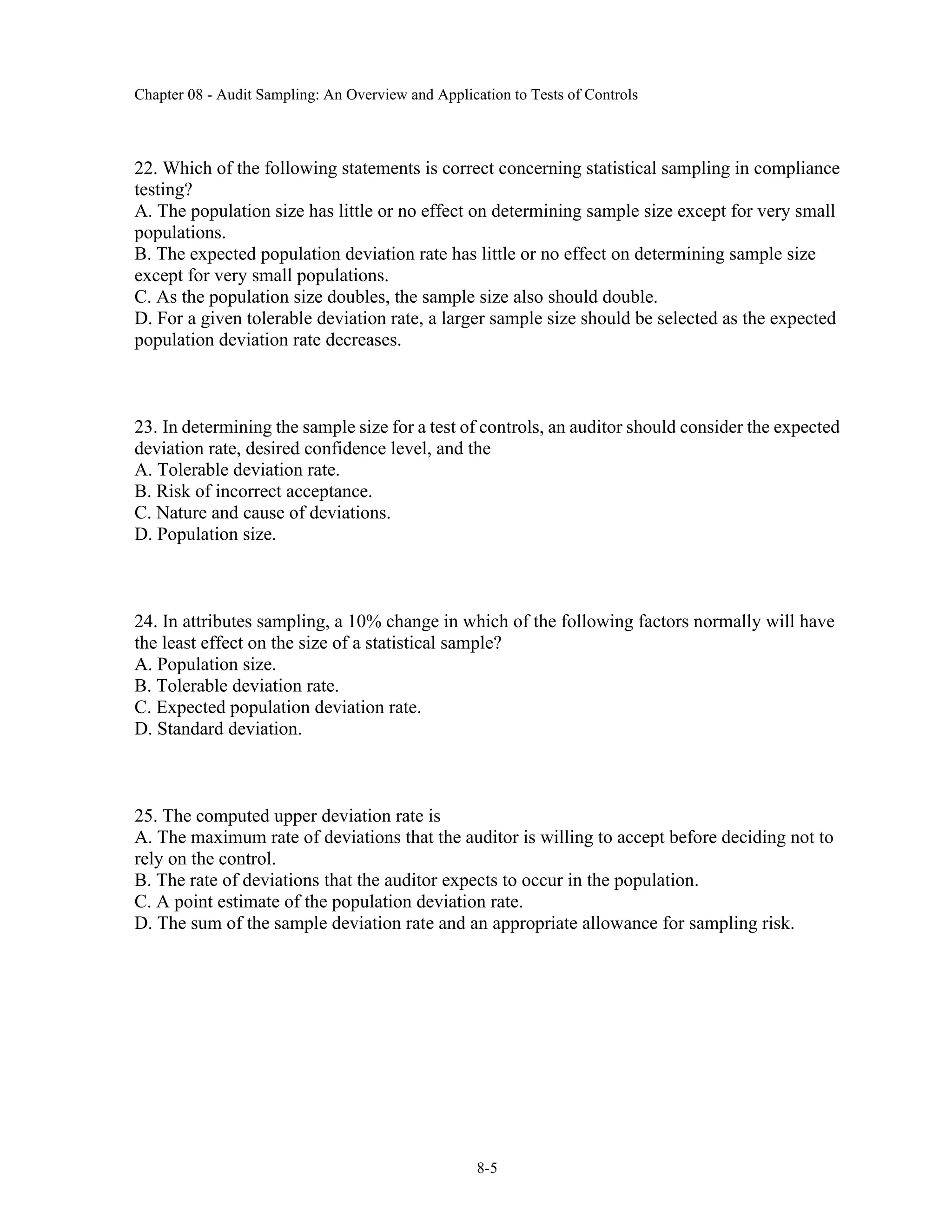
22. Which of the following statements is correct concerning statistical sampling in compliance
testing?
A. The population size has little or no effect on determining sample size except for very small
populations.
B. The expected population deviation rate has little or no effect on determining sample size
except for very small populations.
C. As the population size doubles, the sample size also should double.
D. For a given tolerable deviation rate, a larger sample size should be selected as the expected
population deviation rate decreases.
23. In determining the sample size for a test of controls, an auditor should consider the expected
deviation rate, desired confidence level, and the
A. Tolerable deviation rate.
B. Risk of incorrect acceptance.
C. Nature and cause of deviations.
D. Population size.
24. In attributes sampling, a 10% change in which of the following factors normally will have
the least effect on the size of a statistical sample?
A. Population size.
B. Tolerable deviation rate.
C. Expected population deviation rate.
D. Standard deviation.
25. The computed upper deviation rate is
A. The maximum rate of deviations that the auditor is willing to accept before deciding not to
rely on the control.
B. The rate of deviations that the auditor expects to occur in the population.
C. A point estimate of the population deviation rate.
D. The sum of the sample deviation rate and an appropriate allowance for sampling risk.
Chapter 08 - Audit Sampling: An Overview and Application to Tests of Controls
8-6
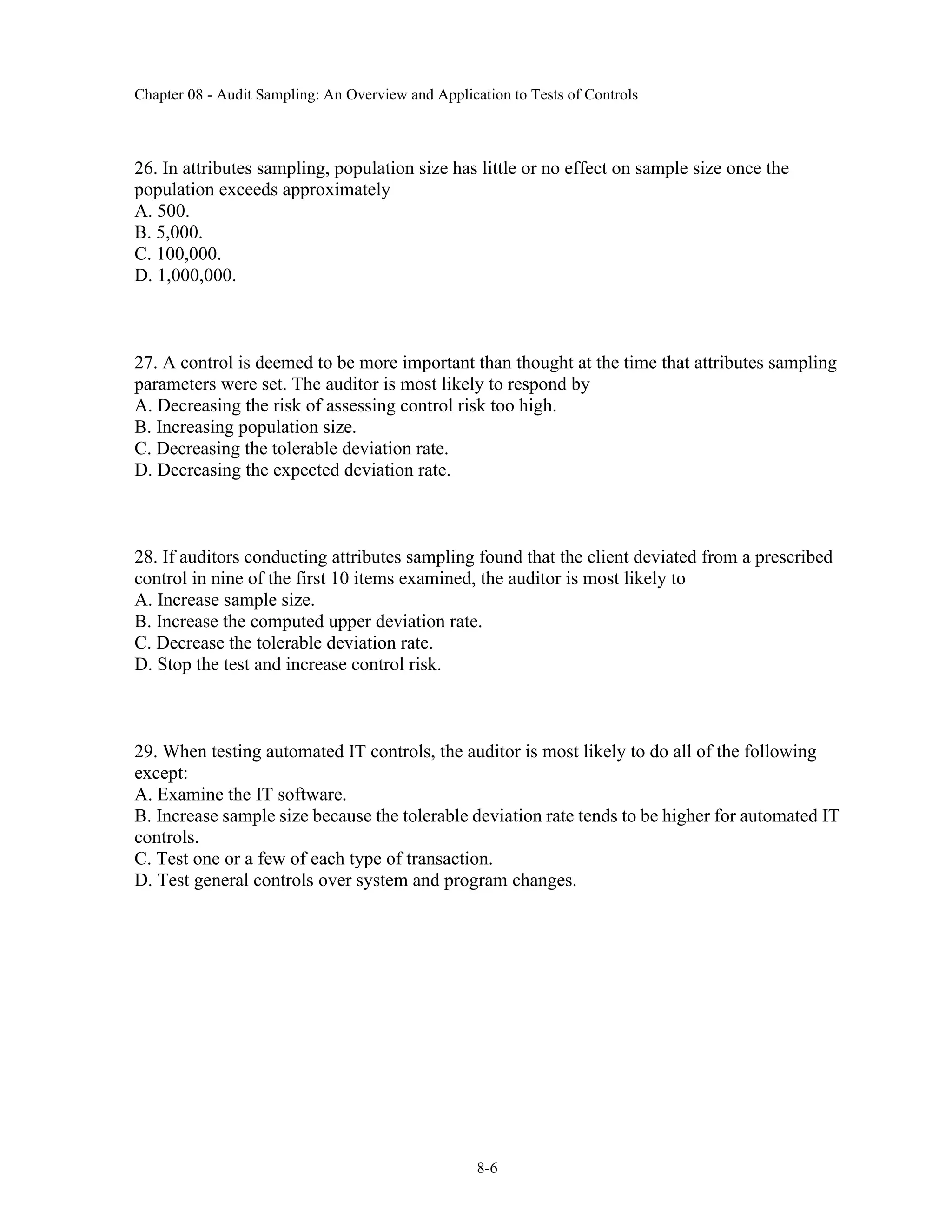
26. In attributes sampling, population size has little or no effect on sample size once the
population exceeds approximately
A. 500.
B. 5,000.
C. 100,000.
D. 1,000,000.
27. A control is deemed to be more important than thought at the time that attributes sampling
parameters were set. The auditor is most likely to respond by
A. Decreasing the risk of assessing control risk too high.
B. Increasing population size.
C. Decreasing the tolerable deviation rate.
D. Decreasing the expected deviation rate.
28. If auditors conducting attributes sampling found that the client deviated from a prescribed
control in nine of the first 10 items examined, the auditor is most likely to
A. Increase sample size.
B. Increase the computed upper deviation rate.
C. Decrease the tolerable deviation rate.
D. Stop the test and increase control risk.
29. When testing automated IT controls, the auditor is most likely to do all of the following
except:
A. Examine the IT software.
B. Increase sample size because the tolerable deviation rate tends to be higher for automated IT
controls.
C. Test one or a few of each type of transaction.
D. Test general controls over system and program changes.
Chapter 08 - Audit Sampling: An Overview and Application to Tests of Controls
8-7
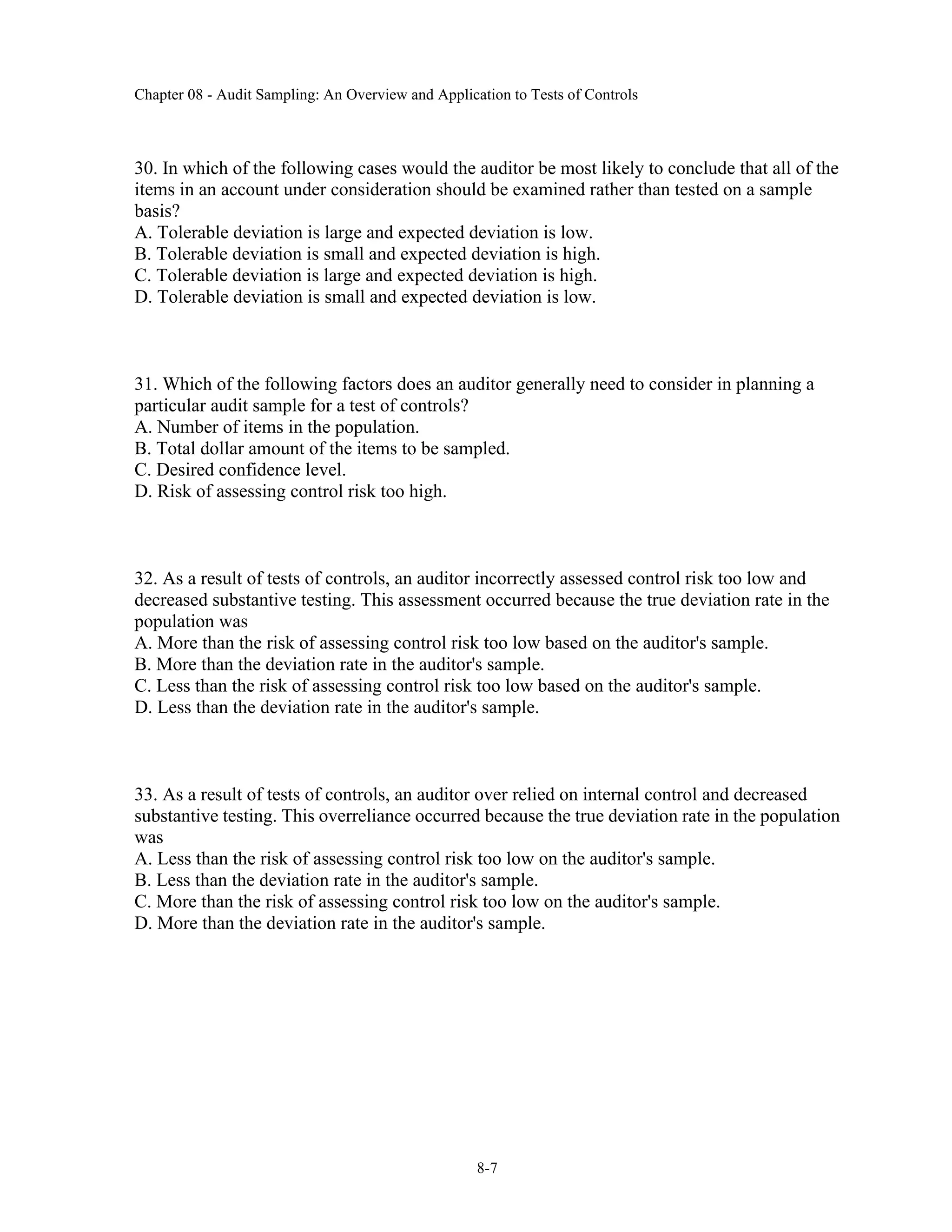
30. In which of the following cases would the auditor be most likely to conclude that all of the
items in an account under consideration should be examined rather than tested on a sample
basis?
A. Tolerable deviation is large and expected deviation is low.
B. Tolerable deviation is small and expected deviation is high.
C. Tolerable deviation is large and expected deviation is high.
D. Tolerable deviation is small and expected deviation is low.
31. Which of the following factors does an auditor generally need to consider in planning a
particular audit sample for a test of controls?
A. Number of items in the population.
B. Total dollar amount of the items to be sampled.
C. Desired confidence level.
D. Risk of assessing control risk too high.
32. As a result of tests of controls, an auditor incorrectly assessed control risk too low and
decreased substantive testing. This assessment occurred because the true deviation rate in the
population was
A. More than the risk of assessing control risk too low based on the auditor's sample.
B. More than the deviation rate in the auditor's sample.
C. Less than the risk of assessing control risk too low based on the auditor's sample.
D. Less than the deviation rate in the auditor's sample.
33. As a result of tests of controls, an auditor over relied on internal control and decreased
substantive testing. This overreliance occurred because the true deviation rate in the population
was
A. Less than the risk of assessing control risk too low on the auditor's sample.
B. Less than the deviation rate in the auditor's sample.
C. More than the risk of assessing control risk too low on the auditor's sample.
D. More than the deviation rate in the auditor's sample.
Chapter 08 - Audit Sampling: An Overview and Application to Tests of Controls
8-8
34. If the expected deviation rate exceeds the tolerable deviation rate, the auditor is most likely
to
A. Have a large sample size.
B. Set control risk at the maximum without sampling.
C. Set control risk at the minimum without sampling.
D. Pick a lower risk of assessing control risk too low to increase sample size.
35. For an attributes sampling plan, the tolerable deviation rate is 4.5%, the computed upper
deviation rate is 7%, the sample deviation rate is 3%, and the desired confidence level is 95%.
What is the allowance for sampling risk included in the computed upper deviation rate?
A. 1.5%.
B. 3%.
C. 4%.
D. 5%.
36. Based on a 5% risk of assessing control risk too low, how would an auditor interpret a
computed upper deviation rate of 7%?
A. The auditor is willing to accept a deviation rate of 7% before deciding not to rely on the
control.
B. There is a 5% chance that the deviation rate in the population is less than 7%.
C. There is a 5% chance that the deviation rate in the population exceeds 7%.
D. There is a 95% chance that the deviation rate in the population equals 7%.
37. Auditors who prefer statistical to nonstatistical sampling believe that the principal
advantage of statistical sampling flows from its unique ability to
A. Define the precision required to provide audit satisfaction.
B. Mathematically measure uncertainty.
C. Establish conclusive audit evidence with decreased audit effort.
D. Promote a more legally defensible procedural approach.
Chapter 08 - Audit Sampling: An Overview and Application to Tests of Controls
8-9
38. Which of the following best describes the distinguishing feature of statistical sampling?
A. It requires the examination of a smaller number of supporting documents.
B. It provides a means for measuring mathematically the degree of uncertainty that results from
examining only part of a population.
C. It reduces the problems associated with the auditor's judgment concerning materiality.
D. It is evaluated in terms of two parameters: statistical mean and random selection.
39. Statistical sampling provides a technique for
A. Exactly defining materiality.
B. Greatly reducing the amount of substantive testing.
C. Eliminating judgment in testing.
D. Measuring the sufficiency of evidential matter.
40. Auditors who prefer statistical sampling to nonstatistical sampling may do so because
statistical sampling helps the auditor
A. Measure the sufficiency of the evidential matter obtained.
B. Eliminate subjectivity in the evaluation of sampling results.
C. Reduce the level of tolerable misstatement to a relatively low amount.
D. Minimize the failure to detect a material misstatement due to nonsampling risk.
41. An advantage of using statistical over nonstatistical sampling methods in tests of controls is
that the statistical methods
A. Afford greater assurance than a nonstatistical sample of equal size.
B. Provide an objective basis for quantitatively evaluating sample risks.
C. Can more easily convert the sample into a dual-purpose test useful for substantive testing.
D. Eliminate the need to use judgment in determining appropriate sample sizes.
Chapter 08 - Audit Sampling: An Overview and Application to Tests of Controls
8-10
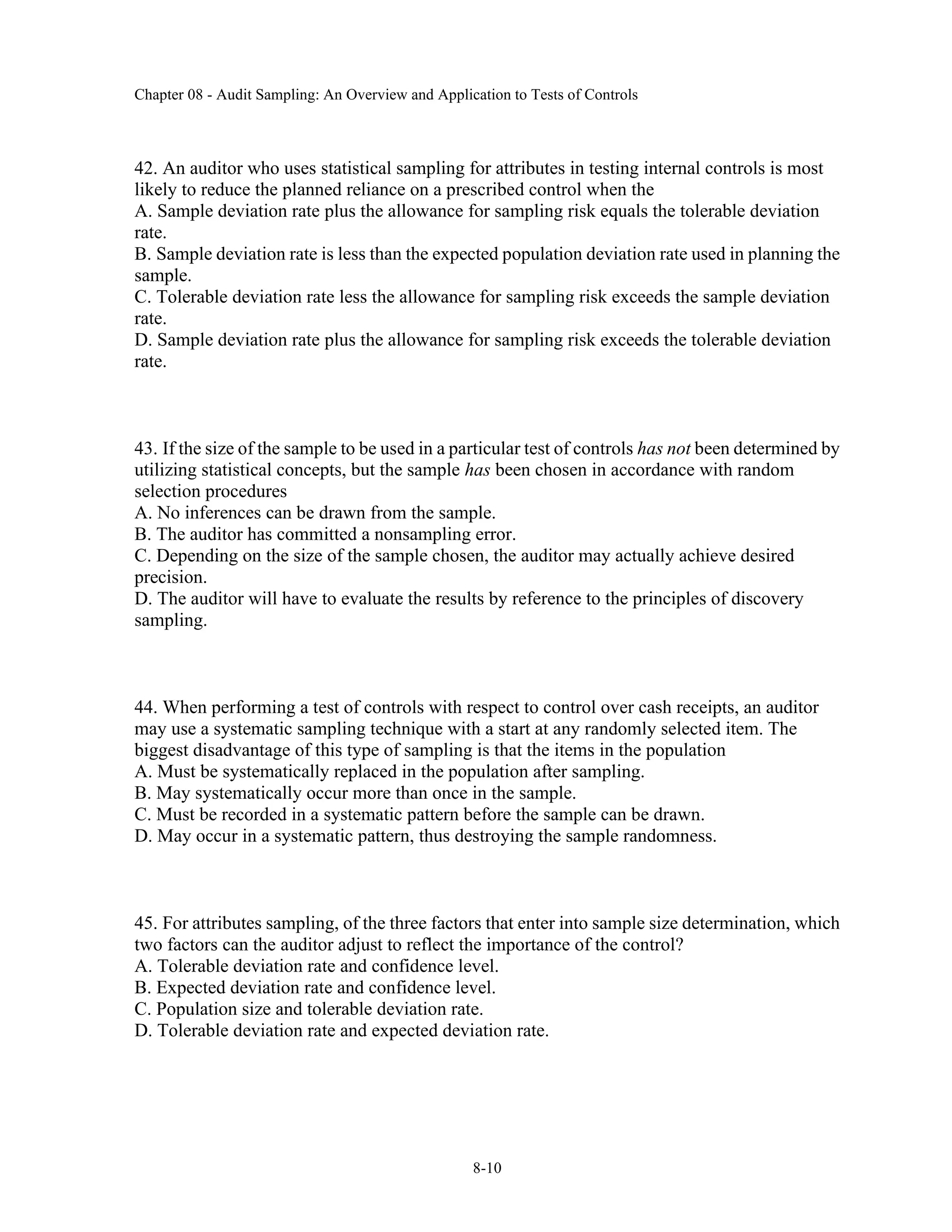
42. An auditor who uses statistical sampling for attributes in testing internal controls is most
likely to reduce the planned reliance on a prescribed control when the
A. Sample deviation rate plus the allowance for sampling risk equals the tolerable deviation
rate.
B. Sample deviation rate is less than the expected population deviation rate used in planning the
sample.
C. Tolerable deviation rate less the allowance for sampling risk exceeds the sample deviation
rate.
D. Sample deviation rate plus the allowance for sampling risk exceeds the tolerable deviation
rate.
43. If the size of the sample to be used in a particular test of controls has not been determined by
utilizing statistical concepts, but the sample has been chosen in accordance with random
selection procedures
A. No inferences can be drawn from the sample.
B. The auditor has committed a nonsampling error.
C. Depending on the size of the sample chosen, the auditor may actually achieve desired
precision.
D. The auditor will have to evaluate the results by reference to the principles of discovery
sampling.
44. When performing a test of controls with respect to control over cash receipts, an auditor
may use a systematic sampling technique with a start at any randomly selected item. The
biggest disadvantage of this type of sampling is that the items in the population
A. Must be systematically replaced in the population after sampling.
B. May systematically occur more than once in the sample.
C. Must be recorded in a systematic pattern before the sample can be drawn.
D. May occur in a systematic pattern, thus destroying the sample randomness.
45. For attributes sampling, of the three factors that enter into sample size determination, which
two factors can the auditor adjust to reflect the importance of the control?
A. Tolerable deviation rate and confidence level.
B. Expected deviation rate and confidence level.
C. Population size and tolerable deviation rate.
D. Tolerable deviation rate and expected deviation rate.
Chapter 08 - Audit Sampling: An Overview and Application to Tests of Controls
8-11
46. Which of the following combinations guarantees a larger sample size?
A. Decrease the desired confidence level and decrease the tolerable deviation rate.
B. Increase the desired confidence level and decrease the tolerable deviation rate.
C. Decrease the desired confidence level and increase the expected deviation rate.
D. Increase the tolerable deviation rate and increase the expected deviation rate.
47. For a large population of cash disbursement transactions, Smith, CPA is testing controls by
using attribute sampling techniques. Anticipating an expected deviation rate of 3 percent, Smith
found from a table that the required sample size is 400 with a tolerable deviation rate of 5
percent and a desired confidence level of 95 percent. If Smith anticipated an expected deviation
rate of only 2 percent but wanted to maintain the same tolerable deviation rate and confidence
level, the sample size would be closest to
A. 200.
B. 400.
C. 533.
D. 800.
48. In nonstatistical sampling for tests of controls, increasing the desired confidence level
results in a
A. Higher tolerable deviation rate.
B. Lower expected deviation rate.
C. Larger sample size.
D. Smaller sample size.
49. To determine the sample size for a test of controls, an auditor should consider the tolerable
deviation rate, the desired confidence level, and the
A. Expected population deviation rate.
B. Computed upper precision limit.
C. Risk of assessing control risk too high.
D. Risk of incorrect rejection.
Chapter 08 - Audit Sampling: An Overview and Application to Tests of Controls
8-12
50. Which of the following statements is correct concerning statistical sampling in tests of
controls?
A. As the population size increases, the sample size should increase proportionately.
B. Deviations from specific internal control procedures at a given rate ordinarily result in
misstatements at a lower rate.
C. There is an inverse relationship between the expected population deviation rate and the
sample size.
D. In determining tolerable deviation rate, an auditor considers detection risk and the sample
size.
51. For an attributes sampling plan, the tolerable deviation rate is 4%, the computed upper
deviation rate is 7%, the sample deviation rate is 3%, and the risk of assessing control risk too
low is 5%. Which of the following is true?
A. The auditor must increase control risk because the risk of assessing control risk too low is
greater than the tolerable deviation rate.
B. The auditor is likely to increase control risk because the risk of assessing control risk too low
is greater than the tolerable deviation rate.
C. The auditor must increase control risk because the computed upper deviation rate is greater
than the tolerable deviation rate.
D. The auditor is likely to increase control risk because the computed upper deviation rate is
greater than the tolerable deviation rate.
52. Which of the following risks is related to effectiveness of testing?
A. The risk of incorrect rejection.
B. Inherent risk.
C. The risk of incorrect acceptance.
D. None of the above.
53. Which of the following risks is related to efficiency of testing?
A. The risk of incorrect rejection.
B. Inherent risk.
C. The risk of incorrect acceptance.
D. None of the above.
Chapter 08 - Audit Sampling: An Overview and Application to Tests of Controls
8-13
54. The term precision relates to
A. The difference between confidence level and estimated error.
B. The difference between confidence level and tolerable error.
C. The difference between expected and tolerable deviation rate.
D. The difference between expected and sample deviation rate.
55. Audit sampling is commonly used for which type of audit evidence?
A. Reperformance.
B. Analytical procedures.
C. Inquiry.
D. Observation.
56. Audit sampling is not used for which type of audit evidence?
A. Inquiry.
B. Inspection of tangible assets.
C. Reperformance.
D. Confirmation.
Short Answer Questions
57. Why must an auditor use sampling? What tradeoffs occur when an auditor uses sampling?
Chapter 08 - Audit Sampling: An Overview and Application to Tests of Controls
8-14
58. "Technology has steadily reduced the number of situations in which audit sampling is
necessary and in the future technology will probably eliminate the need for auditors to rely on
sampling." Defend or refute the preceding statement.
59. Define Type I and Type II errors.
60. Define sampling risk and nonsampling risk.
61. When determining the sample size of accounts receivable to test, what are three factors that
are important for you to consider?
Chapter 08 - Audit Sampling: An Overview and Application to Tests of Controls
8-15
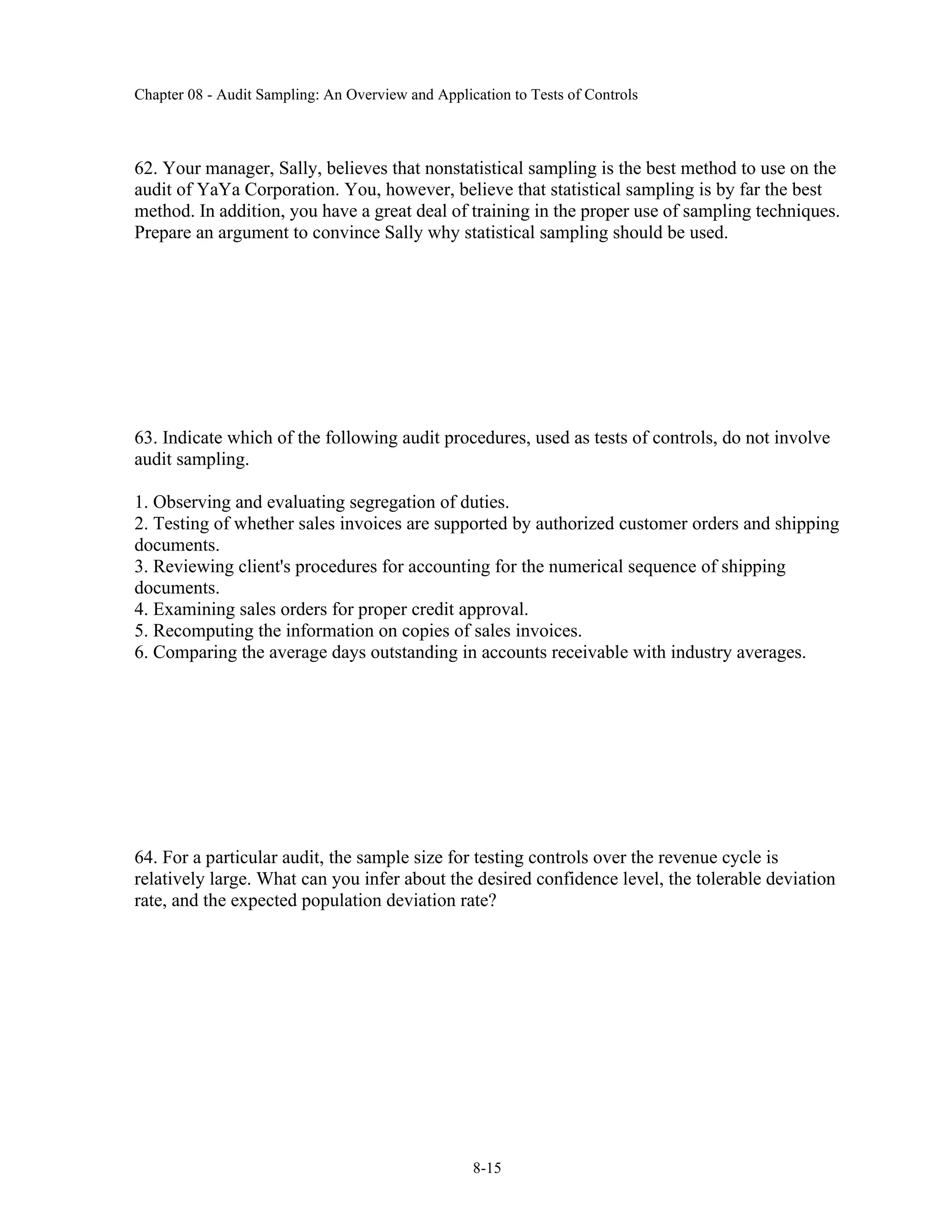
62. Your manager, Sally, believes that nonstatistical sampling is the best method to use on the
audit of YaYa Corporation. You, however, believe that statistical sampling is by far the best
method. In addition, you have a great deal of training in the proper use of sampling techniques.
Prepare an argument to convince Sally why statistical sampling should be used.
63. Indicate which of the following audit procedures, used as tests of controls, do not involve
audit sampling.
1. Observing and evaluating segregation of duties.
2. Testing of whether sales invoices are supported by authorized customer orders and shipping
documents.
3. Reviewing client's procedures for accounting for the numerical sequence of shipping
documents.
4. Examining sales orders for proper credit approval.
5. Recomputing the information on copies of sales invoices.
6. Comparing the average days outstanding in accounts receivable with industry averages.
64. For a particular audit, the sample size for testing controls over the revenue cycle is
relatively large. What can you infer about the desired confidence level, the tolerable deviation
rate, and the expected population deviation rate?
Chapter 08 - Audit Sampling: An Overview and Application to Tests of Controls
8-16
65. Before performing sampling procedures in an audit of controls, Sue set the tolerable
deviation rate at 4.0%. After the procedures, she computes a computed upper deviation rate of
5.4%. What can Sue conclude about the client's controls?
66. Your uncle Bob, a CPA, has recently started auditing and he wants your advice on some
tests of sales transactions he is conducting. Bob selected a haphazard sample of 15 sales with a
total book value of $75,000. In his sample, he found a total of $500 in net overstatement errors.
The total sales balance per book is $10,000,000. Overall materiality for the engagement is
$300,000. Tolerable misstatement for sales is $70,000. If the sample results indicate that Bob's
best estimate of total misstatement in sales is $35,000, can Bob safely conclude that no
additional work is needed in this area? Include in your answer a clear discussion of how sample
results are compared to tolerable misstatement.
67. Identify the types of audit evidence that are tested using audit sampling techniques.
Chapter 08 - Audit Sampling: An Overview and Application to Tests of Controls
8-17
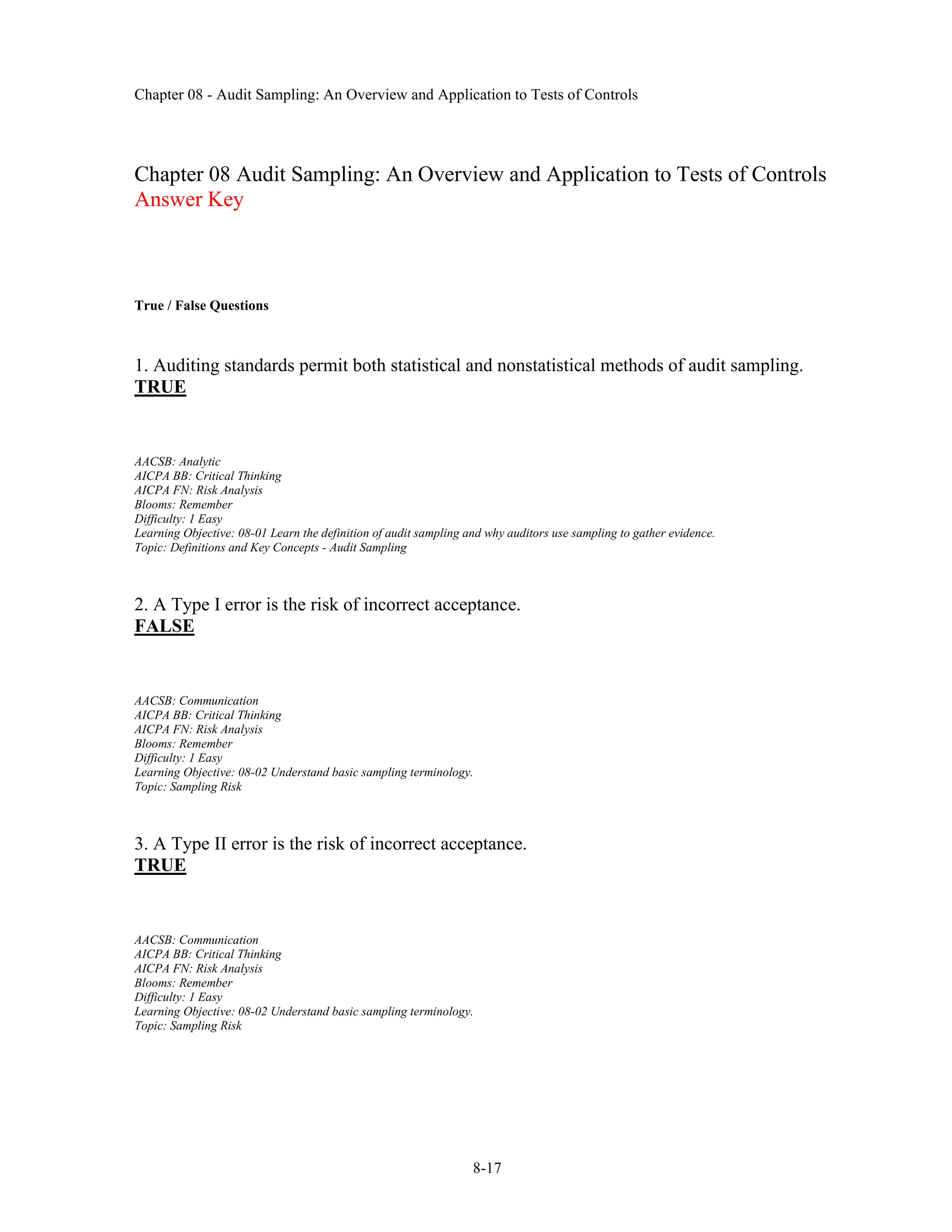
Chapter 08 Audit Sampling: An Overview and Application to Tests of Controls
Answer Key
True / False Questions
1. Auditing standards permit both statistical and nonstatistical methods of audit sampling.
TRUE
AACSB: Analytic
AICPA BB: Critical Thinking
AICPA FN: Risk Analysis
Blooms: Remember
Difficulty: 1 Easy
Learning Objective: 08-01 Learn the definition of audit sampling and why auditors use sampling to gather evidence.
Topic: Definitions and Key Concepts - Audit Sampling
2. A Type I error is the risk of incorrect acceptance.
FALSE
AACSB: Communication
AICPA BB: Critical Thinking
AICPA FN: Risk Analysis
Blooms: Remember
Difficulty: 1 Easy
Learning Objective: 08-02 Understand basic sampling terminology.
Topic: Sampling Risk
3. A Type II error is the risk of incorrect acceptance.
TRUE
AACSB: Communication
AICPA BB: Critical Thinking
AICPA FN: Risk Analysis
Blooms: Remember
Difficulty: 1 Easy
Learning Objective: 08-02 Understand basic sampling terminology.
Topic: Sampling Risk
Chapter 08 - Audit Sampling: An Overview and Application to Tests of Controls
8-18
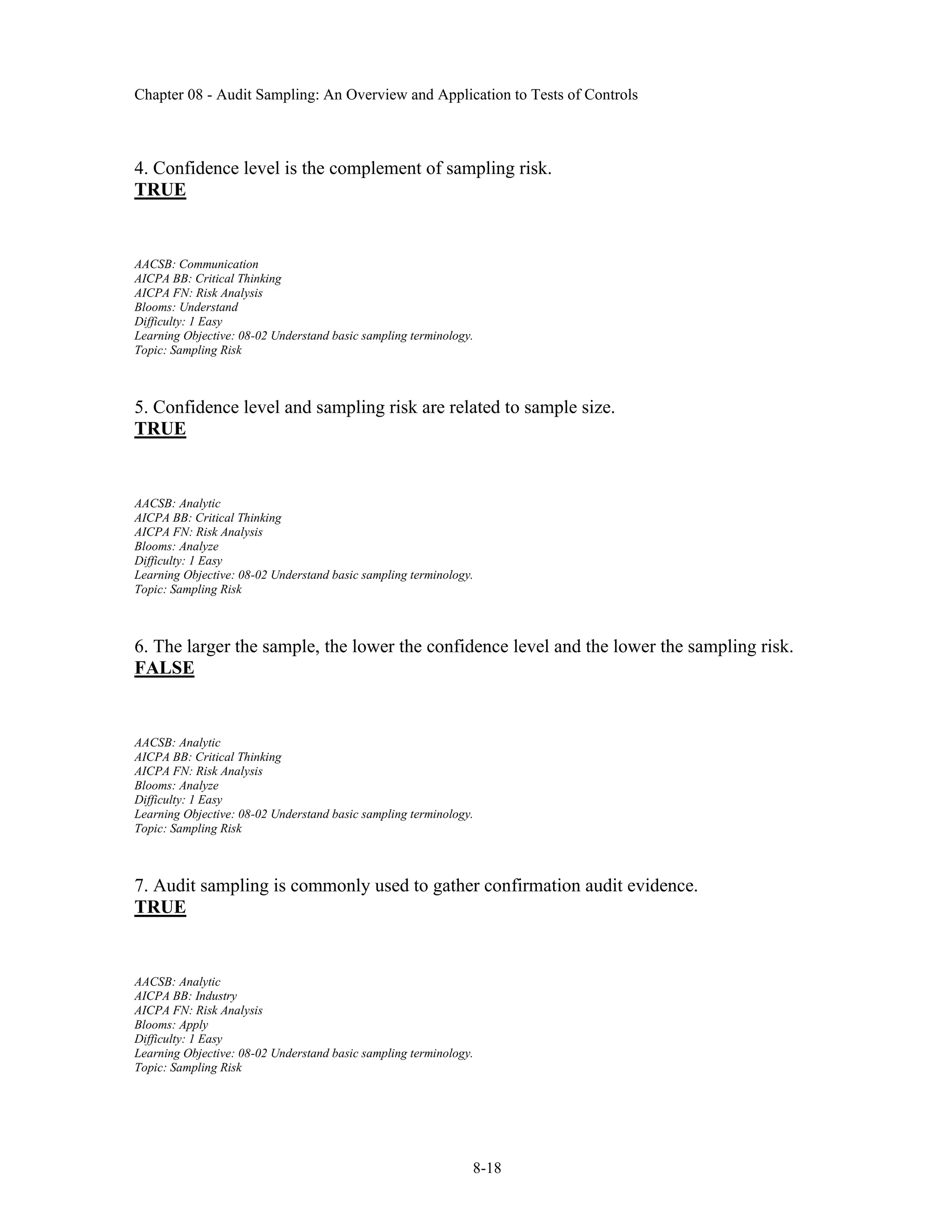
4. Confidence level is the complement of sampling risk.
TRUE
AACSB: Communication
AICPA BB: Critical Thinking
AICPA FN: Risk Analysis
Blooms: Understand
Difficulty: 1 Easy
Learning Objective: 08-02 Understand basic sampling terminology.
Topic: Sampling Risk
5. Confidence level and sampling risk are related to sample size.
TRUE
AACSB: Analytic
AICPA BB: Critical Thinking
AICPA FN: Risk Analysis
Blooms: Analyze
Difficulty: 1 Easy
Learning Objective: 08-02 Understand basic sampling terminology.
Topic: Sampling Risk
6. The larger the sample, the lower the confidence level and the lower the sampling risk.
FALSE
AACSB: Analytic
AICPA BB: Critical Thinking
AICPA FN: Risk Analysis
Blooms: Analyze
Difficulty: 1 Easy
Learning Objective: 08-02 Understand basic sampling terminology.
Topic: Sampling Risk
7. Audit sampling is commonly used to gather confirmation audit evidence.
TRUE
AACSB: Analytic
AICPA BB: Industry
AICPA FN: Risk Analysis
Blooms: Apply
Difficulty: 1 Easy
Learning Objective: 08-02 Understand basic sampling terminology.
Topic: Sampling Risk
Chapter 08 - Audit Sampling: An Overview and Application to Tests of Controls
8-19
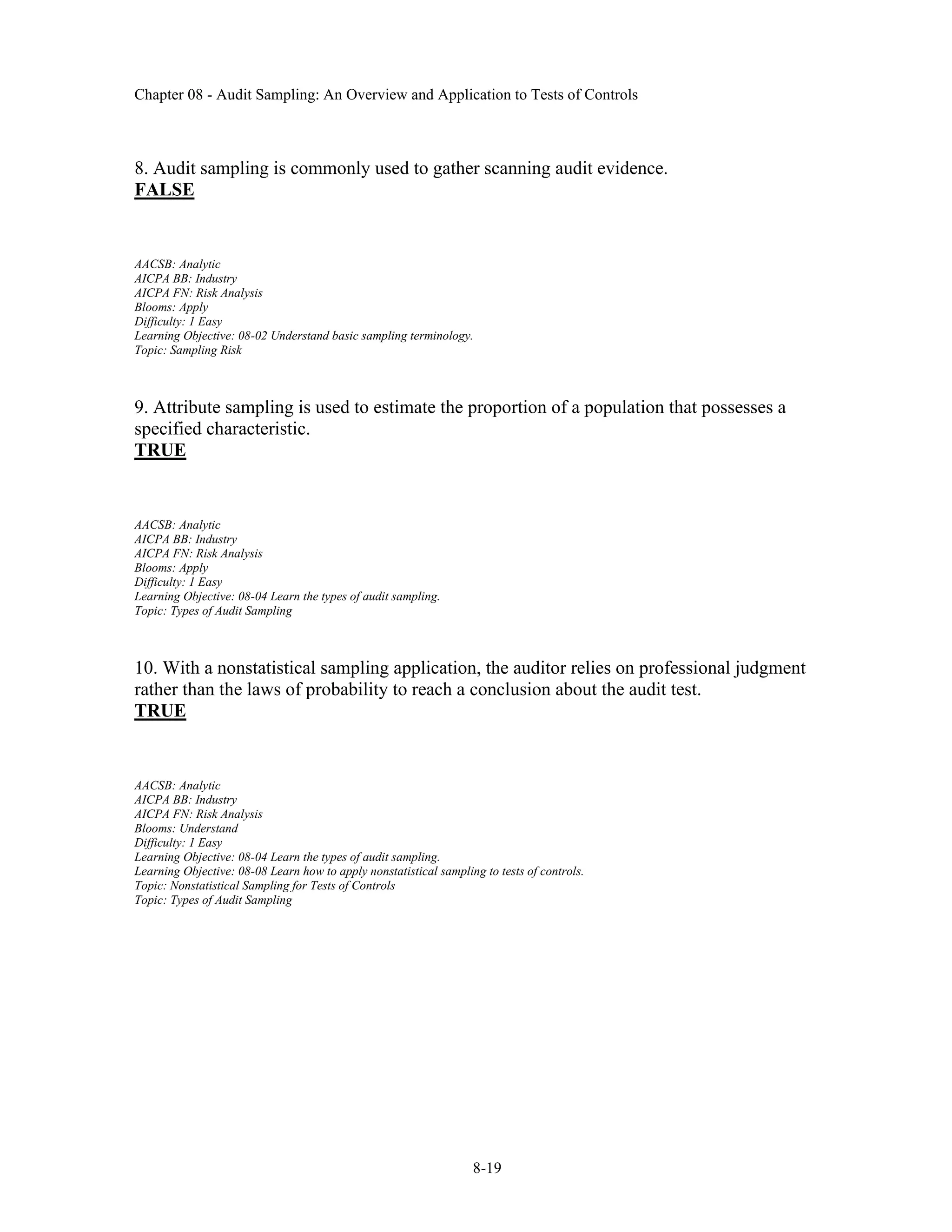
8. Audit sampling is commonly used to gather scanning audit evidence.
FALSE
AACSB: Analytic
AICPA BB: Industry
AICPA FN: Risk Analysis
Blooms: Apply
Difficulty: 1 Easy
Learning Objective: 08-02 Understand basic sampling terminology.
Topic: Sampling Risk
9. Attribute sampling is used to estimate the proportion of a population that possesses a
specified characteristic.
TRUE
AACSB: Analytic
AICPA BB: Industry
AICPA FN: Risk Analysis
Blooms: Apply
Difficulty: 1 Easy
Learning Objective: 08-04 Learn the types of audit sampling.
Topic: Types of Audit Sampling
10. With a nonstatistical sampling application, the auditor relies on professional judgment
rather than the laws of probability to reach a conclusion about the audit test.
TRUE
AACSB: Analytic
AICPA BB: Industry
AICPA FN: Risk Analysis
Blooms: Understand
Difficulty: 1 Easy
Learning Objective: 08-04 Learn the types of audit sampling.
Learning Objective: 08-08 Learn how to apply nonstatistical sampling to tests of controls.
Topic: Nonstatistical Sampling for Tests of Controls
Topic: Types of Audit Sampling
Chapter 08 - Audit Sampling: An Overview and Application to Tests of Controls
8-20
Multiple Choice Questions
11. Which of the following best illustrates the concept of sampling risk?
A. A randomly chosen sample may not be representative of the population as a whole
(regarding the characteristic being tested).
B. An auditor may select audit procedures that are not appropriate to achieve the specific
objective.
C. An auditor may fail to recognize errors in the documents examined for the chosen sample.
D. The documents related to the chosen sample may not be available for inspection.
AACSB: Analytic
AICPA BB: Critical Thinking
AICPA FN: Risk Analysis
Blooms: Understand
Difficulty: 1 Easy
Learning Objective: 08-02 Understand basic sampling terminology.
Topic: Sampling Risk
12. Jones, CPA, believes the industry-wide deviation rate of client billing errors is 3% and has
established a tolerable deviation rate of 5%. In the review of client invoices, Jones should use
A. Discovery sampling.
B. Attributes sampling.
C. Stratified sampling.
D. Variables sampling.
AACSB: Analytic
AICPA BB: Critical Thinking
AICPA FN: Decision Making
Blooms: Apply
Difficulty: 1 Easy
Learning Objective: 08-03 Learn the types of audit procedures that do and do not involve sampling.
Learning Objective: 08-04 Learn the types of audit sampling.
Topic: Audit Evidence Choices that Do and Do Not Involve Sampling
Topic: Types of Audit Sampling
Another Random Scribd Document
with Unrelated Content
with the modes in which the forces of the world may be grouped under their
control; with the manifold combinations which finally enable one supreme
power to absorb all the rest, so that a god of the sky, like the Greek Zeus,
may become a god of rain and sunshine and atmospheric change, of earth
and sea, and of the nether world; and may thus be presented as the sole and
universal energy, not only of all outward things but also of the inner world
of thought. Of this immense development language, archæology, literature,
the dedications of worship, the testimonies of the ancient students of their
still more ancient past in ritual and belief, contain the scattered witness,
which the student of to-day laboriously gathers and interprets. It is the
humbler object of a little manual of Comparative Religion to set some of
the principal issues of such historic evolution side by side, and show how
similar reactions of the mind of man upon the field of his experience have
wrought like results.
As the inquirer casts his eye over the manifold varieties of the world's
faiths, he sees that they are always conditioned by the stage of social culture
out of which they emerge. The hunter who lives by the chase, and must
range over large areas for means of support; the pastoral herdsman who has
acquired the art of breeding cattle and sheep, and slowly moves from one
set of feeding-grounds to another; the agriculturist who has learned to rely
on the co-operation of earth and sky in the annual round,—have each their
own way of expressing their view of the Powers on which they depend.
Little by little they are arranged in groups. The Celts, for instance,
coming to river after river in their onward march, employed the same name
again and again, "Deuona," divine (still surviving in this country in
different forms, Devon, Dee, etc.), as though all rivers belonged to one
power. They were the givers of life and health and plenty, to whom costly
sacrifices must be made. So they might bear the title "Mother," and were
akin to the powers of fertility living in the soil, the "Mothers" (Matres or
Matronæ), cognate with the "Mothers" who fulfil similar functions in
modern India. The adjacent Teutonic peoples filled forest and field with
wood-sprites and elves, dwellers in the air and the sunlight. The springs, the
streams, and the lakes, were the home of the water-sprites or nixes; in the
fall of the mighty torrent, among the rocks on the mountain heights, in the
fury of the storm or the severity of the frost, was the strength of the giants.
Yet further east and north the Finnic races looked out on a land of forest
and waters, of mists and winds. The spirits were ranged beneath rulers who
were figured in human form. The huntsman prayed with vow and sacrifice
to the aged Tapio, god of the woods and the wild animals. Kekri watched
over the increase of the herd, while Hillervo protected them on the summer
pastures. The grains and herbs—of less importance to tribes only
imperfectly agricultural—were ascribed to the care of Pellervoinen, who
falls into the background and receives but little veneration. Water, once
worshipped as a living element (vesi), is gradually supplanted by a water-
god (Ahto) who rules over the spirits of lakes and rivers, wells and springs.
"Mother-earth" still designates in the oldest poetry the living energy of the
ground, though she afterwards becomes the "lady of the earth" and consort
of the lord of the sky. The sky, Jumala, was first of all conceived as itself
living; "Jumala's weather" was like "Zeus's shower" to an ancient Greek.
And then, under the name Ukko, the sky becomes a personal ruler, with
clouds and rain, thunder and hail, beneath his sway; who can be addressed
as—
Ukko, thou of gods the highest,
Ukko, thou our Heavenly Father.
Many causes contribute to the enlargement and stability of such
conceptions. Tribes of limited local range and a meagre past without
traditions may conceive the world around them on a feeble scale. But
migration helps to enlarge the outlook. Local powers cannot accompany
tribes upon the march. Either they must be left behind and drop out of
remembrance, or they must be identified with new scenes and adapted to
fresh environments. When the horizon moves ever further forwards with
each advance, earth and sky loom vaster before the imagination, and sun
and moon, the companion of each day or the protector of each night, gain a
more stately predominance. The ancestors of the Hindus, the Greeks, the
Romans, the Teutons, carried with them the worship of the sky-god under a
common name, derived from the root div, to "shine" (Dyaus = Zeus = Jovis
= old High German Tiu, as in Tuesday). Other names gathered around the
person in the actual firmament, such as the Sanskrit Varuna (still recognised
by some scholars as identical with the Greek Ouranos, heaven), loftiest of
all the Vedic gods. The Aryan immigrants are already organised under
kings, and Varuna sits enthroned in sovereignty. His palace is supported by
a thousand pillars, and a thousand doors provide open access for his
worshippers. But he is in some sense omnipresent, and one of the ancient
poets sang—
"If a man stands or walks or hides, if he goes to lie down or to get up,
what two people sitting together whisper, King Varuna knows it, he is there
as the third.
"This earth, too, belongs to Varuna, the king, and this wide sky with its
ends far apart. The two seas (sky and ocean) are Varuna's loins; he is also
contained in this small drop of water.
"He who should flee far beyond the sky, even he would not be rid of
Varuna, the king."
The supreme power of the universe is here conceived under a political
image. Conceptions of government and social order supply another line of
advance, parallel with the forces of nature. On the African Gold Coast, after
eighteen years' observation, Cruickshank ranged the objects of worship in
three ranks: (1) the stone, the tree, the river, the snake, the alligator, the
bundle of rags, which constituted the private fetish of the individual; (2) the
greater family deity whose aid was sought by all alike, sometimes in a
singular act of communion which involved the swallowing of the god (p.
144); and (3) the deity of the whole town, to whom the entire people had
recourse in times of calamity and suffering.
The conception of the deity of a tribe or nation may be greatly developed
under the influence of victory. War becomes a struggle between rival gods.
Jephthah the Gileadite, after recounting the triumphs of Israel to the hostile
Ammonite king, states the case with the most naked simplicity: "Yahweh,
Israel's god, hath dispossessed the Amorites from before his people Israel,
and shouldest thou possess them? Wilt thou not possess that which
Chemosh thy god giveth thee to possess? So whomsoever Yahweh our god
hath dispossessed from before us, them will we possess" (Judges xi. 23, 24).
The land of Canaan was the gift of Israel's God, but at first his power was
limited by its boundaries: to be driven from the country was to be alienated
from the right to offer him worship or receive from him protection. In the
famous battle with the Hittites, celebrated by the court-poet of Rameses the
Great (1300-1234 B.C.), the king, endangered by the flight of his troops,
appeals to the great god Amen, a form of the solar deity Rê, with
confidence of help, "Amen shall bring to nought the ignorers of God": and
the answer comes, "I am with thee, I am thy father, my hand is with thee, I
am more excellent for thee than hundreds of thousands united in one."
Success thus enhanced the glory of the victor's gods. Like the Incas of Peru
in later days, the Assyrian sovereigns confirmed their power by bringing the
deities of tributary peoples in a captive train to their own capital: and the
Hebrew prophet opens his description of the fall of Babylon by depicting
the images of the great gods Bel and Nebo as packed for deportation on the
transport-animals of the conqueror.
Other causes further tended to give distinction to the personality of
deities, and define their spheres. A promiscuous horde of spirits has no
family relationships. A god may have a pedigree; a consort is at his side;
and the mysterious divine power reappears in a son. Instead of the political
analogy of a sovereign and his attendants, the family conception expresses
itself in a divine father, mother and child. Thus the Ibani of Southern
Nigeria recognised Adum as the father of all gods except Tamuno the
creator, espoused to Okoba the principal goddess, and mother of Eberebo,
represented as a boy, to whom children were dedicated. The Egyptian triad,
Osiris, Isis and Horus, is well known; and the divine mother with the babe
upon her lap passed into the Christian Church in the form of the Virgin
Mary and her infant son.
The divisions of the universe suggested another grouping. The Vedic
poets arranged their deities in three zones: the sky above, the intervening
atmosphere, and the earth beneath. Babylonian cosmology placed Anu in
the heaven, Bel on the earth, and Ea in the great deep, and these three
became the symbols of the order of nature, and the divine embodiments of
physical law. Homer already divides the world between the sky-god Zeus,
Poseidon of earth and sea, and Hades of the nether realm: and Rome has its
triads, like Jupiter, Mars, and Quirinus, or again Jupiter, Juno, and Minerva.
Whatever be the origin of the number three in this connection, it reproduces
itself with strange reiteration in both hemispheres. Other groups are
suggested by the sun and moon and the five planets, and appear in sets of
seven. Egyptian summaries recognised gods in the sky, on earth, and in the
water; and the theologians of different sanctuaries loved to arrange them in
systems of nine, or three times three.
Out of this vast and motley multitude emerge certain leading types in
correspondence with certain modes of human thought, with certain hopes
and fears arising out of the changes of the human lot. Curiosity begins to
ask questions about the scene around. The child, when it has grasped some
simple view of the world, will inquire who made it; and to the usual answer
will by and by rejoin "And who made God?" Elementary speculation does
not advance so far: it is content to rest if necessary in darkness and the void,
provided there is a power which can light the sun, and set man on his feet.
But the intellectual range of thought even in the lower culture is much
wider than might have been anticipated; while the higher religions contain
abundant survivals of the cruder imagination which simply loves a tale.
Sometimes the creative power (especially on the American continent) is
figured as a marvellous animal, a wondrous raven, a bird-serpent, a great
hare, a mighty beaver. Or the dome of sky suggests an original world-egg,
which has been divided to make heaven and earth. Even the Australians,
whose characteristics are variously interpreted as indications of extreme
backwardness or of long decline, show figures which belong to what Mr.
Andrew Lang designated the "High Gods of Low Races." Among the
Narrinyeri in the west Nurrundere was said to have made all things on the
earth; the Wiimbaio told how Nurelli had made the whole country with the
rivers, trees, and animals. Among the Western Bantu on the African
continent Nzambi (a name with many variants over a large area) is
described as "Maker and Father." "Our forefathers told us that name.
Njambi is the One-who-made-us. He is our Father, he made these trees, that
mountain, this river, these goats and chickens, and us people." That is the
simple African version of the "ever-and-beyond." But as with so many of
the chief gods, not only on the dark continent, but elsewhere, he is regarded
as a non-interfering and therefore negligible deity.
Sometimes speculation takes a higher flight. The Zuñis of Mexico have
remained in possession of ancient traditions, uninfluenced by any imported
Christianity. After many years' residence among them Mr. Cushing was able
to gather their ideas of the origin of the world. Awona-wilona was the
Maker and Container of all, the All-Father-Father. Through the great space
of the ages there was nothing else whatever, only black darkness
everywhere. Then "in the beginning of the new-made" Awona-wilona
conceived within himself, and "thought outward in space," whereby mists
of increase, steams potent of growth, were evolved and uplifted. Thus by
means of his innate knowledge the All-Container made himself in the
person and form of the sun. With his appearance came the brightening of
the spaces with light, and with the brightening of the spaces the great mist-
clouds were thickened together and fell. Thereby was evolved water in
water, yea and the world-holding sea. And then came the production of the
Fourfold-Containing Mother-Earth and the All-Covering Father-Sky.
With a yet bolder leap of imagination did a Polynesian poet picture the
great process. From island to island between Hawaii and New Zealand is a
"high god" known as Taaroa, Tangaloa, Tangaroa, and Kanaroa. The
Samoans said that he existed in space and wished for some place to dwell
in, so he made the heavens; and then wished to have a place under the
heavens, so he made the earth. Tahitian mythology declared (the versions of
priests and wise men differed) that he was born of night or darkness. Then
he embraced a rock, the imagined foundation of all things, which brought
forth earth and sea; the heavens were created with sun, moon, and stars,
clouds, wind, and rain, and the dry land appeared below. The whole process
was summed up in a hymn—
"He was: Taaroa was his name.
He abode in the void; no earth, no sea, no sky.
Taaroa calls, but nought answers,
Then, alone existing, he became the universe."
The relations of these creative Powers to man are conceived very
differently. The Maker of the world may be continually interested in it, and
may continue to administer the processes which he has begun. The Akkra
negro looks up to the living sky, Nyongmo, as the author of all things, who
is benevolently active day by day: "We see every day," said a fetish-man,
"how the grass, the corn, and the trees, spring forth through the rain and
sunshine sent by Nyongmo [Nyongmo ne = 'Nyongmo rains'], how should
he not be the creator?" So he is invoked with prayer and rite. The great
Babylonian god, Marduk, son of Ea (god of wisdom and spells), alone
succeeds in overcoming the might of Tiamat (the Hebrew tehôm or "deep"),
the primeval chaos with her hideous brood of monsters, and out of her
carcass makes the firmament of heaven. He arranges the stations of the
stars, he founds the earth, and places man upon it. "His word is
established," cries the poet, "his command is unchangeable: wide is his
heart, broad is his compassion." A conqueror so splendid could not
relinquish his energy, or rest on his achievements: he must remain on the
throne of the world to direct and support its ways. Here is a prayer of
Nebuchadrezzar to this lofty deity—
"O eternal ruler, lord of all being, grant that the name of the king thou
lovest, whose name thou hast proclaimed, may flourish as seems pleasing to
thee. Lead him in the right way. I am the prince that obeys thee, the creature
of thy hand. Thou hast created me, and hast entrusted to me dominion over
mankind. According to thy mercy, O lord, which thou bestowest upon all,
may thy supreme rule be merciful! The worship of thy divinity implant
within my heart. Grant me what seems good to thee, for thou art he that hast
fashioned my life."
On the other hand, the "High Gods of Low Races" often seem to fade
away and become inactive, or at least are out of relations to man. Olorun,
lord of the sky among the African Egbas, also bore the title of Eleda, "the
Creator." But he was too remote and exalted to be the object of human
worship, and no prayer was offered to him. Among the southern Arunta of
central Australia, reports Mr. Strehlow, Altjira is believed to live in the sky.
He is like a strong man save that he has emu feet. He created the heavenly
bodies, sun, moon, and stars. When rain-clouds come up, it is Altjira
walking through the sky. Altjira shows himself to man in the lightning, the
thunder is his voice. But though thus animate, he is no object of worship.
"Altjira is a good god; he never punishes man; therefore the blacks do not
fear him, and render him neither prayer nor sacrifice." In Indian theology
the reason for the discontinuance of homage was thus frankly stated by one
of the poets of the great epic, the Mahābhārata; "Men worship Çiva the
destroyer because they fear him; Vishnu the preserver, because they hope
from him; but who worships Brahman the creator? His work is done."[1]
[1] Hopkins, India, Old and New, p. 113. Prof. Hopkins adds that in
India to-day there are thousands of temples to Çiva and Vishnu, but only
two to Brahman.
If the deity who has provided the scene of existence thus recedes into the
background, it is otherwise with the powers which maintain and foster life.
Among the impulses which drive man to action is the need of food; and the
sources of its supply are among the earliest objects of his regard. A large
group of agencies thus gradually wins recognition, out of which emerge
lofty forms endowed with functions far transcending the simple energies at
first ascribed to them. Even the rude tribes of Australia, possessing no
definite worship, perform pantomimic ceremonies of a magical kind,
designed to stimulate the food supply. The men of the plum-tree totem will
pretend to knock down plums and eat them; in the initiation ceremony of
the eagle-hawks two representatives will imitate the flapping of wings and
the movements of attack, and one will finally wrench a piece of meat out of
the other's mouth. At a higher stage of animism the Indians of British North
America pray to the spirit of the wild raspberry. When the young shoots are
six or eight inches high above the ground, a small bundle is picked by the
wife or daughters of the chief and cooked in a new pot. The settlement
assembles in a great circle, with the presiding chief and the medicine-man
in the midst. All close their eyes, except certain assisting elders, while the
chief offers a silent prayer that the spirit of the plants will be propitious to
them, and grant them a good supply of suckers.
Here the whole class of plants is already conceived as under the control
of a single power. In ruder stages the hunter will address his petitions to the
individual bear, before whose massive stature he feels a certain awe,
entreating him not to be angry or fight, but to take pity on him. Pastoral
peoples will employ domesticated animals in sacrifice, while the products
of the field occupy a second place; the cow may become sacred, and the
daily work of the dairy may rise, as among the Todas, to the rank of
religious ritual. Some element of mysterious energy will even lie in the
weapons of the chase, in the net or the canoe, and may be found still
lingering in the implements of agriculture, such as the plough.
Among settled communities which live by tillage the succession of the
crops from year to year acquires immense importance. Earth and sky, the
sun, the rain, and time itself in the background, are all contributory powers,
but attention is fastened upon the spirit of the grains. The Iroquois look on
the spirits of corn, of squashes, and of beans, as three sisters, who are
known collectively as "Our Life" or "Our Supporters." In central America
each class of food-plants had its corresponding spirit, which presided over
its germination, nourishment, and growth. This was called the mama or
"mother" of the plant: in Peru there was a cocoa-mother, a potato-mother, a
maize-mother; just as in India the cotton-spirit is worshipped as "cotton-
mother." A "maize-mother," made of the finest stalks, was renewed at each
harvest, that the seed might preserve its vitality. The figure, richly clothed,
was ceremoniously installed, and watched for three nights. Sacrifice was
solemnly offered, and the interpreter inquired, "Maize-mother, canst thou
live till next year?" If the spirit answered affirmatively, the figure remained
for a twelvemonth; if no reply was vouchsafed, it was taken away and
burnt, and a fresh one was consecrated. In Mexico maize was a much more
important food than in Peru, and the maize-deity acquired in consequence a
much higher rank. She became a great harvest goddess. Temple and altar
were dedicated to her; spring and summer festivals were celebrated in her
honour; and a youthful victim was slain, whose vitality might enter the soil,
and recruit her exhausted energies.
The ceremonies connected with the cultus of the rice-spirit in the East
Indies still perpetuate in living faith beliefs once vital in the peasantry of
Europe, and surviving to this day (as Mannhardt and Frazer have shown) in
many a usage of the harvest-field. Out of this group of ideas arise divine
forms which express mysteries of life and time. What is it that guides the
circle of the year? What power brings forth the blade out of the ground, and
clothes the woods with verdure? As the months follow their constant
course, are not the seasons the organs of some sacred force, lovely figures
as Greek poets taught, born of Zeus and Themis (holy law); or angels of the
Most High, ruling over heat and cold, summer and winter, spring and
autumn, as the later Israel conceived the continuance of God's creative
work? And when the fields are bare and the leaves fall, have not the
energies of vegetation suffered an arrest, to come to life again when the
great quickening of the spring returns? So while here and there dim
speculations (as in India or Persia or the Orphic hymns of Greece) hover
round Time, the generator of all things, and the recurring periodicity of the
Year, more concrete imagination conceives the processes of the growth,
decay, and revival of vegetation under the symbols of the life, the death,
and resurrection of the deities of corn and tree.
To such a group belong different forms in Egypt, Syria and Greece,
whose precise origin cannot always be traced amid the bewildering variety
of functions which they came to fulfil. But they all illustrate the same
general theme. In the ritual of their worship similar motives and symbols
may be traced; and the incidents of their life-course were presented in a sort
of sacred drama which reproduced the central mystery. Such were Osiris in
Egypt, Adonis (as the Greeks called the Syrian form of the ancient
Babylonian Tammuz), Attis of Phrygia in Asia Minor, and in Greece the
Thracian Dionysus, and the divine pair Demeter and her daughter
Persephonê blended with the figure of Korê "the Maid."
The worship of Osiris early spread throughout Egypt, and its various
phases have given rise to many interpretations of his origin and nature.
Recent studies have converged upon the view that he was primarily a
vegetation deity. In the festival of sowing, small images of the god formed
out of sand or vegetable earth and corn, with yellow faces and green cheek-
bones, were solemnly buried, those of the preceding year being removed.
On the temple wall of his chamber at Philæ stalks of corn were depicted
springing from his dead body, while a priest poured water on them from a
pitcher. This was the mystery of him "who springs from the returning
waters." The annual inundation brought quickening to the seed, and in the
silence and darkness of the earth it died to live.
Of this process Osiris became the type for thousands of years. Already in
the earliest days of the Egyptian monarchy he is presented as the divine-
human king, benevolent, wise, just. To him in later times the arts and laws
of civilised life could be traced back; he was the founder of the social order
and the worship of the gods. But the jealousy of his brother Set brought
about his death. The ancient texts do not explicitly state what followed. But
his body was cut to pieces and his limbs were scattered, until his son Horus
effected their reunion. Restored to life, he ascended to the skies, and
became "Chief of the Powers," so that he could be addressed as the "Great
God." There by his resurrection he became the pledge of immortality. Each
man who died looked to him for the gift of life. Mystically identified with
him, the deceased bore the god's name and was thus admitted into
fellowship with him. Over his body the ceremonies once performed upon
Osiris were repeated, the same formulæ were recited, with the conviction
that "as surely as Osiris lives, so shall he live also." But magic was early
checked by morals, and by the sixth dynasty Osiris had also become the
august and impartial judge (p. 8).
Such might be the splendid evolution of a deity of the grains. But food
was not, of course, the only need. The family as well as each individual
must be maintained. Mysterious powers wrought through sex. Strange
energies pulsed in processes of quickening, and these, too, were interpreted
in terms of divine agency. They found their parallels in the operations of
nature (like the Yang and Yin of ancient China), and begot new series of
heavenly forms. The greater gods all had their consorts. Birth must be
placed under divine protection, just as the organ of generation might itself
be sacred. The Babylonian looked to the spouse of Marduk, "creator of all
things," to whom as Zēr-panîtum, "seed-creatress," the processes of
generation were especially referred. Or with ceremony and incantation the
child was set beneath the care of Ishtar, queen of Nineveh, and goddess of
the planet Venus. The Greek prayed to Hera, Artemis, or Eileithyia; and all
round the world superhuman powers, for good or ill, gathered round the
infant life, whose aid must be sought, or whose hurt averted. Dread
agencies of disease, like fever, smallpox, or cholera, were in like manner
personalised. Demonic forces cut short the tale of years. From the equator
to the arctic zone Death is ascribed in the lowest culture to witchcraft.
Strange stories were told of his intrusion into the world, commonly through
man's transgression of some divine command. And gradually the other
world must be ruled like this; the multitudes of the dead need a sovereign
like the living; and after the fashion of Osiris the Indian Yama, "first to spy
out the path" to the unseen realm, becomes the "King of Righteousness"
before whom all must in due time give their account (p. 244).
Such deities, however, represent much more than the physical life. They
have a social character, and have become the expression of organised
morality. On this field another group of divine powers comes into view,
symbols of order in the home or the city, charged with the maintenance of
the family or the State. Round the hearth-fire gathers a peculiar sanctity.
There is the common centre of domestic interests; there, too, the agent by
which gifts are conveyed to the spirits of the dead. There, then, was a sacred
force, dwelling in the hearth itself, and animating the fire that burned upon
it. The Greek Hestia seems originally to have been not the goddess who
made the hearth holy, nor the sacrificial fire which it sustained, but the
mysterious energy in the actual stones upholding the consecrated flame. All
kinds of associations were attached to it; and though her personality
remained somewhat dim and indistinct, and carven forms of her were rare,
and her worship was never sacerdotalised like that of the Latin Vesta, she
nevertheless had the first place in sacrifice and prayer. She was worshipped
in the city council-hall. Athenian colonists carried her sacred fire across the
seas. The poets provided her with a pedigree, and made her "sister of God
most high, and of Hera the partner of his throne." The sculptor placed her
statue at Athens beside that of Peace. The family deity expanded into an
emblem of the unity of government and race. But the primitive character of
the ancient hearth-power still clung to her. She never rose into the lofty
functions of guide and protector of moral order like the great city-gods
Zeus, Athena, or Apollo.
In Rome numerous powers were recognised in early days as guardians of
the home and the farm-lands. Vesta had her seat upon the hearth, which was
the centre of the family worship, and afterwards became the object of an
important city-cult. The store-chamber behind was the dwelling-place of the
Penates, and with its contents no impure person might meddle. Where farm
met farm stood the chapel of the local Lares, and there whole households
assembled, masters and slaves together, in annual rejoicings and good
fellowship. Brought into the home, the Lar became the symbol of the family
life, and the ancestral pieties gathered round him. More vague and elastic
was the conception of the Genius, a kind of spiritual double who watched
over the fortunes of the head of the home, and through the marriage-bed
provided for the continuity of descent. This protecting power could take
many forms with continually expanding jurisdiction. The city, the colony,
the province, the "land of Britain," Rome, the Emperor himself, were thus
placed under divine care, or rather were viewed as in some way the organs
of superhuman power. In the energy which built up states and brought
peoples into order lived something that was creative and divine.
From distant times in many forms of society it was felt that there was
something mysterious in sovereignty. The king (once connected with the
priest) was hedged round with some sort of divinity which expressed itself
in language amazing to the modern mind. In the ancient monarchies of
Egypt and Babylon the royal deity was the fundamental assumption of
government, and it was represented upon the monuments beside the Nile
with startling realism. In later days the Greek title Theos (god) was boldly
assumed by the sovereigns of Egypt and Syria. It was conferred, with the
associated epithet Sotér (Saviour or Preserver), as early as 307 B.C., on
Demetrius and his father Antigonus, who liberated Athens from the tyranny
of Cassander. On the Rosetta stone (in the British Museum) Ptolemy V, 205
B.C., claims the same dignity, and is described as "eternal-lived," and "the
living image of Zeus." Ephesus designated Julius Cæsar as "God manifest
and the common Saviour of human life."
This is something more than the extravagance of court-scribes, or the
fawning adulation of oriental dependents. In the worship paid to the Roman
Emperor many feelings and associations were involved. The power which
had brought peace, law, order, into the midst of a multitude of nations and
languages, and subdued to itself the jarring wills of men, seemed something
more than human. When Tertullian of Carthage coined the strange word
"Romanity," he summed up the infinite variety of energies which spread
one culture from the Persian Gulf to the Atlantic, from the cataracts of the
Nile to the sources of the Tyne. Of this mysterious force the Emperor was
the symbol. So Augustus was saluted throughout the East as "Son of God,"
and in inscriptions recently discovered in Asia Minor, and referred by the
historian Mommsen to the year 11 or 9 B.C., we read the startling words:
"the birthday of the God is become the beginning of glad tidings
(evangelia[2]) through him to the world." He is described as "the Saviour of
the whole human race"; he is the beginning of life and the end of sorrow
that ever man was born. An inscription at Philæ on the Nile equated him
with the greatest of Greek deities, for he is "star of all Greece who has
arisen as great Saviour Zeus."
[2] The word which designates our "Gospels."
This is the most highly developed form of the doctrine of the divine
king, which the Far East has retained for the sovereigns of China and Japan
to our own day. The language and practice of Roman imperialism called
forth the impassioned resistance of the early Christians, and the clash of
opposing religions is nowhere portrayed with more desperate intensity than
in the Book of Revelation at the close of our New Testament, where Rome
and her false worship are identified with the power of the "Opposer" or
Sâtân, and are hurled with all their trappings of wealth and luxury into the
abyss.
The conception of a god as "saviour" or deliverer is founded on incidents
in personal or national experience, when some unexpected event opens a
way of escape from pressing danger. When the Gauls were advancing
against Rome in 388 B.C., a strange voice of warning was heard in the
street. It was neglected, but when they had been repelled, Camillus erected
an altar and temple to the mysterious "Speaker," Aius Locutius, whose
prophetic energy was thus manifested. In the second Punic war, when the
Carthaginian general, Hannibal, was marching against the city in 211 B.C.,
he suddenly changed his course near the Capena gate. Again the might of an
unknown deity was displayed, and the grateful Romans raised a shrine to
him under the name of Tutanus Rediculus, the god who "protects and turns
back." It might be the attack of an enemy, it might be the imminence of
shipwreck, it might be a desolating plague, or any one of the vicissitudes of
fortune, the distresses and anxieties of the soul or of the State, in the power
which brought rescue or health or peace to body or mind, or life hereafter in
a better world, the grateful believer recognised the energy of some
superhuman being. Just as the making of the world required a creative hand,
just as the arts and laws of social life were the product of some divine
initiative (p. 171), just as the higher virtues belonged to a band of spiritual
forces which had a kind of individuality of their own, so the shaping of
affairs bore witness to the interest and intervention of wills above those of
man. All through the countries of the Eastern Mediterranean the greater
deities, such as Apollo, Artemis, Athena, Æsculapius, Dionysus, Isis, Zeus,
bore the title of "Deliverer." And in the mysteries which drew so many
worshippers to their rites in the first centuries of our era, this deliverance
took the form of salvation from sin, and carried with it the promise of re-
birth into eternal life.
Similar conceptions are seen in India. The founder of Buddhism, Gotama
of the Sākyan clan, was believed to have attained the Enlightenment which
enabled him to discern the whole secret of existence. After a long series of
preparatory labours in previous lives he had appeared as a man in his last
birth, to "lift off from the world the veils of ignorance and sin." He had
himself repudiated all ontological conceptions; he had explained the human
being without the hypothesis of a soul or self, and the world without the
ideas of substance or God. But in due time the rejected metaphysics insisted
on recognition; and some three hundred years or more after his death a new
interpretation of his person arose. Under the stress of pious affection, the
influence of philosophical Brahmanism, and the need of permanent spiritual
help, he was conceived as a manifestation of the Infinite and Eternal, who
for the sake of suffering humanity from time to time condescended to seem
to be born and die, that in the likeness of a man he might impart the saving
truth. So he was presented as the Self-Existent, the Father of the world, the
Protector of all creatures, the Healer of men's sicknesses and sins.
Over against this great figure Brahmanism placed another, that of
Vishnu, with his series of "descents," in which the Buddha was formally
incorporated as the ninth. The most famous of these were the heroes Rama
and Krishna; and Krishna became the subject of the best-known book of
Indian devotion, the Bhagavad-Gita or the "Divine Lay," which has been
sometimes supposed to show traces of the influence of the Gospel of St.
John. Here was a religion founded on the idea of divine grace or favour on
the one part, and adoring love and devotion on the other. Krishna, also,
taught a way of deliverance from the evils of human passion and attachment
to the world; and Vishnu came to be the embodiment of divine beneficence,
at once the power which maintained the universe and revealed himself from
time to time to man.
Vishnu was an ancient Vedic deity connected with the sun; and by his
side Hindu theology set another god of venerable antiquity, once fierce and
destructive, but now known under the name of Çiva, the "auspicious." The
great epic entitled the Mahābhārata does not conceal their rivalry; but with
the facility of identification characteristic of Indian thought, either deity
could be interpreted as a form of the other. Çiva became the representative
of the energies of dissolution and reproduction; and his worship begot in the
hearts of the mediæval poets an ardent piety, while in other aspects it
degenerated into physical passion on the one side and extreme asceticism
on the other. But in association with Brahma, Vishnu and Çiva constituted
the Trimurti, or "triple form," embracing the principles of the creation,
preservation, destruction, and renewal of the world. Symbolised, like the
Christian Trinity, by three heads growing on one stem,[3] these lofty figures
were the personal manifestations of the Universal Spirit, the Sole Existence,
the ultimate Being, Intelligence, and Bliss.
[3] Some of the Celtic deities are three-faced, or three-headed.
By various paths was the goal of monotheism approached, but popular
practice perpetually clung to lower worships, and philosophy could often
accommodate them with ingenious justifications. A bold and decisive
judgment like that of the Egyptian Akhnaton might fix on one of the great
powers of nature—the sun—as the most suitable emblem of Deity to be
adored, and forbid all other cults. Or the various groups and ranks of divine
beings might be addressed in a kind of collective totality, like the "all-gods"
of the Vedic hymns. At Olympia there was a common altar for all the gods;
and a frequent dedication of Roman altars in later days consecrated them
"to Jupiter Greatest and Best, and the Other Immortal Gods." If reflection
was sufficiently advanced to coin abstract terms for deity, like the
Babylonian 'ilûth, or the Vedic asuratva or devatva, some poet might
apprehend the ultimate unity, and lay it down that "the great asuratva of the
devas is one." Both India and Greece reached the conception of a unity of
energy in diversity of operation; "the One with many names" was the theme
of the ancient Hindu seers long before Æschylus in almost identical words
proclaimed "One form with many names." The great sky-god Zeus, whose
personality could be almost completely detached from the visible
firmament, brought the whole world under his sway, and from the fifth
century before Christ Greek poetry abounded in lofty monotheistic
language which the early Christian apologists freely quoted in their own
defence. A philosophic sovereign like Nezahuatl, lord of Tezcuco, might
build a temple to "the Unknown God, the Cause of Causes," where no idol
should be reared for worship, nor any sacrifice of blood be offered. But
other motives were more often at work. Conquest led to the identification of
the deities of the victor and the vanquished; and the importance of military
triumph enhanced the majesty of the successful god. In his great inscription
on Mount Behistun Darius celebrated the grandeur of Ahura Mazda, "Lord
All-Wise," in language resembling that of a Hebrew psalm, "A great God is
Ahura Mazda, the greatest of the gods." Under the Roman Empire the
principle of delegated authority could be invoked to explain the unity of the
Godhead above inferior agencies; in the heavenly order there was but one
sovereign, though there were many functionaries. Even Israel had its
hierarchy of ministering spirits, and the Synagogue found it necessary to
forbid pious Jews to pray to Michael or to Gabriel.
When the unity of the moral order was combined with the unity of
creative might, the transition to monotheism was even more complete. It
could, indeed, be deferred. In the ancient poems of the great religious
reformer whom the Greeks called Zoroaster, Ahura Mazda is the supremely
Good. Beside him are the Immortal Holy Ones, Holy Spirit, Good Mind,
Righteous Order, and the rest. True, in the oppositions of light and darkness,
heat and cold, health and sickness, plenty and want, life and death, he is for
a time hampered by the enmity of "the Lie"; but the power of evil would be
finally destroyed, and the sovereignty of Ahura established for ever (p.
247).
From another point of view the divine purpose of deliverance must be
conceived upon an equally world-wide scale. One type of Indian Buddhism
looked to Avalokiteçvara (Chinese Kwanyin, Japanese Kwannon), who
made the famous vow not to enter into final peace until all beings—even
the worst of demons in the lowest hell—should know the saving truth and
be converted. And in the Far East rises the figure of the Buddha of Infinite
Light, who is also the Buddha of Infinite Life, whose grace will avail for
universal redemption (p. 18). The motive of creation falls away. The world
is the scene of the moral forces set in motion under the mysterious power of
the Deed. No praise rises to Amida for the wonders of the universe or the
blessings of life. But to no other may worship be offered. Here is a
monotheism where love reigns supreme, and it is content to trust that
Infinite Mercy will achieve its end.
CHAPTER V
SACRED ACTS
One morning, Plato tells us, as Socrates was in the Porch of the King
Archon, he met Euthyphro, a learned Athenian soothsayer, on his way to
accuse his father of impiety for having caused the death of a slave. Socrates,
who was also expecting an accusation against himself, engaged him in a
conversation, as his manner was, on the nature of impiety, and its opposite,
piety. The talk leads Euthyphro to maintain that piety or holiness consists in
learning how to please the gods in word and deed, by prayers and sacrifices.
"Then," inquires Socrates, "sacrifice is giving to the gods, and prayer is
asking of the gods?" and Euthyphro is driven to assent to the conclusion
that piety is an art which gods and men have of doing business with one
another. It was a satirical description of the popular Greek view.
But the argument of Socrates really corresponds to world-wide practice.
However dim and confused the elements of belief may be, every tribe has
some rites and ceremonies which express the desire to get the Powers which
encompass it upon its side. And when this desire, after many ineffectual
trials, has succeeded in establishing suitable methods of approach, the
endeavours which produce the result tend to become fixed; they are
cherished from generation to generation; they form solemn customs which
must be maintained with strict inviolate order, even though their original
meaning may have been long forgotten. Belief may fluctuate in a kind of
fluid medium of imagination, but action cannot have this indeterminate and
elastic character. Action is the mode through which feeling obtains
expression, while it helps at the same time to intensify the emotion which
calls it forth. The rite must be done or omitted; it cannot trail off into
shadow and vagueness. And it gathers the whole weight of tribal sanction
around it; so that even the simplest elements of common usage are moulded
under the powerful pressure of the "weight of ages."
The active side of religion may be considered under two aspects. There
is, on the one hand, the effort to enter into helpful relations with the
energies which pervade nature and operate on man. Such efforts spring
from manifold emotions of hope and fear, of affection and reverence. They
seek to inaugurate such relations; to maintain them through the vicissitudes
of experience, the phases of life, the sequences of time; and to renew them
when they have suffered sudden shock or gradual decay. By such action the
original emotion is reawakened when it has declined, and is raised to
greater vividness and higher tension. It may be summed up in the term
worship, including sacrifice and prayer, often associated with a wide range
of acts cognate in purpose, as well as with manifold varieties of sacred
persons and sacred products (Chap. VI).
And, secondly, apart from public or private acts of homage,
thanksgiving, submission, propitiation, addressed specifically to the higher
Powers, there are modes of behaviour which are believed to be pleasing or
displeasing to them. Some things may be done, and others may not. Certain
acts, or words, or even thoughts, are forbidden; others are enjoined. The
sphere of daily conduct is thus brought into connection with what is
"above." "Act," said the Japanese teacher of Shinto, Hirata, in the last
century, "so that you shall not be ashamed before the Kami" (p. 93). It was a
universal rule. Morality is thus placed under the guardianship of religion
(Chap. VII).
At the funeral of Lord Palmerston (1865), the chief mourner was
observed to drop several diamond and gold rings upon the coffin as it was
lowered into the grave. A little child, seeing a steam-tram advance with
irresistible might along the road, offered it her bun. It may be surprising to
meet with a piece of the primitive ritual of the dead in the midst of a
sophisticated and conventional society; but when strong feeling is excited
something must be done to give it relief, and in parting with his rings the
donor found the outlet for his emotion as irrationally as the child before the
monster which excited at once her wonder and her impulse of goodwill. Out
of such impulses of self-expression, it may be suggested, arises the largest
class of sacrifices, when gifts are made in doing various kinds of "business
with the gods."
In its widest use the word covers an extensive range of purposes, and
begets a large variety of questions. On whose behalf is the offering made, a
single individual, or some social group, his family or clan, a secret society,
a tribe, a nation? What persons are required for the due performance of the
rite, the head of the family, the village magistrate, the fetish man, the priest?
A complicated Vedic sacrifice needed the co-operation of various orders of
priests. What objects are effected by it, a house or city-gate to be protected,
a river to be crossed, a battle to be won, a covenant or contract to be sealed?
To what powers does the worshipper address himself, in gratitude, homage,
or submission, seeking renewal of favour, or purging himself of some sin,
or desiring actual fellowship with his god? Behind these external features
lie more difficult problems in connection especially with animal sacrifices,
concerned with the victim's qualities, and the appropriation of them by the
deity or the worshipper; with the peculiar sanctity of blood, and the
mysterious properties which it can impart; with the notion of the
transmission of the life of which it was the vehicle; and the whole set of
indefinite influences capable of propagation by contact, like the clean and
the unclean, the common and the holy. And why, when the victim was
offered, was the god supposed to be satisfied with bones and entrails and a
modest piece of meat, all wrapped in fat? Greek wonder at so strange a
practice could find no better answer than the tale of how Prometheus once
cheated the gods of their share, and men had ever since followed his
example. These questions belong to the obscure realm of beginnings, in
which various answers are possible. All that can be attempted here is to
offer a few illustrations of the different motives that seem to lie behind
different forms of rite.
Offerings to the dead pass through a long series of stages, from the
simple provision for the wants of the dead man in the grave up to his proper
equipment with all that is due to his rank and state in the next life, or the
maintenance of the ties of guardianship and protection over unborn
generations. The earliest human remains imply some dim belief that the
grave was the dead man's dwelling (p. 20), and there he must be supplied
with the requisites for some kind of continued existence. All over the world,
food, weapons, ornaments, utensils, are found deposited in barrow and
tomb; and this practice culminates in the complicated arrangements of an
Egyptian sepulchre, where the wealthy landowner constructed an enduring
home for his double, and filled it with representations and objects which
could be magically converted to his entertainment after death. When the
dead man passes into another world, and enters a land resembling that
which he has left (Chap. VIII), he may need wives and slaves appropriate to
his rank. From ancient Japan and still more ancient China all round the
globe to Mexico are traces of such ritual murder. The widow's self-devotion
was exalted in India to religious duty, and cases still occasionally occur
when (in spite of the British Government) she seeks to mount the pyre and
immolate herself beside her husband's corpse. In West Africa the ghastly
tale of the Grand Customs of Dahomey in the last century is well known;
and it is supposed that thousands of lives are still annually sacrificed in the
Dark Continent to this belief. Other personal needs must be supplied, and
on the Gold Coast in the last century an observer saw fine clothes and gold
buried with the chief; and a flask of rum, his pipe and tobacco, were laid
ready to his hand. Moreover, goods of all kinds can be made over by fire;
and in the funeral rites of a Chinese family a paper house with paper
furniture and large quantities of paper money may be burned for the
endowment of a departed member in his next life.
Or the offering may be made for the cherishing of the dead in their
former home. The simplest and the most common sacrificial act in
Melanesia, Bishop Codrington tells us, is that of throwing a small portion of
food to the dead. It may be nothing more than a bit of yam or a morsel of
betel-nut; it is not for food, but for remembrance and affection. But
sometimes it is for actual nourishment. The dead in ancient India who had
none to render to them the needful sustenance, wandered as dismal ghosts
round their former dwellings, or haunted the cross roads, compelled to feed
themselves on the garbage of the streets. The funeral meals, continued at
intervals, were celebrated for the purpose of providing the departed with
new forms, and converting them into the higher rank of "Fathers." In many
lands, from Europe to Japan and Central America, an annual feast for the
dead has been maintained in various modes both in classic antiquity and in
modern usage; and the ancient practice still survives in strangely altered
fashion in the cakes and confectionery carried on All Souls' Day to the
graves in the great Parisian cemetery of Père Lachaise.
Such acts of recognition and fellowship pass through very different
stages. They begin with a desire for self-identification with the mysterious
power which helps or hurts; as the power is conceived on a greater and
more personal scale they turn into tribute and homage. The West African
negro passing a big rock or an unusually large tree will add a stone or bit of
wood or tuft of grass to the little heap of such trifles at its foot; it is for the
Ombwiri, or spirit of the place. After the harvest on the plateau of Lake
Tanganyika, pilgrimages are made to the mountain of Fwambo-Liamba; at
the top is a sort of altar of small stones, and there scraps of calico, bits of
wood, flowers, beads, are laid in honour of a vague "High God" called
Lesa. The nature of such gifts may be traced through all gradations of
economic advance, just as the mode of conveying it passes through various
phases from the coarse to the refined. The pastoral nomad brings the
firstling of his flocks; the more advanced agriculturist adds the produce of
the ground. The immigrant Hebrew under Canaanite tuition adopted the
Welcome to our website – the ideal destination for book lovers and
knowledge seekers. With a mission to inspire endlessly, we offer a
vast collection of books, ranging from classic literary works to
specialized publications, self-development books, and children's
literature. Each book is a new journey of discovery, expanding
knowledge and enriching the soul of the reade
Our website is not just a platform for buying books, but a bridge
connecting readers to the timeless values of culture and wisdom. With
an elegant, user-friendly interface and an intelligent search system,
we are committed to providing a quick and convenient shopping
experience. Additionally, our special promotions and home delivery
services ensure that you save time and fully enjoy the joy of reading.
Let us accompany you on the journey of exploring knowledge and
personal growth!
testbankdeal.com

Auditing And Assurance Services A Systematic Approach 8th Edition Messier Test Bank

  • 1.
    Visit https://testbankdeal.com todownload the full version and explore more testbank or solutions manual Auditing And Assurance Services A Systematic Approach 8th Edition Messier Test Bank _____ Click the link below to download _____ https://testbankdeal.com/product/auditing-and-assurance- services-a-systematic-approach-8th-edition-messier-test- bank/ Explore and download more testbank or solutions manual at testbankdeal.com

  • 2.
    Here are somerecommended products that we believe you will be interested in. You can click the link to download. Auditing And Assurance Services A Systematic Approach 8th Edition Messier Solutions Manual https://testbankdeal.com/product/auditing-and-assurance-services-a- systematic-approach-8th-edition-messier-solutions-manual/ Auditing and Assurance Services A Systematic Approach 10th Edition Messier Test Bank https://testbankdeal.com/product/auditing-and-assurance-services-a- systematic-approach-10th-edition-messier-test-bank/ Auditing and Assurance Services A Systematic Approach 11th Edition Messier Test Bank https://testbankdeal.com/product/auditing-and-assurance-services-a- systematic-approach-11th-edition-messier-test-bank/ Criminal Procedure 3rd Edition Lippman Test Bank https://testbankdeal.com/product/criminal-procedure-3rd-edition- lippman-test-bank/
  • 3.
    Accounting Information SystemsBasic Concepts and Current Issues 3rd Edition Hurt Test Bank https://testbankdeal.com/product/accounting-information-systems-basic- concepts-and-current-issues-3rd-edition-hurt-test-bank/ Fluency With Information Technology 6th Edition Lawrence Snyder Solutions Manual https://testbankdeal.com/product/fluency-with-information- technology-6th-edition-lawrence-snyder-solutions-manual/ Business Statistics Communicating with Numbers 1st Edition Jaggia Solutions Manual https://testbankdeal.com/product/business-statistics-communicating- with-numbers-1st-edition-jaggia-solutions-manual/ Looking Out Looking In 15th Edition Adler Test Bank https://testbankdeal.com/product/looking-out-looking-in-15th-edition- adler-test-bank/ Discovering GIS and ArcGIS 1st Edition Shellito Test Bank https://testbankdeal.com/product/discovering-gis-and-arcgis-1st- edition-shellito-test-bank/
  • 4.
    Strategic Management Planningfor Domestic and Global Competition 13th Edition Pearce Solutions Manual https://testbankdeal.com/product/strategic-management-planning-for- domestic-and-global-competition-13th-edition-pearce-solutions-manual/
  • 5.
    Chapter 08 -Audit Sampling: An Overview and Application to Tests of Controls 8-1 Chapter 08 Audit Sampling: An Overview and Application to Tests of Controls True / False Questions 1. Auditing standards permit both statistical and nonstatistical methods of audit sampling. True False 2. A Type I error is the risk of incorrect acceptance. True False 3. A Type II error is the risk of incorrect acceptance. True False 4. Confidence level is the complement of sampling risk. True False 5. Confidence level and sampling risk are related to sample size. True False 6. The larger the sample, the lower the confidence level and the lower the sampling risk. True False 7. Audit sampling is commonly used to gather confirmation audit evidence. True False 8. Audit sampling is commonly used to gather scanning audit evidence. True False
  • 6.
    Chapter 08 -Audit Sampling: An Overview and Application to Tests of Controls 8-2 9. Attribute sampling is used to estimate the proportion of a population that possesses a specified characteristic. True False 10. With a nonstatistical sampling application, the auditor relies on professional judgment rather than the laws of probability to reach a conclusion about the audit test. True False Multiple Choice Questions 11. Which of the following best illustrates the concept of sampling risk? A. A randomly chosen sample may not be representative of the population as a whole (regarding the characteristic being tested). B. An auditor may select audit procedures that are not appropriate to achieve the specific objective. C. An auditor may fail to recognize errors in the documents examined for the chosen sample. D. The documents related to the chosen sample may not be available for inspection. 12. Jones, CPA, believes the industry-wide deviation rate of client billing errors is 3% and has established a tolerable deviation rate of 5%. In the review of client invoices, Jones should use A. Discovery sampling. B. Attributes sampling. C. Stratified sampling. D. Variables sampling. 13. The tolerable deviation rate for a test of controls is generally A. Lower than the expected rate of deviations in the related accounting records. B. Higher than the expected rate of deviations in the related accounting records. C. Identical to the expected rate of deviations in the related accounting records. D. Unrelated to the expected rate of deviations in the related accounting records.
  • 7.
    Chapter 08 -Audit Sampling: An Overview and Application to Tests of Controls 8-3 14. The risk of incorrect acceptance relates to the A. Effectiveness of the audit. B. Efficiency of the audit. C. Preliminary estimates of materiality levels. D. Tolerable misstatement. 15. The likelihood of assessing control risk too high is the risk that the sample selected to test controls A. Does not support the auditor's planned assessed level of control risk when the true operating effectiveness of internal control justifies such an assessment. B. Contains misstatements that could be material to the financial statements when aggregated with misstatements in other account balances or transactions classes. C. Contains proportionately fewer deviations from prescribed internal controls than exist in the balance or class as a whole. D. Does not support the tolerable misstatement for some or all of management's assertions. 16. For which of the following audit tests would an auditor most likely use attributes sampling? A. Making an independent estimate of the amount of LIFO inventory. B. Examining invoices in support of the valuation of fixed asset additions. C. Selecting accounts receivable balances for confirmation. D. Inspecting employee time cards for proper approval by supervisors. 17. Harvey Jones, CPA, uses statistical sampling to test control procedures. What is a benefit of using statistical sampling? A. It provides a means of mathematically measuring the sampling risk that result from examining only a part of the data. B. It eliminates the use of judgment required of Jones because the AICPA has established numerical criteria for this type of testing. C. It increases Jones' knowledge of the client's prescribed procedures and their limitations. D. It is required by generally accepted auditing standards.
  • 8.
    Chapter 08 -Audit Sampling: An Overview and Application to Tests of Controls 8-4 18. In addition to evaluating the frequency of deviations in tests of controls, an auditor should also consider certain qualitative aspects of the deviations. The auditor most likely would give broader consideration to the implications of a deviation if it was A. The only deviation discovered in the sample. B. Identical to a deviation discovered during the prior year's audit. C. Caused by an employee's oversight. D. Initially concealed by a forged document. 19. An underlying feature of random-based selection of items is that each A. Stratum of the accounting population be given equal representation in the sample. B. Item in the accounting population be randomly ordered. C. Item in the accounting population should have an opportunity to be selected. D. Item must be systematically selected using replacement. 20. An auditor plans to examine a sample of 20 checks for countersignatures as prescribed by the client's internal control procedures. One of the checks in the chosen sample of 20 cannot be found. The auditor should consider the reasons for this limitation and A. Evaluate the results as if the sample size had been 19. B. Treat the missing check as a deviation for the purpose of evaluating the sample. C. Treat the missing check in the same manner as the majority of the other 19 checks (i.e., countersigned or not). D. Choose another check to replace the missing check in the sample. 21. An auditor is testing internal control procedures that are evidenced on an entity's vouchers. To select the vouchers for testing, the auditor obtains random numbers between the first and last voucher number in the period. If a random number matches the number of a voided voucher, that voucher ordinarily should be replaced by another voucher in the random sample if the voucher A. Constitutes a deviation. B. Has been properly voided. C. Cannot be located. D. Represents an immaterial dollar amount.
  • 9.
    Chapter 08 -Audit Sampling: An Overview and Application to Tests of Controls 8-5 22. Which of the following statements is correct concerning statistical sampling in compliance testing? A. The population size has little or no effect on determining sample size except for very small populations. B. The expected population deviation rate has little or no effect on determining sample size except for very small populations. C. As the population size doubles, the sample size also should double. D. For a given tolerable deviation rate, a larger sample size should be selected as the expected population deviation rate decreases. 23. In determining the sample size for a test of controls, an auditor should consider the expected deviation rate, desired confidence level, and the A. Tolerable deviation rate. B. Risk of incorrect acceptance. C. Nature and cause of deviations. D. Population size. 24. In attributes sampling, a 10% change in which of the following factors normally will have the least effect on the size of a statistical sample? A. Population size. B. Tolerable deviation rate. C. Expected population deviation rate. D. Standard deviation. 25. The computed upper deviation rate is A. The maximum rate of deviations that the auditor is willing to accept before deciding not to rely on the control. B. The rate of deviations that the auditor expects to occur in the population. C. A point estimate of the population deviation rate. D. The sum of the sample deviation rate and an appropriate allowance for sampling risk.
  • 10.
    Chapter 08 -Audit Sampling: An Overview and Application to Tests of Controls 8-6 26. In attributes sampling, population size has little or no effect on sample size once the population exceeds approximately A. 500. B. 5,000. C. 100,000. D. 1,000,000. 27. A control is deemed to be more important than thought at the time that attributes sampling parameters were set. The auditor is most likely to respond by A. Decreasing the risk of assessing control risk too high. B. Increasing population size. C. Decreasing the tolerable deviation rate. D. Decreasing the expected deviation rate. 28. If auditors conducting attributes sampling found that the client deviated from a prescribed control in nine of the first 10 items examined, the auditor is most likely to A. Increase sample size. B. Increase the computed upper deviation rate. C. Decrease the tolerable deviation rate. D. Stop the test and increase control risk. 29. When testing automated IT controls, the auditor is most likely to do all of the following except: A. Examine the IT software. B. Increase sample size because the tolerable deviation rate tends to be higher for automated IT controls. C. Test one or a few of each type of transaction. D. Test general controls over system and program changes.
  • 11.
    Chapter 08 -Audit Sampling: An Overview and Application to Tests of Controls 8-7 30. In which of the following cases would the auditor be most likely to conclude that all of the items in an account under consideration should be examined rather than tested on a sample basis? A. Tolerable deviation is large and expected deviation is low. B. Tolerable deviation is small and expected deviation is high. C. Tolerable deviation is large and expected deviation is high. D. Tolerable deviation is small and expected deviation is low. 31. Which of the following factors does an auditor generally need to consider in planning a particular audit sample for a test of controls? A. Number of items in the population. B. Total dollar amount of the items to be sampled. C. Desired confidence level. D. Risk of assessing control risk too high. 32. As a result of tests of controls, an auditor incorrectly assessed control risk too low and decreased substantive testing. This assessment occurred because the true deviation rate in the population was A. More than the risk of assessing control risk too low based on the auditor's sample. B. More than the deviation rate in the auditor's sample. C. Less than the risk of assessing control risk too low based on the auditor's sample. D. Less than the deviation rate in the auditor's sample. 33. As a result of tests of controls, an auditor over relied on internal control and decreased substantive testing. This overreliance occurred because the true deviation rate in the population was A. Less than the risk of assessing control risk too low on the auditor's sample. B. Less than the deviation rate in the auditor's sample. C. More than the risk of assessing control risk too low on the auditor's sample. D. More than the deviation rate in the auditor's sample.
  • 12.
    Chapter 08 -Audit Sampling: An Overview and Application to Tests of Controls 8-8 34. If the expected deviation rate exceeds the tolerable deviation rate, the auditor is most likely to A. Have a large sample size. B. Set control risk at the maximum without sampling. C. Set control risk at the minimum without sampling. D. Pick a lower risk of assessing control risk too low to increase sample size. 35. For an attributes sampling plan, the tolerable deviation rate is 4.5%, the computed upper deviation rate is 7%, the sample deviation rate is 3%, and the desired confidence level is 95%. What is the allowance for sampling risk included in the computed upper deviation rate? A. 1.5%. B. 3%. C. 4%. D. 5%. 36. Based on a 5% risk of assessing control risk too low, how would an auditor interpret a computed upper deviation rate of 7%? A. The auditor is willing to accept a deviation rate of 7% before deciding not to rely on the control. B. There is a 5% chance that the deviation rate in the population is less than 7%. C. There is a 5% chance that the deviation rate in the population exceeds 7%. D. There is a 95% chance that the deviation rate in the population equals 7%. 37. Auditors who prefer statistical to nonstatistical sampling believe that the principal advantage of statistical sampling flows from its unique ability to A. Define the precision required to provide audit satisfaction. B. Mathematically measure uncertainty. C. Establish conclusive audit evidence with decreased audit effort. D. Promote a more legally defensible procedural approach.
  • 13.
    Chapter 08 -Audit Sampling: An Overview and Application to Tests of Controls 8-9 38. Which of the following best describes the distinguishing feature of statistical sampling? A. It requires the examination of a smaller number of supporting documents. B. It provides a means for measuring mathematically the degree of uncertainty that results from examining only part of a population. C. It reduces the problems associated with the auditor's judgment concerning materiality. D. It is evaluated in terms of two parameters: statistical mean and random selection. 39. Statistical sampling provides a technique for A. Exactly defining materiality. B. Greatly reducing the amount of substantive testing. C. Eliminating judgment in testing. D. Measuring the sufficiency of evidential matter. 40. Auditors who prefer statistical sampling to nonstatistical sampling may do so because statistical sampling helps the auditor A. Measure the sufficiency of the evidential matter obtained. B. Eliminate subjectivity in the evaluation of sampling results. C. Reduce the level of tolerable misstatement to a relatively low amount. D. Minimize the failure to detect a material misstatement due to nonsampling risk. 41. An advantage of using statistical over nonstatistical sampling methods in tests of controls is that the statistical methods A. Afford greater assurance than a nonstatistical sample of equal size. B. Provide an objective basis for quantitatively evaluating sample risks. C. Can more easily convert the sample into a dual-purpose test useful for substantive testing. D. Eliminate the need to use judgment in determining appropriate sample sizes.
  • 14.
    Chapter 08 -Audit Sampling: An Overview and Application to Tests of Controls 8-10 42. An auditor who uses statistical sampling for attributes in testing internal controls is most likely to reduce the planned reliance on a prescribed control when the A. Sample deviation rate plus the allowance for sampling risk equals the tolerable deviation rate. B. Sample deviation rate is less than the expected population deviation rate used in planning the sample. C. Tolerable deviation rate less the allowance for sampling risk exceeds the sample deviation rate. D. Sample deviation rate plus the allowance for sampling risk exceeds the tolerable deviation rate. 43. If the size of the sample to be used in a particular test of controls has not been determined by utilizing statistical concepts, but the sample has been chosen in accordance with random selection procedures A. No inferences can be drawn from the sample. B. The auditor has committed a nonsampling error. C. Depending on the size of the sample chosen, the auditor may actually achieve desired precision. D. The auditor will have to evaluate the results by reference to the principles of discovery sampling. 44. When performing a test of controls with respect to control over cash receipts, an auditor may use a systematic sampling technique with a start at any randomly selected item. The biggest disadvantage of this type of sampling is that the items in the population A. Must be systematically replaced in the population after sampling. B. May systematically occur more than once in the sample. C. Must be recorded in a systematic pattern before the sample can be drawn. D. May occur in a systematic pattern, thus destroying the sample randomness. 45. For attributes sampling, of the three factors that enter into sample size determination, which two factors can the auditor adjust to reflect the importance of the control? A. Tolerable deviation rate and confidence level. B. Expected deviation rate and confidence level. C. Population size and tolerable deviation rate. D. Tolerable deviation rate and expected deviation rate.
  • 15.
    Chapter 08 -Audit Sampling: An Overview and Application to Tests of Controls 8-11 46. Which of the following combinations guarantees a larger sample size? A. Decrease the desired confidence level and decrease the tolerable deviation rate. B. Increase the desired confidence level and decrease the tolerable deviation rate. C. Decrease the desired confidence level and increase the expected deviation rate. D. Increase the tolerable deviation rate and increase the expected deviation rate. 47. For a large population of cash disbursement transactions, Smith, CPA is testing controls by using attribute sampling techniques. Anticipating an expected deviation rate of 3 percent, Smith found from a table that the required sample size is 400 with a tolerable deviation rate of 5 percent and a desired confidence level of 95 percent. If Smith anticipated an expected deviation rate of only 2 percent but wanted to maintain the same tolerable deviation rate and confidence level, the sample size would be closest to A. 200. B. 400. C. 533. D. 800. 48. In nonstatistical sampling for tests of controls, increasing the desired confidence level results in a A. Higher tolerable deviation rate. B. Lower expected deviation rate. C. Larger sample size. D. Smaller sample size. 49. To determine the sample size for a test of controls, an auditor should consider the tolerable deviation rate, the desired confidence level, and the A. Expected population deviation rate. B. Computed upper precision limit. C. Risk of assessing control risk too high. D. Risk of incorrect rejection.
  • 16.
    Chapter 08 -Audit Sampling: An Overview and Application to Tests of Controls 8-12 50. Which of the following statements is correct concerning statistical sampling in tests of controls? A. As the population size increases, the sample size should increase proportionately. B. Deviations from specific internal control procedures at a given rate ordinarily result in misstatements at a lower rate. C. There is an inverse relationship between the expected population deviation rate and the sample size. D. In determining tolerable deviation rate, an auditor considers detection risk and the sample size. 51. For an attributes sampling plan, the tolerable deviation rate is 4%, the computed upper deviation rate is 7%, the sample deviation rate is 3%, and the risk of assessing control risk too low is 5%. Which of the following is true? A. The auditor must increase control risk because the risk of assessing control risk too low is greater than the tolerable deviation rate. B. The auditor is likely to increase control risk because the risk of assessing control risk too low is greater than the tolerable deviation rate. C. The auditor must increase control risk because the computed upper deviation rate is greater than the tolerable deviation rate. D. The auditor is likely to increase control risk because the computed upper deviation rate is greater than the tolerable deviation rate. 52. Which of the following risks is related to effectiveness of testing? A. The risk of incorrect rejection. B. Inherent risk. C. The risk of incorrect acceptance. D. None of the above. 53. Which of the following risks is related to efficiency of testing? A. The risk of incorrect rejection. B. Inherent risk. C. The risk of incorrect acceptance. D. None of the above.
  • 17.
    Chapter 08 -Audit Sampling: An Overview and Application to Tests of Controls 8-13 54. The term precision relates to A. The difference between confidence level and estimated error. B. The difference between confidence level and tolerable error. C. The difference between expected and tolerable deviation rate. D. The difference between expected and sample deviation rate. 55. Audit sampling is commonly used for which type of audit evidence? A. Reperformance. B. Analytical procedures. C. Inquiry. D. Observation. 56. Audit sampling is not used for which type of audit evidence? A. Inquiry. B. Inspection of tangible assets. C. Reperformance. D. Confirmation. Short Answer Questions 57. Why must an auditor use sampling? What tradeoffs occur when an auditor uses sampling?
  • 18.
    Chapter 08 -Audit Sampling: An Overview and Application to Tests of Controls 8-14 58. "Technology has steadily reduced the number of situations in which audit sampling is necessary and in the future technology will probably eliminate the need for auditors to rely on sampling." Defend or refute the preceding statement. 59. Define Type I and Type II errors. 60. Define sampling risk and nonsampling risk. 61. When determining the sample size of accounts receivable to test, what are three factors that are important for you to consider?
  • 19.
    Chapter 08 -Audit Sampling: An Overview and Application to Tests of Controls 8-15 62. Your manager, Sally, believes that nonstatistical sampling is the best method to use on the audit of YaYa Corporation. You, however, believe that statistical sampling is by far the best method. In addition, you have a great deal of training in the proper use of sampling techniques. Prepare an argument to convince Sally why statistical sampling should be used. 63. Indicate which of the following audit procedures, used as tests of controls, do not involve audit sampling. 1. Observing and evaluating segregation of duties. 2. Testing of whether sales invoices are supported by authorized customer orders and shipping documents. 3. Reviewing client's procedures for accounting for the numerical sequence of shipping documents. 4. Examining sales orders for proper credit approval. 5. Recomputing the information on copies of sales invoices. 6. Comparing the average days outstanding in accounts receivable with industry averages. 64. For a particular audit, the sample size for testing controls over the revenue cycle is relatively large. What can you infer about the desired confidence level, the tolerable deviation rate, and the expected population deviation rate?
  • 20.
    Chapter 08 -Audit Sampling: An Overview and Application to Tests of Controls 8-16 65. Before performing sampling procedures in an audit of controls, Sue set the tolerable deviation rate at 4.0%. After the procedures, she computes a computed upper deviation rate of 5.4%. What can Sue conclude about the client's controls? 66. Your uncle Bob, a CPA, has recently started auditing and he wants your advice on some tests of sales transactions he is conducting. Bob selected a haphazard sample of 15 sales with a total book value of $75,000. In his sample, he found a total of $500 in net overstatement errors. The total sales balance per book is $10,000,000. Overall materiality for the engagement is $300,000. Tolerable misstatement for sales is $70,000. If the sample results indicate that Bob's best estimate of total misstatement in sales is $35,000, can Bob safely conclude that no additional work is needed in this area? Include in your answer a clear discussion of how sample results are compared to tolerable misstatement. 67. Identify the types of audit evidence that are tested using audit sampling techniques.
  • 21.
    Chapter 08 -Audit Sampling: An Overview and Application to Tests of Controls 8-17 Chapter 08 Audit Sampling: An Overview and Application to Tests of Controls Answer Key True / False Questions 1. Auditing standards permit both statistical and nonstatistical methods of audit sampling. TRUE AACSB: Analytic AICPA BB: Critical Thinking AICPA FN: Risk Analysis Blooms: Remember Difficulty: 1 Easy Learning Objective: 08-01 Learn the definition of audit sampling and why auditors use sampling to gather evidence. Topic: Definitions and Key Concepts - Audit Sampling 2. A Type I error is the risk of incorrect acceptance. FALSE AACSB: Communication AICPA BB: Critical Thinking AICPA FN: Risk Analysis Blooms: Remember Difficulty: 1 Easy Learning Objective: 08-02 Understand basic sampling terminology. Topic: Sampling Risk 3. A Type II error is the risk of incorrect acceptance. TRUE AACSB: Communication AICPA BB: Critical Thinking AICPA FN: Risk Analysis Blooms: Remember Difficulty: 1 Easy Learning Objective: 08-02 Understand basic sampling terminology. Topic: Sampling Risk
  • 22.
    Chapter 08 -Audit Sampling: An Overview and Application to Tests of Controls 8-18 4. Confidence level is the complement of sampling risk. TRUE AACSB: Communication AICPA BB: Critical Thinking AICPA FN: Risk Analysis Blooms: Understand Difficulty: 1 Easy Learning Objective: 08-02 Understand basic sampling terminology. Topic: Sampling Risk 5. Confidence level and sampling risk are related to sample size. TRUE AACSB: Analytic AICPA BB: Critical Thinking AICPA FN: Risk Analysis Blooms: Analyze Difficulty: 1 Easy Learning Objective: 08-02 Understand basic sampling terminology. Topic: Sampling Risk 6. The larger the sample, the lower the confidence level and the lower the sampling risk. FALSE AACSB: Analytic AICPA BB: Critical Thinking AICPA FN: Risk Analysis Blooms: Analyze Difficulty: 1 Easy Learning Objective: 08-02 Understand basic sampling terminology. Topic: Sampling Risk 7. Audit sampling is commonly used to gather confirmation audit evidence. TRUE AACSB: Analytic AICPA BB: Industry AICPA FN: Risk Analysis Blooms: Apply Difficulty: 1 Easy Learning Objective: 08-02 Understand basic sampling terminology. Topic: Sampling Risk
  • 23.
    Chapter 08 -Audit Sampling: An Overview and Application to Tests of Controls 8-19 8. Audit sampling is commonly used to gather scanning audit evidence. FALSE AACSB: Analytic AICPA BB: Industry AICPA FN: Risk Analysis Blooms: Apply Difficulty: 1 Easy Learning Objective: 08-02 Understand basic sampling terminology. Topic: Sampling Risk 9. Attribute sampling is used to estimate the proportion of a population that possesses a specified characteristic. TRUE AACSB: Analytic AICPA BB: Industry AICPA FN: Risk Analysis Blooms: Apply Difficulty: 1 Easy Learning Objective: 08-04 Learn the types of audit sampling. Topic: Types of Audit Sampling 10. With a nonstatistical sampling application, the auditor relies on professional judgment rather than the laws of probability to reach a conclusion about the audit test. TRUE AACSB: Analytic AICPA BB: Industry AICPA FN: Risk Analysis Blooms: Understand Difficulty: 1 Easy Learning Objective: 08-04 Learn the types of audit sampling. Learning Objective: 08-08 Learn how to apply nonstatistical sampling to tests of controls. Topic: Nonstatistical Sampling for Tests of Controls Topic: Types of Audit Sampling
  • 24.
    Chapter 08 -Audit Sampling: An Overview and Application to Tests of Controls 8-20 Multiple Choice Questions 11. Which of the following best illustrates the concept of sampling risk? A. A randomly chosen sample may not be representative of the population as a whole (regarding the characteristic being tested). B. An auditor may select audit procedures that are not appropriate to achieve the specific objective. C. An auditor may fail to recognize errors in the documents examined for the chosen sample. D. The documents related to the chosen sample may not be available for inspection. AACSB: Analytic AICPA BB: Critical Thinking AICPA FN: Risk Analysis Blooms: Understand Difficulty: 1 Easy Learning Objective: 08-02 Understand basic sampling terminology. Topic: Sampling Risk 12. Jones, CPA, believes the industry-wide deviation rate of client billing errors is 3% and has established a tolerable deviation rate of 5%. In the review of client invoices, Jones should use A. Discovery sampling. B. Attributes sampling. C. Stratified sampling. D. Variables sampling. AACSB: Analytic AICPA BB: Critical Thinking AICPA FN: Decision Making Blooms: Apply Difficulty: 1 Easy Learning Objective: 08-03 Learn the types of audit procedures that do and do not involve sampling. Learning Objective: 08-04 Learn the types of audit sampling. Topic: Audit Evidence Choices that Do and Do Not Involve Sampling Topic: Types of Audit Sampling
  • 25.
    Another Random ScribdDocument with Unrelated Content
  • 26.
    with the modesin which the forces of the world may be grouped under their control; with the manifold combinations which finally enable one supreme power to absorb all the rest, so that a god of the sky, like the Greek Zeus, may become a god of rain and sunshine and atmospheric change, of earth and sea, and of the nether world; and may thus be presented as the sole and universal energy, not only of all outward things but also of the inner world of thought. Of this immense development language, archæology, literature, the dedications of worship, the testimonies of the ancient students of their still more ancient past in ritual and belief, contain the scattered witness, which the student of to-day laboriously gathers and interprets. It is the humbler object of a little manual of Comparative Religion to set some of the principal issues of such historic evolution side by side, and show how similar reactions of the mind of man upon the field of his experience have wrought like results. As the inquirer casts his eye over the manifold varieties of the world's faiths, he sees that they are always conditioned by the stage of social culture out of which they emerge. The hunter who lives by the chase, and must range over large areas for means of support; the pastoral herdsman who has acquired the art of breeding cattle and sheep, and slowly moves from one set of feeding-grounds to another; the agriculturist who has learned to rely on the co-operation of earth and sky in the annual round,—have each their own way of expressing their view of the Powers on which they depend. Little by little they are arranged in groups. The Celts, for instance, coming to river after river in their onward march, employed the same name again and again, "Deuona," divine (still surviving in this country in different forms, Devon, Dee, etc.), as though all rivers belonged to one power. They were the givers of life and health and plenty, to whom costly sacrifices must be made. So they might bear the title "Mother," and were akin to the powers of fertility living in the soil, the "Mothers" (Matres or Matronæ), cognate with the "Mothers" who fulfil similar functions in modern India. The adjacent Teutonic peoples filled forest and field with wood-sprites and elves, dwellers in the air and the sunlight. The springs, the streams, and the lakes, were the home of the water-sprites or nixes; in the fall of the mighty torrent, among the rocks on the mountain heights, in the fury of the storm or the severity of the frost, was the strength of the giants.
  • 27.
    Yet further eastand north the Finnic races looked out on a land of forest and waters, of mists and winds. The spirits were ranged beneath rulers who were figured in human form. The huntsman prayed with vow and sacrifice to the aged Tapio, god of the woods and the wild animals. Kekri watched over the increase of the herd, while Hillervo protected them on the summer pastures. The grains and herbs—of less importance to tribes only imperfectly agricultural—were ascribed to the care of Pellervoinen, who falls into the background and receives but little veneration. Water, once worshipped as a living element (vesi), is gradually supplanted by a water- god (Ahto) who rules over the spirits of lakes and rivers, wells and springs. "Mother-earth" still designates in the oldest poetry the living energy of the ground, though she afterwards becomes the "lady of the earth" and consort of the lord of the sky. The sky, Jumala, was first of all conceived as itself living; "Jumala's weather" was like "Zeus's shower" to an ancient Greek. And then, under the name Ukko, the sky becomes a personal ruler, with clouds and rain, thunder and hail, beneath his sway; who can be addressed as— Ukko, thou of gods the highest, Ukko, thou our Heavenly Father. Many causes contribute to the enlargement and stability of such conceptions. Tribes of limited local range and a meagre past without traditions may conceive the world around them on a feeble scale. But migration helps to enlarge the outlook. Local powers cannot accompany tribes upon the march. Either they must be left behind and drop out of remembrance, or they must be identified with new scenes and adapted to fresh environments. When the horizon moves ever further forwards with each advance, earth and sky loom vaster before the imagination, and sun and moon, the companion of each day or the protector of each night, gain a more stately predominance. The ancestors of the Hindus, the Greeks, the Romans, the Teutons, carried with them the worship of the sky-god under a common name, derived from the root div, to "shine" (Dyaus = Zeus = Jovis = old High German Tiu, as in Tuesday). Other names gathered around the person in the actual firmament, such as the Sanskrit Varuna (still recognised
  • 28.
    by some scholarsas identical with the Greek Ouranos, heaven), loftiest of all the Vedic gods. The Aryan immigrants are already organised under kings, and Varuna sits enthroned in sovereignty. His palace is supported by a thousand pillars, and a thousand doors provide open access for his worshippers. But he is in some sense omnipresent, and one of the ancient poets sang— "If a man stands or walks or hides, if he goes to lie down or to get up, what two people sitting together whisper, King Varuna knows it, he is there as the third. "This earth, too, belongs to Varuna, the king, and this wide sky with its ends far apart. The two seas (sky and ocean) are Varuna's loins; he is also contained in this small drop of water. "He who should flee far beyond the sky, even he would not be rid of Varuna, the king." The supreme power of the universe is here conceived under a political image. Conceptions of government and social order supply another line of advance, parallel with the forces of nature. On the African Gold Coast, after eighteen years' observation, Cruickshank ranged the objects of worship in three ranks: (1) the stone, the tree, the river, the snake, the alligator, the bundle of rags, which constituted the private fetish of the individual; (2) the greater family deity whose aid was sought by all alike, sometimes in a singular act of communion which involved the swallowing of the god (p. 144); and (3) the deity of the whole town, to whom the entire people had recourse in times of calamity and suffering. The conception of the deity of a tribe or nation may be greatly developed under the influence of victory. War becomes a struggle between rival gods. Jephthah the Gileadite, after recounting the triumphs of Israel to the hostile Ammonite king, states the case with the most naked simplicity: "Yahweh, Israel's god, hath dispossessed the Amorites from before his people Israel,
  • 29.
    and shouldest thoupossess them? Wilt thou not possess that which Chemosh thy god giveth thee to possess? So whomsoever Yahweh our god hath dispossessed from before us, them will we possess" (Judges xi. 23, 24). The land of Canaan was the gift of Israel's God, but at first his power was limited by its boundaries: to be driven from the country was to be alienated from the right to offer him worship or receive from him protection. In the famous battle with the Hittites, celebrated by the court-poet of Rameses the Great (1300-1234 B.C.), the king, endangered by the flight of his troops, appeals to the great god Amen, a form of the solar deity Rê, with confidence of help, "Amen shall bring to nought the ignorers of God": and the answer comes, "I am with thee, I am thy father, my hand is with thee, I am more excellent for thee than hundreds of thousands united in one." Success thus enhanced the glory of the victor's gods. Like the Incas of Peru in later days, the Assyrian sovereigns confirmed their power by bringing the deities of tributary peoples in a captive train to their own capital: and the Hebrew prophet opens his description of the fall of Babylon by depicting the images of the great gods Bel and Nebo as packed for deportation on the transport-animals of the conqueror. Other causes further tended to give distinction to the personality of deities, and define their spheres. A promiscuous horde of spirits has no family relationships. A god may have a pedigree; a consort is at his side; and the mysterious divine power reappears in a son. Instead of the political analogy of a sovereign and his attendants, the family conception expresses itself in a divine father, mother and child. Thus the Ibani of Southern Nigeria recognised Adum as the father of all gods except Tamuno the creator, espoused to Okoba the principal goddess, and mother of Eberebo, represented as a boy, to whom children were dedicated. The Egyptian triad, Osiris, Isis and Horus, is well known; and the divine mother with the babe upon her lap passed into the Christian Church in the form of the Virgin Mary and her infant son. The divisions of the universe suggested another grouping. The Vedic poets arranged their deities in three zones: the sky above, the intervening atmosphere, and the earth beneath. Babylonian cosmology placed Anu in the heaven, Bel on the earth, and Ea in the great deep, and these three became the symbols of the order of nature, and the divine embodiments of
  • 30.
    physical law. Homeralready divides the world between the sky-god Zeus, Poseidon of earth and sea, and Hades of the nether realm: and Rome has its triads, like Jupiter, Mars, and Quirinus, or again Jupiter, Juno, and Minerva. Whatever be the origin of the number three in this connection, it reproduces itself with strange reiteration in both hemispheres. Other groups are suggested by the sun and moon and the five planets, and appear in sets of seven. Egyptian summaries recognised gods in the sky, on earth, and in the water; and the theologians of different sanctuaries loved to arrange them in systems of nine, or three times three. Out of this vast and motley multitude emerge certain leading types in correspondence with certain modes of human thought, with certain hopes and fears arising out of the changes of the human lot. Curiosity begins to ask questions about the scene around. The child, when it has grasped some simple view of the world, will inquire who made it; and to the usual answer will by and by rejoin "And who made God?" Elementary speculation does not advance so far: it is content to rest if necessary in darkness and the void, provided there is a power which can light the sun, and set man on his feet. But the intellectual range of thought even in the lower culture is much wider than might have been anticipated; while the higher religions contain abundant survivals of the cruder imagination which simply loves a tale. Sometimes the creative power (especially on the American continent) is figured as a marvellous animal, a wondrous raven, a bird-serpent, a great hare, a mighty beaver. Or the dome of sky suggests an original world-egg, which has been divided to make heaven and earth. Even the Australians, whose characteristics are variously interpreted as indications of extreme backwardness or of long decline, show figures which belong to what Mr. Andrew Lang designated the "High Gods of Low Races." Among the Narrinyeri in the west Nurrundere was said to have made all things on the earth; the Wiimbaio told how Nurelli had made the whole country with the rivers, trees, and animals. Among the Western Bantu on the African continent Nzambi (a name with many variants over a large area) is described as "Maker and Father." "Our forefathers told us that name. Njambi is the One-who-made-us. He is our Father, he made these trees, that mountain, this river, these goats and chickens, and us people." That is the simple African version of the "ever-and-beyond." But as with so many of
  • 31.
    the chief gods,not only on the dark continent, but elsewhere, he is regarded as a non-interfering and therefore negligible deity. Sometimes speculation takes a higher flight. The Zuñis of Mexico have remained in possession of ancient traditions, uninfluenced by any imported Christianity. After many years' residence among them Mr. Cushing was able to gather their ideas of the origin of the world. Awona-wilona was the Maker and Container of all, the All-Father-Father. Through the great space of the ages there was nothing else whatever, only black darkness everywhere. Then "in the beginning of the new-made" Awona-wilona conceived within himself, and "thought outward in space," whereby mists of increase, steams potent of growth, were evolved and uplifted. Thus by means of his innate knowledge the All-Container made himself in the person and form of the sun. With his appearance came the brightening of the spaces with light, and with the brightening of the spaces the great mist- clouds were thickened together and fell. Thereby was evolved water in water, yea and the world-holding sea. And then came the production of the Fourfold-Containing Mother-Earth and the All-Covering Father-Sky. With a yet bolder leap of imagination did a Polynesian poet picture the great process. From island to island between Hawaii and New Zealand is a "high god" known as Taaroa, Tangaloa, Tangaroa, and Kanaroa. The Samoans said that he existed in space and wished for some place to dwell in, so he made the heavens; and then wished to have a place under the heavens, so he made the earth. Tahitian mythology declared (the versions of priests and wise men differed) that he was born of night or darkness. Then he embraced a rock, the imagined foundation of all things, which brought forth earth and sea; the heavens were created with sun, moon, and stars, clouds, wind, and rain, and the dry land appeared below. The whole process was summed up in a hymn— "He was: Taaroa was his name. He abode in the void; no earth, no sea, no sky. Taaroa calls, but nought answers, Then, alone existing, he became the universe."
  • 32.
    The relations ofthese creative Powers to man are conceived very differently. The Maker of the world may be continually interested in it, and may continue to administer the processes which he has begun. The Akkra negro looks up to the living sky, Nyongmo, as the author of all things, who is benevolently active day by day: "We see every day," said a fetish-man, "how the grass, the corn, and the trees, spring forth through the rain and sunshine sent by Nyongmo [Nyongmo ne = 'Nyongmo rains'], how should he not be the creator?" So he is invoked with prayer and rite. The great Babylonian god, Marduk, son of Ea (god of wisdom and spells), alone succeeds in overcoming the might of Tiamat (the Hebrew tehôm or "deep"), the primeval chaos with her hideous brood of monsters, and out of her carcass makes the firmament of heaven. He arranges the stations of the stars, he founds the earth, and places man upon it. "His word is established," cries the poet, "his command is unchangeable: wide is his heart, broad is his compassion." A conqueror so splendid could not relinquish his energy, or rest on his achievements: he must remain on the throne of the world to direct and support its ways. Here is a prayer of Nebuchadrezzar to this lofty deity— "O eternal ruler, lord of all being, grant that the name of the king thou lovest, whose name thou hast proclaimed, may flourish as seems pleasing to thee. Lead him in the right way. I am the prince that obeys thee, the creature of thy hand. Thou hast created me, and hast entrusted to me dominion over mankind. According to thy mercy, O lord, which thou bestowest upon all, may thy supreme rule be merciful! The worship of thy divinity implant within my heart. Grant me what seems good to thee, for thou art he that hast fashioned my life." On the other hand, the "High Gods of Low Races" often seem to fade away and become inactive, or at least are out of relations to man. Olorun, lord of the sky among the African Egbas, also bore the title of Eleda, "the Creator." But he was too remote and exalted to be the object of human worship, and no prayer was offered to him. Among the southern Arunta of central Australia, reports Mr. Strehlow, Altjira is believed to live in the sky.
  • 33.
    He is likea strong man save that he has emu feet. He created the heavenly bodies, sun, moon, and stars. When rain-clouds come up, it is Altjira walking through the sky. Altjira shows himself to man in the lightning, the thunder is his voice. But though thus animate, he is no object of worship. "Altjira is a good god; he never punishes man; therefore the blacks do not fear him, and render him neither prayer nor sacrifice." In Indian theology the reason for the discontinuance of homage was thus frankly stated by one of the poets of the great epic, the Mahābhārata; "Men worship Çiva the destroyer because they fear him; Vishnu the preserver, because they hope from him; but who worships Brahman the creator? His work is done."[1] [1] Hopkins, India, Old and New, p. 113. Prof. Hopkins adds that in India to-day there are thousands of temples to Çiva and Vishnu, but only two to Brahman. If the deity who has provided the scene of existence thus recedes into the background, it is otherwise with the powers which maintain and foster life. Among the impulses which drive man to action is the need of food; and the sources of its supply are among the earliest objects of his regard. A large group of agencies thus gradually wins recognition, out of which emerge lofty forms endowed with functions far transcending the simple energies at first ascribed to them. Even the rude tribes of Australia, possessing no definite worship, perform pantomimic ceremonies of a magical kind, designed to stimulate the food supply. The men of the plum-tree totem will pretend to knock down plums and eat them; in the initiation ceremony of the eagle-hawks two representatives will imitate the flapping of wings and the movements of attack, and one will finally wrench a piece of meat out of the other's mouth. At a higher stage of animism the Indians of British North America pray to the spirit of the wild raspberry. When the young shoots are six or eight inches high above the ground, a small bundle is picked by the wife or daughters of the chief and cooked in a new pot. The settlement assembles in a great circle, with the presiding chief and the medicine-man in the midst. All close their eyes, except certain assisting elders, while the
  • 34.
    chief offers asilent prayer that the spirit of the plants will be propitious to them, and grant them a good supply of suckers. Here the whole class of plants is already conceived as under the control of a single power. In ruder stages the hunter will address his petitions to the individual bear, before whose massive stature he feels a certain awe, entreating him not to be angry or fight, but to take pity on him. Pastoral peoples will employ domesticated animals in sacrifice, while the products of the field occupy a second place; the cow may become sacred, and the daily work of the dairy may rise, as among the Todas, to the rank of religious ritual. Some element of mysterious energy will even lie in the weapons of the chase, in the net or the canoe, and may be found still lingering in the implements of agriculture, such as the plough. Among settled communities which live by tillage the succession of the crops from year to year acquires immense importance. Earth and sky, the sun, the rain, and time itself in the background, are all contributory powers, but attention is fastened upon the spirit of the grains. The Iroquois look on the spirits of corn, of squashes, and of beans, as three sisters, who are known collectively as "Our Life" or "Our Supporters." In central America each class of food-plants had its corresponding spirit, which presided over its germination, nourishment, and growth. This was called the mama or "mother" of the plant: in Peru there was a cocoa-mother, a potato-mother, a maize-mother; just as in India the cotton-spirit is worshipped as "cotton- mother." A "maize-mother," made of the finest stalks, was renewed at each harvest, that the seed might preserve its vitality. The figure, richly clothed, was ceremoniously installed, and watched for three nights. Sacrifice was solemnly offered, and the interpreter inquired, "Maize-mother, canst thou live till next year?" If the spirit answered affirmatively, the figure remained for a twelvemonth; if no reply was vouchsafed, it was taken away and burnt, and a fresh one was consecrated. In Mexico maize was a much more important food than in Peru, and the maize-deity acquired in consequence a much higher rank. She became a great harvest goddess. Temple and altar were dedicated to her; spring and summer festivals were celebrated in her honour; and a youthful victim was slain, whose vitality might enter the soil, and recruit her exhausted energies.
  • 35.
    The ceremonies connectedwith the cultus of the rice-spirit in the East Indies still perpetuate in living faith beliefs once vital in the peasantry of Europe, and surviving to this day (as Mannhardt and Frazer have shown) in many a usage of the harvest-field. Out of this group of ideas arise divine forms which express mysteries of life and time. What is it that guides the circle of the year? What power brings forth the blade out of the ground, and clothes the woods with verdure? As the months follow their constant course, are not the seasons the organs of some sacred force, lovely figures as Greek poets taught, born of Zeus and Themis (holy law); or angels of the Most High, ruling over heat and cold, summer and winter, spring and autumn, as the later Israel conceived the continuance of God's creative work? And when the fields are bare and the leaves fall, have not the energies of vegetation suffered an arrest, to come to life again when the great quickening of the spring returns? So while here and there dim speculations (as in India or Persia or the Orphic hymns of Greece) hover round Time, the generator of all things, and the recurring periodicity of the Year, more concrete imagination conceives the processes of the growth, decay, and revival of vegetation under the symbols of the life, the death, and resurrection of the deities of corn and tree. To such a group belong different forms in Egypt, Syria and Greece, whose precise origin cannot always be traced amid the bewildering variety of functions which they came to fulfil. But they all illustrate the same general theme. In the ritual of their worship similar motives and symbols may be traced; and the incidents of their life-course were presented in a sort of sacred drama which reproduced the central mystery. Such were Osiris in Egypt, Adonis (as the Greeks called the Syrian form of the ancient Babylonian Tammuz), Attis of Phrygia in Asia Minor, and in Greece the Thracian Dionysus, and the divine pair Demeter and her daughter Persephonê blended with the figure of Korê "the Maid." The worship of Osiris early spread throughout Egypt, and its various phases have given rise to many interpretations of his origin and nature. Recent studies have converged upon the view that he was primarily a vegetation deity. In the festival of sowing, small images of the god formed out of sand or vegetable earth and corn, with yellow faces and green cheek- bones, were solemnly buried, those of the preceding year being removed.
  • 36.
    On the templewall of his chamber at Philæ stalks of corn were depicted springing from his dead body, while a priest poured water on them from a pitcher. This was the mystery of him "who springs from the returning waters." The annual inundation brought quickening to the seed, and in the silence and darkness of the earth it died to live. Of this process Osiris became the type for thousands of years. Already in the earliest days of the Egyptian monarchy he is presented as the divine- human king, benevolent, wise, just. To him in later times the arts and laws of civilised life could be traced back; he was the founder of the social order and the worship of the gods. But the jealousy of his brother Set brought about his death. The ancient texts do not explicitly state what followed. But his body was cut to pieces and his limbs were scattered, until his son Horus effected their reunion. Restored to life, he ascended to the skies, and became "Chief of the Powers," so that he could be addressed as the "Great God." There by his resurrection he became the pledge of immortality. Each man who died looked to him for the gift of life. Mystically identified with him, the deceased bore the god's name and was thus admitted into fellowship with him. Over his body the ceremonies once performed upon Osiris were repeated, the same formulæ were recited, with the conviction that "as surely as Osiris lives, so shall he live also." But magic was early checked by morals, and by the sixth dynasty Osiris had also become the august and impartial judge (p. 8). Such might be the splendid evolution of a deity of the grains. But food was not, of course, the only need. The family as well as each individual must be maintained. Mysterious powers wrought through sex. Strange energies pulsed in processes of quickening, and these, too, were interpreted in terms of divine agency. They found their parallels in the operations of nature (like the Yang and Yin of ancient China), and begot new series of heavenly forms. The greater gods all had their consorts. Birth must be placed under divine protection, just as the organ of generation might itself be sacred. The Babylonian looked to the spouse of Marduk, "creator of all things," to whom as Zēr-panîtum, "seed-creatress," the processes of generation were especially referred. Or with ceremony and incantation the child was set beneath the care of Ishtar, queen of Nineveh, and goddess of the planet Venus. The Greek prayed to Hera, Artemis, or Eileithyia; and all
  • 37.
    round the worldsuperhuman powers, for good or ill, gathered round the infant life, whose aid must be sought, or whose hurt averted. Dread agencies of disease, like fever, smallpox, or cholera, were in like manner personalised. Demonic forces cut short the tale of years. From the equator to the arctic zone Death is ascribed in the lowest culture to witchcraft. Strange stories were told of his intrusion into the world, commonly through man's transgression of some divine command. And gradually the other world must be ruled like this; the multitudes of the dead need a sovereign like the living; and after the fashion of Osiris the Indian Yama, "first to spy out the path" to the unseen realm, becomes the "King of Righteousness" before whom all must in due time give their account (p. 244). Such deities, however, represent much more than the physical life. They have a social character, and have become the expression of organised morality. On this field another group of divine powers comes into view, symbols of order in the home or the city, charged with the maintenance of the family or the State. Round the hearth-fire gathers a peculiar sanctity. There is the common centre of domestic interests; there, too, the agent by which gifts are conveyed to the spirits of the dead. There, then, was a sacred force, dwelling in the hearth itself, and animating the fire that burned upon it. The Greek Hestia seems originally to have been not the goddess who made the hearth holy, nor the sacrificial fire which it sustained, but the mysterious energy in the actual stones upholding the consecrated flame. All kinds of associations were attached to it; and though her personality remained somewhat dim and indistinct, and carven forms of her were rare, and her worship was never sacerdotalised like that of the Latin Vesta, she nevertheless had the first place in sacrifice and prayer. She was worshipped in the city council-hall. Athenian colonists carried her sacred fire across the seas. The poets provided her with a pedigree, and made her "sister of God most high, and of Hera the partner of his throne." The sculptor placed her statue at Athens beside that of Peace. The family deity expanded into an emblem of the unity of government and race. But the primitive character of the ancient hearth-power still clung to her. She never rose into the lofty functions of guide and protector of moral order like the great city-gods Zeus, Athena, or Apollo.
  • 38.
    In Rome numerouspowers were recognised in early days as guardians of the home and the farm-lands. Vesta had her seat upon the hearth, which was the centre of the family worship, and afterwards became the object of an important city-cult. The store-chamber behind was the dwelling-place of the Penates, and with its contents no impure person might meddle. Where farm met farm stood the chapel of the local Lares, and there whole households assembled, masters and slaves together, in annual rejoicings and good fellowship. Brought into the home, the Lar became the symbol of the family life, and the ancestral pieties gathered round him. More vague and elastic was the conception of the Genius, a kind of spiritual double who watched over the fortunes of the head of the home, and through the marriage-bed provided for the continuity of descent. This protecting power could take many forms with continually expanding jurisdiction. The city, the colony, the province, the "land of Britain," Rome, the Emperor himself, were thus placed under divine care, or rather were viewed as in some way the organs of superhuman power. In the energy which built up states and brought peoples into order lived something that was creative and divine. From distant times in many forms of society it was felt that there was something mysterious in sovereignty. The king (once connected with the priest) was hedged round with some sort of divinity which expressed itself in language amazing to the modern mind. In the ancient monarchies of Egypt and Babylon the royal deity was the fundamental assumption of government, and it was represented upon the monuments beside the Nile with startling realism. In later days the Greek title Theos (god) was boldly assumed by the sovereigns of Egypt and Syria. It was conferred, with the associated epithet Sotér (Saviour or Preserver), as early as 307 B.C., on Demetrius and his father Antigonus, who liberated Athens from the tyranny of Cassander. On the Rosetta stone (in the British Museum) Ptolemy V, 205 B.C., claims the same dignity, and is described as "eternal-lived," and "the living image of Zeus." Ephesus designated Julius Cæsar as "God manifest and the common Saviour of human life." This is something more than the extravagance of court-scribes, or the fawning adulation of oriental dependents. In the worship paid to the Roman Emperor many feelings and associations were involved. The power which had brought peace, law, order, into the midst of a multitude of nations and
  • 39.
    languages, and subduedto itself the jarring wills of men, seemed something more than human. When Tertullian of Carthage coined the strange word "Romanity," he summed up the infinite variety of energies which spread one culture from the Persian Gulf to the Atlantic, from the cataracts of the Nile to the sources of the Tyne. Of this mysterious force the Emperor was the symbol. So Augustus was saluted throughout the East as "Son of God," and in inscriptions recently discovered in Asia Minor, and referred by the historian Mommsen to the year 11 or 9 B.C., we read the startling words: "the birthday of the God is become the beginning of glad tidings (evangelia[2]) through him to the world." He is described as "the Saviour of the whole human race"; he is the beginning of life and the end of sorrow that ever man was born. An inscription at Philæ on the Nile equated him with the greatest of Greek deities, for he is "star of all Greece who has arisen as great Saviour Zeus." [2] The word which designates our "Gospels." This is the most highly developed form of the doctrine of the divine king, which the Far East has retained for the sovereigns of China and Japan to our own day. The language and practice of Roman imperialism called forth the impassioned resistance of the early Christians, and the clash of opposing religions is nowhere portrayed with more desperate intensity than in the Book of Revelation at the close of our New Testament, where Rome and her false worship are identified with the power of the "Opposer" or Sâtân, and are hurled with all their trappings of wealth and luxury into the abyss. The conception of a god as "saviour" or deliverer is founded on incidents in personal or national experience, when some unexpected event opens a way of escape from pressing danger. When the Gauls were advancing against Rome in 388 B.C., a strange voice of warning was heard in the street. It was neglected, but when they had been repelled, Camillus erected an altar and temple to the mysterious "Speaker," Aius Locutius, whose prophetic energy was thus manifested. In the second Punic war, when the
  • 40.
    Carthaginian general, Hannibal,was marching against the city in 211 B.C., he suddenly changed his course near the Capena gate. Again the might of an unknown deity was displayed, and the grateful Romans raised a shrine to him under the name of Tutanus Rediculus, the god who "protects and turns back." It might be the attack of an enemy, it might be the imminence of shipwreck, it might be a desolating plague, or any one of the vicissitudes of fortune, the distresses and anxieties of the soul or of the State, in the power which brought rescue or health or peace to body or mind, or life hereafter in a better world, the grateful believer recognised the energy of some superhuman being. Just as the making of the world required a creative hand, just as the arts and laws of social life were the product of some divine initiative (p. 171), just as the higher virtues belonged to a band of spiritual forces which had a kind of individuality of their own, so the shaping of affairs bore witness to the interest and intervention of wills above those of man. All through the countries of the Eastern Mediterranean the greater deities, such as Apollo, Artemis, Athena, Æsculapius, Dionysus, Isis, Zeus, bore the title of "Deliverer." And in the mysteries which drew so many worshippers to their rites in the first centuries of our era, this deliverance took the form of salvation from sin, and carried with it the promise of re- birth into eternal life. Similar conceptions are seen in India. The founder of Buddhism, Gotama of the Sākyan clan, was believed to have attained the Enlightenment which enabled him to discern the whole secret of existence. After a long series of preparatory labours in previous lives he had appeared as a man in his last birth, to "lift off from the world the veils of ignorance and sin." He had himself repudiated all ontological conceptions; he had explained the human being without the hypothesis of a soul or self, and the world without the ideas of substance or God. But in due time the rejected metaphysics insisted on recognition; and some three hundred years or more after his death a new interpretation of his person arose. Under the stress of pious affection, the influence of philosophical Brahmanism, and the need of permanent spiritual help, he was conceived as a manifestation of the Infinite and Eternal, who for the sake of suffering humanity from time to time condescended to seem to be born and die, that in the likeness of a man he might impart the saving truth. So he was presented as the Self-Existent, the Father of the world, the Protector of all creatures, the Healer of men's sicknesses and sins.
  • 41.
    Over against thisgreat figure Brahmanism placed another, that of Vishnu, with his series of "descents," in which the Buddha was formally incorporated as the ninth. The most famous of these were the heroes Rama and Krishna; and Krishna became the subject of the best-known book of Indian devotion, the Bhagavad-Gita or the "Divine Lay," which has been sometimes supposed to show traces of the influence of the Gospel of St. John. Here was a religion founded on the idea of divine grace or favour on the one part, and adoring love and devotion on the other. Krishna, also, taught a way of deliverance from the evils of human passion and attachment to the world; and Vishnu came to be the embodiment of divine beneficence, at once the power which maintained the universe and revealed himself from time to time to man. Vishnu was an ancient Vedic deity connected with the sun; and by his side Hindu theology set another god of venerable antiquity, once fierce and destructive, but now known under the name of Çiva, the "auspicious." The great epic entitled the Mahābhārata does not conceal their rivalry; but with the facility of identification characteristic of Indian thought, either deity could be interpreted as a form of the other. Çiva became the representative of the energies of dissolution and reproduction; and his worship begot in the hearts of the mediæval poets an ardent piety, while in other aspects it degenerated into physical passion on the one side and extreme asceticism on the other. But in association with Brahma, Vishnu and Çiva constituted the Trimurti, or "triple form," embracing the principles of the creation, preservation, destruction, and renewal of the world. Symbolised, like the Christian Trinity, by three heads growing on one stem,[3] these lofty figures were the personal manifestations of the Universal Spirit, the Sole Existence, the ultimate Being, Intelligence, and Bliss. [3] Some of the Celtic deities are three-faced, or three-headed. By various paths was the goal of monotheism approached, but popular practice perpetually clung to lower worships, and philosophy could often accommodate them with ingenious justifications. A bold and decisive
  • 42.
    judgment like thatof the Egyptian Akhnaton might fix on one of the great powers of nature—the sun—as the most suitable emblem of Deity to be adored, and forbid all other cults. Or the various groups and ranks of divine beings might be addressed in a kind of collective totality, like the "all-gods" of the Vedic hymns. At Olympia there was a common altar for all the gods; and a frequent dedication of Roman altars in later days consecrated them "to Jupiter Greatest and Best, and the Other Immortal Gods." If reflection was sufficiently advanced to coin abstract terms for deity, like the Babylonian 'ilûth, or the Vedic asuratva or devatva, some poet might apprehend the ultimate unity, and lay it down that "the great asuratva of the devas is one." Both India and Greece reached the conception of a unity of energy in diversity of operation; "the One with many names" was the theme of the ancient Hindu seers long before Æschylus in almost identical words proclaimed "One form with many names." The great sky-god Zeus, whose personality could be almost completely detached from the visible firmament, brought the whole world under his sway, and from the fifth century before Christ Greek poetry abounded in lofty monotheistic language which the early Christian apologists freely quoted in their own defence. A philosophic sovereign like Nezahuatl, lord of Tezcuco, might build a temple to "the Unknown God, the Cause of Causes," where no idol should be reared for worship, nor any sacrifice of blood be offered. But other motives were more often at work. Conquest led to the identification of the deities of the victor and the vanquished; and the importance of military triumph enhanced the majesty of the successful god. In his great inscription on Mount Behistun Darius celebrated the grandeur of Ahura Mazda, "Lord All-Wise," in language resembling that of a Hebrew psalm, "A great God is Ahura Mazda, the greatest of the gods." Under the Roman Empire the principle of delegated authority could be invoked to explain the unity of the Godhead above inferior agencies; in the heavenly order there was but one sovereign, though there were many functionaries. Even Israel had its hierarchy of ministering spirits, and the Synagogue found it necessary to forbid pious Jews to pray to Michael or to Gabriel. When the unity of the moral order was combined with the unity of creative might, the transition to monotheism was even more complete. It could, indeed, be deferred. In the ancient poems of the great religious reformer whom the Greeks called Zoroaster, Ahura Mazda is the supremely
  • 43.
    Good. Beside himare the Immortal Holy Ones, Holy Spirit, Good Mind, Righteous Order, and the rest. True, in the oppositions of light and darkness, heat and cold, health and sickness, plenty and want, life and death, he is for a time hampered by the enmity of "the Lie"; but the power of evil would be finally destroyed, and the sovereignty of Ahura established for ever (p. 247). From another point of view the divine purpose of deliverance must be conceived upon an equally world-wide scale. One type of Indian Buddhism looked to Avalokiteçvara (Chinese Kwanyin, Japanese Kwannon), who made the famous vow not to enter into final peace until all beings—even the worst of demons in the lowest hell—should know the saving truth and be converted. And in the Far East rises the figure of the Buddha of Infinite Light, who is also the Buddha of Infinite Life, whose grace will avail for universal redemption (p. 18). The motive of creation falls away. The world is the scene of the moral forces set in motion under the mysterious power of the Deed. No praise rises to Amida for the wonders of the universe or the blessings of life. But to no other may worship be offered. Here is a monotheism where love reigns supreme, and it is content to trust that Infinite Mercy will achieve its end. CHAPTER V SACRED ACTS One morning, Plato tells us, as Socrates was in the Porch of the King Archon, he met Euthyphro, a learned Athenian soothsayer, on his way to accuse his father of impiety for having caused the death of a slave. Socrates, who was also expecting an accusation against himself, engaged him in a conversation, as his manner was, on the nature of impiety, and its opposite, piety. The talk leads Euthyphro to maintain that piety or holiness consists in learning how to please the gods in word and deed, by prayers and sacrifices. "Then," inquires Socrates, "sacrifice is giving to the gods, and prayer is
  • 44.
    asking of thegods?" and Euthyphro is driven to assent to the conclusion that piety is an art which gods and men have of doing business with one another. It was a satirical description of the popular Greek view. But the argument of Socrates really corresponds to world-wide practice. However dim and confused the elements of belief may be, every tribe has some rites and ceremonies which express the desire to get the Powers which encompass it upon its side. And when this desire, after many ineffectual trials, has succeeded in establishing suitable methods of approach, the endeavours which produce the result tend to become fixed; they are cherished from generation to generation; they form solemn customs which must be maintained with strict inviolate order, even though their original meaning may have been long forgotten. Belief may fluctuate in a kind of fluid medium of imagination, but action cannot have this indeterminate and elastic character. Action is the mode through which feeling obtains expression, while it helps at the same time to intensify the emotion which calls it forth. The rite must be done or omitted; it cannot trail off into shadow and vagueness. And it gathers the whole weight of tribal sanction around it; so that even the simplest elements of common usage are moulded under the powerful pressure of the "weight of ages." The active side of religion may be considered under two aspects. There is, on the one hand, the effort to enter into helpful relations with the energies which pervade nature and operate on man. Such efforts spring from manifold emotions of hope and fear, of affection and reverence. They seek to inaugurate such relations; to maintain them through the vicissitudes of experience, the phases of life, the sequences of time; and to renew them when they have suffered sudden shock or gradual decay. By such action the original emotion is reawakened when it has declined, and is raised to greater vividness and higher tension. It may be summed up in the term worship, including sacrifice and prayer, often associated with a wide range of acts cognate in purpose, as well as with manifold varieties of sacred persons and sacred products (Chap. VI). And, secondly, apart from public or private acts of homage, thanksgiving, submission, propitiation, addressed specifically to the higher Powers, there are modes of behaviour which are believed to be pleasing or
  • 45.
    displeasing to them.Some things may be done, and others may not. Certain acts, or words, or even thoughts, are forbidden; others are enjoined. The sphere of daily conduct is thus brought into connection with what is "above." "Act," said the Japanese teacher of Shinto, Hirata, in the last century, "so that you shall not be ashamed before the Kami" (p. 93). It was a universal rule. Morality is thus placed under the guardianship of religion (Chap. VII). At the funeral of Lord Palmerston (1865), the chief mourner was observed to drop several diamond and gold rings upon the coffin as it was lowered into the grave. A little child, seeing a steam-tram advance with irresistible might along the road, offered it her bun. It may be surprising to meet with a piece of the primitive ritual of the dead in the midst of a sophisticated and conventional society; but when strong feeling is excited something must be done to give it relief, and in parting with his rings the donor found the outlet for his emotion as irrationally as the child before the monster which excited at once her wonder and her impulse of goodwill. Out of such impulses of self-expression, it may be suggested, arises the largest class of sacrifices, when gifts are made in doing various kinds of "business with the gods." In its widest use the word covers an extensive range of purposes, and begets a large variety of questions. On whose behalf is the offering made, a single individual, or some social group, his family or clan, a secret society, a tribe, a nation? What persons are required for the due performance of the rite, the head of the family, the village magistrate, the fetish man, the priest? A complicated Vedic sacrifice needed the co-operation of various orders of priests. What objects are effected by it, a house or city-gate to be protected, a river to be crossed, a battle to be won, a covenant or contract to be sealed? To what powers does the worshipper address himself, in gratitude, homage, or submission, seeking renewal of favour, or purging himself of some sin, or desiring actual fellowship with his god? Behind these external features lie more difficult problems in connection especially with animal sacrifices, concerned with the victim's qualities, and the appropriation of them by the deity or the worshipper; with the peculiar sanctity of blood, and the
  • 46.
    mysterious properties whichit can impart; with the notion of the transmission of the life of which it was the vehicle; and the whole set of indefinite influences capable of propagation by contact, like the clean and the unclean, the common and the holy. And why, when the victim was offered, was the god supposed to be satisfied with bones and entrails and a modest piece of meat, all wrapped in fat? Greek wonder at so strange a practice could find no better answer than the tale of how Prometheus once cheated the gods of their share, and men had ever since followed his example. These questions belong to the obscure realm of beginnings, in which various answers are possible. All that can be attempted here is to offer a few illustrations of the different motives that seem to lie behind different forms of rite. Offerings to the dead pass through a long series of stages, from the simple provision for the wants of the dead man in the grave up to his proper equipment with all that is due to his rank and state in the next life, or the maintenance of the ties of guardianship and protection over unborn generations. The earliest human remains imply some dim belief that the grave was the dead man's dwelling (p. 20), and there he must be supplied with the requisites for some kind of continued existence. All over the world, food, weapons, ornaments, utensils, are found deposited in barrow and tomb; and this practice culminates in the complicated arrangements of an Egyptian sepulchre, where the wealthy landowner constructed an enduring home for his double, and filled it with representations and objects which could be magically converted to his entertainment after death. When the dead man passes into another world, and enters a land resembling that which he has left (Chap. VIII), he may need wives and slaves appropriate to his rank. From ancient Japan and still more ancient China all round the globe to Mexico are traces of such ritual murder. The widow's self-devotion was exalted in India to religious duty, and cases still occasionally occur when (in spite of the British Government) she seeks to mount the pyre and immolate herself beside her husband's corpse. In West Africa the ghastly tale of the Grand Customs of Dahomey in the last century is well known; and it is supposed that thousands of lives are still annually sacrificed in the Dark Continent to this belief. Other personal needs must be supplied, and on the Gold Coast in the last century an observer saw fine clothes and gold buried with the chief; and a flask of rum, his pipe and tobacco, were laid
  • 47.
    ready to hishand. Moreover, goods of all kinds can be made over by fire; and in the funeral rites of a Chinese family a paper house with paper furniture and large quantities of paper money may be burned for the endowment of a departed member in his next life. Or the offering may be made for the cherishing of the dead in their former home. The simplest and the most common sacrificial act in Melanesia, Bishop Codrington tells us, is that of throwing a small portion of food to the dead. It may be nothing more than a bit of yam or a morsel of betel-nut; it is not for food, but for remembrance and affection. But sometimes it is for actual nourishment. The dead in ancient India who had none to render to them the needful sustenance, wandered as dismal ghosts round their former dwellings, or haunted the cross roads, compelled to feed themselves on the garbage of the streets. The funeral meals, continued at intervals, were celebrated for the purpose of providing the departed with new forms, and converting them into the higher rank of "Fathers." In many lands, from Europe to Japan and Central America, an annual feast for the dead has been maintained in various modes both in classic antiquity and in modern usage; and the ancient practice still survives in strangely altered fashion in the cakes and confectionery carried on All Souls' Day to the graves in the great Parisian cemetery of Père Lachaise. Such acts of recognition and fellowship pass through very different stages. They begin with a desire for self-identification with the mysterious power which helps or hurts; as the power is conceived on a greater and more personal scale they turn into tribute and homage. The West African negro passing a big rock or an unusually large tree will add a stone or bit of wood or tuft of grass to the little heap of such trifles at its foot; it is for the Ombwiri, or spirit of the place. After the harvest on the plateau of Lake Tanganyika, pilgrimages are made to the mountain of Fwambo-Liamba; at the top is a sort of altar of small stones, and there scraps of calico, bits of wood, flowers, beads, are laid in honour of a vague "High God" called Lesa. The nature of such gifts may be traced through all gradations of economic advance, just as the mode of conveying it passes through various phases from the coarse to the refined. The pastoral nomad brings the firstling of his flocks; the more advanced agriculturist adds the produce of the ground. The immigrant Hebrew under Canaanite tuition adopted the
  • 48.
    Welcome to ourwebsite – the ideal destination for book lovers and knowledge seekers. With a mission to inspire endlessly, we offer a vast collection of books, ranging from classic literary works to specialized publications, self-development books, and children's literature. Each book is a new journey of discovery, expanding knowledge and enriching the soul of the reade Our website is not just a platform for buying books, but a bridge connecting readers to the timeless values of culture and wisdom. With an elegant, user-friendly interface and an intelligent search system, we are committed to providing a quick and convenient shopping experience. Additionally, our special promotions and home delivery services ensure that you save time and fully enjoy the joy of reading. Let us accompany you on the journey of exploring knowledge and personal growth! testbankdeal.com