Auditing A Practical Approach Canadian 2nd Edition Moroney Solutions Manual
Auditing A Practical Approach Canadian 2nd Edition Moroney Solutions Manual
Auditing A Practical Approach Canadian 2nd Edition Moroney Solutions Manual
Auditing A Practical Approach Canadian 2nd Edition Moroney Solutions Manual
Auditing A Practical Approach Canadian 2nd Edition Moroney Solutions Manual
1.
Auditing A PracticalApproach Canadian 2nd
Edition Moroney Solutions Manual download
https://testbankfan.com/product/auditing-a-practical-approach-
canadian-2nd-edition-moroney-solutions-manual/
Explore and download more test bank or solution manual
at testbankfan.com
2.
We believe theseproducts will be a great fit for you. Click
the link to download now, or visit testbankfan.com
to discover even more!
Auditing A Practical Approach Canadian 2nd Edition Moroney
Test Bank
https://testbankfan.com/product/auditing-a-practical-approach-
canadian-2nd-edition-moroney-test-bank/
Auditing A Practical Approach 3rd Edition Moroney
Solutions Manual
https://testbankfan.com/product/auditing-a-practical-approach-3rd-
edition-moroney-solutions-manual/
Auditing A Practical Approach 1st Edition Moroney
Solutions Manual
https://testbankfan.com/product/auditing-a-practical-approach-1st-
edition-moroney-solutions-manual/
Human Resource Management 15th Edition Dessler Test Bank
https://testbankfan.com/product/human-resource-management-15th-
edition-dessler-test-bank/
3.
Contemporary Strategy Analysis10th Edition Grant Test
Bank
https://testbankfan.com/product/contemporary-strategy-analysis-10th-
edition-grant-test-bank/
Living in the Environment Canadian 3rd Edition Miller Test
Bank
https://testbankfan.com/product/living-in-the-environment-
canadian-3rd-edition-miller-test-bank/
Critical Thinking 11th Edition Moore Solutions Manual
https://testbankfan.com/product/critical-thinking-11th-edition-moore-
solutions-manual/
Occupational Safety and Health for Technologists Engineers
and Managers 9th Edition Goetsch Test Bank
https://testbankfan.com/product/occupational-safety-and-health-for-
technologists-engineers-and-managers-9th-edition-goetsch-test-bank/
Statistics 3rd Edition Agresti Test Bank
https://testbankfan.com/product/statistics-3rd-edition-agresti-test-
bank/
Solutions Manual
to accompany
Auditing:APractical
Approach
Chapter 6 – Sampling and overview of the risk response phase of the audit
SOLUTIONS TO REVIEW QUESTIONS
REVIEW QUESTION 6.1
Sampling risk relates to the chance that the sample is not representative of the
population. If the sample is representative of the population, both the sample results
and the results from testing the entire population would lead to the same conclusion.
Overreliance on an ineffective system of internal controls occurs when the sample
results indicate that internal controls are effective, but they are not. In this case the
auditor concludes, based on testing the sample, that the control risk is lower than it
really is. The auditor will not perform more testing and will rely on the controls. The
auditor faces the risk that they will not detect a material misstatement and provide an
inappropriate audit opinion.
Under-reliance on an effective system of internal controls occurs when the sample
results indicate that internal controls are not effective, but they really are. In this case,
the auditor concludes that the control risk is higher than it really is, and performs more
testing or decides not to rely on the internal controls. The auditor will eventually realize
that the controls are better than first thought, but additional time and money will be
spent on testing which was not necessary.
Both overreliance and under-reliance are problems for the auditor. The first exposes the
auditor to a higher audit risk than they planned, and the second exposes the auditor to
greater expense. The implications for the auditor depend on the extent of the problem
(i.e., whether the over or under reliance was extreme) and chance. For example, just
6.
because internal controlsare not as effective as they appear doesn’t mean that a
material or pervasive error will definitely occur in the client’s financial statements.
REVIEW QUESTION 6.2
Non-sampling risk is the risk that the auditor reaches an inappropriate conclusion for
any reason not related to sampling risk. For example, the auditor could misinterpret the
evidence or draw the wrong conclusion from the results because they didn’t understand
them. The auditor could have chosen the wrong type of test, or applied the test to
transactions from the wrong period. The auditor could have been given incorrect
information by management to conceal a fraud, which they didn’t detect using other
techniques. When testing controls, the auditor could choose to test a control that was
not critical to the integrity of the data. When gathering substantive evidence, the auditor
could make a mistake when recalculating a subtotal of a subsidiary ledger, or compare
the subtotal with the control account at the wrong date.
REVIEW QUESTION 6.2 (Continued)
Non-sampling risk is determined by the auditor’s expertise, experience and understanding of
the client. It differs from sampling risk which is created by using sampling from a population,
rather than examining every item. Even when examining every item in a population, an
auditor still faces non-sampling risk.
REVIEW QUESTION 6.3
Non-statistical sampling does not involve random selection and probability theory to
evaluate the results.
Non-statistical sampling is easier to use than statistical sampling and generally lower cost. The
auditor selects a sample that they believe is appropriate, and is used when the auditor
believes the account is low risk and the auditor has access to adequate corroborating
evidence from other sources.
Main methods are:
• Haphazard selection: selection of a sample by an auditor without using a methodical
technique. The auditor could introduce human bias (e.g., select items that are easier
to reach).
• Block selection: select items that are grouped together. Bias can be introduced where
the items are sorted in a sequence (e.g., date order).
• Judgemental selection: auditor uses judgement to select items that they believe
should be included in the testing (e.g., just after a new computer system is installed).
REVIEW QUESTION 6.4
7.
(1) If theauditor believes that the control is likely to be more effective, the auditor will seek to
rely on that control and reduce substantive testing. This means that the auditor will need
greater assurance and gather more appropriate audit evidence that the control does work
effectively. Greater assurance is provided by increasing the sample size.
(2) The acceptable, or tolerable, rate of deviation refers to the number of deviations (or
control errors) that the auditor will accept or tolerate. If the auditor is prepared to accept
more deviations, less audit evidence is required, and thus a smaller sample size is
required.
(3) The expected rate of deviation is the actual level of deviations that the auditor expects to
find in the population from the control, not the level that the auditor is prepared to tolerate.
If the auditor expects a higher rate of deviation than in the past, for example because the
client has changed its systems, the auditor will need to gather more evidence on which to
base their conclusion. This means that the sample size will be increased.
REVIEW QUESTION 6.4 (Continued)
(4) The auditor’s confidence in the test results is greater when there is more evidence
on which to base their conclusions. This means that if the desired level of
assurance, or confidence, that the tolerable rate of deviation is not exceeded by the
actual rate of deviation in the population is higher, the sample size must be larger.
(5) The number of units in the population has only a negligible effect on the sample size.
If the sampling is representative, a larger population should have little effect on the
ability of the auditor to draw a conclusion.
REVIEW QUESTION 6.5
Stratification occurs when the auditor divides the population into groups and then
selects items from each group. An example of when this would be appropriate is where
an entity has both cash and credit sales. As credit sales are generally riskier that cash
sales, sales could be divided into the two groups before a sample is selected.
REVIEW QUESTION 6.6
The auditor must consider whether an error is likely to be unique, and thus not likely to
be repeated throughout the population being tested. The auditor would also consider
whether the population was stratified before sampling. If neither of these circumstances
applies, the auditor would project the error to the population of sales invoices.
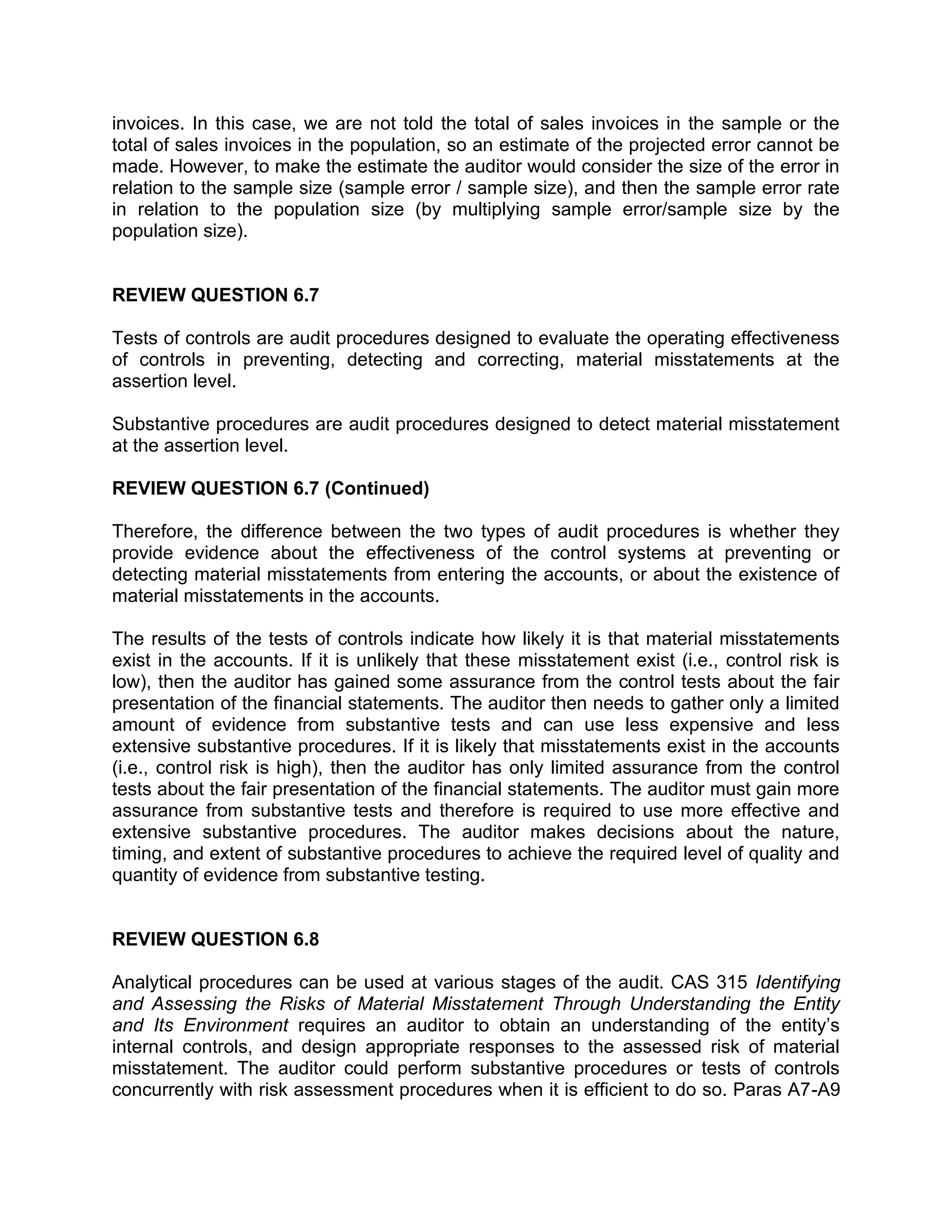
If the sample error is $25,300, it would not be appropriate to conclude that sales are
misstated by the same amount because this error was discovered in a sample of sales
8.
invoices. In thiscase, we are not told the total of sales invoices in the sample or the
total of sales invoices in the population, so an estimate of the projected error cannot be
made. However, to make the estimate the auditor would consider the size of the error in
relation to the sample size (sample error / sample size), and then the sample error rate
in relation to the population size (by multiplying sample error/sample size by the
population size).
REVIEW QUESTION 6.7
Tests of controls are audit procedures designed to evaluate the operating effectiveness
of controls in preventing, detecting and correcting, material misstatements at the
assertion level.
Substantive procedures are audit procedures designed to detect material misstatement
at the assertion level.
REVIEW QUESTION 6.7 (Continued)
Therefore, the difference between the two types of audit procedures is whether they
provide evidence about the effectiveness of the control systems at preventing or
detecting material misstatements from entering the accounts, or about the existence of
material misstatements in the accounts.
The results of the tests of controls indicate how likely it is that material misstatements
exist in the accounts. If it is unlikely that these misstatement exist (i.e., control risk is
low), then the auditor has gained some assurance from the control tests about the fair
presentation of the financial statements. The auditor then needs to gather only a limited
amount of evidence from substantive tests and can use less expensive and less
extensive substantive procedures. If it is likely that misstatements exist in the accounts
(i.e., control risk is high), then the auditor has only limited assurance from the control
tests about the fair presentation of the financial statements. The auditor must gain more
assurance from substantive tests and therefore is required to use more effective and
extensive substantive procedures. The auditor makes decisions about the nature,
timing, and extent of substantive procedures to achieve the required level of quality and
quantity of evidence from substantive testing.
REVIEW QUESTION 6.8
Analytical procedures can be used at various stages of the audit. CAS 315 Identifying
and Assessing the Risks of Material Misstatement Through Understanding the Entity
and Its Environment requires an auditor to obtain an understanding of the entity’s
internal controls, and design appropriate responses to the assessed risk of material
misstatement. The auditor could perform substantive procedures or tests of controls
concurrently with risk assessment procedures when it is efficient to do so. Paras A7-A9
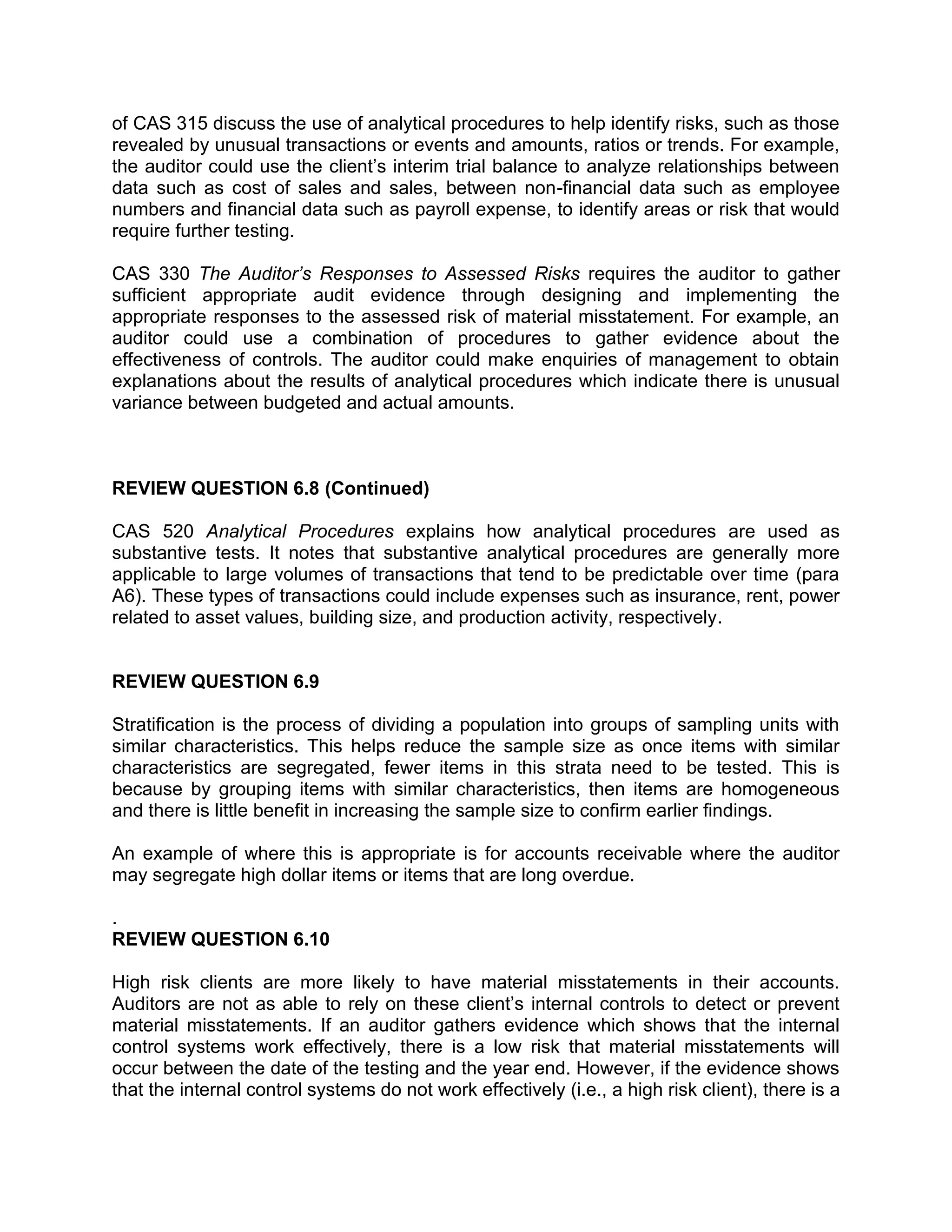
9.
of CAS 315discuss the use of analytical procedures to help identify risks, such as those
revealed by unusual transactions or events and amounts, ratios or trends. For example,
the auditor could use the client’s interim trial balance to analyze relationships between
data such as cost of sales and sales, between non-financial data such as employee
numbers and financial data such as payroll expense, to identify areas or risk that would
require further testing.
CAS 330 The Auditor’s Responses to Assessed Risks requires the auditor to gather
sufficient appropriate audit evidence through designing and implementing the
appropriate responses to the assessed risk of material misstatement. For example, an
auditor could use a combination of procedures to gather evidence about the
effectiveness of controls. The auditor could make enquiries of management to obtain
explanations about the results of analytical procedures which indicate there is unusual
variance between budgeted and actual amounts.
REVIEW QUESTION 6.8 (Continued)
CAS 520 Analytical Procedures explains how analytical procedures are used as
substantive tests. It notes that substantive analytical procedures are generally more
applicable to large volumes of transactions that tend to be predictable over time (para
A6). These types of transactions could include expenses such as insurance, rent, power
related to asset values, building size, and production activity, respectively.
REVIEW QUESTION 6.9
Stratification is the process of dividing a population into groups of sampling units with
similar characteristics. This helps reduce the sample size as once items with similar
characteristics are segregated, fewer items in this strata need to be tested. This is
because by grouping items with similar characteristics, then items are homogeneous
and there is little benefit in increasing the sample size to confirm earlier findings.
An example of where this is appropriate is for accounts receivable where the auditor
may segregate high dollar items or items that are long overdue.
.
REVIEW QUESTION 6.10
High risk clients are more likely to have material misstatements in their accounts.
Auditors are not as able to rely on these client’s internal controls to detect or prevent
material misstatements. If an auditor gathers evidence which shows that the internal
control systems work effectively, there is a low risk that material misstatements will
occur between the date of the testing and the year end. However, if the evidence shows
that the internal control systems do not work effectively (i.e., a high risk client), there is a
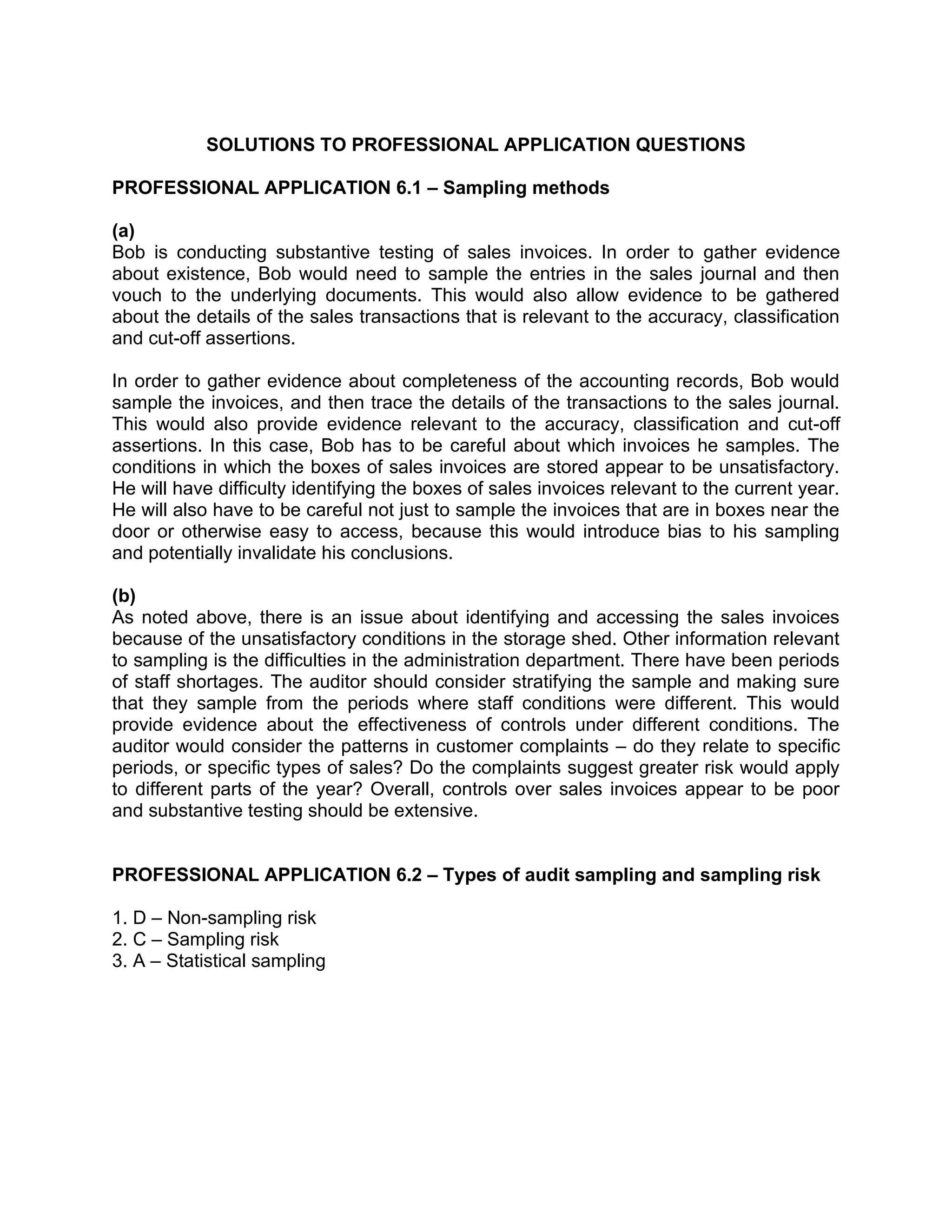
10.
high risk thatmaterial misstatements will occur between the date of the testing and the
year end. This means that the auditor must gather evidence up to the year-end and just
after year-end for high risk clients.
11.
SOLUTIONS TO PROFESSIONALAPPLICATION QUESTIONS
PROFESSIONAL APPLICATION 6.1 – Sampling methods
(a)
Bob is conducting substantive testing of sales invoices. In order to gather evidence
about existence, Bob would need to sample the entries in the sales journal and then
vouch to the underlying documents. This would also allow evidence to be gathered
about the details of the sales transactions that is relevant to the accuracy, classification
and cut-off assertions.
In order to gather evidence about completeness of the accounting records, Bob would
sample the invoices, and then trace the details of the transactions to the sales journal.
This would also provide evidence relevant to the accuracy, classification and cut-off
assertions. In this case, Bob has to be careful about which invoices he samples. The
conditions in which the boxes of sales invoices are stored appear to be unsatisfactory.
He will have difficulty identifying the boxes of sales invoices relevant to the current year.
He will also have to be careful not just to sample the invoices that are in boxes near the
door or otherwise easy to access, because this would introduce bias to his sampling
and potentially invalidate his conclusions.
(b)
As noted above, there is an issue about identifying and accessing the sales invoices
because of the unsatisfactory conditions in the storage shed. Other information relevant
to sampling is the difficulties in the administration department. There have been periods
of staff shortages. The auditor should consider stratifying the sample and making sure
that they sample from the periods where staff conditions were different. This would
provide evidence about the effectiveness of controls under different conditions. The
auditor would consider the patterns in customer complaints – do they relate to specific
periods, or specific types of sales? Do the complaints suggest greater risk would apply
to different parts of the year? Overall, controls over sales invoices appear to be poor
and substantive testing should be extensive.
PROFESSIONAL APPLICATION 6.2 – Types of audit sampling and sampling risk
1. D – Non-sampling risk
2. C – Sampling risk
3. A – Statistical sampling
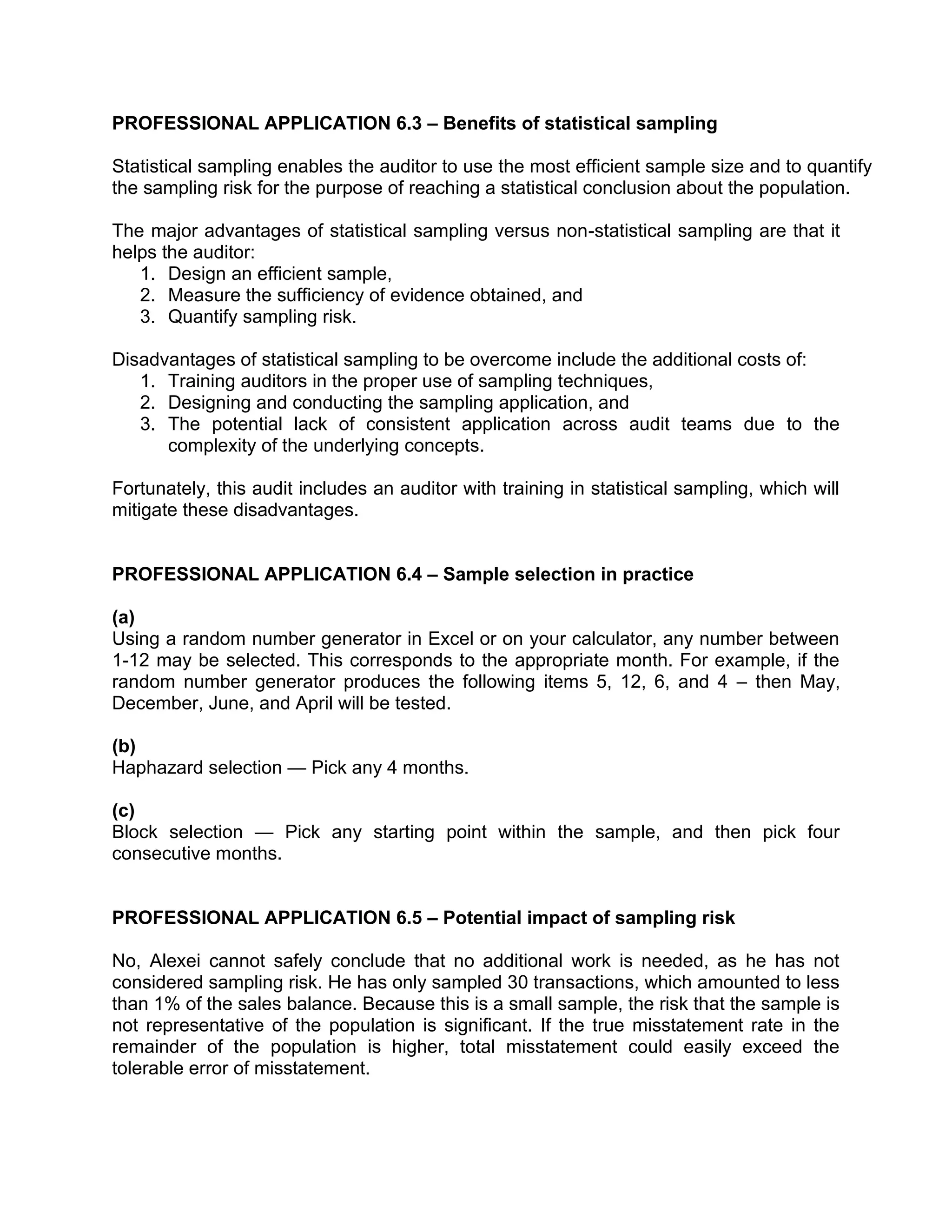
12.
PROFESSIONAL APPLICATION 6.3– Benefits of statistical sampling
Statistical sampling enables the auditor to use the most efficient sample size and to quantify
the sampling risk for the purpose of reaching a statistical conclusion about the population.
The major advantages of statistical sampling versus non-statistical sampling are that it
helps the auditor:
1. Design an efficient sample,
2. Measure the sufficiency of evidence obtained, and
3. Quantify sampling risk.
Disadvantages of statistical sampling to be overcome include the additional costs of:
1. Training auditors in the proper use of sampling techniques,
2. Designing and conducting the sampling application, and
3. The potential lack of consistent application across audit teams due to the
complexity of the underlying concepts.
Fortunately, this audit includes an auditor with training in statistical sampling, which will
mitigate these disadvantages.
PROFESSIONAL APPLICATION 6.4 – Sample selection in practice
(a)
Using a random number generator in Excel or on your calculator, any number between
1-12 may be selected. This corresponds to the appropriate month. For example, if the
random number generator produces the following items 5, 12, 6, and 4 – then May,
December, June, and April will be tested.
(b)
Haphazard selection — Pick any 4 months.
(c)
Block selection — Pick any starting point within the sample, and then pick four
consecutive months.
PROFESSIONAL APPLICATION 6.5 – Potential impact of sampling risk
No, Alexei cannot safely conclude that no additional work is needed, as he has not
considered sampling risk. He has only sampled 30 transactions, which amounted to less
than 1% of the sales balance. Because this is a small sample, the risk that the sample is
not representative of the population is significant. If the true misstatement rate in the
remainder of the population is higher, total misstatement could easily exceed the
tolerable error of misstatement.
13.
PROFESSIONAL APPLICATION 6.5(Continued)
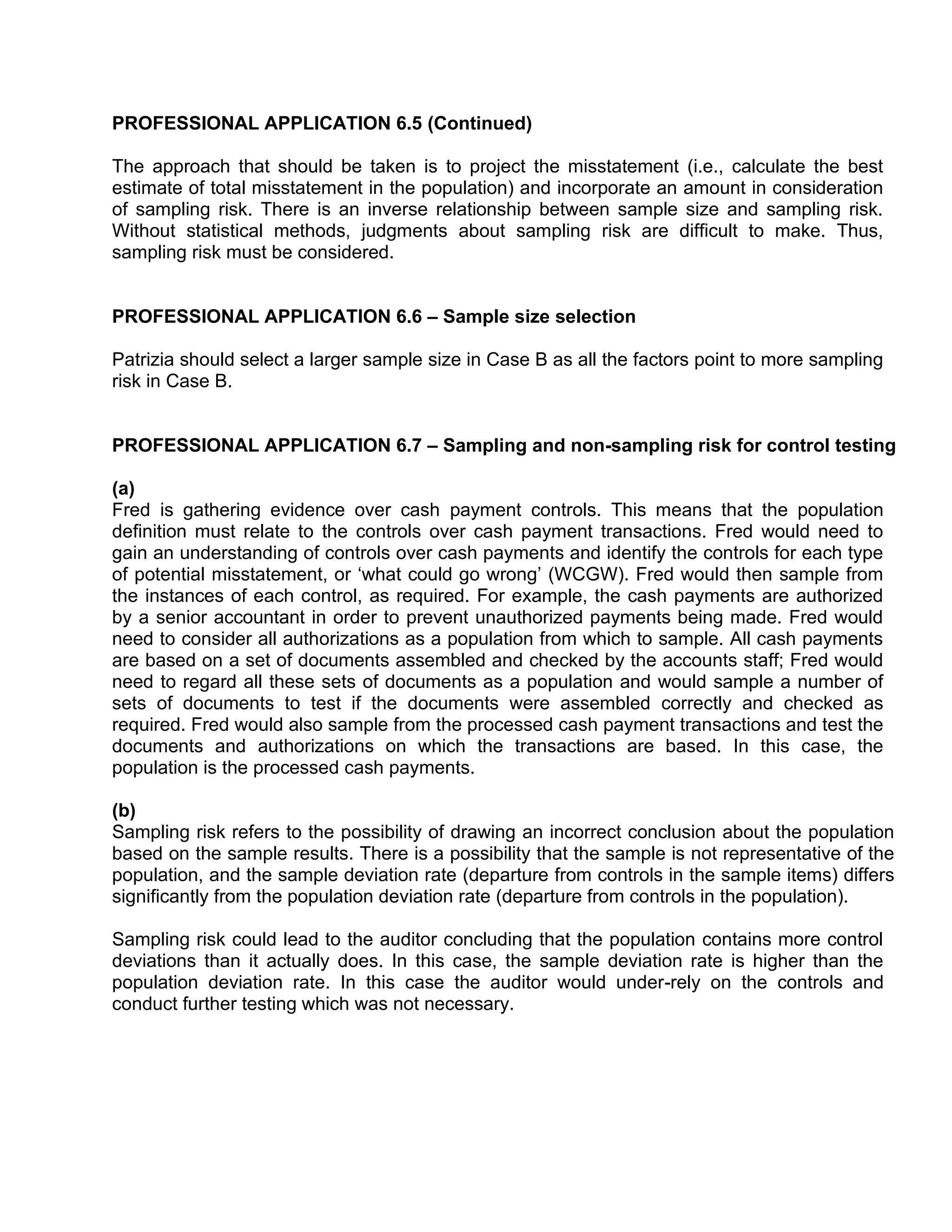
The approach that should be taken is to project the misstatement (i.e., calculate the best
estimate of total misstatement in the population) and incorporate an amount in consideration
of sampling risk. There is an inverse relationship between sample size and sampling risk.
Without statistical methods, judgments about sampling risk are difficult to make. Thus,
sampling risk must be considered.
PROFESSIONAL APPLICATION 6.6 – Sample size selection
Patrizia should select a larger sample size in Case B as all the factors point to more sampling
risk in Case B.
PROFESSIONAL APPLICATION 6.7 – Sampling and non-sampling risk for control testing
(a)
Fred is gathering evidence over cash payment controls. This means that the population
definition must relate to the controls over cash payment transactions. Fred would need to
gain an understanding of controls over cash payments and identify the controls for each type
of potential misstatement, or ‘what could go wrong’ (WCGW). Fred would then sample from
the instances of each control, as required. For example, the cash payments are authorized
by a senior accountant in order to prevent unauthorized payments being made. Fred would
need to consider all authorizations as a population from which to sample. All cash payments
are based on a set of documents assembled and checked by the accounts staff; Fred would
need to regard all these sets of documents as a population and would sample a number of
sets of documents to test if the documents were assembled correctly and checked as
required. Fred would also sample from the processed cash payment transactions and test the
documents and authorizations on which the transactions are based. In this case, the
population is the processed cash payments.
(b)
Sampling risk refers to the possibility of drawing an incorrect conclusion about the population
based on the sample results. There is a possibility that the sample is not representative of the
population, and the sample deviation rate (departure from controls in the sample items) differs
significantly from the population deviation rate (departure from controls in the population).
Sampling risk could lead to the auditor concluding that the population contains more control
deviations than it actually does. In this case, the sample deviation rate is higher than the
population deviation rate. In this case the auditor would under-rely on the controls and
conduct further testing which was not necessary.
14.
PROFESSIONAL APPLICATION 6.7(Continued)
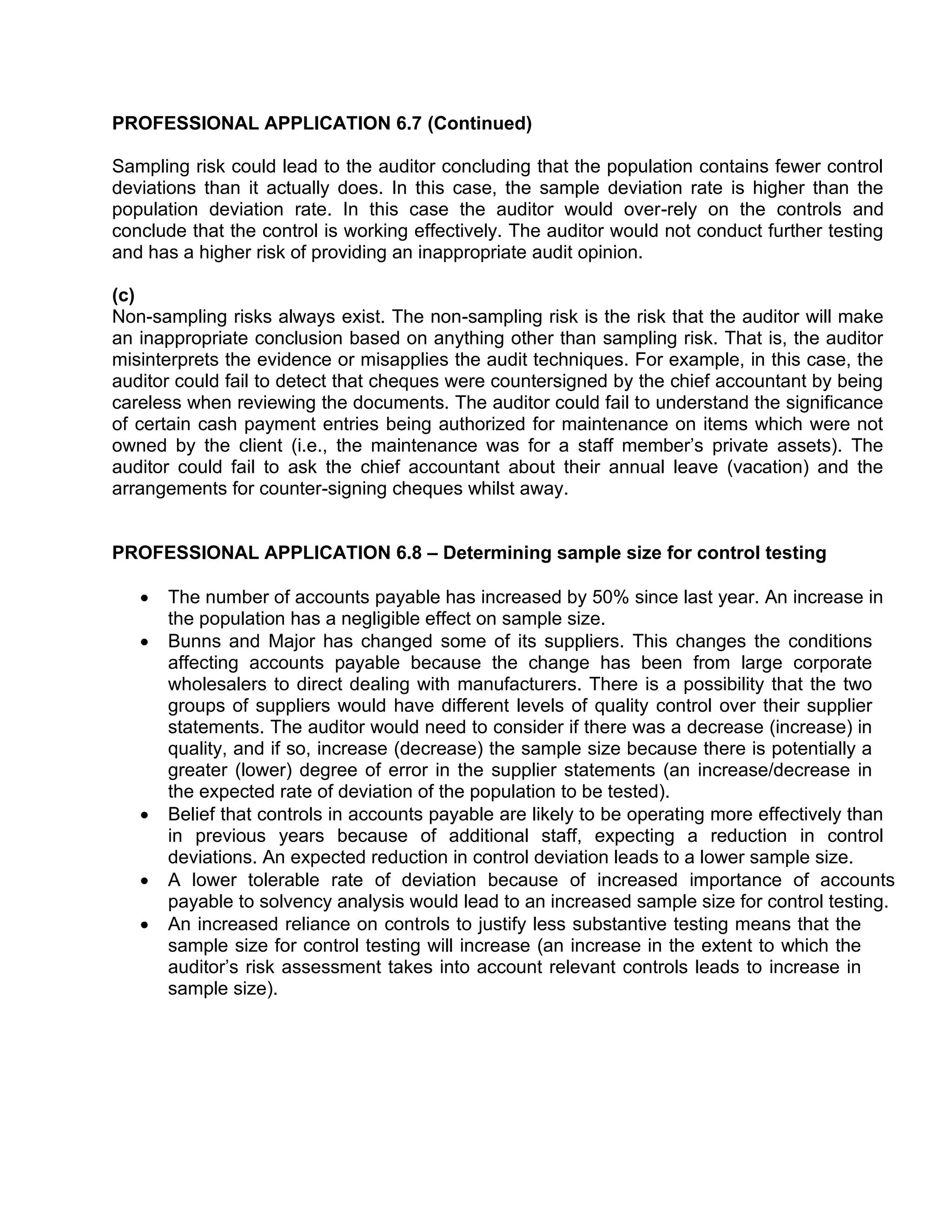
Sampling risk could lead to the auditor concluding that the population contains fewer control
deviations than it actually does. In this case, the sample deviation rate is higher than the
population deviation rate. In this case the auditor would over-rely on the controls and
conclude that the control is working effectively. The auditor would not conduct further testing
and has a higher risk of providing an inappropriate audit opinion.
(c)
Non-sampling risks always exist. The non-sampling risk is the risk that the auditor will make
an inappropriate conclusion based on anything other than sampling risk. That is, the auditor
misinterprets the evidence or misapplies the audit techniques. For example, in this case, the
auditor could fail to detect that cheques were countersigned by the chief accountant by being
careless when reviewing the documents. The auditor could fail to understand the significance
of certain cash payment entries being authorized for maintenance on items which were not
owned by the client (i.e., the maintenance was for a staff member’s private assets). The
auditor could fail to ask the chief accountant about their annual leave (vacation) and the
arrangements for counter-signing cheques whilst away.
PROFESSIONAL APPLICATION 6.8 – Determining sample size for control testing
• The number of accounts payable has increased by 50% since last year. An increase in
the population has a negligible effect on sample size.
• Bunns and Major has changed some of its suppliers. This changes the conditions
affecting accounts payable because the change has been from large corporate
wholesalers to direct dealing with manufacturers. There is a possibility that the two
groups of suppliers would have different levels of quality control over their supplier
statements. The auditor would need to consider if there was a decrease (increase) in
quality, and if so, increase (decrease) the sample size because there is potentially a
greater (lower) degree of error in the supplier statements (an increase/decrease in
the expected rate of deviation of the population to be tested).
• Belief that controls in accounts payable are likely to be operating more effectively than
in previous years because of additional staff, expecting a reduction in control
deviations. An expected reduction in control deviation leads to a lower sample size.
• A lower tolerable rate of deviation because of increased importance of accounts
payable to solvency analysis would lead to an increased sample size for control testing.
• An increased reliance on controls to justify less substantive testing means that the
sample size for control testing will increase (an increase in the extent to which the
auditor’s risk assessment takes into account relevant controls leads to increase in
sample size).
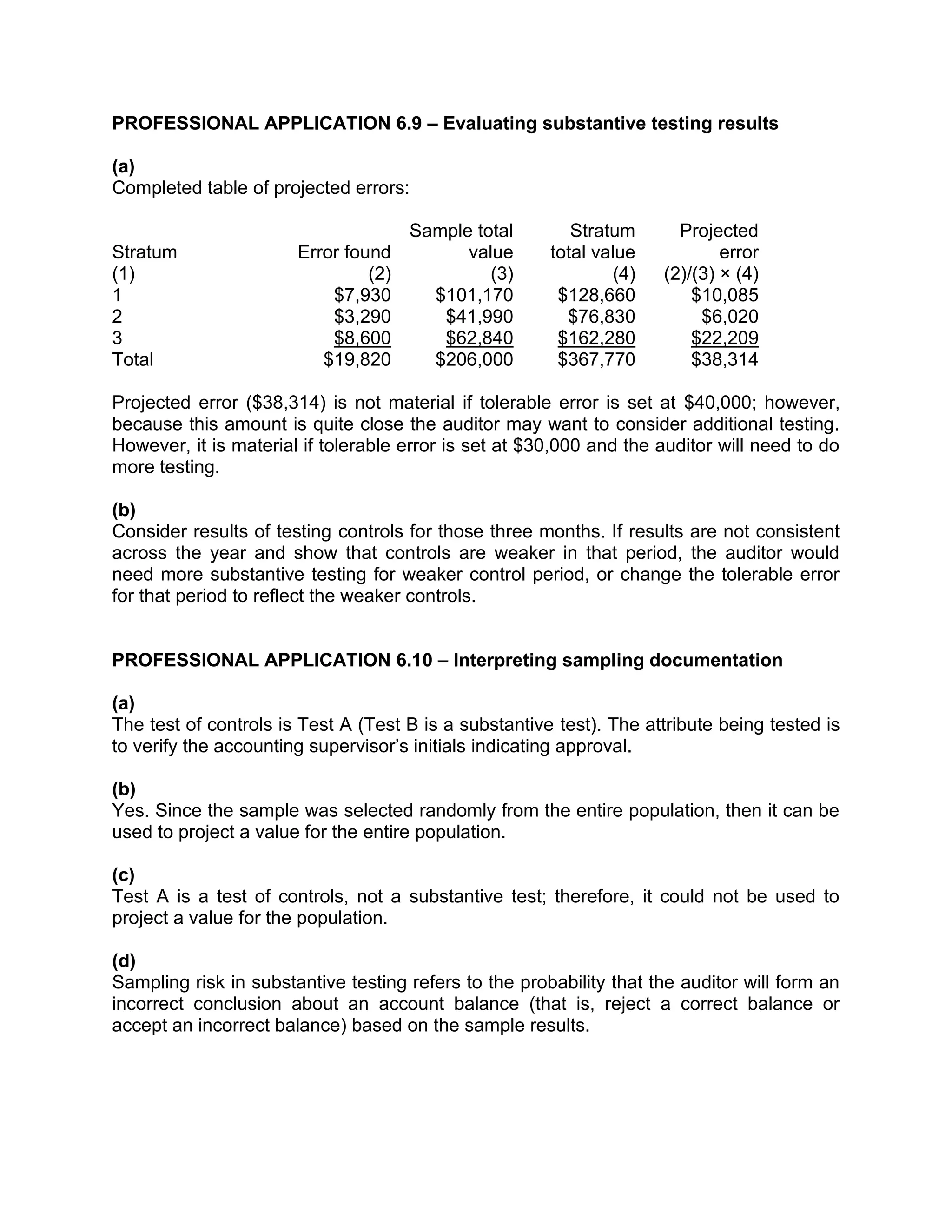
PROFESSIONAL APPLICATION 6.9– Evaluating substantive testing results
(a)
Completed table of projected errors:
Stratum
(1)
Error found
(2)
Sample total
value
(3)
Stratum
total value
(4)
Projected
error
(2)/(3) × (4)
1 $7,930 $101,170 $128,660 $10,085
2 $3,290 $41,990 $76,830 $6,020
3 $8,600 $62,840 $162,280 $22,209
Total $19,820 $206,000 $367,770 $38,314
Projected error ($38,314) is not material if tolerable error is set at $40,000; however,
because this amount is quite close the auditor may want to consider additional testing.
However, it is material if tolerable error is set at $30,000 and the auditor will need to do
more testing.
(b)
Consider results of testing controls for those three months. If results are not consistent
across the year and show that controls are weaker in that period, the auditor would
need more substantive testing for weaker control period, or change the tolerable error
for that period to reflect the weaker controls.
PROFESSIONAL APPLICATION 6.10 – Interpreting sampling documentation
(a)
The test of controls is Test A (Test B is a substantive test). The attribute being tested is
to verify the accounting supervisor’s initials indicating approval.
(b)
Yes. Since the sample was selected randomly from the entire population, then it can be
used to project a value for the entire population.
(c)
Test A is a test of controls, not a substantive test; therefore, it could not be used to
project a value for the population.
(d)
Sampling risk in substantive testing refers to the probability that the auditor will form an
incorrect conclusion about an account balance (that is, reject a correct balance or
accept an incorrect balance) based on the sample results.
17.
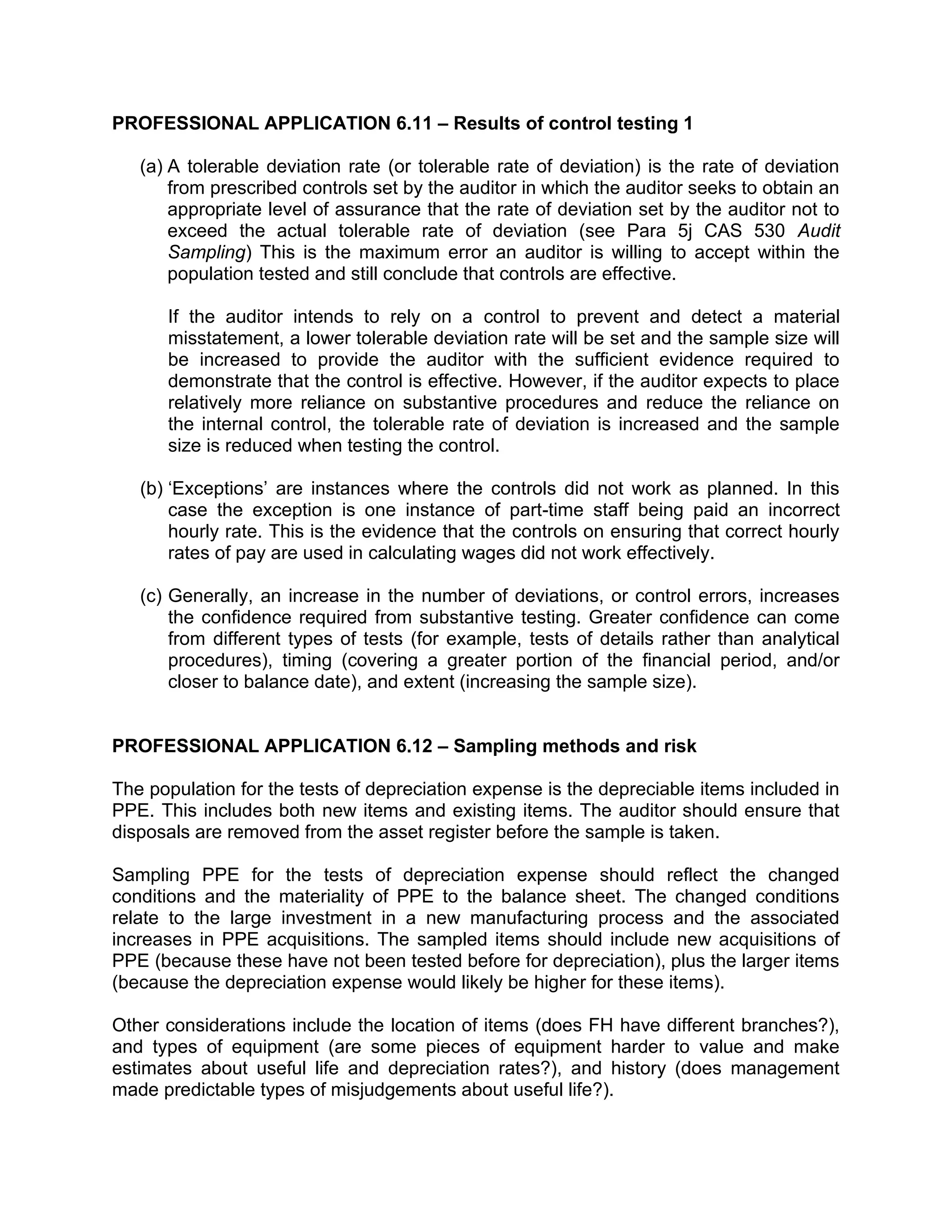
PROFESSIONAL APPLICATION 6.11– Results of control testing 1
(a) A tolerable deviation rate (or tolerable rate of deviation) is the rate of deviation
from prescribed controls set by the auditor in which the auditor seeks to obtain an
appropriate level of assurance that the rate of deviation set by the auditor not to
exceed the actual tolerable rate of deviation (see Para 5j CAS 530 Audit
Sampling) This is the maximum error an auditor is willing to accept within the
population tested and still conclude that controls are effective.
If the auditor intends to rely on a control to prevent and detect a material
misstatement, a lower tolerable deviation rate will be set and the sample size will
be increased to provide the auditor with the sufficient evidence required to
demonstrate that the control is effective. However, if the auditor expects to place
relatively more reliance on substantive procedures and reduce the reliance on
the internal control, the tolerable rate of deviation is increased and the sample
size is reduced when testing the control.
(b) ‘Exceptions’ are instances where the controls did not work as planned. In this
case the exception is one instance of part-time staff being paid an incorrect
hourly rate. This is the evidence that the controls on ensuring that correct hourly
rates of pay are used in calculating wages did not work effectively.
(c) Generally, an increase in the number of deviations, or control errors, increases
the confidence required from substantive testing. Greater confidence can come
from different types of tests (for example, tests of details rather than analytical
procedures), timing (covering a greater portion of the financial period, and/or
closer to balance date), and extent (increasing the sample size).
PROFESSIONAL APPLICATION 6.12 – Sampling methods and risk 3 4 5
The population for the tests of depreciation expense is the depreciable items included in
PPE. This includes both new items and existing items. The auditor should ensure that
disposals are removed from the asset register before the sample is taken.
Sampling PPE for the tests of depreciation expense should reflect the changed
conditions and the materiality of PPE to the balance sheet. The changed conditions
relate to the large investment in a new manufacturing process and the associated
increases in PPE acquisitions. The sampled items should include new acquisitions of
PPE (because these have not been tested before for depreciation), plus the larger items
(because the depreciation expense would likely be higher for these items).
Other considerations include the location of items (does FH have different branches?),
and types of equipment (are some pieces of equipment harder to value and make
estimates about useful life and depreciation rates?), and history (does management
made predictable types of misjudgements about useful life?).
18.
PROFESSIONAL APPLICATION 6.12(Continued)
The auditor could formally stratify the sample to select samples of new items and old
items, and different value items, or select a large enough sample to be reasonably sure
that the sample includes all types of items that are likely to be most at risk.
A random sample (either with or without stratification) would allow the auditor to make
conclusions using probability theory. The auditor could supplement the formal
conclusions based on a random sample with evidence obtained from samples of items
considered ‘important’ in the auditor’s judgement. This judgement would relate to the
consideration of which items are more likely to be depreciated inappropriately.
The assertions most at risk are the accuracy of depreciation expense and the valuation
and allocation for PPE (shown as cost less accumulated depreciation).
PROFESSIONAL APPLICATION 6.13 – Projecting errors for PPE
In order to project the error in the sample of $48,500 back to the population we use
information on the sample total value ($1,145,000) and the population total value
($11,345,000). The projection shows: projected error = errors found ÷ sample total value
× stratum total value = $48,500 / $1,145,000 × $11,345,000 = $480,552.
This means that PPE items with a value of $480,552 have inappropriate depreciation
rates. This error equates to approximately 4% of gross PPE, which is usually not
considered material. In this case, the auditor would conclude that the valuation and
allocation assertion for PPE was not violated.
Although we are not given the depreciation rate, the effect on profit before tax is likely to
be less than 4% (i.e., assuming 10% depreciation, the error in the expense is $48,055
which is 2.5% of profit before tax).
However, given that PPE is considered to be one of the most material balances, the
auditor might consider further testing or asking management to adjust the depreciation.
19.
PROFESSIONAL APPLICATION 6.14– Substantive testing and assertions
(a)
The sales team are remunerated in two ways; a base salary plus a bonus based on the
dollar values of sales. The bonus payment increases if the sales person increases
recorded sales. An inappropriate way of increasing sales is to record sales during the
year for samples given to customers, or to record sales to existing customers at year-
end when not ordered and then to reverse immediately after year-end, or to record a
sale prematurely (for example, before shipment to customer). When the sample is
returned following the year-end the sale is reversed or adjusted with a sales return or
allowance. Another way of increasing sales is to falsify sales by recording a sale to a
fictitious customer. The account balance is eventually written off for non-payment of the
account. The sales and accounts receivable account balances are at risk because of
these practices. The assertions at risk are occurrence and existence for the sales
transaction and accounts receivable balance. In addition, the valuation and allocation
assertion for accounts receivable is at risk because the balance does not represent the
amount that is reasonably expected to be received from customers.
(b)
The substantive test described in the question is to take a sample of payments received
by the hospital (i.e., cash receipts) and trace back to the general ledger and customer
account balance. Performing this test will provide evidence about the
existence/occurrence assertion for the accounts receivable and sales balances, and the
valuation and allocation assertion for accounts receivable. If the client receives cash for
the credit of an accounts receivable this is reliable evidence that the recorded sale did
occur and that the balance of accounts receivable was fairly stated at the year-end.
The reference to the bonus structure is to reinforce the risk to the occurrence assertion
for sales and the valuation and allocation assertion for accounts receivable.
PROFESSIONAL APPLICATION 6.15 – Substantive testing versus control testing
(a)
Test 1: This is a substantive test. The test gathers evidence about the balance of trade
creditors at year end and the total of purchases. In particular, the test is gathering
evidence about the date the goods were received and the date the entry is posted.
Test 2: This is a test of controls. The test is gathering evidence about the process of
reviewing and authorising the pricing and discount terms.
(b)
Test 1: Cut-off assertion for purchases, valuation and allocation assertion for trade
creditors. The dates are being verified to ensure the transactions are recorded in the
correct financial period.
20.
PROFESSIONAL APPLICATION 6.15(Continued)
Test 2: Controls over pricing and discounts are relevant to the valuation and allocation
assertion for trade creditors, and the accuracy assertion for purchases.
(c)
Test 1: The test does not address the issue of completeness for trade creditors or fully
address the cut-off assertion for purchases. The key risk for creditors is understatement. By
taking a sample from the list of trade creditors the auditor is not able to detect unrecorded
liabilities. The conclusion is not appropriate.
Test 2: The initial test reveals that 3 out of 20 invoices had not been authorized and incorrect
discounts were recorded. The follow-up shows no pattern. The conclusion refers to the
amount of the discount. This is not appropriate for a test of controls. The issue is whether the
rate of deviation in the control is tolerable. If the deviation rate in the sample is tolerable when
projected to the population, especially given the additional testing, then the auditor could
conclude that there is no significant deviation in the control. The auditor cannot conclude the
valuation of suppliers is fair based on the control tests alone.
(d)
Further procedure for test 1: The auditor should examine suppliers’ invoices and goods
received relating to the period following year-end. These documents could reveal an
unrecorded liability, that is, goods recorded as received after the year-end that were actually
received by the client prior to the year-end.
Further procedure for test 2: As outlined in part (c), the conclusion about the deviation in
controls should be considered in light of the tolerable deviation rate. The substantive testing
needs to be designed given the control risk as revealed by the control tests. Further
procedures would include selecting a sample of suppliers invoices, given the control risk, and
testing of pricing and discounts.
PROFESSIONAL APPLICATION 6.16 – Control testing in previous year
The junior auditor’s suggestion is not appropriate because the auditor needs to have
sufficient appropriate evidence about the effectiveness of controls in the current year. Any
change in either the controls or the conditions would make last year’s evidence not applicable
to the current period. At aminimum, there should be evidence that the conditions remained
the same and that the controls had not altered. The auditor also considers whether the
controls can provide sufficient control in the current circumstances. Even if there had been no
changes since last period, the auditor should still evaluate the effectiveness of the controls
and draw a conclusion on the degree to which the controls can be relied upon.
In this particular case, the controls were assessed with respect to their ability to ensure
compliance with the regulations. It is likely that additional work is required for the controls to
be assessed for effectiveness at preventing or detecting material misstatements at the
assertion level because this is a different objective.
Citizens and burgesses.Citizens and burgesses haue next place to
gentlemen, who be those that are free within the cities, and are of
some likelie substance to beare office in the same. But these citizens
or burgesses are to serue the commonwealth in their cities and
boroughs, or in corporat townes where they dwell. And in the
common assemblie of the realme wherein our lawes are made, for in
the counties they beare but little swaie (which assemblie is called
the high court of parlement) the ancient cities appoint foure, and the
boroughs two burgesses to haue voices in it, and giue their consent
or dissent vnto such things as passe or staie there in the name of
the citie or borow, for which they are appointed.
Merchants. In this place also are our merchants to be installed, as
amongst the citizens (although they often change estate with
gentlemen, as gentlemen doo with them, by a mutuall conuersion of
the one into the other) whose number is so increased in these our
daies, that their onelie maintenance is the cause of the exceeding
prices of forreine wares, which otherwise when euerie nation was
permitted to bring in hir owne commodities, were farre better
cheape and more plentifullie to be had. Of the want of our
commodities here at home, by their great transportation of them
into other countries, I speake not, sith the matter will easilie bewraie
it selfe. Certes among the Lacedemonians it was found out, that
great numbers of merchants were nothing to the furtherance of the
state of the commonwealth: wherefore it is to be wished that the
huge heape of them were somewhat restreined, as also of our
lawiers, so should the rest liue more easilie vpon their owne, and
few honest chapmen be brought to decaie, by breaking of the
bankerupt. I doo not denie but that the nauie of the land is in part
mainteined by their traffike, and so are the high prices of wares kept
vp now they haue gotten the onelie sale of things, vpon pretense of
better furtherance of the common-wealth into their owne hands:
whereas in times past when the strange bottoms were suffered to
come in, we had sugar for foure pence the pound, that now at the
writing of this treatise is well worth halfe a crowne, raisons or corints
for a penie that now are holden at six pence, and sometime at eight
23.
pence and tenpence the pound: nutmegs at two pence halfe penie
the ounce: ginger at a penie an ounce, prunes at halfe penie
farding: great raisons three pound for a penie, cinamon at foure
pence the ounce, cloues at two pence, and pepper at twelue, and
sixteene pence the pound. Whereby we may sée the sequele of
things not alwaies but verie seldome to be such as is pretended in
the beginning. The wares that they carrie out of the realme, are for
the most part brode clothes and carsies of all colours, likewise
cottons, fréeses, rugs, tin, wooll, our best béere, baies, bustian,
mockadoes tufted and plaine, rash, lead, fells, &c: which being
shipped at sundrie ports of our coasts, are borne from thence into all
quarters of the world, and there either exchanged for other wares or
readie monie: to the great gaine and commoditie of our merchants.
And whereas in times past their cheefe trade was into Spaine,
Portingall, France, Flanders, Danske, Norwaie, Scotland, and Iseland
onelie: now in these daies, as men not contented with these
iournies, they haue sought out the east and west Indies, and made
now and then suspicious voiages not onelie vnto the Canaries, and
new Spaine, but likewise into Cathaia, Moscouia, Tartaria, and the
regions thereabout, from whence (as they saie) they bring home
great commodities. But alas I sée not by all their trauell that the
prices of things are anie whit abated. Certes this enormitie (for so I
doo accompt of it) was sufficientlie prouided for, An. 9 Edward 3. by
a noble estatute made in that behalfe, but vpon what occasion the
generall execution thereof is staied or not called on, in good sooth I
cannot tell. This onelie I know, that euerie function and seuerall
vocation striueth with other, which of them should haue all the water
of commoditie run into hir owne cesterne.
Yeomen. Yeomen are those, which by our law are called Legales
homines, free men borne English, and may dispend of their owne
free land in yearelie reuenue, to the summe of fortie shillings
sterling, or six pounds as monie goeth in our times. Some are of the
opinion by Cap. 2. Rich. 2. an. 20. that they are the same which the
French men call varlets, but as that phrase is vsed in my time it is
farre vnlikelie to be so. The truth is that the word is deriued from the
24.
Saxon terme Zeomanor Geoman, which signifieth (as I haue read) a
settled or staid man, such I meane as being maried and of some
yeares, betaketh himselfe to staie in the place of his abode for the
better maintenance of himselfe and his familie, whereof the single
sort haue no regard, but are likelie to be still fleeting now hither now
thither, which argueth want of stabilitie in determination and
resolution of iudgement, for the execution of things of anie
importance. This sort of people haue a certeine preheminence, and
more estimation than labourers & the common sort of artificers, &
these commonlie liue wealthilie, kéepe good houses, and trauell to
get riches. They are also for the most part farmers to gentlemen (in
old time called Pagani, & opponuntur militibus, and therfore Persius
calleth himselfe Semipaganus) or at the leastwise artificers, & with
grasing, frequenting of markets, and kéeping of seruants (not idle
seruants as the gentlemen doo, but such as get both their owne and
part of their masters liuing) do come to great welth, in somuch that
manie of them are able and doo buie the lands of vnthriftie
gentlemen, and often setting their sonnes to the schooles, to the
vniuersities, and to the Ins of the court; or otherwise leauing them
sufficient lands wherevpon they may liue without labour, doo make
them by those meanes to become gentlemen: these were they that
in times past made all France afraid. And albeit they be not called
master as gentlemen are, or sir as to knights apperteineth, but
onelie Iohn and Thomas, &c: yet haue they beene found to haue
doone verie good seruice: and the kings of Englishmen on foot and
Frenchmen on horssebacke best. England in foughten battels, were woont to
remaine among them (who were their footmen) as the French kings
did amongst their horssemen: the prince thereby shewing where his
chiefe strength did consist.
Capite censi or Proletarij. The fourth and last sort of people in England are
daie labourers, poore husbandmen, and some retailers (which haue
no frée land) copie holders, and all artificers, as tailers, shomakers,
No slaues nor bondmen in England. carpenters, brickmakers, masons, &c. As
for slaues and bondmen we haue none, naie such is the priuilege of
our countrie by the especiall grace of God, and bountie of our
25.
princes, that ifanie come hither from other realms, so soone as they
set foot on land they become so frée of condition as their masters,
whereby all note of seruile bondage is vtterlie remooued from them,
wherein we resemble (not the Germans who had slaues also, though
such as in respect of the slaues of other countries might well be
reputed frée, but) the old Indians and the Taprobanes, who
supposed it a great iniurie to nature to make or suffer them to be
bond, whome she in hir woonted course dooth product and bring
foorth frée. This fourth and last sort of people therefore haue neither
voice nor authoritie in the common wealth, but are to be ruled, and
not to rule other: yet they are not altogither neglected, for in cities
and corporat townes, for default of yeomen they are faine to make
up their inquests of such maner of people. And in villages they are
commonlie made churchwardens, sidemen, aleconners, now and
then constables, and manie times inioie the name of hedboroughes.
Vnto this sort also may our great swarmes of idle seruing men be
referred, of whome there runneth a prouerbe; Yoong seruing men
old beggers, bicause seruice is none heritage. These men are
profitable to none, for if their condition be well perused, they are
enimies to their masters, to their freends, and to themselues: for by
them oftentimes their masters are incouraged vnto vnlawfull
exactions of their tenants, their fréends brought vnto pouertie by
their rents inhanced, and they themselues brought to confusion by
their owne prodigalitie and errors, as men that hauing not wherewith
of their owne to mainteine their excesses, doo search in high waies,
budgets, cofers, males, and stables, which way to supplie their
wants. How diuerse of them also coueting to beare an high saile doo
insinuate themselues with yoong gentlemen and noble men newlie
come to their lands, the case is too much apparant, whereby the
good natures of the parties are not onelie a little impaired, but also
their liuelihoods and reuenues so wasted and consumed, that if at all
yet not in manie yeares they shall be able to recouer themselues. It
were verie good therefore that the superfluous heapes of them were
in part diminished. And sith necessitie inforceth to haue some, yet
let wisdome moderate their numbers, so shall their masters be rid of
vnnecessarie charge, and the common wealth of manie théeues. No
26.
nation cherisheth suchstore of them as we doo here in England, in
hope of which maintenance manie giue themselues to idlenesse,
that otherwise would be brought to labour, and liue in order like
subiects. Of their whoredomes I will not speake anie thing at all,
more than of their swearing, yet is it found that some of them doo
make the first a cheefe piller of their building, consuming not onelie
the goods but also the health & welfare of manie honest gentlemen,
citizens, wealthie yeomen, &c: by such vnlawfull dealings. But how
farre haue I waded in this point, or how farre may I saile in such a
large sea? I will therefore now staie to speake anie more of those
kind of men. In returning therefore to my matter, this furthermore
among other things I haue to saie of our husbandmen and artificers,
that they were neuer so excellent in their trades as at this present.
But as the workemanship of the later sort was neuer more fine and
curious to the eie, so was it neuer lesse strong and substantiall for
continuance and benefit of the buiers. Neither is there anie thing
that hurteth the common sort of our artificers more than hast, and a
barbarous or slauish desire to turne the penie, and by ridding their
worke to make spéedie vtterance of their wares: which inforceth
them to bungle vp and dispatch manie things they care not how so
they be out of their hands, whereby the buier is often sore
defrauded, and findeth to his cost, that hast maketh wast, according
to the prouerbe.
Oh how manie trades and handicrafts are now in England, whereof
the common wealth hath no néed? How manie néedfull commodities
haue we which are perfected with great cost, &c: and yet may with
farre more ease and lesse cost be prouided from other countries if
we could vse the meanes. I will not speake of iron, glasse, and such
like, which spoile much wood, and yet are brought from other
countries better chéepe than we can make them here at home, I
could exemplifie also in manie other. But to leaue these things and
procéed with our purpose, and herein (as occasion serueth)
generallie by waie of conclusion to speake of the common-wealth of
England, I find that it is gouerned and mainteined by three sorts of
persons.
27.
1 The prince,monarch, and head gouernour, which is called the
king, or (if the crowne fall to the woman) the quéene: in whose
name and by whose authoritie all things are administred.
2 The gentlemen, which be diuided into two sorts, as the baronie
or estate of lords (which conteineth barons and all aboue that
degree) and also those that be no lords, as knights, esquiers, &
simple gentlemen, as I haue noted alreadie. Out of these also are
the great deputies and high presidents chosen, of which one
serueth in Ireland, as another did sometime in Calis, and the
capteine now at Berwike; as one lord president dooth gouerne in
Wales, and the other the north parts of this Iland, which later with
certeine councellors and iudges were erected by king Henrie the
eight. But forsomuch as I haue touched their conditions
elsewhere, it shall be inough to haue remembred them at this
time.
3 The third and last sort is named the yeomanrie, of whom & their
sequele, the labourers and artificers, I haue said somewhat euen
now. Whereto I ad that they be not called masters and gentlemen,
but goodmen, as goodman Smith, goodman Coot, goodman
Cornell, goodman Mascall, goodman Cockswet, &c: & in matters of
law these and the like are called thus, Giles lewd-yeoman, Edward
Mountford yeoman, Iames Cocke yeoman, Herrie Butcher yeoman,
&c: by which addition they are exempt from the vulgar and
common sorts. Cato calleth them Aratores & optimos ciues rei
publicæ, of whom also you may read more in the booke of
common wealth which sir Thomas Smith sometime penned of this
land.
Of gentlemen also some are by the prince chosen, and called to
great offices in the common wealth, of which said offices diuerse
concerne the whole realme; some be more priuat and peculiar to the
kings house. And they haue their places and degrées, prescribed by
an act of parlement made An. 31 Henr. octaui, after this maner
insuing.
28.
These foure thelord Chancellor, the lord Treasuror (who is Supremus
ærarij Anglici quæstor or Tribunus ærarius maximus) the lord
President of the councell, and the lord Priuie seale, being persons of
the degrée of a baron or aboue, are in the same act appointed to sit
in the parlement and in all assemblies or councell aboue all dukes,
not being of the bloud roiall, Videlicet the kings brother, vncle, or
nephue.
And these six, the lord great Chamberleine of England: the lord high
Constable of England: the lord Marshall of England: the lord Admirall
of England: the lord great master or Steward of the kings house:
and the lord Chamberleine: by that act are to be placed in all
assemblies of councell, after the lord priuie seale, according to their
degrées and estats: so that if he be a baron, then he is to sit aboue
all barons: or an earle, aboue all earles.
And so likewise the kings secretarie, being a baron of the parlement,
hath place aboue all barons, and if he be a man of higher degrée, he
shall sit and be placed according therevnto.
The rehearsall of the temporall nobilitie of England, according to the
anciencie of their
creations, or first calling to their degrees, as they are to be found at
this present.
No duke in England.
Earles.
29.
The Marquise ofWinchester.
The earle of Arundell.
The earle of Oxford.
The earle of Northumberland.
The earle of Shrewesburie.
The earle of Kent.
The earle of Derbie.
The earle of Worcester.
The earle of Rutland.
The earle of Cumberland.
The earle of Sussex.
The earle of Huntingdon.
The earle of Bath.
The earle of Warwike.
The earle of Southampton.
The earle of Bedford.
The earle of Penbrooke.
The earle of Hertford.
The earle of Leicester.
The earle of Essex.
The earle of Lincolne.
Visconts. The viscont Montague.
The viscont Bindon.
Barons. The lord of Abergeuennie.
The lord Awdeleie.
The lord Zouch.
The lord Barkeleie.
The lord Morleie.
The lord Dacres of the south.
The lord Cobham.
The lord Stafford.
The lord Greie of Wilton.
30.
The lord Scroope.
Thelord Dudleie.
The lord Latimer.
The lord Stourton.
The lord Lumleie.
The lord Mountioie.
The lord Ogle.
The lord Darcie of the north.
The lord Mountegle.
The lord Sands.
The lord Vaulx.
The lord Windsore.
The lord Wentworth.
The lord Borough.
The lord Mordaunt.
The lord Cromwell.
The lord Euers.
The lord Wharton.
The lord Rich.
The lord Willowbie.
The lord Sheffeld.
The lord Paget.
The lord Darcie of Chichester.
The lord Howard of Effingham.
The lord North.
The lord Chaundos.
The lord of Hunsdon.
The lord saint Iohn of Bletso.
The lord of Buckhirst.
The lord Delaware.
The lord Burghleie.
The lord Compton.
The lord Cheineie.
The lord Norreis.
31.
Bishops in theiranciencie, as they sat in parlement, in the fift of the
Queenes maiesties reigne that now is.
Cleargie.
The archbishop of Canturburie.
The archbishop of Yorke.
London.
Durham.
Winchester.
The rest had their places in senioritie of consecration.
Chichester.
Landaffe.
Hereford.
Elie.
Worcester.
Bangor.
Lincolne.
Salisburie.
S. Dauids.
Rochester. Bath and Welles.
Couentrie and Lichfield.
Excester.
Norwich.
Peterborough.
Carleill.
Chester.
S. Assaph.
Glocester.
And this for their placing in the parlement house. Howbeit, when the
archbishop of Canturburie siteth in his prouinciall assemblie, he hath
on his right hand the archbishop of Yorke, and next vnto him the
32.
bishop of Winchester,on the left hand the bishop of London: but if it
fall out that the archbishop of Canturburie be not there by the
vacation of his sée, then the archbishop of Yorke is to take his place,
who admitteth the bishop of London to his right hand, and the prelat
of Winchester to his left, the rest sitting alwaies as afore, that is to
saie, as they are elders by consecration, which I thought good also
to note out of an ancient president.
OF THE FOOD AND DIET OF THE ENGLISH.
CHAP. VI.
The situation of our region, lieng néere vnto the north, dooth cause
the heate of our stomaches to be of somewhat greater force:
therefore our bodies doo craue a little more ample nourishment,
than the inhabitants of the hotter regions are accustomed withall,
whose digestiue force is not altogither so vehement, bicause their
internall heat is not so strong as ours, which is kept in by the
coldnesse of the aire, that from time to time (speciallie in winter)
dooth enuiron our bodies.
It is no maruell therefore that our tables are oftentimes more
plentifullie garnished than those of other nations, and this trade hath
continued with vs euen since the verie beginning. For before the
Romans found out and knew the waie vnto our countrie, our
predecessors fed largelie vpon flesh and milke, whereof there was
great aboundance in this Ile, bicause they applied their chéefe
studies vnto pasturage and féeding. After this maner also did our
Welsh Britons order themselues in their diet so long as they liued of
themselues, but after they became to be vnited and made equall
with the English they framed their appetites to liue after our maner,
so that at this daie there is verie little difference betwéene vs in our
diets.
33.
In Scotland likewisethey haue giuen themselues (of late yeares to
speake of) vnto verie ample and large diet, wherein as for some
respect nature dooth make them equall with vs: so otherwise they
far excéed vs in ouer much and distemperate gormandize, and so
ingrosse their bodies that diuerse of them doo oft become vnapt to
anie other purpose than to spend their times in large tabling and
bellie chéere. Against this pampering of their carcasses dooth Hector
Boetius in his description of the countrie verie sharpelie inueigh in
the first chapter of that treatise. Henrie Wardlaw also bishop of S.
Andrewes, noting their vehement alteration from competent
frugalitie into excessiue gluttonie, to be brought out of England with
Iames the first (who had béene long time prisoner there vnder the
fourth & fift Henries, and at his returne caried diuerse English
gentlemen into his countrie with him, whome he verie honorablie
preferred there) dooth vehementlie exclame against the same in
open parlement holden at Perth 1433, before the three estats, and
so bringeth his purpose to passe in the end by force of his learned
persuasions, that a law was presentlie made there for the restreint
of superfluous diet, amongest other things baked meats (dishes
neuer before this mans daies seene in Scotland) were generallie so
prouided for by vertue of this act, that it was not lawfull for anie to
eat of the same vnder the degrée of a gentleman, and those onelie
but on high and festiuall daies, but alas it was soone forgotten.
In old time these north Britons did giue themselues vniuersallie to
great abstinence, and in time of warres their souldiers would often
féed but once or twise at the most in two or thrée daies (especiallie
if they held themselues in secret, or could haue no issue out of their
bogges and marises, through the presence of the enimie) and in this
distresse they vsed to eat a certeine kind of confection, whereof so
much as a beane would qualifie their hunger aboue common
expectation. In woods moreouer they liued with hearbes and rootes,
or if these shifts serued not thorough want of such prouision at
hand, then vsed they to créepe into the water or said moorish plots
vp vnto the chins, and there remaine a long time, onelie to qualifie
the heats of their stomachs by violence, which otherwise would haue
34.
wrought and béenereadie to oppresse them for hunger and want of
sustinance. In those daies likewise it was taken for a great offense
ouer all, to eat either goose, hare, or henne, bicause of a certeine
superstitious opinion which they had conceiued of those three
creatures, howbeit after that the Romans (I saie) had once found an
entrance into this Iland, it was not long yer open shipwracke was
made of this religious obseruation, so that in processe of time, so
well the north and south Britons as the Romans, gaue ouer to make
such difference in meats, as they had doone before.
From thencefoorth also vnto our daies, and euen in this season
wherein we liue, there is no restreint of anie meat, either for
religions sake or publike order in England, but it is lawfull for euerie
man to féed vpon what soeuer he is able to purchase, except it be
vpon those daies whereon eating of flesh is especiallie forbidden by
the lawes of the realme, which order is taken onelie to the end our
numbers of cattell may be the better increased, & that aboundance
of fish which the sea yéeldeth, more generallie receiued. Beside this
there is great consideration had in making of this law for the
preseruation of the nauie, and maintenance of conuenient numbers
of sea faring men, both which would otherwise greatlie decaie, if
some meanes were not found whereby they might be increased. But
how soeuer this case standeth, white meats, milke, butter & cheese,
which were neuer so deere as in my time, and woont to be
accounted of as one of the chiefe staies throughout the Iland, are
now reputed as food appertinent onelie to the inferiour sort, whilest
such as are more wealthie, doo féed vpon the flesh of all kinds of
cattell accustomed to be eaten, all sorts of fish taken vpon our
coasts and in our fresh riuers, and such diuersitie of wild and tame
foules as are either bred in our Iland or brought ouer vnto vs from
other countries of the maine.
In number of dishes and change of meat, the nobilitie of England
(whose cookes are for the most part musicall headed Frenchmen
and strangers) doo most exceed, sith there is no daie in maner that
passeth ouer their heads, wherein they haue not onelie béefe,
35.
mutton, veale, lambe,kid, porke, conie, capon, pig, or so manie of
these as the season yeeldeth: but also some portion of the red or
fallow déere, beside great varietie of fish and wild foule, and thereto
sundrie other delicates wherein the swéet hand of the seafaring
Portingale is not wanting: so that for a man to dine with one of
them, and to tast of euerie dish that standeth before him (which few
vse to doo, but ech one feedeth vpon that meat him best liketh for
the time, the beginning of euerie dish notwithstanding being
reserued vnto the greatest personage that sitteth at the table, to
whome it is drawen vp still by the waiters as order requireth, and
from whome it descendeth againe euen to the lower end, whereby
each one may tast thereof) is rather to yéeld vnto a conspiracie with
a great deale of meat for the spéedie suppression of naturall health,
then the vse of a necessarie meane to satisfie himselfe with a
competent repast, to susteine his bodie withall. But as this large
feeding is not séene in their gests, no more is it in their owne
persons, for sith they haue dailie much resort vnto their tables (and
manie times vnlooked for) and thereto reteine great numbers of
seruants, it is verie requisit & expedient for them to be somewhat
plentifull in this behalfe.
The chiefe part likewise of their dailie prouision is brought in before
them (commonlie in siluer vessell if they be of the degrée of barons,
bishops and vpwards) and placed on their tables, wherof when they
haue taken what it pleaseth them, the rest is reserued, and
afterward sent downe to their seruing men and waiters, who féed
thereon in like sort with conuenient moderation, their reuersion also
being bestowed vpon the poore, which lie readie at their gates in
great numbers to receiue the same. This is spoken of the principall
tables whereat the nobleman, his ladie and guestes are accustomed
to sit, beside which they haue a certeine ordinarie allowance dailie
appointed for their hals, where the chiefe officers and household
seruants (for all are not permitted by custome to waite vpon their
master) and with them such inferiour guestes doo féed as are not of
calling to associat the noble man himselfe (so that besides those
afore mentioned, which are called to the principall table, there are
36.
commonlie fortie orthrée score persons fed in those hals, to the
great reliefe of such poore sutors and strangers also as oft be
partakers thereof and otherwise like to dine hardlie. As for drinke it
is vsuallie filled in pots, gobblets, iugs, bols of siluer in noble mens
houses, also in fine Venice glasses of all formes, and for want of
these elsewhere in pots of earth of sundrie colours and moulds
whereof manie are garnished with siluer) or at the leastwise in
pewter, all which notwithstanding are seldome set on the table, but
each one as necessitie vrgeth, calleth for a cup of such drinke as him
listeth to haue: so that when he hath tasted of it he deliuered the
cup againe to some one of the standers by, who making it cleane by
pouring out the drinke that remaineth, restoreth it to the cupbord
from whence he fetched the same. By this deuise (a thing brought
vp at the first by Mnesteus of Athens, in conseruation of the honour
of Orestes, who had not yet made expiation for the death of his
adulterous parents Egistus and Clitemnestra) much idle tippling is
furthermore cut off, for if the full pots should continuallie stand at
the elbow or néere the trencher, diuerse would alwaies be dealing
with them, whereas now they drinke seldome and onelie when
necessitie vrgeth, and so auoid the note of great drinking, or often
troubling of the seruitours with filling of their bols. Neuerthelesse in
the noble mens hals, this order is not vsed, neither in anie mans
house commonlie vnder the degrée of a knight or esquire of great
reuenues. It is a world to sée in these our daies, wherin gold and
siluer most aboundeth, how that our gentilitie as lothing those
mettals (bicause of the plentie) do now generallie choose rather the
Venice glasses both for our wine and béere, than anie of those
mettals or stone wherein before time we haue béene accustomed to
drinke, but such is the nature of man generallie that it most
coueteth things difficult to be atteined; & such is the estimation of
this stuffe, that manie become rich onelie with their new trade vnto
Murana (a towne néere to Venice situat on the Adriatike sea) from
whence the verie best are dailie to be had, and such as for beautie
doo well néere match the christall or the ancient Murrhina vasa,
whereof now no man hath knowledge. And as this is séene in the
gentilitie, so in the wealthie communaltie the like desire of glasse is
37.
not neglected, wherebythe gaine gotten by their purchase is yet
much more increased to the benefit of the merchant. The poorest
also will haue glasse if they may, but sith the Venecian is somewhat
too déere for them, they content themselues with such as are made
at home of ferne and burned stone, but in fine all go one waie, that
is, to shards at the last, so that our great expenses in glasses
(beside that they bréed much strife toward such as haue the charge
of them) are worst of all bestowed in mine opinion, bicause their
péeces doo turne vnto no profit. If the Ro. Bacon. philosophers stone
were once found, and one part hereof mixed with fortie of molten
glasse, it would induce such a mettallicall toughnesse therevnto, that
a fall should nothing hurt it in such maner, yet it might peraduenture
bunch or batter it, neuerthelesse that inconuenience were quickelie
to be redressed by the hammer. But whither am I slipped?
The gentlemen and merchants keepe much about one rate, and
each of them contenteth himselfe with foure, fiue, or six dishes,
when they haue but small resort, or peraduenture with one, or two,
or thrée at the most, when they haue no strangers to accompanie
them at their tables. And yet their seruants haue their ordinarie diet
assigned, beside such as is left at their masters boordes, & not
appointed to be brought thither the second time, which
neuerthelesse is often séene generallie in venison, lambe, or some
especiall dish, whereon the merchant man himselfe liketh to feed
when it is cold, or peraduenture for sundrie causes incident to the
féeder is better so, than if it were warme or hot. To be short, at such
time as the merchants doo make their ordinarie or voluntarie feasts,
it is a world to see what great prouision is made of all maner of
delicat meats, from euerie quarter of the countrie, wherein beside
that they are often comparable herein to the nobilitie of the land,
they will seldome regard anie thing that the butcher vsuallie killeth,
but reiect the same as not worthie to come in place. In such cases
also geliffes of all colours mixed with a varietie in the representation
of sundrie floures, herbs, trees, formes of beasts, fish, foules and
fruits, and therevnto marchpaine wrought with no small curiositie,
tarts of diuerse hewes and sundrie denominations, conserues of old
38.
fruits forren andhome-bred, suckets, codinacs, marmilats,
marchpaine, sugerbread, gingerbread, florentines, wild foule,
venison of all sorts, and sundrie outlandish confections, altogether
seasoned with suger (which Plinie calleth Mel ex arundinibus, a
deuise not common nor greatlie vsed in old time at the table, but
onelie in medicine, although it grew in Arabia, India & Sicilia) doo
generallie beare the swaie, besides infinit deuises of our owne not
possible for me to remember. Of the potato and such venerous roots
as are brought out of Spaine, Portingale, and the Indies to furnish vp
our bankets, I speake not, wherin our Mures of no lesse force, and
to be had about Crosbie Rauenswath, doo now begin to haue place.
But among all these, the kind of meat which is obteined with most
difficultie and cost, is commonlie taken for the most delicat, and
therevpon each guest will soonest desire to feed. And as all estats
doo excéed herin, I meane for strangenesse and number of costlie
dishes, so these forget not to vse the like excesse in wine, in
somuch as there is no kind to be had (neither anie where more store
of all sorts than in England, although we haue none growing with vs
but yearelie to the proportion of 20000 or 30000 tun and vpwards,
notwithstanding the dailie restreincts of the same brought ouer vnto
vs) wherof at great méetings there is not some store to be had.
Neither doo I meane this of small wines onlie, as Claret, White, Red,
French, &c: which amount to about fiftie six sorts, according to the
number of regions from whence they come: but also of the thirtie
kinds of Italian, Grecian, Spanish, Canarian, &c: whereof Veruage,
Cate pument, Raspis, Muscadell, Romnie, Bastard Tire, Oseie,
Caprike, Clareie & Malmeseie are not least of all accompted of,
bicause of their strength and valure. For as I haue said in meat, so
the stronger the wine is, the more it is desired, by means wherof in
old time, the best was called Theologicum, bicause it was had from
the cleargie and religious men, vnto whose houses manie of the
laitie would often send for bottels filled with the same, being sure
that they would neither drinke nor be serued of the worst, or such
as was anie waies mingled or brued by the vintener: naie the
merchant would haue thought that his soule should haue gone
39.
streightwaie to thediuell, if he should haue serued them with other
than the best. Furthermore when these haue had their course which
nature yéeldeth, sundrie sorts of artificiall stuffe, as ypocras &
wormewood wine must in like maner succéed in their turnes, beside
stale ale and strong béere, which neuerthelesse beare the greatest
brunt in drinking, and are of so manie sorts and ages as it pleaseth
the bruer to make them.
Béere. The béere that is vsed at noble mens tables in their fixed and
standing houses, is commonlie of a yeare old, or peraduenture of
two yeares tunning or more, but this is not generall. It is also brued
in March and therefore called March béere, but for the household it
is vsuallie not vnder a moneths age, ech one coueting to haue the
same stale as he may, so that it be not sowre, and his bread new as
is possible so that it be not hot.
Artificer. The artificer and husbandman make greatest accompt of such
meat as they may soonest come by, and haue it quickliest readie,
except it be in London when the companies of euery trade doo meet
on their quarter daies, at which time they be nothing inferiour to the
nobilitie. Their food also consisteth principallie in béefe and such
meat as the butcher selleth, that is to saie, mutton, veale, lambe,
porke, &c: whereof he findeth great store in the markets adioining,
beside souse, brawne, bacon, fruit, pies of fruit, foules of sundrie
sorts, cheese, butter, egs, &c: as the other wanteth it not at home,
by his owne prouision, which is at the best hand, and commonlie
least charge. In feasting also this latter sort, I meane the
husbandmen doo excéed after their maner: especiallie at bridales,
purifications of women, and such od méetings, where it is incredible
to tell what meat is consumed & spent, ech one bringing such a
dish, or so manie with him as his wife & he doo consult vpon, but
alwaies with this consideration, that the léefer fréend shall haue the
better prouision. This also is commonlie séene at these bankets, that
the good man of the house is not charged with any thing sauing
bread, drink, sauce, houseroome, and fire. But the artificers in cities
and good townes doo deale far otherwise, for albeit that some of
40.
them doo suffertheir iawes to go oft before their clawes, and
diuerse of them by making good cheere doo hinder themselues and
other men: yet the wiser sort can handle the matter well inough in
these iunkettings, and therfore their frugalitie deserueth
commendation. To conclude, both the artificer and the husbandman
are sufficientlie liberall, & verie fréendlie at their tables, and when
they méet, they are so merie without malice, and plaine without
inward Italian or French craft and subtiltie, that it would doo a man
good to be in companie among them. Herein onelie are the inferiour
sort somewhat to be blamed, that being thus assembled, their talke
is now and then such as sauoureth of scurrilitie and ribaldrie, a thing
naturallie incident to carters and clownes, who thinke themselues
not to be merie & welcome, if their foolish veines in this behalfe be
neuer so little restreined. This is moreouer to be added in these
méetings, that if they happen to stumble vpon a péece of venison,
and a cup of wine or verie strong beere or ale (which latter they
commonlie prouide against their appointed daies) they thinke their I
haue dined so well as my lord maior. chéere so great, and themselues to haue
fared so well, as the lord Maior of London, with whome when their
bellies be full they will not often sticke to make comparison, because
that of a subiect there is no publike officer of anie citie in Europe,
that may compare in port and countenance with him during the time
of his office.
I might here talke somewhat of the great silence that is vsed at the
tables of the honorable and wiser sort, generallie ouer all the realme
(albeit that too much deserueth no cōmendation, for it belongeth to
gests neither to be muti nor loquaces) likewise of the moderate
eating and drinking that is dailie séene, and finallie of the regard
that each one hath to keepe himselfe from the note of surffetting
and dronkennesse (for which cause salt meat, except béefe, bacon,
and porke are not anie whit esteemed, and yet these thrée may not
be much powdered) but as in rehearsall thereof I should commend
the noble man, merchant, and frugall artificer, so I could not cleare
the meaner sort of husbandmen, and countrie inhabitants of verie
much babbling (except it be here and there some od yeoman) with
41.
whome he isthought to be the meriest that talketh of most ribaldrie,
or the wisest man that speaketh fastest among them, & now and
then surffetting and dronkennesse, which they rather fall into for
want of héed taking, than wilfullie following or delighting in those
errours of set mind and purpose. It may be that diuers of them
liuing at home with hard and pinching diet, small drinke, and some
of them hauing scarse inough of that, are soonest ouertaken when
they come vnto such bankets, howbeit they take it generallie as no
small disgrace if they happen to be cupshotten, so that it is a greefe
vnto them though now sans remedie sith the thing is doone and
past. If the freends also of the wealthier sort come to their houses
from farre, they are commonlie so welcome till they depart as vpon
the first daie of their comming, wheras in good townes and cities, as
London, &c: men oftentimes complaine of little roome, and in reward
of a fat capon or plentie of béefe and mutton, largelie bestowed
vpon them in the countrie, a cup of wine or béere with a napkin to
wipe their lips, and an "You are heartelie welcome" is thought to be
great interteinement, and therefore the old countrie clearkes haue
framed this saieng in that behalfe, I meane vpon the interteinment
of townesmens and Londoners after the daies of their aboad in this
maner:
Primus iucundus, tollerabilis estq; secundus,
Tertius est vanus, sed fetet quatriduanus.
Bread. The bread through out the land is made of such graine as the
soile yéeldeth, neuerthelesse the gentilitie commonlie prouide
themselues sufficientlie of wheat for their owne tables, whilest their
household and poore neighbours in some shires are inforced to
content themselues with rie, or barleie, yea and in time of dearth
manie with bread made either of beans, peason, or otes, or of
altogither and some acornes among, of which scourge the poorest
doo soonest tast, sith they are least able to prouide themselues of
better. I will not saie that this extremitie is oft so well to be seene in
time of plentie as of dearth, but if I should I could easilie bring my
triall. For albeit that there be much more ground eared now almost
42.
in euerie place,than hath beene of late yeares, yet such a price of
corne continueth in each towne and market without any iust cause
(except it be that landlords doo get licences to carie corne out of the
land onelie to kéepe vp the peeces for their owne priuate gaines and
ruine of the common-wealth) that the artificer and poore laboring
man, is not able to reach vnto it, but A famine at hand is first séene in the
horsse manger when the poore doo fall to horssecorne. is driuen to content
himselfe with horsse-corne, I meane, beanes, peason, otes, tares,
and lintels: and therefore it is a true prouerbe, and neuer so well
verified as now, that hunger setteth his first foot into the horsse
manger. If the world last a while after this rate, wheate and rie will
be no graine for poore men to feed on, and some caterpillers there
are that can saie so much alreadie.
Of bread made of wheat we haue sundrie sorts, dailie brought to the
table, whereof the first and most excellent is the mainchet, which we
Primarius panis. commonlie call white bread, in Latine Primarius panis,
wherof Budeus also speaketh, in his first booke De asse, and our
good workemen deliuer commonlie such proportion, that of the
flower of one bushell with another they make fortie cast of manchet,
of which euerie lofe weigheth eight ounces into the ouen and six
ounces out, as I haue béene informed. Cheat bread. The second is the
cheat or wheaton bread, so named bicause the colour therof
resembleth the graie or yellowish wheat, being cleane and well
dressed, and out of this is the coursest of the bran (vsuallie called
Rauelled bread. gurgeons or pollard) taken. The raueled is a kind of
cheat bread also, but it reteineth more of the grosse, and lesse of
the pure substance of the wheat: and this being more sleightlie
wrought vp, is vsed in the halles of the nobilitie, and gentrie onelie,
whereas the other either is The size of bread is verie ill kept or not at all looked
vnto in the countrie townes and markets. or should be baked in cities & good
townes of an appointed size (according to such price as the corne
dooth beare) and by a statute prouided by king Iohn in that behalfe.
The raueled cheat therfore is generallie so made that out of one
bushell of meale, after two and twentie pounds of bran be sifted and
taken from it (wherevnto they ad the gurgeons that rise from the
43.
manchet) they makethirtie cast, euerie lofe weighing eightéene
ounces into the ouen and sixteene ounces out: and beside this they
so handle the matter that to euerie bushell of meale they ad onelie
two and twentie or thrée and twentie pound of water, washing also
in some houses there corne before it go to the mill, whereby their
manchet bread is more excellent in colour and pleasing to Browne
bread. the eie, than otherwise it would be. The next sort is named
browne bread of the colour, of which we haue two sorts, one baked
vp as it cōmeth from the mill, so that neither the bran nor the floure
are anie whit diminished, this Celsus called Autopirus panis, lib. 2.
and putteth it in the second place of nourishment. The other hath
little or no floure Panis Cibarius. left therein at all, howbeit he calleth it
Panem Cibarium, and it is not onlie the woorst and weakest of all the
other sorts, but also appointed in old time for seruants, slaues, and
the inferiour kind of people to féed vpon. Herevnto likewise, bicause
it is drie and brickie in the working (for it will hardlie be made vp
handsomelie into loaues) some adde a portion of rie meale in our
time, whereby the rough drinesse or drie roughnes therof is
somwhat qualified, & then it is named miscelin, that is, bread made
of mingled corne, albeit that diuerse doo sow or mingle wheat & rie
of set purpose at the mill, or before it come there, and sell the same
at the markets vnder the aforesaid name.
Summer wheat and winter barleie verie rare in England. In champeigne countries
much rie and barleie bread is eaten, but especiallie where wheat is
scant and geson. As for the difference that is betwéene the summer
and winter wheat, most husbandmen know it not, sith they are
neither acquainted with summer wheat, nor winter barleie: yet here
and there I find of both sorts, speciallie in the north and about
Kendall, where they call it March wheat, and also of summer rie, but
in so small quantities as that I dare not pronounce them to be
greatlie common among vs.
Drinke. Our drinke, whose force and continuance is partlie touched
alreadie, is made of barleie, water, and hops, sodden and mingled
togither, by the industrie of our bruers, in a certeine exact
44.
proportion. But beforeour barleie doo come vnto their hands, it
susteineth great alteration, and Malt. is conuerted into malt, the
making whereof, I will here set downe in such order, as my skill
therein may extend vnto (for I am scarse a good malster) chiefelie
for that forreine writers haue attempted to describe the same, and
the making of our beere, wherein they haue shot so farre wide, as
the quantitie of ground was betwéene themselues & their marke. In
the meane time beare with me, gentle reader (I beséech thée) that
lead thee from the description of the plentifull diet of our countrie,
vnto the fond report of a seruile trade, or rather from a table
delicatelie furnished, into a mustie malthouse: but such is now thy
hap, wherfore I praie thée be contented.
Making of malt. Our malt is made all the yeare long in some great
townes, but in gentlemens and yeomens houses, who commonlie
make sufficient for their owne expenses onelie, the winter halfe is
thought most méet for that commoditie: howbeit the malt that is
made when the willow dooth bud, is commonlie worst of all,
neuerthelesse each one indeuoureth to make it of the best barleie,
which is steeped in a cesterne, in greater or less quantitie, by the
space of thrée daies and three nights, vntill it be throughlie soked.
This being doone, the water is drained from it by little and little, till it
be quite gone. Afterward they take it out, and laieng it vpon the
cleane floore on a round heape, it resteth so vntill it be readie to
shoote at the root end, which maltsters call Comming. When it
beginneth therefore to shoot in this maner, they saie it is come, and
then foorthwith they spread it abroad, first thicke, and afterward
thinner and thinner vpon the said floore (as it commeth) and there it
lieth (with turning euerie daie foure or fiue times) by the space of
one and twentie daies at the least, the workeman not suffering it in
anie wise to take anie heat, whereby the bud end should spire, that
bringeth foorth the blade, and by which ouersight or hurt of the
stuffe it selfe the malt would be spoiled, and turne small commoditie
to the bruer. When it hath gone or béene turned so long vpon the
floore, they carie it to a kill couered with haire cloth, where they
giue it gentle heats (after they haue spread it there verie thin
45.
abroad) till itbe drie, & in the meane while they turne it often, that
it may be vniformelie dried. For the more it be dried (yet must it be
doone with soft fire) the swéeter and better the malt is, and the
longer it will continue, whereas if it be not dried downe (as they call
it) but slackelie handled, it will bréed a kind of worme, called a
wiuell, which groweth in the floure of the corne, and in processe of
time will so eat out it selfe, that nothing shall remaine of the graine
but euen the verie rind or huske.
The best malt is tried by the hardnesse & colour, for if it looke fresh
with a yellow hew, & thereto will write like a péece of chalke, after
you haue bitten a kirnell in sunder in the middest, then you may
assure your selfe that it is dried downe. In some places it is dried at
leisure with wood alone, or strawe alone, in other with wood and
strawe togither, but of all the strawe dried, is the most excellent. For
the wood dried malt when it is brued, beside that the drinke is
higher of colour, it dooth hurt and annoie the head of him that is not
vsed thereto, bicause of the smoake. Such also as vse both
indifferentlie doo barke, cleaue, and drie their wood in an ouen,
thereby to remooue all moisture that shuld procure the fume, and
this malt is in the second place, & with the same likewise, that which
is made with dried firze, broome, &c: whereas if they also be
occupied gréene, they are in maner so preiudiciall to the corne, as is
the moist wood. And thus much of our malts, in bruing whereof
some grinde the same somewhat groselie, and in séething well the
liquor that shall be put vnto it, they adde to euerie nine quarters of
mault one of headcorne, which consisteth of sundrie graine, as
wheate, and otes groond. But what haue I to doo with this matter,
or rather so great a quantitie, wherewith I am not acquainted.
Neuerthelesse, sith I haue taken occasion to speake of bruing, I will
exemplifie in such a proportion as I am best skilled in, bicause it is
the vsuall rate for mine owne familie, and once in a moneth
practised by my wife & hir maid seruants, who procéed withall after
this maner, as she hath oft informed me.
46.
Bruing of beere.Hauing therefore groond eight bushels of good malt
vpon our querne, where the toll is saued, she addeth vnto it halfe a
bushell of wheat meale, and so much of otes small groond, and so
tempereth or mixeth them with the malt, that you cannot easilie
discerne the one from the other, otherwise these later would clunter,
fall into lumps, and thereby become vnprofitable. The first liquor
which is full eightie gallons, according to the proportion of our
furnace, she maketh boiling hot, and then powreth it softlie into the
malt, where it resteth (but without stirring) vntill hir second liquor be
almost readie to boile. This doone she letteth hir mash run till the
malt be left without liquor, or at the leastwise the greatest part of
the moisture, which she perceiueth by the staie and soft issue
thereof, and by this time hir second liquor in the furnace is ready to
séeth, which is put also to the malt as the first woort also againe
into the furnace wherevnto she addeth two pounds of the best
English hops, and so letteth them seeth togither by the space of two
houres in summer, or an houre and an halfe in winter, whereby it
getteth an excellent colour, and continuance without impeachment,
or Charwoort. anie superfluous tartnesse. But before she putteth hir
first woort into the furnace, or mingleth it with the hops, she taketh
out a vessel full, of eight or nine gallons, which she shutteth vp
close, and suffereth no aire to come into it till it become yellow, and
this she reserueth by it selfe vnto further vse, as shall appeare
herafter, calling it Brackwoort or Charwoort, and as she saith it
addeth also to the colour of the drinke, whereby it yeeldeth not vnto
amber or fine gold in hew vnto the eie. By this time also hir second
woort is let runne, and the first being taken out of the furnace and
placed to coole, she returneth the middle woort vnto the furnace,
where it is striken ouer, or from whence it is taken againe, when it
beginneth to boile and mashed the second time, whilest the third
liquor is heat (for there are thrée liquors) and this last put into the
furnace, when the second is mashed againe. When she hath mashed
also the last liquor (and set the second to coole by the first) she
letteth it runne, and then séetheth it againe with a pound and an
halfe of new hops, or peraduenture two pounds as she séeth cause
by the goodnesse or basenesse of the hops, & when it hath sodden
47.
in summer twohoures & in winter an houre & an halfe, she striketh
it also and reserueth it vnto mixture with the rest when time dooth
serue therefore. Finallie when she setteth hir drinke togither, she
addeth to hir brackwoort or charwoort halfe an ounce of arras, and
halfe a quarterne of an ounce of baiberries finelie powdered, and
then putting the same into hir woort with an handfull of wheat
flowre, she procéedeth in such vsuall order as common bruing
requireth. Some in stéed of arras & baies adde so much long pepper
onelie, but in hir opinion and my liking it is not so good as the first,
and hereof we make thrée hoggesheads of good beere, such (I
meane) as is méet for poore men as I am to liue withall, whose
small maintenance (for what great thing is fortie pounds a yeare
Computatis computandis able to performe) may indure no déeper
cut, the charges whereof groweth in this manner. I value my malt at
ten shillings, my wood at foure shillings which I buie, my hops at
twentie pence, the spice at two pence, seruants wages two shillings
six pence with meat and drinke, and the wearing of my vessell at
twentie pence, so that for my twentie shillings I haue ten score
gallons of béere or more, notwithstanding the losse in seething,
which some being loth to forgo doo not obserue the time, and
therefore spéed thereafter in their successe, and worthilie. The
continuance of the drinke is alwaie determined after the quantitie of
the hops, so that being well hopped it lasteth longer. For it féedeth
vpon the hop, and holdeth out so long as the force of the same
continueth, which being extinguished the drinke must be spent or
else it dieth, and becommeth of no value.
In this trade also our bruers obserue verie diligentlie the nature of
the water, which they dailie occupie; and soile through which it
passeth, for all waters are not of like goodnesse, sith the fattest
standing water is alwaies the best: for although the waters that run
by chalke or cledgie soiles be good, and next vnto the Thames water
which is the most excellent, yet the water that standeth in either of
these is the best for vs that dwell in the countrie, as whereon the
sunne lieth longest, and fattest fish is bred. But of all other the
fennie and morish is the worst, and the cléerest spring water next
48.
vnto it. Inthis busines therfore the skilfull workeman dooth redeeme
the iniquitie of that element, by changing of his proportions, which
trouble in ale (sometime our onelie, but now taken with manie for
old and sickmens drinke) is neuer séene nor heard of. Howbeit as
the beere well sodden in the bruing, and stale, is cleere and well
coloured as muscadell or malueseie, or rather yellow as the gold
noble as our potknights call it: so our ale which is not at all or verie
little sodden, and without hops, is more thicke, fulsome, and of no
such continuance, which are thrée notable things to be considered in
that liquor. But what for that? Certes I know some aleknights so
much addicted therevnto, that they will not ceasse from morow vntill
euen to visit the same, clensing house after house, till they defile
themselues, and either fall quite vnder the boord, or else not daring
to stirre from their stooles, sit still pinking with their narrow eies as
halfe sleeping, till the fume of their aduersarie be digested that he
may go to it afresh. Such flights also haue the alewiues for the
vtterance of this drinke, that they will mixe it with rosen and salt:
but if you heat a knife red hot, and quench it in the ale so neere the
bottome of the pot as you can put it, you shall sée the rosen come
foorth hanging on the knife. As for the force of salt, it is well knowne
by the effect, for the more the drinker tipleth, the more he may, and
so dooth he carrie off a drie dronken noll to bed with him, except his
lucke be the better. But to my purpose.
In some places of England, there is a kind of drinke made of apples,
Cider.
Perrie. which they call cider or pomage, but that of peares is named
pirrie, and both are groond and pressed in presses made for the
nonce. Certes these two are verie common in Sussex, Kent,
Worcester, and other stéeds, where these sorts of fruits doo abound,
howbeit they are not their onelie drinke at all times, but referred
vnto the delicate sorts of drinke, as Metheglin. metheglin is in Wales,
whereof the Welshmen make no lesse accompt (and not without
cause if it be well handled) than the Gréekes did of their Ambrosia or
Nectar, which for the pleasantnesse thereof, was supposed to be
such as the gods themselues did delite in. There is a kind of swish
49.
swash made alsoin Essex, and diuerse other places, with honicombs
and water, which the homelie countrie wiues, putting some pepper
and a Mead. little other spice among, call mead, verie good in mine
opinion for such as loue to be loose bodied at large, or a little eased
of the cough, otherwise it differeth so much frō the true metheglin,
as chalke from cheese. Truelie it is nothing else but the washing of
the combes, when the honie is wroong out, and one of the best
things that I know Hydromel. belonging thereto is, that they spend but
little labour and lesse cost in making of the same, and therefore no
great losse if it were neuer occupied. Hitherto of the diet of my
countrimen, & somewhat more at large peraduenture than manie
men will like of, wherefore I thinke good now to finish this tractation,
and so will I, when I haue added a few other things incident vnto
that which goeth before, whereby the whole processe of the same
shall fullie be deliuered, & my promise to my fréend in this behalfe
performed.
Lesse time spent in eating than heretofore. Heretofore there hath béene much
more time spent in eating and drinking than commonlie is in these
daies, for whereas of old we had breakefasts in the forenoone,
beuerages, or nuntions after dinner, and thereto reare suppers
generallie when it was time to go to rest (a toie brought into
England by hardie Canutus and a custome whereof Athenæus also
speaketh lib. 1, albeit Hippocrates speake but of twise at the most
lib. 2. De rat. vict. in feb. ac.) Now these od repasts thanked be God
are verie well left, and ech one in maner (except here and there
some yoong hungrie stomach that cannot fast till dinner time)
contenteth himselfe with dinner & supper onelie. The Normans
misliking the gormandise of Canutus, ordeined after their arriuall,
that no table should be couered aboue once in the daie, which
Huntingdon imputeth to their auarice: but in the end either waxing
wearie of their owne frugalitie, or suffering the cockle of old custome
to ouergrow the good corne of their new constitution, they fell to
such libertie, that in often féeding they Canutus a glutton, but the Normans at
the last excéeded him in that vice. surmounted Canutus surnamed the
hardie. For whereas he couered his table but thrée or foure times in
50.
the daie, thesespred their clothes fiue or six times, and in such wise
as I before rehearsed. They brought in also the custome of long and
statelie sitting at meat, whereby their feasts resembled those ancient
pontificall bankets whereof Macrobius speaketh lib. 3. cap. 13. and
Plin. lib. 10. cap. 10. and which for sumptuousnesse of fare, long
sitting and curiositie shewed in the same, excéeded all other mens
feasting, which fondnesse is not yet left with vs, notwithstanding
that it proueth verie beneficiall for the physicians, who most abound,
where most excesse and misgouernement of our bodies doo
appéere, although it be a great expense of time, and worthie of
reprehension. For the nobilitie, gentlemen, and merchantmen, Long
sitting reprehended. especiallie at great méetings doo sit commonlie till
two or three of the clocke at afternoone, so that with manie is an
hard matter, to rise from the table to go to euening praier, and
returne from thence to come time inough to supper. For my part I
am persuaded that the purpose of the Normans at the first was to
reduce the ancient Roman order or Danish custome in féeding once
in the daie, and toward the euening, as I haue red and noted. And
indéed the Romans had such a custome, and likewise the Grecians,
as may appeere by the words of Socrates, who said vnto the
Atheniens, "Oriente sole consilium, occidente conuiuium est
cogitandum," although a little something was allowed in the morning
to yoong children which we now call a breakefast. Plato called the
Siciliens monsters, for that they vsed to eat twise in the daie. Among
the Persians onelie the king dined when the sunne was at the
highest, and shadow of the stile at the shortest: the rest (as it is
reported) went alwaies but once to meat when their stomachs
craued it, as the Canariens and Indians doo in my time (who if
appetite serue refuse not to go to meat at anie houre of the night)
and likewise the ancient Caspians. Yet Arhianus noteth it as a rare
thing li. 4. cap. 16. that the Tyrhenians had taken vp an ill custome
to féed twise in a daie. Howbeit at the last they fell generallie to
allow of suppers toward the setting of the sunne in all places,
bicause they would haue their whole familie to go to meat togither,
and wherevnto they would appoint their guests to come at a
certeine length of the shadow, to be perceiued in their dials. And
51.
this is moreto be noted of antiquitie, that if anie man (as Plutarch
saith) did féed before that time, he incurred a note of reprehension
as if he had beene gluttonous and giuen vnto the bellie, 8. Sympos.
6. Their slaues in like sort were glad, when it grew to the tenth foot,
for then were they sure soone after to go to meat. In the scripture
we read of manie suppers & few dinners, onelie for that dining was
not greatlie vsed in Christs time, but taken as a thing latelie sproong
vp, when pampering of the bellie began to take hold, occasioned by
idlenes and great abundance of riches. It is pretie to note in Iuuenal,
how he * That is at thrée of the clocke at afternoone. taunteth Marius for that
he gaue himselfe to drinke before the *ninth houre of the daie: for
thinking three houres to be too little for the filling of his bellie, he
began commonlie at eight, which was an houre too soone.
Afterwards when gurmandise increased yet more amongst the
Romans, and from them was dispersed vnto all nations vnder their
subiection, it came to passe that six houres onlie were appointed to
worke and consult in, and the other six of the daie to feed and
drinke in, as the verse saith:
Sex horæ tantùm rebus tribuantur agendis,
Viuere post illas, littera Zetha monet.
Wherevnto Maximus Planudes (except my memorie faile me) addeth
this scholie after his maner, saieng that from morning vnto noone
(which is six of the clocke after the vnequall accompt) each one
dooth trauell about his necessarie affaires, that being doone, he
betaketh himselfe to the refreshing of his bodie, which is noted and
set downe by the Gréeke letters of the diall (wherewith the Romane
horologies were marked, as ours be with their numerall letters)
whereby the time is described; for those which point 7, 8, 9 and 10
are written with ξ η θ ι and being ioined yéeld ξηθι, which in English
signified so much as liue, as if they should meane, eat that thou
maist liue. But how Martial diuided his daie, and with him the whole
troope of the learned & wiser sort, these verses following doo more
euidentlie declare:
52.
Li. 4. epig.8.
Prima salutantes, atque altera continet horas,
Exercet raucos tertia causidicos.
In quintam varios extendit Roma labores,
Sexta quies lassis, septima finis erit.
Sufficit in nonam nitidis octaua palestris,
Imperat extructos frangere nona thoros.
Hora libellorum decima est Eupheme meorum,
Temperat Ambrosias cum tua cura dapes.
Et bonus æthereo laxatur Nectare Cæsar,
Ingentíque tenet pocula parca manu.
Tunc admitte iocos: gressu timet ire licenti,
Ad matutinum nostra Thaleia Iouem.
Thus we sée how the ancient maner of the Gentils was to féed but
once in the daie, and that toward night, till gluttonie grew on and
altered this good custome. I might here remember also their maner
in pulling off their shooes when they sat downe to meat, whereof
Martial saith:
Deposui soleas, affertur protinus ingens
Inter lactucas oxygarmúq; liber, &c.
And Tullie also remembreth where he saith Seruum à pedibus ad te
misi, which office grew of the said custome, as Seruus ad limina did
of kéeping the doore, though in most houses both these were
commonlie one mans office, also Ad pocula of attending on the cup.
But bicause the good writers of our time haue obserued these
phrases and such like with their causes and descriptions, in their
infinite and seuerall treatises, I shall not need to discourse anie
farther vpon them. With vs the nobilitie, gentrie, and students, doo
ordinarilie go to dinner at eleuen before noone, and to supper at
fiue, or betweene fiue and six at afternoone. The merchants dine
and sup seldome before twelue at noone, and six at night especiallie
in London. The husbandmen dine also at high noone as they call it,
53.
and sup atseuen or eight: but out of the tearme in our vniuersities
the scholers dine at ten. As for the poorest sort they generallie dine
and sup when they may, so that to talke of their order of repast, it
were but a néedlesse matter. I might here take occasion also to set
downe the varietie vsed by antiquitie in their beginnings of their
diets, wherin almost euerie nation had a seuerall fashion, some
beginning of custome (as we doo in summer time) with salets at
supper, and some ending with lettice, some making their entrie with
egs, and shutting vp their tables with mulberies, as we doo with fruit
and conceits of all sorts. Diuerse (as the old Romans) began with a
few crops of rue, as the Venetians did with the fish called Gobius,
the Belgies with butter (or as we doo yet also) with butter and egs
vpon fish daies. But whereas we commonlie begin with the most
grosse food, and end with the most delicate, the Scot thinking much
to leaue the best for his meniall seruants maketh his entrance at the
best, so that he is sure therby to leaue the worst. We vse also our
wines by degrees, so that the hotest commeth last to the table, but
to stand vpon such toies would spend much time, and turne to small
profit, wherfore I will deale with other things more necessarie for
this turne.
OF THEIR APPARELL AND ATTIRE.
CHAP. VII.
An Englishman, indeuoring sometime to write of our attire, made
sundrie platformes for his purpose, supposing by some of them to
find out one stedfast ground whereon to build the summe of his
discourse. But in the end (like an oratour long without exercise)
when he saw what a difficult péece of worke he had taken in hand,
he gaue ouer his trauell, and onelie drue the picture of a naked man,
vnto whome he gaue a paire of sheares in the one hand, and a
peece of cloth in the other, to the end he should shape his apparell
54.
after such fashionas himselfe liked, sith he could find no kind of
garment that could please him anie while Andrew Beerd. togither, and
this he called an Englishman. Certes this writer (otherwise being a
lewd popish hypocrite and vngratious priest) shewed himselfe herein
not to be altogether void of iudgement, sith the phantasticall follie of
our nation, euen from the courtier to the carter is such, that no
forme of apparell liketh vs longer than the first garment is in the
wearing, if it continue so long and be not laid aside, to receiue some
other trinket newlie deuised by the fickle headed tailors, who couet
to haue seuerall trickes in cutting, thereby to draw fond customers
to more expense of monie. For my part I can tell better how to
inueigh against this enormitie, than describe anie certeintie of Strange
cuts. our attire: sithence such is our mutabilitie, that to daie there is
none to the Spanish guise, to morrow the French toies are most fine
and delectable, yer long no such apparell as that which is after the
high Alman fashion, by and by the Turkish maner is generallie best
liked of, otherwise the Morisco gowns, the Barbarian sléeues, the
mandilion worne to Collie weston ward, and the short French
breches make such a comelie vesture, that except it were a dog in a
doublet, you shall not sée anie so disguised, as are my countrie men
of England. And as these fashions are diuerse, so likewise it is a
world to see the costlinesse and the curiositie: the excesse and the
vanitie: the pompe and the brauerie: the change and the varietie:
and finallie the ficklenesse and the follie that is in all degrees: in
somuch that nothing is more constant in Much cost vpon the bodie, and little
vpon the soule. England than inconstancie of attire. Oh how much cost
is bestowed now adaies vpon our bodies and how little vpon our
soules! how manie sutes of apparell hath the one and how little
furniture hath the other? how long time is asked in decking vp of the
first, and how little space left wherin to féed the later? how curious,
how nice also are a number of men and women, and how hardlie
can the tailor please them in making it fit for their bodies? how
manie times must it be sent backe againe to him that made it? what
chafing, what fretting, what reprochfull language doth the poore
workeman beare awaie? and manie times when he dooth nothing to
it at all, yet when it is brought home againe it is verie fit and
55.
handsome; then mustwe put it on, then must the long seames of
our hose be set by a plumb-line, then we puffe, then we blow, and
finallie sweat till we drop, that our clothes may stand well vpon vs. I
will saie nothing of our heads, which sometimes are polled,
sometimes curled, or suffered to grow at length like womans lockes,
manie times cut off aboue or vnder the eares round as by a
woodden dish. Neither will I meddle Beards. with our varietie of
beards, of which some are shauen from the chin like those of Turks,
not a few cut short like to the beard of marques Otto, some made
round like a rubbing brush, other with a pique de vant (O fine
fashion!) or now and then suffered to grow long, the barbers being
growen to be so cunning in this behalfe as the tailors. And therefore
if a man haue a leane and streight face, a marquesse Ottons cut will
make it broad and large; if it be platter like, a long slender beard will
make it séeme the narrower; if he be wesell becked, then much
heare left on the chéekes will make the owner looke big like a
bowdled hen, and so grim as a goose, if Cornelis of Chelmeresford
saie true: manie old men doo weare no beards at all. Some lustie
courtiers also and gentlemen of courage, doo weare either rings of
gold, stones, or pearle in their eares, whereby they imagine the
workemanship of God not to be a little amended. But herein they
rather disgrace than adorne their persons, as by their nicenesse in
apparell, for which I saie most nations doo not vniustlie deride vs, as
also for that we doo séeme to imitate all nations round about vs,
wherein we be like to the Polypus or Chameleon; and therevnto
bestow most cost vpon our arses, & much more than vpon all Excesse
in women. the rest of our bodies, as women doo likewise vpon their
heads and shoulders. In women also it is most to be lamented, that
they doo now farre excéed the lightnesse of our men (who
neuerthelesse are transformed from the cap euen to the verie shoo)
and such staring attire as in time past was supposed méet for none
but light housewiues onelie, is now become an habit for chast and
sober matrones. What should I saie of their doublets with pendant
codpéeses on the brest full of iags & cuts, and sléeues of sundrie
colours? their galligascons to beare out their bums & make their
attire to sit plum round (as they terme it) about them? their
56.
Welcome to ourwebsite – the perfect destination for book lovers and
knowledge seekers. We believe that every book holds a new world,
offering opportunities for learning, discovery, and personal growth.
That’s why we are dedicated to bringing you a diverse collection of
books, ranging from classic literature and specialized publications to
self-development guides and children's books.
More than just a book-buying platform, we strive to be a bridge
connecting you with timeless cultural and intellectual values. With an
elegant, user-friendly interface and a smart search system, you can
quickly find the books that best suit your interests. Additionally,
our special promotions and home delivery services help you save time
and fully enjoy the joy of reading.
Join us on a journey of knowledge exploration, passion nurturing, and
personal growth every day!
testbankfan.com