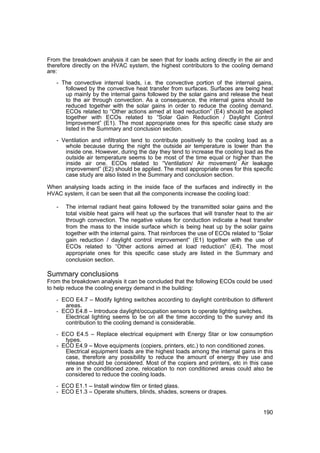
Technical guides for owner/manager of an air conditioning
                    system: volume 10


    Successful Case Studies in
            AuditAC


                                                            1
Team

                                   France (Project coordinator)
                                    Armines - Mines de Paris

                          Austria
                                                                        Slovenia
                  Austrian Energy Agency
                                                                  University of Ljubljana

                          Belgium                                           UK
                     Université de Liège                          Association of Building
                                                                       Engineers
                            Italy                                           BRE
                    Politecnico di Torino                           (Building Research
                                                                    Establishment Ltd)
                         Portugal
                     University of Porto                             Welsh School of
                                                                      Architecture

                                Eurovent-Certification


Authors of this volume
José Luís ALEXANDRE (University of Porto, Portugal)
André POÇAS (INEGI, Portugal)
Emanuel SÁ (INEGI, Portugal)


 The sole responsibility for the content of this publication lies with the authors. It does
not represent the opinion of the European Communities. The European Commission is
not responsible for any use that may be made of the information contained therein.


                                                                                              2
CONTENTS

SCOPE OF THE PROJECT ...................................................................................4

INTRODUCTION OF CASE STUDIES ..................................................................4

HIGHLIGHTS FROM CASE STUDIES..................................................................7
Office Buildings ............................................................................................................................................ 7

Hospital Buildings .......................................................................................................................................11

Commercial Building ..................................................................................................................................12

Other Service Buildings ..............................................................................................................................12


WELL DOCUMENTED CASE STUDIES..............................................................15

RESULTS AND ENERGY POTENCIAL IMPROVES............................................27
General energy Improves............................................................................................................................27

Equipment Replacement.............................................................................................................................28


DETAILED INFORMATION FOR AC CASE STUDIES .......................................29


                                                                                                                                                            3
SCOPE OF THE PROJECT
The Propose of the AuditAC

The aim is to demonstrate how much advantage can be taken from the implementation
of the inspection of air conditioning systems. More than the inspection itself, the project
promotes audit procedures as the real and effective method to reach such energy
savings.
The inspection characteristics are analyzed and an effort is made, in collaboration with
the European standardization body CEN, to modify and adapt the standard inspection
for detecting actual system’s problems.

A number of tools are developed to help auditors; inspectors and energy managers
identify the most important energy conservation opportunities in existing AC systems
and to avoid the most common errors that lead to a waste of energy.

Moreover, AuditAC attempts to reach all actors of the air-conditioning market
(manufacturers, installers, maintenance staff, etc.), in order to involve them in the
procedure of equipment auditing, make the audit procedure easier and, furthermore,
improve the acceptance of the audit itself.

Throughout all project a database called AUDIBAC was developed for the building
owners and respective systems. This data base will inform the users about the best
solution to increase the efficiency in what concerns to energy of the buildings system. It
is a tool of great importance for the effective accomplishment of the auditing procedures
in AC systems. This tool will be responsible for the creation of results in line with the
EPBD requirements, from the viewpoint of both the customer and the auditor.


INTRODUCTION OF CASE STUDIES
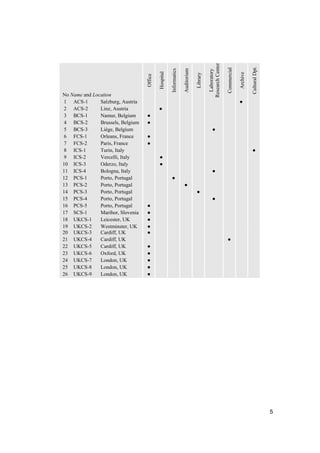
To develop this data base, it became extremely necessary to know well different cases
of application of air conditioned systems at a European level. In fact that Europe present
different climatic areas and consequently different types of building envelope turns the
knowledge of the system operation for each case very important. The case studies for
the database were developed by the several partners in the AuditAC project, Austria,
Belgium, France (project coordinator), Italy, Portugal e Slovenia and UK.


                                                                                         4
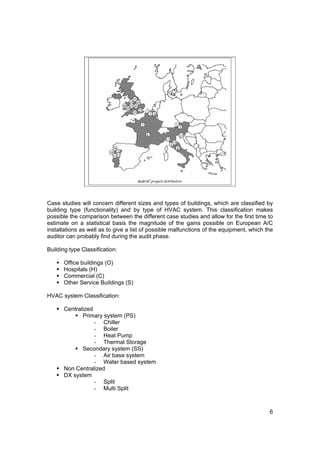
Research Center


                                                                                                                                     Cultural Dpt.
                                                                                                              Commercial
                                                                     Auditorium
                                                       Informatics


                                                                                              Laboratory
                                            Hospital


                                                                                                                           Archive
                                                                                  Library
                                   Office
No Name and Location
 1 ACS-1       Salzburg, Austria                                                                                           ●
 2 ACS-2       Linz, Austria                ●
 3 BCS-1       Namur, Belgium      ●
 4 BCS-2       Brussels, Belgium   ●
 5 BCS-3       Liège, Belgium                                                                    ●
 6 FCS-1       Orleans, France     ●
 7 FCS-2       Paris, France       ●
 8 ICS-1       Turin, Italy                                                                                                            ●
 9 ICS-2       Vercelli, Italy               ●
10 ICS-3       Oderzo, Italy                 ●
11 ICS-4       Bologna, Italy                                                                    ●
12 PCS-1       Porto, Portugal                          ●
13 PCS-2       Porto, Portugal                                        ●
14 PCS-3       Porto, Portugal                                                     ●
15 PCS-4       Porto, Portugal                                                                   ●
16 PCS-5       Porto, Portugal     ●
17 SCS-1       Maribor, Slovenia   ●
18 UKCS-1      Leicester, UK       ●
19 UKCS-2      Westminster, UK     ●
20 UKCS-3      Cardiff, UK         ●
21 UKCS-4      Cardiff, UK                                                                                     ●
22 UKCS-5      Cardiff, UK         ●
23 UKCS-6      Oxford, UK          ●
24 UKCS-7      London, UK          ●
25 UKCS-8      London, UK          ●
26 UKCS-9      London, UK          ●


                                                                                                                                                     5
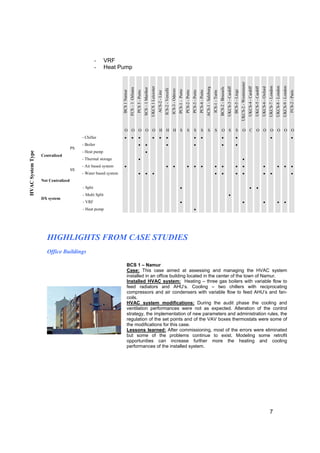
Case studies will concern different sizes and types of buildings, which are classified by
building type (functionality) and by type of HVAC system. This classification makes
possible the comparison between the different case studies and allow for the first time to
estimate on a statistical basis the magnitude of the gains possible on European A/C
installations as well as to give a list of possible malfunctions of the equipment, which the
auditor can probably find during the audit phase.

Building type Classification:

      Office buildings (O)
      Hospitals (H)
      Commercial (C)
      Other Service Buildings (S)

HVAC system Classification:

      Centralized
             Primary system (PS)
                  - Chiller
                  - Boiler
                  - Heat Pump
                  - Thermal Storage
             Secondary system (SS)
                  - Air base system
                  - Water based system
      Non Centralized
      DX system
                  - Split
                  - Multi Split


                                                                                          6
-     VRF
                                                    -     Heat Pump


                                                                                                                                                                                                                                                                                                                                                                  UKCS-2 - Westminster


                                                                                                                                                                                                                                                                                                                                                                                                                                                 UKCS-7 - London
                                                                                                                                                                                                                                                                                                                                                                                                                                                                   UKCS-8 - London
                                                                                                                                                                                                                                                                                                                                                                                                                                                                                     UKCS-9 - London
                                                                                                                                   UKCS 1 Leicester


                                                                                                                                                                                                                                                                                                                               UKCS-3 - Cardiff


                                                                                                                                                                                                                                                                                                                                                                                         UKCS-4 - Cardiff
                                                                                                                                                                                                                                                                                                                                                                                                            UKCS-5 - Cardiff
                                                                                                                                                                                                                                                                                                                                                                                                                               UKCS-6 - Oxford
                                                                                                                                                                                                                                                                         ACS-1 - Salzburg


                                                                                                                                                                                                                                                                                                            BCS-2 - Brussels
                                                                               FCS – 1 Orleans


                                                                                                                 SCS – 1 Maribor


                                                                                                                                                                     ICS-2 - Vercelli
                                                                                                                                                                                        ICS-3 - Oderzo
                                                                                                                                                                                                         PCS-1 - Porto


                                                                                                                                                                                                                                                                                                                                                  BCS-3 - Liege
                                                                 BCS 1 Namur


                                                                                                                                                                                                                         PCS-2 - Porto
                                                                                                                                                                                                                                         PCS-3 - Porto
                                                                                                                                                                                                                                                         PCS-4 - Porto
                                                                                                 PCS 5 - Porto


                                                                                                                                                      ACS-2 - Linz


                                                                                                                                                                                                                                                                                            ICS-1 - Turin


                                                                                                                                                                                                                                                                                                                                                                                                                                                                                                       FCS-2 - Paris
                                                                    O O O O O H H H S                                                                                                                                        S               S               S                S                 S                O S                                  S                 O C                                      O O O O O O
                                          - Chiller                 •               •                •                                  •                 •               •                                                                  •               •                                                   •                                    •                                                                                               •                                                    •
                                          - Boiler                                                   •                •                                                   •                                                                  •                                                                   •                                    •
                                     PS
                                          - Heat pump                                                                 •
HVAC System Type


                   Centralized
                                          - Thermal storage                                          •                                                                                                                                                                                                                                                                  •
                                          - Air based system        •                                                                                                     •                 •                                •               •               •                                  •                •                                    •                 •                                                           •                                   •                 •                •
                                     SS
                                          - Water based system                                       •                •                 •                                                                                                                                                       •                •                                    •                 •                                                           •                 •                                                    •
                   Not Centralized
                                          - Split                                                                                                                                                            •                                                                                                                                                                                •                  •
                                          - Multi Split                                                                                                                                                                                                                                                                             •
                   DX system
                                          - VRF                                                                                                                                                              •                                                                                                                                                          •                                                           •                                   •                 •
                                          - Heat pump                                                                                                                                                                                        •


                      HIGHLIGHTS FROM CASE STUDIES
                      Office Buildings

                                                                         BCS 1 – Namur
                                                                         Case: This case aimed at assessing and managing the HVAC system
                                                                         installed in an office building located in the center of the town of Namur.
                                                                         Installed HVAC system: Heating – three gas boilers with variable flow to
                                                                         feed radiators and AHU’s. Cooling – two chillers with reciprocating
                                                                         compressors and air condensers with variable flow to feed AHU’s and fan-
                                                                         coils.
                                                                         HVAC system modifications: During the audit phase the cooling and
                                                                         ventilation performances were not as expected. Alteration of the control
                                                                         strategy, the implementation of new parameters and administration rules, the
                                                                         regulation of the set points and of the VAV boxes thermostats were some of
                                                                         the modifications for this case.
                                                                         Lessons learned: After commissioning, most of the errors were eliminated
                                                                         but some of the problems continue to exist. Modeling some retrofit
                                                                         opportunities can increase further more the heating and cooling
                                                                         performances of the installed system.


                                                                                                                                                                                                                                                                                                                                                                                                                                                    7
BCS 2 – Brussels
                     Case: This case is about a 13 story office building.
                     Installed HVAC system: The installed HVAC system is composed by 4-
                     pipe terminal units, AHU’s, Chiller, boiler, cooling towers and circulation
                     pumps.
                     HVAC system modifications: There are some suggestions made in order
                     to improve the system performance. The AHU’s were partially renovated
                     and all induction units and thermostatic valves were replacement. The
                     replacement of existing induction units by more efficient devices (other
                     induction units or fan coils), should make possible to run the system with
                     higher chilled water temperature and therefore better COP.
                     Lessons learned: Other options can always be considered to improve the
                     systems efficiency; even small ones can produce a big effect when you
                     have a big building with a large system.


                     FCS 1 – Orleans
                     Case: This case is about a refrigeration plant of a commercial company.
                     They started having problems with the high energy bills, so the target to start
                     reducing the energy consumption was the cooling production unit.
                     Installed HVAC system: The system installed was composed by centrifugal
                     compressors groups functioning in stages. This system was oversized and
NO PHOTO AVAILABLE   used forbidden refrigerant according with the actual regulations.
                     HVAC system modifications: The modifications consisted on the
                     substitution of the cold production unit by one other, adapted to the cold
                     demand and modulated in stages.
                     Lessons learned: The real saving reached 56 % of the electricity from the
                     cold production groups.


                     FCS 2 – Paris
                     Case: audit preformed to an office building located in the Paris suburbs. The
                     building has one floor and a basement. Its overall clear surface is 1140 m ².
                     The building can be divided into three types of spaces: circulation zones,
                     conference offices and rooms.
                     Installed HVAC system: The five conference rooms are climatized by an
                     AHU and a group of cold water production. About thirty offices have AC
                     based on 2-pipe fancoils and natural ventilation. The cold water that feeds the
                     loop of the AHU and the fancoil is produced in a non-reversible alternative
                     Chiller. The system operates 24 h /24 and 7 days/7.
                     HVAC system modifications: Two main improvement scenarios were
                     foreseen: the first scenario consist in keeping air conditioning in summer and
                     the heating with Joule effect in winter; the second scenario would be the
                     replacement of the refrigeration unit by a reversible heat pump with an
                     average seasonal COP of 2,5. Associated with these two scenarios other
                     measures were proposed in order to reduce the energy consumption:
                     Change the water loop set points, change the functioning schedules, reduce
                     the internal gains etc.
                     Lessons learned: This study shows that the improvement scenarios
                     combined with other measures can result in a decrease from 30% to 77% of
                     the HVAC system energy consumption.


                                                                                            8
SCS 1 – Maribor
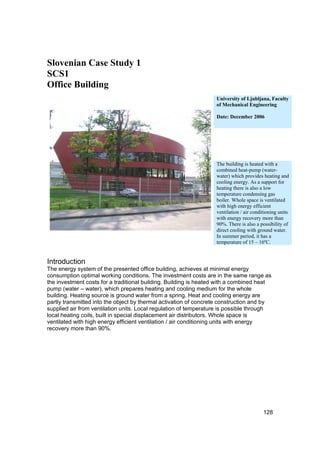
                     Case: This case relates a high efficient system for an office building. At
                     minimal energy consumption, thermal comfort and good work conditions are
                     achieved. The investment costs are similar with the traditional buildings.
                     Installed HVAC system: The building is heated with a combined heat-pump
                     (water-water) which provides heating and cooling energy. As a support for
                     heating there is also a low temperature condensing gas boiler. Whole space
                     is ventilated with high energy efficient ventilation / air conditioning units with
                     energy recovery more than 90%. There is also a possibility of direct cooling
                     with ground water. In summer period, it has a temperature of 15 – 16ºC.
                     HVAC system modifications: This study only intents to present a case of
                     good performance, so there are no modifications.
                     Lessons learned: It is possible to have a high efficient HVAC and obtain
                     good levels of comfort without much more than an usual building.


                     UKCS 1 – Leicester
                     Case: This case illustrates an exceptionally energy efficient/low energy air
                     conditioning system. This is a 4 storey office building.
                     Installed HVAC system: The HVAC cooling system consists on chilled
                     beams. The cold water production unit is a package air cooled chilled using
NO PHOTO AVAILABLE   R407c as refrigerant.
                     HVAC system modifications: There are no modifications suggested
                     Lessons learned: This building seems to be very energy efficient according
                                                                 2
                     to is overall annual energy consumption/m when compared to national
                     benchmarks.


                     UKCS 2 – Westminster
                     Case: This case study aimed at assessing the energy performance and its
                     potential for improvement, of a comfort cooling system installed in a UK office
                     building. The building comprises six-storeys (Ground plus 5) of mainly small
                     cellular offices and a lower ground containing support and storage areas.
                     Installed HVAC system: The basic system configuration features passive
                     chilled ceilings and perimeter passive beams with night-time ice storage and
NO PHOTO AVAILABLE   some DX systems serving computer rooms and conference suites. Ventilation
                     is provided mechanically via centralised AHU’s and heating is provided by
                     perimeter radiators.
                     HVAC system modifications: This case study focus on the actual system
                     analysis, thus no modifications were implemented.
                     Lessons learned: Detail thermal simulation tool can be very helpful to
                     predict HVAC system consumption and consequently avoid some errors in
                     the project or correcting them during an Audit.


                     UKCS 3 – Cardiff
                     Case: This case study compares the energy consumption values obtained
                     using thermal simulation tools such as EnergyPlus with real energy
                     measurements.
                     Installed HVAC system: The HVAC system installed is a 2-pipe Multi-Split
                     DX system. This system has the possibility to free cool the spaces.
                     HVAC system modifications: This study focus on the actual system
                     analysis, thus no modifications were tested.
                     Lessons learned: Detailed thermal simulation tool can be very helpful to
                     predict HVAC system consumption and consequently avoid some errors in
                     the project.


                                                                                               9
UKCS 5 – Cardiff
                     Case: This case study aimed at assessing the energy performance and its
                     potential for improvement, of a comfort cooling system installed in a small
                     administrative office, located in a historic building of Cardiff University.
                     Installed HVAC system: The office has a DX split comfort cooling system
NO PHOTO AVAILABLE   with a roof mounted condenser and a 4-way ceiling mounted cassette.
                     HVAC system modifications: This case study focus on the actual system
                     analysis, thus no modifications were implemented.
                     Lessons learned: Detail thermal simulation tool can be very helpful to
                     predict HVAC system consumption and consequently avoid some errors in
                     the project or correcting them during an Audit.

                     UKCS 6 – Oxford
                     Case: This case study aimed at assessing the energy performance and its
                     potential for improvement, of a comfort cooling system installed in a light
                     industrial building on a small rural estate near Oxford. The conditioned area
                     consists of a large open plan office, 3 cellular spaces of executive offices, a
                     conference room and a production area room.
                     Installed HVAC system: This area is serviced by VRF indoor units, ceiling
                     mounted, from external condensers on a 2-pipe heating and cooling “change
NO PHOTO AVAILABLE   over” only basis. The supply AHU consist of an in-duct axial fan, filter pack
                     and electric heater battery. The system has plenum return ventilation with
                     ducted supply and partial recirculation in the fan-coil units.
                     HVAC system modifications: This case study focus on the actual system
                     analysis, thus no modifications were implemented.
                     Lessons learned: Detail thermal simulation tool can be very helpful to
                     predict HVAC system consumption and consequently avoid some errors in
                     the project or correcting them during an Audit.

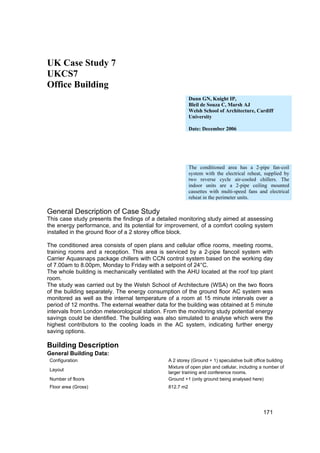
                     UKCS 7 – London
                     Case: This case study aimed at assessing the energy performance and its
                     potential for improvement, of a comfort cooling system installed in the ground
                     floor of a 2 storey office block. The conditioned area consists of open plans
                     and cellular office rooms, meeting rooms, training rooms and a reception.
                     Installed HVAC system: The conditioned area has a 2-pipe fan-coil system
                     with the electrical reheat, supplied by two reverse cycle air-cooled chillers.
NO PHOTO AVAILABLE   The indoor units are a 2-pipe ceiling mounted cassettes with multi-speed fans
                     and electrical reheat in the perimeter units.
                     HVAC system modifications: This case study focus on the actual system
                     analysis, thus no modifications were implemented.
                     Lessons learned: Detail thermal simulation tool can be very helpful to
                     predict HVAC system consumption and consequently avoid some errors in
                     the project or correcting them during an Audit.

                     UKCS 8 – London
                     Case: This case study aimed at assessing the energy performance and its
                     potential for improvement, of a comfort cooling system installed in the first
                     floor of a 2 storey office block. The conditioned area consists of open plans
                     and cellular office rooms, meeting rooms.
                     Installed HVAC system: 3 pipe heat recovery VRF units with roof mounted
                     condensers and internal ceiling mounted cassettes. The cassettes draw air
                     from the ceiling void that is also supplied with fresh tempered air from the
NO PHOTO AVAILABLE   mechanical ventilation system. The entire building is mechanically ventilated
                     with a 2-duct supply and return system, within the air handling unit located in
                     the roof top plant room.
                     HVAC system modifications: This case study focus on the actual system
                     analysis, thus no modifications were implemented.
                     Lessons learned: Detail thermal simulation tool can be very helpful to
                     predict HVAC system consumption and consequently avoid some errors in
                     the project or correcting them during an Audit.


                                                                                         10
UKCS 9 – London
                      Case: This case study aimed at assessing the energy performance and its
                      potential for improvement, of a comfort cooling system installed in a 2 storey
                      office block. The conditioned area consists of open plans and cellular office
                      rooms, meeting rooms.
                      Installed HVAC system: The conditioned area has a custom Built AHU. The
                      packaged roof top units are VRV condensers with 3 pipe Heating/Cooling and
 NO PHOTO AVAILABLE   heat-recovery unit, believed to be operating as modular banks of 7 per floor.
                      The ground and first floor ceiling voids contain in total 56 Daikin VRV 3-pipe
                      heat and cooling ceiling cassettes.
                      HVAC system modifications: This case study focus on the actual system
                      analysis, thus no modifications were implemented.
                      Lessons learned: Detail thermal simulation tool can be very helpful to
                      predict HVAC system consumption and consequently avoid some errors in
                      the project or correcting them during an Audit.


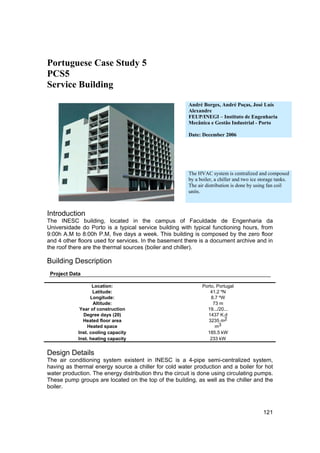
                      PCS 5 – Porto
                      Case: This case is about the INESC building located in the campus of Porto’s
                      faculty of engineering. This is a typical 4 stories service building.
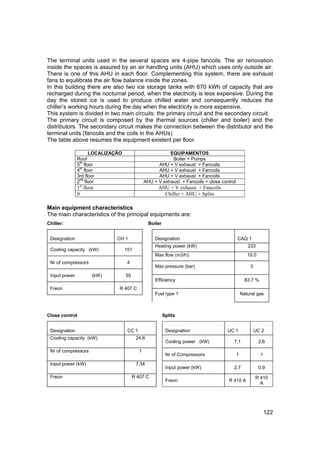
                      Installed HVAC system: The HVAC system is centralized and composed by
                      a boiler, a chiller and two ice storage tanks. The air distribution is done by
                      using fan coil units.
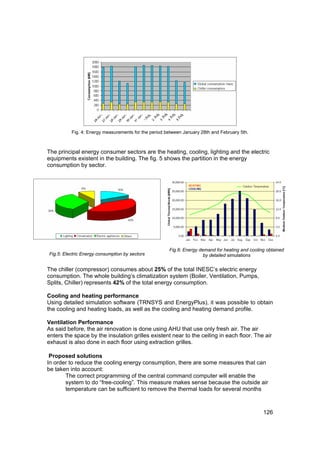
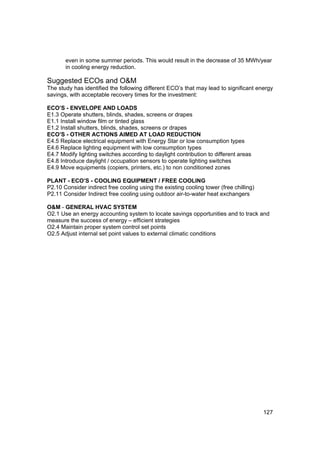
                      HVAC system modifications: The main tested alteration consists on the
                      reprogramming of the central control unit in order to provide the use of free
                      cooling whenever possible.
                      Lessons learned: The use of free cooling is estimated to offer an energy
                      saving potential by the order of 28% year.

Hospital Buildings

                      ACS 2 – Linz
                      Case: This case concerns with the optimization of the refrigeration plant
                      existent in the central hospital of Linz.
                      Installed HVAC system: The refrigeration plant is equipped with a 6-cilynder
                      2-stage compressor. The heat rejected can be collected and used for heating
                      water.
                      HVAC system modifications: The modification was basically the
                      replacement of the 6-piston compressor for a 6 screw compressor with 40%
                      more of cooling capacity.
                      Lessons learned: The saving potential was even higher than estimated,
                      achieving 30-35%.

                      ICS 2 – Vercelli
                      Case: This case intents to show the optimization of a hospital AHU that treats
                      the air from a surgery room. Measurements were done and the data collected
                      will be used to assess the system’s efficiency.
                      Installed HVAC system: The actual installed HVAC is a centralized system
                      (with AHU, chiller and water loops).
                      HVAC system modifications: In order to improve the system’s efficiency
                      several solutions were studied, such as the substitution of the chiller, the
                      capability to use free cooling and the heat recovery from the condenser units.
                      Lessons learned: Several economic and energetic analyses were done. The
                      use of two new chillers in partial load instead of three installed ones can
                      achieve savings on the order of 1460 €/yr. Savings associated to a one
                      degree variation in the limit temperature at which the chillers are shut off and
                      free cooling is adopted (23°C vs 22°C) are approximately equal to 50000
                      kWh/yr (with negligible differences between existing and new chillers), i.e. on
                      the order of 12%.This demonstrates that there is an opportunity for cost
                      effective energy saving measures.


                                                                                           11
ICS 3 – Oderzo
                            Case: This case is about a 3-storey hospital building.
                            Installed HVAC system: 100% external air AHU. This unit has humidifier,
                            fans, HEPA filters, cooling coil and heating coil.
                            HVAC system modifications: In order to improve the system’s efficiency
                            several solutions were studied such as free-cooling with an achieved energy
 NO PHOTO AVAILABLE         reduction of 16% and heat recovery. The average thermal effectiveness of
                            the intermediate-fluid heat recovery system turned out to be on the order of
                            58% (based on measurements) and for an air-to-air heat exchanger 65%.
                            Lessons learned: This case study has allowed a quantification of the impact
                            of AHU operation on the electrical energy consumption of an all-air AC
                            system for a hospital. It shows as well that some energy saving measures
                            can be implemented with good results.

Commercial Building

                          UKCS 4 – Cardiff
                          Case: This case study aimed at assessing the energy performance and its
                          potential for improvement, of a comfort cooling system installed in a small
                          commercial architectural practice operating as part of the Welsh School of
                          Architecture (WSA).
                          Installed HVAC system: DX splits were installed for comfort cooling. The
NO PHOTO AVAILABLE        system has roof mounted condensers and wall mounted slim-line cassettes.
                          HVAC system modifications: This case study focus on the actual system
                          analysis, thus no modifications were implemented.
                          Lessons learned: Detail thermal simulation tool can be very helpful to predict
                          HVAC system consumption and consequently avoid some errors in the project
                          or correcting them during an Audit.


Other Service Buildings

                          BCS 3 – Liège
                          Case: This case is about a laboratory located in Liege, Belgium. The
                          conditioned floor area is 4000 m2. This building contents a set o offices,
                          meeting rooms, dinning hall and laboratories.
                          Installed HVAC system: The installed HVAC system is composed by Terminal
                          Units such as Fan coils and a AHU that supplies conditioned fresh air using
                          textiles diffusers. The AHU and the Fan coil units are fed by water loops. The
                          hot water is produced by a boiler and the cold water by chillers.
                          HVAC system modifications: This study only indicates retrofit opportunities no
                          modifications were made in the installed system.
                          Lessons learned: Better distribution of the hot water temperature to the actual
                          space heating demand and another mode of sanitary hot water production
                          seems to provide reduce de gas consumption.
                          A recovery heat pump could be used with extracted air as cold source in order
                          to enhance heat recovery from AHU.


                                                                                               12
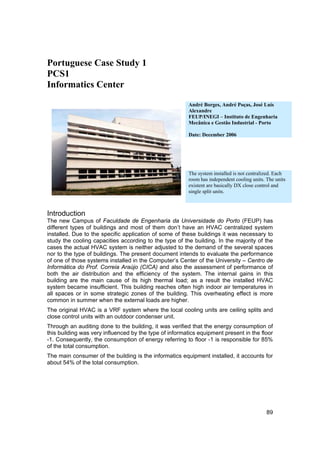
PCS 1 – Porto:
Case: This case is about a computer center existing in the Faculty of
Engineering of Porto University. The rooms in analysis are 4 and are in function
all year to guarantee the functioning of the faculty’s computer network and
internet.
Installed HVAC system: the system installed is not centralized. Each room has
independent cooling units. The units existent are basically DX close control and
single split units.
HVAC system modifications: The proposed modification for this case consists
on the substitution of the actual DX units for a centralized system, being the
chilled water loop fed by a chiller and the hot water loop fed by a boiler. One
other fundamental change was the introduction of the possibility for the system
to free cool the spaces given favorable outdoor temperature conditions.
Lessons learned: The main achievement was the use of free cooling as well
as the savings due to the increase of the chiller efficiency (EER). These
measures result in a 70 % decrease of the compressors functioning hours and
in an overall 30% electric energy reduction.

PCS 2 – Porto:
Case: This is the case of three auditoriums existent on the Faculty of
engineering. These auditoriums are equipped with an Air-Air type system. The
analysis done to this rooms was merely acoustic.
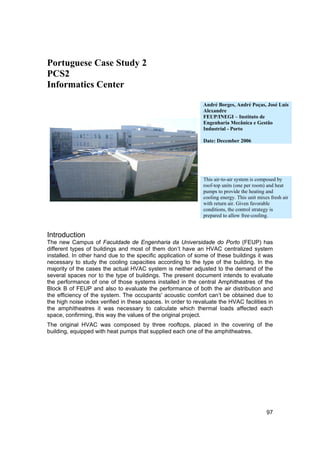
Installed HVAC system: This air-to-air system is composed by roof-top units
(one per room) and heat pumps to provide the heating and cooling energy. This
unit mixes fresh air with return air. Given favorable conditions, the control
strategy is prepared to allow free-cooling.
HVAC system modifications: The proposed modifications are focused on the
ventilation system. Some modifications were done in order to reduce the noise
level inside the rooms. Modifications like the displacement of the mixing box or
the placement of acoustic attenuators were tested.
Lessons learned: The acoustic comfort can be achieved with parallel
improvements on the indoor air quality and energy efficiency.

PCS 3 – Porto:
Case: This case relates to library in the Porto’s faculty of engineering. This is an
8 stories building that works from Monday to Friday. This case study intents to
assess and resolve a comfort problem reported by the library users.
Installed HVAC system: the system installed is centralized. There’s a boiler and
a chiller on the roof that feed the chilled and hot water loops respectively. The
air loop is handled by an air handling unit.
HVAC system modifications: The proposed modification for this case consists
on the use of CO2 as the fresh air control indicator, the change of the lighting
                   2
density to 8 W/m , use of vertical and horizontal shading devices on the south
facing windows and the alteration of the set-point temperatures.
Lessons learned: All these measures resulted in energy savings. By combining
some of these actions the building can archive 43 % energy reduction.

PCS-4 – Porto:
Case: These case intents to study the influence of the AHU filters conditions on
the ventilation energy consumption in a laboratory room located within FEUP.
Installed HVAC system: The studied AHU is composed by two fans, electric
resistances for heating and a DX system for cooling. The filters tested were
placed on the fresh air inlet side.
HVAC system modifications: The modification done was basically to
substitute a dirty filter by a new one, and monitor the fan motor energy
consumption.
Lessons learned: The lack of the filters maintenance reduces the indoor air
quality, and leads to energy waste by the fan motors.


                                                                         13
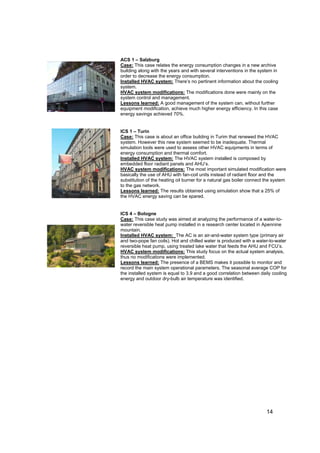
ACS 1 – Salzburg
Case: This case relates the energy consumption changes in a new archive
building along with the years and with several interventions in the system in
order to decrease the energy consumption.
Installed HVAC system: There’s no pertinent information about the cooling
system.
HVAC system modifications: The modifications done were mainly on the
system control and management.
Lessons learned: A good management of the system can, without further
equipment modification, achieve much higher energy efficiency. In this case
energy savings achieved 70%.


ICS 1 – Turin
Case: This case is about an office building in Turim that renewed the HVAC
system. However this new system seemed to be inadequate. Thermal
simulation tools were used to assess other HVAC equipments in terms of
energy consumption and thermal comfort.
Installed HVAC system: The HVAC system installed is composed by
embedded floor radiant panels and AHU’s.
HVAC system modifications: The most important simulated modification were
basically the use of AHU with fan-coil units instead of radiant floor and the
substitution of the heating oil burner for a natural gas boiler connect the system
to the gas network.
Lessons learned: The results obtained using simulation show that a 25% of
the HVAC energy saving can be spared.


ICS 4 – Bologne
Case: This case study was aimed at analyzing the performance of a water-to-
water reversible heat pump installed in a research center located in Apennine
mountain.
Installed HVAC system: The AC is an air-and-water system type (primary air
and two-pope fan coils). Hot and chilled water is produced with a water-to-water
reversible heat pump, using treated lake water that feeds the AHU and FCU’s.
HVAC system modifications: This study focus on the actual system analysis,
thus no modifications were implemented.
Lessons learned: The presence of a BEMS makes it possible to monitor and
record the main system operational parameters. The seasonal average COP for
the installed system is equal to 3.9 and a good correlation between daily cooling
energy and outdoor dry-bulb air temperature was identified.


                                                                        14
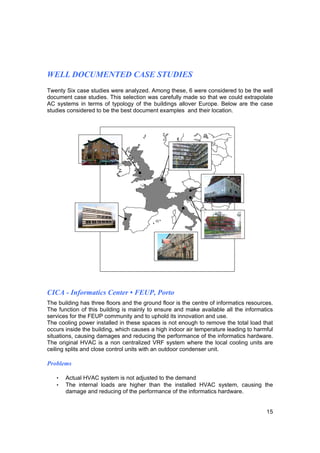
WELL DOCUMENTED CASE STUDIES
Twenty Six case studies were analyzed. Among these, 6 were considered to be the well
document case studies. This selection was carefully made so that we could extrapolate
AC systems in terms of typology of the buildings allover Europe. Below are the case
studies considered to be the best document examples and their location.


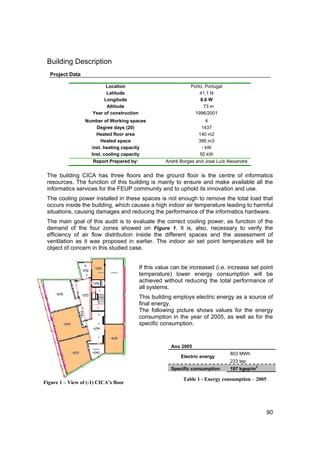
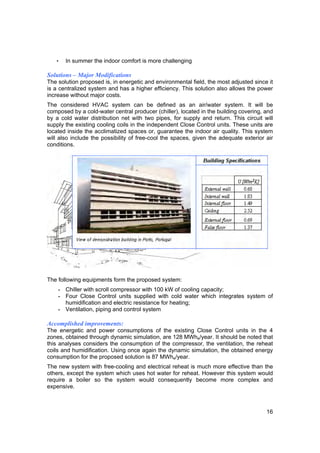
CICA - Informatics Center • FEUP, Porto
The building has three floors and the ground floor is the centre of informatics resources.
The function of this building is mainly to ensure and make available all the informatics
services for the FEUP community and to uphold its innovation and use.
The cooling power installed in these spaces is not enough to remove the total load that
occurs inside the building, which causes a high indoor air temperature leading to harmful
situations, causing damages and reducing the performance of the informatics hardware.
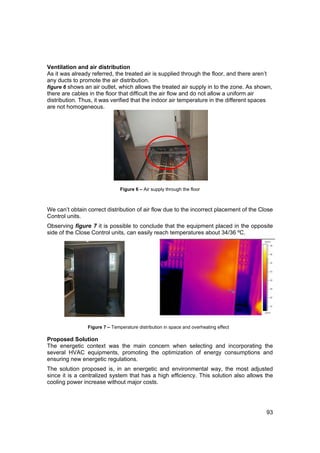
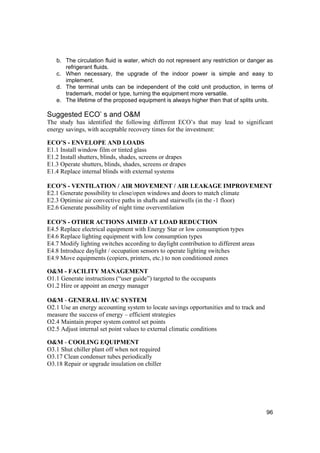
The original HVAC is a non centralized VRF system where the local cooling units are
ceiling splits and close control units with an outdoor condenser unit.

Problems

   •   Actual HVAC system is not adjusted to the demand
   •   The internal loads are higher than the installed HVAC system, causing the
       damage and reducing of the performance of the informatics hardware.


                                                                                       15
•   In summer the indoor comfort is more challenging

Solutions – Major Modifications
The solution proposed is, in energetic and environmental field, the most adjusted since it
is a centralized system and has a higher efficiency. This solution also allows the power
increase without major costs.
The considered HVAC system can be defined as an air/water system. It will be
composed by a cold-water central producer (chiller), located in the building covering, and
by a cold water distribution net with two pipes, for supply and return. This circuit will
supply the existing cooling coils in the independent Close Control units. These units are
located inside the acclimatized spaces or, guarantee the indoor air quality. This system
will also include the possibility of free-cool the spaces, given the adequate exterior air
conditions.


The following equipments form the proposed system:
    - Chiller with scroll compressor with 100 kW of cooling capacity;
    - Four Close Control units supplied with cold water which integrates system of
      humidification and electric resistance for heating;
    - Ventilation, piping and control system

Accomplished improvements:
The energetic and power consumptions of the existing Close Control units in the 4
zones, obtained through dynamic simulation, are 128 MWhe/year. It should be noted that
this analyses considers the consumption of the compressor, the ventilation, the reheat
coils and humidification. Using once again the dynamic simulation, the obtained energy
consumption for the proposed solution is 87 MWhe/year.
The new system with free-cooling and electrical reheat is much more effective than the
others, except the system which uses hot water for reheat. However this system would
require a boiler so the system would consequently become more complex and
expensive.


                                                                                       16
As it is verified the energy earnings, of the floor -1, with the substitution of the current
system for the proposed, they are of 41 MWh. This value corresponds to 2.870,00 Euros
a year of economic won (the price of the electric energy was esteemed in 0,070 €/kWh).
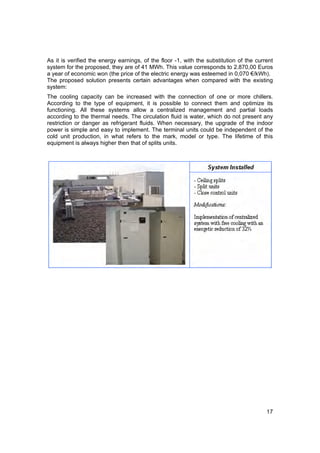
The proposed solution presents certain advantages when compared with the existing
system:
The cooling capacity can be increased with the connection of one or more chillers.
According to the type of equipment, it is possible to connect them and optimize its
functioning. All these systems allow a centralized management and partial loads
according to the thermal needs. The circulation fluid is water, which do not present any
restriction or danger as refrigerant fluids. When necessary, the upgrade of the indoor
power is simple and easy to implement. The terminal units could be independent of the
cold unit production, in what refers to the mark, model or type. The lifetime of this
equipment is always higher then that of splits units.


                                                                                         17
Office Building • Maribor
The energy system of an office business building is presented, where at minimal energy
consumption, optimal working conditions are achieved. The investment costs are in the
same range as the investment costs for a traditional building. Building is heated with a
combined heat pump (water – water), which prepares heating and cooling medium for
the whole building. Heating source is ground water from a spring. Heat and cooling
energy are partly transmitted into the object by thermal activation of concrete
construction and by supplied air of ventilation units. Local regulation of temperature is
possible through local heating coils, built in special displacement air distributors. Whole
space is ventilated with high energy efficient ventilation / air conditioning units with
energy recovery more than 90%.

Problems
There are no problems reported for this building. In fact, this case study aims to report
that is possible to combine technology, comfort and reasonable expenses.

Accomplishments:
As said, the building was designed to achieve high energy performance thus reducing
the energy consumption. This global goal was approached by several sides: the building
envelope [sun exposure and wall and glazing materials] and the HVAC systems
installed.

The glazing is a two – layer glass type, argon filled. It is combined with high quality
aluminium profiles, with interrupted thermal bridges, thermal insulated. There is also a lot
of innovative details of interruption of thermal bridges at connections glazing to concrete
constructions.

Performance of the cooling system is optimized for lowest possible energy consumption.
Big amount of sensible heat is cooled with thermal activation of concrete construction it
goes on large surface area, which means high cooling medium temperature – low
energy consumption.


                                                                                         18
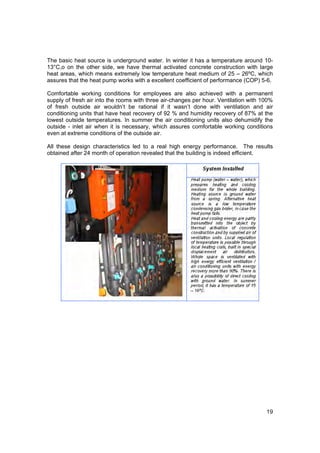
The basic heat source is underground water. In winter it has a temperature around 10-
13°C,o on the other side, we have thermal activated concrete construction with large
heat areas, which means extremely low temperature heat medium of 25 – 26ºC, which
assures that the heat pump works with a excellent coefficient of performance (COP) 5-6.

Comfortable working conditions for employees are also achieved with a permanent
supply of fresh air into the rooms with three air-changes per hour. Ventilation with 100%
of fresh outside air wouldn’t be rational if it wasn’t done with ventilation and air
conditioning units that have heat recovery of 92 % and humidity recovery of 87% at the
lowest outside temperatures. In summer the air conditioning units also dehumidify the
outside - inlet air when it is necessary, which assures comfortable working conditions
even at extreme conditions of the outside air.

All these design characteristics led to a real high energy performance. The results
obtained after 24 month of operation revealed that the building is indeed efficient.


                                                                                      19
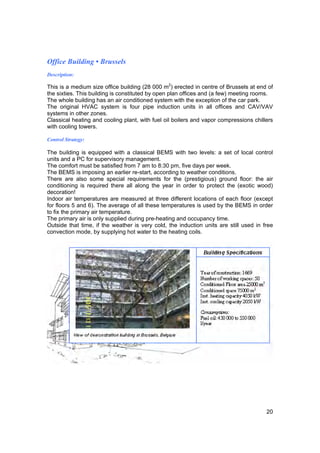
Office Building • Brussels
Description:

This is a medium size office building (28 000 m2) erected in centre of Brussels at end of
the sixties. This building is constituted by open plan offices and (a few) meeting rooms.
The whole building has an air conditioned system with the exception of the car park.
The original HVAC system is four pipe induction units in all offices and CAV/VAV
systems in other zones.
Classical heating and cooling plant, with fuel oil boilers and vapor compressions chillers
with cooling towers.

Control Strategy:

The building is equipped with a classical BEMS with two levels: a set of local control
units and a PC for supervisory management.
The comfort must be satisfied from 7 am to 8:30 pm, five days per week.
The BEMS is imposing an earlier re-start, according to weather conditions.
There are also some special requirements for the (prestigious) ground floor: the air
conditioning is required there all along the year in order to protect the (exotic wood)
decoration!
Indoor air temperatures are measured at three different locations of each floor (except
for floors 5 and 6). The average of all these temperatures is used by the BEMS in order
to fix the primary air temperature.
The primary air is only supplied during pre-heating and occupancy time.
Outside that time, if the weather is very cold, the induction units are still used in free
convection mode, by supplying hot water to the heating coils.


                                                                                       20
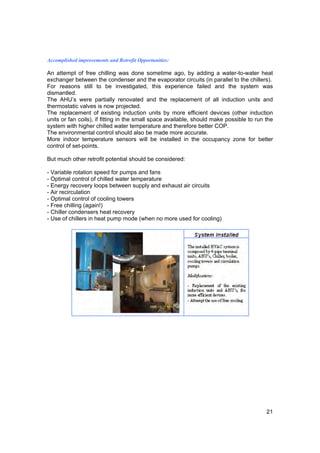
Accomplished improvements and Retrofit Opportunities:

An attempt of free chilling was done sometime ago, by adding a water-to-water heat
exchanger between the condenser and the evaporator circuits (in parallel to the chillers).
For reasons still to be investigated, this experience failed and the system was
dismantled.
The AHU’s were partially renovated and the replacement of all induction units and
thermostatic valves is now projected.
The replacement of existing induction units by more efficient devices (other induction
units or fan coils), if fitting in the small space available, should make possible to run the
system with higher chilled water temperature and therefore better COP.
The environmental control should also be made more accurate.
More indoor temperature sensors will be installed in the occupancy zone for better
control of set-points.

But much other retrofit potential should be considered:

- Variable rotation speed for pumps and fans
- Optimal control of chilled water temperature
- Energy recovery loops between supply and exhaust air circuits
- Air recirculation
- Optimal control of cooling towers
- Free chilling (again!)
- Chiller condensers heat recovery
- Use of chillers in heat pump mode (when no more used for cooling)


                                                                                          21
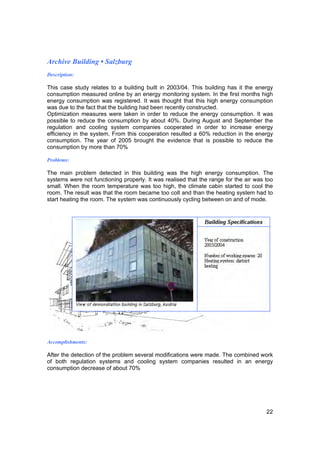
Archive Building • Salzburg
Description:

This case study relates to a building built in 2003/04. This building has it the energy
consumption measured online by an energy monitoring system. In the first months high
energy consumption was registered. It was thought that this high energy consumption
was due to the fact that the building had been recently constructed.
Optimization measures were taken in order to reduce the energy consumption. It was
possible to reduce the consumption by about 40%. During August and September the
regulation and cooling system companies cooperated in order to increase energy
efficiency in the system. From this cooperation resulted a 60% reduction in the energy
consumption. The year of 2005 brought the evidence that is possible to reduce the
consumption by more than 70%

Problems:

The main problem detected in this building was the high energy consumption. The
systems were not functioning properly. It was realised that the range for the air was too
small. When the room temperature was too high, the climate cabin started to cool the
room. The result was that the room became too colt and than the heating system had to
start heating the room. The system was continuously cycling between on and of mode.


Accomplishments:

After the detection of the problem several modifications were made. The combined work
of both regulation systems and cooling system companies resulted in an energy
consumption decrease of about 70%


                                                                                      22
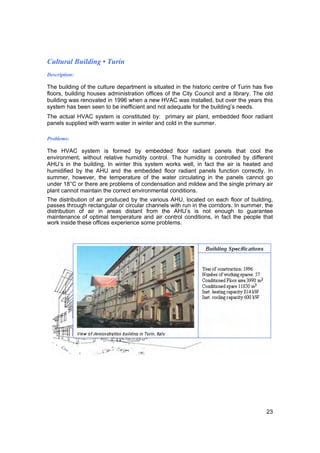
Cultural Building • Turin
Description:

The building of the culture department is situated in the historic centre of Turin has five
floors, building houses administration offices of the City Council and a library. The old
building was renovated in 1996 when a new HVAC was installed, but over the years this
system has been seen to be inefficient and not adequate for the building’s needs.
The actual HVAC system is constituted by: primary air plant, embedded floor radiant
panels supplied with warm water in winter and cold in the summer.

Problems:

The HVAC system is formed by embedded floor radiant panels that cool the
environment, without relative humidity control. The humidity is controlled by different
AHU’s in the building. In winter this system works well, in fact the air is heated and
humidified by the AHU and the embedded floor radiant panels function correctly. In
summer, however, the temperature of the water circulating in the panels cannot go
under 18°C or there are problems of condensation and mildew and the single primary air
plant cannot maintain the correct environmental conditions.
The distribution of air produced by the various AHU, located on each floor of building,
passes through rectangular or circular channels with run in the corridors. In summer, the
distribution of air in areas distant from the AHU’s is not enough to guarantee
maintenance of optimal temperature and air control conditions, in fact the people that
work inside these offices experience some problems.


                                                                                        23
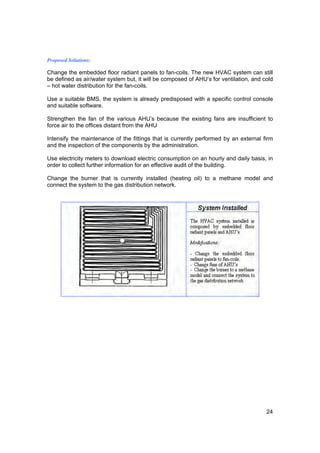
Proposed Solutions:

Change the embedded floor radiant panels to fan-coils. The new HVAC system can still
be defined as air/water system but, it will be composed of AHU’s for ventilation, and cold
– hot water distribution for the fan-coils.

Use a suitable BMS, the system is already predisposed with a specific control console
and suitable software.

Strengthen the fan of the various AHU’s because the existing fans are insufficient to
force air to the offices distant from the AHU

Intensify the maintenance of the fittings that is currently performed by an external firm
and the inspection of the components by the administration.

Use electricity meters to download electric consumption on an hourly and daily basis, in
order to collect further information for an effective audit of the building.

Change the burner that is currently installed (heating oil) to a methane model and
connect the system to the gas distribution network.


                                                                                       24
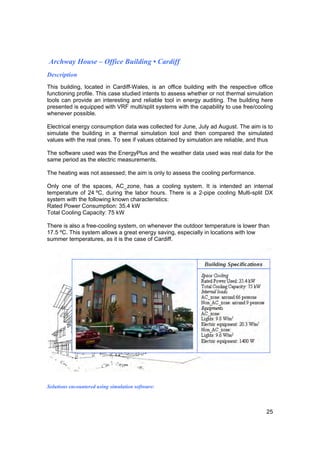
Archway House – Office Building • Cardiff
Description
This building, located in Cardiff-Wales, is an office building with the respective office
functioning profile. This case studied intents to assess whether or not thermal simulation
tools can provide an interesting and reliable tool in energy auditing. The building here
presented is equipped with VRF multi/split systems with the capability to use free/cooling
whenever possible.

Electrical energy consumption data was collected for June, July ad August. The aim is to
simulate the building in a thermal simulation tool and then compared the simulated
values with the real ones. To see if values obtained by simulation are reliable, and thus

The software used was the EnergyPlus and the weather data used was real data for the
same period as the electric measurements.

The heating was not assessed; the aim is only to assess the cooling performance.

Only one of the spaces, AC_zone, has a cooling system. It is intended an internal
temperature of 24 ºC, during the labor hours. There is a 2-pipe cooling Multi-split DX
system with the following known characteristics:
Rated Power Consumption: 35.4 kW
Total Cooling Capacity: 75 kW

There is also a free-cooling system, on whenever the outdoor temperature is lower than
17.5 ºC. This system allows a great energy saving, especially in locations with low
summer temperatures, as it is the case of Cardiff.


Solutions encountered using simulation software:


                                                                                       25
From the breakdown analysis it can be concluded that the following ECOs could be used
to help reduce the cooling energy demand in the building:

   - ECO E4.5 – Replace electrical equipment with Energy Star or low consumption
      types.
   - ECO E4.9 – Move equipments (copiers, printers, etc.) to non conditioned zones.
      Electrical equipment loads are the highest loads among the internal gains in this
      case, therefore any possibility to reduce the amount of energy they use and
      release should be considered. Most of the copiers and printers, etc in this case
      are in the conditioned zone, relocation to non conditioned areas could also be
      considered to reduce the cooling loads.

   - ECO E4.7 – Modify lighting switches according to daylight contribution to different
      areas.
   - ECO E4.8 – Introduce daylight/occupation sensors to operate lighting switches.
      Electrical lighting seems to be on all the time according to the survey and its
      contribution to the cooling demand is considerable.

   - ECO E2.1 – Generate possibility to open/close windows and doors to match
      climate. Ventilation should be used as much as possible as a free cooling source
      as the outside air temperature tends to be lower that the inside air temperature.

   - ECO E1.1 – Install window film or tinted glass.

   - ECO E1.3 – Operate shutters, blinds, shades, screens or drapes.
      Solar control should be used to reduce the cooling loads, even though it is not
      the highest contributor to it.

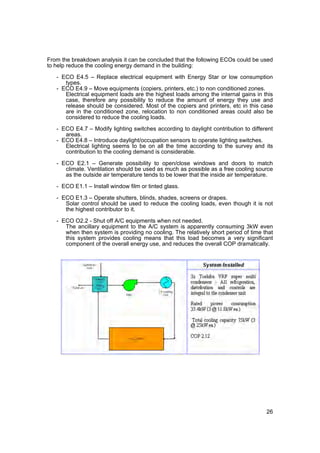
   - ECO O2.2 - Shut off A/C equipments when not needed.
      The ancillary equipment to the A/C system is apparently consuming 3kW even
      when then system is providing no cooling. The relatively short period of time that
      this system provides cooling means that this load becomes a very significant
      component of the overall energy use, and reduces the overall COP dramatically.


                                                                                     26
RESULTS AND ENERGY POTENCIAL IMPROVES
General energy Improves

In general overview, the observed potential energy savings in different real examples
can be subdivided in a few audit strategies, such as:
    1. management system control optimization
    2. efficiency control of the equipment energy consumptions
    3. lighting efficiency control
    4. new strategies of recovery energy
    5. free-cooling strategy implementation
    6. simply chiller equipment replace

To achieve a good Potential Energy savings strategy the building’s owner (or auditor)
must to know well the energy utilization such as:
     • running hours of AC and the length of pre-cool period;
     • internal comfort conditions, ie temperature, humidity, lighting levels;
     • localization of the unnecessary AC and lighting, I e unoccupied zones;
     • chillers/pumps schedules and settings;
     • specific equipment energy consuming
     • lighting energy consuming
     • the areas of high energy consumptions
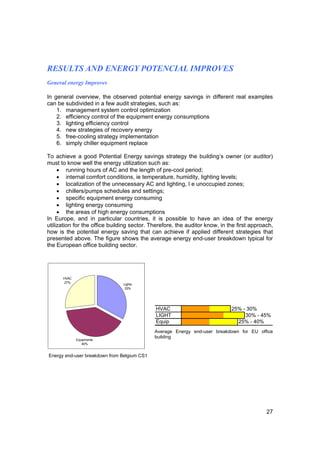
In Europe, and in particular countries, it is possible to have an idea of the energy
utilization for the office building sector. Therefore, the auditor know, in the first approach,
how is the potential energy saving that can achieve if applied different strategies that
presented above. The figure shows the average energy end-user breakdown typical for
the European office building sector.


      HVAC
       27%
                                Lights
                                 33%


                                             HVAC                            25% - 30%
                                             LIGHT                                30% - 45%
                                             Equip                             25% - 40%
                                             Average Energy end-user breakdown for EU office
                                             building
             Equipments
                40%


Energy end-user breakdown from Belgium CS1


                                                                                            27
Some audit cases had energy improvements only with a new lighting strategy control, for
example the PCS-31 the reduction the light to 8 W/m2 it had have double effect on the
energy consumption, first in direct electricity consumption and second in the reduction of
internal loads, ie peak cooling power. At the end, with global strategy control for the AC
system, the global system achieves 43% of energy reduction. Of course it is not only the
lighting effect but all control strategy.

Good control and management of the system in same cases can reaches a high save
energy. This was happen in the ACS-12 case study when the total save energy it was up
to 70%. This is an excellent example but the average control management has less
energy efficiency indeed.

The use of free potential energy (free-cooling) is used in some cases with excellent
results in same cases the energy profits can achieve from 30% to 60% reduction of the
total energy consumption. This solution is well dependent fro the weather conditions and
the countries with cool climates are more suitable for this kind of solution.

Equipment Replacement

There are a significant number of examples, in AdiBAC, based in replacement cool
equipment, ie change the old chiller by a new one with high efficiency. The CS shows
some examples were the energy saves can be up to 35% of total energy (ACS-2)4, and
other when the energy saves reach 56% of the energy used for the cooling system
(FRCS-1)3.

It is quite possible to make an idea how energy we can save if we make chiller
equipment replacement, in average point of view. Based upon the EER evolution in the
last ten years, that means ± 30% increase efficiency on average (EECCAC), therefore it
is possible to forecast the potential energy save for the next days in the AC systems.

The "cases" in the data base are real installations which are described under the format
that the various existing reference frames request in order to make them comparable.
For part of the existing case studies it will be necessary to supplement information
available by complementary measurements and / or by calculations so that all the
methods become applicable. Besides their use in further work packages, the case
studies in the data base will allow for the first time to estimate on a statistical basis the
magnitude of the gains possible on European A/C installations.


1
  AuditAC Case Studies Brochure: Case studies: Portuguese, n3
2
  Auditac Case Studies Brochure: Case studies : Austrian, nº 1and nº2
3
  Auditac Case Studies Brochure: Case Studies: French , nº1


                                                                                          28
DETAILED INFORMATION FOR AC CASE STUDIES

Austrian Case Study 1
ACS1
City Archive
                                                         Georg Benke
                                                         Austrian Energy Agency – Austria

                                                         Date: December 2006


                                                         There’s no pertinent information about
                                                         the cooling system


Introduction
The new city archive was built in 2003/2004 and started to “operate” in March 2004. As
all buildings owned by the city of Salzburg, the energy consumption was measured
online by an energy monitoring system (EMS), measuring the energy and water
consumption in 15 minutes intervals. In the first months (until End of July) it was thought,
that the high energy consumption was due to the present situation, the building was new
and the materials were just brought in, causing the constant opening of the doors.
In the last week of July 2004 the installers of the ventilation systems were order to
optimize the system. It was possible to reduce the energy consumption by about 40 %.
During August and September two teams (one for the regulation system and one for the
cooling system) tried to optimize the system but only achieved the expected result, a 60
% reduction at the beginning of November.
The year 2005 brought the evidence that it was possible to reduce the consumption by
more than 70 %.

Building Description
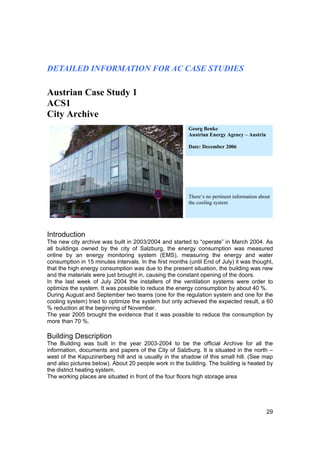
The Building was built in the year 2003-2004 to be the official Archive for all the
information, documents and papers of the City of Salzburg. It is situated in the north –
west of the Kapuzinerberg hill and is usually in the shadow of this small hill. (See map
and also pictures below). About 20 people work in the building. The building is heated by
the district heating system.
The working places are situated in front of the four floors high storage area


                                                                                             29
Design Details
The regulation system of the company controls 9 different storage areas and provides
this information to the air climate cabin. If the air is outside a certain range (f.e. 18°C / 50
% Humidity) the air climate cabin or the heating system starts to operated.
It was acknowledged that the range for the air was too small. When the room
temperature was too high, the climate cabin started to cool the room. As a result the
room became too cold and the heating system had to start heating the room. The
system was continuously cycling between on and off mode


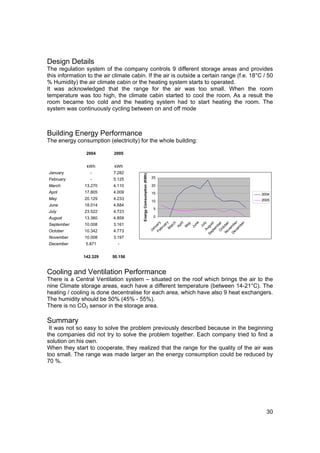
Building Energy Performance
The energy consumption (electricity) for the whole building:

                2004        2005


                kWh         kWh
January           -         7.282
                                        Energy Comsumption (KWh)


                                                                   25
February          -         5.125
March          13.270       4.110                                  20
April          17.805       4.009                                  15                      2004
May            20.129       4.233                                                          2005
                                                                   10
June           18.014       4.684
                                                                   5
July           23.522       4.723
August         13.360       4.859                                  0


                                                                      ce e r
                                                                        M y
                                                                     Fe a ry


                                                                             ne


                                                                                r
                                                                       A ly
                                                                             ch

                                                                              ril


                                                                       ve r
                                                                      O er
                                                                     pt s t


September      10.008       3.161
                                                                             ay


                                                                            be
                                                                              e
                                                                              r


                                                                    De mb
                                                                           Ju
                                                                           ua


                                                                           Ap


                                                                   Se ugu


                                                                          ob
                                                                            b
                                                                          Ju
                                                                           ar


                                                                           M
                                                                         nu


                                                                         m
                                                                       em
                                                                        br


                                                                        ct
                                                                      Ja


October        10.342       4.773
                                                                    No


November       10.008       3.197
December        5.871         -


               142.329     50.156


Cooling and Ventilation Performance
There is a Central Ventilation system – situated on the roof which brings the air to the
nine Climate storage areas, each have a different temperature (between 14-21°C). The
heating / cooling is done decentralise for each area, which have also 9 heat exchangers.
The humidity should be 50% (45% - 55%).
There is no CO2 sensor in the storage area.

Summary
 It was not so easy to solve the problem previously described because in the beginning
the companies did not try to solve the problem together. Each company tried to find a
solution on his own.
When they start to cooperate, they realized that the range for the quality of the air was
too small. The range was made larger an the energy consumption could be reduced by
70 %.


                                                                                             30
Austrian Case Study 2
ACS2
Hospital
                                                          Georg Benke
                                                          Austrian Energy Agency – Austria

                                                          Date: December 2006


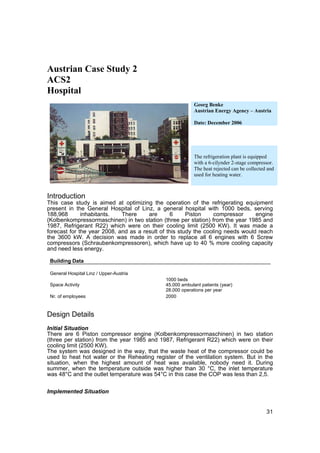
                                                          The refrigeration plant is equipped
                                                          with a 6-cilynder 2-stage compressor.
                                                          The heat rejected can be collected and
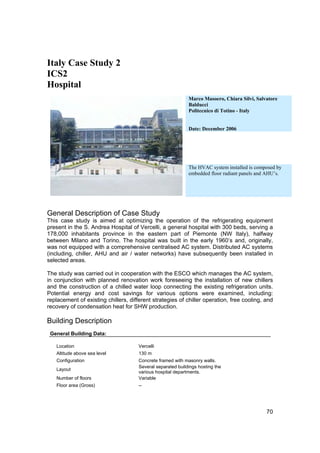
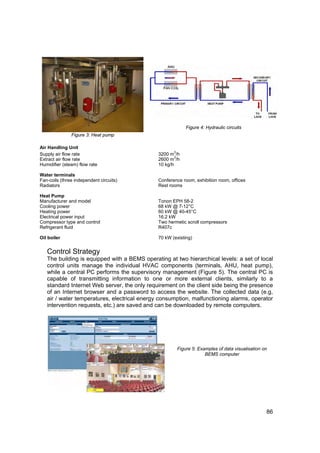
                                                          used for heating water.


Introduction
This case study is aimed at optimizing the operation of the refrigerating equipment
present in the General Hospital of Linz, a general hospital with 1000 beds, serving
188,968       inhabitants.   There     are       6     Piston     compressor     engine
(Kolbenkompressormaschinen) in two station (three per station) from the year 1985 and
1987, Refrigerant R22) which were on their cooling limit (2500 KW). It was made a
forecast for the year 2008, and as a result of this study the cooling needs would reach
the 3600 kW. A decision was made in order to replace all 6 engines with 6 Screw
compressors (Schraubenkompressoren), which have up to 40 % more cooling capacity
and need less energy.

 Building Data

 General Hospital Linz / Upper-Austria
                                             1000 beds
 Space Activity                              45.000 ambulant patients (year)
                                             28.000 operations per year
 Nr. of employees                            2000


Design Details
Initial Situation
There are 6 Piston compressor engine (Kolbenkompressormaschinen) in two station
(three per station) from the year 1985 and 1987, Refrigerant R22) which were on their
cooling limit (2500 KW).
The system was designed in the way, that the waste heat of the compressor could be
used to heat hot water or the Reheating register of the ventilation system. But in the
situation, when the highest amount of heat was available, nobody need it. During
summer, when the temperature outside was higher than 30 °C, the inlet temperature
was 48°C and the outlet temperature was 54°C in this case the COP was less than 2,5.


Implemented Situation


                                                                                            31
The 6 piston compressors were replaced by 6 Screw compressors
(Schraubenkompressoren), which have up to 40 % more cooling capacity and need less
energy.

Control Strategy
There were also smaller changes within the control system of the cooling centre. There
was no change in the kind of cooling consumption all over the hospital.

  Date of the new screw compressor:
    Type: 30HXC190-PH3
    Cooling capacity: 622 kW
    Electricity consumption: 130 kW
    Evaporator capacity: 622 kW
    COP: 4, 78
    Performance levels: 6
    Minimum level: 21 %
    Refrigerant: R134a

Within the control systems of the cooling centre the following changes are possible:
An own program make a calculation about the energy consumption (Cooling, heating)
within the next 24 h. Based on these results, it is possible the change the cooling
demand in time.
If the outside temperature is less than 18°C and the enthalpie about 45 kJ, it is possible
to raise the Cooler outlet temperature to 7 or 8 °C. (Otherwise it is 6°C). This goes hand
in hand with the weather forecast.
To optimize the efficiency of the cooling engine, they try to operate always with 100 % or
50% per engine.

Cooling Performance
Characteristic data from the screw compressor

  Performace    Condensor inlet   Cooling     Electric
                                                            COP
     level       temperature      Capacity    Capacity
      %               °C            kW          KW
     100             31°C           622         130         4,78
     86              31°C           532         123         4,33
     71              31°C           436         109         4,00
     50              31°C           316         67          4,72
     36              31°C           218         54          4,04
     21              31°C           155         47          3,30

To optimize the production of cool on a hot summer day, an extra Heat exchanger unit
was fixed on the roof. With this heat exchange unit it is possible to reduce the inlet
temperature from 48°C to 38 – 40°C. During winter they will use free cooling, when the
outside temperature is less than 8°C. The heat exchanger on the roof should be enough
the offer a cooling demand of 150 to 200 kW (reduction).

Summary
The first part of the renovation was done in May 2003. Concerning to calculation it was
expected that the electricity consumption will be reduced by about 20 to 30 %. The
maximum power load will be reduced by about 180 kW and the energy saving is up to
500.000 kWh. First result showed that there is a saving even between 30 to 35% - in this
happened in the hot summer 2002.


                                                                                       32
Belgium Case Study 1
BCS1
Office Building
                                                          Corinne ROGIEST-LEJEUNE
                                                          Philippe ANDRE
                                                          University of Liège - Belgium

                                                          Date: December 2006


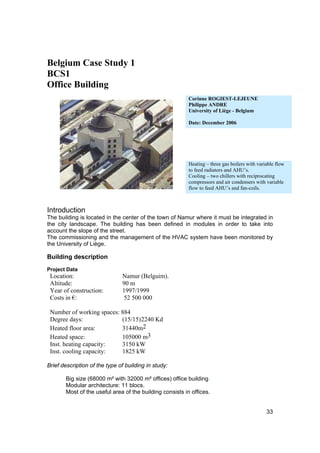
                                                          Heating – three gas boilers with variable flow
                                                          to feed radiators and AHU’s.
                                                          Cooling – two chillers with reciprocating
                                                          compressors and air condensers with variable
                                                          flow to feed AHU’s and fan-coils.


Introduction
The building is located in the center of the town of Namur where it must be integrated in
the city landscape. The building has been defined in modules in order to take into
account the slope of the street.
The commissioning and the management of the HVAC system have been monitored by
the University of Liège.

Building description
Project Data
 Location:                     Namur (Belguim).
 Altitude:                     90 m
 Year of construction:         1997/1999
 Costs in €:                   52 500 000

 Number of working spaces: 884
 Degree days:              (15/15) 2240 Kd
 Heated floor area:        31440m2
 Heated space:             105000 m3
 Inst. heating capacity:   3150 kW
 Inst. cooling capacity:   1825 kW

Brief description of the type of building in study:

       Big size (68000 m² with 32000 m² offices) office building.
       Modular architecture: 11 blocs.
       Most of the useful area of the building consists in offices.


                                                                                               33
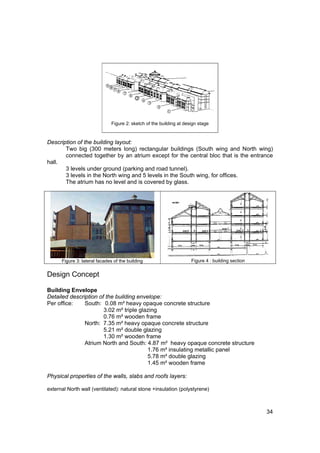
Figure 2: sketch of the building at design stage


Description of the building layout:
       Two big (300 meters long) rectangular buildings (South wing and North wing)
       connected together by an atrium except for the central bloc that is the entrance
hall.
       3 levels under ground (parking and road tunnel).
       3 levels in the North wing and 5 levels in the South wing, for offices.
       The atrium has no level and is covered by glass.


      Figure 3: lateral facades of the building                       Figure 4 : building section


Design Concept

Building Envelope
Detailed description of the building envelope:
Per office:    South: 0.08 m² heavy opaque concrete structure
                       3.02 m² triple glazing
                       0.76 m² wooden frame
               North: 7.35 m² heavy opaque concrete structure
                       5.21 m² double glazing
                       1.30 m² wooden frame
               Atrium North and South: 4.87 m² heavy opaque concrete structure
                                         1.76 m² insulating metallic panel
                                         5.78 m² double glazing
                                         1.45 m² wooden frame

Physical properties of the walls, slabs and roofs layers:

external North wall (ventilated): natural stone +insulation (polystyrene)


                                                                                                    34
+ reinforced concrete                  U=0.47 W/m²K
office floor: heavy reinforced concrete +light concrete +linoleum          U= 1.07 W/m²K
office ceiling: linoleum +light concrete +heavy reinforced concrete        U= 1.07 W/m²K
internal wall: plaster +acoustic insulation (rock wool)+plaster            U= 0.35 W/m²K
corridor ceiling: paving (gres)+light concrete+reinforced concrete         U= 1.89 W/m²K
corridor floor: reinforced concrete +light concrete +paving (gres)         U = 1.89 W/m²K
atrium wall: natural stone (pierre bleue)+ air+reinforced concrete         U= 1.80 W/m²K
external wall South: crepi +insulation (polystyrene)+reinforced concrete   U= 0.43 W/m²K
simple glazing (to interior street):                                       U=3.88 W/m²K
double gazing (North):glazing + air +glazing                               U=2.81 W/m²K
external wooden frame:                                                     U=2.86 W/m²K
internal wooden frame:                                                     U=2.45 W/m²K
atrium frame:                                                              U=2.86 W/m²K
atrium glazing: glazing +air +glazing                                      U=2.83 W/m²K

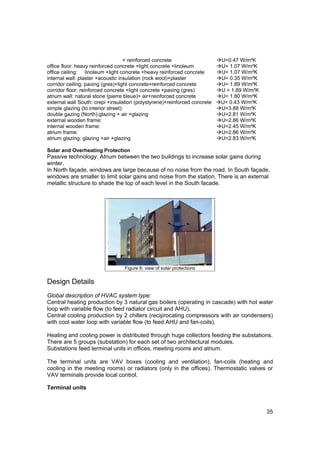
Solar and Overheating Protection
Passive technology: Atrium between the two buildings to increase solar gains during
winter.
In North façade, windows are large because of no noise from the road. In South façade,
windows are smaller to limit solar gains and noise from the station. There is an external
metallic structure to shade the top of each level in the South facade.


                                  Figure 6: view of solar protections


Design Details
Global description of HVAC system type:
Central heating production by 3 natural gas boilers (operating in cascade) with hot water
loop with variable flow (to feed radiator circuit and AHU).
Central cooling production by 2 chillers (reciprocating compressors with air condensers)
with cool water loop with variable flow (to feed AHU and fan-coils).

Heating and cooling power is distributed through huge collectors feeding the substations.
There are 5 groups (substation) for each set of two architectural modules.
Substations feed terminal units in offices, meeting rooms and atrium.

The terminal units are VAV boxes (cooling and ventilation), fan-coils (heating and
cooling in the meeting rooms) or radiators (only in the offices). Thermostatic valves or
VAV terminals provide local control.

Terminal units


                                                                                            35
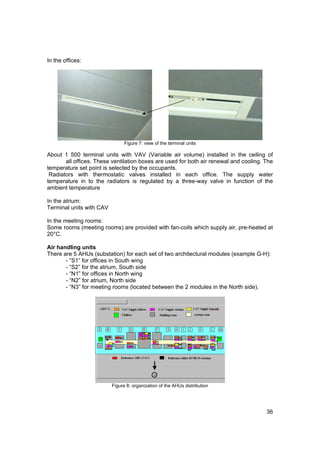
In the offices:


                                Figure 7: view of the terminal units

About 1 500 terminal units with VAV (Variable air volume) installed in the ceiling of
       all offices. These ventilation boxes are used for both air renewal and cooling. The
temperature set point is selected by the occupants.
 Radiators with thermostatic valves installed in each office. The supply water
temperature in to the radiators is regulated by a three-way valve in function of the
ambient temperature

In the atrium:
Terminal units with CAV

In the meeting rooms:
Some rooms (meeting rooms) are provided with fan-coils which supply air, pre-heated at
20°C.

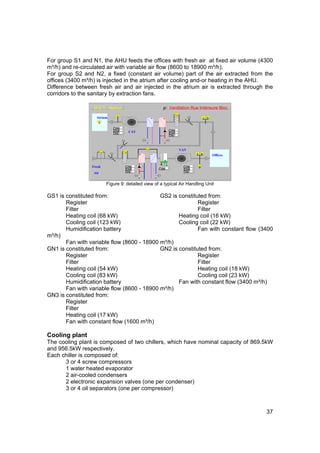
Air handling units
There are 5 AHUs (substation) for each set of two architectural modules (example G-H):
       - “S1” for offices in South wing
       - “S2” for the atrium, South side
       - “N1” for offices in North wing
       - “N2” for atrium, North side
       - “N3” for meeting rooms (located between the 2 modules in the North side).


                          Figure 8: organization of the AHUs distribution


                                                                                       36
For group S1 and N1, the AHU feeds the offices with fresh air at fixed air volume (4300
m³/h) and re-circulated air with variable air flow (8600 to 18900 m³/h).
For group S2 and N2, a fixed (constant air volume) part of the air extracted from the
offices (3400 m³/h) is injected in the atrium after cooling and-or heating in the AHU.
Difference between fresh air and air injected in the atrium air is extracted through the
corridors to the sanitary by extraction fans.

                  M.E.T. Namur                           P Ventilation Rue Intérieure Bloc
                                                                    p
                   Atrium         t                                                 t h
                    t
                                Cde
                                Etat       CAV               Cde
                                Dis.                         Etat
                                                             Dis.


                                                 p
                                                                        VAV
                         p             p
                                                                                t h       Offices


                 Fresh                 Cde                               Cde    p
                                       Etat            Cde               Etat
                  Air                  Dis.                              Dis.


                             Figure 9: detailed view of a typical Air Handling Unit

GS1 is constituted from:                    GS2 is constituted from:
       Register                                            Register
       Filter                                              Filter
       Heating coil (68 kW)                        Heating coil (16 kW)
       Cooling coil (123 kW)                       Cooling coil (22 kW)
       Humidification battery                              Fan with constant flow (3400
m³/h)
       Fan with variable flow (8600 - 18900 m³/h)
GN1 is constituted from:                    GN2 is constituted from:
       Register                                            Register
       Filter                                              Filter
       Heating coil (54 kW)                                Heating coil (18 kW)
       Cooling coil (83 kW)                                Cooling coil (23 kW)
       Humidification battery                      Fan with constant flow (3400 m³/h)
       Fan with variable flow (8600 - 18900 m³/h)
GN3 is constituted from:
       Register
       Filter
       Heating coil (17 kW)
       Fan with constant flow (1600 m³/h)

Cooling plant
The cooling plant is composed of two chillers, which have nominal capacity of 869.5kW
and 956.5kW respectively.
Each chiller is composed of:
      3 or 4 screw compressors
      1 water heated evaporator
      2 air-cooled condensers
      2 electronic expansion valves (one per condenser)
      3 or 4 oil separators (one per compressor)


                                                                                                    37
3 or 4 oil cooler (one per compressor)
        3 or 4 filters (one per compressor)

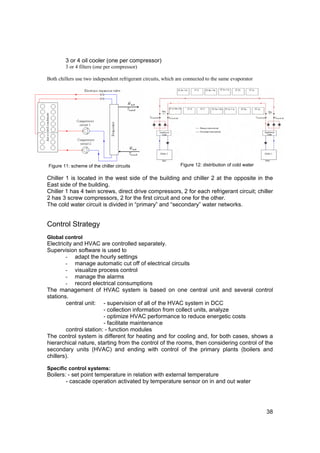
Both chillers use two independent refrigerant circuits, which are connected to the same evaporator


Figure 11: scheme of the chiller circuits                      Figure 12: distribution of cold water

Chiller 1 is located in the west side of the building and chiller 2 at the opposite in the
East side of the building.
Chiller 1 has 4 twin screws, direct drive compressors, 2 for each refrigerant circuit; chiller
2 has 3 screw compressors, 2 for the first circuit and one for the other.
The cold water circuit is divided in “primary” and “secondary” water networks.


Control Strategy
Global control
Electricity and HVAC are controlled separately.
Supervision software is used to
        - adapt the hourly settings
        - manage automatic cut off of electrical circuits
        - visualize process control
        - manage the alarms
        - record electrical consumptions
The management of HVAC system is based on one central unit and several control
stations.
        central unit: - supervision of all of the HVAC system in DCC
                        - collection information from collect units, analyze
                        - optimize HVAC performance to reduce energetic costs
                        - facilitate maintenance
        control station: - function modules
The control system is different for heating and for cooling and, for both cases, shows a
hierarchical nature, starting from the control of the rooms, then considering control of the
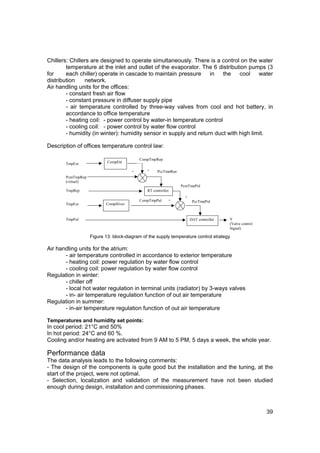
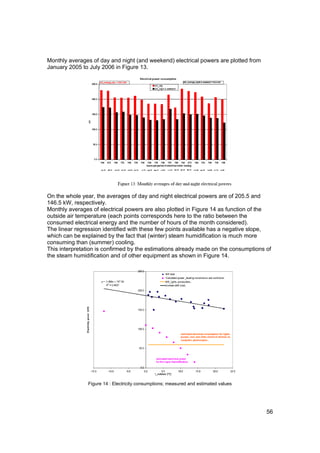
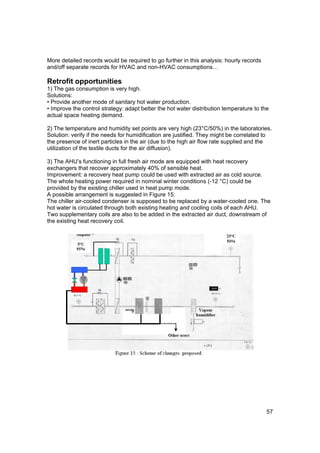
secondary units (HVAC) and ending with control of the primary plants (boilers and
chillers).

Specific control systems:
Boilers: - set point temperature in relation with external temperature
        - cascade operation activated by temperature sensor on in and out water


                                                                                                       38
Chillers: Chillers are designed to operate simultaneously. There is a control on the water
        temperature at the inlet and outlet of the evaporator. The 6 distribution pumps (3
for     each chiller) operate in cascade to maintain pressure      in   the    cool    water
distribution    network.
Air handling units for the offices:
        - constant fresh air flow
        - constant pressure in diffuser supply pipe
        - air temperature controlled by three-way valves from cool and hot battery, in
        accordance to office temperature
        - heating coil: - power control by water-in temperature control
        - cooling coil: - power control by water flow control
        - humidity (in winter): humidity sensor in supply and return duct with high limit.

Description of offices temperature control law:

                                          CompTmpRep
       TmpExt              CompEté

                                      +       +     PccTmpRep
       PcmTmpRep
       (virtuel)
                                                                PcmTmpPul
       TmpRep                                 RT controller
                                                                  +
                                          CompTmpPul      +            PccTmpPul
       TmpExt             CompHiver


       TmpPul                                                         DAT controller   Y
                                                                                       (Valve control
                                                                                       Signal)

                   Figure 13: block-diagram of the supply temperature control strategy

Air handling units for the atrium:
       - air temperature controlled in accordance to exterior temperature
       - heating coil: power regulation by water flow control
       - cooling coil: power regulation by water flow control
Regulation in winter:
       - chiller off
       - local hot water regulation in terminal units (radiator) by 3-ways valves
       - in- air temperature regulation function of out air temperature
Regulation in summer:
       - in-air temperature regulation function of out air temperature

Temperatures and humidity set points:
In cool period: 21°C and 50%
In hot period: 24°C and 60 %.
Cooling and/or heating are activated from 9 AM to 5 PM, 5 days a week, the whole year.

Performance data
The data analysis leads to the following comments:
- The design of the components is quite good but the installation and the tuning, at the
start of the project, were not optimal.
- Selection, localization and validation of the measurement have not been studied
enough during design, installation and commissioning phases.


                                                                                                        39
- The choice of the parameters and administration rules are not strict enough.
- The energy management system of this building has good performances but the
information from the sensors is not always right and the control laws not adapted.
- This BEMS is very complex so it is underemployed. It is often the case in that type of
building.
- Fans are too noisy.
- Chiller COP is reduced due to bad ventilation of the condensers.
- There is a bad tuning of the VAV boxes thermostats.
- The air distribution system is undersized.

Building Energy performance
Electricity consumption estimated:
peak of electrical power:
                 lighting                                              260 kW
                 "small" power (.distributed in all zones)                   170kW
                 "main" power (lifts, escalators, kitchen, computers,..)     680 kW
                 HVAC (chillers, fans, pumps)                          840 kW
                 Total                                                       1950 kW
Electricity consumption estimated related to use:
        lighting                3000 h/year                    780 Mwh
        "small" power                   1500h/year                     255 Mwh
        "main" power                    1000h/year                     680 Mwh
        HVAC 1 (chillers)               500h/year                      310Mwh
        HVAC 2 (fans, pumps)            1500 h/year                    330Mwh
                                        Total                          2410 Mwh
Cooling performance
The cooling performances of the building are not fulfilled. The temperature is too high
or/and the fan noise too important.

The AHUs fan electric power at nominal flow rate is given as follows:
      CAV AHUs: 55.7kW
      VAV AHUs: 122.4 kW                            Total AHUs: 178.1KW

Cooling power distribution:
       fan-coils:                    173 kW
       CAV AHUs cooling foils:       269 kW
       VAV AHUs cooling foils:       1474 kW

Total cooling power:                 1916 kW

Chillers consumption given by the manufacturer:     100% load               618 kW
                                                    75% load                423 kW
                                                    50 % load               250 kW
                                                    25 % load               130 kW
Heating performance
The heating performances, in term of comfort, for this building are good.


                                                                                       40
Ventilation performance
To maintain the right pressure upstream the fan boxes, fans must be operated at the
maximum power. So they are too noisy. A solution could be to improve the air
distribution (decrease pressure drop and air leakage).
A high upstream pressure is necessary to operate the flow air regulation system.
Another solution is to change this control system.

Construction and operating costs
Operating costs: one person employed full time to maintain HVAC system

Consumptions:           Natural gas: 10327 Gj
                        Electricity: 2431Mwh

price electricity: 250000 €/an
gas price: 87000 €/an


Summary and retrofit opportunities
Summary:
A lot of studies were carried out on this building to improve the comfort conditions,
mainly in summer.
After commissioning, most of the errors were eliminated but some problems continue to
exist.

List of retrofit opportunities:
Retrofit opportunities proposed by WP4 and applicable to this case study, ability to
realize and to simulate are as follows

                                                        easy to realize   easy to
simulate
Envelope and loads:
Solar gains reduction / daylight control improvement
 E 1.1 Tinted or reflective coated film                 XXXXX
       XXXXX
 E 1.2    Interior shading
 E 1.3                                                  XXXXX
       XXXXX
Envelope insulation improvement
 E 3.5 Insulation of the parking ceiling                XXXXX
       XXXXX
Other actions aimed to load reduction
 E 4.7
           Lighting management system
 E 4.8                                                  X                    X

Plant
Cooling equipment / free cooling


                                                                                    41
P 2.5 cooling tower
 P 2.6                                                      X                       XXXX
 P 2.13 Ice storage system                                  XX                      XXXX
 Air handling / heat recovery / air distribution
 P 3.8 Fresh air-to-exhaust air heat pump                   X                       XXX
 P 3.12 air duct sealing                                    XX                      X

Operation & Maintenance
General HVAC system
 O 2.2
 O 2.3 Reduced unoccupied ventilation                       XXXXX                   XXX
 O 2.6
 O 2.2
 O 2.3 Optimize Start/Stop                          XX                     XX
 O 2.7
 O 2.5 Control chilled water temperature                    XXXXX                   XXXX
Cooling equipment
 O 3.1 Optimize start / stop                                XX                      XX
 O 3.4 Control chilled temperature                          XXXXX                   XXXX

Fluid (air and water) handling and distribution
 O 4.1 Control chilled water temperature                    XXXXX                   XXXX
 O 4.2
            Free cooling
 O 4.7                                                      XXX                     XXXX
 O 4.9 Reduce unoccupied ventilation                        XXXXX                   XXX
 O 4.15         Air duct insulation                         XX                      XXX
 O 4.6       Air duct sealing
 O 4.11                                                     XX             X
 O 4.8
 O 4.9       Improve design and balance                     X              XX
 O 4.17 of air duct system
 O 4.10
 O 4.19      Improve design and balance                     XX             XXX
 O 4.22 of chilled water duct system

Modeling of some retrofit opportunities
A number of those retrofit opportunities were evaluated by a building simulation:

1. Heating and cooling demand (base case) with ideal control
2. Heating and cooling demand with free cooling
3. Heating and cooling supply with realistic control law
4. No thermal isolation of the air pipe distribution
5. Air leakage in the air pipe distribution
6. Modification of the offices occupancy:
7. Reflective glazing
8. Change of the supply temperature control law


                                                                                      42
7.00E+09
                                                                                             6.29E+09                                                      6.35E+09
                                                     6.24E+09          6.24E+09
            5.89E+09             5.90E+09
6.00E+09
                                                                                                                                   5.47E+09


5.00E+09


4.00E+09
                                                                                                                                                                                   Heat ing power
                                                                                                                                                                                   cooling power
3.00E+09                                                                                                     2.78E+09


2.00E+09
                                                                                                  1.44E+09
                   1.30E+09                               1.26E+09            1.24E+09
                                       1.07E+09                                                                                                                   1.07E+09
1.00E+09                                                                                                                                  7.64E+08
                                                                                                                    3.69E+08


0.00E+00
           demande, consigne   demande, consigne      BASE loi MET   Air pipe t hermal non    Air leakage    of f ices variable   Ref lect ive glazing   ot her r egulat ion law
              chaud, f roid     chaud, f roid avec                         isulat ion                          occupancy
                                  f ree-cooling


                               Figure 14: comparison of heating and cooling performances (annual demand)


   References
   Belgian "Case study" The QG-MET building (Namur), Design analysis: Synthesis report,
   October 1994, Jean Lebrun, Pierre Nusgens, Stefan Stanescu, Philippe André

   QG-MET building in Namur: simulation-based analysis of energy management strategy
   and commissioning, Philippe André, Patrick Lacote, Jean Lebrun, Andrei Ternoveanu
   avil 1999

   Première analyse du système de gestion énergétique du bâtiment QG-Met à Namur,
   Philippe André, Jean-Pascal Bourdouxhe, février 1998


   CA-MET: Energy-Efficiency. Measures List. Christophe Adam-Ulg. 4M Brussels-
   27/10/2005.

   Etude de cas CA-MET, Poursuite et finalisation des travaux Jean Lebrun, Christian
   Cuevas, Nestor Fonseca, Philippe André, Christophe Adam, Patrice Lacôte, Novembre
   2002

   Re-commissionning of a VAV air-distribution system. Philippe andré, Cleide Aparecida
   Silva, Nestor Fonseca, Jean Lebrun, Jules Hannay, Patrick Lacôte

   Commissionning-orientated building loads calculations. application to the CA-MET
   building in Namur. Christophe Adam, Philippe André, Cleide Aprarecida Silva, Jules
   Hannay, Jean Lebrun

   Gestion optimale de la climatisation d'un immeuble de bureaux; Jean Lebrun, Philippe
   André, Patrick Lacôte


                                                                                                                                                                                       43
Belgium Case Study 2
BCS2
Office Building
                                                        Cleide Aparecida Silva
                                                        Jules Hannay
                                                        Jean Lebrun
                                                        University of Liège - Belgium

                                                        Date: December 2006


                                                        The installed HVAC system is composed by 4-
                                                        pipe terminal units, AHU’s, Chiller, boiler,
                                                        cooling towers and circulation pumps.


Introduction
Brief description of the type of building in study:
                                                    2
This is a medium size office building (28 000 m ) erected in centre of Brussels at end of
the sixties. This building is constituted by open plan offices and (a few) meeting rooms.
The whole building has an air conditioned system with the exception of the car park.

Global description of HVAC system type:
Old four pipe induction units in all offices and CAV/VAV systems in other zones.
Classical heating and cooling plant, with fuel oil boilers and vapor compressions chillers
with cooling towers.
Renovation of the all HVAC system in way…

Building Description
Description of the building layout:
       “H” horizontal shape, with, a total of 13 floors:
       -5 to –1 floors for parking,
       0 for reception, mess and meeting rooms
       1 to 7 for offices.
       The first level has a mezzanine.
       Fully glazed frontages with double glazing (without thermal break) at upper floors
      and single glazing at ground floor.
Occupants: 1 100 to 1 200 (rather constant)
Costs in €: not yet known
Consumptions:
Fuel oil: 450 000 to 550 000 liters per year
Electricity: not yet known


                                                                                          44
Design Concept

General Energy Concept
Description of passive technologies present in the building:
- External windows curtains
- Curtains positions (open or closed) automatically controlled according to sunshine.
- Most of the offices are open-plan (example shown in Figure 2)
- The building works in all fresh air, with slight over-pressure.
- The air extracted from offices is supplied to the parking.
- No recirculation and no heat recovery.


                                                                                        45
Figure 2 - Office view

Building Envelope
Detailed description of the building envelope:
“Curtain walls” with all glazing, from floor to ceiling.
Physical properties of the walls, slabs and roofs layers:
Almost no insulation. Poorly insulated cavities at periphery of each floor for induction
units.
                                    2
U values of the envelope in W/m K and envelope areas:
                           2
Probably around 3 W/(m .K) for double glazing;
Envelope area still to be calculated.

Solar and Overheating Protection
Transparent glazings.
Solar factor: Probably around 0.75 with curtain open and near to zero with curtain closed.

Design Details
Terminal units
About 1 000 induction units, installed in the floors of all offices (Figure 3):
4 pipes with heating and cooling coils in “V“position and double thermostatic valves (one
for two units).
Nothing to prevent the air of passing across the coil which is not used.
Occasional condensation on cooling coils. (depends on air primary…)
Poor air diffusion: to high air speed induced near the floor and too short jet bearing in
cooling regime.
                                                                         3
One big CAV AHU unit is used to supply a total of about 100 000 m /h of primary air to
all induction units.
Other zones are supplied by a set of about 20 CAV and VAV AHU’s.


                                                                                           46
Figure 3 - Induction unit views (internal view, location an thermostatic valve)

Air handling units
The big “primary” AHU counts wit the following components:
Dampers, filters, preheating, adiabatic humidifier, cooling, post heating, and two fans in
parallel (Figure 4).
Both fans are equipped with frequency drivers (in order to protect the motors of the fans
and to reduce the instantaneous electrical peak of the system). All what is downstream
of the humidifier has been renovated recently.

All other AHU’s are also working in full fresh air, except for two, supplying the mezzanine
and first floor.


                         Figure 4 - Schematic of the primary air handling unit

Cooling plant
There are two machines mounted in series (but the circuits can be changed) with water
cooled condensers. Each condenser has its cooling tower (renovated in early nineties).
Each cooling tower (Figure 5) is equipped with a two speed axial fan.
The slide valve of the screw chiller (Figure 6) needs enough pressure to work.
The control strategy is the following, according to return water temperature:
Up to 24 °C: water spray
Up to 27 °C: an in low speed


                                                                                              47
Up to 29°C: fan in high speed.
The nominal water temperatures at condensers supplies are 32 and 34 °C.
Each chiller has its own condenser pump, but no evaporator pump (the chiller water is
circulated by the distribution pump).
The chilled water temperature regime is 6 -12 °C in nominal conditions.
The set point is supposed to move bit accruing to outside conditions.
After renovation of the induction units, it’s expected to get the possibility of rising that
temperature.
NB: the (very old) circulation pumps are still at constant speed, with bypass. They might
be, soon or later, replaced by variable speed…


           Figure 5 - The two cooling towers            Figure 6 - The screw chiller


Control Strategy
The building is equipped with a classical BEMS with two levels: a set of local control
units and a PC for supervisory management (Figure 7).
This system is relatively “open”: control strategies can be modified without the help of a
specialist.
But the data storage capacity is limited: one day to one week, according to the amount
of measuring points registered.
These records are only available as printed tables or diagrams.
The data file cannot be transferred to anther computer.

The comfort must be satisfied from 7AM to 8:30PM, five days per week.
The BEMS is imposing an earlier re-start, according to weather conditions.
In order to get comfort on a winter Monday morning, the system may have to be re-
started Sunday evening.
There are also some special requirements for the (prestigious) ground floor: the air
conditioning is required there all along the year in order to protect the (exotic wood)
decoration!
Indoor air temperatures are measured at three different locations of each floor (except
for floors 5 and 6). The average of all these temperatures is used by the BEMS in order
to fix the primary air temperature.
The set point is passing from 14 to 25°C, when the indoor temperature is moving from
25 to 21°C.
But there is degradation if the indoor environment is too cold in the morning: the air is
then supplied 25°C.
The primary air is only supplied during pre-heating and occupancy time.


                                                                                          48
Outside that time, if the weather is very cold, the induction units are still used in free
convection mode, by supplying hot water to the heating coils.


                    Figure 7 - Examples of data visualization on BEMS computer

Retrofit Opportunities
Some retrofits were already made on the plant and on the AHU’s:
An attempt of free chilling was done sometime ago, by adding a water-to-water heat
exchanger between the condenser and the evaporator circuits (in parallel to the chillers).
For reasons still to be investigated, this experience failed and the system was
dismantled.
The AHU’s were partially renovated and the replacement of all induction units and
thermostatic valves is now projected.
This is urgent because of water leakage and of a lot of problems encountered with the
thermostatic valves.
The replacement of existing induction units by more efficient devices (other induction
units or fan coils), if fitting in the small space available, should make possible to run the
system with higher chilled water temperature and therefore better COP.
The environmental control should also be made more accurate.
More indoor temperature sensors will be installed in the occupancy zone.

But much other retrofit potential should be considered:
- Variable rotation speed for pumps and fans
- Optimal control of chilled water temperature
- Energy recovery loops between supply and exhaust air circuits
- Air recirculation
- Optimal control of cooling towers
- Free chilling (again!)
- Chiller condensers heat recovery
- Use of chillers in heat pump mode (when no more used for cooling)
- Etc.


                                                                                          49
Belgium Case Study 3
BCS3
Laboratory
                                                         Cleide Aparecida Silva
                                                         Jules Hannay
                                                         Jean Lebrun
                                                         University of Liège - Belgium

                                                         Date: December 2006


                                                         HVAC system is composed by Terminal Units
                                                         such as Fan coils and a AHU that supplies
                                                         conditioned fresh air using textiles diffusers.
                                                         The AHU and the Fan coil units are fed by
                                                         water loops. The hot water is produced by a
                                                         boiler and the cold water by chillers.

Introduction
The audit of the HVAC system consists in analyzing the information available about
actual energy performances and in identifying the most attractive retrofit opportunities.

The case study presented here concerns a laboratory building erected in 2003 in the
region of Liège (latitude 50.35°N and longitude 5.34°E, altitude 240 m).

Building description
Design concept
The building is located at an open site, surrounded by a forest...
The Liège climate can be characterized by the following data:

Heating sizing temperature: - 12°
Cooling sizing temperature and relative humidity: 30 °C and 50 %
15/15 heating degree-days: 2000 K*d.

The building considered is of small size: around 4000 m² of air-conditioned floor area
and 1900 m² of technical space distributed on three levels.
It contents a set of offices, meeting rooms, dining hall and laboratories distributed on
“ground” and “second” floors. Below the “ground” floor, there is an open parking area.
The first floor corresponds to a technical space.

The building envelope is made of glazing (100% for the offices and 77% for the
laboratories) and of weatherboarding for the other walls (Figure 1).

The floor area distribution is:
27% for the offices, 32% for the technical room and 21% for the laboratories.


                                                                                              50
Occupancy and comfort requirements
At working time, there should be 120 occupants in the building.
The occupation period is 8:00 to 17:00 h., 5 days per week, all the year for the offices.
The building has 95 and 5% of daily and night occupations respectively.
The laboratories work 24h/24h, except one week per year for maintenance at the end of
year.

Ventilation strategy
The laboratories are supplied all the time with “all fresh air”.
For the offices there is some re-circulation and the system works according to the
occupation period.

By adding the contributions of all AHU’s in use inside the building, the total fresh airflow
rate can be estimated at 40 000 m³/h.
The ventilation system is equipped with heat recovery coils, interconnected by a glycol-
water circulation loop.

Heat transfer coefficients and nominal heat losses
The heat transmission coefficients of the building enveloppe are presented in Table 1.


The thermal capacity flow rate of the ventilation corresponds to 13.4 kW/K, with a heat
recovery potential of 5.7 kW/K.
This means that the net ventilation heating demand is 13.4 – 5.7 = 7.7 kW/K.
The global heating demand can be estimated by adding transmission and ventilation
terms; this gives about 13.7 kW/K.
This order of magnitude is in fair agreement with the slope (14 kW/K) of the building
heating “signature” as shown in Figure 2.
In this building, humidification is only provided by an eletrical humidifier. Therefore, latent
heating is not included in the building signature, but represented as a separate curve
(square points) in Figure 2. The building nominal power installed is equal to 600 kW.

In nominal heating conditions ( -12°C, 90% / 23°C, 50% ) and for an air flow rate of
23000 m³/h, the humidification would require a power of 147 kW.
The transmission and ventilation losses (with heat recovery taken into account) would be
of 235 and 277 kW, respectively.


                                                                                            51
HVAC system
Terminal units
Fan-coils (Figure 3) with (non-humidified) fresh air injection are used in all office and
meeting rooms; they are working from 7 to 22 h.


Fully conditioned fresh (22°C, 50%) air is supplied to the laboratories through textiles
diffusers (Figure 4).

Industrial fan-coils are used to heat the technical room (Figure 5).


                                                                                            52
Figure 5 : Heating network of the technical room

Air handling units
AHU unit are used to supply a total of about 40000 m3/h of conditioned air (23000 m³/h
humidified and 17000 m³/h non-humidified).
Each AHU counts with the following components:
Filters, heat recovery loop, cooling coil, heating coil , steam humidifier (for the two AHU
of 11500 m³/h air flow rate) and fans (Figures 6 and 7).
Fans are equiped with frequency drivers.
All these AHU’s are working with full fresh air.


         Figure 6 : Laboratory AHU
                                                     Figure 7 : AHU 4 supplying meeting and office rooms
                                                                    (through the fan-coils)


Flow rates, pressure drops and corresponding pumps powers of the different water
distribution loops are given in Table 3.


                                                                                                    53
Table 3 – Water distribution loops.

Heating and cooling plants
The hot water distribution and production subsystems are shown in Figure 8 and 9,
respectively.


Two condensing boilers of 300 kW are used for hot water production.
The chilled water is produced by an air-cooled chiller of 400 kW (Figure 10).


                                                                                    54
Control strategy
The building is equipped with a “building management system” (BEMS).
All the information recorded by the BEMS can be read on the screen, but an (expensive)
intervention of the BEMS manufacturer would be necessary in order to make the data
files available for off line analysis.
The ventilation of the laboratories is working continuously (day and night), from Sunday
22h to Friday 22h.
The fan-coils are also used during working days, but only from 7 to 22h (with a “pre-
start” on Sunday, from 17 to 22h).
A thermostat was recently added in each office.

Data analysis
Electricity and fuel consumptions
As usually, records of electricity and fuel (natural gas) consumptions are only available
on a monthly basis.
The records made on gas consumption from December 2003 to October 2006 are
plotted in Figure 11.


The records made on electricity consumptions are given in Figure 12.


                                                                                      55
Monthly averages of day and night (and weekend) electrical powers are plotted from
January 2005 to July 2006 in Figure 13.


On the whole year, the averages of day and night electrical powers are of 205.5 and
146.5 kW, respectively.
Monthly averages of electrical powers are also plotted in Figure 14 as function of the
outside air temperature (each points corresponds here to the ratio between the
consumed electrical energy and the number of hours of the month considered).
The linear regression identified with these few points available has a negative slope,
which can be explained by the fact that (winter) steam humidification is much more
consuming than (summer) cooling.
This interpretation is confirmed by the estimations already made on the consumptions of
the steam humidification and of other equipment as shown in Figure 14.


               Figure 14 : Electricity consumptions; measured and estimated values


                                                                                     56
More detailed records would be required to go further in this analysis: hourly records
and/off separate records for HVAC and non-HVAC consumptions…

Retrofit opportunities
1) The gas consumption is very high.
Solutions:
• Provide another mode of sanitary hot water production.
• Improve the control strategy: adapt better the hot water distribution temperature to the
actual space heating demand.

2) The temperature and humidity set points are very high (23°C/50%) in the laboratories.
Solution: verify if the needs for humidification are justified. They might be correlated to
the presence of inert particles in the air (due to the high air flow rate supplied and the
utilization of the textile ducts for the air diffusion).

3) The AHU’s functioning in full fresh air mode are equipped with heat recovery
exchangers that recover approximately 40% of sensible heat.
Improvement: a recovery heat pump could be used with extracted air as cold source.
The whole heating power required in nominal winter conditions (-12 °C) could be
provided by the existing chiller used in heat pump mode.
A possible arrangement is suggested in Figure 15:
The chiller air-cooled condenser is supposed to be replaced by a water-cooled one. The
hot water is circulated through both existing heating and cooling coils of each AHU.
Two supplementary coils are also to be added in the extracted air duct, downstream of
the existing heat recovery coil.


                                                                                         57
French Case Study 1
FCS1
Office Building
                                                      J. Adnot, D.Bory, M.Dupont
                                                      D.Marchio, Ph. Rivière
                                                      Armines – Ecole des Mines de Paris

                                                      Date: December 2006


                                                      The system installed was composed by
                                                      centrifugal compressors groups functioning in
                                                      stages. This system was oversized and used
                                                      forbidden refrigerant according with the actual
                                                      regulations.


Introduction
The Lexmark group manufacture and commercialize toners and it is located in Orleans.
This group has 570 employers.
Once the electricity invoice was excessive, the company made an energetic audit and
concluded that the air-conditioning system was inadequately managed (supplied power
exceeds the demand). The cold produced is used for air-conditioning system in different
spaces.

Building Description
Project Data
Location: Orleans, France
Number of working spaces: 570
Costs in €: 274k€ (1.80MF)

Design Details
Until 1996, the cold production was ensured by three centrifugal groups, functioning in
large power stages. This situation generated unnecessary costs (variable cold
production, supplied power exceeds the demand, contract problems - EDF).
Moreover, the refrigerating fluids (R11 and R12) used in the centrifugal compressor
groups did not fulfill the regulation on the CFC’s emissions. To reduce the wasted
energy and to be in compliance with the requirements of security and environmental
protection, the company decided to replace the cold groups installed.

Building Energy Performance
   -   Annual electricity consumption: 13 GWh;
   -   Annual gas consumption: 5 GWh;
   -   Consumption before audit: 1 220 MWh/year (271 tep/ year) of electricity to the
       cold groups.


                                                                                           58
Proposed Solution
In 1996, they invested in two modulated cold production machines that are adjusted, if
necessary, in modulated power stages, and have a nominal capacity that corresponds to
the total demand. One of the machines has five power stages and the other is equipped
with eight.


Construction and Operating Costs
   -   Assembling investment: 247 k€ (1.80 MF);
   -   Payback: 6 years;
   -   Profit: 15k€/year (100 kF/year) related to the decrease of the maintenance costs;
   -   Non-financial profit: advantages relative to the EDF contract or any other
       supplier;
   -   Financial profit related to energy saving: 30k€/year (200 kF/year).

Energy Savings
       Consumption after audit: 540 MWh/year (120 tep/year) of electricity to supply the
       cold groups;
       Direct profit: 680 MWh/year (151 tep/year) which corresponds to 56 % of energy
       saving
Environment: the refrigerating fluids used are less harmful.


                                                                                      59
French Case Studied 2
FCS2
Office Building
                                                         J. Adnot, D.Bory, M.Dupont
                                                         D.Marchio, Ph. Rivière
                                                         Armines – Ecole des Mines de Paris

                                                         Date: December 2006


                                                         Five conference rooms are climatized by an
                                                         AHU and a group of cold water production.
                                                         About thirty offices have AC based on 2-pipe
                                                         fancoils and natural ventilation. The cold water
                                                         that feeds the loop of the AHU and the fancoil
                                                         is produced in a non-reversible alternative
                                                         Chiller.


Overview
This audit was preformed to an office building located in the Paris suburbs.

Building Description
General
The building was built in 1973 and his envelope is maid of curtain-facades with external
metal framework. The principal facades are oriented to southwest (SW) and the North-
East (NE). The glazing is double, sliding and provided with interior blinds. The glazing
from the SW façade has also external blinds.
The building has one floor and a basement. Its overall clear surface (OCS) is 1140 m ². It
is possible to divide the building into three types of spaces: circulation zones, conference
offices and rooms. The first located in the basement are not air-conditioned.

Occupation & Scheduling
The normal occupation of the building includes 42 people. These occupants are present
roughly from 8 a.m. to 6 p.m. five days a week. The conference rooms by definition are
occupied punctually, in different and random activities during the week.

HVAC System Design
The five conference rooms have AC system with an air-handling unit (AHU) that is
supplied by chiller. About thirty offices have AC based on fancoils and natural ventilation
system.

Chiller description
This non-reversible refrigerating unit, reference CIAT RZ800-2, was installed on the roof
in 1993. Its nominal refrigerating power is 197 kW, it operates with R22 as refrigerant
and the condenser is air cooled (8 fans of 250 W).


                                                                                              60
The refrigerating unit consists of two independent circuits coupled with the same
evaporator. Each circuit has a piston compressor with six cylinders. It has four
refrigerating power stages (33%, 50%, 83% and 100%). It operates 24 h/24 and
7days/7, it has no kind of device in order to automatically stop its operation.

Hydraulic network description
The distribution fluid is a glycol-water solution. The network only requires one pump
(doubled for safety). The cooling power transferred to the air by the batteries is attuned
by adjusting the water flow thanks to 3-ways valves. The regulation of the water
temperature in the network, 7 °C/12 °C, is carried out on the return temperature.

AHU and network distribution
The AHU, CIAT Climat 75, which supplies the five conference rooms, goes back to
1993. Including a mixing box and supplying a constant air volume, a fan (nominal electric
power of 2.5 kW) supplies treated air while a second fan (nominal electric power of 1.5
kW) deals with the extraction of the exhaust air. Part of the exhaust air is mixed with the
new air in order to limit the amount of heating. The amount of new fresh airflow is
adjustable by a dumper on the external airflow.
Besides the treatments, the mix of new and exhaust air is filtered before being supplied
again into the conference rooms. The filters used in two successive lines are VOKES
AIR Interpleat 40. The pre-filter is provided with a differential pressure gauge to control
pressure losses and its fouling level. The supply temperature is controlled thanks to a 3-
ways valve adapting the cold water flow circulating in the coil. An electric coil provides
heat to the air in winter. The supply grills are located on the ceiling and the extraction
grilles on the floor (technical floor). It misses in this case a recovery filter in order to
avoid the clogging of the extractor fan.
The “free-cooling” is activated when the outside temperature (lower than the interior
temperature) makes it possible to satisfy the needs without turning on the refrigerating
unit.
The AHU only operates during the week from 4 a.m. to 8 p.m., approximately 4160
h/year.

Fan-coils Description
The 34 (two pipes and two coils) CIAT Major fan coils supply to the offices heating
during the winter and cooling during the summer. Each air-conditioned office has an
automatic thermostat. A dead band of 2 °C between the temperature setpoints of
summer and winter avoid the simultaneous cold and heat supply. The contactors allow
the fancoils to stop whenever a window is open.
The setpoint of summer comfort default value is fixed at 25 °C. At night, the setpoint of
summer comfort is increased at 30 °C. The fan of the fancoils keeps operating day and
night, at low speed.
One fancoil is installed in an informatics room. The thermal loads, even reduced, are
kept at night forcing the fan coils to supply cold and keeping on the chiller. It would be
preferable to dissociate this supply from the offices, controlling them independently.

Building Energy Performance
Cold water production group
The cooling power installed - 178W/m² (OCS) - is largely higher than the current
practices which is approximately 100W/m² and of 125 W/m² (OCS) for offices buildings
and for this type of installation.


                                                                                         61
According to statistics drawn by Eurovent in 1998, the nominal EER of the chiller ought
to be between 2.12 and 2.85. By closely analysing these statistics mainly the
compressor type, it seems that the nominal EER ranges between 2.16 and 2.74 which in
the current energy class varies from F to D.
No energy counter is provided, we estimated an electric consumption from 40 to 70
kWh/m².yr. This ratio leads to an annual air-conditioning demand ranging between 45
and 80 MWh/yr. The refrigerating unit represents an electric consumption between 40
and 60% of the electric consumption, about 18 to 48 MWh/yr (720 to 1920 kgCO2/year),
the rest is consumed by the fancoils, the distribution pumps and by the AHU.

Cold water distribution pumps
The pump flow should normally be near 37m3/h, value obtained according to the total
“best efficiency point” (BEP) of the pump which accounts approximately for 80% of its
maximum flow.

AHU (Air Handling Unit)
The batteries of the supply and return fans indicate nominal power of 3 kW and 1.5 kW
respectively. Taking into account their operation 4160 h/yr, we can conclude that their
yearly consumptions rise in approximately 18.7 MWh/yr (748 kgCO2/yr).

Fancoils
According to the cold needs for the offices, the fancoils power should logically lie
between 30 W and 80 W respectively. The 34 fancoils operation 8760 h/yr is then
responsible for a minimum of 8.9 MWh/yr (356 kgCO2/yr) and a maximum of 23.8
MWh/yr (952 kgCO2/yr).

Improvement scenarios
Two improvement scenarios are possible:
   1. The first obvious scenario consists in keeping air-conditioning in summer and the
      heating with Joule effect in winter.
   2. The second scenario would be to replace the refrigerating unit by a reversible
      heat pump (HP) of which the average seasonal COP could reasonably be
      estimated at 2,5.

Loads and building opportunities- possible Improvements on the
building
The building is in general well adapted to AC, particular regarding the solar protections.
The office equipment, which releases too much heat (printers, photocopier) are located
in specific rooms, non-occupied and non-acclimatized.
The thermal intern loads can be reduced. In fact, almost all the computers are equipped
with cathode-ray tube screens. If opportunity arise, it would be interesting to replace
them by more effective flat-faced screens. These screens can consume/release up to
50% less energy/heat than the cathode-ray tube screens. By equipping the 42
occupants in the building with flat-faced screens (30 W instead of 60 W), the direct
savings in electricity are approximately 3.3 MWh/yr (130 kgCO2/yr) over a one-year
standard.
These measures generate also indirect energy saving in AC, related to the reduction of
the thermal loads. Over approximately six months, the thermal loads are reduced 1.64
MWh/yr. By considering that the chiller compensates for these loads with a seasonal


                                                                                       62
EER of 2.5, this improvement represents approximately 0.66 MWh/yr (26 kgCO2/year)
whatever the selected scenario.
This investment generates in the other hand a surplus of heating. By considering the six
heating months, the thermal loads are also reduced 1.64 MWh/yr. In 1st scenario, these
loads are treated by Joule effect and directly represent a surplus of electric consumption
of 1.64 MWh/year (66 kgCO2/year). This scenario generates overall indirect losses of
approximately 1 MWh/year (40 kgCO2/year). In 2nd scenario, these loads are treated by
a reversible heat pump whose average seasonal COP is 2.5. The surplus of heating
consumption finally cancels the indirect profits generated by AC.

HVAC Performance- Opportunities on the GPEG, AHU and pumps
The weakness lies mainly in the management of the operation periods. The refrigerating
unit maintains the setpoint temperature during 24 h/24 and 7 days/7 all year. With few
expenses, a substantial energy saving is possible by programming operating ranges:
     - In 1st scenario, it is possible to establish a time schedule from 6 a.m. to 6 p.m. in
        week and all the weekends are possible. Moreover, as it is surely little
        requested from November at March, it is advised to completely shut down the
        cooling system for this period in order to avoid possible cycling.
     - In the scenario the 2, even if the setpoints can be reduced the night and the
        weekend, the heat pump will have to operate for these periods to maintain a
        temperature acceptable in the building in winter. The heating corresponds
        indeed more to a "need" that with a "comfort" like air-conditioning. The schedule
        can however be maintained in period of air-conditioning.

The annual dates of stop and starting could be adjusted progressively empirically. The
potential of energy saving of these new schedules should be quantified more precisely at
the time of a more detailed audit.

Another defect is an oversizing factor of approximately 80 % that led the refrigerating
unit to run most of the time with partial load and thus with reduced effectiveness. The
energy losses thus generated represent at least of 10 % of consumption of a
refrigerating unit of identical output which would be correctly sized. The annual potential
energy savings due to resizing the chiller (with identical EER) range between 1,8 to 4,8
MWh/year (72 to 192 kgCO2/year). At the time of the renovation, it is strongly advised to
carry out a detailed assessment of the thermal loads of the building to optimize the
system size. Then one would also rather a system of higher energy class (B even A
following the Eurovent classes).

The setpoint temperatures of the chilled water can be increased, best implementing an
outdoor temperature dependent law, for example a temperature of return to 12 °C in
summer and 14 °C in intermediate season. The potential of energy saving on the
refrigerating unit is considered at 3 %/°C gained with the increased evaporator outlet
temperature. This new regulation law would generate over the air-conditioning season a
range of 1,1 to 2,9 MWh/year (43 to 115 kgCO2/year) of energy saving.

Possible improvements on the distribution pumps
Energy saving are also possible by reducing the operating time of the pump to the
occupation periods:
    - In scenario 1, to program the pump in week of 6 h with 6 p.m. and April at
        October only as the refrigerating unit would reduce its annual operating time to


                                                                                         63
1800 h/year and would bring approximately 24,4 MWh/year (975 kgCO2/year)
         of energy saving.
     - In scenario 2, the pump must be maintained under operation from November to
         March to heat the building, that means 3700 h/year more. These 5500 h/year of
         operation would make it possible to obtain approximately 11,4 MWh/year (455
         kgCO2/year) of energy saving.
The pump, while operating less long, would then require less maintenance and its
longevity would be also increased.

Possible improvements on the air handling unit
We distinguish between two operating modes following the period from the year: air-
conditioning/ventilation from May to October and heating from November to April. In the
first mode, the AHU only operates in week from 8 a.m. to 6 p.m., globally 1300 h/year. In
the second scenario, we will consider that it is necessary to anticipate one hour the
heating to restore comfort before the arrival of the occupants, that is to say 1430 h/year
of operation. The annual total operating time is established then with 2730 h/year and
saving energy amounts to 6,4 MWh/year (257 kgCO2/year).
The new exhaust air and air ducts being coupled, it is possible and feasible to install an
economizer with heat and cooling recovery from the extracted air. In winter, the potential
is large and could be quantified more precisely in more detailed audit.

Possible improvements on the fancoils
Large energy saving are possible by reducing the periods of operation of the fancoils.
They will have nevertheless to be maintained under operation in winter to maintain the
temperature of the building. To fix lower setpoints during the night and the weekend is
however possible. It is possible to limit their operation of 8 a.m. to 6 p.m. in week from
April at October, the thermal loads evacuating itself naturally during inoccupation
periods. This schedule reduces the operation time of the fancoils to 5200 h/year and
avoided consumption ranges between 3,6 and 9,7 MWh/year (145 to 387 kgCO2/year).

O&M opportunities
The oversized air conditioning unit operated in short cycles even in full summer. This
pour operation seems to be the direct result of the oversizing of the refrigerating unit.
However, one should not dismiss the assumption of a lack of refrigerant. Indeed, the
second circuit, when off, seemed undercharged according to the aberrant pressures
recorded measured with the pressure gauges at low and high pressures. This state lets
think that the contractual maintenance checks are not always carried out. From a
general point of view, the refrigerating unit is in bad condition. Its plates of protection
were removed, leaving the bodies exposed to the bad weather. The condenser fouling
level is high.

Pump distribution of the chilled water
On the roof, the heat insulation of the hydraulic network is in bad condition at many
places. In the building, no stain shows to the existence of leakages. The pump operates
correctly and without particular noise.

Air handling unit
Except the display of the differential pressure of the primary filter and the exit and inlet
temperatures of water in the coil, no other measurement device is installed on the
equipment. Maintenance must thus be limited to the statement of the electric outputs


                                                                                         64
absorbed by the fans, to the cleaning or the change of the filters as soon as the pressure
losses reach a certain threshold and the control of the parameters of operation. Its
effective application is unknown for us but the air-handling unit is in a good state of
maintenance. The fouling level of the filters is normal and the fans are in good
conditions, their respective belts are not damaged and no abnormal noise was detected.
The environment of the unit allows to intervene without problems and is kept clean.

Fancoils
The temperatures of supplied air, obtained by requesting maximum power to the fancoil
setting a severe setpoint temperature, are in agreement with the current values and the
operation mode (7/12 °C) of the water loop. In addition, they are relatively homogeneous
and thus do not allow to diagnose a hydraulic problem of balancing. Indeed, a huge lack
of chilled water flow in a branch of the distribution would not respect of the comfort
setpoint of in the concerned zone.
The state of the fancoils gives confirmation of their age. They all are however in
operating condition. Their consumption could be reduced by a regular calibration of the
thermostats. If the procedure is too expensive, it is also possible to compensate
consequently the specific setpoints where we observed difference.

Evaluation of the efficiency of the pump
Our measurements lead to a total efficiency of the pump of 49 %: we observed that the
output is rather weak in comparison with those of the products of the market. It is indeed
possible to reach a total efficiency of 67 % by choosing a more efficient pump.

Appraisal of the AHU: evaluation of the specific efficiency of ventilation
The specific effectiveness of Rv 4 ventilation is here 1,02 Wh/m3, the value is quite
higher than the Switzerland recommendations, American and English on the matter.
However, improvements can be made by replacing the fan groups by more effective
ones.

Summary conclusions


                Ps u o + P e x tra c
4
    R   v   =
                       Qv
                                                                                         3
Psup (W) et Pextrac (W) electric powers of supply air fan and extract air fan and Qv (m /h) total air flow in the
circuit.


                                                                                                                    65
Italy Case Study 1
ICSI
Cultural Department
                                                         Dipartimento di Energetica del Politecnico
                                                         di Torino - Italy


                                                         Date: December 2006


                                                         The HVAC system installed is composed by
                                                         embedded floor radiant panels and AHU’s.


Introduction
The Public building, object of this study is the headquarters of the cultural department of
the City of Turin; it is situated in Via San Francesco. It is composed of 5 floors, which
have been converted into offices. Originally it had a central heating system with
traditional radiators, after restructuring in 1996, a more articulated system of HVAC was
installed. The present document intends to analyze and to appraise the operation of the
system highlighting possible interventions to improve the efficiency and to reduce the
energy requirement.
The actual HVAC system is constituted by: primary air plant, embedded floor radiant
panels fed with warm water in winter and cold in the summer.
The actual system doesn't often succeed in supporting the summer load and therefore it
doesn't achieve the comfort temperature and humidity values required.


Building Description
The building of the culture department is situated in the historic centre of Turin has five
floors, building houses administration offices of the City Council and a library. The old
building was renovated in 1996 when a new HVAC was installed, but over the years this
system has been seen to be inefficient and not adequate for the building’s needs.


                                                                                           66
Figure 2 - Plant (floor 2) of Public Building

The main goal of this audit is to identify, using a simulation software package, a HVAC
system which can supply the comfort requirements and, at the same time reduce energy
consumption.
Furthermore, it will be necessary to highlight all the suggestions regarding plant design
that could be useful for the development of Audit methods.


Design Details

The HVAC system is formed by embedded
floor radiant panels that cool the environment,
without relative humidity control. The humidity
is controlled by different AHU’s in the building,
housed in the ceilings. In winter this system
works well, in fact the air is heated and
humidified by the AHU and the embedded
floor radiant panels function correctly. In
summer, however, the temperature of the
water circulating in the panels cannot go under
18°C or there are problems of condensation
and mildew and the single primary air plant
cannot maintain the correct environmental
conditions.
The whole system is set up to be able to use a
BMS (Building Management Systems) but at
present the BMS only supplies information
regarding the temperature in each office.                   Figure 3 - Embedded floor radiant panels,
                                                                   typical layout in each office
It is impossible to calculate the electricity
consumption as there are no meters from
which the data can be downloaded.


Control Strategy
The HVAC system works continuously when the indoor air set-point temperature is 26ºC
in summer and the relative humidity is 50%. In each room there is a control unit for the
temperature.

Performance Data


                                                                                                        67
Energy demand
Using a dynamic simulation software package, it was possible to obtain the consumption
of a mixed air/water HVAC where the embedded floor radiant panels are substituted by
fan coils maintaining the AHU.

The following figure show the data result from software package simulation :


                               Figure 4 – simulation consumption

                              1 BTU = 2, 93 x10-4 kWh = 1,055 kJ

Ventilation and air distribution
The distribution of air produced by the various AHU, located on each floor of building,
passes through rectangular or circular channels with run in the corridors. Diffusion in
each single office passes through rectangular grilles located in the office, the passage of
air is guaranteed by the grilles in the doors into the corridors where it is recovered by the
system.
In summer, the distribution of air in areas distant from the AHU’s is not enough to
guarantee maintenance of optimal temperature and air control conditions, in fact the
people that work inside these offices experience some problems.


Proposed Solutions
   a) Change the embedded floor radiant panels to fan-coils. The new HVAC system
       can still be defined as air/water system but, it will be composed of AHU’s for
       ventilation, and cold – hot water distribution for the fan-coils.

   b) Use a suitable BMS, the system is already predisposed with a specific control
       console and suitable software.

   c) Strengthen the fan of the various AHU’s because the existing fans are insufficient
       to force air to the offices distant from the AHU


                                                                                          68
d) Intensify the maintenance of the fittings that is currently performed by an external
       firm and the inspection of the components by the administration.


   e) Use electricity meters to download electric consumption on an hourly and daily
       basis, in order to collect further information for an effective audit of the building.
       For instance, the cooling system, lighting, central heating and pumps.

   f) Change the burner that is currently installed (heating oil) to a methane model and
       connect the system to the gas distribution network.

Energy Analysis


       Figure 5 - Total annual gas consumption

       1 BTU = 2, 93 x10-4 kWh = 1,055 kJ

As show above in Figure 5, with new HAVC system will be possible to save about
400.000 BTU

Final Analysis
The proposed solution present certain advantages compared with the existing system:

   - Maintain the correct environmental conditions of temperature and humidity
   - The system will take further electric consumption information for use in future
      audit
   - New HVAC system will allow to obtain a energy saving
   - BMS will allow a more efficient maintenance.


                                                                                          69
Italy Case Study 2
ICS2
Hospital
                                                             Marco Masoero, Chiara Silvi, Salvatore
                                                             Balducci
                                                             Politecnico di Totino - Italy


                                                             Date: December 2006


                                                             The HVAC system installed is composed by
                                                             embedded floor radiant panels and AHU’s.


General Description of Case Study
This case study is aimed at optimizing the operation of the refrigerating equipment
present in the S. Andrea Hospital of Vercelli, a general hospital with 300 beds, serving a
178,000 inhabitants province in the eastern part of Piemonte (NW Italy), halfway
between Milano and Torino. The hospital was built in the early 1960’s and, originally,
was not equipped with a comprehensive centralised AC system. Distributed AC systems
(including, chiller, AHU and air / water networks) have subsequently been installed in
selected areas.

The study was carried out in cooperation with the ESCO which manages the AC system,
in conjunction with planned renovation work foreseeing the installation of new chillers
and the construction of a chilled water loop connecting the existing refrigeration units.
Potential energy and cost savings for various options were examined, including:
replacement of existing chillers, different strategies of chiller operation, free cooling, and
recovery of condensation heat for SHW production.

Building Description
 General Building Data:

   Location                           Vercelli
   Altitude above sea level           130 m
   Configuration                      Concrete framed with masonry walls.
                                      Several separated buildings hosting the
   Layout
                                      various hospital departments.
   Number of floors                   Variable
   Floor area (Gross)                 --


                                                                                              70
Floor area (Treated)                   --
          Year of construction:                  1961
          Refurbishment HVAC                     Variable (depends on department)
          Refurbishment Lighting                 Variable (depends on department)
                                                 2002-2004 Central boiler room and main
          Refurbishment Other
                                                 electrical supply
          Space Activity                         General hospital (300 beds)
          Occupiers Business Type                National Health Care Service
          Type of tenancy                        Owner occupied
          Tenancy Since                          1961
          Heating System                         Gas fired wet radiators
          Ventilation System                     Mechanical Ventilation
          Cooling System                         Passive Chilled Ceilings
          Types of fuel used: Heating            Gas
          Cooling                                Electricity
          DHW                                    Gas
          HDD                                    2571 (conventional value)


       Design concept and details
       In the initial configuration, fifteen refrigeration units (identified as ECn = Existing Chiller
       n) were present in the hospital. The planned renovation work includes the installation of
       two new, identical refrigeration units (identified as NCn = New Chiller n), and the
       construction of a chilled water loop. The refrigerating power output of each of the new
       units (963 kW) is about equal to the sum of the outputs of existing chillers EC1, EC2 and
       EC3 (955 kW).

Unit                                    Compressor         Refrigerating     Water        Pump             Nominal
           Manufacturer and model
no.                                     electric power     power             flow rate    Electric power   COP
                                        kW                 kW                m3/h         kW
EC1        Clivet VDAT-2/2.166          183                355               63           3.5              1.94

EC2        Clivet VDAT-2/2.166          183                355               63           3.5              1.94

EC3        RC Unico LNO 260.S2.G8       83                 245               45           3                2.95
           Climaveneta BE/SRAD/LN
EC4                                     315                884               150          7,5              2,81
           2402
EC5        ----                         125                250               45           3                2.00
EC6        Airwell AIR CV A 18P         21                 50                10           1.1              2.38
EC7        York Y CAC 45                15.5               35                7            0.75             2.26
EC8        Robur ACF 60                 7                  17.2              3            0.5              2.46
EC9        Robur ACF 60                 7                  17.2              3            0.5              2.46
EC10       MTA TA.E.251                 25                 60                12           1.5              2.40
EC11       ----                         125                250               42           3                2.00
EC12       Emicom RAE 361OU             9.8                35                6            0.75             3.57
EC13       MTA C6057 CA                 23                 55                10           1.1              2.39
EC14       ----                         125                250               42           3                2.00
EC15       Breda                        40                 80                15           1.5              2.00
EC16       ----                         120                295               52           3.5              2.46
NC1        CLIVET WSAT-23450            396                963               170          10               2,43
NC2        CLIVET WSAT-23450            396                963               170          10               2,43


                                                                                                           71
The position of the existing chillers EC1, EC2 and EC3, of the new chillers NC1 and
NC2, and of the chilled water loop is shown in the following figure.


Control Strategy
General
The existing and new chillers adopt different control strategies: two regulation steps for
the existing chillers, and nine regulation steps for new chillers.


Performance Data
The following chiller COP data were used in the energy analysis:

             Regulation steps                                            Regulation steps
    EC1                         NC1
              1         2                   1         2        3        4       5        6          7        8           9
    COP      2.70      1.94     COP       2.55      2.43     3.11     2.85   2.68      2.55       2.50     2.46        2.43


Cooling Performance
General
Lacking experimental data on cooling performance, the analysis was performed by
simulation only, using the following approach.

Weather data: hourly data (temperature and relative humidity) for the average day of the
warmest months (April – September) measured at Milano-Linate airport, were used.

Cooling load vs climate: the Humidex index, H, was used as the single-value climate
descriptor5; hourly values of H were calculated for the six months. It was assumed that
cooling demand is a linear function of H, the peak cooling demand (equal to the chillers
rated output) occurring for the maximum hourly value of H (H = 32.2°C at 16 hrs in
August), and cooling demand becoming zero for H = 15°C. The cooling load fraction for
each hour of the six months were then determined.

Chiller performance: hourly COP values were calculated as a function of load fraction,
using the performance data of section 5.


5
    Masterton J.M., Richardson F.A. (1979) Humidex, a method of quantifying human discomfort due to excessive heat
    and humidity, CLI 1-79. Environment Canada, Atmospheric Environment Service, Donsview, Ontario.


                                                                                                                  72
The following retrofit / system management options were analysed

   1. Replacing chillers EC1, EC2, EC3 with new chiller NC1
   2. Using both NC1 and NC2 at partial load
   3. Increasing the air-conditioned area
   4. Modifying the outdoor temperature at which chillers are shut off and free cooling
      is performed
   5. Recovering condensation heat for SHW

Detailed
Replacing chillers EC1, EC2, EC3 with new chiller NC1
New chiller NC1 has a rated refrigeration power output which is virtually equal to the
total power output of EC1 + EC2 + EC3. The analysis assessed the expected savings
yielded by the replacement of the existing chillers with the new one. Expected seasonal
electricity consumption reduction are on the order of 15730 kWh, yielding savings on the
order of 1420 €/yr (i.e., 4% of present costs).


Using both NC1 and NC2 at partial load
As an alternative option, both NC1 and NC2 operating at partial load could replace the
existing chillers. This strategy should achieve a higher overall chiller efficiency, while
increasing the pumping energy (two pumps instead of one). Compared to the above
option (NC1 only), further savings on the order of 1460 €/yr could be achieved

                                                     EC1+EC2+EC3     NC1    NC2+NC3
           Chiller electrical consumption (kWh/yr)        391830   376100    339200
           Pumps electrical consumption (kWh/yr)           21000    21000     41400
           Total electrical consumption (kWh/yr)          412830   397100    380600
           Total electricity costs (€/yr)                  33250    31830     30370

Increasing the air-conditioned area
As a future option, the substitution of other existing groups with NC2 has been
evaluated. Calculation was based on a peak load of 355 kW and an average COP for
the replaced chillers. Expected seasonal savings are on the order of 1790 €/yr (i.e., 4%
of present costs).


                                                                                       73
Modifying the outdoor temperature at which chillers are shut off and free cooling is
performed
Savings associated to a one degree variation in the limit temperature at which the
chillers are shut off and free cooling is adopted (23°C vs 22°C) are approximately equal
to 50000 kWh/yr (with negligible differences between existing and new chillers), i.e. on
the order of 12%.

Recovering condenser heat for SHW
As a base option, the new chillers are not equipped with condenser heat recovery
system. The benefits associated with a partial recovery of condenser heat6 have been
evaluated. By analysing the chiller’s thermodynamic cycle, the recovered heat was
evaluated; it was further assumed that heat recovery is limited to the warmest period (six
hours per day in July and August). Cost analysis is based on Net Present Value (NPV)
calculation.

         SHW production with condenser heat recovery
         Recovered condensation power                                            191,25 kW
         SHW temperature range (mains – delivery)                               15 – 40 °C
        SHW demand per person                                                       140 L/person-day
        Daily SHW energy demand per person                                         4.07 kWh/person-day
        Daily recovered heat of condensation                                     1147.5 kWh/day
        SHW volume produced with recovery                                        39474 L/day
        Number of people served                                                     282
        SHW production with natural gas boiler
        Boiler efficiency                                                           0.85
                                                                                             3
        Daily natural gas consumption                                             140.7 m /day
        Daily cost                                                                58,22 €
        Costs analysis
        Seasonal savings (July and August)                                         3610 €
        Extra cost of the chiller                                                  4500 €
        Cost of the storage tanks                                                10500 €
        Payback time                                                                 5.2 yrs


6
    The chiller’s condenser is subdivided into two sections: the water-cooled high-temperature section transfers the heat
    corresponding to the de-superheating phase of the process to the water, while the low-temperature air-cooled section
    rejects the heat of condensation to outdoor air.


                                                                                                                     74
Summary conclusions and suggested ECOs
This case study illustrates a situation which is very common in the hospital sector in
Italy, and that can be summarized as:

   •   The building structures are relatively old, dating from the pre-energy crisis period
       (1960s).
   •   Originally, the hospital was not equipped with a comprehensive centralised
       HVAC system.
   •   In different successive phases, local AC systems (typically including chiller, AHU,
       air/water distribution networks) have been added to selected parts of the
       complex.
   •   Margins for energy efficiency are very limited, due to the “rigid” structure of the
       decentralised AC system.
   •   System maintenance is cumbersome: several refrigeration units of different size,
       manufacturer, and year of construction area present.
   •   Actual data on electricity consumption of chillers, pumps and fans are lacking,
       since overall electrical consumption only is measured for billing purposes.

The ESCO managing the AC system is now involved in a renovation plan, aimed at
rationalising the chilled water production. The study has identified the following different
ECOs that may lead to significant energy savings, with acceptable recovery times for the
investment:
    • Construction of a chilled water loop to which all the chillers in the hospital
        complex are connected.
    • Replacement of three of the existing chillers (EC1, EC2 and EC3) with the new
        chiller NC1, whose rated refrigeration power, is equivalent to the total power of
        the three older units.
    • As an alternative to the previous ECO, use of both new chillers NC1 and NC2 at
        partial load as substitute of EC1, EC2 and EC3.
    • Modification of the outdoor temperature at which chillers are shut off and free
        cooling is performed.
    • Recovery of condensation heat from the new chillers NC1 and NC2 for Service
        Hot Water production.


                                                                                         75
Italy Case Study 3
ICS3
Surgery / Nursing Department

                                                           Marco Masoero, Chiara Silvi, Fabrizio
                                                           Cagliero
                                                           Politecnico di Totino - Italy


                                                           Date: December 2006


                                                           100% external air AHU. This unit has
                                                           humidifier, fans, HEPA filters, cooling coil and
                                                           heating coil.


General Description of Case Study
This case study illustrates the energy auditing of the AC system serving a three-storey
building within the hospital of Oderzo, a town situated in the north-eastern Italian
province of Treviso, 60 km NE of Venice. The study was carried out in cooperation with
the ESCO responsible of managing the energy systems of the hospital.

The building and AC system under investigation is currently undergoing a complete
renovation. So far, the first floor hosting the Surgery and Nursing department has been
completed (building refurbishment and a totally new AC system) and is now into its
second year of utilisation; work on the basement and second floor are still ongoing.

The energy analysis has been focused on optimising the operation of the Air Handling
Unit (AHU) of the Surgery department. To do so, the main operational parameters of the
AHU were monitored in the April-October 2006 period; recorded data were acquired with
ad-hoc instrumentation, installed by the ESCO for the purpose of this energy diagnosis.

Building Description
 General Building Data:

  Location                   Oderzo (Treviso)
  Altitude above sea level   13 m
  Configuration              Concrete framed
                             Basement: Service areas (to be completed)
                             First floor: Surgery and Nursing (completed)
  Layout
                             Second floor: Cafeteria, Chapel, Office space (to be completed). HVAC
                             eqpt room (4 AHU’s – 2 already installed), electrical eqpt


                                                                                                76
Number of floors               Three
  Floor area (Treated)           350 sq. m. (first floor)
  Year of construction:          Unknown
  Refurbishment HVAC             2004
  Refurbishment Lighting         2004
                                 Surgery: operating rooms (2), recovery room, sterilizer eqpt., service
                                 areas, corridor.
  Space Activity (first floor)
                                 Nursing: labour (4), delivery, recovery, newborn nursery, service areas,
                                 corridor.
  Occupiers Business Type        National Health Care Service
  Type of tenancy                Owner occupied
  Heating System                 Radiators (in service areas)
  HVAC System                    All air with HEPA filters (first floor)
  Cooling System                 Air-cooled, vapour-compression water chiller
  Types of fuel used: Heating    Gas
  Cooling                        Electrical
  DHW                            Gas
  HDD                            2358 (conventional value)


HVAC System Design
General Information:
The AC system of the building is all-air (100% external), as prescribed by Italian
regulations for hospitals. When the renovation work will be complete, four AHU’s will be
installed at the second floor: the two already existing AHU’s serve the Surgery and
Nursing areas, while the two future AHU’s will respectively serve the basement and the
second floor. Terminal units with HEPA filters are present in critical areas of the first
floor.

The Surgery and Nursing AHU’s are virtually identical, and include the following
sections:
   • Outdoor air intake with pre-filter
   • Intermediate-fluid heat recovery deck
   • Pre-heating deck
   • Cooling deck
   • Steam humidifier
   • High efficiency filter
   • Supply fan
   • Extract fan

Three post-treatment sections with re-heating and re-cooling decks are provided for
individual control of space conditions in operating room no. 1, operating room no. 2, and
recovery area.
Chilled water is produced with an air-cooled, vapour compression water chiller installed
on the roof of the building.
The central boiler room of the hospital produces hot water for space heating and SHW
with two hot water boilers; steam for air humidification is produced with an indirect steam
generator coupled to a low-pressure, diathermic fluid steam boiler, which also covers
other steam users of the hospital.


                                                                                                      77
Detailed Information:

  Heating System
  Hot water boilers                      Two Gas-fired boilers
  Steam boiler                           Unknown
  Air Conditioning (Surgery)             All-air with HEPA filters on room terminals
                                                   3
  Supply air flow rate (100% external)   9700 m /h
                                                   3
  Extract air flow rate                  8800 m /h
  Supply fan electric power              11 kW
  Extraction fan electric power          4 kW
  Air Conditioning (Surgery / Nursing)   All-air with HEPA filters on room terminals
                                                   3
  Supply air flow rate (100% external)   9760 m /h
                                                   3
  Extract air flow rate                  8800 m /h
  Supply fan electric power              11 kW
  Extraction fan electric power          4 kW
  Air Conditioning (Basement)            All-air
                                                   3
  Supply air flow rate (100% external)   3000 m /h
                                                   3
  Extract air flow rate                  2700 m /h
  Supply fan electric power              1.5 kW
  Extraction fan electric power          1.1 kW
  Air Conditioning (Basement)            All-air
                                                   3
  Supply air flow rate (100% external)   6000 m /h
                                                   3
  Extract air flow rate                  5700 m /h
  Supply fan electric power              4 kW
  Extraction fan electric power          2.2 kW
  Water chiller                          Roof mounted
  Manufacturer                           Trane (air-cooled condenser)
  Refrigeration power                    Unknown
  Electrical power input                 90 kW
  Compressors                            Unknown
  Refrigerant fluid                      R22


HVAC Control Strategy
General
The existing and new chillers adopt different control strategies: two regulation steps for
the existing chillers, and nine regulation steps for new chillers.

 Detailed data:

  HVAC Plant Control:                    Continuous operation (24 hrs/day) for contamination control
  Set Points (operating rooms)           Adjustable in the 18-24 °C +/- 1°C range
  Run times of HVAC plant                Continuous
                                         Each space of the Surgery / Nursing areas has individual
  Identify HVAC zoning of building
                                         temperature control
                                         Contract maintenance as per normal standards and
  Details of planned maintenance
                                         documentation available on request.


                                                                                                  78
BOILER ROOM


Low-pressure steam boiler and indirect steam generator   Hot water boilers


                                            HVAC SYSTEM


                   AHU – Surgery                                  Intermediate-fluid heat recovery deck


                                           WATER CHILLER


                         Air-cooled water chiller serving the Surgery and Nursing AHUs


                                                                                                          79
AC Performance
Monitoring methodology
A detailed monitoring campaign of the Surgery AHU was conducted in the April –
October 2006 period. The following 16 temperatures were measured and recorded at 15’
intervals:

       •   Outdoor air / Heat recovery inlet, air supply side (B11);
       •   Return air / Heat recovery inlet, air discharge side (B12);
       •   Heat recovery outlet, air supply side (B13);
       •   Pre-cooling air outlet (B14);
       •   Heat recovery outlet, air discharge side (B21);
       •   Post-heating / Post-cooling air outlet operating room n° 1 (B22);
       •   Post-heating / Post-cooling air outlet recovery room (B23);
       •   Post-heating / Post-cooling air outlet operating room n° 2 (B24);
       •   Pre-heating deck water supply (B31);
       •   Pre-heating deck water return (B32);
       •   Pre-cooling deck water supply (B33);
       •   Pre-cooling deck water return (B34);
       •   Heat recovery deck water supply (B41);
       •   Heat recovery deck water return (B42);
       •   Post-heating deck water supply operating room n° 1 (B43);
       •   Post-heating deck water return operating room n° 1 (B44).


Four data acquisition modules were employed, each connected to four temperature
sensors. Data were recorded at 15 min. intervals and periodically downloaded to a
laptop PC. Electricity consumption of the heat recovery loop circulation pump was also
measured.

Monitoring results
A sample display of the temperature recording is given below. Numerical data were
stored as .xls files for post-processing. Visual inspection of the temperature trends
allowed to identify a few metrological problems, such as a systematic error in
temperature readouts due to heat conduction in the hot deck water pipes: this seemed to
indicate that hot water was flowing in the pre-heating deck even in cooling regime –
obviously a meaningless circumstance. In reality, hot water was correctly by-passed by


                                                                                    80
the three-way valve, but heat conduction in the hot water pipes affected the readout of
sensors B31 and B32.


Heat recovery performance
The average thermal effectiveness of the intermediate-fluid heat recovery system turned
out to be on the order of 58% (based on measurements). For sake of comparison, an
air-to-air heat exchanger (65% effectiveness), was also considered. A performance
comparison for the period 23 June – 22 September 2006 (assuming that heat recovery is
on when Tout – Tin > 2°C) yielded the following results:

                     Heat recovery type                        A       B      Δ (B–A)
    Recovered thermal energy (kWh)                            2955    7819       4864
    Chiller electrical energy savings (kWh)                   1477    3910       2433
    Heat recovery loop pump electrical consumption (kWh)       389       0        -389
    Net electrical energy savings (kWh)                       1088    3910       2822
                       A: Intermediate-fluid heat recovery   B: Air-to-air heat recovery


                                                                                           81
In terms of financial impact, this action lead to savings on the order of 300 € (500 € if
air-to-air heat recovery had been adopted).

Free cooling
Free cooling by direct supply of outdoor air (without mechanical cooling) is assumed
feasible when Tout < 20°C. Seasonal expected energy savings are summarised in the
table below:

              Free cooling                        YES        NO        Δ       Δ(%)
     Cooling energy (kWh)                         48075     57079     9004      16%
     Chiller electrical energy (kWh)              24037     28539     4502      16%


Suggested ECO's
In addition to a more extensive use of heat recovery and free cooling, the following
ECO’s have also been suggested:

  Installation of screens to protect the air-cooled condensers of the water chiller from
    direct solar radiation
  Partial or total recovery of condenser heat for air re-heating
  Exclusion of the re-heating deck of operating room N° 2 (which is used for urgencies
    only), while maintaining the prescribed air change
  Automatic closure of operating room doors to avoid energy losses due to treated air
    movement

Summary conclusions
 This case study has allowed a quantification of the impact of AHU operation on the
electrical energy consumption of an all-air AC system for the hospital. Attention has
been focused on ventilation heat recovery and free cooling.

Data were obtained through a monitoring campaign carried out in April-October 2006,
which required the installation of ad-hoc instrumentation (temperature sensors, electricity
meters, and data loggers). Such approach was necessary since the necessary quantities
were neither metered for billing purposes, nor acquired by the existing BEMS.

Metrological problems in obtaining reliable field data were identified and solved. This
points out the need for detailed and tested data collection protocols that would be of help
in a detailed energy audit.


                                                                                        82
Italy Case Study 4
ICS4
Research Center

                                                       Marco Masoero, Chiara Silvi, Andrea
                                                       Cantarella, Daniel Dominguez Michelangeli
                                                       Dipartimento di Energetica del Politecnico
                                                       di Torino - Italy

                                                       Date: December 2006


                                                       The AC is an air-and-water system type
                                                       (primary air and two-pope fan coils). Hot and
                                                       chilled water is produced with a water-to-water
                                                       reversible heat pump, using treated lake water
                                                       that feeds the AHU and FCU’s.


General Description of Case Study
The Brasimone research center was established in the early 1960s by CNEN (National
Committee for Nuclear Energy) – later to become ENEA (Italian National Agency for
New Technologies, Energy and the Environment) - on the eastern shore of an artificial
water basin, serving a nearby ENEL (National Electric Utility) hydroelectric power
station. The Centre is located in the Appennine mountain range, halfway between
Bologna and Firenze, at 846 m above sea level.

In the mid 1980s, a small building (1.800 m3) was constructed on the side of the basin
opposite the research centre. This initiative was jointly promoted by ENEA and ENEL to
promote communication to the public on the activities being conducted by the two
organisms in the Energy field (building views are shown in Figure 1).

In 2005, the HVAC system of the building has been completely renovated. This case
study presents the results of the system monitoring campaign, carried out in its first
summer of operation (May – September 2006)

Building Description
General Building Data:

  Location                                     Brasimone (Bologna), Italy
  Altitude                                     846 m
                                               Small concrete framed building. Rectangular floor plan.
  Configuration
                                               Tilted roof (17° tilt angle)
                                               Spaces open to the public at ground floor, offices at the
  Layout
                                               upper floor
  Number of floors                             Ground + one floor


                                                                                            83
2
  Floor area (Gross)                            300 m .
                                                        2
  Floor area (Treated)                          300 m .
  Occupancy                                     120 (when conference room is in use)
  Year of construction:                         1985
  Refurbishment HVAC                            2005
  Refurbishment Lighting                        --
  Refurbishment Other                           --
  Space Activity                                Exhibition area, Conference room, Offices
  Occupiers Business Type                       Research Institution (ENEA) + Electric Utility (ENEL)
  Type of tenancy                               Owner occupied
  Tenancy Since                                 1985
  Heating System                                Electrical Heat Pump + Oil boiler as a backup
  HVAC System                                   Air and water (two-pipe fan coils)
  Cooling System                                Electrical Heat Pump
  DHW                                           Heat Pump (condenser heat recovery in summer)
  HDD                                           3610

Building Envelope:

  Windows
  Type                                          Operable
                                                        2
  Window Area                                   120 m
  % Area operable                               100% of total
  Type of glazing                               Clear triple
                                                            2
  Window U-value                                2.3 W/m K
  Internal shading devices                      Venetian blinds
  Wall Structure                                Concrete, Cavity, Masonry
  Wall Insulation                               Within Cavity (Polystyrene)
                                                            2
  Wall U-value (average)                        0.5 W/m K
                                                        2
  Wall area                                     215 m
  Roof Structure                                Wood structure
  Roof Insulation                               Polystyrene
                                                        2
  Roof Area                                     290 m
                                                                2
  Roof U-value                                  0.48 W/m K
  Ceiling Type                                  Suspended (wood)
  Ceiling Height                                3-5 m


Design concept
General Information:
The AC system is of the air-and-water type (primary air and two-pipe fan coils). Hot and
chilled water is produced with a water-to-water reversible heat pump, using treated lake
water as the heat source / sink. A newly installed BEMS allows continuous monitoring of
the main performance parameters of the system


                                                                                                84
Detailed Information:

Terminal units
Eleven two-pipe fan coils units are installed in the conference room and exhibition area
at the ground floor, and in the offices at the upper floor. Radiators, fed by a separate hot
water circuit, are provided for the rest rooms.

Air handling unit
The AHU (Figure 2) has a nominal flow rate of 3200 m3/h (100% outdoor air with heat
recovery) and consists of the following elements:
    • Outdoor air intake with pre-filter
    • Air-to-air heat recovery unit
    • Pre-heating deck
    • Cooling deck
    • Steam humidifier
    • Re-heating deck
    • High efficiency filter
    • Variable flow supply fan (equipped with inverter)
    • Variable flow extract fan (equipped with inverter)

The AHU supplies fresh air to the conference room. Air is extracted partly from the
conference room, partly from adjacent spaces.


                                  Figure 2: Air Handling Unit

Heat pump
The reversible water-to-water heat pump (Figure 3) delivers a maximum thermal power
of 60 kW (cooling @ 7-12°C) and 68 kW (heating @ 40-45°C). Condensation heat
recovery in cooling mode is performed with a dedicated condenser. A scheme of the
hydraulic circuits connecting the heat pump to the AHU and fan coils (primary circuit)
and to the lake water (secondary circuit) is shown in Figure 4. The heat exchanger of the
primary circuit is of the shell-and-tube type, and is immersed in an inertial storage of 200
litres. The heat exchanger on the secondary circuit is of the brazed plate type; the heat
recovery condenser is also of the brazed plate type. A water-glycol solution is used in
the secondary circuit to avoid the risk of freezing. The existing oil boiler was maintained
for emergency use.


                                                                                         85
Figure 4: Hydraulic circuits
               Figure 3: Heat pump

Air Handling Unit
                                                     3
Supply air flow rate                          3200 m /h
                                                      3
Extract air flow rate                         2600 m /h
Humidifier (steam) flow rate                  10 kg/h

Water terminals
Fan-coils (three independent circuits)        Conference room, exhibition room, offices
Radiators                                     Rest rooms

Heat Pump
Manufacturer and model                        Tonon EPH 58-2
Cooling power                                 68 kW @ 7-12°C
Heating power                                 60 kW @ 40-45°C
Electrical power input                        16.2 kW
Compressor type and control                   Two hermetic scroll compressors
Refrigerant fluid                             R407c

Oil boiler                                    70 kW (existing)


   Control Strategy
   The building is equipped with a BEMS operating at two hierarchical levels: a set of local
   control units manage the individual HVAC components (terminals, AHU, heat pump),
   while a central PC performs the supervisory management (Figure 5). The central PC is
   capable of transmitting information to one or more external clients, similarly to a
   standard Internet Web server, the only requirement on the client side being the presence
   of an Internet browser and a password to access the website. The collected data (e.g,
   air / water temperatures, electrical energy consumption, malfunctioning alarms, operator
   intervention requests, etc.) are saved and can be downloaded by remote computers.


                                                         Figure 5: Examples of data visualisation on
                                                                      BEMS computer


                                                                                                   86
The heat pump cooling / heating power output is regulated by on-off control of the two
compressors: therefore two levels of power output are possible. The AHU is equipped
with standard air temperature / humidity regulation. Room thermostats control fan-coil
operation.

Performance data
The main results of the monitoring campaign carried out in the summer of 2006 are
summarized in the following charts and graphs (all data were obtained from the system
BEMS and remotely downloaded on a PC):

•    The monthly average COP (Fig. 6) was computed from the measured data of
     delivered cooling energy and compressor electrical consumption; the seasonal
     average COP turned out to be 3.9. Similarly, the thermal energy input obtained from
     the lake water was measured (Fig. 7).
•    A correlation analysis was performed to investigate the dependence of delivered
     cooling energy (AC system thermal load) on outdoor climate. The graphs of fig. 8
     show the dependence of cooling energy on air temperature, specific humidity and
     enthalpy. The best correlation is obtained when air temperature is considered. This
     fact may be explained by considering that, during the period of investigation, the
     AHU fans were generally switched off (the conference room was mostly unoccupied):
     the AC cooling load was therefore primarily determined by solar and conduction
     gains, which are fairly well correlated with outdoor dry-bulb air temperature.
•    Finally, the heat pump load factor was determined by analysing the compressors
     duty cycle. The capacity control is in fact on-off: therefore, the heat pump load factor
     can be determined by measuring the time fraction for each turned on compressor.


                        Figure 6 - Monthly average C.O.P. and outdoor temperature


    Figure 7 -Compressor electrical consumption and thermal energy input from the low-temperature heat
                                           source (lake water)


                                                                                                         87
Figure 9 - Delivered daily cooling energy per unit volume vs.
Figure 8 - Delivered daily cooling energy per unit volume vs.                                enthalpy
                      specific humidity


                                                                 Figure 11 - Cumulative frequency of heat pump utilization factor
Figure 10 - Delivered daily cooling energy per unit volume vs.
                   outdoor air temperature


      Summary
      This case study was aimed at analysing the performance of a water-to-water reversible
      heat pump. The presence of a BEMS makes it possible to monitor and record the main
      system operational parameters: water temperatures and flow rates, electric energy
      consumption, outdoor air temperature and humidity, etc.

      Based on the above data, the daily performance of the heat pump was analysed in the
      April – September 2006 period. The seasonal average COP was equal to 3.9 and a
      good correlation between daily cooling energy and outdoor dry-bulb air temperature was
      identified. The statistical distribution of heat pump load factor was also considered,
      which turned out to be quite low, mainly because of the limited utilisation of the
      conference room in the investigated period.
      A similar monitoring campaign is planned for the 2006-2007 winter season, with the
      purpose of analysing the heat pump performance in the heating mode.


                                                                                                                      88
Portuguese Case Study 1
PCS1
Informatics Center

                                                         André Borges, André Poças, José Luís
                                                         Alexandre
                                                         FEUP/INEGI – Instituto de Engenharia
                                                         Mecânica e Gestão Industrial - Porto

                                                         Date: December 2006


                                                         The system installed is not centralized. Each
                                                         room has independent cooling units. The units
                                                         existent are basically DX close control and
                                                         single split units.


Introduction
The new Campus of Faculdade de Engenharia da Universidade do Porto (FEUP) has
different types of buildings and most of them don’t have an HVAC centralized system
installed. Due to the specific application of some of these buildings it was necessary to
study the cooling capacities according to the type of the building. In the majority of the
cases the actual HVAC system is neither adjusted to the demand of the several spaces
nor to the type of buildings. The present document intends to evaluate the performance
of one of those systems installed in the Computer’s Center of the University – Centro de
Informática do Prof. Correia Araújo (CICA) and also the assessment of performance of
both the air distribution and the efficiency of the system. The internal gains in this
building are the main cause of its high thermal load; as a result the installed HVAC
system became insufficient. This building reaches often high indoor air temperatures in
all spaces or in some strategic zones of the building. This overheating effect is more
common in summer when the external loads are higher.
The original HVAC is a VRF system where the local cooling units are ceiling splits and
close control units with an outdoor condenser unit.
Through an auditing done to the building, it was verified that the energy consumption of
this building was very influenced by the type of informatics equipment present in the floor
-1. Consequently, the consumption of energy referring to floor -1 is responsible for 85%
of the total consumption.
The main consumer of the building is the informatics equipment installed, it accounts for
about 54% of the total consumption.


                                                                                             89
Building Description
  Project Data

                            Location                              Porto, Portugal
                            Latitude                                  41,1 N
                           Longitude                                  8,6 W
                            Altitude                                    73 m
                      Year of construction                          1996/2001
                  Number of Working spaces                              4
                      Degree days (20)                                1437
                      Heated floor area                              140 m2
                        Heated space                                 395 m3
                    Inst. heating capacity                            - kW
                    Inst. cooling capacity                           50 kW
                      Report Prepared by:              André Borges and José Luís Alexandre


 The building CICA has three floors and the ground floor is the centre of informatics
 resources. The function of this building is mainly to ensure and make available all the
 informatics services for the FEUP community and to uphold its innovation and use.
 The cooling power installed in these spaces is not enough to remove the total load that
 occurs inside the building, which causes a high indoor air temperature leading to harmful
 situations, causing damages and reducing the performance of the informatics hardware.
 The main goal of this audit is to evaluate the correct cooling power, as function of the
 demand of the four zones showed on Figure 1. It is, also, necessary to verify the
 efficiency of air flow distribution inside the different spaces and the assessment of
 ventilation as it was proposed in earlier. The indoor air set point temperature will be
 object of concern in this studied case.


                                             If this value can be increased (i.e. increase set point
                                             temperature) lower energy consumption will be
                                             achieved without reducing the total performance of
                                             all systems.
                                             This building employs electric energy as a source of
                                             final energy.
                                             The following picture shows values for the energy
                                             consumption in the year of 2005, as well as for the
                                             specific consumption.


                                                          Ano 2005
                                                                                    803 MWh
                                                              Electric energy
                                                                                    233 tep
                                                                                                 2
                                                          Specific consumption      197 kgep/m

                                                               Table 1 - Energy consumption – 2005
Figure 1 – View of (-1) CICA’s floor


                                                                                                     90
Design Details
  The HVAC system installed in below grade floor of
  CICA building is an all refrigerant system, where,
  all units work with R22 refrigerant. In D-102 and D-
  104 rooms, there are ceiling splits with 5 kW of
  cooling power, connected to the condenser units
  installed in the building’s rooftop, Error! Reference
  source not found.. The rooms, D-101, D103 and D-
  104 are equipped with close control units; one unit
  in the first two places and two units in the last one,
  Error! Reference source not found., an individual
  condensing outdoor unit is also located in the
  building rooftop. The Close control units allow
  humidity control inside the spaces.
                                                                      Figure 2 - Schematic of the ventilation
                                                                               systems distribution
  Figure 2 illustrates the functionality of the close
  control units installed in the different zones where
  reheated /re-cooling air is supply by grids under
  the floor.


Figure 3 - Schematic of the close control   Figure 4 - Schematic of the condensers existing in the building rooftop


  Building envelope
  The table below shows the configuration of the building envelope.

            External wall         e [m]     λ [W/mºK]]      cp [J/kgºK]     ρ [kg/m3]     U [W/m2K]
                Gypsum            0.015        1.150           837.0         1950.0
                Concrete          0.220        1.750          1080.0         2200.0
                                                                                             0.683
               Polystyrene        0.040        0.035          1250.0           32.5
                Gypsum            0.015        1.150           837.0         1950.0
             Internal wall        e [m]     λ [W/mºK]]      cp [J/kgºK]     ρ [kg/m3]     U [W/m2K]
                 Gypsum           0.020        1.150           837.0         1950.0
                  Brick           0.150        1.750          1080.0         2200.0          1.833
                 Gypsum           0.020        1.150           837.0         1950.0
            Internal floor        e [m]     λ [W/mºK]]      cp [J/kgºK]     ρ [kg/m3]     U [W/m2K]
                Linoleum          0.003        0.169          1000.0         1000.0
                                                                                             1.490
                Light Slab        0.450        0.931           965.0         1320.0


                                                                                                             91
Ceiling              e [m]      λ [W/mºK]]      cp [J/kgºK]        ρ [kg/m3]   U [W/m2K]
            Plaster             0.050         0.220          1085.0            1680.0        2.517
       External floor           e [m]      λ [W/mºK]]      cp [J/kgºK]        ρ [kg/m3]   U [W/m2K]
           Linoleum             0.003         0.169          1000.0            1000.0
           Concrete             0.200         1.750          1080.0            2200.0       0.692
          Polystyrene           0.040         0.035          1250.0              32.5
         False floor            e [m]      λ [W/mºK]]      cp [J/kgºK]        ρ [kg/m3]   U [W/m2K]
           Linoleum             0.003         0.169          1000.0            1000.0
         Agglomerated           0.030         0.056          1000.0             300.0       1.374
          Aluminium             0.001        200.000         3430.0            2700.0
                                Table 2 – Building envelope constitution


Control Strategy
The HVAC system works in continuous throughout the year where the indoor air set-
point temperature is 25ºC and the relative humidity is 50%. Each close control unit
performs the specified set-point of the air conditioning space.

                                               Control strategy
                                                 set-point                  schedule
                  Close control                    24ºC                       24h
                   Split units                  19ºC - 23ºC                 9h - 18h


Performance Data
Cooling demand
Using a dynamic simulation software package, it was possible to obtain the cooling loads
for each space.
Figure 5 shows the results of the simulation for cooling demand and the sensible cooling
load of the installed systems.

                           25

                           20

                           15
                      kW


                           10

                            5

                            0
                                 D -101         D -102     D -103         D -104
                                  Installed capacity                Sensivel load


                                        Figure 5 – Sensible cooling load


As shown above in figure 6 the installed cooling powers inside the analyzed spaces are
not enough to remove the thermal load, which justifies the overheating that sometimes
occurs.


                                                                                                      92
Ventilation and air distribution
As it was already referred, the treated air is supplied through the floor, and there aren’t
any ducts to promote the air distribution.
figure 6 shows an air outlet, which allows the treated air supply in to the zone. As shown,
there are cables in the floor that difficult the air flow and do not allow a uniform air
distribution. Thus, it was verified that the indoor air temperature in the different spaces
are not homogeneous.


                               Figure 6 – Air supply through the floor


We can’t obtain correct distribution of air flow due to the incorrect placement of the Close
Control units.
Observing figure 7 it is possible to conclude that the equipment placed in the opposite
side of the Close Control units, can easily reach temperatures about 34/36 ºC.


                Figure 7 – Temperature distribution in space and overheating effect

Proposed Solution
The energetic context was the main concern when selecting and incorporating the
several HVAC equipments, promoting the optimization of energy consumptions and
ensuring new energetic regulations.
The solution proposed is, in an energetic and environmental way, the most adjusted
since it is a centralized system that has a high efficiency. This solution also allows the
cooling power increase without major costs.


                                                                                         93
The considered HVAC system can be defined as an air/water system. It will be
composed by a cold-water central producer (chiller), located in the building covering, and
by a cold water distribution net with two pipes, for supply and return. This circuit will
supply the existing cooling coils in the independent Close Control units. These units are
located inside climatized spaces or, if not possible, near them. An adequate ventilation
system can also be installed to guarantee the indoor air quality. This system will also
include the possibility of free-cooling the spaces, given adequate exterior air conditions.
The following equipments form the proposed system:
    - Chiller with scroll compressor with 100 kW of cooling capacity;
    - Four Close Control units supplied with cold water which integrates system of
      humidification and electric resistance for heating;
    - Ventilation, piping and control system…

Performance data
These spaces are characterized by its high internal gains, as shown bellow

                                      Zone                                   UPS -101              FCCN -102               Servers -103                    Networks-104
          Equipment gains [kW]                                                    6,4                     4,6                     20,7                            13,57
                                Light gains [W]                                  108                     144                      288                               288
                                 Occupancy                                         -                           -                     -                                                        -
                                                            2
      Overall internal gains [kw//m                             pav]             0,42                    0,15                     0,42                             0.30

                                                                             Table 3 – Internal gains


Energetic Analysis
The energetic and power consumptions of the existing Close Control units in the 4
zones, was obtained through dynamic simulation, was 128 MWhe/year. It should be
noted that this analyses considers the consumption of the compressor, the ventilation,
the reheat coils and humidification.
Using once again the dynamic simulation, we could calculate the energy consumption
for the proposed solution, 87 MWhe/year. The following figure shows the comparison
between the solutions.

                                                            [MWh(electric)]year                       [MWh(termal)]year                  t CO2
                                180                                                                                                                         40.0

                                160                                                                                                                         35.0
                                140
                                                                                                                                                            30.0
                                                                                                                                                                   CO2 emissions [ton/year]


                                120
            Energy [MWh] year


                                                                                                                                                            25.0
                                100
                                                                                                                                                            20.0
                                 80
                                                                                                                                                            15.0
                                 60
                                                                                                                                                            10.0
                                 40

                                 20                                                                                                                         5.0

                                  0                                                                                                                         0.0
                                      Electirc resistence          Hot Water             Electric resistence       Hot Water         Electric resistence

                                        Actual system                  New system without free-cooling               New system with free-cooling


                                                Figure 8 – Comparison between the simulated systems


                                                                                                                                                                                                  94
The new system with free-cooling and electrical reheat is much more effective than the
others, except the system which uses hot water for reheat. However this system would
require a boiler, so the system would consequently become more complex and
expensive.


                                                     120
                                                                  Actual system

                                                     100          Centralized system without
                 Electric anual consumptionl [MWh]


                                                                  free-cooling
                                                                  Centralized system with free-
                                                     80           cooling


                                                     60


                                                     40


                                                     20


                                                      0

    Figure 9 – Comparison of cooling electric energy required in the three different simulated systems


Once again is shown that the system with free-cooling is the most effective for this case.
As it is verified by the energy earnings, of the floor -1, with the substitution of the current
system for the proposed one, we can achieve savings of around 41 MWh (Figure 8). This
value correspond to 2.870,00 Euros a year of economic won (the price of the electric
energy was esteemed to be 0,070 €/kWh).

Construction and Operating Costs of New System
According to the proposed HVAC system, the expected budget rounds 80 000 € and the
operating costs will decrease in comparison to the current system.
We shouldn’t forget that the new proposed system will have the responsibility of
climatizing the whole building, therefore we have to make an estimate of earnings for the
whole building, and not only for the floor -1. Having this in mind a new estimate was
obtained, a value of around 7.000,00 euros a year of economics earnings. With such
earnings, it is possible to have a capital return of about 11 years (payback of 11 years),
the lifetime of an HVAC installation of this type is a proximally 20 years, turning the
investment a little more tangible.

Final Analysis
The proposed solution presents certain advantages when compared with the existing
system:
   a. The cooling capacity can be increased with the connection of one or more
      chillers. According to the type of equipment, it is possible to connect them and
      optimize its functioning. All these systems allow a centralized management and
      partial loads according to the thermal needs.


                                                                                                         95
b. The circulation fluid is water, which do not represent any restriction or danger as
      refrigerant fluids.
   c. When necessary, the upgrade of the indoor power is simple and easy to
      implement.
   d. The terminal units can be independent of the cold unit production, in terms of
      trademark, model or type, turning the equipment more versatile.
   e. The lifetime of the proposed equipment is always higher then that of splits units.

Suggested ECO’ s and O&M
The study has identified the following different ECO’s that may lead to significant
energy savings, with acceptable recovery times for the investment:

ECO’S - ENVELOPE AND LOADS
E1.1 Install window film or tinted glass
E1.2 Install shutters, blinds, shades, screens or drapes
E1.3 Operate shutters, blinds, shades, screens or drapes
E1.4 Replace internal blinds with external systems

ECO’S - VENTILATION / AIR MOVEMENT / AIR LEAKAGE IMPROVEMENT
E2.1 Generate possibility to close/open windows and doors to match climate
E2.3 Optimise air convective paths in shafts and stairwells (in the -1 floor)
E2.6 Generate possibility of night time overventilation

ECO’S - OTHER ACTIONS AIMED AT LOAD REDUCTION
E4.5 Replace electrical equipment with Energy Star or low consumption types
E4.6 Replace lighting equipment with low consumption types
E4.7 Modify lighting switches according to daylight contribution to different areas
E4.8 Introduce daylight / occupation sensors to operate lighting switches
E4.9 Move equipments (copiers, printers, etc.) to non conditioned zones

O&M - FACILITY MANAGEMENT
O1.1 Generate instructions (“user guide”) targeted to the occupants
O1.2 Hire or appoint an energy manager

O&M - GENERAL HVAC SYSTEM
O2.1 Use an energy accounting system to locate savings opportunities and to track and
measure the success of energy – efficient strategies
O2.4 Maintain proper system control set points
O2.5 Adjust internal set point values to external climatic conditions

O&M - COOLING EQUIPMENT
O3.1 Shut chiller plant off when not required
O3.17 Clean condenser tubes periodically
O3.18 Repair or upgrade insulation on chiller


                                                                                        96
Portuguese Case Study 2
PCS2
Informatics Center

                                                              André Borges, André Poças, José Luís
                                                              Alexandre
                                                              FEUP/INEGI – Instituto de
                                                              Engenharia Mecânica e Gestão
                                                              Industrial - Porto

                                                              Date: December 2006


                                                              This air-to-air system is composed by
                                                              roof-top units (one per room) and heat
                                                              pumps to provide the heating and
                                                              cooling energy. This unit mixes fresh air
                                                              with return air. Given favorable
                                                              conditions, the control strategy is
                                                              prepared to allow free-cooling.


Introduction
The new Campus of Faculdade de Engenharia da Universidade do Porto (FEUP) has
different types of buildings and most of them don’t have an HVAC centralized system
installed. In other hand due to the specific application of some of these buildings it was
necessary to study the cooling capacities according to the type of the building. In the
majority of the cases the actual HVAC system is neither adjusted to the demand of the
several spaces nor to the type of buildings. The present document intends to evaluate
the performance of one of those systems installed in the central Amphitheatres of the
Block B of FEUP and also to evaluate the performance of both the air distribution and
the efficiency of the system. The occupants' acoustic comfort can’t be obtained due to
the high noise index verified in these spaces. In order to revaluate the HVAC facilities in
the amphitheatres it was necessary to calculate which thermal loads affected each
space, confirming, this way the values of the original project.
The original HVAC was composed by three rooftops, placed in the covering of the
building, equipped with heat pumps that supplied each one of the amphitheatres.


                                                                                            97
Building Description
 Project Data

                        Location                         Porto, Portugal
                        Latitude                             41,1 N
                       Longitude                             8,6 W
                        Altitude                               73 m
                  Year of construction                     1996/2001
                Number of Working spaces                       34
                    Degree days (20)                         1437
                    Heated floor area                       456m^2
                      Heated space                         1536 m^3
                  Inst. heating capacity                    47.8 kW
                  Inst. cooling capacity                    49.4 kW
                        Illumination                       30 W/m^2
                   Report Prepared by:        Andre Borges and José Luís Alexandre


The amphitheatres are part of the block of classes of FEUP, their objective is to provide
the maximum of comfort to their occupants, during classes and during lectures at a
                                               European and national level, or even for
                                               the projection of films (Figure 10).

                                                The installed system compels a quite
                                                high level of acoustic and thermal
                                                discomfort,     it   conditions    in    a
                                                considerably way the occupants of this
                                                spaces causing an unpleasant work
                                                environment. For this reason, users
                                                choose to maintain the system turned off
                                                for most of the time.
                                                Due to the high index of discomfort
                                                verified in these spaces the main
                                                objective of this audit is to evaluate the
         Figure 10 – View of Amphitheaters
                                                correct    system     without     acoustic
                                                problems and without forgetting the
thermal loads that affects each space.

The Block B (block of classes) of FEUP is subdivided in 4 different areas:

             B1 (two more buildings to East);
             B2 (two located buildings between B1 and B3);
             B3 (two more buildings to West);
             Central amphitheatres, which include three rooms with AVAC systems
           independent of the type air to air - Salas B001, B002 and B003.

The present study just seeks the new dimensioning of the AVAC system in the central
amphitheatres (B001, B002 and B003).


                                                                                       98
Description of the system of HVAC
In general, the climatization system that equips
Block B central Amphitheatres can be
characterized as a type air-to-air system. In the
covering of the building there are three
"rooftops" equipped with heat pumps that
supply each one of the amphitheaters (Figure
11). The air treated by these units is insufflated
in to the places throughout an assemblage of
insufflation ducts (Error! Reference source not
found.) and its respective diffusers. It also
exists three Air Handling Units (AHU's) (Error!
Reference source not found.), that allow the
return, the extraction and the admission of fresh              Figure 11 – View of Rooftops
air.


                                                        Figure 13 – View of insufflation ducts
           Figure 12– View of AHU


Control Strategy
AHU assures the balance between the fresh and the
recirculation air in function of the occupation rate and
the pressure of the space. The difference between the
supply and return air flow is compensated with the
admission of fresh air from the exterior. The mixture of
fresh and return air is filtered in the respective section
of the machine; in case of acceptable temperature
difference between the interior and the exterior air, the
system allows "free-cooling". The control HIM/IT of the
room temperature is done by a thermostat located in
the return ducts.
The dampers of air are computer monitored, allowing
their regulation in function of the occupation rate as
well as through temperature probes locate in the


                                                                                                 99

                                                                   Figure 14– View of Exterior damper
interior, and in the exterior, allowing, when possible, the use of "free-cooling."
An independent system of desmoking fans is integrated in the ventilation facilities. This
type of equipment allows the extraction of high amounts of air promoting the elimination
of smoke in case of fire. This creates a loss of pressure in the affected room so that
smoke proliferation doesn't affect adjacent rooms. These devices, are usually, activated
in an automatic way through smoke detectors, when fire is detected.

Analysis of the system of AVAC
  • Acoustic Analysis

After acoustic measurements made at Block B central Amphitheaters, we verified that
the HVAC facilities presented a noise level between NC50 and NC60 index. This values
and according to ASHRAE norms, are two times higher than the acceptable index for
this type of space (NC35). As a result of this analysis the following aspects could have
contributed to the malfunction of the mechanical facilities of ventilation and air
conditioned system (HVAC) causing this unusual readings:

  ♦ Air distribution inside the
    rooms - after a simple analyses
    of the flow speed, on main and
    subsidiary ducts, it was verified
    the existence of prohibitive
    values. In the case of the main
    duct, the speed of the air reaches
    values that vary within 6 to 5 m/s,
    when the advised maximum
    should be 4.6 to 3.6 m/s. In the
    take-offs, the air reaches the
    speed of 5.6 m/s, instead of the
    recommended maximum value of
    3 m/s. Without even consider
    the type of construction of the
    ducts, the form and the fixation
                                                               Figure 7–NC Curves
    type and the supply grille, we can
    easily affirm that the noise
    proceeding from the installation is provoked by the flow of the air in the ducts and
    accessories.

  ♦ Distribution of the air in the exterior/ covering - the generic analysis of the
    operation mode of the current HVAC installation confirms that:

          The net plan of the external ducts wasn’t take in to consideration;
          The equipments that were used for this type of installation were inappropriate,
          mainly at the acoustic level;
          Rigid connections were used among the different passive elements (ducts)
          and active equipments (heat pums /"rooftop");
          Lack of vibration isolators as a support of the active equipments in the rigid
          structure of the building;
          Lack of acoustic attenuators in the supply net and air extraction.


                                                                                      100
• Energetic analysis

                        MWh/year                  B001              B002               B003
                         100%                 5.06   9.75       4.42 11.21         5.03    9.75
                         75%                  2.71 12.41        2.17 14.35         2.79   12.41
                         50%                  1.36 16.89        1.00 19.31         1.48   16.89
                         30%                  0.30 21.94        0.21 24.63         0.32   21.94

                          Table 1 – Necessities of Thermal energy of the Amphitheaters


          5.5                   Cooling                                27                  Heating
            5                                                          24
          4.5                                                          21
            4                                                          18
          3.5
                                                                       15
            3
                                                                 MWh
    MWh


          2.5                                                          12
            2                                                          9
          1.5                                                          6
            1                                                          3
          0.5
                                                                       0
            0
                                                                            100%


                                                                                          75%


                                                                                                        50%


                                                                                                                     30%
                 100%


                               75%


                                             50%


                                                          30%


                        B002          B003         B001                            B002          B003         B001


            Figure 8– View of the annual thermal energy evolution for the different level of occupation


Main System Alteration
The main action lines to highlight are the following ones:

   o Displacement of all of the active systems from the initial location (covering of the
    amphitheaters) to a zone of the covering were central corridor of the building B is
    located;
   o Replacement of AHU's with box of mixture of three branches for a equivalent
    AHU's with insulating panels and acoustic attenuators;
   o New dimensioning of the supply and extraction fans;
   o Placement of acoustic attenuators before the extraction and after the supply fans,
    the global reduction should be approximately 30 dB(A);
   o Dimensioning of a new network of covered and insolated ducts to establish the
    connection to the new equipment location;
   o Inclusion of CO2 detectors and temperature probes in the return conducts, making
    possible the compatibilization of the operating systems with the rate of occupation
    of the amphitheaters;
   o Inclusion of systems capable to absorb vibrations and machine stabilization,
    preferentially, in flotation platforms to be integrated in the covering;

                The three AHU should have the following base technical characteristics:

                    Insulated air flow: 9950 m3/h;
                    Fan speed rotation: 775 RPM;
                    Nominal cooling capacity: 49.4 W;
                    Nominal heating capacity: 47.8 kW;
                    Motor input: 2.2 kW;


                                                                                                                           101
Frequency (Hz)              63       125      250      500      1000     2000     4000   Global

   AHU without acoustic
                                  77       76        73       71       70          68    64     76
       attenuators

     AHU with acoustic
                                  71       65        55       40       25          28    34     53
       attenuators

                           Table 2 – Profile of acoustic reduction dB(A) - AHU's


      Frequency (Hz)              63       125      250      500      1000     2000     4000   Global

    Acoustic attenuators          10       16        29       46       50          50    50     56

                               Table 3 – Acoustic attenuation profile dB(A)


Performance Data
Results still don’t exist in what concerns the performance data, although an estimative
was made and is already included in study. Three key factors were considered for this
study:

          o Improvement of the energy efficiency provoked by the improvement of air
             low in the insulation ducts, at the external level. – Work in Progress
          o Improvement of the global efficiency
          o Energy results without and with CO2 controller

To make the analysis of the thermal energy needs of the space to acclimatize, in which
the HVAC system can incorporate a CO2 controller, a dynamic simulation program was
used (TRANSYS). For the development of this simulation it was established, according
to the system operation method, the following considerations:

              Schedule of the system operation;
              Occupation of the amphitheaters for the classes schedule;
              Internal gains;
              For the simulation of the system with CO2 controls was necessary to
             establish a low operation regime(minimum flow) in case it existed a low
             occupation rate of the building spaces;

Taken these into concern were obtained the following results:

100% of total occupation
The following graphs illustrate the difference between, the energy needs obtained for the
HVAC system in existence with and without CO2 control.
After a careful analyzes of the graphs results we can conclude that the system without
CO2 control has larger energy expenses comparatively to the system with CO2 control.
This difference is shown in the graphs for each room and for each occupation rate.


                                                                                                     102
100 % of total occupation                            75% of total occupation


50% of total occupation                                30% of total occupation

       The annual energy gains achieved, with the implementation of CO2 controller in the
       current HVAC system are represented in the table below.

                               %       B002        B003       B001        B002    B003    B001
               Different     100%       0.05       0.08       0.87         6.91   9.40    16.92
               level    of    75%       0.17       0.04       2.57         5.37   7.58    13.79
               occupation     50%       4.41       0.01       0.21        10.75   14.23   16.36
                              30%      48.94       4.65       4.88        39.10   46.35   48.52

                                Table 4 – Percentage of Thermal energy gains

       As it is confirmed by the graphic evolution and by the table above, the thermal energy
       gains, for the use CO2 system controller, increase with the decrease of the student’s
       presence to classes.

       Below is represented graphically the spectrum of acoustic reduction for the different
       frequencies, of the proposed acoustic attenuators. The spectrum still presents the
       measured noise levels in the Amphitheater B001, the noise curves for the formed "Roof -
       Top" and AHU’s group, and the respective NC 30 and NC35 curves.


                                                                                            103
Graph 1 - Profile of the levels of noise in the Amphitheater B001


Construction and Operating Costs of New System
According to the proposed HVAC system, the expected budget rounds 90 000 € and the
operating costs will decrease in comparison to the current system.
The analyses made relatively to the savings achieved by the implementation of the
proposed system allow us to conclude that the energy earnings won't compensate the
investment done, however, the installation of the proposed system will guarantee the
thermal and acoustic comfort necessary for the correct operation of the amphitheaters.

Final Analysis
The proposed solution presents certain advantages when compared with the existing
system:
   f.   The acoustic comfort is established;
   g.   The quality of the interior air is guaranteed;
   h.   Decrease in energy consumption;
   i.   The use of free-cooling and all compensation inherent of this cooling method.

Suggested ECO’s and O&M
The study has identified the following different ECO’s that may lead to significant energy
savings, with acceptable recovery times for the investment:

ECO’S - VENTILATION / AIR MOVEMENT / AIR LEAKAGE IMPROVEMENT
E2.1 Generate possibility to close/open windows and doors to match climate
PLANT – ECO’S - COOLING EQUIPMENT / FREE COOLING
P2.1 Minimise adverse external influences (direct sunlight, air flow obstructions, etc.) on
cooling tower and air cooled condenser (AHU, packaged, split, VRF systems)
P2.5 Improve central chiller / refrigeration control
P2.6 Replace or upgrade cooling equipment and heat pumps
PLANT – ECO’S - AIR HANDLING / HEAT RECOVERY / AIR DISTRIBUTION
P3.3 Use the best EUROVENT class of fans
P3.4 Use the best class of AHU
P3.11 Generate possibility to increase outdoor air flow rate (direct free cooling)
P3.13 Modify ductwork to reduce pressure losses


                                                                                        104
O&M - FACILITY MANAGEMENT
O1.1 Generate instructions (“user guide”) targeted to the occupants
O1.2 Hire or appoint an energy manager
O&M - GENERAL HVAC SYSTEM
O2.4 Maintain proper system control set points
O2.5 Adjust internal set point values to external climatic conditions
O&M - FLUID (AIR AND WATER) HANDLING AND DISTRIBUTION
O4.6 Eliminate air leaks (AHU, packaged systems)
O4.7 Increase outdoor air flow rate (direct free cooling)


                                                                        105
Portuguese Case Study 3
PCS3
Library
                                                        André Borges, André Poças, José Luís
                                                        Alexandre
                                                        FEUP/INEGI – Instituto de Engenharia
                                                        Mecânica e Gestão Industrial - Porto

                                                        Date: December 2006


                                                        The system installed is centralized. There’s a
                                                        boiler and a chiller on the roof that feed the
                                                        chilled and hot water loops respectively. The
                                                        air loop is handled by an air handling unit.


Introduction
The new Campus of Faculdade de Engenharia da Universidade do Porto (FEUP) has
different types of buildings and most of them don’t have an HVAC centralized system
installed. Due to the specific application of some of these buildings it was necessary to
study the cooling capacities according to the type of the building. In the majority of the
cases the actual HVAC system is neither adjusted to the demand of the several spaces
nor to the type of buildings. The present document intends to evaluate the performance
of one of those systems installed in the Library of the FEUP and also the assessment of
performance of both the air and water distribution and the efficiency of the system. The
temperatures verified in this space are different from those of the project, providing the
occupants thermal discomfort. In order to solve the problem of the thermal comfort, it
was necessary to proceed to a rigorous analysis of all the air conditioned plant,
evaluating the air and water distribution and the efficiencies of the primary systems,
(chiller and boiler)
The original HVAC is composed by two Boilers and two chillers, existent in the covering
of the building that supplies the all library.


                                                                                            106
Building Description
 Project Data

                        Location                           Porto, Portugal
                        Latitude                               41,1 N
                       Longitude                               8,6 W
                        Altitude                                 73 m
                  Year of construction                       1996/2001
                Number of Working spaces                         15
                    Degree days (20)                            1437
                    Heated floor area                         5100 m2
                      Heated space                           17330 m3
                    Cooling floor area                        5100 m2
                      Cooling space                          17330 m3
                  Inst. heating capacity                     515.6 kW
                  Inst. cooling capacity                      480 kW
                        Illumination                         10 W/m2
                   Report Prepared by:          Andre Borges and José Luís Alexandre


The Library is a block of FEUP that has eight floors which (including the covering); each
floor holds an independent air handling unit (AHU) whose objective is to provide the
maximum of comfort to their occupants, during study or work. The middle floors of the
building, floors 1 to 4 have a central void that connects them. This building includes all
the necessary administrative services for the correct library functioning, and has also a
bar that is situated in the floor -1.
The installed system causes a difficult problem related to the thermal comfort provoking
a bad ambient of work and study. Due to the high rate of discomfort present in this
building, the main objective of this audit is to evaluate the correct system without thermal
comfort problems.

HVAC system description
In general, the climatization system that equips the library can be defined as a mixed air-
air system and air-water system, the air handling units and fan coil units work
simultaneous. This installation is constituted by a thermal control center were the hot
and cold water is produced , located in the covering, and a network of distribution pipes,
two pipes for the supply and two for the return, of both hot and cold water, respectively.
The two independent circuits supply the existent heating and cooling batteries of the air
handling units (AHU) located in each of the floors, as well as fan coils units located in the
several cabinets of the 6 floor.
The absorption chillers produce cold water and the boilers produce hot water. Both of
these equipments are supplied by natural gas. Two cooling towers are part of the cooling
water production.
To complete the system description, there is a ventilation system that possesses an air
supply and return ducts that supply each one of the AHU’s, as well as an extraction air
system.
The different AHU's are controlled in a centralized way.


                                                                                         107
As a response to the topology of the building there was the need to include direct
expansion units (designated commercially by splits) on the south facade of the building,
middle floors, being used preferentially during the cooling station.


Figure 3 – View of the Chiller                  Figure 5– View of the Boiler          Figure 4–Cooling towers


Building envelope
For better evaluate the energy needs of the building it was necessary to typify the
materials used in the construction of the envelope. The following table describes the
type of building envelope and respective values for the thermal transmission coefficients,
U [w/m2], of each constructive element.

                                                         U                Umáx
                           Description                    2
                                                      (W/m .ºC)        RCCTE2006 (I1)
                           Exterior wall                0.681                  1,8

                            Interior wall               1.833                   2

                                  Slab                  1.327                  1,65

                                 Roof                   0.514                  1,25

                                 Glazed                  4.5


                                          Table 5: Thermal transmission coefficients

          Climatic data of the place (external temperature; total monthly incident
        radiation). According to RCCTE (Portuguese building thermal regulation) the
        building in study is located in the area I2V1 and it presents the following values:

                     Degree Days (20ºC)                                                1610
                     Duration of the heating station (months)                           6.7
                                                              2
                     Medium solar energy incident Gsul (kWh/m . month)                 108

                     Exterior Temp. of project (ºC)                                     30
                     Thermal width (ºC)                                                 9


                                                    Table 6: Climatic data


Control Strategy
The comfort conditions are established for the circulation of air inside the areas to
acclimatize. The circulation of the air is assured by the air distribution system constituted
by AHU’s and ducts.


                                                                                                            108
The ducts are dimensioned to do supply and return a constant air flow, in other words,
AHU’s incorporates one or two ventilation fans, depending on the flow of air intended to
circulate, that works continually (constant flow), independently of the load loss provoked
by the equipments that compose the whole air distribution system. Since the ventilation
fans work with constant flow, the air supply temperature is variable, depending on the
interior conditions of the space to acclimatize, the temperature of set-point imposed by
the operator and the dead band temperature.
In this specify case, if the set-point temperature is 22ºC, then the control temperature for
the opening and closing of the valves of the batteries of AHU’s, will be 20 and 24 ºC
respectively.
Some places of the building namely the cabinets are equipped with fan coils units (FCU).
These equipments are supplied, in parallel with the batteries of AHU's, for intermissions
of the water distribution system, constituted by four tubes, two for heating and two for the
cooling (one for supply and other for the return).
The ventilation system is, also composed by the extraction system with the purpose of
extracting the air for the whole building.
The operation schedule for the AHU's it’s established between the 4:30 and 19:30 hours
for five days of week and during the whole year. The ventilation fans for extraction are
always in operation.
In what concerns to the operation method of the primary system, the boiler just works
during the winter period and with the same weekly operation that AHU's, while the
chillers and respective cooling towers just work in summer period, and during the 24
hours for the five days of the week.

HVAC system analyses
Thermal comfort analyses
A simple analysis of the temperature and humidity was made in order to evaluate the
comfort conditions for a period of seven days in different areas of the building.


          Graph 1 – Temperature evolution (dry bulb - Tdb) from 4 to 11 of February, of three
                                      cabinets of the floor -1


                                                                                                109
Graph 2 – Temperature evolution (dry bulb - Tdb) from 4 to 11 of February, of several floors


         Graph 3 - Relative humidity evolution of the interior air from 4 to 12 of February of three
                                         cabinets of the floor -1


     Graph 4 - Relative humidity evolution of the interior air from 4 to12 of February of several floors


After the analysis of the collected values the following conclusions can be taken:


                                                                                                           110
The Library has places with excessive temperatures (C-108) and
       simultaneously, extremely low temperatures (floor 1).
         Low humidity values are usually present, a predictable effect since most of the
       time the humidification systems are turned off.
         There is and overheating on the south facade of floor 0 and 1 although the
       AHU’s that affected these floors maintains the heating battery ON – continuing
       the supply of hot air. Such fact occurs because the temperature sensor is badly
       placed. To solve this problem, the AHU's heating batteries that supply these
       places were turned off and a commitment solution was implemented, supply the
       space with outside air not treated.
         This intervention was made on February 4 for the Floor 0 and for the remaining
       spaces with overheating, three days later. The resulting effect was the expected,
       there was a decrease of the indoor temperature but even so the available flows
       were insufficient. This overheating effect was more intense in the Floor 4.
         In floor 1 we confirmed that the temperature is approximately 17 ºC while the
       relative humidity of the interior air presents daily medium values inferior to 30%.
       This effect had already been observed during 26 January to 1 February, never
       reaching 20 ºC.

Regarding all the previous conclusions analyzed the following remarks were drawn:

         The interior temperature in offices C-108, C007 and Floor 4 presents values
       that are superior to the comfort values recommended by AHSRAE;
         It was confirmed that the interior temperature, in the Floor 0 and Floor 1,
       presents values that are inferior to the comfort values recommended by
       AHSRAE;
         The relative humidity shows some fluctuations, more tangible in office C009, of
       the Floor 0 and Floor 1. The relative humidity has usually inferior values
       comparatively to the recommended limits of ASHRAE;
         The temperature differences and relative humidity of the interior air obtained,
       starting from the two positions of measurement of the Floor 1, are not relevant;
         The thermal comfort is not established, this causes a dissimilarity of heat and
       cold sensations. For this reason the employees’ and remain users of the Library
       complains were properly justified.

After the simple analysis previously described, a more intense one was made and the
following conclusions were drawn:

        Bad existent control of the ventilation fans of AHU's , this disestablish the
       necessary air supply flow, see graph 5 and 6;
        The circulated air ducts are inadequate;
        The percentage of return air isn’t established;
        The percentage of extracted air isn’t established;
        The humidification system is turned off


                                                                                      111
6.00                                                       Supply                                                                                     25.00                     Supply
                    5.50
                    5.00                          REAL         PROJ.                                                                                                      20.00


                                                                                                                                                      Thousands [m^3/h]
                    4.50
                    4.00
                    3.50                                                                                                                                                  15.00
Thousands [m^3/h]


                                                                                                                                                                                                             REAL       PROJ.
                    3.00
                    2.50                                                                                                                                                  10.00
                    2.00
                    1.50                                                                                                                                                   5.00
                    1.00
                    0.50
                     -
                                                                                                                                                                            -


                                                                                                                                                                                                                           AHU 5.1
                                                                                                                                                                                      AHU 2.1


                                                                                                                                                                                                AHU 3.1


                                                                                                                                                                                                             AHU 4.1


                                                                                                                                                                                                                                       AHU 6.1
                                                                                                                                                                                                                                       and 6.2*
                                                                                                                                                                                                 to 3.4*


                                                                                                                                                                                                              to 4.4*


                                                                                                                                                                                                                            to 5.4*
                           AHU_NA 0.1


                                        AHU 0.2


                                                     AHU 0.1


                                                                  AHU_NA 1.1


                                                                                  AHU 1.1


                                                                                            AHU 1.2


                                                                                                      AHU 6.3


                                                                                                                 AHU_NA 6.1


                                                                                                                                            AHU 7.2
                                                                                                                              AHU 7.1 and


                                                                                                                                                                                       to 2.4
                                                                                                                                  7.3
               Graph 5 - Comparison between the project and real air                                                                                     Graph 6 - Comparison between the project and real
                          supply for the floors -1, 0, 5 e 6                                                                                                     air supply for the floors 1,2,3,4 e 6

                    This results in a impasse situation if the ventilation fans aren’t properly controlled.
                    There’s a decrease in terms of the thermal comfort. In other hand, if the ventilation fans
                    are controlled properly there's an acoustic discomfort.

                    Energy analysis
                    In the year of 2005 the annual consumption of the Library was the following:
                                                                                                                                                                                  3
                                                                                                                       MWh                                                       m                         tep
                                                               Electric energy                                          512*                                                      -                        148
                                                                Natural gas                                               -                                                     46869                       43
                                                                                                                    TOTAL                                                                                  125

                                                                                                                Table 3: Energetic consumption - 2005

                    * Obtained value based on measurements

                    The values presented in the previous table are shown in the figure 5. The electric energy
                    represents the larger consumer of the library global consumption being 78% of the total
                    consumption.

                    The natural gas consumption, regarding the AVAC system of the building, is due to the
                    boilers and chillers, equipments responsible for the production of hot and cold water. All
                    the remaining energy needs, are established through electric energy.

                    The energy consumption breakdown showed in figure 5 was based on the measurement
                    of electric power made during the audit. The main consumers are: illumination,
                    equipments, ventilation fans of the AHU’s, extraction fans and direct expansion systems
                    distributed along the building (splits).


                                                                                                                                                                                                                                      112
Figure 5: Global consumption disaggregation      Figure 6: Desegregation of the "Building system" Electric power
                                                               for the normal operation conditions

 In figure 7 the thermal consumption desegregation is specified. We can see that the
 chiller has the largest weight in the thermal consumption.
 For the energy consumptions analysis of the building, it becomes necessary to evaluate
 the resources used. With this, and through the audit, it was possible to obtain different
 percentages based on the resources used by the “building system ", exemplified in the
 following illustration.


     Figure 7: Desegregation of "Building system" in       Figure 8: Resources rate used by the "Building
                    thermal Energy                           system" in the normal operation conditions.

 By analyzing the figure above, we can see that the most used resources are “others”
 and “lighting” this correspond to almost 50% of the total resources. This means that the
 activity of the building approaches a typical profile of an office building. The rate
 regarding the resource "others" includes informatics equipments, printers and elevators.

 Main System Alteration
 It was used a simulation program, Trnsys to evaluate and obtain solutions that could be
 implemented in the building. The simulation of possible alterations to the building and/or
 to the operation of the HVAC system is quite important when the final objective is the
 decrease of "Building system" energy consumption. The main proposed alterations are:


                                                                                                        113
A. Different control of ventilation using the number of people in the considered
          areas as control strategy. For the execution of the simulation was considered a
          35 m3/h flow per person.
       B. Application of a lighting maximum limit, 8w/m2 in the areas that the lighting was
          superior to 8w/m2.
       C. Vertical and horizontal shadings of 1m in length were introduced in the east
          facade.
       D. Entrance door alteration, in other words, substitution of the current door that
          provoked a 700m3/h infiltration for a “rotative” one.
       E. Alteration of the AHU set point's values for the recommended RCCTE values.
          20ºC for heating and 25ºC for cooling.

   The alterations A and E compel a 42.8% decrease of the thermal energy consumption.
   This is an important decrease to the building global energy consumption, starting to
   consume 132 MWh of thermal energy, or, about 25.9kWh/m2. This value can be affected
   by 1.2, (considering a medium efficiency of 80% for the absorption chiller and boiler)
   acquiring the natural gas energy consumption of 31.1 kWh/m2. With this, and using a
   conversion factor 0.086 kWh/kgep we obtain a consumption of 2.7kgep/m2 in what
   concerns the primary energy, which is 60% inferior to the obtained for the real situation.

   To implement those two improvements previously described is necessary to do some
   extremely important alterations in the existent facilities:
              - Introduction of acoustic attenuators
              - Implement an effective system to control the air distribution

   Performance Data
   These results are interesting, we can verify the type of annual energy consumption
   evolution for the real and simulated systems. The illustrations 9 and 10 present that
   same evolution.


Figure 9: Monthly consumption of thermal energy,   Figure 10: Monthly consumption of thermal energy, obtained
         concerning natural gas invoicing                             by simulation - Trnsys

   Analyzing the natural gas demand, a random evolution of the gas consumptions is
   verified along the year. This is a difficult factor to take into account for the simulation.
   The monthly results of the energy consumption obtained using TRNSYS will be
   presented subsequently.

   As expected, in the summer when the days are hotter the cooling needs are higher than
   heating needs and vice-versa for colder days.


                                                                                                      114
The building in study has the natural gas as is main source of energy for the primary
HVAC system needs, 22%, and the electric power that collects all the other needs, being
the source of energy that is more consumed (78%).
The following table shows then energy consumption for each For each implemented
layout alteration comes the energy consumptions:

                                            MWh              %           %
                         Real
                                            308,8          100.0         0.0
                      Alterations
                           A                 252            81.8        18.2
                          B                  308            99.9         0.1
                          C                  310           100.7        -0.7
                          D                  308            99.8         0.2
                           E                 232             75.4         24.6
                   Table 7 – Economy of energy in the accomplishment of some measured


Suggested ECO’s and O&M
The study has identified the following different ECO’s that may lead to significant energy
savings, with acceptable recovery times for the investment:

ECO’S - ENVELOPE AND LOADS
E1.1 Install window film or tinted glass
E1.4 Replace internal blinds with external systems
ECO’S - VENTILATION / AIR MOVEMENT / AIR LEAKAGE IMPROVEMENT
E2.1 Generate possibility to close/open windows and doors to match climate
E2.8 Replace doors with improved design in order to reduce air leakage
OTHER ACTIONS AIMED AT LOAD REDUCTION
E4.5 Replace electrical equipment with Energy Star or low consumption types
E4.6 Replace lighting equipment with low consumption types
E4.7 Modify lighting switches according to daylight contribution to different areas
E4.8 Introduce daylight / occupation sensors to operate lighting switches
E4.9 Move equipments (copiers, printers, etc.) to non conditioned zones
PLANT – ECO’S - BEMS AND CONTROLS / MISCELLANEOUS
P1.4 Modify control system in order to adjust internal set point values to external climatic
conditions
P1.5 Generate the possibility to adopt variable speed control strategy
PLANT – ECO’S -COOLING EQUIPMENT / FREE COOLING
P2.1 Minimise adverse external influences (direct sunlight, air flow obstructions, etc.) on
cooling tower and air cooled
PLANT – ECO’S -AIR HANDLING / HEAT RECOVERY / AIR DISTRIBUTION
P3.6 Apply variable flow rate fan control
P3.7 Consider conversion to VAV
O&M - GENERAL HVAC SYSTEM
O2.1 Use an energy accounting system to locate savings opportunities and to track and
measure the success of energy – efficient strategies
O2.4 Maintain proper system control set points
O2.5 Adjust internal set point values to external climatic conditions


                                                                                        115
Portuguese Case Study 4
PCS4
Laboratory
                                                           André Borges, André Poças, José Luís
                                                           Alexandre
                                                           FEUP/INEGI – Instituto de Engenharia
                                                           Mecânica e Gestão Industrial - Porto

                                                           Date: December 2006


                                                           The studied AHU is composed by two fans,
                                                           electric resistances for heating and a DX system
                                                           for cooling. The filters tested were placed on
                                                           the fresh air inlet side


Introduction
In the climatization Laboratory, of the department of Mechanical Engineering, Fluids and
Heat division of the Faculdade de Engenharia da Universidade do Porto, exists an air
handling unit (AHU) that serves as a support for several experiences. The department
decided to do a test to its energy efficiency in contrast to the physical state of the filters
used in the unit, all of the comfort situations were established.

Building Description

 Project Data

                        Location                            Porto, Portugal
                        Latitude                                41,1 N
                       Longitude                                8,6 W
                     Climate type                                mild
                        Altitude                                  73 m
                  Year of construction                        1996/2001
                Number of Working spaces                           1
                    Degree days (20)                             1437
                    Heated floor area                             m2
                      Heated space                                m3
                  Inst. heating capacity                        12 kW
                  Inst. cooling capacity                        21 kW
                         Fan supply                            514.3 W
                         Fan return                            324.2 W
                        Illumination
                      Building type                           Laboratory
                   Report Prepared by:           André Borges and José Luís Alexandre


                                                                                              116
HVAC system description
The AHU structure is the following:

  ♦ two ventilation fans, one for return and other for admission;
  ♦ two batteries, one for cooling and other for heating, supplied by a DX system and three
     electric resistances, respectively;

  ♦ an heat recover exchanger:
  ♦ a filter in the admission of fresh air;
  ♦ and a dampers group, that control the flows.

  Characteristics of the ventilation fans:
        Return Fan
           • Flow rate: 3800 m3/h             1.06 m3/s
           • Pressure: 50 Pa
           • Absorption power: 372.82 W
           • Motor power: 550 W
        Supply Fan:
           • Flow rate: 3800 m3/h             1.06 m3/s
           • Pressure: 50 Pa
           • Absorption power: 514.3 W
           • Motor power: 750 W


  Filter characteristics:
           • Cellule type: F2
           • Efficiency G4: 90% gravimetric
           • loss of introduced load: 55.4 Pa

                                                                     1 – Outside air
                                                                     2 – Outside air after the
                                                                     heat recover
                                                                     3 - Air (mixed) before the
                                                                     cooling battery
                                                                     4 - Air after the cooling
                                                                     battery
                                                                     5 – Air supply (after the
                                                                     cooling battery)
                                                                     6 – Return air (air of the
                                                                     space)
                                                                     7 – Return air after the
                                                                     heat recover (extraction)


                            Figure 2 – View of Chiller


                                                                                           117
Control Strategy
The figures 3 and 4 show the simplified schematic of the control algorithm implemented by the
BAS 2800+ software. This algorithm is defined to control the whole thermal system. Basically, it
can be described in the following way:

1. In each instant the system measures the temperature value of the return air of the room,
compares it with the established reference value, set point, and verifies the needs for cooling or
heating the space.

 2. In the cooling mode, before the cooling battery is turned on, the system analyses the
possibility of using free cooling, this will occur if the outside air enthalpy is inferior to the room air
enthalpy.

3. Still in the cooling mode and as a technical require of the cooling battery so it can work
properly, the minimum air flow must be 2500 m3/h.

4. In both cooling and heating modes, the system analyses the possibility of energy recovery,
using a heating recover or selecting the respective by-pass system.

                  BEGIN


                                                                  Yes                                                            Yes
            Return temp. (θret)                 θ ret > θref                         Return enthalpy > ambient enthalpy


                                                                                                                                       Free-cooling ON
                                               Cooling ON


                                                                                                           Cooling ON
                  qret - qamb > 2ºC


                                       Yes                         qret - qamb < 2ºC


                                                                                            Yes
                                  Heat exchanger ON                                                          Vmin = 2500 m^e/h


                                                                        Cooling ON


                                                               Vmin = 1500 m^3/h                                  continue


           Figure 3 – Thirst part of the control algorithm simplified schematic

5. After attending the cooling and heating needs, the system evaluates the need to supply fresh
air to the room, trying to maintain the CO2 concentration between the 500 and 1000 ppm,
adapting the dampers of outside air, the three ways module and the ventilation fans. Below the
500 ppm, it’s not necessary to supply outside air to the room, the system works only with re-
circulated air. Between 500 and 1000 ppm outside air is supplied to the room, through a
proportional control, where the 1000 ppm corresponds to the maximum of outside air supplied to
the room.


                                                                                                                                                         118
6. In order to maximize the occupants comfort, the system tries not to exceed the 5ºC, difference
value between the air temperature of the room and the supplied air temperature, for this the
system employs the ventilation fans rotation velocity. If the thermal loads reach extreme values,
it’s possible to ignore this condition, in order to quickly insure the desired conditions

                       continue


                                                                                     |DT|>5ºC


                         CO2
                                                                                           Yes


                                               VCO2
                                                                Heating ON                               Cooling ON


                                                                                       Yes


                                                                             Increase supply flow (V1)


                                                                               Max (VCO2 , V1, Vmin)


                                         Yes


                                                                               Increase Fun Power


                 Open air flow dampers


                                                                              Go to the “begin”


                      Figure 4 - Second part of the control algorithm simplified schematic


HVAC system analyses
Through a simple and direct analysis we verified that the dirty filters creates a rotation speed
increase in the supply fan of about 6 rpm in order to maintain the constant flow. With this, and if
the ventilation fan works continually for one hour, we would obtain a 360 rph, which is a quite
accentuated difference relatively to the new (and clean) filters.
It became then necessary to monitor the energy consumption during same periods for the two
types of filters.


 Figure 5– View of the filters                  Figure 7– View of the                         Figure 6– View of the dirty filters
          position                                 energy Monitor


                                                                                                                                    119
Main System Alteration
The main alteration to the system in order to maximize energy efficiency and minimize energy
wastes is the replacement of the dirty filters for new ones.

Performance Data


                                                          Figure 9– Outline of operation of the unit for the case
Figure 8– Outline of operation of the unit for the case
                                                                               of dirty filter
                     of new filter


With the inclusion of new filters it is possible to obtain inferior energy consumption 6%, relatively
to the use of dirty filters.


Final Analysis and Suggested ECO’ s/ O&M
This analyze prove, without a shadow of a doubt, that the lack of maintenance of the filters
aggravates the indoor air quality and provokes a lot of waste energy.

This study has also identified the following different ECO’s that may lead to significant energy
savings, with acceptable recovery times for the investment:


O&M - FACILITY MANAGEMENT
O1.1 Generate instructions (“user guide”) targeted to the occupants
O1.2 Hire or appoint an energy manager
O1.3 Train building operators in energy – efficient O&M activities
O1.5 Introduce benchmarks, metering and tracking as a clause in each O&M contract, with
indication of values in graphs and tables
O1.6 Update documentation on system / building and O&M procedures to maintain continuity and
reduce troubleshooting costs
O1.7 Check if O&M staff is equipped with state – of – the – art diagnostic tools


                                                                                                           120
Portuguese Case Study 5
PCS5
Service Building

                                                         André Borges, André Poças, José Luís
                                                         Alexandre
                                                         FEUP/INEGI – Instituto de Engenharia
                                                         Mecânica e Gestão Industrial - Porto

                                                         Date: December 2006


                                                         The HVAC system is centralized and composed
                                                         by a boiler, a chiller and two ice storage tanks.
                                                         The air distribution is done by using fan coil
                                                         units.


Introduction
The INESC building, located in the campus of Faculdade de Engenharia da
Universidade do Porto is a typical service building with typical functioning hours, from
9:00h A.M to 8:00h P.M, five days a week. This building is composed by the zero floor
and 4 other floors used for services. In the basement there is a document archive and in
the roof there are the thermal sources (boiler and chiller).

Building Description
 Project Data

                   Location:                                   Porto, Portugal
                   Latitude:                                       41.2 ºN
                  Longitude:                                       8.7 ºW
                   Altitude:                                        73 m
             Year of construction                                19.../20...
              Degree days (20)                                   1437 K.d
              Heated floor area                                   3235 m2
                Heated space                                         m3
            Inst. cooling capacity                               185.5 kW
            Inst. heating capacity                                233 kW


Design Details
The air conditioning system existent in INESC is a 4-pipe semi-centralized system,
having as thermal energy source a chiller for cold water production and a boiler for hot
water production. The energy distribution thru the circuit is done using circulating pumps.
These pump groups are located on the top of the building, as well as the chiller and the
boiler.


                                                                                             121
The terminal units used in the several spaces are 4-pipe fancoils. The air renovation
inside the spaces is assured by an air handling units (AHU) which uses only outside air.
There is one of this AHU in each floor. Complementing this system, there are exhaust
fans to equilibrate the air flow balance inside the zones.
In this building there are also two ice storage tanks with 670 kWh of capacity that are
recharged during the nocturnal period, when the electricity is less expensive. During the
day the stored ice is used to produce chilled water and consequently reduces the
chiller’s working hours during the day when the electricity is more expensive.
This system is divided in two main circuits: the primary circuit and the secondary circuit.
The primary circuit is composed by the thermal sources (chiller and boiler) and the
distributors. The secondary circuit makes the connection between the distributor and the
terminal units (fancoils and the coils in the AHUs)
The table above resumes the equipment existent per floor.

                     LOCALIZAÇÃO                          EQUIPAMENTOS
               Roof                                        Boiler + Pumps
                th
               5 floor                               AHU + V exhaust + Fancoils
                th
               4 floor                               AHU + V exhaust + Fancoils
               3rd floor                             AHU + V exhaust + Fancoils
                nd
               2 floor                         AHU + V exhaust + Fancoils + close control
               1st floor                             AHU + V exhaust + Fancoils
               0                                       Chiller + AHU + Splits

Main equipment characteristics
The main characteristics of the principal equipments are:
Chiller:                                         Boiler


 Designation                  CH 1                  Designation                             CAQ 1
                                                    Heating power (kW)                             233
 Cooling capacity (kW)             151
                                                    Max flow (m3/h)                                10.0
 Nr of compressors                  4
                                                    Max pressure (bar)                              5
 Input power           (kW)        55
                                                    Efficiency                                    83.7 %
 Freon                         R 407 C
                                                    Fuel type 1                                 Natural gas


Close control                                             Splits


 Designation                        CC 1                   Designation               UC 1               UC 2
 Cooling capacity (kW)                   24,8
                                                           Cooling power (kW)           7,1               2,6
 Nr of compressors                         1
                                                           Nr of Compressors                1              1
 Input power (kW)                        7,34
                                                           Input power (kW)             2,7               0,9
 Freon                                  R 407 C                                                         R 410
                                                           Freon                     R 410 A
                                                                                                          A


                                                                                                               122
Cooling                                        Heating


    Model        Air flow                 Water temperature 7-12 ºC            Water temperature 80-60 ºC

                 (m3/h)
                                   Total        Sensible      Dry bulb air       Heating        Dry bulb air
                                  cooling        cooling         outlet          power             outlet
                                  power                      temperature                        temperature
                                                 (kW)             (ºC)              (kW)            (ºC)
                                   (kW)
  VC 1            187              0.8            0.72           12.6                0.96          35.0

  VC 2            227              0.9            0.84           13.0                1.10          34.0

  VC 3            281              1.03              1.0         13.5                1.65          37.0
  VC 4            374              1.2               1.2         14.4                1.98          35.4
  VC 5            400              1.79           1.61           12.0                2.50          38.2
  VC 6            500              2.19           1.96           12.0                2.89          36.8
  VC 7            774              2.33           2.33           15.0                4.55          37.1
  VC 8            928              2.67           2.67           15.5                5.0           36.0
  VC 9            1062             4.0            3.55           14.0                6.68          38.0
  VC 10           1213             4.66           4.0            14.2                7.24          37.0


                             Ice storage


                  Designation                                            BG1

                  Storage capacity (kWh)                                       670

                  Max functioning temperature ºC                               38

                  Quantity                                                      2


Building Envelope
The constitution of the building envelope is given in the table bellow
                                                                                            3             2
 Exterior Wall           e [m]            Cp [kJ/kgºK]       λ [W/mºK]         r [kg/m ]          U [W/m K]
    Plaster              0.015               0.837             1.150                1950
   Concrete                 0.3              1.080             1.750                2200
                                                                                                    0.560
 Polystyrene             0.05                1.250             0.035                32.5
    Plaster              0.015               0.837             1.150                1950
                                                                                            3             2
 Interior Wall           e [m]            Cp [kJ/kgºK]       λ [W/mºK]         r [kg/m ]          U [W/m K]
    Plaster              0.02                0.837             1.150                1950
     Brick               0.15                1.080             1.750                2200            2.774
    Plaster              0.02                0.837             1.150                1950


                                                                                                          123
Slab between                                                                    3                2
                       e [m]        Cp [kJ/kgºK]    λ [W/mºK]          r [kg/m ]       U [W/m K]
    floors
   Linoleum            0.002              1.0         0.169             1000.0
  Light slab            0.30             0.965        0.931              1320             1.313
   Gypsum               0.05             1.085        0.220              1680
                                                                                3                2
 Ground Slab           e [m]        Cp [kJ/kgºK]    λ [W/mºK]          r [kg/m ]       U [W/m K]
   Linoleum            0.002              1.0         0.169             1000.0
   Concrete              0.3             1.080        1.750              2200
                                                                                          0.567
 Polystyrene            0.05             1.250        0.035              32.5
    Plaster            0.015             0.837        1.150              1950
                                                                                3                2
    Door               e [m]        Cp [kJ/kgºK]    λ [W/mºK]          r [kg/m ]       U [W/m K]
    Wood                0.03             2.750        0.150              550              2.703


Solar and Overheating Protection
The glazing constitution and properties are showed in the table below:

                                                                                3                2
   Glazing            e [m]         Cp [kJ/kg.ºK]   λ [W/m.ºK]         r [kg/m ]       U [W/m K]
 Double glass       6mm/6mm              0.850         4000              2800             4.00

Solar transmittance = 0.75

The shading of the building is composed basically by vertical and horizontal shading
devices. There is no interior shading.

Control Strategy
The HVAC systems works according to a schedule that varies with the rooms
application. The table bellow resumes the different room’s existent in INESC as well as
their typical utilization schedule.

                   Type of room                                 Functioning schedule
              Offices and common areas                  From 9:00 to 20:00, 5 days a week
       Reunion offices and audience rooms               From 10:00 to 13:00, once a week
   Server rooms and common areas with natural
                                                          24 hours a day, 7 days a week
                     ventilation


                                                                                                 124
Fig. 2: Screenshot of the management program


The temperature set points are:
  Summer: 25 ºC
           Winter: 20 ºC

Performance Data
Building Energy Performance
The amount of energy used in the year of 2005 is described below. The natural gas is
used for heating only. Some measurements were done between January 28th and
February 5th. The results showed in fig. 4

  INESC Energy consumption for 2005
               Electricity   Natural gas                                                          Natural gas [m3]   Electricity [kWh]

                 [kWh]          [m ] 3                                    50000                                                                1600
                                                                          45000                                                                1400
  January        32774          904                                       40000
                                               E le c tric ity [k W h ]


                                                                                                                                               1200   N a tu ra l g a s [m 3 ]
  February       32836          849                                       35000
                                                                          30000                                                                1000
   March         34340          855
                                                                          25000                                                                800
   April         42732          396                                       20000                                                                600
                                                                          15000
   May           37162           41                                                                                                            400
                                                                          10000
   June          43540           2                                         5000                                                                200
                                                                              0                                                                0
    July         38299           9
                                                                                                             ly
                                                                                                            ne
                                                                                                             ri l
                                                                                                           ch


                                                                                                           ay


                                                                                                    ce r


  August         42146           1
                                                                                  y


                                                                                                            st
                                                                                        ry


                                                                                                 No ber


                                                                                                             r
                                                                                                    O c er


                                                                                                 De be
                                                                                                          Ju
                                                                                  ar


                                                                                                         Ap


                                                                                                         be
                                                                                                         Ju


                                                                                                         gu
                                                                                       ua

                                                                                             ar


                                                                                                         M


                                                                                                         b
                                                                              nu


                                                                                                        m
                                                                                                       to


                                                                                                       m
                                                                                                      em
                                                                                            M


                                                                                                      Au
                                                                                       br


                                                                                                     ve
                                                                            Ja
                                                                                   Fe


                                                                                                   pt


 September       40924           4
                                                                                                Se


  October        45872          706
 November        43766          1243                                               Fig. 3: Energy consumption for the year of 2005


                                                                                                                                         125
Fig. 4: Energy measurements for the period between January 28th and February 5th.


The principal energy consumer sectors are the heating, cooling, lighting and the electric
equipments existent in the building. The fig. 5 shows the partition in the energy
consumption by sector.


                                                      Fig.6: Energy demand for heating and cooling obtained
Fig.5: Electric Energy consumption by sectors                         by detailed simulations


The chiller (compressor) consumes about 25% of the total INESC’s electric energy
consumption. The whole building’s climatization system (Boiler, Ventilation, Pumps,
Splits, Chiller) represents 42% of the total energy consumption.

Cooling and heating performance
Using detailed simulation software (TRNSYS and EnergyPlus), it was possible to obtain
the cooling and heating loads, as well as the cooling and heating demand profile.

Ventilation Performance
As said before, the air renovation is done using AHU that use only fresh air. The air
enters the space by the insulation grilles existent near to the ceiling in each floor. The air
exhaust is also done in each floor using extraction grilles.

 Proposed solutions
In order to reduce the cooling energy consumption, there are some measures that can
be taken into account:
       The correct programming of the central command computer will enable the
       system to do “free-cooling”. This measure makes sense because the outside air
       temperature can be sufficient to remove the thermal loads for several months


                                                                                                 126
even in some summer periods. This would result in the decrease of 35 MWh/year
       in cooling energy reduction.

Suggested ECOs and O&M
The study has identified the following different ECO’s that may lead to significant energy
savings, with acceptable recovery times for the investment:

ECO’S - ENVELOPE AND LOADS
E1.3 Operate shutters, blinds, shades, screens or drapes
E1.1 Install window film or tinted glass
E1.2 Install shutters, blinds, shades, screens or drapes
ECO’S - OTHER ACTIONS AIMED AT LOAD REDUCTION
E4.5 Replace electrical equipment with Energy Star or low consumption types
E4.6 Replace lighting equipment with low consumption types
E4.7 Modify lighting switches according to daylight contribution to different areas
E4.8 Introduce daylight / occupation sensors to operate lighting switches
E4.9 Move equipments (copiers, printers, etc.) to non conditioned zones

PLANT - ECO’S - COOLING EQUIPMENT / FREE COOLING
P2.10 Consider indirect free cooling using the existing cooling tower (free chilling)
P2.11 Consider Indirect free cooling using outdoor air-to-water heat exchangers

O&M - GENERAL HVAC SYSTEM
O2.1 Use an energy accounting system to locate savings opportunities and to track and
measure the success of energy – efficient strategies
O2.4 Maintain proper system control set points
O2.5 Adjust internal set point values to external climatic conditions


                                                                                        127
Slovenian Case Study 1
SCS1
Office Building
                                                                  University of Ljubljana, Faculty
                                                                  of Mechanical Engineering

                                                                  Date: December 2006


                                                                  The building is heated with a
                                                                  combined heat-pump (water-
                                                                  water) which provides heating and
                                                                  cooling energy. As a support for
                                                                  heating there is also a low
                                                                  temperature condensing gas
                                                                  boiler. Whole space is ventilated
                                                                  with high energy efficient
                                                                  ventilation / air conditioning units
                                                                  with energy recovery more than
                                                                  90%. There is also a possibility of
                                                                  direct cooling with ground water.
                                                                  In summer period, it has a
                                                                  temperature of 15 – 16ºC.


Introduction
The energy system of the presented office building, achieves at minimal energy
consumption optimal working conditions. The investment costs are in the same range as
the investment costs for a traditional building. Building is heated with a combined heat
pump (water – water), which prepares heating and cooling medium for the whole
building. Heating source is ground water from a spring. Heat and cooling energy are
partly transmitted into the object by thermal activation of concrete construction and by
supplied air from ventilation units. Local regulation of temperature is possible through
local heating coils, built in special displacement air distributors. Whole space is
ventilated with high energy efficient ventilation / air conditioning units with energy
recovery more than 90%.


                                                                                         128
Building Description
 Project Data

 Location:   MARIBOR, Slovenia
 Altitude:              273 m
 Year of construction    2004

 Number of Working spaces     70
 Degree days (20/12)3300 Kd (temperature deficit)
 Heated floor area      2720 m2
 Heated space           8160 m3
 Inst. heating capacity  102 kW
 Inst. cooling capacity    81kW

 Costs in €
 · 2.980.000 EUR

Design Concept
General Energy Concept
Building is glazed with a non – reflective glass, most of the sun’s heat is transferred to
the building. Insolation can however be regulated with outside sunscreens, so that in
warm weather glazing is shielded to prevent overheating. South side of the building is a
complete glass wall. It is positioned in a specific angle (can be seen on Fig. 1), so that
sun beams can not reach the spaces in late spring, summer and early fall. This way,
architectural construction prevents overheating in warm periods and makes the passive
insolation is possible during winter.

Building Envelope
Outside walls are reinforced concrete construction, insulated with approx. 16 cm mineral
wool thermal insulation. U value is 0,22 W/m2K. Facade made from aluminum profiled
plates with 1 cm air gap to the insulation layer. Roof construction is also a reinforced
concrete construction, with thermal insulation made of extruded polystyrene, thickness
16 cm. Roof is than sand banked and covered with concrete tiles. Roof construction has
also an U value of 0,22 W/m2K. Wall construction in the basement is reinforced with
concrete. Insulation layer is made of extruded polystyrene, thickness 16 cm, 1m deep in
the ground (freezing zone), deeper is 8 cm. U value is 0,35 W/m2K.

Solar and Overheating Protection
As already described above, glazing is a two – layer glass type, argon filled. It is
combined with high quality aluminium profiles, with interrupted thermal bridges, thermal
insulated. It also exist plenty innovative details concerning the interruptions between the
thermal bridges and the glazing connections with the concrete construction.

Design Details
Building is heated with a combined heat pump (water – water), which prepares heating
and cooling medium for the whole building. Heating source is ground water from a
spring. Alternative heat source is a low temperature condensing gas boiler, in case the
heat pump fails. In previous periods, the gas heating was also used at high electric
rates. Heat and cooling energy are partly transmitted into the object by thermal activation
of concrete construction and by supplied air from ventilation units. Local regulation of
temperature is possible through local heating coils, built in special displacement air
distributors. Whole space is ventilated with high energy efficient ventilation / air


                                                                                        129
conditioning units with energy recovery more than 90%. There is also a possibility of
direct cooling with ground water. In summer period, it has a temperature of 15 – 16ºC.


Control Strategy
Ambient temperature set point is 22 – 23ºC in winter and 25 – 27ºC in summer. Also at
higher temperatures in building (27ºC), there is possibility of dehumidifying the supply air
in ventilation / air conditioning units, this makes working and living conditions in object
totally acceptable.

Digital control system
The building is realized as an intelligent building. All functions that are linked to the
thermal energy system, lighting, watering system, melting snow and ice on the parking
places, sunscreens are controlled with a unified system of digital controllers that can
directly communicate with each other without any interfaces. The controllers are freely
programmable that enables a total flexibility of the system and easy optimization of the
process operation.

Central building managment system
The entire digital control system is connected to a central building managment system.
The traditional functions of the central building managment system are expanded so that
it enables individual setting and adjusting of parameters at every work place.


                                                                                        130
Building Energy Performance
Annual energy consumption as follows (2005):
Electric:      80,4 MWh
Gas:           5912 Sm3


Cooling Performance
Performance of the cooling system is optimized for lowest possible energy consumption.
Big amount of sensible heat is cooled with thermal activation of concrete construction it
goes on large surface area, which means high cooling medium temperature – low
energy consumption. Temperature of cooling medium in this system is 20 – 22ºC. The
rest of sensible heat is cooled down with the supply air of ventilation / air conditioning
units. As the ground water, which is the source for heat and cooling energy, has the
temperature of 14 – 16ºC in summer, the building can be completely cooled direct with
ground water for a long time in summer period. It is led into the concrete construction
and water coolers in air conditioning units, after regulating on proper inlet temperatures
on mixing valves in cooling energy distribution stations. Only at highest outer
temperatures and humidity of outer air, the heat pump will prepare cooling medium –
water 6ºC. This medium will cause efficient dehumidifying in AC unit’s water coolers and
very efficient supply air cooling. The heat pump will than work with the highest known
COP, because the condenser will be cooled down with ground water of 14 – 16ºC.

At this time, this is the best known solution for cooling this object, so at this time, no
further solutions have been studied to optimize the energy consumptions.

Heating Performance
The basic heat source is underground water. In winter it has a temperature around 10-
13°C,o on the other side, we have thermal activated concrete construction with large
heat areas, which means extremely low temperature heat medium of 25 – 26ºC, which
assures that the heat pump works with a excellent coefficient of performance (COP) 5 –
6.

A low temperature condensing gas boiler is also installed as an alternative heating
system.

Ventilation Performance
Comfortable working conditions for employees are also achieved with a permanent
supply of fresh air into the rooms with three air-changes per hour. Ventilation with 100%
of fresh outside air wouldn’t be rational if it wasn’t done with ventilation and air
conditioning units that have heat recovery of 92 % and humidity recovery of 87% at the
lowest outside temperatures. In summer the air conditioning units also dehumidify the
outside - inlet air when it is necessary, which assures comfortable working conditions
even at extreme conditions of the outside air.

Supply air is distributed through the displacement diffusers, mounted on the floor. They
assure inlet of fresh supply air with minimal air velocities, so no draught is present.

There are three ventilation / air conditioning systems in the building:
  - Office rooms 1., 2., 3., floor – 12.500 m3/h, regenerative heat recovery, 92%
      sensible heat rec. efficiency, 87% latent heat recovery efficiency


                                                                                             131
-   Ground floor – 3.800 m3/h, regenerative heat recovery, 92% sensible heat
       recovery efficiency, 87% latent heat recovery efficiency
   -   Sanitation, dressing room, basement, storehouse – 2.100 m3/h, recuperative heat
       recovery, 83% heat recovery efficiency

Construction and Operating Costs
After twenty four months of operation the building has without any doubt proven its
energy efficiency and low energy consumption. As long as the building was heated only
with natural gas (the heat pump was not operating) the average monthly costs for gas in
winter 2004-2005 were 330,00 EUR. In this amount the heat losses of the building and
ventilation losses of air conditioning units are included. Average cost of electricity for air
conditioning units and pumps is 2.080,00 EUR per year.
The cost for cooling is 1.050,00 EUR per year. The cost for lighting and computers is
2.250,00 EUR per year. It has to be taken in consideration that about 1.200 m2 of the
building is momentarily in use and the ventilation system is working at 70% of its
capacity, but the thermal activation of the concrete construction is in operation in the
complete building in winter and also in summer.


                                                                                         132
UK Case Study 1
UKCS1
Office Building
                                                           Dunn GN, Knight IP,
                                                           Bleil de Souza C, Marsh AJ
                                                           Welsh School of Architecture, Cardiff
                                                           University

                                                           Date: December 2006


                                                           The HVAC cooling system consists on chilled
                                                           beams. The cold water production unit is a
                                                           package air cooled chilled using R407c as
                                                           refrigerant.


General Description of Case Study
This case study illustrates an exceptionally energy efficient / low energy air conditioning
system. The building is a purpose built 4 storey (Ground plus 3) 1980’s office building
located in the centre on Leicester (UK), comprising of a mixture of large open plan areas
and cellular of various sizes. Originally serviced by a perimeter wet-radiator heating
system with natural ventilation, in 1998 a passive chilled beam comfort cooling system
was installed which consumes less than 17% of the current good practice benchmark for
annual A/C energy consumption.

Building Description
General Building Data:
 Configuration                                  4 storey (Ground + 3) purpose built office building
 Layout                                         "L" shaped 2 floors open plan, 2 floors cellular.
 Number of floors                               4
                                                           2
 Floor area (Gross)                             2414.5 m
                                                           2
 Floor area (Treated)                           2195.3 m
 Refurbishment Fabric                           1994
 Refurbishment HVAC                             1994
 Refurbishment Lighting                         1994
 Refurbishment Other                            1998 (installed comfort cooling system)
 Space Activity                                 Offices, meeting rooms, small gym.
 Occupiers Business Type                        Government Offices
 Type of tenancy                                Owner Occupied
                                                       2
 Occupant density                               17.4 m TFA / person
 Tenancy Since                                  1994


                                                                                               133
Caretaker / Porter                            Occupiers Own
 Heating System                                Perimeter Radiators

 Ventilation System                            Passive + Mech in stairwells only

 Cooling System                                Chilled beams

 Econ 19 Category                              Type 3 - Air Conditioned Standard
 Building Category BRE                         OD4 - Day lit Open Plan Strip 1 to 4 Storeys

 Types of fuel used: Heating                   Gas
 Cooling                                       Elec.
 DHW                                           Gas (Elec. Summer)
 HDD                                           2276 Yearly Total on 20 year average

Building Envelope:
 Windows
 Type                                          Double

 Total Area                                    364.9 sq. m

 Type of glazing                               Double w/ approx 12mm air void

 Percentage of glazing by facade               23.9% North East
                                               16.3 % North West
                                               29.9 % South East
                                               30.8 % South west
                                                           2
 Glazing (U-value)                             3.4 W/(m .K) (Office areas)
 Window Reveals & Overhangs (Size & Loc.)      Reveals <25mm / Eaves none
 External shading devices (Size & Loc.)        None Specific
 Internal shading devices (Type)               Vertical Blinds
 Internal shading devices (Location)           Immediately Inside of Glazing
 Wall Structure                                Brick & block cavity wall construction
 Wall Insulation                               fibrous cavity insulation per 1994 UK standards
 Roof Structure                                Mixed built-up flat & mansard w/ slate tiles
 Roof Insulation                               Fibrous blanket type
                                                       2
 Roof Area                                     408 m
 Ceiling Type                                  Suspended perforated metal

 Ceiling Height (Typical)                      approx 2.75 m

 Floor to Floor Height (Typical)               approx 3.25 m

                                               Heavyweight construction concrete and masonry, but NOT
 Thermal mass
                                               exposed.

HVAC System Design
General Information:
The comfort cooling system is based on passive chilled beams serviced from a Unico
packaged air-cooled chiller utilising R407c refrigerant. The packaged unit also contains
all the distribution pumps for the chilled beams.

Ventilation is provided naturally (as per the original building specification) and the
original heating system also remains but has been refurbished with Powermatic boilers
and heating pumps serving the perimeter radiators all of which have TRV’s.


                                                                                              134
Controls are Satchwell and include optimisation based upon external air temperature, as
well as, condensation risk control based on humidity.

Other systems include a small DX split system which serves the IT-server room and
ventilation pressurisation of the stairs wells, both systems are not considered in this
monitoring.

Monitoring of the chilled beam system showed this system to be exceptionally energy
efficient.

Detailed Information:
 Heating System
                                                 2x Powermatic RS9 atmospheric rated @ 217.5kW each
 Boilers
                                                 (173kW input)
 Heating pumps                                   Grundfos twin UPCD 80-120
 DHW Pumps                                       Grundfos up20-07N
 Domestic hot water heater                       Lochinvar LG50T, gas fired rated @ 80.5 BTU/hr
 Ventilation
                                                 Naturally ventilated with opening windows and passive trickle
 General office areas
                                                 ventilators.
 Stair well ventilation                          Nu Aire, Single pack inline single fan QSP 400.
 Smoke room                                      Nu Aire inline Centrifugal fan, ss-250
 Air Conditioning
                                                 Passive chilled beams serviced by packaged air-cooled
 General
                                                 chiller with integral distribution pumps.
                                                 Air cooled R407C with cooling capacity of 91.7kW normal &
 Chiller (Unico A EW 96 E2 G7)                   110kW max. Packaged unit with integral compressors, heat-
                                                 rejection fans and chilled water distribution pumps.
                                                 X2 each rated at 29.4kW (28amps) normal load (39amps
 Compressors
                                                 max load).
 Condenser fans                                  x4 axial fans rated @ 0.96kW in total
                                                 Chilled water temps of 14 deg C flow & 18.4 Deg C return. @
 Water temps
                                                 5.8 l/s.
 Total Cooling Capacity                          110kW
                                                           2
 Cooling Capacity By area                        50.1W/m


HVAC Control Strategy
*General
Controls are Satchwell and include optimisation based upon external air temperature,
with local thermostats on the cooling systems, TRV’s on all the perimeter radiators, and
an interlock that prevents simultaneous heating and cooling or cooling when outdoor
temperature is below 10°C.

Monitoring of this system should that not only was the chilled ceiling system very energy
efficient but it was also very well controlled, with operational hours limited to 1725 hours
per year which also contributed to the low energy consumption of both this building and
air conditioning system.


                                                                                              135
Detailed data:
 HVAC Plant Control:
                                                 Optimised on external temperature and chilled ceiling supply
 Satchwell SUT 4201
                                                 temperature varied on humidity to avoid risk condensation.
 HVAC zoning                                     3 zones per floor
 Set Points                                      Heating 18 deg C
                                                 Cooling based on localised floor controllers but with central
                                                 override preventing cooling if external temp <10 deg C
                                                 7:30AM to 18:00 PM Monday to Friday (normal occupancy)
 Run times of HVAC plant
                                                 (Plant off during cleaning hours)
                                                 Contract maintenance by sub-contractor to national
 Planned maintenance
                                                 standards

Performance Data
General
The following data illustrates the level of heat gains within the building during the period
in which the AC system was monitored.

Detailed
 Internal gains
                                                           2
 Total Space Gains                             29.2 W/m TFA
                                                       2
 Occupancy                                     7.5 W/m TFA
                                                           2
 Lighting                                      12.4 W/m TFA
                                                       2
 Small Power                                   9.3 W/m TFA


Building Energy Performance
*General
                                                               2
 Annual Building Energy Consumption            218 kWh/m TFA (Total Delivered)
                                                               2
 Gas                                           141 kWh/m TFA
                                                           2
 Electricity                                   77 kWh/m TFA


Detailed
 National benchmarks for delivered energy by   Actual building performance (% of benchmark)
 building type
                              2
 Typical Practice - 404 kWh/m TFA              54%
                            2
 Good Practice* – 225 kWh/m TFA                97%
               th
* Set at 25 percentile based on 1998 national standards


                                                                                              136
Cooling Performance
                          *General
                          Monitoring showed this AC (comfort cooling) system to be exceptionally energy efficient,
                          well operated and maintained. The follow detail shows the overall performance of the
                          building in practice.

                          Detailed
                                                                                                                                                                                               Annual cooling energy consumption
                                                                                                                                                                                                         2
                                                                                                                                                                                               7.4 kWh/m TFA (3.1% of whole building)
                                                                                                                                                                                                                                                                   Cooling Energy Consumption Vs. National Benchmarks
                                                    Chilled Ceiling System Energy Consumption                                                                                                                                                    100.0
                   1.60
                                                                                                                                                                                                                                                   90.0
                                                                                                                                                                      2000
                   1.40                                                                                                                                                                                                                            80.0
                                                                                                                                                                      2001

                   1.20                                                                                                                                                                                                                            70.0


                                                                                                                                                                                                                                 Annual kWh/m2
                   1.00
                                                                                                                                                                                                                                                   60.0
         kWh/m2


                                                                                                                                                                                                                                                   50.0
                   0.80
                                                                                                                                                                                                                                                   40.0
                   0.60
                                                                                                                                                                                                                                                   30.0
                   0.40                                                                                                                                                                                                                            20.0

                   0.20                                                                                                                                                                                                                            10.0

                                                                                                                                                                                                                                                    0.0
                   0.00                                                                                                                                                                                                                                            Good Practice                                  2000                                  2001                                Typical
                                  jan         feb         mar         apr         may             jun        jul            aug      sep             oct       nov            dec                                                                Series1                     44.0                                 6.34                                   7.35                                      91.0


                           Fig1: Monthly cooling energy consumption                                                                                                                                                      Fig2: Cooling energy consumption compared to national
                                                                                                                                                                                                                                              benchmarks
                                                                                                                                                                                                                                                                                      Measured Chiller Part-load Profile
                              Chilled Ceilings - Typical Summer Weekday Energy Demand                                                                                                                                            40%
         10
                                                                                                                                                                                                                                 35%
                                                                                                                                                                                                Percentage of operational time


          8                                                                                                                                                                                                                      30%

          6                                                                                                                                                                                                                      25%
  W/m2


          4                                                                                                                                                                                                                      20%

                                                                                                                                                                                                                                 15%
          2
                                                                                                                                                                                                                                 10%
          0
                                                                                                                                                                                                                                  5%
                  00:00
                          01:10
                                  02:20
                                          03:30
                                                  04:40
                                                          05:50
                                                                  07:00
                                                                          08:10
                                                                                  09:20
                                                                                          10:30
                                                                                                    11:40
                                                                                                            12:50
                                                                                                                    14:00
                                                                                                                             15:10
                                                                                                                                     16:20
                                                                                                                                             17:30
                                                                                                                                                      18:40
                                                                                                                                                              19:50
                                                                                                                                                                      21:00
                                                                                                                                                                               22:10
                                                                                                                                                                                       23:20


                                                                                                                                                                                                                                  0%
                                                                                                                                                                                                                                                    1-5%
                                                                                                                                                                                                                                                           5-10%
                                                                                                                                                                                                                                                                    10-15%
                                                                                                                                                                                                                                                                             15-20%
                                                                                                                                                                                                                                                                                       20-25%
                                                                                                                                                                                                                                                                                                25-30%
                                                                                                                                                                                                                                                                                                         30-35%
                                                                                                                                                                                                                                                                                                                  35-40%
                                                                                                                                                                                                                                                                                                                           40-45%
                                                                                                                                                                                                                                                                                                                                    45-50%
                                                                                                                                                                                                                                                                                                                                             50-55%
                                                                                                                                                                                                                                                                                                                                                      55-60%
                                                                                                                                                                                                                                                                                                                                                               60-65%
                                                                                                                                                                                                                                                                                                                                                                        65-70%
                                                                                                                                                                                                                                                                                                                                                                                 70-75%
                                                                                                                                                                                                                                                                                                                                                                                          75-80%
                                                                                                                                                                                                                                                                                                                                                                                                    80-85%
                                                                                                                                                                                                                                                                                                                                                                                                             85-90%
                                                                                                                                                                                                                                                                                                                                                                                                                      90-95%
                                                                                                                                                                                                                                                                                                                                                                                                                               95-100%
                                                                     Averge                  STDev +1                         STDev -1


                                                                                                                                                                                                                                                                                                                           % of full-load
                                                  Fig3: Cooling energy demand
                                                                                                                                                                                                                                                                                         Fig4: Part-load profile
Hours of operation                                                                                                                                                                             1725 hours per year


                          Summary conclusions
                           This case study illustrates an exceptionally energy efficient and well controlled comfort
                          cooling system in a UK office building that utilised natural ventilation and passive chilled
                          beams. It is particularly important because, like many UK office buildings, the comfort
                          cooling system was retrofitted to a previously non-air conditioned building to meet rising
                          demand for air conditioning due to increased internal gains, expectations of thermal
                          comfort and commercial productivity issues.


                                                                                                                                                                                                                                                                                                                                                                                           137
UK Case Study 2
UKCS2
Office Building
                                                          Dunn GN, Knight IP,
                                                          Bleil de Souza C, Marsh AJ
                                                          Welsh School of Architecture, Cardiff
                                                          University

                                                          Date: December 2006


                                                          The basic system configuration features passive
                                                          chilled ceilings and perimeter passive beams
                                                          with night-time ice storage and some DX
                                                          systems serving computer rooms and
                                                          conference suites. Ventilation is provided
                                                          mechanically via centralised AHU’s and
                                                          heating is provided by perimeter radiators.

General Description of Case Study
This case study illustrates a 1960’s government office building in the heart of
Westminster, which had a service refurbishment in 1996 to 1996, and underwent
external fabric improvement at the beginning of the monitoring. The building comprises
six-storeys (Ground plus 5) of mainly small cellular offices and a lower ground containing
support and storage areas.

Building Description
General Building Data:
                                                Large concrete framed government building, predominantly
 Configuration
                                                artificially lit.
 Layout                                         Generally cellular offices w/ some open plan spaces.
 Number of floors                               Ground + 8 storeys occupied
 Floor area (Gross)                             8888 sq. m.
 Floor area (Treated)                           8000 sq. m.
 Year of construction:                          1963

 Refurbishment HVAC                             1996

 Refurbishment Lighting                         1996

 Refurbishment Other                            2000
 Space Activity                                 Offices
 Occupiers Business Type                        Government
 Type of tenancy                                Owner occupied
 Tenancy Since                                  1963
 Heating System                                 Gas fired wet radiators
 Ventilation System                             Mechanical Ventilation


                                                                                             138
Cooling System                                Passive Chilled Ceilings
 Types of fuel used: Heating                   Gas
 Cooling                                       Elec.
 DHW                                           Gas

 HDD                                           1977 Yearly Total on 20 year average


Building Envelope:
 Windows
 Type                                          Operable
 Total Area                                    1320 sq m

 Total Area operable                           20% of total
 Type of glazing                               Tinted double
 Percentage of glazing by facade               28% North west
                                               0% North East
                                               31% South East
                                               0% South West
                                                         2
 Glazing (U-value)                             3.4 W/(m .K)
 Size & location of trickle vents              None
 Window Reveals & Overhangs (Size & Loc)       approx 50mm
 External shading devices (Size & Loc)         None
 Internal shading devices (Type)               Vertical Blinds
 Internal shading devices (Location)           Immediately behind glazing
 Wall Structure                                Cast-in-place Concrete w/ Cavity
 Wall Insulation                               Within Cavity
 Roof Structure                                Built up roofing
 Roof Insulation                               unknown
 Roof Area                                     1105 sq. m
 Ceiling Type                                  Suspended
 Ceiling Height                                3.2 m

 Thermal mass                                  Heavyweight construction concrete and masonry, but NOT
                                               exposed.

HVAC System Design
General Information:
The basic system configuration features passive chilled ceilings and perimeter passive
beams with night-time ice storage and some DX systems serving computer rooms and
conference suites. Ventilation is provided mechanically via centralised AHU’s and
heating is provided by perimeter radiators, all of which have TRV’s.

The system utilises two GNA Axial Fan air-cooled water chillers using R717 (Ammonia)
in combination with three ice storage vessels. The two packaged air-cooled chillers at
night operate at low temperature to charge the ice store. While, during the day the
chillers operate at a higher temperature in combination with the ice store to meet the
cooling load of the building. The primary chilled circuit is a 5% Ethylene Glycol mix and
operates at –1 Deg C at night and 5 Deg C during the day. The secondary circuits are
all water only and served off the primary circuit by heat exchangers supplying at 7 Deg C


                                                                                         139
to the AHU’s and 12 Deg C to the ceilings. Pumps serving the Primary, secondary, and
AHU circuits are constant speed, while the pumps serving the ceiling circuits are VSD
but on constant “set” control.

Detailed Information:
 Heating System
                                               Hovel Gas-fired boilers 4x condensing with a rated output of
 Boilers
                                               500kW each
 Heating pumps (Constant temp)                 1x pair rated @ 2.02kW each.
 Heating pumps (Compensated temp)              4x pair rated @ 0.34, 0.14, 2.02, 1.35kW each pair.
 DHW Pumps                                     1x pair rated @ 0.4kW each.
 Ventilation
                                               Consisting of 22kW fan Filters, heating and cooling coils and
 Supply AHU
                                               heat recovery run-a-round coil system.
                                               Consisting of an 11kW fan and heat recovery run-a-round
 Return AHU
                                               coil system.
 Heat recovery pumps                           1x pair rated @ 1.36kW each.
 Air Conditioning
                                               Chilled ceiling and beams with perimeter heating and night-
 General
                                               time ice storage
                                               4 stage units consisting of 2 compressors and 6 variable
 2x GNA Axial fan air cooled chillers          speed axial condenser fans with a total cooling capacity
                                               rated @ 195kW per chiller.
 3x Calmac Ice storage vassals                 Total storage capacity of 1710 kWh
 Primary Chilled water pumps                   2x Pullen constant speed @ 10.8kW each
 Secondary Chilled water pumps                 2x Pullen constant speed @ 3.7kW each
 AHU circuit chilled water pumps               2x Pullen constant speed @ 6.7 kW each
 Chilled ceiling circuit pumps                 2x Pullen variable speed @ 10.8 kW each
                                               Trox - 49watts each with floe temp of 15 Deg C located
 Passive chilled ceilings
                                               within ceiling voids throughout building
                                               Clima-Therm Trox rated at 191watts each with floe temp of
 Passive chilled beams
                                               15 Deg C. Located within ceiling voids (Perimeter zones)
 Refrigerant Type                              R717 (Ammonia)
 Total Cooling Capacity                        110kW
                                                         2
 Cooling Capacity By area                      50.1W/m
                                               Additional separate DX split VRV system in IT /
 Additional Information
                                               communication areas

HVAC Control Strategy
*General
The general control settings are shown in the detailed data below.

Detailed data:
 HVAC Plant Control:                           Timed On/Off to match occupancy
 Set Points                                    22 deg C +/- 1
 Run times of HVAC plant                       As per occupancy
 Identify HVAC zoning of building              North South by floor
                                               Contract maintenance as per normal standards and
 Details of planned maintenance
                                               documentation available on request.


                                                                                            140
Cooling Performance
                General
                Monitoring showed that this building’s A/C system generally performs significantly better
                than the Good Practice benchmarks for this Office type. The performance of the
                overnight Ice Storage system can be clearly seen in the Cooling Energy Demand profiles
                shown below. The part-load profiles also show the amount of time that the system runs
                at, or near, its rated capacity.

                Detailed
                                                                                                 Annual cooling energy consumption
                                                                                                            2
                                                                                                 17.1 kWh/m TFA
                                                                                                                                              Site Energy Consumption Vs. National Benchmarks
                                                                                                                                                     (Econ19 type 2 standard AC offices)
                           Monitored Cooling Energy Consumption                                                                  100.0
         3.5                                                                                                                          90.0
                                                                                          2000
          3                                                                               2001                                        80.0
                                                                                                                                      70.0


                                                                                                               Annual kWh/m2
         2.5
                                                                                                                                      60.0
kWh/m2


          2
                                                                                                                                      50.0
         1.5                                                                                                                          40.0
                                                                                                                                      30.0
          1
                                                                                                                                      20.0
         0.5
                                                                                                                                      10.0
          0                                                                                                                            0.0
               Jan   Feb    Mar     Apr     May   Jun   Jul     Aug     Sep   Oct   Nov   Dec                                                           Good Practice                                  2000                                    2001                                Typical
                                                                                                                               Series1                            44.0                                 19.35                                  14.75                                    91.0

                 Fig1: Monthly cooling energy consumption                                               Fig2: Cooling energy consumption compared to national
                                                                                                                             benchmarks
                             Demand Profiles Chilled Ceiling Systems                                                                                               System Part-Load Frequency
                                  Average Summer Weekday                                                       20%
         25
                                                                                                               18%

         20                                                                                                    16%

                                                                                                               14%
         15
                                                                                                   % of Time
W / m2


                                                                                                               12%

         10
                                                                                                               10%
                                                                                                                   8%
          5
                                                                                                                   6%

                                                                                                                   4%
          0
                                                                                                                   2%
             00


             00


             00
             00


             00
             00


             00
             00


             00

         10 0


         13 0


         16 0


               0
               0


         22 0
              0

         12 0


              0

         15 0


         17 0


         20 0
         21 0


              0
              0
            :0


            :0


            :0
            :0


            :0
            :0
            :0


            :0
           :0


            :0


            :0
            :0


            :0
           :0
             0
          0:
          1:
          2:
          3:
          4:
          5:
          6:
          7:
          8:
          9:


         11


         14


         18
         19


         23


                                                                                                                   0%
                                                                                                                                                         15-20%


                                                                                                                                                                                    30-35%
                                                                                                                               1-5%
                                                                                                                                      5-10%

                                                                                                                                               10-15%


                                                                                                                                                                  20-25%

                                                                                                                                                                           25-30%


                                                                                                                                                                                             35-40%
                                                                                                                                                                                                      40-45%
                                                                                                                                                                                                               45-50%
                                                                                                                                                                                                                        50-55%

                                                                                                                                                                                                                                 55-60%
                                                                                                                                                                                                                                          60-65%

                                                                                                                                                                                                                                                   65-70%
                                                                                                                                                                                                                                                            70-75%

                                                                                                                                                                                                                                                                     75-80%

                                                                                                                                                                                                                                                                              80-85%
                                                                                                                                                                                                                                                                                       85-90%

                                                                                                                                                                                                                                                                                                90-95%
                                                                                                                                                                                                                                                                                                         95-100%


                                  Average     STDev+1         STDev-1


                                                                                                                                                                                                      % of Full-Load
                           Fig3: Cooling energy demand
                                                                                                                                                                      Fig4: Part-load profile
                                     Hours of operation                                                                                                               2453 hours per year


                Summary conclusions
                This case study illustrates the potential for very good cooling performance available from
                a Chilled Ceiling System with Ice Storage. However, this Case Study does not have a
                modelling component to compare with the demand actually measured, so we cannot be
                certain what loads were being met by the system.


                                                                                                                                                                                                                                                                        141
UK Case Study 3
UKCS3
Office Building
                                                                Dunn GN, Knight IP,
                                                                Bleil de Souza C, Marsh AJ
                                                                Welsh School of Architecture, Cardiff
                                                                University

                                                                Date: December 2006


                                                                The HVAC system installed is a 2-pipe
                                                                Multi-Split DX system. This system has
                                                                the possibility to free cool the spaces.


General Description of Case Study
This case study presents the findings of a detailed monitoring study aimed at assessing
the energy performance, and its potential for improvement, of a comfort cooling system
installed in a UK office building.

This speculative office building built in 1992 consists of a ground floor plus two stories of
office only accommodation. The building was originally designed to be entirely naturally
ventilated with a wet perimeter heating system controlled by thermostats (by floor and
TRV’s) and supplied from a mains gas modular boiler. In 2000, the second floor was
retrofitted with mechanical ventilation and a DX comfort cooling system. The mechanical
ventilation system was designed to meet minimum ventilation requirements only and is
loft mounted. The comfort cooling is provided by a 2-pipe (cooling only) Toshiba VRF
multi-split DX system, consisting of 3 external condensers and internal ceiling mounted
cassettes.

The study was carried out by the Welsh School of Architecture (WSA) on the 2nd floor of
the building only, and monitored the energy consumption of the whole AC system and
mechanical ventilation system as well as the internal temperature of the open plan room
at 15 minute intervals over a period of 11 months. The external weather data for the
building was obtained at 5 minute intervals from a site about 2 miles away. From the
monitoring study potential energy savings could be identified. The building was also
simulated to analyse which were the highest contributors to the cooling loads in the AC
system, indicating further energy saving options.


                                                                                            142
Building Description
General Building Data:

Configuration                              Steel framed, side-day lit 3 storey office building
Layout                                     Generally open plan office w/ some larger cellular spaces.
Number of floors                           Ground + 2
Floor area (Gross)                         2348 sq. m
Floor area (Treated)                       508 sq. m.
Refurbishment Fabric                       n/a
Refurbishment HVAC                         2000
Refurbishment Lighting                     n/a
Refurbishment Other                        n/a
Space Activity                             Offices
Occupiers Business Type                    Property holdings
Type of tenancy                            Owner occupied
Occupant density                           6.9m2 TFA/person
Tenancy Since                              1992
Caretaker / Porter                         Occupiers Own
Heating System                             Gas fired wet radiators, whole building
                                                                         nd
Ventilation System                         Mechanical Ventilation, 2          floor only w/ elec. Reheat
                                                             nd
Cooling System                             DX Multi-Split, 2      floor only

Econ 19 Category                           Type 3 (Air Conditioned Standard)
Building Category BRE                      OD4 Day-lit (Side) Open plan strip 1-4 storeys
Types of fuel used: Heating                Gas
Cooling                                    Electric
DHW                                        Gas
HDD                                        1882 Yearly Total on 20 year average

Building Envelope:
Windows
Type                                       Double
Total Area                                 289.4 sq. m
Type of glazing                            Clear Double

Percentage of glazing by facade            27% North
                                           15% South
                                           20% East
                                           10% West
Glazing (U-value)                          2.8 W/m2K
Window Reveals & Overhangs (Size & Loc.)   50mm approx
External shading devices (Size & Loc.)     None
Internal shading devices (Type)            Vertical blinds
Internal shading devices (Location)        Behind glazing


                                                                                                143
Wall Structure                                 Brick & block cavity wall
 Wall Insulation                                Rock wool in cavity
 Roof Structure                                 Concrete tile, on pitched timber trusses
 Roof Insulation                                200mm+ rockwool above ceiling
 Roof Area                                      1190 sq. m
 Ceiling Type                                   Suspended
 Ceiling Height (Typical)                       2.6 m
 Floor to Floor Height (Typical)                n/a

 Thermal mass                                    n/a


HVAC System Design
General Information:
The comfort cooling system is a 2-pipe cooling only Toshiba VRF multi-split system,
consisting of 3 external condensers and ceiling mounted cassettes.

Ventilation is provided mechanically and was designed to meet minimum requirements
only. It is loft mounted consisting of supply and return fan boxes, plus an electric heater
battery.

Controls for cooling are through the Trend BMS with a set-point of 24°C. The BMS locks
out the cooling when heating is engaged.


Detailed Information:
 Heating System
 Boilers                                        Not known
 Heating pumps                                  Not known
 DHW Pumps                                      Not known
 Domestic hot water heater                      Not known
 Ventilation
 General office areas                           Mechanically ventilated with openable windows
 Stair well ventilation                         n/a
 Air Conditioning
                                                Toshiba VRF 2-pipe heating and cooling “change over” Multi-
 General
                                                split DX system.
                                                3x Toshiba VRF super multi condensers, with refrigeration,
 Exterior enclosure
                                                distribution and controls integral to the condenser unit.
 Ceiling void                                   Internal ceiling cassettes - 7.1 kW cooling (7.9 heating) each
                                                Supply AHU - Consisting of ducted axial fan, filter pack and
 Loft space
                                                elec. Heater battery.
                                                Extract fan - Ducted axial fan.
 Total Cooling Capacity                         75kW
                                                           2
 Cooling Capacity By area                       147.6W/m


                                                                                              144
HVAC Control Strategy
General
The general strategy for the control of the HVAC system on the floor monitored is shown
below in the detailed data section. The interlock with the heating was to ensure that
simultaneous heating and cooling was not possible. However the building manager was
believed to be proactive and, for example, would open the windows in appropriate
weather to provide cooling, rather than switch on the A/C system.

It is clear from the A/C system profile however that there was a background load of
around 3kW being consumed by the A/C system even when cooling was not being
provided. This only became clear in post-monitoring analysis so it is unclear how this
load was created. The ECO’s aimed at Operation and Maintenance such as ECO O2.2
should be applicable here.

Detailed data:
 HVAC Plant Control:                            Trend BEMS - Interlock heating and cooling
 HVAC zoning                                    By floor - By Condenser unit
 Set Points                                     Cooling 24 deg C
                                                8:00AM to 18:00 PM Monday to Friday (normal occupancy)
 Run times of HVAC plant                        (Plant off during cleaning hours); 9:00AM to 17:30 PM
                                                Saturdays.
                                                Contract maintenance as per normal standards and
 Planned maintenance
                                                documentation available on request.

Performance Data
General
The following data illustrates the surveyed level of heat gains within the building during
the period in which the AC system was monitored.

Detailed
 Internal gains
                                                          2
 Total Space Gains                             47.1 W/m TFA, consisting of:
                                                          2
 Occupancy                                     16.8 W/m TFA
                                                      2
 Lighting                                      9.8 W/m TFA
                                                          2
 Small Power                                   20.5 W/m TFA


Building Energy Performance
*General
                                                              2
 Annual Building Energy Consumption            305.8 kWh/m TFA (Total Delivered) whole building
                                                              2
 Gas                                           168.2 kWh/m TFA whole building
                                                              2
 Electricity                                   137.6 kWh/m TFA whole building

Detailed
 National benchmarks for delivered energy by   Actual building performance (% of benchmark)
 building type
                             2
 Typical Practice - 404 kWh/m TFA              76%
                           2
 Good Practice* – 225 kWh/m TFA                136%
               th
* Set at 25 percentile based on 1998 national standards


                                                                                              145
Cooling Performance
                    *General from monitoring
                    The monitoring shows this AC (comfort cooling) system seems to be very energy
                    efficient, achieving an overall annual energy consumption/m2 for cooling which was
                    substantially better than Best Practice at the time of the survey. However, a background
                    load of 3kW for the A/C system seems to be present all the time, even when cooling is
                    not being provided, and the modelling shown later will show that the actual COP
                    achieved by the system against the modelled cooling load is very poor. The figures
                    below show that for the vast majority of the time the system ran at less than 10% of its
                    rated capacity – reflecting the unspecified 3kW load that was being consumed.

                    Detailed
                                                                                                               Annual cooling energy consumption
                                                                                                                            2
                                                                                                               24.25 kWh/m TFA
                                                                                                                                              Site Energy Consumption Vs. National Benchmarks
                                                                                                                                                     (Econ19 type 2 standard AC offices)
                                                                                                                                         100.0
                                                                                                                                           90.0
                                                 M ulti Split DX


 Jan-00
                                                                                                                                           80.0
 Jan-00                                                                                                                                    70.0
                                                                                                                    Annual kWh/m2


 Jan-00
                                                                                                                                           60.0
 Jan-00


 Jan-00
                                                                                                        2001                               50.0
                                                                                                        2002

 Jan-00                                                                                                                                    40.0
 Jan-00
                                                                                                                                           30.0
 Jan-00
                                                                                                                                           20.0
 Jan-00
              jan   feb   mar     apr   may    jun             jul   aug   sep   oct   nov   dec
                                                                                                                                           10.0
                                                                                                                                            0.0
                                                                                                                                                   Good Practice     2001             2002      Typical
                    Fig1: Monthly cooling energy consumption
                                                                                                                                         Series1       44.0          25.65            20.37      91.0


                                                                                                                  Fig2: Cooling energy consumption compared to national
                                                                                                                                       benchmarks
                                                                                                                                                          System Part-Loading in 2001
                                              Muli-Splits
                                                                                                                           90%
                                        Average Weekday Jul 02
             25                                                                                                            80%

                                                                                                                           70%
             20
                                                                                                                           60%
                                                                                                   Average
             15
                                                                                                                           50%
                                                                                                                 Time


                                                                                                   STDev+1
    W / m2


                                                                                                   STDev-1
                                                                                                                           40%
             10

                                                                                                                           30%
              5
                                                                                                                           20%

                                                                                                                           10%
              0

                                                                                                                                    0%
                   0
                   0

                   0


                   0
                   0
                   0

                   0
                   0


                   0

                   0
                   0

                   0
                   0
                   0
                   0

                   0
                   0

                   0
                   0


                   0

                   0
                  0


                  0


                  0
                :0


                :0
                :0

                :0


                :0
                :0
                :0


                :0
                :0
                :0


                :0

                :0
                :0

                :0
               :0


                :0
                :0
               :0


                :0
                :0
               :0


                :0
                :0
               :0
             04
             05


             10
             11


             16

             17
             18


             22

             23
             00
             01

             02
             03


             06
             07
             08
             09


             12
             13
             14
             15


             19
             20

             21


                                                                                                                                      5- %


                                                                                                                                            %
                                                                                                                                     10 %


                                                                                                                                     45 %


                                                                                                                                     55 %
                                                                                                                                     60 %


                                                                                                                                     70 %


                                                                                                                                     80 %
                                                                                                                                     85 %


                                                                                                                                    95 5%
                                                                                                                                     15 %

                                                                                                                                     20 %

                                                                                                                                     25 %
                                                                                                                                     30 %

                                                                                                                                     35 %
                                                                                                                                     40 %


                                                                                                                                     50 0%


                                                                                                                                     65 %


                                                                                                                                     75 %


                                                                                                                                     90 %
                                                                                                                                           5


                                                                                                                                        00
                                                                                                                                         10


                                                                                                                                          0

                                                                                                                                          5


                                                                                                                                          5


                                                                                                                                          5


                                                                                                                                          5

                                                                                                                                          0


                                                                                                                                          0


                                                                                                                                          0

                                                                                                                                          5
                                                                                                                                          5


                                                                                                                                          0


                                                                                                                                          0


                                                                                                                                          5


                                                                                                                                          5


                                                                                                                                          0
                                                                                                                                        1-


                                                                                                                                       -8


                                                                                                                                       -9
                                                                                                                                       -1
                                                                                                                                       -2
                                                                                                                                       -2

                                                                                                                                       -3
                                                                                                                                       -3
                                                                                                                                       -4
                                                                                                                                       -4

                                                                                                                                       -5
                                                                                                                                       -5

                                                                                                                                       -6
                                                                                                                                       -6

                                                                                                                                       -7
                                                                                                                                       -7


                                                                                                                                       -8
                                                                                                                                       -9


                                                                                                                                      -1


                                                                                                                                                                     % of Full-Load
                                Fig3: Cooling energy demand
                                                                                                                                                          Fig4: Part-load profile
Hours of operation                                                                                             8674 hours per year


                    General from simulation
                    A simulation of the cooling demand was performed and the breakdown of the
                    components that contribute to the cooling load were analysed in order to see which
                    ECO’s could be used in the building to improve its energy performance for cooling. This
                    modelling was also used to allow an overall summer COP to be calculated (from June to


                                                                                                                                                                                              146
September), which in this case was 0.72. This value is substantially below that expected
                                   for a system of this type (1.05), and reflects the poor control of the system when cooling
                                   is not required. Had the 3 kW non-cooling base load been able to be removed, then the
                                   COP would have improved to 1.19 and the annual energy consumption of the A/C
                                   system would be almost 2.7 times lower than the actual value.

                                   Weather data: hourly data from the year of 2001/2002 was used. Meteorological station
                                   located in Cardiff.

                                   Simulation details: Energy Plus software was used to plot hourly breakdown of loads in
                                   the AC system and identify the main contributors to it. Breakdown of loads are defined
                                   based on a heat balance algorithm and are subdivided into Air heat balance breakdowns
                                   and Internal surfaces heat balance breakdowns.

                                   The air load breakdowns provide: total internal convective heat gains, infiltration sensible
                                   gains and losses, ventilation sensible gains and losses and convective loads from
                                   surfaces against cooling demand on the system.

                                   The internal surface load breakdowns provide: opaque surface inside face conduction
                                   gains and losses, total internal radiant heat gains, total internal visible heat gains,
                                   window heat gains and losses, radiant exchanges with other surfaces against convective
                                   loads from surfaces.

                                   Detailed from simulation
                                                                                                                                                                                                                         Annual cooling demand simulated
                                                                                                                                                                                                                         5,460 kWh
                                                               MONTHLY LOADS: Inside Surface Heat Balance Breakdown                                                                                                                                                                           MONTHLY LOADS: Air Heat Balance Breakdown
                    3000.00                                                                                                                                                                    MONTHLY TRANSMITTED                     3000.00
                                                                                                                                                                                               SOLAR Energy (kWh)
                    2000.00                                                                                                                                                                                                            2000.00
                                                                                                                                                                                               MONTHLY Opaque Surface
                                                                                                                                                                                                                                                                                                                                                                     MONTHLY CONVECTIVE
                                                                                                                                                                                               INSIDE FACE CONDUCTION
                     1000.00                                                                                                                                                                                                             1000.00                                                                                                                     INTERNAL load (kWh)
                                                                                                                                                                                               Energy (kWh)
                                                                                                                                                                                               MONTHLY Total INTERNAL                                                                                                                                                MONTHLY CONVECTIVE heat
                                                                                                                                                                                               RADIANT Heat Gain (kWh)                          0.00
                        0.00                                                                                                                                                                                                                                                                                                                                         transfer from SURFACES
                                                                                                                                                                                                                                                             1           2       3            4           5        6             7     8   9   10    11    12        (kWh)
                                       1           2           3           4            5                6           7           8         9             10             11        12                                                   -1000.00
                                                                                                                                                                                                                         Load in kW


                                                                                                                                                                                               MONTHLY Total INTERNAL                                                                                                                                                MONTHLY INFILTRATION of
    Load in kWh


                    -1000.00                                                                                                                                                                   VISIBLE Heat Gain (kWh)                                                                                                                                               outside air (kWh)
                                                                                                                                                                                                                                      -2000.00                                                                                                                       MONTHLY VENTILATION (kWh)
                   -2000.00                                                                                                                                                                    MONTHLY CONVECTIVE heat
                                                                                                                                                                                               transfer from SURFACES                 -3000.00
                                                                                                                                                                                               (kWh)
                   -3000.00                                                                                                                                                                    MONTHLY RADIANT                        -4000.00
                                                                                                                                                                                               EXCHANGES between
                   -4000.00                                                                                                                                                                    surfaces (kWh)
                                                                                                                                                                                                                                      -5000.00

                   -5000.00                                                                                                                                                                                                           -6000.00
                                                                                                                                                                                                                                                                                                                  Months of the Year
                   -6000.00
                                                                                                      Months of the Year


   Fig5: Inside surface heat balance breakdowns for whole year                                                                                                                                                                                         Fig6: Air heat balance breakdowns for whole year

                                                                   COOLING DESIGN DAY: Inside Surface Heat Balance Breakdown
                                                                                                                                                                                                                                                                                         COOLING DESIGN DAY: Air Heat Balance Breakdown

                   20.00                                                                                                                                                               TRANSMITTED SOLAR Energy                                     20.00                                                                                                       CONVECTIVE INTERNAL
                                                                                                                                                                                       (kWh)                                                                                                                                                                    load (kWh)
                    10.00                                                                                                                                                              Opaque Surface INSIDE FACE
                                                                                                                                                                                       CONDUCTION Energy (kWh)                                       10.00                                                                                                      CONVECTIVE heat
                                                                                                                                                                                       Total INTERNAL RADIANT Heat                                                                                                                                              transfer from
                     0.00                                                                                                                                                                                                                                                                                                                                       SURFACES (kWh)
     Load in kWh


                                                                                                                                                                                       Gain (kWh)                                                    0.00
                                                                                                                                                                                                                                      Load in kWh


                               1   2       3   4       5   6       7   8       9   10   11       12      13     14   15    16   17   18   19   20   21        22   23        24                                                                                                                                                                                 INFILTRATION of outside
                                                                                                                                                                                       Total INTERNAL VISIBLE Heat                                               1   2   3   4   5   6    7       8   9   10 11   12 13 14 15 16 17 18 19 20 21 22 23 24        air (kWh)
                   -10.00                                                                                                                                                              Gain (kWh)
                                                                                                                                                                                                                                                    -10.00
                                                                                                                                                                                       CONVECTIVE heat transfer                                                                                                                                                 VENTILATION (kWh)
                   -20.00                                                                                                                                                              from SURFACES (kWh)
                                                                                                                                                                                       RADIANT EXCHANGES among                                      -20.00
                                                                                                                                                                                       surfaces (kWh)                                                                                                                                                           SYSTEM delivered load
                   -30.00
                                                                                                                                                                                                                                                                                                                                                                (kWh)
                                                                                             Hours of the day                                                                                                                                       -30.00
                                                                                                                                                                                                                                                                                                              Hours of the day


Fig8: Summer Design Day – Inside surface heat balance breakdowns                                                                                                                                                             Fig7: Summer Design Day – Air heat balance breakdowns
 Hours of operation predicted for the A/C system from the modelling                                                                                                                                                                           813 hours per year


                                                                                                                                                                                                                                                                                                                                                    147
From the breakdown analysis it can be seen that for loads acting directly in the air and
therefore directly on the HVAC system, the highest contributors to the cooling demand
are:

   - The convective internal loads, i.e. the convective portion of the internal gains,
      followed by the convective heat transfer from surfaces. Surfaces are being heat
      up mainly by the internal gains and release the heat to the air through
      convection. As a consequence, the internal gains should be reduced in order to
      reduce the cooling demand. ECO’s related to “Other actions aimed at load
      reduction” (E4) should be applied. The most appropriate ones for this specific
      case study are listed in the Summary and conclusion section.

   - Ventilation and infiltration tend to contribute positively to the cooling load as the
      outside air temperature seems to be always lower than the inside air one. ECO’s
      related to “Ventilation/ Air movement/ Air leakage improvement” (E2) should be
      applied. The most appropriate ones for this specific case study are also listed in
      the Summary and conclusion section.

When analysing loads acting in the inside face of the surfaces and indirectly in the
HVAC system, it can be seen that all the components increase the cooling load:

   -   The total internal radiant heat gains followed by the transmitted solar energy and
       the total visible heat gains will heat up the surfaces that will transfer heat to the
       air through convection. The negative values for conduction indicate a heat
       transfer from the inside surface to the mass which is being heat up by the internal
       gains together with the solar gains. The negative values for radiant heat
       exchange among surfaces will indicate the surfaces radiating heat back to the
       room. That reinforces the use of ECO’s related to “Other actions aimed at load
       reduction” (E4) together with the use of ECO’s related to “Solar gain reduction /
       daylight control improvement” (E1). The most appropriate ones for this specific
       case study are listed in the Summary and conclusion section.

Summary conclusions
From the breakdown analysis it can be concluded that the following ECO’s could be
used to help reduce the cooling energy demand in the building:

   - ECO E4.5 – Replace electrical equipment with Energy Star or low consumption
       types.
   -
   - ECO E4.9 – Move equipments (copiers, printers, etc.) to non conditioned zones.
      Electrical equipment loads are the highest loads among the internal gains in this
      case, therefore any possibility to reduce the amount of energy they use and
      release should be considered. Most of the copiers and printers, etc in this case
      are in the conditioned zone, relocation to non conditioned areas could also be
      considered to reduce the cooling loads.

   - ECO E4.7 – Modify lighting switches according to daylight contribution to different
       areas.
   - ECO E4.8 – Introduce daylight/occupation sensors to operate lighting switches.
       Electrical lighting seems to be on all the time according to the survey and its
       contribution to the cooling demand is considerable.

   - ECO E2.1 – Generate possibility to open/close windows and doors to match
       climate. Ventilation should be used as much as possible as a free cooling source
       as the outside air temperature tends to be lower that the inside air temperature.


                                                                                        148
- ECO E1.1 – Install window film or tinted glass.

- ECO E1.3 – Operate shutters, blinds, shades, screens or drapes.
   Solar control should be used to reduce the cooling loads, even though it is not
   the highest contributor to it.

- ECO O2.2 - Shut off A/C equipments when not needed.
   The ancillary equipment to the A/C system is apparently consuming 3kW even
   when then system is providing no cooling. The relatively short period of time that
   this system provides cooling means that this load becomes a very significant
   component of the overall energy use, and reduces the overall COP dramatically.


                                                                                 149
UK Case Study 4
UKCS4
Small Commercial Building
                                                         Dunn GN, Knight IP,
                                                         Bleil de Souza C, Marsh AJ
                                                         Welsh School of Architecture, Cardiff
                                                         University

                                                         Date: December 2006


                                                         DX splits were installed for comfort cooling.
                                                         The system has roof mounted condensers and
                                                         wall mounted slim-line cassettes.


General Description of Case Study
This case study presents the findings of a detailed monitoring study aimed at assessing
the energy performance, and its potential for improvement, of a comfort cooling system
installed in a small commercial architectural practice operating as part of the Welsh
School of Architecture (WSA), located in a historic building.

Mitsubishi DX splits were installed for comfort cooling. The system has roof mounted
condensors and wall mounted slim-line cassettes. Both units are supplied from the same
panel, the supply to which is monitored. Controls are completely localised and
independent, with the on/off and set-point temperature being controlled directly by the
occupants when they feel a need for cooling.

The building is heated by wet radiators serviced by centralised gas boilers. The heating
is normally 24 hours-day throughout the heating season because of the heavy weight
nature of the buildings historic fabric. The heating season is from 1st of October to end of
April and the AC should be used only in the summer period.

The study was carried out by the Welsh School of Architecture (WSA) only on the
conditioned room of the building. The energy consumption of the whole AC system was
monitored as well as the internal temperature of the room at 15 minute intervals over a
period of 12 months. The external weather data for the building was obtained at 5 minute
intervals from a meteorological station installed on the roof of this same building. From
the monitoring study potential energy savings could be identified. The building was also
simulated to analyse which were the highest contributors to the cooling loads in the AC
system, indicating further energy saving options.


                                                                                          150
Building Description
General Building Data:
Configuration                              A small office on the 2nd floor of an historic 5 storey (Lower
                                           Ground, Ground +2, Mezzanines) civic building.
Layout                                     The building is based around a central courtyard, wit the
                                           office itself consisting of the main office area and adjacent
                                           smaller storage and copier rooms.
Number of floors                           5 whole building – only one room monitored
                                                   2
Floor area (Gross)                         89.5 m
                                                   2
Floor area (Treated)                       70.9 m
Refurbishment Fabric                       1995
Refurbishment HVAC                         1995
Refurbishment Lighting                     1995
Refurbishment Other                        1997
Space Activity                             Small Commercial Office
Occupiers Business Type                    Professional Services
Type of tenancy                            Owner Occupied
                                                  2
Occupant density                           11.8m TFA/person
Tenancy Since                              1984
Caretaker / Porter                         Occupiers Own
Heating System                             Perimeter Radiators
Ventilation System                         Tempered mechanical ventilation
Cooling System                             DX splits
Econ 19 Category                           Type 3 - Air Conditioned Standard
Building Category BRE                      n/a
Types of fuel used: Heating                Gas
Cooling                                    Electric
DHW                                        Electric
HDD                                        1882 Yearly Total on 20 year average

Building Envelope:
Windows
Type                                       Double
Total Area                                 50.4 sq. m
Type of glazing                            Double with approx 10mm air void

Percentage of glazing by facade            48.6% roof, Skylights at a slope of approx 30 deg.
                                                      2
Glazing (u-value)                          2.9 W/(m .K) (Office areas)
Window Reveals & Overhangs (Size & Loc.)   n/a
External shading devices (Size & Loc.)     None Specific
Internal shading devices (Type)            Horizontal (adjustable) Blinds
Internal shading devices (Location)        Immediately Inside of Glazing
Wall Structure                             Stone outer and brick inner with cavity.
Wall Insulation                            None known
Roof Structure                             Mixed slate tiles and skylights
Roof Insulation                            Fibrous blanket type
Roof Area                                  103.7 m2
Ceiling Type                               Plaster
Ceiling Height (Typical)                   Varies approx. 6m (centre) to 3.5m (walls)
Floor to Floor Height (Typical)            n/a
Thermal mass                               n/a


                                                                                         151
HVAC System Design
General Information:
The office has a DX split comfort cooling system. The pair of single split DX system has
roof mounted condensers and wall mounted slim-line cassettes. Each rated at 7.9kW
cooling and 9.1kW Heating with a rate input power of 3.14kW each. These are reverse
cycle machines, but are used for cooling only.

In addition, the office is serviced by a perimeter radiator heating system and a
mechanical ventilation system providing tempered fresh air, designed to meet minimum
requirements only. Both are part of the main building system and were not monitored in
this study.

Controls for cooling are localised and independent with the on/off and set-point
temperature being controlled directly by the occupants.

Detailed Information:
 Heating System
 Boilers                                       Not known
 Heating pumps                                 Not known
 DHW Pumps                                     Not known
 Domestic hot water heater                     Not known
 Ventilation
 General office areas                          Mixed mode – natural ventilation with CO2 controlled
                                               mechanical ventilation
 Stair well ventilation                        Not known
 Air Conditioning
 General                                       2 x Mitsubishi DX Split units
 Exterior enclosure                            Roof mounted condensers


 Total Cooling Capacity                        15.8kW
                                                           2
 Cooling Capacity By area                      232.35 W/m


HVAC Control Strategy
*General
The general strategy for the control of the HVAC system on the floor monitored is shown
below in the detailed data section.

Detailed data:
                                               The two split A/C systems are controlled by the room
                                               occupants on demand. They have control of the temperature
 HVAC Plant Control:                           of the system as well. There is no timeclock for the system,
                                               but the virtually individual control of the system means that
                                               the system is rarely left on.
 HVAC zoning                                   One room only
 Set Points                                    Various
                                               Various, generally from 9:00AM to 17:00 PM Monday to
 Run times of HVAC plant
                                               Friday with rare weekend usage
                                               Contract maintenance per normal standards and
 Planned maintenance
                                               documentation available on request.


                                                                                            152
Performance Data
                    General
                    The following data illustrates the surveyed level of heat gains within the building during
                    the period in which the AC system was monitored.

                    Detailed
                     Internal gains
                     Total Space Gains                                                                       42.5 W/m2 TFA, consisting of:
                     Occupancy                                                                               11.0 W/m2 TFA
                     Lighting                                                                                12.2 W/m2 TFA
                     Small Power                                                                             19.3 W/m2 TFA


                    Building Energy Performance
                    *General
                     Annual Building Energy Consumption                                                      154.95 kWh/m2 TFA (Total Delivered) whole building
                     Gas                                                                                     42.84 kWh/m2 TFA whole building
                     Electricity                                                                             112.12 kWh/m2 TFA whole building

                    Detailed
                     National benchmarks for delivered energy by
                                                                                                             Actual building performance (% of benchmark)
                     building type
                     Typical Practice - 404 kWh/m2 TFA                                                       38.4%
                     Good Practice* – 225 kWh/m2 TFA                                                         68.9%
                    * Set at 25th percentile based on 1998 national standards

                    Cooling Performance
                    *General from monitoring
                    The monitoring shows this AC (comfort cooling) system seems to be very energy
                    efficient, achieving an overall annual energy consumption/m2 for cooling which was
                    substantially better than Best Practice at the time of the survey. The modelling shown
                    later will show that the actual COP achieved by the system against the modelled cooling
                    load over the Summer period is at the low end @1.32 for the type of system being used,
                    though this is not unexpected as the figures below show that for the vast majority of the
                    time the system ran at less than 10% of its rated capacity
                                                                                                                                                                                            2
                                                                                                            Annual cooling energy consumption – 31.08 kWh/m TFA
                                                                                                                                       Site Energy Consumption Vs. National Benchmarks
                                                                                                                                               (Econ19 type 2 standard AC offices)
                                                                                                                                   100.0
                                   Project Office DX Splits Energy Consumption                                                      90.0
         10

         9
                                                                                                                                    80.0
                                                                                                                                    70.0
                                                                                                                  Annual kWh/m2


         8

         7
                                                                                                                                    60.0
         6
kWh/m2


         5                                                                                           2000                           50.0
                                                                                                     2001
         4                                                                                           2002                           40.0
         3

         2
                                                                                                                                    30.0
         1                                                                                                                          20.0
         0
              jan    feb   mar   apr     may      jun       jul     aug      sep   oct   nov   dec
                                                                                                                                    10.0
                                                                                                                                     0.0
                                                                                                                                           Good Practice    2001         2002            Typical
                    Fig1: Monthly cooling energy consumption                                                                      kWh/m2       44.0        32.42         56.53            91.0


                                                                                                              Fig2: Cooling energy consumption compared to national
                                                                                                                                   benchmarks


                                                                                                                                                                                     153
System Part-Loading in 2001 CU Project Office (Split)
                          Cardiff University Project Office - Splits                      80%
                                 Average Weekday July 01
           50.00                                                                          70%
           45.00
                                                                                          60%
           40.00
           35.00
                                                                                          50%
           30.00                                                       Average
  W / m2


                                                                                   Time
                                                                       STDev+1
           25.00                                                                          40%
                                                                       STDev-1
           20.00
           15.00                                                                          30%
           10.00
                                                                                          20%
            5.00
            0.00                                                                          10%
                 00


                 45

                 00
                 15


                 45


                   5

                   0


                   5

                   0


                   5

                   0
                  0


                  5

                  0


                  5

                  0


                  5
                 15

                 30


                 30


                :0
                :1

                :3


                :0
                :1

                :3


                :0
                :1

                :3
                :4


                :4


                :4
              0:


              3:

              5:
              6:


              8:
              1:

              2:


              7:


             10
             11

             12


             15
             16

             17


             20
             21

             22
             13


             18


             23
                                                                                          0%


                                                                                                   %
                                                                                                 5%


                                                                                            20 %


                                                                                            30 %


                                                                                            40 %


                                                                                            50 %

                                                                                            55 %


                                                                                            65 %


                                                                                            75 %


                                                                                            85 %


                                                                                           95 5 %
                                                                                            15 %


                                                                                            25 %


                                                                                            35 %


                                                                                            45 %


                                                                                            60 %


                                                                                            70 %


                                                                                            80 %


                                                                                            90 %
                                                                                            10 %


                                                                                                00
                                                                                                 0


                                                                                                 0


                                                                                                 0


                                                                                                 5


                                                                                                 5


                                                                                                 5
                                                                                                 5


                                                                                                 5


                                                                                                 5


                                                                                                 5

                                                                                                 0


                                                                                                 0


                                                                                                 0

                                                                                                 5
                                                                                                 0


                                                                                                 0
                                                                                               10
                                                                                              1-


                                                                                              -1

                                                                                              -2

                                                                                              -2
                                                                                              -3

                                                                                              -3

                                                                                              -4

                                                                                              -4

                                                                                              -5

                                                                                              -5

                                                                                              -6

                                                                                              -6

                                                                                              -7

                                                                                              -7
                                                                                              -8

                                                                                              -8

                                                                                              -9

                                                                                              -9
                                                                                             -1
                                                                                             5-
                                                                                                                        % of Full-Load
                        Fig3: Cooling energy demand
                                                                                                            Fig4: Part-load profile
Hours of operation                                                               5921 hours per year


                   General from simulation
                   A simulation of the cooling demand was performed and the breakdown of the
                   components that contribute to the cooling load were analysed in order to see which
                   ECO’s could be used in the building to improve its energy performance for cooling. This
                   modelling was also used to allow an overall summer COP to be calculated (from June to
                   September), which in this case was 1.32. This value is within those expected for a
                   system of this type (between 1.15 and 1.95).

                   Weather data: hourly data from the year of 2001/2002 was used. Meteorological station
                   located in Cardiff, on the top of the monitored building.

                   Simulation details: Energy Plus software was used to plot hourly breakdown of loads in
                   the AC system and identify the main contributors to it. Breakdown of loads are defined
                   based on a heat balance algorithm and are subdivided into Air heat balance breakdowns
                   and Internal surfaces heat balance breakdowns.

                   The air load breakdowns provide: total internal convective heat gains, infiltration sensible
                   gains and losses, ventilation sensible gains and losses and convective loads from
                   surfaces against cooling demand on the system.

                   The internal surface load breakdowns provide: opaque surface inside face conduction
                   gains and losses, total internal radiant heat gains, total internal visible heat gains,
                   window heat gains and losses, radiant exchanges with other surfaces against convective
                   loads from surfaces.


                                                                                                                                                 154
Detailed from simulation
                                                                                                                                                                                            Annual cooling demand simulated
                                                                                                                                                                                            1935 kWh
                                                                                                                                                                                                                                                         MONTHLY LOADS: Inside Surface Heat Balance Breakdown
                                                                                                                                                                                                              1400.00                                                                                                                                                                    MONTHLY TRANSMITTED
                                                                            MONTHLY LOADS: Air Heat Balance Breakdown                                                                                                                                                                                                                                                                    SOLAR Energy (kWh)
                                                                                                                                                                                                              1200.00
                   1400.00                                                                                                                                                                                                                                                                                                                                                               MONTHLY Opaque Surface
                                                                                                                                                                                                              1000.00                                                                                                                                                                    INSIDE FACE CONDUCTION
                   1200.00                                                                                                                                                                                                                                                                                                                                                               Energy (kWh)
                                                                                                                                                                                                               800.00
                   1000.00                                                                                                                                      MONTHLY CONVECTIVE                                                                                                                                                                                                       MONTHLY Total INTERNAL
                                                                                                                                                                INTERNAL load (kWh)                            600.00                                                                                                                                                                    RADIANT Heat Gain (kWh)
                    800.00
                                                                                                                                                                MONTHLY CONVECTIVE heat                        400.00


                                                                                                                                                                                             Load in kWh
                    600.00                                                                                                                                                                                                                                                                                                                                                               MONTHLY Total INTERNAL
                                                                                                                                                                transfer from SURFACES                                                                                                                                                                                                   VISIBLE Heat Gain (kWh)
                    400.00                                                                                                                                      (kWh)                                          200.00
   Load in kW


                                                                                                                                                                MONTHLY INFILTRATION of
                                                                                                                                                                                                                                                                                                                                                                                         MONTHLY CONVECTIVE heat
                    200.00                                                                                                                                      outside air (kWh)                                 0.00                                                                                                                                                                   transfer from SURFACES
                                                                                                                                                                                                                                                                                                                                                                                         (kWh)
                          0.00                                                                                                                                  MONTHLY VENTILATION (kWh)
                                                                                                                                                                                                              -200.00            1           2           3           4            5               6            7           8         9             10             11        12
                                                                                                                                                                                                                                                                                                                                                                                         MONTHLY RADIANT
                 -200.00               1           2           3            4           5        6             7          8       9      10     11     12                                                                                                                                                                                                                                EXCHANGES betw een
                                                                                                                                                                                                              -400.00                                                                                                                                                                    surfaces (kWh)
                 -400.00
                                                                                                                                                                                                              -600.00
                 -600.00
                                                                                                                                                                                                              -800.00
                 -800.00
                                                                                                                                                                                                             -1000.00
                -1000.00
                                                                                                Months of the Year                                                                                                                                                                              Months of the Year


                                  Fig5: Air heat balance breakdowns for whole year                                                                                                          Fig6: Inside surface heat balance breakdowns for whole year

                                                                                                                                                                                                                                                             COOLING DESIGN DAY: Inside Surface Heat Balance Breakdown
                                                                       COOLING DESIGN DAY: Air Heat Balance Breakdown
                                                                                                                                                                                                             15.00                                                                                                                                                               TRANSMITTED SOLAR Energy
                               15.00                                                                                                                        CONVECTIVE INTERNAL                                                                                                                                                                                                  (kWh)
                                                                                                                                                                                                             10.00
                                                                                                                                                            load (kWh)                                                                                                                                                                                                           Opaque Surface INSIDE FACE
                                                                                                                                                                                                                                                                                                                                                                                 CONDUCTION Energy (kWh)
                               10.00
                                                                                                                                                            CONVECTIVE heat                                   5.00
                                                                                                                                                                                                                                                                                                                                                                                 Total INTERNAL RADIANT Heat
                                                                                                                                                            transfer from
                                                                                                                                                                                               Load in kWh


                                                                                                                                                                                                                                                                                                                                                                                 Gain (kWh)
                               5.00                                                                                                                         SURFACES (kWh)                                    0.00
                                                                                                                                                                                                                                                                                                                                                                                 Total INTERNAL VISIBLE Heat
                Load in kWh


                                                                                                                                                            INFILTRATION of outside                                      1   2       3   4       5   6       7   8       9   10   11       12      13     14   15    16   17   18   19   20   21        22   23        24
                                                                                                                                                                                                                                                                                                                                                                                 Gain (kWh)
                               0.00                                                                                                                         air (kWh)                                        -5.00
                                                                                                                                                                                                                                                                                                                                                                                 CONVECTIVE heat transfer
                                           1   2   3   4   5       6    7       8   9   10 11   12 13 14             15 16 17   18 19 20 21 22 23 24                                                                                                                                                                                                                             from SURFACES (kWh)
                              -5.00                                                                                                                         VENTILATION (kWh)                                -10.00
                                                                                                                                                                                                                                                                                                                                                                                 RADIANT EXCHANGES among
                                                                                                                                                                                                                                                                                                                                                                                 surfaces (kWh)
                              -10.00                                                                                                                                                                         -15.00
                                                                                                                                                            SYSTEM delivered load
                                                                                                                                                                                                                                                                                       Hours of the day
                                                                                                                                                            (kWh)
                              -15.00
                                                                                            Hours of the day
                                                                                                                                                                                                        Fig8: Summer Design Day – Inside surface heat balance
                                                                                                                                                                                                                            breakdowns
   Fig7: Summer Design Day – Air heat balance breakdowns
Hours of operation predicted for the A/C system from the modelling                                                                                                                          607 hours per year

                                               From the breakdown analysis it can be seen that for loads acting directly in the air and
                                               therefore directly on the HVAC system, the highest contributors to the cooling demand
                                               are:

                                                       - The convective heat transfer from surfaces, followed by the convective internal
                                                          loads, i.e. the convective heat portion of the internal gains. Surfaces are being
                                                          heat up mainly by the solar radiation transmitted through the skylights and
                                                          release the heat to the air through convection. As a consequence, the solar gains
                                                          should be reduced in order to reduce the cooling demand. ECOs related to “Solar
                                                          Gain Reduction / Daylight Control Improvement” (E1) should be applied. The use
                                                          of ECOs related to “Other Actions Aimed at Load Reduction” (E4) could also
                                                          contribute to reducing the cooling demand. The most appropriate ones for this
                                                          specific case study are listed in the Summary and conclusion section.

                                                       - Ventilation and infiltration tend to contribute to reducing the cooling load as the
                                                          outside air temperature seems to be always lower than the inside air one. ECOs
                                                          related to “Ventilation/ Air movement/ Air leakage improvement” (E2) should be
                                                          applied. The most appropriate ones for this specific case study are also listed in
                                                          the Summary and conclusion section.

                                               When analysing loads acting in the inside face of the surfaces and indirectly in the
                                               HVAC system, it can be seen that all the components increase the cooling load:

                                                       -               Mainly the transmitted solar energy followed by the total internal radiant heat
                                                                       gains and the total visible heat gains will heat up the surfaces that will transfer


                                                                                                                                                                                                                                                                                                                                                             155
heat to the air through convection. The negative values for conduction indicate a
       heat transfer from the inside surface to the mass which is being heat up by the
       internal gains together with the solar gains. The negative values for radiant heat
       exchange among surfaces will indicate the surfaces radiating heat back to the
       room. That reinforces the use of ECOs related to “Solar gain reduction / daylight
       control improvement” (E1) together with the use of ECOs related to “Other
       actions aimed at load reduction” (E4). The most appropriate ones for this specific
       case study are listed in the Summary and conclusion section.

Summary conclusions
From the breakdown analysis it can be concluded that the following ECOs could be
used to help reduce the cooling energy demand in the building:

   - ECO E1.1 – Install window film or tinted glass.
   - ECO E1.3 – Operate shutters, blinds, shades, screens or drapes.
   - ECO E1.4 – Replace internal blinds with external systems.
     Solar control should be used to reduce the cooling loads as this is the highest load
     in the room

   - ECO E4.5 – Replace electrical equipment with Energy Star or low consumption
      types.
   - ECO E4.9 – Move equipments (copiers, printers, etc.) to non conditioned zones.
      Electrical equipment loads are the highest loads among the internal gains in this
      case, therefore any possibility to reduce the amount of energy they use and
      release should be considered. Most of the copiers and printers, etc in this case
      are in the conditioned zone, relocation to non conditioned areas could also be
      considered to reduce the cooling loads.

   - ECO E4.7 – Modify lighting switches according to daylight contribution to different
       areas.
   - ECO E4.8 – Introduce daylight/occupation sensors to operate lighting switches.
       Electrical lighting seems to be on all the time according to the survey and its
       contribution to the cooling demand is considerable. With good top lighting from
       the rooflights the lighting in this section should be daylight-linked.


   - ECO E2.1 – Generate possibility to open/close windows and doors to match
      climate. Ventilation should be used as much as possible as a free cooling source
      as the outside air temperature tends to be lower that the inside air temperature.
   - ECO P2 – Use of mechanical ventilation system to provide free cooling could be
      investigated.


                                                                                      156
UK Case Study 5
UKCS5
Small Commercial Building
                                                         Dunn GN, Knight IP,
                                                         Bleil de Souza C, Marsh AJ
                                                         Welsh School of Architecture, Cardiff
                                                         University

                                                         Date: December 2006


                                                         The office has a DX split comfort cooling
                                                         system with a roof mounted condenser and a 4-
                                                         way ceiling mounted cassette.


General Description of Case Study
This case study presents the findings of a detailed monitoring study aimed at assessing
the energy performance, and its potential for improvement, of a comfort cooling system
installed in a small administrative office, located in a historic building of Cardiff
University.

A single split DX system with roof-mounted condenser and ceiling mounted cassette was
installed to provide comfort cooling. Controls are completely localised and independent,
with the on/off and set-point temperature being controlled directly by the occupants
whenever cooling is needed.

Ventilation is provided through passive vents into the ceiling void, from which the ceiling
cassette draws and conditions the supply air. Wet radiators serviced by centralised gas
boilers heat the building 24hs a day throughout the heating season because of the
heavy weight nature of the fabric. The heating season is from 1st of October to end of
April and the AC should be used only in the summer period.

The study was carried out by the Welsh School of Architecture (WSA) only on the
conditioned room of the building. The energy consumption of the whole AC system was
monitored as well as the internal temperature of the room at 15 minute intervals over a
period of 12 months. The external weather data for the building was obtained at 5 minute
intervals from a site about few miles away. From the monitoring study potential energy
savings could be identified. The building was also simulated to analyse which were the
highest contributors to the cooling loads in the AC system, indicating further energy
saving options.


                                                                                          157
Building Description
General Building Data:
                                            A small office on the 2nd floor of an historic 5 storey civic
 Configuration
                                            building.
 Layout                                     Large masonry building, of cellular layout.
 Number of floors                           5 whole building – only one room monitored
 Floor area (Gross)                         34.3 m2 – monitored room.
                                                     2
 Floor area (Treated)                       34.3 m
 Refurbishment Fabric                       1994
 Refurbishment HVAC                         1994
 Refurbishment Lighting                     1994
 Refurbishment Other                        n/a
 Space Activity                             Office
 Occupiers Business Type                    Public sector institution
 Type of tenancy                            Owner Occupied
                                                     2
 Occupant density                           11.4m TFA/person
 Tenancy Since                              1910
 Caretaker / Porter                         Occupiers Own
 Heating System                             Perimeter Radiators
 Ventilation System                         Natural
 Cooling System                             DX splits
 Econ 19 Category                           Type 3 - Air Conditioned Standard
 Building Category BRE                      n/a
 Types of fuel used: Heating                Gas
 Cooling                                    Electric
 DHW                                        Electric
 HDD                                        1882 Yearly Total on 20 year average

Building Envelope:
 Windows
 Type                                       Double
 Total Area                                 2.64 m2
 Type of glazing                            Double with approx 12mm air void
 Percentage of glazing by facade            16.7%
 Glazing (u-value)                          2.9 W/m2K (Office areas)
 Window Reveals & Overhangs (Size & Loc.)   150mm approx
 External shading devices (Size & Loc.)     None
 Internal shading devices (Type)            Vertical blinds
 Internal shading devices (Location)        Immediately Inside of Glazing
                                            Stone outer and brick inner with cavity – 700mm total
 Wall Structure
                                            thickness
 Wall Insulation                            None known
 Roof Structure                             n/a
 Roof Insulation                            n/a


                                                                                            158
Roof Area                                     as floor area
Ceiling Type                                  Suspended
Ceiling Height (Typical)                      2.75m
Floor to Floor Height (Typical)               3.2 m approx

Thermal mass                                  n/a


HVAC System Design
General Information:
The office has a DX split comfort cooling system with a roof mounted condenser and a
4-way ceiling mounted cassette.
Heating is provided via a separate perimeter radiator system and ventilation provided
passively. Openable windows and passive vents in the ceiling plenum would supply
fresh air to the room. Both heating and ventilation were not monitored in this study.
Controls for cooling are localised and independent with the on/off and set-point
temperature being controlled directly by the occupants.

Detailed Information:
Heating System
Boilers                                       Not known
Heating pumps                                 Not known
DHW Pumps                                     Not known
Domestic hot water heater                     Not known
Ventilation
General office areas                          Not known
Stair well ventilation                        Not known
Air Conditioning
General                                       1x Carrier cooling only DX split


Total Cooling Capacity                        n/a
Cooling Capacity By area                      n/a


HVAC Control Strategy
General
The general strategy for the control of the HVAC system on the floor monitored is shown
below in the detailed data section.

Detailed data:
HVAC Plant Control:                           Controls for cooling are localised and independent with the
                                              on/off and set-point temperature being controlled directly by
                                              the occupants.
HVAC zoning                                   1 Unit serves entire office area
Set Points                                    Various (which provides great uncertainties in the modelled
                                              performance)
Run times of HVAC plant                       Various, generally from 9:00AM to 17:00 PM Monday to
                                              Friday with rare weekend usage
Planned maintenance                           Contract maintenance per normal standards and
                                              documentation available on request.


                                                                                           159
Performance Data
                   General
                   The following data illustrates the surveyed level of heat gains within the building during
                   the period in which the AC system was monitored.

                   Detailed
                    Internal gains
                    Total Space Gains                                                                 37.5 W/m2 TFA, consisting of:
                    Occupancy                                                                         11.4 W/m2 TFA
                    Lighting                                                                          9.9 W/m2 TFA
                    Small Power                                                                       16.2 W/m2 TFA


                   Building Energy Performance
                   *General
                    Annual Building Energy Consumption                                                N/A
                    Gas                                                                               N/A
                    Electricity                                                                       153.1 kWh/m2 TFA whole building

                   Detailed
                    National benchmarks for delivered energy by
                                                                                                      Actual building performance (% of benchmark)
                    building type
                    Typical Practice - 404 kWh/m2 TFA                                                 N/A
                    Good Practice* – 225 kWh/m2 TFA                                                   N/A
                   * Set at 25th percentile based on 1998 national standards

                   Cooling Performance
                   *General from monitoring
                   The monitoring shows this AC (comfort cooling) system seems to be reasonably
                   efficient, achieving an overall annual energy consumption/m2 for cooling which was
                   between Good Practice and Typical Practice at the time of the survey. However, the
                   modelling shown later will show that the actual COP achieved by the system against the
                   modelled cooling load is very poor. The figures below show that for the vast majority of
                   the time the system ran at less than 20% of its rated capacity
                                                                                                                                                                                                           2
                                                                                                     Annual cooling energy consumption – 46.9 kWh/m TFA
                                                                                                                               S ite E n e r g y C o n s u m p tio n V s . N a tio n a l B e n c h m a r k s
                                                                                                                                          (E c o n 1 9 ty p e 2 s ta n d a r d A C o ffic e s )
                                                                                                                        1 0 0 .0

                                     Cu South Bldg. - Split DX System                                                     9 0 .0
                                         Monthly Total kWh / m2
                                                                                                                          8 0 .0
           10.00
            9.00                                                                                                          7 0 .0
                                                                                                        Annual kW h/


            8.00
            7.00
                                                                                                                          6 0 .0
kWh / m2


            6.00                                                                                                          5 0 .0
                                                                                              2001
            5.00
                                                                                              2002
            4.00                                                                                                          4 0 .0
            3.00
            2.00                                                                                                          3 0 .0
            1.00
            0.00                                                                                                          2 0 .0

                                                                                                                          1 0 .0
                   Ja


                         Fe


                                M


                                      Ap


                                            M


                                                  Ju


                                                        Ju


                                                              Au


                                                                    Se


                                                                            O


                                                                                  N


                                                                                        D
                                                                                   ov


                                                                                         ec
                                                                             ct
                                ar


                                             ay
                     n


                                                    n


                                                          l
                            b


                                       r


                                                                g


                                                                        p


                                                                                                                            0 .0
                                                                                                                                     G o o d P ra c tic e        2001                   2002                   T y p ic a l
                                                                                                                       S e rie s 1          4 4 .0               5 9 .2 4              7 9 .4 9                  9 1 .0
                   Fig1: Monthly cooling energy consumption
                                                                                                       Fig2: Cooling energy consumption compared to national
                                                                                                                            benchmarks


                                                                                                                                                                                                       160
System Part-Loading in CU South DX
                                    CU South Building DX Split Weekday Average July 2001
                                                                                                                                                                                            90%
          30
                                                                                                                                                                                            80%
          25
                                                                                                                                                                                            70%
          20
                                                                                                                                                                                            60%
                                                                                                                                                                        Average
   W/m2


          15                                                                                                                                                            STDev +1            50%


                                                                                                                                                                                     Time
                                                                                                                                                                        STDev -1
          10                                                                                                                                                                                40%

          5                                                                                                                                                                                 30%

          0                                                                                                                                                                                 20%
               0:00
                      1:15
                             2:30
                                     3:45
                                            5:00
                                                   6:15
                                                          7:30
                                                                 8:45
                                                                        10:00
                                                                                11:15

                                                                                        12:30
                                                                                                13:45
                                                                                                        15:00
                                                                                                                16:15
                                                                                                                        17:30
                                                                                                                                18:45
                                                                                                                                        20:00
                                                                                                                                                21:15
                                                                                                                                                        22:30
                                                                                                                                                                23:45
                                                                                                                                                                                            10%
                                                                          Time of day
                                                                                                                                                                                            0%


                                                                                                                                                                                                    5%


                                                                                                                                                                                                      %
                                                                                                                                                                                              15 %
                                                                                                                                                                                                    0%

                                                                                                                                                                                              25 %
                                                                                                                                                                                                    0%

                                                                                                                                                                                              35 %

                                                                                                                                                                                              40 %

                                                                                                                                                                                              45 %

                                                                                                                                                                                              50 %

                                                                                                                                                                                              55 %

                                                                                                                                                                                              60 %

                                                                                                                                                                                              65 %

                                                                                                                                                                                              70 %
                                                                                                                                                                                              75 %

                                                                                                                                                                                              80 %

                                                                                                                                                                                              85 %

                                                                                                                                                                                              90 %
                                                                                                                                                                                             95 5%
                                                                                                                                                                                              10 %


                                                                                                                                                                                                  00
                                                                                                                                                                                                    5


                                                                                                                                                                                                    5


                                                                                                                                                                                                    5

                                                                                                                                                                                                    0

                                                                                                                                                                                                    5

                                                                                                                                                                                                    0

                                                                                                                                                                                                    5

                                                                                                                                                                                                    0

                                                                                                                                                                                                    5

                                                                                                                                                                                                    0

                                                                                                                                                                                                    5
                                                                                                                                                                                                    0

                                                                                                                                                                                                    5

                                                                                                                                                                                                    0
                                                                                                                                                                                                  10
                                                                                                                                                                                                 1-


                                                                                                                                                                                                 -1

                                                                                                                                                                                                 -2

                                                                                                                                                                                                 -2
                                                                                                                                                                                                 -3

                                                                                                                                                                                                 -3

                                                                                                                                                                                                 -4

                                                                                                                                                                                                 -4

                                                                                                                                                                                                 -5

                                                                                                                                                                                                 -5

                                                                                                                                                                                                 -6

                                                                                                                                                                                                 -6

                                                                                                                                                                                                 -7

                                                                                                                                                                                                 -7
                                                                                                                                                                                                 -8

                                                                                                                                                                                                 -8

                                                                                                                                                                                                 -9

                                                                                                                                                                                                 -9
                                                                                                                                                                                               -1
                                                                                                                                                                                               5-


                                                                                                                                                                                              20


                                                                                                                                                                                              30
                                                                                                                                                                                                                   % of Full-Load

                                              Fig3: Cooling energy demand                                                                                                                                Fig4: Part-load profile
Hours of operation                                                                                                                                                                 6627 hours per year


                      General from simulation
                      A simulation of the cooling demand was performed and the breakdown of the
                      components that contribute to the cooling load were analysed in order to see which
                      ECO’s could be used in the building to improve its energy performance for cooling. This
                      modelling was also used to allow an overall summer COP to be calculated (from June to
                      September), which in this case was 0.09. This value is substantially below that expected
                      for a system of this type (between 1.15 and 1.95), but used a modelled setpoint of 24°C
                      which may not have been the setting in practice. However, even allowing for all the
                      modelling uncertainties it is clear that this particular system did not perform as well as it
                      might have done.

                      Weather data: hourly data from the year of 2001/2002 was used. Meteorological station
                      located in Cardiff.

                      Simulation details: Energy Plus software was used to plot hourly breakdown of loads in
                      the AC system and identify the main contributors to it. Breakdown of loads are defined
                      based on a heat balance algorithm and are subdivided into Air heat balance breakdowns
                      and Internal surfaces heat balance breakdowns.

                      The air load breakdowns provide: total internal convective heat gains, infiltration sensible
                      gains and losses, ventilation sensible gains and losses and convective loads from
                      surfaces against cooling demand on the system.

                      The internal surface load breakdowns provide: opaque surface inside face conduction
                      gains and losses, total internal radiant heat gains, total internal visible heat gains,
                      window heat gains and losses, radiant exchanges with other surfaces against convective
                      loads from surfaces.


                                                                                                                                                                                                                                       161
Detailed from simulation
                                                                                                                                                                                           Annual cooling demand simulated
                                                                                                                                                                                           93.7kWh
                                                                                                                                                                                                                                                    MONTHLY LOADS: Inside Surface Heat Balance Breakdown
                                                                                                                                                                                                              400.00                                                                                                                                                                   MONTHLY TRANSMITTED
                                                                                                                                                                                                                                                                                                                                                                                       SOLAR Energy (kWh)
                                                                          MONTHLY LOADS: Air Heat Balance Breakdown
                                                                                                                                                                                                             300.00
                  400.00                                                                                                                                                                                                                                                                                                                                                               MONTHLY Opaque Surface
                                                                                                                                                                                                                                                                                                                                                                                       INSIDE FACE CONDUCTION
                  300.00                                                                                                                                                                                     200.00                                                                                                                                                                    Energy (kWh)
                                                                                                                                                               MONTHLY CONVECTIVE                                                                                                                                                                                                      MONTHLY Total INTERNAL
                                                                                                                                                               INTERNAL load (kWh)                            100.00                                                                                                                                                                   RADIANT Heat Gain (kWh)
                  200.00
                                                                                                                                                               MONTHLY CONVECTIVE heat


                                                                                                                                                                                            Load in kWh
                                                                                                                                                                                                                                                                                                                                                                                       MONTHLY Total INTERNAL
                    100.00                                                                                                                                     transfer from SURFACES                           0.00                                                                                                                                                                   VISIBLE Heat Gain (kWh)
                                                                                                                                                               (kWh)
                                                                                                                                                                                                                            1           2           3              4            5               6            7           8         9             10             11        12
   Load in kW


                        0.00                                                                                                                                   MONTHLY INFILTRATION of
                                                                                                                                                               outside air (kWh)                             -100.00                                                                                                                                                                   MONTHLY CONVECTIVE heat
                                      1           2           3           4           5        6             7          8        9     10      11    12                                                                                                                                                                                                                                transfer from SURFACES
                 -100.00                                                                                                                                       MONTHLY VENTILATION (kWh)                                                                                                                                                                                               (kWh)
                                                                                                                                                                                                            -200.00                                                                                                                                                                    MONTHLY RADIANT
                -200.00                                                                                                                                                                                                                                                                                                                                                                EXCHANGES between
                                                                                                                                                                                                            -300.00                                                                                                                                                                    surfaces (kWh)
                -300.00

                -400.00
                                                                                                                                                                                                             -400.00

                -500.00                                                                                                                                                                                     -500.00
                                                                                              Months of the Year                                                                                                                                                                              Months of the Year

                                  Fig5: Air heat balance breakdowns for whole year                                                                                                         Fig6: Inside surface heat balance breakdowns for whole year

                                                                                                                                                                                                                                                            COOLING DESIGN DAY: Inside Surface Heat Balance Breakdown
                                                                      COOLING DESIGN DAY: Air Heat Balance Breakdown
                                                                                                                                                                                                             1.00                                                                                                                                                              TRANSMITTED SOLAR Energy
                                                                                                                                                                                                                                                                                                                                                                               (kWh)
                               1.00                                                                                                                       CONVECTIVE INTERNAL
                                                                                                                                                          load (kWh)                                        0.50                                                                                                                                                               Opaque Surface INSIDE FACE
                                                                                                                                                                                                                                                                                                                                                                               CONDUCTION Energy (kWh)
                              0.50                                                                                                                        CONVECTIVE heat
                                                                                                                                                                                                            0.00                                                                                                                                                               Total INTERNAL RADIANT Heat
                                                                                                                                                          transfer from
                                                                                                                                                                                              Load in kWh


                                                                                                                                                                                                                                                                                                                                                                               Gain (kWh)
                                                                                                                                                                                                                    1   2       3   4       5   6       7      8       9   10   11       12      13     14   15    16   17   18   19   20   21        22   23        24
                                                                                                                                                          SURFACES (kWh)
                              0.00                                                                                                                                                                                                                                                                                                                                             Total INTERNAL VISIBLE Heat
                Load in kWh


                                                                                                                                                          INFILTRATION of outside                           -0.50                                                                                                                                                              Gain (kWh)
                                          1   2   3   4   5       6   7       8   9   10 11   12    13 14          15 16 17   18 19 20 21 22 23 24        air (kWh)
                                                                                                                                                                                                                                                                                                                                                                               CONVECTIVE heat transfer
                              -0.50
                                                                                                                                                          VENTILATION (kWh)                                 -1.00                                                                                                                                                              from SURFACES (kWh)

                                                                                                                                                                                                                                                                                                                                                                               RADIANT EXCHANGES among
                              -1.00                                                                                                                                                                         -1.50
                                                                                                                                                                                                                                                                                                                                                                               surfaces (kWh)
                                                                                                                                                          SYSTEM delivered load
                                                                                                                                                                                                                                                                                     Hours of the day
                                                                                                                                                          (kWh)
                              -1.50
                                                                                          Hours of the day

                                                                                                                                                                                                      Fig8: Summer Design Day – Inside surface heat balance
                                                                                                                                                                                                                          breakdowns
   Fig7: Summer Design Day – Air heat balance breakdowns
Hours of operation predicted for the A/C system from the modelling                                                                                                                         305 hours per year

                                              From the breakdown analysis it can be seen that for loads acting directly in the air and
                                              therefore directly on the HVAC system, the highest contributors to the cooling demand
                                              are:

                                                      - The convective internal loads, i.e. the convective portion of the internal gains,
                                                         followed by the convective heat transfer from surfaces. Surfaces are being heat
                                                         up mainly by the internal gains and release the heat to the air through
                                                         convection. As a consequence, the internal gains should be reduced in order to
                                                         reduce the cooling demand. ECOs related to “Other actions aimed at load
                                                         reduction” (E4) should be applied. The most appropriate ones for this specific
                                                         case study are listed in the Summary and conclusion section.

                                                      - Ventilation and infiltration tend to contribute positively to the cooling load as the
                                                         outside air temperature seems to be always lower than the inside air one. ECOs
                                                         related to “Ventilation/ Air movement/ Air leakage improvement” (E2) should be
                                                         applied. The most appropriate ones for this specific case study are also listed in
                                                         the Summary and conclusion section.

                                              When analysing loads acting in the inside face of the surfaces and indirectly in the
                                              HVAC system, it can be seen that all the components increase the cooling load:

                                                      -               The total internal radiant heat gains are the largest contributors to the cooling
                                                                      load, followed by the transmitted solar energy and the total visible heat gains.
                                                                      These gains will heat up the surfaces in the room that in turn will transfer heat to


                                                                                                                                                                                                                                                                                                                                                           162
the air through convection. The negative values for conduction indicate a heat
       transfer from the inside surface of the materials in the room to their mass, due to
       their being heated up by the internal gains together with the solar gains. The
       negative values for radiant heat exchange among the surfaces indicate that the
       surfaces are radiating heat back to the room. That reinforces the use of ECO’s
       related to “Other actions aimed at load reduction” (E4) together with the use of
       ECO’s related to “Solar gain reduction / daylight control improvement” (E1). The
       most appropriate ones for this specific case study are listed in the Summary and
       conclusion section.

Summary conclusions
From the breakdown analysis it can be concluded that the following ECOs could be
used to help reduce the cooling energy demand in the building:


   - ECO E4.5 – Replace electrical equipment with Energy Star or low consumption
      types.
   - ECO E4.9 – Move equipments (copiers, printers, etc.) to non conditioned zones.
      Electrical equipment loads are the highest loads among the internal gains in this
      case, therefore any possibility to reduce the amount of energy they use and
      release should be considered. Most of the copiers and printers, etc in this case
      are in the conditioned zone, relocation to non conditioned areas could also be
      considered to reduce the cooling loads.

   - ECO E4.7 – Modify lighting switches according to daylight contribution to different
       areas.
   - ECO E4.8 – Introduce daylight/occupation sensors to operate lighting switches.
       Electrical lighting seems to be on all the time according to the survey and its
       contribution to the cooling demand is considerable.

   - ECO E2.1 – Generate possibility to open/close windows and doors to match
       climate. Ventilation should be used as much as possible as a free cooling source
       as the outside air temperature tends to be lower that the inside air temperature.

   - ECO E1.1 – Install window film or tinted glass.
   - ECO E1.3 – Operate shutters, blinds, shades, screens or drapes.
     Solar control should be used to reduce the cooling loads, even not being the
     highest contributor to it.


                                                                                      163
UK Case Study 6
UKCS6
Office Building
                                                         Dunn GN, Knight IP,
                                                         Bleil de Souza C, Marsh AJ
                                                         Welsh School of Architecture, Cardiff
                                                         University

                                                         Date: December 2006


                                                         This area is serviced by VRF indoor units,
                                                         ceiling mounted, from external condensers on a
                                                         2-pipe heating and cooling “change over” only
                                                         basis. The supply AHU consist of an in-duct
                                                         axial fan, filter pack and electric heater battery.
                                                         The system has plenum return ventilation with
                                                         ducted supply and partial recirculation in the
                                                         fan-coil units.

General Description of Case Study
This case study presents the findings of a detailed monitoring study aimed at assessing
the energy performance, and its potential for improvement, of a comfort cooling system
installed in a light industrial building on a small rural estate near Oxford, which has been
adapted to contain a variety of offices, production centre, warehousing and a call centre
(not intensively used).

The conditioned area consists of a large open plan office, 3 cellular spaces of executive
offices, a conference room and a production area room. This area is serviced by 12 VRF
indoor units, ceiling mounted, from 3 external condensers on a 2-pipe heating and
cooling “change over” only basis. Controls are timed on and off based on the working
day of 8.00am to 6.00pm, Monday to Friday with a setpoint of 23°C.

The area is mechanically ventilated and it is assumed that in the office areas supply air
is delivered through the plenum via the VRF units. Heating is provided by gas fired
radiators

The study was carried out by the Welsh School of Architecture (WSA) only on the
conditioned part of the building. The energy consumption of the whole AC system was
monitored as well as the internal temperature of the room at 15 minute intervals over a
period of 12 months. The external weather data for the building was obtained at 5 minute
intervals from London meteorological station. From the monitoring study potential energy
savings could be identified. The building was also simulated to analyse which were the
highest contributors to the cooling loads in the AC system, indicating further energy
saving options.


                                                                                              164
Building Description
General Building Data:
                                           Large steel framed light industrial building, predominantly
Configuration
                                           artificially lit.
Layout                                     Generally open plan office w/ some larger cellular spaces.
Number of floors                           Ground + mezzanine
Floor area (Gross)                         n/a whole building
Floor area (Treated)                       1202.2 m2
Refurbishment Fabric                       n/a
Refurbishment HVAC                         2000
Refurbishment Lighting                     n/a
Refurbishment Other                        n/a
                                           Offices, Small Call centre (not intensively used), document
Space Activity
                                           archive.
Occupiers Business Type                    Marketing
Type of tenancy                            Rented
Occupant density                           18.8 m2 TFA/person
Tenancy Since                              1999
Caretaker / Porter                         Occupiers Own
Heating System                             Gas fired wet radiators
Ventilation System                         Mechanical Ventilation
Cooling System                             DX Multi-Split
Econ 19 Category                           Type 3 (Air Conditioned Standard)
Building Category BRE                      HA Artificial-lit Hall
Types of fuel used: Heating                Gas
Cooling                                    Electric
DHW                                        Electric
HDD                                        1977 Yearly Total on 20 year average

Building Envelope:
Windows
Type                                       None
Total Area                                 n/a
Type of glazing                            n/a
Percentage of glazing by facade            0
Glazing (u-value)                          n/a
Window Reveals & Overhangs (Size & Loc.)   n/a
External shading devices (Size & Loc.)     n/a
Internal shading devices (Type)            n/a
Internal shading devices (Location)        n/a
                                           Composite metal cladding system on steel frame and
Wall Structure
                                           purlings.
Wall Insulation                            Integral to cladding system
Roof Structure                             Composite metal, low pitch of aprox 15 deg and light colour.
Roof Insulation                            Integral to cladding roofing system


                                                                                         165
Roof Area                                         n/a part of larger building
 Ceiling Type                                      Suspended
 Ceiling Height (Typical)                          3.5 m
 Floor to Floor Height (Typical)                   n/a

 Thermal mass                                      n/a


HVAC System Design
General Information:
The conditioned area has 12 Toshiba VRF indoor units, ceiling mounted from 3 external
condensers running 407c refrigerants on a 2-pipe heating and cooling “change over”
multi-split DX system. The supply AHU consist of an in-duct axial fan, filter pack and
electric heater battery. The system has a plenum return ventilation with ducted supply
and partial recirculation in the fancoil units. All refrigeration, distribution and controls are
integral to the condenser unit.

Detailed Information:
 Heating System
 Boilers                                           Not known
 Heating pumps                                     Not known
 DHW Pumps                                         Not known
 Domestic hot water heater                         Not known
 Ventilation
 General office areas                              Not known
 Stair well ventilation                            Not known
 Air Conditioning
                                                   Toshiba VRF 2-pipe heating and cooling “change over” Multi-
 General
                                                   split DX system.
 Exterior enclosure                                3x Toshiba VRF super multi condensers
                                                   6x Internal ceiling cassettes (ground floor), 9x Internal ceiling
 Ceiling void
                                                   cassettes (first floor)
 Total Cooling Capacity                            75kW
 Cooling Capacity By area                          76.7 W/m2


HVAC Control Strategy
*General
The general strategy for the control of the HVAC system on the floor monitored is shown
below in the detailed data section.

Detailed data:
 HVAC Plant Control:                               Timed On/Off to match occupancy
 HVAC zoning                                       By Condenser unit
 Set Points                                        23 deg C
 Run times of HVAC plant                           Generally from 9:00AM to 17:00 PM Monday to Saturday
                                                   Contract maintenance as per normal standards and
 Planned maintenance
                                                   documentation available on request.


                                                                                                   166
Performance Data
General
The following data illustrates the surveyed level of heat gains within the building during
the period in which the AC system was monitored.

Detailed
 Internal gains
 Total Space Gains                             28.1 W/m2 TFA, consisting of:
 Occupancy                                     6.1 W/m2 TFA
 Lighting                                      9.1 W/m2 TFA
 Small Power                                   12.9 W/m2 TFA


Building Energy Performance
General
 Annual Building Energy Consumption            n/a
 Gas                                           n/a
 Electricity                                   n/a

Detailed
 National benchmarks for delivered energy by
                                               Actual building performance (% of benchmark)
 building type
 Typical Practice - 404 kWh/m2 TFA             n/a
 Good Practice* – 225 kWh/m2 TFA               n/a
* Set at 25th percentile based on 1998 national standards

Cooling Performance
General from monitoring
The monitoring shows this AC (comfort cooling) system seems to be reasonably energy
efficient, achieving an overall annual energy consumption/m2 for cooling which was
between Good Practice and Typical Practice at the time of the survey. However, the
modelling shown later will show that the actual COP achieved by the system against the
modelled cooling load is very poor. The figures below show that for the vast majority of
the time the system ran at less than 25% of its rated capacity. It should also be noted
that the system ran 24 hours a day despite the hours of operation of the building being
recorded as 09:00 to 17:00 daily during the working week. The system also ran at
weekends when there was little or no recorded occupancy. This suggests it might be
appropriate to consider Operation and Maintenance ECO’s e.g. ECO O2.2.


                                                                                              167
2
                                                                                                          Annual cooling energy consumption – 46.5 kWh/m TFA
                                                                                                                                                 S ite E n e r g y C o n s u m p tio n V s . N a tio n a l B e n c h m a r k s
                                                                                                                                                            (E c o n 1 9 ty p e 2 s ta n d a r d A C o ffic e s )
                                                                                                                                      1 0 0 .0
                                           Multi-split (2-pipeVRF) System
                                                                                                                                        9 0 .0
                                             Total Monthly kWh / m2
             9                                                                                                                          8 0 .0
             8                                                                                                                          7 0 .0


                                                                                                              A nnual kW h/
             7                                                                                                                          6 0 .0
             6
  kWh / m2


                                                                                                                                        5 0 .0
             5
             4                                                                                                                          4 0 .0
             3                                                                                                                          3 0 .0
             2                                                                                                                          2 0 .0
             1
                                                                                                                                        1 0 .0
             0
                                                                                                                                          0 .0
                                                                                                                                                        G o o d P ra c ti c e                 2001                          T yp ic a l


                                                                                             No
                      Ja


                             Fe


                                   M


                                           Ap


                                                           Ju


                                                                  Ju


                                                                            Au


                                                                                  Se


                                                                                        O


                                                                                                    D
                                                  M


                                                                                                     ec
                                                                                        ct
                                   ar


                                                   ay
                       n


                                                            n


                                                                   l
                               b


                                             r


                                                                              g


                                                                                    p


                                                                                                v
                                                                                                                                    S e r ie s 1               4 4 .0                         5 7 .1 8                           9 1 .0


                           Fig1: Monthly cooling energy consumption                                          Fig2: Cooling energy consumption compared to national
                                                                                                                                  benchmarks

                                   Average Wee kday Energy Profile                                                                                  System Part-Load Profile 2001 DX Multi-Split
                                             July 2001                                                                        40%
                 30
                                                                                                                              35%
                 25
                                                                                                                              30%
                 20
                                                                                                                              25%
       W/m2


                                                                                                            Time


                 15                                                                                                           20%

                 10                                                                                                           15%

                 5                                                                                                            10%

                 0                                                                                                            5%
                 00:00 02:00 03:59 05:59 07:59 09:59 11:59 13:59 15:59 17:59 19:59 21:59 23:59
                                                                                                                              0%
                                                        Tim e of Day
                                                                                                                                      5%


                                                                                                                                       %
                                                                                                                                10 %
                                                                                                                                15 %


                                                                                                                                60 %


                                                                                                                                70 %
                                                                                                                                75 %

                                                                                                                                80 %
                                                                                                                                85 %
                                                                                                                                20 %
                                                                                                                                25 %

                                                                                                                                30 %
                                                                                                                                35 %
                                                                                                                                40 %
                                                                                                                                45 %
                                                                                                                                50 %
                                                                                                                                55 %


                                                                                                                                65 %


                                                                                                                                90 %
                                                                                                                               95 5%
                                                                                                                                    10

                                                                                                                                     5
                                                                                                                                     0
                                                                                                                                     5
                                                                                                                                     0

                                                                                                                                     5
                                                                                                                                     0
                                                                                                                                     5
                                                                                                                                     0
                                                                                                                                     5
                                                                                                                                     0
                                                                                                                                     5
                                                                                                                                     0
                                                                                                                                     5
                                                                                                                                     0

                                                                                                                                     5
                                                                                                                                     0


                                                                                                                                    00
                                                                                                                                   1-


                                                                                                                                  -1
                                                                                                                                  -2
                                                                                                                                  -2
                                                                                                                                  -3
                                                                                                                                  -3
                                                                                                                                  -4

                                                                                                                                  -4
                                                                                                                                  -5
                                                                                                                                  -5
                                                                                                                                  -6

                                                                                                                                  -6
                                                                                                                                  -7
                                                                                                                                  -7
                                                                                                                                  -8
                                                                                                                                  -8
                                                                                                                                  -9

                                                                                                                                  -9
                                                                                                                                 -1
                                                                                                                                 5-


                                        Average       STDev+1          STDev-1
                                                                                                                                                                                    % of Full-Load


                Fig3: Cooling energy demand                                                                                                                     Fig4: Part-load profile
Hours of operation                                                                                        8744 hours per year

                       General from simulation
                       A simulation of the cooling demand was performed and the breakdown of the
                       components that contribute to the cooling load were analysed in order to see which
                       ECO’s could be used in the building to improve its energy performance for cooling. This
                       modelling was also used to allow an overall summer COP to be calculated (from June to
                       September), which in this case was 0.48. This value is substantially below that expected
                       for a system of this type (1.05).

                       Weather data: hourly data from the year of 2001 used. Meteorological station located in
                       London.

                       Simulation details: Energy Plus software was used to plot hourly breakdown of loads in
                       the AC system and identify the main contributors to it. Breakdown of loads are defined
                       based on a heat balance algorithm and are subdivided into Air heat balance breakdowns
                       and Internal surfaces heat balance breakdowns.

                       The air load breakdowns provide: total internal convective heat gains, infiltration sensible
                       gains and losses, ventilation sensible gains and losses and convective loads from
                       surfaces against cooling demand on the system.


                                                                                                                                                                                                                          168
The internal surface load breakdowns provide: opaque surface inside face conduction
                                                gains and losses, total internal radiant heat gains, total internal visible heat gains,
                                                window heat gains and losses, radiant exchanges with other surfaces against convective
                                                loads from surfaces.

                                                Detailed from simulation
                                                                                                                                                                        Annual cooling demand simulated
                                                                                                                                                                        13284.1 kWh
                                                                    MONTHLY LOADS: Air Heat Balance Breakdown                                                                                                                        MONTHLY LOADS: Inside Surface Heat Balance Breakdown
                  4000.00                                                                                                                                                                 4000.00                                                                                                                                                             MONTHLY TRANSMITTED
                                                                                                                                                                                                                                                                                                                                                              SOLAR Energy (kWh)
                  3000.00                                                                                                                                                                 3000.00
                                                                                                                                                                                                                                                                                                                                                              MONTHLY Opaque Surface
                                                                                                                                            MONTHLY CONVECTIVE
                  2000.00                                                                                                                   INTERNAL load (kWh)                           2000.00                                                                                                                                                             INSIDE FACE CONDUCTION
                                                                                                                                                                                                                                                                                                                                                              Energy (kWh)
                    1000.00                                                                                                                 MONTHLY CONVECTIVE heat                                                                                                                                                                                           MONTHLY Total INTERNAL
                                                                                                                                                                                           1000.00                                                                                                                                                            RADIANT Heat Gain (kWh)
                                                                                                                                            transfer from SURFACES
                              0.00                                                                                                          (kWh)
                                                                                                                                                                                              0.00
   Load in kW


                                                                                                                                            MONTHLY INFILTRATION of


                                                                                                                                                                         Load in kWh
                                            1           2    3       4        5         6             7     8      9   10   11   12                                                                                                                                                                                                                           MONTHLY Total INTERNAL
                  -1000.00                                                                                                                  outside air (kWh)                                                                                                                                                                                                 VISIBLE Heat Gain (kWh)
                                                                                                                                                                                                             1           2           3           4            5                6           7           8         9             10         11     12
                                                                                                                                                                                          -1000.00
                                                                                                                                            MONTHLY VENTILATION (kWh)
                -2000.00                                                                                                                                                                                                                                                                                                                                      MONTHLY CONVECTIVE heat
                                                                                                                                                                                         -2000.00                                                                                                                                                             transfer from SURFACES
                -3000.00                                                                                                                                                                                                                                                                                                                                      (kWh)
                                                                                                                                                                                                                                                                                                                                                              MONTHLY RADIANT
                                                                                                                                                                                         -3000.00
                -4000.00                                                                                                                                                                                                                                                                                                                                      EXCHANGES between
                                                                                                                                                                                                                                                                                                                                                              surfaces (kWh)
                -5000.00                                                                                                                                                                 -4000.00

                -6000.00                                                                                                                                                                 -5000.00
                                                                                       Months of the Year
                                                                                                                                                                                         -6000.00
                                                                                                                                                                                                                                                                            Months of the Year


                                      Fig5: Air heat balance breakdowns for whole year                                                                                  Fig6: Inside surface heat balance breakdowns for whole year

                                                                                                                                                                                                                                         COOLING DESIGN DAY: Inside Surface Heat Balance Breakdown
                                                                  COOLING DESIGN DAY: Air Heat Balance Breakdown                                                                         30.00                                                                                                                                                        TRANSMITTED SOLAR Energy
                                30.00                                                                                                                                                                                                                                                                                                                 (kWh)
                                                                                                                                      CONVECTIVE INTERNAL                                20.00
                                                                                                                                      load (kWh)                                                                                                                                                                                                      Opaque Surface INSIDE FACE
                                20.00                                                                                                                                                                                                                                                                                                                 CONDUCTION Energy (kWh)
                                                                                                                                                                                          10.00
                                                                                                                                      CONVECTIVE heat                                                                                                                                                                                                 Total INTERNAL RADIANT Heat
                                 10.00                                                                                                transfer from                                       0.00                                                                                                                                                        Gain (kWh)
                                                                                                                                                                           Load in kWh


                                                                                                                                      SURFACES (kWh)                                                 1   2       3   4       5   6       7   8       9   10   11       12      13     14   15    16   17   18   19   20   21        22   23 24
                Load in kWh


                                     0.00                                                                                             INFILTRATION of outside                                                                                                                                                                                         Total INTERNAL VISIBLE Heat
                                                                                                                                                                                         -10.00
                                                1   2   3 4 5 6    7 8 9 10 11 12 13 14 15 16 17 18 19 20 21 22 23 24                 air (kWh)                                                                                                                                                                                                       Gain (kWh)
                                -10.00                                                                                                                                                   -20.00                                                                                                                                                       CONVECTIVE heat transfer
                                                                                                                                      VENTILATION (kWh)
                                                                                                                                                                                                                                                                                                                                                      from SURFACES (kWh)
                               -20.00                                                                                                                                                    -30.00
                                                                                                                                                                                                                                                                                                                                                      RADIANT EXCHANGES among
                               -30.00                                                                                                 SYSTEM delivered load                                                                                                                                                                                           surfaces (kWh)
                                                                                                                                                                                         -40.00
                                                                                                                                      (kWh)
                                                                                                                                                                                                                                                                   Hours of the day
                               -40.00
                                                                                  Hours of the day


                                                                                                                                                                                   Fig8: Summer Design Day – Inside surface heat balance
                                                                                                                                                                                                       breakdowns
   Fig7: Summer Design Day – Air heat balance breakdowns
Hours of operation predicted for the A/C system from the modelling                                                                                                      812 hours per year

                                                From the breakdown analysis it can be seen that for loads acting directly in the air and
                                                therefore directly on the HVAC system, the highest contributors to the cooling demand
                                                are:

                                                            - The convective internal loads, i.e. the convective portion of the internal gains,
                                                               followed by the convective heat transfer from surfaces. Surfaces are being heat
                                                               up mainly by the internal gains and release the heat to the air through
                                                               convection. As a consequence, the internal gains should be reduced in order to
                                                               reduce the cooling demand. ECOs related to “Other actions aimed at load
                                                               reduction” (E4) should be applied. The most appropriate ones for this specific
                                                               case study are listed in the Summary and conclusion section.

                                                            - Ventilation and infiltration tend to contribute positively to the cooling load as a
                                                               whole because during the night the outside air temperature is lower than the
                                                               inside one. However, during the day they tend to increase the cooling load as the
                                                               outside air temperature seems to be most of the time equal or higher than the
                                                               inside air one. ECOs related to “Ventilation/ Air movement/ Air leakage
                                                               improvement” (E2) should be applied. The most appropriate ones for this specific
                                                               case study are also listed in the Summary and conclusion section.


                                                                                                                                                                                                                                                                                                                                         169
When analysing loads acting in the inside face of the surfaces and indirectly in the
HVAC system, it can be seen that all the components increase the cooling load:

   -   The total internal radiant heat gains followed by the total visible heat gains will
       heat up the surfaces that will transfer heat to the air through convection. The
       negative values for conduction in the morning indicate a heat transfer from the
       inside surface of the material to its mass, as the surface is being heated up by
       the internal gains of the space. The positive values for conduction in the
       afternoon indicate a heat transfer from the mass to the inside surface which
       contributes to an increase in the cooling loads due to convective heat transfer
       from the surface to the air.
   -   This observation reinforces the use of ECOs related to “Other actions aimed at
       load reduction” (E4). The most appropriate ones for this specific case study are
       listed in the Summary and conclusion section.

Summary conclusions
From the breakdown analysis it can be concluded that the following ECOs could be used
to help reduce the cooling energy demand in the building:


   - ECO E4.5 – Replace electrical equipment with Energy Star or low consumption
      types.
   - ECO E4.9 – Move equipments (copiers, printers, etc.) to non conditioned zones.
      Electrical equipment loads are the highest loads among the internal gains in this
      case, therefore any possibility to reduce the amount of energy they use and
      release should be considered. Most of the copiers and printers, etc in this case
      are in the conditioned zone, relocation to non conditioned areas could also be
      considered to reduce the cooling loads.

   - ECO E4.7 – Modify lighting switches according to daylight contribution to different
       areas.
   - ECO E4.8 – Introduce daylight/occupation sensors to operate lighting switches.
       Electrical lighting seems to be on all the time according to the survey and its
       contribution to the cooling demand is considerable.

   - ECO E2.1 – Generate possibility to open/close windows and doors to match
      climate.
   - ECO E2.6 – Generate possibility of night time over ventilation.
      Ventilation should be used as much as possible as a free cooling source during
      the night as the outside air temperature tends to be lower that the inside air
      temperature. However it needs to be controlled during the day in order to not
      contribute to an increase in the cooling loads.

   - ECO O2.2 - Shut off A/C equipments when not needed.
      The A/C system is providing cooling even during periods of no occupancy. This is
      a relatively long period of time compared to the occupied period, and means that
      this load becomes a very significant component of the overall energy use, and
      reduces the overall COP dramatically.


                                                                                      170
UK Case Study 7
UKCS7
Office Building
                                                          Dunn GN, Knight IP,
                                                          Bleil de Souza C, Marsh AJ
                                                          Welsh School of Architecture, Cardiff
                                                          University

                                                          Date: December 2006


                                                          The conditioned area has a 2-pipe fan-coil
                                                          system with the electrical reheat, supplied by
                                                          two reverse cycle air-cooled chillers. The
                                                          indoor units are a 2-pipe ceiling mounted
                                                          cassettes with multi-speed fans and electrical
                                                          reheat in the perimeter units.

General Description of Case Study
This case study presents the findings of a detailed monitoring study aimed at assessing
the energy performance, and its potential for improvement, of a comfort cooling system
installed in the ground floor of a 2 storey office block.

The conditioned area consists of open plans and cellular office rooms, meeting rooms,
training rooms and a reception. This area is serviced by a 2-pipe fancoil system with
Carrier Aquasnaps package chillers with CCN control system based on the working day
of 7.00am to 8.00pm, Monday to Friday with a setpoint of 24°C.
The whole building is mechanically ventilated with the AHU located at the roof top plant
room.
The study was carried out by the Welsh School of Architecture (WSA) on the two floors
of the building separately. The energy consumption of the ground floor AC system was
monitored as well as the internal temperature of a room at 15 minute intervals over a
period of 12 months. The external weather data for the building was obtained at 5 minute
intervals from London meteorological station. From the monitoring study potential energy
savings could be identified. The building was also simulated to analyse which were the
highest contributors to the cooling loads in the AC system, indicating further energy
saving options.

Building Description
General Building Data:
 Configuration                                 A 2 storey (Ground + 1) speculative built office building
                                               Mixture of open plan and cellular, including a number of
 Layout
                                               larger training and conference rooms.
 Number of floors                              Ground +1 (only ground being analysed here)
 Floor area (Gross)                            812.7 m2


                                                                                             171
Floor area (Treated)                       705.3 m2
Refurbishment Fabric                       none
Refurbishment HVAC                         2000
Refurbishment Lighting                     none
Refurbishment Other                        none
Space Activity                             Corporate Offices & Training rooms
Occupiers Business Type                    Multi-national corporation
Type of tenancy                            Tenant
Occupant density                           14.1 m2 TFA/person
Tenancy Since                              2000
Caretaker / Porter                         Occupiers Own
Heating System                             Centralised Heat-pumps & Fancoils w/ elec. re-heat
Ventilation System                         Tempered Mechanical ventilation
                                           Centralised liquid chiller & Fancoils, additional packaged DX
Cooling System
                                           in Common rooms
Econ 19 Category                           Type 3 - Air Conditioned Standard
Building Category BRE                      OD4 - Daylit Open Plan Strip 1 to 4 Storeys
Types of fuel used: Heating                Electric
Cooling                                    Electric
DHW                                        Gas
HDD                                        1977 Yearly Total on 20 year average

Building Envelope:
Windows
Type                                       Double
Total Area                                 92.9 sq. m
                                           Double w/ aprox 12mm air void, aluminium frames and gray
Type of glazing
                                           tint.
                                           12.5% North East
                                           21.8 % North West
Percentage of glazing by facade
                                           21.8 % South East
                                           26.3 % South west
Glazing (u-value)                          2.8 W/m2K (3.4 w/m2 w/ metal frames)
Window Reveals & Overhangs (Size & Loc.)   Reveals <25mm / Eves none
External shading devices (Size & Loc.)     None Specific
Internal shading devices (Type)            Vertical Blinds
Internal shading devices (Location)        Immediately Inside of Glazing
Wall Structure                             Brick & block cavity
Wall Insulation                            fibrous cavity insulation per 1999 standards
                                           Wood framed (Eng. Trusses), w/ OSB sheathing, felt and
Roof Structure
                                           tiles
Roof Insulation                            Fibrous blanket type
Roof Area                                  n/a
Ceiling Type                               Suspended
Ceiling Height (Typical)                   aprox 2.75 m
Floor to Floor Height (Typical)            aprox 3.25 m


                                                                                         172
Thermal mass                                  n/a


HVAC System Design
General Information:
The conditioned area has a 2-pipe fancoil system with the electrical reheat, supplied by
two Carrier Aquasnap air-cooled reverse cycle air-cooled chillers. Distribution pumps are
integrated into the chiller. The indoor units are a 2-pipe ceiling mounted cassettes with
multi-speed fans and electrical reheat in the perimeter units. The control system is a
CCN type.

Detailed Information:
 Heating System
 Boilers                                       n/a
 Heating pumps                                 n/a
 DHW Pumps                                     n/a
                                               Centralised system for the entire building using
 Domestic hot water heater
                                               instantaneous gas boilers
 Ventilation
                                               The entire building is mechanically ventilated with a 2-duct
 General office areas                          supply and return system. The air handling unit is located in
                                               the roof top plant room.
 Air Conditioning
                                               A 2-pipe 'Change-over' fancoil system with the electrical
                                               reheat, supplied by two Carrier Aquasnap air-cooled reverse
                                               cycle air-cooled chillers. Distribution pumps are integrated
                                               into the chiller. The system uses R-407c refrigerant and
                                               CCN control system.
 General
                                               There are 2 x Carrier Aquasnap 30RH050 packaged air
                                               cooled reverse cycle heat pumps, with 2 hermetic scroll
                                               compressors in each unit. Each unit is rated at 45kW cooling
                                               48 kW heating with a nominal input of 19.2 kW. The
                                               package includes all heat rejection fans and distribution
                                               pumps.
                                               The ceiling voids are used as the supply plenum for the
 Ceiling void
                                               mechanical ventilation system.
 Total Cooling Capacity                        90 kW
 Cooling Capacity By area                      64.97 W/m2


HVAC Control Strategy
*General
The general strategy for the control of the HVAC system on the floor monitored is shown
below in the detailed data section.

Detailed data:
 HVAC Plant Control:                           Carrier CCN system, Optimised on external temperature.
                                               2 per floor north & south (Half floor), each chiller / heat-pump
 HVAC zoning
                                               serves a single zone as a standalone system
 Set Points                                    18°C heating and 24°C cooling
 Run times of HVAC plant                       Generally from 7:00AM to 8:00 PM Monday to Friday
                                               Contract maintenance per normal standards and
 Planned maintenance
                                               documentation available on request.


                                                                                              173
Performance Data
                   General
                   The following data illustrates the surveyed level of heat gains within the building during
                   the period in which the AC system was monitored.

                   Detailed
                       Internal gains
                       Total Space Gains                                                                     34.46 W/m2 TFA, consisting of:
                       Occupancy                                                                             7.5 W/m2 TFA
                       Lighting                                                                              15.0 W/m2 TFA
                       Small Power                                                                           11.96 W/m2 TFA


                   Building Energy Performance
                   *General
                       Annual Building Energy Consumption                                                    252.6 kWh/m2 (electricity for the whole building)
                       Gas                                                                                   n/a
                       Electricity                                                                           252.6 kWh/m2

                   Detailed
                       National benchmarks for delivered energy by
                                                                                                             Actual building performance (% of benchmark)
                       building type
                       Typical Practice - 404 kWh/m2 TFA                                                     62.5%
                       Good Practice* – 225 kWh/m2 TFA                                                       112%
                   * Set at 25th percentile based on 1998 national standards

                   Cooling Performance
                   *General from monitoring
                   The monitoring shows this AC (comfort cooling) system seems to be relatively energy
                   efficient, achieving an overall annual energy consumption/m2 for cooling which was
                   better than Typical Best Practice at the time of the survey but not as good as the Good
                   Best Practice. The modelling shown later will confirm that the actual COP achieved by
                   the system against the modelled cooling load is within an acceptable range for the type
                   of system being used.

                   Detailed from monitoring
                                                                                                                                                                                                                                  2
                                                                                                            Annual cooling energy consumption –87.14kWh/m TFA
                                                                                                                                                    S ite E n e rg y C o n s u m p tio n V s . N a tio n a l B e n c h m a rk s
                                                                                                                                                               (E c o n 1 9 ty p e 2 s ta n d a rd A C o ffic e s )
                                                 Energy Consumption
                                                                                                                                       3 0 0 .0
                                           Carrier Aquasnap Fancoil System
         20.00
                                                                                                                                       2 5 0 .0
         18.00
                                                                                                               A n n u a l k W h /m


         16.00
                                                                                                                                       2 0 0 .0
         14.00
         12.00
kWh/m2


                                                                                                     2000                              1 5 0 .0
         10.00                                                                                       2001
          8.00                                                                                       2002

          6.00                                                                                                                         1 0 0 .0
          4.00
          2.00                                                                                                                           5 0 .0
          0.00
                 jan     feb   mar   apr    may      jun     jul     aug     sep   oct   nov   dec
                                                                                                                                           0 .0
                                                                                                                                                     G o o d P ra c tic e           2001                    2002                      Typ ic a l
                                                                                                                                      S e rie s 1          1 2 9 .0                1 2 6 .0 9               8 3 .1 9                   2 4 9 .0

                       Fig1: Monthly cooling energy consumption
                                                                                                              Fig2: Cooling energy consumption compared to national
                                                                                                                                   benchmarks


                                                                                                                                                                                                                             174
System Part-Loading in 2001 Chiller (FCU)
                                                                                                                                                            35%
                                                                    Chiller+ Fancoils
                                                                Average Weekday July 01                                                                     30%
            70

            60
                                                                                                                                                            25%
            50
  W / m2


            40                                                                                                                           Average            20%


                                                                                                                                                     Time
            30                                                                                                                           STDev+1

            20                                                                                                                           STDev-1            15%

            10
                                                                                                                                                            10%
                0
                0

                        5


                                    5
                                             0

                                                    5


                                                                  5
                                                                  0


                                                                               0

                                                                                       5


                                                                                                   5
                                                                                                               0

                                                                                                               5


                                                                                                                             5
                                                                                                                             0
                               0


                                                           0


                                                                         5


                                                                                              0


                                                                                                                      0


                                                                                                                                     5
                                                                                                                                                            5%
            :0


                                   :4
                                         :0


                                                               :4


                                                                             :3

                                                                                   :4


                                                                                                  :1
                                                                                                        :3


                                                                                                                          :1
                     :1
                            :3


                                                 :1
                                                        :3


                                                               :0

                                                                      :1


                                                                                           :0


                                                                                                            :4
                                                                                                                   :0


                                                                                                                          :3

                                                                                                                                  :4
           00

                    01
                         02

                               03
                                        05

                                              06
                                                    07

                                                           08
                                                                10

                                                                     11
                                                                          12

                                                                                  13
                                                                                        15

                                                                                              16
                                                                                                       17

                                                                                                             18
                                                                                                                  20

                                                                                                                       21
                                                                                                                            22

                                                                                                                                 23
                                                                                                                                                            0%


                                                                                                                                                                    5%


                                                                                                                                                                     %
                                                                                                                                                              10 %
                                                                                                                                                              15 %


                                                                                                                                                              30 %
                                                                                                                                                              35 5%


                                                                                                                                                              45 5%
                                                                                                                                                              50 %
                                                                                                                                                              55 5%


                                                                                                                                                              65 %
                                                                                                                                                              70 %


                                                                                                                                                              80 %
                                                                                                                                                                   5%
                                                                                                                                                              20 %
                                                                                                                                                              25 5%


                                                                                                                                                              40 %


                                                                                                                                                              60 %


                                                                                                                                                                   5%


                                                                                                                                                              90 %
                                                                                                                                                             95 95%
                                                                                                                                                                  10


                                                                                                                                                                   0
                                                                                                                                                                   5
                                                                                                                                                                   0


                                                                                                                                                                   0


                                                                                                                                                                   0


                                                                                                                                                                   0


                                                                                                                                                                   0
                                                                                                                                                                   5


                                                                                                                                                                   0


                                                                                                                                                                   0


                                                                                                                                                                  00
                                                                                                                                                                 1-


                                                                                                                                                                 -1


                                                                                                                                                                 -2
                                                                                                                                                                 -3
                                                                                                                                                                 -3
                                                                                                                                                                 -4
                                                                                                                                                                 -4
                                                                                                                                                                 -5
                                                                                                                                                                 -5
                                                                                                                                                                 -6
                                                                                                                                                                 -6
                                                                                                                                                                 -7


                                                                                                                                                                 -8
                                                                                                                                                                 -8
                                                                                                                                                                 -2


                                                                                                                                                                 -7


                                                                                                                                                                 -9
                                                                                                                                                                 -
                                                                                                                                                               -1
                                                                                                                                                               5-


                                                                                                                                                              75


                                                                                                                                                              85
                                              Fig3: Cooling energy demand                                                                                                          % of Full-Load

                                                                                                                                                                         Fig4: Part-load profile
Hours of operation                                                                                                                                 8605 hours per year

                         General from simulation
                         A simulation of the cooling demand was performed and the breakdown of the
                         components that contribute to the cooling load were analysed in order to see which
                         ECO’s could be used in the building to improve its energy performance for cooling. This
                         modelling was also used to allow an overall summer COP to be calculated (from June to
                         September), which in this case was 0.5. This value is within expected values for a
                         system of this type (between 0.3 and 1.6) but is much lower than was expected from a
                         state-of-the-art system. The reason for this was the apparent 24 hour operation of the
                         systems when not required.

                         Weather data: hourly data from the year of 2001 used. Meteorological station located in
                         London.

                         Simulation details: Energy Plus software was used to plot hourly breakdown of loads in
                         the AC system and identify the main contributors to it. Breakdown of loads are defined
                         based on a heat balance algorithm and are subdivided into Air heat balance breakdowns
                         and Internal surfaces heat balance breakdowns.

                         The air load breakdowns provide: total internal convective heat gains, infiltration sensible
                         gains and losses, ventilation sensible gains and losses and convective loads from
                         surfaces against cooling demand on the system.

                         The internal surface load breakdowns provide: opaque surface inside face conduction
                         gains and losses, total internal radiant heat gains, total internal visible heat gains,
                         window heat gains and losses, radiant exchanges with other surfaces against convective
                         loads from surfaces.


                                                                                                                                                                                                              175
Detailed from simulation
                                                                                                                                                                    Annual cooling demand simulated
                                                                                                                                                                    13641.7kWh

                                                                   MONTHLY LOADS: Air Heat Balance Breakdown                                                                                                           MONTHLY LOADS: Inside Surface Heat Balance Breakdow n
                                                                                                                                                                                    4000.00
                      6000.00                                                                                                                                                                                                                                                                                                               MONT HLY T RANSMIT T ED
                                                                                                                                                                                                                                                                                                                                            SOLAR Energy (kWh)
                                                                                                                                                                                    3000.00
                      4000.00                                                                                                                                                                                                                                                                                                               MONT HLY Opaque Surface
                                                                                                                                       MONT HLY CONVECT IVE
                                                                                                                                                                                    2000.00                                                                                                                                                 INSIDE FACE CONDUCT ION
                                                                                                                                       INT ERNAL load (kWh)
                                                                                                                                                                                                                                                                                                                                            Energy (kWh)
                                                                                                                                       MONT HLY CONVECT IVE heat                                                                                                                                                                            MONT HLY T otal INT ERNAL
                      2000.00                                                                                                                                                        1000.00
                                                                                                                                       transfer from SURFACES                                                                                                                                                                               RADIANT Heat Gain (kWh)
                                                                                                                                       (kWh)
                                                                                                                                       MONT HLY INFILT RAT ION of
   Load in kWh


                                                                                                                                                                                        0.00                                                                                                                                                MONT HLY T otal INT ERNAL
                                                                                                                                       outside air (kWh)
                               0.00


                                                                                                                                                                      Load in kWh
                                                                                                                                                                                                   1           2       3        4            5             6             7         8         9          10             11        12         VISIBLE Heat Gain (kWh)

                                          1        2      3       4        5         6           7      8      9   10   11   12        MONT HLY VENT ILAT ION                       -1000.00
                                                                                                                                       (kWh)                                                                                                                                                                                                MONT HLY CONVECT IVE heat
                                                                                                                                                                                                                                                                                                                                            transfer from SURFACES
                   -2000.00                                                                                                                                                         -2000.00                                                                                                                                                (kWh)
                                                                                                                                                                                                                                                                                                                                            MONT HLY RADIANT
                                                                                                                                                                                    -3000.00                                                                                                                                                EX CHANGES between surfaces
                   -4000.00                                                                                                                                                                                                                                                                                                                 (kWh)

                                                                                                                                                                                    -4000.00

                   -6000.00                                                                                                                                                         -5000.00
                                                                                   Months of the Year
                                                                                                                                                                                    -6000.00
                                                                                                                                                                                                                                                       Months of the Year


                                      Fig5: Air heat balance breakdowns for whole year                                                                              Fig6: Inside surface heat balance breakdowns for whole year


                                                                                                                                                                                                                        COOLING DESIGN DAY: Inside Surface Heat Balance Breakdow n
                                                              COOLING DESIGN DAY: Air Heat Balance Breakdow n
                                                                                                                                                                                     25.00
                                                                                                                                                                                                                                                                                                                                      T RANSMIT T ED SOLAR
                                                                                                                                                                                     20.00
                                 25.00                                                                                                                                                                                                                                                                                                Energy (kWh)
                                                                                                                                  CONVECT IVE INT ERNAL                               15.00
                                 20.00                                                                                            load (kWh)                                          10.00                                                                                                                                           Opaque Surface INSIDE FACE
                                  15.00                                                                                                                                                                                                                                                                                               CONDUCT ION Energy (kWh)
                                                                                                                                                                                      5.00
                                  10.00                                                                                           CONVECT IVE heat                                    0.00                                                                                                                                            T otal INT ERNAL RADIANT
                                   5.00                                                                                           transfer from SURFACES                                                                                                                                                                              Heat Gain (kWh)
                                                                                                                                                                     Load in kWh


                                                                                                                                                                                     -5.00     1       2   3   4   5   6   7   8    9   10       11   12       13   14   15   16   17   18   19   20   21    22   23        24
                                                                                                                                  (kWh)
                                   0.00                                                                                                                                              -10.00                                                                                                                                           T otal INT ERNAL VISIBLE Heat
                                                                                                                                  INFILT RAT ION of outside
                 Load in kWh


                                  -5.00       1   2 3 4   5 6 7       8 9 10 11 12 13 14 15 16 17 18 19 20 21 22 23 24                                                               -15.00                                                                                                                                           Gain (kWh)
                                                                                                                                  air (kWh)
                                 -10.00                                                                                                                                             -20.00                                                                                                                                            CONVECT IVE heat transfer
                                 -15.00                                                                                                                                             -25.00                                                                                                                                            from SURFACES (kWh)
                                                                                                                                  VENT ILAT ION (kWh)
                                                                                                                                                                                    -30.00
                                -20.00                                                                                                                                                                                                                                                                                                RADIANT EXCHANGES among
                                                                                                                                                                                    -35.00
                                -25.00                                                                                                                                                                                                                                                                                                surfaces (kWh)
                                                                                                                                                                                    -40.00
                                -30.00                                                                                            SYST EM delivered load
                                -35.00                                                                                            (kWh)                                                                                                          Hours of the day

                                -40.00
                                                                               Hours of the day
                                                                                                                                                                                Fig8: Summer Design Day – Inside surface heat balance
                                                                                                                                                                                                    breakdowns
   Fig7: Summer Design Day – Air heat balance breakdowns
Hours of operation predicted for the A/C system from the modelling                                                                                                  1078 hours per year

                                              From the breakdown analysis it can be seen that for loads acting directly in the air and
                                              therefore directly on the HVAC system, the highest contributors to the cooling demand
                                              are:

                                                       - The convective heat transfer from surfaces followed by the convective internal
                                                          loads, i.e. the convective portion of the internal gains. Surfaces are being heat up
                                                          mainly by the internal gains followed by the solar gains and release the heat to
                                                          the air through convection. As a consequence, the internal gains should be
                                                          reduced together with the solar gains in order to reduce the cooling demand.
                                                          ECOs related to “Other actions aimed at load reduction” (E4) should be applied
                                                          together with ECOs related to “Solar Gain Reduction / Daylight Control
                                                          Improvement” (E1). The most appropriate ones for this specific case study are
                                                          listed in the Summary and conclusion section.

                                                       - Ventilation and infiltration tend to contribute positively to the cooling load as a
                                                          whole because during the night the outside air temperature is lower than the
                                                          inside one. However, during the day they tend to increase the cooling load as the
                                                          outside air temperature seems to be most of the time equal or higher than the
                                                          inside air one. ECOs related to “Ventilation/ Air movement/ Air leakage
                                                          improvement” (E2) should be applied. The most appropriate ones for this specific
                                                          case study are also listed in the Summary and conclusion section.

                                              When analysing loads acting in the inside face of the surfaces and indirectly in the
                                              HVAC system, it can be seen that all the components increase the cooling load:


                                                                                                                                                                                                                                                                                                                  176
-    The internal radiant heat gains followed by the transmitted solar gains and the
        total visible heat gains will heat up the surfaces that will transfer heat to the air
        through convection. The negative values for conduction indicate a heat transfer
        from the mass to the inside surface which is being heat up by the solar gains
        together with the internal gains. That reinforces the use of ECOs related to “Solar
        gain reduction / daylight control improvement” (E1) together with the use of
        ECOs related to “Other actions aimed at load reduction” (E4). The most
        appropriate ones for this specific case study are listed in the Summary and
        conclusion section.

Summary conclusions
From the breakdown analysis it can be concluded that the following ECOs could be
used to help reduce the cooling energy demand in the building:

   - ECO E4.7 – Modify lighting switches according to daylight contribution to different
        areas.
   - ECO E4.8 – Introduce daylight/occupation sensors to operate lighting switches.
        Electrical lighting seems to be on all the time according to the survey and its
        contribution to the cooling demand is considerable.

   - ECO E4.5 – Replace electrical equipment with Energy Star or low consumption
      types.
   - ECO E4.9 – Move equipments (copiers, printers, etc.) to non conditioned zones.
      Electrical equipment loads are the highest loads among the internal gains in this
      case, therefore any possibility to reduce the amount of energy they use and
      release should be considered. Most of the copiers and printers, etc in this case
      are in the conditioned zone, relocation to non conditioned areas could also be
      considered to reduce the cooling loads.


   - ECO E1.1 – Install window film or tinted glass.
   - ECO E1.3 – Operate shutters, blinds, shades, screens or drapes.
   - ECO E1.4 – Replace internal blinds with external systems.
       Solar control should be used to reduce the cooling loads as this is the highest load
       in the room

   - ECO E2.1 – Generate possibility to open/close windows and doors to match
      climate.
   - ECO E2.6 – Generate possibility of night time over ventilation.
      Ventilation should be used as much as possible as a free cooling source during
      the night as the outside air temperature tends to be lower that the inside air
      temperature. However it needs to be controlled during the day in order to not
      contribute to an increase in the cooling loads.
   - ECO O2.2 – Shut off A/C equipment when not needed.


                                                                                         177
UK Case Study 8
UKCS8
Office Building
                                                       Dunn GN, Knight IP,
                                                       Bleil de Souza C, Marsh AJ
                                                       Welsh School of Architecture, Cardiff
                                                       University

                                                       Date: December 2006


                                                       3 pipe heat recovery VRF units with roof
                                                       mounted condensers and internal ceiling
                                                       mounted cassettes. The entire building is
                                                       mechanically ventilated with a 2-duct supply
                                                       and return system, within the air handling unit
                                                       located in the roof top plant room.

General Description of Case Study
This case study presents the findings of a detailed monitoring study aimed at assessing
the energy performance, and its potential for improvement, of a comfort cooling system
installed in the first floor of a 2 storey office block.

The conditioned area consists of open plans, cellular office rooms and meeting rooms.
This area is serviced by Toshiba 3-pipe VRF units with heat recovery. The condensers
are roof mounted with internal ceiling mounted cassettes. The cassettes draw air from
the ceiling void that is also supplied with fresh tempered air from the mechanical
ventilation system.

The whole building is mechanically ventilated with the AHU located at the roof top plant
room.

The study was carried out by the Welsh School of Architecture (WSA) on the two floors
of the building separately. The energy consumption of the first floor AC system was
monitored as well as the internal temperature of a room at 15 minute intervals over a
period of 12 months. The external weather data for the building was obtained at 5 minute
intervals from a London meteorological station. From the monitoring study potential
energy savings could be identified. The building was also simulated to analyse which
were the highest contributors to the cooling loads in the AC system, indicating further
energy saving options.


                                                                                         178
Building Description
General Building Data:
Configuration                              A 2 storey (Ground + 1) speculative built office building
                                           Mixture of open plan and cellular, including a number of
Layout
                                           larger training and conference rooms.
Number of floors                           Ground +1 (only first floor being analysed here)
Floor area (Gross)                         812.7 m2
                                                   2
Floor area (Treated)                       661 m
Refurbishment Fabric                       none
Refurbishment HVAC                         2000
Refurbishment Lighting                     none
Refurbishment Other                        none
Space Activity                             Corporate Offices & Training rooms
Occupiers Business Type                    Multi-national corporation
Type of tenancy                            Tenant
                                                   2
Occupant density                           12.5 m TFA/person
Tenancy Since                              2000
Caretaker / Porter                         Occupiers Own
Heating System                             Toshiba 3-pipe heat recovery VRF multi-split DX system
Ventilation System                         Tempered Mechanical ventilation
Cooling System                             Toshiba 3-pipe heat recovery VRF multi-split DX system
Econ 19 Category                           Type 3 - Air Conditioned Standard
Building Category BRE                      OD4 - Daylight Open Plan Strip 1 to 4 Storeys
Types of fuel used: Heating                Electric
Cooling                                    Electric
DHW                                        Gas
HDD                                        1977 Yearly Total on 20 year average

Building Envelope:
Windows
Type                                       Double
Total Area                                 113.2 sq. m
                                           Double w/ approx 12mm air void, aluminium frames and gray
Type of glazing
                                           tint.
                                           12.5% North East
                                           21.8 % North West
Percentage of glazing by facade
                                           28.1 % South East
                                           40.1 % South West
Glazing (u-value)                          2.8 W/m2K (3.4 w/m2 w/ metal frames)
Window Reveals & Overhangs (Size & Loc.)   Reveals <25mm / Eves none
External shading devices (Size & Loc.)     None Specific
Internal shading devices (Type)            Vertical Blinds
Internal shading devices (Location)        Immediately Inside of Glazing
Wall Structure                             Brick & block cavity
Wall Insulation                            fibrous cavity insulation per 1999 standards
Roof Structure                             Wood framed (Eng. Trusses), w/ OSB sheathing, felt and


                                                                                         179
tiles
 Roof Insulation                                Fibrous blanket type
 Roof Area                                      n/a
 Ceiling Type                                   Suspended
 Ceiling Height (Typical)                       approx 2.75 m
 Floor to Floor Height (Typical)                approx 3.25 m

 Thermal mass                                   n/a


HVAC System Design
General Information:
The conditioned area has 3 pipe heat recovery VRF units with roof mounted condensers
and internal ceiling mounted cassettes. The cassettes draw air from the ceiling void that
is also supplied with fresh tempered air from the mechanical ventilation system.

The entire building is mechanically ventilated with a 2-duct supply and return system,
within the air handling unit located in the roof top plant room. The ceiling voids are used
as supply plenum.


Detailed Information:
 Heating System
 Boilers                                        N/A
 Heating pumps                                  N/A
 DHW Pumps                                      N/A
 Domestic hot water heater                      Centralised system for the entire building using
                                                instantaneous gas boilers
 Ventilation
 General office areas                           The entire building is mechanically ventilated with a 2-duct
                                                supply and return system. The air handling unit is located in
                                                the roof top plant room.
 Air Conditioning
 General                                        The first floor is air conditioned by Toshiba VRF units of the 3
                                                pipe heat recovery type. These are capable of being run in
                                                heat pump mode and use electric reheat as well. The 4
                                                condensers are roof mounted with internal ceiling mounted
                                                cassettes. The cassettes draw air from the ceiling void that
                                                is also supplied with fresh tempered air from the mechanical
                                                ventilation system.
 Ceiling void                                   The ceiling voids are used as the supply plenum for the
                                                mechanical ventilation system.
 Total Cooling Capacity                         100 kW
 Cooling Capacity By area                       135.5 W/m2


HVAC Control Strategy
*General
The general strategy for the control of the HVAC system on the floor monitored is shown
below in the detailed data section.


                                                                                               180
Detailed data:
                                                Toshiba integrated controls, optimised on external
 HVAC Plant Control:
                                                temperature.
 HVAC zoning                                    Internal units grouped by area (cellular or open)
 Set Points                                     18°C heating and 24°C cooling
 Run times of HVAC plant                        Generally from 7:00AM to 8:00 PM Monday to Friday
                                                Contract maintenance per normal standards and
 Planned maintenance
                                                documentation available on request.

Performance Data
General
The following data illustrates the surveyed level of heat gains within the building during
the period in which the AC system was monitored.

Detailed
 Internal gains
 Total Space Gains                             37.0 W/m2 TFA, consisting of:
                                                       2
 Occupancy                                     7.6 W/m TFA
 Lighting                                      15.0 W/m2 TFA
 Small Power                                   14.4 W/m2 TFA


Building Energy Performance
*General
 Annual Building Energy Consumption            252.6 kWh/m2 (electricity for the whole building)
 Gas                                           n/a
 Electricity                                   252.6 kWh/m2

Detailed
 National benchmarks for delivered energy by
                                               Actual building performance (% of benchmark)
 building type
 Typical Practice - 404 kWh/m2 TFA             62.5%
 Good Practice* – 225 kWh/m2 TFA               112%
* Set at 25th percentile based on 1998 national standards

Cooling Performance
*General from monitoring
The monitoring shows this AC (comfort cooling) system seems to be relatively energy
efficient, achieving an overall annual energy consumption/m2 for cooling which was
better than Typical Best Practice at the time of the survey but not as good as the Good
Best Practice. However, the modelling shown later will show that the actual COP
achieved by the system against the modelled cooling load is very poor.


                                                                                               181
Detailed from monitoring
                                                                                                                                                                                                                                                2
                                                                                                                     Annual cooling energy consumption –173.8kWh/m TFA
                                                                                                                                                              S ite E n e r g y C o n s u m p tio n V s . N a t io n a l B e n c h m a r k s
                                                                                                                                                                         ( E c o n 1 9 ty p e 2 s ta n d a r d AC o f fic e s )
                                                                                                                                               3 0 0 .0


                                                 VRF System Energy Consumption                                                                 2 5 0 .0
          25.00


                                                                                                                                               2 0 0 .0


                                                                                                                          Annual kW h/
          20.00


          15.00                                                                                                                                1 5 0 .0
 kWh/m2


                                                                                                              2000
                                                                                                              2001
          10.00                                                                                               2002                             1 0 0 .0


               5.00
                                                                                                                                                 5 0 .0

               0.00
                        Jan    Feb   Mar   Apr      May    Jun     Jul   Aug     Sep   Oct   Nov   Dec                                             0 .0
                                                                                                                                                            G o o d P r a c tic e             2001                       2002                       T y p ic a l
                                                                                                                                              S e rie s 1         1 2 9 .0                  1 6 2 .7 3                  1 5 5 .4 8                   2 4 9 .0

                              Fig1: Monthly cooling energy consumption                                                   Fig2: Cooling energy consumption compared to national
                                                                                                                                              benchmarks

                                                                                                                                                                  System Part-Loading in 2001 VRF-HR
                                                                                                                                  16%
                                                           VRF
                                                  Average Week Day July 01
                50.00
                                                                                                                                  14%

                                                                                                                                  12%
                40.00

                                                                                                                                  10%
                30.00                                                                                    Average
                                                                                                                       Time
      W / m2


                                                                                                         STDev+1                         8%
                                                                                                         STDev-1
                20.00
                                                                                                                                         6%

                10.00
                                                                                                                                         4%

                 0.00                                                                                                                    2%
                     0
                     0
                     0

                     0
                     0
                     0

                     0
                     0

                     0

                     0
                     0

                     0

                     0
                     0

                     0

                     0
                     0

                     0

                     0
                     0

                     0

                     0
                     0

                     0
                   :0


                   :0


                   :0


                   :0


                   :0
                   :0
                   :0


                   :0
                   :0


                   :0
                   :0


                   :0
                   :0


                   :0
                   :0


                   :0
                   :0

                   :0
                   :0
                   :0

                   :0

                   :0
                   :0

                   :0
                 00
                 01
                 02

                 03
                 04

                 05

                 06
                 07

                 08

                 09
                 10

                 11

                 12
                 13
                 14

                 15
                 16

                 17

                 18
                 19

                 20

                 21
                 22

                 23


                                                                                                                                         0%
                                                          Tim e
                                                                                                                                                5%


                                                                                                                                                 %
                                                                                                                                          10 %
                                                                                                                                          15 %

                                                                                                                                          20 %
                                                                                                                                          25 %
                                                                                                                                          30 %
                                                                                                                                          35 %
                                                                                                                                          40 %
                                                                                                                                          45 %
                                                                                                                                          50 %
                                                                                                                                          55 %
                                                                                                                                          60 %
                                                                                                                                          65 %
                                                                                                                                          70 %
                                                                                                                                          75 %
                                                                                                                                          80 %
                                                                                                                                          85 %
                                                                                                                                          90 %
                                                                                                                                         95 5%
                                                                                                                                              10

                                                                                                                                               5
                                                                                                                                               0

                                                                                                                                               5
                                                                                                                                               0
                                                                                                                                               5
                                                                                                                                               0
                                                                                                                                               5
                                                                                                                                               0
                                                                                                                                               5
                                                                                                                                               0
                                                                                                                                               5
                                                                                                                                               0
                                                                                                                                               5
                                                                                                                                               0
                                                                                                                                               5
                                                                                                                                               0


                                                                                                                                              00
                                                                                                                                             1-


                                                                                                                                            -1
                                                                                                                                            -2

                                                                                                                                            -2
                                                                                                                                            -3
                                                                                                                                            -3
                                                                                                                                            -4


                                                                                                                                            -5
                                                                                                                                            -6
                                                                                                                                            -4
                                                                                                                                            -5


                                                                                                                                            -6
                                                                                                                                            -7

                                                                                                                                            -7
                                                                                                                                            -8
                                                                                                                                            -8
                                                                                                                                            -9
                                                                                                                                            -9
                                                                                                                                           -1
                                                                                                                                           5-


                                     Fig3: Cooling energy demand                                                                                                                               % of Full-Load

                                                                                                                                                                             Fig4: Part-load profile
Hours of operation                                                                                                   8759 hours per year

                              General from simulation
                              A simulation of the cooling demand was performed and the breakdown of the
                              components that contribute to the cooling load were analysed in order to see which
                              ECO’s could be used in the building to improve its energy performance for cooling. This
                              modelling was also used to allow an overall summer COP to be calculated (from June to
                              September), which in this case was 0.49. This value is below the expected value for a
                              system of this type (1.05) and is much lower than was expected from a state-of-the-art
                              system. The potential reason for this was the 24 hour operation of the systems when not
                              required, as well as a control issue with the systems which meant that electric reheat
                              was used first thing in the morning to bring the space to temperature, rather than the
                              heat pump capability of the system.

                              Weather data: hourly data from the year of 2001 used. Meteorological station located in
                              London.

                              Simulation details: Energy Plus software was used to plot hourly breakdown of loads in
                              the AC system and identify the main contributors to it. Breakdown of loads are defined


                                                                                                                                                                                                                                               182
based on a heat balance algorithm and are subdivided into Air heat balance breakdowns
                                             and Internal surfaces heat balance breakdowns.
                                             The air load breakdowns provide: total internal convective heat gains, infiltration sensible
                                             gains and losses, ventilation sensible gains and losses and convective loads from
                                             surfaces against cooling demand on the system.
                                             The internal surface load breakdowns provide: opaque surface inside face conduction
                                             gains and losses, total internal radiant heat gains, total internal visible heat gains,
                                             window heat gains and losses, radiant exchanges with other surfaces against convective
                                             loads from surfaces.

                                             Detailed from simulation
                                                                                                                                                                                       Annual cooling demand simulated
                                                                                                                                                                                       16980kWh
                                                                          MONTHLY LOADS: Air Heat Balance Breakdown
                  6000.00
                                                                                                                                                                                                                                                     MONTHLY LOADS: Inside Surface Heat Balance Breakdown
                                                                                                                                                                                                         6000.00                                                                                                                                                                     MONTHLY TRA NSMITTED
                  5000.00                                                                                                                                                                                                                                                                                                                                                            SOLA R Energy (kW h)
                                                                                                                                                                                                         5000.00
                  4000.00                                                                                                                                  MONTHLY CONVECTIVE                                                                                                                                                                                                        MONTHLY Opaque Surface
                                                                                                                                                           INTERNAL load (kWh)                           4000.00                                                                                                                                                                     INSIDE FA CE CONDUCTION
                  3000.00                                                                                                                                                                                                                                                                                                                                                            Energy (kW h)
                                                                                                                                                           MONTHLY CONVECTIVE heat                       3000.00                                                                                                                                                                     MONTHLY Total INTERNA L
                  2000.00                                                                                                                                  transfer from SURFACES                                                                                                                                                                                                    RA DIA NT Heat Gain (kW h)
                                                                                                                                                           (kWh)                                         2000.00
   Load in kW


                    1000.00                                                                                                                                MONTHLY INFILTRATION of                                                                                                                                                                                                   MONTHLY Total INTERNA L
                                                                                                                                                           outside air (kWh)            Load in kW        1000.00                                                                                                                                                                    VISIBLE Heat Gain (kW h)
                              0.00
                                                                                                                                                           MONTHLY VENTILATION (kWh)                          0.00                                                                                                                                                                   MONTHLY CONVECTIVE heat
                                         1           2       3            4         5        6             7          8      9      10     11    12
                 -1000.00                                                                                                                                                                                                    1           2           3           4            5                6           7           8         9             10             11        12
                                                                                                                                                                                                                                                                                                                                                                                     transfer from SURFA CES
                                                                                                                                                                                                         -1000.00                                                                                                                                                                    (kW h)
                -2000.00                                                                                                                                                                                                                                                                                                                                                             MONTHLY RA DIA NT
                                                                                                                                                                                                        -2000.00                                                                                                                                                                     EXCHA NGES betw een
                -3000.00                                                                                                                                                                                                                                                                                                                                                             surfaces (kW h)
                                                                                                                                                                                                        -3000.00
                -4000.00
                                                                                                                                                                                                        -4000.00
                -5000.00
                                                                                                                                                                                                        -5000.00
                                                                                            Months of the Year
                                                                                                                                                                                                                                                                                            Months of the Year


                                                                                                                                                                                       Fig6: Inside surface heat balance breakdowns for whole year
                                     Fig5: Air heat balance breakdowns for whole year
                                                                     COOLING DESIGN DAY: Air Heat Balance Breakdown
                                                                                                                                                                                                                                                         COOLING DESIGN DAY: Inside Surface Heat Balance Breakdown
                                25.00                                                                                                                 CONVECTIVE INTERNAL                                25.00                                                                                                                                                               TRANSMITTED SOLAR Energy
                                20.00                                                                                                                 load (kWh)                                         20.00                                                                                                                                                               (kWh)
                                 15.00                                                                                                                                                                   15.00
                                                                                                                                                      CONVECTIVE heat                                                                                                                                                                                                        Opaque Surface INSIDE FACE
                                 10.00                                                                                                                                                                   10.00
                                                                                                                                                      transfer from                                                                                                                                                                                                          CONDUCTION Energy (kWh)
                                  5.00                                                                                                                                                                    5.00
                                  0.00                                                                                                                SURFACES (kWh)                                      0.00                                                                                                                                                               Total INTERNAL RADIANT Heat
                Load in kWh


                                                                                                                                                      INFILTRATION of outside
                                                                                                                                                                                          Load in kWh


                                 -5.00                                                                                                                                                                   -5.00       1   2       3   4       5   6       7   8       9   10   11       12      13     14   15    16   17   18   19   20   21        22   23        24        Gain (kWh)
                                             1   2   3   4   5   6    7       8   9 10 11    12 13 14            15 16 17 18 19 20 21 22 23 24        air (kWh)
                                -10.00                                                                                                                                                                  -10.00                                                                                                                                                               Total INTERNAL VISIBLE Heat
                                -15.00                                                                                                                                                                   -15.00                                                                                                                                                              Gain (kWh)
                                                                                                                                                      VENTILATION (kWh)
                               -20.00                                                                                                                                                                   -20.00
                                                                                                                                                                                                                                                                                                                                                                             CONVECTIVE heat transfer
                               -25.00                                                                                                                                                                   -25.00                                                                                                                                                               from SURFACES (kWh)
                               -30.00                                                                                                                                                                   -30.00
                                                                                                                                                      SYSTEM delivered load                                                                                                                                                                                                  RADIANT EXCHANGES among
                               -35.00                                                                                                                                                                   -35.00
                                                                                                                                                      (kWh)                                                                                                                                                                                                                  surfaces (kWh)
                               -40.00                                                                                                                                                                   -40.00
                                                                                                                                                                                                                                                                                   Hours of the day
                                                                                        Hours of the day


                                                                                                                                                                                                  Fig8: Summer Design Day – Inside surface heat balance
                                                                                                                                                                                                                      breakdowns
   Fig7: Summer Design Day – Air heat balance breakdowns
Hours of operation predicted for the A/C system from the modelling                                                                                                                     1084 hours per year

                                             From the breakdown analysis it can be seen that for loads acting directly in the air and
                                             therefore directly on the HVAC system, the highest contributors to the cooling demand
                                             are:

                                                         - The convective heat transfer from surfaces followed by the convective internal
                                                            loads, i.e. the convective portion of the internal gains. Surfaces are being heat up
                                                            mainly by the internal gains followed by the solar gains and release the heat to
                                                            the air through convection. As a consequence, the internal gains should be
                                                            reduced together with the solar gains in order to reduce the cooling demand.
                                                            ECOs related to “Other actions aimed at load reduction” (E4) should be applied
                                                            together with ECOs related to “Solar Gain Reduction / Daylight Control
                                                            Improvement” (E1). The most appropriate ones for this specific case study are
                                                            listed in the Summary and conclusion section.


                                                                                                                                                                                                                                                                                                                                                         183
- Ventilation and infiltration tend to contribute positively to the cooling load as a
      whole because during the night the outside air temperature is lower than the
      inside one. However, during the day they tend to increase the cooling load as the
      outside air temperature seems to be most of the time equal or higher than the
      inside air one. ECOs related to “Ventilation/ Air movement/ Air leakage
      improvement” (E2) should be applied. The most appropriate ones for this specific
      case study are also listed in the Summary and conclusion section.

When analysing loads acting in the inside face of the surfaces and indirectly in the
HVAC system, it can be seen that all the components increase the cooling load:

   -    The internal radiant heat gains followed by the transmitted solar gains and the
        total visible heat gains will heat up the surfaces that will transfer heat to the air
        through convection. The negative values for conduction indicate a heat transfer
        from the mass to the inside surface which is being heat up by the solar gains
        together with the internal gains. That reinforces the use of ECOs related to “Solar
        gain reduction / daylight control improvement” (E1) together with the use of
        ECOs related to “Other actions aimed at load reduction” (E4). The most
        appropriate ones for this specific case study are listed in the Summary and
        conclusion section.

Summary conclusions
From the breakdown analysis it can be concluded that the following ECOs could be
used to help reduce the cooling energy demand in the building:

   - ECO E4.7 – Modify lighting switches according to daylight contribution to different
        areas.
   - ECO E4.8 – Introduce daylight/occupation sensors to operate lighting switches.
        Electrical lighting seems to be on all the time according to the survey and its
        contribution to the cooling demand is considerable.

   - ECO E4.5 – Replace electrical equipment with Energy Star or low consumption
      types.
   - ECO E4.9 – Move equipments (copiers, printers, etc.) to non conditioned zones.
      Electrical equipment loads are the highest loads among the internal gains in this
      case, therefore any possibility to reduce the amount of energy they use and
      release should be considered. Most of the copiers and printers, etc in this case
      are in the conditioned zone, relocation to non conditioned areas could also be
      considered to reduce the cooling loads.


   - ECO E1.1 – Install window film or tinted glass.
   - ECO E1.3 – Operate shutters, blinds, shades, screens or drapes.
   - ECO E1.4 – Replace internal blinds with external systems.
       Solar control should be used to reduce the cooling loads as this is the highest load
       in the room

   - ECO E2.1 – Generate possibility to open/close windows and doors to match
      climate.
   - ECO E2.6 – Generate possibility of night time over ventilation.
      Ventilation should be used as much as possible as a free cooling source during
      the night as the outside air temperature tends to be lower that the inside air
      temperature. However it needs to be controlled during the day in order to not
      contribute to an increase in the cooling loads.
   ECO O2.2 – Shut off A/C equipment when not needed.


                                                                                         184
UK Case Study 9
UKCS9
Office Building
                                                       Dunn GN, Knight IP,
                                                       Bleil de Souza C, Marsh AJ
                                                       Welsh School of Architecture, Cardiff
                                                       University

                                                       Date: December 2006


                                                       Costum built AHU. The packaged roof top
                                                       units are VRV condensers with 3 pipes
                                                       Heating/Cooling and heat-recovery unit,
                                                       believed to be operating as modular banks of 7
                                                       per floor.
                                                       The ground and first floor ceiling voids contain
                                                       in total 56 VRV 3-pipe heat and cooling ceiling
                                                       cassettes.

General Description of Case Study
This case study presents the findings of a detailed monitoring study aimed at assessing
the energy performance, and its potential for improvement, of a comfort cooling system
installed in a 2 storey office block.

The conditioned area consists of open plans, cellular office rooms and meeting rooms.
This whole area is serviced by a Daikin 3-pipe heat recovery system. Controls are BEMS
type optimised based on external temperature.

The mechanical ventilation is provided through an Air Handling Unit with its own DX
cooling unit.

The study was undertaken by the Welsh School of Architecture (WSA) on the whole
building. The energy consumption of the AC system and the internal temperature of an
open plan room were monitored at 15 minute intervals over a period of 12 months. The
external weather data for the building was obtained at 5 minute intervals from a London
meteorological station. From the monitoring study potential energy savings could be
identified. The building was also simulated to analyse which were the highest
contributors to the cooling loads in the AC system, indicating further energy saving
options.

Building Description
General Building Data:
                                              Phase 2 is a two story rectangular offices block, probably
Configuration
                                              steel framed with non-load bearing walls
                                              Mainly open plan offices areas with cellular core containing
Layout
                                              support services and spaces etc.


                                                                                            185
Number of floors                           Ground + 1
Floor area (Gross)                         3071 sq. m.
Floor area (Treated)                       2566 sq. m
Refurbishment Fabric                       n/a
Refurbishment HVAC                         Various Splits added
Refurbishment Lighting                     n/a
Refurbishment Other                        Phase two built approx 1997
Space Activity                             Offices, Conference, National Control Room, Canteen
Occupiers Business Type                    Utility Supplier
Type of tenancy                            Owner Occupied
                                                   2
Occupant density                           12.6 m TFA/person
Tenancy Since                              1985
Caretaker / Porter                         Occupiers Own
Heating System                             Electric Convection fins
Ventilation System                         AHU
Cooling System                             VRV 3-pipe Heating & Cooling
Econ 19 Category                           Cat 3 - Air conditioned Standard (Phase Two Only)
Building Category BRE                      OA (Artificially lit Open plan multistorey)
Types of fuel used: Heating                Electric
Cooling                                    Electric
DHW                                        Electric
HDD                                        1977 Yearly Total on 20 year average

Building Envelope:
Windows
Type                                       Sealed
Total Area                                 790 sq. m
Type of glazing                            Tinted Double w/ approx 6mm air void
Percentage of glazing by facade            50 % each
Glazing (u-value)                          2.8 W/m2K
Window Reveals & Overhangs (Size & Loc.)   Reveals <100mm / Eves 700mm
External shading devices (Size & Loc.)     None Specific
Internal shading devices (Type)            Vertical Blinds
Internal shading devices (Location)        250 mm in side of glazing
                                           Non-load bearing w/ Brick veneer & cavity, plus glazing
Wall Structure
                                           system metal framed.
Wall Insulation                            As per 1997 code
Roof Structure                             Pitched 20 degs, mid gray colour metal roofing
Roof Insulation                            As per min 1997 code
Roof Area                                  2767 sq. m
Ceiling Type                               Suspended
Ceiling Height (Typical)                   3.0 m
Floor to Floor Height (Typical)            n/a


                                                                                         186
Thermal mass                                  n/a


HVAC System Design
General Information:
The conditioned area has a custom Built AHU manufactured by Mallard UK Ltd.
containing supply and return constant speed fans of unknown size, a 4 stage 10Kw elec.
defrost, a 70kW Electric heater battery and a 4 stage DX cooling coil and integral
condensers running on R22. Tempered fresh air is supplied via the ceiling plenum with
ducted return.

The packaged roof top units are 14 modular Daikin VRV condensers with 3 pipe
Heating/ Cooling and heat-recovery unit, believed to be operating as modular banks of 7
per floor.
The ground and first floor ceiling voids contain in total 56 Daikin VRV 3-pipe heat and
cooling ceiling cassettes.

Detailed Information:
Heating System
Boilers                                       Not known
Heating pumps                                 Not known
DHW Pumps                                     Not known
Domestic hot water heater                     Not known
Ventilation
                                              Custom Built AHU manufactured by Mallard UK Ltd.
                                              containing supply and return constant speed fans of
General office areas                          unknown size, a 4 stage 10kW elec. defrost, a 70kW Elec.
                                              Heater battery and a 4 stage DX cooling coil and integral
                                              condensers running on R22.
Air Conditioning
                                               14 packaged roof top units. Modular Daikin VRV condensers
General                                       with 3 pipe Heating/ Cooling and heat-recovery unit, believed
                                              to be operating as modular banks of 7 per floor
Ceiling void                                  56 x Diakin VRV 3-pipe heat and cooling ceiling cassettes.


Total Cooling Capacity                        n/a
Cooling Capacity By area                      n/a


HVAC Control Strategy
*General
The general strategy for the control of the HVAC system on the floor monitored is shown
below in the detailed data section.

Detailed data:
HVAC Plant Control:                           BEMS, optimised based on external temperature
HVAC zoning                                   By Floor in Perimeter and other areas
Set Points                                    22 ºC +/- 3 ºC
Run times of HVAC plant                       Generally from 8:00AM to 6:00 PM Monday to Sunday
                                              Contract maintenance as per normal standards and
Planned maintenance
                                              documentation available on request.


                                                                                           187
Performance Data
                     General
                     The following data illustrates the surveyed level of heat gains within the building during
                     the period in which the AC system was monitored.

                     Detailed
                      Internal gains
                      Total Space Gains                                                                   28.6 W/m2 TFA, consisting of:
                      Occupancy                                                                           7.8 W/m2 TFA
                      Lighting                                                                            8.2 W/m2 TFA
                      Small Power                                                                         12.6 W/m2 TFA


                     Building Energy Performance
                     *General
                                                                                                                                           2
                      Annual Building Energy Consumption                                                  110.48 kWh/m (electricity for the whole building)
                      Gas                                                                                 n/a
                                                                                                                       2
                      Electricity                                                                         110.48 kWh/m

                     Detailed
                      National benchmarks for delivered energy by
                                                                                                          Actual building performance (% of benchmark)
                      building type
                      Typical Practice - 404 kWh/m2 TFA                                                   27%
                      Good Practice* – 225 kWh/m2 TFA                                                     49%
                     * Set at 25th percentile based on 1998 national standards

                     Cooling Performance
                     *General from monitoring
                     The monitoring shows this AC (comfort cooling) system seems to be very energy
                     efficient, achieving an overall annual energy consumption/m2 for cooling which was
                     better than the Best Practice at the time of the survey. However, the modelling shown
                     later will show that the actual COP achieved by the system against the modelled cooling
                     load is very poor.

                     Detailed from monitoring
                                                                                                                                                                                          2
Hours of operation - 7595 hours per year                                                                 Annual cooling energy consumption –51.2 kWh/m TFA
                                                                                                                                        Site Energy Consumption Vs. National Benchmarks
                                                                                                                                               (Econ19 type 2 standard AC offices)
                                       2 pipe DX VRV multi-split System
                                                                                                                               100
          20                                                                                                                    90
          18
                                                                                                                                80
          16
                                                                                                                                70
                                                                                                            Annual kWh/m2


          14
                                                                                                                                60
          12
                                                                                                  2000
 kWh/m2


          10                                                                                      2001
                                                                                                                                50
                                                                                                  2002
          8                                                                                                                     40
          6                                                                                                                     30
          4
                                                                                                                                20
          2
                                                                                                                                10
          0
               Jan   Feb   Mar   Apr   May      Jun           Jul   Aug   Sep   Oct   Nov   Dec                                  0
                                                      Month                                                                           G ood Practice   2000        2001          2002         Typical
                                                                                                                            kW h/m2        44.0        40.73       38.67        63.90           91.0


                     Fig1: Monthly cooling energy consumption                                              Fig2: Cooling energy consumption compared to national
                                                                                                                                benchmarks


                                                                                                                                                                                          188
General from simulation
                                              A simulation of the cooling demand was performed and the breakdown of the
                                              components that contribute to the cooling load were analysed in order to see which
                                              ECO’s could be used in the building to improve its energy performance for cooling. This
                                              modelling was also used to allow an overall summer COP to be calculated (from June to
                                              September), which in this case was 0.18. This value is below the expected values for a
                                              system of this type (1.05). It is most likely that the reason for this apparently very poor
                                              performance is that the system ran 24 hours a day, whilst the occupancy times were
                                              much lower. The system is also HEATING the building as a heat pump. The very low
                                              cooling efficiencies are not unexpected therefore.

                                              Weather data: hourly data from the year of 2001 used. Meteorological station located in
                                              London.
                                              Simulation details: Energy Plus software was used to plot hourly breakdown of loads in
                                              the AC system and identify the main contributors to it. Breakdown of loads are defined
                                              based on a heat balance algorithm and are subdivided into Air heat balance breakdowns
                                              and Internal surfaces heat balance breakdowns.
                                              The air load breakdowns provide: total internal convective heat gains, infiltration sensible
                                              gains and losses, ventilation sensible gains and losses and convective loads from
                                              surfaces against cooling demand on the system.
                                              The internal surface load breakdowns provide: opaque surface inside face conduction
                                              gains and losses, total internal radiant heat gains, total internal visible heat gains,
                                              window heat gains and losses, radiant exchanges with other surfaces against convective
                                              loads from surfaces.

                                                                                                                                                                                                         Annual cooling demand simulated
                                                                                                                                                                                                         24885.8 kWh
                                                                                                                                                                                                                                                                       MONTHLY LOADS: Inside Surface Heat Balance Breakdown
                                                                        MONTHLY LOADS: Air Heat Balance Breakdown                                                                                                          15000.00                                                                                                                                                            MONTHLY TRANSMITTED
                                                                                                                                                                                                                                                                                                                                                                                               SOLAR Energy (kWh)
                  15000.00
                                                                                                                                                                                                                                                                                                                                                                                               MONTHLY Opaque Surface
                                                                                                                                                                                                                           10000.00                                                                                                                                                            INSIDE FACE CONDUCTION
                  10000.00                                                                                                                                                   MONTHLY CONVECTIVE                                                                                                                                                                                                Energy (kWh)
                                                                                                                                                                             INTERNAL load (kWh)                                                                                                                                                                                               MONTHLY Total INTERNAL
                                                                                                                                                                                                                           5000.00                                                                                                                                                             RADIANT Heat Gain (kWh)
                                                                                                                                                                             MONTHLY CONVECTIVE heat
                   5000.00                                                                                                                                                   transfer from SURFACES
                                                                                                                                                                                                          Load in kWh


                                                                                                                                                                             (kWh)                                                                                                                                                                                                             MONTHLY Total INTERNAL
   Load in kW


                                                                                                                                                                             MONTHLY INFILTRATION of                                                                                                                                                                                           VISIBLE Heat Gain (kWh)
                              0.00                                                                                                                                           outside air (kWh)                                      0.00
                                                                                                                                                                                                                                                                                                                                                                                               MONTHLY CONVECTIVE heat
                                          1           2       3             4           5          6             7               8             9     10      11    12        MONTHLY VENTILATION (kWh)                                         1           2           3           4        5                6           7           8         9         10             11        12
                                                                                                                                                                                                                                                                                                                                                                                               transfer from SURFACES
                                                                                                                                                                                                                                                                                                                                                                                               (kWh)
                -5000.00                                                                                                                                                                                                  -5000.00                                                                                                                                                             MONTHLY RADIANT
                                                                                                                                                                                                                                                                                                                                                                                               EXCHANGES between
                                                                                                                                                                                                                                                                                                                                                                                               surfaces (kWh)
                -10000.00
                                                                                                                                                                                                                         -10000.00

                -15000.00
                                                                                                  Months of the Year                                                                                                     -15000.00
                                                                                                                                                                                                                                                                                                          Months of the Year


                                     Fig5: Air heat balance breakdowns for whole year                                                                                                                    Fig6: Inside surface heat balance breakdowns for whole year

                                                                                                                                                                                                                                                                        COOLING DESIGN DAY: Inside Surface Heat Balance Breakdown
                                                                      COOLING DESIGN DAY: Air Heat Balance Breakdown
                                                                                                                                                                                                                           70.00                                                                                                                                                       TRANSMITTED SOLAR Energy
                                                                                                                                                                                                                           60.00
                                                                                                                                                                                                                           50.00                                                                                                                                                       (kWh)
                                 70.00                                                                                                                                  CONVECTIVE INTERNA L                               40.00
                                 60.00                                                                                                                                  load (kWh)                                         30.00                                                                                                                                                       Opaque Surface INSIDE FACE
                                 50.00                                                                                                                                                                                     20.00                                                                                                                                                       CONDUCTION Energy (kWh)
                                 40.00                                                                                                                                                                                      10.00
                                 30.00                                                                                                                                  CONVECTIVE heat                                      0.00                                                                                                                                                      Total INTERNAL RADIANT Heat
                                 20.00
                                                                                                                                                                                                           Load in kWh


                                  10.00                                                                                                                                 transfer from                                      -10.00      1   2       3   4       5   6       7   8   9   10   11       12      13     14   15    16   17   18   19   20   21    22   23        24        Gain (kWh)
                                                                                                                                                                        SURFA CES (kWh)                                   -20.00
                                   0.00                                                                                                                                                                                   -30.00                                                                                                                                                       Total INTERNAL VISIBLE Heat
                Load in kWh


                                 -10.00                                                                                                                                 INFILTRA TION of outside                          -40.00
                                -20.00        1   2   3   4   5   6     7       8   9   10   11   12    13 14          15   16       17   18   19 20 21 22 23 24                                                                                                                                                                                                                       Gain (kWh)
                                                                                                                                                                        air (kWh)                                         -50.00
                                -30.00                                                                                                                                                                                    -60.00
                               -40.00                                                                                                                                                                                     -70.00                                                                                                                                                       CONVECTIVE heat transfer
                                -50.00                                                                                                                                  VENTILA TION (kWh)                                -80.00                                                                                                                                                       from SURFACES (kWh)
                                -60.00                                                                                                                                                                                    -90.00
                                -70.00                                                                                                                                                                                   -100.00                                                                                                                                                       RADIANT EXCHANGES among
                                -80.00                                                                                                                                                                                    -110.00
                                -90.00                                                                                                                                                                                                                                                                                                                                                 surfaces (kWh)
                                                                                                                                                                        SY STEM delivered load                           -120.00
                               -100.00
                                -110.00                                                                                                                                 (kW h)                                                                                                                   Hours of the day
                               -120.00
                                                                                             Hours of the day


                                                                                                                                                                                                           Fig8: Summer Design Day – Inside surface heat balance
        Fig7: Summer Design Day – Air heat balance breakdowns
                                                                                                                                                                                                                               breakdowns
Hours of operation predicted for the A/C system from the modelling                                                                                                                                       991 hours per year


                                                                                                                                                                                                                                                                                                                                                                   189
From the breakdown analysis it can be seen that for loads acting directly in the air and
therefore directly on the HVAC system, the highest contributors to the cooling demand
are:

   - The convective internal loads, i.e. the convective portion of the internal gains,
      followed by the convective heat transfer from surfaces. Surfaces are being heat
      up mainly by the internal gains followed by the solar gains and release the heat
      to the air through convection. As a consequence, the internal gains should be
      reduced together with the solar gains in order to reduce the cooling demand.
      ECOs related to “Other actions aimed at load reduction” (E4) should be applied
      together with ECOs related to “Solar Gain Reduction / Daylight Control
      Improvement” (E1). The most appropriate ones for this specific case study are
      listed in the Summary and conclusion section.

   - Ventilation and infiltration tend to contribute positively to the cooling load as a
      whole because during the night the outside air temperature is lower than the
      inside one. However, during the day they tend to increase the cooling load as the
      outside air temperature seems to be most of the time equal or higher than the
      inside air one. ECOs related to “Ventilation/ Air movement/ Air leakage
      improvement” (E2) should be applied. The most appropriate ones for this specific
      case study are also listed in the Summary and conclusion section.

When analysing loads acting in the inside face of the surfaces and indirectly in the
HVAC system, it can be seen that all the components increase the cooling load:

   -   The internal radiant heat gains followed by the transmitted solar gains and the
       total visible heat gains will heat up the surfaces that will transfer heat to the air
       through convection. The negative values for conduction indicate a heat transfer
       from the mass to the inside surface which is being heat up by the solar gains
       together with the internal gains. That reinforces the use of ECOs related to “Solar
       gain reduction / daylight control improvement” (E1) together with the use of
       ECOs related to “Other actions aimed at load reduction” (E4). The most
       appropriate ones for this specific case study are listed in the Summary and
       conclusion section.

Summary conclusions
From the breakdown analysis it can be concluded that the following ECOs could be used
to help reduce the cooling energy demand in the building:

   - ECO E4.7 – Modify lighting switches according to daylight contribution to different
       areas.
   - ECO E4.8 – Introduce daylight/occupation sensors to operate lighting switches.
       Electrical lighting seems to be on all the time according to the survey and its
       contribution to the cooling demand is considerable.
   - ECO E4.5 – Replace electrical equipment with Energy Star or low consumption
      types.
   - ECO E4.9 – Move equipments (copiers, printers, etc.) to non conditioned zones.
      Electrical equipment loads are the highest loads among the internal gains in this
      case, therefore any possibility to reduce the amount of energy they use and
      release should be considered. Most of the copiers and printers, etc in this case
      are in the conditioned zone, relocation to non conditioned areas could also be
      considered to reduce the cooling loads.

   - ECO E1.1 – Install window film or tinted glass.
   - ECO E1.3 – Operate shutters, blinds, shades, screens or drapes.


                                                                                        190
- ECO E1.4 – Replace internal blinds with external systems.
 Solar control should be used to reduce the cooling loads as this is the highest load
 in the room

- ECO E2.1 – Generate possibility to open/close windows and doors to match
   climate.
- ECO E2.6 – Generate possibility of night time over ventilation.
   Ventilation should be used as much as possible as a free cooling source during
   the night as the outside air temperature tends to be lower that the inside air
   temperature. However it needs to be controlled during the day in order to not
   contribute to an increase in the cooling loads.
ECO O2.2 – Control of system to reduce unnecessary use.


                                                                                 191

Auditac tg10 case studies

  • 1.
    Technical guides forowner/manager of an air conditioning system: volume 10 Successful Case Studies in AuditAC 1
  • 2.
    Team France (Project coordinator) Armines - Mines de Paris Austria Slovenia Austrian Energy Agency University of Ljubljana Belgium UK Université de Liège Association of Building Engineers Italy BRE Politecnico di Torino (Building Research Establishment Ltd) Portugal University of Porto Welsh School of Architecture Eurovent-Certification Authors of this volume José Luís ALEXANDRE (University of Porto, Portugal) André POÇAS (INEGI, Portugal) Emanuel SÁ (INEGI, Portugal) The sole responsibility for the content of this publication lies with the authors. It does not represent the opinion of the European Communities. The European Commission is not responsible for any use that may be made of the information contained therein. 2
  • 3.
    CONTENTS SCOPE OF THEPROJECT ...................................................................................4 INTRODUCTION OF CASE STUDIES ..................................................................4 HIGHLIGHTS FROM CASE STUDIES..................................................................7 Office Buildings ............................................................................................................................................ 7 Hospital Buildings .......................................................................................................................................11 Commercial Building ..................................................................................................................................12 Other Service Buildings ..............................................................................................................................12 WELL DOCUMENTED CASE STUDIES..............................................................15 RESULTS AND ENERGY POTENCIAL IMPROVES............................................27 General energy Improves............................................................................................................................27 Equipment Replacement.............................................................................................................................28 DETAILED INFORMATION FOR AC CASE STUDIES .......................................29 3
  • 4.
    SCOPE OF THEPROJECT The Propose of the AuditAC The aim is to demonstrate how much advantage can be taken from the implementation of the inspection of air conditioning systems. More than the inspection itself, the project promotes audit procedures as the real and effective method to reach such energy savings. The inspection characteristics are analyzed and an effort is made, in collaboration with the European standardization body CEN, to modify and adapt the standard inspection for detecting actual system’s problems. A number of tools are developed to help auditors; inspectors and energy managers identify the most important energy conservation opportunities in existing AC systems and to avoid the most common errors that lead to a waste of energy. Moreover, AuditAC attempts to reach all actors of the air-conditioning market (manufacturers, installers, maintenance staff, etc.), in order to involve them in the procedure of equipment auditing, make the audit procedure easier and, furthermore, improve the acceptance of the audit itself. Throughout all project a database called AUDIBAC was developed for the building owners and respective systems. This data base will inform the users about the best solution to increase the efficiency in what concerns to energy of the buildings system. It is a tool of great importance for the effective accomplishment of the auditing procedures in AC systems. This tool will be responsible for the creation of results in line with the EPBD requirements, from the viewpoint of both the customer and the auditor. INTRODUCTION OF CASE STUDIES To develop this data base, it became extremely necessary to know well different cases of application of air conditioned systems at a European level. In fact that Europe present different climatic areas and consequently different types of building envelope turns the knowledge of the system operation for each case very important. The case studies for the database were developed by the several partners in the AuditAC project, Austria, Belgium, France (project coordinator), Italy, Portugal e Slovenia and UK. 4
  • 5.
    Research Center Cultural Dpt. Commercial Auditorium Informatics Laboratory Hospital Archive Library Office No Name and Location 1 ACS-1 Salzburg, Austria ● 2 ACS-2 Linz, Austria ● 3 BCS-1 Namur, Belgium ● 4 BCS-2 Brussels, Belgium ● 5 BCS-3 Liège, Belgium ● 6 FCS-1 Orleans, France ● 7 FCS-2 Paris, France ● 8 ICS-1 Turin, Italy ● 9 ICS-2 Vercelli, Italy ● 10 ICS-3 Oderzo, Italy ● 11 ICS-4 Bologna, Italy ● 12 PCS-1 Porto, Portugal ● 13 PCS-2 Porto, Portugal ● 14 PCS-3 Porto, Portugal ● 15 PCS-4 Porto, Portugal ● 16 PCS-5 Porto, Portugal ● 17 SCS-1 Maribor, Slovenia ● 18 UKCS-1 Leicester, UK ● 19 UKCS-2 Westminster, UK ● 20 UKCS-3 Cardiff, UK ● 21 UKCS-4 Cardiff, UK ● 22 UKCS-5 Cardiff, UK ● 23 UKCS-6 Oxford, UK ● 24 UKCS-7 London, UK ● 25 UKCS-8 London, UK ● 26 UKCS-9 London, UK ● 5
  • 6.
    Case studies willconcern different sizes and types of buildings, which are classified by building type (functionality) and by type of HVAC system. This classification makes possible the comparison between the different case studies and allow for the first time to estimate on a statistical basis the magnitude of the gains possible on European A/C installations as well as to give a list of possible malfunctions of the equipment, which the auditor can probably find during the audit phase. Building type Classification: Office buildings (O) Hospitals (H) Commercial (C) Other Service Buildings (S) HVAC system Classification: Centralized Primary system (PS) - Chiller - Boiler - Heat Pump - Thermal Storage Secondary system (SS) - Air base system - Water based system Non Centralized DX system - Split - Multi Split 6
  • 7.
    - VRF - Heat Pump UKCS-2 - Westminster UKCS-7 - London UKCS-8 - London UKCS-9 - London UKCS 1 Leicester UKCS-3 - Cardiff UKCS-4 - Cardiff UKCS-5 - Cardiff UKCS-6 - Oxford ACS-1 - Salzburg BCS-2 - Brussels FCS – 1 Orleans SCS – 1 Maribor ICS-2 - Vercelli ICS-3 - Oderzo PCS-1 - Porto BCS-3 - Liege BCS 1 Namur PCS-2 - Porto PCS-3 - Porto PCS-4 - Porto PCS 5 - Porto ACS-2 - Linz ICS-1 - Turin FCS-2 - Paris O O O O O H H H S S S S S S O S S O C O O O O O O - Chiller • • • • • • • • • • • • - Boiler • • • • • • PS - Heat pump • HVAC System Type Centralized - Thermal storage • • - Air based system • • • • • • • • • • • • • • SS - Water based system • • • • • • • • • • Not Centralized - Split • • • - Multi Split • DX system - VRF • • • • • - Heat pump • HIGHLIGHTS FROM CASE STUDIES Office Buildings BCS 1 – Namur Case: This case aimed at assessing and managing the HVAC system installed in an office building located in the center of the town of Namur. Installed HVAC system: Heating – three gas boilers with variable flow to feed radiators and AHU’s. Cooling – two chillers with reciprocating compressors and air condensers with variable flow to feed AHU’s and fan- coils. HVAC system modifications: During the audit phase the cooling and ventilation performances were not as expected. Alteration of the control strategy, the implementation of new parameters and administration rules, the regulation of the set points and of the VAV boxes thermostats were some of the modifications for this case. Lessons learned: After commissioning, most of the errors were eliminated but some of the problems continue to exist. Modeling some retrofit opportunities can increase further more the heating and cooling performances of the installed system. 7
  • 8.
    BCS 2 –Brussels Case: This case is about a 13 story office building. Installed HVAC system: The installed HVAC system is composed by 4- pipe terminal units, AHU’s, Chiller, boiler, cooling towers and circulation pumps. HVAC system modifications: There are some suggestions made in order to improve the system performance. The AHU’s were partially renovated and all induction units and thermostatic valves were replacement. The replacement of existing induction units by more efficient devices (other induction units or fan coils), should make possible to run the system with higher chilled water temperature and therefore better COP. Lessons learned: Other options can always be considered to improve the systems efficiency; even small ones can produce a big effect when you have a big building with a large system. FCS 1 – Orleans Case: This case is about a refrigeration plant of a commercial company. They started having problems with the high energy bills, so the target to start reducing the energy consumption was the cooling production unit. Installed HVAC system: The system installed was composed by centrifugal compressors groups functioning in stages. This system was oversized and NO PHOTO AVAILABLE used forbidden refrigerant according with the actual regulations. HVAC system modifications: The modifications consisted on the substitution of the cold production unit by one other, adapted to the cold demand and modulated in stages. Lessons learned: The real saving reached 56 % of the electricity from the cold production groups. FCS 2 – Paris Case: audit preformed to an office building located in the Paris suburbs. The building has one floor and a basement. Its overall clear surface is 1140 m ². The building can be divided into three types of spaces: circulation zones, conference offices and rooms. Installed HVAC system: The five conference rooms are climatized by an AHU and a group of cold water production. About thirty offices have AC based on 2-pipe fancoils and natural ventilation. The cold water that feeds the loop of the AHU and the fancoil is produced in a non-reversible alternative Chiller. The system operates 24 h /24 and 7 days/7. HVAC system modifications: Two main improvement scenarios were foreseen: the first scenario consist in keeping air conditioning in summer and the heating with Joule effect in winter; the second scenario would be the replacement of the refrigeration unit by a reversible heat pump with an average seasonal COP of 2,5. Associated with these two scenarios other measures were proposed in order to reduce the energy consumption: Change the water loop set points, change the functioning schedules, reduce the internal gains etc. Lessons learned: This study shows that the improvement scenarios combined with other measures can result in a decrease from 30% to 77% of the HVAC system energy consumption. 8
  • 9.
    SCS 1 –Maribor Case: This case relates a high efficient system for an office building. At minimal energy consumption, thermal comfort and good work conditions are achieved. The investment costs are similar with the traditional buildings. Installed HVAC system: The building is heated with a combined heat-pump (water-water) which provides heating and cooling energy. As a support for heating there is also a low temperature condensing gas boiler. Whole space is ventilated with high energy efficient ventilation / air conditioning units with energy recovery more than 90%. There is also a possibility of direct cooling with ground water. In summer period, it has a temperature of 15 – 16ºC. HVAC system modifications: This study only intents to present a case of good performance, so there are no modifications. Lessons learned: It is possible to have a high efficient HVAC and obtain good levels of comfort without much more than an usual building. UKCS 1 – Leicester Case: This case illustrates an exceptionally energy efficient/low energy air conditioning system. This is a 4 storey office building. Installed HVAC system: The HVAC cooling system consists on chilled beams. The cold water production unit is a package air cooled chilled using NO PHOTO AVAILABLE R407c as refrigerant. HVAC system modifications: There are no modifications suggested Lessons learned: This building seems to be very energy efficient according 2 to is overall annual energy consumption/m when compared to national benchmarks. UKCS 2 – Westminster Case: This case study aimed at assessing the energy performance and its potential for improvement, of a comfort cooling system installed in a UK office building. The building comprises six-storeys (Ground plus 5) of mainly small cellular offices and a lower ground containing support and storage areas. Installed HVAC system: The basic system configuration features passive chilled ceilings and perimeter passive beams with night-time ice storage and NO PHOTO AVAILABLE some DX systems serving computer rooms and conference suites. Ventilation is provided mechanically via centralised AHU’s and heating is provided by perimeter radiators. HVAC system modifications: This case study focus on the actual system analysis, thus no modifications were implemented. Lessons learned: Detail thermal simulation tool can be very helpful to predict HVAC system consumption and consequently avoid some errors in the project or correcting them during an Audit. UKCS 3 – Cardiff Case: This case study compares the energy consumption values obtained using thermal simulation tools such as EnergyPlus with real energy measurements. Installed HVAC system: The HVAC system installed is a 2-pipe Multi-Split DX system. This system has the possibility to free cool the spaces. HVAC system modifications: This study focus on the actual system analysis, thus no modifications were tested. Lessons learned: Detailed thermal simulation tool can be very helpful to predict HVAC system consumption and consequently avoid some errors in the project. 9
  • 10.
    UKCS 5 –Cardiff Case: This case study aimed at assessing the energy performance and its potential for improvement, of a comfort cooling system installed in a small administrative office, located in a historic building of Cardiff University. Installed HVAC system: The office has a DX split comfort cooling system NO PHOTO AVAILABLE with a roof mounted condenser and a 4-way ceiling mounted cassette. HVAC system modifications: This case study focus on the actual system analysis, thus no modifications were implemented. Lessons learned: Detail thermal simulation tool can be very helpful to predict HVAC system consumption and consequently avoid some errors in the project or correcting them during an Audit. UKCS 6 – Oxford Case: This case study aimed at assessing the energy performance and its potential for improvement, of a comfort cooling system installed in a light industrial building on a small rural estate near Oxford. The conditioned area consists of a large open plan office, 3 cellular spaces of executive offices, a conference room and a production area room. Installed HVAC system: This area is serviced by VRF indoor units, ceiling mounted, from external condensers on a 2-pipe heating and cooling “change NO PHOTO AVAILABLE over” only basis. The supply AHU consist of an in-duct axial fan, filter pack and electric heater battery. The system has plenum return ventilation with ducted supply and partial recirculation in the fan-coil units. HVAC system modifications: This case study focus on the actual system analysis, thus no modifications were implemented. Lessons learned: Detail thermal simulation tool can be very helpful to predict HVAC system consumption and consequently avoid some errors in the project or correcting them during an Audit. UKCS 7 – London Case: This case study aimed at assessing the energy performance and its potential for improvement, of a comfort cooling system installed in the ground floor of a 2 storey office block. The conditioned area consists of open plans and cellular office rooms, meeting rooms, training rooms and a reception. Installed HVAC system: The conditioned area has a 2-pipe fan-coil system with the electrical reheat, supplied by two reverse cycle air-cooled chillers. NO PHOTO AVAILABLE The indoor units are a 2-pipe ceiling mounted cassettes with multi-speed fans and electrical reheat in the perimeter units. HVAC system modifications: This case study focus on the actual system analysis, thus no modifications were implemented. Lessons learned: Detail thermal simulation tool can be very helpful to predict HVAC system consumption and consequently avoid some errors in the project or correcting them during an Audit. UKCS 8 – London Case: This case study aimed at assessing the energy performance and its potential for improvement, of a comfort cooling system installed in the first floor of a 2 storey office block. The conditioned area consists of open plans and cellular office rooms, meeting rooms. Installed HVAC system: 3 pipe heat recovery VRF units with roof mounted condensers and internal ceiling mounted cassettes. The cassettes draw air from the ceiling void that is also supplied with fresh tempered air from the NO PHOTO AVAILABLE mechanical ventilation system. The entire building is mechanically ventilated with a 2-duct supply and return system, within the air handling unit located in the roof top plant room. HVAC system modifications: This case study focus on the actual system analysis, thus no modifications were implemented. Lessons learned: Detail thermal simulation tool can be very helpful to predict HVAC system consumption and consequently avoid some errors in the project or correcting them during an Audit. 10
  • 11.
    UKCS 9 –London Case: This case study aimed at assessing the energy performance and its potential for improvement, of a comfort cooling system installed in a 2 storey office block. The conditioned area consists of open plans and cellular office rooms, meeting rooms. Installed HVAC system: The conditioned area has a custom Built AHU. The packaged roof top units are VRV condensers with 3 pipe Heating/Cooling and NO PHOTO AVAILABLE heat-recovery unit, believed to be operating as modular banks of 7 per floor. The ground and first floor ceiling voids contain in total 56 Daikin VRV 3-pipe heat and cooling ceiling cassettes. HVAC system modifications: This case study focus on the actual system analysis, thus no modifications were implemented. Lessons learned: Detail thermal simulation tool can be very helpful to predict HVAC system consumption and consequently avoid some errors in the project or correcting them during an Audit. PCS 5 – Porto Case: This case is about the INESC building located in the campus of Porto’s faculty of engineering. This is a typical 4 stories service building. Installed HVAC system: The HVAC system is centralized and composed by a boiler, a chiller and two ice storage tanks. The air distribution is done by using fan coil units. HVAC system modifications: The main tested alteration consists on the reprogramming of the central control unit in order to provide the use of free cooling whenever possible. Lessons learned: The use of free cooling is estimated to offer an energy saving potential by the order of 28% year. Hospital Buildings ACS 2 – Linz Case: This case concerns with the optimization of the refrigeration plant existent in the central hospital of Linz. Installed HVAC system: The refrigeration plant is equipped with a 6-cilynder 2-stage compressor. The heat rejected can be collected and used for heating water. HVAC system modifications: The modification was basically the replacement of the 6-piston compressor for a 6 screw compressor with 40% more of cooling capacity. Lessons learned: The saving potential was even higher than estimated, achieving 30-35%. ICS 2 – Vercelli Case: This case intents to show the optimization of a hospital AHU that treats the air from a surgery room. Measurements were done and the data collected will be used to assess the system’s efficiency. Installed HVAC system: The actual installed HVAC is a centralized system (with AHU, chiller and water loops). HVAC system modifications: In order to improve the system’s efficiency several solutions were studied, such as the substitution of the chiller, the capability to use free cooling and the heat recovery from the condenser units. Lessons learned: Several economic and energetic analyses were done. The use of two new chillers in partial load instead of three installed ones can achieve savings on the order of 1460 €/yr. Savings associated to a one degree variation in the limit temperature at which the chillers are shut off and free cooling is adopted (23°C vs 22°C) are approximately equal to 50000 kWh/yr (with negligible differences between existing and new chillers), i.e. on the order of 12%.This demonstrates that there is an opportunity for cost effective energy saving measures. 11
  • 12.
    ICS 3 –Oderzo Case: This case is about a 3-storey hospital building. Installed HVAC system: 100% external air AHU. This unit has humidifier, fans, HEPA filters, cooling coil and heating coil. HVAC system modifications: In order to improve the system’s efficiency several solutions were studied such as free-cooling with an achieved energy NO PHOTO AVAILABLE reduction of 16% and heat recovery. The average thermal effectiveness of the intermediate-fluid heat recovery system turned out to be on the order of 58% (based on measurements) and for an air-to-air heat exchanger 65%. Lessons learned: This case study has allowed a quantification of the impact of AHU operation on the electrical energy consumption of an all-air AC system for a hospital. It shows as well that some energy saving measures can be implemented with good results. Commercial Building UKCS 4 – Cardiff Case: This case study aimed at assessing the energy performance and its potential for improvement, of a comfort cooling system installed in a small commercial architectural practice operating as part of the Welsh School of Architecture (WSA). Installed HVAC system: DX splits were installed for comfort cooling. The NO PHOTO AVAILABLE system has roof mounted condensers and wall mounted slim-line cassettes. HVAC system modifications: This case study focus on the actual system analysis, thus no modifications were implemented. Lessons learned: Detail thermal simulation tool can be very helpful to predict HVAC system consumption and consequently avoid some errors in the project or correcting them during an Audit. Other Service Buildings BCS 3 – Liège Case: This case is about a laboratory located in Liege, Belgium. The conditioned floor area is 4000 m2. This building contents a set o offices, meeting rooms, dinning hall and laboratories. Installed HVAC system: The installed HVAC system is composed by Terminal Units such as Fan coils and a AHU that supplies conditioned fresh air using textiles diffusers. The AHU and the Fan coil units are fed by water loops. The hot water is produced by a boiler and the cold water by chillers. HVAC system modifications: This study only indicates retrofit opportunities no modifications were made in the installed system. Lessons learned: Better distribution of the hot water temperature to the actual space heating demand and another mode of sanitary hot water production seems to provide reduce de gas consumption. A recovery heat pump could be used with extracted air as cold source in order to enhance heat recovery from AHU. 12
  • 13.
    PCS 1 –Porto: Case: This case is about a computer center existing in the Faculty of Engineering of Porto University. The rooms in analysis are 4 and are in function all year to guarantee the functioning of the faculty’s computer network and internet. Installed HVAC system: the system installed is not centralized. Each room has independent cooling units. The units existent are basically DX close control and single split units. HVAC system modifications: The proposed modification for this case consists on the substitution of the actual DX units for a centralized system, being the chilled water loop fed by a chiller and the hot water loop fed by a boiler. One other fundamental change was the introduction of the possibility for the system to free cool the spaces given favorable outdoor temperature conditions. Lessons learned: The main achievement was the use of free cooling as well as the savings due to the increase of the chiller efficiency (EER). These measures result in a 70 % decrease of the compressors functioning hours and in an overall 30% electric energy reduction. PCS 2 – Porto: Case: This is the case of three auditoriums existent on the Faculty of engineering. These auditoriums are equipped with an Air-Air type system. The analysis done to this rooms was merely acoustic. Installed HVAC system: This air-to-air system is composed by roof-top units (one per room) and heat pumps to provide the heating and cooling energy. This unit mixes fresh air with return air. Given favorable conditions, the control strategy is prepared to allow free-cooling. HVAC system modifications: The proposed modifications are focused on the ventilation system. Some modifications were done in order to reduce the noise level inside the rooms. Modifications like the displacement of the mixing box or the placement of acoustic attenuators were tested. Lessons learned: The acoustic comfort can be achieved with parallel improvements on the indoor air quality and energy efficiency. PCS 3 – Porto: Case: This case relates to library in the Porto’s faculty of engineering. This is an 8 stories building that works from Monday to Friday. This case study intents to assess and resolve a comfort problem reported by the library users. Installed HVAC system: the system installed is centralized. There’s a boiler and a chiller on the roof that feed the chilled and hot water loops respectively. The air loop is handled by an air handling unit. HVAC system modifications: The proposed modification for this case consists on the use of CO2 as the fresh air control indicator, the change of the lighting 2 density to 8 W/m , use of vertical and horizontal shading devices on the south facing windows and the alteration of the set-point temperatures. Lessons learned: All these measures resulted in energy savings. By combining some of these actions the building can archive 43 % energy reduction. PCS-4 – Porto: Case: These case intents to study the influence of the AHU filters conditions on the ventilation energy consumption in a laboratory room located within FEUP. Installed HVAC system: The studied AHU is composed by two fans, electric resistances for heating and a DX system for cooling. The filters tested were placed on the fresh air inlet side. HVAC system modifications: The modification done was basically to substitute a dirty filter by a new one, and monitor the fan motor energy consumption. Lessons learned: The lack of the filters maintenance reduces the indoor air quality, and leads to energy waste by the fan motors. 13
  • 14.
    ACS 1 –Salzburg Case: This case relates the energy consumption changes in a new archive building along with the years and with several interventions in the system in order to decrease the energy consumption. Installed HVAC system: There’s no pertinent information about the cooling system. HVAC system modifications: The modifications done were mainly on the system control and management. Lessons learned: A good management of the system can, without further equipment modification, achieve much higher energy efficiency. In this case energy savings achieved 70%. ICS 1 – Turin Case: This case is about an office building in Turim that renewed the HVAC system. However this new system seemed to be inadequate. Thermal simulation tools were used to assess other HVAC equipments in terms of energy consumption and thermal comfort. Installed HVAC system: The HVAC system installed is composed by embedded floor radiant panels and AHU’s. HVAC system modifications: The most important simulated modification were basically the use of AHU with fan-coil units instead of radiant floor and the substitution of the heating oil burner for a natural gas boiler connect the system to the gas network. Lessons learned: The results obtained using simulation show that a 25% of the HVAC energy saving can be spared. ICS 4 – Bologne Case: This case study was aimed at analyzing the performance of a water-to- water reversible heat pump installed in a research center located in Apennine mountain. Installed HVAC system: The AC is an air-and-water system type (primary air and two-pope fan coils). Hot and chilled water is produced with a water-to-water reversible heat pump, using treated lake water that feeds the AHU and FCU’s. HVAC system modifications: This study focus on the actual system analysis, thus no modifications were implemented. Lessons learned: The presence of a BEMS makes it possible to monitor and record the main system operational parameters. The seasonal average COP for the installed system is equal to 3.9 and a good correlation between daily cooling energy and outdoor dry-bulb air temperature was identified. 14
  • 15.
    WELL DOCUMENTED CASESTUDIES Twenty Six case studies were analyzed. Among these, 6 were considered to be the well document case studies. This selection was carefully made so that we could extrapolate AC systems in terms of typology of the buildings allover Europe. Below are the case studies considered to be the best document examples and their location. CICA - Informatics Center • FEUP, Porto The building has three floors and the ground floor is the centre of informatics resources. The function of this building is mainly to ensure and make available all the informatics services for the FEUP community and to uphold its innovation and use. The cooling power installed in these spaces is not enough to remove the total load that occurs inside the building, which causes a high indoor air temperature leading to harmful situations, causing damages and reducing the performance of the informatics hardware. The original HVAC is a non centralized VRF system where the local cooling units are ceiling splits and close control units with an outdoor condenser unit. Problems • Actual HVAC system is not adjusted to the demand • The internal loads are higher than the installed HVAC system, causing the damage and reducing of the performance of the informatics hardware. 15
  • 16.
    In summer the indoor comfort is more challenging Solutions – Major Modifications The solution proposed is, in energetic and environmental field, the most adjusted since it is a centralized system and has a higher efficiency. This solution also allows the power increase without major costs. The considered HVAC system can be defined as an air/water system. It will be composed by a cold-water central producer (chiller), located in the building covering, and by a cold water distribution net with two pipes, for supply and return. This circuit will supply the existing cooling coils in the independent Close Control units. These units are located inside the acclimatized spaces or, guarantee the indoor air quality. This system will also include the possibility of free-cool the spaces, given the adequate exterior air conditions. The following equipments form the proposed system: - Chiller with scroll compressor with 100 kW of cooling capacity; - Four Close Control units supplied with cold water which integrates system of humidification and electric resistance for heating; - Ventilation, piping and control system Accomplished improvements: The energetic and power consumptions of the existing Close Control units in the 4 zones, obtained through dynamic simulation, are 128 MWhe/year. It should be noted that this analyses considers the consumption of the compressor, the ventilation, the reheat coils and humidification. Using once again the dynamic simulation, the obtained energy consumption for the proposed solution is 87 MWhe/year. The new system with free-cooling and electrical reheat is much more effective than the others, except the system which uses hot water for reheat. However this system would require a boiler so the system would consequently become more complex and expensive. 16
  • 17.
    As it isverified the energy earnings, of the floor -1, with the substitution of the current system for the proposed, they are of 41 MWh. This value corresponds to 2.870,00 Euros a year of economic won (the price of the electric energy was esteemed in 0,070 €/kWh). The proposed solution presents certain advantages when compared with the existing system: The cooling capacity can be increased with the connection of one or more chillers. According to the type of equipment, it is possible to connect them and optimize its functioning. All these systems allow a centralized management and partial loads according to the thermal needs. The circulation fluid is water, which do not present any restriction or danger as refrigerant fluids. When necessary, the upgrade of the indoor power is simple and easy to implement. The terminal units could be independent of the cold unit production, in what refers to the mark, model or type. The lifetime of this equipment is always higher then that of splits units. 17
  • 18.
    Office Building •Maribor The energy system of an office business building is presented, where at minimal energy consumption, optimal working conditions are achieved. The investment costs are in the same range as the investment costs for a traditional building. Building is heated with a combined heat pump (water – water), which prepares heating and cooling medium for the whole building. Heating source is ground water from a spring. Heat and cooling energy are partly transmitted into the object by thermal activation of concrete construction and by supplied air of ventilation units. Local regulation of temperature is possible through local heating coils, built in special displacement air distributors. Whole space is ventilated with high energy efficient ventilation / air conditioning units with energy recovery more than 90%. Problems There are no problems reported for this building. In fact, this case study aims to report that is possible to combine technology, comfort and reasonable expenses. Accomplishments: As said, the building was designed to achieve high energy performance thus reducing the energy consumption. This global goal was approached by several sides: the building envelope [sun exposure and wall and glazing materials] and the HVAC systems installed. The glazing is a two – layer glass type, argon filled. It is combined with high quality aluminium profiles, with interrupted thermal bridges, thermal insulated. There is also a lot of innovative details of interruption of thermal bridges at connections glazing to concrete constructions. Performance of the cooling system is optimized for lowest possible energy consumption. Big amount of sensible heat is cooled with thermal activation of concrete construction it goes on large surface area, which means high cooling medium temperature – low energy consumption. 18
  • 19.
    The basic heatsource is underground water. In winter it has a temperature around 10- 13°C,o on the other side, we have thermal activated concrete construction with large heat areas, which means extremely low temperature heat medium of 25 – 26ºC, which assures that the heat pump works with a excellent coefficient of performance (COP) 5-6. Comfortable working conditions for employees are also achieved with a permanent supply of fresh air into the rooms with three air-changes per hour. Ventilation with 100% of fresh outside air wouldn’t be rational if it wasn’t done with ventilation and air conditioning units that have heat recovery of 92 % and humidity recovery of 87% at the lowest outside temperatures. In summer the air conditioning units also dehumidify the outside - inlet air when it is necessary, which assures comfortable working conditions even at extreme conditions of the outside air. All these design characteristics led to a real high energy performance. The results obtained after 24 month of operation revealed that the building is indeed efficient. 19
  • 20.
    Office Building •Brussels Description: This is a medium size office building (28 000 m2) erected in centre of Brussels at end of the sixties. This building is constituted by open plan offices and (a few) meeting rooms. The whole building has an air conditioned system with the exception of the car park. The original HVAC system is four pipe induction units in all offices and CAV/VAV systems in other zones. Classical heating and cooling plant, with fuel oil boilers and vapor compressions chillers with cooling towers. Control Strategy: The building is equipped with a classical BEMS with two levels: a set of local control units and a PC for supervisory management. The comfort must be satisfied from 7 am to 8:30 pm, five days per week. The BEMS is imposing an earlier re-start, according to weather conditions. There are also some special requirements for the (prestigious) ground floor: the air conditioning is required there all along the year in order to protect the (exotic wood) decoration! Indoor air temperatures are measured at three different locations of each floor (except for floors 5 and 6). The average of all these temperatures is used by the BEMS in order to fix the primary air temperature. The primary air is only supplied during pre-heating and occupancy time. Outside that time, if the weather is very cold, the induction units are still used in free convection mode, by supplying hot water to the heating coils. 20
  • 21.
    Accomplished improvements andRetrofit Opportunities: An attempt of free chilling was done sometime ago, by adding a water-to-water heat exchanger between the condenser and the evaporator circuits (in parallel to the chillers). For reasons still to be investigated, this experience failed and the system was dismantled. The AHU’s were partially renovated and the replacement of all induction units and thermostatic valves is now projected. The replacement of existing induction units by more efficient devices (other induction units or fan coils), if fitting in the small space available, should make possible to run the system with higher chilled water temperature and therefore better COP. The environmental control should also be made more accurate. More indoor temperature sensors will be installed in the occupancy zone for better control of set-points. But much other retrofit potential should be considered: - Variable rotation speed for pumps and fans - Optimal control of chilled water temperature - Energy recovery loops between supply and exhaust air circuits - Air recirculation - Optimal control of cooling towers - Free chilling (again!) - Chiller condensers heat recovery - Use of chillers in heat pump mode (when no more used for cooling) 21
  • 22.
    Archive Building •Salzburg Description: This case study relates to a building built in 2003/04. This building has it the energy consumption measured online by an energy monitoring system. In the first months high energy consumption was registered. It was thought that this high energy consumption was due to the fact that the building had been recently constructed. Optimization measures were taken in order to reduce the energy consumption. It was possible to reduce the consumption by about 40%. During August and September the regulation and cooling system companies cooperated in order to increase energy efficiency in the system. From this cooperation resulted a 60% reduction in the energy consumption. The year of 2005 brought the evidence that is possible to reduce the consumption by more than 70% Problems: The main problem detected in this building was the high energy consumption. The systems were not functioning properly. It was realised that the range for the air was too small. When the room temperature was too high, the climate cabin started to cool the room. The result was that the room became too colt and than the heating system had to start heating the room. The system was continuously cycling between on and of mode. Accomplishments: After the detection of the problem several modifications were made. The combined work of both regulation systems and cooling system companies resulted in an energy consumption decrease of about 70% 22
  • 23.
    Cultural Building •Turin Description: The building of the culture department is situated in the historic centre of Turin has five floors, building houses administration offices of the City Council and a library. The old building was renovated in 1996 when a new HVAC was installed, but over the years this system has been seen to be inefficient and not adequate for the building’s needs. The actual HVAC system is constituted by: primary air plant, embedded floor radiant panels supplied with warm water in winter and cold in the summer. Problems: The HVAC system is formed by embedded floor radiant panels that cool the environment, without relative humidity control. The humidity is controlled by different AHU’s in the building. In winter this system works well, in fact the air is heated and humidified by the AHU and the embedded floor radiant panels function correctly. In summer, however, the temperature of the water circulating in the panels cannot go under 18°C or there are problems of condensation and mildew and the single primary air plant cannot maintain the correct environmental conditions. The distribution of air produced by the various AHU, located on each floor of building, passes through rectangular or circular channels with run in the corridors. In summer, the distribution of air in areas distant from the AHU’s is not enough to guarantee maintenance of optimal temperature and air control conditions, in fact the people that work inside these offices experience some problems. 23
  • 24.
    Proposed Solutions: Change theembedded floor radiant panels to fan-coils. The new HVAC system can still be defined as air/water system but, it will be composed of AHU’s for ventilation, and cold – hot water distribution for the fan-coils. Use a suitable BMS, the system is already predisposed with a specific control console and suitable software. Strengthen the fan of the various AHU’s because the existing fans are insufficient to force air to the offices distant from the AHU Intensify the maintenance of the fittings that is currently performed by an external firm and the inspection of the components by the administration. Use electricity meters to download electric consumption on an hourly and daily basis, in order to collect further information for an effective audit of the building. Change the burner that is currently installed (heating oil) to a methane model and connect the system to the gas distribution network. 24
  • 25.
    Archway House –Office Building • Cardiff Description This building, located in Cardiff-Wales, is an office building with the respective office functioning profile. This case studied intents to assess whether or not thermal simulation tools can provide an interesting and reliable tool in energy auditing. The building here presented is equipped with VRF multi/split systems with the capability to use free/cooling whenever possible. Electrical energy consumption data was collected for June, July ad August. The aim is to simulate the building in a thermal simulation tool and then compared the simulated values with the real ones. To see if values obtained by simulation are reliable, and thus The software used was the EnergyPlus and the weather data used was real data for the same period as the electric measurements. The heating was not assessed; the aim is only to assess the cooling performance. Only one of the spaces, AC_zone, has a cooling system. It is intended an internal temperature of 24 ºC, during the labor hours. There is a 2-pipe cooling Multi-split DX system with the following known characteristics: Rated Power Consumption: 35.4 kW Total Cooling Capacity: 75 kW There is also a free-cooling system, on whenever the outdoor temperature is lower than 17.5 ºC. This system allows a great energy saving, especially in locations with low summer temperatures, as it is the case of Cardiff. Solutions encountered using simulation software: 25
  • 26.
    From the breakdownanalysis it can be concluded that the following ECOs could be used to help reduce the cooling energy demand in the building: - ECO E4.5 – Replace electrical equipment with Energy Star or low consumption types. - ECO E4.9 – Move equipments (copiers, printers, etc.) to non conditioned zones. Electrical equipment loads are the highest loads among the internal gains in this case, therefore any possibility to reduce the amount of energy they use and release should be considered. Most of the copiers and printers, etc in this case are in the conditioned zone, relocation to non conditioned areas could also be considered to reduce the cooling loads. - ECO E4.7 – Modify lighting switches according to daylight contribution to different areas. - ECO E4.8 – Introduce daylight/occupation sensors to operate lighting switches. Electrical lighting seems to be on all the time according to the survey and its contribution to the cooling demand is considerable. - ECO E2.1 – Generate possibility to open/close windows and doors to match climate. Ventilation should be used as much as possible as a free cooling source as the outside air temperature tends to be lower that the inside air temperature. - ECO E1.1 – Install window film or tinted glass. - ECO E1.3 – Operate shutters, blinds, shades, screens or drapes. Solar control should be used to reduce the cooling loads, even though it is not the highest contributor to it. - ECO O2.2 - Shut off A/C equipments when not needed. The ancillary equipment to the A/C system is apparently consuming 3kW even when then system is providing no cooling. The relatively short period of time that this system provides cooling means that this load becomes a very significant component of the overall energy use, and reduces the overall COP dramatically. 26
  • 27.
    RESULTS AND ENERGYPOTENCIAL IMPROVES General energy Improves In general overview, the observed potential energy savings in different real examples can be subdivided in a few audit strategies, such as: 1. management system control optimization 2. efficiency control of the equipment energy consumptions 3. lighting efficiency control 4. new strategies of recovery energy 5. free-cooling strategy implementation 6. simply chiller equipment replace To achieve a good Potential Energy savings strategy the building’s owner (or auditor) must to know well the energy utilization such as: • running hours of AC and the length of pre-cool period; • internal comfort conditions, ie temperature, humidity, lighting levels; • localization of the unnecessary AC and lighting, I e unoccupied zones; • chillers/pumps schedules and settings; • specific equipment energy consuming • lighting energy consuming • the areas of high energy consumptions In Europe, and in particular countries, it is possible to have an idea of the energy utilization for the office building sector. Therefore, the auditor know, in the first approach, how is the potential energy saving that can achieve if applied different strategies that presented above. The figure shows the average energy end-user breakdown typical for the European office building sector. HVAC 27% Lights 33% HVAC 25% - 30% LIGHT 30% - 45% Equip 25% - 40% Average Energy end-user breakdown for EU office building Equipments 40% Energy end-user breakdown from Belgium CS1 27
  • 28.
    Some audit caseshad energy improvements only with a new lighting strategy control, for example the PCS-31 the reduction the light to 8 W/m2 it had have double effect on the energy consumption, first in direct electricity consumption and second in the reduction of internal loads, ie peak cooling power. At the end, with global strategy control for the AC system, the global system achieves 43% of energy reduction. Of course it is not only the lighting effect but all control strategy. Good control and management of the system in same cases can reaches a high save energy. This was happen in the ACS-12 case study when the total save energy it was up to 70%. This is an excellent example but the average control management has less energy efficiency indeed. The use of free potential energy (free-cooling) is used in some cases with excellent results in same cases the energy profits can achieve from 30% to 60% reduction of the total energy consumption. This solution is well dependent fro the weather conditions and the countries with cool climates are more suitable for this kind of solution. Equipment Replacement There are a significant number of examples, in AdiBAC, based in replacement cool equipment, ie change the old chiller by a new one with high efficiency. The CS shows some examples were the energy saves can be up to 35% of total energy (ACS-2)4, and other when the energy saves reach 56% of the energy used for the cooling system (FRCS-1)3. It is quite possible to make an idea how energy we can save if we make chiller equipment replacement, in average point of view. Based upon the EER evolution in the last ten years, that means ± 30% increase efficiency on average (EECCAC), therefore it is possible to forecast the potential energy save for the next days in the AC systems. The "cases" in the data base are real installations which are described under the format that the various existing reference frames request in order to make them comparable. For part of the existing case studies it will be necessary to supplement information available by complementary measurements and / or by calculations so that all the methods become applicable. Besides their use in further work packages, the case studies in the data base will allow for the first time to estimate on a statistical basis the magnitude of the gains possible on European A/C installations. 1 AuditAC Case Studies Brochure: Case studies: Portuguese, n3 2 Auditac Case Studies Brochure: Case studies : Austrian, nº 1and nº2 3 Auditac Case Studies Brochure: Case Studies: French , nº1 28
  • 29.
    DETAILED INFORMATION FORAC CASE STUDIES Austrian Case Study 1 ACS1 City Archive Georg Benke Austrian Energy Agency – Austria Date: December 2006 There’s no pertinent information about the cooling system Introduction The new city archive was built in 2003/2004 and started to “operate” in March 2004. As all buildings owned by the city of Salzburg, the energy consumption was measured online by an energy monitoring system (EMS), measuring the energy and water consumption in 15 minutes intervals. In the first months (until End of July) it was thought, that the high energy consumption was due to the present situation, the building was new and the materials were just brought in, causing the constant opening of the doors. In the last week of July 2004 the installers of the ventilation systems were order to optimize the system. It was possible to reduce the energy consumption by about 40 %. During August and September two teams (one for the regulation system and one for the cooling system) tried to optimize the system but only achieved the expected result, a 60 % reduction at the beginning of November. The year 2005 brought the evidence that it was possible to reduce the consumption by more than 70 %. Building Description The Building was built in the year 2003-2004 to be the official Archive for all the information, documents and papers of the City of Salzburg. It is situated in the north – west of the Kapuzinerberg hill and is usually in the shadow of this small hill. (See map and also pictures below). About 20 people work in the building. The building is heated by the district heating system. The working places are situated in front of the four floors high storage area 29
  • 30.
    Design Details The regulationsystem of the company controls 9 different storage areas and provides this information to the air climate cabin. If the air is outside a certain range (f.e. 18°C / 50 % Humidity) the air climate cabin or the heating system starts to operated. It was acknowledged that the range for the air was too small. When the room temperature was too high, the climate cabin started to cool the room. As a result the room became too cold and the heating system had to start heating the room. The system was continuously cycling between on and off mode Building Energy Performance The energy consumption (electricity) for the whole building: 2004 2005 kWh kWh January - 7.282 Energy Comsumption (KWh) 25 February - 5.125 March 13.270 4.110 20 April 17.805 4.009 15 2004 May 20.129 4.233 2005 10 June 18.014 4.684 5 July 23.522 4.723 August 13.360 4.859 0 ce e r M y Fe a ry ne r A ly ch ril ve r O er pt s t September 10.008 3.161 ay be e r De mb Ju ua Ap Se ugu ob b Ju ar M nu m em br ct Ja October 10.342 4.773 No November 10.008 3.197 December 5.871 - 142.329 50.156 Cooling and Ventilation Performance There is a Central Ventilation system – situated on the roof which brings the air to the nine Climate storage areas, each have a different temperature (between 14-21°C). The heating / cooling is done decentralise for each area, which have also 9 heat exchangers. The humidity should be 50% (45% - 55%). There is no CO2 sensor in the storage area. Summary It was not so easy to solve the problem previously described because in the beginning the companies did not try to solve the problem together. Each company tried to find a solution on his own. When they start to cooperate, they realized that the range for the quality of the air was too small. The range was made larger an the energy consumption could be reduced by 70 %. 30
  • 31.
    Austrian Case Study2 ACS2 Hospital Georg Benke Austrian Energy Agency – Austria Date: December 2006 The refrigeration plant is equipped with a 6-cilynder 2-stage compressor. The heat rejected can be collected and used for heating water. Introduction This case study is aimed at optimizing the operation of the refrigerating equipment present in the General Hospital of Linz, a general hospital with 1000 beds, serving 188,968 inhabitants. There are 6 Piston compressor engine (Kolbenkompressormaschinen) in two station (three per station) from the year 1985 and 1987, Refrigerant R22) which were on their cooling limit (2500 KW). It was made a forecast for the year 2008, and as a result of this study the cooling needs would reach the 3600 kW. A decision was made in order to replace all 6 engines with 6 Screw compressors (Schraubenkompressoren), which have up to 40 % more cooling capacity and need less energy. Building Data General Hospital Linz / Upper-Austria 1000 beds Space Activity 45.000 ambulant patients (year) 28.000 operations per year Nr. of employees 2000 Design Details Initial Situation There are 6 Piston compressor engine (Kolbenkompressormaschinen) in two station (three per station) from the year 1985 and 1987, Refrigerant R22) which were on their cooling limit (2500 KW). The system was designed in the way, that the waste heat of the compressor could be used to heat hot water or the Reheating register of the ventilation system. But in the situation, when the highest amount of heat was available, nobody need it. During summer, when the temperature outside was higher than 30 °C, the inlet temperature was 48°C and the outlet temperature was 54°C in this case the COP was less than 2,5. Implemented Situation 31
  • 32.
    The 6 pistoncompressors were replaced by 6 Screw compressors (Schraubenkompressoren), which have up to 40 % more cooling capacity and need less energy. Control Strategy There were also smaller changes within the control system of the cooling centre. There was no change in the kind of cooling consumption all over the hospital. Date of the new screw compressor: Type: 30HXC190-PH3 Cooling capacity: 622 kW Electricity consumption: 130 kW Evaporator capacity: 622 kW COP: 4, 78 Performance levels: 6 Minimum level: 21 % Refrigerant: R134a Within the control systems of the cooling centre the following changes are possible: An own program make a calculation about the energy consumption (Cooling, heating) within the next 24 h. Based on these results, it is possible the change the cooling demand in time. If the outside temperature is less than 18°C and the enthalpie about 45 kJ, it is possible to raise the Cooler outlet temperature to 7 or 8 °C. (Otherwise it is 6°C). This goes hand in hand with the weather forecast. To optimize the efficiency of the cooling engine, they try to operate always with 100 % or 50% per engine. Cooling Performance Characteristic data from the screw compressor Performace Condensor inlet Cooling Electric COP level temperature Capacity Capacity % °C kW KW 100 31°C 622 130 4,78 86 31°C 532 123 4,33 71 31°C 436 109 4,00 50 31°C 316 67 4,72 36 31°C 218 54 4,04 21 31°C 155 47 3,30 To optimize the production of cool on a hot summer day, an extra Heat exchanger unit was fixed on the roof. With this heat exchange unit it is possible to reduce the inlet temperature from 48°C to 38 – 40°C. During winter they will use free cooling, when the outside temperature is less than 8°C. The heat exchanger on the roof should be enough the offer a cooling demand of 150 to 200 kW (reduction). Summary The first part of the renovation was done in May 2003. Concerning to calculation it was expected that the electricity consumption will be reduced by about 20 to 30 %. The maximum power load will be reduced by about 180 kW and the energy saving is up to 500.000 kWh. First result showed that there is a saving even between 30 to 35% - in this happened in the hot summer 2002. 32
  • 33.
    Belgium Case Study1 BCS1 Office Building Corinne ROGIEST-LEJEUNE Philippe ANDRE University of Liège - Belgium Date: December 2006 Heating – three gas boilers with variable flow to feed radiators and AHU’s. Cooling – two chillers with reciprocating compressors and air condensers with variable flow to feed AHU’s and fan-coils. Introduction The building is located in the center of the town of Namur where it must be integrated in the city landscape. The building has been defined in modules in order to take into account the slope of the street. The commissioning and the management of the HVAC system have been monitored by the University of Liège. Building description Project Data Location: Namur (Belguim). Altitude: 90 m Year of construction: 1997/1999 Costs in €: 52 500 000 Number of working spaces: 884 Degree days: (15/15) 2240 Kd Heated floor area: 31440m2 Heated space: 105000 m3 Inst. heating capacity: 3150 kW Inst. cooling capacity: 1825 kW Brief description of the type of building in study: Big size (68000 m² with 32000 m² offices) office building. Modular architecture: 11 blocs. Most of the useful area of the building consists in offices. 33
  • 34.
    Figure 2: sketchof the building at design stage Description of the building layout: Two big (300 meters long) rectangular buildings (South wing and North wing) connected together by an atrium except for the central bloc that is the entrance hall. 3 levels under ground (parking and road tunnel). 3 levels in the North wing and 5 levels in the South wing, for offices. The atrium has no level and is covered by glass. Figure 3: lateral facades of the building Figure 4 : building section Design Concept Building Envelope Detailed description of the building envelope: Per office: South: 0.08 m² heavy opaque concrete structure 3.02 m² triple glazing 0.76 m² wooden frame North: 7.35 m² heavy opaque concrete structure 5.21 m² double glazing 1.30 m² wooden frame Atrium North and South: 4.87 m² heavy opaque concrete structure 1.76 m² insulating metallic panel 5.78 m² double glazing 1.45 m² wooden frame Physical properties of the walls, slabs and roofs layers: external North wall (ventilated): natural stone +insulation (polystyrene) 34
  • 35.
    + reinforced concrete U=0.47 W/m²K office floor: heavy reinforced concrete +light concrete +linoleum U= 1.07 W/m²K office ceiling: linoleum +light concrete +heavy reinforced concrete U= 1.07 W/m²K internal wall: plaster +acoustic insulation (rock wool)+plaster U= 0.35 W/m²K corridor ceiling: paving (gres)+light concrete+reinforced concrete U= 1.89 W/m²K corridor floor: reinforced concrete +light concrete +paving (gres) U = 1.89 W/m²K atrium wall: natural stone (pierre bleue)+ air+reinforced concrete U= 1.80 W/m²K external wall South: crepi +insulation (polystyrene)+reinforced concrete U= 0.43 W/m²K simple glazing (to interior street): U=3.88 W/m²K double gazing (North):glazing + air +glazing U=2.81 W/m²K external wooden frame: U=2.86 W/m²K internal wooden frame: U=2.45 W/m²K atrium frame: U=2.86 W/m²K atrium glazing: glazing +air +glazing U=2.83 W/m²K Solar and Overheating Protection Passive technology: Atrium between the two buildings to increase solar gains during winter. In North façade, windows are large because of no noise from the road. In South façade, windows are smaller to limit solar gains and noise from the station. There is an external metallic structure to shade the top of each level in the South facade. Figure 6: view of solar protections Design Details Global description of HVAC system type: Central heating production by 3 natural gas boilers (operating in cascade) with hot water loop with variable flow (to feed radiator circuit and AHU). Central cooling production by 2 chillers (reciprocating compressors with air condensers) with cool water loop with variable flow (to feed AHU and fan-coils). Heating and cooling power is distributed through huge collectors feeding the substations. There are 5 groups (substation) for each set of two architectural modules. Substations feed terminal units in offices, meeting rooms and atrium. The terminal units are VAV boxes (cooling and ventilation), fan-coils (heating and cooling in the meeting rooms) or radiators (only in the offices). Thermostatic valves or VAV terminals provide local control. Terminal units 35
  • 36.
    In the offices: Figure 7: view of the terminal units About 1 500 terminal units with VAV (Variable air volume) installed in the ceiling of all offices. These ventilation boxes are used for both air renewal and cooling. The temperature set point is selected by the occupants. Radiators with thermostatic valves installed in each office. The supply water temperature in to the radiators is regulated by a three-way valve in function of the ambient temperature In the atrium: Terminal units with CAV In the meeting rooms: Some rooms (meeting rooms) are provided with fan-coils which supply air, pre-heated at 20°C. Air handling units There are 5 AHUs (substation) for each set of two architectural modules (example G-H): - “S1” for offices in South wing - “S2” for the atrium, South side - “N1” for offices in North wing - “N2” for atrium, North side - “N3” for meeting rooms (located between the 2 modules in the North side). Figure 8: organization of the AHUs distribution 36
  • 37.
    For group S1and N1, the AHU feeds the offices with fresh air at fixed air volume (4300 m³/h) and re-circulated air with variable air flow (8600 to 18900 m³/h). For group S2 and N2, a fixed (constant air volume) part of the air extracted from the offices (3400 m³/h) is injected in the atrium after cooling and-or heating in the AHU. Difference between fresh air and air injected in the atrium air is extracted through the corridors to the sanitary by extraction fans. M.E.T. Namur P Ventilation Rue Intérieure Bloc p Atrium t t h t Cde Etat CAV Cde Dis. Etat Dis. p VAV p p t h Offices Fresh Cde Cde p Etat Cde Etat Air Dis. Dis. Figure 9: detailed view of a typical Air Handling Unit GS1 is constituted from: GS2 is constituted from: Register Register Filter Filter Heating coil (68 kW) Heating coil (16 kW) Cooling coil (123 kW) Cooling coil (22 kW) Humidification battery Fan with constant flow (3400 m³/h) Fan with variable flow (8600 - 18900 m³/h) GN1 is constituted from: GN2 is constituted from: Register Register Filter Filter Heating coil (54 kW) Heating coil (18 kW) Cooling coil (83 kW) Cooling coil (23 kW) Humidification battery Fan with constant flow (3400 m³/h) Fan with variable flow (8600 - 18900 m³/h) GN3 is constituted from: Register Filter Heating coil (17 kW) Fan with constant flow (1600 m³/h) Cooling plant The cooling plant is composed of two chillers, which have nominal capacity of 869.5kW and 956.5kW respectively. Each chiller is composed of: 3 or 4 screw compressors 1 water heated evaporator 2 air-cooled condensers 2 electronic expansion valves (one per condenser) 3 or 4 oil separators (one per compressor) 37
  • 38.
    3 or 4oil cooler (one per compressor) 3 or 4 filters (one per compressor) Both chillers use two independent refrigerant circuits, which are connected to the same evaporator Figure 11: scheme of the chiller circuits Figure 12: distribution of cold water Chiller 1 is located in the west side of the building and chiller 2 at the opposite in the East side of the building. Chiller 1 has 4 twin screws, direct drive compressors, 2 for each refrigerant circuit; chiller 2 has 3 screw compressors, 2 for the first circuit and one for the other. The cold water circuit is divided in “primary” and “secondary” water networks. Control Strategy Global control Electricity and HVAC are controlled separately. Supervision software is used to - adapt the hourly settings - manage automatic cut off of electrical circuits - visualize process control - manage the alarms - record electrical consumptions The management of HVAC system is based on one central unit and several control stations. central unit: - supervision of all of the HVAC system in DCC - collection information from collect units, analyze - optimize HVAC performance to reduce energetic costs - facilitate maintenance control station: - function modules The control system is different for heating and for cooling and, for both cases, shows a hierarchical nature, starting from the control of the rooms, then considering control of the secondary units (HVAC) and ending with control of the primary plants (boilers and chillers). Specific control systems: Boilers: - set point temperature in relation with external temperature - cascade operation activated by temperature sensor on in and out water 38
  • 39.
    Chillers: Chillers aredesigned to operate simultaneously. There is a control on the water temperature at the inlet and outlet of the evaporator. The 6 distribution pumps (3 for each chiller) operate in cascade to maintain pressure in the cool water distribution network. Air handling units for the offices: - constant fresh air flow - constant pressure in diffuser supply pipe - air temperature controlled by three-way valves from cool and hot battery, in accordance to office temperature - heating coil: - power control by water-in temperature control - cooling coil: - power control by water flow control - humidity (in winter): humidity sensor in supply and return duct with high limit. Description of offices temperature control law: CompTmpRep TmpExt CompEté + + PccTmpRep PcmTmpRep (virtuel) PcmTmpPul TmpRep RT controller + CompTmpPul + PccTmpPul TmpExt CompHiver TmpPul DAT controller Y (Valve control Signal) Figure 13: block-diagram of the supply temperature control strategy Air handling units for the atrium: - air temperature controlled in accordance to exterior temperature - heating coil: power regulation by water flow control - cooling coil: power regulation by water flow control Regulation in winter: - chiller off - local hot water regulation in terminal units (radiator) by 3-ways valves - in- air temperature regulation function of out air temperature Regulation in summer: - in-air temperature regulation function of out air temperature Temperatures and humidity set points: In cool period: 21°C and 50% In hot period: 24°C and 60 %. Cooling and/or heating are activated from 9 AM to 5 PM, 5 days a week, the whole year. Performance data The data analysis leads to the following comments: - The design of the components is quite good but the installation and the tuning, at the start of the project, were not optimal. - Selection, localization and validation of the measurement have not been studied enough during design, installation and commissioning phases. 39
  • 40.
    - The choiceof the parameters and administration rules are not strict enough. - The energy management system of this building has good performances but the information from the sensors is not always right and the control laws not adapted. - This BEMS is very complex so it is underemployed. It is often the case in that type of building. - Fans are too noisy. - Chiller COP is reduced due to bad ventilation of the condensers. - There is a bad tuning of the VAV boxes thermostats. - The air distribution system is undersized. Building Energy performance Electricity consumption estimated: peak of electrical power: lighting 260 kW "small" power (.distributed in all zones) 170kW "main" power (lifts, escalators, kitchen, computers,..) 680 kW HVAC (chillers, fans, pumps) 840 kW Total 1950 kW Electricity consumption estimated related to use: lighting 3000 h/year 780 Mwh "small" power 1500h/year 255 Mwh "main" power 1000h/year 680 Mwh HVAC 1 (chillers) 500h/year 310Mwh HVAC 2 (fans, pumps) 1500 h/year 330Mwh Total 2410 Mwh Cooling performance The cooling performances of the building are not fulfilled. The temperature is too high or/and the fan noise too important. The AHUs fan electric power at nominal flow rate is given as follows: CAV AHUs: 55.7kW VAV AHUs: 122.4 kW Total AHUs: 178.1KW Cooling power distribution: fan-coils: 173 kW CAV AHUs cooling foils: 269 kW VAV AHUs cooling foils: 1474 kW Total cooling power: 1916 kW Chillers consumption given by the manufacturer: 100% load 618 kW 75% load 423 kW 50 % load 250 kW 25 % load 130 kW Heating performance The heating performances, in term of comfort, for this building are good. 40
  • 41.
    Ventilation performance To maintainthe right pressure upstream the fan boxes, fans must be operated at the maximum power. So they are too noisy. A solution could be to improve the air distribution (decrease pressure drop and air leakage). A high upstream pressure is necessary to operate the flow air regulation system. Another solution is to change this control system. Construction and operating costs Operating costs: one person employed full time to maintain HVAC system Consumptions: Natural gas: 10327 Gj Electricity: 2431Mwh price electricity: 250000 €/an gas price: 87000 €/an Summary and retrofit opportunities Summary: A lot of studies were carried out on this building to improve the comfort conditions, mainly in summer. After commissioning, most of the errors were eliminated but some problems continue to exist. List of retrofit opportunities: Retrofit opportunities proposed by WP4 and applicable to this case study, ability to realize and to simulate are as follows easy to realize easy to simulate Envelope and loads: Solar gains reduction / daylight control improvement E 1.1 Tinted or reflective coated film XXXXX XXXXX E 1.2 Interior shading E 1.3 XXXXX XXXXX Envelope insulation improvement E 3.5 Insulation of the parking ceiling XXXXX XXXXX Other actions aimed to load reduction E 4.7 Lighting management system E 4.8 X X Plant Cooling equipment / free cooling 41
  • 42.
    P 2.5 coolingtower P 2.6 X XXXX P 2.13 Ice storage system XX XXXX Air handling / heat recovery / air distribution P 3.8 Fresh air-to-exhaust air heat pump X XXX P 3.12 air duct sealing XX X Operation & Maintenance General HVAC system O 2.2 O 2.3 Reduced unoccupied ventilation XXXXX XXX O 2.6 O 2.2 O 2.3 Optimize Start/Stop XX XX O 2.7 O 2.5 Control chilled water temperature XXXXX XXXX Cooling equipment O 3.1 Optimize start / stop XX XX O 3.4 Control chilled temperature XXXXX XXXX Fluid (air and water) handling and distribution O 4.1 Control chilled water temperature XXXXX XXXX O 4.2 Free cooling O 4.7 XXX XXXX O 4.9 Reduce unoccupied ventilation XXXXX XXX O 4.15 Air duct insulation XX XXX O 4.6 Air duct sealing O 4.11 XX X O 4.8 O 4.9 Improve design and balance X XX O 4.17 of air duct system O 4.10 O 4.19 Improve design and balance XX XXX O 4.22 of chilled water duct system Modeling of some retrofit opportunities A number of those retrofit opportunities were evaluated by a building simulation: 1. Heating and cooling demand (base case) with ideal control 2. Heating and cooling demand with free cooling 3. Heating and cooling supply with realistic control law 4. No thermal isolation of the air pipe distribution 5. Air leakage in the air pipe distribution 6. Modification of the offices occupancy: 7. Reflective glazing 8. Change of the supply temperature control law 42
  • 43.
    7.00E+09 6.29E+09 6.35E+09 6.24E+09 6.24E+09 5.89E+09 5.90E+09 6.00E+09 5.47E+09 5.00E+09 4.00E+09 Heat ing power cooling power 3.00E+09 2.78E+09 2.00E+09 1.44E+09 1.30E+09 1.26E+09 1.24E+09 1.07E+09 1.07E+09 1.00E+09 7.64E+08 3.69E+08 0.00E+00 demande, consigne demande, consigne BASE loi MET Air pipe t hermal non Air leakage of f ices variable Ref lect ive glazing ot her r egulat ion law chaud, f roid chaud, f roid avec isulat ion occupancy f ree-cooling Figure 14: comparison of heating and cooling performances (annual demand) References Belgian "Case study" The QG-MET building (Namur), Design analysis: Synthesis report, October 1994, Jean Lebrun, Pierre Nusgens, Stefan Stanescu, Philippe André QG-MET building in Namur: simulation-based analysis of energy management strategy and commissioning, Philippe André, Patrick Lacote, Jean Lebrun, Andrei Ternoveanu avil 1999 Première analyse du système de gestion énergétique du bâtiment QG-Met à Namur, Philippe André, Jean-Pascal Bourdouxhe, février 1998 CA-MET: Energy-Efficiency. Measures List. Christophe Adam-Ulg. 4M Brussels- 27/10/2005. Etude de cas CA-MET, Poursuite et finalisation des travaux Jean Lebrun, Christian Cuevas, Nestor Fonseca, Philippe André, Christophe Adam, Patrice Lacôte, Novembre 2002 Re-commissionning of a VAV air-distribution system. Philippe andré, Cleide Aparecida Silva, Nestor Fonseca, Jean Lebrun, Jules Hannay, Patrick Lacôte Commissionning-orientated building loads calculations. application to the CA-MET building in Namur. Christophe Adam, Philippe André, Cleide Aprarecida Silva, Jules Hannay, Jean Lebrun Gestion optimale de la climatisation d'un immeuble de bureaux; Jean Lebrun, Philippe André, Patrick Lacôte 43
  • 44.
    Belgium Case Study2 BCS2 Office Building Cleide Aparecida Silva Jules Hannay Jean Lebrun University of Liège - Belgium Date: December 2006 The installed HVAC system is composed by 4- pipe terminal units, AHU’s, Chiller, boiler, cooling towers and circulation pumps. Introduction Brief description of the type of building in study: 2 This is a medium size office building (28 000 m ) erected in centre of Brussels at end of the sixties. This building is constituted by open plan offices and (a few) meeting rooms. The whole building has an air conditioned system with the exception of the car park. Global description of HVAC system type: Old four pipe induction units in all offices and CAV/VAV systems in other zones. Classical heating and cooling plant, with fuel oil boilers and vapor compressions chillers with cooling towers. Renovation of the all HVAC system in way… Building Description Description of the building layout: “H” horizontal shape, with, a total of 13 floors: -5 to –1 floors for parking, 0 for reception, mess and meeting rooms 1 to 7 for offices. The first level has a mezzanine. Fully glazed frontages with double glazing (without thermal break) at upper floors and single glazing at ground floor. Occupants: 1 100 to 1 200 (rather constant) Costs in €: not yet known Consumptions: Fuel oil: 450 000 to 550 000 liters per year Electricity: not yet known 44
  • 45.
    Design Concept General EnergyConcept Description of passive technologies present in the building: - External windows curtains - Curtains positions (open or closed) automatically controlled according to sunshine. - Most of the offices are open-plan (example shown in Figure 2) - The building works in all fresh air, with slight over-pressure. - The air extracted from offices is supplied to the parking. - No recirculation and no heat recovery. 45
  • 46.
    Figure 2 -Office view Building Envelope Detailed description of the building envelope: “Curtain walls” with all glazing, from floor to ceiling. Physical properties of the walls, slabs and roofs layers: Almost no insulation. Poorly insulated cavities at periphery of each floor for induction units. 2 U values of the envelope in W/m K and envelope areas: 2 Probably around 3 W/(m .K) for double glazing; Envelope area still to be calculated. Solar and Overheating Protection Transparent glazings. Solar factor: Probably around 0.75 with curtain open and near to zero with curtain closed. Design Details Terminal units About 1 000 induction units, installed in the floors of all offices (Figure 3): 4 pipes with heating and cooling coils in “V“position and double thermostatic valves (one for two units). Nothing to prevent the air of passing across the coil which is not used. Occasional condensation on cooling coils. (depends on air primary…) Poor air diffusion: to high air speed induced near the floor and too short jet bearing in cooling regime. 3 One big CAV AHU unit is used to supply a total of about 100 000 m /h of primary air to all induction units. Other zones are supplied by a set of about 20 CAV and VAV AHU’s. 46
  • 47.
    Figure 3 -Induction unit views (internal view, location an thermostatic valve) Air handling units The big “primary” AHU counts wit the following components: Dampers, filters, preheating, adiabatic humidifier, cooling, post heating, and two fans in parallel (Figure 4). Both fans are equipped with frequency drivers (in order to protect the motors of the fans and to reduce the instantaneous electrical peak of the system). All what is downstream of the humidifier has been renovated recently. All other AHU’s are also working in full fresh air, except for two, supplying the mezzanine and first floor. Figure 4 - Schematic of the primary air handling unit Cooling plant There are two machines mounted in series (but the circuits can be changed) with water cooled condensers. Each condenser has its cooling tower (renovated in early nineties). Each cooling tower (Figure 5) is equipped with a two speed axial fan. The slide valve of the screw chiller (Figure 6) needs enough pressure to work. The control strategy is the following, according to return water temperature: Up to 24 °C: water spray Up to 27 °C: an in low speed 47
  • 48.
    Up to 29°C:fan in high speed. The nominal water temperatures at condensers supplies are 32 and 34 °C. Each chiller has its own condenser pump, but no evaporator pump (the chiller water is circulated by the distribution pump). The chilled water temperature regime is 6 -12 °C in nominal conditions. The set point is supposed to move bit accruing to outside conditions. After renovation of the induction units, it’s expected to get the possibility of rising that temperature. NB: the (very old) circulation pumps are still at constant speed, with bypass. They might be, soon or later, replaced by variable speed… Figure 5 - The two cooling towers Figure 6 - The screw chiller Control Strategy The building is equipped with a classical BEMS with two levels: a set of local control units and a PC for supervisory management (Figure 7). This system is relatively “open”: control strategies can be modified without the help of a specialist. But the data storage capacity is limited: one day to one week, according to the amount of measuring points registered. These records are only available as printed tables or diagrams. The data file cannot be transferred to anther computer. The comfort must be satisfied from 7AM to 8:30PM, five days per week. The BEMS is imposing an earlier re-start, according to weather conditions. In order to get comfort on a winter Monday morning, the system may have to be re- started Sunday evening. There are also some special requirements for the (prestigious) ground floor: the air conditioning is required there all along the year in order to protect the (exotic wood) decoration! Indoor air temperatures are measured at three different locations of each floor (except for floors 5 and 6). The average of all these temperatures is used by the BEMS in order to fix the primary air temperature. The set point is passing from 14 to 25°C, when the indoor temperature is moving from 25 to 21°C. But there is degradation if the indoor environment is too cold in the morning: the air is then supplied 25°C. The primary air is only supplied during pre-heating and occupancy time. 48
  • 49.
    Outside that time,if the weather is very cold, the induction units are still used in free convection mode, by supplying hot water to the heating coils. Figure 7 - Examples of data visualization on BEMS computer Retrofit Opportunities Some retrofits were already made on the plant and on the AHU’s: An attempt of free chilling was done sometime ago, by adding a water-to-water heat exchanger between the condenser and the evaporator circuits (in parallel to the chillers). For reasons still to be investigated, this experience failed and the system was dismantled. The AHU’s were partially renovated and the replacement of all induction units and thermostatic valves is now projected. This is urgent because of water leakage and of a lot of problems encountered with the thermostatic valves. The replacement of existing induction units by more efficient devices (other induction units or fan coils), if fitting in the small space available, should make possible to run the system with higher chilled water temperature and therefore better COP. The environmental control should also be made more accurate. More indoor temperature sensors will be installed in the occupancy zone. But much other retrofit potential should be considered: - Variable rotation speed for pumps and fans - Optimal control of chilled water temperature - Energy recovery loops between supply and exhaust air circuits - Air recirculation - Optimal control of cooling towers - Free chilling (again!) - Chiller condensers heat recovery - Use of chillers in heat pump mode (when no more used for cooling) - Etc. 49
  • 50.
    Belgium Case Study3 BCS3 Laboratory Cleide Aparecida Silva Jules Hannay Jean Lebrun University of Liège - Belgium Date: December 2006 HVAC system is composed by Terminal Units such as Fan coils and a AHU that supplies conditioned fresh air using textiles diffusers. The AHU and the Fan coil units are fed by water loops. The hot water is produced by a boiler and the cold water by chillers. Introduction The audit of the HVAC system consists in analyzing the information available about actual energy performances and in identifying the most attractive retrofit opportunities. The case study presented here concerns a laboratory building erected in 2003 in the region of Liège (latitude 50.35°N and longitude 5.34°E, altitude 240 m). Building description Design concept The building is located at an open site, surrounded by a forest... The Liège climate can be characterized by the following data: Heating sizing temperature: - 12° Cooling sizing temperature and relative humidity: 30 °C and 50 % 15/15 heating degree-days: 2000 K*d. The building considered is of small size: around 4000 m² of air-conditioned floor area and 1900 m² of technical space distributed on three levels. It contents a set of offices, meeting rooms, dining hall and laboratories distributed on “ground” and “second” floors. Below the “ground” floor, there is an open parking area. The first floor corresponds to a technical space. The building envelope is made of glazing (100% for the offices and 77% for the laboratories) and of weatherboarding for the other walls (Figure 1). The floor area distribution is: 27% for the offices, 32% for the technical room and 21% for the laboratories. 50
  • 51.
    Occupancy and comfortrequirements At working time, there should be 120 occupants in the building. The occupation period is 8:00 to 17:00 h., 5 days per week, all the year for the offices. The building has 95 and 5% of daily and night occupations respectively. The laboratories work 24h/24h, except one week per year for maintenance at the end of year. Ventilation strategy The laboratories are supplied all the time with “all fresh air”. For the offices there is some re-circulation and the system works according to the occupation period. By adding the contributions of all AHU’s in use inside the building, the total fresh airflow rate can be estimated at 40 000 m³/h. The ventilation system is equipped with heat recovery coils, interconnected by a glycol- water circulation loop. Heat transfer coefficients and nominal heat losses The heat transmission coefficients of the building enveloppe are presented in Table 1. The thermal capacity flow rate of the ventilation corresponds to 13.4 kW/K, with a heat recovery potential of 5.7 kW/K. This means that the net ventilation heating demand is 13.4 – 5.7 = 7.7 kW/K. The global heating demand can be estimated by adding transmission and ventilation terms; this gives about 13.7 kW/K. This order of magnitude is in fair agreement with the slope (14 kW/K) of the building heating “signature” as shown in Figure 2. In this building, humidification is only provided by an eletrical humidifier. Therefore, latent heating is not included in the building signature, but represented as a separate curve (square points) in Figure 2. The building nominal power installed is equal to 600 kW. In nominal heating conditions ( -12°C, 90% / 23°C, 50% ) and for an air flow rate of 23000 m³/h, the humidification would require a power of 147 kW. The transmission and ventilation losses (with heat recovery taken into account) would be of 235 and 277 kW, respectively. 51
  • 52.
    HVAC system Terminal units Fan-coils(Figure 3) with (non-humidified) fresh air injection are used in all office and meeting rooms; they are working from 7 to 22 h. Fully conditioned fresh (22°C, 50%) air is supplied to the laboratories through textiles diffusers (Figure 4). Industrial fan-coils are used to heat the technical room (Figure 5). 52
  • 53.
    Figure 5 :Heating network of the technical room Air handling units AHU unit are used to supply a total of about 40000 m3/h of conditioned air (23000 m³/h humidified and 17000 m³/h non-humidified). Each AHU counts with the following components: Filters, heat recovery loop, cooling coil, heating coil , steam humidifier (for the two AHU of 11500 m³/h air flow rate) and fans (Figures 6 and 7). Fans are equiped with frequency drivers. All these AHU’s are working with full fresh air. Figure 6 : Laboratory AHU Figure 7 : AHU 4 supplying meeting and office rooms (through the fan-coils) Flow rates, pressure drops and corresponding pumps powers of the different water distribution loops are given in Table 3. 53
  • 54.
    Table 3 –Water distribution loops. Heating and cooling plants The hot water distribution and production subsystems are shown in Figure 8 and 9, respectively. Two condensing boilers of 300 kW are used for hot water production. The chilled water is produced by an air-cooled chiller of 400 kW (Figure 10). 54
  • 55.
    Control strategy The buildingis equipped with a “building management system” (BEMS). All the information recorded by the BEMS can be read on the screen, but an (expensive) intervention of the BEMS manufacturer would be necessary in order to make the data files available for off line analysis. The ventilation of the laboratories is working continuously (day and night), from Sunday 22h to Friday 22h. The fan-coils are also used during working days, but only from 7 to 22h (with a “pre- start” on Sunday, from 17 to 22h). A thermostat was recently added in each office. Data analysis Electricity and fuel consumptions As usually, records of electricity and fuel (natural gas) consumptions are only available on a monthly basis. The records made on gas consumption from December 2003 to October 2006 are plotted in Figure 11. The records made on electricity consumptions are given in Figure 12. 55
  • 56.
    Monthly averages ofday and night (and weekend) electrical powers are plotted from January 2005 to July 2006 in Figure 13. On the whole year, the averages of day and night electrical powers are of 205.5 and 146.5 kW, respectively. Monthly averages of electrical powers are also plotted in Figure 14 as function of the outside air temperature (each points corresponds here to the ratio between the consumed electrical energy and the number of hours of the month considered). The linear regression identified with these few points available has a negative slope, which can be explained by the fact that (winter) steam humidification is much more consuming than (summer) cooling. This interpretation is confirmed by the estimations already made on the consumptions of the steam humidification and of other equipment as shown in Figure 14. Figure 14 : Electricity consumptions; measured and estimated values 56
  • 57.
    More detailed recordswould be required to go further in this analysis: hourly records and/off separate records for HVAC and non-HVAC consumptions… Retrofit opportunities 1) The gas consumption is very high. Solutions: • Provide another mode of sanitary hot water production. • Improve the control strategy: adapt better the hot water distribution temperature to the actual space heating demand. 2) The temperature and humidity set points are very high (23°C/50%) in the laboratories. Solution: verify if the needs for humidification are justified. They might be correlated to the presence of inert particles in the air (due to the high air flow rate supplied and the utilization of the textile ducts for the air diffusion). 3) The AHU’s functioning in full fresh air mode are equipped with heat recovery exchangers that recover approximately 40% of sensible heat. Improvement: a recovery heat pump could be used with extracted air as cold source. The whole heating power required in nominal winter conditions (-12 °C) could be provided by the existing chiller used in heat pump mode. A possible arrangement is suggested in Figure 15: The chiller air-cooled condenser is supposed to be replaced by a water-cooled one. The hot water is circulated through both existing heating and cooling coils of each AHU. Two supplementary coils are also to be added in the extracted air duct, downstream of the existing heat recovery coil. 57
  • 58.
    French Case Study1 FCS1 Office Building J. Adnot, D.Bory, M.Dupont D.Marchio, Ph. Rivière Armines – Ecole des Mines de Paris Date: December 2006 The system installed was composed by centrifugal compressors groups functioning in stages. This system was oversized and used forbidden refrigerant according with the actual regulations. Introduction The Lexmark group manufacture and commercialize toners and it is located in Orleans. This group has 570 employers. Once the electricity invoice was excessive, the company made an energetic audit and concluded that the air-conditioning system was inadequately managed (supplied power exceeds the demand). The cold produced is used for air-conditioning system in different spaces. Building Description Project Data Location: Orleans, France Number of working spaces: 570 Costs in €: 274k€ (1.80MF) Design Details Until 1996, the cold production was ensured by three centrifugal groups, functioning in large power stages. This situation generated unnecessary costs (variable cold production, supplied power exceeds the demand, contract problems - EDF). Moreover, the refrigerating fluids (R11 and R12) used in the centrifugal compressor groups did not fulfill the regulation on the CFC’s emissions. To reduce the wasted energy and to be in compliance with the requirements of security and environmental protection, the company decided to replace the cold groups installed. Building Energy Performance - Annual electricity consumption: 13 GWh; - Annual gas consumption: 5 GWh; - Consumption before audit: 1 220 MWh/year (271 tep/ year) of electricity to the cold groups. 58
  • 59.
    Proposed Solution In 1996,they invested in two modulated cold production machines that are adjusted, if necessary, in modulated power stages, and have a nominal capacity that corresponds to the total demand. One of the machines has five power stages and the other is equipped with eight. Construction and Operating Costs - Assembling investment: 247 k€ (1.80 MF); - Payback: 6 years; - Profit: 15k€/year (100 kF/year) related to the decrease of the maintenance costs; - Non-financial profit: advantages relative to the EDF contract or any other supplier; - Financial profit related to energy saving: 30k€/year (200 kF/year). Energy Savings Consumption after audit: 540 MWh/year (120 tep/year) of electricity to supply the cold groups; Direct profit: 680 MWh/year (151 tep/year) which corresponds to 56 % of energy saving Environment: the refrigerating fluids used are less harmful. 59
  • 60.
    French Case Studied2 FCS2 Office Building J. Adnot, D.Bory, M.Dupont D.Marchio, Ph. Rivière Armines – Ecole des Mines de Paris Date: December 2006 Five conference rooms are climatized by an AHU and a group of cold water production. About thirty offices have AC based on 2-pipe fancoils and natural ventilation. The cold water that feeds the loop of the AHU and the fancoil is produced in a non-reversible alternative Chiller. Overview This audit was preformed to an office building located in the Paris suburbs. Building Description General The building was built in 1973 and his envelope is maid of curtain-facades with external metal framework. The principal facades are oriented to southwest (SW) and the North- East (NE). The glazing is double, sliding and provided with interior blinds. The glazing from the SW façade has also external blinds. The building has one floor and a basement. Its overall clear surface (OCS) is 1140 m ². It is possible to divide the building into three types of spaces: circulation zones, conference offices and rooms. The first located in the basement are not air-conditioned. Occupation & Scheduling The normal occupation of the building includes 42 people. These occupants are present roughly from 8 a.m. to 6 p.m. five days a week. The conference rooms by definition are occupied punctually, in different and random activities during the week. HVAC System Design The five conference rooms have AC system with an air-handling unit (AHU) that is supplied by chiller. About thirty offices have AC based on fancoils and natural ventilation system. Chiller description This non-reversible refrigerating unit, reference CIAT RZ800-2, was installed on the roof in 1993. Its nominal refrigerating power is 197 kW, it operates with R22 as refrigerant and the condenser is air cooled (8 fans of 250 W). 60
  • 61.
    The refrigerating unitconsists of two independent circuits coupled with the same evaporator. Each circuit has a piston compressor with six cylinders. It has four refrigerating power stages (33%, 50%, 83% and 100%). It operates 24 h/24 and 7days/7, it has no kind of device in order to automatically stop its operation. Hydraulic network description The distribution fluid is a glycol-water solution. The network only requires one pump (doubled for safety). The cooling power transferred to the air by the batteries is attuned by adjusting the water flow thanks to 3-ways valves. The regulation of the water temperature in the network, 7 °C/12 °C, is carried out on the return temperature. AHU and network distribution The AHU, CIAT Climat 75, which supplies the five conference rooms, goes back to 1993. Including a mixing box and supplying a constant air volume, a fan (nominal electric power of 2.5 kW) supplies treated air while a second fan (nominal electric power of 1.5 kW) deals with the extraction of the exhaust air. Part of the exhaust air is mixed with the new air in order to limit the amount of heating. The amount of new fresh airflow is adjustable by a dumper on the external airflow. Besides the treatments, the mix of new and exhaust air is filtered before being supplied again into the conference rooms. The filters used in two successive lines are VOKES AIR Interpleat 40. The pre-filter is provided with a differential pressure gauge to control pressure losses and its fouling level. The supply temperature is controlled thanks to a 3- ways valve adapting the cold water flow circulating in the coil. An electric coil provides heat to the air in winter. The supply grills are located on the ceiling and the extraction grilles on the floor (technical floor). It misses in this case a recovery filter in order to avoid the clogging of the extractor fan. The “free-cooling” is activated when the outside temperature (lower than the interior temperature) makes it possible to satisfy the needs without turning on the refrigerating unit. The AHU only operates during the week from 4 a.m. to 8 p.m., approximately 4160 h/year. Fan-coils Description The 34 (two pipes and two coils) CIAT Major fan coils supply to the offices heating during the winter and cooling during the summer. Each air-conditioned office has an automatic thermostat. A dead band of 2 °C between the temperature setpoints of summer and winter avoid the simultaneous cold and heat supply. The contactors allow the fancoils to stop whenever a window is open. The setpoint of summer comfort default value is fixed at 25 °C. At night, the setpoint of summer comfort is increased at 30 °C. The fan of the fancoils keeps operating day and night, at low speed. One fancoil is installed in an informatics room. The thermal loads, even reduced, are kept at night forcing the fan coils to supply cold and keeping on the chiller. It would be preferable to dissociate this supply from the offices, controlling them independently. Building Energy Performance Cold water production group The cooling power installed - 178W/m² (OCS) - is largely higher than the current practices which is approximately 100W/m² and of 125 W/m² (OCS) for offices buildings and for this type of installation. 61
  • 62.
    According to statisticsdrawn by Eurovent in 1998, the nominal EER of the chiller ought to be between 2.12 and 2.85. By closely analysing these statistics mainly the compressor type, it seems that the nominal EER ranges between 2.16 and 2.74 which in the current energy class varies from F to D. No energy counter is provided, we estimated an electric consumption from 40 to 70 kWh/m².yr. This ratio leads to an annual air-conditioning demand ranging between 45 and 80 MWh/yr. The refrigerating unit represents an electric consumption between 40 and 60% of the electric consumption, about 18 to 48 MWh/yr (720 to 1920 kgCO2/year), the rest is consumed by the fancoils, the distribution pumps and by the AHU. Cold water distribution pumps The pump flow should normally be near 37m3/h, value obtained according to the total “best efficiency point” (BEP) of the pump which accounts approximately for 80% of its maximum flow. AHU (Air Handling Unit) The batteries of the supply and return fans indicate nominal power of 3 kW and 1.5 kW respectively. Taking into account their operation 4160 h/yr, we can conclude that their yearly consumptions rise in approximately 18.7 MWh/yr (748 kgCO2/yr). Fancoils According to the cold needs for the offices, the fancoils power should logically lie between 30 W and 80 W respectively. The 34 fancoils operation 8760 h/yr is then responsible for a minimum of 8.9 MWh/yr (356 kgCO2/yr) and a maximum of 23.8 MWh/yr (952 kgCO2/yr). Improvement scenarios Two improvement scenarios are possible: 1. The first obvious scenario consists in keeping air-conditioning in summer and the heating with Joule effect in winter. 2. The second scenario would be to replace the refrigerating unit by a reversible heat pump (HP) of which the average seasonal COP could reasonably be estimated at 2,5. Loads and building opportunities- possible Improvements on the building The building is in general well adapted to AC, particular regarding the solar protections. The office equipment, which releases too much heat (printers, photocopier) are located in specific rooms, non-occupied and non-acclimatized. The thermal intern loads can be reduced. In fact, almost all the computers are equipped with cathode-ray tube screens. If opportunity arise, it would be interesting to replace them by more effective flat-faced screens. These screens can consume/release up to 50% less energy/heat than the cathode-ray tube screens. By equipping the 42 occupants in the building with flat-faced screens (30 W instead of 60 W), the direct savings in electricity are approximately 3.3 MWh/yr (130 kgCO2/yr) over a one-year standard. These measures generate also indirect energy saving in AC, related to the reduction of the thermal loads. Over approximately six months, the thermal loads are reduced 1.64 MWh/yr. By considering that the chiller compensates for these loads with a seasonal 62
  • 63.
    EER of 2.5,this improvement represents approximately 0.66 MWh/yr (26 kgCO2/year) whatever the selected scenario. This investment generates in the other hand a surplus of heating. By considering the six heating months, the thermal loads are also reduced 1.64 MWh/yr. In 1st scenario, these loads are treated by Joule effect and directly represent a surplus of electric consumption of 1.64 MWh/year (66 kgCO2/year). This scenario generates overall indirect losses of approximately 1 MWh/year (40 kgCO2/year). In 2nd scenario, these loads are treated by a reversible heat pump whose average seasonal COP is 2.5. The surplus of heating consumption finally cancels the indirect profits generated by AC. HVAC Performance- Opportunities on the GPEG, AHU and pumps The weakness lies mainly in the management of the operation periods. The refrigerating unit maintains the setpoint temperature during 24 h/24 and 7 days/7 all year. With few expenses, a substantial energy saving is possible by programming operating ranges: - In 1st scenario, it is possible to establish a time schedule from 6 a.m. to 6 p.m. in week and all the weekends are possible. Moreover, as it is surely little requested from November at March, it is advised to completely shut down the cooling system for this period in order to avoid possible cycling. - In the scenario the 2, even if the setpoints can be reduced the night and the weekend, the heat pump will have to operate for these periods to maintain a temperature acceptable in the building in winter. The heating corresponds indeed more to a "need" that with a "comfort" like air-conditioning. The schedule can however be maintained in period of air-conditioning. The annual dates of stop and starting could be adjusted progressively empirically. The potential of energy saving of these new schedules should be quantified more precisely at the time of a more detailed audit. Another defect is an oversizing factor of approximately 80 % that led the refrigerating unit to run most of the time with partial load and thus with reduced effectiveness. The energy losses thus generated represent at least of 10 % of consumption of a refrigerating unit of identical output which would be correctly sized. The annual potential energy savings due to resizing the chiller (with identical EER) range between 1,8 to 4,8 MWh/year (72 to 192 kgCO2/year). At the time of the renovation, it is strongly advised to carry out a detailed assessment of the thermal loads of the building to optimize the system size. Then one would also rather a system of higher energy class (B even A following the Eurovent classes). The setpoint temperatures of the chilled water can be increased, best implementing an outdoor temperature dependent law, for example a temperature of return to 12 °C in summer and 14 °C in intermediate season. The potential of energy saving on the refrigerating unit is considered at 3 %/°C gained with the increased evaporator outlet temperature. This new regulation law would generate over the air-conditioning season a range of 1,1 to 2,9 MWh/year (43 to 115 kgCO2/year) of energy saving. Possible improvements on the distribution pumps Energy saving are also possible by reducing the operating time of the pump to the occupation periods: - In scenario 1, to program the pump in week of 6 h with 6 p.m. and April at October only as the refrigerating unit would reduce its annual operating time to 63
  • 64.
    1800 h/year andwould bring approximately 24,4 MWh/year (975 kgCO2/year) of energy saving. - In scenario 2, the pump must be maintained under operation from November to March to heat the building, that means 3700 h/year more. These 5500 h/year of operation would make it possible to obtain approximately 11,4 MWh/year (455 kgCO2/year) of energy saving. The pump, while operating less long, would then require less maintenance and its longevity would be also increased. Possible improvements on the air handling unit We distinguish between two operating modes following the period from the year: air- conditioning/ventilation from May to October and heating from November to April. In the first mode, the AHU only operates in week from 8 a.m. to 6 p.m., globally 1300 h/year. In the second scenario, we will consider that it is necessary to anticipate one hour the heating to restore comfort before the arrival of the occupants, that is to say 1430 h/year of operation. The annual total operating time is established then with 2730 h/year and saving energy amounts to 6,4 MWh/year (257 kgCO2/year). The new exhaust air and air ducts being coupled, it is possible and feasible to install an economizer with heat and cooling recovery from the extracted air. In winter, the potential is large and could be quantified more precisely in more detailed audit. Possible improvements on the fancoils Large energy saving are possible by reducing the periods of operation of the fancoils. They will have nevertheless to be maintained under operation in winter to maintain the temperature of the building. To fix lower setpoints during the night and the weekend is however possible. It is possible to limit their operation of 8 a.m. to 6 p.m. in week from April at October, the thermal loads evacuating itself naturally during inoccupation periods. This schedule reduces the operation time of the fancoils to 5200 h/year and avoided consumption ranges between 3,6 and 9,7 MWh/year (145 to 387 kgCO2/year). O&M opportunities The oversized air conditioning unit operated in short cycles even in full summer. This pour operation seems to be the direct result of the oversizing of the refrigerating unit. However, one should not dismiss the assumption of a lack of refrigerant. Indeed, the second circuit, when off, seemed undercharged according to the aberrant pressures recorded measured with the pressure gauges at low and high pressures. This state lets think that the contractual maintenance checks are not always carried out. From a general point of view, the refrigerating unit is in bad condition. Its plates of protection were removed, leaving the bodies exposed to the bad weather. The condenser fouling level is high. Pump distribution of the chilled water On the roof, the heat insulation of the hydraulic network is in bad condition at many places. In the building, no stain shows to the existence of leakages. The pump operates correctly and without particular noise. Air handling unit Except the display of the differential pressure of the primary filter and the exit and inlet temperatures of water in the coil, no other measurement device is installed on the equipment. Maintenance must thus be limited to the statement of the electric outputs 64
  • 65.
    absorbed by thefans, to the cleaning or the change of the filters as soon as the pressure losses reach a certain threshold and the control of the parameters of operation. Its effective application is unknown for us but the air-handling unit is in a good state of maintenance. The fouling level of the filters is normal and the fans are in good conditions, their respective belts are not damaged and no abnormal noise was detected. The environment of the unit allows to intervene without problems and is kept clean. Fancoils The temperatures of supplied air, obtained by requesting maximum power to the fancoil setting a severe setpoint temperature, are in agreement with the current values and the operation mode (7/12 °C) of the water loop. In addition, they are relatively homogeneous and thus do not allow to diagnose a hydraulic problem of balancing. Indeed, a huge lack of chilled water flow in a branch of the distribution would not respect of the comfort setpoint of in the concerned zone. The state of the fancoils gives confirmation of their age. They all are however in operating condition. Their consumption could be reduced by a regular calibration of the thermostats. If the procedure is too expensive, it is also possible to compensate consequently the specific setpoints where we observed difference. Evaluation of the efficiency of the pump Our measurements lead to a total efficiency of the pump of 49 %: we observed that the output is rather weak in comparison with those of the products of the market. It is indeed possible to reach a total efficiency of 67 % by choosing a more efficient pump. Appraisal of the AHU: evaluation of the specific efficiency of ventilation The specific effectiveness of Rv 4 ventilation is here 1,02 Wh/m3, the value is quite higher than the Switzerland recommendations, American and English on the matter. However, improvements can be made by replacing the fan groups by more effective ones. Summary conclusions Ps u o + P e x tra c 4 R v = Qv 3 Psup (W) et Pextrac (W) electric powers of supply air fan and extract air fan and Qv (m /h) total air flow in the circuit. 65
  • 66.
    Italy Case Study1 ICSI Cultural Department Dipartimento di Energetica del Politecnico di Torino - Italy Date: December 2006 The HVAC system installed is composed by embedded floor radiant panels and AHU’s. Introduction The Public building, object of this study is the headquarters of the cultural department of the City of Turin; it is situated in Via San Francesco. It is composed of 5 floors, which have been converted into offices. Originally it had a central heating system with traditional radiators, after restructuring in 1996, a more articulated system of HVAC was installed. The present document intends to analyze and to appraise the operation of the system highlighting possible interventions to improve the efficiency and to reduce the energy requirement. The actual HVAC system is constituted by: primary air plant, embedded floor radiant panels fed with warm water in winter and cold in the summer. The actual system doesn't often succeed in supporting the summer load and therefore it doesn't achieve the comfort temperature and humidity values required. Building Description The building of the culture department is situated in the historic centre of Turin has five floors, building houses administration offices of the City Council and a library. The old building was renovated in 1996 when a new HVAC was installed, but over the years this system has been seen to be inefficient and not adequate for the building’s needs. 66
  • 67.
    Figure 2 -Plant (floor 2) of Public Building The main goal of this audit is to identify, using a simulation software package, a HVAC system which can supply the comfort requirements and, at the same time reduce energy consumption. Furthermore, it will be necessary to highlight all the suggestions regarding plant design that could be useful for the development of Audit methods. Design Details The HVAC system is formed by embedded floor radiant panels that cool the environment, without relative humidity control. The humidity is controlled by different AHU’s in the building, housed in the ceilings. In winter this system works well, in fact the air is heated and humidified by the AHU and the embedded floor radiant panels function correctly. In summer, however, the temperature of the water circulating in the panels cannot go under 18°C or there are problems of condensation and mildew and the single primary air plant cannot maintain the correct environmental conditions. The whole system is set up to be able to use a BMS (Building Management Systems) but at present the BMS only supplies information regarding the temperature in each office. Figure 3 - Embedded floor radiant panels, typical layout in each office It is impossible to calculate the electricity consumption as there are no meters from which the data can be downloaded. Control Strategy The HVAC system works continuously when the indoor air set-point temperature is 26ºC in summer and the relative humidity is 50%. In each room there is a control unit for the temperature. Performance Data 67
  • 68.
    Energy demand Using adynamic simulation software package, it was possible to obtain the consumption of a mixed air/water HVAC where the embedded floor radiant panels are substituted by fan coils maintaining the AHU. The following figure show the data result from software package simulation : Figure 4 – simulation consumption 1 BTU = 2, 93 x10-4 kWh = 1,055 kJ Ventilation and air distribution The distribution of air produced by the various AHU, located on each floor of building, passes through rectangular or circular channels with run in the corridors. Diffusion in each single office passes through rectangular grilles located in the office, the passage of air is guaranteed by the grilles in the doors into the corridors where it is recovered by the system. In summer, the distribution of air in areas distant from the AHU’s is not enough to guarantee maintenance of optimal temperature and air control conditions, in fact the people that work inside these offices experience some problems. Proposed Solutions a) Change the embedded floor radiant panels to fan-coils. The new HVAC system can still be defined as air/water system but, it will be composed of AHU’s for ventilation, and cold – hot water distribution for the fan-coils. b) Use a suitable BMS, the system is already predisposed with a specific control console and suitable software. c) Strengthen the fan of the various AHU’s because the existing fans are insufficient to force air to the offices distant from the AHU 68
  • 69.
    d) Intensify themaintenance of the fittings that is currently performed by an external firm and the inspection of the components by the administration. e) Use electricity meters to download electric consumption on an hourly and daily basis, in order to collect further information for an effective audit of the building. For instance, the cooling system, lighting, central heating and pumps. f) Change the burner that is currently installed (heating oil) to a methane model and connect the system to the gas distribution network. Energy Analysis Figure 5 - Total annual gas consumption 1 BTU = 2, 93 x10-4 kWh = 1,055 kJ As show above in Figure 5, with new HAVC system will be possible to save about 400.000 BTU Final Analysis The proposed solution present certain advantages compared with the existing system: - Maintain the correct environmental conditions of temperature and humidity - The system will take further electric consumption information for use in future audit - New HVAC system will allow to obtain a energy saving - BMS will allow a more efficient maintenance. 69
  • 70.
    Italy Case Study2 ICS2 Hospital Marco Masoero, Chiara Silvi, Salvatore Balducci Politecnico di Totino - Italy Date: December 2006 The HVAC system installed is composed by embedded floor radiant panels and AHU’s. General Description of Case Study This case study is aimed at optimizing the operation of the refrigerating equipment present in the S. Andrea Hospital of Vercelli, a general hospital with 300 beds, serving a 178,000 inhabitants province in the eastern part of Piemonte (NW Italy), halfway between Milano and Torino. The hospital was built in the early 1960’s and, originally, was not equipped with a comprehensive centralised AC system. Distributed AC systems (including, chiller, AHU and air / water networks) have subsequently been installed in selected areas. The study was carried out in cooperation with the ESCO which manages the AC system, in conjunction with planned renovation work foreseeing the installation of new chillers and the construction of a chilled water loop connecting the existing refrigeration units. Potential energy and cost savings for various options were examined, including: replacement of existing chillers, different strategies of chiller operation, free cooling, and recovery of condensation heat for SHW production. Building Description General Building Data: Location Vercelli Altitude above sea level 130 m Configuration Concrete framed with masonry walls. Several separated buildings hosting the Layout various hospital departments. Number of floors Variable Floor area (Gross) -- 70
  • 71.
    Floor area (Treated) -- Year of construction: 1961 Refurbishment HVAC Variable (depends on department) Refurbishment Lighting Variable (depends on department) 2002-2004 Central boiler room and main Refurbishment Other electrical supply Space Activity General hospital (300 beds) Occupiers Business Type National Health Care Service Type of tenancy Owner occupied Tenancy Since 1961 Heating System Gas fired wet radiators Ventilation System Mechanical Ventilation Cooling System Passive Chilled Ceilings Types of fuel used: Heating Gas Cooling Electricity DHW Gas HDD 2571 (conventional value) Design concept and details In the initial configuration, fifteen refrigeration units (identified as ECn = Existing Chiller n) were present in the hospital. The planned renovation work includes the installation of two new, identical refrigeration units (identified as NCn = New Chiller n), and the construction of a chilled water loop. The refrigerating power output of each of the new units (963 kW) is about equal to the sum of the outputs of existing chillers EC1, EC2 and EC3 (955 kW). Unit Compressor Refrigerating Water Pump Nominal Manufacturer and model no. electric power power flow rate Electric power COP kW kW m3/h kW EC1 Clivet VDAT-2/2.166 183 355 63 3.5 1.94 EC2 Clivet VDAT-2/2.166 183 355 63 3.5 1.94 EC3 RC Unico LNO 260.S2.G8 83 245 45 3 2.95 Climaveneta BE/SRAD/LN EC4 315 884 150 7,5 2,81 2402 EC5 ---- 125 250 45 3 2.00 EC6 Airwell AIR CV A 18P 21 50 10 1.1 2.38 EC7 York Y CAC 45 15.5 35 7 0.75 2.26 EC8 Robur ACF 60 7 17.2 3 0.5 2.46 EC9 Robur ACF 60 7 17.2 3 0.5 2.46 EC10 MTA TA.E.251 25 60 12 1.5 2.40 EC11 ---- 125 250 42 3 2.00 EC12 Emicom RAE 361OU 9.8 35 6 0.75 3.57 EC13 MTA C6057 CA 23 55 10 1.1 2.39 EC14 ---- 125 250 42 3 2.00 EC15 Breda 40 80 15 1.5 2.00 EC16 ---- 120 295 52 3.5 2.46 NC1 CLIVET WSAT-23450 396 963 170 10 2,43 NC2 CLIVET WSAT-23450 396 963 170 10 2,43 71
  • 72.
    The position ofthe existing chillers EC1, EC2 and EC3, of the new chillers NC1 and NC2, and of the chilled water loop is shown in the following figure. Control Strategy General The existing and new chillers adopt different control strategies: two regulation steps for the existing chillers, and nine regulation steps for new chillers. Performance Data The following chiller COP data were used in the energy analysis: Regulation steps Regulation steps EC1 NC1 1 2 1 2 3 4 5 6 7 8 9 COP 2.70 1.94 COP 2.55 2.43 3.11 2.85 2.68 2.55 2.50 2.46 2.43 Cooling Performance General Lacking experimental data on cooling performance, the analysis was performed by simulation only, using the following approach. Weather data: hourly data (temperature and relative humidity) for the average day of the warmest months (April – September) measured at Milano-Linate airport, were used. Cooling load vs climate: the Humidex index, H, was used as the single-value climate descriptor5; hourly values of H were calculated for the six months. It was assumed that cooling demand is a linear function of H, the peak cooling demand (equal to the chillers rated output) occurring for the maximum hourly value of H (H = 32.2°C at 16 hrs in August), and cooling demand becoming zero for H = 15°C. The cooling load fraction for each hour of the six months were then determined. Chiller performance: hourly COP values were calculated as a function of load fraction, using the performance data of section 5. 5 Masterton J.M., Richardson F.A. (1979) Humidex, a method of quantifying human discomfort due to excessive heat and humidity, CLI 1-79. Environment Canada, Atmospheric Environment Service, Donsview, Ontario. 72
  • 73.
    The following retrofit/ system management options were analysed 1. Replacing chillers EC1, EC2, EC3 with new chiller NC1 2. Using both NC1 and NC2 at partial load 3. Increasing the air-conditioned area 4. Modifying the outdoor temperature at which chillers are shut off and free cooling is performed 5. Recovering condensation heat for SHW Detailed Replacing chillers EC1, EC2, EC3 with new chiller NC1 New chiller NC1 has a rated refrigeration power output which is virtually equal to the total power output of EC1 + EC2 + EC3. The analysis assessed the expected savings yielded by the replacement of the existing chillers with the new one. Expected seasonal electricity consumption reduction are on the order of 15730 kWh, yielding savings on the order of 1420 €/yr (i.e., 4% of present costs). Using both NC1 and NC2 at partial load As an alternative option, both NC1 and NC2 operating at partial load could replace the existing chillers. This strategy should achieve a higher overall chiller efficiency, while increasing the pumping energy (two pumps instead of one). Compared to the above option (NC1 only), further savings on the order of 1460 €/yr could be achieved EC1+EC2+EC3 NC1 NC2+NC3 Chiller electrical consumption (kWh/yr) 391830 376100 339200 Pumps electrical consumption (kWh/yr) 21000 21000 41400 Total electrical consumption (kWh/yr) 412830 397100 380600 Total electricity costs (€/yr) 33250 31830 30370 Increasing the air-conditioned area As a future option, the substitution of other existing groups with NC2 has been evaluated. Calculation was based on a peak load of 355 kW and an average COP for the replaced chillers. Expected seasonal savings are on the order of 1790 €/yr (i.e., 4% of present costs). 73
  • 74.
    Modifying the outdoortemperature at which chillers are shut off and free cooling is performed Savings associated to a one degree variation in the limit temperature at which the chillers are shut off and free cooling is adopted (23°C vs 22°C) are approximately equal to 50000 kWh/yr (with negligible differences between existing and new chillers), i.e. on the order of 12%. Recovering condenser heat for SHW As a base option, the new chillers are not equipped with condenser heat recovery system. The benefits associated with a partial recovery of condenser heat6 have been evaluated. By analysing the chiller’s thermodynamic cycle, the recovered heat was evaluated; it was further assumed that heat recovery is limited to the warmest period (six hours per day in July and August). Cost analysis is based on Net Present Value (NPV) calculation. SHW production with condenser heat recovery Recovered condensation power 191,25 kW SHW temperature range (mains – delivery) 15 – 40 °C SHW demand per person 140 L/person-day Daily SHW energy demand per person 4.07 kWh/person-day Daily recovered heat of condensation 1147.5 kWh/day SHW volume produced with recovery 39474 L/day Number of people served 282 SHW production with natural gas boiler Boiler efficiency 0.85 3 Daily natural gas consumption 140.7 m /day Daily cost 58,22 € Costs analysis Seasonal savings (July and August) 3610 € Extra cost of the chiller 4500 € Cost of the storage tanks 10500 € Payback time 5.2 yrs 6 The chiller’s condenser is subdivided into two sections: the water-cooled high-temperature section transfers the heat corresponding to the de-superheating phase of the process to the water, while the low-temperature air-cooled section rejects the heat of condensation to outdoor air. 74
  • 75.
    Summary conclusions andsuggested ECOs This case study illustrates a situation which is very common in the hospital sector in Italy, and that can be summarized as: • The building structures are relatively old, dating from the pre-energy crisis period (1960s). • Originally, the hospital was not equipped with a comprehensive centralised HVAC system. • In different successive phases, local AC systems (typically including chiller, AHU, air/water distribution networks) have been added to selected parts of the complex. • Margins for energy efficiency are very limited, due to the “rigid” structure of the decentralised AC system. • System maintenance is cumbersome: several refrigeration units of different size, manufacturer, and year of construction area present. • Actual data on electricity consumption of chillers, pumps and fans are lacking, since overall electrical consumption only is measured for billing purposes. The ESCO managing the AC system is now involved in a renovation plan, aimed at rationalising the chilled water production. The study has identified the following different ECOs that may lead to significant energy savings, with acceptable recovery times for the investment: • Construction of a chilled water loop to which all the chillers in the hospital complex are connected. • Replacement of three of the existing chillers (EC1, EC2 and EC3) with the new chiller NC1, whose rated refrigeration power, is equivalent to the total power of the three older units. • As an alternative to the previous ECO, use of both new chillers NC1 and NC2 at partial load as substitute of EC1, EC2 and EC3. • Modification of the outdoor temperature at which chillers are shut off and free cooling is performed. • Recovery of condensation heat from the new chillers NC1 and NC2 for Service Hot Water production. 75
  • 76.
    Italy Case Study3 ICS3 Surgery / Nursing Department Marco Masoero, Chiara Silvi, Fabrizio Cagliero Politecnico di Totino - Italy Date: December 2006 100% external air AHU. This unit has humidifier, fans, HEPA filters, cooling coil and heating coil. General Description of Case Study This case study illustrates the energy auditing of the AC system serving a three-storey building within the hospital of Oderzo, a town situated in the north-eastern Italian province of Treviso, 60 km NE of Venice. The study was carried out in cooperation with the ESCO responsible of managing the energy systems of the hospital. The building and AC system under investigation is currently undergoing a complete renovation. So far, the first floor hosting the Surgery and Nursing department has been completed (building refurbishment and a totally new AC system) and is now into its second year of utilisation; work on the basement and second floor are still ongoing. The energy analysis has been focused on optimising the operation of the Air Handling Unit (AHU) of the Surgery department. To do so, the main operational parameters of the AHU were monitored in the April-October 2006 period; recorded data were acquired with ad-hoc instrumentation, installed by the ESCO for the purpose of this energy diagnosis. Building Description General Building Data: Location Oderzo (Treviso) Altitude above sea level 13 m Configuration Concrete framed Basement: Service areas (to be completed) First floor: Surgery and Nursing (completed) Layout Second floor: Cafeteria, Chapel, Office space (to be completed). HVAC eqpt room (4 AHU’s – 2 already installed), electrical eqpt 76
  • 77.
    Number of floors Three Floor area (Treated) 350 sq. m. (first floor) Year of construction: Unknown Refurbishment HVAC 2004 Refurbishment Lighting 2004 Surgery: operating rooms (2), recovery room, sterilizer eqpt., service areas, corridor. Space Activity (first floor) Nursing: labour (4), delivery, recovery, newborn nursery, service areas, corridor. Occupiers Business Type National Health Care Service Type of tenancy Owner occupied Heating System Radiators (in service areas) HVAC System All air with HEPA filters (first floor) Cooling System Air-cooled, vapour-compression water chiller Types of fuel used: Heating Gas Cooling Electrical DHW Gas HDD 2358 (conventional value) HVAC System Design General Information: The AC system of the building is all-air (100% external), as prescribed by Italian regulations for hospitals. When the renovation work will be complete, four AHU’s will be installed at the second floor: the two already existing AHU’s serve the Surgery and Nursing areas, while the two future AHU’s will respectively serve the basement and the second floor. Terminal units with HEPA filters are present in critical areas of the first floor. The Surgery and Nursing AHU’s are virtually identical, and include the following sections: • Outdoor air intake with pre-filter • Intermediate-fluid heat recovery deck • Pre-heating deck • Cooling deck • Steam humidifier • High efficiency filter • Supply fan • Extract fan Three post-treatment sections with re-heating and re-cooling decks are provided for individual control of space conditions in operating room no. 1, operating room no. 2, and recovery area. Chilled water is produced with an air-cooled, vapour compression water chiller installed on the roof of the building. The central boiler room of the hospital produces hot water for space heating and SHW with two hot water boilers; steam for air humidification is produced with an indirect steam generator coupled to a low-pressure, diathermic fluid steam boiler, which also covers other steam users of the hospital. 77
  • 78.
    Detailed Information: Heating System Hot water boilers Two Gas-fired boilers Steam boiler Unknown Air Conditioning (Surgery) All-air with HEPA filters on room terminals 3 Supply air flow rate (100% external) 9700 m /h 3 Extract air flow rate 8800 m /h Supply fan electric power 11 kW Extraction fan electric power 4 kW Air Conditioning (Surgery / Nursing) All-air with HEPA filters on room terminals 3 Supply air flow rate (100% external) 9760 m /h 3 Extract air flow rate 8800 m /h Supply fan electric power 11 kW Extraction fan electric power 4 kW Air Conditioning (Basement) All-air 3 Supply air flow rate (100% external) 3000 m /h 3 Extract air flow rate 2700 m /h Supply fan electric power 1.5 kW Extraction fan electric power 1.1 kW Air Conditioning (Basement) All-air 3 Supply air flow rate (100% external) 6000 m /h 3 Extract air flow rate 5700 m /h Supply fan electric power 4 kW Extraction fan electric power 2.2 kW Water chiller Roof mounted Manufacturer Trane (air-cooled condenser) Refrigeration power Unknown Electrical power input 90 kW Compressors Unknown Refrigerant fluid R22 HVAC Control Strategy General The existing and new chillers adopt different control strategies: two regulation steps for the existing chillers, and nine regulation steps for new chillers. Detailed data: HVAC Plant Control: Continuous operation (24 hrs/day) for contamination control Set Points (operating rooms) Adjustable in the 18-24 °C +/- 1°C range Run times of HVAC plant Continuous Each space of the Surgery / Nursing areas has individual Identify HVAC zoning of building temperature control Contract maintenance as per normal standards and Details of planned maintenance documentation available on request. 78
  • 79.
    BOILER ROOM Low-pressure steamboiler and indirect steam generator Hot water boilers HVAC SYSTEM AHU – Surgery Intermediate-fluid heat recovery deck WATER CHILLER Air-cooled water chiller serving the Surgery and Nursing AHUs 79
  • 80.
    AC Performance Monitoring methodology Adetailed monitoring campaign of the Surgery AHU was conducted in the April – October 2006 period. The following 16 temperatures were measured and recorded at 15’ intervals: • Outdoor air / Heat recovery inlet, air supply side (B11); • Return air / Heat recovery inlet, air discharge side (B12); • Heat recovery outlet, air supply side (B13); • Pre-cooling air outlet (B14); • Heat recovery outlet, air discharge side (B21); • Post-heating / Post-cooling air outlet operating room n° 1 (B22); • Post-heating / Post-cooling air outlet recovery room (B23); • Post-heating / Post-cooling air outlet operating room n° 2 (B24); • Pre-heating deck water supply (B31); • Pre-heating deck water return (B32); • Pre-cooling deck water supply (B33); • Pre-cooling deck water return (B34); • Heat recovery deck water supply (B41); • Heat recovery deck water return (B42); • Post-heating deck water supply operating room n° 1 (B43); • Post-heating deck water return operating room n° 1 (B44). Four data acquisition modules were employed, each connected to four temperature sensors. Data were recorded at 15 min. intervals and periodically downloaded to a laptop PC. Electricity consumption of the heat recovery loop circulation pump was also measured. Monitoring results A sample display of the temperature recording is given below. Numerical data were stored as .xls files for post-processing. Visual inspection of the temperature trends allowed to identify a few metrological problems, such as a systematic error in temperature readouts due to heat conduction in the hot deck water pipes: this seemed to indicate that hot water was flowing in the pre-heating deck even in cooling regime – obviously a meaningless circumstance. In reality, hot water was correctly by-passed by 80
  • 81.
    the three-way valve,but heat conduction in the hot water pipes affected the readout of sensors B31 and B32. Heat recovery performance The average thermal effectiveness of the intermediate-fluid heat recovery system turned out to be on the order of 58% (based on measurements). For sake of comparison, an air-to-air heat exchanger (65% effectiveness), was also considered. A performance comparison for the period 23 June – 22 September 2006 (assuming that heat recovery is on when Tout – Tin > 2°C) yielded the following results: Heat recovery type A B Δ (B–A) Recovered thermal energy (kWh) 2955 7819 4864 Chiller electrical energy savings (kWh) 1477 3910 2433 Heat recovery loop pump electrical consumption (kWh) 389 0 -389 Net electrical energy savings (kWh) 1088 3910 2822 A: Intermediate-fluid heat recovery B: Air-to-air heat recovery 81
  • 82.
    In terms offinancial impact, this action lead to savings on the order of 300 € (500 € if air-to-air heat recovery had been adopted). Free cooling Free cooling by direct supply of outdoor air (without mechanical cooling) is assumed feasible when Tout < 20°C. Seasonal expected energy savings are summarised in the table below: Free cooling YES NO Δ Δ(%) Cooling energy (kWh) 48075 57079 9004 16% Chiller electrical energy (kWh) 24037 28539 4502 16% Suggested ECO's In addition to a more extensive use of heat recovery and free cooling, the following ECO’s have also been suggested: Installation of screens to protect the air-cooled condensers of the water chiller from direct solar radiation Partial or total recovery of condenser heat for air re-heating Exclusion of the re-heating deck of operating room N° 2 (which is used for urgencies only), while maintaining the prescribed air change Automatic closure of operating room doors to avoid energy losses due to treated air movement Summary conclusions This case study has allowed a quantification of the impact of AHU operation on the electrical energy consumption of an all-air AC system for the hospital. Attention has been focused on ventilation heat recovery and free cooling. Data were obtained through a monitoring campaign carried out in April-October 2006, which required the installation of ad-hoc instrumentation (temperature sensors, electricity meters, and data loggers). Such approach was necessary since the necessary quantities were neither metered for billing purposes, nor acquired by the existing BEMS. Metrological problems in obtaining reliable field data were identified and solved. This points out the need for detailed and tested data collection protocols that would be of help in a detailed energy audit. 82
  • 83.
    Italy Case Study4 ICS4 Research Center Marco Masoero, Chiara Silvi, Andrea Cantarella, Daniel Dominguez Michelangeli Dipartimento di Energetica del Politecnico di Torino - Italy Date: December 2006 The AC is an air-and-water system type (primary air and two-pope fan coils). Hot and chilled water is produced with a water-to-water reversible heat pump, using treated lake water that feeds the AHU and FCU’s. General Description of Case Study The Brasimone research center was established in the early 1960s by CNEN (National Committee for Nuclear Energy) – later to become ENEA (Italian National Agency for New Technologies, Energy and the Environment) - on the eastern shore of an artificial water basin, serving a nearby ENEL (National Electric Utility) hydroelectric power station. The Centre is located in the Appennine mountain range, halfway between Bologna and Firenze, at 846 m above sea level. In the mid 1980s, a small building (1.800 m3) was constructed on the side of the basin opposite the research centre. This initiative was jointly promoted by ENEA and ENEL to promote communication to the public on the activities being conducted by the two organisms in the Energy field (building views are shown in Figure 1). In 2005, the HVAC system of the building has been completely renovated. This case study presents the results of the system monitoring campaign, carried out in its first summer of operation (May – September 2006) Building Description General Building Data: Location Brasimone (Bologna), Italy Altitude 846 m Small concrete framed building. Rectangular floor plan. Configuration Tilted roof (17° tilt angle) Spaces open to the public at ground floor, offices at the Layout upper floor Number of floors Ground + one floor 83
  • 84.
    2 Floorarea (Gross) 300 m . 2 Floor area (Treated) 300 m . Occupancy 120 (when conference room is in use) Year of construction: 1985 Refurbishment HVAC 2005 Refurbishment Lighting -- Refurbishment Other -- Space Activity Exhibition area, Conference room, Offices Occupiers Business Type Research Institution (ENEA) + Electric Utility (ENEL) Type of tenancy Owner occupied Tenancy Since 1985 Heating System Electrical Heat Pump + Oil boiler as a backup HVAC System Air and water (two-pipe fan coils) Cooling System Electrical Heat Pump DHW Heat Pump (condenser heat recovery in summer) HDD 3610 Building Envelope: Windows Type Operable 2 Window Area 120 m % Area operable 100% of total Type of glazing Clear triple 2 Window U-value 2.3 W/m K Internal shading devices Venetian blinds Wall Structure Concrete, Cavity, Masonry Wall Insulation Within Cavity (Polystyrene) 2 Wall U-value (average) 0.5 W/m K 2 Wall area 215 m Roof Structure Wood structure Roof Insulation Polystyrene 2 Roof Area 290 m 2 Roof U-value 0.48 W/m K Ceiling Type Suspended (wood) Ceiling Height 3-5 m Design concept General Information: The AC system is of the air-and-water type (primary air and two-pipe fan coils). Hot and chilled water is produced with a water-to-water reversible heat pump, using treated lake water as the heat source / sink. A newly installed BEMS allows continuous monitoring of the main performance parameters of the system 84
  • 85.
    Detailed Information: Terminal units Eleventwo-pipe fan coils units are installed in the conference room and exhibition area at the ground floor, and in the offices at the upper floor. Radiators, fed by a separate hot water circuit, are provided for the rest rooms. Air handling unit The AHU (Figure 2) has a nominal flow rate of 3200 m3/h (100% outdoor air with heat recovery) and consists of the following elements: • Outdoor air intake with pre-filter • Air-to-air heat recovery unit • Pre-heating deck • Cooling deck • Steam humidifier • Re-heating deck • High efficiency filter • Variable flow supply fan (equipped with inverter) • Variable flow extract fan (equipped with inverter) The AHU supplies fresh air to the conference room. Air is extracted partly from the conference room, partly from adjacent spaces. Figure 2: Air Handling Unit Heat pump The reversible water-to-water heat pump (Figure 3) delivers a maximum thermal power of 60 kW (cooling @ 7-12°C) and 68 kW (heating @ 40-45°C). Condensation heat recovery in cooling mode is performed with a dedicated condenser. A scheme of the hydraulic circuits connecting the heat pump to the AHU and fan coils (primary circuit) and to the lake water (secondary circuit) is shown in Figure 4. The heat exchanger of the primary circuit is of the shell-and-tube type, and is immersed in an inertial storage of 200 litres. The heat exchanger on the secondary circuit is of the brazed plate type; the heat recovery condenser is also of the brazed plate type. A water-glycol solution is used in the secondary circuit to avoid the risk of freezing. The existing oil boiler was maintained for emergency use. 85
  • 86.
    Figure 4: Hydrauliccircuits Figure 3: Heat pump Air Handling Unit 3 Supply air flow rate 3200 m /h 3 Extract air flow rate 2600 m /h Humidifier (steam) flow rate 10 kg/h Water terminals Fan-coils (three independent circuits) Conference room, exhibition room, offices Radiators Rest rooms Heat Pump Manufacturer and model Tonon EPH 58-2 Cooling power 68 kW @ 7-12°C Heating power 60 kW @ 40-45°C Electrical power input 16.2 kW Compressor type and control Two hermetic scroll compressors Refrigerant fluid R407c Oil boiler 70 kW (existing) Control Strategy The building is equipped with a BEMS operating at two hierarchical levels: a set of local control units manage the individual HVAC components (terminals, AHU, heat pump), while a central PC performs the supervisory management (Figure 5). The central PC is capable of transmitting information to one or more external clients, similarly to a standard Internet Web server, the only requirement on the client side being the presence of an Internet browser and a password to access the website. The collected data (e.g, air / water temperatures, electrical energy consumption, malfunctioning alarms, operator intervention requests, etc.) are saved and can be downloaded by remote computers. Figure 5: Examples of data visualisation on BEMS computer 86
  • 87.
    The heat pumpcooling / heating power output is regulated by on-off control of the two compressors: therefore two levels of power output are possible. The AHU is equipped with standard air temperature / humidity regulation. Room thermostats control fan-coil operation. Performance data The main results of the monitoring campaign carried out in the summer of 2006 are summarized in the following charts and graphs (all data were obtained from the system BEMS and remotely downloaded on a PC): • The monthly average COP (Fig. 6) was computed from the measured data of delivered cooling energy and compressor electrical consumption; the seasonal average COP turned out to be 3.9. Similarly, the thermal energy input obtained from the lake water was measured (Fig. 7). • A correlation analysis was performed to investigate the dependence of delivered cooling energy (AC system thermal load) on outdoor climate. The graphs of fig. 8 show the dependence of cooling energy on air temperature, specific humidity and enthalpy. The best correlation is obtained when air temperature is considered. This fact may be explained by considering that, during the period of investigation, the AHU fans were generally switched off (the conference room was mostly unoccupied): the AC cooling load was therefore primarily determined by solar and conduction gains, which are fairly well correlated with outdoor dry-bulb air temperature. • Finally, the heat pump load factor was determined by analysing the compressors duty cycle. The capacity control is in fact on-off: therefore, the heat pump load factor can be determined by measuring the time fraction for each turned on compressor. Figure 6 - Monthly average C.O.P. and outdoor temperature Figure 7 -Compressor electrical consumption and thermal energy input from the low-temperature heat source (lake water) 87
  • 88.
    Figure 9 -Delivered daily cooling energy per unit volume vs. Figure 8 - Delivered daily cooling energy per unit volume vs. enthalpy specific humidity Figure 11 - Cumulative frequency of heat pump utilization factor Figure 10 - Delivered daily cooling energy per unit volume vs. outdoor air temperature Summary This case study was aimed at analysing the performance of a water-to-water reversible heat pump. The presence of a BEMS makes it possible to monitor and record the main system operational parameters: water temperatures and flow rates, electric energy consumption, outdoor air temperature and humidity, etc. Based on the above data, the daily performance of the heat pump was analysed in the April – September 2006 period. The seasonal average COP was equal to 3.9 and a good correlation between daily cooling energy and outdoor dry-bulb air temperature was identified. The statistical distribution of heat pump load factor was also considered, which turned out to be quite low, mainly because of the limited utilisation of the conference room in the investigated period. A similar monitoring campaign is planned for the 2006-2007 winter season, with the purpose of analysing the heat pump performance in the heating mode. 88
  • 89.
    Portuguese Case Study1 PCS1 Informatics Center André Borges, André Poças, José Luís Alexandre FEUP/INEGI – Instituto de Engenharia Mecânica e Gestão Industrial - Porto Date: December 2006 The system installed is not centralized. Each room has independent cooling units. The units existent are basically DX close control and single split units. Introduction The new Campus of Faculdade de Engenharia da Universidade do Porto (FEUP) has different types of buildings and most of them don’t have an HVAC centralized system installed. Due to the specific application of some of these buildings it was necessary to study the cooling capacities according to the type of the building. In the majority of the cases the actual HVAC system is neither adjusted to the demand of the several spaces nor to the type of buildings. The present document intends to evaluate the performance of one of those systems installed in the Computer’s Center of the University – Centro de Informática do Prof. Correia Araújo (CICA) and also the assessment of performance of both the air distribution and the efficiency of the system. The internal gains in this building are the main cause of its high thermal load; as a result the installed HVAC system became insufficient. This building reaches often high indoor air temperatures in all spaces or in some strategic zones of the building. This overheating effect is more common in summer when the external loads are higher. The original HVAC is a VRF system where the local cooling units are ceiling splits and close control units with an outdoor condenser unit. Through an auditing done to the building, it was verified that the energy consumption of this building was very influenced by the type of informatics equipment present in the floor -1. Consequently, the consumption of energy referring to floor -1 is responsible for 85% of the total consumption. The main consumer of the building is the informatics equipment installed, it accounts for about 54% of the total consumption. 89
  • 90.
    Building Description Project Data Location Porto, Portugal Latitude 41,1 N Longitude 8,6 W Altitude 73 m Year of construction 1996/2001 Number of Working spaces 4 Degree days (20) 1437 Heated floor area 140 m2 Heated space 395 m3 Inst. heating capacity - kW Inst. cooling capacity 50 kW Report Prepared by: André Borges and José Luís Alexandre The building CICA has three floors and the ground floor is the centre of informatics resources. The function of this building is mainly to ensure and make available all the informatics services for the FEUP community and to uphold its innovation and use. The cooling power installed in these spaces is not enough to remove the total load that occurs inside the building, which causes a high indoor air temperature leading to harmful situations, causing damages and reducing the performance of the informatics hardware. The main goal of this audit is to evaluate the correct cooling power, as function of the demand of the four zones showed on Figure 1. It is, also, necessary to verify the efficiency of air flow distribution inside the different spaces and the assessment of ventilation as it was proposed in earlier. The indoor air set point temperature will be object of concern in this studied case. If this value can be increased (i.e. increase set point temperature) lower energy consumption will be achieved without reducing the total performance of all systems. This building employs electric energy as a source of final energy. The following picture shows values for the energy consumption in the year of 2005, as well as for the specific consumption. Ano 2005 803 MWh Electric energy 233 tep 2 Specific consumption 197 kgep/m Table 1 - Energy consumption – 2005 Figure 1 – View of (-1) CICA’s floor 90
  • 91.
    Design Details The HVAC system installed in below grade floor of CICA building is an all refrigerant system, where, all units work with R22 refrigerant. In D-102 and D- 104 rooms, there are ceiling splits with 5 kW of cooling power, connected to the condenser units installed in the building’s rooftop, Error! Reference source not found.. The rooms, D-101, D103 and D- 104 are equipped with close control units; one unit in the first two places and two units in the last one, Error! Reference source not found., an individual condensing outdoor unit is also located in the building rooftop. The Close control units allow humidity control inside the spaces. Figure 2 - Schematic of the ventilation systems distribution Figure 2 illustrates the functionality of the close control units installed in the different zones where reheated /re-cooling air is supply by grids under the floor. Figure 3 - Schematic of the close control Figure 4 - Schematic of the condensers existing in the building rooftop Building envelope The table below shows the configuration of the building envelope. External wall e [m] λ [W/mºK]] cp [J/kgºK] ρ [kg/m3] U [W/m2K] Gypsum 0.015 1.150 837.0 1950.0 Concrete 0.220 1.750 1080.0 2200.0 0.683 Polystyrene 0.040 0.035 1250.0 32.5 Gypsum 0.015 1.150 837.0 1950.0 Internal wall e [m] λ [W/mºK]] cp [J/kgºK] ρ [kg/m3] U [W/m2K] Gypsum 0.020 1.150 837.0 1950.0 Brick 0.150 1.750 1080.0 2200.0 1.833 Gypsum 0.020 1.150 837.0 1950.0 Internal floor e [m] λ [W/mºK]] cp [J/kgºK] ρ [kg/m3] U [W/m2K] Linoleum 0.003 0.169 1000.0 1000.0 1.490 Light Slab 0.450 0.931 965.0 1320.0 91
  • 92.
    Ceiling e [m] λ [W/mºK]] cp [J/kgºK] ρ [kg/m3] U [W/m2K] Plaster 0.050 0.220 1085.0 1680.0 2.517 External floor e [m] λ [W/mºK]] cp [J/kgºK] ρ [kg/m3] U [W/m2K] Linoleum 0.003 0.169 1000.0 1000.0 Concrete 0.200 1.750 1080.0 2200.0 0.692 Polystyrene 0.040 0.035 1250.0 32.5 False floor e [m] λ [W/mºK]] cp [J/kgºK] ρ [kg/m3] U [W/m2K] Linoleum 0.003 0.169 1000.0 1000.0 Agglomerated 0.030 0.056 1000.0 300.0 1.374 Aluminium 0.001 200.000 3430.0 2700.0 Table 2 – Building envelope constitution Control Strategy The HVAC system works in continuous throughout the year where the indoor air set- point temperature is 25ºC and the relative humidity is 50%. Each close control unit performs the specified set-point of the air conditioning space. Control strategy set-point schedule Close control 24ºC 24h Split units 19ºC - 23ºC 9h - 18h Performance Data Cooling demand Using a dynamic simulation software package, it was possible to obtain the cooling loads for each space. Figure 5 shows the results of the simulation for cooling demand and the sensible cooling load of the installed systems. 25 20 15 kW 10 5 0 D -101 D -102 D -103 D -104 Installed capacity Sensivel load Figure 5 – Sensible cooling load As shown above in figure 6 the installed cooling powers inside the analyzed spaces are not enough to remove the thermal load, which justifies the overheating that sometimes occurs. 92
  • 93.
    Ventilation and airdistribution As it was already referred, the treated air is supplied through the floor, and there aren’t any ducts to promote the air distribution. figure 6 shows an air outlet, which allows the treated air supply in to the zone. As shown, there are cables in the floor that difficult the air flow and do not allow a uniform air distribution. Thus, it was verified that the indoor air temperature in the different spaces are not homogeneous. Figure 6 – Air supply through the floor We can’t obtain correct distribution of air flow due to the incorrect placement of the Close Control units. Observing figure 7 it is possible to conclude that the equipment placed in the opposite side of the Close Control units, can easily reach temperatures about 34/36 ºC. Figure 7 – Temperature distribution in space and overheating effect Proposed Solution The energetic context was the main concern when selecting and incorporating the several HVAC equipments, promoting the optimization of energy consumptions and ensuring new energetic regulations. The solution proposed is, in an energetic and environmental way, the most adjusted since it is a centralized system that has a high efficiency. This solution also allows the cooling power increase without major costs. 93
  • 94.
    The considered HVACsystem can be defined as an air/water system. It will be composed by a cold-water central producer (chiller), located in the building covering, and by a cold water distribution net with two pipes, for supply and return. This circuit will supply the existing cooling coils in the independent Close Control units. These units are located inside climatized spaces or, if not possible, near them. An adequate ventilation system can also be installed to guarantee the indoor air quality. This system will also include the possibility of free-cooling the spaces, given adequate exterior air conditions. The following equipments form the proposed system: - Chiller with scroll compressor with 100 kW of cooling capacity; - Four Close Control units supplied with cold water which integrates system of humidification and electric resistance for heating; - Ventilation, piping and control system… Performance data These spaces are characterized by its high internal gains, as shown bellow Zone UPS -101 FCCN -102 Servers -103 Networks-104 Equipment gains [kW] 6,4 4,6 20,7 13,57 Light gains [W] 108 144 288 288 Occupancy - - - - 2 Overall internal gains [kw//m pav] 0,42 0,15 0,42 0.30 Table 3 – Internal gains Energetic Analysis The energetic and power consumptions of the existing Close Control units in the 4 zones, was obtained through dynamic simulation, was 128 MWhe/year. It should be noted that this analyses considers the consumption of the compressor, the ventilation, the reheat coils and humidification. Using once again the dynamic simulation, we could calculate the energy consumption for the proposed solution, 87 MWhe/year. The following figure shows the comparison between the solutions. [MWh(electric)]year [MWh(termal)]year t CO2 180 40.0 160 35.0 140 30.0 CO2 emissions [ton/year] 120 Energy [MWh] year 25.0 100 20.0 80 15.0 60 10.0 40 20 5.0 0 0.0 Electirc resistence Hot Water Electric resistence Hot Water Electric resistence Actual system New system without free-cooling New system with free-cooling Figure 8 – Comparison between the simulated systems 94
  • 95.
    The new systemwith free-cooling and electrical reheat is much more effective than the others, except the system which uses hot water for reheat. However this system would require a boiler, so the system would consequently become more complex and expensive. 120 Actual system 100 Centralized system without Electric anual consumptionl [MWh] free-cooling Centralized system with free- 80 cooling 60 40 20 0 Figure 9 – Comparison of cooling electric energy required in the three different simulated systems Once again is shown that the system with free-cooling is the most effective for this case. As it is verified by the energy earnings, of the floor -1, with the substitution of the current system for the proposed one, we can achieve savings of around 41 MWh (Figure 8). This value correspond to 2.870,00 Euros a year of economic won (the price of the electric energy was esteemed to be 0,070 €/kWh). Construction and Operating Costs of New System According to the proposed HVAC system, the expected budget rounds 80 000 € and the operating costs will decrease in comparison to the current system. We shouldn’t forget that the new proposed system will have the responsibility of climatizing the whole building, therefore we have to make an estimate of earnings for the whole building, and not only for the floor -1. Having this in mind a new estimate was obtained, a value of around 7.000,00 euros a year of economics earnings. With such earnings, it is possible to have a capital return of about 11 years (payback of 11 years), the lifetime of an HVAC installation of this type is a proximally 20 years, turning the investment a little more tangible. Final Analysis The proposed solution presents certain advantages when compared with the existing system: a. The cooling capacity can be increased with the connection of one or more chillers. According to the type of equipment, it is possible to connect them and optimize its functioning. All these systems allow a centralized management and partial loads according to the thermal needs. 95
  • 96.
    b. The circulationfluid is water, which do not represent any restriction or danger as refrigerant fluids. c. When necessary, the upgrade of the indoor power is simple and easy to implement. d. The terminal units can be independent of the cold unit production, in terms of trademark, model or type, turning the equipment more versatile. e. The lifetime of the proposed equipment is always higher then that of splits units. Suggested ECO’ s and O&M The study has identified the following different ECO’s that may lead to significant energy savings, with acceptable recovery times for the investment: ECO’S - ENVELOPE AND LOADS E1.1 Install window film or tinted glass E1.2 Install shutters, blinds, shades, screens or drapes E1.3 Operate shutters, blinds, shades, screens or drapes E1.4 Replace internal blinds with external systems ECO’S - VENTILATION / AIR MOVEMENT / AIR LEAKAGE IMPROVEMENT E2.1 Generate possibility to close/open windows and doors to match climate E2.3 Optimise air convective paths in shafts and stairwells (in the -1 floor) E2.6 Generate possibility of night time overventilation ECO’S - OTHER ACTIONS AIMED AT LOAD REDUCTION E4.5 Replace electrical equipment with Energy Star or low consumption types E4.6 Replace lighting equipment with low consumption types E4.7 Modify lighting switches according to daylight contribution to different areas E4.8 Introduce daylight / occupation sensors to operate lighting switches E4.9 Move equipments (copiers, printers, etc.) to non conditioned zones O&M - FACILITY MANAGEMENT O1.1 Generate instructions (“user guide”) targeted to the occupants O1.2 Hire or appoint an energy manager O&M - GENERAL HVAC SYSTEM O2.1 Use an energy accounting system to locate savings opportunities and to track and measure the success of energy – efficient strategies O2.4 Maintain proper system control set points O2.5 Adjust internal set point values to external climatic conditions O&M - COOLING EQUIPMENT O3.1 Shut chiller plant off when not required O3.17 Clean condenser tubes periodically O3.18 Repair or upgrade insulation on chiller 96
  • 97.
    Portuguese Case Study2 PCS2 Informatics Center André Borges, André Poças, José Luís Alexandre FEUP/INEGI – Instituto de Engenharia Mecânica e Gestão Industrial - Porto Date: December 2006 This air-to-air system is composed by roof-top units (one per room) and heat pumps to provide the heating and cooling energy. This unit mixes fresh air with return air. Given favorable conditions, the control strategy is prepared to allow free-cooling. Introduction The new Campus of Faculdade de Engenharia da Universidade do Porto (FEUP) has different types of buildings and most of them don’t have an HVAC centralized system installed. In other hand due to the specific application of some of these buildings it was necessary to study the cooling capacities according to the type of the building. In the majority of the cases the actual HVAC system is neither adjusted to the demand of the several spaces nor to the type of buildings. The present document intends to evaluate the performance of one of those systems installed in the central Amphitheatres of the Block B of FEUP and also to evaluate the performance of both the air distribution and the efficiency of the system. The occupants' acoustic comfort can’t be obtained due to the high noise index verified in these spaces. In order to revaluate the HVAC facilities in the amphitheatres it was necessary to calculate which thermal loads affected each space, confirming, this way the values of the original project. The original HVAC was composed by three rooftops, placed in the covering of the building, equipped with heat pumps that supplied each one of the amphitheatres. 97
  • 98.
    Building Description ProjectData Location Porto, Portugal Latitude 41,1 N Longitude 8,6 W Altitude 73 m Year of construction 1996/2001 Number of Working spaces 34 Degree days (20) 1437 Heated floor area 456m^2 Heated space 1536 m^3 Inst. heating capacity 47.8 kW Inst. cooling capacity 49.4 kW Illumination 30 W/m^2 Report Prepared by: Andre Borges and José Luís Alexandre The amphitheatres are part of the block of classes of FEUP, their objective is to provide the maximum of comfort to their occupants, during classes and during lectures at a European and national level, or even for the projection of films (Figure 10). The installed system compels a quite high level of acoustic and thermal discomfort, it conditions in a considerably way the occupants of this spaces causing an unpleasant work environment. For this reason, users choose to maintain the system turned off for most of the time. Due to the high index of discomfort verified in these spaces the main objective of this audit is to evaluate the Figure 10 – View of Amphitheaters correct system without acoustic problems and without forgetting the thermal loads that affects each space. The Block B (block of classes) of FEUP is subdivided in 4 different areas: B1 (two more buildings to East); B2 (two located buildings between B1 and B3); B3 (two more buildings to West); Central amphitheatres, which include three rooms with AVAC systems independent of the type air to air - Salas B001, B002 and B003. The present study just seeks the new dimensioning of the AVAC system in the central amphitheatres (B001, B002 and B003). 98
  • 99.
    Description of thesystem of HVAC In general, the climatization system that equips Block B central Amphitheatres can be characterized as a type air-to-air system. In the covering of the building there are three "rooftops" equipped with heat pumps that supply each one of the amphitheaters (Figure 11). The air treated by these units is insufflated in to the places throughout an assemblage of insufflation ducts (Error! Reference source not found.) and its respective diffusers. It also exists three Air Handling Units (AHU's) (Error! Reference source not found.), that allow the return, the extraction and the admission of fresh Figure 11 – View of Rooftops air. Figure 13 – View of insufflation ducts Figure 12– View of AHU Control Strategy AHU assures the balance between the fresh and the recirculation air in function of the occupation rate and the pressure of the space. The difference between the supply and return air flow is compensated with the admission of fresh air from the exterior. The mixture of fresh and return air is filtered in the respective section of the machine; in case of acceptable temperature difference between the interior and the exterior air, the system allows "free-cooling". The control HIM/IT of the room temperature is done by a thermostat located in the return ducts. The dampers of air are computer monitored, allowing their regulation in function of the occupation rate as well as through temperature probes locate in the 99 Figure 14– View of Exterior damper
  • 100.
    interior, and inthe exterior, allowing, when possible, the use of "free-cooling." An independent system of desmoking fans is integrated in the ventilation facilities. This type of equipment allows the extraction of high amounts of air promoting the elimination of smoke in case of fire. This creates a loss of pressure in the affected room so that smoke proliferation doesn't affect adjacent rooms. These devices, are usually, activated in an automatic way through smoke detectors, when fire is detected. Analysis of the system of AVAC • Acoustic Analysis After acoustic measurements made at Block B central Amphitheaters, we verified that the HVAC facilities presented a noise level between NC50 and NC60 index. This values and according to ASHRAE norms, are two times higher than the acceptable index for this type of space (NC35). As a result of this analysis the following aspects could have contributed to the malfunction of the mechanical facilities of ventilation and air conditioned system (HVAC) causing this unusual readings: ♦ Air distribution inside the rooms - after a simple analyses of the flow speed, on main and subsidiary ducts, it was verified the existence of prohibitive values. In the case of the main duct, the speed of the air reaches values that vary within 6 to 5 m/s, when the advised maximum should be 4.6 to 3.6 m/s. In the take-offs, the air reaches the speed of 5.6 m/s, instead of the recommended maximum value of 3 m/s. Without even consider the type of construction of the ducts, the form and the fixation Figure 7–NC Curves type and the supply grille, we can easily affirm that the noise proceeding from the installation is provoked by the flow of the air in the ducts and accessories. ♦ Distribution of the air in the exterior/ covering - the generic analysis of the operation mode of the current HVAC installation confirms that: The net plan of the external ducts wasn’t take in to consideration; The equipments that were used for this type of installation were inappropriate, mainly at the acoustic level; Rigid connections were used among the different passive elements (ducts) and active equipments (heat pums /"rooftop"); Lack of vibration isolators as a support of the active equipments in the rigid structure of the building; Lack of acoustic attenuators in the supply net and air extraction. 100
  • 101.
    • Energetic analysis MWh/year B001 B002 B003 100% 5.06 9.75 4.42 11.21 5.03 9.75 75% 2.71 12.41 2.17 14.35 2.79 12.41 50% 1.36 16.89 1.00 19.31 1.48 16.89 30% 0.30 21.94 0.21 24.63 0.32 21.94 Table 1 – Necessities of Thermal energy of the Amphitheaters 5.5 Cooling 27 Heating 5 24 4.5 21 4 18 3.5 15 3 MWh MWh 2.5 12 2 9 1.5 6 1 3 0.5 0 0 100% 75% 50% 30% 100% 75% 50% 30% B002 B003 B001 B002 B003 B001 Figure 8– View of the annual thermal energy evolution for the different level of occupation Main System Alteration The main action lines to highlight are the following ones: o Displacement of all of the active systems from the initial location (covering of the amphitheaters) to a zone of the covering were central corridor of the building B is located; o Replacement of AHU's with box of mixture of three branches for a equivalent AHU's with insulating panels and acoustic attenuators; o New dimensioning of the supply and extraction fans; o Placement of acoustic attenuators before the extraction and after the supply fans, the global reduction should be approximately 30 dB(A); o Dimensioning of a new network of covered and insolated ducts to establish the connection to the new equipment location; o Inclusion of CO2 detectors and temperature probes in the return conducts, making possible the compatibilization of the operating systems with the rate of occupation of the amphitheaters; o Inclusion of systems capable to absorb vibrations and machine stabilization, preferentially, in flotation platforms to be integrated in the covering; The three AHU should have the following base technical characteristics: Insulated air flow: 9950 m3/h; Fan speed rotation: 775 RPM; Nominal cooling capacity: 49.4 W; Nominal heating capacity: 47.8 kW; Motor input: 2.2 kW; 101
  • 102.
    Frequency (Hz) 63 125 250 500 1000 2000 4000 Global AHU without acoustic 77 76 73 71 70 68 64 76 attenuators AHU with acoustic 71 65 55 40 25 28 34 53 attenuators Table 2 – Profile of acoustic reduction dB(A) - AHU's Frequency (Hz) 63 125 250 500 1000 2000 4000 Global Acoustic attenuators 10 16 29 46 50 50 50 56 Table 3 – Acoustic attenuation profile dB(A) Performance Data Results still don’t exist in what concerns the performance data, although an estimative was made and is already included in study. Three key factors were considered for this study: o Improvement of the energy efficiency provoked by the improvement of air low in the insulation ducts, at the external level. – Work in Progress o Improvement of the global efficiency o Energy results without and with CO2 controller To make the analysis of the thermal energy needs of the space to acclimatize, in which the HVAC system can incorporate a CO2 controller, a dynamic simulation program was used (TRANSYS). For the development of this simulation it was established, according to the system operation method, the following considerations: Schedule of the system operation; Occupation of the amphitheaters for the classes schedule; Internal gains; For the simulation of the system with CO2 controls was necessary to establish a low operation regime(minimum flow) in case it existed a low occupation rate of the building spaces; Taken these into concern were obtained the following results: 100% of total occupation The following graphs illustrate the difference between, the energy needs obtained for the HVAC system in existence with and without CO2 control. After a careful analyzes of the graphs results we can conclude that the system without CO2 control has larger energy expenses comparatively to the system with CO2 control. This difference is shown in the graphs for each room and for each occupation rate. 102
  • 103.
    100 % oftotal occupation 75% of total occupation 50% of total occupation 30% of total occupation The annual energy gains achieved, with the implementation of CO2 controller in the current HVAC system are represented in the table below. % B002 B003 B001 B002 B003 B001 Different 100% 0.05 0.08 0.87 6.91 9.40 16.92 level of 75% 0.17 0.04 2.57 5.37 7.58 13.79 occupation 50% 4.41 0.01 0.21 10.75 14.23 16.36 30% 48.94 4.65 4.88 39.10 46.35 48.52 Table 4 – Percentage of Thermal energy gains As it is confirmed by the graphic evolution and by the table above, the thermal energy gains, for the use CO2 system controller, increase with the decrease of the student’s presence to classes. Below is represented graphically the spectrum of acoustic reduction for the different frequencies, of the proposed acoustic attenuators. The spectrum still presents the measured noise levels in the Amphitheater B001, the noise curves for the formed "Roof - Top" and AHU’s group, and the respective NC 30 and NC35 curves. 103
  • 104.
    Graph 1 -Profile of the levels of noise in the Amphitheater B001 Construction and Operating Costs of New System According to the proposed HVAC system, the expected budget rounds 90 000 € and the operating costs will decrease in comparison to the current system. The analyses made relatively to the savings achieved by the implementation of the proposed system allow us to conclude that the energy earnings won't compensate the investment done, however, the installation of the proposed system will guarantee the thermal and acoustic comfort necessary for the correct operation of the amphitheaters. Final Analysis The proposed solution presents certain advantages when compared with the existing system: f. The acoustic comfort is established; g. The quality of the interior air is guaranteed; h. Decrease in energy consumption; i. The use of free-cooling and all compensation inherent of this cooling method. Suggested ECO’s and O&M The study has identified the following different ECO’s that may lead to significant energy savings, with acceptable recovery times for the investment: ECO’S - VENTILATION / AIR MOVEMENT / AIR LEAKAGE IMPROVEMENT E2.1 Generate possibility to close/open windows and doors to match climate PLANT – ECO’S - COOLING EQUIPMENT / FREE COOLING P2.1 Minimise adverse external influences (direct sunlight, air flow obstructions, etc.) on cooling tower and air cooled condenser (AHU, packaged, split, VRF systems) P2.5 Improve central chiller / refrigeration control P2.6 Replace or upgrade cooling equipment and heat pumps PLANT – ECO’S - AIR HANDLING / HEAT RECOVERY / AIR DISTRIBUTION P3.3 Use the best EUROVENT class of fans P3.4 Use the best class of AHU P3.11 Generate possibility to increase outdoor air flow rate (direct free cooling) P3.13 Modify ductwork to reduce pressure losses 104
  • 105.
    O&M - FACILITYMANAGEMENT O1.1 Generate instructions (“user guide”) targeted to the occupants O1.2 Hire or appoint an energy manager O&M - GENERAL HVAC SYSTEM O2.4 Maintain proper system control set points O2.5 Adjust internal set point values to external climatic conditions O&M - FLUID (AIR AND WATER) HANDLING AND DISTRIBUTION O4.6 Eliminate air leaks (AHU, packaged systems) O4.7 Increase outdoor air flow rate (direct free cooling) 105
  • 106.
    Portuguese Case Study3 PCS3 Library André Borges, André Poças, José Luís Alexandre FEUP/INEGI – Instituto de Engenharia Mecânica e Gestão Industrial - Porto Date: December 2006 The system installed is centralized. There’s a boiler and a chiller on the roof that feed the chilled and hot water loops respectively. The air loop is handled by an air handling unit. Introduction The new Campus of Faculdade de Engenharia da Universidade do Porto (FEUP) has different types of buildings and most of them don’t have an HVAC centralized system installed. Due to the specific application of some of these buildings it was necessary to study the cooling capacities according to the type of the building. In the majority of the cases the actual HVAC system is neither adjusted to the demand of the several spaces nor to the type of buildings. The present document intends to evaluate the performance of one of those systems installed in the Library of the FEUP and also the assessment of performance of both the air and water distribution and the efficiency of the system. The temperatures verified in this space are different from those of the project, providing the occupants thermal discomfort. In order to solve the problem of the thermal comfort, it was necessary to proceed to a rigorous analysis of all the air conditioned plant, evaluating the air and water distribution and the efficiencies of the primary systems, (chiller and boiler) The original HVAC is composed by two Boilers and two chillers, existent in the covering of the building that supplies the all library. 106
  • 107.
    Building Description ProjectData Location Porto, Portugal Latitude 41,1 N Longitude 8,6 W Altitude 73 m Year of construction 1996/2001 Number of Working spaces 15 Degree days (20) 1437 Heated floor area 5100 m2 Heated space 17330 m3 Cooling floor area 5100 m2 Cooling space 17330 m3 Inst. heating capacity 515.6 kW Inst. cooling capacity 480 kW Illumination 10 W/m2 Report Prepared by: Andre Borges and José Luís Alexandre The Library is a block of FEUP that has eight floors which (including the covering); each floor holds an independent air handling unit (AHU) whose objective is to provide the maximum of comfort to their occupants, during study or work. The middle floors of the building, floors 1 to 4 have a central void that connects them. This building includes all the necessary administrative services for the correct library functioning, and has also a bar that is situated in the floor -1. The installed system causes a difficult problem related to the thermal comfort provoking a bad ambient of work and study. Due to the high rate of discomfort present in this building, the main objective of this audit is to evaluate the correct system without thermal comfort problems. HVAC system description In general, the climatization system that equips the library can be defined as a mixed air- air system and air-water system, the air handling units and fan coil units work simultaneous. This installation is constituted by a thermal control center were the hot and cold water is produced , located in the covering, and a network of distribution pipes, two pipes for the supply and two for the return, of both hot and cold water, respectively. The two independent circuits supply the existent heating and cooling batteries of the air handling units (AHU) located in each of the floors, as well as fan coils units located in the several cabinets of the 6 floor. The absorption chillers produce cold water and the boilers produce hot water. Both of these equipments are supplied by natural gas. Two cooling towers are part of the cooling water production. To complete the system description, there is a ventilation system that possesses an air supply and return ducts that supply each one of the AHU’s, as well as an extraction air system. The different AHU's are controlled in a centralized way. 107
  • 108.
    As a responseto the topology of the building there was the need to include direct expansion units (designated commercially by splits) on the south facade of the building, middle floors, being used preferentially during the cooling station. Figure 3 – View of the Chiller Figure 5– View of the Boiler Figure 4–Cooling towers Building envelope For better evaluate the energy needs of the building it was necessary to typify the materials used in the construction of the envelope. The following table describes the type of building envelope and respective values for the thermal transmission coefficients, U [w/m2], of each constructive element. U Umáx Description 2 (W/m .ºC) RCCTE2006 (I1) Exterior wall 0.681 1,8 Interior wall 1.833 2 Slab 1.327 1,65 Roof 0.514 1,25 Glazed 4.5 Table 5: Thermal transmission coefficients Climatic data of the place (external temperature; total monthly incident radiation). According to RCCTE (Portuguese building thermal regulation) the building in study is located in the area I2V1 and it presents the following values: Degree Days (20ºC) 1610 Duration of the heating station (months) 6.7 2 Medium solar energy incident Gsul (kWh/m . month) 108 Exterior Temp. of project (ºC) 30 Thermal width (ºC) 9 Table 6: Climatic data Control Strategy The comfort conditions are established for the circulation of air inside the areas to acclimatize. The circulation of the air is assured by the air distribution system constituted by AHU’s and ducts. 108
  • 109.
    The ducts aredimensioned to do supply and return a constant air flow, in other words, AHU’s incorporates one or two ventilation fans, depending on the flow of air intended to circulate, that works continually (constant flow), independently of the load loss provoked by the equipments that compose the whole air distribution system. Since the ventilation fans work with constant flow, the air supply temperature is variable, depending on the interior conditions of the space to acclimatize, the temperature of set-point imposed by the operator and the dead band temperature. In this specify case, if the set-point temperature is 22ºC, then the control temperature for the opening and closing of the valves of the batteries of AHU’s, will be 20 and 24 ºC respectively. Some places of the building namely the cabinets are equipped with fan coils units (FCU). These equipments are supplied, in parallel with the batteries of AHU's, for intermissions of the water distribution system, constituted by four tubes, two for heating and two for the cooling (one for supply and other for the return). The ventilation system is, also composed by the extraction system with the purpose of extracting the air for the whole building. The operation schedule for the AHU's it’s established between the 4:30 and 19:30 hours for five days of week and during the whole year. The ventilation fans for extraction are always in operation. In what concerns to the operation method of the primary system, the boiler just works during the winter period and with the same weekly operation that AHU's, while the chillers and respective cooling towers just work in summer period, and during the 24 hours for the five days of the week. HVAC system analyses Thermal comfort analyses A simple analysis of the temperature and humidity was made in order to evaluate the comfort conditions for a period of seven days in different areas of the building. Graph 1 – Temperature evolution (dry bulb - Tdb) from 4 to 11 of February, of three cabinets of the floor -1 109
  • 110.
    Graph 2 –Temperature evolution (dry bulb - Tdb) from 4 to 11 of February, of several floors Graph 3 - Relative humidity evolution of the interior air from 4 to 12 of February of three cabinets of the floor -1 Graph 4 - Relative humidity evolution of the interior air from 4 to12 of February of several floors After the analysis of the collected values the following conclusions can be taken: 110
  • 111.
    The Library hasplaces with excessive temperatures (C-108) and simultaneously, extremely low temperatures (floor 1). Low humidity values are usually present, a predictable effect since most of the time the humidification systems are turned off. There is and overheating on the south facade of floor 0 and 1 although the AHU’s that affected these floors maintains the heating battery ON – continuing the supply of hot air. Such fact occurs because the temperature sensor is badly placed. To solve this problem, the AHU's heating batteries that supply these places were turned off and a commitment solution was implemented, supply the space with outside air not treated. This intervention was made on February 4 for the Floor 0 and for the remaining spaces with overheating, three days later. The resulting effect was the expected, there was a decrease of the indoor temperature but even so the available flows were insufficient. This overheating effect was more intense in the Floor 4. In floor 1 we confirmed that the temperature is approximately 17 ºC while the relative humidity of the interior air presents daily medium values inferior to 30%. This effect had already been observed during 26 January to 1 February, never reaching 20 ºC. Regarding all the previous conclusions analyzed the following remarks were drawn: The interior temperature in offices C-108, C007 and Floor 4 presents values that are superior to the comfort values recommended by AHSRAE; It was confirmed that the interior temperature, in the Floor 0 and Floor 1, presents values that are inferior to the comfort values recommended by AHSRAE; The relative humidity shows some fluctuations, more tangible in office C009, of the Floor 0 and Floor 1. The relative humidity has usually inferior values comparatively to the recommended limits of ASHRAE; The temperature differences and relative humidity of the interior air obtained, starting from the two positions of measurement of the Floor 1, are not relevant; The thermal comfort is not established, this causes a dissimilarity of heat and cold sensations. For this reason the employees’ and remain users of the Library complains were properly justified. After the simple analysis previously described, a more intense one was made and the following conclusions were drawn: Bad existent control of the ventilation fans of AHU's , this disestablish the necessary air supply flow, see graph 5 and 6; The circulated air ducts are inadequate; The percentage of return air isn’t established; The percentage of extracted air isn’t established; The humidification system is turned off 111
  • 112.
    6.00 Supply 25.00 Supply 5.50 5.00 REAL PROJ. 20.00 Thousands [m^3/h] 4.50 4.00 3.50 15.00 Thousands [m^3/h] REAL PROJ. 3.00 2.50 10.00 2.00 1.50 5.00 1.00 0.50 - - AHU 5.1 AHU 2.1 AHU 3.1 AHU 4.1 AHU 6.1 and 6.2* to 3.4* to 4.4* to 5.4* AHU_NA 0.1 AHU 0.2 AHU 0.1 AHU_NA 1.1 AHU 1.1 AHU 1.2 AHU 6.3 AHU_NA 6.1 AHU 7.2 AHU 7.1 and to 2.4 7.3 Graph 5 - Comparison between the project and real air Graph 6 - Comparison between the project and real supply for the floors -1, 0, 5 e 6 air supply for the floors 1,2,3,4 e 6 This results in a impasse situation if the ventilation fans aren’t properly controlled. There’s a decrease in terms of the thermal comfort. In other hand, if the ventilation fans are controlled properly there's an acoustic discomfort. Energy analysis In the year of 2005 the annual consumption of the Library was the following: 3 MWh m tep Electric energy 512* - 148 Natural gas - 46869 43 TOTAL 125 Table 3: Energetic consumption - 2005 * Obtained value based on measurements The values presented in the previous table are shown in the figure 5. The electric energy represents the larger consumer of the library global consumption being 78% of the total consumption. The natural gas consumption, regarding the AVAC system of the building, is due to the boilers and chillers, equipments responsible for the production of hot and cold water. All the remaining energy needs, are established through electric energy. The energy consumption breakdown showed in figure 5 was based on the measurement of electric power made during the audit. The main consumers are: illumination, equipments, ventilation fans of the AHU’s, extraction fans and direct expansion systems distributed along the building (splits). 112
  • 113.
    Figure 5: Globalconsumption disaggregation Figure 6: Desegregation of the "Building system" Electric power for the normal operation conditions In figure 7 the thermal consumption desegregation is specified. We can see that the chiller has the largest weight in the thermal consumption. For the energy consumptions analysis of the building, it becomes necessary to evaluate the resources used. With this, and through the audit, it was possible to obtain different percentages based on the resources used by the “building system ", exemplified in the following illustration. Figure 7: Desegregation of "Building system" in Figure 8: Resources rate used by the "Building thermal Energy system" in the normal operation conditions. By analyzing the figure above, we can see that the most used resources are “others” and “lighting” this correspond to almost 50% of the total resources. This means that the activity of the building approaches a typical profile of an office building. The rate regarding the resource "others" includes informatics equipments, printers and elevators. Main System Alteration It was used a simulation program, Trnsys to evaluate and obtain solutions that could be implemented in the building. The simulation of possible alterations to the building and/or to the operation of the HVAC system is quite important when the final objective is the decrease of "Building system" energy consumption. The main proposed alterations are: 113
  • 114.
    A. Different controlof ventilation using the number of people in the considered areas as control strategy. For the execution of the simulation was considered a 35 m3/h flow per person. B. Application of a lighting maximum limit, 8w/m2 in the areas that the lighting was superior to 8w/m2. C. Vertical and horizontal shadings of 1m in length were introduced in the east facade. D. Entrance door alteration, in other words, substitution of the current door that provoked a 700m3/h infiltration for a “rotative” one. E. Alteration of the AHU set point's values for the recommended RCCTE values. 20ºC for heating and 25ºC for cooling. The alterations A and E compel a 42.8% decrease of the thermal energy consumption. This is an important decrease to the building global energy consumption, starting to consume 132 MWh of thermal energy, or, about 25.9kWh/m2. This value can be affected by 1.2, (considering a medium efficiency of 80% for the absorption chiller and boiler) acquiring the natural gas energy consumption of 31.1 kWh/m2. With this, and using a conversion factor 0.086 kWh/kgep we obtain a consumption of 2.7kgep/m2 in what concerns the primary energy, which is 60% inferior to the obtained for the real situation. To implement those two improvements previously described is necessary to do some extremely important alterations in the existent facilities: - Introduction of acoustic attenuators - Implement an effective system to control the air distribution Performance Data These results are interesting, we can verify the type of annual energy consumption evolution for the real and simulated systems. The illustrations 9 and 10 present that same evolution. Figure 9: Monthly consumption of thermal energy, Figure 10: Monthly consumption of thermal energy, obtained concerning natural gas invoicing by simulation - Trnsys Analyzing the natural gas demand, a random evolution of the gas consumptions is verified along the year. This is a difficult factor to take into account for the simulation. The monthly results of the energy consumption obtained using TRNSYS will be presented subsequently. As expected, in the summer when the days are hotter the cooling needs are higher than heating needs and vice-versa for colder days. 114
  • 115.
    The building instudy has the natural gas as is main source of energy for the primary HVAC system needs, 22%, and the electric power that collects all the other needs, being the source of energy that is more consumed (78%). The following table shows then energy consumption for each For each implemented layout alteration comes the energy consumptions: MWh % % Real 308,8 100.0 0.0 Alterations A 252 81.8 18.2 B 308 99.9 0.1 C 310 100.7 -0.7 D 308 99.8 0.2 E 232 75.4 24.6 Table 7 – Economy of energy in the accomplishment of some measured Suggested ECO’s and O&M The study has identified the following different ECO’s that may lead to significant energy savings, with acceptable recovery times for the investment: ECO’S - ENVELOPE AND LOADS E1.1 Install window film or tinted glass E1.4 Replace internal blinds with external systems ECO’S - VENTILATION / AIR MOVEMENT / AIR LEAKAGE IMPROVEMENT E2.1 Generate possibility to close/open windows and doors to match climate E2.8 Replace doors with improved design in order to reduce air leakage OTHER ACTIONS AIMED AT LOAD REDUCTION E4.5 Replace electrical equipment with Energy Star or low consumption types E4.6 Replace lighting equipment with low consumption types E4.7 Modify lighting switches according to daylight contribution to different areas E4.8 Introduce daylight / occupation sensors to operate lighting switches E4.9 Move equipments (copiers, printers, etc.) to non conditioned zones PLANT – ECO’S - BEMS AND CONTROLS / MISCELLANEOUS P1.4 Modify control system in order to adjust internal set point values to external climatic conditions P1.5 Generate the possibility to adopt variable speed control strategy PLANT – ECO’S -COOLING EQUIPMENT / FREE COOLING P2.1 Minimise adverse external influences (direct sunlight, air flow obstructions, etc.) on cooling tower and air cooled PLANT – ECO’S -AIR HANDLING / HEAT RECOVERY / AIR DISTRIBUTION P3.6 Apply variable flow rate fan control P3.7 Consider conversion to VAV O&M - GENERAL HVAC SYSTEM O2.1 Use an energy accounting system to locate savings opportunities and to track and measure the success of energy – efficient strategies O2.4 Maintain proper system control set points O2.5 Adjust internal set point values to external climatic conditions 115
  • 116.
    Portuguese Case Study4 PCS4 Laboratory André Borges, André Poças, José Luís Alexandre FEUP/INEGI – Instituto de Engenharia Mecânica e Gestão Industrial - Porto Date: December 2006 The studied AHU is composed by two fans, electric resistances for heating and a DX system for cooling. The filters tested were placed on the fresh air inlet side Introduction In the climatization Laboratory, of the department of Mechanical Engineering, Fluids and Heat division of the Faculdade de Engenharia da Universidade do Porto, exists an air handling unit (AHU) that serves as a support for several experiences. The department decided to do a test to its energy efficiency in contrast to the physical state of the filters used in the unit, all of the comfort situations were established. Building Description Project Data Location Porto, Portugal Latitude 41,1 N Longitude 8,6 W Climate type mild Altitude 73 m Year of construction 1996/2001 Number of Working spaces 1 Degree days (20) 1437 Heated floor area m2 Heated space m3 Inst. heating capacity 12 kW Inst. cooling capacity 21 kW Fan supply 514.3 W Fan return 324.2 W Illumination Building type Laboratory Report Prepared by: André Borges and José Luís Alexandre 116
  • 117.
    HVAC system description TheAHU structure is the following: ♦ two ventilation fans, one for return and other for admission; ♦ two batteries, one for cooling and other for heating, supplied by a DX system and three electric resistances, respectively; ♦ an heat recover exchanger: ♦ a filter in the admission of fresh air; ♦ and a dampers group, that control the flows. Characteristics of the ventilation fans: Return Fan • Flow rate: 3800 m3/h 1.06 m3/s • Pressure: 50 Pa • Absorption power: 372.82 W • Motor power: 550 W Supply Fan: • Flow rate: 3800 m3/h 1.06 m3/s • Pressure: 50 Pa • Absorption power: 514.3 W • Motor power: 750 W Filter characteristics: • Cellule type: F2 • Efficiency G4: 90% gravimetric • loss of introduced load: 55.4 Pa 1 – Outside air 2 – Outside air after the heat recover 3 - Air (mixed) before the cooling battery 4 - Air after the cooling battery 5 – Air supply (after the cooling battery) 6 – Return air (air of the space) 7 – Return air after the heat recover (extraction) Figure 2 – View of Chiller 117
  • 118.
    Control Strategy The figures3 and 4 show the simplified schematic of the control algorithm implemented by the BAS 2800+ software. This algorithm is defined to control the whole thermal system. Basically, it can be described in the following way: 1. In each instant the system measures the temperature value of the return air of the room, compares it with the established reference value, set point, and verifies the needs for cooling or heating the space. 2. In the cooling mode, before the cooling battery is turned on, the system analyses the possibility of using free cooling, this will occur if the outside air enthalpy is inferior to the room air enthalpy. 3. Still in the cooling mode and as a technical require of the cooling battery so it can work properly, the minimum air flow must be 2500 m3/h. 4. In both cooling and heating modes, the system analyses the possibility of energy recovery, using a heating recover or selecting the respective by-pass system. BEGIN Yes Yes Return temp. (θret) θ ret > θref Return enthalpy > ambient enthalpy Free-cooling ON Cooling ON Cooling ON qret - qamb > 2ºC Yes qret - qamb < 2ºC Yes Heat exchanger ON Vmin = 2500 m^e/h Cooling ON Vmin = 1500 m^3/h continue Figure 3 – Thirst part of the control algorithm simplified schematic 5. After attending the cooling and heating needs, the system evaluates the need to supply fresh air to the room, trying to maintain the CO2 concentration between the 500 and 1000 ppm, adapting the dampers of outside air, the three ways module and the ventilation fans. Below the 500 ppm, it’s not necessary to supply outside air to the room, the system works only with re- circulated air. Between 500 and 1000 ppm outside air is supplied to the room, through a proportional control, where the 1000 ppm corresponds to the maximum of outside air supplied to the room. 118
  • 119.
    6. In orderto maximize the occupants comfort, the system tries not to exceed the 5ºC, difference value between the air temperature of the room and the supplied air temperature, for this the system employs the ventilation fans rotation velocity. If the thermal loads reach extreme values, it’s possible to ignore this condition, in order to quickly insure the desired conditions continue |DT|>5ºC CO2 Yes VCO2 Heating ON Cooling ON Yes Increase supply flow (V1) Max (VCO2 , V1, Vmin) Yes Increase Fun Power Open air flow dampers Go to the “begin” Figure 4 - Second part of the control algorithm simplified schematic HVAC system analyses Through a simple and direct analysis we verified that the dirty filters creates a rotation speed increase in the supply fan of about 6 rpm in order to maintain the constant flow. With this, and if the ventilation fan works continually for one hour, we would obtain a 360 rph, which is a quite accentuated difference relatively to the new (and clean) filters. It became then necessary to monitor the energy consumption during same periods for the two types of filters. Figure 5– View of the filters Figure 7– View of the Figure 6– View of the dirty filters position energy Monitor 119
  • 120.
    Main System Alteration Themain alteration to the system in order to maximize energy efficiency and minimize energy wastes is the replacement of the dirty filters for new ones. Performance Data Figure 9– Outline of operation of the unit for the case Figure 8– Outline of operation of the unit for the case of dirty filter of new filter With the inclusion of new filters it is possible to obtain inferior energy consumption 6%, relatively to the use of dirty filters. Final Analysis and Suggested ECO’ s/ O&M This analyze prove, without a shadow of a doubt, that the lack of maintenance of the filters aggravates the indoor air quality and provokes a lot of waste energy. This study has also identified the following different ECO’s that may lead to significant energy savings, with acceptable recovery times for the investment: O&M - FACILITY MANAGEMENT O1.1 Generate instructions (“user guide”) targeted to the occupants O1.2 Hire or appoint an energy manager O1.3 Train building operators in energy – efficient O&M activities O1.5 Introduce benchmarks, metering and tracking as a clause in each O&M contract, with indication of values in graphs and tables O1.6 Update documentation on system / building and O&M procedures to maintain continuity and reduce troubleshooting costs O1.7 Check if O&M staff is equipped with state – of – the – art diagnostic tools 120
  • 121.
    Portuguese Case Study5 PCS5 Service Building André Borges, André Poças, José Luís Alexandre FEUP/INEGI – Instituto de Engenharia Mecânica e Gestão Industrial - Porto Date: December 2006 The HVAC system is centralized and composed by a boiler, a chiller and two ice storage tanks. The air distribution is done by using fan coil units. Introduction The INESC building, located in the campus of Faculdade de Engenharia da Universidade do Porto is a typical service building with typical functioning hours, from 9:00h A.M to 8:00h P.M, five days a week. This building is composed by the zero floor and 4 other floors used for services. In the basement there is a document archive and in the roof there are the thermal sources (boiler and chiller). Building Description Project Data Location: Porto, Portugal Latitude: 41.2 ºN Longitude: 8.7 ºW Altitude: 73 m Year of construction 19.../20... Degree days (20) 1437 K.d Heated floor area 3235 m2 Heated space m3 Inst. cooling capacity 185.5 kW Inst. heating capacity 233 kW Design Details The air conditioning system existent in INESC is a 4-pipe semi-centralized system, having as thermal energy source a chiller for cold water production and a boiler for hot water production. The energy distribution thru the circuit is done using circulating pumps. These pump groups are located on the top of the building, as well as the chiller and the boiler. 121
  • 122.
    The terminal unitsused in the several spaces are 4-pipe fancoils. The air renovation inside the spaces is assured by an air handling units (AHU) which uses only outside air. There is one of this AHU in each floor. Complementing this system, there are exhaust fans to equilibrate the air flow balance inside the zones. In this building there are also two ice storage tanks with 670 kWh of capacity that are recharged during the nocturnal period, when the electricity is less expensive. During the day the stored ice is used to produce chilled water and consequently reduces the chiller’s working hours during the day when the electricity is more expensive. This system is divided in two main circuits: the primary circuit and the secondary circuit. The primary circuit is composed by the thermal sources (chiller and boiler) and the distributors. The secondary circuit makes the connection between the distributor and the terminal units (fancoils and the coils in the AHUs) The table above resumes the equipment existent per floor. LOCALIZAÇÃO EQUIPAMENTOS Roof Boiler + Pumps th 5 floor AHU + V exhaust + Fancoils th 4 floor AHU + V exhaust + Fancoils 3rd floor AHU + V exhaust + Fancoils nd 2 floor AHU + V exhaust + Fancoils + close control 1st floor AHU + V exhaust + Fancoils 0 Chiller + AHU + Splits Main equipment characteristics The main characteristics of the principal equipments are: Chiller: Boiler Designation CH 1 Designation CAQ 1 Heating power (kW) 233 Cooling capacity (kW) 151 Max flow (m3/h) 10.0 Nr of compressors 4 Max pressure (bar) 5 Input power (kW) 55 Efficiency 83.7 % Freon R 407 C Fuel type 1 Natural gas Close control Splits Designation CC 1 Designation UC 1 UC 2 Cooling capacity (kW) 24,8 Cooling power (kW) 7,1 2,6 Nr of compressors 1 Nr of Compressors 1 1 Input power (kW) 7,34 Input power (kW) 2,7 0,9 Freon R 407 C R 410 Freon R 410 A A 122
  • 123.
    Cooling Heating Model Air flow Water temperature 7-12 ºC Water temperature 80-60 ºC (m3/h) Total Sensible Dry bulb air Heating Dry bulb air cooling cooling outlet power outlet power temperature temperature (kW) (ºC) (kW) (ºC) (kW) VC 1 187 0.8 0.72 12.6 0.96 35.0 VC 2 227 0.9 0.84 13.0 1.10 34.0 VC 3 281 1.03 1.0 13.5 1.65 37.0 VC 4 374 1.2 1.2 14.4 1.98 35.4 VC 5 400 1.79 1.61 12.0 2.50 38.2 VC 6 500 2.19 1.96 12.0 2.89 36.8 VC 7 774 2.33 2.33 15.0 4.55 37.1 VC 8 928 2.67 2.67 15.5 5.0 36.0 VC 9 1062 4.0 3.55 14.0 6.68 38.0 VC 10 1213 4.66 4.0 14.2 7.24 37.0 Ice storage Designation BG1 Storage capacity (kWh) 670 Max functioning temperature ºC 38 Quantity 2 Building Envelope The constitution of the building envelope is given in the table bellow 3 2 Exterior Wall e [m] Cp [kJ/kgºK] λ [W/mºK] r [kg/m ] U [W/m K] Plaster 0.015 0.837 1.150 1950 Concrete 0.3 1.080 1.750 2200 0.560 Polystyrene 0.05 1.250 0.035 32.5 Plaster 0.015 0.837 1.150 1950 3 2 Interior Wall e [m] Cp [kJ/kgºK] λ [W/mºK] r [kg/m ] U [W/m K] Plaster 0.02 0.837 1.150 1950 Brick 0.15 1.080 1.750 2200 2.774 Plaster 0.02 0.837 1.150 1950 123
  • 124.
    Slab between 3 2 e [m] Cp [kJ/kgºK] λ [W/mºK] r [kg/m ] U [W/m K] floors Linoleum 0.002 1.0 0.169 1000.0 Light slab 0.30 0.965 0.931 1320 1.313 Gypsum 0.05 1.085 0.220 1680 3 2 Ground Slab e [m] Cp [kJ/kgºK] λ [W/mºK] r [kg/m ] U [W/m K] Linoleum 0.002 1.0 0.169 1000.0 Concrete 0.3 1.080 1.750 2200 0.567 Polystyrene 0.05 1.250 0.035 32.5 Plaster 0.015 0.837 1.150 1950 3 2 Door e [m] Cp [kJ/kgºK] λ [W/mºK] r [kg/m ] U [W/m K] Wood 0.03 2.750 0.150 550 2.703 Solar and Overheating Protection The glazing constitution and properties are showed in the table below: 3 2 Glazing e [m] Cp [kJ/kg.ºK] λ [W/m.ºK] r [kg/m ] U [W/m K] Double glass 6mm/6mm 0.850 4000 2800 4.00 Solar transmittance = 0.75 The shading of the building is composed basically by vertical and horizontal shading devices. There is no interior shading. Control Strategy The HVAC systems works according to a schedule that varies with the rooms application. The table bellow resumes the different room’s existent in INESC as well as their typical utilization schedule. Type of room Functioning schedule Offices and common areas From 9:00 to 20:00, 5 days a week Reunion offices and audience rooms From 10:00 to 13:00, once a week Server rooms and common areas with natural 24 hours a day, 7 days a week ventilation 124
  • 125.
    Fig. 2: Screenshotof the management program The temperature set points are: Summer: 25 ºC Winter: 20 ºC Performance Data Building Energy Performance The amount of energy used in the year of 2005 is described below. The natural gas is used for heating only. Some measurements were done between January 28th and February 5th. The results showed in fig. 4 INESC Energy consumption for 2005 Electricity Natural gas Natural gas [m3] Electricity [kWh] [kWh] [m ] 3 50000 1600 45000 1400 January 32774 904 40000 E le c tric ity [k W h ] 1200 N a tu ra l g a s [m 3 ] February 32836 849 35000 30000 1000 March 34340 855 25000 800 April 42732 396 20000 600 15000 May 37162 41 400 10000 June 43540 2 5000 200 0 0 July 38299 9 ly ne ri l ch ay ce r August 42146 1 y st ry No ber r O c er De be Ju ar Ap be Ju gu ua ar M b nu m to m em M Au br ve Ja Fe pt September 40924 4 Se October 45872 706 November 43766 1243 Fig. 3: Energy consumption for the year of 2005 125
  • 126.
    Fig. 4: Energymeasurements for the period between January 28th and February 5th. The principal energy consumer sectors are the heating, cooling, lighting and the electric equipments existent in the building. The fig. 5 shows the partition in the energy consumption by sector. Fig.6: Energy demand for heating and cooling obtained Fig.5: Electric Energy consumption by sectors by detailed simulations The chiller (compressor) consumes about 25% of the total INESC’s electric energy consumption. The whole building’s climatization system (Boiler, Ventilation, Pumps, Splits, Chiller) represents 42% of the total energy consumption. Cooling and heating performance Using detailed simulation software (TRNSYS and EnergyPlus), it was possible to obtain the cooling and heating loads, as well as the cooling and heating demand profile. Ventilation Performance As said before, the air renovation is done using AHU that use only fresh air. The air enters the space by the insulation grilles existent near to the ceiling in each floor. The air exhaust is also done in each floor using extraction grilles. Proposed solutions In order to reduce the cooling energy consumption, there are some measures that can be taken into account: The correct programming of the central command computer will enable the system to do “free-cooling”. This measure makes sense because the outside air temperature can be sufficient to remove the thermal loads for several months 126
  • 127.
    even in somesummer periods. This would result in the decrease of 35 MWh/year in cooling energy reduction. Suggested ECOs and O&M The study has identified the following different ECO’s that may lead to significant energy savings, with acceptable recovery times for the investment: ECO’S - ENVELOPE AND LOADS E1.3 Operate shutters, blinds, shades, screens or drapes E1.1 Install window film or tinted glass E1.2 Install shutters, blinds, shades, screens or drapes ECO’S - OTHER ACTIONS AIMED AT LOAD REDUCTION E4.5 Replace electrical equipment with Energy Star or low consumption types E4.6 Replace lighting equipment with low consumption types E4.7 Modify lighting switches according to daylight contribution to different areas E4.8 Introduce daylight / occupation sensors to operate lighting switches E4.9 Move equipments (copiers, printers, etc.) to non conditioned zones PLANT - ECO’S - COOLING EQUIPMENT / FREE COOLING P2.10 Consider indirect free cooling using the existing cooling tower (free chilling) P2.11 Consider Indirect free cooling using outdoor air-to-water heat exchangers O&M - GENERAL HVAC SYSTEM O2.1 Use an energy accounting system to locate savings opportunities and to track and measure the success of energy – efficient strategies O2.4 Maintain proper system control set points O2.5 Adjust internal set point values to external climatic conditions 127
  • 128.
    Slovenian Case Study1 SCS1 Office Building University of Ljubljana, Faculty of Mechanical Engineering Date: December 2006 The building is heated with a combined heat-pump (water- water) which provides heating and cooling energy. As a support for heating there is also a low temperature condensing gas boiler. Whole space is ventilated with high energy efficient ventilation / air conditioning units with energy recovery more than 90%. There is also a possibility of direct cooling with ground water. In summer period, it has a temperature of 15 – 16ºC. Introduction The energy system of the presented office building, achieves at minimal energy consumption optimal working conditions. The investment costs are in the same range as the investment costs for a traditional building. Building is heated with a combined heat pump (water – water), which prepares heating and cooling medium for the whole building. Heating source is ground water from a spring. Heat and cooling energy are partly transmitted into the object by thermal activation of concrete construction and by supplied air from ventilation units. Local regulation of temperature is possible through local heating coils, built in special displacement air distributors. Whole space is ventilated with high energy efficient ventilation / air conditioning units with energy recovery more than 90%. 128
  • 129.
    Building Description ProjectData Location: MARIBOR, Slovenia Altitude: 273 m Year of construction 2004 Number of Working spaces 70 Degree days (20/12)3300 Kd (temperature deficit) Heated floor area 2720 m2 Heated space 8160 m3 Inst. heating capacity 102 kW Inst. cooling capacity 81kW Costs in € · 2.980.000 EUR Design Concept General Energy Concept Building is glazed with a non – reflective glass, most of the sun’s heat is transferred to the building. Insolation can however be regulated with outside sunscreens, so that in warm weather glazing is shielded to prevent overheating. South side of the building is a complete glass wall. It is positioned in a specific angle (can be seen on Fig. 1), so that sun beams can not reach the spaces in late spring, summer and early fall. This way, architectural construction prevents overheating in warm periods and makes the passive insolation is possible during winter. Building Envelope Outside walls are reinforced concrete construction, insulated with approx. 16 cm mineral wool thermal insulation. U value is 0,22 W/m2K. Facade made from aluminum profiled plates with 1 cm air gap to the insulation layer. Roof construction is also a reinforced concrete construction, with thermal insulation made of extruded polystyrene, thickness 16 cm. Roof is than sand banked and covered with concrete tiles. Roof construction has also an U value of 0,22 W/m2K. Wall construction in the basement is reinforced with concrete. Insulation layer is made of extruded polystyrene, thickness 16 cm, 1m deep in the ground (freezing zone), deeper is 8 cm. U value is 0,35 W/m2K. Solar and Overheating Protection As already described above, glazing is a two – layer glass type, argon filled. It is combined with high quality aluminium profiles, with interrupted thermal bridges, thermal insulated. It also exist plenty innovative details concerning the interruptions between the thermal bridges and the glazing connections with the concrete construction. Design Details Building is heated with a combined heat pump (water – water), which prepares heating and cooling medium for the whole building. Heating source is ground water from a spring. Alternative heat source is a low temperature condensing gas boiler, in case the heat pump fails. In previous periods, the gas heating was also used at high electric rates. Heat and cooling energy are partly transmitted into the object by thermal activation of concrete construction and by supplied air from ventilation units. Local regulation of temperature is possible through local heating coils, built in special displacement air distributors. Whole space is ventilated with high energy efficient ventilation / air 129
  • 130.
    conditioning units withenergy recovery more than 90%. There is also a possibility of direct cooling with ground water. In summer period, it has a temperature of 15 – 16ºC. Control Strategy Ambient temperature set point is 22 – 23ºC in winter and 25 – 27ºC in summer. Also at higher temperatures in building (27ºC), there is possibility of dehumidifying the supply air in ventilation / air conditioning units, this makes working and living conditions in object totally acceptable. Digital control system The building is realized as an intelligent building. All functions that are linked to the thermal energy system, lighting, watering system, melting snow and ice on the parking places, sunscreens are controlled with a unified system of digital controllers that can directly communicate with each other without any interfaces. The controllers are freely programmable that enables a total flexibility of the system and easy optimization of the process operation. Central building managment system The entire digital control system is connected to a central building managment system. The traditional functions of the central building managment system are expanded so that it enables individual setting and adjusting of parameters at every work place. 130
  • 131.
    Building Energy Performance Annualenergy consumption as follows (2005): Electric: 80,4 MWh Gas: 5912 Sm3 Cooling Performance Performance of the cooling system is optimized for lowest possible energy consumption. Big amount of sensible heat is cooled with thermal activation of concrete construction it goes on large surface area, which means high cooling medium temperature – low energy consumption. Temperature of cooling medium in this system is 20 – 22ºC. The rest of sensible heat is cooled down with the supply air of ventilation / air conditioning units. As the ground water, which is the source for heat and cooling energy, has the temperature of 14 – 16ºC in summer, the building can be completely cooled direct with ground water for a long time in summer period. It is led into the concrete construction and water coolers in air conditioning units, after regulating on proper inlet temperatures on mixing valves in cooling energy distribution stations. Only at highest outer temperatures and humidity of outer air, the heat pump will prepare cooling medium – water 6ºC. This medium will cause efficient dehumidifying in AC unit’s water coolers and very efficient supply air cooling. The heat pump will than work with the highest known COP, because the condenser will be cooled down with ground water of 14 – 16ºC. At this time, this is the best known solution for cooling this object, so at this time, no further solutions have been studied to optimize the energy consumptions. Heating Performance The basic heat source is underground water. In winter it has a temperature around 10- 13°C,o on the other side, we have thermal activated concrete construction with large heat areas, which means extremely low temperature heat medium of 25 – 26ºC, which assures that the heat pump works with a excellent coefficient of performance (COP) 5 – 6. A low temperature condensing gas boiler is also installed as an alternative heating system. Ventilation Performance Comfortable working conditions for employees are also achieved with a permanent supply of fresh air into the rooms with three air-changes per hour. Ventilation with 100% of fresh outside air wouldn’t be rational if it wasn’t done with ventilation and air conditioning units that have heat recovery of 92 % and humidity recovery of 87% at the lowest outside temperatures. In summer the air conditioning units also dehumidify the outside - inlet air when it is necessary, which assures comfortable working conditions even at extreme conditions of the outside air. Supply air is distributed through the displacement diffusers, mounted on the floor. They assure inlet of fresh supply air with minimal air velocities, so no draught is present. There are three ventilation / air conditioning systems in the building: - Office rooms 1., 2., 3., floor – 12.500 m3/h, regenerative heat recovery, 92% sensible heat rec. efficiency, 87% latent heat recovery efficiency 131
  • 132.
    - Ground floor – 3.800 m3/h, regenerative heat recovery, 92% sensible heat recovery efficiency, 87% latent heat recovery efficiency - Sanitation, dressing room, basement, storehouse – 2.100 m3/h, recuperative heat recovery, 83% heat recovery efficiency Construction and Operating Costs After twenty four months of operation the building has without any doubt proven its energy efficiency and low energy consumption. As long as the building was heated only with natural gas (the heat pump was not operating) the average monthly costs for gas in winter 2004-2005 were 330,00 EUR. In this amount the heat losses of the building and ventilation losses of air conditioning units are included. Average cost of electricity for air conditioning units and pumps is 2.080,00 EUR per year. The cost for cooling is 1.050,00 EUR per year. The cost for lighting and computers is 2.250,00 EUR per year. It has to be taken in consideration that about 1.200 m2 of the building is momentarily in use and the ventilation system is working at 70% of its capacity, but the thermal activation of the concrete construction is in operation in the complete building in winter and also in summer. 132
  • 133.
    UK Case Study1 UKCS1 Office Building Dunn GN, Knight IP, Bleil de Souza C, Marsh AJ Welsh School of Architecture, Cardiff University Date: December 2006 The HVAC cooling system consists on chilled beams. The cold water production unit is a package air cooled chilled using R407c as refrigerant. General Description of Case Study This case study illustrates an exceptionally energy efficient / low energy air conditioning system. The building is a purpose built 4 storey (Ground plus 3) 1980’s office building located in the centre on Leicester (UK), comprising of a mixture of large open plan areas and cellular of various sizes. Originally serviced by a perimeter wet-radiator heating system with natural ventilation, in 1998 a passive chilled beam comfort cooling system was installed which consumes less than 17% of the current good practice benchmark for annual A/C energy consumption. Building Description General Building Data: Configuration 4 storey (Ground + 3) purpose built office building Layout "L" shaped 2 floors open plan, 2 floors cellular. Number of floors 4 2 Floor area (Gross) 2414.5 m 2 Floor area (Treated) 2195.3 m Refurbishment Fabric 1994 Refurbishment HVAC 1994 Refurbishment Lighting 1994 Refurbishment Other 1998 (installed comfort cooling system) Space Activity Offices, meeting rooms, small gym. Occupiers Business Type Government Offices Type of tenancy Owner Occupied 2 Occupant density 17.4 m TFA / person Tenancy Since 1994 133
  • 134.
    Caretaker / Porter Occupiers Own Heating System Perimeter Radiators Ventilation System Passive + Mech in stairwells only Cooling System Chilled beams Econ 19 Category Type 3 - Air Conditioned Standard Building Category BRE OD4 - Day lit Open Plan Strip 1 to 4 Storeys Types of fuel used: Heating Gas Cooling Elec. DHW Gas (Elec. Summer) HDD 2276 Yearly Total on 20 year average Building Envelope: Windows Type Double Total Area 364.9 sq. m Type of glazing Double w/ approx 12mm air void Percentage of glazing by facade 23.9% North East 16.3 % North West 29.9 % South East 30.8 % South west 2 Glazing (U-value) 3.4 W/(m .K) (Office areas) Window Reveals & Overhangs (Size & Loc.) Reveals <25mm / Eaves none External shading devices (Size & Loc.) None Specific Internal shading devices (Type) Vertical Blinds Internal shading devices (Location) Immediately Inside of Glazing Wall Structure Brick & block cavity wall construction Wall Insulation fibrous cavity insulation per 1994 UK standards Roof Structure Mixed built-up flat & mansard w/ slate tiles Roof Insulation Fibrous blanket type 2 Roof Area 408 m Ceiling Type Suspended perforated metal Ceiling Height (Typical) approx 2.75 m Floor to Floor Height (Typical) approx 3.25 m Heavyweight construction concrete and masonry, but NOT Thermal mass exposed. HVAC System Design General Information: The comfort cooling system is based on passive chilled beams serviced from a Unico packaged air-cooled chiller utilising R407c refrigerant. The packaged unit also contains all the distribution pumps for the chilled beams. Ventilation is provided naturally (as per the original building specification) and the original heating system also remains but has been refurbished with Powermatic boilers and heating pumps serving the perimeter radiators all of which have TRV’s. 134
  • 135.
    Controls are Satchwelland include optimisation based upon external air temperature, as well as, condensation risk control based on humidity. Other systems include a small DX split system which serves the IT-server room and ventilation pressurisation of the stairs wells, both systems are not considered in this monitoring. Monitoring of the chilled beam system showed this system to be exceptionally energy efficient. Detailed Information: Heating System 2x Powermatic RS9 atmospheric rated @ 217.5kW each Boilers (173kW input) Heating pumps Grundfos twin UPCD 80-120 DHW Pumps Grundfos up20-07N Domestic hot water heater Lochinvar LG50T, gas fired rated @ 80.5 BTU/hr Ventilation Naturally ventilated with opening windows and passive trickle General office areas ventilators. Stair well ventilation Nu Aire, Single pack inline single fan QSP 400. Smoke room Nu Aire inline Centrifugal fan, ss-250 Air Conditioning Passive chilled beams serviced by packaged air-cooled General chiller with integral distribution pumps. Air cooled R407C with cooling capacity of 91.7kW normal & Chiller (Unico A EW 96 E2 G7) 110kW max. Packaged unit with integral compressors, heat- rejection fans and chilled water distribution pumps. X2 each rated at 29.4kW (28amps) normal load (39amps Compressors max load). Condenser fans x4 axial fans rated @ 0.96kW in total Chilled water temps of 14 deg C flow & 18.4 Deg C return. @ Water temps 5.8 l/s. Total Cooling Capacity 110kW 2 Cooling Capacity By area 50.1W/m HVAC Control Strategy *General Controls are Satchwell and include optimisation based upon external air temperature, with local thermostats on the cooling systems, TRV’s on all the perimeter radiators, and an interlock that prevents simultaneous heating and cooling or cooling when outdoor temperature is below 10°C. Monitoring of this system should that not only was the chilled ceiling system very energy efficient but it was also very well controlled, with operational hours limited to 1725 hours per year which also contributed to the low energy consumption of both this building and air conditioning system. 135
  • 136.
    Detailed data: HVACPlant Control: Optimised on external temperature and chilled ceiling supply Satchwell SUT 4201 temperature varied on humidity to avoid risk condensation. HVAC zoning 3 zones per floor Set Points Heating 18 deg C Cooling based on localised floor controllers but with central override preventing cooling if external temp <10 deg C 7:30AM to 18:00 PM Monday to Friday (normal occupancy) Run times of HVAC plant (Plant off during cleaning hours) Contract maintenance by sub-contractor to national Planned maintenance standards Performance Data General The following data illustrates the level of heat gains within the building during the period in which the AC system was monitored. Detailed Internal gains 2 Total Space Gains 29.2 W/m TFA 2 Occupancy 7.5 W/m TFA 2 Lighting 12.4 W/m TFA 2 Small Power 9.3 W/m TFA Building Energy Performance *General 2 Annual Building Energy Consumption 218 kWh/m TFA (Total Delivered) 2 Gas 141 kWh/m TFA 2 Electricity 77 kWh/m TFA Detailed National benchmarks for delivered energy by Actual building performance (% of benchmark) building type 2 Typical Practice - 404 kWh/m TFA 54% 2 Good Practice* – 225 kWh/m TFA 97% th * Set at 25 percentile based on 1998 national standards 136
  • 137.
    Cooling Performance *General Monitoring showed this AC (comfort cooling) system to be exceptionally energy efficient, well operated and maintained. The follow detail shows the overall performance of the building in practice. Detailed Annual cooling energy consumption 2 7.4 kWh/m TFA (3.1% of whole building) Cooling Energy Consumption Vs. National Benchmarks Chilled Ceiling System Energy Consumption 100.0 1.60 90.0 2000 1.40 80.0 2001 1.20 70.0 Annual kWh/m2 1.00 60.0 kWh/m2 50.0 0.80 40.0 0.60 30.0 0.40 20.0 0.20 10.0 0.0 0.00 Good Practice 2000 2001 Typical jan feb mar apr may jun jul aug sep oct nov dec Series1 44.0 6.34 7.35 91.0 Fig1: Monthly cooling energy consumption Fig2: Cooling energy consumption compared to national benchmarks Measured Chiller Part-load Profile Chilled Ceilings - Typical Summer Weekday Energy Demand 40% 10 35% Percentage of operational time 8 30% 6 25% W/m2 4 20% 15% 2 10% 0 5% 00:00 01:10 02:20 03:30 04:40 05:50 07:00 08:10 09:20 10:30 11:40 12:50 14:00 15:10 16:20 17:30 18:40 19:50 21:00 22:10 23:20 0% 1-5% 5-10% 10-15% 15-20% 20-25% 25-30% 30-35% 35-40% 40-45% 45-50% 50-55% 55-60% 60-65% 65-70% 70-75% 75-80% 80-85% 85-90% 90-95% 95-100% Averge STDev +1 STDev -1 % of full-load Fig3: Cooling energy demand Fig4: Part-load profile Hours of operation 1725 hours per year Summary conclusions This case study illustrates an exceptionally energy efficient and well controlled comfort cooling system in a UK office building that utilised natural ventilation and passive chilled beams. It is particularly important because, like many UK office buildings, the comfort cooling system was retrofitted to a previously non-air conditioned building to meet rising demand for air conditioning due to increased internal gains, expectations of thermal comfort and commercial productivity issues. 137
  • 138.
    UK Case Study2 UKCS2 Office Building Dunn GN, Knight IP, Bleil de Souza C, Marsh AJ Welsh School of Architecture, Cardiff University Date: December 2006 The basic system configuration features passive chilled ceilings and perimeter passive beams with night-time ice storage and some DX systems serving computer rooms and conference suites. Ventilation is provided mechanically via centralised AHU’s and heating is provided by perimeter radiators. General Description of Case Study This case study illustrates a 1960’s government office building in the heart of Westminster, which had a service refurbishment in 1996 to 1996, and underwent external fabric improvement at the beginning of the monitoring. The building comprises six-storeys (Ground plus 5) of mainly small cellular offices and a lower ground containing support and storage areas. Building Description General Building Data: Large concrete framed government building, predominantly Configuration artificially lit. Layout Generally cellular offices w/ some open plan spaces. Number of floors Ground + 8 storeys occupied Floor area (Gross) 8888 sq. m. Floor area (Treated) 8000 sq. m. Year of construction: 1963 Refurbishment HVAC 1996 Refurbishment Lighting 1996 Refurbishment Other 2000 Space Activity Offices Occupiers Business Type Government Type of tenancy Owner occupied Tenancy Since 1963 Heating System Gas fired wet radiators Ventilation System Mechanical Ventilation 138
  • 139.
    Cooling System Passive Chilled Ceilings Types of fuel used: Heating Gas Cooling Elec. DHW Gas HDD 1977 Yearly Total on 20 year average Building Envelope: Windows Type Operable Total Area 1320 sq m Total Area operable 20% of total Type of glazing Tinted double Percentage of glazing by facade 28% North west 0% North East 31% South East 0% South West 2 Glazing (U-value) 3.4 W/(m .K) Size & location of trickle vents None Window Reveals & Overhangs (Size & Loc) approx 50mm External shading devices (Size & Loc) None Internal shading devices (Type) Vertical Blinds Internal shading devices (Location) Immediately behind glazing Wall Structure Cast-in-place Concrete w/ Cavity Wall Insulation Within Cavity Roof Structure Built up roofing Roof Insulation unknown Roof Area 1105 sq. m Ceiling Type Suspended Ceiling Height 3.2 m Thermal mass Heavyweight construction concrete and masonry, but NOT exposed. HVAC System Design General Information: The basic system configuration features passive chilled ceilings and perimeter passive beams with night-time ice storage and some DX systems serving computer rooms and conference suites. Ventilation is provided mechanically via centralised AHU’s and heating is provided by perimeter radiators, all of which have TRV’s. The system utilises two GNA Axial Fan air-cooled water chillers using R717 (Ammonia) in combination with three ice storage vessels. The two packaged air-cooled chillers at night operate at low temperature to charge the ice store. While, during the day the chillers operate at a higher temperature in combination with the ice store to meet the cooling load of the building. The primary chilled circuit is a 5% Ethylene Glycol mix and operates at –1 Deg C at night and 5 Deg C during the day. The secondary circuits are all water only and served off the primary circuit by heat exchangers supplying at 7 Deg C 139
  • 140.
    to the AHU’sand 12 Deg C to the ceilings. Pumps serving the Primary, secondary, and AHU circuits are constant speed, while the pumps serving the ceiling circuits are VSD but on constant “set” control. Detailed Information: Heating System Hovel Gas-fired boilers 4x condensing with a rated output of Boilers 500kW each Heating pumps (Constant temp) 1x pair rated @ 2.02kW each. Heating pumps (Compensated temp) 4x pair rated @ 0.34, 0.14, 2.02, 1.35kW each pair. DHW Pumps 1x pair rated @ 0.4kW each. Ventilation Consisting of 22kW fan Filters, heating and cooling coils and Supply AHU heat recovery run-a-round coil system. Consisting of an 11kW fan and heat recovery run-a-round Return AHU coil system. Heat recovery pumps 1x pair rated @ 1.36kW each. Air Conditioning Chilled ceiling and beams with perimeter heating and night- General time ice storage 4 stage units consisting of 2 compressors and 6 variable 2x GNA Axial fan air cooled chillers speed axial condenser fans with a total cooling capacity rated @ 195kW per chiller. 3x Calmac Ice storage vassals Total storage capacity of 1710 kWh Primary Chilled water pumps 2x Pullen constant speed @ 10.8kW each Secondary Chilled water pumps 2x Pullen constant speed @ 3.7kW each AHU circuit chilled water pumps 2x Pullen constant speed @ 6.7 kW each Chilled ceiling circuit pumps 2x Pullen variable speed @ 10.8 kW each Trox - 49watts each with floe temp of 15 Deg C located Passive chilled ceilings within ceiling voids throughout building Clima-Therm Trox rated at 191watts each with floe temp of Passive chilled beams 15 Deg C. Located within ceiling voids (Perimeter zones) Refrigerant Type R717 (Ammonia) Total Cooling Capacity 110kW 2 Cooling Capacity By area 50.1W/m Additional separate DX split VRV system in IT / Additional Information communication areas HVAC Control Strategy *General The general control settings are shown in the detailed data below. Detailed data: HVAC Plant Control: Timed On/Off to match occupancy Set Points 22 deg C +/- 1 Run times of HVAC plant As per occupancy Identify HVAC zoning of building North South by floor Contract maintenance as per normal standards and Details of planned maintenance documentation available on request. 140
  • 141.
    Cooling Performance General Monitoring showed that this building’s A/C system generally performs significantly better than the Good Practice benchmarks for this Office type. The performance of the overnight Ice Storage system can be clearly seen in the Cooling Energy Demand profiles shown below. The part-load profiles also show the amount of time that the system runs at, or near, its rated capacity. Detailed Annual cooling energy consumption 2 17.1 kWh/m TFA Site Energy Consumption Vs. National Benchmarks (Econ19 type 2 standard AC offices) Monitored Cooling Energy Consumption 100.0 3.5 90.0 2000 3 2001 80.0 70.0 Annual kWh/m2 2.5 60.0 kWh/m2 2 50.0 1.5 40.0 30.0 1 20.0 0.5 10.0 0 0.0 Jan Feb Mar Apr May Jun Jul Aug Sep Oct Nov Dec Good Practice 2000 2001 Typical Series1 44.0 19.35 14.75 91.0 Fig1: Monthly cooling energy consumption Fig2: Cooling energy consumption compared to national benchmarks Demand Profiles Chilled Ceiling Systems System Part-Load Frequency Average Summer Weekday 20% 25 18% 20 16% 14% 15 % of Time W / m2 12% 10 10% 8% 5 6% 4% 0 2% 00 00 00 00 00 00 00 00 00 10 0 13 0 16 0 0 0 22 0 0 12 0 0 15 0 17 0 20 0 21 0 0 0 :0 :0 :0 :0 :0 :0 :0 :0 :0 :0 :0 :0 :0 :0 0 0: 1: 2: 3: 4: 5: 6: 7: 8: 9: 11 14 18 19 23 0% 15-20% 30-35% 1-5% 5-10% 10-15% 20-25% 25-30% 35-40% 40-45% 45-50% 50-55% 55-60% 60-65% 65-70% 70-75% 75-80% 80-85% 85-90% 90-95% 95-100% Average STDev+1 STDev-1 % of Full-Load Fig3: Cooling energy demand Fig4: Part-load profile Hours of operation 2453 hours per year Summary conclusions This case study illustrates the potential for very good cooling performance available from a Chilled Ceiling System with Ice Storage. However, this Case Study does not have a modelling component to compare with the demand actually measured, so we cannot be certain what loads were being met by the system. 141
  • 142.
    UK Case Study3 UKCS3 Office Building Dunn GN, Knight IP, Bleil de Souza C, Marsh AJ Welsh School of Architecture, Cardiff University Date: December 2006 The HVAC system installed is a 2-pipe Multi-Split DX system. This system has the possibility to free cool the spaces. General Description of Case Study This case study presents the findings of a detailed monitoring study aimed at assessing the energy performance, and its potential for improvement, of a comfort cooling system installed in a UK office building. This speculative office building built in 1992 consists of a ground floor plus two stories of office only accommodation. The building was originally designed to be entirely naturally ventilated with a wet perimeter heating system controlled by thermostats (by floor and TRV’s) and supplied from a mains gas modular boiler. In 2000, the second floor was retrofitted with mechanical ventilation and a DX comfort cooling system. The mechanical ventilation system was designed to meet minimum ventilation requirements only and is loft mounted. The comfort cooling is provided by a 2-pipe (cooling only) Toshiba VRF multi-split DX system, consisting of 3 external condensers and internal ceiling mounted cassettes. The study was carried out by the Welsh School of Architecture (WSA) on the 2nd floor of the building only, and monitored the energy consumption of the whole AC system and mechanical ventilation system as well as the internal temperature of the open plan room at 15 minute intervals over a period of 11 months. The external weather data for the building was obtained at 5 minute intervals from a site about 2 miles away. From the monitoring study potential energy savings could be identified. The building was also simulated to analyse which were the highest contributors to the cooling loads in the AC system, indicating further energy saving options. 142
  • 143.
    Building Description General BuildingData: Configuration Steel framed, side-day lit 3 storey office building Layout Generally open plan office w/ some larger cellular spaces. Number of floors Ground + 2 Floor area (Gross) 2348 sq. m Floor area (Treated) 508 sq. m. Refurbishment Fabric n/a Refurbishment HVAC 2000 Refurbishment Lighting n/a Refurbishment Other n/a Space Activity Offices Occupiers Business Type Property holdings Type of tenancy Owner occupied Occupant density 6.9m2 TFA/person Tenancy Since 1992 Caretaker / Porter Occupiers Own Heating System Gas fired wet radiators, whole building nd Ventilation System Mechanical Ventilation, 2 floor only w/ elec. Reheat nd Cooling System DX Multi-Split, 2 floor only Econ 19 Category Type 3 (Air Conditioned Standard) Building Category BRE OD4 Day-lit (Side) Open plan strip 1-4 storeys Types of fuel used: Heating Gas Cooling Electric DHW Gas HDD 1882 Yearly Total on 20 year average Building Envelope: Windows Type Double Total Area 289.4 sq. m Type of glazing Clear Double Percentage of glazing by facade 27% North 15% South 20% East 10% West Glazing (U-value) 2.8 W/m2K Window Reveals & Overhangs (Size & Loc.) 50mm approx External shading devices (Size & Loc.) None Internal shading devices (Type) Vertical blinds Internal shading devices (Location) Behind glazing 143
  • 144.
    Wall Structure Brick & block cavity wall Wall Insulation Rock wool in cavity Roof Structure Concrete tile, on pitched timber trusses Roof Insulation 200mm+ rockwool above ceiling Roof Area 1190 sq. m Ceiling Type Suspended Ceiling Height (Typical) 2.6 m Floor to Floor Height (Typical) n/a Thermal mass n/a HVAC System Design General Information: The comfort cooling system is a 2-pipe cooling only Toshiba VRF multi-split system, consisting of 3 external condensers and ceiling mounted cassettes. Ventilation is provided mechanically and was designed to meet minimum requirements only. It is loft mounted consisting of supply and return fan boxes, plus an electric heater battery. Controls for cooling are through the Trend BMS with a set-point of 24°C. The BMS locks out the cooling when heating is engaged. Detailed Information: Heating System Boilers Not known Heating pumps Not known DHW Pumps Not known Domestic hot water heater Not known Ventilation General office areas Mechanically ventilated with openable windows Stair well ventilation n/a Air Conditioning Toshiba VRF 2-pipe heating and cooling “change over” Multi- General split DX system. 3x Toshiba VRF super multi condensers, with refrigeration, Exterior enclosure distribution and controls integral to the condenser unit. Ceiling void Internal ceiling cassettes - 7.1 kW cooling (7.9 heating) each Supply AHU - Consisting of ducted axial fan, filter pack and Loft space elec. Heater battery. Extract fan - Ducted axial fan. Total Cooling Capacity 75kW 2 Cooling Capacity By area 147.6W/m 144
  • 145.
    HVAC Control Strategy General Thegeneral strategy for the control of the HVAC system on the floor monitored is shown below in the detailed data section. The interlock with the heating was to ensure that simultaneous heating and cooling was not possible. However the building manager was believed to be proactive and, for example, would open the windows in appropriate weather to provide cooling, rather than switch on the A/C system. It is clear from the A/C system profile however that there was a background load of around 3kW being consumed by the A/C system even when cooling was not being provided. This only became clear in post-monitoring analysis so it is unclear how this load was created. The ECO’s aimed at Operation and Maintenance such as ECO O2.2 should be applicable here. Detailed data: HVAC Plant Control: Trend BEMS - Interlock heating and cooling HVAC zoning By floor - By Condenser unit Set Points Cooling 24 deg C 8:00AM to 18:00 PM Monday to Friday (normal occupancy) Run times of HVAC plant (Plant off during cleaning hours); 9:00AM to 17:30 PM Saturdays. Contract maintenance as per normal standards and Planned maintenance documentation available on request. Performance Data General The following data illustrates the surveyed level of heat gains within the building during the period in which the AC system was monitored. Detailed Internal gains 2 Total Space Gains 47.1 W/m TFA, consisting of: 2 Occupancy 16.8 W/m TFA 2 Lighting 9.8 W/m TFA 2 Small Power 20.5 W/m TFA Building Energy Performance *General 2 Annual Building Energy Consumption 305.8 kWh/m TFA (Total Delivered) whole building 2 Gas 168.2 kWh/m TFA whole building 2 Electricity 137.6 kWh/m TFA whole building Detailed National benchmarks for delivered energy by Actual building performance (% of benchmark) building type 2 Typical Practice - 404 kWh/m TFA 76% 2 Good Practice* – 225 kWh/m TFA 136% th * Set at 25 percentile based on 1998 national standards 145
  • 146.
    Cooling Performance *General from monitoring The monitoring shows this AC (comfort cooling) system seems to be very energy efficient, achieving an overall annual energy consumption/m2 for cooling which was substantially better than Best Practice at the time of the survey. However, a background load of 3kW for the A/C system seems to be present all the time, even when cooling is not being provided, and the modelling shown later will show that the actual COP achieved by the system against the modelled cooling load is very poor. The figures below show that for the vast majority of the time the system ran at less than 10% of its rated capacity – reflecting the unspecified 3kW load that was being consumed. Detailed Annual cooling energy consumption 2 24.25 kWh/m TFA Site Energy Consumption Vs. National Benchmarks (Econ19 type 2 standard AC offices) 100.0 90.0 M ulti Split DX Jan-00 80.0 Jan-00 70.0 Annual kWh/m2 Jan-00 60.0 Jan-00 Jan-00 2001 50.0 2002 Jan-00 40.0 Jan-00 30.0 Jan-00 20.0 Jan-00 jan feb mar apr may jun jul aug sep oct nov dec 10.0 0.0 Good Practice 2001 2002 Typical Fig1: Monthly cooling energy consumption Series1 44.0 25.65 20.37 91.0 Fig2: Cooling energy consumption compared to national benchmarks System Part-Loading in 2001 Muli-Splits 90% Average Weekday Jul 02 25 80% 70% 20 60% Average 15 50% Time STDev+1 W / m2 STDev-1 40% 10 30% 5 20% 10% 0 0% 0 0 0 0 0 0 0 0 0 0 0 0 0 0 0 0 0 0 0 0 0 0 0 0 :0 :0 :0 :0 :0 :0 :0 :0 :0 :0 :0 :0 :0 :0 :0 :0 :0 :0 :0 :0 :0 :0 :0 :0 04 05 10 11 16 17 18 22 23 00 01 02 03 06 07 08 09 12 13 14 15 19 20 21 5- % % 10 % 45 % 55 % 60 % 70 % 80 % 85 % 95 5% 15 % 20 % 25 % 30 % 35 % 40 % 50 0% 65 % 75 % 90 % 5 00 10 0 5 5 5 5 0 0 0 5 5 0 0 5 5 0 1- -8 -9 -1 -2 -2 -3 -3 -4 -4 -5 -5 -6 -6 -7 -7 -8 -9 -1 % of Full-Load Fig3: Cooling energy demand Fig4: Part-load profile Hours of operation 8674 hours per year General from simulation A simulation of the cooling demand was performed and the breakdown of the components that contribute to the cooling load were analysed in order to see which ECO’s could be used in the building to improve its energy performance for cooling. This modelling was also used to allow an overall summer COP to be calculated (from June to 146
  • 147.
    September), which inthis case was 0.72. This value is substantially below that expected for a system of this type (1.05), and reflects the poor control of the system when cooling is not required. Had the 3 kW non-cooling base load been able to be removed, then the COP would have improved to 1.19 and the annual energy consumption of the A/C system would be almost 2.7 times lower than the actual value. Weather data: hourly data from the year of 2001/2002 was used. Meteorological station located in Cardiff. Simulation details: Energy Plus software was used to plot hourly breakdown of loads in the AC system and identify the main contributors to it. Breakdown of loads are defined based on a heat balance algorithm and are subdivided into Air heat balance breakdowns and Internal surfaces heat balance breakdowns. The air load breakdowns provide: total internal convective heat gains, infiltration sensible gains and losses, ventilation sensible gains and losses and convective loads from surfaces against cooling demand on the system. The internal surface load breakdowns provide: opaque surface inside face conduction gains and losses, total internal radiant heat gains, total internal visible heat gains, window heat gains and losses, radiant exchanges with other surfaces against convective loads from surfaces. Detailed from simulation Annual cooling demand simulated 5,460 kWh MONTHLY LOADS: Inside Surface Heat Balance Breakdown MONTHLY LOADS: Air Heat Balance Breakdown 3000.00 MONTHLY TRANSMITTED 3000.00 SOLAR Energy (kWh) 2000.00 2000.00 MONTHLY Opaque Surface MONTHLY CONVECTIVE INSIDE FACE CONDUCTION 1000.00 1000.00 INTERNAL load (kWh) Energy (kWh) MONTHLY Total INTERNAL MONTHLY CONVECTIVE heat RADIANT Heat Gain (kWh) 0.00 0.00 transfer from SURFACES 1 2 3 4 5 6 7 8 9 10 11 12 (kWh) 1 2 3 4 5 6 7 8 9 10 11 12 -1000.00 Load in kW MONTHLY Total INTERNAL MONTHLY INFILTRATION of Load in kWh -1000.00 VISIBLE Heat Gain (kWh) outside air (kWh) -2000.00 MONTHLY VENTILATION (kWh) -2000.00 MONTHLY CONVECTIVE heat transfer from SURFACES -3000.00 (kWh) -3000.00 MONTHLY RADIANT -4000.00 EXCHANGES between -4000.00 surfaces (kWh) -5000.00 -5000.00 -6000.00 Months of the Year -6000.00 Months of the Year Fig5: Inside surface heat balance breakdowns for whole year Fig6: Air heat balance breakdowns for whole year COOLING DESIGN DAY: Inside Surface Heat Balance Breakdown COOLING DESIGN DAY: Air Heat Balance Breakdown 20.00 TRANSMITTED SOLAR Energy 20.00 CONVECTIVE INTERNAL (kWh) load (kWh) 10.00 Opaque Surface INSIDE FACE CONDUCTION Energy (kWh) 10.00 CONVECTIVE heat Total INTERNAL RADIANT Heat transfer from 0.00 SURFACES (kWh) Load in kWh Gain (kWh) 0.00 Load in kWh 1 2 3 4 5 6 7 8 9 10 11 12 13 14 15 16 17 18 19 20 21 22 23 24 INFILTRATION of outside Total INTERNAL VISIBLE Heat 1 2 3 4 5 6 7 8 9 10 11 12 13 14 15 16 17 18 19 20 21 22 23 24 air (kWh) -10.00 Gain (kWh) -10.00 CONVECTIVE heat transfer VENTILATION (kWh) -20.00 from SURFACES (kWh) RADIANT EXCHANGES among -20.00 surfaces (kWh) SYSTEM delivered load -30.00 (kWh) Hours of the day -30.00 Hours of the day Fig8: Summer Design Day – Inside surface heat balance breakdowns Fig7: Summer Design Day – Air heat balance breakdowns Hours of operation predicted for the A/C system from the modelling 813 hours per year 147
  • 148.
    From the breakdownanalysis it can be seen that for loads acting directly in the air and therefore directly on the HVAC system, the highest contributors to the cooling demand are: - The convective internal loads, i.e. the convective portion of the internal gains, followed by the convective heat transfer from surfaces. Surfaces are being heat up mainly by the internal gains and release the heat to the air through convection. As a consequence, the internal gains should be reduced in order to reduce the cooling demand. ECO’s related to “Other actions aimed at load reduction” (E4) should be applied. The most appropriate ones for this specific case study are listed in the Summary and conclusion section. - Ventilation and infiltration tend to contribute positively to the cooling load as the outside air temperature seems to be always lower than the inside air one. ECO’s related to “Ventilation/ Air movement/ Air leakage improvement” (E2) should be applied. The most appropriate ones for this specific case study are also listed in the Summary and conclusion section. When analysing loads acting in the inside face of the surfaces and indirectly in the HVAC system, it can be seen that all the components increase the cooling load: - The total internal radiant heat gains followed by the transmitted solar energy and the total visible heat gains will heat up the surfaces that will transfer heat to the air through convection. The negative values for conduction indicate a heat transfer from the inside surface to the mass which is being heat up by the internal gains together with the solar gains. The negative values for radiant heat exchange among surfaces will indicate the surfaces radiating heat back to the room. That reinforces the use of ECO’s related to “Other actions aimed at load reduction” (E4) together with the use of ECO’s related to “Solar gain reduction / daylight control improvement” (E1). The most appropriate ones for this specific case study are listed in the Summary and conclusion section. Summary conclusions From the breakdown analysis it can be concluded that the following ECO’s could be used to help reduce the cooling energy demand in the building: - ECO E4.5 – Replace electrical equipment with Energy Star or low consumption types. - - ECO E4.9 – Move equipments (copiers, printers, etc.) to non conditioned zones. Electrical equipment loads are the highest loads among the internal gains in this case, therefore any possibility to reduce the amount of energy they use and release should be considered. Most of the copiers and printers, etc in this case are in the conditioned zone, relocation to non conditioned areas could also be considered to reduce the cooling loads. - ECO E4.7 – Modify lighting switches according to daylight contribution to different areas. - ECO E4.8 – Introduce daylight/occupation sensors to operate lighting switches. Electrical lighting seems to be on all the time according to the survey and its contribution to the cooling demand is considerable. - ECO E2.1 – Generate possibility to open/close windows and doors to match climate. Ventilation should be used as much as possible as a free cooling source as the outside air temperature tends to be lower that the inside air temperature. 148
  • 149.
    - ECO E1.1– Install window film or tinted glass. - ECO E1.3 – Operate shutters, blinds, shades, screens or drapes. Solar control should be used to reduce the cooling loads, even though it is not the highest contributor to it. - ECO O2.2 - Shut off A/C equipments when not needed. The ancillary equipment to the A/C system is apparently consuming 3kW even when then system is providing no cooling. The relatively short period of time that this system provides cooling means that this load becomes a very significant component of the overall energy use, and reduces the overall COP dramatically. 149
  • 150.
    UK Case Study4 UKCS4 Small Commercial Building Dunn GN, Knight IP, Bleil de Souza C, Marsh AJ Welsh School of Architecture, Cardiff University Date: December 2006 DX splits were installed for comfort cooling. The system has roof mounted condensers and wall mounted slim-line cassettes. General Description of Case Study This case study presents the findings of a detailed monitoring study aimed at assessing the energy performance, and its potential for improvement, of a comfort cooling system installed in a small commercial architectural practice operating as part of the Welsh School of Architecture (WSA), located in a historic building. Mitsubishi DX splits were installed for comfort cooling. The system has roof mounted condensors and wall mounted slim-line cassettes. Both units are supplied from the same panel, the supply to which is monitored. Controls are completely localised and independent, with the on/off and set-point temperature being controlled directly by the occupants when they feel a need for cooling. The building is heated by wet radiators serviced by centralised gas boilers. The heating is normally 24 hours-day throughout the heating season because of the heavy weight nature of the buildings historic fabric. The heating season is from 1st of October to end of April and the AC should be used only in the summer period. The study was carried out by the Welsh School of Architecture (WSA) only on the conditioned room of the building. The energy consumption of the whole AC system was monitored as well as the internal temperature of the room at 15 minute intervals over a period of 12 months. The external weather data for the building was obtained at 5 minute intervals from a meteorological station installed on the roof of this same building. From the monitoring study potential energy savings could be identified. The building was also simulated to analyse which were the highest contributors to the cooling loads in the AC system, indicating further energy saving options. 150
  • 151.
    Building Description General BuildingData: Configuration A small office on the 2nd floor of an historic 5 storey (Lower Ground, Ground +2, Mezzanines) civic building. Layout The building is based around a central courtyard, wit the office itself consisting of the main office area and adjacent smaller storage and copier rooms. Number of floors 5 whole building – only one room monitored 2 Floor area (Gross) 89.5 m 2 Floor area (Treated) 70.9 m Refurbishment Fabric 1995 Refurbishment HVAC 1995 Refurbishment Lighting 1995 Refurbishment Other 1997 Space Activity Small Commercial Office Occupiers Business Type Professional Services Type of tenancy Owner Occupied 2 Occupant density 11.8m TFA/person Tenancy Since 1984 Caretaker / Porter Occupiers Own Heating System Perimeter Radiators Ventilation System Tempered mechanical ventilation Cooling System DX splits Econ 19 Category Type 3 - Air Conditioned Standard Building Category BRE n/a Types of fuel used: Heating Gas Cooling Electric DHW Electric HDD 1882 Yearly Total on 20 year average Building Envelope: Windows Type Double Total Area 50.4 sq. m Type of glazing Double with approx 10mm air void Percentage of glazing by facade 48.6% roof, Skylights at a slope of approx 30 deg. 2 Glazing (u-value) 2.9 W/(m .K) (Office areas) Window Reveals & Overhangs (Size & Loc.) n/a External shading devices (Size & Loc.) None Specific Internal shading devices (Type) Horizontal (adjustable) Blinds Internal shading devices (Location) Immediately Inside of Glazing Wall Structure Stone outer and brick inner with cavity. Wall Insulation None known Roof Structure Mixed slate tiles and skylights Roof Insulation Fibrous blanket type Roof Area 103.7 m2 Ceiling Type Plaster Ceiling Height (Typical) Varies approx. 6m (centre) to 3.5m (walls) Floor to Floor Height (Typical) n/a Thermal mass n/a 151
  • 152.
    HVAC System Design GeneralInformation: The office has a DX split comfort cooling system. The pair of single split DX system has roof mounted condensers and wall mounted slim-line cassettes. Each rated at 7.9kW cooling and 9.1kW Heating with a rate input power of 3.14kW each. These are reverse cycle machines, but are used for cooling only. In addition, the office is serviced by a perimeter radiator heating system and a mechanical ventilation system providing tempered fresh air, designed to meet minimum requirements only. Both are part of the main building system and were not monitored in this study. Controls for cooling are localised and independent with the on/off and set-point temperature being controlled directly by the occupants. Detailed Information: Heating System Boilers Not known Heating pumps Not known DHW Pumps Not known Domestic hot water heater Not known Ventilation General office areas Mixed mode – natural ventilation with CO2 controlled mechanical ventilation Stair well ventilation Not known Air Conditioning General 2 x Mitsubishi DX Split units Exterior enclosure Roof mounted condensers Total Cooling Capacity 15.8kW 2 Cooling Capacity By area 232.35 W/m HVAC Control Strategy *General The general strategy for the control of the HVAC system on the floor monitored is shown below in the detailed data section. Detailed data: The two split A/C systems are controlled by the room occupants on demand. They have control of the temperature HVAC Plant Control: of the system as well. There is no timeclock for the system, but the virtually individual control of the system means that the system is rarely left on. HVAC zoning One room only Set Points Various Various, generally from 9:00AM to 17:00 PM Monday to Run times of HVAC plant Friday with rare weekend usage Contract maintenance per normal standards and Planned maintenance documentation available on request. 152
  • 153.
    Performance Data General The following data illustrates the surveyed level of heat gains within the building during the period in which the AC system was monitored. Detailed Internal gains Total Space Gains 42.5 W/m2 TFA, consisting of: Occupancy 11.0 W/m2 TFA Lighting 12.2 W/m2 TFA Small Power 19.3 W/m2 TFA Building Energy Performance *General Annual Building Energy Consumption 154.95 kWh/m2 TFA (Total Delivered) whole building Gas 42.84 kWh/m2 TFA whole building Electricity 112.12 kWh/m2 TFA whole building Detailed National benchmarks for delivered energy by Actual building performance (% of benchmark) building type Typical Practice - 404 kWh/m2 TFA 38.4% Good Practice* – 225 kWh/m2 TFA 68.9% * Set at 25th percentile based on 1998 national standards Cooling Performance *General from monitoring The monitoring shows this AC (comfort cooling) system seems to be very energy efficient, achieving an overall annual energy consumption/m2 for cooling which was substantially better than Best Practice at the time of the survey. The modelling shown later will show that the actual COP achieved by the system against the modelled cooling load over the Summer period is at the low end @1.32 for the type of system being used, though this is not unexpected as the figures below show that for the vast majority of the time the system ran at less than 10% of its rated capacity 2 Annual cooling energy consumption – 31.08 kWh/m TFA Site Energy Consumption Vs. National Benchmarks (Econ19 type 2 standard AC offices) 100.0 Project Office DX Splits Energy Consumption 90.0 10 9 80.0 70.0 Annual kWh/m2 8 7 60.0 6 kWh/m2 5 2000 50.0 2001 4 2002 40.0 3 2 30.0 1 20.0 0 jan feb mar apr may jun jul aug sep oct nov dec 10.0 0.0 Good Practice 2001 2002 Typical Fig1: Monthly cooling energy consumption kWh/m2 44.0 32.42 56.53 91.0 Fig2: Cooling energy consumption compared to national benchmarks 153
  • 154.
    System Part-Loading in2001 CU Project Office (Split) Cardiff University Project Office - Splits 80% Average Weekday July 01 50.00 70% 45.00 60% 40.00 35.00 50% 30.00 Average W / m2 Time STDev+1 25.00 40% STDev-1 20.00 15.00 30% 10.00 20% 5.00 0.00 10% 00 45 00 15 45 5 0 5 0 5 0 0 5 0 5 0 5 15 30 30 :0 :1 :3 :0 :1 :3 :0 :1 :3 :4 :4 :4 0: 3: 5: 6: 8: 1: 2: 7: 10 11 12 15 16 17 20 21 22 13 18 23 0% % 5% 20 % 30 % 40 % 50 % 55 % 65 % 75 % 85 % 95 5 % 15 % 25 % 35 % 45 % 60 % 70 % 80 % 90 % 10 % 00 0 0 0 5 5 5 5 5 5 5 0 0 0 5 0 0 10 1- -1 -2 -2 -3 -3 -4 -4 -5 -5 -6 -6 -7 -7 -8 -8 -9 -9 -1 5- % of Full-Load Fig3: Cooling energy demand Fig4: Part-load profile Hours of operation 5921 hours per year General from simulation A simulation of the cooling demand was performed and the breakdown of the components that contribute to the cooling load were analysed in order to see which ECO’s could be used in the building to improve its energy performance for cooling. This modelling was also used to allow an overall summer COP to be calculated (from June to September), which in this case was 1.32. This value is within those expected for a system of this type (between 1.15 and 1.95). Weather data: hourly data from the year of 2001/2002 was used. Meteorological station located in Cardiff, on the top of the monitored building. Simulation details: Energy Plus software was used to plot hourly breakdown of loads in the AC system and identify the main contributors to it. Breakdown of loads are defined based on a heat balance algorithm and are subdivided into Air heat balance breakdowns and Internal surfaces heat balance breakdowns. The air load breakdowns provide: total internal convective heat gains, infiltration sensible gains and losses, ventilation sensible gains and losses and convective loads from surfaces against cooling demand on the system. The internal surface load breakdowns provide: opaque surface inside face conduction gains and losses, total internal radiant heat gains, total internal visible heat gains, window heat gains and losses, radiant exchanges with other surfaces against convective loads from surfaces. 154
  • 155.
    Detailed from simulation Annual cooling demand simulated 1935 kWh MONTHLY LOADS: Inside Surface Heat Balance Breakdown 1400.00 MONTHLY TRANSMITTED MONTHLY LOADS: Air Heat Balance Breakdown SOLAR Energy (kWh) 1200.00 1400.00 MONTHLY Opaque Surface 1000.00 INSIDE FACE CONDUCTION 1200.00 Energy (kWh) 800.00 1000.00 MONTHLY CONVECTIVE MONTHLY Total INTERNAL INTERNAL load (kWh) 600.00 RADIANT Heat Gain (kWh) 800.00 MONTHLY CONVECTIVE heat 400.00 Load in kWh 600.00 MONTHLY Total INTERNAL transfer from SURFACES VISIBLE Heat Gain (kWh) 400.00 (kWh) 200.00 Load in kW MONTHLY INFILTRATION of MONTHLY CONVECTIVE heat 200.00 outside air (kWh) 0.00 transfer from SURFACES (kWh) 0.00 MONTHLY VENTILATION (kWh) -200.00 1 2 3 4 5 6 7 8 9 10 11 12 MONTHLY RADIANT -200.00 1 2 3 4 5 6 7 8 9 10 11 12 EXCHANGES betw een -400.00 surfaces (kWh) -400.00 -600.00 -600.00 -800.00 -800.00 -1000.00 -1000.00 Months of the Year Months of the Year Fig5: Air heat balance breakdowns for whole year Fig6: Inside surface heat balance breakdowns for whole year COOLING DESIGN DAY: Inside Surface Heat Balance Breakdown COOLING DESIGN DAY: Air Heat Balance Breakdown 15.00 TRANSMITTED SOLAR Energy 15.00 CONVECTIVE INTERNAL (kWh) 10.00 load (kWh) Opaque Surface INSIDE FACE CONDUCTION Energy (kWh) 10.00 CONVECTIVE heat 5.00 Total INTERNAL RADIANT Heat transfer from Load in kWh Gain (kWh) 5.00 SURFACES (kWh) 0.00 Total INTERNAL VISIBLE Heat Load in kWh INFILTRATION of outside 1 2 3 4 5 6 7 8 9 10 11 12 13 14 15 16 17 18 19 20 21 22 23 24 Gain (kWh) 0.00 air (kWh) -5.00 CONVECTIVE heat transfer 1 2 3 4 5 6 7 8 9 10 11 12 13 14 15 16 17 18 19 20 21 22 23 24 from SURFACES (kWh) -5.00 VENTILATION (kWh) -10.00 RADIANT EXCHANGES among surfaces (kWh) -10.00 -15.00 SYSTEM delivered load Hours of the day (kWh) -15.00 Hours of the day Fig8: Summer Design Day – Inside surface heat balance breakdowns Fig7: Summer Design Day – Air heat balance breakdowns Hours of operation predicted for the A/C system from the modelling 607 hours per year From the breakdown analysis it can be seen that for loads acting directly in the air and therefore directly on the HVAC system, the highest contributors to the cooling demand are: - The convective heat transfer from surfaces, followed by the convective internal loads, i.e. the convective heat portion of the internal gains. Surfaces are being heat up mainly by the solar radiation transmitted through the skylights and release the heat to the air through convection. As a consequence, the solar gains should be reduced in order to reduce the cooling demand. ECOs related to “Solar Gain Reduction / Daylight Control Improvement” (E1) should be applied. The use of ECOs related to “Other Actions Aimed at Load Reduction” (E4) could also contribute to reducing the cooling demand. The most appropriate ones for this specific case study are listed in the Summary and conclusion section. - Ventilation and infiltration tend to contribute to reducing the cooling load as the outside air temperature seems to be always lower than the inside air one. ECOs related to “Ventilation/ Air movement/ Air leakage improvement” (E2) should be applied. The most appropriate ones for this specific case study are also listed in the Summary and conclusion section. When analysing loads acting in the inside face of the surfaces and indirectly in the HVAC system, it can be seen that all the components increase the cooling load: - Mainly the transmitted solar energy followed by the total internal radiant heat gains and the total visible heat gains will heat up the surfaces that will transfer 155
  • 156.
    heat to theair through convection. The negative values for conduction indicate a heat transfer from the inside surface to the mass which is being heat up by the internal gains together with the solar gains. The negative values for radiant heat exchange among surfaces will indicate the surfaces radiating heat back to the room. That reinforces the use of ECOs related to “Solar gain reduction / daylight control improvement” (E1) together with the use of ECOs related to “Other actions aimed at load reduction” (E4). The most appropriate ones for this specific case study are listed in the Summary and conclusion section. Summary conclusions From the breakdown analysis it can be concluded that the following ECOs could be used to help reduce the cooling energy demand in the building: - ECO E1.1 – Install window film or tinted glass. - ECO E1.3 – Operate shutters, blinds, shades, screens or drapes. - ECO E1.4 – Replace internal blinds with external systems. Solar control should be used to reduce the cooling loads as this is the highest load in the room - ECO E4.5 – Replace electrical equipment with Energy Star or low consumption types. - ECO E4.9 – Move equipments (copiers, printers, etc.) to non conditioned zones. Electrical equipment loads are the highest loads among the internal gains in this case, therefore any possibility to reduce the amount of energy they use and release should be considered. Most of the copiers and printers, etc in this case are in the conditioned zone, relocation to non conditioned areas could also be considered to reduce the cooling loads. - ECO E4.7 – Modify lighting switches according to daylight contribution to different areas. - ECO E4.8 – Introduce daylight/occupation sensors to operate lighting switches. Electrical lighting seems to be on all the time according to the survey and its contribution to the cooling demand is considerable. With good top lighting from the rooflights the lighting in this section should be daylight-linked. - ECO E2.1 – Generate possibility to open/close windows and doors to match climate. Ventilation should be used as much as possible as a free cooling source as the outside air temperature tends to be lower that the inside air temperature. - ECO P2 – Use of mechanical ventilation system to provide free cooling could be investigated. 156
  • 157.
    UK Case Study5 UKCS5 Small Commercial Building Dunn GN, Knight IP, Bleil de Souza C, Marsh AJ Welsh School of Architecture, Cardiff University Date: December 2006 The office has a DX split comfort cooling system with a roof mounted condenser and a 4- way ceiling mounted cassette. General Description of Case Study This case study presents the findings of a detailed monitoring study aimed at assessing the energy performance, and its potential for improvement, of a comfort cooling system installed in a small administrative office, located in a historic building of Cardiff University. A single split DX system with roof-mounted condenser and ceiling mounted cassette was installed to provide comfort cooling. Controls are completely localised and independent, with the on/off and set-point temperature being controlled directly by the occupants whenever cooling is needed. Ventilation is provided through passive vents into the ceiling void, from which the ceiling cassette draws and conditions the supply air. Wet radiators serviced by centralised gas boilers heat the building 24hs a day throughout the heating season because of the heavy weight nature of the fabric. The heating season is from 1st of October to end of April and the AC should be used only in the summer period. The study was carried out by the Welsh School of Architecture (WSA) only on the conditioned room of the building. The energy consumption of the whole AC system was monitored as well as the internal temperature of the room at 15 minute intervals over a period of 12 months. The external weather data for the building was obtained at 5 minute intervals from a site about few miles away. From the monitoring study potential energy savings could be identified. The building was also simulated to analyse which were the highest contributors to the cooling loads in the AC system, indicating further energy saving options. 157
  • 158.
    Building Description General BuildingData: A small office on the 2nd floor of an historic 5 storey civic Configuration building. Layout Large masonry building, of cellular layout. Number of floors 5 whole building – only one room monitored Floor area (Gross) 34.3 m2 – monitored room. 2 Floor area (Treated) 34.3 m Refurbishment Fabric 1994 Refurbishment HVAC 1994 Refurbishment Lighting 1994 Refurbishment Other n/a Space Activity Office Occupiers Business Type Public sector institution Type of tenancy Owner Occupied 2 Occupant density 11.4m TFA/person Tenancy Since 1910 Caretaker / Porter Occupiers Own Heating System Perimeter Radiators Ventilation System Natural Cooling System DX splits Econ 19 Category Type 3 - Air Conditioned Standard Building Category BRE n/a Types of fuel used: Heating Gas Cooling Electric DHW Electric HDD 1882 Yearly Total on 20 year average Building Envelope: Windows Type Double Total Area 2.64 m2 Type of glazing Double with approx 12mm air void Percentage of glazing by facade 16.7% Glazing (u-value) 2.9 W/m2K (Office areas) Window Reveals & Overhangs (Size & Loc.) 150mm approx External shading devices (Size & Loc.) None Internal shading devices (Type) Vertical blinds Internal shading devices (Location) Immediately Inside of Glazing Stone outer and brick inner with cavity – 700mm total Wall Structure thickness Wall Insulation None known Roof Structure n/a Roof Insulation n/a 158
  • 159.
    Roof Area as floor area Ceiling Type Suspended Ceiling Height (Typical) 2.75m Floor to Floor Height (Typical) 3.2 m approx Thermal mass n/a HVAC System Design General Information: The office has a DX split comfort cooling system with a roof mounted condenser and a 4-way ceiling mounted cassette. Heating is provided via a separate perimeter radiator system and ventilation provided passively. Openable windows and passive vents in the ceiling plenum would supply fresh air to the room. Both heating and ventilation were not monitored in this study. Controls for cooling are localised and independent with the on/off and set-point temperature being controlled directly by the occupants. Detailed Information: Heating System Boilers Not known Heating pumps Not known DHW Pumps Not known Domestic hot water heater Not known Ventilation General office areas Not known Stair well ventilation Not known Air Conditioning General 1x Carrier cooling only DX split Total Cooling Capacity n/a Cooling Capacity By area n/a HVAC Control Strategy General The general strategy for the control of the HVAC system on the floor monitored is shown below in the detailed data section. Detailed data: HVAC Plant Control: Controls for cooling are localised and independent with the on/off and set-point temperature being controlled directly by the occupants. HVAC zoning 1 Unit serves entire office area Set Points Various (which provides great uncertainties in the modelled performance) Run times of HVAC plant Various, generally from 9:00AM to 17:00 PM Monday to Friday with rare weekend usage Planned maintenance Contract maintenance per normal standards and documentation available on request. 159
  • 160.
    Performance Data General The following data illustrates the surveyed level of heat gains within the building during the period in which the AC system was monitored. Detailed Internal gains Total Space Gains 37.5 W/m2 TFA, consisting of: Occupancy 11.4 W/m2 TFA Lighting 9.9 W/m2 TFA Small Power 16.2 W/m2 TFA Building Energy Performance *General Annual Building Energy Consumption N/A Gas N/A Electricity 153.1 kWh/m2 TFA whole building Detailed National benchmarks for delivered energy by Actual building performance (% of benchmark) building type Typical Practice - 404 kWh/m2 TFA N/A Good Practice* – 225 kWh/m2 TFA N/A * Set at 25th percentile based on 1998 national standards Cooling Performance *General from monitoring The monitoring shows this AC (comfort cooling) system seems to be reasonably efficient, achieving an overall annual energy consumption/m2 for cooling which was between Good Practice and Typical Practice at the time of the survey. However, the modelling shown later will show that the actual COP achieved by the system against the modelled cooling load is very poor. The figures below show that for the vast majority of the time the system ran at less than 20% of its rated capacity 2 Annual cooling energy consumption – 46.9 kWh/m TFA S ite E n e r g y C o n s u m p tio n V s . N a tio n a l B e n c h m a r k s (E c o n 1 9 ty p e 2 s ta n d a r d A C o ffic e s ) 1 0 0 .0 Cu South Bldg. - Split DX System 9 0 .0 Monthly Total kWh / m2 8 0 .0 10.00 9.00 7 0 .0 Annual kW h/ 8.00 7.00 6 0 .0 kWh / m2 6.00 5 0 .0 2001 5.00 2002 4.00 4 0 .0 3.00 2.00 3 0 .0 1.00 0.00 2 0 .0 1 0 .0 Ja Fe M Ap M Ju Ju Au Se O N D ov ec ct ar ay n n l b r g p 0 .0 G o o d P ra c tic e 2001 2002 T y p ic a l S e rie s 1 4 4 .0 5 9 .2 4 7 9 .4 9 9 1 .0 Fig1: Monthly cooling energy consumption Fig2: Cooling energy consumption compared to national benchmarks 160
  • 161.
    System Part-Loading inCU South DX CU South Building DX Split Weekday Average July 2001 90% 30 80% 25 70% 20 60% Average W/m2 15 STDev +1 50% Time STDev -1 10 40% 5 30% 0 20% 0:00 1:15 2:30 3:45 5:00 6:15 7:30 8:45 10:00 11:15 12:30 13:45 15:00 16:15 17:30 18:45 20:00 21:15 22:30 23:45 10% Time of day 0% 5% % 15 % 0% 25 % 0% 35 % 40 % 45 % 50 % 55 % 60 % 65 % 70 % 75 % 80 % 85 % 90 % 95 5% 10 % 00 5 5 5 0 5 0 5 0 5 0 5 0 5 0 10 1- -1 -2 -2 -3 -3 -4 -4 -5 -5 -6 -6 -7 -7 -8 -8 -9 -9 -1 5- 20 30 % of Full-Load Fig3: Cooling energy demand Fig4: Part-load profile Hours of operation 6627 hours per year General from simulation A simulation of the cooling demand was performed and the breakdown of the components that contribute to the cooling load were analysed in order to see which ECO’s could be used in the building to improve its energy performance for cooling. This modelling was also used to allow an overall summer COP to be calculated (from June to September), which in this case was 0.09. This value is substantially below that expected for a system of this type (between 1.15 and 1.95), but used a modelled setpoint of 24°C which may not have been the setting in practice. However, even allowing for all the modelling uncertainties it is clear that this particular system did not perform as well as it might have done. Weather data: hourly data from the year of 2001/2002 was used. Meteorological station located in Cardiff. Simulation details: Energy Plus software was used to plot hourly breakdown of loads in the AC system and identify the main contributors to it. Breakdown of loads are defined based on a heat balance algorithm and are subdivided into Air heat balance breakdowns and Internal surfaces heat balance breakdowns. The air load breakdowns provide: total internal convective heat gains, infiltration sensible gains and losses, ventilation sensible gains and losses and convective loads from surfaces against cooling demand on the system. The internal surface load breakdowns provide: opaque surface inside face conduction gains and losses, total internal radiant heat gains, total internal visible heat gains, window heat gains and losses, radiant exchanges with other surfaces against convective loads from surfaces. 161
  • 162.
    Detailed from simulation Annual cooling demand simulated 93.7kWh MONTHLY LOADS: Inside Surface Heat Balance Breakdown 400.00 MONTHLY TRANSMITTED SOLAR Energy (kWh) MONTHLY LOADS: Air Heat Balance Breakdown 300.00 400.00 MONTHLY Opaque Surface INSIDE FACE CONDUCTION 300.00 200.00 Energy (kWh) MONTHLY CONVECTIVE MONTHLY Total INTERNAL INTERNAL load (kWh) 100.00 RADIANT Heat Gain (kWh) 200.00 MONTHLY CONVECTIVE heat Load in kWh MONTHLY Total INTERNAL 100.00 transfer from SURFACES 0.00 VISIBLE Heat Gain (kWh) (kWh) 1 2 3 4 5 6 7 8 9 10 11 12 Load in kW 0.00 MONTHLY INFILTRATION of outside air (kWh) -100.00 MONTHLY CONVECTIVE heat 1 2 3 4 5 6 7 8 9 10 11 12 transfer from SURFACES -100.00 MONTHLY VENTILATION (kWh) (kWh) -200.00 MONTHLY RADIANT -200.00 EXCHANGES between -300.00 surfaces (kWh) -300.00 -400.00 -400.00 -500.00 -500.00 Months of the Year Months of the Year Fig5: Air heat balance breakdowns for whole year Fig6: Inside surface heat balance breakdowns for whole year COOLING DESIGN DAY: Inside Surface Heat Balance Breakdown COOLING DESIGN DAY: Air Heat Balance Breakdown 1.00 TRANSMITTED SOLAR Energy (kWh) 1.00 CONVECTIVE INTERNAL load (kWh) 0.50 Opaque Surface INSIDE FACE CONDUCTION Energy (kWh) 0.50 CONVECTIVE heat 0.00 Total INTERNAL RADIANT Heat transfer from Load in kWh Gain (kWh) 1 2 3 4 5 6 7 8 9 10 11 12 13 14 15 16 17 18 19 20 21 22 23 24 SURFACES (kWh) 0.00 Total INTERNAL VISIBLE Heat Load in kWh INFILTRATION of outside -0.50 Gain (kWh) 1 2 3 4 5 6 7 8 9 10 11 12 13 14 15 16 17 18 19 20 21 22 23 24 air (kWh) CONVECTIVE heat transfer -0.50 VENTILATION (kWh) -1.00 from SURFACES (kWh) RADIANT EXCHANGES among -1.00 -1.50 surfaces (kWh) SYSTEM delivered load Hours of the day (kWh) -1.50 Hours of the day Fig8: Summer Design Day – Inside surface heat balance breakdowns Fig7: Summer Design Day – Air heat balance breakdowns Hours of operation predicted for the A/C system from the modelling 305 hours per year From the breakdown analysis it can be seen that for loads acting directly in the air and therefore directly on the HVAC system, the highest contributors to the cooling demand are: - The convective internal loads, i.e. the convective portion of the internal gains, followed by the convective heat transfer from surfaces. Surfaces are being heat up mainly by the internal gains and release the heat to the air through convection. As a consequence, the internal gains should be reduced in order to reduce the cooling demand. ECOs related to “Other actions aimed at load reduction” (E4) should be applied. The most appropriate ones for this specific case study are listed in the Summary and conclusion section. - Ventilation and infiltration tend to contribute positively to the cooling load as the outside air temperature seems to be always lower than the inside air one. ECOs related to “Ventilation/ Air movement/ Air leakage improvement” (E2) should be applied. The most appropriate ones for this specific case study are also listed in the Summary and conclusion section. When analysing loads acting in the inside face of the surfaces and indirectly in the HVAC system, it can be seen that all the components increase the cooling load: - The total internal radiant heat gains are the largest contributors to the cooling load, followed by the transmitted solar energy and the total visible heat gains. These gains will heat up the surfaces in the room that in turn will transfer heat to 162
  • 163.
    the air throughconvection. The negative values for conduction indicate a heat transfer from the inside surface of the materials in the room to their mass, due to their being heated up by the internal gains together with the solar gains. The negative values for radiant heat exchange among the surfaces indicate that the surfaces are radiating heat back to the room. That reinforces the use of ECO’s related to “Other actions aimed at load reduction” (E4) together with the use of ECO’s related to “Solar gain reduction / daylight control improvement” (E1). The most appropriate ones for this specific case study are listed in the Summary and conclusion section. Summary conclusions From the breakdown analysis it can be concluded that the following ECOs could be used to help reduce the cooling energy demand in the building: - ECO E4.5 – Replace electrical equipment with Energy Star or low consumption types. - ECO E4.9 – Move equipments (copiers, printers, etc.) to non conditioned zones. Electrical equipment loads are the highest loads among the internal gains in this case, therefore any possibility to reduce the amount of energy they use and release should be considered. Most of the copiers and printers, etc in this case are in the conditioned zone, relocation to non conditioned areas could also be considered to reduce the cooling loads. - ECO E4.7 – Modify lighting switches according to daylight contribution to different areas. - ECO E4.8 – Introduce daylight/occupation sensors to operate lighting switches. Electrical lighting seems to be on all the time according to the survey and its contribution to the cooling demand is considerable. - ECO E2.1 – Generate possibility to open/close windows and doors to match climate. Ventilation should be used as much as possible as a free cooling source as the outside air temperature tends to be lower that the inside air temperature. - ECO E1.1 – Install window film or tinted glass. - ECO E1.3 – Operate shutters, blinds, shades, screens or drapes. Solar control should be used to reduce the cooling loads, even not being the highest contributor to it. 163
  • 164.
    UK Case Study6 UKCS6 Office Building Dunn GN, Knight IP, Bleil de Souza C, Marsh AJ Welsh School of Architecture, Cardiff University Date: December 2006 This area is serviced by VRF indoor units, ceiling mounted, from external condensers on a 2-pipe heating and cooling “change over” only basis. The supply AHU consist of an in-duct axial fan, filter pack and electric heater battery. The system has plenum return ventilation with ducted supply and partial recirculation in the fan-coil units. General Description of Case Study This case study presents the findings of a detailed monitoring study aimed at assessing the energy performance, and its potential for improvement, of a comfort cooling system installed in a light industrial building on a small rural estate near Oxford, which has been adapted to contain a variety of offices, production centre, warehousing and a call centre (not intensively used). The conditioned area consists of a large open plan office, 3 cellular spaces of executive offices, a conference room and a production area room. This area is serviced by 12 VRF indoor units, ceiling mounted, from 3 external condensers on a 2-pipe heating and cooling “change over” only basis. Controls are timed on and off based on the working day of 8.00am to 6.00pm, Monday to Friday with a setpoint of 23°C. The area is mechanically ventilated and it is assumed that in the office areas supply air is delivered through the plenum via the VRF units. Heating is provided by gas fired radiators The study was carried out by the Welsh School of Architecture (WSA) only on the conditioned part of the building. The energy consumption of the whole AC system was monitored as well as the internal temperature of the room at 15 minute intervals over a period of 12 months. The external weather data for the building was obtained at 5 minute intervals from London meteorological station. From the monitoring study potential energy savings could be identified. The building was also simulated to analyse which were the highest contributors to the cooling loads in the AC system, indicating further energy saving options. 164
  • 165.
    Building Description General BuildingData: Large steel framed light industrial building, predominantly Configuration artificially lit. Layout Generally open plan office w/ some larger cellular spaces. Number of floors Ground + mezzanine Floor area (Gross) n/a whole building Floor area (Treated) 1202.2 m2 Refurbishment Fabric n/a Refurbishment HVAC 2000 Refurbishment Lighting n/a Refurbishment Other n/a Offices, Small Call centre (not intensively used), document Space Activity archive. Occupiers Business Type Marketing Type of tenancy Rented Occupant density 18.8 m2 TFA/person Tenancy Since 1999 Caretaker / Porter Occupiers Own Heating System Gas fired wet radiators Ventilation System Mechanical Ventilation Cooling System DX Multi-Split Econ 19 Category Type 3 (Air Conditioned Standard) Building Category BRE HA Artificial-lit Hall Types of fuel used: Heating Gas Cooling Electric DHW Electric HDD 1977 Yearly Total on 20 year average Building Envelope: Windows Type None Total Area n/a Type of glazing n/a Percentage of glazing by facade 0 Glazing (u-value) n/a Window Reveals & Overhangs (Size & Loc.) n/a External shading devices (Size & Loc.) n/a Internal shading devices (Type) n/a Internal shading devices (Location) n/a Composite metal cladding system on steel frame and Wall Structure purlings. Wall Insulation Integral to cladding system Roof Structure Composite metal, low pitch of aprox 15 deg and light colour. Roof Insulation Integral to cladding roofing system 165
  • 166.
    Roof Area n/a part of larger building Ceiling Type Suspended Ceiling Height (Typical) 3.5 m Floor to Floor Height (Typical) n/a Thermal mass n/a HVAC System Design General Information: The conditioned area has 12 Toshiba VRF indoor units, ceiling mounted from 3 external condensers running 407c refrigerants on a 2-pipe heating and cooling “change over” multi-split DX system. The supply AHU consist of an in-duct axial fan, filter pack and electric heater battery. The system has a plenum return ventilation with ducted supply and partial recirculation in the fancoil units. All refrigeration, distribution and controls are integral to the condenser unit. Detailed Information: Heating System Boilers Not known Heating pumps Not known DHW Pumps Not known Domestic hot water heater Not known Ventilation General office areas Not known Stair well ventilation Not known Air Conditioning Toshiba VRF 2-pipe heating and cooling “change over” Multi- General split DX system. Exterior enclosure 3x Toshiba VRF super multi condensers 6x Internal ceiling cassettes (ground floor), 9x Internal ceiling Ceiling void cassettes (first floor) Total Cooling Capacity 75kW Cooling Capacity By area 76.7 W/m2 HVAC Control Strategy *General The general strategy for the control of the HVAC system on the floor monitored is shown below in the detailed data section. Detailed data: HVAC Plant Control: Timed On/Off to match occupancy HVAC zoning By Condenser unit Set Points 23 deg C Run times of HVAC plant Generally from 9:00AM to 17:00 PM Monday to Saturday Contract maintenance as per normal standards and Planned maintenance documentation available on request. 166
  • 167.
    Performance Data General The followingdata illustrates the surveyed level of heat gains within the building during the period in which the AC system was monitored. Detailed Internal gains Total Space Gains 28.1 W/m2 TFA, consisting of: Occupancy 6.1 W/m2 TFA Lighting 9.1 W/m2 TFA Small Power 12.9 W/m2 TFA Building Energy Performance General Annual Building Energy Consumption n/a Gas n/a Electricity n/a Detailed National benchmarks for delivered energy by Actual building performance (% of benchmark) building type Typical Practice - 404 kWh/m2 TFA n/a Good Practice* – 225 kWh/m2 TFA n/a * Set at 25th percentile based on 1998 national standards Cooling Performance General from monitoring The monitoring shows this AC (comfort cooling) system seems to be reasonably energy efficient, achieving an overall annual energy consumption/m2 for cooling which was between Good Practice and Typical Practice at the time of the survey. However, the modelling shown later will show that the actual COP achieved by the system against the modelled cooling load is very poor. The figures below show that for the vast majority of the time the system ran at less than 25% of its rated capacity. It should also be noted that the system ran 24 hours a day despite the hours of operation of the building being recorded as 09:00 to 17:00 daily during the working week. The system also ran at weekends when there was little or no recorded occupancy. This suggests it might be appropriate to consider Operation and Maintenance ECO’s e.g. ECO O2.2. 167
  • 168.
    2 Annual cooling energy consumption – 46.5 kWh/m TFA S ite E n e r g y C o n s u m p tio n V s . N a tio n a l B e n c h m a r k s (E c o n 1 9 ty p e 2 s ta n d a r d A C o ffic e s ) 1 0 0 .0 Multi-split (2-pipeVRF) System 9 0 .0 Total Monthly kWh / m2 9 8 0 .0 8 7 0 .0 A nnual kW h/ 7 6 0 .0 6 kWh / m2 5 0 .0 5 4 4 0 .0 3 3 0 .0 2 2 0 .0 1 1 0 .0 0 0 .0 G o o d P ra c ti c e 2001 T yp ic a l No Ja Fe M Ap Ju Ju Au Se O D M ec ct ar ay n n l b r g p v S e r ie s 1 4 4 .0 5 7 .1 8 9 1 .0 Fig1: Monthly cooling energy consumption Fig2: Cooling energy consumption compared to national benchmarks Average Wee kday Energy Profile System Part-Load Profile 2001 DX Multi-Split July 2001 40% 30 35% 25 30% 20 25% W/m2 Time 15 20% 10 15% 5 10% 0 5% 00:00 02:00 03:59 05:59 07:59 09:59 11:59 13:59 15:59 17:59 19:59 21:59 23:59 0% Tim e of Day 5% % 10 % 15 % 60 % 70 % 75 % 80 % 85 % 20 % 25 % 30 % 35 % 40 % 45 % 50 % 55 % 65 % 90 % 95 5% 10 5 0 5 0 5 0 5 0 5 0 5 0 5 0 5 0 00 1- -1 -2 -2 -3 -3 -4 -4 -5 -5 -6 -6 -7 -7 -8 -8 -9 -9 -1 5- Average STDev+1 STDev-1 % of Full-Load Fig3: Cooling energy demand Fig4: Part-load profile Hours of operation 8744 hours per year General from simulation A simulation of the cooling demand was performed and the breakdown of the components that contribute to the cooling load were analysed in order to see which ECO’s could be used in the building to improve its energy performance for cooling. This modelling was also used to allow an overall summer COP to be calculated (from June to September), which in this case was 0.48. This value is substantially below that expected for a system of this type (1.05). Weather data: hourly data from the year of 2001 used. Meteorological station located in London. Simulation details: Energy Plus software was used to plot hourly breakdown of loads in the AC system and identify the main contributors to it. Breakdown of loads are defined based on a heat balance algorithm and are subdivided into Air heat balance breakdowns and Internal surfaces heat balance breakdowns. The air load breakdowns provide: total internal convective heat gains, infiltration sensible gains and losses, ventilation sensible gains and losses and convective loads from surfaces against cooling demand on the system. 168
  • 169.
    The internal surfaceload breakdowns provide: opaque surface inside face conduction gains and losses, total internal radiant heat gains, total internal visible heat gains, window heat gains and losses, radiant exchanges with other surfaces against convective loads from surfaces. Detailed from simulation Annual cooling demand simulated 13284.1 kWh MONTHLY LOADS: Air Heat Balance Breakdown MONTHLY LOADS: Inside Surface Heat Balance Breakdown 4000.00 4000.00 MONTHLY TRANSMITTED SOLAR Energy (kWh) 3000.00 3000.00 MONTHLY Opaque Surface MONTHLY CONVECTIVE 2000.00 INTERNAL load (kWh) 2000.00 INSIDE FACE CONDUCTION Energy (kWh) 1000.00 MONTHLY CONVECTIVE heat MONTHLY Total INTERNAL 1000.00 RADIANT Heat Gain (kWh) transfer from SURFACES 0.00 (kWh) 0.00 Load in kW MONTHLY INFILTRATION of Load in kWh 1 2 3 4 5 6 7 8 9 10 11 12 MONTHLY Total INTERNAL -1000.00 outside air (kWh) VISIBLE Heat Gain (kWh) 1 2 3 4 5 6 7 8 9 10 11 12 -1000.00 MONTHLY VENTILATION (kWh) -2000.00 MONTHLY CONVECTIVE heat -2000.00 transfer from SURFACES -3000.00 (kWh) MONTHLY RADIANT -3000.00 -4000.00 EXCHANGES between surfaces (kWh) -5000.00 -4000.00 -6000.00 -5000.00 Months of the Year -6000.00 Months of the Year Fig5: Air heat balance breakdowns for whole year Fig6: Inside surface heat balance breakdowns for whole year COOLING DESIGN DAY: Inside Surface Heat Balance Breakdown COOLING DESIGN DAY: Air Heat Balance Breakdown 30.00 TRANSMITTED SOLAR Energy 30.00 (kWh) CONVECTIVE INTERNAL 20.00 load (kWh) Opaque Surface INSIDE FACE 20.00 CONDUCTION Energy (kWh) 10.00 CONVECTIVE heat Total INTERNAL RADIANT Heat 10.00 transfer from 0.00 Gain (kWh) Load in kWh SURFACES (kWh) 1 2 3 4 5 6 7 8 9 10 11 12 13 14 15 16 17 18 19 20 21 22 23 24 Load in kWh 0.00 INFILTRATION of outside Total INTERNAL VISIBLE Heat -10.00 1 2 3 4 5 6 7 8 9 10 11 12 13 14 15 16 17 18 19 20 21 22 23 24 air (kWh) Gain (kWh) -10.00 -20.00 CONVECTIVE heat transfer VENTILATION (kWh) from SURFACES (kWh) -20.00 -30.00 RADIANT EXCHANGES among -30.00 SYSTEM delivered load surfaces (kWh) -40.00 (kWh) Hours of the day -40.00 Hours of the day Fig8: Summer Design Day – Inside surface heat balance breakdowns Fig7: Summer Design Day – Air heat balance breakdowns Hours of operation predicted for the A/C system from the modelling 812 hours per year From the breakdown analysis it can be seen that for loads acting directly in the air and therefore directly on the HVAC system, the highest contributors to the cooling demand are: - The convective internal loads, i.e. the convective portion of the internal gains, followed by the convective heat transfer from surfaces. Surfaces are being heat up mainly by the internal gains and release the heat to the air through convection. As a consequence, the internal gains should be reduced in order to reduce the cooling demand. ECOs related to “Other actions aimed at load reduction” (E4) should be applied. The most appropriate ones for this specific case study are listed in the Summary and conclusion section. - Ventilation and infiltration tend to contribute positively to the cooling load as a whole because during the night the outside air temperature is lower than the inside one. However, during the day they tend to increase the cooling load as the outside air temperature seems to be most of the time equal or higher than the inside air one. ECOs related to “Ventilation/ Air movement/ Air leakage improvement” (E2) should be applied. The most appropriate ones for this specific case study are also listed in the Summary and conclusion section. 169
  • 170.
    When analysing loadsacting in the inside face of the surfaces and indirectly in the HVAC system, it can be seen that all the components increase the cooling load: - The total internal radiant heat gains followed by the total visible heat gains will heat up the surfaces that will transfer heat to the air through convection. The negative values for conduction in the morning indicate a heat transfer from the inside surface of the material to its mass, as the surface is being heated up by the internal gains of the space. The positive values for conduction in the afternoon indicate a heat transfer from the mass to the inside surface which contributes to an increase in the cooling loads due to convective heat transfer from the surface to the air. - This observation reinforces the use of ECOs related to “Other actions aimed at load reduction” (E4). The most appropriate ones for this specific case study are listed in the Summary and conclusion section. Summary conclusions From the breakdown analysis it can be concluded that the following ECOs could be used to help reduce the cooling energy demand in the building: - ECO E4.5 – Replace electrical equipment with Energy Star or low consumption types. - ECO E4.9 – Move equipments (copiers, printers, etc.) to non conditioned zones. Electrical equipment loads are the highest loads among the internal gains in this case, therefore any possibility to reduce the amount of energy they use and release should be considered. Most of the copiers and printers, etc in this case are in the conditioned zone, relocation to non conditioned areas could also be considered to reduce the cooling loads. - ECO E4.7 – Modify lighting switches according to daylight contribution to different areas. - ECO E4.8 – Introduce daylight/occupation sensors to operate lighting switches. Electrical lighting seems to be on all the time according to the survey and its contribution to the cooling demand is considerable. - ECO E2.1 – Generate possibility to open/close windows and doors to match climate. - ECO E2.6 – Generate possibility of night time over ventilation. Ventilation should be used as much as possible as a free cooling source during the night as the outside air temperature tends to be lower that the inside air temperature. However it needs to be controlled during the day in order to not contribute to an increase in the cooling loads. - ECO O2.2 - Shut off A/C equipments when not needed. The A/C system is providing cooling even during periods of no occupancy. This is a relatively long period of time compared to the occupied period, and means that this load becomes a very significant component of the overall energy use, and reduces the overall COP dramatically. 170
  • 171.
    UK Case Study7 UKCS7 Office Building Dunn GN, Knight IP, Bleil de Souza C, Marsh AJ Welsh School of Architecture, Cardiff University Date: December 2006 The conditioned area has a 2-pipe fan-coil system with the electrical reheat, supplied by two reverse cycle air-cooled chillers. The indoor units are a 2-pipe ceiling mounted cassettes with multi-speed fans and electrical reheat in the perimeter units. General Description of Case Study This case study presents the findings of a detailed monitoring study aimed at assessing the energy performance, and its potential for improvement, of a comfort cooling system installed in the ground floor of a 2 storey office block. The conditioned area consists of open plans and cellular office rooms, meeting rooms, training rooms and a reception. This area is serviced by a 2-pipe fancoil system with Carrier Aquasnaps package chillers with CCN control system based on the working day of 7.00am to 8.00pm, Monday to Friday with a setpoint of 24°C. The whole building is mechanically ventilated with the AHU located at the roof top plant room. The study was carried out by the Welsh School of Architecture (WSA) on the two floors of the building separately. The energy consumption of the ground floor AC system was monitored as well as the internal temperature of a room at 15 minute intervals over a period of 12 months. The external weather data for the building was obtained at 5 minute intervals from London meteorological station. From the monitoring study potential energy savings could be identified. The building was also simulated to analyse which were the highest contributors to the cooling loads in the AC system, indicating further energy saving options. Building Description General Building Data: Configuration A 2 storey (Ground + 1) speculative built office building Mixture of open plan and cellular, including a number of Layout larger training and conference rooms. Number of floors Ground +1 (only ground being analysed here) Floor area (Gross) 812.7 m2 171
  • 172.
    Floor area (Treated) 705.3 m2 Refurbishment Fabric none Refurbishment HVAC 2000 Refurbishment Lighting none Refurbishment Other none Space Activity Corporate Offices & Training rooms Occupiers Business Type Multi-national corporation Type of tenancy Tenant Occupant density 14.1 m2 TFA/person Tenancy Since 2000 Caretaker / Porter Occupiers Own Heating System Centralised Heat-pumps & Fancoils w/ elec. re-heat Ventilation System Tempered Mechanical ventilation Centralised liquid chiller & Fancoils, additional packaged DX Cooling System in Common rooms Econ 19 Category Type 3 - Air Conditioned Standard Building Category BRE OD4 - Daylit Open Plan Strip 1 to 4 Storeys Types of fuel used: Heating Electric Cooling Electric DHW Gas HDD 1977 Yearly Total on 20 year average Building Envelope: Windows Type Double Total Area 92.9 sq. m Double w/ aprox 12mm air void, aluminium frames and gray Type of glazing tint. 12.5% North East 21.8 % North West Percentage of glazing by facade 21.8 % South East 26.3 % South west Glazing (u-value) 2.8 W/m2K (3.4 w/m2 w/ metal frames) Window Reveals & Overhangs (Size & Loc.) Reveals <25mm / Eves none External shading devices (Size & Loc.) None Specific Internal shading devices (Type) Vertical Blinds Internal shading devices (Location) Immediately Inside of Glazing Wall Structure Brick & block cavity Wall Insulation fibrous cavity insulation per 1999 standards Wood framed (Eng. Trusses), w/ OSB sheathing, felt and Roof Structure tiles Roof Insulation Fibrous blanket type Roof Area n/a Ceiling Type Suspended Ceiling Height (Typical) aprox 2.75 m Floor to Floor Height (Typical) aprox 3.25 m 172
  • 173.
    Thermal mass n/a HVAC System Design General Information: The conditioned area has a 2-pipe fancoil system with the electrical reheat, supplied by two Carrier Aquasnap air-cooled reverse cycle air-cooled chillers. Distribution pumps are integrated into the chiller. The indoor units are a 2-pipe ceiling mounted cassettes with multi-speed fans and electrical reheat in the perimeter units. The control system is a CCN type. Detailed Information: Heating System Boilers n/a Heating pumps n/a DHW Pumps n/a Centralised system for the entire building using Domestic hot water heater instantaneous gas boilers Ventilation The entire building is mechanically ventilated with a 2-duct General office areas supply and return system. The air handling unit is located in the roof top plant room. Air Conditioning A 2-pipe 'Change-over' fancoil system with the electrical reheat, supplied by two Carrier Aquasnap air-cooled reverse cycle air-cooled chillers. Distribution pumps are integrated into the chiller. The system uses R-407c refrigerant and CCN control system. General There are 2 x Carrier Aquasnap 30RH050 packaged air cooled reverse cycle heat pumps, with 2 hermetic scroll compressors in each unit. Each unit is rated at 45kW cooling 48 kW heating with a nominal input of 19.2 kW. The package includes all heat rejection fans and distribution pumps. The ceiling voids are used as the supply plenum for the Ceiling void mechanical ventilation system. Total Cooling Capacity 90 kW Cooling Capacity By area 64.97 W/m2 HVAC Control Strategy *General The general strategy for the control of the HVAC system on the floor monitored is shown below in the detailed data section. Detailed data: HVAC Plant Control: Carrier CCN system, Optimised on external temperature. 2 per floor north & south (Half floor), each chiller / heat-pump HVAC zoning serves a single zone as a standalone system Set Points 18°C heating and 24°C cooling Run times of HVAC plant Generally from 7:00AM to 8:00 PM Monday to Friday Contract maintenance per normal standards and Planned maintenance documentation available on request. 173
  • 174.
    Performance Data General The following data illustrates the surveyed level of heat gains within the building during the period in which the AC system was monitored. Detailed Internal gains Total Space Gains 34.46 W/m2 TFA, consisting of: Occupancy 7.5 W/m2 TFA Lighting 15.0 W/m2 TFA Small Power 11.96 W/m2 TFA Building Energy Performance *General Annual Building Energy Consumption 252.6 kWh/m2 (electricity for the whole building) Gas n/a Electricity 252.6 kWh/m2 Detailed National benchmarks for delivered energy by Actual building performance (% of benchmark) building type Typical Practice - 404 kWh/m2 TFA 62.5% Good Practice* – 225 kWh/m2 TFA 112% * Set at 25th percentile based on 1998 national standards Cooling Performance *General from monitoring The monitoring shows this AC (comfort cooling) system seems to be relatively energy efficient, achieving an overall annual energy consumption/m2 for cooling which was better than Typical Best Practice at the time of the survey but not as good as the Good Best Practice. The modelling shown later will confirm that the actual COP achieved by the system against the modelled cooling load is within an acceptable range for the type of system being used. Detailed from monitoring 2 Annual cooling energy consumption –87.14kWh/m TFA S ite E n e rg y C o n s u m p tio n V s . N a tio n a l B e n c h m a rk s (E c o n 1 9 ty p e 2 s ta n d a rd A C o ffic e s ) Energy Consumption 3 0 0 .0 Carrier Aquasnap Fancoil System 20.00 2 5 0 .0 18.00 A n n u a l k W h /m 16.00 2 0 0 .0 14.00 12.00 kWh/m2 2000 1 5 0 .0 10.00 2001 8.00 2002 6.00 1 0 0 .0 4.00 2.00 5 0 .0 0.00 jan feb mar apr may jun jul aug sep oct nov dec 0 .0 G o o d P ra c tic e 2001 2002 Typ ic a l S e rie s 1 1 2 9 .0 1 2 6 .0 9 8 3 .1 9 2 4 9 .0 Fig1: Monthly cooling energy consumption Fig2: Cooling energy consumption compared to national benchmarks 174
  • 175.
    System Part-Loading in2001 Chiller (FCU) 35% Chiller+ Fancoils Average Weekday July 01 30% 70 60 25% 50 W / m2 40 Average 20% Time 30 STDev+1 20 STDev-1 15% 10 10% 0 0 5 5 0 5 5 0 0 5 5 0 5 5 0 0 0 5 0 0 5 5% :0 :4 :0 :4 :3 :4 :1 :3 :1 :1 :3 :1 :3 :0 :1 :0 :4 :0 :3 :4 00 01 02 03 05 06 07 08 10 11 12 13 15 16 17 18 20 21 22 23 0% 5% % 10 % 15 % 30 % 35 5% 45 5% 50 % 55 5% 65 % 70 % 80 % 5% 20 % 25 5% 40 % 60 % 5% 90 % 95 95% 10 0 5 0 0 0 0 0 5 0 0 00 1- -1 -2 -3 -3 -4 -4 -5 -5 -6 -6 -7 -8 -8 -2 -7 -9 - -1 5- 75 85 Fig3: Cooling energy demand % of Full-Load Fig4: Part-load profile Hours of operation 8605 hours per year General from simulation A simulation of the cooling demand was performed and the breakdown of the components that contribute to the cooling load were analysed in order to see which ECO’s could be used in the building to improve its energy performance for cooling. This modelling was also used to allow an overall summer COP to be calculated (from June to September), which in this case was 0.5. This value is within expected values for a system of this type (between 0.3 and 1.6) but is much lower than was expected from a state-of-the-art system. The reason for this was the apparent 24 hour operation of the systems when not required. Weather data: hourly data from the year of 2001 used. Meteorological station located in London. Simulation details: Energy Plus software was used to plot hourly breakdown of loads in the AC system and identify the main contributors to it. Breakdown of loads are defined based on a heat balance algorithm and are subdivided into Air heat balance breakdowns and Internal surfaces heat balance breakdowns. The air load breakdowns provide: total internal convective heat gains, infiltration sensible gains and losses, ventilation sensible gains and losses and convective loads from surfaces against cooling demand on the system. The internal surface load breakdowns provide: opaque surface inside face conduction gains and losses, total internal radiant heat gains, total internal visible heat gains, window heat gains and losses, radiant exchanges with other surfaces against convective loads from surfaces. 175
  • 176.
    Detailed from simulation Annual cooling demand simulated 13641.7kWh MONTHLY LOADS: Air Heat Balance Breakdown MONTHLY LOADS: Inside Surface Heat Balance Breakdow n 4000.00 6000.00 MONT HLY T RANSMIT T ED SOLAR Energy (kWh) 3000.00 4000.00 MONT HLY Opaque Surface MONT HLY CONVECT IVE 2000.00 INSIDE FACE CONDUCT ION INT ERNAL load (kWh) Energy (kWh) MONT HLY CONVECT IVE heat MONT HLY T otal INT ERNAL 2000.00 1000.00 transfer from SURFACES RADIANT Heat Gain (kWh) (kWh) MONT HLY INFILT RAT ION of Load in kWh 0.00 MONT HLY T otal INT ERNAL outside air (kWh) 0.00 Load in kWh 1 2 3 4 5 6 7 8 9 10 11 12 VISIBLE Heat Gain (kWh) 1 2 3 4 5 6 7 8 9 10 11 12 MONT HLY VENT ILAT ION -1000.00 (kWh) MONT HLY CONVECT IVE heat transfer from SURFACES -2000.00 -2000.00 (kWh) MONT HLY RADIANT -3000.00 EX CHANGES between surfaces -4000.00 (kWh) -4000.00 -6000.00 -5000.00 Months of the Year -6000.00 Months of the Year Fig5: Air heat balance breakdowns for whole year Fig6: Inside surface heat balance breakdowns for whole year COOLING DESIGN DAY: Inside Surface Heat Balance Breakdow n COOLING DESIGN DAY: Air Heat Balance Breakdow n 25.00 T RANSMIT T ED SOLAR 20.00 25.00 Energy (kWh) CONVECT IVE INT ERNAL 15.00 20.00 load (kWh) 10.00 Opaque Surface INSIDE FACE 15.00 CONDUCT ION Energy (kWh) 5.00 10.00 CONVECT IVE heat 0.00 T otal INT ERNAL RADIANT 5.00 transfer from SURFACES Heat Gain (kWh) Load in kWh -5.00 1 2 3 4 5 6 7 8 9 10 11 12 13 14 15 16 17 18 19 20 21 22 23 24 (kWh) 0.00 -10.00 T otal INT ERNAL VISIBLE Heat INFILT RAT ION of outside Load in kWh -5.00 1 2 3 4 5 6 7 8 9 10 11 12 13 14 15 16 17 18 19 20 21 22 23 24 -15.00 Gain (kWh) air (kWh) -10.00 -20.00 CONVECT IVE heat transfer -15.00 -25.00 from SURFACES (kWh) VENT ILAT ION (kWh) -30.00 -20.00 RADIANT EXCHANGES among -35.00 -25.00 surfaces (kWh) -40.00 -30.00 SYST EM delivered load -35.00 (kWh) Hours of the day -40.00 Hours of the day Fig8: Summer Design Day – Inside surface heat balance breakdowns Fig7: Summer Design Day – Air heat balance breakdowns Hours of operation predicted for the A/C system from the modelling 1078 hours per year From the breakdown analysis it can be seen that for loads acting directly in the air and therefore directly on the HVAC system, the highest contributors to the cooling demand are: - The convective heat transfer from surfaces followed by the convective internal loads, i.e. the convective portion of the internal gains. Surfaces are being heat up mainly by the internal gains followed by the solar gains and release the heat to the air through convection. As a consequence, the internal gains should be reduced together with the solar gains in order to reduce the cooling demand. ECOs related to “Other actions aimed at load reduction” (E4) should be applied together with ECOs related to “Solar Gain Reduction / Daylight Control Improvement” (E1). The most appropriate ones for this specific case study are listed in the Summary and conclusion section. - Ventilation and infiltration tend to contribute positively to the cooling load as a whole because during the night the outside air temperature is lower than the inside one. However, during the day they tend to increase the cooling load as the outside air temperature seems to be most of the time equal or higher than the inside air one. ECOs related to “Ventilation/ Air movement/ Air leakage improvement” (E2) should be applied. The most appropriate ones for this specific case study are also listed in the Summary and conclusion section. When analysing loads acting in the inside face of the surfaces and indirectly in the HVAC system, it can be seen that all the components increase the cooling load: 176
  • 177.
    - The internal radiant heat gains followed by the transmitted solar gains and the total visible heat gains will heat up the surfaces that will transfer heat to the air through convection. The negative values for conduction indicate a heat transfer from the mass to the inside surface which is being heat up by the solar gains together with the internal gains. That reinforces the use of ECOs related to “Solar gain reduction / daylight control improvement” (E1) together with the use of ECOs related to “Other actions aimed at load reduction” (E4). The most appropriate ones for this specific case study are listed in the Summary and conclusion section. Summary conclusions From the breakdown analysis it can be concluded that the following ECOs could be used to help reduce the cooling energy demand in the building: - ECO E4.7 – Modify lighting switches according to daylight contribution to different areas. - ECO E4.8 – Introduce daylight/occupation sensors to operate lighting switches. Electrical lighting seems to be on all the time according to the survey and its contribution to the cooling demand is considerable. - ECO E4.5 – Replace electrical equipment with Energy Star or low consumption types. - ECO E4.9 – Move equipments (copiers, printers, etc.) to non conditioned zones. Electrical equipment loads are the highest loads among the internal gains in this case, therefore any possibility to reduce the amount of energy they use and release should be considered. Most of the copiers and printers, etc in this case are in the conditioned zone, relocation to non conditioned areas could also be considered to reduce the cooling loads. - ECO E1.1 – Install window film or tinted glass. - ECO E1.3 – Operate shutters, blinds, shades, screens or drapes. - ECO E1.4 – Replace internal blinds with external systems. Solar control should be used to reduce the cooling loads as this is the highest load in the room - ECO E2.1 – Generate possibility to open/close windows and doors to match climate. - ECO E2.6 – Generate possibility of night time over ventilation. Ventilation should be used as much as possible as a free cooling source during the night as the outside air temperature tends to be lower that the inside air temperature. However it needs to be controlled during the day in order to not contribute to an increase in the cooling loads. - ECO O2.2 – Shut off A/C equipment when not needed. 177
  • 178.
    UK Case Study8 UKCS8 Office Building Dunn GN, Knight IP, Bleil de Souza C, Marsh AJ Welsh School of Architecture, Cardiff University Date: December 2006 3 pipe heat recovery VRF units with roof mounted condensers and internal ceiling mounted cassettes. The entire building is mechanically ventilated with a 2-duct supply and return system, within the air handling unit located in the roof top plant room. General Description of Case Study This case study presents the findings of a detailed monitoring study aimed at assessing the energy performance, and its potential for improvement, of a comfort cooling system installed in the first floor of a 2 storey office block. The conditioned area consists of open plans, cellular office rooms and meeting rooms. This area is serviced by Toshiba 3-pipe VRF units with heat recovery. The condensers are roof mounted with internal ceiling mounted cassettes. The cassettes draw air from the ceiling void that is also supplied with fresh tempered air from the mechanical ventilation system. The whole building is mechanically ventilated with the AHU located at the roof top plant room. The study was carried out by the Welsh School of Architecture (WSA) on the two floors of the building separately. The energy consumption of the first floor AC system was monitored as well as the internal temperature of a room at 15 minute intervals over a period of 12 months. The external weather data for the building was obtained at 5 minute intervals from a London meteorological station. From the monitoring study potential energy savings could be identified. The building was also simulated to analyse which were the highest contributors to the cooling loads in the AC system, indicating further energy saving options. 178
  • 179.
    Building Description General BuildingData: Configuration A 2 storey (Ground + 1) speculative built office building Mixture of open plan and cellular, including a number of Layout larger training and conference rooms. Number of floors Ground +1 (only first floor being analysed here) Floor area (Gross) 812.7 m2 2 Floor area (Treated) 661 m Refurbishment Fabric none Refurbishment HVAC 2000 Refurbishment Lighting none Refurbishment Other none Space Activity Corporate Offices & Training rooms Occupiers Business Type Multi-national corporation Type of tenancy Tenant 2 Occupant density 12.5 m TFA/person Tenancy Since 2000 Caretaker / Porter Occupiers Own Heating System Toshiba 3-pipe heat recovery VRF multi-split DX system Ventilation System Tempered Mechanical ventilation Cooling System Toshiba 3-pipe heat recovery VRF multi-split DX system Econ 19 Category Type 3 - Air Conditioned Standard Building Category BRE OD4 - Daylight Open Plan Strip 1 to 4 Storeys Types of fuel used: Heating Electric Cooling Electric DHW Gas HDD 1977 Yearly Total on 20 year average Building Envelope: Windows Type Double Total Area 113.2 sq. m Double w/ approx 12mm air void, aluminium frames and gray Type of glazing tint. 12.5% North East 21.8 % North West Percentage of glazing by facade 28.1 % South East 40.1 % South West Glazing (u-value) 2.8 W/m2K (3.4 w/m2 w/ metal frames) Window Reveals & Overhangs (Size & Loc.) Reveals <25mm / Eves none External shading devices (Size & Loc.) None Specific Internal shading devices (Type) Vertical Blinds Internal shading devices (Location) Immediately Inside of Glazing Wall Structure Brick & block cavity Wall Insulation fibrous cavity insulation per 1999 standards Roof Structure Wood framed (Eng. Trusses), w/ OSB sheathing, felt and 179
  • 180.
    tiles Roof Insulation Fibrous blanket type Roof Area n/a Ceiling Type Suspended Ceiling Height (Typical) approx 2.75 m Floor to Floor Height (Typical) approx 3.25 m Thermal mass n/a HVAC System Design General Information: The conditioned area has 3 pipe heat recovery VRF units with roof mounted condensers and internal ceiling mounted cassettes. The cassettes draw air from the ceiling void that is also supplied with fresh tempered air from the mechanical ventilation system. The entire building is mechanically ventilated with a 2-duct supply and return system, within the air handling unit located in the roof top plant room. The ceiling voids are used as supply plenum. Detailed Information: Heating System Boilers N/A Heating pumps N/A DHW Pumps N/A Domestic hot water heater Centralised system for the entire building using instantaneous gas boilers Ventilation General office areas The entire building is mechanically ventilated with a 2-duct supply and return system. The air handling unit is located in the roof top plant room. Air Conditioning General The first floor is air conditioned by Toshiba VRF units of the 3 pipe heat recovery type. These are capable of being run in heat pump mode and use electric reheat as well. The 4 condensers are roof mounted with internal ceiling mounted cassettes. The cassettes draw air from the ceiling void that is also supplied with fresh tempered air from the mechanical ventilation system. Ceiling void The ceiling voids are used as the supply plenum for the mechanical ventilation system. Total Cooling Capacity 100 kW Cooling Capacity By area 135.5 W/m2 HVAC Control Strategy *General The general strategy for the control of the HVAC system on the floor monitored is shown below in the detailed data section. 180
  • 181.
    Detailed data: Toshiba integrated controls, optimised on external HVAC Plant Control: temperature. HVAC zoning Internal units grouped by area (cellular or open) Set Points 18°C heating and 24°C cooling Run times of HVAC plant Generally from 7:00AM to 8:00 PM Monday to Friday Contract maintenance per normal standards and Planned maintenance documentation available on request. Performance Data General The following data illustrates the surveyed level of heat gains within the building during the period in which the AC system was monitored. Detailed Internal gains Total Space Gains 37.0 W/m2 TFA, consisting of: 2 Occupancy 7.6 W/m TFA Lighting 15.0 W/m2 TFA Small Power 14.4 W/m2 TFA Building Energy Performance *General Annual Building Energy Consumption 252.6 kWh/m2 (electricity for the whole building) Gas n/a Electricity 252.6 kWh/m2 Detailed National benchmarks for delivered energy by Actual building performance (% of benchmark) building type Typical Practice - 404 kWh/m2 TFA 62.5% Good Practice* – 225 kWh/m2 TFA 112% * Set at 25th percentile based on 1998 national standards Cooling Performance *General from monitoring The monitoring shows this AC (comfort cooling) system seems to be relatively energy efficient, achieving an overall annual energy consumption/m2 for cooling which was better than Typical Best Practice at the time of the survey but not as good as the Good Best Practice. However, the modelling shown later will show that the actual COP achieved by the system against the modelled cooling load is very poor. 181
  • 182.
    Detailed from monitoring 2 Annual cooling energy consumption –173.8kWh/m TFA S ite E n e r g y C o n s u m p tio n V s . N a t io n a l B e n c h m a r k s ( E c o n 1 9 ty p e 2 s ta n d a r d AC o f fic e s ) 3 0 0 .0 VRF System Energy Consumption 2 5 0 .0 25.00 2 0 0 .0 Annual kW h/ 20.00 15.00 1 5 0 .0 kWh/m2 2000 2001 10.00 2002 1 0 0 .0 5.00 5 0 .0 0.00 Jan Feb Mar Apr May Jun Jul Aug Sep Oct Nov Dec 0 .0 G o o d P r a c tic e 2001 2002 T y p ic a l S e rie s 1 1 2 9 .0 1 6 2 .7 3 1 5 5 .4 8 2 4 9 .0 Fig1: Monthly cooling energy consumption Fig2: Cooling energy consumption compared to national benchmarks System Part-Loading in 2001 VRF-HR 16% VRF Average Week Day July 01 50.00 14% 12% 40.00 10% 30.00 Average Time W / m2 STDev+1 8% STDev-1 20.00 6% 10.00 4% 0.00 2% 0 0 0 0 0 0 0 0 0 0 0 0 0 0 0 0 0 0 0 0 0 0 0 0 :0 :0 :0 :0 :0 :0 :0 :0 :0 :0 :0 :0 :0 :0 :0 :0 :0 :0 :0 :0 :0 :0 :0 :0 00 01 02 03 04 05 06 07 08 09 10 11 12 13 14 15 16 17 18 19 20 21 22 23 0% Tim e 5% % 10 % 15 % 20 % 25 % 30 % 35 % 40 % 45 % 50 % 55 % 60 % 65 % 70 % 75 % 80 % 85 % 90 % 95 5% 10 5 0 5 0 5 0 5 0 5 0 5 0 5 0 5 0 00 1- -1 -2 -2 -3 -3 -4 -5 -6 -4 -5 -6 -7 -7 -8 -8 -9 -9 -1 5- Fig3: Cooling energy demand % of Full-Load Fig4: Part-load profile Hours of operation 8759 hours per year General from simulation A simulation of the cooling demand was performed and the breakdown of the components that contribute to the cooling load were analysed in order to see which ECO’s could be used in the building to improve its energy performance for cooling. This modelling was also used to allow an overall summer COP to be calculated (from June to September), which in this case was 0.49. This value is below the expected value for a system of this type (1.05) and is much lower than was expected from a state-of-the-art system. The potential reason for this was the 24 hour operation of the systems when not required, as well as a control issue with the systems which meant that electric reheat was used first thing in the morning to bring the space to temperature, rather than the heat pump capability of the system. Weather data: hourly data from the year of 2001 used. Meteorological station located in London. Simulation details: Energy Plus software was used to plot hourly breakdown of loads in the AC system and identify the main contributors to it. Breakdown of loads are defined 182
  • 183.
    based on aheat balance algorithm and are subdivided into Air heat balance breakdowns and Internal surfaces heat balance breakdowns. The air load breakdowns provide: total internal convective heat gains, infiltration sensible gains and losses, ventilation sensible gains and losses and convective loads from surfaces against cooling demand on the system. The internal surface load breakdowns provide: opaque surface inside face conduction gains and losses, total internal radiant heat gains, total internal visible heat gains, window heat gains and losses, radiant exchanges with other surfaces against convective loads from surfaces. Detailed from simulation Annual cooling demand simulated 16980kWh MONTHLY LOADS: Air Heat Balance Breakdown 6000.00 MONTHLY LOADS: Inside Surface Heat Balance Breakdown 6000.00 MONTHLY TRA NSMITTED 5000.00 SOLA R Energy (kW h) 5000.00 4000.00 MONTHLY CONVECTIVE MONTHLY Opaque Surface INTERNAL load (kWh) 4000.00 INSIDE FA CE CONDUCTION 3000.00 Energy (kW h) MONTHLY CONVECTIVE heat 3000.00 MONTHLY Total INTERNA L 2000.00 transfer from SURFACES RA DIA NT Heat Gain (kW h) (kWh) 2000.00 Load in kW 1000.00 MONTHLY INFILTRATION of MONTHLY Total INTERNA L outside air (kWh) Load in kW 1000.00 VISIBLE Heat Gain (kW h) 0.00 MONTHLY VENTILATION (kWh) 0.00 MONTHLY CONVECTIVE heat 1 2 3 4 5 6 7 8 9 10 11 12 -1000.00 1 2 3 4 5 6 7 8 9 10 11 12 transfer from SURFA CES -1000.00 (kW h) -2000.00 MONTHLY RA DIA NT -2000.00 EXCHA NGES betw een -3000.00 surfaces (kW h) -3000.00 -4000.00 -4000.00 -5000.00 -5000.00 Months of the Year Months of the Year Fig6: Inside surface heat balance breakdowns for whole year Fig5: Air heat balance breakdowns for whole year COOLING DESIGN DAY: Air Heat Balance Breakdown COOLING DESIGN DAY: Inside Surface Heat Balance Breakdown 25.00 CONVECTIVE INTERNAL 25.00 TRANSMITTED SOLAR Energy 20.00 load (kWh) 20.00 (kWh) 15.00 15.00 CONVECTIVE heat Opaque Surface INSIDE FACE 10.00 10.00 transfer from CONDUCTION Energy (kWh) 5.00 5.00 0.00 SURFACES (kWh) 0.00 Total INTERNAL RADIANT Heat Load in kWh INFILTRATION of outside Load in kWh -5.00 -5.00 1 2 3 4 5 6 7 8 9 10 11 12 13 14 15 16 17 18 19 20 21 22 23 24 Gain (kWh) 1 2 3 4 5 6 7 8 9 10 11 12 13 14 15 16 17 18 19 20 21 22 23 24 air (kWh) -10.00 -10.00 Total INTERNAL VISIBLE Heat -15.00 -15.00 Gain (kWh) VENTILATION (kWh) -20.00 -20.00 CONVECTIVE heat transfer -25.00 -25.00 from SURFACES (kWh) -30.00 -30.00 SYSTEM delivered load RADIANT EXCHANGES among -35.00 -35.00 (kWh) surfaces (kWh) -40.00 -40.00 Hours of the day Hours of the day Fig8: Summer Design Day – Inside surface heat balance breakdowns Fig7: Summer Design Day – Air heat balance breakdowns Hours of operation predicted for the A/C system from the modelling 1084 hours per year From the breakdown analysis it can be seen that for loads acting directly in the air and therefore directly on the HVAC system, the highest contributors to the cooling demand are: - The convective heat transfer from surfaces followed by the convective internal loads, i.e. the convective portion of the internal gains. Surfaces are being heat up mainly by the internal gains followed by the solar gains and release the heat to the air through convection. As a consequence, the internal gains should be reduced together with the solar gains in order to reduce the cooling demand. ECOs related to “Other actions aimed at load reduction” (E4) should be applied together with ECOs related to “Solar Gain Reduction / Daylight Control Improvement” (E1). The most appropriate ones for this specific case study are listed in the Summary and conclusion section. 183
  • 184.
    - Ventilation andinfiltration tend to contribute positively to the cooling load as a whole because during the night the outside air temperature is lower than the inside one. However, during the day they tend to increase the cooling load as the outside air temperature seems to be most of the time equal or higher than the inside air one. ECOs related to “Ventilation/ Air movement/ Air leakage improvement” (E2) should be applied. The most appropriate ones for this specific case study are also listed in the Summary and conclusion section. When analysing loads acting in the inside face of the surfaces and indirectly in the HVAC system, it can be seen that all the components increase the cooling load: - The internal radiant heat gains followed by the transmitted solar gains and the total visible heat gains will heat up the surfaces that will transfer heat to the air through convection. The negative values for conduction indicate a heat transfer from the mass to the inside surface which is being heat up by the solar gains together with the internal gains. That reinforces the use of ECOs related to “Solar gain reduction / daylight control improvement” (E1) together with the use of ECOs related to “Other actions aimed at load reduction” (E4). The most appropriate ones for this specific case study are listed in the Summary and conclusion section. Summary conclusions From the breakdown analysis it can be concluded that the following ECOs could be used to help reduce the cooling energy demand in the building: - ECO E4.7 – Modify lighting switches according to daylight contribution to different areas. - ECO E4.8 – Introduce daylight/occupation sensors to operate lighting switches. Electrical lighting seems to be on all the time according to the survey and its contribution to the cooling demand is considerable. - ECO E4.5 – Replace electrical equipment with Energy Star or low consumption types. - ECO E4.9 – Move equipments (copiers, printers, etc.) to non conditioned zones. Electrical equipment loads are the highest loads among the internal gains in this case, therefore any possibility to reduce the amount of energy they use and release should be considered. Most of the copiers and printers, etc in this case are in the conditioned zone, relocation to non conditioned areas could also be considered to reduce the cooling loads. - ECO E1.1 – Install window film or tinted glass. - ECO E1.3 – Operate shutters, blinds, shades, screens or drapes. - ECO E1.4 – Replace internal blinds with external systems. Solar control should be used to reduce the cooling loads as this is the highest load in the room - ECO E2.1 – Generate possibility to open/close windows and doors to match climate. - ECO E2.6 – Generate possibility of night time over ventilation. Ventilation should be used as much as possible as a free cooling source during the night as the outside air temperature tends to be lower that the inside air temperature. However it needs to be controlled during the day in order to not contribute to an increase in the cooling loads. ECO O2.2 – Shut off A/C equipment when not needed. 184
  • 185.
    UK Case Study9 UKCS9 Office Building Dunn GN, Knight IP, Bleil de Souza C, Marsh AJ Welsh School of Architecture, Cardiff University Date: December 2006 Costum built AHU. The packaged roof top units are VRV condensers with 3 pipes Heating/Cooling and heat-recovery unit, believed to be operating as modular banks of 7 per floor. The ground and first floor ceiling voids contain in total 56 VRV 3-pipe heat and cooling ceiling cassettes. General Description of Case Study This case study presents the findings of a detailed monitoring study aimed at assessing the energy performance, and its potential for improvement, of a comfort cooling system installed in a 2 storey office block. The conditioned area consists of open plans, cellular office rooms and meeting rooms. This whole area is serviced by a Daikin 3-pipe heat recovery system. Controls are BEMS type optimised based on external temperature. The mechanical ventilation is provided through an Air Handling Unit with its own DX cooling unit. The study was undertaken by the Welsh School of Architecture (WSA) on the whole building. The energy consumption of the AC system and the internal temperature of an open plan room were monitored at 15 minute intervals over a period of 12 months. The external weather data for the building was obtained at 5 minute intervals from a London meteorological station. From the monitoring study potential energy savings could be identified. The building was also simulated to analyse which were the highest contributors to the cooling loads in the AC system, indicating further energy saving options. Building Description General Building Data: Phase 2 is a two story rectangular offices block, probably Configuration steel framed with non-load bearing walls Mainly open plan offices areas with cellular core containing Layout support services and spaces etc. 185
  • 186.
    Number of floors Ground + 1 Floor area (Gross) 3071 sq. m. Floor area (Treated) 2566 sq. m Refurbishment Fabric n/a Refurbishment HVAC Various Splits added Refurbishment Lighting n/a Refurbishment Other Phase two built approx 1997 Space Activity Offices, Conference, National Control Room, Canteen Occupiers Business Type Utility Supplier Type of tenancy Owner Occupied 2 Occupant density 12.6 m TFA/person Tenancy Since 1985 Caretaker / Porter Occupiers Own Heating System Electric Convection fins Ventilation System AHU Cooling System VRV 3-pipe Heating & Cooling Econ 19 Category Cat 3 - Air conditioned Standard (Phase Two Only) Building Category BRE OA (Artificially lit Open plan multistorey) Types of fuel used: Heating Electric Cooling Electric DHW Electric HDD 1977 Yearly Total on 20 year average Building Envelope: Windows Type Sealed Total Area 790 sq. m Type of glazing Tinted Double w/ approx 6mm air void Percentage of glazing by facade 50 % each Glazing (u-value) 2.8 W/m2K Window Reveals & Overhangs (Size & Loc.) Reveals <100mm / Eves 700mm External shading devices (Size & Loc.) None Specific Internal shading devices (Type) Vertical Blinds Internal shading devices (Location) 250 mm in side of glazing Non-load bearing w/ Brick veneer & cavity, plus glazing Wall Structure system metal framed. Wall Insulation As per 1997 code Roof Structure Pitched 20 degs, mid gray colour metal roofing Roof Insulation As per min 1997 code Roof Area 2767 sq. m Ceiling Type Suspended Ceiling Height (Typical) 3.0 m Floor to Floor Height (Typical) n/a 186
  • 187.
    Thermal mass n/a HVAC System Design General Information: The conditioned area has a custom Built AHU manufactured by Mallard UK Ltd. containing supply and return constant speed fans of unknown size, a 4 stage 10Kw elec. defrost, a 70kW Electric heater battery and a 4 stage DX cooling coil and integral condensers running on R22. Tempered fresh air is supplied via the ceiling plenum with ducted return. The packaged roof top units are 14 modular Daikin VRV condensers with 3 pipe Heating/ Cooling and heat-recovery unit, believed to be operating as modular banks of 7 per floor. The ground and first floor ceiling voids contain in total 56 Daikin VRV 3-pipe heat and cooling ceiling cassettes. Detailed Information: Heating System Boilers Not known Heating pumps Not known DHW Pumps Not known Domestic hot water heater Not known Ventilation Custom Built AHU manufactured by Mallard UK Ltd. containing supply and return constant speed fans of General office areas unknown size, a 4 stage 10kW elec. defrost, a 70kW Elec. Heater battery and a 4 stage DX cooling coil and integral condensers running on R22. Air Conditioning 14 packaged roof top units. Modular Daikin VRV condensers General with 3 pipe Heating/ Cooling and heat-recovery unit, believed to be operating as modular banks of 7 per floor Ceiling void 56 x Diakin VRV 3-pipe heat and cooling ceiling cassettes. Total Cooling Capacity n/a Cooling Capacity By area n/a HVAC Control Strategy *General The general strategy for the control of the HVAC system on the floor monitored is shown below in the detailed data section. Detailed data: HVAC Plant Control: BEMS, optimised based on external temperature HVAC zoning By Floor in Perimeter and other areas Set Points 22 ºC +/- 3 ºC Run times of HVAC plant Generally from 8:00AM to 6:00 PM Monday to Sunday Contract maintenance as per normal standards and Planned maintenance documentation available on request. 187
  • 188.
    Performance Data General The following data illustrates the surveyed level of heat gains within the building during the period in which the AC system was monitored. Detailed Internal gains Total Space Gains 28.6 W/m2 TFA, consisting of: Occupancy 7.8 W/m2 TFA Lighting 8.2 W/m2 TFA Small Power 12.6 W/m2 TFA Building Energy Performance *General 2 Annual Building Energy Consumption 110.48 kWh/m (electricity for the whole building) Gas n/a 2 Electricity 110.48 kWh/m Detailed National benchmarks for delivered energy by Actual building performance (% of benchmark) building type Typical Practice - 404 kWh/m2 TFA 27% Good Practice* – 225 kWh/m2 TFA 49% * Set at 25th percentile based on 1998 national standards Cooling Performance *General from monitoring The monitoring shows this AC (comfort cooling) system seems to be very energy efficient, achieving an overall annual energy consumption/m2 for cooling which was better than the Best Practice at the time of the survey. However, the modelling shown later will show that the actual COP achieved by the system against the modelled cooling load is very poor. Detailed from monitoring 2 Hours of operation - 7595 hours per year Annual cooling energy consumption –51.2 kWh/m TFA Site Energy Consumption Vs. National Benchmarks (Econ19 type 2 standard AC offices) 2 pipe DX VRV multi-split System 100 20 90 18 80 16 70 Annual kWh/m2 14 60 12 2000 kWh/m2 10 2001 50 2002 8 40 6 30 4 20 2 10 0 Jan Feb Mar Apr May Jun Jul Aug Sep Oct Nov Dec 0 Month G ood Practice 2000 2001 2002 Typical kW h/m2 44.0 40.73 38.67 63.90 91.0 Fig1: Monthly cooling energy consumption Fig2: Cooling energy consumption compared to national benchmarks 188
  • 189.
    General from simulation A simulation of the cooling demand was performed and the breakdown of the components that contribute to the cooling load were analysed in order to see which ECO’s could be used in the building to improve its energy performance for cooling. This modelling was also used to allow an overall summer COP to be calculated (from June to September), which in this case was 0.18. This value is below the expected values for a system of this type (1.05). It is most likely that the reason for this apparently very poor performance is that the system ran 24 hours a day, whilst the occupancy times were much lower. The system is also HEATING the building as a heat pump. The very low cooling efficiencies are not unexpected therefore. Weather data: hourly data from the year of 2001 used. Meteorological station located in London. Simulation details: Energy Plus software was used to plot hourly breakdown of loads in the AC system and identify the main contributors to it. Breakdown of loads are defined based on a heat balance algorithm and are subdivided into Air heat balance breakdowns and Internal surfaces heat balance breakdowns. The air load breakdowns provide: total internal convective heat gains, infiltration sensible gains and losses, ventilation sensible gains and losses and convective loads from surfaces against cooling demand on the system. The internal surface load breakdowns provide: opaque surface inside face conduction gains and losses, total internal radiant heat gains, total internal visible heat gains, window heat gains and losses, radiant exchanges with other surfaces against convective loads from surfaces. Annual cooling demand simulated 24885.8 kWh MONTHLY LOADS: Inside Surface Heat Balance Breakdown MONTHLY LOADS: Air Heat Balance Breakdown 15000.00 MONTHLY TRANSMITTED SOLAR Energy (kWh) 15000.00 MONTHLY Opaque Surface 10000.00 INSIDE FACE CONDUCTION 10000.00 MONTHLY CONVECTIVE Energy (kWh) INTERNAL load (kWh) MONTHLY Total INTERNAL 5000.00 RADIANT Heat Gain (kWh) MONTHLY CONVECTIVE heat 5000.00 transfer from SURFACES Load in kWh (kWh) MONTHLY Total INTERNAL Load in kW MONTHLY INFILTRATION of VISIBLE Heat Gain (kWh) 0.00 outside air (kWh) 0.00 MONTHLY CONVECTIVE heat 1 2 3 4 5 6 7 8 9 10 11 12 MONTHLY VENTILATION (kWh) 1 2 3 4 5 6 7 8 9 10 11 12 transfer from SURFACES (kWh) -5000.00 -5000.00 MONTHLY RADIANT EXCHANGES between surfaces (kWh) -10000.00 -10000.00 -15000.00 Months of the Year -15000.00 Months of the Year Fig5: Air heat balance breakdowns for whole year Fig6: Inside surface heat balance breakdowns for whole year COOLING DESIGN DAY: Inside Surface Heat Balance Breakdown COOLING DESIGN DAY: Air Heat Balance Breakdown 70.00 TRANSMITTED SOLAR Energy 60.00 50.00 (kWh) 70.00 CONVECTIVE INTERNA L 40.00 60.00 load (kWh) 30.00 Opaque Surface INSIDE FACE 50.00 20.00 CONDUCTION Energy (kWh) 40.00 10.00 30.00 CONVECTIVE heat 0.00 Total INTERNAL RADIANT Heat 20.00 Load in kWh 10.00 transfer from -10.00 1 2 3 4 5 6 7 8 9 10 11 12 13 14 15 16 17 18 19 20 21 22 23 24 Gain (kWh) SURFA CES (kWh) -20.00 0.00 -30.00 Total INTERNAL VISIBLE Heat Load in kWh -10.00 INFILTRA TION of outside -40.00 -20.00 1 2 3 4 5 6 7 8 9 10 11 12 13 14 15 16 17 18 19 20 21 22 23 24 Gain (kWh) air (kWh) -50.00 -30.00 -60.00 -40.00 -70.00 CONVECTIVE heat transfer -50.00 VENTILA TION (kWh) -80.00 from SURFACES (kWh) -60.00 -90.00 -70.00 -100.00 RADIANT EXCHANGES among -80.00 -110.00 -90.00 surfaces (kWh) SY STEM delivered load -120.00 -100.00 -110.00 (kW h) Hours of the day -120.00 Hours of the day Fig8: Summer Design Day – Inside surface heat balance Fig7: Summer Design Day – Air heat balance breakdowns breakdowns Hours of operation predicted for the A/C system from the modelling 991 hours per year 189
  • 190.
    From the breakdownanalysis it can be seen that for loads acting directly in the air and therefore directly on the HVAC system, the highest contributors to the cooling demand are: - The convective internal loads, i.e. the convective portion of the internal gains, followed by the convective heat transfer from surfaces. Surfaces are being heat up mainly by the internal gains followed by the solar gains and release the heat to the air through convection. As a consequence, the internal gains should be reduced together with the solar gains in order to reduce the cooling demand. ECOs related to “Other actions aimed at load reduction” (E4) should be applied together with ECOs related to “Solar Gain Reduction / Daylight Control Improvement” (E1). The most appropriate ones for this specific case study are listed in the Summary and conclusion section. - Ventilation and infiltration tend to contribute positively to the cooling load as a whole because during the night the outside air temperature is lower than the inside one. However, during the day they tend to increase the cooling load as the outside air temperature seems to be most of the time equal or higher than the inside air one. ECOs related to “Ventilation/ Air movement/ Air leakage improvement” (E2) should be applied. The most appropriate ones for this specific case study are also listed in the Summary and conclusion section. When analysing loads acting in the inside face of the surfaces and indirectly in the HVAC system, it can be seen that all the components increase the cooling load: - The internal radiant heat gains followed by the transmitted solar gains and the total visible heat gains will heat up the surfaces that will transfer heat to the air through convection. The negative values for conduction indicate a heat transfer from the mass to the inside surface which is being heat up by the solar gains together with the internal gains. That reinforces the use of ECOs related to “Solar gain reduction / daylight control improvement” (E1) together with the use of ECOs related to “Other actions aimed at load reduction” (E4). The most appropriate ones for this specific case study are listed in the Summary and conclusion section. Summary conclusions From the breakdown analysis it can be concluded that the following ECOs could be used to help reduce the cooling energy demand in the building: - ECO E4.7 – Modify lighting switches according to daylight contribution to different areas. - ECO E4.8 – Introduce daylight/occupation sensors to operate lighting switches. Electrical lighting seems to be on all the time according to the survey and its contribution to the cooling demand is considerable. - ECO E4.5 – Replace electrical equipment with Energy Star or low consumption types. - ECO E4.9 – Move equipments (copiers, printers, etc.) to non conditioned zones. Electrical equipment loads are the highest loads among the internal gains in this case, therefore any possibility to reduce the amount of energy they use and release should be considered. Most of the copiers and printers, etc in this case are in the conditioned zone, relocation to non conditioned areas could also be considered to reduce the cooling loads. - ECO E1.1 – Install window film or tinted glass. - ECO E1.3 – Operate shutters, blinds, shades, screens or drapes. 190
  • 191.
    - ECO E1.4– Replace internal blinds with external systems. Solar control should be used to reduce the cooling loads as this is the highest load in the room - ECO E2.1 – Generate possibility to open/close windows and doors to match climate. - ECO E2.6 – Generate possibility of night time over ventilation. Ventilation should be used as much as possible as a free cooling source during the night as the outside air temperature tends to be lower that the inside air temperature. However it needs to be controlled during the day in order to not contribute to an increase in the cooling loads. ECO O2.2 – Control of system to reduce unnecessary use. 191