AUDIT PHYSICIAN
CONTRACTS THE
SMART WAY
October 24, 2019
www.mdranger.com
Disclaimer! Pull in legal
• MD Ranger doesn’t give legal advice
• All serious matters regarding potential
Stark or AKS violations (or questions)
should go to your counsel under
privilege
• Fear overpayments based on
comparisons to benchmarks? Talk to
your attorney to consider your options.
Your speakers
Lauren Dominik-Slaven
• Lauren specializes in developing and refining
physician contracting processes, policies, and
procedures. Lauren has over nine years of experience
in healthcare working with legal and compliance.
Daniel Perry
• Daniel focuses on supporting MD Ranger users to get
the most out of their subscriptions and advising
healthcare providers on how to optimize use of
benchmarks to support the compliance process.
Today’s agenda
Why contract audits are important
Planning and executing your audit
Physician contracting best practices
How MD Ranger can help with audits
THE IMPORTANCE OF AUDITS
Government regulations
• Numerous state and federal regulations govern
physician payments
• Goal is to reduce and eliminate fraud
• Vague language, legal complexity, and physician
relationships themselves can make adherence
challenging
Major compliance regulations
• Stark Law: Limits certain physician
referrals of DHS if a physician or the
physician’s family members have a
financial relationship with that entity,
unless an exception applies
• Anti-Kickback Statute: Prohibits the
exchange or offer to exchange anything
of value to induce the referral of health
care services (any items) from any
person or provider
• False Claims Act: imposes liability on
people/organizations who defraud
government programs
Align contracts to organizational goals
• Make sure contracts are aligned with
overall strategic, financial, and
compliance goals
• Are they on the right track?
• Have they been effective: are additional
resources and support needed to achieve
your organization’s goals?
• Is your organization taking compliance
seriously?
PLANNING AND EXECUTING AN AUDIT
Goals of an internal audit
• Provide overview and oversight of organization-wide
contracting practices
• Uncover problematic or potentially non-compliant
agreements, and bring them to the attention of your
legal and/or compliance team
• Ensure all agreements have necessary
documentation for FMV
• Check for duplicative services
Check processes
• Review overall contracting criteria and process
✓ Is time commitment specified in contracts with hourly
payment rates?
✓ Are time records kept, submitted and reviewed?
✓ Are contract renewals timely?
✓ What is the approval process?
✓ Is FMV documented at the time of approval?
• Review major terms of each contract
• Ask key questions of each contract
• Document process, results, and follow up
• Use MD Ranger for all these steps
Know your team and resources
• Your audit process depends on your
organization
• Previous audits: figure out what worked,
what didn’t
• Involve staff with contract oversight
responsibility and if you can, integrate
other staff or contractors to assist
• Involve management and board with high
level reports on expenditures and market
rate comparisons
If resources are limited…
• No auditing team? No problem!
• You don’t need much infrastructure for a successful
internal audit—all you need is MD Ranger
• MD Ranger’s online platform can support your
internal auditing efforts
Auditing call arrangements
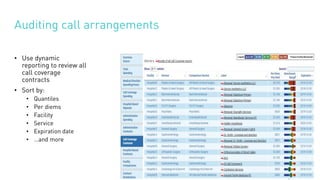
• Use dynamic
reporting to review all
call coverage
contracts
• Sort by:
• Quantiles
• Per diems
• Facility
• Service
• Expiration date
• …and more
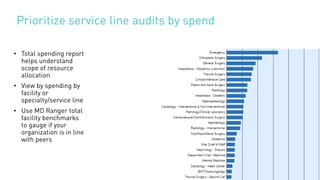
• Total spending report
helps understand
scope of resource
allocation
• View by spending by
facility or
specialty/service line
• Use MD Ranger total
facility benchmarks
to gauge if your
organization is in line
with peers
Prioritize service line audits by spend
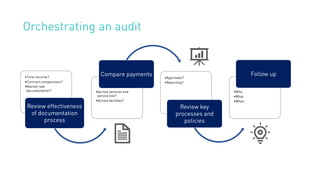
•Time records?
•Contract comparisons?
•Market rate
documentation?
Review effectiveness
of documentation
process
•Across services and
service line?
•Across facilities?
Compare payments •Approvals?
•Reporting?
Review key
processes and
policies
•Who
•What
•When
Follow up
Orchestrating an audit
Executive involvement and support
• A member of the hospital’s executive
team should be accountable for the
audit
• Executive should interpret findings and
make organizational wide
recommendations to mitigate risk
• The individual should have the authority
to execute follow up steps
• Executive should report the audit’s
results to other hospital management
and board to determine if external audit
is warranted
• Executive should determine if additional
policies, procedures or processes are
needed to help void risk in the future
Audit timing
• Schedule an appropriate time within your
organization’s budget cycle
• Plan enough time to complete the audit
• Consider when the bulk of your contracts come up for
renewal
Recording the auditing process
• Review the entire auditing process and document the
discussion or meeting
• Create a file or document to capture your internal
process. Include:
• Memos written by responsible executive or leader
• Minutes from meetings
• Flags and notes
• List of follow up items in one place, as collected from
above documents, notes, memos, and emails
Follow up
• Execution and accountability are
essential for a successful audit, which is
what makes follow up so important
• Track all next steps in one document;
review progress weekly in the month
following the audit and monthly post-
audit
• Good project management is key
UNCOVERING POTENTIAL RISKS- EXAMPLE
22
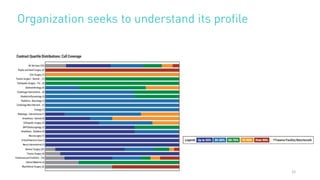
Organization seeks to understand its profile
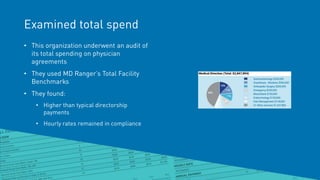
Examined total spend
• This organization underwent an audit of
its total spending on physician
agreements
• They used MD Ranger’s Total Facility
Benchmarks
• They found:
• Higher than typical directorship
payments
• Hourly rates remained in compliance
Important discovery:
spend driven by hours
MD Ranger reports provide market rate comparisons for all contracts at-a-glance
ABOUT MD RANGER
300+ Physician Benchmarks
• Call coverage rates
• Medical direction payments
• Administrative and leadership
• Hospital-based service stipends
• Diagnostic testing, etc.
• Clinic & hourly rates
• Telemedicine rates
Online Platform
• Benchmark lookups
• Contract proposal tools
• Contract reports by facility and
service
• Total facility costs + benchmarks
Research and Support
• Resources for education and
training
• On-call experts to help
subscribers use benchmarks
and tools
Compliance Documentation
• Contract-specific FMV
documentation reports
• Reports to assist with real-time
monitoring and annual reviews
Meet MD Ranger
Standardize
processes and
rates
Document FMV
Access 300+
payment
benchmarks
Review and
monitor
contracts
Have data-
driven physician
negotiations
Mitigate
compliance
risks
The foundation of your contracting process
Our database
• More than 250 subscribing facilities
• More than 36,000 physician contracts
across 350+ facilities
• Data covers 32 states
• 25% of reported data are from trauma
centers (Level I and II)
• Includes large systems, independent,
rural, and urban hospitals
• Multiple types of providers:
• Behavioral health
• Dialysis centers
• General acute
• Home health
• Hospice
• Long term acute care/ventilation
• Pediatric
• Rehabilitation
• Skilled nursing
• Telemedicine
• Call Coverage (55+)
• Medical direction (90+)
• Hospital-based services and
stipends (20+)
• Administrative (12+)
• Medical Staff Leadership
• Diagnostic/other services
e.g. ROP, autopsy, dialysis
• Clinical hourly professional
services
• Telemedicine
• Residency/teaching/GME
• Uncompensated care
• Meeting attendance, peer review,
IT/EHR and quality initiatives
• 13 pediatric services, with more
emerging each year
Hospital-characteristics drill down
for ADC, bed size, trauma status,
urban/rural, stroke centers,
teaching status, and more
Used in such diverse settings like
academic medical centers,
integrated delivery systems, and
critical access facilities nationwide
Our benchmarks
Let’s talk
⁃ Do you struggle with your physician contracting
policy and strategy? Are you performing
regular audits?
⁃ Are you spending too much on FMV opinions?
⁃ Do you think your organization could become
more efficient with access to a streamlined
platform with benchmark lookups and
autogenerated reports?
⁃ Reach out: lslaven@mdranger.com,
dperry@mdranger.com or 650-692-8873

Audit Physician Contracts the Smart Way

  • 1.
    AUDIT PHYSICIAN CONTRACTS THE SMARTWAY October 24, 2019 www.mdranger.com
  • 2.
    Disclaimer! Pull inlegal • MD Ranger doesn’t give legal advice • All serious matters regarding potential Stark or AKS violations (or questions) should go to your counsel under privilege • Fear overpayments based on comparisons to benchmarks? Talk to your attorney to consider your options.
  • 3.
    Your speakers Lauren Dominik-Slaven •Lauren specializes in developing and refining physician contracting processes, policies, and procedures. Lauren has over nine years of experience in healthcare working with legal and compliance. Daniel Perry • Daniel focuses on supporting MD Ranger users to get the most out of their subscriptions and advising healthcare providers on how to optimize use of benchmarks to support the compliance process.
  • 4.
    Today’s agenda Why contractaudits are important Planning and executing your audit Physician contracting best practices How MD Ranger can help with audits
  • 5.
  • 6.
    Government regulations • Numerousstate and federal regulations govern physician payments • Goal is to reduce and eliminate fraud • Vague language, legal complexity, and physician relationships themselves can make adherence challenging
  • 7.
    Major compliance regulations •Stark Law: Limits certain physician referrals of DHS if a physician or the physician’s family members have a financial relationship with that entity, unless an exception applies • Anti-Kickback Statute: Prohibits the exchange or offer to exchange anything of value to induce the referral of health care services (any items) from any person or provider • False Claims Act: imposes liability on people/organizations who defraud government programs
  • 8.
    Align contracts toorganizational goals • Make sure contracts are aligned with overall strategic, financial, and compliance goals • Are they on the right track? • Have they been effective: are additional resources and support needed to achieve your organization’s goals? • Is your organization taking compliance seriously?
  • 9.
  • 10.
    Goals of aninternal audit • Provide overview and oversight of organization-wide contracting practices • Uncover problematic or potentially non-compliant agreements, and bring them to the attention of your legal and/or compliance team • Ensure all agreements have necessary documentation for FMV • Check for duplicative services
  • 11.
    Check processes • Reviewoverall contracting criteria and process ✓ Is time commitment specified in contracts with hourly payment rates? ✓ Are time records kept, submitted and reviewed? ✓ Are contract renewals timely? ✓ What is the approval process? ✓ Is FMV documented at the time of approval? • Review major terms of each contract • Ask key questions of each contract • Document process, results, and follow up • Use MD Ranger for all these steps
  • 12.
    Know your teamand resources • Your audit process depends on your organization • Previous audits: figure out what worked, what didn’t • Involve staff with contract oversight responsibility and if you can, integrate other staff or contractors to assist • Involve management and board with high level reports on expenditures and market rate comparisons
  • 13.
    If resources arelimited… • No auditing team? No problem! • You don’t need much infrastructure for a successful internal audit—all you need is MD Ranger • MD Ranger’s online platform can support your internal auditing efforts
  • 14.
    Auditing call arrangements •Use dynamic reporting to review all call coverage contracts • Sort by: • Quantiles • Per diems • Facility • Service • Expiration date • …and more
  • 15.
    • Total spendingreport helps understand scope of resource allocation • View by spending by facility or specialty/service line • Use MD Ranger total facility benchmarks to gauge if your organization is in line with peers Prioritize service line audits by spend
  • 16.
    •Time records? •Contract comparisons? •Marketrate documentation? Review effectiveness of documentation process •Across services and service line? •Across facilities? Compare payments •Approvals? •Reporting? Review key processes and policies •Who •What •When Follow up Orchestrating an audit
  • 17.
    Executive involvement andsupport • A member of the hospital’s executive team should be accountable for the audit • Executive should interpret findings and make organizational wide recommendations to mitigate risk • The individual should have the authority to execute follow up steps • Executive should report the audit’s results to other hospital management and board to determine if external audit is warranted • Executive should determine if additional policies, procedures or processes are needed to help void risk in the future
  • 18.
    Audit timing • Schedulean appropriate time within your organization’s budget cycle • Plan enough time to complete the audit • Consider when the bulk of your contracts come up for renewal
  • 19.
    Recording the auditingprocess • Review the entire auditing process and document the discussion or meeting • Create a file or document to capture your internal process. Include: • Memos written by responsible executive or leader • Minutes from meetings • Flags and notes • List of follow up items in one place, as collected from above documents, notes, memos, and emails
  • 20.
    Follow up • Executionand accountability are essential for a successful audit, which is what makes follow up so important • Track all next steps in one document; review progress weekly in the month following the audit and monthly post- audit • Good project management is key
  • 21.
  • 22.
    22 Organization seeks tounderstand its profile
  • 23.
    Examined total spend •This organization underwent an audit of its total spending on physician agreements • They used MD Ranger’s Total Facility Benchmarks • They found: • Higher than typical directorship payments • Hourly rates remained in compliance
  • 24.
    Important discovery: spend drivenby hours MD Ranger reports provide market rate comparisons for all contracts at-a-glance
  • 25.
  • 26.
    300+ Physician Benchmarks •Call coverage rates • Medical direction payments • Administrative and leadership • Hospital-based service stipends • Diagnostic testing, etc. • Clinic & hourly rates • Telemedicine rates Online Platform • Benchmark lookups • Contract proposal tools • Contract reports by facility and service • Total facility costs + benchmarks Research and Support • Resources for education and training • On-call experts to help subscribers use benchmarks and tools Compliance Documentation • Contract-specific FMV documentation reports • Reports to assist with real-time monitoring and annual reviews Meet MD Ranger
  • 27.
    Standardize processes and rates Document FMV Access300+ payment benchmarks Review and monitor contracts Have data- driven physician negotiations Mitigate compliance risks The foundation of your contracting process
  • 28.
    Our database • Morethan 250 subscribing facilities • More than 36,000 physician contracts across 350+ facilities • Data covers 32 states • 25% of reported data are from trauma centers (Level I and II) • Includes large systems, independent, rural, and urban hospitals • Multiple types of providers: • Behavioral health • Dialysis centers • General acute • Home health • Hospice • Long term acute care/ventilation • Pediatric • Rehabilitation • Skilled nursing • Telemedicine
  • 29.
    • Call Coverage(55+) • Medical direction (90+) • Hospital-based services and stipends (20+) • Administrative (12+) • Medical Staff Leadership • Diagnostic/other services e.g. ROP, autopsy, dialysis • Clinical hourly professional services • Telemedicine • Residency/teaching/GME • Uncompensated care • Meeting attendance, peer review, IT/EHR and quality initiatives • 13 pediatric services, with more emerging each year Hospital-characteristics drill down for ADC, bed size, trauma status, urban/rural, stroke centers, teaching status, and more Used in such diverse settings like academic medical centers, integrated delivery systems, and critical access facilities nationwide Our benchmarks
  • 30.
    Let’s talk ⁃ Doyou struggle with your physician contracting policy and strategy? Are you performing regular audits? ⁃ Are you spending too much on FMV opinions? ⁃ Do you think your organization could become more efficient with access to a streamlined platform with benchmark lookups and autogenerated reports? ⁃ Reach out: lslaven@mdranger.com, dperry@mdranger.com or 650-692-8873