Visit https://testbankmall.com to download the full version and
explore more testbank or solutions manual
Solution Manual for McGraw-Hill Connect Resources
for Whittington, Principles of Auditing and Other
Assurance Services, 19e
_____ Click the link below to download _____
https://testbankmall.com/product/solution-manual-for-mcgraw-
hill-connect-resources-for-whittington-principles-of-
auditing-and-other-assurance-services-19e/
Explore and download more testbank or solutions manual at testbankmall.com
Here are some recommended products that we believe you will be
interested in. You can click the link to download.
Test Bank for McGraw-Hill Connect Resources for
Whittington, Principles of Auditing and Other Assurance
Services, 19e
https://testbankmall.com/product/test-bank-for-mcgraw-hill-connect-
resources-for-whittington-principles-of-auditing-and-other-assurance-
services-19e/
Test Bank for McGraw-Hill Connect Resources for
Whittington, Principles of Auditing and Other Assurance
Services, 20e
https://testbankmall.com/product/test-bank-for-mcgraw-hill-connect-
resources-for-whittington-principles-of-auditing-and-other-assurance-
services-20e/
Solution Manual for Principles of Auditing and Other
Assurance Services, 21st Edition, Whittington
https://testbankmall.com/product/solution-manual-for-principles-of-
auditing-and-other-assurance-services-21st-edition-whittington/
Principles of Auditing and Other Assurance Services
Whittington 19th Edition Solutions Manual
https://testbankmall.com/product/principles-of-auditing-and-other-
assurance-services-whittington-19th-edition-solutions-manual/
Principles of Auditing and Other Assurance Services
Whittington 19th Edition Test Bank
https://testbankmall.com/product/principles-of-auditing-and-other-
assurance-services-whittington-19th-edition-test-bank/
Test Bank for Principles of Auditing and Other Assurance
Services, 21st Edition, Whittington
https://testbankmall.com/product/test-bank-for-principles-of-auditing-
and-other-assurance-services-21st-edition-whittington/
Test Bank for Principles of Auditing and Other Assurance
Services, 17th Edition: Whittington
https://testbankmall.com/product/test-bank-for-principles-of-auditing-
and-other-assurance-services-17th-edition-whittington/
Test Bank for Principles of Auditing and Other Assurance
Services, 18th Edition: Ray Whittington
https://testbankmall.com/product/test-bank-for-principles-of-auditing-
and-other-assurance-services-18th-edition-ray-whittington/
Principles of Auditing and Assurance Services Whittington
Pany 18th Edition Solutions Manual
https://testbankmall.com/product/principles-of-auditing-and-assurance-
services-whittington-pany-18th-edition-solutions-manual/
Solutions Manual, Chapter 2, Page 2 of 14
Copyright © 2016 McGraw-Hill Education. All rights reserved. No reproduction or distribution without the prior written
consent of McGraw-Hill Education.
for: (1) audit evidence that contradicts other audit evidence, (2) information that raises a question
about the reliability of documents and responses to inquiries, (3) conditions indicating possible fraud,
and (4) circumstances suggesting the need for additional audit procedures beyond those ordinarily
required.
2-6 The auditors' responsibilities concerning the detection of noncompliance with laws by clients depends
on the relationship of the law or regulation to the financial statements. Certain laws and regulations,
such as income tax laws, have a direct effect on the amounts and disclosures included in the financial
statements. The auditors have a responsibility to design their audit to obtain reasonable assurance of
detecting material violations of these laws and regulations.
Many other laws and regulations, such as occupational safety and health laws, do not have a
direct effect on the amounts included in the financial statements. An audit carried out in accordance
with generally accepted auditing standards is not designed to detect client noncompliance with these
other laws.
Although an audit is not designed to provide reasonable assurance of detecting noncompliance
with other laws, the CPAs should be aware of the possibility that they have occurred and investigate
those identified. When they become aware of noncompliance with laws, the auditors should
communicate the situation to the audit committee of the board of directors to remedy the situation and
make appropriate modifications to the financial statements. If management fails to take appropriate
action, the auditors should consider withdrawing from the engagement.
2-7 The first sentence of the quotation is correct. The completion of an audit of financial statements by a
CPA following generally accepted auditing standards and satisfying the CPA provides the basis for
expression of an unmodified opinion on the fairness of financial statements.
The second sentence of the quotation is in error. Auditors never express an opinion (either
qualified or unmodified) on the fairness of financial statements without first performing an audit. The
audit provides the basis for the expression of an opinion. Such factors as audits made in prior years,
confidence in management, and a "quick review" of the current year's financial statements are not an
acceptable substitute for appropriate audit procedures.
2-8 The management of Pike Company is primarily responsible for the fairness of the company's financial
statements. The retention of certified public accountants to perform an audit and express an opinion
on the statements does not relieve management of its obligation to give an honest and complete
accounting of its conduct of corporate affairs.
2-9
Independent Auditor’s Report
To the Audit Committee of ABC Company
We have audited the accompanying consolidated balance sheets of ABC Company and its subsidiaries,
as of December 31, 20X1 and 20X0, and the related consolidated statements of income, retained
earnings, and cash flows for the years then ended.
Management's Responsibility for the Financial Statements
Management is responsible for the preparation and fair presentation of these consolidated financial
statements in accordance with accounting principles generally accepted in the United States of
America; this includes the design, implementation, and maintenance of internal control relevant to the
preparation and fair presentation of consolidated financial statements that are free from material
misstatement, whether due to fraud or error.
Solutions Manual, Chapter 2, Page 3 of 14
Copyright © 2016 McGraw-Hill Education. All rights reserved. No reproduction or distribution without the prior written
consent of McGraw-Hill Education.
Auditor's Responsibility
Our responsibility is to express an opinion on these consolidated financial statements based on our
audit. We conducted our audit in accordance with auditing standards generally accepted in the United
States of America. Those standards require that we plan and perform the audit to obtain reasonable
assurance about whether the consolidated financial statements are free of material misstatement.
An audit involves performing procedures to obtain audit evidence about the amounts and disclosures
in the consolidated financial statements. The procedures selected depend on the auditor's judgment,
including the assessment of the risks of material misstatement of the consolidated financial statements,
whether due to fraud or error. In making those risk assessments, the auditor considers internal control
relevant to the entity's preparation and fair presentation of the consolidated financial statements in
order to design audit procedures that are appropriate in the circumstances, but not for the purpose of
expressing an opinion on the effectiveness of the entity's internal control. An audit also includes
evaluating the appropriateness of accounting policies used and the reasonableness of significant
accounting estimates made by management, as well as evaluating the overall presentation of the
consolidated financial statements.
We believe that the audit evidence we have obtained is sufficient and appropriate to provide a basis for
our audit opinion.
Opinion
In our opinion, the consolidated financial statements referred to above present fairly, in all material
respects, the financial position of ABC Company and its subsidiaries as of December 31, 20X1 and
20X0, and the results of their operations and their cash flows for the years then ended in accordance
with accounting principles generally accepted in the United States of America.
Williams & Co. LLP
Phoenix, Arizona
February 5, 20X2
2-10 Among the more common situations which prevent the issuance of an unmodified opinion upon
completion of an audit are the following:
(1) Certain necessary auditing procedures were omitted at the request of the client, or for reasons
beyond the control of the client or the auditors.
(2) The statements contained misstatements (or omissions) and the client refuses to change them.
2-11 In the opinion paragraph of the auditor's standard report the auditors make representations as to the
following:
(1) The fairness of the financial statements, in all material respects.
(2) Application of generally accepted accounting principles.
(3) By implication consistent application of generally accepted accounting principles.
(4) By implication adequate disclosure.
2-12 The issuance of a standard audit report tells us that the audit was performed in accordance with
generally accepted auditing standards and, accordingly, it was planned and performed to obtain
reasonable assurance about whether the financial statements are free of material misstatement due to
error or fraud. The audit included performing procedures to obtain audit evidence about the amounts
and disclosures in the financial statements. These procedures were determined based on the auditors’
judgment, including their assessment of the risks of material misstatements of the financial statements.
Solutions Manual, Chapter 2, Page 4 of 14
Copyright © 2016 McGraw-Hill Education. All rights reserved. No reproduction or distribution without the prior written
consent of McGraw-Hill Education.
The auditors also evaluated the appropriateness of accounting policies used by the client, the
reasonableness of significant accounting estimates, and the overall presentation of the financial
statements.
2-13 The auditors' report expresses an opinion on the client's financial statements, not on the accounting
records. A major purpose of the audit is to give outsiders assurance that the financial statements are
reliable. The client's accounting records are important to the public accounting firm only because they
constitute evidence supporting the financial statements. The CPAs also gather evidence from outside
the company and from internal sources other than the accounting records.
2-14 The public accounting firm must observe generally accepted auditing standards (or, if applicable,
PCAOB Standards) in order to merit confidence in its opinion. The result of following these
procedures is an audit report that includes a reasonable, but not absolute, assurance that the financial
statements do not contain material misstatements due to errors or fraud. Reasonable assurance implies
that there is a low level of risk remaining that the auditor expresses an opinion that the financial
statements are properly stated when they are not. Reasonable and not absolute assurance is necessary
due to (1) the nature of financial reporting (e.g., the necessary use of judgment), (2) the nature of audit
procedures (e.g., they often do not provide absolutely conclusive evidence) and (3) the need to conduct
an audit within a reasonable period of time at a reasonable cost. Accordingly, the auditor expresses an
opinion on the financial statements, not a statement of fact.
2-15 Regardless of how careful and professional an audit of financial statements the public accounting firm
has made, it cannot guarantee their correctness. The statements themselves include a variety of
estimates; for example, the estimate of the allowance for uncollectible accounts and the choice of
depreciation rates. Also, the auditors rely on a program of tests rather than on verifying every
transaction. Some errors, therefore, may go undetected. The audit gives the auditors a firm basis for
expressing an informed opinion on the financial statements, but no more than that.
2-16 A material amount is an amount that is sufficiently important to influence decisions made by
reasonable users of financial statements. The amount may differ by account based on specific account
characteristics. For example, a $100,000 shortage of cash may be extremely material to a small
company, and a shortage of that amount might lead to bankruptcy. But, a $100,000 valuation
overstatement of equipment may be of less significance if the company continues to produce its
products and operate as in the past. Materiality is discussed further in Chapter 6.
2-17 If the guidance for a transaction or event is not specified within the authoritative GAAP (the FASB
Codification), the auditor should first consider whether accounting principles for similar transactions or
events exist within GAAP; if that is the case, those principles are followed to the extent considered
appropriate. If not, nonauthoritative accounting guidance is consulted. Sources of nonauthoritative
accounting guidance and literature include
 Practices that are widely recognized and prevalent either generally or in the industry.
 FASB Concepts Statements.
 AICPA Issues Papers
 International Financial Reporting Standards.
 Pronouncements of professional associations or regulatory agencies.
 Technical Information Service Inquiries and Replies included in AICPA
 Technical Practice Aids.
 Accounting textbooks, handbooks, and articles.
The appropriateness of the above nonauthoritative accounting guidance and literature depends on its
relevance to particular circumstances, how specific it is, the general recognition of the issuer or author as
Solutions Manual, Chapter 2, Page 5 of 14
Copyright © 2016 McGraw-Hill Education. All rights reserved. No reproduction or distribution without the prior written
consent of McGraw-Hill Education.
a authority, and the extent of its use in practice.
2-18 No. The attestation standards are meant to provide a general framework for the overall attestation
function and do not supersede the generally accepted auditing standard which were developed for
audits of annual historical financial statements. As a practical matter, the attestation standards are
most directly relevant to attest engagements that are not covered by specific authoritative standards,
such as attesting to attributes of computer software.
2-19 Quality control in a public accounting firm means policies and procedures which help assure that each
audit meets at least a minimum standard of quality. Such control is vital because even one substandard
audit could cause the firm to be defendant in a lawsuit that could threaten its continued existence.
Peer reviews refer to a study and appraisal by an independent evaluator (“peer reviewer”) of a
CPA firm’s work. In a system review, the evaluator considers the CPA firm’s system of quality control
to perform accounting and auditing work. In an engagement review, the evaluator studies and
evaluates a sample of a CPA firm’s actual accounting work, including accounting reports issued and
documentation prepared by the CPA firm as well as other procedures that the firm performed.
Engagement reviews are only available for CPA firms that do not perform audits or other similar
engagements.
Inspections are similar to peer reviews but are performed by the staff of the Public Company
Accounting Oversight Board. However, in performing PCAOB inspections the staff focuses only on
selected quality control issues and may consider aspects of practice management, such as the
determination of partner compensation. In selecting audits and reviews for inspection, the PCAOB
staff uses a risk assessment approach, which focuses on audits that have a high risk of lack of
compliance.
2-20 (a) Engagement performance. The objective of quality control procedures in this area is to
provide assurance that work performed is in accordance with professional standards and
regulatory and legal requirements, with policies and procedures addressing: (1) engagement
performance, (2) supervisions responsibilities and (3) review responsibilities.
(b) Human resources. The objective of quality control procedures in this area is to provide
assurance that the firm has personnel with the capabilities, competence and commitment to
ethical principles to: (1) perform its engagements in accordance with professional standards
and regulatory and legal requirements and (2) enable the firm to issue reports that are
appropriate in the circumstances.
(c) Monitoring. The objective of quality control procedures in this area is to determine that the
policies and procedures established for each of the elements are suitably designed and
effectively applied.
2-21 The AICPA’s Statement on Quality Control Standards identify six “elements” (areas) in which the
Institute feels that quality control procedures are appropriate, but it does not require any specific
quality control procedures. The Statement recognizes that specific procedures will vary among firms,
depending upon the size of the firm, the number of offices, and the nature of the firm’s practice.
2-22 The duties of the Public Company Accounting Oversight Board include:
 Register public accounting firms that prepare audit reports for financial statement issuers.
 Establish or adopt auditing, quality control, ethics, independence and other standards relating to
audit reports for issuers.
 Conduct inspections of registered public accounting firms.
Solutions Manual, Chapter 2, Page 6 of 14
Copyright © 2016 McGraw-Hill Education. All rights reserved. No reproduction or distribution without the prior written
consent of McGraw-Hill Education.
 Perform other duties or functions to promote high professional standards for audits, enforce
compliance with the enabling act establishing the Board (i.e., the Sarbanes-Oxley Act of 2002
discussed in Chapter 1), set the budget, and manage operations.
2-23 A system review involves peer reviewers’ study and appraisal of a CPA firm’s system of quality
control to perform accounting and auditing work. A systems review includes determining whether the
CPA firm’s system of quality control for its accounting and auditing practice (non-public clients) is
designed and complied with to provide the CPA firm with reasonable assurance of performing and
reporting in conformity with applicable standards, including the quality control standards. An
engagement review is a type of peer review in which the peer reviewer selects a sample of a CPA
firm’s actual accounting work, including accounting reports issued and documentation prepared by the
CPA firm. This form of peer review is only available for CPA firms that do not perform audits, but do
perform accounting work, including reviews and compilations. The objective of an engagement
review is to evaluate whether the CPA firm’s reports are issued and procedures performed
appropriately in accordance with applicable professional standards.
2-24 The international audit report differs from one based on PCAOB reporting standards in the following
ways:
(1) The international report has an expanded description of management’s responsibility for the
financial statements and internal controls.
(2) The report also includes an expanded explanation of the audit process, which includes a
description of the auditors’ responsibility for internal control.
(3) The international report allows the accountants the following reporting options:
(a) Instead of indicating that the financial statements "present fairly, in all material respects,"
the accountants may substitute the phrase "give a true and fair view."
(b) The report may indicate that the financial statements comply with the country's relevant
statutes or laws.
(c) The report may be signed using the personal name of the auditor, the firm, or both.
(4) The city in which the auditors maintain an office is required to be included in the international
report.
Questions Requiring Analysis
2-25 The AICPA currently develops independence and ethical standards, quality control standards, and
auditing and attestation standards that apply to its members. However, AICPA standards are
applicable to the audits and auditors of nonpublic clients based on general acceptance by the courts,
and adoption by state boards of accountancy and other regulatory bodies. The AICPA also has a
voluntary peer review program, and enforces its standards on its members.
The PCAOB was given the legal authority to develop independence and ethical standards, quality
control standards, and auditing and attestation standards that apply to public company auditors and
integrated audits. The PCAOB also is charged with performing inspections of registered audit firms,
and may sanction the firms for noncompliance with its standards and the provisions of Sarbanes-Oxley
Act.
Solutions Manual, Chapter 2, Page 7 of 14
Copyright © 2016 McGraw-Hill Education. All rights reserved. No reproduction or distribution without the prior written
consent of McGraw-Hill Education.
The state boards of accountancy regulate CPA firms and CPAs in the various states and jurisdictions.
They have the authority to establish their own standards, but have generally adopted the standards of
other bodies such as the AICPA and the PCAOB. A state board enforces its standards in its state or
jurisdiction and has the authority to revoke a CPA firm or individual CPA’s right to practice in the
state.
2-26 A firm of certified public accountants might find it difficult to maintain an attitude of independence
during the audit of financial statements if the public accounting firm or a partner in the firm:
(1) Derived a major portion of the firm's income from one client;
(2) Had a personal financial interest in the company being audited;
(3) Made the fee contingent upon the obtaining of a bank loan by the client;
(4) Was financially indebted to the client;
(5) Was a member of the board of directors of the client company or otherwise participated in the
management of the company.
2-27 If the certified public accountant is appointed controller of the corporation, he or she loses the
independent status which is the most essential qualification of the certified public accountant. The
interests of the officers of a corporation may at times be in conflict with the interests of creditors,
bankers, or stockholders. These outside groups are best protected when independent CPAs examine
the financial statements prepared by management of the corporation. The performance of an internal
audit function under the direction of the new controller may be a highly desirable step, but it does not
eliminate the need for an independent audit.
2-28 (a) To satisfy an auditor's responsibilities to detect Smith's errors and fraud, Reed should:
 Assess the risk that Smith's errors and fraud may cause its financial statements to contain a
material misstatement.
 Design the audit to provide reasonable assurance of detecting errors and fraud that are
material to the financial statements. In designing the audit, the auditors should respond to
risks by altering their overall approach to the audit or modifying the nature timing and
extent of audit procedures. They should also perform procedures to address the risk of
management override of internal control.
 Exercise due care in planning, performing, and evaluating the results of audit procedures,
and exercise the proper degree of professional skepticism to achieve reasonable assurance
that material errors or fraud will be detected.
(b) Reed's responsibilities to detect Smith's noncompliance with laws that have a material and
direct effect on Smith's financial statements are the same as that for errors and fraud.
Reed's responsibilities to detect noncompliance with laws that have an indirect effect on
the financial statements are to be aware of the possibility that such noncompliance may have
occurred. If specific information comes to Reed's attention that provides evidence concerning
the possible existence of such noncompliance, Reed should apply audit procedures specifically
directed to ascertaining whether noncompliance has occurred.
(c) Reed's responsibilities when noncompliance with laws has been identified is to discuss the
situation with top management and to notify the audit committee of the board of directors so
that proper action can be taken, including making any necessary disclosures or adjustments to
the financial statements. If the client fails to take appropriate corrective action, Reed should
withdraw from the engagement. In addition, legal counsel or other appropriate specialist will
generally be contacted by the CPA.
Solutions Manual, Chapter 2, Page 8 of 14
Copyright © 2016 McGraw-Hill Education. All rights reserved. No reproduction or distribution without the prior written
consent of McGraw-Hill Education.
2-29 (a) The two forms of peer review are a system review and an engagement review.
(b) The PCAOB inspections focus on the public-company audit practice of the firm. The
inspections are designed to determine the firm’s compliance with the Sarbanes-Oxley Act,
PCAOB and SEC requirements, and other professional standards.
(c) An inspection involves at least the following three components:
1. An inspection and review of selected public-company audit and review engagements.
2. An evaluation of the sufficiency of the quality control system of the firm, and the
manner of the documentation and communication of the system.
3. Performance of such other testing of the audit, supervisory, and quality control
procedures as are considered necessary.
PCAOB inspections differ from peer reviews in that the staff focuses only on selected quality
control issues and may consider aspects of practice management, such as the determination of
partner compensation. In selecting audits and reviews for inspection, the PCAOB staff uses a
risk assessment approach, which focuses on audits that have a high risk of lack of compliance.
(d) The PCAOB staff selects audit engagements for inspection on a risk basis. They select audits
with a higher risk of lack of noncompliance with professional standards. In addition, for the
selected audits, the staff focuses on the higher-risks aspects of the engagement.
Objective Questions
2-30 Multiple Choice Questions
(a) (4) Because the license to practice as a CPA is granted by the state, the applicable state,
through its state board of accountancy, has the right to revoke the right of an
individual to practice as a CPA. Students are sometimes confused by the fact that
while the CPA examination is administered nationally, it is the individual states that
award CPA certificates.
(b) (2) The AICPA has authority to establish auditing standard for nonpublic companies.
The Financial Accounting Standards board has authority for accounting standards of
both public and nonpublic companies. The Public Company Accounting Oversight
Board has authority to establish standards for audits and reviews of public companies,
and quality controls for firms that audit public companies.
(c) (2) FASB Concepts Statements are considered nonauthoritative guidance. The other
replies all represent authoritative guidance.
(d) (2) Financial statement audits provide reasonable, not absolute assurance.
(e) (2) The quality control standards were established to provide reasonable assurance that
professional services confirm with professional standards. Answer (1) is incomplete
since many standards in addition to reporting standards must be followed. Answer (3)
is incorrect because a peer review monitors whether a firm's quality control standards
are being met. Answer (4) is incorrect because continuing professional education is
only one part of a system of quality control.
Solutions Manual, Chapter 2, Page 9 of 14
Copyright © 2016 McGraw-Hill Education. All rights reserved. No reproduction or distribution without the prior written
consent of McGraw-Hill Education.
(f) (3) The internal control of the client is not explicitly mentioned in the unqualified
standard report although it is implicit in the reference to generally accepted auditing
standards. Answers (1), (2), and (4) are all explicitly set forth in the unqualified
standard form of audit report.
(g) (1) An independent mental attitude on the part of the auditor is required by the second
general standard of the PCAOB. Answers (3) and (4) relate to the standards of field
work. Answer (2) confuses generally accepted accounting principles with generally
accepted auditing standards.
(h) (3) Such a quality control policy is designed to assure that personnel assigned to an
engagement are independent to perform the work, an ethical requirement.
(i) (1) An audit provides reasonable assurance of detecting misstatements due to fraud,
regardless of whether due to fraudulent financial reporting or misappropriation of
assets.
(j) (1) An integrated audit report on the financial statements of a public company states that
the audit was performed in accordance with Public Company Accounting Oversight
Board standards, not AICPA standards.
(k) (3) The PCAOB staff performs inspections of audit firms that are registered with the
PCAOB. In order to perform an audit of a public client an audit firm must be
registered.
(l) (4) Neither the AICPA audit report nor the international audit report include an opinion
on internal control. The other replies provide actual differences between the two
reports.
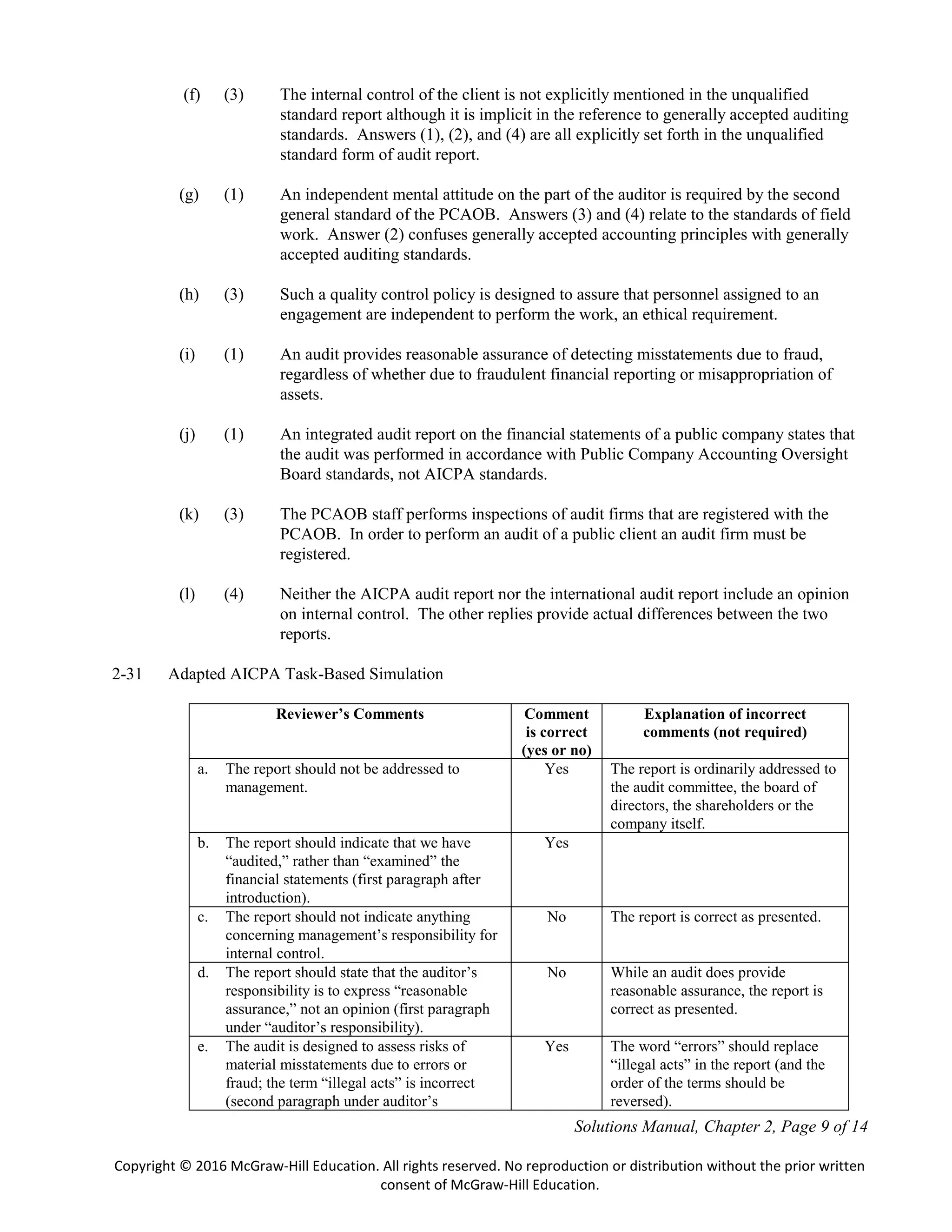
2-31 Adapted AICPA Task-Based Simulation
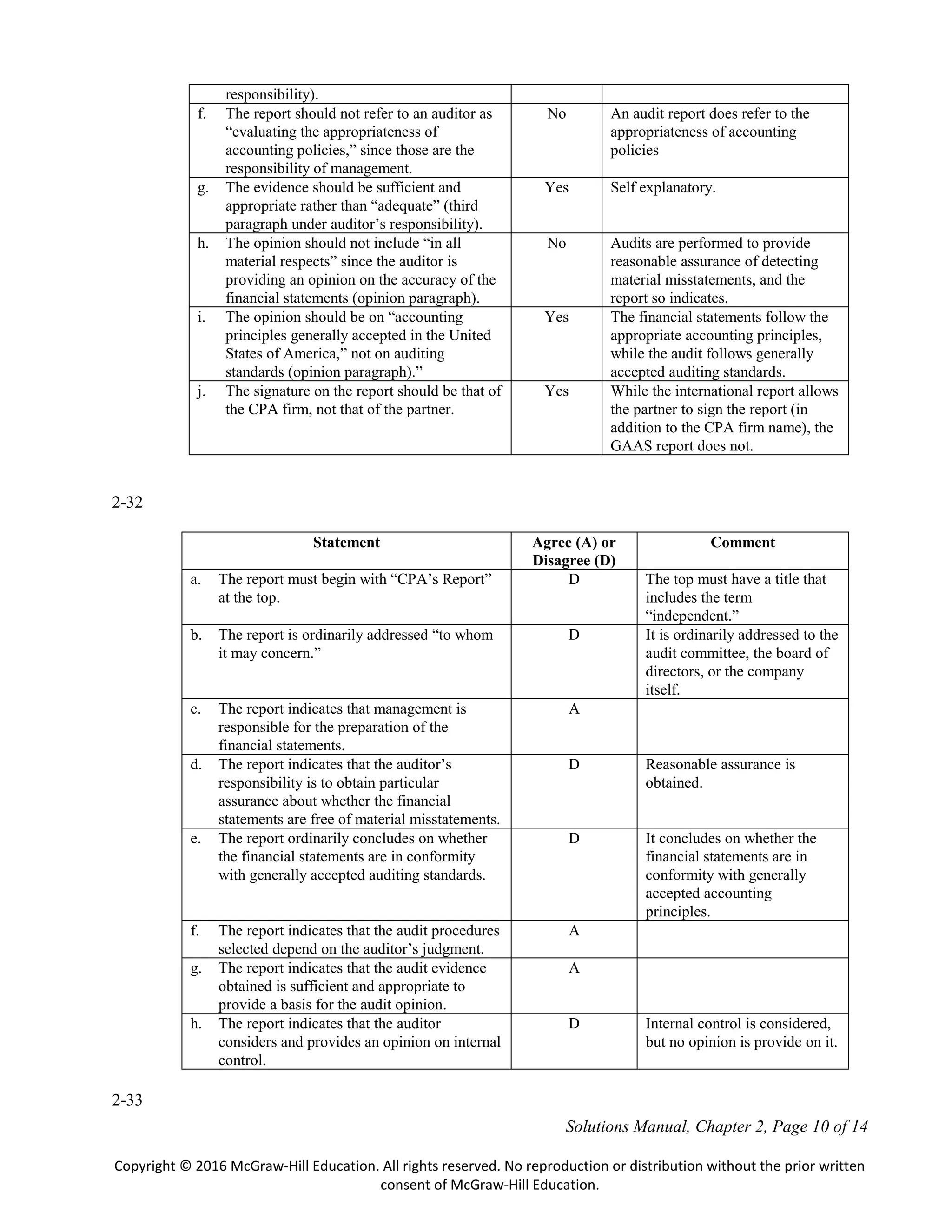
Reviewer’s Comments Comment
is correct
(yes or no)
Explanation of incorrect
comments (not required)
a. The report should not be addressed to
management.
Yes The report is ordinarily addressed to
the audit committee, the board of
directors, the shareholders or the
company itself.
b. The report should indicate that we have
“audited,” rather than “examined” the
financial statements (first paragraph after
introduction).
Yes
c. The report should not indicate anything
concerning management’s responsibility for
internal control.
No The report is correct as presented.
d. The report should state that the auditor’s
responsibility is to express “reasonable
assurance,” not an opinion (first paragraph
under “auditor’s responsibility).
No While an audit does provide
reasonable assurance, the report is
correct as presented.
e. The audit is designed to assess risks of
material misstatements due to errors or
fraud; the term “illegal acts” is incorrect
(second paragraph under auditor’s
Yes The word “errors” should replace
“illegal acts” in the report (and the
order of the terms should be
reversed).
Solutions Manual, Chapter 2, Page 10 of 14
Copyright © 2016 McGraw-Hill Education. All rights reserved. No reproduction or distribution without the prior written
consent of McGraw-Hill Education.
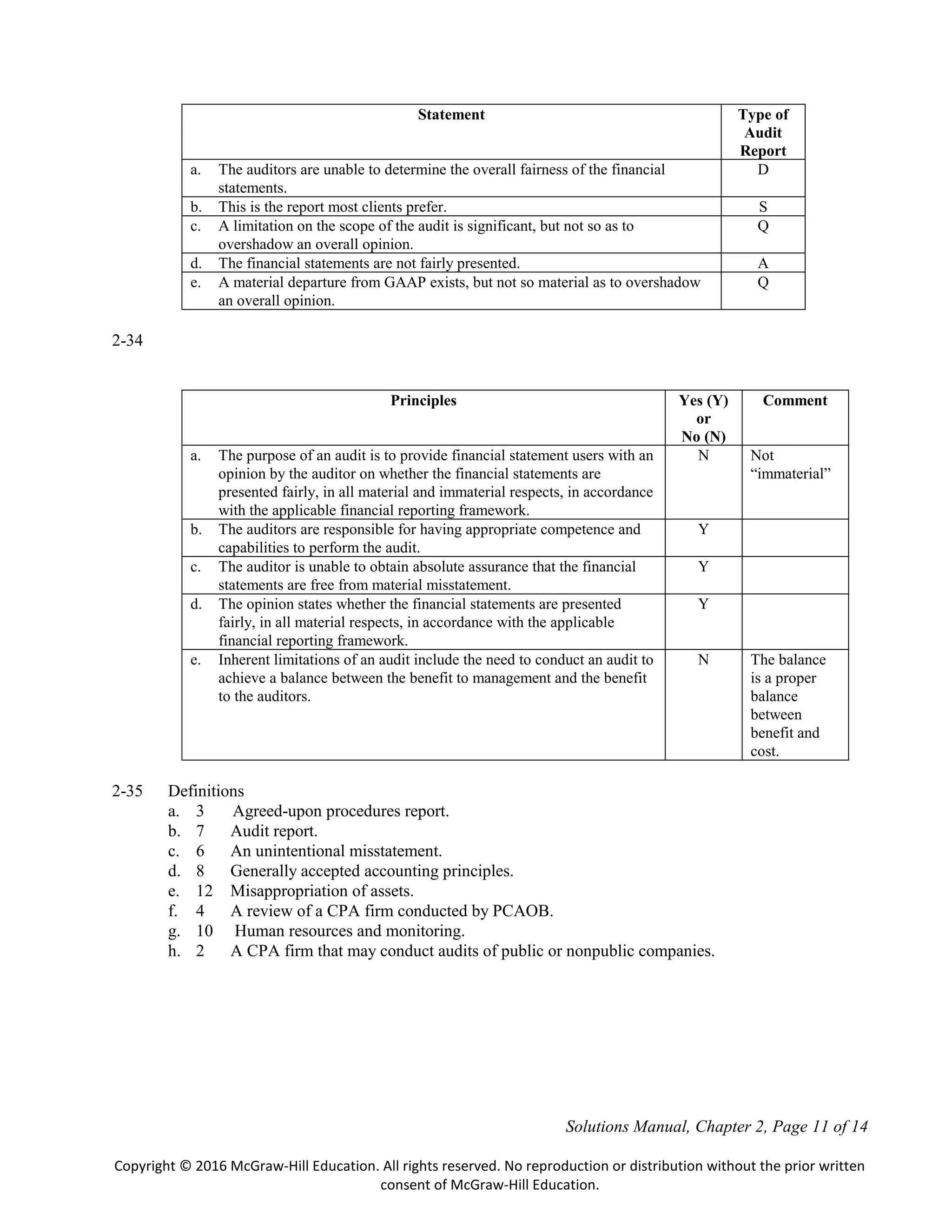
responsibility).
f. The report should not refer to an auditor as
“evaluating the appropriateness of
accounting policies,” since those are the
responsibility of management.
No An audit report does refer to the
appropriateness of accounting
policies
g. The evidence should be sufficient and
appropriate rather than “adequate” (third
paragraph under auditor’s responsibility).
Yes Self explanatory.
h. The opinion should not include “in all
material respects” since the auditor is
providing an opinion on the accuracy of the
financial statements (opinion paragraph).
No Audits are performed to provide
reasonable assurance of detecting
material misstatements, and the
report so indicates.
i. The opinion should be on “accounting
principles generally accepted in the United
States of America,” not on auditing
standards (opinion paragraph).”
Yes The financial statements follow the
appropriate accounting principles,
while the audit follows generally
accepted auditing standards.
j. The signature on the report should be that of
the CPA firm, not that of the partner.
Yes While the international report allows
the partner to sign the report (in
addition to the CPA firm name), the
GAAS report does not.
2-32
Statement Agree (A) or
Disagree (D)
Comment
a. The report must begin with “CPA’s Report”
at the top.
D The top must have a title that
includes the term
“independent.”
b. The report is ordinarily addressed “to whom
it may concern.”
D It is ordinarily addressed to the
audit committee, the board of
directors, or the company
itself.
c. The report indicates that management is
responsible for the preparation of the
financial statements.
A
d. The report indicates that the auditor’s
responsibility is to obtain particular
assurance about whether the financial
statements are free of material misstatements.
D Reasonable assurance is
obtained.
e. The report ordinarily concludes on whether
the financial statements are in conformity
with generally accepted auditing standards.
D It concludes on whether the
financial statements are in
conformity with generally
accepted accounting
principles.
f. The report indicates that the audit procedures
selected depend on the auditor’s judgment.
A
g. The report indicates that the audit evidence
obtained is sufficient and appropriate to
provide a basis for the audit opinion.
A
h. The report indicates that the auditor
considers and provides an opinion on internal
control.
D Internal control is considered,
but no opinion is provide on it.
2-33
Solutions Manual, Chapter 2, Page 11 of 14
Copyright © 2016 McGraw-Hill Education. All rights reserved. No reproduction or distribution without the prior written
consent of McGraw-Hill Education.
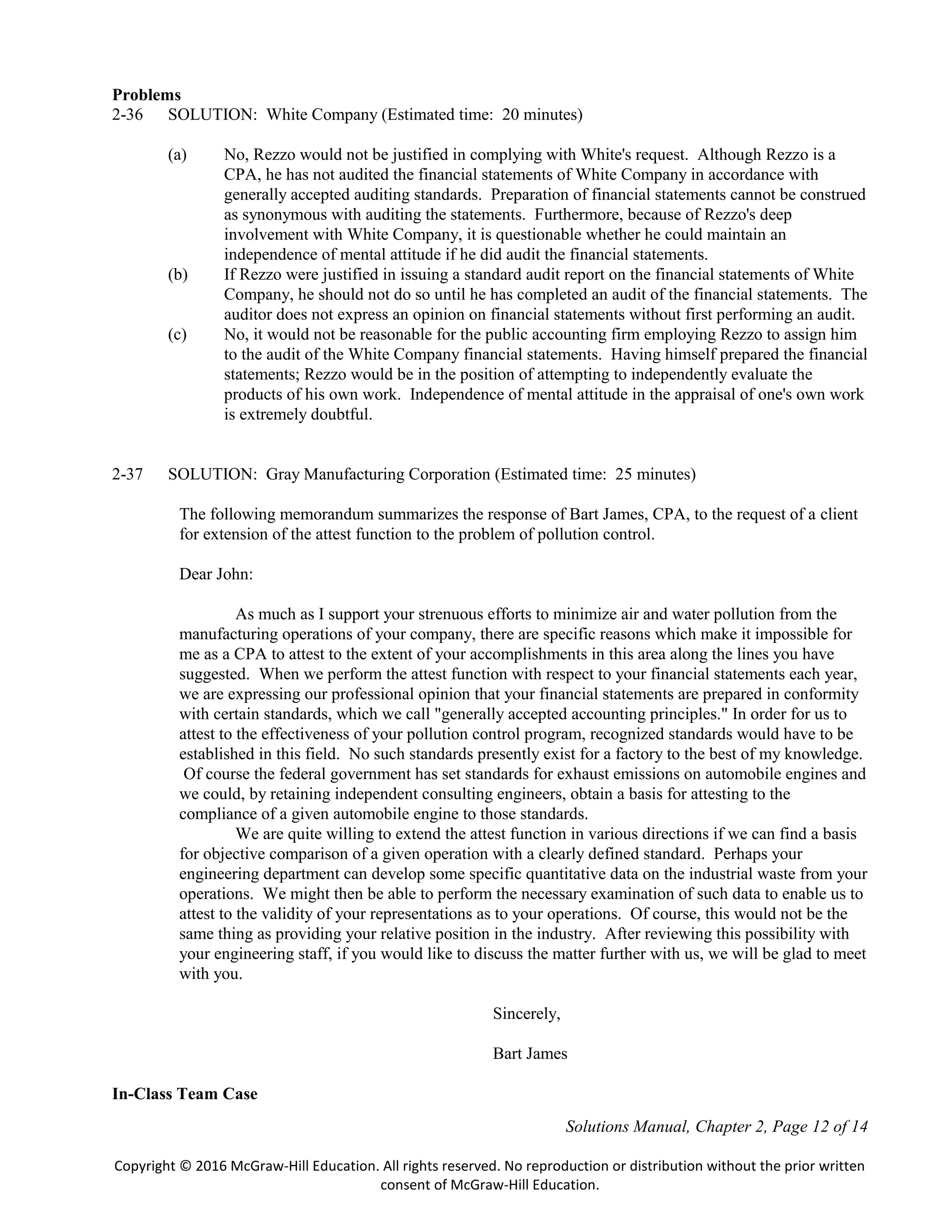
Statement Type of
Audit
Report
a. The auditors are unable to determine the overall fairness of the financial
statements.
D
b. This is the report most clients prefer. S
c. A limitation on the scope of the audit is significant, but not so as to
overshadow an overall opinion.
Q
d. The financial statements are not fairly presented. A
e. A material departure from GAAP exists, but not so material as to overshadow
an overall opinion.
Q
2-34
Principles Yes (Y)
or
No (N)
Comment
a. The purpose of an audit is to provide financial statement users with an
opinion by the auditor on whether the financial statements are
presented fairly, in all material and immaterial respects, in accordance
with the applicable financial reporting framework.
N Not
“immaterial”
b. The auditors are responsible for having appropriate competence and
capabilities to perform the audit.
Y
c. The auditor is unable to obtain absolute assurance that the financial
statements are free from material misstatement.
Y
d. The opinion states whether the financial statements are presented
fairly, in all material respects, in accordance with the applicable
financial reporting framework.
Y
e. Inherent limitations of an audit include the need to conduct an audit to
achieve a balance between the benefit to management and the benefit
to the auditors.
N The balance
is a proper
balance
between
benefit and
cost.
2-35 Definitions
a. 3 Agreed-upon procedures report.
b. 7 Audit report.
c. 6 An unintentional misstatement.
d. 8 Generally accepted accounting principles.
e. 12 Misappropriation of assets.
f. 4 A review of a CPA firm conducted by PCAOB.
g. 10 Human resources and monitoring.
h. 2 A CPA firm that may conduct audits of public or nonpublic companies.
Solutions Manual, Chapter 2, Page 12 of 14
Copyright © 2016 McGraw-Hill Education. All rights reserved. No reproduction or distribution without the prior written
consent of McGraw-Hill Education.
Problems
2-36 SOLUTION: White Company (Estimated time: 20 minutes)
(a) No, Rezzo would not be justified in complying with White's request. Although Rezzo is a
CPA, he has not audited the financial statements of White Company in accordance with
generally accepted auditing standards. Preparation of financial statements cannot be construed
as synonymous with auditing the statements. Furthermore, because of Rezzo's deep
involvement with White Company, it is questionable whether he could maintain an
independence of mental attitude if he did audit the financial statements.
(b) If Rezzo were justified in issuing a standard audit report on the financial statements of White
Company, he should not do so until he has completed an audit of the financial statements. The
auditor does not express an opinion on financial statements without first performing an audit.
(c) No, it would not be reasonable for the public accounting firm employing Rezzo to assign him
to the audit of the White Company financial statements. Having himself prepared the financial
statements; Rezzo would be in the position of attempting to independently evaluate the
products of his own work. Independence of mental attitude in the appraisal of one's own work
is extremely doubtful.
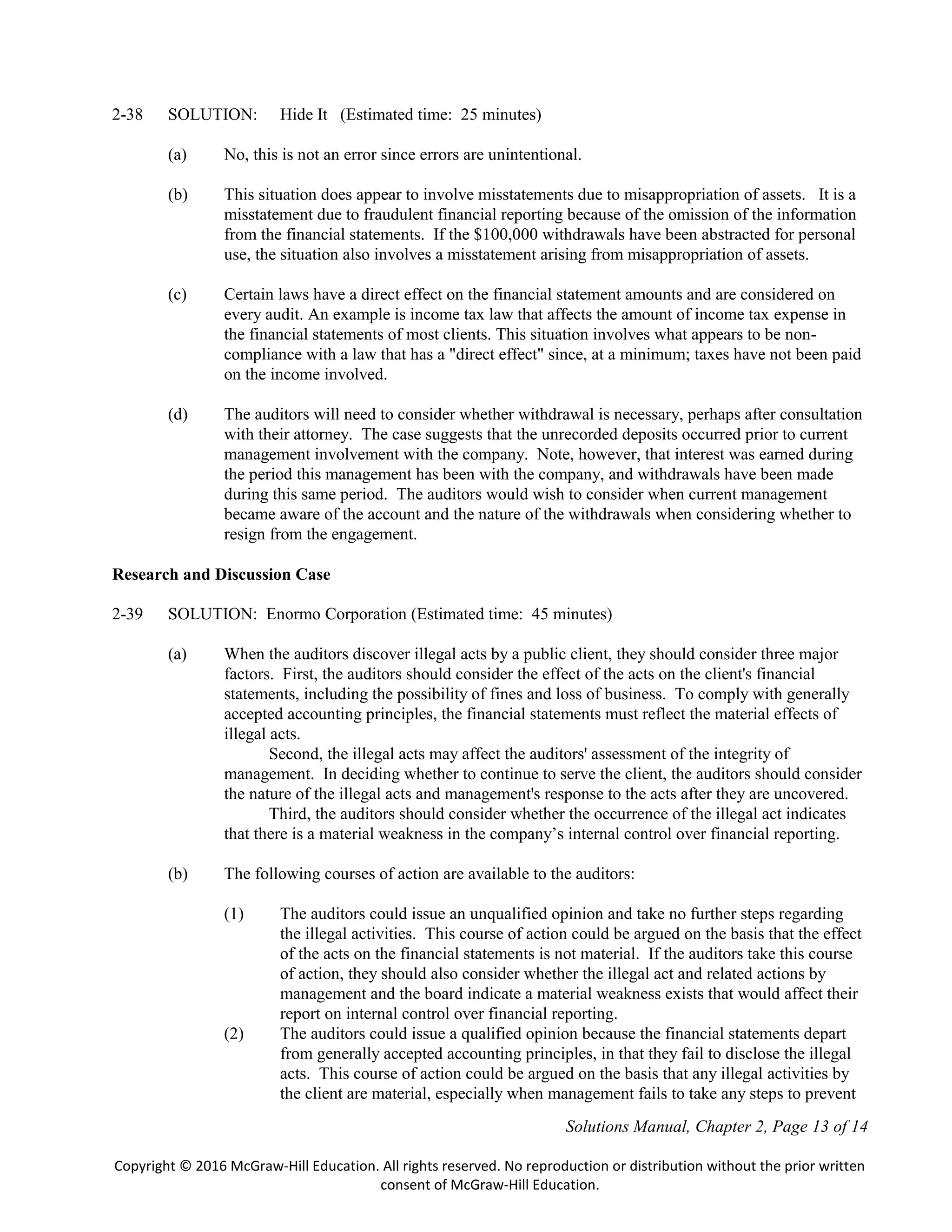
2-37 SOLUTION: Gray Manufacturing Corporation (Estimated time: 25 minutes)
The following memorandum summarizes the response of Bart James, CPA, to the request of a client
for extension of the attest function to the problem of pollution control.
Dear John:
As much as I support your strenuous efforts to minimize air and water pollution from the
manufacturing operations of your company, there are specific reasons which make it impossible for
me as a CPA to attest to the extent of your accomplishments in this area along the lines you have
suggested. When we perform the attest function with respect to your financial statements each year,
we are expressing our professional opinion that your financial statements are prepared in conformity
with certain standards, which we call "generally accepted accounting principles." In order for us to
attest to the effectiveness of your pollution control program, recognized standards would have to be
established in this field. No such standards presently exist for a factory to the best of my knowledge.
Of course the federal government has set standards for exhaust emissions on automobile engines and
we could, by retaining independent consulting engineers, obtain a basis for attesting to the
compliance of a given automobile engine to those standards.
We are quite willing to extend the attest function in various directions if we can find a basis
for objective comparison of a given operation with a clearly defined standard. Perhaps your
engineering department can develop some specific quantitative data on the industrial waste from your
operations. We might then be able to perform the necessary examination of such data to enable us to
attest to the validity of your representations as to your operations. Of course, this would not be the
same thing as providing your relative position in the industry. After reviewing this possibility with
your engineering staff, if you would like to discuss the matter further with us, we will be glad to meet
with you.
Sincerely,
Bart James
In-Class Team Case
Solutions Manual, Chapter 2, Page 13 of 14
Copyright © 2016 McGraw-Hill Education. All rights reserved. No reproduction or distribution without the prior written
consent of McGraw-Hill Education.
2-38 SOLUTION: Hide It (Estimated time: 25 minutes)
(a) No, this is not an error since errors are unintentional.
(b) This situation does appear to involve misstatements due to misappropriation of assets. It is a
misstatement due to fraudulent financial reporting because of the omission of the information
from the financial statements. If the $100,000 withdrawals have been abstracted for personal
use, the situation also involves a misstatement arising from misappropriation of assets.
(c) Certain laws have a direct effect on the financial statement amounts and are considered on
every audit. An example is income tax law that affects the amount of income tax expense in
the financial statements of most clients. This situation involves what appears to be non-
compliance with a law that has a "direct effect" since, at a minimum; taxes have not been paid
on the income involved.
(d) The auditors will need to consider whether withdrawal is necessary, perhaps after consultation
with their attorney. The case suggests that the unrecorded deposits occurred prior to current
management involvement with the company. Note, however, that interest was earned during
the period this management has been with the company, and withdrawals have been made
during this same period. The auditors would wish to consider when current management
became aware of the account and the nature of the withdrawals when considering whether to
resign from the engagement.
Research and Discussion Case
2-39 SOLUTION: Enormo Corporation (Estimated time: 45 minutes)
(a) When the auditors discover illegal acts by a public client, they should consider three major
factors. First, the auditors should consider the effect of the acts on the client's financial
statements, including the possibility of fines and loss of business. To comply with generally
accepted accounting principles, the financial statements must reflect the material effects of
illegal acts.
Second, the illegal acts may affect the auditors' assessment of the integrity of
management. In deciding whether to continue to serve the client, the auditors should consider
the nature of the illegal acts and management's response to the acts after they are uncovered.
Third, the auditors should consider whether the occurrence of the illegal act indicates
that there is a material weakness in the company’s internal control over financial reporting.
(b) The following courses of action are available to the auditors:
(1) The auditors could issue an unqualified opinion and take no further steps regarding
the illegal activities. This course of action could be argued on the basis that the effect
of the acts on the financial statements is not material. If the auditors take this course
of action, they should also consider whether the illegal act and related actions by
management and the board indicate a material weakness exists that would affect their
report on internal control over financial reporting.
(2) The auditors could issue a qualified opinion because the financial statements depart
from generally accepted accounting principles, in that they fail to disclose the illegal
acts. This course of action could be argued on the basis that any illegal activities by
the client are material, especially when management fails to take any steps to prevent
Solutions Manual, Chapter 2, Page 14 of 14
Copyright © 2016 McGraw-Hill Education. All rights reserved. No reproduction or distribution without the prior written
consent of McGraw-Hill Education.
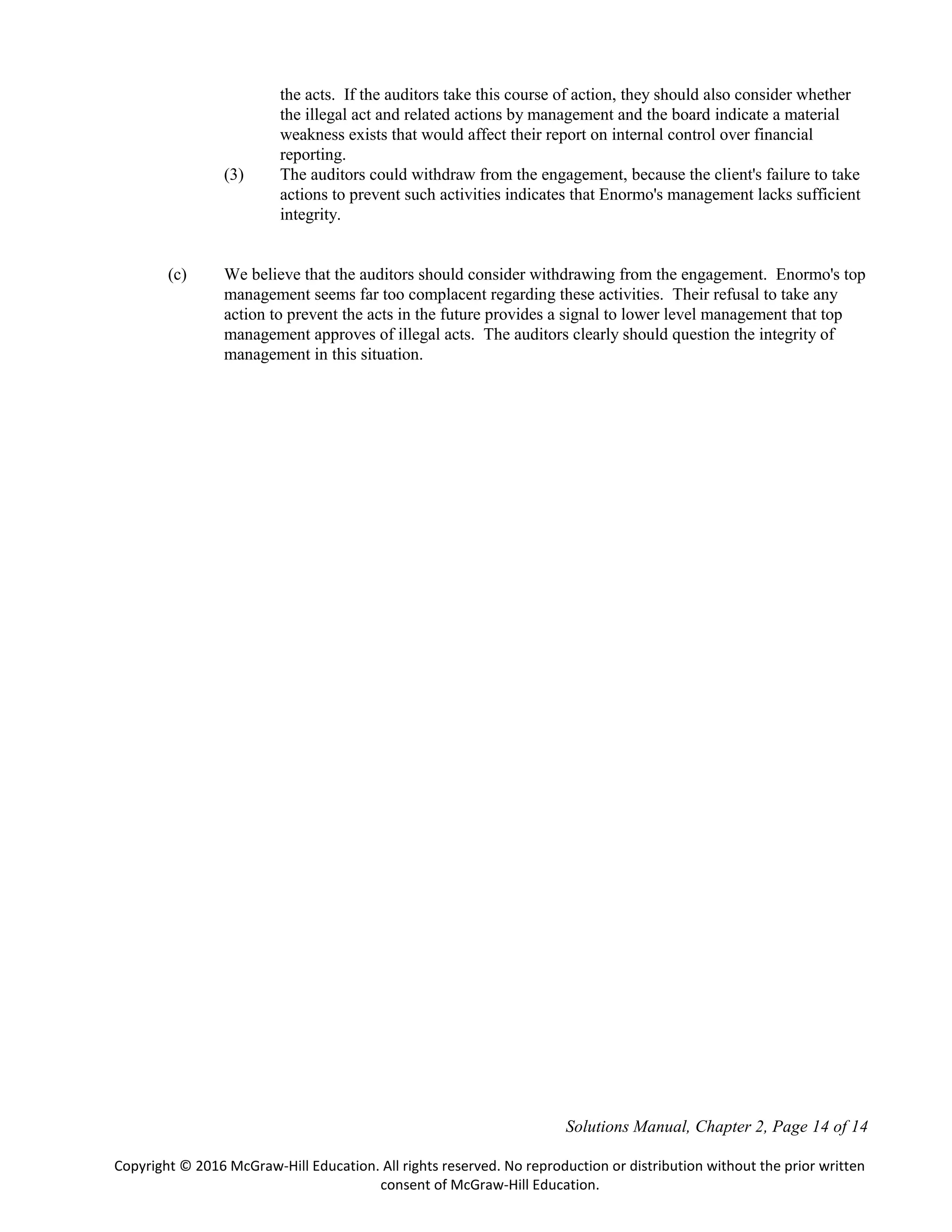
the acts. If the auditors take this course of action, they should also consider whether
the illegal act and related actions by management and the board indicate a material
weakness exists that would affect their report on internal control over financial
reporting.
(3) The auditors could withdraw from the engagement, because the client's failure to take
actions to prevent such activities indicates that Enormo's management lacks sufficient
integrity.
(c) We believe that the auditors should consider withdrawing from the engagement. Enormo's top
management seems far too complacent regarding these activities. Their refusal to take any
action to prevent the acts in the future provides a signal to lower level management that top
management approves of illegal acts. The auditors clearly should question the integrity of
management in this situation.
Exploring the Variety of Random
Documents with Different Content
[248]
of a dog somewhere on land suggested a cabin and
some few scattered inhabitants.
They were quite a goodly company, this Maya band
which escorted him from their city to some unknown
destination. Johnny, with his white companions, rode in
a large pit-pan. There were other crafts. From time to
time he caught the sound of their dipping paddles,
heard their low cries of warning as one boat came
perilously near another. Twice they had made camp. At
such times as this, blindfolded though he was, Johnny
was able to estimate the number of men.
“About a hundred,” he had said to Jean.
“Quite a band,” she had agreed. “Wonder why so
many?”
“Who can tell?”
The princess was with them. He heard her voice from
time to time. The old chief, too, perhaps. He could not
be sure of that.
Wondering dreamily how it all would end, and wishing
with all his heart that Jean at least was out of it all, he
fell into a doze.
From this he was awakened by a sudden movement of
the boat. It was as if the hand of a giant had seized the
prow and suddenly turned it through a quarter of a
circle, then had given it a powerful shove.
For a second the boy’s head whirled.
“Wha—what has happened?” Jean whispered.
[249]
Johnny chuckled. “We’re in a larger river, much larger.
In fact, it is a great river, and something tells me——,”
his words came swift and eager now, “that it is the good
old Rio Hondo!”
“Johnny, it can’t be!”
“It could be, and is!” said Johnny emphatically. “I
haven’t ridden that old river for nothing. She has a way
of teasing and tossing your dugout while she whirls it
forward that no other river ever had.
“Besides,” he added with another chuckle, “I can smell
the water. It actually smells black.”
“What’s that?” the girl exclaimed suddenly.
“Sounds like thunder,” said Johnny.
* * * * * * * *
It was thunder, the forerunner of a storm. It was not a
local storm, either, but one of those wide sweeping
storms that tear at the timber on all the headwaters of
a great river. Pant, at the edge of his camp, where he
was assisting in shooting the last of the mahogany logs
into their boom, heard it and his face grew thoughtful.
The hour of great suspense came at last. Their boom
was loaded. They were ready to go down the river.
Daego had not yet led his men to the attack.
“We’ll get away in the darkness,” Pant said to his Carib
foreman, fairly dancing about in his eagerness to be
away. “We’ll give old Daego the slip.”
[250]
Tivoli’s only reply was a sweep of the hand toward the
blackening sky. As if in answer to his signal, there came
crashing down upon them one of those sudden storms
that are known only in the tropics.
“We’ll get away under cover of the storm,” said Pant.
“That will be better still.”
“You don’t now these tropical storms,” said Tivoli. “All
night in the rain fifteen men must work; fifteen men
must rest, sleep beneath canvas in hammocks. Even
with fifteen men we may not save the raft, tied up right
here. You do not know the tropics. There will be water
in the river, water in the sky. Which is river? Which is
sky? You cannot tell. The river will rise like a tide. There
will come down snags, great trees, palm trees,
mahogany, yamra, black tamarind, santa maria, many,
many snags. All night long, at the edge of the raft, we
must fight these snags away. There will be no sleep for
Tivoli tonight, and perhaps no logs for Mr. Johnny
Thompson after that, either.”
Tivoli was right. Such a storm as this was! Nothing of
the kind had ever been witnessed by the boys before.
Flash after flash of lightning, water in sheets, in
streams, great avalanches of water that one could all
but swim through. Rolling thunder vied with the
increasing roar of black waters. And after that came the
snags! And how those Caribs did work!
All night, till the clock hand stood at three, they labored.
Then the water began to subside.
Then, exhausted, they threw themselves upon the bare
logs and slept.
“At dawn we are away,” muttered Tivoli.
[251]
[252]
* * * * * * * *
All that night, regardless of the lightning that set the
water all agleam, in spite of the deluge of rain that fell,
the Mayas and their blindfolded captives drifted silently
down that broad river which indeed was Rio Hondo.
Awnings of cloth, cunningly treated with the juice from
the bark of the wild rubber tree, protected them from
the rain. They were safe and dry. The river carried them
onward. What more need they ask?
* * * * * * * *
At dawn, as a matchless sunrise painted the east red
and gold, there appeared above Pant’s raft on the broad
river a black line, a line not of drift logs, but dugouts,
dories and pit-pans. Each craft was loaded with men,
and as the sun sent its rays shooting across them they
waved their hands and let forth a bloodcurdling shout.
In each uplifted hand there gleamed a long bladed
machete.
“They come!” said Tivoli in response to Pant’s call. “Let
them come. See that all the men are wakened quickly.”
[253]
CHAPTER XXV
THE BATTLE OF RIO HONDO
The battle of Rio Hondo will probably never be recorded
on the printed pages of the history of Honduras or
Mexico, but to the last day of his life it will remain
indelibly stamped on Pant’s memory.
As he caught the white gleam of machetes against the
morning sky, many searching questions invaded his
mind. He was about to engage in a battle that might
mean the death of some faithful Carib. Was there yet an
opportunity for parley, for compromise? No! It was too
late. Yet, in their previous actions had there been
blunders? Had he been too hasty? Could the fight have
been avoided? These questions he could not fully
answer; all he could say was that he had believed
himself to be acting for the good of all.
“As for compromise,” he told himself stoutly, “there can
be no compromise with evil. This man Daego hesitates
at nothing that he may gain a little more wealth, wealth
for which he has no need. The men we must fight have
sold their souls to him.” Having thus put himself at
peace with his own mind, he set calmly about the task
of posting his men.
[254]
The purpose of the raiders was to break up his raft. If
they could but sever the encircling boom, his logs would
be set free, each to find its separate way to the ocean.
They would then be lost to him forever.
One anxious glance he cast toward the approaching
boats. One thing he feared most of all,—firearms.
“He wouldn’t dare,” Pant told himself, as no rifle or pistol
appeared in the uplifted hands. “A fight between crews
is one thing; wholesale slaughter quite another. The
laws of Great Britain are strict, her officers tireless.”
His eyes gleamed with a touch of pride as he surveyed
his small army of defense. What stalwart fellows they
were! How their dark arms gleamed in the sun! From
the belt of each hung a machete. These they had been
ordered to use only as a last resort. By the side of each,
grounded like a rifle, was a stout six-foot mahogany
pike-pole. He had taught them the last trick of offense
and defense with these weapons.
So they waited as on came the invading host. In the
hands of some he saw the white gleam of sapodilla axe
handles. With these axes they would attempt to loosen
a chain of the boom or chop a log of it in two. Others
balanced heavy sledges on the edge of their boats. With
these they hoped to sever the chains. Their machetes
were for defense. They waved them to intimidate the
Caribs.
“Not so easily done,” Pant smiled grimly as his Caribs
sent back a ringing cry of defiance.
“Don’t let a man of them board us,” was the last word
Pant passed along the line. “If they gain a footing on
[255]
[256]
the raft we’re lost. If one gets aboard, double on him
and pitch him overboard.”
As the dark line advanced it spread out fan-shape; then,
with every wild-eyed Spaniard of them all splitting his
lungs in a savage yell, they shot their crafts alongside.
With drawn machetes they leaped for the first
mahogany logs that lay against the boom. But what was
this? As they swung their machetes threateningly, they
received a rain of blows that sent many a machete
whirling through space to find its watery grave beneath
the black waters.
Against such an offensive they were not able to stand.
Seizing their paddles, they backed away to a respectful
distance, there to hold a council of war.
The result of this council Pant read as if it were an open
book. With machetes sheathed, but with axes and
sledges at hand, the enemy spread out to advance upon
the raft from every side. By this Pant judged that they
hoped to scatter his men and to effect a break in the
boom that would not only set his logs free, but throw
his Caribs into the river, there to fight for their lives
against pitching, grinding logs and lurking alligators.
One move he had not anticipated became apparent
soon enough. The instant their boats touched, as the
Caribs rushed at them with their mahogany pikes, the
Spaniards who were not armed with sledges and axes
did their best to seize the pikes and wrest them from
the Caribs. In this, here and there, they were
successful, and always in the corner where this
occurred, the tide began to turn. It was one thing to
prod and beat a Spaniard; quite another to be prodden
[257]
and beaten by him. In the meantime, keen oars flashed
here and there. There came the disheartening chop-
chop of axes and the thud of sledges that told that at
any moment the boom might be broken, the battle lost.
Heroic work was going on at every point. Outnumbered
almost two to one, the Caribs fought valiantly. With their
wild shouts forever on their lips, they seized fresh pikes
when one was lost and fought with renewed vigor.
Tivoli, their chief, seemed everywhere at once. His great
strength served him well. Here, where a sledge was
battering dangerously at a chain, he made a mighty
thrust, swinging his pike sidewise at a Spaniard’s head.
The sledge splashed into the water. Danger at this point
was at an end. Here an axe swung in air to meet with
Tivoli’s well aimed pike and go spinning through air to
join the sledge.
But for all this, the battle was going badly. Here and
there a chain was badly battered and in several places a
log of the boom was half cut through. Seeing his men
outnumbered where ten Spaniards crowded a single
dugout, Pant, whose slight strength had lost him his
pike at the very onset, seized a pike aimed at his head
and, gripping hard, executed a flying pole vault right
over the heads of the enemy and into the booming
waters.
The result was all that could be hoped for. The
Spaniard, who still clung to the pike, was dragged half
out of the dugout, whereupon that unstable craft
promptly capsized, pitching ten lusty attackers, axes,
sledges and all, into the river.
[258]
Tivoli, too, lost his pike. Angered at this victory on the
part of an enemy, he watched his chance and when the
Spaniard swung his pike to one side, with bare hands
and unarmed, Tivoli rushed at him and rained such
blows on his head as drove him to drop his pike and
leap into the river.
This much for scattered conflicts. Victory here and there
along the line; more than one Spaniard in the river; but
for all that, here and there the boom was being
dangerously weakened. The battle was going badly.
“Only a matter of time,” thought Pant, as he struggled
back to the raft. “A half hour; perhaps less. Then our
work is all undone!”
* * * * * * * *
Just as the storm came to an end and morning broke,
Johnny Thompson, still blindfolded and riding among
the Mayas, felt his boat swerve sharply to the right and
enter a small creek where overhanging branches swept
the awnings over the boats.
They had not gone far up this stream before their boat
bumped the bank and they were helped to disembark.
Imagine their surprise and joy when someone, very
short, very laughingly tugged away the cloths that
blinded them and permitted them for the first time in
two days to see.
“See!” exclaimed the princess, for it was she who had
unbound their eyes. “See what a beautiful world we
have brought you to!”
[259]
[260]
It was indeed a beautiful world. All a-glitter with
raindrops flashing in the sun, palms and giant tropical
ferns had never seemed so lovely as now.
Birds sang their best. Even the screaming parrots, that
they might not be entirely out of harmony, appeared to
soften their discordant notes.
But into this symphony there crept a wildly disturbing
sound. Dim, indistinct, yet unmistakable, there came the
noise of battle.
At the first sound of it, Johnny Thompson glanced wildly
about him. Then, having sighted down the creek a
familiar bend in the river, he exclaimed:
“It’s Daego. The battle is on! They are not a mile from
here. I must go!”
Seizing the prow of a boat, he pushed it into the
stream, sprang in, seized a paddle, and would have
been away, single-handed, to enter the conflict.
They dragged him back. The old chief tried to learn,
from Johnny’s wild flinging arms, what it was all about.
In the end he appeared to understand, for, after
instructing his men to look to their weapons, he ordered
them into their boats. Once more the Mayas, a hundred
strong, swept down the river, grim, silent, determined.
So it happened that a second time that day Pant saw
the river above his raft lined with boats.
“Friends or enemies?” he thought. “Let them come.
Without aid we lose. More of the enemy cannot matter.”
[261]
As for Daego’s men, they watched the on-coming fleet
with consternation. Daego had no men up the river.
They knew that. Who, then, were these?
As the fleet came closer, a figure standing in the prow of
the foremost boat became plainly visible. He was
waving his arms and shouting wildly. It was Johnny.
One of Daego’s keen-eyed Spaniards was the first to
recognize him. With a wild cry of fear he dashed for his
pit-pan.
“There is the man who has died,” he shouted. “His
ghost has been seen many times above the treetops.
Now he comes back. He is a ghost. Who are these with
him? They have gleaming spears. They, too, are
ghosts.” So he thought, and prepared to flee.
So thought they all. To a man they dropped oar, maul,
pike, pole or machete, and turned to flee.
When Johnny’s boat bumped the raft there was not a
Spaniard within gunshot.
But what was this? As he turned about to look at his
companions in the boat he saw only Roderick and Jean.
By some skillful trick of boatmanship or swimming, the
Maya paddlers had left the boat. Now, some distance
away, the Maya princess was waving them farewell as
the remaining boats went speeding back up the river.
“That’s funny,” said Johnny.
“How—how strange and ghost-like!” murmured Jean.
“Nothing ghost-like about this,” said Johnny, as he
patted his pack which held the rare Maya god.
[262]
The joyful reunion that followed was cut short by the
pressing business of getting the log boom started down
the river. The motor boat was brought around, the Carib
sail boats hitched on behind, and they were away.
Hardgrave, who knew Jean’s father and the location of
his camp, advised her and Roderick to go with them
down the river. This advice was not unwelcome,
especially to Johnny, who felt that he could never see
too much of the bonny Scotch girl.
They had made their slow way down two-thirds of the
distance when a strange procession caught up with and
passed them. Motor boats, launches, flatboats, and pit-
pans moved by. Each was loaded to capacity with the
strangest cargoes. Here were four tractors on a flat-
boat; there many wheels that might have belonged to
cannons, but did belong to logging wagons; here a pit-
pan loaded high with great vats and kettles that had
once held the boiling sap of the sapodilla tree. So they
drifted by. It was like the passing of a defeated army.
And so it was. The defeated king of the Black River was
leaving the Rio Hondo forever.
Two weeks later, with his treasure of red lure safely
piled at the waterfront in Belize, Johnny met his
millionaire friend, Roderick Grayson, at the dock as a
United Fruit steamer’s launch came in. Three days later,
in Johnny’s room at the hotel, Grayson met the
Governor of Quintanaroo and together they drew up
contracts which were to mean much, not only to
Quintanaroo and Grayson, but to Johnny and Pant as
well. In each contract it was agreed that Grayson’s
company was to pay the boys a royalty, a wee bit of a
royalty on their entire output and, though the
percentage is small, the output is destined to be large,
[263]
and there is no reason to believe that the two boys will
lack for funds for travel and adventure in the future.
The rare Maya god found its way to a museum in
London. The proceeds from its sale Johnny insisted
upon dividing with Jean. There was talk of spending the
whole of it in a visit to London and the Old World by
Jean and her family, accompanied by Johnny and Pant.
At about this time, however, Johnny chanced to wander
down to the breakwater, where little boats anchor, and
there he met a strange seafaring man who had a
strange tale to tell. And right there began one of the
most unusual adventures that ever befell Johnny
Thompson. You will find it all written down in our next
book, “Forbidden Cargoes”.
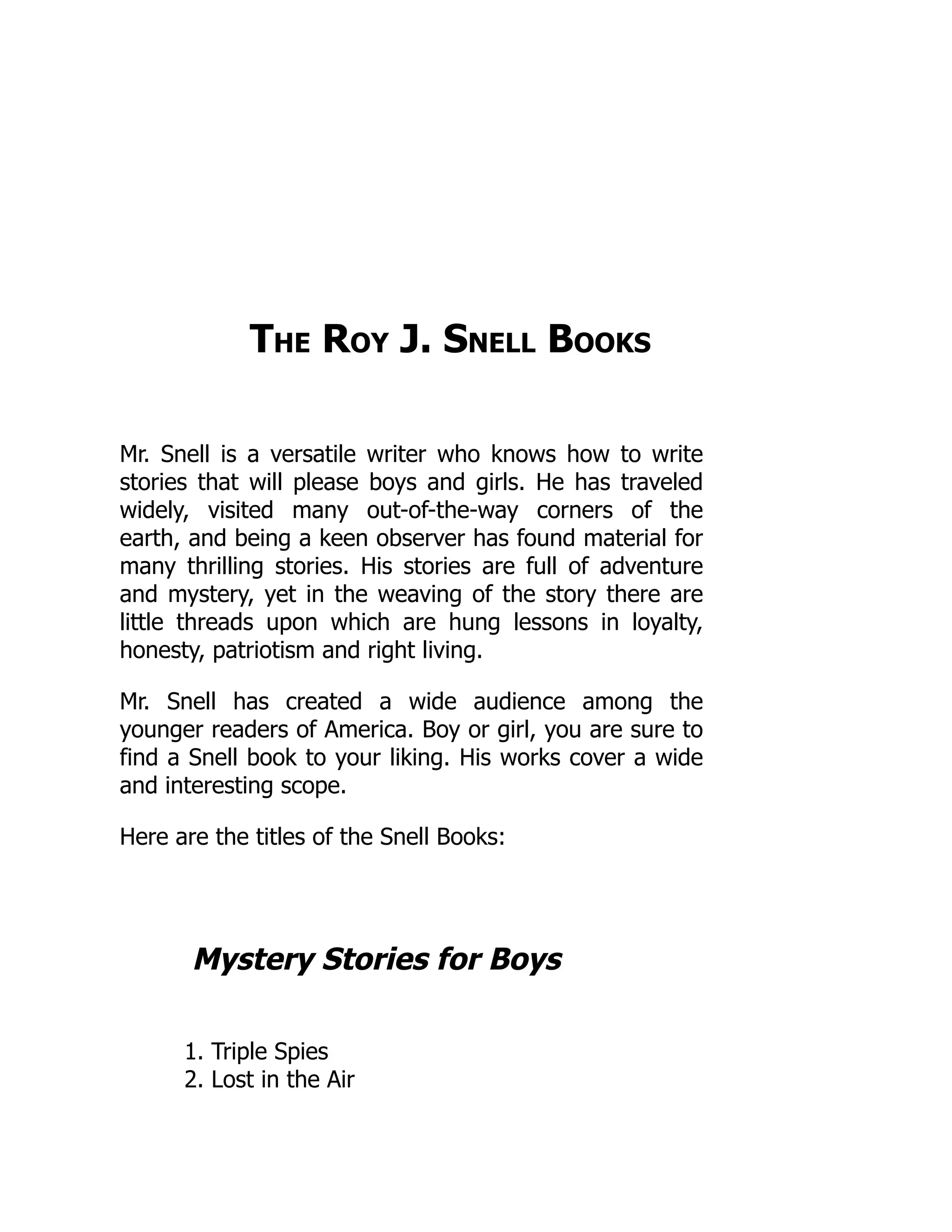
The Roy J. Snell Books
Mr. Snell is a versatile writer who knows how to write
stories that will please boys and girls. He has traveled
widely, visited many out-of-the-way corners of the
earth, and being a keen observer has found material for
many thrilling stories. His stories are full of adventure
and mystery, yet in the weaving of the story there are
little threads upon which are hung lessons in loyalty,
honesty, patriotism and right living.
Mr. Snell has created a wide audience among the
younger readers of America. Boy or girl, you are sure to
find a Snell book to your liking. His works cover a wide
and interesting scope.
Here are the titles of the Snell Books:
Mystery Stories for Boys
1. Triple Spies
2. Lost in the Air
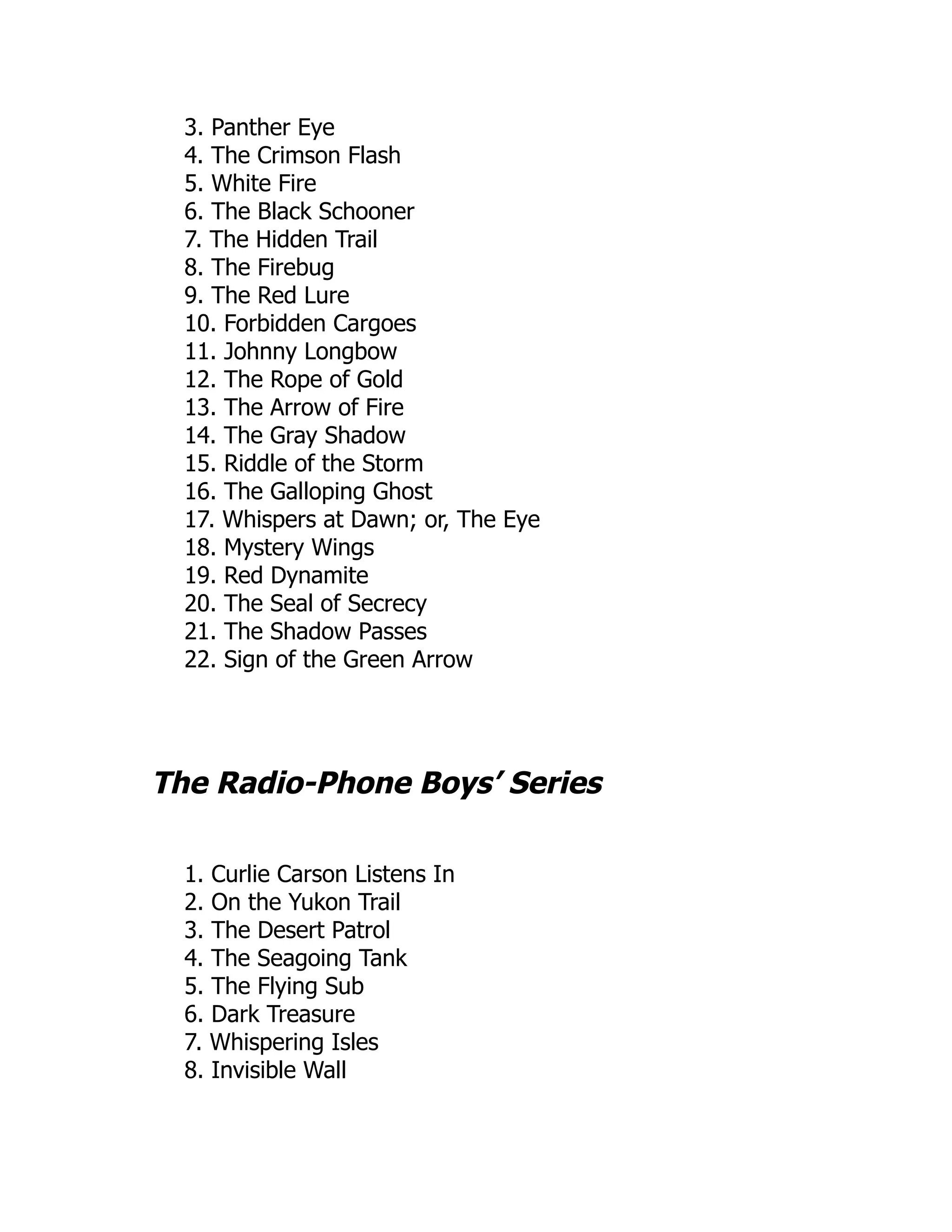
3. Panther Eye
4. The Crimson Flash
5. White Fire
6. The Black Schooner
7. The Hidden Trail
8. The Firebug
9. The Red Lure
10. Forbidden Cargoes
11. Johnny Longbow
12. The Rope of Gold
13. The Arrow of Fire
14. The Gray Shadow
15. Riddle of the Storm
16. The Galloping Ghost
17. Whispers at Dawn; or, The Eye
18. Mystery Wings
19. Red Dynamite
20. The Seal of Secrecy
21. The Shadow Passes
22. Sign of the Green Arrow
The Radio-Phone Boys’ Series
1. Curlie Carson Listens In
2. On the Yukon Trail
3. The Desert Patrol
4. The Seagoing Tank
5. The Flying Sub
6. Dark Treasure
7. Whispering Isles
8. Invisible Wall
Adventure Stories for Girls
1. The Blue Envelope
2. The Cruise of the O’Moo
3. The Secret Mark
4. The Purple Flame
5. The Crimson Thread
6. The Silent Alarm
7. The Thirteenth Ring
8. Witches Cove
9. The Gypsy Shawl
10. Green Eyes
11. The Golden Circle
12. The Magic Curtain
13. Hour of Enchantment
14. The Phantom Violin
15. Gypsy Flight
16. The Crystal Ball
17. A Ticket to Adventure
18. The Third Warning
Transcriber’s Notes
Copyright notice provided as in the original printed text
—this e-text is public domain in the country of
publication.
Silently corrected palpable typos; left non-standard
spellings and dialect unchanged.
Relocated promotional material to the end of the book,
and completed the list of books in the three series
(using other sources).
*** END OF THE PROJECT GUTENBERG EBOOK THE RED LURE ***
Updated editions will replace the previous one—the old editions
will be renamed.
Creating the works from print editions not protected by U.S.
copyright law means that no one owns a United States
copyright in these works, so the Foundation (and you!) can copy
and distribute it in the United States without permission and
without paying copyright royalties. Special rules, set forth in the
General Terms of Use part of this license, apply to copying and
distributing Project Gutenberg™ electronic works to protect the
PROJECT GUTENBERG™ concept and trademark. Project
Gutenberg is a registered trademark, and may not be used if
you charge for an eBook, except by following the terms of the
trademark license, including paying royalties for use of the
Project Gutenberg trademark. If you do not charge anything for
copies of this eBook, complying with the trademark license is
very easy. You may use this eBook for nearly any purpose such
as creation of derivative works, reports, performances and
research. Project Gutenberg eBooks may be modified and
printed and given away—you may do practically ANYTHING in
the United States with eBooks not protected by U.S. copyright
law. Redistribution is subject to the trademark license, especially
commercial redistribution.
START: FULL LICENSE
THE FULL PROJECT GUTENBERG
LICENSE
PLEASE READ THIS BEFORE YOU DISTRIBUTE OR USE THIS WORK
To protect the Project Gutenberg™ mission of promoting the
free distribution of electronic works, by using or distributing this
work (or any other work associated in any way with the phrase
“Project Gutenberg”), you agree to comply with all the terms of
the Full Project Gutenberg™ License available with this file or
online at www.gutenberg.org/license.
Section 1. General Terms of Use and
Redistributing Project Gutenberg™
electronic works
1.A. By reading or using any part of this Project Gutenberg™
electronic work, you indicate that you have read, understand,
agree to and accept all the terms of this license and intellectual
property (trademark/copyright) agreement. If you do not agree
to abide by all the terms of this agreement, you must cease
using and return or destroy all copies of Project Gutenberg™
electronic works in your possession. If you paid a fee for
obtaining a copy of or access to a Project Gutenberg™
electronic work and you do not agree to be bound by the terms
of this agreement, you may obtain a refund from the person or
entity to whom you paid the fee as set forth in paragraph 1.E.8.
1.B. “Project Gutenberg” is a registered trademark. It may only
be used on or associated in any way with an electronic work by
people who agree to be bound by the terms of this agreement.
There are a few things that you can do with most Project
Gutenberg™ electronic works even without complying with the
full terms of this agreement. See paragraph 1.C below. There
are a lot of things you can do with Project Gutenberg™
electronic works if you follow the terms of this agreement and
help preserve free future access to Project Gutenberg™
electronic works. See paragraph 1.E below.
1.C. The Project Gutenberg Literary Archive Foundation (“the
Foundation” or PGLAF), owns a compilation copyright in the
collection of Project Gutenberg™ electronic works. Nearly all the
individual works in the collection are in the public domain in the
United States. If an individual work is unprotected by copyright
law in the United States and you are located in the United
States, we do not claim a right to prevent you from copying,
distributing, performing, displaying or creating derivative works
based on the work as long as all references to Project
Gutenberg are removed. Of course, we hope that you will
support the Project Gutenberg™ mission of promoting free
access to electronic works by freely sharing Project Gutenberg™
works in compliance with the terms of this agreement for
keeping the Project Gutenberg™ name associated with the
work. You can easily comply with the terms of this agreement
by keeping this work in the same format with its attached full
Project Gutenberg™ License when you share it without charge
with others.
1.D. The copyright laws of the place where you are located also
govern what you can do with this work. Copyright laws in most
countries are in a constant state of change. If you are outside
the United States, check the laws of your country in addition to
the terms of this agreement before downloading, copying,
displaying, performing, distributing or creating derivative works
based on this work or any other Project Gutenberg™ work. The
Foundation makes no representations concerning the copyright
status of any work in any country other than the United States.
1.E. Unless you have removed all references to Project
Gutenberg:
1.E.1. The following sentence, with active links to, or other
immediate access to, the full Project Gutenberg™ License must
appear prominently whenever any copy of a Project
Gutenberg™ work (any work on which the phrase “Project
Gutenberg” appears, or with which the phrase “Project
Gutenberg” is associated) is accessed, displayed, performed,
viewed, copied or distributed:
This eBook is for the use of anyone anywhere
in the United States and most other parts of
the world at no cost and with almost no
restrictions whatsoever. You may copy it, give it
away or re-use it under the terms of the
Project Gutenberg License included with this
eBook or online at www.gutenberg.org. If you
are not located in the United States, you will
have to check the laws of the country where
you are located before using this eBook.
1.E.2. If an individual Project Gutenberg™ electronic work is
derived from texts not protected by U.S. copyright law (does not
contain a notice indicating that it is posted with permission of
the copyright holder), the work can be copied and distributed to
anyone in the United States without paying any fees or charges.
If you are redistributing or providing access to a work with the
phrase “Project Gutenberg” associated with or appearing on the
work, you must comply either with the requirements of
paragraphs 1.E.1 through 1.E.7 or obtain permission for the use
of the work and the Project Gutenberg™ trademark as set forth
in paragraphs 1.E.8 or 1.E.9.
1.E.3. If an individual Project Gutenberg™ electronic work is
posted with the permission of the copyright holder, your use and
distribution must comply with both paragraphs 1.E.1 through
1.E.7 and any additional terms imposed by the copyright holder.
Additional terms will be linked to the Project Gutenberg™
License for all works posted with the permission of the copyright
holder found at the beginning of this work.
1.E.4. Do not unlink or detach or remove the full Project
Gutenberg™ License terms from this work, or any files
containing a part of this work or any other work associated with
Project Gutenberg™.
1.E.5. Do not copy, display, perform, distribute or redistribute
this electronic work, or any part of this electronic work, without
prominently displaying the sentence set forth in paragraph 1.E.1
with active links or immediate access to the full terms of the
Project Gutenberg™ License.
1.E.6. You may convert to and distribute this work in any binary,
compressed, marked up, nonproprietary or proprietary form,
including any word processing or hypertext form. However, if
you provide access to or distribute copies of a Project
Gutenberg™ work in a format other than “Plain Vanilla ASCII” or
other format used in the official version posted on the official
Project Gutenberg™ website (www.gutenberg.org), you must,
at no additional cost, fee or expense to the user, provide a copy,
a means of exporting a copy, or a means of obtaining a copy
upon request, of the work in its original “Plain Vanilla ASCII” or
other form. Any alternate format must include the full Project
Gutenberg™ License as specified in paragraph 1.E.1.
1.E.7. Do not charge a fee for access to, viewing, displaying,
performing, copying or distributing any Project Gutenberg™
works unless you comply with paragraph 1.E.8 or 1.E.9.
1.E.8. You may charge a reasonable fee for copies of or
providing access to or distributing Project Gutenberg™
electronic works provided that:
• You pay a royalty fee of 20% of the gross profits you
derive from the use of Project Gutenberg™ works
calculated using the method you already use to
calculate your applicable taxes. The fee is owed to the
owner of the Project Gutenberg™ trademark, but he has
agreed to donate royalties under this paragraph to the
Project Gutenberg Literary Archive Foundation. Royalty
payments must be paid within 60 days following each
date on which you prepare (or are legally required to
prepare) your periodic tax returns. Royalty payments
should be clearly marked as such and sent to the
Project Gutenberg Literary Archive Foundation at the
address specified in Section 4, “Information about
donations to the Project Gutenberg Literary Archive
Foundation.”
• You provide a full refund of any money paid by a user
who notifies you in writing (or by e-mail) within 30 days
of receipt that s/he does not agree to the terms of the
full Project Gutenberg™ License. You must require such
a user to return or destroy all copies of the works
possessed in a physical medium and discontinue all use
of and all access to other copies of Project Gutenberg™
works.
• You provide, in accordance with paragraph 1.F.3, a full
refund of any money paid for a work or a replacement
copy, if a defect in the electronic work is discovered and
reported to you within 90 days of receipt of the work.
• You comply with all other terms of this agreement for
free distribution of Project Gutenberg™ works.
1.E.9. If you wish to charge a fee or distribute a Project
Gutenberg™ electronic work or group of works on different
terms than are set forth in this agreement, you must obtain
permission in writing from the Project Gutenberg Literary
Archive Foundation, the manager of the Project Gutenberg™
trademark. Contact the Foundation as set forth in Section 3
below.
1.F.
1.F.1. Project Gutenberg volunteers and employees expend
considerable effort to identify, do copyright research on,
transcribe and proofread works not protected by U.S. copyright
law in creating the Project Gutenberg™ collection. Despite these
efforts, Project Gutenberg™ electronic works, and the medium
on which they may be stored, may contain “Defects,” such as,
but not limited to, incomplete, inaccurate or corrupt data,
transcription errors, a copyright or other intellectual property
infringement, a defective or damaged disk or other medium, a
computer virus, or computer codes that damage or cannot be
read by your equipment.
1.F.2. LIMITED WARRANTY, DISCLAIMER OF DAMAGES - Except
for the “Right of Replacement or Refund” described in
paragraph 1.F.3, the Project Gutenberg Literary Archive
Foundation, the owner of the Project Gutenberg™ trademark,
and any other party distributing a Project Gutenberg™ electronic
work under this agreement, disclaim all liability to you for
damages, costs and expenses, including legal fees. YOU AGREE
THAT YOU HAVE NO REMEDIES FOR NEGLIGENCE, STRICT
LIABILITY, BREACH OF WARRANTY OR BREACH OF CONTRACT
EXCEPT THOSE PROVIDED IN PARAGRAPH 1.F.3. YOU AGREE
THAT THE FOUNDATION, THE TRADEMARK OWNER, AND ANY
DISTRIBUTOR UNDER THIS AGREEMENT WILL NOT BE LIABLE
TO YOU FOR ACTUAL, DIRECT, INDIRECT, CONSEQUENTIAL,
PUNITIVE OR INCIDENTAL DAMAGES EVEN IF YOU GIVE
NOTICE OF THE POSSIBILITY OF SUCH DAMAGE.
1.F.3. LIMITED RIGHT OF REPLACEMENT OR REFUND - If you
discover a defect in this electronic work within 90 days of
receiving it, you can receive a refund of the money (if any) you
paid for it by sending a written explanation to the person you
received the work from. If you received the work on a physical
medium, you must return the medium with your written
explanation. The person or entity that provided you with the
defective work may elect to provide a replacement copy in lieu
of a refund. If you received the work electronically, the person
or entity providing it to you may choose to give you a second
opportunity to receive the work electronically in lieu of a refund.
If the second copy is also defective, you may demand a refund
in writing without further opportunities to fix the problem.
1.F.4. Except for the limited right of replacement or refund set
forth in paragraph 1.F.3, this work is provided to you ‘AS-IS’,
WITH NO OTHER WARRANTIES OF ANY KIND, EXPRESS OR
IMPLIED, INCLUDING BUT NOT LIMITED TO WARRANTIES OF
MERCHANTABILITY OR FITNESS FOR ANY PURPOSE.
1.F.5. Some states do not allow disclaimers of certain implied
warranties or the exclusion or limitation of certain types of
damages. If any disclaimer or limitation set forth in this
agreement violates the law of the state applicable to this
agreement, the agreement shall be interpreted to make the
maximum disclaimer or limitation permitted by the applicable
state law. The invalidity or unenforceability of any provision of
this agreement shall not void the remaining provisions.
1.F.6. INDEMNITY - You agree to indemnify and hold the
Foundation, the trademark owner, any agent or employee of the
Foundation, anyone providing copies of Project Gutenberg™
electronic works in accordance with this agreement, and any
volunteers associated with the production, promotion and
distribution of Project Gutenberg™ electronic works, harmless
from all liability, costs and expenses, including legal fees, that
arise directly or indirectly from any of the following which you
do or cause to occur: (a) distribution of this or any Project
Gutenberg™ work, (b) alteration, modification, or additions or
deletions to any Project Gutenberg™ work, and (c) any Defect
you cause.

Solution Manual for McGraw-Hill Connect Resources for Whittington, Principles of Auditing and Other Assurance Services, 19e
  • 1.
    Visit https://testbankmall.com todownload the full version and explore more testbank or solutions manual Solution Manual for McGraw-Hill Connect Resources for Whittington, Principles of Auditing and Other Assurance Services, 19e _____ Click the link below to download _____ https://testbankmall.com/product/solution-manual-for-mcgraw- hill-connect-resources-for-whittington-principles-of- auditing-and-other-assurance-services-19e/ Explore and download more testbank or solutions manual at testbankmall.com
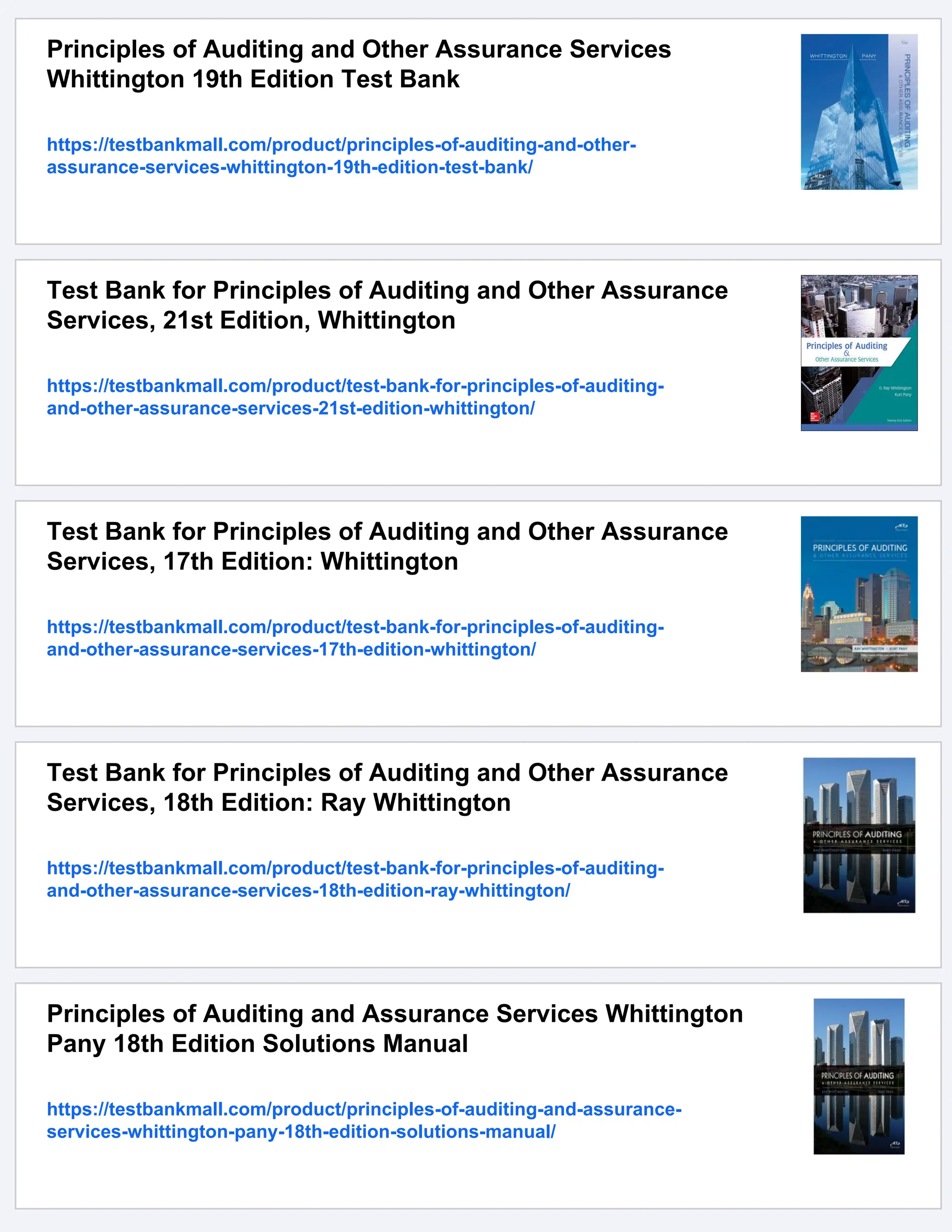
  • 2.
    Here are somerecommended products that we believe you will be interested in. You can click the link to download. Test Bank for McGraw-Hill Connect Resources for Whittington, Principles of Auditing and Other Assurance Services, 19e https://testbankmall.com/product/test-bank-for-mcgraw-hill-connect- resources-for-whittington-principles-of-auditing-and-other-assurance- services-19e/ Test Bank for McGraw-Hill Connect Resources for Whittington, Principles of Auditing and Other Assurance Services, 20e https://testbankmall.com/product/test-bank-for-mcgraw-hill-connect- resources-for-whittington-principles-of-auditing-and-other-assurance- services-20e/ Solution Manual for Principles of Auditing and Other Assurance Services, 21st Edition, Whittington https://testbankmall.com/product/solution-manual-for-principles-of- auditing-and-other-assurance-services-21st-edition-whittington/ Principles of Auditing and Other Assurance Services Whittington 19th Edition Solutions Manual https://testbankmall.com/product/principles-of-auditing-and-other- assurance-services-whittington-19th-edition-solutions-manual/

  • 3.
    Principles of Auditingand Other Assurance Services Whittington 19th Edition Test Bank https://testbankmall.com/product/principles-of-auditing-and-other- assurance-services-whittington-19th-edition-test-bank/ Test Bank for Principles of Auditing and Other Assurance Services, 21st Edition, Whittington https://testbankmall.com/product/test-bank-for-principles-of-auditing- and-other-assurance-services-21st-edition-whittington/ Test Bank for Principles of Auditing and Other Assurance Services, 17th Edition: Whittington https://testbankmall.com/product/test-bank-for-principles-of-auditing- and-other-assurance-services-17th-edition-whittington/ Test Bank for Principles of Auditing and Other Assurance Services, 18th Edition: Ray Whittington https://testbankmall.com/product/test-bank-for-principles-of-auditing- and-other-assurance-services-18th-edition-ray-whittington/ Principles of Auditing and Assurance Services Whittington Pany 18th Edition Solutions Manual https://testbankmall.com/product/principles-of-auditing-and-assurance- services-whittington-pany-18th-edition-solutions-manual/
  • 5.
    Solutions Manual, Chapter2, Page 2 of 14 Copyright © 2016 McGraw-Hill Education. All rights reserved. No reproduction or distribution without the prior written consent of McGraw-Hill Education. for: (1) audit evidence that contradicts other audit evidence, (2) information that raises a question about the reliability of documents and responses to inquiries, (3) conditions indicating possible fraud, and (4) circumstances suggesting the need for additional audit procedures beyond those ordinarily required. 2-6 The auditors' responsibilities concerning the detection of noncompliance with laws by clients depends on the relationship of the law or regulation to the financial statements. Certain laws and regulations, such as income tax laws, have a direct effect on the amounts and disclosures included in the financial statements. The auditors have a responsibility to design their audit to obtain reasonable assurance of detecting material violations of these laws and regulations. Many other laws and regulations, such as occupational safety and health laws, do not have a direct effect on the amounts included in the financial statements. An audit carried out in accordance with generally accepted auditing standards is not designed to detect client noncompliance with these other laws. Although an audit is not designed to provide reasonable assurance of detecting noncompliance with other laws, the CPAs should be aware of the possibility that they have occurred and investigate those identified. When they become aware of noncompliance with laws, the auditors should communicate the situation to the audit committee of the board of directors to remedy the situation and make appropriate modifications to the financial statements. If management fails to take appropriate action, the auditors should consider withdrawing from the engagement. 2-7 The first sentence of the quotation is correct. The completion of an audit of financial statements by a CPA following generally accepted auditing standards and satisfying the CPA provides the basis for expression of an unmodified opinion on the fairness of financial statements. The second sentence of the quotation is in error. Auditors never express an opinion (either qualified or unmodified) on the fairness of financial statements without first performing an audit. The audit provides the basis for the expression of an opinion. Such factors as audits made in prior years, confidence in management, and a "quick review" of the current year's financial statements are not an acceptable substitute for appropriate audit procedures. 2-8 The management of Pike Company is primarily responsible for the fairness of the company's financial statements. The retention of certified public accountants to perform an audit and express an opinion on the statements does not relieve management of its obligation to give an honest and complete accounting of its conduct of corporate affairs. 2-9 Independent Auditor’s Report To the Audit Committee of ABC Company We have audited the accompanying consolidated balance sheets of ABC Company and its subsidiaries, as of December 31, 20X1 and 20X0, and the related consolidated statements of income, retained earnings, and cash flows for the years then ended. Management's Responsibility for the Financial Statements Management is responsible for the preparation and fair presentation of these consolidated financial statements in accordance with accounting principles generally accepted in the United States of America; this includes the design, implementation, and maintenance of internal control relevant to the preparation and fair presentation of consolidated financial statements that are free from material misstatement, whether due to fraud or error.
  • 6.
    Solutions Manual, Chapter2, Page 3 of 14 Copyright © 2016 McGraw-Hill Education. All rights reserved. No reproduction or distribution without the prior written consent of McGraw-Hill Education. Auditor's Responsibility Our responsibility is to express an opinion on these consolidated financial statements based on our audit. We conducted our audit in accordance with auditing standards generally accepted in the United States of America. Those standards require that we plan and perform the audit to obtain reasonable assurance about whether the consolidated financial statements are free of material misstatement. An audit involves performing procedures to obtain audit evidence about the amounts and disclosures in the consolidated financial statements. The procedures selected depend on the auditor's judgment, including the assessment of the risks of material misstatement of the consolidated financial statements, whether due to fraud or error. In making those risk assessments, the auditor considers internal control relevant to the entity's preparation and fair presentation of the consolidated financial statements in order to design audit procedures that are appropriate in the circumstances, but not for the purpose of expressing an opinion on the effectiveness of the entity's internal control. An audit also includes evaluating the appropriateness of accounting policies used and the reasonableness of significant accounting estimates made by management, as well as evaluating the overall presentation of the consolidated financial statements. We believe that the audit evidence we have obtained is sufficient and appropriate to provide a basis for our audit opinion. Opinion In our opinion, the consolidated financial statements referred to above present fairly, in all material respects, the financial position of ABC Company and its subsidiaries as of December 31, 20X1 and 20X0, and the results of their operations and their cash flows for the years then ended in accordance with accounting principles generally accepted in the United States of America. Williams & Co. LLP Phoenix, Arizona February 5, 20X2 2-10 Among the more common situations which prevent the issuance of an unmodified opinion upon completion of an audit are the following: (1) Certain necessary auditing procedures were omitted at the request of the client, or for reasons beyond the control of the client or the auditors. (2) The statements contained misstatements (or omissions) and the client refuses to change them. 2-11 In the opinion paragraph of the auditor's standard report the auditors make representations as to the following: (1) The fairness of the financial statements, in all material respects. (2) Application of generally accepted accounting principles. (3) By implication consistent application of generally accepted accounting principles. (4) By implication adequate disclosure. 2-12 The issuance of a standard audit report tells us that the audit was performed in accordance with generally accepted auditing standards and, accordingly, it was planned and performed to obtain reasonable assurance about whether the financial statements are free of material misstatement due to error or fraud. The audit included performing procedures to obtain audit evidence about the amounts and disclosures in the financial statements. These procedures were determined based on the auditors’ judgment, including their assessment of the risks of material misstatements of the financial statements.
  • 7.
    Solutions Manual, Chapter2, Page 4 of 14 Copyright © 2016 McGraw-Hill Education. All rights reserved. No reproduction or distribution without the prior written consent of McGraw-Hill Education. The auditors also evaluated the appropriateness of accounting policies used by the client, the reasonableness of significant accounting estimates, and the overall presentation of the financial statements. 2-13 The auditors' report expresses an opinion on the client's financial statements, not on the accounting records. A major purpose of the audit is to give outsiders assurance that the financial statements are reliable. The client's accounting records are important to the public accounting firm only because they constitute evidence supporting the financial statements. The CPAs also gather evidence from outside the company and from internal sources other than the accounting records. 2-14 The public accounting firm must observe generally accepted auditing standards (or, if applicable, PCAOB Standards) in order to merit confidence in its opinion. The result of following these procedures is an audit report that includes a reasonable, but not absolute, assurance that the financial statements do not contain material misstatements due to errors or fraud. Reasonable assurance implies that there is a low level of risk remaining that the auditor expresses an opinion that the financial statements are properly stated when they are not. Reasonable and not absolute assurance is necessary due to (1) the nature of financial reporting (e.g., the necessary use of judgment), (2) the nature of audit procedures (e.g., they often do not provide absolutely conclusive evidence) and (3) the need to conduct an audit within a reasonable period of time at a reasonable cost. Accordingly, the auditor expresses an opinion on the financial statements, not a statement of fact. 2-15 Regardless of how careful and professional an audit of financial statements the public accounting firm has made, it cannot guarantee their correctness. The statements themselves include a variety of estimates; for example, the estimate of the allowance for uncollectible accounts and the choice of depreciation rates. Also, the auditors rely on a program of tests rather than on verifying every transaction. Some errors, therefore, may go undetected. The audit gives the auditors a firm basis for expressing an informed opinion on the financial statements, but no more than that. 2-16 A material amount is an amount that is sufficiently important to influence decisions made by reasonable users of financial statements. The amount may differ by account based on specific account characteristics. For example, a $100,000 shortage of cash may be extremely material to a small company, and a shortage of that amount might lead to bankruptcy. But, a $100,000 valuation overstatement of equipment may be of less significance if the company continues to produce its products and operate as in the past. Materiality is discussed further in Chapter 6. 2-17 If the guidance for a transaction or event is not specified within the authoritative GAAP (the FASB Codification), the auditor should first consider whether accounting principles for similar transactions or events exist within GAAP; if that is the case, those principles are followed to the extent considered appropriate. If not, nonauthoritative accounting guidance is consulted. Sources of nonauthoritative accounting guidance and literature include  Practices that are widely recognized and prevalent either generally or in the industry.  FASB Concepts Statements.  AICPA Issues Papers  International Financial Reporting Standards.  Pronouncements of professional associations or regulatory agencies.  Technical Information Service Inquiries and Replies included in AICPA  Technical Practice Aids.  Accounting textbooks, handbooks, and articles. The appropriateness of the above nonauthoritative accounting guidance and literature depends on its relevance to particular circumstances, how specific it is, the general recognition of the issuer or author as
  • 8.
    Solutions Manual, Chapter2, Page 5 of 14 Copyright © 2016 McGraw-Hill Education. All rights reserved. No reproduction or distribution without the prior written consent of McGraw-Hill Education. a authority, and the extent of its use in practice. 2-18 No. The attestation standards are meant to provide a general framework for the overall attestation function and do not supersede the generally accepted auditing standard which were developed for audits of annual historical financial statements. As a practical matter, the attestation standards are most directly relevant to attest engagements that are not covered by specific authoritative standards, such as attesting to attributes of computer software. 2-19 Quality control in a public accounting firm means policies and procedures which help assure that each audit meets at least a minimum standard of quality. Such control is vital because even one substandard audit could cause the firm to be defendant in a lawsuit that could threaten its continued existence. Peer reviews refer to a study and appraisal by an independent evaluator (“peer reviewer”) of a CPA firm’s work. In a system review, the evaluator considers the CPA firm’s system of quality control to perform accounting and auditing work. In an engagement review, the evaluator studies and evaluates a sample of a CPA firm’s actual accounting work, including accounting reports issued and documentation prepared by the CPA firm as well as other procedures that the firm performed. Engagement reviews are only available for CPA firms that do not perform audits or other similar engagements. Inspections are similar to peer reviews but are performed by the staff of the Public Company Accounting Oversight Board. However, in performing PCAOB inspections the staff focuses only on selected quality control issues and may consider aspects of practice management, such as the determination of partner compensation. In selecting audits and reviews for inspection, the PCAOB staff uses a risk assessment approach, which focuses on audits that have a high risk of lack of compliance. 2-20 (a) Engagement performance. The objective of quality control procedures in this area is to provide assurance that work performed is in accordance with professional standards and regulatory and legal requirements, with policies and procedures addressing: (1) engagement performance, (2) supervisions responsibilities and (3) review responsibilities. (b) Human resources. The objective of quality control procedures in this area is to provide assurance that the firm has personnel with the capabilities, competence and commitment to ethical principles to: (1) perform its engagements in accordance with professional standards and regulatory and legal requirements and (2) enable the firm to issue reports that are appropriate in the circumstances. (c) Monitoring. The objective of quality control procedures in this area is to determine that the policies and procedures established for each of the elements are suitably designed and effectively applied. 2-21 The AICPA’s Statement on Quality Control Standards identify six “elements” (areas) in which the Institute feels that quality control procedures are appropriate, but it does not require any specific quality control procedures. The Statement recognizes that specific procedures will vary among firms, depending upon the size of the firm, the number of offices, and the nature of the firm’s practice. 2-22 The duties of the Public Company Accounting Oversight Board include:  Register public accounting firms that prepare audit reports for financial statement issuers.  Establish or adopt auditing, quality control, ethics, independence and other standards relating to audit reports for issuers.  Conduct inspections of registered public accounting firms.
  • 9.
    Solutions Manual, Chapter2, Page 6 of 14 Copyright © 2016 McGraw-Hill Education. All rights reserved. No reproduction or distribution without the prior written consent of McGraw-Hill Education.  Perform other duties or functions to promote high professional standards for audits, enforce compliance with the enabling act establishing the Board (i.e., the Sarbanes-Oxley Act of 2002 discussed in Chapter 1), set the budget, and manage operations. 2-23 A system review involves peer reviewers’ study and appraisal of a CPA firm’s system of quality control to perform accounting and auditing work. A systems review includes determining whether the CPA firm’s system of quality control for its accounting and auditing practice (non-public clients) is designed and complied with to provide the CPA firm with reasonable assurance of performing and reporting in conformity with applicable standards, including the quality control standards. An engagement review is a type of peer review in which the peer reviewer selects a sample of a CPA firm’s actual accounting work, including accounting reports issued and documentation prepared by the CPA firm. This form of peer review is only available for CPA firms that do not perform audits, but do perform accounting work, including reviews and compilations. The objective of an engagement review is to evaluate whether the CPA firm’s reports are issued and procedures performed appropriately in accordance with applicable professional standards. 2-24 The international audit report differs from one based on PCAOB reporting standards in the following ways: (1) The international report has an expanded description of management’s responsibility for the financial statements and internal controls. (2) The report also includes an expanded explanation of the audit process, which includes a description of the auditors’ responsibility for internal control. (3) The international report allows the accountants the following reporting options: (a) Instead of indicating that the financial statements "present fairly, in all material respects," the accountants may substitute the phrase "give a true and fair view." (b) The report may indicate that the financial statements comply with the country's relevant statutes or laws. (c) The report may be signed using the personal name of the auditor, the firm, or both. (4) The city in which the auditors maintain an office is required to be included in the international report. Questions Requiring Analysis 2-25 The AICPA currently develops independence and ethical standards, quality control standards, and auditing and attestation standards that apply to its members. However, AICPA standards are applicable to the audits and auditors of nonpublic clients based on general acceptance by the courts, and adoption by state boards of accountancy and other regulatory bodies. The AICPA also has a voluntary peer review program, and enforces its standards on its members. The PCAOB was given the legal authority to develop independence and ethical standards, quality control standards, and auditing and attestation standards that apply to public company auditors and integrated audits. The PCAOB also is charged with performing inspections of registered audit firms, and may sanction the firms for noncompliance with its standards and the provisions of Sarbanes-Oxley Act.
  • 10.
    Solutions Manual, Chapter2, Page 7 of 14 Copyright © 2016 McGraw-Hill Education. All rights reserved. No reproduction or distribution without the prior written consent of McGraw-Hill Education. The state boards of accountancy regulate CPA firms and CPAs in the various states and jurisdictions. They have the authority to establish their own standards, but have generally adopted the standards of other bodies such as the AICPA and the PCAOB. A state board enforces its standards in its state or jurisdiction and has the authority to revoke a CPA firm or individual CPA’s right to practice in the state. 2-26 A firm of certified public accountants might find it difficult to maintain an attitude of independence during the audit of financial statements if the public accounting firm or a partner in the firm: (1) Derived a major portion of the firm's income from one client; (2) Had a personal financial interest in the company being audited; (3) Made the fee contingent upon the obtaining of a bank loan by the client; (4) Was financially indebted to the client; (5) Was a member of the board of directors of the client company or otherwise participated in the management of the company. 2-27 If the certified public accountant is appointed controller of the corporation, he or she loses the independent status which is the most essential qualification of the certified public accountant. The interests of the officers of a corporation may at times be in conflict with the interests of creditors, bankers, or stockholders. These outside groups are best protected when independent CPAs examine the financial statements prepared by management of the corporation. The performance of an internal audit function under the direction of the new controller may be a highly desirable step, but it does not eliminate the need for an independent audit. 2-28 (a) To satisfy an auditor's responsibilities to detect Smith's errors and fraud, Reed should:  Assess the risk that Smith's errors and fraud may cause its financial statements to contain a material misstatement.  Design the audit to provide reasonable assurance of detecting errors and fraud that are material to the financial statements. In designing the audit, the auditors should respond to risks by altering their overall approach to the audit or modifying the nature timing and extent of audit procedures. They should also perform procedures to address the risk of management override of internal control.  Exercise due care in planning, performing, and evaluating the results of audit procedures, and exercise the proper degree of professional skepticism to achieve reasonable assurance that material errors or fraud will be detected. (b) Reed's responsibilities to detect Smith's noncompliance with laws that have a material and direct effect on Smith's financial statements are the same as that for errors and fraud. Reed's responsibilities to detect noncompliance with laws that have an indirect effect on the financial statements are to be aware of the possibility that such noncompliance may have occurred. If specific information comes to Reed's attention that provides evidence concerning the possible existence of such noncompliance, Reed should apply audit procedures specifically directed to ascertaining whether noncompliance has occurred. (c) Reed's responsibilities when noncompliance with laws has been identified is to discuss the situation with top management and to notify the audit committee of the board of directors so that proper action can be taken, including making any necessary disclosures or adjustments to the financial statements. If the client fails to take appropriate corrective action, Reed should withdraw from the engagement. In addition, legal counsel or other appropriate specialist will generally be contacted by the CPA.
  • 11.
    Solutions Manual, Chapter2, Page 8 of 14 Copyright © 2016 McGraw-Hill Education. All rights reserved. No reproduction or distribution without the prior written consent of McGraw-Hill Education. 2-29 (a) The two forms of peer review are a system review and an engagement review. (b) The PCAOB inspections focus on the public-company audit practice of the firm. The inspections are designed to determine the firm’s compliance with the Sarbanes-Oxley Act, PCAOB and SEC requirements, and other professional standards. (c) An inspection involves at least the following three components: 1. An inspection and review of selected public-company audit and review engagements. 2. An evaluation of the sufficiency of the quality control system of the firm, and the manner of the documentation and communication of the system. 3. Performance of such other testing of the audit, supervisory, and quality control procedures as are considered necessary. PCAOB inspections differ from peer reviews in that the staff focuses only on selected quality control issues and may consider aspects of practice management, such as the determination of partner compensation. In selecting audits and reviews for inspection, the PCAOB staff uses a risk assessment approach, which focuses on audits that have a high risk of lack of compliance. (d) The PCAOB staff selects audit engagements for inspection on a risk basis. They select audits with a higher risk of lack of noncompliance with professional standards. In addition, for the selected audits, the staff focuses on the higher-risks aspects of the engagement. Objective Questions 2-30 Multiple Choice Questions (a) (4) Because the license to practice as a CPA is granted by the state, the applicable state, through its state board of accountancy, has the right to revoke the right of an individual to practice as a CPA. Students are sometimes confused by the fact that while the CPA examination is administered nationally, it is the individual states that award CPA certificates. (b) (2) The AICPA has authority to establish auditing standard for nonpublic companies. The Financial Accounting Standards board has authority for accounting standards of both public and nonpublic companies. The Public Company Accounting Oversight Board has authority to establish standards for audits and reviews of public companies, and quality controls for firms that audit public companies. (c) (2) FASB Concepts Statements are considered nonauthoritative guidance. The other replies all represent authoritative guidance. (d) (2) Financial statement audits provide reasonable, not absolute assurance. (e) (2) The quality control standards were established to provide reasonable assurance that professional services confirm with professional standards. Answer (1) is incomplete since many standards in addition to reporting standards must be followed. Answer (3) is incorrect because a peer review monitors whether a firm's quality control standards are being met. Answer (4) is incorrect because continuing professional education is only one part of a system of quality control.
  • 12.
    Solutions Manual, Chapter2, Page 9 of 14 Copyright © 2016 McGraw-Hill Education. All rights reserved. No reproduction or distribution without the prior written consent of McGraw-Hill Education. (f) (3) The internal control of the client is not explicitly mentioned in the unqualified standard report although it is implicit in the reference to generally accepted auditing standards. Answers (1), (2), and (4) are all explicitly set forth in the unqualified standard form of audit report. (g) (1) An independent mental attitude on the part of the auditor is required by the second general standard of the PCAOB. Answers (3) and (4) relate to the standards of field work. Answer (2) confuses generally accepted accounting principles with generally accepted auditing standards. (h) (3) Such a quality control policy is designed to assure that personnel assigned to an engagement are independent to perform the work, an ethical requirement. (i) (1) An audit provides reasonable assurance of detecting misstatements due to fraud, regardless of whether due to fraudulent financial reporting or misappropriation of assets. (j) (1) An integrated audit report on the financial statements of a public company states that the audit was performed in accordance with Public Company Accounting Oversight Board standards, not AICPA standards. (k) (3) The PCAOB staff performs inspections of audit firms that are registered with the PCAOB. In order to perform an audit of a public client an audit firm must be registered. (l) (4) Neither the AICPA audit report nor the international audit report include an opinion on internal control. The other replies provide actual differences between the two reports. 2-31 Adapted AICPA Task-Based Simulation Reviewer’s Comments Comment is correct (yes or no) Explanation of incorrect comments (not required) a. The report should not be addressed to management. Yes The report is ordinarily addressed to the audit committee, the board of directors, the shareholders or the company itself. b. The report should indicate that we have “audited,” rather than “examined” the financial statements (first paragraph after introduction). Yes c. The report should not indicate anything concerning management’s responsibility for internal control. No The report is correct as presented. d. The report should state that the auditor’s responsibility is to express “reasonable assurance,” not an opinion (first paragraph under “auditor’s responsibility). No While an audit does provide reasonable assurance, the report is correct as presented. e. The audit is designed to assess risks of material misstatements due to errors or fraud; the term “illegal acts” is incorrect (second paragraph under auditor’s Yes The word “errors” should replace “illegal acts” in the report (and the order of the terms should be reversed).
  • 13.
    Solutions Manual, Chapter2, Page 10 of 14 Copyright © 2016 McGraw-Hill Education. All rights reserved. No reproduction or distribution without the prior written consent of McGraw-Hill Education. responsibility). f. The report should not refer to an auditor as “evaluating the appropriateness of accounting policies,” since those are the responsibility of management. No An audit report does refer to the appropriateness of accounting policies g. The evidence should be sufficient and appropriate rather than “adequate” (third paragraph under auditor’s responsibility). Yes Self explanatory. h. The opinion should not include “in all material respects” since the auditor is providing an opinion on the accuracy of the financial statements (opinion paragraph). No Audits are performed to provide reasonable assurance of detecting material misstatements, and the report so indicates. i. The opinion should be on “accounting principles generally accepted in the United States of America,” not on auditing standards (opinion paragraph).” Yes The financial statements follow the appropriate accounting principles, while the audit follows generally accepted auditing standards. j. The signature on the report should be that of the CPA firm, not that of the partner. Yes While the international report allows the partner to sign the report (in addition to the CPA firm name), the GAAS report does not. 2-32 Statement Agree (A) or Disagree (D) Comment a. The report must begin with “CPA’s Report” at the top. D The top must have a title that includes the term “independent.” b. The report is ordinarily addressed “to whom it may concern.” D It is ordinarily addressed to the audit committee, the board of directors, or the company itself. c. The report indicates that management is responsible for the preparation of the financial statements. A d. The report indicates that the auditor’s responsibility is to obtain particular assurance about whether the financial statements are free of material misstatements. D Reasonable assurance is obtained. e. The report ordinarily concludes on whether the financial statements are in conformity with generally accepted auditing standards. D It concludes on whether the financial statements are in conformity with generally accepted accounting principles. f. The report indicates that the audit procedures selected depend on the auditor’s judgment. A g. The report indicates that the audit evidence obtained is sufficient and appropriate to provide a basis for the audit opinion. A h. The report indicates that the auditor considers and provides an opinion on internal control. D Internal control is considered, but no opinion is provide on it. 2-33
  • 14.
    Solutions Manual, Chapter2, Page 11 of 14 Copyright © 2016 McGraw-Hill Education. All rights reserved. No reproduction or distribution without the prior written consent of McGraw-Hill Education. Statement Type of Audit Report a. The auditors are unable to determine the overall fairness of the financial statements. D b. This is the report most clients prefer. S c. A limitation on the scope of the audit is significant, but not so as to overshadow an overall opinion. Q d. The financial statements are not fairly presented. A e. A material departure from GAAP exists, but not so material as to overshadow an overall opinion. Q 2-34 Principles Yes (Y) or No (N) Comment a. The purpose of an audit is to provide financial statement users with an opinion by the auditor on whether the financial statements are presented fairly, in all material and immaterial respects, in accordance with the applicable financial reporting framework. N Not “immaterial” b. The auditors are responsible for having appropriate competence and capabilities to perform the audit. Y c. The auditor is unable to obtain absolute assurance that the financial statements are free from material misstatement. Y d. The opinion states whether the financial statements are presented fairly, in all material respects, in accordance with the applicable financial reporting framework. Y e. Inherent limitations of an audit include the need to conduct an audit to achieve a balance between the benefit to management and the benefit to the auditors. N The balance is a proper balance between benefit and cost. 2-35 Definitions a. 3 Agreed-upon procedures report. b. 7 Audit report. c. 6 An unintentional misstatement. d. 8 Generally accepted accounting principles. e. 12 Misappropriation of assets. f. 4 A review of a CPA firm conducted by PCAOB. g. 10 Human resources and monitoring. h. 2 A CPA firm that may conduct audits of public or nonpublic companies.
  • 15.
    Solutions Manual, Chapter2, Page 12 of 14 Copyright © 2016 McGraw-Hill Education. All rights reserved. No reproduction or distribution without the prior written consent of McGraw-Hill Education. Problems 2-36 SOLUTION: White Company (Estimated time: 20 minutes) (a) No, Rezzo would not be justified in complying with White's request. Although Rezzo is a CPA, he has not audited the financial statements of White Company in accordance with generally accepted auditing standards. Preparation of financial statements cannot be construed as synonymous with auditing the statements. Furthermore, because of Rezzo's deep involvement with White Company, it is questionable whether he could maintain an independence of mental attitude if he did audit the financial statements. (b) If Rezzo were justified in issuing a standard audit report on the financial statements of White Company, he should not do so until he has completed an audit of the financial statements. The auditor does not express an opinion on financial statements without first performing an audit. (c) No, it would not be reasonable for the public accounting firm employing Rezzo to assign him to the audit of the White Company financial statements. Having himself prepared the financial statements; Rezzo would be in the position of attempting to independently evaluate the products of his own work. Independence of mental attitude in the appraisal of one's own work is extremely doubtful. 2-37 SOLUTION: Gray Manufacturing Corporation (Estimated time: 25 minutes) The following memorandum summarizes the response of Bart James, CPA, to the request of a client for extension of the attest function to the problem of pollution control. Dear John: As much as I support your strenuous efforts to minimize air and water pollution from the manufacturing operations of your company, there are specific reasons which make it impossible for me as a CPA to attest to the extent of your accomplishments in this area along the lines you have suggested. When we perform the attest function with respect to your financial statements each year, we are expressing our professional opinion that your financial statements are prepared in conformity with certain standards, which we call "generally accepted accounting principles." In order for us to attest to the effectiveness of your pollution control program, recognized standards would have to be established in this field. No such standards presently exist for a factory to the best of my knowledge. Of course the federal government has set standards for exhaust emissions on automobile engines and we could, by retaining independent consulting engineers, obtain a basis for attesting to the compliance of a given automobile engine to those standards. We are quite willing to extend the attest function in various directions if we can find a basis for objective comparison of a given operation with a clearly defined standard. Perhaps your engineering department can develop some specific quantitative data on the industrial waste from your operations. We might then be able to perform the necessary examination of such data to enable us to attest to the validity of your representations as to your operations. Of course, this would not be the same thing as providing your relative position in the industry. After reviewing this possibility with your engineering staff, if you would like to discuss the matter further with us, we will be glad to meet with you. Sincerely, Bart James In-Class Team Case
  • 16.
    Solutions Manual, Chapter2, Page 13 of 14 Copyright © 2016 McGraw-Hill Education. All rights reserved. No reproduction or distribution without the prior written consent of McGraw-Hill Education. 2-38 SOLUTION: Hide It (Estimated time: 25 minutes) (a) No, this is not an error since errors are unintentional. (b) This situation does appear to involve misstatements due to misappropriation of assets. It is a misstatement due to fraudulent financial reporting because of the omission of the information from the financial statements. If the $100,000 withdrawals have been abstracted for personal use, the situation also involves a misstatement arising from misappropriation of assets. (c) Certain laws have a direct effect on the financial statement amounts and are considered on every audit. An example is income tax law that affects the amount of income tax expense in the financial statements of most clients. This situation involves what appears to be non- compliance with a law that has a "direct effect" since, at a minimum; taxes have not been paid on the income involved. (d) The auditors will need to consider whether withdrawal is necessary, perhaps after consultation with their attorney. The case suggests that the unrecorded deposits occurred prior to current management involvement with the company. Note, however, that interest was earned during the period this management has been with the company, and withdrawals have been made during this same period. The auditors would wish to consider when current management became aware of the account and the nature of the withdrawals when considering whether to resign from the engagement. Research and Discussion Case 2-39 SOLUTION: Enormo Corporation (Estimated time: 45 minutes) (a) When the auditors discover illegal acts by a public client, they should consider three major factors. First, the auditors should consider the effect of the acts on the client's financial statements, including the possibility of fines and loss of business. To comply with generally accepted accounting principles, the financial statements must reflect the material effects of illegal acts. Second, the illegal acts may affect the auditors' assessment of the integrity of management. In deciding whether to continue to serve the client, the auditors should consider the nature of the illegal acts and management's response to the acts after they are uncovered. Third, the auditors should consider whether the occurrence of the illegal act indicates that there is a material weakness in the company’s internal control over financial reporting. (b) The following courses of action are available to the auditors: (1) The auditors could issue an unqualified opinion and take no further steps regarding the illegal activities. This course of action could be argued on the basis that the effect of the acts on the financial statements is not material. If the auditors take this course of action, they should also consider whether the illegal act and related actions by management and the board indicate a material weakness exists that would affect their report on internal control over financial reporting. (2) The auditors could issue a qualified opinion because the financial statements depart from generally accepted accounting principles, in that they fail to disclose the illegal acts. This course of action could be argued on the basis that any illegal activities by the client are material, especially when management fails to take any steps to prevent
  • 17.
    Solutions Manual, Chapter2, Page 14 of 14 Copyright © 2016 McGraw-Hill Education. All rights reserved. No reproduction or distribution without the prior written consent of McGraw-Hill Education. the acts. If the auditors take this course of action, they should also consider whether the illegal act and related actions by management and the board indicate a material weakness exists that would affect their report on internal control over financial reporting. (3) The auditors could withdraw from the engagement, because the client's failure to take actions to prevent such activities indicates that Enormo's management lacks sufficient integrity. (c) We believe that the auditors should consider withdrawing from the engagement. Enormo's top management seems far too complacent regarding these activities. Their refusal to take any action to prevent the acts in the future provides a signal to lower level management that top management approves of illegal acts. The auditors clearly should question the integrity of management in this situation.
  • 18.
    Exploring the Varietyof Random Documents with Different Content
  • 19.
    [248] of a dogsomewhere on land suggested a cabin and some few scattered inhabitants. They were quite a goodly company, this Maya band which escorted him from their city to some unknown destination. Johnny, with his white companions, rode in a large pit-pan. There were other crafts. From time to time he caught the sound of their dipping paddles, heard their low cries of warning as one boat came perilously near another. Twice they had made camp. At such times as this, blindfolded though he was, Johnny was able to estimate the number of men. “About a hundred,” he had said to Jean. “Quite a band,” she had agreed. “Wonder why so many?” “Who can tell?” The princess was with them. He heard her voice from time to time. The old chief, too, perhaps. He could not be sure of that. Wondering dreamily how it all would end, and wishing with all his heart that Jean at least was out of it all, he fell into a doze. From this he was awakened by a sudden movement of the boat. It was as if the hand of a giant had seized the prow and suddenly turned it through a quarter of a circle, then had given it a powerful shove. For a second the boy’s head whirled. “Wha—what has happened?” Jean whispered.
  • 20.
    [249] Johnny chuckled. “We’rein a larger river, much larger. In fact, it is a great river, and something tells me——,” his words came swift and eager now, “that it is the good old Rio Hondo!” “Johnny, it can’t be!” “It could be, and is!” said Johnny emphatically. “I haven’t ridden that old river for nothing. She has a way of teasing and tossing your dugout while she whirls it forward that no other river ever had. “Besides,” he added with another chuckle, “I can smell the water. It actually smells black.” “What’s that?” the girl exclaimed suddenly. “Sounds like thunder,” said Johnny. * * * * * * * * It was thunder, the forerunner of a storm. It was not a local storm, either, but one of those wide sweeping storms that tear at the timber on all the headwaters of a great river. Pant, at the edge of his camp, where he was assisting in shooting the last of the mahogany logs into their boom, heard it and his face grew thoughtful. The hour of great suspense came at last. Their boom was loaded. They were ready to go down the river. Daego had not yet led his men to the attack. “We’ll get away in the darkness,” Pant said to his Carib foreman, fairly dancing about in his eagerness to be away. “We’ll give old Daego the slip.”
  • 21.
    [250] Tivoli’s only replywas a sweep of the hand toward the blackening sky. As if in answer to his signal, there came crashing down upon them one of those sudden storms that are known only in the tropics. “We’ll get away under cover of the storm,” said Pant. “That will be better still.” “You don’t now these tropical storms,” said Tivoli. “All night in the rain fifteen men must work; fifteen men must rest, sleep beneath canvas in hammocks. Even with fifteen men we may not save the raft, tied up right here. You do not know the tropics. There will be water in the river, water in the sky. Which is river? Which is sky? You cannot tell. The river will rise like a tide. There will come down snags, great trees, palm trees, mahogany, yamra, black tamarind, santa maria, many, many snags. All night long, at the edge of the raft, we must fight these snags away. There will be no sleep for Tivoli tonight, and perhaps no logs for Mr. Johnny Thompson after that, either.” Tivoli was right. Such a storm as this was! Nothing of the kind had ever been witnessed by the boys before. Flash after flash of lightning, water in sheets, in streams, great avalanches of water that one could all but swim through. Rolling thunder vied with the increasing roar of black waters. And after that came the snags! And how those Caribs did work! All night, till the clock hand stood at three, they labored. Then the water began to subside. Then, exhausted, they threw themselves upon the bare logs and slept. “At dawn we are away,” muttered Tivoli.
  • 22.
    [251] [252] * * ** * * * * All that night, regardless of the lightning that set the water all agleam, in spite of the deluge of rain that fell, the Mayas and their blindfolded captives drifted silently down that broad river which indeed was Rio Hondo. Awnings of cloth, cunningly treated with the juice from the bark of the wild rubber tree, protected them from the rain. They were safe and dry. The river carried them onward. What more need they ask? * * * * * * * * At dawn, as a matchless sunrise painted the east red and gold, there appeared above Pant’s raft on the broad river a black line, a line not of drift logs, but dugouts, dories and pit-pans. Each craft was loaded with men, and as the sun sent its rays shooting across them they waved their hands and let forth a bloodcurdling shout. In each uplifted hand there gleamed a long bladed machete. “They come!” said Tivoli in response to Pant’s call. “Let them come. See that all the men are wakened quickly.”
  • 23.
    [253] CHAPTER XXV THE BATTLEOF RIO HONDO The battle of Rio Hondo will probably never be recorded on the printed pages of the history of Honduras or Mexico, but to the last day of his life it will remain indelibly stamped on Pant’s memory. As he caught the white gleam of machetes against the morning sky, many searching questions invaded his mind. He was about to engage in a battle that might mean the death of some faithful Carib. Was there yet an opportunity for parley, for compromise? No! It was too late. Yet, in their previous actions had there been blunders? Had he been too hasty? Could the fight have been avoided? These questions he could not fully answer; all he could say was that he had believed himself to be acting for the good of all. “As for compromise,” he told himself stoutly, “there can be no compromise with evil. This man Daego hesitates at nothing that he may gain a little more wealth, wealth for which he has no need. The men we must fight have sold their souls to him.” Having thus put himself at peace with his own mind, he set calmly about the task of posting his men.
  • 24.
    [254] The purpose ofthe raiders was to break up his raft. If they could but sever the encircling boom, his logs would be set free, each to find its separate way to the ocean. They would then be lost to him forever. One anxious glance he cast toward the approaching boats. One thing he feared most of all,—firearms. “He wouldn’t dare,” Pant told himself, as no rifle or pistol appeared in the uplifted hands. “A fight between crews is one thing; wholesale slaughter quite another. The laws of Great Britain are strict, her officers tireless.” His eyes gleamed with a touch of pride as he surveyed his small army of defense. What stalwart fellows they were! How their dark arms gleamed in the sun! From the belt of each hung a machete. These they had been ordered to use only as a last resort. By the side of each, grounded like a rifle, was a stout six-foot mahogany pike-pole. He had taught them the last trick of offense and defense with these weapons. So they waited as on came the invading host. In the hands of some he saw the white gleam of sapodilla axe handles. With these axes they would attempt to loosen a chain of the boom or chop a log of it in two. Others balanced heavy sledges on the edge of their boats. With these they hoped to sever the chains. Their machetes were for defense. They waved them to intimidate the Caribs. “Not so easily done,” Pant smiled grimly as his Caribs sent back a ringing cry of defiance. “Don’t let a man of them board us,” was the last word Pant passed along the line. “If they gain a footing on
  • 25.
    [255] [256] the raft we’relost. If one gets aboard, double on him and pitch him overboard.” As the dark line advanced it spread out fan-shape; then, with every wild-eyed Spaniard of them all splitting his lungs in a savage yell, they shot their crafts alongside. With drawn machetes they leaped for the first mahogany logs that lay against the boom. But what was this? As they swung their machetes threateningly, they received a rain of blows that sent many a machete whirling through space to find its watery grave beneath the black waters. Against such an offensive they were not able to stand. Seizing their paddles, they backed away to a respectful distance, there to hold a council of war. The result of this council Pant read as if it were an open book. With machetes sheathed, but with axes and sledges at hand, the enemy spread out to advance upon the raft from every side. By this Pant judged that they hoped to scatter his men and to effect a break in the boom that would not only set his logs free, but throw his Caribs into the river, there to fight for their lives against pitching, grinding logs and lurking alligators. One move he had not anticipated became apparent soon enough. The instant their boats touched, as the Caribs rushed at them with their mahogany pikes, the Spaniards who were not armed with sledges and axes did their best to seize the pikes and wrest them from the Caribs. In this, here and there, they were successful, and always in the corner where this occurred, the tide began to turn. It was one thing to prod and beat a Spaniard; quite another to be prodden
  • 26.
    [257] and beaten byhim. In the meantime, keen oars flashed here and there. There came the disheartening chop- chop of axes and the thud of sledges that told that at any moment the boom might be broken, the battle lost. Heroic work was going on at every point. Outnumbered almost two to one, the Caribs fought valiantly. With their wild shouts forever on their lips, they seized fresh pikes when one was lost and fought with renewed vigor. Tivoli, their chief, seemed everywhere at once. His great strength served him well. Here, where a sledge was battering dangerously at a chain, he made a mighty thrust, swinging his pike sidewise at a Spaniard’s head. The sledge splashed into the water. Danger at this point was at an end. Here an axe swung in air to meet with Tivoli’s well aimed pike and go spinning through air to join the sledge. But for all this, the battle was going badly. Here and there a chain was badly battered and in several places a log of the boom was half cut through. Seeing his men outnumbered where ten Spaniards crowded a single dugout, Pant, whose slight strength had lost him his pike at the very onset, seized a pike aimed at his head and, gripping hard, executed a flying pole vault right over the heads of the enemy and into the booming waters. The result was all that could be hoped for. The Spaniard, who still clung to the pike, was dragged half out of the dugout, whereupon that unstable craft promptly capsized, pitching ten lusty attackers, axes, sledges and all, into the river.
  • 27.
    [258] Tivoli, too, losthis pike. Angered at this victory on the part of an enemy, he watched his chance and when the Spaniard swung his pike to one side, with bare hands and unarmed, Tivoli rushed at him and rained such blows on his head as drove him to drop his pike and leap into the river. This much for scattered conflicts. Victory here and there along the line; more than one Spaniard in the river; but for all that, here and there the boom was being dangerously weakened. The battle was going badly. “Only a matter of time,” thought Pant, as he struggled back to the raft. “A half hour; perhaps less. Then our work is all undone!” * * * * * * * * Just as the storm came to an end and morning broke, Johnny Thompson, still blindfolded and riding among the Mayas, felt his boat swerve sharply to the right and enter a small creek where overhanging branches swept the awnings over the boats. They had not gone far up this stream before their boat bumped the bank and they were helped to disembark. Imagine their surprise and joy when someone, very short, very laughingly tugged away the cloths that blinded them and permitted them for the first time in two days to see. “See!” exclaimed the princess, for it was she who had unbound their eyes. “See what a beautiful world we have brought you to!”
  • 28.
    [259] [260] It was indeeda beautiful world. All a-glitter with raindrops flashing in the sun, palms and giant tropical ferns had never seemed so lovely as now. Birds sang their best. Even the screaming parrots, that they might not be entirely out of harmony, appeared to soften their discordant notes. But into this symphony there crept a wildly disturbing sound. Dim, indistinct, yet unmistakable, there came the noise of battle. At the first sound of it, Johnny Thompson glanced wildly about him. Then, having sighted down the creek a familiar bend in the river, he exclaimed: “It’s Daego. The battle is on! They are not a mile from here. I must go!” Seizing the prow of a boat, he pushed it into the stream, sprang in, seized a paddle, and would have been away, single-handed, to enter the conflict. They dragged him back. The old chief tried to learn, from Johnny’s wild flinging arms, what it was all about. In the end he appeared to understand, for, after instructing his men to look to their weapons, he ordered them into their boats. Once more the Mayas, a hundred strong, swept down the river, grim, silent, determined. So it happened that a second time that day Pant saw the river above his raft lined with boats. “Friends or enemies?” he thought. “Let them come. Without aid we lose. More of the enemy cannot matter.”
  • 29.
    [261] As for Daego’smen, they watched the on-coming fleet with consternation. Daego had no men up the river. They knew that. Who, then, were these? As the fleet came closer, a figure standing in the prow of the foremost boat became plainly visible. He was waving his arms and shouting wildly. It was Johnny. One of Daego’s keen-eyed Spaniards was the first to recognize him. With a wild cry of fear he dashed for his pit-pan. “There is the man who has died,” he shouted. “His ghost has been seen many times above the treetops. Now he comes back. He is a ghost. Who are these with him? They have gleaming spears. They, too, are ghosts.” So he thought, and prepared to flee. So thought they all. To a man they dropped oar, maul, pike, pole or machete, and turned to flee. When Johnny’s boat bumped the raft there was not a Spaniard within gunshot. But what was this? As he turned about to look at his companions in the boat he saw only Roderick and Jean. By some skillful trick of boatmanship or swimming, the Maya paddlers had left the boat. Now, some distance away, the Maya princess was waving them farewell as the remaining boats went speeding back up the river. “That’s funny,” said Johnny. “How—how strange and ghost-like!” murmured Jean. “Nothing ghost-like about this,” said Johnny, as he patted his pack which held the rare Maya god.
  • 30.
    [262] The joyful reunionthat followed was cut short by the pressing business of getting the log boom started down the river. The motor boat was brought around, the Carib sail boats hitched on behind, and they were away. Hardgrave, who knew Jean’s father and the location of his camp, advised her and Roderick to go with them down the river. This advice was not unwelcome, especially to Johnny, who felt that he could never see too much of the bonny Scotch girl. They had made their slow way down two-thirds of the distance when a strange procession caught up with and passed them. Motor boats, launches, flatboats, and pit- pans moved by. Each was loaded to capacity with the strangest cargoes. Here were four tractors on a flat- boat; there many wheels that might have belonged to cannons, but did belong to logging wagons; here a pit- pan loaded high with great vats and kettles that had once held the boiling sap of the sapodilla tree. So they drifted by. It was like the passing of a defeated army. And so it was. The defeated king of the Black River was leaving the Rio Hondo forever. Two weeks later, with his treasure of red lure safely piled at the waterfront in Belize, Johnny met his millionaire friend, Roderick Grayson, at the dock as a United Fruit steamer’s launch came in. Three days later, in Johnny’s room at the hotel, Grayson met the Governor of Quintanaroo and together they drew up contracts which were to mean much, not only to Quintanaroo and Grayson, but to Johnny and Pant as well. In each contract it was agreed that Grayson’s company was to pay the boys a royalty, a wee bit of a royalty on their entire output and, though the percentage is small, the output is destined to be large,
  • 31.
    [263] and there isno reason to believe that the two boys will lack for funds for travel and adventure in the future. The rare Maya god found its way to a museum in London. The proceeds from its sale Johnny insisted upon dividing with Jean. There was talk of spending the whole of it in a visit to London and the Old World by Jean and her family, accompanied by Johnny and Pant. At about this time, however, Johnny chanced to wander down to the breakwater, where little boats anchor, and there he met a strange seafaring man who had a strange tale to tell. And right there began one of the most unusual adventures that ever befell Johnny Thompson. You will find it all written down in our next book, “Forbidden Cargoes”.
  • 32.
    The Roy J.Snell Books Mr. Snell is a versatile writer who knows how to write stories that will please boys and girls. He has traveled widely, visited many out-of-the-way corners of the earth, and being a keen observer has found material for many thrilling stories. His stories are full of adventure and mystery, yet in the weaving of the story there are little threads upon which are hung lessons in loyalty, honesty, patriotism and right living. Mr. Snell has created a wide audience among the younger readers of America. Boy or girl, you are sure to find a Snell book to your liking. His works cover a wide and interesting scope. Here are the titles of the Snell Books: Mystery Stories for Boys 1. Triple Spies 2. Lost in the Air
  • 33.
    3. Panther Eye 4.The Crimson Flash 5. White Fire 6. The Black Schooner 7. The Hidden Trail 8. The Firebug 9. The Red Lure 10. Forbidden Cargoes 11. Johnny Longbow 12. The Rope of Gold 13. The Arrow of Fire 14. The Gray Shadow 15. Riddle of the Storm 16. The Galloping Ghost 17. Whispers at Dawn; or, The Eye 18. Mystery Wings 19. Red Dynamite 20. The Seal of Secrecy 21. The Shadow Passes 22. Sign of the Green Arrow The Radio-Phone Boys’ Series 1. Curlie Carson Listens In 2. On the Yukon Trail 3. The Desert Patrol 4. The Seagoing Tank 5. The Flying Sub 6. Dark Treasure 7. Whispering Isles 8. Invisible Wall
  • 34.
    Adventure Stories forGirls 1. The Blue Envelope 2. The Cruise of the O’Moo 3. The Secret Mark 4. The Purple Flame 5. The Crimson Thread 6. The Silent Alarm 7. The Thirteenth Ring 8. Witches Cove 9. The Gypsy Shawl 10. Green Eyes 11. The Golden Circle 12. The Magic Curtain 13. Hour of Enchantment 14. The Phantom Violin 15. Gypsy Flight 16. The Crystal Ball 17. A Ticket to Adventure 18. The Third Warning
  • 35.
    Transcriber’s Notes Copyright noticeprovided as in the original printed text —this e-text is public domain in the country of publication. Silently corrected palpable typos; left non-standard spellings and dialect unchanged. Relocated promotional material to the end of the book, and completed the list of books in the three series (using other sources).
  • 36.
    *** END OFTHE PROJECT GUTENBERG EBOOK THE RED LURE *** Updated editions will replace the previous one—the old editions will be renamed. Creating the works from print editions not protected by U.S. copyright law means that no one owns a United States copyright in these works, so the Foundation (and you!) can copy and distribute it in the United States without permission and without paying copyright royalties. Special rules, set forth in the General Terms of Use part of this license, apply to copying and distributing Project Gutenberg™ electronic works to protect the PROJECT GUTENBERG™ concept and trademark. Project Gutenberg is a registered trademark, and may not be used if you charge for an eBook, except by following the terms of the trademark license, including paying royalties for use of the Project Gutenberg trademark. If you do not charge anything for copies of this eBook, complying with the trademark license is very easy. You may use this eBook for nearly any purpose such as creation of derivative works, reports, performances and research. Project Gutenberg eBooks may be modified and printed and given away—you may do practically ANYTHING in the United States with eBooks not protected by U.S. copyright law. Redistribution is subject to the trademark license, especially commercial redistribution. START: FULL LICENSE
  • 37.
    THE FULL PROJECTGUTENBERG LICENSE
  • 38.
    PLEASE READ THISBEFORE YOU DISTRIBUTE OR USE THIS WORK To protect the Project Gutenberg™ mission of promoting the free distribution of electronic works, by using or distributing this work (or any other work associated in any way with the phrase “Project Gutenberg”), you agree to comply with all the terms of the Full Project Gutenberg™ License available with this file or online at www.gutenberg.org/license. Section 1. General Terms of Use and Redistributing Project Gutenberg™ electronic works 1.A. By reading or using any part of this Project Gutenberg™ electronic work, you indicate that you have read, understand, agree to and accept all the terms of this license and intellectual property (trademark/copyright) agreement. If you do not agree to abide by all the terms of this agreement, you must cease using and return or destroy all copies of Project Gutenberg™ electronic works in your possession. If you paid a fee for obtaining a copy of or access to a Project Gutenberg™ electronic work and you do not agree to be bound by the terms of this agreement, you may obtain a refund from the person or entity to whom you paid the fee as set forth in paragraph 1.E.8. 1.B. “Project Gutenberg” is a registered trademark. It may only be used on or associated in any way with an electronic work by people who agree to be bound by the terms of this agreement. There are a few things that you can do with most Project Gutenberg™ electronic works even without complying with the full terms of this agreement. See paragraph 1.C below. There are a lot of things you can do with Project Gutenberg™ electronic works if you follow the terms of this agreement and help preserve free future access to Project Gutenberg™ electronic works. See paragraph 1.E below.
  • 39.
    1.C. The ProjectGutenberg Literary Archive Foundation (“the Foundation” or PGLAF), owns a compilation copyright in the collection of Project Gutenberg™ electronic works. Nearly all the individual works in the collection are in the public domain in the United States. If an individual work is unprotected by copyright law in the United States and you are located in the United States, we do not claim a right to prevent you from copying, distributing, performing, displaying or creating derivative works based on the work as long as all references to Project Gutenberg are removed. Of course, we hope that you will support the Project Gutenberg™ mission of promoting free access to electronic works by freely sharing Project Gutenberg™ works in compliance with the terms of this agreement for keeping the Project Gutenberg™ name associated with the work. You can easily comply with the terms of this agreement by keeping this work in the same format with its attached full Project Gutenberg™ License when you share it without charge with others. 1.D. The copyright laws of the place where you are located also govern what you can do with this work. Copyright laws in most countries are in a constant state of change. If you are outside the United States, check the laws of your country in addition to the terms of this agreement before downloading, copying, displaying, performing, distributing or creating derivative works based on this work or any other Project Gutenberg™ work. The Foundation makes no representations concerning the copyright status of any work in any country other than the United States. 1.E. Unless you have removed all references to Project Gutenberg: 1.E.1. The following sentence, with active links to, or other immediate access to, the full Project Gutenberg™ License must appear prominently whenever any copy of a Project Gutenberg™ work (any work on which the phrase “Project
  • 40.
    Gutenberg” appears, orwith which the phrase “Project Gutenberg” is associated) is accessed, displayed, performed, viewed, copied or distributed: This eBook is for the use of anyone anywhere in the United States and most other parts of the world at no cost and with almost no restrictions whatsoever. You may copy it, give it away or re-use it under the terms of the Project Gutenberg License included with this eBook or online at www.gutenberg.org. If you are not located in the United States, you will have to check the laws of the country where you are located before using this eBook. 1.E.2. If an individual Project Gutenberg™ electronic work is derived from texts not protected by U.S. copyright law (does not contain a notice indicating that it is posted with permission of the copyright holder), the work can be copied and distributed to anyone in the United States without paying any fees or charges. If you are redistributing or providing access to a work with the phrase “Project Gutenberg” associated with or appearing on the work, you must comply either with the requirements of paragraphs 1.E.1 through 1.E.7 or obtain permission for the use of the work and the Project Gutenberg™ trademark as set forth in paragraphs 1.E.8 or 1.E.9. 1.E.3. If an individual Project Gutenberg™ electronic work is posted with the permission of the copyright holder, your use and distribution must comply with both paragraphs 1.E.1 through 1.E.7 and any additional terms imposed by the copyright holder. Additional terms will be linked to the Project Gutenberg™ License for all works posted with the permission of the copyright holder found at the beginning of this work.
  • 41.
    1.E.4. Do notunlink or detach or remove the full Project Gutenberg™ License terms from this work, or any files containing a part of this work or any other work associated with Project Gutenberg™. 1.E.5. Do not copy, display, perform, distribute or redistribute this electronic work, or any part of this electronic work, without prominently displaying the sentence set forth in paragraph 1.E.1 with active links or immediate access to the full terms of the Project Gutenberg™ License. 1.E.6. You may convert to and distribute this work in any binary, compressed, marked up, nonproprietary or proprietary form, including any word processing or hypertext form. However, if you provide access to or distribute copies of a Project Gutenberg™ work in a format other than “Plain Vanilla ASCII” or other format used in the official version posted on the official Project Gutenberg™ website (www.gutenberg.org), you must, at no additional cost, fee or expense to the user, provide a copy, a means of exporting a copy, or a means of obtaining a copy upon request, of the work in its original “Plain Vanilla ASCII” or other form. Any alternate format must include the full Project Gutenberg™ License as specified in paragraph 1.E.1. 1.E.7. Do not charge a fee for access to, viewing, displaying, performing, copying or distributing any Project Gutenberg™ works unless you comply with paragraph 1.E.8 or 1.E.9. 1.E.8. You may charge a reasonable fee for copies of or providing access to or distributing Project Gutenberg™ electronic works provided that: • You pay a royalty fee of 20% of the gross profits you derive from the use of Project Gutenberg™ works calculated using the method you already use to calculate your applicable taxes. The fee is owed to the
  • 42.
    owner of theProject Gutenberg™ trademark, but he has agreed to donate royalties under this paragraph to the Project Gutenberg Literary Archive Foundation. Royalty payments must be paid within 60 days following each date on which you prepare (or are legally required to prepare) your periodic tax returns. Royalty payments should be clearly marked as such and sent to the Project Gutenberg Literary Archive Foundation at the address specified in Section 4, “Information about donations to the Project Gutenberg Literary Archive Foundation.” • You provide a full refund of any money paid by a user who notifies you in writing (or by e-mail) within 30 days of receipt that s/he does not agree to the terms of the full Project Gutenberg™ License. You must require such a user to return or destroy all copies of the works possessed in a physical medium and discontinue all use of and all access to other copies of Project Gutenberg™ works. • You provide, in accordance with paragraph 1.F.3, a full refund of any money paid for a work or a replacement copy, if a defect in the electronic work is discovered and reported to you within 90 days of receipt of the work. • You comply with all other terms of this agreement for free distribution of Project Gutenberg™ works. 1.E.9. If you wish to charge a fee or distribute a Project Gutenberg™ electronic work or group of works on different terms than are set forth in this agreement, you must obtain permission in writing from the Project Gutenberg Literary Archive Foundation, the manager of the Project Gutenberg™ trademark. Contact the Foundation as set forth in Section 3 below.
  • 43.
    1.F. 1.F.1. Project Gutenbergvolunteers and employees expend considerable effort to identify, do copyright research on, transcribe and proofread works not protected by U.S. copyright law in creating the Project Gutenberg™ collection. Despite these efforts, Project Gutenberg™ electronic works, and the medium on which they may be stored, may contain “Defects,” such as, but not limited to, incomplete, inaccurate or corrupt data, transcription errors, a copyright or other intellectual property infringement, a defective or damaged disk or other medium, a computer virus, or computer codes that damage or cannot be read by your equipment. 1.F.2. LIMITED WARRANTY, DISCLAIMER OF DAMAGES - Except for the “Right of Replacement or Refund” described in paragraph 1.F.3, the Project Gutenberg Literary Archive Foundation, the owner of the Project Gutenberg™ trademark, and any other party distributing a Project Gutenberg™ electronic work under this agreement, disclaim all liability to you for damages, costs and expenses, including legal fees. YOU AGREE THAT YOU HAVE NO REMEDIES FOR NEGLIGENCE, STRICT LIABILITY, BREACH OF WARRANTY OR BREACH OF CONTRACT EXCEPT THOSE PROVIDED IN PARAGRAPH 1.F.3. YOU AGREE THAT THE FOUNDATION, THE TRADEMARK OWNER, AND ANY DISTRIBUTOR UNDER THIS AGREEMENT WILL NOT BE LIABLE TO YOU FOR ACTUAL, DIRECT, INDIRECT, CONSEQUENTIAL, PUNITIVE OR INCIDENTAL DAMAGES EVEN IF YOU GIVE NOTICE OF THE POSSIBILITY OF SUCH DAMAGE. 1.F.3. LIMITED RIGHT OF REPLACEMENT OR REFUND - If you discover a defect in this electronic work within 90 days of receiving it, you can receive a refund of the money (if any) you paid for it by sending a written explanation to the person you received the work from. If you received the work on a physical medium, you must return the medium with your written
  • 44.
    explanation. The personor entity that provided you with the defective work may elect to provide a replacement copy in lieu of a refund. If you received the work electronically, the person or entity providing it to you may choose to give you a second opportunity to receive the work electronically in lieu of a refund. If the second copy is also defective, you may demand a refund in writing without further opportunities to fix the problem. 1.F.4. Except for the limited right of replacement or refund set forth in paragraph 1.F.3, this work is provided to you ‘AS-IS’, WITH NO OTHER WARRANTIES OF ANY KIND, EXPRESS OR IMPLIED, INCLUDING BUT NOT LIMITED TO WARRANTIES OF MERCHANTABILITY OR FITNESS FOR ANY PURPOSE. 1.F.5. Some states do not allow disclaimers of certain implied warranties or the exclusion or limitation of certain types of damages. If any disclaimer or limitation set forth in this agreement violates the law of the state applicable to this agreement, the agreement shall be interpreted to make the maximum disclaimer or limitation permitted by the applicable state law. The invalidity or unenforceability of any provision of this agreement shall not void the remaining provisions. 1.F.6. INDEMNITY - You agree to indemnify and hold the Foundation, the trademark owner, any agent or employee of the Foundation, anyone providing copies of Project Gutenberg™ electronic works in accordance with this agreement, and any volunteers associated with the production, promotion and distribution of Project Gutenberg™ electronic works, harmless from all liability, costs and expenses, including legal fees, that arise directly or indirectly from any of the following which you do or cause to occur: (a) distribution of this or any Project Gutenberg™ work, (b) alteration, modification, or additions or deletions to any Project Gutenberg™ work, and (c) any Defect you cause.