Visit https://testbankmall.com to download the full version and
browse more test banks or solution manuals
Solution Manual for McGraw-Hill Connect Resources
for Whittington, Principles of Auditing and Other
Assurance Services, 19e
_____ Press the link below to begin your download _____
https://testbankmall.com/product/solution-manual-for-mcgraw-
hill-connect-resources-for-whittington-principles-of-
auditing-and-other-assurance-services-19e/
Access testbankmall.com now to download high-quality
test banks or solution manuals
Here are some recommended products for you. Click the link to
download, or explore more at testbankmall.com
Test Bank for McGraw-Hill Connect Resources for
Whittington, Principles of Auditing and Other Assurance
Services, 19e
https://testbankmall.com/product/test-bank-for-mcgraw-hill-connect-
resources-for-whittington-principles-of-auditing-and-other-assurance-
services-19e/
Test Bank for McGraw-Hill Connect Resources for
Whittington, Principles of Auditing and Other Assurance
Services, 20e
https://testbankmall.com/product/test-bank-for-mcgraw-hill-connect-
resources-for-whittington-principles-of-auditing-and-other-assurance-
services-20e/
Solution Manual for Principles of Auditing and Other
Assurance Services, 21st Edition, Whittington
https://testbankmall.com/product/solution-manual-for-principles-of-
auditing-and-other-assurance-services-21st-edition-whittington/
Test Bank for Criminology, 4th Edition, Frank Schmalleger
https://testbankmall.com/product/test-bank-for-criminology-4th-
edition-frank-schmalleger/
Test Bank for Holes Human Anatomy and Physiology 13th
Edition by Shier
https://testbankmall.com/product/test-bank-for-holes-human-anatomy-
and-physiology-13th-edition-by-shier/
Test Bank for Dimensional Analysis Calculating Dosages
Safely 2nd by Horntvedt
https://testbankmall.com/product/test-bank-for-dimensional-analysis-
calculating-dosages-safely-2nd-by-horntvedt/
Operations Management Krajewski 9th Edition Solutions
Manual
https://testbankmall.com/product/operations-management-krajewski-9th-
edition-solutions-manual/
Leadership Enhancing the Lessons of Experience, 8th
Edition Test Bank – Richard Hughes
https://testbankmall.com/product/leadership-enhancing-the-lessons-of-
experience-8th-edition-test-bank-richard-hughes/
Test Bank for Essentials of Anatomy and Physiology 7th
Edition by Martini
https://testbankmall.com/product/test-bank-for-essentials-of-anatomy-
and-physiology-7th-edition-by-martini/
Solution Manual for Understanding Our Universe 3rd
Edition, by Stacy Palen Laura Kay George Blumenthal
https://testbankmall.com/product/solution-manual-for-understanding-
our-universe-3rd-edition-by-stacy-palen-laura-kay-george-blumenthal/
Solutions Manual, Chapter 2, Page 2 of 14
Copyright © 2016 McGraw-Hill Education. All rights reserved. No reproduction or distribution without the prior written
consent of McGraw-Hill Education.
for: (1) audit evidence that contradicts other audit evidence, (2) information that raises a question
about the reliability of documents and responses to inquiries, (3) conditions indicating possible fraud,
and (4) circumstances suggesting the need for additional audit procedures beyond those ordinarily
required.
2-6 The auditors' responsibilities concerning the detection of noncompliance with laws by clients depends
on the relationship of the law or regulation to the financial statements. Certain laws and regulations,
such as income tax laws, have a direct effect on the amounts and disclosures included in the financial
statements. The auditors have a responsibility to design their audit to obtain reasonable assurance of
detecting material violations of these laws and regulations.
Many other laws and regulations, such as occupational safety and health laws, do not have a
direct effect on the amounts included in the financial statements. An audit carried out in accordance
with generally accepted auditing standards is not designed to detect client noncompliance with these
other laws.
Although an audit is not designed to provide reasonable assurance of detecting noncompliance
with other laws, the CPAs should be aware of the possibility that they have occurred and investigate
those identified. When they become aware of noncompliance with laws, the auditors should
communicate the situation to the audit committee of the board of directors to remedy the situation and
make appropriate modifications to the financial statements. If management fails to take appropriate
action, the auditors should consider withdrawing from the engagement.
2-7 The first sentence of the quotation is correct. The completion of an audit of financial statements by a
CPA following generally accepted auditing standards and satisfying the CPA provides the basis for
expression of an unmodified opinion on the fairness of financial statements.
The second sentence of the quotation is in error. Auditors never express an opinion (either
qualified or unmodified) on the fairness of financial statements without first performing an audit. The
audit provides the basis for the expression of an opinion. Such factors as audits made in prior years,
confidence in management, and a "quick review" of the current year's financial statements are not an
acceptable substitute for appropriate audit procedures.
2-8 The management of Pike Company is primarily responsible for the fairness of the company's financial
statements. The retention of certified public accountants to perform an audit and express an opinion
on the statements does not relieve management of its obligation to give an honest and complete
accounting of its conduct of corporate affairs.
2-9
Independent Auditor’s Report
To the Audit Committee of ABC Company
We have audited the accompanying consolidated balance sheets of ABC Company and its subsidiaries,
as of December 31, 20X1 and 20X0, and the related consolidated statements of income, retained
earnings, and cash flows for the years then ended.
Management's Responsibility for the Financial Statements
Management is responsible for the preparation and fair presentation of these consolidated financial
statements in accordance with accounting principles generally accepted in the United States of
America; this includes the design, implementation, and maintenance of internal control relevant to the
preparation and fair presentation of consolidated financial statements that are free from material
misstatement, whether due to fraud or error.
Solutions Manual, Chapter 2, Page 3 of 14
Copyright © 2016 McGraw-Hill Education. All rights reserved. No reproduction or distribution without the prior written
consent of McGraw-Hill Education.
Auditor's Responsibility
Our responsibility is to express an opinion on these consolidated financial statements based on our
audit. We conducted our audit in accordance with auditing standards generally accepted in the United
States of America. Those standards require that we plan and perform the audit to obtain reasonable
assurance about whether the consolidated financial statements are free of material misstatement.
An audit involves performing procedures to obtain audit evidence about the amounts and disclosures
in the consolidated financial statements. The procedures selected depend on the auditor's judgment,
including the assessment of the risks of material misstatement of the consolidated financial statements,
whether due to fraud or error. In making those risk assessments, the auditor considers internal control
relevant to the entity's preparation and fair presentation of the consolidated financial statements in
order to design audit procedures that are appropriate in the circumstances, but not for the purpose of
expressing an opinion on the effectiveness of the entity's internal control. An audit also includes
evaluating the appropriateness of accounting policies used and the reasonableness of significant
accounting estimates made by management, as well as evaluating the overall presentation of the
consolidated financial statements.
We believe that the audit evidence we have obtained is sufficient and appropriate to provide a basis for
our audit opinion.
Opinion
In our opinion, the consolidated financial statements referred to above present fairly, in all material
respects, the financial position of ABC Company and its subsidiaries as of December 31, 20X1 and
20X0, and the results of their operations and their cash flows for the years then ended in accordance
with accounting principles generally accepted in the United States of America.
Williams & Co. LLP
Phoenix, Arizona
February 5, 20X2
2-10 Among the more common situations which prevent the issuance of an unmodified opinion upon
completion of an audit are the following:
(1) Certain necessary auditing procedures were omitted at the request of the client, or for reasons
beyond the control of the client or the auditors.
(2) The statements contained misstatements (or omissions) and the client refuses to change them.
2-11 In the opinion paragraph of the auditor's standard report the auditors make representations as to the
following:
(1) The fairness of the financial statements, in all material respects.
(2) Application of generally accepted accounting principles.
(3) By implication consistent application of generally accepted accounting principles.
(4) By implication adequate disclosure.
2-12 The issuance of a standard audit report tells us that the audit was performed in accordance with
generally accepted auditing standards and, accordingly, it was planned and performed to obtain
reasonable assurance about whether the financial statements are free of material misstatement due to
error or fraud. The audit included performing procedures to obtain audit evidence about the amounts
and disclosures in the financial statements. These procedures were determined based on the auditors’
judgment, including their assessment of the risks of material misstatements of the financial statements.
Solutions Manual, Chapter 2, Page 4 of 14
Copyright © 2016 McGraw-Hill Education. All rights reserved. No reproduction or distribution without the prior written
consent of McGraw-Hill Education.
The auditors also evaluated the appropriateness of accounting policies used by the client, the
reasonableness of significant accounting estimates, and the overall presentation of the financial
statements.
2-13 The auditors' report expresses an opinion on the client's financial statements, not on the accounting
records. A major purpose of the audit is to give outsiders assurance that the financial statements are
reliable. The client's accounting records are important to the public accounting firm only because they
constitute evidence supporting the financial statements. The CPAs also gather evidence from outside
the company and from internal sources other than the accounting records.
2-14 The public accounting firm must observe generally accepted auditing standards (or, if applicable,
PCAOB Standards) in order to merit confidence in its opinion. The result of following these
procedures is an audit report that includes a reasonable, but not absolute, assurance that the financial
statements do not contain material misstatements due to errors or fraud. Reasonable assurance implies
that there is a low level of risk remaining that the auditor expresses an opinion that the financial
statements are properly stated when they are not. Reasonable and not absolute assurance is necessary
due to (1) the nature of financial reporting (e.g., the necessary use of judgment), (2) the nature of audit
procedures (e.g., they often do not provide absolutely conclusive evidence) and (3) the need to conduct
an audit within a reasonable period of time at a reasonable cost. Accordingly, the auditor expresses an
opinion on the financial statements, not a statement of fact.
2-15 Regardless of how careful and professional an audit of financial statements the public accounting firm
has made, it cannot guarantee their correctness. The statements themselves include a variety of
estimates; for example, the estimate of the allowance for uncollectible accounts and the choice of
depreciation rates. Also, the auditors rely on a program of tests rather than on verifying every
transaction. Some errors, therefore, may go undetected. The audit gives the auditors a firm basis for
expressing an informed opinion on the financial statements, but no more than that.
2-16 A material amount is an amount that is sufficiently important to influence decisions made by
reasonable users of financial statements. The amount may differ by account based on specific account
characteristics. For example, a $100,000 shortage of cash may be extremely material to a small
company, and a shortage of that amount might lead to bankruptcy. But, a $100,000 valuation
overstatement of equipment may be of less significance if the company continues to produce its
products and operate as in the past. Materiality is discussed further in Chapter 6.
2-17 If the guidance for a transaction or event is not specified within the authoritative GAAP (the FASB
Codification), the auditor should first consider whether accounting principles for similar transactions or
events exist within GAAP; if that is the case, those principles are followed to the extent considered
appropriate. If not, nonauthoritative accounting guidance is consulted. Sources of nonauthoritative
accounting guidance and literature include
 Practices that are widely recognized and prevalent either generally or in the industry.
 FASB Concepts Statements.
 AICPA Issues Papers
 International Financial Reporting Standards.
 Pronouncements of professional associations or regulatory agencies.
 Technical Information Service Inquiries and Replies included in AICPA
 Technical Practice Aids.
 Accounting textbooks, handbooks, and articles.
The appropriateness of the above nonauthoritative accounting guidance and literature depends on its
relevance to particular circumstances, how specific it is, the general recognition of the issuer or author as
Solutions Manual, Chapter 2, Page 5 of 14
Copyright © 2016 McGraw-Hill Education. All rights reserved. No reproduction or distribution without the prior written
consent of McGraw-Hill Education.
a authority, and the extent of its use in practice.
2-18 No. The attestation standards are meant to provide a general framework for the overall attestation
function and do not supersede the generally accepted auditing standard which were developed for
audits of annual historical financial statements. As a practical matter, the attestation standards are
most directly relevant to attest engagements that are not covered by specific authoritative standards,
such as attesting to attributes of computer software.
2-19 Quality control in a public accounting firm means policies and procedures which help assure that each
audit meets at least a minimum standard of quality. Such control is vital because even one substandard
audit could cause the firm to be defendant in a lawsuit that could threaten its continued existence.
Peer reviews refer to a study and appraisal by an independent evaluator (“peer reviewer”) of a
CPA firm’s work. In a system review, the evaluator considers the CPA firm’s system of quality control
to perform accounting and auditing work. In an engagement review, the evaluator studies and
evaluates a sample of a CPA firm’s actual accounting work, including accounting reports issued and
documentation prepared by the CPA firm as well as other procedures that the firm performed.
Engagement reviews are only available for CPA firms that do not perform audits or other similar
engagements.
Inspections are similar to peer reviews but are performed by the staff of the Public Company
Accounting Oversight Board. However, in performing PCAOB inspections the staff focuses only on
selected quality control issues and may consider aspects of practice management, such as the
determination of partner compensation. In selecting audits and reviews for inspection, the PCAOB
staff uses a risk assessment approach, which focuses on audits that have a high risk of lack of
compliance.
2-20 (a) Engagement performance. The objective of quality control procedures in this area is to
provide assurance that work performed is in accordance with professional standards and
regulatory and legal requirements, with policies and procedures addressing: (1) engagement
performance, (2) supervisions responsibilities and (3) review responsibilities.
(b) Human resources. The objective of quality control procedures in this area is to provide
assurance that the firm has personnel with the capabilities, competence and commitment to
ethical principles to: (1) perform its engagements in accordance with professional standards
and regulatory and legal requirements and (2) enable the firm to issue reports that are
appropriate in the circumstances.
(c) Monitoring. The objective of quality control procedures in this area is to determine that the
policies and procedures established for each of the elements are suitably designed and
effectively applied.
2-21 The AICPA’s Statement on Quality Control Standards identify six “elements” (areas) in which the
Institute feels that quality control procedures are appropriate, but it does not require any specific
quality control procedures. The Statement recognizes that specific procedures will vary among firms,
depending upon the size of the firm, the number of offices, and the nature of the firm’s practice.
2-22 The duties of the Public Company Accounting Oversight Board include:
 Register public accounting firms that prepare audit reports for financial statement issuers.
 Establish or adopt auditing, quality control, ethics, independence and other standards relating to
audit reports for issuers.
 Conduct inspections of registered public accounting firms.
Solutions Manual, Chapter 2, Page 6 of 14
Copyright © 2016 McGraw-Hill Education. All rights reserved. No reproduction or distribution without the prior written
consent of McGraw-Hill Education.
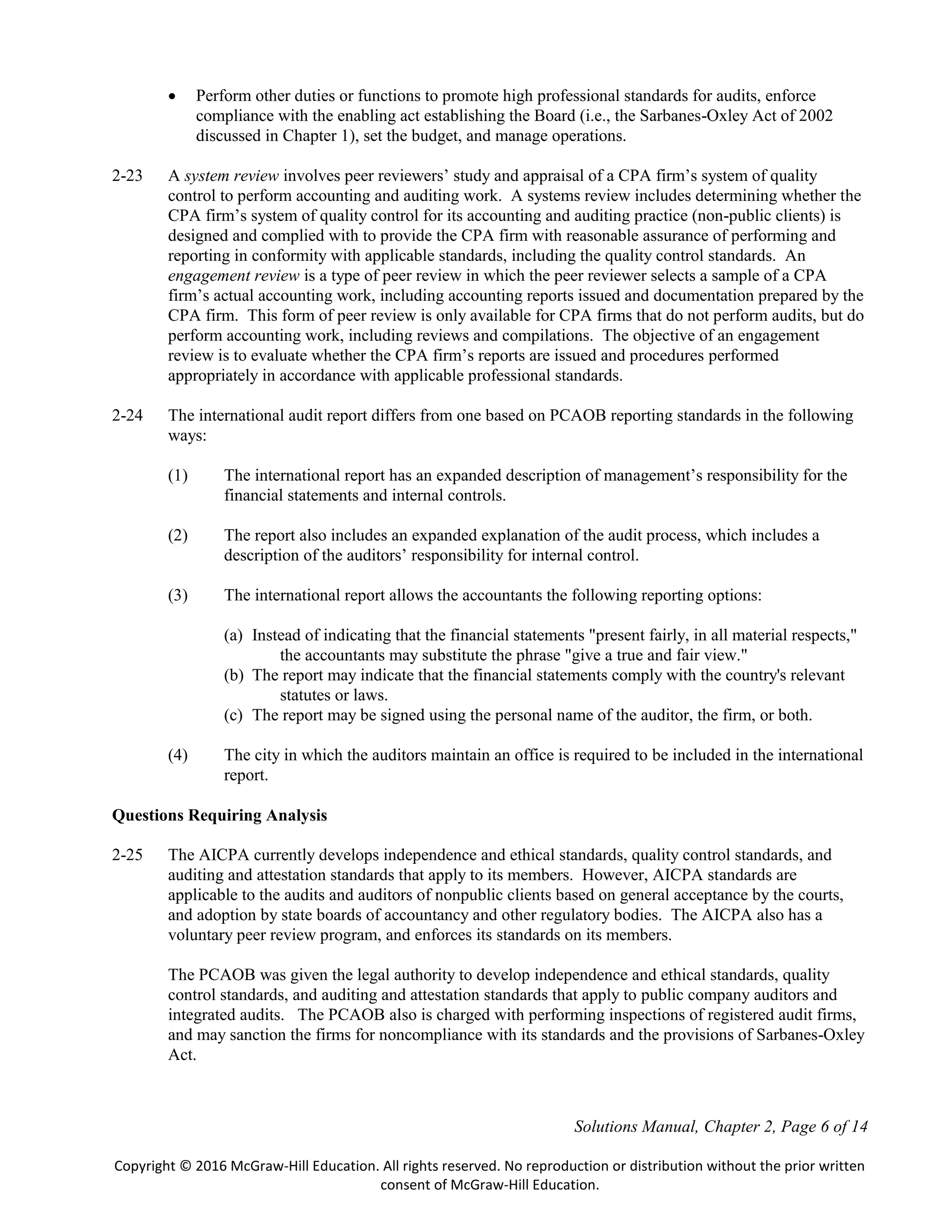
 Perform other duties or functions to promote high professional standards for audits, enforce
compliance with the enabling act establishing the Board (i.e., the Sarbanes-Oxley Act of 2002
discussed in Chapter 1), set the budget, and manage operations.
2-23 A system review involves peer reviewers’ study and appraisal of a CPA firm’s system of quality
control to perform accounting and auditing work. A systems review includes determining whether the
CPA firm’s system of quality control for its accounting and auditing practice (non-public clients) is
designed and complied with to provide the CPA firm with reasonable assurance of performing and
reporting in conformity with applicable standards, including the quality control standards. An
engagement review is a type of peer review in which the peer reviewer selects a sample of a CPA
firm’s actual accounting work, including accounting reports issued and documentation prepared by the
CPA firm. This form of peer review is only available for CPA firms that do not perform audits, but do
perform accounting work, including reviews and compilations. The objective of an engagement
review is to evaluate whether the CPA firm’s reports are issued and procedures performed
appropriately in accordance with applicable professional standards.
2-24 The international audit report differs from one based on PCAOB reporting standards in the following
ways:
(1) The international report has an expanded description of management’s responsibility for the
financial statements and internal controls.
(2) The report also includes an expanded explanation of the audit process, which includes a
description of the auditors’ responsibility for internal control.
(3) The international report allows the accountants the following reporting options:
(a) Instead of indicating that the financial statements "present fairly, in all material respects,"
the accountants may substitute the phrase "give a true and fair view."
(b) The report may indicate that the financial statements comply with the country's relevant
statutes or laws.
(c) The report may be signed using the personal name of the auditor, the firm, or both.
(4) The city in which the auditors maintain an office is required to be included in the international
report.
Questions Requiring Analysis
2-25 The AICPA currently develops independence and ethical standards, quality control standards, and
auditing and attestation standards that apply to its members. However, AICPA standards are
applicable to the audits and auditors of nonpublic clients based on general acceptance by the courts,
and adoption by state boards of accountancy and other regulatory bodies. The AICPA also has a
voluntary peer review program, and enforces its standards on its members.
The PCAOB was given the legal authority to develop independence and ethical standards, quality
control standards, and auditing and attestation standards that apply to public company auditors and
integrated audits. The PCAOB also is charged with performing inspections of registered audit firms,
and may sanction the firms for noncompliance with its standards and the provisions of Sarbanes-Oxley
Act.
Solutions Manual, Chapter 2, Page 7 of 14
Copyright © 2016 McGraw-Hill Education. All rights reserved. No reproduction or distribution without the prior written
consent of McGraw-Hill Education.
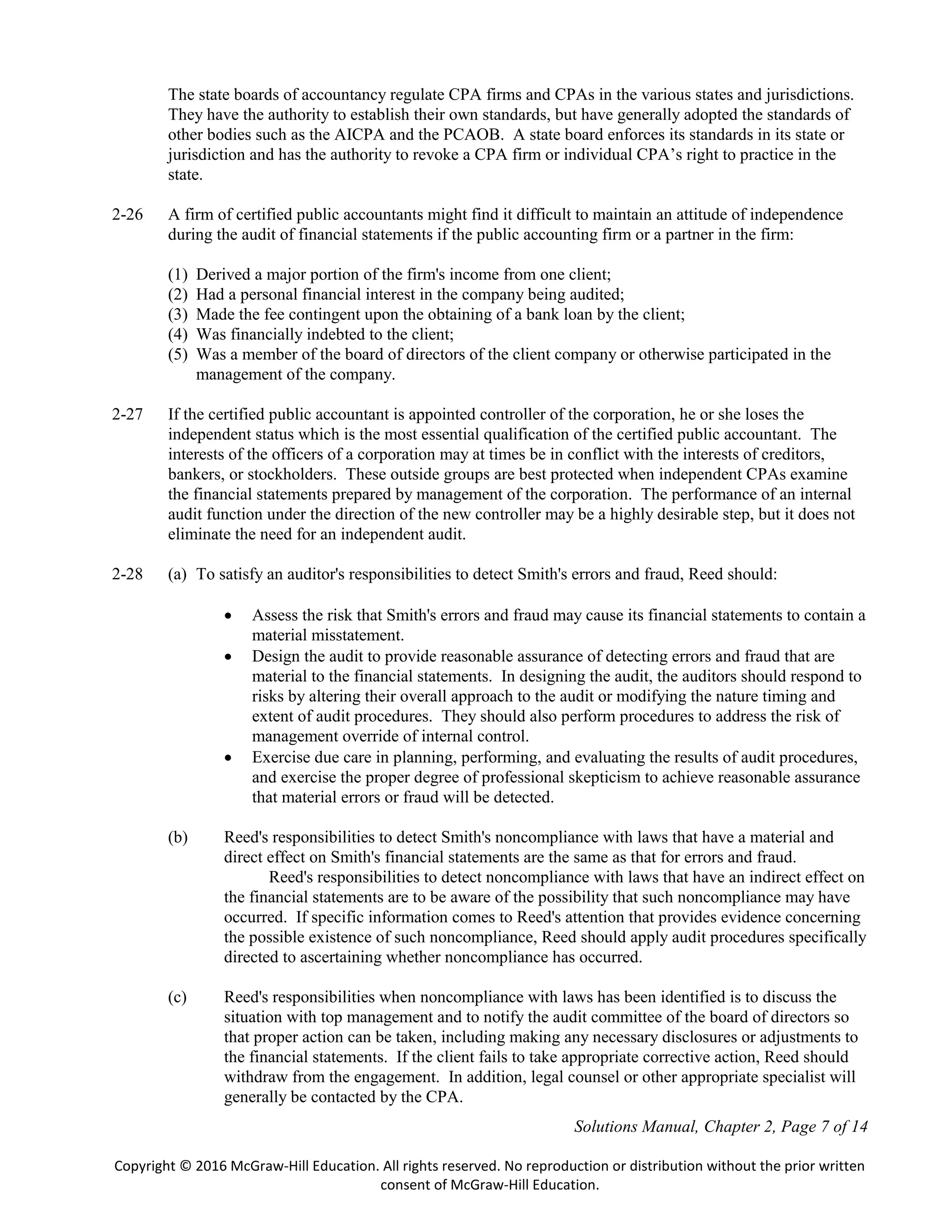
The state boards of accountancy regulate CPA firms and CPAs in the various states and jurisdictions.
They have the authority to establish their own standards, but have generally adopted the standards of
other bodies such as the AICPA and the PCAOB. A state board enforces its standards in its state or
jurisdiction and has the authority to revoke a CPA firm or individual CPA’s right to practice in the
state.
2-26 A firm of certified public accountants might find it difficult to maintain an attitude of independence
during the audit of financial statements if the public accounting firm or a partner in the firm:
(1) Derived a major portion of the firm's income from one client;
(2) Had a personal financial interest in the company being audited;
(3) Made the fee contingent upon the obtaining of a bank loan by the client;
(4) Was financially indebted to the client;
(5) Was a member of the board of directors of the client company or otherwise participated in the
management of the company.
2-27 If the certified public accountant is appointed controller of the corporation, he or she loses the
independent status which is the most essential qualification of the certified public accountant. The
interests of the officers of a corporation may at times be in conflict with the interests of creditors,
bankers, or stockholders. These outside groups are best protected when independent CPAs examine
the financial statements prepared by management of the corporation. The performance of an internal
audit function under the direction of the new controller may be a highly desirable step, but it does not
eliminate the need for an independent audit.
2-28 (a) To satisfy an auditor's responsibilities to detect Smith's errors and fraud, Reed should:
 Assess the risk that Smith's errors and fraud may cause its financial statements to contain a
material misstatement.
 Design the audit to provide reasonable assurance of detecting errors and fraud that are
material to the financial statements. In designing the audit, the auditors should respond to
risks by altering their overall approach to the audit or modifying the nature timing and
extent of audit procedures. They should also perform procedures to address the risk of
management override of internal control.
 Exercise due care in planning, performing, and evaluating the results of audit procedures,
and exercise the proper degree of professional skepticism to achieve reasonable assurance
that material errors or fraud will be detected.
(b) Reed's responsibilities to detect Smith's noncompliance with laws that have a material and
direct effect on Smith's financial statements are the same as that for errors and fraud.
Reed's responsibilities to detect noncompliance with laws that have an indirect effect on
the financial statements are to be aware of the possibility that such noncompliance may have
occurred. If specific information comes to Reed's attention that provides evidence concerning
the possible existence of such noncompliance, Reed should apply audit procedures specifically
directed to ascertaining whether noncompliance has occurred.
(c) Reed's responsibilities when noncompliance with laws has been identified is to discuss the
situation with top management and to notify the audit committee of the board of directors so
that proper action can be taken, including making any necessary disclosures or adjustments to
the financial statements. If the client fails to take appropriate corrective action, Reed should
withdraw from the engagement. In addition, legal counsel or other appropriate specialist will
generally be contacted by the CPA.
Solutions Manual, Chapter 2, Page 8 of 14
Copyright © 2016 McGraw-Hill Education. All rights reserved. No reproduction or distribution without the prior written
consent of McGraw-Hill Education.
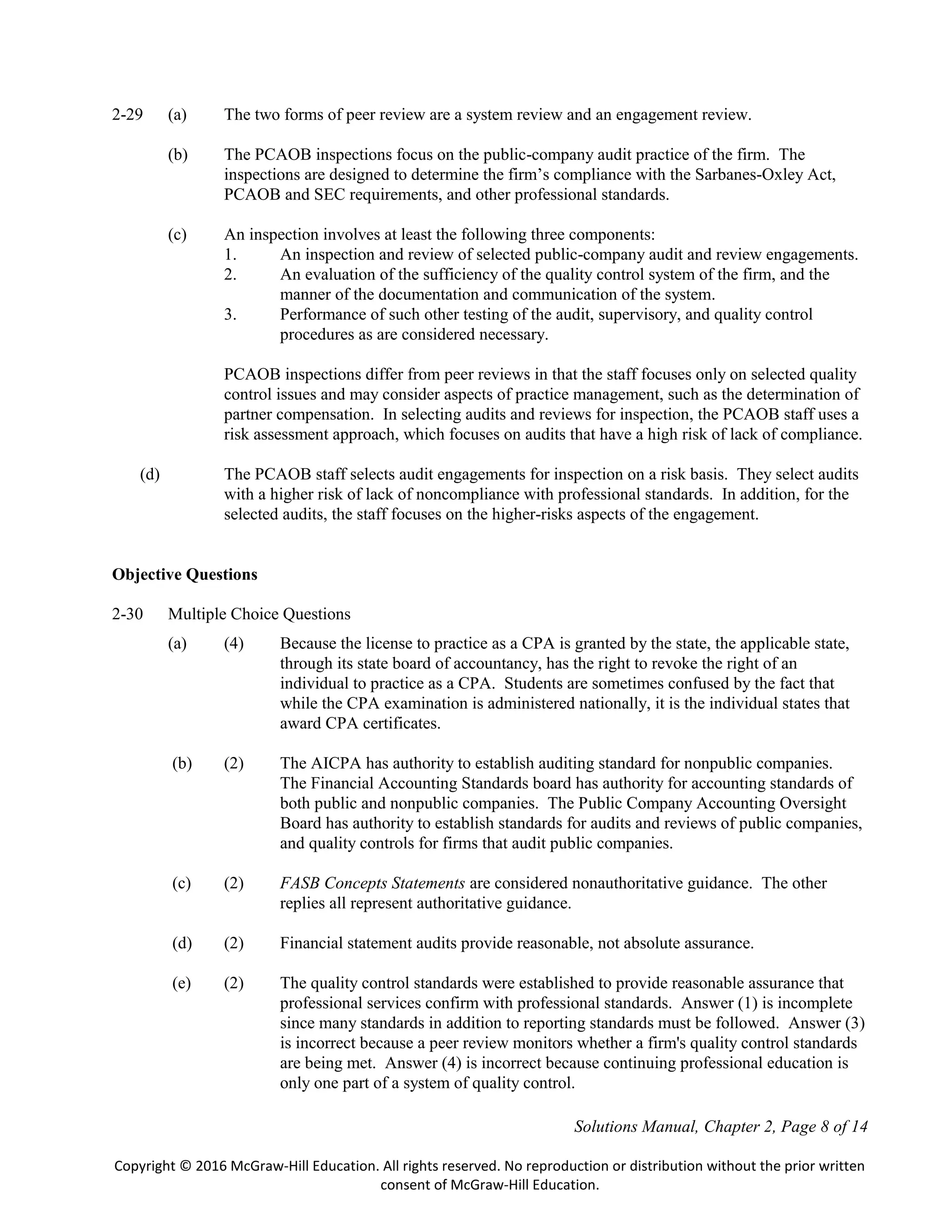
2-29 (a) The two forms of peer review are a system review and an engagement review.
(b) The PCAOB inspections focus on the public-company audit practice of the firm. The
inspections are designed to determine the firm’s compliance with the Sarbanes-Oxley Act,
PCAOB and SEC requirements, and other professional standards.
(c) An inspection involves at least the following three components:
1. An inspection and review of selected public-company audit and review engagements.
2. An evaluation of the sufficiency of the quality control system of the firm, and the
manner of the documentation and communication of the system.
3. Performance of such other testing of the audit, supervisory, and quality control
procedures as are considered necessary.
PCAOB inspections differ from peer reviews in that the staff focuses only on selected quality
control issues and may consider aspects of practice management, such as the determination of
partner compensation. In selecting audits and reviews for inspection, the PCAOB staff uses a
risk assessment approach, which focuses on audits that have a high risk of lack of compliance.
(d) The PCAOB staff selects audit engagements for inspection on a risk basis. They select audits
with a higher risk of lack of noncompliance with professional standards. In addition, for the
selected audits, the staff focuses on the higher-risks aspects of the engagement.
Objective Questions
2-30 Multiple Choice Questions
(a) (4) Because the license to practice as a CPA is granted by the state, the applicable state,
through its state board of accountancy, has the right to revoke the right of an
individual to practice as a CPA. Students are sometimes confused by the fact that
while the CPA examination is administered nationally, it is the individual states that
award CPA certificates.
(b) (2) The AICPA has authority to establish auditing standard for nonpublic companies.
The Financial Accounting Standards board has authority for accounting standards of
both public and nonpublic companies. The Public Company Accounting Oversight
Board has authority to establish standards for audits and reviews of public companies,
and quality controls for firms that audit public companies.
(c) (2) FASB Concepts Statements are considered nonauthoritative guidance. The other
replies all represent authoritative guidance.
(d) (2) Financial statement audits provide reasonable, not absolute assurance.
(e) (2) The quality control standards were established to provide reasonable assurance that
professional services confirm with professional standards. Answer (1) is incomplete
since many standards in addition to reporting standards must be followed. Answer (3)
is incorrect because a peer review monitors whether a firm's quality control standards
are being met. Answer (4) is incorrect because continuing professional education is
only one part of a system of quality control.
Solutions Manual, Chapter 2, Page 9 of 14
Copyright © 2016 McGraw-Hill Education. All rights reserved. No reproduction or distribution without the prior written
consent of McGraw-Hill Education.
(f) (3) The internal control of the client is not explicitly mentioned in the unqualified
standard report although it is implicit in the reference to generally accepted auditing
standards. Answers (1), (2), and (4) are all explicitly set forth in the unqualified
standard form of audit report.
(g) (1) An independent mental attitude on the part of the auditor is required by the second
general standard of the PCAOB. Answers (3) and (4) relate to the standards of field
work. Answer (2) confuses generally accepted accounting principles with generally
accepted auditing standards.
(h) (3) Such a quality control policy is designed to assure that personnel assigned to an
engagement are independent to perform the work, an ethical requirement.
(i) (1) An audit provides reasonable assurance of detecting misstatements due to fraud,
regardless of whether due to fraudulent financial reporting or misappropriation of
assets.
(j) (1) An integrated audit report on the financial statements of a public company states that
the audit was performed in accordance with Public Company Accounting Oversight
Board standards, not AICPA standards.
(k) (3) The PCAOB staff performs inspections of audit firms that are registered with the
PCAOB. In order to perform an audit of a public client an audit firm must be
registered.
(l) (4) Neither the AICPA audit report nor the international audit report include an opinion
on internal control. The other replies provide actual differences between the two
reports.
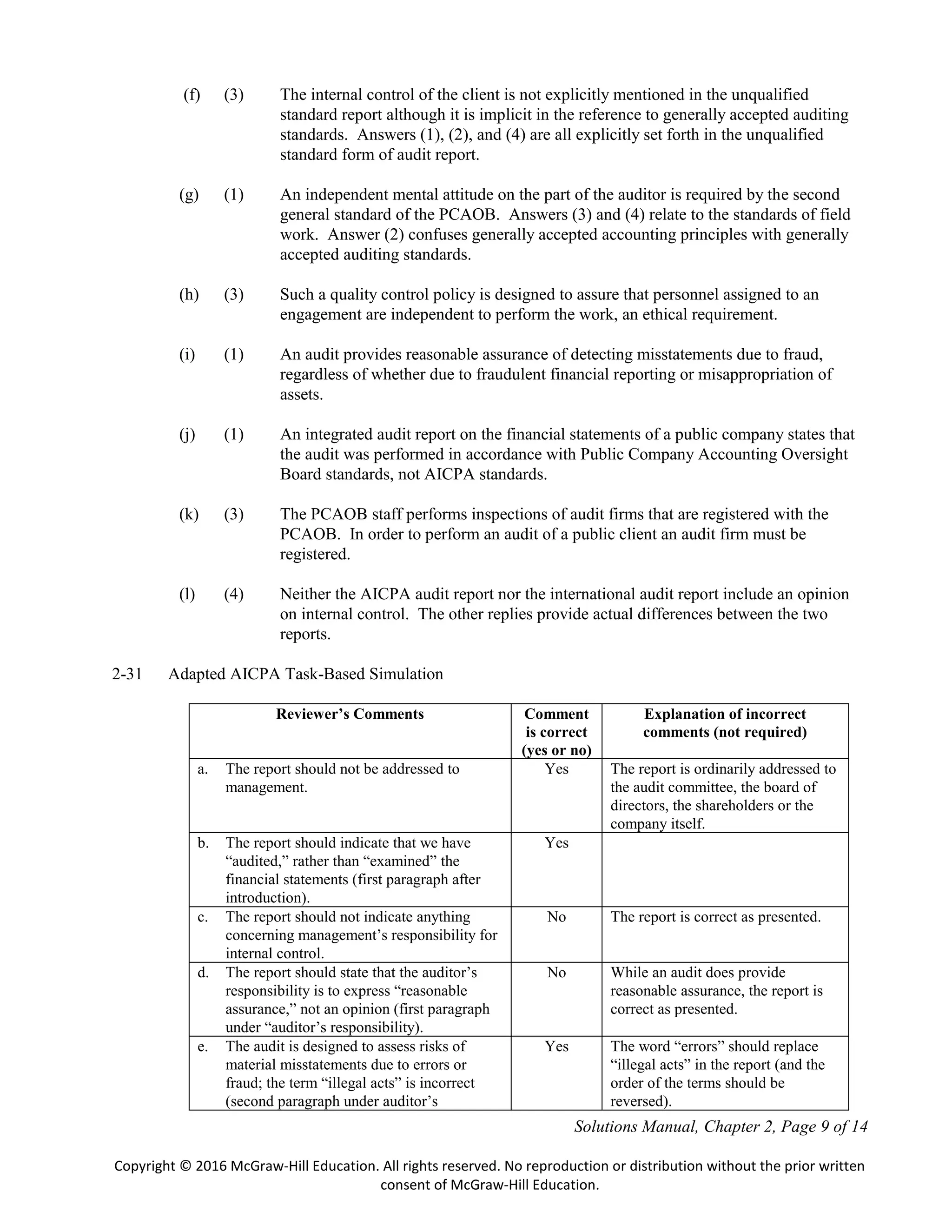
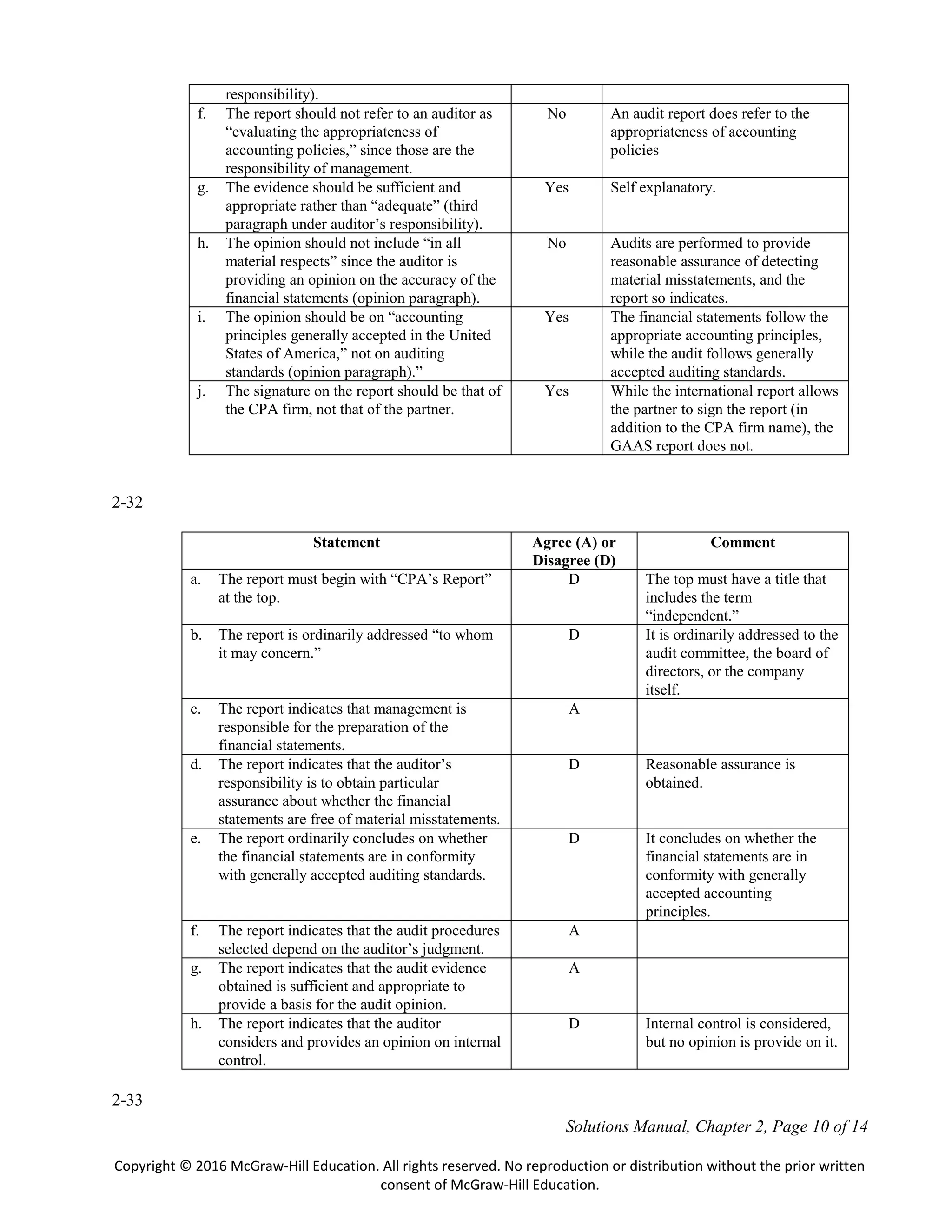
2-31 Adapted AICPA Task-Based Simulation
Reviewer’s Comments Comment
is correct
(yes or no)
Explanation of incorrect
comments (not required)
a. The report should not be addressed to
management.
Yes The report is ordinarily addressed to
the audit committee, the board of
directors, the shareholders or the
company itself.
b. The report should indicate that we have
“audited,” rather than “examined” the
financial statements (first paragraph after
introduction).
Yes
c. The report should not indicate anything
concerning management’s responsibility for
internal control.
No The report is correct as presented.
d. The report should state that the auditor’s
responsibility is to express “reasonable
assurance,” not an opinion (first paragraph
under “auditor’s responsibility).
No While an audit does provide
reasonable assurance, the report is
correct as presented.
e. The audit is designed to assess risks of
material misstatements due to errors or
fraud; the term “illegal acts” is incorrect
(second paragraph under auditor’s
Yes The word “errors” should replace
“illegal acts” in the report (and the
order of the terms should be
reversed).
Solutions Manual, Chapter 2, Page 10 of 14
Copyright © 2016 McGraw-Hill Education. All rights reserved. No reproduction or distribution without the prior written
consent of McGraw-Hill Education.
responsibility).
f. The report should not refer to an auditor as
“evaluating the appropriateness of
accounting policies,” since those are the
responsibility of management.
No An audit report does refer to the
appropriateness of accounting
policies
g. The evidence should be sufficient and
appropriate rather than “adequate” (third
paragraph under auditor’s responsibility).
Yes Self explanatory.
h. The opinion should not include “in all
material respects” since the auditor is
providing an opinion on the accuracy of the
financial statements (opinion paragraph).
No Audits are performed to provide
reasonable assurance of detecting
material misstatements, and the
report so indicates.
i. The opinion should be on “accounting
principles generally accepted in the United
States of America,” not on auditing
standards (opinion paragraph).”
Yes The financial statements follow the
appropriate accounting principles,
while the audit follows generally
accepted auditing standards.
j. The signature on the report should be that of
the CPA firm, not that of the partner.
Yes While the international report allows
the partner to sign the report (in
addition to the CPA firm name), the
GAAS report does not.
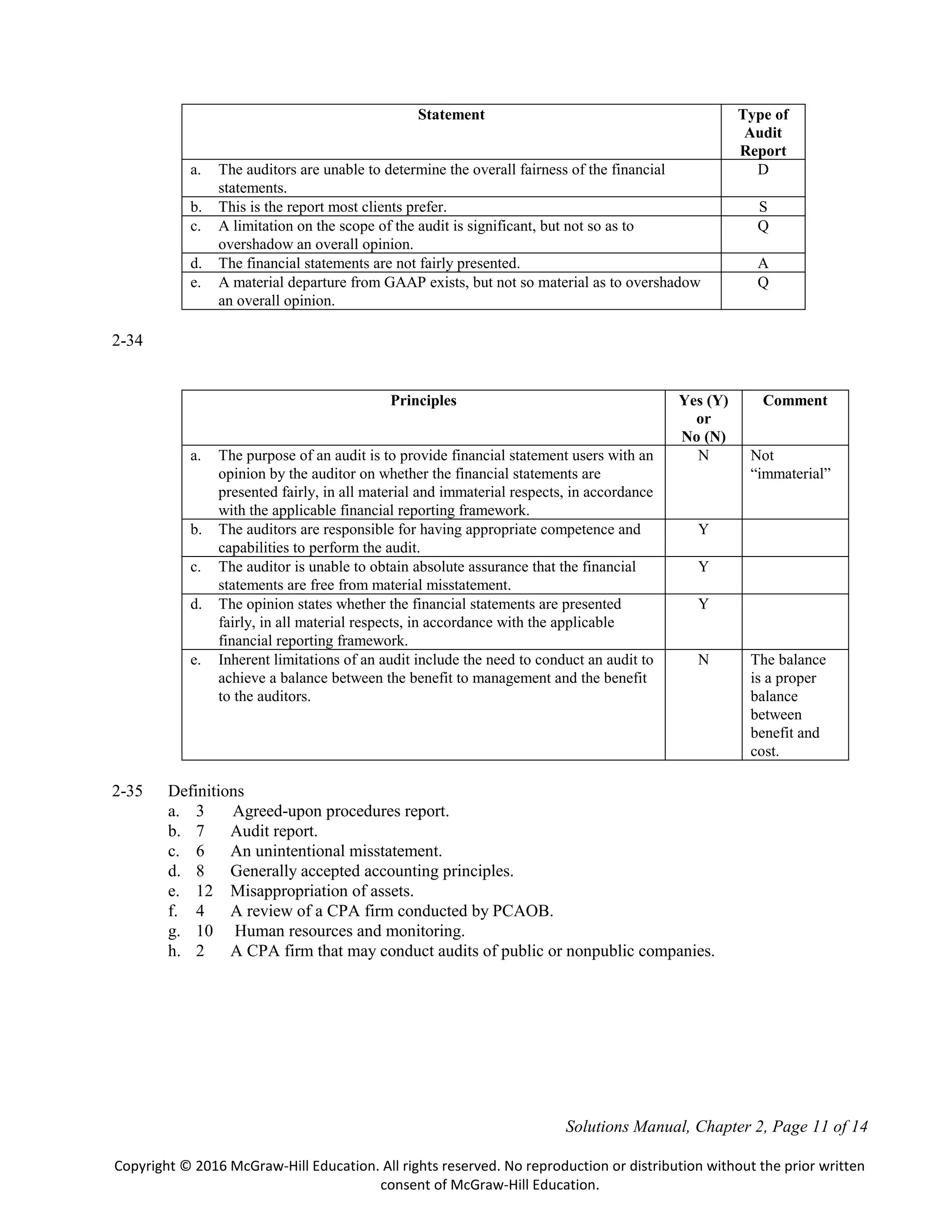
2-32
Statement Agree (A) or
Disagree (D)
Comment
a. The report must begin with “CPA’s Report”
at the top.
D The top must have a title that
includes the term
“independent.”
b. The report is ordinarily addressed “to whom
it may concern.”
D It is ordinarily addressed to the
audit committee, the board of
directors, or the company
itself.
c. The report indicates that management is
responsible for the preparation of the
financial statements.
A
d. The report indicates that the auditor’s
responsibility is to obtain particular
assurance about whether the financial
statements are free of material misstatements.
D Reasonable assurance is
obtained.
e. The report ordinarily concludes on whether
the financial statements are in conformity
with generally accepted auditing standards.
D It concludes on whether the
financial statements are in
conformity with generally
accepted accounting
principles.
f. The report indicates that the audit procedures
selected depend on the auditor’s judgment.
A
g. The report indicates that the audit evidence
obtained is sufficient and appropriate to
provide a basis for the audit opinion.
A
h. The report indicates that the auditor
considers and provides an opinion on internal
control.
D Internal control is considered,
but no opinion is provide on it.
2-33
Solutions Manual, Chapter 2, Page 11 of 14
Copyright © 2016 McGraw-Hill Education. All rights reserved. No reproduction or distribution without the prior written
consent of McGraw-Hill Education.
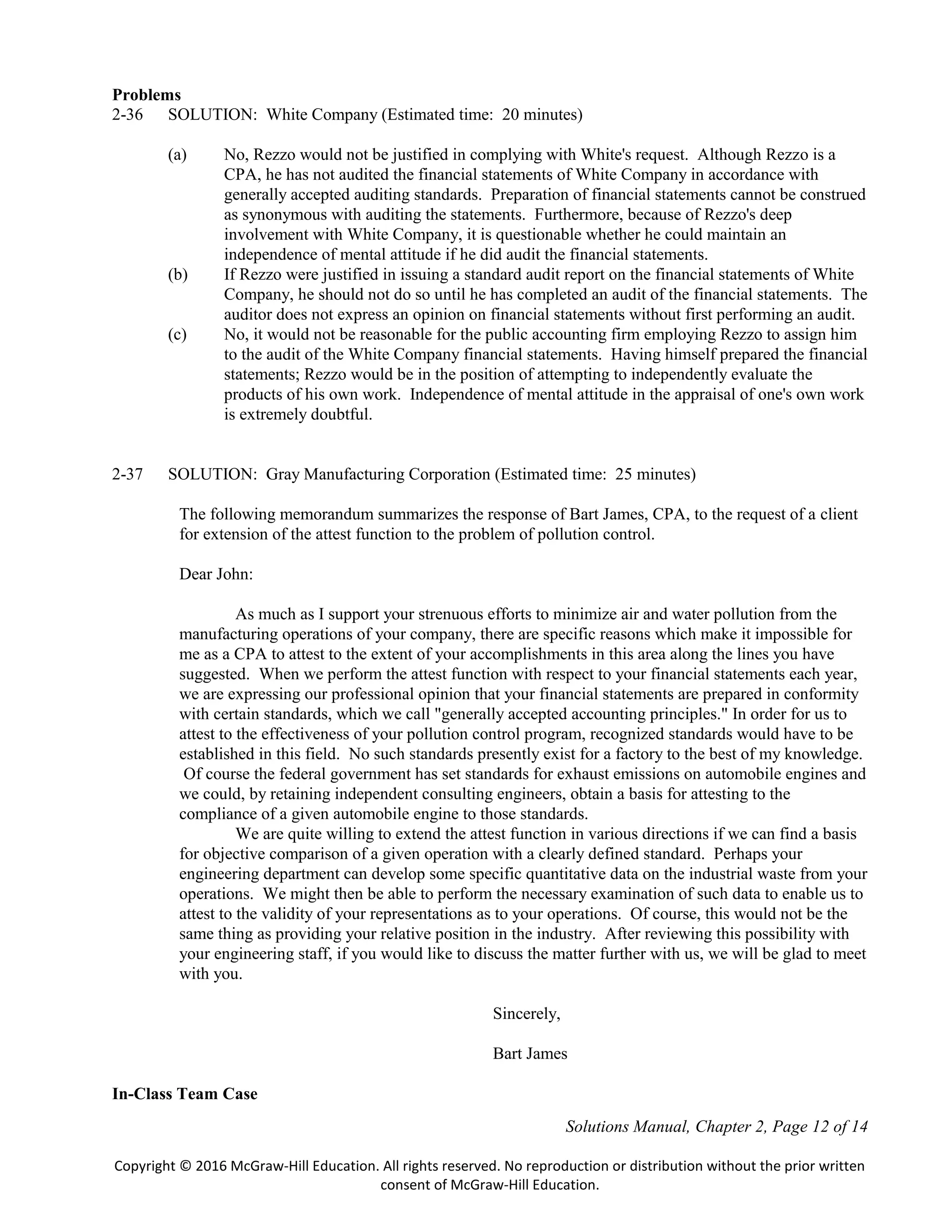
Statement Type of
Audit
Report
a. The auditors are unable to determine the overall fairness of the financial
statements.
D
b. This is the report most clients prefer. S
c. A limitation on the scope of the audit is significant, but not so as to
overshadow an overall opinion.
Q
d. The financial statements are not fairly presented. A
e. A material departure from GAAP exists, but not so material as to overshadow
an overall opinion.
Q
2-34
Principles Yes (Y)
or
No (N)
Comment
a. The purpose of an audit is to provide financial statement users with an
opinion by the auditor on whether the financial statements are
presented fairly, in all material and immaterial respects, in accordance
with the applicable financial reporting framework.
N Not
“immaterial”
b. The auditors are responsible for having appropriate competence and
capabilities to perform the audit.
Y
c. The auditor is unable to obtain absolute assurance that the financial
statements are free from material misstatement.
Y
d. The opinion states whether the financial statements are presented
fairly, in all material respects, in accordance with the applicable
financial reporting framework.
Y
e. Inherent limitations of an audit include the need to conduct an audit to
achieve a balance between the benefit to management and the benefit
to the auditors.
N The balance
is a proper
balance
between
benefit and
cost.
2-35 Definitions
a. 3 Agreed-upon procedures report.
b. 7 Audit report.
c. 6 An unintentional misstatement.
d. 8 Generally accepted accounting principles.
e. 12 Misappropriation of assets.
f. 4 A review of a CPA firm conducted by PCAOB.
g. 10 Human resources and monitoring.
h. 2 A CPA firm that may conduct audits of public or nonpublic companies.
Solutions Manual, Chapter 2, Page 12 of 14
Copyright © 2016 McGraw-Hill Education. All rights reserved. No reproduction or distribution without the prior written
consent of McGraw-Hill Education.
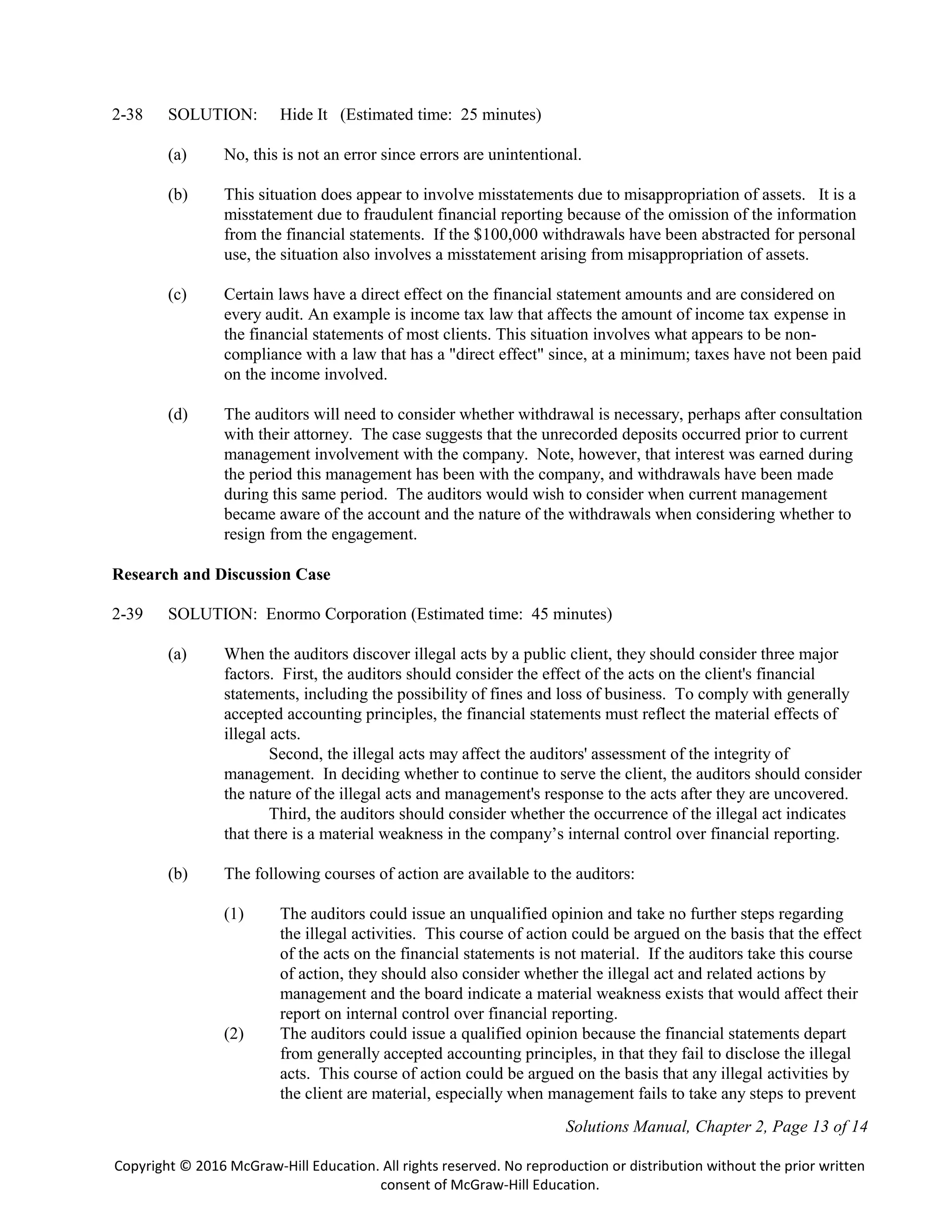
Problems
2-36 SOLUTION: White Company (Estimated time: 20 minutes)
(a) No, Rezzo would not be justified in complying with White's request. Although Rezzo is a
CPA, he has not audited the financial statements of White Company in accordance with
generally accepted auditing standards. Preparation of financial statements cannot be construed
as synonymous with auditing the statements. Furthermore, because of Rezzo's deep
involvement with White Company, it is questionable whether he could maintain an
independence of mental attitude if he did audit the financial statements.
(b) If Rezzo were justified in issuing a standard audit report on the financial statements of White
Company, he should not do so until he has completed an audit of the financial statements. The
auditor does not express an opinion on financial statements without first performing an audit.
(c) No, it would not be reasonable for the public accounting firm employing Rezzo to assign him
to the audit of the White Company financial statements. Having himself prepared the financial
statements; Rezzo would be in the position of attempting to independently evaluate the
products of his own work. Independence of mental attitude in the appraisal of one's own work
is extremely doubtful.
2-37 SOLUTION: Gray Manufacturing Corporation (Estimated time: 25 minutes)
The following memorandum summarizes the response of Bart James, CPA, to the request of a client
for extension of the attest function to the problem of pollution control.
Dear John:
As much as I support your strenuous efforts to minimize air and water pollution from the
manufacturing operations of your company, there are specific reasons which make it impossible for
me as a CPA to attest to the extent of your accomplishments in this area along the lines you have
suggested. When we perform the attest function with respect to your financial statements each year,
we are expressing our professional opinion that your financial statements are prepared in conformity
with certain standards, which we call "generally accepted accounting principles." In order for us to
attest to the effectiveness of your pollution control program, recognized standards would have to be
established in this field. No such standards presently exist for a factory to the best of my knowledge.
Of course the federal government has set standards for exhaust emissions on automobile engines and
we could, by retaining independent consulting engineers, obtain a basis for attesting to the
compliance of a given automobile engine to those standards.
We are quite willing to extend the attest function in various directions if we can find a basis
for objective comparison of a given operation with a clearly defined standard. Perhaps your
engineering department can develop some specific quantitative data on the industrial waste from your
operations. We might then be able to perform the necessary examination of such data to enable us to
attest to the validity of your representations as to your operations. Of course, this would not be the
same thing as providing your relative position in the industry. After reviewing this possibility with
your engineering staff, if you would like to discuss the matter further with us, we will be glad to meet
with you.
Sincerely,
Bart James
In-Class Team Case
Solutions Manual, Chapter 2, Page 13 of 14
Copyright © 2016 McGraw-Hill Education. All rights reserved. No reproduction or distribution without the prior written
consent of McGraw-Hill Education.
2-38 SOLUTION: Hide It (Estimated time: 25 minutes)
(a) No, this is not an error since errors are unintentional.
(b) This situation does appear to involve misstatements due to misappropriation of assets. It is a
misstatement due to fraudulent financial reporting because of the omission of the information
from the financial statements. If the $100,000 withdrawals have been abstracted for personal
use, the situation also involves a misstatement arising from misappropriation of assets.
(c) Certain laws have a direct effect on the financial statement amounts and are considered on
every audit. An example is income tax law that affects the amount of income tax expense in
the financial statements of most clients. This situation involves what appears to be non-
compliance with a law that has a "direct effect" since, at a minimum; taxes have not been paid
on the income involved.
(d) The auditors will need to consider whether withdrawal is necessary, perhaps after consultation
with their attorney. The case suggests that the unrecorded deposits occurred prior to current
management involvement with the company. Note, however, that interest was earned during
the period this management has been with the company, and withdrawals have been made
during this same period. The auditors would wish to consider when current management
became aware of the account and the nature of the withdrawals when considering whether to
resign from the engagement.
Research and Discussion Case
2-39 SOLUTION: Enormo Corporation (Estimated time: 45 minutes)
(a) When the auditors discover illegal acts by a public client, they should consider three major
factors. First, the auditors should consider the effect of the acts on the client's financial
statements, including the possibility of fines and loss of business. To comply with generally
accepted accounting principles, the financial statements must reflect the material effects of
illegal acts.
Second, the illegal acts may affect the auditors' assessment of the integrity of
management. In deciding whether to continue to serve the client, the auditors should consider
the nature of the illegal acts and management's response to the acts after they are uncovered.
Third, the auditors should consider whether the occurrence of the illegal act indicates
that there is a material weakness in the company’s internal control over financial reporting.
(b) The following courses of action are available to the auditors:
(1) The auditors could issue an unqualified opinion and take no further steps regarding
the illegal activities. This course of action could be argued on the basis that the effect
of the acts on the financial statements is not material. If the auditors take this course
of action, they should also consider whether the illegal act and related actions by
management and the board indicate a material weakness exists that would affect their
report on internal control over financial reporting.
(2) The auditors could issue a qualified opinion because the financial statements depart
from generally accepted accounting principles, in that they fail to disclose the illegal
acts. This course of action could be argued on the basis that any illegal activities by
the client are material, especially when management fails to take any steps to prevent
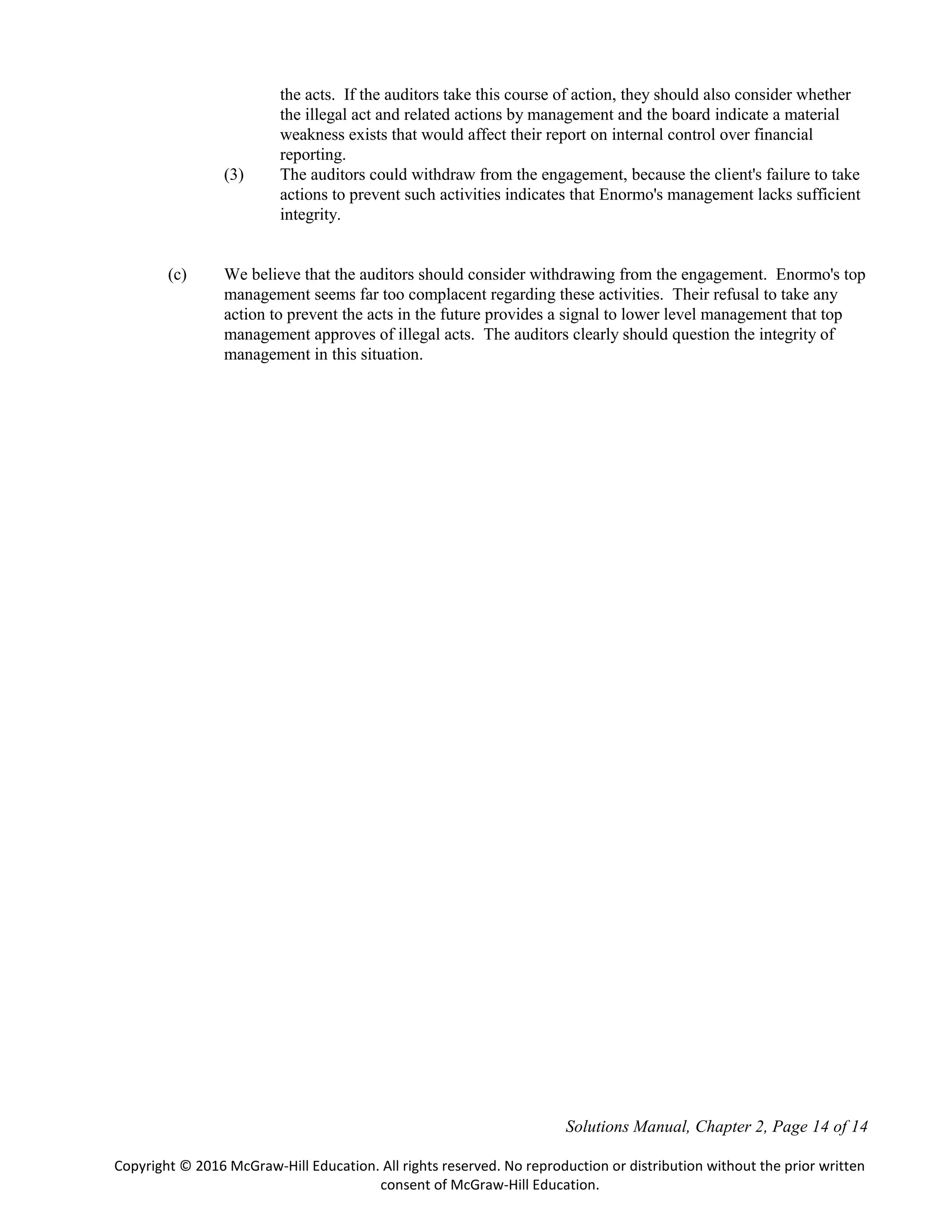
Solutions Manual, Chapter 2, Page 14 of 14
Copyright © 2016 McGraw-Hill Education. All rights reserved. No reproduction or distribution without the prior written
consent of McGraw-Hill Education.
the acts. If the auditors take this course of action, they should also consider whether
the illegal act and related actions by management and the board indicate a material
weakness exists that would affect their report on internal control over financial
reporting.
(3) The auditors could withdraw from the engagement, because the client's failure to take
actions to prevent such activities indicates that Enormo's management lacks sufficient
integrity.
(c) We believe that the auditors should consider withdrawing from the engagement. Enormo's top
management seems far too complacent regarding these activities. Their refusal to take any
action to prevent the acts in the future provides a signal to lower level management that top
management approves of illegal acts. The auditors clearly should question the integrity of
management in this situation.
Other documents randomly have
different content
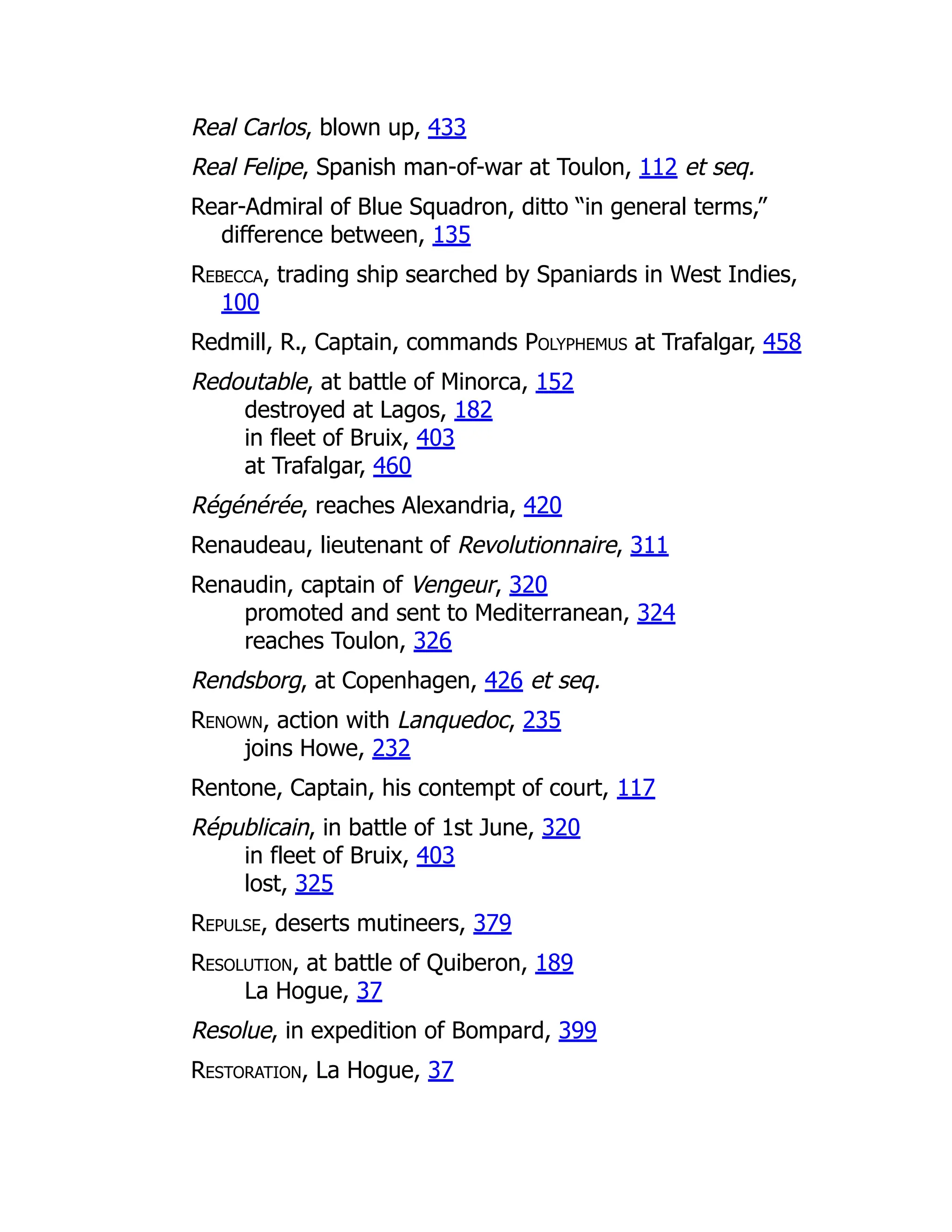
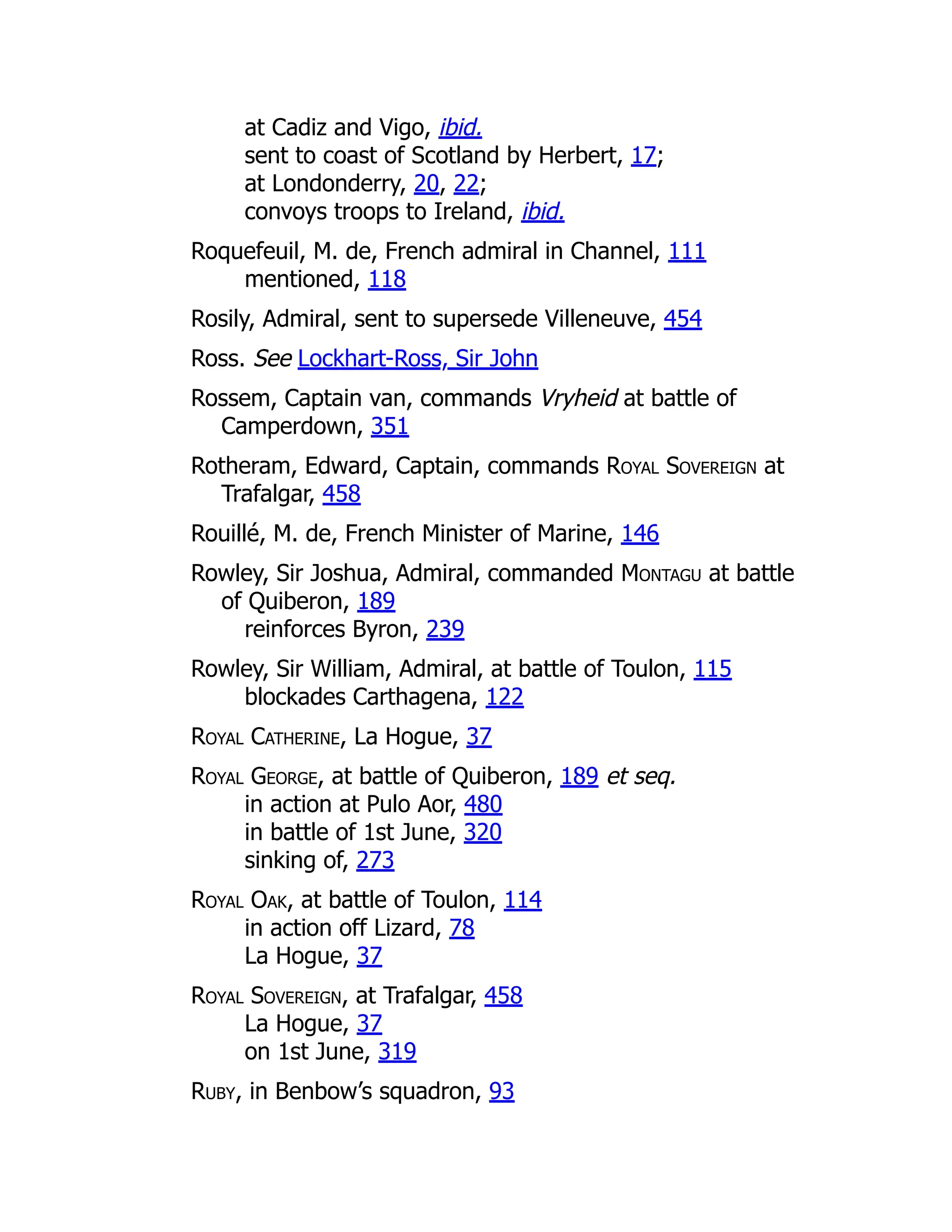
Real Carlos, blown up, 433
Real Felipe, Spanish man-of-war at Toulon, 112 et seq.
Rear-Admiral of Blue Squadron, ditto “in general terms,”
difference between, 135
Rebecca, trading ship searched by Spaniards in West Indies,
100
Redmill, R., Captain, commands Polyphemus at Trafalgar, 458
Redoutable, at battle of Minorca, 152
destroyed at Lagos, 182
in fleet of Bruix, 403
at Trafalgar, 460
Régénérée, reaches Alexandria, 420
Renaudeau, lieutenant of Revolutionnaire, 311
Renaudin, captain of Vengeur, 320
promoted and sent to Mediterranean, 324
reaches Toulon, 326
Rendsborg, at Copenhagen, 426 et seq.
Renown, action with Lanquedoc, 235
joins Howe, 232
Rentone, Captain, his contempt of court, 117
Républicain, in battle of 1st June, 320
in fleet of Bruix, 403
lost, 325
Repulse, deserts mutineers, 379
Resolution, at battle of Quiberon, 189
La Hogue, 37
Resolue, in expedition of Bompard, 399
Restoration, La Hogue, 37
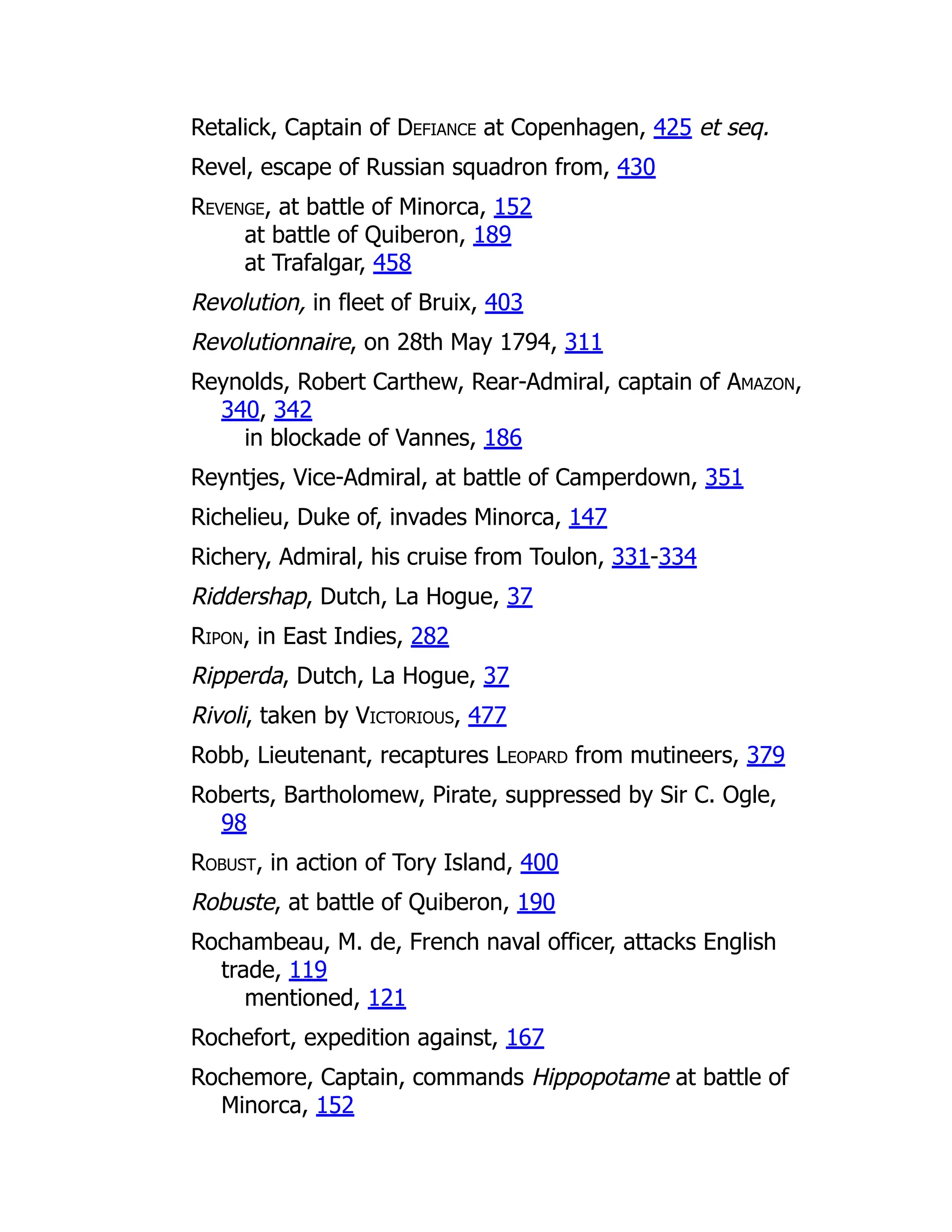
Retalick, Captain of Defiance at Copenhagen, 425 et seq.
Revel, escape of Russian squadron from, 430
Revenge, at battle of Minorca, 152
at battle of Quiberon, 189
at Trafalgar, 458
Revolution, in fleet of Bruix, 403
Revolutionnaire, on 28th May 1794, 311
Reynolds, Robert Carthew, Rear-Admiral, captain of Amazon,
340, 342
in blockade of Vannes, 186
Reyntjes, Vice-Admiral, at battle of Camperdown, 351
Richelieu, Duke of, invades Minorca, 147
Richery, Admiral, his cruise from Toulon, 331-334
Riddershap, Dutch, La Hogue, 37
Ripon, in East Indies, 282
Ripperda, Dutch, La Hogue, 37
Rivoli, taken by Victorious, 477
Robb, Lieutenant, recaptures Leopard from mutineers, 379
Roberts, Bartholomew, Pirate, suppressed by Sir C. Ogle,
98
Robust, in action of Tory Island, 400
Robuste, at battle of Quiberon, 190
Rochambeau, M. de, French naval officer, attacks English
trade, 119
mentioned, 121
Rochefort, expedition against, 167
Rochemore, Captain, commands Hippopotame at battle of
Minorca, 152
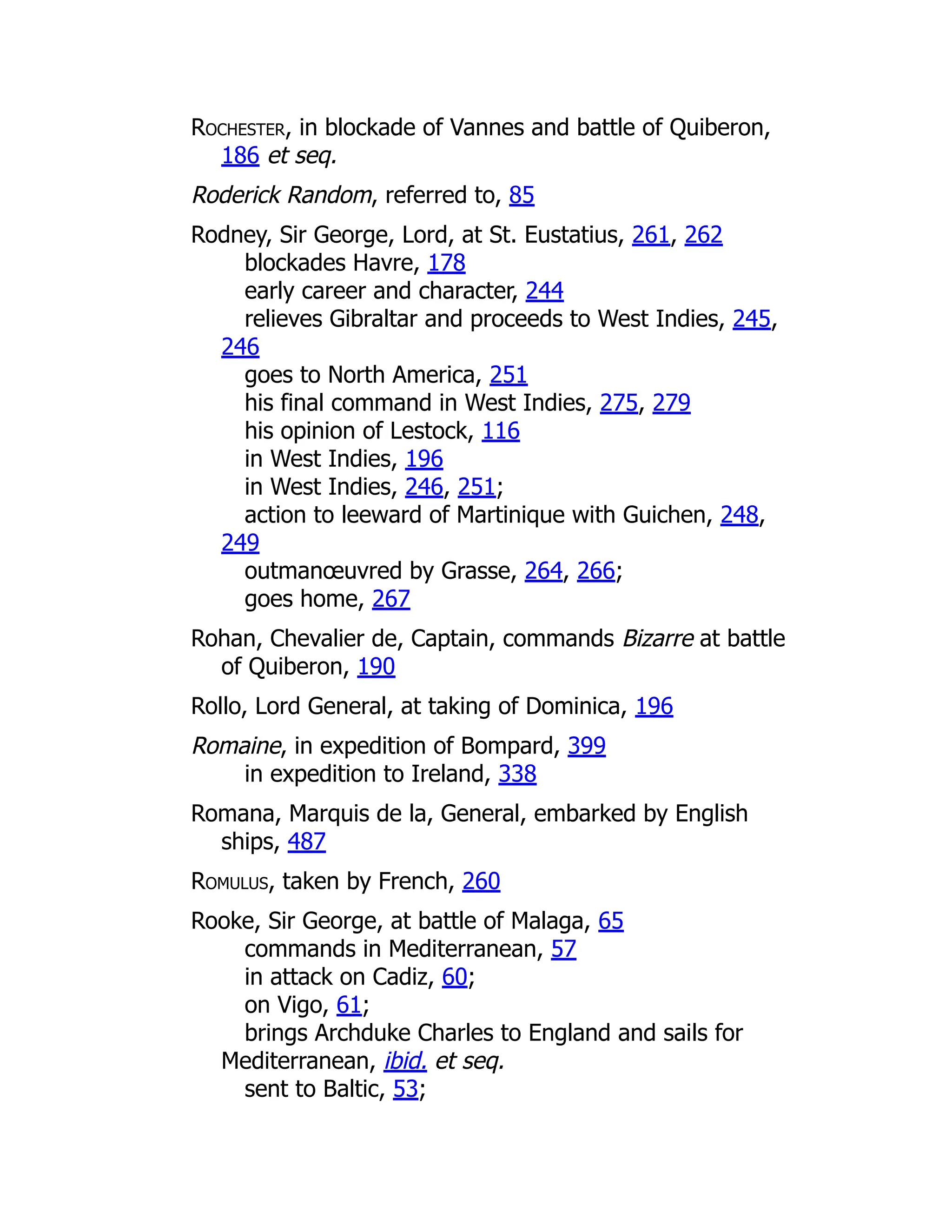
Rochester, in blockade of Vannes and battle of Quiberon,
186 et seq.
Roderick Random, referred to, 85
Rodney, Sir George, Lord, at St. Eustatius, 261, 262
blockades Havre, 178
early career and character, 244
relieves Gibraltar and proceeds to West Indies, 245,
246
goes to North America, 251
his final command in West Indies, 275, 279
his opinion of Lestock, 116
in West Indies, 196
in West Indies, 246, 251;
action to leeward of Martinique with Guichen, 248,
249
outmanœuvred by Grasse, 264, 266;
goes home, 267
Rohan, Chevalier de, Captain, commands Bizarre at battle
of Quiberon, 190
Rollo, Lord General, at taking of Dominica, 196
Romaine, in expedition of Bompard, 399
in expedition to Ireland, 338
Romana, Marquis de la, General, embarked by English
ships, 487
Romulus, taken by French, 260
Rooke, Sir George, at battle of Malaga, 65
commands in Mediterranean, 57
in attack on Cadiz, 60;
on Vigo, 61;
brings Archduke Charles to England and sails for
Mediterranean, ibid. et seq.
sent to Baltic, 53;
at Cadiz and Vigo, ibid.
sent to coast of Scotland by Herbert, 17;
at Londonderry, 20, 22;
convoys troops to Ireland, ibid.
Roquefeuil, M. de, French admiral in Channel, 111
mentioned, 118
Rosily, Admiral, sent to supersede Villeneuve, 454
Ross. See Lockhart-Ross, Sir John
Rossem, Captain van, commands Vryheid at battle of
Camperdown, 351
Rotheram, Edward, Captain, commands Royal Sovereign at
Trafalgar, 458
Rouillé, M. de, French Minister of Marine, 146
Rowley, Sir Joshua, Admiral, commanded Montagu at battle
of Quiberon, 189
reinforces Byron, 239
Rowley, Sir William, Admiral, at battle of Toulon, 115
blockades Carthagena, 122
Royal Catherine, La Hogue, 37
Royal George, at battle of Quiberon, 189 et seq.
in action at Pulo Aor, 480
in battle of 1st June, 320
sinking of, 273
Royal Oak, at battle of Toulon, 114
in action off Lizard, 78
La Hogue, 37
Royal Sovereign, at Trafalgar, 458
La Hogue, 37
on 1st June, 319
Ruby, in Benbow’s squadron, 93
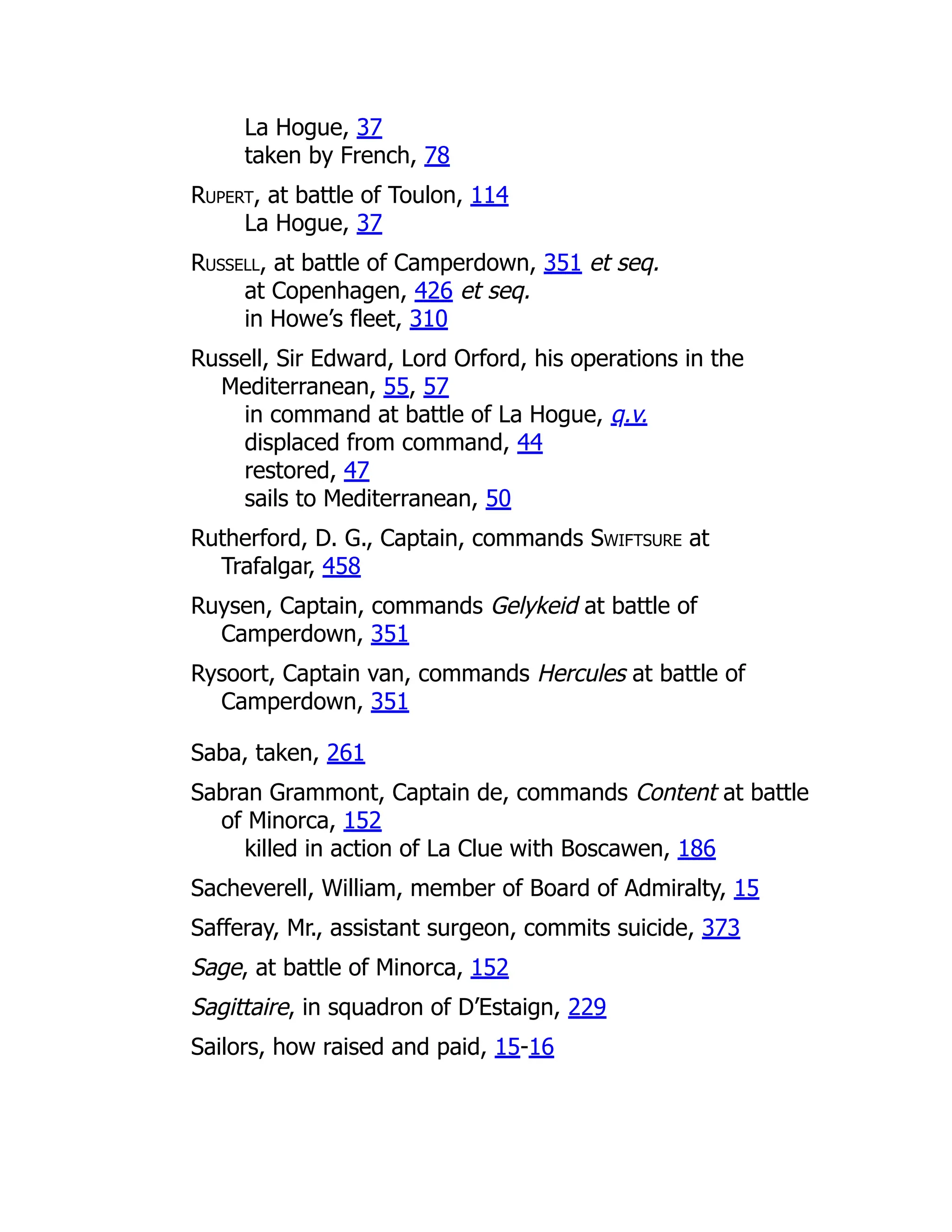
La Hogue, 37
taken by French, 78
Rupert, at battle of Toulon, 114
La Hogue, 37
Russell, at battle of Camperdown, 351 et seq.
at Copenhagen, 426 et seq.
in Howe’s fleet, 310
Russell, Sir Edward, Lord Orford, his operations in the
Mediterranean, 55, 57
in command at battle of La Hogue, q.v.
displaced from command, 44
restored, 47
sails to Mediterranean, 50
Rutherford, D. G., Captain, commands Swiftsure at
Trafalgar, 458
Ruysen, Captain, commands Gelykeid at battle of
Camperdown, 351
Rysoort, Captain van, commands Hercules at battle of
Camperdown, 351
Saba, taken, 261
Sabran Grammont, Captain de, commands Content at battle
of Minorca, 152
killed in action of La Clue with Boscawen, 186
Sacheverell, William, member of Board of Admiralty, 15
Safferay, Mr., assistant surgeon, commits suicide, 373
Sage, at battle of Minorca, 152
Sagittaire, in squadron of D’Estaign, 229
Sailors, how raised and paid, 15-16
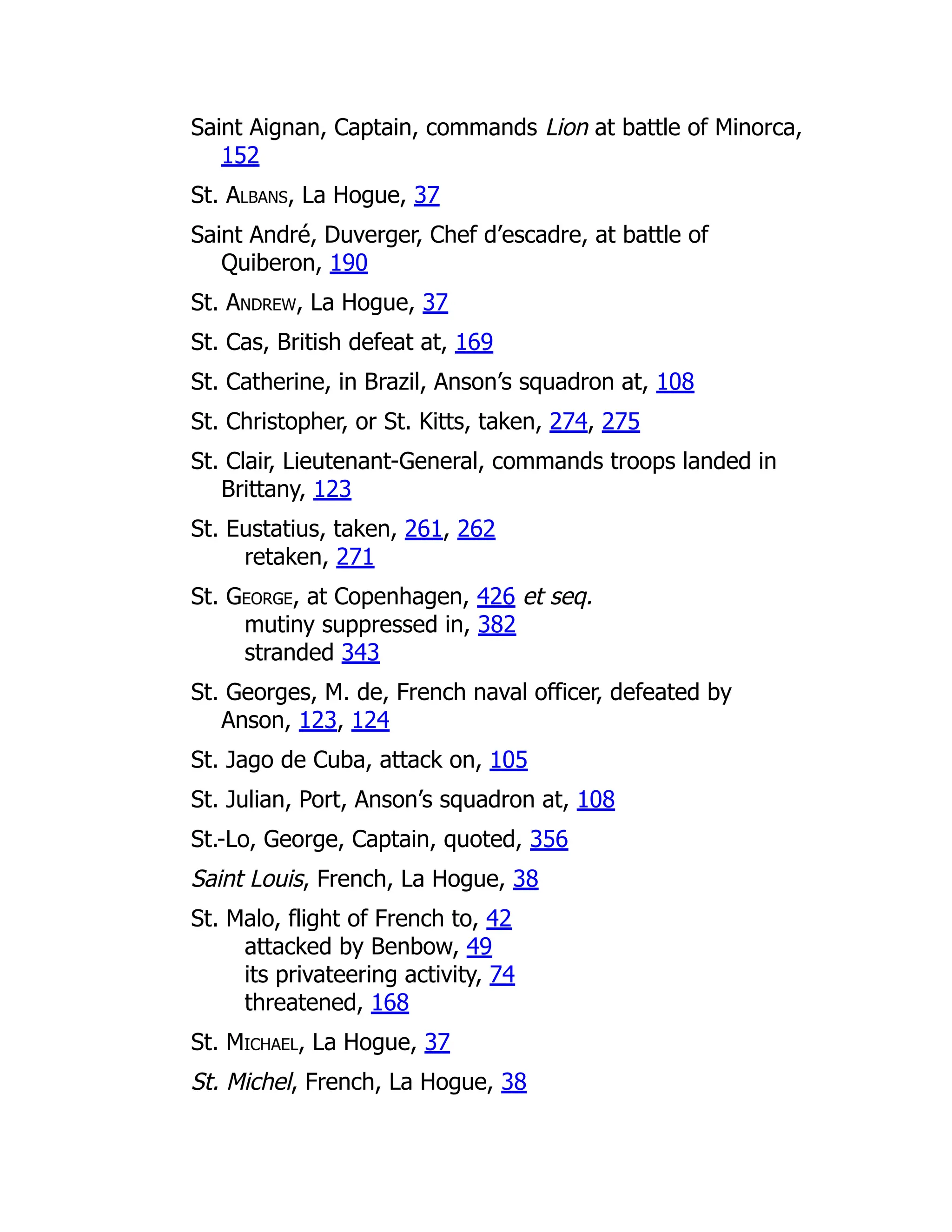
Saint Aignan, Captain, commands Lion at battle of Minorca,
152
St. Albans, La Hogue, 37
Saint André, Duverger, Chef d’escadre, at battle of
Quiberon, 190
St. Andrew, La Hogue, 37
St. Cas, British defeat at, 169
St. Catherine, in Brazil, Anson’s squadron at, 108
St. Christopher, or St. Kitts, taken, 274, 275
St. Clair, Lieutenant-General, commands troops landed in
Brittany, 123
St. Eustatius, taken, 261, 262
retaken, 271
St. George, at Copenhagen, 426 et seq.
mutiny suppressed in, 382
stranded 343
St. Georges, M. de, French naval officer, defeated by
Anson, 123, 124
St. Jago de Cuba, attack on, 105
St. Julian, Port, Anson’s squadron at, 108
St.-Lo, George, Captain, quoted, 356
Saint Louis, French, La Hogue, 38
St. Malo, flight of French to, 42
attacked by Benbow, 49
its privateering activity, 74
threatened, 168
St. Michael, La Hogue, 37
St. Michel, French, La Hogue, 38
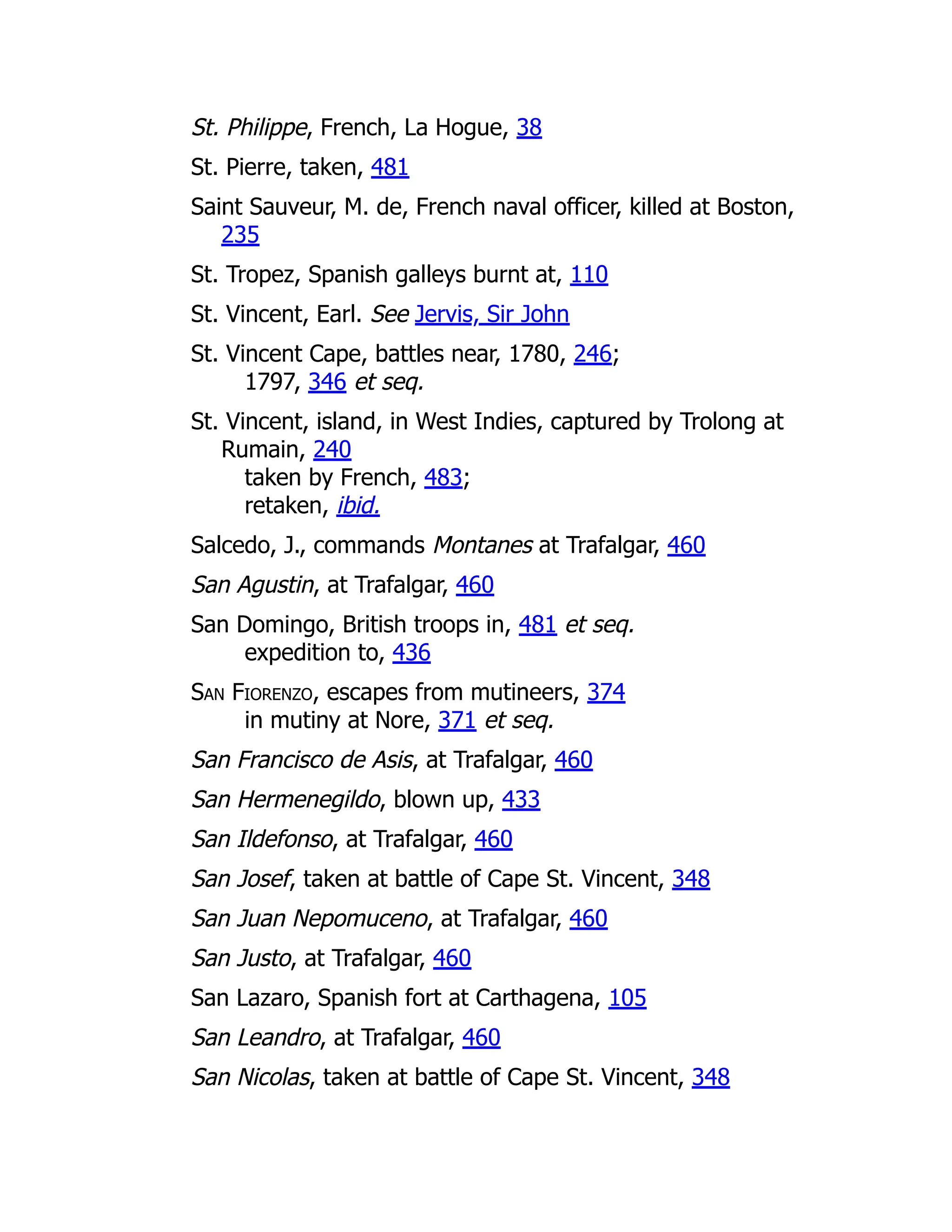
St. Philippe, French, La Hogue, 38
St. Pierre, taken, 481
Saint Sauveur, M. de, French naval officer, killed at Boston,
235
St. Tropez, Spanish galleys burnt at, 110
St. Vincent, Earl. See Jervis, Sir John
St. Vincent Cape, battles near, 1780, 246;
1797, 346 et seq.
St. Vincent, island, in West Indies, captured by Trolong at
Rumain, 240
taken by French, 483;
retaken, ibid.
Salcedo, J., commands Montanes at Trafalgar, 460
San Agustin, at Trafalgar, 460
San Domingo, British troops in, 481 et seq.
expedition to, 436
San Fiorenzo, escapes from mutineers, 374
in mutiny at Nore, 371 et seq.
San Francisco de Asis, at Trafalgar, 460
San Hermenegildo, blown up, 433
San Ildefonso, at Trafalgar, 460
San Josef, taken at battle of Cape St. Vincent, 348
San Juan Nepomuceno, at Trafalgar, 460
San Justo, at Trafalgar, 460
San Lazaro, Spanish fort at Carthagena, 105
San Leandro, at Trafalgar, 460
San Nicolas, taken at battle of Cape St. Vincent, 348
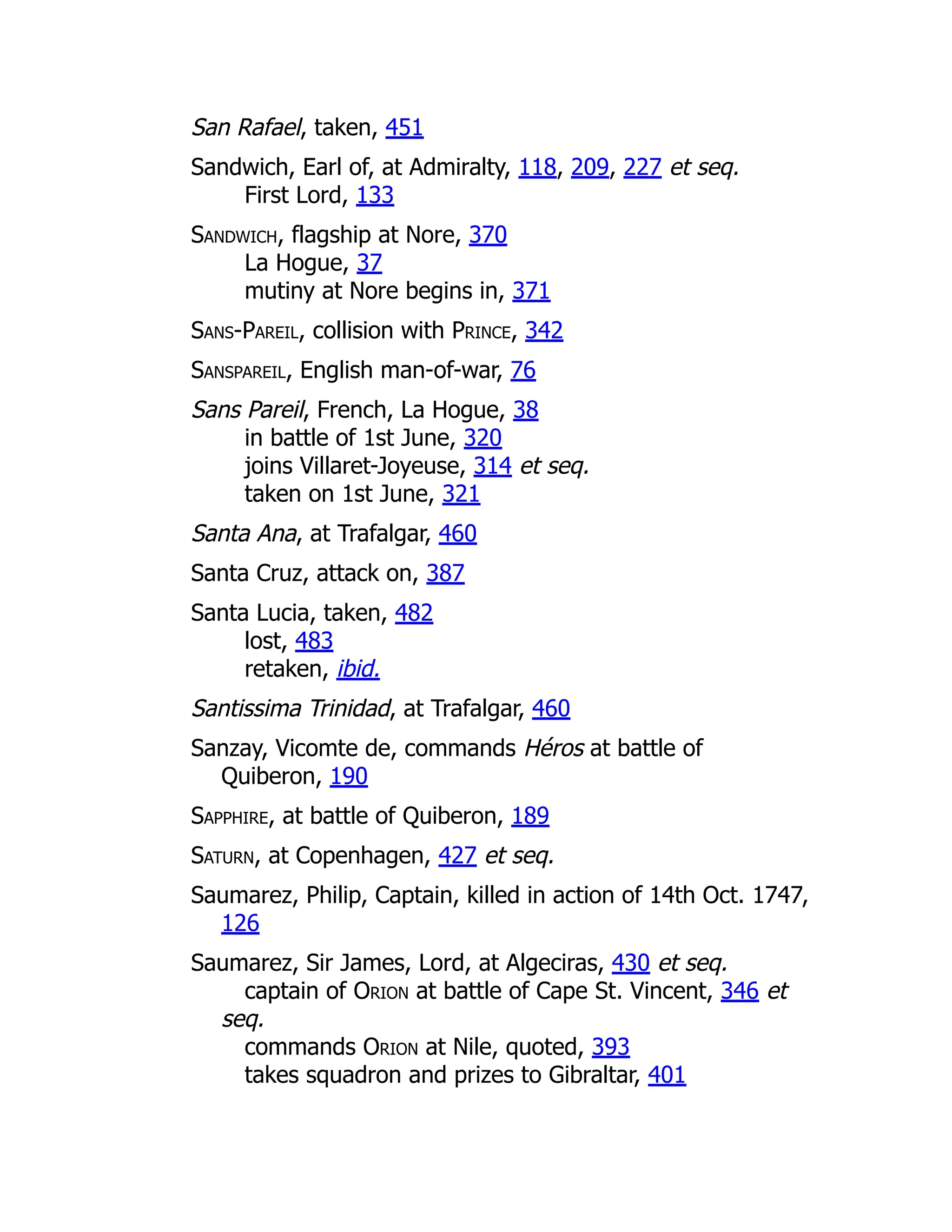
San Rafael, taken, 451
Sandwich, Earl of, at Admiralty, 118, 209, 227 et seq.
First Lord, 133
Sandwich, flagship at Nore, 370
La Hogue, 37
mutiny at Nore begins in, 371
Sans-Pareil, collision with Prince, 342
Sanspareil, English man-of-war, 76
Sans Pareil, French, La Hogue, 38
in battle of 1st June, 320
joins Villaret-Joyeuse, 314 et seq.
taken on 1st June, 321
Santa Ana, at Trafalgar, 460
Santa Cruz, attack on, 387
Santa Lucia, taken, 482
lost, 483
retaken, ibid.
Santissima Trinidad, at Trafalgar, 460
Sanzay, Vicomte de, commands Héros at battle of
Quiberon, 190
Sapphire, at battle of Quiberon, 189
Saturn, at Copenhagen, 427 et seq.
Saumarez, Philip, Captain, killed in action of 14th Oct. 1747,
126
Saumarez, Sir James, Lord, at Algeciras, 430 et seq.
captain of Orion at battle of Cape St. Vincent, 346 et
seq.
commands Orion at Nile, quoted, 393
takes squadron and prizes to Gibraltar, 401
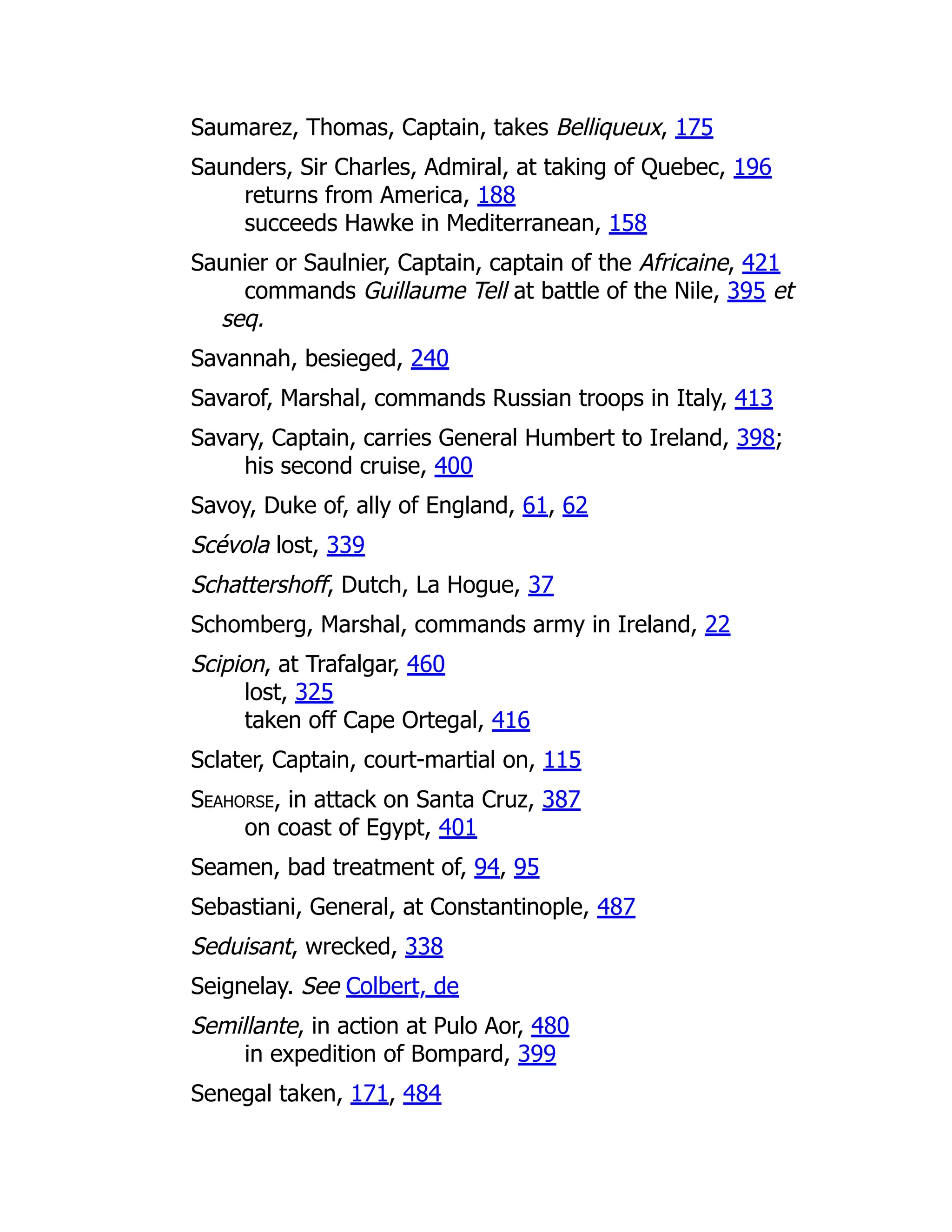
Saumarez, Thomas, Captain, takes Belliqueux, 175
Saunders, Sir Charles, Admiral, at taking of Quebec, 196
returns from America, 188
succeeds Hawke in Mediterranean, 158
Saunier or Saulnier, Captain, captain of the Africaine, 421
commands Guillaume Tell at battle of the Nile, 395 et
seq.
Savannah, besieged, 240
Savarof, Marshal, commands Russian troops in Italy, 413
Savary, Captain, carries General Humbert to Ireland, 398;
his second cruise, 400
Savoy, Duke of, ally of England, 61, 62
Scévola lost, 339
Schattershoff, Dutch, La Hogue, 37
Schomberg, Marshal, commands army in Ireland, 22
Scipion, at Trafalgar, 460
lost, 325
taken off Cape Ortegal, 416
Sclater, Captain, court-martial on, 115
Seahorse, in attack on Santa Cruz, 387
on coast of Egypt, 401
Seamen, bad treatment of, 94, 95
Sebastiani, General, at Constantinople, 487
Seduisant, wrecked, 338
Seignelay. See Colbert, de
Semillante, in action at Pulo Aor, 480
in expedition of Bompard, 399
Senegal taken, 171, 484
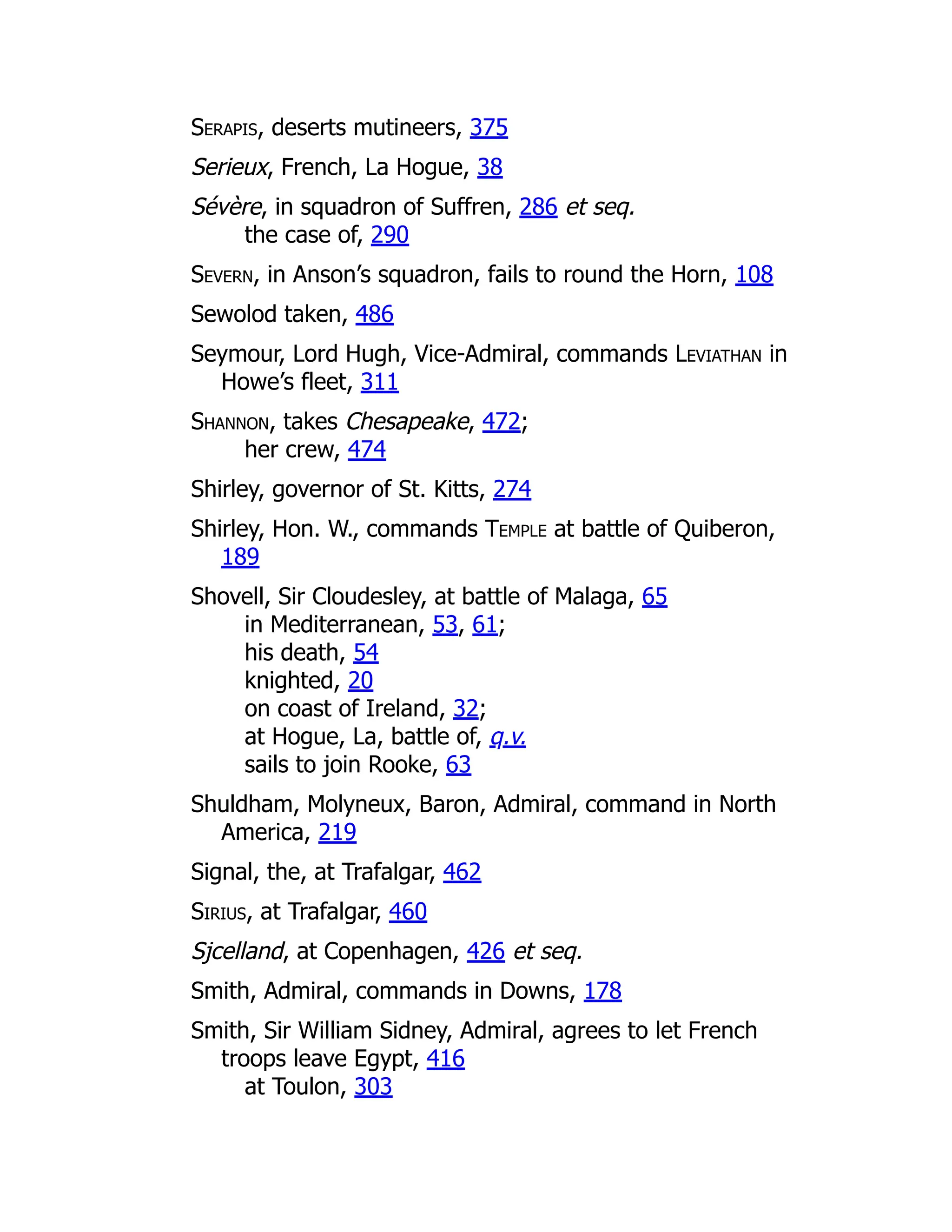
Serapis, deserts mutineers, 375
Serieux, French, La Hogue, 38
Sévère, in squadron of Suffren, 286 et seq.
the case of, 290
Severn, in Anson’s squadron, fails to round the Horn, 108
Sewolod taken, 486
Seymour, Lord Hugh, Vice-Admiral, commands Leviathan in
Howe’s fleet, 311
Shannon, takes Chesapeake, 472;
her crew, 474
Shirley, governor of St. Kitts, 274
Shirley, Hon. W., commands Temple at battle of Quiberon,
189
Shovell, Sir Cloudesley, at battle of Malaga, 65
in Mediterranean, 53, 61;
his death, 54
knighted, 20
on coast of Ireland, 32;
at Hogue, La, battle of, q.v.
sails to join Rooke, 63
Shuldham, Molyneux, Baron, Admiral, command in North
America, 219
Signal, the, at Trafalgar, 462
Sirius, at Trafalgar, 460
Sjcelland, at Copenhagen, 426 et seq.
Smith, Admiral, commands in Downs, 178
Smith, Sir William Sidney, Admiral, agrees to let French
troops leave Egypt, 416
at Toulon, 303
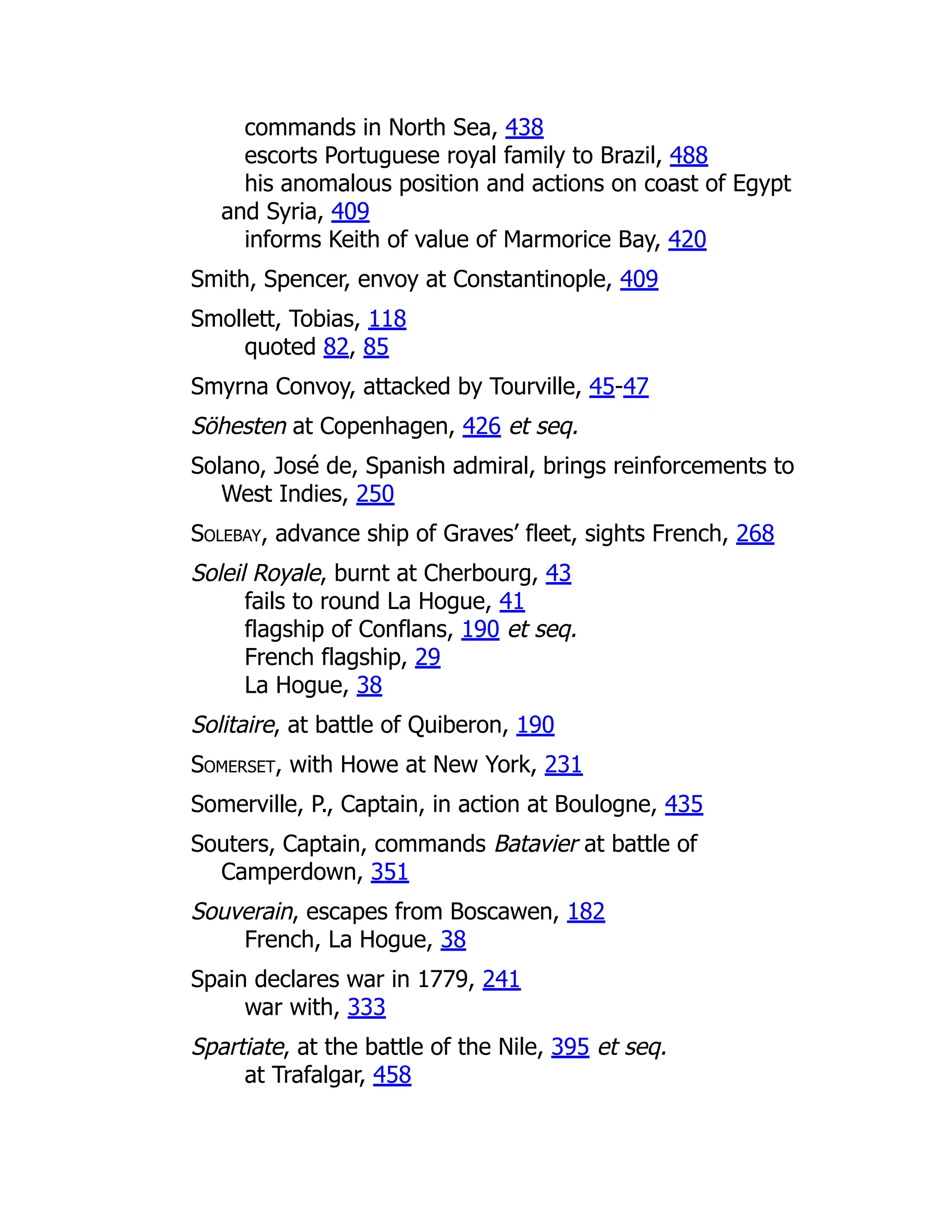
commands in North Sea, 438
escorts Portuguese royal family to Brazil, 488
his anomalous position and actions on coast of Egypt
and Syria, 409
informs Keith of value of Marmorice Bay, 420
Smith, Spencer, envoy at Constantinople, 409
Smollett, Tobias, 118
quoted 82, 85
Smyrna Convoy, attacked by Tourville, 45-47
Söhesten at Copenhagen, 426 et seq.
Solano, José de, Spanish admiral, brings reinforcements to
West Indies, 250
Solebay, advance ship of Graves’ fleet, sights French, 268
Soleil Royale, burnt at Cherbourg, 43
fails to round La Hogue, 41
flagship of Conflans, 190 et seq.
French flagship, 29
La Hogue, 38
Solitaire, at battle of Quiberon, 190
Somerset, with Howe at New York, 231
Somerville, P., Captain, in action at Boulogne, 435
Souters, Captain, commands Batavier at battle of
Camperdown, 351
Souverain, escapes from Boscawen, 182
French, La Hogue, 38
Spain declares war in 1779, 241
war with, 333
Spartiate, at the battle of the Nile, 395 et seq.
at Trafalgar, 458
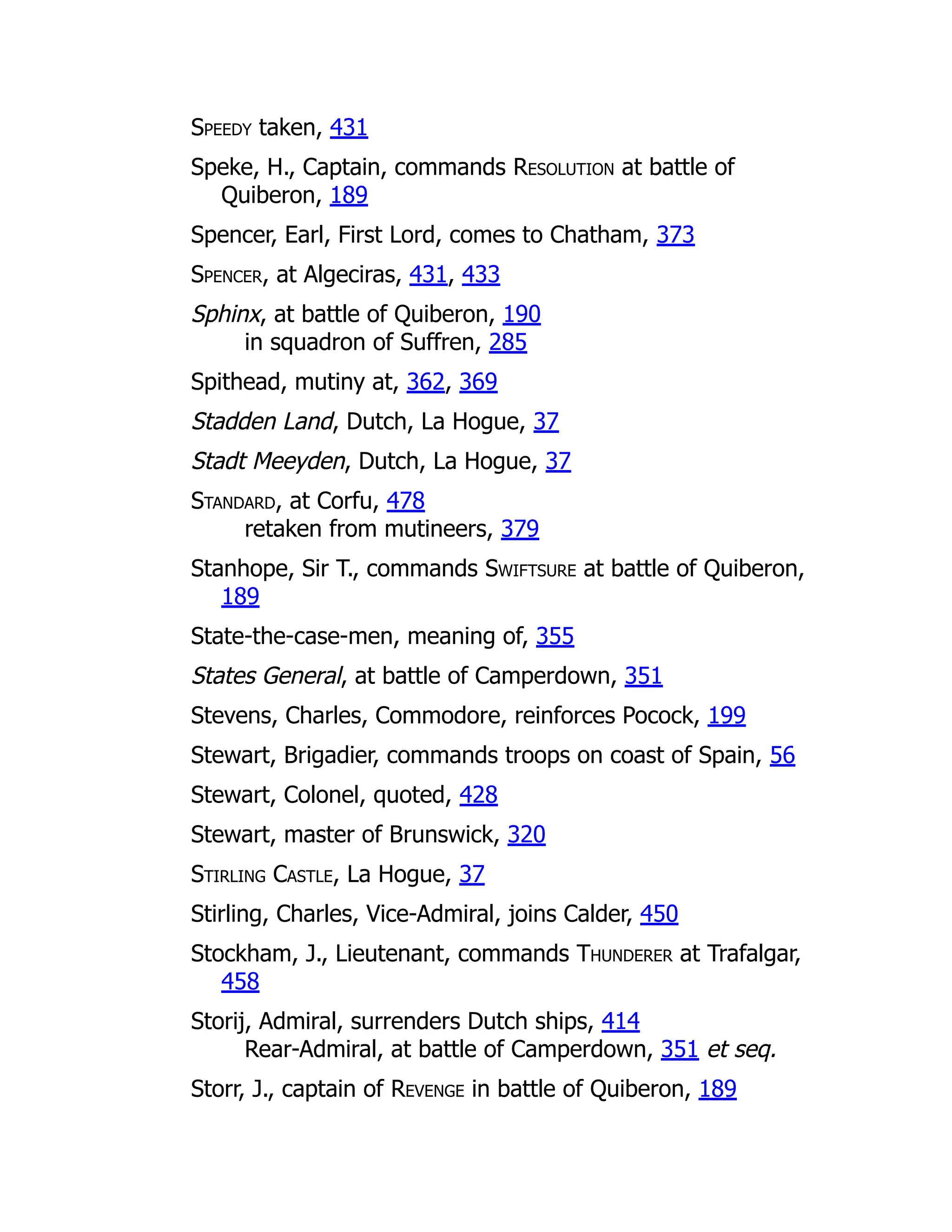
Speedy taken, 431
Speke, H., Captain, commands Resolution at battle of
Quiberon, 189
Spencer, Earl, First Lord, comes to Chatham, 373
Spencer, at Algeciras, 431, 433
Sphinx, at battle of Quiberon, 190
in squadron of Suffren, 285
Spithead, mutiny at, 362, 369
Stadden Land, Dutch, La Hogue, 37
Stadt Meeyden, Dutch, La Hogue, 37
Standard, at Corfu, 478
retaken from mutineers, 379
Stanhope, Sir T., commands Swiftsure at battle of Quiberon,
189
State-the-case-men, meaning of, 355
States General, at battle of Camperdown, 351
Stevens, Charles, Commodore, reinforces Pocock, 199
Stewart, Brigadier, commands troops on coast of Spain, 56
Stewart, Colonel, quoted, 428
Stewart, master of Brunswick, 320
Stirling Castle, La Hogue, 37
Stirling, Charles, Vice-Admiral, joins Calder, 450
Stockham, J., Lieutenant, commands Thunderer at Trafalgar,
458
Storij, Admiral, surrenders Dutch ships, 414
Rear-Admiral, at battle of Camperdown, 351 et seq.
Storr, J., captain of Revenge in battle of Quiberon, 189
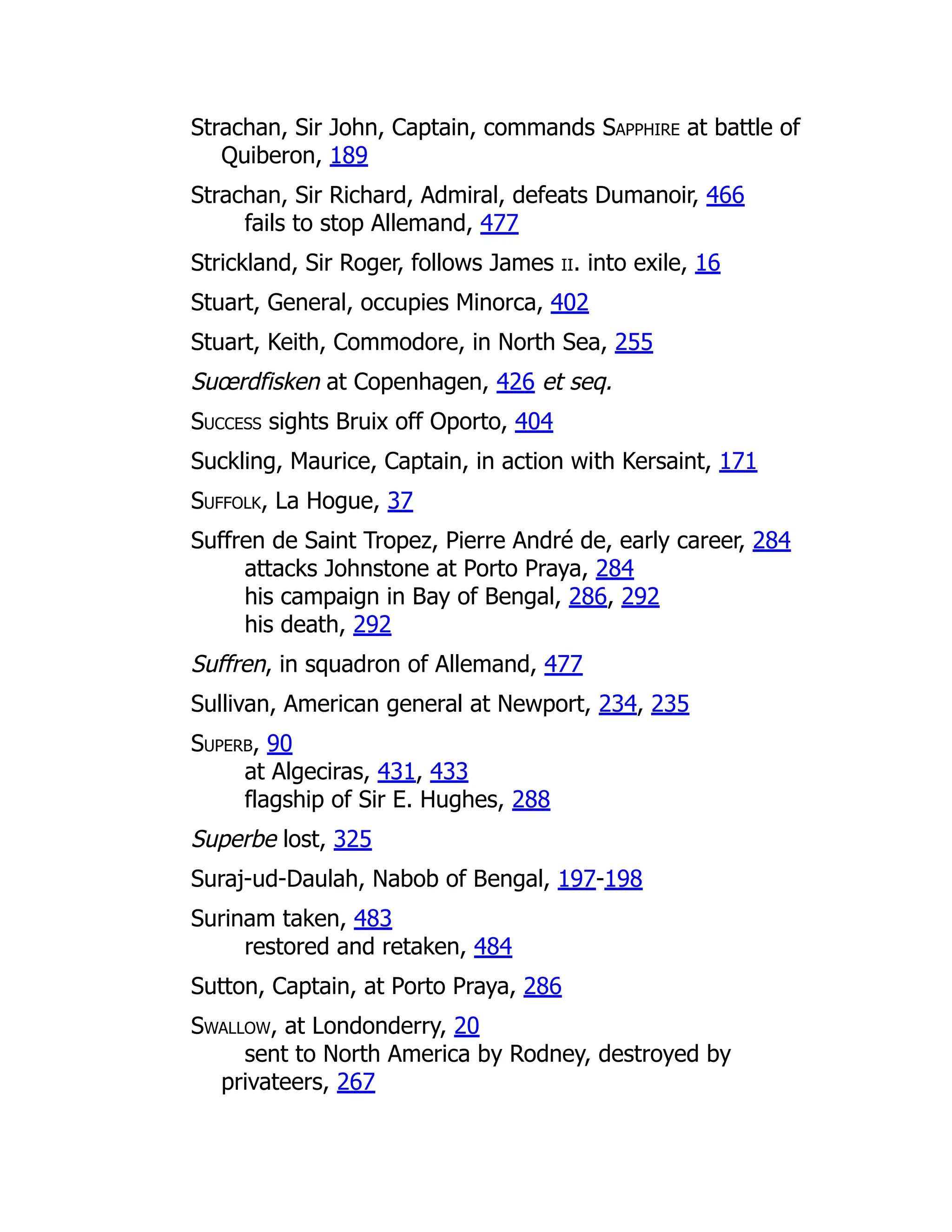
Strachan, Sir John, Captain, commands Sapphire at battle of
Quiberon, 189
Strachan, Sir Richard, Admiral, defeats Dumanoir, 466
fails to stop Allemand, 477
Strickland, Sir Roger, follows James ii. into exile, 16
Stuart, General, occupies Minorca, 402
Stuart, Keith, Commodore, in North Sea, 255
Suœrdfisken at Copenhagen, 426 et seq.
Success sights Bruix off Oporto, 404
Suckling, Maurice, Captain, in action with Kersaint, 171
Suffolk, La Hogue, 37
Suffren de Saint Tropez, Pierre André de, early career, 284
attacks Johnstone at Porto Praya, 284
his campaign in Bay of Bengal, 286, 292
his death, 292
Suffren, in squadron of Allemand, 477
Sullivan, American general at Newport, 234, 235
Superb, 90
at Algeciras, 431, 433
flagship of Sir E. Hughes, 288
Superbe lost, 325
Suraj-ud-Daulah, Nabob of Bengal, 197-198
Surinam taken, 483
restored and retaken, 484
Sutton, Captain, at Porto Praya, 286
Swallow, at Londonderry, 20
sent to North America by Rodney, destroyed by
privateers, 267
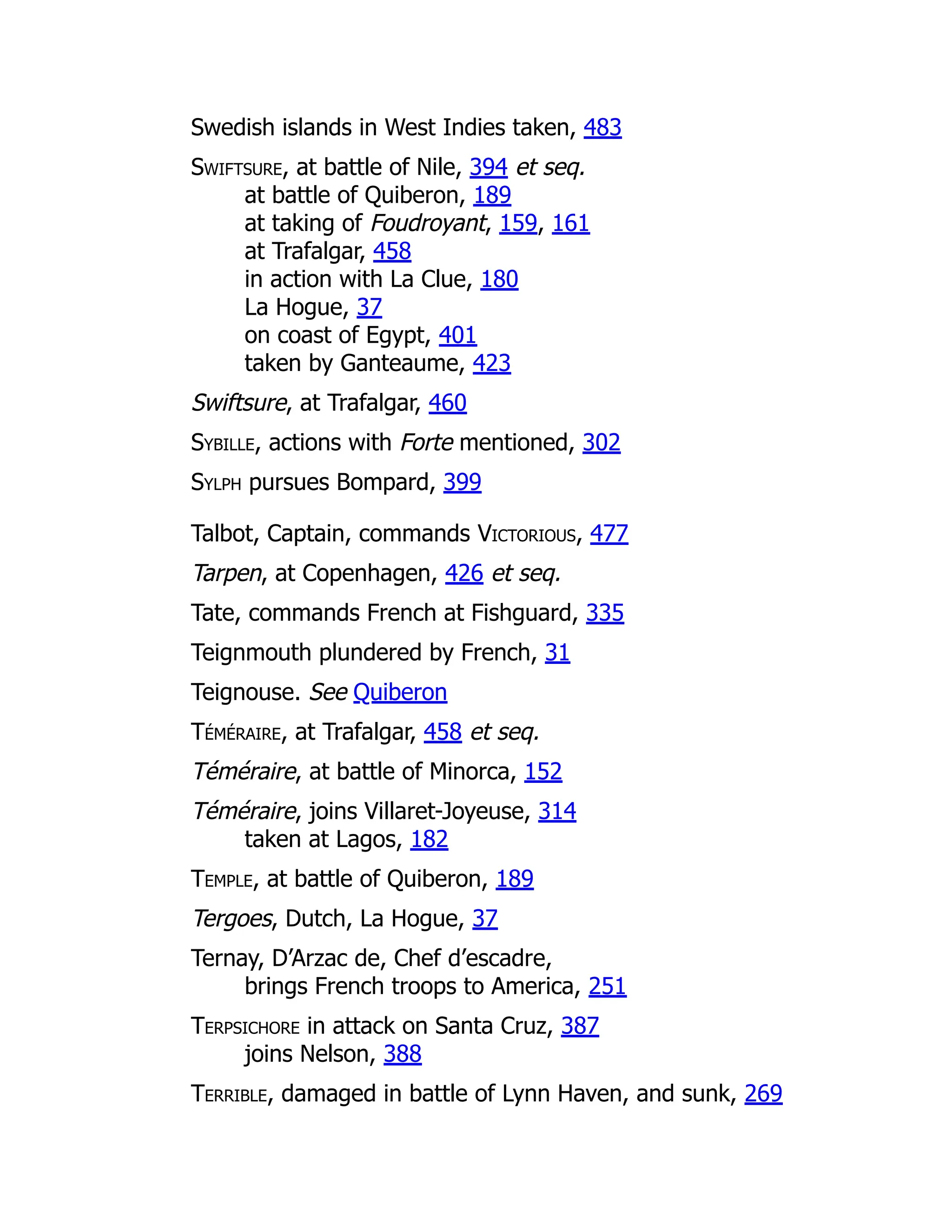
Swedish islands in West Indies taken, 483
Swiftsure, at battle of Nile, 394 et seq.
at battle of Quiberon, 189
at taking of Foudroyant, 159, 161
at Trafalgar, 458
in action with La Clue, 180
La Hogue, 37
on coast of Egypt, 401
taken by Ganteaume, 423
Swiftsure, at Trafalgar, 460
Sybille, actions with Forte mentioned, 302
Sylph pursues Bompard, 399
Talbot, Captain, commands Victorious, 477
Tarpen, at Copenhagen, 426 et seq.
Tate, commands French at Fishguard, 335
Teignmouth plundered by French, 31
Teignouse. See Quiberon
Téméraire, at Trafalgar, 458 et seq.
Téméraire, at battle of Minorca, 152
Téméraire, joins Villaret-Joyeuse, 314
taken at Lagos, 182
Temple, at battle of Quiberon, 189
Tergoes, Dutch, La Hogue, 37
Ternay, D’Arzac de, Chef d’escadre,
brings French troops to America, 251
Terpsichore in attack on Santa Cruz, 387
joins Nelson, 388
Terrible, damaged in battle of Lynn Haven, and sunk, 269
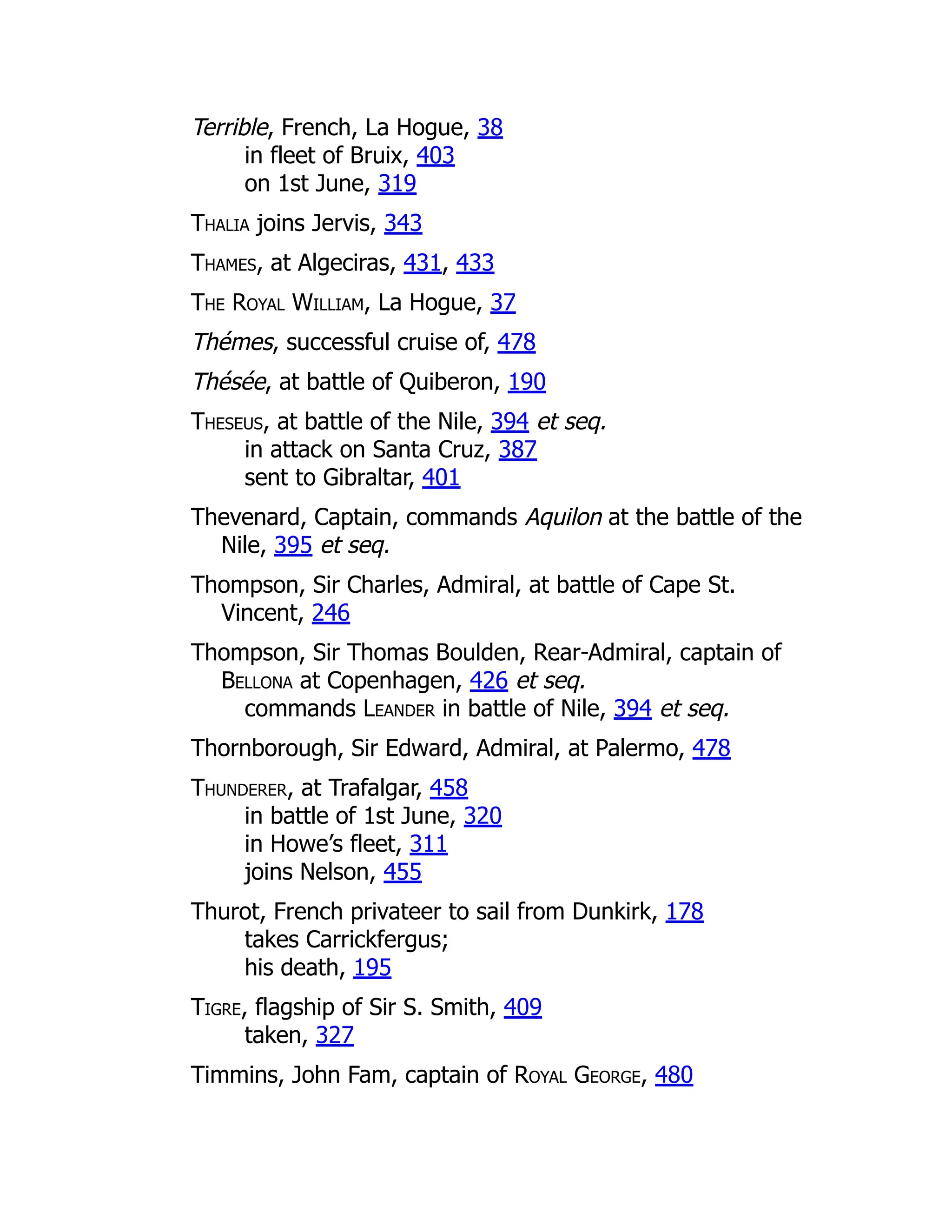
Terrible, French, La Hogue, 38
in fleet of Bruix, 403
on 1st June, 319
Thalia joins Jervis, 343
Thames, at Algeciras, 431, 433
The Royal William, La Hogue, 37
Thémes, successful cruise of, 478
Thésée, at battle of Quiberon, 190
Theseus, at battle of the Nile, 394 et seq.
in attack on Santa Cruz, 387
sent to Gibraltar, 401
Thevenard, Captain, commands Aquilon at the battle of the
Nile, 395 et seq.
Thompson, Sir Charles, Admiral, at battle of Cape St.
Vincent, 246
Thompson, Sir Thomas Boulden, Rear-Admiral, captain of
Bellona at Copenhagen, 426 et seq.
commands Leander in battle of Nile, 394 et seq.
Thornborough, Sir Edward, Admiral, at Palermo, 478
Thunderer, at Trafalgar, 458
in battle of 1st June, 320
in Howe’s fleet, 311
joins Nelson, 455
Thurot, French privateer to sail from Dunkirk, 178
takes Carrickfergus;
his death, 195
Tigre, flagship of Sir S. Smith, 409
taken, 327
Timmins, John Fam, captain of Royal George, 480
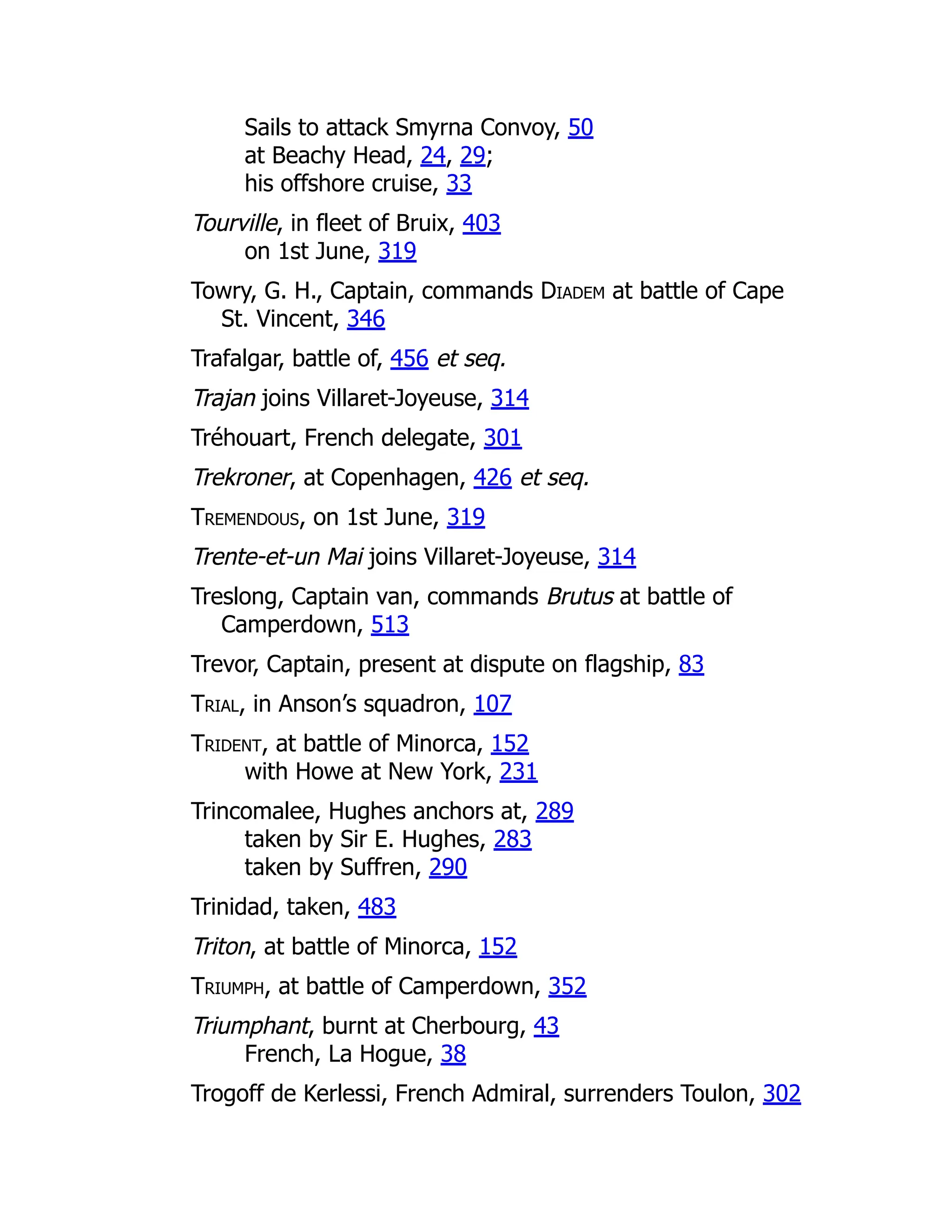
Timoléon, at battle of the Nile, 395 et seq.
Tippoo, Sultan of Mysore, succeeds Hyder Ali, 291
Tobago taken, 265, 481
Tollemache, Thomas, General, mortally wounded at Brest,
51
Tonnant, at Trafalgar, 458
Tonnant at battle of Quiberon, 190
at the battle of the Nile, 395, et seq.
French, La Hogue, 38
in action of 14th October, 1747, 126
in D’Estaign squadron, 229
prize sent to Gibraltar, 401
Torbay, at battle of Quiberon, 189
Torin, Robert, captain of Coutts, 480
Torres, Rodrigo de, Spanish naval officer in West Indies,
104
Torrington, Earl of. See Herbert, Arthur
Torrington Viscount. See Byng, George
Tory Island, defeat of Bompard near, 399, 400
Touch, the Nelson, 457, 458
Touffet, C., commands Duguay-Trouin at Trafalgar, 460
Toulon, battle of, 112 et seq.
battle of, Parliamentary inquiry into, 114
occupation of, in 1793, 302, 303
Toulouse, Comte de, Admiral of France,
sails from Brest, 62, 63
at battle of Malaga, 65, 66
Tourville, Hilarion de Côtentin, Comte de, at battle of La
Hogue. See Hogue, La.
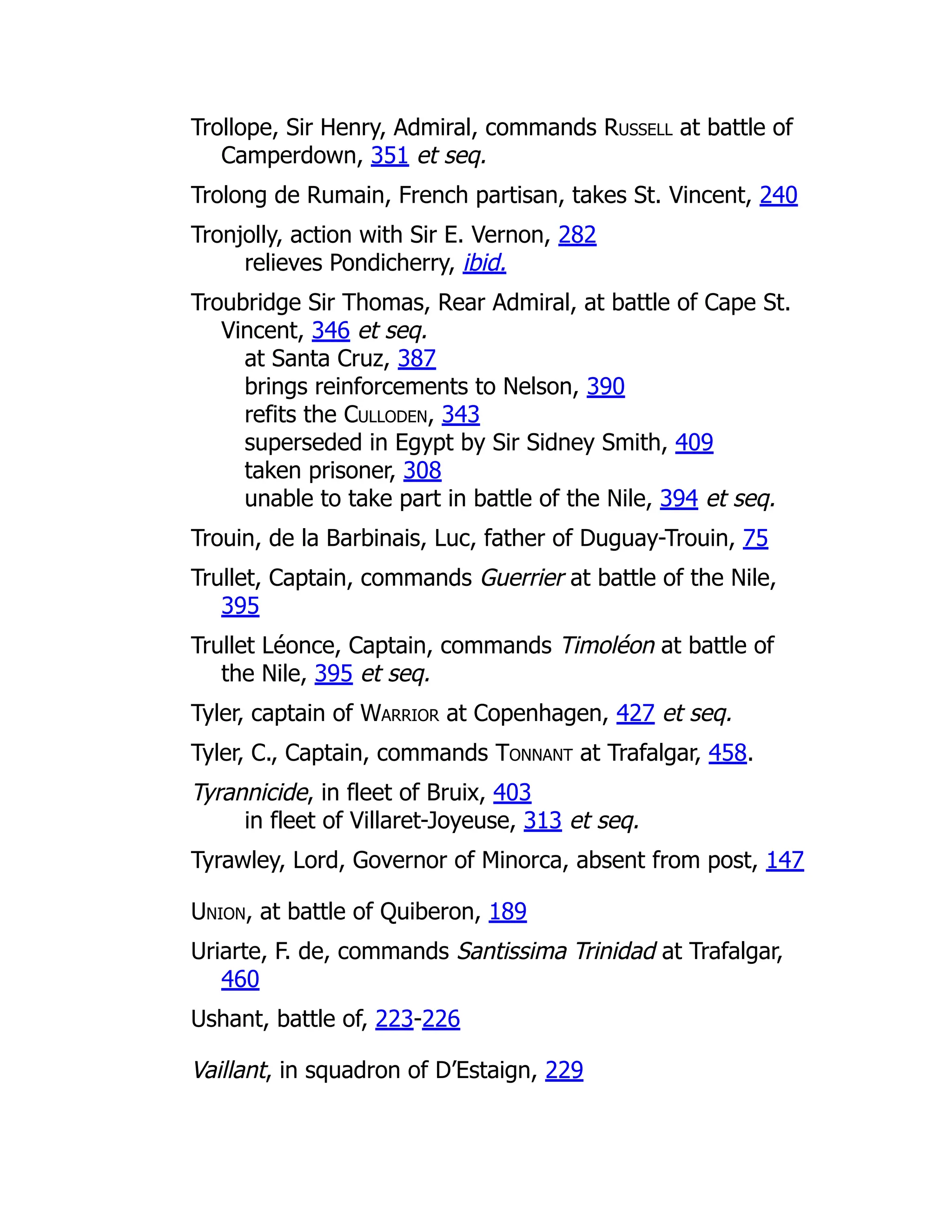
Sails to attack Smyrna Convoy, 50
at Beachy Head, 24, 29;
his offshore cruise, 33
Tourville, in fleet of Bruix, 403
on 1st June, 319
Towry, G. H., Captain, commands Diadem at battle of Cape
St. Vincent, 346
Trafalgar, battle of, 456 et seq.
Trajan joins Villaret-Joyeuse, 314
Tréhouart, French delegate, 301
Trekroner, at Copenhagen, 426 et seq.
Tremendous, on 1st June, 319
Trente-et-un Mai joins Villaret-Joyeuse, 314
Treslong, Captain van, commands Brutus at battle of
Camperdown, 513
Trevor, Captain, present at dispute on flagship, 83
Trial, in Anson’s squadron, 107
Trident, at battle of Minorca, 152
with Howe at New York, 231
Trincomalee, Hughes anchors at, 289
taken by Sir E. Hughes, 283
taken by Suffren, 290
Trinidad, taken, 483
Triton, at battle of Minorca, 152
Triumph, at battle of Camperdown, 352
Triumphant, burnt at Cherbourg, 43
French, La Hogue, 38
Trogoff de Kerlessi, French Admiral, surrenders Toulon, 302
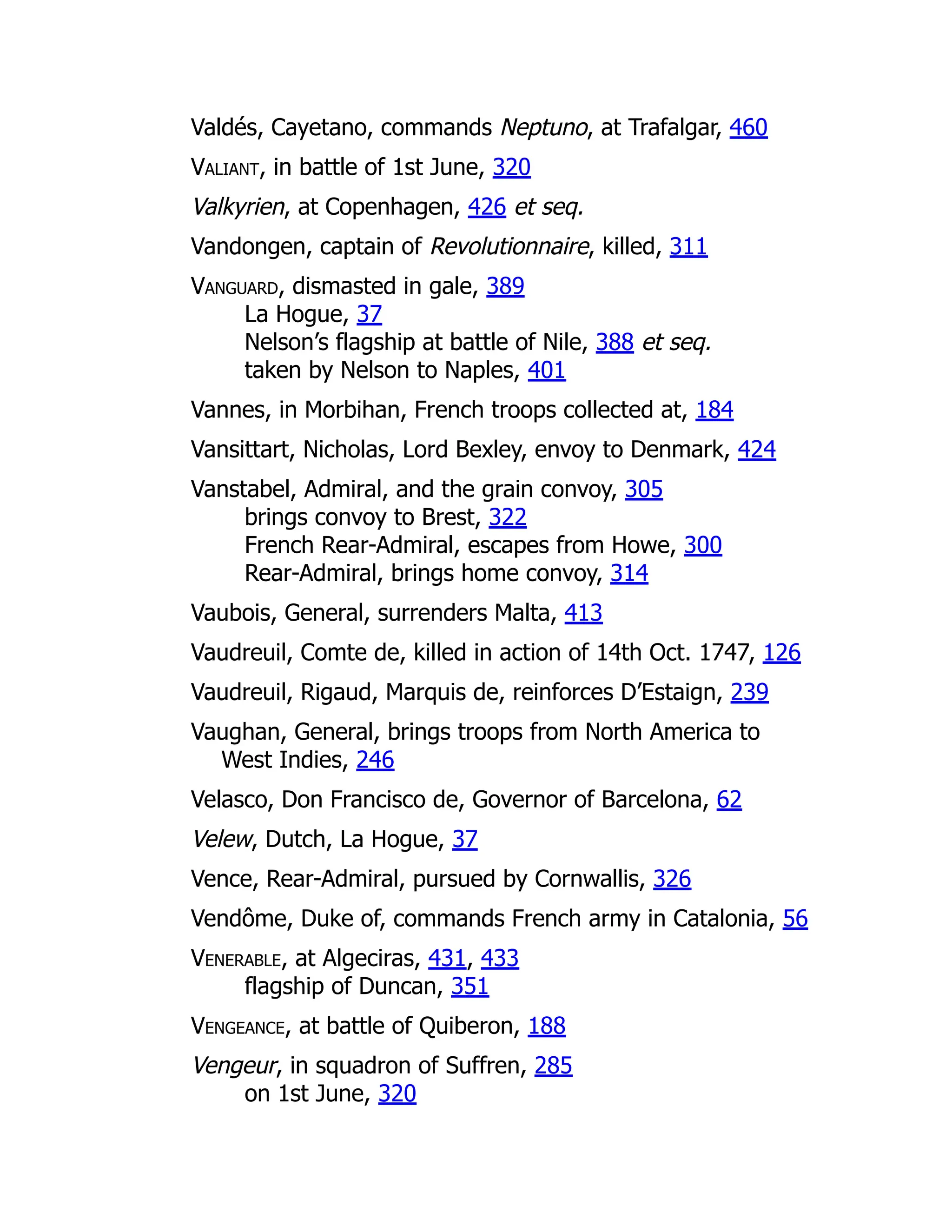
Trollope, Sir Henry, Admiral, commands Russell at battle of
Camperdown, 351 et seq.
Trolong de Rumain, French partisan, takes St. Vincent, 240
Tronjolly, action with Sir E. Vernon, 282
relieves Pondicherry, ibid.
Troubridge Sir Thomas, Rear Admiral, at battle of Cape St.
Vincent, 346 et seq.
at Santa Cruz, 387
brings reinforcements to Nelson, 390
refits the Culloden, 343
superseded in Egypt by Sir Sidney Smith, 409
taken prisoner, 308
unable to take part in battle of the Nile, 394 et seq.
Trouin, de la Barbinais, Luc, father of Duguay-Trouin, 75
Trullet, Captain, commands Guerrier at battle of the Nile,
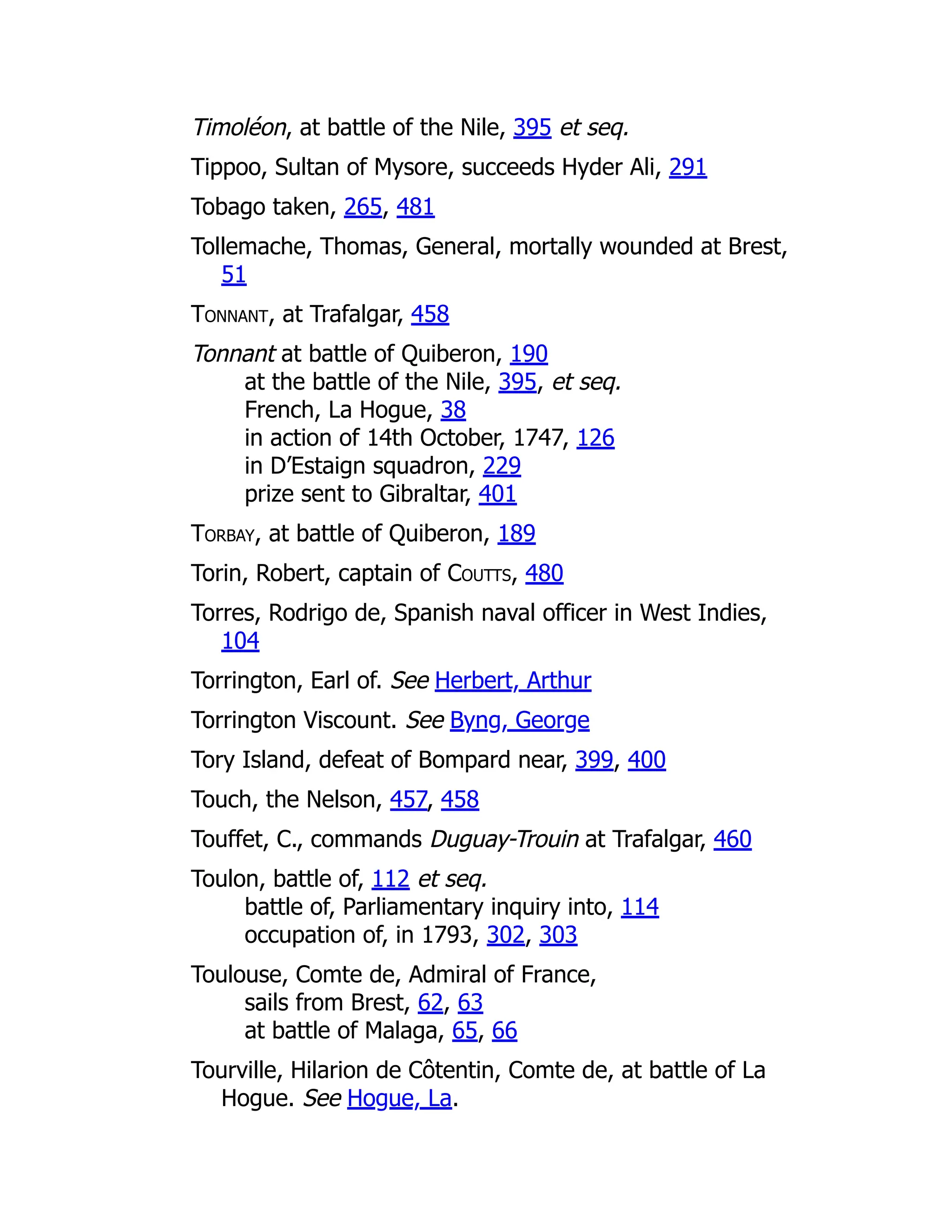
395
Trullet Léonce, Captain, commands Timoléon at battle of
the Nile, 395 et seq.
Tyler, captain of Warrior at Copenhagen, 427 et seq.
Tyler, C., Captain, commands Tonnant at Trafalgar, 458.
Tyrannicide, in fleet of Bruix, 403
in fleet of Villaret-Joyeuse, 313 et seq.
Tyrawley, Lord, Governor of Minorca, absent from post, 147
Union, at battle of Quiberon, 189
Uriarte, F. de, commands Santissima Trinidad at Trafalgar,
460
Ushant, battle of, 223-226
Vaillant, in squadron of D’Estaign, 229
Valdés, Cayetano, commands Neptuno, at Trafalgar, 460
Valiant, in battle of 1st June, 320
Valkyrien, at Copenhagen, 426 et seq.
Vandongen, captain of Revolutionnaire, killed, 311
Vanguard, dismasted in gale, 389
La Hogue, 37
Nelson’s flagship at battle of Nile, 388 et seq.
taken by Nelson to Naples, 401
Vannes, in Morbihan, French troops collected at, 184
Vansittart, Nicholas, Lord Bexley, envoy to Denmark, 424
Vanstabel, Admiral, and the grain convoy, 305
brings convoy to Brest, 322
French Rear-Admiral, escapes from Howe, 300
Rear-Admiral, brings home convoy, 314
Vaubois, General, surrenders Malta, 413
Vaudreuil, Comte de, killed in action of 14th Oct. 1747, 126
Vaudreuil, Rigaud, Marquis de, reinforces D’Estaign, 239
Vaughan, General, brings troops from North America to
West Indies, 246
Velasco, Don Francisco de, Governor of Barcelona, 62
Velew, Dutch, La Hogue, 37
Vence, Rear-Admiral, pursued by Cornwallis, 326
Vendôme, Duke of, commands French army in Catalonia, 56
Venerable, at Algeciras, 431, 433
flagship of Duncan, 351
Vengeance, at battle of Quiberon, 188
Vengeur, in squadron of Suffren, 285
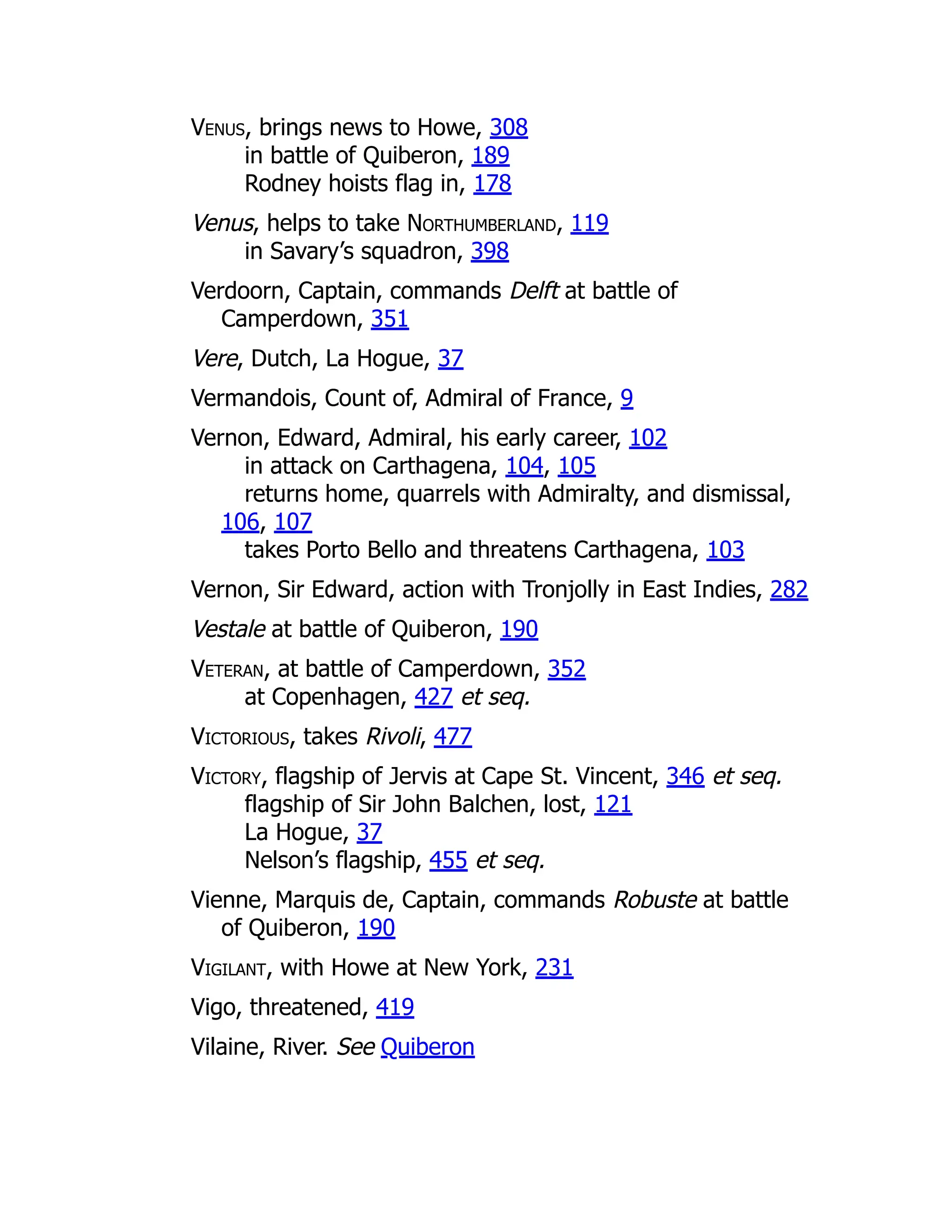
on 1st June, 320
Venus, brings news to Howe, 308
in battle of Quiberon, 189
Rodney hoists flag in, 178
Venus, helps to take Northumberland, 119
in Savary’s squadron, 398
Verdoorn, Captain, commands Delft at battle of
Camperdown, 351
Vere, Dutch, La Hogue, 37
Vermandois, Count of, Admiral of France, 9
Vernon, Edward, Admiral, his early career, 102
in attack on Carthagena, 104, 105
returns home, quarrels with Admiralty, and dismissal,
106, 107
takes Porto Bello and threatens Carthagena, 103
Vernon, Sir Edward, action with Tronjolly in East Indies, 282
Vestale at battle of Quiberon, 190
Veteran, at battle of Camperdown, 352
at Copenhagen, 427 et seq.
Victorious, takes Rivoli, 477
Victory, flagship of Jervis at Cape St. Vincent, 346 et seq.
flagship of Sir John Balchen, lost, 121
La Hogue, 37
Nelson’s flagship, 455 et seq.
Vienne, Marquis de, Captain, commands Robuste at battle
of Quiberon, 190
Vigilant, with Howe at New York, 231
Vigo, threatened, 419
Vilaine, River. See Quiberon
Vilarzel, Captain de, commands Redoutable at battle of
Minorca, 152
Villaret-Joyeuse, French Admiral, at action of Groix, 326 et
seq.
at battle of 1st June, 311, 321
at Quiberon, 300
commands Brest fleet, 306
his successive engagements with Howe, 28th and
29th May, and 1st June 1794, 310, 320
ordered to sea, 324 et seq.
orders to, 307
pursues Cornwallis, 326
sails from Brest, 308
takes Dutch convoy, 309
Villars de Labrosse, Captain, commands Glorieux at battle
of Quiberon, 190
commands Guerrier at battle of Minorca, 152
Ville de Paris, collision of with Formidable, 342
story of sailor in, 382
taken from fleet by Jervis, 406, 407
Ville de Paris, flagship of Comte de Grasse, surrendered,
279
Villegris La, G. J. N., commands Mont Blanc at Trafalgar,
460
Villemadrin, C. E. L. H., commands Swiftsure at Trafalgar,
460
Villeneuve, Admiral, death of, 466
hears that he is to be superseded, and goes to sea,
456
his first sortie, 446
his flag in Guillaume Tell at battle of the Nile, 395 et
seq.
his operation on north-west of Spain, 451, 453
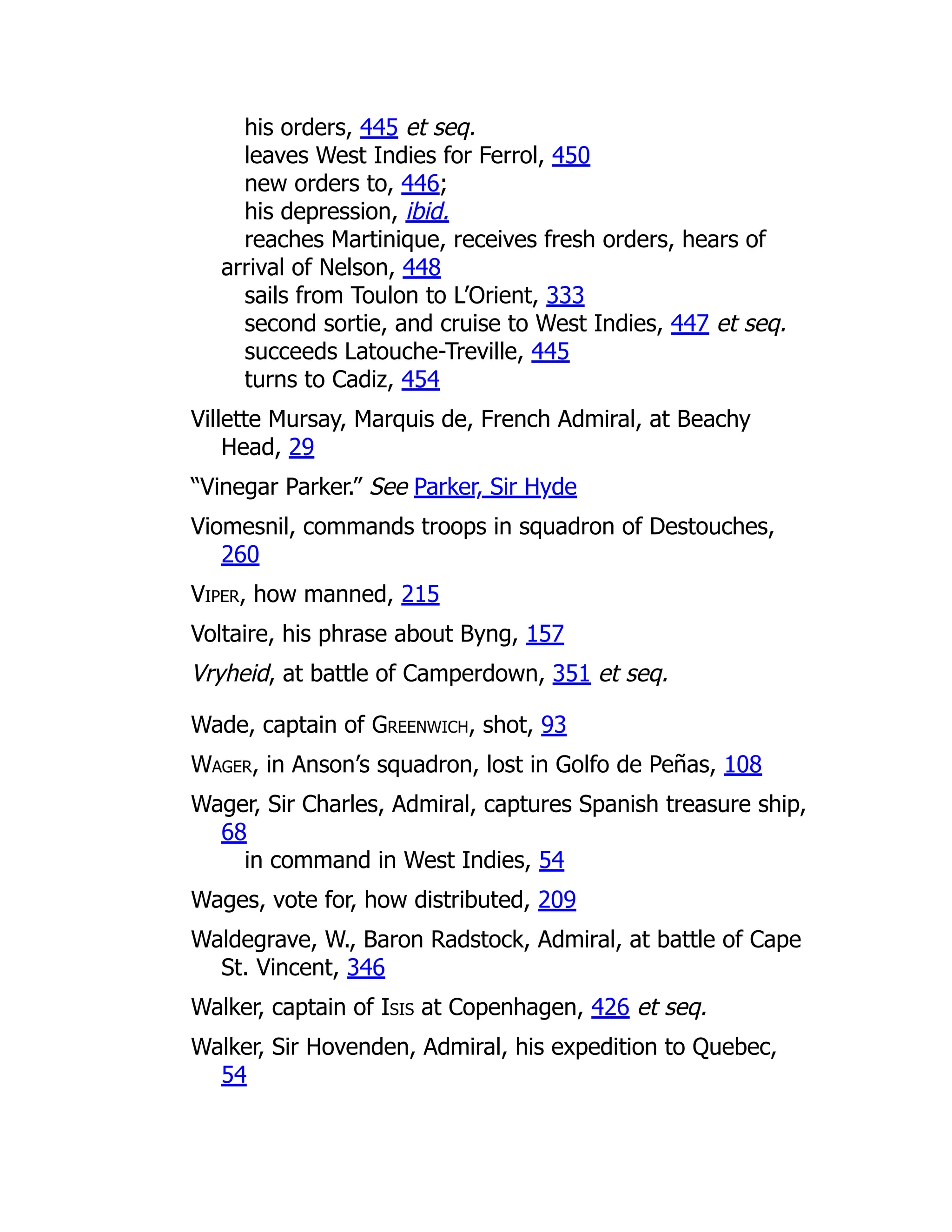
his orders, 445 et seq.
leaves West Indies for Ferrol, 450
new orders to, 446;
his depression, ibid.
reaches Martinique, receives fresh orders, hears of
arrival of Nelson, 448
sails from Toulon to L’Orient, 333
second sortie, and cruise to West Indies, 447 et seq.
succeeds Latouche-Treville, 445
turns to Cadiz, 454
Villette Mursay, Marquis de, French Admiral, at Beachy
Head, 29
“Vinegar Parker.” See Parker, Sir Hyde
Viomesnil, commands troops in squadron of Destouches,
260
Viper, how manned, 215
Voltaire, his phrase about Byng, 157
Vryheid, at battle of Camperdown, 351 et seq.
Wade, captain of Greenwich, shot, 93
Wager, in Anson’s squadron, lost in Golfo de Peñas, 108
Wager, Sir Charles, Admiral, captures Spanish treasure ship,
68
in command in West Indies, 54
Wages, vote for, how distributed, 209
Waldegrave, W., Baron Radstock, Admiral, at battle of Cape
St. Vincent, 346
Walker, captain of Isis at Copenhagen, 426 et seq.
Walker, Sir Hovenden, Admiral, his expedition to Quebec,
54
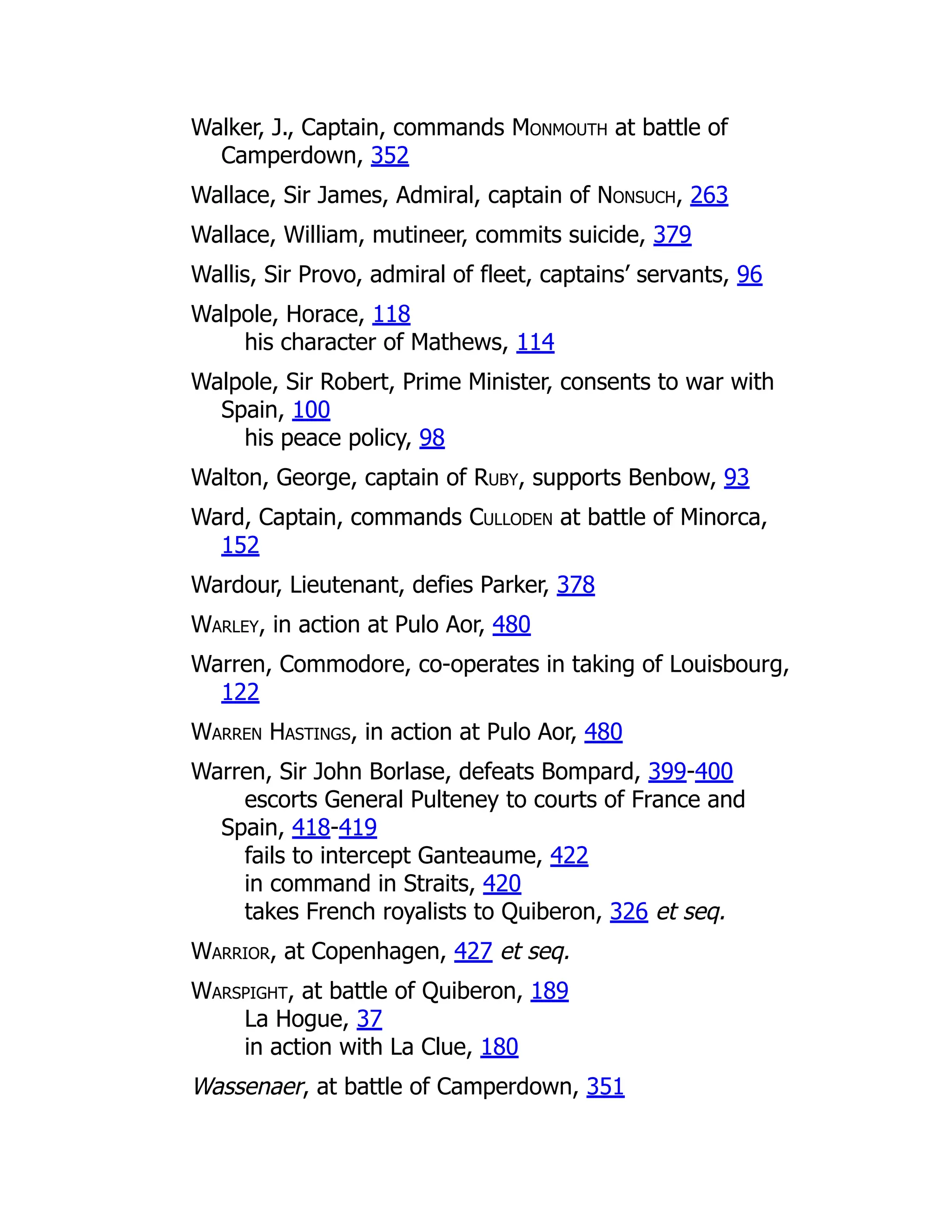
Walker, J., Captain, commands Monmouth at battle of
Camperdown, 352
Wallace, Sir James, Admiral, captain of Nonsuch, 263
Wallace, William, mutineer, commits suicide, 379
Wallis, Sir Provo, admiral of fleet, captains’ servants, 96
Walpole, Horace, 118
his character of Mathews, 114
Walpole, Sir Robert, Prime Minister, consents to war with
Spain, 100
his peace policy, 98
Walton, George, captain of Ruby, supports Benbow, 93
Ward, Captain, commands Culloden at battle of Minorca,
152
Wardour, Lieutenant, defies Parker, 378
Warley, in action at Pulo Aor, 480
Warren, Commodore, co-operates in taking of Louisbourg,
122
Warren Hastings, in action at Pulo Aor, 480
Warren, Sir John Borlase, defeats Bompard, 399-400
escorts General Pulteney to courts of France and
Spain, 418-419
fails to intercept Ganteaume, 422
in command in Straits, 420
takes French royalists to Quiberon, 326 et seq.
Warrior, at Copenhagen, 427 et seq.
Warspight, at battle of Quiberon, 189
La Hogue, 37
in action with La Clue, 180
Wassenaer, at battle of Camperdown, 351
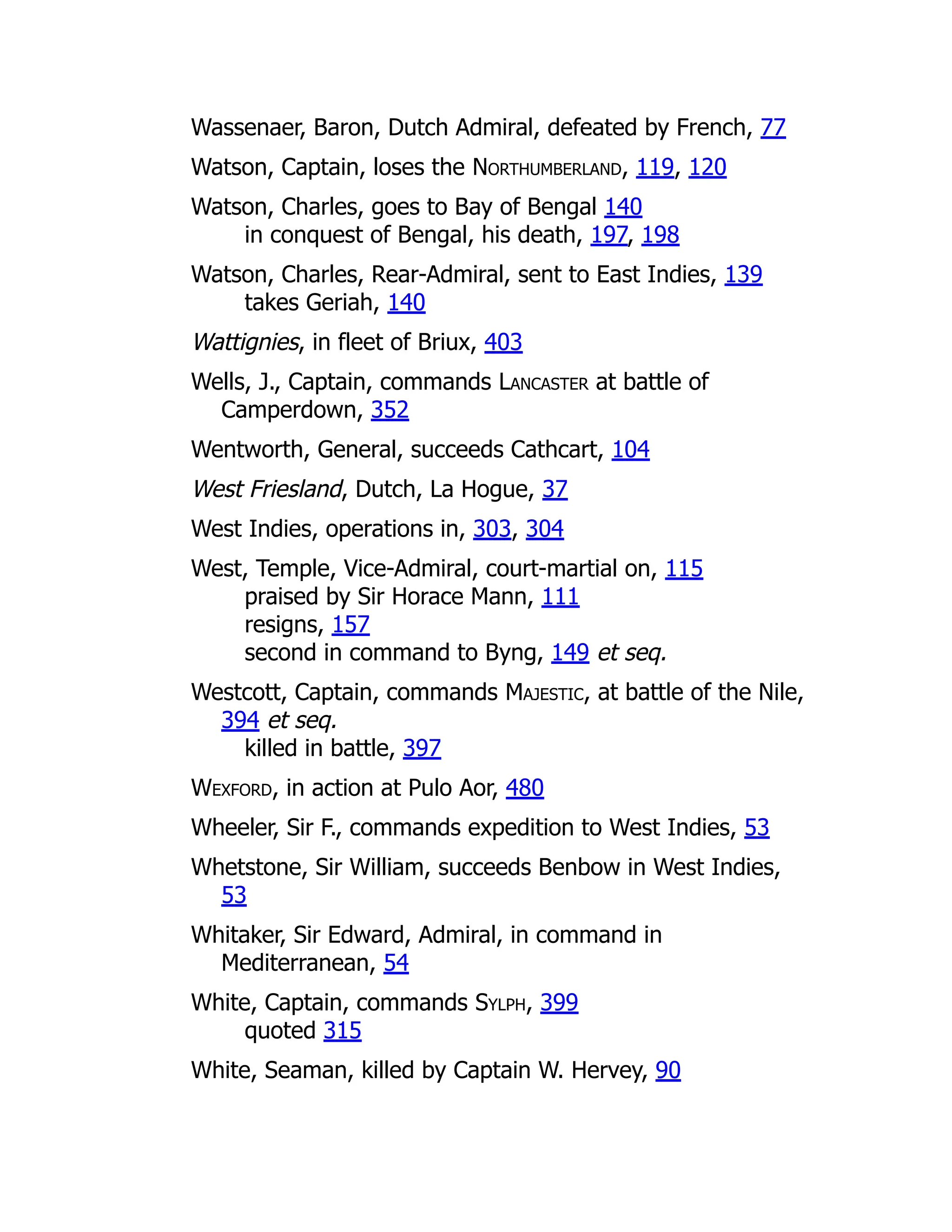
Wassenaer, Baron, Dutch Admiral, defeated by French, 77
Watson, Captain, loses the Northumberland, 119, 120
Watson, Charles, goes to Bay of Bengal 140
in conquest of Bengal, his death, 197, 198
Watson, Charles, Rear-Admiral, sent to East Indies, 139
takes Geriah, 140
Wattignies, in fleet of Briux, 403
Wells, J., Captain, commands Lancaster at battle of
Camperdown, 352
Wentworth, General, succeeds Cathcart, 104
West Friesland, Dutch, La Hogue, 37
West Indies, operations in, 303, 304
West, Temple, Vice-Admiral, court-martial on, 115
praised by Sir Horace Mann, 111
resigns, 157
second in command to Byng, 149 et seq.
Westcott, Captain, commands Majestic, at battle of the Nile,
394 et seq.
killed in battle, 397
Wexford, in action at Pulo Aor, 480
Wheeler, Sir F., commands expedition to West Indies, 53
Whetstone, Sir William, succeeds Benbow in West Indies,
53
Whitaker, Sir Edward, Admiral, in command in
Mediterranean, 54
White, Captain, commands Sylph, 399
quoted 315
White, Seaman, killed by Captain W. Hervey, 90
Whitelock, General, surrenders at Buenos Ayres, 485
Whitshed, Sir James Hawkins, Admiral, commands Namur at
battle of Cape St. Vincent, 346
joins Jervis at Minorca, 406
Wiggerts, Captain, commands Haarlem at battle of
Camperdown, 351
Willes, Sir John, Chief Justice of Common Pleas, attaches
naval officers for contempt of court, 117
Willet, E. S., Captain, commands Chichester at battle of
Quiberon, 189
Williams, Captain, court martial on, 114
Williamson, I., Captain, commands Agincourt at battle of
Camperdown, 352;
court martial on, 354
Wilmot, Robert, Captain, commands expedition to West
Indies, 53
his quarrel with Colonel Lillingston, 87 et seq.
Wilmot, Ruth, widow of Captain R. Wilmot, 89
Wilson, Henry, captain of Warley, 480
Windsor, in Benbow’s squadron, 92
Windsor Castle, La Hogue, 37
Wishart, Sir James, at battle of Malaga, 65
present at dispute on flagship, 83
Wolfe, General, at taking of Louisbourg, 171, 173
takes Quebec, 196
Woolwich, La Hogue, 37
Wordsworth, John, captain of Earl of Abergavenny, 480
Worge, Colonel, at taking of Goree, 172
Wren, Ralph, Captain, commands expedition to West
Indies, dies of fever, 52
Wright, Lawrence, Captain, commands expedition to West
Indies, 52, 69, 71
Yarmouth Roads, mutiny of Duncan’s ships in, 375 et seq.
York, Frederick Augustus, Duke of, 303
averts mutiny in army, 363
defeated in Holland, 414
driven out of Holland, 327
James, Duke of (James ii.), and the fighting orders, 3
York, La Hogue, 37
Yorktown, siege and surrender of, 267, 268
Young, James, Admiral, comes to Chatham, 373;
commands Intrepid at battle of Minorca, 152
commands Mars at battle of Quiberon, 189
Zealand, A, Dutch, La Hogue, 37
Zealous, in attack on Santa Cruz, 387
reports presence of French at Aboukir, 391
stranded in Tangier Bay, 343
Zebra, reports approach of D’Estaign, 230
Zegers, Captain, commands Devries at battle of
Camperdown, 351
Zélé, crippled in collision, 277, 278
in fleet of Bruix, 403
in squadron of D’Estaign, 229
Zoutman, Johan Arnold, Schout-bij-Nacht, commands
Dutch squadron in North Sea, 256, 258
Zurick Zee, Dutch, La Hogue, 37
Printed by Morrison & Gibb Limited, Edinburgh
Transcriber's Notes
Minor punctuation errors repaired.
Inconsistent spelling of proper names has been retained.
*** END OF THE PROJECT GUTENBERG EBOOK A SHORT HISTORY
OF THE ROYAL NAVY, 1217-1815. VOLUME II, 1689-1815 ***
Updated editions will replace the previous one—the old editions
will be renamed.
Creating the works from print editions not protected by U.S.
copyright law means that no one owns a United States
copyright in these works, so the Foundation (and you!) can copy
and distribute it in the United States without permission and
without paying copyright royalties. Special rules, set forth in the
General Terms of Use part of this license, apply to copying and
distributing Project Gutenberg™ electronic works to protect the
PROJECT GUTENBERG™ concept and trademark. Project
Gutenberg is a registered trademark, and may not be used if
you charge for an eBook, except by following the terms of the
trademark license, including paying royalties for use of the
Project Gutenberg trademark. If you do not charge anything for
copies of this eBook, complying with the trademark license is
very easy. You may use this eBook for nearly any purpose such
as creation of derivative works, reports, performances and
research. Project Gutenberg eBooks may be modified and
printed and given away—you may do practically ANYTHING in
the United States with eBooks not protected by U.S. copyright
law. Redistribution is subject to the trademark license, especially
commercial redistribution.
START: FULL LICENSE
THE FULL PROJECT GUTENBERG LICENSE
PLEASE READ THIS BEFORE YOU DISTRIBUTE OR USE THIS WORK
To protect the Project Gutenberg™ mission of promoting the
free distribution of electronic works, by using or distributing this
work (or any other work associated in any way with the phrase
“Project Gutenberg”), you agree to comply with all the terms of
the Full Project Gutenberg™ License available with this file or
online at www.gutenberg.org/license.
Section 1. General Terms of Use and
Redistributing Project Gutenberg™
electronic works
1.A. By reading or using any part of this Project Gutenberg™
electronic work, you indicate that you have read, understand,
agree to and accept all the terms of this license and intellectual
property (trademark/copyright) agreement. If you do not agree
to abide by all the terms of this agreement, you must cease
using and return or destroy all copies of Project Gutenberg™
electronic works in your possession. If you paid a fee for
obtaining a copy of or access to a Project Gutenberg™
electronic work and you do not agree to be bound by the terms
of this agreement, you may obtain a refund from the person or
entity to whom you paid the fee as set forth in paragraph 1.E.8.
1.B. “Project Gutenberg” is a registered trademark. It may only
be used on or associated in any way with an electronic work by
people who agree to be bound by the terms of this agreement.
There are a few things that you can do with most Project
Gutenberg™ electronic works even without complying with the
full terms of this agreement. See paragraph 1.C below. There
are a lot of things you can do with Project Gutenberg™
electronic works if you follow the terms of this agreement and
help preserve free future access to Project Gutenberg™
electronic works. See paragraph 1.E below.
1.C. The Project Gutenberg Literary Archive Foundation (“the
Foundation” or PGLAF), owns a compilation copyright in the
collection of Project Gutenberg™ electronic works. Nearly all the
individual works in the collection are in the public domain in the
United States. If an individual work is unprotected by copyright
law in the United States and you are located in the United
States, we do not claim a right to prevent you from copying,
distributing, performing, displaying or creating derivative works
based on the work as long as all references to Project
Gutenberg are removed. Of course, we hope that you will
support the Project Gutenberg™ mission of promoting free
access to electronic works by freely sharing Project Gutenberg™
works in compliance with the terms of this agreement for
keeping the Project Gutenberg™ name associated with the
work. You can easily comply with the terms of this agreement
by keeping this work in the same format with its attached full
Project Gutenberg™ License when you share it without charge
with others.
1.D. The copyright laws of the place where you are located also
govern what you can do with this work. Copyright laws in most
countries are in a constant state of change. If you are outside
the United States, check the laws of your country in addition to
the terms of this agreement before downloading, copying,
displaying, performing, distributing or creating derivative works
based on this work or any other Project Gutenberg™ work. The
Foundation makes no representations concerning the copyright
status of any work in any country other than the United States.
1.E. Unless you have removed all references to Project
Gutenberg:
1.E.1. The following sentence, with active links to, or other
immediate access to, the full Project Gutenberg™ License must
appear prominently whenever any copy of a Project
Gutenberg™ work (any work on which the phrase “Project
Welcome to our website – the perfect destination for book lovers and
knowledge seekers. We believe that every book holds a new world,
offering opportunities for learning, discovery, and personal growth.
That’s why we are dedicated to bringing you a diverse collection of
books, ranging from classic literature and specialized publications to
self-development guides and children's books.
More than just a book-buying platform, we strive to be a bridge
connecting you with timeless cultural and intellectual values. With an
elegant, user-friendly interface and a smart search system, you can
quickly find the books that best suit your interests. Additionally,
our special promotions and home delivery services help you save time
and fully enjoy the joy of reading.
Join us on a journey of knowledge exploration, passion nurturing, and
personal growth every day!
testbankmall.com

Solution Manual for McGraw-Hill Connect Resources for Whittington, Principles of Auditing and Other Assurance Services, 19e


  • 1.
    Visit https://testbankmall.com todownload the full version and browse more test banks or solution manuals Solution Manual for McGraw-Hill Connect Resources for Whittington, Principles of Auditing and Other Assurance Services, 19e _____ Press the link below to begin your download _____ https://testbankmall.com/product/solution-manual-for-mcgraw- hill-connect-resources-for-whittington-principles-of- auditing-and-other-assurance-services-19e/ Access testbankmall.com now to download high-quality test banks or solution manuals

  • 2.
    Here are somerecommended products for you. Click the link to download, or explore more at testbankmall.com Test Bank for McGraw-Hill Connect Resources for Whittington, Principles of Auditing and Other Assurance Services, 19e https://testbankmall.com/product/test-bank-for-mcgraw-hill-connect- resources-for-whittington-principles-of-auditing-and-other-assurance- services-19e/ Test Bank for McGraw-Hill Connect Resources for Whittington, Principles of Auditing and Other Assurance Services, 20e https://testbankmall.com/product/test-bank-for-mcgraw-hill-connect- resources-for-whittington-principles-of-auditing-and-other-assurance- services-20e/ Solution Manual for Principles of Auditing and Other Assurance Services, 21st Edition, Whittington https://testbankmall.com/product/solution-manual-for-principles-of- auditing-and-other-assurance-services-21st-edition-whittington/ Test Bank for Criminology, 4th Edition, Frank Schmalleger https://testbankmall.com/product/test-bank-for-criminology-4th- edition-frank-schmalleger/

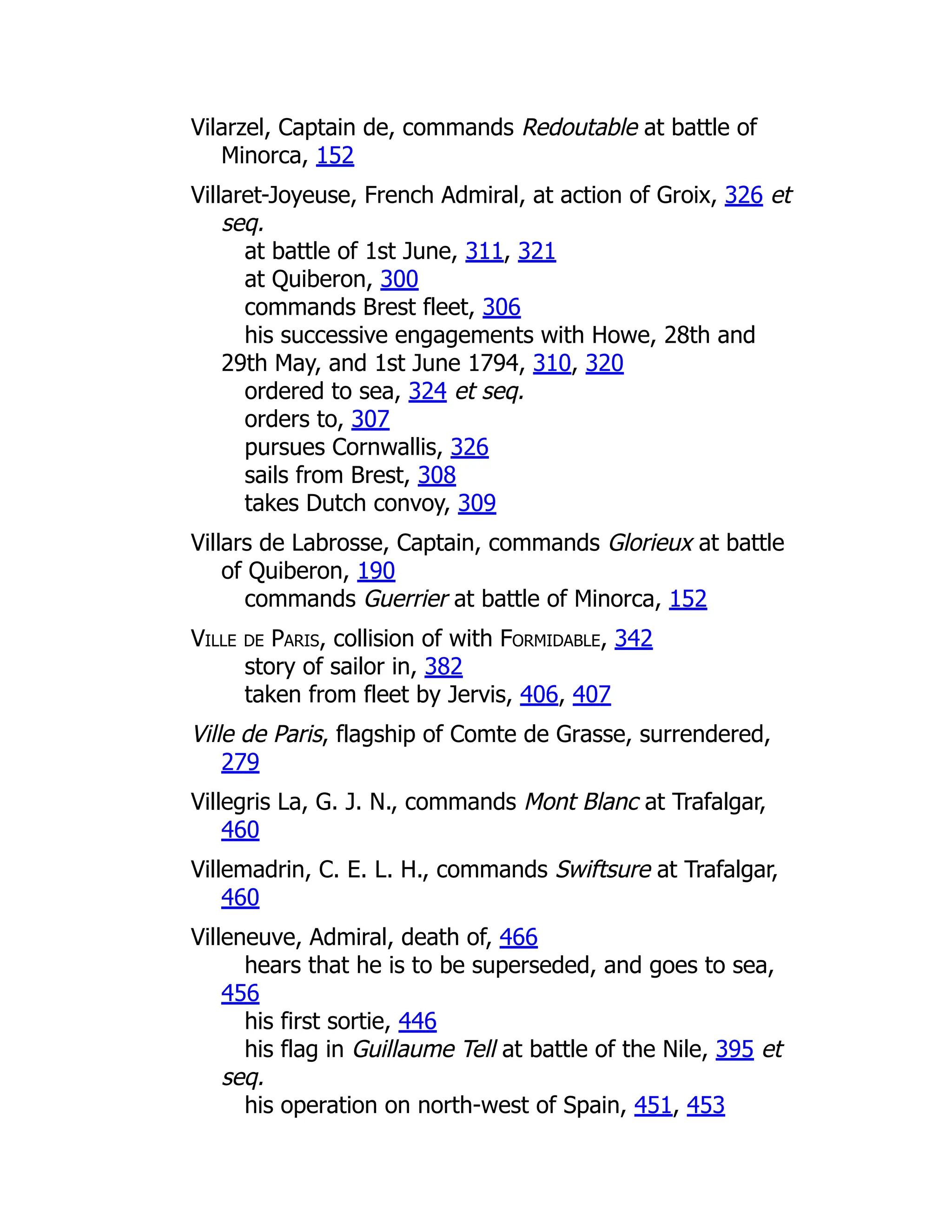
  • 3.
    Test Bank forHoles Human Anatomy and Physiology 13th Edition by Shier https://testbankmall.com/product/test-bank-for-holes-human-anatomy- and-physiology-13th-edition-by-shier/ Test Bank for Dimensional Analysis Calculating Dosages Safely 2nd by Horntvedt https://testbankmall.com/product/test-bank-for-dimensional-analysis- calculating-dosages-safely-2nd-by-horntvedt/ Operations Management Krajewski 9th Edition Solutions Manual https://testbankmall.com/product/operations-management-krajewski-9th- edition-solutions-manual/ Leadership Enhancing the Lessons of Experience, 8th Edition Test Bank – Richard Hughes https://testbankmall.com/product/leadership-enhancing-the-lessons-of- experience-8th-edition-test-bank-richard-hughes/ Test Bank for Essentials of Anatomy and Physiology 7th Edition by Martini https://testbankmall.com/product/test-bank-for-essentials-of-anatomy- and-physiology-7th-edition-by-martini/
  • 4.
    Solution Manual forUnderstanding Our Universe 3rd Edition, by Stacy Palen Laura Kay George Blumenthal https://testbankmall.com/product/solution-manual-for-understanding- our-universe-3rd-edition-by-stacy-palen-laura-kay-george-blumenthal/
  • 5.
    Solutions Manual, Chapter2, Page 2 of 14 Copyright © 2016 McGraw-Hill Education. All rights reserved. No reproduction or distribution without the prior written consent of McGraw-Hill Education. for: (1) audit evidence that contradicts other audit evidence, (2) information that raises a question about the reliability of documents and responses to inquiries, (3) conditions indicating possible fraud, and (4) circumstances suggesting the need for additional audit procedures beyond those ordinarily required. 2-6 The auditors' responsibilities concerning the detection of noncompliance with laws by clients depends on the relationship of the law or regulation to the financial statements. Certain laws and regulations, such as income tax laws, have a direct effect on the amounts and disclosures included in the financial statements. The auditors have a responsibility to design their audit to obtain reasonable assurance of detecting material violations of these laws and regulations. Many other laws and regulations, such as occupational safety and health laws, do not have a direct effect on the amounts included in the financial statements. An audit carried out in accordance with generally accepted auditing standards is not designed to detect client noncompliance with these other laws. Although an audit is not designed to provide reasonable assurance of detecting noncompliance with other laws, the CPAs should be aware of the possibility that they have occurred and investigate those identified. When they become aware of noncompliance with laws, the auditors should communicate the situation to the audit committee of the board of directors to remedy the situation and make appropriate modifications to the financial statements. If management fails to take appropriate action, the auditors should consider withdrawing from the engagement. 2-7 The first sentence of the quotation is correct. The completion of an audit of financial statements by a CPA following generally accepted auditing standards and satisfying the CPA provides the basis for expression of an unmodified opinion on the fairness of financial statements. The second sentence of the quotation is in error. Auditors never express an opinion (either qualified or unmodified) on the fairness of financial statements without first performing an audit. The audit provides the basis for the expression of an opinion. Such factors as audits made in prior years, confidence in management, and a "quick review" of the current year's financial statements are not an acceptable substitute for appropriate audit procedures. 2-8 The management of Pike Company is primarily responsible for the fairness of the company's financial statements. The retention of certified public accountants to perform an audit and express an opinion on the statements does not relieve management of its obligation to give an honest and complete accounting of its conduct of corporate affairs. 2-9 Independent Auditor’s Report To the Audit Committee of ABC Company We have audited the accompanying consolidated balance sheets of ABC Company and its subsidiaries, as of December 31, 20X1 and 20X0, and the related consolidated statements of income, retained earnings, and cash flows for the years then ended. Management's Responsibility for the Financial Statements Management is responsible for the preparation and fair presentation of these consolidated financial statements in accordance with accounting principles generally accepted in the United States of America; this includes the design, implementation, and maintenance of internal control relevant to the preparation and fair presentation of consolidated financial statements that are free from material misstatement, whether due to fraud or error.
  • 6.
    Solutions Manual, Chapter2, Page 3 of 14 Copyright © 2016 McGraw-Hill Education. All rights reserved. No reproduction or distribution without the prior written consent of McGraw-Hill Education. Auditor's Responsibility Our responsibility is to express an opinion on these consolidated financial statements based on our audit. We conducted our audit in accordance with auditing standards generally accepted in the United States of America. Those standards require that we plan and perform the audit to obtain reasonable assurance about whether the consolidated financial statements are free of material misstatement. An audit involves performing procedures to obtain audit evidence about the amounts and disclosures in the consolidated financial statements. The procedures selected depend on the auditor's judgment, including the assessment of the risks of material misstatement of the consolidated financial statements, whether due to fraud or error. In making those risk assessments, the auditor considers internal control relevant to the entity's preparation and fair presentation of the consolidated financial statements in order to design audit procedures that are appropriate in the circumstances, but not for the purpose of expressing an opinion on the effectiveness of the entity's internal control. An audit also includes evaluating the appropriateness of accounting policies used and the reasonableness of significant accounting estimates made by management, as well as evaluating the overall presentation of the consolidated financial statements. We believe that the audit evidence we have obtained is sufficient and appropriate to provide a basis for our audit opinion. Opinion In our opinion, the consolidated financial statements referred to above present fairly, in all material respects, the financial position of ABC Company and its subsidiaries as of December 31, 20X1 and 20X0, and the results of their operations and their cash flows for the years then ended in accordance with accounting principles generally accepted in the United States of America. Williams & Co. LLP Phoenix, Arizona February 5, 20X2 2-10 Among the more common situations which prevent the issuance of an unmodified opinion upon completion of an audit are the following: (1) Certain necessary auditing procedures were omitted at the request of the client, or for reasons beyond the control of the client or the auditors. (2) The statements contained misstatements (or omissions) and the client refuses to change them. 2-11 In the opinion paragraph of the auditor's standard report the auditors make representations as to the following: (1) The fairness of the financial statements, in all material respects. (2) Application of generally accepted accounting principles. (3) By implication consistent application of generally accepted accounting principles. (4) By implication adequate disclosure. 2-12 The issuance of a standard audit report tells us that the audit was performed in accordance with generally accepted auditing standards and, accordingly, it was planned and performed to obtain reasonable assurance about whether the financial statements are free of material misstatement due to error or fraud. The audit included performing procedures to obtain audit evidence about the amounts and disclosures in the financial statements. These procedures were determined based on the auditors’ judgment, including their assessment of the risks of material misstatements of the financial statements.
  • 7.
    Solutions Manual, Chapter2, Page 4 of 14 Copyright © 2016 McGraw-Hill Education. All rights reserved. No reproduction or distribution without the prior written consent of McGraw-Hill Education. The auditors also evaluated the appropriateness of accounting policies used by the client, the reasonableness of significant accounting estimates, and the overall presentation of the financial statements. 2-13 The auditors' report expresses an opinion on the client's financial statements, not on the accounting records. A major purpose of the audit is to give outsiders assurance that the financial statements are reliable. The client's accounting records are important to the public accounting firm only because they constitute evidence supporting the financial statements. The CPAs also gather evidence from outside the company and from internal sources other than the accounting records. 2-14 The public accounting firm must observe generally accepted auditing standards (or, if applicable, PCAOB Standards) in order to merit confidence in its opinion. The result of following these procedures is an audit report that includes a reasonable, but not absolute, assurance that the financial statements do not contain material misstatements due to errors or fraud. Reasonable assurance implies that there is a low level of risk remaining that the auditor expresses an opinion that the financial statements are properly stated when they are not. Reasonable and not absolute assurance is necessary due to (1) the nature of financial reporting (e.g., the necessary use of judgment), (2) the nature of audit procedures (e.g., they often do not provide absolutely conclusive evidence) and (3) the need to conduct an audit within a reasonable period of time at a reasonable cost. Accordingly, the auditor expresses an opinion on the financial statements, not a statement of fact. 2-15 Regardless of how careful and professional an audit of financial statements the public accounting firm has made, it cannot guarantee their correctness. The statements themselves include a variety of estimates; for example, the estimate of the allowance for uncollectible accounts and the choice of depreciation rates. Also, the auditors rely on a program of tests rather than on verifying every transaction. Some errors, therefore, may go undetected. The audit gives the auditors a firm basis for expressing an informed opinion on the financial statements, but no more than that. 2-16 A material amount is an amount that is sufficiently important to influence decisions made by reasonable users of financial statements. The amount may differ by account based on specific account characteristics. For example, a $100,000 shortage of cash may be extremely material to a small company, and a shortage of that amount might lead to bankruptcy. But, a $100,000 valuation overstatement of equipment may be of less significance if the company continues to produce its products and operate as in the past. Materiality is discussed further in Chapter 6. 2-17 If the guidance for a transaction or event is not specified within the authoritative GAAP (the FASB Codification), the auditor should first consider whether accounting principles for similar transactions or events exist within GAAP; if that is the case, those principles are followed to the extent considered appropriate. If not, nonauthoritative accounting guidance is consulted. Sources of nonauthoritative accounting guidance and literature include  Practices that are widely recognized and prevalent either generally or in the industry.  FASB Concepts Statements.  AICPA Issues Papers  International Financial Reporting Standards.  Pronouncements of professional associations or regulatory agencies.  Technical Information Service Inquiries and Replies included in AICPA  Technical Practice Aids.  Accounting textbooks, handbooks, and articles. The appropriateness of the above nonauthoritative accounting guidance and literature depends on its relevance to particular circumstances, how specific it is, the general recognition of the issuer or author as
  • 8.
    Solutions Manual, Chapter2, Page 5 of 14 Copyright © 2016 McGraw-Hill Education. All rights reserved. No reproduction or distribution without the prior written consent of McGraw-Hill Education. a authority, and the extent of its use in practice. 2-18 No. The attestation standards are meant to provide a general framework for the overall attestation function and do not supersede the generally accepted auditing standard which were developed for audits of annual historical financial statements. As a practical matter, the attestation standards are most directly relevant to attest engagements that are not covered by specific authoritative standards, such as attesting to attributes of computer software. 2-19 Quality control in a public accounting firm means policies and procedures which help assure that each audit meets at least a minimum standard of quality. Such control is vital because even one substandard audit could cause the firm to be defendant in a lawsuit that could threaten its continued existence. Peer reviews refer to a study and appraisal by an independent evaluator (“peer reviewer”) of a CPA firm’s work. In a system review, the evaluator considers the CPA firm’s system of quality control to perform accounting and auditing work. In an engagement review, the evaluator studies and evaluates a sample of a CPA firm’s actual accounting work, including accounting reports issued and documentation prepared by the CPA firm as well as other procedures that the firm performed. Engagement reviews are only available for CPA firms that do not perform audits or other similar engagements. Inspections are similar to peer reviews but are performed by the staff of the Public Company Accounting Oversight Board. However, in performing PCAOB inspections the staff focuses only on selected quality control issues and may consider aspects of practice management, such as the determination of partner compensation. In selecting audits and reviews for inspection, the PCAOB staff uses a risk assessment approach, which focuses on audits that have a high risk of lack of compliance. 2-20 (a) Engagement performance. The objective of quality control procedures in this area is to provide assurance that work performed is in accordance with professional standards and regulatory and legal requirements, with policies and procedures addressing: (1) engagement performance, (2) supervisions responsibilities and (3) review responsibilities. (b) Human resources. The objective of quality control procedures in this area is to provide assurance that the firm has personnel with the capabilities, competence and commitment to ethical principles to: (1) perform its engagements in accordance with professional standards and regulatory and legal requirements and (2) enable the firm to issue reports that are appropriate in the circumstances. (c) Monitoring. The objective of quality control procedures in this area is to determine that the policies and procedures established for each of the elements are suitably designed and effectively applied. 2-21 The AICPA’s Statement on Quality Control Standards identify six “elements” (areas) in which the Institute feels that quality control procedures are appropriate, but it does not require any specific quality control procedures. The Statement recognizes that specific procedures will vary among firms, depending upon the size of the firm, the number of offices, and the nature of the firm’s practice. 2-22 The duties of the Public Company Accounting Oversight Board include:  Register public accounting firms that prepare audit reports for financial statement issuers.  Establish or adopt auditing, quality control, ethics, independence and other standards relating to audit reports for issuers.  Conduct inspections of registered public accounting firms.
  • 9.
    Solutions Manual, Chapter2, Page 6 of 14 Copyright © 2016 McGraw-Hill Education. All rights reserved. No reproduction or distribution without the prior written consent of McGraw-Hill Education.  Perform other duties or functions to promote high professional standards for audits, enforce compliance with the enabling act establishing the Board (i.e., the Sarbanes-Oxley Act of 2002 discussed in Chapter 1), set the budget, and manage operations. 2-23 A system review involves peer reviewers’ study and appraisal of a CPA firm’s system of quality control to perform accounting and auditing work. A systems review includes determining whether the CPA firm’s system of quality control for its accounting and auditing practice (non-public clients) is designed and complied with to provide the CPA firm with reasonable assurance of performing and reporting in conformity with applicable standards, including the quality control standards. An engagement review is a type of peer review in which the peer reviewer selects a sample of a CPA firm’s actual accounting work, including accounting reports issued and documentation prepared by the CPA firm. This form of peer review is only available for CPA firms that do not perform audits, but do perform accounting work, including reviews and compilations. The objective of an engagement review is to evaluate whether the CPA firm’s reports are issued and procedures performed appropriately in accordance with applicable professional standards. 2-24 The international audit report differs from one based on PCAOB reporting standards in the following ways: (1) The international report has an expanded description of management’s responsibility for the financial statements and internal controls. (2) The report also includes an expanded explanation of the audit process, which includes a description of the auditors’ responsibility for internal control. (3) The international report allows the accountants the following reporting options: (a) Instead of indicating that the financial statements "present fairly, in all material respects," the accountants may substitute the phrase "give a true and fair view." (b) The report may indicate that the financial statements comply with the country's relevant statutes or laws. (c) The report may be signed using the personal name of the auditor, the firm, or both. (4) The city in which the auditors maintain an office is required to be included in the international report. Questions Requiring Analysis 2-25 The AICPA currently develops independence and ethical standards, quality control standards, and auditing and attestation standards that apply to its members. However, AICPA standards are applicable to the audits and auditors of nonpublic clients based on general acceptance by the courts, and adoption by state boards of accountancy and other regulatory bodies. The AICPA also has a voluntary peer review program, and enforces its standards on its members. The PCAOB was given the legal authority to develop independence and ethical standards, quality control standards, and auditing and attestation standards that apply to public company auditors and integrated audits. The PCAOB also is charged with performing inspections of registered audit firms, and may sanction the firms for noncompliance with its standards and the provisions of Sarbanes-Oxley Act.
  • 10.
    Solutions Manual, Chapter2, Page 7 of 14 Copyright © 2016 McGraw-Hill Education. All rights reserved. No reproduction or distribution without the prior written consent of McGraw-Hill Education. The state boards of accountancy regulate CPA firms and CPAs in the various states and jurisdictions. They have the authority to establish their own standards, but have generally adopted the standards of other bodies such as the AICPA and the PCAOB. A state board enforces its standards in its state or jurisdiction and has the authority to revoke a CPA firm or individual CPA’s right to practice in the state. 2-26 A firm of certified public accountants might find it difficult to maintain an attitude of independence during the audit of financial statements if the public accounting firm or a partner in the firm: (1) Derived a major portion of the firm's income from one client; (2) Had a personal financial interest in the company being audited; (3) Made the fee contingent upon the obtaining of a bank loan by the client; (4) Was financially indebted to the client; (5) Was a member of the board of directors of the client company or otherwise participated in the management of the company. 2-27 If the certified public accountant is appointed controller of the corporation, he or she loses the independent status which is the most essential qualification of the certified public accountant. The interests of the officers of a corporation may at times be in conflict with the interests of creditors, bankers, or stockholders. These outside groups are best protected when independent CPAs examine the financial statements prepared by management of the corporation. The performance of an internal audit function under the direction of the new controller may be a highly desirable step, but it does not eliminate the need for an independent audit. 2-28 (a) To satisfy an auditor's responsibilities to detect Smith's errors and fraud, Reed should:  Assess the risk that Smith's errors and fraud may cause its financial statements to contain a material misstatement.  Design the audit to provide reasonable assurance of detecting errors and fraud that are material to the financial statements. In designing the audit, the auditors should respond to risks by altering their overall approach to the audit or modifying the nature timing and extent of audit procedures. They should also perform procedures to address the risk of management override of internal control.  Exercise due care in planning, performing, and evaluating the results of audit procedures, and exercise the proper degree of professional skepticism to achieve reasonable assurance that material errors or fraud will be detected. (b) Reed's responsibilities to detect Smith's noncompliance with laws that have a material and direct effect on Smith's financial statements are the same as that for errors and fraud. Reed's responsibilities to detect noncompliance with laws that have an indirect effect on the financial statements are to be aware of the possibility that such noncompliance may have occurred. If specific information comes to Reed's attention that provides evidence concerning the possible existence of such noncompliance, Reed should apply audit procedures specifically directed to ascertaining whether noncompliance has occurred. (c) Reed's responsibilities when noncompliance with laws has been identified is to discuss the situation with top management and to notify the audit committee of the board of directors so that proper action can be taken, including making any necessary disclosures or adjustments to the financial statements. If the client fails to take appropriate corrective action, Reed should withdraw from the engagement. In addition, legal counsel or other appropriate specialist will generally be contacted by the CPA.
  • 11.
    Solutions Manual, Chapter2, Page 8 of 14 Copyright © 2016 McGraw-Hill Education. All rights reserved. No reproduction or distribution without the prior written consent of McGraw-Hill Education. 2-29 (a) The two forms of peer review are a system review and an engagement review. (b) The PCAOB inspections focus on the public-company audit practice of the firm. The inspections are designed to determine the firm’s compliance with the Sarbanes-Oxley Act, PCAOB and SEC requirements, and other professional standards. (c) An inspection involves at least the following three components: 1. An inspection and review of selected public-company audit and review engagements. 2. An evaluation of the sufficiency of the quality control system of the firm, and the manner of the documentation and communication of the system. 3. Performance of such other testing of the audit, supervisory, and quality control procedures as are considered necessary. PCAOB inspections differ from peer reviews in that the staff focuses only on selected quality control issues and may consider aspects of practice management, such as the determination of partner compensation. In selecting audits and reviews for inspection, the PCAOB staff uses a risk assessment approach, which focuses on audits that have a high risk of lack of compliance. (d) The PCAOB staff selects audit engagements for inspection on a risk basis. They select audits with a higher risk of lack of noncompliance with professional standards. In addition, for the selected audits, the staff focuses on the higher-risks aspects of the engagement. Objective Questions 2-30 Multiple Choice Questions (a) (4) Because the license to practice as a CPA is granted by the state, the applicable state, through its state board of accountancy, has the right to revoke the right of an individual to practice as a CPA. Students are sometimes confused by the fact that while the CPA examination is administered nationally, it is the individual states that award CPA certificates. (b) (2) The AICPA has authority to establish auditing standard for nonpublic companies. The Financial Accounting Standards board has authority for accounting standards of both public and nonpublic companies. The Public Company Accounting Oversight Board has authority to establish standards for audits and reviews of public companies, and quality controls for firms that audit public companies. (c) (2) FASB Concepts Statements are considered nonauthoritative guidance. The other replies all represent authoritative guidance. (d) (2) Financial statement audits provide reasonable, not absolute assurance. (e) (2) The quality control standards were established to provide reasonable assurance that professional services confirm with professional standards. Answer (1) is incomplete since many standards in addition to reporting standards must be followed. Answer (3) is incorrect because a peer review monitors whether a firm's quality control standards are being met. Answer (4) is incorrect because continuing professional education is only one part of a system of quality control.
  • 12.
    Solutions Manual, Chapter2, Page 9 of 14 Copyright © 2016 McGraw-Hill Education. All rights reserved. No reproduction or distribution without the prior written consent of McGraw-Hill Education. (f) (3) The internal control of the client is not explicitly mentioned in the unqualified standard report although it is implicit in the reference to generally accepted auditing standards. Answers (1), (2), and (4) are all explicitly set forth in the unqualified standard form of audit report. (g) (1) An independent mental attitude on the part of the auditor is required by the second general standard of the PCAOB. Answers (3) and (4) relate to the standards of field work. Answer (2) confuses generally accepted accounting principles with generally accepted auditing standards. (h) (3) Such a quality control policy is designed to assure that personnel assigned to an engagement are independent to perform the work, an ethical requirement. (i) (1) An audit provides reasonable assurance of detecting misstatements due to fraud, regardless of whether due to fraudulent financial reporting or misappropriation of assets. (j) (1) An integrated audit report on the financial statements of a public company states that the audit was performed in accordance with Public Company Accounting Oversight Board standards, not AICPA standards. (k) (3) The PCAOB staff performs inspections of audit firms that are registered with the PCAOB. In order to perform an audit of a public client an audit firm must be registered. (l) (4) Neither the AICPA audit report nor the international audit report include an opinion on internal control. The other replies provide actual differences between the two reports. 2-31 Adapted AICPA Task-Based Simulation Reviewer’s Comments Comment is correct (yes or no) Explanation of incorrect comments (not required) a. The report should not be addressed to management. Yes The report is ordinarily addressed to the audit committee, the board of directors, the shareholders or the company itself. b. The report should indicate that we have “audited,” rather than “examined” the financial statements (first paragraph after introduction). Yes c. The report should not indicate anything concerning management’s responsibility for internal control. No The report is correct as presented. d. The report should state that the auditor’s responsibility is to express “reasonable assurance,” not an opinion (first paragraph under “auditor’s responsibility). No While an audit does provide reasonable assurance, the report is correct as presented. e. The audit is designed to assess risks of material misstatements due to errors or fraud; the term “illegal acts” is incorrect (second paragraph under auditor’s Yes The word “errors” should replace “illegal acts” in the report (and the order of the terms should be reversed).
  • 13.
    Solutions Manual, Chapter2, Page 10 of 14 Copyright © 2016 McGraw-Hill Education. All rights reserved. No reproduction or distribution without the prior written consent of McGraw-Hill Education. responsibility). f. The report should not refer to an auditor as “evaluating the appropriateness of accounting policies,” since those are the responsibility of management. No An audit report does refer to the appropriateness of accounting policies g. The evidence should be sufficient and appropriate rather than “adequate” (third paragraph under auditor’s responsibility). Yes Self explanatory. h. The opinion should not include “in all material respects” since the auditor is providing an opinion on the accuracy of the financial statements (opinion paragraph). No Audits are performed to provide reasonable assurance of detecting material misstatements, and the report so indicates. i. The opinion should be on “accounting principles generally accepted in the United States of America,” not on auditing standards (opinion paragraph).” Yes The financial statements follow the appropriate accounting principles, while the audit follows generally accepted auditing standards. j. The signature on the report should be that of the CPA firm, not that of the partner. Yes While the international report allows the partner to sign the report (in addition to the CPA firm name), the GAAS report does not. 2-32 Statement Agree (A) or Disagree (D) Comment a. The report must begin with “CPA’s Report” at the top. D The top must have a title that includes the term “independent.” b. The report is ordinarily addressed “to whom it may concern.” D It is ordinarily addressed to the audit committee, the board of directors, or the company itself. c. The report indicates that management is responsible for the preparation of the financial statements. A d. The report indicates that the auditor’s responsibility is to obtain particular assurance about whether the financial statements are free of material misstatements. D Reasonable assurance is obtained. e. The report ordinarily concludes on whether the financial statements are in conformity with generally accepted auditing standards. D It concludes on whether the financial statements are in conformity with generally accepted accounting principles. f. The report indicates that the audit procedures selected depend on the auditor’s judgment. A g. The report indicates that the audit evidence obtained is sufficient and appropriate to provide a basis for the audit opinion. A h. The report indicates that the auditor considers and provides an opinion on internal control. D Internal control is considered, but no opinion is provide on it. 2-33
  • 14.
    Solutions Manual, Chapter2, Page 11 of 14 Copyright © 2016 McGraw-Hill Education. All rights reserved. No reproduction or distribution without the prior written consent of McGraw-Hill Education. Statement Type of Audit Report a. The auditors are unable to determine the overall fairness of the financial statements. D b. This is the report most clients prefer. S c. A limitation on the scope of the audit is significant, but not so as to overshadow an overall opinion. Q d. The financial statements are not fairly presented. A e. A material departure from GAAP exists, but not so material as to overshadow an overall opinion. Q 2-34 Principles Yes (Y) or No (N) Comment a. The purpose of an audit is to provide financial statement users with an opinion by the auditor on whether the financial statements are presented fairly, in all material and immaterial respects, in accordance with the applicable financial reporting framework. N Not “immaterial” b. The auditors are responsible for having appropriate competence and capabilities to perform the audit. Y c. The auditor is unable to obtain absolute assurance that the financial statements are free from material misstatement. Y d. The opinion states whether the financial statements are presented fairly, in all material respects, in accordance with the applicable financial reporting framework. Y e. Inherent limitations of an audit include the need to conduct an audit to achieve a balance between the benefit to management and the benefit to the auditors. N The balance is a proper balance between benefit and cost. 2-35 Definitions a. 3 Agreed-upon procedures report. b. 7 Audit report. c. 6 An unintentional misstatement. d. 8 Generally accepted accounting principles. e. 12 Misappropriation of assets. f. 4 A review of a CPA firm conducted by PCAOB. g. 10 Human resources and monitoring. h. 2 A CPA firm that may conduct audits of public or nonpublic companies.
  • 15.
    Solutions Manual, Chapter2, Page 12 of 14 Copyright © 2016 McGraw-Hill Education. All rights reserved. No reproduction or distribution without the prior written consent of McGraw-Hill Education. Problems 2-36 SOLUTION: White Company (Estimated time: 20 minutes) (a) No, Rezzo would not be justified in complying with White's request. Although Rezzo is a CPA, he has not audited the financial statements of White Company in accordance with generally accepted auditing standards. Preparation of financial statements cannot be construed as synonymous with auditing the statements. Furthermore, because of Rezzo's deep involvement with White Company, it is questionable whether he could maintain an independence of mental attitude if he did audit the financial statements. (b) If Rezzo were justified in issuing a standard audit report on the financial statements of White Company, he should not do so until he has completed an audit of the financial statements. The auditor does not express an opinion on financial statements without first performing an audit. (c) No, it would not be reasonable for the public accounting firm employing Rezzo to assign him to the audit of the White Company financial statements. Having himself prepared the financial statements; Rezzo would be in the position of attempting to independently evaluate the products of his own work. Independence of mental attitude in the appraisal of one's own work is extremely doubtful. 2-37 SOLUTION: Gray Manufacturing Corporation (Estimated time: 25 minutes) The following memorandum summarizes the response of Bart James, CPA, to the request of a client for extension of the attest function to the problem of pollution control. Dear John: As much as I support your strenuous efforts to minimize air and water pollution from the manufacturing operations of your company, there are specific reasons which make it impossible for me as a CPA to attest to the extent of your accomplishments in this area along the lines you have suggested. When we perform the attest function with respect to your financial statements each year, we are expressing our professional opinion that your financial statements are prepared in conformity with certain standards, which we call "generally accepted accounting principles." In order for us to attest to the effectiveness of your pollution control program, recognized standards would have to be established in this field. No such standards presently exist for a factory to the best of my knowledge. Of course the federal government has set standards for exhaust emissions on automobile engines and we could, by retaining independent consulting engineers, obtain a basis for attesting to the compliance of a given automobile engine to those standards. We are quite willing to extend the attest function in various directions if we can find a basis for objective comparison of a given operation with a clearly defined standard. Perhaps your engineering department can develop some specific quantitative data on the industrial waste from your operations. We might then be able to perform the necessary examination of such data to enable us to attest to the validity of your representations as to your operations. Of course, this would not be the same thing as providing your relative position in the industry. After reviewing this possibility with your engineering staff, if you would like to discuss the matter further with us, we will be glad to meet with you. Sincerely, Bart James In-Class Team Case
  • 16.
    Solutions Manual, Chapter2, Page 13 of 14 Copyright © 2016 McGraw-Hill Education. All rights reserved. No reproduction or distribution without the prior written consent of McGraw-Hill Education. 2-38 SOLUTION: Hide It (Estimated time: 25 minutes) (a) No, this is not an error since errors are unintentional. (b) This situation does appear to involve misstatements due to misappropriation of assets. It is a misstatement due to fraudulent financial reporting because of the omission of the information from the financial statements. If the $100,000 withdrawals have been abstracted for personal use, the situation also involves a misstatement arising from misappropriation of assets. (c) Certain laws have a direct effect on the financial statement amounts and are considered on every audit. An example is income tax law that affects the amount of income tax expense in the financial statements of most clients. This situation involves what appears to be non- compliance with a law that has a "direct effect" since, at a minimum; taxes have not been paid on the income involved. (d) The auditors will need to consider whether withdrawal is necessary, perhaps after consultation with their attorney. The case suggests that the unrecorded deposits occurred prior to current management involvement with the company. Note, however, that interest was earned during the period this management has been with the company, and withdrawals have been made during this same period. The auditors would wish to consider when current management became aware of the account and the nature of the withdrawals when considering whether to resign from the engagement. Research and Discussion Case 2-39 SOLUTION: Enormo Corporation (Estimated time: 45 minutes) (a) When the auditors discover illegal acts by a public client, they should consider three major factors. First, the auditors should consider the effect of the acts on the client's financial statements, including the possibility of fines and loss of business. To comply with generally accepted accounting principles, the financial statements must reflect the material effects of illegal acts. Second, the illegal acts may affect the auditors' assessment of the integrity of management. In deciding whether to continue to serve the client, the auditors should consider the nature of the illegal acts and management's response to the acts after they are uncovered. Third, the auditors should consider whether the occurrence of the illegal act indicates that there is a material weakness in the company’s internal control over financial reporting. (b) The following courses of action are available to the auditors: (1) The auditors could issue an unqualified opinion and take no further steps regarding the illegal activities. This course of action could be argued on the basis that the effect of the acts on the financial statements is not material. If the auditors take this course of action, they should also consider whether the illegal act and related actions by management and the board indicate a material weakness exists that would affect their report on internal control over financial reporting. (2) The auditors could issue a qualified opinion because the financial statements depart from generally accepted accounting principles, in that they fail to disclose the illegal acts. This course of action could be argued on the basis that any illegal activities by the client are material, especially when management fails to take any steps to prevent
  • 17.
    Solutions Manual, Chapter2, Page 14 of 14 Copyright © 2016 McGraw-Hill Education. All rights reserved. No reproduction or distribution without the prior written consent of McGraw-Hill Education. the acts. If the auditors take this course of action, they should also consider whether the illegal act and related actions by management and the board indicate a material weakness exists that would affect their report on internal control over financial reporting. (3) The auditors could withdraw from the engagement, because the client's failure to take actions to prevent such activities indicates that Enormo's management lacks sufficient integrity. (c) We believe that the auditors should consider withdrawing from the engagement. Enormo's top management seems far too complacent regarding these activities. Their refusal to take any action to prevent the acts in the future provides a signal to lower level management that top management approves of illegal acts. The auditors clearly should question the integrity of management in this situation.
  • 18.
    Other documents randomlyhave different content
  • 19.
    Real Carlos, blownup, 433 Real Felipe, Spanish man-of-war at Toulon, 112 et seq. Rear-Admiral of Blue Squadron, ditto “in general terms,” difference between, 135 Rebecca, trading ship searched by Spaniards in West Indies, 100 Redmill, R., Captain, commands Polyphemus at Trafalgar, 458 Redoutable, at battle of Minorca, 152 destroyed at Lagos, 182 in fleet of Bruix, 403 at Trafalgar, 460 Régénérée, reaches Alexandria, 420 Renaudeau, lieutenant of Revolutionnaire, 311 Renaudin, captain of Vengeur, 320 promoted and sent to Mediterranean, 324 reaches Toulon, 326 Rendsborg, at Copenhagen, 426 et seq. Renown, action with Lanquedoc, 235 joins Howe, 232 Rentone, Captain, his contempt of court, 117 Républicain, in battle of 1st June, 320 in fleet of Bruix, 403 lost, 325 Repulse, deserts mutineers, 379 Resolution, at battle of Quiberon, 189 La Hogue, 37 Resolue, in expedition of Bompard, 399 Restoration, La Hogue, 37
  • 20.
    Retalick, Captain ofDefiance at Copenhagen, 425 et seq. Revel, escape of Russian squadron from, 430 Revenge, at battle of Minorca, 152 at battle of Quiberon, 189 at Trafalgar, 458 Revolution, in fleet of Bruix, 403 Revolutionnaire, on 28th May 1794, 311 Reynolds, Robert Carthew, Rear-Admiral, captain of Amazon, 340, 342 in blockade of Vannes, 186 Reyntjes, Vice-Admiral, at battle of Camperdown, 351 Richelieu, Duke of, invades Minorca, 147 Richery, Admiral, his cruise from Toulon, 331-334 Riddershap, Dutch, La Hogue, 37 Ripon, in East Indies, 282 Ripperda, Dutch, La Hogue, 37 Rivoli, taken by Victorious, 477 Robb, Lieutenant, recaptures Leopard from mutineers, 379 Roberts, Bartholomew, Pirate, suppressed by Sir C. Ogle, 98 Robust, in action of Tory Island, 400 Robuste, at battle of Quiberon, 190 Rochambeau, M. de, French naval officer, attacks English trade, 119 mentioned, 121 Rochefort, expedition against, 167 Rochemore, Captain, commands Hippopotame at battle of Minorca, 152
  • 21.
    Rochester, in blockadeof Vannes and battle of Quiberon, 186 et seq. Roderick Random, referred to, 85 Rodney, Sir George, Lord, at St. Eustatius, 261, 262 blockades Havre, 178 early career and character, 244 relieves Gibraltar and proceeds to West Indies, 245, 246 goes to North America, 251 his final command in West Indies, 275, 279 his opinion of Lestock, 116 in West Indies, 196 in West Indies, 246, 251; action to leeward of Martinique with Guichen, 248, 249 outmanœuvred by Grasse, 264, 266; goes home, 267 Rohan, Chevalier de, Captain, commands Bizarre at battle of Quiberon, 190 Rollo, Lord General, at taking of Dominica, 196 Romaine, in expedition of Bompard, 399 in expedition to Ireland, 338 Romana, Marquis de la, General, embarked by English ships, 487 Romulus, taken by French, 260 Rooke, Sir George, at battle of Malaga, 65 commands in Mediterranean, 57 in attack on Cadiz, 60; on Vigo, 61; brings Archduke Charles to England and sails for Mediterranean, ibid. et seq. sent to Baltic, 53;
  • 22.
    at Cadiz andVigo, ibid. sent to coast of Scotland by Herbert, 17; at Londonderry, 20, 22; convoys troops to Ireland, ibid. Roquefeuil, M. de, French admiral in Channel, 111 mentioned, 118 Rosily, Admiral, sent to supersede Villeneuve, 454 Ross. See Lockhart-Ross, Sir John Rossem, Captain van, commands Vryheid at battle of Camperdown, 351 Rotheram, Edward, Captain, commands Royal Sovereign at Trafalgar, 458 Rouillé, M. de, French Minister of Marine, 146 Rowley, Sir Joshua, Admiral, commanded Montagu at battle of Quiberon, 189 reinforces Byron, 239 Rowley, Sir William, Admiral, at battle of Toulon, 115 blockades Carthagena, 122 Royal Catherine, La Hogue, 37 Royal George, at battle of Quiberon, 189 et seq. in action at Pulo Aor, 480 in battle of 1st June, 320 sinking of, 273 Royal Oak, at battle of Toulon, 114 in action off Lizard, 78 La Hogue, 37 Royal Sovereign, at Trafalgar, 458 La Hogue, 37 on 1st June, 319 Ruby, in Benbow’s squadron, 93
  • 23.
    La Hogue, 37 takenby French, 78 Rupert, at battle of Toulon, 114 La Hogue, 37 Russell, at battle of Camperdown, 351 et seq. at Copenhagen, 426 et seq. in Howe’s fleet, 310 Russell, Sir Edward, Lord Orford, his operations in the Mediterranean, 55, 57 in command at battle of La Hogue, q.v. displaced from command, 44 restored, 47 sails to Mediterranean, 50 Rutherford, D. G., Captain, commands Swiftsure at Trafalgar, 458 Ruysen, Captain, commands Gelykeid at battle of Camperdown, 351 Rysoort, Captain van, commands Hercules at battle of Camperdown, 351 Saba, taken, 261 Sabran Grammont, Captain de, commands Content at battle of Minorca, 152 killed in action of La Clue with Boscawen, 186 Sacheverell, William, member of Board of Admiralty, 15 Safferay, Mr., assistant surgeon, commits suicide, 373 Sage, at battle of Minorca, 152 Sagittaire, in squadron of D’Estaign, 229 Sailors, how raised and paid, 15-16
  • 24.
    Saint Aignan, Captain,commands Lion at battle of Minorca, 152 St. Albans, La Hogue, 37 Saint André, Duverger, Chef d’escadre, at battle of Quiberon, 190 St. Andrew, La Hogue, 37 St. Cas, British defeat at, 169 St. Catherine, in Brazil, Anson’s squadron at, 108 St. Christopher, or St. Kitts, taken, 274, 275 St. Clair, Lieutenant-General, commands troops landed in Brittany, 123 St. Eustatius, taken, 261, 262 retaken, 271 St. George, at Copenhagen, 426 et seq. mutiny suppressed in, 382 stranded 343 St. Georges, M. de, French naval officer, defeated by Anson, 123, 124 St. Jago de Cuba, attack on, 105 St. Julian, Port, Anson’s squadron at, 108 St.-Lo, George, Captain, quoted, 356 Saint Louis, French, La Hogue, 38 St. Malo, flight of French to, 42 attacked by Benbow, 49 its privateering activity, 74 threatened, 168 St. Michael, La Hogue, 37 St. Michel, French, La Hogue, 38
  • 25.
    St. Philippe, French,La Hogue, 38 St. Pierre, taken, 481 Saint Sauveur, M. de, French naval officer, killed at Boston, 235 St. Tropez, Spanish galleys burnt at, 110 St. Vincent, Earl. See Jervis, Sir John St. Vincent Cape, battles near, 1780, 246; 1797, 346 et seq. St. Vincent, island, in West Indies, captured by Trolong at Rumain, 240 taken by French, 483; retaken, ibid. Salcedo, J., commands Montanes at Trafalgar, 460 San Agustin, at Trafalgar, 460 San Domingo, British troops in, 481 et seq. expedition to, 436 San Fiorenzo, escapes from mutineers, 374 in mutiny at Nore, 371 et seq. San Francisco de Asis, at Trafalgar, 460 San Hermenegildo, blown up, 433 San Ildefonso, at Trafalgar, 460 San Josef, taken at battle of Cape St. Vincent, 348 San Juan Nepomuceno, at Trafalgar, 460 San Justo, at Trafalgar, 460 San Lazaro, Spanish fort at Carthagena, 105 San Leandro, at Trafalgar, 460 San Nicolas, taken at battle of Cape St. Vincent, 348
  • 26.
    San Rafael, taken,451 Sandwich, Earl of, at Admiralty, 118, 209, 227 et seq. First Lord, 133 Sandwich, flagship at Nore, 370 La Hogue, 37 mutiny at Nore begins in, 371 Sans-Pareil, collision with Prince, 342 Sanspareil, English man-of-war, 76 Sans Pareil, French, La Hogue, 38 in battle of 1st June, 320 joins Villaret-Joyeuse, 314 et seq. taken on 1st June, 321 Santa Ana, at Trafalgar, 460 Santa Cruz, attack on, 387 Santa Lucia, taken, 482 lost, 483 retaken, ibid. Santissima Trinidad, at Trafalgar, 460 Sanzay, Vicomte de, commands Héros at battle of Quiberon, 190 Sapphire, at battle of Quiberon, 189 Saturn, at Copenhagen, 427 et seq. Saumarez, Philip, Captain, killed in action of 14th Oct. 1747, 126 Saumarez, Sir James, Lord, at Algeciras, 430 et seq. captain of Orion at battle of Cape St. Vincent, 346 et seq. commands Orion at Nile, quoted, 393 takes squadron and prizes to Gibraltar, 401
  • 27.
    Saumarez, Thomas, Captain,takes Belliqueux, 175 Saunders, Sir Charles, Admiral, at taking of Quebec, 196 returns from America, 188 succeeds Hawke in Mediterranean, 158 Saunier or Saulnier, Captain, captain of the Africaine, 421 commands Guillaume Tell at battle of the Nile, 395 et seq. Savannah, besieged, 240 Savarof, Marshal, commands Russian troops in Italy, 413 Savary, Captain, carries General Humbert to Ireland, 398; his second cruise, 400 Savoy, Duke of, ally of England, 61, 62 Scévola lost, 339 Schattershoff, Dutch, La Hogue, 37 Schomberg, Marshal, commands army in Ireland, 22 Scipion, at Trafalgar, 460 lost, 325 taken off Cape Ortegal, 416 Sclater, Captain, court-martial on, 115 Seahorse, in attack on Santa Cruz, 387 on coast of Egypt, 401 Seamen, bad treatment of, 94, 95 Sebastiani, General, at Constantinople, 487 Seduisant, wrecked, 338 Seignelay. See Colbert, de Semillante, in action at Pulo Aor, 480 in expedition of Bompard, 399 Senegal taken, 171, 484
  • 28.
    Serapis, deserts mutineers,375 Serieux, French, La Hogue, 38 Sévère, in squadron of Suffren, 286 et seq. the case of, 290 Severn, in Anson’s squadron, fails to round the Horn, 108 Sewolod taken, 486 Seymour, Lord Hugh, Vice-Admiral, commands Leviathan in Howe’s fleet, 311 Shannon, takes Chesapeake, 472; her crew, 474 Shirley, governor of St. Kitts, 274 Shirley, Hon. W., commands Temple at battle of Quiberon, 189 Shovell, Sir Cloudesley, at battle of Malaga, 65 in Mediterranean, 53, 61; his death, 54 knighted, 20 on coast of Ireland, 32; at Hogue, La, battle of, q.v. sails to join Rooke, 63 Shuldham, Molyneux, Baron, Admiral, command in North America, 219 Signal, the, at Trafalgar, 462 Sirius, at Trafalgar, 460 Sjcelland, at Copenhagen, 426 et seq. Smith, Admiral, commands in Downs, 178 Smith, Sir William Sidney, Admiral, agrees to let French troops leave Egypt, 416 at Toulon, 303
  • 29.
    commands in NorthSea, 438 escorts Portuguese royal family to Brazil, 488 his anomalous position and actions on coast of Egypt and Syria, 409 informs Keith of value of Marmorice Bay, 420 Smith, Spencer, envoy at Constantinople, 409 Smollett, Tobias, 118 quoted 82, 85 Smyrna Convoy, attacked by Tourville, 45-47 Söhesten at Copenhagen, 426 et seq. Solano, José de, Spanish admiral, brings reinforcements to West Indies, 250 Solebay, advance ship of Graves’ fleet, sights French, 268 Soleil Royale, burnt at Cherbourg, 43 fails to round La Hogue, 41 flagship of Conflans, 190 et seq. French flagship, 29 La Hogue, 38 Solitaire, at battle of Quiberon, 190 Somerset, with Howe at New York, 231 Somerville, P., Captain, in action at Boulogne, 435 Souters, Captain, commands Batavier at battle of Camperdown, 351 Souverain, escapes from Boscawen, 182 French, La Hogue, 38 Spain declares war in 1779, 241 war with, 333 Spartiate, at the battle of the Nile, 395 et seq. at Trafalgar, 458
  • 30.
    Speedy taken, 431 Speke,H., Captain, commands Resolution at battle of Quiberon, 189 Spencer, Earl, First Lord, comes to Chatham, 373 Spencer, at Algeciras, 431, 433 Sphinx, at battle of Quiberon, 190 in squadron of Suffren, 285 Spithead, mutiny at, 362, 369 Stadden Land, Dutch, La Hogue, 37 Stadt Meeyden, Dutch, La Hogue, 37 Standard, at Corfu, 478 retaken from mutineers, 379 Stanhope, Sir T., commands Swiftsure at battle of Quiberon, 189 State-the-case-men, meaning of, 355 States General, at battle of Camperdown, 351 Stevens, Charles, Commodore, reinforces Pocock, 199 Stewart, Brigadier, commands troops on coast of Spain, 56 Stewart, Colonel, quoted, 428 Stewart, master of Brunswick, 320 Stirling Castle, La Hogue, 37 Stirling, Charles, Vice-Admiral, joins Calder, 450 Stockham, J., Lieutenant, commands Thunderer at Trafalgar, 458 Storij, Admiral, surrenders Dutch ships, 414 Rear-Admiral, at battle of Camperdown, 351 et seq. Storr, J., captain of Revenge in battle of Quiberon, 189
  • 31.
    Strachan, Sir John,Captain, commands Sapphire at battle of Quiberon, 189 Strachan, Sir Richard, Admiral, defeats Dumanoir, 466 fails to stop Allemand, 477 Strickland, Sir Roger, follows James ii. into exile, 16 Stuart, General, occupies Minorca, 402 Stuart, Keith, Commodore, in North Sea, 255 Suœrdfisken at Copenhagen, 426 et seq. Success sights Bruix off Oporto, 404 Suckling, Maurice, Captain, in action with Kersaint, 171 Suffolk, La Hogue, 37 Suffren de Saint Tropez, Pierre André de, early career, 284 attacks Johnstone at Porto Praya, 284 his campaign in Bay of Bengal, 286, 292 his death, 292 Suffren, in squadron of Allemand, 477 Sullivan, American general at Newport, 234, 235 Superb, 90 at Algeciras, 431, 433 flagship of Sir E. Hughes, 288 Superbe lost, 325 Suraj-ud-Daulah, Nabob of Bengal, 197-198 Surinam taken, 483 restored and retaken, 484 Sutton, Captain, at Porto Praya, 286 Swallow, at Londonderry, 20 sent to North America by Rodney, destroyed by privateers, 267
  • 32.
    Swedish islands inWest Indies taken, 483 Swiftsure, at battle of Nile, 394 et seq. at battle of Quiberon, 189 at taking of Foudroyant, 159, 161 at Trafalgar, 458 in action with La Clue, 180 La Hogue, 37 on coast of Egypt, 401 taken by Ganteaume, 423 Swiftsure, at Trafalgar, 460 Sybille, actions with Forte mentioned, 302 Sylph pursues Bompard, 399 Talbot, Captain, commands Victorious, 477 Tarpen, at Copenhagen, 426 et seq. Tate, commands French at Fishguard, 335 Teignmouth plundered by French, 31 Teignouse. See Quiberon Téméraire, at Trafalgar, 458 et seq. Téméraire, at battle of Minorca, 152 Téméraire, joins Villaret-Joyeuse, 314 taken at Lagos, 182 Temple, at battle of Quiberon, 189 Tergoes, Dutch, La Hogue, 37 Ternay, D’Arzac de, Chef d’escadre, brings French troops to America, 251 Terpsichore in attack on Santa Cruz, 387 joins Nelson, 388 Terrible, damaged in battle of Lynn Haven, and sunk, 269
  • 33.
    Terrible, French, LaHogue, 38 in fleet of Bruix, 403 on 1st June, 319 Thalia joins Jervis, 343 Thames, at Algeciras, 431, 433 The Royal William, La Hogue, 37 Thémes, successful cruise of, 478 Thésée, at battle of Quiberon, 190 Theseus, at battle of the Nile, 394 et seq. in attack on Santa Cruz, 387 sent to Gibraltar, 401 Thevenard, Captain, commands Aquilon at the battle of the Nile, 395 et seq. Thompson, Sir Charles, Admiral, at battle of Cape St. Vincent, 246 Thompson, Sir Thomas Boulden, Rear-Admiral, captain of Bellona at Copenhagen, 426 et seq. commands Leander in battle of Nile, 394 et seq. Thornborough, Sir Edward, Admiral, at Palermo, 478 Thunderer, at Trafalgar, 458 in battle of 1st June, 320 in Howe’s fleet, 311 joins Nelson, 455 Thurot, French privateer to sail from Dunkirk, 178 takes Carrickfergus; his death, 195 Tigre, flagship of Sir S. Smith, 409 taken, 327 Timmins, John Fam, captain of Royal George, 480
  • 34.
    Timoléon, at battleof the Nile, 395 et seq. Tippoo, Sultan of Mysore, succeeds Hyder Ali, 291 Tobago taken, 265, 481 Tollemache, Thomas, General, mortally wounded at Brest, 51 Tonnant, at Trafalgar, 458 Tonnant at battle of Quiberon, 190 at the battle of the Nile, 395, et seq. French, La Hogue, 38 in action of 14th October, 1747, 126 in D’Estaign squadron, 229 prize sent to Gibraltar, 401 Torbay, at battle of Quiberon, 189 Torin, Robert, captain of Coutts, 480 Torres, Rodrigo de, Spanish naval officer in West Indies, 104 Torrington, Earl of. See Herbert, Arthur Torrington Viscount. See Byng, George Tory Island, defeat of Bompard near, 399, 400 Touch, the Nelson, 457, 458 Touffet, C., commands Duguay-Trouin at Trafalgar, 460 Toulon, battle of, 112 et seq. battle of, Parliamentary inquiry into, 114 occupation of, in 1793, 302, 303 Toulouse, Comte de, Admiral of France, sails from Brest, 62, 63 at battle of Malaga, 65, 66 Tourville, Hilarion de Côtentin, Comte de, at battle of La Hogue. See Hogue, La.
  • 35.
    Sails to attackSmyrna Convoy, 50 at Beachy Head, 24, 29; his offshore cruise, 33 Tourville, in fleet of Bruix, 403 on 1st June, 319 Towry, G. H., Captain, commands Diadem at battle of Cape St. Vincent, 346 Trafalgar, battle of, 456 et seq. Trajan joins Villaret-Joyeuse, 314 Tréhouart, French delegate, 301 Trekroner, at Copenhagen, 426 et seq. Tremendous, on 1st June, 319 Trente-et-un Mai joins Villaret-Joyeuse, 314 Treslong, Captain van, commands Brutus at battle of Camperdown, 513 Trevor, Captain, present at dispute on flagship, 83 Trial, in Anson’s squadron, 107 Trident, at battle of Minorca, 152 with Howe at New York, 231 Trincomalee, Hughes anchors at, 289 taken by Sir E. Hughes, 283 taken by Suffren, 290 Trinidad, taken, 483 Triton, at battle of Minorca, 152 Triumph, at battle of Camperdown, 352 Triumphant, burnt at Cherbourg, 43 French, La Hogue, 38 Trogoff de Kerlessi, French Admiral, surrenders Toulon, 302
  • 36.
    Trollope, Sir Henry,Admiral, commands Russell at battle of Camperdown, 351 et seq. Trolong de Rumain, French partisan, takes St. Vincent, 240 Tronjolly, action with Sir E. Vernon, 282 relieves Pondicherry, ibid. Troubridge Sir Thomas, Rear Admiral, at battle of Cape St. Vincent, 346 et seq. at Santa Cruz, 387 brings reinforcements to Nelson, 390 refits the Culloden, 343 superseded in Egypt by Sir Sidney Smith, 409 taken prisoner, 308 unable to take part in battle of the Nile, 394 et seq. Trouin, de la Barbinais, Luc, father of Duguay-Trouin, 75 Trullet, Captain, commands Guerrier at battle of the Nile, 395 Trullet Léonce, Captain, commands Timoléon at battle of the Nile, 395 et seq. Tyler, captain of Warrior at Copenhagen, 427 et seq. Tyler, C., Captain, commands Tonnant at Trafalgar, 458. Tyrannicide, in fleet of Bruix, 403 in fleet of Villaret-Joyeuse, 313 et seq. Tyrawley, Lord, Governor of Minorca, absent from post, 147 Union, at battle of Quiberon, 189 Uriarte, F. de, commands Santissima Trinidad at Trafalgar, 460 Ushant, battle of, 223-226 Vaillant, in squadron of D’Estaign, 229
  • 37.
    Valdés, Cayetano, commandsNeptuno, at Trafalgar, 460 Valiant, in battle of 1st June, 320 Valkyrien, at Copenhagen, 426 et seq. Vandongen, captain of Revolutionnaire, killed, 311 Vanguard, dismasted in gale, 389 La Hogue, 37 Nelson’s flagship at battle of Nile, 388 et seq. taken by Nelson to Naples, 401 Vannes, in Morbihan, French troops collected at, 184 Vansittart, Nicholas, Lord Bexley, envoy to Denmark, 424 Vanstabel, Admiral, and the grain convoy, 305 brings convoy to Brest, 322 French Rear-Admiral, escapes from Howe, 300 Rear-Admiral, brings home convoy, 314 Vaubois, General, surrenders Malta, 413 Vaudreuil, Comte de, killed in action of 14th Oct. 1747, 126 Vaudreuil, Rigaud, Marquis de, reinforces D’Estaign, 239 Vaughan, General, brings troops from North America to West Indies, 246 Velasco, Don Francisco de, Governor of Barcelona, 62 Velew, Dutch, La Hogue, 37 Vence, Rear-Admiral, pursued by Cornwallis, 326 Vendôme, Duke of, commands French army in Catalonia, 56 Venerable, at Algeciras, 431, 433 flagship of Duncan, 351 Vengeance, at battle of Quiberon, 188 Vengeur, in squadron of Suffren, 285 on 1st June, 320
  • 38.
    Venus, brings newsto Howe, 308 in battle of Quiberon, 189 Rodney hoists flag in, 178 Venus, helps to take Northumberland, 119 in Savary’s squadron, 398 Verdoorn, Captain, commands Delft at battle of Camperdown, 351 Vere, Dutch, La Hogue, 37 Vermandois, Count of, Admiral of France, 9 Vernon, Edward, Admiral, his early career, 102 in attack on Carthagena, 104, 105 returns home, quarrels with Admiralty, and dismissal, 106, 107 takes Porto Bello and threatens Carthagena, 103 Vernon, Sir Edward, action with Tronjolly in East Indies, 282 Vestale at battle of Quiberon, 190 Veteran, at battle of Camperdown, 352 at Copenhagen, 427 et seq. Victorious, takes Rivoli, 477 Victory, flagship of Jervis at Cape St. Vincent, 346 et seq. flagship of Sir John Balchen, lost, 121 La Hogue, 37 Nelson’s flagship, 455 et seq. Vienne, Marquis de, Captain, commands Robuste at battle of Quiberon, 190 Vigilant, with Howe at New York, 231 Vigo, threatened, 419 Vilaine, River. See Quiberon
  • 39.
    Vilarzel, Captain de,commands Redoutable at battle of Minorca, 152 Villaret-Joyeuse, French Admiral, at action of Groix, 326 et seq. at battle of 1st June, 311, 321 at Quiberon, 300 commands Brest fleet, 306 his successive engagements with Howe, 28th and 29th May, and 1st June 1794, 310, 320 ordered to sea, 324 et seq. orders to, 307 pursues Cornwallis, 326 sails from Brest, 308 takes Dutch convoy, 309 Villars de Labrosse, Captain, commands Glorieux at battle of Quiberon, 190 commands Guerrier at battle of Minorca, 152 Ville de Paris, collision of with Formidable, 342 story of sailor in, 382 taken from fleet by Jervis, 406, 407 Ville de Paris, flagship of Comte de Grasse, surrendered, 279 Villegris La, G. J. N., commands Mont Blanc at Trafalgar, 460 Villemadrin, C. E. L. H., commands Swiftsure at Trafalgar, 460 Villeneuve, Admiral, death of, 466 hears that he is to be superseded, and goes to sea, 456 his first sortie, 446 his flag in Guillaume Tell at battle of the Nile, 395 et seq. his operation on north-west of Spain, 451, 453
  • 40.
    his orders, 445et seq. leaves West Indies for Ferrol, 450 new orders to, 446; his depression, ibid. reaches Martinique, receives fresh orders, hears of arrival of Nelson, 448 sails from Toulon to L’Orient, 333 second sortie, and cruise to West Indies, 447 et seq. succeeds Latouche-Treville, 445 turns to Cadiz, 454 Villette Mursay, Marquis de, French Admiral, at Beachy Head, 29 “Vinegar Parker.” See Parker, Sir Hyde Viomesnil, commands troops in squadron of Destouches, 260 Viper, how manned, 215 Voltaire, his phrase about Byng, 157 Vryheid, at battle of Camperdown, 351 et seq. Wade, captain of Greenwich, shot, 93 Wager, in Anson’s squadron, lost in Golfo de Peñas, 108 Wager, Sir Charles, Admiral, captures Spanish treasure ship, 68 in command in West Indies, 54 Wages, vote for, how distributed, 209 Waldegrave, W., Baron Radstock, Admiral, at battle of Cape St. Vincent, 346 Walker, captain of Isis at Copenhagen, 426 et seq. Walker, Sir Hovenden, Admiral, his expedition to Quebec, 54
  • 41.
    Walker, J., Captain,commands Monmouth at battle of Camperdown, 352 Wallace, Sir James, Admiral, captain of Nonsuch, 263 Wallace, William, mutineer, commits suicide, 379 Wallis, Sir Provo, admiral of fleet, captains’ servants, 96 Walpole, Horace, 118 his character of Mathews, 114 Walpole, Sir Robert, Prime Minister, consents to war with Spain, 100 his peace policy, 98 Walton, George, captain of Ruby, supports Benbow, 93 Ward, Captain, commands Culloden at battle of Minorca, 152 Wardour, Lieutenant, defies Parker, 378 Warley, in action at Pulo Aor, 480 Warren, Commodore, co-operates in taking of Louisbourg, 122 Warren Hastings, in action at Pulo Aor, 480 Warren, Sir John Borlase, defeats Bompard, 399-400 escorts General Pulteney to courts of France and Spain, 418-419 fails to intercept Ganteaume, 422 in command in Straits, 420 takes French royalists to Quiberon, 326 et seq. Warrior, at Copenhagen, 427 et seq. Warspight, at battle of Quiberon, 189 La Hogue, 37 in action with La Clue, 180 Wassenaer, at battle of Camperdown, 351
  • 42.
    Wassenaer, Baron, DutchAdmiral, defeated by French, 77 Watson, Captain, loses the Northumberland, 119, 120 Watson, Charles, goes to Bay of Bengal 140 in conquest of Bengal, his death, 197, 198 Watson, Charles, Rear-Admiral, sent to East Indies, 139 takes Geriah, 140 Wattignies, in fleet of Briux, 403 Wells, J., Captain, commands Lancaster at battle of Camperdown, 352 Wentworth, General, succeeds Cathcart, 104 West Friesland, Dutch, La Hogue, 37 West Indies, operations in, 303, 304 West, Temple, Vice-Admiral, court-martial on, 115 praised by Sir Horace Mann, 111 resigns, 157 second in command to Byng, 149 et seq. Westcott, Captain, commands Majestic, at battle of the Nile, 394 et seq. killed in battle, 397 Wexford, in action at Pulo Aor, 480 Wheeler, Sir F., commands expedition to West Indies, 53 Whetstone, Sir William, succeeds Benbow in West Indies, 53 Whitaker, Sir Edward, Admiral, in command in Mediterranean, 54 White, Captain, commands Sylph, 399 quoted 315 White, Seaman, killed by Captain W. Hervey, 90
  • 43.
    Whitelock, General, surrendersat Buenos Ayres, 485 Whitshed, Sir James Hawkins, Admiral, commands Namur at battle of Cape St. Vincent, 346 joins Jervis at Minorca, 406 Wiggerts, Captain, commands Haarlem at battle of Camperdown, 351 Willes, Sir John, Chief Justice of Common Pleas, attaches naval officers for contempt of court, 117 Willet, E. S., Captain, commands Chichester at battle of Quiberon, 189 Williams, Captain, court martial on, 114 Williamson, I., Captain, commands Agincourt at battle of Camperdown, 352; court martial on, 354 Wilmot, Robert, Captain, commands expedition to West Indies, 53 his quarrel with Colonel Lillingston, 87 et seq. Wilmot, Ruth, widow of Captain R. Wilmot, 89 Wilson, Henry, captain of Warley, 480 Windsor, in Benbow’s squadron, 92 Windsor Castle, La Hogue, 37 Wishart, Sir James, at battle of Malaga, 65 present at dispute on flagship, 83 Wolfe, General, at taking of Louisbourg, 171, 173 takes Quebec, 196 Woolwich, La Hogue, 37 Wordsworth, John, captain of Earl of Abergavenny, 480 Worge, Colonel, at taking of Goree, 172
  • 44.
    Wren, Ralph, Captain,commands expedition to West Indies, dies of fever, 52 Wright, Lawrence, Captain, commands expedition to West Indies, 52, 69, 71 Yarmouth Roads, mutiny of Duncan’s ships in, 375 et seq. York, Frederick Augustus, Duke of, 303 averts mutiny in army, 363 defeated in Holland, 414 driven out of Holland, 327 James, Duke of (James ii.), and the fighting orders, 3 York, La Hogue, 37 Yorktown, siege and surrender of, 267, 268 Young, James, Admiral, comes to Chatham, 373; commands Intrepid at battle of Minorca, 152 commands Mars at battle of Quiberon, 189 Zealand, A, Dutch, La Hogue, 37 Zealous, in attack on Santa Cruz, 387 reports presence of French at Aboukir, 391 stranded in Tangier Bay, 343 Zebra, reports approach of D’Estaign, 230 Zegers, Captain, commands Devries at battle of Camperdown, 351 Zélé, crippled in collision, 277, 278 in fleet of Bruix, 403 in squadron of D’Estaign, 229 Zoutman, Johan Arnold, Schout-bij-Nacht, commands Dutch squadron in North Sea, 256, 258 Zurick Zee, Dutch, La Hogue, 37
  • 45.
    Printed by Morrison& Gibb Limited, Edinburgh
  • 46.
    Transcriber's Notes Minor punctuationerrors repaired. Inconsistent spelling of proper names has been retained.
  • 47.
    *** END OFTHE PROJECT GUTENBERG EBOOK A SHORT HISTORY OF THE ROYAL NAVY, 1217-1815. VOLUME II, 1689-1815 *** Updated editions will replace the previous one—the old editions will be renamed. Creating the works from print editions not protected by U.S. copyright law means that no one owns a United States copyright in these works, so the Foundation (and you!) can copy and distribute it in the United States without permission and without paying copyright royalties. Special rules, set forth in the General Terms of Use part of this license, apply to copying and distributing Project Gutenberg™ electronic works to protect the PROJECT GUTENBERG™ concept and trademark. Project Gutenberg is a registered trademark, and may not be used if you charge for an eBook, except by following the terms of the trademark license, including paying royalties for use of the Project Gutenberg trademark. If you do not charge anything for copies of this eBook, complying with the trademark license is very easy. You may use this eBook for nearly any purpose such as creation of derivative works, reports, performances and research. Project Gutenberg eBooks may be modified and printed and given away—you may do practically ANYTHING in the United States with eBooks not protected by U.S. copyright law. Redistribution is subject to the trademark license, especially commercial redistribution. START: FULL LICENSE
  • 48.
    THE FULL PROJECTGUTENBERG LICENSE
  • 49.
    PLEASE READ THISBEFORE YOU DISTRIBUTE OR USE THIS WORK To protect the Project Gutenberg™ mission of promoting the free distribution of electronic works, by using or distributing this work (or any other work associated in any way with the phrase “Project Gutenberg”), you agree to comply with all the terms of the Full Project Gutenberg™ License available with this file or online at www.gutenberg.org/license. Section 1. General Terms of Use and Redistributing Project Gutenberg™ electronic works 1.A. By reading or using any part of this Project Gutenberg™ electronic work, you indicate that you have read, understand, agree to and accept all the terms of this license and intellectual property (trademark/copyright) agreement. If you do not agree to abide by all the terms of this agreement, you must cease using and return or destroy all copies of Project Gutenberg™ electronic works in your possession. If you paid a fee for obtaining a copy of or access to a Project Gutenberg™ electronic work and you do not agree to be bound by the terms of this agreement, you may obtain a refund from the person or entity to whom you paid the fee as set forth in paragraph 1.E.8. 1.B. “Project Gutenberg” is a registered trademark. It may only be used on or associated in any way with an electronic work by people who agree to be bound by the terms of this agreement. There are a few things that you can do with most Project Gutenberg™ electronic works even without complying with the full terms of this agreement. See paragraph 1.C below. There are a lot of things you can do with Project Gutenberg™ electronic works if you follow the terms of this agreement and help preserve free future access to Project Gutenberg™ electronic works. See paragraph 1.E below.
  • 50.
    1.C. The ProjectGutenberg Literary Archive Foundation (“the Foundation” or PGLAF), owns a compilation copyright in the collection of Project Gutenberg™ electronic works. Nearly all the individual works in the collection are in the public domain in the United States. If an individual work is unprotected by copyright law in the United States and you are located in the United States, we do not claim a right to prevent you from copying, distributing, performing, displaying or creating derivative works based on the work as long as all references to Project Gutenberg are removed. Of course, we hope that you will support the Project Gutenberg™ mission of promoting free access to electronic works by freely sharing Project Gutenberg™ works in compliance with the terms of this agreement for keeping the Project Gutenberg™ name associated with the work. You can easily comply with the terms of this agreement by keeping this work in the same format with its attached full Project Gutenberg™ License when you share it without charge with others. 1.D. The copyright laws of the place where you are located also govern what you can do with this work. Copyright laws in most countries are in a constant state of change. If you are outside the United States, check the laws of your country in addition to the terms of this agreement before downloading, copying, displaying, performing, distributing or creating derivative works based on this work or any other Project Gutenberg™ work. The Foundation makes no representations concerning the copyright status of any work in any country other than the United States. 1.E. Unless you have removed all references to Project Gutenberg: 1.E.1. The following sentence, with active links to, or other immediate access to, the full Project Gutenberg™ License must appear prominently whenever any copy of a Project Gutenberg™ work (any work on which the phrase “Project
  • 51.
    Welcome to ourwebsite – the perfect destination for book lovers and knowledge seekers. We believe that every book holds a new world, offering opportunities for learning, discovery, and personal growth. That’s why we are dedicated to bringing you a diverse collection of books, ranging from classic literature and specialized publications to self-development guides and children's books. More than just a book-buying platform, we strive to be a bridge connecting you with timeless cultural and intellectual values. With an elegant, user-friendly interface and a smart search system, you can quickly find the books that best suit your interests. Additionally, our special promotions and home delivery services help you save time and fully enjoy the joy of reading. Join us on a journey of knowledge exploration, passion nurturing, and personal growth every day! testbankmall.com