Audience Identification Research I am going to look into some of the different theories and explanations for audience categories such as Burton, Hartley, Fiske and social status classifications. We can then refer to these explanations later on when researching on our target audience.
Burton   Graham identifies the difference between socially grouped audiences and media grouped audiences (i.e. relationships with the media, computer usage, internet, social networking and film goers) "more than meets the eye" regarding and defining audiences  where there are defined by the particular product they consume  where they are specific audience for a particular type of product  where they belong to pre-existing groups
Hartley Hartley expands on Burton’s classification on socially grouped audience identifying 7 subjectivities when discussing what happens in socialising an individual. Self   - grouped by aspirations Gender  – associated motives by gender Age group  – stereotypically having different priorities, needs and aims in life.  Family  – place in the family; are you the parent or child? Class  – social classes need different things. Nation  – the country a group comes from and its style Ethnicity  – the ethnic grouping of your audience may play a role in choosing actors or images.
Fiske Education - i.e. the level of education a person has had can affect your target audience. (I.e. School leavers or Graduates) Religion - we need to ask ourselves are we aiming at a particular religious group of people taking in to consideration there beliefs and values. Political allegiance-  political groups have different priorities so is this going to influence our decision? Region - looking between the differences in places so if a place is more powerful, it may over power another places ideas or fashion. For example, London and Leicester.# Urban Vs Rural-  i.e. town vs. country as they have different motives.
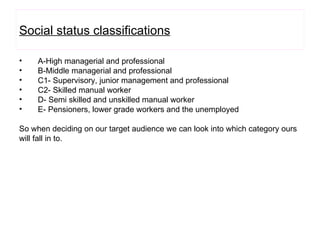
Social status classifications A-High managerial and professional  B-Middle managerial and professional C1- Supervisory, junior management and professional  C2- Skilled manual worker D- Semi skilled and unskilled manual worker  E- Pensioners, lower grade workers and the unemployed So when deciding on our target audience we can look into which category ours will fall in to.

Audience Identification Research

  • 1.
    Audience Identification ResearchI am going to look into some of the different theories and explanations for audience categories such as Burton, Hartley, Fiske and social status classifications. We can then refer to these explanations later on when researching on our target audience.
  • 2.
    Burton Graham identifies the difference between socially grouped audiences and media grouped audiences (i.e. relationships with the media, computer usage, internet, social networking and film goers) "more than meets the eye" regarding and defining audiences where there are defined by the particular product they consume where they are specific audience for a particular type of product where they belong to pre-existing groups
  • 3.
    Hartley Hartley expandson Burton’s classification on socially grouped audience identifying 7 subjectivities when discussing what happens in socialising an individual. Self - grouped by aspirations Gender – associated motives by gender Age group – stereotypically having different priorities, needs and aims in life. Family – place in the family; are you the parent or child? Class – social classes need different things. Nation – the country a group comes from and its style Ethnicity – the ethnic grouping of your audience may play a role in choosing actors or images.
  • 4.
    Fiske Education -i.e. the level of education a person has had can affect your target audience. (I.e. School leavers or Graduates) Religion - we need to ask ourselves are we aiming at a particular religious group of people taking in to consideration there beliefs and values. Political allegiance- political groups have different priorities so is this going to influence our decision? Region - looking between the differences in places so if a place is more powerful, it may over power another places ideas or fashion. For example, London and Leicester.# Urban Vs Rural- i.e. town vs. country as they have different motives.
  • 5.
    Social status classificationsA-High managerial and professional B-Middle managerial and professional C1- Supervisory, junior management and professional C2- Skilled manual worker D- Semi skilled and unskilled manual worker E- Pensioners, lower grade workers and the unemployed So when deciding on our target audience we can look into which category ours will fall in to.