BOHR Journal of Computational Intelligence
and Communication Network
2023, Vol. 1, No. 1, pp. 26–34
DOI: 10.54646/bjcicn.2023.05
www.bohrpub.com
RESEARCH ARTICLE
An RFID-based smart school attendance and monitoring
system
Wael A. Farag*
College of Engineering and Technology, American University of the Middle East, Kuwait
*Correspondence:
Wael A. Farag,
wael.farag@aum.edu.kw
Received: 04 April 2023; Accepted: 13 April 2023; Published: 24 April 2023
In this paper, a smart attendance system for students attending school is proposed. The proposed attendance
system is based on radio frequency identification (RFID) technology to facilitate automation and convenience.
The proposed RFID attendance system (RFID-AS) should be used by school administration to ensure safety for
students, as well as for grading and evaluation purposes. After careful study, passive RFID technology is selected
to be used by the proposed system because of its reasonable cost. The main components of the system are an
RFID tag, an RFID reader, Visual Studio [eXpressApp Framework (XAF) tool], and SQL Server to compare the data
from the RFID tag with the students’ database to record attendance automatically. A graphical user interface (GUI)
is developed using Visual Studio (XAF tool) to allow parents and school faculty to log in and browse the students’
records. Students will pass the classroom door, which will have an integrated RFID reader device to read their
RFID. The paper discusses the design of the solution as well as the testing scenarios.
Keywords: attendance, RFID, Internet of things (IoT), safety, education, monitoring
Introduction
At present, schools accommodate a huge number of students,
and to handle this huge number of students, several problems
can occur, one of which is taking attendance and ensuring
students are attending their classes (1). Nowadays, most
schools use traditional methods for taking attendance, such
as taking attendance manually with a piece of paper or
a computer. The mentioned traditional methods take a
considerable amount of class time that can be better utilized
by teaching, as an example (2).
Also, one of the weaknesses of such systems is that they
aren’t always accurate; for example, if the instructor makes
a mistake while taking attendance and places the student as
“present” when he isn’t, there is no way to know where the
student might be in school or even outside of school (3).
Some students can take advantage of these systems because
they cannot ensure the student is in his class because he can
simply leave class (4) without the instructor noticing and
leave the school where he is at risk (5).
The appropriate solution will be to make a system to
take attendance automatically using passive radio frequency
identification (RFID) technology. The student will have an
RFID tag unique to him/her; this RFID tag will function
as an ID for each student (6). Using this method to take
attendance will help to save time and ensure the safety of
students during school hours, it is also more precise (7) than
using the current methods.
There are several proposed systems in the literature to
solve the problems with conventional attendance methods
by incorporating advanced technologies to improve these
methods (8). These technologies are RFID (9, 10), Bluetooth
(11), near-field communication (NFC) (12), biometric
(fingerprint) (13), and iris (face recognition) (8).
The first trial to include technology into the attendance
process was using a desktop application developed by
Mattam et al. (14), in which the lecturer starts the application
that displays the list of all the registered students in a
particular course. Attendance is taken by clicking a check
box next to the name of the students that are present. The
26
10.54646/bjcicn.2023.05 27
drawback is that human involvement in attendance tracking
is still needed.
However, in 2013, Vishal Bhalla et al. (15) have proposed
a Bluetooth-based attendance system in which attendance
is taken using the instructor’s mobile phone. A software
application installed in the instructor’s mobile phone allows
the instructor to query the student’s mobile telephone via
Bluetooth connection, and through the transfer of the
student’s mobile telephone’s media access control (MAC)
addresses to the instructor’s mobile phone, the present status
of the student can be confirmed. The main drawback of this
proposed technique is that a student’s phone is required for
attendance, which is not a grantee.
In Ref. (16), the author describes how an attendance
management system (AMS) based on Bluetooth and NFC
technologies was implemented in a multi-user setting. To
verify the user’s identification, it uses their fingerprint and the
Bluetooth address of their NFC-enabled phone.
The NFC tag IDs, along with other data related to the
user and their mobile device, are collected by a Java-based
desktop program, which then sends them to an analyzer
for interpretation of the user’s behavior. However, in this
instance, as a disadvantage, students must have NFC-enabled
phones to sign in to the classroom.
A fingerprint scanner that is utilized in the school
attendance system was created by Basheer et al. (17). The
students indicate their presence by pressing their fingertips
against the sensor of the apparatus. The fingerprint scanner’s
lack of dependability and frequent damage are disadvantages.
Furthermore, it is impractical for recording attendance
because students must wait in a long queue to use the
fingerprint scanner.
In Ref. (18), face recognition technology is used to make
the AMS more intelligent. This technique involves installing
a closed-circuit television (CCTV) camera at the entrance
to a classroom, which automatically takes a person’s picture
and compares it to a database of faces using an android-
enhanced smartphone. Usually, it serves two purposes. First,
determining a student’s attendance by comparing freshly
created facial photos, and second, identifying those who are
unfamiliar with their surroundings, such as an illegal person.
A recent development in picture verification is the use
of three-dimensional (3D) face recognition, which promises
to match image databases more accurately and be able to
identify an individual from various vantage points. Once
more, the time-consuming comparison of the collected image
with the photos of every student is a challenge in this
approach; therefore, it is relatively slow.
To measure student attendance on mobile devices, a
student information tracking system for Android is being
developed in Ref. (19). This technology lets teachers notify
students about the events that the college will host by
enabling them to take attendance, update attendance, view
student bunks, and distribute key information in portable
document format (PDF) formats, such as exam timetables
and question banks.
This system works on any device. Any mobile device with
the Android operating system can have this system loaded
on it. The issue with this system is that it was built for
the Android platform and cannot be used with iOS or any
other mobile operating system. It is also incredibly time-
consuming to record student attendance on a mobile device.
According to the survey in the preceding section, the
majority of attendance systems are designed in non-practical
ways that are costly, unreliable, and time-consuming (slow).
Therefore, the goal of this paper is to make school attendance
tracking easier, look into ways to cut down on absences,
and improve communication between parents and the school
to improve safety.
Given that school dropout rates are still high in many
countries, the current study aims to expand on the previous
research by developing an intelligent attendance system using
RFID (RFID-AS) for schools and universities. Due to its
ability to connect “things” to their online virtual identities
(20), RFID technology is essential for the implementation
of the Internet of Things (IoT) (21, 22). Finally, the paper
will test the RFID attendance system in a few classrooms at a
higher level of education to evaluate the effectiveness of our
system (23).
Project and design objectives, criteria,
and constraints
The main design objectives of the proposed attendance
systems are as follows:
(a) To know how to connect an RFID reader with a
database and the way the RFID readers are installed
in the school. The RFID reader will read the data
and send it to the interface on the server to compare
the data received with the database on structured
query language (SQL).
(b) Develop the process of taking attendance by using
RFID technology
(c) Develop a database for students using SQL to take
attendance automatically
Several criteria as well as some imposed constraints must
be respected during the design process of the RFID-AS,
which are summarized in Table 1.
Description of the design
The main design features of the proposed attendance systems
are described in the following sections.
28 Farag
TABLE 1 | Constraints for the school attendance system design.
Criteria Constraints
Affordability Privacy
Accuracy RFID can be easily disrupted using energy at the
right frequency.
Security of the
system
RFID tags can be read from far away distances
using high-gain antennas.
User-friendly
GUI
Using UHF readers can harm students’ health.
Proposed conceptual design
The first possible design was to build a real-time location
system (RTLS) (24) that tracks and pinpoints a person’s
location in real-time in indoor locations. It uses active RFID
tags (25) as unique IDs for each student, multiple RFID
reader devices to pinpoint the location of the tag (26), a
database to hold the necessary data, and a code to connect
the RFID readers with the database for comparison.
The second possible solution is using passive RFID tags
as a method of recording attendance in conjunction with an
RFID reader and a database similar to the one for the RTLS
system. The third possible solution is to use fingerprints (17)
rather than RFID tags with the help of a fingerprint scanner
to scan the fingerprints of students, create a database for
students’ fingerprints, and use digital signal processing to
process the fingerprints of these students to compare (27)
them with this database. In this article, the second solution
is selected, which depends on passive RFID tags for several
reasons that are explained in the following sections.
Reviewing the selected solution with
justification
After comparing the three possible solutions we had at our
disposal, it has been decided to go with the second solution,
which is to build an attendance system using passive RFID
tags. This solution is chosen since it meets the set criteria of
affordability. We want to implement this system in different
schools, and one primary factor for schools accepting this
system is cost. Our system is not expensive, as passive RFID
tags are quite cheap (from prices collected from Alibaba.com
(28): 100 RFID tags cost 15 USD and 1 RFID reader cost 80
USD) compared to active RFID (28).
Also, passive RFID tags can last much longer than active
RFID tags since they don’t require batteries to be active;
instead, they receive the power needed from the reader.
Also, readers for RFID tags are cheaper than fingerprint
scanners. Also, this system is accurate in taking readings
as it recognizes the student through an ID number rather
than relying on digital signal processing, which requires a
high-quality fingerprint scanner and is time-consuming.
Final design and preliminary cost
Our system consists of a passive RFID tag that holds a unique
identification number unique to that tag only and does not
rely on an external battery to function; instead, it gets its
power from the reader as the reader will induce voltage and
current from its magnetic field. The second is the RFID
reader, which is a device that can power up an RFID tag to
get the card’s unique ID number, which will then compare it
to the database (29). For the database, we built a database for
students on SQL Server (30) using eXpressApp Framework
(XAF) (31) which allows us to manipulate the database freely
and allows us to specify who has permission to edit the
database and who can only view specific data.
Also, we used Visual Studio 2019 (32) to write code
that can identify the reader and connect the reader with
the database to compare. Also, this code is written to
specify some cases; for example, our code doesn’t allow the
scanning of an RFID tag more than once every 10 seconds;
this way, the student’s attendance status won’t be taken
twice. Lastly, on the XAF tool, we can print a report
on the student’s grades, attendance status, and any other
data we wish to add.
High-level system design
The highlights of the high-level design of the proposed
attendance systems are described in the following sections.
Attendance and grade point average
A study trying to correlate early class attendance with strong
academic performance during the academic semester was
done at the Technical University of Denmark (DTU) (33). It
was done for two years, from 2013 until 2015, and included
students of different academic years.
In the study, 78% of the students were male and 22%
were female, and they were from 24 different majors. Further,
60% of the sampled students were in their freshman year,
25% in their sophomore year, and the other 15% were
in their junior year. The sampled students were divided
into five groups based on their attendance, and then their
academic performance, or grade point average (GPA), was
measured for each group.
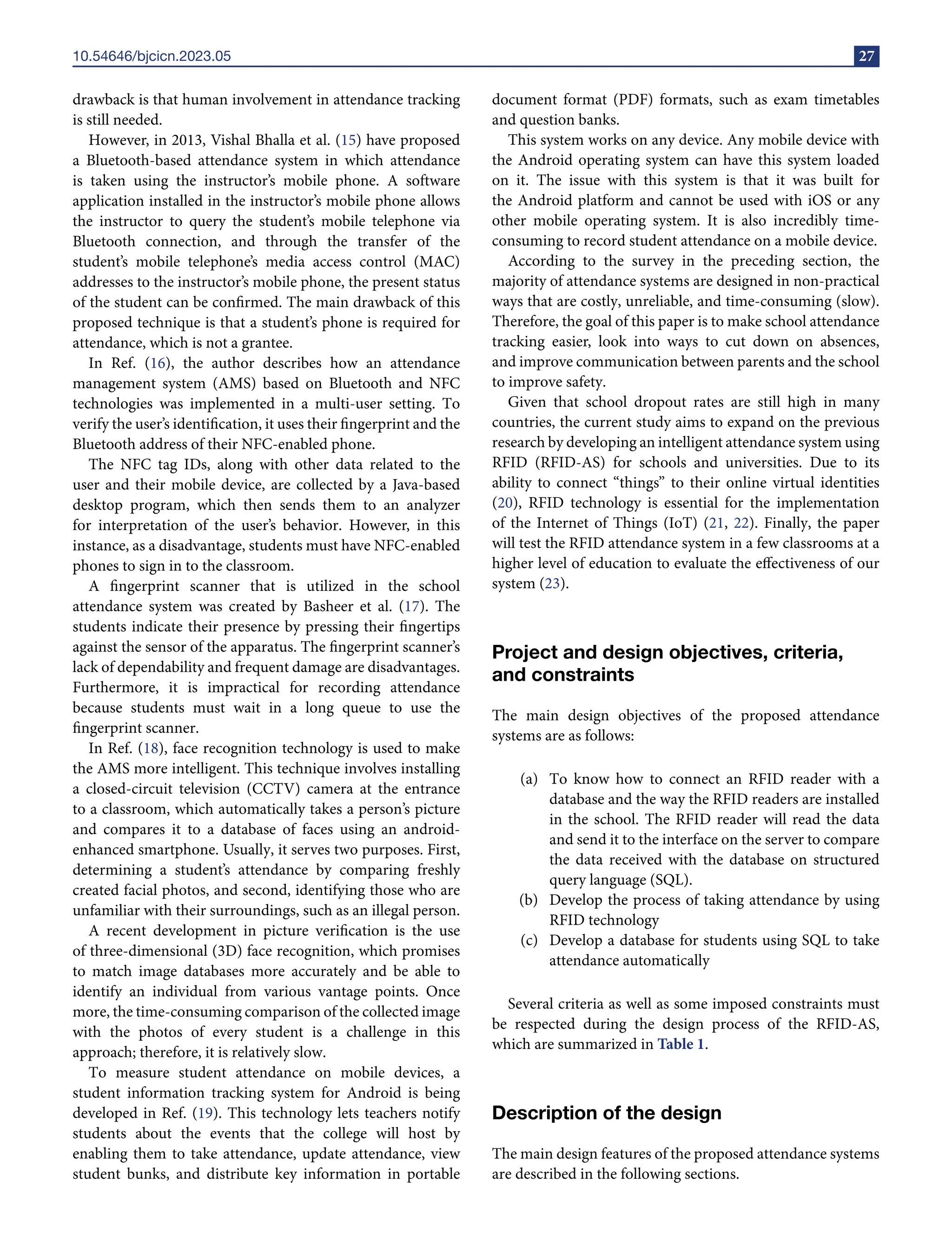
In the upper graph of Figure 1, we can see that 60% of
students attended more than 75% of classes, and it also shows
the correlation between attendance and the term grade of
each group. The lower graph of Figure 1 also shows the
variation inside each group. We can observe from this graph
that the group with the highest attendance percentage had
the highest grades compared to the left-most group, which
had significantly lower grades.
10.54646/bjcicn.2023.05 29
FIGURE 1 | Attendance and grade point average (GPA): data shows
the effect of students attending classes on their grades.
Also, the rate of failing goes from 23% in the left-most
group to only 4% in the right-most group, which means that
this study can predict (34) the percentage of failing classes.
This study shows that there’s a significant correlation (>0.5)
between attendance and GPA (33).
Radio frequency identification technology
Radio frequency identification, or RFID, is a technology
that uses small microelectronic chips or tags that have a
unique identity that can be detected wirelessly. RFID was
first used on aeroplanes in the 1940s to distinguish friendly
from hostile passengers. Years later, RFID was used primarily
in small-scale applications such as automatic registers,
electronic toll collection, and anti-theft applications.
However, this technology wasn’t used as much as it is
these days, mainly because the technology was expensive and
immature for its time. In the past decade, RFID technology
has become more reliable, cheaper, and better performing
due to interest from organizations such as Auto-ID Labs and
the United States Department of Defense.
However, this technology comes with a lot of difficulties,
which include the issue of large-scale global RFID networks
that have the possibility of creating huge amounts of data
for a single object, and the problem comes from efficiently
managing and sharing these huge amounts of data. Another
limitation comes from privacy and security fears and should
be considered to permit wide-scale real-world acceptance
(35).
RFID readers
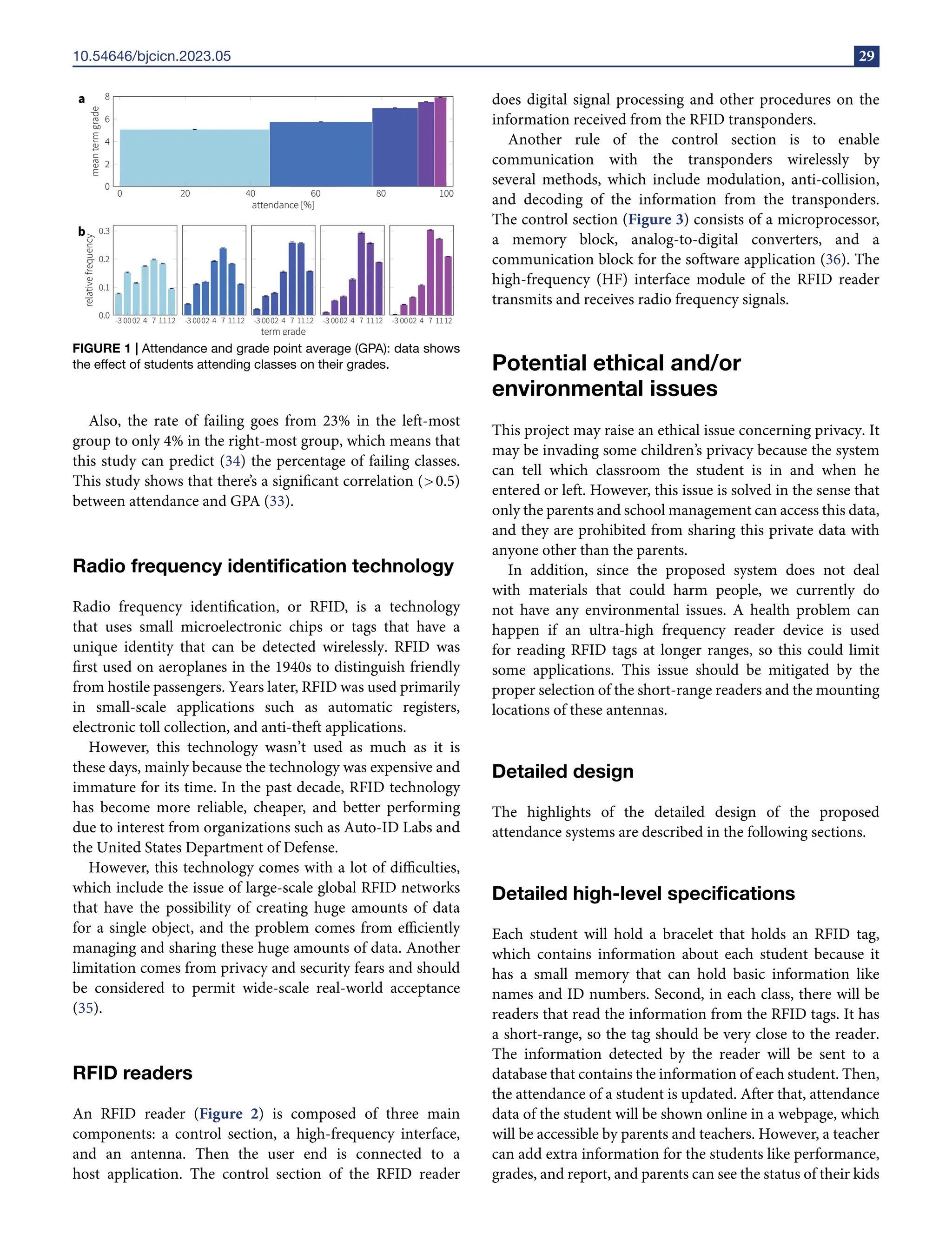
An RFID reader (Figure 2) is composed of three main
components: a control section, a high-frequency interface,
and an antenna. Then the user end is connected to a
host application. The control section of the RFID reader
does digital signal processing and other procedures on the
information received from the RFID transponders.
Another rule of the control section is to enable
communication with the transponders wirelessly by
several methods, which include modulation, anti-collision,
and decoding of the information from the transponders.
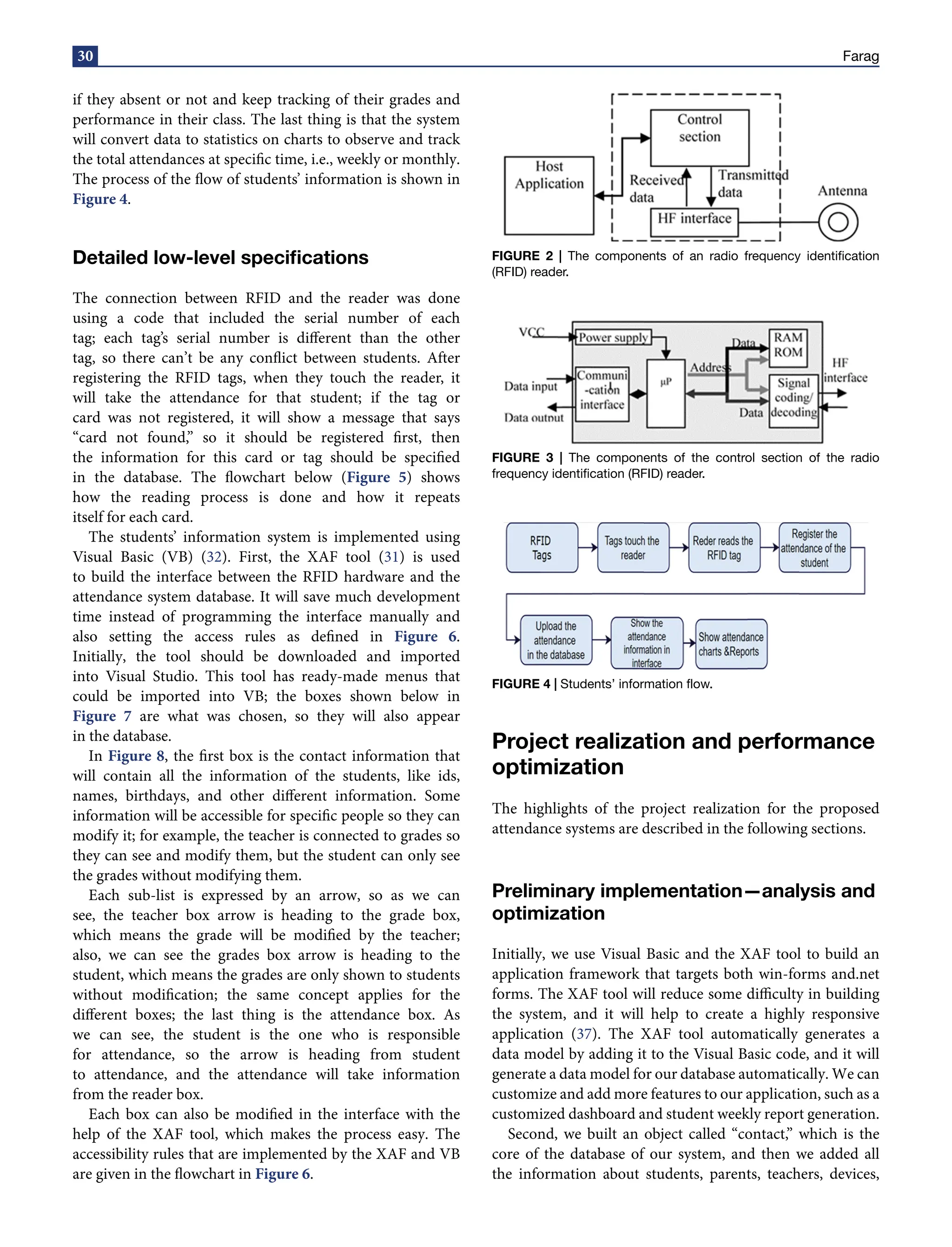
The control section (Figure 3) consists of a microprocessor,
a memory block, analog-to-digital converters, and a
communication block for the software application (36). The
high-frequency (HF) interface module of the RFID reader
transmits and receives radio frequency signals.
Potential ethical and/or
environmental issues
This project may raise an ethical issue concerning privacy. It
may be invading some children’s privacy because the system
can tell which classroom the student is in and when he
entered or left. However, this issue is solved in the sense that
only the parents and school management can access this data,
and they are prohibited from sharing this private data with
anyone other than the parents.
In addition, since the proposed system does not deal
with materials that could harm people, we currently do
not have any environmental issues. A health problem can
happen if an ultra-high frequency reader device is used
for reading RFID tags at longer ranges, so this could limit
some applications. This issue should be mitigated by the
proper selection of the short-range readers and the mounting
locations of these antennas.
Detailed design
The highlights of the detailed design of the proposed
attendance systems are described in the following sections.
Detailed high-level specifications
Each student will hold a bracelet that holds an RFID tag,
which contains information about each student because it
has a small memory that can hold basic information like
names and ID numbers. Second, in each class, there will be
readers that read the information from the RFID tags. It has
a short-range, so the tag should be very close to the reader.
The information detected by the reader will be sent to a
database that contains the information of each student. Then,
the attendance of a student is updated. After that, attendance
data of the student will be shown online in a webpage, which
will be accessible by parents and teachers. However, a teacher
can add extra information for the students like performance,
grades, and report, and parents can see the status of their kids
30 Farag
if they absent or not and keep tracking of their grades and
performance in their class. The last thing is that the system
will convert data to statistics on charts to observe and track
the total attendances at specific time, i.e., weekly or monthly.
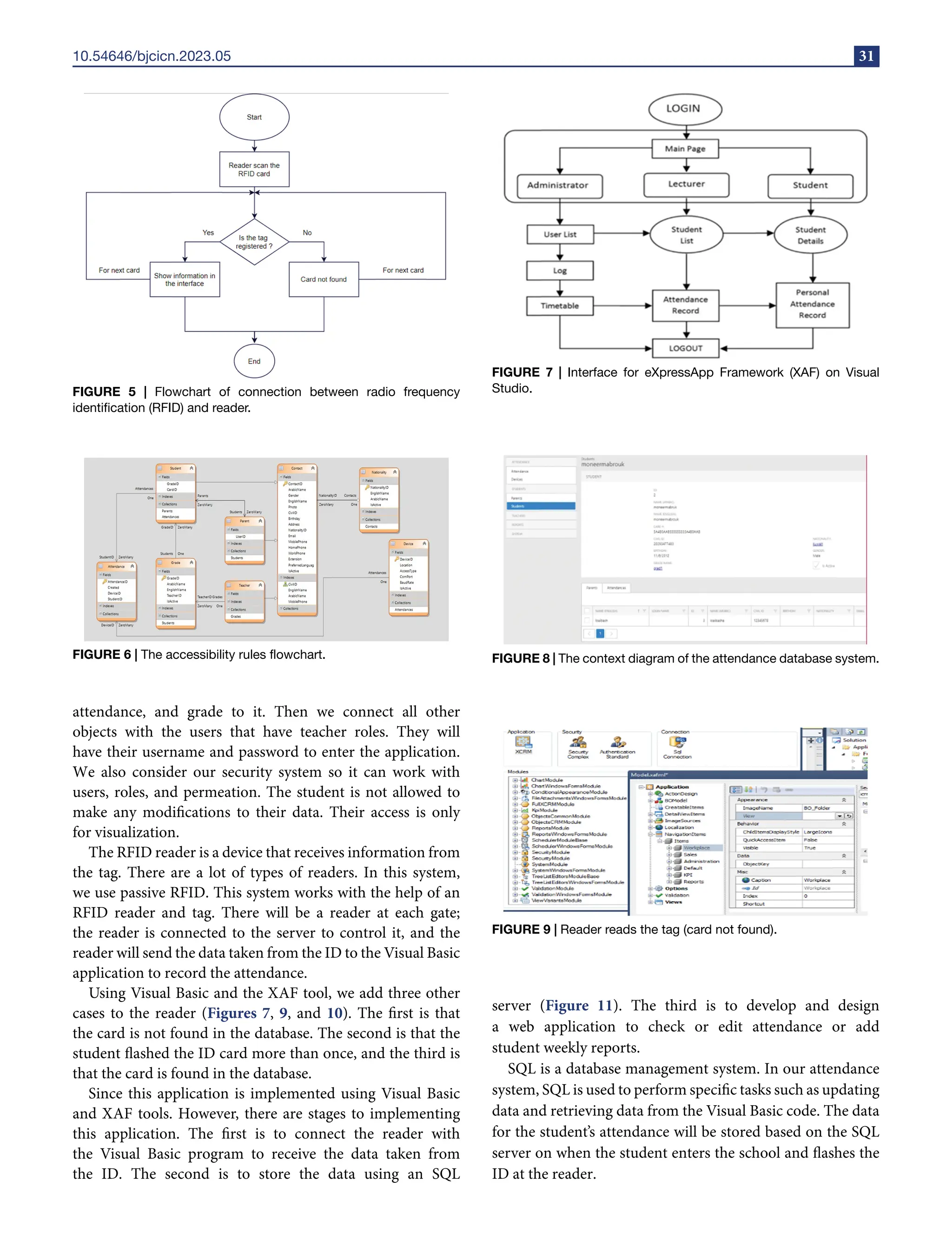
The process of the flow of students’ information is shown in
Figure 4.
Detailed low-level specifications
The connection between RFID and the reader was done
using a code that included the serial number of each
tag; each tag’s serial number is different than the other
tag, so there can’t be any conflict between students. After
registering the RFID tags, when they touch the reader, it
will take the attendance for that student; if the tag or
card was not registered, it will show a message that says
“card not found,” so it should be registered first, then
the information for this card or tag should be specified
in the database. The flowchart below (Figure 5) shows
how the reading process is done and how it repeats
itself for each card.
The students’ information system is implemented using
Visual Basic (VB) (32). First, the XAF tool (31) is used
to build the interface between the RFID hardware and the
attendance system database. It will save much development
time instead of programming the interface manually and
also setting the access rules as defined in Figure 6.
Initially, the tool should be downloaded and imported
into Visual Studio. This tool has ready-made menus that
could be imported into VB; the boxes shown below in
Figure 7 are what was chosen, so they will also appear
in the database.
In Figure 8, the first box is the contact information that
will contain all the information of the students, like ids,
names, birthdays, and other different information. Some
information will be accessible for specific people so they can
modify it; for example, the teacher is connected to grades so
they can see and modify them, but the student can only see
the grades without modifying them.
Each sub-list is expressed by an arrow, so as we can
see, the teacher box arrow is heading to the grade box,
which means the grade will be modified by the teacher;
also, we can see the grades box arrow is heading to the
student, which means the grades are only shown to students
without modification; the same concept applies for the
different boxes; the last thing is the attendance box. As
we can see, the student is the one who is responsible
for attendance, so the arrow is heading from student
to attendance, and the attendance will take information
from the reader box.
Each box can also be modified in the interface with the
help of the XAF tool, which makes the process easy. The
accessibility rules that are implemented by the XAF and VB
are given in the flowchart in Figure 6.
FIGURE 2 | The components of an radio frequency identification
(RFID) reader.
FIGURE 3 | The components of the control section of the radio
frequency identification (RFID) reader.
FIGURE 4 | Students’ information flow.
Project realization and performance
optimization
The highlights of the project realization for the proposed
attendance systems are described in the following sections.
Preliminary implementation—analysis and
optimization
Initially, we use Visual Basic and the XAF tool to build an
application framework that targets both win-forms and.net
forms. The XAF tool will reduce some difficulty in building
the system, and it will help to create a highly responsive
application (37). The XAF tool automatically generates a
data model by adding it to the Visual Basic code, and it will
generate a data model for our database automatically. We can
customize and add more features to our application, such as a
customized dashboard and student weekly report generation.
Second, we built an object called “contact,” which is the
core of the database of our system, and then we added all
the information about students, parents, teachers, devices,
10.54646/bjcicn.2023.05 31
FIGURE 5 | Flowchart of connection between radio frequency
identification (RFID) and reader.
FIGURE 6 | The accessibility rules flowchart.
attendance, and grade to it. Then we connect all other
objects with the users that have teacher roles. They will
have their username and password to enter the application.
We also consider our security system so it can work with
users, roles, and permeation. The student is not allowed to
make any modifications to their data. Their access is only
for visualization.
The RFID reader is a device that receives information from
the tag. There are a lot of types of readers. In this system,
we use passive RFID. This system works with the help of an
RFID reader and tag. There will be a reader at each gate;
the reader is connected to the server to control it, and the
reader will send the data taken from the ID to the Visual Basic
application to record the attendance.
Using Visual Basic and the XAF tool, we add three other
cases to the reader (Figures 7, 9, and 10). The first is that
the card is not found in the database. The second is that the
student flashed the ID card more than once, and the third is
that the card is found in the database.
Since this application is implemented using Visual Basic
and XAF tools. However, there are stages to implementing
this application. The first is to connect the reader with
the Visual Basic program to receive the data taken from
the ID. The second is to store the data using an SQL
FIGURE 7 | Interface for eXpressApp Framework (XAF) on Visual
Studio.
FIGURE 8 | The context diagram of the attendance database system.
FIGURE 9 | Reader reads the tag (card not found).
server (Figure 11). The third is to develop and design
a web application to check or edit attendance or add
student weekly reports.
SQL is a database management system. In our attendance
system, SQL is used to perform specific tasks such as updating
data and retrieving data from the Visual Basic code. The data
for the student’s attendance will be stored based on the SQL
server on when the student enters the school and flashes the
ID at the reader.
32 Farag
FIGURE 10 | Reader reads the tag (duplicated row).
FIGURE 11 | Interface for structured query language (SQL) database.
Discussion of design’s modifications
A global system for mobile (GSM) communication module
can be added to the attendance server to be used
to send a message to the parents if the student did
not attend the classes. We can also add readers for
the buses to track (38) the moves of the student to
ensure their safety.
Final design construction, testing, and
improvement
The RFID reader is tested by capturing ID multiple times to
ensure that it reads the tag. First, a student with a new tag will
be flashed to the reader, then the reader will capture this card
and save it to the database with the detailed information of
the associated student. Then, the student will be able to flash
the reader to record the attendance.
System testing
By keeping an eye on the outputs via the web application,
we tested the system. Both the reader’s ability to transfer
data to Visual Basic and the application’s ability to track
attendance are being tested (39). The SQL server was
subjected to a similar test. Check to see if the SQL
server is connected to Visual Basic or if the data was
incorrectly returned.
Sustainability and scalability
The designed system is sustainable (40–42) for three
reasons: first, it reduces human error; second, it can handle
a sizable database; and third, the data will be better
organized and simpler to handle. Moreover, the security
aspects were improved. Our system has a large database
that can accommodate this enormous number of students
and can be scaled up to take attendance at numerous
schools simultaneously.
Final cost analysis and discussion
The final cost for the prototype of the attendance system was
USD 80.33. We bought five RFID tags and one RFID reader.
We can witness how inexpensive an RFID attendance system
can be which aligns with our first criteria of affordability.
Conclusion and Future work
Project purpose and objectives
Since many students in schools today don’t attend classes, it
affects their grades and jeopardizes their safety because they
could wander off without their parent’s knowledge. The main
goal of this project is to find a way to ensure the safety of
children in schools, make attendance easier, and ultimately
raise the learning level in classrooms.
The goal of this project is to develop a system that will
benefit schools, parents, and teachers while saving time when
taking attendance. To accomplish this, we used an RFID tag
and reader along with a software program called XAF to
quickly take attendance. Additionally, a user log-in will be
created for parents to track their child’s attendance for classes,
grades, and a variety of other features.
Summary of achievements
In conclusion, by adhering to the decision-making matrix,
the criteria, and the constraints that we established and
ensuring that they fit with the project, we were able to
complete the entire project. We were thus able to choose
the parts that matched the project in terms of price, quality,
etc. Furthermore, we created an intuitive user interface for
a system that can be used to track attendance by connecting
a reader to it. Additionally, we were fortunate in creating a
prototype that deftly depicts the project as a whole.
Summary of final design and solution
The final configuration includes an RFID tag, laptop, reader,
and software known as XAF. These elements can address
10.54646/bjcicn.2023.05 33
issues with learning level and school safety. As a result, we
were able to develop a system that allows students to touch
an RFID tag to be scanned by a reader, which then uses
the XAF tool software to read the student’s data and record
their attendance.
They can also use the system to track their child’s grades.
Finally, this system allows parents to ensure that their child
learns well and is present in class, and it will save the teacher
time from taking attendance by hand.
Future work
For future work, this system can be used in schools,
universities, and even businesses to ensure that employees
arrive on time. It can also be used in buses to track the
movement of children returning from school, and we decided
to use this system in Kuwait for schools.
References
1. Jawaaz A, Zahid Gulzar K. Smart class room attendance system based
on proprietary automatic student sensing classroom chairs. Int J Electr
Electr Res. (2016) 4:102–8.
2. Ahmad RP. Sentiment analysis of facebook posts through special
reactions: the case of learning from home in Indonesia Amid
COVID-19. J Ilmiah Teknik Elektro Komputer Inform. (2022)
8:83–92.
3. Farag W. Lidar and radar fusion for real-time road-objects detection and
tracking. Intell Decis Technol. (2021) 15:291–304.
4. Farag W. Bayesian localization in real-time using probabilistic maps and
unscented-kalman-filters. J Eng Res. (2022) 10:109–32.
5. Farag W. Road-objects tracking for autonomous driving using lidar and
radar fusion. J Electr Eng. (2020) 71:138–49.
6. Novian Adi P, Yudha S. Integration between moodle and academic
information system using restful API for online learning. J Ilmiah Teknik
Elektro Komputer Inform. (2021) 2:358–67.
7. Farag W. A lightweight vehicle detection and tracking technique
for advanced driving assistance systems. J Intell Fuzzy Syst. (2021)
39:2693–710.
8. Patel Unnati A, Priya S. Development of a student attendance
management system using RFID and face recognition: a review. Int J
Adv Res Comput Sci Manag Stud. (2014) 2:109–19.
9. Lim TS, Sim SC, Mansor MM. RFID based attendance system.
Proceeding of the 2009 IEEE Symposium on Industrial Electronics &
Applications. Kuala Lumpur: (2009). p. 778–82.
10. Hicham El M, Abdelaziz Ait M. IoT-school attendance system using
RFID technology. Int J Interactive Mobile Technol. (2020) 14:95–108.
11. Kassim M, Mazlan H, Zaini N, Salleh MK. Web-based student
attendance system using RFID technology. Proceeding of the 2012
IEEE Control and System Graduate Research Colloquium. (2012).
p. 213–8.
12. Chew Cheah B. Sensors-enabled smart attendance systems using
NFC and RFID technologies. Int J New Comput Arch Appl. (2015)
5:19–29.
13. Saraswat C, Kumar A. An efficient automatic attendance system
using fingerprint verification technique. Int J Comput Sci Eng. (2010)
02:264–9.
14. Mattam M, Karumuri SRM, Meda SR. Architecture for Automated
Student Attendance. Proceeding of the IEEE Fourth International
Conference on Technology for Education (T4E 2012). Piscataway, NJ:
IEEE (2012). p. 164–7. doi: 10.1109/T4E.2012.39
15. Vishal B, Tapodhan S, Ankit G, Vijay G. Bluetooth based attendance
management system. Int J Innov Eng Technol. (2013) 3:2319–1058.
16. Media Anugerah A. TouchIn: an NFC supported attendance system
in a university environment. Int J Inform Educ Technol. (2014) 4:5.
doi: 10.7763/IJIET.2014.V4
17. Basheer MKP, Raghu CV. Fingerprint attendance system for classroom
needs. Proceeding of the India Conference (INDICON), 2012 Annual
IEEE. Piscataway, NJ: IEEE (2012). p. 433–8.
18. MuthuKalyani K, VeeraMuthu A. Smart application For AMS using face
recognition. Comput Sci Eng. (2013) 3:5. doi: 10.5121/cseij.2013.3502
19. Samuel King O. An automated biometric attendance management
system with dual authentication mechanism based on bluetooth and
NFC technologies. Int J Comput Sci Mobile Comput. (2013) 2:18–12.
20. Wael F. An innovative remote-lab framework for educational
experimentation. Int J Online Eng. (2017) 13:68–86.
21. Jia X, Feng Q, Fan T, Lei Q. RFID technology and its applications
in Internet of Things (IoT). Proceeding of the 2012 2nd International
Conference on Consumer Electronics, Communications and Networks
(CECNet). Piscataway, NJ: IEEE (2012). p. 1282–5. doi: 10.1109/
CECNet.2012.6201508
22. Mochamad FW, Myrna DR. IoT for residential monitoring using
ESP8266 and ESP-Now protocol. J Ilmiah Teknik Elektro Komputer
Inform. (2022) 8:93–106.
23. Wael F. Kalman-filter-based sensor fusion applied to road-objects
detection and tracking for autonomous vehicles. J Syst Control Eng.
(2021) 235:1125–38.
24. Nagiub M, Farag W. Automatic selection of compiler options using
genetic techniques for embedded software design. Proceeding of the
2013 IEEE 14th International Symposium on Computational Intelligence
and Informatics (CINTI). Piscataway, NJ: IEEE (2013). p. 69–74. doi:
10.1109/CINTI.2013.6705166
25. Kalnoskas A. How do RFID tags and reader antennas work?. (2018).
Available online at: https://www.analogictips.com/rfid-tag-and-reader-
antennas/ (accessed on 02 Dec, 2018).
26. Patel K, Lin H, Berger A, Farag W, Khan A. EDC draft force based ride
controller. US Patent. (2001) 6:196–327.
27. Farag WA, Quintana VH, Lambert-Torres G. Genetic algorithms and
back-propagation: a comparative study. Proceeding of the Conference
IEEE Canadian Conference on Electrical and Computer Engineering (Cat.
No.98TH8341). Piscataway, NJ: IEEE (1998). p. 93–6. doi: 10.1109/
CCECE.1998.682559
28. Alibaba. Rfid-Rfid Manufacturers, Suppliers, and Exporters on
Alibaba.com Access Control Card. Hangzhou: Alibaba.com (2019).
29. Farag W. Multiple road-objects detection and tracking for autonomous
driving. J Eng Res. (2022) 10:237–62.
30. Microsoft. Download Microsoft® SQL Server® 2019 Express from Official
Microsoft Download Center. Washington, DC: Microsoft (2019).
31. Devexpress. Low-Code .NET Application Development for Desktop and
the Web. (2022). Available online at: https://wdevexpressww.devexpress.
com/products/net/application_framework/ (accessed on Nov 5, 2022).
32. Microsoft®. Download Microsoft® Visual Studio 2019 Express from Official
Microsoft Download Center. Washington, DC: Microsoft.com (2019).
33. Kassarnig V, Bjerre-Nielsen A, Mones E, Lehmann S, Lassen D. Class
attendance, peer similarity, and academic performance in a large
field study. PLoS One. (2017) 12:e0187078. doi: 10.1371/journal.pone.
0187078
34. Wael F. Safe-driving cloning by deep learning for autonomous cars. Int
J Adv Mech Syst. (2019) 7:390–7.
35. Wu Y, Ranasinghe D, Sheng Q, Zeadally S, Yu J. RFID enabled
traceability networks: a survey. Distribut Parallel Datab. (2011)
29:397–443.
34 Farag
36. Mansour K, Farag W, ElHelw M. AiroDiag: A sophisticated tool that
diagnoses and updates vehicles software over air. Proceeding of the 2012
IEEE International Electric Vehicle Conference. Piscataway, NJ: IEEE
(2012). p. 1–7. doi: 10.1109/IEVC.2012.6183181
37. Wa Farag V, Quintana GLT. An optimized fuzzy controller for a
synchronous generator in a multi-machine environment. Fuzzy Sets
Syst. (1999) 102:71–84.
38. Farag W, Saleh Z. An advanced vehicle detection and tracking scheme
for self-driving cars. 2nd Smart Cities Symposium (SCS 2019). Bahrain:
(2019). p. 1–6. doi: 10.1049/cp.2019.0222
39. Wael F. Real-time detection of road lane-lines for autonomous driving.
Recent Adv Comput Sci Commun. (2020) 13:265–74.
40. Wael F. A comprehensive real-time road-lanes tracking technique
for autonomous driving. Int J Comput Digital Syst. (2020)
9:349–62.
41. Wael F. Real-time autonomous vehicle localization based on particle
and unscented kalman filters. J Control Automat Electr Syst. (2021)
32:309–25.
42. Wael F. Climacon: an autonomous energy efficient climate control
solution for smart buildings. Asian J Control. (2017) 19:1375–91.

An RFID-based smart school attendance and monitoring system

  • 1.
    BOHR Journal ofComputational Intelligence and Communication Network 2023, Vol. 1, No. 1, pp. 26–34 DOI: 10.54646/bjcicn.2023.05 www.bohrpub.com RESEARCH ARTICLE An RFID-based smart school attendance and monitoring system Wael A. Farag* College of Engineering and Technology, American University of the Middle East, Kuwait *Correspondence: Wael A. Farag, wael.farag@aum.edu.kw Received: 04 April 2023; Accepted: 13 April 2023; Published: 24 April 2023 In this paper, a smart attendance system for students attending school is proposed. The proposed attendance system is based on radio frequency identification (RFID) technology to facilitate automation and convenience. The proposed RFID attendance system (RFID-AS) should be used by school administration to ensure safety for students, as well as for grading and evaluation purposes. After careful study, passive RFID technology is selected to be used by the proposed system because of its reasonable cost. The main components of the system are an RFID tag, an RFID reader, Visual Studio [eXpressApp Framework (XAF) tool], and SQL Server to compare the data from the RFID tag with the students’ database to record attendance automatically. A graphical user interface (GUI) is developed using Visual Studio (XAF tool) to allow parents and school faculty to log in and browse the students’ records. Students will pass the classroom door, which will have an integrated RFID reader device to read their RFID. The paper discusses the design of the solution as well as the testing scenarios. Keywords: attendance, RFID, Internet of things (IoT), safety, education, monitoring Introduction At present, schools accommodate a huge number of students, and to handle this huge number of students, several problems can occur, one of which is taking attendance and ensuring students are attending their classes (1). Nowadays, most schools use traditional methods for taking attendance, such as taking attendance manually with a piece of paper or a computer. The mentioned traditional methods take a considerable amount of class time that can be better utilized by teaching, as an example (2). Also, one of the weaknesses of such systems is that they aren’t always accurate; for example, if the instructor makes a mistake while taking attendance and places the student as “present” when he isn’t, there is no way to know where the student might be in school or even outside of school (3). Some students can take advantage of these systems because they cannot ensure the student is in his class because he can simply leave class (4) without the instructor noticing and leave the school where he is at risk (5). The appropriate solution will be to make a system to take attendance automatically using passive radio frequency identification (RFID) technology. The student will have an RFID tag unique to him/her; this RFID tag will function as an ID for each student (6). Using this method to take attendance will help to save time and ensure the safety of students during school hours, it is also more precise (7) than using the current methods. There are several proposed systems in the literature to solve the problems with conventional attendance methods by incorporating advanced technologies to improve these methods (8). These technologies are RFID (9, 10), Bluetooth (11), near-field communication (NFC) (12), biometric (fingerprint) (13), and iris (face recognition) (8). The first trial to include technology into the attendance process was using a desktop application developed by Mattam et al. (14), in which the lecturer starts the application that displays the list of all the registered students in a particular course. Attendance is taken by clicking a check box next to the name of the students that are present. The 26
  • 2.
    10.54646/bjcicn.2023.05 27 drawback isthat human involvement in attendance tracking is still needed. However, in 2013, Vishal Bhalla et al. (15) have proposed a Bluetooth-based attendance system in which attendance is taken using the instructor’s mobile phone. A software application installed in the instructor’s mobile phone allows the instructor to query the student’s mobile telephone via Bluetooth connection, and through the transfer of the student’s mobile telephone’s media access control (MAC) addresses to the instructor’s mobile phone, the present status of the student can be confirmed. The main drawback of this proposed technique is that a student’s phone is required for attendance, which is not a grantee. In Ref. (16), the author describes how an attendance management system (AMS) based on Bluetooth and NFC technologies was implemented in a multi-user setting. To verify the user’s identification, it uses their fingerprint and the Bluetooth address of their NFC-enabled phone. The NFC tag IDs, along with other data related to the user and their mobile device, are collected by a Java-based desktop program, which then sends them to an analyzer for interpretation of the user’s behavior. However, in this instance, as a disadvantage, students must have NFC-enabled phones to sign in to the classroom. A fingerprint scanner that is utilized in the school attendance system was created by Basheer et al. (17). The students indicate their presence by pressing their fingertips against the sensor of the apparatus. The fingerprint scanner’s lack of dependability and frequent damage are disadvantages. Furthermore, it is impractical for recording attendance because students must wait in a long queue to use the fingerprint scanner. In Ref. (18), face recognition technology is used to make the AMS more intelligent. This technique involves installing a closed-circuit television (CCTV) camera at the entrance to a classroom, which automatically takes a person’s picture and compares it to a database of faces using an android- enhanced smartphone. Usually, it serves two purposes. First, determining a student’s attendance by comparing freshly created facial photos, and second, identifying those who are unfamiliar with their surroundings, such as an illegal person. A recent development in picture verification is the use of three-dimensional (3D) face recognition, which promises to match image databases more accurately and be able to identify an individual from various vantage points. Once more, the time-consuming comparison of the collected image with the photos of every student is a challenge in this approach; therefore, it is relatively slow. To measure student attendance on mobile devices, a student information tracking system for Android is being developed in Ref. (19). This technology lets teachers notify students about the events that the college will host by enabling them to take attendance, update attendance, view student bunks, and distribute key information in portable document format (PDF) formats, such as exam timetables and question banks. This system works on any device. Any mobile device with the Android operating system can have this system loaded on it. The issue with this system is that it was built for the Android platform and cannot be used with iOS or any other mobile operating system. It is also incredibly time- consuming to record student attendance on a mobile device. According to the survey in the preceding section, the majority of attendance systems are designed in non-practical ways that are costly, unreliable, and time-consuming (slow). Therefore, the goal of this paper is to make school attendance tracking easier, look into ways to cut down on absences, and improve communication between parents and the school to improve safety. Given that school dropout rates are still high in many countries, the current study aims to expand on the previous research by developing an intelligent attendance system using RFID (RFID-AS) for schools and universities. Due to its ability to connect “things” to their online virtual identities (20), RFID technology is essential for the implementation of the Internet of Things (IoT) (21, 22). Finally, the paper will test the RFID attendance system in a few classrooms at a higher level of education to evaluate the effectiveness of our system (23). Project and design objectives, criteria, and constraints The main design objectives of the proposed attendance systems are as follows: (a) To know how to connect an RFID reader with a database and the way the RFID readers are installed in the school. The RFID reader will read the data and send it to the interface on the server to compare the data received with the database on structured query language (SQL). (b) Develop the process of taking attendance by using RFID technology (c) Develop a database for students using SQL to take attendance automatically Several criteria as well as some imposed constraints must be respected during the design process of the RFID-AS, which are summarized in Table 1. Description of the design The main design features of the proposed attendance systems are described in the following sections.
  • 3.
    28 Farag TABLE 1| Constraints for the school attendance system design. Criteria Constraints Affordability Privacy Accuracy RFID can be easily disrupted using energy at the right frequency. Security of the system RFID tags can be read from far away distances using high-gain antennas. User-friendly GUI Using UHF readers can harm students’ health. Proposed conceptual design The first possible design was to build a real-time location system (RTLS) (24) that tracks and pinpoints a person’s location in real-time in indoor locations. It uses active RFID tags (25) as unique IDs for each student, multiple RFID reader devices to pinpoint the location of the tag (26), a database to hold the necessary data, and a code to connect the RFID readers with the database for comparison. The second possible solution is using passive RFID tags as a method of recording attendance in conjunction with an RFID reader and a database similar to the one for the RTLS system. The third possible solution is to use fingerprints (17) rather than RFID tags with the help of a fingerprint scanner to scan the fingerprints of students, create a database for students’ fingerprints, and use digital signal processing to process the fingerprints of these students to compare (27) them with this database. In this article, the second solution is selected, which depends on passive RFID tags for several reasons that are explained in the following sections. Reviewing the selected solution with justification After comparing the three possible solutions we had at our disposal, it has been decided to go with the second solution, which is to build an attendance system using passive RFID tags. This solution is chosen since it meets the set criteria of affordability. We want to implement this system in different schools, and one primary factor for schools accepting this system is cost. Our system is not expensive, as passive RFID tags are quite cheap (from prices collected from Alibaba.com (28): 100 RFID tags cost 15 USD and 1 RFID reader cost 80 USD) compared to active RFID (28). Also, passive RFID tags can last much longer than active RFID tags since they don’t require batteries to be active; instead, they receive the power needed from the reader. Also, readers for RFID tags are cheaper than fingerprint scanners. Also, this system is accurate in taking readings as it recognizes the student through an ID number rather than relying on digital signal processing, which requires a high-quality fingerprint scanner and is time-consuming. Final design and preliminary cost Our system consists of a passive RFID tag that holds a unique identification number unique to that tag only and does not rely on an external battery to function; instead, it gets its power from the reader as the reader will induce voltage and current from its magnetic field. The second is the RFID reader, which is a device that can power up an RFID tag to get the card’s unique ID number, which will then compare it to the database (29). For the database, we built a database for students on SQL Server (30) using eXpressApp Framework (XAF) (31) which allows us to manipulate the database freely and allows us to specify who has permission to edit the database and who can only view specific data. Also, we used Visual Studio 2019 (32) to write code that can identify the reader and connect the reader with the database to compare. Also, this code is written to specify some cases; for example, our code doesn’t allow the scanning of an RFID tag more than once every 10 seconds; this way, the student’s attendance status won’t be taken twice. Lastly, on the XAF tool, we can print a report on the student’s grades, attendance status, and any other data we wish to add. High-level system design The highlights of the high-level design of the proposed attendance systems are described in the following sections. Attendance and grade point average A study trying to correlate early class attendance with strong academic performance during the academic semester was done at the Technical University of Denmark (DTU) (33). It was done for two years, from 2013 until 2015, and included students of different academic years. In the study, 78% of the students were male and 22% were female, and they were from 24 different majors. Further, 60% of the sampled students were in their freshman year, 25% in their sophomore year, and the other 15% were in their junior year. The sampled students were divided into five groups based on their attendance, and then their academic performance, or grade point average (GPA), was measured for each group. In the upper graph of Figure 1, we can see that 60% of students attended more than 75% of classes, and it also shows the correlation between attendance and the term grade of each group. The lower graph of Figure 1 also shows the variation inside each group. We can observe from this graph that the group with the highest attendance percentage had the highest grades compared to the left-most group, which had significantly lower grades.
  • 4.
    10.54646/bjcicn.2023.05 29 FIGURE 1| Attendance and grade point average (GPA): data shows the effect of students attending classes on their grades. Also, the rate of failing goes from 23% in the left-most group to only 4% in the right-most group, which means that this study can predict (34) the percentage of failing classes. This study shows that there’s a significant correlation (>0.5) between attendance and GPA (33). Radio frequency identification technology Radio frequency identification, or RFID, is a technology that uses small microelectronic chips or tags that have a unique identity that can be detected wirelessly. RFID was first used on aeroplanes in the 1940s to distinguish friendly from hostile passengers. Years later, RFID was used primarily in small-scale applications such as automatic registers, electronic toll collection, and anti-theft applications. However, this technology wasn’t used as much as it is these days, mainly because the technology was expensive and immature for its time. In the past decade, RFID technology has become more reliable, cheaper, and better performing due to interest from organizations such as Auto-ID Labs and the United States Department of Defense. However, this technology comes with a lot of difficulties, which include the issue of large-scale global RFID networks that have the possibility of creating huge amounts of data for a single object, and the problem comes from efficiently managing and sharing these huge amounts of data. Another limitation comes from privacy and security fears and should be considered to permit wide-scale real-world acceptance (35). RFID readers An RFID reader (Figure 2) is composed of three main components: a control section, a high-frequency interface, and an antenna. Then the user end is connected to a host application. The control section of the RFID reader does digital signal processing and other procedures on the information received from the RFID transponders. Another rule of the control section is to enable communication with the transponders wirelessly by several methods, which include modulation, anti-collision, and decoding of the information from the transponders. The control section (Figure 3) consists of a microprocessor, a memory block, analog-to-digital converters, and a communication block for the software application (36). The high-frequency (HF) interface module of the RFID reader transmits and receives radio frequency signals. Potential ethical and/or environmental issues This project may raise an ethical issue concerning privacy. It may be invading some children’s privacy because the system can tell which classroom the student is in and when he entered or left. However, this issue is solved in the sense that only the parents and school management can access this data, and they are prohibited from sharing this private data with anyone other than the parents. In addition, since the proposed system does not deal with materials that could harm people, we currently do not have any environmental issues. A health problem can happen if an ultra-high frequency reader device is used for reading RFID tags at longer ranges, so this could limit some applications. This issue should be mitigated by the proper selection of the short-range readers and the mounting locations of these antennas. Detailed design The highlights of the detailed design of the proposed attendance systems are described in the following sections. Detailed high-level specifications Each student will hold a bracelet that holds an RFID tag, which contains information about each student because it has a small memory that can hold basic information like names and ID numbers. Second, in each class, there will be readers that read the information from the RFID tags. It has a short-range, so the tag should be very close to the reader. The information detected by the reader will be sent to a database that contains the information of each student. Then, the attendance of a student is updated. After that, attendance data of the student will be shown online in a webpage, which will be accessible by parents and teachers. However, a teacher can add extra information for the students like performance, grades, and report, and parents can see the status of their kids
  • 5.
    30 Farag if theyabsent or not and keep tracking of their grades and performance in their class. The last thing is that the system will convert data to statistics on charts to observe and track the total attendances at specific time, i.e., weekly or monthly. The process of the flow of students’ information is shown in Figure 4. Detailed low-level specifications The connection between RFID and the reader was done using a code that included the serial number of each tag; each tag’s serial number is different than the other tag, so there can’t be any conflict between students. After registering the RFID tags, when they touch the reader, it will take the attendance for that student; if the tag or card was not registered, it will show a message that says “card not found,” so it should be registered first, then the information for this card or tag should be specified in the database. The flowchart below (Figure 5) shows how the reading process is done and how it repeats itself for each card. The students’ information system is implemented using Visual Basic (VB) (32). First, the XAF tool (31) is used to build the interface between the RFID hardware and the attendance system database. It will save much development time instead of programming the interface manually and also setting the access rules as defined in Figure 6. Initially, the tool should be downloaded and imported into Visual Studio. This tool has ready-made menus that could be imported into VB; the boxes shown below in Figure 7 are what was chosen, so they will also appear in the database. In Figure 8, the first box is the contact information that will contain all the information of the students, like ids, names, birthdays, and other different information. Some information will be accessible for specific people so they can modify it; for example, the teacher is connected to grades so they can see and modify them, but the student can only see the grades without modifying them. Each sub-list is expressed by an arrow, so as we can see, the teacher box arrow is heading to the grade box, which means the grade will be modified by the teacher; also, we can see the grades box arrow is heading to the student, which means the grades are only shown to students without modification; the same concept applies for the different boxes; the last thing is the attendance box. As we can see, the student is the one who is responsible for attendance, so the arrow is heading from student to attendance, and the attendance will take information from the reader box. Each box can also be modified in the interface with the help of the XAF tool, which makes the process easy. The accessibility rules that are implemented by the XAF and VB are given in the flowchart in Figure 6. FIGURE 2 | The components of an radio frequency identification (RFID) reader. FIGURE 3 | The components of the control section of the radio frequency identification (RFID) reader. FIGURE 4 | Students’ information flow. Project realization and performance optimization The highlights of the project realization for the proposed attendance systems are described in the following sections. Preliminary implementation—analysis and optimization Initially, we use Visual Basic and the XAF tool to build an application framework that targets both win-forms and.net forms. The XAF tool will reduce some difficulty in building the system, and it will help to create a highly responsive application (37). The XAF tool automatically generates a data model by adding it to the Visual Basic code, and it will generate a data model for our database automatically. We can customize and add more features to our application, such as a customized dashboard and student weekly report generation. Second, we built an object called “contact,” which is the core of the database of our system, and then we added all the information about students, parents, teachers, devices,
  • 6.
    10.54646/bjcicn.2023.05 31 FIGURE 5| Flowchart of connection between radio frequency identification (RFID) and reader. FIGURE 6 | The accessibility rules flowchart. attendance, and grade to it. Then we connect all other objects with the users that have teacher roles. They will have their username and password to enter the application. We also consider our security system so it can work with users, roles, and permeation. The student is not allowed to make any modifications to their data. Their access is only for visualization. The RFID reader is a device that receives information from the tag. There are a lot of types of readers. In this system, we use passive RFID. This system works with the help of an RFID reader and tag. There will be a reader at each gate; the reader is connected to the server to control it, and the reader will send the data taken from the ID to the Visual Basic application to record the attendance. Using Visual Basic and the XAF tool, we add three other cases to the reader (Figures 7, 9, and 10). The first is that the card is not found in the database. The second is that the student flashed the ID card more than once, and the third is that the card is found in the database. Since this application is implemented using Visual Basic and XAF tools. However, there are stages to implementing this application. The first is to connect the reader with the Visual Basic program to receive the data taken from the ID. The second is to store the data using an SQL FIGURE 7 | Interface for eXpressApp Framework (XAF) on Visual Studio. FIGURE 8 | The context diagram of the attendance database system. FIGURE 9 | Reader reads the tag (card not found). server (Figure 11). The third is to develop and design a web application to check or edit attendance or add student weekly reports. SQL is a database management system. In our attendance system, SQL is used to perform specific tasks such as updating data and retrieving data from the Visual Basic code. The data for the student’s attendance will be stored based on the SQL server on when the student enters the school and flashes the ID at the reader.
  • 7.
    32 Farag FIGURE 10| Reader reads the tag (duplicated row). FIGURE 11 | Interface for structured query language (SQL) database. Discussion of design’s modifications A global system for mobile (GSM) communication module can be added to the attendance server to be used to send a message to the parents if the student did not attend the classes. We can also add readers for the buses to track (38) the moves of the student to ensure their safety. Final design construction, testing, and improvement The RFID reader is tested by capturing ID multiple times to ensure that it reads the tag. First, a student with a new tag will be flashed to the reader, then the reader will capture this card and save it to the database with the detailed information of the associated student. Then, the student will be able to flash the reader to record the attendance. System testing By keeping an eye on the outputs via the web application, we tested the system. Both the reader’s ability to transfer data to Visual Basic and the application’s ability to track attendance are being tested (39). The SQL server was subjected to a similar test. Check to see if the SQL server is connected to Visual Basic or if the data was incorrectly returned. Sustainability and scalability The designed system is sustainable (40–42) for three reasons: first, it reduces human error; second, it can handle a sizable database; and third, the data will be better organized and simpler to handle. Moreover, the security aspects were improved. Our system has a large database that can accommodate this enormous number of students and can be scaled up to take attendance at numerous schools simultaneously. Final cost analysis and discussion The final cost for the prototype of the attendance system was USD 80.33. We bought five RFID tags and one RFID reader. We can witness how inexpensive an RFID attendance system can be which aligns with our first criteria of affordability. Conclusion and Future work Project purpose and objectives Since many students in schools today don’t attend classes, it affects their grades and jeopardizes their safety because they could wander off without their parent’s knowledge. The main goal of this project is to find a way to ensure the safety of children in schools, make attendance easier, and ultimately raise the learning level in classrooms. The goal of this project is to develop a system that will benefit schools, parents, and teachers while saving time when taking attendance. To accomplish this, we used an RFID tag and reader along with a software program called XAF to quickly take attendance. Additionally, a user log-in will be created for parents to track their child’s attendance for classes, grades, and a variety of other features. Summary of achievements In conclusion, by adhering to the decision-making matrix, the criteria, and the constraints that we established and ensuring that they fit with the project, we were able to complete the entire project. We were thus able to choose the parts that matched the project in terms of price, quality, etc. Furthermore, we created an intuitive user interface for a system that can be used to track attendance by connecting a reader to it. Additionally, we were fortunate in creating a prototype that deftly depicts the project as a whole. Summary of final design and solution The final configuration includes an RFID tag, laptop, reader, and software known as XAF. These elements can address
  • 8.
    10.54646/bjcicn.2023.05 33 issues withlearning level and school safety. As a result, we were able to develop a system that allows students to touch an RFID tag to be scanned by a reader, which then uses the XAF tool software to read the student’s data and record their attendance. They can also use the system to track their child’s grades. Finally, this system allows parents to ensure that their child learns well and is present in class, and it will save the teacher time from taking attendance by hand. Future work For future work, this system can be used in schools, universities, and even businesses to ensure that employees arrive on time. It can also be used in buses to track the movement of children returning from school, and we decided to use this system in Kuwait for schools. References 1. Jawaaz A, Zahid Gulzar K. Smart class room attendance system based on proprietary automatic student sensing classroom chairs. Int J Electr Electr Res. (2016) 4:102–8. 2. Ahmad RP. Sentiment analysis of facebook posts through special reactions: the case of learning from home in Indonesia Amid COVID-19. J Ilmiah Teknik Elektro Komputer Inform. (2022) 8:83–92. 3. Farag W. Lidar and radar fusion for real-time road-objects detection and tracking. Intell Decis Technol. (2021) 15:291–304. 4. Farag W. Bayesian localization in real-time using probabilistic maps and unscented-kalman-filters. J Eng Res. (2022) 10:109–32. 5. Farag W. Road-objects tracking for autonomous driving using lidar and radar fusion. J Electr Eng. (2020) 71:138–49. 6. Novian Adi P, Yudha S. Integration between moodle and academic information system using restful API for online learning. J Ilmiah Teknik Elektro Komputer Inform. (2021) 2:358–67. 7. Farag W. A lightweight vehicle detection and tracking technique for advanced driving assistance systems. J Intell Fuzzy Syst. (2021) 39:2693–710. 8. Patel Unnati A, Priya S. Development of a student attendance management system using RFID and face recognition: a review. Int J Adv Res Comput Sci Manag Stud. (2014) 2:109–19. 9. Lim TS, Sim SC, Mansor MM. RFID based attendance system. Proceeding of the 2009 IEEE Symposium on Industrial Electronics & Applications. Kuala Lumpur: (2009). p. 778–82. 10. Hicham El M, Abdelaziz Ait M. IoT-school attendance system using RFID technology. Int J Interactive Mobile Technol. (2020) 14:95–108. 11. Kassim M, Mazlan H, Zaini N, Salleh MK. Web-based student attendance system using RFID technology. Proceeding of the 2012 IEEE Control and System Graduate Research Colloquium. (2012). p. 213–8. 12. Chew Cheah B. Sensors-enabled smart attendance systems using NFC and RFID technologies. Int J New Comput Arch Appl. (2015) 5:19–29. 13. Saraswat C, Kumar A. An efficient automatic attendance system using fingerprint verification technique. Int J Comput Sci Eng. (2010) 02:264–9. 14. Mattam M, Karumuri SRM, Meda SR. Architecture for Automated Student Attendance. Proceeding of the IEEE Fourth International Conference on Technology for Education (T4E 2012). Piscataway, NJ: IEEE (2012). p. 164–7. doi: 10.1109/T4E.2012.39 15. Vishal B, Tapodhan S, Ankit G, Vijay G. Bluetooth based attendance management system. Int J Innov Eng Technol. (2013) 3:2319–1058. 16. Media Anugerah A. TouchIn: an NFC supported attendance system in a university environment. Int J Inform Educ Technol. (2014) 4:5. doi: 10.7763/IJIET.2014.V4 17. Basheer MKP, Raghu CV. Fingerprint attendance system for classroom needs. Proceeding of the India Conference (INDICON), 2012 Annual IEEE. Piscataway, NJ: IEEE (2012). p. 433–8. 18. MuthuKalyani K, VeeraMuthu A. Smart application For AMS using face recognition. Comput Sci Eng. (2013) 3:5. doi: 10.5121/cseij.2013.3502 19. Samuel King O. An automated biometric attendance management system with dual authentication mechanism based on bluetooth and NFC technologies. Int J Comput Sci Mobile Comput. (2013) 2:18–12. 20. Wael F. An innovative remote-lab framework for educational experimentation. Int J Online Eng. (2017) 13:68–86. 21. Jia X, Feng Q, Fan T, Lei Q. RFID technology and its applications in Internet of Things (IoT). Proceeding of the 2012 2nd International Conference on Consumer Electronics, Communications and Networks (CECNet). Piscataway, NJ: IEEE (2012). p. 1282–5. doi: 10.1109/ CECNet.2012.6201508 22. Mochamad FW, Myrna DR. IoT for residential monitoring using ESP8266 and ESP-Now protocol. J Ilmiah Teknik Elektro Komputer Inform. (2022) 8:93–106. 23. Wael F. Kalman-filter-based sensor fusion applied to road-objects detection and tracking for autonomous vehicles. J Syst Control Eng. (2021) 235:1125–38. 24. Nagiub M, Farag W. Automatic selection of compiler options using genetic techniques for embedded software design. Proceeding of the 2013 IEEE 14th International Symposium on Computational Intelligence and Informatics (CINTI). Piscataway, NJ: IEEE (2013). p. 69–74. doi: 10.1109/CINTI.2013.6705166 25. Kalnoskas A. How do RFID tags and reader antennas work?. (2018). Available online at: https://www.analogictips.com/rfid-tag-and-reader- antennas/ (accessed on 02 Dec, 2018). 26. Patel K, Lin H, Berger A, Farag W, Khan A. EDC draft force based ride controller. US Patent. (2001) 6:196–327. 27. Farag WA, Quintana VH, Lambert-Torres G. Genetic algorithms and back-propagation: a comparative study. Proceeding of the Conference IEEE Canadian Conference on Electrical and Computer Engineering (Cat. No.98TH8341). Piscataway, NJ: IEEE (1998). p. 93–6. doi: 10.1109/ CCECE.1998.682559 28. Alibaba. Rfid-Rfid Manufacturers, Suppliers, and Exporters on Alibaba.com Access Control Card. Hangzhou: Alibaba.com (2019). 29. Farag W. Multiple road-objects detection and tracking for autonomous driving. J Eng Res. (2022) 10:237–62. 30. Microsoft. Download Microsoft® SQL Server® 2019 Express from Official Microsoft Download Center. Washington, DC: Microsoft (2019). 31. Devexpress. Low-Code .NET Application Development for Desktop and the Web. (2022). Available online at: https://wdevexpressww.devexpress. com/products/net/application_framework/ (accessed on Nov 5, 2022). 32. Microsoft®. Download Microsoft® Visual Studio 2019 Express from Official Microsoft Download Center. Washington, DC: Microsoft.com (2019). 33. Kassarnig V, Bjerre-Nielsen A, Mones E, Lehmann S, Lassen D. Class attendance, peer similarity, and academic performance in a large field study. PLoS One. (2017) 12:e0187078. doi: 10.1371/journal.pone. 0187078 34. Wael F. Safe-driving cloning by deep learning for autonomous cars. Int J Adv Mech Syst. (2019) 7:390–7. 35. Wu Y, Ranasinghe D, Sheng Q, Zeadally S, Yu J. RFID enabled traceability networks: a survey. Distribut Parallel Datab. (2011) 29:397–443.
  • 9.
    34 Farag 36. MansourK, Farag W, ElHelw M. AiroDiag: A sophisticated tool that diagnoses and updates vehicles software over air. Proceeding of the 2012 IEEE International Electric Vehicle Conference. Piscataway, NJ: IEEE (2012). p. 1–7. doi: 10.1109/IEVC.2012.6183181 37. Wa Farag V, Quintana GLT. An optimized fuzzy controller for a synchronous generator in a multi-machine environment. Fuzzy Sets Syst. (1999) 102:71–84. 38. Farag W, Saleh Z. An advanced vehicle detection and tracking scheme for self-driving cars. 2nd Smart Cities Symposium (SCS 2019). Bahrain: (2019). p. 1–6. doi: 10.1049/cp.2019.0222 39. Wael F. Real-time detection of road lane-lines for autonomous driving. Recent Adv Comput Sci Commun. (2020) 13:265–74. 40. Wael F. A comprehensive real-time road-lanes tracking technique for autonomous driving. Int J Comput Digital Syst. (2020) 9:349–62. 41. Wael F. Real-time autonomous vehicle localization based on particle and unscented kalman filters. J Control Automat Electr Syst. (2021) 32:309–25. 42. Wael F. Climacon: an autonomous energy efficient climate control solution for smart buildings. Asian J Control. (2017) 19:1375–91.