z
Complete AV
Dissociation
-Causes
z
Complete AV Dissociation
 It is a much broader term that includes any arrhythmia in which
the atria and ventricles are completely independent.
 It’s not necessarily due to only AV block
z
Mechanism
 Ventricles beats faster so that when sinus signals come they are
in the refractory period – no conduction of the signal
 AV block
z
ECG Findings
1. P waves and QRS complexes are completely dissociated and
have no relation.
2. In complete AV dissociation, the underlying rhythm may be
ventricular tachycardia, junctional tachycardia, accelerated
junctional rhythm, accelerated ventricular rhythm or complete
AV block.
z
Types of complete AV dissociation
1. Complete AV block
2. Ventricular tachycardia with complete AV dissociation
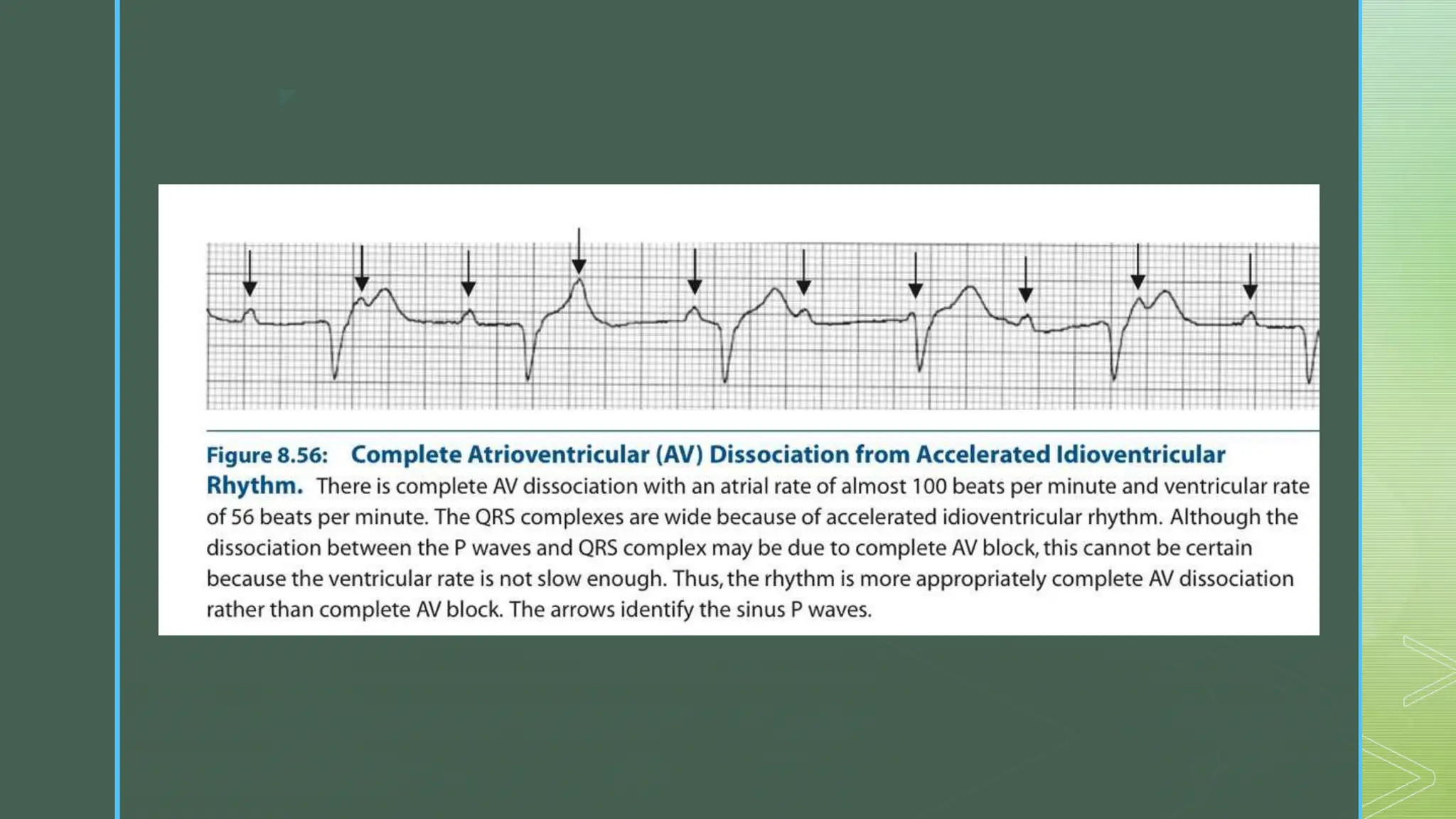
3. Accelerated idioventricular rhythm with complete AV
dissociation
4. Junctional tachycardia with complete AV dissociation
5. Junctional rhythm with complete AV dissociation
z
z
z
z

Atrio-Ventricular Dissociation - causes with ECG examples

  • 1.
  • 2.
    z Complete AV Dissociation It is a much broader term that includes any arrhythmia in which the atria and ventricles are completely independent.  It’s not necessarily due to only AV block
  • 3.
    z Mechanism  Ventricles beatsfaster so that when sinus signals come they are in the refractory period – no conduction of the signal  AV block
  • 4.
    z ECG Findings 1. Pwaves and QRS complexes are completely dissociated and have no relation. 2. In complete AV dissociation, the underlying rhythm may be ventricular tachycardia, junctional tachycardia, accelerated junctional rhythm, accelerated ventricular rhythm or complete AV block.
  • 5.
    z Types of completeAV dissociation 1. Complete AV block 2. Ventricular tachycardia with complete AV dissociation 3. Accelerated idioventricular rhythm with complete AV dissociation 4. Junctional tachycardia with complete AV dissociation 5. Junctional rhythm with complete AV dissociation
  • 6.
  • 7.
  • 8.
  • 9.