Practice Parameters
Atopic dermatitis (eczema) guidelines: 2023 American Academy of
Allergy, Asthma and Immunology/American College of Allergy,
Asthma and Immunology Joint Task Force on Practice Parameters
GRADE− and Institute of Medicine−based recommendations
AAAAI/ACAAI JTF Atopic Dermatitis Guideline Panel; Derek K. Chu, MD, PhD*,y
;
Lynda Schneider, MDz
; Rachel Netahe Asiniwasis, MD, MScx
; Mark Boguniewicz, MDǁ,{
;
Anna De Benedetto, MD#
; Kathy Ellison, Med**; Winfred T. Frazier, MD, MPHyy
;
Matthew Greenhawt, MD, MBA, MScǁ,zz
; Joey Huynh, MPTxx
; Elaine Kim, BScPhrm, RPhǁǁ
;
Jennifer LeBovidge, PhDz,{{
; Mary Laura Lind, PhD##
; Peter Lio, MD***,yyy
;
Stephen A. Martin, MD, EdMzzz
; Monica O’Brien, MBSxxx
; Peck Y. Ong, MDǁǁǁ,{{{
;
Jonathan I. Silverberg, MD, MPH, PhD###
; Jonathan M. Spergel, MD, PhD****,yyyy
;
Julie Wang, MDzzzz
; Kathryn E. Wheeler, MDxxxx
; Gordon H. Guyatt, MD, MSc, OC*,y
; Patient
Groups, Global Parents for Eczema Research; Korey Capozza, MPHǁǁǁǁ
; National Eczema
Association; Wendy Smith Begolka, MBS{{{{
; Evidence in Allergy Group;
Alexandro W.L. Chu, BHSc*,y
; Irene X. Zhao, BHSc*,y
; Lina Chen, MD*,y
;
Paul Oykhman, MD, MSc*,y
; Layla Bakaa, BSc*,y
; The AAAAI/ACAAI Joint Task Force on Prac-
tice Parameters; David Golden, MDCM####
; Marcus Shaker, MD, MS*****;
Jonathan A. Bernstein, MDyyyyy
; Matthew Greenhawt, MD, MBA, MScǁ,zz
;
Caroline C. Horner, MD, MSCIzzzzz
; Jay Lieberman, MDxxxxx
; David Stukus, MDǁǁǁǁǁ
;
Matthew A. Rank, MD{{{{{
; Julie Wang, MDzzzz
; Anne Ellis, MD, MSc#####
;
Elissa Abrams, MD******; Dennis Ledford, MDyyyyyy
; Derek K. Chu, MD, PhD*,y
* Departments of Medicine and Health Research Methods, Evidence & Impact, McMaster University, Hamilton, Canada
y
Evidence in Allergy Group, McMaster University and The Research Institute of St. Joe’s Hamilton, Hamilton, Canada
z
Division of Immunology, Boston Children’s Hospital, Boston, Massachusetts
x
Department of Dermatology, University of Saskatchewan, Regina, Canada
ǁ
Department of Pediatrics, University of Colorado School of Medicine, Aurora, Colorado
{
Division of Pediatric Allergy and Clinical Immunology, National Jewish Health, Denver, Colorado
#
Department of Dermatology, University of Rochester Medical Center, Rochester, New York
**
Westerville, Ohio
yy
Department of Family Medicine, UPMC St. Margaret, Pittsburgh, Pennsylvania
zz
Section of Allergy and Immunology, Children’s Hospital Colorado, Aurora, Colorado
xx
Sepulveda VA Medical Center, North Hills, California
ǁǁ
Toronto, Canada
{{
Harvard Medical School, Boston, Massachusetts
##
School for Engineering of Matter, Transport and Energy, Arizona State University, Tempe, Arizona
***
Department of Dermatology, Northwestern University Feinberg School of Medicine, Chicago, Illinois
yyy
Department of Pediatrics, Northwestern University Feinberg School of Medicine, Chicago, Illinois
zzz
University of Massachusetts Chan Medical School, Worcester, Massachusetts
xxx
Tufts University School of Medicine, Boston, Massachusetts
Collaborators (including additoinal patient and caregiver partners)Teresa Alabata; Julia Baribeau; Kelly Barta; Melissa Cowley; Katherine Ellison; Adrienne Forest; Megan Fritz;
Silena Gaines; Beth Ann George; Ashley Nicole Hamlin; Jim Hewlett; Joey Huynh; Stefan Jevtic; Jennifer Larosa; Amanda Isabel Lopez; Andrea Lozada; Harrison Nelson; Monica
O’Brien; Jessen Rajan; Justin Ramos; Sashah Sheikh; Harriet Thomas; Marylaura Thomas; Alvin Gutierrez; Jeffrey Pernica; Jasvinder Singh; Allergy & Asthma Network − De De Gard-
ner, Global Allergy & Airways Patient Platform − Tonya A. Winders. Evidence in Allergy Group evidence synthesis team members and additional collaborators appear in
acknowledgments.
Dr D.K. Chu and Dr Schneider are guideline co-chairs and co-first authors.
Refer to the eAppendix for additional details and practical considerations.
Address correspondence to: Derek K. Chu, MD, PhD, or Dr. Lynda Schneider, MD, AAAAI/ACAAI Joint Task Force on Allergy-Immunology Practice Parameters, 555 E Wells Street,
Suite 1100, Milwaukee, WI 53212. E-mails: chudk@mcmaster.ca or Lynda.Schneider@childrens.harvard.edu.
https://doi.org/10.1016/j.anai.2023.11.009
1081-1206/© 2023 American College of Allergy, Asthma & Immunology. Published by Elsevier Inc. This is an open access article under the CC BY-NC-ND license
(http://creativecommons.org/licenses/by-nc-nd/4.0/)
ARTICLE IN PRESS
Ann Allergy Asthma Immunol 000 (2023) 1−39
Contents lists available at ScienceDirect
ǁǁǁ
Division of Clinical Immunology and Allergy, Children’s Hospital Los Angeles, Los Angeles, California
{{{
Department of Pediatrics, USC Keck School of Medicine, Los Angeles, California
###
Department of Dermatology, The George Washington University School of Medicine and Health Sciences, Washington, District of Columbia
****
Department of Pediatrics, Perelman School of Medicine at the University of Pennsylvania, Philadelphia, Pennsylvania
yyyy
Division of Allergy and Immunology, Children’s Hospital of Philadelphia, Philadelphia, Pennsylvania
zzzz
Division of Pediatric Allergy and Immunology, Department of Pediatrics, Icahn School of Medicine at Mount Sinai, New York City, New York
xxxx
Department of Pediatrics, University of Florida, Gainesville, Florida
ǁǁǁǁ
Global Parents for Eczema Research, Santa Barbara, California
{{{{
National Eczema Association, Novato, California
####
Johns Hopkins University School of Medicine, Baltimore, Maryland
*****
Dartmouth Geisel School of Medicine and Dartmouth Hitchcock Medical Center, Section of Allergy, Lebanon, New Hampshire
yyyyy
University of Cincinnati, Cincinnati and Columbus, Ohio
zzzzz
Division of Allergy and Pulmonary Medicine, Department of Pediatrics, Washington University School of Medicine, St Louis, Missouri
xxxxx
University of Tennessee Health Science Center and LeBonheur Children’s Hospital, Memphis, Tennessee
ǁǁǁǁǁ
Nationwide Children’s Hospital and Ohio State University College of Medicine, Columbus, Ohio
{{{{{
Mayo Clinic in Arizona and Phoenix Children’s Hospital, Scottsdale and Phoenix, Arizona
#####
Division of Allergy and Immunology, Department of Medicine, Queen’s University, Kingston, Ontario, Canada
******
Section of Allergy and Clinical Immunology, Department of Pediatrics, University of Manitoba, Winnipeg, Manitoba, Canada
yyyyyy
Morsani College of Medicine, University of South Florida and James A. Haley Veterans’ Affairs Hospital, Tampa, Florida
A R T I C L E I N F O
Article history:
Received for publication October 23, 2023.
Received in revised form November 8, 2023.
Accepted for publication November 9, 2023.
A B S T R A C T
Background: Guidance addressing atopic dermatitis (AD) management, last issued in 2012 by the American Acad-
emy of Allergy, Asthma and Immunology/American College of Allergy, Asthma and Immunology Joint Task Force,
requires updating as a result of new treatments and improved guideline and evidence synthesis methodology.
Objective: To produce evidence-based guidelines that support patients, clinicians, and other decision-makers in
the optimal treatment of AD.
Methods: A multidisciplinary guideline panel consisting of patients and caregivers, AD experts (dermatology and
allergy/immunology), primary care practitioners (family medicine, pediatrics, internal medicine), and allied
health professionals (psychology, pharmacy, nursing) convened, prioritized equity, diversity, and inclusiveness,
and implemented management strategies to minimize influence of conflicts of interest. The Evidence in Allergy
Group supported guideline development by performing systematic evidence reviews, facilitating guideline pro-
cesses, and holding focus groups with patient and family partners. The Grading of Recommendations Assess-
ment, Development and Evaluation (GRADE) approach informed rating the certainty of evidence and strength of
recommendations. Evidence-to-decision frameworks, subjected to public comment, translated evidence to rec-
ommendations using trustworthy guideline principles.
Results: The panel agreed on 25 recommendations to gain and maintain control of AD for patients with mild,
moderate, and severe AD. The eAppendix provides practical information and implementation considerations in
1-2 page patient-friendly handouts.
Conclusion: These evidence-based recommendations address optimal use of (1) topical treatments (barrier
moisturization devices, corticosteroids, calcineurin inhibitors, PDE4 inhibitors [crisaborole], topical JAK inhibi-
tors, occlusive [wet wrap] therapy, adjunctive antimicrobials, application frequency, maintenance therapy), (2)
dilute bleach baths, (3) dietary avoidance/elimination, (4) allergen immunotherapy, and (5) systemic treatments
(biologics/monoclonal antibodies, small molecule immunosuppressants [cyclosporine, methotrexate, azathio-
prine, mycophenolate, JAK inhibitors], and systemic corticosteroids) and UV phototherapy (light therapy).
© 2023 American College of Allergy, Asthma & Immunology. Published by Elsevier Inc. This is an open access arti-
cle under the CC BY-NC-ND license (http://creativecommons.org/licenses/by-nc-nd/4.0/)
Executive Summary—American Academy of Allergy, Asthma and
Immunology/American College of Allergy, Asthma and
Immunology Joint Task Force Atopic Dermatitis Guidelines
Aims of These Guidelines and Specific Objectives
The purpose of these guidelines is to provide evidence-based rec-
ommendations about optimal management of atopic dermatitis (AD;
[atopic] eczema) in infants, children, and adults. The guidelines
address the following 5 main management questions:
1. Among patients with AD, what topical treatments should be used
to achieve optimal outcomes?
2. Should elimination diets (dietary avoidance strategies) be used for AD?
3. Should dilute bleach baths be used for AD?
4. Should allergen immunotherapy be used for AD?
5. Among patients with AD, what systemic treatments, including
phototherapy (UV light therapy), should be used to achieve opti-
mal outcomes?
The target audience includes patients, AD specialists (allergists/
immunologists and dermatologists), family medicine physicians,
pediatricians, and other decision-makers. This document may also
serve as the basis for adoption or adaptation by local, regional, or
national guideline panels and policymakers.
What Is New and Different
These Joint Task Force on Practice Parameters (JTFPP) guidelines rep-
resent an evolution in trustworthy allergy guidelines1
and are distin-
guished from other guidelines2,3
through systematic reviews of the
evidence with multidisciplinary panelist engagement, adherence to rig-
orous guideline development processes, robust use of Grading of Rec-
ommendations Assessment, Development and Evaluation (GRADE) that
fulfills requirements to report its proper use,4
the core involvement of
the patient and caregiver voice from start to finish, focus on equity,
diversity, and inclusiveness (including concepts addressing AD in
diverse skin tones [skin of color] and health disparities), clear transla-
tion of evidence to clinically actionable and contextual recommenda-
tions, and novel approaches to facilitate knowledge translation.5,6
The
guidelines emphasize, in addition to standards of trustworthiness, the
third principle of evidence-based medicine: that evidence alone is never
ARTICLE IN PRESS
2 D.K. Chu et al. / Ann Allergy Asthma Immunol 00 (2023) 1−39
enough; that patient values and preferences must be carefully consid-
ered when determining optimal treatments for patients and
populations.7,8
The eAppendix provides 1-2 page patient-friendly hand-
outs to facilitate education, discussion, and shared decision-making.
The current guidelines also differ from our previous guidelines in
a few other ways. The 2012 Atopic Dermatitis Practice Parameter9-11
covered a wide range of topics such as immunopathology, diagnosis,
and trigger factors and was a revision of the 200412
and 1997 guide-
lines13
; the 2023 guidelines focused on 5 main questions addressing
therapy. In the last 10 years, multiple new therapies have emerged,
including multiple biologics, small molecules, and a topical PDE4
inhibitor. These are well covered in the 2023 guidelines.
Some of the important changes in this updated practice parameter
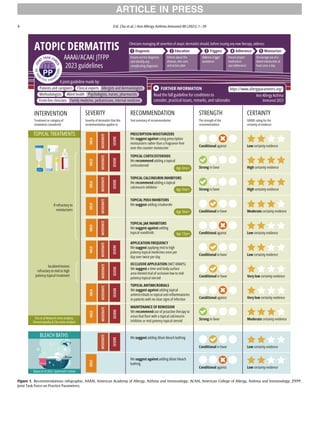
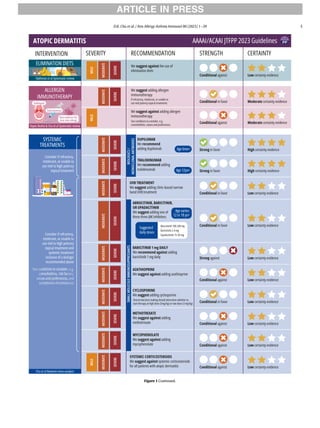
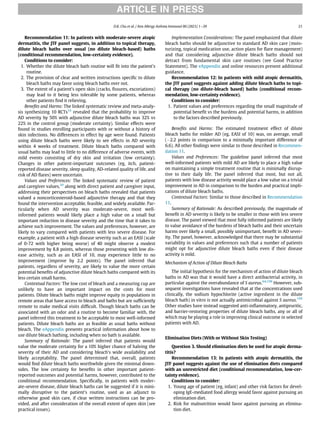
include the following (Fig. 1):
 Guidance on shared decision-making and factors to consider for
each recommendation
 Recommends the use of topical corticosteroids (TCS) or topical
calcineurin inhibitors (TCIs) in patients with uncontrolled AD
despite moisturizer use
 Highlights the safety of TCIs with typical use once or twice daily
 Consideration for once-daily dosing of topical medications
 Suggests using crisaborole 2% ointment for mild-to-moderate AD
 Suggests against adding topical JAK inhibitors, such as ruxoliti-
nib, for patients with mild-to-moderate AD refractory to mois-
turization alone
 Suggests against the use of topical antimicrobials for AD alone
with no infection
 Recommends proactive therapy with TCS or TCI for patients
with a relapsing course
 Suggests bleach baths for patients with AD with moderate-to-
severe disease as an additive therapy; suggests against bleach
baths for those with mild AD
 Suggests against elimination diets for AD
 Suggests allergen immunotherapy (AIT) for moderate-to-severe AD
 Recommends dupilumab for patients 6 months of age or older
or tralokinumab for patients aged 12 years and older, with
moderate-to-severe AD refractory, intolerant, or unable to use
midpotency topical treatment
 Suggests use of oral JAK inhibitors after careful consideration of
risks and possible benefits in adults and adolescents with mod-
erate-severe AD refractory, intolerant, or unable to use mid- to
high-potency topical treatment and systemic treatment inclu-
sive of a biologic recommended previously
 Recommends against using baricitinib 1 mg, and suggests
against azathioprine, methotrexate, and mycophenolate mofetil
 Suggests consideration of cyclosporine in adults and adoles-
cents with moderate-severe AD refractory, intolerant, or unable
to use mid- to high-potency topical treatment and biologics
 Suggests against the use of systemic corticosteroids for AD
 The eAppendix supplement provides 1-2 page patient-friendly
handouts to facilitate education, discussion, practical consider-
ations, and shared decision-making
 Commitment to update and revise the recommendations as
part of living guidelines
Executive Summary of Recommendations
This update is focused on 5 important questions for the manage-
ment of AD. Answering these 5 questions provides an excellent
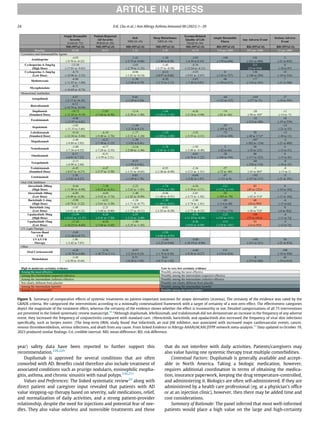
framework for managing AD. The infographic (Fig 1) summarizes the
recommendations in a format that is easily scalable and shareable, in
its unmodified entirety, through social media, flyers, print (eg, 2
pages side by side or a single double-sided page), and as posters (eg,
posted in clinician offices). To start, the guidelines provide a Good
Practice Statement for care of AD.
Good Practice Statement
Clinicians managing all severities of AD should, before issuing any
new therapy, perform the following:
(1) ensure the correct diagnosis and identify complicating diagnoses
(2) provide education, for instance an information guide about the
disease and an action plan
(3) address trigger avoidance
(4) ensure proper medication use and adherence
(5) encourage application of a bland moisturizer titrated to symp-
tomatic benefit (at least once, often multiple times, per day)
Systematic reviews and a recent large randomized trial suggest
that the best moisturizer is the one that patients will use regularly,
and shared decision-making should express the potential tradeoffs
between benefits (eg, perhaps greater benefit with ointment-based
moisturizers for more severe disease) and acceptability.
Topical Therapies
Moisturizers are critical for AD care, and several prescription mois-
turizers have become available in the last several years. On the basis of
available evidence, the panel suggested against the use of prescription
moisturizers (formally marketed as prescription medical devices).14
Given the close balance vs possible alternatives (over-the-counter mois-
turizers), the panel inferred that most well-informed patients would
place a higher value on avoiding the burdens, inconvenience, and cost
that are more likely to be the case with prescription moisturizers.
Topical corticosteroids (also called topical steroids) are the mainstay
of therapy for AD. In patients with uncontrolled AD refractory to mois-
turization alone, the JTF panel recommends addition of a TCS with
high-certainty evidence.14
The TCS, used in randomized clinical trials
(RCTs) mostly for 2 to 6 weeks, probably did not importantly increase
adverse effects, including skin infections, atrophy, or other local skin
changes. Exactly which TCS to use depends on a patient’s previous
treatment history, site of application, cost, accessibility, and values and
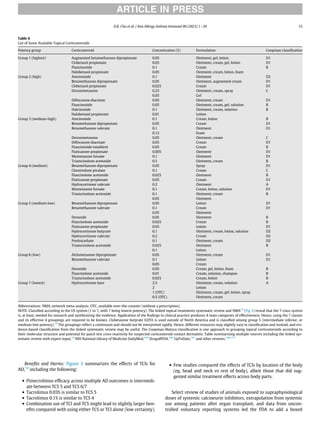
preferences. Avoid high-potency (classes 1 and 2; examples of each
potency are provided in the guideline tables) TCS for prolonged contin-
uous periods of time (4 weeks), and limit its use on sensitive areas
(face, folds, groin)—rare instances of atrophy, telangiectasia, and striae
may be more likely to occur in these cases. Continuous and prolonged
use of lower potency TCS on sensitive areas can also cause these effects.
The guideline text and eAppendix detail monitoring response to ther-
apy and provide considerations for difficult-to-control AD. Prescribing
more than one potency of topical treatment to be used at different sites
of the body, or depending on the severity of AD activity, must be bal-
anced against the potential for polypharmacy, which can increase con-
fusion, cost, and patient and family burden, albeit these barriers might
be mitigated with clear action plans. After addressing active disease
(“gaining control” or “inducing remission”), TCSs are also strongly rec-
ommended for continued intermittent therapy to prevent future flares
(“keeping control” or “proactive therapy”).14
Topical calcineurin inhibitors are important topical therapies for
AD. In patients aged 3 months or older with uncontrolled AD refrac-
tory to moisturization alone, the JTF panel recommends addition of a
TCI (pimecrolimus or tacrolimus) with high-certainty evidence.14
Pimecrolimus efficacy across multiple AD outcomes is intermediate
between TCS 5 and TCS 6/7. Tacrolimus 0.03% is similar to TCS 5.
Tacrolimus 0.1% is similar to TCS 4. Topical calcineurin inhibitors may
also be used as continued intermittent or proactive therapy. Select
review of studies of animals exposed to supraphysiological doses of
systemic calcineurin inhibitors, extrapolation from systemic use
among patients after organ transplant, and data from uncontrolled
voluntary reporting systems led the Food and Drug Administration
(FDA) to add a boxed warning to TCIs in 2006 and 2011 associating
them with cancer. In contrast, a linked systematic review of all ran-
domized and observational evidence (more than 3.4 million patients
ARTICLE IN PRESS
D.K. Chu et al. / Ann Allergy Asthma Immunol 00 (2023) 1−39 3
Figure 1. Recommendations infographic. AAAAI, American Academy of Allergy, Asthma and Immunology; ACAAI, American College of Allergy, Asthma and Immunology; JTFPP,
Joint Task Force on Practice Parameters.
ARTICLE IN PRESS
4 D.K. Chu et al. / Ann Allergy Asthma Immunol 00 (2023) 1−39
Figure 1 Continued.
ARTICLE IN PRESS
D.K. Chu et al. / Ann Allergy Asthma Immunol 00 (2023) 1−39 5
followed for up to 10 years), and incorporating patient values and
preferences, revealed no credible increase in cancer with a broad
range of typical TCI use among infants, children, and adults (4.56 per
1000 incidence across all ages without TCIs vs 4.70 per 1000 with
TCIs).15
Minor harms of TCIs include local irritation/burning.
The JTF panel also addressed once-daily vs 2 or more times per
day application of TCSs or TCIs and suggests applying the medication
once per day rather than twice per day.14
Patients who value a sim-
pler treatment routine, potentially lower chance for adverse effects,
and using less overall medication may prefer once per day applica-
tion over twice per day application. Patients with a more severe flare
or who might value resolving it more quickly may prefer twice per
day application over once per day application.
Bleach Baths
There has been controversy over whether dilute bleach baths may
help AD. The linked systematic review and meta-analysis synthesiz-
ing 10 RCTs16
revealed that the probability to improve AD severity by
50% with adjunctive dilute bleach baths was 32% vs 22% in the control
group (moderate certainty). There was little to no difference in
adverse events, with mild events consisting of dry skin and irritation
noted. Changes in other patient-important outcomes (eg, itch,
patient-reported disease severity, sleep quality, AD-related quality of
life, and risk of AD flares) were uncertain. Given this relatively minor
improvement, the panel suggests that dilute bleach baths may be
beneficial in patients with moderate and severe AD. Written instruc-
tions will be needed to ensure that patients use the correct type and
concentration of bleach (see eAppendix for examples and practical
information as a 1-page double-sided handout). Some patients may
not have access to a bathtub and may find bleach baths too much
effort. In patients with mild disease, the limited magnitude of
improvement was not felt to justify the burden.
Elimination Diets
Patients with AD have a higher risk for food allergies than those
without AD. Food allergy testing and elimination diets are often con-
sidered to try to inform how to improve AD control. Recent evidence,
however, suggests that tolerance to food allergens is promoted
through frequent, and perhaps high-dose, oral exposure. Avoidance
of food allergens is therefore strongly associated with promoting the
development of IgE-mediated food allergy. The linked systematic
review and meta-analysis identified 10 RCTs (599 participants)
addressing benefits and harms of dietary elimination for AD.17
Com-
pared with no dietary elimination, low-certainty evidence revealed
that dietary elimination may slightly improve AD severity (50% with
vs 41% without dietary elimination improved by a minimally impor-
tant difference, risk difference [RD] of 9% [95% CI, 0-17]), pruritus
(daytime itch score [range, 0-3] mean difference [MD], 0.21 [95% CI,
0.57 to 0.15]), and sleeplessness (sleeplessness score [range, 0-3]
MD, 0.47 [95% CI, 0.80 to 0.13]). Bayesian sensitivity analyses
revealed that most individuals pursuing a diet elimination strategy
would most likely experience little to no benefit. The JTF panel sug-
gests against the use of elimination diets compared with an unre-
stricted diet. Between both the uncertain benefits and uncertain
harms,17
including the potential risk of promoting food allergy, the
panel inferred that most well-informed patients would place a higher
value on avoiding potentially large harms. This was particularly the
case in infants and children whom the risk for developing food
allergy is thought to be greater. All ages, however, were thought to
be at risk of malnutrition and burdensome to patients and their care-
givers with following a strict dietary elimination strategy.
Allergen Immunotherapy
The previous practice parameter noted that AIT could be effective
for AD. This guideline’s linked systematic review of 23 RCTs (11 sub-
cutaneous immunotherapy [SCIT] and 12 sublingual immunotherapy
[SLIT]) included 1957 adult and pediatric patients (median of study
mean ages, 19 years; range of means, 4-34 years).18
Most studies
desensitized patients to house dust mites (HDMs; Dermatophagoides
pteronyssinus and/or D farinae), whereas 4 included other inhaled
allergens (eg, pollens). Patients were mostly on standard topical ther-
apy including TCSs and moisturizers with AIT added on. Furthermore,
most studies included polysensitized patients in addition to HDM
sensitization. Based on a combination of clinician-reported AD sever-
ity (eg, SCORing Atopic Dermatitis [SCORAD]), AIT likely improved
AD severity by 50% or more from baseline compared with no AIT
(40% vs 26%), with similar estimates of effect for SCIT and SLIT. The
main adverse effects were similar to AIT for allergic rhinitis and
asthma, that is, local injection site reaction for SCIT (66% of individu-
als) and oropharyngeal itching for SLIT (13% of individuals). Systemic
reactions or those severe enough to cause discontinuation occurred
in approximately 10% of those receiving SCIT and were rare with SLIT
(0.14% systemic reaction; 1.2% discontinue). The panel inferred that
most well-informed patients would value the moderate certainty for
net benefit with AIT for moderate and severe AD especially if the
patient had other allergic diseases that would respond to AIT. The
panel noted that there would be variability in patient values and
preferences regarding the burden associated with SCIT (multiple cli-
nician visits for administration; often starting as weekly) and SLIT
(daily self-administered medication) and time to effect.
Systemic Treatments Including Ultraviolet Phototherapy (Light Therapy)
There are multiple approved options for systemic treatment of AD
refractory to, at least, topical therapy. Such patients will often have mod-
erate-severe disease. These therapies include biologics, small molecules
(mostly immunosuppressants), and UV light therapy (phototherapy).19
The currently approved biologics target IL-4 and IL-13 cytokine
signaling pathways, or IL-13 signaling alone. Dupilumab binds a com-
mon receptor IL-4Ra and inhibits IL-4R signaling induced by both IL-4
and IL-13. Tralokinumab binds to the IL-13 cytokine in an epitope that
overlaps with the binding site of the IL-13Ra receptors, preventing IL-
13 from binding to the receptor. The linked systematic review and
network meta-analysis (NMA) revealed that, compared with contin-
ued standard topical treatment alone, adding dupilumab or tralokinu-
mab led to improvements in multiple patient-important outcomes.
The improved outcomes included AD signs and symptoms, judged
either by patients or clinicians, itch, and sleep disturbance. There was
no clear increase in serious adverse events or adverse events leading
to discontinuation.19
Conjunctivitis, however, was higher with dupilu-
mab or tralokinumab in comparison to placebo.19
The linked system-
atic review of patient values and preferences for treatment of AD,20
along with direct patient and caregiver input, revealed that patients
with AD value stepping-up therapy based on severity, safe medica-
tions, relief and normalization of daily activities, and a strong patient-
provider relationship, despite the need for injections and potential
fear of needles. Compared with dupilumab, tralokinumab was one
category lower in efficacy across multiple patient-important out-
comes.19
Tralokinumab is approved for AD in ages 12 years and older.
Dupilumab is approved for children/adults aged 6 months and older
for AD and asthma (ages 6 years and older), eosinophilic esophagitis
(ages 12 years and older), and, for adults, chronic rhinosinusitis with
nasal polyposis and prurigo nodularis. Patients and caregivers may
also value having one systemic therapy treat multiple conditions.
There are multiple oral JAK inhibitors currently available and
additional ones in development. The linked systematic review and
NMA revealed that the benefits and harms of JAK inhibitors (in alpha-
betical order), abrocitinib, baricitinib, and upadacitinib, varied by
drug and increased with dose of each medication.19
Although mild
and common harms (eg, acne, minor infection) increased with the
dose of each medication, data addressing less common serious harms
were hampered by the short duration of studies (16 weeks typi-
cally).19
For example, although serious infections such as herpetic
ARTICLE IN PRESS
6 D.K. Chu et al. / Ann Allergy Asthma Immunol 00 (2023) 1−39
infections (eg, eczema herpeticum, herpes zoster) were consistently
increased in patients with AD using all 3 studied oral JAK inhibitors,
there were no clear increase in deaths, cancer, or thrombosis
detected in the short studies done.19
The FDA placed a Boxed Warn-
ing label on the oral JAK inhibitors due to a recent study in rheuma-
toid arthritis using tofacitinib.
The risk-benefit profile of JAK inhibitors should be considered
when selecting JAK inhibitors in clinical practice. Risk considerations
should include both observed safety data for the individual drugs
from clinical trials of patients with AD and class-wide theoretical
safety concerns and boxed warnings for JAK inhibitors from the US
FDA. Oral JAK inhibitors are contraindicated in pregnancy and breast-
feeding. Risk factors for adverse outcomes, including age or other
strong risk factors for cancer, serious infection, venous thrombosis, or
cardiovascular disease, favor against JAK inhibitor use in these popu-
lations. JAK inhibitors are immunosuppressants and therefore screen-
ing for conditions before use (eg, age-appropriate cancer screening,
active or latent tuberculosis or viral hepatitis, vaccination including
herpes zoster, cytopenias, diverticular disease or bowel perforation,
renal and liver function, pregnancy) and subsequent clinician and
patient monitoring for adverse effects are required. These can range
in severity from acne, abdominal pain, easy bruising, tiredness, and
blood abnormalities (lipids and other biochemistries, cell counts) to
the serious harms described previously. There are thus multiple
implementation considerations, detailed in the eAppendix, including
drug-drug interactions, laboratory and clinical monitoring, FDA-
approved doses, and practical considerations.
The American Academy of Allergy, Asthma and Immunology/
American College of Allergy, Asthma and Immunology Joint Task
Force Guidelines for Management of Atopic Dermatitis
Aims of These Guidelines and Specific Objectives
The purpose of these guidelines is to provide evidence-based rec-
ommendations about optimal management of AD ([atopic] eczema)
in infants, children, and adults.
The target audience includes patients, AD specialists (allergists/
immunologists and dermatologists), family medicine physicians,
pediatricians, and other decision-makers. This document may also
serve as the basis for adoption or adaptation by local, regional, or
national guideline panels and policymakers.
Scope of Atopic Dermatitis
AD spans nations, age groups, ethnicities, and cultures.21
To pro-
vide context to the guideline recommendations, we briefly review
the scope of the health problem, pathophysiological mechanisms,
and populations, before describing the guideline methods and rec-
ommendations.
The Health Problem and Burden of Disease
AD is the most common chronic inflammatory skin disease, and
studies in the past 20 years reveal that it affects approximately 13%
of children and 7% of adults22-25
worldwide. AD usually develops in
infancy, with 45% of patients developing symptoms by 6 months of
age, 60% by 12 months,1
and approximately 85% by 5 years.1,2
Approximately 70% may have remission before adolescence, whereas
25% will continue to have AD into adulthood.1,3
A systematic review
of cross-sectional and cohort studies found that between 16% and
37% of adults report adult-onset AD.26
Rare syndromes (eg, Wiskott-
Aldrich syndrome) may present with AD.
Among a number of diagnostic approaches for AD,27-29
Hanifin
and Rajka30
diagnostic criteria and the UK working party31
modifica-
tions are the most widely validated and used for diagnosis (Table 1),
but a consensus reference standard does not exist.27,28,32,33
There are
more than 180 different ways to classify AD.34
Although eczema best
describes itchy (pruritic), inflamed, and scaly papules and plaques (ie,
primarily a morphologic description that can apply to multiple dis-
eases such as atopic, irritant, radiation induced, or contact dermati-
tis), AD (atopic eczema) more accurately describes a specific disease.
AD symptoms, associated sleep disturbance, and atopic and nona-
topic comorbidities contribute to patient and caregiver burden. AD
negatively affects quality of life and activities of daily living with sim-
ilar or worse impact compared with other chronic skin and systemic
diseases.35,36
Intense pruritus occurs in most patients with AD, is difficult to
control, and is frequently reported as the most burdensome symptom
of disease.25,37,38
More than 85% of patients with moderate-to-severe
AD report daily itch and 42% experience itch for 18 or more hours
each day.39
In addition, more than 40% of children and 60% of adults
with AD report skin pain, which may be associated with itch, scratch-
ing, open skin/fissures, and possibly, a neuropathic component.40,41
Children (47%-80%) and adults (33%-87%) frequently report sleep
disturbance, with worse sleep quality in patients with severe, active
disease, and consequent negative impact on daytime mood, behavior,
and productivity.42,43
Subjective sleep problems include difficulty
falling asleep, frequent nighttime wakening and, compared with con-
trols, excessive daytime sleepiness.43
Objective findings include pro-
longed sleep-onset latency, reduced sleep efficiency, and increased
time awake.43
Sleep disturbance is likely driven by itching and
scratching which is more difficult to suppress at night.44
Owing to AD, patients frequently report activity limitations and
self-consciousness about the appearance of their skin, leading to
avoidance of social interactions.25,45
Caregivers of pediatric patients
with AD report frequent sleep disturbance, co-sleeping, exhaustion,
worry, and social isolation related to the child’s AD, with greater fam-
ily burden associated with more severe disease.46-49
Pathophysiology and Mechanisms Overview
The pathogenesis of AD is complex and multifactorial50-52
and is
reflected in heterogeneous clinical phenotypes.34
Detailed reviews of
AD pathophysiology appear elsewhere,50,53,54
including mechanism
of itch (pruritus).55-59
AD involves skin barrier defects, immune dys-
regulation, and environmental interactions (microbial dysbiosis, irri-
tants, and allergens). Genetic factors such as loss-of-function
mutations in the gene encoding filaggrin and acquired defects in the
epidermal barrier (including filaggrin and lipids and tight junction
complexes [eg, claudin-1]) predispose to increased transepidermal
water loss and cutaneous dryness in AD.60,61
The mechanism of dis-
ease involves an impaired barrier that is permissive to allergen or
toxin penetration, which elicits an immune response and favors aller-
gen sensitization. Activated keratinocytes release thymic stromal
lymphopoietin (TSLP), IL-33, and IL-25, which activate type 2 innate
lymphoid cells, dendritic cells, and basophils,62
leading to an activa-
tion of TH2 cells. New systemic therapies that specifically target these
cytokines reveal the importance of major type 2 cytokines IL-4 and
IL-13 in AD pathophysiology. In addition, the production of type 2-
associated cytokine IL-31 promotes itching in AD. In chronic AD
lesions, other identified inflammatory cell types include TH17/22 and
TH1 cells. Their precise role, however, in the disease pathophysiology
remains to be determined. Both skin barrier defects and the suppres-
sion of cutaneous innate immunity by type 2 cytokines lead to dys-
biosis of AD skin microbiome and predispose patients to increased
skin infections, predominantly due to Staphylococcus aureus and
viruses (eg, herpes simplex viruses, molluscum contagiosum virus).63
Although there is a strong association between S aureus and disease
severity, and S aureus toxins and proteases are capable of exacerbat-
ing inflammation, the precise role of S aureus in AD remains
unclear.64
In addition, there is growing interest in understanding the
ARTICLE IN PRESS
D.K. Chu et al. / Ann Allergy Asthma Immunol 00 (2023) 1−39 7
role of other commensal skin bacteria such as coagulase-negative
staphylococci including S epidimidis and S hominis in AD.
Comorbidities and Complications of Atopic Dermatitis
Several comorbid atopic (food allergy, asthma, allergic rhinitis)
and nonatopic (depression, anxiety, neurocognitive impairment, skin
infections, and adverse effects of treatment) health problems occur in
patients with AD.65-69
AD severity is associated with developing such
comorbidities and may be due to uncontrolled disease, systemic
inflammation, and disturbed sleep.70-72
Complications of skin trau-
matization in AD include bacterial, viral, and fungal infection, lichen
simplex chronicus, and prurigo nodularis. Severe exacerbations can
present as erythroderma.
Ophthalmic and ocular diseases, some potentially sight-threaten-
ing, occur as comorbidities and complications of AD, such as recur-
rent keratoconjunctivitis, keratoconus, and anterior subcapsular
cataracts.73-75
Conjunctivitis, for example, can occur after treatment
with dupilumab, tralokinumab, or lebrikizumab.
AD is associated with increased fracture incidence76,77
which may
be due to decreased physical activity, increased systemic inflamma-
tion, and excessive use of certain treatments such as potent topical
and systemic corticosteroids.78,79
Shared mechanisms may also pro-
mote AD’s possible association with cardiovascular and metabolic
diseases, including obesity, hypertension, myocardial infarction,
stroke, and heart failure.80-82
Patient and Caregiver Experience Navigating Costs and Care
Patients and families may experience significant financial burden
associated with AD, including costs related to co-pays and deducti-
bles for health care visits and prescriptions, prescription costs not
covered by insurance, over-the-counter emollients and medications,
and indirect financial effects such as work absenteeism and/or
decreased productivity.46,49,83
Out-of-pocket expenses are particu-
larly important to patients and families and can affect management
outcomes.83
Recent survey data from the National Eczema Associa-
tion indicate that the median annual AD out-of-pocket expense was
$600; 42% of patients with AD reported greater than $1000 out-of-
pocket expenses annually and 9% reported out-of-pocket expenses
greater than $5000 per year. Higher out-of-pocket expenses are asso-
ciated with increased disease severity and flares.83,84
These data also indicate that many patients with AD use, including
concurrently, at least 3 prescription therapies.84
Nearly half of all
study respondents (49%) reported out-of-pocket costs for prescrip-
tion medications that were not covered by insurance.
The financial burden of AD also extends beyond direct out-of-
pocket costs. Caregivers of children with moderate-to-severe AD
reported spending an average 20 hours per week managing the dis-
ease.47
Caregivers consequently face tradeoffs, such as working less,
working flexible hours, or leaving the workforce, to accommodate
the time-intensive demands of managing AD.46,47
Disparities in social
determinants of health exacerbate these burdens.85
Collectively, these data indicate that there are potentially large
financial and nonfinancial burdens associated with AD care for patients
and families. Persons who care for patients with AD would benefit
from recognition of these potential costs and burdens and engage in
shared decision-making that accounts for ways to potentially mini-
mize these burdens as part of achieving optimal AD outcomes.
Atopic Dermatitis in Diverse Skin Tones (Skin of Color): Clinical
Considerations and Health Disparities
Although ethnic diversity is increasing in North America and in
many other regions of the world,86,87
race, ethnicity, and ancestry are
Table 1
Atopic Dermatitis Diagnostic Criteria as Defined by Hanifin and Rajka and as Subsequently Adapted by the UK Working Party
Hanifin and Rajka30
UKWP 199431
At least 3 of Pruritus An itchy skin condition (or parental report of scratching or rubbing in a child)
Typical morphology and distribution And at least 3 of History of involvement of the skin creases such as folds of elbows,
behind the knees, fronts of ankles, or around the neck (includ-
ing cheeks in children under 10 y)
Chronic or chronically relapsing dermatitis Visible flexural eczema (or eczema involving the cheeks/forehead
and outer limbs in children under 4 y)
Personal or family history of atopy (asthma, allergic rhinitis, AD) Personal history of asthma or (allergic rhinitis) (or history of
atopic disease in a first-degree relative in children under 4 y)
And at least 3 of Xerosis History of general dry skin in the last year
Ichthyosis/palmar hyperlinearity/keratosis pilaris Onset under the age of 2 y (not used if child is under 4 y)
Immediate (type I) skin test reactivity
Elevated serum IgE
Early age of onset
Tendency toward cutaneous infections (eg, Staphylococcus aureus
and herpes simplex)/impaired cell-mediated immunity
Tendency toward nonspecific hand or foot dermatitis
Nipple eczema
Cheilitis
Recurrent conjunctivitis
Dennie-Morgan infraorbital fold
Keratoconus
Anterior subcapsular cataracts
Orbital darkening
Facial pallor/facial erythema
Pityriasis alba
Anterior neck folds
Itch when sweating
Intolerance to wool and lipid solvents
Perifollicular accentuation
[IgE-mediated] Food [allergy]
Course influenced by environmental/emotional factors
White dermographism/delayed blanch
Abbreviations: AD, atopic dermatitis; UKWP, UK Working Party.
ARTICLE IN PRESS
8 D.K. Chu et al. / Ann Allergy Asthma Immunol 00 (2023) 1−39
terms that are often confused and used incorrectly88
in medicine and
research. Historically racialized communities continue to face health
disparities due to a number of factors, including structural and sys-
temic racism.89-92
We provide suggestions for clinicians to consider
when applying our guidance on an individual-patient and popula-
tion-societal level.
AD can present with different morphologies, including papular,
lichenoid, nummular and follicular clinical forms,93
and extensor
surface, eyelid, and inverse flexural involvement (see https://ecze
mainskinofcolor.org/ and https://nationaleczema.org/eczema-skin-of-
color/).5,94,95
Classical features, such as erythema, can vary among
skin tones—erythema reflects increased blood flow to superficial
capillaries and if its literal Greek meaning, red, is strictly followed,
the diversity of AD presentations can be importantly
underappreciated.96,97
Consistent with calls to improve representa-
tion of diverse ethnic backgrounds and skin tones in medicine98-102
and society, we define erythema to include transient skin alterations
characteristic of active AD inflammation including red, shades of
brown, violaceous, or gray appearances. Postinflammatory dyspig-
mentation (hypo- or hyperpigmentation) may persist for months to
years and be important to patients. Principles of AD care remain simi-
lar for all skin types. Hence, although there is interest in understand-
ing potential variation in the AD inflammatory response across race,
ethnicity, or ancestry,103,104
the relevance of these findings to inform-
ing treatment selection is not clear and, so far, multiple agents display
no differential treatment response across these groups. Beyond poten-
tial biological factors, social and structural factors affect patient and
family diagnosis and optimal health care access and utilization.105
In a 2002 race-based analysis of US national ambulatory medical
services, patients identified as Asian or Pacific Islander accounted for
16% of 8 million visits for AD (population adjusted odds ratio [OR] vs
patients identified as White, 6.7 [95% CI, 4.8-9.5])106
and patients
identified as Black or African American accounted for 20% (adjusted
OR, 3.4 [95% CI, 2.5-4.7]). Indigenous Peoples were excluded from the
analysis. Furthermore, historically racialized groups face worse out-
comes and inequities in access to care.107
For example, children with
AD in the United States identifying as Black or Hispanic are more
likely to miss school108
and, rather than access specialist care, use pri-
mary care and the emergency department for AD.109
Historically
racialized groups are also less likely to receive evidence-based treat-
ments appropriate for their AD severity.110
North American Indige-
nous Peoples’ social determinants of health, including historical and
social contexts, remote locations, crowded housing conditions on res-
ervations, and suboptimal health care access (particularly in rural and
remote areas), influence health outcomes.111-115
Optimally address-
ing the racial, ethnic, and cultural diversities of Indigenous Peoples
requires not only actively and equitably engaging them in research
and policymaking but also incorporating culturally sensitive (eg,
appreciating Indigenous Ways of Knowing116
and research practi-
ces117
) decision-making during individual clinical encounters.118
Given the complex factors driving disparities, improved research
and educational initiatives alongside interdisciplinary and multista-
keholder involvement are needed to help reduce gaps in care. At indi-
vidual and population levels, clinicians hoping to achieve optimal AD
outcomes will actively address unconscious (implicit) biases and
account for patient contextual factors in shared decision-
making.89,91,119,120
Clinicians should also promote structural and
organizational change.121
Consistent with this, a major theme of the
AAAAI/ACAAI JTF Atopic Dermatitis guidelines is promoting equity,
diversity, and inclusiveness.
Methods—How These Guidelines Were Created
The AAAAI/ACAAI JTFPP and the Evidence in Allergy Group at
McMaster University developed these guidelines. The JTFPP
partnered with the Evidence in Allergy Group for their methodologic
support in the development and dissemination of clinical practice
recommendations to provide patients, clinicians, and policymakers
with up-to-date, evidence-based, and user-friendly guidance.
Standards, Methods, and Processes for Living and Trustworthy Guidance
The guideline panel produced the recommendations following
standards for trustworthy guideline development using the GRADE
approach,4,7,122,123
principles laid out by Guidelines International
Network-McMaster,124
RIGHT,125
AGREE II,126
and Institute of
Medicine,1,127
and in compliance with the AAAAI/ACAAI JTFPP poli-
cies. We fulfilled criteria required to report robust use of GRADE.4
The eAppendix provides additional details.
Selection and Support of the Panel (Organization, Panel Composition,
Planning, and Coordination)
The JTFPP conceived the project, obtained approvals from the par-
ent organizations, composed the guideline workgroup of clinical
experts, methodologist, and Chairs, and provided overall oversight
(through a JTFPP Liaison: Dr Greenhawt), including document review,
feedback, and approval of the guideline. The guideline panel, striving
for equity, diversity, and inclusiveness (eg, age, gender, ethnicity,
geography), included 21 individuals, of whom 12 were AD experts
(dermatologists or allergy-immunology specialists or AD psycholo-
gist, many of whom were clinician-scientists), 5 were frontline clini-
cians (family practice, pediatrics, internal medicine, pharmacist), and
4 were either patients with AD or their caregivers. The Methods Chair
(methodological and content expertise) and a Clinical Chair (content
expertise) guided the panel discussions. A resource person with
methods expertise (Dr Guyatt) assisted the Methods Chair, and
observers (Mr Chu, Ms Zhao, Dr Chen, Dr Oykhman, Ms Bakaa) from
the Evidence in Allergy Group attended the panel meetings but did
not directly participate in discussions. There were 22 additional
health care workers (eg, nurses, pharmacists, infectious disease spe-
cialists), patient and caregiver partners, and patient advocacy group
representatives who provided counsel to the guideline panel, includ-
ing prioritizing outcomes, subgroup analyses, defining thresholds of
important effects, and providing data interpretation. The Evidence in
Allergy Group’s researchers conducted systematic reviews of evi-
dence and coordinated the guideline development process, including
use of the GRADE approach, determining methods, screening and
supporting patient and clinician partners, preparing agendas and
meeting materials, facilitating panel discussions, and holding focus
groups with patient and family partners.
Guideline Funding and Management of Conflicts of Interest
Development of these guidelines was wholly funded by the JTFPP
through the AAAAI and ACAAI, nonprofit medical specialty societies
that represent allergy-immunology specialists. Most members of the
guideline panel were members of the AAAAI and/or ACAAI. The JTFPP
supported panel appointments, but the panel exclusively developed
the recommendations.
Patient and caregiver partners were offered an honorarium by the
Evidence in Allergy Group for their time and participation; otherwise,
panel members did not receive payment. Some researchers who con-
tributed to the systematic evidence reviews received grant support
through the McMaster Evidence in Allergy Group and JTFPP. Other
researchers participated to fulfill requirements of an academic degree
or program.
Conflicts of interest of all participants were managed according to
JTFPP policies (https://www.allergyparameters.org/parameter-and-
guideline-development-process/) based on recommendations of the
Institute of Medicine (now National Academy of Medicine)127
and
the Guidelines International Network.128
Before appointment to the
panel, individuals disclosed financial and nonfinancial interests. The
Co-Chairs and JTFPP reviewed the disclosures and judged which
ARTICLE IN PRESS
D.K. Chu et al. / Ann Allergy Asthma Immunol 00 (2023) 1−39 9
interests were conflicts and should be managed. The eAppendix pro-
vides the completed “Disclosure of Interest” forms of all panel mem-
bers. The eAppendix also summarizes decisions about which
interests were judged to be conflicts. At the time of appointment,
most of the guideline panel, including the co-chairs, had no conflicts
of interest as defined and judged by JTFPP (ie, no current material
interest in any commercial entity with a product that could be
affected by the guidelines). Some panelists disclosed new interests or
relationships during the development process, but for any individual
recommendation, most was conflict free.
When panel members had potential conflicts of interest pertaining
to specific recommendations, the management process included
recusal from decision-making for those recommendations. Although
they were encouraged to contribute to discussions regarding the sci-
entific evidence summaries, practical issues, and implementation con-
siderations, panel members with a current direct financial interest in a
commercial entity with any product that could be affected by the
guidelines and with material intellectual (nonfinancial) conflicts were
recused from making judgments about relevant recommendations.
None of the McMaster-affiliated researchers who contributed to
the systematic evidence reviews or who supported the guideline-
development process had any current material interest in a commer-
cial entity with any product that could be affected by the guidelines.
Guideline Perspective, Outcomes, and Values and Preferences
The target audience for this guidance consists primarily of clini-
cians, but secondarily of patients, their caregivers, and health care
decision-makers. The panel primarily considered an individual
patient perspective but also took account of contextual factors (such
as resources, feasibility, acceptability, equity) to accommodate adop-
tion and adaptation for other contexts. During all discussions, which
occurred through email and virtual meetings, the Methods Chair
actively reminded the panel that guidelines should focus their main
considerations for patient values and preferences representative of
general patients with AD.
Panel members, including 4 patient partners who either had AD or
were caregivers for individuals with the condition, considered values
and preferences immediately in advance of developing each recom-
mendation. The multistakeholder guideline panel considered a list of
patient-important AD outcomes a priori, based on established meth-
ods,129
the Harmonizing Outcomes Measures for Eczema
(HOME)37,38,130
and input from panel members, patient and caregiver
partners, frontline clinicians, and partner AD advocacy organizations.
At the outset of the guideline development process, they rated the
importance of each outcome and whether they agreed with a hierar-
chy ranging from “critically important” to “not very important.” Simi-
larly, they set thresholds for trivial or unimportant effect sizes and
those of small but important, moderate, and large effect sizes for ben-
efits and harms. The Methods Chair reminded the guideline panel to
make their recommendations based on the perspective of patients
rather than their own values and preferences. A major source of such
information was a linked systematic review addressing patient values
and preferences for the treatment of AD.20
In areas where data were
lacking, other sources of information included conversations and
focus groups with patient and caregiver partners and clinicians’ expe-
rience in shared decision-making with patients and families.
Sources of Evidence
To create recommendations, the panel relied on evidence synthe-
sized in systematic reviews and (network) meta-analyses131
led by
the Evidence in Allergy Group. These included the following:
1. Systematic review and meta-analysis of bleach baths vs usual
baths for atopic dermatitis16
2. Systematic review and meta-analysis of dietary elimination vs
usual diet for atopic dermatitis17
3. Systematic review and meta-analysis of AIT vs no AIT for atopic
dermatitis18
4. Systematic review and meta-analysis of cancer risk with TCIs,
pimecrolimus and tacrolimus, for atopic dermatitis15
5. Systematic review and NMA of topical treatments for atopic der-
matitis—referred to here as the topicals NMA14
6. Systematic review and NMA of systemic treatments (monoclonal
antibodies, small molecules [eg, JAK inhibitors, cyclosporine,
methotrexate], UV light therapy [phototherapy]) for atopic der-
matitis—referred to here as the systemics NMA19
7. Systematic review of values and preferences of patients and care-
givers regarding treatment of atopic dermatitis20
Although the investigators responsible for the meta-analyses
rated the certainty of the evidence, the guideline panel reassessed
these ratings independently.
Additional guideline-associated publications include the
following:
1. What parents should know about atopic dermatitis JAMA pediat-
rics patient page5
(1-page handout)
2. Things to know about managing infant atopic dermatitis6
(1-
page handout)
3. Trustworthy patient-centered guidelines: insights from atopic
dermatitis and a proposal for the future1
(patient engagement
and guideline development methods)
Evidence Review and Development of Recommendations
For each guideline question, the Evidence in Allergy Group pre-
pared a GRADE Summary of Findings of the systematically reviewed
scientific evidence and values and preferences. Panel members also
identified additional potentially relevant studies.
Under the direction of the Evidence in Allergy Group, researchers
followed the general methods outlined in the Cochrane Handbook
for Systematic Reviews of Interventions (handbook.cochrane.org)
and GRADE guidance for conducting systematic reviews of interven-
tion effects and values and preferences and summarized findings
within Summary of Findings and Evidence-to-Decision
frameworks.7,132
The certainty in the body of evidence (also known
as quality of the evidence or confidence in estimates) was assessed
for each outcome of interest following the GRADE approach based on
the following domains: risk of bias, imprecision, inconsistency, indi-
rectness of the evidence, risk of publication bias, presence of large
effects, dose-effect relationship, and an assessment of the effect of
plausible residual and opposing confounding.7
For network meta-
analyses,131
we also considered intransitivity133
and incoherence.131
Details of the GRADE approach, including definition of terms, are
summarized elsewhere.7,131,134
The certainty was categorized into 4
levels ranging from very low, low, moderate, and high with a target
of certainty of non-zero effects. The systematic reviews and meta-
analyses fulfilled explicit requirements for robust use of GRADE and
to report its proper use.4
From January to June 2022, and ongoing literature review to July
31, 2023, the panel developed recommendations during 6 online
meetings and through online communication. For each recommenda-
tion, the panel reached consensus on the following: the certainty in
the evidence, the balance of benefits and harms, and the values and
preferences associated with the decision. The panel aimed to create a
recommendation based on consensus but elected, at the beginning of
the first panel meeting, to call a vote if they could not reach consen-
sus. Before discussions started, the panel determined that a simple
majority would provide the direction of the recommendation and
that 80% would be required to make a strong recommendation. All
members of the panel reviewed and approved the final guidelines.
ARTICLE IN PRESS
10 D.K. Chu et al. / Ann Allergy Asthma Immunol 00 (2023) 1−39
Document Review
All members of the panel reviewed draft recommendations,
revised, and then made them available online from August 4, 2023, to
September 8, 2023, for external review by stakeholders, including
allied organizations, other medical professionals, patients, and the
public. There were 13 individuals or organizations who submitted
comments in addition to 8 peer-reviewers appointed by the AAAAI
and ACAAI based on their medical content and methodological exper-
tise. In response to pertinent comments, the panel accordingly
revised the document, but no changes were made to the recommen-
dations. On October 19, 2023, the AAAAI/ACAAI JTFPP approved that
the defined guideline-development process was followed and
approved publication of the guidelines.
Understanding the Recommendations
The strength of a recommendation is expressed as either strong
(“the guideline panel recommends ...”) or conditional (“the guideline
panel suggests . . .”) (the interpretation is found in Table 2).
How to Use These Guidelines
The JTFPP guidelines are primarily intended to help clinicians
work with patients to make decisions about treatment alternatives.
Other purposes are to inform policy, education, and advocacy, and to
state future research needs. Patients may also find these guidelines
informative, in particular to facilitate discussions with clinicians.
These guidelines are not intended to serve as a mandate/standard of
care. Clinicians must make decisions on the basis of the clinical pre-
sentation of each individual patient, ideally through a shared process
that considers the patient’s values and preferences. Decisions may be
constrained by specific clinical settings and local resources, including
but not limited to institutional policies, time limitations, and avail-
ability of treatments. As science advances and new evidence becomes
available, recommendations may become outdated. Following these
guidelines cannot guarantee successful outcomes. AAAAI, ACAAI, the
JTFPP, and the Evidence in Allergy Group do not warrant or guarantee
any products described in these guidelines.
Statements about the underlying values and preferences, includ-
ing qualifying remarks accompanying each recommendation, are
integral parts and serve to facilitate a more accurate interpretation.
They should never be omitted when recommendations from these
guidelines are quoted or translated. Implementation of the guidelines
will be facilitated by the related decision aids, summary infographic
(Fig. 1), and eAppendix. The use of these guidelines is also facilitated
by the explicit description of the Evidence-to-Decision frameworks
and Summary of Findings tables provided or cited in references
accompanying each section.
Joint Task Force American Academy of Allergy, Asthma and
Immunology/American College of Allergy, Asthma and
Immunology Atopic Dermatitis (Eczema) Management
Recommendations
The Infographic (Fig. 1) summarizes the recommendations.
Recommendation 1: Good practice statement: Clinicians man-
aging all severities of atopic dermatitis should, before issuing any
new therapy, (1) ensure the correct diagnosis and identify compli-
cating diagnoses, (2) provide education, for instance an informa-
tion guide about the disease5
and an action plan, (3) address
trigger avoidance, (4) ensure proper medication use/adherence,
and (5) encourage application of a bland moisturizer titrated to
symptomatic benefit (at least once, often multiple times, per day).
Mimickers of, and disorders complicating AD, are common and
must be ruled out, such as irritant and/or allergic contact dermatitis,
psoriasis, seborrheic dermatitis, photodermatoses, primary immuno-
deficiency disorders (inborn errors of immunity), infestations (eg,
scabies), and local and systemic infections (eg, Streptococcal, Staphy-
lococcal, fungal, syphilis). Inborn errors of immunity (primary immu-
nodeficiencies) or other rare syndromes should be considered in
infants and young children when there are a constellation of signs
and symptoms, often multiorgan involvement with severe and/or
recurrent infections or immune dysregulation, that should prompt
referral. Venous stasis dermatitis and cutaneous lymphoma are more
common in adults. Although it can be easily overlooked, ensuring
diagnostic clarity will lead to optimal treatment of each condition.
The panel relied on existing systematic reviews and recent evi-
dence rather than extensively reappraising the large body of litera-
ture addressing moisturizers to inform this good practice
statement.123,135,136
A 2017 systematic review of 77 RCTs including
oat-, ceramide-, glycerol-, and urea-based, among other moisturizers,
established that moisturizers overall improve patient-important AD
outcomes.137
Furthermore, published in 2022, a RCT of 555 children
with mostly mild AD (baseline mean [SD] POEM [patient-oriented
eczema measure] of 9 [6] and EASI [Eczema Area and Severity Index]
4 [4]; Table 3 presents severity strata) assigned 1:1:1:1 to any one
moisturizer in the form of lotion, cream, gel, or ointment and found
similar AD outcomes (POEM, EASI, flares) and adverse events among
Table 2
Interpretation of Strong and Conditional Recommendations
Implications for Strong recommendation Conditional recommendation
Patients Most individuals in this situation would want the recommended course of
action, and only a small proportion would not.
Most individuals in this situation would want the suggested course of
action, but many would not. Decision aids may be useful in helping
patients to make decisions consistent with their individual risks, values,
and preferences.
Clinicians Most individuals should follow the recommended course of action. Formal
decision aids are not likely to be needed to help individual patients
make decisions consistent with their values and preferences.
Different choices will be appropriate for individual patients; clinicians
must help each patient arrive at a management decision consistent with
their values and preferences. Decision aids may be useful in helping
individuals to make decisions consistent with their individual risks, val-
ues, and preferences.
Policymakers The recommendation can be adopted as policy in most situations. Adher-
ence to this recommendation according to the guideline could be used
as a quality criterion or performance indicator.
Policymaking will require substantial debate and involvement of various
stakeholders. Performance measures should assess whether decision-
making is appropriate.
Researchers The recommendation is supported by credible research or other convinc-
ing judgments that make additional research unlikely to alter the rec-
ommendation. On occasion, a strong recommendation is based on low
or very low certainty of the evidence. In such instances, further research
may provide important information that alters the recommendations.
The recommendation is likely to be strengthened (for future updates or
adaptation) by additional research. An evaluation of the conditions and
criteria (and the related judgments, research evidence, and additional
considerations) that determined the conditional (rather than strong)
recommendation will help identify possible research gaps.
NOTE. The Infographic summarizes the recommendations.
ARTICLE IN PRESS
D.K. Chu et al. / Ann Allergy Asthma Immunol 00 (2023) 1−39 11
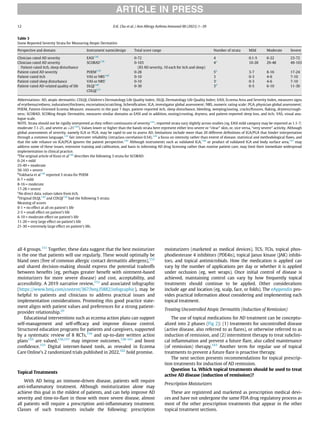
all 4 groups.151
Together, these data suggest that the best moisturizer
is the one that patients will use regularly. These would optimally be
bland ones (free of common allergic contact dermatitis allergens),152
and shared decision-making should express the potential tradeoffs
between benefits (eg, perhaps greater benefit with ointment-based
moisturizers for more severe disease) and cost, acceptability, and
accessibility. A 2019 narrative review,153
and associated infographic
(https://www.bmj.com/content/367/bmj.l5882/infographic), may be
helpful to patients and clinicians to address practical issues and
implementation considerations. Promoting this good practice state-
ment aligns with patient values and preferences for a strong patient-
provider relationship.20
Educational interventions such as eczema action plans can support
self-management and self-efficacy and improve disease control.
Structured education programs for patients and caregivers, supported
by a systematic review of 8 RCTs,154
and up-to-date written action
plans155
are valued,156,157
may improve outcomes,158-161
and boost
confidence.155
Digital internet-based tools, as revealed in Eczema
Care Online’s 2 randomized trials published in 2022,162
hold promise.
Topical Treatments
With AD being an immune-driven disease, patients will require
anti-inflammatory treatment. Although moisturization alone may
achieve this goal in the mildest of patients, and can help improve AD
severity and time-to-flare in those with more severe disease, almost
all patients will require a prescription anti-inflammatory treatment.
Classes of such treatments include the following: prescription
moisturizers (marketed as medical devices), TCS, TCIs, topical phos-
phodiesterase 4 inhibitors (PDE4is), topical Janus kinase (JAK) inhibi-
tors, and topical antimicrobials. How the medication is applied can
vary by the number of applications per day or whether it is applied
under occlusion (eg, wet wraps). Once initial control of disease is
achieved, maintaining control can vary by how frequently topical
treatments should continue to be applied. Other considerations
include age and location (eg, scalp, face, or folds). The eAppendix pro-
vides practical information about considering and implementing each
topical treatment.
Treating Uncontrolled Atopic Dermatitis (Induction of Remission)
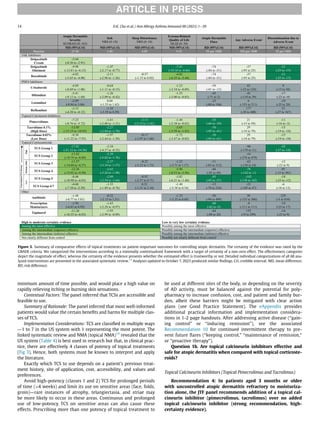
The use of topical medications for AD treatment can be conceptu-
alized into 2 phases (Fig 2): (1) treatments for uncontrolled disease
(active disease, also referred to as flares), or otherwise referred to as
induction of remission, and (2) intermittent therapy to treat subclini-
cal inflammation and prevent a future flare, also called maintenance
(of remission) therapy.163
Another term for regular use of topical
treatments to prevent a future flare is proactive therapy.
The next section presents recommendations for topical prescrip-
tion treatments for induction of AD remission.
Question 1a. Which topical treatments should be used to treat
active AD disease (induction of remission)?
Prescription Moisturizers
These are registered and marketed as prescription medical devi-
ces and have not undergone the same FDA drug regulatory process as
most of the other prescription treatments that appear in the other
topical treatment sections.
Table 3
Some Reported Severity Strata for Measuring Atopic Dermatitis
Perspective and domain Instrument name/design Total score range Number of strata Mild Moderate Severe
Clinician-rated AD severity EASI138
0-72 4 0.1-5 6-22 23-72
Clinician-rated AD severity
Patient-rated itch, sleep disturbance
SCORAD138
0-103
(83 AD severity, 10 each for itch and sleep)
4a
10-28 29-48 49-103
Patient-rated AD severity POEM139
0-28 5b
3-7 8-16 17-24
Patient-rated itch VAS or NRS140
0-10 3 0-3 4-6 7-10
Patient-rated sleep disturbance VAS or NRSc
0-10 3c
0-3 4-6 7-10
Patient-rated AD-related quality of life DLQI140
CDLQI141
0-30 3d
0-5 6-10 11-30
Abbreviations: AD, atopic dermatitis; CDLQI, Children’s Dermatology Life Quality Index; DLQI, Dermatology Life Quality Index; EASI, Eczema Area and Severity Index, measures signs
of erythema/redness, induration/thickness, excoriation/scratching, lichenification; IGA, investigator global assessment; NRS, numeric rating scale; PGA, physician global assessment;
POEM, Patient-Oriented Eczema Measure, measures in the past 7 days, patient-reported itch, sleep disturbance, bleeding, weeping/oozing, cracks/fissures, flaking, dryness/rough-
ness; SCORAD, SCORing Atopic Dermatitis, measures similar domains as EASI and in addition, oozing/crusting, dryness, and patient-reported sleep loss, and itch; VAS, visual ana-
logue scale.
NOTE. Strata should not be rigidly interpreted as they reflect continuums of severity142
; reported strata vary slightly across studies (eg, EASI mild category may be reported as 1.1-7;
moderate 7.1-21, and severe as 21104
). Values lower or higher than the bands strata here represent either less severe or “clear” skin, or, vice versa, “very severe” activity. Although
global assessments of severity, namely IGA or PGA, may be rapid to use to assess AD, limitations include more than 20 different definitions of IGA/PGA that hinder interpretation
through a common language,143
fair interrater reliability (intraclass correlation 0.54),144
a focus on intensity rather than extent of disease, statistical and methodological flaws, and
that the sole reliance on IGA/PGA ignores the patient perspective.145
Although instruments such as validated IGA,146
or product of validated IGA and body surface area,147
may
address some of these issues, extensive training and calibration, and basis in informing AD drug licensing rather than routine patient care, may limit their immediate widespread
implementation in clinical practice.
a
The original article of Kunz et al148
describes the following 3 strata for SCORAD:
0-24 = mild
25-49 = moderate
50-103 = severe
b
Vakharia et al140
reported 3 strata for POEM
0-7 = mild
8-16 = moderate
17-28 = severe
c
No direct data, values taken from itch.
d
Original DLQI,149
and CDLQI150
had the following 5 strata:
Meaning of scores
0-1 = no effect at all on patient’s life
2-5 = small effect on patient’s life
6-10 = moderate effect on patient’s life
11-20 = very large effect on patient’s life
21-30 = extremely large effect on patient’s life.
ARTICLE IN PRESS
12 D.K. Chu et al. / Ann Allergy Asthma Immunol 00 (2023) 1−39
Recommendation 2: In patients with atopic dermatitis, the JTF
panel suggests using a standard, bland (free of fragrance and
other potential contact allergens) over-the-counter moisturizer
over a prescription moisturizer medical device (eg, Atopiclair, Ele-
tone, Epiceram, MimyX, Neosalus, Zenieva, and PruMyx) (condi-
tional recommendation, low-certainty evidence).
Conditions to consider:
1. Different moisturizers (either prescription or over-the-counter)
have different odors and textures/consistency that may impor-
tantly influence decision-making.
2. Patients with an insurance plan that covers the cost of prescrip-
tion moisturizer, or those that otherwise can easily absorb the
direct cost, and who place a higher value on the small potential
benefits of prescription moisturizers over their costs, burdens,
and lower accessibility may prefer them vs over-the-counter
ones.
3. Patients who have not improved sufficiently with routine use of
standard over-the-counter moisturizers may prefer a trial of pre-
scription moisturizer before adding better proven topical anti-
inflammatory medications (see next recommendations).
Benefits and Harms: The systematic review and NMA of all topical
prescription treatments,14
including 9 RCTs involving various pre-
scription moisturizers (approximately 400 patients), revealed that
compared with standard moisturizers in patients with mild-moder-
ate AD, prescription moisturizers probably improve AD severity
slightly (reduction by 50% within 2-6 weeks in 18% with standard
moisturizer vs 24% with prescription moisturizer; absolute RD 6%
[95% CI, 3% to 16%]) and probably slightly improve flares (10% with
standard moisturizer vs 4% with prescription moisturizer; RD 6%
[95% CI, 9 to 1]). Certainty was lower for itch and safety outcomes,
prescription moisturizers may improve itch (50% reduction from
baseline in 26% with standard moisturizers vs 51% with prescription
moisturizer; RD 25% [15% to 36%]) and have little to no difference in
adverse events (15% vs 14% for any adverse event and 3% vs 2% for
adverse events causing discontinuation). No study addressed AD-
related quality of life or sleep disturbance.
Values and Preferences: The linked systematic review,20
along with
direct patient and caregiver input addressing their perspectives of
prescription and over-the-counter moisturizers, revealed that many
patients with AD prefer odorless treatments that are not visible and
have a low impact on daily life; that they value nonpharmacologic
therapies; and that they also value the texture or sensation of mois-
turizer on the skin.
Given the close balance between the 2 possible treatment alterna-
tives, the panel inferred that most well-informed patients placed a
higher value on avoiding burdens, inconvenience, and cost that are
more likely to be the case with prescription moisturizers (eg, having
to obtain or refill a prescription and/or check insurance coverage fre-
quently; that the amount of prescription moisturizer per refill may
be importantly smaller than that which can be obtained over-the-
counter [eg, tubs]; having to address these issues during travel or in
time-sensitive scenarios). Some panelists shared that some prescrip-
tion moisturizers may have a stronger odor and different texture
compared with some over-the-counter moisturizers but recognized
that this could vary among moisturizers.
Contextual Factors: The cost of prescription moisturizers is generally
higher than the cost of over-the-counter moisturizers. Although costs
can vary substantially, especially depending on whether they are being
paid for out-of-pocket, the scope of insurance coverage, and by phar-
macy, it is common for prescriptions to range from $100 for a 100 g
tube to $1000 or more (eg, GoodRx on January 1, 2023, lists that Epi-
ceram retails at $6826 for a 90 g tube, Atopiclair retails at $86 retails for
a 100 g tube, Eletone retails at $306 for a 100 g tube, Neosalus retails at
$177 for a 100 g tube, PruMyx retails at $137 for a 140 g tube; clinical
experts, however, shared that some of their insured patients reported
paying $20 for some prescription moisturizers from certain pharma-
cies). The available size of prescription moisturizer tubes is often much
smaller compared with available over-the-counter ones.
Summary of Rationale: The panel inferred that most well-informed
patients with AD would value avoiding the potential inconvenience,
burdens, practical implications, and cost of a prescription moisturizer
than its moderate certainty for small benefits in 2 important out-
comes, low certainty for larger improvements in itch, and no avail-
able data on quality of life. Hence, the panel inferred that most
patients with AD would first want to try over-the-counter moistur-
izers, if they are not doing so already (see Good Practice Statement).
A few patients (see conditions to consider) might prefer prescription
moisturizers compared with over-the-counter ones. The low-cer-
tainty evidence and close balance of benefits vs harms and burdens
drove the conditional recommendation.
Topical Corticosteroids
Recommendation 3: In patients with uncontrolled atopic der-
matitis refractory to moisturization alone, the JTF panel recom-
mends addition of a topical corticosteroid over no topical
corticosteroid (strong recommendation, high-certainty evidence)
Benefits and Harms: The linked systematic review and NMA syn-
thesized 219 RCTs enrolling 43,123 infants, children, and adults with
primarily mild-moderate AD addressing 68 different treatments.14
Figure 3 presents the summary of findings across outcomes. Few
studies compared the effects of TCS by location of the body (eg, head
and neck vs rest of body), albeit those that did suggested similar
treatment effects across body parts.
TCS, used in RCTs mostly for 2 to 6 weeks, probably did not impor-
tantly increase adverse effects, including skin infections, atrophy, or
other local skin changes. A Cochrane systematic review made similar
conclusions, reporting 26 cases of skin atrophy of 3574 RCT children
and adult participants applying mild, moderate, and potent TCS for
primarily either 1 to 6 weeks or 16 to 20 weeks (raw proportion: 7
per 1000 [95% CI, 5-11 per 1000]).164
Values and Preferences: The linked systematic review20
along with
direct patient and caregiver input revealed that patients with AD pre-
fer to use nonprescription therapies before TCS, use TCS for the
Figure 2. Concepts of induction of remission and treatment of subclinical inflamma-
tion in atopic dermatitis. Diagram (top) illustrates what might happen when AD treat-
ment ceases once signs and symptoms have superficially reduced (the period from
point A to point B) as opposed to what might happen (bottom) if initial treatment is
extended to clear subclinical disease (point C). Induction of remission is followed by
maintenance treatment with 2 consecutive days of treatment per week to previously
active sites (points D). Maintenance therapy is at regular intervals and not specifically
when “flares” are beginning to occur. Figure from Tang et al.163
ARTICLE IN PRESS
D.K. Chu et al. / Ann Allergy Asthma Immunol 00 (2023) 1−39 13
minimum amount of time possible, and would place a high value on
rapidly relieving itching or burning skin sensations.
Contextual Factors: The panel inferred that TCSs are accessible and
feasible to use.
Summary of Rationale: The panel inferred that most well-informed
patients would value the certain benefits and harms for multiple clas-
ses of TCS.
Implementation Considerations: TCS are classified in multiple ways
—1 to 7 in the US system with 1 representing the most potent. The
linked systematic review and NMA (topical NMA)14
revealed that the
US system (Table 4) is best used in research but that, in clinical prac-
tice, there are effectively 4 classes of potency of topical treatments
(Fig 3). Hence, both systems must be known to interpret and apply
the literature.
Exactly which TCS to use depends on a patient’s previous treat-
ment history, site of application, cost, accessibility, and values and
preferences.
Avoid high-potency (classes 1 and 2) TCS for prolonged periods
of time (4 weeks) and limit its use on sensitive areas (face, folds,
groin)—rare instances of atrophy, telangiectasia, and striae may
be more likely to occur in these areas. Continuous and prolonged
use of low-potency TCS on sensitive areas can also cause these
effects. Prescribing more than one potency of topical treatment to
be used at different sites of the body, or depending on the severity
of AD activity, must be balanced against the potential for poly-
pharmacy to increase confusion, cost, and patient and family bur-
den, albeit these barriers might be mitigated with clear action
plans (see Good Practice Statement). The eAppendix provides
additional practical information and implementation considera-
tions in 1-2 page handouts. After addressing active disease (“gain-
ing control” or “inducing remission”), see the associated
Recommendation 10 for continued intermittent therapy to pre-
vent future flares (“keeping control,” “maintenance of remission,”
or “proactive therapy”).
Question 1b. Are topical calcineurin inhibitors effective and
safe for atopic dermatitis when compared with topical corticoste-
roids?
Topical Calcineurin Inhibitors (Topical Pimecrolimus and Tacrolimus)
Recommendation 4: In patients aged 3 months or older
with uncontrolled atopic dermatitis refractory to moisturiza-
tion alone, the JTF panel recommends addition of a topical cal-
cineurin inhibitor (pimecrolimus, tacrolimus) over no added
topical calcineurin inhibitor (strong recommendation, high-
certainty evidence).
Figure 3. Summary of comparative effects of topical treatments on patient-important outcomes for controlling atopic dermatitis. The certainty of the evidence was rated by the
GRADE criteria. We categorized the interventions according to a minimally contextualized framework with a target of certainty of a non-zero effect. The effectiveness categories
depict the magnitude of effect, whereas the certainty of the evidence presents whether the estimated effect is trustworthy or not. Detailed individual categorizations of all 68 ana-
lyzed interventions are presented in the associated systematic review.14
Analyses updated to October 7, 2023 produced similar findings. CrI, credible interval; MD, mean difference;
RD, risk difference.
ARTICLE IN PRESS
14 D.K. Chu et al. / Ann Allergy Asthma Immunol 00 (2023) 1−39
Benefits and Harms: Figure 3 summarizes the effects of TCIs for
AD,14
including the following:
 Pimecrolimus efficacy across multiple AD outcomes is intermedi-
ate between TCS 5 and TCS 6/7
 Tacrolimus 0.03% is similar to TCS 5
 Tacrolimus 0.1% is similar to TCS 4
 Combination use of TCI and TCS might lead to slightly larger ben-
efits compared with using either TCS or TCI alone (low certainty).
 Few studies compared the effects of TCIs by location of the body
(eg, head and neck vs rest of body), albeit those that did sug-
gested similar treatment effects across body parts.
Select review of studies of animals exposed to supraphysiological
doses of systemic calcineurin inhibitors, extrapolation from systemic
use among patients after organ transplant, and data from uncon-
trolled voluntary reporting systems led the FDA to add a boxed
Table 4
List of Some Available Topical Corticosteroids
Potency group Corticosteroid Concentration (%) Formulation Coopman classification
Group 1 (highest) Augmented betamethasone dipropionate 0.05 Ointment, gel, lotion D1
Clobetasol propionate 0.05 Ointment, cream, gel, lotion D1
Fluocinonide 0.1 Cream B
Halobetasol propionate 0.05 Ointment, cream, lotion, foam
Group 2 (high) Amcinonide 0.1 Ointment D2
Betamethasone dipropionate 0.05 Ointment, augmented cream D1
Clobetasol propionate 0.025 Cream D1
Desoximetasone 0.25 Ointment, cream, spray C
0.05 Gel
Diflorasone diacetate 0.05 Ointment, cream D1
Fluocinonide 0.05 Ointment, cream, gel, solution B
Halcinonide 0.1 Ointment, cream, solution B
Halobetasol propionate 0.01 Lotion
Group 3 (medium-high) Amcinonide 0.1 Cream, lotion B
Betamethasone dipropionate 0.05 Cream D1
Betamethasone valerate 0.1 Ointment D1
0.12 Foam
Desoximetasone 0.05 Ointment, cream C
Diflorasone diacetate 0.05 Cream D1
Fluocinonide emollient 0.05 Cream B
Fluticasone propionate 0.005 Ointment D1
Mometasone furoate 0.1 Ointment D1
Triamcinolone acetonide 0.5 Ointment, cream B
Group 4 (medium) Betamethasone dipropionate 0.05 Spray D1
Clocortolone pivalate 0.1 Cream C
Fluocinolone acetonide 0.025 Ointment B
Fluticasone propionate 0.05 Cream D1
Hydrocortisone valerate 0.2 Ointment A
Mometasone furoate 0.1 Cream, lotion, solution D1
Triamcinolone acetonide 0.1 Ointment, cream B
0.05 Ointment
Group 5 (medium-low) Betamethasone dipropionate 0.05 Lotion D1
Betamethasone valerate 0.1 Cream D1
0.05 Ointment
Desonide 0.05 Ointment B
Fluocinolone acetonide 0.025 Cream B
Fluticasone propionate 0.05 Lotion D1
Hydrocortisone butyrate 0.1 Ointment, cream, lotion, solution D2
Hydrocortisone valerate 0.2 Cream D2
Prednicarbate 0.1 Ointment, cream D2
Triamcinolone acetonide 0.025 Ointment B
0.1 Lotion
Group 6 (low) Alclometasone dipropionate 0.05 Ointment, cream D1
Betamethasone valerate 0.1 Lotion D1
0.05 Cream
Desonide 0.05 Cream, gel, lotion, foam B
Fluocinolone acetonide 0.01 Cream, solution, shampoo B
Triamcinolone acetonide 0.025 Cream, lotion B
Group 7 (lowest) Hydrocortisone base 2.5 Ointment, cream, solution A
2 Lotion
1 (OTC) Ointment, cream, gel, lotion, spray
0.5 (OTC) Ointment, cream
Abbreviations: NMA, network meta-analysis; OTC, available over-the-counter (without a prescription).
NOTE. Classified according to the US system (1 to 7, with 7 being lowest potency). The linked topical treatments systematic review and NMA14
(Fig 3) reveal that the 7-class system
is, at least, needed for research and synthesizing the evidence. Application of the findings to clinical practice produces 4 main categories of effectiveness. Hence, using the 7 classes
and its effective 4 groupings are required to be known. Clobetasone butyrate 0.05% is used outside of North America and is classified among group 5 (intermediate inferior, or
medium-low potency).14
The groupings reflect a continuum and should not be interpreted rigidly. Hence, different resources may slightly vary in classification and instead, and evi-
dence-based classification from the linked systematic review may be useful. The Coopman-Matura classification is one approach to grouping topical corticosteroids according to
their molecular structure and potential for patch test cross-reactivity for suspected corticosteroid contact dermatitis. Table summarizing multiple sources including the linked sys-
tematic review with expert input,14
NIH National Library of Medicine DailyMed,165
Drugs@FDA,166
UpToDate,167
and other reviews.168-171
ARTICLE IN PRESS
D.K. Chu et al. / Ann Allergy Asthma Immunol 00 (2023) 1−39 15
warning172
to TCIs in 2006 and 2011 associating them with cancer. In
contrast, a linked systematic review of all randomized and observa-
tional evidence, and incorporating patient values and preferences,
revealed no credible increase in cancer with a broad range of typical
TCI use among infants, children, and adults (4.56 per 1000 incidence
across all ages without TCIs vs 4.70 per 1000 with TCIs).15
Minor
harms of TCIs include local irritation/burning.
Although the panel has individually recommended TCS and TCI vs
no added anti-inflammatory, the combination of TCS with TCI has
low certainty for modest added benefits than using either agent
alone,14
and the panel may address this, including when to start with
a TCS vs a TCI, as a formal recommendation in the future (see Imple-
mentation considerations for how clinical experts use both types of
treatment).
Values and Preferences: The panel inferred that the treatment ben-
efits and little to no harms aligned with patient values for safe and
effective medications, including alternatives to or complementary
with TCS, with otherwise minimal impact on daily activities.
Contextual Factors: TCIs are available widely throughout North
America. Pimecrolimus is approved for ages 3 months and older in
Canada and ages 2 years or older in the United States. In both coun-
tries, tacrolimus 0.03% is approved for ages 2 years and older and
tacrolimus 0.1% is approved for ages 16 years and older.
Summary of Rationale: The panel inferred that most well-informed
patients would value the certain patient-important benefits and
safety of using TCIs.
Implementation Considerations: A 1039 participant survey-based
RCT addressed conveying how application of topical medications will
feel. It revealed that positive framing, for example, a “cooling sensa-
tion and that this is a sign the medication is working” may increase
acceptability of topical medications for AD. This framing proved supe-
rior to stating that there will be no adverse effects or framing them as
“painful” (eg, burning), “stinging,” or cooling alone (willingness to
use on scale of 1-9, higher being more willing, with counseling about
potential sensation and it is a signal of efficacy mean [SD] 6.9 [1.8],
with counseling about potential sensation alone 5.3 [1.9], and with
no counseling 4.4 [1.9]).173
Other potential strategies include cooling
the tube, such as in a refrigerator, applying it after moisturizing, or
applying it after initially using TCS for a few days.
By considering patient values and preferences and the adverse
effect profile of TCS and TCI, clinicians might usually use TCS or TCI
for different body sites. For example, TCS for the general body and
TCI for more sensitive areas such as face and folds. Although both TCS
and TCI likely have patient-important benefits and little-to-no harms,
clinicians should consider that TCS generally come in larger dispens-
ing sizes compared with TCI (eg, 454 g tubs vs 100 g tubes) that might
be more convenient and cost-effective for patients. Table 5 provides
an example of some available sizes and costs as of April 2023. The
eAppendix provides additional practical information and implemen-
tation considerations in 1-2 page handouts.
Modifications to Using Topical Corticosteroids or Topical Calcineurin
Inhibitors
Topical Corticosteroids Under Occlusion (Wet Wraps) vs Standard
Nonocclusive Application
Temporarily applying TCS under occlusion is another method of
treating localized recalcitrant lesions and is often referred to as wet
wrap therapy because wet (damp) clothing or dressings are used to
occlude the applied TCS.11,174
Recommendation 5: In patients with localized uncontrolled
atopic dermatitis refractory to mid-high−potency topical treat-
ment (US classes 2-5 or tacrolimus), the JTF panel suggests addi-
tion of a time and body area-limited (eg, 4-7 days; minimum
1 hour to maximum overnight, once per day) trial of occlusive
low-mid−potency topical corticosteroid (US classes 3-7) therapy
Table 5
Example of Some Available Topical Treatment Sizes and Costs in USA (Cost Plus Drugs April 2023)
Medication (generic name) Concentration Brand name Form Amount Retail
price
Direct
purchase
price
Amount Retail price Direct
purchase
price
Triamcinolone acetonide 0.10% Aristocort A Ointment 15 g $9.68 $4.97 454 g cream jar ($18.66 for
ointment)
$35.79 $13.39
Triamcinolone acetonide 0.50% Triderm Cream 15 g $11.89 $6.27 454 g jar $40.85 $14.30
Triamcinolone acetonide 0.50% Kenalog Ointment 15 g $16.78 $7.66 60 mL lotion (0.1% or
0.025%)
NA NA
Augmented betamethasone
dipropionate
0.05% Diprolene augmented Cream 15 g $23.64 $5.03 50 g NA $6.80
Augmented betamethasone
dipropionate
0.05% Diprolene augmented Ointment 15 g $44.43 $12.92 NA NA NA
Hydrocortisone 1% Preparation H Cream 28.4 g $25.57 $4.49 NA NA NA
Betamethasone dipropionate 0.05% Alphatrex Cream 15 g $33.32 $7.63 45 g $74.72 $18.50
Mometasone furoate 0.10% Elocon Cream 45 g $50.19 $12.15 45 g ointment $50.45 $11.41
Mupirocin 2% Bactroban Ointment 22 g $51.56 $5.25 NA NA NA
Fluocinonide 0.05% Lidex Cream 30 g $53.42 $16.29 60 mL solution or 60 g
ointment
NA NA
Fluticasone propionate 0.05% Cutivate Cream 60 g $55.80 $14.94 NA NA NA
Triamcinolone acetonide 0.10% Oralone Paste 5 g $72.04 $18.78 NA NA NA
Clobetasol propionate 0.05% Temovate Cream 15 g $78.33 $4.78 Foam, lotion, gel, ointment
(max 60 g; 118 mL)
$90.81 to
365.30
$14.69 to 50.97
Hydrocortisone valerate 0.20% Westcort Cream 15 g $83.45 $7.02 NA NA NA
Fluocinolone acetonide body 0.01% Derma-smoothe/FS Body Oil 118.28 mL $103.99 $24.85 NA NA NA
Halobetasol propionate 0.05% Ultravate Cream 50 g $169.75 $26.59 50 g ointment $200.50 $30.57
Tacrolimus 0.10% Protopic Ointment 30 g $182.67 $35.20 100 g $676.45 $71.34
Clobetasol propionate emollient 0.05% Temovate E Cream 60 g $219.99 $23.18 NA NA NA
Crisaborole 2% Eucrisa Ointment 60 g $652.20a
NA NA NA NA
Ruxolitinib cream 1.5% Opzelura Cream 60 g $2410b
NA NA NA NA
Abbreviations: NA, not applicable; TCI, topical corticosteroid.
a
Additional examples, including additional TCIs and crisaborole, are available from The Medical Letter on Drugs and Therapeutics and reflect wholesale acquisition costs in
2020.170,171
b
As of April 2023, the GoodRx price for a 60 g tube of ruxolitinib cream costs $2410 at Walgreens (and similarly priced at 9 other retailers). In general, generic drugs may be less
expensive than corresponding brand-named drugs. The exact direct costs to patients may vary by individual insurance plan.
ARTICLE IN PRESS
16 D.K. Chu et al. / Ann Allergy Asthma Immunol 00 (2023) 1−39
over continued standard topical therapy alone (conditional rec-
ommendation, very low-certainty evidence)
Conditions to consider:
1. Resources and time to become educated, including the possibility
of in-clinic demonstration, about the process and practicalities of
efficiently and safely applying wet wraps.
2. Location of AD lesions (sensitive areas may be more challenging
or burdensome to wrap, and therefore patients may be less likely
to tolerate it).
3. The feasibility of wet wrap therapy fitting into the patient’s
schedule and daily routines.
4. Those patients with more extensive disease or relapsing general-
ized lesions may prefer systemic therapy instead.
Remark: In particular when there are refractory localized lesions,
consider all 5 steps of the Good Practice Statement before intensify-
ing therapy. Our clinical experts and patient partners found that
applying overnight is usually the most convenient, but that some-
times applying for a shorter duration during the day can be more
convenient.
Benefits and Harms: The systematic review identified 8 small RCTs,
most of which published their data in only abstract form with only
narrative description of tests of between group statistical significance
rather than quantitative outcome data, leaving 3 small RCTs with a
total sample size of 53 patients yielding very uncertain information
addressing benefits or harms.14
Therefore, the RCT evidence alone
did not sufficiently inform benefits and harms.
Experiential evidence from patients and clinicians suggested that,
when used judiciously for specific, local treatment of lesions in a
time-limited fashion, most patients experience rapid resolution of
AD lesions refractory to corresponding topical treatment without
temporary occlusion. Harms include the potential for local irritation
such as maceration and folliculitis. To date, no RCTs address the effi-
cacy and safety of wet wraps using TCIs or other topical treatment
classes under occlusion.
Values and Preferences: Although whole-body applications of wet
wrap therapy may be burdensome for patients and families and
therefore not align with most people’s values, the panel inferred that
most patients would value a local, time-limited wet wrap therapy
intended to treat acute local lesions because they could provide a
rapid and large response, patients’ familiarity with the routine, and
potential for self-efficacy and empowerment by using wet wraps to
modify TCS that a patient is likely to already have. The panel
acknowledged, however, that some patients, especially those who
have more widespread disease, may prefer to pursue other therapies
such as systemic agents instead of wet wrap therapy.
Contextual Factors: Wet wraps can be easily implemented using
common household materials, including pajamas or old clothes/
socks for hands, and existing topical treatments. The panel inferred
that resources in terms of time and education are likely important
to empower patients to be able to confidently and efficiently apply
wet wrap therapy for acute AD flares. We supply a number of these
practical tips in the associated implementation section and eAp-
pendix.
Summary of Rationale: The panel inferred that most well-informed
patients would value the ability for themselves to step up therapy to
address flares refractory to standard topical treatment, with potential
but uncertain large improvements in patient-important outcomes
than the minor burdens and uncertain minor harms, compared with
standard nonocclusive application.
Implementation Considerations: If wrapping overnight, ensure that
the wrap is not constrictive.
Publications174,175
and online educational resources176
(eg,
https://nationaleczema.org/eczema/treatment/wet-wrap-therapy/)
are available and may provide a helpful overview. In-person training
and demonstration are likely important to instill confidence and
empower patients to effectively and efficiently use wet wrap therapy.
The eAppendix provides additional practical information and imple-
mentation considerations in1-2 page handouts.
Once Daily vs Two or More Times Per Day Application of Topical
Corticosteroids or Topical Calcineurin Inhibitors
Recommendation 6: In patients with uncontrolled atopic der-
matitis using mid-to high-potency topical treatments (tacrolimus,
topical corticosteroid US classes 1-5), the JTF panel suggests apply-
ing the medication once per day over twice per day (conditional
recommendation, moderate certainty evidence).
Conditions to consider:
1. Patients who value a simpler treatment routine and using less
overall medication may prefer once per day application than
twice per day application.
2. Patients with a more severe flare or who might value resolving it
more quickly may prefer twice per day application than once per
day application.
3. Patients who value a twice per day skin care routine, or who
respond better to twice per day use, than once per day, may pre-
fer the twice daily application.
Benefits and Harms: Nine RCTs comprising 1507 participants eval-
uated twice per day application of TCS (US classes 1-5) or tacrolimus
compared with once per day.14
They provided high-certainty evi-
dence for a small difference between regimens (MD 3.33 [4.28 to
2.39] on SCORAD scale 0-103; RD to improve by 50% from baseline
5 more per 100 [1-9 more]). This is just above the a priori threshold
of 3 per 100 set by the guideline panel. Twice per day application,
compared with once daily application, similarly slightly improved
other outcomes (itch, quality of life, sleep disturbance) with moder-
ate or high certainty. Harms were no different between groups.14
Values and Preferences: The systematic review of values and pref-
erences20
found that patients value interventions that minimized
impact on daily activities and use of medications, particularly TCS, as
much as possible. The panel inferred that once per day application
would align with these values, though there may be situations where
patients might prefer to use twice per day (see conditions to con-
sider).
Contextual Factors: Once per day application would use less overall
TCS and TCI and could lead to less resource use compared with twice
per day application.
Summary of Rationale: As the initial approach to address active
eczematous lesions, the panel inferred that most well-informed
patients would value the greater convenience and lower resource use
of once per day application than the moderate certainty for a small,
potentially unimportant, larger chance in achieving AD control with
twice per day application. The potential for variability in patient val-
ues and preferences and their dynamic nature over time (eg, when
facing more severe flares) drove the conditional recommendation.
Implementation Considerations: Tailoring frequency of application
to patient values and preferences and empowering them to step up
frequency of therapy as needed could help promote self-efficacy. The
eAppendix provides additional practical information about imple-
mentation considerations in 1-2 page handouts.
Topical Phosphodiesterase 4 Inhibitors
Although many topical PDE4 inhibitors are in development14
, only
crisaborole is currently available.
Recommendation 7: In patients with mild-moderate atopic
dermatitis refractory to moisturization alone, the JTF panel sug-
gests adding topical crisaborole 2% ointment over usual care
alone (conditional recommendation, high-certainty evidence).
Conditions to consider:
ARTICLE IN PRESS
D.K. Chu et al. / Ann Allergy Asthma Immunol 00 (2023) 1−39 17
1. Adverse effects might be more prominent when applied to sensi-
tive areas and patients might favor another therapy with larger
certain benefits and less harms compared with crisaborole.
2. The severity of AD - the small benefits found primarily in studies
of patients with mild AD favor use only to treat mild AD flares.
Conversely, its less certain and likely smaller benefits in more
severe AD suggest against its use in more severe cases.
3. Patients who highly value noncorticosteroid treatments might
place higher value on PDE4 inhibitors over the larger and high-
certainty benefits in achieving AD control and little to no harm
with other treatments such as TCS or TCI.
Benefits and Harms: The topical treatments NMA,14
including 5
randomized trials and more than 2000 participants (including 2 trials
comparing crisaborole to either TCS 5 or pimecrolimus), addressing
crisaborole revealed small improvements in achieving AD remission
(clinical severity [improving by 50% or more, RD 17 more per 100 (3
to 33 more)], itch [RD 9 more per 100 (3 fewer to 23 more)], and
quality of life [RD 9 more per 100 (1 to 17 more)]) and reducing the
chance of flare (6 fewer [9 to 1 fewer]). These were offset with an
increase in adverse events, primarily local irritation with sensation of
stinging and burning (RD 6 more per 100 [4 fewer to 21 more]). No
data addressed crisaborole’s impact on sleep disturbance (Fig 3). In
summary, its effects in improving most patient-important AD out-
comes are similar in potency to TCS 6/7.
Values and Preferences: The panel inferred that adding crisaborole,
compared with standard care with a moisturizer alone, would align
with patient values and preferences for alternative noncorticosteroid
topical treatments and stepping up treatment as needed, but might
not fully align with the desire to avoid adverse events.
Contextual Factors: Crisaborole is available across North America.
Summary of Rationale: The panel inferred that many well-
informed patients would value the benefits, albeit small, for crisabor-
ole than standard treatment with a moisturizer alone but that an
appreciable number of patients would prefer to avoid the harms and
burdens associated with crisaborole and prefer more effective and
tolerable therapies. The close balance of benefits and harms along
with variability in patient values and preferences drove the condi-
tional recommendation.
Implementation Considerations: As described in the TCI recommen-
dation, framing the potential for adverse effects may prepare and
help enhance willingness to continue the treatment despite local irri-
tation.173
Applying in small quantities to a test area, particularly for
sensitive areas of the body, may be helpful to evaluate the magnitude
of adverse effects and its potential tolerability before wider usage.
Similar to the recommendations for TCI or TCS, prescribing multi-
ple agents for patients to use for different levels of AD severity or
application to different body sites must take into account the poten-
tial burdens and downsides of polypharmacy. Although the panel did
not yet render an official recommendation for TCS or TCI vs crisabor-
ole, many clinical experts and patients will start with TCS or TCI first.
Future updates to the guidelines may address this. The eAppendix
provides additional practical information and implementation con-
siderations in 1-2 page handouts.
Topical Janus Kinase Inhibitors
Although many topical JAK inhibitors are in development, only
ruxolitinib is currently available in North America. Delgocitinib cream
and/or ointment are available in other countries, albeit they may be
licensed for hand eczema rather than AD.
Recommendation 8: In adolescent and adult patients with
mild-moderate atopic dermatitis refractory to moisturization
alone, the JTF panel suggests against adding topical ruxolitinib
over continued usual care alone (conditional recommendation,
low-certainty evidence).
Conditions to consider:
1. Patients who place a higher value on certain larger benefits and
safety profile of other topical treatments (eg, TCS 2-4, tacrolimus)
and certain systemic therapies are less likely to prefer topical
ruxolitinib.
2. Patients who are immunocompromised, immunosuppressed, or
have risk factors for serious infection, cancer, thrombosis, or car-
diovascular events (Table 6) may prefer other treatments com-
pared with topical ruxolitinib.
3. Patients who have not responded to other topical therapies and/
or those who highly value the modest benefits of topical ruxoliti-
nib over the more certain larger benefits of other topical treat-
ments, and ruxolitinib’s uncertain association with an increased
risk of cancer, thromboembolism, serious infection, and mortal-
ity, and safety profile of systemic treatments, might favor topical
ruxolitinib.
Benefits and Harms: The topical treatments systematic review and
NMA,14
including 3 RCTs and more than 1400 adolescent and adult
participants with mild AD (mean »9.5% body surface area involve-
ment and mean EASI »8) comparing, topical ruxolitinib vs either
standard care or TCS 4 (triamcinolone 0.1% cream), revealed high or
moderate certainty improvements in AD severity (RD 23 more per
100 [6-41 more]), itch (34 more per 100 [20-47 more]), sleep distur-
bance (4 more per 100 [0-10 more]), and quality of life (35 more per
100 [25 more to 45 more]). Whether topical ruxolitinib reduces flares
is highly uncertain due to imprecision and the short-term (4-8
weeks) nature of the available studies that assessed relevant inter-
ventions and controls (comparators). Topical ruxolitinib is slightly
more potent in improving most patient-important AD outcomes
compared to pimecrolimus (between TCS 5 and TCS 6/7)14
(Fig 3).
Overall, adverse events within this time frame were similar
between topical ruxolitinib and control groups (RD 5 fewer per 100
[12 fewer to 4 more]). The direct data were too short and did not con-
tain enough adults (at risk) to credibly estimate the effect on death,
cancer, thrombosis, or serious infections. Stroke was observed in the
topical ruxolitinib group in the TRuE-AD trials, but recent data, a mix
of observational and randomized data, to 40 weeks suggest favorable
safety.182
The FDA has placed a Boxed Warning label on all JAK inhibi-
tors due to a recent study in rheumatoid arthritis and an oral pan-JAK
inhibitor, tofacitinib. The Oral Rheumatoid Arthritis Trial (ORAL) Sur-
veillance study was a 40-month, 4362-participant study comparing
tofacitinib with a TNF inhibitor in patients with rheumatoid arthritis
aged 50 years or older, also taking methotrexate, and at least 1 risk
factor for cardiovascular disease. Compared with TNF inhibitors, tofa-
citinib increased major cardiovascular adverse events (2.5% vs 3.4%;
hazard ratio [HR] 1.33 [95% CI, 0.91-1.94]), cancer (2.9% vs 4.2%; HR
1.48 [1.04-2.09]), and at higher doses, venous thromboembolism
(0.7% vs 2.3%), serious infections (8.2% vs 11.6%), and death from any
cause (1.2% vs 2.7%). Concerns about systemic absorption with topical
JAK inhibitors are sufficient to limit application of ruxolitinib to less
than 20% BSA and use it in a discontinuous manner as decrease the
potential for harm.183-185
Without long-term RCTs including at-risk
populations or other study designs that can robustly rule out an
important increase in cancer, thrombosis, serious infection, or death
(eg, using the framework used to evaluate the association with
TCIs15
), patient-important increases in serious harms with topical
JAK inhibitors remain uncertain. In most mild-moderate patients
with AD, the risk with a topical JAK inhibitor, however, would be pre-
dicted to be lower than that with an oral JAK inhibitor. Robust com-
parative long-term data are required to definitively clarify serious
harms, if any, of using topical ruxolitinib.
Values and Preferences: The systematic review of values and pref-
erences20
and direct input from patient partners revealed that
patients place a high value on safe medications and avoiding adverse
ARTICLE IN PRESS
18 D.K. Chu et al. / Ann Allergy Asthma Immunol 00 (2023) 1−39
effects, to step up therapy as needed, and a strong patient-provider
relationship. The panel inferred that most patients with mild-moder-
ate AD would prefer to avoid the uncertain increase in death, cancer,
thrombosis, and serious infectious, particularly when there are multi-
ple safer treatment options with larger certain benefits and higher
certainty for safety.
Contextual Factors: Any one of the serious adverse effects could
lead to a significant increase in resource use. Extensive discussion
and fully informing patients with mild-moderate disease before use
of topical ruxolitinib are another potential resource limitation.186
For
patients who have tried other treatments or for whom they are intol-
erable or inaccessible, however, the time taken to discuss may be
more greatly valued. Topical JAK inhibitors are likely to be available
across North America, but may be limited in access to specialists with
the resources and comfort with prescribing it and monitoring for its
potentially rare and serious adverse effects.
Summary of Rationale: The panel inferred that most well-informed
patients with mild AD would prefer to avoid the uncertain small
increase in serious harms over the modest benefits of adding topical
ruxolitinib compared with standard care, and in particular, when
considering other treatments with higher certainty for safety.
Implementation Considerations: Consistent with the product mono-
graph, systemic absorption, and therefore possibly serious harms, of
topical ruxolitinib might be minimized when used (1) on less than 20%
body surface area, (2) in nonimmunocompromized nor immunosup-
pressed patients, and (3) in a short-term or noncontinuous manner.
Patients and clinicians considering topical ruxolitinib should
engage in a discussion of the potential benefits and harms and estab-
lish whether topical ruxolitinib or another topical or systemic ther-
apy optimally aligns with patient values and preferences.
Similar to the recommendations for TCI or TCS, prescribing multi-
ple agents for patients to use for different levels of AD severity or
application to different body sites must take into account the poten-
tial burdens and downsides of polypharmacy. Although the panel did
not yet render an official recommendation for TCS or TCI vs ruxoliti-
nib, many clinical experts and patients will start with TCS or TCI first.
Similarly, clinical experts expressed that although most patients may
not prefer ruxolitinib as first-line treatment, it might be a resource to
consider for those patients for whom TCS and TCI do not yield suffi-
cient control. The eAppendix provides additional practical informa-
tion and implementation considerations in 1-2 page handouts.
Topical Antimicrobials vs No Addition of Topical Antimicrobials
Recommendation 9: In patients with uncontrolled atopic der-
matitis and no serious bacterial skin infection (ie, without severe
weeping, crusting, pustules, or painful skin or other signs of
extensive infection or systemic illness), the JTF panel suggests
against adding topical antimicrobials to standard topical treat-
ments (conditional recommendation, very low-certainty evi-
dence).
Conditions to consider:
1. Patients with uncontrolled AD and without serious skin infection
who place a high value on avoiding polypharmacy and antimi-
crobial resistance will prefer to avoid adding topical antimicro-
bials to standard care. For severe skin infections (extent or
intensity, eg, accompanied by fever or other systemic symp-
toms), guidance from the Infectious Disease Society of America
addresses when to use systemic or topical antimicrobials.187
2. Patients who are immunocompromised or immunosuppressed,
have a more severe (extent or intensity) infection (particularly
impetigo or ecthyma187
), a history of severe infections, severe
AD, or who place a high value on avoiding potential complica-
tions of bacterial skin infections may prefer adding topical anti-
microbials to standard care.
Remark: This recommendation applies to typical infected AD
lesions, not the many other skin and soft tissue infections for which
separate guidance from the Infectious Disease Society of America is
available187
(eg, abscesses, furuncles/carbuncles, purulent or necro-
tizing skin infections, erysipelas, cellulitis, animal bites, other types
of skin infections).
Benefits and Harms: The topical treatments of NMA revealed that
the few studies addressing the addition of topical antimicrobials in
combination with TCSs or TCIs (eg, fucidin, other antibiotics or anti-
septics, triclosan) compared with TCS or TCI alone in patients without
severely infected AD primarily captured data only on AD severity and
provided low certainty for no difference between groups.14
These
findings accord with no significant improvement across outcomes
found in RCTs addressing oral antibiotics for AD (either infected188-190
or uninfected191-193
) and an increasing conceptual view that host-
microbiome interactions in AD are more complex than the simple pres-
ence or absence of S aureus.64
Although the included RCTs did ade-
quately not report allergic contact dermatitis to the applied topical
antimicrobials, this is a recognized possible complication.194
Retrospec-
tive analysis of the 2001 to 2018 North American Contact Dermatitis
Group case series of 43,722 patients with 1 or more positive allergic
patch test reactions identified 6374 (15%) patients with 8787 patch test
reactions to topical medications.195
Neomycin (29%) and bacitracin
(29%) made up the most common patch test reactions.
Values and Preferences: The systematic review of patient values
and preferences20
and our patient partners placed high value on safe
and effective therapies. To that end, high uncertainty for any benefit
at the cost of promoting antimicrobial resistance may not align with
these values. Patients with AD are at risk of secondary infection and
would likely value being able to have antimicrobials be effective
when needed.
Contextual Factors: Although topical antimicrobials are available,
their overuse contributes to antimicrobial resistance to individual
patients and populations, thereby increasing resource use. Topical
and systemic antimicrobial resistance caused 1.27 million deaths in
2019 alone and is now one of the top 10 threats to global health pri-
oritized by the WHO196
and United Nations.197
Summary of Rationale: The panel inferred that most well-informed
patients without serious bacterial skin infection would value the high
certainty for benefits with TCI and/or TCS alone over the promotion
of antimicrobial resistance or other harms (including, eg, contact der-
matitis) and the uncertainty for any added benefit with combining a
topical antimicrobial with topical anti-inflammatory treatments such
as TCI or TCS alone. The low certainty of evidence drove the condi-
tional recommendation.
Implementation Considerations: Education regarding how the
inflammatory nature of AD may hamper natural antimicrobial
defenses may be helpful to frame the importance of anti-inflammato-
ries and keeping control of AD as critical to addressing infections and
preventing future ones. The eAppendix provides additional practical
information and implementation considerations in 1-2 page handouts.
Maintenance of Remission
The opening statement to the previous section, Treating uncon-
trolled eczema (induction of remission), provides a definition and
rationale for maintaining control of AD (also referred to as maintenance
of remission, proactive therapy, or continued intermittent treatment).
Maintaining control of AD is important to prevent flares, escalation of
therapy (including systemic exposure through intense application of
topical treatment and/or oral or parenteral rescue medications), and
associated complications of AD and medication adverse effects.
Question 1c. Which topical treatments should be used to main-
tain control of AD (maintenance of remission)?
ARTICLE IN PRESS
D.K. Chu et al. / Ann Allergy Asthma Immunol 00 (2023) 1−39 19
As-needed vs routine intermittent use 2 to 3 times per week
(proactive therapy)
Recommendation 10: In patients with atopic dermatitis and a
relapsing course, the JTF panel recommends use of proactive ther-
apy to areas that frequently flare with a topical calcineurin inhibi-
tor or mid-potency topical corticosteroid (US classes 3-5), over
applying topical treatments only in reaction to flares (strong rec-
ommendation, moderate-certainty evidence).
Benefits and Harms: The topical treatments systematic review and
meta-analysis including 1964 patients across 14 RCTs, 4 to 12 months
in duration, revealed that on average, proactive therapy, compared
with reactive therapy, reduced the incidence of flare (69 per 100 vs
38 per 100, RD 31 [40 to 20], relative risk: 0.55 [95% CI, 0.42-
0.71]), with little to no adverse effects (24% vs 27%, RD 3 [2 to 9]).14
Figure 4 summarizes the less certain evidence for important differen-
ces among various TCS groups and TCIs.
Values and Preferences: The systematic review of patient values
and preferences and our patient partners placed high value on safe
and effective therapies and promotion of self-efficacy. By avoiding
flares, proactive therapy is consistent with patient values and prefer-
ences for minimizing impact on daily life and minimizing need for
intense medical therapy.
Contextual Factors: Proactive therapy is widely accessible. The
included RCTs reveal that it uses less overall topical medication com-
pared with a reactive strategy (reducing cost and potential for
adverse effects), and the panel inferred it to be acceptable.
Summary of Rationale: The panel inferred that most well-informed
patients with recurrent flares of AD would value the high certainty
for benefits with routine intermittent use of TCI and/or TCS as proac-
tive therapy compared with a purely reactive strategy. The certainty
of evidence and important benefits with little to no harms or burdens
drove the strong recommendation.
Implementation Considerations: After inducing remission, proactive
therapy was best studied as application once per day on 2 consecutive
days of per week (eg, weekends) for several months to maintain AD
control.14
The days that make most sense for the patient and family,
however, are the best days to recommend. The overall use of once
daily application of mid-potency topical medications (Recommenda-
tion 6) may help facilitate proactive therapy. The corresponding Good
Practice Statement’s recommendation for education and handouts,
such as an action plan, continue to apply for optimally keeping control
of AD. The eAppendix provides additional practical information and
implementation considerations in 1-2 page handouts.
Mechanisms of Action of Topical Treatments
Topical therapies can have both local and systemic effects
depending on the molecule and systemic absorption. Topical cortico-
steroids are absorbed into cell membranes, including dermal and epi-
dermal cells, and leukocytes, and bind to glucocorticoid receptor (GR)
and lead to increased production of lipocortin. Lipocortin inhibits
phospholipase A2, which inhibits prostanoids and leukotrienes. GR
also up-regulates anti-inflammatory pathways and decreases stabil-
ity of mRNA coding for molecules such as collagenase, elastase, che-
mokines, and cytokines.
The TCIs bind to FK506-binding protein in the cells. The drug sup-
presses calcineurin activity leading to decreased expression of both TH1
and TH2 cytokines and interferon-gamma and tumor necrosis factor-alpha.
However, TCI are larger molecules, so they have less systemic absorption.
Topical JAK inhibitors (sometimes abbreviated as JAKibs or JAKi-
nibs) preferentially inhibit one, or many, JAK molecules depending
on the specificity of the drug. Delgocitinib, for instance, is a pan-JAK
inhibitor that blocks JAKs 1 to 3 and TYK2. Inhibition of the JAK path-
way leads to reduced activation of STAT proteins which can lead to
broad reduction of cytokines and chemokines. The JAK-STAT pathway
also controls cellular division and death. JAK inhibitors are small mol-
ecules, so they have greater potential for systemic absorption and
adverse events.
PDE4 (phosphodiesterase-4) inhibitors reduce the enzyme activ-
ity of PDE4. PDE4 degrades cyclic adenosine monophosphate (cAMP).
cAMP plays a role in cell regulation and can affect both pro-inflam-
matory and anti-inflammatory cytokine synthesis, activation of T
cells, and antigen presentation.
Bleach Baths
Question 2. Should bleach baths be used for atopic dermatitis?
What is the best evidence regarding the benefits and harms of
bleach baths to treat AD, and in whom should they be used?
Figure 4. League table for maintenance of remission on atopic dermatitis flares.14
The league table reveals the comparative effects of each intervention in the column compared
with the intervention of the row, presented as ORs and 95% CrIs and associated absolute risk reductions per 100 patients (italicized). The color of each cell indicates the certainty of
evidence according to GRADE. The median (interquartile range) for risk of a flare among the included studies, mostly 6 to 12 months in duration, was 63% (57% to 72%). From the
linked Evidence in Allergy-JTFPP topical treatments systematic review and network meta-analysis.14
CrIs, credible intervals; ORs, odds ratios.
ARTICLE IN PRESS
20 D.K. Chu et al. / Ann Allergy Asthma Immunol 00 (2023) 1−39
Recommendation 11: In patients with moderate-severe atopic
dermatitis, the JTF panel suggests, in addition to topical therapy,
dilute bleach baths over usual (no dilute bleach-based) baths
(conditional recommendation, low-certainty evidence).
Conditions to consider:
1. Whether the dilute bleach bath routine will fit into the patient’s
routine.
2. The provision of clear and written instructions specific to dilute
bleach baths may favor using bleach baths over not.
3. The extent of a patient’s open skin (cracks, fissures, excoriations)
may lead to it being less tolerable by some patients, whereas
other patients find it relieving.
Benefits and Harms: The linked systematic review and meta-analy-
sis synthesizing 10 RCTs16
revealed that the probability to improve
AD severity by 50% with adjunctive dilute bleach baths was 32% vs
22% in the control group (moderate certainty). Similar effects were
found in studies enrolling participants with or without a history of
skin infections. No differences in effect by age were found. Patients
using dilute bleach baths were likely to see effects in AD severity
within 4 weeks of treatment. Dilute bleach baths compared with
usual baths may lead to little to no difference of adverse events, with
mild events consisting of dry skin and irritation (low certainty).
Changes in other patient-important outcomes (eg, itch, patient-
reported disease severity, sleep quality, AD-related quality of life, and
risk of AD flares) were uncertain.
Values and Preferences: The linked systematic review of patient
and caregiver values,20
along with direct patient and caregiver input,
addressing their perspectives on bleach baths revealed that patients
valued a noncorticosteroid-based adjunctive therapy and that they
found the intervention acceptable, feasible, and widely available. Par-
ticularly when AD severity was moderate-severe, most well-
informed patients would likely place a high value on a small but
important reduction in disease severity and the time that it takes to
achieve such improvement. The values and preferences, however, are
likely to vary compared with patients with less severe disease. For
example, a patient with a high disease severity such as an EASI (scale
of 0-72 with higher being worse) of 40 might observe a modest
improvement by 8.8 points, whereas those presenting with low dis-
ease activity, such as an EASI of 10, may experience little to no
improvement (improve by 2.2 points). The panel inferred that
patients, regardless of severity, are likely to value the more certain
potential benefits of adjunctive dilute bleach baths compared with its
less certain small harms.
Contextual Factors: The low cost of bleach and a measuring cup are
unlikely to have an important impact on the costs for most
patients. Dilute bleach baths might improve equity in populations in
remote areas that have access to bleach and baths but are sufficiently
remote to make medical visits difficult. Though bleach baths can be
associated with an odor and a routine to become familiar with, the
panel inferred this treatment to be acceptable to most well-informed
patients. Dilute bleach baths are as feasible as usual baths without
bleach. The eAppendix presents practical information about how to
use dilute bleach bathing, including when no bath is available.
Summary of Rationale: The panel inferred that patients would
value the moderate certainty for a 10% higher chance of halving the
severity of their AD and considering bleach’s wide availability and
likely acceptability. The panel determined that, overall, patients
would find dilute bleach baths worthwhile given the minimal down-
sides. The low certainty for benefits in other important patient-
reported outcomes and potential harms, however, contributed to the
conditional recommendation. Specifically, in patients with moder-
ate-severe disease, dilute bleach baths can be suggested if it is mini-
mally disruptive to the patient’s routine, used as an adjunct to
otherwise good skin care, if clear written instructions can be pro-
vided, and after consideration of the overall extent of open skin (see
practical issues).
Implementation Considerations: The panel emphasized that dilute
bleach baths should be adjunctive to standard AD skin care (mois-
turizing, topical medication use, action plans for flare management)
and that considering adjunctive dilute bleach baths should not
detract from fundamental skin care routines (see Good Practice
Statement). The eAppendix and online resources present additional
guidance.
Recommendation 12: In patients with mild atopic dermatitis,
the JTF panel suggests against adding dilute bleach baths to topi-
cal therapy (no dilute-bleach based) baths (conditional recom-
mendation, low-certainty evidence).
Conditions to consider:
1. Patient values and preferences regarding the small magnitude of
potential benefit vs the burdens and potential harms, in addition
to the factors described previously.
Benefits and Harms: The estimated treatment effect of dilute
bleach baths for milder AD (eg, EASI of 10) was, on average, small
(2.2 points in comparison to a minimally important difference of
6.6). All other findings were similar to those described in Recommen-
dation 11.
Values and Preferences: The guideline panel inferred that most
well-informed patients with mild AD are likely to place a high value
on maintaining a simple treatment routine that is minimally disrup-
tive to their daily life. The panel inferred that most, but not all,
patients with low disease activity would place a low value on a trivial
improvement in AD in comparison to the burden and practical impli-
cations of dilute bleach baths.
Contextual Factors: Similar to those described in Recommendation
11.
Summary of Rationale: As described previously, the magnitude of
benefit in AD severity is likely to be smaller in those with less severe
disease. The panel viewed that most fully informed patients are likely
to value avoidance of the burdens of bleach baths and their uncertain
harms over likely a small, possibly unimportant, benefit in AD sever-
ity. The panel, however, acknowledged that there may be substantial
variability in values and preferences such that a number of patients
might opt for adjunctive dilute bleach baths even if their disease
activity is mild.
Mechanism of Action of Dilute Bleach Baths
The initial hypothesis for the mechanism of action of dilute bleach
baths in AD was that it would have a direct antibacterial activity, in
particular against the overabundance of S aureus.64,198
However, sub-
sequent investigations have revealed that at the concentrations used
clinically, the sodium hypochlorite (active ingredient in the dilute
bleach bath) in vitro is not actually antimicrobial against S aureus.199
Other studies have instead suggested anti-inflammatory, antipruritic,
and barrier-restoring properties of dilute bleach baths, any or all of
which may be playing a role in improving clinical outcome in selected
patients with AD.
Elimination Diets (With or Without Skin Testing)
Question 3. Should elimination diets be used for atopic derma-
titis?
Recommendation 13: In patients with atopic dermatitis, the
JTF panel suggests against the use of elimination diets compared
with an unrestricted diet (conditional recommendation, low-cer-
tainty evidence).
Conditions to consider:
1. Young age of patient (eg, infant) and other risk factors for devel-
oping IgE-mediated food allergy would favor against pursuing an
elimination diet.
2. Risk for malnutrition would favor against pursuing an elimina-
tion diet.
ARTICLE IN PRESS
D.K. Chu et al. / Ann Allergy Asthma Immunol 00 (2023) 1−39 21
Remark: These recommendations apply to patients regardless of
whether or not they are already using topical treatments or moistur-
izers.
Benefits and Harms: Although observational studies and patients
may report the potential for food ingestion to provoke eczematous
reactions in patients with AD, whether a food may be associated with
provoking eczematous dermatitis is a distinct question from whether
avoiding foods (dietary elimination) will improve AD.17
The system-
atic review and meta-analysis identified 10 RCTs (599 participants)
addressing benefits and harms of dietary elimination for AD.17
Com-
pared with no dietary elimination, low-certainty evidence revealed
that dietary elimination may slightly improve AD severity (50% with
vs 41% without dietary elimination improved by a minimally impor-
tant difference, RD of 9% [95% CI, 0-17]), pruritus (itch score [range,
0-3] MD, 0.21 [95% CI, 0.57 to 0.15]), and sleeplessness (sleepless-
ness score [range, 0-3] MD, 0.47 [95% CI, 0.80 to 0.13]). Bayesian
sensitivity analyses revealed that most individuals pursuing a diet
elimination strategy would most likely experience little to no benefit.
A testing directed strategy was no more efficacious than empirical
elimination.
Insufficient direct evidence was reported regarding harms of
elimination diets among the included studies. However, indirect evi-
dence in infants (89% with severe AD) evaluating peanut elimination
vs ingestion until age 5 years revealed an RR of 5.03 (95% CI, 2.64-
9.56) and RD of 14% for the development of peanut allergy and an RR
of 4.33 (95% CI, 1.25-15.06) and RD of 3% for anaphylaxis. AD severity
and time spent avoiding foods are also reported risk factors for the
development of peanut allergy (OR, 1.19; 95% CI, 1.06-1.34 per 5
points; OR, 1.3; 95% CI, 1.04-1.68 per month200
). The evidence regard-
ing malnutrition as an adverse outcome from dietary elimination,
being primarily informed by case reports and uncontrolled case
series, is very uncertain.
Values and Preferences: The linked systematic review20
along with
direct patient and caregiver input on their perspectives on dietary
elimination revealed that many patients with AD will consider a diet
therapy; value nonpharmacologic therapies; highly value safe inter-
ventions; and place a high value on avoiding acquiring another
chronic condition such as food allergy.
Between both the uncertain benefits and uncertain harms,17
the
panel inferred that most well-informed patients would place a higher
value on avoiding potentially large harms. This was particularly the
case in infants and children where risk for developing food allergy is
thought to be greater. All ages, however, were thought to be at risk of
malnutrition and the burdens to patients and their caregivers associ-
ated with following a strict dietary elimination strategy.
Contextual Factors: Strictly following a food elimination diet is
associated with higher food-related costs. The feasibility of avoiding
foods and accessibility to suspected-allergen free foods may vary.
Summary of Rationale: The panel inferred that most well-informed
patients would value avoiding uncertain harms (eg, 14% higher
chance of developing a potentially lifelong food allergy) and burdens
compared with uncertain small benefits in AD control (9% higher
chance of small, potentially unimportant, improvement), particularly
in infants and children. The low certainty for benefits and harms,
close balance of their magnitudes of effect, and anticipated variability
in values and preferences, particularly with age, contributed to the
conditional recommendation.
Implementation Considerations: Although the systematic review
and meta-analysis did not reveal any difference between test-guided
and non−test-guided elimination for AD, the available data suggest
against screening using allergy testing for the purposes of food elimi-
nation.17
This practice is associated with a high risk of false-positive
testing that could promote harm through food removal in a sensi-
tized but unexposed infant and, therefore, increase the risk of devel-
oping IgE-mediated food allergy.17,200
This effect may be magnified
in very young infants where such practices are currently frequently
used. If patients are nonetheless going to pursue dietary elimination,
potential strategies to mitigate harm include providing information
on what managing a food allergy entails and scheduling close follow-
up (eg, within 4 weeks), especially in infants and young children to
mitigate the risk of promoting IgE-mediated food allergy or malnutri-
tion. N-of-1 trials (eg, in individual patients, 3 cycles of 2-week cross-
over trials alternating between elimination vs inclusion) with jointly
prespecified measures (eg, EASI and POEM) and end points may be a
more objective way to document response with close follow-up and
preventing prolonged elimination of foods.201,202
The eAppendix pro-
vides additional practical information and implementation consider-
ations in 1-2 page handouts.
Mechanism of Action of Dietary Elimination
The slight effect of dietary elimination on AD severity suggests
that through ingestion or contact, food may be a minor contributor to
causing or perpetuating AD. The mechanism(s) may be allergic or
nonallergic. Some data suggest higher T cell proliferative responses
(of both TH1 and TH2 cells) to triggering foods and possibly trafficking
of antigen-specific T cells to lesional skin in food allergen-responsive
AD.203-205
Although elevated food allergen-specific IgE levels are fre-
quently encountered in patients with AD, total IgE levels are often
globally increased with nonspecific expansion of particular food-spe-
cific IgE. Furthermore, non−IgE-reactive T cell epitope-containing
fragments in sensitized patients may elicit eczematous skin inflam-
mation.206
Allergen-specific IgE may also allow for greater antigen
presentation by dendritic cells, which in turn facilitates increased T
cell activation.207
Further research is needed to clarify the connec-
tion, if any, of food-specific innate and adaptive immunities to AD.
Allergen Immunotherapy (Subcutaneous and Sublingual)
Question 4. Should allergen immunotherapy be used for atopic
dermatitis?
What is the best evidence regarding the benefits and harms of
allergen immunotherapy (AIT) to treat AD, and in whom should it be
used?
Recommendation 14: In patients with moderate-severe atopic
dermatitis refractory, intolerant, or unable to use mid-potency
topical treatment, the JTF panel suggests adding allergen immu-
notherapy to standard topical treatment over not adding (condi-
tional recommendation, moderate-certainty evidence).
Conditions to consider:
1. Allergic comorbidities that will likely be responsive to immuno-
therapy (eg, allergic rhinitis, or asthma with relevant sensitiza-
tion) may lead to benefits for multiple diseases and therefore
favor AIT.
2. Values and preferences regarding SCIT vs SLIT (eg, convenience,
age, travel plans).
3. The plausibility of allergen sensitization to reflect allergy. For
example, a patient sensitized to horse dander with no further
plausible exposure to horse dander will unlikely benefit from AIT
to horse. In contrast, a patient with dust mite sensitization and
dust mite exposure might benefit from AIT to dust mite.
Benefits and Harms: The linked systematic review of 23 RCTs (11
SCIT and 12 SLIT) included 1957 adult and pediatric patients (median
of study mean ages, 19 years; range of means, 4-34 years).18
Most of
the studies desensitized patients to HDMs (D pteronyssinus and/or D
farinae), whereas 4 included other inhaled allergens (eg, pollens). The
studies treated patients with AIT typically for 12 (range 3-36)
months. Patients were mostly on standard topical therapy including
TCSs and moisturizers with AIT added on. Most of the studies
included polysensitized patients in addition to HDM sensitization.
ARTICLE IN PRESS
22 D.K. Chu et al. / Ann Allergy Asthma Immunol 00 (2023) 1−39
Based on a combination of clinician-reported AD severity (eg,
SCORAD), AIT likely improved AD severity by 50% or more from base-
line compared with no AIT (40% vs 26%), with similar estimates of
effect for SCIT and SLIT. Crude estimates of median time to effect
were 5 (range 1-12) months. Eight studies also revealed improve-
ment in health-related quality of life, based on a 4-point or more
improvement in dermatology life quality index (DLQI): AIT as com-
pared with no AIT (56% vs 39%).
The main adverse effects were similar to AIT for allergic rhinitis
and asthma, that is, local injection site reaction for SCIT (66% of indi-
viduals) and oropharyngeal itching for SLIT (13% of individuals). Sys-
temic reactions or those severe enough to cause discontinuation
occurred in approximately 10% of those receiving SCIT and were rare
with SLIT (0.14% systemic reaction; 1.2% discontinue).
Values and Preferences: The linked systematic review20
along with
direct patient and caregiver input revealed that patients with AD
value nonpharmacologic therapies, safe interventions, stepping-up
therapy based on severity, and a strong patient-provider relationship.
They also value odorless and nonvisible treatments and those that do
not interfere with daily activities.
The panel inferred that most well-informed patients would value
the moderate certainty for net benefit with AIT and that there would
be variability in patient values and preferences regarding the burden
associated with SCIT (multiple clinician visits for administration; often
starting as weekly) and SLIT (daily self-administered medication) and
time to effect (crude estimate of months as described previously).
Contextual Factors: Accessibility to specialists with expertise in AIT
is required to initiate the treatment. To receive SCIT, a clinician and
facility capable of treating systemic allergic reactions including ana-
phylaxis are required.
Summary of Rationale: The panel inferred that most well-informed
patients would value moderate-certainty benefits over little to no
harms with SLIT. With SCIT, the balance between benefits and harms is
closer. With both interventions, the burdens and anticipated variability
in values and preferences, particularly with age, severity of disease, and
allergic comorbidities, contributed to the conditional recommendation.
Implementation Considerations: The available SLIT studies
addressed SLIT drops, whereas most allergists in the United States
may be most familiar with SLIT tablets. SLIT tablets are FDA-approved
for dust mites, grass, and ragweed for allergic rhinitis; dust mite for
12 years to 65 years of age and grass and ragweed for 5 years to
65 years of age. Separate AIT practice parameters state that there is
no specific upper or lower age limit for initiating AIT if indications
are present and after considering the absence of significant comorbid
conditions and the patients’ ability to complete AIT.208
Registries or
surveillance studies, such as the AAAAI/ACAAI AIT surveillance study,
may help address research gaps.209-214
The eAppendix provides addi-
tional practical information and implementation considerations in 1-
2 page handouts.
Recommendation 15: In patients with mild atopic dermatitis,
the JTF panel suggests against adding allergen immunotherapy to
standard topical treatment (conditional recommendation, mod-
erate-certainty evidence).
Conditions to consider:
1. Patients with allergic comorbidities with relevant sensitization
that will likely be responsive to AIT (eg, allergic rhinitis, asthma)
may be more likely to pursue this treatment even if their AD is
mild if it means that multiple conditions will improve. In con-
trast, most individuals with mild AD and no other allergic comor-
bidities will likely not pursue this treatment.
2. Values and preferences regarding SCIT vs SLIT (eg, convenience,
age, travel plans).
Benefits and Harms: Although the harms are thought to remain the
same as in the moderate-severe population, the magnitude of benefit
is likely smaller in those with mild disease, and hence, the panel
inferred that the net benefit may be small.
Values and Preferences: The panel inferred that most well-
informed patients would not value a small net benefit with AIT for
AD. They recognized, however, that patients with AD tend to have
other allergic comorbidities, and the treatment may benefit more
than one disease. In these cases, patients might value treating multi-
ple diseases with an expectation of an important improvement in
overall symptom burden across multiple allergic diseases.
Contextual Factors: Similar to those presented in Recommendation
14.
Summary of Rationale: The panel inferred that most well-informed
patients would value avoiding the inconvenience of SCIT or SLIT over
the moderate-certainty for small benefits. The anticipated variability
in values and preferences, particularly with age and allergic comor-
bidities, contributed to the conditional recommendation.
Mechanism of Action of Allergen Immunotherapy
Allergens, such as HDM, may drive innate and adaptive inflamma-
tory processes through specific cellular and humoral
mechanisms215,216
beyond contributing to epidermal barrier disrup-
tion through their allergen-intrinsic enzymatic activity217-219
and
direct innate cell activation.220,221
These mechanisms could lead to
the elaboration of multiple cytokines including IL-4 and IL-13 from T
cells and local production of TSLP, IL-25, IL-33, and GM-CSF62,222,223
by multiple cellular sources that promote skin inflammation and itch.
Conversely, AIT’s multiple anti-inflammatory, immunomodulatory,
and protolerogenic mechanisms, including induction of IL-10 produc-
tion by innate cells, epithelial repair, and modulation of the JAK-STAT
pathway,224-227
might explain the clinical benefits observed in the
meta-analysis. Additional research is needed to better understand
the mechanisms by which allergens and AIT affect AD and might
interact with the other factors that drive disease.
Systemic Treatments
Question 5. Which systemic treatments (eg, biologics, small
molecule immunosuppressants, phototherapy) should clinicians
prescribe to treat atopic dermatitis?
There are multiple options for systemic treatment of AD refractory
to, at least, topical therapy. Such patients will often have moderate-
severe disease. These include biologics (mostly monoclonal antibod-
ies that target IL-4 and IL-13 cytokine signaling pathways, or IL-13
signaling alone; see Mechanisms of action of systemic treatments
section for more details), small molecules (mostly immunosuppres-
sants), and UV light therapy (phototherapy).
Dupilumab
Recommendation 16: In patients 6 months of age or older with
moderate-severe AD refractory, intolerant, or unable to use mid-
potency or greater topical treatment, the JTF panel recommends
adding dupilumab over continued standard topical treatment
without dupilumab (strong recommendation, high-certainty evi-
dence).
Benefits and Harms: The linked systematic review and NMA of 149
RCTs evluating 75 interventions in 28,686 patients revealed that
compared with continued standard topical treatment alone, adding
dupilumab led to large improvements in multiple patient-important
outcomes (Fig 5 presents an abbreviated summary of findings from
systemic NMA) including AD severity, judged either by patients or
clinicians, itch, sleep disturbance, AD-related quality of life, without
an increase in serious adverse events or adverse events leading to
discontinuation. Conjunctivitis, however, was higher (6% [95% CrI,
4%-9%] with dupilumab vs 2% with placebo). Safety data included
studies lasting 52 weeks in duration, and even longer-term (multi-
ARTICLE IN PRESS
D.K. Chu et al. / Ann Allergy Asthma Immunol 00 (2023) 1−39 23
year) safety data have been reported to further support this
recommendation.228,229
Dupilumab is approved for several conditions that are often
comorbid with AD. Benefits could therefore also include treatment of
associated conditions such as prurigo nodularis, eosinophilic esopha-
gitis, asthma, and chronic sinusitis with nasal polyps.230,231
Values and Preferences: The linked systematic review20
along with
direct patient and caregiver input revealed that patients with AD
value stepping-up therapy based on severity, safe medications, relief,
and normalization of daily activities, and a strong patient-provider
relationship, despite the need for injections and potential fear of nee-
dles. They also value odorless and nonvisible treatments and those
that do not interfere with daily activities. Patients/caregivers may
also value having one systemic therapy treat multiple comorbidities.
Contextual Factors: Dupilumab is generally available and accept-
able in North America. Taking a biologic medication, however,
requires additional coordination in terms of obtaining the medica-
tion, insurance paperwork, keeping the drug temperature-controlled,
and administering it. Biologics are often self-administered. If they are
administered by a health care professional (eg, at a physician’s office
or at an injection clinic), however, then there may be added time and
cost considerations.
Summary of Rationale: The panel inferred that most well-informed
patients would place a high value on the large and high-certainty
Figure 5. Summary of comparative effects of systemic treatments on patient-important outcomes for atopic dermatitis (eczema). The certainty of the evidence was rated by the
GRADE criteria. We categorized the interventions according to a minimally contextualized framework with a target of certainty of a non-zero effect. The effectiveness categories
depict the magnitude of the treatment effect, whereas the certainty of the evidence shows whether the effect is trustworthy or not. Detailed categorizations of all 75 interventions
are presented in the linked systematic review manuscript.19
*Although dupilumab, lebrikizumab, and tralokinumab did not demonstrate an increase in the frequency of any adverse
event, they increased the frequency of conjunctivitis compared with standard care. yAbrocitinib, baricitinib, and upadacitinib also increased the frequency of viral skin infections
specifically, such as herpes zoster. zThe long-term ORAL study found that tofacitinib, an oral JAK inhibitor, was associated with increased major cardiovascular events, cancer,
venous thromboembolism, serious infections, and death from any cause. From linked Evidence in Allergy-AAAAI/ACAAI JTFPP network meta-analysis.19
Data updated to October 19,
2023 produced similar findings. CrI, credible interval; MD, mean difference; RD, risk difference.
ARTICLE IN PRESS
24 D.K. Chu et al. / Ann Allergy Asthma Immunol 00 (2023) 1−39
benefits of dupilumab, with moderate-certainty long-term safety,
over the minor increase in inconvenience and added coordination
needs with receiving or self-injecting the medication.
Implementation Considerations: The precise dosing and frequency
of administration depend on age and weight. Though dupilumab is
effective as monotherapy, the JTF panel recommends it as combina-
tion therapy with topical treatment. Dupilumab can be combined
with, as indicated, AIT and dilute bleach baths. Implicit in this recom-
mendation is that a patient need not to trial cyclosporine, other small
molecule immunosuppressants, or UV light (or AIT or dilute bleach
baths) before being eligible for dupilumab—this is particularly
important to address inequity in access to optimal treatments for
patients, or to treat multiple conditions with a single medication. The
optimal definition or period before designating a patient’s AD as
refractory to mid- to high-potency topical treatment is unclear. The
available RCTs systematically reviewed (topical and systemic
NMAs)14,19
and AD experts typically expect response to mid- or high-
potency topical therapy within 2 to 6 weeks.
Conjunctivitis can be an adverse effect of dupilumab (systemic
NMA).19
Patients may experience dry, red, itchy eyes, tearing and
foreign body sensation, and eczematous rashes around their eyes.
Prior history of conjunctivitis and more severe AD before start of
dupilumab may be risk factors for conjunctivitis with dupilumab
treatment.232
Some protocols suggest a baseline eye examination by
an ophthalmologist and the use of lubricant eye drops (artificial
tears) twice daily when dupilumab is initiated, but practice varies.
Mild conjunctivitis may respond to warm compresses, lubricant eye
drops, and if there is concomitant allergen exposure, antihistamine
eye drops. Patients with symptoms of severe ocular disease, such as
blurred vision, decrease in visual acuity, purulent eye discharge,
photophobia, or eye pain, should be urgently or emergently evalu-
ated by ophthalmology. Treatment with opthalmic topical cortico-
steroids or other immunomodulatory (tacrolimus, cyclosporine,
lifitegrast) eye drops may be needed to treat the conjunctivitis and
prevent its potential complications. Treatment of any eczema around
the eyes with topical tacrolimus ointment or pimecrolimus cream
may help with reducing ocular itching and rubbing.
Patients of any age, especially children, may fear injections or find
them to be painful. When there is a plan for dealing with injections,
there may be less fear and pain. Providing developmentally appropri-
ate explanations of how the treatment will help and what to expect
can increase their sense of control. Potential strategies to reduce fear
and pain may include distraction (eg, listening to music), creating a
routine, relaxed breathing (or blowing bubbles for young children),
icing the area to numb the skin, using a topical anesthetic, or using a
ShotBlocker or Buzzy device (cold/vibration) to reduce pain signals.
Planning an enjoyable activity after the injection and talking about
what went well can also reduce stress. If fear of needles leads to sig-
nificant avoidance/delaying of injections, consider referral to a men-
tal health professional for exposure-based therapy.233
Some patient
partners shared that they preferred the medication to come to room
temperature before injection, whereas others did not mind using
soon after removal from the refrigerator. Likewise, some remarked
that they found the autoinjector less painful compared with the pre-
filled syringe. The eAppendix provides additional practical informa-
tion and implementation considerations, including navigating
vaccines/immunizations, in 1-2 page handouts.
Tralokinumab
Recommendation 17: In patients 12 years of age or older with
moderate-severe AD refractory, intolerant, or unable to use mid-
potency topical treatment, the JTF panel recommends adding tra-
lokinumab over continued topical treatment without tralokinu-
mab (strong recommendation, high-certainty evidence).
Remark: The panel has issued a strong recommendation for
dupilumab or tralokinumab and a conditional recommendation
for AIT. Individuals can be on both immunotherapy and a biologic
treatment simultaneously. Although the panel has not rendered
an official recommendation regarding a biologic vs immunother-
apy, if patients pursue only one or the other treatment, many
patients might prefer dupilumab or tralokinumab over AIT if they
value its (1) larger treatment effects and higher certainty across
multiple patient-important outcomes, (2) initially less frequent
injections (common SCIT schedules start with weekly injections),
and (3) ability to self-inject a biologic if desired. If injections wish
to be completely avoided, however, SLIT or other oral systemic
options may be desirable. Clinicians facing such situations seeking
optimal AD management will engage in shared decision-making
with patients and families to ensure that treatment choices reflect
patient values and preferences.
Benefits and Harms: The linked systematic review and NMA
revealed that compared with continued standard care alone, adding
tralokinumab led to improvements in multiple patient-important
outcomes (Fig 5 presents an abbreviated summary of findings from
the systemic NMA19
), including AD severity, judged either by patients
or clinicians, itch, sleep disturbance, AD-related quality of life, with-
out an increase in serious adverse events or adverse events leading to
discontinuation. Compared with dupilumab, tralokinumab was one
category lower across multiple patient-important outcomes. Con-
junctivitis, however, was similar between both tralokinumab and
dupilumab. The safety data to date are reassuring. No randomized tri-
als of tralokinumab address infants or young children with AD.
Values and Preferences: The linked systematic review20
along with
direct patient and caregiver input revealed that patients with AD
value stepping-up therapy based on severity, safe medications, relief
and normalization of daily activities, despite the need for injections
and potential fear of needles, and a strong patient-provider relation-
ship. They also value odorless and nonvisible treatments and those
that do not interfere with daily activities.
Contextual Factors: Taking a biologic medication requires additional
coordination in terms of obtaining the medication, keeping it tempera-
ture controlled, and administering it. Biologics are often self-adminis-
tered or administered by a caregiver, but if they are administered by a
health care professional (eg, at a physician’s office or at an injection
clinic), then there may be added time, travel, and cost considerations.
Summary of Rationale: The panel inferred that most well-informed
patients would place a high value on the large and high-certainty
benefits of tralokinumab, with moderate-certainty long-term safety,
over the minor increase in harms, and inconvenience and added
coordination needs with receiving or self-injecting the medication.
Implementation Considerations: Although the panel provides
strong recommendations for dupilumab or tralokinumab, available
evidence does not address combination therapy, and as such, the
panel recommends using either agent, based on contextual factors,
rather than both agents together. The panel did not yet issue a formal
recommendation for one agent over the other. The evidence for bene-
fits, however, provides stronger support for dupilumab compared
with agents targeting solely IL-13, such as tralokinumab or lebrikizu-
mab. See the practical issues (eAppendix) and Recommendation 16
addressing dupilumab regarding implicit aspects of the recommen-
dation, conjunctivitis, and injections.
Oral JAK Inhibitors (Abrocitinib, Baricitinib, Upadacitinib)
There are multiple oral JAK inhibitors currently available and
additional ones in development. Most oral JAK inhibitors are licensed
first to address autoimmune conditions, such as rheumatoid arthritis
or inflammatory bowel disease, or in the case of baricitinib, severe or
ARTICLE IN PRESS
D.K. Chu et al. / Ann Allergy Asthma Immunol 00 (2023) 1−39 25
critical COVID-19 and severe alopecia areata. See the mechanism of
action section regarding details of their selectivity.
Recommendation 18: In adults and adolescents with moderate-
severe AD refractory, intolerant, or unable to use mid- to high-
potency topical treatment and systemic treatment inclusive of a
biologic recommended previously, the panel suggests replacing
the systemic treatment with one of the following oral JAK inhibi-
tors (alphabetical order: abrocitinib 100-200 mg [age 12 years or
above], baricitinib 2-4 mg [age 18 years or above], upadacitinib 15-
30 mg [age 12 years or above]) over not using one of these JAK
inhibitors (conditional recommendation, low-certainty evidence).
See Recommendation 19 regarding baricitinib 1 mg dose.
Conditions to consider:
1. Oral JAK inhibitors are contraindicated in pregnancy and breast-
feeding: per data summarized in the drug monographs, oral JAK
inhibitors increased fetal malformations (teratogenic) or fetal
toxicity in drug-development animal safety studies. Baricitinib
decreased male and female fertility in animals. Abrocitinib, bari-
citinib, and upadacitinib are excreted into milk in lactating ani-
mals (eg, upadacitinib exposure was approximately 30-fold
greater in milk than in maternal plasma, of which approximately
97% of drug-related material in milk was parent drug). Direct
human data addressing safety in conception, pregnancy, and
breastfeeding are sparse and uncertain.
2. Risk factors for adverse outcomes, including age or history of or
other strong risk factors for cancer, serious infection, venous
thrombosis, or cardiovascular disease, favor against JAK inhibitor
use in these populations.
3. Approved age differs by agent
a. Abrocitinib is FDA-approved for ages 18 years or above. Abro-
citinib, however, is approved for ages 12 years or above in
Canada.
b. Baricitinib is not FDA or Health Canada approved for AD. The
EMA, however, approved it for AD (https://www.ema.europa.
eu/en/medicines/human/EPAR/olumiant).
c. Upadacitinib is approved for ages 12 years or above.
4. Comorbidities responsive to JAK inhibitors, such as rheumato-
logic disease or alopecia areata, may lead to patients to favor
treating multiple diseases simultaneously with one medication
rather than other treatments with efficacy only for AD.
5. Exceptional circumstances that clinicians and patients might
consider desirable when not meeting the population criterion of
another systemic treatment failing to adequately control severity
of AD include the following:
a. As a brief duration bridge to one of the systemic therapies.
b. Rare and intermittent use for a severe flare (eg, erythro-
derma) or for social circumstances (eg, days before a major
life event).
Benefits and Harms: The linked systematic review and NMA
revealed that the benefits and harms of JAK inhibitors (in alphabetical
order), abrocitinib, baricitinib, and upadacitinib, varied by drug and
increased with dose of each medication. Figure 5 describes the rela-
tive efficacy, presented in greater detail in the linked NMA, across
outcomes generally followed, according to daily dose: upadacitinib
30 mg  upadacitinib 15 mg and abrocitinib 200 mg  abrocitinib
100 mg and baricitinib 2 to 4 mg  baricitinib 1 mg.
Although mild and common harms (eg, acne, urinary tract infec-
tion, upper respiratory tract infection) increased with the dose of
each medication, data addressing less common serious harms were
hampered by the short duration of studies (16 weeks typically). For
example, although serious infections such as herpetic infections (eg,
eczema herpeticum, herpes zoster) were consistently increased in
patients with AD using all 3 studied oral JAK inhibitors, there were
often no deaths, cancer, or thrombosis detected in the short studies
done. The FDA placed a Boxed Warning (a black box warning) label
on almost all JAK inhibitors due to a recent study in rheumatoid
arthritis using tofacitinib.
The risk-benefit profile of JAK inhibitors should be considered
when selecting JAK inhibitors in clinical practice. Risk considerations
should include both observed safety data for the individual drugs
from clinical trials of patients with AD, including class-wide theoreti-
cal safety concerns and boxed warnings for JAK inhibitors from the US
FDA. Published in 2022, the ORAL Surveillance study was a 40-month,
randomized, post-authorization noninferiority trial comparing tofaci-
tinib—an oral pan-JAK inhibitor—with tumor necrosis factor (TNF)
inhibitor (adalimumab or etanercept) in patients with rheumatoid
arthritis enriched for cardiovascular risk (aged 50 years or older with
an additional cardiovascular risk factor).234
Among 4362 participants
followed for a median of 4 years, tofacitinib was associated with
numerically increased major cardiovascular events (3.4% vs 2.5%), can-
cer (4.2% vs 2.9% [excludes nonmelanoma skin cancers; lung cancer
and breast cancer were the most frequently reported in the trial]),
and at higher doses, venous thromboembolism (2.3% vs 0.7%), serious
infections (11.6% vs 8.2%), herpes zoster (12.2% vs 4.0%), and death
from any cause (2.7% vs 1.2%). Subsequent observational studies in
rheumatoid arthritis continue to raise concerns,235
although the early
available nonrandomized data in AD are so far reassuring.236
Hence,
although the increase in herpetic infections—a relatively frequent
outcome—is common across both ORAL and the AD population using
JAK inhibitors, whether serious harms are shared is uncertain. We
found that the included randomized trials seldom encountered seri-
ous adverse events, such as deaths, cancer, or thrombosis. Of note,
abrocitinib (preferential JAK1 inhibition), baricitinib (preferential
JAK1 = JAK2 inhibition), and upadacitinib (preferential JAK1 inhibi-
tion) are more selective than tofacitinib (preferential JAK1=JAK2=JAK3
 TYK2 [tyrosine kinase 2] inhibition). In addition, previous epidemi-
ology studies found that patients with rheumatoid arthritis have sub-
stantially higher cardiovascular risk compared with those with AD.
Finally, the ORAL trial compared tofacitinib with TNF-inhibitors,
which were previously found to reduce cardiovascular risk in rheuma-
tologic and gastrointestinal disease. Thus, although the available data
produce low-certainty estimates reassuringly near null, they never-
theless contain wide credible intervals that include the potential for
harm. There are, as of yet, no robust long-term comparative data in
patients with AD using JAK inhibitors, with and without risk factors
for these outcomes, to definitively rule out a similar risk applying to
them. Although there is high-certainty evidence for benefits to multi-
ple patient-important AD outcomes, this is balanced by low certainty
for an increase in patient-important harms.
Values and Preferences: The systematic review of values and pref-
erences20
and direct patient partner input revealed that patients
highly value medications that are both effective and safe, including
preferring to avoid adverse effects such as cancer, arterial and venous
thrombosis (eg, myocardial infarction, pulmonary embolism, deep
vein thrombosis), and serious infections.
The RCT findings addressing benefits and harms (systemic NMA)19
highlight the values and preferences sensitive decisions that patients
with AD and their clinicians will face when key outcome evidence is
uncertain. Until randomized trials robustly address such uncertainty,
those who place a very high value on reducing symptoms and
improving current quality of life and lower value on the uncertain
serious harms that some of these agents may cause are likely to
choose the most effective interventions (eg, the included oral JAK
inhibitors). Those more concerned about avoiding serious harms, and
less focused on maximizing symptomatic relief, are likely to choose
safer and less-effective interventions (eg, some of the included bio-
logics). The panel therefore inferred that many patients, particularly
those where other systemic agents failed to achieve AD control, could
put a high value on the high-certainty patient-important benefits
that the current systemic JAK inhibitors could provide. Many patients,
ARTICLE IN PRESS
26 D.K. Chu et al. / Ann Allergy Asthma Immunol 00 (2023) 1−39
however, could place a higher value on avoiding the low certainty for
serious harms (death, cancer, venous or arterial thromboembolism,
or serious infection). Patients also place a high value on using drugs
with a minimal impact on daily activities and the panel inferred that
patients may therefore prefer to avoid the screening and monitoring
required with JAK inhibitors (described subsequently). Clinicians
should therefore engage in shared decision-making to ensure optimal
decision making that aligns with values on a case-by-case basis.
Contextual Factors: In general, these drugs are available, albeit
even among those with insurance, access can vary due to factors such
as high drug cost and variability among individual insurance plans.
The Medical Letter on Drugs and Therapeutics summarizes wholesale
acquisition costs in 2023.237
Furthermore, extensive counseling, prei-
nitiation bloodwork, infectious disease treatment and vaccination,
and routine blood monitoring while on treatment may lead to pro-
hibitive time required to treat,186
and limit acceptability, accessibil-
ity, feasibility, and equity. Additional patient self-monitoring and the
potential for modification of activities or due to comorbidities (eg,
that risk thrombosis or infection) may also affect acceptability and
feasibility (eg, time, cost).
Summary of Rationale: The panel inferred that most well-informed
patients with moderate-severe AD refractory to topical and systemic
treatment including either dupilumab or tralokinumab (and possibly
in the future, lebrikizumab) would place a greater value on the cer-
tain benefits than the burdens and lower certainty for serious harms,
but that such values could vary from patient to patient. Such variabil-
ity and the low certainty for serious harms drove the conditional rec-
ommendation.
There may be specific exceptional scenarios where patients will
place a high value on very short-term (days) use of oral JAK inhibitors,
such as the case of a rare and severe flare or for special social circum-
stances (eg, days before a major life event such as a wedding) or a brief
bridge to safer systemic therapies (eg, dupilumab or tralokinumab).
Implementation Considerations: (Alphabetical) Abrocitinib, bariciti-
nib, and upadacitinib are all immunosuppressants, and therefore,
screening for conditions before use (eg, age-appropriate cancer
screening, active or latent tuberculosis or viral hepatitis, vaccination
including herpes zoster, cytopenias, diverticular disease or bowel
perforation, renal and liver function, pregnancy) and subsequent cli-
nician and patient monitoring for adverse effects are required. These
can range in severity from acne, abdominal pain, hirsutism, easy
bruising, tiredness, and blood abnormalities (lipids and other bioche-
mistries, cell counts) to the serious harms described previously. There
are thus multiple implementation considerations, detailed in the
eAppendix, including drug-drug interactions, laboratory and clinical
monitoring, FDA-approved doses, and practical considerations. Clini-
cians should consider risk factors for each outcome (Table 6 summa-
rizes some common risk factors).
Recommendation 19: In adults and adolescents with moder-
ate-severe AD refractory, intolerant, or unable to use mid- to
high-potency topical treatment and systemic treatment inclusive
of one of the biologics (dupilumab or tralokinumab) recom-
mended above, the panel recommends against using baricitinib
1 mg daily (strong recommendation, low-quality evidence).
Benefits and Harms: The systematic review and NMA revealed that
baricitinib at 1 mg dosing in patients with AD and normal renal func-
tion led to the smallest benefits in patient-important AD outcomes
across the various doses of baricitinib, abrocitinib, and upadacitinib
(and smaller than dupilumab or tralokinumab), and modest com-
pared with placebo (RD for AD severity 7 per 100; quality of life, 7
per 100; itch, 9 per 100; sleep disturbance, 12 per 100; AD flare 3
fewer per 100; Fig 5). Detailed previously in its application to all
other oral JAK inhibitors, baricitinib at this dose may cause uncertain
but serious harm.
Values and Preferences: As detailed for other JAK inhibitors, the
panel inferred from systematic reviews of the evidence and direct
patient partner input that patients place a high value on using effec-
tive therapies and avoiding serious harms.
Contextual Factors: The potential high incremental burdens and
costs did not justify the intervention.
Summary Rationale: The panel inferred that most well-informed
patients with AD would place a higher value on avoiding uncertain
important harms compared with the moderate-certainty for small,
potentially patient-unimportant, benefits of very low dose (1 mg
daily) baricitinib.
Implementation Considerations: Baricitinib is renally cleared, and
in the presence of chronic kidney disease, the drug monograph
suggests to use 1 mg in place of 2 to 4 mg. There are limitations to
this approach for AD as there are no direct data to support equiva-
lent clinical effects. Patients and clinicians for which JAK inhibitors
Table 6
Some Common Risk Factors for Cancer, VTE, ATE (eg, Myocardial Infarction or Stroke), and Serious Infections
Cancer177,178
VTE179
ATE180
Serious infection
UV light from excessive sun exposure,
UV-based treatments, or tanning
Recent major surgery (including hip or
knee arthroplasty within 6 wk), injury
or trauma
Smoking Immunocompromised or
immunosuppressed
History of chemotherapy or radiation
therapy, or large cumulative doses of
diagnostic medical radiation
Prior VTE (including travel-associated
VTE)
Diabetes mellitus Unvaccinated status
History of cancer Active malignancy Atrial fibrillation History of serious infections
HIV, EBV, malaria, Hep B, HPV Pregnancy or postpartum Peripheral arterial disease Age
Smoking Advanced age (eg, 60 y) Age
Ethanol use Estrogen-containing oral contraceptives,
hormone replacement, or other estro-
gen preparations § NSAID use181
Hypertension
Exposure to less common specific known
carcinogens
Obesity Dyslipidemia
Cancer-associated inherited syndrome Thrombophilia (hereditary or acquired
[eg, antiphospholipid syndrome])
History of hypertensive disorder of preg-
nancy (eg, preeclampsia)
(radon, air pollution, asbestos) Immobility Obesity
Obesity Female sex Family history
Prolonged travel (air, land) 4 h Ethnicity
Hospital admission Male gender
Central venous catheter Sedentary
Myeloproliferative disorder Diet
Chronic kidney disease
Abbreviations: ATE, arterial thrombosis; VTE, venous thromboembolism.
ARTICLE IN PRESS
D.K. Chu et al. / Ann Allergy Asthma Immunol 00 (2023) 1−39 27
may be the next best treatment option may opt for agents other
than baricitinib that rely less on renal clearance (eg, per manufac-
turer’s monograph, upadacitinib levels are not affected by renal
impairment).
Azathioprine
Recommendation 20: In patients with moderate-severe AD
refractory, intolerant, or unable to use mid- to high-potency topi-
cal treatment and systemic treatment inclusive of a biologic rec-
ommended above, the panel suggests against using azathioprine
(conditional recommendation, low-certainty evidence).
Conditions to consider:
1. Patients who prefer a different adverse effect profile and its
required monitoring, and who can wait a longer period of time
for symptom relief, may prefer azathioprine over other immuno-
suppressive agents. For example, although immunosuppressants
are generally avoided in pregnancy, methotrexate is absolutely
contraindicated and, when required, azathioprine can be used in
pregnancy for treatment of systemic lupus erythematosus and
inflammatory bowel disease.
2. Patients with risk factors or comorbidities for harms from azathi-
oprine (eg, liver dysfunction) or who place a high value on avoid-
ing other harms (eg, gastrointestinal adverse effects) may place a
greater value on avoiding these potential harms compared with
azathioprine’s possible benefits.
3. The availability and value placed by patients and caregivers on
other systemic treatment alternatives may influence decision
making.
4. Patients with comorbidities, such as rheumatologic and autoim-
mune diseases, may prefer to use azathioprine to address more
than one condition, compared with other treatments that do not
address such comorbidities.
Benefits and Harms: The linked systematic review and meta-analy-
sis revealed modest benefits across patient-important AD outcomes
(Fig 5, RD for improvement in AD severity of 4 per 100; of quality of
life 8 more per 100). Most outcomes, however, were low-certainty.
Harms recognized with azathioprine include leukopenia, pancreatitis,
and a possible increased risk of cancer.
Values and Preferences: The linked systematic review20
revealed
that patients highly value safe and effective medications that have a
low impact on daily activities. The panel inferred that most well-
informed patients would place a high value on avoiding harms and
burdens associated with azathioprine.
Contextual Factors: Pretreatment blood screening (eg, thiopurine
methyltransferase [TPMT] testing) to minimize the risk of azathio-
prine harms (eg, neutropenia) and subsequent routine laboratory
monitoring are likely to place increased burdens on patients and con-
sume more resources.
Summary Rationale: The panel inferred that most well-informed
patients would place a high value on avoiding the uncertain harms
and added burdens with azathioprine compared with the modest
benefits in 2 of 5 patient-important AD severity outcomes (clinician-
reported severity [moderate certainty] and patient-reported itch
[low certainty]). The absent or low certainty of evidence addressing
outcomes critical to decision-making and close balance of benefits
and harms drove the conditional recommendation.
Implementation Considerations: The eAppendix provides addi-
tional practical information and implementation considerations in 1-
2 page handouts.
Cyclosporine (Cyclosporin, Ciclosporin)
Recommendation 21: In patients with moderate-severe AD
refractory, intolerant, or unable to use mid- to high-potency
topical treatment and systemic treatment inclusive of a biologic
recommended previously, the JTF panel suggests replacing cyclo-
sporine as the systemic treatment over continued topical and sys-
temic standard care (conditional recommendation, low-certainty
evidence).
Conditions to consider:
1. Cyclosporine has conventionally been administered at either low
(2-3 mg/kg) or high doses (4-5 mg/kg). Whether to start at a low
dose and titrate up to effect, or to start at a high dose and titrate
down, depends on multiple factors, including the patient’s dis-
ease severity at the time and the patient’s desired rapidity of
effect balanced by the increased risk of harm with higher doses.
Patients should be on the lowest dose possible that achieves
patient-important benefit and minimizes harms.
2. The availability and/or value placed by patients/caregivers on
other safer systemic treatment alternatives may influence deci-
sion-making.
3. Patients with risk factors or comorbidities for harms from cyclo-
sporine (eg, cardiovascular risk factors, difficult to control hyper-
tension, renal dysfunction), or who place a high value on
avoiding possible hypertrichosis or gum hypertrophy may place
a greater value on avoiding these potential harms compared
with cyclosporine’s probable benefits.
4. Patients should not be required to develop adverse events from
cyclosporine or to first undergo a trial of it before using safer and
more effective alternatives (eg, dupilumab or tralokinumab).
5. Exceptional circumstances that clinicians and patients might
consider desirable when not meeting the population criterion of
another systemic treatment failing to adequately control severity
of AD include the following:
a. As a brief duration bridge to one of the systemic therapies
b. Rare and intermittent use for a severe flare (eg, erythro-
derma) or for social circumstances (eg, days before a major
life event).
Benefits and Harms: The linked systematic review and NMA
revealed that cyclosporine may improve patient-important AD out-
comes in a dose-dependent fashion (Fig 5, eg: low-dose cyclosporine
for improvement in AD severity, RD 6 per 100; quality of life RD 16
per 100; itch RD 12 per 100).
Direct evidence for harms in AD is uncertain, although indirect
evidence from a NMA of RCTs in patients with psoriasis revealed an
increase in adverse events.238
The most common recognized with
cyclosporine are nephrotoxicity, both reversible and irreversible, and
hypertension. More serious adverse effects—death, cancer, and car-
diovascular events—were sparsely reported and not adequately
addressed by the AD data. In adult patients receiving a renal trans-
plant, a 230 patient RCT revealed dose-dependent increase in cancer
risk, starting at 2 years, and increasing in 7 years.239
The most com-
mon cause of death in that RCT was cancer. The evidence for benefits
with cyclosporine was low for most outcomes due to serious impreci-
sion and risk of bias. The evidence for harm was low or very low due
to serious indirectness and serious imprecision.
Values and Preferences: The linked systematic review of patient
values and preferences20
and direct patient input revealed that
patients value therapies that are both effective and safe, that have a
minimal impact on daily activities, and to step up therapy according
to disease severity. The panel inferred that most well-informed
patients would place a higher value on the uncertain patient-impor-
tant benefits over the uncertain common harms and burdens and
uncertain rare long-term serious harms.
Contextual Considerations: Cyclosporine requires blood pressure
and blood test (kidney function) monitoring which may limit accept-
ability, accessibility, feasibility, and equity.
Summary Rationale: The panel inferred that most well-informed
patients would place a higher value on the uncertain patient-impor-
tant benefits compared with the more certain modest common
ARTICLE IN PRESS
28 D.K. Chu et al. / Ann Allergy Asthma Immunol 00 (2023) 1−39
harms and the very low certainty for serious long-term harms. The
anticipated variability in patient values and preferences, low-cer-
tainty evidence, and resource implications drove the conditional rec-
ommendation.
Implementation Considerations: The longest duration to use cyclo-
sporine that is safe is not clear, although patients are often transi-
tioned to other maintenance therapies within 1 to 2 years. The
efficacy and safety of cyclosporine combined with other systemic
treatments is uncertain.
Multiple ideal body weight calculators are available for dosing.
The eAppendix provides additional practical information and imple-
mentation considerations, including examples of blood pressure,
renal function, and other monitoring, in 1-2 page handouts. Although
there may be differences between modified (microemulsion generic
drug, eg, Neoral or Gengraf brand names) and unmodified (generic or
Sandimmune brand name) formulations of cyclosporine, a small ran-
domized trial in patients with AD provides low certainty evidence for
little to no difference between Neoral and Sandimmune cyclosporine
formulations.240
The 2 formulations are converted between each
other at 1:1 dosing. Similar data are found in comparison of formula-
tions in treating patients with psoriasis241
and rheumatoid
arthritis.242,243
Indirect evidence from randomized trials in organ
transplant,244-248
nonrandomized studies addressing AD and rheu-
matologic conditions, and pharmacokinetics studies suggest that
modified (microemulsion) formulations of cyclosporine, designed to
produce higher and more consistent drug levels (bioavailability),
may lead to more rapid time to effect, potentially larger treatment
effects, albeit often in ranges of magnitude of uncertain patient
importance, and lower risk of harm.249-254
Methotrexate
Recommendation 22: In patients with moderate-severe AD
refractory, intolerant, or unable to use mid- to high-potency topi-
cal treatment and systemic treatment inclusive of a biologic rec-
ommended previously, the panel suggests against using
methotrexate (conditional recommendation, low-certainty evi-
dence).
Conditions to consider:
1. Patients who prefer a different adverse effect profile and its
required monitoring, and who can wait a longer period of time
for symptom relief, may prefer methotrexate over other immu-
nosuppressive agents.
2. Methotrexate is contraindicated in pregnancy and should not be
used for patients, both male and female, intending to conceive.
3. Patients with risk factors or comorbidities for harms from metho-
trexate (eg, liver dysfunction) or who place a high value on
avoiding adverse effects (eg, stomatitis, abdominal pain) may
place a greater value on avoiding these potential harms com-
pared with methotrexate’s possible benefits.
4. The availability and value placed by patients and caregivers on
other safer systemic treatment alternatives may influence deci-
sion making.
5. Patients with comorbidities, such as rheumatologic and autoim-
mune diseases, may prefer to use methotrexate to address more
than one condition, compared with other treatments that do not
address such comorbidities.
Benefits and Harms: The systematic review and NMA revealed that
modest benefits with add-on methotrexate compared with continued
standard care in 2 patient-important AD outcomes (Fig 5; AD severity
RD 6 per 100; quality of life 10 per 100) and other outcomes were
very uncertain due to extremely serious imprecision.
Although serious adverse events were uncommon, existing RCTs
in cardiovascular disease, psoriasis, psoriatic arthritis, and
inflammatory bowel disease reveal probably no important increase
in mortality in 1 to 2 years. The Cardiovascular Inflammation Reduc-
tion Trial was a 5-year RCT with 4786 patients with known cardiovas-
cular disease and diabetes or metabolic syndrome, which found that
87% of patients taking methotrexate experienced an adverse event,
compared with 82% of patients taking placebo (HR 1.17 [95% CI, 1.10-
1.25]). Methotrexate increased risks for skin cancer (2%), gastrointes-
tinal (RD 3%), infection (RD 4%), pulmonary (RD 3%), and hematologic
adverse events (RD 18%).255
In a meta-analysis of 68 trials (6938
patients), methotrexate, compared with placebo or standard care,
increased the risk of one or more adverse events (RR 1.13 [95% CI,
1.04-1.22]).256
The certainty of the evidence was low for the AD
severity and quality of life due to serious risk of bias and imprecision.
Other AD outcomes were very low due to extremely serious impreci-
sion. Harms were rated moderate certainty due to serious indirect-
ness.
Values and Preferences: On the basis of the linked systematic
review of patient values and preferences20
and direct patient partner
input, the panel inferred that most well-informed patients would
value avoiding the uncertain modest benefits and more certain
harms.
Contextual Factors: Methotrexate, similar to most other immuno-
suppressants, requires screening at baseline and routine blood moni-
toring. On average, methotrexate may cost less compared with other
immunosuppressants and, particularly when costs are borne directly
by the patient, could then play a more important role in decision-
making.
Summary Rationale: The panel inferred that most well-informed
patients would prefer to avoid the modest benefits (with slow onset)
and more certain harms and burdens associated with methotrexate
use compared with continued standard care, or alternative, more
effective options. The low-certainty evidence, close balance of bene-
fits and harms, and anticipated variability in patient values and pref-
erences drove the conditional recommendation.
Implementation Considerations: The eAppendix provides addi-
tional practical information and implementation considerations in 1-
2 page handouts.
Mycophenolate Mofetil (Mycophenolic Acid)
Recommendation 23: In patients with moderate-severe AD
refractory, intolerant, or unable to use mid- to high-potency topi-
cal treatment and systemic treatment inclusive of a biologic rec-
ommended previously, the panel suggests against using
mycophenolate (conditional recommendation, low-certainty evi-
dence).
Conditions to consider:
1. Patients who prefer a different adverse effect profile and its
required monitoring, and who can wait a longer period of time
for symptom relief, may prefer mycophenolate over other immu-
nosuppressive agents.
2. Mycophenolate is contraindicated in pregnancy and should not
be used for patients intending to conceive.
3. Patients with risk factors or comorbidities for harms from myco-
phenolate (eg, renal or liver dysfunction) or who place a high
value on avoiding possible other harms (eg, gastrointestinal
adverse effects) may place a greater value on avoiding these
potential harms compared with mycophenolate’s uncertain ben-
efits.
4. The availability and value placed by patients and caregivers on
other safer systemic treatment alternatives may influence deci-
sion making.
5. Patients with comorbidities, such as rheumatologic and autoim-
mune diseases, may prefer to use mycophenolate to address
ARTICLE IN PRESS
D.K. Chu et al. / Ann Allergy Asthma Immunol 00 (2023) 1−39 29
more than one condition, compared with other treatments that
do not address such comorbidities.
Benefits and Harms: The systematic review and NMA revealed that
the evidence for mycophenolate being beneficial in AD was sparse
and only for modest improvement in one patient-important out-
come, AD severity (RD 8 per 100) and was low in certainty (Fig 5).
There were no cancers or serious infections reported in the
included studies. Mycophenolate, for any indication, is associated
with increased cancer and serious infection risk. Robust data from
different populations (autoimmune disease, transplant, skin diseases)
are, however, sparse and therefore of also low certainty when applied
to AD.
Values and Preferences: On the basis of the linked systematic
review of patient values and preferences20
and direct patient partner
input, the panel inferred that most well-informed patients would
value avoiding the uncertain modest benefits and more certain
harms.
Contextual Factors: Mycophenolate, similar to most other immu-
nosuppressants, requires screening at baseline and routine blood
monitoring.
Summary Rationale: The panel inferred that most well-informed
patients would place a higher value on avoiding the uncertain impor-
tant harms compared with the uncertain modest benefits, especially
when considering safer or more certain alternatives. The low-cer-
tainty evidence drove the conditional recommendation.
Implementation Considerations: The eAppendix provides addi-
tional practical information and implementation considerations in 1-
2 page handouts.
Narrow-Band UV-B Light
Recommendation 24: In patients with moderate-severe AD
refractory, intolerant, or unable to use mid- to high-potency topi-
cal treatment and systemic treatment inclusive of a biologic rec-
ommended previously, the JTFPP panel suggests adding clinic-
based narrow-band UV-B treatment (conditional recommenda-
tion, low-certainty evidence).
Conditions to consider:
1. Patients who prefer a different adverse effect profile, or to avoid
immunosuppressant medications and their required monitoring
(no blood monitoring in this instance), and who desire more
rapid symptom relief may prefer NB-UVB over other treatments.
For example, patients who are pregnant or planning to become
pregnant may prefer NB-UVB.
2. NB-UVB can be difficult to access, and hence, patients who must
travel large distances, incur costs (eg, parking, gas, time), or face
long wait times may prefer other treatments over NB-UVB.
3. Patients with photoresponsive comorbidities, such as psoriasis or
vitiligo, may prefer to use NB-UV-B to address more than one
condition, compared with other treatments with efficacy only in
AD.
4. Conversely, patients who also have photosensitive conditions,
photodermatoses, or risk factors or a history of skin cancer may
prefer to not use phototherapy.
5. Exceptional circumstances that clinicians and patients might
consider desirable when not meeting the population criterion of
topical treatments and a systemic treatment failing to adequately
control AD include accessing NB-UVB for the patient is highly
convenient and cost-effective.
Remark: The panel did not formally develop recommendations for
other forms of phototherapy (also known as light therapy), such as
UV light A band (UV-A) alone or with psoralen (PUVA), as UV-A
−based therapies are associated with more harms and have even
lower certainty for benefits in AD (systemic treatment NMA19
and
Cochrane review257
).
Although the panel suggested oral JAK inhibitors, cyclosporine or
NB-UV-B in this population, they did not yet issue a formal recom-
mendation addressing one over the other. Patients, however, will
likely pursue only 1 of these 3 therapies. There are, as of yet, no
robust studies addressing combination therapy, and hence, shared-
decision making should address scenarios where combination ther-
apy might be considered (eg, patients refractory to any 1 of the 3
interventions).
Benefits and Harms: The linked systematic review and NMA
revealed that clinic-based NB-UV-B improved AD severity (RD 5 per
100), itch (12 more per 100), and sleep disturbance (27 more per
100), but that the available evidence did not address quality of life,
flares, or serious adverse events (Fig 5).
Harms were not captured by most studies. There were no cancer
events reported in studies. A 10-year cohort study in Korea including
60,321 patients with vitiligo found no increased risk of nonmelanoma
or melanoma skin cancer, stratified by number of sessions (from 50
to 500). An analysis of a Scottish cancer registry of 3867 patients
made the same conclusion. The cohort study from Korea addressing
vitiligo, however, found an increased risk of actinic keratosis for
patients who had undergone more than 200 sessions (HR, 2.27 [95%
CI, 1.53-3.37]). A common adverse event is erythema. Clinical experts
remarked that long-term UV-B exposure might induce darkening of
the skin and that this may, or may not, be desirable for patients.
Certainty of evidence for AD severity and sleep disturbance were
low due to very serious imprecision (small sample sizes and wide
CIs), and itch, moderate due to serious imprecision. The evidence for
harms was low due to being observational in nature.
Values and Preferences: The linked systematic review of patient
values and preferences20
and direct patient input revealed that
patients place a high value on interventions that are minimally dis-
ruptive to their daily activities. They also value interventions that are
both safe and effective. NB-UV-B, requiring going to a clinic 3 times a
week, may not align with these values for many patients.
Contextual Factors: Attending a clinic 3 times per week for pro-
longed periods may be challenging for many patients with AD and
their caregivers and can incur significant direct and indirect costs. In
a Boston, USA, study, travel distance greater than 5 miles was associ-
ated with nonadherence (adjusted OR, 2.06 [95% CI, 1.30-3.26]).258
Centers with NB-UV-B devices may not be equally accessible by most
patients with AD.
Summary Rationale: The panel inferred that most well-informed
patients with moderate-severe AD refractory to other systemic treat-
ments would place a higher value on the uncertain important
improvements in AD severity, itch, and sleep disturbance over the
uncertain modest harms and important practical issues.
Implementation Considerations: The eAppendix provides expanded
discussion about practical considerations. The National Eczema Asso-
ciation provides a patient handout addressing phototherapy: https://
nationaleczema.org/eczema/treatment/phototherapy/. Although NB-
UV-B is also available using home devices, they lack robust evidence
addressing their efficacy and safety, and comparability with clinic-
based NB-UV-B, for treating AD. Clinical experts, however, noted that
some insurance plans will cover this for patients and that patients
find home-based therapy convenient.
Systemic Corticosteroids
Recommendation 25: In patients with atopic dermatitis, the
JTF panel suggests against using systemic corticosteroids (condi-
tional recommendation, low-certainty evidence).
Benefits and Harms: The linked systematic review and NMA
revealed that systemic corticosteroids improved AD severity but had
ARTICLE IN PRESS
30 D.K. Chu et al. / Ann Allergy Asthma Immunol 00 (2023) 1−39
little to no improvement in quality of life, itch, or sleep disturbance14
(Fig 5). Hence, the benefits were low certainty due to very serious
imprecision. The trials often reported that benefits were transient
and disease activity rebounded on systemic corticosteroid discontin-
uation.
The included studies did not report many adverse events. Com-
mon adverse events in patients with AD using systemic corticoste-
roids include rebound flares shortly after drug discontinuation,
weight gain, insomnia, adrenal insufficiency, and growth
impairment.259,260
Less than 30 days of oral corticosteroids, for any
indication, is associated with sepsis (IRR, 5.3 [95% CI, 3.80-7.41]; 5 vs
1 per 1000), venous thromboembolism (IRR, 3.33 [2.78-3.99]; 8 vs 2
per 1000), and fracture (1.87 [1.69-2.07]; 27 vs 14 per 1000).259
Clini-
cal experts reported that they often see patients undergoing repeated
cycles of systemic corticosteroids rather than accessing safer and
more effective long-term AD control strategies. For multiple indica-
tions, repeated cycles of short-term (7 days) systemic corticoste-
roids and long-term systemic corticosteroid use cause a range of
common and serious harms.259-263
Adverse effects of repeated use
include fragility fractures secondary to osteoporosis, heart attack/
stroke, diabetes, and obesity.
Values and Preferences: The linked systematic review20
and direct
patient input revealed that patients value rapid-acting interventions
that are both safe and effective. Although systemic corticosteroids
may be both rapid acting and effective, the panel inferred that their
transient benefit and risk for adverse events (including repeated or
prolonged cycles of systemic corticosteroids) did not align with most
patients’ values and preferences.
Contextual Factors: The harms associated with repeated systemic
corticosteroid use, including their association with obtaining them
through the emergency department, urgent care centers, or urgent
clinician visits, consume more resources.
Summary Rationale: The panel inferred that most well-informed
patients would place a higher value on avoiding harms and poor
long-term AD control with systemic corticosteroids vs their uncertain
important benefits. The significant harms and burdens in relation to
their often transient benefit and low certainty evidence drove the
conditional recommendation. Their existing overuse264
supported
against their routine use for flare management or bridge therapy. The
eAppendix provides additional practical information and implemen-
tation considerations in 1-2 page handouts.
Mechanisms of Action of Systemic Treatments
Moderate-severe AD can be refractory to topical treatments, so
systemic agents may be needed to achieve disease control.
Dupilumab is a humanized monoclonal antibody (mAb) that binds
the IL-4 receptor alpha subunit. By specifically targeting IL4Ra, it
inhibits IL-4 and IL-13 signaling to reduce cytokine-induced
responses, including the release of proinflammatory cytokines, che-
mokines, and IgE. IL-4 and IL-13 drive the type 2 inflammation in
AD.265-267
Tralokinumab is a humanized IgG4 monoclonal antibody that spe-
cifically binds to IL-13 inhibiting its ability to bind receptors.268
IL-13
is a pleiotropic TH2 cytokine that contributes to skin barrier disrup-
tion, inflammation, increased risk of skin infections, itch signaling,
and epidermal hyperplasia.
JAKs are key components of the JAK/STAT pathway for cytokine
receptor signaling which is an integral part of the inflammatory path-
ophysiology of AD.269
JAK1 has an important role in signaling through
IL-4, -5, -13 and -31, cytokines associated with AD inflammation. In
addition, JAK1 is important in signaling of other cytokines including
IL-2, IL-6, IL-7, IL-9, and IL-15 which are critical for a variety of
immune functions.270
Baricitinib is a selective inhibitor of JAK1 and
JAK2. Second-generation JAK inhibitors have increased selectivity;
abrocitinib and upadacitinib selectively inhibit JAK1. These are small
molecule agents, so systemic adverse effects are of concern. Increased
selectivity of the second-generation agents may reduce associated
adverse events.271
Azathioprine is a purine synthesis inhibitor that reduces leukocyte
proliferation. Azathioprine interferes with T-cell, B-cell, and antigen-
presenting cell functions.272
Cyclosporine is an immunomodulatory medication that inhibits
IL-2 signaling and the function of T lymphocytes through a complex
formed between cyclosporine and cyclophilin.273
Suppression of IL-2
inhibits calcineurin and signal transduction mediated by T-cell recep-
tor activation and in AD, down-regulation of levels of TH2-, TH22-,
and some TH17-related molecules (ie, IL-13, IL-22, CCL17, S100As,
and elafin/peptidase inhibitor 3), and modulation of epidermal
hyperplasia and differentiation measures.274
Methotrexate is an antimetabolite that interferes with folic acid
metabolism, leading to repression of immune cell activation by multi-
ple mechanisms.275
Mycophenolate mofetil is a prodrug of mycophenolic acid (MPA),
an inhibitor of inosine-50
-monophosphate dehydrogenase. MPA
depletes guanosine nucleotides preferentially in T and B lymphocytes
and inhibits their proliferation, thereby suppressing cell-mediated
immune responses and antibody formation. MPA also inhibits the
glycosylation and expression of adhesion molecules, and the recruit-
ment of lymphocytes and monocytes into sites of inflammation. MPA
depletes tetrahydrobiopterin and decreases the production of nitric
oxide by inducible nitric oxide synthase, and subsequent oxidative
radicals, by activated macrophages.276-278
NB-UV-B reverses epidermal defects and alters the cutaneous
inflammatory milieu.279,280
Limitations of These Guidelines
Limitations of these guidelines include focusing on the most com-
mon aspects of AD care. In particular, we did not address Traditional,
Complementary, or Integrative medicines281
or Indigenous Ways of
Knowing.116
If these interventions or others become more frequently
used, we aim to address them in subsequent living guidelines in
which individual recommendations are updated or added as new evi-
dence arises. Future research may provide robust evidence regarding
these interventions.
AD, similar to many other medical fields, lacks robust evidence for
safety of medications during pregnancy and breastfeeding. Well-con-
ducted studies to address this population are critically required.
Another issue is that many trials in AD are placebo controlled, which
may be most appropriate during early drug development, but specific
funding and investigations must be promoted—through professional
organizations, government organizations (eg, National Institutes of
Health/National Institute of Allergy and Infectious Diseases), and pri-
vate organizations—to promote comparative effectiveness and safety
of approved medications and their optimal use in treatment path-
ways. Robust data addressing patients who are pregnant, and that, in
general, address comparative effectiveness may inform future guide-
line recommendations.
Recommendations for Future Research
By reviewing the cumulative data addressing AD to date, the panel
made 22 key research recommendations. The Guideline main text
and eAppendix address research needs for specific interventions.
Optimize Study Designs
1. Stop split-body studies (where different parts of an individual
patient’s body are randomized to different treatments and dis-
ease activity at each site is compared against each other). These
have significant limitations including being unable to adequately
assess adverse events, equally important to efficacy assessments,
ARTICLE IN PRESS
D.K. Chu et al. / Ann Allergy Asthma Immunol 00 (2023) 1−39 31
and ignore the systemic inflammation282,283
and impact of AD for
patients.
2. Limit, if not stop, crossover studies. These designs are suboptimal
as there are almost always challenges in interpreting whether
carryover or period effects occur. Harms should be equally evalu-
ated to benefits. Any such studies should report effects by period
and have long washout periods that account not only for wash-
out for efficacy but also washout for potential harms. Such longer
trial periods may negate the often overemphasized efficiency
gains from recruiting fewer participants in crossover studies.
3. Studies addressing induction of remission should be at least 4
weeks in length. Those that incorporate continued use of an inter-
vention with the objective to sustain/maintain disease control, or
that represent pragmatic disease management strategies, should
be at least 1 year in duration. Limiting the burden of interventions
and trial participation will be essential to study retention.
4. The comparator in RCTs must be standard of care with or without
an added active comparator. Prohibiting treatments that would
otherwise be used during routine clinical care, for example, TCSs,
TCIs, and emollients, deprives patients of standard care, exagger-
ates treatment responses, and does not reflect what patients will
experience in routine clinical practice. Active comparators are
preferable (eg, biologic vs biologic; or biologic vs small molecule
inhibitor or other whole-body therapy including phototherapy).
Improve Data Collection, Analysis, and Reporting
5. Investigators must report all studies, including multiple-
ascending dose and safety studies, in full and on a trial-by-trial
basis. If a report presents pooled analyses of multiple RCTs, the
individual trial results before pooling should be reported
completely as part of the full publication, regardless of whether
or not the pooling was prespecified.
6. All conference abstracts or publications that are subanalyses
must clearly report the parent main trial registration number
(eg, NCT) and main publication citation, specifying which data,
if any, are unique to the subanalyses in comparison to what
was already reported in the main publication.
7. Participants randomized more than once should have their data
reported per randomization. For example, if patients were ran-
domized and assigned to group A until week 16, then
rerandomized to group B from week 16 to 52, investigators
should separately report baseline and outcome data for partici-
pants from weeks 0 to 16 assigned to group A, then separately
for the same participants assigned to group B from weeks 16 to
52 and should clearly report characteristics of participants in
both periods. Should there be participants who receive the
same intervention in both periods (eg, from the example previ-
ously, the same intervention from weeks 0 to 52), investigators
should clearly report the outcome data for this subgroup of par-
ticipants. Rerandomized participants’ outcome data should be
reported in isolation, before separate analyses that pool them
with those participants who did not undergo rerandomization.
8. Studies should report, in tabular format, the mean values, SD,
and number of participants analyzed, the number missing
(including if they were imputed for the analysis), for baseline,
each analyzed time point, and absolute change from baseline
values of all continuous outcomes. The change from baseline
value should clearly report how it was calculated and whether
all corresponding statistical assumptions are met (eg, no base-
line by treatment interaction in ANCOVA [linear mixed] mod-
els). ANCOVA, or similar regression-based models, with change
from baseline as the outcome variable and covariates at mini-
mum being baseline value and treatment group assignment
should be considered for statistical analyses of continuous
outcomes. Additional analyses such as responder analyses (eg,
EASI75, SCORAD50) should be part of the main trial report, but
should be reported in addition to, not as a replacement for,
the continuous outcome data. Other analyses such as percent-
age change from baseline can be reported as supplementary
data.
9. All studies should report patient baseline characteristics and
the baseline values for any outcome data (eg, baseline EASI,
SCORAD, POEM, itch, sleep disturbance, and quality of life).
10. All publishers should mandate submission of the formal clinical
trial protocol and statistical analysis plan with any manuscript
submission reporting a clinical trial. Trial reports should fully
adhere to CONSORT reporting guidelines.
11. All studies completed or terminated early by investigators
(pharmaceutical companies or investigator initiated) should
publish their findings and upload outcome data to public clini-
cal trial registers (eg, clinicaltrials.gov). Enforcement must be at
multiple levels. For example, in March 2023, the United King-
dom legislated a requirement for the public disclosure of
clinical trial data within 12 months of trial completion; other-
wise, the sponsor cannot continue to conduct any more regis-
tered trials (https://www.gov.uk/government/consultations/
consultation-on-proposals-for-legislative-changes-for-clinical-
trials).
12. All studies should be analyzed for efficacy by analyzing all
patients by the treatment group they were originally assigned
to, regardless of their adherence or crossover (what is fre-
quently referred to, but often ambiguously or erroneously
described, as intention-to-treat). It should be made explicit
how many are analyzed at each time point, and in the presence
of missing data, how many were imputed.
13. Any report of an interim analysis must report the initial
planned full trial size, and what proportion (%) is being repre-
sented in the current report, and whether the interim analysis
was done with or without first analyzing any outcome data.
14. Mechanistic outcomes should be reported separately from
studies of clinical outcomes because mechanistic outcomes and
clinical outcomes often have different measurement methods,
requirements (and scientific cultures) in reporting and data
presentation, and it can be challenging to satisfy requirements
of both fields of study. These separate reports of mechanistic
outcomes should nevertheless be explicitly linked to the parent
study by referencing the trial registration number and
highlighting this link in the abstract and methods.
15. Formal time-to-event methods should be used for time-to-
response to therapy at minimally important differences (eg,
NRS4, EASI50, or obtaining and maintaining a specific severity
strata) rather than multiple checks of dichotomous outcomes if
claims of time-to-event are going to be made. Such methods
must account for intrapatient variability, including both losing
and regaining, the response threshold.
Focus on Patient-Important Benefit and Harm Outcomes
16. In some cases of outcome assessment, there are multiple mini-
mally important differences reported but it is not clear which is
the most credible. For other outcome measures, such as sleep dis-
turbance scales captured as part of SCORAD or long-term control
with RECAP, minimally important differences require quantifica-
tion.
17. Reprioritization of outcomes is needed. Less outcomes per study
should be collected and more focus should be placed on assessing
patient-important ones, for example, patient-reported severity
(such as by POEM), AD-related quality of life, flares (such as
ARTICLE IN PRESS
32 D.K. Chu et al. / Ann Allergy Asthma Immunol 00 (2023) 1−39
captured by RECAP), itch, sleep disturbance, and harms, and less
so IGA.
18. Where there are treatment safety concerns, studies should be of
sufficient length to, at least, address cancers and thrombosis, that
is, robust multiyear comparative studies. The framework
addressing the safety of TCIs presented in the Guideline main
text, along with the eAppendix, provides additional study design
considerations.
19. Adverse events (AEs) such as worsening of AD, and in particular,
discontinuations or moderate and severe AEs due to treatment-
induced harms, must be differentiated from all other AEs. Owing
to the relapsing nature of AD, studies should separate adverse
reactions from worsening of preexisting AD (or its known compli-
cations such as localized infections) as this obfuscates assessment
of treatment-specific harms (eg, placebo experiences more AEs
due to worsening AD, whereas the intervention may improve in
AD and therefore the study end up reporting that the treatment
group, compared with the placebo group, had less overall AEs).
This further reinforces the need for active comparator trials.
Actively Promote Equity, Diversity, and Inclusiveness in Clinical Trials
and Research Addressing Atopic Dermatitis
20. All patients with AD deserve to access novel medicines and ran-
domized trials, yet racial and ethnic underrepresentation is com-
mon in current AD trials284,285
and historically racialized groups
are often suboptimally reported.286
Active engagement and out-
reach to equitably include diverse populations are needed in
future AD RCTs and research. Reporting of race and ethnicity
should follow updated standards.88,287
21. The word “subjects” should be abandoned in all future clinical
research reports. The word subject, particularly in a modern con-
text, has negative implications for equity, diversity, and inclu-
siveness, and historical adverse connotations regarding unethical
experimentation in marginalized populations such as African
American and Indigenous Peoples. Patients contribute a lot in
partaking in research and their engagement is crucial to under-
stand how to achieve optimal health outcomes. Hence, they
should appropriately be referred to as “patients,” “participants,”
or “individuals.”
Reconsider the Definition of Disease Severity and Control in Atopic
Dermatitis
22. In its current use, most AD severity (eg, IGA, EASI) addresses a
single assessment in time of a patient’s experience, and that
experience is often inferred based on a clinician’s determination
of patient signs. However, severity in other allergic diseases,
such as asthma, typically refers to the intensity of therapy
required to achieve and maintain disease control, along with
classifications regarding risk for future exacerbation and risk for
future AEs.288
The conceptualization of AD management could be
reframed. The JTF AD Guideline group may expand upon this
concept in future publications.
What Is New in These American Academy of Allergy, Asthma and
Immunology/American College of Allergy, Asthma and
Immunology Joint Task Force on Practice Parameters Atopic
Dermatitis Guidelines and What Are Others Saying?
This JTFPP AD guidelines represent an evolution231,289-293
in trust-
worthy allergy guidelines1
and are distinguished from other
guidelines2,3
through systematic reviews of the evidence with multi-
disciplinary panelist engagement, adherence to a rigorous guideline
development process, the involvement of the patient and caregiver
voice from start to finish, clear translation of evidence to clinically
actionable and contextual recommendations, and novel approaches
to facilitate knowledge translation. The guidelines emphasize, in
addition to standards of trustworthiness, the third principle of evi-
dence-based medicine: that evidence alone is never enough; that
patient values and preferences are crucial to arriving at optimal
recommendations.7,8
The current guidelines also differ from our previous guidelines in
other ways. The 2012 Atopic Dermatitis Practice Parameter9-11
cov-
ered a wide range of topics including immunopathology, diagnosis,
and trigger factors and was a revision of the 200412
and 1997 guide-
lines13
; the 2023 guidelines focus on 5 main questions addressing
therapy. The 2012 guidelines used a now-outdated rating of the med-
ical evidence using categories of evidence to determine the strength
of recommendation (A, B, C, D)7,122
; 2023 used GRADE (recommend
for, suggest for, suggest against, recommend against), fulfilled explicit
requirements for claiming proper use of GRADE,4
and followed trust-
worthy guideline principles, including explicit management of poten-
tial conflicts of interest, consideration of equity, diversity, and
inclusiveness, multistakeholder involvement, and emphasis on
including the patient voice in shaping recommendations. Since the
publication of the 2012 guidelines, multiple new therapies have
emerged including multiple biologics, small molecules, and a topical
PDE4 inhibitor. These are well covered in the 2023 guidelines. The
2023 update provides more guidance on shared decision-making and
practical issues to consider as well. The JTF guidelines incorporate the
expert opinion provided in the atopic dermatitis yardsticks.294,295
The European Dermatology Foundation recently published a
guideline on systemic therapy in AD on a website its Living EuroGui-
Derm guideline for the systemic treatment of atopic eczema.296
This
guideline was developed at 4 consensus conferences from December
2020 to July 2021. The website lists multiple topics and recommen-
dations on AD. In comparing the recommendations, both the JTFPP
and EuroGuiDerm guidelines give strong recommendations for dupi-
lumab and tralokinumab. The EuroGuiDerm guideline also strongly
recommends cyclosporine and the 2 JAK inhibitors approved in
Europe, baricitinib and upadacitinib, whereas the JTF guideline gives,
due to the balance of benefits and harms, low certainty for serious
harms, and considering patient values and preferences and contex-
tual factors, conditional recommendations to these interventions,
thereby encouraging shared decision-making. Similarly, the EuroGui-
Derm guideline provides weak (conditional) recommendations in
favor for azathioprine, methotrexate, and systemic glucocorticoste-
roids, whereas the JTF guidelines, due to the balance of benefits and
harms, low-certainty evidence, and considering patient values and
preferences and contextual factors, conditionally recommend against
these interventions.
Revision or Adaptation of the Guidelines
After publication of these guidelines, the JTF will maintain them
through surveillance for new evidence, ongoing review by experts,
and regular revisions as living guidelines.297
This may include, for
example, formal assessment of lebrikizumab (anti−IL-13), nemolizu-
mab (anti−IL-31), tapinarof (aryl hydrocarbon receptor agonist), asi-
vatrep (transient receptor potential vanilloid subfamily member 1
[TRPV1] antagonist), roflumilast (PDE-4 inhibitor) or other treat-
ments, and consideration of robust comparative long-term safety
data of topical and systemic JAK inhibitors.
Updating or adapting recommendations locally: Adaptation of
these guidelines will be necessary in many circumstances. These
adaptations should be based on the associated evidence-to-decision
frameworks detailed throughout the Guideline main text. The eAp-
pendix may be adpated as necessary.
ARTICLE IN PRESS
D.K. Chu et al. / Ann Allergy Asthma Immunol 00 (2023) 1−39 33
The epidemiology, pathophysiology, clinical evidence, and patient
testimonials298
reveal that AD is a systemic disease affecting patients
and caregivers. The AAAAI/ACAAI JTF guidelines support achieving
optimal outcomes in AD.
Acknowledgments
We are grateful for the immense support by our patient partners,
McMaster Health Science Library Information Specialists, the CLAR-
ITY research group, Will Stahl-Timmins, the American Academy of
Allergy, Asthma and Immunology and American College of Allergy,
Asthma and Immunology, and all reviewers that submitted com-
ments as part of public review of the guideline draft. Members of the
Evidence in Allergy Group evidence synthesis team: Alexandro W.L.
Chu; Aaron Wen; Clement Lin; Anja Fog Heen; Archita Srivastava;
Keon Maleki-Yazdi; Ming Liu; Nazmul Islam; Nima Makhdami; Nive-
ditha Devasenapathy; Paul Oykhman; Eric McMullen; Erica Aranha
Suzumura; Irene X. Zhao; Jared Dookie; Jason Wang; Fang Chi Wang;
Jeremy Steen; Layla Bakaa; Margaret MacDonald; Melanie Wong;
Renata Ceccacci; Sam Al-Rammahy; Xiajing Chu; Daniel Rayner; Ya
Gao; Rachel J. Couban; John Basmaji; Juan Pablo Díaz Martinez;
Romina Briagnardello-Petersen. Evidence synthesis and additional
collaborators: Kelly Jo Tackett; Craig N. Burkhart; Liz Leins; Joanne
Smart; Maria Teresa Garcia-Romero; Itzel Guadalupe Elizalde-
Jim
enez; Michael Herd; Jeffrey M. Pernica; Mitchell Levine; Lonnie
Pyne; Juan Jos
e Yepes-Nu~
nez; Luis Guillermo G
omez-Escobar; Lucia
C. P
erez-Herrera; Ana Sofía Acosta-Madiedo; Sergio Moreno-L
opez;
M
onica Barrios; Elizabeth Garcia; Edgardo Chapman; Behnam Sade-
ghirad; Ariel Izcovich; Jasvinder Singh; Anna Whalen-Browne; Hywel
C. Williams. Dr Chu is an American Academy of Allergy, Asthma and
Immunology Foundation Faculty Development Awardee and holds a
Canadian Institutes of Health Research Inclusive Research Excellence
award in Patient Engagement.
Disclosures
Detailed in the Methods and eAppendix, the Guidelines followed
JTFPP policies and international standards for addressing potential
conflicts of interest. All JTFPP members’ COI are available publicly at
https://www.allergyparameters.org.
Funding
This work is funded by the American Academy of Allergy, Asthma
and Immunology/American College of Allergy, Asthma and Immunol-
ogy Joint Task Force on Practice Parameters (https://www.allergypara
meters.org/).
Supplementary materials
Supplementary material, addressing treatment practical consider-
ations and expanded methods, associated with this article can be
found in the online version at doi:10.1016/j.anai.2023.11.009.
References
1. Agarwal A, Chen L, Capozza K, Roberts A, Golden DBK, Shaker MS, et al. Trustwor-
thy patient-centered guidelines: insights from atopic dermatitis and a proposal
for the future. J Allergy Clin Immunol Pract. 2022;10(11):2875–2877.
2. Capozza K, Vastrup A, Proctor A, Roberts A, Picozza M, Manion R, et al. The sound
of silence: where are the voices of patients in eczema guideline development? Br
J Dermatol. 2022;187(6):1005–1006.
3. Arents BWM, van Zuuren EJ, Vermeulen S, Schoones JW, Fedorowicz Z. Global
Guidelines in Dermatology Mapping Project (GUIDEMAP), a systematic review of
atopic dermatitis clinical practice guidelines: are they clear, unbiased, trustwor-
thy and evidence based (CUTE)? Br J Dermatol. 2022;186(5):792–802.
4. Sch€
unemann HJ, Brennan S, Akl EA, Hultcrantz M, Alonso-Coello P, Xia J, et al. The
development methods of official GRADE articles and requirements for claiming
the use of GRADE - a statement by the GRADE guidance group. J Clin Epidemiol.
2023;159:79–84.
5. Wheeler KE, Chu DK, Schneider L. What parents should know about atopic der-
matitis. JAMA Pediatr. 2022;176(11):1156.
6. Whalen-Browne A, Williams HC, Chu DK. Managing atopic dermatitis in infants.
CMAJ. 2022;194(43):E1485.
7. Chu DK, Golden DBK, Guyatt GH. Translating evidence to optimize Patient Care
using GRADE. J Allergy Clin Immunol Pract. 2021;9(12):4221–4230.
8. Evidence-Based Medicine Working Group. Evidence-based medicine. A new
approach to teaching the practice of medicine. JAMA. 1992;268(17):2420–2425.
9. Schneider L, Tilles S, Lio P, Boguniewicz M, Beck L, LeBovidge J, et al. Atopic der-
matitis: a practice parameter update 2012. J Allergy Clin Immunol. 2013;131(2).
295-299.e1-27.
10. Lio PA, Lee M, LeBovidge J, Timmons KG, Schneider L. Clinical management of
atopic dermatitis: practical highlights and updates from the atopic dermatitis
practice parameter 2012. J Allergy Clin Immunol Pract. 2014;2(4):361–369.
11. Boguniewicz M. Atopic dermatitis: the updated practice parameter and beyond.
Allergy Asthma Proc. 2014;35(6):429–434.
12. Leung DYM, Nicklas RA, Li JT, Bernstein IL, Blessing-Moore J, Boguniewicz M, et al.
Disease management of atopic dermatitis: an updated practice parameter. Ann
Allergy Asthma Immunol. 2004;93(3):S1–S21.
13. Leung DYM, Hanifin JM, Charlesworth EN, Li JT, Bernstein IL, Berger WE, et al. Dis-
ease management of atopic dermatitis: a practice parameter. Ann Allergy Asthma
Immunol. 1997;79(3):197–211.
14. Chu DK, Chu AWL, Rayner DG, Guyatt GH, Yepes-Nu~
nez JJ, Gomez-Escobar L, et al.
Topical treatments for atopic dermatitis (eczema): systematic review and net-
work meta-analysis of randomized trials. J Allergy Clin Immunol. 2023;152
(6):1493–1519. https://doi.org/10.1016/j.jaci.2023.08.030.
15. Devasenapathy N, Chu A, Wong M, Srivastava A, Ceccacci R, Lin C, et al. Cancer
risk with topical calcineurin inhibitors, pimecrolimus and tacrolimus, for atopic
dermatitis: a systematic review and meta-analysis. The Lancet Child Adolesc
Health. 2023;7(1):13–25.
16. Bakaa L, Pernica JM, Couban RJ, Tackett KJ, Burkhart CN, Leins L, et al. Bleach baths
for atopic dermatitis: a systematic review and meta-analysis including unpub-
lished data, Bayesian interpretation, and GRADE. Ann Allergy Asthma Immunol.
2022;128(6):660–668.e9.
17. Oykhman P, Dookie J, Al-Rammahy H, De Benedetto A, Asiniwasis RN, LeBovidge J,
et al. Dietary elimination for the treatment of atopic dermatitis: a systematic review
and meta-analysis. J Allergy Clin Immunol Pract. 2022;10(10):2657–2666.e8.
18. Yepes-Nu~
nez JJ, Guyatt GH, G
omez-Escobar LG, P
erez-Herrera LC, Chu AWL, Cec-
caci R, et al. Allergen immunotherapy for atopic dermatitis: systematic review
and meta-analysis of benefits and harms. J Allergy Clin Immunol. 2023;151
(1):147–158.
19. Chu AWL, Wong MM, Rayner DG, Guyatt GH, Martinez JPD, Ceccaci R, et al. Sys-
temic treatments for atopic dermatitis (eczema): systematic review and network
meta-analysis of randomized trials. J Allergy Clin Immunol. 2023;152(6):1470–
1492. https://doi.org/10.1016/j.jaci.2023.08.029.
20. Maleki-Yazdi KA, Heen AF, Zhao IX, Guyatt GH, Suzumura EA, Makhdami N, et al.
Values and preferences of patients and caregivers regarding treatment of atopic
dermatitis (eczema): a systematic review. JAMA Dermatol. 2023;159(3):320–330.
21. Laughter MR, Maymone MBC, Mashayekhi S, Arents BWM, Karimkhani C, Langan
SM, et al. The global burden of atopic dermatitis: lessons from the Global Burden
of Disease Study 1990-2017*. Br J Dermatol. 2021;184(2):304–309.
22. Silverberg JI, Barbarot S, Gadkari A, Simpson EL, Weidinger S, Mina-Osorio P, et al.
Atopic dermatitis in the pediatric population: a cross-sectional, international epi-
demiologic study. Ann Allergy Asthma Immunol. 2021;126:417–428.e2.
23. Odhiambo JA, Williams HC, Clayton TO, Robertson CF, Asher MI. Global variations
in prevalence of eczema symptoms in children from ISAAC Phase Three. J Allergy
Clin Immunol. 2009;124(6):1251–1258.e3.
24. Silverberg JI, Hanifin JM. Adult eczema prevalence and associations with asthma
and other health and demographic factors: a US population-based study. J Allergy
Clin Immunol. 2013;132(5):1132–1138.
25. Silverberg JI, Gelfand JM, Margolis DJ, Boguniewicz M, Fonacier L, Grayson MH, et al.
Patient burden and quality of life in atopic dermatitis in US adults: a population-
based cross-sectional study. Ann Allergy Asthma Immunol. 2018;121(3):340–347.
26. Lee HH, Patel KR, Singam V, Rastogi S, Silverberg JI. A systematic review and
meta-analysis of the prevalence and phenotype of adult-onset atopic dermatitis.
J Am Acad Dermatol. 2019;80(6):1526–1532.e7.
27. Vakharia PP, Chopra R, Silverberg JI. Systematic review of diagnostic criteria used
in atopic dermatitis randomized controlled trials. Am J Clin Dermatol. 2018;19
(1):15–22.
28. Brenninkmeijer EE, Schram ME, Leeflang MM, Bos JD, Spuls PI. Diagnostic criteria
for atopic dermatitis: a systematic review. Br J Dermatol. 2008;158(4):754–765.
29. Dizon MP, Yu AM, Singh RK, Wan J, Chren MM, Flohr C, et al. Systematic review of
atopic dermatitis disease definition in studies using routinely collected health
data. Br J Dermatol. 2018;178(6):1280–1287.
30. Hanifin JR. Diagnostic features of atopic dermatitis. Acta Derm Venereol.
1980;92:44–47.
31. Williams HC, Burney PG, Hay RJ, Archer CB, Shipley MJ, Hunter JJ, et al. The U.K.
Working Party’s diagnostic criteria for atopic dermatitis. I. Derivation of a minimum
set of discriminators for atopic dermatitis. Br J Dermatol. 1994;131(3):383–396.
32. Simpson EL, Keck LE, Chalmers JR, Williams HC. How should an incident case of
atopic dermatitis be defined? A systematic review of primary prevention studies.
J Allergy Clin Immunol. 2012;130(1):137–144.
33. Larsen FS, Hanifin JM. Epidemiology of atopic dermatitis. Immunol Allergy Clin
North Am. 2002;22(1):1–24.
ARTICLE IN PRESS
34 D.K. Chu et al. / Ann Allergy Asthma Immunol 00 (2023) 1−39
34. Bosma AL, Ascott A, Iskandar R, Farquhar K, Matthewman J, Langendam MW,
et al. Classifying atopic dermatitis: a systematic review of phenotypes and associ-
ated characteristics. J Eur Acad Dermatol Venereol. 2022;36(6):807–819.
35. Birdi G, Cooke R, Knibb RC. Impact of atopic dermatitis on quality of life in adults:
a systematic review and meta-analysis. Int J Dermatol. 2020;59(4):e75–e91.
36. Beattie PE, Lewis-Jones MS. A comparative study of impairment of quality of life
in children with skin disease and children with other chronic childhood diseases.
Br J Dermatol. 2006;155(1):145–151.
37. Williams HC, Schmitt J, Thomas KS, Spuls PI, Simpson EL, Apfelbacher CJ, et al. The
HOME Core outcome set for clinical trials of atopic dermatitis. J Allergy Clin Immu-
nol. 2022;149(6):1899–1911.
38. Schmitt J, Spuls PI, Thomas KS, Simpson E, Furue M, Deckert S, et al. The Harmo-
nising Outcome Measures for Eczema (HOME) statement to assess clinical signs
of atopic eczema in trials. J Allergy Clin Immunol. 2014;134(4):800–807.
39. Simpson EL, Bieber T, Eckert L, Wu R, Ardeleanu M, Graham NM, et al. Patient
burden of moderate to severe atopic dermatitis (AD): insights from a phase 2b
clinical trial of dupilumab in adults. J Am Acad Dermatol. 2016;74(3):491–498.
40. Cheng BT, Paller AS, Griffith JW, Silverberg JI, Fishbein AB. Burden and character-
istics of skin pain among children with atopic dermatitis. J Allergy Clin Immunol
Pract. 2022;10:1104–1106.e1.
41. Vakharia PP, Chopra R, Sacotte R, Patel KR, Singam V, Patel N, et al. Burden of skin
pain in atopic dermatitis. Ann Allergy Asthma Immunol. 2017;119(6):548–552.e3.
42. Chang YS, Chiang BL. Sleep disorders and atopic dermatitis: a 2-way street? J
Allergy Clin Immunol. 2018;142(4):1033–1040.
43. Ramirez FD, Chen S, Langan SM, Prather AA, McCulloch CE, Kidd SA, et al. Associa-
tion of atopic dermatitis with sleep quality in children. JAMA Pediatr. 2019;173
(5): e190025.
44. Fishbein AB, Vitaterna O, Haugh IM, Bavishi AA, Zee PC, Turek FW, et al. Noctur-
nal eczema: review of sleep and circadian rhythms in children with atopic der-
matitis and future research directions. J Allergy Clin Immunol. 2015;136
(5):1170–1177.
45. Ghio D, Greenwell K, Muller I, Roberts A, McNiven A, Santer M. Psychosocial
needs of adolescents and young adults with eczema: a secondary analysis of
qualitative data to inform a behaviour change intervention. Br J Health Psychol.
2021;26(1):214–231.
46. Capozza K, Schwartz A, Lang JE, Chalmers J, Camilo J, Abuabara K, et al. Impact of
childhood atopic dermatitis on life decisions for caregivers and families. J Eur
Acad Dermatol Venereol. 2022;36(6):e451–e454.
47. Capozza K, Gadd H, Kelley K, Russell S, Shi V, Schwartz A. Insights from caregivers
on the impact of pediatric atopic dermatitis on families: “I’m tired, overwhelmed,
and feel like I’m failing as a mother. Dermatitis. 2020;31(3):223–227.
48. Ramirez FD, Chen S, Langan SM, Prather AA, McCulloch CE, Kidd SA, et al. Assess-
ment of sleep disturbances and exhaustion in mothers of children with atopic
dermatitis. JAMA Dermatol. 2019;155(5):556–563.
49. Barbarot S, Silverberg JI, Gadkari A, Simpson EL, Weidinger S, Mina-Osorio P, et al.
The family impact of atopic dermatitis in the pediatric population: results from
an international cross-sectional study. J Pediatr. 2022;246:220–226.e5.
50. Langan SM, Irvine AD, Weidinger S. Atopic dermatitis. Lancet. 2020;396
(10247):345–360.
51. Weidinger S, Novak N. Atopic dermatitis. Lancet. 2016;387(10023):1109–1122.
52. Schuler 4th CF, Billi AC, Maverakis E, Tsoi LC, Gudjonsson JE. Novel insights into
atopic dermatitis. J Allergy Clin Immunol. 2023;151(5):1145–1154.
53. Ong PY. Atopic dermatitis: is innate or adaptive immunity in control? A clinical
perspective. Front Immunol. 2022;13: 943640.
54. Bakker D, de Bruin-Weller M, Drylewicz J, van Wijk F, Thijs J. Biomarkers in atopic
dermatitis. J Allergy Clin Immunol. 2023;151(5):1163–1168.
55. Zeidler C, Raap U, Witte F, St€
ander S. Clinical aspects and management of chronic
itch. J Allergy Clin Immunol. 2023;152(1):1–10.
56. Feng J, Duan B. Understanding neural mechanisms of mechanical itch. J Allergy
Clin Immunol. 2023;152(1):32–35.
57. Misery L, Pierre O, Le Gall-Ianotto C, Lebonvallet N, Chernyshov PV, Le Garrec R,
et al. Basic mechanisms of itch. J Allergy Clin Immunol. 2023;152(1):11–23.
58. Kwatra SG, Kambala A, Dong X. Neuropathic pruritus. J Allergy Clin Immunol.
2023;152(1):36–38.
59. Steinhoff M, Al-Khawaga S, Buddenkotte J. Itch in elderly patients: origin, diag-
nostics, management. J Allergy Clin Immunol. 2023;152(1):42–49.
60. Yoshida T, Beck LA, De Benedetto A. Skin barrier defects in atopic dermatitis:
from old idea to new opportunity. Allergol Int. 2022;71(1):3–13.
61. Martin MJ, Estravís M, García-S
anchez A, D
avila I, Isidoro-García M, Sanz C.
Genetics and epigenetics of atopic dermatitis: an updated systematic review.
Genes (Basel). 2020;11(4):442.
62. Chu DK, Llop-Guevara A, Walker TD, Flader K, Goncharova S, Boudreau JE, et al.
IL-33, but not thymic stromal lymphopoietin or IL-25, is central to mite and pea-
nut allergic sensitization. J Allergy Clin Immunol. 2013;131(1). 187-200.e1-8.
63. Wang V, Boguniewicz J, Boguniewicz M, Ong PY. The infectious complications of
atopic dermatitis. Ann Allergy Asthma Immunol. 2021;126(1):3–12.
64. Ong PY, Boguniewicz J, Chu DK. Skin antiseptics for atopic dermatitis: dissecting
facts from fiction. J Allergy Clin Immunol Pract. 2023;11(5):1385–1390.
65. Garg NK, Silverberg JI. Eczema is associated with osteoporosis and fractures in
adults: a US population-based study. J Allergy Clin Immunol. 2015;135(4):1085–
1087.e2.
66. Silverberg JI. Comorbidities and the impact of atopic dermatitis. Ann Allergy
Asthma Immunol. 2019;123(2):144–151.
67. Brunner PM, Silverberg JI, Guttman-Yassky E, Paller AS, Kabashima K, Amagai M,
et al. Increasing comorbidities suggest that atopic dermatitis is a systemic disor-
der. J Invest Dermatol. 2017;137(1):18–25.
68. Paller A, Jaworski JC, Simpson EL, Boguniewicz M, Russell JJ, Block JK, et al. Major
comorbidities of atopic dermatitis: beyond allergic disorders. Am J Clin Dermatol.
2018;19(6):821–838.
69. Thyssen JP, Halling AS, Schmid-Grendelmeier P, Guttman-Yassky E, Silverberg JI.
Comorbidities of atopic dermatitis-what does the evidence say? J Allergy Clin
Immunol. 2023;151(5):1155–1162.
70. Silverberg JI, Gelfand JM, Margolis DJ, Boguniewicz M, Fonacier L, Grayson MH,
et al. Association of atopic dermatitis with allergic, autoimmune, and cardiovas-
cular comorbidities in US adults. Ann Allergy Asthma Immunol. 2018;121(5):604–
612.e3.
71. Hou A, Silverberg JI. Predictors and age-dependent pattern of psychologic prob-
lems in childhood atopic dermatitis. Pediatr Dermatol. 2021;38(3):606–612.
72. Jackson-Cowan L, Silverberg JI. Longitudinal course of cognitive impairment in
patients with atopic dermatitis. Arch Dermatol Res. 2023;315(6):1553–1560.
73. Beck KM, Seitzman GD, Yang EJ, Sanchez IM, Liao W. Ocular co-morbidities of
atopic dermatitis. Part I: associated ocular diseases. Am J Clin Dermatol. 2019;20
(6):797–805.
74. Beck KM, Seitzman GD, Yang EJ, Sanchez IM, Liao W. Ocular co-morbidities of
atopic dermatitis. Part II: Ocular disease secondary to treatments. Am J Clin Der-
matol. 2019;20(6):807–815.
75. Ravn NH, Ahmadzay ZF, Christensen TA, Larsen HHP, Loft N, Raevdal P, et al. Bidi-
rectional association between atopic dermatitis, conjunctivitis, and other ocular
surface diseases: a systematic review and meta-analysis. J Am Acad Dermatol.
2021;85(2):453–461.
76. Matthewman J, Mansfield KE, Prieto-Alhambra D, Mulick AR, Smeeth L, Lowe KE,
et al. Atopic eczema-associated fracture risk and oral corticosteroids: a popula-
tion-based cohort study. J Allergy Clin Immunol Pract. 2022;10:257–266.e8.
77. Lowe KE, Mansfield KE, Delmestri A, Smeeth L, Roberts A, Abuabara K, et al.
Atopic eczema and fracture risk in adults: a population-based cohort study. J
Allergy Clin Immunol. 2020;145(2):563–571.e8.
78. Strom MA, Silverberg JI. Associations of physical activity and sedentary behav-
ior with atopic disease in United States children. J Pediatr. 2016;174:247–253.
e3.
79. Lin TL, Wu CY, Yen JJ, Juan CK, Chang YL, Ho HJ, et al. Fracture risks in patients
with atopic dermatitis: a nationwide matched cohort study. Ann Allergy Asthma
Immunol. 2021;127(6):667–673.e2.
80. Pandher K, Ghamrawi RI, Heron CE, Feldman SR. Controversial cardiovascular
and hematologic comorbidities in atopic dermatitis. Arch Dermatol Res. 2021;314
(4):317–324.
81. Silverberg JI. Association between adult atopic dermatitis, cardiovascular disease,
and increased heart attacks in three population-based studies. Allergy. 2015;70
(10):1300–1308.
82. Ascott A, Mulick A, Yu AM, Prieto-Merino D, Schmidt M, Abuabara K, et al. Atopic
eczema and major cardiovascular outcomes: a systematic review and meta-
analysis of population-based studies. J Allergy Clin Immunol. 2019;143(5):1821–
1829.
83. Smith Begolka W, Chovatiya R, Thibau IJ, Silverberg JI. Financial burden of atopic
dermatitis out-of-pocket health care expenses in the United States. Dermatitis.
2021;32(1S):S62–S70.
84. Chovatiya R, Begolka WS, Thibau IJ, Silverberg JI. Impact and associations of
atopic dermatitis out-of-pocket health care expenses in the United States. Der-
matitis. 2022;33(6S):S43–S51.
85. Bukstein DA, Friedman A, Gonzalez Reyes E, Hart M, Jones BL, Winders T. Impact
of social determinants on the burden of asthma and eczema: results from a US
patient survey. Adv Ther. 2022;39(3):1341–1358.
86. United States Census Bureau. Census statistics highlight local population changes
and Nation’s racial and ethnic diversity: Press Release Number CB21-CN.55,
United States government, ed. Vol. 2023. 2021-10-08; 2021:2020. Available at:
https://www.census.gov/newsroom/press-releases/2021/population-changes-
nations-diversity.html. Accessed December 12, 2023.
87. Statistics Canada. Immigration and Ethnocultural Diversity Statistics. 2023. Govern-
ment of Canada; 2023. Available at: https://www.statcan.gc.ca/en/subjects-start/
immigration_and_ethnocultural_diversity. Accessed December 12, 2023.
88. Lu C, Ahmed R, Lamri A, Anand SS. Use of race, ethnicity, and ancestry data in
health research. PLoS Glob Public Health. 2022;2(9): e0001060.
89. Davis CM, Apter AJ, Casillas A, Foggs MB, Louisias M, Morris EC, et al. Health dis-
parities in allergic and immunologic conditions in racial and ethnic underserved
populations: a Work Group Report of the AAAAI Committee on the Underserved.
J Allergy Clin Immunol. 2021;147(5):1579–1593.
90. Martinez A, de la Rosa R, Mujahid M, Thakur N. Structural racism and its path-
ways to asthma and atopic dermatitis. J Allergy Clin Immunol. 2021;148(5):1112–
1120.
91. Ogbogu PU, Capers 4th Q, Apter AJ. Disparities in asthma and allergy care: what
can we do? J Allergy Clin Immunol Pract. 2021;9(2):663–669.
92. Croce EA, Levy ML, Adamson AS, Matsui EC. Reframing racial and ethnic dispar-
ities in atopic dermatitis in Black and Latinx populations. J Allergy Clin Immunol.
2021;148(5):1104–1111.
93. Girolomoni G, de Bruin-Weller M, Aoki V, Kabashima K, Deleuran M, Puig L, et al.
Nomenclature and clinical phenotypes of atopic dermatitis. Ther Adv Chronic Dis.
2021;12: 20406223211002979.
94. Vachiramon V, Tey HL, Thompson AE, Yosipovitch G. Atopic dermatitis in African
American children: addressing unmet needs of a common disease. Pediatr Der-
matol. 2012;29(4):395–402.
95. Kaufman BP, Guttman-Yassky E, Alexis AF. Atopic dermatitis in diverse racial and
ethnic groups-variations in epidemiology, genetics, clinical presentation and
treatment. Exp Dermatol. 2018;27(4):340–357.
ARTICLE IN PRESS
D.K. Chu et al. / Ann Allergy Asthma Immunol 00 (2023) 1−39 35
96. Ben-Gashir MA, Seed PT, Hay RJ. Reliance on erythema scores may mask severe
atopic dermatitis in black children compared with their white counterparts. Br J
Dermatol. 2002;147(5):920–925.
97. Zhao CY, Wijayanti A, Doria MC, Harris AG, Jain SV, Legaspi KN, et al. The reliabil-
ity and validity of outcome measures for atopic dermatitis in patients with pig-
mented skin: a grey area. Int J Womens Dermatol. 2015;1(3):150–154.
98. American College of Allergy Asthma  Immunology (ACAAI), the Allergy 
Asthma Network (AAN). Eczema in Skin of Color. 2023. Available at: https://ecze
mainskinofcolor.org/. Accessed January 1, 2023.
99. National Eczema Association. Eczema  Skin of Color, Building Our Community
One Story at a Time. Availabe at:; https://nationaleczema.org/eczema-skin-of-
color/. Accessed January 1, 2023.
100. Narla S, Heath CR, Alexis A, Silverberg JI. Racial disparities in dermatology. Arch
Dermatol Res. 2023;315(5):1215–1223.
101. Chen V, Akhtar S, Zheng C, Kumaresan V, Nouri K. Assessment of changes in
diversity in dermatology clinical trials between 2010-2015 and 2015-2020: a
systematic review. JAMA Dermatol. 2022;158(3):288–292.
102. Pandya AG, Alexis AF, Berger TG, Wintroub BU. Increasing racial and ethnic diver-
sity in dermatology: a call to action. J Am Acad Dermatol. 2016;74(3):584–587.
103. Nomura T, Wu J, Kabashima K, Guttman-Yassky E. Endophenotypic variations of
atopic dermatitis by age, race, and ethnicity. J Allergy Clin Immunol Pract. 2020;8
(6):1840–1852.
104. Simpson EL, De Benedetto A, Boguniewicz M, Ong PY, Lussier S, Villarreal M, et al.
Phenotypic and endotypic determinants of atopic dermatitis severity from the
atopic dermatitis research network (ADRN) registry. J Allergy Clin Immunol Pract.
2023;11(8):2504–2515.
105. Davis CM, Flohr C, Gupta MR, Koplin JJ. Managing atopic dermatitis in patients
with skin of color. J Allergy Clin Immunol Pract. 2023;11(5):1376–1383.
106. Janumpally SR, Feldman SR, Gupta AK, Fleischer Jr. AB. In the United States, blacks
and Asian/Pacific islanders are more likely than whites to seek medical care for
atopic dermatitis. Arch Dermatol. 2002;138(5):634–637.
107. Al-Obaydi S, Craig TJ, Al-Shaikhly T. Racial and ethnic disparities in the treatment
of patients with atopic dermatitis in the United States: a retrospective matched
cohort study. J Allergy Clin Immunol Pract. 2023;11(8):2602–2604.e1.
108. Wan J, Margolis DJ, Mitra N, Hoffstad OJ, Takeshita J. Racial and ethnic differences
in atopic dermatitis-related school absences among US children. JAMA Dermatol.
2019;155(8):973–975.
109. Wan J, Oganisian A, Spieker AJ, Hoffstad OJ, Mitra N, Margolis DJ, et al. Racial/eth-
nic variation in use of ambulatory and emergency care for atopic dermatitis
among US children. J Invest Dermatol. 2019;139:1906–1913.e1.
110. Bell MA, Whang KA, Thomas J, Aguh C, Kwatra SG. Racial and ethnic disparities in
access to emerging and frontline therapies in common dermatological condi-
tions: a cross-sectional study. J Natl Med Assoc. 2020;112(6):650–653.
111. Morenz AM, Wescott S, Mostaghimi A, Sequist TD, Tobey M. Evaluation of bar-
riers to telehealth programs and dermatological care for American Indian indi-
viduals in rural communities. JAMA Dermatol. 2019;155(8):899–905.
112. Nguyen B, Bray FN. Access to dermatologic care in Indigenous American commu-
nities. J Am Acad Dermatol. 2022;87(4):904–906.
113. Zullo SM, Maarouf M, Shi VY. The epidemiology of xerosis, eczema, and skin care
habits of Native Americans. J Am Acad Dermatol. 2019;81:AB133.
114. FNIGC. National Report of the First Nations Regional Health Survey Phase 3: Volume
One. 1. Ottawa: First Nations Information Governance Centre; 2018:1–181.
115. Asiniwasis RN, Chu DK. Atopic dermatitis and Canadian indigenous Peoples: burdens,
barriers, and potential for solutions. Can Allergy Immunol Today. 2022;2:26–30.
116. Barnhardt R, Kawagley AO. Indigenous knowledge systems and Alaska native
ways of knowing. Anthropol Educ Q. 2005;36(1):8–23.
117. Tsosie RLG, Anne D, Harrington J, et al. Tribal Coll J Am Indian Higher Educ. Blakely;
Sweetgrass: Brown-She Kills, Ruth Plenty. The Six Rs of Indigenous Research;
2022:33. Available at: https://tribalcollegejournal.org/the-six-rs-of-indigenous-
research/. Accessed December 12, 2023.
118. Asiniwasis RN, Heck E, Amir Ali A, Ogunyemi B, Hardin J. Atopic dermatitis and
skin infections are a poorly documented crisis in Canada’s Indigenous pediatric
population: it’s time to start the conversation. Pediatr Dermatol. 2021;38
(S2):188–189.
119. Sabin JA. Tackling implicit bias in health care. N Engl J Med. 2022;387(2):105–107.
120. Pritlove C, Juando-Prats C, Ala-leppilampi K, Parsons JA. The good, the bad, and
the ugly of implicit bias. Lancet. 2019;393(10171):502–504.
121. Corbett M, Allen A, Bobo N, Foggs MB, Fonacier LS, Gupta R, et al. Proposed solu-
tions by the American College of Allergy, Asthma, and Immunology and advocacy
experts to address racial disparities in atopic dermatitis and food allergy. Ann
Allergy Asthma Immunol. 2023;130(3):392–396.e2.
122. Guyatt GH, Oxman AD, Vist GE, Kunz R, Falck-Ytter Y, Alonso-Coello P, et al.
GRADE: an emerging consensus on rating quality of evidence and strength of rec-
ommendations. BMJ. 2008;336(7650):924–926.
123. Dewidar O, Lotfi T, Langendam MW, Parmelli E, Saz Parkinson Z, Solo K, et al.
Good or best practice statements: proposal for the operationalisation and imple-
mentation of GRADE guidance. BMJ Evid Based Med. 2023;28(3):189–196.
124. Sch€
unemann HJ, Wiercioch W, Etxeandia I, Falavigna M, Santesso N, Mustafa R,
et al. Guidelines 2.0: systematic development of a comprehensive checklist for a
successful guideline enterprise. CMAJ. 2014;186(3):E123–E142.
125. Chen Y, Yang K, Maru
si
c A, Qaseem A, Meerpohl JJ, Flottorp S, et al. A reporting
tool for practice guidelines in health care: the RIGHT statement. Ann Intern Med.
2016;166(2):128–132.
126. Brouwers MC, Kho ME, Browman GP, Burgers JS, Cluzeau F, Feder G, et al. AGREE
II: advancing guideline development, reporting and evaluation in health care.
CMAJ. 2010;182(18):E839–E842.
127. Graham R, Mancher M, Miller Wolman D, Institute of Medicine (US) Committee
on Standards for Developing Trustworthy Clinical Practice Guidelines. Develop-
ing Trustworthy Clinical Practice Guidelines. Clinical Practice Guidelines We Can
Trust. Washington (DC): National Academies Press (US); 2011.
128. Sch€
unemann HJ, Al-Ansary LA, Forland F, Kersten S, Komulainen J, Kopp IB, et al.
Principles for disclosure of interests and management of conflicts in guidelines.
Ann Intern Med. 2015;163(7):548–553.
129. Guyatt GH, Oxman AD, Kunz R, Atkins D, Brozek J, Vist G, et al. GRADE guidelines:
2. Framing the question and deciding on important outcomes. J Clin Epidemiol.
2011;64(4):395–400.
130. Schmitt J, Langan S, Deckert S, Svensson A, von Kobyletzki L, Thomas K, et al.
Assessment of clinical signs of atopic dermatitis: a systematic review and recom-
mendation. J Allergy Clin Immunol. 2013;132(6):1337–1347.
131. Chu DK, Brignardello-Petersen R, Guyatt GH, Ricci C, Genuneit J. Method’s corner:
allergist’s guide to network meta-analysis. Pediatr Allergy Immunol. 2022;33(1):
e13609.
132. Alonso-Coello P, Sch€
unemann HJ, Moberg J, Brignardello-Petersen R, Akl EA,
Davoli M, et al. GRADE Evidence to Decision (EtD) frameworks: a systematic and
transparent approach to making well informed healthcare choices. 1: Introduc-
tion. BMJ. 2016;353:i2016.
133. Brignardello-Petersen R, Tomlinson G, Florez I, Rind DM, Chu D, Morgan R, et al.
Grading of recommendations assessment, development, and evaluation concept
article 5: addressing intransitivity in a network meta-analysis. J Clin Epidemiol.
2023;160:151–159.
134. Izcovich A, Chu DK, Mustafa RA, Guyatt G. Brignardello-Petersen R. A guide and
pragmatic considerations for applying GRADE to network meta-analysis. BMJ.
2023;381: e074495.
135. Dewidar O, Lotfi T, Langendam M, Parmelli E, Saz Parkinson Z, Solo K, et al. Which
actionable statements qualify as good practice statements in Covid-19 guide-
lines? A systematic appraisal. BMJ Evid-Based Med. 2022;27(6):361–369.
136. Lotfi T, Hajizadeh A, Moja L, Akl EA, Piggott T, Kredo T, et al. A taxonomy and
framework for identifying and developing actionable statements in guidelines
suggests avoiding informal recommendations. J Clin Epidemiol. 2022;141:161–
171.
137. van Zuuren EJ, Fedorowicz Z, Christensen R, Lavrijsen A, Arents BWM. Emollients
and moisturisers for eczema. Cochrane Database Syst Rev. 2017;2(2): CD012119.
138. Chopra R, Vakharia PP, Sacotte R, Patel N, Immaneni S, White T, et al. Severity
strata for Eczema Area and Severity Index (EASI), modified EASI, Scoring Atopic
Dermatitis (SCORAD), objective SCORAD, Atopic Dermatitis Severity Index and
body surface area in adolescents and adults with atopic dermatitis. Br J Dermatol.
2017;177(5):1316–1321.
139. Charman CR, Venn AJ, Ravenscroft JC, Williams HC. Translating Patient-Oriented
Eczema Measure (POEM) scores into clinical practice by suggesting severity
strata derived using anchor-based methods. Br J Dermatol. 2013;169(6):1326–
1332.
140. Vakharia PP, Chopra R, Sacotte R, Patel N, Immaneni S, White T, et al. Severity
strata for five patient-reported outcomes in adults with atopic dermatitis. Br J
Dermatol. 2018;178(4):925–930.
141. Salek MS, Jung S, Brincat-Ruffini LA, MacFarlane L, Lewis-Jones MS, Basra MKA,
et al. Clinical experience and psychometric properties of the Children’s Dermatol-
ogy Life Quality Index (CDLQI), 1995-2012. Br J Dermatol. 2013;169(4):734–759.
142. Finlay AY, Sampogna F. What do scores mean? Informed interpretation and clini-
cal judgement are needed. Br J Dermatol. 2018;179(5):1021–1022.
143. Futamura M, Leshem YA, Thomas KS, Nankervis H, Williams HC, Simpson EL. A
systematic review of investigator global assessment (IGA) in atopic dermatitis
(AD) trials: many options, no standards. J Am Acad Dermatol. 2016;74(2):288–
294.
144. Bo_
zek A, Reich A. Assessment of intra- and inter-rater reliability of three methods
for measuring atopic dermatitis severity: EASI, objective SCORAD, and IGA. Der-
matology. 2017;233(1):16–22.
145. Chopra R, Silverberg JI. Assessing the severity of atopic dermatitis in clinical trials
and practice. Clin Dermatol. 2018;36(5):606–615.
146. Simpson E, Bissonnette R, Eichenfield LF, Guttman-Yassky E, King B, Silverberg JI,
et al. The Validated Investigator Global Assessment for Atopic Dermatitis (vIGA-
AD): the development and reliability testing of a novel clinical outcome measure-
ment instrument for the severity of atopic dermatitis. J Am Acad Dermatol.
2020;83(3):839–846.
147. Paller AS, Tan JKL, Bagel J, Rossi AB, Shumel B, Zhang H, et al. IGAxBSA composite
for assessing disease severity and response in patients with atopic dermatitis. Br
J Dermatol. 2022;186(3):496–507.
148. Kunz B, Oranje AP, Labr
eze L, Stalder J-F, Ring J, Taïeb A. Clinical validation and
guidelines for the SCORAD index: consensus report of the European Task Force
on Atopic Dermatitis. Dermatology. 2009;195(1):10–19.
149. Hongbo Y, Thomas CL, Harrison MA, Sam Salek M, Finlay AY. Translating the sci-
ence of quality of life into practice: what do dermatology life quality index scores
mean? J Invest Dermatol. 2005;125(4):659–664.
150. Waters A, Sandhu D, Beattie P, Ezughah F, Lewis-Jones S. Severity stratification of
Children’s Dermatology Life Quality Index (CDLQI) scores. Br J Dermatol.
2010;163(Suppl 1):121.
151. Ridd MJ, Santer M, MacNeill SJ, Sanderson E, Wells S, Webb D, et al. Effectiveness
and safety of lotion, cream, gel, and ointment emollients for childhood eczema: a
pragmatic, randomised, phase 4, superiority trial. Lancet Child Adolesc Health.
2022;6(8):522–532.
152. Xu S, Kwa M, Lohman ME, Evers-Meltzer R, Silverberg JI. Consumer preferences,
product characteristics, and potentially allergenic ingredients in best-selling
moisturizers. JAMA Dermatol. 2017;153(11):1099–1105.
ARTICLE IN PRESS
36 D.K. Chu et al. / Ann Allergy Asthma Immunol 00 (2023) 1−39
153. Ridd MJ, Roberts A, Grindlay D, Williams HC. Which emollients are effective and
acceptable for eczema in children? BMJ. 2019;367:l5882.
154. Li Y, Han T, Li W, Li Y, Guo X, Zheng L. Efficacy of health education on treatment of
children with atopic dermatitis: a meta-analysis of randomized controlled trials.
Arch Dermatol Res. 2020;312(10):685–695.
155. Waldecker A, Malpass A, King A, Ridd MJ. Written action plans for children with
long-term conditions: a systematic review and synthesis of qualitative data.
Health Expect. 2018;21(3):585–596.
156. Rork JF, Sheehan WJ, Gaffin JM, Timmons KG, Sidbury R, Schneider LC, et al.
Parental response to written eczema action plans in children with eczema. Arch
Dermatol. 2012;148(3):391–392.
157. Ntuen E, Taylor SL, Kinney M, O’Neill JL, Krowchuk DP, Feldman SR. Physicians’
perceptions of an eczema action plan for atopic dermatitis. J Dermatol Treat.
2010;21(1):28–33.
158. Thandi CS, Constantinou S, Vincent R, Ridd MJ. Where and how have written
action plans for atopic eczema/dermatitis been developed and evaluated? Sys-
tematic review. Skin Health Dis. 2023;3(3):e213.
159. Utley C, Gold MH, Hall M. Development and evaluation of an atopic dermatitis
care plan for providers. J Drugs Dermatol. 2020;19(10):950–955.
160. Brown J, Weitz NW, Liang A, Stockwell MS, Friedman S. Does an eczema action
plan improve atopic dermatitis? A single-site randomized controlled trial. Clin
Pediatr (Phila). 2018;57(14):1624–1629.
161. Shi VY, Nanda S, Lee K, Armstrong AW, Lio PA. Improving patient education with
an eczema action plan: a randomized controlled trial. JAMA Dermatol. 2013;149
(4):481–483.
162. Santer M, Muller I, Becque T, Stuart B, Hooper J, Steele M, et al. Eczema Care
Online behavioural interventions to support self-care for children and young
people: two independent, pragmatic, randomised controlled trials. BMJ.
2022;379: e072007.
163. Tang TS, Bieber T, Williams HC. Are the concepts of induction of remission and
treatment of subclinical inflammation in atopic dermatitis clinically useful? J
Allergy Clin Immunol. 2014;133(6):1615–1625.e1.
164. Lax SJ, Harvey J, Axon E, Howells L, Santer M, Ridd MJ, et al. Strategies for using
topical corticosteroids in children and adults with eczema. Cochrane Database
Syst Rev. 2022;3(3): CD013356.
165. US National Library of Medicine. DailyMed Database. 2023. National Institutes of
Health; 2023. Available at: https://www.dailymed.nlm.nih.gov/dailymed/index.
cfm . Accessed September 1, 2023.
166. US Food  Drug Administration. Drugs@FDA: FDA-Approved Drugs. 2023. United
States Government; 2023. Available at: https://www.accessdata.fda.gov/scripts/
cder/daf/index.cfm. Accessed September 1, 2023.
167. Goldstein B, Goldstein A. Topical corticosteroids: use and adverse effects. In: Wal-
tham, MA, ed. UpToDate: UpToDate Inc.
168. Tadicherla S, Ross K, Shenefelt PD, Fenske NA. Topical corticosteroids in derma-
tology. J Drugs Dermatol. 2009;8(12):1093–1105.
169. Chen JY, Yiannias JA, Hall MR, Youssef MJ, Drage LA, Davis MDP, et al. Reevaluat-
ing corticosteroid classification models in patient patch testing. JAMA Dermatol.
2022;158(11):1279–1286.
170. Drugs for atopic dermatitis. JAMA. 2021;325(13):1321–1322.
171. Drugs for atopic dermatitis. Med Lett Drugs Ther. 2020;62(1600):89–96.
172. Greiwe J, Honsinger R, Hvisdas C, Chu DK, Lang DM, Nicklas R, et al. Boxed warn-
ings and off-label use of allergy medications: risks, benefits, and shared decision
making. J Allergy Clin Immunol Pract. 2022;10(12):3057–3063.
173. Bashyam AM, Cuellar-Barboza A, Masicampo EJ, Feldman SR. Framing atopic der-
matitis topical medication application site discomfort as a signal of efficacy
improves willingness to continue use. J Am Acad Dermatol. 2020;83(6):1773–
1775.
174. Nicol NH, Boguniewicz M, Strand M, Klinnert MD. Wet wrap therapy in children
with moderate to severe atopic dermatitis in a multidisciplinary treatment pro-
gram. J Allergy Clin Immunol Pract. 2014;2(4):400–406.
175. Nicol NH, Boguniewicz M. Wet wrap therapy in moderate to severe atopic der-
matitis. Immunol Allergy Clin North Am. 2017;37(1):123–139.
176. National Eczema Association. Wet Wrap Therapy. 2023. National Eczema Associa-
tion; 2017. Available at: https://nationaleczema.org/eczema/treatment/wet-
wrap-therapy/. Accessed January 1, 2023.
177. Tran KB, Lang JJ, Compton K, Xu R, Acheson AR, Henrikson HJ, et al. The global
burden of cancer attributable to risk factors, 2010−19: a systematic analysis for
the Global Burden of Disease Study 2019. Lancet. 2022;400(10352):563–591.
178. National Cancer Institute. Cancer in Children and Adolescents. Vol. 2023: NIH
National Cancer Institute; 2021.
179. Sch€
unemann HJ, Cushman M, Burnett AE, Kahn SR, Beyer-Westendorf J, Spencer
FA, et al. American Society of Hematology 2018 guidelines for management of
venous thromboembolism: prophylaxis for hospitalized and nonhospitalized
medical patients. Blood Adv. 2018;2(22):3198–3225.
180. Tsao CW, Aday AW, Almarzooq ZI, Alonso A, Beaton AZ, Bittencourt MS, et al.
Heart disease and stroke statistics—2022 update: a report from the American
Heart Association. Circulation. 2022;145(8):e153–e639.
181. Meaidi A, Mascolo A, Sessa M, Toft-Petersen AP, Skals R, Gerds TA, et al. Venous
thromboembolism with use of hormonal contraception and non-steroidal anti-
inflammatory drugs: nationwide cohort study. BMJ. 2023;382: e074450.
182. Papp K, Szepietowski JC, Kircik L, Toth D, Eichenfield LF, Forman SB, et al. Long-
term safety and disease control with Ruxolitinib cream in atopic dermatitis:
results from two phase 3 studies. J Am Acad Dermatol. 2023;88(5):1008–1016.
183. Gong X, Chen X, Kuligowski ME, Liu X, Liu X, Cimino E, et al. Pharmacokinetics of
Ruxolitinib in patients with atopic dermatitis treated with Ruxolitinib cream:
data from Phase II and III studies. Am J Clin Dermatol. 2021;22(4):555–566.
184. Bissonnette R, Call RS, Raoof T, Zhu Z, Yeleswaram S, Gong X, et al. A maximum-
use trial of Ruxolitinib cream in adolescents and adults with atopic dermatitis.
Am J Clin Dermatol. 2022;23(3):355–364.
185. Leung DYM, Paller AS, Zaenglein AL, Tom WL, Ong PY, Venturanza ME, et al. Safety,
pharmacokinetics, and efficacy of Ruxolitinib cream in children and adolescents
with atopic dermatitis. Ann Allergy Asthma Immunol. 2023;130(4):500–507.e3.
186. Johansson M, Guyatt G, Montori V. Guidelines should consider clinicians’ time
needed to treat. BMJ. 2023;380: e072953.
187. Stevens DL, Bisno AL, Chambers HF, Dellinger EP, Goldstein EJC, Gorbach SL, et al.
Practice guidelines for the diagnosis and management of skin and soft tissue
infections: 2014 update by the Infectious Diseases Society of America. Clin Infect
Dis. 2014;59(2):e10–e52.
188. Francis NA, Ridd MJ, Thomas-Jones E, Butler CC, Hood K, Shepherd V, et al. Oral
and topical antibiotics for clinically infected eczema in children: a pragmatic ran-
domized controlled trial in ambulatory care. Ann Fam Med. 2017;15(2):124–130.
189. Francis NA, Ridd MJ, Thomas-Jones E, Shepherd V, Butler CC, Hood K, et al. A rand-
omised placebo-controlled trial of oral and topical antibiotics for children with
clinically infected eczema in the community: the ChildRen with Eczema, antibi-
otic Management (CREAM) study. Health Technol Assess. 2016;20(19). i-xxiv, 1-84.
190. Dhar S, Kanwar AJ, Kaur S, Sharma P, Ganguly NK. Role of bacterial flora in the
pathogenesis  management of atopic dermatitis. Indian J Med Res.
1992;95:234–238.
191. Boguniewicz M, Sampson H, Leung SB, Harbeck R, Leung DY. Effects of cefurox-
ime axetil on Staphylococcus aureus colonization and superantigen production
in atopic dermatitis. J Allergy Clin Immunol. 2001;108(4):651–652.
192. Ewing CI, Ashcroft C, Gibbs AC, Jones GA, Connor PJ, David TJ. Flucloxacillin in the
treatment of atopic dermatitis. Br J Dermatol. 1998;138(6):1022–1029.
193. George SMC, Karanovic S, Harrison DA, Rani A, Birnie AJ, Bath-Hextall FJ, et al.
Interventions to reduce Staphylococcus aureus in the management of eczema.
Cochrane Database Syst Rev. 2019;2019(10): CD003871.
194. Fonacier L, Bernstein DI, Pacheco K, Holness DL, Blessing-Moore J, Khan D, et al.
Contact dermatitis: a practice parameter-update 2015. J Allergy Clin Immunol
Pract. 2015;3(3):S1–S39.
195. Warshaw EM, Shaver RL, DeKoven JG, Taylor JS, Atwater AR, Fransway AF, et al.
Patch test reactions associated with topical medications: A retrospective analysis
of the North American contact dermatitis group data (2001-2018). Dermatitis.
2022;33(2):144–154.
196. World Health Organization (WHO). Antimicrobial Resistance. 2023. Geneva, Swit-
zerland: World Health Organization; 2021.
197. United Nations (UN). Antimicrobial Resistance: a Global Threat. 2023. United
Nations; 2022.
198. Huang JT, Abrams M, Tlougan B, Rademaker A, Paller AS. Treatment of Staphylo-
coccus aureus colonization in atopic dermatitis decreases disease severity. Pedi-
atrics. 2009;123(5):e808–e814.
199. Sawada Y, Tong Y, Barangi M, Hata T, Williams MR, Nakatsuji T, et al. Dilute
bleach baths used for treatment of atopic dermatitis are not antimicrobial in
vitro. J Allergy Clin Immunol. 2019;143(5):1946–1948.
200. Keet C, Pistiner M, Plesa M, Szelag D, Shreffler W, Wood R, et al. Age and eczema
severity, but not family history, are major risk factors for peanut allergy in
infancy. J Allergy Clin Immunol. 2021;147(3):984–991.e5.
201. Guyatt G, Sackett D, Taylor DW, Chong J, Roberts R, Pugsley S. Determining opti-
mal therapy−randomized trials in individual patients. N Engl J Med. 1986;314
(14):889–892.
202. Guyatt G, Sackett D, Adachi J, Roberts R, Chong J, Rosenbloom D, et al. A clinician’s
guide for conducting randomized trials in individual patients. CMAJ.
1988;139:497–503.
203. Reekers R, Busche M, Wittmann M, Kapp A, Werfel T. Birch pollen-related foods
trigger atopic dermatitis in patients with specific cutaneous T-cell responses to
birch pollen antigens. J Allergy Clin Immunol. 1999;104(2):466–472.
204. Werfel T, Ahlers G, Schmidt P, Boeker M, Kapp A, Neumann C. Milk-responsive
atopic dermatitis is associated with a casein-specific lymphocyte response in
adolescent and adult patients. J Allergy Clin Immunol. 1997;99:124–133.
205. Abernathy-Carver KJ, Sampson HA, Picker LJ, Leung DY. Milk-induced eczema is
associated with the expansion of T cells expressing cutaneous lymphocyte anti-
gen. J Clin Invest. 1995;95(2):913–918.
206. Campana R, Mothes N, Rauter I, Vrtala S, Reininger R, Focke-Tejkl M, et al. Non-
IgE-mediated chronic allergic skin inflammation revealed with rBet v 1 frag-
ments. J Allergy Clin Immunol. 2008;121(528-530):e521.
207. Wilcock LK, Francis JN, Durham SR. IgE-facilitated antigen presentation: role in
allergy and the influence of allergen immunotherapy. Immunol Allergy Clin North
Am. 2006;26(2):333–347.
208. Cox L, Nelson H, Lockey R, Calabria C, Chacko T, Finegold I, et al. Allergen immu-
notherapy: a practice parameter third update. J Allergy Clin Immunol. 2011;127
(1):S1–S55.
209. Bernstein DI, Epstein T, Murphy-Berendts K, Liss GM. Surveillance of systemic
reactions to subcutaneous immunotherapy injections: year 1 outcomes of the
ACAAI and AAAAI collaborative study. Ann Allergy Asthma Immunol. 2010;104
(6):530–535.
210. Epstein TG, Liss GM, Murphy-Berendts K, Bernstein DI. Immediate and delayed-
onset systemic reactions after subcutaneous immunotherapy injections: ACAAI/
AAAAI surveillance study of subcutaneous immunotherapy: year 2. Ann Allergy
Asthma Immunol. 2011;107(5):426–431.e1.
211. Epstein TG, Liss GM, Murphy-Berendts K, Bernstein DI. AAAAI and ACAAI surveil-
lance study of subcutaneous immunotherapy, Year 3: what practices modify the
risk of systemic reactions? Ann Allergy Asthma Immunol. 2013;110(4). 274-278,
278.e1.
ARTICLE IN PRESS
D.K. Chu et al. / Ann Allergy Asthma Immunol 00 (2023) 1−39 37
212. Epstein TG, Liss GM, Murphy-Berendts K, Bernstein DI. AAAAI/ACAAI surveillance
study of subcutaneous immunotherapy, years 2008-2012: an update on fatal and
nonfatal systemic allergic reactions. J Allergy Clin Immunol Pract. 2014;2(2):161–167.
213. Epstein TG, Liss GM, Berendts KM, Bernstein DI. AAAAI/ACAAI subcutaneous
immunotherapy surveillance study (2013-2017): fatalities, infections, delayed
reactions, and use of epinephrine autoinjectors. J Allergy Clin Immunol Pract.
2019;7:1996–2003.e1.
214. Bernstein DI, Epstein TEG. Safety of allergen immunotherapy in North America
from 2008-2017: lessons learned from the ACAAI/AAAAI National Surveillance
Study of adverse reactions to allergen immunotherapy. Allergy Asthma Proc.
2020;41(2):108–111.
215. Lechner A, Henkel FDR, Hartung F, Bohnacker S, Alessandrini F, Gubernatorova
EO, et al. Macrophages acquire a TNF-dependent inflammatory memory in aller-
gic asthma. J Allergy Clin Immunol. 2021;149(6):2078–2090.
216. Kita H. How are airborne allergens remembered by the immune system? J Allergy
Clin Immunol. 2022;149(6):1940–1942.
217. Chevigne A, Jacquet A. Emerging roles of the protease allergen Der p 1 in house
dust mite-induced airway inflammation. J Allergy Clin Immunol. 2018;142
(2):398–400.
218. Cho HJ, Lee HJ, Kim SC, Kim K, Kim YS, Kim CH, et al. Protease-activated receptor
2-dependent fluid secretion from airway submucosal glands by house dust mite
extract. J Allergy Clin Immunol. 2012;129(2). 529-535, 535.e1-5.
219. Fukunaga M, Gon Y, Nunomura S, Inoue T, Yoshioka M, Hashimoto S, et al. Prote-
ase-mediated house dust mite allergen-induced reactive oxygen species produc-
tion by neutrophils. Int Arch Allergy Immunol. 2011;155(suppl 1):104–109.
220. Hammad H, Chieppa M, Perros F, Willart MA, Germain RN, Lambrecht BN. House
dust mite allergen induces asthma via toll-like receptor 4 triggering of airway
structural cells. Nat Med. 2009;15(4):410–416.
221. Kim DH, Choi E, Lee JS, Lee NR, Baek SY, Gu A, et al. House dust mite allergen reg-
ulates constitutive apoptosis of normal and asthmatic neutrophils via toll-like
receptor 4. PLoS One. 2015;10(5): e0125983.
222. Marschall P, Wei R, Segaud J, Yao W, Hener P, German BF, et al. Dual function of
Langerhans cells in skin TSLP-promoted TFH differentiation in mouse atopic der-
matitis. J Allergy Clin Immunol. 2021;147(5):1778–1794.
223. Nygaard U, Hvid M, Johansen C, Buchner M, Folster-Holst R, Deleuran M, et al.
TSLP, IL-31, IL-33 and sST2 are new biomarkers in endophenotypic profiling of
adult and childhood atopic dermatitis. J Eur Acad Dermatol Venereol. 2016;30
(11):1930–1938.
224. Traidl S, Werfel T. Allergen immunotherapy for atopic dermatitis. Hautarzt.
2021;72(12):1103–1112.
225. Shamji MH, Durham SR. Mechanisms of allergen immunotherapy for inhaled
allergens and predictive biomarkers. J Allergy Clin Immunol. 2017;140(6):1485–
1498.
226. Caminiti L, Panasiti I, Landi M, De Filippo M, Olcese R, Ciprandi G, et al. Allergen
immunotherapy in atopic dermatitis: light and shadow in children. Pediatr
Allergy Immunol. 2020;31(suppl 26):46–48.
227. Golebski K, Layhadi JA, Sahiner U, Steveling-Klein EH, Lenormand MM, Li RCY,
et al. Induction of IL-10-producing type 2 innate lymphoid cells by allergen
immunotherapy is associated with clinical response. Immunity. 2021;54(2):291–
307.e7.
228. Beck LA, Bissonnette R, Deleuran M, Nakahara T, Galus R, Khokhar FA, et al. Safety
of long-term dupilumab treatment in adults with moderate-to-severe atopic der-
matitis: results from an open-label extension trial up to 5 years. Br J Dermatol.
2023;188(suppl 3):417.
229. Beck LA, Deleuran M, Bissonnette R, de Bruin-Weller M, Galus R, Nakahara T,
et al. Dupilumab provides acceptable safety and sustained efficacy for up to
4 years in an open-label study of adults with moderate-to-severe atopic dermati-
tis. Am J Clin Dermatol. 2022;23(3):393–408.
230. Oykhman P, Paramo FA, Bousquet J, Kennedy DW, Brignardello-Petersen R, Chu
DK. Comparative efficacy and safety of monoclonal antibodies and aspirin
desensitization for chronic rhinosinusitis with nasal polyposis: a systematic
review and network meta-analysis. J Allergy Clin Immunol. 2022;149(4):1286–
1295.
231. Rank MA, Chu DK, Bognanni A, Oykhman P, Bernstein JA, Ellis AK, et al. The Joint
Task Force on Practice Parameters GRADE guidelines for the medical manage-
ment of chronic rhinosinusitis with nasal polyposis. J Allergy Clin Immunol.
2023;151(2):386–398.
232. Agnihotri G, Shi K, Lio PA. A clinician’s guide to the recognition and management
of dupilumab-associated conjunctivitis. Drugs R D. 2019;19(4):311–318.
233. McMurtry CM, Taddio A, Noel M, Antony MM, Chambers CT, Asmundson GJ, et al.
Exposure-based Interventions for the management of individuals with high lev-
els of needle fear across the lifespan: a clinical practice guideline and call for fur-
ther research. Cogn Behav Ther. 2016;45(3):217–235.
234. Ytterberg SR, Bhatt DL, Mikuls TR, Koch GG, Fleischmann R, Rivas JL, et al. Cardio-
vascular and cancer risk with tofacitinib in rheumatoid arthritis. N Engl J Med.
2022;386(4):316–326.
235. Molander V, Bower H, Frisell T, Delcoigne B, Di Giuseppe D, Askling J. Venous
thromboembolism with JAK inhibitors and other immune-modulatory drugs: a
Swedish comparative safety study among patients with rheumatoid arthritis.
Ann Rheum Dis. 2023;82(2):189.
236. Burmester GR, Cohen SB, Winthrop KL, Nash P, Irvine AD, Deodhar A, et al. Safety
profile of upadacitinib over 15 000 patient-years across rheumatoid arthritis,
psoriatic arthritis, ankylosing spondylitis and atopic dermatitis. RMD Open.
2023;9(1): e002735.
237. Three drugs for atopic dermatitis (Adbry, Cibinqo, and Rinvoq). Med Lett Drugs
Ther. 2023;65(1673):51–55.
238. Sbidian E, Chaimani A, Garcia-Doval I, Doney L, Dressler C, Hua C, et al. Systemic
pharmacological treatments for chronic plaque psoriasis: a network meta-analy-
sis. Cochrane Database Syst Rev. 2022;5: CD011535.
239. Dantal J, Hourmant M, Cantarovich D, Giral M, Blancho G, Dreno B, et al. Effect of
long-term immunosuppression in kidney-graft recipients on cancer incidence:
randomised comparison of two cyclosporin regimens. Lancet. 1998;351
(9103):623–628.
240. Zurbriggen B, Wuthrich B, Cachelin AB, Wili PB, Kagi MK. Comparison of two for-
mulations of cyclosporin A in the treatment of severe atopic dermatitis. A dou-
ble-blind, single-centre, cross-over pilot study. Dermatology. 1999;198(1):56–60.
241. Elder CA, Moore M, Chang C-T, Jin J, Charnick S, Nedelman J, et al. Efficacy and
pharmacokinetics of two formulations of cyclosporine A in patients with psoria-
sis. J Clin Pharmacol. 1995;35(9):865–875.
242. Anderson IF, Helve T, Hannonen P, Leirisalo-Repo M, Gilboe IM, Nissil€
a M, et al.
Conversion of patients with rheumatoid arthritis from the conventional to a
microemulsion formulation of cyclosporine: a double blind comparison to screen
for differences in safety, efficacy, and pharmacokinetics. J Rheumatol.
1999;26:556–562.
243. Yocum DE, Allard S, Cohen SB, Emery P, Flipo RM, Goobar J, et al. Microemulsion
formulation of cyclosporin (Sandimmun Neoral) vs Sandimmun: comparative
safety, tolerability and efficacy in severe active rheumatoid arthritis. On behalf of
the OLR 302 Study Group. Rheumatology (Oxford). 2000;39(2):156–164.
244. Otto MG, Mayer AD, Clavien PA, Cavallari A, Gunawardena KA, Mueller EA. Ran-
domized trial of cyclosporine microemulsion (neoral) versus conventional cyclo-
sporine in liver transplantation: MILTON study. Multicentre international study
in liver transplantation of neoral. Transplantation. 1998;66(12):1632–1640.
245. Keown P, Niese D. Cyclosporine microemulsion increases drug exposure and
reduces acute rejection without incremental toxicity in de novo renal transplanta-
tion. International Sandimmun neoral study group. Kidney Int. 1998;54(3):938–944.
246. Frei UA, Neumayer HH, Buchholz B, Niese D, Mueller EA. Randomized, double-
blind, one-year study of the safety and tolerability of cyclosporine microemulsion
compared with conventional cyclosporine in renal transplant patients. Interna-
tional Sandimmun neoral study group. Transplantation. 1998;65(11):1455–1460.
247. Brennan DC, Barbeito R, Burke J, Brayman K, Greenstein S, Chang T. Safety of Neo-
ral conversion in maintenance renal transplant patients: a one-year, double-
blind study. Novartis OLN-353 study group. Kidney Int. 1999;56(2):685–691.
248. Pollard SG, Lear PA, Ready AR, Moore RH, Johnson RW. Comparison of microe-
mulsion and conventional formulations of cyclosporine A in preventing acute
rejection in de novo kidney transplant patients. The U.K. neoral renal study
group. Transplantation. 1999;68(9):1325–1331.
249. Cattaneo D, Perico N, Remuzzi G. Generic cyclosporine formulations: more open
questions than answers. Transpl Int. 2005;18(4):371–378.
250. Atakan N, Erdem C. The efficacy, tolerability and safety of a new oral formulation
of Sandimmun−Sandimmun Neoral in severe refractory atopic dermatitis. J Eur
Acad Dermatol Venereol. 1998;11:240–246.
251. Chawla M, Ali M, Marks R. Comparison of the steady state pharmacokinetics of
two formulations of cyclosporin in patients with atopic dermatitis*. Br J Dermatol.
1996;135:9–14.
252. Bourke JF, Berth-Jones J, Holder J, Graham-Brown RA. A new microemulsion for-
mulation of cyclosporin (Neoral) is effective in the treatment of cyclosporin-
resistant dermatoses. Br J Dermatol. 1996;134(4):777–779.
253. Erkko P, Granlund H, Nuutinen M, Reitamo S. Comparison of cyclosporin A phar-
macokinetics of a new microemulsion formulation and standard oral preparation
in patients with psoriasis. Br J Dermatol. 1997;136:82–88.
254. Gulliver WP, Murphy GF, Hannaford VA, Primmett DR. Increased bioavailability
and improved efficacy, in severe psoriasis, of a new microemulsion formulation
of cyclosporin. Br J Dermatol. 1996;135(suppl 48):35–39.
255. Ridker PM, Everett BM, Pradhan A, MacFadyen JG, Solomon DH, Zaharris E, et al.
Low-dose methotrexate for the prevention of atherosclerotic events. N Engl J
Med. 2018;380(8):752–762.
256. Mazaud C, Fardet L. Relative risk of and determinants for adverse events of meth-
otrexate prescribed at a low dose: a systematic review and meta-analysis of ran-
domized placebo-controlled trials. Br J Dermatol. 2017;177(4):978–986.
257. Musters AH, Mashayekhi S, Harvey J, Axon E, Lax SJ, Flohr C, et al. Phototherapy
for atopic eczema. Cochrane Database Syst Rev. 2021;10: CD013870.
258. Weng QY, Buzney E, Joyce C, Mostaghimi A. Distance of travel to phototherapy is
associated with early nonadherence: a retrospective cohort study. J Am Acad Der-
matol. 2016;74(6):1256–1259.
259. Waljee AK, Rogers MAM, Lin P, Singal AG, Stein JD, Marks RM, et al. Short term
use of oral corticosteroids and related harms among adults in the United States:
population based cohort study. BMJ. 2017;357:j1415.
260. Price D, Castro M, Bourdin A, Fucile S, Altman P. Short-course systemic corticoste-
roids in asthma: striking the balance between efficacy and safety. Eur Respir Rev.
2020;29(155): 190151.
261. Bleecker ER, Menzies-Gow AN, Price DB, Bourdin A, Sweet S, Martin AL, et al. Sys-
tematic literature review of systemic corticosteroid use for asthma management.
Am J Respir Crit Care Med. 2020;201(3):276–293.
262. Aljebab F, Choonara I, Conroy S. Systematic review of the toxicity of long-course
oral corticosteroids in children. PLoS One. 2017;12(1): e0170259.
263. Rice JB, White AG, Scarpati LM, Wan G, Nelson WW. Long-term systemic cortico-
steroid exposure: a systematic literature review. Clin Ther. 2017;39(11):2216–
2229.
264. Paller AS, Siegfried EC, Vekeman F, Gadkari A, Kaur M, Mallya UG, et al. Treatment
patterns of pediatric patients with atopic dermatitis: a claims data analysis. J Am
Acad Dermatol. 2020;82(3):651–660.
265. Harb H, Chatila TA. Mechanisms of dupilumab. Clin Exp Allergy. 2020;50(1):5–14.
ARTICLE IN PRESS
38 D.K. Chu et al. / Ann Allergy Asthma Immunol 00 (2023) 1−39
266. Guttman-Yassky E, Bissonnette R, Ungar B, Suarez-Farinas M, Ardeleanu M, Esaki
H, et al. Dupilumab progressively improves systemic and cutaneous abnormalities
in patients with atopic dermatitis. J Allergy Clin Immunol. 2019;143(1):155–172.
267. Hamilton JD, Suarez-Farinas M, Dhingra N, Cardinale I, Li X, Kostic A, et al. Dupilu-
mab improves the molecular signature in skin of patients with moderate-to-
severe atopic dermatitis. J Allergy Clin Immunol. 2014;134(6):1293–1300.
268. Popovic B, Breed J, Rees DG, Gardener MJ, Vinall LMK, Kemp B, et al. Structural
Characterisation Reveals Mechanism of IL-13-Neutralising monoclonal antibody
tralokinumab as Inhibition of Binding to IL-13R alpha 1 and IL-13R alpha 2. J Mol
Biol. 2017;429(2):208–219.
269. O’Shea JJ, Schwartz DM, Villarino AV, Gadina M, McInnes IB, Laurence A. The JAK-
STAT pathway: impact on human disease and therapeutic intervention. Annu Rev
Med. 2015;66(1):311–328.
270. Akdis M, Aab A, Altunbulakli C, Azkur K, Costa RA, Crameri R, et al. Interleukins
(from IL-1 to IL-38), interferons, transforming growth factor beta, and TNF-alpha:
receptors, functions, and roles in diseases. J Allergy Clin Immunol. 2016;138
(4):984–1010.
271. Nezamololama N, Fieldhouse K, Metzger K, Gooderham M. Emerging systemic
JAK inhibitors in the treatment of atopic dermatitis: a review of abrocitinib, bari-
citinib, and upadacitinib. Drugs Context. 2020;9. 2020-8-5.
272. Elion GB. The purine path to chemotherapy. Science. 1989;244(4900):41–47.
273. Matsuda S, Koyasu S. Mechanisms of action of cyclosporine. Immunopharmacol-
ogy. 2000;47(2-3):119–125.
274. Khattri S, Shemer A, Rozenblit M, Dhingra N, Czarnowicki T, Finney R, et al. Cyclo-
sporine in patients with atopic dermatitis modulates activated inflammatory
pathways and reverses epidermal pathology. J Allergy Clin Immunol. 2014;133
(6):1626–1634.
275. Cronstein BN, Aune TM. Methotrexate and its mechanisms of action in inflamma-
tory arthritis. Nat Rev Rheumatol. 2020;16(3):145–154.
276. Zwerner J, Fiorentino D. Mycophenolate mofetil. Dermatol Ther. 2007;20(4):229–
238.
277. van Gelder T, Hesselink DA. Mycophenolate revisited. Transpl Int. 2015;28
(5):508–515.
278. Allison AC. Mechanisms of action of mycophenolate mofetil. Lupus. 2005;14:2–8.
279. Tintle S, Shemer A, Su
arez-Fari~
nas M, Fujita H, Gilleaudeau P, Sullivan-Whalen M,
et al. Reversal of atopic dermatitis with narrow-band UVB phototherapy and bio-
markers for therapeutic response. J Allergy Clin Immunol. 2011;128(3). 583-593.e1-4.
280. Morita A. Ultraviolet (UV) A and (UV) B phototherapy. In: Krieg T, Bickers DR,
Miyachi Y, eds. Therapy of skin diseases: a worldwide perspective on therapeutic
approaches and their molecular basis. Berlin, Heidelberg: Springer Berlin Heidel-
berg; 2010:87–91.
281. Vieira BL, Lim NR, Lohman ME, Lio PA. Complementary and alternative medicine
for atopic dermatitis: an evidence-based review. Am J Clin Dermatol. 2016;17
(6):557–581.
282. Ungar B, Garcet S, Gonzalez J, Dhingra N, Correa da Rosa J, Shemer A, et al. An
integrated model of atopic dermatitis biomarkers highlights the systemic nature
of the disease. J Invest Dermatol. 2017;137(3):603–613.
283. Beck LA, Cork MJ, Amagai M, De Benedetto A, Kabashima K, Hamilton JD, et al.
Type 2 inflammation contributes to skin barrier dysfunction in atopic dermatitis.
JID Innov. 2022;2(5): 100131.
284. Price KN, Krase JM, Loh TY, Hsiao JL, Shi VY. Racial and ethnic disparities in global
atopic dermatitis clinical trials. Br J Dermatol. 2020;183(2):378–380.
285. Sevagamoorthy A, Sockler P, Akoh C, Takeshita J. Racial and ethnic diversity of US
participants in clinical trials for acne, atopic dermatitis, and psoriasis: a compre-
hensive review. J Dermatol Treat. 2022;33(8):3086–3097.
286. Ding J, Joseph M, Yau N, Khosa F. Underreporting of race and ethnicity in paediat-
ric atopic dermatitis clinical trials: a cross-sectional analysis of demographic
reporting and representation. Br J Dermatol. 2022;186(2):357–359.
287. The Journal of Allergy and Clinical Immunology. Practice. Reporting race and eth-
nicity. 2023. Available at: https://www.jaci-inpractice.org/guidelines-reporting-
race-ethnicity. Accessed May 1, 2023.
288. Global Initiative for Asthma. 2023 GINA Report, Global Strategy for Asthma Man-
agement and Prevention. 2023. Available at: https://ginasthma.org/2023-gina-
main-report/. Accessed December 12, 2023.
289. Shaker MS, Wallace DV, Golden DBK, Oppenheimer J, Bernstein JA, Campbell RL,
et al. Anaphylaxis-a 2020 practice parameter update, systematic review, and
Grading of Recommendations, Assessment, Development and Evaluation
(GRADE) analysis. J Allergy Clin Immunol. 2020;145(4):1082–1123.
290. Shaker MS, Oppenheimer J, Wallace DV, Golden DBK, Lang DM. Joint Task Force
for Allergy Practice Parameters, et al. Making the GRADE in anaphylaxis manage-
ment: toward recommendations integrating values, preferences, context, and
shared decision making. Ann Allergy Asthma Immunol. 2020;124:526–535.e2.
291. Hirano I, Chan ES, Rank MA, Sharaf RN, Stollman NH, Stukus DR, et al. AGA insti-
tute and the joint task force on allergy-immunology practice parameters clinical
guidelines for the management of eosinophilic esophagitis. Ann Allergy Asthma
Immunol. 2020;124(5):416–423.
292. Greenhawt M, Shaker M, Wang J, Oppenheimer JJ, Sicherer S, Keet C, et al. Peanut
allergy diagnosis: A 2020 practice parameter update, systematic review, and
GRADE analysis. J Allergy Clin Immunol. 2020;146(6):1302–1334.
293. Dykewicz MS, Wallace DV, Amrol DJ, Baroody FM, Bernstein JA, Craig TJ, et al.
Rhinitis 2020: a practice parameter update. J Allergy Clin Immunol. 2020;146
(4):721–767.
294. Boguniewicz M, Fonacier L, Guttman-Yassky E, Ong PY, Silverberg J, Farrar JR.
Atopic dermatitis yardstick: practical recommendations for an evolving thera-
peutic landscape. Ann Allergy Asthma Immunol. 2018;120(1). 10-22.e2.
295. Boguniewicz M, Fonacier L, Guttman-Yassky E, Ong PY, Silverberg JI. Atopic Der-
matitis Yardstick update. Ann Allergy Asthma Immunol. 2023;130(6):811–820.
296. European Dermatology Forum. Living EuroGuiDerm Guideline for the systemic
treatment of Atopic Eczema. 2023. Available at: https://www.guidelines.edf.one/
guidelines/atopic-ezcema. Accessed December 12, 2023.
297. Shaker MS, Lieberman JA, Lang DM. Answering the call for trustworthy clinical
guidelines. J Allergy Clin Immunol Pract. 2023;11(10):3221–3222.
298. Fong WCG. Just another eczema case for you, but to me it’s the world. BMJ.
2021;374:n1531.
ARTICLE IN PRESS
D.K. Chu et al. / Ann Allergy Asthma Immunol 00 (2023) 1−39 39

Atopic Dermatitis Guidelines 2023.pdf pediatria

  • 1.
    Practice Parameters Atopic dermatitis(eczema) guidelines: 2023 American Academy of Allergy, Asthma and Immunology/American College of Allergy, Asthma and Immunology Joint Task Force on Practice Parameters GRADE− and Institute of Medicine−based recommendations AAAAI/ACAAI JTF Atopic Dermatitis Guideline Panel; Derek K. Chu, MD, PhD*,y ; Lynda Schneider, MDz ; Rachel Netahe Asiniwasis, MD, MScx ; Mark Boguniewicz, MDǁ,{ ; Anna De Benedetto, MD# ; Kathy Ellison, Med**; Winfred T. Frazier, MD, MPHyy ; Matthew Greenhawt, MD, MBA, MScǁ,zz ; Joey Huynh, MPTxx ; Elaine Kim, BScPhrm, RPhǁǁ ; Jennifer LeBovidge, PhDz,{{ ; Mary Laura Lind, PhD## ; Peter Lio, MD***,yyy ; Stephen A. Martin, MD, EdMzzz ; Monica O’Brien, MBSxxx ; Peck Y. Ong, MDǁǁǁ,{{{ ; Jonathan I. Silverberg, MD, MPH, PhD### ; Jonathan M. Spergel, MD, PhD****,yyyy ; Julie Wang, MDzzzz ; Kathryn E. Wheeler, MDxxxx ; Gordon H. Guyatt, MD, MSc, OC*,y ; Patient Groups, Global Parents for Eczema Research; Korey Capozza, MPHǁǁǁǁ ; National Eczema Association; Wendy Smith Begolka, MBS{{{{ ; Evidence in Allergy Group; Alexandro W.L. Chu, BHSc*,y ; Irene X. Zhao, BHSc*,y ; Lina Chen, MD*,y ; Paul Oykhman, MD, MSc*,y ; Layla Bakaa, BSc*,y ; The AAAAI/ACAAI Joint Task Force on Prac- tice Parameters; David Golden, MDCM#### ; Marcus Shaker, MD, MS*****; Jonathan A. Bernstein, MDyyyyy ; Matthew Greenhawt, MD, MBA, MScǁ,zz ; Caroline C. Horner, MD, MSCIzzzzz ; Jay Lieberman, MDxxxxx ; David Stukus, MDǁǁǁǁǁ ; Matthew A. Rank, MD{{{{{ ; Julie Wang, MDzzzz ; Anne Ellis, MD, MSc##### ; Elissa Abrams, MD******; Dennis Ledford, MDyyyyyy ; Derek K. Chu, MD, PhD*,y * Departments of Medicine and Health Research Methods, Evidence & Impact, McMaster University, Hamilton, Canada y Evidence in Allergy Group, McMaster University and The Research Institute of St. Joe’s Hamilton, Hamilton, Canada z Division of Immunology, Boston Children’s Hospital, Boston, Massachusetts x Department of Dermatology, University of Saskatchewan, Regina, Canada ǁ Department of Pediatrics, University of Colorado School of Medicine, Aurora, Colorado { Division of Pediatric Allergy and Clinical Immunology, National Jewish Health, Denver, Colorado # Department of Dermatology, University of Rochester Medical Center, Rochester, New York ** Westerville, Ohio yy Department of Family Medicine, UPMC St. Margaret, Pittsburgh, Pennsylvania zz Section of Allergy and Immunology, Children’s Hospital Colorado, Aurora, Colorado xx Sepulveda VA Medical Center, North Hills, California ǁǁ Toronto, Canada {{ Harvard Medical School, Boston, Massachusetts ## School for Engineering of Matter, Transport and Energy, Arizona State University, Tempe, Arizona *** Department of Dermatology, Northwestern University Feinberg School of Medicine, Chicago, Illinois yyy Department of Pediatrics, Northwestern University Feinberg School of Medicine, Chicago, Illinois zzz University of Massachusetts Chan Medical School, Worcester, Massachusetts xxx Tufts University School of Medicine, Boston, Massachusetts Collaborators (including additoinal patient and caregiver partners)Teresa Alabata; Julia Baribeau; Kelly Barta; Melissa Cowley; Katherine Ellison; Adrienne Forest; Megan Fritz; Silena Gaines; Beth Ann George; Ashley Nicole Hamlin; Jim Hewlett; Joey Huynh; Stefan Jevtic; Jennifer Larosa; Amanda Isabel Lopez; Andrea Lozada; Harrison Nelson; Monica O’Brien; Jessen Rajan; Justin Ramos; Sashah Sheikh; Harriet Thomas; Marylaura Thomas; Alvin Gutierrez; Jeffrey Pernica; Jasvinder Singh; Allergy & Asthma Network − De De Gard- ner, Global Allergy & Airways Patient Platform − Tonya A. Winders. Evidence in Allergy Group evidence synthesis team members and additional collaborators appear in acknowledgments. Dr D.K. Chu and Dr Schneider are guideline co-chairs and co-first authors. Refer to the eAppendix for additional details and practical considerations. Address correspondence to: Derek K. Chu, MD, PhD, or Dr. Lynda Schneider, MD, AAAAI/ACAAI Joint Task Force on Allergy-Immunology Practice Parameters, 555 E Wells Street, Suite 1100, Milwaukee, WI 53212. E-mails: chudk@mcmaster.ca or Lynda.Schneider@childrens.harvard.edu. https://doi.org/10.1016/j.anai.2023.11.009 1081-1206/© 2023 American College of Allergy, Asthma & Immunology. Published by Elsevier Inc. This is an open access article under the CC BY-NC-ND license (http://creativecommons.org/licenses/by-nc-nd/4.0/) ARTICLE IN PRESS Ann Allergy Asthma Immunol 000 (2023) 1−39 Contents lists available at ScienceDirect
  • 2.
    ǁǁǁ Division of ClinicalImmunology and Allergy, Children’s Hospital Los Angeles, Los Angeles, California {{{ Department of Pediatrics, USC Keck School of Medicine, Los Angeles, California ### Department of Dermatology, The George Washington University School of Medicine and Health Sciences, Washington, District of Columbia **** Department of Pediatrics, Perelman School of Medicine at the University of Pennsylvania, Philadelphia, Pennsylvania yyyy Division of Allergy and Immunology, Children’s Hospital of Philadelphia, Philadelphia, Pennsylvania zzzz Division of Pediatric Allergy and Immunology, Department of Pediatrics, Icahn School of Medicine at Mount Sinai, New York City, New York xxxx Department of Pediatrics, University of Florida, Gainesville, Florida ǁǁǁǁ Global Parents for Eczema Research, Santa Barbara, California {{{{ National Eczema Association, Novato, California #### Johns Hopkins University School of Medicine, Baltimore, Maryland ***** Dartmouth Geisel School of Medicine and Dartmouth Hitchcock Medical Center, Section of Allergy, Lebanon, New Hampshire yyyyy University of Cincinnati, Cincinnati and Columbus, Ohio zzzzz Division of Allergy and Pulmonary Medicine, Department of Pediatrics, Washington University School of Medicine, St Louis, Missouri xxxxx University of Tennessee Health Science Center and LeBonheur Children’s Hospital, Memphis, Tennessee ǁǁǁǁǁ Nationwide Children’s Hospital and Ohio State University College of Medicine, Columbus, Ohio {{{{{ Mayo Clinic in Arizona and Phoenix Children’s Hospital, Scottsdale and Phoenix, Arizona ##### Division of Allergy and Immunology, Department of Medicine, Queen’s University, Kingston, Ontario, Canada ****** Section of Allergy and Clinical Immunology, Department of Pediatrics, University of Manitoba, Winnipeg, Manitoba, Canada yyyyyy Morsani College of Medicine, University of South Florida and James A. Haley Veterans’ Affairs Hospital, Tampa, Florida A R T I C L E I N F O Article history: Received for publication October 23, 2023. Received in revised form November 8, 2023. Accepted for publication November 9, 2023. A B S T R A C T Background: Guidance addressing atopic dermatitis (AD) management, last issued in 2012 by the American Acad- emy of Allergy, Asthma and Immunology/American College of Allergy, Asthma and Immunology Joint Task Force, requires updating as a result of new treatments and improved guideline and evidence synthesis methodology. Objective: To produce evidence-based guidelines that support patients, clinicians, and other decision-makers in the optimal treatment of AD. Methods: A multidisciplinary guideline panel consisting of patients and caregivers, AD experts (dermatology and allergy/immunology), primary care practitioners (family medicine, pediatrics, internal medicine), and allied health professionals (psychology, pharmacy, nursing) convened, prioritized equity, diversity, and inclusiveness, and implemented management strategies to minimize influence of conflicts of interest. The Evidence in Allergy Group supported guideline development by performing systematic evidence reviews, facilitating guideline pro- cesses, and holding focus groups with patient and family partners. The Grading of Recommendations Assess- ment, Development and Evaluation (GRADE) approach informed rating the certainty of evidence and strength of recommendations. Evidence-to-decision frameworks, subjected to public comment, translated evidence to rec- ommendations using trustworthy guideline principles. Results: The panel agreed on 25 recommendations to gain and maintain control of AD for patients with mild, moderate, and severe AD. The eAppendix provides practical information and implementation considerations in 1-2 page patient-friendly handouts. Conclusion: These evidence-based recommendations address optimal use of (1) topical treatments (barrier moisturization devices, corticosteroids, calcineurin inhibitors, PDE4 inhibitors [crisaborole], topical JAK inhibi- tors, occlusive [wet wrap] therapy, adjunctive antimicrobials, application frequency, maintenance therapy), (2) dilute bleach baths, (3) dietary avoidance/elimination, (4) allergen immunotherapy, and (5) systemic treatments (biologics/monoclonal antibodies, small molecule immunosuppressants [cyclosporine, methotrexate, azathio- prine, mycophenolate, JAK inhibitors], and systemic corticosteroids) and UV phototherapy (light therapy). © 2023 American College of Allergy, Asthma & Immunology. Published by Elsevier Inc. This is an open access arti- cle under the CC BY-NC-ND license (http://creativecommons.org/licenses/by-nc-nd/4.0/) Executive Summary—American Academy of Allergy, Asthma and Immunology/American College of Allergy, Asthma and Immunology Joint Task Force Atopic Dermatitis Guidelines Aims of These Guidelines and Specific Objectives The purpose of these guidelines is to provide evidence-based rec- ommendations about optimal management of atopic dermatitis (AD; [atopic] eczema) in infants, children, and adults. The guidelines address the following 5 main management questions: 1. Among patients with AD, what topical treatments should be used to achieve optimal outcomes? 2. Should elimination diets (dietary avoidance strategies) be used for AD? 3. Should dilute bleach baths be used for AD? 4. Should allergen immunotherapy be used for AD? 5. Among patients with AD, what systemic treatments, including phototherapy (UV light therapy), should be used to achieve opti- mal outcomes? The target audience includes patients, AD specialists (allergists/ immunologists and dermatologists), family medicine physicians, pediatricians, and other decision-makers. This document may also serve as the basis for adoption or adaptation by local, regional, or national guideline panels and policymakers. What Is New and Different These Joint Task Force on Practice Parameters (JTFPP) guidelines rep- resent an evolution in trustworthy allergy guidelines1 and are distin- guished from other guidelines2,3 through systematic reviews of the evidence with multidisciplinary panelist engagement, adherence to rig- orous guideline development processes, robust use of Grading of Rec- ommendations Assessment, Development and Evaluation (GRADE) that fulfills requirements to report its proper use,4 the core involvement of the patient and caregiver voice from start to finish, focus on equity, diversity, and inclusiveness (including concepts addressing AD in diverse skin tones [skin of color] and health disparities), clear transla- tion of evidence to clinically actionable and contextual recommenda- tions, and novel approaches to facilitate knowledge translation.5,6 The guidelines emphasize, in addition to standards of trustworthiness, the third principle of evidence-based medicine: that evidence alone is never ARTICLE IN PRESS 2 D.K. Chu et al. / Ann Allergy Asthma Immunol 00 (2023) 1−39
  • 3.
    enough; that patientvalues and preferences must be carefully consid- ered when determining optimal treatments for patients and populations.7,8 The eAppendix provides 1-2 page patient-friendly hand- outs to facilitate education, discussion, and shared decision-making. The current guidelines also differ from our previous guidelines in a few other ways. The 2012 Atopic Dermatitis Practice Parameter9-11 covered a wide range of topics such as immunopathology, diagnosis, and trigger factors and was a revision of the 200412 and 1997 guide- lines13 ; the 2023 guidelines focused on 5 main questions addressing therapy. In the last 10 years, multiple new therapies have emerged, including multiple biologics, small molecules, and a topical PDE4 inhibitor. These are well covered in the 2023 guidelines. Some of the important changes in this updated practice parameter include the following (Fig. 1): Guidance on shared decision-making and factors to consider for each recommendation Recommends the use of topical corticosteroids (TCS) or topical calcineurin inhibitors (TCIs) in patients with uncontrolled AD despite moisturizer use Highlights the safety of TCIs with typical use once or twice daily Consideration for once-daily dosing of topical medications Suggests using crisaborole 2% ointment for mild-to-moderate AD Suggests against adding topical JAK inhibitors, such as ruxoliti- nib, for patients with mild-to-moderate AD refractory to mois- turization alone Suggests against the use of topical antimicrobials for AD alone with no infection Recommends proactive therapy with TCS or TCI for patients with a relapsing course Suggests bleach baths for patients with AD with moderate-to- severe disease as an additive therapy; suggests against bleach baths for those with mild AD Suggests against elimination diets for AD Suggests allergen immunotherapy (AIT) for moderate-to-severe AD Recommends dupilumab for patients 6 months of age or older or tralokinumab for patients aged 12 years and older, with moderate-to-severe AD refractory, intolerant, or unable to use midpotency topical treatment Suggests use of oral JAK inhibitors after careful consideration of risks and possible benefits in adults and adolescents with mod- erate-severe AD refractory, intolerant, or unable to use mid- to high-potency topical treatment and systemic treatment inclu- sive of a biologic recommended previously Recommends against using baricitinib 1 mg, and suggests against azathioprine, methotrexate, and mycophenolate mofetil Suggests consideration of cyclosporine in adults and adoles- cents with moderate-severe AD refractory, intolerant, or unable to use mid- to high-potency topical treatment and biologics Suggests against the use of systemic corticosteroids for AD The eAppendix supplement provides 1-2 page patient-friendly handouts to facilitate education, discussion, practical consider- ations, and shared decision-making Commitment to update and revise the recommendations as part of living guidelines Executive Summary of Recommendations This update is focused on 5 important questions for the manage- ment of AD. Answering these 5 questions provides an excellent framework for managing AD. The infographic (Fig 1) summarizes the recommendations in a format that is easily scalable and shareable, in its unmodified entirety, through social media, flyers, print (eg, 2 pages side by side or a single double-sided page), and as posters (eg, posted in clinician offices). To start, the guidelines provide a Good Practice Statement for care of AD. Good Practice Statement Clinicians managing all severities of AD should, before issuing any new therapy, perform the following: (1) ensure the correct diagnosis and identify complicating diagnoses (2) provide education, for instance an information guide about the disease and an action plan (3) address trigger avoidance (4) ensure proper medication use and adherence (5) encourage application of a bland moisturizer titrated to symp- tomatic benefit (at least once, often multiple times, per day) Systematic reviews and a recent large randomized trial suggest that the best moisturizer is the one that patients will use regularly, and shared decision-making should express the potential tradeoffs between benefits (eg, perhaps greater benefit with ointment-based moisturizers for more severe disease) and acceptability. Topical Therapies Moisturizers are critical for AD care, and several prescription mois- turizers have become available in the last several years. On the basis of available evidence, the panel suggested against the use of prescription moisturizers (formally marketed as prescription medical devices).14 Given the close balance vs possible alternatives (over-the-counter mois- turizers), the panel inferred that most well-informed patients would place a higher value on avoiding the burdens, inconvenience, and cost that are more likely to be the case with prescription moisturizers. Topical corticosteroids (also called topical steroids) are the mainstay of therapy for AD. In patients with uncontrolled AD refractory to mois- turization alone, the JTF panel recommends addition of a TCS with high-certainty evidence.14 The TCS, used in randomized clinical trials (RCTs) mostly for 2 to 6 weeks, probably did not importantly increase adverse effects, including skin infections, atrophy, or other local skin changes. Exactly which TCS to use depends on a patient’s previous treatment history, site of application, cost, accessibility, and values and preferences. Avoid high-potency (classes 1 and 2; examples of each potency are provided in the guideline tables) TCS for prolonged contin- uous periods of time (4 weeks), and limit its use on sensitive areas (face, folds, groin)—rare instances of atrophy, telangiectasia, and striae may be more likely to occur in these cases. Continuous and prolonged use of lower potency TCS on sensitive areas can also cause these effects. The guideline text and eAppendix detail monitoring response to ther- apy and provide considerations for difficult-to-control AD. Prescribing more than one potency of topical treatment to be used at different sites of the body, or depending on the severity of AD activity, must be bal- anced against the potential for polypharmacy, which can increase con- fusion, cost, and patient and family burden, albeit these barriers might be mitigated with clear action plans. After addressing active disease (“gaining control” or “inducing remission”), TCSs are also strongly rec- ommended for continued intermittent therapy to prevent future flares (“keeping control” or “proactive therapy”).14 Topical calcineurin inhibitors are important topical therapies for AD. In patients aged 3 months or older with uncontrolled AD refrac- tory to moisturization alone, the JTF panel recommends addition of a TCI (pimecrolimus or tacrolimus) with high-certainty evidence.14 Pimecrolimus efficacy across multiple AD outcomes is intermediate between TCS 5 and TCS 6/7. Tacrolimus 0.03% is similar to TCS 5. Tacrolimus 0.1% is similar to TCS 4. Topical calcineurin inhibitors may also be used as continued intermittent or proactive therapy. Select review of studies of animals exposed to supraphysiological doses of systemic calcineurin inhibitors, extrapolation from systemic use among patients after organ transplant, and data from uncontrolled voluntary reporting systems led the Food and Drug Administration (FDA) to add a boxed warning to TCIs in 2006 and 2011 associating them with cancer. In contrast, a linked systematic review of all ran- domized and observational evidence (more than 3.4 million patients ARTICLE IN PRESS D.K. Chu et al. / Ann Allergy Asthma Immunol 00 (2023) 1−39 3
  • 4.
    Figure 1. Recommendationsinfographic. AAAAI, American Academy of Allergy, Asthma and Immunology; ACAAI, American College of Allergy, Asthma and Immunology; JTFPP, Joint Task Force on Practice Parameters. ARTICLE IN PRESS 4 D.K. Chu et al. / Ann Allergy Asthma Immunol 00 (2023) 1−39
  • 5.
    Figure 1 Continued. ARTICLEIN PRESS D.K. Chu et al. / Ann Allergy Asthma Immunol 00 (2023) 1−39 5
  • 6.
    followed for upto 10 years), and incorporating patient values and preferences, revealed no credible increase in cancer with a broad range of typical TCI use among infants, children, and adults (4.56 per 1000 incidence across all ages without TCIs vs 4.70 per 1000 with TCIs).15 Minor harms of TCIs include local irritation/burning. The JTF panel also addressed once-daily vs 2 or more times per day application of TCSs or TCIs and suggests applying the medication once per day rather than twice per day.14 Patients who value a sim- pler treatment routine, potentially lower chance for adverse effects, and using less overall medication may prefer once per day applica- tion over twice per day application. Patients with a more severe flare or who might value resolving it more quickly may prefer twice per day application over once per day application. Bleach Baths There has been controversy over whether dilute bleach baths may help AD. The linked systematic review and meta-analysis synthesiz- ing 10 RCTs16 revealed that the probability to improve AD severity by 50% with adjunctive dilute bleach baths was 32% vs 22% in the control group (moderate certainty). There was little to no difference in adverse events, with mild events consisting of dry skin and irritation noted. Changes in other patient-important outcomes (eg, itch, patient-reported disease severity, sleep quality, AD-related quality of life, and risk of AD flares) were uncertain. Given this relatively minor improvement, the panel suggests that dilute bleach baths may be beneficial in patients with moderate and severe AD. Written instruc- tions will be needed to ensure that patients use the correct type and concentration of bleach (see eAppendix for examples and practical information as a 1-page double-sided handout). Some patients may not have access to a bathtub and may find bleach baths too much effort. In patients with mild disease, the limited magnitude of improvement was not felt to justify the burden. Elimination Diets Patients with AD have a higher risk for food allergies than those without AD. Food allergy testing and elimination diets are often con- sidered to try to inform how to improve AD control. Recent evidence, however, suggests that tolerance to food allergens is promoted through frequent, and perhaps high-dose, oral exposure. Avoidance of food allergens is therefore strongly associated with promoting the development of IgE-mediated food allergy. The linked systematic review and meta-analysis identified 10 RCTs (599 participants) addressing benefits and harms of dietary elimination for AD.17 Com- pared with no dietary elimination, low-certainty evidence revealed that dietary elimination may slightly improve AD severity (50% with vs 41% without dietary elimination improved by a minimally impor- tant difference, risk difference [RD] of 9% [95% CI, 0-17]), pruritus (daytime itch score [range, 0-3] mean difference [MD], 0.21 [95% CI, 0.57 to 0.15]), and sleeplessness (sleeplessness score [range, 0-3] MD, 0.47 [95% CI, 0.80 to 0.13]). Bayesian sensitivity analyses revealed that most individuals pursuing a diet elimination strategy would most likely experience little to no benefit. The JTF panel sug- gests against the use of elimination diets compared with an unre- stricted diet. Between both the uncertain benefits and uncertain harms,17 including the potential risk of promoting food allergy, the panel inferred that most well-informed patients would place a higher value on avoiding potentially large harms. This was particularly the case in infants and children whom the risk for developing food allergy is thought to be greater. All ages, however, were thought to be at risk of malnutrition and burdensome to patients and their care- givers with following a strict dietary elimination strategy. Allergen Immunotherapy The previous practice parameter noted that AIT could be effective for AD. This guideline’s linked systematic review of 23 RCTs (11 sub- cutaneous immunotherapy [SCIT] and 12 sublingual immunotherapy [SLIT]) included 1957 adult and pediatric patients (median of study mean ages, 19 years; range of means, 4-34 years).18 Most studies desensitized patients to house dust mites (HDMs; Dermatophagoides pteronyssinus and/or D farinae), whereas 4 included other inhaled allergens (eg, pollens). Patients were mostly on standard topical ther- apy including TCSs and moisturizers with AIT added on. Furthermore, most studies included polysensitized patients in addition to HDM sensitization. Based on a combination of clinician-reported AD sever- ity (eg, SCORing Atopic Dermatitis [SCORAD]), AIT likely improved AD severity by 50% or more from baseline compared with no AIT (40% vs 26%), with similar estimates of effect for SCIT and SLIT. The main adverse effects were similar to AIT for allergic rhinitis and asthma, that is, local injection site reaction for SCIT (66% of individu- als) and oropharyngeal itching for SLIT (13% of individuals). Systemic reactions or those severe enough to cause discontinuation occurred in approximately 10% of those receiving SCIT and were rare with SLIT (0.14% systemic reaction; 1.2% discontinue). The panel inferred that most well-informed patients would value the moderate certainty for net benefit with AIT for moderate and severe AD especially if the patient had other allergic diseases that would respond to AIT. The panel noted that there would be variability in patient values and preferences regarding the burden associated with SCIT (multiple cli- nician visits for administration; often starting as weekly) and SLIT (daily self-administered medication) and time to effect. Systemic Treatments Including Ultraviolet Phototherapy (Light Therapy) There are multiple approved options for systemic treatment of AD refractory to, at least, topical therapy. Such patients will often have mod- erate-severe disease. These therapies include biologics, small molecules (mostly immunosuppressants), and UV light therapy (phototherapy).19 The currently approved biologics target IL-4 and IL-13 cytokine signaling pathways, or IL-13 signaling alone. Dupilumab binds a com- mon receptor IL-4Ra and inhibits IL-4R signaling induced by both IL-4 and IL-13. Tralokinumab binds to the IL-13 cytokine in an epitope that overlaps with the binding site of the IL-13Ra receptors, preventing IL- 13 from binding to the receptor. The linked systematic review and network meta-analysis (NMA) revealed that, compared with contin- ued standard topical treatment alone, adding dupilumab or tralokinu- mab led to improvements in multiple patient-important outcomes. The improved outcomes included AD signs and symptoms, judged either by patients or clinicians, itch, and sleep disturbance. There was no clear increase in serious adverse events or adverse events leading to discontinuation.19 Conjunctivitis, however, was higher with dupilu- mab or tralokinumab in comparison to placebo.19 The linked system- atic review of patient values and preferences for treatment of AD,20 along with direct patient and caregiver input, revealed that patients with AD value stepping-up therapy based on severity, safe medica- tions, relief and normalization of daily activities, and a strong patient- provider relationship, despite the need for injections and potential fear of needles. Compared with dupilumab, tralokinumab was one category lower in efficacy across multiple patient-important out- comes.19 Tralokinumab is approved for AD in ages 12 years and older. Dupilumab is approved for children/adults aged 6 months and older for AD and asthma (ages 6 years and older), eosinophilic esophagitis (ages 12 years and older), and, for adults, chronic rhinosinusitis with nasal polyposis and prurigo nodularis. Patients and caregivers may also value having one systemic therapy treat multiple conditions. There are multiple oral JAK inhibitors currently available and additional ones in development. The linked systematic review and NMA revealed that the benefits and harms of JAK inhibitors (in alpha- betical order), abrocitinib, baricitinib, and upadacitinib, varied by drug and increased with dose of each medication.19 Although mild and common harms (eg, acne, minor infection) increased with the dose of each medication, data addressing less common serious harms were hampered by the short duration of studies (16 weeks typi- cally).19 For example, although serious infections such as herpetic ARTICLE IN PRESS 6 D.K. Chu et al. / Ann Allergy Asthma Immunol 00 (2023) 1−39
  • 7.
    infections (eg, eczemaherpeticum, herpes zoster) were consistently increased in patients with AD using all 3 studied oral JAK inhibitors, there were no clear increase in deaths, cancer, or thrombosis detected in the short studies done.19 The FDA placed a Boxed Warn- ing label on the oral JAK inhibitors due to a recent study in rheuma- toid arthritis using tofacitinib. The risk-benefit profile of JAK inhibitors should be considered when selecting JAK inhibitors in clinical practice. Risk considerations should include both observed safety data for the individual drugs from clinical trials of patients with AD and class-wide theoretical safety concerns and boxed warnings for JAK inhibitors from the US FDA. Oral JAK inhibitors are contraindicated in pregnancy and breast- feeding. Risk factors for adverse outcomes, including age or other strong risk factors for cancer, serious infection, venous thrombosis, or cardiovascular disease, favor against JAK inhibitor use in these popu- lations. JAK inhibitors are immunosuppressants and therefore screen- ing for conditions before use (eg, age-appropriate cancer screening, active or latent tuberculosis or viral hepatitis, vaccination including herpes zoster, cytopenias, diverticular disease or bowel perforation, renal and liver function, pregnancy) and subsequent clinician and patient monitoring for adverse effects are required. These can range in severity from acne, abdominal pain, easy bruising, tiredness, and blood abnormalities (lipids and other biochemistries, cell counts) to the serious harms described previously. There are thus multiple implementation considerations, detailed in the eAppendix, including drug-drug interactions, laboratory and clinical monitoring, FDA- approved doses, and practical considerations. The American Academy of Allergy, Asthma and Immunology/ American College of Allergy, Asthma and Immunology Joint Task Force Guidelines for Management of Atopic Dermatitis Aims of These Guidelines and Specific Objectives The purpose of these guidelines is to provide evidence-based rec- ommendations about optimal management of AD ([atopic] eczema) in infants, children, and adults. The target audience includes patients, AD specialists (allergists/ immunologists and dermatologists), family medicine physicians, pediatricians, and other decision-makers. This document may also serve as the basis for adoption or adaptation by local, regional, or national guideline panels and policymakers. Scope of Atopic Dermatitis AD spans nations, age groups, ethnicities, and cultures.21 To pro- vide context to the guideline recommendations, we briefly review the scope of the health problem, pathophysiological mechanisms, and populations, before describing the guideline methods and rec- ommendations. The Health Problem and Burden of Disease AD is the most common chronic inflammatory skin disease, and studies in the past 20 years reveal that it affects approximately 13% of children and 7% of adults22-25 worldwide. AD usually develops in infancy, with 45% of patients developing symptoms by 6 months of age, 60% by 12 months,1 and approximately 85% by 5 years.1,2 Approximately 70% may have remission before adolescence, whereas 25% will continue to have AD into adulthood.1,3 A systematic review of cross-sectional and cohort studies found that between 16% and 37% of adults report adult-onset AD.26 Rare syndromes (eg, Wiskott- Aldrich syndrome) may present with AD. Among a number of diagnostic approaches for AD,27-29 Hanifin and Rajka30 diagnostic criteria and the UK working party31 modifica- tions are the most widely validated and used for diagnosis (Table 1), but a consensus reference standard does not exist.27,28,32,33 There are more than 180 different ways to classify AD.34 Although eczema best describes itchy (pruritic), inflamed, and scaly papules and plaques (ie, primarily a morphologic description that can apply to multiple dis- eases such as atopic, irritant, radiation induced, or contact dermati- tis), AD (atopic eczema) more accurately describes a specific disease. AD symptoms, associated sleep disturbance, and atopic and nona- topic comorbidities contribute to patient and caregiver burden. AD negatively affects quality of life and activities of daily living with sim- ilar or worse impact compared with other chronic skin and systemic diseases.35,36 Intense pruritus occurs in most patients with AD, is difficult to control, and is frequently reported as the most burdensome symptom of disease.25,37,38 More than 85% of patients with moderate-to-severe AD report daily itch and 42% experience itch for 18 or more hours each day.39 In addition, more than 40% of children and 60% of adults with AD report skin pain, which may be associated with itch, scratch- ing, open skin/fissures, and possibly, a neuropathic component.40,41 Children (47%-80%) and adults (33%-87%) frequently report sleep disturbance, with worse sleep quality in patients with severe, active disease, and consequent negative impact on daytime mood, behavior, and productivity.42,43 Subjective sleep problems include difficulty falling asleep, frequent nighttime wakening and, compared with con- trols, excessive daytime sleepiness.43 Objective findings include pro- longed sleep-onset latency, reduced sleep efficiency, and increased time awake.43 Sleep disturbance is likely driven by itching and scratching which is more difficult to suppress at night.44 Owing to AD, patients frequently report activity limitations and self-consciousness about the appearance of their skin, leading to avoidance of social interactions.25,45 Caregivers of pediatric patients with AD report frequent sleep disturbance, co-sleeping, exhaustion, worry, and social isolation related to the child’s AD, with greater fam- ily burden associated with more severe disease.46-49 Pathophysiology and Mechanisms Overview The pathogenesis of AD is complex and multifactorial50-52 and is reflected in heterogeneous clinical phenotypes.34 Detailed reviews of AD pathophysiology appear elsewhere,50,53,54 including mechanism of itch (pruritus).55-59 AD involves skin barrier defects, immune dys- regulation, and environmental interactions (microbial dysbiosis, irri- tants, and allergens). Genetic factors such as loss-of-function mutations in the gene encoding filaggrin and acquired defects in the epidermal barrier (including filaggrin and lipids and tight junction complexes [eg, claudin-1]) predispose to increased transepidermal water loss and cutaneous dryness in AD.60,61 The mechanism of dis- ease involves an impaired barrier that is permissive to allergen or toxin penetration, which elicits an immune response and favors aller- gen sensitization. Activated keratinocytes release thymic stromal lymphopoietin (TSLP), IL-33, and IL-25, which activate type 2 innate lymphoid cells, dendritic cells, and basophils,62 leading to an activa- tion of TH2 cells. New systemic therapies that specifically target these cytokines reveal the importance of major type 2 cytokines IL-4 and IL-13 in AD pathophysiology. In addition, the production of type 2- associated cytokine IL-31 promotes itching in AD. In chronic AD lesions, other identified inflammatory cell types include TH17/22 and TH1 cells. Their precise role, however, in the disease pathophysiology remains to be determined. Both skin barrier defects and the suppres- sion of cutaneous innate immunity by type 2 cytokines lead to dys- biosis of AD skin microbiome and predispose patients to increased skin infections, predominantly due to Staphylococcus aureus and viruses (eg, herpes simplex viruses, molluscum contagiosum virus).63 Although there is a strong association between S aureus and disease severity, and S aureus toxins and proteases are capable of exacerbat- ing inflammation, the precise role of S aureus in AD remains unclear.64 In addition, there is growing interest in understanding the ARTICLE IN PRESS D.K. Chu et al. / Ann Allergy Asthma Immunol 00 (2023) 1−39 7
  • 8.
    role of othercommensal skin bacteria such as coagulase-negative staphylococci including S epidimidis and S hominis in AD. Comorbidities and Complications of Atopic Dermatitis Several comorbid atopic (food allergy, asthma, allergic rhinitis) and nonatopic (depression, anxiety, neurocognitive impairment, skin infections, and adverse effects of treatment) health problems occur in patients with AD.65-69 AD severity is associated with developing such comorbidities and may be due to uncontrolled disease, systemic inflammation, and disturbed sleep.70-72 Complications of skin trau- matization in AD include bacterial, viral, and fungal infection, lichen simplex chronicus, and prurigo nodularis. Severe exacerbations can present as erythroderma. Ophthalmic and ocular diseases, some potentially sight-threaten- ing, occur as comorbidities and complications of AD, such as recur- rent keratoconjunctivitis, keratoconus, and anterior subcapsular cataracts.73-75 Conjunctivitis, for example, can occur after treatment with dupilumab, tralokinumab, or lebrikizumab. AD is associated with increased fracture incidence76,77 which may be due to decreased physical activity, increased systemic inflamma- tion, and excessive use of certain treatments such as potent topical and systemic corticosteroids.78,79 Shared mechanisms may also pro- mote AD’s possible association with cardiovascular and metabolic diseases, including obesity, hypertension, myocardial infarction, stroke, and heart failure.80-82 Patient and Caregiver Experience Navigating Costs and Care Patients and families may experience significant financial burden associated with AD, including costs related to co-pays and deducti- bles for health care visits and prescriptions, prescription costs not covered by insurance, over-the-counter emollients and medications, and indirect financial effects such as work absenteeism and/or decreased productivity.46,49,83 Out-of-pocket expenses are particu- larly important to patients and families and can affect management outcomes.83 Recent survey data from the National Eczema Associa- tion indicate that the median annual AD out-of-pocket expense was $600; 42% of patients with AD reported greater than $1000 out-of- pocket expenses annually and 9% reported out-of-pocket expenses greater than $5000 per year. Higher out-of-pocket expenses are asso- ciated with increased disease severity and flares.83,84 These data also indicate that many patients with AD use, including concurrently, at least 3 prescription therapies.84 Nearly half of all study respondents (49%) reported out-of-pocket costs for prescrip- tion medications that were not covered by insurance. The financial burden of AD also extends beyond direct out-of- pocket costs. Caregivers of children with moderate-to-severe AD reported spending an average 20 hours per week managing the dis- ease.47 Caregivers consequently face tradeoffs, such as working less, working flexible hours, or leaving the workforce, to accommodate the time-intensive demands of managing AD.46,47 Disparities in social determinants of health exacerbate these burdens.85 Collectively, these data indicate that there are potentially large financial and nonfinancial burdens associated with AD care for patients and families. Persons who care for patients with AD would benefit from recognition of these potential costs and burdens and engage in shared decision-making that accounts for ways to potentially mini- mize these burdens as part of achieving optimal AD outcomes. Atopic Dermatitis in Diverse Skin Tones (Skin of Color): Clinical Considerations and Health Disparities Although ethnic diversity is increasing in North America and in many other regions of the world,86,87 race, ethnicity, and ancestry are Table 1 Atopic Dermatitis Diagnostic Criteria as Defined by Hanifin and Rajka and as Subsequently Adapted by the UK Working Party Hanifin and Rajka30 UKWP 199431 At least 3 of Pruritus An itchy skin condition (or parental report of scratching or rubbing in a child) Typical morphology and distribution And at least 3 of History of involvement of the skin creases such as folds of elbows, behind the knees, fronts of ankles, or around the neck (includ- ing cheeks in children under 10 y) Chronic or chronically relapsing dermatitis Visible flexural eczema (or eczema involving the cheeks/forehead and outer limbs in children under 4 y) Personal or family history of atopy (asthma, allergic rhinitis, AD) Personal history of asthma or (allergic rhinitis) (or history of atopic disease in a first-degree relative in children under 4 y) And at least 3 of Xerosis History of general dry skin in the last year Ichthyosis/palmar hyperlinearity/keratosis pilaris Onset under the age of 2 y (not used if child is under 4 y) Immediate (type I) skin test reactivity Elevated serum IgE Early age of onset Tendency toward cutaneous infections (eg, Staphylococcus aureus and herpes simplex)/impaired cell-mediated immunity Tendency toward nonspecific hand or foot dermatitis Nipple eczema Cheilitis Recurrent conjunctivitis Dennie-Morgan infraorbital fold Keratoconus Anterior subcapsular cataracts Orbital darkening Facial pallor/facial erythema Pityriasis alba Anterior neck folds Itch when sweating Intolerance to wool and lipid solvents Perifollicular accentuation [IgE-mediated] Food [allergy] Course influenced by environmental/emotional factors White dermographism/delayed blanch Abbreviations: AD, atopic dermatitis; UKWP, UK Working Party. ARTICLE IN PRESS 8 D.K. Chu et al. / Ann Allergy Asthma Immunol 00 (2023) 1−39
  • 9.
    terms that areoften confused and used incorrectly88 in medicine and research. Historically racialized communities continue to face health disparities due to a number of factors, including structural and sys- temic racism.89-92 We provide suggestions for clinicians to consider when applying our guidance on an individual-patient and popula- tion-societal level. AD can present with different morphologies, including papular, lichenoid, nummular and follicular clinical forms,93 and extensor surface, eyelid, and inverse flexural involvement (see https://ecze mainskinofcolor.org/ and https://nationaleczema.org/eczema-skin-of- color/).5,94,95 Classical features, such as erythema, can vary among skin tones—erythema reflects increased blood flow to superficial capillaries and if its literal Greek meaning, red, is strictly followed, the diversity of AD presentations can be importantly underappreciated.96,97 Consistent with calls to improve representa- tion of diverse ethnic backgrounds and skin tones in medicine98-102 and society, we define erythema to include transient skin alterations characteristic of active AD inflammation including red, shades of brown, violaceous, or gray appearances. Postinflammatory dyspig- mentation (hypo- or hyperpigmentation) may persist for months to years and be important to patients. Principles of AD care remain simi- lar for all skin types. Hence, although there is interest in understand- ing potential variation in the AD inflammatory response across race, ethnicity, or ancestry,103,104 the relevance of these findings to inform- ing treatment selection is not clear and, so far, multiple agents display no differential treatment response across these groups. Beyond poten- tial biological factors, social and structural factors affect patient and family diagnosis and optimal health care access and utilization.105 In a 2002 race-based analysis of US national ambulatory medical services, patients identified as Asian or Pacific Islander accounted for 16% of 8 million visits for AD (population adjusted odds ratio [OR] vs patients identified as White, 6.7 [95% CI, 4.8-9.5])106 and patients identified as Black or African American accounted for 20% (adjusted OR, 3.4 [95% CI, 2.5-4.7]). Indigenous Peoples were excluded from the analysis. Furthermore, historically racialized groups face worse out- comes and inequities in access to care.107 For example, children with AD in the United States identifying as Black or Hispanic are more likely to miss school108 and, rather than access specialist care, use pri- mary care and the emergency department for AD.109 Historically racialized groups are also less likely to receive evidence-based treat- ments appropriate for their AD severity.110 North American Indige- nous Peoples’ social determinants of health, including historical and social contexts, remote locations, crowded housing conditions on res- ervations, and suboptimal health care access (particularly in rural and remote areas), influence health outcomes.111-115 Optimally address- ing the racial, ethnic, and cultural diversities of Indigenous Peoples requires not only actively and equitably engaging them in research and policymaking but also incorporating culturally sensitive (eg, appreciating Indigenous Ways of Knowing116 and research practi- ces117 ) decision-making during individual clinical encounters.118 Given the complex factors driving disparities, improved research and educational initiatives alongside interdisciplinary and multista- keholder involvement are needed to help reduce gaps in care. At indi- vidual and population levels, clinicians hoping to achieve optimal AD outcomes will actively address unconscious (implicit) biases and account for patient contextual factors in shared decision- making.89,91,119,120 Clinicians should also promote structural and organizational change.121 Consistent with this, a major theme of the AAAAI/ACAAI JTF Atopic Dermatitis guidelines is promoting equity, diversity, and inclusiveness. Methods—How These Guidelines Were Created The AAAAI/ACAAI JTFPP and the Evidence in Allergy Group at McMaster University developed these guidelines. The JTFPP partnered with the Evidence in Allergy Group for their methodologic support in the development and dissemination of clinical practice recommendations to provide patients, clinicians, and policymakers with up-to-date, evidence-based, and user-friendly guidance. Standards, Methods, and Processes for Living and Trustworthy Guidance The guideline panel produced the recommendations following standards for trustworthy guideline development using the GRADE approach,4,7,122,123 principles laid out by Guidelines International Network-McMaster,124 RIGHT,125 AGREE II,126 and Institute of Medicine,1,127 and in compliance with the AAAAI/ACAAI JTFPP poli- cies. We fulfilled criteria required to report robust use of GRADE.4 The eAppendix provides additional details. Selection and Support of the Panel (Organization, Panel Composition, Planning, and Coordination) The JTFPP conceived the project, obtained approvals from the par- ent organizations, composed the guideline workgroup of clinical experts, methodologist, and Chairs, and provided overall oversight (through a JTFPP Liaison: Dr Greenhawt), including document review, feedback, and approval of the guideline. The guideline panel, striving for equity, diversity, and inclusiveness (eg, age, gender, ethnicity, geography), included 21 individuals, of whom 12 were AD experts (dermatologists or allergy-immunology specialists or AD psycholo- gist, many of whom were clinician-scientists), 5 were frontline clini- cians (family practice, pediatrics, internal medicine, pharmacist), and 4 were either patients with AD or their caregivers. The Methods Chair (methodological and content expertise) and a Clinical Chair (content expertise) guided the panel discussions. A resource person with methods expertise (Dr Guyatt) assisted the Methods Chair, and observers (Mr Chu, Ms Zhao, Dr Chen, Dr Oykhman, Ms Bakaa) from the Evidence in Allergy Group attended the panel meetings but did not directly participate in discussions. There were 22 additional health care workers (eg, nurses, pharmacists, infectious disease spe- cialists), patient and caregiver partners, and patient advocacy group representatives who provided counsel to the guideline panel, includ- ing prioritizing outcomes, subgroup analyses, defining thresholds of important effects, and providing data interpretation. The Evidence in Allergy Group’s researchers conducted systematic reviews of evi- dence and coordinated the guideline development process, including use of the GRADE approach, determining methods, screening and supporting patient and clinician partners, preparing agendas and meeting materials, facilitating panel discussions, and holding focus groups with patient and family partners. Guideline Funding and Management of Conflicts of Interest Development of these guidelines was wholly funded by the JTFPP through the AAAAI and ACAAI, nonprofit medical specialty societies that represent allergy-immunology specialists. Most members of the guideline panel were members of the AAAAI and/or ACAAI. The JTFPP supported panel appointments, but the panel exclusively developed the recommendations. Patient and caregiver partners were offered an honorarium by the Evidence in Allergy Group for their time and participation; otherwise, panel members did not receive payment. Some researchers who con- tributed to the systematic evidence reviews received grant support through the McMaster Evidence in Allergy Group and JTFPP. Other researchers participated to fulfill requirements of an academic degree or program. Conflicts of interest of all participants were managed according to JTFPP policies (https://www.allergyparameters.org/parameter-and- guideline-development-process/) based on recommendations of the Institute of Medicine (now National Academy of Medicine)127 and the Guidelines International Network.128 Before appointment to the panel, individuals disclosed financial and nonfinancial interests. The Co-Chairs and JTFPP reviewed the disclosures and judged which ARTICLE IN PRESS D.K. Chu et al. / Ann Allergy Asthma Immunol 00 (2023) 1−39 9
  • 10.
    interests were conflictsand should be managed. The eAppendix pro- vides the completed “Disclosure of Interest” forms of all panel mem- bers. The eAppendix also summarizes decisions about which interests were judged to be conflicts. At the time of appointment, most of the guideline panel, including the co-chairs, had no conflicts of interest as defined and judged by JTFPP (ie, no current material interest in any commercial entity with a product that could be affected by the guidelines). Some panelists disclosed new interests or relationships during the development process, but for any individual recommendation, most was conflict free. When panel members had potential conflicts of interest pertaining to specific recommendations, the management process included recusal from decision-making for those recommendations. Although they were encouraged to contribute to discussions regarding the sci- entific evidence summaries, practical issues, and implementation con- siderations, panel members with a current direct financial interest in a commercial entity with any product that could be affected by the guidelines and with material intellectual (nonfinancial) conflicts were recused from making judgments about relevant recommendations. None of the McMaster-affiliated researchers who contributed to the systematic evidence reviews or who supported the guideline- development process had any current material interest in a commer- cial entity with any product that could be affected by the guidelines. Guideline Perspective, Outcomes, and Values and Preferences The target audience for this guidance consists primarily of clini- cians, but secondarily of patients, their caregivers, and health care decision-makers. The panel primarily considered an individual patient perspective but also took account of contextual factors (such as resources, feasibility, acceptability, equity) to accommodate adop- tion and adaptation for other contexts. During all discussions, which occurred through email and virtual meetings, the Methods Chair actively reminded the panel that guidelines should focus their main considerations for patient values and preferences representative of general patients with AD. Panel members, including 4 patient partners who either had AD or were caregivers for individuals with the condition, considered values and preferences immediately in advance of developing each recom- mendation. The multistakeholder guideline panel considered a list of patient-important AD outcomes a priori, based on established meth- ods,129 the Harmonizing Outcomes Measures for Eczema (HOME)37,38,130 and input from panel members, patient and caregiver partners, frontline clinicians, and partner AD advocacy organizations. At the outset of the guideline development process, they rated the importance of each outcome and whether they agreed with a hierar- chy ranging from “critically important” to “not very important.” Simi- larly, they set thresholds for trivial or unimportant effect sizes and those of small but important, moderate, and large effect sizes for ben- efits and harms. The Methods Chair reminded the guideline panel to make their recommendations based on the perspective of patients rather than their own values and preferences. A major source of such information was a linked systematic review addressing patient values and preferences for the treatment of AD.20 In areas where data were lacking, other sources of information included conversations and focus groups with patient and caregiver partners and clinicians’ expe- rience in shared decision-making with patients and families. Sources of Evidence To create recommendations, the panel relied on evidence synthe- sized in systematic reviews and (network) meta-analyses131 led by the Evidence in Allergy Group. These included the following: 1. Systematic review and meta-analysis of bleach baths vs usual baths for atopic dermatitis16 2. Systematic review and meta-analysis of dietary elimination vs usual diet for atopic dermatitis17 3. Systematic review and meta-analysis of AIT vs no AIT for atopic dermatitis18 4. Systematic review and meta-analysis of cancer risk with TCIs, pimecrolimus and tacrolimus, for atopic dermatitis15 5. Systematic review and NMA of topical treatments for atopic der- matitis—referred to here as the topicals NMA14 6. Systematic review and NMA of systemic treatments (monoclonal antibodies, small molecules [eg, JAK inhibitors, cyclosporine, methotrexate], UV light therapy [phototherapy]) for atopic der- matitis—referred to here as the systemics NMA19 7. Systematic review of values and preferences of patients and care- givers regarding treatment of atopic dermatitis20 Although the investigators responsible for the meta-analyses rated the certainty of the evidence, the guideline panel reassessed these ratings independently. Additional guideline-associated publications include the following: 1. What parents should know about atopic dermatitis JAMA pediat- rics patient page5 (1-page handout) 2. Things to know about managing infant atopic dermatitis6 (1- page handout) 3. Trustworthy patient-centered guidelines: insights from atopic dermatitis and a proposal for the future1 (patient engagement and guideline development methods) Evidence Review and Development of Recommendations For each guideline question, the Evidence in Allergy Group pre- pared a GRADE Summary of Findings of the systematically reviewed scientific evidence and values and preferences. Panel members also identified additional potentially relevant studies. Under the direction of the Evidence in Allergy Group, researchers followed the general methods outlined in the Cochrane Handbook for Systematic Reviews of Interventions (handbook.cochrane.org) and GRADE guidance for conducting systematic reviews of interven- tion effects and values and preferences and summarized findings within Summary of Findings and Evidence-to-Decision frameworks.7,132 The certainty in the body of evidence (also known as quality of the evidence or confidence in estimates) was assessed for each outcome of interest following the GRADE approach based on the following domains: risk of bias, imprecision, inconsistency, indi- rectness of the evidence, risk of publication bias, presence of large effects, dose-effect relationship, and an assessment of the effect of plausible residual and opposing confounding.7 For network meta- analyses,131 we also considered intransitivity133 and incoherence.131 Details of the GRADE approach, including definition of terms, are summarized elsewhere.7,131,134 The certainty was categorized into 4 levels ranging from very low, low, moderate, and high with a target of certainty of non-zero effects. The systematic reviews and meta- analyses fulfilled explicit requirements for robust use of GRADE and to report its proper use.4 From January to June 2022, and ongoing literature review to July 31, 2023, the panel developed recommendations during 6 online meetings and through online communication. For each recommenda- tion, the panel reached consensus on the following: the certainty in the evidence, the balance of benefits and harms, and the values and preferences associated with the decision. The panel aimed to create a recommendation based on consensus but elected, at the beginning of the first panel meeting, to call a vote if they could not reach consen- sus. Before discussions started, the panel determined that a simple majority would provide the direction of the recommendation and that 80% would be required to make a strong recommendation. All members of the panel reviewed and approved the final guidelines. ARTICLE IN PRESS 10 D.K. Chu et al. / Ann Allergy Asthma Immunol 00 (2023) 1−39
  • 11.
    Document Review All membersof the panel reviewed draft recommendations, revised, and then made them available online from August 4, 2023, to September 8, 2023, for external review by stakeholders, including allied organizations, other medical professionals, patients, and the public. There were 13 individuals or organizations who submitted comments in addition to 8 peer-reviewers appointed by the AAAAI and ACAAI based on their medical content and methodological exper- tise. In response to pertinent comments, the panel accordingly revised the document, but no changes were made to the recommen- dations. On October 19, 2023, the AAAAI/ACAAI JTFPP approved that the defined guideline-development process was followed and approved publication of the guidelines. Understanding the Recommendations The strength of a recommendation is expressed as either strong (“the guideline panel recommends ...”) or conditional (“the guideline panel suggests . . .”) (the interpretation is found in Table 2). How to Use These Guidelines The JTFPP guidelines are primarily intended to help clinicians work with patients to make decisions about treatment alternatives. Other purposes are to inform policy, education, and advocacy, and to state future research needs. Patients may also find these guidelines informative, in particular to facilitate discussions with clinicians. These guidelines are not intended to serve as a mandate/standard of care. Clinicians must make decisions on the basis of the clinical pre- sentation of each individual patient, ideally through a shared process that considers the patient’s values and preferences. Decisions may be constrained by specific clinical settings and local resources, including but not limited to institutional policies, time limitations, and avail- ability of treatments. As science advances and new evidence becomes available, recommendations may become outdated. Following these guidelines cannot guarantee successful outcomes. AAAAI, ACAAI, the JTFPP, and the Evidence in Allergy Group do not warrant or guarantee any products described in these guidelines. Statements about the underlying values and preferences, includ- ing qualifying remarks accompanying each recommendation, are integral parts and serve to facilitate a more accurate interpretation. They should never be omitted when recommendations from these guidelines are quoted or translated. Implementation of the guidelines will be facilitated by the related decision aids, summary infographic (Fig. 1), and eAppendix. The use of these guidelines is also facilitated by the explicit description of the Evidence-to-Decision frameworks and Summary of Findings tables provided or cited in references accompanying each section. Joint Task Force American Academy of Allergy, Asthma and Immunology/American College of Allergy, Asthma and Immunology Atopic Dermatitis (Eczema) Management Recommendations The Infographic (Fig. 1) summarizes the recommendations. Recommendation 1: Good practice statement: Clinicians man- aging all severities of atopic dermatitis should, before issuing any new therapy, (1) ensure the correct diagnosis and identify compli- cating diagnoses, (2) provide education, for instance an informa- tion guide about the disease5 and an action plan, (3) address trigger avoidance, (4) ensure proper medication use/adherence, and (5) encourage application of a bland moisturizer titrated to symptomatic benefit (at least once, often multiple times, per day). Mimickers of, and disorders complicating AD, are common and must be ruled out, such as irritant and/or allergic contact dermatitis, psoriasis, seborrheic dermatitis, photodermatoses, primary immuno- deficiency disorders (inborn errors of immunity), infestations (eg, scabies), and local and systemic infections (eg, Streptococcal, Staphy- lococcal, fungal, syphilis). Inborn errors of immunity (primary immu- nodeficiencies) or other rare syndromes should be considered in infants and young children when there are a constellation of signs and symptoms, often multiorgan involvement with severe and/or recurrent infections or immune dysregulation, that should prompt referral. Venous stasis dermatitis and cutaneous lymphoma are more common in adults. Although it can be easily overlooked, ensuring diagnostic clarity will lead to optimal treatment of each condition. The panel relied on existing systematic reviews and recent evi- dence rather than extensively reappraising the large body of litera- ture addressing moisturizers to inform this good practice statement.123,135,136 A 2017 systematic review of 77 RCTs including oat-, ceramide-, glycerol-, and urea-based, among other moisturizers, established that moisturizers overall improve patient-important AD outcomes.137 Furthermore, published in 2022, a RCT of 555 children with mostly mild AD (baseline mean [SD] POEM [patient-oriented eczema measure] of 9 [6] and EASI [Eczema Area and Severity Index] 4 [4]; Table 3 presents severity strata) assigned 1:1:1:1 to any one moisturizer in the form of lotion, cream, gel, or ointment and found similar AD outcomes (POEM, EASI, flares) and adverse events among Table 2 Interpretation of Strong and Conditional Recommendations Implications for Strong recommendation Conditional recommendation Patients Most individuals in this situation would want the recommended course of action, and only a small proportion would not. Most individuals in this situation would want the suggested course of action, but many would not. Decision aids may be useful in helping patients to make decisions consistent with their individual risks, values, and preferences. Clinicians Most individuals should follow the recommended course of action. Formal decision aids are not likely to be needed to help individual patients make decisions consistent with their values and preferences. Different choices will be appropriate for individual patients; clinicians must help each patient arrive at a management decision consistent with their values and preferences. Decision aids may be useful in helping individuals to make decisions consistent with their individual risks, val- ues, and preferences. Policymakers The recommendation can be adopted as policy in most situations. Adher- ence to this recommendation according to the guideline could be used as a quality criterion or performance indicator. Policymaking will require substantial debate and involvement of various stakeholders. Performance measures should assess whether decision- making is appropriate. Researchers The recommendation is supported by credible research or other convinc- ing judgments that make additional research unlikely to alter the rec- ommendation. On occasion, a strong recommendation is based on low or very low certainty of the evidence. In such instances, further research may provide important information that alters the recommendations. The recommendation is likely to be strengthened (for future updates or adaptation) by additional research. An evaluation of the conditions and criteria (and the related judgments, research evidence, and additional considerations) that determined the conditional (rather than strong) recommendation will help identify possible research gaps. NOTE. The Infographic summarizes the recommendations. ARTICLE IN PRESS D.K. Chu et al. / Ann Allergy Asthma Immunol 00 (2023) 1−39 11
  • 12.
    all 4 groups.151 Together,these data suggest that the best moisturizer is the one that patients will use regularly. These would optimally be bland ones (free of common allergic contact dermatitis allergens),152 and shared decision-making should express the potential tradeoffs between benefits (eg, perhaps greater benefit with ointment-based moisturizers for more severe disease) and cost, acceptability, and accessibility. A 2019 narrative review,153 and associated infographic (https://www.bmj.com/content/367/bmj.l5882/infographic), may be helpful to patients and clinicians to address practical issues and implementation considerations. Promoting this good practice state- ment aligns with patient values and preferences for a strong patient- provider relationship.20 Educational interventions such as eczema action plans can support self-management and self-efficacy and improve disease control. Structured education programs for patients and caregivers, supported by a systematic review of 8 RCTs,154 and up-to-date written action plans155 are valued,156,157 may improve outcomes,158-161 and boost confidence.155 Digital internet-based tools, as revealed in Eczema Care Online’s 2 randomized trials published in 2022,162 hold promise. Topical Treatments With AD being an immune-driven disease, patients will require anti-inflammatory treatment. Although moisturization alone may achieve this goal in the mildest of patients, and can help improve AD severity and time-to-flare in those with more severe disease, almost all patients will require a prescription anti-inflammatory treatment. Classes of such treatments include the following: prescription moisturizers (marketed as medical devices), TCS, TCIs, topical phos- phodiesterase 4 inhibitors (PDE4is), topical Janus kinase (JAK) inhibi- tors, and topical antimicrobials. How the medication is applied can vary by the number of applications per day or whether it is applied under occlusion (eg, wet wraps). Once initial control of disease is achieved, maintaining control can vary by how frequently topical treatments should continue to be applied. Other considerations include age and location (eg, scalp, face, or folds). The eAppendix pro- vides practical information about considering and implementing each topical treatment. Treating Uncontrolled Atopic Dermatitis (Induction of Remission) The use of topical medications for AD treatment can be conceptu- alized into 2 phases (Fig 2): (1) treatments for uncontrolled disease (active disease, also referred to as flares), or otherwise referred to as induction of remission, and (2) intermittent therapy to treat subclini- cal inflammation and prevent a future flare, also called maintenance (of remission) therapy.163 Another term for regular use of topical treatments to prevent a future flare is proactive therapy. The next section presents recommendations for topical prescrip- tion treatments for induction of AD remission. Question 1a. Which topical treatments should be used to treat active AD disease (induction of remission)? Prescription Moisturizers These are registered and marketed as prescription medical devi- ces and have not undergone the same FDA drug regulatory process as most of the other prescription treatments that appear in the other topical treatment sections. Table 3 Some Reported Severity Strata for Measuring Atopic Dermatitis Perspective and domain Instrument name/design Total score range Number of strata Mild Moderate Severe Clinician-rated AD severity EASI138 0-72 4 0.1-5 6-22 23-72 Clinician-rated AD severity Patient-rated itch, sleep disturbance SCORAD138 0-103 (83 AD severity, 10 each for itch and sleep) 4a 10-28 29-48 49-103 Patient-rated AD severity POEM139 0-28 5b 3-7 8-16 17-24 Patient-rated itch VAS or NRS140 0-10 3 0-3 4-6 7-10 Patient-rated sleep disturbance VAS or NRSc 0-10 3c 0-3 4-6 7-10 Patient-rated AD-related quality of life DLQI140 CDLQI141 0-30 3d 0-5 6-10 11-30 Abbreviations: AD, atopic dermatitis; CDLQI, Children’s Dermatology Life Quality Index; DLQI, Dermatology Life Quality Index; EASI, Eczema Area and Severity Index, measures signs of erythema/redness, induration/thickness, excoriation/scratching, lichenification; IGA, investigator global assessment; NRS, numeric rating scale; PGA, physician global assessment; POEM, Patient-Oriented Eczema Measure, measures in the past 7 days, patient-reported itch, sleep disturbance, bleeding, weeping/oozing, cracks/fissures, flaking, dryness/rough- ness; SCORAD, SCORing Atopic Dermatitis, measures similar domains as EASI and in addition, oozing/crusting, dryness, and patient-reported sleep loss, and itch; VAS, visual ana- logue scale. NOTE. Strata should not be rigidly interpreted as they reflect continuums of severity142 ; reported strata vary slightly across studies (eg, EASI mild category may be reported as 1.1-7; moderate 7.1-21, and severe as 21104 ). Values lower or higher than the bands strata here represent either less severe or “clear” skin, or, vice versa, “very severe” activity. Although global assessments of severity, namely IGA or PGA, may be rapid to use to assess AD, limitations include more than 20 different definitions of IGA/PGA that hinder interpretation through a common language,143 fair interrater reliability (intraclass correlation 0.54),144 a focus on intensity rather than extent of disease, statistical and methodological flaws, and that the sole reliance on IGA/PGA ignores the patient perspective.145 Although instruments such as validated IGA,146 or product of validated IGA and body surface area,147 may address some of these issues, extensive training and calibration, and basis in informing AD drug licensing rather than routine patient care, may limit their immediate widespread implementation in clinical practice. a The original article of Kunz et al148 describes the following 3 strata for SCORAD: 0-24 = mild 25-49 = moderate 50-103 = severe b Vakharia et al140 reported 3 strata for POEM 0-7 = mild 8-16 = moderate 17-28 = severe c No direct data, values taken from itch. d Original DLQI,149 and CDLQI150 had the following 5 strata: Meaning of scores 0-1 = no effect at all on patient’s life 2-5 = small effect on patient’s life 6-10 = moderate effect on patient’s life 11-20 = very large effect on patient’s life 21-30 = extremely large effect on patient’s life. ARTICLE IN PRESS 12 D.K. Chu et al. / Ann Allergy Asthma Immunol 00 (2023) 1−39
  • 13.
    Recommendation 2: Inpatients with atopic dermatitis, the JTF panel suggests using a standard, bland (free of fragrance and other potential contact allergens) over-the-counter moisturizer over a prescription moisturizer medical device (eg, Atopiclair, Ele- tone, Epiceram, MimyX, Neosalus, Zenieva, and PruMyx) (condi- tional recommendation, low-certainty evidence). Conditions to consider: 1. Different moisturizers (either prescription or over-the-counter) have different odors and textures/consistency that may impor- tantly influence decision-making. 2. Patients with an insurance plan that covers the cost of prescrip- tion moisturizer, or those that otherwise can easily absorb the direct cost, and who place a higher value on the small potential benefits of prescription moisturizers over their costs, burdens, and lower accessibility may prefer them vs over-the-counter ones. 3. Patients who have not improved sufficiently with routine use of standard over-the-counter moisturizers may prefer a trial of pre- scription moisturizer before adding better proven topical anti- inflammatory medications (see next recommendations). Benefits and Harms: The systematic review and NMA of all topical prescription treatments,14 including 9 RCTs involving various pre- scription moisturizers (approximately 400 patients), revealed that compared with standard moisturizers in patients with mild-moder- ate AD, prescription moisturizers probably improve AD severity slightly (reduction by 50% within 2-6 weeks in 18% with standard moisturizer vs 24% with prescription moisturizer; absolute RD 6% [95% CI, 3% to 16%]) and probably slightly improve flares (10% with standard moisturizer vs 4% with prescription moisturizer; RD 6% [95% CI, 9 to 1]). Certainty was lower for itch and safety outcomes, prescription moisturizers may improve itch (50% reduction from baseline in 26% with standard moisturizers vs 51% with prescription moisturizer; RD 25% [15% to 36%]) and have little to no difference in adverse events (15% vs 14% for any adverse event and 3% vs 2% for adverse events causing discontinuation). No study addressed AD- related quality of life or sleep disturbance. Values and Preferences: The linked systematic review,20 along with direct patient and caregiver input addressing their perspectives of prescription and over-the-counter moisturizers, revealed that many patients with AD prefer odorless treatments that are not visible and have a low impact on daily life; that they value nonpharmacologic therapies; and that they also value the texture or sensation of mois- turizer on the skin. Given the close balance between the 2 possible treatment alterna- tives, the panel inferred that most well-informed patients placed a higher value on avoiding burdens, inconvenience, and cost that are more likely to be the case with prescription moisturizers (eg, having to obtain or refill a prescription and/or check insurance coverage fre- quently; that the amount of prescription moisturizer per refill may be importantly smaller than that which can be obtained over-the- counter [eg, tubs]; having to address these issues during travel or in time-sensitive scenarios). Some panelists shared that some prescrip- tion moisturizers may have a stronger odor and different texture compared with some over-the-counter moisturizers but recognized that this could vary among moisturizers. Contextual Factors: The cost of prescription moisturizers is generally higher than the cost of over-the-counter moisturizers. Although costs can vary substantially, especially depending on whether they are being paid for out-of-pocket, the scope of insurance coverage, and by phar- macy, it is common for prescriptions to range from $100 for a 100 g tube to $1000 or more (eg, GoodRx on January 1, 2023, lists that Epi- ceram retails at $6826 for a 90 g tube, Atopiclair retails at $86 retails for a 100 g tube, Eletone retails at $306 for a 100 g tube, Neosalus retails at $177 for a 100 g tube, PruMyx retails at $137 for a 140 g tube; clinical experts, however, shared that some of their insured patients reported paying $20 for some prescription moisturizers from certain pharma- cies). The available size of prescription moisturizer tubes is often much smaller compared with available over-the-counter ones. Summary of Rationale: The panel inferred that most well-informed patients with AD would value avoiding the potential inconvenience, burdens, practical implications, and cost of a prescription moisturizer than its moderate certainty for small benefits in 2 important out- comes, low certainty for larger improvements in itch, and no avail- able data on quality of life. Hence, the panel inferred that most patients with AD would first want to try over-the-counter moistur- izers, if they are not doing so already (see Good Practice Statement). A few patients (see conditions to consider) might prefer prescription moisturizers compared with over-the-counter ones. The low-cer- tainty evidence and close balance of benefits vs harms and burdens drove the conditional recommendation. Topical Corticosteroids Recommendation 3: In patients with uncontrolled atopic der- matitis refractory to moisturization alone, the JTF panel recom- mends addition of a topical corticosteroid over no topical corticosteroid (strong recommendation, high-certainty evidence) Benefits and Harms: The linked systematic review and NMA syn- thesized 219 RCTs enrolling 43,123 infants, children, and adults with primarily mild-moderate AD addressing 68 different treatments.14 Figure 3 presents the summary of findings across outcomes. Few studies compared the effects of TCS by location of the body (eg, head and neck vs rest of body), albeit those that did suggested similar treatment effects across body parts. TCS, used in RCTs mostly for 2 to 6 weeks, probably did not impor- tantly increase adverse effects, including skin infections, atrophy, or other local skin changes. A Cochrane systematic review made similar conclusions, reporting 26 cases of skin atrophy of 3574 RCT children and adult participants applying mild, moderate, and potent TCS for primarily either 1 to 6 weeks or 16 to 20 weeks (raw proportion: 7 per 1000 [95% CI, 5-11 per 1000]).164 Values and Preferences: The linked systematic review20 along with direct patient and caregiver input revealed that patients with AD pre- fer to use nonprescription therapies before TCS, use TCS for the Figure 2. Concepts of induction of remission and treatment of subclinical inflamma- tion in atopic dermatitis. Diagram (top) illustrates what might happen when AD treat- ment ceases once signs and symptoms have superficially reduced (the period from point A to point B) as opposed to what might happen (bottom) if initial treatment is extended to clear subclinical disease (point C). Induction of remission is followed by maintenance treatment with 2 consecutive days of treatment per week to previously active sites (points D). Maintenance therapy is at regular intervals and not specifically when “flares” are beginning to occur. Figure from Tang et al.163 ARTICLE IN PRESS D.K. Chu et al. / Ann Allergy Asthma Immunol 00 (2023) 1−39 13
  • 14.
    minimum amount oftime possible, and would place a high value on rapidly relieving itching or burning skin sensations. Contextual Factors: The panel inferred that TCSs are accessible and feasible to use. Summary of Rationale: The panel inferred that most well-informed patients would value the certain benefits and harms for multiple clas- ses of TCS. Implementation Considerations: TCS are classified in multiple ways —1 to 7 in the US system with 1 representing the most potent. The linked systematic review and NMA (topical NMA)14 revealed that the US system (Table 4) is best used in research but that, in clinical prac- tice, there are effectively 4 classes of potency of topical treatments (Fig 3). Hence, both systems must be known to interpret and apply the literature. Exactly which TCS to use depends on a patient’s previous treat- ment history, site of application, cost, accessibility, and values and preferences. Avoid high-potency (classes 1 and 2) TCS for prolonged periods of time (4 weeks) and limit its use on sensitive areas (face, folds, groin)—rare instances of atrophy, telangiectasia, and striae may be more likely to occur in these areas. Continuous and prolonged use of low-potency TCS on sensitive areas can also cause these effects. Prescribing more than one potency of topical treatment to be used at different sites of the body, or depending on the severity of AD activity, must be balanced against the potential for poly- pharmacy to increase confusion, cost, and patient and family bur- den, albeit these barriers might be mitigated with clear action plans (see Good Practice Statement). The eAppendix provides additional practical information and implementation considera- tions in 1-2 page handouts. After addressing active disease (“gain- ing control” or “inducing remission”), see the associated Recommendation 10 for continued intermittent therapy to pre- vent future flares (“keeping control,” “maintenance of remission,” or “proactive therapy”). Question 1b. Are topical calcineurin inhibitors effective and safe for atopic dermatitis when compared with topical corticoste- roids? Topical Calcineurin Inhibitors (Topical Pimecrolimus and Tacrolimus) Recommendation 4: In patients aged 3 months or older with uncontrolled atopic dermatitis refractory to moisturiza- tion alone, the JTF panel recommends addition of a topical cal- cineurin inhibitor (pimecrolimus, tacrolimus) over no added topical calcineurin inhibitor (strong recommendation, high- certainty evidence). Figure 3. Summary of comparative effects of topical treatments on patient-important outcomes for controlling atopic dermatitis. The certainty of the evidence was rated by the GRADE criteria. We categorized the interventions according to a minimally contextualized framework with a target of certainty of a non-zero effect. The effectiveness categories depict the magnitude of effect, whereas the certainty of the evidence presents whether the estimated effect is trustworthy or not. Detailed individual categorizations of all 68 ana- lyzed interventions are presented in the associated systematic review.14 Analyses updated to October 7, 2023 produced similar findings. CrI, credible interval; MD, mean difference; RD, risk difference. ARTICLE IN PRESS 14 D.K. Chu et al. / Ann Allergy Asthma Immunol 00 (2023) 1−39
  • 15.
    Benefits and Harms:Figure 3 summarizes the effects of TCIs for AD,14 including the following: Pimecrolimus efficacy across multiple AD outcomes is intermedi- ate between TCS 5 and TCS 6/7 Tacrolimus 0.03% is similar to TCS 5 Tacrolimus 0.1% is similar to TCS 4 Combination use of TCI and TCS might lead to slightly larger ben- efits compared with using either TCS or TCI alone (low certainty). Few studies compared the effects of TCIs by location of the body (eg, head and neck vs rest of body), albeit those that did sug- gested similar treatment effects across body parts. Select review of studies of animals exposed to supraphysiological doses of systemic calcineurin inhibitors, extrapolation from systemic use among patients after organ transplant, and data from uncon- trolled voluntary reporting systems led the FDA to add a boxed Table 4 List of Some Available Topical Corticosteroids Potency group Corticosteroid Concentration (%) Formulation Coopman classification Group 1 (highest) Augmented betamethasone dipropionate 0.05 Ointment, gel, lotion D1 Clobetasol propionate 0.05 Ointment, cream, gel, lotion D1 Fluocinonide 0.1 Cream B Halobetasol propionate 0.05 Ointment, cream, lotion, foam Group 2 (high) Amcinonide 0.1 Ointment D2 Betamethasone dipropionate 0.05 Ointment, augmented cream D1 Clobetasol propionate 0.025 Cream D1 Desoximetasone 0.25 Ointment, cream, spray C 0.05 Gel Diflorasone diacetate 0.05 Ointment, cream D1 Fluocinonide 0.05 Ointment, cream, gel, solution B Halcinonide 0.1 Ointment, cream, solution B Halobetasol propionate 0.01 Lotion Group 3 (medium-high) Amcinonide 0.1 Cream, lotion B Betamethasone dipropionate 0.05 Cream D1 Betamethasone valerate 0.1 Ointment D1 0.12 Foam Desoximetasone 0.05 Ointment, cream C Diflorasone diacetate 0.05 Cream D1 Fluocinonide emollient 0.05 Cream B Fluticasone propionate 0.005 Ointment D1 Mometasone furoate 0.1 Ointment D1 Triamcinolone acetonide 0.5 Ointment, cream B Group 4 (medium) Betamethasone dipropionate 0.05 Spray D1 Clocortolone pivalate 0.1 Cream C Fluocinolone acetonide 0.025 Ointment B Fluticasone propionate 0.05 Cream D1 Hydrocortisone valerate 0.2 Ointment A Mometasone furoate 0.1 Cream, lotion, solution D1 Triamcinolone acetonide 0.1 Ointment, cream B 0.05 Ointment Group 5 (medium-low) Betamethasone dipropionate 0.05 Lotion D1 Betamethasone valerate 0.1 Cream D1 0.05 Ointment Desonide 0.05 Ointment B Fluocinolone acetonide 0.025 Cream B Fluticasone propionate 0.05 Lotion D1 Hydrocortisone butyrate 0.1 Ointment, cream, lotion, solution D2 Hydrocortisone valerate 0.2 Cream D2 Prednicarbate 0.1 Ointment, cream D2 Triamcinolone acetonide 0.025 Ointment B 0.1 Lotion Group 6 (low) Alclometasone dipropionate 0.05 Ointment, cream D1 Betamethasone valerate 0.1 Lotion D1 0.05 Cream Desonide 0.05 Cream, gel, lotion, foam B Fluocinolone acetonide 0.01 Cream, solution, shampoo B Triamcinolone acetonide 0.025 Cream, lotion B Group 7 (lowest) Hydrocortisone base 2.5 Ointment, cream, solution A 2 Lotion 1 (OTC) Ointment, cream, gel, lotion, spray 0.5 (OTC) Ointment, cream Abbreviations: NMA, network meta-analysis; OTC, available over-the-counter (without a prescription). NOTE. Classified according to the US system (1 to 7, with 7 being lowest potency). The linked topical treatments systematic review and NMA14 (Fig 3) reveal that the 7-class system is, at least, needed for research and synthesizing the evidence. Application of the findings to clinical practice produces 4 main categories of effectiveness. Hence, using the 7 classes and its effective 4 groupings are required to be known. Clobetasone butyrate 0.05% is used outside of North America and is classified among group 5 (intermediate inferior, or medium-low potency).14 The groupings reflect a continuum and should not be interpreted rigidly. Hence, different resources may slightly vary in classification and instead, and evi- dence-based classification from the linked systematic review may be useful. The Coopman-Matura classification is one approach to grouping topical corticosteroids according to their molecular structure and potential for patch test cross-reactivity for suspected corticosteroid contact dermatitis. Table summarizing multiple sources including the linked sys- tematic review with expert input,14 NIH National Library of Medicine DailyMed,165 Drugs@FDA,166 UpToDate,167 and other reviews.168-171 ARTICLE IN PRESS D.K. Chu et al. / Ann Allergy Asthma Immunol 00 (2023) 1−39 15
  • 16.
    warning172 to TCIs in2006 and 2011 associating them with cancer. In contrast, a linked systematic review of all randomized and observa- tional evidence, and incorporating patient values and preferences, revealed no credible increase in cancer with a broad range of typical TCI use among infants, children, and adults (4.56 per 1000 incidence across all ages without TCIs vs 4.70 per 1000 with TCIs).15 Minor harms of TCIs include local irritation/burning. Although the panel has individually recommended TCS and TCI vs no added anti-inflammatory, the combination of TCS with TCI has low certainty for modest added benefits than using either agent alone,14 and the panel may address this, including when to start with a TCS vs a TCI, as a formal recommendation in the future (see Imple- mentation considerations for how clinical experts use both types of treatment). Values and Preferences: The panel inferred that the treatment ben- efits and little to no harms aligned with patient values for safe and effective medications, including alternatives to or complementary with TCS, with otherwise minimal impact on daily activities. Contextual Factors: TCIs are available widely throughout North America. Pimecrolimus is approved for ages 3 months and older in Canada and ages 2 years or older in the United States. In both coun- tries, tacrolimus 0.03% is approved for ages 2 years and older and tacrolimus 0.1% is approved for ages 16 years and older. Summary of Rationale: The panel inferred that most well-informed patients would value the certain patient-important benefits and safety of using TCIs. Implementation Considerations: A 1039 participant survey-based RCT addressed conveying how application of topical medications will feel. It revealed that positive framing, for example, a “cooling sensa- tion and that this is a sign the medication is working” may increase acceptability of topical medications for AD. This framing proved supe- rior to stating that there will be no adverse effects or framing them as “painful” (eg, burning), “stinging,” or cooling alone (willingness to use on scale of 1-9, higher being more willing, with counseling about potential sensation and it is a signal of efficacy mean [SD] 6.9 [1.8], with counseling about potential sensation alone 5.3 [1.9], and with no counseling 4.4 [1.9]).173 Other potential strategies include cooling the tube, such as in a refrigerator, applying it after moisturizing, or applying it after initially using TCS for a few days. By considering patient values and preferences and the adverse effect profile of TCS and TCI, clinicians might usually use TCS or TCI for different body sites. For example, TCS for the general body and TCI for more sensitive areas such as face and folds. Although both TCS and TCI likely have patient-important benefits and little-to-no harms, clinicians should consider that TCS generally come in larger dispens- ing sizes compared with TCI (eg, 454 g tubs vs 100 g tubes) that might be more convenient and cost-effective for patients. Table 5 provides an example of some available sizes and costs as of April 2023. The eAppendix provides additional practical information and implemen- tation considerations in 1-2 page handouts. Modifications to Using Topical Corticosteroids or Topical Calcineurin Inhibitors Topical Corticosteroids Under Occlusion (Wet Wraps) vs Standard Nonocclusive Application Temporarily applying TCS under occlusion is another method of treating localized recalcitrant lesions and is often referred to as wet wrap therapy because wet (damp) clothing or dressings are used to occlude the applied TCS.11,174 Recommendation 5: In patients with localized uncontrolled atopic dermatitis refractory to mid-high−potency topical treat- ment (US classes 2-5 or tacrolimus), the JTF panel suggests addi- tion of a time and body area-limited (eg, 4-7 days; minimum 1 hour to maximum overnight, once per day) trial of occlusive low-mid−potency topical corticosteroid (US classes 3-7) therapy Table 5 Example of Some Available Topical Treatment Sizes and Costs in USA (Cost Plus Drugs April 2023) Medication (generic name) Concentration Brand name Form Amount Retail price Direct purchase price Amount Retail price Direct purchase price Triamcinolone acetonide 0.10% Aristocort A Ointment 15 g $9.68 $4.97 454 g cream jar ($18.66 for ointment) $35.79 $13.39 Triamcinolone acetonide 0.50% Triderm Cream 15 g $11.89 $6.27 454 g jar $40.85 $14.30 Triamcinolone acetonide 0.50% Kenalog Ointment 15 g $16.78 $7.66 60 mL lotion (0.1% or 0.025%) NA NA Augmented betamethasone dipropionate 0.05% Diprolene augmented Cream 15 g $23.64 $5.03 50 g NA $6.80 Augmented betamethasone dipropionate 0.05% Diprolene augmented Ointment 15 g $44.43 $12.92 NA NA NA Hydrocortisone 1% Preparation H Cream 28.4 g $25.57 $4.49 NA NA NA Betamethasone dipropionate 0.05% Alphatrex Cream 15 g $33.32 $7.63 45 g $74.72 $18.50 Mometasone furoate 0.10% Elocon Cream 45 g $50.19 $12.15 45 g ointment $50.45 $11.41 Mupirocin 2% Bactroban Ointment 22 g $51.56 $5.25 NA NA NA Fluocinonide 0.05% Lidex Cream 30 g $53.42 $16.29 60 mL solution or 60 g ointment NA NA Fluticasone propionate 0.05% Cutivate Cream 60 g $55.80 $14.94 NA NA NA Triamcinolone acetonide 0.10% Oralone Paste 5 g $72.04 $18.78 NA NA NA Clobetasol propionate 0.05% Temovate Cream 15 g $78.33 $4.78 Foam, lotion, gel, ointment (max 60 g; 118 mL) $90.81 to 365.30 $14.69 to 50.97 Hydrocortisone valerate 0.20% Westcort Cream 15 g $83.45 $7.02 NA NA NA Fluocinolone acetonide body 0.01% Derma-smoothe/FS Body Oil 118.28 mL $103.99 $24.85 NA NA NA Halobetasol propionate 0.05% Ultravate Cream 50 g $169.75 $26.59 50 g ointment $200.50 $30.57 Tacrolimus 0.10% Protopic Ointment 30 g $182.67 $35.20 100 g $676.45 $71.34 Clobetasol propionate emollient 0.05% Temovate E Cream 60 g $219.99 $23.18 NA NA NA Crisaborole 2% Eucrisa Ointment 60 g $652.20a NA NA NA NA Ruxolitinib cream 1.5% Opzelura Cream 60 g $2410b NA NA NA NA Abbreviations: NA, not applicable; TCI, topical corticosteroid. a Additional examples, including additional TCIs and crisaborole, are available from The Medical Letter on Drugs and Therapeutics and reflect wholesale acquisition costs in 2020.170,171 b As of April 2023, the GoodRx price for a 60 g tube of ruxolitinib cream costs $2410 at Walgreens (and similarly priced at 9 other retailers). In general, generic drugs may be less expensive than corresponding brand-named drugs. The exact direct costs to patients may vary by individual insurance plan. ARTICLE IN PRESS 16 D.K. Chu et al. / Ann Allergy Asthma Immunol 00 (2023) 1−39
  • 17.
    over continued standardtopical therapy alone (conditional rec- ommendation, very low-certainty evidence) Conditions to consider: 1. Resources and time to become educated, including the possibility of in-clinic demonstration, about the process and practicalities of efficiently and safely applying wet wraps. 2. Location of AD lesions (sensitive areas may be more challenging or burdensome to wrap, and therefore patients may be less likely to tolerate it). 3. The feasibility of wet wrap therapy fitting into the patient’s schedule and daily routines. 4. Those patients with more extensive disease or relapsing general- ized lesions may prefer systemic therapy instead. Remark: In particular when there are refractory localized lesions, consider all 5 steps of the Good Practice Statement before intensify- ing therapy. Our clinical experts and patient partners found that applying overnight is usually the most convenient, but that some- times applying for a shorter duration during the day can be more convenient. Benefits and Harms: The systematic review identified 8 small RCTs, most of which published their data in only abstract form with only narrative description of tests of between group statistical significance rather than quantitative outcome data, leaving 3 small RCTs with a total sample size of 53 patients yielding very uncertain information addressing benefits or harms.14 Therefore, the RCT evidence alone did not sufficiently inform benefits and harms. Experiential evidence from patients and clinicians suggested that, when used judiciously for specific, local treatment of lesions in a time-limited fashion, most patients experience rapid resolution of AD lesions refractory to corresponding topical treatment without temporary occlusion. Harms include the potential for local irritation such as maceration and folliculitis. To date, no RCTs address the effi- cacy and safety of wet wraps using TCIs or other topical treatment classes under occlusion. Values and Preferences: Although whole-body applications of wet wrap therapy may be burdensome for patients and families and therefore not align with most people’s values, the panel inferred that most patients would value a local, time-limited wet wrap therapy intended to treat acute local lesions because they could provide a rapid and large response, patients’ familiarity with the routine, and potential for self-efficacy and empowerment by using wet wraps to modify TCS that a patient is likely to already have. The panel acknowledged, however, that some patients, especially those who have more widespread disease, may prefer to pursue other therapies such as systemic agents instead of wet wrap therapy. Contextual Factors: Wet wraps can be easily implemented using common household materials, including pajamas or old clothes/ socks for hands, and existing topical treatments. The panel inferred that resources in terms of time and education are likely important to empower patients to be able to confidently and efficiently apply wet wrap therapy for acute AD flares. We supply a number of these practical tips in the associated implementation section and eAp- pendix. Summary of Rationale: The panel inferred that most well-informed patients would value the ability for themselves to step up therapy to address flares refractory to standard topical treatment, with potential but uncertain large improvements in patient-important outcomes than the minor burdens and uncertain minor harms, compared with standard nonocclusive application. Implementation Considerations: If wrapping overnight, ensure that the wrap is not constrictive. Publications174,175 and online educational resources176 (eg, https://nationaleczema.org/eczema/treatment/wet-wrap-therapy/) are available and may provide a helpful overview. In-person training and demonstration are likely important to instill confidence and empower patients to effectively and efficiently use wet wrap therapy. The eAppendix provides additional practical information and imple- mentation considerations in1-2 page handouts. Once Daily vs Two or More Times Per Day Application of Topical Corticosteroids or Topical Calcineurin Inhibitors Recommendation 6: In patients with uncontrolled atopic der- matitis using mid-to high-potency topical treatments (tacrolimus, topical corticosteroid US classes 1-5), the JTF panel suggests apply- ing the medication once per day over twice per day (conditional recommendation, moderate certainty evidence). Conditions to consider: 1. Patients who value a simpler treatment routine and using less overall medication may prefer once per day application than twice per day application. 2. Patients with a more severe flare or who might value resolving it more quickly may prefer twice per day application than once per day application. 3. Patients who value a twice per day skin care routine, or who respond better to twice per day use, than once per day, may pre- fer the twice daily application. Benefits and Harms: Nine RCTs comprising 1507 participants eval- uated twice per day application of TCS (US classes 1-5) or tacrolimus compared with once per day.14 They provided high-certainty evi- dence for a small difference between regimens (MD 3.33 [4.28 to 2.39] on SCORAD scale 0-103; RD to improve by 50% from baseline 5 more per 100 [1-9 more]). This is just above the a priori threshold of 3 per 100 set by the guideline panel. Twice per day application, compared with once daily application, similarly slightly improved other outcomes (itch, quality of life, sleep disturbance) with moder- ate or high certainty. Harms were no different between groups.14 Values and Preferences: The systematic review of values and pref- erences20 found that patients value interventions that minimized impact on daily activities and use of medications, particularly TCS, as much as possible. The panel inferred that once per day application would align with these values, though there may be situations where patients might prefer to use twice per day (see conditions to con- sider). Contextual Factors: Once per day application would use less overall TCS and TCI and could lead to less resource use compared with twice per day application. Summary of Rationale: As the initial approach to address active eczematous lesions, the panel inferred that most well-informed patients would value the greater convenience and lower resource use of once per day application than the moderate certainty for a small, potentially unimportant, larger chance in achieving AD control with twice per day application. The potential for variability in patient val- ues and preferences and their dynamic nature over time (eg, when facing more severe flares) drove the conditional recommendation. Implementation Considerations: Tailoring frequency of application to patient values and preferences and empowering them to step up frequency of therapy as needed could help promote self-efficacy. The eAppendix provides additional practical information about imple- mentation considerations in 1-2 page handouts. Topical Phosphodiesterase 4 Inhibitors Although many topical PDE4 inhibitors are in development14 , only crisaborole is currently available. Recommendation 7: In patients with mild-moderate atopic dermatitis refractory to moisturization alone, the JTF panel sug- gests adding topical crisaborole 2% ointment over usual care alone (conditional recommendation, high-certainty evidence). Conditions to consider: ARTICLE IN PRESS D.K. Chu et al. / Ann Allergy Asthma Immunol 00 (2023) 1−39 17
  • 18.
    1. Adverse effectsmight be more prominent when applied to sensi- tive areas and patients might favor another therapy with larger certain benefits and less harms compared with crisaborole. 2. The severity of AD - the small benefits found primarily in studies of patients with mild AD favor use only to treat mild AD flares. Conversely, its less certain and likely smaller benefits in more severe AD suggest against its use in more severe cases. 3. Patients who highly value noncorticosteroid treatments might place higher value on PDE4 inhibitors over the larger and high- certainty benefits in achieving AD control and little to no harm with other treatments such as TCS or TCI. Benefits and Harms: The topical treatments NMA,14 including 5 randomized trials and more than 2000 participants (including 2 trials comparing crisaborole to either TCS 5 or pimecrolimus), addressing crisaborole revealed small improvements in achieving AD remission (clinical severity [improving by 50% or more, RD 17 more per 100 (3 to 33 more)], itch [RD 9 more per 100 (3 fewer to 23 more)], and quality of life [RD 9 more per 100 (1 to 17 more)]) and reducing the chance of flare (6 fewer [9 to 1 fewer]). These were offset with an increase in adverse events, primarily local irritation with sensation of stinging and burning (RD 6 more per 100 [4 fewer to 21 more]). No data addressed crisaborole’s impact on sleep disturbance (Fig 3). In summary, its effects in improving most patient-important AD out- comes are similar in potency to TCS 6/7. Values and Preferences: The panel inferred that adding crisaborole, compared with standard care with a moisturizer alone, would align with patient values and preferences for alternative noncorticosteroid topical treatments and stepping up treatment as needed, but might not fully align with the desire to avoid adverse events. Contextual Factors: Crisaborole is available across North America. Summary of Rationale: The panel inferred that many well- informed patients would value the benefits, albeit small, for crisabor- ole than standard treatment with a moisturizer alone but that an appreciable number of patients would prefer to avoid the harms and burdens associated with crisaborole and prefer more effective and tolerable therapies. The close balance of benefits and harms along with variability in patient values and preferences drove the condi- tional recommendation. Implementation Considerations: As described in the TCI recommen- dation, framing the potential for adverse effects may prepare and help enhance willingness to continue the treatment despite local irri- tation.173 Applying in small quantities to a test area, particularly for sensitive areas of the body, may be helpful to evaluate the magnitude of adverse effects and its potential tolerability before wider usage. Similar to the recommendations for TCI or TCS, prescribing multi- ple agents for patients to use for different levels of AD severity or application to different body sites must take into account the poten- tial burdens and downsides of polypharmacy. Although the panel did not yet render an official recommendation for TCS or TCI vs crisabor- ole, many clinical experts and patients will start with TCS or TCI first. Future updates to the guidelines may address this. The eAppendix provides additional practical information and implementation con- siderations in 1-2 page handouts. Topical Janus Kinase Inhibitors Although many topical JAK inhibitors are in development, only ruxolitinib is currently available in North America. Delgocitinib cream and/or ointment are available in other countries, albeit they may be licensed for hand eczema rather than AD. Recommendation 8: In adolescent and adult patients with mild-moderate atopic dermatitis refractory to moisturization alone, the JTF panel suggests against adding topical ruxolitinib over continued usual care alone (conditional recommendation, low-certainty evidence). Conditions to consider: 1. Patients who place a higher value on certain larger benefits and safety profile of other topical treatments (eg, TCS 2-4, tacrolimus) and certain systemic therapies are less likely to prefer topical ruxolitinib. 2. Patients who are immunocompromised, immunosuppressed, or have risk factors for serious infection, cancer, thrombosis, or car- diovascular events (Table 6) may prefer other treatments com- pared with topical ruxolitinib. 3. Patients who have not responded to other topical therapies and/ or those who highly value the modest benefits of topical ruxoliti- nib over the more certain larger benefits of other topical treat- ments, and ruxolitinib’s uncertain association with an increased risk of cancer, thromboembolism, serious infection, and mortal- ity, and safety profile of systemic treatments, might favor topical ruxolitinib. Benefits and Harms: The topical treatments systematic review and NMA,14 including 3 RCTs and more than 1400 adolescent and adult participants with mild AD (mean »9.5% body surface area involve- ment and mean EASI »8) comparing, topical ruxolitinib vs either standard care or TCS 4 (triamcinolone 0.1% cream), revealed high or moderate certainty improvements in AD severity (RD 23 more per 100 [6-41 more]), itch (34 more per 100 [20-47 more]), sleep distur- bance (4 more per 100 [0-10 more]), and quality of life (35 more per 100 [25 more to 45 more]). Whether topical ruxolitinib reduces flares is highly uncertain due to imprecision and the short-term (4-8 weeks) nature of the available studies that assessed relevant inter- ventions and controls (comparators). Topical ruxolitinib is slightly more potent in improving most patient-important AD outcomes compared to pimecrolimus (between TCS 5 and TCS 6/7)14 (Fig 3). Overall, adverse events within this time frame were similar between topical ruxolitinib and control groups (RD 5 fewer per 100 [12 fewer to 4 more]). The direct data were too short and did not con- tain enough adults (at risk) to credibly estimate the effect on death, cancer, thrombosis, or serious infections. Stroke was observed in the topical ruxolitinib group in the TRuE-AD trials, but recent data, a mix of observational and randomized data, to 40 weeks suggest favorable safety.182 The FDA has placed a Boxed Warning label on all JAK inhibi- tors due to a recent study in rheumatoid arthritis and an oral pan-JAK inhibitor, tofacitinib. The Oral Rheumatoid Arthritis Trial (ORAL) Sur- veillance study was a 40-month, 4362-participant study comparing tofacitinib with a TNF inhibitor in patients with rheumatoid arthritis aged 50 years or older, also taking methotrexate, and at least 1 risk factor for cardiovascular disease. Compared with TNF inhibitors, tofa- citinib increased major cardiovascular adverse events (2.5% vs 3.4%; hazard ratio [HR] 1.33 [95% CI, 0.91-1.94]), cancer (2.9% vs 4.2%; HR 1.48 [1.04-2.09]), and at higher doses, venous thromboembolism (0.7% vs 2.3%), serious infections (8.2% vs 11.6%), and death from any cause (1.2% vs 2.7%). Concerns about systemic absorption with topical JAK inhibitors are sufficient to limit application of ruxolitinib to less than 20% BSA and use it in a discontinuous manner as decrease the potential for harm.183-185 Without long-term RCTs including at-risk populations or other study designs that can robustly rule out an important increase in cancer, thrombosis, serious infection, or death (eg, using the framework used to evaluate the association with TCIs15 ), patient-important increases in serious harms with topical JAK inhibitors remain uncertain. In most mild-moderate patients with AD, the risk with a topical JAK inhibitor, however, would be pre- dicted to be lower than that with an oral JAK inhibitor. Robust com- parative long-term data are required to definitively clarify serious harms, if any, of using topical ruxolitinib. Values and Preferences: The systematic review of values and pref- erences20 and direct input from patient partners revealed that patients place a high value on safe medications and avoiding adverse ARTICLE IN PRESS 18 D.K. Chu et al. / Ann Allergy Asthma Immunol 00 (2023) 1−39
  • 19.
    effects, to stepup therapy as needed, and a strong patient-provider relationship. The panel inferred that most patients with mild-moder- ate AD would prefer to avoid the uncertain increase in death, cancer, thrombosis, and serious infectious, particularly when there are multi- ple safer treatment options with larger certain benefits and higher certainty for safety. Contextual Factors: Any one of the serious adverse effects could lead to a significant increase in resource use. Extensive discussion and fully informing patients with mild-moderate disease before use of topical ruxolitinib are another potential resource limitation.186 For patients who have tried other treatments or for whom they are intol- erable or inaccessible, however, the time taken to discuss may be more greatly valued. Topical JAK inhibitors are likely to be available across North America, but may be limited in access to specialists with the resources and comfort with prescribing it and monitoring for its potentially rare and serious adverse effects. Summary of Rationale: The panel inferred that most well-informed patients with mild AD would prefer to avoid the uncertain small increase in serious harms over the modest benefits of adding topical ruxolitinib compared with standard care, and in particular, when considering other treatments with higher certainty for safety. Implementation Considerations: Consistent with the product mono- graph, systemic absorption, and therefore possibly serious harms, of topical ruxolitinib might be minimized when used (1) on less than 20% body surface area, (2) in nonimmunocompromized nor immunosup- pressed patients, and (3) in a short-term or noncontinuous manner. Patients and clinicians considering topical ruxolitinib should engage in a discussion of the potential benefits and harms and estab- lish whether topical ruxolitinib or another topical or systemic ther- apy optimally aligns with patient values and preferences. Similar to the recommendations for TCI or TCS, prescribing multi- ple agents for patients to use for different levels of AD severity or application to different body sites must take into account the poten- tial burdens and downsides of polypharmacy. Although the panel did not yet render an official recommendation for TCS or TCI vs ruxoliti- nib, many clinical experts and patients will start with TCS or TCI first. Similarly, clinical experts expressed that although most patients may not prefer ruxolitinib as first-line treatment, it might be a resource to consider for those patients for whom TCS and TCI do not yield suffi- cient control. The eAppendix provides additional practical informa- tion and implementation considerations in 1-2 page handouts. Topical Antimicrobials vs No Addition of Topical Antimicrobials Recommendation 9: In patients with uncontrolled atopic der- matitis and no serious bacterial skin infection (ie, without severe weeping, crusting, pustules, or painful skin or other signs of extensive infection or systemic illness), the JTF panel suggests against adding topical antimicrobials to standard topical treat- ments (conditional recommendation, very low-certainty evi- dence). Conditions to consider: 1. Patients with uncontrolled AD and without serious skin infection who place a high value on avoiding polypharmacy and antimi- crobial resistance will prefer to avoid adding topical antimicro- bials to standard care. For severe skin infections (extent or intensity, eg, accompanied by fever or other systemic symp- toms), guidance from the Infectious Disease Society of America addresses when to use systemic or topical antimicrobials.187 2. Patients who are immunocompromised or immunosuppressed, have a more severe (extent or intensity) infection (particularly impetigo or ecthyma187 ), a history of severe infections, severe AD, or who place a high value on avoiding potential complica- tions of bacterial skin infections may prefer adding topical anti- microbials to standard care. Remark: This recommendation applies to typical infected AD lesions, not the many other skin and soft tissue infections for which separate guidance from the Infectious Disease Society of America is available187 (eg, abscesses, furuncles/carbuncles, purulent or necro- tizing skin infections, erysipelas, cellulitis, animal bites, other types of skin infections). Benefits and Harms: The topical treatments of NMA revealed that the few studies addressing the addition of topical antimicrobials in combination with TCSs or TCIs (eg, fucidin, other antibiotics or anti- septics, triclosan) compared with TCS or TCI alone in patients without severely infected AD primarily captured data only on AD severity and provided low certainty for no difference between groups.14 These findings accord with no significant improvement across outcomes found in RCTs addressing oral antibiotics for AD (either infected188-190 or uninfected191-193 ) and an increasing conceptual view that host- microbiome interactions in AD are more complex than the simple pres- ence or absence of S aureus.64 Although the included RCTs did ade- quately not report allergic contact dermatitis to the applied topical antimicrobials, this is a recognized possible complication.194 Retrospec- tive analysis of the 2001 to 2018 North American Contact Dermatitis Group case series of 43,722 patients with 1 or more positive allergic patch test reactions identified 6374 (15%) patients with 8787 patch test reactions to topical medications.195 Neomycin (29%) and bacitracin (29%) made up the most common patch test reactions. Values and Preferences: The systematic review of patient values and preferences20 and our patient partners placed high value on safe and effective therapies. To that end, high uncertainty for any benefit at the cost of promoting antimicrobial resistance may not align with these values. Patients with AD are at risk of secondary infection and would likely value being able to have antimicrobials be effective when needed. Contextual Factors: Although topical antimicrobials are available, their overuse contributes to antimicrobial resistance to individual patients and populations, thereby increasing resource use. Topical and systemic antimicrobial resistance caused 1.27 million deaths in 2019 alone and is now one of the top 10 threats to global health pri- oritized by the WHO196 and United Nations.197 Summary of Rationale: The panel inferred that most well-informed patients without serious bacterial skin infection would value the high certainty for benefits with TCI and/or TCS alone over the promotion of antimicrobial resistance or other harms (including, eg, contact der- matitis) and the uncertainty for any added benefit with combining a topical antimicrobial with topical anti-inflammatory treatments such as TCI or TCS alone. The low certainty of evidence drove the condi- tional recommendation. Implementation Considerations: Education regarding how the inflammatory nature of AD may hamper natural antimicrobial defenses may be helpful to frame the importance of anti-inflammato- ries and keeping control of AD as critical to addressing infections and preventing future ones. The eAppendix provides additional practical information and implementation considerations in 1-2 page handouts. Maintenance of Remission The opening statement to the previous section, Treating uncon- trolled eczema (induction of remission), provides a definition and rationale for maintaining control of AD (also referred to as maintenance of remission, proactive therapy, or continued intermittent treatment). Maintaining control of AD is important to prevent flares, escalation of therapy (including systemic exposure through intense application of topical treatment and/or oral or parenteral rescue medications), and associated complications of AD and medication adverse effects. Question 1c. Which topical treatments should be used to main- tain control of AD (maintenance of remission)? ARTICLE IN PRESS D.K. Chu et al. / Ann Allergy Asthma Immunol 00 (2023) 1−39 19
  • 20.
    As-needed vs routineintermittent use 2 to 3 times per week (proactive therapy) Recommendation 10: In patients with atopic dermatitis and a relapsing course, the JTF panel recommends use of proactive ther- apy to areas that frequently flare with a topical calcineurin inhibi- tor or mid-potency topical corticosteroid (US classes 3-5), over applying topical treatments only in reaction to flares (strong rec- ommendation, moderate-certainty evidence). Benefits and Harms: The topical treatments systematic review and meta-analysis including 1964 patients across 14 RCTs, 4 to 12 months in duration, revealed that on average, proactive therapy, compared with reactive therapy, reduced the incidence of flare (69 per 100 vs 38 per 100, RD 31 [40 to 20], relative risk: 0.55 [95% CI, 0.42- 0.71]), with little to no adverse effects (24% vs 27%, RD 3 [2 to 9]).14 Figure 4 summarizes the less certain evidence for important differen- ces among various TCS groups and TCIs. Values and Preferences: The systematic review of patient values and preferences and our patient partners placed high value on safe and effective therapies and promotion of self-efficacy. By avoiding flares, proactive therapy is consistent with patient values and prefer- ences for minimizing impact on daily life and minimizing need for intense medical therapy. Contextual Factors: Proactive therapy is widely accessible. The included RCTs reveal that it uses less overall topical medication com- pared with a reactive strategy (reducing cost and potential for adverse effects), and the panel inferred it to be acceptable. Summary of Rationale: The panel inferred that most well-informed patients with recurrent flares of AD would value the high certainty for benefits with routine intermittent use of TCI and/or TCS as proac- tive therapy compared with a purely reactive strategy. The certainty of evidence and important benefits with little to no harms or burdens drove the strong recommendation. Implementation Considerations: After inducing remission, proactive therapy was best studied as application once per day on 2 consecutive days of per week (eg, weekends) for several months to maintain AD control.14 The days that make most sense for the patient and family, however, are the best days to recommend. The overall use of once daily application of mid-potency topical medications (Recommenda- tion 6) may help facilitate proactive therapy. The corresponding Good Practice Statement’s recommendation for education and handouts, such as an action plan, continue to apply for optimally keeping control of AD. The eAppendix provides additional practical information and implementation considerations in 1-2 page handouts. Mechanisms of Action of Topical Treatments Topical therapies can have both local and systemic effects depending on the molecule and systemic absorption. Topical cortico- steroids are absorbed into cell membranes, including dermal and epi- dermal cells, and leukocytes, and bind to glucocorticoid receptor (GR) and lead to increased production of lipocortin. Lipocortin inhibits phospholipase A2, which inhibits prostanoids and leukotrienes. GR also up-regulates anti-inflammatory pathways and decreases stabil- ity of mRNA coding for molecules such as collagenase, elastase, che- mokines, and cytokines. The TCIs bind to FK506-binding protein in the cells. The drug sup- presses calcineurin activity leading to decreased expression of both TH1 and TH2 cytokines and interferon-gamma and tumor necrosis factor-alpha. However, TCI are larger molecules, so they have less systemic absorption. Topical JAK inhibitors (sometimes abbreviated as JAKibs or JAKi- nibs) preferentially inhibit one, or many, JAK molecules depending on the specificity of the drug. Delgocitinib, for instance, is a pan-JAK inhibitor that blocks JAKs 1 to 3 and TYK2. Inhibition of the JAK path- way leads to reduced activation of STAT proteins which can lead to broad reduction of cytokines and chemokines. The JAK-STAT pathway also controls cellular division and death. JAK inhibitors are small mol- ecules, so they have greater potential for systemic absorption and adverse events. PDE4 (phosphodiesterase-4) inhibitors reduce the enzyme activ- ity of PDE4. PDE4 degrades cyclic adenosine monophosphate (cAMP). cAMP plays a role in cell regulation and can affect both pro-inflam- matory and anti-inflammatory cytokine synthesis, activation of T cells, and antigen presentation. Bleach Baths Question 2. Should bleach baths be used for atopic dermatitis? What is the best evidence regarding the benefits and harms of bleach baths to treat AD, and in whom should they be used? Figure 4. League table for maintenance of remission on atopic dermatitis flares.14 The league table reveals the comparative effects of each intervention in the column compared with the intervention of the row, presented as ORs and 95% CrIs and associated absolute risk reductions per 100 patients (italicized). The color of each cell indicates the certainty of evidence according to GRADE. The median (interquartile range) for risk of a flare among the included studies, mostly 6 to 12 months in duration, was 63% (57% to 72%). From the linked Evidence in Allergy-JTFPP topical treatments systematic review and network meta-analysis.14 CrIs, credible intervals; ORs, odds ratios. ARTICLE IN PRESS 20 D.K. Chu et al. / Ann Allergy Asthma Immunol 00 (2023) 1−39
  • 21.
    Recommendation 11: Inpatients with moderate-severe atopic dermatitis, the JTF panel suggests, in addition to topical therapy, dilute bleach baths over usual (no dilute bleach-based) baths (conditional recommendation, low-certainty evidence). Conditions to consider: 1. Whether the dilute bleach bath routine will fit into the patient’s routine. 2. The provision of clear and written instructions specific to dilute bleach baths may favor using bleach baths over not. 3. The extent of a patient’s open skin (cracks, fissures, excoriations) may lead to it being less tolerable by some patients, whereas other patients find it relieving. Benefits and Harms: The linked systematic review and meta-analy- sis synthesizing 10 RCTs16 revealed that the probability to improve AD severity by 50% with adjunctive dilute bleach baths was 32% vs 22% in the control group (moderate certainty). Similar effects were found in studies enrolling participants with or without a history of skin infections. No differences in effect by age were found. Patients using dilute bleach baths were likely to see effects in AD severity within 4 weeks of treatment. Dilute bleach baths compared with usual baths may lead to little to no difference of adverse events, with mild events consisting of dry skin and irritation (low certainty). Changes in other patient-important outcomes (eg, itch, patient- reported disease severity, sleep quality, AD-related quality of life, and risk of AD flares) were uncertain. Values and Preferences: The linked systematic review of patient and caregiver values,20 along with direct patient and caregiver input, addressing their perspectives on bleach baths revealed that patients valued a noncorticosteroid-based adjunctive therapy and that they found the intervention acceptable, feasible, and widely available. Par- ticularly when AD severity was moderate-severe, most well- informed patients would likely place a high value on a small but important reduction in disease severity and the time that it takes to achieve such improvement. The values and preferences, however, are likely to vary compared with patients with less severe disease. For example, a patient with a high disease severity such as an EASI (scale of 0-72 with higher being worse) of 40 might observe a modest improvement by 8.8 points, whereas those presenting with low dis- ease activity, such as an EASI of 10, may experience little to no improvement (improve by 2.2 points). The panel inferred that patients, regardless of severity, are likely to value the more certain potential benefits of adjunctive dilute bleach baths compared with its less certain small harms. Contextual Factors: The low cost of bleach and a measuring cup are unlikely to have an important impact on the costs for most patients. Dilute bleach baths might improve equity in populations in remote areas that have access to bleach and baths but are sufficiently remote to make medical visits difficult. Though bleach baths can be associated with an odor and a routine to become familiar with, the panel inferred this treatment to be acceptable to most well-informed patients. Dilute bleach baths are as feasible as usual baths without bleach. The eAppendix presents practical information about how to use dilute bleach bathing, including when no bath is available. Summary of Rationale: The panel inferred that patients would value the moderate certainty for a 10% higher chance of halving the severity of their AD and considering bleach’s wide availability and likely acceptability. The panel determined that, overall, patients would find dilute bleach baths worthwhile given the minimal down- sides. The low certainty for benefits in other important patient- reported outcomes and potential harms, however, contributed to the conditional recommendation. Specifically, in patients with moder- ate-severe disease, dilute bleach baths can be suggested if it is mini- mally disruptive to the patient’s routine, used as an adjunct to otherwise good skin care, if clear written instructions can be pro- vided, and after consideration of the overall extent of open skin (see practical issues). Implementation Considerations: The panel emphasized that dilute bleach baths should be adjunctive to standard AD skin care (mois- turizing, topical medication use, action plans for flare management) and that considering adjunctive dilute bleach baths should not detract from fundamental skin care routines (see Good Practice Statement). The eAppendix and online resources present additional guidance. Recommendation 12: In patients with mild atopic dermatitis, the JTF panel suggests against adding dilute bleach baths to topi- cal therapy (no dilute-bleach based) baths (conditional recom- mendation, low-certainty evidence). Conditions to consider: 1. Patient values and preferences regarding the small magnitude of potential benefit vs the burdens and potential harms, in addition to the factors described previously. Benefits and Harms: The estimated treatment effect of dilute bleach baths for milder AD (eg, EASI of 10) was, on average, small (2.2 points in comparison to a minimally important difference of 6.6). All other findings were similar to those described in Recommen- dation 11. Values and Preferences: The guideline panel inferred that most well-informed patients with mild AD are likely to place a high value on maintaining a simple treatment routine that is minimally disrup- tive to their daily life. The panel inferred that most, but not all, patients with low disease activity would place a low value on a trivial improvement in AD in comparison to the burden and practical impli- cations of dilute bleach baths. Contextual Factors: Similar to those described in Recommendation 11. Summary of Rationale: As described previously, the magnitude of benefit in AD severity is likely to be smaller in those with less severe disease. The panel viewed that most fully informed patients are likely to value avoidance of the burdens of bleach baths and their uncertain harms over likely a small, possibly unimportant, benefit in AD sever- ity. The panel, however, acknowledged that there may be substantial variability in values and preferences such that a number of patients might opt for adjunctive dilute bleach baths even if their disease activity is mild. Mechanism of Action of Dilute Bleach Baths The initial hypothesis for the mechanism of action of dilute bleach baths in AD was that it would have a direct antibacterial activity, in particular against the overabundance of S aureus.64,198 However, sub- sequent investigations have revealed that at the concentrations used clinically, the sodium hypochlorite (active ingredient in the dilute bleach bath) in vitro is not actually antimicrobial against S aureus.199 Other studies have instead suggested anti-inflammatory, antipruritic, and barrier-restoring properties of dilute bleach baths, any or all of which may be playing a role in improving clinical outcome in selected patients with AD. Elimination Diets (With or Without Skin Testing) Question 3. Should elimination diets be used for atopic derma- titis? Recommendation 13: In patients with atopic dermatitis, the JTF panel suggests against the use of elimination diets compared with an unrestricted diet (conditional recommendation, low-cer- tainty evidence). Conditions to consider: 1. Young age of patient (eg, infant) and other risk factors for devel- oping IgE-mediated food allergy would favor against pursuing an elimination diet. 2. Risk for malnutrition would favor against pursuing an elimina- tion diet. ARTICLE IN PRESS D.K. Chu et al. / Ann Allergy Asthma Immunol 00 (2023) 1−39 21
  • 22.
    Remark: These recommendationsapply to patients regardless of whether or not they are already using topical treatments or moistur- izers. Benefits and Harms: Although observational studies and patients may report the potential for food ingestion to provoke eczematous reactions in patients with AD, whether a food may be associated with provoking eczematous dermatitis is a distinct question from whether avoiding foods (dietary elimination) will improve AD.17 The system- atic review and meta-analysis identified 10 RCTs (599 participants) addressing benefits and harms of dietary elimination for AD.17 Com- pared with no dietary elimination, low-certainty evidence revealed that dietary elimination may slightly improve AD severity (50% with vs 41% without dietary elimination improved by a minimally impor- tant difference, RD of 9% [95% CI, 0-17]), pruritus (itch score [range, 0-3] MD, 0.21 [95% CI, 0.57 to 0.15]), and sleeplessness (sleepless- ness score [range, 0-3] MD, 0.47 [95% CI, 0.80 to 0.13]). Bayesian sensitivity analyses revealed that most individuals pursuing a diet elimination strategy would most likely experience little to no benefit. A testing directed strategy was no more efficacious than empirical elimination. Insufficient direct evidence was reported regarding harms of elimination diets among the included studies. However, indirect evi- dence in infants (89% with severe AD) evaluating peanut elimination vs ingestion until age 5 years revealed an RR of 5.03 (95% CI, 2.64- 9.56) and RD of 14% for the development of peanut allergy and an RR of 4.33 (95% CI, 1.25-15.06) and RD of 3% for anaphylaxis. AD severity and time spent avoiding foods are also reported risk factors for the development of peanut allergy (OR, 1.19; 95% CI, 1.06-1.34 per 5 points; OR, 1.3; 95% CI, 1.04-1.68 per month200 ). The evidence regard- ing malnutrition as an adverse outcome from dietary elimination, being primarily informed by case reports and uncontrolled case series, is very uncertain. Values and Preferences: The linked systematic review20 along with direct patient and caregiver input on their perspectives on dietary elimination revealed that many patients with AD will consider a diet therapy; value nonpharmacologic therapies; highly value safe inter- ventions; and place a high value on avoiding acquiring another chronic condition such as food allergy. Between both the uncertain benefits and uncertain harms,17 the panel inferred that most well-informed patients would place a higher value on avoiding potentially large harms. This was particularly the case in infants and children where risk for developing food allergy is thought to be greater. All ages, however, were thought to be at risk of malnutrition and the burdens to patients and their caregivers associ- ated with following a strict dietary elimination strategy. Contextual Factors: Strictly following a food elimination diet is associated with higher food-related costs. The feasibility of avoiding foods and accessibility to suspected-allergen free foods may vary. Summary of Rationale: The panel inferred that most well-informed patients would value avoiding uncertain harms (eg, 14% higher chance of developing a potentially lifelong food allergy) and burdens compared with uncertain small benefits in AD control (9% higher chance of small, potentially unimportant, improvement), particularly in infants and children. The low certainty for benefits and harms, close balance of their magnitudes of effect, and anticipated variability in values and preferences, particularly with age, contributed to the conditional recommendation. Implementation Considerations: Although the systematic review and meta-analysis did not reveal any difference between test-guided and non−test-guided elimination for AD, the available data suggest against screening using allergy testing for the purposes of food elimi- nation.17 This practice is associated with a high risk of false-positive testing that could promote harm through food removal in a sensi- tized but unexposed infant and, therefore, increase the risk of devel- oping IgE-mediated food allergy.17,200 This effect may be magnified in very young infants where such practices are currently frequently used. If patients are nonetheless going to pursue dietary elimination, potential strategies to mitigate harm include providing information on what managing a food allergy entails and scheduling close follow- up (eg, within 4 weeks), especially in infants and young children to mitigate the risk of promoting IgE-mediated food allergy or malnutri- tion. N-of-1 trials (eg, in individual patients, 3 cycles of 2-week cross- over trials alternating between elimination vs inclusion) with jointly prespecified measures (eg, EASI and POEM) and end points may be a more objective way to document response with close follow-up and preventing prolonged elimination of foods.201,202 The eAppendix pro- vides additional practical information and implementation consider- ations in 1-2 page handouts. Mechanism of Action of Dietary Elimination The slight effect of dietary elimination on AD severity suggests that through ingestion or contact, food may be a minor contributor to causing or perpetuating AD. The mechanism(s) may be allergic or nonallergic. Some data suggest higher T cell proliferative responses (of both TH1 and TH2 cells) to triggering foods and possibly trafficking of antigen-specific T cells to lesional skin in food allergen-responsive AD.203-205 Although elevated food allergen-specific IgE levels are fre- quently encountered in patients with AD, total IgE levels are often globally increased with nonspecific expansion of particular food-spe- cific IgE. Furthermore, non−IgE-reactive T cell epitope-containing fragments in sensitized patients may elicit eczematous skin inflam- mation.206 Allergen-specific IgE may also allow for greater antigen presentation by dendritic cells, which in turn facilitates increased T cell activation.207 Further research is needed to clarify the connec- tion, if any, of food-specific innate and adaptive immunities to AD. Allergen Immunotherapy (Subcutaneous and Sublingual) Question 4. Should allergen immunotherapy be used for atopic dermatitis? What is the best evidence regarding the benefits and harms of allergen immunotherapy (AIT) to treat AD, and in whom should it be used? Recommendation 14: In patients with moderate-severe atopic dermatitis refractory, intolerant, or unable to use mid-potency topical treatment, the JTF panel suggests adding allergen immu- notherapy to standard topical treatment over not adding (condi- tional recommendation, moderate-certainty evidence). Conditions to consider: 1. Allergic comorbidities that will likely be responsive to immuno- therapy (eg, allergic rhinitis, or asthma with relevant sensitiza- tion) may lead to benefits for multiple diseases and therefore favor AIT. 2. Values and preferences regarding SCIT vs SLIT (eg, convenience, age, travel plans). 3. The plausibility of allergen sensitization to reflect allergy. For example, a patient sensitized to horse dander with no further plausible exposure to horse dander will unlikely benefit from AIT to horse. In contrast, a patient with dust mite sensitization and dust mite exposure might benefit from AIT to dust mite. Benefits and Harms: The linked systematic review of 23 RCTs (11 SCIT and 12 SLIT) included 1957 adult and pediatric patients (median of study mean ages, 19 years; range of means, 4-34 years).18 Most of the studies desensitized patients to HDMs (D pteronyssinus and/or D farinae), whereas 4 included other inhaled allergens (eg, pollens). The studies treated patients with AIT typically for 12 (range 3-36) months. Patients were mostly on standard topical therapy including TCSs and moisturizers with AIT added on. Most of the studies included polysensitized patients in addition to HDM sensitization. ARTICLE IN PRESS 22 D.K. Chu et al. / Ann Allergy Asthma Immunol 00 (2023) 1−39
  • 23.
    Based on acombination of clinician-reported AD severity (eg, SCORAD), AIT likely improved AD severity by 50% or more from base- line compared with no AIT (40% vs 26%), with similar estimates of effect for SCIT and SLIT. Crude estimates of median time to effect were 5 (range 1-12) months. Eight studies also revealed improve- ment in health-related quality of life, based on a 4-point or more improvement in dermatology life quality index (DLQI): AIT as com- pared with no AIT (56% vs 39%). The main adverse effects were similar to AIT for allergic rhinitis and asthma, that is, local injection site reaction for SCIT (66% of indi- viduals) and oropharyngeal itching for SLIT (13% of individuals). Sys- temic reactions or those severe enough to cause discontinuation occurred in approximately 10% of those receiving SCIT and were rare with SLIT (0.14% systemic reaction; 1.2% discontinue). Values and Preferences: The linked systematic review20 along with direct patient and caregiver input revealed that patients with AD value nonpharmacologic therapies, safe interventions, stepping-up therapy based on severity, and a strong patient-provider relationship. They also value odorless and nonvisible treatments and those that do not interfere with daily activities. The panel inferred that most well-informed patients would value the moderate certainty for net benefit with AIT and that there would be variability in patient values and preferences regarding the burden associated with SCIT (multiple clinician visits for administration; often starting as weekly) and SLIT (daily self-administered medication) and time to effect (crude estimate of months as described previously). Contextual Factors: Accessibility to specialists with expertise in AIT is required to initiate the treatment. To receive SCIT, a clinician and facility capable of treating systemic allergic reactions including ana- phylaxis are required. Summary of Rationale: The panel inferred that most well-informed patients would value moderate-certainty benefits over little to no harms with SLIT. With SCIT, the balance between benefits and harms is closer. With both interventions, the burdens and anticipated variability in values and preferences, particularly with age, severity of disease, and allergic comorbidities, contributed to the conditional recommendation. Implementation Considerations: The available SLIT studies addressed SLIT drops, whereas most allergists in the United States may be most familiar with SLIT tablets. SLIT tablets are FDA-approved for dust mites, grass, and ragweed for allergic rhinitis; dust mite for 12 years to 65 years of age and grass and ragweed for 5 years to 65 years of age. Separate AIT practice parameters state that there is no specific upper or lower age limit for initiating AIT if indications are present and after considering the absence of significant comorbid conditions and the patients’ ability to complete AIT.208 Registries or surveillance studies, such as the AAAAI/ACAAI AIT surveillance study, may help address research gaps.209-214 The eAppendix provides addi- tional practical information and implementation considerations in 1- 2 page handouts. Recommendation 15: In patients with mild atopic dermatitis, the JTF panel suggests against adding allergen immunotherapy to standard topical treatment (conditional recommendation, mod- erate-certainty evidence). Conditions to consider: 1. Patients with allergic comorbidities with relevant sensitization that will likely be responsive to AIT (eg, allergic rhinitis, asthma) may be more likely to pursue this treatment even if their AD is mild if it means that multiple conditions will improve. In con- trast, most individuals with mild AD and no other allergic comor- bidities will likely not pursue this treatment. 2. Values and preferences regarding SCIT vs SLIT (eg, convenience, age, travel plans). Benefits and Harms: Although the harms are thought to remain the same as in the moderate-severe population, the magnitude of benefit is likely smaller in those with mild disease, and hence, the panel inferred that the net benefit may be small. Values and Preferences: The panel inferred that most well- informed patients would not value a small net benefit with AIT for AD. They recognized, however, that patients with AD tend to have other allergic comorbidities, and the treatment may benefit more than one disease. In these cases, patients might value treating multi- ple diseases with an expectation of an important improvement in overall symptom burden across multiple allergic diseases. Contextual Factors: Similar to those presented in Recommendation 14. Summary of Rationale: The panel inferred that most well-informed patients would value avoiding the inconvenience of SCIT or SLIT over the moderate-certainty for small benefits. The anticipated variability in values and preferences, particularly with age and allergic comor- bidities, contributed to the conditional recommendation. Mechanism of Action of Allergen Immunotherapy Allergens, such as HDM, may drive innate and adaptive inflamma- tory processes through specific cellular and humoral mechanisms215,216 beyond contributing to epidermal barrier disrup- tion through their allergen-intrinsic enzymatic activity217-219 and direct innate cell activation.220,221 These mechanisms could lead to the elaboration of multiple cytokines including IL-4 and IL-13 from T cells and local production of TSLP, IL-25, IL-33, and GM-CSF62,222,223 by multiple cellular sources that promote skin inflammation and itch. Conversely, AIT’s multiple anti-inflammatory, immunomodulatory, and protolerogenic mechanisms, including induction of IL-10 produc- tion by innate cells, epithelial repair, and modulation of the JAK-STAT pathway,224-227 might explain the clinical benefits observed in the meta-analysis. Additional research is needed to better understand the mechanisms by which allergens and AIT affect AD and might interact with the other factors that drive disease. Systemic Treatments Question 5. Which systemic treatments (eg, biologics, small molecule immunosuppressants, phototherapy) should clinicians prescribe to treat atopic dermatitis? There are multiple options for systemic treatment of AD refractory to, at least, topical therapy. Such patients will often have moderate- severe disease. These include biologics (mostly monoclonal antibod- ies that target IL-4 and IL-13 cytokine signaling pathways, or IL-13 signaling alone; see Mechanisms of action of systemic treatments section for more details), small molecules (mostly immunosuppres- sants), and UV light therapy (phototherapy). Dupilumab Recommendation 16: In patients 6 months of age or older with moderate-severe AD refractory, intolerant, or unable to use mid- potency or greater topical treatment, the JTF panel recommends adding dupilumab over continued standard topical treatment without dupilumab (strong recommendation, high-certainty evi- dence). Benefits and Harms: The linked systematic review and NMA of 149 RCTs evluating 75 interventions in 28,686 patients revealed that compared with continued standard topical treatment alone, adding dupilumab led to large improvements in multiple patient-important outcomes (Fig 5 presents an abbreviated summary of findings from systemic NMA) including AD severity, judged either by patients or clinicians, itch, sleep disturbance, AD-related quality of life, without an increase in serious adverse events or adverse events leading to discontinuation. Conjunctivitis, however, was higher (6% [95% CrI, 4%-9%] with dupilumab vs 2% with placebo). Safety data included studies lasting 52 weeks in duration, and even longer-term (multi- ARTICLE IN PRESS D.K. Chu et al. / Ann Allergy Asthma Immunol 00 (2023) 1−39 23
  • 24.
    year) safety datahave been reported to further support this recommendation.228,229 Dupilumab is approved for several conditions that are often comorbid with AD. Benefits could therefore also include treatment of associated conditions such as prurigo nodularis, eosinophilic esopha- gitis, asthma, and chronic sinusitis with nasal polyps.230,231 Values and Preferences: The linked systematic review20 along with direct patient and caregiver input revealed that patients with AD value stepping-up therapy based on severity, safe medications, relief, and normalization of daily activities, and a strong patient-provider relationship, despite the need for injections and potential fear of nee- dles. They also value odorless and nonvisible treatments and those that do not interfere with daily activities. Patients/caregivers may also value having one systemic therapy treat multiple comorbidities. Contextual Factors: Dupilumab is generally available and accept- able in North America. Taking a biologic medication, however, requires additional coordination in terms of obtaining the medica- tion, insurance paperwork, keeping the drug temperature-controlled, and administering it. Biologics are often self-administered. If they are administered by a health care professional (eg, at a physician’s office or at an injection clinic), however, then there may be added time and cost considerations. Summary of Rationale: The panel inferred that most well-informed patients would place a high value on the large and high-certainty Figure 5. Summary of comparative effects of systemic treatments on patient-important outcomes for atopic dermatitis (eczema). The certainty of the evidence was rated by the GRADE criteria. We categorized the interventions according to a minimally contextualized framework with a target of certainty of a non-zero effect. The effectiveness categories depict the magnitude of the treatment effect, whereas the certainty of the evidence shows whether the effect is trustworthy or not. Detailed categorizations of all 75 interventions are presented in the linked systematic review manuscript.19 *Although dupilumab, lebrikizumab, and tralokinumab did not demonstrate an increase in the frequency of any adverse event, they increased the frequency of conjunctivitis compared with standard care. yAbrocitinib, baricitinib, and upadacitinib also increased the frequency of viral skin infections specifically, such as herpes zoster. zThe long-term ORAL study found that tofacitinib, an oral JAK inhibitor, was associated with increased major cardiovascular events, cancer, venous thromboembolism, serious infections, and death from any cause. From linked Evidence in Allergy-AAAAI/ACAAI JTFPP network meta-analysis.19 Data updated to October 19, 2023 produced similar findings. CrI, credible interval; MD, mean difference; RD, risk difference. ARTICLE IN PRESS 24 D.K. Chu et al. / Ann Allergy Asthma Immunol 00 (2023) 1−39
  • 25.
    benefits of dupilumab,with moderate-certainty long-term safety, over the minor increase in inconvenience and added coordination needs with receiving or self-injecting the medication. Implementation Considerations: The precise dosing and frequency of administration depend on age and weight. Though dupilumab is effective as monotherapy, the JTF panel recommends it as combina- tion therapy with topical treatment. Dupilumab can be combined with, as indicated, AIT and dilute bleach baths. Implicit in this recom- mendation is that a patient need not to trial cyclosporine, other small molecule immunosuppressants, or UV light (or AIT or dilute bleach baths) before being eligible for dupilumab—this is particularly important to address inequity in access to optimal treatments for patients, or to treat multiple conditions with a single medication. The optimal definition or period before designating a patient’s AD as refractory to mid- to high-potency topical treatment is unclear. The available RCTs systematically reviewed (topical and systemic NMAs)14,19 and AD experts typically expect response to mid- or high- potency topical therapy within 2 to 6 weeks. Conjunctivitis can be an adverse effect of dupilumab (systemic NMA).19 Patients may experience dry, red, itchy eyes, tearing and foreign body sensation, and eczematous rashes around their eyes. Prior history of conjunctivitis and more severe AD before start of dupilumab may be risk factors for conjunctivitis with dupilumab treatment.232 Some protocols suggest a baseline eye examination by an ophthalmologist and the use of lubricant eye drops (artificial tears) twice daily when dupilumab is initiated, but practice varies. Mild conjunctivitis may respond to warm compresses, lubricant eye drops, and if there is concomitant allergen exposure, antihistamine eye drops. Patients with symptoms of severe ocular disease, such as blurred vision, decrease in visual acuity, purulent eye discharge, photophobia, or eye pain, should be urgently or emergently evalu- ated by ophthalmology. Treatment with opthalmic topical cortico- steroids or other immunomodulatory (tacrolimus, cyclosporine, lifitegrast) eye drops may be needed to treat the conjunctivitis and prevent its potential complications. Treatment of any eczema around the eyes with topical tacrolimus ointment or pimecrolimus cream may help with reducing ocular itching and rubbing. Patients of any age, especially children, may fear injections or find them to be painful. When there is a plan for dealing with injections, there may be less fear and pain. Providing developmentally appropri- ate explanations of how the treatment will help and what to expect can increase their sense of control. Potential strategies to reduce fear and pain may include distraction (eg, listening to music), creating a routine, relaxed breathing (or blowing bubbles for young children), icing the area to numb the skin, using a topical anesthetic, or using a ShotBlocker or Buzzy device (cold/vibration) to reduce pain signals. Planning an enjoyable activity after the injection and talking about what went well can also reduce stress. If fear of needles leads to sig- nificant avoidance/delaying of injections, consider referral to a men- tal health professional for exposure-based therapy.233 Some patient partners shared that they preferred the medication to come to room temperature before injection, whereas others did not mind using soon after removal from the refrigerator. Likewise, some remarked that they found the autoinjector less painful compared with the pre- filled syringe. The eAppendix provides additional practical informa- tion and implementation considerations, including navigating vaccines/immunizations, in 1-2 page handouts. Tralokinumab Recommendation 17: In patients 12 years of age or older with moderate-severe AD refractory, intolerant, or unable to use mid- potency topical treatment, the JTF panel recommends adding tra- lokinumab over continued topical treatment without tralokinu- mab (strong recommendation, high-certainty evidence). Remark: The panel has issued a strong recommendation for dupilumab or tralokinumab and a conditional recommendation for AIT. Individuals can be on both immunotherapy and a biologic treatment simultaneously. Although the panel has not rendered an official recommendation regarding a biologic vs immunother- apy, if patients pursue only one or the other treatment, many patients might prefer dupilumab or tralokinumab over AIT if they value its (1) larger treatment effects and higher certainty across multiple patient-important outcomes, (2) initially less frequent injections (common SCIT schedules start with weekly injections), and (3) ability to self-inject a biologic if desired. If injections wish to be completely avoided, however, SLIT or other oral systemic options may be desirable. Clinicians facing such situations seeking optimal AD management will engage in shared decision-making with patients and families to ensure that treatment choices reflect patient values and preferences. Benefits and Harms: The linked systematic review and NMA revealed that compared with continued standard care alone, adding tralokinumab led to improvements in multiple patient-important outcomes (Fig 5 presents an abbreviated summary of findings from the systemic NMA19 ), including AD severity, judged either by patients or clinicians, itch, sleep disturbance, AD-related quality of life, with- out an increase in serious adverse events or adverse events leading to discontinuation. Compared with dupilumab, tralokinumab was one category lower across multiple patient-important outcomes. Con- junctivitis, however, was similar between both tralokinumab and dupilumab. The safety data to date are reassuring. No randomized tri- als of tralokinumab address infants or young children with AD. Values and Preferences: The linked systematic review20 along with direct patient and caregiver input revealed that patients with AD value stepping-up therapy based on severity, safe medications, relief and normalization of daily activities, despite the need for injections and potential fear of needles, and a strong patient-provider relation- ship. They also value odorless and nonvisible treatments and those that do not interfere with daily activities. Contextual Factors: Taking a biologic medication requires additional coordination in terms of obtaining the medication, keeping it tempera- ture controlled, and administering it. Biologics are often self-adminis- tered or administered by a caregiver, but if they are administered by a health care professional (eg, at a physician’s office or at an injection clinic), then there may be added time, travel, and cost considerations. Summary of Rationale: The panel inferred that most well-informed patients would place a high value on the large and high-certainty benefits of tralokinumab, with moderate-certainty long-term safety, over the minor increase in harms, and inconvenience and added coordination needs with receiving or self-injecting the medication. Implementation Considerations: Although the panel provides strong recommendations for dupilumab or tralokinumab, available evidence does not address combination therapy, and as such, the panel recommends using either agent, based on contextual factors, rather than both agents together. The panel did not yet issue a formal recommendation for one agent over the other. The evidence for bene- fits, however, provides stronger support for dupilumab compared with agents targeting solely IL-13, such as tralokinumab or lebrikizu- mab. See the practical issues (eAppendix) and Recommendation 16 addressing dupilumab regarding implicit aspects of the recommen- dation, conjunctivitis, and injections. Oral JAK Inhibitors (Abrocitinib, Baricitinib, Upadacitinib) There are multiple oral JAK inhibitors currently available and additional ones in development. Most oral JAK inhibitors are licensed first to address autoimmune conditions, such as rheumatoid arthritis or inflammatory bowel disease, or in the case of baricitinib, severe or ARTICLE IN PRESS D.K. Chu et al. / Ann Allergy Asthma Immunol 00 (2023) 1−39 25
  • 26.
    critical COVID-19 andsevere alopecia areata. See the mechanism of action section regarding details of their selectivity. Recommendation 18: In adults and adolescents with moderate- severe AD refractory, intolerant, or unable to use mid- to high- potency topical treatment and systemic treatment inclusive of a biologic recommended previously, the panel suggests replacing the systemic treatment with one of the following oral JAK inhibi- tors (alphabetical order: abrocitinib 100-200 mg [age 12 years or above], baricitinib 2-4 mg [age 18 years or above], upadacitinib 15- 30 mg [age 12 years or above]) over not using one of these JAK inhibitors (conditional recommendation, low-certainty evidence). See Recommendation 19 regarding baricitinib 1 mg dose. Conditions to consider: 1. Oral JAK inhibitors are contraindicated in pregnancy and breast- feeding: per data summarized in the drug monographs, oral JAK inhibitors increased fetal malformations (teratogenic) or fetal toxicity in drug-development animal safety studies. Baricitinib decreased male and female fertility in animals. Abrocitinib, bari- citinib, and upadacitinib are excreted into milk in lactating ani- mals (eg, upadacitinib exposure was approximately 30-fold greater in milk than in maternal plasma, of which approximately 97% of drug-related material in milk was parent drug). Direct human data addressing safety in conception, pregnancy, and breastfeeding are sparse and uncertain. 2. Risk factors for adverse outcomes, including age or history of or other strong risk factors for cancer, serious infection, venous thrombosis, or cardiovascular disease, favor against JAK inhibitor use in these populations. 3. Approved age differs by agent a. Abrocitinib is FDA-approved for ages 18 years or above. Abro- citinib, however, is approved for ages 12 years or above in Canada. b. Baricitinib is not FDA or Health Canada approved for AD. The EMA, however, approved it for AD (https://www.ema.europa. eu/en/medicines/human/EPAR/olumiant). c. Upadacitinib is approved for ages 12 years or above. 4. Comorbidities responsive to JAK inhibitors, such as rheumato- logic disease or alopecia areata, may lead to patients to favor treating multiple diseases simultaneously with one medication rather than other treatments with efficacy only for AD. 5. Exceptional circumstances that clinicians and patients might consider desirable when not meeting the population criterion of another systemic treatment failing to adequately control severity of AD include the following: a. As a brief duration bridge to one of the systemic therapies. b. Rare and intermittent use for a severe flare (eg, erythro- derma) or for social circumstances (eg, days before a major life event). Benefits and Harms: The linked systematic review and NMA revealed that the benefits and harms of JAK inhibitors (in alphabetical order), abrocitinib, baricitinib, and upadacitinib, varied by drug and increased with dose of each medication. Figure 5 describes the rela- tive efficacy, presented in greater detail in the linked NMA, across outcomes generally followed, according to daily dose: upadacitinib 30 mg upadacitinib 15 mg and abrocitinib 200 mg abrocitinib 100 mg and baricitinib 2 to 4 mg baricitinib 1 mg. Although mild and common harms (eg, acne, urinary tract infec- tion, upper respiratory tract infection) increased with the dose of each medication, data addressing less common serious harms were hampered by the short duration of studies (16 weeks typically). For example, although serious infections such as herpetic infections (eg, eczema herpeticum, herpes zoster) were consistently increased in patients with AD using all 3 studied oral JAK inhibitors, there were often no deaths, cancer, or thrombosis detected in the short studies done. The FDA placed a Boxed Warning (a black box warning) label on almost all JAK inhibitors due to a recent study in rheumatoid arthritis using tofacitinib. The risk-benefit profile of JAK inhibitors should be considered when selecting JAK inhibitors in clinical practice. Risk considerations should include both observed safety data for the individual drugs from clinical trials of patients with AD, including class-wide theoreti- cal safety concerns and boxed warnings for JAK inhibitors from the US FDA. Published in 2022, the ORAL Surveillance study was a 40-month, randomized, post-authorization noninferiority trial comparing tofaci- tinib—an oral pan-JAK inhibitor—with tumor necrosis factor (TNF) inhibitor (adalimumab or etanercept) in patients with rheumatoid arthritis enriched for cardiovascular risk (aged 50 years or older with an additional cardiovascular risk factor).234 Among 4362 participants followed for a median of 4 years, tofacitinib was associated with numerically increased major cardiovascular events (3.4% vs 2.5%), can- cer (4.2% vs 2.9% [excludes nonmelanoma skin cancers; lung cancer and breast cancer were the most frequently reported in the trial]), and at higher doses, venous thromboembolism (2.3% vs 0.7%), serious infections (11.6% vs 8.2%), herpes zoster (12.2% vs 4.0%), and death from any cause (2.7% vs 1.2%). Subsequent observational studies in rheumatoid arthritis continue to raise concerns,235 although the early available nonrandomized data in AD are so far reassuring.236 Hence, although the increase in herpetic infections—a relatively frequent outcome—is common across both ORAL and the AD population using JAK inhibitors, whether serious harms are shared is uncertain. We found that the included randomized trials seldom encountered seri- ous adverse events, such as deaths, cancer, or thrombosis. Of note, abrocitinib (preferential JAK1 inhibition), baricitinib (preferential JAK1 = JAK2 inhibition), and upadacitinib (preferential JAK1 inhibi- tion) are more selective than tofacitinib (preferential JAK1=JAK2=JAK3 TYK2 [tyrosine kinase 2] inhibition). In addition, previous epidemi- ology studies found that patients with rheumatoid arthritis have sub- stantially higher cardiovascular risk compared with those with AD. Finally, the ORAL trial compared tofacitinib with TNF-inhibitors, which were previously found to reduce cardiovascular risk in rheuma- tologic and gastrointestinal disease. Thus, although the available data produce low-certainty estimates reassuringly near null, they never- theless contain wide credible intervals that include the potential for harm. There are, as of yet, no robust long-term comparative data in patients with AD using JAK inhibitors, with and without risk factors for these outcomes, to definitively rule out a similar risk applying to them. Although there is high-certainty evidence for benefits to multi- ple patient-important AD outcomes, this is balanced by low certainty for an increase in patient-important harms. Values and Preferences: The systematic review of values and pref- erences20 and direct patient partner input revealed that patients highly value medications that are both effective and safe, including preferring to avoid adverse effects such as cancer, arterial and venous thrombosis (eg, myocardial infarction, pulmonary embolism, deep vein thrombosis), and serious infections. The RCT findings addressing benefits and harms (systemic NMA)19 highlight the values and preferences sensitive decisions that patients with AD and their clinicians will face when key outcome evidence is uncertain. Until randomized trials robustly address such uncertainty, those who place a very high value on reducing symptoms and improving current quality of life and lower value on the uncertain serious harms that some of these agents may cause are likely to choose the most effective interventions (eg, the included oral JAK inhibitors). Those more concerned about avoiding serious harms, and less focused on maximizing symptomatic relief, are likely to choose safer and less-effective interventions (eg, some of the included bio- logics). The panel therefore inferred that many patients, particularly those where other systemic agents failed to achieve AD control, could put a high value on the high-certainty patient-important benefits that the current systemic JAK inhibitors could provide. Many patients, ARTICLE IN PRESS 26 D.K. Chu et al. / Ann Allergy Asthma Immunol 00 (2023) 1−39
  • 27.
    however, could placea higher value on avoiding the low certainty for serious harms (death, cancer, venous or arterial thromboembolism, or serious infection). Patients also place a high value on using drugs with a minimal impact on daily activities and the panel inferred that patients may therefore prefer to avoid the screening and monitoring required with JAK inhibitors (described subsequently). Clinicians should therefore engage in shared decision-making to ensure optimal decision making that aligns with values on a case-by-case basis. Contextual Factors: In general, these drugs are available, albeit even among those with insurance, access can vary due to factors such as high drug cost and variability among individual insurance plans. The Medical Letter on Drugs and Therapeutics summarizes wholesale acquisition costs in 2023.237 Furthermore, extensive counseling, prei- nitiation bloodwork, infectious disease treatment and vaccination, and routine blood monitoring while on treatment may lead to pro- hibitive time required to treat,186 and limit acceptability, accessibil- ity, feasibility, and equity. Additional patient self-monitoring and the potential for modification of activities or due to comorbidities (eg, that risk thrombosis or infection) may also affect acceptability and feasibility (eg, time, cost). Summary of Rationale: The panel inferred that most well-informed patients with moderate-severe AD refractory to topical and systemic treatment including either dupilumab or tralokinumab (and possibly in the future, lebrikizumab) would place a greater value on the cer- tain benefits than the burdens and lower certainty for serious harms, but that such values could vary from patient to patient. Such variabil- ity and the low certainty for serious harms drove the conditional rec- ommendation. There may be specific exceptional scenarios where patients will place a high value on very short-term (days) use of oral JAK inhibitors, such as the case of a rare and severe flare or for special social circum- stances (eg, days before a major life event such as a wedding) or a brief bridge to safer systemic therapies (eg, dupilumab or tralokinumab). Implementation Considerations: (Alphabetical) Abrocitinib, bariciti- nib, and upadacitinib are all immunosuppressants, and therefore, screening for conditions before use (eg, age-appropriate cancer screening, active or latent tuberculosis or viral hepatitis, vaccination including herpes zoster, cytopenias, diverticular disease or bowel perforation, renal and liver function, pregnancy) and subsequent cli- nician and patient monitoring for adverse effects are required. These can range in severity from acne, abdominal pain, hirsutism, easy bruising, tiredness, and blood abnormalities (lipids and other bioche- mistries, cell counts) to the serious harms described previously. There are thus multiple implementation considerations, detailed in the eAppendix, including drug-drug interactions, laboratory and clinical monitoring, FDA-approved doses, and practical considerations. Clini- cians should consider risk factors for each outcome (Table 6 summa- rizes some common risk factors). Recommendation 19: In adults and adolescents with moder- ate-severe AD refractory, intolerant, or unable to use mid- to high-potency topical treatment and systemic treatment inclusive of one of the biologics (dupilumab or tralokinumab) recom- mended above, the panel recommends against using baricitinib 1 mg daily (strong recommendation, low-quality evidence). Benefits and Harms: The systematic review and NMA revealed that baricitinib at 1 mg dosing in patients with AD and normal renal func- tion led to the smallest benefits in patient-important AD outcomes across the various doses of baricitinib, abrocitinib, and upadacitinib (and smaller than dupilumab or tralokinumab), and modest com- pared with placebo (RD for AD severity 7 per 100; quality of life, 7 per 100; itch, 9 per 100; sleep disturbance, 12 per 100; AD flare 3 fewer per 100; Fig 5). Detailed previously in its application to all other oral JAK inhibitors, baricitinib at this dose may cause uncertain but serious harm. Values and Preferences: As detailed for other JAK inhibitors, the panel inferred from systematic reviews of the evidence and direct patient partner input that patients place a high value on using effec- tive therapies and avoiding serious harms. Contextual Factors: The potential high incremental burdens and costs did not justify the intervention. Summary Rationale: The panel inferred that most well-informed patients with AD would place a higher value on avoiding uncertain important harms compared with the moderate-certainty for small, potentially patient-unimportant, benefits of very low dose (1 mg daily) baricitinib. Implementation Considerations: Baricitinib is renally cleared, and in the presence of chronic kidney disease, the drug monograph suggests to use 1 mg in place of 2 to 4 mg. There are limitations to this approach for AD as there are no direct data to support equiva- lent clinical effects. Patients and clinicians for which JAK inhibitors Table 6 Some Common Risk Factors for Cancer, VTE, ATE (eg, Myocardial Infarction or Stroke), and Serious Infections Cancer177,178 VTE179 ATE180 Serious infection UV light from excessive sun exposure, UV-based treatments, or tanning Recent major surgery (including hip or knee arthroplasty within 6 wk), injury or trauma Smoking Immunocompromised or immunosuppressed History of chemotherapy or radiation therapy, or large cumulative doses of diagnostic medical radiation Prior VTE (including travel-associated VTE) Diabetes mellitus Unvaccinated status History of cancer Active malignancy Atrial fibrillation History of serious infections HIV, EBV, malaria, Hep B, HPV Pregnancy or postpartum Peripheral arterial disease Age Smoking Advanced age (eg, 60 y) Age Ethanol use Estrogen-containing oral contraceptives, hormone replacement, or other estro- gen preparations § NSAID use181 Hypertension Exposure to less common specific known carcinogens Obesity Dyslipidemia Cancer-associated inherited syndrome Thrombophilia (hereditary or acquired [eg, antiphospholipid syndrome]) History of hypertensive disorder of preg- nancy (eg, preeclampsia) (radon, air pollution, asbestos) Immobility Obesity Obesity Female sex Family history Prolonged travel (air, land) 4 h Ethnicity Hospital admission Male gender Central venous catheter Sedentary Myeloproliferative disorder Diet Chronic kidney disease Abbreviations: ATE, arterial thrombosis; VTE, venous thromboembolism. ARTICLE IN PRESS D.K. Chu et al. / Ann Allergy Asthma Immunol 00 (2023) 1−39 27
  • 28.
    may be thenext best treatment option may opt for agents other than baricitinib that rely less on renal clearance (eg, per manufac- turer’s monograph, upadacitinib levels are not affected by renal impairment). Azathioprine Recommendation 20: In patients with moderate-severe AD refractory, intolerant, or unable to use mid- to high-potency topi- cal treatment and systemic treatment inclusive of a biologic rec- ommended above, the panel suggests against using azathioprine (conditional recommendation, low-certainty evidence). Conditions to consider: 1. Patients who prefer a different adverse effect profile and its required monitoring, and who can wait a longer period of time for symptom relief, may prefer azathioprine over other immuno- suppressive agents. For example, although immunosuppressants are generally avoided in pregnancy, methotrexate is absolutely contraindicated and, when required, azathioprine can be used in pregnancy for treatment of systemic lupus erythematosus and inflammatory bowel disease. 2. Patients with risk factors or comorbidities for harms from azathi- oprine (eg, liver dysfunction) or who place a high value on avoid- ing other harms (eg, gastrointestinal adverse effects) may place a greater value on avoiding these potential harms compared with azathioprine’s possible benefits. 3. The availability and value placed by patients and caregivers on other systemic treatment alternatives may influence decision making. 4. Patients with comorbidities, such as rheumatologic and autoim- mune diseases, may prefer to use azathioprine to address more than one condition, compared with other treatments that do not address such comorbidities. Benefits and Harms: The linked systematic review and meta-analy- sis revealed modest benefits across patient-important AD outcomes (Fig 5, RD for improvement in AD severity of 4 per 100; of quality of life 8 more per 100). Most outcomes, however, were low-certainty. Harms recognized with azathioprine include leukopenia, pancreatitis, and a possible increased risk of cancer. Values and Preferences: The linked systematic review20 revealed that patients highly value safe and effective medications that have a low impact on daily activities. The panel inferred that most well- informed patients would place a high value on avoiding harms and burdens associated with azathioprine. Contextual Factors: Pretreatment blood screening (eg, thiopurine methyltransferase [TPMT] testing) to minimize the risk of azathio- prine harms (eg, neutropenia) and subsequent routine laboratory monitoring are likely to place increased burdens on patients and con- sume more resources. Summary Rationale: The panel inferred that most well-informed patients would place a high value on avoiding the uncertain harms and added burdens with azathioprine compared with the modest benefits in 2 of 5 patient-important AD severity outcomes (clinician- reported severity [moderate certainty] and patient-reported itch [low certainty]). The absent or low certainty of evidence addressing outcomes critical to decision-making and close balance of benefits and harms drove the conditional recommendation. Implementation Considerations: The eAppendix provides addi- tional practical information and implementation considerations in 1- 2 page handouts. Cyclosporine (Cyclosporin, Ciclosporin) Recommendation 21: In patients with moderate-severe AD refractory, intolerant, or unable to use mid- to high-potency topical treatment and systemic treatment inclusive of a biologic recommended previously, the JTF panel suggests replacing cyclo- sporine as the systemic treatment over continued topical and sys- temic standard care (conditional recommendation, low-certainty evidence). Conditions to consider: 1. Cyclosporine has conventionally been administered at either low (2-3 mg/kg) or high doses (4-5 mg/kg). Whether to start at a low dose and titrate up to effect, or to start at a high dose and titrate down, depends on multiple factors, including the patient’s dis- ease severity at the time and the patient’s desired rapidity of effect balanced by the increased risk of harm with higher doses. Patients should be on the lowest dose possible that achieves patient-important benefit and minimizes harms. 2. The availability and/or value placed by patients/caregivers on other safer systemic treatment alternatives may influence deci- sion-making. 3. Patients with risk factors or comorbidities for harms from cyclo- sporine (eg, cardiovascular risk factors, difficult to control hyper- tension, renal dysfunction), or who place a high value on avoiding possible hypertrichosis or gum hypertrophy may place a greater value on avoiding these potential harms compared with cyclosporine’s probable benefits. 4. Patients should not be required to develop adverse events from cyclosporine or to first undergo a trial of it before using safer and more effective alternatives (eg, dupilumab or tralokinumab). 5. Exceptional circumstances that clinicians and patients might consider desirable when not meeting the population criterion of another systemic treatment failing to adequately control severity of AD include the following: a. As a brief duration bridge to one of the systemic therapies b. Rare and intermittent use for a severe flare (eg, erythro- derma) or for social circumstances (eg, days before a major life event). Benefits and Harms: The linked systematic review and NMA revealed that cyclosporine may improve patient-important AD out- comes in a dose-dependent fashion (Fig 5, eg: low-dose cyclosporine for improvement in AD severity, RD 6 per 100; quality of life RD 16 per 100; itch RD 12 per 100). Direct evidence for harms in AD is uncertain, although indirect evidence from a NMA of RCTs in patients with psoriasis revealed an increase in adverse events.238 The most common recognized with cyclosporine are nephrotoxicity, both reversible and irreversible, and hypertension. More serious adverse effects—death, cancer, and car- diovascular events—were sparsely reported and not adequately addressed by the AD data. In adult patients receiving a renal trans- plant, a 230 patient RCT revealed dose-dependent increase in cancer risk, starting at 2 years, and increasing in 7 years.239 The most com- mon cause of death in that RCT was cancer. The evidence for benefits with cyclosporine was low for most outcomes due to serious impreci- sion and risk of bias. The evidence for harm was low or very low due to serious indirectness and serious imprecision. Values and Preferences: The linked systematic review of patient values and preferences20 and direct patient input revealed that patients value therapies that are both effective and safe, that have a minimal impact on daily activities, and to step up therapy according to disease severity. The panel inferred that most well-informed patients would place a higher value on the uncertain patient-impor- tant benefits over the uncertain common harms and burdens and uncertain rare long-term serious harms. Contextual Considerations: Cyclosporine requires blood pressure and blood test (kidney function) monitoring which may limit accept- ability, accessibility, feasibility, and equity. Summary Rationale: The panel inferred that most well-informed patients would place a higher value on the uncertain patient-impor- tant benefits compared with the more certain modest common ARTICLE IN PRESS 28 D.K. Chu et al. / Ann Allergy Asthma Immunol 00 (2023) 1−39
  • 29.
    harms and thevery low certainty for serious long-term harms. The anticipated variability in patient values and preferences, low-cer- tainty evidence, and resource implications drove the conditional rec- ommendation. Implementation Considerations: The longest duration to use cyclo- sporine that is safe is not clear, although patients are often transi- tioned to other maintenance therapies within 1 to 2 years. The efficacy and safety of cyclosporine combined with other systemic treatments is uncertain. Multiple ideal body weight calculators are available for dosing. The eAppendix provides additional practical information and imple- mentation considerations, including examples of blood pressure, renal function, and other monitoring, in 1-2 page handouts. Although there may be differences between modified (microemulsion generic drug, eg, Neoral or Gengraf brand names) and unmodified (generic or Sandimmune brand name) formulations of cyclosporine, a small ran- domized trial in patients with AD provides low certainty evidence for little to no difference between Neoral and Sandimmune cyclosporine formulations.240 The 2 formulations are converted between each other at 1:1 dosing. Similar data are found in comparison of formula- tions in treating patients with psoriasis241 and rheumatoid arthritis.242,243 Indirect evidence from randomized trials in organ transplant,244-248 nonrandomized studies addressing AD and rheu- matologic conditions, and pharmacokinetics studies suggest that modified (microemulsion) formulations of cyclosporine, designed to produce higher and more consistent drug levels (bioavailability), may lead to more rapid time to effect, potentially larger treatment effects, albeit often in ranges of magnitude of uncertain patient importance, and lower risk of harm.249-254 Methotrexate Recommendation 22: In patients with moderate-severe AD refractory, intolerant, or unable to use mid- to high-potency topi- cal treatment and systemic treatment inclusive of a biologic rec- ommended previously, the panel suggests against using methotrexate (conditional recommendation, low-certainty evi- dence). Conditions to consider: 1. Patients who prefer a different adverse effect profile and its required monitoring, and who can wait a longer period of time for symptom relief, may prefer methotrexate over other immu- nosuppressive agents. 2. Methotrexate is contraindicated in pregnancy and should not be used for patients, both male and female, intending to conceive. 3. Patients with risk factors or comorbidities for harms from metho- trexate (eg, liver dysfunction) or who place a high value on avoiding adverse effects (eg, stomatitis, abdominal pain) may place a greater value on avoiding these potential harms com- pared with methotrexate’s possible benefits. 4. The availability and value placed by patients and caregivers on other safer systemic treatment alternatives may influence deci- sion making. 5. Patients with comorbidities, such as rheumatologic and autoim- mune diseases, may prefer to use methotrexate to address more than one condition, compared with other treatments that do not address such comorbidities. Benefits and Harms: The systematic review and NMA revealed that modest benefits with add-on methotrexate compared with continued standard care in 2 patient-important AD outcomes (Fig 5; AD severity RD 6 per 100; quality of life 10 per 100) and other outcomes were very uncertain due to extremely serious imprecision. Although serious adverse events were uncommon, existing RCTs in cardiovascular disease, psoriasis, psoriatic arthritis, and inflammatory bowel disease reveal probably no important increase in mortality in 1 to 2 years. The Cardiovascular Inflammation Reduc- tion Trial was a 5-year RCT with 4786 patients with known cardiovas- cular disease and diabetes or metabolic syndrome, which found that 87% of patients taking methotrexate experienced an adverse event, compared with 82% of patients taking placebo (HR 1.17 [95% CI, 1.10- 1.25]). Methotrexate increased risks for skin cancer (2%), gastrointes- tinal (RD 3%), infection (RD 4%), pulmonary (RD 3%), and hematologic adverse events (RD 18%).255 In a meta-analysis of 68 trials (6938 patients), methotrexate, compared with placebo or standard care, increased the risk of one or more adverse events (RR 1.13 [95% CI, 1.04-1.22]).256 The certainty of the evidence was low for the AD severity and quality of life due to serious risk of bias and imprecision. Other AD outcomes were very low due to extremely serious impreci- sion. Harms were rated moderate certainty due to serious indirect- ness. Values and Preferences: On the basis of the linked systematic review of patient values and preferences20 and direct patient partner input, the panel inferred that most well-informed patients would value avoiding the uncertain modest benefits and more certain harms. Contextual Factors: Methotrexate, similar to most other immuno- suppressants, requires screening at baseline and routine blood moni- toring. On average, methotrexate may cost less compared with other immunosuppressants and, particularly when costs are borne directly by the patient, could then play a more important role in decision- making. Summary Rationale: The panel inferred that most well-informed patients would prefer to avoid the modest benefits (with slow onset) and more certain harms and burdens associated with methotrexate use compared with continued standard care, or alternative, more effective options. The low-certainty evidence, close balance of bene- fits and harms, and anticipated variability in patient values and pref- erences drove the conditional recommendation. Implementation Considerations: The eAppendix provides addi- tional practical information and implementation considerations in 1- 2 page handouts. Mycophenolate Mofetil (Mycophenolic Acid) Recommendation 23: In patients with moderate-severe AD refractory, intolerant, or unable to use mid- to high-potency topi- cal treatment and systemic treatment inclusive of a biologic rec- ommended previously, the panel suggests against using mycophenolate (conditional recommendation, low-certainty evi- dence). Conditions to consider: 1. Patients who prefer a different adverse effect profile and its required monitoring, and who can wait a longer period of time for symptom relief, may prefer mycophenolate over other immu- nosuppressive agents. 2. Mycophenolate is contraindicated in pregnancy and should not be used for patients intending to conceive. 3. Patients with risk factors or comorbidities for harms from myco- phenolate (eg, renal or liver dysfunction) or who place a high value on avoiding possible other harms (eg, gastrointestinal adverse effects) may place a greater value on avoiding these potential harms compared with mycophenolate’s uncertain ben- efits. 4. The availability and value placed by patients and caregivers on other safer systemic treatment alternatives may influence deci- sion making. 5. Patients with comorbidities, such as rheumatologic and autoim- mune diseases, may prefer to use mycophenolate to address ARTICLE IN PRESS D.K. Chu et al. / Ann Allergy Asthma Immunol 00 (2023) 1−39 29
  • 30.
    more than onecondition, compared with other treatments that do not address such comorbidities. Benefits and Harms: The systematic review and NMA revealed that the evidence for mycophenolate being beneficial in AD was sparse and only for modest improvement in one patient-important out- come, AD severity (RD 8 per 100) and was low in certainty (Fig 5). There were no cancers or serious infections reported in the included studies. Mycophenolate, for any indication, is associated with increased cancer and serious infection risk. Robust data from different populations (autoimmune disease, transplant, skin diseases) are, however, sparse and therefore of also low certainty when applied to AD. Values and Preferences: On the basis of the linked systematic review of patient values and preferences20 and direct patient partner input, the panel inferred that most well-informed patients would value avoiding the uncertain modest benefits and more certain harms. Contextual Factors: Mycophenolate, similar to most other immu- nosuppressants, requires screening at baseline and routine blood monitoring. Summary Rationale: The panel inferred that most well-informed patients would place a higher value on avoiding the uncertain impor- tant harms compared with the uncertain modest benefits, especially when considering safer or more certain alternatives. The low-cer- tainty evidence drove the conditional recommendation. Implementation Considerations: The eAppendix provides addi- tional practical information and implementation considerations in 1- 2 page handouts. Narrow-Band UV-B Light Recommendation 24: In patients with moderate-severe AD refractory, intolerant, or unable to use mid- to high-potency topi- cal treatment and systemic treatment inclusive of a biologic rec- ommended previously, the JTFPP panel suggests adding clinic- based narrow-band UV-B treatment (conditional recommenda- tion, low-certainty evidence). Conditions to consider: 1. Patients who prefer a different adverse effect profile, or to avoid immunosuppressant medications and their required monitoring (no blood monitoring in this instance), and who desire more rapid symptom relief may prefer NB-UVB over other treatments. For example, patients who are pregnant or planning to become pregnant may prefer NB-UVB. 2. NB-UVB can be difficult to access, and hence, patients who must travel large distances, incur costs (eg, parking, gas, time), or face long wait times may prefer other treatments over NB-UVB. 3. Patients with photoresponsive comorbidities, such as psoriasis or vitiligo, may prefer to use NB-UV-B to address more than one condition, compared with other treatments with efficacy only in AD. 4. Conversely, patients who also have photosensitive conditions, photodermatoses, or risk factors or a history of skin cancer may prefer to not use phototherapy. 5. Exceptional circumstances that clinicians and patients might consider desirable when not meeting the population criterion of topical treatments and a systemic treatment failing to adequately control AD include accessing NB-UVB for the patient is highly convenient and cost-effective. Remark: The panel did not formally develop recommendations for other forms of phototherapy (also known as light therapy), such as UV light A band (UV-A) alone or with psoralen (PUVA), as UV-A −based therapies are associated with more harms and have even lower certainty for benefits in AD (systemic treatment NMA19 and Cochrane review257 ). Although the panel suggested oral JAK inhibitors, cyclosporine or NB-UV-B in this population, they did not yet issue a formal recom- mendation addressing one over the other. Patients, however, will likely pursue only 1 of these 3 therapies. There are, as of yet, no robust studies addressing combination therapy, and hence, shared- decision making should address scenarios where combination ther- apy might be considered (eg, patients refractory to any 1 of the 3 interventions). Benefits and Harms: The linked systematic review and NMA revealed that clinic-based NB-UV-B improved AD severity (RD 5 per 100), itch (12 more per 100), and sleep disturbance (27 more per 100), but that the available evidence did not address quality of life, flares, or serious adverse events (Fig 5). Harms were not captured by most studies. There were no cancer events reported in studies. A 10-year cohort study in Korea including 60,321 patients with vitiligo found no increased risk of nonmelanoma or melanoma skin cancer, stratified by number of sessions (from 50 to 500). An analysis of a Scottish cancer registry of 3867 patients made the same conclusion. The cohort study from Korea addressing vitiligo, however, found an increased risk of actinic keratosis for patients who had undergone more than 200 sessions (HR, 2.27 [95% CI, 1.53-3.37]). A common adverse event is erythema. Clinical experts remarked that long-term UV-B exposure might induce darkening of the skin and that this may, or may not, be desirable for patients. Certainty of evidence for AD severity and sleep disturbance were low due to very serious imprecision (small sample sizes and wide CIs), and itch, moderate due to serious imprecision. The evidence for harms was low due to being observational in nature. Values and Preferences: The linked systematic review of patient values and preferences20 and direct patient input revealed that patients place a high value on interventions that are minimally dis- ruptive to their daily activities. They also value interventions that are both safe and effective. NB-UV-B, requiring going to a clinic 3 times a week, may not align with these values for many patients. Contextual Factors: Attending a clinic 3 times per week for pro- longed periods may be challenging for many patients with AD and their caregivers and can incur significant direct and indirect costs. In a Boston, USA, study, travel distance greater than 5 miles was associ- ated with nonadherence (adjusted OR, 2.06 [95% CI, 1.30-3.26]).258 Centers with NB-UV-B devices may not be equally accessible by most patients with AD. Summary Rationale: The panel inferred that most well-informed patients with moderate-severe AD refractory to other systemic treat- ments would place a higher value on the uncertain important improvements in AD severity, itch, and sleep disturbance over the uncertain modest harms and important practical issues. Implementation Considerations: The eAppendix provides expanded discussion about practical considerations. The National Eczema Asso- ciation provides a patient handout addressing phototherapy: https:// nationaleczema.org/eczema/treatment/phototherapy/. Although NB- UV-B is also available using home devices, they lack robust evidence addressing their efficacy and safety, and comparability with clinic- based NB-UV-B, for treating AD. Clinical experts, however, noted that some insurance plans will cover this for patients and that patients find home-based therapy convenient. Systemic Corticosteroids Recommendation 25: In patients with atopic dermatitis, the JTF panel suggests against using systemic corticosteroids (condi- tional recommendation, low-certainty evidence). Benefits and Harms: The linked systematic review and NMA revealed that systemic corticosteroids improved AD severity but had ARTICLE IN PRESS 30 D.K. Chu et al. / Ann Allergy Asthma Immunol 00 (2023) 1−39
  • 31.
    little to noimprovement in quality of life, itch, or sleep disturbance14 (Fig 5). Hence, the benefits were low certainty due to very serious imprecision. The trials often reported that benefits were transient and disease activity rebounded on systemic corticosteroid discontin- uation. The included studies did not report many adverse events. Com- mon adverse events in patients with AD using systemic corticoste- roids include rebound flares shortly after drug discontinuation, weight gain, insomnia, adrenal insufficiency, and growth impairment.259,260 Less than 30 days of oral corticosteroids, for any indication, is associated with sepsis (IRR, 5.3 [95% CI, 3.80-7.41]; 5 vs 1 per 1000), venous thromboembolism (IRR, 3.33 [2.78-3.99]; 8 vs 2 per 1000), and fracture (1.87 [1.69-2.07]; 27 vs 14 per 1000).259 Clini- cal experts reported that they often see patients undergoing repeated cycles of systemic corticosteroids rather than accessing safer and more effective long-term AD control strategies. For multiple indica- tions, repeated cycles of short-term (7 days) systemic corticoste- roids and long-term systemic corticosteroid use cause a range of common and serious harms.259-263 Adverse effects of repeated use include fragility fractures secondary to osteoporosis, heart attack/ stroke, diabetes, and obesity. Values and Preferences: The linked systematic review20 and direct patient input revealed that patients value rapid-acting interventions that are both safe and effective. Although systemic corticosteroids may be both rapid acting and effective, the panel inferred that their transient benefit and risk for adverse events (including repeated or prolonged cycles of systemic corticosteroids) did not align with most patients’ values and preferences. Contextual Factors: The harms associated with repeated systemic corticosteroid use, including their association with obtaining them through the emergency department, urgent care centers, or urgent clinician visits, consume more resources. Summary Rationale: The panel inferred that most well-informed patients would place a higher value on avoiding harms and poor long-term AD control with systemic corticosteroids vs their uncertain important benefits. The significant harms and burdens in relation to their often transient benefit and low certainty evidence drove the conditional recommendation. Their existing overuse264 supported against their routine use for flare management or bridge therapy. The eAppendix provides additional practical information and implemen- tation considerations in 1-2 page handouts. Mechanisms of Action of Systemic Treatments Moderate-severe AD can be refractory to topical treatments, so systemic agents may be needed to achieve disease control. Dupilumab is a humanized monoclonal antibody (mAb) that binds the IL-4 receptor alpha subunit. By specifically targeting IL4Ra, it inhibits IL-4 and IL-13 signaling to reduce cytokine-induced responses, including the release of proinflammatory cytokines, che- mokines, and IgE. IL-4 and IL-13 drive the type 2 inflammation in AD.265-267 Tralokinumab is a humanized IgG4 monoclonal antibody that spe- cifically binds to IL-13 inhibiting its ability to bind receptors.268 IL-13 is a pleiotropic TH2 cytokine that contributes to skin barrier disrup- tion, inflammation, increased risk of skin infections, itch signaling, and epidermal hyperplasia. JAKs are key components of the JAK/STAT pathway for cytokine receptor signaling which is an integral part of the inflammatory path- ophysiology of AD.269 JAK1 has an important role in signaling through IL-4, -5, -13 and -31, cytokines associated with AD inflammation. In addition, JAK1 is important in signaling of other cytokines including IL-2, IL-6, IL-7, IL-9, and IL-15 which are critical for a variety of immune functions.270 Baricitinib is a selective inhibitor of JAK1 and JAK2. Second-generation JAK inhibitors have increased selectivity; abrocitinib and upadacitinib selectively inhibit JAK1. These are small molecule agents, so systemic adverse effects are of concern. Increased selectivity of the second-generation agents may reduce associated adverse events.271 Azathioprine is a purine synthesis inhibitor that reduces leukocyte proliferation. Azathioprine interferes with T-cell, B-cell, and antigen- presenting cell functions.272 Cyclosporine is an immunomodulatory medication that inhibits IL-2 signaling and the function of T lymphocytes through a complex formed between cyclosporine and cyclophilin.273 Suppression of IL-2 inhibits calcineurin and signal transduction mediated by T-cell recep- tor activation and in AD, down-regulation of levels of TH2-, TH22-, and some TH17-related molecules (ie, IL-13, IL-22, CCL17, S100As, and elafin/peptidase inhibitor 3), and modulation of epidermal hyperplasia and differentiation measures.274 Methotrexate is an antimetabolite that interferes with folic acid metabolism, leading to repression of immune cell activation by multi- ple mechanisms.275 Mycophenolate mofetil is a prodrug of mycophenolic acid (MPA), an inhibitor of inosine-50 -monophosphate dehydrogenase. MPA depletes guanosine nucleotides preferentially in T and B lymphocytes and inhibits their proliferation, thereby suppressing cell-mediated immune responses and antibody formation. MPA also inhibits the glycosylation and expression of adhesion molecules, and the recruit- ment of lymphocytes and monocytes into sites of inflammation. MPA depletes tetrahydrobiopterin and decreases the production of nitric oxide by inducible nitric oxide synthase, and subsequent oxidative radicals, by activated macrophages.276-278 NB-UV-B reverses epidermal defects and alters the cutaneous inflammatory milieu.279,280 Limitations of These Guidelines Limitations of these guidelines include focusing on the most com- mon aspects of AD care. In particular, we did not address Traditional, Complementary, or Integrative medicines281 or Indigenous Ways of Knowing.116 If these interventions or others become more frequently used, we aim to address them in subsequent living guidelines in which individual recommendations are updated or added as new evi- dence arises. Future research may provide robust evidence regarding these interventions. AD, similar to many other medical fields, lacks robust evidence for safety of medications during pregnancy and breastfeeding. Well-con- ducted studies to address this population are critically required. Another issue is that many trials in AD are placebo controlled, which may be most appropriate during early drug development, but specific funding and investigations must be promoted—through professional organizations, government organizations (eg, National Institutes of Health/National Institute of Allergy and Infectious Diseases), and pri- vate organizations—to promote comparative effectiveness and safety of approved medications and their optimal use in treatment path- ways. Robust data addressing patients who are pregnant, and that, in general, address comparative effectiveness may inform future guide- line recommendations. Recommendations for Future Research By reviewing the cumulative data addressing AD to date, the panel made 22 key research recommendations. The Guideline main text and eAppendix address research needs for specific interventions. Optimize Study Designs 1. Stop split-body studies (where different parts of an individual patient’s body are randomized to different treatments and dis- ease activity at each site is compared against each other). These have significant limitations including being unable to adequately assess adverse events, equally important to efficacy assessments, ARTICLE IN PRESS D.K. Chu et al. / Ann Allergy Asthma Immunol 00 (2023) 1−39 31
  • 32.
    and ignore thesystemic inflammation282,283 and impact of AD for patients. 2. Limit, if not stop, crossover studies. These designs are suboptimal as there are almost always challenges in interpreting whether carryover or period effects occur. Harms should be equally evalu- ated to benefits. Any such studies should report effects by period and have long washout periods that account not only for wash- out for efficacy but also washout for potential harms. Such longer trial periods may negate the often overemphasized efficiency gains from recruiting fewer participants in crossover studies. 3. Studies addressing induction of remission should be at least 4 weeks in length. Those that incorporate continued use of an inter- vention with the objective to sustain/maintain disease control, or that represent pragmatic disease management strategies, should be at least 1 year in duration. Limiting the burden of interventions and trial participation will be essential to study retention. 4. The comparator in RCTs must be standard of care with or without an added active comparator. Prohibiting treatments that would otherwise be used during routine clinical care, for example, TCSs, TCIs, and emollients, deprives patients of standard care, exagger- ates treatment responses, and does not reflect what patients will experience in routine clinical practice. Active comparators are preferable (eg, biologic vs biologic; or biologic vs small molecule inhibitor or other whole-body therapy including phototherapy). Improve Data Collection, Analysis, and Reporting 5. Investigators must report all studies, including multiple- ascending dose and safety studies, in full and on a trial-by-trial basis. If a report presents pooled analyses of multiple RCTs, the individual trial results before pooling should be reported completely as part of the full publication, regardless of whether or not the pooling was prespecified. 6. All conference abstracts or publications that are subanalyses must clearly report the parent main trial registration number (eg, NCT) and main publication citation, specifying which data, if any, are unique to the subanalyses in comparison to what was already reported in the main publication. 7. Participants randomized more than once should have their data reported per randomization. For example, if patients were ran- domized and assigned to group A until week 16, then rerandomized to group B from week 16 to 52, investigators should separately report baseline and outcome data for partici- pants from weeks 0 to 16 assigned to group A, then separately for the same participants assigned to group B from weeks 16 to 52 and should clearly report characteristics of participants in both periods. Should there be participants who receive the same intervention in both periods (eg, from the example previ- ously, the same intervention from weeks 0 to 52), investigators should clearly report the outcome data for this subgroup of par- ticipants. Rerandomized participants’ outcome data should be reported in isolation, before separate analyses that pool them with those participants who did not undergo rerandomization. 8. Studies should report, in tabular format, the mean values, SD, and number of participants analyzed, the number missing (including if they were imputed for the analysis), for baseline, each analyzed time point, and absolute change from baseline values of all continuous outcomes. The change from baseline value should clearly report how it was calculated and whether all corresponding statistical assumptions are met (eg, no base- line by treatment interaction in ANCOVA [linear mixed] mod- els). ANCOVA, or similar regression-based models, with change from baseline as the outcome variable and covariates at mini- mum being baseline value and treatment group assignment should be considered for statistical analyses of continuous outcomes. Additional analyses such as responder analyses (eg, EASI75, SCORAD50) should be part of the main trial report, but should be reported in addition to, not as a replacement for, the continuous outcome data. Other analyses such as percent- age change from baseline can be reported as supplementary data. 9. All studies should report patient baseline characteristics and the baseline values for any outcome data (eg, baseline EASI, SCORAD, POEM, itch, sleep disturbance, and quality of life). 10. All publishers should mandate submission of the formal clinical trial protocol and statistical analysis plan with any manuscript submission reporting a clinical trial. Trial reports should fully adhere to CONSORT reporting guidelines. 11. All studies completed or terminated early by investigators (pharmaceutical companies or investigator initiated) should publish their findings and upload outcome data to public clini- cal trial registers (eg, clinicaltrials.gov). Enforcement must be at multiple levels. For example, in March 2023, the United King- dom legislated a requirement for the public disclosure of clinical trial data within 12 months of trial completion; other- wise, the sponsor cannot continue to conduct any more regis- tered trials (https://www.gov.uk/government/consultations/ consultation-on-proposals-for-legislative-changes-for-clinical- trials). 12. All studies should be analyzed for efficacy by analyzing all patients by the treatment group they were originally assigned to, regardless of their adherence or crossover (what is fre- quently referred to, but often ambiguously or erroneously described, as intention-to-treat). It should be made explicit how many are analyzed at each time point, and in the presence of missing data, how many were imputed. 13. Any report of an interim analysis must report the initial planned full trial size, and what proportion (%) is being repre- sented in the current report, and whether the interim analysis was done with or without first analyzing any outcome data. 14. Mechanistic outcomes should be reported separately from studies of clinical outcomes because mechanistic outcomes and clinical outcomes often have different measurement methods, requirements (and scientific cultures) in reporting and data presentation, and it can be challenging to satisfy requirements of both fields of study. These separate reports of mechanistic outcomes should nevertheless be explicitly linked to the parent study by referencing the trial registration number and highlighting this link in the abstract and methods. 15. Formal time-to-event methods should be used for time-to- response to therapy at minimally important differences (eg, NRS4, EASI50, or obtaining and maintaining a specific severity strata) rather than multiple checks of dichotomous outcomes if claims of time-to-event are going to be made. Such methods must account for intrapatient variability, including both losing and regaining, the response threshold. Focus on Patient-Important Benefit and Harm Outcomes 16. In some cases of outcome assessment, there are multiple mini- mally important differences reported but it is not clear which is the most credible. For other outcome measures, such as sleep dis- turbance scales captured as part of SCORAD or long-term control with RECAP, minimally important differences require quantifica- tion. 17. Reprioritization of outcomes is needed. Less outcomes per study should be collected and more focus should be placed on assessing patient-important ones, for example, patient-reported severity (such as by POEM), AD-related quality of life, flares (such as ARTICLE IN PRESS 32 D.K. Chu et al. / Ann Allergy Asthma Immunol 00 (2023) 1−39
  • 33.
    captured by RECAP),itch, sleep disturbance, and harms, and less so IGA. 18. Where there are treatment safety concerns, studies should be of sufficient length to, at least, address cancers and thrombosis, that is, robust multiyear comparative studies. The framework addressing the safety of TCIs presented in the Guideline main text, along with the eAppendix, provides additional study design considerations. 19. Adverse events (AEs) such as worsening of AD, and in particular, discontinuations or moderate and severe AEs due to treatment- induced harms, must be differentiated from all other AEs. Owing to the relapsing nature of AD, studies should separate adverse reactions from worsening of preexisting AD (or its known compli- cations such as localized infections) as this obfuscates assessment of treatment-specific harms (eg, placebo experiences more AEs due to worsening AD, whereas the intervention may improve in AD and therefore the study end up reporting that the treatment group, compared with the placebo group, had less overall AEs). This further reinforces the need for active comparator trials. Actively Promote Equity, Diversity, and Inclusiveness in Clinical Trials and Research Addressing Atopic Dermatitis 20. All patients with AD deserve to access novel medicines and ran- domized trials, yet racial and ethnic underrepresentation is com- mon in current AD trials284,285 and historically racialized groups are often suboptimally reported.286 Active engagement and out- reach to equitably include diverse populations are needed in future AD RCTs and research. Reporting of race and ethnicity should follow updated standards.88,287 21. The word “subjects” should be abandoned in all future clinical research reports. The word subject, particularly in a modern con- text, has negative implications for equity, diversity, and inclu- siveness, and historical adverse connotations regarding unethical experimentation in marginalized populations such as African American and Indigenous Peoples. Patients contribute a lot in partaking in research and their engagement is crucial to under- stand how to achieve optimal health outcomes. Hence, they should appropriately be referred to as “patients,” “participants,” or “individuals.” Reconsider the Definition of Disease Severity and Control in Atopic Dermatitis 22. In its current use, most AD severity (eg, IGA, EASI) addresses a single assessment in time of a patient’s experience, and that experience is often inferred based on a clinician’s determination of patient signs. However, severity in other allergic diseases, such as asthma, typically refers to the intensity of therapy required to achieve and maintain disease control, along with classifications regarding risk for future exacerbation and risk for future AEs.288 The conceptualization of AD management could be reframed. The JTF AD Guideline group may expand upon this concept in future publications. What Is New in These American Academy of Allergy, Asthma and Immunology/American College of Allergy, Asthma and Immunology Joint Task Force on Practice Parameters Atopic Dermatitis Guidelines and What Are Others Saying? This JTFPP AD guidelines represent an evolution231,289-293 in trust- worthy allergy guidelines1 and are distinguished from other guidelines2,3 through systematic reviews of the evidence with multi- disciplinary panelist engagement, adherence to a rigorous guideline development process, the involvement of the patient and caregiver voice from start to finish, clear translation of evidence to clinically actionable and contextual recommendations, and novel approaches to facilitate knowledge translation. The guidelines emphasize, in addition to standards of trustworthiness, the third principle of evi- dence-based medicine: that evidence alone is never enough; that patient values and preferences are crucial to arriving at optimal recommendations.7,8 The current guidelines also differ from our previous guidelines in other ways. The 2012 Atopic Dermatitis Practice Parameter9-11 cov- ered a wide range of topics including immunopathology, diagnosis, and trigger factors and was a revision of the 200412 and 1997 guide- lines13 ; the 2023 guidelines focus on 5 main questions addressing therapy. The 2012 guidelines used a now-outdated rating of the med- ical evidence using categories of evidence to determine the strength of recommendation (A, B, C, D)7,122 ; 2023 used GRADE (recommend for, suggest for, suggest against, recommend against), fulfilled explicit requirements for claiming proper use of GRADE,4 and followed trust- worthy guideline principles, including explicit management of poten- tial conflicts of interest, consideration of equity, diversity, and inclusiveness, multistakeholder involvement, and emphasis on including the patient voice in shaping recommendations. Since the publication of the 2012 guidelines, multiple new therapies have emerged including multiple biologics, small molecules, and a topical PDE4 inhibitor. These are well covered in the 2023 guidelines. The 2023 update provides more guidance on shared decision-making and practical issues to consider as well. The JTF guidelines incorporate the expert opinion provided in the atopic dermatitis yardsticks.294,295 The European Dermatology Foundation recently published a guideline on systemic therapy in AD on a website its Living EuroGui- Derm guideline for the systemic treatment of atopic eczema.296 This guideline was developed at 4 consensus conferences from December 2020 to July 2021. The website lists multiple topics and recommen- dations on AD. In comparing the recommendations, both the JTFPP and EuroGuiDerm guidelines give strong recommendations for dupi- lumab and tralokinumab. The EuroGuiDerm guideline also strongly recommends cyclosporine and the 2 JAK inhibitors approved in Europe, baricitinib and upadacitinib, whereas the JTF guideline gives, due to the balance of benefits and harms, low certainty for serious harms, and considering patient values and preferences and contex- tual factors, conditional recommendations to these interventions, thereby encouraging shared decision-making. Similarly, the EuroGui- Derm guideline provides weak (conditional) recommendations in favor for azathioprine, methotrexate, and systemic glucocorticoste- roids, whereas the JTF guidelines, due to the balance of benefits and harms, low-certainty evidence, and considering patient values and preferences and contextual factors, conditionally recommend against these interventions. Revision or Adaptation of the Guidelines After publication of these guidelines, the JTF will maintain them through surveillance for new evidence, ongoing review by experts, and regular revisions as living guidelines.297 This may include, for example, formal assessment of lebrikizumab (anti−IL-13), nemolizu- mab (anti−IL-31), tapinarof (aryl hydrocarbon receptor agonist), asi- vatrep (transient receptor potential vanilloid subfamily member 1 [TRPV1] antagonist), roflumilast (PDE-4 inhibitor) or other treat- ments, and consideration of robust comparative long-term safety data of topical and systemic JAK inhibitors. Updating or adapting recommendations locally: Adaptation of these guidelines will be necessary in many circumstances. These adaptations should be based on the associated evidence-to-decision frameworks detailed throughout the Guideline main text. The eAp- pendix may be adpated as necessary. ARTICLE IN PRESS D.K. Chu et al. / Ann Allergy Asthma Immunol 00 (2023) 1−39 33
  • 34.
    The epidemiology, pathophysiology,clinical evidence, and patient testimonials298 reveal that AD is a systemic disease affecting patients and caregivers. The AAAAI/ACAAI JTF guidelines support achieving optimal outcomes in AD. Acknowledgments We are grateful for the immense support by our patient partners, McMaster Health Science Library Information Specialists, the CLAR- ITY research group, Will Stahl-Timmins, the American Academy of Allergy, Asthma and Immunology and American College of Allergy, Asthma and Immunology, and all reviewers that submitted com- ments as part of public review of the guideline draft. Members of the Evidence in Allergy Group evidence synthesis team: Alexandro W.L. Chu; Aaron Wen; Clement Lin; Anja Fog Heen; Archita Srivastava; Keon Maleki-Yazdi; Ming Liu; Nazmul Islam; Nima Makhdami; Nive- ditha Devasenapathy; Paul Oykhman; Eric McMullen; Erica Aranha Suzumura; Irene X. Zhao; Jared Dookie; Jason Wang; Fang Chi Wang; Jeremy Steen; Layla Bakaa; Margaret MacDonald; Melanie Wong; Renata Ceccacci; Sam Al-Rammahy; Xiajing Chu; Daniel Rayner; Ya Gao; Rachel J. Couban; John Basmaji; Juan Pablo Díaz Martinez; Romina Briagnardello-Petersen. Evidence synthesis and additional collaborators: Kelly Jo Tackett; Craig N. Burkhart; Liz Leins; Joanne Smart; Maria Teresa Garcia-Romero; Itzel Guadalupe Elizalde- Jim enez; Michael Herd; Jeffrey M. Pernica; Mitchell Levine; Lonnie Pyne; Juan Jos e Yepes-Nu~ nez; Luis Guillermo G omez-Escobar; Lucia C. P erez-Herrera; Ana Sofía Acosta-Madiedo; Sergio Moreno-L opez; M onica Barrios; Elizabeth Garcia; Edgardo Chapman; Behnam Sade- ghirad; Ariel Izcovich; Jasvinder Singh; Anna Whalen-Browne; Hywel C. Williams. Dr Chu is an American Academy of Allergy, Asthma and Immunology Foundation Faculty Development Awardee and holds a Canadian Institutes of Health Research Inclusive Research Excellence award in Patient Engagement. Disclosures Detailed in the Methods and eAppendix, the Guidelines followed JTFPP policies and international standards for addressing potential conflicts of interest. All JTFPP members’ COI are available publicly at https://www.allergyparameters.org. Funding This work is funded by the American Academy of Allergy, Asthma and Immunology/American College of Allergy, Asthma and Immunol- ogy Joint Task Force on Practice Parameters (https://www.allergypara meters.org/). Supplementary materials Supplementary material, addressing treatment practical consider- ations and expanded methods, associated with this article can be found in the online version at doi:10.1016/j.anai.2023.11.009. References 1. Agarwal A, Chen L, Capozza K, Roberts A, Golden DBK, Shaker MS, et al. Trustwor- thy patient-centered guidelines: insights from atopic dermatitis and a proposal for the future. J Allergy Clin Immunol Pract. 2022;10(11):2875–2877. 2. Capozza K, Vastrup A, Proctor A, Roberts A, Picozza M, Manion R, et al. The sound of silence: where are the voices of patients in eczema guideline development? Br J Dermatol. 2022;187(6):1005–1006. 3. Arents BWM, van Zuuren EJ, Vermeulen S, Schoones JW, Fedorowicz Z. Global Guidelines in Dermatology Mapping Project (GUIDEMAP), a systematic review of atopic dermatitis clinical practice guidelines: are they clear, unbiased, trustwor- thy and evidence based (CUTE)? Br J Dermatol. 2022;186(5):792–802. 4. Sch€ unemann HJ, Brennan S, Akl EA, Hultcrantz M, Alonso-Coello P, Xia J, et al. The development methods of official GRADE articles and requirements for claiming the use of GRADE - a statement by the GRADE guidance group. J Clin Epidemiol. 2023;159:79–84. 5. Wheeler KE, Chu DK, Schneider L. What parents should know about atopic der- matitis. JAMA Pediatr. 2022;176(11):1156. 6. Whalen-Browne A, Williams HC, Chu DK. Managing atopic dermatitis in infants. CMAJ. 2022;194(43):E1485. 7. Chu DK, Golden DBK, Guyatt GH. Translating evidence to optimize Patient Care using GRADE. J Allergy Clin Immunol Pract. 2021;9(12):4221–4230. 8. Evidence-Based Medicine Working Group. Evidence-based medicine. A new approach to teaching the practice of medicine. JAMA. 1992;268(17):2420–2425. 9. Schneider L, Tilles S, Lio P, Boguniewicz M, Beck L, LeBovidge J, et al. Atopic der- matitis: a practice parameter update 2012. J Allergy Clin Immunol. 2013;131(2). 295-299.e1-27. 10. Lio PA, Lee M, LeBovidge J, Timmons KG, Schneider L. Clinical management of atopic dermatitis: practical highlights and updates from the atopic dermatitis practice parameter 2012. J Allergy Clin Immunol Pract. 2014;2(4):361–369. 11. Boguniewicz M. Atopic dermatitis: the updated practice parameter and beyond. Allergy Asthma Proc. 2014;35(6):429–434. 12. Leung DYM, Nicklas RA, Li JT, Bernstein IL, Blessing-Moore J, Boguniewicz M, et al. Disease management of atopic dermatitis: an updated practice parameter. Ann Allergy Asthma Immunol. 2004;93(3):S1–S21. 13. Leung DYM, Hanifin JM, Charlesworth EN, Li JT, Bernstein IL, Berger WE, et al. Dis- ease management of atopic dermatitis: a practice parameter. Ann Allergy Asthma Immunol. 1997;79(3):197–211. 14. Chu DK, Chu AWL, Rayner DG, Guyatt GH, Yepes-Nu~ nez JJ, Gomez-Escobar L, et al. Topical treatments for atopic dermatitis (eczema): systematic review and net- work meta-analysis of randomized trials. J Allergy Clin Immunol. 2023;152 (6):1493–1519. https://doi.org/10.1016/j.jaci.2023.08.030. 15. Devasenapathy N, Chu A, Wong M, Srivastava A, Ceccacci R, Lin C, et al. Cancer risk with topical calcineurin inhibitors, pimecrolimus and tacrolimus, for atopic dermatitis: a systematic review and meta-analysis. The Lancet Child Adolesc Health. 2023;7(1):13–25. 16. Bakaa L, Pernica JM, Couban RJ, Tackett KJ, Burkhart CN, Leins L, et al. Bleach baths for atopic dermatitis: a systematic review and meta-analysis including unpub- lished data, Bayesian interpretation, and GRADE. Ann Allergy Asthma Immunol. 2022;128(6):660–668.e9. 17. Oykhman P, Dookie J, Al-Rammahy H, De Benedetto A, Asiniwasis RN, LeBovidge J, et al. Dietary elimination for the treatment of atopic dermatitis: a systematic review and meta-analysis. J Allergy Clin Immunol Pract. 2022;10(10):2657–2666.e8. 18. Yepes-Nu~ nez JJ, Guyatt GH, G omez-Escobar LG, P erez-Herrera LC, Chu AWL, Cec- caci R, et al. Allergen immunotherapy for atopic dermatitis: systematic review and meta-analysis of benefits and harms. J Allergy Clin Immunol. 2023;151 (1):147–158. 19. Chu AWL, Wong MM, Rayner DG, Guyatt GH, Martinez JPD, Ceccaci R, et al. Sys- temic treatments for atopic dermatitis (eczema): systematic review and network meta-analysis of randomized trials. J Allergy Clin Immunol. 2023;152(6):1470– 1492. https://doi.org/10.1016/j.jaci.2023.08.029. 20. Maleki-Yazdi KA, Heen AF, Zhao IX, Guyatt GH, Suzumura EA, Makhdami N, et al. Values and preferences of patients and caregivers regarding treatment of atopic dermatitis (eczema): a systematic review. JAMA Dermatol. 2023;159(3):320–330. 21. Laughter MR, Maymone MBC, Mashayekhi S, Arents BWM, Karimkhani C, Langan SM, et al. The global burden of atopic dermatitis: lessons from the Global Burden of Disease Study 1990-2017*. Br J Dermatol. 2021;184(2):304–309. 22. Silverberg JI, Barbarot S, Gadkari A, Simpson EL, Weidinger S, Mina-Osorio P, et al. Atopic dermatitis in the pediatric population: a cross-sectional, international epi- demiologic study. Ann Allergy Asthma Immunol. 2021;126:417–428.e2. 23. Odhiambo JA, Williams HC, Clayton TO, Robertson CF, Asher MI. Global variations in prevalence of eczema symptoms in children from ISAAC Phase Three. J Allergy Clin Immunol. 2009;124(6):1251–1258.e3. 24. Silverberg JI, Hanifin JM. Adult eczema prevalence and associations with asthma and other health and demographic factors: a US population-based study. J Allergy Clin Immunol. 2013;132(5):1132–1138. 25. Silverberg JI, Gelfand JM, Margolis DJ, Boguniewicz M, Fonacier L, Grayson MH, et al. Patient burden and quality of life in atopic dermatitis in US adults: a population- based cross-sectional study. Ann Allergy Asthma Immunol. 2018;121(3):340–347. 26. Lee HH, Patel KR, Singam V, Rastogi S, Silverberg JI. A systematic review and meta-analysis of the prevalence and phenotype of adult-onset atopic dermatitis. J Am Acad Dermatol. 2019;80(6):1526–1532.e7. 27. Vakharia PP, Chopra R, Silverberg JI. Systematic review of diagnostic criteria used in atopic dermatitis randomized controlled trials. Am J Clin Dermatol. 2018;19 (1):15–22. 28. Brenninkmeijer EE, Schram ME, Leeflang MM, Bos JD, Spuls PI. Diagnostic criteria for atopic dermatitis: a systematic review. Br J Dermatol. 2008;158(4):754–765. 29. Dizon MP, Yu AM, Singh RK, Wan J, Chren MM, Flohr C, et al. Systematic review of atopic dermatitis disease definition in studies using routinely collected health data. Br J Dermatol. 2018;178(6):1280–1287. 30. Hanifin JR. Diagnostic features of atopic dermatitis. Acta Derm Venereol. 1980;92:44–47. 31. Williams HC, Burney PG, Hay RJ, Archer CB, Shipley MJ, Hunter JJ, et al. The U.K. Working Party’s diagnostic criteria for atopic dermatitis. I. Derivation of a minimum set of discriminators for atopic dermatitis. Br J Dermatol. 1994;131(3):383–396. 32. Simpson EL, Keck LE, Chalmers JR, Williams HC. How should an incident case of atopic dermatitis be defined? A systematic review of primary prevention studies. J Allergy Clin Immunol. 2012;130(1):137–144. 33. Larsen FS, Hanifin JM. Epidemiology of atopic dermatitis. Immunol Allergy Clin North Am. 2002;22(1):1–24. ARTICLE IN PRESS 34 D.K. Chu et al. / Ann Allergy Asthma Immunol 00 (2023) 1−39
  • 35.
    34. Bosma AL,Ascott A, Iskandar R, Farquhar K, Matthewman J, Langendam MW, et al. Classifying atopic dermatitis: a systematic review of phenotypes and associ- ated characteristics. J Eur Acad Dermatol Venereol. 2022;36(6):807–819. 35. Birdi G, Cooke R, Knibb RC. Impact of atopic dermatitis on quality of life in adults: a systematic review and meta-analysis. Int J Dermatol. 2020;59(4):e75–e91. 36. Beattie PE, Lewis-Jones MS. A comparative study of impairment of quality of life in children with skin disease and children with other chronic childhood diseases. Br J Dermatol. 2006;155(1):145–151. 37. Williams HC, Schmitt J, Thomas KS, Spuls PI, Simpson EL, Apfelbacher CJ, et al. The HOME Core outcome set for clinical trials of atopic dermatitis. J Allergy Clin Immu- nol. 2022;149(6):1899–1911. 38. Schmitt J, Spuls PI, Thomas KS, Simpson E, Furue M, Deckert S, et al. The Harmo- nising Outcome Measures for Eczema (HOME) statement to assess clinical signs of atopic eczema in trials. J Allergy Clin Immunol. 2014;134(4):800–807. 39. Simpson EL, Bieber T, Eckert L, Wu R, Ardeleanu M, Graham NM, et al. Patient burden of moderate to severe atopic dermatitis (AD): insights from a phase 2b clinical trial of dupilumab in adults. J Am Acad Dermatol. 2016;74(3):491–498. 40. Cheng BT, Paller AS, Griffith JW, Silverberg JI, Fishbein AB. Burden and character- istics of skin pain among children with atopic dermatitis. J Allergy Clin Immunol Pract. 2022;10:1104–1106.e1. 41. Vakharia PP, Chopra R, Sacotte R, Patel KR, Singam V, Patel N, et al. Burden of skin pain in atopic dermatitis. Ann Allergy Asthma Immunol. 2017;119(6):548–552.e3. 42. Chang YS, Chiang BL. Sleep disorders and atopic dermatitis: a 2-way street? J Allergy Clin Immunol. 2018;142(4):1033–1040. 43. Ramirez FD, Chen S, Langan SM, Prather AA, McCulloch CE, Kidd SA, et al. Associa- tion of atopic dermatitis with sleep quality in children. JAMA Pediatr. 2019;173 (5): e190025. 44. Fishbein AB, Vitaterna O, Haugh IM, Bavishi AA, Zee PC, Turek FW, et al. Noctur- nal eczema: review of sleep and circadian rhythms in children with atopic der- matitis and future research directions. J Allergy Clin Immunol. 2015;136 (5):1170–1177. 45. Ghio D, Greenwell K, Muller I, Roberts A, McNiven A, Santer M. Psychosocial needs of adolescents and young adults with eczema: a secondary analysis of qualitative data to inform a behaviour change intervention. Br J Health Psychol. 2021;26(1):214–231. 46. Capozza K, Schwartz A, Lang JE, Chalmers J, Camilo J, Abuabara K, et al. Impact of childhood atopic dermatitis on life decisions for caregivers and families. J Eur Acad Dermatol Venereol. 2022;36(6):e451–e454. 47. Capozza K, Gadd H, Kelley K, Russell S, Shi V, Schwartz A. Insights from caregivers on the impact of pediatric atopic dermatitis on families: “I’m tired, overwhelmed, and feel like I’m failing as a mother. Dermatitis. 2020;31(3):223–227. 48. Ramirez FD, Chen S, Langan SM, Prather AA, McCulloch CE, Kidd SA, et al. Assess- ment of sleep disturbances and exhaustion in mothers of children with atopic dermatitis. JAMA Dermatol. 2019;155(5):556–563. 49. Barbarot S, Silverberg JI, Gadkari A, Simpson EL, Weidinger S, Mina-Osorio P, et al. The family impact of atopic dermatitis in the pediatric population: results from an international cross-sectional study. J Pediatr. 2022;246:220–226.e5. 50. Langan SM, Irvine AD, Weidinger S. Atopic dermatitis. Lancet. 2020;396 (10247):345–360. 51. Weidinger S, Novak N. Atopic dermatitis. Lancet. 2016;387(10023):1109–1122. 52. Schuler 4th CF, Billi AC, Maverakis E, Tsoi LC, Gudjonsson JE. Novel insights into atopic dermatitis. J Allergy Clin Immunol. 2023;151(5):1145–1154. 53. Ong PY. Atopic dermatitis: is innate or adaptive immunity in control? A clinical perspective. Front Immunol. 2022;13: 943640. 54. Bakker D, de Bruin-Weller M, Drylewicz J, van Wijk F, Thijs J. Biomarkers in atopic dermatitis. J Allergy Clin Immunol. 2023;151(5):1163–1168. 55. Zeidler C, Raap U, Witte F, St€ ander S. Clinical aspects and management of chronic itch. J Allergy Clin Immunol. 2023;152(1):1–10. 56. Feng J, Duan B. Understanding neural mechanisms of mechanical itch. J Allergy Clin Immunol. 2023;152(1):32–35. 57. Misery L, Pierre O, Le Gall-Ianotto C, Lebonvallet N, Chernyshov PV, Le Garrec R, et al. Basic mechanisms of itch. J Allergy Clin Immunol. 2023;152(1):11–23. 58. Kwatra SG, Kambala A, Dong X. Neuropathic pruritus. J Allergy Clin Immunol. 2023;152(1):36–38. 59. Steinhoff M, Al-Khawaga S, Buddenkotte J. Itch in elderly patients: origin, diag- nostics, management. J Allergy Clin Immunol. 2023;152(1):42–49. 60. Yoshida T, Beck LA, De Benedetto A. Skin barrier defects in atopic dermatitis: from old idea to new opportunity. Allergol Int. 2022;71(1):3–13. 61. Martin MJ, Estravís M, García-S anchez A, D avila I, Isidoro-García M, Sanz C. Genetics and epigenetics of atopic dermatitis: an updated systematic review. Genes (Basel). 2020;11(4):442. 62. Chu DK, Llop-Guevara A, Walker TD, Flader K, Goncharova S, Boudreau JE, et al. IL-33, but not thymic stromal lymphopoietin or IL-25, is central to mite and pea- nut allergic sensitization. J Allergy Clin Immunol. 2013;131(1). 187-200.e1-8. 63. Wang V, Boguniewicz J, Boguniewicz M, Ong PY. The infectious complications of atopic dermatitis. Ann Allergy Asthma Immunol. 2021;126(1):3–12. 64. Ong PY, Boguniewicz J, Chu DK. Skin antiseptics for atopic dermatitis: dissecting facts from fiction. J Allergy Clin Immunol Pract. 2023;11(5):1385–1390. 65. Garg NK, Silverberg JI. Eczema is associated with osteoporosis and fractures in adults: a US population-based study. J Allergy Clin Immunol. 2015;135(4):1085– 1087.e2. 66. Silverberg JI. Comorbidities and the impact of atopic dermatitis. Ann Allergy Asthma Immunol. 2019;123(2):144–151. 67. Brunner PM, Silverberg JI, Guttman-Yassky E, Paller AS, Kabashima K, Amagai M, et al. Increasing comorbidities suggest that atopic dermatitis is a systemic disor- der. J Invest Dermatol. 2017;137(1):18–25. 68. Paller A, Jaworski JC, Simpson EL, Boguniewicz M, Russell JJ, Block JK, et al. Major comorbidities of atopic dermatitis: beyond allergic disorders. Am J Clin Dermatol. 2018;19(6):821–838. 69. Thyssen JP, Halling AS, Schmid-Grendelmeier P, Guttman-Yassky E, Silverberg JI. Comorbidities of atopic dermatitis-what does the evidence say? J Allergy Clin Immunol. 2023;151(5):1155–1162. 70. Silverberg JI, Gelfand JM, Margolis DJ, Boguniewicz M, Fonacier L, Grayson MH, et al. Association of atopic dermatitis with allergic, autoimmune, and cardiovas- cular comorbidities in US adults. Ann Allergy Asthma Immunol. 2018;121(5):604– 612.e3. 71. Hou A, Silverberg JI. Predictors and age-dependent pattern of psychologic prob- lems in childhood atopic dermatitis. Pediatr Dermatol. 2021;38(3):606–612. 72. Jackson-Cowan L, Silverberg JI. Longitudinal course of cognitive impairment in patients with atopic dermatitis. Arch Dermatol Res. 2023;315(6):1553–1560. 73. Beck KM, Seitzman GD, Yang EJ, Sanchez IM, Liao W. Ocular co-morbidities of atopic dermatitis. Part I: associated ocular diseases. Am J Clin Dermatol. 2019;20 (6):797–805. 74. Beck KM, Seitzman GD, Yang EJ, Sanchez IM, Liao W. Ocular co-morbidities of atopic dermatitis. Part II: Ocular disease secondary to treatments. Am J Clin Der- matol. 2019;20(6):807–815. 75. Ravn NH, Ahmadzay ZF, Christensen TA, Larsen HHP, Loft N, Raevdal P, et al. Bidi- rectional association between atopic dermatitis, conjunctivitis, and other ocular surface diseases: a systematic review and meta-analysis. J Am Acad Dermatol. 2021;85(2):453–461. 76. Matthewman J, Mansfield KE, Prieto-Alhambra D, Mulick AR, Smeeth L, Lowe KE, et al. Atopic eczema-associated fracture risk and oral corticosteroids: a popula- tion-based cohort study. J Allergy Clin Immunol Pract. 2022;10:257–266.e8. 77. Lowe KE, Mansfield KE, Delmestri A, Smeeth L, Roberts A, Abuabara K, et al. Atopic eczema and fracture risk in adults: a population-based cohort study. J Allergy Clin Immunol. 2020;145(2):563–571.e8. 78. Strom MA, Silverberg JI. Associations of physical activity and sedentary behav- ior with atopic disease in United States children. J Pediatr. 2016;174:247–253. e3. 79. Lin TL, Wu CY, Yen JJ, Juan CK, Chang YL, Ho HJ, et al. Fracture risks in patients with atopic dermatitis: a nationwide matched cohort study. Ann Allergy Asthma Immunol. 2021;127(6):667–673.e2. 80. Pandher K, Ghamrawi RI, Heron CE, Feldman SR. Controversial cardiovascular and hematologic comorbidities in atopic dermatitis. Arch Dermatol Res. 2021;314 (4):317–324. 81. Silverberg JI. Association between adult atopic dermatitis, cardiovascular disease, and increased heart attacks in three population-based studies. Allergy. 2015;70 (10):1300–1308. 82. Ascott A, Mulick A, Yu AM, Prieto-Merino D, Schmidt M, Abuabara K, et al. Atopic eczema and major cardiovascular outcomes: a systematic review and meta- analysis of population-based studies. J Allergy Clin Immunol. 2019;143(5):1821– 1829. 83. Smith Begolka W, Chovatiya R, Thibau IJ, Silverberg JI. Financial burden of atopic dermatitis out-of-pocket health care expenses in the United States. Dermatitis. 2021;32(1S):S62–S70. 84. Chovatiya R, Begolka WS, Thibau IJ, Silverberg JI. Impact and associations of atopic dermatitis out-of-pocket health care expenses in the United States. Der- matitis. 2022;33(6S):S43–S51. 85. Bukstein DA, Friedman A, Gonzalez Reyes E, Hart M, Jones BL, Winders T. Impact of social determinants on the burden of asthma and eczema: results from a US patient survey. Adv Ther. 2022;39(3):1341–1358. 86. United States Census Bureau. Census statistics highlight local population changes and Nation’s racial and ethnic diversity: Press Release Number CB21-CN.55, United States government, ed. Vol. 2023. 2021-10-08; 2021:2020. Available at: https://www.census.gov/newsroom/press-releases/2021/population-changes- nations-diversity.html. Accessed December 12, 2023. 87. Statistics Canada. Immigration and Ethnocultural Diversity Statistics. 2023. Govern- ment of Canada; 2023. Available at: https://www.statcan.gc.ca/en/subjects-start/ immigration_and_ethnocultural_diversity. Accessed December 12, 2023. 88. Lu C, Ahmed R, Lamri A, Anand SS. Use of race, ethnicity, and ancestry data in health research. PLoS Glob Public Health. 2022;2(9): e0001060. 89. Davis CM, Apter AJ, Casillas A, Foggs MB, Louisias M, Morris EC, et al. Health dis- parities in allergic and immunologic conditions in racial and ethnic underserved populations: a Work Group Report of the AAAAI Committee on the Underserved. J Allergy Clin Immunol. 2021;147(5):1579–1593. 90. Martinez A, de la Rosa R, Mujahid M, Thakur N. Structural racism and its path- ways to asthma and atopic dermatitis. J Allergy Clin Immunol. 2021;148(5):1112– 1120. 91. Ogbogu PU, Capers 4th Q, Apter AJ. Disparities in asthma and allergy care: what can we do? J Allergy Clin Immunol Pract. 2021;9(2):663–669. 92. Croce EA, Levy ML, Adamson AS, Matsui EC. Reframing racial and ethnic dispar- ities in atopic dermatitis in Black and Latinx populations. J Allergy Clin Immunol. 2021;148(5):1104–1111. 93. Girolomoni G, de Bruin-Weller M, Aoki V, Kabashima K, Deleuran M, Puig L, et al. Nomenclature and clinical phenotypes of atopic dermatitis. Ther Adv Chronic Dis. 2021;12: 20406223211002979. 94. Vachiramon V, Tey HL, Thompson AE, Yosipovitch G. Atopic dermatitis in African American children: addressing unmet needs of a common disease. Pediatr Der- matol. 2012;29(4):395–402. 95. Kaufman BP, Guttman-Yassky E, Alexis AF. Atopic dermatitis in diverse racial and ethnic groups-variations in epidemiology, genetics, clinical presentation and treatment. Exp Dermatol. 2018;27(4):340–357. ARTICLE IN PRESS D.K. Chu et al. / Ann Allergy Asthma Immunol 00 (2023) 1−39 35
  • 36.
    96. Ben-Gashir MA,Seed PT, Hay RJ. Reliance on erythema scores may mask severe atopic dermatitis in black children compared with their white counterparts. Br J Dermatol. 2002;147(5):920–925. 97. Zhao CY, Wijayanti A, Doria MC, Harris AG, Jain SV, Legaspi KN, et al. The reliabil- ity and validity of outcome measures for atopic dermatitis in patients with pig- mented skin: a grey area. Int J Womens Dermatol. 2015;1(3):150–154. 98. American College of Allergy Asthma Immunology (ACAAI), the Allergy Asthma Network (AAN). Eczema in Skin of Color. 2023. Available at: https://ecze mainskinofcolor.org/. Accessed January 1, 2023. 99. National Eczema Association. Eczema Skin of Color, Building Our Community One Story at a Time. Availabe at:; https://nationaleczema.org/eczema-skin-of- color/. Accessed January 1, 2023. 100. Narla S, Heath CR, Alexis A, Silverberg JI. Racial disparities in dermatology. Arch Dermatol Res. 2023;315(5):1215–1223. 101. Chen V, Akhtar S, Zheng C, Kumaresan V, Nouri K. Assessment of changes in diversity in dermatology clinical trials between 2010-2015 and 2015-2020: a systematic review. JAMA Dermatol. 2022;158(3):288–292. 102. Pandya AG, Alexis AF, Berger TG, Wintroub BU. Increasing racial and ethnic diver- sity in dermatology: a call to action. J Am Acad Dermatol. 2016;74(3):584–587. 103. Nomura T, Wu J, Kabashima K, Guttman-Yassky E. Endophenotypic variations of atopic dermatitis by age, race, and ethnicity. J Allergy Clin Immunol Pract. 2020;8 (6):1840–1852. 104. Simpson EL, De Benedetto A, Boguniewicz M, Ong PY, Lussier S, Villarreal M, et al. Phenotypic and endotypic determinants of atopic dermatitis severity from the atopic dermatitis research network (ADRN) registry. J Allergy Clin Immunol Pract. 2023;11(8):2504–2515. 105. Davis CM, Flohr C, Gupta MR, Koplin JJ. Managing atopic dermatitis in patients with skin of color. J Allergy Clin Immunol Pract. 2023;11(5):1376–1383. 106. Janumpally SR, Feldman SR, Gupta AK, Fleischer Jr. AB. In the United States, blacks and Asian/Pacific islanders are more likely than whites to seek medical care for atopic dermatitis. Arch Dermatol. 2002;138(5):634–637. 107. Al-Obaydi S, Craig TJ, Al-Shaikhly T. Racial and ethnic disparities in the treatment of patients with atopic dermatitis in the United States: a retrospective matched cohort study. J Allergy Clin Immunol Pract. 2023;11(8):2602–2604.e1. 108. Wan J, Margolis DJ, Mitra N, Hoffstad OJ, Takeshita J. Racial and ethnic differences in atopic dermatitis-related school absences among US children. JAMA Dermatol. 2019;155(8):973–975. 109. Wan J, Oganisian A, Spieker AJ, Hoffstad OJ, Mitra N, Margolis DJ, et al. Racial/eth- nic variation in use of ambulatory and emergency care for atopic dermatitis among US children. J Invest Dermatol. 2019;139:1906–1913.e1. 110. Bell MA, Whang KA, Thomas J, Aguh C, Kwatra SG. Racial and ethnic disparities in access to emerging and frontline therapies in common dermatological condi- tions: a cross-sectional study. J Natl Med Assoc. 2020;112(6):650–653. 111. Morenz AM, Wescott S, Mostaghimi A, Sequist TD, Tobey M. Evaluation of bar- riers to telehealth programs and dermatological care for American Indian indi- viduals in rural communities. JAMA Dermatol. 2019;155(8):899–905. 112. Nguyen B, Bray FN. Access to dermatologic care in Indigenous American commu- nities. J Am Acad Dermatol. 2022;87(4):904–906. 113. Zullo SM, Maarouf M, Shi VY. The epidemiology of xerosis, eczema, and skin care habits of Native Americans. J Am Acad Dermatol. 2019;81:AB133. 114. FNIGC. National Report of the First Nations Regional Health Survey Phase 3: Volume One. 1. Ottawa: First Nations Information Governance Centre; 2018:1–181. 115. Asiniwasis RN, Chu DK. Atopic dermatitis and Canadian indigenous Peoples: burdens, barriers, and potential for solutions. Can Allergy Immunol Today. 2022;2:26–30. 116. Barnhardt R, Kawagley AO. Indigenous knowledge systems and Alaska native ways of knowing. Anthropol Educ Q. 2005;36(1):8–23. 117. Tsosie RLG, Anne D, Harrington J, et al. Tribal Coll J Am Indian Higher Educ. Blakely; Sweetgrass: Brown-She Kills, Ruth Plenty. The Six Rs of Indigenous Research; 2022:33. Available at: https://tribalcollegejournal.org/the-six-rs-of-indigenous- research/. Accessed December 12, 2023. 118. Asiniwasis RN, Heck E, Amir Ali A, Ogunyemi B, Hardin J. Atopic dermatitis and skin infections are a poorly documented crisis in Canada’s Indigenous pediatric population: it’s time to start the conversation. Pediatr Dermatol. 2021;38 (S2):188–189. 119. Sabin JA. Tackling implicit bias in health care. N Engl J Med. 2022;387(2):105–107. 120. Pritlove C, Juando-Prats C, Ala-leppilampi K, Parsons JA. The good, the bad, and the ugly of implicit bias. Lancet. 2019;393(10171):502–504. 121. Corbett M, Allen A, Bobo N, Foggs MB, Fonacier LS, Gupta R, et al. Proposed solu- tions by the American College of Allergy, Asthma, and Immunology and advocacy experts to address racial disparities in atopic dermatitis and food allergy. Ann Allergy Asthma Immunol. 2023;130(3):392–396.e2. 122. Guyatt GH, Oxman AD, Vist GE, Kunz R, Falck-Ytter Y, Alonso-Coello P, et al. GRADE: an emerging consensus on rating quality of evidence and strength of rec- ommendations. BMJ. 2008;336(7650):924–926. 123. Dewidar O, Lotfi T, Langendam MW, Parmelli E, Saz Parkinson Z, Solo K, et al. Good or best practice statements: proposal for the operationalisation and imple- mentation of GRADE guidance. BMJ Evid Based Med. 2023;28(3):189–196. 124. Sch€ unemann HJ, Wiercioch W, Etxeandia I, Falavigna M, Santesso N, Mustafa R, et al. Guidelines 2.0: systematic development of a comprehensive checklist for a successful guideline enterprise. CMAJ. 2014;186(3):E123–E142. 125. Chen Y, Yang K, Maru si c A, Qaseem A, Meerpohl JJ, Flottorp S, et al. A reporting tool for practice guidelines in health care: the RIGHT statement. Ann Intern Med. 2016;166(2):128–132. 126. Brouwers MC, Kho ME, Browman GP, Burgers JS, Cluzeau F, Feder G, et al. AGREE II: advancing guideline development, reporting and evaluation in health care. CMAJ. 2010;182(18):E839–E842. 127. Graham R, Mancher M, Miller Wolman D, Institute of Medicine (US) Committee on Standards for Developing Trustworthy Clinical Practice Guidelines. Develop- ing Trustworthy Clinical Practice Guidelines. Clinical Practice Guidelines We Can Trust. Washington (DC): National Academies Press (US); 2011. 128. Sch€ unemann HJ, Al-Ansary LA, Forland F, Kersten S, Komulainen J, Kopp IB, et al. Principles for disclosure of interests and management of conflicts in guidelines. Ann Intern Med. 2015;163(7):548–553. 129. Guyatt GH, Oxman AD, Kunz R, Atkins D, Brozek J, Vist G, et al. GRADE guidelines: 2. Framing the question and deciding on important outcomes. J Clin Epidemiol. 2011;64(4):395–400. 130. Schmitt J, Langan S, Deckert S, Svensson A, von Kobyletzki L, Thomas K, et al. Assessment of clinical signs of atopic dermatitis: a systematic review and recom- mendation. J Allergy Clin Immunol. 2013;132(6):1337–1347. 131. Chu DK, Brignardello-Petersen R, Guyatt GH, Ricci C, Genuneit J. Method’s corner: allergist’s guide to network meta-analysis. Pediatr Allergy Immunol. 2022;33(1): e13609. 132. Alonso-Coello P, Sch€ unemann HJ, Moberg J, Brignardello-Petersen R, Akl EA, Davoli M, et al. GRADE Evidence to Decision (EtD) frameworks: a systematic and transparent approach to making well informed healthcare choices. 1: Introduc- tion. BMJ. 2016;353:i2016. 133. Brignardello-Petersen R, Tomlinson G, Florez I, Rind DM, Chu D, Morgan R, et al. Grading of recommendations assessment, development, and evaluation concept article 5: addressing intransitivity in a network meta-analysis. J Clin Epidemiol. 2023;160:151–159. 134. Izcovich A, Chu DK, Mustafa RA, Guyatt G. Brignardello-Petersen R. A guide and pragmatic considerations for applying GRADE to network meta-analysis. BMJ. 2023;381: e074495. 135. Dewidar O, Lotfi T, Langendam M, Parmelli E, Saz Parkinson Z, Solo K, et al. Which actionable statements qualify as good practice statements in Covid-19 guide- lines? A systematic appraisal. BMJ Evid-Based Med. 2022;27(6):361–369. 136. Lotfi T, Hajizadeh A, Moja L, Akl EA, Piggott T, Kredo T, et al. A taxonomy and framework for identifying and developing actionable statements in guidelines suggests avoiding informal recommendations. J Clin Epidemiol. 2022;141:161– 171. 137. van Zuuren EJ, Fedorowicz Z, Christensen R, Lavrijsen A, Arents BWM. Emollients and moisturisers for eczema. Cochrane Database Syst Rev. 2017;2(2): CD012119. 138. Chopra R, Vakharia PP, Sacotte R, Patel N, Immaneni S, White T, et al. Severity strata for Eczema Area and Severity Index (EASI), modified EASI, Scoring Atopic Dermatitis (SCORAD), objective SCORAD, Atopic Dermatitis Severity Index and body surface area in adolescents and adults with atopic dermatitis. Br J Dermatol. 2017;177(5):1316–1321. 139. Charman CR, Venn AJ, Ravenscroft JC, Williams HC. Translating Patient-Oriented Eczema Measure (POEM) scores into clinical practice by suggesting severity strata derived using anchor-based methods. Br J Dermatol. 2013;169(6):1326– 1332. 140. Vakharia PP, Chopra R, Sacotte R, Patel N, Immaneni S, White T, et al. Severity strata for five patient-reported outcomes in adults with atopic dermatitis. Br J Dermatol. 2018;178(4):925–930. 141. Salek MS, Jung S, Brincat-Ruffini LA, MacFarlane L, Lewis-Jones MS, Basra MKA, et al. Clinical experience and psychometric properties of the Children’s Dermatol- ogy Life Quality Index (CDLQI), 1995-2012. Br J Dermatol. 2013;169(4):734–759. 142. Finlay AY, Sampogna F. What do scores mean? Informed interpretation and clini- cal judgement are needed. Br J Dermatol. 2018;179(5):1021–1022. 143. Futamura M, Leshem YA, Thomas KS, Nankervis H, Williams HC, Simpson EL. A systematic review of investigator global assessment (IGA) in atopic dermatitis (AD) trials: many options, no standards. J Am Acad Dermatol. 2016;74(2):288– 294. 144. Bo_ zek A, Reich A. Assessment of intra- and inter-rater reliability of three methods for measuring atopic dermatitis severity: EASI, objective SCORAD, and IGA. Der- matology. 2017;233(1):16–22. 145. Chopra R, Silverberg JI. Assessing the severity of atopic dermatitis in clinical trials and practice. Clin Dermatol. 2018;36(5):606–615. 146. Simpson E, Bissonnette R, Eichenfield LF, Guttman-Yassky E, King B, Silverberg JI, et al. The Validated Investigator Global Assessment for Atopic Dermatitis (vIGA- AD): the development and reliability testing of a novel clinical outcome measure- ment instrument for the severity of atopic dermatitis. J Am Acad Dermatol. 2020;83(3):839–846. 147. Paller AS, Tan JKL, Bagel J, Rossi AB, Shumel B, Zhang H, et al. IGAxBSA composite for assessing disease severity and response in patients with atopic dermatitis. Br J Dermatol. 2022;186(3):496–507. 148. Kunz B, Oranje AP, Labr eze L, Stalder J-F, Ring J, Taïeb A. Clinical validation and guidelines for the SCORAD index: consensus report of the European Task Force on Atopic Dermatitis. Dermatology. 2009;195(1):10–19. 149. Hongbo Y, Thomas CL, Harrison MA, Sam Salek M, Finlay AY. Translating the sci- ence of quality of life into practice: what do dermatology life quality index scores mean? J Invest Dermatol. 2005;125(4):659–664. 150. Waters A, Sandhu D, Beattie P, Ezughah F, Lewis-Jones S. Severity stratification of Children’s Dermatology Life Quality Index (CDLQI) scores. Br J Dermatol. 2010;163(Suppl 1):121. 151. Ridd MJ, Santer M, MacNeill SJ, Sanderson E, Wells S, Webb D, et al. Effectiveness and safety of lotion, cream, gel, and ointment emollients for childhood eczema: a pragmatic, randomised, phase 4, superiority trial. Lancet Child Adolesc Health. 2022;6(8):522–532. 152. Xu S, Kwa M, Lohman ME, Evers-Meltzer R, Silverberg JI. Consumer preferences, product characteristics, and potentially allergenic ingredients in best-selling moisturizers. JAMA Dermatol. 2017;153(11):1099–1105. ARTICLE IN PRESS 36 D.K. Chu et al. / Ann Allergy Asthma Immunol 00 (2023) 1−39
  • 37.
    153. Ridd MJ,Roberts A, Grindlay D, Williams HC. Which emollients are effective and acceptable for eczema in children? BMJ. 2019;367:l5882. 154. Li Y, Han T, Li W, Li Y, Guo X, Zheng L. Efficacy of health education on treatment of children with atopic dermatitis: a meta-analysis of randomized controlled trials. Arch Dermatol Res. 2020;312(10):685–695. 155. Waldecker A, Malpass A, King A, Ridd MJ. Written action plans for children with long-term conditions: a systematic review and synthesis of qualitative data. Health Expect. 2018;21(3):585–596. 156. Rork JF, Sheehan WJ, Gaffin JM, Timmons KG, Sidbury R, Schneider LC, et al. Parental response to written eczema action plans in children with eczema. Arch Dermatol. 2012;148(3):391–392. 157. Ntuen E, Taylor SL, Kinney M, O’Neill JL, Krowchuk DP, Feldman SR. Physicians’ perceptions of an eczema action plan for atopic dermatitis. J Dermatol Treat. 2010;21(1):28–33. 158. Thandi CS, Constantinou S, Vincent R, Ridd MJ. Where and how have written action plans for atopic eczema/dermatitis been developed and evaluated? Sys- tematic review. Skin Health Dis. 2023;3(3):e213. 159. Utley C, Gold MH, Hall M. Development and evaluation of an atopic dermatitis care plan for providers. J Drugs Dermatol. 2020;19(10):950–955. 160. Brown J, Weitz NW, Liang A, Stockwell MS, Friedman S. Does an eczema action plan improve atopic dermatitis? A single-site randomized controlled trial. Clin Pediatr (Phila). 2018;57(14):1624–1629. 161. Shi VY, Nanda S, Lee K, Armstrong AW, Lio PA. Improving patient education with an eczema action plan: a randomized controlled trial. JAMA Dermatol. 2013;149 (4):481–483. 162. Santer M, Muller I, Becque T, Stuart B, Hooper J, Steele M, et al. Eczema Care Online behavioural interventions to support self-care for children and young people: two independent, pragmatic, randomised controlled trials. BMJ. 2022;379: e072007. 163. Tang TS, Bieber T, Williams HC. Are the concepts of induction of remission and treatment of subclinical inflammation in atopic dermatitis clinically useful? J Allergy Clin Immunol. 2014;133(6):1615–1625.e1. 164. Lax SJ, Harvey J, Axon E, Howells L, Santer M, Ridd MJ, et al. Strategies for using topical corticosteroids in children and adults with eczema. Cochrane Database Syst Rev. 2022;3(3): CD013356. 165. US National Library of Medicine. DailyMed Database. 2023. National Institutes of Health; 2023. Available at: https://www.dailymed.nlm.nih.gov/dailymed/index. cfm . Accessed September 1, 2023. 166. US Food Drug Administration. Drugs@FDA: FDA-Approved Drugs. 2023. United States Government; 2023. Available at: https://www.accessdata.fda.gov/scripts/ cder/daf/index.cfm. Accessed September 1, 2023. 167. Goldstein B, Goldstein A. Topical corticosteroids: use and adverse effects. In: Wal- tham, MA, ed. UpToDate: UpToDate Inc. 168. Tadicherla S, Ross K, Shenefelt PD, Fenske NA. Topical corticosteroids in derma- tology. J Drugs Dermatol. 2009;8(12):1093–1105. 169. Chen JY, Yiannias JA, Hall MR, Youssef MJ, Drage LA, Davis MDP, et al. Reevaluat- ing corticosteroid classification models in patient patch testing. JAMA Dermatol. 2022;158(11):1279–1286. 170. Drugs for atopic dermatitis. JAMA. 2021;325(13):1321–1322. 171. Drugs for atopic dermatitis. Med Lett Drugs Ther. 2020;62(1600):89–96. 172. Greiwe J, Honsinger R, Hvisdas C, Chu DK, Lang DM, Nicklas R, et al. Boxed warn- ings and off-label use of allergy medications: risks, benefits, and shared decision making. J Allergy Clin Immunol Pract. 2022;10(12):3057–3063. 173. Bashyam AM, Cuellar-Barboza A, Masicampo EJ, Feldman SR. Framing atopic der- matitis topical medication application site discomfort as a signal of efficacy improves willingness to continue use. J Am Acad Dermatol. 2020;83(6):1773– 1775. 174. Nicol NH, Boguniewicz M, Strand M, Klinnert MD. Wet wrap therapy in children with moderate to severe atopic dermatitis in a multidisciplinary treatment pro- gram. J Allergy Clin Immunol Pract. 2014;2(4):400–406. 175. Nicol NH, Boguniewicz M. Wet wrap therapy in moderate to severe atopic der- matitis. Immunol Allergy Clin North Am. 2017;37(1):123–139. 176. National Eczema Association. Wet Wrap Therapy. 2023. National Eczema Associa- tion; 2017. Available at: https://nationaleczema.org/eczema/treatment/wet- wrap-therapy/. Accessed January 1, 2023. 177. Tran KB, Lang JJ, Compton K, Xu R, Acheson AR, Henrikson HJ, et al. The global burden of cancer attributable to risk factors, 2010−19: a systematic analysis for the Global Burden of Disease Study 2019. Lancet. 2022;400(10352):563–591. 178. National Cancer Institute. Cancer in Children and Adolescents. Vol. 2023: NIH National Cancer Institute; 2021. 179. Sch€ unemann HJ, Cushman M, Burnett AE, Kahn SR, Beyer-Westendorf J, Spencer FA, et al. American Society of Hematology 2018 guidelines for management of venous thromboembolism: prophylaxis for hospitalized and nonhospitalized medical patients. Blood Adv. 2018;2(22):3198–3225. 180. Tsao CW, Aday AW, Almarzooq ZI, Alonso A, Beaton AZ, Bittencourt MS, et al. Heart disease and stroke statistics—2022 update: a report from the American Heart Association. Circulation. 2022;145(8):e153–e639. 181. Meaidi A, Mascolo A, Sessa M, Toft-Petersen AP, Skals R, Gerds TA, et al. Venous thromboembolism with use of hormonal contraception and non-steroidal anti- inflammatory drugs: nationwide cohort study. BMJ. 2023;382: e074450. 182. Papp K, Szepietowski JC, Kircik L, Toth D, Eichenfield LF, Forman SB, et al. Long- term safety and disease control with Ruxolitinib cream in atopic dermatitis: results from two phase 3 studies. J Am Acad Dermatol. 2023;88(5):1008–1016. 183. Gong X, Chen X, Kuligowski ME, Liu X, Liu X, Cimino E, et al. Pharmacokinetics of Ruxolitinib in patients with atopic dermatitis treated with Ruxolitinib cream: data from Phase II and III studies. Am J Clin Dermatol. 2021;22(4):555–566. 184. Bissonnette R, Call RS, Raoof T, Zhu Z, Yeleswaram S, Gong X, et al. A maximum- use trial of Ruxolitinib cream in adolescents and adults with atopic dermatitis. Am J Clin Dermatol. 2022;23(3):355–364. 185. Leung DYM, Paller AS, Zaenglein AL, Tom WL, Ong PY, Venturanza ME, et al. Safety, pharmacokinetics, and efficacy of Ruxolitinib cream in children and adolescents with atopic dermatitis. Ann Allergy Asthma Immunol. 2023;130(4):500–507.e3. 186. Johansson M, Guyatt G, Montori V. Guidelines should consider clinicians’ time needed to treat. BMJ. 2023;380: e072953. 187. Stevens DL, Bisno AL, Chambers HF, Dellinger EP, Goldstein EJC, Gorbach SL, et al. Practice guidelines for the diagnosis and management of skin and soft tissue infections: 2014 update by the Infectious Diseases Society of America. Clin Infect Dis. 2014;59(2):e10–e52. 188. Francis NA, Ridd MJ, Thomas-Jones E, Butler CC, Hood K, Shepherd V, et al. Oral and topical antibiotics for clinically infected eczema in children: a pragmatic ran- domized controlled trial in ambulatory care. Ann Fam Med. 2017;15(2):124–130. 189. Francis NA, Ridd MJ, Thomas-Jones E, Shepherd V, Butler CC, Hood K, et al. A rand- omised placebo-controlled trial of oral and topical antibiotics for children with clinically infected eczema in the community: the ChildRen with Eczema, antibi- otic Management (CREAM) study. Health Technol Assess. 2016;20(19). i-xxiv, 1-84. 190. Dhar S, Kanwar AJ, Kaur S, Sharma P, Ganguly NK. Role of bacterial flora in the pathogenesis management of atopic dermatitis. Indian J Med Res. 1992;95:234–238. 191. Boguniewicz M, Sampson H, Leung SB, Harbeck R, Leung DY. Effects of cefurox- ime axetil on Staphylococcus aureus colonization and superantigen production in atopic dermatitis. J Allergy Clin Immunol. 2001;108(4):651–652. 192. Ewing CI, Ashcroft C, Gibbs AC, Jones GA, Connor PJ, David TJ. Flucloxacillin in the treatment of atopic dermatitis. Br J Dermatol. 1998;138(6):1022–1029. 193. George SMC, Karanovic S, Harrison DA, Rani A, Birnie AJ, Bath-Hextall FJ, et al. Interventions to reduce Staphylococcus aureus in the management of eczema. Cochrane Database Syst Rev. 2019;2019(10): CD003871. 194. Fonacier L, Bernstein DI, Pacheco K, Holness DL, Blessing-Moore J, Khan D, et al. Contact dermatitis: a practice parameter-update 2015. J Allergy Clin Immunol Pract. 2015;3(3):S1–S39. 195. Warshaw EM, Shaver RL, DeKoven JG, Taylor JS, Atwater AR, Fransway AF, et al. Patch test reactions associated with topical medications: A retrospective analysis of the North American contact dermatitis group data (2001-2018). Dermatitis. 2022;33(2):144–154. 196. World Health Organization (WHO). Antimicrobial Resistance. 2023. Geneva, Swit- zerland: World Health Organization; 2021. 197. United Nations (UN). Antimicrobial Resistance: a Global Threat. 2023. United Nations; 2022. 198. Huang JT, Abrams M, Tlougan B, Rademaker A, Paller AS. Treatment of Staphylo- coccus aureus colonization in atopic dermatitis decreases disease severity. Pedi- atrics. 2009;123(5):e808–e814. 199. Sawada Y, Tong Y, Barangi M, Hata T, Williams MR, Nakatsuji T, et al. Dilute bleach baths used for treatment of atopic dermatitis are not antimicrobial in vitro. J Allergy Clin Immunol. 2019;143(5):1946–1948. 200. Keet C, Pistiner M, Plesa M, Szelag D, Shreffler W, Wood R, et al. Age and eczema severity, but not family history, are major risk factors for peanut allergy in infancy. J Allergy Clin Immunol. 2021;147(3):984–991.e5. 201. Guyatt G, Sackett D, Taylor DW, Chong J, Roberts R, Pugsley S. Determining opti- mal therapy−randomized trials in individual patients. N Engl J Med. 1986;314 (14):889–892. 202. Guyatt G, Sackett D, Adachi J, Roberts R, Chong J, Rosenbloom D, et al. A clinician’s guide for conducting randomized trials in individual patients. CMAJ. 1988;139:497–503. 203. Reekers R, Busche M, Wittmann M, Kapp A, Werfel T. Birch pollen-related foods trigger atopic dermatitis in patients with specific cutaneous T-cell responses to birch pollen antigens. J Allergy Clin Immunol. 1999;104(2):466–472. 204. Werfel T, Ahlers G, Schmidt P, Boeker M, Kapp A, Neumann C. Milk-responsive atopic dermatitis is associated with a casein-specific lymphocyte response in adolescent and adult patients. J Allergy Clin Immunol. 1997;99:124–133. 205. Abernathy-Carver KJ, Sampson HA, Picker LJ, Leung DY. Milk-induced eczema is associated with the expansion of T cells expressing cutaneous lymphocyte anti- gen. J Clin Invest. 1995;95(2):913–918. 206. Campana R, Mothes N, Rauter I, Vrtala S, Reininger R, Focke-Tejkl M, et al. Non- IgE-mediated chronic allergic skin inflammation revealed with rBet v 1 frag- ments. J Allergy Clin Immunol. 2008;121(528-530):e521. 207. Wilcock LK, Francis JN, Durham SR. IgE-facilitated antigen presentation: role in allergy and the influence of allergen immunotherapy. Immunol Allergy Clin North Am. 2006;26(2):333–347. 208. Cox L, Nelson H, Lockey R, Calabria C, Chacko T, Finegold I, et al. Allergen immu- notherapy: a practice parameter third update. J Allergy Clin Immunol. 2011;127 (1):S1–S55. 209. Bernstein DI, Epstein T, Murphy-Berendts K, Liss GM. Surveillance of systemic reactions to subcutaneous immunotherapy injections: year 1 outcomes of the ACAAI and AAAAI collaborative study. Ann Allergy Asthma Immunol. 2010;104 (6):530–535. 210. Epstein TG, Liss GM, Murphy-Berendts K, Bernstein DI. Immediate and delayed- onset systemic reactions after subcutaneous immunotherapy injections: ACAAI/ AAAAI surveillance study of subcutaneous immunotherapy: year 2. Ann Allergy Asthma Immunol. 2011;107(5):426–431.e1. 211. Epstein TG, Liss GM, Murphy-Berendts K, Bernstein DI. AAAAI and ACAAI surveil- lance study of subcutaneous immunotherapy, Year 3: what practices modify the risk of systemic reactions? Ann Allergy Asthma Immunol. 2013;110(4). 274-278, 278.e1. ARTICLE IN PRESS D.K. Chu et al. / Ann Allergy Asthma Immunol 00 (2023) 1−39 37
  • 38.
    212. Epstein TG,Liss GM, Murphy-Berendts K, Bernstein DI. AAAAI/ACAAI surveillance study of subcutaneous immunotherapy, years 2008-2012: an update on fatal and nonfatal systemic allergic reactions. J Allergy Clin Immunol Pract. 2014;2(2):161–167. 213. Epstein TG, Liss GM, Berendts KM, Bernstein DI. AAAAI/ACAAI subcutaneous immunotherapy surveillance study (2013-2017): fatalities, infections, delayed reactions, and use of epinephrine autoinjectors. J Allergy Clin Immunol Pract. 2019;7:1996–2003.e1. 214. Bernstein DI, Epstein TEG. Safety of allergen immunotherapy in North America from 2008-2017: lessons learned from the ACAAI/AAAAI National Surveillance Study of adverse reactions to allergen immunotherapy. Allergy Asthma Proc. 2020;41(2):108–111. 215. Lechner A, Henkel FDR, Hartung F, Bohnacker S, Alessandrini F, Gubernatorova EO, et al. Macrophages acquire a TNF-dependent inflammatory memory in aller- gic asthma. J Allergy Clin Immunol. 2021;149(6):2078–2090. 216. Kita H. How are airborne allergens remembered by the immune system? J Allergy Clin Immunol. 2022;149(6):1940–1942. 217. Chevigne A, Jacquet A. Emerging roles of the protease allergen Der p 1 in house dust mite-induced airway inflammation. J Allergy Clin Immunol. 2018;142 (2):398–400. 218. Cho HJ, Lee HJ, Kim SC, Kim K, Kim YS, Kim CH, et al. Protease-activated receptor 2-dependent fluid secretion from airway submucosal glands by house dust mite extract. J Allergy Clin Immunol. 2012;129(2). 529-535, 535.e1-5. 219. Fukunaga M, Gon Y, Nunomura S, Inoue T, Yoshioka M, Hashimoto S, et al. Prote- ase-mediated house dust mite allergen-induced reactive oxygen species produc- tion by neutrophils. Int Arch Allergy Immunol. 2011;155(suppl 1):104–109. 220. Hammad H, Chieppa M, Perros F, Willart MA, Germain RN, Lambrecht BN. House dust mite allergen induces asthma via toll-like receptor 4 triggering of airway structural cells. Nat Med. 2009;15(4):410–416. 221. Kim DH, Choi E, Lee JS, Lee NR, Baek SY, Gu A, et al. House dust mite allergen reg- ulates constitutive apoptosis of normal and asthmatic neutrophils via toll-like receptor 4. PLoS One. 2015;10(5): e0125983. 222. Marschall P, Wei R, Segaud J, Yao W, Hener P, German BF, et al. Dual function of Langerhans cells in skin TSLP-promoted TFH differentiation in mouse atopic der- matitis. J Allergy Clin Immunol. 2021;147(5):1778–1794. 223. Nygaard U, Hvid M, Johansen C, Buchner M, Folster-Holst R, Deleuran M, et al. TSLP, IL-31, IL-33 and sST2 are new biomarkers in endophenotypic profiling of adult and childhood atopic dermatitis. J Eur Acad Dermatol Venereol. 2016;30 (11):1930–1938. 224. Traidl S, Werfel T. Allergen immunotherapy for atopic dermatitis. Hautarzt. 2021;72(12):1103–1112. 225. Shamji MH, Durham SR. Mechanisms of allergen immunotherapy for inhaled allergens and predictive biomarkers. J Allergy Clin Immunol. 2017;140(6):1485– 1498. 226. Caminiti L, Panasiti I, Landi M, De Filippo M, Olcese R, Ciprandi G, et al. Allergen immunotherapy in atopic dermatitis: light and shadow in children. Pediatr Allergy Immunol. 2020;31(suppl 26):46–48. 227. Golebski K, Layhadi JA, Sahiner U, Steveling-Klein EH, Lenormand MM, Li RCY, et al. Induction of IL-10-producing type 2 innate lymphoid cells by allergen immunotherapy is associated with clinical response. Immunity. 2021;54(2):291– 307.e7. 228. Beck LA, Bissonnette R, Deleuran M, Nakahara T, Galus R, Khokhar FA, et al. Safety of long-term dupilumab treatment in adults with moderate-to-severe atopic der- matitis: results from an open-label extension trial up to 5 years. Br J Dermatol. 2023;188(suppl 3):417. 229. Beck LA, Deleuran M, Bissonnette R, de Bruin-Weller M, Galus R, Nakahara T, et al. Dupilumab provides acceptable safety and sustained efficacy for up to 4 years in an open-label study of adults with moderate-to-severe atopic dermati- tis. Am J Clin Dermatol. 2022;23(3):393–408. 230. Oykhman P, Paramo FA, Bousquet J, Kennedy DW, Brignardello-Petersen R, Chu DK. Comparative efficacy and safety of monoclonal antibodies and aspirin desensitization for chronic rhinosinusitis with nasal polyposis: a systematic review and network meta-analysis. J Allergy Clin Immunol. 2022;149(4):1286– 1295. 231. Rank MA, Chu DK, Bognanni A, Oykhman P, Bernstein JA, Ellis AK, et al. The Joint Task Force on Practice Parameters GRADE guidelines for the medical manage- ment of chronic rhinosinusitis with nasal polyposis. J Allergy Clin Immunol. 2023;151(2):386–398. 232. Agnihotri G, Shi K, Lio PA. A clinician’s guide to the recognition and management of dupilumab-associated conjunctivitis. Drugs R D. 2019;19(4):311–318. 233. McMurtry CM, Taddio A, Noel M, Antony MM, Chambers CT, Asmundson GJ, et al. Exposure-based Interventions for the management of individuals with high lev- els of needle fear across the lifespan: a clinical practice guideline and call for fur- ther research. Cogn Behav Ther. 2016;45(3):217–235. 234. Ytterberg SR, Bhatt DL, Mikuls TR, Koch GG, Fleischmann R, Rivas JL, et al. Cardio- vascular and cancer risk with tofacitinib in rheumatoid arthritis. N Engl J Med. 2022;386(4):316–326. 235. Molander V, Bower H, Frisell T, Delcoigne B, Di Giuseppe D, Askling J. Venous thromboembolism with JAK inhibitors and other immune-modulatory drugs: a Swedish comparative safety study among patients with rheumatoid arthritis. Ann Rheum Dis. 2023;82(2):189. 236. Burmester GR, Cohen SB, Winthrop KL, Nash P, Irvine AD, Deodhar A, et al. Safety profile of upadacitinib over 15 000 patient-years across rheumatoid arthritis, psoriatic arthritis, ankylosing spondylitis and atopic dermatitis. RMD Open. 2023;9(1): e002735. 237. Three drugs for atopic dermatitis (Adbry, Cibinqo, and Rinvoq). Med Lett Drugs Ther. 2023;65(1673):51–55. 238. Sbidian E, Chaimani A, Garcia-Doval I, Doney L, Dressler C, Hua C, et al. Systemic pharmacological treatments for chronic plaque psoriasis: a network meta-analy- sis. Cochrane Database Syst Rev. 2022;5: CD011535. 239. Dantal J, Hourmant M, Cantarovich D, Giral M, Blancho G, Dreno B, et al. Effect of long-term immunosuppression in kidney-graft recipients on cancer incidence: randomised comparison of two cyclosporin regimens. Lancet. 1998;351 (9103):623–628. 240. Zurbriggen B, Wuthrich B, Cachelin AB, Wili PB, Kagi MK. Comparison of two for- mulations of cyclosporin A in the treatment of severe atopic dermatitis. A dou- ble-blind, single-centre, cross-over pilot study. Dermatology. 1999;198(1):56–60. 241. Elder CA, Moore M, Chang C-T, Jin J, Charnick S, Nedelman J, et al. Efficacy and pharmacokinetics of two formulations of cyclosporine A in patients with psoria- sis. J Clin Pharmacol. 1995;35(9):865–875. 242. Anderson IF, Helve T, Hannonen P, Leirisalo-Repo M, Gilboe IM, Nissil€ a M, et al. Conversion of patients with rheumatoid arthritis from the conventional to a microemulsion formulation of cyclosporine: a double blind comparison to screen for differences in safety, efficacy, and pharmacokinetics. J Rheumatol. 1999;26:556–562. 243. Yocum DE, Allard S, Cohen SB, Emery P, Flipo RM, Goobar J, et al. Microemulsion formulation of cyclosporin (Sandimmun Neoral) vs Sandimmun: comparative safety, tolerability and efficacy in severe active rheumatoid arthritis. On behalf of the OLR 302 Study Group. Rheumatology (Oxford). 2000;39(2):156–164. 244. Otto MG, Mayer AD, Clavien PA, Cavallari A, Gunawardena KA, Mueller EA. Ran- domized trial of cyclosporine microemulsion (neoral) versus conventional cyclo- sporine in liver transplantation: MILTON study. Multicentre international study in liver transplantation of neoral. Transplantation. 1998;66(12):1632–1640. 245. Keown P, Niese D. Cyclosporine microemulsion increases drug exposure and reduces acute rejection without incremental toxicity in de novo renal transplanta- tion. International Sandimmun neoral study group. Kidney Int. 1998;54(3):938–944. 246. Frei UA, Neumayer HH, Buchholz B, Niese D, Mueller EA. Randomized, double- blind, one-year study of the safety and tolerability of cyclosporine microemulsion compared with conventional cyclosporine in renal transplant patients. Interna- tional Sandimmun neoral study group. Transplantation. 1998;65(11):1455–1460. 247. Brennan DC, Barbeito R, Burke J, Brayman K, Greenstein S, Chang T. Safety of Neo- ral conversion in maintenance renal transplant patients: a one-year, double- blind study. Novartis OLN-353 study group. Kidney Int. 1999;56(2):685–691. 248. Pollard SG, Lear PA, Ready AR, Moore RH, Johnson RW. Comparison of microe- mulsion and conventional formulations of cyclosporine A in preventing acute rejection in de novo kidney transplant patients. The U.K. neoral renal study group. Transplantation. 1999;68(9):1325–1331. 249. Cattaneo D, Perico N, Remuzzi G. Generic cyclosporine formulations: more open questions than answers. Transpl Int. 2005;18(4):371–378. 250. Atakan N, Erdem C. The efficacy, tolerability and safety of a new oral formulation of Sandimmun−Sandimmun Neoral in severe refractory atopic dermatitis. J Eur Acad Dermatol Venereol. 1998;11:240–246. 251. Chawla M, Ali M, Marks R. Comparison of the steady state pharmacokinetics of two formulations of cyclosporin in patients with atopic dermatitis*. Br J Dermatol. 1996;135:9–14. 252. Bourke JF, Berth-Jones J, Holder J, Graham-Brown RA. A new microemulsion for- mulation of cyclosporin (Neoral) is effective in the treatment of cyclosporin- resistant dermatoses. Br J Dermatol. 1996;134(4):777–779. 253. Erkko P, Granlund H, Nuutinen M, Reitamo S. Comparison of cyclosporin A phar- macokinetics of a new microemulsion formulation and standard oral preparation in patients with psoriasis. Br J Dermatol. 1997;136:82–88. 254. Gulliver WP, Murphy GF, Hannaford VA, Primmett DR. Increased bioavailability and improved efficacy, in severe psoriasis, of a new microemulsion formulation of cyclosporin. Br J Dermatol. 1996;135(suppl 48):35–39. 255. Ridker PM, Everett BM, Pradhan A, MacFadyen JG, Solomon DH, Zaharris E, et al. Low-dose methotrexate for the prevention of atherosclerotic events. N Engl J Med. 2018;380(8):752–762. 256. Mazaud C, Fardet L. Relative risk of and determinants for adverse events of meth- otrexate prescribed at a low dose: a systematic review and meta-analysis of ran- domized placebo-controlled trials. Br J Dermatol. 2017;177(4):978–986. 257. Musters AH, Mashayekhi S, Harvey J, Axon E, Lax SJ, Flohr C, et al. Phototherapy for atopic eczema. Cochrane Database Syst Rev. 2021;10: CD013870. 258. Weng QY, Buzney E, Joyce C, Mostaghimi A. Distance of travel to phototherapy is associated with early nonadherence: a retrospective cohort study. J Am Acad Der- matol. 2016;74(6):1256–1259. 259. Waljee AK, Rogers MAM, Lin P, Singal AG, Stein JD, Marks RM, et al. Short term use of oral corticosteroids and related harms among adults in the United States: population based cohort study. BMJ. 2017;357:j1415. 260. Price D, Castro M, Bourdin A, Fucile S, Altman P. Short-course systemic corticoste- roids in asthma: striking the balance between efficacy and safety. Eur Respir Rev. 2020;29(155): 190151. 261. Bleecker ER, Menzies-Gow AN, Price DB, Bourdin A, Sweet S, Martin AL, et al. Sys- tematic literature review of systemic corticosteroid use for asthma management. Am J Respir Crit Care Med. 2020;201(3):276–293. 262. Aljebab F, Choonara I, Conroy S. Systematic review of the toxicity of long-course oral corticosteroids in children. PLoS One. 2017;12(1): e0170259. 263. Rice JB, White AG, Scarpati LM, Wan G, Nelson WW. Long-term systemic cortico- steroid exposure: a systematic literature review. Clin Ther. 2017;39(11):2216– 2229. 264. Paller AS, Siegfried EC, Vekeman F, Gadkari A, Kaur M, Mallya UG, et al. Treatment patterns of pediatric patients with atopic dermatitis: a claims data analysis. J Am Acad Dermatol. 2020;82(3):651–660. 265. Harb H, Chatila TA. Mechanisms of dupilumab. Clin Exp Allergy. 2020;50(1):5–14. ARTICLE IN PRESS 38 D.K. Chu et al. / Ann Allergy Asthma Immunol 00 (2023) 1−39
  • 39.
    266. Guttman-Yassky E,Bissonnette R, Ungar B, Suarez-Farinas M, Ardeleanu M, Esaki H, et al. Dupilumab progressively improves systemic and cutaneous abnormalities in patients with atopic dermatitis. J Allergy Clin Immunol. 2019;143(1):155–172. 267. Hamilton JD, Suarez-Farinas M, Dhingra N, Cardinale I, Li X, Kostic A, et al. Dupilu- mab improves the molecular signature in skin of patients with moderate-to- severe atopic dermatitis. J Allergy Clin Immunol. 2014;134(6):1293–1300. 268. Popovic B, Breed J, Rees DG, Gardener MJ, Vinall LMK, Kemp B, et al. Structural Characterisation Reveals Mechanism of IL-13-Neutralising monoclonal antibody tralokinumab as Inhibition of Binding to IL-13R alpha 1 and IL-13R alpha 2. J Mol Biol. 2017;429(2):208–219. 269. O’Shea JJ, Schwartz DM, Villarino AV, Gadina M, McInnes IB, Laurence A. The JAK- STAT pathway: impact on human disease and therapeutic intervention. Annu Rev Med. 2015;66(1):311–328. 270. Akdis M, Aab A, Altunbulakli C, Azkur K, Costa RA, Crameri R, et al. Interleukins (from IL-1 to IL-38), interferons, transforming growth factor beta, and TNF-alpha: receptors, functions, and roles in diseases. J Allergy Clin Immunol. 2016;138 (4):984–1010. 271. Nezamololama N, Fieldhouse K, Metzger K, Gooderham M. Emerging systemic JAK inhibitors in the treatment of atopic dermatitis: a review of abrocitinib, bari- citinib, and upadacitinib. Drugs Context. 2020;9. 2020-8-5. 272. Elion GB. The purine path to chemotherapy. Science. 1989;244(4900):41–47. 273. Matsuda S, Koyasu S. Mechanisms of action of cyclosporine. Immunopharmacol- ogy. 2000;47(2-3):119–125. 274. Khattri S, Shemer A, Rozenblit M, Dhingra N, Czarnowicki T, Finney R, et al. Cyclo- sporine in patients with atopic dermatitis modulates activated inflammatory pathways and reverses epidermal pathology. J Allergy Clin Immunol. 2014;133 (6):1626–1634. 275. Cronstein BN, Aune TM. Methotrexate and its mechanisms of action in inflamma- tory arthritis. Nat Rev Rheumatol. 2020;16(3):145–154. 276. Zwerner J, Fiorentino D. Mycophenolate mofetil. Dermatol Ther. 2007;20(4):229– 238. 277. van Gelder T, Hesselink DA. Mycophenolate revisited. Transpl Int. 2015;28 (5):508–515. 278. Allison AC. Mechanisms of action of mycophenolate mofetil. Lupus. 2005;14:2–8. 279. Tintle S, Shemer A, Su arez-Fari~ nas M, Fujita H, Gilleaudeau P, Sullivan-Whalen M, et al. Reversal of atopic dermatitis with narrow-band UVB phototherapy and bio- markers for therapeutic response. J Allergy Clin Immunol. 2011;128(3). 583-593.e1-4. 280. Morita A. Ultraviolet (UV) A and (UV) B phototherapy. In: Krieg T, Bickers DR, Miyachi Y, eds. Therapy of skin diseases: a worldwide perspective on therapeutic approaches and their molecular basis. Berlin, Heidelberg: Springer Berlin Heidel- berg; 2010:87–91. 281. Vieira BL, Lim NR, Lohman ME, Lio PA. Complementary and alternative medicine for atopic dermatitis: an evidence-based review. Am J Clin Dermatol. 2016;17 (6):557–581. 282. Ungar B, Garcet S, Gonzalez J, Dhingra N, Correa da Rosa J, Shemer A, et al. An integrated model of atopic dermatitis biomarkers highlights the systemic nature of the disease. J Invest Dermatol. 2017;137(3):603–613. 283. Beck LA, Cork MJ, Amagai M, De Benedetto A, Kabashima K, Hamilton JD, et al. Type 2 inflammation contributes to skin barrier dysfunction in atopic dermatitis. JID Innov. 2022;2(5): 100131. 284. Price KN, Krase JM, Loh TY, Hsiao JL, Shi VY. Racial and ethnic disparities in global atopic dermatitis clinical trials. Br J Dermatol. 2020;183(2):378–380. 285. Sevagamoorthy A, Sockler P, Akoh C, Takeshita J. Racial and ethnic diversity of US participants in clinical trials for acne, atopic dermatitis, and psoriasis: a compre- hensive review. J Dermatol Treat. 2022;33(8):3086–3097. 286. Ding J, Joseph M, Yau N, Khosa F. Underreporting of race and ethnicity in paediat- ric atopic dermatitis clinical trials: a cross-sectional analysis of demographic reporting and representation. Br J Dermatol. 2022;186(2):357–359. 287. The Journal of Allergy and Clinical Immunology. Practice. Reporting race and eth- nicity. 2023. Available at: https://www.jaci-inpractice.org/guidelines-reporting- race-ethnicity. Accessed May 1, 2023. 288. Global Initiative for Asthma. 2023 GINA Report, Global Strategy for Asthma Man- agement and Prevention. 2023. Available at: https://ginasthma.org/2023-gina- main-report/. Accessed December 12, 2023. 289. Shaker MS, Wallace DV, Golden DBK, Oppenheimer J, Bernstein JA, Campbell RL, et al. Anaphylaxis-a 2020 practice parameter update, systematic review, and Grading of Recommendations, Assessment, Development and Evaluation (GRADE) analysis. J Allergy Clin Immunol. 2020;145(4):1082–1123. 290. Shaker MS, Oppenheimer J, Wallace DV, Golden DBK, Lang DM. Joint Task Force for Allergy Practice Parameters, et al. Making the GRADE in anaphylaxis manage- ment: toward recommendations integrating values, preferences, context, and shared decision making. Ann Allergy Asthma Immunol. 2020;124:526–535.e2. 291. Hirano I, Chan ES, Rank MA, Sharaf RN, Stollman NH, Stukus DR, et al. AGA insti- tute and the joint task force on allergy-immunology practice parameters clinical guidelines for the management of eosinophilic esophagitis. Ann Allergy Asthma Immunol. 2020;124(5):416–423. 292. Greenhawt M, Shaker M, Wang J, Oppenheimer JJ, Sicherer S, Keet C, et al. Peanut allergy diagnosis: A 2020 practice parameter update, systematic review, and GRADE analysis. J Allergy Clin Immunol. 2020;146(6):1302–1334. 293. Dykewicz MS, Wallace DV, Amrol DJ, Baroody FM, Bernstein JA, Craig TJ, et al. Rhinitis 2020: a practice parameter update. J Allergy Clin Immunol. 2020;146 (4):721–767. 294. Boguniewicz M, Fonacier L, Guttman-Yassky E, Ong PY, Silverberg J, Farrar JR. Atopic dermatitis yardstick: practical recommendations for an evolving thera- peutic landscape. Ann Allergy Asthma Immunol. 2018;120(1). 10-22.e2. 295. Boguniewicz M, Fonacier L, Guttman-Yassky E, Ong PY, Silverberg JI. Atopic Der- matitis Yardstick update. Ann Allergy Asthma Immunol. 2023;130(6):811–820. 296. European Dermatology Forum. Living EuroGuiDerm Guideline for the systemic treatment of Atopic Eczema. 2023. Available at: https://www.guidelines.edf.one/ guidelines/atopic-ezcema. Accessed December 12, 2023. 297. Shaker MS, Lieberman JA, Lang DM. Answering the call for trustworthy clinical guidelines. J Allergy Clin Immunol Pract. 2023;11(10):3221–3222. 298. Fong WCG. Just another eczema case for you, but to me it’s the world. BMJ. 2021;374:n1531. ARTICLE IN PRESS D.K. Chu et al. / Ann Allergy Asthma Immunol 00 (2023) 1−39 39