Atomicity in RedisAtomicity in Redis
Thomas Hunter IIThomas Hunter II
RoadmapRoadmap
1.
2.
3.
4.
The Basics
Pipelining
Transactions
Lua
Scripting
The BasicsThe Basics
What is Atomicity?What is Atomicity?
Series of database operations
Guaranteed to all run or none run
Prevents operations from running partially
The effects of all operations are immediately visible
I.e. another client cannot see partial state
Also referred to as a Transaction
How do these tools work?How do these tools work?
Redis is Mostly Single-Threaded
Except for things like Background IO
Node.js is Mostly Single-Threaded
Except for IO and Node v10 Worker Threads
Single Client & Server is simple
Things get complicated with multiple clients
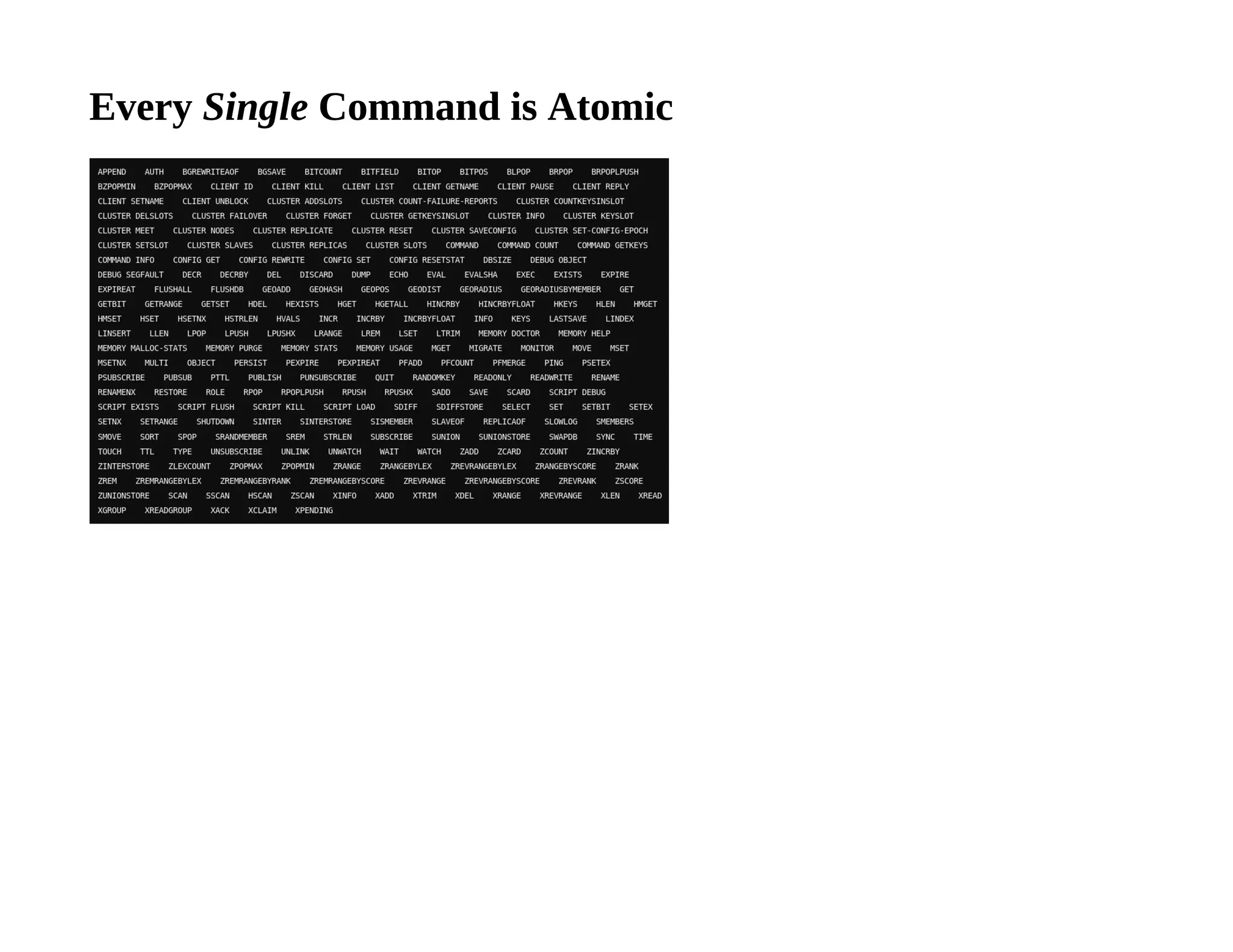
EveryEvery SingleSingle Command is AtomicCommand is Atomic
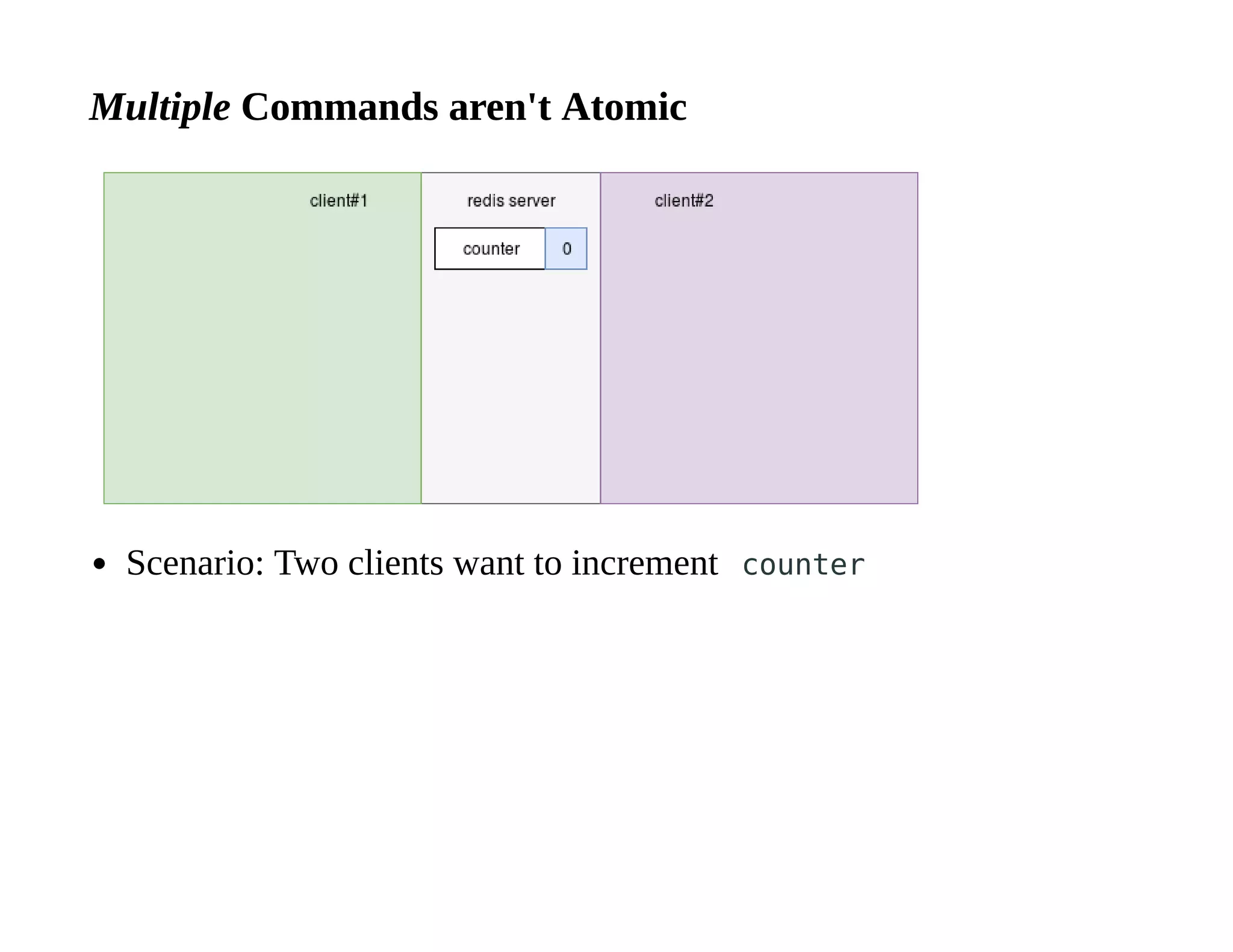
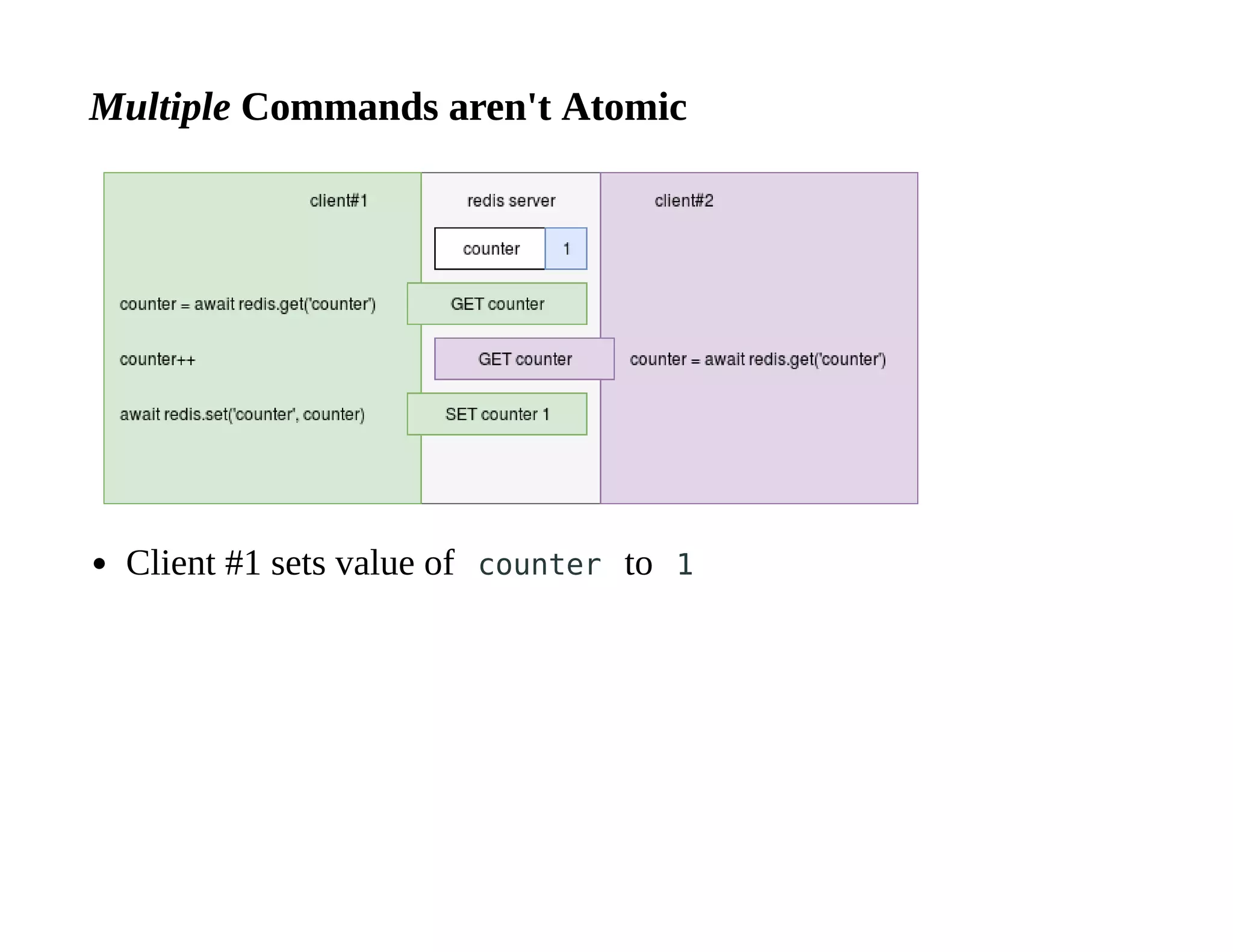
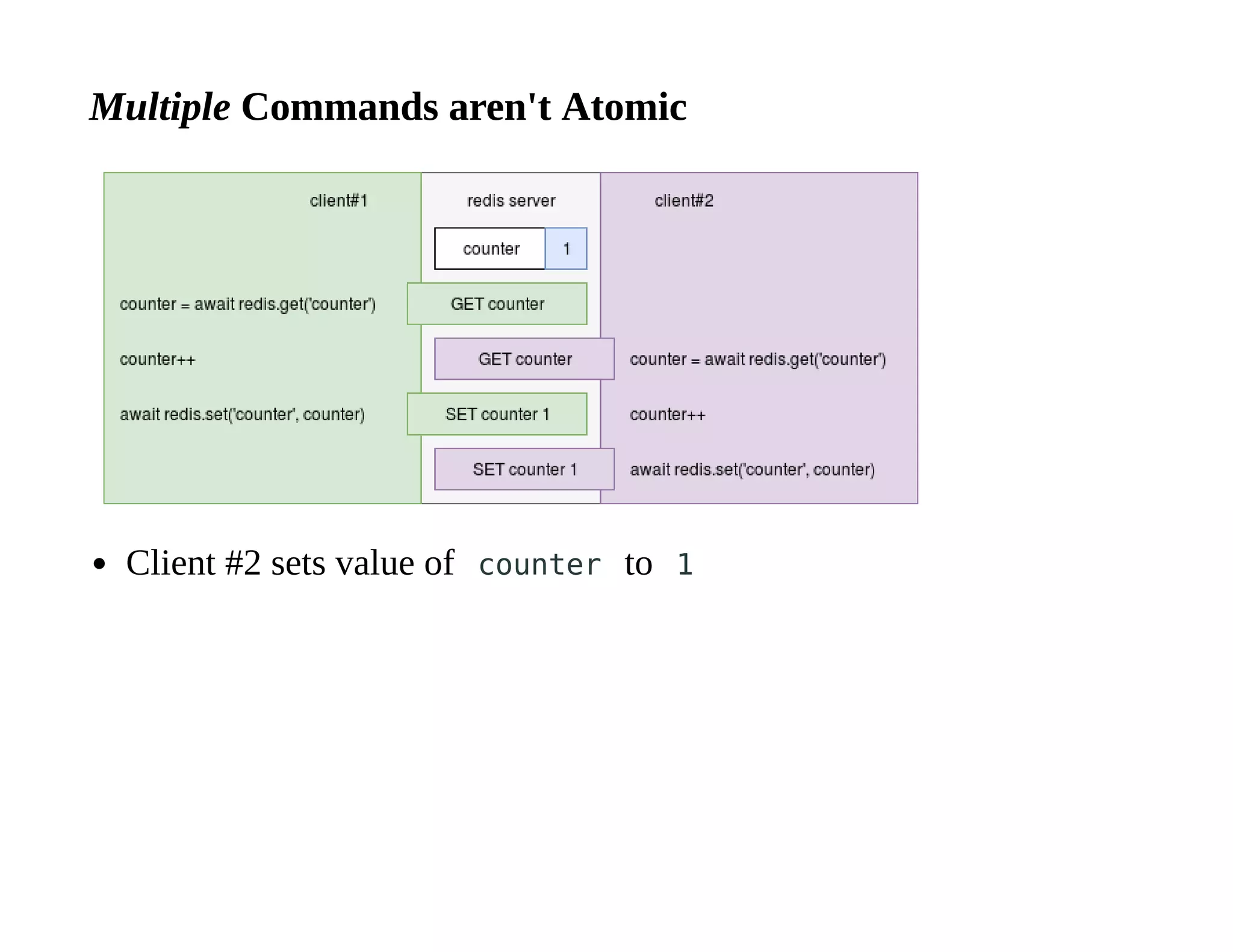
MultipleMultiple Commands aren't AtomicCommands aren't Atomic
Scenario: Two clients want to increment counter
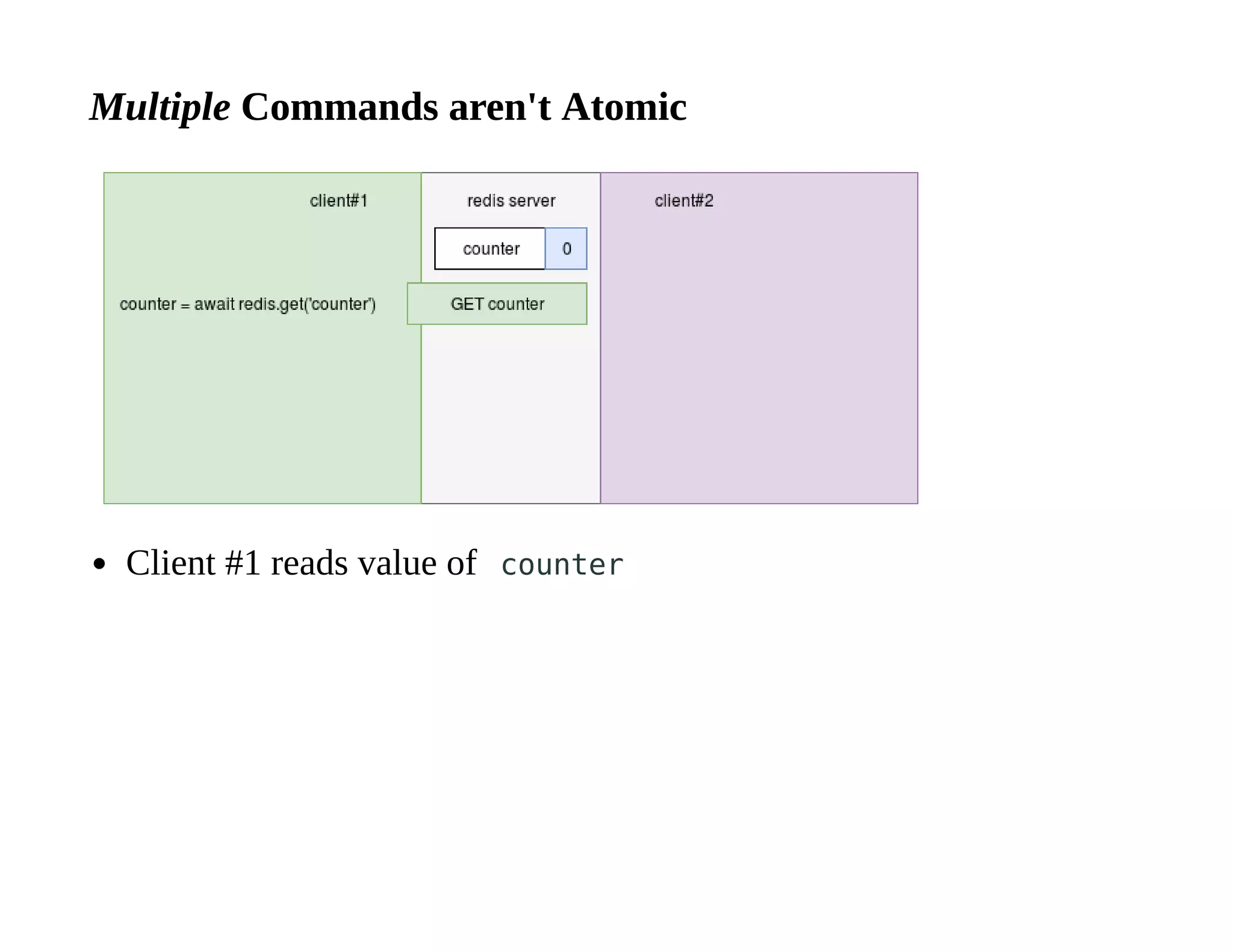
MultipleMultiple Commands aren't AtomicCommands aren't Atomic
Client #1 reads value of counter
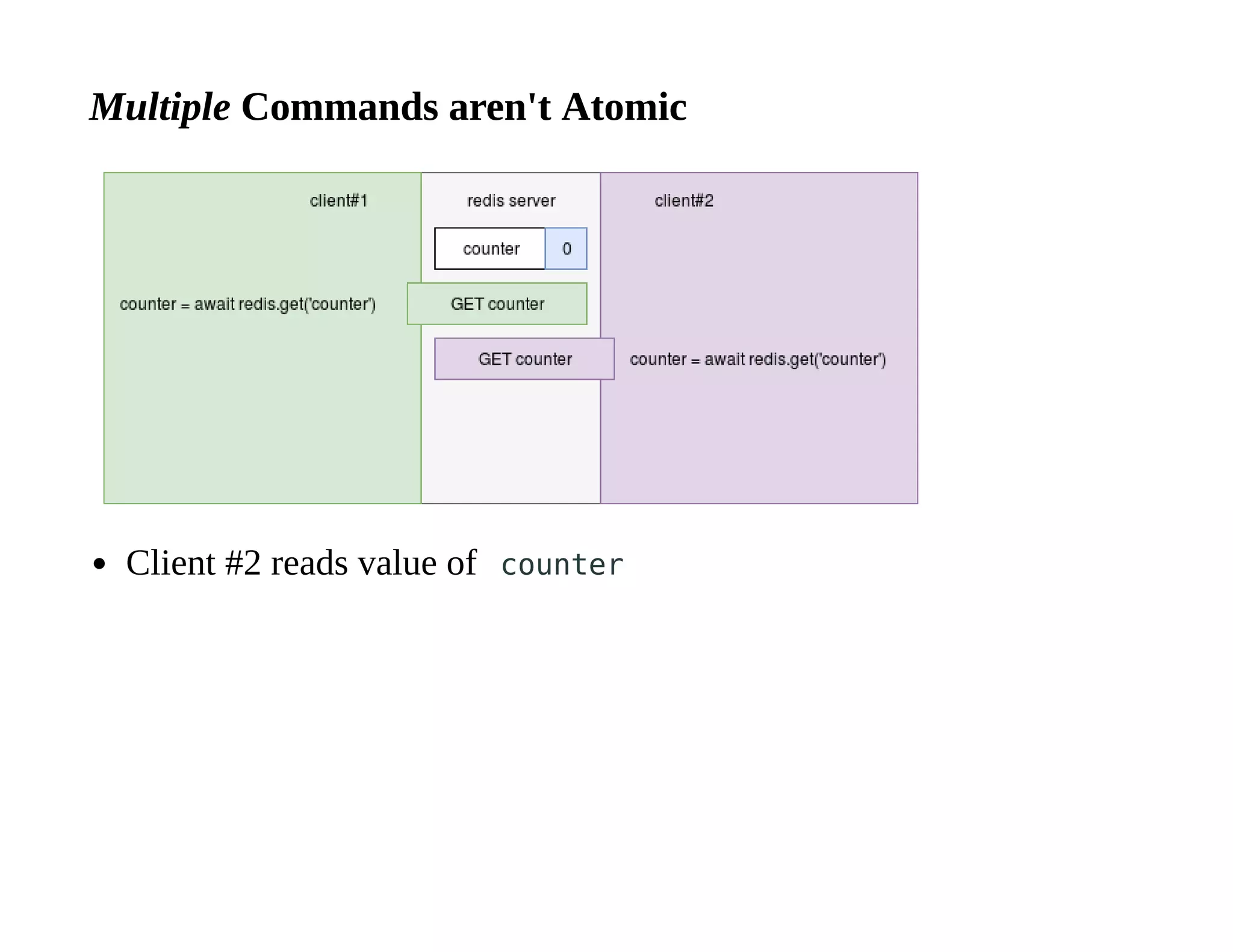
MultipleMultiple Commands aren't AtomicCommands aren't Atomic
Client #2 reads value of counter
MultipleMultiple Commands aren't AtomicCommands aren't Atomic
Client #1 sets value of counter to 1
MultipleMultiple Commands aren't AtomicCommands aren't Atomic
Client #2 sets value of counter to 1
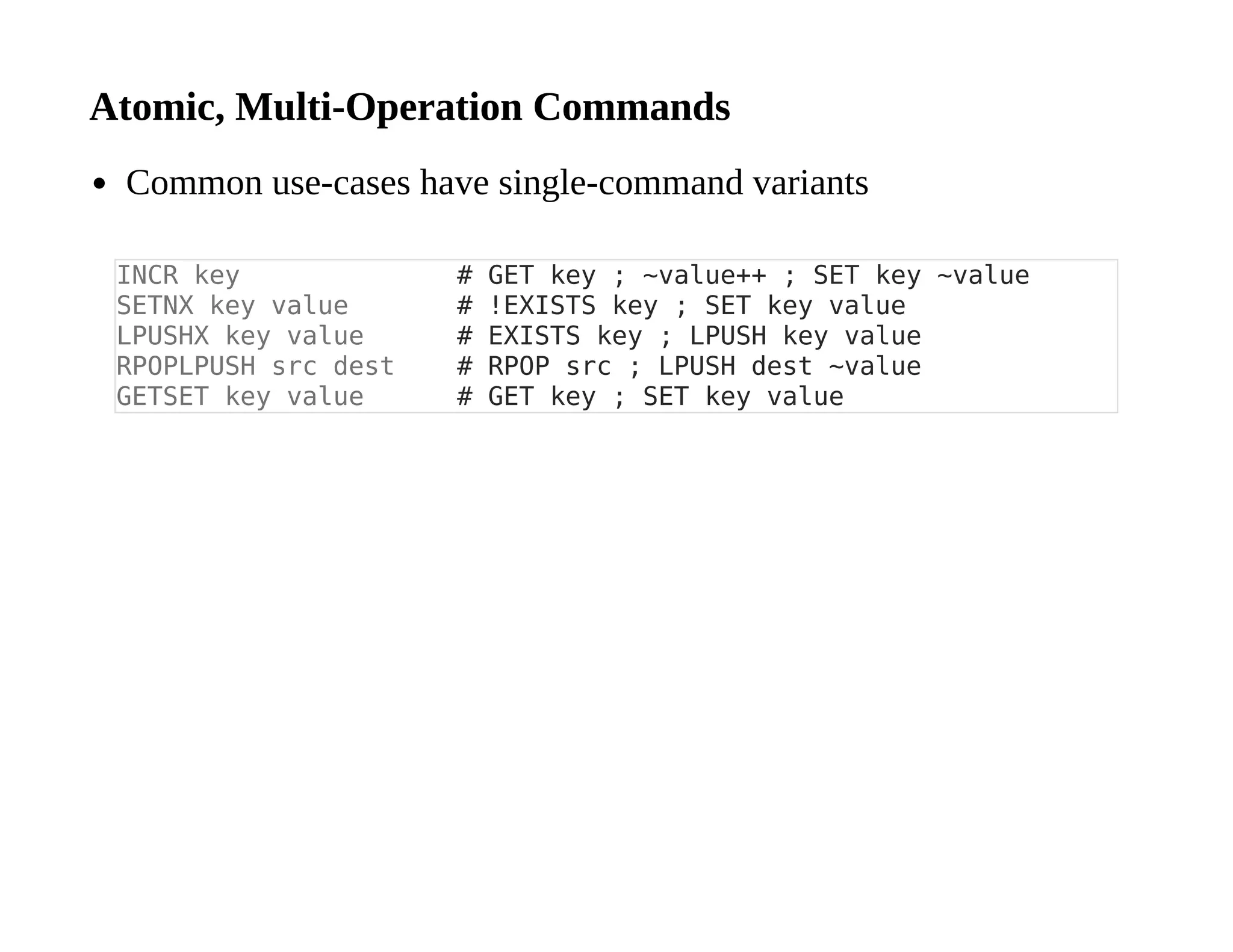
Atomic, Multi-Operation CommandsAtomic, Multi-Operation Commands
Common use-cases have single-command variants
INCR key # GET key ; ~value++ ; SET key ~value
SETNX key value # !EXISTS key ; SET key value
LPUSHX key value # EXISTS key ; LPUSH key value
RPOPLPUSH src dest # RPOP src ; LPUSH dest ~value
GETSET key value # GET key ; SET key value
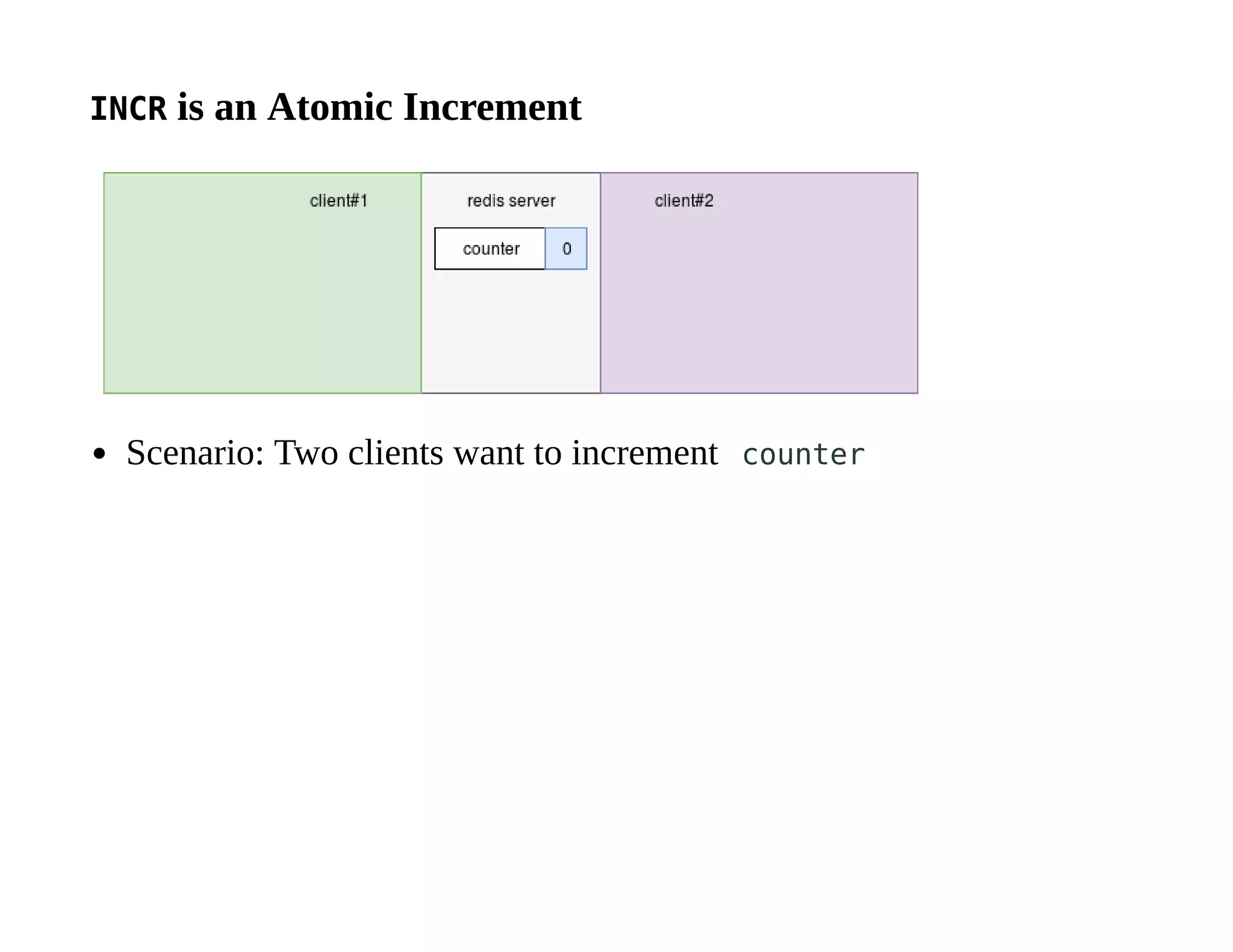
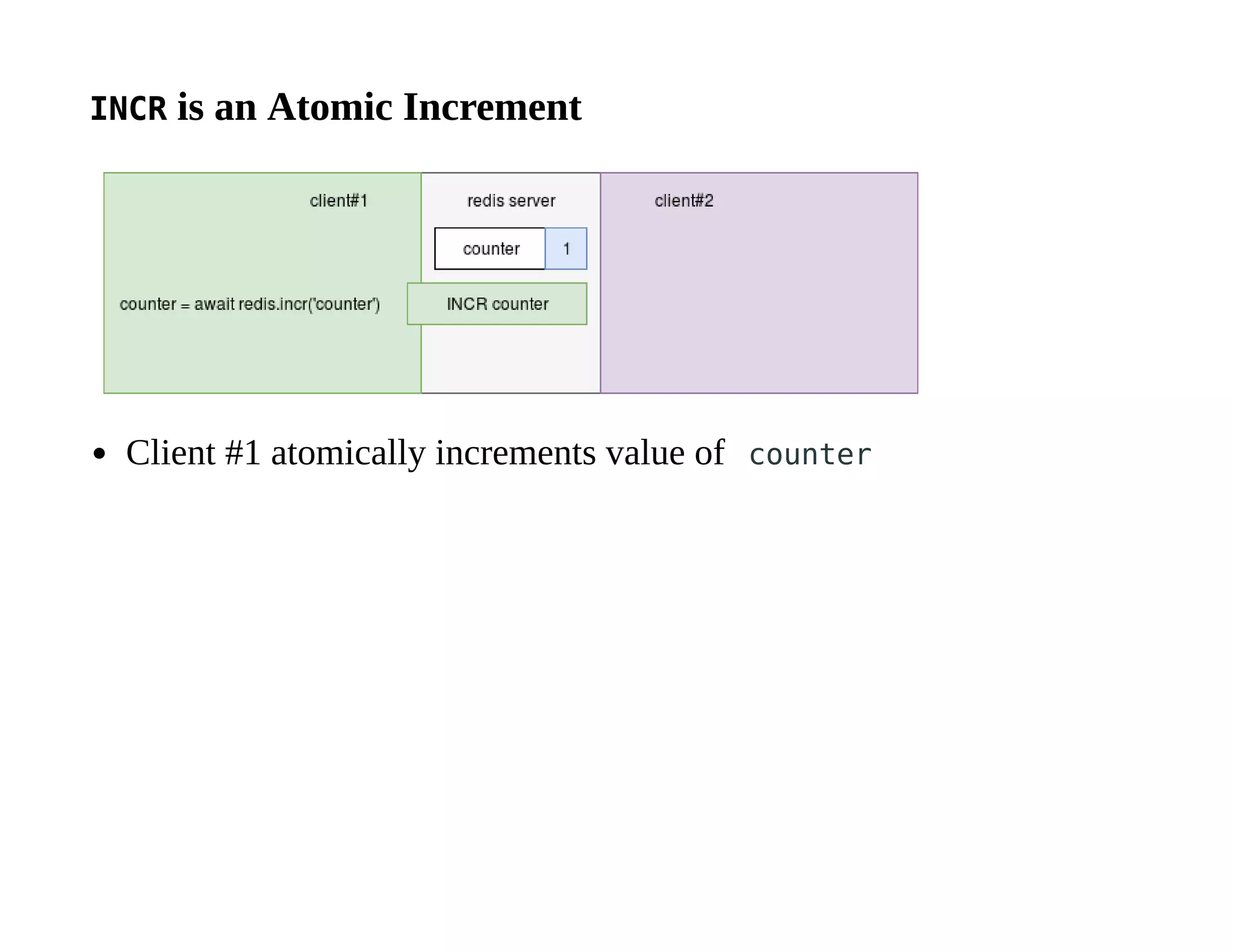
INCRINCR is an Atomic Incrementis an Atomic Increment
Scenario: Two clients want to increment counter
INCRINCR is an Atomic Incrementis an Atomic Increment
Client #1 atomically increments value of counter
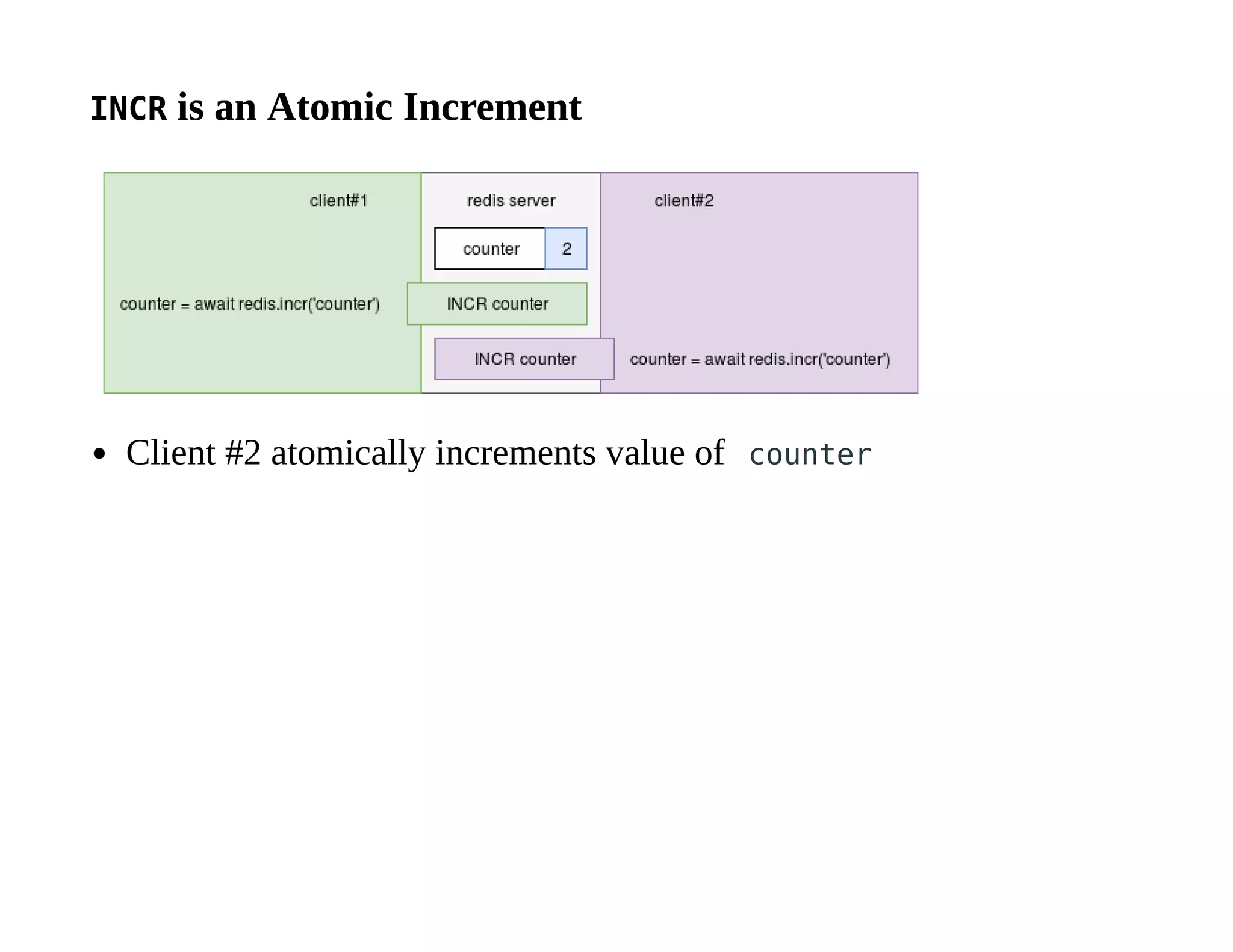
INCRINCR is an Atomic Incrementis an Atomic Increment
Client #2 atomically increments value of counter
PipeliningPipelining
Ensures commands are run in order per-connection
Sends a batch of commands separated by newlines
Commands are sent in the same message
The Node.js redis module usually does this anyway
Pipelining: Example CodePipelining: Example Code
redis.batch()
.zrangebyscore('jobs', 0, now) // get jobs
.zremrangebyscore('jobs', 0, now) // delete jobs
.exec((error, data) => {
let jobList = data[0];
console.log('jobs', jobList); // perform work
});
ZRANGEBYSCORE jobs 0 1000rnZREMRANGEBYSCORE jobs 0 1000
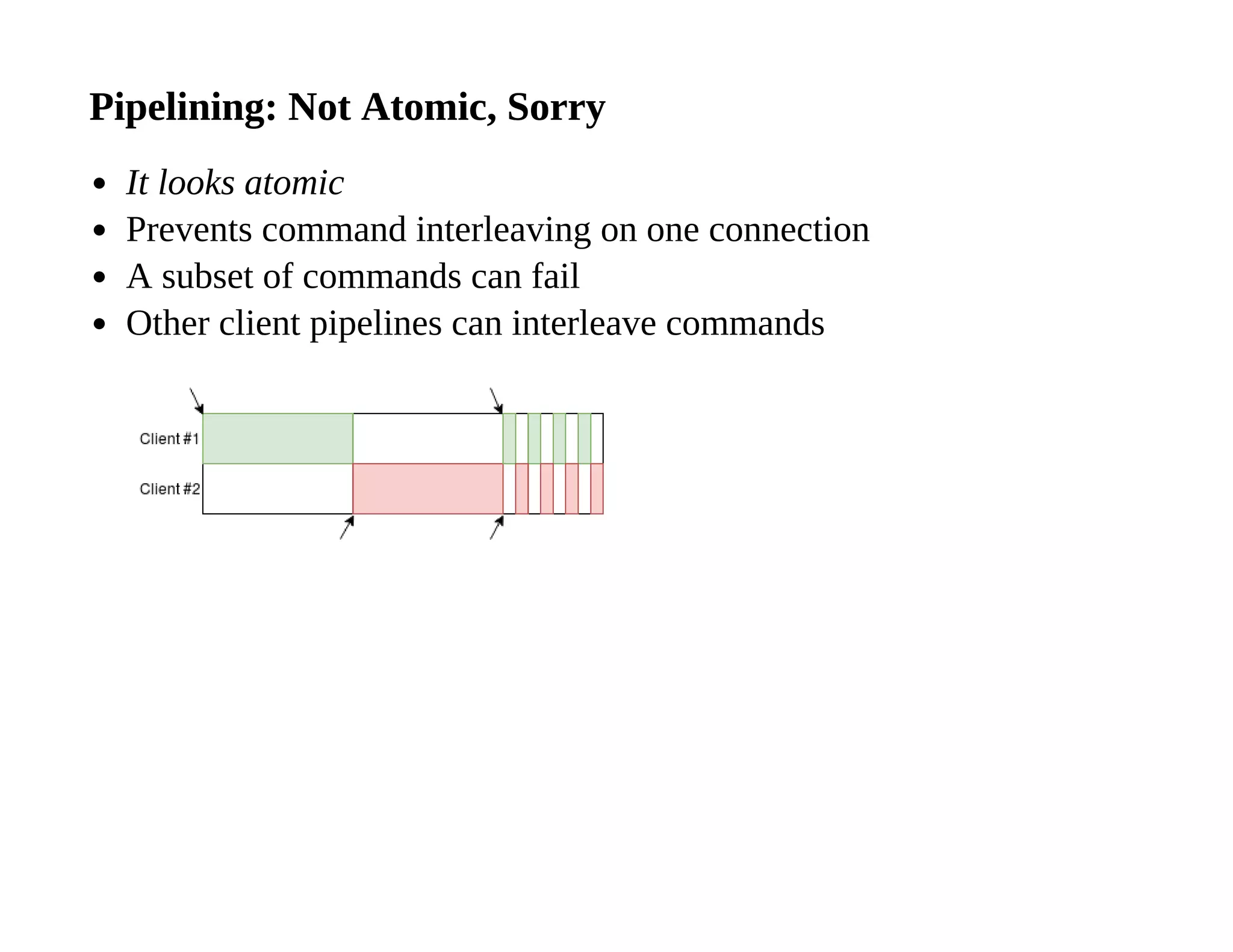
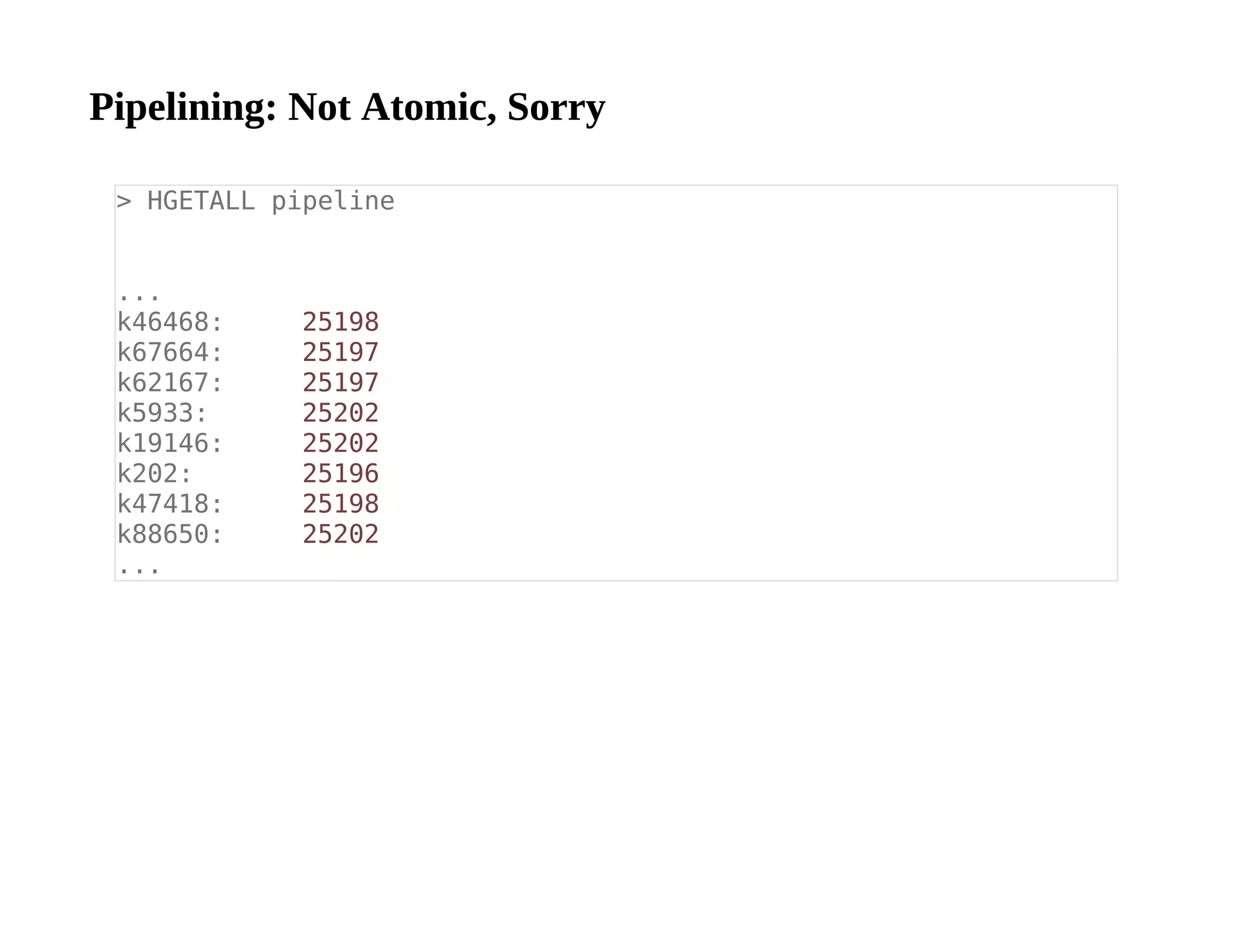
Pipelining: Not Atomic, SorryPipelining: Not Atomic, Sorry
It looks atomic
Prevents command interleaving on one connection
A subset of commands can fail
Other client pipelines can interleave commands
Pipelining: Not Atomic, SorryPipelining: Not Atomic, Sorry
const redis = require('redis').createClient();
// run 10 instances of this process in parallel
let keys = [];
for (let i = 0; i < 100000; i++) {
keys.push(i);
}
shuffle(keys);
let pipeline = redis.batch();
for (let key of keys) {
pipeline = pipeline.hsetnx('pipeline', `k${key}`, process.pid);
}
pipeline.exec(() => redis.quit());
Pipelining: Not Atomic, SorryPipelining: Not Atomic, Sorry
> HGETALL pipeline
...
k46468: 25198
k67664: 25197
k62167: 25197
k5933: 25202
k19146: 25202
k202: 25196
k47418: 25198
k88650: 25202
...
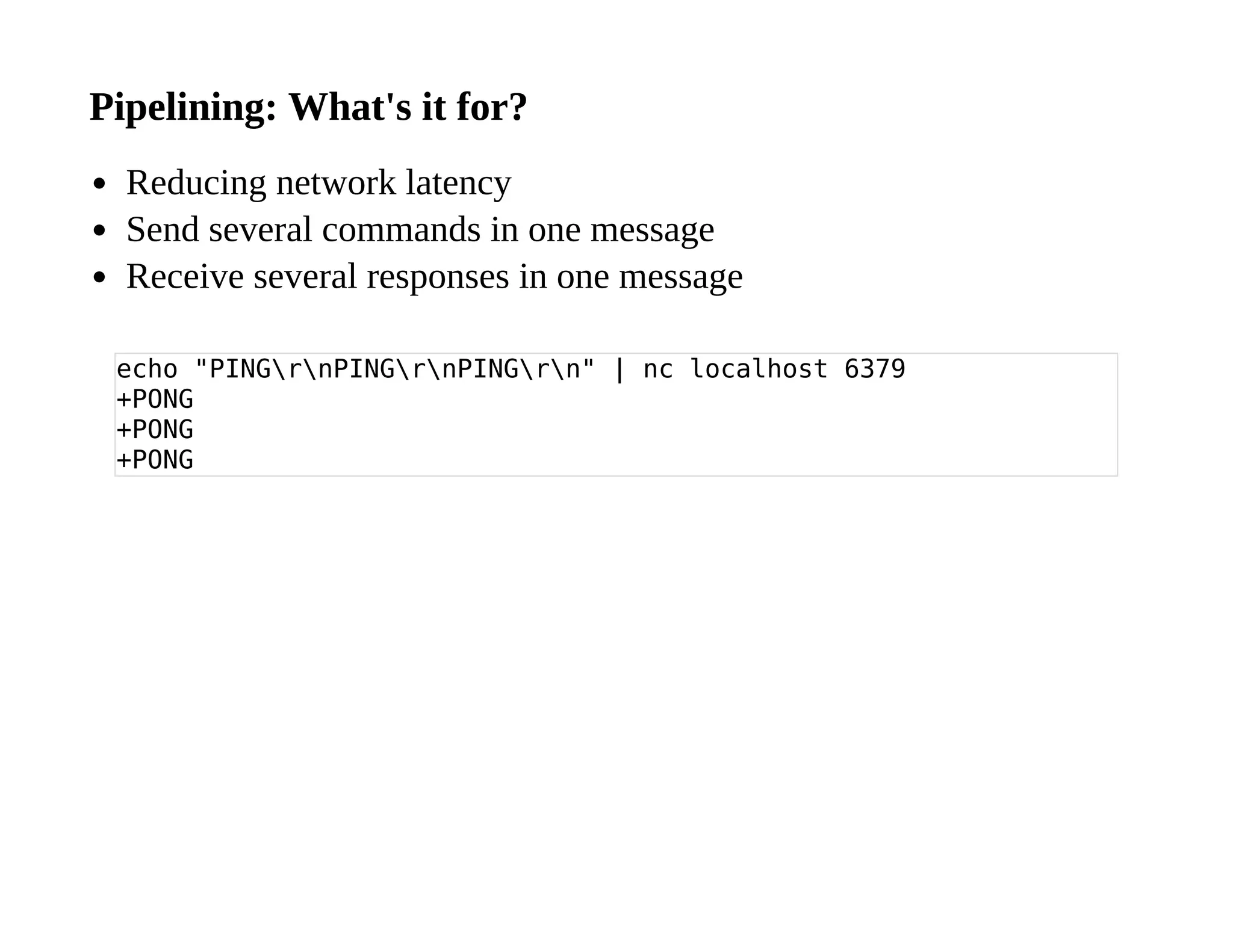
Pipelining: What's it for?Pipelining: What's it for?
Reducing network latency
Send several commands in one message
Receive several responses in one message
echo "PINGrnPINGrnPINGrn" | nc localhost 6379
+PONG
+PONG
+PONG
TransactionsTransactions
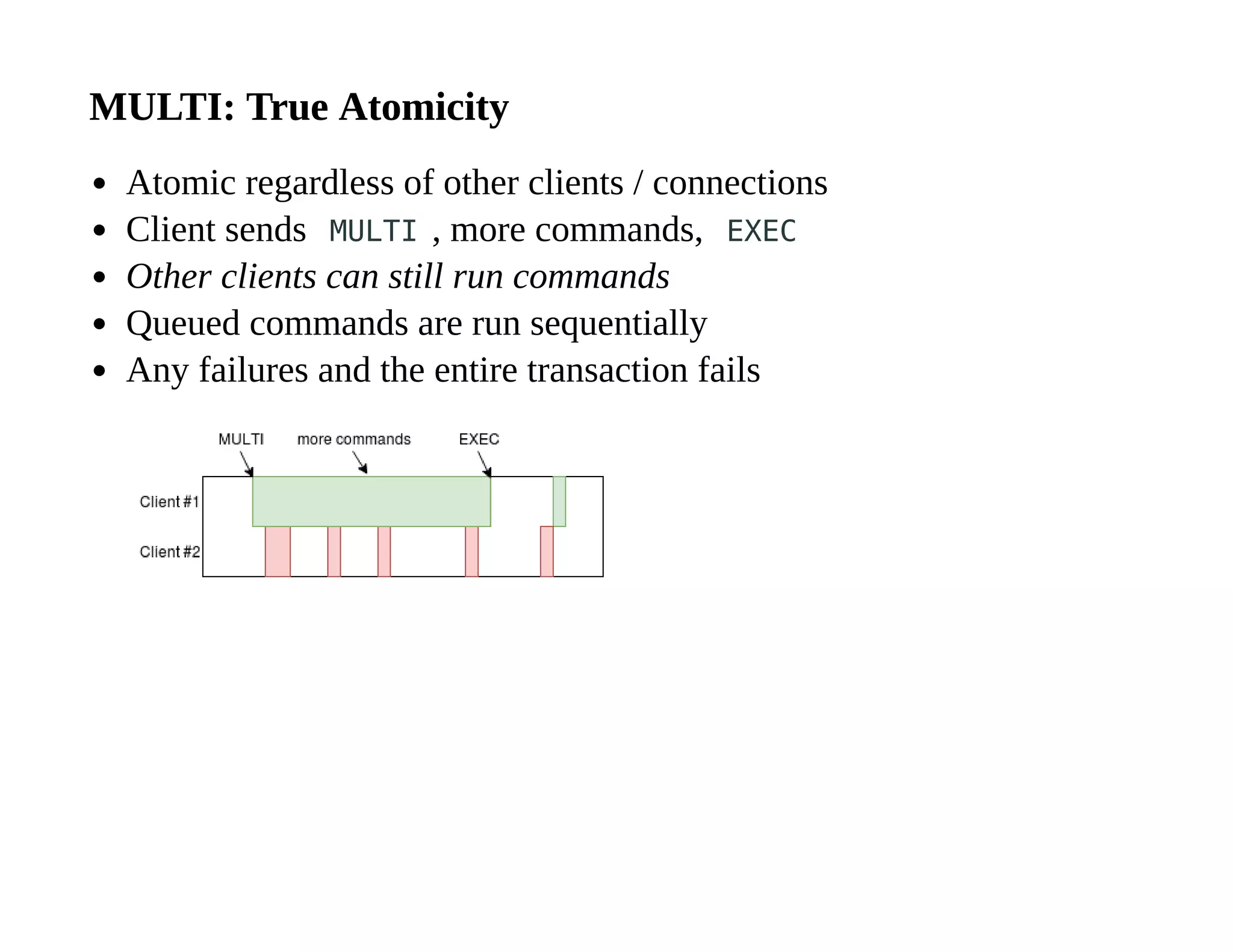
MULTI: True AtomicityMULTI: True Atomicity
Atomic regardless of other clients / connections
Client sends MULTI , more commands, EXEC
Other clients can still run commands
Queued commands are run sequentially
Any failures and the entire transaction fails
MULTI: Example CodeMULTI: Example Code
redis.multi()
.zrangebyscore('jobs', 0, now) // get jobs
.zremrangebyscore('jobs', 0, now) // delete jobs
.exec((error, data) => {
let jobList = data[0];
console.log('jobs', jobList); // perform work
});
MULTI
ZRANGEBYSCORE jobs 0 1553099335332
ZREMRANGEBYSCORE jobs 0 1553099335332
EXEC
MULTI Drawback: No command chainingMULTI Drawback: No command chaining
Can't use command result as argument
E.g., cannot pop from list, assign to new key
Lua ScriptingLua Scripting
Lua: The Ultimate in AtomicityLua: The Ultimate in Atomicity
There's a simpler, less-efficient EVAL command
Send the entire script every time
Like sending a normal SQL query
Or use SCRIPT LOAD ahead of time
Then use EVALSHA to run code via resulting hash
Like executing a SQL Stored Procedure
Declare key names as arguments for sharding
Lua: Server-Side LogicLua: Server-Side Logic
Output of one command can be piped into another
Other processing can happen, too
Lua: Game Lobby Example CodeLua: Game Lobby Example Code
-- add-user.lua: add user to lobby, start game if 4 players
local lobby = KEYS[1] -- Set
local game = KEYS[2] -- Hash
local user_id = ARGV[1] -- String
redis.call('SADD', lobby, user_id)
if redis.call('SCARD', lobby) == 4 then
local members = table.concat(redis.call('SMEMBERS',lobby),",")
redis.call('DEL', lobby) -- empty lobby
local game_id = redis.sha1hex(members)
redis.call('HSET', game, game_id, members)
return {game_id, members}
end
return nil
Lua: Game Lobby Example CodeLua: Game Lobby Example Code
const redis = require('redis').createClient();
const rEval = require('util').promisify(redis.eval).bind(redis);
const script = require('fs').readFileSync('./add-user.lua');
const LOBBY = 'lobby-elo-1500', GAME = 'game-hash';
(async () => {
await rEval(script, 2, LOBBY, GAME, 'alice');
await rEval(script, 2, LOBBY, GAME, 'bob');
await rEval(script, 2, LOBBY, GAME, 'cindy');
const [gid,plyrs] = await rEval(script, 2, LOBBY, GAME,'tom');
console.log('GAME ID', gid, 'PLAYERS', plyrs.split(','));
})();
Lua: DrawbacksLua: Drawbacks
Another language to maintain
Simple language, easy syntax
Increases overhead on Redis server
An infinite loop could lock up server
Need to load scripts before using to be efficient
It's idempotent; load scripts when app starts
RecapRecap
Executing singular commands are atomic
Executing multiple commands are not atomic
Pipelining is not atomic, but it's fast
MULTI is atomic, but you can't chain results
Lua scripts are atomic and chainable
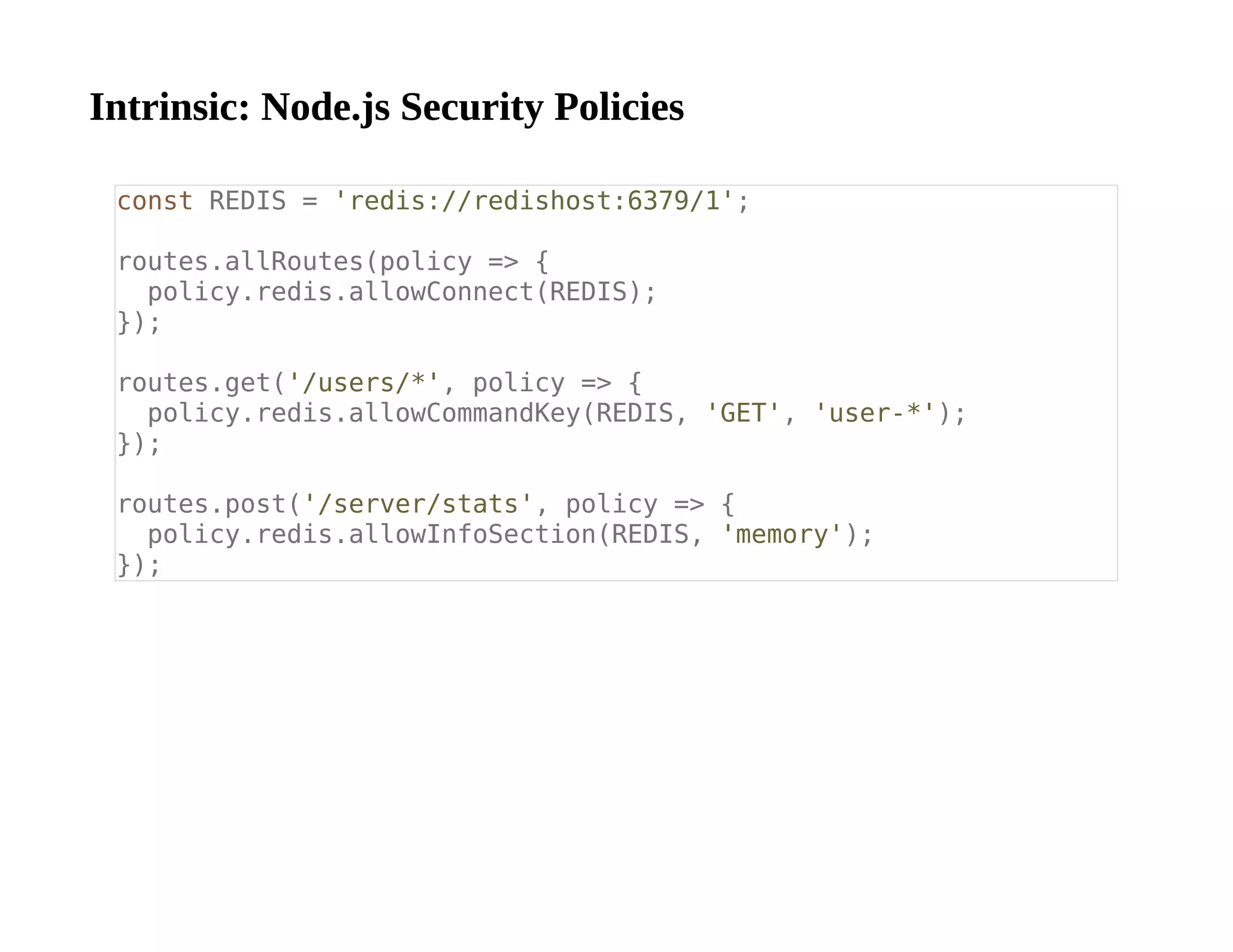
Intrinsic: Node.js Security PoliciesIntrinsic: Node.js Security Policies
const REDIS = 'redis://redishost:6379/1';
routes.allRoutes(policy => {
policy.redis.allowConnect(REDIS);
});
routes.get('/users/*', policy => {
policy.redis.allowCommandKey(REDIS, 'GET', 'user-*');
});
routes.post('/server/stats', policy => {
policy.redis.allowInfoSection(REDIS, 'memory');
});
FinFin
Follow me:
About Intrinsic:
This presentation:
@tlhunter
intrinsic.com
bit.ly/redis-atomicity
@tlhunter@tlhunter

Atomicity In Redis: Thomas Hunter

  • 1.
    Atomicity in RedisAtomicityin Redis Thomas Hunter IIThomas Hunter II
  • 2.
  • 3.
  • 4.
    What is Atomicity?Whatis Atomicity? Series of database operations Guaranteed to all run or none run Prevents operations from running partially The effects of all operations are immediately visible I.e. another client cannot see partial state Also referred to as a Transaction
  • 5.
    How do thesetools work?How do these tools work? Redis is Mostly Single-Threaded Except for things like Background IO Node.js is Mostly Single-Threaded Except for IO and Node v10 Worker Threads Single Client & Server is simple Things get complicated with multiple clients
  • 6.
    EveryEvery SingleSingle Commandis AtomicCommand is Atomic
  • 7.
    MultipleMultiple Commands aren'tAtomicCommands aren't Atomic Scenario: Two clients want to increment counter
  • 8.
    MultipleMultiple Commands aren'tAtomicCommands aren't Atomic Client #1 reads value of counter
  • 9.
    MultipleMultiple Commands aren'tAtomicCommands aren't Atomic Client #2 reads value of counter
  • 10.
    MultipleMultiple Commands aren'tAtomicCommands aren't Atomic Client #1 sets value of counter to 1
  • 11.
    MultipleMultiple Commands aren'tAtomicCommands aren't Atomic Client #2 sets value of counter to 1
  • 12.
    Atomic, Multi-Operation CommandsAtomic,Multi-Operation Commands Common use-cases have single-command variants INCR key # GET key ; ~value++ ; SET key ~value SETNX key value # !EXISTS key ; SET key value LPUSHX key value # EXISTS key ; LPUSH key value RPOPLPUSH src dest # RPOP src ; LPUSH dest ~value GETSET key value # GET key ; SET key value
  • 13.
    INCRINCR is anAtomic Incrementis an Atomic Increment Scenario: Two clients want to increment counter
  • 14.
    INCRINCR is anAtomic Incrementis an Atomic Increment Client #1 atomically increments value of counter
  • 15.
    INCRINCR is anAtomic Incrementis an Atomic Increment Client #2 atomically increments value of counter
  • 16.
  • 17.
    PipeliningPipelining Ensures commands arerun in order per-connection Sends a batch of commands separated by newlines Commands are sent in the same message The Node.js redis module usually does this anyway
  • 18.
    Pipelining: Example CodePipelining:Example Code redis.batch() .zrangebyscore('jobs', 0, now) // get jobs .zremrangebyscore('jobs', 0, now) // delete jobs .exec((error, data) => { let jobList = data[0]; console.log('jobs', jobList); // perform work }); ZRANGEBYSCORE jobs 0 1000rnZREMRANGEBYSCORE jobs 0 1000
  • 19.
    Pipelining: Not Atomic,SorryPipelining: Not Atomic, Sorry It looks atomic Prevents command interleaving on one connection A subset of commands can fail Other client pipelines can interleave commands
  • 20.
    Pipelining: Not Atomic,SorryPipelining: Not Atomic, Sorry const redis = require('redis').createClient(); // run 10 instances of this process in parallel let keys = []; for (let i = 0; i < 100000; i++) { keys.push(i); } shuffle(keys); let pipeline = redis.batch(); for (let key of keys) { pipeline = pipeline.hsetnx('pipeline', `k${key}`, process.pid); } pipeline.exec(() => redis.quit());
  • 21.
    Pipelining: Not Atomic,SorryPipelining: Not Atomic, Sorry > HGETALL pipeline ... k46468: 25198 k67664: 25197 k62167: 25197 k5933: 25202 k19146: 25202 k202: 25196 k47418: 25198 k88650: 25202 ...
  • 22.
    Pipelining: What's itfor?Pipelining: What's it for? Reducing network latency Send several commands in one message Receive several responses in one message echo "PINGrnPINGrnPINGrn" | nc localhost 6379 +PONG +PONG +PONG
  • 23.
  • 24.
    MULTI: True AtomicityMULTI:True Atomicity Atomic regardless of other clients / connections Client sends MULTI , more commands, EXEC Other clients can still run commands Queued commands are run sequentially Any failures and the entire transaction fails
  • 25.
    MULTI: Example CodeMULTI:Example Code redis.multi() .zrangebyscore('jobs', 0, now) // get jobs .zremrangebyscore('jobs', 0, now) // delete jobs .exec((error, data) => { let jobList = data[0]; console.log('jobs', jobList); // perform work }); MULTI ZRANGEBYSCORE jobs 0 1553099335332 ZREMRANGEBYSCORE jobs 0 1553099335332 EXEC
  • 26.
    MULTI Drawback: Nocommand chainingMULTI Drawback: No command chaining Can't use command result as argument E.g., cannot pop from list, assign to new key
  • 27.
  • 28.
    Lua: The Ultimatein AtomicityLua: The Ultimate in Atomicity There's a simpler, less-efficient EVAL command Send the entire script every time Like sending a normal SQL query Or use SCRIPT LOAD ahead of time Then use EVALSHA to run code via resulting hash Like executing a SQL Stored Procedure Declare key names as arguments for sharding
  • 29.
    Lua: Server-Side LogicLua:Server-Side Logic Output of one command can be piped into another Other processing can happen, too
  • 30.
    Lua: Game LobbyExample CodeLua: Game Lobby Example Code -- add-user.lua: add user to lobby, start game if 4 players local lobby = KEYS[1] -- Set local game = KEYS[2] -- Hash local user_id = ARGV[1] -- String redis.call('SADD', lobby, user_id) if redis.call('SCARD', lobby) == 4 then local members = table.concat(redis.call('SMEMBERS',lobby),",") redis.call('DEL', lobby) -- empty lobby local game_id = redis.sha1hex(members) redis.call('HSET', game, game_id, members) return {game_id, members} end return nil
  • 31.
    Lua: Game LobbyExample CodeLua: Game Lobby Example Code const redis = require('redis').createClient(); const rEval = require('util').promisify(redis.eval).bind(redis); const script = require('fs').readFileSync('./add-user.lua'); const LOBBY = 'lobby-elo-1500', GAME = 'game-hash'; (async () => { await rEval(script, 2, LOBBY, GAME, 'alice'); await rEval(script, 2, LOBBY, GAME, 'bob'); await rEval(script, 2, LOBBY, GAME, 'cindy'); const [gid,plyrs] = await rEval(script, 2, LOBBY, GAME,'tom'); console.log('GAME ID', gid, 'PLAYERS', plyrs.split(',')); })();
  • 32.
    Lua: DrawbacksLua: Drawbacks Anotherlanguage to maintain Simple language, easy syntax Increases overhead on Redis server An infinite loop could lock up server Need to load scripts before using to be efficient It's idempotent; load scripts when app starts
  • 33.
    RecapRecap Executing singular commandsare atomic Executing multiple commands are not atomic Pipelining is not atomic, but it's fast MULTI is atomic, but you can't chain results Lua scripts are atomic and chainable
  • 34.
    Intrinsic: Node.js SecurityPoliciesIntrinsic: Node.js Security Policies const REDIS = 'redis://redishost:6379/1'; routes.allRoutes(policy => { policy.redis.allowConnect(REDIS); }); routes.get('/users/*', policy => { policy.redis.allowCommandKey(REDIS, 'GET', 'user-*'); }); routes.post('/server/stats', policy => { policy.redis.allowInfoSection(REDIS, 'memory'); });
  • 35.
    FinFin Follow me: About Intrinsic: Thispresentation: @tlhunter intrinsic.com bit.ly/redis-atomicity @tlhunter@tlhunter