Atomic Transactions for the
        REST of us

              Cesare Pautasso
           Faculty of Informatics
      University of Lugano, Switzerland

            c.pautasso@ieee.org
         http://www.pautasso.info
                 @pautasso
Acknowledgements
            This is joint work with Guy Pardon, Atomikos


                          http://www.atomikos.com


©2010 - Cesare Pautasso                                     2
Does REST need transactions?
    If you find yourself in need of a distributed
     transaction protocol, then how can you possibly say
     that your architecture is based on REST? I simply
     cannot see how you can get from one situation (of
     using RESTful application state on the client and
     hypermedia to determine all state transitions) to the
     next situation of needing distributed agreement of
     transaction semantics wherein the client has to tell
     the server how to manage its own resources.
    ...for now I consider "rest transaction" to be an
     oxymoron.

                          Roy Fielding, REST discuss, June 9th, 2009


©2010 - Cesare Pautasso                                                3
Does REST need transactions?
    The typical conversation thread, real or virtual, about
     transactions over HTTP goes something like this
     (elided for brevity):
            "You don't want transactions over HTTP"
            But I need to organize number of steps into a single unit I
             can deal with easily.
            "OK, but you don't need transactions over HTTP"
            But I need the ability to back out changes in multiple
             locations safely and consistently.
            "OK, but you can't do transactions over HTTP!"
            Really?
    And here the topic usually dies or descends into a
     heated debate.
                                           Mike Amudsen,
              http://amundsen.com/blog/archives/1024
©2010 - Cesare Pautasso                                                    4
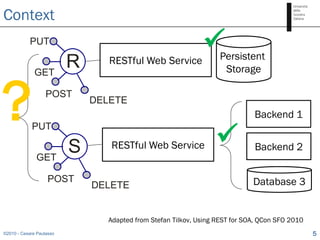
Context
           PUT
                                                              
                          R      RESTful Web Service               Persistent
                                                                    Storage


?
              GET

                   POST
                              DELETE
                                                                              Backend 1

                                                                  
            PUT


              GET
                          S      RESTful Web Service                          Backend 2

                   POST                                                       Database 3
                              DELETE


                                 Adapted from Stefan Tilkov, Using REST for SOA, QCon SFO 2010
©2010 - Cesare Pautasso                                                                          5
The problem

                                       PUT

            Client         State transfer
                                        GET
                                                  R      RESTful Web Service


                                             POST
                                                      DELETE

                          State transfer PUT

                                            GET
                                                  S      RESTful Web Service


                                             POST
                                                      DELETE
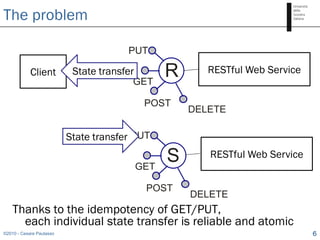
    Thanks to the idempotency of GET/PUT,
      each individual state transfer is reliable and atomic
©2010 - Cesare Pautasso                                                        6
The problem

                                       PUT

                           State transfer
                                        GET
                                                  R      RESTful Web Service


            Client                           POST
                                                      DELETE

                          State transfer PUT

                                            GET
                                                  S      RESTful Web Service


                                             POST
                                                      DELETE

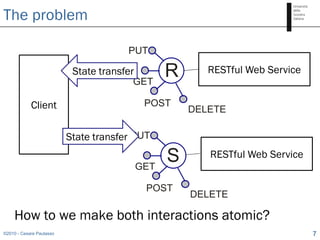
    How to we make both interactions atomic?
©2010 - Cesare Pautasso                                                        7
Constraints
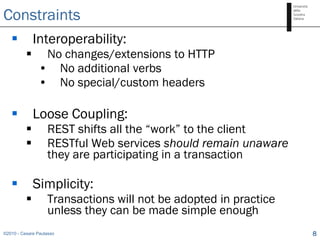
             Interoperability:
               No changes/extensions to HTTP
               • No additional verbs
               • No special/custom headers

             Loose Coupling:
                  REST shifts all the “work” to the client
                  RESTful Web services should remain unaware
                   they are participating in a transaction

             Simplicity:
                  Transactions will not be adopted in practice
                   unless they can be made simple enough
©2010 - Cesare Pautasso                                           8
Assumption: Try-Confirm/Cancel
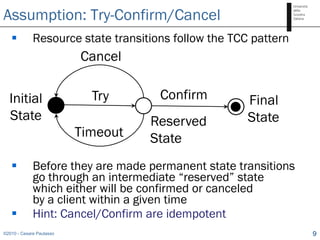
            Resource state transitions follow the TCC pattern
                          Cancel

  Initial                   Try      Confirm          Final
  State                             Reserved          State
                          Timeout   State
            Before they are made permanent state transitions
             go through an intermediate “reserved” state
             which either will be confirmed or canceled
             by a client within a given time
            Hint: Cancel/Confirm are idempotent
©2010 - Cesare Pautasso                                          9
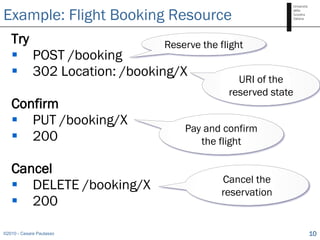
Example: Flight Booking Resource
   Try                    Reserve the flight
    POST /booking
    302 Location: /booking/X              URI of the
                                           reserved state
   Confirm
    PUT /booking/X
                                  Pay and confirm
    200                             the flight

   Cancel
                                         Cancel the
    DELETE /booking/X                   reservation
    200

©2010 - Cesare Pautasso                                     10
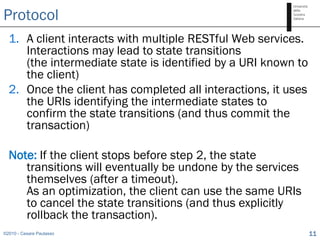
Protocol
  1. A client interacts with multiple RESTful Web services.
     Interactions may lead to state transitions
     (the intermediate state is identified by a URI known to
     the client)
  2. Once the client has completed all interactions, it uses
     the URIs identifying the intermediate states to
     confirm the state transitions (and thus commit the
     transaction)

  Note: If the client stops before step 2, the state
     transitions will eventually be undone by the services
     themselves (after a timeout).
     As an optimization, the client can use the same URIs
     to cancel the state transitions (and thus explicitly
     rollback the transaction).
©2010 - Cesare Pautasso                                        11
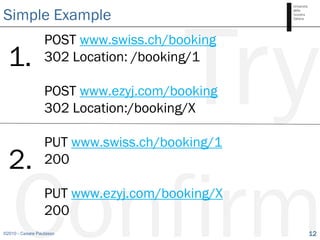
Simple Example
                  POST www.swiss.ch/booking
  1.              302 Location: /booking/1

                  POST www.ezyj.com/booking
                  302 Location:/booking/X

                  PUT www.swiss.ch/booking/1
  2.

   Confirm
                  200

                  PUT www.ezyj.com/booking/X
                  200
©2010 - Cesare Pautasso                        12
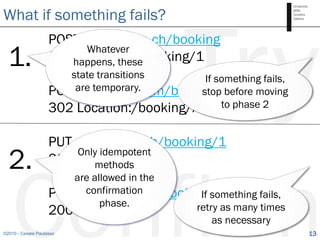
What if something fails?
                    POST www.swiss.ch/booking
  1.                     Whatever
                    302happens, these
                        Location: /booking/1
                       state transitions   If something fails,
                        are temporary.
                    POST www.ezy.com/booking before moving
                                          stop
                    302 Location:/booking/X        to phase 2


                    PUT www.swiss.ch/booking/1
  2.                    Only idempotent


   Confirm
                    200 methods
                        are allowed in the
                          confirmation
                    PUT www.ezy.com/booking/X
                                            If something fails,
                              phase.       retry as many times
                    200
                                                 as necessary
©2010 - Cesare Pautasso                                           13
A matter of timing
                                                    Timeouts
          State transitions


                              1.      2.
                              Try   Confirm

                                                            Time
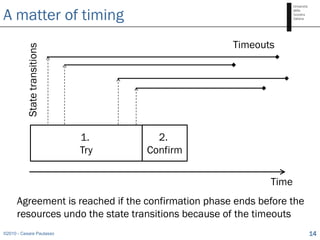
      Agreement is reached if the confirmation phase ends before the
      resources undo the state transitions because of the timeouts
©2010 - Cesare Pautasso                                                14
A matter of timing
                                                      Timeouts
          State transitions


                              1.           2.
                              Try        Confirm

                                                               Time
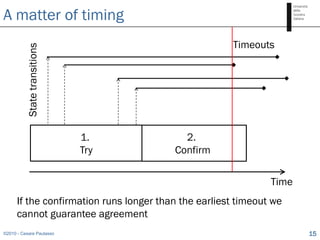
      If the confirmation runs longer than the earliest timeout we
      cannot guarantee agreement
©2010 - Cesare Pautasso                                               15
Timeouts and heuristics
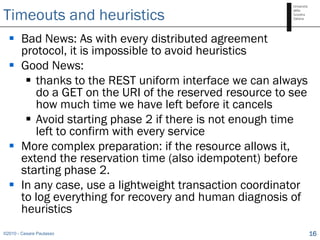
   Bad News: As with every distributed agreement
    protocol, it is impossible to avoid heuristics
   Good News:
      thanks to the REST uniform interface we can always
       do a GET on the URI of the reserved resource to see
       how much time we have left before it cancels
      Avoid starting phase 2 if there is not enough time
       left to confirm with every service
   More complex preparation: if the resource allows it,
    extend the reservation time (also idempotent) before
    starting phase 2.
   In any case, use a lightweight transaction coordinator
    to log everything for recovery and human diagnosis of
    heuristics
©2010 - Cesare Pautasso                                      16
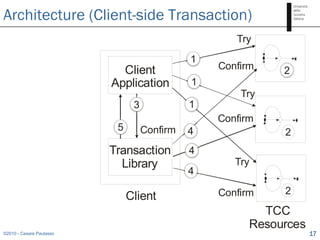
Architecture (Client-side Transaction)
                                                     Try
                                              1
                            Client                Confirm    2
                          Application         1
                                                      Try
                                3             1
                                                  Confirm
                           5        Confirm   4              2
                          Transaction         4
                            Library                  Try
                                              4

                                                  Confirm    2
                               Client
                                                          TCC
                                                        Resources
©2010 - Cesare Pautasso                                             17
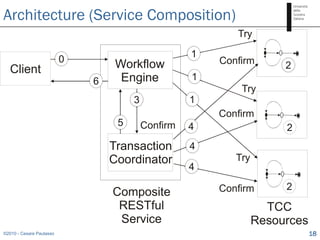
Architecture (Service Composition)
                                                            Try

                                                     1
                          0                              Confirm
   Client                          Workflow                            2
                              6     Engine           1
                                                             Try
                                       3             1
                                                         Confirm
                                   5       Confirm   4                 2
                                  Transaction        4
                                  Coordinator               Try
                                                     4

                                                         Confirm       2
                                  Composite
                                   RESTful                          TCC
                                   Service                        Resources
©2010 - Cesare Pautasso                                                       18
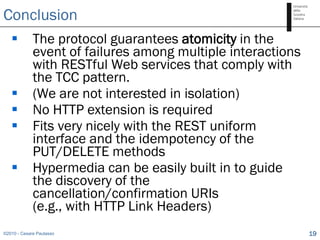
Conclusion
            The protocol guarantees atomicity in the
             event of failures among multiple interactions
             with RESTful Web services that comply with
             the TCC pattern.
            (We are not interested in isolation)
            No HTTP extension is required
            Fits very nicely with the REST uniform
             interface and the idempotency of the
             PUT/DELETE methods
            Hypermedia can be easily built in to guide
             the discovery of the
             cancellation/confirmation URIs
             (e.g., with HTTP Link Headers)
©2010 - Cesare Pautasso                                      19
References
    G. Pardon, C. Pautasso, Towards Distributed Atomic Transactions over
     RESTful Services, in: REST: from Research to Practice, Springer (to appear)
    Cesare Pautasso, RESTful Web Service Composition with JOpera, Proc. Of
     the International Conference on Software Composition (SC 2009), Zurich,
     Switzerland, July 2009.


©2010 - Cesare Pautasso                                                            20
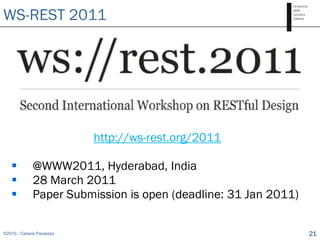
WS-REST 2011


                          http://ws-rest.org/2011

            @WWW2011, Hyderabad, India
            28 March 2011
            Paper Submission is open (deadline: 31 Jan 2011)

©2010 - Cesare Pautasso                                         21
©2010 Cesare Pautasso   22