Advanced Tribology
Presentation on: Atomic Scale
Simulation
By: Mr. Mekete Mulualem
Wednesday, January 18, 2017 1Atomic Scale Simulation
Content
• Introduction
• Atomic Scale Simulation
• Molecular Dynamic(MD) Simulation
• Advantages of MD
• Limitations of the MD technique
• Application of ASS
• Conclusion
• Reference
Wednesday, January 18, 2017 Atomic Scale Simulation 2
Introduction
Most theoretical approaches to contact problems on the
macro-scale rely on the continuum elasticity. But
continuum mechanics is not fully applicable as the
characteristics dimensions of the contact between
material bodies are reduced. Also interfacial effects
become more prominent.
Wednesday, January 18, 2017 3Atomic Scale Simulation
Adhesion, capillary forces and other factors can be
ignored in most macroscopic machines but often dominate
the behavior at nanometer scales. here, we will discuss
about theoretical method atomic scale simulation,
especially on molecular dynamic simulation. …
Wednesday, January 18, 2017 4Atomic Scale Simulation
Cont…
Wednesday, January 18, 2017 5Atomic Scale Simulation
Atomic Scale Simulation
Well established engineering tools for designing
macroscopic mechanical devices break down as
dimensions decrease to nanometer scales.
For nanometer scale material bodies, adhesion,
capillary forces and other factors has been identified as
the main cause of failure in MEMS/NEMS.
Concurrently, with the development and use of
innovative experiment tools like SFA, STM and
AFM/FFM.
.
Wednesday, January 18, 2017 6Atomic Scale Simulation
Theoretical methods include analytical methods
and molecular dynamics (MD) simulation.
Analytically understanding of the nature of
interatomic interaction in materials and computer-
based modeling of complex systems have led to the
development of MD simulation in recent years.
Cont…
Wednesday, January 18, 2017 Atomic Scale Simulation 7
Oil and water separation by molecular dynamic simulation(video)
Molecular dynamics (MD) is a computer simulation
technique that allows one to predict the time evolution of a
system of interacting particles (atoms, molecules, etc.).
MD have been used to understand the material removal
mechanism, effects of tool geometry, temperature, and
process parameters such as cutting speed and cutting force.
Molecular Dynamic(MD) Simulation
Wednesday, January 18, 2017 8Atomic Scale Simulation
Wednesday, January 18, 2017 Atomic Scale Simulation 9
MD is a computer simulation method for studying
the physical movements of atoms and molecules. The
atoms and molecules are allowed to the interact for a
fixed period of time, giving a view of dynamic
evolution of the system.
In order to do MDS;
First, for a system of interest, one has to specify:
 A set of initial conditions(initial positions &
velocities of all particles in the system)
 Interaction potential for deriving the forces among
all the particles.
Cont…
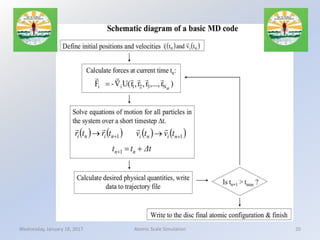
Second, the evolution of the system in time can be
followed by solving a set of classical equations of
motion for all particles in the system.
If the particles of interest are atoms, and if there are a
total of Nat of them in the system, the force acting on the
ith atom at a given time can be obtained from the inter
atomic potential U(r1,r2, r3, …, rNat) that, in general, is
a function of the positions of all the atoms:
Wednesday, January 18, 2017 10Atomic Scale Simulation
Cont…
Once the initial conditions and the interaction
potential are defined, the equations of motion can
be solved numerically. The results of the solution
are the positions and velocities of all the atoms as a
function of time,
.
Wednesday, January 18, 2017 11Atomic Scale Simulation
Cont…
Wednesday, January 18, 2017 Atomic Scale Simulation 12
There are four basic behaviors of atoms or molecules that
an atomic scale simulation has to phenomenologically
produce:
 Atoms experience a short-ranged attraction.
 When atoms and/or molecules are far apart, they barely
interact.
 When atoms and/or molecules come very close to one another,
they strongly repel.
 Atoms and molecules are in a never-ending motion.
All these critical behaviors are produced by numerically
solving Newton’s equations of motion for a system of
atoms and molecules, which interact with each other
through reasonable, inter-atomic and inter-molecular
potentials.
Wednesday, January 18, 2017 13Atomic Scale Simulation
Cont…
Wednesday, January 18, 2017 Atomic Scale Simulation 14
Advantages of MD
 The only input in the model – description of
interatomic or intermolecular interaction
 No assumptions are made about the processes or
mechanism to be investigated
 Provides a detailed molecular/atomic-level
information
Generally, MD is a deterministic technique;
given initial positions and velocities, the
evolution of the system in time is, in principle,
completely determined (in practice, accumulation
of integration and computational errors would
introduce some uncertainty into the MD output).
Wednesday, January 18, 2017 15Atomic Scale Simulation
Wednesday, January 18, 2017 Atomic Scale Simulation 16
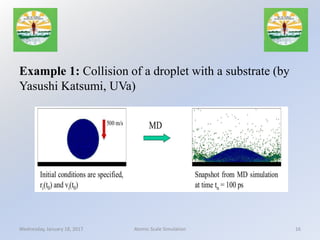
Example 1: Collision of a droplet with a substrate (by
Yasushi Katsumi, UVa)
Limitations of the MD technique
1. Classical description of interatomic interaction
Electrons are not present explicitly; they are introduced
through the potential energy surface that is a function of
atomic positions only (Born-Oppenheimer
approximation).
The potential energy surface, in turn, is approximated by
an analytic function that gives the potential energy U as a
function of coordinates. Forces are obtained as the
gradient of a potential energy function,
Wednesday, January 18, 2017 17Atomic Scale Simulation
2. Time- and length-scale limitations
Time-scale: The maximum timestep of integration in
MD simulation is defined by the fastest motion in the
system. Vibration frequencies in a molecular system a
period of ~10 fs. Optical phonon frequencies are period
of ~100 fs. Therefore, a typical timestep in MD
simulation is on the order of a femtosecond.
Using modern computers it is possible to calculate 106–
108 timestep. Therefore we can only simulate processes
that occur within 1 – 100 ns. This is a serious limitation
for many problems.
Wednesday, January 18, 2017 18Atomic Scale Simulation
Length-scale:
The size of the computational cell is limited by the
number of atoms that can be included in the simulation,
typically 10^4–10^8. This corresponds to the size of the
computational cell on the order of tens of nm. Any
structural features of interest and spatial correlation
lengths in the simulation should be smaller than the size
of the computational cell.
Wednesday, January 18, 2017 19Atomic Scale Simulation
Wednesday, January 18, 2017 20Atomic Scale Simulation
Current applications of the MD simulation technique
Chemistry and Biochemistry: molecular structures,
reactions, drug design, vibration relaxation and energy
transfer…
Statistical Mechanics and Physics: theory of liquids,
correlated many-body motion, properties of statistical
ensembles,..
Materials Science: point, linear, and planar defects in
crystals and their interactions, …
Wednesday, January 18, 2017 21Atomic Scale Simulation
Conclusion
MD simulation studies have been conducted to study
adhesion, wear and indentation processes. MD
simulations of cutting and chip formation, crack
propagation in glass and ceramic materials, interfacial
liquid junctions and confined films have also been
reported. The MD simulation results correlate well
with the experimental observations at nanometer-scale.
Wednesday, January 18, 2017 22Atomic Scale Simulation
References
1. G. C. Maitland, M. Rigby, E. B. Smith, and W. A.
Wakeham. Intermolecular for ces: their origin and
determination. Clarendon Press, Oxford, 1981.
2. C. G. Gray and K. E. Gubbins. Theory of
molecularfluids. 1. Fundamentals. Claren-don Press,
Oxford, 1984.
3. Gwidon w. stachowiak, Andrew w. batchelor.
Engineering tribology, Butterworth-heinemann, third
ed,2005
Wednesday, January 18, 2017 23Atomic Scale Simulation
Wednesday, January 18, 2017 24Atomic Scale Simulation

Atomic scale(molecular dynamic) simulationa

  • 1.
    Advanced Tribology Presentation on:Atomic Scale Simulation By: Mr. Mekete Mulualem Wednesday, January 18, 2017 1Atomic Scale Simulation
  • 2.
    Content • Introduction • AtomicScale Simulation • Molecular Dynamic(MD) Simulation • Advantages of MD • Limitations of the MD technique • Application of ASS • Conclusion • Reference Wednesday, January 18, 2017 Atomic Scale Simulation 2
  • 3.
    Introduction Most theoretical approachesto contact problems on the macro-scale rely on the continuum elasticity. But continuum mechanics is not fully applicable as the characteristics dimensions of the contact between material bodies are reduced. Also interfacial effects become more prominent. Wednesday, January 18, 2017 3Atomic Scale Simulation
  • 4.
    Adhesion, capillary forcesand other factors can be ignored in most macroscopic machines but often dominate the behavior at nanometer scales. here, we will discuss about theoretical method atomic scale simulation, especially on molecular dynamic simulation. … Wednesday, January 18, 2017 4Atomic Scale Simulation Cont…
  • 5.
    Wednesday, January 18,2017 5Atomic Scale Simulation Atomic Scale Simulation Well established engineering tools for designing macroscopic mechanical devices break down as dimensions decrease to nanometer scales. For nanometer scale material bodies, adhesion, capillary forces and other factors has been identified as the main cause of failure in MEMS/NEMS. Concurrently, with the development and use of innovative experiment tools like SFA, STM and AFM/FFM. .
  • 6.
    Wednesday, January 18,2017 6Atomic Scale Simulation Theoretical methods include analytical methods and molecular dynamics (MD) simulation. Analytically understanding of the nature of interatomic interaction in materials and computer- based modeling of complex systems have led to the development of MD simulation in recent years. Cont…
  • 7.
    Wednesday, January 18,2017 Atomic Scale Simulation 7 Oil and water separation by molecular dynamic simulation(video)
  • 8.
    Molecular dynamics (MD)is a computer simulation technique that allows one to predict the time evolution of a system of interacting particles (atoms, molecules, etc.). MD have been used to understand the material removal mechanism, effects of tool geometry, temperature, and process parameters such as cutting speed and cutting force. Molecular Dynamic(MD) Simulation Wednesday, January 18, 2017 8Atomic Scale Simulation
  • 9.
    Wednesday, January 18,2017 Atomic Scale Simulation 9 MD is a computer simulation method for studying the physical movements of atoms and molecules. The atoms and molecules are allowed to the interact for a fixed period of time, giving a view of dynamic evolution of the system. In order to do MDS; First, for a system of interest, one has to specify:  A set of initial conditions(initial positions & velocities of all particles in the system)  Interaction potential for deriving the forces among all the particles. Cont…
  • 10.
    Second, the evolutionof the system in time can be followed by solving a set of classical equations of motion for all particles in the system. If the particles of interest are atoms, and if there are a total of Nat of them in the system, the force acting on the ith atom at a given time can be obtained from the inter atomic potential U(r1,r2, r3, …, rNat) that, in general, is a function of the positions of all the atoms: Wednesday, January 18, 2017 10Atomic Scale Simulation Cont…
  • 11.
    Once the initialconditions and the interaction potential are defined, the equations of motion can be solved numerically. The results of the solution are the positions and velocities of all the atoms as a function of time, . Wednesday, January 18, 2017 11Atomic Scale Simulation Cont…
  • 12.
    Wednesday, January 18,2017 Atomic Scale Simulation 12 There are four basic behaviors of atoms or molecules that an atomic scale simulation has to phenomenologically produce:  Atoms experience a short-ranged attraction.  When atoms and/or molecules are far apart, they barely interact.  When atoms and/or molecules come very close to one another, they strongly repel.  Atoms and molecules are in a never-ending motion.
  • 13.
    All these criticalbehaviors are produced by numerically solving Newton’s equations of motion for a system of atoms and molecules, which interact with each other through reasonable, inter-atomic and inter-molecular potentials. Wednesday, January 18, 2017 13Atomic Scale Simulation Cont…
  • 14.
    Wednesday, January 18,2017 Atomic Scale Simulation 14 Advantages of MD  The only input in the model – description of interatomic or intermolecular interaction  No assumptions are made about the processes or mechanism to be investigated  Provides a detailed molecular/atomic-level information
  • 15.
    Generally, MD isa deterministic technique; given initial positions and velocities, the evolution of the system in time is, in principle, completely determined (in practice, accumulation of integration and computational errors would introduce some uncertainty into the MD output). Wednesday, January 18, 2017 15Atomic Scale Simulation
  • 16.
    Wednesday, January 18,2017 Atomic Scale Simulation 16 Example 1: Collision of a droplet with a substrate (by Yasushi Katsumi, UVa)
  • 17.
    Limitations of theMD technique 1. Classical description of interatomic interaction Electrons are not present explicitly; they are introduced through the potential energy surface that is a function of atomic positions only (Born-Oppenheimer approximation). The potential energy surface, in turn, is approximated by an analytic function that gives the potential energy U as a function of coordinates. Forces are obtained as the gradient of a potential energy function, Wednesday, January 18, 2017 17Atomic Scale Simulation
  • 18.
    2. Time- andlength-scale limitations Time-scale: The maximum timestep of integration in MD simulation is defined by the fastest motion in the system. Vibration frequencies in a molecular system a period of ~10 fs. Optical phonon frequencies are period of ~100 fs. Therefore, a typical timestep in MD simulation is on the order of a femtosecond. Using modern computers it is possible to calculate 106– 108 timestep. Therefore we can only simulate processes that occur within 1 – 100 ns. This is a serious limitation for many problems. Wednesday, January 18, 2017 18Atomic Scale Simulation
  • 19.
    Length-scale: The size ofthe computational cell is limited by the number of atoms that can be included in the simulation, typically 10^4–10^8. This corresponds to the size of the computational cell on the order of tens of nm. Any structural features of interest and spatial correlation lengths in the simulation should be smaller than the size of the computational cell. Wednesday, January 18, 2017 19Atomic Scale Simulation
  • 20.
    Wednesday, January 18,2017 20Atomic Scale Simulation
  • 21.
    Current applications ofthe MD simulation technique Chemistry and Biochemistry: molecular structures, reactions, drug design, vibration relaxation and energy transfer… Statistical Mechanics and Physics: theory of liquids, correlated many-body motion, properties of statistical ensembles,.. Materials Science: point, linear, and planar defects in crystals and their interactions, … Wednesday, January 18, 2017 21Atomic Scale Simulation
  • 22.
    Conclusion MD simulation studieshave been conducted to study adhesion, wear and indentation processes. MD simulations of cutting and chip formation, crack propagation in glass and ceramic materials, interfacial liquid junctions and confined films have also been reported. The MD simulation results correlate well with the experimental observations at nanometer-scale. Wednesday, January 18, 2017 22Atomic Scale Simulation
  • 23.
    References 1. G. C.Maitland, M. Rigby, E. B. Smith, and W. A. Wakeham. Intermolecular for ces: their origin and determination. Clarendon Press, Oxford, 1981. 2. C. G. Gray and K. E. Gubbins. Theory of molecularfluids. 1. Fundamentals. Claren-don Press, Oxford, 1984. 3. Gwidon w. stachowiak, Andrew w. batchelor. Engineering tribology, Butterworth-heinemann, third ed,2005 Wednesday, January 18, 2017 23Atomic Scale Simulation
  • 24.
    Wednesday, January 18,2017 24Atomic Scale Simulation