Name: ______________________________
                                                     rd
                                             NOTES. 3 quarter. Set 1

 PASS OBJECTIVE 5.                                                             Earth/ Space Science Notes
Objective 1: Earth has four main systems that interact: the atmosphere, the hydrosphere, the biosphere, and
the geosphere.

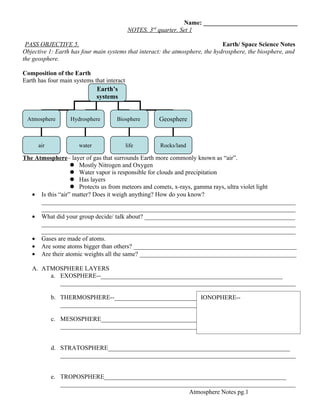
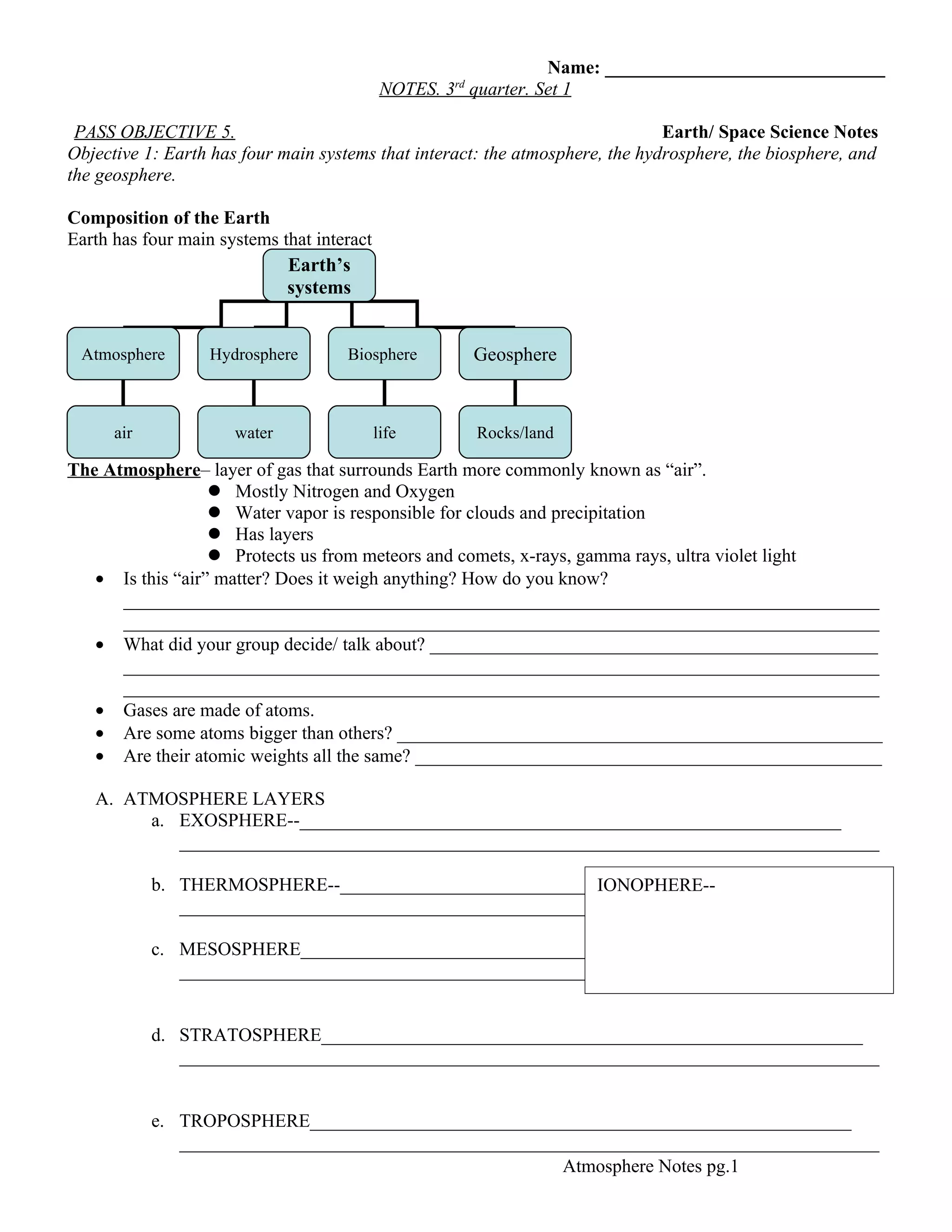
Composition of the Earth
Earth has four main systems that interact
                             Earth’s
                             systems


 Atmosphere        Hydrosphere       Biosphere            Geosphere


      air             water                 life          Rocks/land

The Atmosphere– layer of gas that surrounds Earth more commonly known as “air”.
                   Mostly Nitrogen and Oxygen
                   Water vapor is responsible for clouds and precipitation
                   Has layers
                   Protects us from meteors and comets, x-rays, gamma rays, ultra violet light
   • Is this “air” matter? Does it weigh anything? How do you know?
      _________________________________________________________________________________
      _________________________________________________________________________________
   • What did your group decide/ talk about? ________________________________________________
      _________________________________________________________________________________
      _________________________________________________________________________________
   • Gases are made of atoms.
   • Are some atoms bigger than others? ____________________________________________________
   • Are their atomic weights all the same? __________________________________________________

   A. ATMOSPHERE LAYERS
        a. EXOSPHERE--__________________________________________________________
           ___________________________________________________________________________

            b. THERMOSPHERE--__________________________________________________________
                                                            IONOPHERE--
               ___________________________________________________________________________

            c. MESOSPHERE__________________________________________________________
               ___________________________________________________________________________


            d. STRATOSPHERE__________________________________________________________
               ___________________________________________________________________________


            e. TROPOSPHERE__________________________________________________________
               ___________________________________________________________________________
                                                        Atmosphere Notes pg.1
Troposphere and Weather

       1. Weather—the atmosphere’s condition in terms of temperature, cloud cover, wind speed and
           direction, humidity, and air pressure.
       What are different types of weather? ________________________________________________
       ______________________________________________________________________________
       2. Temperature—a measure of how fast air molecules are moving.
            When molecules are moving rapidly, temperature is high.
            Celsius and Fahrenheit thermometers measure air temperature.
What is the temperature like today?
       Hot/ Cold ______________________
       Degrees Fahrenheit_______________
       Degrees Celsius _________________
       3. Energy is transferred between fast-moving molecules and slower-moving molecules.
            Conduction—transfer of energy when molecules collide.
Give an example of something heating up due to conduction: __________________________________
            Convection occurs when warm air rises and cool air sinks.
Give an example of something heating up due to convection: ___________________________________

       4. Air pressure— air weight that varies over Earth’s surface.
            Warmer air is less dense and exerts less pressure.
            Cooler air is more dense and exerts more pressure.
Air Pressure Demonstration—Write about what you learned
_____________________________________________________________________________________
_____________________________________________________________________________________
_____________________________________________________________________________________
       5. Humidity— the amount of water vapor in the air
    Temperature affects how much moisture is in the air.

       6. Dewpoint—when the air is holding as much water vapor as it can
   Relative humidity—a measure of the amount of water vapor present compared to the amount that could
   be held at a specific temperature.

Other layers of the atmosphere: at the bottom of page 1 of your notes add what you learn about each
layer to your notes.


                                                              Atmosphere Notes pg.2

Atmosphere Notes

  • 1.
    Name: ______________________________ rd NOTES. 3 quarter. Set 1 PASS OBJECTIVE 5. Earth/ Space Science Notes Objective 1: Earth has four main systems that interact: the atmosphere, the hydrosphere, the biosphere, and the geosphere. Composition of the Earth Earth has four main systems that interact Earth’s systems Atmosphere Hydrosphere Biosphere Geosphere air water life Rocks/land The Atmosphere– layer of gas that surrounds Earth more commonly known as “air”.  Mostly Nitrogen and Oxygen  Water vapor is responsible for clouds and precipitation  Has layers  Protects us from meteors and comets, x-rays, gamma rays, ultra violet light • Is this “air” matter? Does it weigh anything? How do you know? _________________________________________________________________________________ _________________________________________________________________________________ • What did your group decide/ talk about? ________________________________________________ _________________________________________________________________________________ _________________________________________________________________________________ • Gases are made of atoms. • Are some atoms bigger than others? ____________________________________________________ • Are their atomic weights all the same? __________________________________________________ A. ATMOSPHERE LAYERS a. EXOSPHERE--__________________________________________________________ ___________________________________________________________________________ b. THERMOSPHERE--__________________________________________________________ IONOPHERE-- ___________________________________________________________________________ c. MESOSPHERE__________________________________________________________ ___________________________________________________________________________ d. STRATOSPHERE__________________________________________________________ ___________________________________________________________________________ e. TROPOSPHERE__________________________________________________________ ___________________________________________________________________________ Atmosphere Notes pg.1
  • 2.
    Troposphere and Weather 1. Weather—the atmosphere’s condition in terms of temperature, cloud cover, wind speed and direction, humidity, and air pressure. What are different types of weather? ________________________________________________ ______________________________________________________________________________ 2. Temperature—a measure of how fast air molecules are moving.  When molecules are moving rapidly, temperature is high.  Celsius and Fahrenheit thermometers measure air temperature. What is the temperature like today? Hot/ Cold ______________________ Degrees Fahrenheit_______________ Degrees Celsius _________________ 3. Energy is transferred between fast-moving molecules and slower-moving molecules.  Conduction—transfer of energy when molecules collide. Give an example of something heating up due to conduction: __________________________________  Convection occurs when warm air rises and cool air sinks. Give an example of something heating up due to convection: ___________________________________ 4. Air pressure— air weight that varies over Earth’s surface.  Warmer air is less dense and exerts less pressure.  Cooler air is more dense and exerts more pressure. Air Pressure Demonstration—Write about what you learned _____________________________________________________________________________________ _____________________________________________________________________________________ _____________________________________________________________________________________ 5. Humidity— the amount of water vapor in the air Temperature affects how much moisture is in the air. 6. Dewpoint—when the air is holding as much water vapor as it can Relative humidity—a measure of the amount of water vapor present compared to the amount that could be held at a specific temperature. Other layers of the atmosphere: at the bottom of page 1 of your notes add what you learn about each layer to your notes. Atmosphere Notes pg.2