An Introduction to
Environmental Science
      Chapter 1


  Engr. Dale P. Cataquis
METEOROLOGY
 The term meteorology was derived from the
  Greek word meteoros meaning high in the
  air, and logos or discourse.
 It deals with the study of the atmosphere: its
  composition, structure, and the factors that
  affect the weather and climate.
 A branch of physical science which may be
  referred to as the Chemistry and Physics of
  the atmosphere.
 Electronic equipment and satellites now
  make a weather forecasting more accurate
  unlike the forecasting techniques used
  earlier by sailors, hunters, farmers,
  fishermen and early meteorologists.
Aristotle
 One of the earliest meteorologists is the
  Greek philosopher Aristotle (384-322 BC)
  who theorized that the world was composed
  of fire, air, water and earth which can be
  converted from one form to another by the
  sun.
 Such transformation also produces wind,
  clouds, snow, rain, frost or dew.
 These assumptions were taken as facts
  until the middle of the sixteenth century
  which was marked by outstanding
  inventions like:
  – Thermometer (Galileo)
  – Barometer for pressure (Torricelli)
  – Hygroscope for humidity measurement (Hooke)
  – Rain gauge for measuring rainfall (Hooke,Wren
    and Towneley)
 Today computers, modern weather balloons
  and satellites feed the needed information
  for more accurate weather predictions and
  tracking of weather disturbances
THE ATMOSPHERE
 One part of the environment in which every
  surface of our body is in contact with.
 The gaseous layer that envelops the earth’s
  lithosphere

  – (sun rise, air, sunsets, colors of the rainbow,
    breeze, and the ever changing condition of the
    weather)- brought about by the gaseous layers
    enveloping the earth- atmosphere.
Origin of the Earth and the Evolution
          of the Atmosphere
 Many scientists believed that the universe
  was probably composed of a cloud of
  hydrogen gas which through condensations
  and various elements that we now find in
  nature. This event probably took place
  some 20 billion years ago.
 About 5 billion years ago, our solar system was
  probably formed from a rapidly rotating ball of free
  atoms.
 Hydrogen atoms, being the most abundant,
  gravitated at the center of the ball and formed the
  sun.
 The swirling belt of gas that remained outside the
  sun broke up into a few smaller clouds which
  eventually became the planets.
 One such planet is the earth.
 By gravitation, the heavy atoms sank towards the
  center of the earth, the lighter atoms formed the
  middle shell and the lightest such as H2, O2, N2,
  and C became the outer layers.
 Due to the very cool cosmic space, the earth
  began to cool gradually.
 As the temperature became low enough, bonding
  together of atoms took place.
 Simple molecules were then formed.
Components of the atmosphere that
   have significant effects on the
              weather
   CO2 and H2O – absorb the heat being radiated by the
    earth’s surface, thereby hoarding the warmth of the sun.
    Due to this effect, the temperature does not decrease
    abruptly at night.
   H2O together with the dust particles, is responsible for the
    formation of clouds and precipitation.
   Ozone – screens out the ultraviolet rays from the sun
    which would be lethal at greater intensity.
   Nitrogen – important constituent of proteins and is
    absorbed by plants in the form of nitrate.
   Oxygen – makes possible the combustion of materials and
    the respiration of living organisms.
Composition of the Atmosphere
 The air around us is a fluid mixture of gases
  which surrounds the earth’s lithosphere.
 The word atmosphere originates from the
  Greek words atmos which means vapor
  and sphaira which means sphere
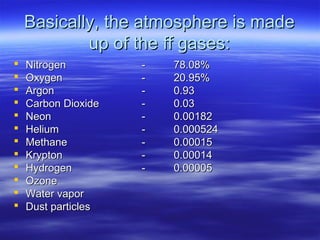
Basically, the atmosphere is made
            up of the ff gases:
   Nitrogen         -   78.08%
   Oxygen           -   20.95%
   Argon            -   0.93
   Carbon Dioxide   -   0.03
   Neon             -   0.00182
   Helium           -   0.000524
   Methane          -   0.00015
   Krypton          -   0.00014
   Hydrogen         -   0.00005
   Ozone
   Water vapor
   Dust particles
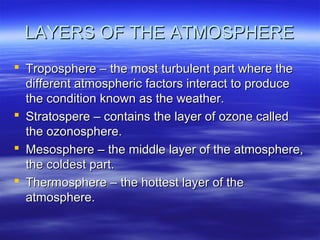
LAYERS OF THE ATMOSPHERE
 Troposphere – the most turbulent part where the
  different atmospheric factors interact to produce
  the condition known as the weather.
 Stratospere – contains the layer of ozone called
  the ozonosphere.
 Mesosphere – the middle layer of the atmosphere,
  the coldest part.
 Thermosphere – the hottest layer of the
  atmosphere.
Assignment
 Answer the self evaluation No. 1
Quiz 1
1. The term meteorology was derived from the Greek
  word meteoros meaning high in the air,
2. logos or discourse.
3. It deals with the study of the atmosphere: its
  composition, structure, and the factors that affect
  the weather and climate.
4. A branch of physical science which may be
  referred to as the Chemistry and Physics of the
  atmosphere.
5. One of the earliest meteorologists is the Greek
   philosopher Aristotle (384-322 BC) who theorized
   that the world was composed of fire, air, water
   and earth which can be converted from one form
   to another by the sun.
6. Thermometer (Galileo)
7. Barometer for pressure (Torricelli)
8. Hygroscope for humidity measurement (Hooke)
9. Rain gauge for measuring rainfall (Hooke,Wren
   and Towneley
10. The gaseous layer that envelops the earth’s lithosphere (atmosphere)
11. According to the beliefs of many scientists Hydrogen atoms, is the
   most abundant atom, gravitated at the center of the ball of gas and
   formed the sun.
12. CO2 and H2O – absorb the heat being radiated by the earth’s surface,
   thereby hoarding the warmth of the sun. Due to this effect, the
   temperature does not decrease abruptly at night.
13. H2O together with the dust particles, is responsible for the formation
   of clouds and precipitation.
14. Ozone – screens out the ultraviolet rays from the sun which would be
   lethal at greater intensity.
15. Nitrogen – important constituent of proteins and is absorbed by plants
   in the form of nitrate.
16. Oxygen – makes possible the combustion of materials and the
   respiration of living organisms.
17. The word atmosphere originates from the Greek words
  atmos which means vapor and
18. sphaira which means sphere
19 – 20. Nitrogen , oxygen the two most abundant component
  of the atmosphere.
21. Troposphere – the most turbulent part where the
  different atmospheric factors interact to produce the
  condition known as the weather.
22. Stratospere – contains the layer of ozone called the
  ozonosphere.
23. Mesosphere – the middle layer of the atmosphere, the
  coldest part.
24. Thermosphere – the hottest layer of the atmosphere.

An introduction to environmental science

  • 1.
    An Introduction to EnvironmentalScience Chapter 1 Engr. Dale P. Cataquis
  • 2.
    METEOROLOGY  The termmeteorology was derived from the Greek word meteoros meaning high in the air, and logos or discourse.  It deals with the study of the atmosphere: its composition, structure, and the factors that affect the weather and climate.  A branch of physical science which may be referred to as the Chemistry and Physics of the atmosphere.
  • 3.
     Electronic equipmentand satellites now make a weather forecasting more accurate unlike the forecasting techniques used earlier by sailors, hunters, farmers, fishermen and early meteorologists.
  • 4.
    Aristotle  One ofthe earliest meteorologists is the Greek philosopher Aristotle (384-322 BC) who theorized that the world was composed of fire, air, water and earth which can be converted from one form to another by the sun.  Such transformation also produces wind, clouds, snow, rain, frost or dew.
  • 5.
     These assumptionswere taken as facts until the middle of the sixteenth century which was marked by outstanding inventions like: – Thermometer (Galileo) – Barometer for pressure (Torricelli) – Hygroscope for humidity measurement (Hooke) – Rain gauge for measuring rainfall (Hooke,Wren and Towneley)
  • 6.
     Today computers,modern weather balloons and satellites feed the needed information for more accurate weather predictions and tracking of weather disturbances
  • 7.
    THE ATMOSPHERE  Onepart of the environment in which every surface of our body is in contact with.  The gaseous layer that envelops the earth’s lithosphere – (sun rise, air, sunsets, colors of the rainbow, breeze, and the ever changing condition of the weather)- brought about by the gaseous layers enveloping the earth- atmosphere.
  • 8.
    Origin of theEarth and the Evolution of the Atmosphere  Many scientists believed that the universe was probably composed of a cloud of hydrogen gas which through condensations and various elements that we now find in nature. This event probably took place some 20 billion years ago.
  • 9.
     About 5billion years ago, our solar system was probably formed from a rapidly rotating ball of free atoms.  Hydrogen atoms, being the most abundant, gravitated at the center of the ball and formed the sun.  The swirling belt of gas that remained outside the sun broke up into a few smaller clouds which eventually became the planets.  One such planet is the earth.
  • 10.
     By gravitation,the heavy atoms sank towards the center of the earth, the lighter atoms formed the middle shell and the lightest such as H2, O2, N2, and C became the outer layers.  Due to the very cool cosmic space, the earth began to cool gradually.  As the temperature became low enough, bonding together of atoms took place.  Simple molecules were then formed.
  • 11.
    Components of theatmosphere that have significant effects on the weather  CO2 and H2O – absorb the heat being radiated by the earth’s surface, thereby hoarding the warmth of the sun. Due to this effect, the temperature does not decrease abruptly at night.  H2O together with the dust particles, is responsible for the formation of clouds and precipitation.  Ozone – screens out the ultraviolet rays from the sun which would be lethal at greater intensity.  Nitrogen – important constituent of proteins and is absorbed by plants in the form of nitrate.  Oxygen – makes possible the combustion of materials and the respiration of living organisms.
  • 12.
    Composition of theAtmosphere  The air around us is a fluid mixture of gases which surrounds the earth’s lithosphere.  The word atmosphere originates from the Greek words atmos which means vapor and sphaira which means sphere
  • 13.
    Basically, the atmosphereis made up of the ff gases:  Nitrogen - 78.08%  Oxygen - 20.95%  Argon - 0.93  Carbon Dioxide - 0.03  Neon - 0.00182  Helium - 0.000524  Methane - 0.00015  Krypton - 0.00014  Hydrogen - 0.00005  Ozone  Water vapor  Dust particles
  • 14.
    LAYERS OF THEATMOSPHERE  Troposphere – the most turbulent part where the different atmospheric factors interact to produce the condition known as the weather.  Stratospere – contains the layer of ozone called the ozonosphere.  Mesosphere – the middle layer of the atmosphere, the coldest part.  Thermosphere – the hottest layer of the atmosphere.
  • 15.
    Assignment  Answer theself evaluation No. 1
  • 16.
    Quiz 1 1. Theterm meteorology was derived from the Greek word meteoros meaning high in the air, 2. logos or discourse. 3. It deals with the study of the atmosphere: its composition, structure, and the factors that affect the weather and climate. 4. A branch of physical science which may be referred to as the Chemistry and Physics of the atmosphere.
  • 17.
    5. One ofthe earliest meteorologists is the Greek philosopher Aristotle (384-322 BC) who theorized that the world was composed of fire, air, water and earth which can be converted from one form to another by the sun. 6. Thermometer (Galileo) 7. Barometer for pressure (Torricelli) 8. Hygroscope for humidity measurement (Hooke) 9. Rain gauge for measuring rainfall (Hooke,Wren and Towneley
  • 18.
    10. The gaseouslayer that envelops the earth’s lithosphere (atmosphere) 11. According to the beliefs of many scientists Hydrogen atoms, is the most abundant atom, gravitated at the center of the ball of gas and formed the sun. 12. CO2 and H2O – absorb the heat being radiated by the earth’s surface, thereby hoarding the warmth of the sun. Due to this effect, the temperature does not decrease abruptly at night. 13. H2O together with the dust particles, is responsible for the formation of clouds and precipitation. 14. Ozone – screens out the ultraviolet rays from the sun which would be lethal at greater intensity. 15. Nitrogen – important constituent of proteins and is absorbed by plants in the form of nitrate. 16. Oxygen – makes possible the combustion of materials and the respiration of living organisms.
  • 19.
    17. The wordatmosphere originates from the Greek words atmos which means vapor and 18. sphaira which means sphere 19 – 20. Nitrogen , oxygen the two most abundant component of the atmosphere. 21. Troposphere – the most turbulent part where the different atmospheric factors interact to produce the condition known as the weather. 22. Stratospere – contains the layer of ozone called the ozonosphere. 23. Mesosphere – the middle layer of the atmosphere, the coldest part. 24. Thermosphere – the hottest layer of the atmosphere.