
Club Atlético de Madrid S.A.D 
10 Match Tactical Analysis 
Kieran Smith
Contents 
• Introduc*on 
• Club 
History 
• Manager 
• Squad 
• Story 
of 
the 
season 
so 
far 
• Systems 
of 
Play 
– 
Favourite 
and 
Variable 
• 4 
Moments 
of 
the 
game 
– 
ABack 
phase 
-­‐ 
Transi*on 
to 
Defence 
-­‐ 
Defensive 
phase 
-­‐ 
Transi*on 
to 
ABack 
• Story 
aHer 
the 
10 
matches 
• Strengths 
• Weaknesses 
• Conclusion
Introduction 
This analysis project is going to look at all aspects of play of Atletico Madrid 
over a 10 match period. The objective is to look at the team charactaristics, find 
out how they play, analyse their strengths and weaknesses and provide 
examples of these aspects in order to learn from how they are playing and why 
they are having such success. 
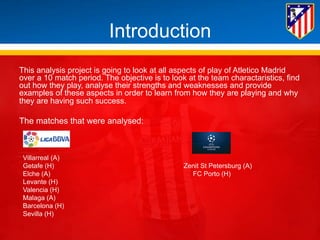
The matches that were analysed: 
Villarreal (A) 
Getafe (H) Zenit St Petersburg (A) 
Elche (A) FC Porto (H) 
Levante (H) 
Valencia (H) 
Malaga (A) 
Barcelona (H) 
Sevilla (H)
Club History 
Atle*co 
Madrid 
were 
formed 
on 
the 
26th 
of 
April 
1903 
as 
Athle*c 
Club 
de 
Madrid 
by 
three 
Basque 
students 
living 
in 
Madrid. 
They 
originally 
played 
in 
blue 
and 
white 
kits, 
similarly 
to 
Athle*c 
Bilbao. 
When 
they 
changed 
to 
wearing 
red 
and 
white, 
maBresses 
in 
Spain 
were 
the 
same 
colour 
and 
this 
led 
to 
them 
being 
called 
Los 
Colchoneros(The 
Matress 
Makers). 
Atle*co 
Madrid 
have 
won 
29 
separate 
honours 
in 
their 
history 
including 
the 
Spanish 
league 
*tle 
9 
*mes 
and 
the 
Copa 
del 
Rey 
10 
*mes. 
They 
have 
also 
had 
success 
in 
Europe 
being 
runners 
up 
in 
the 
Champions 
League 
in 
‘73-­‐’74, 
before 
winning 
the 
UEFA 
Europa 
League 
in 
both 
2010 
& 
2012; 
these 
Europa 
League 
triumphs 
were 
both 
followed 
by 
winning 
the 
European 
Super 
cup 
the 
following 
seasons. 
The 
most 
successful 
manager 
in 
Atle*co 
Madrid’s 
history 
is 
the 
late 
Luis 
Aragones, 
who 
won 
6 
different 
compe**ons, 
including 
3 
La 
Liga 
*tles 
over 
two 
spells 
at 
the 
club. 
Big 
name 
former 
players 
include: 
Diego 
Simeone, 
Fernando 
Torres, 
Sergio 
Aguero, 
Radamel 
Falcao. 
Raul 
Gonzalez, 
the 
Real 
Madrid 
legend, 
was 
an 
Atle*co 
Madrid 
youth 
player 
but 
joined 
Real 
Madrid 
when 
the 
club’s 
youth 
department 
was 
closed.
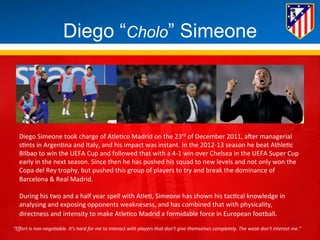
Diego “Cholo” Simeone 
Diego 
Simeone 
took 
charge 
of 
Atle*co 
Madrid 
on 
the 
23rd 
of 
December 
2011, 
aHer 
managerial 
s*nts 
in 
Argen*na 
and 
Italy, 
and 
his 
impact 
was 
instant. 
In 
the 
2012-­‐13 
season 
he 
beat 
Athle*c 
Bilbao 
to 
win 
the 
UEFA 
Cup 
and 
followed 
that 
with 
a 
4-­‐1 
win 
over 
Chelsea 
in 
the 
UEFA 
Super 
Cup 
early 
in 
the 
next 
season. 
Since 
then 
he 
has 
pushed 
his 
squad 
to 
new 
levels 
and 
not 
only 
won 
the 
Copa 
del 
Rey 
trophy, 
but 
pushed 
this 
group 
of 
players 
to 
try 
and 
break 
the 
dominance 
of 
Barcelona 
& 
Real 
Madrid. 
During 
his 
two 
and 
a 
half 
year 
spell 
with 
Atle*, 
Simeone 
has 
shown 
his 
tac*cal 
knowledge 
in 
analysing 
and 
exposing 
opponents 
weaknesess, 
and 
has 
combined 
that 
with 
physicality, 
directness 
and 
intensity 
to 
make 
Atle*co 
Madrid 
a 
formidable 
force 
in 
European 
football. 
“Effort 
is 
non-­‐nego.able. 
It’s 
hard 
for 
me 
to 
interact 
with 
players 
that 
don’t 
give 
themselves 
completely. 
The 
weak 
don’t 
interest 
me.”
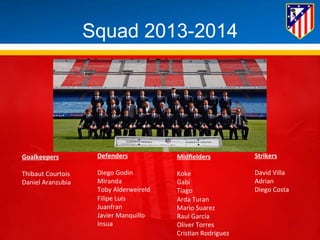
Squad 2013-2014 
Goalkeepers 
Thibaut 
Courtois 
Daniel 
Aranzubia 
Defenders 
Diego 
Godin 
Miranda 
Toby 
Alderweireld 
Filipe 
Luis 
Juanfran 
Javier 
Manquillo 
Insua 
Midfielders 
Koke 
Gabi 
Tiago 
Arda 
Turan 
Mario 
Suarez 
Raul 
Garcia 
Oliver 
Torres 
Cris*an 
Rodriguez 
Strikers 
David 
Villa 
Adrian 
Diego 
Costa
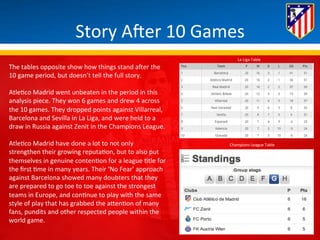
Story of the season so far 
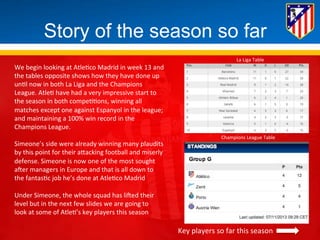
We 
begin 
looking 
at 
Atle*co 
Madrid 
in 
week 
13 
and 
the 
tables 
opposite 
shows 
how 
they 
have 
done 
up 
un*l 
now 
in 
both 
La 
Liga 
and 
the 
Champions 
League. 
Atle* 
have 
had 
a 
very 
impressive 
start 
to 
the 
season 
in 
both 
compe**ons, 
winning 
all 
matches 
except 
one 
against 
Espanyol 
in 
the 
league; 
and 
maintaining 
a 
100% 
win 
record 
in 
the 
Champions 
League. 
Simeone’s 
side 
were 
already 
winning 
many 
plaudits 
by 
this 
point 
for 
their 
aBacking 
football 
and 
miserly 
defense. 
Simeone 
is 
now 
one 
of 
the 
most 
sought 
aHer 
managers 
in 
Europe 
and 
that 
is 
all 
down 
to 
the 
fantas*c 
job 
he’s 
done 
at 
Atle*co 
Madrid 
Under 
Simeone, 
the 
whole 
squad 
has 
liHed 
their 
level 
but 
in 
the 
next 
few 
slides 
we 
are 
going 
to 
look 
at 
some 
of 
Atle*’s 
key 
players 
this 
season 
La 
Liga 
Table 
Champions 
League 
Table 
Key 
players 
so 
far 
this 
season
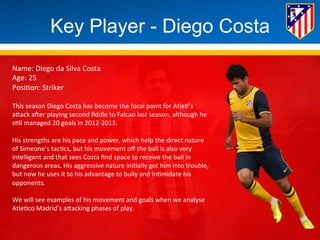
Key Player - Diego Costa 
Name: 
Diego 
da 
Silva 
Costa 
Age: 
25 
Posi*on: 
Striker 
This 
season 
Diego 
Costa 
has 
become 
the 
focal 
point 
for 
Atle*’s 
aBack 
aHer 
playing 
second 
fiddle 
to 
Falcao 
last 
season, 
although 
he 
s*ll 
managed 
20 
goals 
in 
2012-­‐2013. 
His 
strengths 
are 
his 
pace 
and 
power, 
which 
help 
the 
direct 
nature 
of 
Simeone’s 
tac*cs, 
but 
his 
movement 
off 
the 
ball 
is 
also 
very 
intelligent 
and 
that 
sees 
Costa 
find 
space 
to 
receive 
the 
ball 
in 
dangerous 
areas. 
His 
aggressive 
nature 
ini*ally 
got 
him 
into 
trouble, 
but 
now 
he 
uses 
it 
to 
his 
advantage 
to 
bully 
and 
in*midate 
his 
opponents. 
We 
will 
see 
examples 
of 
his 
movement 
and 
goals 
when 
we 
analyse 
Atle*co 
Madrid’s 
aBacking 
phases 
of 
play.
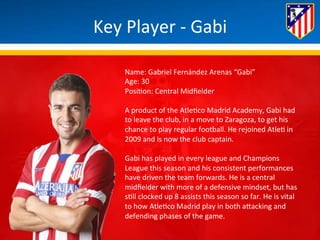
Key 
Player 
-­‐ 
Gabi 
Name: 
Gabriel 
Fernández 
Arenas 
“Gabi” 
Age: 
30 
Posi*on: 
Central 
Midfielder 
A 
product 
of 
the 
Atle*co 
Madrid 
Academy, 
Gabi 
had 
to 
leave 
the 
club, 
in 
a 
move 
to 
Zaragoza, 
to 
get 
his 
chance 
to 
play 
regular 
football. 
He 
rejoined 
Atle* 
in 
2009 
and 
is 
now 
the 
club 
captain. 
Gabi 
has 
played 
in 
every 
league 
and 
Champions 
League 
this 
season 
and 
his 
consistent 
performances 
have 
driven 
the 
team 
forwards. 
He 
is 
a 
central 
midfielder 
with 
more 
of 
a 
defensive 
mindset, 
but 
has 
s*ll 
clocked 
up 
8 
assists 
this 
season 
so 
far. 
He 
is 
vital 
to 
how 
Atle*co 
Madrid 
play 
in 
both 
aBacking 
and 
defending 
phases 
of 
the 
game.
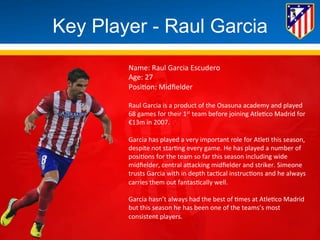
Key Player - Raul Garcia 
Name: 
Raul 
Garcia 
Escudero 
Age: 
27 
Posi*on: 
Midfielder 
Raul 
Garcia 
is 
a 
product 
of 
the 
Osasuna 
academy 
and 
played 
68 
games 
for 
their 
1st 
team 
before 
joining 
Atle*co 
Madrid 
for 
€13m 
in 
2007. 
Garcia 
has 
played 
a 
very 
important 
role 
for 
Atle* 
this 
season, 
despite 
not 
star*ng 
every 
game. 
He 
has 
played 
a 
number 
of 
posi*ons 
for 
the 
team 
so 
far 
this 
season 
including 
wide 
midfielder, 
central 
aBacking 
midfielder 
and 
striker. 
Simeone 
trusts 
Garcia 
with 
in 
depth 
tac*cal 
instruc*ons 
and 
he 
always 
carries 
them 
out 
fantas*cally 
well. 
Garcia 
hasn’t 
always 
had 
the 
best 
of 
*mes 
at 
Atle*co 
Madrid 
but 
this 
season 
he 
has 
been 
one 
of 
the 
teams’s 
most 
consistent 
players.
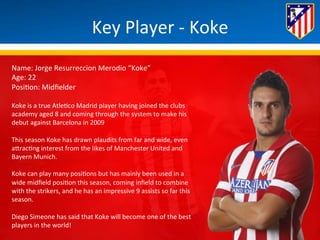
Key 
Player 
-­‐ 
Koke 
Name: 
Jorge 
Resurreccion 
Merodio 
“Koke” 
Age: 
22 
Posi*on: 
Midfielder 
Koke 
is 
a 
true 
Atle*co 
Madrid 
player 
having 
joined 
the 
clubs 
academy 
aged 
8 
and 
coming 
through 
the 
system 
to 
make 
his 
debut 
against 
Barcelona 
in 
2009 
This 
season 
Koke 
has 
drawn 
plaudits 
from 
far 
and 
wide, 
even 
aBrac*ng 
interest 
from 
the 
likes 
of 
Manchester 
United 
and 
Bayern 
Munich. 
Koke 
can 
play 
many 
posi*ons 
but 
has 
mainly 
been 
used 
in 
a 
wide 
midfield 
posi*on 
this 
season, 
coming 
infield 
to 
combine 
with 
the 
strikers, 
and 
he 
has 
an 
impressive 
9 
assists 
so 
far 
this 
season. 
Diego 
Simeone 
has 
said 
that 
Koke 
will 
become 
one 
of 
the 
best 
players 
in 
the 
world!
Systems 
Of 
Play
Standard System of Play 
Villa 
Costa 
Koke 
Gabi 
Tiago 
Turan 
Filipe 
Luis 
Miranda 
Godin 
Juanfran 
Courtois 
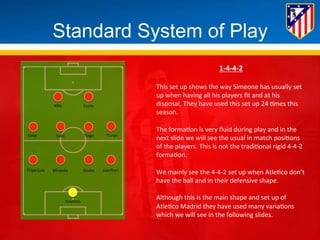
1-­‐4-­‐4-­‐2 
This 
set 
up 
shows 
the 
way 
Simeone 
has 
usually 
set 
up 
when 
having 
all 
his 
players 
fit 
and 
at 
his 
disposal. 
They 
have 
used 
this 
set 
up 
24 
*mes 
this 
season. 
The 
forma*on 
is 
very 
fluid 
during 
play 
and 
in 
the 
next 
slide 
we 
will 
see 
the 
usual 
in 
match 
posi*ons 
of 
the 
players. 
This 
is 
not 
the 
tradi*onal 
rigid 
4-­‐4-­‐2 
forma*on. 
We 
mainly 
see 
the 
4-­‐4-­‐2 
set 
up 
when 
Atle*co 
don’t 
have 
the 
ball 
and 
in 
their 
defensive 
shape. 
Although 
this 
is 
the 
main 
shape 
and 
set 
up 
of 
Atle*co 
Madrid 
they 
have 
used 
many 
varia*ons 
which 
we 
will 
see 
in 
the 
following 
slides.
Actual 
In 
Match 
Shape 
Filipe 
Luis 
Miranda 
Godin 
Juanfran 
Gabi 
Tiago 
Koke 
Turan 
Villa 
Costa 
Courtois 
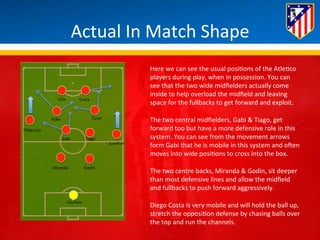
Here 
we 
can 
see 
the 
usual 
posi*ons 
of 
the 
Atle*co 
players 
during 
play, 
when 
in 
possession. 
You 
can 
see 
that 
the 
two 
wide 
midfielders 
actually 
come 
inside 
to 
help 
overload 
the 
midfield 
and 
leaving 
space 
for 
the 
fullbacks 
to 
get 
forward 
and 
exploit. 
The 
two 
central 
midfielders, 
Gabi 
& 
Tiago, 
get 
forward 
too 
but 
have 
a 
more 
defensive 
role 
in 
this 
system. 
You 
can 
see 
from 
the 
movement 
arrows 
form 
Gabi 
that 
he 
is 
mobile 
in 
this 
system 
and 
oHen 
moves 
into 
wide 
posi*ons 
to 
cross 
into 
the 
box. 
The 
two 
centre 
backs, 
Miranda 
& 
Godin, 
sit 
deeper 
than 
most 
defensive 
lines 
and 
allow 
the 
midfield 
and 
fullbacks 
to 
push 
forward 
aggressively. 
Diego 
Costa 
is 
very 
mobile 
and 
will 
hold 
the 
ball 
up, 
stretch 
the 
opposi*on 
defense 
by 
chasing 
balls 
over 
the 
top 
and 
run 
the 
channels.
Varia*ons 
in 
Systems 
of 
Play 
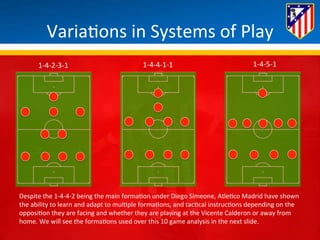
1-­‐4-­‐2-­‐3-­‐1 
1-­‐4-­‐4-­‐1-­‐1 
1-­‐4-­‐5-­‐1 
Despite 
the 
1-­‐4-­‐4-­‐2 
being 
the 
main 
forma*on 
under 
Diego 
Simeone, 
Atle*co 
Madrid 
have 
shown 
the 
ability 
to 
learn 
and 
adapt 
to 
mul*ple 
forma*ons, 
and 
tac*cal 
instruc*ons 
depending 
on 
the 
opposi*on 
they 
are 
facing 
and 
whether 
they 
are 
playing 
at 
the 
Vicente 
Calderon 
or 
away 
from 
home. 
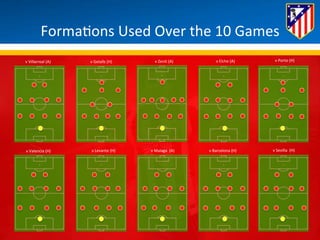
We 
will 
see 
the 
forma*ons 
used 
over 
this 
10 
game 
analysis 
in 
the 
next 
slide.
Forma*ons 
Used 
Over 
the 
10 
Games 
v 
Villarreal 
(A) 
v 
Getafe 
(H) 
v 
Zenit 
(A) 
v 
Elche 
(A) 
v 
Porto 
(H) 
v 
Valencia 
(H) 
v 
Levante 
(H) 
v 
Malaga 
(A) 
v 
Barcelona 
(H) 
v 
Sevilla 
(H)
Style 
of 
Play 
& 
Roles 
and 
Responsibili*es
Style 
of 
Play 
AHer 
looking 
at 
the 
forma*ons 
Atle*co 
Madrid 
have 
used 
this 
season, 
we 
are 
now 
going 
to 
look 
at 
the 
style 
of 
play 
and 
the 
roles 
& 
responsibili*es 
of 
each 
posi*on, 
in 
both 
offensive 
and 
defensive 
phases. 
We 
will 
see 
many 
examples 
of 
all 
four 
moments 
of 
the 
game 
in 
this 
presenta*on. 
Style 
of 
Play 
– 
A<acking 
Direct 
play 
Atle*co 
Madrid 
use 
a 
very 
direct 
style 
of 
play. 
This 
is 
not 
aimless 
long 
balls, 
but 
means 
they 
try 
to 
go 
forward 
at 
EVERY 
opportunity. 
Atle* 
are 
very 
strong 
in 
counter 
aBack. 
Build 
up 
play 
The 
GK 
will 
kick 
long 
almost 
every 
*me 
with 
Diego 
Costa 
or 
Raul 
Garcia 
being 
the 
target. 
The 
midfield 
will 
then 
play 
off 
of 
the 
2nd 
ball 
and 
build 
from 
there. 
The 
ini*al 
phase 
for 
Atle* 
usually 
starts 
in 
the 
middle 
third. 
Overloading 
The 
wide 
midfielders 
will 
come 
inside 
to 
overload 
the 
opposi*on, 
who 
in 
La 
Liga, 
tend 
to 
play 
with 
3 
players 
in 
central 
midfield. 
Atle* 
will 
have 
all 
four 
midfield 
players 
in 
the 
central 
area 
and 
play 
from 
there. 
The 
fullbacks 
play 
a 
integral 
part 
in 
the 
aBacking 
phase 
by 
providing 
the 
width 
when 
the 
wide 
midfielders 
go 
in 
field.
Style 
of 
Play 
Style 
of 
Play 
– 
Defensive 
Atle*co 
Madrid 
are 
very, 
very 
well 
organised 
defensively 
and 
this 
has 
been 
a 
strength 
of 
theirs 
this 
season. 
The 
forma*ons 
we 
have 
looked 
at 
earlier 
are 
the 
basis 
of 
their 
defensive 
shape 
in 
each 
game 
and 
they 
are 
very 
clear 
in 
the 
defensive 
phase. 
High/Medium 
block 
Most 
of 
the 
*me 
Atle* 
will 
use 
a 
high 
block 
with 
aggressive 
tac*cal 
pressing, 
but 
in 
some 
away 
matches 
against 
possession 
based 
teams 
they 
have 
resorted 
to 
a 
medium 
block. 
Pressing 
The 
pressing 
is 
ini*ated 
by 
the 
strikers 
and 
the 
rest 
of 
the 
team 
will 
follow 
them. 
They 
will 
either 
try 
to 
force 
the 
long 
pass 
from 
the 
opposi*on 
or 
force 
them 
wide 
where 
Atle* 
will 
press 
in 
packs 
to 
win 
the 
ball 
Midfield 
The 
midfield 
will 
narrow 
and 
become 
compact 
in 
an 
aBempt 
to 
force 
the 
opposi*on 
into 
wide 
areas 
to 
press 
them 
as 
men*oned 
above
Roles 
& 
Responsibili*es 
-­‐ 
Offensive 
Goalkeeper 
Needs 
to 
have 
good 
long 
distribu*on 
and 
also 
be 
able 
to 
iden*fy 
counter 
aBack 
opportuni*es 
and 
distribute 
accurately 
and 
quickly 
Central 
Defenders 
They 
are 
a 
safety 
net 
and 
will 
also 
need 
to 
be 
able 
to 
play 
short 
and 
long 
passes 
when 
receiving 
the 
ball. 
Go 
forward 
for 
corners 
and 
appropriate 
free 
kicks 
Fullbacks 
In 
aBack 
they 
give 
the 
width 
to 
the 
team 
and 
provide 
as 
many 
crosses 
as 
possible 
for 
the 
strikers 
to 
aBack, 
and 
also 
combina*on 
play 
with 
the 
other 
midfielder 
to 
create 
opportuni*es. 
Central 
Midfielders 
Go 
forward 
and 
get 
involved 
in 
the 
aBack 
with 
through 
balls, 
passes 
and 
shots 
from 
outside 
the 
box. 
Also 
moving 
into 
wide 
posi*on 
to 
combine 
with 
fullback 
LeK/Right 
Midfielders 
The 
role 
of 
these 
players 
is 
to 
come 
inside 
and 
overload 
the 
central 
zone. 
They 
will 
combine 
with 
all 
players 
to 
create 
opportuni*es 
for 
the 
strikers. 
They 
will 
rotate 
posi*ons 
and 
have 
somewhat 
of 
a 
free 
role 
in 
the 
aBacking 
phase 
Strikers 
The 
strikers 
are 
the 
focal 
point 
of 
the 
team 
and 
need 
to 
work 
hard 
in 
running 
channels, 
holing 
up 
the 
ball 
and 
also 
geung 
on 
the 
end 
of 
crosses. 
They 
need 
to 
be 
able 
to 
iden*fy 
counter 
aBack 
opportuni*es.
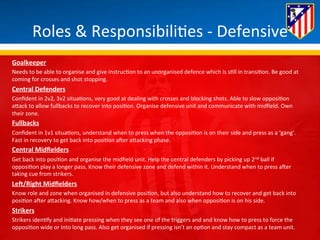
Roles 
& 
Responsibili*es 
-­‐ 
Defensive 
Goalkeeper 
Needs 
to 
be 
able 
to 
organise 
and 
give 
instruc*on 
to 
an 
unorganised 
defence 
which 
is 
s*ll 
in 
transi*on. 
Be 
good 
at 
coming 
for 
crosses 
and 
shot 
stopping. 
Central 
Defenders 
Confident 
in 
2v2, 
3v2 
situa*ons, 
very 
good 
at 
dealing 
with 
crosses 
and 
blocking 
shots. 
Able 
to 
slow 
opposi*on 
aBack 
to 
allow 
fullbacks 
to 
recover 
into 
posi*on. 
Organise 
defensive 
unit 
and 
communicate 
with 
midfield. 
Own 
their 
zone. 
Fullbacks 
Confident 
in 
1v1 
situa*ons, 
understand 
when 
to 
press 
when 
the 
opposi*on 
is 
on 
their 
side 
and 
press 
as 
a 
‘gang’. 
Fast 
in 
recovery 
to 
get 
back 
into 
posi*on 
aHer 
aBacking 
phase. 
Central 
Midfielders 
Get 
back 
into 
posi*on 
and 
organise 
the 
midfield 
unit. 
Help 
the 
central 
defenders 
by 
picking 
up 
2nd 
ball 
if 
opposi*on 
play 
a 
longer 
pass. 
Know 
their 
defensive 
zone 
and 
defend 
within 
it. 
Understand 
when 
to 
press 
aHer 
taking 
cue 
from 
strikers. 
LeK/Right 
Midfielders 
Know 
role 
and 
zone 
when 
organised 
in 
defensive 
posi*on, 
but 
also 
understand 
how 
to 
recover 
and 
get 
back 
into 
posi*on 
aHer 
aBacking. 
Know 
how/when 
to 
press 
as 
a 
team 
and 
also 
when 
opposi*on 
is 
on 
his 
side. 
Strikers 
Strikers 
iden*fy 
and 
ini*ate 
pressing 
when 
they 
see 
one 
of 
the 
triggers 
and 
and 
know 
how 
to 
press 
to 
force 
the 
opposi*on 
wide 
or 
into 
long 
pass. 
Also 
get 
organised 
if 
pressing 
isn’t 
an 
op*on 
and 
stay 
compact 
as 
a 
team 
unit.
Four 
Moments 
Of 
The 
Game
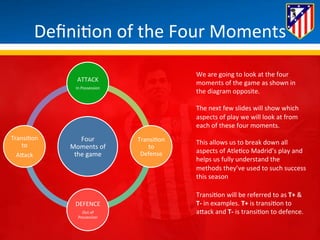
Defini*on 
of 
the 
Four 
Moments 
ATTACK 
In 
Possession 
Four 
Moments 
of 
the 
game 
Transi*on 
to 
Defense 
DEFENCE 
Out 
of 
Possession 
Transi*on 
to 
ABack 
We 
are 
going 
to 
look 
at 
the 
four 
moments 
of 
the 
game 
as 
shown 
in 
the 
diagram 
opposite. 
The 
next 
few 
slides 
will 
show 
which 
aspects 
of 
play 
we 
will 
look 
at 
from 
each 
of 
these 
four 
moments. 
This 
allows 
us 
to 
break 
down 
all 
aspects 
of 
Atle*co 
Madrid’s 
play 
and 
helps 
us 
fully 
understand 
the 
methods 
they’ve 
used 
to 
such 
success 
this 
season 
Transi*on 
will 
be 
referred 
to 
as 
T+ 
& 
T-­‐ 
in 
examples. 
T+ 
is 
transi*on 
to 
aBack 
and 
T-­‐ 
is 
transi*on 
to 
defence.
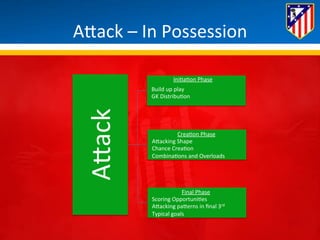
ABack 
– 
In 
Possession 
ABack 
Ini*a*on 
Phase 
Build 
up 
play 
GK 
Distribu*on 
Crea*on 
Phase 
ABacking 
Shape 
Chance 
Crea*on 
Combina*ons 
and 
Overloads 
Final 
Phase 
Scoring 
Opportuni*es 
ABacking 
paBerns 
in 
final 
3rd 
Typical 
goals
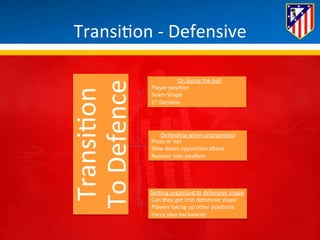
Transi*on 
-­‐ 
Defensive 
Transi*on 
To 
Defence 
On 
losing 
the 
ball 
Player 
posi*on 
Team 
Shape 
1st 
Decision 
Defending 
when 
unorganised 
Press 
or 
not 
Slow 
down 
opposi*on 
aBack 
Recover 
into 
posi*on 
Geung 
organised 
to 
defensive 
shape 
Can 
they 
get 
into 
defensive 
shape 
Players 
taking 
up 
other 
posi*ons 
Force 
play 
backwards
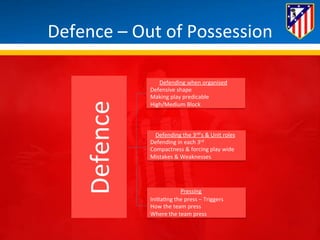
Defence 
– 
Out 
of 
Possession 
Defence 
Defending 
when 
organised 
Defensive 
shape 
Making 
play 
predicable 
High/Medium 
Block 
Defending 
the 
3rd’s 
& 
Unit 
roles 
Defending 
in 
each 
3rd 
Compactness 
& 
forcing 
play 
wide 
Mistakes 
& 
Weaknesses 
Pressing 
Ini*a*ng 
the 
press 
– 
Triggers 
How 
the 
team 
press 
Where 
the 
team 
press
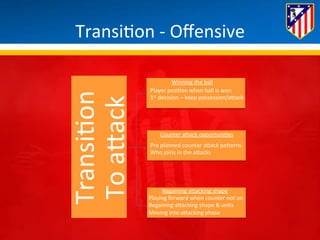
Transi*on 
-­‐ 
Offensive 
Transi*on 
To 
aBack 
Winning 
the 
ball 
Player 
posi*on 
when 
ball 
is 
won 
1st 
decision 
– 
keep 
possession/aBack 
Counter 
aBack 
opportuni*es 
Pre 
planned 
counter 
aBack 
paBerns 
Who 
joins 
in 
the 
aBacks 
Regaining 
aBacking 
shape 
Playing 
forward 
when 
counter 
not 
on 
Regaining 
aBacking 
shape 
& 
units 
Moving 
into 
aBacking 
phase
ABack 
Phase
Build 
Up 
Play 
From 
GK 
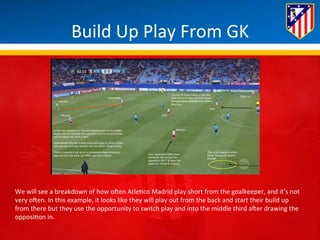
We 
will 
see 
a 
breakdown 
of 
how 
oHen 
Atle*co 
Madrid 
play 
short 
from 
the 
goalkeeper, 
and 
it’s 
not 
very 
oHen. 
In 
this 
example, 
it 
looks 
like 
they 
will 
play 
out 
from 
the 
back 
and 
start 
their 
build 
up 
from 
there 
but 
they 
use 
the 
opportunity 
to 
switch 
play 
and 
into 
the 
middle 
third 
aHer 
drawing 
the 
opposi*on 
in.
Build 
Up 
Play 
From 
Centre 
Back 
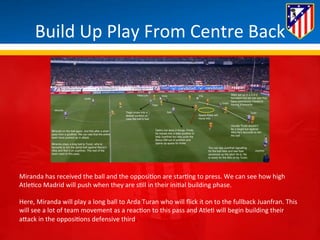
Miranda 
has 
received 
the 
ball 
and 
the 
opposi*on 
are 
star*ng 
to 
press. 
We 
can 
see 
how 
high 
Atle*co 
Madrid 
will 
push 
when 
they 
are 
s*ll 
in 
their 
ini*al 
building 
phase. 
Here, 
Miranda 
will 
play 
a 
long 
ball 
to 
Arda 
Turan 
who 
will 
flick 
it 
on 
to 
the 
fullback 
Juanfran. 
This 
will 
see 
a 
lot 
of 
team 
movement 
as 
a 
reac*on 
to 
this 
pass 
and 
Atle* 
will 
begin 
building 
their 
aBack 
in 
the 
opposi*ons 
defensive 
third.
Goal 
kick 
from 
GK 
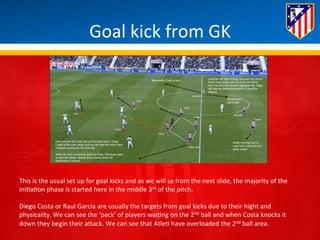
This 
is 
the 
usual 
set 
up 
for 
goal 
kicks 
and 
as 
we 
will 
se 
from 
the 
next 
slide, 
the 
majority 
of 
the 
ini*a*on 
phase 
is 
started 
here 
in 
the 
middle 
3rd 
of 
the 
pitch. 
Diego 
Costa 
or 
Raul 
Garcia 
are 
usually 
the 
targets 
from 
goal 
kicks 
due 
to 
their 
hight 
and 
physicality. 
We 
can 
see 
the 
‘pack’ 
of 
players 
wai*ng 
on 
the 
2nd 
ball 
and 
when 
Costa 
knocks 
it 
down 
they 
begin 
their 
aBack. 
We 
can 
see 
that 
Atle* 
have 
overloaded 
the 
2nd 
ball 
area.
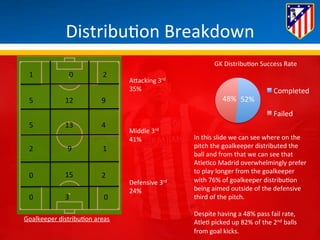
Distribu*on 
Breakdown 
1 
0 
2 
5 
12 
9 
5 
13 
4 
2 9 
1 
15 
0 2 
0 3 
0 
Goalkeeper 
distribu*on 
areas 
GK 
Distribu*on 
Success 
Rate 
48% 
52% 
Completed 
Failed 
ABacking 
3rd 
35% 
Middle 
3rd 
41% 
Defensive 
3rd 
24% 
In 
this 
slide 
we 
can 
see 
where 
on 
the 
pitch 
the 
goalkeeper 
distributed 
the 
ball 
and 
from 
that 
we 
can 
see 
that 
Atle*co 
Madrid 
overwhelmingly 
prefer 
to 
play 
longer 
from 
the 
goalkeeper 
with 
76% 
of 
goalkeeper 
distribu*on 
being 
aimed 
outside 
of 
the 
defensive 
third 
of 
the 
pitch. 
Despite 
having 
a 
48% 
pass 
fail 
rate, 
Atle* 
picked 
up 
82% 
of 
the 
2nd 
balls 
from 
goal 
kicks.
ABacking 
Shape 
in 
Possesion 
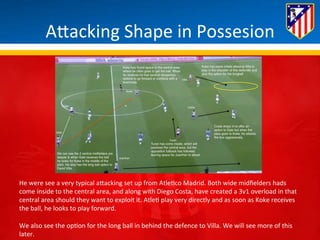
He 
were 
see 
a 
very 
typical 
aBacking 
set 
up 
from 
Atle*co 
Madrid. 
Both 
wide 
midfielders 
hads 
come 
inside 
to 
the 
central 
area, 
and 
along 
with 
Diego 
Costa, 
have 
created 
a 
3v1 
overload 
in 
that 
central 
area 
should 
they 
want 
to 
exploit 
it. 
Atle* 
play 
very 
directly 
and 
as 
soon 
as 
Koke 
receives 
the 
ball, 
he 
looks 
to 
play 
forward. 
We 
also 
see 
the 
op*on 
for 
the 
long 
ball 
in 
behind 
the 
defence 
to 
Villa. 
We 
will 
see 
more 
of 
this 
later.
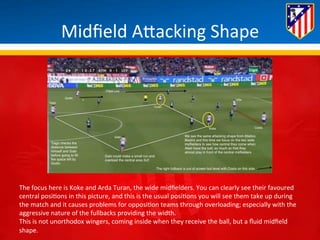
Midfield 
ABacking 
Shape 
The 
focus 
here 
is 
Koke 
and 
Arda 
Turan, 
the 
wide 
midfielders. 
You 
can 
clearly 
see 
their 
favoured 
central 
posi*ons 
in 
this 
picture, 
and 
this 
is 
the 
usual 
posi*ons 
you 
will 
see 
them 
take 
up 
during 
the 
match 
and 
it 
causes 
problems 
for 
opposi*on 
teams 
through 
overloading; 
especially 
with 
the 
aggressive 
nature 
of 
the 
fullbacks 
providing 
the 
width. 
This 
is 
not 
unorthodox 
wingers, 
coming 
inside 
when 
they 
receive 
the 
ball, 
but 
a 
fluid 
midfield 
shape.
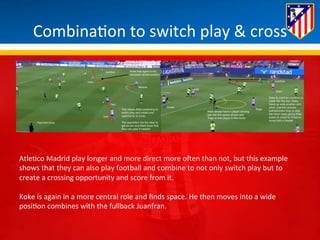
Combina*on 
to 
switch 
play 
& 
cross 
Atle*co 
Madrid 
play 
longer 
and 
more 
direct 
more 
oHen 
than 
not, 
but 
this 
example 
shows 
that 
they 
can 
also 
play 
football 
and 
combine 
to 
not 
only 
switch 
play 
but 
to 
create 
a 
crossing 
opportunity 
and 
score 
from 
it. 
Koke 
is 
again 
in 
a 
more 
central 
role 
and 
finds 
space. 
He 
then 
moves 
into 
a 
wide 
posi*on 
combines 
with 
the 
fullback 
Juanfran.
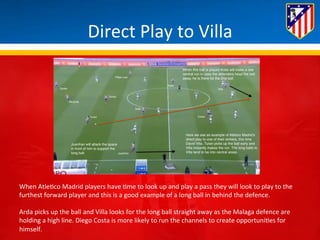
Direct 
Play 
to 
Villa 
When 
Atle*co 
Madrid 
players 
have 
*me 
to 
look 
up 
and 
play 
a 
pass 
they 
will 
look 
to 
play 
to 
the 
furthest 
forward 
player 
and 
this 
is 
a 
good 
example 
of 
a 
long 
ball 
in 
behind 
the 
defence. 
Arda 
picks 
up 
the 
ball 
and 
Villa 
looks 
for 
the 
long 
ball 
straight 
away 
as 
the 
Malaga 
defence 
are 
holding 
a 
high 
line. 
Diego 
Costa 
is 
more 
likely 
to 
run 
the 
channels 
to 
create 
opportuni*es 
for 
himself.
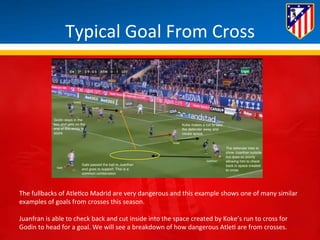
Typical 
Goal 
From 
Cross 
The 
fullbacks 
of 
Atle*co 
Madrid 
are 
very 
dangerous 
and 
this 
example 
shows 
one 
of 
many 
similar 
examples 
of 
goals 
from 
crosses 
this 
season. 
Juanfran 
is 
able 
to 
check 
back 
and 
cut 
inside 
into 
the 
space 
created 
by 
Koke’s 
run 
to 
cross 
for 
Godin 
to 
head 
for 
a 
goal. 
We 
will 
see 
a 
breakdown 
of 
how 
dangerous 
Atle* 
are 
from 
crosses.
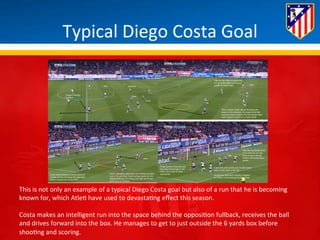
Typical 
Diego 
Costa 
Goal 
This 
is 
not 
only 
an 
example 
of 
a 
typical 
Diego 
Costa 
goal 
but 
also 
of 
a 
run 
that 
he 
is 
becoming 
known 
for, 
which 
Atle* 
have 
used 
to 
devasta*ng 
effect 
this 
season. 
Costa 
makes 
an 
intelligent 
run 
into 
the 
space 
behind 
the 
opposi*on 
fullback, 
receives 
the 
ball 
and 
drives 
forward 
into 
the 
box. 
He 
manages 
to 
get 
to 
just 
outside 
the 
6 
yards 
box 
before 
shoo*ng 
and 
scoring.
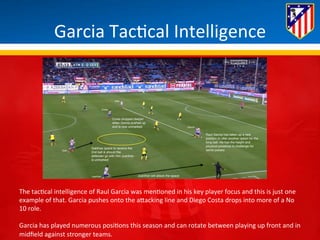
Garcia 
Tac*cal 
Intelligence 
The 
tac*cal 
intelligence 
of 
Raul 
Garcia 
was 
men*oned 
in 
his 
key 
player 
focus 
and 
this 
is 
just 
one 
example 
of 
that. 
Garcia 
pushes 
onto 
the 
aBacking 
line 
and 
Diego 
Costa 
drops 
into 
more 
of 
a 
No 
10 
role. 
Garcia 
has 
played 
numerous 
posi*ons 
this 
season 
and 
can 
rotate 
between 
playing 
up 
front 
and 
in 
midfield 
against 
stronger 
teams.
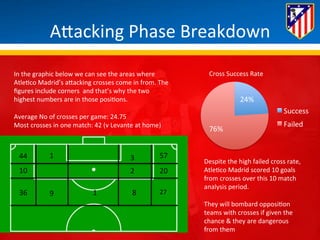
ABacking 
Phase 
Breakdown 
In 
the 
graphic 
below 
we 
can 
see 
the 
areas 
where 
Atle*co 
Madrid’s 
aBacking 
crosses 
come 
in 
from. 
The 
figures 
include 
corners 
and 
that’s 
why 
the 
two 
highest 
numbers 
are 
in 
those 
posi*ons. 
Average 
No 
of 
crosses 
per 
game: 
24.75 
Most 
crosses 
in 
one 
match: 
42 
(v 
Levante 
at 
home) 
44 
36 
9 
3 
1 8 
57 
27 
10 
1 
20 
2 
Success 
Failed 
Cross 
Success 
Rate 
76% 
24% 
Despite 
the 
high 
failed 
cross 
rate, 
Atle*co 
Madrid 
scored 
10 
goals 
from 
crosses 
over 
this 
10 
match 
analysis 
period. 
They 
will 
bombard 
opposi*on 
teams 
with 
crosses 
if 
given 
the 
chance 
& 
they 
are 
dangerous 
from 
them
ABacking 
Phase 
Summary 
Direct 
Play 
Atle*co 
Madrid 
are 
very 
direct, 
play 
long 
from 
the 
GK 
and 
try 
to 
control 
the 
game 
in 
the 
opposi*ons 
half. 
They 
create 
a 
lot 
of 
goalscoring 
chances 
and 
they 
will 
go 
forward 
at 
every 
opportunity 
when 
organise 
or 
on 
with 
a 
fast 
counter 
aBack 
Wide 
Play 
& 
Crosses 
We 
have 
seen 
that 
the 
majority 
of 
Atle*co 
Madrid’s 
scoring 
opportuni*es 
come 
from 
wide 
areas 
and 
that 
the 
fullbacks 
give 
them 
the 
width 
when 
they 
aBack 
with 
the 
wide 
midfielders 
coming 
inside. 
They 
are 
also 
a 
huge 
threat 
from 
aBacking 
set 
pieces. 
Wide 
Midfielders 
We 
have 
seen 
how 
the 
wide 
midfielders 
come 
inside 
to 
overload 
the 
central 
area 
of 
the 
pitch, 
as 
well 
as 
rota*ng 
with 
each 
other 
and 
even 
some*mes 
rota*ng 
with 
the 
strikers. 
TacQcally 
Flexible 
Atle* 
are 
an 
excellent 
team 
but 
they 
can 
also 
change 
tac*cs 
to 
suit 
their 
opposi*on 
and 
minimise 
their 
chance 
of 
geung 
a 
result.
Transi*on 
to 
Defence
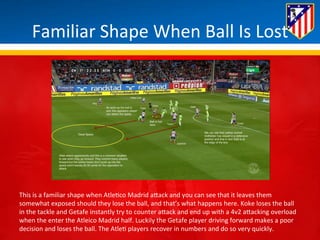
Familiar 
Shape 
When 
Ball 
Is 
Lost 
This 
is 
a 
familiar 
shape 
when 
Atle*co 
Madrid 
aBack 
and 
you 
can 
see 
that 
it 
leaves 
them 
somewhat 
exposed 
should 
they 
lose 
the 
ball, 
and 
that’s 
what 
happens 
here. 
Koke 
loses 
the 
ball 
in 
the 
tackle 
and 
Getafe 
instantly 
try 
to 
counter 
aBack 
and 
end 
up 
with 
a 
4v2 
aBacking 
overload 
when 
the 
enter 
the 
Atleico 
Madrid 
half. 
Luckily 
the 
Getafe 
player 
driving 
forward 
makes 
a 
poor 
decision 
and 
loses 
the 
ball. 
The 
Atle* 
players 
recover 
in 
numbers 
and 
do 
so 
very 
quickly.
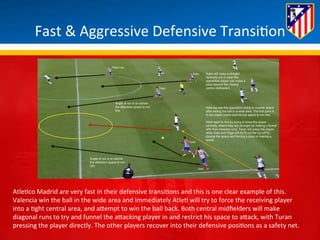
Fast 
& 
Aggressive 
Defensive 
Transi*on 
Atle*co 
Madrid 
are 
very 
fast 
in 
their 
defensive 
transi*ons 
and 
this 
is 
one 
clear 
example 
of 
this. 
Valencia 
win 
the 
ball 
in 
the 
wide 
area 
and 
immediately 
Atle* 
will 
try 
to 
force 
the 
receiving 
player 
into 
a 
*ght 
central 
area, 
and 
aBempt 
to 
win 
the 
ball 
back. 
Both 
central 
midfielders 
will 
make 
diagonal 
runs 
to 
try 
and 
funnel 
the 
aBacking 
player 
in 
and 
restrict 
his 
space 
to 
aBack, 
with 
Turan 
pressing 
the 
player 
directly. 
The 
other 
players 
recover 
into 
their 
defensive 
posi*ons 
as 
a 
safety 
net.
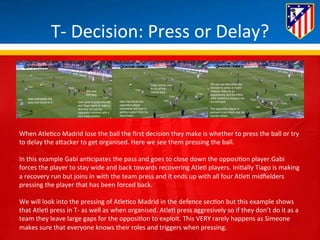
T-­‐ 
Decision: 
Press 
or 
Delay? 
When 
Atle*co 
Madrid 
lose 
the 
ball 
the 
first 
decision 
they 
make 
is 
whether 
to 
press 
the 
ball 
or 
try 
to 
delay 
the 
aBacker 
to 
get 
organised. 
Here 
we 
see 
them 
pressing 
the 
ball. 
In 
this 
example 
Gabi 
an*cipates 
the 
pass 
and 
goes 
to 
close 
down 
the 
opposi*on 
player.Gabi 
forces 
the 
player 
to 
stay 
wide 
and 
back 
towards 
recovering 
Atle* 
players. 
Ini*ally 
Tiago 
is 
making 
a 
recovery 
run 
but 
joins 
in 
with 
the 
team 
press 
and 
it 
ends 
up 
with 
all 
four 
Atle* 
midfielders 
pressing 
the 
player 
that 
has 
been 
forced 
back. 
We 
will 
look 
into 
the 
pressing 
of 
Atle*co 
Madrid 
in 
the 
defence 
sec*on 
but 
this 
example 
shows 
that 
Atle* 
press 
in 
T-­‐ 
as 
well 
as 
when 
organised. 
Atle* 
press 
aggresively 
so 
if 
they 
don’t 
do 
it 
as 
a 
team 
they 
leave 
large 
gaps 
for 
the 
opposi*on 
to 
exploit. 
This 
VERY 
rarely 
happens 
as 
Simeone 
makes 
sure 
that 
everyone 
knows 
their 
roles 
and 
triggers 
when 
pressing.
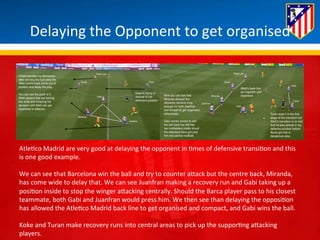
Delaying 
the 
Opponent 
to 
get 
organised 
Atle*co 
Madrid 
are 
very 
good 
at 
delaying 
the 
opponent 
in 
*mes 
of 
defensive 
transi*on 
and 
this 
is 
one 
good 
example. 
We 
can 
see 
that 
Barcelona 
win 
the 
ball 
and 
try 
to 
counter 
aBack 
but 
the 
centre 
back, 
Miranda, 
has 
come 
wide 
to 
delay 
that. 
We 
can 
see 
Juanfran 
making 
a 
recovery 
run 
and 
Gabi 
taking 
up 
a 
posi*on 
inside 
to 
stop 
the 
winger 
aBacking 
centrally. 
Should 
the 
Barca 
player 
pass 
to 
his 
closest 
teammate, 
both 
Gabi 
and 
Juanfran 
would 
press 
him. 
We 
then 
see 
than 
delaying 
the 
opposi*on 
has 
allowed 
the 
Atle*co 
Madrid 
back 
line 
to 
get 
organised 
and 
compact, 
and 
Gabi 
wins 
the 
ball. 
Koke 
and 
Turan 
make 
recovery 
runs 
into 
central 
areas 
to 
pick 
up 
the 
suppor*ng 
aBacking 
players.
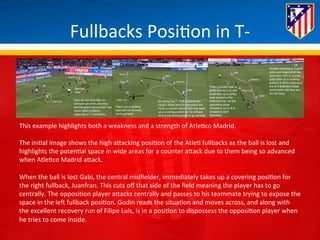
Fullbacks 
Posi*on 
in 
T-­‐ 
This 
example 
highlights 
both 
a 
weakness 
and 
a 
strength 
of 
Atle*co 
Madrid. 
The 
ini*al 
image 
shows 
the 
high 
aBacking 
posi*on 
of 
the 
Atle* 
fullbacks 
as 
the 
ball 
is 
lost 
and 
highlights 
the 
poten*al 
space 
in 
wide 
areas 
for 
a 
counter 
aBack 
due 
to 
them 
being 
so 
advanced 
when 
Atle*co 
Madrid 
aBack. 
When 
the 
ball 
is 
lost 
Gabi, 
the 
central 
midfielder, 
immediately 
takes 
up 
a 
covering 
posi*on 
for 
the 
right 
fullback, 
Juanfran. 
This 
cuts 
off 
that 
side 
of 
the 
field 
meaning 
the 
player 
has 
to 
go 
centrally. 
The 
opposi*on 
player 
aBacks 
centrally 
and 
passes 
to 
his 
teammate 
trying 
to 
expose 
the 
space 
in 
the 
leH 
fullback 
posi*on. 
Godin 
reads 
the 
situa*on 
and 
moves 
across, 
and 
along 
with 
the 
excellent 
recovery 
run 
of 
Filipe 
Luis, 
is 
in 
a 
posi*on 
to 
dispossess 
the 
opposi*on 
player 
when 
he 
tries 
to 
come 
inside.
Defensive 
Transi*on 
Summary 
Atle*co 
Madrid 
aBack 
in 
numbers 
and 
leave 
space 
that 
opposi*on 
teams 
to 
exploit 
but 
they 
are 
strong 
in 
transi*on 
to 
the 
defensive 
phase. 
Their 
main 
strengths 
are: 
Fast 
TransiQon 
When 
Atle* 
lose 
the 
ball 
they 
are 
very 
fast 
in 
transi*on 
and 
to 
get 
back 
into 
their 
defensive 
shape, 
and 
that 
leaves 
very 
liBle 
*me 
for 
the 
opposi*on 
to 
counter 
aBack. 
Press 
or 
Delay 
The 
first 
decision 
in 
defensive 
transi*on 
of 
whether 
to 
press 
the 
ball 
or 
recover 
to 
an 
organised 
shape 
is 
vital 
and 
not 
only 
are 
Atle*co 
Madrid 
strong 
in 
doing 
both, 
but 
they 
rarely 
make 
the 
wrong 
decision 
so 
opposi*on 
teams 
need 
to 
have 
a 
defined 
plan 
if 
they 
want 
to 
exploit 
the 
transi*on 
phase. 
Comfortable 
In 
TransiQon 
Atle*co 
Madrid 
have 
tac*cally 
intelligent 
players 
and 
they 
all 
understand 
what 
is 
expected 
of 
them 
in 
the 
defensive 
transi*on 
phase, 
so 
they 
are 
comfortable 
in 
transi*on. 
They 
will 
take 
up 
posi*ons 
to 
cover 
their 
teammates 
or 
force 
opposi*on 
players 
to 
play 
backwards 
un*l 
they 
can 
get 
defensively 
organised 
as 
a 
team.
Defending 
Phase
Defensive 
Organisa*on 
Villa 
Costa 
Koke 
Tiago 
Gabi 
Turan 
Filipe 
Luis 
Godin 
Miranda 
Juanfran 
Courtois 
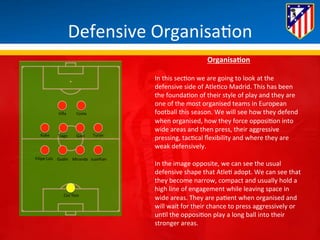
OrganisaQon 
In 
this 
sec*on 
we 
are 
going 
to 
look 
at 
the 
defensive 
side 
of 
Atle*co 
Madrid. 
This 
has 
been 
the 
founda*on 
of 
their 
style 
of 
play 
and 
they 
are 
one 
of 
the 
most 
organised 
teams 
in 
European 
football 
this 
season. 
We 
will 
see 
how 
they 
defend 
when 
organised, 
how 
they 
force 
opposi*on 
into 
wide 
areas 
and 
then 
press, 
their 
aggressive 
pressing, 
tac*cal 
flexibility 
and 
where 
they 
are 
weak 
defensively. 
In 
the 
image 
opposite, 
we 
can 
see 
the 
usual 
defensive 
shape 
that 
Atle* 
adopt. 
We 
can 
see 
that 
they 
become 
narrow, 
compact 
and 
usually 
hold 
a 
high 
line 
of 
engagement 
while 
leaving 
space 
in 
wide 
areas. 
They 
are 
pa*ent 
when 
organised 
and 
will 
wait 
for 
their 
chance 
to 
press 
aggressively 
or 
un*l 
the 
opposi*on 
play 
a 
long 
ball 
into 
their 
stronger 
areas.
Organised 
Defensive 
Units 
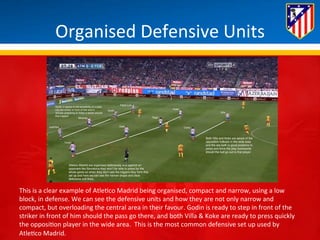
This 
is 
a 
clear 
example 
of 
Atle*co 
Madrid 
being 
organised, 
compact 
and 
narrow, 
using 
a 
low 
block, 
in 
defense. 
We 
can 
see 
the 
defensive 
units 
and 
how 
they 
are 
not 
only 
narrow 
and 
compact, 
but 
overloading 
the 
central 
area 
in 
their 
favour. 
Godin 
is 
ready 
to 
step 
in 
front 
of 
the 
striker 
in 
front 
of 
him 
should 
the 
pass 
go 
there, 
and 
both 
Villa 
& 
Koke 
are 
ready 
to 
press 
quickly 
the 
opposi*on 
player 
in 
the 
wide 
area. 
This 
is 
the 
most 
common 
defensive 
set 
up 
used 
by 
Atle*co 
Madrid.
Organised 
Medium 
Block 
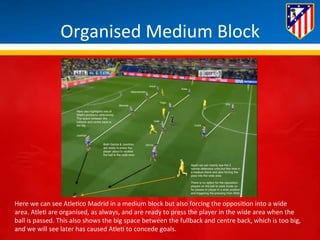
Here 
we 
can 
see 
Atle*co 
Madrid 
in 
a 
medium 
block 
but 
also 
forcing 
the 
opposi*on 
into 
a 
wide 
area. 
Atle* 
are 
organised, 
as 
always, 
and 
are 
ready 
to 
press 
the 
player 
in 
the 
wide 
area 
when 
the 
ball 
is 
passed. 
This 
also 
shows 
the 
big 
space 
between 
the 
fullback 
and 
centre 
back, 
which 
is 
too 
big, 
and 
we 
will 
see 
later 
has 
caused 
Atle* 
to 
concede 
goals.
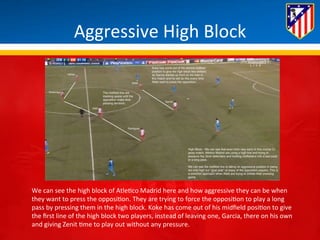
Aggressive 
High 
Block 
We 
can 
see 
the 
high 
block 
of 
Atle*co 
Madrid 
here 
and 
how 
aggressive 
they 
can 
be 
when 
they 
want 
to 
press 
the 
opposi*on. 
They 
are 
trying 
to 
force 
the 
opposi*on 
to 
play 
a 
long 
pass 
by 
pressing 
them 
in 
the 
high 
block. 
Koke 
has 
come 
out 
of 
his 
midfield 
posi*on 
to 
give 
the 
first 
line 
of 
the 
high 
block 
two 
players, 
instead 
of 
leaving 
one, 
Garcia, 
there 
on 
his 
own 
and 
giving 
Zenit 
*me 
to 
play 
out 
without 
any 
pressure.
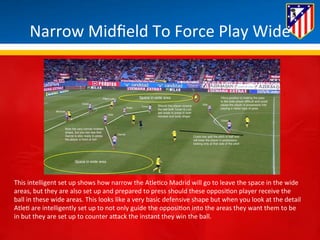
Narrow 
Midfield 
To 
Force 
Play 
Wide 
This 
intelligent 
set 
up 
shows 
how 
narrow 
the 
Atle*co 
Madrid 
will 
go 
to 
leave 
the 
space 
in 
the 
wide 
areas, 
but 
they 
are 
also 
set 
up 
and 
prepared 
to 
press 
should 
these 
opposi*on 
player 
receive 
the 
ball 
in 
these 
wide 
areas. 
This 
looks 
like 
a 
very 
basic 
defensive 
shape 
but 
when 
you 
look 
at 
the 
detail 
Atle* 
are 
intelligently 
set 
up 
to 
not 
only 
guide 
the 
opposi*on 
into 
the 
areas 
they 
want 
them 
to 
be 
in 
but 
they 
are 
set 
up 
to 
counter 
aBack 
the 
instant 
they 
win 
the 
ball.
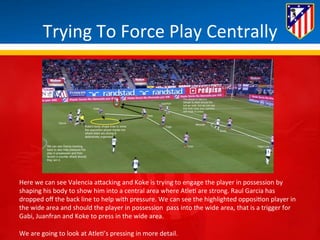
Trying 
To 
Force 
Play 
Centrally 
Here 
we 
can 
see 
Valencia 
aBacking 
and 
Koke 
is 
trying 
to 
engage 
the 
player 
in 
possession 
by 
shaping 
his 
body 
to 
show 
him 
into 
a 
central 
area 
where 
Atle* 
are 
strong. 
Raul 
Garcia 
has 
dropped 
off 
the 
back 
line 
to 
help 
with 
pressure. 
We 
can 
see 
the 
highlighted 
opposi*on 
player 
in 
the 
wide 
area 
and 
should 
the 
player 
in 
possession 
pass 
into 
the 
wide 
area, 
that 
is 
a 
trigger 
for 
Gabi, 
Juanfran 
and 
Koke 
to 
press 
in 
the 
wide 
area. 
We 
are 
going 
to 
look 
at 
Atle*’s 
pressing 
in 
more 
detail.
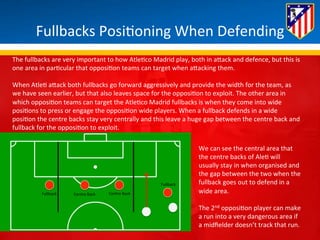
Fullbacks 
Posi*oning 
When 
Defending 
The 
fullbacks 
are 
very 
important 
to 
how 
Atle*co 
Madrid 
play, 
both 
in 
aBack 
and 
defence, 
but 
this 
is 
one 
area 
in 
par*cular 
that 
opposi*on 
teams 
can 
target 
when 
aBacking 
them. 
When 
Atle* 
aBack 
both 
fullbacks 
go 
forward 
aggressively 
and 
provide 
the 
width 
for 
the 
team, 
as 
we 
have 
seen 
earlier, 
but 
that 
also 
leaves 
space 
for 
the 
opposi*on 
to 
exploit. 
The 
other 
area 
in 
which 
opposi*on 
teams 
can 
target 
the 
Atle*co 
Madrid 
fullbacks 
is 
when 
they 
come 
into 
wide 
posi*ons 
to 
press 
or 
engage 
the 
opposi*on 
wide 
players. 
When 
a 
fullback 
defends 
in 
a 
wide 
posi*on 
the 
centre 
backs 
stay 
very 
centrally 
and 
this 
leave 
a 
huge 
gap 
between 
the 
centre 
back 
and 
fullback 
for 
the 
opposi*on 
to 
exploit. 
Centre 
Fullback 
Back 
Centre 
Back 
Fullback 
We 
can 
see 
the 
central 
area 
that 
the 
centre 
backs 
of 
Ale* 
will 
usually 
stay 
in 
when 
organised 
and 
the 
gap 
between 
the 
two 
when 
the 
fullback 
goes 
out 
to 
defend 
in 
a 
wide 
area. 
The 
2nd 
opposi*on 
player 
can 
make 
a 
run 
into 
a 
very 
dangerous 
area 
if 
a 
midfielder 
doesn’t 
track 
that 
run.
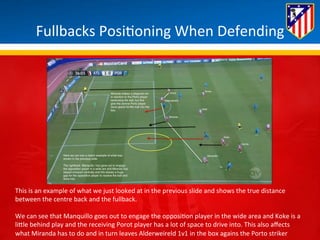
Fullbacks 
Posi*oning 
When 
Defending 
This 
is 
an 
example 
of 
what 
we 
just 
looked 
at 
in 
the 
previous 
slide 
and 
shows 
the 
true 
distance 
between 
the 
centre 
back 
and 
the 
fullback. 
We 
can 
see 
that 
Manquillo 
goes 
out 
to 
engage 
the 
opposi*on 
player 
in 
the 
wide 
area 
and 
Koke 
is 
a 
liBle 
behind 
play 
and 
the 
receiving 
Porot 
player 
has 
a 
lot 
of 
space 
to 
drive 
into. 
This 
also 
affects 
what 
Miranda 
has 
to 
do 
and 
in 
turn 
leaves 
Alderweireld 
1v1 
in 
the 
box 
agains 
the 
Porto 
striker
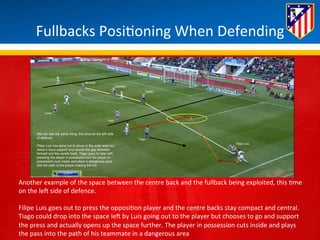
Fullbacks 
Posi*oning 
When 
Defending 
Another 
example 
of 
the 
space 
between 
the 
centre 
back 
and 
the 
fullback 
being 
exploited, 
this 
*me 
on 
the 
leH 
side 
of 
defence. 
Filipe 
Luis 
goes 
out 
to 
press 
the 
opposi*on 
player 
and 
the 
centre 
backs 
stay 
compact 
and 
central. 
Tiago 
could 
drop 
into 
the 
space 
leH 
by 
Luis 
going 
out 
to 
the 
player 
but 
chooses 
to 
go 
and 
support 
the 
press 
and 
actually 
opens 
up 
the 
space 
further. 
The 
player 
in 
possession 
cuts 
inside 
and 
plays 
the 
pass 
into 
the 
path 
of 
his 
teammate 
in 
a 
dangerous 
area
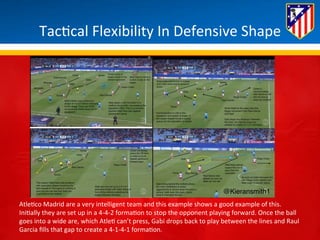
Tac*cal 
Flexibility 
In 
Defensive 
Shape 
Atle*co 
Madrid 
are 
a 
very 
intelligent 
team 
and 
this 
example 
shows 
a 
good 
example 
of 
this. 
Ini*ally 
they 
are 
set 
up 
in 
a 
4-­‐4-­‐2 
forma*on 
to 
stop 
the 
opponent 
playing 
forward. 
Once 
the 
ball 
goes 
into 
a 
wide 
are, 
which 
Atle* 
can’t 
press, 
Gabi 
drops 
back 
to 
play 
between 
the 
lines 
and 
Raul 
Garcia 
fills 
that 
gap 
to 
create 
a 
4-­‐1-­‐4-­‐1 
forma*on.
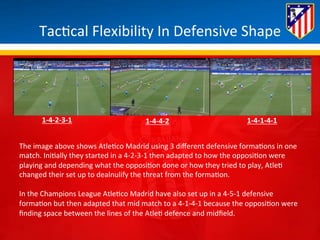
Tac*cal 
Flexibility 
In 
Defensive 
Shape 
1-­‐4-­‐2-­‐3-­‐1 
1-­‐4-­‐4-­‐2 
1-­‐4-­‐1-­‐4-­‐1 
The 
image 
above 
shows 
Atle*co 
Madrid 
using 
3 
different 
defensive 
forma*ons 
in 
one 
match. 
Ini*ally 
they 
started 
in 
a 
4-­‐2-­‐3-­‐1 
then 
adapted 
to 
how 
the 
opposi*on 
were 
playing 
and 
depending 
what 
the 
opposi*on 
done 
or 
how 
they 
tried 
to 
play, 
Atle* 
changed 
their 
set 
up 
to 
dealnulify 
the 
threat 
from 
the 
forma*on. 
In 
the 
Champions 
League 
Atle*co 
Madrid 
have 
also 
set 
up 
in 
a 
4-­‐5-­‐1 
defensive 
forma*on 
but 
then 
adapted 
that 
mid 
match 
to 
a 
4-­‐1-­‐4-­‐1 
because 
the 
opposi*on 
were 
finding 
space 
between 
the 
lines 
of 
the 
Atle* 
defence 
and 
midfield.
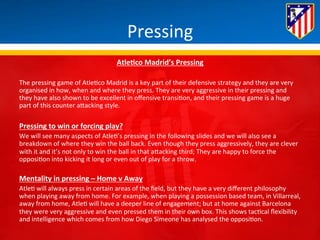
Pressing 
AtleQco 
Madrid’s 
Pressing 
The 
pressing 
game 
of 
Atle*co 
Madrid 
is 
a 
key 
part 
of 
their 
defensive 
strategy 
and 
they 
are 
very 
organised 
in 
how, 
when 
and 
where 
they 
press. 
They 
are 
very 
aggressive 
in 
their 
pressing 
and 
they 
have 
also 
shown 
to 
be 
excellent 
in 
offensive 
transi*on, 
and 
their 
pressing 
game 
is 
a 
huge 
part 
of 
this 
counter 
aBacking 
style. 
Pressing 
to 
win 
or 
forcing 
play? 
We 
will 
see 
many 
aspects 
of 
Atle*’s 
pressing 
in 
the 
following 
slides 
and 
we 
will 
also 
see 
a 
breakdown 
of 
where 
they 
win 
the 
ball 
back. 
Even 
though 
they 
press 
aggressively, 
they 
are 
clever 
with 
it 
and 
it’s 
not 
only 
to 
win 
the 
ball 
in 
that 
aBacking 
third; 
They 
are 
happy 
to 
force 
the 
opposi*on 
into 
kicking 
it 
long 
or 
even 
out 
of 
play 
for 
a 
throw. 
Mentality 
in 
pressing 
– 
Home 
v 
Away 
Atle* 
will 
always 
press 
in 
certain 
areas 
of 
the 
field, 
but 
they 
have 
a 
very 
different 
philosophy 
when 
playing 
away 
from 
home. 
For 
example, 
when 
playing 
a 
possession 
based 
team, 
in 
Villarreal, 
away 
from 
home, 
Atle* 
will 
have 
a 
deeper 
line 
of 
engagement; 
but 
at 
home 
against 
Barcelona 
they 
were 
very 
aggressive 
and 
even 
pressed 
them 
in 
their 
own 
box. 
This 
shows 
tac*cal 
flexibility 
and 
intelligence 
which 
comes 
from 
how 
Diego 
Simeone 
has 
analysed 
the 
opposi*on.
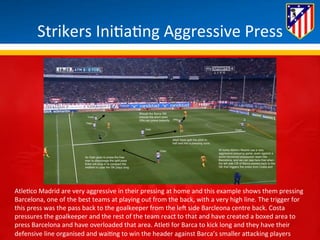
Strikers 
Ini*a*ng 
Aggressive 
Press 
Atle*co 
Madrid 
are 
very 
aggressive 
in 
their 
pressing 
at 
home 
and 
this 
example 
shows 
them 
pressing 
Barcelona, 
one 
of 
the 
best 
teams 
at 
playing 
out 
from 
the 
back, 
with 
a 
very 
high 
line. 
The 
trigger 
for 
this 
press 
was 
the 
pass 
back 
to 
the 
goalkeeper 
from 
the 
leH 
side 
Barcleona 
centre 
back. 
Costa 
pressures 
the 
goalkeeper 
and 
the 
rest 
of 
the 
team 
react 
to 
that 
and 
have 
created 
a 
boxed 
area 
to 
press 
Barcelona 
and 
have 
overloaded 
that 
area. 
Atle* 
for 
Barca 
to 
kick 
long 
and 
they 
have 
their 
defensive 
line 
organised 
and 
wai*ng 
to 
win 
the 
header 
against 
Barca’s 
smaller 
aBacking 
players
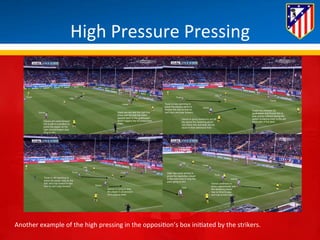
High 
Pressure 
Pressing 
Another 
example 
of 
the 
high 
pressing 
in 
the 
opposi*on’s 
box 
ini*ated 
by 
the 
strikers.
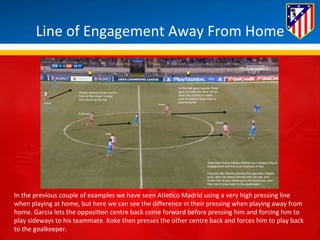
Line 
of 
Engagement 
Away 
From 
Home 
In 
the 
previous 
couple 
of 
examples 
we 
have 
seen 
Atle*co 
Madrid 
using 
a 
very 
high 
pressing 
line 
when 
playing 
at 
home, 
but 
here 
we 
can 
see 
the 
difference 
in 
their 
pressing 
when 
playing 
away 
from 
home. 
Garcia 
lets 
the 
opposi*on 
centre 
back 
come 
forward 
before 
pressing 
him 
and 
forcing 
him 
to 
play 
sideways 
to 
his 
teammate. 
Koke 
then 
presses 
the 
other 
centre 
back 
and 
forces 
him 
to 
play 
back 
to 
the 
goalkeeper.
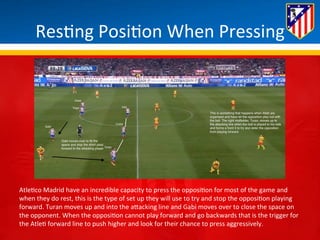
Res*ng 
Posi*on 
When 
Pressing 
Atle*co 
Madrid 
have 
an 
incredible 
capacity 
to 
press 
the 
opposi*on 
for 
most 
of 
the 
game 
and 
when 
they 
do 
rest, 
this 
is 
the 
type 
of 
set 
up 
they 
will 
use 
to 
try 
and 
stop 
the 
opposi*on 
playing 
forward. 
Turan 
moves 
up 
and 
into 
the 
aBacking 
line 
and 
Gabi 
moves 
over 
to 
close 
the 
space 
on 
the 
opponent. 
When 
the 
opposi*on 
cannot 
play 
forward 
and 
go 
backwards 
that 
is 
the 
trigger 
for 
the 
Atle* 
forward 
line 
to 
push 
higher 
and 
look 
for 
their 
chance 
to 
press 
aggressively.
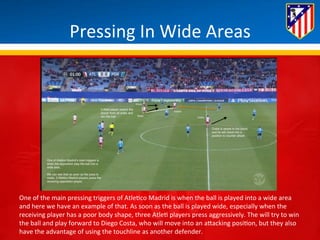
Pressing 
In 
Wide 
Areas 
One 
of 
the 
main 
pressing 
triggers 
of 
Atle*co 
Madrid 
is 
when 
the 
ball 
is 
played 
into 
a 
wide 
area 
and 
here 
we 
have 
an 
example 
of 
that. 
As 
soon 
as 
the 
ball 
is 
played 
wide, 
especially 
when 
the 
receiving 
player 
has 
a 
poor 
body 
shape, 
three 
Atle* 
players 
press 
aggressively. 
The 
will 
try 
to 
win 
the 
ball 
and 
play 
forward 
to 
Diego 
Costa, 
who 
will 
move 
into 
an 
aBacking 
posi*on, 
but 
they 
also 
have 
the 
advantage 
of 
using 
the 
touchline 
as 
another 
defender.
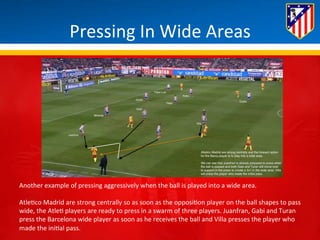
Pressing 
In 
Wide 
Areas 
Another 
example 
of 
pressing 
aggressively 
when 
the 
ball 
is 
played 
into 
a 
wide 
area. 
Atle*co 
Madrid 
are 
strong 
centrally 
so 
as 
soon 
as 
the 
opposi*on 
player 
on 
the 
ball 
shapes 
to 
pass 
wide, 
the 
Atle* 
players 
are 
ready 
to 
press 
in 
a 
swarm 
of 
three 
players. 
Juanfran, 
Gabi 
and 
Turan 
press 
the 
Barcelona 
wide 
player 
as 
soon 
as 
he 
receives 
the 
ball 
and 
Villa 
presses 
the 
player 
who 
made 
the 
ini*al 
pass.
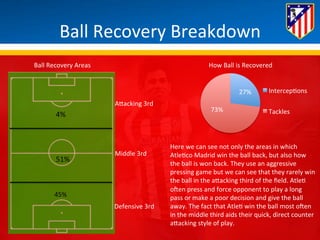
Ball 
Recovery 
Breakdown 
4% 
51% 
45% 
Intercep*ons 
Tackles 
27% 
73% 
Ball 
Recovery 
Areas 
How 
Ball 
is 
Recovered 
Here 
we 
can 
see 
not 
only 
the 
areas 
in 
which 
Atle*co 
Madrid 
win 
the 
ball 
back, 
but 
also 
how 
the 
ball 
is 
won 
back. 
They 
use 
an 
aggressive 
pressing 
game 
but 
we 
can 
see 
that 
they 
rarely 
win 
the 
ball 
in 
the 
aBacking 
third 
of 
the 
field. 
Atle* 
oHen 
press 
and 
force 
opponent 
to 
play 
a 
long 
pass 
or 
make 
a 
poor 
decision 
and 
give 
the 
ball 
away. 
The 
fact 
that 
Atle* 
win 
the 
ball 
most 
oHen 
in 
the 
middle 
third 
aids 
their 
quick, 
direct 
counter 
aBacking 
style 
of 
play. 
ABacking 
3rd 
Middle 
3rd 
Defensive 
3rd
Defending 
Phase 
Summary 
We 
have 
seen 
that 
Atle*co 
Madrid 
are 
very 
strong 
in 
defence 
whether 
that 
be 
pressing 
the 
opponent, 
transi*on 
to 
defence 
or 
defending 
when 
organised. 
This 
is 
key 
to 
how 
they 
play 
and 
some 
of 
their 
strengths 
in 
defending 
are: 
PaQent 
When 
Organised 
Atle*co 
Madrid 
are 
pa*ent 
when 
they 
are 
defensively 
organised 
and 
will 
wait 
for 
their 
chance 
to 
win 
the 
ball, 
whether 
that 
be 
forcing 
the 
opponent 
into 
a 
mistake 
or 
wai*ng 
for 
a 
trigger 
to 
press. 
Aggressive 
Pressing 
We 
have 
see 
how 
high 
Atle* 
press 
when 
at 
home 
and 
it 
suffocates 
many 
of 
their 
opponents 
and 
forces 
them 
to 
play 
into 
areas 
where 
Atle* 
strong 
and 
they 
can 
counter 
aBack 
from 
there. 
Defensively 
Flexible 
Not 
only 
can 
Atle*co 
Madrid 
change 
defensive 
shape 
to 
suit 
the 
next 
opponent, 
but 
they 
can 
do 
it 
mid 
game 
without 
a 
problem. 
They 
have 
also 
been 
shown 
to 
use 
different 
mentali*es 
depending 
on 
whether 
they 
are 
playing 
at 
home 
or 
away.
Transi*on 
To 
ABack
Winning 
To 
Counter 
In 
Wide 
Area 
The 
first 
example 
of 
the 
transi*on 
to 
aBack 
from 
Atle*co 
Madrid 
is 
showing 
how 
they 
press 
to 
win 
the 
ball 
in 
wide 
areas 
and 
then 
aBack 
quickly. 
The 
leH 
back, 
Filipe 
Luis, 
can 
see 
the 
opposi*on 
player 
is 
about 
to 
receive 
the 
ball 
in 
a 
poor 
body 
posi*on 
and 
this 
triggers 
him 
to 
press. 
Luis 
presses 
aggressively 
and 
wins 
the 
ball, 
and 
instantly 
looks 
for 
Arda 
Turan, 
who 
aBacks 
the 
space 
behind 
the 
opposi*on 
in 
the 
wide 
area. 
Diego 
Costa 
makes 
a 
run 
between 
the 
opposi*on 
centre 
backs 
and 
into 
a 
good 
posi*on 
to 
receive 
the 
ball 
to 
aBempt 
a 
shot 
on 
goal.
T+ 
in 
Central 
Area 
Here 
we 
see 
an 
example 
of 
an 
offensive 
transi*on 
in 
a 
central 
area. 
Arda 
Turan 
and 
Gabi 
press 
the 
opposi*on 
player 
and 
force 
him 
into 
a 
makign 
a 
poor 
pass, 
which 
goes 
straight 
to 
Koke. 
When 
Koke 
gets 
the 
ball, 
Arda 
Turan 
aBacks 
quickly 
and 
receives 
the 
ball 
in 
a 
pocket 
of 
space; 
He 
then 
looks 
for 
Diego 
Costa 
who 
is 
making 
a 
blindside 
run 
behind 
the 
opposi*on 
player 
and 
into 
the 
box. 
Turan 
plays 
an 
excellent 
through 
ball 
between 
the 
opposi*on 
defenders 
and 
into 
the 
patch 
of 
Costa. 
Raul 
Garcia 
moves 
towards 
Arda 
to 
engage 
the 
centre 
back 
closest 
to 
him, 
stop 
him 
from 
from 
recovering 
so 
quickly 
and 
giving 
Costa 
and 
extra 
half 
second 
on 
the 
ball.
Strikers 
Combining 
In 
Central 
T+ 
This 
offensive 
transi*on 
shows 
how 
quickly 
Atle*co 
Madrid 
can 
aBack 
from 
a 
defensively 
organised 
posi*on. 
We 
can 
see 
the 
defensive 
units 
and 
when 
Gabi 
and 
Tiago 
press 
and 
win 
the 
ball 
that 
ini*ates 
the 
counter 
aBack. 
When 
Gabi 
wins 
the 
ball 
he 
quickly 
passes 
to 
David 
Villa 
who 
turns 
to 
play 
forward 
and 
plays 
a 
one 
two 
with 
Diego 
Costa 
which 
takes 
the 
last 
Barcelona 
midfielders 
out 
of 
the 
game 
and 
gives 
him 
space 
to 
drive 
into. 
Diego 
Costa 
is 
fouled 
but 
Villa 
con*nues 
with 
his 
aBack 
but 
is 
dispossessed. 
This 
shows 
how 
quickly 
Atle*co 
Madrid 
can 
go 
from 
defending 
to 
geung 
behind 
the 
opposi*ons 
midfield 
to 
bear 
down 
on 
their 
defence.
Long 
Ball 
To 
Diego 
Costa 
Diego 
Costa 
is 
usually 
the 
main 
target 
in 
Atle*co 
Madrid’s 
offensive 
transi*on 
and 
here 
is 
one 
example 
of 
that. 
Juanfran 
wins 
the 
ball 
in 
a 
central 
area 
and 
it 
falls 
to 
Koke, 
who 
looks 
forward 
and 
plays 
an 
instant 
pass 
to 
Diego 
Costa. 
Costa 
has 
dragged 
his 
marked 
into 
a 
wide 
area 
and 
created 
space 
for 
himself. 
Costa 
heads 
the 
ball 
back 
to 
the 
unmarked 
Turan 
who 
can 
aBack 
immiediatly 
and 
he 
plays 
a 
through 
ball 
into 
the 
ball 
of 
Diego 
Costa. 
David 
Villa 
also 
makes 
a 
run 
in 
the 
centre 
of 
the 
pitch 
to 
engage 
the 
opposi*on 
defendres 
and 
also 
to 
give 
Diego 
Costa 
a 
passing 
op*on 
when 
he 
gets 
closer 
to 
the 
opposi*on 
box.
Exploi*ng 
Opposi*on 
Tac*cs 
Diego 
Simeone 
has 
a 
fantas*c 
aBen*on 
to 
detail 
when 
it 
comes 
to 
analysing 
opponents 
and 
here 
we 
can 
see 
Atle*co 
Madrid 
exploi*ng 
the 
opposi*on 
using 
their 
fullbacks 
when 
aBacking. 
Getafe 
are 
trying 
to 
aBack 
but 
a 
poor 
pass 
is 
player 
straight 
to 
Juanfran 
who 
recognises 
this 
as 
a 
chance 
to 
counter 
aBack. 
He 
instantly 
drives 
forward 
and 
Adrian 
bends 
his 
run 
into 
the 
space 
leH 
by 
the 
fullback 
to 
receive 
the 
ball 
from 
Juanfran. 
Adrian 
aBacks 
the 
wide 
area 
forcing 
the 
opposi*on 
central 
defenders 
to 
come 
wider, 
despite 
only 
having 
a 
2v2 
against 
the 
Atle* 
strikers, 
and 
this 
leaves 
David 
Villa 
unmarked 
at 
the 
back 
post 
to 
tap 
in 
from 
Adrian’s 
cross. 
From 
their 
own 
box 
to 
in 
the 
back 
of 
the 
opposi*on 
net 
in 
just 
9 
seconds!
Offensive 
Transi*on 
Summary 
Atle*co 
Madrid 
are 
excellent 
in 
their 
offensive 
transi*ons 
and 
it 
really 
is 
a 
strength 
of 
how 
they 
play 
and 
we 
can 
see 
how 
effec*ve 
they 
are 
in 
the 
goals 
they 
have 
scored 
from 
counter 
aBacks. 
Some 
of 
the 
key 
aspects 
in 
there 
offensive 
transi*on 
are: 
Very 
Fast 
In 
TransiQon 
We 
have 
seen 
just 
how 
quickly 
Atle*co 
Madrid 
can 
win 
the 
ball 
and 
fashion 
themsleves 
a 
goal 
scoring 
opportunity. 
They 
are 
organised 
when 
defending 
and 
the 
forward 
thinking 
players 
know 
exactly 
where 
and 
when 
to 
run 
to 
receive 
the 
ball. 
Strength 
of 
Diego 
Costa 
Diego 
Costa 
is 
having 
a 
great 
season 
and 
that 
is 
due 
in 
part 
to 
Atle*co 
Madrid 
playing 
to 
his 
strengths. 
He 
is 
very 
fast, 
strong 
and 
also 
a 
great 
finisher 
in 
the 
box. 
He 
is 
the 
main 
out 
ball 
in 
their 
offensive 
transi*on 
and 
he 
is 
tough 
for 
opposi*on 
defenders 
to 
stop 
once 
he’s 
in 
full 
flight. 
TacQcal 
Understanding 
of 
Opponents 
Diego 
Simone 
analyses 
opponents 
and 
knows 
their 
weak 
areas 
in 
transi*on. 
For 
example, 
most 
teams 
in 
La 
Liga 
aBack 
with 
their 
fullback 
so 
it’s 
not 
uncommon 
to 
see 
Diego 
Costa 
take 
up 
a 
wide 
posi*on 
or 
for 
the 
midfielders 
of 
Atle* 
to 
drive 
into 
that 
area 
when 
they 
win 
the 
ball.
Conclusion
Story 
AHer 
10 
Games 
La 
Liga 
Table 
Champions 
League 
Table 
The 
tables 
opposite 
show 
how 
things 
stand 
aHer 
the 
10 
game 
period, 
but 
doesn’t 
tell 
the 
full 
story. 
Atle*co 
Madrid 
went 
unbeaten 
in 
the 
period 
in 
this 
analysis 
piece. 
They 
won 
6 
games 
and 
drew 
4 
across 
the 
10 
games. 
They 
dropped 
points 
against 
Villarreal, 
Barcelona 
and 
Sevilla 
in 
La 
Liga, 
and 
were 
held 
to 
a 
draw 
in 
Russia 
against 
Zenit 
in 
the 
Champions 
League. 
Atle*co 
Madrid 
have 
done 
a 
lot 
to 
not 
only 
strengthen 
their 
growing 
reputa*on, 
but 
to 
also 
put 
themselves 
in 
genuine 
conten*on 
for 
a 
league 
*tle 
for 
the 
first 
*me 
in 
many 
years. 
Their 
‘No 
Fear’ 
approach 
against 
Barcelona 
showed 
many 
doubters 
that 
they 
are 
prepared 
to 
go 
toe 
to 
toe 
against 
the 
strongest 
teams 
in 
Europe, 
and 
con*nue 
to 
play 
with 
the 
same 
style 
of 
play 
that 
has 
grabbed 
the 
aBen*on 
of 
many 
fans, 
pundits 
and 
other 
respected 
people 
within 
the 
world 
game.
Strengths 
OrganisaQon 
Atle*co 
Madrid 
are 
excep*onally 
well 
organised 
in 
defence, 
possibly 
the 
most 
organised 
team 
in 
Europe, 
and 
this 
has 
become 
a 
huge 
asset 
for 
this 
team 
shown 
by 
the 
low 
number 
of 
goals 
conceaded 
this 
season. 
TransiQons 
A 
huge 
strength 
of 
this 
team 
is 
their 
speed 
of 
transi*on 
both 
aBacking 
and 
defending. 
The 
speed, 
intensity 
and 
aggressiveness 
of 
their 
transi*ons 
are 
very 
difficult 
for 
any 
opposi*on 
to 
exploit. 
They 
are 
one 
of 
the 
best 
counter 
aBacking 
teams 
in 
Europe 
this 
season. 
Pressing 
The 
high 
line 
held 
by 
Atle*co 
Madrid 
combined 
with 
their 
tac*cal 
pressing 
game 
has 
shown 
to 
be 
very 
difficult 
for 
opposi*on 
teams, 
of 
any 
level, 
to 
deal 
with. 
Direct 
Style 
of 
Play 
The 
directness 
of 
Atle*co 
Madrid’s 
style 
of 
play 
and 
the 
players 
they 
have 
carrying 
it 
out 
have 
paid 
dividends 
in 
a 
league 
tradi*onally 
known 
for 
a 
very 
different 
style 
of 
play. 
Work 
rate 
Atle*co 
Madrid 
have 
a 
*reless 
work 
rate, 
which 
is 
demanded 
by 
the 
manager. 
Whether 
it 
be 
their 
pressing 
or 
through 
specific 
tac*cal 
instruc*ons, 
Atle*co 
Madrid 
work 
give 
100% 
effort 
100% 
of 
the 
*me
Weaknesses 
Space 
Between 
Units 
When 
Atle*co 
Madrid 
aBack, 
they 
do 
so 
in 
numbers 
and 
this 
can 
some*mes 
cause 
them 
problems. 
They 
oHen 
leave 
a 
20 
yard 
gap 
between 
the 
two 
central 
defenders 
and 
the 
closest 
suppor*ng 
midfield 
player. 
This 
has 
also 
shown 
to 
be 
an 
issue 
when 
teams 
drop 
off 
against 
them 
as 
the 
long 
ball 
forwards 
doesn’t 
find 
an 
Atle* 
player 
Leaving 
Space 
When 
Pressing 
Atle*co 
Madrid 
use 
a 
high 
intensity 
pressing 
game 
and 
some*mes 
when 
their 
pressing 
is 
just 
a 
liBle 
off, 
the 
opposi*on 
can 
play 
out 
and 
aBack 
their 
weaker 
areas. 
Possession 
Atle*co 
Madrid 
play 
most 
of 
their 
matches 
in 
transi*onal 
phase 
due 
to 
their 
style 
of 
play. 
They 
have 
shown 
to 
be 
excellent 
in 
transi*on, 
however 
some*mes 
they 
could 
benefit 
by 
keeping 
possession 
and 
perhaps 
res*ng 
on 
the 
ball 
to 
draw 
teams 
out 
before 
playing 
their 
more 
direct 
football. 
Mentality 
This 
Atle*co 
Madrid 
team 
are 
new 
to 
figh*ng 
for 
the 
league 
*tle 
at 
this 
stage 
as 
well 
as 
the 
Champions 
League 
and 
some*mes 
thei 
mentality 
to 
see 
out 
some 
games 
has 
been 
called 
into 
ques*on.
Final 
Thoughts 
Over 
the 
last 
10 
matches 
I 
have 
learned 
a 
lot 
about 
Atle*co 
Madrid, 
their 
style 
of 
play, 
their 
tac*cs 
and 
their 
players. 
On 
the 
surface 
Atle*co 
Madrid 
look 
like 
a 
long 
ball 
team 
but 
when 
you 
scratch 
the 
surface 
you 
can 
see 
the 
tac*cal 
analysis 
and 
understanding 
that 
Diego 
Simeone 
drills 
into 
his 
players. 
The 
movement 
of 
their 
players 
is 
fantas*c 
and 
they 
compliment 
each 
other 
very 
well. 
The 
ever 
changing 
tac*cs 
and 
forma*ons 
would 
be 
tough 
for 
any 
team 
to 
manage 
but 
Simeone’s 
men 
seem 
to 
go 
from 
match 
to 
match, 
and 
tac*cal 
instruc*on 
to 
tac*cal 
instruc*on, 
seamlessly. 
I 
think 
the 
biggest 
thing 
is 
Simeone 
looking 
at 
the 
Spanish 
league 
and 
how 
football 
is 
played 
there 
and 
flying 
in 
the 
face 
of 
that, 
and 
seung 
up 
his 
team 
to 
exploit 
every 
weakness 
in 
the 
tradi*onal 
Spanish 
style 
of 
play. 
They 
play 
out 
from 
the 
back, 
we 
press. 
They 
don’t 
like 
physical 
confronta*on, 
we 
use 
intelligent, 
powerful 
players 
who 
will 
fight 
for 
every 
ball. 
If 
Atle*co 
Madrid 
played 
in 
some 
other 
leagues 
they 
would 
be 
chas*sed 
for 
their 
style 
of 
play, 
but 
aHer 
looking 
at 
them 
closely, 
we 
can 
see 
that 
they 
are 
a 
lot 
more 
than 
your 
average 
team.
Thank You For Reading 
Kieran Smith 
Licenced Football Coach 
All work in this 
presentation is my own 
and is not to be copied.