UNIVERSE AND IT’S
BOUNDARIES
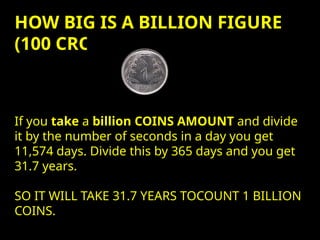
HOW BIG IS A BILLION FIGURE
(100 CRORES)
If you take a billion COINS AMOUNT and divide
it by the number of seconds in a day you get
11,574 days. Divide this by 365 days and you get
31.7 years.
SO IT WILL TAKE 31.7 YEARS TOCOUNT 1 BILLION
COINS.
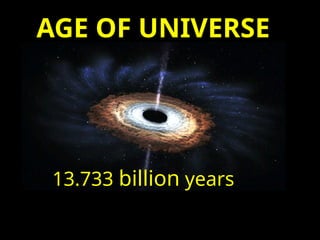
13.733 billion years
AGE OF UNIVERSE
HOW UNIVERSE STARTED
BIG BANG
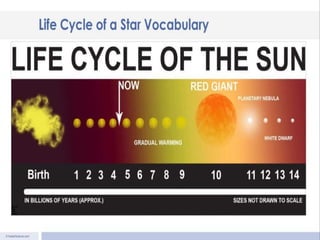
OUR SUN
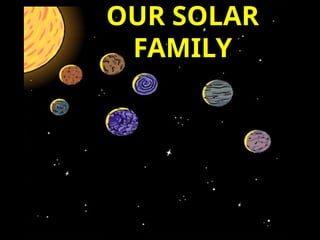
OUR SOLAR
FAMILY
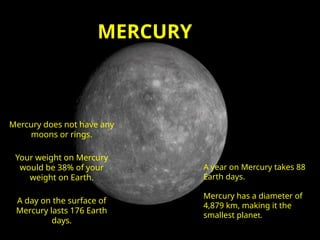
MERCURY
Mercury does not have any
moons or rings.
Your weight on Mercury
would be 38% of your
weight on Earth.
A day on the surface of
Mercury lasts 176 Earth
days.
A year on Mercury takes 88
Earth days.
Mercury has a diameter of
4,879 km, making it the
smallest planet.
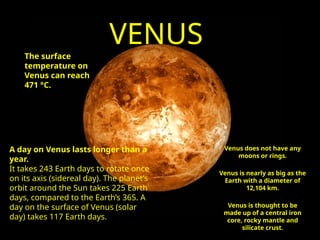
VENUS
Venus does not have any
moons or rings.
Venus is nearly as big as the
Earth with a diameter of
12,104 km.
Venus is thought to be
made up of a central iron
core, rocky mantle and
silicate crust.
The surface
temperature on
Venus can reach
471 °C.
A day on Venus lasts longer than a
year.
It takes 243 Earth days to rotate once
on its axis (sidereal day). The planet’s
orbit around the Sun takes 225 Earth
days, compared to the Earth’s 365. A
day on the surface of Venus (solar
day) takes 117 Earth days.
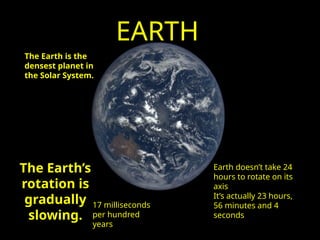
EARTH
The Earth’s
rotation is
gradually
slowing.
The Earth is the
densest planet in
the Solar System.
17 milliseconds
per hundred
years
Earth doesn’t take 24
hours to rotate on its
axis
It’s actually 23 hours,
56 minutes and 4
seconds
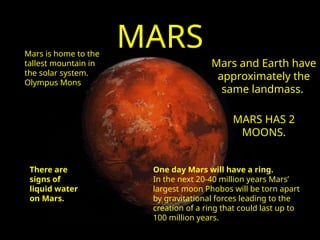
MARS
Mars and Earth have
approximately the
same landmass.
MARS HAS 2
MOONS.
Mars is home to the
tallest mountain in
the solar system.
Olympus Mons
There are
signs of
liquid water
on Mars.
One day Mars will have a ring.
In the next 20-40 million years Mars’
largest moon Phobos will be torn apart
by gravitational forces leading to the
creation of a ring that could last up to
100 million years.
THE ASTEROID BELT
Asteroid Belt objects are made of
rock and stone. Some are solid
objects, while others are orbiting
“rubble piles”.
The Asteroid Belt contains billions
and billions of asteroids.
Some asteroids in the Belt are quite
large, but most range in size down to
pebbles.
The asteroid 1/Ceres is also
designated as a dwarf
planet, the largest one in
the inner solar system.
We know of at least 7,000
asteroids.
JUPITER
Jupiter has the
shortest day of
all the planets.
Jupiter orbits
the Sun once
every 11.8 Earth
years.
Jupiter’s moon
Ganymede is the
largest moon in
the solar system.
Jupiter has a
thin ring
system.
JUPITER
HAVE 79
MOONS.
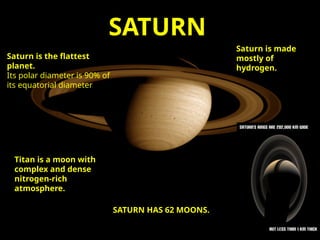
SATURN
Saturn is the flattest
planet.
Its polar diameter is 90% of
its equatorial diameter
Saturn is made
mostly of
hydrogen.
Titan is a moon with
complex and dense
nitrogen-rich
atmosphere.
SATURN HAS 62 MOONS.
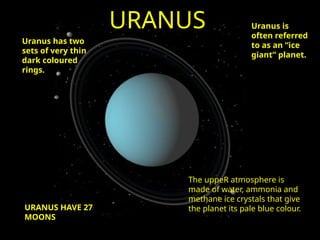
URANUS
Uranus has two
sets of very thin
dark coloured
rings.
The uppeR atmosphere is
made of water, ammonia and
methane ice crystals that give
the planet its pale blue colour.
Uranus is
often referred
to as an “ice
giant” planet.
URANUS HAVE 27
MOONS
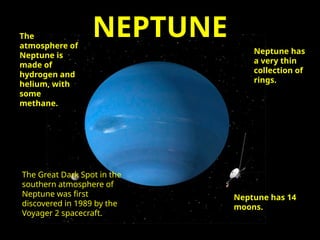
NEPTUNE
The
atmosphere of
Neptune is
made of
hydrogen and
helium, with
some
methane.
Neptune has
a very thin
collection of
rings.
Neptune has 14
moons.
The Great Dark Spot in the
southern atmosphere of
Neptune was first
discovered in 1989 by the
Voyager 2 spacecraft.
WE WILL GIVE PLUTO A
TRIBUTE TOO
Pluto was reclassified from a planet to a dwarf planet in 2006.
This is when the IAU formalised the definition of a planet as “A
planet is a celestial body that (a) is in orbit around the Sun, (b)
has sufficient mass for its self-gravity to overcome rigid body
forces so that it assumes a hydrostatic equilibrium (nearly round)
shape, and (c) has cleared the neighbourhood around its orbit.”
Pluto is one
third water& IT
HAVE 5 MOONS.
Pluto has a
eccentric and
inclined orbit.
This takes it between
4.4 and 7.3 billion km
from the
Sun meaning Pluto is
periodically closer to
the Sun than
Neptune.
Pluto sometimes has an
atmosphere.
When Pluto elliptical orbit
takes it closer to the Sun, its
surface ice thaws and forms
a thin atmosphere primarily
of nitrogen which slowly
escapes the planet
WHAT IS LIFE AND HOW IT CAME
INTO EXISTANCE ON EARTH
THE STATE OF BEING
CONSCIOUS IS
TERMED AS BEING
LIVING
ACCORDING TO
SCIENTISTS AND
Philosophers LIFE
CAME INTO EXISTANCE
IN THE FOLLOWING
WAYS:-
1. INTELLIGENT
DESIGNER.
2. PRIMORDIAL SOUP.
3. Panspermia
HYPOTHESIS.
4. ZOO HYPOTHESIS.
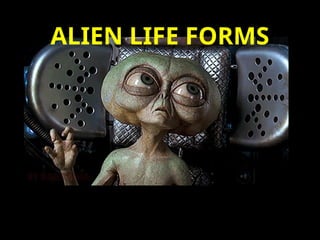
ALIEN LIFE FORMS
HOW ALIENS WOULD
ACTUALLY LOOK LIKE

Astronomy guide to the solarsystem and beyond

  • 1.
  • 2.
    HOW BIG ISA BILLION FIGURE (100 CRORES) If you take a billion COINS AMOUNT and divide it by the number of seconds in a day you get 11,574 days. Divide this by 365 days and you get 31.7 years. SO IT WILL TAKE 31.7 YEARS TOCOUNT 1 BILLION COINS.
  • 3.
  • 4.
  • 6.
  • 9.
  • 10.
    MERCURY Mercury does nothave any moons or rings. Your weight on Mercury would be 38% of your weight on Earth. A day on the surface of Mercury lasts 176 Earth days. A year on Mercury takes 88 Earth days. Mercury has a diameter of 4,879 km, making it the smallest planet.
  • 11.
    VENUS Venus does nothave any moons or rings. Venus is nearly as big as the Earth with a diameter of 12,104 km. Venus is thought to be made up of a central iron core, rocky mantle and silicate crust. The surface temperature on Venus can reach 471 °C. A day on Venus lasts longer than a year. It takes 243 Earth days to rotate once on its axis (sidereal day). The planet’s orbit around the Sun takes 225 Earth days, compared to the Earth’s 365. A day on the surface of Venus (solar day) takes 117 Earth days.
  • 12.
    EARTH The Earth’s rotation is gradually slowing. TheEarth is the densest planet in the Solar System. 17 milliseconds per hundred years Earth doesn’t take 24 hours to rotate on its axis It’s actually 23 hours, 56 minutes and 4 seconds
  • 13.
    MARS Mars and Earthhave approximately the same landmass. MARS HAS 2 MOONS. Mars is home to the tallest mountain in the solar system. Olympus Mons There are signs of liquid water on Mars. One day Mars will have a ring. In the next 20-40 million years Mars’ largest moon Phobos will be torn apart by gravitational forces leading to the creation of a ring that could last up to 100 million years.
  • 14.
    THE ASTEROID BELT AsteroidBelt objects are made of rock and stone. Some are solid objects, while others are orbiting “rubble piles”. The Asteroid Belt contains billions and billions of asteroids. Some asteroids in the Belt are quite large, but most range in size down to pebbles. The asteroid 1/Ceres is also designated as a dwarf planet, the largest one in the inner solar system. We know of at least 7,000 asteroids.
  • 16.
    JUPITER Jupiter has the shortestday of all the planets. Jupiter orbits the Sun once every 11.8 Earth years. Jupiter’s moon Ganymede is the largest moon in the solar system. Jupiter has a thin ring system. JUPITER HAVE 79 MOONS.
  • 17.
    SATURN Saturn is theflattest planet. Its polar diameter is 90% of its equatorial diameter Saturn is made mostly of hydrogen. Titan is a moon with complex and dense nitrogen-rich atmosphere. SATURN HAS 62 MOONS.
  • 18.
    URANUS Uranus has two setsof very thin dark coloured rings. The uppeR atmosphere is made of water, ammonia and methane ice crystals that give the planet its pale blue colour. Uranus is often referred to as an “ice giant” planet. URANUS HAVE 27 MOONS
  • 19.
    NEPTUNE The atmosphere of Neptune is madeof hydrogen and helium, with some methane. Neptune has a very thin collection of rings. Neptune has 14 moons. The Great Dark Spot in the southern atmosphere of Neptune was first discovered in 1989 by the Voyager 2 spacecraft.
  • 20.
    WE WILL GIVEPLUTO A TRIBUTE TOO Pluto was reclassified from a planet to a dwarf planet in 2006. This is when the IAU formalised the definition of a planet as “A planet is a celestial body that (a) is in orbit around the Sun, (b) has sufficient mass for its self-gravity to overcome rigid body forces so that it assumes a hydrostatic equilibrium (nearly round) shape, and (c) has cleared the neighbourhood around its orbit.” Pluto is one third water& IT HAVE 5 MOONS. Pluto has a eccentric and inclined orbit. This takes it between 4.4 and 7.3 billion km from the Sun meaning Pluto is periodically closer to the Sun than Neptune. Pluto sometimes has an atmosphere. When Pluto elliptical orbit takes it closer to the Sun, its surface ice thaws and forms a thin atmosphere primarily of nitrogen which slowly escapes the planet
  • 21.
    WHAT IS LIFEAND HOW IT CAME INTO EXISTANCE ON EARTH THE STATE OF BEING CONSCIOUS IS TERMED AS BEING LIVING ACCORDING TO SCIENTISTS AND Philosophers LIFE CAME INTO EXISTANCE IN THE FOLLOWING WAYS:- 1. INTELLIGENT DESIGNER. 2. PRIMORDIAL SOUP. 3. Panspermia HYPOTHESIS. 4. ZOO HYPOTHESIS.
  • 23.
  • 25.