Page.0
ASSIGNMENT MATERIAL M.A.
PART 1&2
-Jetal Dhapa
❖Assignment PDF
Department of English-
MKBU
Prepared by Jetal Dhapa
Page.1
Assignment Paper No.1Characteristics of Elizabethan Age.......................................5
Characteristic of Elizabethan Age ......................................................................6
General information ofthis age: ..........................................................................6
Assignment paper no.3: Preface of Wordsworth’s poetry.........................................15
What is Romanticism? ..................................................................................16
FAMOUS POET OF ROMANTICISM:...............................................................17
o The Romantic age mar ked by three important historical events,............18
o About William Wordsworth: ....................................................................18
Characteristic of Wordsworth‘s poetry:........................................................22
Poem of Human Life: ....................................................................................23
Ø About Author: ...........................................................................................25
Ø Guru Dakshina:..........................................................................................30
Ø Later life and death: ..................................................................................31
Assignment Paper No.5 What is the Characteristic of romantic poetry?
Illustrate from Wordsworth and Coleridge. .....................................................33
Introduction:.................................................................................................34
1) Individualism : .....................................................................................35
2) Industrial Revolution:..............................................................................36
❖Assignment PDF
Department of English-
MKBU
Prepared by Jetal Dhapa
Page.2
4) Rationalization:.......................................................................................37
5) modernity ..............................................................................................39
6) Use of nature :..............................................................................39
7) Imagination :..........................................................................................40
8)Historiography:..........................................................................................41
Assignment Paper No.6 Compare the characters of Dorothea and..................42
Introduction:.................................................................................................43
Major work of George Eliot:..........................................................................43
Main Character of Middlemarch:..................................................................44
Assignment Paper No.7 T.S.Eliot and his concept of Tradition.........................48
What is the tradition?...................................................................................50
Eliot and New Criticism.................................................................................53
Primary works of literary criticism by T. S. Eliot: ...........................................54
Criticism of Eliot:...........................................................................................55
Assignment Paper No.8 Write a brief note on Origin of Cultural studies..........56
Introduction:.................................................................................................57
What is the cultural Study?...........................................................................58
Characteristics ..............................................................................................58
Academic reception:.....................................................................................59
Types of Cultural Studies: .............................................................................60
1) Marxism :................................................................................................61
2) Post –Structuralism :...............................................................................61
❖Assignment PDF
Department of English-
MKBU
Prepared by Jetal Dhapa
Page.3
3) Post colonialism :.............................................................................62
About the Modern literature: .......................................................................66
1) Anxiety and interrogation :..................................................................67
2) Art for life’s sake :................................................................................68
3) Growing interest in the poor and the working classes :.......................68
4) Impact of socio-economic condition on literature :.............................69
5) Psychology and literature :..................................................................69
6) The impact of the two world wars:...........................................................70
7)international character of literature:.........................................................71
8)the influence of radio,cinema and television :...........................................71
ASSIGNMENT PAPER NO :10 Character analysis of the old man and sea........72
About the Novel:...........................................................................................74
Introduction:.................................................................................................81
Frantz Fanon:................................................................................................81
“The Black Scene and White Mask”: ...........................................................82
Character list of the Black skin and White Mask: ..........................................84
ASSIGNMENT PAPER NO :12 (English language teaching-1) : The grammar
translation method, the direct method and the audio-lingual method............87
Introduction:.................................................................................................89
1) The Grammar Translation Method :.........................................................89
Principle and Goals of the Method : .............................................................90
2)The Direct Method :...................................................................................91
❖Assignment PDF
Department of English-
MKBU
Prepared by Jetal Dhapa
Page.4
Advantages and Criticism:.............................................................................94
Modern Usage g the Language: ....................................................................96
Developments & Problems: ..........................................................................96
Assignmen Paper No.2 Character sketch of Gulliver’s Travell .........................97
About Author :.............................................................................................98
CHARACTER SKETCH OF GULLIVER..............................................................100
❖Assignment PDF
Department of English-
MKBU
Prepared by Jetal Dhapa
Page.5
Assignment Paper No.1 Characteristics of Elizabethan Age
Name: Dhapa Jetal Ashokbhai
Subject: English paper no.1
Topic: Characteristics of Elizabethan Age
Year: 2018/20
Roll no. 16
Email: jetaldhapa@gmail.com
Enrolment no: 2069108420190012
❖Assignment PDF
Department of English-
MKBU
Prepared by Jetal Dhapa
Page.6
Submit: S.B. Gardi Department of Englis Maharaja
Krishanakumarsinhji Bhavnagar University.
Characteristic of Elizabethan Age
General information of this age:
In English literature we learn many ages and every give different
ideaaboutthistimesituation.Inthisagehavemanydoubts tovanish
in English history. These ages were giving idea about historical,
religious,politicalandmanyotherthingsfamousanddescribetheall
situation of this time. In Milton’s words “a noble and puissant nation,
rousing herself, likes a strong man after sleep, and shaking her
❖Assignment PDF
Department of English-
MKBU
Prepared by Jetal Dhapa
Page.7
invincible locks.” Shakespeare and with the patriotism with the
personal devotion which finds voice of the “Fairy queen.”
We all know that every time we look change but in this age very
much changes in everything it give people freedom for writing and
performeverycleverpeopleability.ButintimequeenElizabethwas
interesting for literature, she was believed in freedom. Then we can
say that Elizabethan age is very different in every field. So, let’s
discuss Characteristics in detailed:
1) The renaissance and meaning of renaissance :
2) Reformation
3) Religious Toleration
4) Humanism
5) Fall of Constantinople
6) Influence of classical Scholars
7) Caxton Printing press
8) A rise of England as Novel power
9) Literary tendencies of Renaissance
10) Romance and Enchantment
11) Translation and The spirit of Creativeness
12) The growth of Drama
A. What is Drama?
B. What is miracle play?
❖Assignment PDF
Department of English-
MKBU
Prepared by Jetal Dhapa
Page.8
C. What is history play?
D. What is Morality play?
E. What is Interclub play?
1) The renaissance and Meaning of renaissance :
The Renaissance or Elizabethan age was rebirth or revival of
ancient learning classical mythology. Literature and culture as well
as re-working of human mind after the long of the dark middle
ages.Elizabathen age is sudden rebirth tremendous renaissance that
is a bright light after the great days of decay. Thus, we can say that
Renaissance is the very influenced on The Elizabethan age. In this
time by the renaissance people became this revolution.
Renaissance was French word first used by Michelet Jules in
‘Hysteric de French ‘in 1855.it means ‘rebirth’, ‘revival’ or
‘reawakening ‘one note is give concise Cambridge history of English
literature. “The birth of modern world out of the ‘Ashes’ of the dark
ages as the discovery of the world and the discovery of man.”The
Renaissance begun in Italy as early as the 14th centurywith Dante.
2) Reformation:
Renaissance entered in religion and outcome is reformation. It
is a viral religious movement. Its main function is to improve the
❖Assignment PDF
Department of English-
MKBU
Prepared by Jetal Dhapa
Page.9
present condition of English Churches. The Martin Luther and John
CowlingledhismovementinGermanyintheformofreligiousrevolt
his movement has captured the whole mentality of European mind
and England has established their own Anglican church instead of
Roman Cathalic.It advocated soul for salvation.
3) Religious Tolerations:
In this age religious is very effective and by it became many
influenceonthistime.ItthistimeromanCatholicchurchveryfamous
and effective on peoples human mind. But Religious and traditions
are openly rebbalion.At that time Spanish Armada is very famous in
whole world. Thus we can say that this age of comparative, social
contentment contrasts with the days. That time create many
questionsonhumanmindbutitdividedintotwopartinthisreligious
party Tory and Whigs.
4) Humanism:
Humanism is also known as revival of learning. In that human
mind was attracted by the Greek and Latin Literature after the
darkness of middle Ages about Humanism La–Martin said
“Man discovered himself and the Universe”
According to Taine “That man so long blinded had suddenly open
his eyes and seen the nature”.
❖Assignment PDF
Department of English-
MKBU
Prepared by Jetal Dhapa
Page.10
In this short the studyof Greekand Latin was called Humanism.
Man’s concern with himself as an object of contemplation was called
Humanism. The Humanism changed the life-style and behaviour of
common people.
5) Fall of Constantinople: Present day Istanbul happened because of
Fall of Constantinople and started to born literary text. So the Greek
scholars runways from Constantinople and settled at Italy they
broughtgreatmanuscriptstranslatedandthoughtinotherEuropean
country language. At the time of Renaissance discoveries became
also main future at that time before started sea voyage for business
purpose and find out unknown country like Columbus, reach
Americain1492andVasko-d-GamafindoutIndia.Thisvoyagesare
became the part of literature because some sailors are writers.
6) Influence of classical Scholars:
Total Britain of England was influence by classical scholars.
Theyhavecapturedthementalityofpeoplelike.Thomas Linkerand
William Gracin started to teach Greek and Latin language. In
Oxford University at that time William Lily had written Latin
grammar to teach Latin Language at that time two great book were
published ‘A press of Folly(1511)’by ‘Exasmus an Utopia(1506)’by
Thomas morry this both written in Latin but translator into all
European Languages. The Roger Ascham favours classical scholars.
❖Assignment PDF
Department of English-
MKBU
Prepared by Jetal Dhapa
Page.11
Who has published Toxophilus in (1545).He says about Greek and
Latin Literature.
“And as far ye, Latin or Greek toung,
Everything is so excellent done in them,
That none calm to better.......
In the English tongue country.
Everything in a manner so meanly,
Both of the matter and handlynge,
That no man can do worse”
7) Caxton Printing Press:
In 1476 William Caxton and William Guttern Burg this
inventionshumanismReformationrapidlytheCaxtonprintingpress.
Who work not a famous because of their literary like Sir Thomas
Malory became famous after published in book “La-
Marted”Arthurethisprintingpressbecamekeyfactorofrenaissance.
8) A rise of England as Novel Power:
The first ever England defatted Spanish Armada in (1588).It
was arrows the petrioticand Nationalist feeling in people. See and
Navy work important track aspect of Business and progress of
England at showed its superiority.
9) Literary Tendencies of Renaissance:
❖Assignment PDF
Department of English-
MKBU
Prepared by Jetal Dhapa
Page.12
Tendencies the revival interesting in Greek literature. At that
timeofElizabethantheEnglishwriterisemittedinGreekandItalian
models. It became fashion EX :
a) Shakespeare - Tragedy
b) Marlow’s - Play
c) Spenser’s - Faiery queen
d) Ben Johnson –Comedy
e) Bakens -Essays
All are based directly or indirectly on the Greek classical models.
They felt proud. But doesn’t mean Elizabethan poets dramatists and
Authors work more emitaties.They just do ancient’s as the modern to
produce they own original work because of that we have
Shakespeare ,Ben Johnson for this revival one critic say,
“Every Breeze was dusty with the pollen which Rom and Italy”
10) Embundund:
Anything under the sky can be subject of Elizabethan Age.
“Nirang Chaudhari”
“Man lived intensly, thought intesely”
“Shakespeare was not for Age but Ages”
11) Romance and Enchantment:
Elizabethan had shown their feeling in their literary work. The
Elizabethan Age was known is the Age of the new Discoveries and
exploration English people had done adventures voices and they
have felt in. At that time had written thrilling story and enlarge the
❖Assignment PDF
Department of English-
MKBU
Prepared by Jetal Dhapa
Page.13
bondry.We can say romance in Shakespeare castle and thrilling
stories of realign.
12) Translation and the spirit of Creativeness:
Cozamian, “The rich sail was fertilizing by deep layers of
translation.”
At that time of Elizabethan many translation became as
popular as original work.For Example “Sir Thomas north translated
‘Phitarch life’s. John Florio translated “Montaigne” Arthur bolding
translated “Metamora Phoses”At such a time when potions work
strong and specudion rife a great public existence to respond to the
appearofgeniuseverythingtobringoutofeachman.Thebestwasin
him.
13) The Growth of Drama:
It was the age of drama Shakespeare, Marlow, and the
dramatists. Who had created the way for Shakespeare the
University wits? This group was veryfamous forhis work writing and
many other things in the Elizabethan Age.
A) What is Drama?
Drama is long literary composition or prose or verse develop
through dialogues and action to be presented on the stage while
every other of forms literatures in insert,drama,remain in complete
without a stage.
B) What is Miracle Play?
Miracle plays basically a religious play. They drill with the life
the sense and the miracle performed by them, the life and sense of
❖Assignment PDF
Department of English-
MKBU
Prepared by Jetal Dhapa
Page.14
miracle mortyrden of us sent forms the central theme of a miracle
play.
C) What History Play?
History play basically deal with the theme taken from the
“Bible” they present in phonological order major events from the
creation and improve of main through
Nativity,Chifyxron,resurrection of tries to the last Judgement.
D) What are Morality Plays?
Moralityplaystheypresentonthestagepersonifiedvirtues,and
wishes. Every Manis dispersant and hero section personified, wise, go
and virtue and death as the reword of scene.
E) What is interclub’s play?
The interclub was generally short entertainment is within a long
way play admists.Son other festival their primary function was to
entertainment the audience by human horror by fast. Most of this
type play give and show secret and it became tragedy for
exa.Hamlet.
Conclusion:
Thus we can say that in this age became many changes and
start many creation and ideal things. But Shakespeare was very
famous and he writes many different play, Drama, and start to write
in literature. In this age people get freedom for manythings and thus
we can learn better.
❖Assignment PDF
Department of English-
MKBU
Prepared by Jetal Dhapa
Page.15
Assignment paper no.3: Preface of Wordsworth’s poetry.
Name: Dhapa Jetal Ashokbhai
Subject: English paper no.3
Topic: Preface of Wordsworth’s poetry.
Year: 2018/20
Roll no. 16
Email: jetaldhapa@gmail.com
Enrolment no: 2069108420190012
Submit: S.B. Gardi Department of English
MaharajaKrishanakumarsinhji
. Bhavnagar University.
PREFACE OF WORDSWORTH’S POETRY
Preface of Words worth’s poetry
❖Assignment PDF
Department of English-
MKBU
Prepared by Jetal Dhapa
Page.16
PREFACE:
Wordsworth is famous poem of Romantic age, and this age start
1798 to 1837 between these times famous as Romantic age. In
England 16th century Romantic word indicates fanciful and unreal
elements. This age famous for imotion, feelings and many other heart
touchingthings,writerstartwritehisownwork. Aswereadthatbrief
portion f history which line between the Declaration of
Independence (1776) and the English Reform bill of 1832,we were
presence of such mighty political upheavals that “the age of
revolution” was the only name which we can ad
equality characterized it. Liberty was fundamentally an ideal; and
that ideal-beautiful, inspiring, as a loved banner in the wind –is
keep steadily before men’s minds by a multitude of books and
pamphlets as far apart as Burn’s poems and Thomas Paine’s Rights of
man all read eagerly by the common people.
The word is ‘Romanticism’ is given specific movement started
against the classicism at late eighteen and early time of century. The
Romantic the age of William words worth. He suppose to beginning
1798 with the publication of “Lyrical Ballads” end with Victorian
age. Romantic age totally contrast to literary work of pope and
Dryden but before knowing more let’s discuss what is Romanticism.
What is Romanticism?
· According to Victor Hugo and Rousseau the Romanticism is “The
Return to Natural.”
❖Assignment PDF
Department of English-
MKBU
Prepared by Jetal Dhapa
Page.17
· According to Heine, “The reawakening the life and the thought of
the middle age.”
· Senelling says, “The classical temper or studying the class why the
neglate it’s.”
· According toWalter Pater “Theessential elements oftheRomantic
spirit is callosity and love of beauty.”
In short Romanticism is characterized by,
Ø LOVE OF NATURE
Ø LOVE OF HUMANITY
Ø REVAULT AGAINST REALITY
Ø WRITER’S IMAGINATION AND EMOTINALITY
FAMOUS POET OF ROMANTICISM:
1. William Words worth (1770-1850)
2. Samuel Taylor Coleridge (1772-1834)
3. Robert Southey ( 1774-1843)
4. Walter Scott (1771-1832)
5. George Gordon (1788-1824)
6. Lord Byron (1788-1824)
7. Percy Bysshe Shelley (1792-1822)
8. John Keats (1795-1821)
❖Assignment PDF
Department of English-
MKBU
Prepared by Jetal Dhapa
Page.18
o The Romantic age mar ked by three important historical events,
o The American Revolution (1775-1783)
o The French Revolution (1789-1799)
o The Napoleonic war (1795-1815)
o About William Wordsworth:
William Wordsworth was born on 7th April 1770 in what was now
named Words worth house in cocker mouth, His sister the poet and
diarist Dorothy Words worth he is close all his life is born the
following year, and he two are baptise together. And Words Worth
and Coleridge retire to the Quantock Hills, Somerset, and there
formed the deliberate purpose to make literature “adapted to
interest mankind permanently,”which, they declared classic poetry
could never do. They are three other siblings Richard the eldest, who
became a lawyer john born after Dorothy who went to sea and died
in 1805, when the ship of which he is captain, the Earl of
Abergevenmy, is wreck off the south coast of England and
Christopher Marlow the youngest, who entered the church and rose
to master of Trinity college of Cambridge.
WordsworthfatherisalargerepresentativeofJamesLoatherofEarl
of Lonsdale and through his connection lived in a large mansion in
the small town. He is frequently away from have on business. So the
young William and his siblings had title involvement with him, and
remain distance from him until his death in 1783.In their partnership
❖Assignment PDF
Department of English-
MKBU
Prepared by Jetal Dhapa
Page.19
Coleridge is to take up the “Supernatural, or at least romantic “;
While Wordsworth is “to give charm of novelty to things of every
day....by awakening the mind’s attention from the lethargy of custom
and directing it to the lovelineness and the wonders of the world
before us.”The whole spirit of their works is reflected in two poems of
this remarkable little volume, “The Rime of the Ancient Mariner,
“which is Coleridge’s master piece and “Lines Written a Few Miles
above Tintern Abbey, “which expressed Wordsworth’s poetical
creed, and which is one of the nobelest. Words worth and Coleridge
start to appear Lyrical Ballad in 1798 at that time of Romantic
Movement in Britain.
LIFE OF WORDSWORTH:
For understand his life in Tennyson’s words, “uttered nothing base,
“it was well to read the first ‘The Prelude’, which records the
impression made upon Wordsworth’s mind from his earliest
recollection until his full manhood,in1805,when hw is complete his
poem.
o Hischildhoodandyouth,intheCumberlandHills,from1770to1787;
o A period of uncertainly, of storm and stress, including his university
life at Cambridge his travels abroad, and his revolutionary
experience from(1787-1797)
❖Assignment PDF
Department of English-
MKBU
Prepared by Jetal Dhapa
Page.20
o A short but significant period of finding himself and his work from
(1797 to 1799)
o A long period of retirement in the northern lake region, where he
is born,whereforfullhalfcenturyhelivedsoclosetonaturethather
influence is reflected in all his poetry.
So thathecouldmemberheras“theheartofallourlearning’s and
our loves.”
The second period of Wordsworth’s life begins with his university
courseatCambridgein1787.InthethirdbookofThePreludewefind
a dispassionate account ofstudent life, with itstrivial occupations, its
pleasure and general aimlessness.Wordsworth proved to be a very
ordinary scholar, following his own genius rather than the
curriculum ,and looking forward more eagerly to his remarkable
poem on the French revolution-a poem which was better than a
volume of history to show the hopes and ambitions that stirred all
Europe in the first days of that mighty upheaval. He also makes two
trip of France in 1790 and 1791 seeing things chiefly
Through the rosy spectacle of the young Oxford republicans. Of the
decisive period of Wordsworth’s life, when he is living with his sister
Dorothy and with Coleridge at Alfoxden, we have already spoken.
The importance of this decision to give himself to poetry is evident
whenwerememberthat,atthirtyyearsofageheiswithoutmoneyor
any definite aim or occupation in life.
❖Assignment PDF
Department of English-
MKBU
Prepared by Jetal Dhapa
Page.21
One of the these accident is that he became a Tory and soon
accepted the office of a distributer of stamps and is later appointed
poet laurate by the government _which occasioned browning’s
famous but ill –considered poem of “The Lost Leader.” Wordsworth
it was a comfort to know that his life noble, sincere, “heroically
happy,”never contradicted his message. Poetry was his life his soul is
inallworkandonlybyreadingwhathehaswritecanweunderstand
the man.
· The Poetry of Wordsworth:
We are so used to stage effects inpoetry, that beauty unadorned was
apt to escape our notice –like Wordsworth’s “Lucy”
When we read his poetry between 1795-97, Wordsworth wrote
his only play, The Borderers, a verse tragedy set during the reign
of KingHenryIIIofEngland,whenEnglishmenintheNorthCountry
came into conflict with Scottish rovers. He attempted to get the play
staged in November 1797, but it was rejected by Thomas Harris, the
manager of the Covent Garden Theatre, who proclaimed it
"impossible that the play should succeed in the representation". The
rebuff was not received lightly by Wordsworth and the play was not
published until 1842, after substantial revision.
1807 Wordsworth published Poems inTwo Volumes, including
"Ode: Intimations of Immortality from Recollections of Early
Childhood". Up to this point Wordsworth was known only
❖Assignment PDF
Department of English-
MKBU
Prepared by Jetal Dhapa
Page.22
for LyricalBallads, and he hoped that this new collection would
cement his reputation. Its reception was lukewarm, however.
Rydal Mount – home to Wordsworth 1813–1850. Hundreds of
visitors came here to see him over the years
In 1810, Wordsworth and Coleridge were estranged over the latter's
opium addiction, and in 1812, his son Thomas died at the age of 6, six
months after the death of 3-year-old Catherine. The following year
he received an appointment as Distributor of Stamps for
Westmorland, and the stipend of £400 a year made him financially
secure. In 1813, he and his family, including Dorothy, moved
to Rydal Mount, Ambleside, where he spent the rest of his life.
Characteristic of Wordsworth‘s poetry:
v Wordsworth was silent as a bromoter to every subtle change in the
world about him.
v Of the entire poet who has written of nature there was none that
compare with him in the truthfulness of his representation.
v Nootherpoeteverfoundsuchabundantbeautyinthecommonworld.
v It is the life of nature which was everywhere recognized, not more
growth and cell changes but sentient personal life.
❖Assignment PDF
Department of English-
MKBU
Prepared by Jetal Dhapa
Page.23
Poem of Human Life:
v In childhood man is sensitive as a wind harp of all natural influence.
v The natural instincts and pleasure of childhood are the true standard
of man happiness in his life.
v The truth of humanity that is the common life which labors and loves
and general share heritage of smiles and tears is the subject of
permanent literary interest.
v To this natural philosophy of man Wordsworth adds mystic element.
· FAMOUS POEM OF WORDSWORTH :
· The prelude
· The excursion
· The Recluse
· Lyrical Ballad (1798)
· Composed on the Westminster bridge(1802)
· I wondered lonely as a cloud
· Tintern Abbey
· My heart leaps up when I behold
· The solitary Reaper
❖Assignment PDF
Department of English-
MKBU
Prepared by Jetal Dhapa
Page.24
v SONNET OF WORDSWORTH
v To a Skylark (1825)
v The Dubbon Sonnets (1820)
v Yarrow re-visited (1831)
CONCLUSION:
Here we see about life of Wordsworth his work and many other
important things in this topic.Wordsworth is very famous
work and he write good and interesting poem on romanticism. Thus
we can say that in romantic age Wordsworth famous poetry writer.
Paper Assignment no.4
Name: Dhapa Jetal Ashokbhai
Subject: Assignment English Paper - 4 character sketch of Ekalavya
Topic: character sketch of Ekalavya
Roll no. 16
Year: 2018/20
Email: jetaldhapa@gmail.com
Enrolment no: 2069108420190012
❖Assignment PDF
Department of English-
MKBU
Prepared by Jetal Dhapa
Page.25
Submit: S.B.Gardi Department of English
Maharaja Krishanakumarsinhji Bhavnagar University
Ø About Author:
Purpose, by T.P.Kailasam, is a short play dramatizing events that
occurred in the Mahabharata involving Drona, Arjuna, and
Ekalavya.Dronaisaskilledteacher;renownthoughtthelandforwas
wisdom and skill. Arjuna is a prince of a great kingdom. Ekalavya is
a tribal boy from a relatively far-away area.
We study about Indian writing in English to English writer like
T.P.Kailasam. He has written at different and post colonial thinks in
portrayed Ekalavya character. The purpose by T.P.Kailasam is a
drama in two acts. The story is based on Adiparva from “The
Mahabharata”. As we see that in the story how Kailasam given
marginandcriticizetoArjunaandDronacharacters.Thestorymoves
around Ekalavya and Arjuna and their purpose behind learning
archery from the great Dronacharya. But we see post colonial thinks
❖Assignment PDF
Department of English-
MKBU
Prepared by Jetal Dhapa
Page.26
in Ekalavya characters are centre and periphery to Arjuna’s
characters .When the story goes that ancient time in only.
ForBrahminsteachingtoShatriya,notanyothercastepersonandhe
his learning to Dronacharya. He his teaching to great Raja and was
sons.
Ø Ekalavya- The great disciple:
Since ages, that story of Ekalavya has come to define exemplary
discipleship. But there is an unheard and unseen side to the famous
story. Ekalavya was the son of poor hunter. He wanted to learn
archery to save the deer in the forest that were being hunted by the
leopards.
Ekalavya is protagonist of the Purpose writing by T.P.Kailasam.
Then he
Went to Dronacharya and requested him to teach him archery
Dronacharya is the teacher of the Royal family.
In those days, as a rule a teacher to the members of Royal family has
not allowed to teach the state art to anybody else. It his forbidden to
make anyone as powerful as the princes for the safety of the region.
ButEkalavyadeeplydesiredtostudyunderDronacharya,couldnot
accept.EkalavyainwashearthadalreadyacceptedDronacharyaas
was guru. He went home and made a statue of was guru. Over the
following years, with sincerity and practice, he learnt archery and
❖Assignment PDF
Department of English-
MKBU
Prepared by Jetal Dhapa
Page.27
becamebetterthanthestateprincesattheart.Hebecamesogoodat
it that. He would hear the sound at it and claim the animal.
One day, Arjuna, the prince found out about this talented archer.
Making matters worse, he saw that Ekalavya and asked him ‘Who
taught you archery?’
‘Dronacharya,’ said Ekalavya.
Hearingthis,Arjunahisfurious.HewentuptoDronacharyaandsaid
angrily, ‘What is this? You have cheated us what you have done is a
crime. You were supposed to teach me exclusively, but you taught
this man and made him more skilful than me.’
Dronacharya his baffled and confused at Arjuna’s allegations. He
wondered who this student of was his, who had learned that art from
him but whose name and identity he did not know! He thought hard
but could not come up with an answer for Arjuna. He could not
believe, this student his better than even Arjuna.
Both, Dronacharya and Arjuna decided to meet the boy.
Ekalavya welcomed was master with great honour and love. He led
both of them to the statue he had made of Dronacharya. Ekalavya
had practiced archery over all the years, considering and believing
the statue to be his Guru.
Ø Eklavya know about Guru Drona :
On one such hunting expeditions Eklavya saw Dronacharya’s school
called Gurukul. He saw Dronacharya teaching the art of warfare to
the Pandavas and the Kauravas. Eklavya was amazed to see the
teaching skills of Guru Drona. He could not move his eyes from the
❖Assignment PDF
Department of English-
MKBU
Prepared by Jetal Dhapa
Page.28
bow and arrow and decided to learn archery from the Great Drona.
Since he accompanied his father on the several hunting expeditions,
he often repented for missing his aim while hunting for deer and
other animals. He wanted to learn all the tricks that were being
taught by the Guru to his disciples.
In ancient time times, a common practice in learning his guru
dakshina, where a student would give a knowledge gained by the
student.
Dronacharyasaid.“Ekalavya,youmustgivemesomegurudakshina.
You must give me the thumb of your right hand.” Ekalavya knew
that without the thumb, archery could not be practiced.
Ekalavya without a second thought gave the thumb of was right
hand to his Guru.
InthisstoryDronacharyaiscommonlyviewed asbeingcruelandself
–centred .the perceived understanding is, this boy who his learned
the skill on this town and is good at it, is made to give it up for the
versed interest of Dronacharya. But when one looks at it from the
point of view of the wise, one finds, it is we’re not would have ever
known Ekalavya.
Though on the outside, it seemed as if Dronacharya had done
injustice to Ekalavya, actually Dronacharya uplifted Ekalavya from
just being a student to becoming an epitome of discipleship.
❖Assignment PDF
Department of English-
MKBU
Prepared by Jetal Dhapa
Page.29
Dronacharya blessed Ekalavya with immortality by asking him for
was thumb. So when people think of devotion, they think of
Ekalavya, and not Arjuna.
There cannot be a better example of a shishya than Ekalavya. Here
we have a person, who learned archery on was own after denied by
wasGuruaskedfor.Thisisasupremeexampleofgreatnesswherethe
person did not hesitate to forgo was sole aim in life to save was
principles. Another example is Karana.
Eklavya means self learned person, is a character from the epic The
Mahabharata. He His young prince of the Nishadha, a confident of
Jungle tribes in Ancient India. He His offered as the son to Vyatraj
Hiranyadhanus by Sulekha and possessed powers given by Bhumi
Devi. As he his her son in previous life.
Ekalavya aspired to study archery in the gurukul of Guru Drona.
Ekalavya is called as one of the foremost of kings in the Starbharata
Yajna.Thoughhedidn’thavebeenrightthumb,hehisnotedasavery
powerful archer and warrior. He is said to be great friend of
Duryodhana. He brought Krishna’s son to the court of Hastinapur
when he kidnapped Duryodhan’s daughter.
Ø Drona-Arjuna and Ekalavya:
Ekalavya is a young prince of the Nishadha tribes, and a member of
a low caste, who nevertheless aspires to study archery in the gurukul
of Dronacharya. After being rejected by Drona, Ekalavya embarks
upon a program of self –study in the presence of a clay image of
Drona. He achieves a level of skill equal to that of Arjuna, Drone’s
❖Assignment PDF
Department of English-
MKBU
Prepared by Jetal Dhapa
Page.30
favourite and most accomplished pupils. Fearful that he will excel
him, Arjuna begs Drona to take action. Drona goes to Ekalavya and
demands that
Ekalavya turnover was right thumb as a teacher’s fee. The loyal
disciplecripples himself,andtherebyruinswere prospectsanarcher,
by severing was thumb and giving it to Drona.
Ø Self-training:
In the Mahabharata, Ekalavya is the cousin of lord Krishna and real
son of Devashrava (brother of vasudeva) and son of Hiranyadhanus
(from jungle since Ekalavya his lost in the jungle), who his in Bhil
Family King Jarasandha’s army commander and leader of the
Nishadhas.
Ø Guru Dakshina:
One day when students were going out into the forest, Arjuna saw a
dog that his unable to bark due to an amazing construction of arrows
in and all around was mouth. The construction his in such a way that
the dog could not bark and yet it his harmless to the animal. Drona
his amazed, but also
Distressed, because he became aware that ekalavya has become a
greaterarcherthanArjunaandwaspromisetomakeArjunathebest
cannot be fulfilled now. Drona asked, “Boy, who is your guru?”
ekalavya replied, “You are my guru.” And explained what he had
done.
❖Assignment PDF
Department of English-
MKBU
Prepared by Jetal Dhapa
Page.31
Ekalavya respectfully asked, “Guru Ji, what can I offer you?” and
undertheguiseofthisexpression,Dronasaid,“Childyouhavecalled
me Guru Dakshina too.” Drona asked for the right thumb of
ekalavya.
Ekalavya his aware that if the offers were right thumb as Dakshina,
he will not become a great archer. Ekalavya asked Drona to repeat
the command. Drona stoically repeated the command, following
which, Ekalavya severed was thumb and offered it to Drona.
Ø Later life and death:
Later, Ekalavya worked as an archer for king Jarasandha. When
Jarasandha planned to besiege Mathura, he his aided by Ekalavya
who his skilful archer. Ekalavya also helped Jarasandha and
ShishupalabychasingRukminiwhensheelopedwithKrishna.After
thedeathofJarasandhaandShishupala,Ekalavya soughttoavenge
him by campaigning to destroy Kuntibhoja and every Yadava in
Dwasrka.Duringtheattack,hehiskilledbyKrishnaandeventually
wasarmyhisknockedoutbyBalaramandwasarmyhisforcedtoflee
the battle as all was major allies were killed off.
Ø Indonesian Legend:
In Indonesian legend, in a former life Ekalavya his king Phalgunadi,
killed by Drona and reborn as Dhrishtadyumna to avenge the
killing. In this version, Arjuna gets was name Phalguna from
Phalgunadi. Ekalavya’s famous and caste wife Dewi Anggraini after
❖Assignment PDF
Department of English-
MKBU
Prepared by Jetal Dhapa
Page.32
was faithful to Phalgunadi, even after was death and despite
Arjuna’s proposals of marriage.
“See the greatness of Dronacharya, he took the blame on him and
uplifted was students. That is why, even if the Guru is wrong, but the
Guru is not wrong, it appears he his partial but he uplifted Ekalavya
and preserved was Dharma also. Was duty his to maintain the law of
the anyone much better than the prince.”
-Sri Sri Ravi Shankar
Ø CONCLUSION:
HerewecanseetheunjudgementalitywithEklavyaonlyforhiscast
therefore he not gets knowledge of art Archery. Then Guru Drone
does not accept Eklavya as his student. After all things he say to
Ekalavya to give his thumb in Guru Dakshina behind it Drone
thinking not good but
He try that he not became a greater than Arjuna thus he take his
thumb of right hand. This type we can say he became very
‘bichara’type we can see that here is casticism became very strong in
thisT.P.kailasam’spurpose.AndthereforeEklavya’scharacterisvery
important and interested character given by T.P.Kailasam.
❖Assignment PDF
Department of English-
MKBU
Prepared by Jetal Dhapa
Page.33
Assignment Paper No.5 What is the Characteristic of romantic poetry?
Illustrate from Wordsworth and Coleridge.
Name: Dhapa Jetal Ashokbhai
Subject: English paper no.5
Topic: What is the Characteristic of romantic poetry? Illustrate from
Wordsworth and Coleridge.
Year: 2018/20
Roll no. 12
Email: jetaldhapa@gmail.com
Enrolment no: 2069108420190012
Submit: S.B. Gardi Department of the
English, Maharaja Krishnakumar
Sinhji Bhavnagar University.
Que.1 what are the Characteristic of Romantic poetry? Illustrate
from Wordsworth and Coleridge.
❖Assignment PDF
Department of English-
MKBU
Prepared by Jetal Dhapa
Page.34
Introduction:
In English language various age famous. But in this all age
Romanticageiswell-knownageforliteratureandvariouscollection
of poetry. Romanticism (also known as the Romantic era) was an
artistic, literary, musical and intellectual movement that originated
in Europe toward the end of the 18th century, and in most areas was
at its peak in the approximate period from 1800 to 1850.
In this age have many Characteristics Like are,
1) Individualism
2) Industrial Revolution
3) Age of Enlightenment
4) Rationalization
5) Modernity
6) Use of nature
7) Imagination
8) Historiography
So, let’s discuss this all characteristic of the romantic age. In this age
most of use naturally things and by this thing all poetry collection
and other literature. Then let’s discuss and get information about it.
Lets we see this different things how define in this age by the
characteristic of romantic age.
❖Assignment PDF
Department of English-
MKBU
Prepared by Jetal Dhapa
Page.35
1) Individualism :
Individualism makes the individual its focus and so starts "with the
fundamental premise that the human individual is of primary
importance in the struggle for liberation."
Classical liberalism, existentialism, and anarchism are examples of
movements that take the human individual as a central unit of
analysis. Individualism thus involves "the right of the individual to
freedom and self-realization".
Anindividualisapersonoranyspecificobjectinacollection.In
the 15th century and earlier, and also today within the fields
of statistics and metaphysics, individual means "indivisible",
typically describing any numerically singular thing, but sometimes
meaning "a person.". From the 17th century on, individual indicates
separateness, as inindividualism. Individuality is the state or quality
of being an individuated being; a person separated from everything
with unique character by possessing his or her own needs, goals, and
desires in comparison to other persons.
Individualism holds that a person taking part in society attempts
to learn and discover what his or her own interests are on a personal
basis, without a presumed following of the interests of a societal
structure (an individualist need not be an egoist). The individualist
does not follow one particular philosophy, rather creates an
amalgamation of elements of many, based on personal interests in
particular aspects that he/she finds of use. On a societal level, the
❖Assignment PDF
Department of English-
MKBU
Prepared by Jetal Dhapa
Page.36
individualist participates on a personally structured political and
ground.
2) Industrial Revolution:
The industrial revolution began in the 18th century, when
agricultural societies became more industrialized and urban. The
transcontinental railroad, the cotton gin, electricity and other
inventions permanently changed society.
First Industrial Revolution – The first wave of the Industrial
Revolution lasted from the late 1700s to the mid – 1800s. It
industrialized the manufacture of textiles and began the move of
production from homes to factories. Steam power and the cotton gin
played an important role in this period.
Industrial Revolution, in modern history, the process of change
from an agrarian and handicraft economy to one dominated by
industry and machine manufacturing. This process began in Britain
in the 18th century and from there spread to other parts of the world.
Although used earlier by French writers, the term industrial
Revolution was first popularized by the English economic historian
Arnold Toynbee (1852 – 83) to describe Britain’s economic
development from 1760 to 1840. Since Toynbee’s time the term has
been more broadly applied.
3) Age of Enlightenment :
Enlightenment, French siècle des Lumieres (latterly “ century of
the Enlightened”), German Aufklarung, a European intellectual
moment of the 17th and 18th centuries in which ideas concerning God,
❖Assignment PDF
Department of English-
MKBU
Prepared by Jetal Dhapa
Page.37
reason,nature,andhumanitywere synthesizedintoaworldviewthat
gained wide assent in the west and that instigated revolutionary
developments in art, philosophy, and politics. Central to
Enlightenment thought were the use and calibration of reason, the
power by which humans understand the universe and impove their
own condition. The goals of rational humanity were considered to be
knowledge, freedom, and happiness.
The power and uses of reason had first been explored by the
philosophers of ancient Greece. The Romans adopted and preserved
much of Greek culture, notably including the ideas of a rational
natural order and natural law. Amid the turmoil of empire, however,
a new concern arose for personal salvation, and the way was paved
for the triumph of the Christian religion. Christian thinkers
graduallyfoundusesfortheirGreco–Romanheritage.Thesystemof
thought known as Scholasticism, culminating in the work of Thomas
Aquinas, resurrected reason as a tool of understanding but
subordinated it to spiritual revelation and the revealed truths of
Christianity.
4) Rationalization:
The rationalization of society is a concept that was created by Max
Weber.Rationalizationreferstotheprocessbywhichmodernsociety
has increasingly become concerned with: Efficiency: achieving the
maximum results with a minimum amount of effort.
❖Assignment PDF
Department of English-
MKBU
Prepared by Jetal Dhapa
Page.38
Rationalization aims at an efficiency increase by better use of
existing possibilities: A same effect can with fewer means, or with
same means to be obtained. In the industry thereby frequently the
replacement of manpower is designated by machines
(rationalization investment). It is the reasonable, appropriate
organization of operational conditions under changing conditions to
increase with the goal, productivity and economy.
Julian Freund defines rationalization as "the organization of life
through a division and coordination of activities on the basis of
exact study of men's relations with each other, with their tools and
their environment, for the purpose of achieving greater efficiency
and productivity".
The rationalization process is the practical application of
knowledge to achieve a desired end. Its purpose is to bring
about efficiency, coordination, and control of the natural and social
environment. It is a product of "scientific specialization and
technical differentiation" that seems to be a characteristic
of Western culture.[1] Rationalization is the guiding principle
behind bureaucracy and the increasing division of labor, and has
led to an increase in both the production and distribution of goods
and services. It is also associated with secularization without its more
positive component of humanism, with depersonalization and with
oppressive routine.
❖Assignment PDF
Department of English-
MKBU
Prepared by Jetal Dhapa
Page.39
5) modernity
Modernity, a topic in the humanities and social sciences, is both a
historical period (the modern era), as well as the ensemble of
particular socio-cultural norms, attitudes and practices that arose in
thewakeofthe Renaissance—inthe"AgeofReason"of17th-century
thought and the 18th-century "Enlightenment”. As a historical
category modernity refers to a period marked by a questioning or
rejectionoftradition.Theprioritizationofindividualismfreedomand
formal equality faith. An inevitable social scientific and
technological progress and human perfectibility rationalization.
6) Use of nature :
Nature, in the broadest sense, is the natural, physical, or material
world or universe. "Nature" can refer to the phenomena of the
physical world, and also to life in general. ... Although humans are
part of nature, human activity is often understood as a separate
category from other natural phenomena. We know that the natural
environmentprovides uswithawiderangeof'ecosystemservices':all
the things that people need and want that come from the natural
world of which human beings are a part.
Wordsworth is deeply involved with the complexities of nature
and human reaction to it. To Wordsworth nature is the revelation of
god through viewing everything that is harmonious or beautiful in
nature.
In the poem “Stray Pleasures” Wordsworth writes about spring
and things that are visible in spring. The showers of the Spring Rouse
❖Assignment PDF
Department of English-
MKBU
Prepared by Jetal Dhapa
Page.40
the birds and they sing; If the wind do but stir for his proper delight,
Each leaf, that and this, his neighbour will kiss; Each wave, one and
to other, speeds after his brother: They are happy, for that is their
right.
In the previous passage Wordsworth touches several different
aspects of nature. Wordsworth writes of leaves, rain and
waves. These things are typically considered nature, but things such
as the birds are typically not. This is what Wordsworth does so
wonderfully, considered everything a part of nature and conveys
this to the reader. Another talent that Wordsworth has is convincing
the reader that everything is alive. Ordinarily the reader would
consider such things as showers a part of nature but not alive.
Wordsworth gives nature to things that are not nature and life to
things that are not alive. He writes of the waves as they come in to
shore and as one crashes another one follows. He calls the second
one the brother to the first.
7) Imagination :
The Power of Imagination. By Remez Sassoon. Imagination is the
ability to form a mental image of something that is not perceived
through the five senses. It is the ability of the mind to build mental
scenes, objects or events that do not exist, are not present, or have
happened in the past.
Imagination, however, is not considered to be exclusively a
cognitive activity because it is also linked to the body and place,
❖Assignment PDF
Department of English-
MKBU
Prepared by Jetal Dhapa
Page.41
particularly that it also involves setting up relationships with
materials and people, precluding the sense that imagination is
locked away in the head.
Imagination, not being limited to the acquisition of exact
knowledge by the requirements of practical necessity is largely free
from objective restraints. The ability to imagine one's self in another
person's place is very important to social relations and
understanding. Albert Einstein said, "Imagination ... is more
important than knowledge. Knowledge is limited. Imagination
encircles the world."
8)Historiography:
Historiography, the writing of history, especially the writing of
history based on the critical examination of sources, the selection of
particular details from the authentic materials in those sources, and
the synthesis of those details into a narrative that stands the test of
critical examination. The term historiography also refers to the
theory and history of historical writing.
All human cultures tell stories about the past. Deeds of
ancestors, heroes, gods, or animals sacred to particular peoples were
chanted and memorized long before there was any writing with
which to record them. Their truth was authenticated by the very fact
of their continued repetition. History, which may be defined as an
account that purports to be true of events and ways of thinking and
❖Assignment PDF
Department of English-
MKBU
Prepared by Jetal Dhapa
Page.42
feeling in some part of the human past, stems from this archetypal
human narrative activity.
Conclusion:
Here we can say that in romantic age have various famous nature
poem and poetry. During this age many characteristic is famous and
individualism,useofnature,andothermanyfamousinthisage.Then
we can say that this all are very useful to make new and remember
literature.
Assignment Paper No.6 Compare the characters of Dorothea and
Rosamond explain it
Name: Dhapa Jetal Ashokbhai
Subject: English paper no.6
Topic:ComparethecharactersofDorotheaandRosamondexplainit.
Year: 2018/20
Roll no. 12
Email: jetaldhapa@gmail.com
Enrolment no: 2069108420190012
Submit: S.B. Gardi Department of the
English, Maharaja Krishnakumar
Sinhji Bhavnagar University.
❖Assignment PDF
Department of English-
MKBU
Prepared by Jetal Dhapa
Page.43
Que.1 Compare the Character of Dorothea and Rosamond explain
it.
Introduction:
Marry Anne Evan born in 22 November 1889 and died in22
December in 1880.She was a famous as a novelist, poet, journalist,
good translated and one of the leading writer of the Victorian Era. In
her time not famous lady writer thus she has her pen name. She
works as a George Eliot.
In Middlemarch in just a we might say that it’s a novel about
social and political reforms. But it’s also novel love and marriage
and about second chance of marriage and settle life.
Major work of George Eliot:
She write many books like 11 books about economics,33 in
criticism and Theory,35 in Strings,39 in Victorian literature. She
wrote seven novels like:
1) Adam Bede (1859)
2) The Mill on the floss (1860)
❖Assignment PDF
Department of English-
MKBU
Prepared by Jetal Dhapa
Page.44
3) Silas Marner (1861)
4) Romola (1862-63)
5) Middlemarch(1871-72)
6) Daniel Deroda (1876)
Poetry Like:
I. Agatha ,(1869)
II. Brother and Sister ,(1869)
III. Armgart,(1871)
IV. Stradivarius ,(1873)
V. The legend of Jubal,(1874)
VI. I grant you Ample Leave,(1874)
VII. Arion,(1874)
VIII. A minor prophet,(1874)
IX. A College Breakfast Party,(1879)
X. The death of Moses,(1879)
XI. In a London Drawing room,(1865)
Main Character of Middlemarch:
In the novel Middlemarch have various characters but some of the
main character in this novel given by George Eliot. So, let’s we
discuss the important character in the novel.
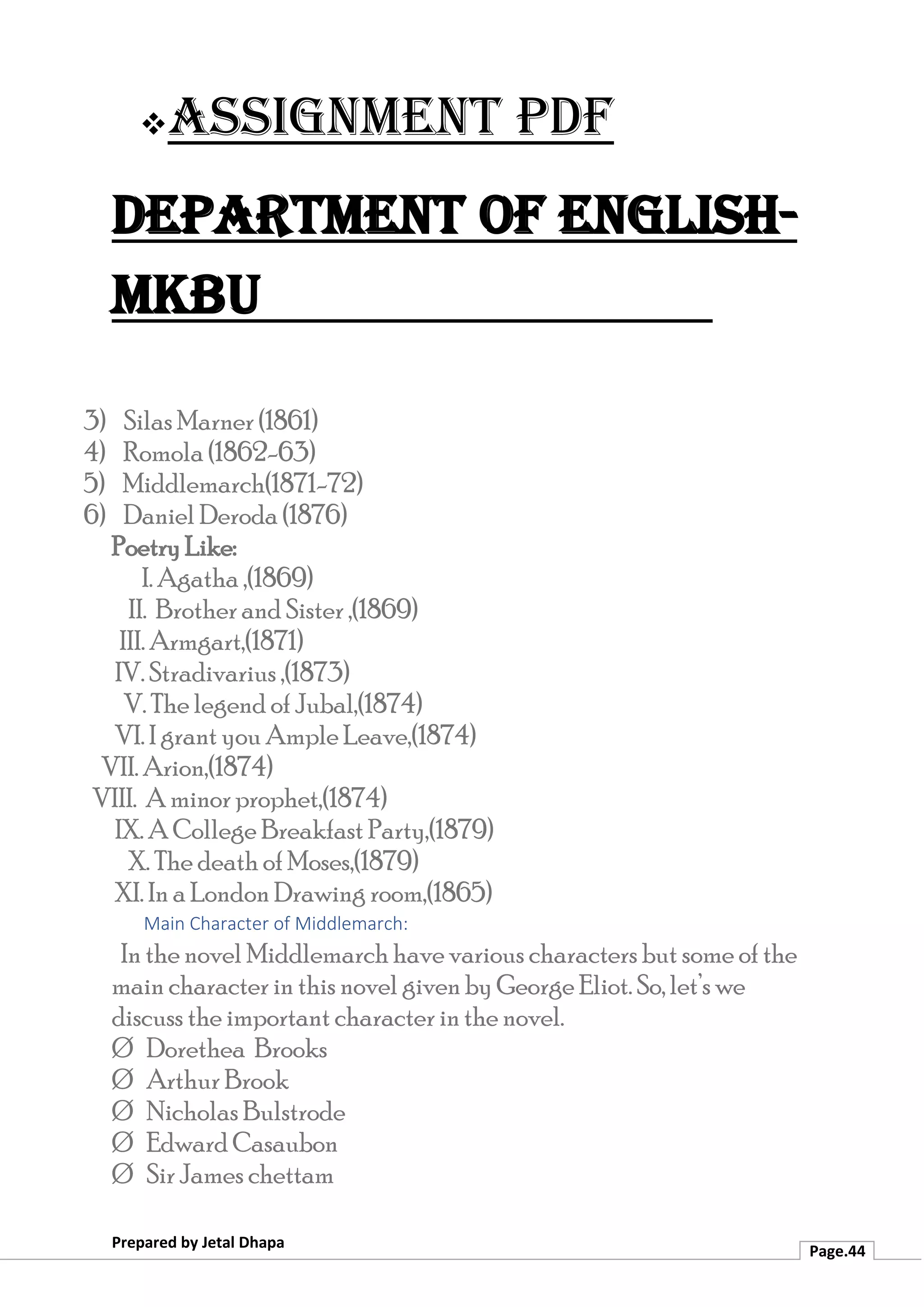
Ø Dorethea Brooks
Ø Arthur Brook
Ø Nicholas Bulstrode
Ø Edward Casaubon
Ø Sir James chettam
❖Assignment PDF
Department of English-
MKBU
Prepared by Jetal Dhapa
Page.45
Ø Will Ladislaw
Ø Lydgate
Ø Fred Vincy
Ø Rosamond Vincy
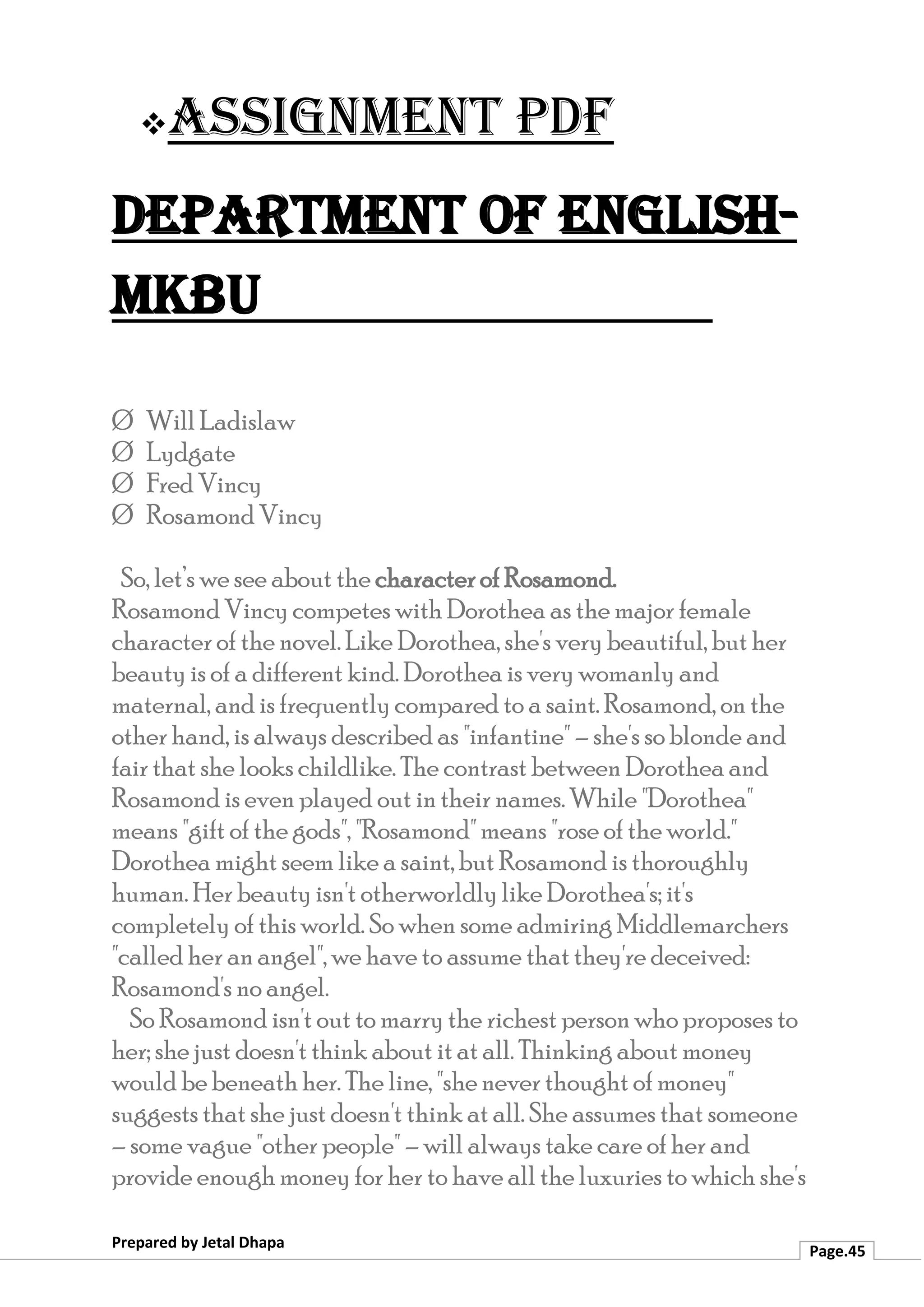
So, let’s we see about the character of Rosamond.
Rosamond Vincy competes with Dorothea as the major female
character of the novel. Like Dorothea, she's very beautiful, but her
beauty is of a different kind. Dorothea is very womanly and
maternal, and is frequently compared to a saint. Rosamond, on the
other hand, is always described as "infantine" – she's so blonde and
fair that she looks childlike. The contrast between Dorothea and
Rosamond is even played out in their names. While "Dorothea"
means "gift of the gods", "Rosamond" means "rose of the world."
Dorothea might seem like a saint, but Rosamond is thoroughly
human. Her beauty isn't otherworldly like Dorothea's; it's
completely of this world. So when some admiring Middlemarchers
"called her an angel", we have to assume that they're deceived:
Rosamond's no angel.
So Rosamond isn't out to marry the richest person who proposes to
her; she just doesn't think about it at all. Thinking about money
would be beneath her. The line, "she never thought of money"
suggests that she just doesn't think at all. She assumes that someone
– some vague "other people" – will always take care of her and
provide enough money for her to have all the luxuries to which she's
❖Assignment PDF
Department of English-
MKBU
Prepared by Jetal Dhapa
Page.46
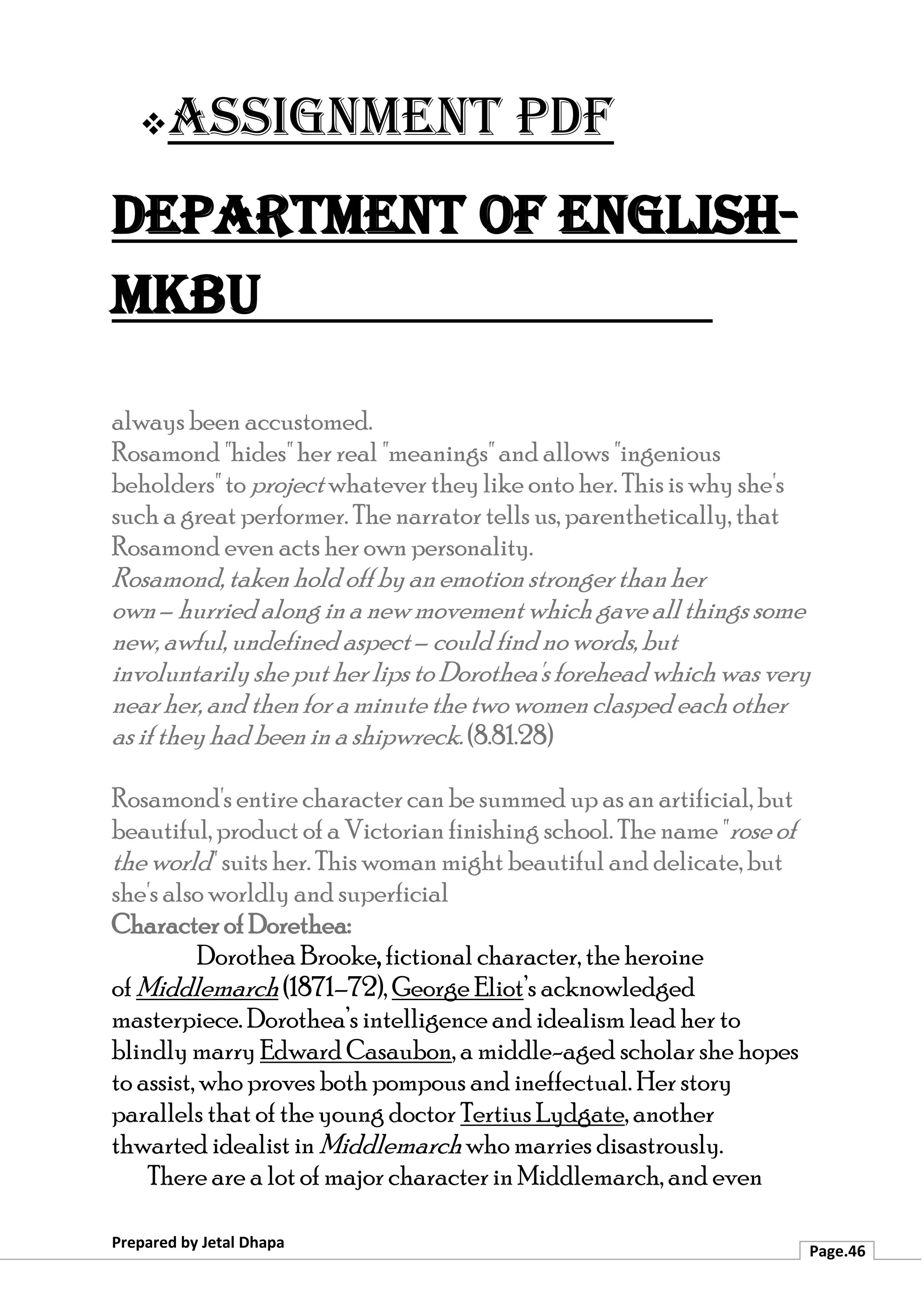
always been accustomed.
Rosamond "hides" her real "meanings" and allows "ingenious
beholders" to project whatever theylike onto her. This is why she's
such a great performer. The narrator tells us, parenthetically, that
Rosamond even acts her own personality.
Rosamond, taken hold off byan emotion stronger thanher
own– hurried along ina newmovement which gave allthings some
new, awful, undefined aspect – could find no words, but
involuntarilyshe put her lips to Dorothea'sforeheadwhich was very
near her, and thenfor a minute the two women clasped each other
as if they had been in a shipwreck. (8.81.28)
Rosamond's entire character can be summed up as an artificial, but
beautiful, product of a Victorian finishing school. The name "rose of
the world" suits her. This woman might beautiful and delicate, but
she's also worldly and superficial
Character of Dorethea:
Dorothea Brooke, fictional character, the heroine
of Middlemarch (1871–72), George Eliot’s acknowledged
masterpiece. Dorothea’s intelligence and idealism lead her to
blindly marry Edward Casaubon, a middle-aged scholar she hopes
to assist, who proves both pompous and ineffectual. Her story
parallels that of the young doctor Tertius Lydgate, another
thwarted idealist in Middlemarch who marries disastrously.
There are a lot of major character in Middlemarch, and even
❖Assignment PDF
Department of English-
MKBU
Prepared by Jetal Dhapa
Page.47
more minor ones, but it’s pretty obvious that Dorothea’s the heroine.
After all, the novel’s prelude and final are about Dorothea and she
certainly get’s more face time than any of the other major character.
But that’s not the only reason we consider her the heroine: Dorothea
is also the moral centre of the novel. She is a patient lady. This brings
up another important to Dorothea’s character –her spirituality and
religious fervor. It’s no accident that so many characters associate
her with angels but she is not angels.
Comparison Dorethea and Rosamond
The contrast between Dorothea and Rosamond While "is even
played out in their names. Dorothea" means "gift of the gods”,
"Rosamond" means "rose of “the world. Dorothea might seem like a
saint, but Rosamond is thoroughly human.
Rosamond Vincy competes with Dorothea as the major female
character of the novel. Like Dorothea, she is a very beautiful, but her
beauty is of a different kind.
Dorothea is very womanly and maternal, and is frequently
compare to a saint.Rosamond, on the other hand, is always described
as “infantine”-she is so blonde and fair that she looks childlike. The
contrast between Dorothea and Rosamond is even played out in
their names.
While “Dorothea” Means “gift of the gods”, and Rosamond means
“rose of the world”.Dorothea might seem like a saint, but Rosamond
is thoroughly human. Her beauty is not otherworldly like
Dorothea’s; it is completely of this world.
❖Assignment PDF
Department of English-
MKBU
Prepared by Jetal Dhapa
Page.48
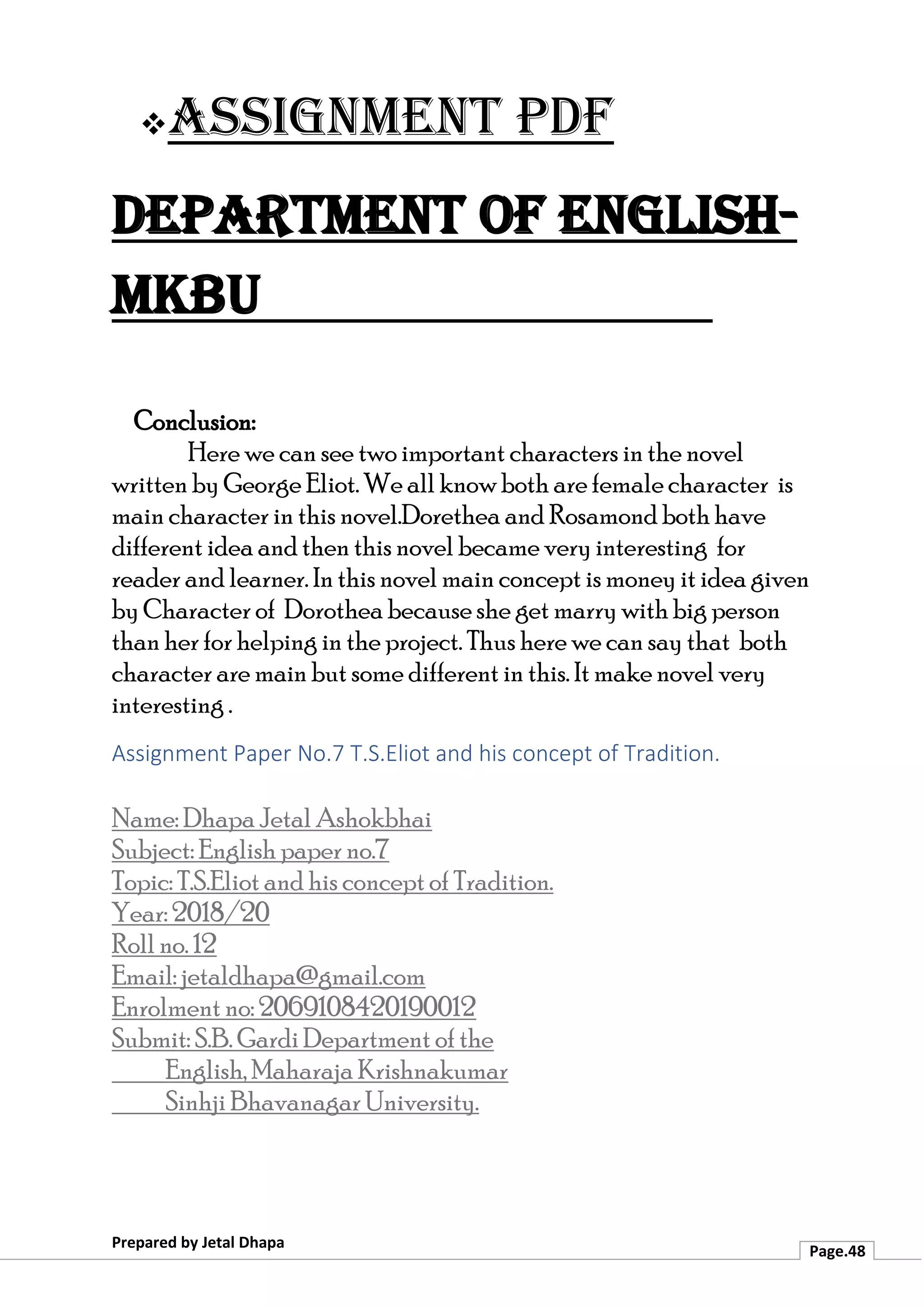
Conclusion:
Here we can see two important characters in the novel
written by George Eliot. We all know both are female character is
main character in this novel.Dorethea and Rosamond both have
different idea and then this novel became very interesting for
reader and learner. In this novel main concept is money it idea given
by Character of Dorothea because she get marry with big person
than her for helping in the project. Thus here we can say that both
character are main but some different in this. It make novel very
interesting .
Assignment Paper No.7 T.S.Eliot and his concept of Tradition.
Name: Dhapa Jetal Ashokbhai
Subject: English paper no.7
Topic: T.S.Eliot and his concept of Tradition.
Year: 2018/20
Roll no. 12
Email: jetaldhapa@gmail.com
Enrolment no: 2069108420190012
Submit: S.B. Gardi Department of the
English, Maharaja Krishnakumar
Sinhji Bhavanagar University.
❖Assignment PDF
Department of English-
MKBU
Prepared by Jetal Dhapa
Page.49
T.S.Eliot and his concept of Tradition:
Introduction:
Thomas Stearns Eliot was a born in 26 September 1888 in St. Louis,
Missouri in the united state. His family is prominent Brahmin and he
moved England in 1914 at the age of 25 settling and working and
marrying there .He was a died in 4 January 1965.One of the
20th century’s major poets was also an essayist. He was a Publisher,
playwright, and literary and social critic. He became a British
subject in 1927 at the age of 39, renouncing his American passport.
❖Assignment PDF
Department of English-
MKBU
Prepared by Jetal Dhapa
Page.50
Eliot was the last of six surviving children; his parents were both 44
years old when he was born. Eliot was born at 2635 Locust Street, a
property owned by his grandfather, William Greenleaf Eliot. His
four sisters were between 11 and 19 years older; his brother was eight
years older. Known to family and friends as Tom, he was the
namesake of his maternal grandfather, Thomas Stearns.So, let’s
discuss what the tradition is.
What is the tradition?
The English word tradition comes from the Latin traditio, the noun
from the verb tradere (to transmit, to hand over, and to give for
safekeeping); it was originally used in Roman law to refer to the
concept of legal transfers and inheritance. According
to Anthony Giddens and others, the modern meaning of tradition
evolved during the Enlightenment period, in opposition to
modernity and progress.
As with many other generic terms, there are many definitions of
tradition. The concept includes a number of interrelated ideas; the
unifying one is that tradition refers to beliefs, objects or customs
performed or believed in the past, originating in it, transmitted
through time by being taught by one generation to the next, and are
performed or believed in the present.
His concept of tradition:
Inanageofacademiccriticism,itisdifficulttoimaginetheeffectthat
T.S. Eliot’s early essays had on the study of English literature in
universities. These essays—many of them short, unscholarly in the
❖Assignment PDF
Department of English-
MKBU
Prepared by Jetal Dhapa
Page.51
conventional sense, and published in periodicals sold on
newsstands—redefined the tradition and established in the still-
young discipline of “English” the values (wit, irony, complexity,
ambiguity) which the New Criticism would enshrine and which
would define English studies until the rise of critical theory in the
early 1970s. Eliot’s enthusiasms, notably for the Metaphysical,
helped to shape curricula; his aversions, including most of the
Romantic and Victorian poets, survived his distaste, but their
proponents often seemed vaguely on the defensive.
The idea of tradition has long been recognized as central both to
Eliot’s aesthetics and his conservative politics, and commentary on
Eliot have sometimes come to grief either by trying to separate art
from politics completely or by trying to subordinate art to politics.
These two errors, mechanical applications of extreme New Critical
and Marxist positions without the subtlety of their better
practitioners,areoftentheresultofcriticallaziness,andoneaspectof
that laziness is the failure to acknowledge the broader anterior
influences which shaped both Eliot’s critical and political writings.
The CianciandHardingcollection,whichoriginatedinaconference
on “Re-Reading T.S. Eliot’s ‘Tradition and the Individual Talent’” at
the University of Milan in 2004, is an attempt to recontextualize
Eliot’s idea of tradition. Most of the contributors are not Eliot
specialists, and few of the essays refer to any Eliot criticism that is
more than twenty years old. Neither fact is necessarily a
disadvantage: non-specialists can bring fresh perspectives to old
❖Assignment PDF
Department of English-
MKBU
Prepared by Jetal Dhapa
Page.52
issues, and what is valuable in older criticism is often subsumed (and
often without acknowledgement) into more recent. But there is a
huge Eliot literature, and many of the scholars here seem unaware
even of the most recent work, a circumstance that results too often in
reinventionsofthewheel.AnyseriousstudentofEliothasreadabout
the relation of “impersonality” to poetic personae; anyone who has
examined Eliot’s idea of culture knows that he opposed an exclusive
focus on one nation’s or one language’s literature and affirmed the
importance of pan-European and extra-European influences and
standards; anyone who has engaged with Eliot’s politics at a level
deeper than name-calling knows about the influence of Julien
Benda and Charles Maurras.
This fidelity to tradition, however, does not require the great poet to
forfeit novelty in an act of surrender to repetition. Rather, Eliot has a
much more dynamic and progressive conception of the poetic
process: novelty is possible only through tapping into tradition.
When a poet engages in the creation of new work, they realise an
aesthetic "ideal order," as it has been established by the literary
tradition that has come before them. As such, the act of artistic
creation does not take place in a vacuum. The introduction of a new
work alters the cohesion of this existing order, and causes a
readjustmentoftheoldtoaccommodatethenew.Theinclusionofthe
newworkaltersthewayinwhichthepastisseen;elementsofthepast
that are noted and realised. In Eliot’s own words, "What happens
when a new work of art is created is something that happens
❖Assignment PDF
Department of English-
MKBU
Prepared by Jetal Dhapa
Page.53
simultaneously to all the works of art that preceded it." Eliot refers to
this organic tradition, this developing canon, as the "mind of Europe."
The private mind is subsumed by this more massive one.
This reiteration gives much of the volume an amateur air, a serious
problem in a collection aimed at specialists. There are odd errors of
omissionaswell,whichperhapsderivefromthemiscellaneousnature
of the papers atanyconference, evenone withan apparently precise
topic.
Eliot writes about "historical sense" in
"Tradition and the Individual Talent." He writes that the historical
sense "involves a perception, not only of the pastness of the past, but
of its presence" and it is "a sense of the timeless as well as of the
temporal and of the timeless and the temporal together, is what
makes a writer traditional."
In this essay, Eliot does not describe "traditional" as old-fashioned.
Rather, for him, traditional means that a poem is a particular part of
the general whole of all poetry in history. The individual talent
emerges from an awareness of his/her present poetic contribution
andepochasacontinuationofthathistoryofpoetry.Thepresentpoet
who is aware of his/her place AND the whole of this history is more
able to be individual.
Eliot and New Criticism
New Criticism was a formalist movement in literary theory that
dominated American literary criticism in the middle decades of the
20th century. It emphasized close reading, particularly of poetry, to
❖Assignment PDF
Department of English-
MKBU
Prepared by Jetal Dhapa
Page.54
discoverhowaworkofliteraturefunctionedasaself-contained,self-
referential aesthetic object. The movement derived its name
from John Crowe Ransom's 1941 book The New Criticism.
Unwittingly, Eliot inspired and informed the movement of New
Criticism. This is somewhat ironic, since he later criticised their
intensely detailed analysis of texts as unnecessarily tedious. Yet, he
does share with them the same focus on the aesthetic and stylistic
qualities of poetry, rather than on its ideological content. The New
Critics resemble Eliot in their close analysis of particular passages
and poems.
Primary works of literary criticism by T. S. Eliot:
HewasagreatcriticintheEnglishlanguage.Hewrotevariousbooks
and his notable Primary work is like:
• Homage to John Dryden: Three Essays on Poetry of the
Seventeenth Century. London: L. and Virginia Woolf, 1927.
•
· On Poetry and Poets. London: Faber and Faber, 1957.
• The Sacred Wood: Essays on Poetry and Criticism. London
Methuen, 1950.
•
• Selected Essays. New York: Harcourt, Brace, 1950.
• The Varieties of Metaphysical Poetry. Ed. Ronald Schuchard.
London: Faber and Faber, 1993.
❖Assignment PDF
Department of English-
MKBU
Prepared by Jetal Dhapa
Page.55
Criticism of Eliot:
Eliot's theory of literary tradition has been criticised for its limited
definition of what constitutes the canon of that tradition. He assumes
the authority to choose what represents great poetry, and his choices
have been criticised on several fronts. For example, Harold
Bloom disagrees with Eliot's condescension towards Romantic
poetry, which, in The Metaphysical Poets (1921) he criticises for its
"dissociation of sensibility." Moreover, manybelieve Eliot's discussion
of the literary tradition as the "mind of Europe" reeks of Euro-
centrism. However, it should be recognized that Eliot supported
many Eastern and thus non-European works of literature such as
the Mahabharata. Eliot was arguing the importance of a complete
sensibility: he didn't particularly care what it was at the time of
tradition and the individual talent. His own work is heavily
influenced by non-Western traditions. In his broadcast talk "The
Unity of European Culture," he said, "Long ago I studied the ancient
Indian languages and while I was chiefly interested at that time in
Philosophy, I read a little poetry too; and I know that my own poetry
shows the influence of Indian thought and sensibility." His self-
evaluationwasconfirmedbyB.P.N.Sinha,whowritesthatEliotwent
beyond Indianideas to Indianform: "The West has preoccupied itself
almost exclusively with the philosophy and thoughts of India. One
consequence of this has been a total neglect of Indian forms of
expression, i.e. of its literature. T. S. Eliot is the one major poet whose
workbearsevidenceofintercoursewiththisaspectofIndianculture".
❖Assignment PDF
Department of English-
MKBU
Prepared by Jetal Dhapa
Page.56
Hedoesnotaccountforanon-whiteandnon-masculinetradition.As
such,hisnotionoftraditionstandsatoddswithfeminist,post-colonial
and minority theories.
Conclusion:
Then we can say that all society have own idea and tradition. In
differenttraditionhaveownideaanditgivesideaaboutnewandthis
idea clear by T.S.Eliot in his tradition concept. He gives idea about
culture and society in his ideal work.
Assignment Paper No.8 Write a brief note on Origin of Cultural
studies.
Name: Dhapa Jetal Ashokbhai
Subject: English paper no.8
Topic: Write a brief note on Origin of Cultural studies.
Year: 2018/20
Roll no. 12
Email: jetaldhapa@gmail.com
Enrolment no: 2069108420190012
Submit: S.B. Gardi Department of the
English, Maharaja Krishnakumar
Sinhji Bhavanagar University.
❖Assignment PDF
Department of English-
MKBU
Prepared by Jetal Dhapa
Page.57
Que.1 Write a Brief note on origin of cultural studies.
Introduction:
This is an introductory level course in cultural studies. Generally
considered, cultural studies refers to the notion that the study of
cultural processes, especially, though not exclusively, in the context
of what is referred to as "popular culture," is theoretically and
politically important to an active and productive understanding of
the ways in which "power" and "influence" manifest themselves in a
social and/or political order. That said, the phrase "cultural studies"
is an extremely contested one in contemporary public and academic
discourse, and our primary goal in this course will be to examine the
range of ways in which we might understand its meaning and
attendant implications for how we theorize, interpret, and critique
cultural practices. The course will be organized into three primary
sections. In the first section we will examine some of the historical
roots of cultural studies, primarily in the American and British
contexts, with an eye to developing what Foucault might call an
"intellectual genealogy" for its practice. In the second section of the
course we will examine a number of theoretical and methodological
problems and issues that have occupied the concerns of those
working in the area of cultural studies over the past twenty-five
years.
❖Assignment PDF
Department of English-
MKBU
Prepared by Jetal Dhapa
Page.58
In the final sectionof the course wewill examine four representative,
full-length cultural studies as a means of evaluating and assessing
how such theoretical and methodological problems are
negotiated insitu.
By theend ofthesemesterclass participants shouldfeel comfortable
discussing the problems and issues central to those Operating under
therubricofculturalstudies,aswellastoputtingtheirownscholarly
work into a critical and theoretical dialogue with a cultural studies
perspective.
So, let’s we discuss about definition of cultural Studies in detail.
What is the cultural Study?
“Cultural studies is a field of theoretically, politically, and
empirically engaged cultural analysis that concentrates upon the
political dynamics of contemporary culture, its historical
foundations, defining traits, conflicts, and contingencies.”
“Cultural Studies is a bimonthly peer-reviewed academic
journal coveringresearchontherelationbetweenculturalpractices,
everyday life, and material, economic, political, geographical, and
historical contexts.”
Characteristics
Cultural Studies, five main characteristics of cultural studies:
• The aim of cultural studies is to examine cultural practices and
their relation to power. For example, a study of
a subculture (such as white working class youth in London)
❖Assignment PDF
Department of English-
MKBU
Prepared by Jetal Dhapa
Page.59
would consider their social practices against those of the
dominantculture(inthisexample,themiddleandupperclasses
in London who control the political and financial sectors that
create policies affecting the well-being of white working class
youth in London).
• The objective of cultural studies includes understanding
culture in all its complex forms and analyzing the social and
political context in which culture manifests itself.
• Cultural studies is a site of both study/analysis and political
criticism/action. (For example, not only would a cultural
studies scholar study an object, but s/he would connect this
study to a larger, progressive political project.)
• Cultural studies attempts to expose and reconcile constructed
divisions of knowledge that purport to be grounded in nature.
• Culturalstudieshaveacommitmenttoanethicalevaluationof
modern society and to a radical line of political action.
Academic reception:
Cultural studies has evolved through the confluence of various
disciplines—anthropology, media and communication studies,
literarystudies,education,geography,philosophy,sociology,politics
andothers.Whilesomehaveaccusedcertainareasofculturalstudies
of meandering into political relativism and a kind of empty version
of "postmodern" analysis, others hold that at its core, cultural studies
❖Assignment PDF
Department of English-
MKBU
Prepared by Jetal Dhapa
Page.60
providesasignificantconceptualandmethodologicalframeworkfor
cultural, social and economic critique. This critique is designed to
"deconstruct" the meanings and assumptions that are inscribed inthe
institutions, texts and practices that work with and through, and
produce and re-present, culture. Thus, while some scholars and
disciplines like to dismiss cultural studies for its methodological
openness and rejection of disciplinarily, its core strategies of critique
and analysis have had a profound influence throughout areas of the
social sciences and humanities. Cultural studies work on forms of
social differentiation, control and inequality, identity, community-
building, media, and knowledge production, for example, has had a
substantial impact. Moreover, the influence of cultural studies has
become increasingly evident in areas as diverse as, health studies,
international relations, development studies, computer studies,
economics, archaeology, and neurobiology, as well as across the
range of disciplines that initially shaped the emergence of cultural
studies, including literature, sociology, communication studies, and
anthropology.
Types of Cultural Studies:
o Marxism
o Feminist theory
o Ethnography
o Critical race theory
o Post-structuralism
o Post colonialism
❖Assignment PDF
Department of English-
MKBU
Prepared by Jetal Dhapa
Page.61
o Social theory
o Political theory
o History
o Philosophy
o Literary theory
o Media theory
o Communication studies
o Political economy
o Translation studies
So, let’s we discuss this topic in detailed about it.
1) Marxism :
Marxism is a theory and method of working class self-
emancipation. Marxism has developed into many different branches
and schools of thought, with the result that there is now no single
definitive Marxist theory. Different Marxian schools place a greater
emphasis on certain aspects of classical Marxism while rejecting or
modifying other aspects. Many schools of thought have sought to
combine Marxian concepts and non-Marxian concepts, which has
then led to contradicting conclusions. However, lately there is
movement toward the recognition that historical
materialism and dialectical materialism remains the fundamental
aspect of all Marxist schools of thought.
2) Post –Structuralism :
❖Assignment PDF
Department of English-
MKBU
Prepared by Jetal Dhapa
Page.62
Post structuralism, Movement in literary
criticism and philosophy begun in France in the late 1960s. Drawing
upon the linguistic theories of Ferdinand de Saussure, the
anthropology of Claude Lévi-Strauss (see structuralism), and the
deconstructionist theories of Jacques Derrida (see deconstruction), it
held that language is not a transparent medium that connects one
directly with a “truth” or “reality” outside it but rather a structure or
code, whose parts derive their meaning from their contrast with one
another and not from any connection with an outside world. Writers
associated with the movement include Roland Barthes, Jacques
Lacan, Julia Kristeva, and Michel Foucault.
Structuralism, in linguistics, any one of several schools of 20th-
century linguistics committed to the structuralist principle that a
language is a self-contained relational structure, the elements of
which derive their existence and their value from their distribution
and oppositions in texts or discourse.
3) Post colonialism :
Postcolonial theorists and historians have been concerned with
investigating the various trajectories of modernity as understood
and experienced from a range of philosophical, cultural, and
historical perspectives. They have been particularly concerned with
engaging with the ambiguous legacy of the Enlightenment—as
expressed in social, political, economic, scientific, legal, and cultural
thought—beyond Europe itself. The legacy is ambiguous, according
❖Assignment PDF
Department of English-
MKBU
Prepared by Jetal Dhapa
Page.63
to postcolonial theorists, because the age of Enlightenment was also
an age of empire, and the connection between those two historical
epochs is more than incidental.
4) Literary theory:
Literary theory and the formal practice of literary interpretation
runs a parallel but less well known course with the history of
philosophy and is evident in the historical record at least as far back
as Plato. The Cratylus contains a Plato's meditation on the
relationship of words and the things to which they refer. Plato’s
scepticism about signification, i.e., that words bear no etymological
relationship to their meanings but are arbitrarily "imposed,"
becomes a central concern in the twentieth century to both
"Structuralism" and "Post structuralism." However, a persistent belief
in "reference," the notion that words and images refer to an objective
reality, has provided epistemological (that is, having to do with
theories of knowledge) support for theories of literary
representation throughout most of Western history. Until the
nineteenth century, Art, in Shakespeare’s phrase, held "a mirror up
to nature" and faithfully recorded an objectively real world
independent of the observer.
Modern literary theory gradually emerges in Europe during the
nineteenth century. In one of the earliest developments of literary
theory, German "higher criticism" subjected biblical texts to a
radical historicizing that broke with traditional scriptural
interpretation. "Higher," or "source criticism," analyzed biblical tales
❖Assignment PDF
Department of English-
MKBU
Prepared by Jetal Dhapa
Page.64
in light of comparable narratives from other cultures, an approach
that anticipated some of the method and spirit of twentieth century
theory, particularly "Structuralism" and "New Historicism." In
France, the eminent literary critic Charles Augustine Saint Beuve
maintained that a work of literature could be explained entirely in
terms of biography, while novelist Marcel Proust devoted his life to
refuting Saint Beuve in a massive narrative in which he contended
that the details of the life of the artist are utterly transformed in the
work of art. Perhaps the greatest nineteenth century influence on
literary theory came from the deep epistemological suspicion of
Friedrich Nietzsche those facts are not facts until they have been
interpreted. Nietzsche's critique of knowledge has had a profound
impact on literary studies and helped usher in an era of intense
literary theorizing that has yet to pass.
5) Feminist Theory:
Feminist theory is a major branch of theory within Sociology that
shifts its assumption, analytic lens, and topical focus away from the
male view point and experience and toward that of woman. In doing
so, feminist theory shines a light on social problems, trends, and
issues that are otherwise overlooked or misidentified by perspective
within social theory.
Many people incorrectly believe that feminist theory focuses
exclusively on girls and woman and that it has an inherent goal of
promoting the superiority of woman over man. In reality, feminist
theory has always been about viewing the social world in a way
❖Assignment PDF
Department of English-
MKBU
Prepared by Jetal Dhapa
Page.65
that creates and support inequality, operation, and injustice, and in
doing so, promotes the pursuit of equality and justice.
Conclusion:
In literature we find many types people who comes in new
society and different ideal and traditional society. Every people
define different idea about own culture and tradition. We read
about culture in every literature in different style. Then culture and
culture studies give various thinking and idea about our near
society.
ASSIGNMENT PAPER NO :09( The modernist literature) : Discuss the
general characteristics of the modern age
Name: Dhapa Jetalben Ashokbhai
Sem : 3rd
Subject : English Paper No.09 (The Modernist Literature)
Topic : Discuss the general characteristics of the modern age :
Year : 2018/19
Roll no.: 12
Email : jetaldhapa@gmail.com
Enrollment no : 2069108420190012
Submit : S.B Gardi Department of English Maharaja
krishnakumarsinhji University Bhavnagar
❖Assignment PDF
Department of English-
MKBU
Prepared by Jetal Dhapa
Page.66
Que: Discuss the General Characteristics of ‘The Modern Age’:
About the Modern literature:
Modernist literature has its origins in the late 19th and early 20th
centuries. The modern Age has a fairly unique and different
Character give idea about the modernism. The Age Characterized
by a very self-conscious breaks with traditional ways of writing, in
bothpoetryandprosefiction. Thisagechangeandtransferfulloflife
of people mind in social and private things. It is very huge
revolutionary change in human mind and thoughts. The modern
literature is compromise of the Victorian Age. This age is totally
change give like Old to New, Brings blind to rational this type
thinking is very interesting. Here I would like to discuss the general
characteristics of the age.So, let’s we discuss in detailed:
Some of The characteristics give as:
❖Assignment PDF
Department of English-
MKBU
Prepared by Jetal Dhapa
Page.67
1) Anxiety and Interrogation
2) Art for Life’s Sake
3) Growing Interest in Poor and the Working Classes
4) Impact of Socio-Economic Condition on Literature
5) Psychology and Literature
6) The Impact of the Two World Wars
7) International Character of Literature
8) The Influence of Radio,Cinema,and Television
9) Conclusion
1) Anxiety and interrogation :
The modern age is also famous as a anxiety and interrogation. In this
age became various changes lke; Scientific revolution and rational
thinking etc…In this time became authority of religion and church
this all are established during this time. During this Era the
generation claims freedom and action of people. This Age man and
Womangiveown ideaonextraordinaryenthusiasm,experimentand
reformation.ThistimeModernindustrialandtechnicalgivethebirth
to the spirit competetion.Here we can say that this era is very useful
to became world modern, this was a main tendencies of anxiety and
introduction in the modern age literature.
❖Assignment PDF
Department of English-
MKBU
Prepared by Jetal Dhapa
Page.68
2) Art for life’s sake :
The Writer of the modern age they rejected of “art for art’s
sake”.Artisaformofself-expression.Manyuseita wayofexpressing
a range of feelings and emotions, from turmoil to happiness or
exasperation- feelings that every person has within their soulsAll
the writer concentrated his attention on the all problems of the
modern Age.The Modern literature is full depend on realism and it
has inherent things.Realism have further been enhanced by
scientific discoveries of the modern Age.The rise of the problem was
significant develop in the realistic literature in the Modern
Age.H.G.Wells and Rudryard Kipling with his empire of building
and strem of Engine.
3) Growing interest in the poor and the working classes :
During the year of 1900 we can mark that this is a beginning of
the Supremacy of the of the middle class.The middle class have a
standardofthoghtandwriting.TheSocietyarousedthedesiretotake
collectiveactiontoimprovethelivingconditionsofthepoorworking
classes.The mid-
victorian writer,Dickens,Thackerey,Kingsly,Reade,Mrs.Gaske
ll etc…they all are write on critical thinking on poor working class. .
Members of the working class rely for their income exclusively upon
theirearningsfrom wagelabourthus,accordingtothemoreinclusive
definitions,The early20th centurywriters “puteverythingineveryin
❖Assignment PDF
Department of English-
MKBU
Prepared by Jetal Dhapa
Page.69
everysphereoflifetoquestion”.Thisisageneationofthe‘introgative
habit of mind.
4) Impact of socio-economic condition on literature :
In the modern time literature is greatly influence by economic
and more of Social changes.The modern time Marshell and Keynes,
they are raised voice against poverty.By the way they change the
pattern of the economics thinking. Finally, the literature review
focuses on two systematic and fundamental macro-level features:
the extent of homogeneity between schools, and the degree of
centralization of education standards and norms in a society.In the
during time literature is very useful the all of the people.Thus it is
became like urbane in this Era.The Modern Age we all know that
MarxismisverypowerfullinfluenceontheliteratureandtheAuthor.
5) Psychology and literature :
The modern age have new psychology And this all research is
influenced on the literature. It is a intellectual convictions appeared
to be rationalizations of emotional aspects. The growing of interest in
psychology excercised considered influence on the literature.In this
timesexbehaviouristotallychanged.Literatureandpsychologyare
two branches of science that study human soul. Psychology
researches human behaviors and their causes while literature
depicts human behavior through fiction. The rational view of sex
❖Assignment PDF
Department of English-
MKBU
Prepared by Jetal Dhapa
Page.70
relationshipalso involved inthis time. ‘Thestreamof consciousness’ is
givenbyatheoryofPsychologyandsex.ForexampleVirginiaWoolf
is also influenced by reasearch of the psychology and the sex.
6) The impact of the two world wars:
In all the age have influence of world war in the time.During this
time the post war period is famous as a ‘Depression’. The article
evaluates the degree to which the Second World War was
responsible for the development of Europe since 1945. It seeks to
disentangle effects that were clearly directly due to the war from
those which can be seen as the result of changes already affecting
pre-warEurope,andthoseduetopost-wardevelopments,suchasthe
Cold War and the European Union.In this time we realise that
unemployment is basic in the time.The modern time we know as a
two war is mostly famous and mention by writers.In detailed we can
see that second world war is specially effect on the man and human
life.It give various changes in the all people routine life.In the age
varios writer write about the world war inhis work of literature.Very
large book about anti-war books writes during and after the two
wars.We can read about the war in ‘The undertones of war’ about the
futility and holloeness of the world war.then we can say that this
characteristics is very useful and ideal for reader..
❖Assignment PDF
Department of English-
MKBU
Prepared by Jetal Dhapa
Page.71
7)international character of literature:
In Victorian era literature preoccupied with the condition of
England.It Is permeated by the spirit of non-violent
humanitarianism.The literature of 20th century early decade an
international character. They are presented antithetically or as
derivativestothenormalcharacterssurvivingattheperipheryofthe
world of the normal’s. Their raison d’être always remains either to act
as prop to the main characters or as villains. The humanitarian was
hopeless ness had been displaced by partisam propaganda.Hudson
also give idea about this point in the english literature.
8)the influence of radio,cinema and television :
We all know that in our routine life we all are use various source in
internet,mobile and television and etc.. Technology has the power to
affect not only education but also culture, religion and personal
thoughts and beliefs. While the world population is continually
growing, our global world seems to be getting smaller as we are able
to connect to people in a way that was never imagined. The
developmentoscinema,radio,hasanenormousimpactinliterature.If
we think about Radio the it brought literature In our home.It is Like
give various things of form of broadcast stories, plays and literary
discussion. “Radio broadcasting is one of the greatest educational
tools which have ever been placed at the disposal of civilized man. It
is an instantaneous, universal means of communication. The earliest
❖Assignment PDF
Department of English-
MKBU
Prepared by Jetal Dhapa
Page.72
knownmediaavailabletoteachersweretermed‘visualeducation’or
‘visual instruction’ because they did not yet combine the
advancement of sound. Same cinema also useful to our better
understandingfilmtechniques arebasisnumberofexperiment.Here
we see that use and what needs radio television are how help in our
work.
Conclusion:
The New age literature is the literature os challenges and
reconstructionofnewvalues.ItisanExcitingageforwriters.Anageis
marked to a definite break with the age.
ASSIGNMENT PAPER NO :10 Character analysis of the old man
and sea.
Name : Dhapa Jetalben Ashokbhai
Sem : 3rd
Subject: English Paper No.10(The American Literature)
Topic : character analysis of the old man and sea.
Year : 2018/19
Roll no : 12
Word : 1322
Email : jetaldhapa@gmail.com
❖Assignment PDF
Department of English-
MKBU
Prepared by Jetal Dhapa
Page.73
Enrollment no : 2069108420190012
Submit : S.B Gardi Department of English Maharaja
krishnakumarsinhji University Bhavnagar
Que: The Character Analysis of ‘The Old Man and Sea’.
About the Authur : T.S.Eliot
❖Assignment PDF
Department of English-
MKBU
Prepared by Jetal Dhapa
Page.74
He was a very well known writer in the American literature.Ernest
Miller Hemingway was born on July 21, 1899.He is an American
journalist, novelist, short-story writer, and sportsman
also.Hemingway produced most of his work between the mid-1920
and the mid-1950.He won the Nobel Prize in Literature in 1954. He
published seven novels, six short-story collections, and two non-
fiction works. During this time Became strong influence on 20th-
century fiction.His adventurous lifestyle and his public image
brought him admiration from later generations.He also take part in
the give new generation in the time.He write about various
motivational things in his work.
About the Novel:
In the novel we can se about hard work and about the huge
success.The Old Man and the Sea is a short novel written by the
American author Ernest Hemingway in1951 in Cuba, and published
❖Assignment PDF
Department of English-
MKBU
Prepared by Jetal Dhapa
Page.75
in 1952. It was the last major work of fiction by Hemingway that was
published during his lifetime. One of his most famous works, it tells
the story of Santiago, an aging Cuban fisherman who struggles with
a giant marlin far out in the Gulf Stream off the coast of Cuba. The
Old Man and the Sea tells the story of a battle between an aging,
experiencedfisherman, Santiago, and a large marlin. The story opens
with Santiago having gone 84 days without catching a fish.
After eighty four day he get very big success in his life. In last day
he also try again and last On the eighty-fifth day of his unlucky
streak in his life. Santiago takes his skiff into the Gulf Stream, sets his
lines and by noon, has his bait taken by a big fish that he is sure is
a marlin.Onthethirdday,thefishbeginstocircletheskiff.Santiago,
worn out and almost delirious, uses all his remaining strength to pull
the fish onto its side and stab the marlin with a harpoon. Pedrico is
given the head of the fish On his way in to shore, sharks are
attracted to the marlin's blood. Santiago kills a great mako
shark with his harpoon.
At last let’s discuss about the character’s in detailed.In the novel we
all know that Santiago is main character of the novel.So let’s discuss
in detailed.
Chracter list of The Old Man and Sea :
1) Santiago
❖Assignment PDF
Department of English-
MKBU
Prepared by Jetal Dhapa
Page.76
2) Manolin
3) Perico
4) Joe Dimaggio
5) Marlin
1) Santiago :
This character is the main character of the novel.Thus Writer
give the title of ‘The Old Man’ it use for Santiago.He was a cuban
Fisherman.He became Felt in catch to fish Eighty-four Day.He have
a various knowledge is very intteligent about it.He is a very strong
man he have faith and strugglr to became success to catch fish in the
Sea. After all, Santiago is an old man whose physical existence is
almost over, but the reader is assured that Santiago will persist
through Manolin, who, like a disciple, awaits the old man’s teachings
and will make use of those lessons long after his teacher has
died.Thus,we can say that Santiago is manages and he finds all way
after death.
Santiago commitment for sailing out further than any fisherman
have before and he also promise to very big fish.We all know that
❖Assignment PDF
Department of English-
MKBU
Prepared by Jetal Dhapa
Page.77
after fight with the Shark he got prize as Marlin.After very fight he
get very huge success in his life.He get his goal.He get great Marlin.
the marlin is also his greatest victory. For three days, he holds fast to
the line that links him to the fish, even though it cuts deeply into his
palms.
ThusherewecansaythatSantiagoisveryusefulcharacteribthe
Old Man and Sea novel.by this the novel became interesting and
interesting in literature.
2) Marlin :
Santiago get and lock the Marlin.Marlin is very huge and high
weight thus Santiago is not able to push for Marlin.Marlin is total 18
feet long.The Fishing line serves like symbol of fraternal connection
with Marlin Santiago is feel with the Fish.At that time he catch
marlin the marlin destroyed by shark,shark is attack on the
Marlin.The marlin is implicitly compared to Christ.Here we can say
that Marlin is the great success of Santiago.At that time he was be so
happy and he get very big success.Marlin is symbol is success of
Santiago.This also tell the dream of lion.
❖Assignment PDF
Department of English-
MKBU
Prepared by Jetal Dhapa
Page.78
3) Manolin :
He was a Santiago’s apprentice devoted attendant.The Old Man
look him to at that time he was a five year old.He was looking in the
boat.Santiago meet him at that time he have a very bad luck.Then
theybothbecameafriend.Monolin’sparent’sforcedtogoindifferent
boat.Because the Santiago is unsuccess person thus they told to go in
different boat.He was attached with the old man.He also take care
withoutmistaketokeepserve.Hecontinuestolookasamentorinthe
novel.
Manolinispresentonlyinthebeginningandattheendof TheOld
Man and the Sea.Manolin mentioned About in the novel Santiago’s
value as a person and as a fisherman.Writer does hint at the boy’s
resentment for his father.He also wishes Manolin obeys by
abandoningtheoldmanafterfortydayswithoutcatchingafish.This
fact helps to establish the boy as a real human being a person with
conflicted loyalties who faces difficult for taking decisions.In the
end of the book we can see that however, He swearing that he will
sail with the old man also regardless of the consequences. He
stands in the novel final pages.He also as a symbol of
uncompromised love and fidelity in the old man and the sea.He also
represents the life that will follow from death at the end. His
❖Assignment PDF
Department of English-
MKBU
Prepared by Jetal Dhapa
Page.79
dedication to learning from the old man ensures that Santiago will
live on.He also like to learn from the old man.At the end he became
happy because Santiago is lived.he has a hope for him.
4) Perico :
The Perico is reader assumes in the old man and the sea novel.He
was a own of the village of the Santiago.He also absent in the full of
the novel.Perico have very big role in the old man’s life.He always
givethescoreofbaseball’sreportinthenewpaper.Heprovideallthe
types of news to Santiago.He doing more help of Santiago than other
person.Thus,we can say that he is very useful character in the novel.
5) Martin :
Martin also absent character of the novel.His character also like
Perico in the novel.Martin is a the owner of the café shop in the
Santiago’s village.He also not appear in the full of novel.He learn
throgh Manolin.The old man say about the martin that he is a person
of frequent and kindness person.Then,we can see here it is interesting
character of the novel.
❖Assignment PDF
Department of English-
MKBU
Prepared by Jetal Dhapa
Page.80
6) Joe Domagio :
Inthenovelthischaracterneverappearinthefullnovel.Heplaysthe
significantrole.hewasamodelofstrengthandcommitment.Santiago
thoghtsturntowardasaDimaggio.Healsoneedtoimpruvehmselfof
hisownstrengthinthenovel.Dimaggiowentontosecureatrimphant
careerintheoldmanandsea.HewasacenterfielderoftheNewYork
Yankeesfrom1936to1951.Herewecanmentionaboutthecharacter
in the novel it’s diappear in the novel.
Conclusion :
In the end of discussion we can say that the all character is so
important in the novel.All are very interesting and useful to make
novel interesting for learner and reader.
v ASSIGNMENT PAPER NO :11(THE postcolonial literature)
Name: Dhapa Jetalben Ashokbhai
Sem : 3rd
❖Assignment PDF
Department of English-
MKBU
Prepared by Jetal Dhapa
Page.81
Subject: English Paper No.11 (The postcolonial Literature)
Topic : Write a critical note on Frantz fanon’s ‘the black skin white
mask’
Year : 2018/19
Roll no: 12
Word :
Email : jetaldhapa@gmail.com
Enrollment no : 2069108420190012
Submit : S.B Gardi Department of English Maharaja
krishnakumarsinhji University Bhavnagar
Que.Write a critical note on Frantz Fanon’s ‘The Black Skin And
White Mask.
Introduction:
Frantz Fanon:
Ibrahim Frantz Fanon is well known writer in France
Martinique. Frantz Fanon was born on the Caribbean island
❖Assignment PDF
Department of English-
MKBU
Prepared by Jetal Dhapa
Page.82
of Martinique. He also famous as a psychiastrist, political
philosopher, and revolutionary in that time. He formulated a model
for community of psychology. He also believes that many mental
health patients would do better if they were integrated into their
family and community instead of being treated with
institutionalized care.
He is not influential only because of the originality of his thought
but also because of the astuteness of his criticisms. Then here we can
see that he was great and very famous writer in this era. He gives
idea about the black and white people. In his work he gives idea
about the ‘Racism’. It is a main theme of ‘The Black Skin white Mask.’
In the war, Fanon was exposed to severe European racism
towards black people. ‘Black Skin White Masks’is one of Fanon's
important works. In ‘Black Skin White Masks,’ Fanon
psychoanalyzes the oppressed Black person. They are perceived to
have to be a lesser creature in the White world that they live in, and
studies how they navigate the world through a performance
of white-ness.
“The Black Scene and White Mask”:
This is written bya Frantz Fanon.This book writing style of auto-
theory. Inthis work he was present Racism and dehumanization and
the human psyche.This is derived from, the conceptsof
the collective unconscious and collective catharsis. The sixth
chapter about, "The Negro and Psychopathology" discuss this
themes inthe work. That the early-life suffering of said
❖Assignment PDF
Department of English-
MKBU
Prepared by Jetal Dhapa
Page.83
psychopathology – black skin associated with villainy – creates a
collective natureamong the men and women who were reduced to
colonized populations. First published inFrench in
Martinique, Black Skin, White Masks (1952) did not attract much
mainstream attention in English-speaking countries. It explored the
effectsof colonialism.
The cultural media that instill and affix, in the mind of the white
child, the society's cultural representations of black people as like
villains. At that time when black children are exposed to such
images of villainous black people, the children will experience a
psychopathology which mental wound becomes inherent to their
individual, behavioral make-up; a part of his and her personality.
Here he gives idea that all are like white face and good personality.
The psychological and psychiatric insights remain valid, especially
as applied by peoples of diverse colonial and imperial histories, such
as the Palestinians in the Middle East, the Tamils in Sri Lanka,
and African Americans in the US, in their contemporary struggles
for cultural and political autonomy. In Black Skin,White
Masks Frantz Fanon combines autobiography, case study,
philosophy, and psychoanalytic theory in order to describe and
analyze the experience of Black men and women in white-
controlled societies.
In Chapter 1, Fanon explores the relationship between race,
language, and culture. For Fanon, language provides entry into a
culture, so when someone speaks French, they are taking on the
❖Assignment PDF
Department of English-
MKBU
Prepared by Jetal Dhapa
Page.84
French culture. In Chapters 2 and 3, which are about interracial
relationships between Black and white people? Fanon observes
that Black women may take a white lover in order to get access to a
white culture that has more advantages and privileges.
In Chapters 4 and 5, Fanon develops this analysis of the
inferiority complex of Black people and the impossibility of leaving
behind the fact of being Black. For Fanon, it is important to realize
that Black people do not naturally feel they are inferior.
In Chapter 6, Fanon provides more specificity for what it means to
be reduced to one’s race. In European societies, Fanon argues, the
only cultural representations of Black people are in ways that make
them seem animalistic.
In the final chapters of Black Skin, White Masks, Fanon explores
how people might move beyond this situation in which Black
people are depicted as inferior and often develop a feeling of
inferiority as well.
Character list of the Black skin and White Mask:
Here I would like to give brief idea about the character of the Black
skin White Mask is like as:
Negro Woman
Negro Man
George Hegel
Jean-Paul-Sartre
❖Assignment PDF
Department of English-
MKBU
Prepared by Jetal Dhapa
Page.85
“Negro Woman” :
In Chapter 2 of Black Skin, White Masks, Frantz Fanon discusses
the experience of the “Negro woman” in French society. He does this
by way of Mayotte Capécia’s novel I am a Martinician Woman,
which is about a woman from the Caribbean island of Martinique.
According to Fanon, Black women in racist societies are taught to
associate superiority with white culture, and Black women seek to
marry white men as a way of accessing this culture. Entering into
romances with white men is one way Black women try to become
white themselves, in order to join the class of people society
considers superior. But, according to Fanon, this creates a number of
psychological difficulties. Black women will always be Black, and
any attempt to leave behind their race will require a disassociation
that leaves behind a part of them.
“Negro Man” :
It is same character in the black skin white mask. Like the Negro
Woman, the Negro Man in a racist society also, according to Fanon,
wants to be white. Like the Negro Woman, one way he goes about
this is by dating white women, who seem to be gatekeepers to white
society. But the Negro Man must also encounter psychological
disturbances in this interracial relationship, because he will always
be reminded of how society thinks he is inferior.
❖Assignment PDF
Department of English-
MKBU
Prepared by Jetal Dhapa
Page.86
“Georg Hegel” :
Hegel was an important German philosopher of the late 18th
and early 19th century. His influence on future generations of
philosophers is hard to overstate. Of importance for Fanon, Hegel
developed a theory of dialectics, in which the identity of a thing is
determined in part by its relationship with things that are opposite
to it. Thus, the identity of master, for instance, requires an opposite
identity of slave in order to make any sense. You can’t have masters
without slaves or slaves without masters. For Fanon, this leads to the
importance of recognition, or the process by which one understands
one’s self by understanding how others see you. Fanon discusses
Hegel at greatest length in the penultimate chapter of his book, “On
Recognition.”
“Jean-Paul Sartre”:
It is a useful character In the Black skin and white mask. He was a
contemporary philosopher with whom Fanon corresponded. He is
most famous for a school of philosophy called existentialism, which
emphasizes the importance of humans understanding and creating
the world through their actions. Sartre was also a philosopher of
anti-Semitism. His essay “Anti-Semite and Jew” was published in
1944, shortly after Paris was freed from Nazi occupation. Fanon
compares Sartre’s ideas about anti-Semitism with his own ideas
❖Assignment PDF
Department of English-
MKBU
Prepared by Jetal Dhapa
Page.87
about anti-Blackness. In both cases, European culture creates an
“Other” that it considers inferior.
Here we can see that all character in the Black skin and White
mask. All are very interesting and meaningful for learner and
reader. Thus, this type of the work is so useful to understand a human
mentality. By the psychology we can easily understand
About thinking in human mind white and black people. In the work
Frantz Fanon is try to explain about mentality of people in color
White and Black.
Conclusion:
In the Black Skin White Mask is very interesting and
meaningful work the by the best writer Frantz Fanon in the post-
colonial idea in the work. In postcolonial time this is so important for
better understandings.
ASSIGNMENT PAPER NO :12 (English language teaching-1) : The
grammar translation method, the direct method and the audio-lingual
method.
Name: Dhapa Jetalben Ashokbhai
Sem : 3rd
❖Assignment PDF
Department of English-
MKBU
Prepared by Jetal Dhapa
Page.88
Subject: English Paper No.12 (english language teaching-1)
Topic : The grammar translation method, the direct method and the audio-lingual
method.
Year : 2018/19
Roll no: 12
Word :
Email : jetaldhapa@gmail.com
Enrollment no: 2069108420190012
Submit: S.B Gardi Department of English Maharaja
krishnakumarsinhji University Bhavnagar
❖Assignment PDF
Department of English-
MKBU
Prepared by Jetal Dhapa
Page.89
Que.The Grammar Translation Method, The Direct Method and The
Audio- Lingual Method.
Introduction:
In the English language we all know that many types of method
to write and learn English Language. In the English language
teaching some method became very famous. In all the method some
of very interesting and useful to us. This all are helpful for learning
English. Some methods give like as:
1) The Grammar Translation Method
2) The Direct Method
3) The Audio-Lingual Method
Here I mention these types of language. So, let’s Discuss about the
all Method in detailed.
1) The Grammar Translation Method :
This is very interesting method for learning English language.
The grammar–translation method we can sayalso classical method.
It is a traditionalteaching technique that was usedtoteach Latin
and Greek and was particularlyin vogue in the 16thcentury. Inthe
method focus on then the translation of texts, grammar, and rote
learning of vocabularyetc.. There was no emphasis on speaking and
listening comprehension because Latin and Greek were taught
more as academicsubjects than asmeans of oral communication
also. The method is stillcommon inmanycountries and institutions
❖Assignment PDF
Department of English-
MKBU
Prepared by Jetal Dhapa
Page.90
around the world and still appeals to those interestedinlanguages
from an intellectual or linguistic perspective for learner. However, it
does littleto improve your ability to use the language for oral
communication.
InThe grammar–translation method originated from the practice
of teaching Latin. In the early 1500, Latin was the most widely
studied in foreign language. Reason for its prominence in
government, academia and business.
It was believed that the intellect could eventually be sharpened
enough to control the will and emotions by learning Greek and
Roman classical literature and mathematics.
Principle and Goals of the Method :
In all types of the method have own principle. There are two main
goals to grammar–translation classes. It is like as;
1) One is to develop students “reading ability to a level where they can
read literature in the target language”.
2) The other is to “develop students' general mental discipline”.
Method and Materials:
❖Assignment PDF
Department of English-
MKBU
Prepared by Jetal Dhapa
Page.91
In the method is Grammar–translation classes are usually
conducted in the student’s native language. Grammatical rules are
learned deductively in translate of material.
In material we can say that the mainstay of classroom materials
for the grammar–translation method is textbooks, which, in the 19th
century, attempted to codify the grammar of the target language
into discrete rules that students were to learn and memorize. In the
chapter of in typical grammar–translation textbooks would begin
with a bilingual vocabulary list. Then grammatical rules for
students to study and sentences for them to translate.This is useful
method and material of grammer translated mathod.
2)The Direct Method :
HistoryoftheMethod:
The Direct Method, also called NaturalMethod.It was an
established in Germany and France around 1900. It appeared as an
answer to the shortcomings of the Grammar Translation Method. It is
a method for teaching foreign languages that uses the target
language, discarding any use of mother tongue in the classroom. As
teachers became frustrated with the students inability to
communicate orally, they began to experiment with new
❖Assignment PDF
Department of English-
MKBU
Prepared by Jetal Dhapa
Page.92
techniques. The idea was that foreign language teaching must be
carried out in the same way people learn their mother tongue!
AboutThemethod:
§ Translation is completely banished from any classroom activity.
Classroom activities are carried out ONLY in the target language.
§ Oral teaching comes before any other kind of reading and writing
activities.
§ Use of chain activities accompanied by verbal commen
§ Grammar is taught inductively.
§ Use of regalia to teach concrete vocabulary. Abstract vocabulary is
taught through association if ideas.
❖Assignment PDF
Department of English-
MKBU
Prepared by Jetal Dhapa
Page.93
§ Emphasis is put on correct pronunciation and grammar.
§ Teaching through modeling and practice.
The teaching techniques rely mostly on
§ reading aloud,
§ question answer exercise,
§ self correction,
§ conversation practice,
§ fill-in-the-blank exercise,
§ dictation
§ And paragraph writing.
❖Assignment PDF
Department of English-
MKBU
Prepared by Jetal Dhapa
Page.94
Advantages and Criticism:
Here we can say in clearly the Direct Method is a shift away from
the Grammar Translation Method. One of its positive points is that it
promises to teach the language and Not about the language. More
advantages can be listed like as:
§ This is a natural method which teaches language the same way the
mother tongue is acquired. Only the target language is used and the
learning is contextualized.
§ Its emphasis on speech made it more attractive for those who have
needs of real communication in the target language.
§ It was one of the first methods to introduce the teaching of
vocabulary through regalia
In the Criticism site In spite of its achievements. The direct
method fell short from fulfilling the needs of educational systems.
One of its major shortcomings is that it was hard for public schools to
integrate it. As Brown points out, the Direct Method. Here we can
say that this method is useful in the English language teaching.
2) The Audio Lingual Method :
❖Assignment PDF
Department of English-
MKBU
Prepared by Jetal Dhapa
Page.95
With the outbreak of World War II armies needed to become
orally proficient in the languages of their allies and enemies as
quickly as possible. This teaching technique was initially called the
Army Method, and was the first to be based on linguistic theory and
behavioral psychology. It assumed that a human being can be
trained using a system of reinforcement. Correct behavior receives
positive feedback, while errors receive negative feedback. This
approach to learning is similar to the Direct Method, in that the
lesson takes place entirely in the target language.
Emphasis ison the acquisition of patterns incommon everyday
dialogue.
The Audio-lingual Method was widely used in the 1950s and 1960s,
and the emphasis was not on the understanding of words, but rather
on the acquisition of structures and patterns in common everyday
dialogue.
These patterns are elicited, repeated and tested until the responses
given by the student in the foreign language are automatic.
Some characteristics of this method are:
· Drills are used to teach structural patterns
· Set phrases are memorized with a focus on intonation
❖Assignment PDF
Department of English-
MKBU
Prepared by Jetal Dhapa
Page.96
· Grammatical explanations are kept to a minimum
· Vocabulary is taught in context
· Audio-visual aids are used
· Focus is on pronunciation
· Correct responses are positively reinforced immediately
Modern Usage g the Language:
The Audio-lingual Method is still in use today, though normally
as a part of individual lessons rather than as the foundation of the
course. These types of lessons can be popular as they are relatively
simple, from the teacher’s point of view, and the learner always
knows what to expect.
Some of the most famous supporters of this method were Giorgio
Shenker, who promoted guided self learning with the Shenker
method in Italy, and Robin Calling, who created the Calling
method.
Developments & Problems:
This extensive memorization, repetition and over-learning of
patterns was the key to the method’s success, as students could often
see immediate results, but it was also its weakness.
It was discovered that language was not acquired through a process
of habit formation:
❖Assignment PDF
Department of English-
MKBU
Prepared by Jetal Dhapa
Page.97
The method’s insistence on repetition and memorization of
standard phrases ignored the role of context and knowledge in
language learning. As the study of linguistics developed, it was
discovered that language was not acquired through a process of
habit formation, and that errors were not necessarily bad.
It was also claimed that the methodology did not deliver an
improvement in communicative ability that lasted over the long
term.
Assignmen Paper No.2 Character sketch of Gulliver’s Travell
Name: Dhapa Jetal Ashokbhai
Subject: English paper no.2
Topic: Character sketch of Gulliver’s Travell.
Year: 2018/20
Roll no. 16
Email: jetaldhapa@gmail.com
Enrolment no: 2069108420190012
Submit: S.B. Gardi Department of English
Maharaja
Krishanakumarsinhji Bhavnagar University.
❖Assignment PDF
Department of English-
MKBU
Prepared by Jetal Dhapa
Page.98
About Author :
Jonathan Swift is born on 30 November 1667 in Dublin, Ireland; the
son of Protestant Anglo-Irish parents Abigail Erick [Herrick]
(c1642-1710) and Jonathan Swift (1667-1745) an attorney at King's
Inn, Dublin, who had died seven months before his son is born. Young
Jonathan is a sickly child, and it is say he later developed Meniere's
disease, which affects the inner ear and causes dizziness, vertigo,
nausea,andhearingloss.Afterhisfatherdied,Jonathan'smotherwas
leftwithoutanincomeandsheandhisnursedidtheirbesttoprovide
care for him. But his mother was extremely poor so when his nurse
travelled to England to see relatives she took Jonathan with her. His
mother would eventually return to Leicester, England to live with
relatives. Thus Jonathan spent some early years in England. He then
went back to Ireland to live with his paternal uncle Godwin Swift
Esq. (1627-1695), member of Gray's Inn and Attorney General at
Tipperary. His uncle would support him and provide him with the
besteducationpossible,althoughitissaidJonathanwasanunhappy
young man and did not excel in his studies. Having never known his
father and rarely seeing his mother probably contributed to the
resentment he later expressed towards his relatives and authority
figures.
❖Assignment PDF
Department of English-
MKBU
Prepared by Jetal Dhapa
Page.99
Uncle Godwin sent Jonathan to the Kilkenny Grammar School from
1674 to 1682 where he met friend and future playwright and
poet William Congreve (1670-1729). Then, at the age of fourteen, in
1682 Swift entered Trinity College in Dublin, earning a B.A. four
years later. He wanted to continue to earn an M.A. but political
unrest surrounding the Glorious Revolution of 1688, and the loss of
financial support from his Uncle caused him to travel to England to
stay with his mother in Leicester. There Swift obtained a position as
Secretary to retired diplomat Sir William Temple (1628-1699),
staying with him at his home in Moor Park, Surrey. It was a dramatic
turn of events for Swift, who soon became acquainted with many
politically influential figures of the day, and was bestowed a great
deal of responsibility by Temple.
It was also at Moor Park that the now twenty-two year old Swift met
the young daughter of one of Moor Park's employees, six year old
Esther "Stella" Johnson (c1680-1728). They formed a profound and
lasting affectionate friendship, as evidenced in Swift's journals to
"Stella". Swift became friend, tutor, and mentor to her. Temple, to
whom Swift was distantly related, was a powerful and influential
figure and assisted Swift in gaining entrance to Oxford University,
where he earned his M.A. in 1692.
❖Assignment PDF
Department of English-
MKBU
Prepared by Jetal Dhapa
Page.100
Swift has early set his sights on the Church, and in 1694 took his
orders and is ordained Anglican priest, obtaining the small prebend
of Kilroot in Northern Ireland where he remain for about a year.
Upon returning to the employ of the Temple household he
is reacquaintwithhisbelovedraven-hairedStella,nowinthebloom
ofyouth.HehadbeentemptedbacktoMoorParkbyTempletoassist
him in writing his memoirs, setting his affairs in order, and was
appointedthetaskofpublishinghispapers afterhisdeath.Swiftalso
began to write his own works in earnest, penning The Battle of the
Books(1704) in defence of Temple's stance on the importance of
ancient literature over modern;
CHARACTER SKETCH OF GULLIVER:
§ Gulliver the Man
As you might expect, Lemuel Gulliver was the star and central
character of Gulliver's Travels. In fact, he narrates the novel himself,
and he is the only genuinely developed character in the whole
book. Other figures in Gulliver's Travels absolutely fade into the
background. For example, Gulliver only mentions his wife, Mary, in
passing as he stays home just long enough to get her pregnant again
before heading out to the high seas. Yes, Gulliver is pretty much it
when it comes to rounded, individual characters in this novel.
Gulliver was the son of a middle-class family in Nottinghamshire,
England. He has studied medicine both in England and at the
❖Assignment PDF
Department of English-
MKBU
Prepared by Jetal Dhapa
Page.101
University of Leiden in Holland. Gulliver has also served as an
apprentice under a master surgeon, Mr. James Bates. Mainly,
Gulliver has two great gifts. For one, though, he was not a nobleman;
he's a really smart guy. Also, he was interested in people-watching
"My hours of leisure I spent in observing the manners and
dispositions of the people”.
Both of these traits come in handy. First, Gulliver's medium-class
birth means that he was pretty flexible in terms of the social circles
he moves in. While he always wants to associate himself with
"people of quality," he also falls relatively easily into conversation
with working-class people and servants. What's more, his
pragmatism and practical nature save his life over and over again.
He's not too proud to lick the floor infront of the Luggnaggian King
or to suck up pretty outrageously to the Queen of Brobdingnag.
Gulliver is the central character of Gulliver's Travels, but there's
nothing outsized or heroic about him. He really does seem to be a
kind of Everyman, maybe more resourceful than many, but not too
brave or powerful.
Second, Gulliver's interest in languages and customs was the
primary engine for his Travels. He's good at adapting himself to
other cultures. He takes genuine interest in humans – which makes
him the perfect narrator for a novel about human nature. (For more
on human nature and Gulliver's Travels, check out "In a Nutshell"
❖Assignment PDF
Department of English-
MKBU
Prepared by Jetal Dhapa
Page.102
and our "Character Analysis" of the Yahoos and the Houyhnhnms.)
So Gulliver have a genuine interest in people at the beginning of
the novel. Great. But it sure doesn't last. And by the end of the book,
he's totally over it. In a novel about what wretched wastes of space
we humans are, it makes sense that the only logical conclusion
would be the narrator's complete rejection of people. By the end of
Part 4, Gulliver has gone from being a pretty open, flexible kind of
guy to being a crazed shut-in who can't stand the smell of his own
wife and kids. That's what three hundred-odd pages of exposure to
Jonathan Swift will do to you.
§ Clothes and Money
Swift demonstrates Gulliver's final awakening to the vanity and
stupidity of the world in very clear, practical terms. Gulliver starts
out the novel accounting for everything: he tells us that Mrs. Mary
Burton's dowry to him was 400 pounds, that he passes
200 sprugs (Lilliputian money) to Captain John Biddell, and that
he gives the Brobdingnagian King 6 Spanish gold pieces. But by
the end of the novel, he cannot even pay for his own passage to
Portugal with Don Pedro de Mendez – in fact, he doesn't even want
to. Gold has literally lost meaning for him.
As for clothes, Gulliver laboriously tells us how he clothes himself in
each country: in Lilliput, he wears clothes patched together from
❖Assignment PDF
Department of English-
MKBU
Prepared by Jetal Dhapa
Page.103
hundreds of tiny pieces of fabric; in Brobdingnag, his child nurse
sews him clothes as though he were a doll; in Laputa, he mentions
that none of his suits fit because no one knows how to do anything as
practical as tailoring there. However, by the time Gulliver has been
expelled from Houyhnhnm Land, he no longer cares what he is
wearing. He absolutely refuses to let go of the odd clothes patched
together from skins that he acquired in Houyhnhnm Land until Don
Pedro de Mendez insists on giving him a set of clothes. Gulliver, who
has been so caught up in both financial and fashion details, learns to
be content with simplicity while in Houyhnhnm Land – the true
mark of his newfound virtue.
§ How Much Swift Is In Gulliver?
One of the main tools of satire was irony, in which the reader knows
more about the course of events than the main character does.
Gulliver totally controls the narration of this novel. He provides a
huge amount of context and interpretation for the different people
he encounters over the course of his travels. At the same time, we,
the readers, are often given indications of two things outside of the
realm of Gulliver's knowledge or observation:
(1) Objects in the mirror are closer than they appear.
In other words, Gulliver never actually says Lilliput=England and
Blefuscu=France, but the text contains all kinds of indications that
they do. (For more on this point, check out our "Character Analysis"
❖Assignment PDF
Department of English-
MKBU
Prepared by Jetal Dhapa
Page.104
of the Lilliputians).
(2) Gulliver pretends to know a lot more than he actually does.
For example, yeah, Gulliver's pretty darn good with languages, but
he still makes mistakes. In Part 2, Chapter 2, he refers to two fake
words, the supposedly Latin "nanunculus" and Italian
"homunceletino." Also, Gulliver he considers the development of the
island name "Laputa," he goes through lots of made-up derivations
without considering the most obvious choice: "la puta," Italian for
"whore," which may be a reference to the weird sexual arrangements
of the Laputians (source: Robert Greenberg, Editor, Gulliver's
Travels. New York: Norton, 1961, 135). So, Gulliver is not perfect: he's
vain and paranoid and kind of cowardly, and there are many
moments when the text itself seems to be poking fun at him. We
definitely have to take Gulliver's opinions with a grain of salt, even
if he is our only narrator.
CONCLUSION:
In this topic we can say that swift use many different things in the
Gulliver travel. This story of Gulliver is the protagonist of the story
and he do many travel in his life. Every place give different
experience in this story make interesting and meaningful by
Jonathan swift.Thus this is very gfamous work in the English
literature written by jonathan swift.
❖Assignment PDF
Department of English-
MKBU
Prepared by Jetal Dhapa
Page.105

Assignment Work Booklet

  • 1.
  • 2.
    ❖Assignment PDF Department ofEnglish- MKBU Prepared by Jetal Dhapa Page.1 Assignment Paper No.1Characteristics of Elizabethan Age.......................................5 Characteristic of Elizabethan Age ......................................................................6 General information ofthis age: ..........................................................................6 Assignment paper no.3: Preface of Wordsworth’s poetry.........................................15 What is Romanticism? ..................................................................................16 FAMOUS POET OF ROMANTICISM:...............................................................17 o The Romantic age mar ked by three important historical events,............18 o About William Wordsworth: ....................................................................18 Characteristic of Wordsworth‘s poetry:........................................................22 Poem of Human Life: ....................................................................................23 Ø About Author: ...........................................................................................25 Ø Guru Dakshina:..........................................................................................30 Ø Later life and death: ..................................................................................31 Assignment Paper No.5 What is the Characteristic of romantic poetry? Illustrate from Wordsworth and Coleridge. .....................................................33 Introduction:.................................................................................................34 1) Individualism : .....................................................................................35 2) Industrial Revolution:..............................................................................36
  • 3.
    ❖Assignment PDF Department ofEnglish- MKBU Prepared by Jetal Dhapa Page.2 4) Rationalization:.......................................................................................37 5) modernity ..............................................................................................39 6) Use of nature :..............................................................................39 7) Imagination :..........................................................................................40 8)Historiography:..........................................................................................41 Assignment Paper No.6 Compare the characters of Dorothea and..................42 Introduction:.................................................................................................43 Major work of George Eliot:..........................................................................43 Main Character of Middlemarch:..................................................................44 Assignment Paper No.7 T.S.Eliot and his concept of Tradition.........................48 What is the tradition?...................................................................................50 Eliot and New Criticism.................................................................................53 Primary works of literary criticism by T. S. Eliot: ...........................................54 Criticism of Eliot:...........................................................................................55 Assignment Paper No.8 Write a brief note on Origin of Cultural studies..........56 Introduction:.................................................................................................57 What is the cultural Study?...........................................................................58 Characteristics ..............................................................................................58 Academic reception:.....................................................................................59 Types of Cultural Studies: .............................................................................60 1) Marxism :................................................................................................61 2) Post –Structuralism :...............................................................................61
  • 4.
    ❖Assignment PDF Department ofEnglish- MKBU Prepared by Jetal Dhapa Page.3 3) Post colonialism :.............................................................................62 About the Modern literature: .......................................................................66 1) Anxiety and interrogation :..................................................................67 2) Art for life’s sake :................................................................................68 3) Growing interest in the poor and the working classes :.......................68 4) Impact of socio-economic condition on literature :.............................69 5) Psychology and literature :..................................................................69 6) The impact of the two world wars:...........................................................70 7)international character of literature:.........................................................71 8)the influence of radio,cinema and television :...........................................71 ASSIGNMENT PAPER NO :10 Character analysis of the old man and sea........72 About the Novel:...........................................................................................74 Introduction:.................................................................................................81 Frantz Fanon:................................................................................................81 “The Black Scene and White Mask”: ...........................................................82 Character list of the Black skin and White Mask: ..........................................84 ASSIGNMENT PAPER NO :12 (English language teaching-1) : The grammar translation method, the direct method and the audio-lingual method............87 Introduction:.................................................................................................89 1) The Grammar Translation Method :.........................................................89 Principle and Goals of the Method : .............................................................90 2)The Direct Method :...................................................................................91
  • 5.
    ❖Assignment PDF Department ofEnglish- MKBU Prepared by Jetal Dhapa Page.4 Advantages and Criticism:.............................................................................94 Modern Usage g the Language: ....................................................................96 Developments & Problems: ..........................................................................96 Assignmen Paper No.2 Character sketch of Gulliver’s Travell .........................97 About Author :.............................................................................................98 CHARACTER SKETCH OF GULLIVER..............................................................100
  • 6.
    ❖Assignment PDF Department ofEnglish- MKBU Prepared by Jetal Dhapa Page.5 Assignment Paper No.1 Characteristics of Elizabethan Age Name: Dhapa Jetal Ashokbhai Subject: English paper no.1 Topic: Characteristics of Elizabethan Age Year: 2018/20 Roll no. 16 Email: jetaldhapa@gmail.com Enrolment no: 2069108420190012
  • 7.
    ❖Assignment PDF Department ofEnglish- MKBU Prepared by Jetal Dhapa Page.6 Submit: S.B. Gardi Department of Englis Maharaja Krishanakumarsinhji Bhavnagar University. Characteristic of Elizabethan Age General information of this age: In English literature we learn many ages and every give different ideaaboutthistimesituation.Inthisagehavemanydoubts tovanish in English history. These ages were giving idea about historical, religious,politicalandmanyotherthingsfamousanddescribetheall situation of this time. In Milton’s words “a noble and puissant nation, rousing herself, likes a strong man after sleep, and shaking her
  • 8.
    ❖Assignment PDF Department ofEnglish- MKBU Prepared by Jetal Dhapa Page.7 invincible locks.” Shakespeare and with the patriotism with the personal devotion which finds voice of the “Fairy queen.” We all know that every time we look change but in this age very much changes in everything it give people freedom for writing and performeverycleverpeopleability.ButintimequeenElizabethwas interesting for literature, she was believed in freedom. Then we can say that Elizabethan age is very different in every field. So, let’s discuss Characteristics in detailed: 1) The renaissance and meaning of renaissance : 2) Reformation 3) Religious Toleration 4) Humanism 5) Fall of Constantinople 6) Influence of classical Scholars 7) Caxton Printing press 8) A rise of England as Novel power 9) Literary tendencies of Renaissance 10) Romance and Enchantment 11) Translation and The spirit of Creativeness 12) The growth of Drama A. What is Drama? B. What is miracle play?
  • 9.
    ❖Assignment PDF Department ofEnglish- MKBU Prepared by Jetal Dhapa Page.8 C. What is history play? D. What is Morality play? E. What is Interclub play? 1) The renaissance and Meaning of renaissance : The Renaissance or Elizabethan age was rebirth or revival of ancient learning classical mythology. Literature and culture as well as re-working of human mind after the long of the dark middle ages.Elizabathen age is sudden rebirth tremendous renaissance that is a bright light after the great days of decay. Thus, we can say that Renaissance is the very influenced on The Elizabethan age. In this time by the renaissance people became this revolution. Renaissance was French word first used by Michelet Jules in ‘Hysteric de French ‘in 1855.it means ‘rebirth’, ‘revival’ or ‘reawakening ‘one note is give concise Cambridge history of English literature. “The birth of modern world out of the ‘Ashes’ of the dark ages as the discovery of the world and the discovery of man.”The Renaissance begun in Italy as early as the 14th centurywith Dante. 2) Reformation: Renaissance entered in religion and outcome is reformation. It is a viral religious movement. Its main function is to improve the
  • 10.
    ❖Assignment PDF Department ofEnglish- MKBU Prepared by Jetal Dhapa Page.9 present condition of English Churches. The Martin Luther and John CowlingledhismovementinGermanyintheformofreligiousrevolt his movement has captured the whole mentality of European mind and England has established their own Anglican church instead of Roman Cathalic.It advocated soul for salvation. 3) Religious Tolerations: In this age religious is very effective and by it became many influenceonthistime.ItthistimeromanCatholicchurchveryfamous and effective on peoples human mind. But Religious and traditions are openly rebbalion.At that time Spanish Armada is very famous in whole world. Thus we can say that this age of comparative, social contentment contrasts with the days. That time create many questionsonhumanmindbutitdividedintotwopartinthisreligious party Tory and Whigs. 4) Humanism: Humanism is also known as revival of learning. In that human mind was attracted by the Greek and Latin Literature after the darkness of middle Ages about Humanism La–Martin said “Man discovered himself and the Universe” According to Taine “That man so long blinded had suddenly open his eyes and seen the nature”.
  • 11.
    ❖Assignment PDF Department ofEnglish- MKBU Prepared by Jetal Dhapa Page.10 In this short the studyof Greekand Latin was called Humanism. Man’s concern with himself as an object of contemplation was called Humanism. The Humanism changed the life-style and behaviour of common people. 5) Fall of Constantinople: Present day Istanbul happened because of Fall of Constantinople and started to born literary text. So the Greek scholars runways from Constantinople and settled at Italy they broughtgreatmanuscriptstranslatedandthoughtinotherEuropean country language. At the time of Renaissance discoveries became also main future at that time before started sea voyage for business purpose and find out unknown country like Columbus, reach Americain1492andVasko-d-GamafindoutIndia.Thisvoyagesare became the part of literature because some sailors are writers. 6) Influence of classical Scholars: Total Britain of England was influence by classical scholars. Theyhavecapturedthementalityofpeoplelike.Thomas Linkerand William Gracin started to teach Greek and Latin language. In Oxford University at that time William Lily had written Latin grammar to teach Latin Language at that time two great book were published ‘A press of Folly(1511)’by ‘Exasmus an Utopia(1506)’by Thomas morry this both written in Latin but translator into all European Languages. The Roger Ascham favours classical scholars.
  • 12.
    ❖Assignment PDF Department ofEnglish- MKBU Prepared by Jetal Dhapa Page.11 Who has published Toxophilus in (1545).He says about Greek and Latin Literature. “And as far ye, Latin or Greek toung, Everything is so excellent done in them, That none calm to better....... In the English tongue country. Everything in a manner so meanly, Both of the matter and handlynge, That no man can do worse” 7) Caxton Printing Press: In 1476 William Caxton and William Guttern Burg this inventionshumanismReformationrapidlytheCaxtonprintingpress. Who work not a famous because of their literary like Sir Thomas Malory became famous after published in book “La- Marted”Arthurethisprintingpressbecamekeyfactorofrenaissance. 8) A rise of England as Novel Power: The first ever England defatted Spanish Armada in (1588).It was arrows the petrioticand Nationalist feeling in people. See and Navy work important track aspect of Business and progress of England at showed its superiority. 9) Literary Tendencies of Renaissance:
  • 13.
    ❖Assignment PDF Department ofEnglish- MKBU Prepared by Jetal Dhapa Page.12 Tendencies the revival interesting in Greek literature. At that timeofElizabethantheEnglishwriterisemittedinGreekandItalian models. It became fashion EX : a) Shakespeare - Tragedy b) Marlow’s - Play c) Spenser’s - Faiery queen d) Ben Johnson –Comedy e) Bakens -Essays All are based directly or indirectly on the Greek classical models. They felt proud. But doesn’t mean Elizabethan poets dramatists and Authors work more emitaties.They just do ancient’s as the modern to produce they own original work because of that we have Shakespeare ,Ben Johnson for this revival one critic say, “Every Breeze was dusty with the pollen which Rom and Italy” 10) Embundund: Anything under the sky can be subject of Elizabethan Age. “Nirang Chaudhari” “Man lived intensly, thought intesely” “Shakespeare was not for Age but Ages” 11) Romance and Enchantment: Elizabethan had shown their feeling in their literary work. The Elizabethan Age was known is the Age of the new Discoveries and exploration English people had done adventures voices and they have felt in. At that time had written thrilling story and enlarge the
  • 14.
    ❖Assignment PDF Department ofEnglish- MKBU Prepared by Jetal Dhapa Page.13 bondry.We can say romance in Shakespeare castle and thrilling stories of realign. 12) Translation and the spirit of Creativeness: Cozamian, “The rich sail was fertilizing by deep layers of translation.” At that time of Elizabethan many translation became as popular as original work.For Example “Sir Thomas north translated ‘Phitarch life’s. John Florio translated “Montaigne” Arthur bolding translated “Metamora Phoses”At such a time when potions work strong and specudion rife a great public existence to respond to the appearofgeniuseverythingtobringoutofeachman.Thebestwasin him. 13) The Growth of Drama: It was the age of drama Shakespeare, Marlow, and the dramatists. Who had created the way for Shakespeare the University wits? This group was veryfamous forhis work writing and many other things in the Elizabethan Age. A) What is Drama? Drama is long literary composition or prose or verse develop through dialogues and action to be presented on the stage while every other of forms literatures in insert,drama,remain in complete without a stage. B) What is Miracle Play? Miracle plays basically a religious play. They drill with the life the sense and the miracle performed by them, the life and sense of
  • 15.
    ❖Assignment PDF Department ofEnglish- MKBU Prepared by Jetal Dhapa Page.14 miracle mortyrden of us sent forms the central theme of a miracle play. C) What History Play? History play basically deal with the theme taken from the “Bible” they present in phonological order major events from the creation and improve of main through Nativity,Chifyxron,resurrection of tries to the last Judgement. D) What are Morality Plays? Moralityplaystheypresentonthestagepersonifiedvirtues,and wishes. Every Manis dispersant and hero section personified, wise, go and virtue and death as the reword of scene. E) What is interclub’s play? The interclub was generally short entertainment is within a long way play admists.Son other festival their primary function was to entertainment the audience by human horror by fast. Most of this type play give and show secret and it became tragedy for exa.Hamlet. Conclusion: Thus we can say that in this age became many changes and start many creation and ideal things. But Shakespeare was very famous and he writes many different play, Drama, and start to write in literature. In this age people get freedom for manythings and thus we can learn better.
  • 16.
    ❖Assignment PDF Department ofEnglish- MKBU Prepared by Jetal Dhapa Page.15 Assignment paper no.3: Preface of Wordsworth’s poetry. Name: Dhapa Jetal Ashokbhai Subject: English paper no.3 Topic: Preface of Wordsworth’s poetry. Year: 2018/20 Roll no. 16 Email: jetaldhapa@gmail.com Enrolment no: 2069108420190012 Submit: S.B. Gardi Department of English MaharajaKrishanakumarsinhji . Bhavnagar University. PREFACE OF WORDSWORTH’S POETRY Preface of Words worth’s poetry
  • 17.
    ❖Assignment PDF Department ofEnglish- MKBU Prepared by Jetal Dhapa Page.16 PREFACE: Wordsworth is famous poem of Romantic age, and this age start 1798 to 1837 between these times famous as Romantic age. In England 16th century Romantic word indicates fanciful and unreal elements. This age famous for imotion, feelings and many other heart touchingthings,writerstartwritehisownwork. Aswereadthatbrief portion f history which line between the Declaration of Independence (1776) and the English Reform bill of 1832,we were presence of such mighty political upheavals that “the age of revolution” was the only name which we can ad equality characterized it. Liberty was fundamentally an ideal; and that ideal-beautiful, inspiring, as a loved banner in the wind –is keep steadily before men’s minds by a multitude of books and pamphlets as far apart as Burn’s poems and Thomas Paine’s Rights of man all read eagerly by the common people. The word is ‘Romanticism’ is given specific movement started against the classicism at late eighteen and early time of century. The Romantic the age of William words worth. He suppose to beginning 1798 with the publication of “Lyrical Ballads” end with Victorian age. Romantic age totally contrast to literary work of pope and Dryden but before knowing more let’s discuss what is Romanticism. What is Romanticism? · According to Victor Hugo and Rousseau the Romanticism is “The Return to Natural.”
  • 18.
    ❖Assignment PDF Department ofEnglish- MKBU Prepared by Jetal Dhapa Page.17 · According to Heine, “The reawakening the life and the thought of the middle age.” · Senelling says, “The classical temper or studying the class why the neglate it’s.” · According toWalter Pater “Theessential elements oftheRomantic spirit is callosity and love of beauty.” In short Romanticism is characterized by, Ø LOVE OF NATURE Ø LOVE OF HUMANITY Ø REVAULT AGAINST REALITY Ø WRITER’S IMAGINATION AND EMOTINALITY FAMOUS POET OF ROMANTICISM: 1. William Words worth (1770-1850) 2. Samuel Taylor Coleridge (1772-1834) 3. Robert Southey ( 1774-1843) 4. Walter Scott (1771-1832) 5. George Gordon (1788-1824) 6. Lord Byron (1788-1824) 7. Percy Bysshe Shelley (1792-1822) 8. John Keats (1795-1821)
  • 19.
    ❖Assignment PDF Department ofEnglish- MKBU Prepared by Jetal Dhapa Page.18 o The Romantic age mar ked by three important historical events, o The American Revolution (1775-1783) o The French Revolution (1789-1799) o The Napoleonic war (1795-1815) o About William Wordsworth: William Wordsworth was born on 7th April 1770 in what was now named Words worth house in cocker mouth, His sister the poet and diarist Dorothy Words worth he is close all his life is born the following year, and he two are baptise together. And Words Worth and Coleridge retire to the Quantock Hills, Somerset, and there formed the deliberate purpose to make literature “adapted to interest mankind permanently,”which, they declared classic poetry could never do. They are three other siblings Richard the eldest, who became a lawyer john born after Dorothy who went to sea and died in 1805, when the ship of which he is captain, the Earl of Abergevenmy, is wreck off the south coast of England and Christopher Marlow the youngest, who entered the church and rose to master of Trinity college of Cambridge. WordsworthfatherisalargerepresentativeofJamesLoatherofEarl of Lonsdale and through his connection lived in a large mansion in the small town. He is frequently away from have on business. So the young William and his siblings had title involvement with him, and remain distance from him until his death in 1783.In their partnership
  • 20.
    ❖Assignment PDF Department ofEnglish- MKBU Prepared by Jetal Dhapa Page.19 Coleridge is to take up the “Supernatural, or at least romantic “; While Wordsworth is “to give charm of novelty to things of every day....by awakening the mind’s attention from the lethargy of custom and directing it to the lovelineness and the wonders of the world before us.”The whole spirit of their works is reflected in two poems of this remarkable little volume, “The Rime of the Ancient Mariner, “which is Coleridge’s master piece and “Lines Written a Few Miles above Tintern Abbey, “which expressed Wordsworth’s poetical creed, and which is one of the nobelest. Words worth and Coleridge start to appear Lyrical Ballad in 1798 at that time of Romantic Movement in Britain. LIFE OF WORDSWORTH: For understand his life in Tennyson’s words, “uttered nothing base, “it was well to read the first ‘The Prelude’, which records the impression made upon Wordsworth’s mind from his earliest recollection until his full manhood,in1805,when hw is complete his poem. o Hischildhoodandyouth,intheCumberlandHills,from1770to1787; o A period of uncertainly, of storm and stress, including his university life at Cambridge his travels abroad, and his revolutionary experience from(1787-1797)
  • 21.
    ❖Assignment PDF Department ofEnglish- MKBU Prepared by Jetal Dhapa Page.20 o A short but significant period of finding himself and his work from (1797 to 1799) o A long period of retirement in the northern lake region, where he is born,whereforfullhalfcenturyhelivedsoclosetonaturethather influence is reflected in all his poetry. So thathecouldmemberheras“theheartofallourlearning’s and our loves.” The second period of Wordsworth’s life begins with his university courseatCambridgein1787.InthethirdbookofThePreludewefind a dispassionate account ofstudent life, with itstrivial occupations, its pleasure and general aimlessness.Wordsworth proved to be a very ordinary scholar, following his own genius rather than the curriculum ,and looking forward more eagerly to his remarkable poem on the French revolution-a poem which was better than a volume of history to show the hopes and ambitions that stirred all Europe in the first days of that mighty upheaval. He also makes two trip of France in 1790 and 1791 seeing things chiefly Through the rosy spectacle of the young Oxford republicans. Of the decisive period of Wordsworth’s life, when he is living with his sister Dorothy and with Coleridge at Alfoxden, we have already spoken. The importance of this decision to give himself to poetry is evident whenwerememberthat,atthirtyyearsofageheiswithoutmoneyor any definite aim or occupation in life.
  • 22.
    ❖Assignment PDF Department ofEnglish- MKBU Prepared by Jetal Dhapa Page.21 One of the these accident is that he became a Tory and soon accepted the office of a distributer of stamps and is later appointed poet laurate by the government _which occasioned browning’s famous but ill –considered poem of “The Lost Leader.” Wordsworth it was a comfort to know that his life noble, sincere, “heroically happy,”never contradicted his message. Poetry was his life his soul is inallworkandonlybyreadingwhathehaswritecanweunderstand the man. · The Poetry of Wordsworth: We are so used to stage effects inpoetry, that beauty unadorned was apt to escape our notice –like Wordsworth’s “Lucy” When we read his poetry between 1795-97, Wordsworth wrote his only play, The Borderers, a verse tragedy set during the reign of KingHenryIIIofEngland,whenEnglishmenintheNorthCountry came into conflict with Scottish rovers. He attempted to get the play staged in November 1797, but it was rejected by Thomas Harris, the manager of the Covent Garden Theatre, who proclaimed it "impossible that the play should succeed in the representation". The rebuff was not received lightly by Wordsworth and the play was not published until 1842, after substantial revision. 1807 Wordsworth published Poems inTwo Volumes, including "Ode: Intimations of Immortality from Recollections of Early Childhood". Up to this point Wordsworth was known only
  • 23.
    ❖Assignment PDF Department ofEnglish- MKBU Prepared by Jetal Dhapa Page.22 for LyricalBallads, and he hoped that this new collection would cement his reputation. Its reception was lukewarm, however. Rydal Mount – home to Wordsworth 1813–1850. Hundreds of visitors came here to see him over the years In 1810, Wordsworth and Coleridge were estranged over the latter's opium addiction, and in 1812, his son Thomas died at the age of 6, six months after the death of 3-year-old Catherine. The following year he received an appointment as Distributor of Stamps for Westmorland, and the stipend of £400 a year made him financially secure. In 1813, he and his family, including Dorothy, moved to Rydal Mount, Ambleside, where he spent the rest of his life. Characteristic of Wordsworth‘s poetry: v Wordsworth was silent as a bromoter to every subtle change in the world about him. v Of the entire poet who has written of nature there was none that compare with him in the truthfulness of his representation. v Nootherpoeteverfoundsuchabundantbeautyinthecommonworld. v It is the life of nature which was everywhere recognized, not more growth and cell changes but sentient personal life.
  • 24.
    ❖Assignment PDF Department ofEnglish- MKBU Prepared by Jetal Dhapa Page.23 Poem of Human Life: v In childhood man is sensitive as a wind harp of all natural influence. v The natural instincts and pleasure of childhood are the true standard of man happiness in his life. v The truth of humanity that is the common life which labors and loves and general share heritage of smiles and tears is the subject of permanent literary interest. v To this natural philosophy of man Wordsworth adds mystic element. · FAMOUS POEM OF WORDSWORTH : · The prelude · The excursion · The Recluse · Lyrical Ballad (1798) · Composed on the Westminster bridge(1802) · I wondered lonely as a cloud · Tintern Abbey · My heart leaps up when I behold · The solitary Reaper
  • 25.
    ❖Assignment PDF Department ofEnglish- MKBU Prepared by Jetal Dhapa Page.24 v SONNET OF WORDSWORTH v To a Skylark (1825) v The Dubbon Sonnets (1820) v Yarrow re-visited (1831) CONCLUSION: Here we see about life of Wordsworth his work and many other important things in this topic.Wordsworth is very famous work and he write good and interesting poem on romanticism. Thus we can say that in romantic age Wordsworth famous poetry writer. Paper Assignment no.4 Name: Dhapa Jetal Ashokbhai Subject: Assignment English Paper - 4 character sketch of Ekalavya Topic: character sketch of Ekalavya Roll no. 16 Year: 2018/20 Email: jetaldhapa@gmail.com Enrolment no: 2069108420190012
  • 26.
    ❖Assignment PDF Department ofEnglish- MKBU Prepared by Jetal Dhapa Page.25 Submit: S.B.Gardi Department of English Maharaja Krishanakumarsinhji Bhavnagar University Ø About Author: Purpose, by T.P.Kailasam, is a short play dramatizing events that occurred in the Mahabharata involving Drona, Arjuna, and Ekalavya.Dronaisaskilledteacher;renownthoughtthelandforwas wisdom and skill. Arjuna is a prince of a great kingdom. Ekalavya is a tribal boy from a relatively far-away area. We study about Indian writing in English to English writer like T.P.Kailasam. He has written at different and post colonial thinks in portrayed Ekalavya character. The purpose by T.P.Kailasam is a drama in two acts. The story is based on Adiparva from “The Mahabharata”. As we see that in the story how Kailasam given marginandcriticizetoArjunaandDronacharacters.Thestorymoves around Ekalavya and Arjuna and their purpose behind learning archery from the great Dronacharya. But we see post colonial thinks
  • 27.
    ❖Assignment PDF Department ofEnglish- MKBU Prepared by Jetal Dhapa Page.26 in Ekalavya characters are centre and periphery to Arjuna’s characters .When the story goes that ancient time in only. ForBrahminsteachingtoShatriya,notanyothercastepersonandhe his learning to Dronacharya. He his teaching to great Raja and was sons. Ø Ekalavya- The great disciple: Since ages, that story of Ekalavya has come to define exemplary discipleship. But there is an unheard and unseen side to the famous story. Ekalavya was the son of poor hunter. He wanted to learn archery to save the deer in the forest that were being hunted by the leopards. Ekalavya is protagonist of the Purpose writing by T.P.Kailasam. Then he Went to Dronacharya and requested him to teach him archery Dronacharya is the teacher of the Royal family. In those days, as a rule a teacher to the members of Royal family has not allowed to teach the state art to anybody else. It his forbidden to make anyone as powerful as the princes for the safety of the region. ButEkalavyadeeplydesiredtostudyunderDronacharya,couldnot accept.EkalavyainwashearthadalreadyacceptedDronacharyaas was guru. He went home and made a statue of was guru. Over the following years, with sincerity and practice, he learnt archery and
  • 28.
    ❖Assignment PDF Department ofEnglish- MKBU Prepared by Jetal Dhapa Page.27 becamebetterthanthestateprincesattheart.Hebecamesogoodat it that. He would hear the sound at it and claim the animal. One day, Arjuna, the prince found out about this talented archer. Making matters worse, he saw that Ekalavya and asked him ‘Who taught you archery?’ ‘Dronacharya,’ said Ekalavya. Hearingthis,Arjunahisfurious.HewentuptoDronacharyaandsaid angrily, ‘What is this? You have cheated us what you have done is a crime. You were supposed to teach me exclusively, but you taught this man and made him more skilful than me.’ Dronacharya his baffled and confused at Arjuna’s allegations. He wondered who this student of was his, who had learned that art from him but whose name and identity he did not know! He thought hard but could not come up with an answer for Arjuna. He could not believe, this student his better than even Arjuna. Both, Dronacharya and Arjuna decided to meet the boy. Ekalavya welcomed was master with great honour and love. He led both of them to the statue he had made of Dronacharya. Ekalavya had practiced archery over all the years, considering and believing the statue to be his Guru. Ø Eklavya know about Guru Drona : On one such hunting expeditions Eklavya saw Dronacharya’s school called Gurukul. He saw Dronacharya teaching the art of warfare to the Pandavas and the Kauravas. Eklavya was amazed to see the teaching skills of Guru Drona. He could not move his eyes from the
  • 29.
    ❖Assignment PDF Department ofEnglish- MKBU Prepared by Jetal Dhapa Page.28 bow and arrow and decided to learn archery from the Great Drona. Since he accompanied his father on the several hunting expeditions, he often repented for missing his aim while hunting for deer and other animals. He wanted to learn all the tricks that were being taught by the Guru to his disciples. In ancient time times, a common practice in learning his guru dakshina, where a student would give a knowledge gained by the student. Dronacharyasaid.“Ekalavya,youmustgivemesomegurudakshina. You must give me the thumb of your right hand.” Ekalavya knew that without the thumb, archery could not be practiced. Ekalavya without a second thought gave the thumb of was right hand to his Guru. InthisstoryDronacharyaiscommonlyviewed asbeingcruelandself –centred .the perceived understanding is, this boy who his learned the skill on this town and is good at it, is made to give it up for the versed interest of Dronacharya. But when one looks at it from the point of view of the wise, one finds, it is we’re not would have ever known Ekalavya. Though on the outside, it seemed as if Dronacharya had done injustice to Ekalavya, actually Dronacharya uplifted Ekalavya from just being a student to becoming an epitome of discipleship.
  • 30.
    ❖Assignment PDF Department ofEnglish- MKBU Prepared by Jetal Dhapa Page.29 Dronacharya blessed Ekalavya with immortality by asking him for was thumb. So when people think of devotion, they think of Ekalavya, and not Arjuna. There cannot be a better example of a shishya than Ekalavya. Here we have a person, who learned archery on was own after denied by wasGuruaskedfor.Thisisasupremeexampleofgreatnesswherethe person did not hesitate to forgo was sole aim in life to save was principles. Another example is Karana. Eklavya means self learned person, is a character from the epic The Mahabharata. He His young prince of the Nishadha, a confident of Jungle tribes in Ancient India. He His offered as the son to Vyatraj Hiranyadhanus by Sulekha and possessed powers given by Bhumi Devi. As he his her son in previous life. Ekalavya aspired to study archery in the gurukul of Guru Drona. Ekalavya is called as one of the foremost of kings in the Starbharata Yajna.Thoughhedidn’thavebeenrightthumb,hehisnotedasavery powerful archer and warrior. He is said to be great friend of Duryodhana. He brought Krishna’s son to the court of Hastinapur when he kidnapped Duryodhan’s daughter. Ø Drona-Arjuna and Ekalavya: Ekalavya is a young prince of the Nishadha tribes, and a member of a low caste, who nevertheless aspires to study archery in the gurukul of Dronacharya. After being rejected by Drona, Ekalavya embarks upon a program of self –study in the presence of a clay image of Drona. He achieves a level of skill equal to that of Arjuna, Drone’s
  • 31.
    ❖Assignment PDF Department ofEnglish- MKBU Prepared by Jetal Dhapa Page.30 favourite and most accomplished pupils. Fearful that he will excel him, Arjuna begs Drona to take action. Drona goes to Ekalavya and demands that Ekalavya turnover was right thumb as a teacher’s fee. The loyal disciplecripples himself,andtherebyruinswere prospectsanarcher, by severing was thumb and giving it to Drona. Ø Self-training: In the Mahabharata, Ekalavya is the cousin of lord Krishna and real son of Devashrava (brother of vasudeva) and son of Hiranyadhanus (from jungle since Ekalavya his lost in the jungle), who his in Bhil Family King Jarasandha’s army commander and leader of the Nishadhas. Ø Guru Dakshina: One day when students were going out into the forest, Arjuna saw a dog that his unable to bark due to an amazing construction of arrows in and all around was mouth. The construction his in such a way that the dog could not bark and yet it his harmless to the animal. Drona his amazed, but also Distressed, because he became aware that ekalavya has become a greaterarcherthanArjunaandwaspromisetomakeArjunathebest cannot be fulfilled now. Drona asked, “Boy, who is your guru?” ekalavya replied, “You are my guru.” And explained what he had done.
  • 32.
    ❖Assignment PDF Department ofEnglish- MKBU Prepared by Jetal Dhapa Page.31 Ekalavya respectfully asked, “Guru Ji, what can I offer you?” and undertheguiseofthisexpression,Dronasaid,“Childyouhavecalled me Guru Dakshina too.” Drona asked for the right thumb of ekalavya. Ekalavya his aware that if the offers were right thumb as Dakshina, he will not become a great archer. Ekalavya asked Drona to repeat the command. Drona stoically repeated the command, following which, Ekalavya severed was thumb and offered it to Drona. Ø Later life and death: Later, Ekalavya worked as an archer for king Jarasandha. When Jarasandha planned to besiege Mathura, he his aided by Ekalavya who his skilful archer. Ekalavya also helped Jarasandha and ShishupalabychasingRukminiwhensheelopedwithKrishna.After thedeathofJarasandhaandShishupala,Ekalavya soughttoavenge him by campaigning to destroy Kuntibhoja and every Yadava in Dwasrka.Duringtheattack,hehiskilledbyKrishnaandeventually wasarmyhisknockedoutbyBalaramandwasarmyhisforcedtoflee the battle as all was major allies were killed off. Ø Indonesian Legend: In Indonesian legend, in a former life Ekalavya his king Phalgunadi, killed by Drona and reborn as Dhrishtadyumna to avenge the killing. In this version, Arjuna gets was name Phalguna from Phalgunadi. Ekalavya’s famous and caste wife Dewi Anggraini after
  • 33.
    ❖Assignment PDF Department ofEnglish- MKBU Prepared by Jetal Dhapa Page.32 was faithful to Phalgunadi, even after was death and despite Arjuna’s proposals of marriage. “See the greatness of Dronacharya, he took the blame on him and uplifted was students. That is why, even if the Guru is wrong, but the Guru is not wrong, it appears he his partial but he uplifted Ekalavya and preserved was Dharma also. Was duty his to maintain the law of the anyone much better than the prince.” -Sri Sri Ravi Shankar Ø CONCLUSION: HerewecanseetheunjudgementalitywithEklavyaonlyforhiscast therefore he not gets knowledge of art Archery. Then Guru Drone does not accept Eklavya as his student. After all things he say to Ekalavya to give his thumb in Guru Dakshina behind it Drone thinking not good but He try that he not became a greater than Arjuna thus he take his thumb of right hand. This type we can say he became very ‘bichara’type we can see that here is casticism became very strong in thisT.P.kailasam’spurpose.AndthereforeEklavya’scharacterisvery important and interested character given by T.P.Kailasam.
  • 34.
    ❖Assignment PDF Department ofEnglish- MKBU Prepared by Jetal Dhapa Page.33 Assignment Paper No.5 What is the Characteristic of romantic poetry? Illustrate from Wordsworth and Coleridge. Name: Dhapa Jetal Ashokbhai Subject: English paper no.5 Topic: What is the Characteristic of romantic poetry? Illustrate from Wordsworth and Coleridge. Year: 2018/20 Roll no. 12 Email: jetaldhapa@gmail.com Enrolment no: 2069108420190012 Submit: S.B. Gardi Department of the English, Maharaja Krishnakumar Sinhji Bhavnagar University. Que.1 what are the Characteristic of Romantic poetry? Illustrate from Wordsworth and Coleridge.
  • 35.
    ❖Assignment PDF Department ofEnglish- MKBU Prepared by Jetal Dhapa Page.34 Introduction: In English language various age famous. But in this all age Romanticageiswell-knownageforliteratureandvariouscollection of poetry. Romanticism (also known as the Romantic era) was an artistic, literary, musical and intellectual movement that originated in Europe toward the end of the 18th century, and in most areas was at its peak in the approximate period from 1800 to 1850. In this age have many Characteristics Like are, 1) Individualism 2) Industrial Revolution 3) Age of Enlightenment 4) Rationalization 5) Modernity 6) Use of nature 7) Imagination 8) Historiography So, let’s discuss this all characteristic of the romantic age. In this age most of use naturally things and by this thing all poetry collection and other literature. Then let’s discuss and get information about it. Lets we see this different things how define in this age by the characteristic of romantic age.
  • 36.
    ❖Assignment PDF Department ofEnglish- MKBU Prepared by Jetal Dhapa Page.35 1) Individualism : Individualism makes the individual its focus and so starts "with the fundamental premise that the human individual is of primary importance in the struggle for liberation." Classical liberalism, existentialism, and anarchism are examples of movements that take the human individual as a central unit of analysis. Individualism thus involves "the right of the individual to freedom and self-realization". Anindividualisapersonoranyspecificobjectinacollection.In the 15th century and earlier, and also today within the fields of statistics and metaphysics, individual means "indivisible", typically describing any numerically singular thing, but sometimes meaning "a person.". From the 17th century on, individual indicates separateness, as inindividualism. Individuality is the state or quality of being an individuated being; a person separated from everything with unique character by possessing his or her own needs, goals, and desires in comparison to other persons. Individualism holds that a person taking part in society attempts to learn and discover what his or her own interests are on a personal basis, without a presumed following of the interests of a societal structure (an individualist need not be an egoist). The individualist does not follow one particular philosophy, rather creates an amalgamation of elements of many, based on personal interests in particular aspects that he/she finds of use. On a societal level, the
  • 37.
    ❖Assignment PDF Department ofEnglish- MKBU Prepared by Jetal Dhapa Page.36 individualist participates on a personally structured political and ground. 2) Industrial Revolution: The industrial revolution began in the 18th century, when agricultural societies became more industrialized and urban. The transcontinental railroad, the cotton gin, electricity and other inventions permanently changed society. First Industrial Revolution – The first wave of the Industrial Revolution lasted from the late 1700s to the mid – 1800s. It industrialized the manufacture of textiles and began the move of production from homes to factories. Steam power and the cotton gin played an important role in this period. Industrial Revolution, in modern history, the process of change from an agrarian and handicraft economy to one dominated by industry and machine manufacturing. This process began in Britain in the 18th century and from there spread to other parts of the world. Although used earlier by French writers, the term industrial Revolution was first popularized by the English economic historian Arnold Toynbee (1852 – 83) to describe Britain’s economic development from 1760 to 1840. Since Toynbee’s time the term has been more broadly applied. 3) Age of Enlightenment : Enlightenment, French siècle des Lumieres (latterly “ century of the Enlightened”), German Aufklarung, a European intellectual moment of the 17th and 18th centuries in which ideas concerning God,
  • 38.
    ❖Assignment PDF Department ofEnglish- MKBU Prepared by Jetal Dhapa Page.37 reason,nature,andhumanitywere synthesizedintoaworldviewthat gained wide assent in the west and that instigated revolutionary developments in art, philosophy, and politics. Central to Enlightenment thought were the use and calibration of reason, the power by which humans understand the universe and impove their own condition. The goals of rational humanity were considered to be knowledge, freedom, and happiness. The power and uses of reason had first been explored by the philosophers of ancient Greece. The Romans adopted and preserved much of Greek culture, notably including the ideas of a rational natural order and natural law. Amid the turmoil of empire, however, a new concern arose for personal salvation, and the way was paved for the triumph of the Christian religion. Christian thinkers graduallyfoundusesfortheirGreco–Romanheritage.Thesystemof thought known as Scholasticism, culminating in the work of Thomas Aquinas, resurrected reason as a tool of understanding but subordinated it to spiritual revelation and the revealed truths of Christianity. 4) Rationalization: The rationalization of society is a concept that was created by Max Weber.Rationalizationreferstotheprocessbywhichmodernsociety has increasingly become concerned with: Efficiency: achieving the maximum results with a minimum amount of effort.
  • 39.
    ❖Assignment PDF Department ofEnglish- MKBU Prepared by Jetal Dhapa Page.38 Rationalization aims at an efficiency increase by better use of existing possibilities: A same effect can with fewer means, or with same means to be obtained. In the industry thereby frequently the replacement of manpower is designated by machines (rationalization investment). It is the reasonable, appropriate organization of operational conditions under changing conditions to increase with the goal, productivity and economy. Julian Freund defines rationalization as "the organization of life through a division and coordination of activities on the basis of exact study of men's relations with each other, with their tools and their environment, for the purpose of achieving greater efficiency and productivity". The rationalization process is the practical application of knowledge to achieve a desired end. Its purpose is to bring about efficiency, coordination, and control of the natural and social environment. It is a product of "scientific specialization and technical differentiation" that seems to be a characteristic of Western culture.[1] Rationalization is the guiding principle behind bureaucracy and the increasing division of labor, and has led to an increase in both the production and distribution of goods and services. It is also associated with secularization without its more positive component of humanism, with depersonalization and with oppressive routine.
  • 40.
    ❖Assignment PDF Department ofEnglish- MKBU Prepared by Jetal Dhapa Page.39 5) modernity Modernity, a topic in the humanities and social sciences, is both a historical period (the modern era), as well as the ensemble of particular socio-cultural norms, attitudes and practices that arose in thewakeofthe Renaissance—inthe"AgeofReason"of17th-century thought and the 18th-century "Enlightenment”. As a historical category modernity refers to a period marked by a questioning or rejectionoftradition.Theprioritizationofindividualismfreedomand formal equality faith. An inevitable social scientific and technological progress and human perfectibility rationalization. 6) Use of nature : Nature, in the broadest sense, is the natural, physical, or material world or universe. "Nature" can refer to the phenomena of the physical world, and also to life in general. ... Although humans are part of nature, human activity is often understood as a separate category from other natural phenomena. We know that the natural environmentprovides uswithawiderangeof'ecosystemservices':all the things that people need and want that come from the natural world of which human beings are a part. Wordsworth is deeply involved with the complexities of nature and human reaction to it. To Wordsworth nature is the revelation of god through viewing everything that is harmonious or beautiful in nature. In the poem “Stray Pleasures” Wordsworth writes about spring and things that are visible in spring. The showers of the Spring Rouse
  • 41.
    ❖Assignment PDF Department ofEnglish- MKBU Prepared by Jetal Dhapa Page.40 the birds and they sing; If the wind do but stir for his proper delight, Each leaf, that and this, his neighbour will kiss; Each wave, one and to other, speeds after his brother: They are happy, for that is their right. In the previous passage Wordsworth touches several different aspects of nature. Wordsworth writes of leaves, rain and waves. These things are typically considered nature, but things such as the birds are typically not. This is what Wordsworth does so wonderfully, considered everything a part of nature and conveys this to the reader. Another talent that Wordsworth has is convincing the reader that everything is alive. Ordinarily the reader would consider such things as showers a part of nature but not alive. Wordsworth gives nature to things that are not nature and life to things that are not alive. He writes of the waves as they come in to shore and as one crashes another one follows. He calls the second one the brother to the first. 7) Imagination : The Power of Imagination. By Remez Sassoon. Imagination is the ability to form a mental image of something that is not perceived through the five senses. It is the ability of the mind to build mental scenes, objects or events that do not exist, are not present, or have happened in the past. Imagination, however, is not considered to be exclusively a cognitive activity because it is also linked to the body and place,
  • 42.
    ❖Assignment PDF Department ofEnglish- MKBU Prepared by Jetal Dhapa Page.41 particularly that it also involves setting up relationships with materials and people, precluding the sense that imagination is locked away in the head. Imagination, not being limited to the acquisition of exact knowledge by the requirements of practical necessity is largely free from objective restraints. The ability to imagine one's self in another person's place is very important to social relations and understanding. Albert Einstein said, "Imagination ... is more important than knowledge. Knowledge is limited. Imagination encircles the world." 8)Historiography: Historiography, the writing of history, especially the writing of history based on the critical examination of sources, the selection of particular details from the authentic materials in those sources, and the synthesis of those details into a narrative that stands the test of critical examination. The term historiography also refers to the theory and history of historical writing. All human cultures tell stories about the past. Deeds of ancestors, heroes, gods, or animals sacred to particular peoples were chanted and memorized long before there was any writing with which to record them. Their truth was authenticated by the very fact of their continued repetition. History, which may be defined as an account that purports to be true of events and ways of thinking and
  • 43.
    ❖Assignment PDF Department ofEnglish- MKBU Prepared by Jetal Dhapa Page.42 feeling in some part of the human past, stems from this archetypal human narrative activity. Conclusion: Here we can say that in romantic age have various famous nature poem and poetry. During this age many characteristic is famous and individualism,useofnature,andothermanyfamousinthisage.Then we can say that this all are very useful to make new and remember literature. Assignment Paper No.6 Compare the characters of Dorothea and Rosamond explain it Name: Dhapa Jetal Ashokbhai Subject: English paper no.6 Topic:ComparethecharactersofDorotheaandRosamondexplainit. Year: 2018/20 Roll no. 12 Email: jetaldhapa@gmail.com Enrolment no: 2069108420190012 Submit: S.B. Gardi Department of the English, Maharaja Krishnakumar Sinhji Bhavnagar University.
  • 44.
    ❖Assignment PDF Department ofEnglish- MKBU Prepared by Jetal Dhapa Page.43 Que.1 Compare the Character of Dorothea and Rosamond explain it. Introduction: Marry Anne Evan born in 22 November 1889 and died in22 December in 1880.She was a famous as a novelist, poet, journalist, good translated and one of the leading writer of the Victorian Era. In her time not famous lady writer thus she has her pen name. She works as a George Eliot. In Middlemarch in just a we might say that it’s a novel about social and political reforms. But it’s also novel love and marriage and about second chance of marriage and settle life. Major work of George Eliot: She write many books like 11 books about economics,33 in criticism and Theory,35 in Strings,39 in Victorian literature. She wrote seven novels like: 1) Adam Bede (1859) 2) The Mill on the floss (1860)
  • 45.
    ❖Assignment PDF Department ofEnglish- MKBU Prepared by Jetal Dhapa Page.44 3) Silas Marner (1861) 4) Romola (1862-63) 5) Middlemarch(1871-72) 6) Daniel Deroda (1876) Poetry Like: I. Agatha ,(1869) II. Brother and Sister ,(1869) III. Armgart,(1871) IV. Stradivarius ,(1873) V. The legend of Jubal,(1874) VI. I grant you Ample Leave,(1874) VII. Arion,(1874) VIII. A minor prophet,(1874) IX. A College Breakfast Party,(1879) X. The death of Moses,(1879) XI. In a London Drawing room,(1865) Main Character of Middlemarch: In the novel Middlemarch have various characters but some of the main character in this novel given by George Eliot. So, let’s we discuss the important character in the novel. Ø Dorethea Brooks Ø Arthur Brook Ø Nicholas Bulstrode Ø Edward Casaubon Ø Sir James chettam
  • 46.
    ❖Assignment PDF Department ofEnglish- MKBU Prepared by Jetal Dhapa Page.45 Ø Will Ladislaw Ø Lydgate Ø Fred Vincy Ø Rosamond Vincy So, let’s we see about the character of Rosamond. Rosamond Vincy competes with Dorothea as the major female character of the novel. Like Dorothea, she's very beautiful, but her beauty is of a different kind. Dorothea is very womanly and maternal, and is frequently compared to a saint. Rosamond, on the other hand, is always described as "infantine" – she's so blonde and fair that she looks childlike. The contrast between Dorothea and Rosamond is even played out in their names. While "Dorothea" means "gift of the gods", "Rosamond" means "rose of the world." Dorothea might seem like a saint, but Rosamond is thoroughly human. Her beauty isn't otherworldly like Dorothea's; it's completely of this world. So when some admiring Middlemarchers "called her an angel", we have to assume that they're deceived: Rosamond's no angel. So Rosamond isn't out to marry the richest person who proposes to her; she just doesn't think about it at all. Thinking about money would be beneath her. The line, "she never thought of money" suggests that she just doesn't think at all. She assumes that someone – some vague "other people" – will always take care of her and provide enough money for her to have all the luxuries to which she's
  • 47.
    ❖Assignment PDF Department ofEnglish- MKBU Prepared by Jetal Dhapa Page.46 always been accustomed. Rosamond "hides" her real "meanings" and allows "ingenious beholders" to project whatever theylike onto her. This is why she's such a great performer. The narrator tells us, parenthetically, that Rosamond even acts her own personality. Rosamond, taken hold off byan emotion stronger thanher own– hurried along ina newmovement which gave allthings some new, awful, undefined aspect – could find no words, but involuntarilyshe put her lips to Dorothea'sforeheadwhich was very near her, and thenfor a minute the two women clasped each other as if they had been in a shipwreck. (8.81.28) Rosamond's entire character can be summed up as an artificial, but beautiful, product of a Victorian finishing school. The name "rose of the world" suits her. This woman might beautiful and delicate, but she's also worldly and superficial Character of Dorethea: Dorothea Brooke, fictional character, the heroine of Middlemarch (1871–72), George Eliot’s acknowledged masterpiece. Dorothea’s intelligence and idealism lead her to blindly marry Edward Casaubon, a middle-aged scholar she hopes to assist, who proves both pompous and ineffectual. Her story parallels that of the young doctor Tertius Lydgate, another thwarted idealist in Middlemarch who marries disastrously. There are a lot of major character in Middlemarch, and even
  • 48.
    ❖Assignment PDF Department ofEnglish- MKBU Prepared by Jetal Dhapa Page.47 more minor ones, but it’s pretty obvious that Dorothea’s the heroine. After all, the novel’s prelude and final are about Dorothea and she certainly get’s more face time than any of the other major character. But that’s not the only reason we consider her the heroine: Dorothea is also the moral centre of the novel. She is a patient lady. This brings up another important to Dorothea’s character –her spirituality and religious fervor. It’s no accident that so many characters associate her with angels but she is not angels. Comparison Dorethea and Rosamond The contrast between Dorothea and Rosamond While "is even played out in their names. Dorothea" means "gift of the gods”, "Rosamond" means "rose of “the world. Dorothea might seem like a saint, but Rosamond is thoroughly human. Rosamond Vincy competes with Dorothea as the major female character of the novel. Like Dorothea, she is a very beautiful, but her beauty is of a different kind. Dorothea is very womanly and maternal, and is frequently compare to a saint.Rosamond, on the other hand, is always described as “infantine”-she is so blonde and fair that she looks childlike. The contrast between Dorothea and Rosamond is even played out in their names. While “Dorothea” Means “gift of the gods”, and Rosamond means “rose of the world”.Dorothea might seem like a saint, but Rosamond is thoroughly human. Her beauty is not otherworldly like Dorothea’s; it is completely of this world.
  • 49.
    ❖Assignment PDF Department ofEnglish- MKBU Prepared by Jetal Dhapa Page.48 Conclusion: Here we can see two important characters in the novel written by George Eliot. We all know both are female character is main character in this novel.Dorethea and Rosamond both have different idea and then this novel became very interesting for reader and learner. In this novel main concept is money it idea given by Character of Dorothea because she get marry with big person than her for helping in the project. Thus here we can say that both character are main but some different in this. It make novel very interesting . Assignment Paper No.7 T.S.Eliot and his concept of Tradition. Name: Dhapa Jetal Ashokbhai Subject: English paper no.7 Topic: T.S.Eliot and his concept of Tradition. Year: 2018/20 Roll no. 12 Email: jetaldhapa@gmail.com Enrolment no: 2069108420190012 Submit: S.B. Gardi Department of the English, Maharaja Krishnakumar Sinhji Bhavanagar University.
  • 50.
    ❖Assignment PDF Department ofEnglish- MKBU Prepared by Jetal Dhapa Page.49 T.S.Eliot and his concept of Tradition: Introduction: Thomas Stearns Eliot was a born in 26 September 1888 in St. Louis, Missouri in the united state. His family is prominent Brahmin and he moved England in 1914 at the age of 25 settling and working and marrying there .He was a died in 4 January 1965.One of the 20th century’s major poets was also an essayist. He was a Publisher, playwright, and literary and social critic. He became a British subject in 1927 at the age of 39, renouncing his American passport.
  • 51.
    ❖Assignment PDF Department ofEnglish- MKBU Prepared by Jetal Dhapa Page.50 Eliot was the last of six surviving children; his parents were both 44 years old when he was born. Eliot was born at 2635 Locust Street, a property owned by his grandfather, William Greenleaf Eliot. His four sisters were between 11 and 19 years older; his brother was eight years older. Known to family and friends as Tom, he was the namesake of his maternal grandfather, Thomas Stearns.So, let’s discuss what the tradition is. What is the tradition? The English word tradition comes from the Latin traditio, the noun from the verb tradere (to transmit, to hand over, and to give for safekeeping); it was originally used in Roman law to refer to the concept of legal transfers and inheritance. According to Anthony Giddens and others, the modern meaning of tradition evolved during the Enlightenment period, in opposition to modernity and progress. As with many other generic terms, there are many definitions of tradition. The concept includes a number of interrelated ideas; the unifying one is that tradition refers to beliefs, objects or customs performed or believed in the past, originating in it, transmitted through time by being taught by one generation to the next, and are performed or believed in the present. His concept of tradition: Inanageofacademiccriticism,itisdifficulttoimaginetheeffectthat T.S. Eliot’s early essays had on the study of English literature in universities. These essays—many of them short, unscholarly in the
  • 52.
    ❖Assignment PDF Department ofEnglish- MKBU Prepared by Jetal Dhapa Page.51 conventional sense, and published in periodicals sold on newsstands—redefined the tradition and established in the still- young discipline of “English” the values (wit, irony, complexity, ambiguity) which the New Criticism would enshrine and which would define English studies until the rise of critical theory in the early 1970s. Eliot’s enthusiasms, notably for the Metaphysical, helped to shape curricula; his aversions, including most of the Romantic and Victorian poets, survived his distaste, but their proponents often seemed vaguely on the defensive. The idea of tradition has long been recognized as central both to Eliot’s aesthetics and his conservative politics, and commentary on Eliot have sometimes come to grief either by trying to separate art from politics completely or by trying to subordinate art to politics. These two errors, mechanical applications of extreme New Critical and Marxist positions without the subtlety of their better practitioners,areoftentheresultofcriticallaziness,andoneaspectof that laziness is the failure to acknowledge the broader anterior influences which shaped both Eliot’s critical and political writings. The CianciandHardingcollection,whichoriginatedinaconference on “Re-Reading T.S. Eliot’s ‘Tradition and the Individual Talent’” at the University of Milan in 2004, is an attempt to recontextualize Eliot’s idea of tradition. Most of the contributors are not Eliot specialists, and few of the essays refer to any Eliot criticism that is more than twenty years old. Neither fact is necessarily a disadvantage: non-specialists can bring fresh perspectives to old
  • 53.
    ❖Assignment PDF Department ofEnglish- MKBU Prepared by Jetal Dhapa Page.52 issues, and what is valuable in older criticism is often subsumed (and often without acknowledgement) into more recent. But there is a huge Eliot literature, and many of the scholars here seem unaware even of the most recent work, a circumstance that results too often in reinventionsofthewheel.AnyseriousstudentofEliothasreadabout the relation of “impersonality” to poetic personae; anyone who has examined Eliot’s idea of culture knows that he opposed an exclusive focus on one nation’s or one language’s literature and affirmed the importance of pan-European and extra-European influences and standards; anyone who has engaged with Eliot’s politics at a level deeper than name-calling knows about the influence of Julien Benda and Charles Maurras. This fidelity to tradition, however, does not require the great poet to forfeit novelty in an act of surrender to repetition. Rather, Eliot has a much more dynamic and progressive conception of the poetic process: novelty is possible only through tapping into tradition. When a poet engages in the creation of new work, they realise an aesthetic "ideal order," as it has been established by the literary tradition that has come before them. As such, the act of artistic creation does not take place in a vacuum. The introduction of a new work alters the cohesion of this existing order, and causes a readjustmentoftheoldtoaccommodatethenew.Theinclusionofthe newworkaltersthewayinwhichthepastisseen;elementsofthepast that are noted and realised. In Eliot’s own words, "What happens when a new work of art is created is something that happens
  • 54.
    ❖Assignment PDF Department ofEnglish- MKBU Prepared by Jetal Dhapa Page.53 simultaneously to all the works of art that preceded it." Eliot refers to this organic tradition, this developing canon, as the "mind of Europe." The private mind is subsumed by this more massive one. This reiteration gives much of the volume an amateur air, a serious problem in a collection aimed at specialists. There are odd errors of omissionaswell,whichperhapsderivefromthemiscellaneousnature of the papers atanyconference, evenone withan apparently precise topic. Eliot writes about "historical sense" in "Tradition and the Individual Talent." He writes that the historical sense "involves a perception, not only of the pastness of the past, but of its presence" and it is "a sense of the timeless as well as of the temporal and of the timeless and the temporal together, is what makes a writer traditional." In this essay, Eliot does not describe "traditional" as old-fashioned. Rather, for him, traditional means that a poem is a particular part of the general whole of all poetry in history. The individual talent emerges from an awareness of his/her present poetic contribution andepochasacontinuationofthathistoryofpoetry.Thepresentpoet who is aware of his/her place AND the whole of this history is more able to be individual. Eliot and New Criticism New Criticism was a formalist movement in literary theory that dominated American literary criticism in the middle decades of the 20th century. It emphasized close reading, particularly of poetry, to
  • 55.
    ❖Assignment PDF Department ofEnglish- MKBU Prepared by Jetal Dhapa Page.54 discoverhowaworkofliteraturefunctionedasaself-contained,self- referential aesthetic object. The movement derived its name from John Crowe Ransom's 1941 book The New Criticism. Unwittingly, Eliot inspired and informed the movement of New Criticism. This is somewhat ironic, since he later criticised their intensely detailed analysis of texts as unnecessarily tedious. Yet, he does share with them the same focus on the aesthetic and stylistic qualities of poetry, rather than on its ideological content. The New Critics resemble Eliot in their close analysis of particular passages and poems. Primary works of literary criticism by T. S. Eliot: HewasagreatcriticintheEnglishlanguage.Hewrotevariousbooks and his notable Primary work is like: • Homage to John Dryden: Three Essays on Poetry of the Seventeenth Century. London: L. and Virginia Woolf, 1927. • · On Poetry and Poets. London: Faber and Faber, 1957. • The Sacred Wood: Essays on Poetry and Criticism. London Methuen, 1950. • • Selected Essays. New York: Harcourt, Brace, 1950. • The Varieties of Metaphysical Poetry. Ed. Ronald Schuchard. London: Faber and Faber, 1993.
  • 56.
    ❖Assignment PDF Department ofEnglish- MKBU Prepared by Jetal Dhapa Page.55 Criticism of Eliot: Eliot's theory of literary tradition has been criticised for its limited definition of what constitutes the canon of that tradition. He assumes the authority to choose what represents great poetry, and his choices have been criticised on several fronts. For example, Harold Bloom disagrees with Eliot's condescension towards Romantic poetry, which, in The Metaphysical Poets (1921) he criticises for its "dissociation of sensibility." Moreover, manybelieve Eliot's discussion of the literary tradition as the "mind of Europe" reeks of Euro- centrism. However, it should be recognized that Eliot supported many Eastern and thus non-European works of literature such as the Mahabharata. Eliot was arguing the importance of a complete sensibility: he didn't particularly care what it was at the time of tradition and the individual talent. His own work is heavily influenced by non-Western traditions. In his broadcast talk "The Unity of European Culture," he said, "Long ago I studied the ancient Indian languages and while I was chiefly interested at that time in Philosophy, I read a little poetry too; and I know that my own poetry shows the influence of Indian thought and sensibility." His self- evaluationwasconfirmedbyB.P.N.Sinha,whowritesthatEliotwent beyond Indianideas to Indianform: "The West has preoccupied itself almost exclusively with the philosophy and thoughts of India. One consequence of this has been a total neglect of Indian forms of expression, i.e. of its literature. T. S. Eliot is the one major poet whose workbearsevidenceofintercoursewiththisaspectofIndianculture".
  • 57.
    ❖Assignment PDF Department ofEnglish- MKBU Prepared by Jetal Dhapa Page.56 Hedoesnotaccountforanon-whiteandnon-masculinetradition.As such,hisnotionoftraditionstandsatoddswithfeminist,post-colonial and minority theories. Conclusion: Then we can say that all society have own idea and tradition. In differenttraditionhaveownideaanditgivesideaaboutnewandthis idea clear by T.S.Eliot in his tradition concept. He gives idea about culture and society in his ideal work. Assignment Paper No.8 Write a brief note on Origin of Cultural studies. Name: Dhapa Jetal Ashokbhai Subject: English paper no.8 Topic: Write a brief note on Origin of Cultural studies. Year: 2018/20 Roll no. 12 Email: jetaldhapa@gmail.com Enrolment no: 2069108420190012 Submit: S.B. Gardi Department of the English, Maharaja Krishnakumar Sinhji Bhavanagar University.
  • 58.
    ❖Assignment PDF Department ofEnglish- MKBU Prepared by Jetal Dhapa Page.57 Que.1 Write a Brief note on origin of cultural studies. Introduction: This is an introductory level course in cultural studies. Generally considered, cultural studies refers to the notion that the study of cultural processes, especially, though not exclusively, in the context of what is referred to as "popular culture," is theoretically and politically important to an active and productive understanding of the ways in which "power" and "influence" manifest themselves in a social and/or political order. That said, the phrase "cultural studies" is an extremely contested one in contemporary public and academic discourse, and our primary goal in this course will be to examine the range of ways in which we might understand its meaning and attendant implications for how we theorize, interpret, and critique cultural practices. The course will be organized into three primary sections. In the first section we will examine some of the historical roots of cultural studies, primarily in the American and British contexts, with an eye to developing what Foucault might call an "intellectual genealogy" for its practice. In the second section of the course we will examine a number of theoretical and methodological problems and issues that have occupied the concerns of those working in the area of cultural studies over the past twenty-five years.
  • 59.
    ❖Assignment PDF Department ofEnglish- MKBU Prepared by Jetal Dhapa Page.58 In the final sectionof the course wewill examine four representative, full-length cultural studies as a means of evaluating and assessing how such theoretical and methodological problems are negotiated insitu. By theend ofthesemesterclass participants shouldfeel comfortable discussing the problems and issues central to those Operating under therubricofculturalstudies,aswellastoputtingtheirownscholarly work into a critical and theoretical dialogue with a cultural studies perspective. So, let’s we discuss about definition of cultural Studies in detail. What is the cultural Study? “Cultural studies is a field of theoretically, politically, and empirically engaged cultural analysis that concentrates upon the political dynamics of contemporary culture, its historical foundations, defining traits, conflicts, and contingencies.” “Cultural Studies is a bimonthly peer-reviewed academic journal coveringresearchontherelationbetweenculturalpractices, everyday life, and material, economic, political, geographical, and historical contexts.” Characteristics Cultural Studies, five main characteristics of cultural studies: • The aim of cultural studies is to examine cultural practices and their relation to power. For example, a study of a subculture (such as white working class youth in London)
  • 60.
    ❖Assignment PDF Department ofEnglish- MKBU Prepared by Jetal Dhapa Page.59 would consider their social practices against those of the dominantculture(inthisexample,themiddleandupperclasses in London who control the political and financial sectors that create policies affecting the well-being of white working class youth in London). • The objective of cultural studies includes understanding culture in all its complex forms and analyzing the social and political context in which culture manifests itself. • Cultural studies is a site of both study/analysis and political criticism/action. (For example, not only would a cultural studies scholar study an object, but s/he would connect this study to a larger, progressive political project.) • Cultural studies attempts to expose and reconcile constructed divisions of knowledge that purport to be grounded in nature. • Culturalstudieshaveacommitmenttoanethicalevaluationof modern society and to a radical line of political action. Academic reception: Cultural studies has evolved through the confluence of various disciplines—anthropology, media and communication studies, literarystudies,education,geography,philosophy,sociology,politics andothers.Whilesomehaveaccusedcertainareasofculturalstudies of meandering into political relativism and a kind of empty version of "postmodern" analysis, others hold that at its core, cultural studies
  • 61.
    ❖Assignment PDF Department ofEnglish- MKBU Prepared by Jetal Dhapa Page.60 providesasignificantconceptualandmethodologicalframeworkfor cultural, social and economic critique. This critique is designed to "deconstruct" the meanings and assumptions that are inscribed inthe institutions, texts and practices that work with and through, and produce and re-present, culture. Thus, while some scholars and disciplines like to dismiss cultural studies for its methodological openness and rejection of disciplinarily, its core strategies of critique and analysis have had a profound influence throughout areas of the social sciences and humanities. Cultural studies work on forms of social differentiation, control and inequality, identity, community- building, media, and knowledge production, for example, has had a substantial impact. Moreover, the influence of cultural studies has become increasingly evident in areas as diverse as, health studies, international relations, development studies, computer studies, economics, archaeology, and neurobiology, as well as across the range of disciplines that initially shaped the emergence of cultural studies, including literature, sociology, communication studies, and anthropology. Types of Cultural Studies: o Marxism o Feminist theory o Ethnography o Critical race theory o Post-structuralism o Post colonialism
  • 62.
    ❖Assignment PDF Department ofEnglish- MKBU Prepared by Jetal Dhapa Page.61 o Social theory o Political theory o History o Philosophy o Literary theory o Media theory o Communication studies o Political economy o Translation studies So, let’s we discuss this topic in detailed about it. 1) Marxism : Marxism is a theory and method of working class self- emancipation. Marxism has developed into many different branches and schools of thought, with the result that there is now no single definitive Marxist theory. Different Marxian schools place a greater emphasis on certain aspects of classical Marxism while rejecting or modifying other aspects. Many schools of thought have sought to combine Marxian concepts and non-Marxian concepts, which has then led to contradicting conclusions. However, lately there is movement toward the recognition that historical materialism and dialectical materialism remains the fundamental aspect of all Marxist schools of thought. 2) Post –Structuralism :
  • 63.
    ❖Assignment PDF Department ofEnglish- MKBU Prepared by Jetal Dhapa Page.62 Post structuralism, Movement in literary criticism and philosophy begun in France in the late 1960s. Drawing upon the linguistic theories of Ferdinand de Saussure, the anthropology of Claude Lévi-Strauss (see structuralism), and the deconstructionist theories of Jacques Derrida (see deconstruction), it held that language is not a transparent medium that connects one directly with a “truth” or “reality” outside it but rather a structure or code, whose parts derive their meaning from their contrast with one another and not from any connection with an outside world. Writers associated with the movement include Roland Barthes, Jacques Lacan, Julia Kristeva, and Michel Foucault. Structuralism, in linguistics, any one of several schools of 20th- century linguistics committed to the structuralist principle that a language is a self-contained relational structure, the elements of which derive their existence and their value from their distribution and oppositions in texts or discourse. 3) Post colonialism : Postcolonial theorists and historians have been concerned with investigating the various trajectories of modernity as understood and experienced from a range of philosophical, cultural, and historical perspectives. They have been particularly concerned with engaging with the ambiguous legacy of the Enlightenment—as expressed in social, political, economic, scientific, legal, and cultural thought—beyond Europe itself. The legacy is ambiguous, according
  • 64.
    ❖Assignment PDF Department ofEnglish- MKBU Prepared by Jetal Dhapa Page.63 to postcolonial theorists, because the age of Enlightenment was also an age of empire, and the connection between those two historical epochs is more than incidental. 4) Literary theory: Literary theory and the formal practice of literary interpretation runs a parallel but less well known course with the history of philosophy and is evident in the historical record at least as far back as Plato. The Cratylus contains a Plato's meditation on the relationship of words and the things to which they refer. Plato’s scepticism about signification, i.e., that words bear no etymological relationship to their meanings but are arbitrarily "imposed," becomes a central concern in the twentieth century to both "Structuralism" and "Post structuralism." However, a persistent belief in "reference," the notion that words and images refer to an objective reality, has provided epistemological (that is, having to do with theories of knowledge) support for theories of literary representation throughout most of Western history. Until the nineteenth century, Art, in Shakespeare’s phrase, held "a mirror up to nature" and faithfully recorded an objectively real world independent of the observer. Modern literary theory gradually emerges in Europe during the nineteenth century. In one of the earliest developments of literary theory, German "higher criticism" subjected biblical texts to a radical historicizing that broke with traditional scriptural interpretation. "Higher," or "source criticism," analyzed biblical tales
  • 65.
    ❖Assignment PDF Department ofEnglish- MKBU Prepared by Jetal Dhapa Page.64 in light of comparable narratives from other cultures, an approach that anticipated some of the method and spirit of twentieth century theory, particularly "Structuralism" and "New Historicism." In France, the eminent literary critic Charles Augustine Saint Beuve maintained that a work of literature could be explained entirely in terms of biography, while novelist Marcel Proust devoted his life to refuting Saint Beuve in a massive narrative in which he contended that the details of the life of the artist are utterly transformed in the work of art. Perhaps the greatest nineteenth century influence on literary theory came from the deep epistemological suspicion of Friedrich Nietzsche those facts are not facts until they have been interpreted. Nietzsche's critique of knowledge has had a profound impact on literary studies and helped usher in an era of intense literary theorizing that has yet to pass. 5) Feminist Theory: Feminist theory is a major branch of theory within Sociology that shifts its assumption, analytic lens, and topical focus away from the male view point and experience and toward that of woman. In doing so, feminist theory shines a light on social problems, trends, and issues that are otherwise overlooked or misidentified by perspective within social theory. Many people incorrectly believe that feminist theory focuses exclusively on girls and woman and that it has an inherent goal of promoting the superiority of woman over man. In reality, feminist theory has always been about viewing the social world in a way
  • 66.
    ❖Assignment PDF Department ofEnglish- MKBU Prepared by Jetal Dhapa Page.65 that creates and support inequality, operation, and injustice, and in doing so, promotes the pursuit of equality and justice. Conclusion: In literature we find many types people who comes in new society and different ideal and traditional society. Every people define different idea about own culture and tradition. We read about culture in every literature in different style. Then culture and culture studies give various thinking and idea about our near society. ASSIGNMENT PAPER NO :09( The modernist literature) : Discuss the general characteristics of the modern age Name: Dhapa Jetalben Ashokbhai Sem : 3rd Subject : English Paper No.09 (The Modernist Literature) Topic : Discuss the general characteristics of the modern age : Year : 2018/19 Roll no.: 12 Email : jetaldhapa@gmail.com Enrollment no : 2069108420190012 Submit : S.B Gardi Department of English Maharaja krishnakumarsinhji University Bhavnagar
  • 67.
    ❖Assignment PDF Department ofEnglish- MKBU Prepared by Jetal Dhapa Page.66 Que: Discuss the General Characteristics of ‘The Modern Age’: About the Modern literature: Modernist literature has its origins in the late 19th and early 20th centuries. The modern Age has a fairly unique and different Character give idea about the modernism. The Age Characterized by a very self-conscious breaks with traditional ways of writing, in bothpoetryandprosefiction. Thisagechangeandtransferfulloflife of people mind in social and private things. It is very huge revolutionary change in human mind and thoughts. The modern literature is compromise of the Victorian Age. This age is totally change give like Old to New, Brings blind to rational this type thinking is very interesting. Here I would like to discuss the general characteristics of the age.So, let’s we discuss in detailed: Some of The characteristics give as:
  • 68.
    ❖Assignment PDF Department ofEnglish- MKBU Prepared by Jetal Dhapa Page.67 1) Anxiety and Interrogation 2) Art for Life’s Sake 3) Growing Interest in Poor and the Working Classes 4) Impact of Socio-Economic Condition on Literature 5) Psychology and Literature 6) The Impact of the Two World Wars 7) International Character of Literature 8) The Influence of Radio,Cinema,and Television 9) Conclusion 1) Anxiety and interrogation : The modern age is also famous as a anxiety and interrogation. In this age became various changes lke; Scientific revolution and rational thinking etc…In this time became authority of religion and church this all are established during this time. During this Era the generation claims freedom and action of people. This Age man and Womangiveown ideaonextraordinaryenthusiasm,experimentand reformation.ThistimeModernindustrialandtechnicalgivethebirth to the spirit competetion.Here we can say that this era is very useful to became world modern, this was a main tendencies of anxiety and introduction in the modern age literature.
  • 69.
    ❖Assignment PDF Department ofEnglish- MKBU Prepared by Jetal Dhapa Page.68 2) Art for life’s sake : The Writer of the modern age they rejected of “art for art’s sake”.Artisaformofself-expression.Manyuseita wayofexpressing a range of feelings and emotions, from turmoil to happiness or exasperation- feelings that every person has within their soulsAll the writer concentrated his attention on the all problems of the modern Age.The Modern literature is full depend on realism and it has inherent things.Realism have further been enhanced by scientific discoveries of the modern Age.The rise of the problem was significant develop in the realistic literature in the Modern Age.H.G.Wells and Rudryard Kipling with his empire of building and strem of Engine. 3) Growing interest in the poor and the working classes : During the year of 1900 we can mark that this is a beginning of the Supremacy of the of the middle class.The middle class have a standardofthoghtandwriting.TheSocietyarousedthedesiretotake collectiveactiontoimprovethelivingconditionsofthepoorworking classes.The mid- victorian writer,Dickens,Thackerey,Kingsly,Reade,Mrs.Gaske ll etc…they all are write on critical thinking on poor working class. . Members of the working class rely for their income exclusively upon theirearningsfrom wagelabourthus,accordingtothemoreinclusive definitions,The early20th centurywriters “puteverythingineveryin
  • 70.
    ❖Assignment PDF Department ofEnglish- MKBU Prepared by Jetal Dhapa Page.69 everysphereoflifetoquestion”.Thisisageneationofthe‘introgative habit of mind. 4) Impact of socio-economic condition on literature : In the modern time literature is greatly influence by economic and more of Social changes.The modern time Marshell and Keynes, they are raised voice against poverty.By the way they change the pattern of the economics thinking. Finally, the literature review focuses on two systematic and fundamental macro-level features: the extent of homogeneity between schools, and the degree of centralization of education standards and norms in a society.In the during time literature is very useful the all of the people.Thus it is became like urbane in this Era.The Modern Age we all know that MarxismisverypowerfullinfluenceontheliteratureandtheAuthor. 5) Psychology and literature : The modern age have new psychology And this all research is influenced on the literature. It is a intellectual convictions appeared to be rationalizations of emotional aspects. The growing of interest in psychology excercised considered influence on the literature.In this timesexbehaviouristotallychanged.Literatureandpsychologyare two branches of science that study human soul. Psychology researches human behaviors and their causes while literature depicts human behavior through fiction. The rational view of sex
  • 71.
    ❖Assignment PDF Department ofEnglish- MKBU Prepared by Jetal Dhapa Page.70 relationshipalso involved inthis time. ‘Thestreamof consciousness’ is givenbyatheoryofPsychologyandsex.ForexampleVirginiaWoolf is also influenced by reasearch of the psychology and the sex. 6) The impact of the two world wars: In all the age have influence of world war in the time.During this time the post war period is famous as a ‘Depression’. The article evaluates the degree to which the Second World War was responsible for the development of Europe since 1945. It seeks to disentangle effects that were clearly directly due to the war from those which can be seen as the result of changes already affecting pre-warEurope,andthoseduetopost-wardevelopments,suchasthe Cold War and the European Union.In this time we realise that unemployment is basic in the time.The modern time we know as a two war is mostly famous and mention by writers.In detailed we can see that second world war is specially effect on the man and human life.It give various changes in the all people routine life.In the age varios writer write about the world war inhis work of literature.Very large book about anti-war books writes during and after the two wars.We can read about the war in ‘The undertones of war’ about the futility and holloeness of the world war.then we can say that this characteristics is very useful and ideal for reader..
  • 72.
    ❖Assignment PDF Department ofEnglish- MKBU Prepared by Jetal Dhapa Page.71 7)international character of literature: In Victorian era literature preoccupied with the condition of England.It Is permeated by the spirit of non-violent humanitarianism.The literature of 20th century early decade an international character. They are presented antithetically or as derivativestothenormalcharacterssurvivingattheperipheryofthe world of the normal’s. Their raison d’être always remains either to act as prop to the main characters or as villains. The humanitarian was hopeless ness had been displaced by partisam propaganda.Hudson also give idea about this point in the english literature. 8)the influence of radio,cinema and television : We all know that in our routine life we all are use various source in internet,mobile and television and etc.. Technology has the power to affect not only education but also culture, religion and personal thoughts and beliefs. While the world population is continually growing, our global world seems to be getting smaller as we are able to connect to people in a way that was never imagined. The developmentoscinema,radio,hasanenormousimpactinliterature.If we think about Radio the it brought literature In our home.It is Like give various things of form of broadcast stories, plays and literary discussion. “Radio broadcasting is one of the greatest educational tools which have ever been placed at the disposal of civilized man. It is an instantaneous, universal means of communication. The earliest
  • 73.
    ❖Assignment PDF Department ofEnglish- MKBU Prepared by Jetal Dhapa Page.72 knownmediaavailabletoteachersweretermed‘visualeducation’or ‘visual instruction’ because they did not yet combine the advancement of sound. Same cinema also useful to our better understandingfilmtechniques arebasisnumberofexperiment.Here we see that use and what needs radio television are how help in our work. Conclusion: The New age literature is the literature os challenges and reconstructionofnewvalues.ItisanExcitingageforwriters.Anageis marked to a definite break with the age. ASSIGNMENT PAPER NO :10 Character analysis of the old man and sea. Name : Dhapa Jetalben Ashokbhai Sem : 3rd Subject: English Paper No.10(The American Literature) Topic : character analysis of the old man and sea. Year : 2018/19 Roll no : 12 Word : 1322 Email : jetaldhapa@gmail.com
  • 74.
    ❖Assignment PDF Department ofEnglish- MKBU Prepared by Jetal Dhapa Page.73 Enrollment no : 2069108420190012 Submit : S.B Gardi Department of English Maharaja krishnakumarsinhji University Bhavnagar Que: The Character Analysis of ‘The Old Man and Sea’. About the Authur : T.S.Eliot
  • 75.
    ❖Assignment PDF Department ofEnglish- MKBU Prepared by Jetal Dhapa Page.74 He was a very well known writer in the American literature.Ernest Miller Hemingway was born on July 21, 1899.He is an American journalist, novelist, short-story writer, and sportsman also.Hemingway produced most of his work between the mid-1920 and the mid-1950.He won the Nobel Prize in Literature in 1954. He published seven novels, six short-story collections, and two non- fiction works. During this time Became strong influence on 20th- century fiction.His adventurous lifestyle and his public image brought him admiration from later generations.He also take part in the give new generation in the time.He write about various motivational things in his work. About the Novel: In the novel we can se about hard work and about the huge success.The Old Man and the Sea is a short novel written by the American author Ernest Hemingway in1951 in Cuba, and published
  • 76.
    ❖Assignment PDF Department ofEnglish- MKBU Prepared by Jetal Dhapa Page.75 in 1952. It was the last major work of fiction by Hemingway that was published during his lifetime. One of his most famous works, it tells the story of Santiago, an aging Cuban fisherman who struggles with a giant marlin far out in the Gulf Stream off the coast of Cuba. The Old Man and the Sea tells the story of a battle between an aging, experiencedfisherman, Santiago, and a large marlin. The story opens with Santiago having gone 84 days without catching a fish. After eighty four day he get very big success in his life. In last day he also try again and last On the eighty-fifth day of his unlucky streak in his life. Santiago takes his skiff into the Gulf Stream, sets his lines and by noon, has his bait taken by a big fish that he is sure is a marlin.Onthethirdday,thefishbeginstocircletheskiff.Santiago, worn out and almost delirious, uses all his remaining strength to pull the fish onto its side and stab the marlin with a harpoon. Pedrico is given the head of the fish On his way in to shore, sharks are attracted to the marlin's blood. Santiago kills a great mako shark with his harpoon. At last let’s discuss about the character’s in detailed.In the novel we all know that Santiago is main character of the novel.So let’s discuss in detailed. Chracter list of The Old Man and Sea : 1) Santiago
  • 77.
    ❖Assignment PDF Department ofEnglish- MKBU Prepared by Jetal Dhapa Page.76 2) Manolin 3) Perico 4) Joe Dimaggio 5) Marlin 1) Santiago : This character is the main character of the novel.Thus Writer give the title of ‘The Old Man’ it use for Santiago.He was a cuban Fisherman.He became Felt in catch to fish Eighty-four Day.He have a various knowledge is very intteligent about it.He is a very strong man he have faith and strugglr to became success to catch fish in the Sea. After all, Santiago is an old man whose physical existence is almost over, but the reader is assured that Santiago will persist through Manolin, who, like a disciple, awaits the old man’s teachings and will make use of those lessons long after his teacher has died.Thus,we can say that Santiago is manages and he finds all way after death. Santiago commitment for sailing out further than any fisherman have before and he also promise to very big fish.We all know that
  • 78.
    ❖Assignment PDF Department ofEnglish- MKBU Prepared by Jetal Dhapa Page.77 after fight with the Shark he got prize as Marlin.After very fight he get very huge success in his life.He get his goal.He get great Marlin. the marlin is also his greatest victory. For three days, he holds fast to the line that links him to the fish, even though it cuts deeply into his palms. ThusherewecansaythatSantiagoisveryusefulcharacteribthe Old Man and Sea novel.by this the novel became interesting and interesting in literature. 2) Marlin : Santiago get and lock the Marlin.Marlin is very huge and high weight thus Santiago is not able to push for Marlin.Marlin is total 18 feet long.The Fishing line serves like symbol of fraternal connection with Marlin Santiago is feel with the Fish.At that time he catch marlin the marlin destroyed by shark,shark is attack on the Marlin.The marlin is implicitly compared to Christ.Here we can say that Marlin is the great success of Santiago.At that time he was be so happy and he get very big success.Marlin is symbol is success of Santiago.This also tell the dream of lion.
  • 79.
    ❖Assignment PDF Department ofEnglish- MKBU Prepared by Jetal Dhapa Page.78 3) Manolin : He was a Santiago’s apprentice devoted attendant.The Old Man look him to at that time he was a five year old.He was looking in the boat.Santiago meet him at that time he have a very bad luck.Then theybothbecameafriend.Monolin’sparent’sforcedtogoindifferent boat.Because the Santiago is unsuccess person thus they told to go in different boat.He was attached with the old man.He also take care withoutmistaketokeepserve.Hecontinuestolookasamentorinthe novel. Manolinispresentonlyinthebeginningandattheendof TheOld Man and the Sea.Manolin mentioned About in the novel Santiago’s value as a person and as a fisherman.Writer does hint at the boy’s resentment for his father.He also wishes Manolin obeys by abandoningtheoldmanafterfortydayswithoutcatchingafish.This fact helps to establish the boy as a real human being a person with conflicted loyalties who faces difficult for taking decisions.In the end of the book we can see that however, He swearing that he will sail with the old man also regardless of the consequences. He stands in the novel final pages.He also as a symbol of uncompromised love and fidelity in the old man and the sea.He also represents the life that will follow from death at the end. His
  • 80.
    ❖Assignment PDF Department ofEnglish- MKBU Prepared by Jetal Dhapa Page.79 dedication to learning from the old man ensures that Santiago will live on.He also like to learn from the old man.At the end he became happy because Santiago is lived.he has a hope for him. 4) Perico : The Perico is reader assumes in the old man and the sea novel.He was a own of the village of the Santiago.He also absent in the full of the novel.Perico have very big role in the old man’s life.He always givethescoreofbaseball’sreportinthenewpaper.Heprovideallthe types of news to Santiago.He doing more help of Santiago than other person.Thus,we can say that he is very useful character in the novel. 5) Martin : Martin also absent character of the novel.His character also like Perico in the novel.Martin is a the owner of the café shop in the Santiago’s village.He also not appear in the full of novel.He learn throgh Manolin.The old man say about the martin that he is a person of frequent and kindness person.Then,we can see here it is interesting character of the novel.
  • 81.
    ❖Assignment PDF Department ofEnglish- MKBU Prepared by Jetal Dhapa Page.80 6) Joe Domagio : Inthenovelthischaracterneverappearinthefullnovel.Heplaysthe significantrole.hewasamodelofstrengthandcommitment.Santiago thoghtsturntowardasaDimaggio.Healsoneedtoimpruvehmselfof hisownstrengthinthenovel.Dimaggiowentontosecureatrimphant careerintheoldmanandsea.HewasacenterfielderoftheNewYork Yankeesfrom1936to1951.Herewecanmentionaboutthecharacter in the novel it’s diappear in the novel. Conclusion : In the end of discussion we can say that the all character is so important in the novel.All are very interesting and useful to make novel interesting for learner and reader. v ASSIGNMENT PAPER NO :11(THE postcolonial literature) Name: Dhapa Jetalben Ashokbhai Sem : 3rd
  • 82.
    ❖Assignment PDF Department ofEnglish- MKBU Prepared by Jetal Dhapa Page.81 Subject: English Paper No.11 (The postcolonial Literature) Topic : Write a critical note on Frantz fanon’s ‘the black skin white mask’ Year : 2018/19 Roll no: 12 Word : Email : jetaldhapa@gmail.com Enrollment no : 2069108420190012 Submit : S.B Gardi Department of English Maharaja krishnakumarsinhji University Bhavnagar Que.Write a critical note on Frantz Fanon’s ‘The Black Skin And White Mask. Introduction: Frantz Fanon: Ibrahim Frantz Fanon is well known writer in France Martinique. Frantz Fanon was born on the Caribbean island
  • 83.
    ❖Assignment PDF Department ofEnglish- MKBU Prepared by Jetal Dhapa Page.82 of Martinique. He also famous as a psychiastrist, political philosopher, and revolutionary in that time. He formulated a model for community of psychology. He also believes that many mental health patients would do better if they were integrated into their family and community instead of being treated with institutionalized care. He is not influential only because of the originality of his thought but also because of the astuteness of his criticisms. Then here we can see that he was great and very famous writer in this era. He gives idea about the black and white people. In his work he gives idea about the ‘Racism’. It is a main theme of ‘The Black Skin white Mask.’ In the war, Fanon was exposed to severe European racism towards black people. ‘Black Skin White Masks’is one of Fanon's important works. In ‘Black Skin White Masks,’ Fanon psychoanalyzes the oppressed Black person. They are perceived to have to be a lesser creature in the White world that they live in, and studies how they navigate the world through a performance of white-ness. “The Black Scene and White Mask”: This is written bya Frantz Fanon.This book writing style of auto- theory. Inthis work he was present Racism and dehumanization and the human psyche.This is derived from, the conceptsof the collective unconscious and collective catharsis. The sixth chapter about, "The Negro and Psychopathology" discuss this themes inthe work. That the early-life suffering of said
  • 84.
    ❖Assignment PDF Department ofEnglish- MKBU Prepared by Jetal Dhapa Page.83 psychopathology – black skin associated with villainy – creates a collective natureamong the men and women who were reduced to colonized populations. First published inFrench in Martinique, Black Skin, White Masks (1952) did not attract much mainstream attention in English-speaking countries. It explored the effectsof colonialism. The cultural media that instill and affix, in the mind of the white child, the society's cultural representations of black people as like villains. At that time when black children are exposed to such images of villainous black people, the children will experience a psychopathology which mental wound becomes inherent to their individual, behavioral make-up; a part of his and her personality. Here he gives idea that all are like white face and good personality. The psychological and psychiatric insights remain valid, especially as applied by peoples of diverse colonial and imperial histories, such as the Palestinians in the Middle East, the Tamils in Sri Lanka, and African Americans in the US, in their contemporary struggles for cultural and political autonomy. In Black Skin,White Masks Frantz Fanon combines autobiography, case study, philosophy, and psychoanalytic theory in order to describe and analyze the experience of Black men and women in white- controlled societies. In Chapter 1, Fanon explores the relationship between race, language, and culture. For Fanon, language provides entry into a culture, so when someone speaks French, they are taking on the
  • 85.
    ❖Assignment PDF Department ofEnglish- MKBU Prepared by Jetal Dhapa Page.84 French culture. In Chapters 2 and 3, which are about interracial relationships between Black and white people? Fanon observes that Black women may take a white lover in order to get access to a white culture that has more advantages and privileges. In Chapters 4 and 5, Fanon develops this analysis of the inferiority complex of Black people and the impossibility of leaving behind the fact of being Black. For Fanon, it is important to realize that Black people do not naturally feel they are inferior. In Chapter 6, Fanon provides more specificity for what it means to be reduced to one’s race. In European societies, Fanon argues, the only cultural representations of Black people are in ways that make them seem animalistic. In the final chapters of Black Skin, White Masks, Fanon explores how people might move beyond this situation in which Black people are depicted as inferior and often develop a feeling of inferiority as well. Character list of the Black skin and White Mask: Here I would like to give brief idea about the character of the Black skin White Mask is like as: Negro Woman Negro Man George Hegel Jean-Paul-Sartre
  • 86.
    ❖Assignment PDF Department ofEnglish- MKBU Prepared by Jetal Dhapa Page.85 “Negro Woman” : In Chapter 2 of Black Skin, White Masks, Frantz Fanon discusses the experience of the “Negro woman” in French society. He does this by way of Mayotte Capécia’s novel I am a Martinician Woman, which is about a woman from the Caribbean island of Martinique. According to Fanon, Black women in racist societies are taught to associate superiority with white culture, and Black women seek to marry white men as a way of accessing this culture. Entering into romances with white men is one way Black women try to become white themselves, in order to join the class of people society considers superior. But, according to Fanon, this creates a number of psychological difficulties. Black women will always be Black, and any attempt to leave behind their race will require a disassociation that leaves behind a part of them. “Negro Man” : It is same character in the black skin white mask. Like the Negro Woman, the Negro Man in a racist society also, according to Fanon, wants to be white. Like the Negro Woman, one way he goes about this is by dating white women, who seem to be gatekeepers to white society. But the Negro Man must also encounter psychological disturbances in this interracial relationship, because he will always be reminded of how society thinks he is inferior.
  • 87.
    ❖Assignment PDF Department ofEnglish- MKBU Prepared by Jetal Dhapa Page.86 “Georg Hegel” : Hegel was an important German philosopher of the late 18th and early 19th century. His influence on future generations of philosophers is hard to overstate. Of importance for Fanon, Hegel developed a theory of dialectics, in which the identity of a thing is determined in part by its relationship with things that are opposite to it. Thus, the identity of master, for instance, requires an opposite identity of slave in order to make any sense. You can’t have masters without slaves or slaves without masters. For Fanon, this leads to the importance of recognition, or the process by which one understands one’s self by understanding how others see you. Fanon discusses Hegel at greatest length in the penultimate chapter of his book, “On Recognition.” “Jean-Paul Sartre”: It is a useful character In the Black skin and white mask. He was a contemporary philosopher with whom Fanon corresponded. He is most famous for a school of philosophy called existentialism, which emphasizes the importance of humans understanding and creating the world through their actions. Sartre was also a philosopher of anti-Semitism. His essay “Anti-Semite and Jew” was published in 1944, shortly after Paris was freed from Nazi occupation. Fanon compares Sartre’s ideas about anti-Semitism with his own ideas
  • 88.
    ❖Assignment PDF Department ofEnglish- MKBU Prepared by Jetal Dhapa Page.87 about anti-Blackness. In both cases, European culture creates an “Other” that it considers inferior. Here we can see that all character in the Black skin and White mask. All are very interesting and meaningful for learner and reader. Thus, this type of the work is so useful to understand a human mentality. By the psychology we can easily understand About thinking in human mind white and black people. In the work Frantz Fanon is try to explain about mentality of people in color White and Black. Conclusion: In the Black Skin White Mask is very interesting and meaningful work the by the best writer Frantz Fanon in the post- colonial idea in the work. In postcolonial time this is so important for better understandings. ASSIGNMENT PAPER NO :12 (English language teaching-1) : The grammar translation method, the direct method and the audio-lingual method. Name: Dhapa Jetalben Ashokbhai Sem : 3rd
  • 89.
    ❖Assignment PDF Department ofEnglish- MKBU Prepared by Jetal Dhapa Page.88 Subject: English Paper No.12 (english language teaching-1) Topic : The grammar translation method, the direct method and the audio-lingual method. Year : 2018/19 Roll no: 12 Word : Email : jetaldhapa@gmail.com Enrollment no: 2069108420190012 Submit: S.B Gardi Department of English Maharaja krishnakumarsinhji University Bhavnagar
  • 90.
    ❖Assignment PDF Department ofEnglish- MKBU Prepared by Jetal Dhapa Page.89 Que.The Grammar Translation Method, The Direct Method and The Audio- Lingual Method. Introduction: In the English language we all know that many types of method to write and learn English Language. In the English language teaching some method became very famous. In all the method some of very interesting and useful to us. This all are helpful for learning English. Some methods give like as: 1) The Grammar Translation Method 2) The Direct Method 3) The Audio-Lingual Method Here I mention these types of language. So, let’s Discuss about the all Method in detailed. 1) The Grammar Translation Method : This is very interesting method for learning English language. The grammar–translation method we can sayalso classical method. It is a traditionalteaching technique that was usedtoteach Latin and Greek and was particularlyin vogue in the 16thcentury. Inthe method focus on then the translation of texts, grammar, and rote learning of vocabularyetc.. There was no emphasis on speaking and listening comprehension because Latin and Greek were taught more as academicsubjects than asmeans of oral communication also. The method is stillcommon inmanycountries and institutions
  • 91.
    ❖Assignment PDF Department ofEnglish- MKBU Prepared by Jetal Dhapa Page.90 around the world and still appeals to those interestedinlanguages from an intellectual or linguistic perspective for learner. However, it does littleto improve your ability to use the language for oral communication. InThe grammar–translation method originated from the practice of teaching Latin. In the early 1500, Latin was the most widely studied in foreign language. Reason for its prominence in government, academia and business. It was believed that the intellect could eventually be sharpened enough to control the will and emotions by learning Greek and Roman classical literature and mathematics. Principle and Goals of the Method : In all types of the method have own principle. There are two main goals to grammar–translation classes. It is like as; 1) One is to develop students “reading ability to a level where they can read literature in the target language”. 2) The other is to “develop students' general mental discipline”. Method and Materials:
  • 92.
    ❖Assignment PDF Department ofEnglish- MKBU Prepared by Jetal Dhapa Page.91 In the method is Grammar–translation classes are usually conducted in the student’s native language. Grammatical rules are learned deductively in translate of material. In material we can say that the mainstay of classroom materials for the grammar–translation method is textbooks, which, in the 19th century, attempted to codify the grammar of the target language into discrete rules that students were to learn and memorize. In the chapter of in typical grammar–translation textbooks would begin with a bilingual vocabulary list. Then grammatical rules for students to study and sentences for them to translate.This is useful method and material of grammer translated mathod. 2)The Direct Method : HistoryoftheMethod: The Direct Method, also called NaturalMethod.It was an established in Germany and France around 1900. It appeared as an answer to the shortcomings of the Grammar Translation Method. It is a method for teaching foreign languages that uses the target language, discarding any use of mother tongue in the classroom. As teachers became frustrated with the students inability to communicate orally, they began to experiment with new
  • 93.
    ❖Assignment PDF Department ofEnglish- MKBU Prepared by Jetal Dhapa Page.92 techniques. The idea was that foreign language teaching must be carried out in the same way people learn their mother tongue! AboutThemethod: § Translation is completely banished from any classroom activity. Classroom activities are carried out ONLY in the target language. § Oral teaching comes before any other kind of reading and writing activities. § Use of chain activities accompanied by verbal commen § Grammar is taught inductively. § Use of regalia to teach concrete vocabulary. Abstract vocabulary is taught through association if ideas.
  • 94.
    ❖Assignment PDF Department ofEnglish- MKBU Prepared by Jetal Dhapa Page.93 § Emphasis is put on correct pronunciation and grammar. § Teaching through modeling and practice. The teaching techniques rely mostly on § reading aloud, § question answer exercise, § self correction, § conversation practice, § fill-in-the-blank exercise, § dictation § And paragraph writing.
  • 95.
    ❖Assignment PDF Department ofEnglish- MKBU Prepared by Jetal Dhapa Page.94 Advantages and Criticism: Here we can say in clearly the Direct Method is a shift away from the Grammar Translation Method. One of its positive points is that it promises to teach the language and Not about the language. More advantages can be listed like as: § This is a natural method which teaches language the same way the mother tongue is acquired. Only the target language is used and the learning is contextualized. § Its emphasis on speech made it more attractive for those who have needs of real communication in the target language. § It was one of the first methods to introduce the teaching of vocabulary through regalia In the Criticism site In spite of its achievements. The direct method fell short from fulfilling the needs of educational systems. One of its major shortcomings is that it was hard for public schools to integrate it. As Brown points out, the Direct Method. Here we can say that this method is useful in the English language teaching. 2) The Audio Lingual Method :
  • 96.
    ❖Assignment PDF Department ofEnglish- MKBU Prepared by Jetal Dhapa Page.95 With the outbreak of World War II armies needed to become orally proficient in the languages of their allies and enemies as quickly as possible. This teaching technique was initially called the Army Method, and was the first to be based on linguistic theory and behavioral psychology. It assumed that a human being can be trained using a system of reinforcement. Correct behavior receives positive feedback, while errors receive negative feedback. This approach to learning is similar to the Direct Method, in that the lesson takes place entirely in the target language. Emphasis ison the acquisition of patterns incommon everyday dialogue. The Audio-lingual Method was widely used in the 1950s and 1960s, and the emphasis was not on the understanding of words, but rather on the acquisition of structures and patterns in common everyday dialogue. These patterns are elicited, repeated and tested until the responses given by the student in the foreign language are automatic. Some characteristics of this method are: · Drills are used to teach structural patterns · Set phrases are memorized with a focus on intonation
  • 97.
    ❖Assignment PDF Department ofEnglish- MKBU Prepared by Jetal Dhapa Page.96 · Grammatical explanations are kept to a minimum · Vocabulary is taught in context · Audio-visual aids are used · Focus is on pronunciation · Correct responses are positively reinforced immediately Modern Usage g the Language: The Audio-lingual Method is still in use today, though normally as a part of individual lessons rather than as the foundation of the course. These types of lessons can be popular as they are relatively simple, from the teacher’s point of view, and the learner always knows what to expect. Some of the most famous supporters of this method were Giorgio Shenker, who promoted guided self learning with the Shenker method in Italy, and Robin Calling, who created the Calling method. Developments & Problems: This extensive memorization, repetition and over-learning of patterns was the key to the method’s success, as students could often see immediate results, but it was also its weakness. It was discovered that language was not acquired through a process of habit formation:
  • 98.
    ❖Assignment PDF Department ofEnglish- MKBU Prepared by Jetal Dhapa Page.97 The method’s insistence on repetition and memorization of standard phrases ignored the role of context and knowledge in language learning. As the study of linguistics developed, it was discovered that language was not acquired through a process of habit formation, and that errors were not necessarily bad. It was also claimed that the methodology did not deliver an improvement in communicative ability that lasted over the long term. Assignmen Paper No.2 Character sketch of Gulliver’s Travell Name: Dhapa Jetal Ashokbhai Subject: English paper no.2 Topic: Character sketch of Gulliver’s Travell. Year: 2018/20 Roll no. 16 Email: jetaldhapa@gmail.com Enrolment no: 2069108420190012 Submit: S.B. Gardi Department of English Maharaja Krishanakumarsinhji Bhavnagar University.
  • 99.
    ❖Assignment PDF Department ofEnglish- MKBU Prepared by Jetal Dhapa Page.98 About Author : Jonathan Swift is born on 30 November 1667 in Dublin, Ireland; the son of Protestant Anglo-Irish parents Abigail Erick [Herrick] (c1642-1710) and Jonathan Swift (1667-1745) an attorney at King's Inn, Dublin, who had died seven months before his son is born. Young Jonathan is a sickly child, and it is say he later developed Meniere's disease, which affects the inner ear and causes dizziness, vertigo, nausea,andhearingloss.Afterhisfatherdied,Jonathan'smotherwas leftwithoutanincomeandsheandhisnursedidtheirbesttoprovide care for him. But his mother was extremely poor so when his nurse travelled to England to see relatives she took Jonathan with her. His mother would eventually return to Leicester, England to live with relatives. Thus Jonathan spent some early years in England. He then went back to Ireland to live with his paternal uncle Godwin Swift Esq. (1627-1695), member of Gray's Inn and Attorney General at Tipperary. His uncle would support him and provide him with the besteducationpossible,althoughitissaidJonathanwasanunhappy young man and did not excel in his studies. Having never known his father and rarely seeing his mother probably contributed to the resentment he later expressed towards his relatives and authority figures.
  • 100.
    ❖Assignment PDF Department ofEnglish- MKBU Prepared by Jetal Dhapa Page.99 Uncle Godwin sent Jonathan to the Kilkenny Grammar School from 1674 to 1682 where he met friend and future playwright and poet William Congreve (1670-1729). Then, at the age of fourteen, in 1682 Swift entered Trinity College in Dublin, earning a B.A. four years later. He wanted to continue to earn an M.A. but political unrest surrounding the Glorious Revolution of 1688, and the loss of financial support from his Uncle caused him to travel to England to stay with his mother in Leicester. There Swift obtained a position as Secretary to retired diplomat Sir William Temple (1628-1699), staying with him at his home in Moor Park, Surrey. It was a dramatic turn of events for Swift, who soon became acquainted with many politically influential figures of the day, and was bestowed a great deal of responsibility by Temple. It was also at Moor Park that the now twenty-two year old Swift met the young daughter of one of Moor Park's employees, six year old Esther "Stella" Johnson (c1680-1728). They formed a profound and lasting affectionate friendship, as evidenced in Swift's journals to "Stella". Swift became friend, tutor, and mentor to her. Temple, to whom Swift was distantly related, was a powerful and influential figure and assisted Swift in gaining entrance to Oxford University, where he earned his M.A. in 1692.
  • 101.
    ❖Assignment PDF Department ofEnglish- MKBU Prepared by Jetal Dhapa Page.100 Swift has early set his sights on the Church, and in 1694 took his orders and is ordained Anglican priest, obtaining the small prebend of Kilroot in Northern Ireland where he remain for about a year. Upon returning to the employ of the Temple household he is reacquaintwithhisbelovedraven-hairedStella,nowinthebloom ofyouth.HehadbeentemptedbacktoMoorParkbyTempletoassist him in writing his memoirs, setting his affairs in order, and was appointedthetaskofpublishinghispapers afterhisdeath.Swiftalso began to write his own works in earnest, penning The Battle of the Books(1704) in defence of Temple's stance on the importance of ancient literature over modern; CHARACTER SKETCH OF GULLIVER: § Gulliver the Man As you might expect, Lemuel Gulliver was the star and central character of Gulliver's Travels. In fact, he narrates the novel himself, and he is the only genuinely developed character in the whole book. Other figures in Gulliver's Travels absolutely fade into the background. For example, Gulliver only mentions his wife, Mary, in passing as he stays home just long enough to get her pregnant again before heading out to the high seas. Yes, Gulliver is pretty much it when it comes to rounded, individual characters in this novel. Gulliver was the son of a middle-class family in Nottinghamshire, England. He has studied medicine both in England and at the
  • 102.
    ❖Assignment PDF Department ofEnglish- MKBU Prepared by Jetal Dhapa Page.101 University of Leiden in Holland. Gulliver has also served as an apprentice under a master surgeon, Mr. James Bates. Mainly, Gulliver has two great gifts. For one, though, he was not a nobleman; he's a really smart guy. Also, he was interested in people-watching "My hours of leisure I spent in observing the manners and dispositions of the people”. Both of these traits come in handy. First, Gulliver's medium-class birth means that he was pretty flexible in terms of the social circles he moves in. While he always wants to associate himself with "people of quality," he also falls relatively easily into conversation with working-class people and servants. What's more, his pragmatism and practical nature save his life over and over again. He's not too proud to lick the floor infront of the Luggnaggian King or to suck up pretty outrageously to the Queen of Brobdingnag. Gulliver is the central character of Gulliver's Travels, but there's nothing outsized or heroic about him. He really does seem to be a kind of Everyman, maybe more resourceful than many, but not too brave or powerful. Second, Gulliver's interest in languages and customs was the primary engine for his Travels. He's good at adapting himself to other cultures. He takes genuine interest in humans – which makes him the perfect narrator for a novel about human nature. (For more on human nature and Gulliver's Travels, check out "In a Nutshell"
  • 103.
    ❖Assignment PDF Department ofEnglish- MKBU Prepared by Jetal Dhapa Page.102 and our "Character Analysis" of the Yahoos and the Houyhnhnms.) So Gulliver have a genuine interest in people at the beginning of the novel. Great. But it sure doesn't last. And by the end of the book, he's totally over it. In a novel about what wretched wastes of space we humans are, it makes sense that the only logical conclusion would be the narrator's complete rejection of people. By the end of Part 4, Gulliver has gone from being a pretty open, flexible kind of guy to being a crazed shut-in who can't stand the smell of his own wife and kids. That's what three hundred-odd pages of exposure to Jonathan Swift will do to you. § Clothes and Money Swift demonstrates Gulliver's final awakening to the vanity and stupidity of the world in very clear, practical terms. Gulliver starts out the novel accounting for everything: he tells us that Mrs. Mary Burton's dowry to him was 400 pounds, that he passes 200 sprugs (Lilliputian money) to Captain John Biddell, and that he gives the Brobdingnagian King 6 Spanish gold pieces. But by the end of the novel, he cannot even pay for his own passage to Portugal with Don Pedro de Mendez – in fact, he doesn't even want to. Gold has literally lost meaning for him. As for clothes, Gulliver laboriously tells us how he clothes himself in each country: in Lilliput, he wears clothes patched together from
  • 104.
    ❖Assignment PDF Department ofEnglish- MKBU Prepared by Jetal Dhapa Page.103 hundreds of tiny pieces of fabric; in Brobdingnag, his child nurse sews him clothes as though he were a doll; in Laputa, he mentions that none of his suits fit because no one knows how to do anything as practical as tailoring there. However, by the time Gulliver has been expelled from Houyhnhnm Land, he no longer cares what he is wearing. He absolutely refuses to let go of the odd clothes patched together from skins that he acquired in Houyhnhnm Land until Don Pedro de Mendez insists on giving him a set of clothes. Gulliver, who has been so caught up in both financial and fashion details, learns to be content with simplicity while in Houyhnhnm Land – the true mark of his newfound virtue. § How Much Swift Is In Gulliver? One of the main tools of satire was irony, in which the reader knows more about the course of events than the main character does. Gulliver totally controls the narration of this novel. He provides a huge amount of context and interpretation for the different people he encounters over the course of his travels. At the same time, we, the readers, are often given indications of two things outside of the realm of Gulliver's knowledge or observation: (1) Objects in the mirror are closer than they appear. In other words, Gulliver never actually says Lilliput=England and Blefuscu=France, but the text contains all kinds of indications that they do. (For more on this point, check out our "Character Analysis"
  • 105.
    ❖Assignment PDF Department ofEnglish- MKBU Prepared by Jetal Dhapa Page.104 of the Lilliputians). (2) Gulliver pretends to know a lot more than he actually does. For example, yeah, Gulliver's pretty darn good with languages, but he still makes mistakes. In Part 2, Chapter 2, he refers to two fake words, the supposedly Latin "nanunculus" and Italian "homunceletino." Also, Gulliver he considers the development of the island name "Laputa," he goes through lots of made-up derivations without considering the most obvious choice: "la puta," Italian for "whore," which may be a reference to the weird sexual arrangements of the Laputians (source: Robert Greenberg, Editor, Gulliver's Travels. New York: Norton, 1961, 135). So, Gulliver is not perfect: he's vain and paranoid and kind of cowardly, and there are many moments when the text itself seems to be poking fun at him. We definitely have to take Gulliver's opinions with a grain of salt, even if he is our only narrator. CONCLUSION: In this topic we can say that swift use many different things in the Gulliver travel. This story of Gulliver is the protagonist of the story and he do many travel in his life. Every place give different experience in this story make interesting and meaningful by Jonathan swift.Thus this is very gfamous work in the English literature written by jonathan swift.
  • 106.
    ❖Assignment PDF Department ofEnglish- MKBU Prepared by Jetal Dhapa Page.105