Assignment 2: Operations Decision
Due Week 6 and worth 300 points
Using the regression results and the other computations from
Assignment 1, determine the market structure in which the low-
calorie frozen, microwavable food company operates.
Use the Internet to research two (2) of the leading competitors
in the low-calorie frozen, microwavable food industry, and take
note of their pricing strategies, profitability, and their
relationships within the industry (worldwide).
Write a six to eight (6-8) page paper in which you:
1. Outline a plan that will assess the effectiveness of the market
structure for the company’s operations. Note: In Assignment 1,
the assumption was that the market structure [or selling
environment] was perfectly competitive and that the equilibrium
price was to be determined by setting QD equal to QS. You are
now aware of recent changes in the selling environment that
suggest an imperfectly competitive market where your firm now
has substantial market power in setting its own “optimal” price
2. .
Given that business operations have changed from the market
structure specified in the original scenario in Assignment 1,
determine two (2) likely factors that might have caused the
change. Predict the primary manner in which this change would
likely impact business operations in the new market
environment.
3.
Analyze the major short run and long cost functions for the low-
calorie, frozen microwaveable food company given the cost
functions below. Suggest substantive ways in which the low-
calorie food company may use this information in order to make
decisions in both the short-run and the long-run.
TC = 160,000,000 + 100Q + 0.0063212Q2VC = 100Q +
0.0063212Q2MC= 100 + 0.0126424Q
4. Determine the possible circumstances under which the
company should discontinue operations. Suggest key actions
that management should take in order to confront these
circumstances. Provide a rationale for your response. (Hint:
Your firm’s price must cover average variable costs in the short
run and average total costs in the long run to continue
operations.)
5.
Suggest one (1) pricing policy that will enable your low-calorie,
frozen microwavable food company to maximize profits.
Provide a rationale for your suggestion.
(Hints:
· In Assignment 1, you determined your firm’s market demand
equation. Now you need to find the inverse demand equation.
Having found that, find the Total Revenue function for your
firm (TR is P x Q). From your firm’s Total Revenue function,
then find your Marginal Revenue (MR) function.
· Use the profit maximization rule MR = MC to determine your
optimal price and optimal output level now that you have
market power. Compare these values with the values you
generated in Assignment 1. Determine whether your price
higher is or lower.
·
6. Outline a plan, based on the information provided in the
scenario, which the company could use in order to evaluate its
financial performance. Consider all the key drivers of
performance, such as company profit or loss for both the short
term and long term, and the fundamental manner in which each
factor influences managerial decisions.
(Hints:
· Calculate profit in the short run by using the price and output
levels you generated in part 5. Optional: You may want to
compare this to what profit would have been in Assignment 1
using the cost function provided here.
· Calculate profit in the long run by using the output level you
generated in part 5 and cost data in part 3 and assuming that the
selling environment will likely be very competitive. Determine
why this would be a valid assumption.)
·
7. Recommend two (2) actions that the company could take in
order to improve its profitability and deliver more value to its
stakeholders. Outline, in brief, a plan to implement your
recommendations.
8.
Use at least five (5) quality academic resources in this
assignment. Note: Wikipedia does not qualify as an academic
resource.
Your assignment must follow these formatting requirements:
· Be typed, double spaced, using Times New Roman font (size
12), with one-inch margins on all sides; citations and references
must follow APA or school-specific format. Check with your
professor for any additional instructions.
· Include a cover page containing the title of the assignment, the
student’s name, the professor’s name, the course title, and the
date. The cover page and the reference page are not included in
the required assignment page length.
The specific course learning outcomes associated with this
assignment are:
· Analyze short-run and long-run production and cost functions.
· Apply macroeconomic concepts to changes in global and
national economies and how they affect economic growth,
inflation, interest rates, and wage rates.
· Evaluate the profit-maximizing price and output level for
given operating costs for monopolies and firms in competitive
industries.
· Use technology and information resources to research issues in
managerial economics and globalization.
· Write clearly and concisely about managerial economics and
globalization using proper writing mechanics.
Click here to view the grading rubric.
Review Analysis and Critique
1
Review Analysis and Critique
[INTRODUCTION]
[NAME] Week 2 Strategic Plan Part I: Mission, Vision, Values
[NAME] Week 2 Strategic Plan Part I: Mission, Vision, Values
[NAME] Week 2 Strategic Plan Part I: Mission, Vision, Values
CONCLUSION
Reference
David, Fred R., Forest David. Strategic Management: A
Competitive Advantage Approach, Concepts and Cases, 16th
Edition. Pearson Learning
Solution
s, 4/2016.
Strategic Plan Part II: SWOTT Analysis
1
7
Strategic Plan Part 2: SWOTT Analysis
Determining the feasibility of a plan is a crucial part in
determining whether or not to invest resources in to its
execution. Part II of the strategic business plan is to develop a
strengths, weaknesses, opportunity, threat, and trend analysis,
otherwise known as an SWOTT Analysis. A SWOTT analysis is
required to discern whether or not a new product, service, or
business unit will be an added value to clients, or in our case a
key channel partner. The training, alignment, initiative team
(TAIT) business unit's leadership team will review external and
internal forces and trends that will affect how they do business
with and service a very large strategic partner to build
effectiveness thereby making it more efficient and hence more
productive as well as profitable overall.
This will, as a necessity, drive significant change and require
that those at Schneider Electric adapt to this change.
Additionally, we will evaluate the extended supply change, core
competencies of the offer, and how this will impact all
stakeholders from the perspective of legal, economic, and
regulatory forces and trends. The TAIT team will identify and
evaluate relevant forces internally and externally to take
advantage of internal strengths and weaknesses while clearly
understanding external opportunities and threats. By understand
these forces clearly before undertaking such an initiative
leadership will be better positioned to set and reach strategic
goals defined by the initiative.
Forces and Trends
“An external audit focuses on identifying and evaluating trends
and events beyond the control of a single firm, such as
increased foreign competition, population shifts to coastal areas
of the United States, an aging society, and taxing Internet sales.
An external audit reveals key opportunities and threats
confronting an organization, so managers can formulate
strategies to take advantage of the opportunities and avoid or
reduce the impact of threats" (David 60). Conversely the
internal audit focusses on strengths and weaknesses that the
organization can control. These forces combined collectively
form the basis in which an organization can effectively set its
strategic goals. The SWOTT to be performed in preparation to
deploy the TAIT team has identified a number of forces and
trends that are most important to rationalize when determining
whether it is feasible to proceed with investing the required
resources needed to effectively fund a new team designed to
implement the strategy. Forces such as legal, regulatory,
economic, and the competitive landscape are external
environmental forces. Internal factors such as our specific
strategy, processes, technologies, headcount are factors that we
alone have influence over.
Legal and regulatory forces certainly can be threatening in that
new laws and regulations, particularly those that are directed at
publicly traded organizations, can certainly pose a threat. An
example of this would be the Sarbanes Oxley Act (Public
Company Accounting Reform and Investor Protection Act) and
how it dramatically effected the accounting and auditing
practices of publicly traded companies. Economic forces such
as tax reforms that were not previously considered during
budget cycles can certainly have a detrimental effect on
resourcing.
Internal forces and trends are certainly within the control of
management. As plans are managed we are continuously
looking to steer our actions as to realize the desired results in
our metrics. This to improve and maintain the competitive
advantage for Schneider Electric and our partner. A successful
strategy with proper feedback loops drive to continuous
improvement and will guarantee effective initiative
development and results. By understanding internal needs our
processes and systems are will be designed around our strategic
initiatives goals driving efficiency and as productivity.
Working closely with human resources is certainly a force we
can control. We will need to recruit, hire, train, and develop
new resources as well as attract high value long term seasoned
employees with a vast knowledge of our value-chain. HR will
be utilized to development programs that will drive employee
retention.
How Well the Organization Adapts to Change
There are many driving forces behind organizational change.
Organizations need to be responsive to these forces lest they
risk losing competitive edge, being relegated out of key
industries that they participate in, or missing opportunities to
integrate their organizations horizontally or vertically. At these
critical junctions’ executive management must be capable of
certain problem identification where change managers need to
be utilized to successfully see change strategies successfully
implemented.
Having worked for Schneider Electric for over ten years and
having seen many very large reorganizations, mergers and
acquisitions, and horizontal integrations such as the TAIT
strategy. Initiatives that required the application of a great deal
of change management. Adding new units and teams also
requires large change initiatives. Challenges presented were
many with the most difficult being the cultural differences
between the two groups. The most important factor by far that
we can certainly control is what is called the tone at the top.
Business units and teams are affected, negatively or positively,
by the tenor and behaviors that are demonstrated at the
leaderships levels. As we deploy the TAIT team this will be
very influential as the team adopts its goals.
The Supply Chain
A supply chain is a series of processes linked together to
produce a product or service. Each of the steps in the supply
chain add value to the end product or service. As a large
manufacturer of electrical and energy equipment Schneider
Electric needs to maintain strategic relationships with industrial
wholesalers and supply chains. In manufacturing, much
attention is focused on upstream supplies. In the case of the
proposed TAIT team we are much more focused on the
downstream supply chain where the finished goods are
warehoused and distributed to OEM and end-user customers.
This is where the value of a strategic partner becomes very
evident. Strategic distribution partners, particularly large
organizations with multiple branch locations and the ability to
warehouse locally the market specific products. Additionally,
partners such as these limit the number of end-user customers
the manufacturer needs to contract business with and provide
custom designed financing terms. This makes tremendous
impact in overall efficiencies as they can individually focus in
each of the geographical districts.
Uncovered Issues and Opportunities the Company Faces
The identified opportunities that are driving the need for the
TAIT team are centered around several strategic initiatives
which will be further addressed in the subsequent balanced
scorecard. Initially these have been identified as development of
distributor led projects, residential “over the counter” business,
internal business development manager teams, selling services,
and Industrial account development. Each will require training
around developing effective proposals, developing unique
product promotions, recruiting internal skilled resources, and
challenge of exposing each other’s internal processes and
procedures through multiple departments.
Conclusion
The planned deployment of the Training, Alignment, Initiative
Integration Team will benefit by performing this SWOTT
analysis. It is in part designed to determine the feasibility of
such a team. Understanding the internal and external factors
that are directly related to our strategic initiatives and goals
will drive the investment of resources into the team and provide
a means to direct initiatives, measure success, and determine
tactical adjustments to keep our collective goals on track.
TAIT Team SWOTT Analysis
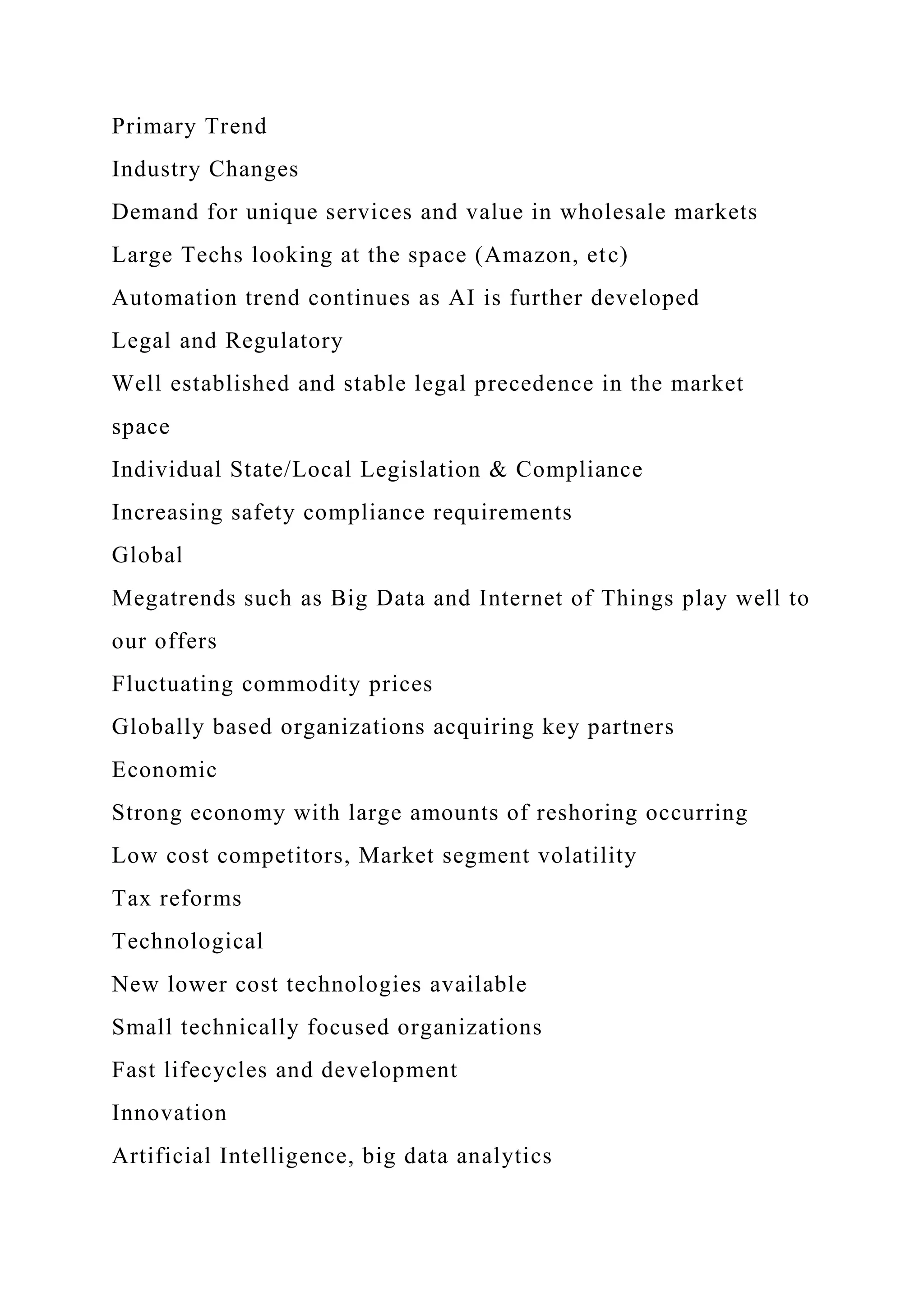
External Factor and Trend Considerations
Factor
Primary Opportunity
(Helpful)
Primary Threat
(Harmful)
Primary Trend
Industry Changes
Demand for unique services and value in wholesale markets
Large Techs looking at the space (Amazon, etc)
Automation trend continues as AI is further developed
Legal and Regulatory
Well established and stable legal precedence in the market
space
Individual State/Local Legislation & Compliance
Increasing safety compliance requirements
Global
Megatrends such as Big Data and Internet of Things play well to
our offers
Fluctuating commodity prices
Globally based organizations acquiring key partners
Economic
Strong economy with large amounts of reshoring occurring
Low cost competitors, Market segment volatility
Tax reforms
Technological
New lower cost technologies available
Small technically focused organizations
Fast lifecycles and development
Innovation
Artificial Intelligence, big data analytics
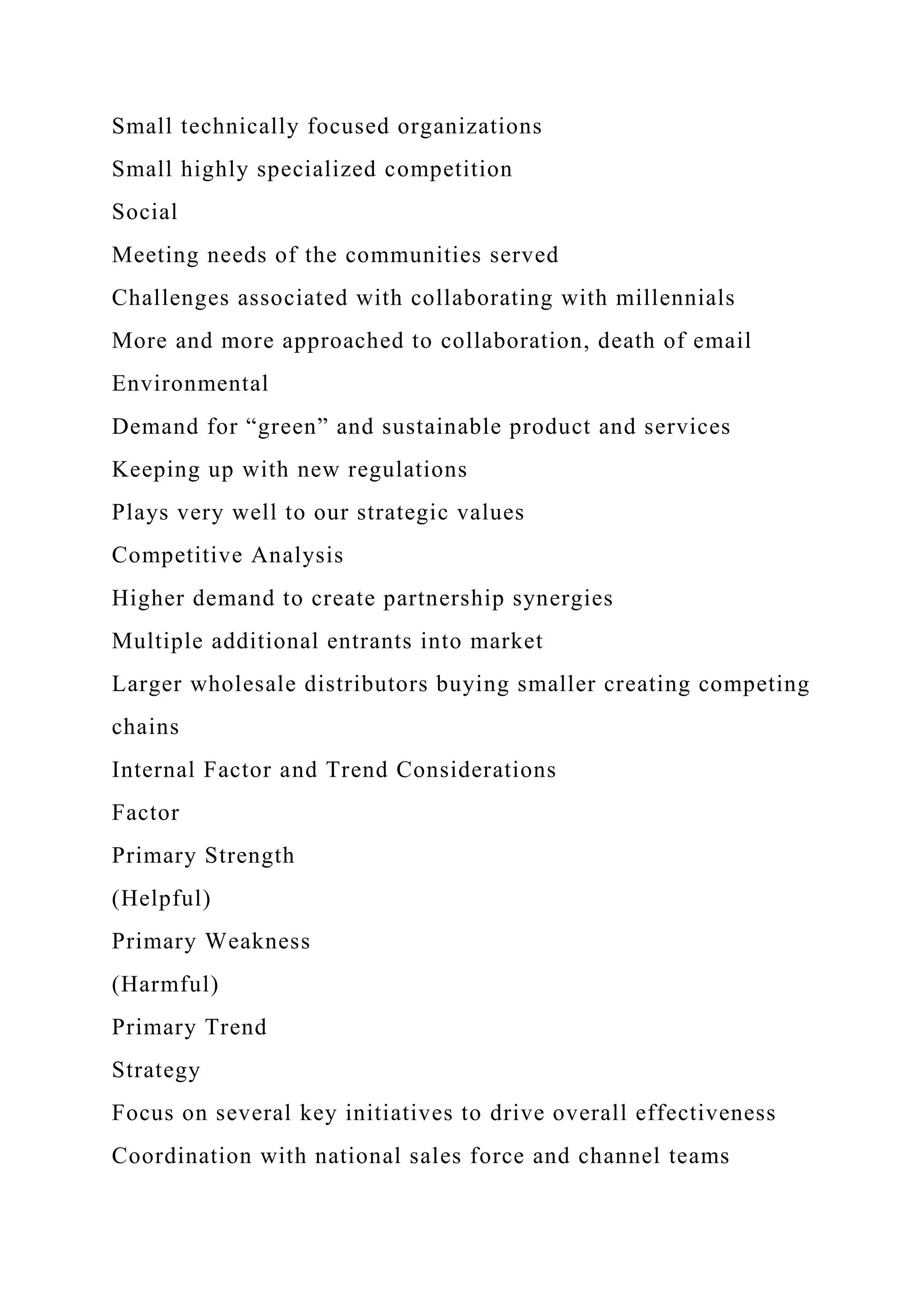
Small technically focused organizations
Small highly specialized competition
Social
Meeting needs of the communities served
Challenges associated with collaborating with millennials
More and more approached to collaboration, death of email
Environmental
Demand for “green” and sustainable product and services
Keeping up with new regulations
Plays very well to our strategic values
Competitive Analysis
Higher demand to create partnership synergies
Multiple additional entrants into market
Larger wholesale distributors buying smaller creating competing
chains
Internal Factor and Trend Considerations
Factor
Primary Strength
(Helpful)
Primary Weakness
(Harmful)
Primary Trend
Strategy
Focus on several key initiatives to drive overall effectiveness
Coordination with national sales force and channel teams
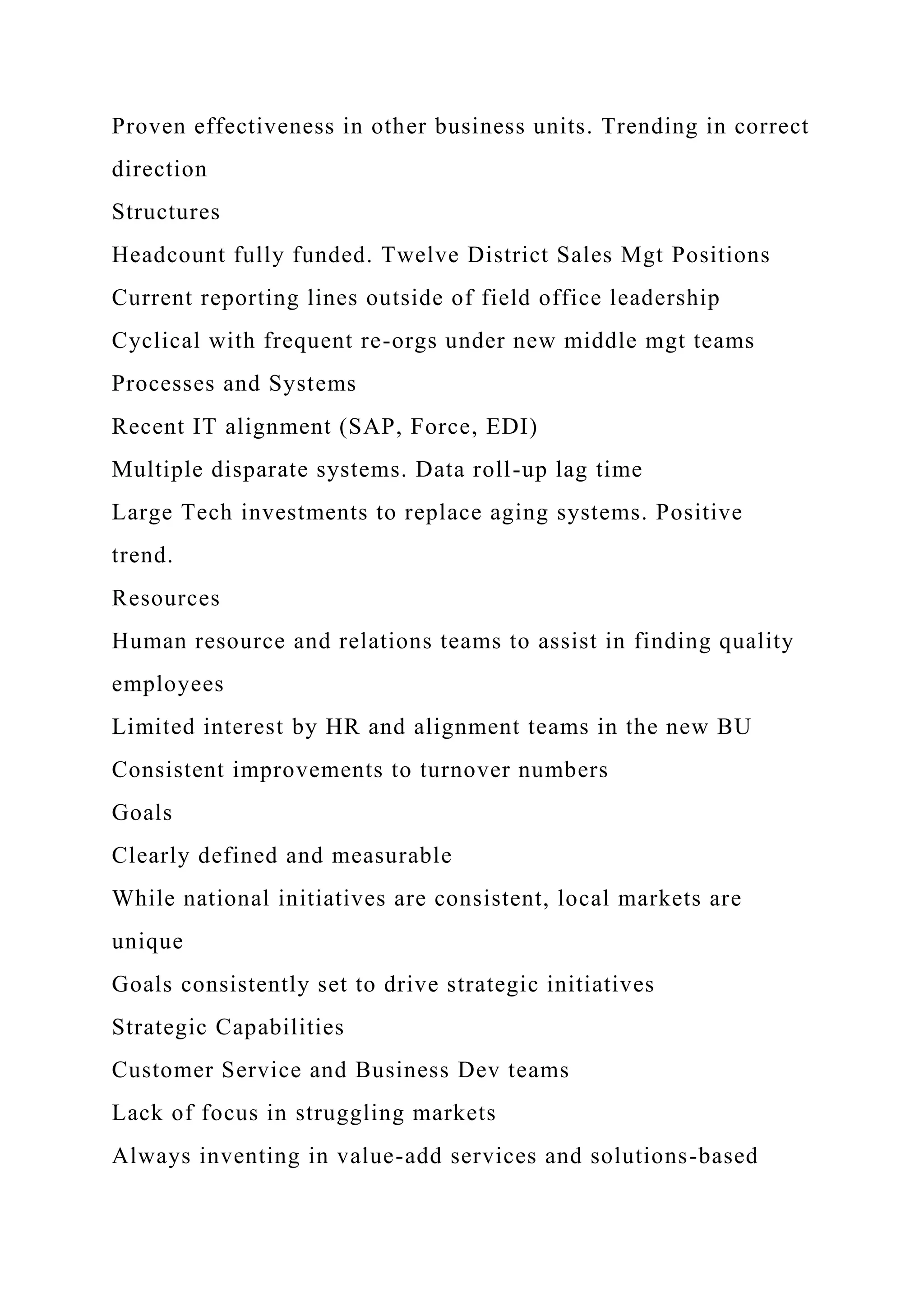
Proven effectiveness in other business units. Trending in correct
direction
Structures
Headcount fully funded. Twelve District Sales Mgt Positions
Current reporting lines outside of field office leadership
Cyclical with frequent re-orgs under new middle mgt teams
Processes and Systems
Recent IT alignment (SAP, Force, EDI)
Multiple disparate systems. Data roll-up lag time
Large Tech investments to replace aging systems. Positive
trend.
Resources
Human resource and relations teams to assist in finding quality
employees
Limited interest by HR and alignment teams in the new BU
Consistent improvements to turnover numbers
Goals
Clearly defined and measurable
While national initiatives are consistent, local markets are
unique
Goals consistently set to drive strategic initiatives
Strategic Capabilities
Customer Service and Business Dev teams
Lack of focus in struggling markets
Always inventing in value-add services and solutions-based
offers
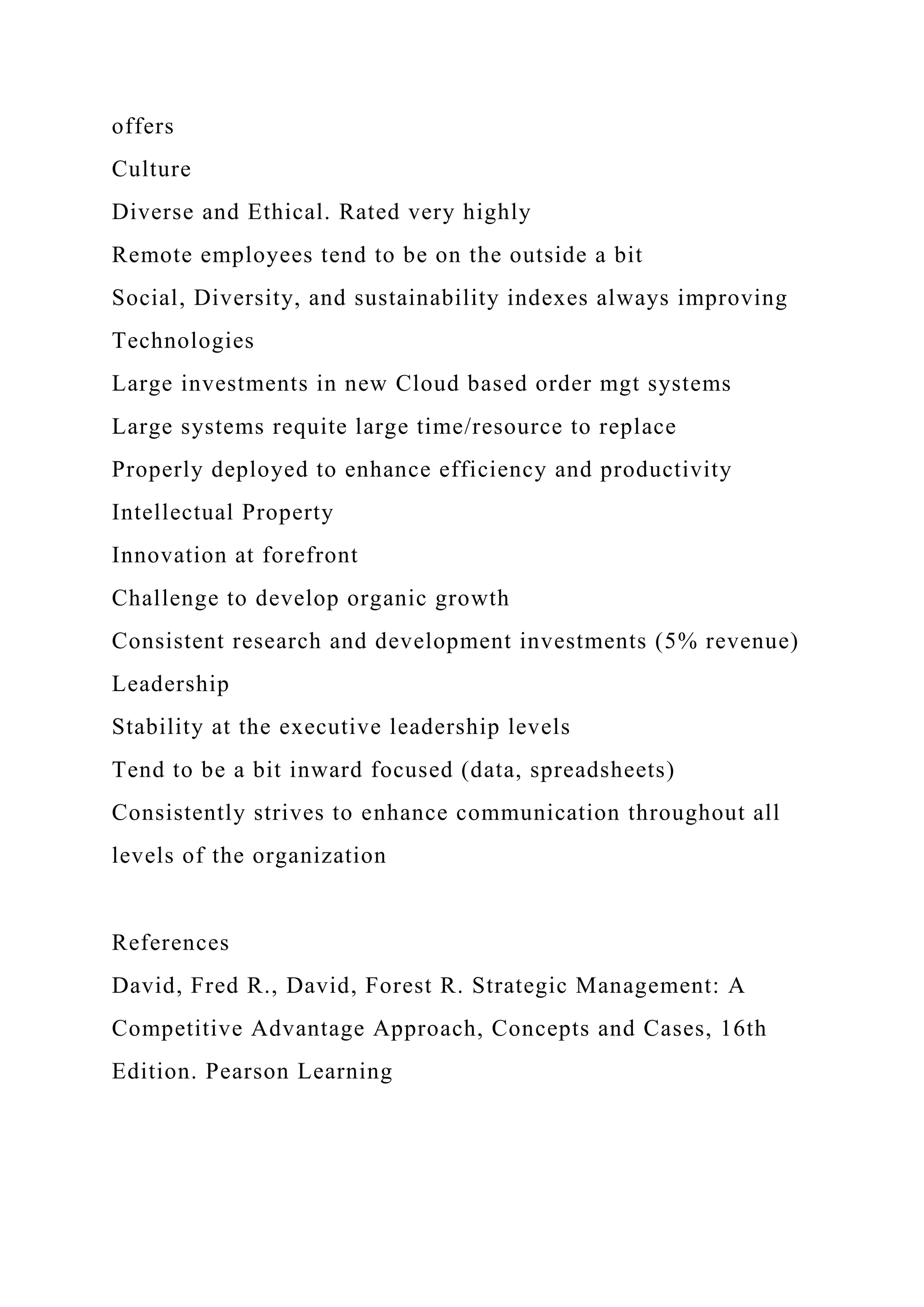
Culture
Diverse and Ethical. Rated very highly
Remote employees tend to be on the outside a bit
Social, Diversity, and sustainability indexes always improving
Technologies
Large investments in new Cloud based order mgt systems
Large systems requite large time/resource to replace
Properly deployed to enhance efficiency and productivity
Intellectual Property
Innovation at forefront
Challenge to develop organic growth
Consistent research and development investments (5% revenue)
Leadership
Stability at the executive leadership levels
Tend to be a bit inward focused (data, spreadsheets)
Consistently strives to enhance communication throughout all
levels of the organization
References
David, Fred R., David, Forest R. Strategic Management: A
Competitive Advantage Approach, Concepts and Cases, 16th
Edition. Pearson Learning
Assignment 2 Operations DecisionDue Week 6 and worth 300 points.docx

Assignment 2 Operations DecisionDue Week 6 and worth 300 points.docx

  • 1.
    Assignment 2: OperationsDecision Due Week 6 and worth 300 points Using the regression results and the other computations from Assignment 1, determine the market structure in which the low- calorie frozen, microwavable food company operates. Use the Internet to research two (2) of the leading competitors in the low-calorie frozen, microwavable food industry, and take note of their pricing strategies, profitability, and their relationships within the industry (worldwide). Write a six to eight (6-8) page paper in which you: 1. Outline a plan that will assess the effectiveness of the market structure for the company’s operations. Note: In Assignment 1, the assumption was that the market structure [or selling environment] was perfectly competitive and that the equilibrium price was to be determined by setting QD equal to QS. You are now aware of recent changes in the selling environment that suggest an imperfectly competitive market where your firm now has substantial market power in setting its own “optimal” price 2. . Given that business operations have changed from the market structure specified in the original scenario in Assignment 1, determine two (2) likely factors that might have caused the change. Predict the primary manner in which this change would likely impact business operations in the new market environment. 3. Analyze the major short run and long cost functions for the low- calorie, frozen microwaveable food company given the cost functions below. Suggest substantive ways in which the low- calorie food company may use this information in order to make decisions in both the short-run and the long-run. TC = 160,000,000 + 100Q + 0.0063212Q2VC = 100Q + 0.0063212Q2MC= 100 + 0.0126424Q
  • 2.
    4. Determine thepossible circumstances under which the company should discontinue operations. Suggest key actions that management should take in order to confront these circumstances. Provide a rationale for your response. (Hint: Your firm’s price must cover average variable costs in the short run and average total costs in the long run to continue operations.) 5. Suggest one (1) pricing policy that will enable your low-calorie, frozen microwavable food company to maximize profits. Provide a rationale for your suggestion. (Hints: · In Assignment 1, you determined your firm’s market demand equation. Now you need to find the inverse demand equation. Having found that, find the Total Revenue function for your firm (TR is P x Q). From your firm’s Total Revenue function, then find your Marginal Revenue (MR) function. · Use the profit maximization rule MR = MC to determine your optimal price and optimal output level now that you have market power. Compare these values with the values you generated in Assignment 1. Determine whether your price higher is or lower. · 6. Outline a plan, based on the information provided in the scenario, which the company could use in order to evaluate its financial performance. Consider all the key drivers of performance, such as company profit or loss for both the short term and long term, and the fundamental manner in which each factor influences managerial decisions. (Hints: · Calculate profit in the short run by using the price and output levels you generated in part 5. Optional: You may want to compare this to what profit would have been in Assignment 1 using the cost function provided here. · Calculate profit in the long run by using the output level you
  • 3.
    generated in part5 and cost data in part 3 and assuming that the selling environment will likely be very competitive. Determine why this would be a valid assumption.) · 7. Recommend two (2) actions that the company could take in order to improve its profitability and deliver more value to its stakeholders. Outline, in brief, a plan to implement your recommendations. 8. Use at least five (5) quality academic resources in this assignment. Note: Wikipedia does not qualify as an academic resource. Your assignment must follow these formatting requirements: · Be typed, double spaced, using Times New Roman font (size 12), with one-inch margins on all sides; citations and references must follow APA or school-specific format. Check with your professor for any additional instructions. · Include a cover page containing the title of the assignment, the student’s name, the professor’s name, the course title, and the date. The cover page and the reference page are not included in the required assignment page length. The specific course learning outcomes associated with this assignment are: · Analyze short-run and long-run production and cost functions. · Apply macroeconomic concepts to changes in global and national economies and how they affect economic growth, inflation, interest rates, and wage rates. · Evaluate the profit-maximizing price and output level for given operating costs for monopolies and firms in competitive industries. · Use technology and information resources to research issues in managerial economics and globalization. · Write clearly and concisely about managerial economics and globalization using proper writing mechanics. Click here to view the grading rubric.
  • 4.
    Review Analysis andCritique 1 Review Analysis and Critique [INTRODUCTION] [NAME] Week 2 Strategic Plan Part I: Mission, Vision, Values [NAME] Week 2 Strategic Plan Part I: Mission, Vision, Values [NAME] Week 2 Strategic Plan Part I: Mission, Vision, Values CONCLUSION Reference David, Fred R., Forest David. Strategic Management: A Competitive Advantage Approach, Concepts and Cases, 16th Edition. Pearson Learning Solution s, 4/2016. Strategic Plan Part II: SWOTT Analysis 1 7
  • 5.
    Strategic Plan Part2: SWOTT Analysis Determining the feasibility of a plan is a crucial part in determining whether or not to invest resources in to its execution. Part II of the strategic business plan is to develop a strengths, weaknesses, opportunity, threat, and trend analysis, otherwise known as an SWOTT Analysis. A SWOTT analysis is required to discern whether or not a new product, service, or business unit will be an added value to clients, or in our case a key channel partner. The training, alignment, initiative team (TAIT) business unit's leadership team will review external and internal forces and trends that will affect how they do business with and service a very large strategic partner to build effectiveness thereby making it more efficient and hence more productive as well as profitable overall. This will, as a necessity, drive significant change and require that those at Schneider Electric adapt to this change. Additionally, we will evaluate the extended supply change, core competencies of the offer, and how this will impact all stakeholders from the perspective of legal, economic, and regulatory forces and trends. The TAIT team will identify and
  • 6.
    evaluate relevant forcesinternally and externally to take advantage of internal strengths and weaknesses while clearly understanding external opportunities and threats. By understand these forces clearly before undertaking such an initiative leadership will be better positioned to set and reach strategic goals defined by the initiative. Forces and Trends “An external audit focuses on identifying and evaluating trends and events beyond the control of a single firm, such as increased foreign competition, population shifts to coastal areas of the United States, an aging society, and taxing Internet sales. An external audit reveals key opportunities and threats confronting an organization, so managers can formulate strategies to take advantage of the opportunities and avoid or reduce the impact of threats" (David 60). Conversely the internal audit focusses on strengths and weaknesses that the organization can control. These forces combined collectively form the basis in which an organization can effectively set its strategic goals. The SWOTT to be performed in preparation to deploy the TAIT team has identified a number of forces and trends that are most important to rationalize when determining whether it is feasible to proceed with investing the required resources needed to effectively fund a new team designed to implement the strategy. Forces such as legal, regulatory, economic, and the competitive landscape are external
  • 7.
    environmental forces. Internalfactors such as our specific strategy, processes, technologies, headcount are factors that we alone have influence over. Legal and regulatory forces certainly can be threatening in that new laws and regulations, particularly those that are directed at publicly traded organizations, can certainly pose a threat. An example of this would be the Sarbanes Oxley Act (Public Company Accounting Reform and Investor Protection Act) and how it dramatically effected the accounting and auditing practices of publicly traded companies. Economic forces such as tax reforms that were not previously considered during budget cycles can certainly have a detrimental effect on resourcing. Internal forces and trends are certainly within the control of management. As plans are managed we are continuously looking to steer our actions as to realize the desired results in our metrics. This to improve and maintain the competitive advantage for Schneider Electric and our partner. A successful strategy with proper feedback loops drive to continuous improvement and will guarantee effective initiative development and results. By understanding internal needs our processes and systems are will be designed around our strategic initiatives goals driving efficiency and as productivity. Working closely with human resources is certainly a force we can control. We will need to recruit, hire, train, and develop
  • 8.
    new resources aswell as attract high value long term seasoned employees with a vast knowledge of our value-chain. HR will be utilized to development programs that will drive employee retention. How Well the Organization Adapts to Change There are many driving forces behind organizational change. Organizations need to be responsive to these forces lest they risk losing competitive edge, being relegated out of key industries that they participate in, or missing opportunities to integrate their organizations horizontally or vertically. At these critical junctions’ executive management must be capable of certain problem identification where change managers need to be utilized to successfully see change strategies successfully implemented. Having worked for Schneider Electric for over ten years and having seen many very large reorganizations, mergers and acquisitions, and horizontal integrations such as the TAIT strategy. Initiatives that required the application of a great deal of change management. Adding new units and teams also requires large change initiatives. Challenges presented were many with the most difficult being the cultural differences between the two groups. The most important factor by far that we can certainly control is what is called the tone at the top. Business units and teams are affected, negatively or positively, by the tenor and behaviors that are demonstrated at the
  • 9.
    leaderships levels. Aswe deploy the TAIT team this will be very influential as the team adopts its goals. The Supply Chain A supply chain is a series of processes linked together to produce a product or service. Each of the steps in the supply chain add value to the end product or service. As a large manufacturer of electrical and energy equipment Schneider Electric needs to maintain strategic relationships with industrial wholesalers and supply chains. In manufacturing, much attention is focused on upstream supplies. In the case of the proposed TAIT team we are much more focused on the downstream supply chain where the finished goods are warehoused and distributed to OEM and end-user customers. This is where the value of a strategic partner becomes very evident. Strategic distribution partners, particularly large organizations with multiple branch locations and the ability to warehouse locally the market specific products. Additionally, partners such as these limit the number of end-user customers the manufacturer needs to contract business with and provide custom designed financing terms. This makes tremendous impact in overall efficiencies as they can individually focus in each of the geographical districts. Uncovered Issues and Opportunities the Company Faces The identified opportunities that are driving the need for the TAIT team are centered around several strategic initiatives
  • 10.
    which will befurther addressed in the subsequent balanced scorecard. Initially these have been identified as development of distributor led projects, residential “over the counter” business, internal business development manager teams, selling services, and Industrial account development. Each will require training around developing effective proposals, developing unique product promotions, recruiting internal skilled resources, and challenge of exposing each other’s internal processes and procedures through multiple departments. Conclusion The planned deployment of the Training, Alignment, Initiative Integration Team will benefit by performing this SWOTT analysis. It is in part designed to determine the feasibility of such a team. Understanding the internal and external factors that are directly related to our strategic initiatives and goals will drive the investment of resources into the team and provide a means to direct initiatives, measure success, and determine tactical adjustments to keep our collective goals on track. TAIT Team SWOTT Analysis External Factor and Trend Considerations Factor Primary Opportunity (Helpful) Primary Threat (Harmful)
  • 11.
    Primary Trend Industry Changes Demandfor unique services and value in wholesale markets Large Techs looking at the space (Amazon, etc) Automation trend continues as AI is further developed Legal and Regulatory Well established and stable legal precedence in the market space Individual State/Local Legislation & Compliance Increasing safety compliance requirements Global Megatrends such as Big Data and Internet of Things play well to our offers Fluctuating commodity prices Globally based organizations acquiring key partners Economic Strong economy with large amounts of reshoring occurring Low cost competitors, Market segment volatility Tax reforms Technological New lower cost technologies available Small technically focused organizations Fast lifecycles and development Innovation Artificial Intelligence, big data analytics
  • 12.
    Small technically focusedorganizations Small highly specialized competition Social Meeting needs of the communities served Challenges associated with collaborating with millennials More and more approached to collaboration, death of email Environmental Demand for “green” and sustainable product and services Keeping up with new regulations Plays very well to our strategic values Competitive Analysis Higher demand to create partnership synergies Multiple additional entrants into market Larger wholesale distributors buying smaller creating competing chains Internal Factor and Trend Considerations Factor Primary Strength (Helpful) Primary Weakness (Harmful) Primary Trend Strategy Focus on several key initiatives to drive overall effectiveness Coordination with national sales force and channel teams
  • 13.
    Proven effectiveness inother business units. Trending in correct direction Structures Headcount fully funded. Twelve District Sales Mgt Positions Current reporting lines outside of field office leadership Cyclical with frequent re-orgs under new middle mgt teams Processes and Systems Recent IT alignment (SAP, Force, EDI) Multiple disparate systems. Data roll-up lag time Large Tech investments to replace aging systems. Positive trend. Resources Human resource and relations teams to assist in finding quality employees Limited interest by HR and alignment teams in the new BU Consistent improvements to turnover numbers Goals Clearly defined and measurable While national initiatives are consistent, local markets are unique Goals consistently set to drive strategic initiatives Strategic Capabilities Customer Service and Business Dev teams Lack of focus in struggling markets Always inventing in value-add services and solutions-based
  • 14.
    offers Culture Diverse and Ethical.Rated very highly Remote employees tend to be on the outside a bit Social, Diversity, and sustainability indexes always improving Technologies Large investments in new Cloud based order mgt systems Large systems requite large time/resource to replace Properly deployed to enhance efficiency and productivity Intellectual Property Innovation at forefront Challenge to develop organic growth Consistent research and development investments (5% revenue) Leadership Stability at the executive leadership levels Tend to be a bit inward focused (data, spreadsheets) Consistently strives to enhance communication throughout all levels of the organization References David, Fred R., David, Forest R. Strategic Management: A Competitive Advantage Approach, Concepts and Cases, 16th Edition. Pearson Learning