Innovative Assessment Techniques
BY
IVY EUNICE F. FEUDO
At the end of this session the
participants shall be able to:
• state the meaning of assessment
• explain the need for assessment
• discuss different types of innovative
assessment techniques.
• Assessment
• Role of assessment in learning
• Types of innovative assessment
techniques
• Assessment is the systematic gathering and
analyzing of information (excluding course
grades) to inform and improve student
learning or programs of student learning in
light of goal-oriented expectations
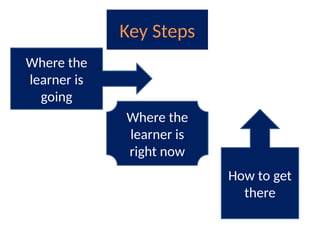
Key Steps
Where the
learner is
going
Where the
learner is
right now
How to get
there
Purposes of Assessment
1. Diagnostic Assessment
Tells us what the student needs to learn.
Teachers identify the nature of a pupil’s learning
difficulties and use this information to plan
interventions to address the issues discovered.
Formative Assessment (Assessment for Learning)
is part of the everyday teaching and learning
process to:
• tell us how well the student is doing as work
progresses.
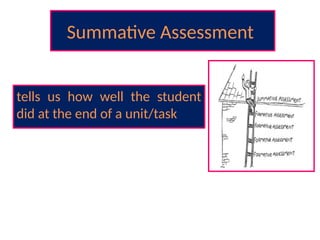
Summative Assessment
tells us how well the student
did at the end of a unit/task
Why is it important to assess?
• To find out what the students know(knowledge).
• To find out what the students can do, and how
well they can do it (skill; performance)
• To find out how students go about the task of
doing their work (process).
• To find out how students feel about their work
(motivation, effort).
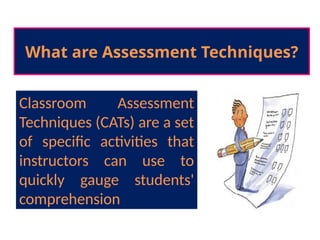
What are Assessment Techniques?
Classroom Assessment
Techniques (CATs) are a set
of specific activities that
instructors can use to
quickly gauge students'
comprehension
Types of Assessment Techniques
• Effective questioning
• Teacher observation
• Classroom Tests
• Discussions
• Presentation
• Marking pupil works
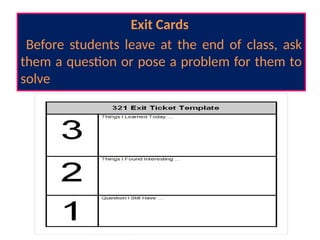
Exit Cards
Before students leave at the end of class, ask
them a question or pose a problem for them to
solve
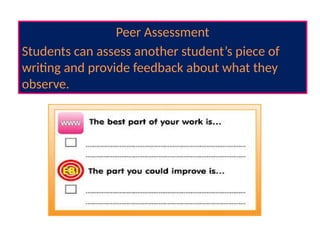
Peer Assessment
Students can assess another student’s piece of
writing and provide feedback about what they
observe.
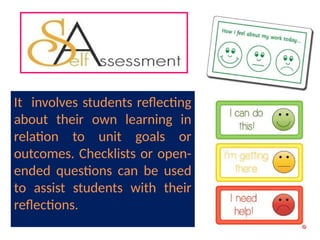
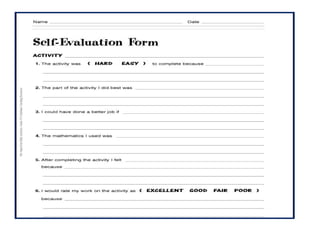
It involves students reflecting
about their own learning in
relation to unit goals or
outcomes. Checklists or open-
ended questions can be used
to assist students with their
reflections.
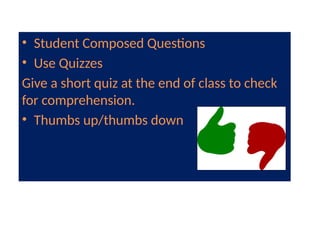
• Student Composed Questions
• Use Quizzes
Give a short quiz at the end of class to check
for comprehension.
• Thumbs up/thumbs down
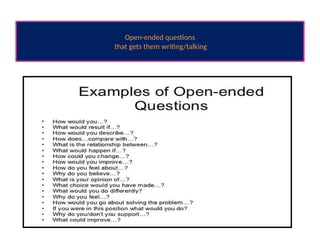
Open-ended questions
that gets them writing/talking
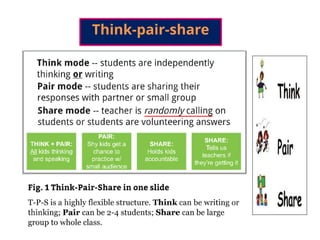
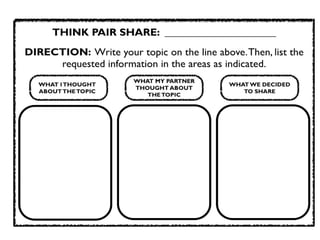
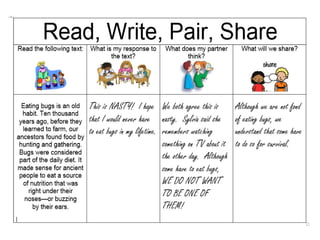
Think-pair-share
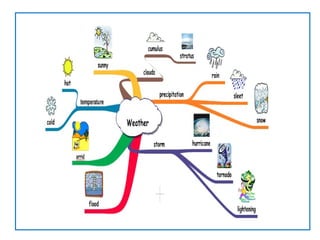
Concept Map
A concept map is a type of graphic organizer used to
help students organize and represent knowledge of a
subject. Concept maps begin with a main idea (or
concept) and then branch out to show how that main
idea can be broken down into specific topics
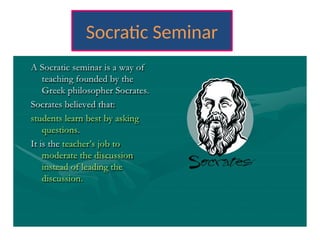
Socratic Seminar
Socratic Seminar
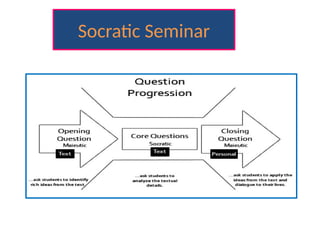
Socratic Seminar
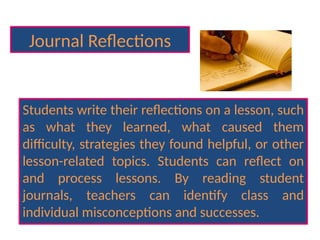
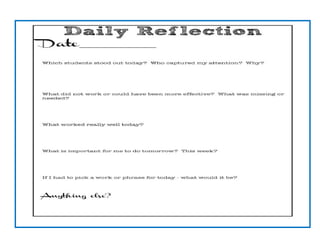
Journal Reflections
Students write their reflections on a lesson, such
as what they learned, what caused them
difficulty, strategies they found helpful, or other
lesson-related topics. Students can reflect on
and process lessons. By reading student
journals, teachers can identify class and
individual misconceptions and successes.
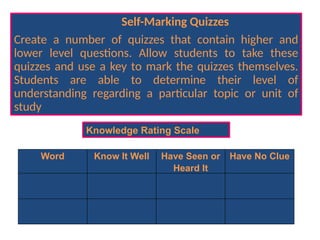
Word Know It Well Have Seen or
Heard It
Have No Clue
Knowledge Rating Scale
Self-Marking Quizzes
Create a number of quizzes that contain higher and
lower level questions. Allow students to take these
quizzes and use a key to mark the quizzes themselves.
Students are able to determine their level of
understanding regarding a particular topic or unit of
study
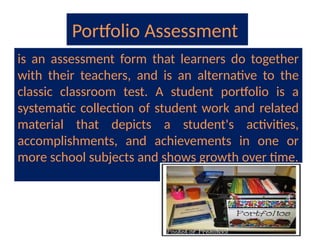
Portfolio Assessment
is an assessment form that learners do together
with their teachers, and is an alternative to the
classic classroom test. A student portfolio is a
systematic collection of student work and related
material that depicts a student's activities,
accomplishments, and achievements in one or
more school subjects and shows growth over time.
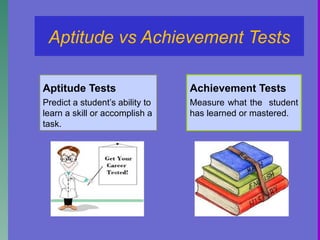
Aptitude vs Achievement Tests
Aptitude Tests
Predict a student’s ability to
learn a skill or accomplish a
task.
Achievement Tests
Measure what the student
has learned or mastered.
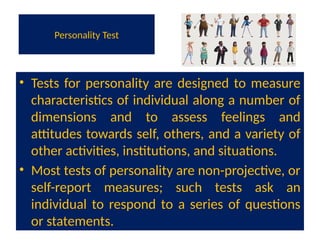
Personality Test
• Tests for personality are designed to measure
characteristics of individual along a number of
dimensions and to assess feelings and
attitudes towards self, others, and a variety of
other activities, institutions, and situations.
• Most tests of personality are non-projective, or
self-report measures; such tests ask an
individual to respond to a series of questions
or statements.
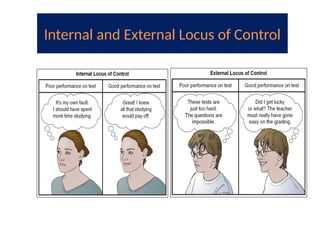
Internal and External Locus of Control
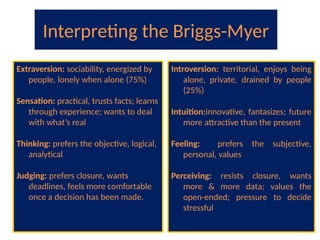
Interpreting the Briggs-Myer
Extraversion: sociability, energized by
people, lonely when alone (75%)
Sensation: practical, trusts facts; learns
through experience; wants to deal
with what’s real
Thinking: prefers the objective, logical,
analytical
Judging: prefers closure, wants
deadlines, feels more comfortable
once a decision has been made.
Introversion: territorial, enjoys being
alone, private, drained by people
(25%)
Intuition:innovative, fantasizes; future
more attractive than the present
Feeling: prefers the subjective,
personal, values
Perceiving: resists closure, wants
more & more data; values the
open-ended; pressure to decide
stressful
Scoring the Briggs-Myers
See in class!
Projective Tools Of Assessing
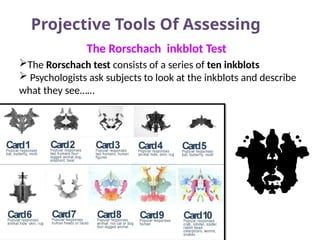
The Rorschach test consists of a series of ten inkblots
 Psychologists ask subjects to look at the inkblots and describe
what they see……
The Rorschach inkblot Test
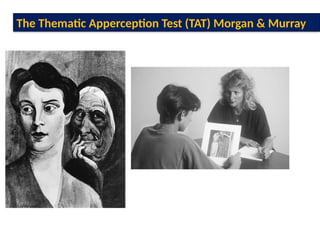
The Thematic Apperception Test (TAT) Morgan & Murray
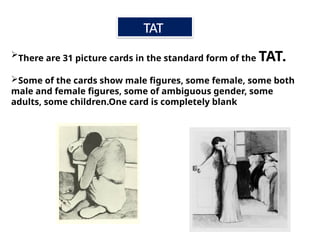
There are 31 picture cards in the standard form of the TAT.
Some of the cards show male figures, some female, some both
male and female figures, some of ambiguous gender, some
adults, some children.One card is completely blank
TAT
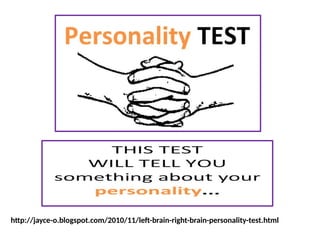
A personality test can benefit your students by:
 Increasing productivity
 Help students realize their full potential
 Identify teaching strategies for students
 Help students to appreciate other
personality types
Teachers can administer a personality test in class to
help your children discover their strengths and
developmental needs.
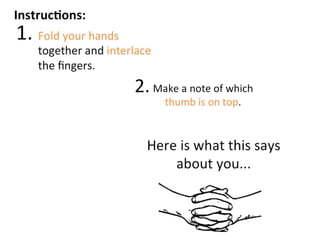
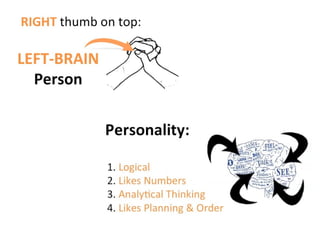
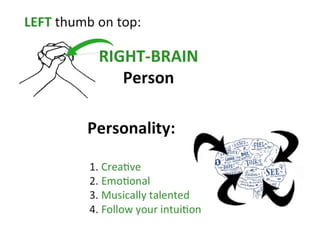
http://jayce-o.blogspot.com/2010/11/left-brain-right-brain-personality-test.html
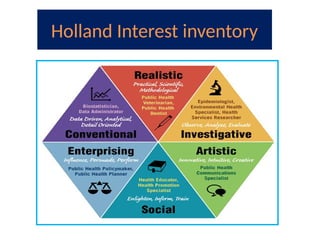
Interest Inventories
• An interest inventory asks an individual to
indicate personal likes and dislikes, such as
the kinds of activities he or she performs to
engage in.
• The most widely used type of standardized
interest measure is the vocational interest
inventory.
Holland Interest inventory
Performance Standards
• Performance standards are the criterion to which the
results of measurement are compared in order to
interpret them.
• Norm-Referenced Standards
• Any test, standardized or locally-developed, which
reports and interprets each score in terms of its
relative position with respect to other scores on the
same test, is norm-referenced.
• Norm-referenced tests do not indicate what a person
knows and can do, or does not know and cannot do.
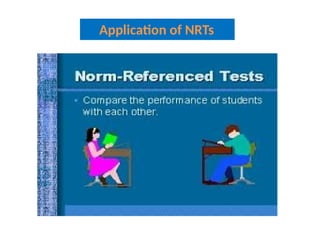
Application of NRTs
Criterion-referenced standards
• Any test which reports and interprets each
score in terms of absolute standard is
criterion-referenced.
• Interpretation of one person’s score has
nothing to with anybody else’s score; the
comparison is with the standard of
performance, not scores of other persons
• A criterion-referenced test (CRT) is “one that is
deliberately constructed to yield measurement that is
directly interpretable in terms of specified performance
standards”.
• According to this definition, CRT is used to compare a
person’s performance with a well-defined behavior
domain.
Application of CRTs
• CRTs are probably most appropriate as locally-
developed measures since they are developed to
measure exactly what was taught.
• For certain instructional systems (e.g., mastery,
individualized) CRTs are the only appropriate
measurement devices since attention is focused
on what each student can or cannot do.
• The results of CRT also provide valuable input for
program revision.
• ---------------------------------
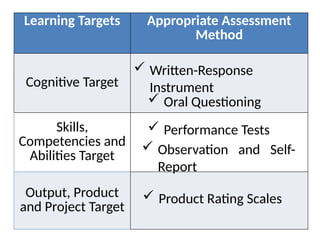
Learning Targets Appropriate Assessment
Method
Cognitive Target
Skills,
Competencies and
Abilities Target
Output, Product
and Project Target
 Written-Response
Instrument
 Oral Questioning
 Performance Tests
 Observation and Self-
Report
 Product Rating Scales
ASSESSMENT PPT.pOWERPOINT PRESENTATION MAT

ASSESSMENT PPT.pOWERPOINT PRESENTATION MAT

  • 1.
  • 2.
    At the endof this session the participants shall be able to: • state the meaning of assessment • explain the need for assessment • discuss different types of innovative assessment techniques.
  • 3.
    • Assessment • Roleof assessment in learning • Types of innovative assessment techniques
  • 4.
    • Assessment isthe systematic gathering and analyzing of information (excluding course grades) to inform and improve student learning or programs of student learning in light of goal-oriented expectations
  • 5.
    Key Steps Where the learneris going Where the learner is right now How to get there
  • 6.
    Purposes of Assessment 1.Diagnostic Assessment Tells us what the student needs to learn. Teachers identify the nature of a pupil’s learning difficulties and use this information to plan interventions to address the issues discovered.
  • 7.
    Formative Assessment (Assessmentfor Learning) is part of the everyday teaching and learning process to: • tell us how well the student is doing as work progresses.
  • 8.
    Summative Assessment tells ushow well the student did at the end of a unit/task
  • 9.
    Why is itimportant to assess? • To find out what the students know(knowledge). • To find out what the students can do, and how well they can do it (skill; performance) • To find out how students go about the task of doing their work (process). • To find out how students feel about their work (motivation, effort).
  • 10.
    What are AssessmentTechniques? Classroom Assessment Techniques (CATs) are a set of specific activities that instructors can use to quickly gauge students' comprehension
  • 11.
    Types of AssessmentTechniques • Effective questioning • Teacher observation • Classroom Tests • Discussions • Presentation • Marking pupil works
  • 12.
    Exit Cards Before studentsleave at the end of class, ask them a question or pose a problem for them to solve
  • 13.
    Peer Assessment Students canassess another student’s piece of writing and provide feedback about what they observe.
  • 14.
    It involves studentsreflecting about their own learning in relation to unit goals or outcomes. Checklists or open- ended questions can be used to assist students with their reflections.
  • 16.
    • Student ComposedQuestions • Use Quizzes Give a short quiz at the end of class to check for comprehension. • Thumbs up/thumbs down
  • 17.
    Open-ended questions that getsthem writing/talking
  • 18.
  • 21.
    Concept Map A conceptmap is a type of graphic organizer used to help students organize and represent knowledge of a subject. Concept maps begin with a main idea (or concept) and then branch out to show how that main idea can be broken down into specific topics
  • 23.
  • 24.
  • 25.
  • 26.
    Journal Reflections Students writetheir reflections on a lesson, such as what they learned, what caused them difficulty, strategies they found helpful, or other lesson-related topics. Students can reflect on and process lessons. By reading student journals, teachers can identify class and individual misconceptions and successes.
  • 28.
    Word Know ItWell Have Seen or Heard It Have No Clue Knowledge Rating Scale Self-Marking Quizzes Create a number of quizzes that contain higher and lower level questions. Allow students to take these quizzes and use a key to mark the quizzes themselves. Students are able to determine their level of understanding regarding a particular topic or unit of study
  • 29.
    Portfolio Assessment is anassessment form that learners do together with their teachers, and is an alternative to the classic classroom test. A student portfolio is a systematic collection of student work and related material that depicts a student's activities, accomplishments, and achievements in one or more school subjects and shows growth over time.
  • 30.
    Aptitude vs AchievementTests Aptitude Tests Predict a student’s ability to learn a skill or accomplish a task. Achievement Tests Measure what the student has learned or mastered.
  • 31.
    Personality Test • Testsfor personality are designed to measure characteristics of individual along a number of dimensions and to assess feelings and attitudes towards self, others, and a variety of other activities, institutions, and situations. • Most tests of personality are non-projective, or self-report measures; such tests ask an individual to respond to a series of questions or statements.
  • 32.
    Internal and ExternalLocus of Control
  • 33.
    Interpreting the Briggs-Myer Extraversion:sociability, energized by people, lonely when alone (75%) Sensation: practical, trusts facts; learns through experience; wants to deal with what’s real Thinking: prefers the objective, logical, analytical Judging: prefers closure, wants deadlines, feels more comfortable once a decision has been made. Introversion: territorial, enjoys being alone, private, drained by people (25%) Intuition:innovative, fantasizes; future more attractive than the present Feeling: prefers the subjective, personal, values Perceiving: resists closure, wants more & more data; values the open-ended; pressure to decide stressful
  • 34.
  • 35.
    Projective Tools OfAssessing The Rorschach test consists of a series of ten inkblots  Psychologists ask subjects to look at the inkblots and describe what they see…… The Rorschach inkblot Test
  • 36.
    The Thematic ApperceptionTest (TAT) Morgan & Murray
  • 37.
    There are 31picture cards in the standard form of the TAT. Some of the cards show male figures, some female, some both male and female figures, some of ambiguous gender, some adults, some children.One card is completely blank TAT
  • 38.
    A personality testcan benefit your students by:  Increasing productivity  Help students realize their full potential  Identify teaching strategies for students  Help students to appreciate other personality types Teachers can administer a personality test in class to help your children discover their strengths and developmental needs.
  • 39.
  • 43.
    Interest Inventories • Aninterest inventory asks an individual to indicate personal likes and dislikes, such as the kinds of activities he or she performs to engage in. • The most widely used type of standardized interest measure is the vocational interest inventory.
  • 44.
  • 45.
    Performance Standards • Performancestandards are the criterion to which the results of measurement are compared in order to interpret them. • Norm-Referenced Standards • Any test, standardized or locally-developed, which reports and interprets each score in terms of its relative position with respect to other scores on the same test, is norm-referenced. • Norm-referenced tests do not indicate what a person knows and can do, or does not know and cannot do.
  • 46.
  • 47.
    Criterion-referenced standards • Anytest which reports and interprets each score in terms of absolute standard is criterion-referenced. • Interpretation of one person’s score has nothing to with anybody else’s score; the comparison is with the standard of performance, not scores of other persons
  • 48.
    • A criterion-referencedtest (CRT) is “one that is deliberately constructed to yield measurement that is directly interpretable in terms of specified performance standards”. • According to this definition, CRT is used to compare a person’s performance with a well-defined behavior domain.
  • 49.
    Application of CRTs •CRTs are probably most appropriate as locally- developed measures since they are developed to measure exactly what was taught. • For certain instructional systems (e.g., mastery, individualized) CRTs are the only appropriate measurement devices since attention is focused on what each student can or cannot do. • The results of CRT also provide valuable input for program revision. • ---------------------------------
  • 50.
    Learning Targets AppropriateAssessment Method Cognitive Target Skills, Competencies and Abilities Target Output, Product and Project Target  Written-Response Instrument  Oral Questioning  Performance Tests  Observation and Self- Report  Product Rating Scales
Editor's Notes